
Honours programme in Philosophy
|
|
|
- Gyles Conley
- 10 years ago
- Views:
Transcription
1 Honours programme in Philosophy

2 Honours Programme in Philosophy The Honours Programme in Philosophy offers students a broad and in-depth introduction to the main areas of Western philosophy and the philosophy of their own field. The programme comprises an introductory overview of historical and systematic elements of philosophy for a total of 30 ECTS, and a specialization in the philosophy of your own field for a further 10 ECTS. In addition, you can choose another 5 ECTS from the range provided in the Honours College, and you will take part in the Honours College Talent Development Programme (Pick your own talent). The Honours Programme in Philosophy comprises a total of 45 ECTS. This honours programme is an interesting option for all University of Groningen students interested in learning about philosophy and the philosophy of their field from a broad academic and social perspective. Course units in the Honours Programme in Philosophy Q4 Philosophy of Science 5 ECTS Q1 History of Philosophy I 5 ECTS Q2 History of Philosophy II 5 ECTS Q3 Reasoning and Arguing 5 ECTS Q4 Good and Evil: Introduction to Ethics 5 ECTS Q1 Social and Political Philosophy 5 ECTS Q2 or Q3 Philosophy of humanities and life, social, cognitive and natural sciences 10 ECTS - Either two skills (2 x 2 ECTS) courses or one broadening module (5 ECTS) from Honours College Petrus Camper Track (in the latter case the total amount is 46 ECTS) 4/5 ECTS - Pick Your Own-talent (PYO-t) 1 ECTS For more information, please make an appointment with Sanne Raap by sending an to: [email protected]. Philosophy of Science Philosophy of science is a relatively young discipline, but the questions it addresses are as old as philosophy itself. There will be four thematic lectures, each focusing on two central questions: What is science? What is the scientific method? How do we justify scientific knowledge? What is the role of probability in science? How does scientific explanation work? Does science provide a reliable view of the world? Which role is played by observations, experiments, and models in various scientific disciplines? How does the scientific world view depend on the social and historical context? Traditionally, philosophy of science focuses on the philosophy of the natural sciences, in particular physics. However, this course is of interest to students of all faculties: relations to other fields of study (including social sciences, medicine, law, and politics) will be made explicit during the course.

3 History of Philosophy I This course unit serves as an introduction to a few of the philosophical giants on whose shoulders we stand. We start with Classical Antiquity, when the Presocratics, Socrates, Plato and Aristotle first systematically questioned knowledge, language and science, the good life, politics and many other subjects. Their thinking became a basis for medieval masters such as Thomas Aquinas and William of Ockham, who created or questioned the synthesis between the Christian faith and classical philosophy. At the start of the modern era, Descartes took charge of the philosophical agenda with his I think, therefore I am supposition, after which a long list of thinkers helped to shape modern philosophy and today s scientific view of the world: Hobbes, Spinoza, Locke, Leibniz, Hume. We finish with Kant, whose work shook the foundations of the philosophical landscape by claiming that man alone is responsible for creating order in the natural world. History of Philosophy II This course focuses on core issues in the history of philosophy from Kant ( ) to Sartre ( ). We build on History of Philosophy I and start with the works of Kant and Hegel. Kant and Hegel articulated influential views on the nature of philosophy, science, history, and historiographical method. For Hegel, philosophy is essentially a historical process and history is characterized by progress. The idea of historical progress was criticized by Nietzsche, who adopted historical methods to relativize enlightenment ideals such as truth and morality. In England, Hegel s philosophy was criticized by Russel, one of the founders of analytic philosophy: a philosophical school which highlighted the importance of studying language, logic and scientific methodology. Within this school, Frege and Russell attempted to reduce mathematics to logic, Wittgenstein analyzed the relation between language and reality, and the logical positivists investigated the status of scientific languages and theories. This emphasis on scientific rationality gave rise to philosophical countermovements. How can we attribute meaning to a world dominated by science and technology? Is there still place for human autonomy and free will? These questions are central to the works of continental philosophers such as Sartre. Reasoning and Arguing This course unit is made up of an introduction to the theory of argumentation, an initial encounter with formal logic and a guest lecture about what is known as practical reasoning. During the theory of argumentation, we will discuss the following subjects using modern examples from current public debate: - In which ways can people disagree with each other? - What does a critical discussion involve? - Can you hold a discussion partner to something he or she has not actually said? - What are fallacies and what is wrong with them? In formal logic (syllogism and proposition logic), the following questions will be among the subjects we explore: - What is the meaning of meaning? - What do we mean when we say someone is inconsistent? - What is formal logic? - When exactly is a line of reasoning valid or invalid?

4 Good and Evil: Introduction to Ethics Why is it wrong to lie? Why do we hate arrogance? What makes someone s life successful? And if it is good to donate money to charity, is it bad not to? These are just a few examples of questions thrown up by ethics, which we study during this course unit. First of all, we try to define what makes a question a moral question. What do we understand by good and evil? And is there even a purpose to contemplating moral questions? We then study the work of philosophers such as Aristotle, Hobbes, Kant and Mill, whom we touched upon during History of Philosophy I and II, examining the foremost ethical theories: virtue ethics, contract theory, deontology and utilitarianism. These theories, and the problems they bring to light, are discussed on the basis of concrete, up-to-date examples (the environment, euthanasia, financial services, etc.). Social and Political Philosophy Social and political philosophy is concerned with asking philosophical questions about the different ways in human beings live together. In particular, it focuses on the role which political institutions play in our societies. Political philosophers ask questions such as: What is the ultimate end of politics? How should we decide between different forms of government? Is there one single end that all governments should pursue - such as justice or equality - or should governments be only concerned with protecting the freedom of everyone to live as they please? To what extent may society limit the freedom of individuals? Is it ever justified to resist the state? In the course, we will focus on the different answers these questions have received throughout the history of philosophy and on how they inform contemporary debates about political issues. Philosophy of humanities and life, social, cognitive and natural sciences For this course unit you choose the track most suited to your own field. The course unit then looks into the basis, the methods and the specific philosophical issues involved in the field concerned. In addition, we examine the conceptual assumptions and theoretical viability of various subjects and strategies within that particular academic field. The course unit on Philosophy of Natural Sciences, for example, focuses on the philosophical aspects of a number of important presuppositions in natural sciences, such as causality, space, time and space-time, the direction of time, etc. Philosophy of Humanities revolves around the question: what is interpretation? Everything that we do or produce is subject to interpretation: texts, buildings, works of art, historical actions, etc. In this course unit, we discuss several theories and strategies commonly used to interpret these matters within the various areas of humanities: hermeneutics, structuralism, psychoanalysis, Neo-Marxism, deconstruction. In Philosophy of Life Sciences, we study the conceptual and theoretical viability of many subjects, including evolution, genes, units of selection, adaptation and fitness, development, nature-nurture, functional explanations, biological categories and human nature. The course unit provides an introduction to this philosophical reflection on life sciences. Philosophy of Cognitive Sciences goes into the theoretical principles of cognitive sciences. What do cognitive sciences teach us about human cognition? Are our brains simply organic computers, and thinking and feeling nothing more than computation? A historical overview guides us through the main ideas and concepts in cognitive science.

5 Every approach is governed by its own theoretical presuppositions, which encompass both possibilities and restrictions. The course unit in Philosophy of Social Sciences focuses on philosophical questions relating to the study of social aspects of human behaviour. What is human behaviour? What makes it social? Is human behaviour rational? Can human behaviour be explained along the same lines as natural phenomena? Or is do we need special methodology with a major focus on interpretation? Do functionalist explanations still have a place in social sciences? Have social groups and social structures acquired a kind of autonomous status or are they simply a sum of their constituent parts?

Course Catalog - Spring 2015
 Course Catalog - Spring 2015 Philosophy Philosophy Chair of Department: Kirk Sanders Department Office: 105 Gregory Hall, 810 South Wright, Urbana Phone: 333-2889 www.philosophy.illinois.edu Note: Students
How To Teach Philosophy
 PHILOSOPHY MAJOR/MINOR DISTRIBUTIVE REQUIREMENTS DEPARTMENT OF PHILOSOPHY UNIVERSITY OF MARYLAND, COLLEGE PARK METAPHYSICS AND EPISTEMOLOGY VALUE THEORY PHIL209I PHIL209K PHIL209N PHIL230 PHIL236 PHIL250
Program Level Learning Outcomes for the Department of Philosophy Page 1
 Page 1 PHILOSOPHY General Major I. Depth and Breadth of Knowledge. A. Will be able to recall what a worldview is and recognize that we all possess one. B. Should recognize that philosophy is most broadly
7 Bachelor s degree programme in the Philosophy of a Specific Scientific Discipline
 7 Bachelor s degree programme in the Philosophy of a Specific Scientific Discipline 7.1 General introduction to degree programmes in the Philosophy of a Specific Scientific Discipline This chapter contains
The History of Logic. Aristotle (384 322 BC) invented logic.
 The History of Logic Aristotle (384 322 BC) invented logic. Predecessors: Fred Flintstone, geometry, sophists, pre-socratic philosophers, Socrates & Plato. Syllogistic logic, laws of non-contradiction
Programme Regulations 2015-16 Philosophy (New Regulations)
 Programme Regulations 2015-16 Philosophy (New Regulations) BA Diploma of Higher Education Certificate of Higher Education Important document please read This document contains important information that
11 Master s degree programme in Philosophy
 11 Master s degree programme in Philosophy 11.1 Introduction This chapter contains detailed information about the aims, learning outcomes and structure of the Master s degree programme in Philosophy. A
DOMINICAN UNIVERSITY COLLEGE
 DOMINICAN UNIVERSITY COLLEGE PHILOSOPHY UNDERGRADUATE COURSES 2015-2016 COURSES FALL INTRODUCTION TO PHILOSOPHY (DPHY 1100) MONDAY, 1:30-4:30 PM This course will initiate students into the universe of
Department of Philosophy
 246 Department of Philosophy Department of Philosophy Chairman: Brassier, Ray Professor Emeritus: Fakhry, Majid Professor: Haydar, Bashshar H. Associate Professors: Brassier, Ray; Muller, Hans D.; Nasr,
DEPARTMENT OF PHILOSOPHY
 198 PHILOSOPHY (College of Arts and Sciences) DEPARTMENT OF PHILOSOPHY 341 0 DOWD HALL (248) 370-3390 Fax: (248) 370-3144 Chairperson: Paul R. Graves Professor emeritus: Richard W. Brooks Professors: David
A Major Matter: Minoring in Philosophy. Southeastern Louisiana University. The unexamined life is not worth living. Socrates, 470-399 B.C.E.
 The unexamined life is not worth living. Socrates, 470-399 B.C.E., Apology A Major Matter: Minoring in Philosophy Department of History & Political Science SLU 10895 Hammond, LA 70402 Telephone (985) 549-2109
Joint Honours in Philosophy at NTU
 Joint Honours in Philosophy at NTU Thank you for your interest in Philosophy at NTU. Philosophy is a major subject on the Joint Honours Programme in the Humanities and each year we typically recruit 35-45
Course Proposal: PHI 1000G Introduction to Philosophy
 Course Proposal: PHI 1000G Introduction to Philosophy 1. Catalog Description: a. Course level: Philosophy 1000G b. Title: Introduction to Philosophy c. Meeting times and credits: (3-0-3) d. Terms offered:
Philosophy and Religious Studies Course Offerings
 Philosophy and Religious Studies Course Offerings 100 Creating Meaning: Introduction to Existentialism emphasizing film and literature (3) Existentialism was one of the most influential intellectual currents
PHILOSOPHY Section 31.220
 Section 31.220 Faculty Chair DAVID MORRIS, PhD University of Toronto; Professor Professors MURRAY CLARKE, PhD University of Western Ontario MATTHIAS FRITSCH, PhD Villanova University CHRISTOPHER B. GRAY,
Lake-Sumter State College Course Syllabus. Contact Information. FA 138 Office Hours W: 4-6:30 and by appointment
 Lake-Sumter State College Course Syllabus Course / Prefix Number PHI 2010 Course Title Introduction to Philosophy CRN 10179 Credit 3 Term Fall 2015 Course Catalog Description A study and critical evaluation
AQA PHILOSOPHY SYLLABUS: USEFUL WEB LINKS
 AQA PHILOSOPHY SYLLABUS: USEFUL WEB LINKS These web links could be used by you as teachers to help deepen your knowledge of the various topics on the A level syllabus. Many of them are too detailed to
GLOBAL GOAL 1: THE STUDENT WILL ACQUIRE CRITICAL THINKING SKILLS. Instructional Learning objectives: The student will be able to...
 A B C D E F G H I PHL 100*#^ PHL 125#^ PHL 203 PHL 209 1 2 3 Philosophy Major Program Applied Ethics Concentration Philosophy of Art & Culture Concentration Intro. to Philosophy Critical Reasoning Business
PHL 202 Introduction to Ethics Spring 2004
 PHL 202 Introduction to Ethics Spring 2004 Course Goals: This course is designed to enhance your understanding of the moral dimensions of human experience and to provide you with the theoretical understanding
Philosophy of Science, Technology and Society
 master s degree Philosophy of Science, Technology and Society Welcome to the Faculty of Behavioural Sciences! The Faculty of Behavioural Sciences provides specialized Master s programmes in the disciplines
PHILOSOPHY (PHIL) Updated July 9, 2015
 PHILOSOPHY (PHIL) Updated July 9, 2015 Note: The department/program code PHIL replaces the former code 35. Students cannot hold credit in PHIL-xxxx and the former 35.xxxx having the same course number
Mission Outcomes Major Requirements Bachelor of Arts (BA) Degree in Philosophy
 228 Philosophy Mission The study of philosophy is based on the recognition that all human beings are engaged in a search for meaning and values with which to interpret their experiences and give order
Course Syllabus Department of Philosophy and Religion Skidmore College. PH 101: Introduction to Philosophy TUTH 3:40-5:30 Spring, 2011
 Course Syllabus Department of Philosophy and Religion Skidmore College PH 101: Introduction to Philosophy Reg Lilly TUTH 3:40-5:30 Spring, 2011 COURSE DESCRIPTION: This course is designed to introduce
NATIONAL GUIDELINES FOR EDUCATING EMS INSTRUCTORS AUGUST 2002
 MODULE 5: ETHICS Cognitive Goals At the completion of this module, the student-instructor should be able to: 5.1 Use their own words to define ethics and morals 5.2 Use their own words to identify and
1. Programme title and designation Philosophy of Psychology
 PROGRAMME APPROVAL FORM SECTION 1 THE PROGRAMME SPECIFICATION 1. Programme title and designation of Psychology For undergraduate programmes only Single honours Joint Major/minor 2. Final award Award Title
#HUMN-104 INTRODUCTION TO PHILOSOPHY
 Coffeyville Community College #HUMN-104 COURSE SYLLABUS FOR INTRODUCTION TO PHILOSOPHY Mike Arpin Instructor COURSE NUMBER: HUMN-104 COURSE TITLE: Introduction to Philosophy CREDIT HOURS: 3 INSTRUCTOR:
Erasmus+ Programme. The University of Ioannina COURSES OFFERED AT THE DEPARTMENT OF PHILOSOPHY, EDUCATION & PSYCHOLOGY. Academic Year 2014-2015
 The University of Ioannina Erasmus+ Programme UNIVERSITY OF IOANNINA FACULTY OF ARTS DEPARTMENT OF PHILOSOPHY UNIVERSITY CAMPUS GR-451 10 IOANNINA COURSES OFFERED AT THE DEPARTMENT OF PHILOSOPHY, EDUCATION
JOHN STUART MILL. John Skorupski. m London and New York
 JOHN STUART MILL John Skorupski m London and New York Contents Preface Abbreviations xi xv 1 THE MILLIAN PHILOSOPHY 1 1 Philosophy and its past 1 2 Logic and metaphysics 5 3 Ethics and politics 12 4 The
Philosophy (PHIL) Philosophy
 (PHIL) PHIL 1000 Introduction to Philosophy Designed to investigate major philosophical ideas from the Pre-Socratic era to the present. Students should develop philosophical skills through supervised analysis
AG418 Public Sector Accounting. Brief description of honours classes 2012/2013. AG424 Accounting Theories
 Brief description of honours classes 2012/2013 AG424 Accounting Theories To offer an advanced course on the historic foundations of, and contemporary theoretical issues in, accounting. The course builds
POLITICAL SCIENCE. Department of Law and Politics. BACHELOR OF ARTS (General) POLITICAL SCIENCE. Please refer to the general regulations
 FACULTY PROFESSOR(S) R. M. Myers, B.A. (Hons), M. A., Ph.D. (Toronto) ASSOCIATE PROFESSOR(S) D. A. Jackson, B.A. (Hons), M.A. (Toronto) ASSISTANT PROFESSOR(S) N. Cruickshank, B.A. (Hons), M.A. (Wilfrid
Peace Studies. Philosophy. Philosophy. Political & Economic Philosophy 86 PEACE STUDIES/PHILOSOPHY
 86 PEACE STUDIES/PHILOSOPHY Peace Studies Contact Person: Fr. James A. O Brien, S.J., Ph.D. The minor in peace studies is an interdisciplinary academic program which proposes a vision of human community
ACADEMIC APPOINTMENTS 2014-16 Visiting Assistant Professor, Department of Political Science, College of the Holy Cross.
 Aaron L. Herold, Ph.D. Department of Political Science College of the Holy Cross P.O. Box 49A 1 College Street Worcester, MA 01610 508-793-2598 (office) [email protected] ACADEMIC APPOINTMENTS 2014-16
PHIL 1012- Introduction to Philosophy: Relationship of the Individual to the World
 UCD PHILOSOPHY DEPARTMENT 2016 SPRING COURSE LISTINGS Undergraduate & Graduate For all online courses: $100 course fee Call 303-315-3700 for more information or visit HTTP://WWW.CUONLINE.EDU PHIL 1012-
PHIL 341: Ethical Theory
 PHIL 341: Ethical Theory Student data (on cards) Contact info: name, address, phone number, university ID, etc. Background: especially data on satisfaction of the prerequisite (two prior courses in philosophy).
DEPARTMENT OF PHILOSOPHY SILLIMAN UNIVERSITY MASTER OF ARTS IN PHILOSOPHY
 DEPARTMENT OF PHILOSOPHY SILLIMAN UNIVERSITY MASTER OF ARTS IN PHILOSOPHY I. DESCRIPTION The MA PROGRAM primarily aims to nurture the philosophical interests and competence of each student, and to offer
Programme Specification. BA (Hons) Religion and Theology. Valid from: September 2012 Faculty of Humanities and Social Sciences
 Programme Specification BA (Hons) Religion and Valid from: September 2012 Faculty of Humanities and Social Sciences SECTION 1: GENERAL INFORMATION Awarding body: Teaching institution and location: Final
THE MASTER'S DEGREE IN HISTORY OF IDEAS
 Academic regulations for THE MASTER'S DEGREE IN HISTORY OF IDEAS THE FACULTY OF HUMANITIES THE UNIVERSITY OF AARHUS 2007 1 1. Framework conditions Title Prepared by Effective date Prescribed points Master's
Modern Political Thought
 Professor Andrew Poe MW 10-11:20 in Webster 217 Office Hours: Wednesdays, 3-5PM in 202 Clark House Email: [email protected] Phone: 413.542.5459 Political Science 335 Modern Political Thought -Introduction-
Grande Prairie Regional College Department of Arts and Education Philosophy 1020 (UT) Introduction to Philosophy: Knowledge and Reality Winter 2012
 Grande Prairie Regional College Department of Arts and Education Philosophy 1020 (UT) Introduction to Philosophy: Knowledge and Reality Winter 2012 Instructor: Tom Enders, PhD Office: C303 E-mail: [email protected]
BIBLE-THEOLOGY AND PHILOSOPHY
 BIBLE-THEOLOGY AND PHILOSOPHY Professor Miller, Chair Professors N. Anderson, Dickens, Kierstead, Peterson, Rightmire Associate Professor K. Anderson The BIBLE AND THEOLOGY PROGRAM offers an in-depth exploration
Kant s Fundamental Principles of the Metaphysic of Morals
 Kant s Fundamental Principles of the Metaphysic of Morals G. J. Mattey Winter, 2015/ Philosophy 1 The Division of Philosophical Labor Kant generally endorses the ancient Greek division of philosophy into
How To Teach Philosophy
 Philosophy Course Offerings Fall 2015 Course Offerings in Philosophy Fall 2015 PHIL 100 Introduction to Philosophy PI Dr. Tartaglia Sec. 03 91236 MWF 9:00-9:50 am Kellas 102 Sec. 04 91237 TUTH 9:30-10:45
Phil 420: Metaphysics Spring 2008. [Handout 4] Hilary Putnam: Why There Isn t A Ready-Made World
![Phil 420: Metaphysics Spring 2008. [Handout 4] Hilary Putnam: Why There Isn t A Ready-Made World](/thumbs/24/2354653.jpg "Phil 420: Metaphysics Spring 2008. [Handout 4] Hilary Putnam: Why There Isn t A Ready-Made World") 1 Putnam s Main Theses: 1. There is no ready-made world. Phil 420: Metaphysics Spring 2008 [Handout 4] Hilary Putnam: Why There Isn t A Ready-Made World * [A ready-made world]: The world itself has to
1 Putnam s Main Theses: 1. There is no ready-made world. Phil 420: Metaphysics Spring 2008 [Handout 4] Hilary Putnam: Why There Isn t A Ready-Made World * [A ready-made world]: The world itself has to
Graduate Courses. 713 PERFORMANCE CRITICISM (3). Introduction to the critical analysis and interpretation of performance events.
 Graduate Courses 700 INTRODUCTION TO RESEARCH AND THEORY IN COMMUNICATION STUDIES I (3). Prerequisite, admission to graduate program or permission of the chair. Considers theory and philosophy in the study
Programme curriculum for THE BACHELOR PROGRAMME IN POLITICAL SCIENCE, THE 2015 CURRICULUM, VALID FROM 1 SEPTEMBER 2015
 Programme curriculum for THE BACHELOR PROGRAMME IN POLITICAL SCIENCE, THE 2015 CURRICULUM, VALID FROM 1 SEPTEMBER 2015 Contents 1. Preamble... 3 2. Title and affiliation... 3 3. Objectives and competency
1/9. Locke 1: Critique of Innate Ideas
 1/9 Locke 1: Critique of Innate Ideas This week we are going to begin looking at a new area by turning our attention to the work of John Locke, who is probably the most famous English philosopher of all
I. Thinking and Thinking About Thinking A. Every human being thinks and thinks continually, but we do little thinking about our thinking.
 Philosophy 3304 Introduction to Logic Logic and World Views I. Thinking and Thinking About Thinking A. Every human being thinks and thinks continually, but we do little thinking about our thinking. B.
Psychology has been considered to have an autonomy from the other sciences (especially
 THE AUTONOMY OF PSYCHOLOGY Tim Crane, University College London Psychology has been considered to have an autonomy from the other sciences (especially physical science) in at least two ways: in its subject-matter
The Logical Way to Teach Introduction to Philosophy. Gabriel R. Camacho El Paso Community College, Transmountain Campus
 1 The Logical Way to Teach Introduction to Philosophy Gabriel R. Camacho El Paso Community College, Transmountain Campus Correspondence concerning this article should be addressed to Gabriel R. Camacho,
University of Waterloo Library
 University of Waterloo Library The accompanying Collection Development Policy statement is submitted by Christine Jewell, Liaison Librarian for the Department of Philosophy and is approved by the undersigned.
How To Take A Minor
 Make a Major difference to your degree. Flexible Learning at Southampton 2 Studying a Minor subject allows you to broaden your educational experience Make a Major difference to your degree by choosing
PHILOSOPHY (PHI) - COURSES Spring 2010. is applicable to a wide range of situations and subject matters. 3 credits
 PHI Philosophy PHI 100 - B: Concepts of the Person (II) An historical introduction to through readings and discussion on topics such as human identity, human understanding, and human values. PHI 101 -
GCE Religious Studies Explanation of Terms Unit 1D: Religion, Philosophy and Science
 hij Teacher Resource Bank GCE Religious Studies Explanation of s Unit 1D: Religion, Philosophy and Science The Assessment and Qualifications Alliance (AQA) is a company limited by guarantee registered
Political Theories of International Relations
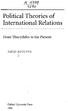 A Political Theories of International Relations From Thucydides to the Present DAVID BOUCHER Oxford University Press 1998 DETAILED CONTENTS INTRODUCTION 1. The Character of the Political Theory of International
Political Science 35. Modern Political Thought
 Professor Andrew Poe MW 12:30-1:50 in OCT 201 Office Hours: Wednesdays, 3-5PM in 202 Clark House Email: [email protected] Phone: 413.542.5459 Political Science 35 Modern Political Thought -Introduction-
Argument Mapping 2: Claims and Reasons
 #2 Claims and Reasons 1 Argument Mapping 2: Claims and Reasons We ll start with the very basics here, so be patient. It becomes far more challenging when we apply these basic rules to real arguments, as
The Gospel & The Scholars. For most of us, our college days are a time in our lives centered around study, research,
 1 The Gospel & The Scholars William K. Lewis Fairmont Presbyterian Church College Ministry Team For most of us, our college days are a time in our lives centered around study, research, and learning. We
9.85 Cognition in Infancy and Early Childhood. Lecture 2: Theoretical perspectives in developmental psychology: Piaget
 9.85 Cognition in Infancy and Early Childhood Lecture 2: Theoretical perspectives in developmental psychology: Piaget 1 Today CI-M instructors: Partner lectures Piagetian theory and stages Challenges to
Introduction. [email protected]
 Introduction [email protected] 2014 Зміст 3 Зміст Зміст 4 The Nightingale Pledge, named in honour of Florence Nightingale, is a modified version of the Hippocratic Oath. Lystra Gretter and a Committee
Department of Philosophy University of New Mexico Undergraduate Programs Plan for Assessment of Student Learning Outcomes
 University of New Mexico Undergraduate Programs Plan for Assessment of Student Learning Outcomes A. College, Department and Date 1. College: College of Arts and Sciences 2. Department: Philosophy 3. Date:
PHILOSOPHY OF EDUCATION AND TEACHING COURSE OUTLINE
 PHILOSOPHY OF EDUCATION AND TEACHING COURSE OUTLINE Course Description This course is designed for students aspiring to be educators as well as those interested in education as a field of study in and
UNIVERSITY OF BELGRADE FACULTY OF PHILOSOPHY. Part two: INFORMATION ON DEGREE PROGRAMS
 Part two: INFORMATION ON DEGREE PROGRAMS Part two: Information on Degree Programs Philosophy Bachelor s Degree Philosophy Master s Degree Philosophy Doctoral Degree Sociology Bachelor s Degree Sociology
MASTER OF ARTS in Theology,
 MASTER OF ARTS in Theology, Ministry and Mission 2015-2016 INSTITUTE FOR ORTHODOX CHRISTIAN STUDIES formally APPROVED and blessed BY the Pan-Orthodox Episcopal Assembly for great britain and Ireland ALSO
Faculty of Humanities, Utrecht University Chair Ancient and Medieval Philosophy Structure, goals and context
 Faculty of Humanities, Utrecht University Chair Ancient and Medieval Philosophy Structure, goals and context 1. General The chair Ancient and Medieval Philosophy (Antieke en Middeleeuwse Filosofie, AMF)
Bethany Bible College and Bethany Theological Seminary. Textbook: Introduction to Theology. Author: Geisler/Feinbert
 Bethany Bible College and Bethany Theological Seminary Course Name: Introduction to Philosophy Course Number: Ph-531 Textbook: Introduction to Theology Author: Geisler/Feinbert Text The required text is
Value equivalent. 6. Attendance Full-time Part-time Distance learning Mode of attendance X X No. Minimum length of programme 3 years 6 years N/A
 PROGRAMME APPROVAL FORM SECTION 1 THE PROGRAMME SPECIFICATION 1. Programme title and designation Theology Single honours Joint Major/minor 2. Final award Award Title Credit ECTS Any special criteria Value
Kansas Board of Regents Precollege Curriculum Courses Approved for University Admissions
 Kansas Board of Regents Precollege Curriculum Courses Approved for University Admissions Original Publication April 6, 2011 Revision Dates June 13, 2011 May 23, 2012 Kansas Board of Regents Precollege
Positive Philosophy by August Comte
 Positive Philosophy by August Comte August Comte, Thoemmes About the author.... August Comte (1798-1857), a founder of sociology, believes aspects of our world can be known solely through observation and
Religious education. Programme of study (non-statutory) for key stage 4. (This is an extract from The National Curriculum 2007)
 Religious education Programme of study (non-statutory) for key stage 4 and years 12 and 13 (This is an extract from The National Curriculum 2007) Crown copyright 2007 Qualifications and Curriculum Authority
College of Arts and Sciences: Social Science and Humanities Outcomes
 College of Arts and Sciences: Social Science and Humanities Outcomes Communication Information Mgt/ Quantitative Skills Valuing/Ethics/ Integrity Critical Thinking Content Knowledge Application/ Internship
Department of Philosophy 2016 Undergraduate Student Guide
 Department of Philosophy 2016 Undergraduate Student Guide The Faculty takes very seriously its responsibilities to ensure that its students are work ready and able to compete for good graduate traineeships.
Dr V. J. Brown. Neuroscience (see Biomedical Sciences) History, Philosophy, Social Anthropology, Theological Studies.
 Psychology - pathways & 1000 Level modules School of Psychology Head of School Degree Programmes Single Honours Degree: Joint Honours Degrees: Dr V. J. Brown Psychology Neuroscience (see Biomedical Sciences)
Religious education. Programme of study (non-statutory) for key stage 3. (This is an extract from The National Curriculum 2007)
 Religious education Programme of study (non-statutory) for key stage 3 and attainment targets (This is an extract from The National Curriculum 2007) Crown copyright 2007 Qualifications and Curriculum Authority
LLB (Hons) Law with Criminology Module Information
 LLB (Hons) Law with Criminology Module Information Year 1 Law of Contract and Problem Solving This module develops students knowledge and understanding of the law of contract. You will study the underlying
Teaching Non-Philosophy Faculty to Teach Critical Thinking about Ethical Issues. Peter Vallentyne and John Accordino, Virginia Commonwealth University
 Teaching Non-Philosophy Faculty to Teach Critical Thinking about Ethical Issues Peter Vallentyne and John Accordino, Virginia Commonwealth University At various universities across the country, philosophers
Professional Ethics PHIL 3340. Today s Topic Absolute Moral Rules & Kantian Ethics. Part I
 Professional Ethics PHIL 3340 Today s Topic Absolute Moral Rules & Kantian Ethics Part I Consequentialism vs. Deontology Consequentialism: A type of ethical theory stating that to act morally we must base
Philosophy 101: Introduction to Philosophy Section 4170 Online Course El Camino College Fall, 2015
 Philosophy 101: Introduction to Philosophy Section 4170 Online Course El Camino College Fall, 2015 Instructor: Dr. Felipe Leon Phone: (310) 660-3593 ext.5742 Email: [email protected] Office: SOCS 108
What is public theology?
 What is public theology? David Bromell 1 Visiting Fellow, Centre for Theology and Public Issues University of Otago, May 2011 This paper addresses a set of four related questions. What is the proper Does
Doctor of Education - Higher Education
 1 Doctor of Education - Higher Education The University of Liverpool s Doctor of Education - Higher Education (EdD) is a professional doctoral programme focused on the latest practice, research, and leadership
Political Science Courses
 Political Science Courses CPO 2002 INTRODUCTION TO COMPARATIVE POLITICS (3) Introduction to politics in different states; comparison and analysis of representative European and non-western political systems.
Divine command theory
 Today we will be discussing divine command theory. But first I will give a (very) brief overview of the semester, and the discipline of philosophy. Why do this? One of the functions of an introductory
Philosophy. Admission to the University. Required Documents for Applications. Minimum Requirements for Admission
 University of California, Berkeley 1 Philosophy The Graduate Program in Philosophy at Berkeley offers a first-rate faculty, a stimulating and friendly community of graduate students, and the resources
A relevant business ethics curriculum
 A relevant business ethics curriculum Robert Shaw Graduate School of Business Guangdong University of Foreign Studies Victoria Business School Orauariki, New Zealand 29 July 2013 2 The internationalization
INTRODUCTION TO ETHICS PHIL 160 Summer Session I
 INTRODUCTION TO ETHICS PHIL 160 Summer Session I This is a draft syllabus. The finalized syllabus will be available one week before the beginning of Summer Session I. Kiran Bhardwaj [email protected]
LEARNING OUTCOMES FOR THE PSYCHOLOGY MAJOR
 LEARNING OUTCOMES FOR THE PSYCHOLOGY MAJOR Goal 1. Knowledge Base of Psychology Demonstrate familiarity with the major concepts, theoretical perspectives, empirical findings, and historical trends in psychology.
Philosophical Study at Duquesne University a guide for seminarians
 Philosophical Study at Duquesne University a guide for seminarians 17 November 2011 contents Admissions 2 Requirements 3 of the usccb...................... 3 of the Philosophy Department............ 3
Master s Programme in International Administration and Global Governance
 Programme syllabus for the Master s Programme in International Administration and Global Governance 120 higher education credits Second Cycle Confirmed by the Faculty Board of Social Sciences 2015-05-11
Engineering Ethics. Engineering Dimensions Magazine. Dr. Bowers s Notes. These articles are posted on the course website
 Engineering Ethics Dr. Bowers s Notes from the 4 Ethics Articles taken from Engineering Dimensions Magazine These articles are posted on the course website 85-219 Introduction to Engineering Materials