
THE MARYLAND STUDY ON PHYSICIAN EXPERIENCE WITH MANAGED CARE. September 2001
|
|
|
- Jayson Haynes
- 10 years ago
- Views:
Transcription
1 THE MARYLAND STUDY ON PHYSICIAN EXPERIENCE WITH MANAGED CARE September 2001

2 TABLE OF CONTENTS Executive Summary...1 I. Introduction...3 II. Methodology...5 A. Sample B. Data Collection C. Statistical Analysis D. Code of Ethics III. Findings...8 A. Characteristics of Physician Respondents B. Impressions of Managed Care C. Physician Race/Ethnicity and the Managed Care Environment MCO Denial of Membership Requests Termination of MCO Contract Perception of Racial/Ethnic Discrimination by MCOs Satisfaction with Income from Medical Practice Conclusions...14 Appendix Survey Instrument

3 EXECUTIVE SUMMARY The Maryland Study on Physician Experience with Managed Care was funded through an appropriation by the Maryland General Assembly to the Maryland Department of Health and Mental Hygiene (DHMH). The purpose of this study was to conduct a comprehensive survey that measures the experience of physicians in the growing managed care environment and, in particular, to determine whether the experience of minority physicians differs from those of non-minority physicians. The UMBC Center for Health Program Development and Management developed and conducted the survey on behalf of DHMH. The study involved surveying a sample of over 3,000 Maryland physicians likely to have had exposure to the managed care environment. The survey was conducted between July and November 2000 and yielded a response rate of 53 percent, which permitted statistically valid analyses. This report contains survey findings regarding a range of subject areas with emphasis on differences between minority and non-minority physicians. Consistent with the General Assembly s direction, the subject areas covered include: Denial of physician s request to join the provider network of a managed care plan Termination of contract by the physician Racial/ethnic discrimination by a managed care organization Physician s satisfaction with level of income Key findings from the survey analysis indicate that the majority of respondents report that: The proportion of managed care enrollees, patient load, and number of hours worked has increased Managed care has adversely affected the quality of healthcare and reduced access to specialists They have not been denied a membership request to join the provider network of a managed care plan They have not had a contract terminated by a managed care plan They have not voluntarily terminated a contract with a managed care plan They have not been discriminated against by an MCO because of race or ethnicity They are dissatisfied with income from medical practice 1
4 Additional analyses were conducted, taking into consideration physician race and other relevant factors. Statistically significant findings are outlined below. Compared to White physicians: African American and Asian physicians are more likely to be denied membership requests by a managed care plan African American physicians are more likely to have contracts terminated by a managed care plan Asian physicians are less likely to voluntarily terminate a contract with a managed care plan African American and Asian physicians are more likely to be satisfied with their level of income 2

5 I. INTRODUCTION In 1999, Maryland s State Legislature commissioned the Maryland Department of Health and Mental Hygiene (DHMH) to conduct a statewide study of Maryland physicians about their experience in the managed care environment. Conducting the study on behalf of DHMH, the UMBC Center for Health Program Development and Management developed the Maryland Study on Physician Experience with Managed Care (Physician Survey). This survey intended to measure demographics, specialty type, practice settings, and attitudes and perceptions on selected issues. The focus of this report is two-fold: 1) to present Maryland physicians impressions of managed care; and 2) to determine whether there are any racial or ethnic disparities with regards to the physician experience with managed care plans. Issues of particular interest to legislators and stakeholders are: Denial of physician s request to join the provider network of a managed care plan Termination of contract by a managed care organization Voluntary termination of contract by the physician Perceived racial/ethnic discrimination by a managed care organization Physician s satisfaction with level of income An extensive literature review was conducted to determine the type and scope of previous research conducted on the physician experience. Few published studies exist to date about the physician experience with managed care in the context of race and ethnicity. The majority of studies focus on one of two topics: the physician and managed care, or the physician and racial/ethnic issues. Only one published study addresses the relationship between managed care and race/ethnicity of the physician. 1 The Physician Survey builds on this existing literature and provides a more comprehensive picture of how physicians are faring in a growing managed care environment. The UMBC project team collaborated with key stakeholders in selecting survey topic areas and survey questions. Stakeholders nominated a representative from their organization to participate in the development of the survey. Key stakeholders and their respective representatives are: Reed Winston, M.D., MedChi Medicaid Managed Care Task Force Wallace R. Johnson, M.D., Monumental City Medical Society Michele D. Thomas, M.D., Prince George s County Society of Health Professionals Walter W. Shervington, M.D., National Medical Association 1 Mackenzie, E.R., Taylor, L.S., Lavizzo-Mourey, R. (1999). Experiences of Ethnic Minority Physicians with Managed Care: A National Survey. The American Journal of Managed Care, 5,

6 In addition to providing input on survey design, the above-mentioned medical societies and groups helped to publicize the import of the study. Their valuable assistance is appreciated. A Technical Advisory Committee (TAC) for the study was created to guide the UMBC project team and was composed of experts in the areas of cultural diversity, minority health, the physician-patient relationship, and research methodology. The members of the TAC are: Wayne A. Beckles, LCSW-C Adjunct Faculty Member University of Maryland at Baltimore School of Social Work Lisa Cooper-Patrick, M.D., M.P.H. Assistant Professor The Johns Hopkins University School of Medicine Department of Medicine Llewellyn J. Cornelius, Ph.D. Assistant Dean of Informatics, Associate Professor University of Maryland at Baltimore School of Social Work Marvin Mandell, Ph.D. Director of Policy Sciences, Professor University of Maryland, Baltimore County Department of Policy Sciences The TAC assisted in the development of the survey instrument (see Appendix) and in establishing the statistical design. The UMBC project team is grateful for the valuable insight and peer review provided by the TAC. This study of Maryland physicians is comprehensive with respect to content and intended sample. The study addresses a variety of subject areas and covers a broad range of physician specialties and forms of managed care. Subject areas included in the survey are: Practice characteristics Reimbursement levels Administrative requirements Physician-patient relationship Perceptions of managed care Managed care contracts Physician commitment and satisfaction 4

7 II. METHODOLOGY A. Sample Participation in the study was limited to physicians who were actively licensed and have had experience with managed care in the state of Maryland. Using data provided by the Maryland Health Care Commission, 2 13,742 active physicians who were most likely to have managed care experience were identified. From this study population, a sample of 3,113 physicians was selected using a stratified sampling technique and oversampling method in order to ensure adequate representation of all subgroups in the sample. The final sample consists of a balanced representation of physicians with the following racial/ethnic backgrounds: African-American (922) American Indian/Eskimo/Aleut (16) Hispanic (375) Asian (900) White (900) Comprehensive in design, the study includes physicians from a broad range of specialties and subspecialties, and encompasses all forms of managed care (commercial managed care, Medicaid managed care, Medicare managed care, and managed care organizations such as HMOs, PPOs, POSs, and IPAs). B. Data Collection The surveys were mailed to physicians in July 2000 and collected through November Of the 3,113 surveys sent to physicians, 1,650 surveys were returned, representing a response rate of 53 percent. This level of response falls within the acceptable range of survey response rates and is more than sufficient to conduct statistical analyses and draw valid conclusions. 2 Data compiled from the Board of Physician Quality Assurance data file. 5

8 C. Statistical Analysis Figure 1 presents the distribution of returned surveys. At the time of the survey, 74 percent of the respondents participated in managed care, 19 percent did not participate in managed care, 6 percent had retired or no longer practiced in Maryland, and 0.3 percent answered only a few survey questions. Active physicians with managed care exposure 74% Figure 1 Distribution of Returned Surveys Note: Percentages do not total 100% due to rounding Did not participate in managed care 19% Retired or No longer in Maryland 6% Answered few survey questions 0.3% The remainder of the study focuses on those respondents who participated in managed care. Therefore, of the 1,650 returned surveys, 1,225 (74 percent) forms the basis for analysis. Key outcome measures under study are: Denial of requests to join a provider network by a managed care plan Termination of contract initiated by the managed care plan or physician Discrimination of physicians due to race/ethnicity by an MCO Physician satisfaction with income Each outcome is assessed using a single survey indicator. The outcome measures are examined using descriptive analysis and the logistic regression method. Descriptive analysis includes the frequency distribution of responses to survey questions. Logistic regression is a method for relating various explanatory variables to an outcome measure. By using logistic regression, it is possible to determine the amount of change in the outcome measure that is attributable to one of the explanatory variables while controlling for the effects of the other relevant variables. For example, in determining whether the key variable physician race is related to managed care plan termination of contract, other factors that may explain termination of contract besides race, such as practice type, physician specialty, etc., are held constant (i.e., controlled for). Controlling for these other relevant factors allows for the effect of race on termination of contract to be ascertained. Factors controlled for in the logistic regression analyses are: 6

9 Contractual relationship with main practice (employee physician, sole owner, partner) Physician specialty (primary care physician, specialist) Practice type (solo, single-specialty group, multi-specialty group, staff or group model HMO, hospital or clinic, medical school) Board certification Physician age Another factor, income from medical practice, was controlled for in the analysis of physician satisfaction with income. To adjust for the over-sampling of minority groups, weighted data is used in the logistic regression analyses. The Other response category for control variables is omitted from logistic regression analysis because of the range of responses reported under this category. The American Indian/Eskimo/Aleutian category is omitted from both the descriptive and logistic regression analyses because of the extremely small sample size. For purposes of this analysis, survey response choices are collapsed into fewer categories. Answers of 1-3 times and more than 3 times are combined into one category, at least once. Answers of strongly agree and "somewhat agree" are described as agreeing, and "somewhat disagree," and "strongly disagree" are described as disagreeing. Response categories ranging from very satisfied to very dissatisfied are collapsed in a similar manner. For the logistic regression analysis, the neither satisfied nor dissatisfied category is collapsed into the newly created dissatisfied category. D. Code of Ethics All aspects of the Physician Survey were guided, both in spirit and in execution, by the highest ethical standards of survey research. The study protocol was reviewed by the Institutional Review Board of both UMBC and DHMH. The survey project team was committed to upholding the following standards in conducting the study: Meeting the obligation to the study sponsors Protecting the anonymity of respondents, including respondents identity and/or any information that may compromise the confidentiality of the respondents Exercising due diligence in development of the survey instrument and the sampling design to assure the validity of results Taking every care in data collection, processing, and analysis to assure the reliability of results III. FINDINGS 7

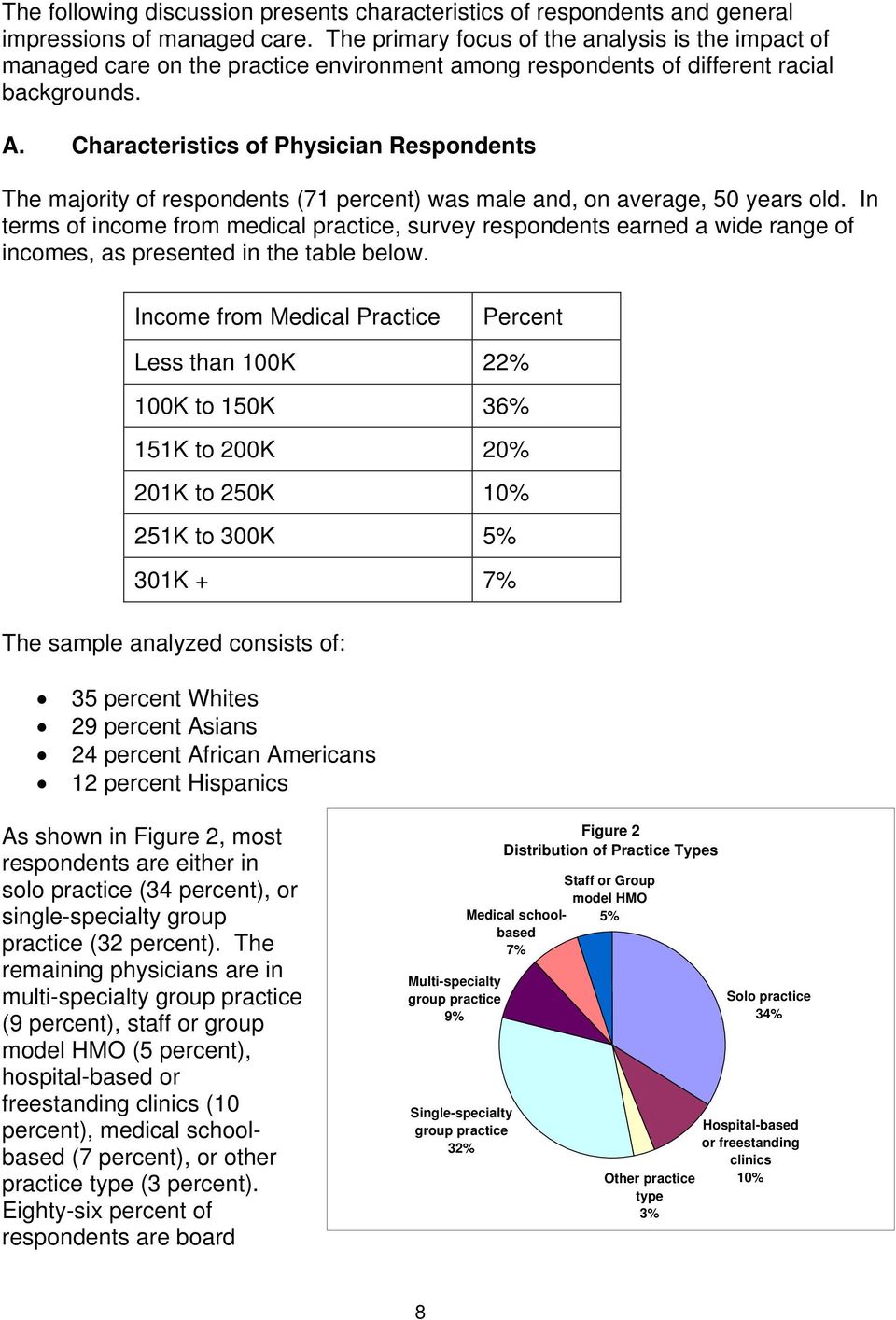
10 The following discussion presents characteristics of respondents and general impressions of managed care. The primary focus of the analysis is the impact of managed care on the practice environment among respondents of different racial backgrounds. A. Characteristics of Physician Respondents The majority of respondents (71 percent) was male and, on average, 50 years old. In terms of income from medical practice, survey respondents earned a wide range of incomes, as presented in the table below. Income from Medical Practice Percent Less than 100K 22% 100K to 150K 36% 151K to 200K 20% 201K to 250K 10% 251K to 300K 5% 301K + 7% The sample analyzed consists of: 35 percent Whites 29 percent Asians 24 percent African Americans 12 percent Hispanics As shown in Figure 2, most respondents are either in solo practice (34 percent), or single-specialty group practice (32 percent). The remaining physicians are in multi-specialty group practice (9 percent), staff or group model HMO (5 percent), hospital-based or freestanding clinics (10 percent), medical schoolbased (7 percent), or other practice type (3 percent). Eighty-six percent of respondents are board Multi-specialty group practice 9% Single-specialty group practice 32% Figure 2 Distribution of Practice Types Staff or Group model HMO Medical schoolbased 5% 7% Other practice type 3% Solo practice 34% Hospital-based or freestanding clinics 10% 8
11 certified in a primary specialty, while 14 percent are not. Forty-six percent of all respondents practice medicine as primary care physicians, and 44 percent as specialists. 3 The remaining ten percent identify themselves as Other. As shown in Figure 3, most respondents are employee physicians (38 percent), followed by sole owners of a medical practice (35 percent) and partners in a medical practice (25 percent). Two percent of respondents report an Other contractual relationship with their main practice. Figure 3 Contractual Relationship with Main Practice Partners 25% Sole owners 35% Employee physicians 38% Other relationship 2% B. Impressions of Managed Care Physicians participating in the survey have broad exposure to the managed care environment with: 48 percent reporting more than half of their patient base enrolled with managed care organizations 65 percent indicating an increase in the proportion of managed care enrollees cared for over the past two years Respondents report increases in the average number of patients seen daily and the average number of hours worked per week since the growth of the managed care market. In particular, more Hispanic and African American physicians experience these trends than other races: 62 percent of Hispanics and 65 percent of African Americans report an increase in patient load, compared to 55 percent of Whites and 50 percent of Asians 65 percent of Hispanics and 66 percent of African Americans report an increase in number of hours worked, compared to 54 percent of Whites and 55 percent of Asians 3 A primary care physician is defined as a physician whose primary specialty is family practice, general internal medicine, general pediatrics, general practice, general surgery, or obstetrics and gynecology. A specialist is defined as a physician whose primary specialty is psychiatry, radiology, pathology, emergency medicine, internal medicine subspecialty, pediatric subspecialty, or surgery subspecialty. 9

12 Overall, survey respondents do not believe that managed care has had a positive impact on healthcare: Approximately half of all respondents do not believe that managed care has been effective at reducing costs More than 75 percent believe that managed care has adversely affected the quality of healthcare 86 percent believe that managed care has reduced access to specialists C. Physician Race/Ethnicity and the Managed Care Environment Analysis of survey responses indicates managed care s differential impact on physicians of diverse racial backgrounds. Statistical methods that control for influential variables, in addition to descriptive analysis of key issues, support this finding. Topics under study include MCO denial of request to join a provider network, termination of contract, perceived racial/ethnic discrimination by an MCO, and satisfaction with income. MCO Denial of Membership Requests The study documents two important findings regarding denials of membership requests to join a managed care plan s provider network. First, most physician respondents (73 percent) have never been denied a request to join the provider network of a managed care plan. Second, the fraction of physicians who have been denied one or more membership requests to join a managed care plan 100% 80% 60% 40% 20% 0% Figure 4 Frequency of Denial of Membership Request to Join a Managed Care Plan Provider Network by Race 74% 76% 26% 24% 68% 32% Hispanic White African American Race 72% 28% Asian Never At least once provider network differs by race (Figure 4). Thirty-two percent of African Americans, 28 percent of Asians, 26 percent of Hispanics, and 24 percent of Whites report denials of requests to join a managed care plan provider network. Controlling for other variables, it was determined that difficulty in securing contracts is influenced by physician race. All minority physicians are more likely than White physicians to experience denials of requests. The finding that African American and Asian physicians are more likely to be denied than White physicians is statistically significant. 4 4 Adjusting for other factors, there is a 15 percent difference between African Americans and Whites, and a 4 percent difference between Asians and Whites. 10

13 As shown in Figure 5, the most common reason given for denial of membership requests to join a managed care plan s provider network is that the network is full. The majority of respondents (77 percent) of all races report this as the most common reason given for denial of membership requests: 82 percent of African Americans 76 percent of Hispanics 79 percent of Whites 73 percent of Asians Termination of MCO Contract 100% 80% 60% 40% 20% 0% Figure 5 Reasons Provided for Denial of Membership Requests to Join Managed Care Plan Provider Network 11% Patient population too ill and expensive 6% Malpractice history 17% Unmet credentialing requirements 77% Full network 14% Limited scope of services 9% Not part of necessary social circles The majority of respondents (88 percent) report that they have never had a contract terminated by a managed care plan. Relatively small percentages of respondents of different racial backgrounds reported problems with termination (14 percent of African Americans, 12 percent of Asians, 11 percent of Whites, and 9 percent of Hispanics) (Figure 6). 100% 80% 60% 40% 20% 0% Figure 6 Frequency of Contract Termination by a Managed Care Plan by Race 91% 89% 9% 11% Hispanic White African American Race 86% 88% 14% 12% Asian Never At least once Further analysis indicates that race is related to contract termination. Adjusting for other variables, it was determined that Asian physicians are more likely than White physicians to have contracts terminated, while Hispanic physicians are less likely to experience contract termination than White physicians. A statistically significant finding is that 11

14 African American physicians are more likely to have contracts terminated than White physicians. 5 Similarly, the majority of respondents (66 percent) have never voluntarily terminated a managed care plan contract. However, as shown in Figure 7, 42 percent of Whites, 36 percent of Hispanics, 31 percent of African Americans, and 25 percent of Asians report voluntary termination of contract with a managed care plan at least one time. Controlling for other factors, African American 100% 80% 60% 40% 20% 0% 64% 36% Figure 7 Frequency of Voluntary Termination of Managed Care Contract by Race 58% 42% 69% 31% Hispanic White African American physicians are less likely than White physicians to have voluntarily terminated a contract, whereas Hispanic physicians are more likely than White physicians. A statistically significant finding is that Asian physicians are less likely than White physicians to have voluntarily terminated a managed care plan contract. 6 Several reasons cited by most of the respondents for choosing to terminate their managed care plan contract are: Race 75% 25% Asian Low levels of payment (95 percent) Delays in payment (92 percent) Administrative burdens (95 percent) Difficulty in doing what is in the best interest of patients (88 percent) Managed care plan contract did not result in more patients (55 percent) Never At least once 5 The adjusted difference between African Americans and Whites is 5 percent when controlling for other factors. 6 The adjusted difference between Asians and Whites is 12 percent. 12

15 Perceptions of Racial/Ethnic Discrimination by MCOs In gauging physician perceptions on managed care s impact on health care, respondents were asked whether they have been discriminated against by an MCO because of race or ethnicity. Seventy percent of respondents report that they have not been discriminated against due to racial or ethnic background. However, among those who report racial/ethnic discrimination by an 100% 80% 60% 40% 20% 0% Figure 8 Responses to "I was discriminated against because of my racial/ethnic background" by Race 80% 84% 14% 15% 6% 1% 54% 30% 16% 62% 27% Hispanic White African American Asian Race Disagree Neither Agree Nor Disagree Agree MCO, 16 percent are African American, 11 percent are Asian, 6 percent are Hispanic, and 1 percent are White (Figure 8). Satisfaction with Income from Medical Practice The survey also gauged respondents satisfaction with income generated from their medical practice. Overall, 34 percent of respondents are satisfied with their level of income. By race, 40 percent of Whites report satisfaction with their income compared to 35 percent of Hispanics, 31 percent of African Americans, and 29 percent of Asians. However, further analysis controlling for income level and other relevant factors indicates that Hispanic, African American, and Asian physicians are more likely than White physicians to be satisfied with their income. The finding that African American and Asian physicians are more likely to be satisfied with their income than White physicians is statistically significant. 7 11% 7 There is a 23 percent adjusted difference between African Americans and Whites and a 40 percent adjusted difference between Asians and Whites. 13

16 IV. CONCLUSIONS The Maryland Study on Physician Experience with Managed Care demonstrates that: Overall, most physicians believe that managed care has had a negative impact on the quality of healthcare Denial of applications to join a managed care plan s provider network and termination of contracts by an MCO are not pervasive problems More African American respondents perceive racial/ethnic discrimination than Asian and Hispanic respondents Most respondents are dissatisfied with the level of income from their medical practice Moreover, statistically significant findings show that compared to White physicians: Those who report denial of membership requests to join a managed care plan s provider network are more likely to be African American or Asian Those who report MCO contract termination are more likely to be African American Voluntary termination of contract is less likely to occur with Asian physicians African American and Asian physicians are more likely to be satisfied with their income from their medical practice 14

EQR PROTOCOL 1 ASSESSING MCO COMPLIANCE WITH MEDICAID AND CHIP MANAGED CARE REGULATIONS
 EQR PROTOCOL 1 ASSESSING MCO COMPLIANCE WITH MEDICAID AND CHIP MANAGED CARE REGULATIONS Attachment D: The purpose of this Attachment to Protocol 1 is to provide the reviewer(s) with sample review questions
AAPA ANNUAL SURVEY REPORT
 2013 AAPA ANNUAL SURVEY REPORT PHYSICIAN ASSISTANTS AT A GLANCE HIGHLIGHTS OF THE MEDIAN AGE CLINICALLY PRACTICING PAS BY PRIMARY SPECIALTY PRACTICE SETTING Primary Care 32.0% Surgical Subspecialties 27.0%
National perceptions of EHR adoption: Barriers, impacts, and federal policies
 National perceptions of EHR adoption: Barriers, impacts, and federal policies National Center for Health Statistics Eric Jamoom, PhD, MPH, MS, Senior Service Fellow In collaboration with the Office of
Michigan Department of Community Health Survey of Physician Assistants Frequency Report by School 1
 Michigan Department of Community Health Survey of Physician Assistants Frequency Report by School 1 INTRODUCTION Since 2007, the Michigan Department of Community Health (MDCH) has conducted annual surveys
GQ Medical School Graduation Questionnaire. All Schools Summary Report FINAL
 2010 GQ Medical School Graduation Questionnaire All Schools Summary Report FINAL Prepared by Academic Affairs 202-828-0960 email: [email protected] 2010, Association of American Medical Colleges. All rights
Guidelines for Updating Medical Staff Bylaws: Credentialing and Privileging Physician Assistants (Adopted 2012)
 Guidelines for Updating Medical Staff Bylaws: Credentialing and Privileging Physician Assistants (Adopted 2012) Executive Summary of Policy Contained in this Paper Summaries will lack rationale and background
Survey of Nurses 2013
 Survey of Nurses 2013 Survey of Nurses Report Summary Since 2004, the Michigan Center for Nursing has conducted an annual survey of Michigan nurses in conjunction with the licensure renewal process for
Racial and Ethnic Disparities in Women s Health Coverage and Access To Care Findings from the 2001 Kaiser Women s Health Survey
 March 2004 Racial and Ethnic Disparities in Women s Health Coverage and Access To Care Findings from the 2001 Kaiser Women s Health Survey Attention to racial and ethnic differences in health status and
Survey of Nursing Education Programs: 2009 2010 School Year
 Survey of Nursing Education Programs: 2009 2010 School Year Prepared for Michigan Center for Nursing Okemos, Michigan Prepared by Public Sector Consultants Lansing, Michigan www.pscinc.com Survey of Nursing
Access Provided by your local institution at 02/06/13 5:22PM GMT
 Access Provided by your local institution at 02/06/13 5:22PM GMT brief communication Reducing Disparities in Access to Primary Care and Patient Satisfaction with Care: The Role of Health Centers Leiyu
https://www.elicense.ct.gov/snapshotviewer.aspx?qabid=142654&key={8cd9975f-28d5-...
 Renewal - 1.017586 https://www.elicense.ct.gov/snapshotviewer.aspx?qabid=142654&key={8cd9975f-28d5-... Page 1 of 3 9/4/2012 Renewal - 1.017586 Name MARK A BLUMENFELD MD Credential 1.017586 Fee Details
Michigan Department of Community Health
 Michigan Department of Community Health INTRODUCTION The Michigan Department of Community Health asked Public Sector Consultants Inc. (PSC) to conduct a survey of licensed pharmacists in 2005 to gather
Survey of Nursing Education Programs: 2005 2006 School Year
 Survey of Nursing Education Programs: EXECUTIVE SUMMARY In the fall of 2006, the Michigan Center for Nursing conducted a survey of nursing education programs in Michigan to collect information on the types
Provider Satisfaction Survey: Research and Best Practices
 Provider Satisfaction Survey: Research and Best Practices Provider Satisfaction Survey Revamp Provider Satisfaction with the health plan has been one of the most popular proprietary survey tools that TMG
On the Road to Meaningful Use of EHRs:
 On the Road to Meaningful Use of EHRs: A Survey of California Physicians June 2012 On the Road to Meaningful Use of EHRs: A Survey of California Physicians Prepared for California HealthCare Foundation
How To Get A Better At Using Health Information Technology In A Dental Practice
 C A LIFORNIA HEALTHCARE FOUNDATION s n a p s h o t Health Information Technology in California Dental Practices: Survey Findings 2010 Introduction This sample survey of California dentists examines their
FILLING THE. reported by. continue...
 FILLING THE 2013 Physician Outlook & PRACTICE TRENDS reported by continue... OVERVIEW Physician discontent appears to be creating a void in the healthcare field. Physicians are preparing to leave medicine
Member Rights, Complaints and Appeals/Grievances 5.0
 Member Rights, Complaints and Appeals/Grievances 5.0 5.1 Referring Members for Assistance The Member Services Department has representatives to assist with calls for: General verification of member eligibility
Survey of Nursing Education Programs: 2005 2006 School Year
 Survey of Nursing Education Programs: 2005 2006 School Year EXECUTIVE SUMMARY In the fall of 2006, the Michigan Center for Nursing conducted a survey of nursing education programs in Michigan to collect
Health Information Technology in the United States: Information Base for Progress. Executive Summary
 Health Information Technology in the United States: Information Base for Progress 2006 The Executive Summary About the Robert Wood Johnson Foundation The Robert Wood Johnson Foundation focuses on the pressing
Nurse Practitioners, Certified Nurse Midwives, and Physician Assistants in Physician Offices
 Nurse Practitioners, Certified Nurse Midwives, and Physician Assistants in Physician Offices Melissa Park, M.P.H.; Donald Cherry, M.S.; and Sandra L. Decker, Ph.D. Key findings Data from the National Ambulatory
Center for Rural Health North Dakota Center for Health Workforce Data. July 2004
 North Dakota Nursing Needs Study: Licensed Nurse Survey Year 2 Center for Rural Health North Dakota Center for Health Workforce Data July 2004 Carol Bennett, M.A., R.N. Patricia L. Moulton, Ph.D. Mary
Access to Health Services
 Ah Access to Health Services Access to Health Services HP 2020 Goal Improve access to comprehensive, quality health care services. HP 2020 Objectives Increase the proportion of persons with a usual primary
Survey of Clinical Trial Awareness and Attitudes
 Survey of Clinical Trial Awareness and Attitudes Purpose of the Study Over $2 billion per year is spent on recruiting patients for clinical trials, yet slow patient enrollment is the primary cause of delay
» The most common residency program for current members was PSR-12 (37%).» 5% completed PM&S programs in 2005 and 2007.
 EXECUTIVE SUMMARY A survey of the podiatric practices of 8,273 active members of the APMA was conducted from March to April of 2007 with 3,043 members responding for a response rate of 37%. Major Findings
An Overview of Children s Health Issues in Michigan
 An Overview of Children s Health Issues in Michigan Sponsors Michigan Chapter American Academy of Pediatrics Michigan Council for Maternal and Child Health School - Community Health Alliance of Michigan
 CERTIFICATE OF NEED REVIEWED BY THE DEPARTMENT OF HEALTH DIVISION OF POLICY, PLANNING AND ASSESSMENT 615-741-1954 DATE: December 31, 2015 APPLICANT: Reeves Eye Surgery Center 2328 Knob Creek Road, Suite
2015 PSYCHOLOGIST BIENNIAL RENEWAL
 New Mexico Regulation and Licensing Department BOARDS AND COMMISSIONS DIVISION Board of Psychologist Examiners PO Box 25101 2550 Cerrillos Road Santa Fe, New Mexico 87504 (505) 476-4622 Fax (505) 476-4545
Jeff Schiff MD MBA Medical Director Minnesota Health Care Programs, DHS 23 April 2015
 Jeff Schiff MD MBA Medical Director Minnesota Health Care Programs, DHS 23 April 2015 DHS Mission The MN Dept of Human Services, working with many others, helps people meet their basic needs so they can
2010 NLN NURSE EDUCATOR SHORTAGE FACT SHEET
 2010 NLN NURSE EDUCATOR SHORTAGE FACT SHEET The National League for Nursing and the Carnegie Foundation Preparation for the Professions Program conducted a study of the nation's estimated 32,000 nurse
Healthcare Workforce Diversity & Health Equity
 Healthcare Workforce Diversity & Health Equity CBC Health Braintrust/NMQF Leadership Summit on Health Disparities LaQuandra Nesbitt, MD, MPH Assistant Professor Department of Family & Community Medicine
A First Look at Attitudes Surrounding Telehealth:
 A First Look at Attitudes Surrounding Telehealth: Findings from a national survey taking a first look at attitudes, usage, and beliefs of family physicians in the U.S. towards telehealth. OVERVIEW Telehealth
ASMBS Compensation and Practice Style Survey
 ASMBS Compensation and Practice Style Survey Teresa LaMasters MD, FACS Medical Director Bariatric Surgery UnityPoint Clinic Weight Loss Specialists 6600 Westtown Parkway Suite 220 West Des Moines, IA 50266
LICENSED SOCIAL WORKERS IN THE UNITED STATES, 2004 SUPPLEMENT. Chapter 2 of 5. Who Are Licensed Social Workers?
 LICENSED SOCIAL WORKERS IN THE UNITED STATES, 2004 SUPPLEMENT Chapter 2 of 5 Who Are Licensed Social Workers? Prepared by Center for Health Workforce Studies School of Public Health, University at Albany
A. Clearly print or type information in each block. Complete each section entirely, indicate NOT APPLICABLE (N/A) where necessary.
 Provider Application For use by Physicians and Independent Health Care Professionals BCBSF Provider Number: HCFA UPIN #: NPI #: PURPOSE: This Provider Application will be used for assigning a provider
Administration of Emergency Medicine
 doi:10.1016/j.jemermed.2005.07.008 The Journal of Emergency Medicine, Vol. 30, No. 4, pp. 455 460, 2006 Copyright 2006 Elsevier Inc. Printed in the USA. All rights reserved 0736-4679/06 $ see front matter
2015 RENEWAL INFORMATION & INSTRUCTIONS
 DHMH MARYLAND BOARD OF SOCIAL WORK EXAMINERS 4201 Patterson Avenue, Baltimore, MD 21215-2299 Phone Numbers: 410-764-4788 or Toll Free 1-877-526-2541 www.dhmh.maryland.gov/bswe/ YOUR LICENSE EXPIRES ON
Physician Adoption of Electronic Health Record Systems: United States, 2011
 This report was revised on January, 203, after a problem was found with the weighting of the 20 survey data. NCHS Data Brief No. 98 July 202 Physician Adoption of Electronic Health Record Systems: United
POLICY AND PROCEDURE POLICY NUMBER: CHS-RMC-03 POLICY LEVEL: CHS
 Payment and Healthcare Assistance Policy RESPONSIBLE DEPARTMENT: Finance PREPARED BY: Scott Kitchen Director Clinical and Business Intelligence POLICY NUMBER: CHS-RMC-03 POLICY LEVEL: CHS APPROVED BY:
Report to Congress. Improving the Identification of Health Care Disparities in. Medicaid and CHIP
 Report to Congress Improving the Identification of Health Care Disparities in Medicaid and CHIP Sylvia Mathews Burwell Secretary of the Department of Health and Human Services November 2014 TABLE OF CONTENTS
MGMA ACA Exchange Implementation Survey Report. May 2014
 MGMA ACA Exchange Implementation Survey Report May 2014 Overview Medical Group Management Association (MGMA) conducted member research in April 2014 to better understand the impact of the Affordable Care
Maryland Medicaid s Partnership in Improving Behavioral Health Services. Susan Tucker Executive Director, Office of Health Services May 14, 2014
 Maryland Medicaid s Partnership in Improving Behavioral Health Services Susan Tucker Executive Director, Office of Health Services May 14, 2014 Began in 1966 Maryland Medicaid By FY 14, we provided full
Walter G. Suarez, MD, MPH
 Walter G. Suarez, MD, MPH 711 Carpenter Road Alexandria, VA 22314 952-221-3841-(v) 703.519-4727 - (f) email: [email protected] SUMMARY: Over 15 years of health care policy research, planning, and
Introduction: Online school report cards are not new in North Carolina. The North Carolina Department of Public Instruction (NCDPI) has been
 Introduction: Online school report cards are not new in North Carolina. The North Carolina Department of Public Instruction (NCDPI) has been reporting ABCs results since 1996-97. In 2001, the state General
Florida Pre-Licensure Registered Nurse Education: Academic Year 2012-2013
 The information below represents the key findings regarding the pre-licensure RN (Associate Degree in Nursing, ADN, and Bachelor of Science Degree in Nursing, BSN) education system in Florida. This report
Coverage of Interpreter and Translation Services for Fee-For-Service Medicaid Recipients Progress Report
 REPORT OF THE VIRGINIA DEPARTMENT OF MEDICAL ASSISTANCE SERVICES Coverage of Interpreter and Translation Services for Fee-For-Service Medicaid Recipients Progress Report TO THE GOVERNOR AND THE GENERAL
2015 LPC-RIMHC-LDAC-LAAC-LADAC RENEWAL FORM
 State Of New Mexico Regulation and Licensing Department NEW MEXICO COUNSELING & THERAPY PRACTICE BOARD Mailing Address: P.O. Box 25101, Santa Fe, New Mexico 87504 Physical Address: 2550 Cerrillos Drive,
Michigan Department of Community Health
 Michigan Department of Community Health January 2007 INTRODUCTION The Michigan Department of Community Health (MDCH) asked Public Sector Consultants Inc. (PSC) to conduct a survey of licensed dental hygienists
Topic: Nursing Workforce Snapshot A Regional & Statewide Look
 Topic: Nursing Workforce Snapshot A Regional & Statewide Look Nursing Workforce in Texas 184,467 registered nurses (2011) Median age of RN is 47 (2011) Gender 89% Female and 11% Male (2011) Race/Ethnicity
Quality and Performance Improvement Program Description 2016
 Quality and Performance Improvement Program Description 2016 Introduction and Purpose Contra Costa Health Plan (CCHP) is a federally qualified, state licensed, county sponsored Health Maintenance Organization
The Promise of Regional Data Aggregation
 The Promise of Regional Data Aggregation Lessons Learned by the Robert Wood Johnson Foundation s National Program Office for Aligning Forces for Quality 1 Background Measuring and reporting the quality
Mandated Reporting Requirements Training Questions and Answers
 Mandated Reporting Requirements Training Questions and Answers Under the Maryland Medical Practice Act, only the Board of Physicians ( Board ) is authorized by the legislature to apply the disciplinary
Community Health Group Allied Health Professional Application
 Community Health Group Allied Health Professional Application Nurse Practitioner Certified Nurse Midwife LCSW Clinical Psychologist MFCC Other I. INSTRUCTIONS This form should be typed or legibly printed
Magellan Behavioral Care of Iowa, Inc. Provider Handbook Supplement for Iowa Autism Support Program (ASP)
 Magellan Behavioral Care of Iowa, Inc. Provider Handbook Supplement for Iowa Autism Support Program (ASP) 2014 Magellan Health Services Table of Contents SECTION 1: INTRODUCTION... 3 Welcome... 3 Covered
User Fees in Health Care: Physician Charges for Administrative Services. James F. Doherty, Jr., Esq. Pecore & Doherty, LLC Columbia, Maryland
 User Fees in Health Care: Physician Charges for Administrative Services James F. Doherty, Jr., Esq. Pecore & Doherty, LLC Columbia, Maryland Samantha E. Freed, Esq. Columbia, Maryland Introduction There
OVERVIEW OF CURRENT SCHOOL ADMINISTRATORS
 Chapter Three OVERVIEW OF CURRENT SCHOOL ADMINISTRATORS The first step in understanding the careers of school administrators is to describe the numbers and characteristics of those currently filling these
To start the pre-approval process, providers must fill out a short online survey, available at: https://www.surveymonkey.com/s/hrszft2.
 Maryland Medicaid EHR Incentive Program Attestation Form for Eligible Providers to Meet Program Requirements Under the Certified Electronic Health Record (CEHRT) Flexibility Rule for Program Year 2014