
National perceptions of EHR adoption: Barriers, impacts, and federal policies
|
|
|
- Jordan Freeman
- 10 years ago
- Views:
Transcription
1 National perceptions of EHR adoption: Barriers, impacts, and federal policies National Center for Health Statistics Eric Jamoom, PhD, MPH, MS, Senior Service Fellow In collaboration with the Office of the National Coordinator for HIT Vaishali Patel, MPH, PhD Jennifer King, PhD Michael Furukawa, PhD National Conference on Health Statistics August 8, 2012 National Center for Health Statistics Division of Health Care Statistics

2 Objectives To describe differences between adopters and nonadopters regarding barriers, beliefs about benefits of EHR use, and familiarity with policies available to facilitate EHR adoption. To identify what physician and practice characteristics are associated with different policies to support EHR adoption.
3 Background EHR barriers and physician experiences of EHR use DesRoches et al., 2008 HITECH Act The Physician Workflow Survey 2011 Expert panel Barriers associated with EHR adoption Impacts associated with using EHRs Policies influencing EHR adoption
4 2011 Workflow Study Flow Chart Total NAMCS EHR Mail Sample (N=10,301) Out of scope (n~3100) Unknown (n~ 1,900) IN SCOPE EHR Mail Survey Sample (n=5,266) Refusals (n=709) Respondents the EHR mail survey (n=4,557) Complete Workflow Respondent Adopters N=1793 Non Adopters N=1387

5 Workflow Respondent Characteristics Characteristics Overall Non-adopter EHR Adopter A g e : 5 0ye a rs 63% 70%* 57%* Gender: Male 74% 74% 73% Race: White Asian Black 77% 10% 4% 78% 9% 4% Source: Physician Workflow Survey, 2011 *Differences between adopters and nonadopters presented were significant (p<0.01) ^ ~13% of practice size and ownership data are missing due to refusal to EMR mail survey, 77% 11% 4% Ethnicity: Hispanic 5% 4% 7% In an MSA: Ye s 88% 88% 87% Size^ 1-2 (small) 3-10 (medium) 11 (large) 34% 40% 13% 46%* 34%* 4%* 24%* 45%* 21%* Ownership^: MD owned 56% 62%* 50%*

6 RESULTS: Barriers to EHR adoption

7 Major barriers to EHR adoption Cost of purchasing a system Loss of Productivity Finding an EHR that meets Practice needs Annual Maintenance cost Adequacy of training Effort needed to select a system Adequacy of technical support Resistance of practice to change work habits Reliability of the system Ability to secure financing Reaching consensus within the practice Access to High Speed Internet Source: NCHS/Physician Workflow Survey

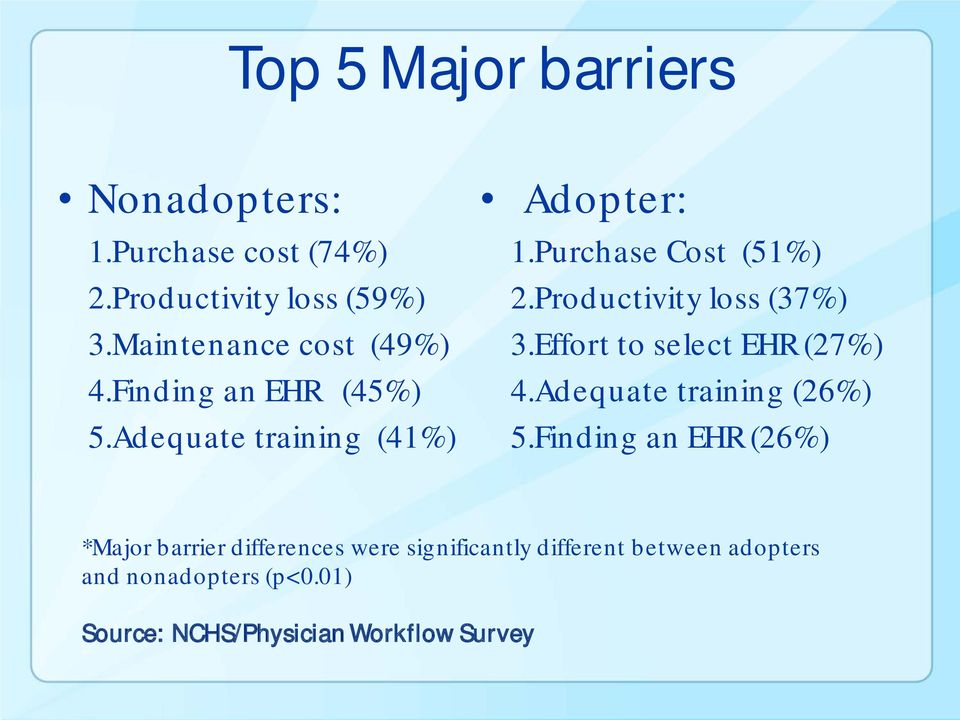
8 Top 5 Major barriers Nonadopters: 1.Purchase cost (74%) 2.Productivity loss (59%) 3.Maintenance cost (49%) 4.Finding an EHR (45%) 5.Adequate training (41%) Ad op te r: 1.Purchase Cost (51%) 2.Productivity loss (37%) 3.Effort to select EHR (27%) 4.Adequate training (26%) 5.Finding an EHR (26%) *Major barrier differences were significantly different between adopters and nonadopters (p<0.01) Source: NCHS/Physician Workflow Sur vey
9 Quotes (qualitative) Cost to Purchase: I have become an employed physician, [cost of purchasing an EHR system] is a large reason for this "We are on our 2nd EHR. The first one not certified for MU. We installed new EHR 2011." Productivity Loss: I tried to use an EMR and due to sense of slowing of the workflow caused by the EMR, I have abandoned it for now. Quotes are not representative. Source: NCHS/Physician Workflow Survey

10 More quotes Resistance to change: "I'll be closing my practice, along with a lot of my colleagues, when EHR becomes necessary to continue practice after 50 years in solo practice, do you actually think I would change?" Quotes are not representative. Source: NCHS/Physician Workflow Survey

11 Not all negative Accessibility to the EHR record "I really like our EHR. I can access information at any time/any place. I can field phone calls at home at night More organized information "EHR has eliminated paper charts making results more organized and allow for more easy work from home." Quotes are not representative. Source: NCHS/Physician Workflow Survey

12 Mixed quotes EHR is exceptionally valuable for clarity, ease of access, communication, [and] prescribing. It does not save me money. It does not save time. It may or may not improve outcomes. I enjoy having an EHR, but it slows us down and costs us more money." Quotes are not representative. Source: NCHS/Physician Workflow Survey

13 RESULTS: Impacts of EHR use

14 Positive EHR impacts on efficiency/operations Nonadopters Adopter Not MU ready Adopter MU ready Sending Rx electronically saves time Saves on managing & storing paper costs * Overall, their practice functions more efficiently 63 76** 79* An asset when recruiting physicians *Significant differences between Adopters MU ready and Nonadopters (p<0.05) ** Significant differences between Adopters not MU ready and Nonadopters (p<0.05) Source: NCHS/Physician Workflow Survey

15 Positive EHR impacts on efficiency/operations (Cont.) Nonadopters Adopter Not MU ready Adopter MU ready Receive lab results faster * Produces financial benefits for the practice * Enhances data confidentiality 48 60** 70* Number of office visits increased * *Significant differences between Adopters MU ready and Nonadopters (p<0.05) ** Significant differences between Adopters not MU ready and Nonadopters (p<0.05) Source: NCHS/Physician Workflow Survey

16 Positive EHR impacts on clinical care Nonadopters Adopters not MU ready Adopters MU ready Makes records readily available at point of care 83 91** 94* Produces clinical benefits for practice 67 79** 88* Allows the physician to deliver better patient care 52 70** 75* *Significant differences between Adopters MU ready and Nonadopters (p<0.01) ** Significant differences between Adopters not MU ready and Nonadopters (p<0.01) Source: NCHS/Physician Workflow Survey

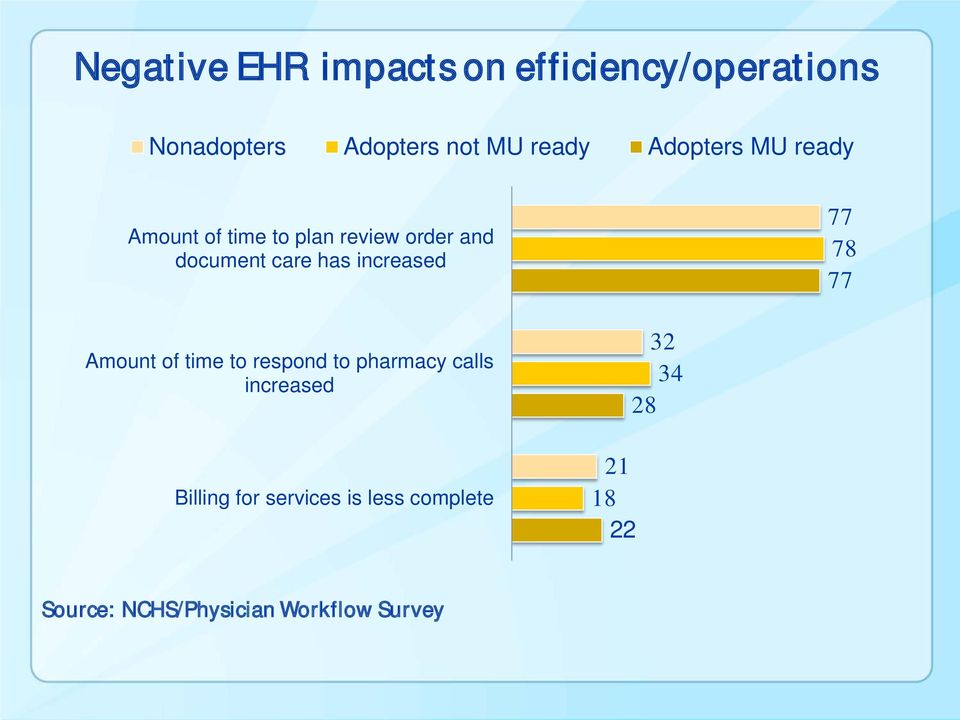
17 Negative EHR impacts on efficiency/operations Nonadopters Adopters not MU ready Adopters MU ready Amount of time to plan review order and document care has increased Amount of time to respond to pharmacy calls increased Billing for services is less complete Source: NCHS/Physician Workflow Survey
18 EHR Negative impacts on clinical care Nonadopters Adopters not MU ready Adopters MU ready EHR disrupts the way physicians interact with their patients 50* 64 61** *Significant differences between Adopters MU ready and Nonadopters (p<0.01) ** Significant differences between MU ready and not MU ready Adopters(p<0.01) Source: NCHS/Physician Workflow Survey

19 RESULTS: Policies and the influence of policies on EHR adoption
20 Medicare MU incentives Familiarity with ONC Programs Not familiar Do not participate Plan to or already participate EHR Adopt ers 19* 14* 67* Medicaid MU incentives 29 30* 42* Regional extension centers * EHR nonadopt ers Medicare MU incentives 24* 36* 40* Medicaid MU incentives 34 42* 24* Regional extension centers * * Significant (difference between adopters and nonadopters (p<0.01) Source: NCHS/Physician Workflow Survey

21 Major influence to adopt EHR* Nonadopter Proposed financial penalties Adopter Technical assistance with EHR implementation Capability of HIE w/in referral network Government incentive payments EHR used by trusted colleagues EHR required for board certification Assistance with selecting an EHR system 8 26 Availability certified products *All differences are significant between adopters and nonadopters (p<0.01) Source: NCHS/Physician Workflow Survey
22 Result s Factors associated w/ policies reported as having a major influence on decision to adopt an EHR: Available certified products, EHR use by trusted colleagues, & technical assistance: Adoption status Incentive payments, financial penalties, capability for HIE w/in network, req. board certification: Adoption status, size EHR selection assistance Adoption status, specialty, ownership
23 Results (cont.) Factors associated with major barriers Productivity loss, maintenance cost, finding an EHR that meets needs, Adoption status, size, ownership Reaching consensus, reliability of system Adoption status, size Purchase cost, effort to select a system, secure financing, adequate training Adoption status, ownership Resistance to change work habits Adoption status, size, and region Tech support adoption status only High speed internet no significant associations
24 Satisfaction & Productivity Purchase EHR system again: Ye s : 71% No : 29% EHR Satisfaction: Very satisfied: 38% Somewhat satisfied: 47% Somewhat dissatisfied: 10% Very dissatisfied: 5% EHR adversely affect productivity Yes: 63% No: 37% If yes, did you recover? Recovered 74% <3 months 34% 3-6 months 16% > 6 months 24% Not recovered 22% MISSING 4% Source: NCHS/Physician Workflow Sur vey
25 Discussion Major Barriers: Cost and Productivity loss EHR Workflow im p act: MU ready adopters experienced : financial benefits, faster lab results, & e-rx saves time Both adopter groups experienced: Overall more efficient practice, clinical benefits, better patient care, enhanced data confidentiality, & availability of records at POC. All groups disagreed EHR use leads to: Increased office visits, less complete billing, & increased time responding to Rx calls.
26 Discussion (cont.) All groups agree: Increase in time spent planning, reviewing, ordering, and documenting care EHR policy facilitators- Not familiar with RECs Nonadopters sensitive to most policies as major influence on EHR adoption Financial penalties
27 The Physician Workflow Study Q&A: Acknowledgments: - Office of the National Coordinator for Health Information Technology (ONC) - National Center for Health Statistics, Centers for Disease Control & Prevention (CDC) - Participants in the Physician Workflow Working Group - Respondents from the Physician Workflow Study For more information please contact Eric Jamoom at the National Center for Health Statistics 3311 Toledo Road, Room 3304, Hyattsville, MD Telephone: (301) [email protected] Web: The findings and conclusions in this report are those of the authors and do not necessarily represent the official position of the Centers for Disease Control and Prevention or the Office of the National Coordinator for Health Information Technology. National Center for Health Statistics Division of Health Care Statistics
National perceptions of barriers, benefits, and federal policies impacting EHR adoption in physician offices, 2011
 National perceptions of barriers, benefits, and federal policies impacting EHR adoption in physician offices, 2011 National Center for Health Statistics Eric Jamoom, PhD, MPH, MS, Senior Service Fellow
Eric Jamoom and Chun-Ju Hsiao National Center for Health Statistics
 What does Meaningful Use mean to office-based physicians? Eric Jamoom and Chun-Ju Hsiao National Center for Health Statistics AcademyHealth Annual Research Meeting June 24, 2013 National Center for Health
Physician Adoption of Electronic Health Record Systems: United States, 2011
 This report was revised on January, 203, after a problem was found with the weighting of the 20 survey data. NCHS Data Brief No. 98 July 202 Physician Adoption of Electronic Health Record Systems: United
Physician Motivations for Adoption of Electronic Health Records Dawn Heisey-Grove, MPH; Vaishali Patel, PhD
 ONC Data Brief No. 21 December 2014 Physician Motivations for Adoption of Electronic Health Records Dawn Heisey-Grove, MPH; Vaishali Patel, PhD In 2009, Congress committed to supporting the adoption and
Innovations Support Physicians in Delivering Advanced Care? Jennifer King AcademyHealth Annual Research Meeting
 Do Health hit and ddelivery System Innovations Support Physicians in Delivering Advanced Care? Jennifer King AcademyHealth Annual Research Meeting June 10, 2014 Consensus that improvements in health care
Health Information Technology and the National Quality Agenda. Daphne Ayn Bascom, MD PhD Chief Clinical Systems Officer Medical Operations
 Health Information Technology and the National Quality Agenda Daphne Ayn Bascom, MD PhD Chief Clinical Systems Officer Medical Operations Institute of Medicine Definition of Quality "The degree to which
A Provider s Perspective on Electronic Health Record Systems Adoption in Small Practices
 A Provider s Perspective on Electronic Health Record Systems Adoption in Small Practices Research-in-Progress Chi Zhang Southern Polytechnic State University [email protected] ABSTRACT This research-in-progress
Meaningful Use and Lab Related Requirements
 Meaningful Use and Lab Related Requirements ONC State HIE / NILA Workgroup August 20, 2013 What is an EHR? Electronic Health Record Information system used by healthcare providers to store and manage patient
Health Information Technology and Workflow. Clinician and Office Staff Survey
 Appendix M: Web-based Survey Form Approved OMB No. 0935-0212 Exp. Date 07/31/2016 Health Information Technology and Workflow Clinician and Office Staff Survey Public reporting burden for this collection
Meaningful Use - The Basics
 Meaningful Use - The Basics Presented by PaperFree Florida 1 Topics Meaningful Use Stage 1 Meaningful Use Barriers: Observations from the field Help and Questions 2 What is Meaningful Use Meaningful Use
A Guide to Understanding and Qualifying for Meaningful Use Incentives
 A Guide to Understanding and Qualifying for Meaningful Use Incentives A White Paper by DrFirst Copyright 2000-2012 DrFirst All Rights Reserved. 1 Table of Contents Understanding and Qualifying for Meaningful
ONC Data Brief No. 9 March 2013. Adoption of Electronic Health Record Systems among U.S. Non-federal Acute Care Hospitals: 2008-2012
 ONC Data Brief No. 9 March 2013 Adoption of Electronic Health Record Systems among U.S. Non-federal Acute Care Hospitals: 2008-2012 Dustin Charles, MPH; Jennifer King, PhD; Vaishali Patel, PhD; Michael
Health Information Technology (HIT) and the Medicaid/CHIP Health Information Exchange (HIE) Advisory Committee
 Health Information Technology (HIT) and the Medicaid/CHIP Health Information Exchange (HIE) Advisory Committee Joseph H. Schneider, MD Chair, Medicaid/CHIP HIE Advisory Committee Chair, TMA Committee on
Agenda. Government s Role in Promoting EMR Technology. EMR Trends in Health Care. What We Hear as Reasons to Not Implement and EMR
 Agenda A 360-Degree Approach to EMR Implementation Environmental Overview Information on the HITECH Stimulus Opportunities Hospitals, Physicians and Interoperability Preparing for an EMR Implementation
Use and Characteristics of Electronic Health Record Systems Among Office-based Physician Practices: United States, 2001 2013
 Use and Characteristics of Electronic Health Record Systems Among Office-based Physician Practices: United States, 2001 2013 Chun-Ju Hsiao, Ph.D., and Esther Hing, M.P.H. Key findings In 2013, 78% of office-based
Best Practices for Implementing an EHR System
 Best Practices for Implementing an EHR System Robyn Leone Director, CO-REC [email protected] The Case for EHRs Healthcare spending as a percent of our Gross Domestic Product (GDP) at unprecedented high
NHCHC Meaningful Use of Electronic Health Records Resource Catalogue. Meaningful Use Overview
 Meaningful Use Overview Meaningful use is the use of a certified electronic health record (EHR) to demonstrate improved quality and safety of health care delivery for a patient population within a clinical
Contact Information: West Texas Health Information Technology Regional Extension Center 3601 4 th Street MS 6232 Lubbock, Texas 79424 806-743-1338
 Contact Information: West Texas Health Information Technology Regional Extension Center 3601 4 th Street MS 6232 Lubbock, Texas 79424 806-743-1338 http://www.wtxhitrec.org/ Grant award - $6.6m Total number
Survey of Clinical Trial Awareness and Attitudes
 Survey of Clinical Trial Awareness and Attitudes Purpose of the Study Over $2 billion per year is spent on recruiting patients for clinical trials, yet slow patient enrollment is the primary cause of delay
MDeverywhere, Inc. Presents 2014 CMS EHR Incentive Program Requirements: What Providers Need To Know
 MDeverywhere, Inc. Presents 2014 CMS EHR Incentive Program Requirements: What Providers Need To Know Presented by: Kristen Heffernan Director Product Management & Marketing, Henry Schein MicroMD Agenda
Certified Electronic Health Record Scheduling Billing eprescribing. The ABEL Meaningful Use Criteria Guarantee
 Med EHR - EMR / PM Certified Electronic Health Record Scheduling Billing eprescribing ABELMed EHR-EMR/PM v11 CC-1112-621996-1 ABELMed EHR-EMR/PM is one of the first products to achieve ONC-ATCB 2011/2012
Mode and respondent effects in a dual-mode survey of physicians: 2008-2009
 Mode and respondent effects in a dual-mode survey of physicians: 2008-2009 Esther Hing, M.P.H. 1, Chun-Ju Hsiao, Ph.D. 1, Paul Beatty, Ph.D. 1, Sandra L. Decker, Ph.D. 1, 1 National Center for Health Statistics,
THE MARYLAND STUDY ON PHYSICIAN EXPERIENCE WITH MANAGED CARE. September 2001
 THE MARYLAND STUDY ON PHYSICIAN EXPERIENCE WITH MANAGED CARE September 2001 TABLE OF CONTENTS Executive Summary...1 I. Introduction...3 II. Methodology...5 A. Sample B. Data Collection C. Statistical Analysis
Modified Stage 2 Meaningful Use 2015-2017
 Click to edit Master title style Modified Stage 2 Meaningful Use 2015-2017 Bruce Maki, MA M-CEITA / Altarum Institute Regulatory & Incentive Program Analyst 12/14/2015 1 1 Agenda 1. Overview of M-CEITA
Contact: Barbara J Stout RN, BSC Implementation Specialist University of Kentucky Regional Extension Center 859-323-4895
 Contact: Barbara J Stout RN, BSC Implementation Specialist University of Kentucky Regional Extension Center 859-323-4895 $19.2B $17.2B Provider Incentives $2B HIT (HHS/ONC) Medicare & Medicaid Incentives
Selecting and Implementing EHRs
 Selecting and Implementing EHRs October 10, 2013 10:30am-11:00am October 11, 2013 10:00am-10:25am Selecting and Implementing EHRs This information is provided as information and education only. EHRs Digitized
Certified Electronic Health Record Scheduling Billing eprescribing. Why Consider ABELMed for your practice?
 Med EHR -EMR /PM Certified Electronic Health Record Scheduling Billing eprescribing Better Patient Care... Faster... Why Consider ABELMed for your practice? ABELMed EHR-EMR/PM seamlessly integrates the
ABOUT MDFLOW SYSTEMS. We know healthcare, we get results.
 ABOUT MDFLOW SYSTEMS MDFlow Systems is a premier Healthcare Information Technology (HIT) company. We utilize leading technologies to deliver comprehensive, integrated, strategic, customized and cost effective
Meeting Meaningful Use Core Objectives with Technology-Enabled Patient Engagement
 Meeting Meaningful Use Core Objectives with Technology-Enabled Patient Engagement ACPE Annual Meeting April 25, 2014 Chicago, Illinois Presented By: Dennis P.H. Mihale, MD, MBA Copyright 2014 CPT codes,
Faculty Disclosure. Pharmacist Learning Objectives. Pharmacy e-hit: The Future of Pharmacy and Patient Care
 Pharmacy e-hit: The Future of Pharmacy and Patient Care 1 Faculty Disclosure Ms Spiro has no actual or potential conflicts of interest associated with this presentation. 2 Pharmacist Learning Objectives
Health Information Technology in Healthcare: Frequently Asked Questions (FAQ) 1
 Health Information Technology in Healthcare: Frequently Asked Questions (FAQ) 1 1. What is an Electronic Health Record (EHR), an Electronic Medical Record (EMR), a Personal Health Record (PHR) and e-prescribing?
EHR Adoption Toolkit. Office of Population Affairs U.S. Department of Health and Human Services Spring 2014
 + EHR Adoption Toolkit Office of Population Affairs U.S. Department of Health and Human Services Spring 2014 + Roadmap Importance of EHRs EHRs and Title X Challenges of Adoption The Basics of Adoption
Health Information Technology in the United States: Information Base for Progress. Executive Summary
 Health Information Technology in the United States: Information Base for Progress 2006 The Executive Summary About the Robert Wood Johnson Foundation The Robert Wood Johnson Foundation focuses on the pressing
Electronic Health Records. A Resource Guide
 Electronic Health Records A Resource Guide Electronic Health Records A Resource Guide David Herzstein Couch Beatriz Reyes This publication was funded by a cooperative agreement by the Office of Population
Individuals Perceptions of the Privacy and Security of Medical Records
 ONC Data Brief No. 27 June 2015 Individuals Perceptions of the Privacy and Security of Medical Records Vaishali Patel, PhD MPH, Penelope Hughes JD MPH, Lucia Savage JD, Wesley Barker MS The Health Information
Jeff Grant, President HCMA, Inc. www.hcma-consulting.com [email protected]
 Jeff Grant, President HCMA, Inc. www.hcma-consulting.com [email protected] Financial i Disclosure Provide consulting services to Compulink Business Systems, Inc.and to their users. Who am I? Over
Electronic Medical Records
 Electronic Medical Records Milisa K Rizer, MD, MPH Clinical Director, Integrated Healthcare Information System Associate Professor, Clinical Family Medicine The Ohio State University Medical Center 2011
3/9/2011 ELECTRONIC HEALTH RECORDS: A NATIONAL PRIORITY. Mandate for electronic health records is tied to:
 To lower health care cost, cut medical errors, And improve care, we ll computerize the nation s health records in five years, saving billions of dollars in health care costs and countless lives. ELECTRONIC
Using EHRs to extract information, query clinicians, and insert reports
 Using EHRs to extract information, query clinicians, and insert reports Meghan Baker, MD, ScD NIH HCS Collaboratory EHR working group webinar March 26, 2013 1 E S P V A E R S Electronic Support for Public
Illinois Health Information Exchange GENERAL INFORMATION MEETING WEDNESDAY, NOVEMBER 18, 2009
 Illinois Health Information Exchange GENERAL INFORMATION MEETING WEDNESDAY, NOVEMBER 18, 2009 Speaker Introductions Michael Gelder, Senior Health Policy Advisor to Governor Quinn Greg Wass, State Chief
The basics of Health Information Technology
 The basics of Health Information Technology 2012 1 What is Health Information Technology? Health IT, or e-health, is increasingly viewed as the most promising tool for improving the overall quality, safety
Guide To Meaningful Use
 Guide To Meaningful Use Volume 1 Collecting the Data Contents INTRODUCTION... 3 CORE SET... 4 1. DEMOGRAPHICS... 5 2. VITAL SIGNS... 6 3. PROBLEM LIST... 8 4. MAINTAIN ACTIVE MEDICATIONS LIST... 9 5. MEDICATION
How To Get A Health Information Technology System To Work For You
 MaY 2014 Issue Brief The Adoption and Use of Health Information Technology by Community Health Centers, 2009 2013 Jamie Ryan, Michelle M. Doty, Melinda K. Abrams, and Pamela Riley The mission of The Commonwealth
Challenges with Meaningful Use EHR Satisfaction & Usability Diminishing
 Challenges with Meaningful Use EHR Satisfaction & Usability Diminishing Will Underwood, MPH Alan Brookstone, MD DISCLAIMER: The views and opinions expressed in this presentation are those of the author
Meaningful Use Objectives
 Meaningful Use Objectives The purpose of the electronic health records (EHR) incentive program is not so much the adoption of health information technology (HIT), but rather how HIT can further the goals
Get EnABELed with ABELMed
 Get EnABELed with ABELMed Electronic Health Record and Practice Management Solutions We focus on your Practice... So you can focus on your Patients Start reaping benefits of ABELMed EHR from day one: Eliminate
Regional Extension Centers: Support for EMR Adoption and Meaningful Use Achievement. Jennifer McAnally Director, tnrec
 Regional Extension Centers: Support for EMR Adoption and Meaningful Use Achievement Jennifer McAnally Director, tnrec The State of Healthcare Today The United States ranks: 37 th 72 nd 41 st 46 th Overall
Electronic Prescribing Guide. Establishing a Computer-to-Computer Connection Between Your Practice, Payers and Pharmacies
 Electronic Prescribing Guide Establishing a Computer-to-Computer Connection Between Your Practice, Payers and Pharmacies Electronic Prescribing Guide This guide is provided to you by Surescripts, the Nation
Meaningful Use Qualification Plan
 Meaningful Use Qualification Plan Overview Certified EHR technology used in a meaningful way is one piece of a broader Health Information Technology infrastructure intended to reform the health care system
Meaningful Use: DEMO of a Practice. Michael J. Mirro, MD, FACC Medical Director : Parkview Research Center Electrophysiologist : PPG-Cardiology
 Meaningful Use: DEMO of a Practice Michael J. Mirro, MD, FACC Medical Director : Parkview Research Center Electrophysiologist : PPG-Cardiology Michael Mirro MD : Disclosures Past-Chair : ACC Informatics
Mark Anderson, FHIMSS, CPHIMSS Healthcare IT Futurist
 Mark R. Anderson, FHIMSS, CPHIMS CEO of AC Group, Inc. Mark Anderson, FHIMSS, CPHIMSS Healthcare IT Futurist CEO of AC Group National Speaker on EHR > 800 sessions since 2001 Semi annual report on Vendor
A Guide to Choosing the Right EMR Software. A Guide to Choosing the Right EMR Software
 A Guide to Choosing the Right EMR Software A Guide to Choosing the Right EMR Software Eight Important Benchmarks for Community and Critical Access Hospitals Eight Important Benchmarks for Community and
Meaningful Use Stage 2
 Meaningful Use Stage 2 Presented by: Sarah Leake, HTS Consultant HTS, a division of Mountain Pacific Quality Health Foundation 1 HTS Who We Are Stage 2 MU Overview Learning Objectives 2014 CEHRT Certification
Evolving to an ACO: Better Patient Outcomes and Lower Expenditures
 Sponsored By: Evolving to an ACO: Better Patient Outcomes and Lower Expenditures Tom Deas, Jr., MD Board Member, North Texas Specialty Physicians (NTSP) Chief Medical Officer, Sandlot, LLC Presenter Thomas
Health Care Reform. Meaningful Use of HIT. Cut Cost. Best Practices & Quality Care. Expand Coverage to 32 million Americans.
 GA-HITREC (Georgia Health Information Technology Regional Extension Center) Dominic H. Mack MD, MBA Project Director, GA-HITREC Deputy Director, National Center for Primary Care: Morehouse School of Medicine
Incentives to Accelerate EHR Adoption
 Incentives to Accelerate EHR Adoption The passage of the American Recovery and Reinvestment Act (ARRA) of 2009 provides incentives for eligible professionals (EPs) to adopt and use electronic health records
Produced by the Deloitte Center for Health Solutions. Issue Brief: Physician perspectives about health information technology
 Produced by the Deloitte Center for Health Solutions Issue Brief: Physician perspectives about health information technology 2 Foreword The national debate around health care reform and the quest for a
The HITECH Act and Meaningful Use Implications for Population and Public Health
 The HITECH Act and Meaningful Use Implications for Population and Public Health Bill Brand, MPH Public Health Informatics Institute Meaningful Use for Public Health Professionals: Basic Training May 16,
1. What is your name? Last name First name Middle Initial Degree(s)
 Version: 6122008 Rhode Island Health Care Quality Performance (HCQP) Program This survey asks about physicians' use of health information technology (HIT) and should take less than 10 minutes to complete.
MEANINGFUL USE STAGE 2 2015 FOR ELIGIBLE PROVIDERS USING CERTIFIED EMR TECHNOLOGY
 MEANINGFUL USE STAGE 2 2015 FOR ELIGIBLE PROVIDERS USING CERTIFIED EMR TECHNOLOGY STAGE 2 REQUIREMENTS EPs must meet or qualify for an exclusion to 17 core objectives EPs must meet 3 of the 6 menu measures.
Achieving Meaningful Use in Private Practice. A close examination of Stage 2 requirements
 Achieving Meaningful Use in Private Practice A close examination of Stage 2 requirements Abstract As part of the American Recovery and Reinvestment Act of 2009, the Federal Government laid the groundwork
Request for Proposal Implementation Agents of Health Information Technology: Behavioral Health, Primary Care, and other Specialty Healthcare Providers
 Request for Proposal Implementation Agents of Health Information Technology: Behavioral Health, Primary Care, and other Specialty Healthcare Providers ISSUE DATE: April 26 th, 2013 RESPONSE DUE DATE: May
Health Information Technology in the United States: Better Information Systems for Better Care, 2013
 Health Information Technology in the United States: Better Information Systems for Better Care, 2013 About the Robert Wood Johnson Foundation The Robert Wood Johnson Foundation focuses on the pressing