
Natek Network Access Control (NAC)
|
|
|
- Julian Murphy
- 10 years ago
- Views:
Transcription
1 Natek Network Access Control (NAC) V Security Target Release Date: Version 1.13 AUTHOR: NATEK BİLİŞİM BİLGİSAYAR EĞİTİM DANIŞMANLIK YAZILIM TİCARET SANAYİ ANONİM ŞİRKETİ 1
2 Revision History Version No Reason for Change Release Date Prepared By 1.0 First Draft SFR s Update Initial Draft (Before Release) Initial Version (Kick-off Meeting) Survey Report 1 Update (GR_1) Survey Report 2 Update (GR_2) Survey Report 3 Update (GR_3) Survey Report 4 Update (GR_4) Survey Report 4 Update (GR_9) Survey Report 5 Update (GR_10 and GR_11) NAC Version Update v NAC Version Update v Survey Report 25 Update (GR_25) Final Version Ahmet Sedat KAYA & Ertuğrul BALABAN Ahmet Sedat KAYA & Ertuğrul BALABAN Ahmet Sedat KAYA & Ertuğrul BALABAN Ahmet Sedat KAYA & Ertuğrul BALABAN Ahmet Sedat KAYA & Ertuğrul BALABAN Ahmet Sedat KAYA & Ertuğrul BALABAN Ahmet Sedat KAYA & Ertuğrul BALABAN Ahmet Sedat KAYA & Ertuğrul BALABAN Ahmet Sedat KAYA & Ertuğrul BALABAN Ahmet Sedat KAYA & Ertuğrul BALABAN Ahmet Sedat KAYA & Ertuğrul BALABAN Ahmet Sedat KAYA & Ertuğrul BALABAN Ahmet Sedat KAYA & Ertuğrul BALABAN Ahmet Sedat KAYA & Ertuğrul BALABAN Approved By Necati ERTUĞRUL Necati ERTUĞRUL Necati ERTUĞRUL Necati ERTUĞRUL Necati ERTUĞRUL Necati ERTUĞRUL Necati ERTUĞRUL Necati ERTUĞRUL Necati ERTUĞRUL Necati ERTUĞRUL Necati ERTUĞRUL Necati ERTUĞRUL Necati ERTUĞRUL Necati ERTUĞRUL 2

3 TABLE OF CONTENTS 1. Introduction Security Target Reference TOE Reference TOE Overview TOE Type Required non-toe Hardware, Software or Firmware Operating Environment TOE Description Physical Boundary Logical Boundary Document Conventions Document Terminology Conformance Claims CC Conformance Claim PP Claim Package Claim Conformance Rationale Security Problem Definition Threats Organizational Security Policy Assumptions Security Objectives Security Objectives for the TOE Security Objectives for the Operational Environment Security Objectives Rationale Rationale for Security Threats to the TOE Rationale for Security Objectives of the TOE

4 5. Extended Components Definition Extended TOE Security Functional Components Extended TOE Security Assurance Components Rationale for Extended Security Functional Components Security Requirements Security Functional Requirements Class Security Audit (FAU) Class User Data Protection (FDP) Class Identification and Authentication (FIA) Class Security Management (FMT) Class TOE Access Security Assurance Requirements Security Functional Requirements Rationale Security Assurance Requirements Evidence Security Assurance Requirements Rationale TOE Summary Specifications TOE Security Functions Security Audit User Data Protection Identification and Authentication Security Management

5 1. Introduction Due to the increase in the importance of information contained in computer networks, corporations need to track their systems and computer infrastructure for unauthorized access. One of the major security problems common to organizations are unauthorized access attempts of computers, which are not compliant to the organization security policy. Guest computers, mobile devices, computers using out of date antivirus software creates important security risks for enterprises. In order to minimize this risk, it is critical to only permit authorized devices for network access. Natek Network Access Control (NAC) is the solution to protect network from unauthorized access. This Security Target is for evaluation of Natek Network Access Control (NAC) at Evaluation Assurance Level 3. This section presents Security Target Identification, TOE Overview and Description. It also includes Document Conventions and Document Terminology Security Target Reference ST Title: NATEK Network Access Control (NAC) Security Target Version: 1.13 Publication Date: ST Author: Natek Bilişim Bilgisayar, Eğitim, Danışmanlık, Yazılım Ticaret Sanayi Anonim Şirketi. Assurance Level: The ST is EAL 3 conformant TOE Reference TOE Identification: Natek Network Access Control (NAC) Version: Publication Date: Vendor: Assurance Level: Natek Corporation The TOE is EAL 3 conformant. 5

6 1.3. TOE Overview The TOE Description summarizes the usage and major security features. It also provides a context for the TOE Evaluation by identifying the TOE type, describing the product and defining the specific evaluated configuration. The Target of Evaluation (TOE) is the Natek Network Access Control (NAC) Version and will hereafter be referred to as the TOE through this document. The TOE is a network access control system that provides detection, authentication and authorization of devices attempting to access a network. These devices may be Guest Computers, Mobile Devices, PDA, Smart Phones or Tablets. Natek NAC controls the device compliance to the company policy and authenticates this device. Compliance policies are defined by the company and introduced to Natek NAC during setup and configuration processes. For example; out of date antivirus update or activeness of the firewall, being a domain member can be defined as compliance policies. The TOE is a software-only product and consists of the Network Access Control (NAC) software components: NAC GUI, NAC Server, NAC Detector and NAC HotSpot GUI TOE Type The TOE belongs to the "Network and Network-Related Devices and Systems" category. TOE Type is software based Network Access Control Required non-toe Hardware, Software or Firmware The TOE is software product that runs on a host computer. The host computer must run the operating system platform on which the TOE can execute. Natek NAC has 4 main modules; NAC GUI, NAC Server (includes NAC Health Check, NAC Scanner), NAC Detector and NAC HotSpot GUI. 6

7 The minimum operating system (O/S) and hardware requirements for the NAC GUI host computer are: O/S: CPU: RAM: Connectivity: Disk space for TOE: Disk space for logs: Windows 7 or higher, preferably Windows Server bit, or higher Intel Pentium Core 2 Duo 2.4 GHz, or faster At least 2GB, preferably 4GB TCP/IP network interfaces At least 1 GB Subject to Log details The minimum operating system (O/S) and hardware requirements for the NAC Server host computer are: O/S: Windows 7 or higher, preferably Windows Server bit, or higher CPU: RAM: Connectivity: Intel Pentium Core 2 Duo 2.4 GHz, or faster At least 2GB, preferably 4GB TCP/IP network interfaces Disk space for TOE and logs: At least 1 GB / Subject to Log details The minimum operating system (O/S) and hardware requirements for the NAC Detector host computer are: O/S: Windows 7 or higher, preferably Windows Server bit, or higher CPU: RAM: Connectivity: Intel Pentium Core 2 Duo 2.4 GHz, or faster At least 2GB, preferably 4GB TCP/IP network interfaces Disk space for TOE and logs: At least 1 GB / Subject to Log details 7

8 The minimum operating system (O/S) and hardware requirements for the NAC HotSpot GUI host computer are: O/S: CPU: RAM: Connectivity: Disk space for TOE: Disk space for logs: Linux Distributions (Ubuntu, Redhat, Paradus, preferred Debian) Intel Pentium Core 2 Duo 2,4 GHz, or faster At least 512 MB, preferably 1GB TCP/IP network interfaces At least 2,5 GB Subject to Log details 8
9 Operating Environment This section describes the general environment in which the TOE is expected to perform. The environment of operation for the TOE is expected to be a facility that is physically secure from unauthorized intrusion. Personnel with explicit physical access to the hardware storing log data and application execution files must be authorized, trained and competent. In addition to this: For NAC GUI; The operational environment must include a web browser (offered Internet Explorer 8.0 or higher, or Mozilla Firefox 20.0 or higher, Google Chrome 21.0 or higher) to be used by authorized administrators of the TOE as a medium of communication with the TOE s web GUI. The operational environment must include.net Framework 4.0 and IIS 7.0 or higher The operational environment must include the database MSSQL 2008 or higher The operational environment must include either Windows 2008 or Windows 2012 At a minimum, a monitor, keyboard and mouse must be locally collected to the server machine in which the TOE is deployed or operated on. For NAC Server; The operational environment must include. NET Framework 4.0 The operational environment must include the database MSSQL 2008 or higher The operational environment must include either Windows 2008 or Windows 2012 At a minimum, a monitor, keyboard and mouse must be locally collected to the server machine in which the TOE is deployed or operated on. For NAC Detector; The operational environment must include. NET Framework 4.0 The operational environment must include the database MSSQL 2008 or higher The operational environment must include either Windows 2008 or Windows

10 At a minimum, a monitor, keyboard and mouse must be locally collected to the server machine in which the TOE is deployed or operated on. For NAC HotSpot; The operational environment must include a web browser (offered Internet Explorer 8.0 or higher, or Mozilla Firefox 20.0 or higher, Google Chrome 20.0 or higher) to be used by authorized administrators of the TOE as a medium of communication with the TOE s web GUI. The operational environment must include. minimum Java 1.7, PHP and Apache Web Server Package The operational environment must include the database MSSQL 2008 or higher The operational environment must include Linux distributions (Ubuntu, Pardus, and preferred Debian 7.0) The operational environment must include below software packages; Snort Intrusion Detection Prevention ULogD Logs Squid Web Traffic Logs At a minimum, a monitor, keyboard and mouse must be locally collected to the server machine in which the TOE is deployed or operated on. 10

11 1.4. TOE Description This section provides the detailed information and description of TOE included physical and Logical boundaries of the system. Natek NAC operates based on two scenarios. First scenario controls network traffic by using ARP packets. In this scenario ARP Poisoning is applied to target devices so as to change the default gateway MAC Address of the Target Device. The second scenario controls network access of devices by changing switch settings for which the device is connected. The VLAN of the switch port can be changed or the port can be disabled. In addition, global ACL S can also be applied to network devices to prevent the unauthorized access of target devices. According to Scenarios below, Super Admin decides which scenario is suitable and applicable for the company according to company needs and infrastructure. After that, Super Admin applies the selected scenario on NAC GUI and make configuration. Scenario 1 11
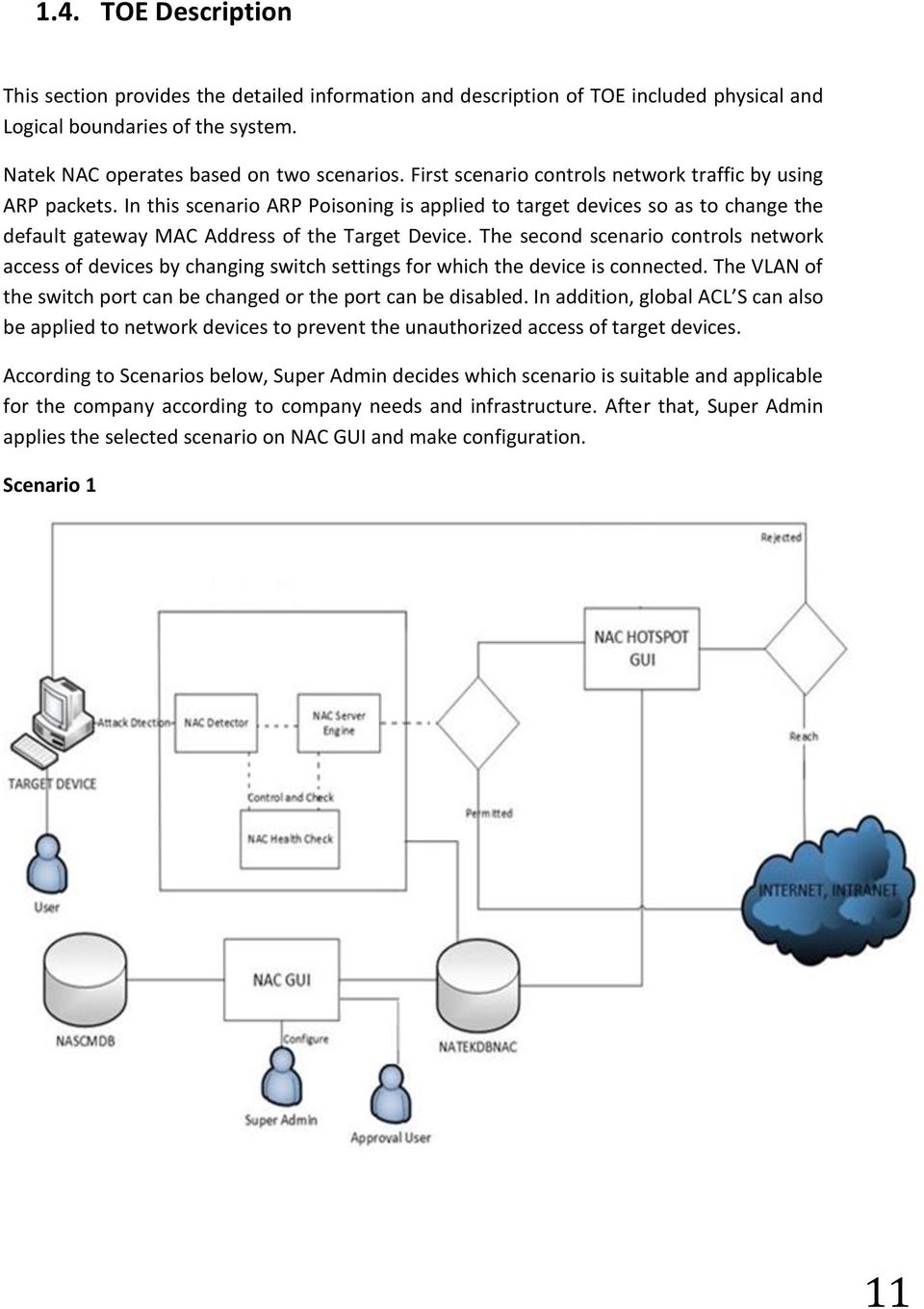
12 Natek NAC components (NAC GUI, NAC Server, NAC Detector, NAC HotSpot GUI) connect with each other using with Natekdbnac Database. The steps of operation are as follows: 1) Target Device enters the network. 2) ARP request is sent by Target Device to find neighbor devices. 3) NAC Detector intercepts ARP request, SSDP and DHCP packages. 4) NAC Detector records the device in the central MSSQL Database for classification. 5) The NAC Server identifies and classifies the device with the following methods: a. WMI; Inventory information is collected. Any WMI data can be collected, get hard disk space, username informations. b. Remote Registry; Inventory information is collected. Any key value can be enumerated. c. RPC; Calling the Procedure on Target Device, computer name is collected for classification. d. SNMP; Get inventory information from Device, MIB-2 Inventory Information is collected. e. NMAP; Mac Vendor, OS Guessing and Open Port Information is collected. f. Active Directory; Computer name is collected for classification. g. In case of company request (company decide whether to install Agent or not), Natek Agent Component installs to the target devices. Inventory information is collected. Any WMI data and registry key data can also be collected. 6) If classification is successful i.e., NAC Server gets any information from Target Device using above methods, inventory is collected for the device. If device is compliant to the policy, target device reaches a limited network. Limitation is done according to device properties and company compliance policy (inventory policy). 7) Otherwise, if the classification fails or incompliance to inventory policy is detected, NAC Server sets the attack status of related record of target device to ON (1). 8) NAC Detector makes attack to devices whose attack status is ON (1) with ARP Poisoning. ARP Poisoning is used to change the default gateway MAC Address of the attacked device (Block the network access of the device). The attacked device is redirected to NATEK Hotspot GUI. The ARP Poisoning packet contains an ARP Reply packet with the IP address of the default gateway and MAC address of NAC Hotspot. 12

13 9) NAC Detector prevents Target Device to reach network. It also redirects the device to the NAC HotSpot Components. 10) NAC HotSpot GUI (Graphical User Interface) authorizes the Target Device via a Captive Portal. (Sample authorization types are; Guests, Corporate Employee) 11) NAC HotSpot GUI also provides a warning message for the reason of incompliance. It also provides all related records and registration process. 12) All registration records are validated with one of the approval with SMS, approval via mail, manager permission, and super admin approval methods. 13) Target Device reaches the network with restrictions after validation is performed on NAC HotSpot GUI. Scenario 2 13

14 Natek NAC components (NAC GUI, NAC Server, NAC Detector, NAC HotSpot GUI) connect with each other using with Natekdbnac Database. In this method the configuration on corporate network devices is changed to prevent unauthorized access: 1) Target Device enters the network. 2) NAC Server Engine connects to the corporate network switches using Telnet, SSH or SNMP. 3) NAC Server Engine retrieves the MAC (Media Access Control) address table and port information of corporate network switches. This information is stored centrally to detect which device is connected to which port of network switch. 4) NAC Server detects the MAC Address - IP Address of Target Device from DHCP logs or through network scanning. NAC Scanner component performs network scanning. 5) The NAC Server identifies and classifies the device with the methods mentioned above; (WMI, Remote Registry, RPC, SNMP, NMAP, Active Directory, NATEK Agent) 6) If classification is successful i.e., NAC Server gets the related information from using above methods, inventory is collected for the device. If device is compliant to the policy, target device reaches the limited network. 7) Otherwise, if the classification fails or incompliance to inventory policy is detected NAC Server sets the attack status of related record of target device to ON (1). 8) NAC Server makes Switch Attack to Target Device using following methods according to Switch properties; Port Shut (Shut the Switch Port), VLAN Change (Change the VLAN Address to another VLAN) or Adding ACL (Add records to the Access Control List). IF VLAN of Port Is Changed 9) NAC Server redirect the Target Device s VLAN to a VLAN which NAC Host Spot GUI is the default gateway. 10) NAC HotSpot GUI authorizes the Target Device via Captive Portal. (Sample authorization types are; Guests, Corporate Employee, Company Employee) 11) NAC HotSpot GUI also provides a warning message for the reason of incompliance. It also provides all related records and registration process. 12) All registration records are validated with different procedures. (Approval with SMS, approval via mail, Manager Permission...etc.) 14

15 13) Target Device reaches the network with restrictions after validation is performed on NAC HotSpot GUI. In other cases the target device cannot access corporate network. According to scenarios above, as a summary with the concept of the TOE, NAC and its components have the following functions; NAC Detector; detects the Target Device and uses ARP Poisoning to redirect the target device to the NAC HotSpot GUI. NAC Server Engine; gives Authorization to the Target Device. If there is an unauthorized device or incompliance to the policy, it sends necessary commands for performing the attack. NAC Server detects the MAC Address - IP Address of Target Device from DHCP (Dynamic Host Configuration Protocol) logs or through network scanning. NAC Health Check; checks and controls the NAC Component s status (NAC Server Engine, NAC Detector and NAC Scanner), if one of them down, it is restarted. It also provides emergency status action to stop or start all system via NAC GUI. NAC HotSpot GUI defines the authorization procedures referred for the authorization of the Target Device and also provides access to the network with limitations. NAC GUI Component; provides Management and Configuration functions of the all NAC System. (Network and Attack Configurations, Logs, Reports) NASCMDB and Natekdbnac Databases; o NASCMDB stores user s information for controlling access to GUI. o Natekdbnac stores target device information, logs, reports and configuration information about NAC System. Other NAC Components also use Natekdbnac and all add, delete and update operations are stored in it. 15
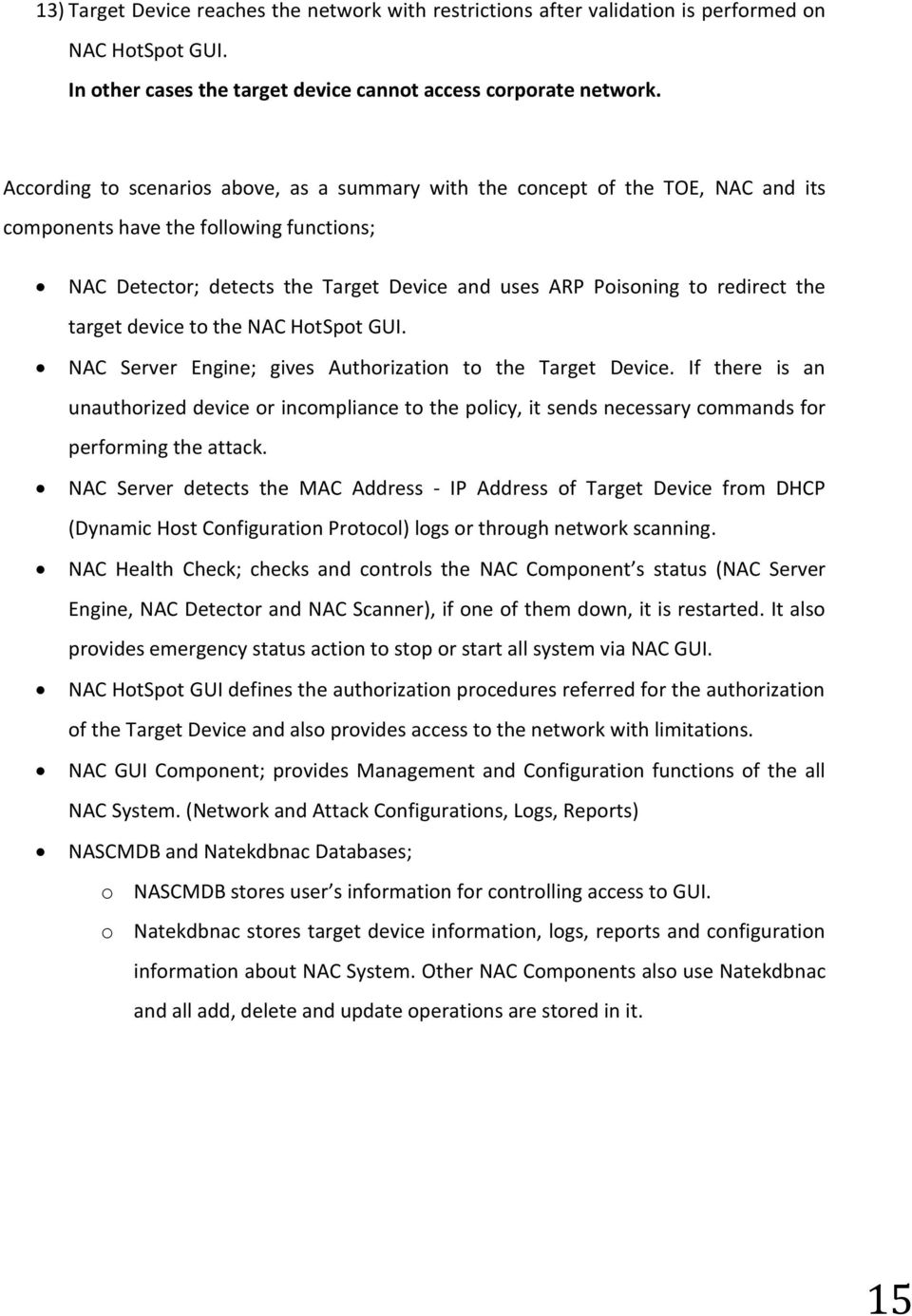
16 Physical Boundary The TOE composed of multiple software modules that run as complete IT products on required host computers. The host computers must run with an operating system platform on which the TOE executes (Please refer to the Operating Environment). For a graphical representation of the scope and the points of interaction between the various components of the TOE also refer to the Scenario 1 and Scenario 2 Figures Logical Boundary This section outlines the boundaries of the security functions of the TOE. The Logical Boundary of the TOE includes the security functionality described here. Security Functions Security Audit User Data Protection Identification and Authentication Security Management DESCRIPTION The TOE generates audit records for security events. Only the admin role is allowed to view the audit trail. The TOE provides specifying requirements for TOE security functions and TOE security function policies related to protecting user data. All users are required to perform identification and authentication before any information flows are permitted. The TOE provides a wide range of security management functions. Administrator can configure the TOE, manage users and audit among other routine Maintenance activities Security Audit The TOE provides for a comprehensive auditing layer, which will monitor activities and executions occurring with the system. Activities in this context are defined as operations occurring within the system that might or might not be initiated by a user. Each auditable event marks the exact time the event occurs, the account associated with that action as well as parametric details that are specific to that activity. The data can be viewed only by administrators. 16

17 User Data Protection The information below which are identified in TOE scope, is protected against access by unauthorized users. This information is used by Natek NAC components. - User Information (Super Admin or other user) - Authorization and Authentication Information (Roles, Menu, Ticket etc...) - Configuration and Configuration Items Information (Network and Credentials etc ) - System Logs (GUI, functions and database etc ) - Device and Inventory Information (Scanned Device, OS, Installed Applications etc ) - Network resources Identification and Authentication The TOE provides an identification and authentication layer independent from that of the Operating System it executes on. This security feature acts to protect and prevent access by unauthorized users to the system. In addition, it will also require each user to be identified and authorized before any access to security functions and data is granted. In the case of an authentication or identification failure, the TOE will disregard any request made an issue a forward redirection to the login page. Authentication and identification is performed via a username password combination that will not only identify a specific user to the system but also define the level of access permitted to that particular user account. On top of it, the password will be encapsulated by system automatically using SHA-1 when saved into the database (NASCMDB). Authorization for the User (Target Device User) is done on NAC Hot Spot GUI. NAC Hot Spot GUI wants related information from user (name, surname, phone number, mail address and department). According to user information, NAC Hot Spot GUI redirects these information to the Approval User. Approval User evaluates the requests and decides on the access of the limited network. According to corporation configuration, request type can be sent differently (via mail or sms and decision of the Super Admin). NAC GUI is SSL support provided by the operational environment for secure authentication. SSL is a network protocol primarily used to secure the transmission of data between 2 remote locations; essentially providing protection for intercept when data packets are flowing on the wire. 17

18 Security Management TOE provides Security Management functions like configuration of TOE; manage the users, audit, maintenance activities etc In the Security Management activities of the TOE uses the list below; - Users and passwords - Roles, Tickets, Menus - Authentication and Authorization Mechanism - Audit Logs The TOE allows for the management of sessions (NAC GUI) connection. Authorized administrators are granted the ability to set the idle timeout threshold after which an authorized user would be automatically logged out of his active session. Idle timeout is defined as a period of inactivity from the user on database (Default value is an hour). 18

19 1.5. Document Conventions The notation formatting and conventions used in this Security Target are consistent with those used in Version 3.1 Revision 4 of the Common Criteria. Selected section choices are discussed here to aid the Security Target reader. The Common Criteria allows several operations to be performed on functional requirements: The allowable operations defined in part 2 of the Common Criteria are selection and assignment. The selection operation is picking one or more items from a list in order to narrow the scope of a component element. Selections are denoted by [italicized text]. The assignment operation is used to assign a specific value to an unspecified parameter to a component element. Assignments are denoted by [Blue-Colored Text] The iteration operation is used to denote using SFR s more than one. Iteration is denoted by SFR component title (letter). For example, FDP_ACC.1(A) 19

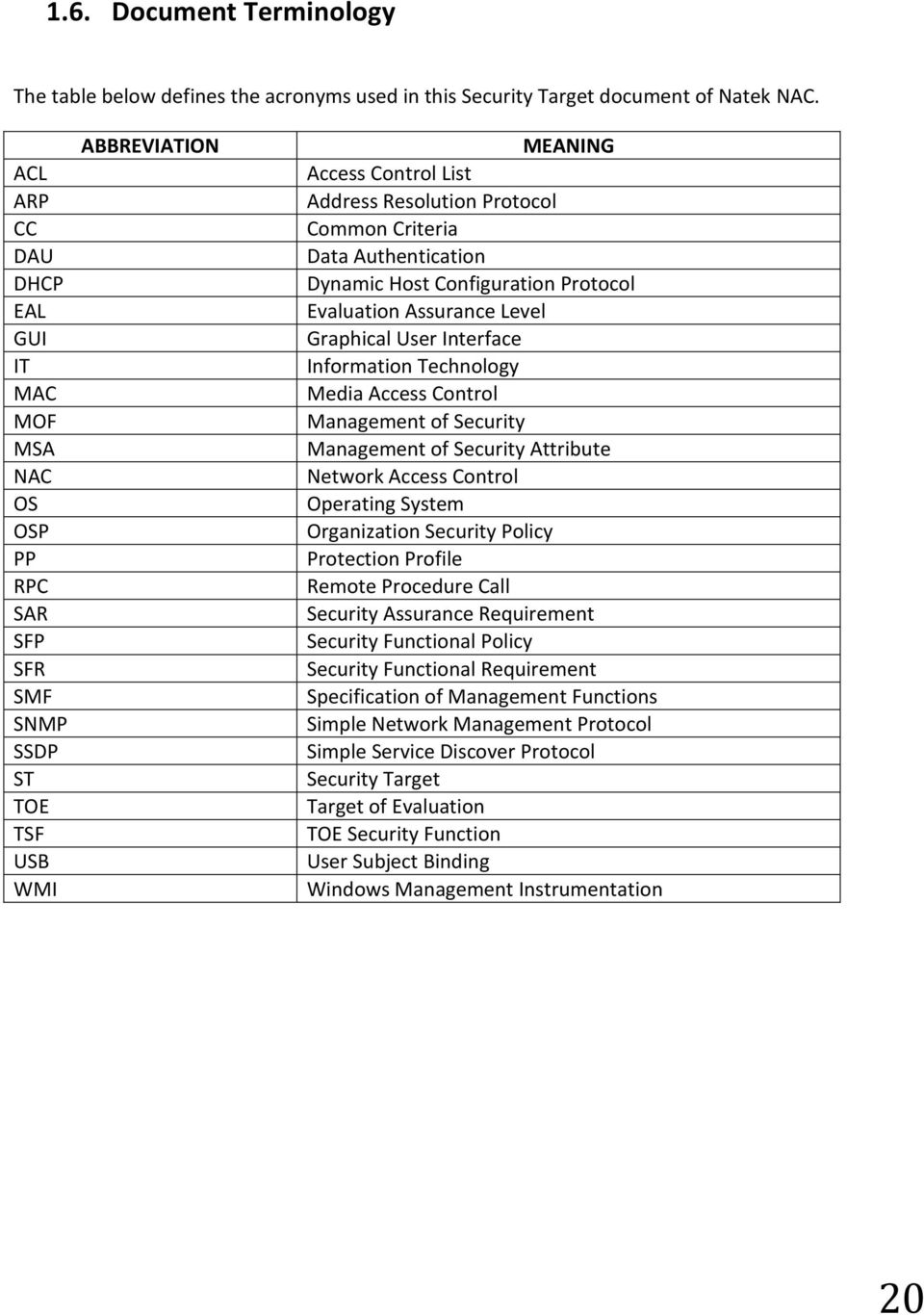
20 1.6. Document Terminology The table below defines the acronyms used in this Security Target document of Natek NAC. ACL ARP CC DAU DHCP EAL GUI IT MAC MOF MSA NAC OS OSP PP RPC SAR SFP SFR SMF SNMP SSDP ST TOE TSF USB WMI ABBREVIATION MEANING Access Control List Address Resolution Protocol Common Criteria Data Authentication Dynamic Host Configuration Protocol Evaluation Assurance Level Graphical User Interface Information Technology Media Access Control Management of Security Management of Security Attribute Network Access Control Operating System Organization Security Policy Protection Profile Remote Procedure Call Security Assurance Requirement Security Functional Policy Security Functional Requirement Specification of Management Functions Simple Network Management Protocol Simple Service Discover Protocol Security Target Target of Evaluation TOE Security Function User Subject Binding Windows Management Instrumentation 20
21 2. Conformance Claims This section provides the identification for any CC, Protection Profile (PP) and EAL Package Conformance Claims CC Conformance Claim The ST is Common Criteria Version 3.1 (September 2012) Part 2 conformant and Part 3 conformant PP Claim The ST does not claim Conformance to any registered Protection Profile Package Claim The TOE claims conformance to the EAL 3 assurance Package defined in Part 3 of the Common Criteria Version 3.1 Revision 4 (September 2012). The TOE does not claim conformance to any Functional Package Conformance Rationale This Security Target conforms to Parts 2 and 3 of the Common Criteria Standard for Information Technology Security Evaluations, Version 3.1, Revision 4, September There are no extended SFRs or SARs contained within this ST. There are no Protection Profile claims for this Security Target. 21
22 3. Security Problem Definition Roles: NAC GUI Roles Super Admin: Uses NAC GUI Module, defines new user, makes the configuration Approval User: Monitors the system monitor. In addition approve or reject the requests or view limited screens. (NAC Base User) HOT Spot GUI Roles: User: request network access and accesses the network over HOT Spot GUI Assets: Configuration and device data store in the Natekdbnac. These data are directly stored to the database. Audit data User information data such as role, ticket data related to GUI. This data is stored in the NASCMDB. Resources on the internal network Threat Agents: Attacker from the internal network: A company user that is a domain member and has authorization but, try to attack without permission. Attacker from the outside network: An evil user that is not a domain member but tries to authorized. 22
23 3.1. Threats T.ACCOUNT AUDIT-T.ACC_AUD: An attacker from the internal network could try to modify the Configuration and device data store in the Natekdbnac, Audit data and User information data. If the audits are not controlled regularly or the audit control could be bypassed, this action may not be noticed. Thus, the attacker succeeds without being detected. T.FULL AUDIT-T.FUL_AUD: An attacker from the internal network could take actions resulting in low importance audits so as to exhaust audit storage capacity. If the audit storage capacity is exhausted, future audits are lost since no further audit could be recorded. T.LOSS OF DATA-T.DATALOSS: An attacker from the outside network may attempt to remove or destroy Configuration and device data store in the Natekdbnac. T.MEDIATE-T.MEDIAT: An attacker from the outside network person may send impermissible information through the TOE which results in the exploitation of resources on the internal network. T.NO AUTHORIZATION-T.NOAUTH: An attacker from internal network may attempt to bypass the security services of the TOE so as to access and use resources on the internal network Organizational Security Policy An Organizational Security Policy (OSP) is a set of security rules, procedures or guidelines imposed by an organization on the operational environment of the TOE. There are no OSPs defined for this Security Target. 23
24 3.3. Assumptions This section describes the security aspects of the intended environment for the evaluated TOE. The operational environment must be managed in accordance with assurance requirement documentation for delivery, operation and user guidance. The following specific conditions are required to ensure the security of the TOE and are assumed to exist in an environment where this TOE is employed. A.NO EVIL USER-A.NOEVIL: Authorized administrator, who manage the TOE are nonhostile use, configure and maintain the TOE and follow all guidance. A.EDUCATED USER-A.EDUCUSER: Authorized administrator and end users are educated so as to use the Natek NAC system suitably and correctly. A.PHYSICAL ACCESS AND PROTECTION-A.PYHPROT: The TOE resides in a physically controlled access facility that prevents unauthorized physical Access. Therefore, the physical hardware and software in which the TOE is deployed will be protected from unauthorized physical modification. A.SECURE ENVIRONMENT-A.SECENV: The Operating Systems, Database, Application and Web Server, on which the TOE is running are, fixed against all security bugs and protected against all threats. A.TRUSTED PERSON-A.TRUST: The designer, programmer (coder) and administrator who are responsible for creation of architecture, coding and administrative functions done by trusted persons. A.TRANSFER SECURITY A.TRANSSEC: Operational environment will provide a secure channel so that credentials are protected between the NAC GUI user (super admin and approval user) and NAC GUI application server. 24
25 4. Security Objectives 4.1. Security Objectives for the TOE The IT security objectives for the TOE are addressed below: O.ACCOUNTABILITY-O.ACCOUN: The TOE will provide user accountability for information flows through the TSF. O.ADMINISTRATION-O.ADMIN: The TOE will include a set of functions that allow efficient management of TSF and TSF data, ensuring that TOE users with appropriate privileges exist. O.AUDIT RECORD-O.AUDREC: The TOE will provide a means to record a readable audit trail of security related events, with accurate dates and times and means to the search the audit trail based on relevant attributes. O.IDENTIFY AND AUTHENTICATE-O.IDAUTH: The TOE will uniquely identify and authenticate the claimed identity of all users before granting a user access to TOE functions. O.MEDIATE-O.MEDIAT: The TOE will mediate the flow of information from users on an external network to resources on an internal network, and will ensure that residual information from a previous information flow is protected and not transmitted in any way. O.RESOURCE ACCESS-O.RESACC: The TOE will control access to resources based on the identity of users. The TSF must allow authorized administrators (Super Admin) to specify which resources may be accessed by which users. O.SECURITY FUNCTIONS-O.SECFUN: The TOE will provide functionality that enables an authorized administrator to use the TOE security functions and will ensure that only authorized administrator are able to access such functionality. 25
26 4.2. Security Objectives for the Operational Environment The security objectives for the Operational Environment are addressed below: OE.ADMINISTRATOR AUTHENTICATION-OE.ADMAUT: The TOE environment will be able to identify and authenticate administrators prior to allowing access to TOE administrative functions and data. OE.ADMINISTRATOR TRAINING-OE.ADMTRA: Authorized administrators will be trained to appropriately install, configure and maintain the TOE within its evaluated configuration according to the installation and guidance documents for the TOE. OE.ENVIRONMENT SECURITY-OE.ENVSEC: The company has responsibility for the TOE will ensure that those parts of TOE should be running in a secure and protected environment. OE.GUIDAN-OE.GUIDAN: The TOE will be delivered, installed, administrated and operated in a manner that maintains security. OE.TRUSTED PERSON-OE.PERTRST: Authorized administrators, coder, designer and also service personnel will be trusted person and they will not generate any threat for the TOE. 26
27 4.3. Security Objectives Rationale This section provides the summary that all security objectives are traced back to aspects of the addressed assumptions, threats and Organizational Security Policies. Assumption & Threats Objectives T.ACC_AUD T.FUL_AUD T.DATALOSS T.MEDIAT T.NOAUTH O.ACCOUN O.ADMIN O.AUDREC O.IDAUTH O.MEDIAT O.RESACC O.SECFUN OE.ADMTRA OE.ADMAUT OE.GUIDAN OE.ENVSEC OE.PERTRST A.NOEVIL A.EDUCUSER A.PYHPROT A.SECENV A.TRUST A.TRANSSEC 27
28 Rationale for Security Threats to the TOE THREAT T.ACC_AUD T.FUL_AUD T.DATALOSS T.MEDIAT T.NOAUTH RATIONALE This threat is completely countered by O.ACCOUN which ensures user accountability for information flows through the TOE and for administrator use of security functions related to audit. O.AUDREC which ensures the TOE provides a means to record a readable audit trail of security-related events, with accurate dates and times, and a means to search the audit trail based on relevant attributes. This threat is completely countered by O.SECFUN which ensures the TOE provides functionality that enables an administrator to use the TOE Security Functions and also ensures that only administrator are able to access such functionality. Admin also examines the log and takes the necessary actions. O.RESACC which must control access to resources based on the identity of users. The TSF must allow authorized administrators to specify which resources may be accessed by which users. This threat is completely countered by O.ADMIN requires that only users with appropriate privileges be allowed to exercise control over the TOE s functions and data. This prevents unauthorized users from removing or destroying data collected and produced by the TOE. O.RESACC which must control access to resources based on the identity of users. The TSF must allow authorized administrators to specify which resources may be accessed by which users. OE.ADMAUTH which ensures the identification and authentication for administrators prior to allowing access to TOE administrative functions and data This threat is completely countered by O.MEDIAT which ensures the TOE mediates the flow of all information from users on an external network to resources on an internal network O.RESACC which ensures the control of access to resources based on the identity of users and allows authorized administrators to specify which resources may be accessed by which users. This threat is completely countered by O.IDAUTH which ensures the unique identification and authenticates the claimed identity of all users before granting a user access to TOE functions. O.RESACC which must control access to resources based on the identity of users. The TSF must allow authorized administrators to specify which resources may be accessed by which users. 28
29 Rationale for Security Objectives of the TOE OBJECTIVES O.ACCOUN O.ADMIN O.AUDREC O.IDAUTH O.MEDIAT O.RESACC O.SECFUN OE.ADMAUT OE.ADMTRA OE.ENVSEC RATIONALE This security objective is necessary to counter the threat: T.ACC_AUD because it requires that users are accountable for information flows as well as management function. This security objective is necessary to counter the threat: T.DATALOSS which contains an unauthorized user may attempt to remove or destroy data collected and produced by the TOE. This security objective is necessary to counter the threat: T.ACC_AUD by requiring a readable audit trail and a means to search the information contained in the audit trail. This security objective is necessary to counter the threat: T.NOAUTH because it requires that user be uniquely identified before accessing the TOE. This security objective is necessary to counter the threats: T.MEDIAT which has to do with getting impermissible information to flow through the TOE. This security objective requires that all information that passes through the networks is mediated by the TOE. This security objective is necessary to counter the threats: T.FUL_AUD, T.DATALOSS, T.MEDIAT and T.NOAUTH which consists of unauthorized access to data and resources. This security objective is necessary to counter the threat: T.FUL_AUD by requiring that the TOE provides functionality that ensures that only authorized users have access to the TOE security functions. This security objective is necessary to counter the threat: T.DATALOSS requires that all administrators be identified and authenticated prior to being given access to TOE administrative functions and data. This prevents unauthorized users from removing or destroying data collected and produced by the TOE. A.EDUCUSER which ensures the authorized administrator and end users are educated so as to use the Natek NAC system suitably and correctly. This non-it security objective is necessary to counter the assumption: support the assumption A.NEOVIL because it ensures that authorized administrators, receives the proper training in the correct configuration, installation and usage of the TOE. This non-it security objective is necessary for the providing environment security of the product that the TOE ensure that it is protected and it has secure environment which also provides secure channel for administrator authentication procedure. (A.SECENV, A.TRANSSEC and A.PYHPROT) 29
30 OE.GUIDAN OE.PERTRST This non-it security objective is necessary to counter the assumption: A.EDUCUSER which ensures that it is delivered, installed, administrated and operated in a secure manner and usage. This non-it security objective provides reliability about personality related with the TOE security. All personnel are faithful, trained and not permit offensive attack about product. (A.TRUST and A.EDUCUSER) 30
31 5. Extended Components Definition This section defines the extended Security Functional Requirements (SFRs) and Extended Security Assurance Requirements (SARs) met by TOE Extended TOE Security Functional Components There is no Extended TOE Security Functional Components Definition in the Security Target Extended TOE Security Assurance Components There is no Extended TOE Security Assurance Components Definition in the Security Target Rationale for Extended Security Functional Components There is no extended Security Functional Components and Security Assurance Components that have been defined for this Security Target. 31
32 6. Security Requirements This section defines the Security Functional Requirements (SFRs) and Security Assurance Requirements (SARs) met by the TOE. 32
33 6.1. Security Functional Requirements This section specifies the SFRs for the TOE and also organizes the SFRs by CC Class. CLASS CLASS FAMILY DESCRIPTION SELECT ASSIGN REFINE ITERATE Security Audit FAU_GEN.1 Audit data generation FAU_SAR.1 Audit review FDP_ACC.1(A) Subset access control Subset access FDP_ACC.1(B) User Data control Protection Security attribute FDP_ACF.1(A) based access control Simple FDP_ACF.1(B) Security Attributes FIA_ATD.1 User Attribute Identification and Authentication Security Management FIA_UAU.2 FIA_UID.2 FIA_USB.1 FMT_MOF.1 FMT_MSA.1(A) FMT_MSA.1(B) FMT_MSA.3(A) FMT_MSA.3(B) Definition User Authentication before any action User Identification before any action User Subject Binding Management of Security Functions Behavior Management of security attributes Management of security attributes Static attribute initialization initialization Static attribute 33
34 TOE Access Specifications of FMT_SMF.1 Management Functions FMT_SMR.1 Security Roles FTA_SSL.3 TSF Initiated termination SFR Dependency Applied FAU_GEN.1 FPT_STM.1 Reliable Time Stamp TOE Environment provides timestamp for the TOE s use. FAU_SAR.1 FAU_GEN.1 Audit data generation YES FDP_ACC.1(A) FDP_ACC.1(B) FDP_ACF.1(A) FDP_ACF.1(B) FDP_ACF.1 Security attribute based access control FDP_ACF.1 Security attribute based access control FDP_ACC.1 Subset Access Control FMT_MSA.3 Static Attribute Initialization FDP_ACC.1 Subset Access Control FMT_MSA.3 Static Attribute Initialization YES FDP_ACF.1(A) is included YES FDP_ACF.1(B) is included YES FDP_ACC.1(A) and FMT_MSA.3(A) are included YES FDP_ACC.1(B) and FMT_MSA.3(B) are included FIA_ATD.1 No dependencies - FIA_UAU.2 FIA_UID.1 Timing of identification. YES FIA_UID.2 hierarchical to FIA_UID.1 is included FIA_UID.2 No dependencies - FIA_USB.1 FIA_ATD.1 User attributes definition. YES FIA_ATD.1 is included 34
35 FMT_MOF.1 FMT_MSA.1(A) FMT_MSA.1(B) FMT_MSA.3(A) FMT_MSA.3(B) FMT_SMR.1 Security roles FMT_SMF.1 Specification of Management Functions. FDP_ACC.1 Subset access control or FDP_IFC.1 Subset information flow control, FMT_SMR.1 Security roles, FMT_SMF.1 Specification of Management Functions. FDP_ACC.1 Subset access control, or FDP_IFC.1 Subset information flow control, FMT_SMR.1 Security roles, FMT_SMF.1 Specification of Management Functions. FMT_MSA.1 Management of Security Attributes FMT_SMR.1 Security roles FMT_MSA.1 Management of Security Attributes, FMT_SMR.1 Security roles YES FMT_SMR.1 and FMT_SMF.1 are included YES FDP_ACC.1, FMT_SMR.1 and FMT_SMF.1 are included YES FDP_ACC.1, FMT_SMR.1 and FMT_SMF.1 are included YES FMT_MSA.1 and FMT_SMR.1 are included YES FMT_MSA.1 and FMT_SMR.1 are included FMT_SMF.1 No dependencies - FMT_SMR.1 FIA_UID.1 Timing of identification YES FIA_UID.2 hierarchical to FIA_UID.1 is included FTA_SSL.3 No dependencies - 35
36 Class Security Audit (FAU) FAU_GEN.1 Audit Data Generation Description: Hierarchical to: Dependencies: Audit Data Generation defines the level of auditable events, and specifies the list of data that shall be recorded in each record. No other components. FPT_STM.1 Reliable Time Stamp FAU_GEN.1.1 The TSF shall be able to generate an audit record of the following auditable events: a) Start-up and Shutdown of the audit Functions b) All auditable events for the [not specified] level of audit; and c) [User access, database events and Exceptions] FAU_GEN.1.2 The TSF shall record within each audit record at least the following information: a) Date and time of event, type of event, subject identity (if applicable) and the outcome(success or failure) of the event; and b) For each audit event type, based on the auditable event definitions of the Functional components included in the PP/ST, [event message according to event type] FAU_SAR.1 Audit Review Description: Hierarchical to: Dependencies: Audit review, provides the capability to read information from the audit records. No other components. FAU_GEN.1 Audit Data Generation FAU_SAR.1.1 The TSF shall provide [Super admin] with the capability to read [all recorded audit information] from the audit records. 36
37 Class User Data Protection (FDP) FDP_ACC.1(A) Subset Access Control Description: Hierarchical to: Dependencies: Subset access control, requires that each identified access control SFP be in place for a subset of the possible operations on a subset of the objects in the TOE No other components. FDP_ACF.1(A) Security attribute based access control FDP_ACC.1.1.(A) The TSF shall enforce the [Natek Access Control SFP] on [Subjects: end user systems (target devices) attempting to access network resources, Objects: specifies network resources, Operations: all connectivity with and data transfers between the subjects and objects identified above] FDP_ACC.1(B) Subset Access Control Description: Hierarchical to: Dependencies: FDP_ACC.1.1(B) Subset access control, requires that each identified access control SFP be in place for a subset of the possible operations on a subset of the objects in the TOE No other components. FDP_ACF.1(B) Security attribute based access control The TSF shall enforce the [Administrative Access Control SFP] on [Subjects: users attempting to establish and interactive session with the TOE, Objects: user interface items, policies, NAC authentication and authorzation configurations, Operations: all interactions between the subjects and objects identified above]. 37
38 FDP_ACF.1(A) Access Control Functions Description: Hierarchical to: Dependencies: Security attribute based access control Security attribute based access control allows the TSF to enforce access based upon security attributes and named groups of attributes. Furthermore, the TSF may have the ability to explicitly authorize or deny access to an object based upon security attributes No other components. FDP_ACC.1(A) Subset Access Control, FMT_MSA.3 Static Attribute Initialization FDP_ACF.1.1(A) The TSF shall enforce the [Natek Access control SFP] to objects based on the following: [Subject attribute: Authorization status as determined by the TOE, IP Address; Object attributes: MAC Address, IP Address, Network Services and Resources, Protocol, Enumerate Target Device Information(Domain Information, Process Information, Antivirus Information and other gathering information using this methods (WMI, Remote Registry, RPC, SNMP, NMAP, Active Directory, etc. ))]. FDP_ACF.1.2(A) The TSF shall enforce the following rules to determine if an operation among controlled subjects and controlled objects is allowed: [if the end systems(target device) has been authorized by the TOE according to defined rules, allocate the appropriate network resources otherwise deny network access.] FDP_ACF.1.3(A) The TSF shall explicitly authorize access of subjects to objects based on the following additional rules: [if Administrator enters the record in White List about the end systems(target device), allocate the appropriate network resources]. FDP_ACF.1.4(A) The TSF shall explicitly deny access of subjects to objects based on the following additional rules: [if Administrator enters the record in Black List about the end systems(target device), deny network access] FDP_ACF.1(B) Access Control Functions Description: Hierarchical to: Security attribute based access control Security attribute based access control allows the TSF to enforce access based upon security attributes and named groups of attributes. Furthermore, the TSF may have the ability to explicitly authorize or deny access to an object based upon security attributes No other components. 38
39 Dependencies: FDP_ACC.1(B) Subset Access Control, FMT_MSA.3 Static Attribute Initialization FDP_ACF.1.1(B) The TSF shall enforce the [Administrative access control SFP] to objects based on the following: [Subject attribute: 1.User Role, 2.User ID, 3.User s Permissions. Object attributes: 1. Permissions assigned objects, 2.Absence of permissions assigned to objects.]. FDP_ACF.1.2(B) The TSF shall enforce the following rules to determine if an operation among controlled subjects and controlled objects is allowed: [If the subject is the TOE Administrator, then access is granted, 1. If the subject request access to an object and subject has permission the object, then access is granted, 2. If none of the above rules apply, access is denied]. FDP_ACF.1.3(B) The TSF shall explicitly authorize access of subjects to objects based on the following additional rules: [no additional rules]. FDP_ACF.1.4(B) The TSF shall explicitly deny access of subjects to objects based on the following additional rules: [no additional rules] Class Identification and Authentication (FIA) FIA_ATD.1 User Attribute Definition Description: Hierarchical to: Dependencies: User attribute definition, allows user security attributes for each user to be maintained individually. No other components. No dependencies. FIA_ATD.1.1 The TSF shall maintain the following list of security attributes belonging to individual users: [Authorization status as determined by the TOE, User role, User ID, IP Address]. 39
40 FIA_UAU.2 User Authentication Before any Action Description: Hierarchical to: Dependencies: User authentication before any action, requires that users are authenticated before any other action will be allowed by the TSF. FIA_UAU.1 Timing of authentication. FIA_UID.1 Timing of identification. FIA_UAU.2.1 The TSF shall require each user to be successfully authenticated before allowing any other TSF-mediated actions on behalf of that user FIA_UID.2 User Identification Before any Action Description: Hierarchical to: Dependencies: User identification before any action, requires that users identify themselves before any other action will be allowed by the TSF. FIA_UID.1 Timing of authentication. No dependencies. FIA_UID.2.1 The TSF shall require each user to be successfully identified before allowing any other TSF-mediated actions on behalf of that user FIA_USB.1 User Subject Binding Description: Hierarchical to: Dependencies: User-subject binding, requires the specification of any rules governing the association between user attributes and the subject attributes into which they are mapped. No other components. FIA_ATD.1 User attributes definition. FIA_USB.1.1 The TSF shall associate the following user security attributes with subjects acting on the behalf of that user: [Authorization status as determined by the TOE, User role, User ID, IP Address]. FIA_USB.1.2 The TSF shall enforce the following rules on the initial association of user security attributes with subjects acting on the behalf of users: [None]. FIA_USB.1.3 The TSF shall enforce the following rules governing changes to the user security attributes associated with subjects acting on the behalf of users: [None]. 40
41 Class Security Management (FMT) FMT_MOF.1 Management of Security Functions Behaviour Description: Hierarchical to: Dependencies: Management of security functions behavior allows the authorized users (roles) to manage the behavior of functions in the TSF that use rules or have specified conditions that may be manageable. No other components. FMT_SMR.1 Security roles, FMT_SMF.1 Specification of Management Functions. FMT_MOF.1.1 The TSF shall restrict the ability to [determine the behavior of, disable and enable] the functions [Authorization configuration, attack rule configuration] to [the super admin]. Application note 1: Super admin change the configuration about attack rules. For example, Super admin decide that start attacks if the target devices (not in the domain, antivirus software not updated, running malicious process etc.) FMT_MSA.1(A) Management of Security Attribute Description: Hierarchical to: Dependencies: Management of security attributes allows authorized users (roles) to manage the specified security attributes. No other components. [FDP_ACC.1 Subset access control, or FDP_IFC.1 Subset information flow control] FMT_SMR.1 Security roles, FMT_SMF.1 Specification of Management Functions. FMT_MSA.1.1(A) The TSF shall enforce the [Natek Access Control SFP] to restrict the ability to [query, modify, delete] the security attributes [Subject IP address, Object MAC Address, Object IP Address, Network Services and Resources, Protocol, Enumerate Target Device Information ] to [the super admin]. 41
42 FMT_MSA.1(B) Management of Security Attribute Description: Hierarchical to: Dependencies: Management of security attributes allows authorized users (roles) to manage the specified security attributes. No other components. [FDP_ACC.1 Subset access control, or FDP_IFC.1 Subset information flow control] FMT_SMR.1 Security roles, FMT_SMF.1 Specification of Management Functions. FMT_MSA.1.1(B) The TSF shall enforce the [Administrative Access Control SFP] to restrict the ability to [query, modify, delete] the security attributes [user role, user ID, user permission, Permissons assigned objects, Absence of permissions assigned to objects ] to [the super admin] FMT_MSA.3(A) Static Attribute Initialization Description: Hierarchical to: Dependencies: Static attribute initialization ensures that the default values of security attributes are appropriately either permissive or restrictive in nature. No other components. FMT_MSA.1 Management of Security Attributes, FMT_SMR.1 Security roles FMT_MSA.3.1(A) The TSF shall enforce the [Natek access control SFP] to provide [permissive] default values for security attributes that are used to enforce the SFP. FMT_MSA.3.2(A) The TSF shall allow the [super admin] to specify alternative initial values to override the default values when an object or information is created. 42
43 FMT_MSA.3(B) Static Attribute Initialization Description: Hierarchical to: Dependencies: Static attribute initialization ensures that the default values of security attributes are appropriately either permissive or restrictive in nature. No other components. FMT_MSA.1 Management of Security Attributes, FMT_SMR.1 Security roles FMT_MSA.3.1(B) The TSF shall enforce the [Administrative access control SFP] to provide [restrictive] default values for security attributes that are used to enforce the SFP. FMT_MSA.3.2(B) The TSF shall allow the [super admin] to specify alternative initial values to override the default values when an object or information is created FMT_SMF.1 Specification of Management Functions Description: Hierarchical to: Dependencies: Specification of Management Functions requires that the TSF provide specific management functions. No other components. No dependencies. FMT_SMF.1.1 The TSF shall be capable of performing the following management functions: [System and Service Start-up and Shutdown, Create, Delete, Modify and View security attribute values, enable and disable External IT entities from communicating to the TOE, review of audit trail, configure authorization rules, configure attack rules and access requests] FMT_SMR.1 Security Roles Description: Hierarchical to: Dependencies: Security roles specify the roles with respect to security that the TSF recognizes. No other components. FIA_UID.1 Timing of identification 43
44 FMT_SMR.1.1 The TSF shall maintain the roles [Super Admin and Approval User (Base User)]. FMT_SMR.1.2 The TSF shall be able to associate users with roles Class TOE Access FTA_SSL.3 TSF Initiated Termination Description: Hierarchical to: Dependencies: TSF-initiated termination, provides requirements for the TSF to terminate the session after a specified period of user inactivity. No other components. No dependencies FTA_SSL.3.1 The TSF shall terminate an interactive session after [a logout or a specified time interval of user inactivity set by an authorized administrator. The default session timeout value is 1 hour]. 44
45 6.2. Security Assurance Requirements EAL3 provides assurance by a full security target and an analysis of the SFRs in that ST, using a functional and interface specification, guidance documentation, and an architectural description of the design of the TOE, to understand the security behavior. The assurance security Requirements for the Security Target are taken from Part 3 of the CC v.3.1 Revision 4 September These assurance requirements compose an Evaluation Assurance Level 3 (EAL 3). The assurance components are summarized in the following table: ASSURANCE CLASS ADV: Development AGD: Guidance documents ALC: Life-cycle support ASE: Security Target evaluation ATE: Tests AVA: Vulnerability assessment ASSURANCE COMPONENTS ADV_ARC.1 ADV_FSP.3 ADV_TDS.2 AGD_OPE.1 AGD_PRE.1 ALC_CMC.3 ALC_CMS.3 ALC_DEL.1 ALC_DVS.1 ALC_LCD.1 ASE_CCL.1 ASE_ECD.1 ASE_INT.1 ASE_OBJ.2 ASE_REQ.2 ASE_SPD.1 ASE_TSS.1 ATE_COV.2 ATE_DPT.1 ATE_FUN.1 ATE_IND.2 AVA_VAN.2 DESCRIPTION Security architecture description Functional specification with complete summary Architectural Design Operational user guidance Preparative procedures Authorization Control Implementation representation CM coverage Delivery procedures Identification of security measures Developer defined life-cycle model Conformance claims Extended component definition ST introduction Security Objectives Derived security requirements Security problem definition TOE summary specifications Analysis of coverage Testing: Basic Design Functional testing Independent testing sample Vulnerability analysis 45
46 6.3. Security Functional Requirements Rationale The following table provides the correspondence mapping between security objectives for the TOE and the requirements that satisfy them. Objective SFR O.ACCOUN O.ADMIN O.AUDREC O.IDAUTH O.MEDIAT O.RESACC O.SECFUN FAU_GEN.1 FAU_SAR.1 FDP_ACC.1(A) FDP_ACC.1(B) FDP_ACF.1(A) FDP_ACF.1(B) FIA_ATD.1 FIA_UAU.2 FIA_UID.2 FIA_USB.1 FMT_MOF.1 FMT_MSA.1(A) FMT_MSA.1(B) FMT_MSA.3(A) FMT_MSA.3(B) FMT_SMF.1 FMT_SMR.1 FTA_SSL.3 46
47 SFR RATIONALE FAU_GEN.1 FAU_SAR.1 FDP_ACC.1(A) FDP_ACC.1(B) FDP_ACF.1(A) FDP_ACF.1(B) FIA_ATD.1 This component outlines what data must be included in audit records and what events must be audited. This component traces back to and aids in meeting the following objectives: O.AUDREC and O.ACCOUN. This requirement provides the ability to review logs. This component traces back to and aids in meeting the following objectives: O.AUDREC and O.ACCOUN. This requirement defines subjects, objects and operations controlled by the Natek Access Control Policy. This component traces back to and aids in meeting the following objectives: O.ADMIN and O.RESACC. This requirement defines subjects, objects and operations controlled by the Administrative Access Control Policy. This component traces back to and aids in meeting the following objectives: O.ADMIN and O.RESACC. The requirement meets the objective by defining the subject and object attributes, and the rules by which subjects can operate on objects under the Natek Access Control SFP. This component traces back to and aids in meeting the following objectives: O.RESACC. The requirement meets the objective by defining the subject and object attributes, and the rules by which subjects can operate on objects under the Administrative Access Control SFP. This component traces back to and aids in meeting the following objectives: O.RESACC. This component also identifies control access to resources based on the subject attributes of users. The TSF must allow authorized administrators (Super Admin) to specify which resources may be accessed by which users. This component traces back to and aids in meeting the following objectives: O.ADMIN This component exists to provide users with attributes to distinguish one user from another for accountability purposes and to associate the role chosen in FMT_SMR.1 with a user. This component traces back to and aids in meeting the following objectives: O.IDAUTH This component also identifies control access to resources based on the subject attribute of users. This component traces back to and aids in meeting the following objectives: O.RESACC 47
48 FIA_UAU.2 FIA_UID.2 FIA_USB.1 FMT_MOF.1 FMT_MSA.1(A) FMT_MSA.1(B) FMT_MSA.3(A) This component requires successful authentication of a role before having access to the TSF and such aids in meeting O.IDAUTH. This component also identifies control access to resources based on the identity of users. This component traces back to and aids in meeting the following objectives: O.RESACC This component requires successful identification of a role before having access to the TSF and such aids in meeting O.IDAUTH and O.ACCOUN This component also identifies control access to resources based on the identity of users. This component traces back to and aids in meeting the following objectives: O.RESACC This component consists of success and failure of binding of user security attributes to a subject (e.g. success and failure to create a subject). This component also identifies control access to resources based on the identity of users. This component traces back to and aids in meeting the following objectives: O.RESACC This component was chosen to determine all TOE management, administration and security functions behaviour. This component traces back to and aids in meeting the following objectives: O.SECFUN This component restricts the ability to modify, delete, or query object and subject security attributes for the Natek Access Control SFP to super admin. It also assists in effective management and such as aids in meeting O.SECFUN and O.MEDIAT. This component also identifies control access to resources based on the identity of users. This component traces back to and aids in meeting the following objectives: O.RESACC This component restricts the ability to modify, delete, or query object and subject security attributes for the Administrative Access Control SFP to super admin. It also assists in effective management, and such as aids in meeting O.SECFUN and O.MEDIAT. This component also identifies control access to resources based on the identity of users. This component traces back to and aids in meeting the following objectives: O.RESACC This component ensures that the TOE provides a default permissive value for security attributes, yet allows a super admin to override the default values. This component traces back to and aids in meeting the following objectives: O.MEDIAT and O.SECFUN. This component also identifies control access to resources based on the identity of users. This component traces back to and aids in meeting the following objectives: O.RESACC 48
49 FMT_MSA.3(B) This component ensures that the TOE provides a default restrictive value for security attributes, yet allows a super admin to override the default values. This component traces back to and aids in meeting the following objectives: O.MEDIAT and O.SECFUN. This component also identifies control access to resources based on the identity of users. This component traces back to and aids in meeting the following objectives: O.RESACC FMT_SMF.1 FMT_SMR.1 FTA_SSL.3 This component was chosen to consolidate all TOE management, administration and security functions. This component traces back to and aids in meeting the following objectives: O.SECFUN This component ensures that roles are available to allow for varying levels of administration capabilities and restricts access to perform TSF relevant functionality depending on the role assigned to an authorized administrator. This component traces back to and aids in meeting the following objectives: O.SECFUN This component also identifies control access to resources based on the identity of users. This component traces back to and aids in meeting the following objectives: O.RESACC This component ensures that TOE terminates interactive session after specified time interval of user inactivity set by an authorized administrator. This component traces back to and aids in meeting the following objectives: O.SECFUN 49
50 6.4. Security Assurance Requirements Evidence This section identifies the measures applied to satisfy CC assurance requirements. ASSURANCE REQUIREMENTS ADV_ARC.1 Security architecture description ADV_FSP.3 Functional specification with complete summary ADV_TDS.2 Architectural Design AGD_OPE.1 Operational user guidance AGD_PRE.1 Preparative procedures ALC_CMC.3 Authorization Control ALC_CMS.3 Implementation Representation CM coverage ALC_DEL.1 Delivery procedures ALC_DVS.1Identification of Security Measures ALC_LCD.1 Developer defined life- Cycle model ATE_COV.2 Analysis of coverage ATE_DPT.1 Testing: Basic Design ATE_FUN.1 Functional testing EVIDENCE Security and Design Architecture: Natek Network Access Control NAC v Functional Specification: Natek Network Access Control NAC v Security and Design Architecture: Natek Network Access Control NAC v Operational User Guide: Natek Network Access Control NAC v Installation and Delivery: Natek Network Access Control NAC v Configuration Management: Natek Network Access Control NAC v Configuration Management: Natek Network Access Control NAC v Installation and Delivery: Natek Network Access Control NAC v Development Environment Security: Natek Network Access Control NAC v Software Life-Cycle: Natek Network Access Control NAC v Testing Plan and Analysis: Natek Network Access Control NAC v Testing Plan and Analysis: Natek Network Access Control NAC v Testing Plan and Analysis: Natek Network Access Control NAC v Security Assurance Requirements Rationale The general level of assurance for the TOE consistent with current best commercial practice for IT development and provides a product that is competitive against non-evaluated products with respect to functionality, performance, cost, and time-to-market. Besides, TOE assurance also meets current constraints on widespread acceptance, by expressing its claims against EAL3 from part 3 of the Common Criteria. Therefore EAL 3 was chosen to provide a moderate level of assurance that is consistent with good commercial practices. 50
51 7. TOE Summary Specifications This section presents the Security Functions implemented by the TOE TOE Security Functions The Security functions performed by the TOE are as follows: - Security Audit - User Data Protection - Identification and Authentication - Security Management Security Audit The TOE generates a set of audit logs. These logs are stored on the database and administrator can also view them to a local machine. The TOE generates Local Logs for the following list of events: All user of user identification and authentication mechanism, which includes the user identities provided to the TOE in each related log; All user database interactions logs like Create, Update, Delete Operations; All system Exception logs within any failure The logs are only accessible through the Web-Based Administrative interface, which only authorized operators can access. When logs are saved from the TOE, they are transferred to the PC connected to the Web-Based Administrative interface. The Security Audit functions are designed to satisfy the following security functional requirements: FAU_GEN.1: The TOE generates all the audit events identified in this requirement. Within each event is the information listed above which addresses all required details. The log which is generated by this security function also includes Time Stamp value. FAU_SAR.1: TOE provides ability to review logs. 51
52 User Data Protection User data protection defines how users of the TOE, and user related data for connecting to the network, are allowed to perform operations on objects and reach limited network. The TOE provides authorized administrators with the ability to configure network access policies and rules using the Natek NAC GUI. The GUI provides for the creation of rules that define actions the TOE is to take based on a set of conditions. The conditions and actions provide either the allowed access to network resource or not. The specific network resources to which a user or personnel is given access is determined by the administrator when the policy is configured. Therefore, Natek NAC System determines which network resources are permitted for access by an end-user attempting to connect to the network that has been authorized by the TOE. (Access Control SFP) Natek NAC also determines access to the management functions for users identifying and authenticating to the TOE through the Natek NAC GUI. Administrators are given access to functions based on their User ID, User Role, Group ID, Ticket ID, User s configured permissions, and Group s configured permissions. If the administrator s permissions match the permissions assigned to the object to which the administrator is attempting access, then that access is granted. Otherwise, it is denied.(administrative Control SFP) The families in this class are organized into two groups for Natek Network Access Control and protection of user data is provided by these security functions. The User Data Protection functions are designed to satisfy the following security functional requirements: FDP_ACC.1(A): This component ensures that the access control policies are enforced on all operations among subjects and objects in the Natek Access Control SFP. FDP_ACC.1(B): This component ensures that the access control policies are enforced on all operations among subjects and objects in the Administrative Access Control SFP. FDP_ACF.1(A): This component ensures that permissions and privileges can be granted to specific subjects and objects for different accesses according to Natek Access Control SFP. FDP_ACF.1(B): This component ensures that permissions and privileges can be granted to specific subjects and objects for different accesses according to Administrative Access Control SFP. 52
53 Identification and Authentication The TOE performs identification and authentication of all users and administrators accessing the TOE. The TOE has the ability to authenticated users locally using a password or can integrate with a remote authentication server. Users enter a username and password, which is validated by the TOE against the user information stored by the database. If the authentication succeeds, the user receives a session token that is used for identification of subsequent requests during that session. The Identification and Authentication function is designed to satisfy the following security functional requirements: FIA_ATD.1: For each registered user, the TOE stores the following information: o User Identity o User Name o User Roles o Password FIA_UAU.2: The TOE requires a valid password associated with a username before providing access to the TOE. FIA_UID.2: The TOE requires a username during the identification and authentication Process. The username is entered, then a password. If the password is valid, the user will be associated with a role and set of privileges based on the username. FIA_USB.1: The TOE associates a username with a subject acting on the user s behalf upon successful identification and authentication of the administrator use. 53
54 Security Management The TOE provides security management functions via browser interface. The Administrator logs on to the TOE from a protected network and performs all management functions through the browser interface. The administrator has the ability to control all aspects of the TOE configuration including: - User Management - Audit Management - System and Service Start-up and Shutdown The Security Management function is designed to satisfy the following security functional requirements: FMT_MOF.1: This component restrict the ability to determine the behavior of, disable and enable Authorization configuration, attack rule configuration functions to super admin. FMT_MSA.1(A): This component restricts the ability to modify, delete or query the subject and object security attributes for the Natek Access Control SFP to the super admin role FMT_MSA.1(B): This component restricts the ability to modify, delete or query the subject and object security attributes for the Administrative Access Control SFP to the super admin role FMT_MSA.3(A): TOE provides permissive default values for security attributes specified in FDP_ACF.1(A) FMT_MSA.3(B): TOE provides restrictive default values for security attributes specified in FDP_ACF.1(B) FMT_SMF.1: The TOE supports the following security management functions: o System and Service Start-up and Shutdown o Create, Delete, Modify and View user attribute values, which include a user s identity, association and authentication credentials. o Enable and Disable External IT entities from communicating to the TOE. o Review the Audit Records o Configure authorization rules o Configure attack rules 54
55 FMT_SMR.1: The TOE supports the roles super admin, limited administrator role user and approval user. o The super admin role can perform all management functionalities. The administrator dynamically sets up user roles and access rules associated with the roles. o The limited administrator role user has only the Diagnostic Access. o Approval User evaluates the requests (via mail or sms) and decides on the access of the limited network. FTA_SSL.3: TOE terminates interactive session after specified time interval of user inactivity set by an authorized administrator. Default value is 1 hour. 55
Enterasys Networks, Inc. Netsight/Network Access Control v3.2.2. Security Target
 Enterasys Networks, Inc. Netsight/Network Access Control v3.2.2 Security Target Evaluation Assurance Level: EAL2+ Document Version: 0.7 Prepared for: Prepared by: Enterasys Networks, Inc. Corsec Security,
EMC Documentum. EMC Documentum Content Server TM V5.3. and EMC Documentum Administrator TM V5.3. Security Target V2.0
 EMC Documentum EMC Documentum Content Server TM V5.3 and EMC Documentum Administrator TM V5.3 Security Target V2.0 December 8, 2005 ST prepared by Suite 5200, 4925 Jones Branch Drive McLean, VA 22102-3305
U.S. Government Protection Profile for Application-level Firewall In Basic Robustness Environments
 U.S. Government Protection Profile for Application-level Firewall In Basic Robustness Environments Information Assurance Directorate Version 1.1 July 25, 2007 Forward This Protection Profile US Government
Security Target. McAfee Enterprise Mobility Management 9.7. Document Version 0.9. July 5, 2012
 Security Target McAfee Enterprise Mobility Management 9.7 Document Version 0.9 July 5, 2012 Document Version 0.9 McAfee Page 1 of 39 Prepared For: Prepared By: McAfee, Inc. 2821 Mission College Blvd. Santa
Security Target. Symantec TM Network Access Control Version 12.1.2. Document Version 0.12. February 14, 2013
 Security Target Symantec TM Network Access Control Version 12.1.2 Document Version 0.12 February 14, 2013 Document Version 0.12 Symantec Page 1 of 39 Prepared For: Prepared By: Symantec Corporation 350
McAfee Web Gateway Version 7.2.0.1 EAL 2 + ALC_FLR.2 Security Target
 McAfee Web Gateway Version 7.2.0.1 EAL 2 + ALC_FLR.2 Release Date: 5 October 2012 Version: 1.0 Prepared By: Primasec Ltd. Prepared For: McAfee Inc. 3965 Freedom Circle Santa Clara, CA 95054 Document Introduction
Microsoft Forefront UAG 2010 Common Criteria Evaluation Security Target Microsoft Forefront Unified Access Gateway Team
 Microsoft Forefront UAG 2010 Common Criteria Evaluation Security Target Microsoft Forefront Unified Access Gateway Team Author: Microsoft Corp. Version: 1.0 Last Saved: 2011-03-10 File Name: MS_UAG_ST_1.0.docx
Security Target. McAfee Enterprise Mobility Management 12.0. Document Version 1.16
 Security Target McAfee Enterprise Mobility Management 12.0 Document Version 1.16 September 17, 2014 Prepared For: Prepared By: McAfee, Inc. 2821 Mission College Blvd. Santa Clara, CA 95054 Primasec Ltd
Security Target. Astaro Security Gateway V8 Packet Filter Version 1.000. Assurance Level EAL4+ Common Criteria v3.1
 Astaro Security Gateway V8 Packet Filter Version 1.000 Assurance Level EAL4+ Common Criteria v3.1 This Security Target also covers the secunet wall 2 packet filter Version : 1.03 Date: 2011-05-20 Author:
How To Evaluate A Security Target Of Evaluation (Toe)
 Security Target McAfee Enterprise Security Manager with Event Receiver, Enterprise Log Manager, Advanced Correlation Engine, Application Data Monitor and Database Event Monitor 9.1 Document Version 1.1
McAfee Web Gateway Version 7.0.1.1 EAL 2 + ALC_FLR.2 Security Target
 McAfee Web Gateway Version 7.0.1.1 EAL 2 + ALC_FLR.2 Security Target Release Date: September 2010 Document ID: Version: Draft J Prepared By: Primasec Ltd. Prepared For: McAfee Inc. 3965 Freedom Circle
Mobile Billing System Security Target
 Mobile Billing System Security Target Common Criteria: EAL1 Version 1.2 25 MAY 11 Document management Document identification Document ID Document title Product version IDV_EAL1_ASE IDOTTV Mobile Billing
EAL4+ Security Target
 EAL4+ Security Target Common Criteria: EAL4 augmented with ALC_FLR.3 Version 1.0 21-DEC-10 Document management Document identification Document ID Document title Release authority E14_EAL4_ASE Microsoft
Citrix Systems, Inc. NetScaler Platinum Edition Load Balancer Version 9.1 Security Target
 Citrix Systems, Inc. NetScaler Platinum Edition Load Balancer Version 9.1 Security Target Evaluation Assurance Level: EAL2 augmented with ALC_FLR.2 Document Version: 1 Prepared for: Prepared by: Citrix
Firewall Protection Profile
 samhällsskydd och beredskap 1 (38) ROS-ISÄK Ronny Janse 010-2404426 [email protected] Firewall Protection Profile samhällsskydd och beredskap 2 (38) Innehållsförteckning 1. Introduction... 4 1.1 PP reference...
BMC ProactiveNet Performance Management 9.5. Security Target
 BMC ProactiveNet Performance Management 9.5 Security Target Version 0.4 18 July 2014 Copyright 2014 BMC Software, Inc. All rights reserved. BMC, BMC Software, and the BMC Software logo are the exclusive
EMC Corporation Data Domain Operating System Version 5.2.1.0. Security Target. Evaluation Assurance Level (EAL): EAL2+ Document Version: 0.
 EMC Corporation Data Domain Operating System Version 5.2.1.0 Security Target Evaluation Assurance Level (EAL): EAL2+ Document Version: 0.11 Prepared for: Prepared by: EMC Corporation 176 South Street Hopkinton,
RSA, The Security Division of EMC RSA Data Loss Prevention Suite v6.5. Security Target
 RSA, The Security Division of EMC RSA Data Loss Prevention Suite v6.5 Security Target Evaluation Assurance Level: EAL2 Augmented with ALC_FLR.1 Document Version: 0.7 Prepared for: Prepared by: RSA, The
How To Understand The Toe
 Rapid7 Nexpose Vulnerability Management and Penetration Testing System V.5.1 Security Target Version 1.7 May 11, 2012 Prepared for: Rapid7 LLC 545 Boylston Street, Suite 400 Boston, MA 02116 Prepared By:
SECURITY TARGET FOR FORTIANALYZER V4.0 MR3 CENTRALIZED REPORTING
 SECURITY TARGET FOR FORTIANALYZER V4.0 MR3 CENTRALIZED REPORTING Document No. 1735-005-D0001 Version: 1.0, 3 June 2014 Prepared for: Fortinet, Incorporated 326 Moodie Drive Ottawa, Ontario Canada, K2H
Security Target. McAfee Host Intrusion Prevention 8 and epolicy Orchestrator 4.5. Document Version 1.1. September 9, 2011
 Security Target McAfee Host Intrusion Prevention 8 and epolicy Orchestrator 4.5 Document Version 1.1 September 9, 2011 Document Version 1.1 McAfee Page 1 of 61 Prepared For: Prepared By: McAfee, Inc. 2821
Security Target. Securonix Security Intelligence Platform 4.0. Document Version 1.12. January 9, 2015
 Security Target Securonix Security Intelligence Platform 4.0 Document Version 1.12 January 9, 2015 Document Version 1.12 Copyright Securonix Page 1 of 41 Prepared For: Prepared By: Securonix 5777 W. Century
Security Target. McAfee Data Loss Prevention Endpoint 9.4 and epolicy Orchestrator 5.1.3. Document Version 1.0
 Security Target McAfee Data Loss Prevention Endpoint 9.4 and epolicy Orchestrator 5.1.3 Document Version 1.0 November 24, 2015 Prepared For: Prepared By: Intel Corporation. 2821 Mission College Blvd. Santa
Firewall Protection Profile V2.0 2008. 4. 24
 Firewall Protection Profile V2.0 2008. 4. 24 (This page left blank on purpose for double-side printing) Protection Profile Title Firewall Protection Profile for Government Evaluation Criteria Version This
Marimba Client and Server Management from BMC Software Release 6.0.3
 Marimba Client and Server Management from BMC Software Release 6.0.3 Version 2.3.0 4 June, 2007 Prepared by: BMC Software, Inc. 2101 City West Blvd. Houston, Texas 77042 TABLE OF CONTENTS 1. Introduction...
Security Target. NetIQ Access Manager 4.0. Document Version 1.13. August 7, 2014. Security Target: NetIQ Access Manager 4.0
 Security Target NetIQ Access Manager 4.0 Document Version 1.13 August 7, 2014 Document Version 1.13 NetIQ Page 1 of 36 Prepared For: Prepared By: NetIQ, Inc. 1233 West Loop South Suite 810 Houston, TX
Security Target: Symantec Mail Security 8300 Series Appliances Version 5.0
 Security Target: Symantec Mail Security 8300 Series Appliances Version 5.0 ST Version 1.6 August 20, 2007 Document Version 1.6 Symantec Corporation Page 1 of 55 Prepared For: Prepared By: Symantec Corporation
Network Intrusion Prevention System Protection Profile V1.1
 Network Intrusion Prevention System Protection Profile V1.1 December 21, 2005 (This page left blank on purpose for double-side printing) Protection Profile Title Network Intrusion Prevention System Protection
Trustwave Secure Web Gateway Security Target
 Trustwave Secure Web Gateway Security Target Version 1.5 September 18, 2013 Trustwave 70 West Madison Street Suite 1050 Chicago, IL 60602 Prepared By: Common Criteria Consulting LLC 15804 Laughlin Lane
SolarWinds Log and Event Manager Software Security Target
 SolarWinds Log and Event Manager Software Security Target Version 1.5 August 25, 2014 SolarWinds Worldwide, LLC 3711 South MoPac Expressway Building Two Austin, Texas 78746 Copyright 2013 SolarWinds Worldwide,
SECURITY TARGET CITADEL HERCULES ENTERPRISE VULNERABILITY MANAGEMENT (EVM) VERSION 4.1
 SECURITY TARGET CITADEL HERCULES ENTERPRISE VULNERABILITY MANAGEMENT (EVM) VERSION 4.1 Document No. 1517-011-D001 Version 1.1, 3 August 2006 Prepared for: Citadel Security Software Inc. Two Lincoln Centre
Teradata Database Version 2 Release 6.1.0 (V2R6.1.0) Security Target
 Teradata Database Version 2 Release 6.1.0 (V2R6.1.0) Security Target Version 2.0 February 2007 TRP Number: 541-0006458 NCR, Teradata and BYNET are registered trademarks of NCR Corporation. Microsoft, Windows,
JMCS Northern Light Video Conferencing System Security Target
 JMCS Northern Light Video Conferencing System Security Target Common Criteria: EAL2 Version 1.2 22 FEB 12 Document management Document identification Document ID Document title Product version NLVC_ST_EAL2
MINISTERIO DE DEFENSA CENTRO NACIONAL DE INTELIGENCIA CENTRO CRIPTOLÓGICO NACIONAL ORGANISMO DE CERTIFICACIÓN
 REF: 2010-12-INF-626 V1 Distribution: Public Date: 29.04.2011 Created: CERT3 Reviewed: TECNICO Approved: JEFEAREA CERTIFICATION REPORT FOR EADS GROUND SEGMENT SYSTEMS PROTECTION PROFILE (GSS-PP) ISSUE
Low Assurance Protection Profile for a VoIP Infrastructure
 Low Assurance Protection Profile for a VoIP Infrastructure Version 1.1 Date Author(s) Dirk-Jan Out Certification ID Sponsor File name No of pages 12 TNO-ITSEF BV VoIP Low Assurance Protection Profile 1.1
SECURITY TARGET FOR CENTRIFY SUITE VERSION 2013.2
 SECURITY TARGET FOR CENTRIFY SUITE VERSION 2013.2 Document No. 1769-000-D0007 Version: v0.89, 12 September 2013 Prepared for: Centrify Corporation 785 N. Mary Avenue, Suite 200 Sunnyvale, California USA,
U.S. Government Protection Profile for Database Management Systems
 U.S. Government Protection Profile for Database Management Systems Information Assurance Directorate Version 1.3 December 24, 2010 Protection Profile Title: 1 U.S. Government Protection Profile for Database
Top Layer Networks. Security Target V2.3
 Top Layer Networks IDS Balancer TM Version 2.2 Appliance (IDSB3531-CCV1.0, IDSB3532-CCV1.0, IDSB4508-CCV1.0) Security Target V2.3 August 31, 2004 AppBalancing, AppSafe, DCFD, Flow Mirror, SecureWatch,
Security Target Microsoft SQL Server Team
 Security Target Microsoft SQL Server Team Author: Roger French Version: 1.27 Date 2008-07-23 File Name: MS_SQL_ST_1.27 Abstract This document is the Security Target (ST) for the Common Criteria evaluation
BMC Real End User Experience Monitoring and Analytics 2.5. Security Target
 BMC Real End User Experience Monitoring and Analytics 2.5 Security Target Version 0.07 5 March 2015 Copyright 2015 BMC Software, Inc. All rights reserved. BMC, BMC Software, and the BMC Software logo
SenSage, Inc. SenSage 4.6.2. Security Target. Evaluation Assurance Level: EAL2+ Document Version: 1.2
 SenSage, Inc. SenSage 4.6.2 Security Target Evaluation Assurance Level: EAL2+ Document Version: 1.2 Prepared for: Prepared by: SenSage, Inc. 55 Hawthorne Street San Francisco, CA 94105 United States of
Low Assurance Security Target for a Cisco VoIP Telephony System
 Low Assurance Security Target for a Cisco VoIP Telephony System Security Target Version 1.6 March 14, 2005 Document Control Preparation Action Name Date Prepared by: Rob Hunter of TNO-ITSEF BV on behalf
Intrusion, Inc. SecureNet Pro Intrusion Detection System Version 4.1 SP1 Security Target December 20, 2002 Document No.
 Intrusion, Inc. SecureNet Pro Intrusion Detection System Version 4.1 SP1 Security Target December 20, 2002 Document No. F2-1202-004 COACT, Inc. Rivers Ninety Five 9140 Guilford Road, Suite L Columbia,
Cisco 800, 1900, 2900, 3900 Series Integrated Service Routers (ISR) Security Target
 Cisco 800, 1900, 2900, 3900 Series Integrated Service Routers (ISR) Security Target Revision 1.0 August 2011 1 Table of Contents 1 SECURITY TARGET INTRODUCTION... 6 1.1 ST and TOE Reference... 6 1.2 Acronyms
IBM Security Access Manager for Enterprise Single Sign-On Version 8.2 with IMS Server Interim Fix 4 and AccessAgent Fix Pack 22 Security Target
 IBM Security Access Manager for Enterprise Single Sign-On Version 8.2 with IMS Server Interim Fix 4 and AccessAgent Fix Pack 22 Security Target Version: Status: Last Update: 1.19 Released 2014-03-05 Trademarks
Common Criteria Security Target For XenApp 6.0 for Windows Server 2008 R2 Platinum Edition
 Common Criteria Security Target For XenApp 6.0 for Windows Server 2008 R2 Platinum Edition Version 1-0 7 February 2011 2011 Citrix Systems, Inc. All rights reserved. Summary of Amendments Version 1-0 7
Security Target. McAfee Database Security 4.4.3. Document Version 1.4. June 18, 2013. Security Target: McAfee Database Security 4.4.
 Security Target McAfee Database Security 4.4.3 Document Version 1.4 June 18, 2013 Document Version 1.4 McAfee Page 1 of 66 Prepared For: Prepared By: McAfee, Inc. 2821 Mission College Blvd. Santa Clara,
National Information Assurance Partnership. Common Criteria Evaluation and Validation Scheme Validation Report
 National Information Assurance Partnership Common Criteria Evaluation and Validation Scheme Validation Report TM HP Network Node Management Advanced Edition Software V7.51 with patch PHSS_35278 Report
Security Target. McAfee VirusScan Enterprise 8.8 and epolicy Orchestrator 4.5. Document Version 1.3. October 12, 2011
 Security Target McAfee VirusScan Enterprise 8.8 and epolicy Orchestrator 4.5 Document Version 1.3 October 12, 2011 Document Version 1.3 McAfee Page 1 of 69 Prepared For: Prepared By: McAfee, Inc. 2821
Extreme Networks, Inc. ExtremeXOS Network Operating System v12.3.6.2
 Extreme Networks, Inc. ExtremeXOS Network Operating System v12.3.6.2 Security Target Evaluation Assurance Level: EAL3+ Document Version: 0.9 Prepared for: Prepared by: Extreme Networks, Inc. 3585 Monroe
RSA, The Security Division of EMC RSA Access Manager v6.1. Security Target
 RSA, The Security Division of EMC RSA Access Manager v6.1 Security Target Evaluation Assurance Level: EAL3+ Augmented with ALC_FLR.2 Document Version: 0.8 Prepared for: Prepared by: RSA, The Security Division
Security Target. Symantec Data Loss Prevention 11.1.1. Document Version 1.0. January 23, 2012
 Security Target Symantec Data Loss Prevention 11.1.1 Document Version 1.0 January 23, 2012 Document Version 1.0 Symantec Corporation Page 1 of 40 Prepared For: Prepared By: Symantec Corporation 350 Ellis
DataPower XS40 XML Security Gateway and DataPower XI50 Integration Appliance Version 3.6. Security Target Version 0.75
 DataPower S40 ML Security Gateway and DataPower I50 Integration Appliance Version 3.6 Security Target Version 0.75 10/09/2008 Prepared for: IBM SOA Appliance Group One Rogers St Cambridge, MA 02142 Prepared
AppGate Security Server, Version 8.0.4. Security Target. Document Version: 2.9 Date: 2008-04-10
 AppGate Security Server, Version 8.0.4 Security Target Document Version: 2.9 Date: 2008-04-10 Contents 1 INTRODUCTION...6 1.1 ST Identification...6 1.2 ST Overview...6 1.3 CC Conformance Claim...6 1.4
HP StoreOnce Backup System Generation 3 Version 3.6.6 Security Target
 HP StoreOnce Backup System Generation 3 Version 3.6.6 Security Target Version 1.0 February 12, 2014 Prepared for: Hewlett-Packard Long Down Avenue Stoke Gifford Bristol BS34 8QZ UK Prepared By: Leidos
Wyse Technology Inc. Wyse Device Manager Enterprise Edition Version 4.7.2 Security Target
 Wyse Technology Inc. Wyse Device Manager Enterprise Edition Version 4.7.2 Security Target Version 1.8 April 18, 2011 Wyse Technology Inc. 3471 N. First Street San Jose, CA 95134 DOCUMENT INTRODUCTION Prepared
IronMail Secure Email Gateway Software Version 4.0.0 Security Target April 27, 2006 Document No. CipherTrust E2-IM4.0.0
 IronMail Secure Email Gateway Software Version 4.0.0 Security Target April 27, 2006 Document No. CipherTrust E2-IM4.0.0 CipherTrust 4800 North Point Parkway Suite 400 Alpharetta, GA 30022 Phone: 678-969-9399
Trustwave DbProtect Version 6.4.3 Security Target
 Trustwave DbProtect Version 6.4.3 Security Target Version 1.8 July 21, 2015 Trustwave 70 West Madison Street Suite 1050 Chicago, IL 60602 Prepared By: Common Criteria Consulting LLC 15804 Laughlin Lane
RSA, The Security Division of EMC envision platform v4.0 SP 1. Security Target
 RSA, The Security Division of EMC envision platform v4.0 SP 1 Security Target Evaluation Assurance Level: 3+ Document Version: 0.8 Prepared for: Prepared by: RSA, The Security Division of EMC 174 Middlesex
IBM Internet Security Systems GX6116 Security Appliance Version 2.2 and SiteProtector Version 2.0 Service Pack 7.0 with Reporting Module
 Security Target IBM Internet Security Systems GX6116 Security Appliance Version 2.2 and SiteProtector Version 2.0 Service Pack 7.0 with Reporting Module Document Version 2.0 July 6, 2011 Document Version
Samsung SCX-5637FR/SCX-5639FR Control Software V2.00.03.00
 Samsung SCX-5637FR/SCX-5639FR Control Software V2.00.03.00 Security Target Version 1.2 Samsung Electronics Company @ This is proprietary information of Samsung Electronics. No part of the information contained
gateprotect Firewall Packet-Filtering-Core v10.3 Security Target Version:
 Version: Status: Last Update: Classification: 1.0 Release 2013-02-08 public Legal tice This document is provided AS IS with no express or implied warranties. Use the information in this document at your
CA CA, Inc. Identity Manager 12.5 Identity Manager r12.1 Security Target
 CA CA, Inc. Identity Manager 12.5 Identity Manager r12.1 Security Target Version 2.0 June Version 21, 2010 0.6 December 29, 2008 Prepared for: Prepared CA for: 100 Staples CA, Inc. Drive Framingham, 100
C038 Certification Report
 C038 Certification Report TAXSAYA Online File name: Version: v1a Date of document: 15 August 2013 Document classification: For general inquiry about us or our services, please email: [email protected]
Security Target: IBM Internet Security Systems GX Series Security Appliances Version 4.1 and SiteProtector Version 2.0 Service Pack 8.
 Security Target IBM Internet Security Systems GX Series Security Appliances Version 4.1 and Document Version 0.6 February 27, 2012 Document Version 0.6 IBM Internet Security Systems Page 1 of 55 Prepared
Protection Profile for Portable Storage Media (PSMPP) Common Criteria Protection Profile BSI-CC-PP-0081-2012 Version 1.0
 Protection Profile for Portable Storage Media (PSMPP) Common Criteria Protection Profile BSI-CC-PP-0081-2012 Version 1.0 German Federal Office for Information Security PO Box 20 03 63 D-53133 Bonn Tel.:
How To Protect Your Computer From Being Hacked
 Senforce Endpoint Security Suite Version 3.1.175 Security Target Version 1.0 06/19/07 Prepared for: Senforce Technologies, Inc. 147 W Election Rd Ste 110 Draper UT 84020 Prepared By: Science Applications
Security Target for Cisco Secure PIX Firewall 515, 520, 525 Version 5.2(3)
 Security Target for Cisco Secure PIX Firewall 515, 520, 525 Version 5.2(3) Reference: ST January 2001 Version: 1.6 Europe: USA: CISCO Systems Ltd CISCO Systems Inc. 3 The Square 170 West Tasman Drive Stockley
McAfee Firewall Enterprise v7.0.1.02 Security Target
 McAfee Firewall Enterprise v7.0.1.02 Security Target 8 Nov 2010 Version 1.3 Prepared By: Primasec Ltd For McAfee Inc 2340 Energy Park Drive St. Paul, MN 55108 USA McAfee Inc. Page 1 of 60 Contents 1 Introduction...
Security Target for Cisco Remote Access VPN
 Security Target for Cisco Remote Access VPN Reference: ST 16 May 2007 Version 1.17 CISCO Systems Inc. 170 West Tasman Drive San Jose CA 95124-1706 USA Copyright: 2007 Cisco Systems, Inc. Table of Contents
Check Point Endpoint Security Media Encryption Security Target
 Check Point Endpoint Security Media Encryption Security Target Version 1.0 June 23, 2010 Prepared for: 5 Ha Solelim St. Tel Aviv, Israel 67897 Prepared By: Science Applications International Corporation
Xceedium GateKeeper Version 5.2.1 Security Target
 ceedium GateKeeper Version 521 Security Target February 3, 2011 Prepared for: ceedium, Inc 30 Montgomery Street Jersey City, NJ 07302 Prepared By: Science Applications International Corporation Common
Security Target: Symantec Endpoint Protection Version 11.0
 Security Target: Symantec Endpoint Protection Version 11.0 ST Version 1.6 June 2, 2008 Document Version 1.6 Symantec Corporation Page 1 of 68 Prepared For: Prepared By: Symantec Corporation 20330 Stevens
IBM WebSphere Message Broker Security Target
 IBM WebSphere Message Broker Security Target Version 2.1.2 2007-08-22 Document History Version Date Summary Author 1.0 2006-10-23 Final EAL3 ST plus changes by IBM. SAIC / IBM 1.1 2006-12-11 Fixed inconsistencies.
Blue Coat Systems, Inc. ProxySG v5.3.1.9 running on SG510, SG810, and SG8100. Security Target
 Blue Coat Systems, Inc. ProxySG v5.3.1.9 running on SG510, SG810, and SG8100 Security Target Evaluation Assurance Level: EAL 2+ Document Version: 0.7 Prepared for: Prepared by: Blue Coat Systems, Inc.
CyberArk Software, Ltd. Privileged Account Security Solution v9.1. Security Target. Evaluation Assurance Level (EAL): EAL2+ Document Version: 1.
 CyberArk Software, Ltd. Privileged Account Security Solution v9.1 Security Target Evaluation Assurance Level (EAL): EAL2+ Document Version: 1.8 Prepared for: Prepared by: CyberArk Software, Ltd. 57 Wells
Common Criteria Security Target For 1E Power and Patch Management Pack
 Intelligent Windows Management Common Criteria Security Target For 1E Power and Patch Management Pack 30 September 2009 Document Version 1-0 1E Limited. All Rights reserved. Summary of Amendments Version
EPASSPORT WITH BASIC ACCESS CONTROL AND ACTIVE AUTHENTICATION
 COMMON CRITERIA PROTECTION PROFILE EPASSPORT WITH BASIC ACCESS CONTROL AND ACTIVE AUTHENTICATION Draft Version 1.0 TURKISH STANDARDS INSTITUTION TABLE OF CONTENTS Common Criteria Protection Profile...
McAfee Firewall Enterprise v8.2.0 and McAfee Firewall Enterprise Control Center v5.2.0 Security Target
 v8.2.0 and McAfee Firewall Enterprise Control Center v5.2.0 10 January 2012 Version 1.1 Prepared By: Primasec Ltd For McAfee Inc 2340 Energy Park Drive St. Paul, MN 55108 USA Contents 1 Introduction...
LogRhythm Integrated Solution. Security Target
 LogRhythm Integrated Solution Security Target Version 1.1 March 30, 2012 Prepared for: LogRhythm, Inc. 4780 Pearl East Circle Boulder, CO 80301 Prepared By: Science Applications International Corporation
Common Criteria Security Target For NetScaler Platinum Edition Load Balancer Version 10.0
 Common Criteria Security Target For NetScaler Platinum Edition Load Balancer Version 10.0 Version 1-1 5 July 2013 2013 Citrix Systems, Inc. All rights reserved. Summary of Amendments Version 1-1 5 July
Security Target for BorderWare Firewall Server 6.5
 Security Target for BorderWare Firewall Server 6.5 Reference: ST January 2002 Version : 2.4 North America: Europe: 50 Burnhamthorpe Rd. W. 1 The Harlequin Centre Suite 502 Southall Lane Mississauga Southall
EXTOL epassport Suite v2.5 Security Target v2.0. ECSB/MyCC/JL/002 Common Criteria EAL1 Certification
 Doc Ref RD/JL/069 Replaces: N/A EXTOL epassport Suite v2.5 ECSB/MyCC/JL/002 Common Criteria EAL1 Certification Extol Corporation (M) Sdn Bhd (121135-U) (643683-U) Extol Group www.extolcorp.com Unit G1,
Forefront Identity Manager (FIM) 2010
 Forefront Identity Manager (FIM) 2010 Security Target Common Criteria: EAL4 augmented with ALC_FLR.3 Version 1.0 24-MAR-2012 Document history Version Date Description 0.1 28-APR-11 Initial draft for review.
Low Assurance Protection Profile for a VPN gateway
 LAPP VPN gateway Low Assurance Protection Profile for a VPN gateway Version: 1.4 Date: 29/04/2005 Filename: lapp4_14 Product: VPN gateway Sponsor: SRC Security Research & Consulting GmbH, Graurheindorfer
TRUSTED SECURITY FILTER SECURITY TARGET
 TRUSTED SECURITY FILTER SECURITY TARGET Edition: 4 29 Oct 07 Previous editions: Ed. 1 11 May 2006 Ed. 2 16 Aug 2006 Ed. 3 28 June 2007 Author: KKK Appr.: PÅT All pages in this document shall have the same
Certification Report
 Certification Report Symantec Network Access Control Version 12.1.2 Issued by: Communications Security Establishment Canada Certification Body Canadian Common Criteria Evaluation and Certification Scheme
C033 Certification Report
 C033 Certification Report Mobile Billing System File name: Version: v1a Date of document: 15 June 2011 Document classification: For general inquiry about us or our services, please email: [email protected]
Intrusion Detection System System Protection Profile
 Intrusion Detection System System Protection Profile Prepared for National Security Agency 9800 Savage Road Fort Meade MD, 20755 Prepared by Science Applications International Corporation 7125 Gateway
ARKOON FAST Firewall v3.0 SECURITY TARGET
 Version Date October 28, 2004 Version 2.7p Ref. AKV3-CRT-EAL2-ST ARKOON FAST Firewall v3.0 SECURITY TARGET 20 Prepared for 40 ARKOON Network Security 13A avenue Victor HUGO F-69160 Tassin La Demi-Lune
Top Layer Networks IPS 5500 E Security Target
 Top Layer Networks IPS 5500 E Security Target Version 1.1 April 10, 2009 Prepared For: Top Layer Networks 2400 Computer Drive Westborough, MA 01581 Prepared By: CygnaCom Solutions Security Evaluations