
Accounting Standard AASB 1041 July Revaluation of Non-Current Assets
|
|
|
- Brenda Leonard
- 9 years ago
- Views:
Transcription
1 Accounting Standard AASB 1041 July 2001 Revaluation of Non-Current Assets
2 Obtaining a Copy of this Accounting Standard Copies of this Standard are available for purchase from the Australian Accounting Standards Board by contacting: The Customer Service Officer Australian Accounting Standards Board Level Collins Street Melbourne Victoria 3000 AUSTRALIA Phone: (03) Fax: (03) [email protected] Web site: Other enquiries: Phone: (03) Fax: (03) [email protected] COPYRIGHT 2001 Australian Accounting Standards Board. The copying of this Standard is only permitted in certain circumstances. Enquiries should be directed to the Australian Accounting Standards Board. ISSN AASB
3 CONTENTS MAIN FEATURES OF THE STANDARD page 6 Section and page number 1 Application 8 2 Scope 8 Materiality 10 3 Operative Date 10 4 Purpose of Standard 10 5 Applying a Measurement Basis to a Class of Non-Current Assets 11 Cost or Fair Value Basis 11 Cost Basis 11 Fair Value Basis 12 Frequency of Revaluations 13 Local Governments and Government Departments: Pre-Transfer Carrying Amounts 14 Consolidated Financial Statements 15 Net Revaluation Increments and Decrements 16 Offsetting of Revaluation Increments and Decrements 16 Recognition of Net Revaluation Increments and Decrements 16 Treatment of Revaluations of Depreciable Assets 20 Disposal of Non-Current Assets 21 6 Changing the Measurement Basis for a Class of Non-Current Assets 22 Changing from the Cost Basis to the Fair Value Basis 22 Discontinuation of the Application of the Fair Value Basis 23 AASB CONTENTS
4 7 Disclosures 24 Non-Current Assets Measured at Fair Value 24 Local Governments and Government Departments: Pre-Transfer Carrying Amounts 25 Discontinuation of Revaluations of a Class of Non-Current Assets 26 Other Disclosures 26 8 Transitional Arrangements 27 General 27 Transition to the Fair Value Basis 28 Entities that have Already Applied AASB 1041 or AAS Reverting from a Revaluation Basis to the Cost Basis 31 Public Sector Entities: Existing Revaluation Basis 33 Public Sector Entities: Progressive Revaluations Within a Class of Property, Plant and Equipment 34 Public Sector Borrowing/Financing Entities 38 9 Definitions 38 Annual Reporting Period 46 Class of Non-Current Assets 46 Profit-Seeking Entities 46 Registered Schemes 47 Public Sector Borrowing/Financing Entities 47 APPENDIX Examples of Recognising Revaluations and their Income Tax Effects 48 CONFORMITY WITH INTERNATIONAL AND NEW ZEALAND ACCOUNTING STANDARDS 63 BACKGROUND TO REVISION 67 AASB CONTENTS

5 REGULATION IMPACT STATEMENT 71 Defined words are italicised each time they appear. The definitions are in Section 9. Standards are printed in bold type and commentary in light type. AASB CONTENTS

6 The Standard: MAIN FEATURES OF THE STANDARD requires the use of either the cost basis or the fair value basis to measure a class of non-current assets subsequent to initial recognition. Any of the following measures constitutes the use of the cost basis to measure assets within a class of non-current assets: (i) (ii) (iii) their cost of acquisition, less any accumulated depreciation and accumulated recoverable amount write-downs or impairment losses; in respect of non-monetary assets contributed to the entity, their fair value as at the date of the contribution, less any subsequent accumulated depreciation and subsequent accumulated recoverable amount write-downs or impairment losses; and their carrying amounts as at the time that revaluation of that class was discontinued, less any subsequent accumulated depreciation and subsequent accumulated recoverable amount write-downs or impairment losses; (c) (d) requires that, where the fair value basis is applied, revaluations be kept up to date; specifies that a revaluation of non-current assets to fair value in consolidated financial statements required by Accounting Standard AASB 1024 Consolidated Accounts and Australian Accounting Standard AAS 24 Consolidated Financial Reports, applied in conjunction with Accounting Standard AASB 1013 and Australian Accounting Standard AAS 18 Accounting for Goodwill and Accounting Standard AASB 1015 and Australian Accounting Standard AAS 21 Acquisitions of Assets, does not give rise to a requirement to subsequently revalue those assets in the consolidated financial statements; permits entities to change from the cost basis to the fair value basis, or to discontinue applying the fair value basis, to measure a class of non-current assets at any time in the future, only if such a change satisfies the criteria for a voluntary change in accounting policy in Accounting Standard AASB 1001 and Australian Accounting Standard AAS 6 Accounting Policies ; AASB FEATURES
7 (e) (f) (g) prescribes the method of accounting for revaluation increments and decrements; requires the gain or loss on disposal of a non-current asset to be measured as the difference between the carrying amount and the net proceeds from disposal; and requires various disclosures about non-current assets, including a reconciliation of the carrying amount of each class of property, plant and equipment at the beginning and end of the reporting period. AASB FEATURES

8 ACCOUNTING STANDARD AASB 1041 The Australian Accounting Standards Board makes Accounting Standard AASB 1041 Revaluation of Non-Current Assets under section 334 of the Corporations Act Dated 17 July 2001 F. K. Alfredson Chair AASB ACCOUNTING STANDARD AASB 1041 REVALUATION OF NON-CURRENT ASSETS 1 Application 1.1 This Standard applies to: each entity that is required to prepare financial reports in accordance with Part 2M.3 of the Corporations Act and that is a reporting entity; (c) general purpose financial reports of each other reporting entity; and financial reports that are, or are held out to be, general purpose financial reports. 2 Scope 2.1 For registered schemes, undertakings to which prescribed interests relate, and public sector borrowing/financing entities, this Standard does not apply to financial assets, provided that: the financial assets are measured at net market value as at the reporting date; and any changes in net market value are recognised as revenues or expenses in net profit or loss/result in the reporting period in which the changes occur. AASB

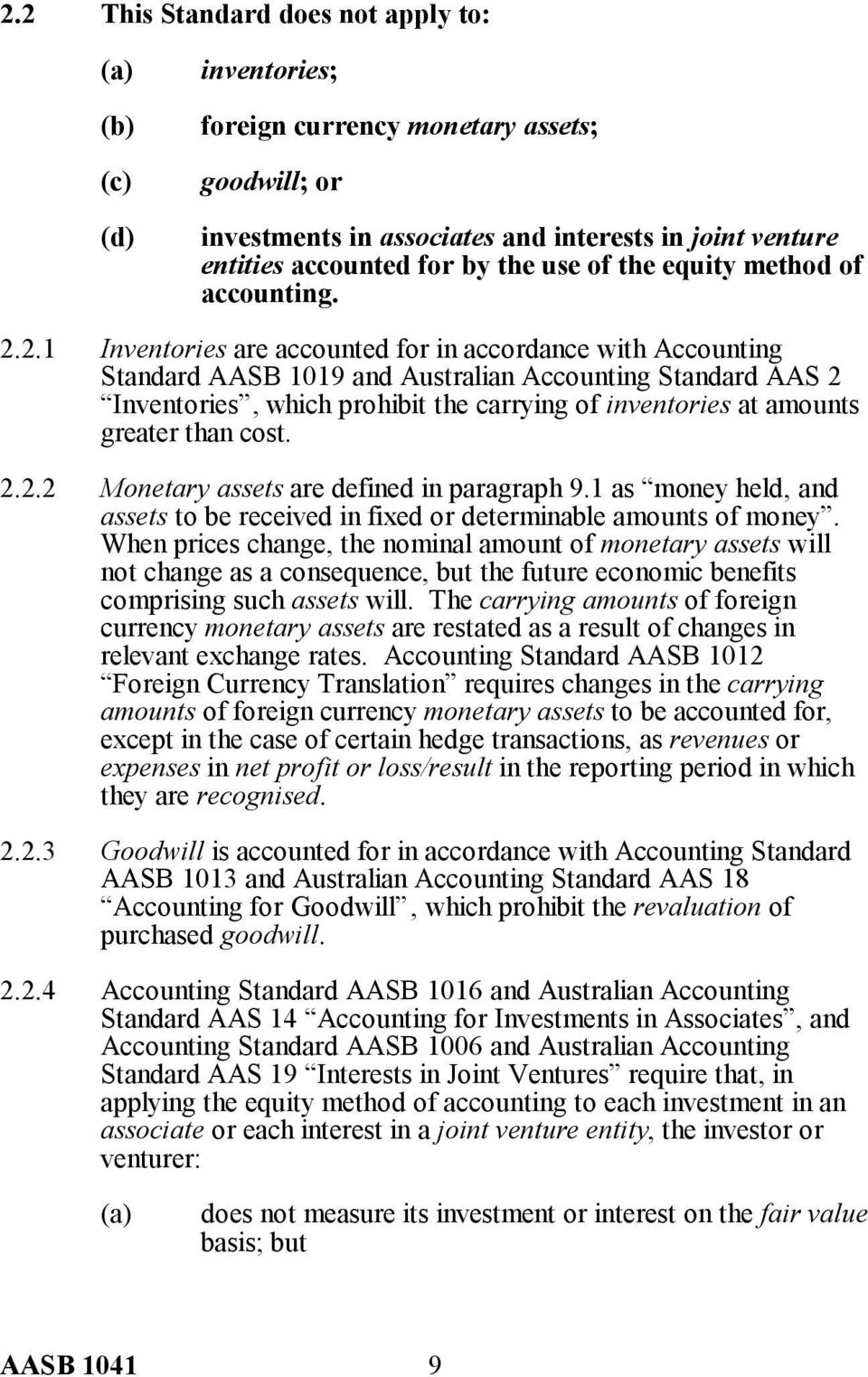
9 2.2 This Standard does not apply to: (c) (d) inventories; foreign currency monetary assets; goodwill; or investments in associates and interests in joint venture entities accounted for by the use of the equity method of accounting Inventories are accounted for in accordance with Accounting Standard AASB 1019 and Australian Accounting Standard AAS 2 Inventories, which prohibit the carrying of inventories at amounts greater than cost Monetary assets are defined in paragraph 9.1 as money held, and assets to be received in fixed or determinable amounts of money. When prices change, the nominal amount of monetary assets will not change as a consequence, but the future economic benefits comprising such assets will. The carrying amounts of foreign currency monetary assets are restated as a result of changes in relevant exchange rates. Accounting Standard AASB 1012 Foreign Currency Translation requires changes in the carrying amounts of foreign currency monetary assets to be accounted for, except in the case of certain hedge transactions, as revenues or expenses in net profit or loss/result in the reporting period in which they are recognised Goodwill is accounted for in accordance with Accounting Standard AASB 1013 and Australian Accounting Standard AAS 18 Accounting for Goodwill, which prohibit the revaluation of purchased goodwill Accounting Standard AASB 1016 and Australian Accounting Standard AAS 14 Accounting for Investments in Associates, and Accounting Standard AASB 1006 and Australian Accounting Standard AAS 19 Interests in Joint Ventures require that, in applying the equity method of accounting to each investment in an associate or each interest in a joint venture entity, the investor or venturer: does not measure its investment or interest on the fair value basis; but AASB
10 Materiality recognises its share of certain post-acquisition movements credited or debited to the asset revaluation reserve of the associate or joint venture entity The standards specified in this Standard apply to the financial report where information resulting from their application is material in accordance with Accounting Standard AASB 1031 and Australian Accounting Standard AAS 5 Materiality. 3 Operative Date 3.1 This Standard applies to annual reporting periods ending on or after 30 September This Standard may be applied to annual reporting periods ending before 30 September An entity that is required to prepare financial reports in accordance with Part 2M.3 of the Corporations Act may apply this Standard to annual reporting periods ending before 30 September 2001, where an election has been made in accordance with subsection 334(5) of the Corporations Act. 3.3 When applied or operative, this Standard supersedes: Accounting Standard AASB 1041 Revaluation of Non- Current Assets, as approved by notice published in the Commonwealth of Australia Gazette No. S 664 on 30 December 1999; and Australian Accounting Standard AAS 38 Revaluation of Non-Current Assets, as issued in December Notice of this Standard was published in the Commonwealth of Australia Gazette on 19 July Purpose of Standard 4.1 The purpose of this Standard is to prescribe the manner in which non-current assets are measured subsequent to initial recognition and require various disclosures about non-current assets. AASB

11 5 Applying a Measurement Basis to a Class of Non-Current Assets Cost or Fair Value Basis 5.1 Subsequent to initial recognition as assets, each class of non-current assets must be measured on either: the cost basis; or the fair value basis, under which revaluations must be made with sufficient regularity to ensure that the carrying amount of each asset in the class does not differ materially from its fair value at the reporting date, subject to paragraphs 5.2 and Entities choose between measuring all of the assets in a class of non-current assets on the cost basis or the fair value basis. This Standard permits some classes of non-current assets to be measured on the cost basis and other classes to be measured on the fair value basis Where consolidated financial reports are prepared, the definition of class of non-current assets is applied to the economic entity as a single entity. Commentary paragraph provides further guidance on the meaning of class of non-current assets. Cost Basis For the purposes of paragraph 5.1, any of the following measures constitutes the use of the cost basis to measure assets within a class of non-current assets: (c) their cost of acquisition, less any accumulated depreciation and accumulated recoverable amount write-downs or impairment losses; in respect of non-monetary assets contributed to the entity, their fair value as at the date of the contribution, less any subsequent accumulated depreciation and subsequent accumulated recoverable amount write-downs or impairment losses; and their carrying amount as at the time that revaluation of that class was discontinued under paragraph 6.1, less any subsequent accumulated depreciation and subsequent AASB
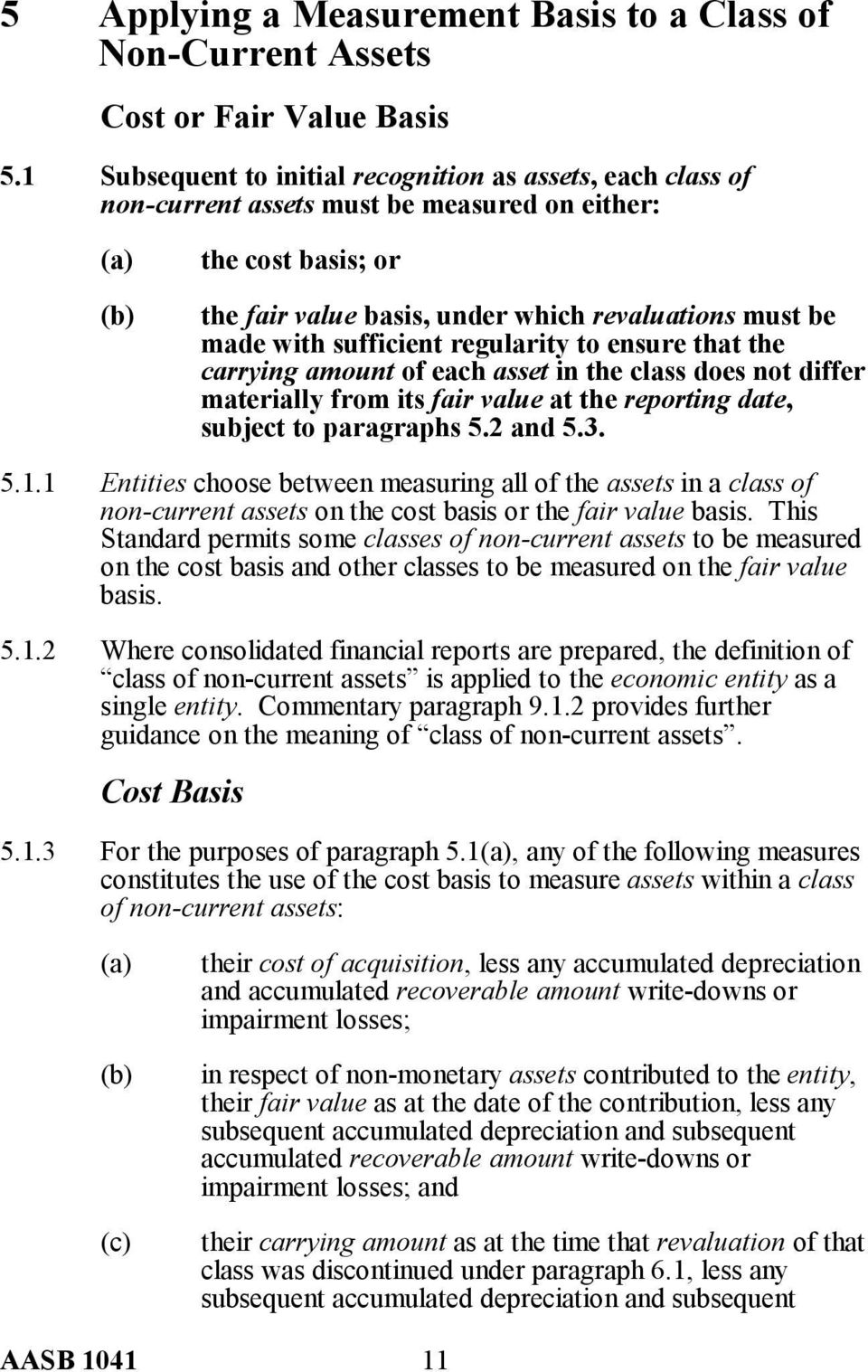
12 accumulated recoverable amount write-downs or impairment losses Measuring at fair value the purchase consideration of assets acquired in order to measure the assets cost of acquisition, as required by Accounting Standard AASB 1015 and Australian Accounting Standard AAS 21 Acquisitions of Assets, does not, of itself, constitute applying the fair value basis to measure assets Accounting Standard AASB 1010 and Australian Accounting Standard AAS 10 Recoverable Amount of Non-Current Assets require a non-current asset measured on the cost basis (including a previously revalued asset that now is measured on the cost basis) to be written down to its recoverable amount when its carrying amount is greater than its recoverable amount. Recoverable amount writedowns or impairment losses and reversals of recoverable amount write-downs or impairment losses are not revaluations. Under AASB 1010 and AAS 10, recoverable amount write-downs or impairment losses recognised in respect of assets within a class of non-current assets are not debited against any balance of the asset revaluation reserve remaining in respect of that class. Fair Value Basis Fair value is defined in paragraph 9.1 as the amount for which an asset could be exchanged, or a liability settled, between knowledgeable, willing parties in an arm s length transaction. Underlying the definition of fair value is a presumption that the entity is a going concern without any intention or need to liquidate or otherwise wind up its operations or undertake a transaction on adverse terms. Similarly, to determine the fair value of an asset, it is assumed that the asset is exchanged after an adequate period of marketing to obtain its best price. An asset s fair value is measured having regard to the highest and best use of the asset for which market participants would be prepared to pay Where a quoted market price in an active and liquid market is available for an asset, that price represents the best evidence of the asset s fair value. When a quoted market price for the asset in an active and liquid market is not available, its fair value is estimated by reference to the best available market evidence of the price at which the asset could be exchanged between knowledgeable, willing parties in an arm s length transaction. This evidence includes current market prices for assets that are similar in use, type and condition ( similar assets ) and the price of the most recent transaction for the same or a similar asset (provided there has not been a significant change in economic circumstances between the AASB
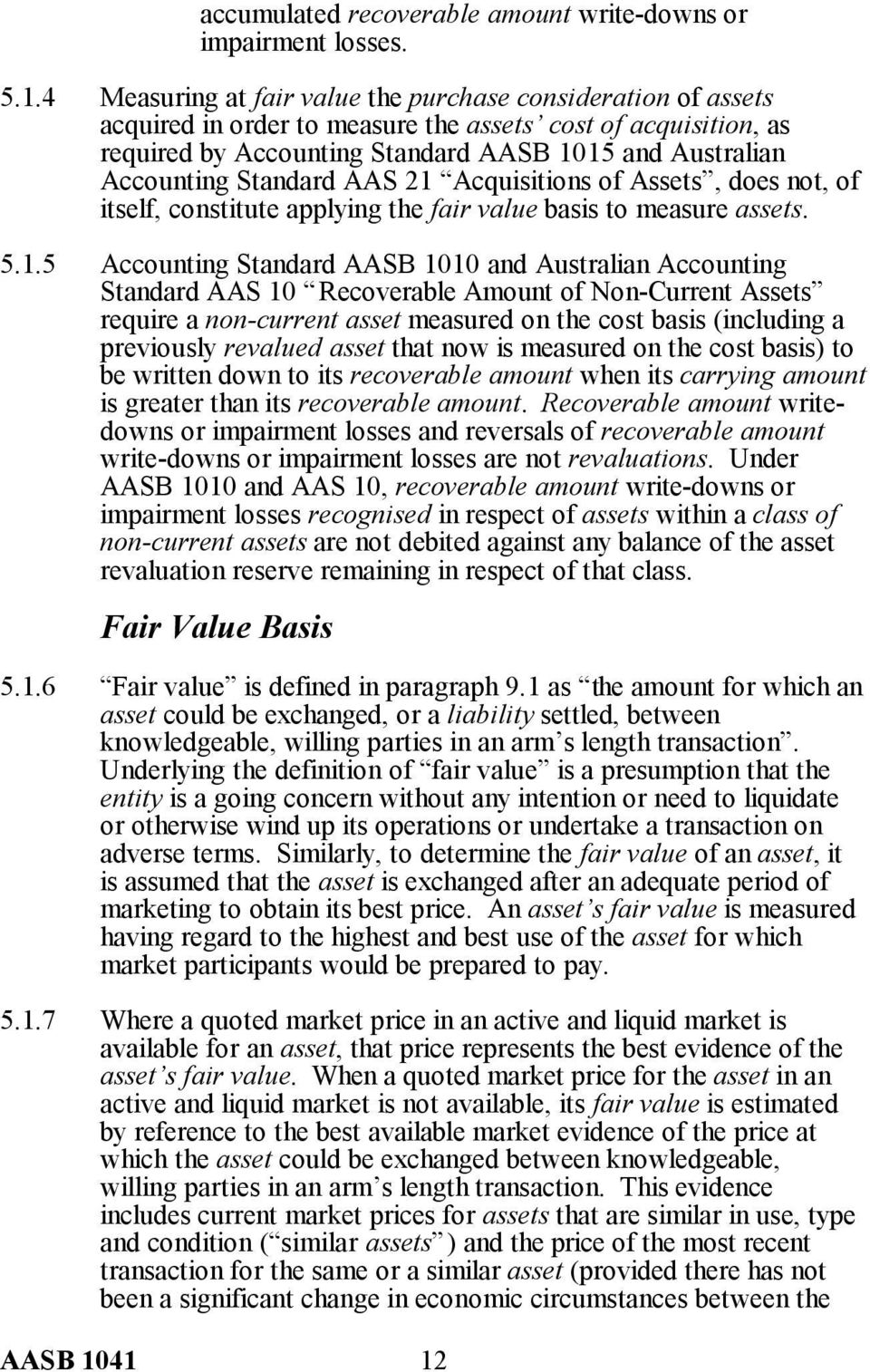
13 transaction date and the reporting date). Current market prices for the same or similar assets usually can be observed for land, nonspecialised buildings, used motor vehicles, and some forms of plant and equipment. For land and buildings, these prices can also be derived from observable market evidence (for example, observable current market rentals) using discounted cash flow analysis In some circumstances, the market buying price and market selling price of an asset differ materially because the asset usually is bought separately in the new asset market but if sold separately, could only be sold for its residual value. This is often the case for specialised assets. In some other circumstances, an asset is so specialised that there is no market evidence of its market selling price. In either circumstance, an asset may be acquired separately and included in a cash-generating operation, and would only be sold in its current condition as a part of a sale of that cash-generating operation In the circumstances described in paragraph 5.1.8, the asset s fair value is measured at its market buying price. (The best indicator of an asset s market buying price is the replacement cost of the asset s remaining future economic benefits, which is not necessarily the cost of replicating the asset, that is, its reproduction cost). However, where assets belong to a cash-generating operation, and the sum of the market buying prices of the assets forming that cash-generating operation exceeds the fair value of that operation, the fair values of the assets would be determined after deducting that excess. The excess is: first applied against the carrying amount of any purchased goodwill forming part of the cash-generating operation; and for any remainder, eliminated by reducing proportionately the market buying prices of each of the other assets forming part of the cash-generating operation. In performing this process, no asset s fair value is measured at an amount less than its market selling price For the purpose of paragraph 5.1.9, the fair value of a cashgenerating operation would be estimated, in the absence of other market evidence, as the present value of the net cash inflows that market participants would expect the highest and best use of the operation to generate. Frequency of Revaluations Where a class of non-current assets is measured on the fair value basis, the frequency of revaluations depends on the frequency and AASB

14 materiality of changes in the fair values of the assets within that class of non-current assets. Where the fair value of an asset in the class of non-current assets being revalued differs materially from its carrying amount, a revaluation is necessary. Some non-current assets may experience frequent and material movements in fair value, thus necessitating revaluation each reporting period. Such frequent revaluations are unnecessary for non-current assets that experience only immaterial movements in fair value. In these circumstances, revaluation every three years may be sufficient. The requirement in paragraph 5.1 may be met by indexing the carrying amounts of non-current assets in reporting periods between more comprehensive valuations Assets within a class of non-current assets are revalued as at substantially the same date in order to measure those assets at amounts that can meaningfully be aggregated. However, a class of non-current assets may be revalued on a progressive basis within a reporting period provided the carrying amount of each asset within the class does not differ materially from its fair value at the reporting date. Local Governments and Government Departments: Pre-Transfer Carrying Amounts 5.2 Where a local government or government department elects to measure non-current assets transferred to it for no cost of acquisition or for nominal consideration at the amounts at which the assets were recognised by the transferor immediately prior to the transfer under paragraph 72 of Australian Accounting Standard AAS 27 Financial Reporting by Local Governments (as issued in June 1996) or paragraph 7.4 of Australian Accounting Standard AAS 29 Financial Reporting by Government Departments (as issued in June 1998), and the assets are included in a class of non-current assets measured on the fair value basis, those assets need not be revalued until the class of non-current assets is next revalued For assets acquired at no cost or for nominal consideration: by a local government from another local government by virtue of legislation, ministerial directive or other externally imposed requirement; or by a government department as a consequence of a restructuring of administrative arrangements; AASB
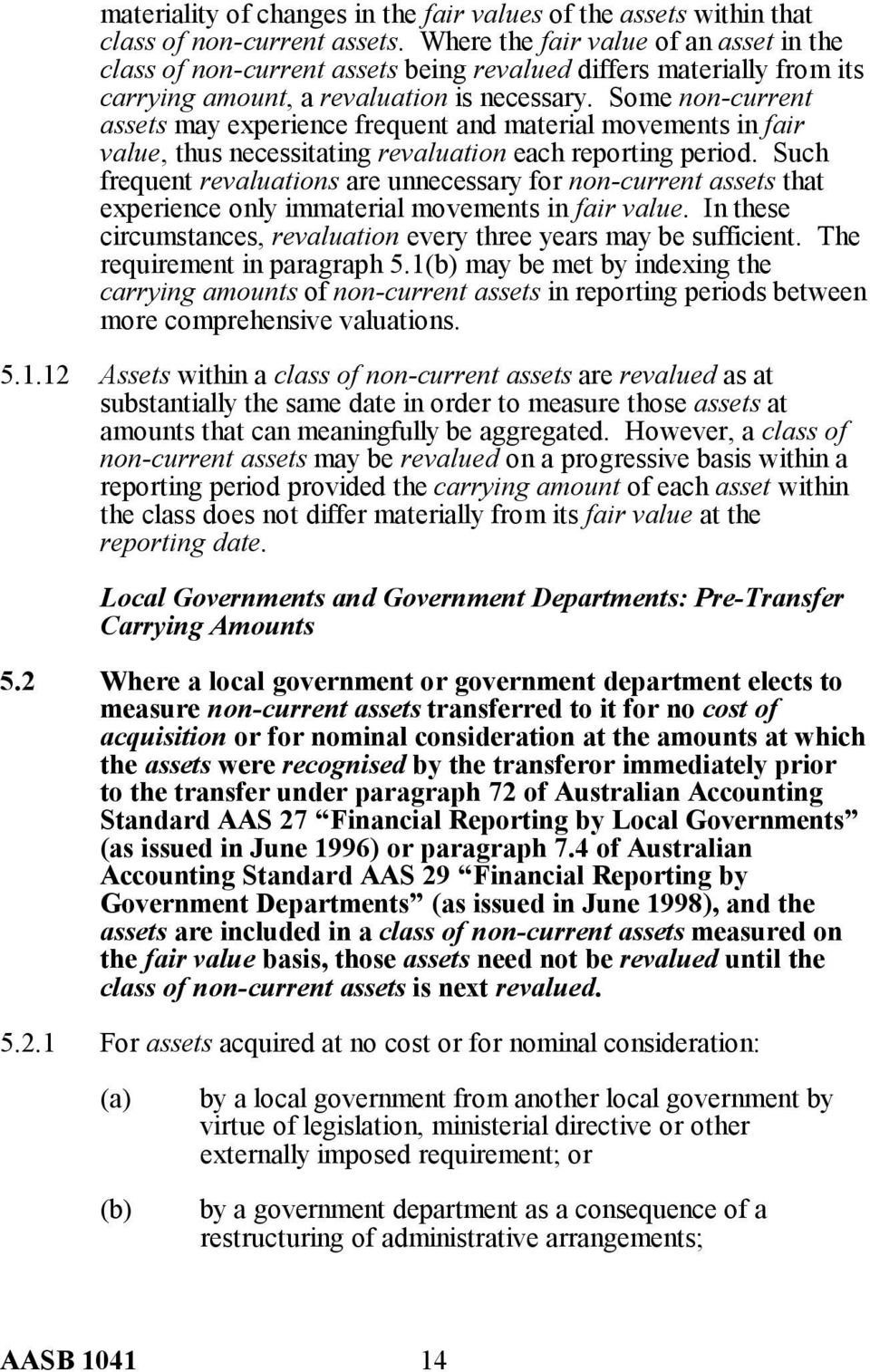
15 AAS 27 and AAS 29 provide an option for local governments and government departments to measure these assets at the amounts at which the assets were recognised by the transferor immediately prior to the transfer. Paragraph 5.2 modifies the application of paragraph 5.1 so that it extends this option under AAS 27 and AAS 29 where transferred assets are included within a class of noncurrent assets measured on the fair value basis and their carrying amounts differ materially from their fair value. Instead, those assets would need to be revalued to fair value when the class of noncurrent assets is next revalued When the carrying amounts of transferred assets within a class of non-current assets measured on the fair value basis differ materially from their fair value, as permitted by paragraph 5.2, separate disclosure of the assets measured at fair value and at the transferor s carrying amount is required by paragraph 7.4 of this Standard. Consolidated Financial Statements 5.3 A revaluation of non-current assets to fair value recognised in consolidated financial statements on the acquisition of an equity interest in a subsidiary as required by other Accounting Standards does not give rise to a requirement to subsequently revalue those assets in the consolidated financial statements under paragraph Accounting Standard AASB 1024 Consolidated Accounts and Australian Accounting Standard AAS 24 Consolidated Financial Reports, applied in conjunction with AASB 1013 and AAS 18, and AASB 1015 and AAS 21, require the carrying amounts of the noncurrent assets of a subsidiary to be measured at fair value or, where applicable, fair value less discount on acquisition, in the consolidated financial statements as at the date the parent entity acquires a controlling interest in the subsidiary or as at the date of acquiring a subsequent equity interest in the subsidiary Such a transaction may involve the acquisition of a part of the equity of the subsidiary (which occurs either where a share of the equity of the subsidiary has previously been acquired by the entity, or there exists an outside equity interest), in which case the identifiable assets representing the remainder of the equity of the subsidiary are required by AASB 1024 and AAS 24 to be revalued in the consolidated financial statements. Under paragraph 5.3, such a revaluation does not give rise to a requirement to subsequently revalue those assets in the consolidated financial statements. Where those assets are not subsequently revalued through the adoption of AASB
16 the fair value basis, they are treated as being measured on the cost basis However, where identifiable non-current assets are revalued in the accounting records of the subsidiary, and not just in the consolidated financial statements, paragraph 5.1 applies to the financial statements of the subsidiary. Net Revaluation Increments and Decrements Offsetting of Revaluation Increments and Decrements 5.4 Subject to paragraph 6.2, revaluation increments and revaluation decrements must be offset against one another within a class of non-current assets, but must not be offset in respect of different classes of non-current assets. Recognition of Net Revaluation Increments and Decrements 5.5 Where non-current assets are revalued, the net revaluation increment or net revaluation decrement arising in the reporting period (determined in accordance with paragraph 5.4) must be accounted for as follows: a net revaluation increment relating to a class of non-current assets must be credited directly to an asset revaluation reserve - except that, to the extent that the net increment reverses a net revaluation decrement previously recognised as an expense in net profit or loss/result in respect of that same class of non-current assets, it must be recognised immediately as revenue in net profit or loss/result; and a net revaluation decrement relating to a class of non-current assets must be recognised immediately as an expense in net profit or loss/result - except that, to the extent, and only to the extent, that a credit balance exists in the asset revaluation reserve in respect of that same class of non-current assets, the net revaluation decrement grossed up for any related recognised current tax and deferred tax must be debited directly to the asset revaluation reserve This Standard requires that, in respect of a class of non-current assets, reversals of previous revaluations are, as far as possible, to AASB

17 be accounted for by entries which are the reverse of those by which the previous revaluations were recognised. This policy is applied in conjunction with the requirements of Accounting Standard AASB 1020 and Australian Accounting Standard AAS 3 Income Taxes that current tax and deferred tax that arise in a reporting period are debited (credited) to an asset revaluation reserve if the tax relates to a revaluation increment (decrement) that is or was credited (debited) to the balance of the asset revaluation reserve in respect of a class of non-current assets during the current or a previous reporting period, except to the extent that this treatment of current tax and deferred tax would cause the balance of the asset revaluation reserve in respect of that class of non-current assets to be a debit balance. 1 The Appendix to this Standard provides examples illustrating the accounting treatment of revaluations of non-current assets and their associated income tax effects in accordance with paragraph 5.5, and with AASB 1020 and AAS An example of applying the policy prescribed in paragraph 5.5 is where a net revaluation decrement in respect of a class of noncurrent assets reverses a previous revaluation increment or cumulative revaluation increment in respect of that same class. The credit balance existing in the asset revaluation reserve in respect of a class of non-current assets prior to recognising the revaluation decrement would be net of any current tax and deferred tax recognised in respect of the cumulative revaluation increments and revaluation decrements giving rise to that balance. In accordance with paragraph 5.5, the amount of the revaluation decrement would be debited to the asset revaluation reserve and, in accordance with AASB 1020 and AAS 3, any related current tax and deferred tax would be credited to the asset revaluation reserve, to the extent that a credit balance exists in the asset revaluation reserve in respect of that class of non-current assets. Any excess over that credit balance would then be recognised as an expense in net profit or loss/result for the reporting period in accordance with paragraph 5.5, and any current tax and deferred tax related to that excess would be recognised as revenue in net profit or loss/result for the reporting period in accordance with AASB 1020 and AAS 3. Paragraph 5.5, AASB 1020 and AAS 3 prohibit debiting net 1 References in this Standard to Accounting Standard AASB 1020 and Australian Accounting Standard AAS 3 Income Taxes are to the revised AASB 1020 and AAS 3 issued in December Until adoption of the revised AASB 1020 (which is operative for half-years ending on or after 31 December 2002 and financial years ending on or after 30 June 2003, but may be adopted early) or AAS 3 (which is operative for reporting periods beginning on or after 1 July 2002, but may be adopted early), the entity would not recognise deferred tax assets or deferred tax liabilities in respect of revaluations of noncurrent assets. AASB
18 revaluation decrements (after taking into account any related recognised current tax and deferred tax) to the balance of the asset revaluation reserve in respect of a class of non-current assets to the extent that this would result in a debit balance for the reserve in respect of that class Another illustration of the policy prescribed in paragraph 5.5 is where the earlier net revaluation increment or cumulative increment credited to the asset revaluation reserve (less any related recognised current tax and deferred tax) in respect of a class of non-current assets has been partly or fully utilised by transferring a part or all of it to another reserve such as retained profits (surplus). In this circumstance, under AASB 1020 and AAS 3 the amount transferred to the other reserve is net of any related recognised current tax and deferred tax. Under paragraph 5.5, the amount of the subsequent net revaluation decrement (less any related recognised current tax and deferred tax) which is debited to the asset revaluation reserve is limited to the cumulative balance of prior net revaluation increments remaining in that reserve for the particular class of assets. Once an amount has been transferred from an asset revaluation reserve to another reserve, it is not available for offsetting against future revaluation decrements. That is, a transfer from an asset revaluation reserve is not merely a matter of display; and an amount transferred from an asset revaluation reserve does not retain its character as a balance of an asset revaluation reserve A further example of the policies prescribed in paragraph 5.5 is when the earlier net revaluation increment or cumulative net revaluation increment credited to the asset revaluation reserve (less any related recognised current tax and deferred tax) in respect of a class of non-current assets has been partly utilised by debiting against it a net revaluation decrement (and crediting against it any related recognised current tax and deferred tax) for an asset within that class of non-current assets. For example, a class of non-current assets comprises two holdings of land, described below as Assets A and B. For the purpose of applying AASB 1020 and AAS 3, the income tax rate on capital gains and losses is assumed to be 30 per cent, and the tax base of the assets is assumed to be their cost. It is also assumed that the deferred tax asset arising in respect of the revaluation decrement satisfies the recognition criteria for deferred tax assets in AASB 1020 and AAS 3 regardless of whether a deferred tax liability is recognised in respect of the earlier revaluation increment. The details of these assets are: AASB
19 Details Asset A Asset B Class Tax Effect Asset Reval n Reserve $ 000 $ 000 $ 000 $ 000 $ 000 Cost at X1 1, ,800 Revaluation increment for year ended X2 250 * 250 (75) 175 Carrying amount as at X2 1, ,050 (75) 175 Revaluation decrement for year ended X3 * (150) (150) 45 (105) Carrying amount as at X3 1, ,900 (30) 70 * The fair value of these assets was reassessed, but found not to have changed. The cumulative balance remaining in the asset revaluation reserve in respect of the class of non-current assets as at X3 is $70,000. If Asset A were sold for net proceeds of $1,250,000 during the reporting period ending on X4, thereby realising all of the $250,000 revaluation increment (and all of the related income tax effect of $75,000) originally recognised in respect of that asset, it would not conform with paragraph 5.5 to transfer an amount of $175,000 from the asset revaluation reserve to retained profits (surplus), because it would result in a debit balance of the asset revaluation reserve being recognised in respect of that class of noncurrent assets. The amount of any transfer to retained profits (surplus) [net of any related recognised current tax and deferred tax] would be limited to the cumulative balance of $70,000 in the asset revaluation reserve in respect of that class of non-current assets. 5.6 The balance of an asset revaluation reserve in respect of a class of non-current assets must only be credited with: AASB

20 net revaluation increments recognised for assets within the same class of non-current assets in accordance with paragraph 5.5; and amounts required to be credited to the balance of the asset revaluation reserve in respect of that class in accordance with another Standard Amounts are not transferred to an asset revaluation reserve from another reserve, for example, from retained profits (surplus). This rule applies regardless of the extent to which amounts have previously been transferred from the asset revaluation reserve to other reserves. In the example in paragraph 5.5.4, if Asset B were disposed of, this Standard would not permit an amount equal to the revaluation decrement (net of any related recognised current tax and deferred tax) previously debited against the asset revaluation reserve ($105,000) in respect of the class of non-current assets to be transferred to the asset revaluation reserve from another reserve in order to restore the revaluation increments that related to Asset A Where the boundaries of a class of non-current assets are redefined (for example, because of a change in the functions of particular assets in the entity s operations), a consequential reclassification of a balance of an asset revaluation reserve between classes of noncurrent assets is not a transfer of that balance between classes of non-current assets. Accordingly, paragraph 5.6 does not prohibit the reclassification of a balance of the asset revaluation reserve in respect of a class of non-current assets where the underlying noncurrent assets have been reclassified AASB 1020 and AAS 3, and AASB 1024 and AAS 24 require amounts to be credited to the balance of the asset revaluation reserve in specified circumstances. Treatment of Revaluations of Depreciable Assets 5.7 Subject to paragraph 5.8, where depreciable assets are revalued, any balances of accumulated depreciation existing as at the revaluation date in respect of those assets must be credited to the asset accounts to which they relate. The asset accounts must then be increased or decreased by the amount of the revaluation increments or revaluation decrements. 5.8 Where an entity revalues depreciable assets by reference to current prices for assets newer than those being revalued, and adjusts those amounts to reflect the present condition of the assets, it may restate separately the gross amounts and related AASB
21 accumulated depreciation of the assets comprising the class of revalued assets An entity revaluing a non-current asset may need to estimate its fair value because of, for example, the absence of a market in the relevant second-hand non-current assets. In these circumstances, an estimate of fair value, based on the replacement cost of the asset s remaining future economic benefits, may be made by reference to the market buying price of components used to produce the asset or the indexed price for the asset based on a price from a previous reporting period. Where such estimates have been used, the separate display of gross amounts and related accumulated depreciation may provide users with relevant information which will assist in assessing the condition of the assets by disclosing the expired component of their useful lives, and the possible amount and timing of cash outflows for their replacement Regardless of whether non-current assets are disclosed at gross or net amounts upon revaluation, future depreciation expenses are required to be based on the revalued amounts of the assets (refer to the definition of depreciable amount and related commentary in Accounting Standard AASB 1021 and Australian Accounting Standard AAS 4 Depreciation ). Depreciation expenses based on the gross amount of a revalued depreciable asset are determined by reference to the total useful life of the asset to the entity. Alternatively, depreciation expenses based on the carrying amount of a revalued depreciable asset are determined by reference to the remaining useful life of the asset to the entity. Accordingly, the amount of depreciation expense recognised is identical irrespective of which method of presentation is applied. Disposal of Non-Current Assets 5.9 The gain or loss on disposal of a non-current asset must be measured as the difference between the carrying amount of the asset as at the time of disposal and the net proceeds, if any, from disposal, and must be recognised in net profit or loss/result for the reporting period in which disposal of the asset occurs Paragraph 5.9 deals with the measurement, but not display, of the gain or loss on disposal of non-current assets. Accounting Standard AASB 1004 and Australian Accounting Standard AAS 15 Revenue require the proceeds from the sale of assets other than goods, including non-current assets, to be disclosed separately as revenue. In addition, Accounting Standard AASB 1018 and Australian Accounting Standard AAS 1 Statement of Financial Performance require disclosure of the net gain or loss on disposal AASB
22 of non-current assets that are not measured at net market value. AASB 1018 and AAS 1 prohibit reversing and recognising as revenue within net profit or loss/result any net revaluation increments recognised in the asset revaluation reserve in a previous reporting period. This prohibition is also pertinent to entities that discontinue application of the fair value basis for a class of noncurrent assets (see paragraph 6.3). 6 Changing the Measurement Basis for a Class of Non-Current Assets 6.1 An entity may elect to change from the cost basis to the fair value basis to measure a class of non-current assets, or may elect to discontinue revaluing a class of non-current assets, when and only when the change meets the criteria for a voluntary change in accounting policy in paragraph 6.1(c) of Accounting Standard AASB 1001 and Australian Accounting Standard AAS 6 Accounting Policies, as issued in March Such a change must be applied as at the beginning of the annual reporting period in which the change is made AASB 1001 and AAS 6 require that, when a Standard permits alternative accounting policies, a change from one permitted accounting policy to another permitted accounting policy must be made only when particular criteria are satisfied. The criteria for a voluntary change in accounting policy in AASB 1001 and AAS 6 would rarely be satisfied in respect of the discontinuation of the application of the fair value basis. An example of a circumstance under which the discontinuation of the application of the fair value basis for a class of non-current assets may satisfy the criteria in AASB 1001 and AAS 6 is where there has been a change in the parent entity of the entity or of an entity that controls that parent entity. Changing from the Cost Basis to the Fair Value Basis 6.2 Where an entity changes from the cost basis to the fair value basis to measure a class of non-current assets that includes an asset for which a recoverable amount write-down or impairment loss previously has been recognised as an expense, any increase in the carrying amount of that asset, up to the carrying amount that would have been determined for it had no recoverable amount write-down or impairment loss previously been recognised, must be accounted for as a reversal of the recoverable amount write-down or impairment loss (that is, it AASB
23 must be recognised as a revenue in net profit or loss/result for the reporting period in which the reversal occurs). Any increase in the carrying amount of the asset above the carrying amount that would have been determined had no recoverable amount writedown or impairment loss previously been recognised must, together with any revaluation increments or decrements for the other assets in that class of non-current assets, be accounted for as a net revaluation increment or decrement in accordance with paragraphs 5.4 and Where an entity changes from the cost basis to the fair value basis to measure a class of non-current assets, and a recoverable amount write-down or impairment loss has not previously been recognised in respect of that class, the change is accounted for under paragraphs 5.4 and 5.5. Discontinuation of the Application of the Fair Value Basis 6.3 Where an entity discontinues revaluing a class of non-current assets under paragraph 6.1: it must subsequently measure the assets comprising the class at the date of the discontinuation of revaluation at their carrying amount as at that date less any subsequent accumulated depreciation and subsequent accumulated recoverable amount write-downs or impairment losses; and any balances of accumulated depreciation in respect of that class of non-current assets as at the date of the discontinuation of revaluation must be used as the basis for disclosing the gross amount and any related accumulated depreciation separately in accordance with AASB 1021 and AAS Where revaluation of a class of non-current assets is discontinued, paragraph 6.3 prohibits the making of retrospective adjustments to measure the assets comprising the class as if they had always been measured using the cost basis. This prohibition is a departure from AASB 1001 and AAS 6, which require the cumulative financial effect of a voluntary change in accounting policy to be calculated as if the new accounting policy had always been applied. Those retrospective adjustments are only permitted under paragraph 8.7, where revaluation of a class of non-current assets is discontinued on initial application of this Standard. AASB
24 6.3.2 For assets referred to in paragraph 6.3, as at the date of the discontinuation of revaluation, any balances of accumulated depreciation in respect of those assets are not credited to the asset accounts to which they relate. These balances may have arisen upon the revaluation of a class of non-current assets under paragraph Assets acquired after revaluation of the class of non-current assets is discontinued are measured at their cost of acquisition, less any accumulated depreciation and accumulated recoverable amount write-downs or impairment losses. 7 Disclosures Non-Current Assets Measured at Fair Value 7.1 The financial report must disclose in respect of each class of non-current assets measured on the fair value basis: the method(s) used in determining fair values; and whether the revalued carrying amount has been determined in accordance with an independent valuation Where an asset has previously been revalued based on a valuation conducted by an independent valuer, and is subsequently measured at the same amount because the management or governing body decides that the fair value of that asset is not materially different from the amount previously determined by the independent valuer, such a valuation is deemed not to be an independent valuation for the purposes of the disclosure required by paragraph Where the revalued carrying amounts of some of the assets within a class of non-current assets have been determined in accordance with an independent valuation, disclosure of the carrying amount of the assets within the class that have been determined in accordance with an independent valuation is necessary for compliance with paragraph In respect of investments quoted on a stock exchange, the description at current market value would be sufficient for compliance with paragraphs 7.1 and. 7.2 Where the fair value basis is applied for measuring a class of non-current assets, and the replacement cost of the asset s AASB
25 remaining future economic benefits calculated using an index has been used to determine the fair value of an asset within that class, the financial report must disclose the nature of the index used. 7.3 The financial report must disclose the balance of the asset revaluation reserve for the entity as at the reporting date and, if the entity is a profit-seeking entity, disclose any restrictions on the distribution of the balance to owners Restrictions on distributions of the balance of the asset revaluation reserve to owners that arise from case law or, in the case of trusts, the trust deed, may qualify for disclosure under paragraph 7.3. Local Governments and Government Departments: Pre-Transfer Carrying Amounts 7.4 Where a local government or government department recognises a class of non-current assets that is measured on the fair value basis and that class includes assets that are not measured at fair value, its financial report must disclose: the aggregate carrying amount of each of the following: (i) (ii) assets within that class which are carried at fair value less, where applicable, any accumulated depreciation; and assets within that class which are not carried at their fair value less, where applicable, any accumulated depreciation; and the basis or bases of valuation applied in respect of the amount disclosed in accordance with paragraph 7.4(ii) The disclosures required by paragraph 7.4 need to be made where the fair value basis has been applied by a local government or government department for measuring a class of non-current assets, and that entity has acquired further assets included in that class and carries them at an amount other than fair value. This can occur in the circumstances described in paragraph AASB
26 Discontinuation of Revaluations of a Class of Non- Current Assets 7.5 Where an entity discontinues revaluation of a class of noncurrent assets during the reporting period, it need not apply paragraph 8.5(d) of AASB 1001 and AAS 6, as issued in March Where, under paragraph 6.1, an entity discontinues applying the fair value basis, that change in accounting policy could materially affect the amount of expenses (for example, depreciation expense) recognised in the next reporting period, without necessarily affecting the expenses recognised in the reporting period in which the change in accounting policy is made. Where an entity elects to make that change in accounting policy, paragraph 7.5 sets aside the requirement to disclose the financial effect of the change in the next reporting period specified in paragraph 8.5(d) of AASB 1001 and AAS 6, as issued in March Paragraph 8.5 of AASB 1001 and AAS 6 requires that where a change in an accounting policy did not have a material effect in the reporting period in which the change was made, but has a material effect in the next reporting period, disclosure of the change (including its financial effect) is made in the next reporting period. However, where the change in accounting policy has an effect in the reporting period in which the change occurs, the entity complies with the disclosure requirements in paragraph 8.4 of AASB 1001 and AAS 6. Other Disclosures 7.6 The financial report must disclose, for each class of property, plant and equipment, a reconciliation of the carrying amount at the beginning and end of the reporting period, showing: (c) (d) (e) additions; disposals; acquisitions through acquisitions of entities or operations; the net amount of revaluation increments less revaluation decrements; recoverable amount write-downs or impairment losses recognised in accordance with AASB 1010 or AAS 10; AASB
27 (f) (g) (h) (i) reversals of recoverable amount write-downs or impairment losses; depreciation expense; the net foreign currency exchange differences arising on the translation of the financial statements of a self-sustaining foreign operation; and other movements The entity discloses those items in paragraph 7.6 that are applicable to the class of property, plant and equipment, according to whether the cost basis or the fair value basis is applied to that class. 7.7 Comparative information is not required for the reconciliation specified in paragraph Transitional Arrangements General 8.1 The accounting policies required by this Standard must be applied as at the beginning of the reporting period to which this Standard is first applied. 8.2 For a class of non-current assets that was measured on the cost basis as at the immediately preceding reporting date, an entity may elect to apply either of the following policies on first applying this Standard: continue to apply the cost basis to that class of noncurrent assets in accordance with this Standard; or apply the fair value basis in accordance with this Standard, after making initial adjustments in accordance with paragraph 8.5 if necessary. 8.3 For a class of non-current assets that was measured on a basis other than cost as at the immediately preceding reporting date, an entity may elect to apply either of the following policies on first applying this Standard: revalue the assets in that class of non-current assets in accordance with this Standard, after making initial AASB
28 adjustments in accordance with paragraph 8.5 if necessary; or revert to the cost basis in accordance with paragraph 8.7. Transition to the Fair Value Basis 8.4 Where paragraph 8.6 does not apply and: (c) as at the date of first applying this Standard, an entity elects to initially apply the fair value basis of measuring a class of non-current assets; a public sector entity not required to prepare financial reports in accordance with Part 2M.3 of the Corporations Act initially applies the fair value basis of measuring a class of non-current assets when it ceases to apply paragraph 8.10 during a reporting period beginning on or before 30 June 2003; or a public sector entity (other than a listed corporation) is progressively revaluing a class of property, plant and equipment over more than one reporting period under paragraph 8.13, and during a reporting period no later than the first reporting period beginning after 30 June 2005 revalues a proportion of that class of assets to its fair value; the adjustments necessary to restate the carrying amounts of non-current assets to their fair value must be recognised in accordance with paragraph The adjustments arising under paragraph 8.4 must be accounted for as follows: if the entity is changing from applying the cost basis to that class of non-current assets, and the class includes an asset for which a recoverable amount write-down or impairment loss previously has been recognised as an expense, any increase in the carrying amount of that asset, up to the carrying amount that would have been determined for it had no recoverable amount writedown or impairment loss previously been recognised, must be credited directly to retained profits (surplus) or accumulated losses (deficiency). Any increase in the carrying amount of the asset above the carrying amount AASB
29 that would have been determined had no recoverable amount write-down or impairment loss previously been recognised must, together with the net amount of any revaluation increments or decrements for the other assets in that class of non-current assets, be credited directly to the asset revaluation reserve or debited directly to retained profits (surplus) or accumulated losses (deficiency); and where paragraph 8.5 does not apply: (i) (ii) any net revaluation increment arising upon revaluing those assets to their fair value as at that date must be credited directly to the asset revaluation reserve except that, to the extent that the net increment reverses a net revaluation decrement previously recognised as an expense in net profit or loss/result in respect of that same class of non-current assets, it must be credited directly to retained profits (surplus) or accumulated losses (deficiency); and any net revaluation decrement arising upon revaluing those assets to their fair value as at that date must, to the extent that a credit balance exists in the asset revaluation reserve in respect of that class of non-current assets, be debited directly to the asset revaluation reserve, and any remainder of the net revaluation decrement must be debited directly to retained profits (surplus) or accumulated losses (deficiency) Where the fair value basis initially is applied for a class of noncurrent assets, under the transitional arrangements for initial application of the Standard, amounts are credited or debited directly to retained profits (surplus) or accumulated losses (deficiency) in circumstances in which they would be recognised as revenues or expenses under the requirements for subsequent application of the Standard (set out in paragraphs 5.5 and 6.2) Because paragraph 8.1 requires the accounting policies required by this Standard to be applied as at the beginning of the reporting period to which this Standard is first applied, the net revaluation increment or decrement credited or debited directly to the asset revaluation reserve or to retained profits (surplus) or accumulated losses (deficiency) under paragraph 8.5 is the net increment or AASB
30 decrement needed to adjust the carrying amounts of the non-current assets to their fair value as at the beginning of the reporting period. Accordingly, net revaluation increments and decrements arising during the reporting period are treated in accordance with paragraphs 5.4 and Paragraph 8.4(c) excludes progressive revaluations made on the existing revaluation basis under paragraph 8.10 by public sector entities that are not required to prepare financial reports in accordance with Part 2M.3 of the Corporations Act. Net revaluation increments and decrements for these revaluations are treated in accordance with paragraphs 5.4 and 5.5 for the transitional period. Entities that have Already Applied AASB 1041 or AAS Where an entity applied AASB 1041 or AAS 38 as issued in December 1999 and changed from a revaluation basis to the cost basis for a class of non-current assets, and elects to apply the fair value basis for that class of non-current assets on first applying this Standard, it must make adjustments that result in the carrying amounts of the class of non-current assets, the asset revaluation reserve and retained profits (surplus) or accumulated losses (deficiency) that would have been recognised when this Standard is first applied if the entity had not previously changed to the cost basis To the extent that the voluntary application of the fair value basis upon initial application of this Standard reverses the net increment or decrement in the carrying amount of a class of non-current assets recognised under paragraph 10.4 of AASB 1041 and AAS 38 as issued in December 1999 when the entity previously changed to the cost basis for that class, the entity: reverses the entries made to the asset revaluation reserve and to retained profits (surplus) or accumulated losses (deficiency); and directly adjusts the opening balance of retained profits (surplus) or accumulated losses (deficiency) for the effect on depreciation expense of temporarily applying the cost basis in a previous reporting period or in previous reporting periods To the extent that the net revaluation increment or decrement for the class of non-current assets arising from the application of the fair AASB
31 value basis upon initial application of this Standard exceeds the sum of the adjustments corresponding to the entries described in paragraphs and, the excess is unrelated to the reversal of accounting policy and is accounted for in the normal manner under paragraph 5.5. Reverting from a Revaluation Basis to the Cost Basis 8.7 On first applying this Standard, an entity may elect to revert to the cost basis for measuring a class of non-current assets that was carried at a revalued amount at the immediately preceding reporting date by applying either of the following policies: deeming the carrying amount of the non-current assets comprising the class at the date of first applying this Standard to be their cost; or making retrospective adjustments to measure the non-current assets comprising the class at their cost of acquisition less any accumulated depreciation and any accumulated recoverable amount write-downs or impairment losses, as if they had always been measured using the cost basis. For that class of non-current assets, the resulting net increments and decrements to the carrying amounts of assets must be recognised by making the following adjustments: (i) (ii) (iii) debiting the credit balance of the asset revaluation reserve for that class; directly adjusting retained profits (surplus) or accumulated losses (deficiency) by the cumulative effect of previous revaluations on the amount of depreciation that has been recognised as an expense in net profit or loss/result; and directly adjusting retained profits (surplus) or accumulated losses (deficiency) for any amounts not able to be adjusted in accordance with paragraph 8.7(i) An example of a circumstance where paragraph 8.7(iii) would apply is where the credit balance of the asset revaluation reserve in respect of a class of non-current assets is insufficient to reverse the previous net revaluation increments relating to that class because a portion of the balance of the asset revaluation reserve in respect of AASB
32 that class has been utilised for a bonus share issue. Another example is where the retrospective adjustments recognised under paragraph 8.7 increase the carrying amounts of the assets comprising the class, in which case both paragraph 8.7(ii) and paragraph 8.7(iii) apply Where an entity changes from a revaluation basis to the cost basis to measure a class of non-current assets: if paragraph 8.7 is applied, any balance in the asset revaluation reserve in respect of that class will remain unless it is transferred to another reserve; and if paragraph 8.7 is applied, a balance may still remain in the asset revaluation reserve in respect of that class despite the retrospective adjustments made under paragraph 8.7(i). This may occur, for example, because noncurrent assets giving rise to previous net revaluation increments have been disposed of before the reporting period in which this Standard is first applied. However, as is noted in paragraph 5.9.1, AASB 1018 and AAS 1 prohibit reversing and recognising as revenue within net profit or loss/result any net revaluation increments recognised in the asset revaluation reserve in a previous reporting period. 8.8 Where an entity elects to apply paragraph 8.7 to a class of non-current assets, either on initial application of this Standard or during the reporting periods to which paragraphs 8.12 and 8.13 apply: any balances of accumulated depreciation and accumulated recoverable amount write-downs or impairment losses in respect of that class of non-current assets as at the date of first applying this Standard must be used as the basis for disclosing the gross amount and any related accumulated depreciation separately in accordance with AASB 1021 and AAS 4; and the entity need not apply paragraph 8.5(d) of AASB 1001 and AAS 6, as issued in March Paragraph 8.8 provides similar relief from the disclosure requirement in paragraph 8.5(d) of AASB 1001 and AAS 6 as the relief provided in paragraph 7.5. AASB
33 8.9 Where paragraph 8.7 is applied, any balances of accumulated depreciation and accumulated recoverable amount write-downs or impairment losses in respect of the class of non-current assets as at the date of first applying this Standard must be restated separately to the amounts that would have been recorded in the accounting records if they had always been measured using the cost basis The separately remeasured gross amount (cost of acquisition) and any related accumulated depreciation and accumulated recoverable amount write-downs or impairment losses in respect of the assets referred to in paragraph 8.9 as at the date of first applying this Standard are used as the basis for disclosing the gross amount and any related accumulated depreciation separately in accordance with AASB 1021 and AAS 4. Public Sector Entities: Existing Revaluation Basis 8.10 For any reporting period beginning on or before 30 June 2002, public sector entities that are not required to prepare financial reports in accordance with Part 2M.3 of the Corporations Act and did not elect to revert to the cost basis under paragraph 8.3 to measure the carrying amount of a class of non-current assets that was measured on a revaluation basis must measure the carrying amount of the class on either: the fair value basis required by paragraph 5.1, subject to paragraph 8.12; or the revaluation basis used for that class for the reporting period immediately preceding the first reporting period to which this Standard is applied. Where this basis is applied to revalue a class of noncurrent assets: (i) (ii) the financial report must disclose the revaluation basis applied; any asset within that class, other than a non-current asset of a not-for-profit entity for which the future economic benefits are not primarily dependent on the asset s ability to generate net cash inflows, must be written down to its recoverable amount when its carrying amount exceeds its recoverable amount; and AASB
34 (iii) the financial report must disclose the aggregate carrying amount of assets within that class that are carried at their recoverable amount less, where applicable, any subsequent accumulated depreciation Net changes in the carrying amount of a class of non-current assets measured under paragraph 8.10 are accounted for under paragraphs 5.4 and 5.5 as if they were net revaluation increments or net revaluation decrements arising from a revaluation of that class to its fair value For public sector entities that are not required to prepare financial reports in accordance with Part 2M.3 of the Corporations Act, where non-current assets are written down to their recoverable amount in accordance with paragraph 8.10(ii), the write-down must be accounted for as if it were a revaluation decrement, in accordance with paragraphs 5.4 and 5.5. Public Sector Entities: Progressive Revaluations Within a Class of Property, Plant and Equipment 8.12 For reporting periods beginning no later than 30 June 2005, with respect to the frequency of revaluations of property, plant and equipment, a public sector entity other than a listed corporation must either: comply with paragraph 5.1; or apply the requirements in paragraphs 8.13 to 8.16, where those paragraphs apply to that entity Where an item of property, plant and equipment is revalued, the assets within the class of assets to which it belongs must be revalued on a consistent basis. The class of property, plant and equipment may be revalued progressively over more than one reporting period, providing that: such revaluations are conducted in a systematic manner; all assets within that class are revalued within a five-year period; and AASB
35 (c) any asset within that class, other than a non-current asset of a not-for-profit entity for which the future economic benefits are not primarily dependent on the asset s ability to generate net cash inflows, is written down to its recoverable amount when its carrying amount exceeds its recoverable amount In contrast with paragraphs 5.1 and , the progressive revaluation of a class of property, plant and equipment is permitted under paragraph 8.13 regardless of whether a material difference exists between the carrying amount of items of property, plant and equipment and their fair value [or another revaluation measure applied under paragraph 8.10] For public sector entities that are not required to prepare financial reports in accordance with Part 2M.3 of the Corporations Act, where a class of property, plant and equipment is revalued progressively under paragraph 8.13 and, under paragraph 8.10, assets have been revalued to an amount other than fair value, the fair value basis must be applied to revaluations of assets within that class occurring during any reporting period beginning after 30 June Where a progressive revaluation of a class of property, plant and equipment is partially completed when it becomes mandatory for public sector entities that are not required to prepare financial reports in accordance with Part 2M.3 of the Corporations Act to apply the fair value basis to measure revalued assets, or where such a public sector entity elects to initially apply the fair value basis for that class of assets during an earlier reporting period: the fair value basis is applied for the remainder of the progressive revaluation; and the assets already revalued on the existing revaluation basis under paragraph 8.10 as a part of that progressive revaluation need not be revalued to fair value until the first reporting period after that progressive revaluation is completed Progressive revaluations may be conducted during reporting periods beginning no later than 30 June Accordingly, for public sector entities that are not required to prepare financial reports in accordance with Part 2M.3 of the Corporations Act, all of the assets within a class of revalued property, plant and equipment that has been revalued progressively under paragraph 8.13 are measured at AASB
36 their fair value as at the end of the first reporting period beginning after 30 June Where non-current assets are written down to their recoverable amount in accordance with paragraph 8.13(c), the write-down must be accounted for as if it were a revaluation decrement, in accordance with paragraphs 5.4 and Where a progressive basis of revaluation is applied, it is necessary for the revaluation of the class of property, plant and equipment to be carried out systematically. That is, at the commencement of the revaluation period, the entity determines a methodical approach to select which assets within the class are to be revalued in each reporting period within the revaluation period. For example, the selection of assets may be based on a similar percentage of the total value of the class prior to revaluation, or by reference to the nature, location or use of the assets The carrying amount of some assets within a class of property, plant and equipment revalued on a progressive basis may, during the transitional period specified in paragraph 8.12, exceed their fair value. Except for non-current assets of a not-for-profit entity for which the future economic benefits are not primarily dependent on the assets ability to generate net cash inflows (AASB 1010 and AAS 10 exempt these assets from application of the recoverable amount test), paragraph 8.13(c) requires the recoverable amount test to be applied in the manner (including the disclosures) set out in AASB 1010 and AAS 10. This requirement ensures that those assets are not carried at an amount exceeding their recoverable amount prior to their revaluation Where, at the reporting date, a class of property, plant and equipment is in the process of being revalued on a progressive basis in accordance with paragraph 8.13, the financial report must disclose in respect of that class: the dates of the beginning and end of the current progressive revaluation; the aggregate carrying amount of each of the following: (i) assets within that class that are yet to be revalued and are carried at their cost of acquisition less, where applicable, any accumulated depreciation; AASB
37 (ii) (iii) (iv) (v) assets within that class that are yet to be revalued and are carried at revalued amounts determined prior to the beginning of the current progressive revaluation less, where applicable, any subsequent accumulated depreciation; assets within that class that have been revalued as a part of the current progressive revaluation and are carried at their fair value as at the date of revaluation less, where applicable, any subsequent accumulated depreciation; assets within that class that have been revalued as a part of the current progressive revaluation and, in accordance with paragraph 8.10, are carried at an amount other than fair value as at the date of revaluation less, where applicable, any subsequent accumulated depreciation; and assets within that class that are carried at their recoverable amount less, where applicable, any subsequent accumulated depreciation; (c) for each aggregate carrying amount referred to in paragraphs 8.16(ii) to 8.16(iv): (i) (ii) the method(s) used to determine the revalued amount; and whether the carrying amounts have been determined in accordance with an independent valuation; and (d) for the class of property, plant and equipment as a whole: (i) (ii) the approach to determining which items within the class are revalued in each reporting period within the current progressive revaluation; and the name(s) of the firm(s) which made that valuation, where revalued carrying amounts that have been determined in accordance with an independent valuation are recognised for the first time. AASB
38 The disclosure in paragraph 8.16(v) applies to assets within the class that have been written down to their recoverable amount, regardless of whether they previously have been revalued. Public Sector Borrowing/Financing Entities 8.17 Where a public sector borrowing/financing entity that is not required to prepare financial reports in accordance with Part 2M.3 of the Corporations Act applies a policy of measuring financial assets at net market value as at the reporting date and recognises any changes in net market value as revenues or expenses in net profit or loss/result for the reporting period in which the changes occur, and this policy is not already being applied, the policy must be applied as at the beginning of the reporting period. Where this gives rise to initial adjustments which would otherwise be recognised in net profit or loss/result, the net amount of those adjustments, including any adjustments to deferred income tax balances, must be adjusted directly against retained profits (surplus) or accumulated losses (deficiency) as at the beginning of the reporting period to which the policy is first applied. 9 Definitions 9.1 In this Standard: accounting policies means the specific accounting principles, bases or rules adopted in preparing and presenting the financial report; acquisition date means the date on which an acquirer obtains control of an asset; annual reporting period means the financial year or similar period to which an annual financial report relates; assets means future economic benefits controlled by the entity as a result of past transactions or other past events; associate means an investee, not being: a subsidiary of the investor; or a partnership of the investor; or AASB
39 (c) an investment acquired and held exclusively with a view to its disposal in the near future over which the investor has significant influence; carrying amount means: in relation to an asset, the amount at which the asset is recorded in the accounting records as at a particular date. In application to a depreciable asset, carrying amount means the net amount after deducting accumulated depreciation; and in relation to a class of assets, the sum of the carrying amounts of the assets in that class; cash assets means cash on hand and cash-equivalent assets; cash-equivalent assets means highly liquid investments with short periods to maturity which are readily convertible to cash on hand at the investor s option and are subject to an insignificant risk of changes in value; cash on hand means notes and coins held, and deposits held at call with a financial institution; class of non-current assets means a category of non-current assets having a similar nature or function in the operations of the entity, which category, for the purpose of disclosure in the financial report, is shown as a single item without supplementary dissection; control of an asset means the capacity of the entity to benefit from the asset in the pursuit of the entity s objectives and to deny or regulate the access of others to that benefit; cost of acquisition means the purchase consideration plus any incidental costs directly attributable to the acquisition; current asset means an asset that: is expected to be realised in, or is held for sale or consumption in, the normal course of the entity s operating cycle; or AASB
40 (c) is held primarily for trading purposes or for the short-term and is expected to be realised within twelve months of the reporting date; or is cash or a cash-equivalent asset which is not restricted in its use beyond twelve months or the length of the operating cycle, whichever is greater; current tax means the amount of income taxes payable (recoverable) in respect of the taxable amount (tax loss) for a reporting period; deferred tax means: a deferred tax liability or asset that arises in a reporting period; and changes in a deferred tax liability or asset that occur in a reporting period, other than those arising from the translation of deferred tax liabilities and assets of foreign operations; deferred tax assets means the amounts of income taxes recoverable in future reporting periods in respect of: deductible temporary differences; and the carry forward of unused tax losses; deferred tax liabilities means the amounts of income taxes to be settled in future reporting periods in respect of assessable temporary differences; depreciable asset means a non-current asset having a limited useful life; depreciation expense means an expense recognised systematically for the purpose of allocating the depreciable amount of a depreciable asset over its useful life; direct credit to equity means an increase in an item of equity, where the increase is not recognised in net profit or loss/result; direct debit to equity means a decrease in an item of equity, where the decrease is not recognised in net profit or loss/result; AASB
41 disclosing entity is defined in the Corporations Act; economic entity means a group of entities comprising the parent entity and each of its subsidiaries; entity means any legal, administrative, or fiduciary arrangement, organisational structure or other party (including a person) having the capacity to deploy scarce resources in order to achieve objectives; equity means the residual interest in the assets of the entity after deduction of its liabilities; expenses means consumptions or losses of future economic benefits in the form of reductions in assets or increases in liabilities of the entity, other than those relating to distributions to owners, that result in a decrease in equity during the reporting period; extraordinary items means items of revenue and expense that are attributable to transactions or other events of a type that are outside the ordinary activities of the entity and are not of a recurring nature; fair value means the amount for which an asset could be exchanged, or a liability settled, between knowledgeable, willing parties in an arm s length transaction; financial asset means any asset that is: (c) (d) cash; or a contractual right to receive cash or another financial asset from another entity; or a contractual right to exchange financial instruments with another entity under conditions that are potentially favourable; or an equity instrument of another entity; financial institution means: an entity (including an economic entity) whose principal activity is to take deposits or borrow, or both take deposits and borrow, with the objective of AASB
42 lending or investing in financial assets other than equity instruments, but excluding: (i) (ii) entities which take deposits or borrow principally from other entities in the economic entity; and general insurers, life insurers and superannuation plans; or an entity (including an economic entity) subject to the Banking Act 1959 or any replacement legislation; general purpose financial report means a financial report intended to meet the information needs common to users who are unable to command the preparation of reports tailored so as to satisfy, specifically, all of their information needs; goodwill means the future benefits from unidentifiable assets; income tax expense (income tax revenue) means the aggregate amount recognised in net profit or loss/result in the statement of financial performance for the reporting period in respect of current tax and deferred tax; independent valuation means, in relation to non-current assets of the entity which are the subject of a valuation, a valuation made by a person: who is an expert in relation to valuations of that class of non-current assets; and whose pecuniary or other interests could not reasonably be regarded as being capable of affecting the person s ability to give an unbiased opinion in relation to that valuation; inventories means assets: held for sale in the ordinary course of business; or in the process of production, preparation or conversion for such sale; or AASB
43 (c) in the form of materials or supplies to be consumed in the production of goods or services available for sale; excluding depreciable assets, as defined in Accounting Standard AASB 1021 and Australian Accounting Standard AAS 4 Depreciation ; joint venture means a contractual arrangement whereby two or more parties undertake an economic activity which is subject to joint control; joint venture entity means a joint venture that is in the form of an entity and does not include: an entity that is acquired and held exclusively with a view to its disposal in the near future; or an entity that operates under severe long-term restrictions which impair significantly its ability to make distributions to the venturer; liabilities means the future sacrifices of economic benefits that the entity is presently obliged to make to other entities as a result of past transactions or other past events; monetary assets means money held, and assets to be received in fixed or determinable amounts of money; net market value means the amount which could be expected to be received from the disposal of an asset in an active and liquid market after deducting costs expected to be incurred in realising the proceeds of such a disposal; net profit or loss/result means: in the case of an entity that is not an economic entity, profit or loss/result after income tax expense (income tax revenue) from ordinary activities and extraordinary items; and in the case of an entity that is an economic entity, profit or loss/result after income tax expense (income tax revenue) from ordinary activities and extraordinary items, before adjustment for that portion that can be attributed to outside equity interest; AASB
44 non-current assets means all assets other than current assets; not-for-profit entity means an entity whose financial objectives do not include the generation of profit; ordinary activities means activities that are undertaken by an entity as part of its business or to meet its objectives and related activities in which the entity engages in furtherance of, incidental to, or arising from activities undertaken to meet its objectives; parent entity means an entity which controls another entity; profit-seeking entity means an entity whose financial objectives include the generation of profit; property, plant and equipment means tangible non-current assets that: are held by an entity for use in the production or supply of goods or services, for rental to others, or for administrative purposes and may include items held for maintenance or repair of such assets; and have been acquired or constructed with the intention of being used on a continuing basis; public sector borrowing/financing entity means a public sector entity whose principal activity is to take deposits or borrow, or both take deposits and borrow, with the objective of lending or investing in financial assets, but excluding general insurers, life insurers and superannuation plans; purchase consideration means the fair value as at the acquisition date of assets given, equity instruments issued, or liabilities undertaken by the acquiring entity; recognised means reported on, or incorporated in amounts reported on, the face of the statement of financial performance or the statement of financial position (whether or not further disclosure of the item is made in the notes); recoverable amount means, in relation to an asset, the net amount that is expected to be recovered through the cash inflows and outflows arising from its continued use and subsequent disposal; AASB
45 registered scheme means a managed investment scheme that meets the criteria for registration under Section 601ED of the Corporations Act and has been registered by the Australian Securities and Investments Commission under Section 601EB of that Act; reporting date means the end of the reporting period to which the financial report relates; reporting entity means an entity (including an economic entity) in respect of which it is reasonable to expect the existence of users dependent on general purpose financial reports for information which will be useful to them for making and evaluating decisions about the allocation of scarce resources, and includes but is not limited to the following: a disclosing entity; and a company which is not a subsidiary of a holding company incorporated in Australia and which is a subsidiary of a foreign company where that foreign company has its securities listed for quotation on a stock market or those securities are traded on a stock market; revaluation means the act of recognising a reassessment of the carrying amount of a non-current asset to its fair value as at a particular date, but excludes recoverable amount write-downs and impairment losses; revaluation decrement means the amount by which the revalued carrying amount of a non-current asset as at the revaluation date is less than its previous carrying amount; revaluation increment means the amount by which the revalued carrying amount of a non-current asset as at the revaluation date exceeds its previous carrying amount; revenues means inflows or other enhancements, or savings in outflows, of future economic benefits in the form of increases in assets or reductions in liabilities of the entity, other than those relating to contributions by owners, that result in an increase in equity during the reporting period; subsidiary means an entity which is controlled by a parent entity; AASB
46 unidentifiable assets means those assets which are not capable of being both individually identified and specifically recognised. Annual Reporting Period The definition of annual reporting period refers to financial year or similar period and will normally be a twelve-month period. The annual reporting period will differ from twelve months in circumstances such as: the entity being established on a date other than a date exactly twelve months before the reporting date; and the entity changing its reporting date. Class of Non-Current Assets Classes of non-current assets are determined in terms of the lowest level of aggregation adopted in the financial report for disclosure of non-current assets having a similar nature or function. The same concept of a class is applied when disclosing a reconciliation of the carrying amount at the beginning and end of the reporting period for each class of property, plant and equipment under paragraph 7.6. Profit-Seeking Entities Profit-seeking entities include government business entities, and those private sector entities whose objectives include the generation of profit, including a surplus, for distribution to members Government business entities are those government entities whose objectives encompass the generation of profit from the provision of goods and services to consumers at charges equal to or greater than the full cost of those goods and services. The financial objectives of government business entities may encompass the achievement of either a nominated profit target or a nominated rate of return on assets employed Private sector profit-seeking entities are frequently characterised by the existence of defined ownership interests that can be sold, transferred and/or redeemed. Private sector profit-seeking entities also include clubs, credit unions, co-operatives, member service organisations and other organisations which generate profit for the benefit of members. An entity which ostensibly operates on a notfor-profit basis but which is part of an economic entity whose AASB
47 objective is to generate profit would in substance be an entity concerned with profit seeking and, accordingly, would meet the definition of a profit-seeking entity. Registered Schemes Registration under Chapter 5C of the Corporations Act of managed investment schemes that meet the criteria for registration is an investor protection mechanism, given that registered schemes are subject to certain structural and operational requirements under the Act. For example, proponents of a registered scheme need to appoint a public company as the responsible entity of the scheme, obtain a licence to operate the scheme, and develop and lodge with the Australian Securities and Investments Commission a compliance plan for the scheme which is required to be audited Managed investment schemes need to be registered under Section 601ED of the Corporations Act if any of the following occurs: (c) they have more than 20 members; they were promoted by a person, or an associate of a person, who was, when the scheme was promoted, in the business of promoting managed investment schemes; and the Australian Securities and Investments Commission has made a determination under Section 601ED(3) that a number of schemes are closely related and that each of them has to be registered because the total number of members of all the schemes exceeds 20. In general, under Section 601ED(2) a managed investment scheme is not required to be registered if all the issues of interests in the scheme were excluded issues under Section 66 of the Corporations Act (that is, where units have been issued to persons or in circumstances that do not require a prospectus). Public Sector Borrowing/Financing Entities Public sector borrowing/financing entities include central borrowing entities and other entities established to provide industry and housing finance. AASB
48 APPENDIX EXAMPLES OF RECOGNISING REVALUATIONS AND THEIR INCOME TAX EFFECTS This Appendix forms part of the commentary. Its purpose is to illustrate the following matters, through three examples of accounting for revaluations of non-current assets: the accounting treatment of revaluations of non-current assets and their associated income tax effects under paragraph 5.5 and Accounting Standard AASB 1020 and Australian Accounting Standard AAS 3 Income Taxes ; 2 and the effects of recognised tax effects of revaluations on the matching of revaluation increments and decrements that are credited and debited to the asset revaluation reserve in respect of a class of non-current assets, in the context of: (i) (ii) the requirement in paragraph 5.5 that net revaluation decrements are not to be debited to the balance of the asset revaluation reserve in respect of a class of non-current assets to the extent that they would cause the balance of the asset revaluation reserve in respect of that class of non-current assets to be a debit balance; and the requirement in AASB 1020 and AAS 3 that current tax and deferred tax are not to be debited to the balance of the asset revaluation reserve in respect of a class of noncurrent assets to the extent that they would cause the balance of the asset revaluation reserve in respect of that class of non-current assets to be a debit balance. 2 References in this Appendix to Accounting Standard AASB 1020 and Australian Accounting Standard AAS 3 Income Taxes are to the revised AASB 1020 and AAS 3 issued in December 1999, which require the recognition of tax effects in respect of revaluations (provided the tax effects satisfy specified recognition criteria) regardless of whether revaluation increments or decrements are included in net profit or loss/result for the reporting period or recognised in asset revaluation reserves. Until adoption of the revised AASB 1020 (which is operative for half-years ending on or after 31 December 2002 and financial years ending on or after 30 June 2003, but may be adopted early) or AAS 3 (which is operative for reporting periods beginning on or after 1 July 2002, but may be adopted early), the entity would not recognise deferred tax assets or deferred tax liabilities in respect of revaluations of non-current assets. AASB APPENDIX
49 Core data The following data are common to Scenarios (1), (2) and (3) illustrated below. An entity holds a parcel of land ( land parcel ) with a cost of acquisition of $100 million. On disposal of this or any other asset subject to capital gains tax, the amount by which the proceeds exceed the tax base will be taxed at a rate of 30%. Each parcel of land referred to in this Appendix is a single asset for tax purposes. On 30 June 20X2, land parcel is revalued to $120 million (its fair value) in conformity with paragraph 5.1 of this Standard. For the purpose of simplicity it is assumed that for each asset in this Appendix, the tax base (for capital gains tax purposes) remains at the cost of acquisition. (The effects of changes in the indexed cost base of assets the carrying amounts of which are expected to be recovered through sale are addressed in AASB 1020 and AAS 3.) Scenario (1) In this scenario, the net revaluation decrement for assets within a class of non-current assets exceeds the credit balance of the asset revaluation reserve for the same class. The amount by which the net revaluation decrement grossed up for the related recognised reduction in a deferred tax liability exceeds the credit balance of the asset revaluation reserve for the same class is recognised as an expense in net profit or loss/result for the reporting period, and an item of income tax revenue is recognised if a deferred tax asset is recognised in respect of the capital loss. Land parcel comprises an entire class of non-current assets, and there is not an existing balance of an asset revaluation reserve in respect of that class. In addition, no deferred tax liabilities or deferred tax assets have been recognised by the entity in respect of probable future capital gains or losses arising from other classes of non-current assets. The journal entries to recognise the revaluation as at 30 June 20X2 and its associated tax effect under paragraph 5.5, AASB 1020 and AAS 3 are: $million $million Dr Land Cr Asset Revaluation Reserve AASB APPENDIX
50 $million $million Dr Asset Revaluation Reserve 6.00 Cr Deferred Tax Liability 6.00 On 30 June 20X3, the land is revalued to $90 million in conformity with paragraph 5.1. The tax base of the land remains at $100 million. If it is assessed that it is less than probable that a future capital gain will arise from another class of non-current assets enabling recovery of the tax benefit arising from the unrealised capital loss of $10 million, under AASB 1020 and AAS 3 a deferred tax asset is not recognised in respect of that capital loss. The journal entries to recognise the revaluation and its associated tax effect under paragraph 5.5, AASB 1020 and AAS 3 are: $million $million Dr Asset Revaluation Reserve Dr Loss on Revaluation of Land (expense) Cr Land Dr Deferred Tax Liability 6.00 Cr Asset Revaluation Reserve 6.00 The reduction of the deferred tax liability by $6 million reverses the increase in deferred tax liability that was recognised in respect of the unrealised capital gain as at 30 June 20X2 (see above), which has now reversed. The entries made to the amounts other than cash and items recognised in net profit or loss/result are depicted below. AASB APPENDIX
51 1/7 Land, at cost: 20X1 balance brought forward Land Parcel ($million) 20X2 Asset Revaluation Reserve X3 Asset Revaluation Reserve X3 Loss on Revaluation X3 Balance carried down Asset Revaluation Reserve: Land Parcel ($million) 20X2 Deferred Tax Liability X3 Land Parcel X2 Land Parcel X3 Deferred Tax Liability X3 Balance carried down Deferred Tax Liability ($million) 20X3 Asset Revaluation Reserve: Land Parcel X2 Asset Revaluation Reserve: Land Parcel X3 Balance carried down Alternatively, if at 30 June 20X3 it were assessed that it is probable that a future capital gain will arise from another class of non-current assets enabling recovery of the tax benefit arising from the unrealised capital loss of $10 million, a deferred tax asset and associated credit to income tax expense AASB APPENDIX
52 (deferred) would be recognised in respect of that capital loss, under AASB 1020 and AAS 3. The journal entry to recognise these items would be: $million $million Dr Deferred Tax Asset 3.00 Cr Income Tax Expense (Deferred) 3.00 Scenario (2) In this scenario, as at 30 June 20X2, land parcel comprises an entire class of non-current assets and there is not an existing balance of the asset revaluation reserve in respect of that class, and the amount of the net revaluation decrement recognised as at 30 June 20X3 for the class of noncurrent assets is the same as for Scenario (1) [that is, $30 million]. However, as at 30 June 20X3 the decrement is in respect of a different asset (within the same class) than the asset in respect of which the previous net revaluation increment was recognised. The determination of capital gains and losses for taxation purposes is on an individual asset basis. Where revaluation increments and decrements are recognised in respect of the same asset [as in Scenario (1)] the unrealised capital loss is the amount by which the revaluation decrement exceeds the revaluation increment [that is, $10 million]. Accordingly, if a deferred tax asset fails the criteria for recognition under AASB 1020 and AAS 3, the unrecognised asset (and corresponding unrecognised credit to the asset revaluation reserve) is limited to the tax effect of the net decrement. In contrast, where net revaluation increments and decrements are recognised in respect of different assets within the same class [as in Scenario (2)] the amount of the deferred tax asset that may fail the criteria for recognition under AASB 1020 and AAS 3 may equal the tax effect of the entire net revaluation decrement. (This can occur, for example, because although capital gains and capital losses for taxation purposes that are realised in the same period are offset on a taxable entity-wide basis, capital gains may be realised and assessed for taxation purposes before capital losses are realised. Where the latter occurs, there may not be capital gains against which to offset the capital losses.) The corresponding unrecognised credit to the asset revaluation reserve would also be different, and this can affect the extent to which net revaluation decrements for a class of non-current assets can be debited to the asset revaluation reserve. In Scenario (2), the amount of the revaluation decrement that can be debited to the asset revaluation reserve is less than for Scenario (1). AASB APPENDIX
53 As at 30 June 20X2, land parcel comprises an entire class of non-current assets, and there is not an existing balance of the asset revaluation reserve in respect of that class. In addition, no deferred tax liabilities or deferred tax assets have been recognised by the entity in respect of probable future capital gains or losses arising from other classes of non-current assets. The tax effect of the revaluation of land parcel as at 30 June 20X2 is recognised as a deferred tax liability of $6 million. As in Scenario (1), the journal entries to recognise the revaluation as at 30 June 20X2 and its associated tax effect under paragraph 5.5, AASB 1020 and AAS 3 are: $million $million Dr Land Cr Asset Revaluation Reserve Dr Asset Revaluation Reserve 6.00 Cr Deferred Tax Liability 6.00 Under Scenario (2), the fair value of land parcel remains at $120 million, and the tax base of that land remains at $100 million. During the reporting period ending 30 June 20X3, the entity acquired land parcel for $150 million. This parcel of land is included in the same class of non-current assets as land parcel. For the purpose of simplicity it is assumed that the tax base of the land (for capital gains tax purposes) remains at $150 million. By 30 June 20X4, the fair value of land parcel had fallen to $120 million and the land was revalued to that amount under paragraph 5.1. If the entity assesses that it is not probable that a future capital gain will arise enabling recovery of the tax benefit arising from the unrealised capital loss of $30 million, under AASB 1020 and AAS 3 a deferred tax asset is not recognised in respect of that capital loss. The journal entry as at 30 June 20X4 to recognise the revaluation under paragraph 5.5 is: $million $million Dr Asset Revaluation Reserve Dr Loss on Revaluation of Land (expense) Cr Land AASB APPENDIX
54 The fair value of land parcel subsequently remains at $120 million. As at 30 June 20X6, due to an upward revaluation of another class of non-current assets (the carrying amount of which is expected to be recovered through sale) the entity assesses that it is probable that the tax benefit arising from the unrealised capital loss of $30 million that was recognised as a net revaluation decrement as at 30 June 20X4 in respect of land parcel will be recovered as a deduction from an assessable capital gain in respect of that other class of non-current assets. Accordingly, the deferred tax asset arising from the unrealised capital loss of $30 million qualifies for recognition as an asset. The journal entries for the revaluation of the other class of noncurrent assets are not illustrated here. The journal entry as at 30 June 20X6 to subsequently recognise the deferred tax asset of $9 million (calculated as 30% $30 million) and the apportionment of the related credit to the asset revaluation reserve and income tax expense, under paragraph 5.5, AASB 1020 and AAS 3, is: $million $million Dr Deferred Tax Asset 9.00 Cr Asset Revaluation Reserve 4.20 Cr Income Tax Expense (deferred) 4.80 In the journal entry immediately above, $4.2 million is credited to the asset revaluation reserve to conform with the requirement in AASB 1020 and AAS 3 that deferred tax that arises in a reporting period is to be directly credited to equity to the extent that it relates to an amount that was directly debited to equity in the current or a previous reporting period. In this example, the $4.2 million credited to the asset revaluation reserve is calculated as the proportion of the recognised deferred tax asset attributable to the amount directly debited to the asset revaluation reserve as at 30 June 20X4. This amount is calculated as 14/30 $9 million. The remainder of the $9 million (that is, $4.8 million) is credited to income tax expense (deferred) in accordance with AASB 1020 and AAS 3. The entries made to the amounts other than cash and items recognised in net profit or loss/result are depicted below. AASB APPENDIX
55 1/7 Land, at cost: 20X1 balance brought forward Land Parcel ($million) 20X2 Asset Revaluation Reserve X2 Balance carried down /7 20X3 Cash Land Parcel ($million) 20X4 Asset Revaluation Reserve X4 Loss on Revaluation X4 Balance carried down AASB APPENDIX
56 Asset Revaluation Reserve: Land Parcels and ($million) 20X2 Deferred Tax Liability X2 Land Parcel X4 Land Parcel X4 Balance carried down /7 20X4 Balance brought forward 20X6 Balance carried down X6 Deferred Tax Asset Deferred Tax Asset ($million) 20X6 20X6 Asset Revaluation Reserve: Land Parcels and 4.20 Income Tax Expense (deferred) X6 Balance carried down Deferred Tax Liability ($million) 20X2 Land Parcel X6 Balance carried down AASB APPENDIX
57 Scenario (3) In this scenario, a change in the rate of capital gains tax gives rise to different tax amounts credited and debited to the asset revaluation reserve for net revaluation increments and decrements of the same amount within the same class of non-current assets. Consequently, the net revaluation increments and decrements (which exclude tax effects) that are credited and debited to the asset revaluation reserve will differ in amount. Land parcel comprises an entire class of non-current assets as at 30 June 20X2, and there is not an existing balance of the asset revaluation reserve in respect of that class. In addition, no deferred tax liabilities or deferred tax assets have been recognised by the entity in respect of probable future capital gains or losses arising from other classes of non-current assets. As in Scenarios (1) and (2), the journal entries to recognise the revaluation as at 30 June 20X2 and its associated tax effect under paragraph 5.5, AASB 1020 and AAS 3 are: $million $million Dr Land Cr Asset Revaluation Reserve Dr Asset Revaluation Reserve 6.00 Cr Deferred Tax Liability 6.00 On 1 July 20X2, the entity acquired another parcel of land within the same class of non-current assets [that is, land parcel (c)] for $160 million. On 30 June 20X3, land parcel is sold for cash of $120 million (its revalued carrying amount immediately before sale). The tax base of the land remained at $100 million. The journal entries to recognise the sale and its associated tax effects under paragraph 5.9, AASB 1020 and AAS 3 are: $million $million Dr Cash Cr Sale of Land Dr Carrying Amount of Land Sold Cr Land Dr Deferred Tax Liability 6.00 Cr Asset Revaluation Reserve 6.00 AASB APPENDIX
58 $million $million Dr Asset Revaluation Reserve 6.00 Cr Current Tax Liability 6.00 The fair value of land parcel (c) remained at $160 million at 30 June 20X3. The entries made to the amounts other than cash and items recognised in net profit or loss/result for reporting periods up to 30 June 20X3 are depicted below. 1/7 Land, at cost: 20X1 balance brought forward Land Parcel ($million) 20X2 Asset Revaluation Reserve X3 Carrying Amount of Land Sold X3 Balance carried down /7 20X2 Cash Land Parcel (c) ($million) X3 Balance carried down AASB APPENDIX
59 Asset Revaluation Reserve: Land Parcels and (c) ($million) 20X2 Deferred Tax Liability X3 Current Tax Liability X2 Land Parcel X3 Deferred Tax Liability X3 Balance carried down Deferred Tax Liability ($million) 20X3 Asset Revaluation Reserve X2 Asset Revaluation Reserve: Land Parcel X3 Balance carried down Current Tax Liability ($million) 20X3 Asset Revaluation Reserve X3 Balance carried down As at 30 June 20X4, the fair value of land parcel (c) had fallen to $140 million from its cost of acquisition of $160 million, and the entity revalued that land to $140 million in accordance with paragraph 5.1. The tax base of that land remained at $160 million. As at 30 June 20X4 the entity assesses that it is probable that the tax benefit arising from the unrealised capital loss of $20 million that was recognised as at that date in respect of land parcel (c) will be recovered as a deduction from an assessable capital gain. Accordingly, the deferred tax asset arising from the unrealised capital loss of $20 million qualifies for recognition as an asset. AASB APPENDIX
60 Legislation was enacted on 1 July 20X3 reducing the rate of capital gains tax for capital gains realised after 30 June 20X3 from 30% to 25%. The deferred tax asset arising from the capital loss of $20 million is $5 million. Were there a sufficient balance carried forward in the asset revaluation reserve for the class of non-current assets comprising land parcels and (c), the journal entries as at 30 June 20X4 to recognise the net revaluation decrement and its associated tax effect under paragraph 5.5, AASB 1020 and AAS 3 would be: $million $million Dr Asset Revaluation Reserve Cr Land Parcel (c) Dr Deferred Tax Asset 5.00 Cr Asset Revaluation Reserve 5.00 However, the resultant net debit of $15 million to the asset revaluation reserve would exceed the credit balance of that reserve carried forward as at 1 July 20X3 (that is, $14 million). This would breach the requirements of paragraph 5.5, AASB 1020 and AAS 3. Accordingly, it is necessary to apportion the disposition of the net revaluation decrement and associated tax effects between the asset revaluation reserve and net profit or loss/result. The net revaluation decrement debited to the asset revaluation reserve would be $18.67 million (calculated as 20/15 $14 million) and the amount credited to the asset revaluation reserve in respect of the deferred tax asset would be $4.67 million (calculated as 20/15 $14 million 25%). The net revaluation decrement recognised as an expense in net profit or loss/result for the reporting period ended 30 June 20X4 would be $1.33 million (calculated as 20/15 $1 million) and the amount credited to income tax expense (deferred) in respect of the deferred tax asset would be $0.33 million (calculated as 20/15 $1 million 25%). The journal entries to recognise the revaluation and its associated tax effects under paragraph 5.5, AASB 1020 and AAS 3 are: $million $million Dr Asset Revaluation Reserve Dr Loss on Revaluation of Land 1.33 (expense) Cr Land AASB APPENDIX
61 $million $million Dr Deferred Tax Asset 5.00 Cr Asset Revaluation Reserve 4.67 Cr Income Tax Expense (deferred) 0.33 The entries from 1 July 20X3 made to the amounts other than cash and items recognised in net profit or loss/result are depicted below. 1/7 Balance brought 20X3 Forward Land Parcel (c) ($million) 20X4 Asset Revaluation Reserve X4 Loss on Revaluation X4 Balance carried down Asset Revaluation Reserve: Land Parcels and (c) ($million) 1/7 20X3 Balance brought forward X4 Land Parcel (c) X4 Deferred Tax Asset X4 Balance carried down AASB APPENDIX
62 Deferred Tax Asset ($million) 20X4 20X4 Asset Revaluation Reserve 4.67 Income Tax Expense (deferred) X4 Balance carried down AASB APPENDIX
63 CONFORMITY WITH INTERNATIONAL AND NEW ZEALAND ACCOUNTING STANDARDS Conformity with International Accounting Standards issued by the International Accounting Standards Board At the date of issue of this Standard, compliance with this Standard will ensure conformity with the requirements of International Accounting Standard IAS 16 Property, Plant and Equipment concerning revaluations of, and disclosures relating to, non-current assets, except for the following items. Unlike IAS 16, this Standard: (c) requires revaluation increments and revaluation decrements relating to assets within a class of non-current assets to be offset against one another; does not require disclosure of the carrying amount of each class of revalued assets that would have been recognised had the assets been measured at their cost of acquisition, less any accumulated depreciation and accumulated recoverable amount write-downs or impairment losses; and does not require the disclosure of restrictions on the distribution to owners of the balance of the asset revaluation reserve (which are specified in this Standard for total non-current assets) to be made for each class of non-current assets. IAS 16 requires that, subsequent to initial recognition, an item of property, plant and equipment is measured either at: its cost less any accumulated depreciation and any accumulated impairment losses (the benchmark treatment); or a revalued amount, being its fair value at the date of the revaluation less any subsequent accumulated depreciation and subsequent accumulated impairment losses (the allowed alternative treatment). Under International Accounting Standards IAS 1 Presentation of Financial Statements and IAS 8 Net Profit or Loss for the Period, Fundamental Errors and Changes in Accounting Policies, an entity s management would AASB CONFORMITY
64 choose between measurement attributes and based on its assessment of their relative usefulness to users. This Standard does not conform with IAS 1, IAS 8 and IAS 16 because, under the requirements of this Standard, an entity can choose to discontinue the revaluation of a class of non-current assets (using similar criteria for a voluntary change of accounting policy as those specified in IAS 8) but not to revert to carrying amounts based on the cost of acquisition of the assets comprising the class. Instead, the assets subsequently are measured at their carrying amount as at the time that revaluation of the class was discontinued, less any subsequent accumulated depreciation and subsequent accumulated recoverable amount write-downs or impairment losses. Conformity with International Public Sector Accounting Standards issued by the Public Sector Committee of the International Federation of Accountants At the date of issue, this Standard has no corresponding International Public Sector Accounting Standard. Conformity with New Zealand Accounting Standards At the date of issue of this Standard, compliance with this Standard will ensure conformity with the requirements of Financial Reporting Standard No. 3 Accounting for Property, Plant and Equipment (FRS-3) concerning revaluations of, and disclosures relating to, non-current assets, except that this Standard: permits an entity to discontinue the revaluation of a class of noncurrent assets but not to revert to carrying amounts based on the cost of acquisition of the assets comprising the class. The corresponding policy in FRS-3 is consistent with the policy in IAS 1, IAS 8 and IAS 16 (see above), except that: (i) (ii) FRS-3 allows an entity to discontinue revaluation and subsequently measure the assets comprising the class based on their carrying amounts as at the date of the discontinuation of revaluation; and FRS-3 also allows the discontinuation of revaluations of a class of property, plant and equipment on the basis of costbenefit reasons; AASB CONFORMITY
65 (c) (d) (e) (f) requires that where non-current assets are revalued in the financial statements of a subsidiary in the process of revaluing the assets in consolidated financial statements as required by other Accounting Standards, the fair values of those assets are to be kept up to date in the financial statements of the subsidiary. This policy is required unless the subsidiary elects to discontinue revaluations under the criteria for a voluntary change in accounting policy specified in Accounting Standard AASB 1001 and Australian Accounting Standard AAS 6 Accounting Policies. FRS-3 does not require the fair values of assets revalued in the financial statements of a subsidiary in the process of revaluing the assets in consolidated financial statements to be kept up to date in the financial statements of the subsidiary; does not include the requirement in FRS-3 that an item of property, plant and equipment currently measured on a revaluation basis must be revalued at least every five years; does not include the requirement in FRS-3 that the balance of the asset revaluation reserve attributable to an item of property, plant and equipment that has been disposed of or permanently withdrawn from operation must be transferred from the reserve to another component of equity. This Standard is silent on the issue, and it is optional whether amounts are transferred from the asset revaluation reserve in those circumstances; does not include special measurement requirements for items of property, plant and equipment withdrawn from use and intended for sale. FRS-3 requires those assets to be measured at the lower of their existing carrying amount and net market value. This issue will be dealt with in a future Standard developed on impairment of assets; and does not include the requirements in FRS-3 to disclose: (i) (ii) the carrying amount of property, plant and equipment not in current use, with separate disclosure of items withdrawn from use and not in regular use, and of items under construction; and for each class of revalued property, plant and equipment: (A) (B) the balance of the asset revaluation reserve; and the name and qualifications of the valuer(s). AASB CONFORMITY
66 At the date of issue of this Standard, compliance with this Standard will not ensure conformity with one of the requirements of Financial Reporting Standard No. 1 Disclosure of Accounting Policies (FRS-1). FRS-1 requires that where a change in an accounting policy did not have a material effect in the reporting period in which the change was made, but has a material effect in subsequent reporting periods, disclosure of the change (including its financial effect) is made in those subsequent reporting periods. This Standard does not require disclosure in subsequent reporting periods of the financial effect of discontinuing the revaluation of a class of non-current assets. AASB CONFORMITY
67 BACKGROUND TO REVISION This section does not form part of the Standard. It is a summary of the reasons for the current revision to the Standard. 1 The Standard has been reissued to make amendments that deal with issues identified from the implementation of Accounting Standard AASB 1041 and Australian Accounting Standard AAS 38 Revaluation of Non-Current Assets as issued in December The Standard is presented in a format that combines the formats previously used in Accounting Standards (AASB Standards) and Australian Accounting Standards (AAS Standards) in order to move towards the issue of a single series of Standards. The differential application of the transitional arrangements in AASB 1041 and AAS 38 has been preserved. 2 The reissue of the Standard follows consideration of the responses received on Exposure Draft ED 101 Revaluation of Non-Current Assets: Proposed Amendments to AASB 1041/AAS 38 issued in March Principal Changes from the Previous AASB 1041 and AAS 38 3 The principal changes from the superseded Standards that were proposed in ED 101 and are included in the revised Standard are that it: (c) (d) limits the requirements to disclose reconciliations of the carrying amount at the beginning and end of the reporting period to each class of property, plant and equipment; specifies that a revaluation of non-current assets to fair value in consolidated financial statements required by other Accounting Standards does not give rise to a requirement to subsequently revalue those assets; specifies that amounts are credited to the asset revaluation reserve in respect of a class of non-current assets either as a result of applying this Standard or by applying the requirements of another Standard; amends the transitional arrangements to specify that when an entity initially applies the fair value basis to measure a class of non-current assets, any net revaluation increment arising upon revaluing the assets to their fair value must be AASB BACKGROUND
68 credited directly to retained profits (surplus) or accumulated losses (deficiency) to the extent that it reverses a net revaluation decrement previously recognised in the statement of financial performance, with the remainder of the net revaluation increment (if any) credited directly to the asset revaluation reserve; (e) (f) includes an additional transitional arrangement for entities that changed from a revaluation basis to the cost basis for a class of non-current assets under the transitional arrangements set out in AASB 1041 and AAS 38 as issued in December This additional arrangement enables these entities to apply the fair value basis to measure that class of non-current assets by reversing the effects of the previous application of the cost basis on the asset revaluation reserve and retained profits (surplus) or accumulated losses (deficiency), to the extent of the net increment or decrement in the carrying amount of that class of non-current assets; clarifies that where public sector entities have partially completed a progressive revaluation of a class of property, plant and equipment, and the transitional arrangements permitting continuation of an existing revaluation basis other than fair value expire: (i) (ii) the fair value basis must be applied for the remainder of the progressive revaluation; and the assets already revalued on the existing revaluation basis as part of that progressive revaluation need not be revalued to fair value until the first reporting period after that progressive revaluation is completed; (g) extends the transitional arrangements for public sector entities (other than listed corporations) revaluing a class of property, plant and equipment on a progressive basis. This extension specifies that revaluation adjustments resulting from the progressive adoption of the fair value basis that would otherwise be recognised as revenues or expenses would instead be made directly to retained profits (surplus) or accumulated losses (deficiency) in each affected reporting period until the first reporting period after the expiry of the transitional arrangements; and AASB BACKGROUND
69 (h) amends the commentary on fair value to remove the potential for interpretations that those non-current assets of not-for-profit entities which would be exempted from the recoverable amount test in Accounting Standard AASB 1010 and Australian Accounting Standard AAS 10 Recoverable Amount of Non-Current Assets if they were measured on the cost basis may need to be written down on the basis of their net cash inflows as part of a cashgenerating operation if they are revalued to fair value under the Standard. Noteworthy Differences from ED Noteworthy differences from ED 101 s proposals included in the revised Standard are described below. Measurement Basis 5 ED 101 proposed an amendment permitting entities to change between the fair value basis and the cost basis, in either direction, for a class of non-current assets at any time, provided that the change in accounting policy will result in an overall improvement in the relevance and reliability of the financial information reported. Approximately half of the respondents to ED 101 disagreed with the proposal or argued that the change of measurement basis should be subject to additional conditions. Some respondents were particularly concerned that under the proposal: entities would recognise revenue as a result of reversing additional depreciation previously recognised on the basis of fair values, where they exceeded original cost; and entities could remeasure a class of non-current assets based on original cost immediately before disposing of material assets within that class, and recognise gains on disposal that would not have been recognised if the assets continued to be measured at revalued carrying amounts. This practice has been prohibited by AASB 1041 and AAS 38 and their antecedents for many years. 6 Consistent with the proposals in ED 101, the Standard permits an entity to discontinue the revaluation of a class of non-current assets under the criteria for a voluntary change of accounting policy set out in Accounting Standard AASB 1001 and Australian Accounting Standard AAS 6 Accounting Policies. However, the Standard does not permit an entity to revert to carrying amounts based on the AASB BACKGROUND
70 cost of acquisition of the assets comprising the class. Instead, the carrying amount of the class subsequently is based on the carrying amounts of the assets comprising the class as at the date of the discontinuation of revaluation, and the class is treated as being measured on the cost basis. This change avoids the problems described in and above. 7 As suggested by a number of respondents to ED 101, the Standard also includes commentary that the criteria for a voluntary change of accounting policy set out in AASB 1001 and AAS 6 would rarely be satisfied in respect of the discontinuation of the application of the fair value basis. 8 The Standard includes new commentary clarifying that under the cost basis, non-monetary assets contributed to the entity are measured at their fair value as at the date of the contribution, less any subsequent accumulated depreciation and subsequent accumulated recoverable amount write-downs or impairment losses. Disclosure Exemption 9 Where revaluation of a class of non-current assets is discontinued, the Standard sets aside the requirement under AASB 1001 and AAS 6 to disclose in the next reporting period the financial effect of that change in accounting policy. In order to disclose that financial effect in the next reporting period, it would be necessary to determine the fair values of the assets comprising the class in that reporting period, negating the cost savings from the discontinuation of the revaluation of that class. Disclosure Under Transitional Arrangements 10 Based on comments received on ED 101, the Standard includes a new requirement that, where a public sector entity elects to revalue a class of property, plant and equipment progressively over more than one reporting period under the transitional arrangements, disclosure must be made of any assets within that class with a carrying amount based on a revaluation basis other than fair value. AASB BACKGROUND
71 REGULATION IMPACT STATEMENT Background In accordance with A Guide to Regulation issued by the Commonwealth Office of Regulation Review (December 1998), the Australian Accounting Standards Board (AASB) is required to prepare a Regulation Impact Statement in relation to the revised Accounting Standard AASB 1041 Revaluation of Non-Current Assets. The policies specified in respect of revaluations of non-current assets in AASB 1041 have the potential to significantly affect the carrying amounts of non-current assets (such as property, plant and equipment) in statements of financial position, which will: be relevant to assessments of the resources that entities control in order to pursue their objectives; and affect the amount of depreciation expense recognised in the net profit or loss/result of entities with depreciable assets. The policies specified in respect of revaluations of non-current assets in AASB 1041 affect a wide range of entities in the public and private sectors. This is particularly the case for public sector entities, which in a number of jurisdictions are required by legislation to regularly revalue their physical non-current assets. A sample of 30 of the largest 100 Australian listed companies by market capitalisation at 30 June 2000 included 22 companies that revalued some classes of non-current assets. In amending AASB 1041 and AAS 38, the AASB has implemented its policy of issuing only AASB Standards, and the revised AASB 1041 replaces the previous AASB 1041 and AAS 38. Problem In general, accounting standards seek to address the following problems: deficiencies in the quality of financial information in general purpose financial reports this information needs to be relevant and reliable in order to be of a quality that is useful to users of those reports; a lack of harmony with requirements of other major standard setters, particularly those operating in major international financial centres; and AASB Regulation Impact Statement
72 (c) the incurrence of costs to preparers of general purpose financial reports, including businesses and government entities, of conforming with reporting requirements that result in little or no benefit to users of those reports. The main specific issues addressed by the most recent revision to AASB 1041 are: the requirement to disclose reconciliations of the carrying amount at the beginning and end of the reporting period for classes of noncurrent assets other than property, plant and equipment, which goes beyond the corresponding requirements in the pertinent International Accounting Standard; and the prohibition on changing accounting policy between the cost basis and the revaluation basis for classes of non-current assets. Minor issues have also been addressed in the revision, relating mainly to drafting and guidance. Objectives The AASB s primary objectives in revising AASB 1041 are to: improve the quality of financial reporting; enhance the extent to which AASB 1041 harmonises with International Accounting Standards, in particular, IAS 1 Presentation of Financial Statements ; and (c) potentially reduce the costs of complying with the revaluation requirements. Identification of Options Option 1 Maintain the status quo. Option 2 Amend AASB 1041 to: remove the requirement to disclose reconciliations of the carrying amount at the beginning and end of the reporting period for classes of non-current assets other than property, plant and equipment; and AASB Regulation Impact Statement
73 permit entities to discontinue revaluations for a class of non-current assets at any future time if the change in accounting policy will result in an overall improvement in the relevance and reliability of the financial information reported. Impact Analysis The AASB assesses from a public interest perspective whether the costs of providing certain information exceed the benefits to be derived from its provision. There is no accepted methodology for quantitatively measuring costs and benefits of information provided in general purpose financial reports. The costs of providing financial information will be initially incurred, in the main, by preparers of general purpose financial reports (reporting entities), but will flow in various direct and indirect ways to many other parties in the community. The benefits may be derived by: users of general purpose financial reports, who fall into four broad categories: (i) (ii) (iii) (iv) resource providers (including investors, creditors and employees); recipients of goods and services; parties performing a review or oversight function; and managements and governing bodies; who may use the information for making and evaluating decisions about the allocation of scarce resources (including assessing the discharge of accountability by managements and governing bodies); and preparers of general purpose financial reports, through improved efficiency of Australian capital markets and consequently lower costs of capital for Australian businesses. There is no guarantee that costs will be borne ultimately by those who derive the benefits. Option 1 Costs time and costs by preparers and auditors of general purpose financial reports in disclosing reconciliations of classes of non-current assets AASB Regulation Impact Statement
74 other than property, plant and equipment. The time and costs would be significant for those reporting entities that have material classes of non-current assets other than property, plant and equipment; (c) retention of impediments to entities electing to discontinue revaluations for a class of non-current assets in order to improve the relevance and reliability of the financial information reported, particularly when there is a change of the entity s controlling ownership group; and because of, continued non-conformity with the principle in International Accounting Standards that entities are permitted to change their accounting policy for measuring non-current assets where the criteria for a voluntary change in accounting policy are satisfied. Benefits maintenance of the comparability between reporting periods concerning the basis of measurement adopted for a class of noncurrent assets and resulting depreciation charges. Option 2 Costs time and costs by preparers and auditors of general purpose financial reports in becoming familiar with the changed requirements although these are short-run costs and are unlikely to be significant; and a potential reduction in comparability between reporting periods concerning the basis of measurement adopted for a class of noncurrent assets and resulting depreciation charges. However, this potential reduction in comparability should be limited by the following factors: (i) (ii) the requirement of Accounting Standard AASB 1001 and Australian Accounting Standard AAS 6 Accounting Policies that changes between alternative permitted accounting policies may only be made where they will result in an overall improvement in the relevance and reliability of the financial information reported; the likelihood that frequent changes between revaluing and not revaluing would be strongly discouraged by AASB Regulation Impact Statement
75 (iii) Benefits expectations that investors and other users of general purpose financial reports would be critical of such a practice; and the current lack of comparability due to the right of entities to choose whether to revalue certain classes of non-current assets while not revaluing other classes of non-current assets. time and costs saved by preparers and auditors of general purpose financial reports due to the removal of reconciliations of classes of non-current assets other than property, plant and equipment. The time and costs would be significant for those reporting entities that have material classes of non-current assets other than property, plant and equipment; removal of impediments to entities electing to discontinue revaluation for a class of non-current assets in order to improve the relevance and reliability of the financial information reported, particularly when there is a change of the entity s controlling ownership group; and (c) because of, greater conformity with International Accounting Standards because it adopts the principle that entities are permitted to change their accounting policy for measuring non-current assets where the criteria for a voluntary change in accounting policy are satisfied. Consultation Exposure Draft ED 101 Revaluation of Non-Current Assets: Proposed Amendments to AASB 1041/AAS 38 was issued in March 2001 for a five week comment period. Twenty-three of the AASB s constituents commented on ED 101 and, in general, there was support for most of the proposals. The main exception was the proposal to permit entities to change from the fair value basis to the cost basis (involving retrospective adjustments to measure assets at acquisition costs) where the criteria for a voluntary change in accounting policy (under AASB 1001 and AAS 6) are satisfied. The AASB responded by changing the Standard to permit entities to discontinue the fair value basis where the criteria for a voluntary change in accounting policy (under AASB 1001 and AAS 6) are satisfied (without making retrospective adjustments to asset carrying amounts). Additional guidance is also included in the Standard as a result of the AASB responding to constituents comments. AASB Regulation Impact Statement
76 Conclusion and Recommended Option Option 2 (amending AASB 1041 and AAS 38 to address the major issues identified from the implementation of those Standards by constituents) is the option chosen by the AASB. Option 2 best meets the objective of improving the quality of financial reporting because it enables entities to change their accounting policy for the revaluation of non-current assets where that change meets the criteria for a voluntary change of accounting policy, which are that the change will give rise to more relevant and reliable information. Option 2 best meets the objective of enhancing the extent to which AASB 1041 harmonises with International Accounting Standards, in particular, IAS 1 because it adopts the principle that entities are permitted to change their accounting policy for measuring non-current assets where the criteria for a voluntary change in accounting policy are satisfied. This is notwithstanding the fact that the revised AASB 1041 does not fully harmonise with IAS 16 Property, Plant and Equipment in this respect. Option 2 best meets the objective of reducing the costs of complying with the Standard s requirements because it removes the requirement to disclose reconciliations of classes of non-current assets other than property, plant and equipment. Implementation and Review The amended AASB 1041 will be subject to the AASB s regular program of review and revision, which is based on the changing environment in which Accounting Standards are developed and applied. This program includes: regular consultation with the AASB s key constituents to identify implementation issues (including consistency of application, and the extent of compliance) or changes in factors affecting existing Accounting Standards; and the AASB s participation in the process of international convergence of accounting standards. AASB Regulation Impact Statement
How To Account For Revaluation In Australia
 Australian Accounting Standard AAS 38 December 1999 Revaluation of Non-Current Assets Prepared by the Public Sector Accounting Standards Board of the Australian Accounting Research Foundation and by the
Business Combinations
 Compiled Accounting Standard AASB 3 Business Combinations This compilation was prepared on 6 March 2006 taking into account amendments made up to and including 22 June 2005. Prepared by the staff of the
Accounting Standard AASB 1020 December 1999. Income Taxes. Issued by the Australian Accounting Standards Board
 Accounting Standard AASB 1020 December 1999 Income Taxes Issued by the Australian Accounting Standards Board Obtaining a Copy of this Accounting Standard Copies of this Standard are available for purchase
Accounting for Investments in Associates
 Australian Accounting Standard AAS 14 May 1997 Accounting for Investments in Associates Prepared by the Public Sector Accounting Standards Board of the Australian Accounting Research Foundation and by
Impairment of Assets
 Compiled AASB Standard AASB 136 Impairment of Assets This compiled Standard applies to annual reporting periods beginning on or after 1 January 2010. Early application is permitted. It incorporates relevant
ACCOUNTING POLICY 1.1 FINANCIAL REPORTING. Policy Statement. Definitions. Area covered. This Policy is University-wide.
 POLICY Area covered ACCOUNTING POLICY This Policy is University-wide Approval date 5 May 2016 Policy Statement Intent Scope Effective date 5 May 2016 Next review date 5 May 2019 To establish decisions,
NEPAL ACCOUNTING STANDARDS ON BUSINESS COMBINATIONS
 NAS 21 NEPAL ACCOUNTING STANDARDS ON BUSINESS COMBINATIONS CONTENTS Paragraphs OBJECTIVE 1 SCOPE 2-14 Identifying a business combination 5-10 Business combinations involving entities under common control
ACCOUNTING FOR THE EFFECTS OF CHANGES IN FOREIGN CURRENCY EXCHANGE RATES
 Institute of Chartered Accountants of New Zealand FINANCIAL REPORTING NO. 21 1997 FRS-21 Issued 12/97 Amended 04/98 ACCOUNTING FOR THE EFFECTS OF CHANGES IN FOREIGN CURRENCY EXCHANGE RATES Issued by the
The Effects of Changes in Foreign Exchange Rates
 Compiled AASB Standard AASB 121 The Effects of Changes in Foreign Exchange Rates This compiled Standard applies to annual reporting periods beginning on or after 1 July 2010 but before 1 January 2013.
The Effects of Changes in Foreign Exchange Rates
 Compiled Accounting Standard AASB 121 The Effects of Changes in Foreign Exchange Rates This compiled Standard applies to annual reporting periods ending on or after 28 February 2007. Early application
Foreign Currency Translation
 Statement of Accounting Standards Foreign Currency Translation Prepared by the Accounting Standards Board and the Public Sector Accounting Standards Board of the Australian Accounting Research Foundation
Accounting Standard AASB 1028 June 2001. Employee Benefits
 Accounting Standard AASB 1028 June 2001 Employee Benefits Obtaining a Copy of this Accounting Standard Copies of this Standard are available for purchase from the Australian Accounting Standards Board
2 This Standard shall be applied by all entities that are investors with joint control of, or significant influence over, an investee.
 International Accounting Standard 28 Investments in Associates and Joint Ventures Objective 1 The objective of this Standard is to prescribe the accounting for investments in associates and to set out
Investments in Associates and Joint Ventures
 STATUTORY BOARD FINANCIAL REPORTING STANDARD SB-FRS 28 Investments in Associates and Joint Ventures This standard applies for annual periods beginning on or after 1 January 2013. Earlier application is
Investments in Associates and Joint Ventures
 International Accounting Standard 28 Investments in Associates and Joint Ventures In April 2001 the International Accounting Standards Board (IASB) adopted IAS 28 Accounting for Investments in Associates,
Cash Flow Statements
 Compiled Accounting Standard AASB 107 Cash Flow Statements This compiled Standard applies to annual reporting periods beginning on or after 1 July 2007. Early application is permitted. It incorporates
Property, Plant and Equipment
 STATUTORY BOARD FINANCIAL REPORTING STANDARD SB-FRS 16 Property, Plant and Equipment SB-FRS 16 Property, Plant and Equipment applies to Statutory Boards for annual periods beginning on or after 1 January
International Accounting Standard 21 The Effects of Changes in Foreign Exchange Rates
 International Accounting Standard 21 The Effects of Changes in Foreign Exchange Rates Objective 1 An entity may carry on foreign activities in two ways. It may have transactions in foreign currencies or
Not-for-profit entity requirements in Australian Accounting Standards (Updated December 2008)
 Not-for-profit entity requirements in Australian Accounting Standards This document identifies requirements in Australian Accounting Standards that relate specifically to not-for-profit (NFP) entities.
Property, Plant and Equipment
 Compiled AASB Standard AASB 116 Property, Plant and Equipment This compiled Standard applies to annual reporting periods beginning on or after 1 July 2009. Early application is permitted. It incorporates
Accounting for Goodwill
 Australian Accounting Standard AAS 18 June 1996 Accounting for Goodwill Prepared by the Public Sector Accounting Standards Board of the Australian Accounting Research Foundation and by the Australian Accounting
Chapter 6. Revaluations and impairment testing of non-current assets. Objectives of this lecture. Objectives (cont.)
 Chapter 6 Revaluations and impairment testing of non-current assets PPTs to accompany Deegan, Australian Financial Accounting 7e 6-1 Objectives of this lecture Understand the meaning of fair value Understand
Business Combinations
 Compiled AASB Standard AASB 3 Business Combinations This compiled Standard applies to annual reporting periods beginning on or after 1 January 2011 but before 1 January 2013. Early application is permitted.
How To Account For Property, Plant And Equipment
 International Accounting Standard 16 Property, Plant and Equipment Objective 1 The objective of this Standard is to prescribe the accounting treatment for property, plant and equipment so that users of
International Accounting Standard 40 Investment Property
 International Accounting Standard 40 Investment Property Objective 1 The objective of this Standard is to prescribe the accounting treatment for investment property and related disclosure requirements.
Impairment of Assets
 Compiled Accounting Standard AASB 136 Impairment of Assets This compiled Standard applies to annual reporting periods beginning on or after 1 July 2007. Early application is permitted. It incorporates
Indian Accounting Standard (Ind AS) 21 The Effects of Changes in Foreign Exchange Rates
 Indian Accounting Standard (Ind AS) 21 The Effects of Changes in Foreign Exchange Rates Contents Paragraph OBJECTIVE 1-2 SCOPE 3-7 DEFINITIONS 8-16 Elaboration on the definitions 9-16 Functional currency
Application of Accounting Standards to Financial Year Accounts and Consolidated Accounts of Disclosing Entities other than Companies
 Accounting Standard AASB 1030 (12/94) Application of Accounting Standards to Financial Year Accounts and Consolidated Accounts of Disclosing Entities other than Companies Issued by the Australian Accounting
International Financial Reporting Standard 5 Non-current Assets Held for Sale and Discontinued Operations
 EC staff consolidated version as of 21/06/2012, FOR INFORMATION PURPOSES ONLY EN IFRS 5 International Financial Reporting Standard 5 Non-current Assets Held for Sale and Discontinued Operations Objective
Sri Lanka Accounting Standard for Smaller Enterprises
 Sri Lanka Accounting Standard for Smaller Enterprises The Sri Lanka Accounting Standards for Smaller Enterprises (SLASSE) was published in Year 2003. This needs to be revised to be in line with the revisions
Transition to International Financial Reporting Standards
 Transition to International Financial Reporting Standards Topps Tiles Plc In accordance with IFRS 1, First-time adoption of International Financial Reporting Standards ( IFRS ), Topps Tiles Plc, ( Topps
G8 Education Limited ABN: 95 123 828 553. Accounting Policies
 G8 Education Limited ABN: 95 123 828 553 Accounting Policies Table of Contents Note 1: Summary of significant accounting policies... 3 (a) Basis of preparation... 3 (b) Principles of consolidation... 3
NAS 09 NEPAL ACCOUNTING STANDARDS ON INCOME TAXES
 NAS 09 NEPAL ACCOUNTING STANDARDS ON INCOME TAXES CONTENTS Paragraphs OBJECTIVE SCOPE 1-4 DEFINITIONS 5-11 Tax Base 7-11 RECOGNITION OF CURRENT TAX LIABILITIES AND CURRENT TAX ASSETS 12-14 RECOGNITION
International Financial Reporting Standards (IFRS)
 FACT SHEET June 2010 IFRS 3 Business Combinations (This fact sheet is based on the standard as at 1 January 2010.) Important note: This fact sheet is based on the requirements of the International Financial
EXPLANATORY NOTES. 1. Summary of accounting policies
 1. Summary of accounting policies Reporting Entity Taranaki Regional Council is a regional local authority governed by the Local Government Act 2002. The Taranaki Regional Council group (TRC) consists
International Accounting Standard 12 Income Taxes. Objective. Scope. Definitions IAS 12
 International Accounting Standard 12 Income Taxes Objective The objective of this Standard is to prescribe the accounting treatment for income taxes. The principal issue in accounting for income taxes
The Effects of Changes in Foreign Exchange Rates
 Indian Accounting Standard (Ind AS) 21 The Effects of Changes in Foreign Exchange Rates (This Indian Accounting Standard includes paragraphs set in bold type and plain type, which have equal authority.
IFrS. Disclosure checklist. July 2011. kpmg.com/ifrs
 IFrS Disclosure checklist July 2011 kpmg.com/ifrs Contents What s new? 1 1. General presentation 2 1.1 Presentation of financial statements 2 1.2 Changes in equity 12 1.3 Statement of cash flows 13 1.4
Income Taxes STATUTORY BOARD SB-FRS 12 FINANCIAL REPORTING STANDARD
 STATUTORY BOARD SB-FRS 12 FINANCIAL REPORTING STANDARD Income Taxes This version of the Statutory Board Financial Reporting Standard does not include amendments that are effective for annual periods beginning
The Effects of Changes in Foreign Exchange Rates
 STATUTORY BOARD FINANCIAL REPORTING STANDARD SB-FRS 21 The Effects of Changes in Foreign Exchange Rates SB-FRS 21 The Effects of Changes in Foreign Exchange Rates was operative for Statutory Boards financial
Principal Accounting Policies
 1. Basis of Preparation The accounts have been prepared in accordance with Hong Kong Financial Reporting Standards ( HKFRS ). The accounts have been prepared under the historical cost convention as modified
Indian Accounting Standard (Ind AS) 12. Income Taxes
 Indian Accounting Standard (Ind AS) 12 Contents Income Taxes Paragraphs Objective Scope 1 4 Definitions 5 11 Tax base 7 11 Recognition of current tax liabilities and current tax assets 12 14 Recognition
FOREIGN CURRENCY TRANSACTIONS 8-16. Initial Recognition 8-10. Reporting at Subsequent Balance Sheet Dates 11-12
 108 Accounting Standard (AS) 11 The Effects of Changes in Foreign Exchange Rates Contents OBJECTIVE SCOPE Paragraphs 1-6 DEFINITIONS 7 FOREIGN CURRENCY TRANSACTIONS 8-16 Initial Recognition 8-10 Reporting
Presentation of Financial Statements
 AASB Standard AASB 101 July 2015 Presentation of Financial Statements Obtaining a copy of this Accounting Standard This Standard is available on the AASB website: www.aasb.gov.au. Australian Accounting
Presentation of Financial Statements
 Compiled AASB Standard AASB 101 Presentation of Financial Statements This compiled Standard applies to annual reporting periods beginning on or after 1 January 2010. Early application is permitted. It
Summary of Significant Accounting Policies FOR THE FINANCIAL YEAR ENDED 31 MARCH 2014
 46 Unless otherwise stated, the following accounting policies have been applied consistently in dealing with items which are considered material in relation to the financial statements. The Company and
Acal plc. Accounting policies March 2006
 Acal plc Accounting policies March 2006 Basis of preparation The consolidated financial statements of Acal plc and all its subsidiaries have been prepared in accordance with International Financial Reporting
POLICY MANUAL. Financial Management Significant Accounting Policies (July 2015)
 POLICY 1. Objective To adopt Full Accrual Accounting and all other applicable Accounting Standards. 2. Local Government Reference Local Government Act 1995 Local Government (Financial Management) Regulations
How To Write A Budget For The Council
 FP5 SIGNIFICANT ACCOUNTING POLICIES - BUDGET Adopted: Audit Committee 20 June 2013 Committee Decision No. 10 Audit Committee Minutes endorsed by Council OMC 18 July 2013 Council Decision No. 2753 AASB
AASB Standard AASB 140. August 2015. Investment Property. Federal Register of Legislative Instruments F2015L01611
 AASB Standard AASB 140 August 2015 Investment Property Obtaining a copy of this Accounting Standard This Standard is available on the AASB website: www.aasb.gov.au. Australian Accounting Standards Board
International Accounting Standard 12 Income Taxes
 EC staff consolidated version as of 21 June 2012, EN IAS 12 FOR INFORMATION PURPOSES ONLY International Accounting Standard 12 Income Taxes Objective The objective of this Standard is to prescribe the
Investments in Associates and Joint Ventures
 IFAC Board Exposure Draft 50 October 2013 Comments due: February 28, 2014 Proposed International Public Sector Accounting Standard Investments in Associates and Joint Ventures This Exposure Draft 50, Investments
ASPE at a Glance. Standards Included in Topic
 ASPE AT A GLANCE ASPE AT A GLANCE This publication has been compiled to assist users in gaining a high level overview of Accounting Standards for Private Enterprises (ASPE) included in Part II of the CPA
HKFRS 3 Business Combinations 1 Nelson Lam
 HKFRS 3 Business Combinations 1 Nelson Lam 1. Objective of HKFRS 3 The objective of Hong Kong Financial Reporting Standard (HKFRS) 3 is to specify the financial reporting by an entity when it undertakes
The statements are presented in pounds sterling and have been prepared under IFRS using the historical cost convention.
 Note 1 to the financial information Basis of accounting ITE Group Plc is a UK listed company and together with its subsidiary operations is hereafter referred to as the Company. The Company is required
Set-off and Extinguishment of Debt
 Accounting Standard AASB 1014 December 1996 Set-off and Extinguishment of Debt Issued by the Australian Accounting Standards Board Obtaining a Copy of this Accounting Standard Copies of this Standard are
International Accounting Standard 36 Impairment of Assets
 International Accounting Standard 36 Impairment of Assets Objective 1 The objective of this Standard is to prescribe the procedures that an entity applies to ensure that its assets are carried at no more
The Effects of Changes in Foreign Exchange Rates
 HKAS 21 Revised July 2012May 2014 Hong Kong Accounting Standard 21 The Effects of Changes in Foreign Exchange Rates HKAS 21 COPYRIGHT Copyright 2014 Hong Kong Institute of Certified Public Accountants
Consolidated and Separate Financial Statements
 Compiled Accounting Standard AASB 127 Consolidated and Separate Financial Statements This compiled Standard applies to annual reporting periods beginning on or after 1 July 2007. Early application is permitted.
Financial Instruments
 Compiled AASB Standard AASB 9 Financial Instruments This compiled Standard applies to annual reporting periods beginning on or after 1 January 2015. Early application is permitted. It incorporates relevant
Life Insurance Contracts
 Compiled Accounting Standard AASB 1038 Life Insurance Contracts This compilation was prepared on 23 September taking into account amendments made up to and including 15 September 2005. Prepared by the
SIGNIFICANT GROUP ACCOUNTING POLICIES
 SIGNIFICANT GROUP ACCOUNTING POLICIES Basis of consolidation Subsidiaries Subsidiaries are all entities over which the Group has the sole right to exercise control over the operations and govern the financial
Preliminary Final report
 Appendix 4E Rule 4.3A Preliminary Final report AMCOR LIMITED ABN 62 000 017 372 1. Details of the reporting period and the previous corresponding period Reporting Period: Year Ended Previous Corresponding
HKAS 36 Revised June November 2014. Hong Kong Accounting Standard 36. Impairment of Assets
 HKAS 36 Revised June November 2014 Hong Kong Accounting Standard 36 Impairment of Assets HKAS 36 COPYRIGHT Copyright 2014 Hong Kong Institute of Certified Public Accountants This Hong Kong Financial Reporting
Superannuation Entities
 AASB Standard AASB 1056 June 2014 Superannuation Entities Obtaining a Copy of this Accounting Standard This Standard is available on the AASB website: www.aasb.gov.au. Alternatively, printed copies of
Accounting for Income Tax (Tax-effect Accounting)
 Australian Accounting Standard AAS 3 November 1989 Accounting for Income Tax (Tax-effect Accounting) Prepared by the Public Sector Accounting Standards Board of the Australian Accounting Research Foundation
Note 2 SIGNIFICANT ACCOUNTING
 Note 2 SIGNIFICANT ACCOUNTING POLICIES BASIS FOR THE PREPARATION OF THE FINANCIAL STATEMENTS The consolidated financial statements have been prepared in accordance with International Financial Reporting
Life Insurance Contracts
 Compiled AASB Standard AASB 1038 Life Insurance Contracts This compiled Standard applies to annual reporting periods beginning on or after 1 January 2011 but before 1 January 2013. Early application is
February 2015. tpp 15-01. Accounting Policy: Financial Reporting Code for NSW General Government Sector Entities. Policy & Guidelines Paper
 February 2015 15-01 Accounting Policy: Financial Reporting Code for NSW General Government Sector Entities Policy & Guidelines Paper Preface The Financial Reporting Code (the Code) applies to all New South
CHAPTER 25 ACCOUNTING FOR INTRAGROUP TRANSACTIONS
 CHAPTER 25 ACCOUNTING FOR INTRAGROUP TRANSACTIONS LEARNING OBJECTIVES Upon completing this chapter readers should be able to: LO1 explain the nature of intragroup transactions; LO2 describe how and why
International Financial Reporting Standard 8 Operating Segments
 International Financial Reporting Standard 8 Operating Segments Core principle 1 An entity shall disclose information to enable users of its financial statements to evaluate the nature and financial effects
Sri Lanka Accounting Standard LKAS 12. Income Taxes
 Sri Lanka Accounting Standard LKAS 12 Income Taxes CONTENTS paragraphs SRI LANKA ACCOUNTING STANDARD-LKAS 12 INCOME TAXES OBJECTIVE SCOPE 1 4 DEFINITIONS 5 11 Tax base 7 11 RECOGNITION OF CURRENT TAX LIABILITIES
Financial Reporting by Superannuation Plans
 Australian Accounting Standard AAS 25 March 1993 Financial Reporting by Superannuation Plans Prepared by the Public Sector Accounting Standards Board of the Australian Accounting Research Foundation and
International Accounting Standard 1 Presentation of Financial Statements
 IAS 1 Presentation of Financial Statements International Accounting Standard 1 Presentation of Financial Statements Objective 1 This Standard prescribes the basis for presentation of general purpose financial
Financial Instruments: Disclosures
 Compiled Accounting Standard AASB 7 Financial Instruments: Disclosures This compiled Standard applies to annual reporting periods beginning on or after 1 July 2007 but before 1 January 2009 that end on
HKAS 12 Revised May November 2014. Hong Kong Accounting Standard 12. Income Taxes
 HKAS 12 Revised May November 2014 Hong Kong Accounting Standard 12 Income Taxes HKAS 12 COPYRIGHT Copyright 2014 Hong Kong Institute of Certified Public Accountants This Hong Kong Financial Reporting Standard
Indian Accounting Standard (Ind AS) 7 Statement of Cash Flows
 Contents Indian Accounting Standard (Ind AS) 7 Statement of Cash Flows Paragraphs OBJECTIVE SCOPE 1 3 BENEFITS OF CASH FLOW INFORMATION 4 5 DEFINITIONS 6 9 Cash and cash equivalents 7 9 PRESENTATION OF
Abbey plc ( Abbey or the Company ) Interim Statement for the six months ended 31 October 2007
 Abbey plc ( Abbey or the Company ) Interim Statement for the six months ended 31 October 2007 The Board of Abbey plc reports a profit before taxation of 18.20m which compares with a profit of 22.57m for
IPSAS 4 THE EFFECTS OF CHANGES IN FOREIGN EXCHANGE RATES ACKNOWLEDGMENT
 THE EFFECTS OF CHANGES IN FOREIGN EXCHANGE RATES ACKNOWLEDGMENT This International Public Sector Accounting Standard (IPSAS) is drawn primarily from International Accounting Standard (IAS) 21 (revised
The consolidated financial statements of
 Our 2014 financial statements The consolidated financial statements of plc and its subsidiaries (the Group) for the year ended 31 December 2014 have been prepared in accordance with International Financial
IFRS Illustrative Consolidated Financial Statements 2014
 IFRS Illustrative Consolidated Financial Statements 2014 1 PKF International Limited administers a network of legally independent member firms which carry on separate businesses under the PKF Name. PKF
Investments in Associates
 Indian Accounting Standard (Ind AS) 28 Investments in Associates Investments in Associates Contents Paragraphs SCOPE 1 DEFINITIONS 2-12 Significant Influence 6-10 Equity Method 11-12 APPLICATION OF THE
First-time Adoption of Hong Kong Financial Reporting Standards
 HKFRS 1 (Revised) Revised July November 2014 Effective for annual periods beginning on or after 1 July 2009 Hong Kong Financial Reporting Standards 1 (Revised) First-time Adoption of Hong Kong Financial
EUROPEAN UNION ACCOUNTING RULE 6 INTANGIBLE ASSETS
 EUROPEAN UNION ACCOUNTING RULE 6 INTANGIBLE ASSETS Page 2 of 17 I N D E X 1. Objective... 3 2. Scope... 3 3. Definitions... 3 4. Definition of intangible assets... 4 5. Recognition and Measurement... 5
Consolidated Financial Statements and Investments in Subsidiaries
 LEMBAGA PIAWAIAN PERAKAUNAN MALAYSIA MALAYSIAN ACCOUNTING STANDARDS BOARD MASB Standard 11 Consolidated Financial Statements and Investments in Subsidiaries Any correspondence regarding this Standard should
Accounting Standard AASB 1001 March 1999. Accounting Policies. Issued by the Australian Accounting Standards Board
 Accounting Standard AASB 1001 March 1999 Accounting Policies Issued by the Australian Accounting Standards Board Obtaining a Copy of this Accounting Standard Copies of this Standard are available for purchase
NEPAL ACCOUNTING STANDARDS ON CASH FLOW STATEMENTS
 NAS 03 NEPAL ACCOUNTING STANDARDS ON CASH FLOW STATEMENTS CONTENTS Paragraphs OBJECTIVE SCOPE 1-3 BENEFITS OF CASH FLOWS INFORMATION 4-5 DEFINITIONS 6-9 Cash and cash equivalents 7-9 PRESENTATION OF A
IFRS. Disclosure checklist. August 2012. kpmg.com/ifrs
 IFRS Disclosure checklist August 2012 kpmg.com/ifrs Contents About this publication 1 What s new? 2 The Checklist 3 1. General presentation 3 1.1 Presentation of financial statements 3 1.2 Changes in equity
JGAAP-IFRS comparison. English version 3.0 [equivalent of Japanese version 4.0]
![JGAAP-IFRS comparison. English version 3.0 [equivalent of Japanese version 4.0]](/thumbs/24/3831703.jpg "JGAAP-IFRS comparison. English version 3.0 [equivalent of Japanese version 4.0]") - comparison English version 3.0 [equivalent of Japanese version 4.0] Contents Contents... 2 Introduction... 3 Presentation of Financial Statements, Accounting Policies, Changes in Accounting Estimates
- comparison English version 3.0 [equivalent of Japanese version 4.0] Contents Contents... 2 Introduction... 3 Presentation of Financial Statements, Accounting Policies, Changes in Accounting Estimates
SSAP 24 STATEMENT OF STANDARD ACCOUNTING PRACTICE 24 ACCOUNTING FOR INVESTMENTS IN SECURITIES
 SSAP 24 STATEMENT OF STANDARD ACCOUNTING PRACTICE 24 ACCOUNTING FOR INVESTMENTS IN SECURITIES (Issued April 1999) The standards, which have been set in bold italic type, should be read in the context of
NOTES TO THE FINANCIAL STATEMENTS
 NOTES TO THE FINANCIAL STATEMENTS 1 SIGNIFICANT ACCOUNTING POLICIES (a) Statement of compliance These financial statements have been prepared in accordance with all applicable Hong Kong Financial Reporting
Intangible Assets AASB 138. Compiled AASB Standard RDR Early Application Only
 Compiled AASB Standard RDR Early Application Only AASB 138 Intangible Assets This compiled Standard applies to annual reporting periods beginning on or after 1 July 2009 with early application of the Reduced
Intangible Assets. Compiled AASB Standard AASB 138
 Compiled AASB Standard AASB 138 Intangible Assets This compiled Standard applies to annual reporting periods beginning on or after 1 July 2009. Early application is permitted. It incorporates relevant
Sri Lanka Accounting Standard-LKAS 7. Statement of Cash Flows
 Sri Lanka Accounting Standard-LKAS 7 Statement of Cash Flows CONTENTS SRI LANKA ACCOUNTING STANDARD-LKAS 7 STATEMENT OF CASH FLOWS paragraphs OBJECTIVE SCOPE 1 3 BENEFITS OF CASH FLOW INFORMATION 4 5 DEFINITIONS
Residual carrying amounts and expected useful lives are reviewed at each reporting date and adjusted if necessary.
 87 Accounting Policies Intangible assets a) Goodwill Goodwill represents the excess of the cost of an acquisition over the fair value of identifiable net assets and liabilities of the acquired company
The acquisition method of accounting is used to account for business combinations by the group.
 ABN 79 114 456 781 Summary of Significant Accounting Policies Basis of Preparation Huon produce general purpose financial statements which are been prepared in accordance with the Corporations Act 2001,
International Accounting Standard 28 Investments in Associates
 International Accounting Standard 28 Investments in Associates Scope 1 This Standard shall be applied in accounting for investments in associates. However, it does not apply to investments in associates
Volex Group plc. Transition to International Financial Reporting Standards Supporting document for 2 October 2005 Interim Statement. 1.
 Volex Group plc Transition to International Financial Reporting Standards Supporting document for 2 October 2005 Interim Statement 1. Introduction The consolidated financial statements of Volex Group plc
Sri Lanka Accounting Standard LKAS 28. Investments in Associates
 Sri Lanka Accounting Standard LKAS 28 Investments in Associates CONTENTS SRI LANKA ACCOUNTING STANDARD LKAS 28 INVESTMENTS IN ASSOCIATES paragraphs SCOPE 1 DEFINITIONS 2 12 Significant influence 6 10 Equity