
mhhhh..h EuBIEEIIEIIII
|
|
|
- Liliana Eaton
- 7 years ago
- Views:
Transcription
1 7AD-Al9 559 ADVISORY GROUP FOR AEROSPACE RESEARCH AND DEVELOPMENT--ETC F/B 1/3 ADVANCED AVIONICS AND THE MILITARY AIRCRAFT MAN/MACHINE INTERFA--ETC(U) JUL 82 UNCLASSIFIED AGARD-CP-329 NL EuBIEEIIEIIII mhhhh..h

2 AGARD-CP-329 az\ AGARD, CONFERENCE PROCEEINGIS No. 329 Advanced Avionics and the Military Aircraft Man/I Machine Interface DT!C ditibto iunmited. S 9D DISTRIBUTION AND AVAILABILITY ON BACK COVER

3 AGARD-CP-329 NORTH ATLANTIC TREATY ORGANIZATION ADVISORY GROUP FOR AEROSPACE RESEARCH AND DEVELOPMENT (ORGANISATION DU TRAITE DE L'ATLANTIQUE NORD) AGARD Conference Proceedings No.329 ADVANCED AVIONICS AND THE MILITARY AIRCRAFT MAN/MACHINE INTERFACE i A "a - b* 'q C Tc j; This docuxen*t has been Q.ar,,vl to, public release and sale; i dt iutka is unlimited. Copies of papers and discussions resen d at the Meeting of the Avionics Panel held in Blackpoo UK, April, 1982.

4 THE MISSION OF AGARD The mission of AGARD is to bring together the leading personalities of the NATO nations in the fields of science and technology relating to aerospace for the following purposes: - Exchangirig of scientific and technical information; - Continuously stimulating advances in the aerospace sciences relevant to strengthening the common defence posture; - Improving the co-operation among member nations in aerospace research and development; - Providing scientific and technical advice and assistance to the North Atlantic Military Committee in the field of aerospace research and development; - Rendering scientific and technical assistance, as requested, to other NATO bodies and to member nations in connection with research and development problems in the aerospace field; - Providing assistance to member nations for the purpose of increasing their scientific and technical potential; - Recommending effective ways for the member nations to use their research and development capabilities for the common benefit of the NATO community. The highest authority within AGARD is the National Delegates Board consisting of officially appointed senior representatives from each member nation. The mission of AGARD is carried out through the Panels which are composed of experts appointed by the National Delegates, the Consultant and Exchange Programme and the Aerospace Applications Studies Programme. The results of AGARD work are reported to the member nations and the NATO Authorities through the AGARD series of publications of which this is one. Participation in AGARD activities is by invitation only and is normally limited to citizens of the NATO nations. The content of this publication has been reproduced directly from material supplied by AGARD or the authors. Published July 1982 Copyright AGARD 1982 All Rights Reserved ISBN Printed by Technical Editing and Reproduction Ltd 5-11 Mortimer Street, London. WIN 7RH

5 THEME Avionics equipment and systems are in a period of very rapid change. Within the next few years their incorporation into new military aircraft designs should increase the aircraft's combat capability and efficiency while reducing aircrew workload. This improved capability will be increasingly required, particularly for single-seat aircraft, because of the demands created by the mission scenarios now being forecast. To obtain the maximum benefit from advanced avionics requires that the most careful consideration be given to the interface between avionics systems and aircrew. The aim of this Avionics Symposium was to explore in depth several topics of particular importance in interfacing the aircrew of modern military aircraft with the advanced avionics equipment and systems which are now becoming available. These subjects comprised: I. The provision and use of new advanced displays in aircraft, including multicolour displays, displays incorporating new optical techniques, and more reliable display systems. II. The use of voice input and output systems for man/machine interface, including speech synthesis. Ill. IV. Management of complex avionics systems. Tactile controls and their use. iii

6 PROGRAM AND MEETING OFFICIALS TECHNICAL PROGRAM COMMITTEE Chairman: Members: Dr G.H.Hunt, UK Prof. In. D.Bosman, NE Mr Y.Brault, FR Prof. W.Hoolhster, US Mr V.Schmit, UK Mr T.Sueta, US HOST NATION COORDINATOR Mr R.DJ-Iillary Ministry of Defence, P.E. Room 2115, Main Bldg., Whitehall London SWIA 2HB United Kingdom AVIONICS PANEL Chairman: Mr Y.Brault Deputy Chairman: Dr F.Diamond Thomson CSF Chief Scientist, RADC/CA Division Equipements Rome Air Development Center Avioniques et Spatiaux Griffiss AFB., N.Y Bid Gabriel Pdri Malakoff, FR PANEL EXECUTIVE Lt. Col. J.B.Catiller AGARD/NATO 7, rue Ancelle Neuilly-sur-Seine France

7 CONTENTS Page THEME MEETING AND PANEL OFFICIALS TECHNICAL EVALUATION REPORT by R.A.Chorley iv viii Reference SESSION I - INTRODUCTORY PAPERS HUMAN FACTORS IMPLICATIONS OF NEW AVIONIC TECHNIQUES by F.G.Cumming and J.Laycock I OVERVIEW OF THE 32nd GCP SYMPOSIUM by K.H.Doetsch 2 LE FACTEUR HUMAIN DANS LE PILOTAGE DES SYSTEMES par J-C.Wanner 3 SUMMARY AND DISCUSSION FOR SESSION I DI SESSION 2 - COLOUR DISPLAY SYSTEMS HUMAN FACTORS CONSIDERATIONS ON THE PERCEPTION OF COLOUR IN THE AIRBORNE ENVIRONMENT by C.P.Gibson and J.Laycock 4 ROLE DE LA COULEUR DANS LA SYMBOLOGIE DE PILOTAGE DES AERONEFS parj-p.menu et G.F.Santucci 5 COLOR DISPLAY FORMATS: A REVOLUTION IN COCKPIT DESIGN by J.M.Reising and T.J.Emerson 6 THE ASSESSML'. JF COLOUR IN LOFARGRAM DISPLAYS by J.Metcalfe 7 ADVANCED DISPLAY FOR COMPLEX FLIGHT TRAJECTORIES by P.B. Lovering and S.B.Burdess 8 SUMMARY AND DISCUSSION FOR SESSION 2 D2 SESSION 3 - VOICE INPUT AND OUTPUT SYSTEMS OVERVIEW OF STATE-OF-THE-ART. R&D NATO ACTIVITIES, AND POSSIBLE APPLICATIONS - VOICE PROCESSING TECHNOLOGY by B.Beek.9 CHARACTERISTICS OF THE HUMAN INFORMATION CHANNELS AND CONCLUSIONS FOR VOICE INPUT/OUTPUT by H.Mutschler 10 ERGONOMIC REQUIREMENTS FOR VOICE PROCESSING SYSTEMS by R.Seifert and P.Bubb II APPLICATION. ASSESSMENT AND ENHANCEMENT OF SPEECH RECOGNITION FOR THE AIRCRAFT ENVIRONMENT by R.Vonum, E.Cupples, S.Steigerwald. J.Woodard and J.Nelson 12 DIRECT VOICE INPUT FOR THE COCKPIT ENv IRONMENT by R.BeIl, M.E.Bennett and W.E.Brown 13 V

8 Reference VOICE INTERACTIVE SYSTEM DEVELOPMENT PROGRAM' by J.C.Ruth, A.M.Godwin and E.B.Werkowitz 14 VOICE INTERACTIVE SYSTEMS TECHNOLOGY AVIONICS (VISTA) PROGRAM by L.W.Reed 15 Paper 16 Cancelled UTILISATION DES TECHNIQUES VOCALES DANS UN AVION DE COMBAT: PREMIERS ENSEIGNMENTS par J.R.Costet et J.M.Malterre 17 PERFORMANCE DECREMENTS ASSOCIATED WITH REACTION TO VOICE WARNING MESSAGES by J.Wheaie SUMMARY AND DISCUSSION FOR SESSION 3 i8 D3 SESSION 4 - AIRCREW INTERACTION WITH COMPLEX SYSTEMS COMMUNICATIONS MANAGEMENT - A VITAL LINK by W.E.Brierley 19 FACTORS AFFECTING THE ALLOCATION OF ATTENTION AND PERFORMANCE IN CROSSMONITORING FLIGHT INFORMATION DISPLAYS by V.P.Schmit 20 THE HEAD UP HANDS BACK CONTROL CONCEPT by G.Roe 21 UNE INTEGRATION DE PLUS EN PLUS POUSSEE POUR LES VISUALISATIONS DES AVIONS DE COMBAT par C.Maureau 22 HUMAN FACTORS IN AIRCRAFT KEYBOARD IESIGN: STANDARDS, ISSUES AND IRTHER EVIDENCE RELATING TO GLOVES AND KEY CHARACTERISTICS by R.M.Taylor and J.V.P.Bet,..an 23 PILOT-MACHINE INTERFACE CONSIDERATIONS FOR ADVANCED AIRCRAFT AVIONICS SYSTEMS by G.L.Calhoun and E.L.Herron 24 Paper 25 Cancelled SUMMARY AND DISCUSSION-FOR SESSION 4 D4 SESSION 5 - DISPLAY TECHNOLOGY LIMITING PERFORMANCE OF THE EYE/DISPLAY SYSTEM by D.Bosman and F.W.Umbach 26 ARCHITECTURE FOR HIGH INTEGRITY DISPLAY SYSTEMS IN FUTURE COMBAT AIRCRAFT by J.A.Grice 27 Paper 28 Cancelled ELECTROLUMINESCENT LIGHTING AND OTHER TECHNIQUES FOR IMPROVING NIGHT VISION GOGGLES COMPATIBILITY WITH COCKPIT DISPLAYS by H.L.Task and L.L.Griffin 29 VI

9 Reference THE HELMET.MOUNTED HUD: A CHANGE IN DESIGN AND APPLICATIONS APPROACH FOR HELMET-MOUNTED DISPLAYS by J.Bridenbaugh, W.Kama and H.L.Task DIFFRACTIVE OPTICS FOR AVIONIC DISPLAYS by D.W.Swift WIDE FIELD OF VIEW HEAD-UP DISPLAYS by J.R.Banbury THE FI 8 HORIZONTAL INDICATOR OPTICAL SYSTEM by A.Boot SUMMARY AND DISCUSSION FOR SESSION 5 ROUND TABLE DISCUSSION LIST OF ATTENDEES D5 RTD A

10 TECHNICAL EVALUATION by REPORT R A Chorley Head of Advanced Displays Studies Smiths Industries Aerospace and Defence Systems Company Bishops Cleeve, Cheltenham, Glos GL52 4SF, England 1. INTRODUC TION The 43rd Symposium of the Avionics Panel was held at the Imperial Hotel, Blackpool, England, April, The programme chairman for the meeting waa Dr. G H Hunt, of the Royal Aircraft Establishment, Farnborough, England. The full text of the papers presented at the meeting is published in the Conference Proceedings CP THEME AND OBJECTIVES The increasingly rapid rate of development in technology in general, and electronics and associated areas in particular, has had and continues to have a profound effect on avionic equipment and systems. It is generally accepted that proper application of the new technology should lead to the development of military aircraft capable of much higher combat capability and effectiveness than their predecessors, and should enable their crew members to operate with high efficiency and at reduced levels of workload. In view of the current trend towards the use of single seat aircraft for a wide variety of missions, and considering the operational environment in which these missions are likely to be carried out, it is clearly essential that these potential advantages of properly applied technology should be realised to the fullest possible extent. In particular, the interface between the pilot and his aircraft and its systems must be made more efficient. It is pointless to build aircraft with superb performance, and to man them with highly intelligent, highly trained pilots, if restrictions on the rate of flow of information from the machine to the man, and on the rate at which the man can make inputs to the machine, are the limiting factors in the performance of the overall man/machine systems. In parallel with improvements in the man/machine interface, attention must be given to improving reliability and maintainability of equipment. The objectives of the symposium were to study in depth the impact of modern technology on the pilot/ aircraft interface, with particular reference to: (i) new display techniques, including multicolour electro-optic displays, displays incorporating new optical techniques, and means of improving display reliability; (ii) (iii) the use of speech recognition and speech synthesis systems for data transmission from pilot to aircraft and vice versa; the overall management of complex avionic systems; (iv) the use of tactile controls. Coverage of these topics was organised in six sessions: I II III IV V VI Introductory papers Colour display systems Voice input and output systems Aircrew interaction with complex systems Display technology Round table discussion 3. TECHNICAL EVALUATION 3.1 Opening Speeches The scene for the whole symposium was set during the opening speeches, in which attention was drawn to the rapid rate of evolution of avionic devices and systems, and to the consequent need for continuing study of the man/machine interface. The point was made that increasing automation in the cockpit necessitates more rather than less study of the part which the pilot has to play. For newcomers to AGARD, the Panel Chairman's outline of the organisation and activities of the group formed a useful introduction to the meeting. In his overview of the week's papers, the Programme Chairman summarised the change that has occurred in aircraft systems in the past forty years. In World War 2, aircraft had separate equipments and systems, and could be said to have a low level of intelligence. Modern aircraft have intelligent systems which can communicate with each other, but although machine-to-machine communications are now easy, as those from man-to-man have always been, man-to-machine communication still poses problems. Attention is being given to the use of speech as a means of communication between man and machines; this may be a valuable addition to the traditional forms of interface, but in the interests of minimizing training problems Lnd probabilities of errors, speech between man and machine should be modelled on that normally used between men. In all interface studies consideration must be given to data rate requirements, the balance between multi-function and dedicated controls, and the all-important capability for modification. In conclusion, the general point was made that in many cases, the technologies being used may have applicatione outside aircraft. viii

11 3.2 Session I - Introductory Papers Two of the three papers in this session reviewed the position of the pilot in the complex environment in which he works. This subject has been treated many times before, but because of the changes and potential changes in the technological environment, new aspects of the problem are continually emerging. Advances in the micro-electronics industry place at the disposal of the avionics designer the means for making ever more powerful (and therefore probably more complex) systems, and it is essential that the capability of the pilot for comprehending and operating these systems is understood. Again, the fundamental differences between the capabilities of the man and the machine in the overall system must be stressed - both man and machine can be considered as complex systems with great, but not infinite, intelligence; the control performance of the machine is fast and repeatable, that of the man is slow and variable; both are liable to malfunction under stress; the man's decision-making capability is slow-acting but flexible, the machine's response is rapid but limited by the extent of the program it can hold. Of the developments related to communication between the pilot and the aircraft, speech systems are currently arousing the most interest. Speech comes naturally to man, keyboard operation does not, but there is evidence that speech activity may impose as much load on the pilot as keyboard activity, and this requires further investigation. However, since in a given situation a speech command is likely to be transmitted in a shorter time than a keyboard command, attention will be diverted from other tasks, such as flight control, for a shorter period of time. Much useful information about pilot performance has emerged from studies of incidents and accidents. These tend to confirm the sequential nature of the processing of data by the human being, and also the variation in output which can be achieved under conditions of varying workload: increase in the load can be met by increase in performance, but only up to some limiting level at which the system saturates and the man ceases to function rationally. Over-simplification and over-automation of the pilot's task can lead to boredom and resentment, and this should be taken into account in overall system studies. A further point emerging from the studies is that under conditions of stress, pilots exhibit a recognisable load-shedding mechanism: above a certain level of workload communication ceases, and at still higher levels attention to navigation wanes, all effort being concentrated on the basic flying task. As the workload decreases, the whereabouts of the aircraft becomes of concern, and finally, communication recommences. The third paper in the session was a review of the papers and discussions at the 32nd Guidance and Control Panel Symposium, held a year previously, which covered an area somewhat similar to that of the present 'eeting, though from a systems rather than a technological view point. This link between two meetings with similar themes was valuable, and the same arrangement should be recommended for the programme of future meetings when related subjects are due for discussion. 3.3 Session II - Colour Display Systems Although much work on colour displays has been done in recent years, and many papers presented on the subject, it was clear from the five contributions to this session that ideas on the proper use of colour in airborne displays are still very flexible, and much work remains to be done. An excellent introduction was given in a paper which combined a description of the psycho-physiological effects of colour with an outline of the problems involved in defining and specifying colour. Many nonspecialists in the audience found this particularly valuable as background to the succeeding papers. The two principal uses of colour in displays are for coding information, and for providing enhanced contrast between different component parts. Care must be taken in using colour, because of the effects on the observer's sensation caused by ambient illumination, previous exposure to colour inputs, background colours and other factors. Although detailed studies of colour vision have enabled many of these effects to be explained in physiological terms, it is not always clear where the thresholds lie, and how many of the known effects are relevant to practical displays. One of the well-known effects which can be demonstrated in colour displays is chromo-stereopsis, in whizh an area of one colour (say red) appears to be in a different plane from another background colour (say blue). It was suggested that this effect might be applied usefully to airborne displays, but this is clearly another area in which more work must be done. Potential problems in the use of colour were listed, including fatigue due to the need for varying accommodation according to the colour of the part of the display being fixated, variation of acuity with colour, and the subjective change in colour over the wide range of luminance required to cover day and night flight. Attempts have been made to quantify the effect of combining chrominance contrast with luminance contrast, as a means of measuring the discriminability of adjacent components of colour displays, and the Index of Discrimination defined by Galves and Brun has been proposed as one method of achieving this. The application of computer generated imagery (CGI) technology to airborne displays gives rise to various interesting possibilities. One example quoted was a synthetic view of the outside world, with the apparent viewing direction of the display capable of being moved anywhere between directly forward and directly downward. Various means of incorporating threat information in such a display were described. It is also possible to use CGI techniques to produce detailed weapons and systems displays, which could give sequential pictorial representations of emergency situations and corrective actions. It was thought likely that best results would be produced by a combination of pictorial and text information, and it was reported that experiments in this area are continuing. The result of one investigation was reported, which seemed to be in opposition to the general view that the use of colour appears to enhance virtually any display. This was a report of an experimental asseement of the use of colour in Lofargram displays, in which the spectral content of a signal is displayed in terms of intensity modulated dote representing particular frequencies, at defined time intervals. Under the experimental conditions used, no improvement in performance could be measured with any of the large number of colours used. ix

12 The session concluded with a description of a complex displ-1, the successful operation of which in simulator trials could probably be attributed to the use of colour. This was a display designed to enable pilots to fly complex approach trajectories based on MLS guidance, and it incorporated both forwardlooking and downward-looking pictorial elements, as well as a number of scales. Although no comparison was carried out between the display used, which had four colours, and a similar one in monochrome, the view was expressed in discussion that the successful performance by all the pilots involved in the trial was at least partially due to the use of colour, since work done some years ago with a similar display on a monochrome CRT indicated confusion between different elements of the display. 3.4 Session III - Voice Input & Output Systems It was apparent from informal conversation after this session that a number of members of the audience who had no prior knowledge of voice systems would have benefitted from an introduction to the basic principles involved, similar to that on colour definition and measurement given at the beginning of th preceding session. Much of the necessary information was in fact included in the text of the printed papers, but unfortunately was not included in the verbal presentations. The overall impression given by the papers in this session was that whereas in the case of colour displays more is known about the technology of the subject than about the best way of applying it, in the case of speech systems there is still a great deal to be learned about both technology and application. There was fairly general agreement that a voice input system which is speaker-independent (that is, does not have to be trained by the particular operator who is going to use it) and can recognise connected speech with 100% accuracy under all cockpit conditions, will find ready application in avionic systems. The majority of currently available systems, however, are speaker-dependent and only capable of recognising isolated words or -hort groups of words, and that with an accuracy which is questionable under real operating conditions. Despite these limitations, it was clear from the papers prebented and from the discussions that there is much interest in this area. The first paper of the session provided a comprehensive review of the current state of development of speech systems, including reference to various NATO activities, and gave an indication of possible areas where the emergent technology might be applied. This paper includes a lengthy list of references, and will form an excellent introduction for newcomers to the subject of speech systems for airborne use. Subsequent papers covered the physiology and psychology of speech processes in the human being, as well as the technology of speech recognition and synthesis equipment. Several speakers emphasized the changes in the characteristics of speech which occur under stress, acceleration forces, and other environmental aspects of the normal military operation, and pointed out that speech recognition systems must be able to accommodate these changes. Whilst extraneous inputs to the microphone, from breathing, oxygen control valve clicks and other sources, are commonly taken as the primary effects of background noise, it was pointed out that noise at the pilot's headphones also has an effect on the speech signal, since it causes him to tend to shout and to raise the pitch of his utteran-es. One of the principal advantages of direct voice input systems should be the ease with which pilots will be able to use them; since speech is a natural process, training problems should be minimized. The somewhat formalised coimunication procedures already learned for radio telephony will assist in the use of speech recognition equipment. It is important to remember that in a real system the pilot will quickly adapt his speech to the requirements of the system, and for this reason, tests of systems carried out by using recordings of pilots' voices (often used in the study of the effects of unfavourable environments) are likely to give misleading results. The use of tapes may also mask other practical problems, such as the effect on the system of involuntary utterances and of lapses from the system's learned vocabulary when the pilot is under stress. Considerable attention was given to the potential effects of speech systems on pilots' information handling capacity. It was suggested that, whilst the use of multi-modal inputs (for example, visual and audio) may have advantages over mono-modal systems from the point of view of the rapidity of sampling of the data sources which can be carried out by the operator, his central processing system works serially. This means that incoming data requiring a high level of processing can only be dealt with from one source at a time. A parallel was drawn with the use of car radios - when following a well-known road, the driver can listen to a news bulletin and can absorb its information content, but when faced with conflicting traffic at a busy junction, will continue to hear the output from the radio, but will cease to process the data, which is therefore lost. Whilst one of the principal advantages foreseen for the use of speech systems is their theoretical capability for providing information transfer without the use of the pilot's hands or eyes, it was pointed out that in practice it is necessary to have some form of switch to activate the direct voice input system, so that it only operates on speech intended for it. There is also need for feedback to confirm that the message has been recognised correctly; whilst this feedback could be provided by synthesised speech, most speakers felt that a visual display is likely to be preferable. Having confirmed that the message has been recognised correctly, a further switching action is necessary to tell the system to act on the information; it was suggested that this could be effected by another speech command such as "enter". The need for proper integration of a direct voice input system with reversionary controls was stressed by several speakers. One of the problems in discussing the performance of speech systems is that there is at present no agreed way of defining and specifying their performance. Error rate is sometimes taken as being the percentage of misrecognitions, and at other times the percentage of rejections and misrecoonitions together; there is no agreement on what level of performance is necessary for a real-life system. Recognition of the need to minimize the effect of the harsh cockpit environment on speech systems hs led to the investigation of means of applying noise reduction techniques to speech signals, and one paper described a programme of work on speech enhancement which started in the context of ground comunication systems, and is now being extended to cover cockpit applications as well. x

13 Most of the interest in speech synthesis appeared from the references in the symposium to lie in the area of voice warning systems. In general, speech synthesis systems have reached a higher stage of development than recognition systems, as is indicated by the introduction of this type of equipment already in commercial applications such as automobiles. There is still much work to be done on the application of the technology to airborne systems, and doubts were still being expressed at this meeting about the advisability of introducing voice warning systems in aircraft, since some of the experimental work which was described showed no reduction in the reaction time to the warning when speech was added to existing audio and visual warnings. In support of voice warnings, it was reported that there is evidence that recall from short term memory is better for an auiditory than for a visual input. Agcinst this however, is evidence that the auditory channel is easily overloaded. Overall, it was clear that many investigations into voice warning systems are being carried out, and that most experimenters feel that a system limited to a small number of top-priority warnings (say, four or five) may offer considerable benefits. 3.5 Session IV - Aircrew Interaction with Complex Systems This session dealt primarily with systems and controls which are already available, and in some cases due to go into service in the near future, rather than the less well defined concepts of speech systems discussed in the previous session. At least one speaker expressed the view that practical speech input systems for military aircraft will not be available for a long time, and stated that the control concepts he was proposing would require appreciable modification to incorporate speech input. Each of the papers pursued particular aspects of the effect that recently available components (such as microprocessors, CRT displays, and push-buttons with integral, changeable legends) together with comprehensive digital data transmission systems (for example, MIL STD 1553B or DEF STD 00-18) can have on reducing the number of separate controls needed in the cockpit. The first paper of the session dealt specifically with the problem of the radio controllers in a small helicopter, and proposed a single unit providing all the necessary controls in a panel area only 35% of that of the separate controllers. Such a unit can be designed to operate in ambients varying from full sunlight to night conditions involving the use of night vision goggles. Problems may be encountered with such a multimode control unit when the pilot is wearing NBC or other glove assemblies, and this consideration places a limit on how far the miniaturisation of such controllers can be carried. The high level of current interest in push-button and keyboard controls led to the production of another paper presented in this session which provides a survey of existing standards and summarises much human factors information not covered by the provisions of these standards. The paper also describes the results of experiments designed to investigate the problems of operating keyboards when wearing gloves. Together with its extensive list of references, this paper provides a very comprehensive and useful source of data on push-buttons. The flexibility of a control and display system based on a digital data distribution system gives rise to a number of problems discussed in other papers in this session. Such a system does not obviate the need for scanning between different displays, for both cross-referencing and cross-monitoring purposes, and more extreme scanning may be required in reversionary modes of operation following equipment failure. An experimental investigation was reported, which indicates that, because of adverse effects on overall performance, cross-referencing and cross-monitoring requirements should be minimized, and necessary scan angles should be kept as small as possible; also, primary and secondary flight information sources should have similar scan patterns and coding. The need in a modern military cockpit for the pilot to spend the maximum possible time looking outside, and to minimize the requirement for him to stretch forward to reach controls, particularly under high g conditions, gives rise to the concept of "head-up, hands-back" control, described in another paper. Such a system can be implemented using a digital data bus and intelligent sub-system controllers, and it can be designed with panels relating to single subsystems, arranged by order of priority of control function and frequency of use. The point was made by several speakers that in any system including multi-function controls, careful study of the control tasks must be carried out in order to minimize the number of steps which must be taken to achieve the desired result. In many cases better results can be obtained by basing the logic on the probability of particular functions being required in particular flight phases, rather than basing it on the steps involved in using conventional dedicated controls. 3.6 Session V - Display Technology This final session of presented papers was introduced by a description of an ergonomic study of the images produced by flat panel matrix displays and their relationship with the human visual system. These images are considerably different from those generated by CRTs (which have been researched extensively in the past) in that they are generated from discrete picture elements formed by the reticulation of the light emitting or modulating display surface, and the light emitted by (or reflected from) each element is approximately uniform in distribution. It is characteristic of displays of tnis type that they contain more unwanted high spatial frequency components than CRT Isplays. The results of the study indicate that a picture element density of approximately 50 per mm is desirable for displays viewed at a distance of 70 cm, to provide a fully acceptable display usable over the whole range of ambient light experienced in a cockpit. The study also indicates the results of using a less-than-optimum display resolution. Several programmes relating to specific display devices were described in other papers in this session. Among these was an account of the development of a cockpit lighting system capable of providing sufficient illumination for one crew member using natural vision, without dazzling another crew member using night vision goggles. A satisfactory result was obtained by a combination of optical means, involving the use Xi

14 of electroluminescent lighting and colour filters to keep the waveband of the instrument lighting as remote as possible from that accepted by the goggles, together with mechanical means consisting of directional filters. An environmental problem remains, in that currently available directional filter material will not withstand high temperatures; it is hoped that further developments in the material will solve this problem. Another programe investigated a helmet mounted display system in which data generated or a remote CRT are transmitted to the helzat-mounted collimating optics by means of a coherent fibre optic bundle. The capability of a fibre optic bundle to provide sufficient resolution for typical head-up display symbology has been established, but it appears that one of the major drawbacks to this system which was found when similar experiments were tried somes years ago still exists; this is the problem of breakage of fibres in the bundle, which gives rise to black spots in the display. The last of the papers on specific displays described the optical system of the F-18 combined map and CRT display. Reasons for the choice of components and configuration for this system were given in some detail, together with performance data. It was stated in discussion that it would be feasible, using available technology, to build a display system comprising a single multi-colour CRT providing a map display from a video signal generated by a television camera scanning a remote film projection system, and also providing symbology, but such a map display would in no way have the resolution and brightness which can be achieved by the use of optical projection. Optical topics were pursued in two further papers which related to diffractive optical components and their use in wide-angle head-up display (HUD) systems. The first of these was another educational paper, of great value to the considerable number of people in the audience who had heard about (and in many cases talked about) diffractive, or holographic, HUDs without having any real knowledge of the fundamental optical principles involved. The paper gives a clear presentation of these principles, and explains the reasons for the high photometric efficiency which can be achieved in HUDs using diffractive optics, and also the wide fields of view they can be designed to have. The second optical paper summarised the field of view properties of conventional HUDs and indicated tte practical constraints which prevent the achievement of wide fields of view with these units. The development of pro.ected-porthole (or pupil-forming) optical configurations has been shown to provide advantages both in increased field of view and in enabling much more of the display to be viewed with both eyes simultaneously. The implementation into practical display units of various optical systems of this type has been made feasible by the use of diffractive elements, and several different configurations were Jescribed. :t was pointed out that these wide angle displays are at present larger, heavier and more ccstly thar. ccnventicnal hv'ds, and their introduction into service must depend on a satisfactory trade-off :etweer. these factors and the improved operational capability they provide. This capability centres on,he ireater facility provided for off-axis target and way-point tracking, and for the use of raster discf Jata lerived from imaging sensors such as infra-red or low light television. The rerair-ng presentation in this session was concerned with overall systems architecture for future,.. ai- alrcraft. The paper is based on the assumption that such an aircraft will need to have both air!eftnce and iround attack capability (with all that this means in the way of sensors and equipment), that it.i1 he single-seat, and that it will use a MIL STD 1553B dual multiplex data bus as the main data trans- -Issi:n system. The conclusion drawn from the study is that the traffic loading on the avionics bus constitutes a maior problem; the problem could be reduced by assuming that a simpler system would meet the operational requirements, or that a data bus with a greater capacity than MIL STD 1553B was available. The adoption of a fully federated systems architecture, in which subsystems are each controlled by a processor which is the only interface with the avionics bus, helps to reduce bus traffic. It is also apparent that a large proportion of the total data on the bus is concerned with the display system, and it is suggested that a ruthless assessment of the amount of information that is really useful in a single-seat cockpit should be made. 3.7 Session VI - Round Table Discussion It was apparent from the final session that of the topics discussed during the symposium, voice input and outpul- systems had aroused the most interest, with colour displays lagging some way behind. A recurring theme in the discussion on voice systems was the need to retain existing control devices as re-,rsiorary mode of selection, and the problem of designing adequate compatibility between systems. Feeiback problems were discussed, and voice feedback was advocated, though with the proviso that this cou d present short term recall problems. T1 uggestion was made that the only way to design the right mix of voice and other input systems woulo.y study of detailed behavioural models of pilots in various phases of operations. It was believed that such models could be developed, but only by means of very lengthy simulator and flight tests with extensive recording of all pilot actions, and that such tests would be vastly expensive. The transitory nature of speech signals was compared unfavourably with the permanence of visual indications for warnings and status indications. It was pointed out that in the F-18 visual verification of selected communication channels, 1FF, etc. is on'y available for a short period after selection, and is then occulted, and this has proved acceptable to the pilots. However, it is possible in this case to recall the information on demand. In some situations correct operation of the DVI system could be immediately apparent from the observed response; this could be the case when using it to call up particular display formats, or for selecting transmission to another aircraft, the reply from which would indicate successful communication. The question was raised as to what accuracy could be expected from existing speech recognition systems, and what performance measures could be introduced. It was pointed out that most of the equipm'snt available at present was designed for use in situations where a good signal-to-noise ratio could be achieved, and that this is unlikely to be the came in airborne applications. Experience with existing systems shows 512

15 that an error rate of 1% to 2% in the laboratory can rise initially to 10% to 20% in the field. It was claimed, however, that properly designed equipment with a motivated speaker could maintain a 2% error rate under operational conditions. Speaker motivation implies a willingness on the part of the speaker to adapt his speech to match the requirements of the system. The final point in this part of the discussion was that %ttention should be given to speech sensors; the microphones in common use in aircraft are analogue devices working in noise, and it was suggested that a different type of sensor might provide a better signal for recognition purposes. Turning to colour displays, reference was made to the view expressed at the 1981 GCP symposium that colour could not be rated as necessary in airborne CRT displays, and the question was asked whether this was the view of the present meeting. From the various responses it was clear that many speakers disagreed with the earlier verdict, and believed that colour is essential, or, at least, highly desirable. Various examples were cited, including the use of colour for warning information, for map displays to differentiate between ground above and below safety height, and for radar displays to differentiate between returns from friendly and hostile aircraft. Surprise was expressed that there should Nny doubt about the desirability of using colour in CRT displays, in view of the long history of the use of colour coding in conventional instruments. It was suggested that, whilst the use of colour in displays may not produce any measurable improvement in performance, it may make displays easier to use, and therefore more attractive from the pilot's point of view. Reference was made to experimental work which seems to indicate that the use of colour in a management type of display allows some degree of parallel processing to be carried out by the operator, with a possible 20% improvement in performance; it is hoped that this improvement may apply to other types of display, such as maps, but this has not yet been investigated. In response to a question on how many colours can be usefully employed in an airborne display it was stated that there is no simple answer, since the number will depend on ambient light levels and other variables, but that the maximum for symbology displays is about 5 to 7, whilst a greater number can be used to advantage in map displays. As a tailpiece to the discussion on colour, it was remarked that the present symposium had come no nearer to providing definite proof that colour is necessary for airborne CRT displays than had the GCP symposium a year previously. The Programme Chairman's summing up made the point that there are no simple and neat solutions to the problems which were debated during the meeting, and that a common theme running through many of the discussions was the fundamental adaptability of aircrew - a fact that has always made difficult the task of gaining an accurate assessment of the utility of new systems and equipment. It was pointed out that, to some extent, fashion plays a part in dictating the direction new developments will take. Many topics were discussed during the symposium, and much interesting and useful information was presented, but there are still many questions waiting to be answered. 4. SYMPOSIUM ORGANISATION With one or two exceptions, the practical arrangements for the symposium met with general approval. Whilst the venue lacked the glamour of some of the other meeting places used by AGARD, the Victorian splendour of the Imperial Hotel, Blackpool was impressive. It was generally felt that the conference room itself was not up to standard; the seating was very cramped when fully occupied, as it was for most of the sessions; the undulating silver foil background to the stage might be suitable for a glamorous singer or a rock group, but did little for the average AGARD chairman or speaker, and was a positive distraction when visual aids were being used; the electronic cuckoo which seemed to have nested in the sound amplification system was also distracting (although at times appropriate). The general standard of presentation was adequate, and in some cases excellent, but there were still too many slides and viewgraphs which in no way complied with the clear instructions given by AGARD to all authors. Any author should realise that nothing dis-interests his audience quicker than the remark "I know you won't be able to read this slide, but..." In cases where it is quite impossible for a diagram or a numerical table to be simplified, the speaker will do much better to ask for the lights to be put on and to ask the audience to turn to the appropriate page of the printed paper. One further plea relating to illustrations - authors should endeavour to ensure that all slides used in their presentation are reproduced in the printed paper, except perhaps for photographs which will not reproduce satisfactorily. It is disappointing, after a well-illustrated presentation, to turn to the printed paper for confirmation of details and find only a fraction of the diagrams used in the lecture. Finally, there is the question of video-taped presentations, of which there were two in this symposium. This is perhaps a legitimate technique for a speaker prevented by a genuine emergency from attending a meeting, and is better than leaving a gap in the programme. One would be sorry to see the tendency grow, since although a good presentation can result, it is impersonal and discussion is unlikely to be very effective, even if a colleague of the author is present. Also it could be the first step towards a not-sobrave new world in which we all stay at home and play video-tapes of papers, and hold our discussions by video-conference-phone. 5. RECO 4ENDATIONS (i) There is uncertainty at present whether the full colour range shadow mask CRTs coming into service in display units in comercial transport aircraft will be capable of meeting the full environmental requirements for combat aircraft, or whether colour displays for military use will have to be based on the limited colour range penetration phosphor CRT. When this question is resolved, further discussion of human factors and operational aspects of the use of colour should be arranged. (ii) Voice technology is at an early stage of development, where only a relatively small number of xiii
16 people understand what is involved in speech recognition and synthesis, and therefore scope for understand application the of likely this technology. Further coverage should be given to this subject in a symposium. future (ii) Video tape presentations of complete papers should be discouraged except in extreme emergency. (iv) Authors should be further encouraged to apply the recommendations on aids the which preparation are supplied of visual to them by AGARD. zi

17 HUMAN FACTORS IMPLICATIONS OF NEW AVIONIC TECHNIQUES by F. G. Cumming J. Laycock Royal Aircraft Establishmnent Parnborough Hampshire, UK. SUMMARY Advances in technology particularly in the micro-electronics industry have created a situation where the avionics systems designer has at his disposal a greater number of design options than he has ever had before, giving him the capability of constructing systems that are more complex than any previously envisaged. In the past not every new system was received with total operator enthusiasm for the simple reason that the system was often given priority over the more fundamental requirements of the pilot. It is considered that the new techniques available should not only improve on already existing systems but new ideas can be precisely tailored to the pilot's requirements in a way which has not been possible up till now. THE MAN MACHINE INTERFACE Before considering specific pieces of hardware and their related problems it is pertinent to ask some fundamental questions about "the man/machine", or in this context "pilot/aircraft" interface. If the subtleties of this interface are to be discussed some simple, workable definition for the two major components of the interface should first be formulated. An aircraft may be considered as an extremely complex control system based on very advanced technology but having only a limited intelligence. This intelligence is provided during the design and construction phases. Similarly, the pilot is a sophisticated control system but both his control capability and limited intelligence have been acquired by a much more flexible and variable development and training programme. As the two major components of the system, the man and the machine may be similarly defined, this poses the question "Is optimum control of the aircraft achieved by the presence of a man in the cockpit or should control be totally automatic?". For basic control, the fast, repeatable performance of the machine is far superior to the slow, variable performance of the man. Although both types of controller are unreliable under environmental stress, the machine solution can often withstand more severe temperature, vibration and g effects than the man. Also it is not subject to the additional stress imposed by human emotions. Why do these differences ar'ise? Whereas a machine may exhibit a parallel processing capability or may be multiplexed to permit high speed sequential operation, the man possesses only very limited parallel processing, The majority of human activities are achieved by low speed sequential operation. The reason why this is so may be best understood by referring to a simple model of human information processing (Fig 1) t Store of conditionat.. - L p o b a b i i t ie s ~e -- h e r t e A s rt a Limited capacity channel t e Fe I m oupu memory) uni soe, output unti( some. -- i n p u t i s e e c t e d i I Fig 1. A diagram of the flow of information within the nervous system, as conceived by Broadbent (1958).

18 To the left sensory stimuli impinging upon the man are represented by the numerous small arrows. As further along the system there is a limited capacity channel only a few of these sensory inputs can be allowed to pass through the selective filter. These selected inputs pass along the system to operate on stored information and influence either the intake of further information or cause interaction with the outside world. This interaction is achieved via limb movement or speech, represented by the effector box. Such interaction with the outside world will in turn cause a change to the sensory input. As the man's limited capacity channel restricts him to relatively low speed sequential operation, this raises the quection which is often voiced, "Why have a pilot?". Although for basic operations the man must be considered inferior to a machine, it is in the areas of perception and decision making that he has more to offer than a machine. Whilst the machine can make very rapid responses to preprogrammed options, during design and assembly it is not possible to cater for all possible options. As a result of this, when novel situations arise the machine can achieve only a limited response. The man, on the other hand, is slow to respond to preprogrammed options but he has the capability to produce new solutions to novel situations which were not envisaged during designing the system. This decision making ability plus the ability of the human visual system to outperform any electro-optical target detection and pattern recognition system are the two major reasons for retaining a pilot in the aircraft. It could be argued that the development of more secure data transmission links may favour the introduction of remotely piloted vehicles which are smaller and can pull more g forces than any piloted vehicle. However, at present, the electro-optical sensors incorporated in such vehicles cannot compete with the eye brain combination when data must be extracted from a complex visual scene, using subtle interpolations and recognition based on memorized information. From this simple comparison of man and machine it becomes obvious that both possess features which are highly advantageous whereas other features are less desirable. The aim should be to combine the two components in a way which maximises the advantages that each has to offer, whilst at the same time not utilising those attributes which may lead to slow, unreliable performance. With the present division of activity how efficiently has the labour been divided between man and machine? The machine manipulates computational algorithms in the form of hardware and software. These operate on limited, selected data bases which are stored in the computer or arrive at the computer from many transducers carried in the airframe. The man utilises machine displayed information derived from such algorithms combining it with new information arriving from the outside world to make decisions about future flight path and tactics. Although in existing aircraft the man and machine may together be performing these roles, when current technologies and the way in which they are integrated into the cockpit are appraised the division of labour is not quite so clear cut. The current level of capital and effort being expended on the development of avionic systems specifically designed to bridge the man/machine interface would suggest that the optimum man/machine balance has not yet been achieved and expectations are that new avionic techniques will allow significant improvements to be made in this balance. If there is agreement that an imbalance does exist and that there is a need to improve the situation what is the optimum strategy to adopt when developing new avionic systems? When the model of human information processing is considered (Fig 1) it is apparent that the efficiency of the man could be maximised by providing him with a reduced number of partially processed sensory inputs. This would result in reduced demands on his central processing and involve the minimum number of outputs. Unfortunately, there is a need to extend the man's inherent capabilities to allow him to fly closer to the ground, to a precise location where he is required to detect a target prior to weapon delivery, whilst avoiding weapon threats from both air and ground. Because of this requirement it has become necessary to augment his sensory inputs by providing him with the outputs from numerous transducers. Thus r#ther than reducing the demands on the pilot the introduction of avionic systems may make the situation worse. INFORMATION DISPLAY Up until recently individual transducers have provided inputs to discrete instruments spatially distributed over the cockpit panel area, frequently separated from their associated control knobs and switches. The introduction of increased computing capacity and cathode ray tube displays has allowed the input to the man from basic transducer systems to be reduced by collating data prior to presentation. This collation procedure not only significantly reduces the time spent by the pilot visually searching around the panel but also substantially reduces the processing he is required to perform to correctly interpret the displayed information. The introduction of colour may further improve the pilot's ability to assimilate data, but care muet be taken to use it correctly. With such devices the maintenance of attitude and heading becomes considerably simplified, but it is necessary to assess whether any significant penalties have incurred to arrive at this solution. The transition to the electronic displays viewed by the pilot has not been easy due to two major factors: (1) It has been difficult to provide an emissive display device which can be adequately perceived under the extreme range of environmental illuminations experienced in the airborne environment. Neither has it been easy to provide sufficient resolution and field of view. (2) A display/transducer system which combines data in a complex manner must be reliable, as any insidious failures become difficult for the pilot to detect and may mislead him, sometimes with Jisastrous consequences. When designed in a quiet, comfortable office and further tested in the simulator it is difficult to see how such displays can be misinterpreted, but reality is somewhat more hostile.

19 1-3 ELECTRO-OPTICAL SENSORS AND RELATED DISPLAYS The presence of the cathode ray tube in the cockpit has stimulated interest in extending the pilot's operating capability under reduced visibility conditions. Several sensor options have been considered to augment the visual capabilities of the pilot's eyes. Although each has its own unique characteristics it is ultimately dependent upon one of a number of possible display options to transmit the output to the pilot. Currently, an attractive option which reduces visual search activity involves the superimposition of computer generated symbology on a sensor derived image of the outside world. Using this approach a low light television or forward looking infra-red sensor can provide an image adequate for flight. Both types of sensor are selective in the detection and transmission of data to the pilot and care must be taken to select the correct option for the role envisaged. In low level flight a low light television adequately provides data to the pilot about the trees which obstruct his path, whilst the same scene viewed by an infra-red sensor detects the potential targets in the wood and provides an horizon for improved navigation. Which should be used? Ideally the advantages of both are desirable, but it is unlikely that the space or the money can be afforded to allow both sensors to be installed. Consequently, whichever solution is chosen it is to a certain extent suboptimal. Having selected the sensor type it is necessary to specify an optimal field of view. This in itself becomes a severe problem. If the sensor output is viewed on a head-up or heed-down display arranged to provide unity magnification with the outside world the limited forward field of view offered by the display may seriously affect the pilot's flying performance by depriving him or peripheral cues required for accurate manoeuvre and navigation. Also, the inferior resolution of the display makes target detection more difficult and weapons must be launched at reduced ranges. Numerous solutions have been devised to overcome these limitations but a totally adequate option has not yet been provided. This situation is likely to remain relatively unchanged in the near future. Increasing the field of view of the sensor produces an unnatural relationship between actual forward airspeed and perceived airspeed. Also, there is a reduction in the number of small cues available for accurate judgment of height and detection of potential targets. This conflict between the wide field of view required for manoeuvre and the narrow field of view required for weapon delivery is partially resolved in dual field of view sensors but the pattern recognition problems experienced by the pilot whilst cross-comparing the two images are far from trivial. A second possible solution which retains unity magnification between sensor and outside world increases the visual field by providing a display with larget instantaneous field of view. This has been impracticable until now due to optical limitations. Recent developments in holographic optics now make this solution feasible. A third solution involves mounting the display on the helmet and directly coupling it to the sensor, so that by moving the head different portions of the outside world may be seen. The night vision goggle does this in a reasonably efficient manner but again at a cost:- loss of resolution; incompatibility with existing cockpit instrument lighting, and relatively unsatisfactory ergonomics causing increased muscular fatigue and potential ejection difficulties. The helmet mounted display operates using similar principles and consequently may be subjected to the same criticisms. DATA STORAGE So far only that aspect of the flying task which involves the pilot processing sensory inputs derived from the outside world has been considered. To make maximum use of this sensory information the pilot utilises stored information in his memory. Storage within the aircraft can be used to free human memory for other activities. For example, tedious checklists can be stored and presented when required. Map information stored on film and driven by the inertial navigation system has done much to relieve the pilot of both the mental and manual load required to calculate and plot positions on a paper hand-held map. Although invaluable in their present form it is conceivable that digital mapping techniques may provide even more versatility allowing the pilot to request alternative formats and scales. More advanced algorithms may even provide steering information showing threat zones. CONTROL SYSTEMS Moving on to investigate how the aircraft deals with the output from the man. When flying, conventional aircraft process the limited control outputs produced by the pilot to provide multiple inputs to the aerodynamic control surfaces. Currently, hydraulic feedback systems provide artificial feel at the column which varies according to airspeed and altitude. This facilitates optimum control by the pilot and partially guards the system from excessive demands. The desire for smaller more manoeuvrable aircraft with accompanying small cockpits has given rise to active control technology. Using on-board computing an airframe of limited stability and hence great manoeuvrability can be maintained in a stable configuration. This could not be achieved by pilot control alone. Such well proven technology is likely to have a major impact on the cockpit of the near future. Rigid force operated devices provide a compact means of controlling current and future aircraft. When side mounted they allow displays in the centre of the panel to be more easily seen. Also, the computing power behind such a device may be programued to make more use of the pilot's inherent control capability. Direct-lift and direct-side force techniques allow the aircraft to manoeuvre in a manner which was previously impossible. However, despite this optimism it is likely to be the pilot that eventually limits the usefulness of such facilities as it is he who has to decide which type of manoeuvre he would like to perform and he has to manipulate the hardware which allows him to select and control the desired option. During weapon delivery intelligent weapon systems greatly assist the pilot but mechanical limitations within the aiming controller may ultimately determine the final accuracy achieved. Such limitations become critical during air to air engagements when the pilot needs to have access to essential flight, engine and weapon controls without moving his hands off the throttle and stick. The helmet mounted sight and display were conceived as devices allowing rapid target acquisition using mn's inherent capability to correctly orientate the heed. However, the accuracy with which sight alignment can take place is perhaps not as high as one might imagine, especially in a turbulent low level environment where severe involuntary heed motions may occur.

20 14 DATA INSERTION This leaves the discussion to deal with the portion of the control loop which requires the pilot to interact with the display suite to insert or select data by limited "keying" activity. This is a particularly difficult interface as excessive time can be spent with the head down in the cockpit, drawing vital attention away from the flying task. Advanced avionic suites have placed more and more information at the pilot's disposal but he is still required to perform the basic operation of data selection by using his effectors to change the sensory input. Over the last decade we have seen the movement away from keys with discret* functions to the multifunction keyboard. Because of difficulties experienced whilst operating keyboards with complex hierarchial decision networks behind them a retraction to an intermediate position can now be observed, where some keys retain discrete functions whilst others, usually positioned around a CRT, may have various functions. This type of arrangement still requires extensive keying and often severely restricts the type of format that can be displayed. Complex tabular formats, which are difficult to search and assimilate, are gradually being replaced by formats where information is presented ready processed. This allows rapid, simple decisions to be made. In several proposed formats the pilot is no longer required to know the positioning of weapons on the airframe, nor is it necessary for him to go through protracted arming procedures. A single decision and minimal keying provides him with a complete package. Alternative methods of presentation remove alpha numeric information by means of a simple pictorial representation. If this latter option is used, how best could the pilot interact with the display? Simplification of the sensory input to the man may produce an increase in the control outputs he is required to make. A touch sensitive display enables rapid interaction to occur with this type of format, giving immediate visual feedback of change of state. Although these devices operate adequately under vibration conditions it has yet to be proven that they are operable in high g manoeuvres and that the absence of substantial tactile feedback is not detrimental to performance. What then for the future? There appears to be a basic need to facilitate the transference of commands to and from the computer. The current extensive interest in speech recognition perhaps reflects the feeling that an acoustic interface is more effective than a visual/manual interface. It may be argued that speaking and listening are highly efficient, well developed skills possessed by every pilot, whereas keying is an unnatural skill which has to be developed by training. However, it must be realised that auditory and vocal actions involve sensory and motor activities dependent upon the limited capacity channel, just as do visual and manual activities. Thus the premise that the pilot can talk and listen to the computer whilst still monitoring the outside world is perhaps incorrect. Tests indicate that the act of speaking involves just as much central load on the pilot as does using a manual keyboard. Thus an equivalent rate of deviation from flight path results when using either device. However, as speech entry is more rapid and fewer errors arise, the overall deviations produced are less with a speech system. Also, demands on the pilot are less. Speech generation systems offer exciting possibilities for acoustic feedback. This is not a particularly new area as voice warning systems have been in existence for some time. However, auditory feedback does not always provide the benefits expected and requires a well structured decision tree within the computer to assign priority when multiple messages need to be simultaneously conveyed to the pilot. CONCLUSIONS There can be little doubt that the pilot will be retained in aircraft of the future because of his unique ability to make decisions in unanticipated situations and for his visual systems capacity to search, detect and recognise visual information present in the outside world. In order to maximise his efficiency the avionic systems of the future should be used to reduce the demands placed on his peripheral senses, allowing unambiguous signals to be passed through his limited capacity channel to produce the minimum number of motor control actions at the output. This may be achieved by: (1) Reducing the number of times he is required to close the display/control loop by providing an improved flight control system and a better correlation between the instruments and the outside world. (2) Reducing the number of selections of data sources that are required throughout the sortie by introducing automated procedures to take care of plant failures, and providing a more easily operable interface to allow essential interaction with the various systems to be made both fast and accurately. These improvements should assist the pilot to more readily deal with the essential task of responding to new information from external sources. Copyright, Controller HMSO London, 1982

21 2-I OVERVIEW OF THE 32nd GCP SYMPOSIUM by Prof.em. Dr.-Ing. K.H. Doetsch Techn. University Braunschweig 3300 Braunschweig Germany 1. Introduction The 32nd GCP Symposium on the Impact of New Guidance and Control Systems on Military Aircraft Cockpit Design was held in Stuttgart from 5-8th May last year (CP-312 and CP-312 (Supp., Classified)).It covered - though from a different point of view - much of the ground of the present symposium. Therefore a short review of its findings might be useful for the discussion during the next few days. As the author of the TER of last year's symposium I have been invited to give this overview. The difference in perspective of the two symposia is essentially that the present symposium sets out to explore several new technology developments and to stimulate their application, whereas the GCP-symposium introduced, as it turned out, a sense of restraint in their application: that symposium was cautious not to accept new technologies until it is established that they actually reduce crew workload. Furthermore, the GCPsymposium emphasized the need to integrate cockpit equipment. 2. Cockpit Equipment Integration From a Guidance and Control aspect the cockpit is the vital interface between the human operator and the highly complex systems which, on the one hand, provide him with information and, on the other hand, require attention and enable manipulation. Thus the conference considered all three facets of the cockpit design problem, the human operator, the provision of information and the actuation although the important definition of the human operator's capabilities and limitations was given only implicitly, mainly in the discussions. The conference naturally also put emphasis on the more recent technology developments. The serious problem of proliferation which dominated many of the discussions of the conference had, paradoxically, arisen out of such a development. The technical means have become progressively "avionic" with consequent opportunities for miniaturisation, for vastly increased capabilities and for flexibility. This has permitted and encouraged a multiplication of human interfac channels that ran wild. It was shown in the conference that some fighter aircraft accumulated up to 320 switches and more than 70 displays around a single crew member. This must cause concern because of the implications for training needs, for maintenance etc. Fortunately, a drastic change in this trend was demonstrated by examples of the latest cockpit developments for fighter aircraft (F-18 Hornet) and helicopters (ADAS) with far fewer interface channels. Many papers of the conference addressed individual aspects of the total interface, showing modern ways of rationalising the systems and their operation, thus achieving impressive relief in cockpit clutter and pilot's workload. The most obvious tools providing information in an improved way are multifunction CRT displays, which permit the suppression of information in which the pilot is not currently

22 2-2 interested from the displays; he need no longer filter out this unwantec information mentally. They are also able to integrate in a most logical way information from different sources such as e.g. route and weather data. The transfer of information to the human brain can be enhanced bya great choice of symbol shape, prominence and, if desirable, colour. For the "reverse flow through the interface", i.e. for the selection and control activities of the pilot, great benefits have been derived from a careful application of interconnected switching, so that the pilot's actions are moved to a higher hierarchical level with fewer operations necessary. And, of course, automatic control is applied wherever and whenever the task to be performed is fully predictable, e.g. feed-back regulation of disturbances and stabilisation of flight path, again permitting the pilot to operate on a less busy higher hierarchical level, where his intelligence rather than routine skill is required. Furthermore, very good examples were shown of logically integrated management blocks, e.g. for CNI tasks, fuel and engine management, weapons etc. Keyboards are introduced, combined with mode or address selectors, to operate through a single multifunction input system what hitherto had been done through hundreds of dedicated switches. Caution, however, is indicated because the keyboard operation sequences can take longer than the operation of a dedicated switch. It was concluded that the complex integration process of cockpit systems for information displays, CNI facilities, function selection and control will, with increasing use of distributed microprocessors, continue to change cockpit design at a swift pace. 3. A Caution and a Plea for Simplicity A cautious note with respect to new developments was first struck by the Keynote speaker of the symposium, Group Captain Robinson from the International Military Staff of NATO. This experienced member of the military user community introduced early in the proceedings a damping effect on undue enthusiasm for "new technology". He warned against misusing a fighter cockpit to show off how much can be packed into it in the way of displays, switches, controls, selecting devices and warning systems. He introduced the valid concept of the "Raw Guy", the less experienced and less well conditioned pilot for whom the cockpit has to be designed as opposed to a finger artist and mnemonist. Thereafter this "Raw Guy" notion kept rncurring in the subsequent discussions. Two further points, relevant to the aircraft users, are worth quoting: (i) (ii) "mission abort due to minor battle damage cannot be tolerated", "fingers cannot be used to operate densely arrayed kayboards in battering low level flight". In this discussion other military speakers explained their reservations regarding automation because in the past too many promises were only partly fulfilled. Too often something had been "just round the corner" but the corner was never reached. They are concerned that training requirements would go up with new and additional capabilities, and training is very expensive. One contributor from the military procurement side went so far as to suggest that for every single piece of information the cockpit builder offers on a display, he himself ehould carry the burden of proof that it is absolutely needed. Even the technical people, the researchers and designers, although occasionally blamed for excessive enthusiasm for technological novelties and sophistication, repeatedly endorsed the pleas of "Keep it simple" and "Have the courage to omit things that are not proved to be vital". I think that such warnings might usefully be kept in mind during this conference.

23 AL 2-3 Turning from the consideration of overall philosophy to individual topics I intend using the sequential arrangement of this present symposium rather than reporting chronologically on the run of last year's GCP-symposium. 4. Colour Displays Mr. H.L. Waruszewski of Wright-Patterson AFB gave a thorough treatment of the factors to be considered in the development and use of colour displays. In addition to CRTtechnology he covered the characteristics and abnormalities of human colour perception, e.g. its variation with viewing angle. For rractical applications he concluded that: (i) (ii) (iii) Colour is not helpful when brightness contrast is great; it is beneficial at very small brightness contrast between target and surround. The addition of colour provides a visually pleasant experience; pilot's performance, however, does not significantly improve statistically. The appropriate use of colour coding can lead to substantial performance improvements; the inappropriate use of colour coding can increase the workload and cause confusion. Although subsequent papers and discussions expressed differing views the general consensus was that colour appears more helpful with the less vigorous manoeuvering of large transport aircraft, whereas its usefulness in fighter cockpits was contested. As an example of the former the new Airbus transport was quoted where an electronic display arrangement with 6 colour-crts helped to establish the feasibility of operating such aircraft with a two-man crew. An undisputed example of the latter was the F-18 Hornet cockpit which obviously does very well without colour. The question of colour coding was raised on several occasions. It was confirmed that even when restricted to sparse colour coding, more harm than good can be done by inadequate design. Standardisation of colour coding was strongly advocated. In the transport aircraft this was attempted by using green for fixed scales, magenta for selection inputs, white for present indication and red for warnings or limits. With respect to warnings it was suggested that red and amber should not be continuously present in the display but should be brought on when actual warning is due, to avoid diminishing attention. It was also proposed to use amber colouring for warning, progressively changing to red when a- lerting is required. The point was made that red print has poor readability and might better be replaced by a red rim around black (or white) print. On the status of technology it was said that colour tubes are now available that give three times the resolution of ordinary TV tubes. These rugged shadow-mask tubes give low reflectivity to ambient light and therefore good contrast of display. If necessary, this may be further enhanced by externally mounted filters. 5. Voice Interactive Systems A paper based on the findin-_ of an NADC conference early in 1981 discussed voice controlled avionics as an alternative or additional communication channel between man and machine. It started from the premiss that even multifunction controls do not always reduce workload and that these are still just as dependent "on already saturated visual/manual information channels". I fear one could conclude that the workload is reduced through voice control; in fact it is merely transferred from one channel to another, and the bottleneck

24 24 still remains within the human brain with its limited independent access channel capacity, whether visual or aural. Nevertheless, an aural channel has distinct advantages when sharing attention with a visual-input/manual-output channel. If sparingly used it catches attention more readily than the visual channel through its "arousing" effect, as utilized in voice warning systems. It also interferes less with manual aircraft stabilisation and trim than additfonal switch or control manipulations by hand would do. The discussion brought out probable limitations that might persist even after some further development of a voice interactive system, e.g. in high stress situations and under high-g conditions. Noise poses a minor problem, e.g. breathing noise when using an oxygen mask. A breadboard system for tests in an FD-16 aircraft was started in Jan. 81. A comprehensive French research program was described by M. Costed who is going to address us again tomorrow, I understand. One of his conclusions is that a voice control system always needs "personalisation", i.e. adjustment to the individual user's speech characteristics, to obtain good speech recognition performance. This personalisation is achieved by means of personal sonagrams, taken on tape (personal cassette) beforehand. The recognition of a word or command by comparison with this sonagram needs 100 to 400 milliseconds time. Tests gave 99% success in speech recognition in the absence of noise disturbance, and 98% when using an oxygen mask. In the discussion a military operator stressed that he would not wish to look at the recognition rate in terms of 98% success but rather at the remaining error rate of 2% which he and others would find unacceptable. Further discussion emphasized the danger of mixups between similar sounding words. Standardisation of a vocabulary of about 100 carefully selected words and selected syntax are good tools against this. The recognition time delay must be further investigated to assess its effect on airborne tasks. 400 milliseconds appear unacceptable but 200 to 250 might be tolerated. 6. Keyboard Design A recurring theme of the conference discussions was the proper design of keyboards as multifunction input devices. Two questions caused concern: (i) (ii) should the key arrangement follow the "telephone-norm" or the usual "computer and business machine standard"; the general consensus was in favour of the telephone standard, and how to ensure accurate operation of keys in high-g, low-level flight or in the presence of vibrations as in helicopters. Some further human factors research, especially on push distance and push force was advocated. The F-18 Hornet arrangement was commended because it permits safe operation of pressbuttons under vibration by the simple means of having the keyboard project about 4" so that the operating hand can be steadied against its side. The point was made that too many pressbutton operations when changing targets or weapons during attack, or even simply switching radio frequencies either take too long for the time available or increase crew workload unacceptably. One way of alleviating this problem in fighter aircraft was demonstrated in the HOTAS concept (Hands on Throttle and Stick operation) as applied to the F-18 Hornet. It was also suggested that touch sensing displays might permit larger errors in correct finger placement than pressbuttons.

25 Head-Up and Helmet-Mounted Displays Head-up display technology has, in most respects, reached maturity. The introduction of off-boresight weapons, for instance air to air missiles with ± 600 lock-on angle, however, emphasized the need for an increased width of the field of view, up to 300 or 350. Smaller increases, as occasionally offered, would in this case be meaningless. The alternative solution to this problem, the helmet-mounted display is gaining acceptance. Systematic flight investigations of such a device for helicopter low level operation at night or in poor visibility gave good results. The HMD was used in conjunction with a slaved infrared camera (Mini-FLIR). This (or any other low light level camera) is mounted on a gimballed platform underneath the helicopter and provides outside visual information for terrestrial navigation, which, after mixing with symbols for instrument derived information, is fed to the HMD. The discussion on the difference between this sophisticated system and the less expensive use of night goggles brought out the important advantage that the HMD can be used with a variety of image producing sensors or their combination. Nevertheless, the alternative use of goggles during certain phases of flight is not precluded. With goggles, normal cockpit instrumentation can be read by looking unterneath the lower goggle rim. The suggestion was made to let one member of the crew use the HMD for target acquisition whilst a second member used goggles and HDD for safe navigation in low ceiling conditions. A different approach to feeding extra information into the HMD was demonstrated in which a matrix of light-emitting diodes is used as an image source. It was intended to transmit energy-manoeuvrability information in combat situations. So far pilot's reaction is cautious. The helmet is considered to be too unwieldy in operational aircraft and HUD is preferred. Thus doubts as to the final outcome still exist. An apparently successful method for the comparative inflight evaluation of different HUD concepts was described in a paper from NATC, Patuxent River. The investigation used the "secondary task performance" method by presenting an item recognition task in the form of letter combinations in the centre viewing field of a HUD, which can easily be achieved in actual flight with software modifications to the HUD picture generation system. The flying task, viz. standard instrument approach, had to be chosen such that it was not noticeably affected by the secondary task. The results were remarkably consistent and informative. 8. Summing Up In the Final Discussion the moderator, Mr. McFarlane summarised the conference findings as follows. The operators want: more military effectiveness from each aircraft, more availability, even in hostile weather, less vulnerability, in increasingly hostile environments, increased integrity, no increase in peace time training loss rate, improved maintainability, as part of keeping cost of ownership low. Solutions indicated during the meeting are: (i) (ii) miniaturised equipment using less cockpit area, multifunction displays and controls to permit a time multiplex use of more information, different weapons or flying modes,

26 (iii) automation for pilot relief "in the hopeful knowledge that the things he is not looking at are being taken care of", and (iv) perhaps for future use, new information transmission means like colour displays and vcice interaction. Compromises will have to be made in each cockpit design, to fit the operational task, the inexperienced "Raw Guy" (because of training costs), the economic limits etc. Care has to be taken not to use sophisticated solutions in the wrong area. Addressing the operators, the moderator unterstood their reluctance to accept keyboards, MFDs and automation which they do not yet feel they can trust, but they should realise that "Raw Guys" of tomorrow have grown up with calculators and playing Star Wars, and therefore would be quite willing to accept more sophisticated technology. Furthermore, he thought that more automation in the cockpit could well reduce the amount of information the pilot needs access to. Addressing the 3ig iers in the field, he pointed to their practice of meeting integrity and availability demands by duplication and triplication of equipments which inevitably increases cost of ownership at every level. He asked if this trend is indeed irreversible. If it were, it might lead to ever increasing cost per aircraft, fewer and fewer aircraft in the front line inventory, and hence pressure to make each one do more, thus increasing the workload on the pilot, provoking new attempts to introduce additional expensive equipment to alleviate this, a truly vicious circle. The conference thought that some questions were not fully resolved and I will quote them for the consideration of this Symposium: When is colour necessary in displays; what can and should be standardised in colour coding, i.e. which colour for which parameter? Which standard key arrangement should be made mandatory for military aircraft cockpits (telephone or calculator norm)? Can HOTAS (Hands On Throttle And Stick) -operation of display, function selection and controls be standardised? Will voice interaction become necessary? Can existing combat stress effects, elocution, noise interference be mastered?

27 3-1 LF FA('IEUR HUMAIN I)ANS LE PILOTAGL t)es SYSTLMLS par Gen. J-C.Wanner Ingenieur General de l'armement Directeur adjoin! de la Direction des Recherches Etudes et Techniques DWk~gation G~nt~ale pour I'Armierent DR FT 4 Ave de le Porte d'issy Paris Les r~gies qui permettent d'am~liorer la s6curit6 des syst~mes pilot~s lorsqu'entre en jeu le facteur huinain sont 6galement utiles pour ain~1iorer les performan-es de l'ensemble du syst~me honmme-machine. Ces r~gles de s~curit6 xnisesau point A l2occasion de la certification de Concorde sont pass~es en revue apr~s 6tude du cornportement de 1lhoune intervenant dans les boucles de pilotage du syst~me.

28 La philosophie de conception des syst~mes de conduite des grands processus industriels est en train de subir une revolution d~chirante. Les accidents ou incidents graves survenus r~cenunent, la panne d'6lectricit6 nationale franqaise de fin 1978, l'6chouage de l'amoco-cadix, l'accident de la centrale nucl~aire am~ricaine d'harrisburg, la collision de deux Jumbo-Jets A Tenerife, ont mis en 6vidence l'effet pr6pond~rant de ce que V'on appelle g~n~ralement le facteur humain, l'erreur humaine et souvent abusivement la faute humaine (rappelons que la notion de faute traduit la transgression volontaire des r@-gles alors que l'erreur n'en est qu'une transgression involontaire n'impliquant donc pas culpabilit6). La conception des syst~mes de Pr~sentation d'information et de commande des grands syst~mes, bien qu'elle ixit~resse des systc~mes aussi diff~rents qu 'un navire p~trolier, une centrale nuci~aire, une unit6 de distillation, iine unites de coul~e continue etc..., doit tenir compte des possibilit~s d'adaptation de l'op~rateur humain qui semblent A premi~re vue tr~s larges et qui sont en r~alit6 tr~s 6troites. Le premier type de syst6me pour lequel des 6tudes approfondies ont 6t6 men~es est le systc~me de pilotage des avions. Historiquement, l'avion a 6t6 en effet le premier systnme pour lequel l'erreur de conduite "en temps reel" conduisait A la catastrophe. C'est essentiellement au moment de la conception de Concorde, au d~but de la d~cennie que le probl~me est apparu dans toute son ampleur. L'augmentation du domaine de vol (Concorde vole deux fois plus haut et pres de * trois fois plus vite oue les avions de transport classique), l'apparition de systflmes nouveaux dont le bon fonctionnement est indispensable A la s~curit6 (sur les avions de * transport classiques le seul syst~ime critique est le syst~me de propulsion) ont conduit les responsables de la s~curit6 A revoir les r~gles de certification. Les regles empiriques classiques dlabor~es pour le Douglas DC3 et extrapo'-es prudemment jusqu'a 6tre applicables A la Caravelle, aux Boeing 707 et 747, se sont rdv6-16es inadapt6es, sans int~r~t, voire mime dangereuses pour Concorde. L16tablissement du r~glement de certification Concorde a donc exig6 une longue 6tude des conditions conduisant A l'accident, 6tude dont la philosophie est connue maintenant dans le domaine a~ronautique sous le sigle ESAU*. Une fois cette 6tude men~e et le r~glement de certification Concorde 6tabli, il a 6t facile de s'apercevoir que sa philosophie s'appliquait, A des nuances pr~s, A tous les syst~mes contr~l~s par l'op~rateur humain (nous employons ici volontairement It! mot ".contr~le" dans son acception anglo-saxonne car les traductions possibles de "control" par "pilotage" "conduite" ou "gestion" ont un sens trop particulier en frangais ;nous utiliserons juster~ent plus loin chacun de ces termes pour pr~ciser les divers aspects du "contr~le de processus"). C'est cette philosophie que nous voulons exposer ici en 1'illustrant d'exemples bien connus mais en laissant aux sp~cialistes de chaque type de syst~me, le soin de l'adapter A son cas particulier. QUJENTEND-ON PAR ACCIDENT? L Un syst~me est en g~n~ral un ensemble de sous-syst?,mes et d'616ments dont le fonctionnement de chacun peut 6tre caract~ris6 par un ou plusieurs param~tres :temp~rature et pression de l'huile de graissage, r~gime de rotation d'un alternateur, braquage des roues d'un v~hiculo terrestre, vitesse dui v~hicule lui-mgme, distance de la voiture au bas c~t6 de la route, angle d'incidence de l'aile, etc... Le domaine de variation de chacun de ces param~tres de fonctionnement est en gdn6- ral limit6. Les limites, du domaine autoris6 sont bien souvent floues ;en toute rigueur il faut adniettre qu'au milieu du domaine autoristi, la probabilit6 d'accident est n~gligeable et qu'elle vanie rapidement au voisinage des limites pour Atre voisine de l'unit6 A V'ext~rieur des limites. D~passer de quelques centimetres la bande blanche qui symbolise le bas c~t6 droit de la route est sans grande consequence, bien gue peu recommand6 la probabilit6 d'accident vanie peu autour de la limite. Si, par contre, le bas c~t6 est en bordure de pr~cipice, le franchissement de la limite est rapidement catastrophique 11 est n6anmoihs commode de parler de limite de domaine autoris6 pour chaque param~tre de fonctionnement tout en gardant A l'esprit l'aspect probabiliste du concept. Il est ainsi possible de repr~senter le fonctionnement d'un syst~me par un "point de fonctionnement" dans un espace A n dimensions, chaque dimension dtant consacr~e i l'un des param~tres de fonctionnement. Nous dirons alors qu'il y a accident lorsqu'a la suite d'une succession d'incidents, le point de fonctionnement du v~hicule a franchi l'une des limites du domaine autoris6. *ESAU :Etude de la S~curit6 des A~ronefs en Utilisation (traduit en ISAAC - Investigation on Safety of Aircraft And Crews). Anglais par

29 En g~n~ral, le franchissement d'une limite est do A une succession d'incidents dont aucun Ije joue un r~le pr~pond~rant. Aussi est-il vain de chercher A d~finir "la cause" d'un accident ; chaque incident a jou6 un r~le et il aurait suffi qu'un seul d'entre eux, peu importe lequel, n'ait pas eu lieu pour que l'accident ait 6t 6vit6. Dans le cas des accidents 6vit~s de justesse (le "near miss" des anglo-saxons), on remarque bien souvent qu'il eut suffi de la coincidence d'un seul autre incident pour provoquer la catastrophe ;mais cet incident n 'en aurait pas 6t pour autant "la cause". 3-3 LES TROIS TYPES D'INCIDENTS Les diff~rents incidents dont la succession conduit A l'accident peuvent 6tre r~partis en trois classes, at trois seulement - incidents de pilotabilit6, - incidents de sensibilit6 aux perturbations, - incidents de manoeuvrabilit6. Pour le premier type d'incident, l'op~rateur diposa des commandes n~cessaires pour maintenir le point de fonctionnement dans le domaine autoris6, mais le travail se r~v~le trop difficile A ex~cuter (rapidit6 at nombre d'intarventions trop 6lev~es, informations insuffisantes sur la position relative du point et des limites) ; 'op~rateur laisse donc le point de fonctionnement se rapprocher d'une limite ou mdme la d~passer. Le deuxi~me type d'incidant, dit de "sensibilit6 aux perturbations" peut se d~crire de la fagon suiventa. Sous l'effet de perturbations axternes (rafales, ondulations de la route, houle, surtension du secteur, etc...) ou internes (r:.nnes, y compris le feu), le point de fonctionnement approche ou d~passe une limite, soit parce qu' il s'est lui-m~me d~plac6 (augmentation da l'incidenca de l'aile sous l'effet d'une rafale, augmentation d'une contrainte dans la structure sous Il'ffet de l'ondulation de la route ou sous l'effet de la houle, perta d'altitude ou augmentation de l'angle de d~rapage d'un avion sous l'effet d'une panne moteur), soit parce qua la limita elle-xt~me a St chang~a (diminution de l'incidence de d~crochage sur rupture de volet hypersustentateur, baisse de resistance d'un 616ment de structure sous l'affet du feu, diminution de la limita de d~rapaqe sur cravaison d'un pneumatique, etc...). Il faut bian noter que les incidents de sensibilit6 aux perturbations internes ne font intervenir que la r~ponse transitoire du syst~rne A l'apparition d'une panne. Une fois la panne 6tablie on se trouve en pr~sance d'un nouveau syst;-mea yant ses caract~ristiaues at ses performances propres et qu'il convient d'6tudier tel quel vis-a-vis des incidents des trois types. Enf in, pour suivre un programme donn6 (modification de la trajactoire de l'avion, du navire ou du v~hicula rou'ier, augmentation de fourniture d'6nergie d'une centrala 6lectrique pour faire face A!a demande) ou, pour ramener le point de fonctionnement A la valeur nominale A la suite d'un 6cart dq A des incidents des deux premiers types, l'op~rateur doit affectuer une "manoeuvre" qui en g~n~ral am~ne le point de fonctionnement A se d~placer et quelquefois A se rapprccher des limites ;ce d~placement constitue une incident dit de "manoeuvrabilitv". En cons~quence, A la suite d'une s~rie d'incidents des trois types pr~c~dents, le point de fonctionnement se rapproche des limites de tella sorte qu'un dernier CvAnement, toujours de l'un des trois types, conduit le point de fonctionnement A franchir1, limite. Ainsi, au cours de l'approche sans visibilit6 d'un avion en atmosph~re turbulante, le pilote par suite d'une panne des syst~mes d'aide au pilotage, laisse la vitesse chuter de 15 kt et vole 50 ft au-dassous du plan de descente (pilotabilit6). Notant 1'6cart d'alti uou, il effectue une manoeuvre de tangage pour le corriger (manoeuvrabilit6). Enfin, une raiile vient s'ajouter aux deux augmentations d'incidence, dues A la diminution de vitessa et A la manoeuvre pour faire d~crocher lavion (sensibilit6 aux perturbations). LES REGLES DE SECURITE Les conditions menant A l'accident 6tant ainsi 6tablies, les r~gles de s~curit6 auront pour but de diminuer las probabilit~s d'apparition des incidents des trois types. Nous allons donner ici quelques id~es g~n~rales des diff~rentes r~gles applicables A chaque type d'incident mais il est bien 6vident qu'elles doivent 6tre soigneusament &tudi~es suivant le type de processus contr616. Il est par ailleurs trls difficile de juger a priori 0 1~ validit6 d'une r~gle et seule l'exp~rience peut fournir la r~ponse ;mais il faut savoir que l'observation des r~sultats est d6licate car les accidents sont rares at l'estimation statistique de variations faibles de probabilit~s elles-m~mes faibles, demande beaucoup de precautions. Les r~gles g~r.4rales de pilotabilit6 peuvent se r~sumer en quelques points fondamentaux sur lesquels nous reviendrons plus longuement ult~rieurement. - Fournir des informations sur le point de fonctionitement et sa position relative par rapport aux limites. - Ne pas fournir trop d'informations, c'est-a-dire certaines informations inutiles parce qu'elles sont redondantes ou sans rapport avec le fonctionnement.

30 3.4 - Fournir toutes les informations utiles ;cette r~gle semnbie 6vidente mais bien des fois oubli~e ;lorsque V'on aborde un virage on ne connalt g6n~ralement pas la vitesse maximale autoris~e d~pendant du rayon de virage, de l'angle de d~vers de la route et de la limite d'adh~rence des pneumatiques (d~pendant elie-mdme de 1'6tat de surface de la route :gravillons, pluie, vergias, etc...). - Fournir des informations faciles A interpreter (les opt-ratior.3 mentales d'interpr~tations occupent le cerveau de Ilop~rateur qui peut alors laisser 6chapper une autre information utile ou ne pas avoir le temps d'ex~cuter le actions n~cessaires sur les comnmandes). - Ne pas exiger un trop grand nombre d'acions sur les commandes et faire en sorte que ces actions soient sans ambiguitd, faciles A concevoir et A ex~cuter. - Laisser A l'op~rateur la possibilit6 de fonctionner "en boucle", c'est-3-dire de corriger ses actions en suivant l'6volution des param~tres A corriger. Le fonctionnement en "boucle ouverte" correspond A ce que les rc~glements de certification a~ronautique noffirent "actions exigeant une habilet6 exceptionnelle de la part du pilote". En d~finitive l'objectif des r~gles de pilotabilit6 est essentiellement de r~duire la charge de travail de l'op~rateur, cette charge de travail pouvant 8tre d6finie conund la somme des quantit~s d'informations "absorb~es", "trait~es" et "fournies au systa~me" par l'op~rateur. Nous verrons plus loin que d'autres ri--gles sont A ajouter pour traiter les cas de charge de travail trop faible. Les r~qles de "sensibilitts aux perturbations" et de "manoeuvrabilita" sont beaucoup plus faciles A 6tablir car elles ne font pas intervenir 1'op~rateur humain et r'exigent c~u'un analyse approfondie du syst~me, du milieu dans lequel il 6volue et de sa mission. 11 n'est pas 6vident qu'une 6tude exhaustive du prohl~me soit possible avec les moyens de calculs actuels mais elle ne rel?'.'e que des lois connues de la physique alors que les rl~gles de pilotabilit6 font intervenir le comportement psychosociologique de l'optrateur gui ne relc~ve pas, pour le moment do momns, des sciences dites exactes. Nous ne nous 6tendrons pas sur ces rogles pour nous concentrer uniquement sur le prdhl'&me du facteur huinain. COMMENT LIOPERATEUR HUMAIN SE COMPORTE-T-IL? L'op~rateur humain peut 6tre carect~ris6 par trois propri~t~s essentielles. 1) Il effectue sont ravai, en s~quence ;autrement dit les op~rations de lecture d'instrument, d'interpr~tation das lectures, d'6leboretion des stret~gies et des tectiques, d'actions sur les con'nandes ect... se font successivement et non parall~lement, contrairement a ce que lvon croit g~neralement. Pour bettre en br~che cette affirmation, on fait par exeinpie observer que l'homme eat capable de prendre des notes tout en 6coutant on expos@. En r~alit6, le discours oral est tr~s redondant ;de nombreux mots et A l'int~rieur des mots, des syllabes, sont inutiles A la seole comprehension ;il est donc possible au cerveau de fonctionner en "temps partagv" et de consacrer une partie du temps, non A 1l6coute ("lecture des donn~es"), mais A leor interpretation et A leur transcription sor le papier. Il faut noter eussi qu'une fois l'ordre d'4criture d'un mot envoy6 par le cerveau, une partie de l'op~ration se fait en action que nous qualifierons de "r~flexe", ce qui laisse le cerveeu disponible pour d'eutres op~rations de "lecture de donn~e'. Cet exemple nous sugg~re deux remerques: a) la "lecture" d'une donnde par l'oeil, l'oreille ou tout autre capteur humain (contact, pression, effort, acc 16ration, capt~s par les mains, les canaux semni-circulaires, les membres, l'ensemble du corps, etc... ) est on ecte volontaire, sauf si cette information se pr~sente sous lleffet d'une alarme intense. Une donn~e ne "p~n(ntre' dens le cerveau que sur appel volontaire de celui-ci ;bien souvent d'eilleurs, lesaelermes, flashes, bruits, vibrations, acc~ldrations, chocs nwont pas de signification en soi, mais font abandonner au cerveau ses taches de routine pour ordonner A tous lea cepteurs de balayer toutes les donn~es disponibles af in d'identifier l'incident. On notere donc qu'il ne suff it pas de metre un instrument sous le "nez' de l'op~rateur pour que l'inforrnetion quil fournit soit "lue" par 1 'op~rateur (bien entendu clest l'oeil qui est le cepteur, le nez 6tant fort peu utilis6 dens le contr~le de processus sauf comne syst~me d'elarme pour les odeurs anormales); b) un certain nombre d'op~rations s'effectue soos forme "r~flexe", c'est-a-dire en laissant le cerveau de l'op~rateur libre pour d'autres op~rations de lecture, interpr~tation, 6laboration, action sur lea commandes. L'exemple m~ne de ces op6rations reflexes est celui do maintien de 1'6quilibre du corps en position debout ou essise ; ces op6rations reflexes r~sultent d'un entralnement acquis plus ou moins t8t dans l'existence ; citons encore le maintien de la voiture A distance raisonnable du bas c~td droit de la route ou le maintien des "ailes horizontales" sur avion en vol A vue. Les ectes reflexes n'interviennent pas dens la charge de travail ;ils sont n~animoins tr~s importants A identifier car il ne faut pas que des changements de dispositif de contr~le de processos ne vienflent A les interdire. Clest en effet pendant ces p~riodes "reflexes" que le cerveau peut se reposer ou 6tre disponible pour d'autres taches. Ceci est particuli~rement frappant dans le cas de la condoite automobile gui se fait en tr~s cmrende pertie en r~flexe. Chacun a pu remarquer que bien souvent on ne se souvient plus si lvon est deja pass6 ou non en tel point caract~ristique du parcours. C'est gr~ce A ce type de pilotage que Von est

31 en mesure de conduire pendant six A huit heures (alors que les d~butants qui nwont pas acquis ce type de conduite par manque d'entrainement sont souvent incapables de faire plus de cent kiloni~tres sans Otre 6puis~s). C'est 6galement grace A ce type de pilotage qua lvon peut 6couter les informations A la radio, tout en conduisant ;mais on notera qua le pilotage r~flexe cede le pas au pilotage vigilant d~s qu'un incident de parcours a 6t6 d6celm. Qui n'a pas rat6 une information, int~ressanta et attandue, A la radio, parce qu'il est repass6 en pilolage vigilant, ca qui a oblig6 le carveau A se onsacrer enaentier a l'op~ration de contr~le de la voiture et A abandonner l'information auditiva? 2) La deuxi~me caract~ristiiue de l'op~rateur humain est son besoin d'inforllation at sa capacit6 de prevision. Le cervaau ressent en g~n~ral douloureusement l'absenca d'information at chercha A an recuaillir par tous sas captaurs lisponibles. Clest la raison pour laquella la,riise au secret ast si p~sniblement support~e par le prisonnier ;chacun, dans des circonstances momns dramatiques, a pu connaltre l'impression de malaise ressentie lorsque V'on reste plus de qualques instants dans una chambre sourde. Le bosomn de capter de 1'information A tout prix a 6galement 6t observ6 par chacun dans le m~tro oq Von ne paut s'emp~cher de lire tout ce qui tombe sous l'oeil, las titres du journal du voisin, les avertissemants que Von connalt pourtant par coeur et les panneaux publicitairas (las publicistes savent d'ailleurs combian le passager du metro est r~ceptif!). Qui peut resister a I'attrait d'une image t~ldvis~e? (mdme si le son est coup6 et si l'image n'a aucune signification!)il faut un effort de volont6 pour d~tourner las yeux! Chacun a pu 6galament constater qu'il 6tait incapable de fixer plus de cinq secondas un fau rouge la bloquant a un carrefour ;le feu rouge fournit en effet una information nulla Aussi le regard a-t-il tendanca A charcher de l'information tout autour, information inutile d'aillesrs, mais information. C tm est seulament lorsaue Von a capt6 le passage du vert A l'oranga stir l'autre voie qua Von accapte de reprandre la surveillance du feu rouge car Von ast alors en mesure de faire de la prevision ;Von sait qua dans momns de dix secondes le feu repassera au vert at l'attent de 1'6v~nement pr~visible rend alors l'absence d'information supportable ;mais pour peu qua le retard soit diff~rend de la provision, l'oeil s'6gara A nouveau a la recherche d'autras informations. Cat example pris parmi beaucoup d'autres possiblas mat an lumi~re la notion de prevision. Catte facult6 de l'op~rateur humain d'extrapoler la situation actuelle A deux cons6- quances: a) une cons~quence positive an ce sans qu'elle permet A l'op~rataur de consacrer une partie de son attention A la surveillance d'autras param~tres lorsqu'il a constat6 qua l'un dventre aux apr~s contr6la, 6tait en train d'6voluer favorablement. La raisonnament, qui nest jamais formul6 de fagon consciente, est le suivant :j'ai effactu6 une manoeuvre de correction tendant A diminuer un 6cart et j'ai constat6 le d~but de diminution de l'6cart ; j'ai donc quelquas loisirs pour surveiller at 6ventuallamant corrigar las autras param~tres ;ja peux 6galement consacrar cas "loisirs" A quelqua tache auxiliaira (transmission radio par example sur avion). b) une deuxi~me consequence, facheusa cella-la, consista a extrapoler audacieusement une situation stationnaire at A croira, par cons~quent, qu'il ne se passera rian de plus dans las heures qui suivront. Pour peu qua cette situation s'accompagne d'une absence d'information (si la situation ast stationnaire, las paraxn~tres sont constants at donc l'information fournie par las instruments ou le monde ext~rieur est nulla), llop~rateur en conclut A una absence d'incident possible at pour rem~dier au manque d'information, s en cr~e artificiellement en pensant A autra chose il se d6roule un film int~rieur le s~parant totalemant du processus A survailler c&est ce qua Von appelle q6n6ralement la perte de vigilance. 3) La troisil~me caract~ristique de l'op~rateur humain ast sa possibilit6 de compensar l'augmentation de difficult6 d'une tacha par una augmentation de charge de travail fourni. Il est A noter, at catte remarque est d'una importance capitale, qu'en cons~quence laugmentation de difficult6 d'une tache ne sa traduit pas par une diminution de performance de l'op~rataur. Autremant dit la pr~cision avec laquello la tache est accomplie est maintenue ind6pandante de sa difficult6, l'op~rateur augmantant la fr~quence des op~rations de contr~la donc augmantant la charge de travail au fur at A mesure qua crolt Bien entandu, la charge de travail fournie par l'op~rateur ne peut crottre ind~finiment. 11 axiste una valeur maxirnale, d~pendant de l'op~rataur par ce qua nous appellarons son ftat physique at mental, valeur maximale au-dala de laquella l'op~rateur ne peut plus compenser las augmnentations de difficult6 ; c'ast alors qu'apparalt brutalement une d~qradation des performances, l'un au momns des param~tres de fonctionnement n'6tant plus maintenu A sa valeur nominala. 3-s

32 Ce type d'exp~rience est tr~s facile A v~rifier sur simulateur :on demande par exemple A l'op~rateur de poursuivre sur 6cran cathodique une cible dont le rnouvement est plus ou momns al~atoire et rapide, les fonctions de transfert entre les commandes et le "viseur" sur l'6cran 6tant plus ou moins compliqu~es. La performance peut 6tre mesur~e par la somme des carr6s cible-viseur pr~lev~s A une fr~quence fixe. on peut observer, apr~s une p~riode de familiarisation et d'entrainement, que V'on peut augmenter la difficult6 de la tache (augmentation de la "turbulence" de la cible par exemple) sans observer de variation significative de performance ;mais au-de]a d'un certain niveau de turbulence, variable avec les op~rateurs et avec la fatigue d'un m~me op~rateur, celui-ci "craque" et la performance s'effondre brutalement. Ces remarques ont une double consequence: a) toute augmentation de difficult6 de la tache se traduit par une augmentation de la charge de travail donc par une augmentation de la probabilit6 de d~passer le seuil audela duquel Ilop~rateur ne peut plus compenser. Ceci justifie la r~gle consistant A r~duire au maximum la charge de travail des operateurs pour les taches de tous les jours et de n'accepter des augmentations de charge que pour des temps courts A faible probabilit6. Dans ces conditions le produit "probabilitc6 de se trouver dans telle condition conduisant A un niveau N de charge de travail" par "probabilit6, dans ces conditions, de d~passer la charge maximale que peut fournir Ilop~rateur" peut se trouver raisonnablement faible. R~duire la charge de travail ne veut pas dire tomber A un niveau tel qu'aucune information n'est fournie A l'cpfrateur car on peut buter dans ce cas sur 116cueil de la chute de vigilance comme nous Vavons montr6 plus haut. b) Une seconde consequence des remarques pr~c~dentes est qu'il est impossible d'estiner la difficult6 d'une tache et corr~lativement la charge de travail correspondante n~cessaire par simple mesure des performances de l'op~rateur. Ceci est dramatique car bien souvent le fait d'avoir constat6 au cours d'essais gu'un op~rateur, en g~n~ral tri6 sur le volet, repos6, parfaitement inform6, est capable de piloter le syst~me, en fait conclure que celui-ci peut &tre mis entre les mains de tous dans n'importe quelles conditions. Or il est pratiquement possible avec un bon entralnement de faire accomplir n'importe quelle t~che A un op~rateur. Mais ce nwest pas parce qu'un op~rateur particulier arrive a accomplir sa tache dans les coniditions toujours artificielles de demonstration, que V'on peut en d~duire quoi que ce soit quant A la charge de travail n~cessaire. C'est ainsi que V'on voit proposer sur le march6, des engins dont la conduite n~cessite un long entralnernent, pour la seule raison que V'on n'a pas rdfl~chi aux moyens parfois simples, de r~duire la charge de travail. Lorsque l'erreur est commise par l'op~rateur, tout le monde s'indigne, ne comprenant pas pourquoi cette erreur a pu survenir :c'est de la "faute" de l'op~rateur qui n'a pas suivi, sous-entendu volontairement, Les cons ignes. Une difficult6 suppl~inentaire pour lutter contre ce ph6nom~ne vient bien souvent des op~rateurs eux-m~mes. Simplifier leur tache conduit A leur faire perdre une qualification ch~rement acquise au prix d'un long entralnement. Cet 6tat d'esprit n'est pas toujours conscient. mais il se rencontre trop souvent. Pour r~suxner doiic les caract~ristiques de l'op~rateur humain, nous dirons que celui-ci a) opiare en sequence :la charge de travail augmente avec le nombre dlop~ration & effectuer b) ne supporte pas l'ai,.nce d'information, ce qui conduit au probl~me de la vigilance; c) compense les variations de difficult6 de tache par une augmentation de charge de travail sans variation de performances. LES CAPTEURS HUMAINS Pour completer le tableau de pr6sentation de l'op~rateur humain il serail- n~cessaire de d~crire les caract~ristiques de fonctionnement des divers capteurs huinains. Une telle presentation d~passerait le cadre n6cessairement restreint de cet expos6. Rappelons uniquement que les capteurs humains sont Les suivants: l'oeil (vision centrale), l'oeil (vision p~riph~rique), L'oreille externe (captation des sons), L'oreille interne (capteur triaxial d'acc~l~ration de rotation et capteur de direction de la verticale apparente), la peau (capteur de contact et d'effort de contact ;permet en particulier de rep~rer la direction de la r~sultante des actions de contact du monde ext~rieur sur le corps, ce qui donne une deuxi~me information sur la verticale apparente), enf in, sans que V'on sache clairement les identifier, les capteurs d'ef forts au niveau des niembres (effort de serrage de la main, effort dans Les bras et les avant-bras, etc... ) La qualit6 d'information fournie par le capteur A chaque pr~l~vement (volontaire, rappelons-le) est 6lev~e pour la vision centrale de l'oeil, plus faible pour l'oreille externe et la vision p~riph6rique et peu pr~cise pour les autres capteurs ; ces derniers ne sont utilis~s en g~n~ral que conure des complements d'information ou des alarmes, la captation principale 6tant assur~e par l'oeil et l'oreille externe.

33 3-7 LE MODELE DE REPRESENTATION DU PROCESSUS Au cours de son instruction et en particulier au cours des sdances d'entrainement, l'opirateur batit progressivement un mod~le de comportement du syst~me qu'il a A contr6ler. Ce mod~le en giniral sch~matise tr~s grossil~rement le mod~1e math~matique complet du syst~rne. Il riduit les relations (en g~niral diff~rentielles) entre les coinmandes (entr6es du systime) et le point de fonctionnement (sorties du syst~me) A des relations entre chaque commande et un param~tre de fonctionnement (ou ses d~riv~es premieres ou secondes) en n6- gligeant les interactions. Ctmest A 1'aide de ce modile que l'opirateur, apr~s avoir 6tabli l'analyse de la situation obtenue par observation des divers parambtres de fonctionnement, pr~voit l'ivolution du syst~me, choisit les commandes permettant de contr~ler cette 6volution et determine l'ainplitude des actions a entreprendre. Ii y a intirdt, chaque fois que lvon batit un nouveau systl-me, A 6tudier les diffirents mod~les qu'imaginent les opirateurs ;ii n'est pas 6vident en effet que chaque opirateur arrive au mime mod~le (surtout lorsque plusieurs des param~tres de fonctionnement dipendent de fagon plus ou momns complexe de plusieurs commandes). Cette 6tude doit permettre, d'une part, de determiner le mod~le le plus simple et le plus efficace af in de pou-joir le recommander aux op~rateurs au cours des s~ances d'instruction, d'autre part de modifier si nicessaire le mode d'action de certaines commandes ou de choisir des combinaisons de paramn~tres de fonctionnement plus directement lies A chaque commande, af in de simplifier le mod~le, et donc de riduire la charge de travail. A titre d'exemple, les commandes agissant par double int~gration sont a rejeter l'exp~rience montre que l'op~rateur hurinain sait pihoter tr~s facilement un paraxn~tre lorsque la cormande agit directement sur ha valeur du param~tre (cominande en position) ou sur sa vitesse de variation (commande en vitesse). La cominande en acc~l~ration est par contre tr~s difficile A utiliser car il faut agir avec avance de phase pour pouvoir annuler ha vitesse lorsque leparametre atteint la valeur d~sir~e (il faut noter que toutes les cornmandes directes de force, les plus naturelles A imaginer, sont des commandes A double int~gration, sauf lorsque des forces d'arnortissement apparaissent). RETOUR SUR LES REGLES DE PILOTABILITE Cette analyse rapide du comportement de Ilop~rateur humain permet alors de dresser une lite, non exhaustive, de r~gles de pilotabilit6 destin~es A diminuer les risques d'incidents de ce type. 1) Fournir des informations r~ellement utiles, c'est-a-dire en rapport direct avec la situation rielle du point de fonctionnement par rapport aux limites. Cette rigle peut sembler 6vidente ; ehie eat en rialitd bien souvent transgressie. L'accident de la centrale nucliaire d'harrisburg en est l'exeniple he plus spectaculaire. Le tableau de contr~le de la centrale comportait un voyant indiquant non pas ha position de la vanne de dicharge du circuit de refroidissement mais h'ordre de fermeture envoy6 par le systime de surveillance de la pression du circuit. A la suite d'une difaillance du circuit secondaire, le refroidissement du circuit primaire fut arrat6 d'oq1 augmentation de tempirature et de pression dans ce circuit. Le syst~me de sicurit6 fonctionnant normalement diclencha l'arrit du riacteur (chute des barres de sicurit6), ouvrit la vanne de dicharge pour absorber le transitoire de pression et envoya lordre de farinature de cette mime vanne une fois le transitoire passi (12 secondes). C'est cet ordre de fermeture qul fut signal6 ; or la vanne resta en rialit6 ouverte ce qui conduisit a la dipressurisation progressive du circuit primaire avec perte d'aau jusqu'a digager ha coeur du riacteur causant les dights que Von sait. L'ooirateur interprita la signalisation de vanne comme une siqnalisation de nosition fermie et son interp~ritation de la situation qui a suivi a ranos6 sur cette hvoothise, 6vidente pour lui, de vanne fermie Les legons A tirer de laccident d'harrisburg niiritent un expos6 A lui seul ;ii ne peut 6tre question de les divelopoer ici. Nous retiendrons seulenient qu'une information doit avoir une signification non ambique et au'a nartit du moment oo1 un opirateur a interpriti de travers une situation, il sera tris difficihe de faire en sorte qu'il revienne sur ses hypothises. 2) Ne pas fournir des informations difficihes A internr~ter, autremant dit ne nas oblicmer h'opirateur A effectuer des opirations mentahas comnouies D~our en diduire ha marqe par rapoort aux himites. Un exempla bien souvent rencontr6 est celui de ha Drisentation d'un naram~tre de fonc- 6t6 pris de panique en voyant affichi son train A 18h 52 et en lisant 1'heure sur une horloge indiquant seot heures nioins dix (en anahoqique) h a transposition d'un sytinie A l'autre demande une charce de travail inutile et hes erreurs d'internr~tation sont probables.

34 3-8 Par ailleurs, la nr~sentation diqitale eat n6faste Pour le nilotage d'un naram~tre car il eat tr~a difficile d'en d~duire la grandeur de 1&6art par rapport A la valeur nominale, le sens de l'6cart et le sena de la vitesse de variation de 1V6cart Calors que tous ces paramitres sont 6vidents en pr~sentation analooiaue). 3) Fournir toutes lea informations utiles et 6llminer soigneuaement toutes les informations inutiles. LA encore cette remarque est 6vidente mais combien de fois oubli~e. 11 est en effet n~faste d'augmenter la charge de travail par la lecture de param~tresinutiles, mais la tentation eat grande d'ajouter aur le tableau de contr~le tel naram~tre sous pr~texte qu'il eat facilement mesurable et ru'il "peut toujours servir". on Deut en effet esp~rer augmenter ainsi l1information en permettant A l'on~rateur de v~rifier la coherence dea divers naram~trea cet esnoir eat en a6n~ral irr~alia6 car l'od~ration de contr~le de coherence auomente 6norm~ment la charge mentale et est tres aouvent abandonn6 Dar Ilop~rateur. Dans le cas d'harrisburq, l'op~rateur disposait de 19 autrea naram~trea lui nermettant de conclure nue la vanne de d~charqe n'6tali' pas ferm~e ± 1 a d'une part interpr~t6 de travera quelques uns de ces naramritres pour juatifier son hynothc~ae de vanne ferm~e, et d'autre Dart ii n'a Pas pens6 A consulter lea autres (cette consultation ne lui eat n~me nas venue A l'esprit pourquoi v~rifier une hypothese dej& larcvement confirm~e ) S'il eat inutile de Drt'aenter lea Daram~trea redondants, il nest as contre pas inutile de a'en servir pour un contr~le automatique de la coh6rence des informations, et ne nr~senter A l'od~rateur que le r~sultat de ce contrale, aous la forme d'un seul param~tre permettant une interpretation facile de la situation. 4) Fournir dea informationa permettant la Pr~vision. -Lea informations de ce type sont lea informations sur I'6tat du systtme A contr~ler et sur le sens et l'amplitude de sea variations. Disnosant de ces observations, l'op~rateur oeut alors pr~voir 1'6volution du syst~me A l'aide de son mod~le interne de repr~sentation. Il eat 6vident que lea op~rations mentales de nr~vision n~cessitent une certaine charge de travail de recueil de donn~es, d'interpr6tation de la situatio:- or~sente et d'extrapolation dana le temps. On a quelquefois cherchd A r~duire cette charge de travail en pr6aentant A l'on~rateur, non la situation, mais la position des commandes ' ermettant de corriqer lea 6carts par rapport A la situation nominale. Incontestablement on aupprime ainsi toute charqe de travail d'interpr~tation de la situation et de choix des commandes, mais Ilon sunprime par la mame occasion toute Possibilitd de Prevision de l'on~rateur ;celui-ci eat d~s lora oblige de capter en permanence lea indications d'ordre de Position de cornmande car il ne peut pr~voir 1l6volution de ces ordres. on rem-place ainsi la charge de travail intelligente d'interpr~tation par une charge de travail stunide de cantation continue d'informationa, l'op~rateur se trouvant ramen6 au niveau d'un servom~caniame our. C'est 14 l'occasion de faire la diff6rence, dana lea op~rations de "contrdle" de orocesaus entre ce que nous appellerons lea op~rations de nilotage et lea op~rations de conduite. Nous appellerons pilotage toutes lea actiona qui, relevant d'une tactipue A court terme, nermettent de maintenir ou de faire 6voluer un naram~tre de fonctionnement, par exemple maintenir lea "ailes horizontales" en d~nit de la turbulence, maintenir la voiture A distance donn~e du baa c~t6, etc... Lea op~rations ae conduite rel~vent d'une strat~gie a Plus long terme permettant de q~rer le processus. Elles repcoaent sur lea rrvisiona d'6volutions du processus et rel~vent de la comoar~iison entre prevision et observation. Lea op~rationa de pilotage peuvent 6tre trls facilement automatis~es narce qu'elles rell~vent d'algorithmea de d~cision tr~a simple. Dana un contr6le de orocessus il y a toujours int~rdt A soulager Iloo~rateur des on~rations de pilotape en le remplaqant par des automatismes tout en lui laissant le travail noble de conduite Pour lequel lea algorithmes ded~cision sont beaucoun plus d~licats ;en effet, il nwest pas facile en g~n~ral de pr~voir toutes lea situations possibles, donc de pr~voir toutes lea r~ponses n~cessaires. A titre d'exemole, 11 eat facile de guider automatiquement un missile sur un objectif militaire, mais d~cider d'interronnre be tir car le v~hicule arbore une croix rouge, nuis decider de le reprendre narce que lea occupants du v~hicule se r~vt'lent 6tre des combattants et non des bbess~s, ne oeut 6tre confi6 A un autornatisme 1Par contre ii imoorte de suoprimer A l'op)6rateur toutes lea taches subalternes de pilotage pour bui baisser l'esorit libre pour l'anal~se de ls situation et le choix des strat~gies. 5) Fournir de l'information Nous avons deja insist6 sur cette caract~ristique de l'op~rateur humain gui ne peut supporter l'absence d'information. Or, bien souvent l'automatisation des processus conduit b'op~rateur A constater que 116tat nominal du syst~me eat correctement maintenu ;l'ensemble des paramctres de contr8be eat fig6 ii ne se passe rien. Mais lvon compte sur b'op~rateur pour intervenir au cas oo une panne surviendrait.

35 Or, il est illusoire de compter sur une intervention possible de l'op~rateur si la panne est rare et ceci en raison de deux des caract~ristiques de l'op~rateur humain. L'absence d'information le conduit A "penser A autre chose", Ai'oL) une perte de vigilance. Par ailleurs, le constat de permanence de l'6tat du syst~me l'am~ne A pr~voir abusivement le maintien de l'6tat :ii ne croit plus A la possibilit6 d&une panne. L'apparition de celle-ci risque donc de ne pas 8tre perque, parce que l'op~rateur pense A autre chose et au'ii n'y croit pas! Fournir de l'information lorsque le processus est stable demande de l'imagination. A titre d'exemple, lors des approches automatiques des avions, Ilensemble des paramntres de contr~le classiques du vol :vitesse, assiettes, 6carts par rapport A la trajectoire nominale etc... est fig6 et n'apporte qu'une information nulle au pilote. Un 6cran cathodique couleur pr~sentant l'horizon, la piste (perspective calcul~e A partir de la position et des assiettes de lavion) et la trace au sol du vecteur vitesse, fournit par contre une information qui retient Vattention du pilote par attrait d'une image qui 6volue dans le temps (la piste "grossit" au cours de l'approche) l'vabsence de coherence Lntre les informations ind~pendantes de position de lavion, se traduisant par une dislocatior du sch~ma repr~sentant la piste, ne peut plus 6chapper au pilote qui peut alors comrander la remise de gaz (la position de lavion doit 8tre mesur~e par deux systcmes ind~pendants, chaque syst~me 6tant A l'origine du trac6 de parties compl6mentaires du schema de piste). Le d~placement de la trace au sol du vecteur vitesse, hors du seuil de piste, est de son c6t6, signe de panne du syst~me de guidage et ne peut passer inaperqu du pilote qui reprend alors le contr~le manuel de Vapproche alors qu'il est d~ja en possession de l'analyse de la situation (lapparition d'une alarme avec une pri~sentation classique n~cessite une analyse pr~alable de la situation, retardant d'autant!a reprise en pilotage manuel). 6) Fournir des ala.-mes qui ne passent pas inaperques de llop~rateur. Il taut distinc-ur deux type - d'alarmes ; celles qui indiquent un fonctionnement anormal ou une panne diin syst~me et celles qui indiquent l'approche d'une limite pour l'un des param~tzcs de fonctionnement. Les premi~res ne sont utiles que dans la mesure oq elles conduisent l'op~rateur A une prise de d~cision ou une action de sa part. Les secondes sont destin~es A r~duire les probabilit~s d'incidents de pilotabilit6 dans la mesure o0 elles compl1stent l'information de llop~rateur sur la proximit6 d'une limite. L'exp6rience montre que plus la charge de travail de i'opfrateur est 6lev~e plus le niveau des alarmes doit 6tre intense pour 6tre perqu et interpr~t6 comme une alarme. C'est l'histoire classique, mais tress caract~ristique, du pilote qui pr~vient la tour de contr~le qu'un signal sonore intense rend inaudible la r~ception radic alors gue le contr6leur essaye en vain de l'avertir que le train d'atterrissage n'est pas sorti (d'oq le d~clenchement de l'avertisseur sonore!). La philosophie d'6tablitsement d'un syst~me d'alarme est tr~s delicate A 6tablir. Les quelques r~gles suivantes peuvent n~anmoins servir de guide: a) Limiter soigneusement le nombre d'alarmes au strict n~cessaire car une alarme doit 8tre rapidement perque et interpr~t~e (le panneau d'alarmes luinineuses ne doit pas prendre l'aspect d'un "arbre de Nodl"). b) Choisir judicieusement le seuil de d~clenchement d'une alarme de proximit6 de limite. tine alarme qui se d~clenche trop t6t A l'approche d'une limite risque de fonctionner trop suvent et perdre par la son caract~re de gr~~vit6 par contre, d~clench~e trop tard elle perd de son efficacit6, car elle ne laisse plus A l'op~rateur le temps de r~agir. Chaque fois que la technologie le permet il est int~ressant de remplacer un syst~me d'alarme par un systc~me automatique d'interdiction de franchissement de la limite tcomme nous l'avons vu un tel syst~me est utile pour diminuer lea risques de pil. tabilit6 mais est inefficace pour les risques de manoeuvrabilit6). c) Plut6t que de venir sous forme d'une information suppl~mentaire, une alarme peut se pr~senter *;ormne la suppression d'une information essentielle (A condition que cette information puisse 6tre r~tablie rapidement par une action volontaire de l'op~rateur). Par exemple, plut~t que de signaler un train d'atterrisaage non sorti par une alarme lumineuse ou sonore qui peut ne pas 6tre perque car elle a'ajoute A une quantit6 d'informations d~ja trop grande, il peut Atre judicieux de cacher l'indicateur de vitesse, instrument que le pilote ne peut ignorer lors d'une approche. 7) Limiter le nombre d'actions et faciliter 1161aboration des tactiques et des trat~gies. La limitation du nombre d'actions peut slobtenir, comme nous l'avons vu, en automatisant toutes lea actions tactiques simples od Ilop~rateur n'aurait qu'un r~le de servom~canisie et en lui laissant lea op~rations de conduite, qui en g~n~ral, ne n~cessitent que peut d'actions sur lea commandes. L'6laboration des tactiques et des strategies passe par une comprehension de 1'6tat du syst~me et de son 6volution. La comprehension rapide d'un 6tat ne peut se faire, en g~n~ral, pour lea systfmes un peu complexes, qu'a partir de repr~sentations analogiques, la representation digitale 6tant r~serv~e a une analyse pr~cise, n'exigeant pas d'action rapide.

36 3.1 0 Avec l'introduction massive de 1 informatique dans lea contr6les de processus, on a vu apparaltre des pr~sentations d'informatio~s sous forme d'6tats tabul6s ;ces 6tats permettent a posteriori de suivre de fagon tr~s precise l'6volution pass~e de 1i6tat du syst~me, mais uls ne permettent en aucun cas de suivre son 6volution instantan~e et d'avoir tine idle globale et rapide de l'4volution pass~e. L'imprimante, p~riph~rique classique, doit 6tre 6loign~e de la zone de contr~le, car elle ne peut servir que de.mouchard" et doit 6tre remplac~e par des 6crans cathodiques fournissant l'6volution dans le temps des param~tres de fonctionnement A contr6ler et des limites correspondantes (sous forme de courbes et non souis forme digitale) ;l'op~rateur doit disposer de claviers de commande permettant 6galement de faire varier la pr~sentation (6chelles, paramltres regroup~s, fonctions de param~tres, rappel de donn~es datant de quelques heures etc...) C'est ce type de presentation d'informations qtii devrait par ailleurs r~isoudre le problfme de manque de vigilance par absence d'inforrnations. 8) Etudier soigneusement le sens d'action et le mode d'action des commiandes. Ces remarques rell~vent du pur bon sens. Il ne faut toutefois pas oublier que l'am~liqration d'une commande, c'est-a-dire la simplification de la relation entre cominande et paramcitre command6 exige parfois des modifications technologiques coatcuses dont l'int6- r~t ne paralt pas toujours 6vident au moment de la conception (cela coate trop che~l l'op~rateir n'aura qu'a s'entrainer et A faire attention!) ;c'est ainsi que los c mandes des grues se r~duisent A une for~t de leviers identiques dont chacun a une a,~. diff~rente et non 6vidente sur le d~placement de la charge! Il faut se rappeler enf in que le choix d'une commande ne petit se faire uniquement sur une planche A dessin ;il eat impdratif de faire Ilessai des solutions possibles, de pr~f~rence stir simulateur oti sur des machines prototypes, car seule 1lexp~rience r~elle avec tin op~rateur averti du probl~me petit fournir la r~ponse (attention aux opdrateurs qui cherchent A mettre leur virtuosit6 en 6vidence en 6laborant tin syst~me de cominandes gu'ils sont setils A maltriser. La conception des commandes relhve d'une branche de l'ergonow'-e qtie nous appt-lerons lergonomie ni~canique et qui traite des formes, tailles et positions des commandes compatibles avec lea dimensions et lea possibilit~s de d~placement des membres ;cette discipline eat tr~s utile mais ne constitue pas A elle toute seule l'ensenble de lergonomie, ainsi qu'on a bien souvent tendance A le croire ;llergonomlie mentale dont nous avons abondamment parl6 jusqu 'ici est tout aussi importante. LES SIMULATEURS Nous avons remarqu6 que seule eat valable l'exp~rimentation "vraie grandeur" des systdmes de presentation et de cominande stir des syst~nies reels oti des simulateurs, ce qui nous am~n-- A 6voqtier le probl~me de la conception des simulateurs et des m~thodes d'essais permettant de juger de la charge de travail de lloprateur. Pour qti'une simulation soit parfaite, il faut que la tache impos~e A l'op~rateur soit identique a la tache r~elle, qu'il dispose des m~mes moyens d'action stir le syst~me A "contr6ler" (rcommandes; et des m~mes informations stir 1l6tat dti syst~me et de son 6volution. On constate rapidement que le meilleur sintilateur est le syst~me lui-mdme 7n~anmoins la simuation a'impose d'une part pour r~duire lea coots (m~me tin calculateur tr~s "sophistiqu4" co~ite momns cher qu'un Airbis, tine centrale nucl~aire oi tin navire p~trolier), pour r~dtiire lea risques d'exp~rimentation (tin crash A l'att~rrissage oti tin 6chouage sont plus confortables ati simulateur), pour augmenter le nombre possible d'exp~rimentation (le calculateur petit ramener l'avion en momns d'tine seconde A la position de d~btit d'approche, pr~t pour tin nouvel essai, alors que la mgme manoeuvre r~elle demande tine dizaine de minutes ex~cut~e), pour permettre 1 'exp~rimentation dans des conditions extremes, identifiables et reproductibles (lea turbulences fortes sont rares et si Von veut comparer plusietirs syst~mes de commandes, on West jamais s~r que lea 6tats de I'atmosph~re 6ttaient identiques). Pour des raisons de coot et quelquefois, nous le verrons plus loin, pour des questions de principe, 11 nest pas toujours possible de satisfaire lea trois critcres d'identit6 de tache, d'identit6 de commande, d'identit6 d'information. Lea qtielqui,.s r~flexions qui stiivent peuvent aider A valider lea approximations n~cessaires. Il petit sembler que le -.remier critl're d'identit6 de la tache soit le plus facile a satisfaire :il suf fit de demander A l'op~rateir d'effectier la "m~me chose" En r~alit6 le probl~me se complique du fait que l'op~rateir a bien souvent dti mal a oublier qu'il travaille stir simulateur et que dana ces conditions lea incidents lea plus graves sont sans consequence. Pour r~sotidre ce probl~me psychologique, il faut: a) rendre l'environnement de l'op~rateur aussi r~aliste qtie possible tlabsence de certains d~tails que Von ne pense pas toujours a reproduire, comme tine l1gzbre vibration, tin bruit de conditionnement d'air, tin bruit de moteur, voire m~me tine odeur, petit emptcher Ilop~rateur de "s'y croire" ;seuls lea op~rateurs ayant tine bonne experience du syst~me A simuler peuvent signaler ces d~tails A ne pas oublier. Par ailleurs, setila

37 les maes opdrateurs, pdr souvenir des conditions r~elles peuvent recr~er les conditions psychologiques leur permettant d'oublier la simulation. Un pilote chevronn6.ressentira" les accfl~rations sur un simulateur fixe parce que, par r~flexe acquis en vol, ii contractera ses muscles abdominaux sur informations dl4volutions provenant de la visualisation et de ses actions sur les commandes. Par contre, un op~rateur ignorant tout du vol r~el ne ressentira rien. Il est donc indispensable de recruter les op~rateurs de simulation parmi les op~rateurs ayant une bonne qualification sur le materiel reel, tout en prenant garde A ce qulils soient psychologiquement pr~par~s A accepter la simuation (certains pilotes d'essais narrivent jamais A sly faire). Par ailleurs, un op~rateur ignorant la conduite r~elle du syst~me risque d'utiliser les petits d~fauts de la simulation comme informations compl6mentaires, parce qu'il ne les identifie pas comme 6tant des d~faixts, alors qu'un op~rateur entraln6 les ignorera volontairement. On peut ainsi voir les ing~nieurs charg~s d'un syst~me de simulation, mais ignorant la conduite r~elle faire preuve d'une dext~rit6 vexante pour les op~rateurs chevronn~s :en r~alit6 ils pilotent un autre syst~me que le syst~me reel avec des informations diff~rentes, qui nexistent pas dans la r~alit6. Ces remarques font ressortir le fait que llon ne doit pas esp~rer faire apprendre A piloter sur un simulateur. Un simulateur peut par contre, aider un pilote d~ja confirm6 A connaltre lea particularit~s d'un nouveau systfme et de entralner A lapplication de procedures particuli~res. Dans le cas d'un simulateur d'entrainement, ii faut donc s'appliquer A reproduire fid~lement la disposition des commandes et des instruments de contr6le pour jue l'op~rateur puisse acqu6rir les "automatismes" valables pour le reel. b) Rendre les or~3anes de commandes aussi r~alistes que possibles. C'est certainement le crit~re le plus facile A respecter. Il faut toutefois distinguer ici les probl'6mes poses par les simulateurs d'entrainement et les simulateurs d'dtude. Comme nous llavons signal6 ci-dessus, il eat indispensable de respecter strictement la forme, la disiposition des commandes et lea lois d'ef forts aux commandes pour un simulateur d'entralnement sans quoi les automatismes acquis en simulation ne seraient pas utilisables dans le cas r6el. Par contre, pour lea simulateurs d'6tude, le respect du crit~re d'identit6 des commandes peut 6tre ph's lachc il suf fit que les commandes soient d'un mod~le r~aliste. Le pilote sera momns trouv16 par la pr~sence d'une poign~e de manche nouvelle (pourvu qu'elle soit r~aliste) que par l'abaence de bruit dans la cabine. C) Rendre les informations de pilotage et de conduite aussi proches que possible de la r~alit6. Les informations fournies par les instruments sont trias faciles A reproduire. Le probl~me est plus d~licat en ce qui ('oncerne lea informations provenant de l'environnement. De nombreuses solutions technologiques sont disponibles lorsqu'il s'agit de repr~ssenter ce que l'op~rateur voit du monde ext~rieur :projection sur 6cran d'images prises par une cam~ra se d~plaqant par rapport A une maquette, projection dlombres chinoises etc... Tous ces dispositifs ne fournissent en g~n~ral qu'une vision sans relief ce qui est suffisant lorsqu'il s'agit de simuler la vision d'un paysage relativemnent 6loign6 le d~placement relatif des objets suf fit pour restituer l'impression de relief. Par contre, lorsqulil a'agit de repr~senter le champ visuel proche, l'absence de relief est tr~s nettement ressenti et perturbe luop~rateur ;des progras restent A faire dans ce domaine. La repr~sentation des forces d'inertie pose un probl~me de principe impossible A r~soudre; seule la reproduction de la trajectoire r~elle permettrait de faire subir les forces d'inertie r~elles A lvop~rateur. Il semble heureusement que l'homme soit plus sensible aux variations de forces d'inertie qu'a ces forces elles-m~mes. Avec des mouvements d'amplitude limit~e, il est donc possible de rendre compte de ces variations :les mouvements de la cabine sont ceux de la machine A simuler, filtr~s par un filtre passe-haut, le retour en position moyenne 6tant assur6 avec des acc~l~rations infrieures au seuil de perception de l'op~rateur. COMMENT MESURER LA CHARGE DE TRAVAIL? Reste maintenant A intexrpr~ter les essais effectu~s soit au simulateur, soit sur v~hicules ou syst~me r~el. Nous avons vu que les variations de difficult~s d'une tache ne se traduisaient pas par une variation des performances de l'op~rateur :celui-ci compense une augmentation de la charge de travail fournie, mais aucune manifestation ext~rieure ne permet de Jled~celer sauf lorsque la compensation devient impossible ;si en effet la charge de travail n6cessaire d~passe la charge de travail que peut fournir l'op~rateur, ce dernier abandonne certaines taches et la performance s'en ressent. Sans entrer dans le detail, on peut observer que llop~rateur r~partit les param~tresa surveiller en trois classes :ceux qui reldvent de la conduite du syst~me (objectif A long terme), ceux qui rel~vent de Ia s~curit6 A court terme (se pr~senter en bonne position et vitesse pour l1atterissage), ceux qui rel~vent de la s~curti6 instantan~e (le franchissement de la limite correspondante conduit A un accident imm~diat :incidence). Lorsque la difficult6 de la tache augmente l'oprateur, ne pouvant plus, au-dela d'un certain seuil compenser par augmentation de charge de travail, abandonne progressivement la surveillance des parametres de s~curit6 A court terme ; lorsqu'il ne peut m~me plus assurer la surveillance des parametres de s~curit6 instantan~e la catastrophe ne tarde pas A survenir. 3-11I

38 C'est labandon de la surveillance des param~tres de s~curit6 A court terme qui se traduit par une variation caract~ristique des performances de 1'ensemble systilme-op~rateur, puisque ce dernier ne parvient pas A atteindre l'objectif de sa tache. Lorsqu'A la suite d'une augmentation de la difficult6, on observe une variation brusque de performances, on peut en conclure que 1'op~rateur a atteint la charge maximale quil peut fournir. Mais l'observation ext~rieure de l'op6rateur ne permet pas de diff~rencier des charges de travail inf6rieures. Certains auteurs ont prt~pos6 de confier A Ilop~rateur une tache auxjliaire ais~ment quantifiable et d' augmenter cette charge auxiliaire jusqu'a le saturer (seul ph~nomqne observable) :la charge de travail principale est alors d'autant plus petite qu'est grande la charge auxilaire conduisant A saturation. Ce principe de mesure repose h~las sur le principe faux de Iladditivit6 des charges de travail. En r~alit6 l'ex~cution d'une double tache exige plus que la somme des charges de travail n~cessaires A chaque tache ;ii faut tenir compte de la charge de gestion et de coordination des deux taches (quand et comment passer de la surveillance d'une des taches A la surveillance de l'autre). Par ailleurs, la quantification de la t~che auxiliaire pose de nombreux probl~mes ;il n'y a aucume raison pour que la charge de travail d'une tache, m~me 616mentaire comme l'extinctiom de voyants A allumage al~atoire, soit fonction lin~aire des parametres physiques caract~risant cette tache. Force donc est de reconnaltre que la m~thode de la double tache ne peut fournir de renseignements valables. De nombreuses tentatives ont 6t6 faites par ailleurs pour corr~ler des param~tres psysiologiques et la charge de travail. Ces correlations existent sans conteste diametre de la pupille, variabilit6 du rythine cardiaque, etc... varient avec la charge de travail ; mais ces mesures ne peuvent fournir que des indicateurs de variation instantan~e de charge de travail et en aucun cas constituer des mesures absolues et reproductibles, car elle dependent de beaucoup trop d'autres facteurs et sont beaucoup plus sensibles A ces facteurs qu'a la charge de travail. Il faut noter toutefois que l'analyse fine des variations de ces param~tres psysiologiques et Il6tude de leurs correlations peuvent fournir um indicateur de charge :des recherches recentes men~es dans ce sens en France laissent esp~rer des r~sultats int~ressants. Le seul outil actuelleitemt r~ellement disponible est l'estimation par l'opdrateur lui-m~me de sa charge de travail, par comparaison avec des charges de travail n~cessaires pour des taches de r~f~rence. L'exp~rience montre que des op~rateurs, bien au fait du probl~me de simulation, sont capables de fournir des estimations fiables dams la mesure oa ils ont bien compris qu'il me s'agit que d'6valuer la charge de travail et non de donner un avis sur la s~curit6 gui en r~sulte. 11 mous faut enf in citer une tentative int~ressant d~velopp6 depuis un peu plus de cinq ans par IONERA et dont le but est de batir un mod~le math~matique simulant l'op~rateur humain dams le cas particulier du pilote de transport effectuant une approche sans visibilit6. Le but essentiel de ce mod~le est de v~rifier gue le comportement moyen du mod~le, plac6 face A lemsemble le plus diversifi6 possible des conditions rencontr~es em vol, r~agit de faqon la plus voisine possible des op~rateurs humains. Ume telle v~rification A 6t6 faite dans de nombreux cas, mais bien des efforts restent a faire. Elle permet cependant, sauf d~montration contraire ult~rieure, de justifier un certain mombre d'hypoth~ses de comportements 616memtaires imv~rifiables directement (fonctionnement en s~quence de l'op~rateur, m~thode de lecture des informations, heul-istiques de d~cision, etc... ). Une fois d~montr~e la validit6 de ces hypoth,'ses il sera possible d'utiliser le modale ainsi d~fini, coupl6 au mod~le de comportement des avions et d'em d~duire par mesure directe les quantit~s d'informations entrantes, sortantes et trait~es dams le mod~le et d'atteindre ainsi une mesure objective de la charge de travail n~cessitde par une tache donn~e. Cet objectif est encore lointain mais i1 a quitt6 le domaime de l'utopie pour entrer dams le domaine du probable, simon du certain. Nous avons essay6 de fiire ici le bilam de nos connaissances sur l'opdrateur humaim et dwen tirer quelques r~gles-de bom sems. Bien du travail reste A faire mais il est certain que si seulement ces quelques r~gles n'6taient pas oublitses, si les concepteurs de syst~mes pensaient au d~part A adapter la machine A l'homme et mom l'homme A la machine, bien des erreurs, des "fautes de pilotaqes" seraient 6vit~es. 11 est toutefois rassurant de moter que la notion d'ergomomie de conception a acquis droit de cito dams les bureaux d'6tude et que Ilergonome est plus consid~r6 comme un partenaire utile que comme un collogue genant.

39 DI-I DISCUSSION AVIONICS PAEL SPRING MEETING On ADVANCED AVIONICS AND THE MILITARY AIRCRAFT W AN/MiACHINE INTERFACE April, 1982 SESSION Nr. I INTRODUCTORY PAPERS-Chmn Dr. G. Hunt, UK Paper Nr. I Title HUMAN FACTORS CONSIDERATIONS ON THE PERCEPTION OF COLOUR IN THE AIRBORNE ENVIRONMENT Author Dr. F. G. Cumming, presented by Dr. J. Laycock Speaker Dr. G. Hunt Comment Possible advantages which might be derived from improving the man-machine interface in aircraft would be the reduction in flying time required to maintain flying competence, and the ability to get good performance from a wider population of pilots. Do the techniques described by Dr. Laycock offer possibilities of achieving these advantages? Response : Many of the technologies described were designed to extend the pilot's capability with the result that training requirements would be increased rather than decreased This is particularly true of certain electro-optical sensor options. My personal feeling is that the introduction of more graphic and less tabular information on electronic displays could do much to improve the pilot's workload especially when accompanied by an improved keyboard. This could perhaps reduce training requirements. Paper Nr. 2 Title OVERVIEW OF 32nd GCP SYMPOSIUM Author Prof Dr Ing K H Doetsch No Questions Paper Nr. 3. THE HtMA FACTOR IN SYSTEMS CONTROL Author Gen. J C Wanner Speaker :Wg. Cdr. D. C. Schuller Comment General Wanner, could I suggest that there is one other factor to be considered in the design of cockpit displays and controls and that is the load shedding mechanism of the human being. In a high workload environment a pilot, recognizing that he might be overloaded, has both a practical and psychological need to be able to reduce workload safely. In reducing his workload, he is trained to concentrate on essentials. Therefore he first sheds ccmunications, then navigational tasks and reverts to the basic task of safe flight path control. When the workload reduces he resumes the other tasks. It also follows that r..odern displays must always retain adequate information for basic flight path control. Response : Je suis parfaitement d'accord avec vous, vous trouverez dans le papier ecrit ce type de remarques, ozi effectivement on peut constater que l'opdrateur, pour etre capable de supporter une charge de travail croissante, est amend A modifier effectivement sa strategie, au debut, iffectivement on cesse les communications, c'est tr~s caracttristique, j'ai fait de nombreuses enqubtes sur des accidents, et l'on constate, que meme des pilotes d'issais entraines au moment ob vraiment l'accident est imminent, en gineral on n'obtient aucun message, saul dans des cas tris rares, je ne connais qu'un seul cas ou l'iquipage a effectivement envoye un message et encore dans ce cas 1, l'dquipage avait compris qu'il n'y avait plus d'actions possibles. qu ils ne pouvaient plus rien faire, que l'avion itait perdu, qu'ils ne pouvaient plus que s'icraser au sol, et 1k, effectivement il y a eu un message de l'equipage dans tous les autres cas, il n y a pas eu de message. Dans mon cas particulier, je sais bien j'ai eu une minute un quart de vrille A plat impossible i controler, et je n'ai envoye strictement aucun message pendant cette minute un quart. Donc, il est vrai que I'on abandonne d'abord la communication, ensuite, on abandonne les problimes de navigation pour s'en maintenir aux problemes de pilotage. Je pense meme qu'on pout faire plusieurs graduations dans le pilotage, par exemple, que lorsque l'on est en approche, on peut au dbbut laisser tomber, si j'ose dire, le fait d'arriver A l'entree de bande, on cherche surtout i maintenir l'incidence et les zones horizontales, il y a donc une certaine graduation ou la stratigie change progressivement en abandonnant les charges de travail considerbes comme moins importantes, et Jffectivement, quand on n'arrive meme plus a controler l'incidence et l'assiette ginirale de l'avion, et bien IN en general cela ne peut plus se traduire quo par le siige.

40 4-! HUMAN FACTORS CONSIDERATIONS ON THE PERCEPTION OF COLOUR IN THE AIRBORNE ENVIRONMENT by C. P. Gibson J. Laycock Royal Aircraft Establishment Farnborougk, Hants, UK SUMMARY With the advent of advanced CRT technology it is now probable that CRTs will become the prime, and certainly the most flexible, display medium in the modern cockpit. The human factors aspects of the use of colour are crucial if optimum advantage is to be made of this coding dimension since many areas remain relatively unexplored. This paper presents a short review of the various CRT technologies in relatior. to the CIE system of colour measurement and discusses the applications and possible piti.lls associated with the use of colour as a means of encoding information. The basic mechanisms, and some of the anomalies, of colour perception are presented and illustrated. These include psychological effects such as the change of perceived hue with luminance, the perceived changes caused by simultaneous colour contrast and the effects of chromatic adaptation. I INTRODUCTION The modern military cockpit is continually becoming more sophisticated offering the pilot an ever growing range of facilities. As a consequence the pilot is increasingly required to make complex cognitive decisions based on his interpretation of the information provided by the aircraft sensors and displays. As the pilot has a limited amount of mental processing resource at his disposal it is essential that information relating to the airframe and its systems is provided in a manner which minimises the amount of cognitive processing if he is not to become resource limited. Selective use of coding dimensions can reduce the amount of processing resource required to interpret displayed information, and with the technology to implement colour as a coding dimension becoming readily available in recent years, interest has been steadily growing in the use of colour in electronic displays in both civil and military environments. The use of colour can undoubtedly be beneficial in certain circumstances but it is essential that the properties and peculiarities of the perceptual system are considered in its implementation. 2 APPLICATIONS There are many ways of using colour to improve the appearance of displays and polychromatic displays undoubtedly possess attention getting qualities. However, it is often the case that operator performance using a polychromatic display is no better or even worse than when using comparable monochromatic device, even if the polychromatic display is 'preferred' by the operatorl. It is apparent that the benefits which can be gained from the use of colour are rather situation specific. Demonstrable performance gains, using a particular polychromatic display may be reversed if the format or the conditions of usage are changed 2. In addition, there is at present no unitary standard for the use of colour in displays, design decisions usually being made on a subjective basis. Hence it is probable that confusions will arise when an individual is required to operate more than one system. There are two major applications of colour for use in displays. These are (1) colour coding; and (2) contrast enhancement. (1) Colour Coding - The use of colour as an information code can facilitate the formation of an attentional 'set'. By the use of such a 'set' the pilot can effectively tune his visual search mechanisms to the detection of certain cla.ses of info-mation (ie colour codes) enabling him to reduce the time taken to detect sign-1s and also to reduce the amount of resource needed to subsequently process the information. It is important however not to employ too many colours, since the effectiveness of attentionai'set' will reduce as the number of coded sub-groups increases, although training and experience may increase the effectiveness. In this context colour is used either to lable information sub-groups or to display status information. An example of a display where colour labelling could be used to reduce the effect of clutter is shown in Fig 1. Fig 2 illustrates one type of display where colour could be used to assist in the effective display of status information. Here colour may be used as a code indicating a change in state to signify danger or to designate different areas of a plan or system. The use of colour in this context can reduce the effects of display clutter and assist in easy discrimination of particular

41 4-2 classes of item, different colours being assigned to information sub groups such that they may be more easily discriminated. (2) Contrast Enhancement - The use of colour in displays of the outside world can enhance the capabilities of the perceptual system to detect and process information. A drawback of monochromatic displays is that information is displayed solely by modulation of luminance. The limits of perception are thus defined by the modulation obtainable from that display where modulation is usually defined as: L max - L mmn L nlax +L min thus an increase in the modulation the display is capable of producing will usually increase the number of 'grey shades' and the amount of information which can be subsequently perceived. The visual system operates in an approximately logarithmic fashion such that just noticeable differences (JND's) in luminance increments represent continually larger step incieases in luminance. Hence the number of 'grey shades' which can be obtained is limited in practice because of the very large increase in luminance required at high display output levels. The use of colour contrast, as opposed to luminance contrast, allows different information zones such as map contours or area boundaries to be detected independently of their displayed luminance. In the extreme it is obvious that two areas of equal luminance but different chromaticity (eg red and green) can be perceived as different whereas they would be indistinct if their chroraticities were also equal. So the use of colour contrast in addition to luninance contrast provides an extra dimension along which information can be processed. We may differentiate between displays which attempt to produce a scene as closely as possible resembling that of the outside world and those in which the chromaticities have been artificially imposed. Thus it would be possible to superimpose information from different sensors ( uj visual and infrared) which had been assigned different chromaticity codings, to highlight displayed information which was previously not perceivable. 3 COLOUR TERMINOLOGY AND THE CIE SYSTEM Colour is a term which is often used indiscriminately to indicate some general properties of a psychological sensation. Furthermore, our vocabulary of commonly used colour names is inadequate to precisely describe any one particular colour and it is therefore necessary to have some precise language and system for its specification. The complete description of a colour requires some definition of the chromaticity and its luminance since when the luminance of a stimulus having a certain chromaticity changes it has theoretically changed its colour. We may define the word colour as: that aspect of visual perception (characteristic of a visible radiation) by which an observer may distinguish between two fiells of view of the same size, shape and structure, such as may be caused by differences in the spectral composition of the radiation concerned in the observation. We may consider there are three properties which define any colour. (1) Hue. (2) Saturation. (3) Luminosity. (Brightness). Chr.maticity is represented as a combination of hue and saturation. Hue is defined as the "attribute of visual sensation which has given rise to colour names such as blue, green, red, yellow, purple etc but excluding colours in the white, grey, black region". We may consider hue to be the subjective correlate of "dominant wavelength". Saturation is defined as the "attribute of visual sensation which permits a judgement to be made of the proportion of pure chromatic colour in the total sensation". We may consider saturation to be the subjective correlate of "metric purity". Luminosity is defined as the "attribute of visual sensation according to which an area appears to emit more or less light". This is related to the objective quantity "luminance". The luminosities of equal energy monochromatic emissions are not equal because the visual system is differentially sensitive to light emissions of different wavelengths. The normalised luminance efficiency function of the eye is given in Fig 3, where it is shown that the eye is maximally sensitive to emissions in the green region of the spectrum, peaking at 555 nm, and increasingly less efficient towards the red and blue ends of the spectrum. The system of colour measurement in most general usage is that of the Commission Internationale de l'eclairage (CIE) where the chromaticities of colours are represented on a two dimensional cartesian co-ordinate system and referenced by their x, y chromaticity co-ordinates (Fig 4). The x, y co-ordinates of any chromaticity are derived from its tristimulus values which represent the amount of each of three primaries in a trichromatic sy3tem needed to produce a colour match. In a trichromatic system it is not

42 4-3 possible to match all chromaticities with an additive combination of the three primaries and hence one of the values may occasionally have to be negative. In order to overcome this problem the CIE chose primaries (X, Y, Z) such that this no longer occurs. The CIE primaries were obtained from linear transformations of the original Wright 3 and Guild4 data and are unreal in the sense that they are not capable of being produced, out they may be thought of as representing a red, green and blue, which are more saturated than any physical colour. In addition, the Y primary has function identical to the luminance efficiency curve (Fig 3), so that the relative luminance of the colour is indicated directly by the Y tristimulus value. Fig 5 gives the tristimulus values for the CIE 1931 standard observer where any colour may be produced by appropriate addition of the three primaries. The chromaticity co-ordinates (x, y, z) are obtained from the tristimulus values (X, Y, Z) as follows: xx X Y Y X+ Y+ Z zz Z X + Y + Z In addition x + y + z I Since the sum of the co-ordinates is unity, only two of these can be independent, and chromaticities can therefore be uniquely specified using only two of the co-ordinates. It is usual to specify chromaticities using the x and y chrcmaticity coordinates, and the complete gamut of chromaticities may be represented in a graphical form on cartesian axes as already referred to in Fig 4. In this diagram the spectrum locus, ia the line representing chromaticity co-ordinates of every saturated monochromatic emission in a visual spectrum is shown between 380 nm and 780 nm. The line joining these two points (, the Alychne) encloses the spectrum locus to form the entire colour space as defined by the CIE. Any spectral emission can therefore be precisely located within the CIE chromaticity space. The ccmplete specification of a colour however requires reference to be made to the luminance of the emission and thus a colour is completely specified by x, y, Y where x and y are the chromaticity co-ordinates and Y indicates the luminance factor of that particular source. Thus a total colour space is truly three dimensional as shown in Fig 6 where the third dimension indicates luminance. Thus the apex A repoisents zero luminance, where no colours exist at all. In the chromaticity diagram we may conceive of hue as the perceptual change in chromaticity resulting from a source moving around the circumference of the diagram, and saturation as the change resulting from the movement of a source on a line between the white point and a point on the spectrum locus, the most saturated colours having a purity of one. One of the inherent advantages of such a system is that, because the tristimulus values of a colour mixture are the sums of the tristimulus values of the individual components, the chromaticity of an additive mixture of any two chromaticities may be represented as lying on a line joining them together. The actual values of the resultant depend, of course, on the relative luminance contributions of the individual components. 4 DISPLAY TECHNIQUES Although there are many forms of colour displays there are at present only two types of colour CRT display which may be considered for use in the airborne environment. These are (1) the penetron display and (2) the shadow mask display. (1) The penetron CRT employs a two-layer phosphor with each phosphor having a different chromaticity these usually being in the green and red regions of the colour space. The phosphor which is enerqised and hence the colour which is produced, is dependent upon the EHT voltage. Thus it is possible, as described above, to traverse a line across colour space bounded by the chromaticities of each phosphor. Fig 7 illustrates how most penetron displays will produce chromaticities traversing green, yellow, orange and red portions of colour space. (2) The shadow mask display, on the other hand, uses a three phosphor system. The phosphors are usually red, green and blue, and are deposited on the face of the screen in a fine matrix of alternate phosphors, such that a repetitive sequence of triads (areas of red, green and blue phosphor dots) is formed. Behind the face of the screen is a perforated metal mask located with one hole for every triad. The three electron guns. are then focused on the holes in sequence, illuminating the required phosphor dots of each triad as the screen is scanned. The perception of a continuous picture thus relies on the ability of the visual system to integrate the discretely illuminated phosphor dots on the screen. Since the shadow mask system uses a three component phosphor it follows from preceding arguments that the colour space covered by such a system is in the form of a triangle whose vectors terminate at the chromaticity co-ordinates of the individual phosphor components (Fig 7). Also shown in Fig 7 are some of the more common phosphors and it can be seen that the saturation capable of being produced by a CRT is limited

43 44 particularly around the complementary points, ie on the green-blue vector. In addition, the effect of any white light (eg sunlight) on the display will be to move the perceived chromaticities towards that white point. 5 PERCEPTION OF CHROMATIC INFORMATION The CIE system, and others derived from it, allows an objective specification of colour based on the colour matching performance of a number of people having 'normal' colour vision. The collective results of these people represent the performance of the CIE standard observer. Colour space tells us very little about the performance of the perceptual system however. It does not have a one-to-one correspondence with colour perception; that is, it does not reveal anything about the psychological distances between colours or the equality of saturation changes in differing hues. The perceptual system, whilst predictable under strictly controlled conditions, may sometimes perform in an unexpected fashion under other conditions and it is important to understand the performance under different conditions in order to aniticipate possible problem areas, when using colour as a means of enhancing the reception and processing of information. Although the processing of chromatic information in the visual system is still not properly understood a general model 5 of how it might occur is presented in Fig 8. The initial processing of information occurs in the retina where there are two kinds of receptor. The rods form part of an achromatic system functioning only during scotopic vision (below approximately 3cd m - 2 ) whilst the cones, which mediate colour vision, are used for photopic vision and operate to very high luminance levels. The initial processing in the retina is thought to be performed by three types of cones, whose spectral responses are shown in Fig 9. After considerable initial processing in the retina the information is thought to be progressively coded before reaching conscious perception in the visual cortex. It is clear that colour difference or colour opponent signals are derived which alter in polarity depending on the relative contributions from their respective complementaries. Thus one opponent pair responds to emissions along a red-green dimension and one to emissions along a yellow-blue dimension where yellow is obtained from the addition of green and red. There is also a channel which signals luminance alone apparently derived from some algebraic summation of the individual channels. Thus the transmission of chromatic information can be represented by two opponent processes and a luminosity signal. The sensitivity of the perceptual system to changes in hue is not constant across the spectrum (Fig 10). There appear to be two notable peaks in sensitivity: one in the blue region around 490 nm and a second in the yellow region around 590 nm. It is worth noting that the minimum wavelength difference required for the differential naming of colours is much larger than this. However, as a general rule, a change in name will occur most rapidly in the regions where peaks in sensitivity to hue change occur (ie orange, yellow, green and cyan, blue, indigo). The fact that the CIE system provides little indication of the psychological separation of differing chromaticities is illustrated in Fig 11. The Macadams ellipses 6 shown are nine times larger tian the original Macadams data. The ellipses represent standard deviations of perceptual colour matches about their central point, and as such represent a measure of the just noticeable differences in chromaticity about the 25 centres. It is clear that noticeable chromaticity differences in the green region require much greater changes in chromaticity than those in the blue or the red region. The ellipses shown in the figure represent (according to Macadam) approximately 3 JNDs at a display luminance of 50 cdm- 2. We may thus assume that there are more perceivable saturation increments in the blue and red regions of colour space than in the green region where the eye is maximally sensitive to luminance. So it may be important in some applications to select phosphors and subsequently displayed colours such that the maximum saturation range is achieved. Note that with trichromatic systems using three phosphors in the red, blue and green regions maximum saturation will usually be obtained when the phosphor components are individually energised. 6 CHROMATICITY AND LUMINANCE The sensation produced by a given chromaticity is dependent on the luminance of the display. The Bezold-Bruke phenomenon 7 is well documented and the change in hue with increasing luminance can be seen in Fig 12. The extent of the hue shift depends on the wavelength selected, but in general reds will become progressively more red as luminance decreases and more orange as the luminance is increased. This effect can occur at luminance levels within the range of modern polychromatic CRTs and would result in a perceived compression or expansion of the colour dimensions in use, especially along the red-green dimension where apparent hue shifts of the order of 20 nm may be found to occur. The data presented indicate the maximum effect with saturated hues. The shift will probably decrease as the hue becomes less saturated, but care should be exercised to ensure that colour codes are not chosen which could be conf ised when using displays at markedly differing luminances. It is notable that there are three invariant hues which do not change their hue in the yellow, green and blue regions, situated at 571 nm, 506 nm and 474 nm respectively.

44 The effect of incident light on any polychromatic display is qualitatively predictable from the CIE diagram. If any chromatic display is subjected to illumination by 'white' light (eg sunlight) the effect will be to move the displayed chromaticities towards that white point, the extent of the shift being determined by the amount of incident flux. The perceived decrease in saturation usually follows a curved path as it approaches the white point, so that a slight change in hue is also perceived. This change in hue with changes in colorimetric purity has become known as the Abney effect 8. 7 PERCEPTUAL CHARACTERISTICS OF CHROMATIC SPECTRA One of the properties of the perceptual system is its ability to perceive colours of equal chromaticity but different spectral distributions as equal. The two spectral distributions in Fig 13 are distinctly different but have equal tri-stimulus values and therefore are perceived as identical (ic they are metameric). If the quality of the illumination incident on two metameric surface colours changes they will no longer provide a match since the reflected spectral power distributions will have been differentially weighted. Similarly, it would be possible for two phosphors which appear identical (under identical illumination conditions) to possess different spectral emission characteristics - to be metameric (Fig 13). If identical filters were to be placed over the two phosphors there would no longer be a metameric match because the filters would differentially absorb the phosphor emissions. The perceptibility of the mismatch will depend on the extent of the difference between the two emission spectra of the phosphors but it is clearly undesirable that two displays which have the same chromaticities should appear different when identical filters are placed over them. It is notable that metameric matches will continue to hold even when the state of chromatic adaptation is changed at normal photopic levels. 8 CHROMATIC ADAPTATION Adaptation of the visual system brought about by viewing a chromatic source will result in a perceptual change of the stimulus being viewed, and also of other stimuli viewed subsequently, until the eyes photochemistry has returned to its original state. Adaptation, that is a change in the perceived colour of a chromatic stimulus, will also occur instantaneously if that stimulus is surrounded by a large field stimulus of a different colour (simultaneous colour contrast). The perceptual changes occurring at normal levels of exposure indicate that a change in the balance of the retinal receptor sensitivity has occurred and a good approximation of the changes is given by the Von Kries coefficient law. RX = k1 R 4-5 GA = k2gx BA = k 3 BA where R, GA, BA represent the spectral distribution of the cone receptor elements prior to adaptation and R,, G, B the distributions after adaptation. KI, K 2, K 3 are interpreted as being inversely related to the relative strength of activation of RA, GA and B A by the adapting illumination. The qualitative changes in the perception of a chromatic stimulus after adaptation to another illuminant can be deduced from the chromaticity diagram in Fig 4. After adaptation to a green stimulus of say 520 nm, stimuli which would previously have appeared to be consistent with their chromaticity co-ordinates will appear to have shifted away from the green region of colour space since the responsitivity of the green receptor channel will have diminished. Thus greens will become progressively desaturated with increasing adaptation to a green stimulus whilst reds, violets and blues will become progressively more saturated. A trichromatic head-down display would therefore appear to be depleted in greens and enriched in reds and blues after adaptation to a bright green head-up display under dim ambient conditions, possibly causing delays or errors in identifying certain chromatic signals. The extent of the adaptation shift will depend on the field size of the adapting stimulus, length of adaptation and the luminance of the source; the time taken for the visual system to recover, assuming fixation is not returned to the adapting stimulus, will depend on the extent of the original adaptation but may take several minutes. Conversely, adaptation may be maint.:.ed indefinitely, if fixation is only momentarily removed from the adapting stimulus. 9 CONCLUSION In an environment where the pilot is already being asked to perform at levels approaching the limits of his capabilities, any facility which enables him to use his processing capacity more efficiently should be considered. The use of colour can assist in the processing of information, by facilitating the use of an extra perceptual channel and by the use of attentional 'set'.

45 4-6 The available technologies present the system designer with a choice of system capabilities, decisive factors usually being the number of colours required and the maximum display output. As a general rule the number of colours utilised should be kept to a minimum, and in no case larger than six 9 since search times will begin to deteriorate when this number is exceeded. Finally, the perceptual system does not perceive colour in a linear fashion, and the resulting seisations depend also on factors such as the levels of illumination and the choice of coloars. The advantages of colour appear to be situation specific and it is possible that colour may not assist or may even degrade operator performance in some cases. It is therefore recommended that each case be examined separately and that colour should not be used indiscriminately. Acknowledgments The authors would like to express their thanks to J Wiley and Sons for the provision of some of the illustrations in this paper. REFERENCES I C. Karner: "Perceived versus actual value of colour coding." Proc Human Factors Society 19th Meeting, Dallas, Texas, pp , October R.E. Christ: "Review and analysis of colour coding research for visual displays." Human Factors 17(6), pp , W.D. Wright: "A redetermination of the trichromatic coefficients of the spectral colours." Trans Opt Soc London, 30, pp , J. Guild: "The colorimetric properties of the spectrum." Phil Trans Royal Soc A230, pp , P.L. Walraven: "A zone theory of colour vision." Farbe 15, pp 17-20, D.L. Macadam: "Visual sensitivities to colour differences in daylight." J Opt Soc Am 32(5), pp , D.McL. Purdy: "Spectral hue as a function of intensity." Am J Psychology, 43, 541, Abney (in Wyszecki and Stiles): "Color science, concepts and methods, quantitative data and formulas." Pub: J. Wiley and Sons, Inc, R.C. Carter, M.C. Cahill: "Regression models of search time for color coded information displays." Human Factors, 21(3), pp , 1979 C')pyr:'j;t, _'oztrollr MSO Lon,ion,!d8f

46 4-7 "to o00o -T K0A3"F.Z oim. 5 S-7 ALIC CU. ( 2S 2 S3 C FigIA Cltee 1/ moohoe0t ipa.1v Oa 00M -1PD wt Ohl --- j Fig 2 Monochrome status display 0 22 L> 03~E Fig mnohrmeat ~~ dspaym ~ ~ 1 t Clttre ",, C.Sao ' S70-7 S I I I ISOS 49 4w... \\SESm S20 WEx,SS- E i Soo o0 665 r10 Wmlenglth, X (nm) 3 1 7SO SSE7 RTURRTLON Fg 4" e, homtiit ooriaesse Fig 3 Normalised luminous efficiency function of the eye '-l 0.36 x C; 7 8 Fig 4 CIE chromaticity coordinate system 1h-0 -S A x_ so 700 Wo mflgh, X nm) Fig 5 CIE spectral tristimulus values Fig 6 Representation of a total colour space

47 9 T 193i CIE Red c. 7. A S68 Soo7 B \.n.. s X.5 E Fig 8 A model of the human colour mechanism Fig 7 Penetron and shadow mask CRT colour spaces G.I Oi, ~ Spcrlrspne Soo fte 600 he oefig Threshold for hue discrimination Wovelengt h,k (nm) 0-5 Fig 9 Spectral responses of the three cone mechanisms l across the visible spectrum " 1931 ClI E.7 SI / 0 G y S %m10. 2 I S78 U %as7e 4q. "mn 34 v 4. CV " ' Fig 12 The Bezold-Br~ike phenomenon I S Fig 1 MacAdam ellipses x!
48 S Wavelength, X~ (nm) Fig 13 Metameric spectral distributions

49 ROLE DE LA COULEUR DANS LA SYMBOLOGIE DIE PILOTAGE DES AERONEFS MENU J-P., Assistant de Recherches du S.S.A. SANTUCCI G.F., Professeur agr~g6 de Physiologie et Ergonomie AMrospatiales du S.S.A. 26, boulevard Victor PARIS ARMEES - La couleur n'est pas un ph~nom~ne nouveau dlans la cabine des a~ronefs. Cependlant avec l'introduction des tubes cathodiques dans les cockpits et lja richesse d~e la palette disponible, on est loin alors des queiques couleurs pigmentaires utilis~es pour les instruments de vol et des trois couleurs, principales des sources 6missives r~serv~es aux alarmes. Cette richesse de la palette de couleurs des tubes carhodiqlues, favorable Ia plupart du temps, peut les desservir. La pr~sentation do nombreuses couleurs peut alourd-ir ou rendro confuse une prise d' information visuelle. 11 conviont alors de fixer quelques r~gles imporiantes de i 'utilisation de la couleur sur de tels supports int~gr~s dans un concept plus g~n~ral de pilotage et navigation. Un autre avantage du tube cathodique qu'il ost quasiment le seul A poss~der actuollemont, est la possibilit,6 qu'uno information particuli~re puisse changer do coulour instantan~ment et pormottre ainsi un codage color5. Cot aspect volutif, dynarnique du tube cathodlique doit tre utilis6 non sotilemont pour les structures spatiales (index, aiguillos, position de lignos particuli~res), mais aussi pour la couleur (modification progressive de la tonalit6, de la saturation ou de Ia luminance d'un symnbole). Nous ne forons qu'6voquer les divorsos technologies d'afficheurs actuelloment utilisables (L.C.D., LED Ces technologies modernes no sont qu*a lour ddbut d'utilisation en a~ronautique. La coulour occupe une place importanto dans le codage d~e V'information mais los probl~mes actuollement rencontr~s, de contraste. do graphismo sont de loin les plus importants. L'6tudo sera limit~e A l'utilisation de la couleur sur los, tubes cathodiqluos. Un rappel sur le vocabulairo photocolorim~triquo, et les technologies disponibles sont d~taill~s avec lours caract~ristiques particuli~res, en annexe. L'utilisation corrocte do la couleur sera envisag~e avant do montrer l'influenco de certainos ambiances sur la perception color~e. Cetto d~marche suit de pr~s cello quo WARUSZEWKSI (1981), proposa V'an dernier. Mais nous insisterons, voiro, nous nous opposerons A lui sur l'utilisation propre de la couleur. L e: aspects technique e t photocolorim~tiiquo ne sont donn~s que pour appuyer et 6clairer cette approcho. I- LES TECHNOLOGIES: 11 conviont de diff~rencier ce qui est g~n~ration proprement dite du graph isme et ce qui ost couleur, bien que dlans certains cas, technique et couleur soient intriqu~es plus ou momns confus~ment. 1.1 La g~n.5ration du graphisme: trois techniques particuli~res sont utilisables; - le balayage cavalier; - le balayage t~l~vision; - le tube mullimode Le balayage cavalier Dans cette technique, Ia d~flexion du faisceau d'61ectrons d~crit diroctemont sur l'6cran le graphisme A r~aliser. Un tel syst~me permot un trace de traits tr~s fins et nets en particulior dans le dessin d'obliques et de cerc lei'. Par contre il est difficilo de r~aliser des surfaces pleines, de.grandes dimensions. Le halayage cavalier est le proc~d6 do choix pour 1'6tude des fonctions se rapportant aux "contours" et pour Ia g~nt~ration -Io I 'alphanum~rique. I.. ILe balayage t I1'vtsion ',ir :et 6cra n est constitutte une image,elon tone tech nok-, to part t-uit~'re donrt Iv standard Furop~en A ost di ff~rent du

50 5-2 standard Anircatn A 60 Hz. L 'image cotnpl~te est er fait compostie de 2 demi trames du fait die la d~composition de Iticran en un Certain nombre die lignes. Une prcmi~rc demi tratne est rtialistie on balayant sur Ic tube toute., los lignes impaires. Une deuxitime demi trame die lignes patron est onsuite parcourue. La frtique'nce die rafrach issement de I imalge est do 25 IL'., Id fr~quence des demi trames die 50 Hz. Ce sont ces demi trames critrelacties suffisamment rapidement et la rtimanence des phobphores utilistis qut constituent une image d'aspect temporellement stable. Le nombre die lignes uttlisties est le plus frtiquemment die 625 pou r l'instant, cependant 1024 i ignes von t tre d is pot i bie s prochainement. Enfin certains cons5t ru cteu rs proposent non 1)lu s I es frtquences die rafralchissenrent A 50 Hz mats A 70 Hz non entrvlat:6s. Ce type de balayage permet la gtintration aistie de surfaces Le tube inultimode Un teli type de tiibe assoc ie les de techniques -Itrecedentes. La premi~re demi trame est effectutie sur I 'tcran. Pendant Ie retour du spot A~ sa position initiale avant die dticrire la deuxi~me deritt trame, au lieu que cc spot soit titeint, sa tension 051 ptlus ou moins module et sa dtiflexion n'est pas rect i i gne mats guidtie par un gtin6 ra teu r graphiqlue. Ainsi pendant le retour trame TV un balayage cavalier pout Ztre ticrit sur I 'tcran. Un tel syst~me permet Ia gtintration facile dic surface, ou die contour encore quo Ie halayage cavalier soit essentiellement rtiserv6 ia I' alphanumtirique. 1.2 La rt-6al1iation do Ia couleur Les technologies dticrites prtictdeninent applicablos tr~'s ficilemet en mionoch rome, peuvent tro aussi employtios Pour 6n6rer des cou leurs, I'on associ ti es techniques bpticialisties :plusieurs couches (IC lutnophoros, plusieurs canons d'tiectrois Le tube A ptinttratton variable Colic tech nique die ria lisation do coo leuin ost souvoti assoctie au balayage cavalier et edle ropr_ 6 Sente Id premii&ie i~to111lo do' tubes cathodiques couleur ayant t6 emharqutis. bo Plus cost sur elle quo repose la dtiterminat ion par GALVES do I' indice doe detect ion ei dov diisc riminat ion. Un faisceau d 'tiectrons unique ost devie (10 mantic i~o. dticrire Ic t cact voulu comme nc'us I' avon, imdi qui5 101rs (IdoI desci pt1lt ifuii b a g ca cavalier. Scbtiratiquement los luminophore.s peuvontl Miro considords comme d ispostis en couches superposties. Los phospores primairv05 sotit IV roug;,e et Ie vert. La couleur lhienue ost fonction do Ia modlilat ion do la tension du faisceau d'tilectrons. Le rouge est obtenu pour los tensions le, plus basses do l 'ordre doe 9 A 10 KV; le vert pour los hatots tetisiotis do IZS i 20 KV. Entre los (leux, une tension moyenno ( I6 KV excitor los (leux luminophoros et Ia couleur observ5e oera Un JLTuno. Ainsi un t syst t'me est capable de 1ri-6otttvrtot couleurs discriminables sans orreurs: Le rouge, Ic vert, lo jaune. La cou lour orange obtennio avoc colt!ocfiniolo 0i rlisttie di'ztreo confondue. solon le 1-6glag (iu cation ci6 ioctron, it avoc IV tauto s oit avec Ic rouge los tubes tricbromos Is reposorit sur I 'emploi de0 trots IttttttoplorI-s OtliTl chacun (lins tine (10s trots couleurs fond amontalelo; rotov. vonl, l L -meticement (10 ces luminophores vanel av('c Ia toctiqit' tii~,c oi ilotisit6 coniti otitt Ia definition ties ottvrtges. A lust it oxi~to lo, Shadow-Mask, Trinitron. l'll. En acronauttllue, vosoti ll llttt '- woin. est it iliis6 lo proctitl6 Shadow-MIask hauto r6solttion, avoc trot i, u,01ts I'll livno. It modulation do 1l6ner~o d6livr6e pair cliaciuti dto- tots,tsoll ptroptre ila coutlot fondamttnta lo. ltortlet I't,611jrattoii d'utno Ticl tot to ile coulotirs ma is donttut cune n ',St si1-t1 IIC ieu s '1- i 'c ILInttil XY' It" Ial C IIK:. 2 - t T I 1.1SAl ION DE LA Cdl LEUtR: Utn certa in nottulro il ' dlitoatiott, -1 lss to. Hot itl, rnlto-,ttt sil (it' niorntlr-usvs i t tudos conitni IV itontr to pt r 'Otti 1 'lo Id t(w110 5(Ir,c prohtf'nt fatte par HIITT. Itt IG6l4 ott 1 rkts uicorittitnt tat WARVIS/-:WK ii Poutt schematiqitentnt restitti or Ottisant tto ]It cottlcti
51 -augmente la vjsibilit6 des informiations par- le contraste de tonalit.. I I faut bdvoir cepend ant que des 6tudes mcn6es dans not re Laboratoire et qui seront ra ppcllt~es u Itt neurernent, t1-01nt qu i faiut Ztrc,itetntif aux choix des contrastes. - aide i Id localisation des informat ions. - permet le regroupement par foniction Oe pilotage c'u tie navigation des informations pri~sent~es. - peut &tre utilis~e comme signe d'alarme ou dvalerie. Frn fait le changement de tonalit6 nest pas aussi performant que le clignotement, une m~thode d~ja bien t6prouv~e dans les anciens cockpits avec les lampes do couleurs clignotantes. A cwt de ces points classiques nous d~velopperons un certain nombre d utilisations possibies. rarement 6voqu~es et sur lesquelles travaille notre 6quipe. 2.1 Pourquoi choisir de grandes surfaces color~es L'observation des nouvelles symbologies mises au point sur tubes cathodiques die faqon empirique par les pilotes et les ing~nieurs, met en vidence que la surface 6clair~e du tube cathodique (T.C) en t~te basso se densifie. Certains expliquent cela par des considi~rations purement lies A la nature de I information (copie de la boule avec bleu du ciel et marron de la terre, representation de la detisit6 nuageuse sur le radar mto.). Outre cela. nous y voyonis d'autres vtxplications bastes sur des exp imentat ions conduites en 1979 et Au,cours de cc travail nous avons 6tudj6 une symbologie de pilotage monochrome qui fut presente 15 pilotes de lignes op~rationnels. ldeux possibilit~s leur 6taient offertes soit la symbologie en contraste n~gatif (caract- res allum~s verts sur fond noir?, ou en contraste positif (caract~res 6teints sur fond homog~ne vert). 14. pilotes choisirent spontan~ment le contraste positif. Un seul le refuta, et t~1~phona rapidemnt pour revenir sur son jugement. L 'analyse des r~ponses et des commentaires permet d'expliquer ce choix: 11 y a homog~neit6 de luminance par rapport A~ I'ambiance. cc qui diminue les p~riodes de d~sadlaptation ou di'blouissement relattfs. I1 n y a plus d'effet 'tunnel" comme disent lc, pilotes. le tube est micux iit~gi6 dans I' environnement. Par aillcurs cc r6sultat confirm6 dans d autres domaines que l'a~ronautiquo (GRANDJEAN) peut s'expliquer du fait de Ia cr~ation d'une texture de fond sur Ie tube catbodique. texture qui permettrait un meilleur ajustement dle I accommodation. Enfin cc type de pr~sentation se rapproche beaucoup des supports clissiques die presentation d'informat ions (cet article est 6crit en noir s ur fond blanc * Laspect esth~tique " Une idle appellation peut faire sourire, Iorsque i'on parle d'aviton de combat. En fa it sous cc vocab le il taut penser A dcu x Pplcations possibles (tune part I' analogie au monde ext~ricur; - dautre part le maintien du ipilote dans; la boucle Couleur et analogie au monde exth-reur: Si I'on observe I 6volution historiqaic ties tndicatcurs classiques. on observe quo I information fut donn6e IongtIemps sous la formie d indications num~riques, soit par I utilisation de cadrans avec aigouilles ou index (iaussement appell~s Ai notre avis analogue, car, on ne pi~cise pas analogue A quot? * soit sous forme numnrique pure. Puis apparurent des IndIitCurs duilgi~ It Motnde ext6rieur; I exemple type itant Ia boule avec IV blonj du ciel. Les technologies ne permettaient pas W aller aisement au dela. 11 nwen est plus de im~re aver k's tubes, cathoiuec qui autorisent IV, formes et los rouleurs les plus diverses. Cette repr 6 sentit ion mna logique os t Iust I f16v pa Iam Ii o ra t ion die Ia 1)r ise di i nfor matiton, tw itoile aitto rise comine I e monti reniti les nombreusos 6tudos en cours et qu& il nest pas dje piopos ict it, dtscutcr. (Iin peut admettre quo cci est v ra au niveau (Ies proccessus I-vchologtiquvs de tra itenient de I information. La rouleur du monde ext6rieur (bit (10w etre p iso ein compto (tans lit conception des symbologies. In examen dlu trianglcde, coulcurs montre qpi i x iste (IV, coulciirs spectralos 'non tiatimciles" 'iinsi ics pourpres nexisicuit pas dans te p~ecire solaire. Oin conoit don, inc i'mn
52 5-4 peut aisement rester dans la philosophie de I analogie en choisissant judicieusement des couleurs th~oriques pour des donn~es de vol non lites au monde ex terieur. Pour illustrer, nous prendrons I exeinple du pourpre Pour les kcarts de route dans lils Couleur et "pilote dans la boucle" Nous ne voulons pas parlor ici de pilote dans la boucle au sons des inir~nieurs mais plut~t de pilote en permanence attentif A 1l6volution do son syst~me. Coest un fait d'obsorvation courante que si lc syst~me est dans l'6tat souhait6, ce qui heureusement est la plupart du temps le cas. les param~tres n'6voluent pas et il n'y a pas de variation importante dans I information pr~sent~e. 11 s'en suit donc une ceria inc monotonie qui d~mobilise le pilote. Ses centres d'int~r~ts peuvent alors so d~placer vers des pens~es sans rapport avec la conduite de son a~ronef. Commo le dit WANNER, "le pilote vit son petit film nt~rieur. 11 sorait donc pref~rable de lui pr~senter un bon Western sur l'6cran qu'l di en face de LUC'. En effet en cas d'incidenit, on peut i coup Gfr, modifier le d~roulement de re Western, alors qu ii sera tr~s difficile d' intorrompre le cours des pens~es intimes du pilote. La pr~sentation des informations de vol A bord des a~ronefs doit proc~der de cc concept. C'est & dire qu'il faut concevoir une symbologie vivante sur laquelle doivent pouvoir se groffor de faon prignante les variations importantes des param~tres Iorsque le syst~me Ai tondance A sortir des limites attendues. Concrktement pour [a vitosse et 1I3 direction, on pourrait utiliser un d~filement de barres ou de damiers cjuplts A des variations de saturation, de tonalit6. 11 existorait donc une dynamique dans la text~rc et la couleur de I image. Si 1 avion sort des limites, ii est possib!., faire clignoter la texture et changer la tonalit6, ii no s agit IA hien. ir quo d'un oxemple thtorique pour illustror notre pensie. On voit donc quo Vesth~tique do la symbolo..e joue un rble non n~gligeable dans la performance du pilote. Cotte notion esi en fait le roflet do ce que les pilotes appellent le confort. Ces concepts (lecrits ]a plupart du temps avoc des termos inhabituels dans le monde tech nique de Ise ronautique, sont loin d'&tre n~gligeables et no doivent pas Mtre re)et~s comme 1e font ccrtains qui s attachent A la signification superficielle des mots. 2.3 Repr~sentation d'une 36rmo dimension sur T.C Un des roproches majeurs que font les pilotes aux tubes cathodiques, qu'ius soient en tet haute ou to basso, c est qu'ius pordeni la notion de 3 me dimension. pr~sente sur certains indicateurs lectroniques tel la boulo. Pour pallier ccci, on pout et on doit utiliser los effets do perspective quo I'on peut cr~er avec la forme do la symbologie. L optique physiologique nous fournit des 6l ments de r~flexion sur la 3 me dimension et couleur. Tout le monde connait l'illusion d~crite par PIERON du type dies coours flottants :des cocurs rouges sur fond bleu, paraissent flottor en avant lorsque I'on bouge 1e support. Sur tubes cathodiques, dan% certaines circonstances. on pout observer des ph~nom~nes analogues, des inscriptions d'une certaine coulour paraissont on avant par rapport A d'autres, d'une autre couleur. Quel ost Ie parami-tre do Ia couleur qut intervient le plus dans cotte sensationi Les donn~es do la litt~rature sur ce probl~nue complexo no pormottant pas do r~pondre A I imp~ratif essontiel on a~ronautique ; tre scir quo la sensation individuello sera en toutos circonstances cello attondue. aussi notre 6quipo a ontropris uno 6tudo do fond sur co point, mais 0 est trop tt~t pour rapportor los premiers r~sultats. Nous pensons avoir fourni quelques 6lements de r~flexion nouveaux ou pr~sent6 sous un autre 6clairago co quo pout apporter la couleur en a~ronautique. Le bilan somblo favorable mais il conviont d onvisager los difficult~s auxquelles on so trouvo confront6 par I 'utilisatton do Ia couleur. 3 - DIFFICULTES DE LA COULEUR: On pout distinguer deux grandos cat~gories do probli mes posts par I utilisation sur tubes cathodiques en a~ronautique - la premi~'re est d'ordre tochnologique et concorne des aspects tols quo fiahilit6 des composants, stahilit6 des canons. Coest Ia le domaino do I ing~nieur quo nous n abordorons pas.

53 5-5 - a deux i.>mie :ati oi e es-,t re pr sn ti~v par t It e ;,ro I, Irw, ~.vchphv toloioiu. Solution de ces ilifficu itts pout passer souvent il,1 Ia tech i IlUe,. Pa ns ce as, citi. Col technitrqtij pour d V,'II '] ITIOU V eau Ut retentis,ement phys1i0l,zique. iettpor~ CeLt (quc OUS Seron, trnenes ioarfoi, a evcquer cet aspect te'chnique, rton pas. ddais le d~itat ma ni da ns Ses reid! tons avec les aspects t dcteur, hutiais. Ainst 1 dspect pbv siolopitoue. P indluence dles ambianices ou 1'effel ties noy en s dle protection OCul IatIre est alrord6 S011 s adngle psychophy sioloigique. 3.1 Probi~mes physiologiques accommodation et couleurs Dans let. arn~es 50. Yves LEGRANI) 6mettait Iby poth~se qu'une des causes de fatigue visuelie pouvait Itre Iie A la pre~sence d'un pic dans le bleu et d'un pic dans Ie jaufe lcans le spectre d'6mission des tu bes c at hodi qu es noir et 1)i1aflc. E n e ffet dlans I 'oeii emm~trope avec cristaliin1 du repos, leb rayons lumineux nie focalisent pas ddns he m~me piafl selon leurs longueurs d'onde. le bleu fc'caiisant en avant de la r~tine et le rouge en arriire de celle-ci. En r~gtme dynamique. it existerait donc en permanence des mouvements de micro-accommodation (de tr~s faible amplitude) pour obtenir une image nette selon 1Cc diverses cou leurs. ice ph~non-kne serait done amplift6 dans des presentations multichromes. En fait. ii ne s'agit que d'une hypoth~se. En I '6tat actuel. aucune mrithode simple n'a permts die v~rtfter celak en situation r~elle de travail. M~me en admettaot la validit6 de cette hypoth~se, on peut se poser la question de Ia r6alit6 de ha fattgue dii muscle ciltaire. Si Ion se r~f~re A la physiologic des muscle, squelettiques. celle-ci nous montre que Ia contraction statique eci davantag e 6putsante que Ia contraction dynamique. Enfin dlans le cadre tie Ia fatigue de Ia fonction visuelle. i1 faut metire en pardll~le cette 6ventuelle fatigue accommodative et le %7ain dpport6 par Id couleur dans Id prise d information acuit visuelle et couleur Au d~but de I 'utilisation du tube cathodique dans le monde du travail. de nombreuses discussions tnterminables on! eu lteu Sur Ie choix de la couleur du phosphore pour les tubes monochromts, CilacUit arguant de donn~es pui56es dans la litt~rature ancienne. A cette 6poque. nous avons conduit une serie d'exp~rimentations pour 6valuer le r~lo de Ia couleur dans lacut visueile err contraste color6 (SANTUCC I). Ce travail a rtontr6 le r~ie respectif des param~trescldans la visibtlit6 d'un symbole. Le contr.,te de lumrinanc assure la meilleure perception puts le contraste de totidltt[6 et to corirasre dle saturation. Lorsqu il y a contrarte de luminance, I 'effet des divers, tondlits Cs! identique: par contre lorsqu il n'y a pas, lc contraste dt, luminance, mats seulement contraste de tondlt6, une htilr.,ichc te pparair enire elles. Ainsi le couple rouge-bleu entralne unec performance netterrent meilleure que Ie couple yent-blanc. On yout donc qite le choix des couleurs A hord d'un a~ronef, indopendamment des aspects psvchophys0ilgques. (dtt Mtt-C fatt enl tenant compte de la physiologie. 11 faut aussi notcr. qu' ii a falin c:,ndutre de, traivaux spicifiques pour r6pondre A un problme quo Ion tie pouva tt ri soudr teen empruntant des r~sultats c6tablis sur des supports difforentt ch angement de cou leur et alarnes; Un autre exemple Lie cette miothooc itd trivatil A ap.plooueir est repro sent6 par Ia quest ion ijtivante :comment cst per,;u oulin gmer de couleur en vision paracentrale St les ph~nomrres ex istant en viston ceitra Ic ott en vision p~ri ph~rtojue vra te soni d6ia iblord~s, ii ncx isle pratiqotement atiot connaissance sur les processus mis on jet lorsque Ic stimuilus color. 1-1r situ6 (tans urie zone de 2' A 200 dlu potnt de fixation. O~r ' est la zone moyenne excit~e par let. tub~es cathodiques en a~ronautique. C est ainsi que bien que nous pensions clue le changemenrw de cou leur tscoi6 ne sort pat. urt bon signal d' alarme. nou, avons you Iu 6tudier darts (bidi delai ifait periu he changement de couleut d uto pav6 lit 34' de c~t6. titu6 A 6' oheccentricit6. Ce pay, 6tait inctis dlais tin ioll1 color6 homog~tue de mrime luminance. 11 n 'ex idta it clonc dlarts IM trijorit6 dvs cat. qu ' ur contraste dev tonalit6~. Nous aivons aussi test6 Id sitution ell contraste dle luminance. pa vo otteint deveniant a Ilumt ou I tiverse. Les. result at. proirinatres nronirenr let. latrs essertls su ivants ior-squ 'i v at contrasie (Ie liominanico' IV d,;lai I,-

54 re6pcn se est t o on g. Cet j elet indittend u. stsuredn 5ini' pursuivonst'i tded cehno n. - en cc qui concerne I 'etfet tolidlilt pur pout. le cvati. ill pourpre, le vert. le Jauhie. onl ne trc'uvepadedfrnc inorsnt.e socul Point se d~tachant nettement est I)aA trdite vl~e-oe inu rciugne.vei qui assure la meilleuie Performance.Idtasio e-ru uruol.vt Si ces resultats se confrif-ncrit. us sont heureux en cc qu, cc'ncerne le rouge-yent puisque le, stei-,rotypes c lassiques sont concoridnt s. Une restriction importante dcit tre soullizn~e ;cot effet st rnasqu6 lorsqu' I v a contraste de luminance. A irsi se ttuve- t on confortil d ans I' interet d utiliser les fonds lumineux comrnc nous I avons dija 6voqu6 pricdellmcni 3.1*.4 perception visuellkc dii irouvement et con leul isi Si I on veut animer des fi gurat ions, 11 taut tt IcIrIuCI C les sensations d~sir~es seront biten i ndu i tcs che le Ic 1pi,-1e. Les c aract6 i stiques de Id perception du niouvement en v is ion cent rad ICOU p. ri ph ri que out fait Ilobj et de vastes t rav aux pou r ties stlaidtions11 monochromes et en contraste de luminance. De plus la majorit des 6tudeb sont r~ais6s au e.uil. c esi a dire adapt6 A la vision nocturne. 11 est clair que nous manquons die donne fondamentalv pour I' application a~ronautique. Pour re~pondrc A cc besoin. noul avons commenc A 6tudier la perception du mouvement de stimuli colonrs en vision paracentrale. Les r~sultats acquis A cc jour montre que: - avec un cown:, c de luminance important c6uet re le fond et le stimulus, la tona ltt n intervient pas sur la qua litii de Il perception ttonalitr~s test~es rouge-vcrt-bleu) Ceci est valable pour ]a vitesse seuil do W' sec comme pour dies vitesses plus 6lev~es (18'/sec). L 'exp~rimentation portant sur I abs;ence die cont rasll dc luminance c 'est A dire stimulus A 8' d' ccccntricit6 ct fond die tonalit, diff6rentes mais de m~rnc luminance esi en cours * ccci sc d6roulnat i ani: niveau lumineux ambiant nettement phoiopique influence de l'environnement Le contexte a~ronautique est caractriris par I 'CXisICTIce d' ambiances lumineuses extr~mes :luminance tr~s basse. vol de nuni luminance tr~s 6lev~e. vol en haute altitude die jour les ambiances nocturnes Par d~finition en vision nocturne, Il n'existe pas de vision color~e mais aussi I' acuit6 visuelle est tr 's basse. Pour ces deux raisons. pr~senter des i.t,d ations sur tubhe c athodi nuei con ouri - impossible si I 'on veut prt - or la v~ritable vision nocturneo.>i cel fie pose pas die problilme pour les pilotes de ligne clvi Is. l rt' en est pas do' mnme pour les pilotes de chasse. Pour cos personnels. Ia mission die nu it implique d' ailleurs d' autres imp6ratifs comme dians Ie vol basse alt tude el,grande vitesse ou le vol tactique des h~licopt~'res. [)epuis lti~eps es m~thodes or des techniques oft 6t6 mises au point pour pall ier certa ines d~fic iences tie Ia vision nocturne. On peut les classer en 2 grands groupes: a ides ou su ppleance A la vision die nu it tmenit. Les a ides soul iies mov ens traditionnels I indicateurs des param~tres de vol 1. Eni %76nuiral, 0,O sowi conij iie pa r ceur & Ia irage pour pr~ server I)'adaptation die Ili vi sioni nocturne du pilott Lour efficacii6 au regard des missions act uelles est cepend ant cs' lim itte ii o~i I'apparition de moyens de su ppl5ance tels que amplificateurs die I'rillance. svst~me E.L. I.R. Pour ces derniers. il vient ais~ment Si l'esprit d' amitliorer I' tmagerie thermique par I 'utilisationtides faus~e' couleurs. 5ch~maltiquement ce proc~d6 permet (le transcoder les niveaiix dje luminance en tonai lt~s idiffentes. Ce proc~de est tn's scdiiisant Mal, 11 iltut savoir que I 'on va alors d~finir des cou lours d ollt arbitraire, non analog.9ue au monide r t ci. En effet. uti arbre et un veib icule peuivent avot r une 6mi'.sion ther miulue identiujue. ceci so traduirai par un arbrc rouge. mai i aussi par un moteur rouge. Si les objets sont rapprochuis el de formes aussi idiffi~ren te, que celeli que nous velions fie c iter,. a distinct ion se fera unr Ia morpholo,%ic de I' i ma ge. 11 est ais6 de concevoir que cette situatioli canrtatu raic ne sera pas freiquente et comlite tenu de, performances, do, sysiemvs on se trouvera souvenit dlans des situations confliclunel le,. La pseudocouleur a lors, biten loin tie cliarifie to l'image Ia rendl ra plus difficilement interpr~table.

55 Est c e 6 dir - quo lt couleur dolt tre tih iriu ae d -e'- syst~mes de su ppl~ance de ia vision de fluit '. Enfit non. le por-meltra de fournir du pilote unic symbologie comipi6mentaire (de I'mde mao thermtique monoch rome, aiins! a is~rment iden tif Iable. Ccc I est df 'autiar tlu I)IUILst Ifi q6uo ces rroctcdt s de sup pi6d Tce., piacent I ejli en ni)ivea u W ada pta tion photopique. Les d6tails fins or les cou leurs sent doncler-tii Fes a Ti b taices 6levees: S'ans parler- des ph6nomnnes to is quo I offet BEA@LI)- BI4ICKE o6 iti perception du spectre so tr.sume A 2 tonalit6s bleu et jam pour uric luminance tr~s lev~e des tests, Ii lurnice dle!onvi ronnemeni a des effets sur les cou leurs isues de0 tu be, cathodiqueos. 1 Is Sent 11iss essentieellient 'I I a r~f lox ion de la li il &ire iic idente Sur Io face avanit (iu tu be. Cc ISe tradu it pan uric augmentation de III luminance. III plrc.ence do :eflets. Ia dj-*uration. Le chiianeet do luminance provoque 102t Uni 6IlOU isiemeti,,it UNi otat die d1sacdaptatien do la r~tiiie: dins los instants qjui SUIVent. Id perceoptionl visuelleost5 alt~r~e jusqu'a cc qu'un nouvol 61ta iddlateno 'eil attekint I en esi de m~me (ICs reflets qui en eutne diminuent le, onta-tes do P image. La r~f lexiton d e Iad IuLit ni re so la iresur I-la face a vat.t meitamerisme, p~revoque Uric ds~satu ration do, ciou cr-. Ie, t iavaux que noluavotis cites oencerriant I acuit6 visuelleo en centra te Cclot6. neus owmosntf que~ III visibilits t6tait moins bonnie losque les coulour-, taicii dt satur.- Ces inconveients ont conduit Ic- cencecru' to tableaux de Lord proposcr diveis palli lifs echniques,.e1 du Hnveau du tube I filtres) isolt du niveau du pilote (luniettes ou visicnc ) a) Les filtres antireflets: Diverses techniques- sent at ih e, pou r- d i,i nuer 1'importance des r6flex ions au niveau de Ia face avant. sans d6.nrade- ILI lumieroe 6mise par Ie tube. Sans entrer dans le d~tai I technique. il pout constd~rer qu' it ex iste 2 _grdnds types *des filtres lamelles qui pigenl la 11.1is1 re cx t~rieure incidente. leur efficacito est bennie na is d'unec part ius transfesmeni unec Image continue en Image matricielle,or d a' utfe Part, Its sent directifs, cest At dire que leobservation de la lumil-re emnise par Ie tube ne petit M'tre visible quo dans uni ccane bien pr~ci!* *5 des filtres s~ilectifs on longueur d onde con,;us pour ne transmettre que Fes 3 Iongueurs d 'onde fondcamentales du til e. 1I semble que la technologie actuelle soit complexe et on~reuse. Uri espoir cx isle par I utilisation de I'optiqur diffracitive. bl Lunetics et visi~res: Pet, I % ton le,eu issoment du pi lete ilai s aussi pour It, p rot~g cr con tre does a re s s ils IumIno u se s p 6c if Iq u os. ii ost e n v isgedble de fadire porter, au pilote des stsl mes optiques aticnuant Ic flux lumiricux ou medifiant sa composition spoctrale. L' impact dui port do tots 6qui pements sur Id perception visuelle doit Mlro 6tudi5. Cotainsi lu 'un travail do cc type neus a montr-6 quo IPon pouvait assistor A Uric d6gradlation imperlanie die I'image aronautiquo colorr~e. Los iisque tsd confusions entre certaines tonalit~s ot'aient constants. La condluito la plus sage consistorait A nefuser puremont et simplentr ces visi~-t-s. ILo pilete noe serail p~lus prot~g6 alors centre kin risque particulior dent I 'exeirpleo ci Ia bilure r6tinionne par- laser. Los possi Liliti6s techniques dlu %-c t rne avc tit he cathodiquc penmettent Uni abord plus ricbe du prohi~mc. It uiffit alers do defirnitr de nouvelles coulours di icriminab los S ira% ers I 'q U i ponlt do1 protectlion. 3.1.t Choi x des ceuoursl I. utilisat ion dov la couleur colemoen la vui I iravers divers 16ments. n'est pd. ats6e. 11 faut savoir onitnenit dtfinir titl couleutdeo faeon S c qu (J'01e MUnlis teujours unc sensuition idcniiique Ic/ oitus Icindiuviduq el (latis tonic-. irconstantces. It v a 7ins -,AIATK)- propoesit unl Index dto discrimination. C~ct index a deja 6t repris pan des instanlces initernations los eils e, nsirnucteurs. tol quel eoi plus OU MOMS denaltre Avant do discutor Iel index. qjueiqios tnmarques pnc liiiiires TimpeOOnt - d6toi mirnt uri tidex unique. impose la quatitificat ion te, stimuli. IV os invnjx df Ia -1- ont vui pour iii dopuis Ic dout liu '-n Io d'itablir tin Iais~ r6,is. doiic uno m6lrique de Ia oeuleut, Fi offot 1oil,-, Ui aptveif l'ioloiqu pii nv oalziit pas conitne tn "ilteni llws-ique. I It 'in I a fontion si-nielle -i l.1 itiit qi 'oilspteo iiuis-i hien le 1 io0uii

56 kquve IcSVs'&Ime de traditertent de I informatic'n. La met ri (Iue dce I a cou Icu ra 6e.itaili " i partir dcobser-vatien phystilo ique, pirinteps d]an,, Ces atrinees 20~ jvec ICs ruthtodes Ct iriatei et, (to I 'epoiuv. '-i certaifles exper-ienices comptrnontair-os on! Cu lieu depuis. it taut hien c, istater- quc IC. liver, sv,t,>rles de r.jfir'erice actuol so st ou veni I l r6 su Itat Id t ra n s for mat i on mithimit ies ou de rntldeli snt Otis valde su r die trcs petit., noribr-es de ulijots. S'a11' miettle enoi ou te la va I i te do tel's, systrses, on nie doil j drais ouildier cetj apoc Ite (s c h,,e -. I Ifaut b ien en cotirni1t re( les Ii i ie, d 'u t iii a T on. A iti si it ie faut pas Mite irtonn,6 tie ne pouvoir effectuer de, ITIesures0 fiables dali, c~rtaines ci1rconsta rice, itaille. formie du stimnulus). L indice (to d16tec t Ion de 6ALVFL' tonte de pieridre en cmpte teo, 1, p'.-'t'es de Ia couleur (luminance, torialit6, daturation ), it ID (IDL 2 + DC 2 ) Ls + Le IDL = - x log - 0,15 Le IC= 1 - u)2+ (VI Ve) Pou r I 'airon auti q ue., it ex iste une pond~ration de cet in(iicc. L nd ice (IC detect ion effectif s '&nonce sous la forme Ih le11 RCS x TAF -RCS P elative Contrast Sensibhility normalisa6 par Ia Cl F tient compte dic la c-nsibilit6 relative de I ceti au contraste en foncion (Cl la luminance tie l 6cran. - TAF itransient Adaptation Factor), rend comptc de la per-te de caracter-itiquc momentan~e en fonction du rapport entre les luminances die Id zone d'adaptation et de I 6cran die visualisation. La lecture de la publication de GALVES. montre que cet nd ice a 6t mis au point sur 'in 6cran A p~n~tration et n'a donc 6t viirifiii que pour- les couleurs rouge. jaune, vert. Lors de l'exp~rimentation sur I'acujt6 visuelle en contraste color6, nous avions beaucoup plus de couleurs. Nous avons ainsi obtenu sur 90 pilotes dle 20 A 50 ans, des r~sultats sur la visibilit6 d'un symbole sur tube 1:6l6vision Nous avons effectu6 le calcul de I' index pour divers couples color~s. Nous ne rapporterons que les r~sultats des couples cloris donnant une mauvaise performance I cyan-vert, cyan-blanc, rougepourpre'. Pans Ie tableau ci-dessous op~ sent donn~es les coordonn~es u et v de, stimulus, on trouve rlans les 2 derni~res colonnes les index (IC cbaques couples pour un RCS 0,4 et un TAF 1. I I u I v 1 u I v 10I I IDE ICyan Vert I.366 J ICyani I I'" Blanc 1.206I I Rouge I Pourprel1.330 I I On observe que la valeur de confort est clans chaque cas largerrent d~pas~e. Or nos r~sultats montrent que los taux die r~ussite sont pour une sollicitation d acuit6 visuelle 6,qale A 5/10 d'av MONNOYER (d~tail significatif doe 2'19') die I A V 5/10 I A V 8/10 1Cyan - Vert = 15 % I f3 % ICyan - Blanc I = 97 % I 56 %I IRouge - F'ourpre I -22 % 1 1 %I Cecci pourcentages sent encore plus has si Ion sollicite une de acui t visiielle

57 semble dcnic ex ister Ufle misc en d6faut de I index dlans ces Circonstances mats ce IA de mdaiide a Mtre confirm6 par d' autres cxp~rirnent at ions. 'Cependant it faut constater que I ID ne tient pas compte de la tdille des Stimuli cu Plus OXaCternent de Ia taille du d~tail significatif A l'int~rieur d'un o'bjet. (Cci met bien en 6vidence un des probl~mes de la m~trique lumineuse. La Vision d 'Ohj el implique certes hia m isc en jeu d'6missjon lumineuse par (to, sutfac!is 6,ialement I'inter-relation de ces surfaces entre elies :reconnaltre jet demande de prendre en compte d'autres param~tres qve la simple lu,-.ance. La lecture d'une planche de bard en est un exemple. 11 ne s' ag it pas de (lifferencier 2 plages lumineuses, it s'agit de discriminer d,?; symboles les uns des autres et par rapport au fonld. D'autres points ont t 6voqu~s A propos de I' indice de 6ALVES, eni particulier Sur le fait quadil d~part de l'6tablissement de son index, it postule un certain nombre de falts 6tablis pour des valeurs de luminance moyenne. 11 serait donc hasardeux de vouloir I'appliquer A toutes les conditions rencontrde -n atronautljc-. Le rn~rite "e cet index est qu il est Ia premi -re tentative pour simplifier t e difficle probl~me du choix des couleurs en a~ronautique. Comme toute te- iiye de s.implification. il implique des choix qut peuvent, onduire A des situations dangereuscs. Nous avons montr-6 que cet index d~finisbait des choix de couleurs, dit confortables e- qui en fait conduisaient k un taux de reconnaissance extr~mernent faible des symboles. 11 faut donc consid~rer cet index comme une premi~re approche. Des exp~rimenta tions psychophysiologiques doivent tre men~es pou r I'am6 I orer en prenant en compte, par exemple. le facteur rec:onnaissance de forme. COLEU R: A NN EX E Quelqlues pr~cisions concernant le vocabulaire Le vocabulaire concernant la couleur utilis6 dans cet expos6. est conforme aux d~finitions de la CIE*. Ceci veut dire que IPon utilisera Soit les termes psychosensoriels, Solt les termes psychophysiques dans tout leur Sen s. Ainsi par, exemple. on utilisera Soit le terme de luminosit6, Soit luminance sclon que I'energie emise par le tube sera envisag6 dans son aspect psychosensoriel cu psychophysique. SY MBOL()5 I E: Actueliement beaucoup de personnes appellent symbologie, le graphisme present sur lccran. Nous pensons qu'il y a I&, une d~naturation totale du terme symbologie. It faut distinguer d'une part, le graphisme qui est le support physique de I'information, et d'autre part I information elle-meme. Nous proposons d'utiliser sous le terme symbologie, le r~suitat du codage de linformaition au moyen du graphisme. Si Ion veut tre tr~s prscis, cette sy mbologie pout trc subdivis~e en 3 classes de codage: signe, symbole, nd ice. - signe :codage arbitraire du lien entre r~alit6 et repr~sentation. - symbole :parent de forme, cc'uleur. composition entre une r~alit6 et son expression cod~e (graphisme). -indice interpr~tation de la r~alit6 ou du codage propre A un individu.

58 5-10 B IBL OG RA PH I E 1 - GALVES I-P., BRUN J. Color and brightness requirements for cockpit displays. AGARD Avionics Technical Panel Meeting on electronic displays, lecture n'6, GRANDJEAN E., VIGLIANI E. Ergonomic aspects of visual display terminals. Proceedings of the International worshop, MILAN march Taylor Francis Ltd, LONDON HITT W.D. An evaluation of five different abstract coding methods. Human Factors, volume 3, N*2, p , july HUSSEY D.W. Colour displays : their availability, performance and application to improved crew efficiency. AGARD CP 267, p 19-1 to LAYCOCK j., CHORLEY R.A. The electro-optical display/visual system interface : human factors considerations. AGARD AG 255, 1980, p 3-1 to MENU J-P., SANTUCCI G., PAPIN ]-P. Perception visuelle et aides A la vision nocturne. 29&me Congr~s International de M~decine AMronautique et Spatiale, NANCY, 7-11 septembre MENU J-P., SANTUCCI G. Visualisations 6lectroniques et moyens de protection de la fonction visuelle (m~thode d'6tude). Soci~t6 Franiaise de Physiologie et de rnwlecirie aronautique et cosmonautique, 22 janvier 1982.

59 SANTUCCI G. Pouvoir stparateur de l'oeil sur tube cathodique couleur. AGARD CP 255. p SANTUCCI G., VALOT C., NATHIE J. Acuit visuelle en contraste color6 simultan6 sur 6cran TV. R6sultats. Rapport n' 136/EASSAA/CERMA/RECH., 1977, 61 p SANTUCCI G., VALOT C. Acuit6 visuelle en contraste color6 sur TV. Rsultats compl1mentaires. Rapport n' 2158/EASSAA/CERMA/RECH/DR., 1978, 32 p SANTUCCI G., VALOT C. Acuit6 visuelle en contraste color6 sur 6cran de t6lvision. Rble de la puret6 colorimtrique. Rapport N' 5850/EASSAA/CERMA/RECH/LCBA., 1979, 61 p SANTUCCI G., MENU J-P. Motion perception in pericentral vision on a television screen. Communication au Symposium OTAN sur la perception du mouvemenl. VELDHOVEN, SANTUCCI G., PAPIN J-P., MENU J-P., VALOT C. Rflexion sur le devenir de la cartographie aronautique. Travaux Scientifiques des Chercheurs du Service de Sant6 des Armies, CRSSA, 1980, p SANTUCCI G., MENU ]-P., PRADELLA S. Influence de la visi~re antilaser jaune sur 1'acuit6 visuelle en contraste color6 sur tube cathodique. Rapport CERMA/LCBA 81-16, 1981, 22p. (CONFIDENTIEL DEFENSE) SANTUCCI G., BATEJAT D., MENU J-P. Evaluation d'une symbologie de pilotage des 6carts de trajectoire au moyen du G.I.B.I. Rapport CERMA/LCBA 81-22, 1981, 30p SEMPLE C.A. Analysis of human factors data fc-, AFSC AD , electronic flight display systems WARUSZEWSKI H.L. Color CRT displays for the cockpit. AGARD CP 312, 8-1 to WANNER J.C Critires g~nraux de s~curit 1980, 31 p.

60 -6-1 COLOR DISPLAY FORMATS: A REVOLUTION IN COCKPIT DESIGN Dr. John M. Reising Mr. Terry J. Emerson Flight Dynamics Laboratory Wright-Patterson Air Force Base, Ohio SUMMARY The use of the color displays in the Boei. 757/767 and the Airbus 310 signals a revolution in cockpit design. The advent of the flight-worthy, color cathode ray tubes (CRTs), coupled with advances in computer graphics technology, has freed the cockpit designer from the constraints levied upon him through the use of electro-mechanical devices and monochrome CRTs. The purpose of this paper is to discuss pictorial formats that take full advantage of available graphics and color technology. These formats enable the pilot to have entirely new views of his situation. This is a capability which does not exist in current systems. In addition, color formats have also been developed for head-up and head-down flight, stores management, and engine and systems monitoring, both in the normal and emergency state. By properly designing pictorial formats to give the pilot a more natural, intuitive view of both the outside world and his aircraft systems, he will become convinced of their utility, and the transition into the electro-optical, full-color cockpit will be hastened. I. INTRODUCTION Within the last ten years, there has been a radical change in the design of both military and civilian cockpits. As exemplified in the F-18 and the Tornado, as well as in the Boeing 757/767 and the Airbus A310, there has been a shift from cockpit designs using entirely electro-mechanical (E-M) controls and displays to designs which now take advantage of available electro-optical devices, mainly cathode ray tubes (CRTs) (McClellan, 1981). While initial designs of CRT display formats for aircraft relied heavily on alpha-numeric texts--similar to that found on computer terminals--and on the replication of traditional E-M displays, efforts are under way to explore the use of full-color pictures or cartoons which can be generated by modern digital computers. The final acceptance of pictorial format displays by the pilot community, as well as the designers, will truly mark a revolution in cockpit design. 2. KEY TECHNOLOGIES There are three key components which, when taken together, will enable the design of full-color pictorial formats. The three factors, digital avionics systems, computer generated imagery algorithms, and full-color shadow mask CRTs, will all play significant roles in the design of cockpits of the future. The paper will concentrate on describing examples of formats for displays which this trio of technologies makes possible. However, before describing formats a few more words about the technologies are appropriate. Aircraft, such as the F-16, F-18, and the Tornado, depend heavily upon digital avionics systems. Advances in this area, such as very high speed integrated circuits (VHSIC), fiber optics multiplex buses, and bubble memories, will enable the processing and storage of tremendous amounts of information. This is a key component in the generating of formats which are designed to present very complex pictures of sensor-blended data. The second factor, computer generated imagery algorithms, is also progressing at a rapid rate, and improvements in the algorithms for handling the hidden line problem, for example, will enable very realistic pictures to be generated. The third component, full-color, shadow mask tubes, is well represented in the designs of new transport aircraft cockpits. Currently, there is a great amount of development activity in the industry to ruggedize the shadow mask tubes for the more severe fighter environment. 3. PICTORIAL FORMAT EXAMPLES With these three technological areas as background, it is time to discuss the pay-off these technologies provide to the cockpit designer. The range of formats which can be produced through computer generated imagery (CGI) is impressive (Lerner, 1981). When one thinks of CGI it is natural to be reminded of business applications, such as pie-charts; however, Figure 1 shows the amount of detail available. Taking this idea and applying it to cockpits, provides a wealth of potential pictorial views to the display designer (Arnson, 1981). One of the more interesting examples of what can be done with )ictorial formats is shown in Figure 2. Here the pilot is sitting above and slightly behind his aircraft; but through CGI his view point can be rotated to any one of an infinite series of points between a look ahead view and a look down or planar view. These kinds of things were never possible before and open up many new areas for design ideas. 3.1 Navigation On the navigation side, the traditional kind of ground track is shown in Figure 3; but in addition any known threat positions, or terrain or cultural features can be highlighted. Since this is a military application, the threat envelopes can be color-coded to show the lethality of the various threat locations. In addition, the portrayal of a threat in the look-ahead view can also be shown. For example a view of a threat lying on the opposite side of a hill is shown in Figure 4. The threat volume or the airspace is the lined area

61 6-2. at the top of the picture. The director channel is obviously supposed to provide the safe path. It is expected that color will be very useful in this type of display. Rather simply, but adequately, portrayed are ground and cultural features such as trees and power, line poles. 3.2 Stores A great amount of information about weapons or stores can be conveyed through the use of pictures. Work has been accomplished on the portrayal of types of stores, status or situation data, selection directions, switching modes, emergency conditions and even target information. This seems to be one of the best examples of where the proper mixture of pictorial information with alphanumerics will provide the most effective display. Figure 5 is a stores display actually photographed off a CRT and represents a format recently evaluated in a simulation study at the Flight Dynamics Laboratory (Aretz, Reising, and Kopala, 1982). The results of this study show that the pilots performed equally well with pictorial stores formats or with alpha-numeric text. However, the situational awareness provided by the pictorial stores format was received very favorably by the pilots. The recommended format blended color pictorial information with essential text to provide both an overall view of the situation and specific data where needed. 3.3 Systems Besides showing the pilot his stores' status, pictorial formats can also show the status of such things as hydraulic and electrical systems. The pilot does not wish to see a hydraulic system schematic diagram in real time (see Figure 6) or an electrical system schematic which is even more complex, but rather is interested in seeing what failures have occurred in these systems, what the impact of these failures is on his situation or ability to perform the mission, and what corrective or evasive action he should take. Figure 7 shows that hydraulic circuit 2A has failed and this has caused a loss of nose wheel steering, main gear brakes, and hydraulic operation of the refueling probe. A shaded or cross-hatched border on the display could be a convention used for immediate indication that an emergency condition exists or is imr--iding. Once the pilot is aware of the problem the action items to remedy the situation may be displayed (see Figure 8). He is being directed to get his airspeed down to 200 knots, pull down, twist and then pull out his landing gear handle. The refueling probe can be extended by the emergency extender and upon landing the aircraft he will have braking available throuqh the emergency brakes. The same technique can be used f-.r electrical failures except that it is a little bit more difficult to show the exact part of the airplane which is affected. A view of most avionics bays would depict numerous black boxes. An attempt is being made in Figure 9 to show the impact of being on battery power when the generators have failed. in addition, the emergency procedure is shown in Figure 10. Briefly, the crew is being told that both generators have failed, and electrical load, trim adjustments and UHF transmissions should be minimized. On-board stores can be jettisoned, fuel transfer to the wing tanks has been lost and the crew should select the option indicated. This selection may be made via a push button switch on the periphery of the display or in the case of a touch sensitive display the desired option may be selected by merely pushing the arrow shown. 3.4 Fuel Fuel status can be shown (see Figure II) in one overall view, which indicates the tank location, level of fuel in the tank, and which tanks are transferring fuel. Fuel status information can be combined with a navigation display to provide range available information. An example is shown in Figure 12. The white area of this display could be used to indicate the places the pilot can easily reach under current wind conditions and fuel consumption. The circle which bounds the less densely shaded area describes the maximum range points, and the more densely shaded area is beyond maximum range. A considerable amount of detailed information is shown on the display through the use of alpha-numerics. Reading clockwise starting at the upper right corner of the display: the pilot has selected destination 5, it is 100 NM away and the estimated or computed time of arrival is 12:40. Present time is 12:27, the aircraft is using 7385 pounds of fuel per hour and at that rate there is 25 minutes of flying time available. Finally there are 3590 pounds of fuel remaining and 1540 pounds of fuel a:-e required to reach destination 5. The pictorial format gives the pilot or operator an excellent perspective of the overall situation; the alpha-numerics provide specifics. 3.5 Engines Figures 13 thru 18 take the reader through a sequence of engine displays that depict an emergency situation. The first scene (Figure 13) shows a two-engine aircraft, and the status of these engines. Starting at the top a thermometer is used to indicate turbine inlet temperature. The shaded area shows the normal operating range and the top, or upper limit of the normal operating range is shown by the two horizontal lines. The thermometer is also chosen to show exhaust gas temperature. N and N are compressor stages; their performance is shown by the hashed blocks, again th doubl horizontal line is the limit of thr normal operating range. The amount of fuel going into the engine is shown by bars with small circles or bubbles; the radiating lines or flame as shown in the exhaust area L A......
62 6-3 indicate a normal condition. In the next view (Figure 14) one engine is in after-burner and the fuel flow is increasing dramatically. The next picture (figure 15) shows that there is an over-speed of the compressor and the exhaust gas temperature has reached a dangerous level. The shaded border again indicates an emergency situation. The operator is being directed to reduce the left engine throttle setting to zero or off and push forward on the control stick. The display also contains a "clock" in the lower left corner indicating times the troubled engine can operate under various conditions. The next display (Figure 16) shows a fire, and the indication at the top of the picture on the right says that the pilot should use the fire extinguisher to put out the fire. Again, desired throttle settings are included. In the next scene, (Figure 17) the pilot has successfully put out the fire. The right engine is still operating normally and the pilot is being advised to land the aircraft. Finally, if the pilot is not successful, this next scene (Fig"re 18) gives him a suggested course of action. 4. CONCLUSION The current phase of the Pictorial Format Program involves the simulation of these and other formats through a contract with the Boeing Military Airplane Company in Seattle. The purpose of the first effort, which was performed both within the Flight Dynamics Laboratory and on a contract with the McDonnell Aircraft Company, was to come up with creative views of advanced pictorial formats (Jauer and Quinn, 1982). The formats will be scrubbed down to get more realistic views, and the simulation will provide both pilot evaluations and much better understanding of the software requirements needed to generate these formats. REFERENCES Aretz, T., Reiing, J., and Kopala, J. "Stores and Status System Evaluation," Wright-Patterson AFS, Ohio: Air Force Wright Aeronautical Laboratories Technical Report AFWAL-TR-81-(in press). Arnson, R. "Cockpit of the Future." Machine Design, Vol. 53 (28), December 10, 1981, Jauer, R. and Quinn, T. "Pictorial Formats, Vol. I: Format Development." Wright-Patterson AFB, Ohio: Air Force Wright Aeronautical Laboratories Technical Report AFWAL-TR (in press). Lerner, E., "The Computer Graphics Revolution." ieee Spectrum, Col. 18 (2), February, 1981, 35-39, McClellan, J. "The Era of Electronic Flight Instruments Draws Near." Commercial Aviation, February, 1981, Business and

63 r i t~.re I. Airborne ele.ctron ic terrain map i gure 2. P'rimary i L ighittatica s ittlat ion displa\ 21 1 H gtire I.Alr-to-grotind situation display targets highi ightei,,

64 Zb-s TRANSMISSION Figure 4. Threat envelope with graphic terrain data Figure 5. Pictorial stores format

65 6-6 (D(...._... Figure 6. rypical fighteratc hd;aic SVStVM /// Figure 7. Degraded hydratdiic qvstem effects

66 Figure 8. Ivdrau1 ic emergency actions ii f1l FLT ESSENT MA FL CTL BUS B C L SYScomp

67 yy MINIMIZE: jc:i r LOAD TRIM ADJT UHF OK/ JETT O (~ PTION - - Figure 10. Additional emergency actions lor generator failures EXTERNAL CENTERLINE FUEL TANK (EMIPTYI EXTERNAL WINGPRB FUEL TANK (TYPI (PARTIAL) FU EL TANK (TYP) NTRA ING FUEL TANK (TYP) SHUTOFF BOTPUMP Figure 11. Fuel distribution

68 '381 ~ LINN ~ EST 5as / / ~A 12:40 '1N1 EIT E T T vi,,r 1. o fn F t~ncds fi

69 NI AS 8 FF jj /OFF / 1, N 2 E Figure 15. Luierkenc entflneft 5ttus and corrective ac tion AB A UOFF Figure 16. Engine fire, ~ prn'r lu'

70 ~TITI AB Ni1 / OFF N EGT,/ Fgur 17 atc niegec tatus with extinguished engine fire Figure 18. Final engine fire emergency actioin

71 7-1 THE A)k1X' if COLOUh IN LOFARGRAM LISPLAYS T. Metcalfe 11h.D?1 'ssey!e -roni Systerm Research Limited, kole Manor, Romuey, Hampshire, England. The work reported in this paper was carried cut under U.K. contract number N/CP!OI45/74/DC28(3)/A the object of which was to assess tne usefuiness of multiple colours in c.r.t. displays. This paper deals with the assessments performed ising Lofargram displays. TYree phases of the work are reported, namely: (i) (ii) (iii) the provision of display equipment; an initial 'pairs comparison' assessment; a final operator trial assessment. The results of the two assessments allow conclusions to be drawn on the usefulness of multiple colours in the type of display under consideration. 1. INTRODUCTION Lofargram displays are formed from spectrum analysed data where each spectrum analysis is painted as a line of intensity modulated dots, successive analyses being painted in raster form to allow a historical record to be built-up. Such uisplay methods have been in use for many years and historically the dots have been painted from a monochromatic intensity scale. It was felt that an investigation should be carried out into the performance of such displays where the monochromatic intensity scale was replaced by a multiple colour scale. 2. 'HE EQUIPMENT To allow the assessment of colour scales it was first necessary to provide a colour display system suitable for the type of data to be displayed. The specification of the display system was: (i) (ii) (ii) (iv) it must be capable of displaying a matrix of dots taken from a scale of at least 16 colour/brightness levels; the matrix must be at least 512 dots per line by 512 lines; the colour/brightness of each dot to be defined by h bits of information; flexibility of display data formatting must be allowed. To this end a raster scan display system was constructed consisting of an INTERDATA computer for system control, an AMPEX core store for display refresh and a colour monitor display. The system allowed 512 by 512 dots at 4 bits per dot,and the presentation of each dot was defined by reference to a presettable 16 element 'look-up table' containing h bits of information for each of the three primary colours at each 'look-up' location. This 'look-up' table system allows 4O96 possible oolour/brightness values to be used, although at any one time it is only possible to observe a sub-set of 16 due to the l: " - ed table length. 3. THE INITIAL ASSESSMENT The object of the initial assessment was to reduce the number of colour scales such that objective performance measurements could be made on a small number of scales. 3.1 Selection of Colour Scales The choice of colour scales for the initial assessment was based on two types of scale, namely: (i) (ii) 'two-colour' scales (e.g. where dark blue merges into bright red); mixed colour scales derived from a table of relative conspicuousness constructed experimentally (Butler, W.B. et al. 197h) known as TRACOR scales.

72 7-2 Using these criteria 14 different scales were selected for assessment. The scales were know%. as follows. cale Name I Own TRACOR 2 3 Brown - White Green - White 4 Blue - White 5 Red - White 6 Blue - Red 7 Red - Yellow 8 Green - Yellow 9 Green - Blue A Red - Green B Green - Red C TRACOR III D TRACOR IV E Modified TRACOR III Scales C and D are those showing the best performance in the TRACOR trials, 'Modified TRACOR IIT' has the h gner values altered to give less variation in hue, while 'Own TRACOR' was constructed according to the TRACOR table but with as gradual a change in hue as could be found. These latter scales thus represent a combination of the two-colour and the TRACOR scales. The precise details of the scales and video weightings can be found in the reference (Flake, R.G., 1976). 3.2 Assessment Organisation The initial assessment was performed using a 'pairs-comparison' method. This method involved displaying a pair of Lofargrams on the c.r.t., each Lofargram being formed from identical data but using different colour scales. Every scale option was used alongside every other option thus rejuiring that, for N scales, N(N - 1)12 pair tests be performed (i.e. 91 tests for 14 scales). The set of pair tests was carried out using 6 different Lofargrams, containing real-signal data, giving examples of four different signal types. Eight operators were asked to judge in which of the pair of Lofargrams the signals were most readily visible and to indicate the choice by pressing one of a pair of buttons. The operator responses were recorded by computer and stored for later analysis. 3.3 The Results Analysis The data resulting from the assessment was organised in terms of signal type and as a set of figures for the number of pair tests for which each colour option was preferred to each of the other options. The figures were then arranged as a preference matrix for each signal type. A further matrix was formed of the combined results over all signal types. Figure 1 shows the combined preference matrix result (Reference, Flake, R.G., 1976 gives the full set of results). Considering Figure l,the matrix is arranged as 14 rows of 14 columns, column 1 lists the number of pairs for which colour scale 1 was preferred to each of the other scales, column 2 the number of pairs for which scale 2 was preferred and so on. Below the preference matrix are two further rows of numbers. The first of these rows gives the proportion of tests in which the appropriate option was preferred. The second row lists the values of 'mean-difference', these values are formed from the proportion value, the variance of the data and the assumption of a normal distribution of the measurements (Flake, R.G., 1976). The mean differences can then be used to form a preference scale as shown in Figure 2. The preference scale runs from -1 to +1 and represents the preference of the option (i.e. a positive value indicates that the scale was preferred in more than 50% of the tests, a negative value is less than 50% of the tests). 3.4 Conclusions of the Initial Assessment Considering the preference scale (Figure 2), colour options B, 1, A and 6 performed best. These options also gave onsistently good performance for the individual signal types. The worst performing scales were 4, 5, 9 and C, these scales were also consistently poor when analysed against the individual signal types. Of the TRACOR scales, 'TRACOR III' performed consistently badly-and 'Own-TRACOR' had a high performance coming second best overall. Of the two-colour scales, green-red was the overall best. To summarize, the best performance was obtained from green-red, Own-TRACOR, red-green and blue-red 4. THE FINAL ASSESSMENT Having analysed the results of the initial assessment a further assessment was undertaken to test the various colour scales in a more objective manner. 4.1 The Colour Scales The scales selected for the final assessment use toe four scales that were preferred in the initial assessment together with two scales to be used as controls, namely a scale of poor performance (greenblue) and a monochrome green scale of intensity.

73 Assessment Organisation The format of this assessment was to produce Lofargrams using a white noise background with inserted simulated signals of varying amplitude and to ask operators to find the signals and state which type of signal they judged it to be. The same four signal types were used, as previously. The signals were used at seven different amplitudes to allow a measure of detection performance to be made with respect to signal to noise ratio. Eight operators were used, each seeing all of the displays three times, totalling 24 decisions on each signal/amplitude/colour scale combination (i.e decisions in all). 4.3 The Display Format Each display used in the assessment consisted of a Lofargram made up of seven segments each 64 dots wide forming a display of 448 dots wide by 200 dots high. Each display had three segments containing noise only and four segments with signals. The segments were randomised in their order of use and position on the display to avoid bias due to learning effects. Furthermore it was arranged that in each display one signal was at such an amplitude that it could easily be seen. The operators were asked to view seven displays in a sitting and to mark the signals detected and give an opinion as to which type of signal had been observed. 4.4 The Results The operator actions were recorded by computer for later analysis. The computer recorded successes of detecting a signal, success of deciding which type of signal and false alarns. The results of the operator actions were grouped into signal type and scale option and analysed statistically with respect to four performance criteria, namely: (i) 'first detection', the level at which a signal is first detected; (ii) 'final detection', the level at which a signal is detected and detection is maintained up to the highest level; (iii) 'first-classification', the level at which a signal type is first correctly identified; Denoting the options as (iv) 'final-classification', the level at which a signal type is correctly identified and the decision is maintained up to the highest level. Option Scale 1 Monochrome Green 2 Blue-Red 3 Green-Blue 4 Red-Green 5 Green-Red 6 'Own-TRACOR' The results of the trial showed that the differences in mean performance between the best and the worst colour scales was always less than idb for the individual signal types. However, the low values of variance of the measurements did produce some significant differences in mean performance at the 99% confidence level (mainly that option 3 performed poorly, as indicated by the initial assessment). In general there was some interaction between colour scale and signal type such that when the results are arranged over all signal types the maximum difference falls to 0.5dB and when arr.nged over all assessment criteria falls to 0.2dB. The order of performance was: Option Relative Performance (d]3) o.10p (NOTE:- the detailed results and analysis can be found in Flake, R.G., 1Q76)

74 74 5. CONCLUSIONS The general conclusion to be drawn from the assessments is that, under the conditions of the trials and for c.r.t. Lofargrams, there is no worthwhile overall performance advantage in the use of multiple colour scales instead of a monochrome green scale. REFERENCES BUTLER, W.B., 1974, 'Engineering Guidelines for the Use of Colour in a Sonar Display', TRACOR Sciences and Systems. FLAKE, R.G., 1976, 'Assessment of Colour in Lofargram Displays', Plessey Electronic Systems Research Limited, Roke Manor Report Number 72/76/154. ACKNOWLEDGEMENTS he work reported in this paper was performed at 7oke!anor f2lessey!lectronic Zystems Fesearch Limited) and was supported by the Procurement Executive of the Ministry of Defense. Acknowled-ement is fiven to Plessey for permission to publish this paper. Option A B C D E o o A B C D E FIGURE 1 - PREFERENCE MATRIX. AVERAGE OF ALL SIGNAIZ 4 5 C9 2 E3 D Al 8 FIGIUE! - PREI-HENCE 2!AU:, A!RANGEID OVEW ALI, 2IGNALI

75 ~8-1 ADVANCED DISPLAY FOR COMPLEX FLIGHT TRAJECTORIES Peter B. Lovering Midwest Systems Research, Inc. Dayton, Ohio Sqn Ldr Stuart B. Burdess RAF RAF Staff College Bracknell SUMMARY A number of cockpit control and display problems were revealed during simulation and flight tests of complex approach trajectories in support of the Microwave Landing System (MLS) Program. Among these problems were pilot orientation with respect to the approach profile and to the runway, verifying proper performance along the approach profiles and cross-checking/monitoring profile computations. Recognizing these problems, the Crew Systems Development Branch, Flight Dynamics Laboratory, Wright-Patterson AFB, initiated a color graphics display research effort aimed at finding some viable solutions. A prototype 2-D graphic flight display was subsequently flown in a flight simulation experiment. The test display format, designed specifically to address orientation and lateral control aspects of the precision approach problem, contained a map display of the approach profile, aircraft attitude, flight director commands for pitch and a 24 second lateral path predictor. Four colors, green, blue, orange and white were used on a black background for the display elements. Eight rated Air Force pilots flew over 260 curved path, multi-segmented glideslope approaches in a variety of simulated wind conditions. Data collection included objective performance with respect to the desired flight path and pilot opinion on each of the new display features. Pilots were favorably impressed.ith the display concept and strongly recommended further development. 1. INTRODUCTION A series of Flight Profile Investigations conducted in the time period revealed a number of problems associated with curved, multi-segmented precision approach paths such as those envisioned in the use of the Microwave Landing System (MLS). Among these were: a. There was no satisfactory way for the pilot to confirm that all data entry and profile computations were correct during the accomplishment of an approach. b. It was extremely difficult for the pilot to correlate his position on the approach with that desired. Desired bearing, distance and altitude at checkpoints along the path were indicated on the terminal area charts and three separate instruments were provided in the cockpit for use in the crosscheck; however, the pilot simply did not have the time to make use of them. C. Frequently, pilots complained of losing orientation in the patterns. Often they lost track of their position with respect to the overall profile and the runway and found it difficult to anticipate turns, changes in vertical path, etc. Recognizing that these display deficiencies posed potentially serious limitations to full utilization of an emerging terminal area navigation system, personnel in the Crew Systems Development Branch initiated a graphic display development effort aimed at providing some viable solutions to the problem. Development work starteo in 1978 as part of the MLS effort using a specially equipped T-39A in which a color CRT had been installed for the test. The aircraft was equipped with Time Referenced Scanning Beam (TRSB) receivers, a digital Automatic Flight Control System and a computer and software required for complex trajectory generation. The display was programmed for bench testing and some preliminary dynamic tests were performed in flight. Air Force participation in inflight MLS research and development was terminated on 31 December 1978 before any formal flight testing could be accomplished. In late 1979, a decision was made to continue research in this area through an In-house simulation effort. Rationale for this decision was: a. Replacement of the Instrument Landing System ILS) with MLS facilities remains an international goal. If the aviation community including the Air Force, intends to use the system safely and efficiently, several crew/system interface issues must be addressed; displays are one of the most important issues. The Crew Systems Development Branch has more background information and experience with flight crew issues as they pertain to MLS operations than any other Air Force organization. b. Precision navigation problems associated with existing Air Force missions such as the C-130 All Weather Aerial Delivery (AWADS), Low Altitude Parachute Extraction System (LAPES) and others are not unlike those Identified in MLS testing, Increased use of digital navigation computers and graphic displays in the cockpit provide a variety of opportunities to improve the kinds of information provided to the pilot flying these missions, thereby improving precision, flexibility and safety with the added benefits of reduced pilot workload, c. Other emerging technologies such as unconventional flight and trajectory control being examined in Control Configured Vehicles (CCV), the integration of Fire and Flight Control systems (IFFC) and Integrated Flight Trajectory Control (IFTC) all pose formidable challenges to cockpit display designers. At the same time, systems supporting these technologies generate the kinds of information required by the pilot for effective monitoring and control. The problem rests with how this information should be integrated and displayed for cockpit use. Consequently, in January 1980, an A-7 cockpit simulator was modified for further displav testing. UA_--_

76 F DISPLAY The graphic display shown in Figure 1 was designed with the intent of examining lateral control and display aspects of the problems described previously j CS , Altitude scale 4. Aircraft symbol 2. Glideslope scale 5. Airspeed scale 3. Pitch attitude scale 6. Approach profile 7. Path predictor Figure 1 Test Display The airspeed and altitude scales are standard and in use in several head-up and head-down displays. aircraft symbol and pitch scale is standard In pitch as are the flight director comand bars located at the aircraft wingtips. The glideslope indicator and deviation scale are standard except that the scale shows +50 feet from glideslope center througbtout the approach. The New display features include a scaled picture of the approach to be flown, a twenty second path predictor and an aircraft symbol that rotates to show bank angle against a stationary (in roll) horizon line. The profile was oriented to aircraft heading so that course deviation and intercept angles were shown in a straight forward manner and, when on course, the path approached the aircraft at a rate consistent with ground speed. The path predictor deflected left or right as a function of bank angle and true airspeed. The overall display was kept as simple as possible for initial testing to allow an evaluation of the integration concept and so that changes or additions subsequent to testing could be based on the pilot evaluators' stated needs. Similarily, the display was standard in the pitch axis to avoid potentially confounding effects on the lateral display evaluation. Basically, it was felt that the profile and changes in the lateral situation and performance displays would be a first step in the right direction and provide at least a partial solution to the problems identified in earlier tests. 3. PROFILE The profile selected for the experiment was one of the most difficult identified in earlier tests (Figure 2). It consisted of a short 450 intercept leg, a downwind, a 1800 turn to final and a 4 mile final approach. All approaches started at 4000' above the ground and terminated at what would be the runway threshold at 50 feet. A five degree descent angle started just prior to starting the turn to final and continued to a point three miles from the runway where the descent shallowed to three degrees. 4. TEST In June 1980, eight rated Air Force pilots with varing backgrounds were selected to participate as subject pilots in the test. Over 260 approaches were flown by these pilots in a variety of wind conditions. Objective performance data with respect to the desired approach path was collected on these runs along with pilot opinion in regard to the display concept and flyability. 5. RESULTS/DISCUSSION Three major observations were made by the experimenters concerning the ability of the participants to fly the approach i, ing the two-dimensional display. The first observation involves training. With onlv a minimal explanation of how the integrated display worked, pilots very quickly established their own techniques for using the display. Secondly, there were no obvious control reversals (pitch or roll in the wrong direction) during the experiment nor were any reported by the subjects. Finally. and perhaps most important, when large deviations from course o(curred, there was never any real concern expressed over pilot orientation with respect to the intended path or how he would correct the situation. Bv visual assessment, the pilot had only to pick the way he wanted to return to course. These three aspects alone indicate that the display concept constitltts, at least partlallv, a soliution to some of the displav
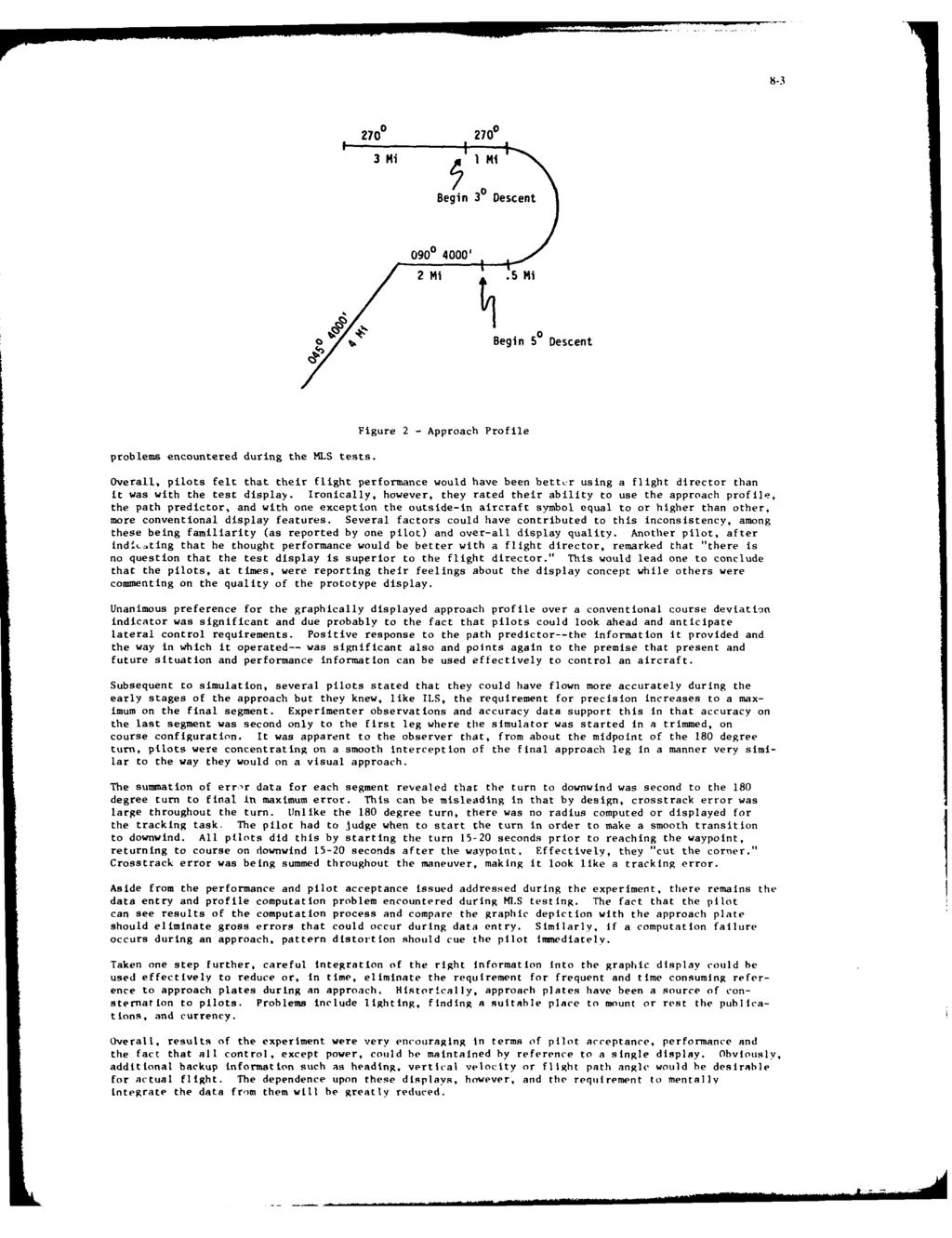
77 Mi I Mi Begin 30 Descent B 1oo0 %. Begin 50 Descent Figure 2 - Approach Profile problems encountered during the MLS tests. Overall, pilots felt that their flight performance would have been bettr using a flight director than it was with the test display. Ironically, however, they rated their ability to use the approach profile, the path predictor, and with one exception the outside-in aircraft symbol equal to or higher than other, more conventional display features. Several factors could have contributed to this inconsistency, among these being familiarity (as reported by one pilot) and over-all display quality. Another pilot, after indl-ting that he thought performance would be better with a flight director, remarked that "there is no question that the test display is superior to the flight director." This would lead one to conclude that the pilots, at times, were reporting their feelings about the display concept while others were commenting on the quality of the prototype display. Unanimous preference for the graphically displayed approach profile over a conventional course deviation indicator was significant and due probably to the fact that pilots could look ahead and anticipate lateral control requirements. Positive response to the path predictor--the information it provided and the way in which it operated-- was significant also and points again to the premise that present and future situation and performance information can be used effectively to control an aircraft. Subsequent to simulation, several pilots stated that they could have flown more accurately during the early stages of the approach but they knew, like ILS, the requirement for precision increases to a maximum on the final segment. Experimenter observations and accuracy data support this in that accuracy on the last segment was second only to the first leg where the simulator was started in a trimmed, on course configuration. It was apparent to the observer that, from about the midpoint of the 180 degree turn, pilots were concentrating on a smooth interception of the final approach leg in a manner very similar to the way they would on a visual approach. The summation of err-r data for each segment revealed that the turn to downwind was second to the 180 degree turn to final in maximum error. This can be misleading in that by design, crosstrack error was large throughout the turn. Unlike the 180 degree turn, there was no radius computed or displayed for the tracking task. The pilot had to judge when to start the turn in order to make a smooth transition to downwind. All pilots did this by starting the turn seconds prior to reaching the waypoint, returning to course on downwind seconds after the waypoint. Effectively, they "cut the corner." Crosstrack error was being summed throughout the maneuver, making it look like a tracking error. Aside from the performance and pilot acceptance issued addressed during the experiment, there remains the data entry and profile computation problem encountered during MLS testing. The fact that the pilot can see results of the computation process and compare the graphic depiction with the approach plate should eliminate gross errors that could occur during data entry. Similarly, if a computation failure occurs during an approach, pattern distortion should cue the pilot immediately. Taken one step further, careful integration of the right information into the graphic display could be used effectively to reduce or, in time, eliminate the requirement for frequent and time consuming reference to approach plates during an approach, Historically, approach plates have been a source of consternation to pilots. Problems include lighting, finding a suitable place to mount or rest the publications, and currency. Overall, results of the experiment were very encouraging in terms of pilot acceptance, performance and the fact that all control, except power, could be maintained by reference to a single display. Obviously, additional backup information such as heading, vertical velocity or flight path angle would he desirable for actual flight. The dependence upon these displays, however, and the requirement to mentally integrate the data from them will be greatly reduced.
78 CONCLUSIONS a. Pilots were favorably impressed with the new display features. b. Pilot performance with the display indicated that with further refinement, precision control to ILS or even better standards may be achieved. c. Training requirements are minimal since lateral control and situation displays are relatively straight forward. d. The graphic display eliminates the kind of position orientation problem encountered using the Flight Director in complex trajectory operations. e. A display of this type can be used effectively to increase pilot confidence in profile construction and computation and aid in monitoring system operation. f. The display provided the kind of information a pilot needs to judge present and furure situation and performance in terms directly related to his flight control tracking task. 7. REFERENCES Burdess, Lovering, Miller, Park, Warner, June 1981, "Simulation Report -- Advanced Display For Complex Flight Trajectories," Flight Dynamics Laboratory, Wright-Patterson AFB, Ohio

79 I)2-I ' DISCUSSION AVIONICS PANEL SPRING MEETING On ADVICED AVIONICS AND THE MILITARY AIRCRAFT lio'/achine INTERFACE April, 1982 SESSION N. 2 COLOUR DISPLAY SYSTEtS-Chmn Prof. Ir. D. Bosman, NE Paper Nr. 4 Title : HUM FACTORS CONSIDERATIONS ON THE PERCEPTION OF COLOUR IN THE AIRBORNE ENVIRONMENT Authors C. P. Gibson, Dr. J. Laycock Speaker R. A. Chorley Comment You suggested that a pilot's subjective impression of the colors in a head-down display may be affected by previous use for an extended period of the head-up display, because of the bright green symbology used in the latter. Is this effect likely to be significant, in view of the extremely small portion of the HUD field of view which is actually occupied by the symbology' Response : The extent of the change in perceived colors following a period of adaptation to a colored source will depend on several parameters. Adaptation to a bright green head-up display will occur within the retina at the points where the image is located. The degree to which this adaptation is perceived will depend, as you suggest, on the proportion of the field of view. For daylight operations it is unlikely that this will be of practical significance but the effect may be noticeable under dusk or night flight conditions causing the display to appear different than when it is viewed under daylight conditions. Paper Nr. 4 Title : HUIM FACTORS CONSIDERATIONS ON THE PERCEPTION OF COLOUR IN THE AIRBORNE ENVIRONMENT Authors C. P. Gibson, Dr. J. Laycock Speaker R. G. White Comment Would green discrimination on a a head-down CRT be affected by using a wide-field of view HUD at night to fly on a LLTV or FLIR picture, when although the HUD luminance would be low it would be fairly even over the whole field? Response : Any degree of adaptation produced as a result of viewing a dynamic display such as LLTV or FLIR will be more noticeable because a greater area of the retina will have to been adapted. Adaptation will occur when a colored source which is bright enough is viewed for long enough. As such the extent of the adaptation is dependent on the strength of the adapting source and the time for which it is viewed. Provided that the luminance of the display is low enough any adaptational effect will be small. However, the extent to which operational luminance levels may cause significant adaptational effects during night flight conditions is not clear. Paper Nr. 5 Title APPORT DE LA COULEUR DANS LA SYMBOLOGIE DE PILOTAGE Author Or G Santucci, Dr J Menu Speaker J. Walraven Comment With regard to your results on visual acuity measurements employing different colors for opto-type and background respectively, did you control properly for luminance contrast? Response : Effectivement nous avons controls Ia luminance en utilisant un phatandre carriage avec un filtre CIE 31. Nous n'avons pas voulu utiliser la notion de luminosite car notre exp4rimentation 6tant i visee ergonomique, nous avions besoin d'une mitrique standard atmn d'avoir un language commun avec les fabricants d'iquiprment. Cependant nous avons regard4 la question en utilisant ie concept de luminositi il ne semble pas que nos resultats en soient tres differents sauf peut etre en ce que concerne les couples ou intervient le bleu. Mais on ouvre alors un vaste domaine de discussion avec Ia couleur bleue. Paper Nr. 5 Title APPORT DE LA COULEUR D91S LA SYMBOLOGIE DE PILOTAGE Author Or G Santucci, Dr J Menu Speaker Prof. D. Bosman Comment By applying SNELLEN letters, the visual acuity for colored objects (edges) is measured. With gradual transitions rather than sharp edges (blurred letters the measured RT may turn out different. Did you explore the effect of spatial frequency content on RT Response : Dens cette experimentation seule I'acuate visuelle avec des lettres de SNELLEN a bord, net, a etc etudite (sharp edges). Les bords flous (blurred letters) nont pas ete utilisds: Par contre nous avons realisi, une autre experimentation avec des roseaux carres ou les mimes rdsultats ont ete trouves. Par contre les riseaux flous' n ont pas ete utilises. Paper Nr. 6 Title COLOR DISPLAY FOIMTS: A REVOLUTION IN COCKPIT DESIGN Author Dr J M Reising, T J Emerson Speaker 0. Beevis Comment The results of the Stroop psychological test, among others, indicate that the printed word is a very effective coding medium, to the extent that it can over-ride other coding techniques such as color. Specialized symbols such as those used in the emergency action/status displays shown as examples would, to my mind, be more effective than pictograms or special symbols which have to be learned, and for which far less learning time is available than for the printed word, the optimum might be a suitable mix of words, symbols and pictograms. Response : Yes. In a recently completed study which examined stores management displays - pictorial vs. text - it was found that the pilots preferred a display which contained both. The

80 1)2-2 DISCUSSION pictorial format gave them an overall situation awareness, and the text gave them specific data. In our simulation which will be conducted at the Boeing Military Airplane Co. In August of this year, we will examine the proper mix of pictorial and text - but the emphasis will be on pictorial as the primary means and text as supplementary. Paper Nr. 6 Title COLOR DISPLAY FORMATS: A REVOLUTION IN COCKPIT DESION Author : Dr J M Retsing, T J Emerson Speaker : R. G. White Conent You believe pictorial displays (as opposed to digital and analogue presentations) will reduce pilot workload. Do you have any evidence for this? Response : We are just beginning studies of pictorial formats. As of this time I have no hard evidence of a reduction in processing time, for example. In the July-August timeframe we will be conducting a study at the Flight Dynamics Laboratory to examine this question. Paper Nr. 6 Title COLOR DISPLAY FORIATS: A REVOLUTION IN COCKPIT DESIGN Author : Dr J M Reising, T J Emerson Speaker Dr. E. B. Davis Comment : I have been very interested in the picture displays. I would like to hear some comment on the way in which you see the pilot interacting with the picture display. The sort of thing I am looking for is the role of the touch sensing display, in terms of the pilot addressing some particular part of the picture. Response : Tomorrow we will hear a whole day on voice systems, which is one logical way to interact. We currently use the buttons arranged around the CRT. Touch-sensitive could certainly be used if we could do it in the presence of vibration and g-force. But yoq could certainly touch a part of the picture and change it. The computer will bring up these pictures at a certain time and the pilot will interact either by voice, touch, or button. We are running a study right now on how we could change all our stores pictures by voice or button. Paper Nr. 6 Title : COLOR DISPLAY FOIMATS: A REVOLUTION IN COCKPIT DESION Author : Dr J M Reising, T J Emerson Speaker R. M. Taylor Comment : With regard to perspective terrain formats, is there any evidence that view position affects tracking performance, and is there likely to be any requirement for vertical exaggeration of terrain as opposed to 1:1 scaling? Response : At this time we do not yet have the equipmrnt to provide a dynamic display. The equipment will arrive at the Avionics Laboratory in Jan At that time we can examine your question. Paper Nr. 6 Title COLOR DISPLAY FORMATS: A REVOLUTION IN COCKPIT DESIGN Author : Dr J M Reising, T J Emerson Speaker : Prof. D. Bosman Commuent : A pictogram is a means to perceive a huge amount of prestructured data in a very short time, with the advantage that the central system is not overloaded since the input data is biologically preprocessed by an existing 'filter'. This is necessary at high workloads, but detrimental to vigilance in low workload situations. Have you experimented with, e.g. time-line-analysis to determine the desirability and effectiveness of pictorially presented information' Response : In August of this year we will be using the Boeing simulation, mentioned previously, fr a high workload interdiction mission. During the mission phases we will monitor performance to look for overloads. We will use monochrome, color stroke, and color raster formats. We will then analyze format and type by mission phase; hopefully, this analysis will provide some data relative to effectiveness of pictorial formats in various mission phases. Paper fr. 6 Title : COLOR DISPLAY FORtATS: A REVOLUTION IN COCKPIT DESIGN Author : Dr J M Reising, T J Emerson Speaker : R. W. MacPherson Conent : The pictorial displays you described imply large amounts of data must be handled. Do you believe that current ror perhaps VHSIC) technology is capable of processing the information required for real time or near real-time displays' Response : In general the answer is yes, but it depends on the definition of real time. For a large scale plan view map display 5 Hz refresh rate may be sufficient, while on a perspective map view, 30 Hz or more may be required. The second point centers on the compleuity of the Jisplay format. A pictorial format made up of a limited number of vectors, can be generated now. As different features such as texture, shading and sun angles are added, the generation time increases. When the equipment arrives at the Avionics Laboratory in Jan. 1983, this question will be ciamined in detail. Paper Hr. 7 Title : THL ASSEStIENT OF COLOUR IN LOFARGREI L,13PLA,S

81 D ISCUSS ION Author : Dr J. Metcalfe Speaker ; Prof. D. Bosman Comment : You were using a green CRT, but I assume that the light output coses fro different phosphors and is not monochrome. Was the green of this phosphor (the green sensation, as you would experience) independent of the video current-, This morning Dr. Laycock and Dr. Gibson showed that the color experience is dependent on the environmental color, did this come into your experiments' Response : That is correct, it was not monochrome. When the video levels were set up for the various scales, the video weightings for each of the color components were adjusted to ensure that the correct color balance was maintained. For all of these types of tests we performed these expe'iments in a darkened room to represent the probable operating conditions. Paper Nr. 3 Title ADVAICED DISPLAY FOP COMPLEX FLIGHT TRAJECTORIES Author P. B. Lovering, Sqn Ldr. S B Burdess Speaker Hg Cor D. C. Schuller,-canent : )ome years ago I took part ir, an experiment quite similar to the one you have described. It was a VSTOL approach task and like yours had attitude and horizontal situation displays superimposed. The difficulty with the display, which was mc.nochrcome, was that when close to touchdown, distinction between the two displays became more more difficult and any distraction due to workload increase could lead to disorientation. In your experiment I W.1 surprised to hear that this difficulty did not occur. The reason would appear to be your use of color to distinguish between the attitude and horizontal situations but I am left with the seeling that when close to touchdown any sudden workload increase due to e4traneous facto-rs may result ir disorientation. Would you care to comment" ) Response : Color was used to separate the various display elements and informati.,n types. To date, at least, it seems that it might have helped. I share your concern with regard to disorientation, we will have to be very careful as we add vertical situation information, expanding runway, and proper scaling to avoid too much display activity and resulting confusion. If we car,not keep it simple and straight forward we will have to loc, for another format. Paper U r. 8 Title.,D'AJCED DISPLAY FOR COMPLEX FLIGHT TRAJECTORIES Author P. 6. Lovering. Sqn Ldr. S B Burdess Speaker Dr.:. Laycock Comment The present display ot,[iously includes the element of prediction desired by the pilot. How necessary do you think prediction is and could a flight director produce the same performance from the pi lot Response : In my opinion, anything that will allow the pilot to "see" ahead will help him in planning his future actions. We tried to combine path prediction, situation and range range rate information in this display in a manner that would accomplish that. Pilots c.:uld perforn, weli using the flight director by merely keeping the steering commands centered, but they had littls time to sort out and integrate other supporting information to confirm proper 0teering ccowrand opera ti on. Paper Nr. 8 Title ADk.VI4CED DISPLAY FOR CWIPLEA FLIGHT TRAJECTORIES Huthor P. B. Lovering, Sqn Ldr. S B Burdess Speaker R. 0. White Comment As a supplementary comment to Dr. Laycock s pisvious question, I would lile to ssy that my work at RAE supported the author s view that a..xifbination of guidance and ;i.tajat Ion information was better than just a director. The Situation in formr, ation affords the piiot flexibility of action, permits him to make predictions and makes it easier for him to recover a situation following failure of the director. Response I agree. This is a key issue. Thank yo. Paper Nr. 8 Title EAD$JCED DISPLA FOR COMPLEX FLIGHT TRAJECTORIES Author P. B. Lovering, Sqn Ldr. S B Burdess Speaker Dr. 0. Hunt Comment Is it possible to isolate the usefulness of color ir this display applicaticn-' Did you go through a phase of using a monochrome version, or Were there stages in the evolution ot the color display which you can describe. Response : C c lors were changed or modified during buildup and used throughout the exper iment. kie felt that, as the display developed and work started on the pitch axis, expending runway. etc., color coding would help in the separation of information elements and types of informatior. Paper Nr. 8 Title A: C$.CED DISPLIr FOR CEIIPLEA FLIGHT TRAJECTORIES wtithor P. B. Lovering, Sqn Ldr. S U Burdess Speaker Prof. D. Bosan Comment iou stated that you have only used color in your etperiments. Do you intend to p-tend your experiments to the night flying situation, where with scotopic vision the display willt not be seen as color, or else it will be -f sufficient illuminarce that it will appear blinding.
82 D24 DISCUSSION Response I hope there can be a followup to this effort. At this point there are no plans for that. We may be doing some similar work but with a different display with the 757 equipment. Paper Nr. 8 Title AJA WCED DISPLAY FOR COMPLEX FLIGHT TRAJECTORIES Author P. B. Lovering, Sqn Ldr. S B Burdess Speaker R. M. Taylor Comment Did your work shed any light on the relative merits of "inside-out' and 'outside-in' references? Response : No, there was no plan to reopen that question. We felt that the moving aircrat, symbol/path predictor combination might be more suitable for approach work so we tried it.

83 9-i OVERVIEW OF STATE-OF-THE-ART, R& D NATO ACTIVITIES, AND POSSIBLE APPLICATIONS-VOICE PROCESSING TECHNOLUGY BRUNO BEEK Rome Air Development Center Communications Division Griffiss Air Force Base,NY SUMMARY The purpose of this paper is to introduce the subject of Voice-Interactive Systems and its role in military applications. The history and evolution of automatic speech recognition and synthesis is briefly explored and the current state-of-the-art is reviewed. The term "Voice-Interactive Systems" is defined and the advantages and dlsadva ntages of Voice-Interactive Systems are highlighted. Next, previous applications of speech systems to military problems are summarized, the major application areas are described and current development projects in the U.S. and other NATO countries are presented. Special attention is focused on the cockpit application. Several projects in this area are discussed along with a summary of important Issues to consider when applying Voice-Interactive Systems to the aircraft environmcnt. I. INTRODUCTION The objective ol this paper is to provide a broad perspective on the topic of Voice-Interactive Systems, and in particular the use of these systems for cockpit and other military applications. Before the actual application of these systems Is discussed it would be helpful to consider such questions as: "How did speech systems evolve?", "What techniques a e used to do speech recognition and synthesis?", and "Wiat are the major problems in doing recognition and synthesis?" By answering these questions it is hoped that the reader can gain an understanding ot the current capabilities and lisitations of automated speech systems. With this backround, the issues of applying speech systems to military problems Is undertaken. Because the use of speech systems is now so widespread the treatment here is not exhaustive, but instead is intended to be representative of much of the current research. This paper is tutorial in tune and cannot comprehensively cover all of the topics presented, however, the extensive bibliography provides references for more detailed information for the interested reader. 2. What are Voice-Interactive Systems? Potential users in industry, the home and the military are starting to become excited about the possibilities of voice interaction with machines. Speech Technology has recently received considerable publicity as new applications are discovered (DODDINGTON, G. R., and SCHALK, T. B., 1981; SIMMONS, E. J., 1979; LEVINSON, S. E. and LIBERMAN, M. Y., 1981). In this section the history of speech technology is traced from the pioneering days in the fifties to the present, and the advantages and disadvantages of speech are discussed. Prior to this discussion, it would be useful to review some terminology. Voice-interactive systems include both automatic speech recognition (ASR) and systems for speech synthesis. "Speech recognition" generally is used to refer to a machine which can analyze or make a decisio' on a speech signal from a human speaker who utters single words or short sequences of words. "Speech Synthesis", sometimes called voice response or voice output, refers to a machine which can generate a human or human-like vocal response. "Speech Understanding" is sometimes used to refer to machines which can not only recognize complete sentences (as opposed to a single word or short sequence of words) but somehow interpret the meaning of the sentence as well. "Speaker identification" (or speaker rcognition) is used to describe a machine which has the ability to determine who is speaking, rather than what is said. There are other useful actions based on speech that can be perfomed by machines Including: the capability to recognize what language is being spoken (language identification), the ability to remove noise or interference from speech (speech enhancement), the capability to compress the bandwidth necessary to transmit digital speech (vocoders), the ca pability to detect abnormal physical or psychological conditions If the speaker (stress analysis), and others. The useful functions being performed by thest systems ar accomplished through the theory and practice of speech processing technlogy. How this technology has evolved is the topic of the next secti-io The Evolution t s 1 pe-'i, It,.,- -sing lehni logy Speech Processing, R h.,1i las been based to a large degree, on early research In such areas as xt.ri-tal phonetics, the physiology of the human vocal

84 apparatus and auditory system, human perception of speech, and especially acoustics, phonetics. This basic research provided much of te fundamental knowledge which is required to some extent in almost ail speech processing systems. One of the first applications of this knowledge to speech processing was reported in 1952 (DAVIS, K. '?. et al, 1952) with the demonstration of a successful speech recognition system which could recognize the digits spoken from one talker. One of the first electronic speech ynthesis systems was produced even earlier, in 1939 by researchers at Fell Labs (DUDLEY, H., RIESZ,R. R., WATKINS, L. A., 1939) This system was call>d the vocoder and was the forrunner at the modern vocoder. important milestones In the development of speech processing technology occurred i n 95t and 1959, with the first efforts at the incorporation of linguistic intormation WRIEN, J. and STUBBS, it. L.; 195t) as the use of a general digital computer (FORGIE, J. W. and FORGIE, C. D., 1959) respectively. One of the first speech recognition syctems which could recognize coutluous speech was developed in 19f9, and could accomodate a highly constrained vocabulary of 16 words (VICENS, P. J., 19b9). Much of this early work was based on the assumption that all the information required to Jo recognition could be extracted from the spectral envelope of the acoustic speech wave. This resulted in the development of many approaches for spectral analysis of speech, and with these analysis approaches came very sophisticated mathematical techniques for manipulating the acoustic speech parameters. Some of these mathematical techniques are: linear predictive oalng (LPC), dynamic programming, the Fast Fourier Transform, homomorphic filtering, among others. Speech recognition techniques which are concerned solely with the manipulation of the acoustic waveform are sometimes referred to as mathematical, pattern matching or statistical approaches. However, an alternate approach was soon to receive conside-able attention. Prior to 1970 most of the work in ASR was concerned with recognizers which could only deal with a very limited vocabulary (typically 50 words or less), spoken in a discrete manner, for a talker who had previously trained the device. In fact, many of these recognizers worked with high accuracy in the laboratory, and a group of researchers at RCA were encouraged enough to torm their own ASR company, Threshold Technology,Inc. in One major exception to the history presented above was the research on speech recognition at IbM. In the late sixties IBM under sponsership from the Rome Air Development Center began research on the complex problem of Automatic Continuous Speech Recognition. (TAPPERT, C. C., et al, 19b8,1970,1971 and DIXON, N. R., et al, 1970, 1971, 1972, 1973). The vocabulary of the E Ystem was composed of 250 word command language which could generate aproximately 14 millions different sentences. The technique used to perform the automatic recognition consested of three principle components, a hardware spectrum analyzer, an acoustic analyzer and a linguistic processor. Each component was designed to process speech independent of the vocabulary. This system proved to be the first working system to perform automatic cant quous speech sentence recognition based on a command language. Results, even in the early years, clearly indicated the promising nature of the approch. Although the system had many difficulties (for example the hardware spectrum analyzer), et led shown for the first time, the automatic decoding of sentences by machine. However, the field of speech recognition was sharply criticized in a letter written by JOHN PIERCE, a highly respected scientist at Bell Laboratories (PIERCE, J., 19b9). The letter stated that researchers working in speech recntiou feiled to appreciate the difficulty of their task. Although the letter seemed to pul a temporar damper on the enthusiasm for speech recognition, the Advanced Research "'cojects Agency (ARPA) nonetheless funded a large, 5 year effort in the field in The ARPA project addressed the problem of speech understandin 6, rather than speech recognition, and had a number of ambitious technical goals. There is considerable debate even now as to the progress made in the project (KLATT, D. 11., 1971; and NEUBERG, E. P., 1975). What is noteworthy ic that the approach taken in the project can be considered from the perspective,f artificial intelligence (Al). Uniike the mathematical approach, Al presumes that a perfect extractior. of phonetic features in speech Is not necessary (or maybe even possible) because errors made in this extraction phase can be compensated for by knowledre obtaineo trom so-called "higher sources." This higher order knowledge includes things like syntax, semantics and the pragmatics of discourse. It remains to be seen which approach will be more successful, perhaps a combination of approaches, alonb witn greater computing power will solve many problems. But It is widely agreed that increasing the knowledge of Lhe human speech process I required before the effectiveness Ot speech systems match the expectations of potential users. The last half of the seventies has seen increased attention given to the application of ASR technology to a wide variety of real-world problems, with less emphasis being giveo to more fundamental research. However, there are still many fundamental research problems which remain to be solved, as shall be discussed below. A number of companies, la-ge and small now have speech recognition products commercially available. An tncraasing number o1 speech synthesis products are also becoming available In the marketplace.

85 9-3 The current state-of-the-art in speech recognition and synthesis will now be addressed. Practical ASR is restricted to discrete-utterance (a pause must be inserted between words), limited vocabulary and speaker dependent (the intended speaker must train the system for each utterance) recognition for high quality speech. The accuracy of such systems are dependent on a variety of factors but jccuracies near 100% in the laboratory and less than 90% in field tests are typical. Synthesis systems are generally of three types: 1. Those which do a simple encoding of the speech signal. An example is a simple digitization of real speech. The synthesis would then be accomplished by digital-to-analog conversion. 2. A complex encoding of the speech signal. An example oi this type is linear predictive encoding. Speech is encoded and then stored to form pre-recorded messages, which are synthesized by doing the inverse of the encoding process. 3. Synthesis-by-rule systems which require very little storage of actual speech, but instead accept as Input typed commands. The commands are interpreted and a basic set of speech sounds (phonemes) are strung together and modified by a complex sequence of rules. There are three main trade- offs associated with speech synthesis systems. These are: speech quality, memory requirements and message flexibility. The chart below summarizes these trade-offs for the three types of synthesis (GREGORY, P. W., REAVES, J. M., 1981) SYNTHESIS TECHNIQUES QUALITY MEMORY FLEXIBILITY 1. Simple Encoding High Greatest Moderate 2. Complex Encoding Moderate Moderate Low 3. Synthesis-By-Rult Low Low High Currently, there are more than 44 companies who produce apeecn synthesis products (WONG, D., 1981). Excellent summaries of speech processing technology evolution can be found among the references (DENES, P. B. 1975; HYDE, S. R., 1972; REDDY, D. R., 1976; LEA, W. A., 1979). 2.2 Voice-Interactive Syster 7efined Up until this point all the discussion has been on speech technology, not voice-interactive systems. The term "voice-interactive system" emphasizes the fact that it is the combination of a human a machine that is of interest. The "voice" part of a voice-interactlive system can mean either a human voice talking to a machine, or vice versa. Since a human is involved, it is not only speech technology that Is of concern, but the psychology and physiology of the man-machine interaction. Researchers involved with speech processing are typically electrical engineers, computer scientists or mathematicians. Those involved with voice-interactive systems have a more behavioral science flavor, and include experimental psychologists and human factors engineers. What then is meant by term "voice-interactive system"? It could conceivably mean Any system involving humans and machines, with speech as the mode of comeunications. Thus, a digital voice communications system could qualify as a voice-interactive system under this definition. However this is not what is usually meant by the term. Voice-Interactive System. The interface between a cooperative human and a machine, which involves the recognition, understanding or synthesis of speech, to accompish a task of command, control or communications, and which involves feedback from the listener to the speaker. With this definition, the digital communications system no longer qualifies, because the system provides an interface between a human and another human, not a machine. Likewise speaker identification or language identification systems do not qualify because they involve noncooperative speakers and no feedback from the speaker (human) and the listener (machine). Figure 1 shows in a very simple way a voice-interactive system: The box labe'ed "Speech I/O Subsystem" is some type of speech processing technology. Suppose that the voice-interactive system was one in which a human pilot controls certain cockpit functions, and in addition can receive audio warning messages. The diagram of Fig. 1 can then be drawn more specifically as shown in Fig. 2: The interaction diagrammed in Fig. 2 is a fairly complex one and is intended to show relationships among all the elements involved, not any particular system. Notice that the pilot and speech I/O sub-system are both listeners as well as speakers. The situation shown in FIg.2 would work as follows. The pilot controls certain cockpit functions (which have not been specified) by speaking utterances into an ASR device. The controller of the voice-interactive system interprets the results of the recognition and responds with the apprcpriate controlling actions to the aircraft. Suppose an emergency situation arose for which the pilot was unaware. Presumably, the aircraft would signal this to the controller which would respond with the appropriate synthesized warning message. The pilot would then take corrective action which may require him to use manual controls, and the warning message would be subsequently halted. In this case there is feedback in both directions between man and machine.

86 Advantages of Speech Communications There are a number of good reasons why people might wish to use speech to communicate with machines. There have been many reports which have detailed the relative advantages of speech communications (LEA, W. A., 1968; LEA, W. A., 1979; MARTIN, T. B., 1976). However, there is relatively little empirical evidence which demonstrates the value of speech over other modes of communications, command or control. What empirical evidence does exist seems encouraging. In a famous experimental run at John Hopkins Univer~ity, it was shown that teams of people interacting together to solve problems could solve them much faster using voice than other modes of communicating (OCIiSMAN, R. B., CHAPANIS, A., 1974). Other studies indicating the advantage in terms of speed and accuracy of voice over other modes of communication for certain tasks have been reported. (WELCH, J. R., 1977; HARRIS, S., OWENS, J., NORTH, R., 1979; SKINER, C., 1979; WHERRY, R., 1974; POOCK, G., 1981). Despite the lack of supporting data a list of advantages shall be presented for speech communication in general, and in a later section for the application of speech in the cockpit environment. Many of these arguments for speech are of the "common sense" variety and there are undoubtedly others that could be added to them. The most powerful reason lor using speech is the fact that it is man's most natural form of communication and does not require special training to learn. A second strong argument for voice is that it frees the hands and eyes for other tasks. Most of the other advantages follow directly from these two. Figure 3 shows a list of advantages of speech communication. The list has been divided into three sections: engineering, psychological and physiological advantages Disadvantages of Speech Communications The disadvantages of speech communications should be considered carefully. It is important to make a distinction between the drawbacks of speech communications in general and the limitations of current speech technology. The former is relevant in speculating about the long-range possibilities of speech, and the latter is relevant to near-term concerns. The general disadvantages of speech communications are presented below, and those associated with cockpit environments are discussed In a later section. The disadvantages of speech communications involve mainly the effects of a hostile environment on the speech signal directly, or indirectly by a change of the physical or emotional state of the speaker. 3.0 Issues of Cockpit Applications of Voice-Interactive Systems The use of voice-interactive systems offers the potential for solving critical mon-machine problems in the aircraft cockpit. No where are these problems as severe as In military aircraft, and especially aircraft, capable of high performance. In these aircraft, crew members are often forced to cope with a very high workload, caused by factors such as inefficient crew member stations, poor assignment of operator tasks, and an overwhelming number of displays and indicators. In summary, the human operator is overwhelmed with too much information and has too many visual manual tasks to perform. There has been recent attention placed on using voice-interactive systems In the cockpit to reduce this operator workload problem and solve other man-machine problems. All three services in the United States, many NATO countries and considerable industrial eftort has addressed this application of speech technology (LANE, N. E., HARRIS, S. D., 198U; COLER, C. R., 1980; NORTH, R. A., et al, 1980; WICKER, J. E., 1980; HARRIS, S., et al, 1980; WERKOWITZ, E., 1981; REED, L., 1981). Since this conference has an entire paper session devoted to this topic, and because this is a tutorial paper, the discussion to follow is only a summary of the relevant issues and not a detailed technical dissertation. 3.1 Advantages / Disadvantages of Voice Interactive Systems In the Cockpit It has been recognized that the pilot~s workload in the luture high performance attack/fighter aircraft may exceed present pilot avionics interface capabilitie.. Hence, a real-time voice interactive system offers a potential solution as a method of augmenting current control/display functions. As a result of this realization a number of airframe manufacturers have initiated investigations and experimental design in interactive voice cumma nd/feedback systems for single-seat fighter a I c ra f t. Some experienced military pilots were questioned on the idea of voice command functions for fighter aircraft. In one study, pilots were asked to rate, on the basis of "zetv" to "ten", the use of voice command and control system for high performance military aicraft "zero" of course, being "forget the whole idea" and, ten" being "sounds great". In addition these pilots were opposed to using voice command for important decision making functions such as firing weapons, blow canopy, eject and control trim. However, they were in favor of mode selection and setup functions such as radio channel selection, TACAN ILS, radar, Bomb/NAV mode selection and IFF/transponder setup. Some early results indicate that voice command funtion- can 0 t be directly substituted for control/display interfaces of a fighter aircraft.

87 9-5 In 8ddltion, the military aircraft environment adds a number of additional problems to automatic recognition subsystems. Some of these are listed in Table I TABLE I Oxygen Mask Microphone Physical Stress Emotional Stress Vibrational effects Complexity Syntax High ambient background noise Preselected Vocabulary Non-robust words Human error Overall reliability Cost, Size/Weight The problems listed in Table 1 cause specific technical difficulties such as word boundary detection, memory requirements, small space, noise stripping, and voice inconsistencies. Questions arise as to whether training should be don- with pilots wearing oxygen masks under actual flight conditions (different G-levels, engine power levels, canopy on / off). Types of signal input to systems must include the affects of regulation, inhaling, exhaling, etc. Results have shown that because breath and background noise cause drop offs at the ends of words, an end point detector based on energy level cant be used, hence more sophisticated automated end point detection is required. 3.2 Speech Synthesis in the Cockpit Military aircraft applications of speech synthesis systems have also been investigated especially for caution and warning messages. Some of these applications are listed in Table 2. TABLE 2 Applications of Speech Synthesis Systems Voice Warning Time-to-Go countdown Way point Announcement Voice Response for Specific request system data Audio Feedback to Voice Commands A few problem areas resulting from speech synthesis in a high performance aircraft are specific message selection and corresponding voice quality. These synthesis systems must be aware of pilot safety, sound level variation for different noise levels, potential interference with other audio communications, cognitive and attentional demands. 3.3 Summary It can be said there is general concensus that voice command control, and synthesis systems can provide the military aircrews with a useful adjunct, conventional control and display interfaces rnd provide warning and status data via speech synthesis. However, in order to apply this technology, many behavioral and human factor problems must be solved as well as some very difficult technical speech recognition issues. Clearly, the question of complexity and overall reliability of a voice interactive system in an aircraft environment must be addressed. 4.0 Other Military Organizations and Applications of Voice-Interactive Systems (BEEK, B., et.al., 1977, 1980) _n addition to utilization of automatic speech recognition for aircraft applicat'ons, a number of other military applicatione are also under consideration. These include: I. Digital Narrow-band Communications Systems. Digital Communication Systems will encode the speech signal at rates of less than 200 bitsisec to provide jam resistant communications. 2. Automatic speaker verificatlon/id~ntlfication. An advanced development model has been fabricated, tested and evaluated for a secure access control application. 3. Training Systems. A speech understanding system for air traffic control. This system uses both autowatic speech recognition and synthesis to enhance the training of air traffic controllers.

88 4. On-line Cartographic Processing System. A voice data entry (VDE) system was designed for entering cartographic data to the Digital Landmass System data base. 5. Voice-operated computer input/output. These applications would allow each telephone to be an input terminal. The majority of the above applications will be discussed in considerable detail by the other session papers. The remainder of this section shall be limited to a discussion of the two DOD and NATO advisory groups on voice technology and some current RADC development activities. 4.1 DOD and NATO Advisory Groups on Voice Technology At the present time, two major military automatic speech recognition and technology groups are pursuing active technical coordination, data exchange and cooperative research projects. The first is the DOD approved Voice Technology for Systems Applications Sub-technical Advisory Group (VSTAG). The purpose of this VSTAG is to provide a forum for technical interaction between scientists and engineers at the working level. lncluded as representatives to the VSTAG are members of Air Force, Army, Navy, NASA, FAA, Post Office and NSA research laboratories that are engaged in speech processing applications. Table 3 lists the members of VSTAG. The second is the NATO AC/243 Panel Ill Research Study Group (RSG)-10 for Speech Processing. The first meeting of RSG-1O was held in Paris, France in May Meetings are held twice a year and are rotated among the member nations. The technical objectives of RSG-1O are generally to review speech processing topics of military relevance in order to recommend specific Research Projects to be carried out cooperatively among the member nations. Member nations include Canada, France, Germany, Netherlands, United Kingdom and the United States. Table 4 is a list of participants from the seventh meeting of RSG-1O. Army TABLE 3 ARI Army Research Institute ETL Engineering Topographic AVRADA Avionics Research Development Activity Human Engineering Lab. Communicative Technology Office Navy NAMRL NADC ONR NOSC NPGS NATC NNMC NWC NASC NTEC NPC Naval Aerospace Medical Research Lab. Naval Air Development Center Office of Naval Research Naval Ocean Systems Center Naval Post Graduate School Naval Air Test Center National Naval Medical Center Naval Weapons Center Naval Air Systems Command Naval Training Equipment Center Navy Personnel R / D Center Air Force AFAMRL Aero Medical Research Lab. RADC Rome Air Development Center AFWAL Wright Aeronautic Lab. AFIT Air Force Institute of Technology Other Government IRS Internal Revenue Service USDA Dept. of Agriculture NBS National Bureau of Standards NSA National Security Agency OSDRE Office of the Under Secretary of Defense for Research and Engineering NASA NASA Ames Research Labs USPHS US Public Health Service FAA Federal Aviation Administration

89 9-7 TABLE 4 Mr JOHN S. BRIDLE UK (Chairman) Dr N. MARTIN TAYLOR Canada (Secretary) Mr PATRICE DESVERGNES France Dr GERHARD VAN DER GIET FR Germany Dr LOUIS C. W. POLS Netherlands Lt J. NELSON LSA (Specialist) Dr HELMUT NANGOLD FR Germany (Specialist) Dr JOSEPH J. MARIANI France (Specialist) Dr MELVYN J. HUNT Canada (Specialist) Dr ROGER K. MORE UK (Specialist) Mr R. VONUSA USA (U.S. Delegate) 4.2 Air Force Tactical voice communications systems presently are threatened by an evolving enemy jamming force capable of disrupting our vital C2 communications. SEEK TALK, a jam resistant (JR) communications system to be fielded in the mid 1980*s, uses present state of the art technology. Recent RADC research has developed practical very low bit/sec voice digitization techniques. These advances, being rapidly made practical by the development of VHSIC technology, allow the design of adaptive and more powerful jam resistant secure modems. Air Force users are willing to make some sacrifices regarding speaker recognition and voice vocabulary size to achieve significantly higher JR performance at lower cost than present concepts allow. The objectives of these efforts are to develop bandwidth efficient, flexible, adaptive jamming suppression, spread spectrum modems. These modems would provide high jam resistance by using both very high Time Bandwidth Product (TBP) and jammer deception/analysis techniques. Candidate designs will be developed which will in a general sense be backward compatible with present designs. Breadboard circuitry produced will demonstrate the basic feasibility of the signal processing techniques. The advanced low bit rate voice processing technique will be integrated with a hybrid Fl/PN modem to achieve a high TBP within existing bandwidth constraints. The receiver signal processor will in addition analyze the structure of the received jamming signal to achieve a JR capability in excess of that provided by the processing gain alone. Data coding techniques will be applied to reduce the S/N needed for detection and to detect when signals are becoming unusable. The RADC in-house program (HF Terminal with ECCM Modem, Speech Recognition/ Synthesis demonstrated a combination of techniques which provide anti-jam voice communication over radio channels whose bandwidth ordinarily supports only conventional non-aj voice. Moreover, this combinalion also provides enhanced reliability under noisy (but unjammed) channel conditions. The voice source encoding employs special codes to represent phrases and in some cases sentences, and thus provides a certain significant amount of data compression. The following is a brief description of the major assemblies that made up the experiment. The Speech Recognition Block in figure 5 is a Voice Recognition Module; a source encoder and a micro processor, which reformatted the recognized word designator for input to the ECCM modem for input to the ECCM modem. a. Voice Recognition Module (VRM) The VRM is a discrete-word recognizer; that is, it recognizes specific words and short phrases for which it has been trained by the user. The VRM can identify and respond to as many as 100 of these vocabulary words or phrases. b. Source Encoder The Encoder is a stand-alone microprocessor that receives the encoded data from the VRM and transfers this data to the Spread Spectrum Modem at a rate controlled by the modem. c. ECCM Modem The Modem receives the input data from the Source Encoder and outputs a band spread signal at a slow data rate. d. Demodulator (ECCM Modem): The demodulator despreads the received signal and passes the new despread signal to the Voice Synthesizer.
90 9-8 e. Voice Synthesizer Converts two digit numbers to the word or phrase as assigned by the speech modules software, constructs and outputs a synthesized voice. The In-house program demostrated the following: a. Successful modification of an existing band spreading modem to provide the required throughput. b. Design and testing of the software required to interface three micro-processors and a band spreading modulator/demodulator into an operating Digital Voice System with A/J protection. c. The operation of. the experimental system in a simulated synthesized channel medium (HF) which included jamming with both white noise, and a sweeping jammer. 5. Future Direction Since its inception, research in automatic speech recognition (ASR) has progressed to the point were military application can be a reality. Progress has been slow but steady and excellent success has been demonstrated on isolated word recognition devices and speech synthesis devices to make them practicable for military use. This has increased the interaction among scientists of various disciplines Including interchanges and interaction in acoustic-phonetics, linguistics, signal processing, etc. In fact, as we have seen, Interna tional participation In the solution of numerous ASR problems is at hand. However, although we have come a long way we still have a long way to go. Presently, we are too strongly focused on applications to extend the minimal support given to a number of fundamental issues. In fact, before ASR can even approach human performance, we still need significant advances in acoustic-phonetics relationships and English phonology.

91 9-9 REFERENCE I. DODDINGTON, G. R. and SCHALK, T. B., 1981, "Speech Recognition Turning Theory to Practice", IEEE Spectrum, p26 2. SIMMONS, E. J., 1979, "Speech Recognition Technology", Computer Design 3. LEVINSON, A. E., and LIBERNAN, N. Y., 1981, Speech Recognition by Computer", Scientific American, Vol 244, No.4 4. DAVIS, K. H., BIDDULPH, R. and BALASHEK, S. 1952; Automatic Recognition of Spoken Digits", J. Acoust Soc. Am. 124(6) p DUDLEY, H., RIESZ, R. R., and WATKINS, S. A., 1939, "A Synthetic Speaker', J. FRANKLIN Inst. 227, p WIREN, J. and STUBBS, H. L., 1936, "Electronic Binary Selection Systems for Phoneme Classification", J. Acoust Soc. Am. 30(8) 7. FORGIE, J. W. and PORGIE, C. A., 1959, "Results Obtained from a Vowel Recognition Computer Program", J. Acoust Soc. Am. 31(11) S. VICENS, P. 1969, "Aspects of Speech Recognition by Computer", Computer Abstr. 13(11), No. 3098, Nov. 9. PIERCE, J., 1969, "Whither Speech Recognition", J. Acoust Soc. Am., Vol 46, p KLATT, D. H. 1977, "Review of the ARPA Speech Understanding Project", J. Acoust Soc. of Am., Vol. 62 p NEUBERG, E. P., 1975, "Philosophies of Speech Recognition", Speech Recognition, R. Reddy, ed., Academic Press, p DENES, P. B., 1975, "Speech Recognition Old and New Ideas", Speech Recognition, R. REDDY, ed., Academic Press, p HYDE, S. R., 1972, "Automatic Speech Recognition: A critical survey and discussion of the Literature", Human Communication A Unified View, E. E. DAVID and P. B. DENES, eds., McGROW HILL, p REDDY, D. R., 1976, "Speech Recognition by Machine: A Review", Proceedings of the IEEE, Vol 64 p LEA, W. A., "Speech Recogrition: Past, Present, and Future", Trends In Speech Recognition, W. A. LEA, ed., PR-NTICE HALL, LEA, W. A., Establishing the Value of Voice Communications with Computers", IEEE Trans on Audio and Electroacougtics, Vol Av-16, N-o 2, June 1968, p LEA, W. A "The Value of Speech Recognition Systems", Trends In Speech Recognition, W. A. LEA ed., PRENTICE HALL 18. MARTIN, T. B., 1978, "Practical Applications of Voice Input to Machines", Proceedings of the IEEE Vol.64, No OCHSMAN, R. B. and CHAPANIS A. 1974, "The effects of 10 communications Modes on the behavior of teams during Cooperative Problem-Solving," International Journal Man-Machine Studies, Vol 6, p WELCH, J. R., 1977 "Automatic Data Entry Analysis", RADC-TR , Rome, NY 21. HARRIS, A., OWENS, J., and NORTH, R., 1979, "Human Performance in Time Shared Verbal and Tracking Tasks", WAMRL-1259, Pensacola, FL 22. SKINER, C. 1979, "Vocal and Manual response modes: Comparison using a time-sharing paradigon, "NADC Warminster, PA 23. WHERRY, R., 1976, "VRAS-A Voice Recognition and Synthesis System," S/D Digest of Technical Papers, Vol ill, Los Angeles, CA 24. WONG, A., 1981, "Alternate Coding and Synthesis Techniques," Course Notes, Making Silicon Talk and Listen, Signal Technology Inc., Santa Barbara, CA, Part 11, p LANE, N. E., and Harris, S. A. 1980, "Conversations with Weapons Systems; Crewstatlon Applications of Interactive Voice Technology," Yearbook on Navy Manpower, Personnel TraIning, Research and Development 26. WERKOWITZ, E., 1980 "Ergonomic Considerations for the Coc-kpit Applications of Speech Generation Technology," Proceedings, Symposium on Voice-Interactive Systems: Applications and Payoffs, S. HARRIS, ed., Dallas, TX p DRENNEN, T. G., 1980, "Voice Technology in Attack/Fighter Aircraft", Proceedings, Symposium of Voice-lnteractive Systems: Applications and Payoffs, S. HARRIS, ed., Dallas, TX, p COLER, C. R., 1980, "Automatic Speech Recognition and Man-Computer Interaction Research at NASA-AMES Research Center", Proceeding, Symposium on Voice-Interactive Systems: Applications and Payoffs, S. HARRIS, ed., Dallas, TX, p NORTH, R. A., MOUNTFORD, S. J., EDMAN, T., and GUENTHER, K., 1980, "The use of voice entry as a possible means to reduce fighter pilot workload: A practical application of Voice-Interactive Systems", Proceedings. Symposium on Voice-Interactive Systems: Application and Payoffs, S. HARRIS, ed., Dallas, TX, p251

92 WICKER, J. E., 1980, "Some Human Factors Aspects of Real-Time Voice Interactive System In the single-seat fighter aircraft", Proceedings, Symposium on VoIce-Interactive Systems: Applications and Payoffs, S. HARRIS, ed., Dallas. TX, p HARRIS, S., LANE, N. E. and CURRAN, P. M., "The Navy Voice- Interactive Systems and Technology (VISTA) Program", Proceedings, Symposium on Voice-Interactive Systems: Applications and Payoffs, S. HARRIS, ed., Dallas, TX, p WERKOWITZ, E. 1981, "Air Force Cockpit Utilization of Speech Technology Proceecings, Conference on Voice-Interactive Avionics, S. HARRIS, CHAIRMAN, Warminster, PA 33. REED, L. 1981, "Voice-Interactive Systems Technology Avionics (VISTA)", Proceedings, Conference on Vo:ce-Interactive Avionics, S. HARRIS, CHAIRMAN, Warminster, PA 34. GREGORY, P. W., REAVES, J. M., 1981, "Multistation Voice Da ta Entry Configuration Study," RADC-TR-81-50, Rome, NY 35. BEEK, B., NEUBERG, E. P., HODGE, D. C., "An Assessment Of The Technology Of Automatic Speech Recognition For Military Applications", IEEE Trans. on ASSP, vol. ASSP-25, No. 4 August BEE/, B., CUPPLES, E., FERRANTE, J., WOODARD, J., VONUSA, R., "Trends and Applications of Automatic Speech Technology" Symposium on Voice Interactive Systems: Applications and Payoffs, May BEEK, B., "Applications of speech processing for mil'tary applicatlons", A. L. GILb.RT, ed., In Proc. Workshop on Military Applications of Artificial Intelligence, White Sands Missile Range, Juarez, Mexico, Oct. 1976, pp BEEK, B. and R. VONUSA, "An automatic isolated word recognition systet-study and evaluation," Rome Air Dev. Cen. Tech. Rep. RADC-TR , Rome, NY, Oct BEEK, B., et al., "Automatic Speaker Recognition System," Presented at the Agard Conf. on Artificial Intelligence, No. 94, London, England: Harford House, TAPPERT, C. C., DIXON, N. R., BEETLE, D. H., and CHAPMAN, W. D., "The Use of Dynamic Segments in the Automatic Recognition of Continuous Speech", Technical Report No. RADC-TR-70 (prepared by IBM), May KLATT, D. H., and STEVENS, K. N., "Sentence Recognition from Visual Examination of Spectrograms and Machine-Aided Lexical Search", Conference Record of the 1972 Conference on Speech Communication and Processing, AFCRL , Special Report No. 131, February TAPPERT, C. C., DIXON, N. R., BEETLE, D. H., and CHAPMAN, W. D., "A Dynamic-Segment Approach to the Recognition of Continuous Speech: An Exploratory Program", Technical Report No. RADC-TR (prepared by IBM), June TAPPERT, C. C., DIXON, N. R., RABINOWITZ, A. S., and CHAPMAN, W. D., "Automatic Recognition of Continuous Speech Utilizing Dynamic Segmentation, Dual Classification, Sequential Decoding, and Error Recovery", Technical Report No. RADC-TR (prepared by IBM), DIXON, N. R., and TAPPERT, C. C., "Toward Objective Phonetic Transcription- An On-Line, Interactive Technique for Machine-Processed Speech Data", IEEE Transec.Ions on Man-Machine Systems, Vol. MMS-11, No. 4, 1970, pp '. 45. DIXON, N. R.., and TAPPERT, C. C., "Strategic Compromise and Modeling in Automatic Recognition of Continuous Speech: An Hierarchical Approach", Journal of Cybernetics, Vol. 1, No. 2, 1971, pp DIXON, N. R., and TAPPERT, C. C., "A Method for On-Line Interactive Transcription of Quantized Speech Data", presented at the Eightieth Meeting of the Acoustical Society of America, Houston, Texas, November 3-6, DIXON, N.R., and TAPPERT, C.C., "Derivation of Phonetic Representation by Combining Steady-State and Transemic Classification in Automatic Recognition of Continuous Speech (ARCS)", Conference Record of the 1972 Conference on Speech Communication and Processing, AFCRL , Special Report No.131, February, TAPPERT, C.C.; DIXON, N.R., and RABINOWITZ, A.S., "Application of Sequential Decoding for Converting Phonetic to Graphemic Representation in Automatic Recognition of Continuous Speech (ARCS)", Conference Record of the 1972 Conference on Speech Communication and Processing, AFCRL , Special Report No.131, February, DIXON, N.R., and TAPPERT, C.C., "An Multi-Stage, Sequential Strategy for Automatic Recogni tion of Continuous Speech", Workshop on Automatic Pattern Recognition Problems in Speech (preprints of technical articles), Rome Air Development Center and IEEE, sponsors, September, 1971

93 DIAGRAM OF A GENERAL VOICE-INTERACTIVE SYSTEM r I~~SEC [I PEH ~ T~ VOICE-INTERACTIVE I SYSTEM Figure 1. DIAGRAM OF A GENERAL VOICE-INTERACTIVE SYSTEM VOICE-INTERACTIVE SYSTEM IN COCKPIT SETTING VOICE.INTERACJIVE SYSTEM r SPEECH 1, 0 SUBSYSTEM I PILO ASRAIRCRAFT I L IC ELECTRO MECHANICAL ELECTRO-MECHANICAL COMMUNICATIONS \ TACTILE CONTROL CNRL Figure 2. VOICE-INTERACTIVE SYSTEM IN COCKPIT SETTING

94 9-12 ADVANTAGES OF SPEECH COMMUNICATIONS ENGINEERING 1. Can be faster than other modes of communications. 2. Can be more accurate than other communication modes. 3. Comptatible with existing communication systems, e.g. telephones. 4. Can be more accurate at tasks currently performed by humans, e.g. automatic speaker verification vs identity verification by human visual inspection. 5. Can reduce manpower requirements. 6. Can be the most cost-effective man-machine interface. PSYCHOLOGICAL 1. Most natural form of human communication. 2. Best for group,team problem solving. 3. Universal (or n, so) among humans and requires no training. 4. Can obtain valuau, information regarding the emotional state of the speaker. 5. Can reduce visual and motion information overload. 6. Can reduce visual and motor workload. 7. Increases in value proportional to the complexityof the information being processed. 8. Can reduce errors for tasks involving considerable cognitive (as opposed to perceptual) effort. PHYSIOLOGICAL 1. Requires less effort and motor activity than other communication modes. 2. Frees the eyes and hands and does not require physical contact with a transducer. 3. Permits multi-modal operation. 4. Is possible even in darkened environments. 5. Is omni-directional and does not require direct line of sight. 6. Permits considerable operator mobility. 7. Contains information about the identity of the communicator. 8. Contains information regarding the physical state of the communicator. 9. Simultaneous communications with humans and machines. Figure 3. ADVANTAGES OF SPEECH COMMUNICATIONS IN GENERAL
95 9-3 DISADVANTAGES OF SPEECH COMMUNICATIONS 1. Competing acoustic sources may interfere with speech. These include noise, distortion, and other talkers. 2. A variety of physical conditions can change the acoustic characteristics of speech, including vibration, g-forces, and physical orientation of the speaker. 3. Human fatigue can result from prolonged speaking and fatigue may change speech characteristics. 4. Physical ailments such as colds may change speech characteristics. 5. Speech is not private and may be observed by others. 6. There is no permanent record of speech unless recorded explicitly (not true of typing). 7. PFv ological changes (stress for example) in the speaker may change his speech characteristics. 8. Microphones are required for speech input, acoustic speakers for speech output. 9. Speech synthesis may interfere with other aural indicators. 10. Speech synthesis is a more serial information channel than visual displays and can be slower. Figure 4. DISADVANTAGES OF SPEECH COMMUNICATIOt IN GENERAL

96 HF TERMINAL WITH ECCM MODEM, SPEECH RECOGNITION /SYNTHESIS DEMONSTRATION AM IN 'U I SPEECH SURECC XA RECOGNITI NCODR MOE \IE (JAMM ER Figure 5. BLOCK DIAGRAM OF HF TERMINAL

97 NARROWBANO DiGITAL SECURE VOICE M-i oo-v F iqure 6. N PROWBAND DIGIA A EUE O

98 AD-AI9 559 ADVISORY GROUP FOR AEROSPACE RESEARCH AND DEVELOPMENT--ETC F/G 1/3 JUL ADVANCED AVIONICS AND THE MILITARY AIRCRAFT MAN/MACHINE INTERFA--ETC(U) UNCLASSIFIED AGARD-CP-329 NL 2iuinnnnniimm EEEEBllhEllhEEEEEl IIEEEIIIIE~~hEEEIII

99 10-1 CHARACTERISTICS OF THE HUMAN INFORMATION CHANNELS AND CONCLUSIONS FOR VOICE INPUT/OUTPUT H. Mutschler Fraunhofer-Institut fur Informations- und Datenverarbeitung Sebastian-Kneipp-Str , 7500 Karlsruhe 1 (FRG) SUMMARY Including input and output in man-machine communication the specific characteristics of the human oral and aural channels must be taken into account. The channels'modality represent a relevant factor in human information processing, particularly in attention, perception and memory. A literature review of modality specific effects in human information processing is presented and conclusions are drawn for the military applications of voice input and output. There is an increase of the human's ability to divide his attention when different modalities are concerned and different subsystems for spatial and verbal informations are involved. Reaction times are generally smaller for auditory than for visual presentation. There is a superior performance of the short-term memory for auditorily presented verbal information, if no verbal informations must be handled during the :etention period. If modality compatibility between stimulus and response as well as modality-coding compatibility is warranted, time-consuming transformations are avoided. 1. INTRODUCTION According to the rapid development, voice input and output systems become feasible alternatives to conventional mechanical input and optical output systems in man-machine communication. As Figure 1 shows, the spatial or verball) informations out of the machile can be coded optically or acoustically and the verbal informations into the machine can he coded mechanically or vocally. voice output is the acoustical coding of information per speech and voice input is the vocal coding of information per speech. Instead of the visual/manual channel they need the aural2)/oral channel so that informations can be further processed by the human information processing system. To evaluate the benefits of voice input and output for manmachine communication one has to consider 1) the technical aspects of voice input and output systems, e.g. the limitations of actual voice input systems such as recognition errors, 2) the physical aspects of acoustical signals such as their sequential and transient characteristics, Information output Man knformation input I inaaini Figure 1: Visual/manual and aural/oral channels for human information processing in man-machine communication. 1) "Verbal" as opposed to "spatial" is used as type of information and as opposed to "symbolical" as textual code of information. 2) "Aural" and "auditory" are used as synonyms.

100 10-2 3) the physiological aspects of hearing and speaking such as hearing thresholds, and 4) the psychological aspects of the central processing of auditory informations such as time-sharing abilities. The present paper wants to focus on point 4) and review the psychological literature dealing with modality related differences in human information processing (chapter 2). Subsequently, some criteria of using voice input and output in military applications are extracted out of these psychological findings (chapter 3). For a compact clear presentation the references are often cited in a simplifying manner. But the results are always obtained under specific conditions to be looked up in the references. 2. MODALITY EFFECTS IN HUMAN INFORMATION PROCESSING Out of the different fields of psychological research - attention, - detection, recognition and identification - short-term memory, and - transformations between modalities are considered because - they represent some essential psychological factors in man-machine communication and - they reveal modality related differences between modalities leading to consequences for the applications of voice input and output. Other fields of psychological research such as problem solving are disregarded because they don't reveal such distinct modality related effects ATTENTION Because of the severely limited capacity of the human to deal with incoming information at some stages of the analysis only a small portion of the incoming information is selected for further processing. The study of this limitation and selection is the study of attention (NORMAN, 1969). The object of attention is sensated stronger and clearer and comes to consciousness more quickly (shortening the reaction-time), than the objects that we are not attending to. The attention is the condition for perceiving and processing informations. The limits of simultaneous processing are set by the overall difficulty of the analysis, so that we can perform one difficult task or several easier ones, but only up to some limiting level (NORMAN, 1969; TREISMAN and DAVIES, 1973; BROOKS, 1968). There are two types of processing models which can explain the limitations of attention: The serial process which can do but one thing at a time and switches rapidly among the tasks (single-channel theory); a parallel process which can do a limited number of things simultaneously without switching (NORMAN, 1969). A final evidence for the validity of one of the models is still pending. There is a considerable increase of the human's ability to divide his attention (timesharing) between two inputs when these are in different modalities (GOPHER, 1980; TREIS- MAN and DAVIES, 1973; BROOKS, 1968). This means that there is effectively more capacity available when two modalities are monitored than one. But the resulting performance does not reach the performance when carrying out these two tasks separately, since there is an overall limit to the capacity of the perceptual system (TREISMAN and DAVIES, 1973; HARRIS, 1978). Dividing attention is more difficult with the progress of information processing because the "bottleneck" for information processing becomes more and more narrow from perception until response selection and execution (HARRIS, 1978). The perceptual system consists of a number of relatively independent subsystems or "analyzers". Because division of attention is easier when two tasks use different subsystems (TREISMAN and DAVIES, 1973), the type of the informations is an essential parameter regarding timesharing with different modalities: If spatial informations must be handled simultaneously with verbal informations two different subsystems are concerned, one for the spatial and one for the verbal informations. In consequence, time-sharing can be performed easily in tasks, e.g. with spatial informations presented visually and verbal informations presented auditorily, or with spatial informations being responded manually and verbal informations being responded orally. E.g., a manual tracking task is performed better when simultaneous responses of verbal informations are made orally and not manually (MOUNTFORD and NORTH, 1980). But also with oral responses there are still some decrements in tracking performance (HARRIS, 1978; MOUNTFORD and NORTH, 1980).The results of the experiment of MOUNTFORD and NORTH, 1980, are depicted in Figure 2, which reveals the advantages of voice data input/manual control time-sharing conditions over manual data input/manual control conditions. If two different verbal informations must be handled simultaneously the degree of information processing must be considered. For the case of peripheral processing level (e.g. detecting particular syllables) or early verbal processing level (e.g. drtecting terms out of a particular category) there is a better time-sharing performance with different modalities (TREISMAN and DAVIES, 1973; ROLLINS and HENDRICKS, 1980). With further processing the use of different modalities doesn't increase performance since vision and hearing share a single semantic system (TREISMAN and DAVIES, 1973; ROLLINS and HENDRICKS, 1980).

101 10-3 Single 1,0 Task Level Tracking (RSME prop) 0.6- Tracking and Voice 0,4-0,2- / / eyboard gtracking ,A 0,6 Q8 1'0 Data Entry Task (prop) Task Level Figure 2: Performance Operating Characteristics in time-sharing tasks with the same modality (tracking and keyboard) and with different modalities (tracking and voice) by MOUNTFORD and NORTH, Division of attention with different modalities of verbal information was studied by TREISMAN and DAVIES, Two lists of items were presented simultaneously in the same modality or each in a different modality. They had to be monitored for the occurence of a defined target with a physical property (containing the syllable "end") or a semantic property (all animals' names). If the subjects knew in advance which channel would receive the target they could focus their attention, if they did not know it they had to divide their attention. As Figure 3 shows, about 20-40% more targets were detected if the lists were presented in different modalities (AV, VA) rather than in the same modality (AA, VV). But even in different modalities, the performance with divided attention never reached the performance of focused attention. "-End-" 100 P Animal Detection / rate [%] x x x-x Divided attention o---o Focused attention AA AV VV VA AA AV VV VA Figure 3: Mean percent targets detected in the experiment of TREISMAN and DAVIES, 1973, where two lists had to be searched for a defined target simultaneously. A - Auditory, V = Visually.

102 10-4 The physical features of the stimuli determine which channel of information is chosen for attention. Thus, even when focusing on one voice, gross changes in another voice on the unattended channel, especially changes in the sex of the speaker, are noticed (MASSARO, 1975) and attention could be switched to the other voice if wanted. If these physical cues fail, we use psychological ones, such as the grammatical or semantic content of the spoken material. This is illustrated with the cocktail party problem in a crowded room where one is suddenly attended to a interesting conversation while listening to another one DETECTION, RECOGNITION AND IDENTIFICATION Attention is the condition for perception (e.g. detection of a signal) and further information processing by the cognitive system, such as pattern recognition and identification. The information about incoming signals is extracted by a number of different specific analyzing mechanisms.the outputs of the analyzers are combined, forming a hierarchical process whereby the outputs of one level of analyzers are analyzed by yet another (NORMAN, 1969). Pattern recognition and identification are possible results of this process of extracting parameters from sensory events. There are some modality dependent differences in detection, recognition and identification by the auditory and visual system: Detection rate and speed is generally higher for auditory presentation than for visual presentation (warning effect). E.g., the pure reaction time to a visual stimulus takes 1/5 s, to an auditory stimulus 1/6 s (MASSARO, 1975). But the senses are specialized for different tasks: The time-oriented characteristics of the auditory system result in a higher performance of the auditory system as opposed to the visual system in identifying pattern at high rates of presentation and in reacting on time differences (FREIDES, 1974; RONNBERG and OHLSSON, 1980). On the other hand, the space-oriented characteristics of the visual system result in a higher performance of localization judgements. Therefore, spatial informations are often transformed into a visual code before decision making (FREIDES, 1974). Auditory signals improve the alertness for following or immediately receding signals, auditory ones or visual ones. E.g., auditory clicks after a visual reaction signal (light) speed the simple reaction time to the light much more than the reverse (FREIDES, 1974) MEMORY The general notion of the human memory system includes roughly three types of memories differing in completeness, duration and coding of the stored information, i.e. sensory information storage, short-term memory and long-term memory. First, information just being taken up by the sensory system is stored completely and briefly in the sensory information storage. The information here is raw and unprocessed in a modality specific manner just like a photography for visual information up to several 100 ms (iconic memory) or like a tape for auditory information up to 2 s (echoic memory) (JUTTNER, 1979). After this sensory information storage, the information is identified and encoded into a new format and retained temporarily in a different storage system, the short-term memory. The stored information is the conscious section of the whole memory and consists of 3-10 items up to 20 s long (JUTTNER, 1979; NORMAN, 1969). Since the short-term memory shows several modalityspecific effects, it is discussed more in detail below. Then, if extra attention is paid to the information, or if it is rehearsed frequently enough, the information is transferred to a permanent storage system, the long-term memory. This memory is practically unlimited and can be maintained for life provided that the information is encoded in a semantic code, i.e. not modality specific, and is organized in an efficient manner (JUTTNER, 1979; NORMAN, 1969). While informations of the short-term memory is held in consciousness, informations of the long-term memory must be brought back into consciousness (NORMAN, 1969). Considering only the short-term memory one has to differentiate between verbal and spatial information. Concerning verbal information, auditorily and visually presented verbal information (names, letters or digits) is stored in the phonemic short-term memory (REEVE and HALL, 1976), but there is a superior performance of the short-term memory for auditorily as opposed to visually presented verbal information ("modality effect") (RONNBERG and OHLSSON, 1980; FREIDES, 1974; BENCOMO and DANIEL, 1975). It is assumed that each channel has a certain capacity: a minimum of about 4 items for the auditory channel and a maximum of about 3 items for the visual channel of verbal informations (RONNBERG and OHLSSON, 1980). This phenomenon can be explained either by the processing theory, supposing a superior processing capacity for auditory input with one storage (CRAIK, 1969; WATKINS, 1972), or by the storage theory, supposing two storages with a larger capacity for the auditory as opposed to the visual memory of verbal informations (MURDOCK and WALKER, 1969; NILSSON et al, 1975). Auditory superiority is greatest with brief retention intervals of a few seconds where the voluminous echoic memory supports the phonemic short-term memory, and disappears with long intervals (BURROWS, 1972). Consistently with this modality effect, the human transforms visually presented verbal information from the visual to the auditory channel using the most efflcient strategy for retaining verbal material (RUNNBERG and OHLSSON, 1980). This can be observed with the rehearsal process: For better retaining a subject says visual verbal informations, e.g. written letters, hears himself saying it, and then remembers the auditory image. As the auditory image fades, he repeats it to refresh it. Mostly, the rehearsal is subvocal (NORMAN, 1969). Consequently, another intervening verbal task during rehearsal disturbs this process and reduces recall performance (BROADBENT et al, 1978; REEVE and HALL, 1976). Spatial informations such as geometric figures are stored in, the nonverbal visual shortterm memory (REEVE and HALL, 1976; PARKINSON, 1972). It holds a maximum of approximately five items. After this maximum has been passed items are recoded into a phonemic form to

103 make use of the better recall from the phonemic short-term memory (REEVE and HALL, 1976; JUTTNER, 1979). If verbal informations must be handled during the retention period then spatial information is recalled better than verbal information (e.g. the visual or auditory names of the symbols) because of interference effects between verbal informations (REEVE and HALL, 1976; TERNES and YUILLE, 1972). Interference effects between recall of informations and response execution were studied by BROOKS, Each word of a recalled sentence was successively categorized as a noun or a non-noun. The example "a bird in the hand is not in the bush" would have produced the sequence, "no, yes, no, no, yes, no, no, no, no, yes". Or, each corner of a recalled line diagram was successively categorized as a point on the extreme top or bottom or as a point in between. The example of Figure 4, a "F", would have produced the sequence "yes, yes, yes, no, no, no, no, no, no, yes". The subjects were given three different ways of signalling the sequence: a) saying "yes" and "no" as above, b) tapping with the left hand for each "yes", and the right hand for each "no", and c) pointing to a "y" for each "yes" and an "n" for each "no" as in Figure Figure 4: A sample of the line diagrams in BROOKS, The asterisk and arrow showed the subject rhe starting point and direction for categorization. Y N Y N 7 N Y N 7 N Y N Y V N Y Y N Y N V N N N Figure 5: A sample output sheet for the pointing condition in BROOKS, The underlined letters are those which would be pointed to in categorizing the sentence "a bird in the hand is not in the bush." The letters are staggered to force close visual monitoring of pointing.

104 10-6 Response Referent Vocal Tapping Pointing Sentences Diagrams Table 1: Mean response time in seconds of categorizing sentences and diagrams with different response modes (BROOKS, 1968). As Table 1 shows, the longest average time were found with vocal responses to sentences (both verbal) and pointing responses to diagrams (both spatial) revealing interference effects relating to identical information type of recall and response. For the visually presented, but subvocally rehearsed sentences there is also a modality related interference effect. Interference effects between retention of informations and simultaneous shadowing aurally presented words reveal the results of REEVE and HALL, 1976, in Figure 6. The best recall was obtained with geometric figures in lack of modality or coding interferences, while the visual names interfered with the shadowing material as to coding and the auditory names as to modality and coding. 1,0- Q) U A---VS 0,8 -avn o-.o AN I,, Retention interval (sec) Figure 6: Proportion of correct recall responses over retention intervels. VS = Visual symbols, VN = Visual names, AN = Auditory names (REEVE and HALL 1976) TRANSFORMATIONS There are convenient transformations of informations between modalities in the course of human information processing. First, as shown above, visual verbal informations or sometimes even spatial informations are transformed into an acoustic form for a better retenting in the phonemic short-term memory with the technic of subvocal rehearsal. Second, in tasks of cross-modal comparison or decision making transformations are made into the most adapted modality for the required task, e.g. spoken spatial informations into a visual code (FREIDES, 1974; TREISMAN and DAVIES, 1973). Third, for stimulus-response translation modality transformations from the stimulus modality into the response modality have to be performed, e.g. with a vocal reaction on digits (TEICHNER and KREBS, 1974). Codin transformations have been proved as an additional factor in choice reaction times. E.g., a manual reaction on a visual position-coded stimulus with 2 alternatives needs about.3 s (no transformations), on a visual verbal stimulus another.1 s (coding transformation), and an oral reaction on a 1'isual position-coded stimulus additional.1 s (modality transformation) (TEICHNER and KREBS, 1974). If one doesn't know the modality of the attended stimulus, switching attention between modalities may take more than.1 s (LA BERGE, 1973).

105 CONCLUSIONS FOR VOICE INPUT.*'J OUTPUT According to the cited studies of the psychological research several conclusions can be drawn concerning military applications of voice input and output. If one disregard the technical as well as the physical and physiologlcal aspects advantages of voice input/ output over mechanical input and output systems can be expected in following man-machine situations, supposing a certain amount of task-loading: 1) Time-sharing tasks where rather low or different st,3es of information processing are addressed, such as monitoring a tactical display for the occurence of predefined symbols while checking a list of status reports per voice output. The visual detection task is much disconnected from the more demanding task of auditorily comparing status values with the desired values. 2) Tasks with verbal informations, such as naming any devices or parts of a device, e.g. the preselection of reconnaissance cameras inclusive specification of the focussing parameters by voice input. The modality - coding compatibility between the Ba..itory-oral channel and the verbal informations supports the oral camera command of the camera name and the parameters digits and letters. No recoding is necessary from the verbal terms into localization decisions as for the case of information input with buttons. 3) Tasks with acoustic informations, such as transfering man-man communication into a manmachine communiation, e.g. accomplishing the order from the senior officer to select another radio frequency. For this kind of tasks voice input would be an appropriate device because stimulus-response compatibility supports the oral action for frequency solection succeeding the acoustic order to'do it. Staying on the acoustical level needs no translating of the informations into another modality. 4) Tasks with presentation of informations which have a high priority, such as indicating malfunctions, e.g. pointing out a falling oil pressure. The warning effect of acoustical informations can be used in voice warning systems to draw the attention of an other while busied person onto a warning message per voice output. This kind of task is yet realized and is a subject of several studies (SIMPSON and WILLIAMS, 1980; GORA, 1981). 5) Tasks with informations to be memorized for several seconds, such as searching for a couple of just announced target points on a map. The higher capacity of short-termn memory for aurally received informations would facilitate the remembering of the names and coordinates announced by voice output (or by a human voice, of course). A main difficulty of voice input and output is its conflict with human speech communication. Both are using th aural/oral channel and both are convergiag - to some degree - onto the unique semantic processing system. To reduce this conflict one should use different physical features for man-machine and man-man communication. E.g., a ground proyimity warning per voice output for a pilot listening to the voice of a controller could be announced by a pure tone or realized by a voice synthesis with a high pitch. Besides these psychological aspects of voice input and output the technical, physical, and physiological aspects have to be taken into account. On the )ne hand they open new criteria for the tpplication of voice input/output such as a variable distance between user and machine and the lacking need to direct oneself toward the information cutput. But on the other hand they reduce the fields of application. E.g., the necessary speaking consistency for voice input make applications in emergency situations difficult where stress impairs speaking consistency. Or, speaking all the day could cause hoarseness and would also impair recognition performance of voice input. All theoretical considerations have to be proved with experiments under realistic conditions where new aspects such as acceptance by the user could appear. 4. REFERENCES BENCOMO, A.A.; DANIEL, T.C., 1975, "Recognition Latency for Pictures and Words as a Function of Encoded-Feature Similarity", Journal of Experimental Psychology, Vol. 104, No. 2, BROADBENT, D.E.; VINES, R.; BROADBENT, M., 1978, "Recency Effects in Memory as a Function of Modality of Intervening Events", Psychological Research, 40, BROOKS, L.E., 1968, "Spatial and Verbal Components of the Act of Recall", Canad. J. Psychol./ Rev. Canad. Psychol., 22(5), BURROWS, D., 1972, "Modality Effects in Retrieval of Information from Short-Term Memory", Perception and Psychophysics, 11, CRAIK, F.I.M., 1969, "Modality Effects in Short-Term Storage", Journal of Verbal Learning and Verbal Behaviour, 8, FREIDES, D., 1974, "Human Information Processing and Sensory Modality: Cross-Modal Functions, Information Complexity, Memory, and Deficit", Psychological Bulletin, Vol. 81, No. 5, GROPHER, D., 1980, "Or the Training of Time Sharing Skills: An Attention Viewpoint", Proceedings of the Human Factors Society, 24th Annual Meeting,
106 1048 GORA, E., 1981, "Bericht zum Symposium Aviation Psycnology", Ohio State University, Institut fur Psychologie und Erziehungswissenschaften, Universitt Munchen. HARRIS, S.D., 1978, "Human Performance in Concurrent Verbal and Tracking Tasks: A Review of the Literature", Naval Aerospace Medical Research Laboratory, Special Report AD A JUTTNER, C., 1979, "Gedachtnis", Ernst Reinhardt Verlag Munchen, Basel. LA BERGE, D. 1973, "Identification of Two Components of the Time to Switch Attention: A Test of a Serial and a Parallel Model of Attention", in: Kornblum, S., "Attention and Performance IV", Academic Press New York and London. MASSARO, D.W., 1975, "Experimental Psychology and Information Processing", Rand McNally College Publishing Company, Chikago. MOUNTFORD, S.J.; NORTH, R.A., 1980, "Voice Entry for Reducing Pilot Workload", Proceedings of the Human Factors Society, 24th Annual Meeting, MURDOCK, B.B., Jr.; WALKER, K.D., 1969, "Modality Effects in Free Recall", Journal of Verbal Learning and Verbal Behaviour, 8, NILSSON, L.-G.; WRIGHT, E.; MURDOCK, B.B., Jr.; 1975, "The Effects of Visual Presentation Method on Single-Trial Free Recall", Memory and Cognition, 3(4), NORMAN, D.A., 1969, "Memory & Attention", John Wiley & Sons, Inc., New York, London, Sydney, Toronto. PARKINSON, S.R., 1972, "Short-Term Memory while Shadowing: Multiple Item Recall of Visually and/or Aurally Presented Letters". Journal of Experimental Psychology, 92, REEVE, R.A.; HALL, R., 1976, "The Storage of Physical and Name Properties in Short-Term Visual Memory", Memory & Cognition, Vol. 4(0), RONNBERG, J; OHLSSON, K., 1980, "Channel Capacity and Processing of Modality Specific Information", Acta Psychologica, 44, ROLLINS, H.A., Jr.; HENDRICKS, R., 1980, "Processing of Words Presented Simultaneously to Eye and Ear", Journal of Experimental Psychology: Human Perception and Performance, Vol. 6, No. 1, SIMPSON, C.A.; WILLIAMS, D.H., 1980, "Human-Factors Research Problems in Electronic Voice Warning System Design", Conference on Manned Systems Design, Freiburg, Preprints, TEICHNER, W.H.; KREBS, M.J., 1974, "Laws of Visual Choice Reaction Time", Psychological Review, Vol. 81, No. 1, TERNES, W.; YUILLE, J.C., 1972, "Words and Pictures in a STM Task", Journal of Experimental Psychology, 96, TREISMAN, A.M.; DAVIES, A., 1973, "Divided Attention to Ear and Eye", in: Kornblum, S., "Attention and Performance IV", Academic Press, New York and London. WATKINS, N.J., 1972, "Locus of the Modality Effect in Free Recall", Journal of Verbal Learning and Behaviour, 11, ACKNOWLEDGEMENT This research was supported by the German Federal Ministry of Defence.

107 1i-I ERGONOMIC REQUIREMENTS FOR VOICE PROCESSING SYSTEMS Dr. R. Seifert and Dr. P. Bubb Messerschmitt-B6lkow-Blohm GmbH Military Aircraft Division Postfach M6nchen 80 - Germany Summary "Human voice" is used in modern aircraft no longer for intercommunication and air-toground communication only. "Voice" functions are verbal warning, verbal threat and guidance information, voice transmission and verbal control of system functions. Ergonomically we have to deal with this "audio interface" systematically. The voice functions of the audio interface are classified as being output, output/input, and input functions. Their application is discussed, and the methods for voice generation and voice recognition are described and compared. As far as information is available, ergonomic requirements for voice generation, transmission and recognition techniques are discussed which can be derived based on the articulation index assessment and other technical data. Besides these more equipment oriented requirements, information oriented requirements are needed concerning the coding and the organization of the information. These requirements aim at optimizing the demand on man's information perception and processing capabilities, resulting from the use of various voice functions. It turns out, that further research is recommended to enable us to better define these information requirements with regard to the different voice functions and voice generation methods. 1. Introduction The technology development in electronics has had the result, that man's voice is no longer used for person-to-person communication only. To-day "voice" must be looked at as being the main composite of the "audio interface" between man and the display/control system. Growing diversification of applications of voice interface functions bears the danger of overloading the audio interface respectively the aural information processing channel of man. All audio and voice input/output functions designed into a display/control system share in loading man's aural information processing channel. Consequently in the engineering design process for future display/control systems "ergonomic interface control" is gaining a new meaning and increasing importance. This paper is meant to evoke a comprehensive understanding of the ergonomic needs in designing the audio interface of display/control systems. The scope of the presentation is: o o o o classify the voice functions of the audio interface survey the use of these voice functions evaluate voice generation and conversion methods introduce ergonomic requirements for voice function design and test within the audio interface. The paper is limited to the audio interface in fighter aircraft display/control system application. 2. Classification and Use of Voice Function 2.1 Classification of Voice Functions Present developments show that we have to classify the voice functions applicable in military aircraft into the following: o o o o Verbal warning as a composite of the central warning system. Speech transmission in digital intercommunication systems. Verbal guidance based on data link used for transmission (command and control, ATCmessages). Verbal control in multifunction display/control systems. For completeness of functions possible (which are audios at present): o Verbal threat information (on the basis of the radar warning system). These audio-interface functions in man-machine systems require different techniques for hl

108 r V their realization: o Verbal warning, verbal guidance and threat information require speech generation techniques. o Speech transmission requires analog/digital and vice versa conversion techniques. o Verbal control requires speech recognition techniques. Nevertheless from an ergonomic point of view we have to consider these functions and techniques jointly as being composites of the audio interface. For all these interface functions we have to provide design and test requirements, which assure intelligibility, discriminability, validity and reliability within the man-machine system concerned. This classification is based on the growing application of digital voice processing systems. With the introduction of these systems, we have to develop a new concept, a comprehensive concept of using man's aural-channel as a man-machine interface. "New techniques in aircraft are necessary only, if they can be applied to functions which otherwise cannot be mastered by man". This statement was made by Senders, It does not preclude the use of voice functions for single seater aircraft. It only tells the designer not to become too enthusiastic in using the voice channel as man-machine interface. 2.2 Use of Voice Functions in Fighter Aircraft Verbal Warning One of the first voice warning systems we learned about was a "natural voice tape system" manufactured by Nortronics, and flight tested from 1963 onward. It was tested in the F-100F, F-104G, A-4C, and others. Teledyne and other firms followed with manufacturing such systems. It seems, that the design requirements for "verbal warning signals" given in MIL-STD- 1472C (1981) are mainly based on those systems. Meanwhile the faster more flexible and more reliable digital systems exist. The MIL-STD- 1472C recommends speech processing only "to increase or preserve intelligibility". With the digital systems available, and the above stated possibilities of use of voice functions, this recommendation has become outdated. The same applies to other recommendations, e.g. the "nonspeech alerting signal" preceding a warning. Based on the findings of Carol A. Simpson and D.H. Williams, 1980 this can no longer be recommended. On the other hand, looking into the publications on simulator and flight test experiments, we do not find a substantial preference for verbal warnings against the conventional audios, both in combination with the visual warnings. Even for the "response time" to a warning signal the results differ considerably. In summary "response time" measurements show: o significantly shorter response times for verbal warning against visual warning Nortronics, 1966, Reinecke, o less difference in response time between verbal + visual against audio + visual (Wheale, 1981), but greater difference (in favour of verbal) under high workload conditions (Kemmerling et al., 1969). The latter fact is important for fighter application, comparing audio and verbal signals: to the "lyre bird" audio warning you can response only after having checked its meaning on the central warning panel. To a verbal you can react without crosschecking - provided that you know you can rely on your system. Normally visual crosschecking is done by pilots. But this could make a difference in combat situations, where the pilot does not have chance of looking away from his attack display. Most of the simulator and flight test results cannot be compared because of different test layout concerning: o type of air or simulated air task used in the experiment o aircraft system used (fighter, carrier, helicopter etc.) o warning composites compared e.g. visual with voice (Nortronics), visual + audio with visual + voice (Wheale) etc. o type of voice used, natural or artifical, intonation, matureness and other factors o message format applied.

109 11-3 Summarisinq the various results, the conclusion is: o verbal warnings have a semantic advantage against audios, - both in combination with visuals o o o the fact that man's aural channel is susceptable to be shut down under extreme workload does not preclude the use of verbal warnings, because this affects audios as well the MIL-Bus compatibility requirement for the warning system has consequences for the "type of voice" used for verbal warnings. The speech intelligibility criteria have to be linked to storage and channel capacity considerations a general requirement for discriminability of the signal or message sources within the display/control system has to be derived and applies to all voice functions used in the audio interface of the system " application in the A/A fighter role of more than one single seat aircraft or one or more two seat aircraft being involved in A/A combat does have the consequence, that either the ongoing tactical intercommunication would have to be interrupted in case a warninq occurrs, or - possibly on pilot option - verbal warning is suppressed. o application in the A/G fighter role would have the same consequences, except in case of a one single seat aircraft A/G interdiction mission Speech Transmission In future fighter aircraft it is possible to digitize the intercommunications system (ICS). R.F. Bolt and B.D. Sanderson, 1981 state the performance deficiencies of today's analog ICSs: o o o poor isolation between communication channels poor EMI isolation lack of flexibility in station selection and system configuration. The "speech transmission equipment" requirements and recommendations given in MIL-STD- 1472C need updating in the light of these developments. Specific systems are not discussed in this paper Verbal Guidance "Data link" is one of the means of future air traffic management systems. One question considered in present concept and equipment developments is: "how should the communications be shared between the data link and R/T?" (Cox, 1979). In the light of the audio interface it is not only the question of sharing between data link and R/T. It is moreover a question whether or how far the data link share would increase, if we use the audio interface in addition to the visual display of data link messages. The analysis has to differentiate between: o o communications to be presented on visual display only communications to be presented on both the visual and the audio display. In the military environment the main benefit of data link combined with verbo l guidance lies in saving bandwidth of the communications transmission channel, and therewith increasing ECM-resistance. Voice generation on aircraft can be performed with the same (redundant) equipment, that is used for the generation of verbal warnings. For fighter application the constraints described with regard to verbal warnings apply to verbal guidance as well. For fighter application a data link with visual display, combined with a verbal guidance system does provide wide variability of use in different flight and mission phases. Thinking of the mission the application probably is limited to the pre-combat phases. Thereof the penetration phase is of particular interest in terms of "enemy detectability" Verbal Control Speech recognition techniques represent a great challenge. They open up a great number of possibilities for man communicating with systems, even long distance via the world wide telephone network. As far as it's application in future fighter aircraft is concerned speech recognition techniques open up the possibilities to use the human voice as "control element" in addition to switches, knobs and other control elements.

110 11-4 Although the validity requirements for speech recognition in conjunction with verbal control are extremely high, the technical realisation in aircraft application allows some concessions compared with "general purpose" systems. The aircraft system is not required of being capable to recognise "any voice", it is only required to recognise the individual pilot's voice. This feature is applicable for single seat fighter in the A/G interdiction role. For the A/A fighter role the applicability is highly doubtful because of the high intercommunication load in the combat phase Verbal Threat Information With increasing weapon launch capabilities of rockets (AMRAM, ASRAM) the threat reaction times available or allowed in fighter aircraft decrease. Possible benefit of vetbal information on threats should be taken into consideration in future ECM system analysis. Voice generation for verbal threat information would be based on the same equipment as for verbal warning and verbal guidance. 3. Voice geieration and recognition methods 3.1 Voice generation methods There are three different voice generation methods: o o o Signal form coding parametric coding and text syntheses Signal Form Coding "Signal Form Coding methods" we call all those methods, which directly store and reproduce a given signal, such as a word or a sentence. In the present literature these methods are also called "word generation methods". As all of the techniques existing are used for "word" or speech generation, we have to differentiate between them. At Present there are three techniques: o o o tape recording techniques PCM techniques delta modulation techniques Tape Recording This is the oldest and most known method, to store words and/or sentences on magnetic tape. The advantage is a relatively good quality of voice reproduction (as long as the tape is good), and is the recording time capacity. Yet other disadvantages have prevented their break through in application to fighter aircraft. The disadvantages are: o o o o low vibration tolerance inflexibility of voice message formats long search time for messages low message repeat capability Nevertheless we must admit, that most research investigations are based on this technique. It was the first that existed and was applied in aircraft PCM-Technique The analog voice is digitized using a certain clock or tact frequency, and is stored digitally in a RAM or RON memory or is tiansmitted via radio. The advantages nf this technique are: o o high fidelity of the reproduced voice signal to noise ratio of the radio transmission being nearly independent from distance. Disadvantage: for a storage of 1 s of speech at least 12,000 x 12 bit are required, if the frequency range requirement of MIL-STD-1472C shall be met. Slightly better dynamics are achieved by applying logarythmic distortion of the analog signal (before it is digitized), but the disadvantage stated remains the same.

111 ii-s Delta Modulation Fig. I shows a simple example of delta modulation. A delta modulator consists of a comparator in the forward path and an integrator in the feedback path of a simple control loop. The comparator output reflects the sign (plus or minus) of the difference between the analog input signal and the integrator output. The comparator is clocked in order to produce a synchronized and band limited bit stream. Normal integration of the bit stream and low pass filtering are able to compose the audio signal. Delta modulation is more efficient than PCM-technique, because of the relatively slow changes of the amplitude of human speech. Advantages: o high fidelity of the reproduced voice o lower storage capacity required Disadvantage: For this good quality of the human voice reproduction a relatively high clock rate is required. - This disadvantage can be reduced somewhat by use of continuously variable slope delta modulation or of adaptive delta modulation. The use of the redundancy principles of human speech could also lead to lower clock rates and thereby lesser storage capacity needed Parametric Coding Due to the physical voice generation in the vocal tract and due to the redundancy in the human voice there are characteristic frequencies which predominantly contribute to the tone pattern of human voice. Fig. 2 shows as an example a spectroqram of the sentence: "that you may see" (Flanagan, 1965). Based on these spectrographic characteristics human speech can by generated synthetically using the following methods: o o formant synthesis linear prediction coding synthesis Formant Synthesis If the spectrogram of a spoken word is known, it can be generated by composing it of the spectral density patterns being characteristically and essentially for that word. Fig. 3 shows a block diagram of a simple three-formant synthesizer. The outputs of a tone generator (for the vocal sounds) and a noise generator (for the unvoiced sounds) are connected to three bandpass filters. These filters are frequency variable within their bandwidth and include amplitude multiplying capabilities. The output of all three filters is combined in an amplifier. Fig. 4 shows a spectrogram of a synthesized speech (generated by formant synthesizer) and that of the original speech utterance. The following frequency bands are used normally for the bandpass filters: pitch frequency F 0 : Hz first formant F 1 : Hz second formant F 2 : Hz third formant F 3 : Hz fourth formant F 4 : Hz noise filter Fn : Hz Historically in the "Dudley Voder" ten formants had been used by Dudley (1939) up to 7500 Hz Linear Prediction Coding Synthesis (LPC) LPC synthesizers are similar to the formant synthesizers, only they apply digital filter technique, using lattice filters, whilst formant synthesizers use analog filters. Therefore formant synthesis is more frequency oriented and LPC more time oriented. Fig. 5 shows a block diagram of a LPC-synthesizer. In the ROM at the upper left side the speech parameters are stored. This type ROM is required in the formant synthesizer (Fig. 3) as well. Both methods reproduce total words or sentences only, not phonems or syllables. Therefore the quality of a specific set of synthesizer depends mainly on the quality of the speaker's spoken words and/or sentences stored in the above ROM.

112 Text Synthesis Text synthesis is similar to LPC synthesis. Only with this technique the so called allophons of the phonems are stored, and the words are synthesized by composing their phonems. This technique allows greater text variability, yet the quality of speech intonation is lower than with the LPC and formant synthesis techniques Storage Requirements of the Voice Generation Methods Fig. 6 shows the storage capacity requirements of the various voice output systems. The rational of Fig. 6 is: for 1 s speech output a given system has to process a given number of kbits, depending on the voice generation method used. With PCM technique more than 60 kbit per second speech output are required, for delta modulation between 15 and 60 kbit per second. For adap ke delta modulation the requirement it is somewhat lower. Parametric coding methods, such as formant and LPC techniques require 5 to 10 kbit per second speech output. Phonem synthesis has the lowest bit stream or bit rate requirement. These rates are required only for speech generation. In case stored words or sentences are to be addressed only, the bit rates required are considerably lower. 3.2 Speech Recognition Methods As far as speech recognition is concerned we have to consider (a) recognition of single words only or of sentences (b) speaker dependent and speaker independent recognition. As Fig. 7 shows, at present our systems are capable only to reliably perform the most simple task, to recognise words, if the speakers voice is known by the system. The individual methods available are similar, they follow the functional block diagram shown in Fig. 8. In general most of the voice recognition systems consist of two components: o o pattern detection and preprocessing pattern recognition and classification (1) pattern detection and preprocessing The spoken control message is analyzed digitally or analog. Existing equipments differ considerably concerning the level of detail of this analysis, e.g. number of frequency lines of the Fourier analysis. In the second step the words as such are to be isolated (by detecting the beginning and the end of a word). Loudness and time-length of the words are to be standardized for internal equipment use. (2) pattern recognition and classification By comparation with the patterns stored, the message is identified, recognized and classified. Finally a decision is made to accept or reject the control message. 4. Ergonomic Requirements for Voice Input/Output Functions for System Specification 4.1 General Remarks Ergonomic requirements for system specification have to include: o o design requirements test requirements, by which the fulfilment of the design requirements and the operational acceptability of the functions can be assessed o function application recommendations MIL-STD-1472C, 1981 includes some design requirements for verbal warning signals, speech transmission equipment and test requirements as far as speech intelligibility is concerned. For future fighter aircraft an extended specification is required in which ergonomic/ technical requirements are added, all voice functions are treated jointly and in their combinations with audio signals used, whether as warning signal or as threat signal.

113 I Ergonomic Design Requirements A systematic breakdown of the ergonomic design requirement criteria is shown in Fig. 9. This breakdown covers o o The voice functions concerned. The design task (Mutschler, 1981) concerned. (1) Voice functions The various voice functions partly require specific ergonomic treatment. The voice functions concerned were classified (see para. 2) into: o output function, as in verbal warning, threat, and guidance information o combined input/output function as in speech transmission o input function, as in voice control. (2) Design task The ergonomic design requirement criteria are to be grouped according to the levels: o adaptation to the sensoric and motoric faculties of man o information coding o organization of the information (within a message) The predominant ergonomic requirement concerning all verbal output functions is: each message shall be understandable, intelligible. One measure for speech intelligibility is the articulation index, AI, (French and Steinberg, 1947). Beranek, 1947 has provided the octave band method, by which an appropriate estimation of the AI can be performed. According to MIL-STD-1472C the total bandwidth from 200 Hz to 6100 Hz is divided into five octave bands, with the middle frequencies of 250, 500, 1000, 2000 and 4000 Hz. Each octave band contributes to the articulation index proportionally to the signal to noise ratio, weighted with a factor B, depending on the octave frequency band. Fig. 10 shows the influence of the signal to noise ratio on the part or portion of the AI for the octave frequency bands. In communications equipment design there is a tendency to use 3000 Hz as cut-off frequency for voice transmission. It can easily be shown, that this is unacceptable. Fig. 11 shows the spectrum of an average speech level (Birk, 1981) superimposed on a typical aircraft noise spectrum at the crew members ear (Wheeler et al., 1981). From this results an articulation index of AI =.53. With less damping (lower curve + 4 db) the AI drops to.43. If low pass filtering (cut-off at 3000 Hz) is applied to the speech signal, the Al drops from.53 to.48, and from.43 to.39 respectively. The tolerance zone of transducers of +0/-3 db (tolerance zones are not specified in MIL- STD-1472C) does decrease the Al additionally by.1. That means: a single word intelligibility of 95 % would in the worst case decrease to 78 %. This simple example shows that in noisy aircraft environment a cut-off frequency of 3000 Hz is unacceptable. For radio transmission, tape recorder use, and for PCM and delta modulation methods an additional criterium for the electroacoustic non-linearities has to be included, which is not done as yet in MIL-STD-1472C. Electroacoustic non-linearities increase the intermodulation factor and increase the distortion factor. An intermodulation factor of 5 % or more results in a reduction of the AI. (Fig. 12). The requirement to use a cut-off frequency of not less than 6000 Hz for voice generation and transmission equipment has consequences for the application of formant and the LPC methods as well. It is not acceptable to use the lower three formants cnly. The fourth and fifth should also be included. For speech recognition systems it is difficult to state technical requirements. It shall be adaptable as to the speaking speed, and shall have a sufficient tolerance against speaking speed variations. At present certainly each pilot must have his individual.speech recognition ROM", that can be plugged into the recognition equipment. Systems with a frequency range from 200 Hz to 6000 Hz will have a better recognition capability. This would allow to store speaker recognition capability under different ambient noise levels into system. This would allow reliable speech recognition even in fighter environment. Another problem of speech recognition are g-manoeuvres. Breathing actions against high g-manoeuvres preclude voice input, and therewith the application of voice control in A/A combat. Coding of information For this design task appropriate requirements are still left to be defined. They comprise:

114 1 I-8. compatibility of semantics applied for different voice functions and tasks o o the syntax used for verbal output functions with such characteristics as typical, unmistakable, short phrases etc. (see also Simpson and Williams, 1980) identification and discrimination of different voice output channels, e.q. use of different speakers o method of alerting by type of voice used vs. alerting by tone or keyword. A number of definite requirements for verbal warning were stated already in 1971 by Birkhahn and Steininger. They do not differentiate between coding and organization of information. Nevertheless they are worth being repeatedly stated here: o Intelligibility scores should be computed for each message. o The phenomenon of the variability of subjective intensity sensations with words of equal loudness spoken in a sequence, known as time-and-order effect, must be taken into account and compensated for. o The number of consonants before the first vowel of a word should be as small as possible. o The sequence of words in a message should be fixed experimentally. In case time does not allow this, the most common sequence should be chosen. o Each message should started with a different word which should assume the function of a key stimulus. o The pilots should be made familiar with each message through intensive training. o The expression of the voice should be adapted to the urgency of the message. o Only urgent warnings ("reds") should be included. o The information shall be given redundantly by the communication panel and by the repetitive warnings. These requirements are applicable to other voice output functions as well. Other detail requirements are left to be derived. 4.3 Test Ergonomic design requirements are useful only, if and as far as their fulfilment can be tested. The articulation index of voice output equipment is a cciterion that can be tested. For other criteria as intermodulation or distortion factor test criteria are available as well. For the criteria stated under coding of information and vrga, zation of information there is a lack of objective test criteria and methods. For these criteria test requirements are limited to the subjective methods of rating scales, semantic profiles. 4.4 Recommendations At last recommendations (Fig. 13) are to be made about which voice generation techniques are qualified for different voice functions. It is to summarize that only delta modulation and parametric coding techniques are relevant for most applications. Delta modulation is suitable for online transmission as well. The bit stream needed in this case depends on the sampling rate and may be between kb t/sec. Text synthesis is applicable for all voice functions. But because this technique has deficiencies as far as text intonation is concerned, its applicability in modern fighter cockpits is doubtful. There is only one, yet presently not realized application: the speech transmission using an unlimited vocabular with extremely low bit rates. The applicability of text synthesis for speech transmission depends on a good compiler, which is able to transform written words to allophones, or which is able to accept spoken words and to transform them to allophones. In the near future this seems not to be achievable. Consequently we are left with LPC, formant and delta modulation being the applicable voice generation methods. These require a human speaker for recording text repertoire required. With these methods the process of recording is the most critical task. Sophistication and imagination is needed to apply appropriate intonation and variation of intonation over the text repertoire, an intonation matching the objective of the various messages to be generated within that repertoire. For direct voice input systems exist little experience exists about variations of human voice with environmental and task stress. But one simulator experiment gives the following conclusions (Laycock, 1980):
115 11-9 "The above small series of experiments indicates: (1) Direct voice input produced faster entry times than keyboard entry and thus required a reduced period of divided attention between the data entry task and the primary flying task. (2) The accuracy of data injected into the system was far superior with direct voice input than with keyboard input. (3) The (simulated) flying task was degraded less when using direct voice input than when using keyboard input, especially under high workload conditions. However it is suggested that the cognitive loading may be equivalent for the two tasks at any instant. (4) The experimental methodology adopted when investigating alternative methods of data entry whilst flying is critical if true effects are to be observed. (5) Naive subjects are not suitable for the investigation of complex systems." 5. Concluding Remarks It was shown, that the audio interface is emanating to become a more and more complex interface, which has to be carefully treated and monitored throughout the design and development process. Information coding and the organization of information have not yet been investigated under the assumption of the combined use of different verbal output functions. If verbal warning is used in combination with verbal guidance and/or threat, the attention demand for alerting and function discrimination may be unduely increased. Besides that the priority scheme could become highly complex or even too complicated and unfeasible. Further research is required to clarify the scope and the limitations of voice output and input functions applicability particularly for fighter aircraft. L~ a A

116 I-10 References: /1/ Beranek, L.L., 1947 The Design of Speech Communication Systems Proc. Inst. Radio Engrs.. 35, , 1947 /2/ Birkhan, G. and K. Steininger, 1971 Psychological Evaluation of Voice Warning Systems in Airplanes Deutsche Forschungs- und Versuchsanstalt fur Luft- und Raumfahrt e.v. (DFVLR), Abt. Luftfahrtpsychologie, Hamburg /3/ Bolt R.F. and B.D. Sanderson, 1981 A Multiplexed Digital Voice Intercommunications System Compatible with Future Voice Conversion Techniques AGARD-CP-311 (see /4/) Aural Communication in Aviation, AMP-Meeting, Soesterberg, March 30 - April 2, 1981 /4/ Birk W., 1981 Larm: Messung, Bewertung und Wirkung auf den Menschen, in H. Schmidtke (Hrsg) Ergonomie, Carl Hanser Verlag. Mnchen, Wien, 1981 /5/ Cox, M.E., 1979 Data Link - The Key to Improvements in Civil/Military Air Traffic Management AGARD Conference Proceedings No. 273, Air Traffic Management, Civil/Military Systems and Technologies, Copenhagen, Denmark Okt /6/ Dudley, H., 1939 The Vode, Bell Labs. Record 17, , 1939 /7/ Flanagan, J.L., 1965 Speech Analysis, Synthesis and Perception. Reihe: Kommunikation und Kybernetik in Einzeldarstellungen. Band 3, Springer Verlag, Berlin, Heidelberg, New York 1965 /8/ French N.R. and J.C. Steinberg, 1947 Factors Governing the Intelligibility of Speed Sounds, J. Acoust. Soc Am. 19, 1947, /9/ Kemmerling P., et al., 1969 A Comparison of Voice and Tone Warning Systems as a Function of Task Loading Techn. Rep. ASD-TR WPAFB, Ohio, 1969 /10/ Laycock J. and J.B. Peckham, 1980 Improved Piloting Performance Whilst Using Direct Voice Input. Royal Airforce Establishment, Technical Report RAE-TR-80019, Februar 1980 /11/ Mangold, H., 1981 SPRAUS gibt jedem Computer Stimme, Funkschau 4/1981, /12/ MIL-STD-1472C Human Engineering Design Criteria for Military Systems, Equipment and Facilities; May, 1981 /13/ Motorola Semiconductors Inc. Continuously variable slope delta modulater/demodulator, MC 3417/MC 3418/MC 3517/ MC 3518 Specification and Application Note. Motorola Inc /14/ Mutschler, H., 1981 Sprach-Ein- und -Ausgabe: Ergonomische Gestaltung fir den praktischen Einsatz FhG Berichte 1/2-81, Karlsruhe /15/ NORTHROP NORTRONICS NORTHRONICS Voice Warning Systems Technology Status Manuscript of Status Report, 1966 /16/ Reinecke, M., 1981 Voice Warning Systems: Some Experimental Evidence Concerning Application AGARD-CP-311, Aural Communication in Aviation AMP-Meeting, Soesterberg, March 30 - April 2, 1981 /17/ Senders, 1981 Univ. Toronto Paper presented at the 1981 Symposium on Aviation Psychology Ohio State University, April

117 /18/ Simpson C.A. and D.H. Williams, 1980 Response Time Effects of Alerting Tone Semantic Context for Synthesized Voice Cockpit Warnings Hum. Factors, 1980, 22(3), /19/ Wheale. J.L., 1981 The speed of Response to Synthesized Voice Messages AGARD-CP-31 1 Aural Communication in Aviation AMP-Meeting, Soesterberg, March 30 - April 2, 1981 /20/ Wheeler P.D. and S.G. Halliday, 1981 An Active Noise Reduction System for Aircrew Helmets. AGARD Conference Proceedings No. 311, Aural Communication in Aviation, Soesterberg, Netherlands 30. March -2. April 1981 C-.SHIIFTING. VOCAL CORD STOP FOAMANT VOICED UNVOICED VIBRATION o.consonant OF GLIDE SOUND SOUND PRO w d2 04 A AY A I A R M O N C S P A C N G O NIA N T S M A R KE A ~ I I I.o20 ~ jj VOCAL CORD ZERO rreoliency,-0' 1)~ W". I.RII~i.V 1%FRfQUEFNCO IN C'- Fig.1 Delta Modulation: Encoder, Decoder, Audio Input Signal and Reconstructed Audio Signal (Motorola, 1978) Fig.2 Broadband Sound Spectrogram of the Utterance "That You May See" (Flanagan,1965) 41 - in 4 tr ai V b t C o m gi IIts =dl -i MOL Syteie an of the Orgia Utterance I I I -ani9a 5 I I

118 L p4ttdl e. $A bwim.0.w W 0e4M Td SOW_ P202.** S"F_ oro - PCMd P 6 2 CN* 7~ Wg KU MW0 P Cd. M4d ~~..a 5, ADM a*60 Fig.5 Schematic Diagram of a Linear Prediction Coding Synthesizer (Hitachi) Fig.6 Comparision of Storage Need of the Different Voice Generation Systems Recognizab" Speeker SpOMW 0r by System Dependent Independent Single Words yes no Senteces no no Fig.7 Speech Recognition Capability of Present Systems Fig.8 Word Recognition (Mangold,1981) ' -F & F Pa.~~~"G. 2Wlra MOOa7.~aa 10 Fig.9 Design Demands as a Function of Design Task and Voice Function Fig.10 Estimation of Articulation Index (Beranek) Fig.11 Averaged Speech Level (B~rk,19811 and Typical Aircraft Noice at Crew Members Ear (Wheeler, 1981 )

119 I 1-13 SNoise Level 30 db * Frequency Response Hz S' 3dB 5dB I 5 B I * Distortion Factor*) w 3 % * Interniodulation Factor') s 5 % * Inte:ligibility of Sentences in Laboratory > 99 in Real Life Situation > 90 % ") Definable only for Tape, PCM and Deltamodulation Fig.12 Demands for Voice Transmission Systems S,gn.1 For, CoO~ng Pa-m.ir,c Cod,.g T.t T.9 9Cm 0..1 For.-1 LPC SpeeCh Tr9nm,n~o. - 0.I. -.WIt I,,tC00 Vort Gud-rl.. 0 w0th D0 L--k V.Mi.1 W,ng. 0 verbal Th- floi W Io tion - 0 Fig.13 Recommendations of Different Voice Generation Methods and Voice Function

120 12-1 APPLICATION, ASSESSMENT AND ENHANCEMENT OF SPEECH RECOGNITION FOR THE AIRCRAFT ENVIRONMENT By Richard Vonusa, Edward Cupples, Lt Silvi Steigerwald, Capt Jeffrey Woodard and Capt Joseph Nelson United States Air Force Rome Air Development Center (RADC) Griffiss AFB, NY SUMMARY The Rome Air Development Center has sponsored considerable research and development in the area of speech processing over the last fifteen years. The main thrust of this R&D has been in ground applications, such as: speech recognition for cartographic data input, very low data rate speech communications, spea~er identification/verification, language identification, and speech synthesis. The objective of this paper is to show the importance and relevance of two areas of this R&D to aircraft cockpit speech recognition tasks. To be specific, these two areas are speech enhancement techniques for noise suppression and the development of performance measures for speech recognition devices. In addition, a recently initiated application of speech recognition in an airborne environment will be discussed. It is widely recognized that the acoustic environment in aircraft cockpits is likely to be harsh; yet, relatively little work has been done on addressing this problem by the development of automated techniques for speech enhancement. Such techniques in addition to other noise reduction techniques should improve the performance of speech recognition devices by improving the signal-to-noise ratio. A system called the Speech Enhancement Unit (SEU) has been used to reduce radio communication noises successfully in ground applications and has improved the signal-to-noise ratio by as much as 12db for random wideband noise. The techniques used in the SEU will be discussed and the prospects for using this (or similar) technology for cockpit application will be examined. The issue of assessment/evaluation of speech recognition devices continues to plague users, researchers and others interested in the technology. One important aspect of this problem is that of developing a meaningful performance measure. Such a measure can be used as a figure-of-merit for device performance. The weaknesses of probability of error will be discussed and a figure-of-merit based on information theoretic concepts will be proposed. The application of discrete-utterance speech communications has been proposed for very low data rate speech communiuations. It is suggested that the advantage gained in the communications anti-jam margin may be worth the inherent limitations of communicating using speech recognition/synthesis technology. This concept will be discussed and a narrowbandwidth communicaton system will be outlined, along with potential problems using this approach. 1. INTRODUCTION RADC has been active in the speech processing area since the early 1960's. Emphasis at that time was on the development of techniques for fully automatic speaker dependent isolated word recognition on the 100 most commonly occurring English words. Since that time RADC has vastly expanded its scope and is presently sponsoring research and development in numerous speech processing areas. RADC's program in speech processing involves the development of capabilities for the automatic recognition of languages, speakers, and keywords or phrases. Various audio data manipulation techniques such as speech speed-up/slow-down, instant audio recall, audio looping and silence removal capabilities have been developed to aid in real-time analysis of the speech signal. In addition, an advanced development model Speech Enhancement Unit (SEU) has been built and successfully tested. The SEU automatically and in real time can improve the signal-to-noise ratio of speech degraded by both narrowband and wideband noise. The SEU has been successfully used to substantially reduce radio communication noises without significantly attenuating or distorting the imbedded speech. This is discussed in greater detail in this paper. Several speaker-dependent, isolated word voice data entry systems have been developed for various cartographic applications for the Defense Mapping Agency (DMA). In addition, RADC has active programs in the areas of connected speech recognition, solid state word recognition systems, and low data rate transmission for narrowban0-dth communications. This developmental experience has allowed RADC to critically examine the issue of Automatic Speech Recognition (ASR) device performance measures. A method of evaluation based on information-theoretic concepts is described. Of particular interest is how this technology can be used in the military environment, particularly in the airborne environment. The application of this speech processing/recognition technology to be used in the aircraft is discussed. 2. THE ROLE OF AUTOMATIC SPEECH RECOGNITION (ASR) IN THE AIRBORNE ENVIRONMENT It is a known fact that the military flight crew workload is becoming increasingly more demanding because of an increase In the number of flight tasks brought about by technology improvements, increased air traffic, more omaplex flight tasks, and a desire to reduce the number of flight crew members. At the current pace it is inevitnble that the crew workload in the mid 80's will become excessive. For example, the pilot Is required to devote constant manual and visual attention in order to perform mission oriented functions such as rapid changes in navigation, airborne weapons, and sensor systems. The present method of performing these critical functions is via manual operation of switches and keys. The increase in the number of manual tasks tas made it difficult to perform all the necessary functions and maintain constant

121 12-2 control of the aircraft. Therefore, it is necessary, that a more efficient means of performing these tasks be developed. A promising technology that may relieve the flight crew workload is to augment some of the manual functions by the implementation of automatic speech recognition (ASR) as a method of interactive avionics communication. By utilizing ASR techniques the flight crew members can devote a larger portion of time and attention to the flight critical tasks. Fully developed ASP techniques have the capability to provide fast, convenient interactive communications in the aircraft and allows flight crew members to efficiently complete tasks with less conscious attention and without utilization of hands and eyes. By reducing the manual manipulation of switches and keys the hands and eyes are free for primary flight tasks. Another area in which ASR can be of great value is in airborne narrowband communications. There is considerable interest in narrowing the bandwidth required for intelligible speech transmission over airto-air and air-to-ground radio frequency (rf) communication channels. This interest is spurred by crowded rf communication links, lower channel noise, and increased jamming resistance. One method of obtaining a large reduction in the bandwidth required to transmit speech is to utilize ASR techniques. 2.1 Speech Enhancement The use of Automatic Speech Recognition (ASR) to relieve flight crew workload and to provide narrowband communications for airborne operations is highly desirable. Unfortunately no ASP system exists that can cope with the harsh, noisy airborne environment. Current commercial ASP equipment has not been designed to operate in the airborne environment. For this reason a considerable amount of attention has been given to reducing the effects of the airborne environment on ASR. There are many environmental effects that cause poor operation of an ASR system in the aircraft environment. Some of these effects are aircraft noise, breathing noise, operator stress, operator fatigue, effects of gravitational forces on operator's speech, etc. Although all of these environmental effects must be reduced, much attention has been given to reducing the acoustic noise generated by the aircraft. The level and characteristics of this noise can vary considerably, depending on such conditions as type of aircraft, location of the ASR microphone, facemask or no mask operations, and status of aircraft. The areas of concentration in reducing the effects of this noise have been in the development ot more robust recognition algorithms and the development of techniques to reduce the acoustic noise before recognition processing begins. One area which has generated some interest for removing aircraft noise has been the area of speech enhancement. Some of the problems with these techniques have been high spectral distortion, limited noise adaptation, and distortion characteristics that vary with input signal noise level and spectral shape. Rome Air Development Center (RADC) has been developing speech enhancement technology to improve the quality and intelligibility of speech signals that are mas1ked and interfered with by communication channel noise. RADC's interest in speech enhancement is not only in improving the quality and intelligibility of speech signals for human listening and understanding but to improve spee ' signals for machine processing as well. Speech technology such as speaker identification and keyword recognition being developed by RADC requires good quality signals in order to provide effective results. The development of automatic real-time speech enhancement technology is therefore of high interest to RADC for this technology is required to improve the quality of degraded speech signals to an acceptable level for these systems. Exploratory development work at RADC has led to the development of an Advanced Developmental Model enhancer called the Speech Enhancement Unit (SEU). This unit, which uses a high speed digital array processor in conjunction with time, frequency and root-cepstral algorithms, provides an on-line, realtime capability to remove frequently encountered communication channel interferences with minimum degradation to the speech signals. The types of interferences or noises removed can be classed into three groups; (1) impulse noises such as static and ignition noise, (2) narrowband noise which includes all tone-like noises, and (3) wideband random noise such as atmospheric and receiver electronic noises. Tests have shown that the SEU can reduce all of these types of noises simultaneously while improving both the quality and the intelligibility of the speech signal. The capability to remove both narrowband and wideband random noise without degrading the quality of the speech signal may make these speech enhancement techniques applicable to improving the performance of Automatic Speech Recognition (ASR) in the airborne environment. The SEU's ability to rerove narrowband types of noises automatically and in real-time by as much as forty (40) decibels would allow the removal of such aircraft noises as power converter hums, periodic aircraft vibrational noises, aircraft compressor noises, and other rotational noises associated with the engine. Since the noise removal process causes little distortion to the speech signal and removes a minimum amount of the speech signal, this spectral noise removal process should remove all narrowband noises without having detrimental effects on the recognition accuracy of the ASP system. The SEU's ability to remove wideband random noise automatically and in real-time may allow the removal of much of the unstationary noise generated by the aircraft. The wideband noise removal process is a rootcepstral process that can improve the signal-to-noise ratio of noisy communication channels as much as 12 to i decibels. An improvement of this amount in the signal received at the input of an ASH system could improve the performance of an ASP system vastly. The wideband noise removal process used is a subtractive process that is accomplished in the spectrum of the square root of the amplitude spectrum. While this function is not the same as the cepstrum (the cepstrum is the spectrum of the log amplitude spectrum) since it resembles the cepstrum it is referred to as the root-cepstrum. In this method of noise reduction the average root-cepstrum of the noise in the input signal is continually updated and subtracted from the root-cepstrum of the combined speech and
122 12-3 noise. Because the random noise concentrates disproportionately more power in the low region of the root-cepstrum than does the speech, the subtracted reconstructed time signal produces an enhanced speech signal. There are two reasons why this technique of wideband noise removal is encouraging for the successful removal of aircraft noise for ASR. First the noise removal technique used is independent of the spectral shape of the noise. This indicates that the enhancement unit should theoretically adjust to the aircraft noise. The second encouraging reason is that the enhancement transformation used, unlike the spectral subtraction methods which can cause high distortion, causes very little distortion to the speech signal which is important to the recognition accuracy of any ASR equipment. The SEU's capability to reduce narrowband and wideband noise without causing distortion that is detrimental to the human listener appears to indicate that the speech enhancement techniques used may improve the recognition accuracy of AR equipment that must function in the noisy airborne environment. For this reason RADC is planning a series of carefully controlled tests to take place this spring. The tests, which will utilize two commercially available speech recognizers and the SEU, will determine what the effects of various types of noise are for these recognizers and what effect the SEU has on the recognition accuracy of these ASR systems for training with and without the enhancer. 2.2 Performance Measurement For any speech recognition device to be useful for an airborne application, it must have very good accuracy. With the advent of many commercial speech recognition devices, how does the system manager make the selection for the particular airborne application? The current performance measure of most recognition devices is expressed in terms of percent accuracy. This performance measure may be meaningful to some commercial vendors, but does not imply how well an ASH system will work for a particular military application. For this reason, the use of a standardized, universally accepted performance measure is important in providing a common basis for comparing results of different speech recognition devices operating with different vocabularies. The following discussion shall focus on developing a meaningful performance measure that can be used as a figure of merit for comparing speech recognition devices. The recognition accuracy or alternatively the probability of error has a number of difficulties for use as a figure of merit for discrete-utterance speech recognition. The major problems with using total probability of error are: (1) the inability to deal with utterances not in the vocabulary; (2) the inability to handle word boundary violations; (3) the failure to deal with insertions or false detection of non-existent utterances; (4) the failure to incorporate the distribution of errors across all vocabulary items; and (5) the dependency on the decision-rule used and the input probability density. To amplify on point (5), it must be realized that the decision rule should be one which minimizes the total error. However, this minimization cannot be done without knowledge of how often each vocabulary item occurs. This data is often omitted or it is just assumed all vocabulary items are equally likely. It is desirable for the decision-rule and input probability density to be explicitly incorporated in the measure of performance. Having shown why a performance measure like total probability of error is inadequate, it is proposed that a measure based on information theory be used. A brief introduction of terms will be presented, which will be followed by a synopsis of other performance measures based on information-theoretic concepts, and finally a new performance measure will be described. A generalized communications model can be viewed in the following way: NOISE FT SOURCE ECDRCANL --- DOERRECIE FIG. I GENERAL COMMUNICATIONS SYSTEM

123 12-4 A message is generated by a s e, encoded, sent through a communications channel (which may be corrupted by noise), dec~ed, and observed by a receiver. This model can be applied to a discreteutterance automatic sflwh recognition (ASR) device as shown below: VOCABULARY AMBIGUITY HUMAN ACOUSTIC ASR SYMBOL OF SPEAKER DISCRETE DEVICE CORRESPONDING DECISION SUTTERANCE TO RECOGNITION SYMBOL UTTERANCE FIG. 2 ASR SYSTEM AS A COMMUNICATIONS PROCESS As shown, a human speaks a sequence of discrete utterances, which have a certain ambiguity associated with them, into an ASR device, which decides which utterance was spoken and displays the decision. Effectively, an input acoustic utterance X I is input into an ASR device which then outputs a certain symbol Yj. We now define an input vocabulary by the set () which consists of the elements (X 1, X 2, X 3... Xi...Xn). In -any speech recognition experiments, it is assumed all utterances are equally likely to be spoken or: P (Xi) =- for all i. n The entropy H (x) is now introduced and is defined by: n H(x) =- P(X i ) lo2 P(X I ) bits/utterance i~l and for the special case where all utterances are equally likely: H(x) r lo2 n bits/utterance To provide an example of what this means in terms of vocabulary size, suppose a vocabulary has 1024 utterances, then the entropy is: H (x) = log = 10 bits/utterance. Generally, the higher the entropy, the harder the recognition task, not considering possible ambiguities. The forward entropy H (X/Y), or equivocation is a measure of the amount of information lost in a communication channel. This is defined in terms of output probabilities P(Yj), and conditional probabilities P (Xi/Yj), the measure of likelihood that utterance Xi was spoken given that the symbol corresponding to utterance Yj was recognized. n m H (X/Y) y P (Yj) P (Xi/Yj) lop P (Xj/Yj) T c in p t A quantity called mutual information denoted by I (X, Y) can be defined in terms of entropy and equivocation by: I (X, Y) = H (X) - H (X/Y) Mutual information can be thought of as the difference between the information sent ano the information lost or as the information received at the ASR output. Tte preceding definitions provide the basis for a review of information-theoretic concepts of several other performance measures. Gary Goodman (GOODMAN, G., 1976) used these concepts in developing models of lexical ambiguity or vocabulary difficulty. It was implied that these concepts could also be used for a device performance measure. Goodman based the performance on equivocation and called the quantity, 2 H(X/Y), the effective vocabulary size. Although equivocation incorporates explicitly the input probability density and the distribution of errors made in the channel, it does not, in itself, constitute a measure of device performance. This is because the amount of information lost in an ASH process is meaningful only when compared with the amount of Information trarsmitted.

124 25 Martin Taylor (TAYLOR, M.M., 1980) proposed using concepts of information theory to evaluate ASH devices. Taylor suggested using a measure called "Effective Vocabulary Capability" to be used as a figure-ofmerit. This quantity is defined as 2 I(X,Y). In theory, this quantity specifies the largest vocabulary size the device can recognize at any arbitrarily small error rate. This measure has the same limitations as Goodman's and, additionally, is dependent on an estimate of device error probability and does not seem to be generalized across vocabularies. A group at IBM (JELINEK, F., et al, 1977) proposed using an entropy measure they call "perplexity" to correspond to vocabulary or task difficulty. This measure does not take into account acoustic ambiguity, only grammatical structure, so it is inappropriate to use as a measure of device performance. A final performance measure to be discussed (but not based On information theory) has been proposed by Roger Moore (MOORE, R., 1979). Moore developed a model of human recognition performance that serves as a standard for the performance of an ASH device. The model is based on experimental data from human perceptual experiments and is used to predict human recognition performance for any vocabulary desired. Moore introduces a term called "Human Equivalent Noise Ratio (HENR)" which corresponds to a specific Signal Noise that a human would be operating under to obtain a specific recognition of a particular vocabulary. The HENR can be graphically demonstrated by the following: 100 -VOCAB. A.3 'a D.- I HUMAN EQUIVALENT SNR IN dbh "HENR" FIG. 3 OUTPUT OF MOORE'S MODEL OF HUMAN RECOGNITION Curves like the above can be generated for any vocabulary by inserting different levels of noise and then noting the human recognition performance. The same type of test can be done using the accuracy obtained by an ASP device. Using Moore's model, different vocabularies can be compared for difficulty and any device may be compared with another by testing each with only one vocabulary. The performance measure which is used as a figure of merit is the HENR. The major problem with Moore's idea is the fact that device performance (and human perceptual performance) is measured initially in terms of recognition percentage and the problems associated with this have been already mentioned. All the performance measures mentioned have been concerned with vocabulary difficulty, task difficulty or device goodness. These measures are not necessarily inappropriate for their intended us,, but seem wrong to use as measures of device recognition performance for any given task; however, by using some of the above ideas and incorporating similar information-tteoretic concepts, it is hoped to describe a meaningful device performance measure. A meaningful performance measure is one which specifies the amount of information lost in a recognition process relative to the amount of information transmitted. The ratio 2H(X/Y)/ 2 H(X) specifies this relationship. An equally meaningful, but more convenient ratio is H (X/Y)/H X) which is simply the ratio of equivocation to entropy. Its range is: 0 < H(X/Y) < I H(X) This ratio is easily interpreted as the proportion of information lost in the recognition process. Let H (X/Y)/H (X) be called the Relative Information Loss (RIL). A RIL-like measure has been used previously in speech comunication research by Miller and Nicely (MILLER, G. and NICELY, R,, 1955) who concluded that the H (X/Y) probabilities must be obtained from a large number of samples to be unbiased. This RIL value would appear to be an appropriate measure of ASP device performance because it solves many of the probiems already alluded to and, particularly, it can account for input probability densities and will incorporate error distributions across all vocabulary items. The RIL measure can take on values between 0 and 1 with lower values indicating better performance. Using the RIL as a measure of device performance will be a good indicator of performance for a certain vocabulary but wil. not be able to determine comparative performance when several devices are tested on different vocabularies. This is ",here Moore's HENP becomes important. Suppose that in the process of human speech recognition experiments, human performance on a particular

125 task was measured in terms Of RIL instead of recognition percentage. A family of curves can be obtained using several vocabularies. This is depicted graphically in the following: VOCAB AB -1 VOCAB C I II HENR (db) FIG. 4 MEASURE OF VOCABULARY DIFFICULTY USING RIL The use of the combination of the RIL and HENR would work as follows. First, the confusion matrices derived from human recognition experiments would be used in Moore's model so that the outputs of the model are curves like that shown in Figure 4. Next comes device testing. A device to be evaluated is tested with any vocabulary and the performance is determined in terms of one RIL value. Referring to the family of curves previously derived from human recognition experiments, the HENR value is read off the curve corresponding to the vocabulary used for testing the device, at the value of IL the device achieved. For example, (looking at Figure 4) assume a device achieved a RIL value of.2 for vocabulary A. The corresponding HENR value would be lodb. This value remains constant for any vocabulary for a particular device. Another device is tested on Vocabulary B and achieves a RIL of.2. The corresponding HENR value is 3dB. The second device would be worse than the first because it had a lower HENR. This fact is proven by examining the RIL value it would have achieved at the same HENR for vocabulary A. By combining the use of the RIL ratio to be used as a measure of how well a dvice performed on a particular task with Moore's HENR, a method of evaluating ASR device performance has been achieved. This evaluation requires only one test per device on any arbitrary vocabulary. Although Moore's HENR is an implicit measure of vocabulary difficulty, it is the explicit figure-of-merit to be used for comparing different devices. RIL is only a way of quantifying the results of recognition tasks, human or machine. This theory will be tested on several vocabularies such as the digits, the English alphabet and 26 arbitrary words to determine its usefulness as a real-world performance measure. 2.3 Narrowband Communication There is, and has bpen, considerable intererg in narrowing the bandwidth required for intelligible speech transmission in air-to-air and dir-to-grourd cimmunication channels. This interest is spurred by crowded rf communication links, lower channel noise, ncreased jamming resistance, and cost advantages. -8- There are several ways currently used to reduce the bandwidth required for speech transmission. Stateof-the-art voice transmission systems use waveform coding algorithms which digitize and quantize the speech signal efficiently. The bit stream sent to the receiver is then used to reconstruct an approximation to the original waveform. Most waveform coding methods for speech can be adapted for nonspeech signals as well. Waveform coding includes methods such as Pulse Code Modulation (PCM) and its variations, Adaptive Predictive Coding (APC), Sub-Band Coding (SBC) and Adaptive Transform Coding (ATC). All of these methods substantially reduce the bandwidth for voice communications, but to achieve any rate less than about 5K bits/see which is typical for waveform coding, other methods must be used. Coders which reduce a voice bit rate to what is considered low (less than 5K bits/see) are called vocoders. In vocoding, or analysis-synthesis coding, the bit stream sent to the receiver is used to construct a new waveform that approximates the original. The theory behind vocoding is that specific knowledge about how the speech signal was formed is quantified and used to parameterize the signal. Some systems which fall into this category are Channel Vocoders, Homomorphic Vocoders, and Linear Predictive Coding (LPC) Vocoders. In all of the above named vocoders, only the speech parameters are transmitted to the receiver instead of the digitized and coded waveform, thus reducing the bandwidth. A novel approach to reduce the bandwidth required to transmit speech is to use Automatic Speeuh Recognition (ASR) techniques. The application of such a system to narrowbandwidth speech communications is as follows: The human speaks a word or phrase into the ASR system by use of a microphone. The ASR system makes a recognition on the word or phrase, but the word or phrase itself is not transmitted. Instead, a previously assigned code (number or character) is transmitted. The code transmitted corresponds to a

126 location of a word or phrase (the same or different from that spoken) that has been stored previously such as on a digital magnetic disc located at the receiving terminal. The received code is then deciphered and the stored word or phrase is accessed from the disc, converted to an analog speech signal and outputted to a headphone. In this way, only a code representing a word or phrase need be transmitted over the channel and hence the channel bandwidth requirements are reduced substantially over those normally required for analog or digitally encoded speech. Word recognition systems can reduce communication channel bandwidth to under 100 bits per second. Although this indicates tremendous advantages in communication technology, several limitations relating to present word recognition systems exist. Some of the limitations which must be considered when applying this technique are: (a) vocabulary size restrictions, (b) vocabulary compositior restrictions, (c) word rate restrictions, (d) loss of speaker identity, (e) recognition errors, (f) word rejection errors, and (g) environmental noilse restrictions. In most applications these limitations may be traded off against one another. It is likely that vocabulary size and composition restrictions would not be critical as there are many operational communications protocols which could easily limit the number of words or phrases used, and although there are 2ertain troublesome words which may be confused with other words in the vocabulary (such as "tower" and "power"), these words can be replaced with less acoustically similar synonyms. For applications where a very quick response is required, the word input rate or recognition could be a major problem. However, word input rates are increasing, and as continuous speech systems are developed, this problem can be minimized somewhat. Lack of speaker identity would certainly be a major limitation of any communication system using ASH as a front-end. This is because the words "spoken" at the receiving terminal have been previously recorded by any arbitrary speaker. Thus there is no way a listener knows what emotional inflections are in the message and unless there are other suitable means for obtaining the speaker's identity such as channel or frequency indicators, there is no way to know who is doing the talking. However, since the binary data representing a spoken word1 is in the digital domain, there are certain advantages that result. One is that the binary data can be encrypted. Another advantage is the excellent noise immunity that digitized data possesses. The result at the receiving end is digitized speech with a speech to noise ratio and intelligibility which is independent of the transmission channel. Word recognition errors (where a word is misrecognized or substituted for another word) could be another major problem. This type of error may go unrecognized at the transmitting terminal, but could result in an unintended message at the receiving end. There are at least three 3afeg,'Ards against this type of error. The first is the use of "action" words at the transmitting end which initiate the actual transmission of a message. The use of action words allows an operator at the transmitting end the opportunity to check the ASH system's recognition for accuracy before the digital data is actually sent. He can easily correct any errors by the use of appropriate feedback (either audio or visual) and correction words. This process is slower than without the use of action words. The second safeguard is the use of syntax and semantics by the ASH system. A syntactic error such as the message, "Land the aircraft machine gun." would be flagged as an error because the use of "machine gun" at the end of the sentence is not syntactically correct. A semantic error such as, "Land the aircraft on the control tower." would be flagged as aa error because although "control tower" is syntactically correct as used in the message, it is obviously not semantically correct. The third type of safeguard is the use of automatic error correction algorithms which can automatically detect ASH errors and correct them by the use of probabilistic data tables. The use of one or more safeguards would appear to limit most of the detrimental effects of word recognition errors. Although most of the limitations in the use of ASH systems for narrowband ommunications have been touched upon, in many operational scenarios these limitations may be outweighed by some of the advantages of ASH. As one example, consider the anti-jam margin gained by the use of a tactical commui~ications system using ASH for narrowband communications over normal analog voice. Assume bandwidths of 80Hz for the narrowband system and 3000 Hz for the analog voice system. The processing gain which is an indication of the anti-jam margin improvement is given by the equation: PG I0 1 log 2S Bwi where Bwc is the bandwidth of the channel and Bwi is the information bandwidth. Thus the narrowband system can provide a 15.7 db improvement in anti-jam margin over the analog voice system. RADC is looking at several other methods utilizing ASH technology for narrowband communication. One method uses a vector quantization approach. This approach has been successful at about 800 bps transmission rates and techniques to reduce the transmission rates are being explored. The vector quantization approach separates the articulatory mechanism into a number of finite LPC models. A dictionary of the models is stored, input speech is compared to the existing models and a match is obtained. A code is stored for this particular model and this code is transmitted to the synthesis end. A synthesizer (based on the model dictionary) reconstructs the message for playback to the listener. A second method involves isolated word recognition technology. A laboratory system based on this technology has proven to be successful at transmission rates of about 400 bps. Isolated words are recognized by an ASH device and again, a code is assigned to the word based on the number of allowable vocabulary choices. This code is transmitted along with pitch, gain, and time warping information to the synthesis end. Here, a synthesis-by-rule program is used to reconstruct the message. A third method uses a phonemic recognition approach to automatically recognize input speech. Because of the limited number of phonemes in the English language, phonemes can be coded in a very few bits. Theoretically, phonemes can be coded with as few as 6 bits. With an average phoneme rate of about 12 per second, it is possible to transmit the speech at 6 x 12 or 72 bits per second. However, phonemic

127 12-8 recognition is a very difficult problem and real-time operation is currently beyond the state-of-the-art. Therefore, this approach will require much more research before system implementation. In summary, it can be seen that word recognition devices can be used to narrow the bandwidth of voice communication systems. The degree to which the bandwidth can be narrowed is dependent on the vocabulary size and the input word rate, both of which are dependent on the application. Whether these techniques can apply to a particular voice communication system is highly dependent on the communication system's function and on the ability of the ASH system to operate ccurately in the environment. The use cf ASH for narrowband communications in the airborne environment is therefore dependent to a large extent on the ability of the ASR device to perform accurately in the harsh airborne environment. 3. CONCLUSION. The use of Automatic Speech Recognition for control of airborne functions, to query avionic systems, and for narrowband air-to-air and air-to-ground communications is operationally highly desirable. However, there are several problems associated with the implementation of ASH in the operational environment. One such problem is that of the noisy environment and its effect on ASH performance. RADC is interested in determining if the speech enhancement techrology developed for removing noise and interference contained on voice communication channels can be applied to removing the noise encountered in various other environments. The use of this enhancement technology for removing a variety of noises for ASH devices appears to be promising. For this reason a series of tests is being planned and will be conducted this spring to determine if the speech enhancement techniques developed will improve the performance of several commercial ASH devices in noisy environments. The use of ASH technology to provide a narrowband communications capability is currently of high interest. Although there are several current problems with utilizing ASH in various environments, several ASH technologies are promising to provide rates of less than 400 bits per second. Current measurement techniques are of little value in determining the performance of ASH devices in particular applications. A performance measure is needed so that ASH technology can be compared and ASH devices selected for various military and commercial applications. A theoretical measurement method based on information theory has been presented that may provide a meaningful ASH measure useful for predicting the performance of a particular ASH device for a given application. 4. REFERENCES GOODMAN, G., 1976, "Analysis of Languages for Man-Machine Voice Communications," Ph.D. dissertation, Carnegie-Mellon University. JELINEK, F., et al., 1977, "Perplexity, A Measure of Difficulty of Speech Recognition Tasks," Journal of the Acoustical Society of America, 62, supp. 1. MILLER, G. and NICELY, R., 1955, "An Analysis of Perceptual Confusions Among Some English Consonants," Journal of the Acoustical Society of America, 27, no. 2. MOORE, R., 1979, "Evaluating Speech Recognizers," White Paper, Dept of Elec. Essex, England. Engineering", University of TAYLOR, M.M., 1980, "Issues in the Evaltiation of Speech Recognition Systems," Second Draft of NATO AC 243 (Panel III/RSG 10) Report. WEISS, M. and ASCHKENASY, E., 1978, "The Speech Enhancement Advanced Development Model", RADC Technical Report Number TH WEISS, M. and ASCHKENASY, E., 1981, "Wideband Speech Enhancement Addition," RADC Technical Report Number TR-81-53

128 13- DIRECT VOICE INPUT FOR THE COCKPIT ENVIRONMENT Ronald Bell Martin E Bennett William E Brown Flight Automation Research Laboratory Marconi Avionics Limited Rochester, Kent MEl 2XX United Kingdom SUMMARY This paper discusses the many aspects of applying speech recognition technology in aircraft cockpits. Centralised input media of this type affect the structure of the whole avionics suite because of the need for interconnection with many controlled subsystems and the necessity of high integrity operation. Section 2 reviews the implications of Direct Voice Input (DVI) system integration. Section 3 deals with the requirements for a speech recognition system applicable to the cockpit environment; in particular the problem of noise is discussed and the need for flight trials highlighted. Any equipment used in the cockpit relies on its acceptability to the pilot for success. The 'pilot interface' presents many questions and is the subject of Section 4. Finally, Marconi Avionics' involvement in the study of Direct Voice Input is detailed in Section 5, with an outline of the current programme of work. 1. INTRODUCTION Modern military pilots are faced with an unprecedented visual and manual workload because of the need to fly fast, agile aircraft to the limits of their performance envelopes and simultaneously manage complex avionic suites. This problem has been compounded in recent years by the drive towards all-weather capability, which has required more sophisticated guidance and flight management equipment, and air-superiority which requires increased manoeuvrability and has subsequently led to a predominance of single seat aircraft and to the reclining of seats. On the one hand more cockpit realestate is necessary for systems management and on the other less is available within easy reach of the primary flight controls. Another factor of note is that at times of confrontation the pilot's desire is to have hands on throttle and stick (HOTAS) and eyes out of the canopy, detracting from his ability to make full use of his target tracking, countermeasures and weapons-management systems. Head-up and helmet-mounted displays have provided the means of feeding information to the pilot whilst 'eyes out', what is now needed is a medium for systems operation that does not require manual or visual attention. Direct Voice Input (DVI) would appear to offer a solution to this problem for a number of reasons. Primarily, speech allows the entry of commands or data independent of hand and eye activity; indeed, since the co-tasking capabilities of the brain are more efficiently utilised when different faculties ai employed, the degradation of the primary task is minimal. Further, a DVI system requires no cockpit real-estate itself and, since it provides a centralised input medium, will relegate many system controls to a reversionary, and therefore less critical, role. This paper discusses the implications of using DVI in an aircraft, the current capabilities of speech recognition equipment and how DVI will affect pilot activity. 2. IMPACT OF DVI ON THE COCKPIT eiblt n DVI technology provides a centralised data-entry/mode-control medium which if incorporated in an aircraft cockpit has major ergonomic and avionics-package implications. It must be stressed that DVI is not an 'add-on' avionics package to increase aircraft performance but that its inclusion has many repercussions throughout the whole cockpit, influencing both design philosophy and physical implementation. sta tmitistehg tnado A prerequisite for the use of DVI or any other centralised input medium (CIM), such as multi-function keyboards, is that it maintains the high standard of reliability and I integrity ut-ucinkyors currently provided by existing discrete switches and controls. T].ere are several aspects to this, some of which are peculiar to CIMs.

129 13-2 Of principal consideration in integrating a DVI unit with an avionics suite is the interconnection between it and the many subsystems under control. Centralised avionic bus structures, such as Mil Std 1553B, permit access to major avionics packages, such as a radio channel controllers and display format generators, for bi-directional information transfer, and will ensure that the reliability and integrity requirements are met and that equipment interconnection is manageable. The question of speech recogniser performance, and especially matching decision accuracy, is an important one to the suitability of such equipment for aircraft use. Preliminary tests have shown (LAYCOCK, J., PECKHAM, J.B..., 1980; NORTH, R.A., et al ) that voice data entry is comparable or superior, in terms of speed of data entry, accuracy and level of primary task degradation, to multifunction keyboards, even for recognisers of average performance. Errors that do occur are of two types: mis-recognition or nonrecognition of an utterance, and coping with these is chiefly a matter of procedure and is dependent on the nature of the system under control. A later section (Section 4) discusses this topic in more detail. An aspect of particular importance is that of equipment reliability. A failure of the DVI equipment must not prevent the successful completion of a mission and it is therefore essential that reversionary controls are available to the pilot. Here, compatibility is the major concern and certain restrictions are apparent. The alternative media must not be of the type where physical position indicates system status, for example toggle switches and rotary selectors with legends would not be compatible. Careful choice of controls can permit a fully compatible control suite to be implemented. Discrete two positional (e.g. ON/OFF) switches could be of the non-latching, push button type where current status is indicated by either an internal or adjacent lamp. Rotary selectors would be required to be continuously rotatable and to have an associated display which changes to indicate the new status whenever the control is moved. An alternative centralised input medium such as a multi-function keyboard would be an ideal reversionary input device since this would interface directly with the avionics bus and hence perform a comparable task to that of DVI. Reporting the execution of commands is another factor affected by integrity considerations. It is a fundamental requirement that feedback of system activation or status change comes from the unit under control and not from the DVI system. Other issues further influence the type and location of the feedback though these are concerned more with pilot ergonomics than system integration and are therefore discussed in Section 4. In summary then, the integration of Direct Voice Input technology with an avionics suite is not a task that can be approached in an ad-hoc fashion but one that requires careful consideration of numerous aspects if the integrity of system control is to be maintained. 3. AUTOMATIC SPEECH RECOGNITION (ASR) TECHNOLOGY The combat aircraft environment is a particularly demanding one for a speech recognition system, not only because of acoustic noise but also due to the physical and mental stresses on the pilot which can affect his voice in unpredictable ways. The majority of work on the use of DVI in the cockpit has centred around obtaining tape recordings during several phases of flight and using the recordings as an indicator of voice pattern changes and to test various available recognisers. Because of the lack of interaction between pilot and machine, however, the recorded utterances are not truly representative of the type the recogniser would receive in use. Consequently it is essential for recognition systems to be developed that are suitable for flight trials; in this way their viability can be properly assessed and the ergonomics of their use and integration investigated. There are several requirements that a recogniser should fulfil to be of use in this application. Primarily, since the objective is to reduce pilot workload, he must be allowed to speak as naturally as possible. Thus, as commands will typically be of several words, a connected-word capability is essential, particularly where speed of response is critical. Also, the vocabulary size must be sufficient to allow many systems to be controlled without the pilot having to use an obscure coded message. Here we can make use of the fact that pilots are used to, and under stress will revert to using a structured command language in communication with the ground or co-pilot; this type of interaction is incorporated into a system by the use of a syntax which represents all the valid word sequences that constitute commands to the DVI system. In speech recognisers the syntax description is used to limit the number of words being looked for to those which are valid at that point in a command. For example, in tuning a radio to a specific frequency the recogniser would look for the key-word 'RADIO' and would then expect a sequence of digits within the range of valid frequencies; having recognised 'RADIO', therefore, there is no reward in looking to see if NAV-FUNCTION alternatives have been said. Such 'active vocabulary limiting' provides performance advantages over testing for all words at all times. A connected-word recogniser of large vocabulary guided by a fully user-definable syntax represents the state-of-the-art in commercial speech recognition systems, but, for airborne applications such equipment must also have capabilities beyond anything yet produced.

130 13-3 The area presenting most problems is that of noise, in which are considered all aspects of the environment that affect the acoustic signal. Combat aircraft display very high levels of ambient noise, both of a 'structured' nature due to machinery and 'white' due to air turbulence. In each case this noise tends to be steady state, or at worst slowly varying, and current signal processing techniques can cope with these to a large extent. Coupled with these sources we have, in aeroplanes, to consider the effects of face masks and their oxygen system. The mask itself produces a combination of effects: firstly it acts as a resonant chamber, principally in the region of the third and higher formants; secondly as a filter and, thirdly, it restricts the jaw movement of the pilot and prevents proper articulation of some allophones. These effects might seriously limit a system based on the preliminary segmentation of an utterance into phonemes. Where this is not done the effects are largely negated by training the recognition system with the face mask worn. The oxygen system produces two types of noise: breath noise from turbulence inside the mask and 'clicks' from valve components. As the 'clicks' are of very short duration their influence on the comparison of a complete utterance is minimal. In the case of breath noise, current signal processing techniques cannot cope completely with the problem and account has to be taken in the recognition strategy of its effects. It cannot be claimed that all the problems of cockpit noise have been solved, but sufficient is known to produce a recogniser robust enough in the presence of noise for preliminary flight trials to reveal any further aspects that need to be accounted for. The environmental problpms affecting the pilots of combat aircraft are less understood for their effects on speech; hence this too is an area where flight trials are necessary to show the full influence of high workload, fluctuating G-levels, buffeting and vibration (in helicopters particularly) on the pilot's ability to communicate orally. An experimental flightworthy DVI system to meet the above requirements is currently being developed by Marconi Avionics under contract to the Ministry of Defence/Department of Industry. This equipment is further detailed in Section DVI AND THE PILOT Before contemplating the serious use of such a new technology in a military aircraft it is essential to ensure that proper consideration has been given to how the DVI system will be integrated with the pilot. Indeed, it is probably true to say that such considerations will be the key to success. The five main areas of the 'pilot interface' that relate to DVI system design are: the ergonomics of use, operational feedback, pilot and system training, reversionary controls and the acceptability of the new technology. Each is discussed, in turn, below. Ideally the pilot should be able to issue verbal commands to the system in the same manner as he would to a second crew member. However, practical limitations prohibit such freedom and certain constraints have to be accepted. An efficient artificial grammar has been developed over many years for radiotelephonic use and hence flight crew are familiar with such procedures. Thus, provided that the DVI system is resilient towards the short pauses and unsolicited sounds which occur in free flowing speech, the application of artificial grammar does not constitute a significant restriction. A similar argument exists for the choice of vocabulary words where again radiotelephonic communication has done much towards alleviating the problems of language redundancy. In general, undesirable vocabulary words are easily identified by the rule of thumb that if the words cause confusion to a human listener then they are unlikely to yield high DVI recognition performance. However, given that the words do not sound confusing and that feedback compatibility is maintained then there is no reason why a particular pilot should not use a vocabulary and grammar of his own choice. A subject of concern among potential users is the possibility that DVI could reduce the executive authority of the pilot. This would obviously be undesirable and in order to avoid such problems a number of factors of DVI operation must be considered. The two most significant aspects are as follows. Firstly, there must be no ambiguity as to whether an utterance is intended as a command to the DVI system or not. Therefore until verbal switch-on techniques have been thoroughly investigated and shown to be reliable it is desirable to have a "press-to-talk" (PTT) switch so that the DVI system ignores all utterances made when this switch is not depressed. Secondly, consideration has to be given to when command execution may proceed. For low integrity, non-critical systems the authorisation to execute may be implicit in the command phrase but for high integrity operations the pilot may wish to verify that his command has been properly interpreted before giving his permission to continue, in the form of an executive control word such as "EXECUTE" or "ENTER". At all times it is essential that the pilot has a facility to abort a command which is in error or is no longer appropriate. This is possible through the use of a permanently active control word such as "RESET" or by releasing the PTT switch before the command has been completed. Any system which involves data entry and/or mode control must provide adequate feedback of command execution and system status to the operator. Since the prime motivation

131 134 behind avionic DVI systems is to reduce pilot workload and permit him to control his avionic systems while flying head-up and HOTAS, it is important that the system feedback design is in keeping with these objectives. As can be seen from the system block diagram of Figure 2, suitable feedback media exist in the form of the Head Up Display (HUD) and Helmet Mounted Display (HMD) for long term visual feedback and from a speech synthesis device for short term audible feedback. Feedback design is therefore concerned with ensuring that these facilities are used in a manner which provides maximum assistance to the pilot. In general, under the high cockpit workload conditions the feedback must be a clear confirmation that the requested action has taken place. Hence to tune the radio to channel number five for example, the pilot might say "SELECT STUD FIVE", stud being a military channel designator. In response to this the pilot would expect to see or hear "STUD FIVE SELECTED". To inform him that he has asked for channel five to be selected is of little assistance in such a task and is unnecessarily time-consuming. The choice between visual and aural feedback is largely dependent upon the system being controlled and the mission phase and should be made with due regard to the following points. and i) The length and complexity of the message ii) Whether or not there is a need to retain the information for later reference iii) Is there a possibility of information clutter? iv) Does the information relate to events in time or continuously changing data? v) Load distribution among the pilots' senses. In many cases inherent feedback is available, for example when changing a display format, and beneficial redundancy can be obtained by using visual and aural feedback together. It is of course essential for integrity that the feedback information is obtained from the system being controlled and not directly from the DVI system. The design of feedback for command abortion and error recovery warrants particular attention to ensure that concise and helpful information is provided. The system must leave the pilot in no doubt as to the current status of command servicing but, at the same time, must not supply nuisance information. For error recovery, experience gained from radiotelephone practice can again be used to benefit. In general, the most useful information to the pilot is that which tells him either that his command has been properly serviced or that the command should be repeated. Initial studies indicate that more sophisticated procedures rapidly become so complex as to be totally impractical. The inclusion of DVI into the cockpit has training implications on both the pilot and the DVI system itself. These will be discussed in turn. Since speech is a natural communication channel, pilot training requirements should be minimal if a DVI system with the capabilities previously outlined is employed. Essentially such training will consist of a familiarisation period during which th, pilot. can become accustomed to having DVI control available and hence learn to speak naturally to it. Except in single seat aircraft care will of course have to be taken to ensure that no inter-crew confusion arises as to whether a verbal command is directed at the DVI system or another crew member. One possible solution is to assign a name to the DVI unit and prefix all DVI commands with that name. An area of potential hazard in using DVI is the possibility that the pilot may 1 -come overdependent upon it to the detriment of his ability to use effectively the reversionary controls. Evidence gathered from recent flight-deck system failures in civil aircraft indicates that some less experienced flight crew can have difficulty when forced to revert to fundamental flying skills. Pilot training must ensure that this problem does not arise. In order to deal adequately with international and regional spe ih variations (as well as different languages) the DVI system must be loaded with representative vocabulary word templates which characterise the speaker. This requirement should present little operational inconvenience since modern technology permits compact, non-volatile storage of such information in the form of, for example, cassette tape, read only or bubble memory. Before flight the lata can therefore be loaded in a similar marner to that used for mission and stores management information. The process of DVI system training involves obtaining representative template data from sample utterances made by the speaker. There is however an obstacle that currently prevents the acquisition of the quintessential template. The problem is that it is not possible to extract from free flowing speech that section which corresponds to the word it is desired to train; th-refore the template must be derived from an isolated utterance. A word spoken in isolation is uncharacteristic because of two factors; one linguistic and the other ergonomic. Coarticulation (the 'blurring' of the phonemes at the junction of two spoken words) alters the allophonic content of a word depending on the context in which it is said and speaking a word in isolation, out of context and with no feedback, is unnatural, not to say tedious, if several examplts of many words are required.

132 W A possible compromise solution is to train on isolated utterances, giving consideration to the human factors aspects, and then to adapt the initial template by learning the various pronunciations during use. considerable amount of current research is addressing such possibilities but this work is still relatively immature and will be unsuitable for avionic applications until it has been proved to be both efficient and reliable. In the mean time a significant amount of study as part of a flight trials programme is required to establish how involved the training procedures need he. That is, to determine whether sample utterances need to be obtained from a pilot situated in a well simulated, or indeed real, airborne environment who is under the impression that he is using the DVI system or if it is sufficient for him to sit in his cockpit and speak the vocabulary words while the aircraft is in the hangar. Since DVI will be used as a centralised data entry and mode control facility it is essential that adequate reversionary controls are provided. As previously mentioned such controls must be both ergnnomically and instrumentationally compatible with DVI. In order to avoid possible pilot confusion it is important that system effects and resulting feedback are identical irrespective of whether verbal or manual commands are used. There are also advantages to be had from making the verbal and manual operational procedures as similar as possible so that the pilot does not have to remember complex alternatives The concept 3f!VI in the cockpit constitutes a major change in current procedures. It is theref)re essential that pilots perceive the new equipment as being truly beneficial. To this end t is important that the DVI equipment is of high performance, is reliable and is easy to use. Any attempt to incorporate inferior equipment has a serious risk of merely gene. ating aircrew scepticism towards the whole technology with very damaging effects. Finally, it is important to ensure that DVI is applied in an appropriate manner and not regarded as a solution to all pilot problems; if the existing system is good then there is little justification for change. However, the current cockpit environment is such that there is no doubt that DVI is capable of simultaneously reducing pilot workload and increasing his effectiveness. 5. MARCONI AVIONICS INVOLVEMENT IN DVI Marconi Avionics Limited have been actively involved in speech technology for the cockpit since the mid-1970's, when a two year contract jointly funded by the Ministry of Defence and the Company was awarded to the Flight Automation Research Laboratory (FARL) of Marconi Avionics to study the applicability of DVI to combat aircraft. During this contract a demonstralion cockpit was constructed (see Figure 1) which allowed various speech recognition techniques to be examined and their relative performance levels assessed. This work confirmed the feasibility of DVI as a means of reducing pilot workload and improving cockpit ergonomics but also emphasised the need for equipment robust enough for use in real flight trials. The above contract was cumpleted in December 1979 and subsequently FARL has produced a design for a powerful DVI system with sufficient inherent flexibility to ensure that the required ergonomic and application studies can be carried out with ease in order that the full benefits of DVI technology may be exploited. This design draws upon the work of several UK research establishments and will represent the state-of-the-art in the field. The current programme of work is committed to producing experimental flightworthy prototype e',.tpmnt of such a standard that a proper flight trials programme may be carried out. The ecuipment performs connected-word recognition on a vocabulary of two hundred user definea words under the guidance of a fully user-programmable syntax. It will be produced iritially in a 1-ATR sized box with interfaces to the aircraft audio network, programmable output and management of pilot/co-pilot switching. The unit is capable of hosting sjftware for full integration with, for example, a Mil Std 1533B based avionics suite. Current work is jointly funded by the Ministry of Defence, the Department of Industry and Marconi Avionics Limited with flight trials scheduled for early 1983 in the Royal Aircraft Establishment BACl-11 aircraft at Bedford, England. ACKNOWLEDGEMENTS The authors wish to thank Marconi Avionics management for permission to publish this paper and the Ministry of Defence and Department of Industry for their support of the technical development of DVI within the Flight Automation Research Laboratory of Marconi Avionics Limited. REFERENCES LAYCOCK, J., PECKHAM, J.B., 1980 "Improved Piloting Performance whilst using Direct Voice Input", Technical Report No: 80019, Royal Aircraft Establishment. NORTH, R.A., MOUNTFORD, S.J., EDMAN, T, GUENTHER, K., 1980 "The use of voice entry as a possible means to reduce fighter pilot workload: a practical application of voice interactive systems". Proceedings of symposium: Voice Interactive

133 13-o Systems: applications and payoffs, sponsored by: The Voice Technology for Systems Application Subgroup of The Department of Defense Human Factors Engineering Technical Advisory Group. r N FIGURE 1. MARCONI AVIONICS DVI DEMONSTRATOR

134 13-7 Cl) 0 0 cr w 0 0/)CV)x L E (L z CD 0 <z Li.. c o u- z 0.L 00 4W- cc 4' U- 0 I 0w Li

135 14-1 VOICE INTERACTIVE SYSTEM DEVELOPMENT PROGRAM DR. JOHN C. RUTH GENERAL DYNAMICS CORPORATION FORT WORT1, TEXAS MR. A. M. GODWIN GENERAL DYNAMICS CORPORATION FORT WORTH, TEXAS MR. ERIC B. WERKOWITZ U.S. AIR FORCE FLIGHT DYNAMICS LABORATORY WRIGHT-PATTERSON AIR FORCE BASE, OHIO SUMARY As avionic system complexity increases, the pilot of a single seat-fighter is challenged to simultaeously fly the airplane while operating the sophisticated offensive, defensive and communications equipment. The pilot must commit his eyes to achieve a head-up situation awareness and his hands to effectively control the aircraft. This paper addresses the use of Voice Interactive Systems (VIS) (based on computer recognition and voice synthesis technologies) as a method of achieving an enhanced interaction between the pilot and the weapon systems. To validate this concept, three fundamental questions are addressed: 1. Is the use of VIS really a viable alternative to the more traditional methods? 2. Assuming that VIS is viable, which functions best lend themselves to this approach and offer the highest payoff in terms of overall weapon system performance? 3. Can the voice recognition technology base be extended sufficiently to provide reliable operation in the stringent combat aircraft environment? In cooperation with the Uni ed States Air Force and Navy, the General Dynamics Voice Interactive Systems Development Program provides\a systematic approach to the evaluation of VIS functional concepts, technologies, human factors cons~derations and developmental hardware and software. Laboratory testing, integrated cockpit man-in-tht-loop simulation testing and flight testing with appropriate analysis and evaluation are being accompllshed to address the answers to the three fundamental questions. 1. INTRODUCTION In recent years, the advent of digital systems coupled with advances in solid-state technology have made it possible to mechanize an increasing number of functions within a given space. Some of the principal beneficiaries of these developments have been space critical applications such as the modern attack aircraft. The typical aircraft of today embodies a wide variety of offensive and defensive capabilities. The achievement of these capabilitl a has not, however, been without penalty. The increases in avionic system complexity have also increased the burden upon the aircrew. In the case of the single-seat, highperformance fighter, this burden is approaching a critical level. Here the pilot must simultaneously fly the airplane and operate the offensive, defensive and communications equipment. For the most part, this burden falls upon his hands and his eyes. Scenarios arise where the tactical situation demands that the hands be kept on the control stick and the throttle with the eyes focused outside the cockpit, while the practical situation requlres that one hand be used to operate avionic systems and that the pilot's focus continually be transitioned between inside and outside. These conflicting demands can affect both survivability and mission effectiveness. Indeed, there is currently a lively debate over whether some missions, such aslow-level night attack are feasible for single-seat aircraft because of this problem. The purpose of the Voice Interactive Program is to evaluate the use of computer voice recongition nnd synthesis technologies as an alternate method of achieving interaction between the pilot and the weapons systems. The ultimate goal is to off-load tasks from the pilot's hands and eyes to his voice and ears, thereby enabling him to exercise hands-on, head-up control of the airplane a higher percentage of the time, particularly during critical periods, while providing a means of simultaneously achieving positive control over avionic system operation and system status and information feedback. This verbal interaction between the pilot and the system is called Voice Interactive. The process of using verbal commands to control system functions is called Voice Command. It is predicated,non the use of computer-based voice recognition technology to identify and classify verbal commandq and, subsequently, to initiate the appropriate system response.

136 14-2 On the surface, the concept of using computer voice recognition and synthesis technologies as an alternative combat aircraft command and control medium appears to be very promising. However, some key questions remain to be answered. These questions are as follows: ) Is the use of voice interactive really a viable alternative to more traditional methods? 2) Assuting that voice interactive is a viable concept, which functions best lend themselves to this approach and offer the highest payoffs in terms of overall weapon system performance? 3) Can current state-of-the-art of voice recognition technology provide reliable operation in the stringent combat aircraft environment? To address these key issues, an orderly, phased program was planned and is being conducted. This program has been divided into four distinct phases, each with a separate purpose. The initial phase, Phase 0, was dedicated to conducting two types of test in the laboratory: (1) perform man-in-the-loop tests in simulated cockpit environments to determine if the use of voiced commands is a viable concept, and (2) simulation of the flight environment to assist in voice recognition technology development and performance testing. Phase I of the program will be the initial flight test of a voice recognition unit that has been designed for airborne operation. The sole purpose of this phase is data collection on system performance to be used in further technology development. During Phase II, the emphasis will be on determining and flight testing specific functions for both voice command and voice synmhesis. A study is currently being conducted to jelect those functions that appear to offer real payoffs in terms of survivability and overall weapon system performance. This phase will feature the first fully interactive voice system. The final phase, Phase III, will occur only if Phases I and II are successful. It would feature a full-scale engineering development of an airborne voice-interactive system and would include a one-year squadron level evaluation of voice interactive. 2. VOICE INTERACTIVE - A VIABLE ALTERNATIVE? The question of whether or not a voice interactive system is a viable alternative method of avionic command and control should, more properly, be divided into three separate but related questions: (1) Is voiced system response a viable approach? (2) Is voice command a viable control method? and (3) Is an integrated combination of the two a viable concept? With regard to the first question, there is ample historical precedent for the use of voiced inputs from the avionic system to the pilot. Such diverse aircraft as the B-58 and the F-15 have featured voice warning systems and, more recently, a contract has been let to install such t.nits on USAF F-4s. Also. a recent study conducted by General Dynamics resulted in a recommendation that a voice warning system be placed on the F-16. Another fairly recent development is a voice ground-proximity warning system that is currently being actively marketed for aircraft of all types. All of these systems to date have, however, been confined to the use of voice strictly to fulfill a warning function. Such useage does little to answer the question of whether voice response is a viable concept when used in a broader context. It has established the fact that the use of voice response is not dependent upon technological development as is the case with voice recognition. It has also established the fact that, within certain well-defined limitations voice response is indeed a viable apprach. The question of whether or not voice command is a viable approach is a complex one. There are really two facets to this question. The first is the matter of pilot acceptance. Clearly, the time and effort put into the development of the technology would be wasted if the pilots refused to accept or use the capability provided. Accordingly, one of the efforts undertaken in the first year of this project was to conduct a pilot opinion survey. This survey surprisingly revealed that most respondees not only recognized the need for assistance in avionics control but were very receptive to the concept of using the voice for this purnose. A summary of the results of the survey are provided in Figure 1. The second facet of the question of the viability of voice command is simply this: "Would it be an improvement over the methods currently employed?" If so, how much of an improvement? What are the payoffs in terms of overall pilot/weapon system performance? These questions are not easily answered. Analytical methods alone will not suffice. The resolution of these issues requires extensive test and onalysis in the laboratory and in flight test. In order to begin the process of providing answers, it was decided to conduct a series of tests in a realistic simulated flight environment. The facility used for this purpose was the Research and Engineering (R&E) Simulator. The R&E Simulator is a fixed-base flight simulation system that features a visual scene projected on a 24-foot dome. A cockpit mockup of any desired configuration can be operated within the dome. For this series of tests, the cockpit configuration used was that of the joint Air Force, Navy, NASA Advanced Fighter Technology Integrator Program AFTI/F-16 flight test airplane. The AFTI/F-16 cockpit features dual multipurpose displays (MPDs) that are used in a time-multiplexed fashion to exercise control over many of the avionic equipments and modes. These include the radar, radar homing and warning, electro-optical, stores management, and some flight control modes. The voice recognition system that was used was designed and manufactured by Lear Siegler Inc. (LSI). It was a breadboard version of a flightworthy system that is currently being developed by LSI under contract to General Dynamics for use on the AFTI/F-16. It was interfaced with the simulator via a MIL-STD-1553

137 14-3 multiplex data bus. "HOW DO YOU FEEL ABOUT USING A VOICE COMMAND SYSTEM IN A HIGH PERFORMANCE MILITARY AIRCRAFT?" 7 NUMBER OF 6 RESPONDENTS 5 0--MEAN- 9 71% 8h , 3 21I FORGET IT! SOUNDS GREAT * 36 TOTAL RESPONOENTS: v Military Pilots. 39% Current w, 50% Had Combat Experience w Averaged 2910 Flight Hours Figure 1 SUMMARY OF PILOT OPINION SURVEY For this test series, voice command was utilized to cortrol the dual multi-purpose CRT displays. The test subjects were all former military fighter pilots. An air-to-ground mission was selected as depicted in Figure 2. The data collected ircluded flight parameters, flight control inputs, discrete events, video recordings of pilot actions, and subjective data from pilot questionnaires. The basic idea was to plac the test subject in an essentially 100% workload situation and then to impose additional tasks upon hi. On one run, these additional tasks would involve all manual actions and on the other run, some of these tasks could be accomplished using voice command. The relative distraction level of each approach could then be estimated by monitoring how well the test subject was able to perform his primary task while coping with the added tasks. In this case, the primary task was flying the airplane in formation in the manual terrain following/terrain avoidance mode, maintaining a 200 feet clearance over the terrain at an airspeed of 480 knots. The added tasks consisted of such things as responding to threats, evaluating system failure reports, and reconfiguring the ordnance selected for release. 'The measure of pilot performance on the primary task was obtained by monitoring altitude, heading and airspeed errors and control stick inputs. A Fast Fourier Transform was used to transform flight control lnputs from the time domain into the frequency domain. A sample plot for one test subject wheie he was responding to a threat from an enemy aircraft is shown in Figure 3. The plot clearly shows.-at in this particular case, the pilot has more positive control over the aircraft wheie voice control w..s available than when only manual control was available. Although simulator availability restricted the tests somewhat, we were able to get data from four test runs, two with voice control and two manual, for four test subjects. At the end of the 'uns, each test subject was asked to rate the two approaches to control from the standpoints of workload and overall effectiveness. A summary of workload ratings is provided in Table I where the number to he right of each set of ratings blocks is the average score. This subjective data indicates that the pilots genetallv thought that their workload was lower when they had voice control. A summary of the effectiveness ratings is provided in Table II. In this case, the pilot's opinion on overall effectiveness was not significantly in favor of either approach except for stores management where voice was favored. Most of the pilots cotmented at the end of the,xperiment that voice-commanded control allowed more time fox instrument crosschecks during the terrain-tollowing task and provided more head-up time for target acquisition and weapon delivery in the target area.

138 14-4 * MISSION - NIGHT INTERDICTION MISSION PHASES,r Low Level Manual Terrain Avoidance Penetration,e Visual Weapon Delivery r Target Egress S 48.M 3 MIN IITA POIN N.P Figure 2 AIR-TO-GROUND MISSION SCENARIO USED FOR MAN-IN-THE-LOOP TESTS PILOT NO. 5, RUN NO. 1 &2 STICK PITCH FPT RESULTS DURING MIG THREAT * T 03 VOICE CONTROL ffl ~ MANUAL CONTROL -mb _ Cc- I... I... INU FEUEC (Z Fitr z YIA LO HTSOSAD~NT U VNAET OC OMN

139 14-5 TABLE I - SUBJECTIVE WORKLOAD RATINGS VOICE CONTROL WORKLOAD RATING MANUAL CONTROL WORKLOAD RATING SAVER. WAVER CORE SCORE PERFORM4 COMiPLETE [FV13 3F MISSION DISPLA F1 11I1 F111T;I 1 ANAGEMENT ,25 [ 2 5 SENSOR F f F MANAGEMEN 2I14LL [ FIRE CONTROL -1W1T1 [1f 1F 1 SYSTEM MANAGEMENT [ MANGEEN STORES I 1 1 2] 1 1 MISSION PHASE F T12.6 [3.75f?ANAGEHERIT TABLE II SUBJECTIVE EFFECTIVENESS RATINGS VOICE CONTROL EFFECTIVENESS RATING MANUAL CONTROL EFFECTIVENESS RATING t: AVER AVER SSCORE ~ SCORI MISSION ILET L DISPLAY [ MANAGEMENT L4J. SENSOR M1AAEMENT [1J 6 FIRE CONTROL SYSTEM MANAGErET J2 4.0 MANAGEMENT 4jJ1, j MISSION PHASE ~ T- 1 5 MANAGEENT j J J4.63

140 14-6 In some respects, the objective data analysis reinforced the pilots' opinions. This analysis was based exclusively on pitch and roll inputs to the control stick because there were insufficient throttle or rudder inputs on any of the runs to yield useful data. As was shown in Figure 3, this analysis provided an indication of the pilot's ability to exert positive control over the aircraft by measuring the frequency of his inputs to the control stick. A tabulation of the results of the analysis is presented in Tables III and IV for four events for each pilot. Since each pilot made two runs each with voice control and manual control, a comparison of the two methods yields two data points per pilot, per event. The events included a very short duration task (fault analysis), two intermediate length tasks (reaction to threats) and one longer task (weapon selection reconfiguration). The numbers in the tables disclose which approach, if either, was superior in terms of frequency of stick inputs (amount of time spent controlling the aircraft) during the event. An examination of these numbers reveals an apparent correlation between task length and the effectiveness of voice-control. The weapon change task was the longest and here voice control had a decided edge. Response to the SAM threat was the next longest task and, again, voice control had a significant advantage. Both the fault analysis and RIG threat response tasks were of either discrete or very short duration and there was no distinct advantage for either approach during these events. Thus, a preliminary conclusion, based upon admittedly brief data, is that voice control is a viable command and control option, being either equal or superior to manual control. It Is planned to gather additional experimental data this year to either confirm or deny this conclusion. TABLE III - OBJECTIVE WORKLOAD RATINGS TASK VC MC NSD FAULT ANALYSIS 3 5 MIG THREAT 4 4 SAM THREAT WPN CHANGE 6 2 VC - VOICE COMMAND MC - MANUAL CONTROL NSD - NO SIGNIFICANT DIFFERENCE TABLE IV - OBJECTIVE EFFECTIVENESS RATINGS TASK VC MC NSD FAULT ANALYSIS MIG THREAT SAM THREAT WPN CHANGE VC - VOICE COMMAND MC - MANUAL CONTROL NSD - NO SIGNIFICA11T DIFFERENCE The third qustion related to the viability of an integrated combination of voice command and voice response has not yet been addressed in detail. Although the fully-interactive voice system would seem to be the key to true head-up operation, the implementation of such a system must be carefully considered in the light of the overall audible input spectra (communication channel inputs, warning tones, etc.) that the pilot must hear and interpret. The final answers as to the viability of voice interactive can come only from flight test. Such a flight test program is planned on the NFTI/F-16 following a preliminary series of test flights to determine if voice recognition technology can provide reliable operation in that environment. 3. FUNCTIONAL UTILIZATION The subject of voice interactive viability is closely interwoven with functional utilization as well as the method of implementation. The investigation of viability, as a generic topic might well satisfy the pure researcher but in the practical world it is considered viable only if it enhances specific, required functions. Thns, function and mechanization studies are engendered. The determination of functional mechanizations and the consequent payoffs must, of necessity, oddress a specific aircraft configuration. Inevitably, the selection of a specific configuration will impose constraints upon the potential functional utilization of voice. Thus, the first step in the design of the integrated voice system is to identify these constraints. In general, these constraints will involve interface considerations,

141 14-7 configuration limitations and safety considerations. The next step is to perform a mission task analysis to determine high-workload segments and which specific functions within those segments could be performed using voice and would appear to offer a payoff either in terms of time savings or lessened dependence upon the pilot's hands or eyes. The final step is to optimize the voice mechanization through the use of preliminary simulator mechanization and man-in-the-loop tests. Some functions will not be considred for mechanization by voice until we have a great deal more confidence in speech recognition technology than we currently have. These functions include moving control surfaces, operating the landing gear, eject, release stores, jettison and blow canopy. Ease of interfacing sad system integration must be a primary consideration in any mechanization of a voice system. In the U.S., most modern avionic systems are integrated via one or more MIL-STD-1553 multiplex data buses. It is clear that the easiest, most cost-effective method of integrating the voice system would be via such a bus. This approach, however, automatically limits voice functions to only those equipments that are also on the bus. Illustrated in Figure 4 is the AFTI/F-16 dual-bus system. The voice,-ommand equipment is being placed on the display bus, called D Mux, because it is the most lightly loaded bus and because, during Phase I, control of the Multipurpose Displays is the major function to be implemented by voice. FIRE FIRE INERTIAL HEAD-UP CONTROL CONTROL NAV DISPLAY COMPUTER NAV PANEL UNIT SET BUS CONTROL DISCRETE SINGLE FAIL SET ADARCOMPTER ANE SEET MGMT CONTROL AIR DATA CONTROLCOTO RESET! "D" MUX l II' DISPLAY DISPLAY DISPLAY DISPLAY COMMAND S O GENERATOR GENERATOR (MP SET Figure 4 AFTIIF-16 AVIONIC ARCHITECTURE WITH VOICE COMMAND SET ON "D" MUX BUS To a limited extent, the first AFTI/F16 flight test series may provide some insight into the functional utility and viability of voice command. During this phase, voiced control of the dual multipurpose displays (MPDs) and the four Mission Phase Control Switches will be provided (see Figure 5). The Mission Phase Control switches permit the selection of the basic operational modes: air-to-surface; air-tosurface guns; air-to-air missiles; air-to-air guns; or navigation (if no switch is selected). The first functionally-oriented flight testing for voice is planned to occur during Phase II on the AFTI/ F-16. A study is currently being conducted under the sponsorship of various U.S. Air Force and Navy agencies to determine what the Phase II voice mechanization should be.,iul. IP ili... RP S _ i i Ililr L E - I G l AM A L MU TPU P S We currently plan to retain for Phase II the basic Phase I set of functions a d, in addition, we plan to implement additional functions that the study indicates have high payoff potential. Also being considered for Phase II is the addp> of a voice synthesis capability in order to achieve true voice interaction. Once the synthesis capability is included, other functions such as voiced warnings and event enunciations become easily achievable. Inclusion of such functions must be carefully considered in the light of the overall auxal spectrum that the pilot must listen to. be mechanized. Only when the benefits are clear and non-interfering should such functions

142 14-8 MPD SWITCH CONTROL WO SITCH CONTROL - PROVIDES COMPLETE VOICE NIPOs BV ASSIGNING A VOICE COMMAND WORD FOR EACH SWITCH ON THE MO. THIS ALLOWS CONTROL OF STORES MANAGEMENT AND 0 FLIGHT CONTROL FUNCTIONS 9 AND VIDEO SELECTION MISSION PHASE MISSION PHASE CONTROL - PROVIDES VOICE COMMAND CONTROL OOF THE MISSION PHASE PUSHIUTTONS Figure 5 AFTI/F-16 PHASE I VOICE COMMAND MECHANIZATION 4. ENVIRONMENTAL EFFECTS Equally as fundamental as viability and functional utility is the question of whether or not voice recognition technology can be made to provide acceptably reliable operation in the very stringent environment of the cockpit aircraft. It was recognized early in the project that the greatest potential drawback to the use of voice command in the cockpit is the degradation of system performance due to factors peculiar to the airborne environment such as the oxygen mask and the effect of physical and emotional stress on the human voice. Understanding this total environment and its effect upon voice recognition performance is essential. It is also very difficult since the total combat aircraft environment cannot be recreated in the laboratory. It is, however, possible to individually reproduce in the laboratory most of the suspected error sources. A centrifuge, for instance, can be used to subject a test subject to closely controlled acceleration levels and to determine the effects of the acceleration on his voice characteristics. Similarly, other aspects of the airborne environment such as background noise, vibration, etc. can be individually reproduced. Then each individual condition can be treated as an independent error source. In a modified form, the foregoing is the approach being taken on this project. The principal modification made was in recognition of the fact that the oxygen mask is a constant presence and that its effects, whatever they may be, are superimposed on the other environmental factors. Thus, the oxygen mask is used in all tests. The tests for acceleration (up to six Gs), background noise (up to 115 db) and vibration effects (to expected F-16 levels) were performed by the Air Force Aerospace Medical Research Laboratory (AMRL) using their facilities; i.e., centrifuge, noise chamber, vibration table. A small (15 word) vocabulary was selected to be repeated in random fashion by the test subject under each test condition. This vocabulary consists of the digits zero through nine and the following words: FREQUENCY; ENTER; CCIP; THREAT, and STEP. In each case, the utterances of the test subject were recorded on audio tape. T.ese tapes constitute an important part of a data base that is being assembled by General Dynamics for use as a principal tool to help extend the state-of-the-art of voice recognition for operation in the airborne environment. in production F-16s. Similar tapes have been made both on the ground and in flight at General Dynamics Copies of all tapes are made available to participating firms. To date, two firms have been accepted as participants. The first of these was Lear Siegler Incorported (LSI) Instruments Division. Partial funding for the development of a flightworthy LSI voice recognition system has been obtained from the Air Force under the AFTI/F-16 contract and LSI is currently under contract to General Dynamics to provide this equipment. Delivery of the flightworthy LSI system is expected in the second quarter of The second firm accepted for participation is ITT Defense Cormmunicat ions Division. ITT has Initiated the development of a flyable version of their system. In addition,

143 preliminary talks have been held with several other potential suppliers The next step in establishing the credibility of voice recognition technology relative to its ability to provide acceptable performance in the combat aircraft environment is flight test. The initial flight test series for voice command will occur on the AFTI/F-16 in late summer of It is planned that this test series will be followed in 1983 by another test series during Phase II of the AFTI/F-16 program where the emphasis will be placed upon investigating the functional utility of voice interactive systems and determining the resultant payoffs iin terms of overall weapon system performance improvements and/or increased survivability. However, it should not be assumed that the flight test programs will provide the final answers, particularly on voice command. Based on present perceptions of speech recognition state-of-theart, it appears that the optimal cockpit integration of voice command systems will require an extensive study of their performance in the operational environment. In this context "optimal cockpit integration" refers to the systems chosen for voice control, the manner in which commands are given (vocabulary and syntaxing scheme), error rate for voiced commands and the need for additional training by the pilot while maximizing his workload reduction. Arriving at this optimal configuration will be a formidable task, for measures that achieve one of the three objectives may adversely affect one of both of the others. As an example, should the recugnizer be unable to reliably discriminate among the vocabulary items, it may be tempting to reduce the number of items to be chosen from through use of a "taller" syntax tree; i.e., one with more nodes. Although error rate may improve with such a change, the additional steps required to complete a task will increase the pilot's verbal workload. It is unlikely that flight test programs will provide the required data to effectively refine these system features and procedures. This is due to the fundamental difference between the flight test and operational environments and the unique qualities of voice command. The flight test environment is not characteristic of the operational domain for several reasons. Among these is the difference between test pilots with thousands of hours of flight time and line pilots many of whom may be relatively inexperienced. If stress is a significant source of speech variance, to see more recognition errors among the line pilot users may be expected. Another possible difference is the amount of interest focused on the recognition devi, e during a flight test. Since past studies have shown that "cooperative" users achieve much better results with speech recognition devices it is likely that operational pilots will be less successful in daily use of the system when it becomes just another piece of the aircraft and their motivation to "make it work" wanes. If we accept these arguments, the question then becomes "What data is needed to improve the voice command interface and how can it be collected in the operational environment?" The most useful data to collect would be that which directly pertains to failures to accomplish voice command tasks correctly. These failures may be partitioned into two classes, human error and machine error. The first error class includes wrong word entries (the use of a synonym for one of the voice command system vocabulary items or the improper sequencing through a syntax tree) and "clipping" verbal inputs with the voice command system push-to-talk switch by indexing it after beginning to speak or releasing it before finishing. Machine errors are divided into cwo classes, rejections and substitutions. Rejections occur when the system lacks the confidence to choose between/among two or more vocabulary items. Substitutions occur when the recognition system chooses the wrong word. In order to reduce these errors, we will need to know such information as their rate of occurlence, the proportion of errors of each class, environmental conditions at the time of the error (G-loading, altitude, airspeed, etc.), the command entered and, in the case of a substitution eiror, the word recognized. The collection of this data would allow system refiners to concentrate their efforts on the largest classes of errors. This list is by no means exhaustive. Other data such as errors in each mission phase and the time into the mission could give inferential insight into the role of pilot stress or fatigue on the voice command system's performance. Once the probable source of errors is defined, there are a number of implementation factors that can be manipulated to attempt to improve the system. These include vocabulary changes to remove acousticallv similar words and changes in the way that vocabulary templates are generated for the recognizer. If these measures are not totally sufficient then the error analysis can be used to focus recognition algorithm refinement into the most promising areas. Of course the problem of data collection must be resolved. Since this paper has emphasized thfc singleseat fighter aircraft, it is clearly impossible to use observers and it is recognized that pilot reports will yield limited data. A possible solution is for the recogniz r to monitor its own performance by a combination of inductive and deductive "reasoning". The problem is for the device to "realize" that an error has occurred and then to obtain and store the necessary data for a post-mission dump. In some cases this will be a trivial problem. Obviously if a rejection error occurs the device "knows" it was not able to make a choice. It can then store the template of the inputted word for later analysis along with the relevant data which may be garnered from the data bus. Ultimately, the information would be loaded into the F-16 Data Transfer Cartridge and then into a ground-based information system for later analysis.

144 14-10, The problem of identifying a substitution error is more complex. One possible approach is to add a control word to the system vocabulary such as "error" or "mistake" so that the pilot could tag such failures. The problem command could then be identified in a string of inputs by comparing the tagged string to the next related system input (either verbal or manual). The additional data could then be stored as in the case of the rejection error. Push-to-talk problems could be identified by examing the acoustic signal just after pushing the button and just prior to its release. If the bandpass filter bank of the system indicates non-breath noise energy it could be assumed that the utterance was in progress before/after the index/release of the button. Data of this type when combined with subjective opinions of the user pilots should provide much of the information required to make voice command a reliable system interface. The methods proposed in this section could be implemented either prior to fleet introduction of voice command or in parallel with operational deployment if the systems are predominantly software configured to allow for cost effective modifications. Obviously, only a relatively small number of units would have to have this additional data collecting capability if care was taken to collect data from a representative sample of users. To further enhance the realism of that data collection environment perhaps these special units could be installed only in aircraft participating in combat simulations such as the USAF's Red Flag exercises or RCAF's Maple Leaf events. 5. SUMMARY The future of voice interactive in military aircraft is very dependent upon three factors; operational viability, functional utility, and operational reliability. The Voice Interactive program is designed to provide an orderly in-depth investigation into each of these areas of concern. A graphic portrayal of the program is provided in Figure lo T II PRELIMINARY MANI 1dE DVEOMET FLIGHT CONCEPT TEST THE-LOOP TESTPAFTF/FiB AND EVALUATION TESTS IN &TEST OF RATION ON PHSII ANO FVLAINELYABLE a NFAE1 INHUMAN RF LAFTI/FB LTTEST FACTORS LAB SIMULATOR SYSTEM AFTI/F1 PHASEI FDNATOF" FUNCTIONA PRE lm_ FUNC.TIOAL AFTI/FlB6 PHASE 11 Y & SYSTEM OFP STUDIES I MECH MODIFICATION STUDY STUDIES (CRADI '* ENVIRONMENTAL EFFECTS STUDIES Oxygen Mosk Background Noise * Microphone Ses * Vibration " Physical Eaotional DATA BASE PREPARATION F Plight Tapes *Centifuge Teau * Background Noise Tests * Vibration Tsts I i Figure 6 VOICE INTERACTIVE DEVELOPMENT PROGRAM ROADMAP The operational viability and functional utility of voice interactive systems are being investigated and evaluated using simulation and man-in-the-loop testing as the primary tools. The goal is to determinc if the use of voice command offers significant payoffs in terms of improved overall pilot/weapon system performance. Operational reliability refers to the capability of voice recognition technology to provide an acceptably high level of performance in the intended environment; in this case the combat aircraft. An integral part of the voice interactive program is a systematic investigation of the effects of this environment upon the human voice and its consequent effects upon voice command system performance. The investigation is making use of environmental simulation on a centrifuge, a noise chamber and a vibration table as well as on-aircraft ground testing on F-16 aircraft. Planned for 1982 is a series of flight tests in the AFTI/F-16 to determine the composite effects of the high performance aircraft environment to be followed, starting In 1983, by a second test series designed to Investigate functional utility and payoffs. A possible method of continuing the investigation at the operational unit level is discussed. It is anticipated that the voice interactive program at General Dynamics will result in the first voice recognition system to be designed for and tested in the military aircraft environment and that the result will constitute a significant advancement in airborne command and control.

145 15-I VOICE INTERACTIVE SYSTEMS TECHNOLOGY AVIONICS (VISTA) PROGRAM LOCKWOOD W. REED US ARMY AVIONICS RESEARCH AND DEVELOPMENT ACTIVITY FORT MONMOUTI, N.J ABSTRACT This paper is intended to describe the Avionics Research and Development Activity's (AVRADA) program to introduce voice recognition and response into the Army aircraft environment. The emphasis of the paper will be on program structure; however, preliminary testing results will be presented where available. AVRADA has initiated a program entitled "Voice Interactive Systems Technology Avionics (VISTA)." The VISTA program will take a phased approach to the introduction of voice I/O equipment into the Army aircraft environment. lhe first phase of the V:STA program will utilize the extensive acoustical analysis and simulation facility of AVRADA to systematically evaluate the performance of candidate, off-the-shelf, voice I/O equipments in various Army aircraft noise environments. The subsequent phases of the VISTA program will include the interface of selected voice I/O equipments with the AVRADA developed integrated Avionics Control System (IACS). This will permit the evaluation of the voice I/O equipments in the simulated noise environment while actually performing voice-controlled aircraft radio and frequency selection. As the predictabilit, of the voice I/O equipment in the simulated aircraft noise environment is established, the testing of selected 'oice I/O equipments will begin in actual aircraft. it is hoped that this testing will provide a baseline of information from which specifications and requirements will be written for the development of the Army aircraft unique voice I/O equipment. The aircraft testing wil culminate in the integration of voice I/O equipment in AVRADA's System Test Bed for Avionics Research (STAR) aircraft. The STAR aircraft is a UH-60 Black Hawk helicopter which will be configured tu include a 1553 multiplexed data bus and a multiplexed digital audio bus (DMAS). In this environment, the voice I/O system will have access to all the audio intercom systems for voice I/0 purposes and all the avionics for control applications. Applications testi'g will be performed in the STAR aircraft to determine which of the aircraft operational functions would be suitable for voice control and response. It is felt that the VISTA program directly addresses the subject matter of category V "Aural and Oral Channels" regarding speech systhesis and direct voice input for the control of onboard systems. INTRODUCTION As the complexity of aircraft missions increases, there is a commensurate increase in the number of functions and operations to be performed by the pilot and crew of a given aircraft. Recently, military single-seat rotary aircraft have been proposed, compounding the problem of the man-machine interface. This problem can be significantly reduced if the following three basic requirements can be satisfied: (1) the pilot can maintain hands on flight controls throughout the entire operation of the aircraft (2) the pilot's visual attention can be directed toward the flying of the aircraft (particularly important for Nap-of-the-Earth flight) (3) the pilot can still control all necessary aircraft subsystems under the conditions of (1) and (2). Preliminary investigations by the Avionics Research and Development Activity (AVRADA) and many other governmental and industrial concerns have indicated that an integrated system of voice recognition and voice response can meet all the above requirements. In order to investigate the potential advantages of Voice Technology, AVRADA has initiated a program entitled Voice Interactive Systems Technology Avionics (VISTA). The VISTA program is taking a phased approach to the introduction of voice recognition and response equipment into Army aircraft. Before detailing the phases of the VISTA program it would be appropriate to describe here the AV ADA facilities which will support the VISTA program. AVRADA maintains an extensive Computer aided Design and Audio Analysis Laboratory. The Audio Analysis Laboratory consists of two sound chambers (one Anechoic Fig 1, ard one Sound Absorption Fig 2). Each chamb2r is tied via audio signal and digital data lines irto the test equipment rack (Fig 3) which contains signal measuring amplifiers, two audio spectrum analyzers, various filters and equalizers, and audio recording equipment. The equipment in the

146 IS-2 test rack is in turn connected to the main laboratory computer system (Fig 4) consisting of a 16-bit mini-computer, 17 terminals, line printer, parallel I/O to test equipment and 80 mbyte disk drive, and a high speed array processor. The computer system maintains two operating systems, one single user real time operating system and one multi-user, multi-tasking operating system. A second 16-bit interactive graphic computer is tied into the sound absorption chamber and will be used exclusively for testing and evaluation of voice recognition equipment. AVRADA's Audio Analysis laboratory contains one of the most extensive libraries of Army aircraft noise environment tape recordings. The recordings were taken in the field at various Army installations using AVRADA's portable audio analysis equipment which consists of a precision portable audio recorder, sound level meter with 1/3 octave and narrowband filter sets and strip chart recorder. Recordings were made in several OH-58, UH-I, AH- 1, CH-47, OV-lD, CH-54, and a UH-60 aircraft in various modes of flight from hover to tactical maneuvers. VISTA PROGRAM The first phase of the VISTA program (Fig 5) consists of writing software for our inhouse computer systems to aid in the testing and evaluation of voice recognizers (the software will be discussed in greater detail under test procedures), and the evaluation of selected off the-shelf voice recognizers. The use of off-the-shelf recognizers has a twofold benefit. First, testing procedures applicable to all recognizers can be developed economically, and secondly, the performance of off-the-shelf recognizers can yield baseline cost/performance information to which more sophisticated recognizers can be compared. Recognizer testing during phase one will be performed exclusively in the Audio Analysis Laboratory. Testing in the aircraft will be limited to the generation of recognizer training/test tape recordings made in the aircraft to be used as a validation check on the accuracy of the chamber tests. As the recognizer test/evaluation software and procedures are finalized, phase II of the VISTA pro-ram will begin (Fig 6). Phase II involves applying the testing software and procedures developed during Phase I to more sophisticated (and more costly) commercial and non-commercial voice recognizers. In addition, since high ambient noise is a prime concern for any attempted installation of voice recognition equipment in Army aircraft, testing will be performed by front-ending the above recognizers with off-the-shelf noise reduction devices in addition to the various noise canceling microphones already in use. As the predictability of various voice recognizers is established, Phase III (Fig 7) of the VISTA program will begin with the installation of selected recognizers in AVRADA's Systems Testbed for Avionics Research (STAR) aircraft. The STAR aircraft (Fig 8) consists of a UH-60 helicopter modified to include a MIL-STD-1553 data bus, and various avionic subsystems (i.e., radio, navigation, night pilotage, etc.), all of which are connected to the common 1553 data bus. Sound recordings and measurements have been made in this aircraft and are being used in chamber environment simulations of the aircraft. Figure 9 shows the acoustic frequency spectrum taken in the aircraft at two locations, the cockpit and midship. The sound level has been measured at 103 db on the A weighted scale in the cockpit and 107 dba amidships. Testing in the STAR aircraft will primarily oe directed toward applications and operations for voice recognizers in the aircraft. To obtain meaningful results from the testing it will be necessary for the recognition equipment to be integrated into the aircraft data bus and to have access to all subsystems. To accomplish this and still have the flexibility of evaluating many different types of recognizers, a problem is created since most non-commercial and all commercially available recognizers do not have any MIL-STD ata bus interface. The approach taken to solve the problem is to install a general-purpose militarized computer (Fig 10) which will serve many functions. First, the computer will act as an intelligent interface providing the MIL-STD-1553 bus interface hardware and the data bus control software for the aircraft side of the integration. Second, since the large majority of commercial and non-commercial recognizers communicate via RS-232 or RS-422 hardware, the computer will provide several of these interfaces. Third, the operating system software of the computer will be designed so as to minimize the impact of changing from one recognizer to another. Fourth, the computer will contain all the software for a given control scenario. As an illustration, the use of a recognizer to control the onboard radios will be totally controlled by the computer. At any point in the scenario the computer will restrict the recognizer to a specific subset of its vocabulary to reduce the chance of false recognitions. When an utterance is made and the recognizer outputs its best guess, the computer will decide what to do with the response, what equipments are to be affected, and what 1553 data bus message will be sent. By dividi:ng a control scenario into specific software modules keyed to generic recognizer respon-es, minimal impact on the computer software is achieved when changing voice recognizers. Only that software which extracts the generic information from a particular recognizer message need be changed. To complement the contribution of the industrially available recognizers to the VISTA program, work will begin in house during Phase IV (Fig 11) to develop and test voice recognition and noise cancellation algorithms tailored to the Army aircraft environment. The high speed array processor mentioned previously will be used exclusively for voice recognition and noise cancellation algorithm testing, to permit real time response.

147 15-3 The emphasis of the VISTA program has been directed toward the voice recognition problem because technically it is the more risky half of an integrated voice interactive system. However, voice response does present unique problems of its own primarily in the area of human factors. Technically there are many implementations of voice response available, each offering certain advantages. For the most part, the selection of a given voice response unit is a tradeoff between intelligibility and digital storage capacity but even here the technology is converging in that new more memory efficient encoding algorithms are being developed and less expensive higher density memory chips are continually being introduced. The VISTA program is addressing voice response as an integrated complement to voice recognition. Presently a s, ech synthesizer is interfaced into AVRADA's computer facility for applications testing in the noise environment. The specific synthesizer used was selected for its ability to be programmed in-house. To this end a program was written (referred to as a Speech Editor) which enables various vocabularies to be stored on disk. These vocabularies can be accessed by several programs for intelligibility testing and applicalions testing in conjunction with the voice recognition equipment. Beginning in Phase III, various voice response units will be evaluated for intelligibility. Much of this intelligibility information should be available to the VISTA program through other Tri-Service efforts. The VISTA progral will initially evaluate the available voice response intelligibility data for its application to the Army noise environment. Where data is still needed regarding the Army specific acoustical environment (i.e., radio and intercom systems as well as noise), the necessary testing will be performed under the VISTA program. VISTA VOICE RECOGNIZER TESTING TECHNIQUES At present the formulation of standards for r,connizer testing is in ils infancy and as yet no established recoonizer testing standards or criteria exist. One of tile ciief difficulties in he formulazion of standards for r-cogdizer eva'uatior ncs been the deteri :.i.ation of what crite;'ia will yield moe-;i~agful iaor.autioe about t>, rfor.,;ce of voice recognizers in many diverse environments. This, unfortunately, creates the classic "chicken and the egg" problem for those who wish to apply this technology. The VISTA approach has been to devise a series of test and evaluation procedures applicable to the Army aircraft environment. Figure 12 shows the typical test setup for recognizer testing. Recordings of aircraft noise are equalized and played into the sound absorption chamber. The out:)ul of a precision microphone, located in the chamber, is fed into a measuring amplifier and a spectrum analyzer to make adjustments in overall intensity and spectral cortent. The voice recognizer and a CRT terminal located in the chamber are connected to the Interactive Graphic Host Computer. Specialized software running on the host computer performs applications testing of the recognizers and recognizer comparative testing. Test results are then printed on the line printer. The initial voice recognizer testing is limited to the two modes of recognizer operation--unrestricted Vocabulary Search (UVS) and Restricted Vocabulary Search (RVS). UVS involves computer software which prompts the test subject (via CRT) with each word of a selected vocabulary. The computer permits t0e voice recognizer to search its entire vocabulary for a best match based on a predefined recognition threshold. If the utterance does not exceed the recognition threshold for any of the stored vocabulary words, a reject response is output from the recognizer to the computer. Likewise, if the voice recognizer perceives the utterance as noise, an appropriate response is output to the computer. All responses generated by the recognizer are stored in a disk file. The RVS involves an Applications Simulation Program (ASP) running on the host computer. The ASP controls the voice recognizer as it would be in an actual aircraft application (i.e., radio control, navigation control, etc). At any point in the scenario the ASP restricts the voice recognizer to a specific subset of words in its vocabulary. Using radio control as an example, the ASP initializes to a command mode in which the user may request the status of a given radio. In coniand mode the recognizer is restricted to matching only those words which designate the various radios. At this point in the scenario it is neither necessary nor desirable to have the recognizer attempt to match an utterance to any other portion of the recognizer vocabulary. In actual field operation restriction of the vocabulary will decrease the occurrences of false matches by the recognizer and hence increase the reliability of the entire system. The RVS testing will give a measure of the relative reliability between restricted and unrestricted vocabularies as well as a closer measure of the perforince which can be expected froa a qiven recognizer in the fielo. The following discussion descrihes a typical test session, delineating the test parameters and test results. Radio clatrol was selected as a candidate application because of the level of tasks to be performed and the fact that it is a non-flight control critical oppration. Having selected radio control, the tasks to be performed were delineated and two basic fuiictions were selected: the cyclii.g of powei and the selecting of frequency to a specific radio. The typical Army aircraft complewent includes four r.:iios: two VHF Fil radios; one VHF A" radio and one UHF AN radio. Based on the above information, a vocabulary for the recognizer was devised (see Fig 13). It shnuld be noted that the

148 154 selected vocabulary contains two utterances which sound alike except for their endings ("Foxmike " and "Foxmike 2") and two utterances sound similar ("Victor" and "Enter"). These words were chosen to yield some information concerning the critical nature of sound alike words. Training patterns using the vocabulary of Figure 13 were made for several test subjects under four different conditions. The four conditions involve the use of two different microphones and training the recognizer with each microphone in the "Quiet" and in the "Candidate noise" environment. The noise environment selected for all training and testing is that of the UH-60 Black Hawk (the STAR testbed aircraft, see Fig 14). The training program resident on the host computer guides the test subject through the training process. After training is completed, the voice pattern stored in the recognizer is up-loaded into the host computer by a program called VOXDSK. VOXDSK handles all up-loading and down-loading of voice patterns. Incorporated into VOXDSK is a mandatory request to the operator for header information concerning the test subject (Fig 15). The information includes the subject's name, the creation date and time of the voice pattern files, the condition of the test subject, the test conditions, the type of recognizer, the number of training passes and the number of words. VOXDSK Feads the header file created by the operator and checks it for the required information. When VOXDSK is satisfied, it creates a composite file which iiicludes the test subject header and the voice pattern (Fig 16). This selfdocumentation appruach insures the traceability of voice pattern history and will minimize errors due to the incorrect use of voice pattern files. Having trained the recognizer, thp testing procedures can now begin. This paper will be limited to a discussion of the procedures and preliminary results of the Unrestricted Vocabulary Search tests. The first step in the testing procedures is to create a test header file. This file is similar to the training header file except it refers to the specific test conditions which may be different frow the training conditions. If a question mark is inserted into any information field (i.e., the "Date.Time" field) that data will be automatically requested from the operator at test time. Both the training and the test result files are uniquely numbered by a six-digit date field followed by a four-dicil 24-hour time field separated by a period. When the test program runs, it creates a test results file. The operator is then prompted to enter the time of the test; the test program then looks up the voice pattern file used in the test and appends the training header to the test header in the test results file. For the UVS testing the subject is prompted, via the CRT, by the host computer with the vocabulary of Figure 13 stored in a prompt file. When the test subject responds to the prompt, the recognizer outputs its best match response (or no watch response, if below the rejection threshold or noise) to the host computer. The host computer outputs all recognizer responses to the test results file for later conparison. When the data in the prompt file is exhausted, the testing program terminate-. A comparison program automatically initiates at the terlination of the test program and outputs all the header inforilation contai nld in the test results file to the line printer; the program then begins conparing the response data in the test results file to the original prompt file. The results of the comparison are output to the line printer along with three columns of information (Fig I b). The information includes: an accuracy colun:n with the number and percentage of totally correct responses; a reliability column which contains the number of totally correct responses plus the number of negative responses (a negative response is one in which either the recognition threshold is not exceeded or the recognizer perceives noise) and the percentage of same; and a latency column which is the difference information between reliability and accuracy. Because Reliability combines the total number of correct responses with the total number of negative responses it yields the percentage of the time (based on usage) the recognizer will not get the aircraft into trouble by going into the wrong mode of operation. The latency data yields the percentage of time a response would have to be repeated. For the radio contro' vocabulary, an entire test run can be completed in an average of one minute and thirty-five seconds. For the same test conditions ten contiguous runs are performed by the computer in a total time of approximately 16 minutes. It is evident that, due to the rapidity of the testing procedures, many test condition variations can be tried in a relatively short peried of time. TEST RESULTS The following discussion will be limited to the preliminary tests which were performed using the UVS technique. The results of those tests are summarized in Figures 17 and 18. The following conditions were adhered to for all testing: UH-50 noise at 103 dba (Fig 17) and 107 dba (Fig 18); microphone position just brushing the test subject's lips; the recognizer connected to the standard Army aircraft intercom system; the vocabulary of Figure 13 trained with five passes per word; approximately one second delay between word prompts; and a recognition threshold of 105 (NOTE: Each pattern is composed of 128 bits; a recognition threshold of 105 would require the recognizer to match 105 of 128 bits before outputting a match response). The test results of figures 17 and 18 represent the compilation of up to eighty tests per subject (10 iterations per test condition). They are ordered from; the hiqhest to the lowest accuracy for each test subject. It can be imi.iediately observed that for each test subject, the highest recognizer accuracy was achieved for the vocabulary trained in the actuel noise enviro.eent. This confirms the results of similar tests performed in different environrents by other agencies. Another important feature of the test results is that in all cases, the Electret microphone ac;bieves the most accurate results when

149 15-5 the vocabulary is trained in the noise and the least accurate results when training in the noise is not employed. This apparent paradox can be explained by comparing the frequency response characteristics of each microphone (Fig 19). The Electret microphone has a broader frequency response; therefore, the contribution of noise to the pattern generated by the Electret microphone is more significant than the same pattern made in the noise with the M-87 microphone. Although the wider frequency response of the Electret microphone passes more noise, it also passes a greater portion of the lowfrequency spectrum. This appears to account for the Electret microphone producing the most accurate recognition results for every test subject. The apparent ability to trace recognizer performance to microphone characteristics does provide a means of test result volidation. As the number of test subjects increases, particular attention will be given to see if this trend continues. Even now, a deviation from this trend is used to proopt a reexamination of a test subject's training pattern fur accuracy. RESEARCH AREAS In the.ear-term testing of the VISTA program, we will be concentrating on the following areas: the front-ending of recognizers with off-the-shelf noise c3ncellation devices; the significance of Army aircraft vibration on human speech; the establishment of a restricted vocabulary for near-tern: application; the electrically vs acoustically mixing of noise and speech for training purposes; and the effect noise has on the character of human speech. The latter research area will be a joint effort by the Army (AVRADA, Ft Mlonmouth) and the Navy. To date, many different techniques have been developed for the cancellation of noise. tany of these techniques have resulted in a significant loss in intelligibility; however, this loss of intelligibility, while significant to a human listener, way not affect voice recognition equipment. The VISTA program will therefore investigate the effects of dpplying existing noise cancellation techniques to voice recognizers. The use of a reference voice will play a significant role in -? investigation of vibration on humtian speech. The reference voice will be created using a recording of a selected subject played back through an artificial voice transducer. This reference voice will be used for training as well as testing the recognizer. Recordings will be made of test subjects and the reference voice in both the chamber aircraft oise environment and the actual aircraft noise environment. Because in actual flight the reference voice will not be subject to vibration, it is hoped that a comparison of the various test results will yield meaningful and repeatable inforiation regarding the effects of vibration. AVRADA will maintain a complete electrical hot bench of the STAR aircraft. This will provide an ideal environment for meaningful human factors work directed toward the implementation of voice recognition equipment in the Army aircraft environrent. It is AVRADA's dsire to enter into a cooperative arrangement with other governmental hunman factors agencies whereby those agencies would utilize AVRADA's STAR hot bench an, STAR aircraft to perform human factors analyses in a relevant Army aircraft environiset. Through this human factors work, a restricted vocabulary for near-term, appiications wil be defined. Because of the high ambient noise found in Army aircraft, it is undesirable to require training in the noise. Therefore, experiments will be conducted in electrically mixing the noise with the speech in the quiet for recognizer training. The resulting test data will be compared to the same test conditions using training patterns made by acoustically mixing the speech with the noise at the microphone. Because the speech in the former case will be generated ii the quiet, as far as the test subject is concerned, any effect the noise has on the speech will not be reflected in the electrically mixeu voice pattern. To investigate the effect of noise on speech, experiments will be conducted by subjecting the test subjects to noise via a hiqh-quality headsel. Care will be taken to insure that the test subject hears the same level and balance I sidetone (subject's own voice) and noise in the headset. The subjpcts voice, whiih 5 now essentially ir the quiet (because the only noise is in the headset,hich has ninin al leakage), will be recorded and analyzed for aberau iuos traceable to the efcct of the noise. The intent of the speech analysis is to determine if an apparatus cal be devised to artificially shape speech produced in the quiet, giving it the characteristics of speech produced in the noise. CONCLUSION Although the preliminary test results are encouraging, it must be remembered that they were taken under ideal conditions. For all testing, the microphone was positioned just brushing the teit subject's lips; however, a test was run with one test sbject placing the microphone approximately four millimeters fro: the test subject's lips. Thy test results showed a 50 decrease in recognition accuracy for the same conditions as those with a aicrophone touching lips. Although the results are prelininary, it is apparent that the signal-to-noise ratio is a key factor in recognition accuracy. Anoiher proble;; arises because oi the automatic gain controls (AGCO found in most aircraft intercom systems. When there is no voicing for a period of time, the AGC increases the intercoin
150 sensitivity. If the first utterance spoken is intended for the recognizer it. will likely be rejected because of the distortion caused by the AGC adjusting the gain during the ulterance. This is demonstrated in the test results of all test subjects. No attempt was made to set the AGC before beginning the test; as a result, 90t of the first utterances were rejected which resulted in the lowering of the accuracy score by approximately 41. The AGC has a release time of 10 seconds and the prompts are issued every second; therefore, after the first utterance the AGC has little effect. Some side tests were performed by making an utterance before signaling the coiiputer to begin the test, and in each case the accuracy of the first test word increased to a point comparable to the other vocabulary words. The VISTA progro, is the first in-deptn attempt to apply voice recognition and response to the Arnry aircraft environlilent. Participation by other governmental agencies is beiny souiht, for cooperative efforts utilizing AVRADA facilities for the application o% this technoloov to the Army aircraft environment. a-a

151 F~um I

152 I 5-M- I. I 60.. Figure 3 I igure 4

153 VISTA PROGRAM MIN I - MM NOSY C*4lH= SOPYWAIN M "NZ INCOONIZU UST AM RUVATION; omme w"unes at wn&sm "in mcomnits. MU N - AMY SWWAN KIROM NUB FUN I TO SOMTKATIP C"INWAAL AM M CONININCIAL KCOWZUS;- AMY C OCIAUY AVARADIA WU CANWATION KVIUS TO YOU WCOGINZM MU IN - INSTALL UtIK11110 VIM WCOGINTION IOWWITS IN STAII AIKRUT; HOIN AFPWI IN INVIISTIGATION IN SIM NOT KKI AM STAN AlOCUFT. MAN IV - 1VAtUTlI NWIOGN KVKOM 0019 CANMTION AM VOICE UCOGNITION "Goolm 0, Figure 8

154 igure1 VIST/AIRRAF INTALLTIO [QUPINU

155 live VOICI RICOGNIZIN TIST SIT UP RICIOV11601 MONITOR AIKUFT 401U SIGUL Figure 12 SISFU KWO COMM VOCAMMY VERM " "law CAKK Is. SINN wife um It. um sofas 12. ON 20., No J. Mill 13. TM 21. n" 6. Foam y 14. Tall 22. MR I=. is. FM a 16. FIVI Figure
156 NAME OF SUBJECT: REED, LOCKWOOD W. FILE DATE.TIME: SUBJECT DATA : SUBJECT WEARING EARPLUGS (YELLOW FOAM) TEST CONDITIONS: ENVIRONMENT - IN UF-60 NOISE (107 DBA) REC. GAIN: VOCABULARY I.D.: V VARIABLE ATTENUATOR - 09:00 FIXED ATTENUATOR - -24DB MICROPHONE - ELECTRET ICS TYPE ICS GAIN 03:00 C-6533(XE-1) TRAINING PASSES: 05 RECOGNIZER I.D.: IECVRM (MODIFIED UNIT, S/N 390) NUMBER OF WORDS: 23 Figure 14 ME U r E I 1 4 bmltcl UAT simitc) WFAR1106 CANPLIO&S (TIFLLOW FOAM) T1181 Cooolluloors k"w4001'"tut bulbf (301 06A) -ILQ"P-0-f - FLFCTWFT I, fu TTfos..Tuv - -e4wp vvc TWAMPK w C(W m I IPA I-NI I I'F n,, Q,, 3 A "d 3- i &4&410 :01:.1:3AW 0 1 q 0 all 3 10 I.. hmsoo IJ41 A.-q 50.0 sobs I qob 46SP I 6670: soos 15

157 FigUre 16 I GR r 03 d1a UN-60 NOISE ENVIONMENT ILICTRIT (TRAINED IN NOISE) SUB) I SUB) 2 SUNJ 3 SUB) 4 (0111POS (TRAINED IN NOISE) 8-47 (TRAINED IN A((VRA(Y 85% 94% 17% 69% 81% RELIABILITY 85% 95% 80% 78% 13% A(CURA(Y 84% 46% 44% 74% 77% RMA&ILITY 66% $1% 64% 76% 78% ACCURA(Y 6$% 61% 62% 35% 56% IIIIIIA111ITY 81% 82% 41% 61% 13% ILIMET (TRAINED 10 QVIITJ ACCVIACY 42% 52% 40% 51% 48% IIIIA111ITY 80% 95% 80% 111% $4% will e
158 15-14 U FigureB OS 18 IVRDIN U u ] 2s u i 4 S N O P ST It IM I(M D IN I N I R ISE W N(y9% LT -IA *0 18' 81 I% j 6 fla II I 0 N II W vfig URA( 19 8r%

159 17-1 UTILISATION DES TECHNIQUES VOCALES DANS UN AVION DE COMBAT: PREMIFRS ENSEIGNEMENTS par.r.costet ('rouzet S.A. et J.M.Malterre (.E.V.Ilrefigny 25 Rue Jules Vedrines France Valence-Cedex France L'interdt des techniques de parole (reconnaissance et synthese) pour les futurs avions de combat est maintenant admis par un nonibre croissant d'utilisateurs. Les principales origines de ce nouveau besoin sort connues -les nouvelles definitions du cockpit avec en particulier linclinaison vers l'arri~re du si~age du pilote, pour de meilleures tolerances aux facteurs de charge, ont comne cons~quence ]a reduction des surfaces frontales disponibles dams - dams,qui l'accroissement des possibilit~s des capteurs embarqu~s et de la complexitc5 du syst~me se traduit par la necessite d'un dialogue de plus en plus riche et versatile - une charge de travail elevee dans des environnements difficiles - le co~t des versions biplace. De nombreux travaux sont en cours aux Etats Unis et ailleurs pour 6tudier les possibilites d'emploi de la parole. La Societe Crouzet a engage depuis plusieurs annees un programme d'6tude et d'exp~rimentation du dialogue vocal A bord des avions de combat. Ce programme est support6 par les Services Officiels Franqais, notamment la Direction des Recherches et Etudes Techniques (DRET) et le Service Telinique des Telecommunications et des Equipements Aeronautiques (STTE). 11 est menc en collaboration avec Les Centres d'essais en Vols. Les travaux de recherche fondamentale qui ont rendu possible re programme ont 6t6 men~es par un laboratoire du CNRS, le LIMSl. Cet expose est en deux parties - la premiere partie est un descriptif des techniques employees et des probl~mes rencontres - ]a seconde partie est consacr~e a laspect experimental et aux premieres app,'eciations portees portees par les representants des futurs utilisateurs. PREMIERE PARTIE PROGRAMME conti nu. Le programme comporte une importante partie exp~rimentt le associ~e A un effort d'etude Ce programme a plusieurs objectifs ml litaire - d'une part il doit valider la technique de reconnaissance dans un environnement emharque - d'autre part 11 dolt foiirnir des donntes de base qui permettront ult~rieurement de definir comment, selon quels crit~res, et A quels types de fonctions le dialogue vocal peut 6tre applique. _ L'experimentation en simulateur est une etude ergonomique qul a pour hut d'etudier 1 insertion du dialogue vocal dans une phase de vol correspondant A une charge de travail r~aliste et bien connue A l'avance. Dans notre cas pr~cis 11 s'agit de combat Air Air.

160 L'experimentation en vol se fera en deux temps *validation d'un dialogue lirnit6 dans un environnement reel couvrant tous les cas de vol *synth~se A bord d'un avion dot6 d'un syst~me d'armes moderne des deux aspects precedents :le dialogue fonctionnel et le fonctionnement dans un environnement embarqu6. Les etudes assoclees 3 ces experimentations sont elles aussi de deux types: - Etudes theoriques destin~es a les caract~ristiques de la reconnaissance, pour l'adapter de mieux en mieux aux besoins futurs. - Analyse des resultats fournis par les essais et amelioration des performances. Cet aspect est evidemmtent etroitement lie au d~roulement des experimentations. PRINCIPE DU DIALOGUE VOCAL Le dialogue vocal dans un avion de combat comporte plusieurs &1 ments L'importance du bouclage doi, tout d'abord 6tre soulign~e. L'exp~rience montre que de sa qualit@5 dependent le confort du pilote et les performances de reconnaissance. - Le pilote doit toujours avoir sans effort et dans toutes les circonstances une perception claire et iminediate de le tat dans lequel se trouve le syst~me de reconnaissance en attente, message reconnu, rejet ou confusion. - Le vocabulaire employ@ et sa syntaxe (r~gles qul r~gissent la logique de prononciation des mots du vocabulaire dans les commandes complexes) naturels, simples employer et faciles j retenir (100 mots constituent un socabulaire important). - Le bouclage peut 6tre visuel ou auditif. La synth~se de parole constitue un auxiliaire indispensable de la reconnaissance connie moyen de confirmation. En utilisation normale on doit pourtant 6viter son emploi systematique, qui ressenti connie ennuyeux. LA TECHNIQUE UTILISEE Les principales caract~ristiques de la reconnaissance que nous utilisons sont les m~mes que la grande majorite des techniques actuellement utilis~es: Pour le moment, on utilise une m~thode de reconnaissance monolocuteur de mots isol 's de plus cette reconnaissance s'efectue de faqon globale au niveau acoustique. La reconnaissance est globale :cela veut dire que le mot * est consid~r6 cosine une entite unique et que c'est la forme toute enti~re qui est reconnue. et non pas, par exemple, des unitos plus petites (phonemes ou autres) constitutives des mots d'une langue. Il s'ensuit deux choses - 11 faut faire u?.,,prentissage au cours duquel la forme de tous les mots est communique A la machine, formant ainsi un jeu dle r~f~rences. Les diff~rentes m~thodes se distinguent par le nombre de passes d'apprentissage (de I A 10 en g~n~ral). -La reconnaissance peut s'effectuer sur nimporte quelle forme sonore, et fonctionne en particulier pour toutes les langues. Le fait que la reconnaissance s'effectue au niveau acoustique signifie qu'elle n'utilise que des informnations acoustiques ;ceci conf~re une importance particuliere au probl~me du bruit et a celui de la prise de son, de la qualito des microphones ec.... Dans notre cas toutefois, la reconnaissance est aidee par des informations d'ordre syntaxiques. La reconnaissance ne fonctionne correctement que si le locuteur est celui qui a fait l'apprentissage. Cette caract&istique est liee aux deux pr~c~dentes. Pour pouvoir 6tre reconnus, silences, d'environ 200 millisecondes. les mots prononc~s doivent absolumont 6tre encadrtst de courts t Mot est a considlrer au sens large :ca peut f6tre une locution compl~te~par exemple "Niveau de carburant".

161 Le processus de reconnaissance comporte un traitement en plusleurs 6tapes -L'acquisition du signal acoustique, et sa num~risation apr~s passage dans un banc de filtres on obtient ainsi un sonagraune numeirique (representation dans le plan fr~quence-temps de 1'energie. Vest une 6tape delicate qui dolt 6tre franchie dans de bonnes conditions. *La compression, variable selon les m~thodes de reconnaissance, a pour but de ne retenir dans la fame acquise que les traits pertinents, param~tres caract~ristiques du mot prononc6. Pour un.ot donne, l'enseinble de ces param~tres constitue tine reference qui occupe une place moindre que celle du sonagranune. En phase d'apprentissage, les references sont rangtes en m~moire l'une apr~s l'autre. En phase de reconnaissance ces paramwatres constituent la forme comprim~e du mot A reconnaltre. - La comparaison s'effectue successivement entre toutes les references et la forme comprimee du mot A reconnaltre de fa~on classique par un algorithme dynamrique (Dynamic Time Warping). C'est une phase couteuse en temps. -Le rtsultat de la comparaison est une decision qui r~pond A la question :le mot qui vient d'@tre prononces peut-il 6tre assimib avec un haut degrt de probabilit6 A l'un des mots du vocabulaire de base? 17-3 RESULTATS OBTENUS AU SIMULATEUR Du point de vue des performances, l'exp~rimentation en simulateur a permis de mettre en relief un aspect important de ]a reconnaissance de parole :un processeur de reconnaissance n'a pas de performances en propre ; les resultats obtenus dependent bier, sur de la mrkthode employee, mais aussi d'un grand nombre de facteurs exterieurs ; les performances recueillies doivent donc 6tre associ~es A un contexte tres precis. Contexte - Un niveau de bruit assez Olev4 en cabine simulateur,d6 a la ventilation des tubes cathodiques, le micro utilisce Otant un micro rail non prot~g6. - Le pilote dispose sur la manette des gaz d'un interrupteur de cormmande du microphone. - Le vocabulaire comnporte environ 60 mots, dont 20 chiffres et nombres. Les trois facteurs les plus influents sur les performances ont -la qualite de lapprentissage, et notanient la possibilitt de verifier et 6ventuellement de remplacer certaines refesrences, - la qualite- du dialogue avec en particulier on retour d'information inun~diat, one conmande de micro facile, et un vocabulaire ais6 A retenir, - lentrainement du sujet, facteur tr~s important dans l'obtention de bonnes performances. Les premiers "vols effectues ont donne, des r~sultats relativement m~diocres, de 1 ordre de 75 % - 80 %. mais on a po voir rapidenmment apr~s quelqoes heures doutilisation que les resultats se stabilisaient autour des valeurs suivantes: tars d'une interception repr~sentant une charge de travail assez Lslevee, on obtient en moyenne pour 100 mots prononc~ss - 2 A 5 rejets (souvent sur le mime mot) - 0 ou 1 confusion. Certains sujets ont pu obtenir des scores de 1 ordre de 100 %, grace a une concentration Olev~e. (Des scores de cet ordre sant assez facilement obtenus au laboratoire, en labsence de tout autre charge active). t INFLUENCE DE L'ENVIRONNEWfNT Les Oftudes en laboratoire A partir de bandes magn~tiques enregistr~es dans diverses circonstances se r~vewlent en general assez deslicates A faire ;ceci s'explique par la difficult6 d obtenir Venregistrement d'@chantlllons de parole dans des conditions r~petitives, ne diff~rant que par le degr@ d'importance de la contrainte ou do param~tre que Von veut 6tudier :accol~ration, bruit, etc... En g~n~sral, plusieurs facteurs interf~rent ; n~anmoins, ces enregistrements ont permis. d'l~valuer l'influence des principaux facteurs physiques: - les acc~lsrations la reconnaissance semble praticable jusqu'a environ 4g, mals probablement sur un vocabulaire restreint.

162 17-4 Les distorsions de la voix sous facteur de charge ont deux causes diff~rentes :les difficult~s de respiration et les mouvements du masque. - Les vibration; elles occasionnent une chute de perfor.:iances,particuli~rement dans la bande de 4 A 10 Hz, en fonction de le6nergie inject~e. Les principales difficult~s viennent du bruit dans le masque - le bruit de respiration, - le bruit des clapets - le manque d'6tanch~itt sur le visage permettant momentan~ment au bruit ambiant de penetrer dans le masque. Les reconnaissances effectuees avec masque au laboratoire dans des conditions reproduisant le debit d'air normal au sol ant donne des r~sultats satisfaisants. Les surpressions du melange air-oxyg~ne dans le masque, correspondant A un mode secours, empdchent toute reconnaissance, A moins qu'un apprentissage alt fait dans ces conditions particul i~res. Dans 1l6tat actuel des choses, l'obtention de performances satisfaisantes en vol parait n~cessiter trois conditions: - un positionnement r~p~titif du masque, de manil're A assurer la constance des conditions de prise de son - l'utilisation d'un interrupteur de commande du microphone, facilitant le contr~le de l'6locution et la separation respiration - parole - lentrainement du locuteur. DEUXIEME PARTIE vocal I - Au 15 Mars 1982, les essais relatifs a la cormiande vocale se r~sument - aux essais en simulateur (Istres) - a la definition et r~alisation du chantier d'implantation d'une maquette de dialogue embarquable A bord d'un avion d'armes Mirage III R (Br~tigny). ESSAIS EN SIMULATEUR 1-1 Objectifs La mise en place du systl'me de dialogue au simulateur d'istres, r~pond aux objectifs suivants - la validation des techniques de reconnaissance et de synthtse de parole dans lambiance simul ateur - le6tude de l'integration des procedures de dialogue vocal en situation op~rationnelle sur avion de combat - ladaptation des pilotes aux conditions d'utilisation. 1-2 Architecture du syst~me Au niveau industriel, 11 est constitu6 de la maquette autonome de dialogue vocal qui - gore les procedures n~cessaires a lapprentissage, reconnaissance, definition des modifications de dialogue et syntaxe, ainsi que lexploitation des essais - effectue la reconnaissance des ordres et,i synthse des messages au niveau simulateur, lenvironnement experimental retenu est une cabine cha,seur moderne.

163 Le systeme comprend - une cabine chasseur - un ensemble de calculateurs de simulation - une salle de suivi d'essais permettant le dialogue Pilote/Ingenieur. 11 faut noter, pour les besoins de Vessai - - la presence de 2 microphones independants (respectivement oour le dialogue pilote! ingenieur et le dialogue pilote/systeme vocal) - le chalk a discretion de l'ingenieur entre le dialogue Pilote/maquette en micro ouvert, ou en micro comviande - ]a presence en cabine d'une conimande "temps r~el", permettant dans ce dernier cas au pilote de conmmander le micro. 1-3 Aspects fonctionnels du systeme L'implantation de ]a technique vacale permet precisement - ]a SYNTHESE au nivvau du pilate, de divers messages (suivant un ardre de priorit6) MESSAGES DE PANNES MESSAGES DE LIMITE BE DOMAINE MACH TROP ELEVE VITESSE TROP ELEVEE INCIDENCE TROP ELEVEE MESSAGES DE CONSIGNES OPERATIONNELLES HAUTEUR DE SECURITE des que les conditions requises sant pr~sentes. - la reconnaissance d'ordres pilate agissant sur le SNA (systeme de navigation et d'armement) et lv PA (pilate automatigue). * Lv VOCABULAIRE, d~fini au prealable, obeissant A une syntaxe donn~e (actuellement, seuls les mats is-oles snt reconnus), a 6t6 retvnu pour son aptitude A la reconnaissance et son aspect operationnel. x 2 categories de carmmandes ant 6t s~lectiann~es COMMANDES STABLES Elles font l'objet d'action manuelle sur des interrupteurs au des ratacteurs a position stable. Dans le cadre de la simulation, elles actionn~es soit vocalement, soit manuellement, par stlection dv made sur le pupitre ing~nieur. COMMANDES RADAR (sur paste coninande du radar) 1 LIGNE/2 LIGNES/4 LIGNES SILENCE EISO BALAYAGE...

164 COMMANOES INSTABLES Elles sont actionne-es normalement par poussoir instable doo la possibilit6 qu'eles of frent d'entrel ace r, en temps rei, les cormiandes voc ales et man uellies. SELECTION AIR/AIR CO,*4tiANDE RADAR COMMANDES PA DROITE, GAUCHE suivi de la route d'arrdt (ex DROITE (Bip - Trim) PIQUE, CABRE, suivi de la pente relative (ex CARRE - 5) 5-0) PAL IER L'ordre, ainsi donne vocalement, se traduit donc imi~diatement apr~s sa reconnaissance par le cfangement d'etat des systemes concernes :Radar, P'ilote automatique, et donc de leurs signal isations. - LA REPONSE EN SYNTHESE VOCALE A certaines questions 61abor~es par le pilote, faisant donc intervenir les 2 chaines de la conuande vocale, que sont la reconnaissance et la synth~se. A linterrogation ALTITUDE, il sera r~pondu au pilote la valeur de laltitude actuelle. 1-4 INTEGRATION du SYSTEME dans le boucle pilote La tache de reconnaissance du syst~me vocal se manifeste au pilote par la synth~se du mot reconnu suivi: 1-5 Resultats - soit de 1 execution de 1 ordre (manoeuvre et/ou chargement d'estat visualis~s en HUD ou HOD) - soit de la synthose du param~tre sollicit6 (ex (Pilote) :ALTITUDE? (Retour) : pieds) - soit de la synthlse du diagnostic, si le mot n'a pas et6 reconnu (ex :REPETEZ, MAUVAIS DEPART...) A noter que le pilote peut operer: - soit en MICRO OUVERT, c'est a dire que la reconnaissance fonctionne continument - soit en MICRO COMMANDE, c'est A dire que la reconnaissance nw*est effective que sur ordre du pilote (le pilote doit appuyer sur le switch de 1ordre de 100 ms avant de prononcer un mot). Les essais en simulateur effectues A ce jour, ont mis en 6vidence ;es points suivants * La synthl'se vocale constitue un apport extr~mement pre ioix d'avertisssenent dans les phases ou la charge de travail du pilote est importante et risque de polariser le pilote en dehors des notions de limites op~rationnelles. I L'inter~t de poursuivre vocalement des manoeuvres ou changements d'ftat de SNA, commnences manuellement, (ou vice-versa) a fte soulign6. Cette notion d'entrelacer les cormandes vocales et manuelles reste neanmoins A approfondir, car les essais se sont deroules dans unecabine chasseur,conque hors du concept vocal, et donc, par principe, non optimists pour lentrelace. *t Un diagnostic precis des causes ayant pr~sideies A la non reconnaissance d'ordres doit repondre A Ilattente du pilote.

165 Le choix du vocabulaire doit 6tre effectue suivant les criteres de s~lectivit6, d'adaptation operationnelle, de capacite de reconnaissance et de prcrnonciation instinctive. * La prononciation de mots isoleis constitue une limite importante, surtout en ce qui concerne les conmmandes ayant pour effet un changement de trajectoires. (Cde PA), par suite des d~lais de transmission des mots enchaines. * La necessite de proceder A 1'entrainement des pilotes afin d'acc~lerer les processus de )a nouvelle boucle, [pilote -. Commande vocale - Avioib -Pilotej * La necessite de garder une position fixe du microphone au cours des phases successives d'apprentissage et de fonctions op~rationnelles. * La position "micro ouvert", c'est a dire, la configuration du syst~me en reconnaissance permanente, semble pr~maturee ;il lui est prefere la situation "micro connandv, ota le systeme est initialis6 avec precision par le pilote. 2 - ESSAIS EN JOL 2-1 Objectifs En vue d'entreprendre les essais de reconnaissance et synth~se de la parole sur avion d'armes, le Centre d'essais en Vol de Br~tigny a effectu sur un mirage IlI R un chantier d'implantation des equipements de dialogue vocal. Ces essais consisteront A mettre au point.la en etudiant: notion de dialogue vocal A bord d'avion d'armes P influence des facteurs * modifiant la voix du pilote sur la reconnaissance de parole (acci16ration, vibrations, depression,... - la synthese de certaines alarmes et manoeuvres - 1 appel de certains parametres du vol sur demande pilote radio UHF - ]a commande de certains equipements particuliers tels que l'autocommande ou le poste de principal. 2-2 Composition du systeme embarque Ce systeme comprend EN POINTE AVAN T - 1 Calculateur necessaire a la gestion du systeme, A la reconnaissance et synthese - 1 Enregistreur magn~tique A cassettes numeriqueq et son alimentation destines: *A fournir a ]a maquette embarquee les donnees numeriques cnrrespondant au vocabulaire A reconnatre et synthftiser *A enregistrer ]a totalite des informations n~cessairesa l'exploitation des vols (parametres du vol, sonagrammes....) sous forme numerique. - I Magnetophone A cassettes destin6 A enregistrer le signal audio, en provenance du microphone et du calculateur. EN CABINE PILOTE - I boitier de conandes et de visualisation, situ6 en haut de la planche de bord, A la place de ]a semelle du viseur, permettant: *la mise sous tension du -stqme * 'arr~t de la synthese *le signalement de le6tat : pr~t oour reconnaissance". ) a visualisation sur ecran A cristaux liquides, par 2 lignes de 20 caracteres, de donnees inherentes au systeme (information, diagnostic, coimiande, etats de memoire.. aun certain nombre de passages en centrifugeuse, caisson d'altitude etpont vibrant, ont permis je scrier certaines difficultes inh~rentes au systome (cf LAMAS).
![-Un poussair de commande situe sur le manche, per-mettant d'eliectuer la reconnaissance en micro command '"7- -I boitier de tests dl t le r6le est de perrnettre au pilote de tester- ]a synthese](/docs-images/83/88268570/images/166-0.jpg "vocale des parines et manoeuvres retenues pour ce syst~me.")
166 -Un poussair de commande situe sur le manche, per-mettant d'eliectuer la reconnaissance en micro command '"7- -I boitier de tests dl t le r6le est de perrnettre au pilote de tester- ]a synthese vocale des parines et manoeuvres retenues pour ce syst~me. En outre, 2 inverseurs de secours permettent la di cannexion totoie des syst~mes d'alarme avion de base et synthese vacale en cas de doute du pilate sur loccurence de telles pannes, et le r~tablissement des liaisons rormales en provenanlce du microphone en cas de panne du systu'me vocal. -1 poste de commande radio UHF, a affichage des frequences manuel ou vocal, A liaisons enti rement numerisees. - 1 paste de cormiande du stabilisateur de trajectoire (autacammande), comportant 2 bautons pous~airs lumineux, (embrayage du stabilisateur et tenuje d'altitude) activ~s manuellement ou vocalernent. 11 faut nater que letat du poste de carminade est ind~pendant du chaix de la nani~re d'activation des modes present~s (manuel ou vocal). 2-3 Aspects fonctiannels du systeme -Synth~se des pannes Les pannes faisant laobjet d'une synth~se sant les suivantes Panne hydraulique 1/2/secaurs Panne batterie Panne trim autaomatique Panne g~n~ratrice Panne basse pression carburant Panne pression huile Panne pression et tempterature cabine -Synth~se de changements d'6tat Panne alternateur Panne r~gulateur d'oxyg~ne Panne an5momktre *sortie diu train et verrouillage *transferts des reservoirs de carburant *d~brayage du stabilisateur de trajectoire. A nater qu'un ardre de prioritl& est 6tabli pour tenir compte de messages simultan~ment sallicites. Dans le cas de panne doubl~e d'une alarme sanore, leffacement de cette alarme sanare I~vera l'interdiction de transmission en message synth~stis6. -Appel de parametres du vol Le pilate peut, larsqu'il le d~sire, demander en clair, la valeur des paramwatres suivants *le Mach ]'laltitude *l'incidence *la vitesse propre *la distance et le rel~vement par rapport A une balise select&e V altitude *le carburant instant. -Manueuvres vacales a dispositian du pilate *Embrayagje et dl~brayage du stabilisateur de trajectoire *Embrayage de la tenue d'altitude * Wection de fr~quences, UHF. 11 faut nater que ]a mise en service de ce systl~me vocal inmplique la possibilitts de veri fier A tout instant, par lecture directe sur ]a planche de bard au sur le bo~tier de visualisation, ainsi que par synth~se de diagnostic, l'ensemble des 6l1ments de vol faisant l'objet de cette phase d'essais vocaux.

167 18-I PERFORMANCE DECREMENTS ASSOCIATED WITH REACTION TO VOILE WARNING MESSAGES John Wheale RAF Institute of Aviation Medicine Farnborough, Hampshire, England ABSTRACT Voice warning messages are being adopted as an alternative to audio warnings because they can be readily understood, generate fast reaction times and supposedly allow a smooth transition from message to action. This experiment evaluated the effectiveness of synthesized voice messages using measures of performance decrement and response time in the context of a central warning system with audio, voice and visual indicators. The subject's task was to -aintain accuracy on a psychomotor tracking task whilst responding to warnings. The results show that the various combinations of warning types could not be differentiated with respect to performance decrement on the primary task. The data for reaction time show that audio warnings produce the fastest responses, folluwed by voice warnings, with CWP indicators producing the slowest responses. The implications of the results for the role of synthesized voice warning messages in central warning systems is discussed. INTRODUCTION In the visually overloaded environment of the flight deck of commercial jet transport aircraft, indications of aircraft malfunctions have often been presented in the auditory channel. There are substantial reasons for such auditory alerting; with auditory signals the visual sense is released for other tasks and attention may be directed elsewhere; response times (RT) are shorter to auditory than visual stimuli; auditory alerts can be delivered by equipment that is not in prime panel space; the response to auditory alerts is not limited by head orientation; audition is the alerting sense and is less susceptible than vision to the effects of vibration, low oxygen levels, decreased blood supply to the brain, and glare. However, the use of warning sourlds (audio warnings), such as the firebell, for example, has been brought into question by recent data which have shown that audio warnings are often unnecessarily loud (Patterson and Milroy, 1979) and too great in number to be easily remembered (Patterson and Milroy, 1980). Indeed the research has substantiated in large part the claims by pilots that audio warnings in commercial transports are confusing, interfere with conversation, and make clear thinking difficult (Du Ross, 1978). One solution to this problem would be to substitute or supplement audio warnings with voice warnings in which a verbal message, indicating the nature of the aircraft emergency, is presented to the pilots. Voice warnings have all the human factors advantages that audio warnings have but, additionally the recognition oc a voice message should be immediate and accurate whereas the accuracy of recognition of an audio warning is related to the total number of audio warnings used and to the similarity of their temporal patterning (Patterson and Milroy, 1980). The use of a voice warning to signal aircraft emergencies is not a new idea; indeed,kemmerling et al. (1969) stated that voice warnings have been operationally possible for military aircraft since At the present time the use of voice messages is gaining favour as technical development in the electronic storage and processing of voice data progresses (Simpson and Williams, 1980). The Problem now is to determine, on the basis of human factors evidence, what r~le voice warnings can and should take in a centralized warning system. Voice warnings could be used to supplement a limited number of audio warnings or they coulo replace audio warnings completely even for immediate-action alerts. The future role of voice warnings on the flight deck can only be determined if we have an accurate understanding of their effectiveness relative to audio and central warning panel (CWP) alerts. Kemmerling et al. (1969) showed that voice warnings were actioned more effectively than audio warnings because on receipt of a voice message the pilots initiated emergency drill without cross-checking the central warning panel. The pilots always referred to the CWP on receipt of an audio warning before initiating a response to the emergency. This difference in pilot behaviour was manifest by the finding that the reaction time to voice warnings was significantly shorter than to audio warnings. Kemmerling et al. (1969) also recorded the deviation in simulator airspeed, altitude and pitch attitude ten seconds before and ten seconds after the presentation of an auditory alert. There was no significant difference in the amount of deviation produced by the two types of auditory warnings on these flight parameters. Hart and Simpson (1976) found differences in the amount of attentional capacity required to perceive electronically-synthesized voice warning messages. An increase in linguistic redundancy, achieved by presenting monosyllabic key-words in a sentence format, decreased the amount of attentional capacity required to process the messages, the latter being measured by use of a concurrent time-estimation task known to be sensitive to variations in processing capacity. They also reported that the *egree of familiarity of a warning message was directly related to tne amount of attentional capacity required to comprehend the message. Thus, the evidence suggests that voice warnings are more effective than audio warnings because, being dilec-'y comprehensible and overlearned, voice messages require less attentional capacity for recognition than do audio warnings. Furthermore, if this hypothesis is correct then a response to a voice alert will cause less disruption of the primary flying task than will a response to an equivalent audio alert. Consequently, voice warnings should be effective because they are easier to understand and they facilitate emergency response. It is because voice warnings are pprceived to be advantageous from the human factors viewpoint that several authors have predicted a rapid expansion of their use on the flight deck (Klas&, 1981; Sexton and Jones, 1981). The purpose of the experiment reported here was to compare different combinations of audio, voice and CWP warnings, representing possible future warning systems for commercial transport aircraft, by measuring both the speed of response and the primary task performance decrement. The RT data have been reported elsewhere (Wheale, 1981). Pej ormance decrement on the main task was measured precisely by monitorin, behaviour on a simulated flying task both before and after precentation of voice, audio and CWP alerts

168 18-2 The experiment was part of a research programmefunded by the Civil Aviation Authority, which examined the role of voice warning messages on the flight decks of commercial transport aircraft. METHOD OF EVALUATION Warning Systems In the experimental study there were, for each of the four conditions, 24 possible alerts which were presented using visual, audio or voice indicators. The system used was a derivation of the HS 146 warning panel with master caution lights set in the main field of vision and an annunciator panel, which provided detailed information, positioned to the right of a tracking display. The annunciator panel was sub-divided into three groups of Red (6), Amber (14) and White (4) illuminated legends providing emergency, advisory and information alerts respectively. Four warning system designs were used (Wheale, 1981) and in each warning system an alert consisted of an illuminated legend and a flashing attention-getting light of the appropriate category centrally located. These visual displays were selectively supplemented with a voice message or an audio warning (see Table 1). If an alert had an audio or voice component the onset of the sound was coincident with the onset of the visual indicators. For each alert there was a response button which eliminated the visual indicator but it did not cancel the audio warning or the voice message. The audio warning repeated for five seconds and the voice warning repeated once to give a total duration of five seconds. TABLE I ARRANGEMENT OF AUDIO WARNINGS AND VOICE MESSAGES IN THE FOUR EXPERIMENTAL CONDITIONS Condition A Condition B Condition C Condition D Red Alerts (6) supplemented with audio warnings Red Alerts (6) supplemented with voice messages Red Alerts (6) supplemented with audio warnings Amber Alerts for Flight Deviations (4) supplemented with voice messages Red Alerts (6) supplemented with audio warnings Amber Alerts (14) supplemented with voice messages White Alerts (4) supplemented with voice messages Figures in parentheses show number of different alerts employed. The audio warnings used in the experiment were selected from a variety of aircraft and were chosen because of their distinctiveness and generality (see Table 2). The.voice messages were produced by a Votrax ML-1 Speech Synthesizer. The wording of the message is shown in Table 3; the voice messages were in the key-word format as recommended by US line pilots surveyed by Williams and Sympson (1976). Each voice message began with the word "Warning" which was included to alert and to gain attention. The 'white' or 'information' alerts were in a sentence format. TABLE 2 EXPERIMENTAL AUDIO WARNINGS: NAME, AIRCRAFT OF ORIGIN AND DESCRIPTION Warning Source Description Fire BAC 1-11 Ringing bell Undercarriage L 1011 Horn Take-off Configuration BAC 1-Il Intermittent horn Disconnected Autopilot B-747 Siren being started repeatedly Overspeed BAC 1-11 Clacker

169 18-3 TABLE 3 EXPERIMENTAL VOICE WARNING VOCABULARY Category Emergency Voice Message Engine Fire Warning Fire No. 1 Engine Warning RED Stall Warning : Stall U/C Unsafe Configuration Autopilot Disconnect Fire No. 2 Engine Warning : Undercarriage Unsafe Warning : Configuration Warning : Autopilot Disconnect Fuel Pressure Low Warning Fuel Pressure Low Oil Pressure Low Warning Oil Pressure Low Engine Vibration Warning : Vibration No. 1 Engine Warning Vibration No. 2 Engine Electrical Smoke Warning Smoke Electrical Fuel Temp High Warning: Fuel Temperature High AMBER Ice Detected Warning Ice Detected Hydraulic Pressure Warning Check Hydraulic Pressure Air Conditioning Engine Overspeed Glide Slope Sink Rate Excessive Air Speed Altitude Alert Radio Fan Off Warning : Air Conditioning Warning : Engine Overspeed Warning : Glide Slope Warning : Sink Rate Warning : Air Speed High Warning : Altitude The Radio Fan is Off WHITE Emergency Lights The Emergency Lights are On Cross Feed Open The Cross Feed is Open Fit Recorder Off The Flight Recorder is Off TEST PROCEDURE The subjects were briefed about the nature and purpose of the experiment, before being introduced to one of the four warning systems, to which they were randomly allocated. Subsequently, the subjects were familiarised with the warnings and the psychomotor tracking task. Each subject listened to all 24 voice messages three times. If the warning system included audio warnings (i.e., conditions A, C and D) the subject listened to a recording of the warnings until he could identify them all without error on three successive presentations. Additionally, the subjects were exposed to the operation of all 24 alerts on the annunciator panel and were required to theck the appropriate response button for each alert. This was followed by a ten-minute practice period on the psychomotor tracking task. The tracking task displayed on a CRT involved keeping the intersection of horizontal and vertical cursor lines in the middle of a stationary central square. The cursor lines were externally controlled by pseudo-random inputs which the subject had to counteract by manipulating a two-axis joystick. The program for the task was run on a PDP-8 computer using a Digital Equipment Corporation 388 display unit. The screen diameter was 406 un with an active area equivalent to the length of the cursor lines, i.e., 228 mm. The stationary target square had sides of 30 mm. The screen was viewed from a distance of 450 mm. In preliminary trials, four pilots were employed to set the tracking task at a level of difficulty that required constant but not intense concentration and effort. As the subject controlled the joystick the computer noted the deviation from centre-screen of the intersection of the horizontal and vertical cursor lines at a rate of one hundred samples per second. The x-y coordinate RMS values for the 15-second period prior to the onset of a warning and for the 15-second period following warning onset were stored in data files. The pre-warning period was used as a control level for the period following warning onset. The post-warning period was sectioned into 5 periods of one-second duration followed with two periods of five-second duration. Previous work (Wheale et al., 1979) suggested that the performance consequences of reaction to a warning would persist for only a very short time. The experimental task was maintained in an environment of cockpit noise (recorded during straight-andlevel flight in a 8-727) and recorded Air Traffic Control - Aircraft communications, which had been edited to produce continuous conversation. Inserted into the ATC tape were messages prefixed by a unique call-sign to which the subjects were required to respond verbally. These auditory inputs produced a background noise level of 71 db (linear), which is representative of the noise level in current transport aircraft. The voice messages and audio warnings were presented over loudspeakers giving intensities at the subjects' ears of 80 and 85 db (linear) respectively. The experiment lasted for 80 minutes during which time 30 alerts were presented, six alerts being presented twice to maintain stimulus uncertainty. The order of the alerts was randomised. The separation time ti -

170 18-4 between alerts averaged 160 seconds, varying randomly between 60 and 260 seconds. The response to an alert was quite simple, requiring only the cancellation of the appropriate response button. The response buttons were located on a panel to the left of the subject, though they did not have the same spatial configuration as on the CWPso that subjects could not respond on the basis of a transfer of positional sense from the CWP. SUBJECTS Thirty pilots took part in the experiment; fourteen completed conditions A and C and sixteen completed conditions B and D. The pilots were current on a wide variety of aircraft types and represented five airlines. The group consisted of 11 Captains and 19 First Officers. The average age was 36 years (range years) and the average total flying hours was 6,213 (range 1,300-18,000 hours). All the pilots volunteered to take part in their own time; six pilots were drawn directly from British Airways with the remainder volunteeri,g as a result of the British Air Line Pilots Association's co-operation in the study. RESULTS The performance decrements on the primary tracking task associated with reaction to different warning types for the four warning conditions are shown in Figures 1 to 4. There is an increase in tracking error following the onset of each warning. The amount of tracking error for each warning type initially increases reaching a maximum at a time which is roughly equivalent to the mean reaction time for that warning type, and subsequently decreases (see Figures 1 to 4). The performance consequences of the reaction to a warning are measurable fifteen seconds after warning onset, which is approximately ten seconds after the offset of the auditory component, if one was associated with the warning. For the analysis of variance two measures of performance were derived, one (P 1 ) representing tracking error scores for the five-second period following warning onset and the other (P 2 ) for the fifteen-second period following warning onset. Tracking error was computed with reference to the fifteen-second control period before the onset of each individual warning. For both performance values the basic data were transformed for analysis. In the transformation a constant was added to the raw score (S) values of the tracking decrement in order to compensate for the few raw scores with a negative value, the latter being associated with tracking performance better than that achieved during the control period. Hence, PI f logl O ( S5 -St + 150) and P 2 - l (S 15 -Sc + 650) where S 5 and S15 are the raw scores for post-warning tracking performance and S c are the equivalent tracking control scores. There was no difference between the four warning conditions A, B, C and D in terms of performance decrement on the primary task. When the Amber and White alerts were analysed separately from the Red alerts no difference was observed between the voice warnings and the CWP warnings on tracking error scores (PI and P 2 ). This grouping was further subdivided into the Amber alerts (Numbers 7 to 16), which were signalled with voice messages using the key-word format, and the White alerts (Numbers 21 to 24) signalled by voice messages using a sentence context (see Table 3). For both types of voice message format no significant difference was observed for either P 1 or P 2 between the increase in tracking error induced by the voice warnings and that induced by the CWP warnings. For the Red alerts (Numbers I to 6) there was no significant difference in the amount of tracking error by the voice and the audio warnings (P 1 and P 2 ). However, it was found that when the Flight Deviation warnings (Numbers 17 to 20) were signalled by voice messages there was less disruption on the primary task than when they were signalled by CWP indicators alone (P 2, p < 0.06; see Figure 5). The tracking error data for each of the 24 warnings were tabulated across the four warning conditions and the warnings were rank ordered. Within the group of Red alerts the 'CONFIGURATION' warning induced the worst performance scores although it did not differ significantly from the remaining Red alerts. For the Amber and White alerts the 'ICE DEIECTED' and 'ENGINE OVERSPEED' warnings induced the worst performance scores although they were not statistically discriminable from the remaining Amber and White alerts. When the individual alerts were ordered according to the amount of performance decrement they produced the order was similar to that reported for the RT data (Wheale, 1981) with those warnings that produced large reaction times being the warnings that induce high error scores. Consequently, a correlation between tracking error and RT for each warning across subjects and across conditions (698 data points) was calculated. Performance decrement (P 2 ) correlated significantly with the reaction time to a warning. For the between-subject data the relationship can be expressed as follows: P LOGloRT (r ; p <0.001). The relationship for the within-subject data is stronger and is expressed thus: P LOGIoRT (r ; p <O.001). Both relationships are shown in Figure 6. DISCUSSION Although a decrement in performance was detectable on the primary task for up to ten seconds following the completion of the warning respons% the results show that changes in performance accuracy on the primary task did not differentiate in a statistically significant manner between the four warning systems used in the study. It would appear, therefore, that a central warning system consisting of a small number of audio warnings dedicated to the Red alerts with CWP legends for the Amber and White alerts is essentially no different in human factors terms from a similar warning system in which the Amber and White alerts are additionally indicated by synthesized voice messages. An identical conclusior was reached when the same four warning systems were evaluated in terms of the speed of response to a warning (Wheale, 1981). A significant correlation was observed between RT and performance decrement on the primary task which indicates that the longer the pilots took to respond to a warning the greater was the disruption of their main tracking activity. This result could be seen to favour the use of audio warnings for Red alerts as the audio warnings produced a significantly faster pilot response than

171 did the voice warnings (Wheale, 1981). However, it is not possible to differentiate audio warnings from voice warnings on the basis of disruption to the primary task. The findings of Kemmerling et al. (1969) indicate that voice warnings should cause less disruption than audio warnings to the primary task. But the study reported here differs from that of Kemmerling et al. in three important ways. First, this study used a synthesized voice as opposed to a tape-recorded female voice for the warning messages. Although the synthetic voice outputs of the Votrax were perfectly acceptable to the pilots prior to the testing phase of this study, in the debrief several pilots did offer the observation that the synthetic voice was difficult to understand whilst concentrating on the primary task. In addition, 95 per cent of the responses to voice warnings involved a visual cross-check of the CWP, which means that the pilots were not completely confident about this type of warning. It should be borne in mind, however, that the behaviour of cross-referring may also reflect the pilot's training and experience. Indeed, in a subsequent interview 57 per cent of the pilots maintained that they would always cross-check a voice warning with the CWP. A particular example of the type of problem that can occur with synthetic voice is highlighted by the significantly high RT, and high performance decrement associated with the voice warning for CONFIGURATION. A high proportion of pilots noted that the pronounciation of the message was not normal. The elevated RT and the high performance decrement for the CONFIURATION message was possibly due to the perceptual conflict generated by a clear and intelligible message which had an unusual rhythm and intonation. This evidence suggests that the difficulties associated with the use of a synthesized voice may be eliminated by the use of real voice messages which can be encoded and stored in digital form. A second variable that may account for the discrepancy between results of the present experime.- and that of Kemmerling et al. (1969) is that they used only three voice messages or three audio warnings, whereas this study used five audio warnings and six voice messages or more. However, in the one experimental condition where a small number of voice warnings was used in this study to signal the Flight Deviation warnings there was a significant gain in primary task performance when compared with the use of CWP legends alone. This latter condition is similar in principle to the current system of warnings on commercial transport aircraft. where the Ground Proximity Warning System voice messages add to the existing set of audio warnings. However, it is hypothesized that the strategy pilots adopt when dealing with an auditory warning depends on the total number of warnings in that set. If the set number exceeds four or five then the pilot's difficulty in identifying a voice message or an audio warning may show a disproportionately large increase (Patterson and Milroy, 1980). Given that the number of voice messages is greater than this small number, then pilots will adopt the strategy of cross-checking the CWP when they receive a voice message, just as they would with an audio warning, because they are not completely confident about which emergency it represents. This tendency to cross-refer voice messages will increase if the voice quality associated with the warning is not acceptable. However, no evidence was found in either the RT or the performance data to suggest that voice messages in a seience format are easier for pilots to deal with than are voice messages in a key-word format. This is not consistent with the hypothesis of Hart and Simpson (1976), who maintained that voice messages in a sentence format are more effective. The final factor that distinguishes the Kemmerling et al. (1969) study from the one reported here is the degree of visual task loading imposed on the pilots. Under high visual task loading it was absolutely essential for the pilots to keep their direction of gaze outside the cockpit and on the terrain display in order to complete the simulated military mission and this may have been sufficient to encourage the pilots to go straight from voice warning to corrective action. However, it should be noted, a behavioural difference between the response to -oice and audio warnings was not observed with task loading at a low or medium level. In general, the requirement to look outside the aircraft is not so great for the pilots of commercial transport aircraft. The transfer to the simulated flying task of visual habits acquired in commercial operations could be the factor that made the pilots in this study cross-check voice warnings with the CWP legends. Whatever the reason for the differences in response to voice messages it would seem that a full account must be taken of operational requirements as they relate to pilot behaviour before statements can be made about the effectiveness of different warning types. This experiment was carried out with the intention of using the results to establish guidelines for the design of an optimum warning system in which audio warnings and voice messages supplement the essential and basic display of the CWP. The results of the study have shown that neither speed of response to a warning nor the decrement produced by a warning on the primary task can be used to differentiate between the various warning combinations. However, sufficient evidence has been gathered to indicate that voice and audio warnings may be equally effective if limited in numbers. The fact that audio warnings can produce significantly faster responses is offset by the fact that voice warnings cause significantly less disruption to concurrent ATC activities (Wheale, 1981). In addition, there seems to be no advantage in using a large number of voice warnings because in commercial operations pilots would cross-refer to the CWP before responding. Thus the voice warning would serve merely as an attention-getter. Because of the variety of factors influencing the effectiveness of a warning system it is prudent to advocate the design of relatively simple central warning systems. Any increase in their complexity by the use of additional voice messages and/or audio warnings is to be considered aly when these offer demonstrable human factor advantages. Furthermore, because of the operational variables that can affect pilot response to warning systems, an effective evaluation can only be attempted in a full-mission simulation. ACKNOWLEDGEMENT I would like to thank all the pilots who gave generously of their free time to participate in this study and Mr Staples of BALPA who organised their time-table. Also I would like to thank Roy Patterson (MRC APU) who provided the audio warnings, Nigel Bevan (NPL) who provided the Votrax messagep. John Wilson (British Aerospace) and John Rankin (British Airways) who helped design the experimental warning system. L
172 18-6 REFE.RENCES DU ROSS, S.H. (1978). Civil Aircraft Warning Systems - A survey of pilot opinion within British Airways. Royal Aircraft Establishment, Farnborough, Hampshire. Technical Report No HART, S.G. and SIMPSON, C.A. (1976). Effects of linguistic redundancy on synthesized cockpit warning message comprehension and concurrent time estimation. Proceedings of the 12th Annual Conference on Manual Control, Champaign, Illinois. NASA TMX-73, 170, pp KEMMERLING, P., GEISELHART, R., THORBURX;, D.E. and CRONBURG, J.G. (1969). A comparison of voice and tone warning systems as a function of task loading. USAF Technical Report ATD-TR KLASS, P.J. (1981). Aviation Week and Space Technology, May 11, pp PATTERSON, R.D. and MILROY, R. (1979). Existing and recommended levels for auditory warnings on civil aircraft. Civil Aviation Authority Contract Report 70/S/0142 R2. PATTERSON, R.D. and MILROY, R. (1980). Auditory warnings on civil aircraft: the learning and retention of warnings. Civil Aviation Authority Contract Report 70/S/0142 R3. SEXTON, G.A. and JONES, T.G. (1981). ICAO Bulletin, March, pp Voice command and response - new solutions to new problems. SIMPSON, C.A. and WILLIAMS, D.H. (1980). Response time effects for alerting tone and semantic context for synthesized voice cockpit warnings. Human Factors, 22(3), pp WHEALE, J.L. (1981). The speed of response to synthesized voice messages. In, Aural Communication in Aviation, AGARD Conf. Proc. No 311, 7, WHEALE, J.L., GOLDING, D. and DORd, C. (1979). Auditory warnings: signal variations and their effect on the operator. Paper presented at the 30th Annual Conference of the Ergonomics Society, St Catherines College, Oxford.

173 18-7 CONDITION A 50 -, Tracking- - Audio warnings (6) error - - CWP legends (18) i n c r e a s e TR,' audio Warning onset cwp, t I I f , Time elapsed (seconds) FIG I GRAPH SHOWING TRACKING ERROR INCREASE FOR THE 15 SECOND PERIOD FOLLOWING WARNING ONSET. IN THIS CONDITION RED ALERTS WERE SIGNALLED BY AUDIO WARNINGS BY ILLUMINATED AND THE AMBER AND WHITE ALERTS WERE SIGNALLED LEGENDS ON THE CENTRAL WARNING PANEL

174 CONDITION B Tracking error Voice messages ( 6) increase \ CWP legends (1B) 40 \ / ( \ ' 20 \ \ / 3 4 \\ 01 / f 10 /RT RT \ / I I I ~I 1 ' f " - f Warning onset Time elapsed (seconds) FIG 2 GRAPH SHOWING TRACKING ERROR INCREASE FOR THE 15 SECOND PERIOD FOLLOWING WARNING ONSET. IN THIS CONDITION RED ALERTS WERE SIGNALLED BY VOICE MESSAGES AND THE AMBER AND WHITE ALERTS WERE SIGNALLED BY ILLUMINATED LEGENDS ON THE CENTRAL WARNING PANEL
175 Tracking error A CONDITION C increase 5 - Audio warnings (6) 40 - I\ / Voice messages (4) CWP legends (14) 30/ \ " 20,/ 10 / 10 / RT RT RT / / audio voice CWP t Warning Time elapsed (seconds) onset FIG 3 GRAPH SHOWING TRACKING ERROR INCREASE FOR THE 15 SECOND PERIOD FOLLOWING WARNING ONSET. IN THIS CONDITION RED ALERTS WERE SIGNALLED BY AUDIO WARNING AND THE AMBER AND WHITE ALERTS BY ILLUMINATED LEGENDS ON THE CENTRAL WARNING PANEL, ALTHOUGH FOUR AMBER ALERTS REPRESENTING FLIGHT DEVIATIONS WERE SIGNALLED BY VOICE MESSAGES

176 I S- 10 Tracking 50 -, CONDITION D error Audio warnings (6) increa.,e \ 40 - Voice messages (18) \ I audio voice Warning on set ~ Time elapsed (seconds) FIGS4 GRAPH SHOWING TRACKING ERROR INCREASE FOR THE 15 SECOND PERIOD FOLLOWING WARNING ONSET IN THIS CONDITION RED ALERTS WERE SIGNALLED BY AUDIO WARNINGS AND THE AMBER AND WHITE ALERTS WERE SIGNALLED BY VOICE MESSAGES
177 Tracking error inlcrea~se iero 70 FLIGHT DEVIATIONS 60 1 ' -Voice messages I CWP Legends I 30 / 20 - / I / / / I \ I, / II I \/ I \- 10,' / RT voice RT CWP Warning onset Time elapsed (seconds)i FIG 5 GRAPH SHOWING TRACKING ERROR INCREASE FOR THE GROUP OF FOUR AMBER ALERTS REPRESENTING FLIGHT DEVIATIONS.THE VOICE DATA IS TAKEN FROM CONDITION C; THE CWP DATA IS DERIVED FROM CONDITIONS A AND B

178 18-2 Tracking error P2 6.g- P 2 = *-2/,48 Log RT (between subject data) P2 within = subject +-31/472 data) Log RT " 0IIIII I / 0" "2 1.4 Log RT Is Reaction time I 2Os FIG 6 GRAPH SHOWING CORRELATION BETWEEN TRACKING ERROR IN THE 15 SECOND PERIOD FOLLOWING WARNING ONSET (P 2 ) AND THE REACTION TIME TO THE WARNING. BOTH CORRELATIONS SHOWN ARE TAKEN ACROSS ALL WARNING TYPES AND ARE BASED ON 698 DATA POINTS

179 DISCUSSION AVIONICS PkN'EL SPRING MEETING On AAANCED AVIONICS AND THE MILITARY AIRCRAFT IWJ.IIACHINE INTERFACE April, 1982 SESSION Nr. 3 VOICE INPUT & OUTPUT SYSTEMS-Chmn T. Sueta, US Paper Nr. 9 Title : OVERVIEW OF STATE-OF-THE-ART, R & D NATO ACTIVITIES, AND POSSIBLE APPLICATIONS - VOICE PROCESSING TECHNOLOGY Author Dr B Beek Speaker W. E. Brierley Comment (a) Have investigations been made with voice characteristics in conjunction with noise, stress, physical change, with oxygen mask, etc.' (b) What of involuntary utterances? Response : (a) Investigations have been performed on the changes of voice characteristics based upon g-force stress and microphone/oxygen mask utilization and their relationship to the performance of Automatic Speech Recognition (ASR). RADC & AFFDL performed a ret of experiments using ASR in a centrifuge, with pilots using oxygen masks, to determine changes of speech characteristics and their influence on recognition performance. Also, multi-year experiments were conducted on Automatic Speaker Verification to determine the influence of colds, sinus and other physical changes on voice signals and their relationship to the performance accuracy. These changes did in fact increase the error rate slightly. RADC performed noise-stress measurement to determine the influence of high-noise background on Automatic Speaker Verification Equipment. However, I do not know of any definitive experiment where all factors were taken into account. It is my understanding that some of these measurements are now taking place at Wright-Patterson AFB in the US. (b) Optimally, the ASR equipment would reject the utterance. Rejection, currently, is indicated by either a visual or audio alarm or both. Rejection alarms can also be caused by a word or phrase that cannot be properly recognized, so the alarm tells the injividual to try again. Some designers of ASR systems have developed special software such as semantics/syntax modules to remove inconsistencies caused by involuntarily utterances Other attempts made to minimize confusion caused by involuntary utterances have been to design templates for these sounds/words to prevent misrecognition with valid vocabulary templates. Paper Nr. 9 Title : OVERVIEW OF STATE-OF-THE-ART, R & 0 NATO ACTIVITIES, AND POSSIBLE APPLICATIONS - VOICE PROCESSING TECHNOLOGY Author Dr B Beek Speaker R. G. White Comment Dr. Beek said that an advantage of using speech to control machines was that the human operator did not have to be trained. To clarify this statement, I would like to ask whether he had observed any inc'ease in recognition performance as operators gained experience of talking to the machine? Response : Training as referred to in the paper meant operators did not have to acquire special skills ti.e., typing) as they all know how to speak. However, our experience in the Air Force, clearly has shown that as operators become familiar in the use of voice processing equipment and they are motivated to use it, their performance increases. Paper Nr. 9 Title : OVERVIEW OF STATE-OF-THE-ART, R & D NATO ACTIVITIES, AN'D POSSIBLE APPLICATIO1 VOICE PROCESSING TECHNOLOGY Author Dr B Beek Speaker R. Siefert Comment The error rate of speech recognition, if it is 2 / only, still is unacceptable, as Prof. Doetsch reported from the 1981 GCP conference - at least as far as aircraft application for 'voice command' is concerned. Response : I agree that error rate of 2 V for aircraft fighter pilot application may be unacceptable. However, for other voice data entry application (even aircraft applications), 2 % may be a very acceptable error rate. Also the type of error may be important, for example, a rejection error for a computer aided design application may be accepted, but a mis-recognition would be intolerable. Paper Nr. 10 Title CHARACTERISTICS OF THE HUNt INFOR' ATION CHANELS AND CONCLUSIONS FOR VOICE INPUT/OUTPUT Author Ing H Mutschler Speaker N. F. Brierley Comment (a) Is there any evidence that confirms or rejects theories that state that aural interface is degraded under stress' (b) Is comparison of various modalities affected by type ot voice employed 5 Response : (a) I don't know. (b) The detection of the physical characteristics of voice, e.g. its pitch, occurs during sensation i.e. in an early stage of the human information processing. Given no difterence in intelligibil' and rate, I would predict no influence of voice type. e.g. male-female, on the comparison wi' the visual modality. Paper Nr. l0 Title CHARACTERISTICS OF THE HUMAN INFORtTION CHWNELS AND COCLUSI(ES FOR VOICE INPUT OUTPUT Author Irg H Mutschler

180 I)3-2 DISCUSSION Speaker J. C. Wanner Comment This is more a comment than a question. The voice channel cannot be used ir order to increase the possible pilot workload capacity. We have a good demonstration with the behavior of a car driver listening to news at the radio. When the work-load due to the traffic is low enough, it is possible to listen to the news; but when the workload increases suddenly at a crossing for instance, the experience shows that the driver concentrates his attention on his driving task and will miss the news, even if he is listening for something impe-tant. So the information coming through the voice channel cannot be superimposed upon the information coming through the visual channel; This is a consequence of the single channel behavior of the human operator. Response : I agree with you. It is correct that a human has a serial central system for just one difficult task, like traversing a crossing. But he has subsystems to work partially parallel especially if different modalities addresses and/or different types of information are used. So he can drive on a known road and listen to the radio. Paper Nr. II ERGONOIC REQUIREMENTS FOR VOICE PROCESSING SYSTEMS Author R. Seifert, P. Bubb Speaker R. W. MacPherson Comment The example phrases you analyzed were in English. Have you looked at other languages and if so is there any advintage to using say German or French or for that matter Russian? For e~ample, some languages may not require the high o,tave bands to achieve the same level of intelligibility. Response : Actually we did not and do not intend to. English is the 'Aviation I 1'icuage". For other applications it would be necessary to investigate other languages; a task that should be done by any research institute, not by the aviation industry. Paper Nr. I ERGONOIC REQUIREMENTS FOR VOICE PROCESSING SYSTEMS Author R. Seifert, P. Bubb Speaker J. N. Holmes Comment I think Dr. Seifert has been unfair in dismissing synthesis from text. Although present day commercially available text synthesizers are not adequate for avionics applications, the best laboratory systemns are already comparable with typical parametric storage systems and they are improving rapidly. Except for very low-cost consumer electronics applications, cost of equipment will not be a problem. Text systems have the advantage of simple message preparation, which means that a great variety of messages can be tried in human factors experiments, and the flexibility of very low data rate ccmmunications can be greatly increased when using a keyboard at the transmitter. I predict that it will be only a very few years before text systems have improved sufficiently for these advantages to cause stored human speech systems to be superseded for avionics applications. Response : I did not intend to embarrass anyone working on speech synthesis. On the contrary, this method would be the "ultima ratio'. Yet in the comment it is stated, that speech synthesis will take some years to reach the state of applicability in air-craft weapon systems. Paper Hr. 12 Title : MPPLICATION A.SESSMENT F4ND ENHANCEMENT OF SPEECH RECOcNIT!ON FOR THE AIRCRAFT ENVI RI.NFENT Author R 'onusa, E Cupples, Capts. J Nelson, J Woodward, S Steigerwald, E. C,)pples presented. Speaker L. Reed Comrnent Reference the Figure of test results of SEU: ta) How many subjects were tested and how many tests were performed 2 _(b) Row 3 of the referenced figure with SEU off, indlcates approximately 14 db SNR wit h?z. recognition accuracy. While the third row frc, the bottom indicates approximately 15 db with the SEU on and a high level of noise; the recognition accuracy dropped to 52.. The SNR is greater in the latter case but the recognition accuracy is less. This would suggest that the SNR measure used i= suspect in that it doesn't take into account the distortion of the signal by the SEU when high noise is present. Comment : 'a) The tests conducted were preliminary. Only one spealer was used who inputted the English isolated digits. A total of 600 utterances were inputted t3og with,nd 300 without the SEU. This does not include the training utterancs_ which were done without the 'ELI at a SN of approximately 40 db. Response : (b) Your observation is correct. Since this investigation was very preliminary, i t has not yet been determined as to why this result was obtained. Perhaps it is caused by the characteristics of the remaining noise after processing and the inter-state recognition characteris t ics or perhaps by distortion when high noise levels are proressed. Plhate,;er the case much more testing and eperimentation is required to determine hc,a much the ',ELI can help fthe recognition prices;. In spite -a the fact that the results shown are conservative and that much more can be done that may improve the resilts (training through the SEl, use the SELl automiat it gain control kagc), process the signal multiple times, make algorithmic adjustments, etc.' the results are very encouraging. Paper Nr. I2 Title : wpflicatii ASSESMEINT AII1) EIIHtflCEIIEIT OF SPEE(H RE10C4IITILI3 FOR THE AIRCRAFT EtlF) I REIIENT Author R Vonusa, E Cupple., Capts. J tl 4lon, I Woockoad, S -teigerwald, E. Cupples preerted.

181 DI SCUSSI ON Speaker Prof. D. Bosman Comment After the excellent audio demonstration of wide-noise rejection, can ',vu tel us s44 the system reacts to non-stationary and transient type disturbing siqnlst n Response : The SEU removes transient or or impulse type irtt ri ing signals very effectively up to 35 milliseconds in length. The technique n' iy detects these impuls'es but blanls out the area of the irrpulse and fill; the blarn' -a a with data =urrcunding the area ir, a manner thsit insures that no discontinuities occur on either side of the defined impulse area. This ;s s0 effective that one cannot detect where the impulse was located after t*e process has been compl eted. The ability of the SEU to handle non-stationary changes in wide-band and rarrcw-bsnd noise is also veri good. How quickly the SEU can react to step charges of wide-band noise is a function of the size of the step in level. Te reccver 1 rate is not a linear tunction. The SEU also allows the noise function to be held or frozen. This allows the SEU not to be concerned with change; in voice level that occur such cases as when receiving intermittent transmissions over cwommunication channels. The SELl can react to narrow-band noise changes very quickly. It re spor ds quickly enough to reduce Cki and FSK types of signals. I might also add that a reverse switch allows the rejection of speech signals while outputting C and FSK signals. Paper Nr. 12 Title : APFLICATII SSECMIENT AND ENIACEMENT OF SPEECH RECOC,41ITI0 FOR THE AIRCRAFT EIJI RONMENT Author : R Vonusa, E Cupples, Capts. J Nelson, J Hoodward, S Steigerwald, E. Cupples presented. Speaker J 4. '3. Br.,le Comment : Does Mr. Cupples agree wilth me that it should be possible to improve performarce,. compensating for the presence of noise in the speech recognition process itself instead of feeding a processed signal to a standard speech recognition algorithm? Response : Yes, but by using a separate noise reduction process we retain flexibility. Also utilization of parameters conon to the SEU noise reduction process discussed in the paper and speech recognition or using a totally different noise reduction approach may provide a means of improving recognition performance but the noise reduction or recognition process may be comprc sised as each process may require different processing parameters such as block size, FFT size, etc. to achieve optimum performance. Paper Nr - I- Title : CIRECT VOICE INPLT FOR THE COCKPIT EIPJIRONENT Author : N. Bel, M E Bennett, H E Rrown Speaker : L. Reed Comment Have there been any recognition accuracy tests p'rformed on the DVI and if so, what are the results? Response : Marconi Avionics have done a sub.ta.,tial amount of testing invoiving : laboratory environment; nois- room; various microphones, masks and users; flight recordings and man-in-the-loop tests. The general findings were that zz.trmercial equipment is inadequate to cope with th military cockpit environment. Hence our equipment is designed to perform well in this environment and we see no insurmountable problems in meeting the required performance, but it would be inappropriate to disclose detai'ed test results until standard test procedures are established which matke ccmparisons with other equipment,alid. Paper Hr. 13 Title : DIRECT VOICE INPLFT FOR THE COCKPIT Et,'IRO'1ENT Author: R. Bell, ME Bennett, WE Brown Speaker : D. Beevis Comment : There is evidence from voice-ordered systems which are in use that operators, when under stress, do not always use commands which should be used, but say something else which means the same. There is an example of a destroyer which was involved in an accident because the Officer of the Watch, under stress, told the helmsman "Shift your rudder". The'helmsman did hot mc,/e the wheel because "Shift your rudder' is not a correct cormhad, although it is what the 0W meant. Similarly in tanks operators have used 'shoot' instead of "fire', or even "get that bastard" again saying what was meant, but not what was correct. This type of behavior, and its implications for the accuracy of voice recognition systems is of concern to me. The identity of a pushbutton does nct cha )e, whether the operator thinks of it is 'shoot', 'fire', or anything else. This does not seem to be so for voice recognition systems, and the problem is compounded by the habit some users have, of repeating the same phrase, oni, louder, when they are not understood. Is the speaker, or any others here, studying this problem. and what are they doing about it' Response : There are two questions here. First is the system response to unsolicited utterances. This n one of the major benetits of continuou; speech systems because they can ignore utterances which do not make sense. This is also the reason why we are actively investigating verbal sw'tch-on techniques. Next is the question of using different words with the same meaning. So long as the speaker is consistent and feedback compatability is maintained then it is possible for an individual to use words of his own choice, and it is our experience that pilots are both capable and confc. table within the apparent constraints of their existing structured language. Paper Nr. 13 Title : DIRECT VOICE INPLIT FOR THE COCKPIT ENjIRONMENT

182 I)-4 Author R. Bell, M L Bennett, W E Brown Speaker K. Cocobes Ccsent Five years is not a long period in which to complete human factors trials, and gain user acceptance, and complete the required R&D and production processes for such a new technique. Various research, both US and UK, has shown that user acceptance for voice warnings seven when designed in co-operation with user groups) is not easily gained. Do you feel that user acceptance of DVI will be achieved within this timescale? Response : Fir st we must be careful not to equate DVI and verbal warning systems which have very different ergonomic and human factors aspects. As far as DVI is concerned sufficient studies have been done to show the potential benefits and we will be ready for initial production within five years in order to meet anticipated requirements. -Paper Nr. 14 Title VOICE INTERACTIVE SYSTEM DEVELOPMENT PROGRi Author Dr J C Ruth, A M Godwin, E 8 Werkowitz, presented by A. M. Godwin Speaker Mg Cdr. Schul ler Ccrnment The cc.ronon cormponent of all manned aircraft is the human pilot and if we could gain a better understanding of his workload allocation process our evaluation as cockpit controls and displays should be more valid. Vou showed a diagram outlining methodology for assessing the relative merits of different voice interaccive systems, but I suggest we need to assess the pilot in an analogous manner. rou descri'ed the very high workload you placed upon your subjects and added that in addition you had subjected them to various environmental factors, e.g. *g", to see the esfect on their performance. Mental stress affects performance but is difficult to simulate. Did you consider using random imposition of disorientation as a means of inducing temporary mental stress' 'patial disorientation could for example be induced by Coriolis acceleration during simulated instrument flying. Response : To date, we have not conducted eper iments such as you have described. I agree that this kind of eperimentation would potentially be very useful. However, it is also very costly, time-consuming and requires test,acilities that we have not had at our disposal. This does not mean that we are unconcerned about the effects of emotional stress on the human voice and we will certainly investigate the practicability of any realistic suggested approach to determining the nature of these effects including yours. -Paper NIr. 14 Title VOICE INTERACTIVE SYSTEM DEVELOPMENT PROGRAM' Author Dr J C Ruth, A H Godwin, E 8 Werkowitz, presented by A. M. Godwin Speaker L/Col. J. Catil ler C aqtment Rhyming words was mentioned as a problem or, one of your viewgraphs, but you did not mention it. Would you avoid problems with rhyming word;, strictly by not having them in the vocabulary' If this is the case what about e traneous rhyming words which the system might pick up' Response : Rhyinrg words can be avoided by careful control of vocabulary selection. E,:traneous words of any kind will be prevented from entry into the recognizer through use of a push-to-talk button. Paper N'r. 14 ri tle : :ICE INTERACT;IVE S STEM DEVELOPMENT PPOGRPM Author : Dr J c Puth, A H fodwin, E B Werkowitz, presented by A. M. Godwin Speaker :,en. J. C. Wanner Commrent I am not sure that we are dealing with realistic problems when speaking about the effect of a load factor of 8 g-s, the effect of stress or the risk of confusing "start" and "stop'. Have you ever tried to push a button under 8 g s? What pilot is able to fly correctly under stress with a conventional display, Why should confusing words be chosen ir a set of 200 element only; during the last war the pilots used conventional words lile 'Wilco' or "Roger" to avoid confusion; why should we not use special words like these if necessary. Response : We do not eqf-ct that pilots will attempt to use voice inputs in, the eight g s region any more than they would attempt to reach out and operate a switch under these conditions. For this reason it is not planned to conduct tests for such operations. We do h..ver anticipate that a reasnr.ably reliable level of operation can be achieved with voice inputs into the 5-6 g's region. Indeed, operation using voice may pruve to be easier than with manual control actions in this area. Relative to the use of special words, we cannot presently see any serious objection to such usage. Indeed, some special command words will undoubtedly be required. To the extent that it is practicable, however, we would propose to retain the pilot s normal.;ocabulary which by its very iafure is quite robust. Paper Nr. 15 Title V01CE INTERACTIVE SiS STEMS TECH'Jo.0r AVION'ICS 'VISTA, PROGRft1 Author L W Reed Speaker W. E. Brierley Comment I have a comment on training in noise. I thinl: one or two people then tallking about noise have misse the point. The problem is not just the noise present at the microphone, but the noise that is present at the speaker's ears. The level of protection from the outside world, the mbient noise in the aircraft, for e<ample, by the flying helmet is extremely inadequate. Apart from the level cf noise appearing at the,'icrophone, there is a level of noise appearing at the ears. Because the pilot only has a limited level available as sid, tone, he raises his voice. By raising his voice, he starts to strain his voice, the pitch of his oice changes, and the form of distribution changes. If the microphone nd the amplifying system are slightly

183 )3-5 nor-linear, the combination of a high-level speech and the presence of noise will now contribute toward voice-noise inter-modulation products, so I am a litt!e surprised that you say you do not reed any training, I think it is in fact pretty essential that the person who is doing the training, does this in a realistic condition. I think this is quite important. Response Maybe I did not make,'-elf clear, or I am not understanding your question. we performed our testing in the actual nose environment. When we did training not in the actual noise environment, I think you can notice fr.4n the charts that the recognition accuracy of the particular recognizer dropped significantly. G>pending on the subject this was anyw.here from '?5., when trained in the noise, down to approximately 50% in the same test condition when the subject was not trained in the noise. Now I should point out that all the testing was done in the noise, it was just the training that was not done in the noise. We only did this for the purposes of getting a system that may be usable in the environment. Clearly a 50% recognition accuracy is not usable for any kind of testing. We were getting up to around 80-90% accurdcy when training in the noise was employed. However I do not believe training in the environment is what we want to do, because of the high ambient noise level. When a person is training now, the noise is going into his microphone just like his voice is, extremely loud at his ear. The reason why I say that is it actually can cause hearing damage in a very brief period of time. The levels are too high. However we prefer (at least as far as the recognizer is concerned) to filter out as much of that noise as possible ar.d to eliminate this need to train. Now, I agree with you that there is a stress on the person's voice. As I mentioned one of the research areas is to actually subject the persorn to noise in the headset. He is in effect being stressed in a realistir manner as the noise is applied. I am sending this particular tape to some people in the Navy who will analyze it for me to tee if there is a characteristic shift of the voice when it is trained while hearing the noise, as opposed to when it is in quiet. If we can determine sarne predictable characteristic change, we may be able to pre-process the person's voice also, so that when we do make future training patterns, this pre--processed voice pattern will be stored in a recognizer, and yet the person will not have to train in that noise environment.. Comment : I see a problem on two counts, first the levels of noise that you used were hardly representative. The sort of levels we are talking about In many mo.rn aircraft approach dba. This is quite a high level of signal. The second thing is that the work we have actually done in nois'-rooms etc., indicates that when the total person is actually subjected to total noise, the effect Is quite different from when you simply inject noise into his headset alone. We have In fact noticed a considerable Increase in the level of speech and aii increase in the pitch of the voice. This is the reason for my concern. The other point is that I am again rather surprised about the characteristics o 4 your AGC, because techniques are quite easily available to insure that the type of thing you are talking about, does rot in fact happen. I would be very, very disturbed to disccver an AGC with a release time of ten seconds because I would be concerned about transmitter modulation characteristics, etc. Ideally,,ou should relate the performance in an AGC. to the long term RtiS sensitivity and then the system itself should have at least a 10 db linear excursion for plus or minus short transients against the long term RtI. Unless you have this kind of exercise you will have considerable difficul ty wheievxer you try to put speech containing noise into any kind of recognition system. Response : In your first corent you were questioning the actual noise levels. The noise was measured in the UH-60 a real aircraft, and we measured 107 dba. Thats the a weighted scale, on the linear scale that would ccme out to about 115 dl. We do hive a test library, and all these recoidings were made with precision equipmrent, and are properly calibrated. Now in response to your question regarding the AGC; unfortunately it is nothing we can control, it is in the intercom that is employed in the present aircraft systems. If we intend to install this recognizer in the aircraft, this is the environment we have to use, whether one likes the ten-second release time or not. However, I should point out that we have another program which is referred to as the digital multiplex audio system, which is for digitizing audio, putting It out on a common bus system. In this program we are looking at several techniques of digitizing, as well as questioning the ne~d for an AbC.. Several of the digitizing techniques have companding algorithms in them already, so therefore we have a predictable result and we can incorrirate this as tar as handling the function for the recognizer. We will eliminate that AGC pr blem. Also that threshhold can be set high enough so that in normal operation that AGC is not there, and for digitizing purposes it will or, ly limit it so we,1o not exceed the digitization capability of the technique employed. But, as I said, getting back to our particular intercom system, that is the one that is in there presently, it has been there for several years, and we will have to interact with it when we put our system in the aircraft for the first several phases of our experimentation Paper Nr. 17 Title UTILISATIG< DES TECHNIQUES U0CALES DAS LIN AVION DE COMBAT, PREMIERS ENSEICGNEMENTS Author J R Coste* Speaker Prof. Doetsch scrent : (a) What are the present,iews on speech recognition time delay and its effect on flight perform'nce? ireference Statement in Paper No. 2' (bi What are your views on the question of compatability between voice input systems and reversionary control? (c) D)o you envisage using voice control without re-'rsion for such phases of flight as take-off, landing and simple cruise" -. nnr.se a (a, "=u:h recognition time delay can be reduced by teihnological means (e. g. vomputing speed) to say I00 ms. It Is of course incompatible with real -time effect commands sins, co,:rdinate update) but can be used for a lot of other controls. (b) Of course "ice command of present reversionary controls is a problem - but there are other ways to manage it. For e4ample, interceptions are performed in the Istres Simulator withou' being degraded by

184 l)3-o in a significant way. (c) We do not consider that different phases of flight such as takeoff can be performed without retaining feedback. The means we use are essentially visual. I would like to point out that the task of analysis and reflection about operational has not yet really begun; we are collecting data for this purpose. procedures Comment : (Prof. Doetsch) I would also like to have the reaction of the Marconi people who promised to have it in large-scale use in about ten years time. What are they envisioning on how they link up voice control and control systems? Are they equally optimistic? Comment : (R. Bell) I think what we would say to that is we would largely agree that caution needs to be exerted and certainly in the short term we would not go any way toward removing reversionary controls. Experience says that if you have somethin which is a central failure then it will go wrong when you least want it to, so until significant flight trials have shown manual reversion in its existing form to be unnecessary then we would want to see it kept there. But there is no doubt that if speech becomes the prime data entry, then benefits can be derived from taking advantage of the fact that the reversionary controls do not need to be so well engineered into the cockpit, into prime positions near to the primary flight controls, thus releasing some of that panel space for the real high integrity systems, for example weapons. But, I would like to think we would retain some sort of alternative. Paper Nr. 18 Title PERFORIACE DECREMENTS ASSOCIATED WITH REACTION TO VOICE IA&RNING MESSAGES Author Dr J L Wheale Speaker C. Y. LaPorte Comment When using phonym synthesizers, subjects need training time in order to get used to this "robotic voice". Did you allow your pilots to listen to the speech synthesizer before the testing phase began? Response : Yes, we allowed the pilots time to familiarize themselves with the VOTRAX synthesized voice messages. In fact, we adopted the strategy of having the pilots make three correct identifications in a row of the whole group of audio and voice messages that were t' be used in their experimental condition. In addition to that familiarization process we assured the pilots that prior to the test phase of the experiment they could opt to hear the voice messages again. None of the pilots took up this option. Paper Nr. 18 Title PERFORMANCE DECREMENTS ASSOCIATED WITH REACTIEO TO VOICE IARNING MESSAGES Author Dr J L Wheale Speaker R. Seifert Comment Could it be that the performance decrement in the main task was partly due to the fact that both tasks, the tracking and the warning response required visual orientation? Fron the presentation of Herr Mutschler we know that parallel tasks loading one processing channel interfere. Response : I would agree with your conment that performance decrement on the main was probably due in part to the fact that reaction to a warning involved visual processing essentially incompatible with visual processing on the main task. However, the decrement associated with cancelling the response button was constant for all responses and so we assume that the performance decrement we measured reflects this rcnstant amount and the variable amount cf decrement associated with the processing of the different types of warning. In addition I would also speculate that the decrement associated with the final button pressing is minimal since in a previous experiment where the aubject did not have to look at his button pressing movement the decrement associated with warning reaction was similar in form to that observed inr the study reported here. Paper Nr. 18 Title PERFORMANCE DECREMENTS ASSOCIATED WITH REACTIOI TO VOICE WARNING MESSAGES Author Dr J L Wheale Speaker R. A. Chorley Comment You mentioned that one probable reason why your experiment showed no significant reduction in response time when voice warnings were used was that the pilot always looked at the visual warning panel to confirm the warning message before making the response. Although it would be an artificial situation, in that nobody would suggest removing the visual warning panel from a real aircraft, would it be useful to repeat the experiment with the panel covered up, to see whether that makes any significant difference to the time of response to voice warnings? Response : The central warning panel was used in the experiments because it was envisaged that such a panel would always be present in transport aircraft although if an extensive system of voice warning messages were introduced the central warning panel might not have to be in prime panel space. However, I believe that your suggestion of covering up the panel information when pilots were responding to voice messages is a very useful one. I say this because the experiment was directed toward measuring the performance decrement associated with different types o- warning and a stimulus *rrangment along the lines you suggested would be a more accurate measure of performance decrement especially with respect to voice messages where the pilots were minimizing their difficulty of dealing with ther, by cross referring to the central warning panel for confirmation. Paper Nr. ;8 Title PERFORMANCE DECREMENTS ASSOCIATED WITH REACTIL4J TO VOICE WARNING MESSAGES Author Dr J L Wheale Speaker : P. Orme KIM
185 Comment Hcw do the result;i of 'your tests read across to fighter aircratt ir the ccntiat situation- In particular, it seems the pilot would like to know the level o the warnir,,4 so that he can decide whether to react immediately to the warning or to continue the corba t and deal with the warning late. Response : In reading across from the results of this experiment to a fighter aircraft in a combat situation it is necessary to bear in mind differences in the ambient noise environment and the stress/worklioad placed upon the pilot. These two factors5 would make the use c. 4 a high quality voice in the presentatiorn of voice warnings absolutely essential because the difficulties experienced by our subject; in the use of the synthesized.,oice messge- wo-,uld be exacerbated in fighter aircraft and the use of a virtually "normal" voice tor warnings would make the use of an attention getting tone preceding the voice warnings essential. It a vatiety of attention getting tones were used then these would not only alert pjiots as to the proximity of a voice message but they could also code the level ot the warnring, and this coding would be supplement to the coding provided by master attention getting lights. k,,... L a_-

186 19-1 COMMUICATIOUS IIANAGIE A VITAL LINK Author: W.E. Brierley Marconi Avionics Limited, Airadio Products Division, Christopher Martin Road, Bas ild on, Essex. SS14 3EL Telephone: Basildon (STD 0268) Telegrams: Expanse Basildon Telex Telex: This paper, was first presented at the 43rd Symposium or the Avionics Panel on the Advanced Avionics and thf Military Aircraft Man/Machine Interface. April 1982.

187 19-2 SUIARY Effective Communications is of vital importance in any military airborne activity. The interface between the communications system and the pilot/operator can determine the efficiency of the total system and reflect considerably on workload. The increasing complexity of communications has required additional communications equipment to be fitt.d to aircraft, often retrospectively, with controls located primarily by the availability of spae. Consequently, the configuration can cause increased work load, be wasteful of panel area, and increase weight penalties or render the task of installing non-related equipment more difficult. A study has been carried out on behalf of the Ministry of Defence to determine a method by which additional radio equipment can be fitted to light helicopters, preferably by reduction in the already allocated panel area, together with increased conti 3l facilties. As a result of this study, a unit is being designed which will provide the required facilities within a panel area only 35% of that required for the controllers it replaces, whilst still providing all t. funcions required. 1 INTRODUCTION What do we mean when we speak of a Communications Management System? In the broadest sense, it is the means by which effective communication is carried out between individual communicators. In a large, complex aircraft, such a system may well include selection of optimum channels, multiple access, methods to combat jamming, and secure speech systems. In a small aircraft, the requirements are, in general, to enable selection and display of desired channels, functions, control of transmission and presentation of incoming signals to the crew, possibly in conformance to a predetermined plan. With the ever, increasing complexity of modern aircraft, the communications management system is a vital interface between the crew, the aircraft, and the outside world. The design of this system will therefore have considerable influence on the efficiency of the crew. 2 CURRENT METHODS OF CONTROL AND DISPLAY The communication elements are:- - Radio Equipments - Audio Distribution - Telephones and Microphones - Crew Current Radio equipments are usually each provided with a Control Function, remote from the main unit, and providing control of frequency or, channel, together with discrete operating functions. The use of separate controllers usually requires a large number of control and signal lines to interface with the main units. Where operational requirements demand the installation of a number of radios, the total panel area needed can be large and considerable cabling can be necessary. In addition, when additional equipment is fitted to an already designed and in-service aircraft, considerable difficulty may be experienced in making available tht necessary panel on which to mount the additional controls. The end result can be ergonomically unsatisfactory. An example of the control panels required for a light military helicopter are shown in Figure 1. Fiv Radio Control panels, plus two audio control panels are shown. In practice these panels have teen located in any space available. The result of this is that panel area is not employed effectively, crew learning time is increased and access by one crew member is difficult, 3 OPERATIONAL BNVIROM(M The crew of the, air(:raft ran be subjected to high levels or acoustic noise, there may b considerable vibration, and there will be a wide variation of lighting conditions. They may be wearing pyote:tive clothing; including gloves which reduce dexterily. One or both may be employing night vision equipment. The combination of environment, d condition. operational needs and ieather conditions must bt, considered when desigr;ing the communications system. Maintaining a helicopter in a hover at 50 feet, in high wind gusting, on an overcast night, w.-aring night vision goggles and bulky gloves, requires a high level of concentration. Operation of the,omn ml, ations system must not require such a high level of attention as to distract the cr,,w unduly.

188 ALTERNATIVE NErDS One method of providing communications management has been proposed, and in some instances adopted. This method incorporates the control and display requirement, (but not audio selection and control), into an integrated aircraft system, associated with navigation, cockpit management etc. Such systems may employ CRT display, be controlled by keypads, and reduce substantially the total number of controls required. With a number of operators, each with more or less identical facilities, and a relatively large aircraft, such a system may well be effective. However, for a small military aircraft, a system of this kind suffers from a number of disadvantages. Most important is that of system function selection. The integrated system must rely on some form of Imenu' paging, in that firstly the communications system must be selected for control and display, secondly the particular equipment must be selected, thirdly the particular features o functions must be selected, all before any attempt to address the system is made. Considerable attention (head down time) is necessary to carry out these operations and with a complex system, and the possibility of operator error is increased. Additionally in a small aircraft, there may be room for only one such display. There may well be a conflict in that communication control and display is required by one crew member, and for example, navigation display by the other crew member. Finally, the possible failure rates and modes of the more complex system may reduce the reliability of the communications system. In a small aircraft the use of a dedictated sub-system can offer a more cost effective solution, as the control and display can be specifically tailored for the purpose. It must be pointed out that digital control methods, employing either ARINC 429 or MIL-1543B highways, can reduce the cabling required, but do not in themselves solve the control and display probems. 5 AN INTEGRATED CONTROL PANEL FOR C(UMUICATIOMS NANAGIERNT As a consequence of a study funded by MOD(PE) a communications management sub-system has been proposed for light military helicopters, and is currently being developed. The study target was: To examine methods of providing a centralised control system which would enable the numb-r of radios to be increased, whilst: - Not increasing, and preferably decreasing, the already existing panel area - Interfacing directly with already installed equipment and cabling. - Increasing certain facilities - Not increasing work load - Being compatible with night vision equipment 5.1 CONTROL AND DISPLAY REQUIREMENTS It is obvious that all the controls and displays shown in Figure, cannot be compressed sufficiently to meet these objectives and that therefore, they must be presented in a form that involves selective sharing and multifunction selection. The individual items must therefore he examined to determine the conditions under which certain display information is required and control functions are needed. The first apparent problem is that of frequency display. A strong case can be made for, continuous display of all frequencies of the radios. However, in practice, when a radio has been tuned to a given frequency, and the audio output selected, it is unlikely that any signal received on that particular radio will necessitate examination of its frequency. Only the lack of expected traffic will demand checking of the frequency. Therefore shared displ ys are practicable. However, discussions with civil authorities, and military approval authorities, show that it can be essential that when transmission takes place, the frequency of the tranmission should be displayed. Therefore, in the normal mode of operation, each pilot should have a display showing the frequency and/or channel on which he would transmit at that time. It is logical, therefore, that a single frequency selector be provided in association with tht, 1isplay. The actual control for selection could take any one of several methods. In the past, rotary swit(hes with linked mechanical digital read out have been employed. Increasing use has heen made of 1umthwtcel switches, stepping switches, and more recently, key pads.

189 194 FIGiURE ~UHF COMM. 0 0 VHF COMM. J L TACTICAL VHF. HF. CIVIL COMM. BAND CD AUDIO CONTROL/SELECT PILOT AUDIO CONTROLISELECT CO-PILOT

190 19-5 Each of these switches may offer advantages for, certain functions, but may not be suitable for, others. An experimental compai 'son between the various types of switch shows that in the conditions considered, rotary switches offer, the best solution for, frequency selectors. A number, of factors contribute to this conclusion. Firstly, rotary movement of the hand whilst gripping is a natural movement. When the switch is provided with a 'click' mechanism, incremsntal movement is simile and readily associated in the mind with changing display. This also applies with the rolling action of rotating a control with the fingers. When the convention of clockwise increase, anti-clockwise - decreast is also employed, this switch method is very effective. Secondly, single digit changes require only one operation, as opposed to, for, example, a keypad, where any change requires several operations to enter the new numbers. Thirdly, when considering the possible adverse environmental and operational conditions, the probability of operating the incorrect control, or entering errors is considerably less. In addition to the frequency displays and controls, each radio requires several functional mode controls. These are required to meet various operating conditions, but the number of operations for each flight are low. This being the case, common switches may be employed. However, very few of the functions are common to each radio, and to provide controls for each would occupy considerable panel area. Some form of multifunction switch system is necessary. This again requires careful consideration if crew work load is not to be increased, or the probability of ope,'ator error raised. A table of functions required for four of the radios is shown in Figure 2. The requirements for, the fifth and sixth radios will be similar. In addition, it is highly desirable to provide a number of preset channels, distributable across all the radios, and a means of selecting, and probably setting up, these channels. The modulation of each transmitter must be selected and also the press to transmit line. again a rotary switch is preferred. For this purpose, The audio output of each radio must be selectable, and capable of level adjustment. As each audio may be required when the particular transmitter is not selected, separate on/off switching is required. Limited panel area forces the use of combined controls. An alternate action push switch combined with a rotary control occupies the least panel area, the on/off state readily discernable in daylight, but may be more difficult to identify in low light levels. As each audio service may be required with any or all of the others in various combination, these controls cannot be shared. 5.2 DERIVATION OF PRESENTATION Any attempt to apply conventional analysis of time, motion, reaction time, etc., appears to be out of the question. This is due to:- - Little or no order of operation is predictable. - Operations are not repetitive - Environment and operational conditions are subject to change - The operating crew is not primarily trained as a communicator - The distribution of existing equipment is not necessarily uniform, and some equip ment may not yet be fitted. It would appear, therefore, that the best approach is that of attempting to ensure that the operations necessary to control a particular radio are not increased beyond the minimum needed to control a single radio. The fact that all the facilities would be centrally grouped would, in its, If redue cre-w work load. If the controls and displays were organized so as not only rvduce the possitiilty of operator error, but as far as possible, prevent the opportunity of error, the problem would be. at least partially resolved. 5.3 Proposed Solution The proposed Communications Management System control panel is shown in Figure 3. It provides in orle unit the facilities for two pilots to:- - Select control, and display any one of Six Tr.nsmitter-Receivers. - Monitor and/or independently (hange, the frequency or pre-set channel of the selec ted radio. - Transmit/Receive on the sple.cted radio - Select and adjust any or all in any,omtination fight radio receiver outputs and other audios.

191 19-6 FUNCTIONS FIGURE 2. REOUIRED UHF ON-OFF DC POWER TIR ONLY MAIN TRANCEIVER T/R+G MAIN PLUS GUARD RECEIVER So SQUELCH OVERIDE H UHF HOMING UP AE UPPER OR LOWER L AEJ T ANTENNA TEST (BITE) VHF ON-OFF DC POWER So SQUELCH OVERIDE TAC. VHF ON-OFF DC POWER EM EMERGENCY R F POWER CLN BANDWIDTH COMPATABILITY LKR WITH GROUND WBC I H VHF HOMING T TEST (BITE) HF ON-OFF DC POWER AM DOUBLE SIDEBAND USB UPPER SIDEBAND LSB LOWER SIDEBAND SQ SQUELCH OVERIDE T TEST (BITE)

192 19-7 FIGURE 3 FREG MHZ FAIL FREQ MHZ PRV~LL 01 ~~R~Le UH~AcF -'O p AC 2O0 WQ 9, c COMMUNICATIONS MANAGEMENT TYPE AA15601 _A 0, T I

193 Either pilot to control the on/off and functions of each radio - Monitor' and adjust pre-set channels on the left hand display whilst maintaining normal operation on the right hand station. - Direct emergency selection of guard channels for" UHF, VHF, TAC Vfl in the evnt of system failure. The system is organised to ensure that when a radio is selected, the only frequencies that can be selected are within the particular radio band, or, if a pre-set channel is selected, only channels applicable to the selected radio are available. In addition the multifunction buttons are organised to ensure that when a given radio is those functions available on the radio are presented for, selection. selectej, only The displays and annunciators are designed to be compatible with night vision equipment, and also to te readily readable in bright sunlight. The operating methods are shown in the Appendix to this paper. The panel described provides facilities for two crew, side by side. one crew only can be devised on the same principle. Obviously, smaller units for us. Ly 6 AURAL INTERFACE It is rair to say that until relatively recently, the direct link between the communicator and the system, t aural path, has not received the correct degree of attention. Firstly, problems of high ambient acoustic noise combined with unsatisfactory specification of equipment per'formance, r'esult in inefficient communications. Secondly, even where there prolems do not exist, the aural path is probably underemployed. Mssages ark received for only a fraction of any period. Advantage is often taken of this fact by presenting audible warning signals for flight conditions or' other' alerts. However, identification is normally either" by specific tone combination, or' by a general tone combined with visual annunciator. The multiple ton solution requires some degree of familiarisation, whilst the Audio/visual combination increases th al!'eady heavy visual load. 6.1 NOISE PROBLEMS Historically, the audio bandwidth, of communications equipment has been detevmiied t" the standar'ds adoj ted for telephone systems, typically Hz. As the maxim. speech power is in the lower octaves (below 550Hz), but the formants are in the higher frequency ", the tr'aditional speech passband has been subjected to closer examination. The, relative inefficiency of aircrew per'sonal equipment in high levels of low frequency ambient nois ('an cause masking of formants. The subjective adjustment of telephone levels by the,rew is largely determined by the power of the lower frequencies. Such a level may appear to be more intelligable, but in practice can be considerably worse. The,riter'ia for' the r'esponse of the system must be intelligability, not the ssical con, It of distortion or, fidelity. trials of equipments incorporting frequency shaping to provide a respons of -5dB at 3iOHz to +Sdh t 3000Hz relative to 100Hz have shown that intelligiblity in high levels of ambient noise is im; roved. The, use of 'hot' microphones to provide intrcom with hands off oleration can also inject excessivw noise into the system. A voi, e operated switch will improvf matters, but can 'hang up' in th presence of noise, or, require a high level of speech in a quiet environment. Circuits have been devised which provide 'ambient noise, tr-acking' for a voice op,"rated switc h. 'he, UJ1 l enab Les normal levels of speech in the abst nct of noise, with an incr'ease, in level n'cessary at th nos is increased. Where sidetone is present, this indicates that the spe,,ch to noise ratio is cor ret. Ther'e is often a requirement to listen to sever'al communic'ation channels simultanously. The atv, levels of the channels are dcter'mined by the eluitements at any one time. If the, mix is adjust. 3 in ql'i t conditions, any increast in acoustic- nois :an necessitate rt-adjusting each indiviouialy, a diffic'ult task as the channels will not contain traffic for" the greatest part of thi, flight. If the ambient noise is sensed, it can be' used to fontrol the total level of the l,r,ent l signal, witlrou changing the mix. This reduces crew work load. 6.2 AURA[ PRESENTATION OF INFORMATION Se Ih synthesis has reae:hed the, stage where it siouid b' onsid,t,d for warning signa ls, oifi-rmator information, or standard message' transmission. 3ystems are availab I, wilt uffir lent vo'abular-y of normal wot IF to. onrfriv t c' ol ntn, e o, i'w wil, r'ang' of situations. For warnings, a voi' s.ign-e to ti, ear 'o,- not ',qw ui'' : ariratin -,,m en witp tone, signals, or" a visual sarv.
194 19-9 For communication, )r for any other system, head,own time can be decreased by providing an 'inter-rogate' button which causes an aural read-out of equipment state e.g. "UHF, 235 Decimal 175, GUARD ON, HOMING OFF" Alternatively, control change could automatically provide aural feed back of the actual change. 7 FUTURE POSSIBILITIES The basic appr-oach has been tailored to the original problem of extending the communications system in a light military helicopter'. It is obvious, however, that the same approach applied to a larger' and 'ore complex airr raft could still give an overall increase in effeciency and cost effectiveness. When.r'otlems associated with direct voice input in the presence of high ambient noise are refined to a suitable,cgrere, the sy-,tem can be further improved. 8 ICKNOIL.DGIENT The author' wishes to express his thanks to the Ministry of Defence, Procurement Executive, A.Rad 12b, for permission to derive this paper from work carried out on their, behalf.
195 AD-A SI F/ 1/3 55 ADVISORY GROUP FOR AEROSPACE RESEARCH AND DEVELOPMENT--ETC L8ADVANCED AVIONICS AND THE MILITARY AIRCRAFT RAN/MACHINE INTERFA--ETCIU) UNCLASSIFIED EEEEEEEEEE AGARD-CP-329 EEEEEmhhEEohEI mmeeeemhmhemeeeoheeee-e*m

196 19-10 APPUIU COMMUNICATION MANAGEMENT SYSTEM - CONTROL PANEL OPERATION 'OFF' State. Figure A.1. Panel Engraving is visible. Panel engraving illuminated, controlled by main cockpit dimmer. Legends E, P, T engraving visible, not illuminated 2 Select UHF, at left Station. Figure A.2 Rotate master selector to UHF. Arrow pointing left at UHF will illuminate CHU is now powered 3 Switch on UHF. Figure A.3 Repress button with arrow ON legend on button will illuminate Indicator by button will illuminate Function annunciator will illuminate i.e. H (Homing) SQ (Squelch override) G (Guard) UAE (Upper antenna) LAE (Lower Antenna) UAE ON. Frequency Display will indicate lowest frequency of selected radio Adjustment of UHF. Figure A Select New Frequency Set frequency by left frequency select knob below display. Depress E. 4.2 Select Homing Depress Button by H. Button ON legend will illuminate Next depression will deselect H. 4.3 Select Guard Depress Button by G. Button ON will illuminate Next depression will deselect G. 4.4 Select Lower Antenna Depress Button by LAE Button illumination by UAE will extinguish, button illumination by LAE will illuminate. Depression of button by UAE will cause change back to UAE. 5 Select Tactical VHF, Right Position Rotate right master Selector to TAC. Left display will remain indicting UHF frequency Arrow by TAC will illuminate pointing right 5.1 Switch on TAC VHF. Figure A.5 Depress button with arrow. ON legend on button will illuminate. Indicator by button will illuminate Annunciators CLN, LKR, WBC, EM, H will illuminate. Button by CLN will indicate ON. Right Frequency Display will indicate lowest frequency of TAC radio 5.2 Adjustment of TAC VHF Figure A.6 Adjust frequency of right display by means of selector. Press E button. Radio will be on indicated frequency Depress button by EM. (Emergency Power) ON will illuminate Second depression will deselect EN Depress button by H. ON will illuminate Second depression will deselect N Depress LKR ON indication by CLN will extinguish ON indication by LKR will illuminate Depression of button by NBC will change function
197 19-1l 1,11 KHZ FAI L FRED MHZ V 00 UHF 0 UHF U 0 VHF VHF l TAC Q TAC 2 O TAC TAC 0 PRIV Q ALL 0 0 L PRIV C) ALL VHF TAC HF HF VHF TAC UHF ''HF UHF, ''HF r-r- cv _ 0 QOFF"I -ClV cmu CV EE ClV -I OFF (~ W TEST SP 0 TEST S FIGURE Al UNIT OFF-PANEL LIGHTING ONLY
![19-12 FREQ MHZ FAIL FREa IMiHZ 0 fl 0 ] O 0 00[ o ] 0 OVHF 0H U 0 O M UHF UHF TAC 2 7 TAC 2 O TAC TAC ( 0 PRIV Q ALL 0 0 0 PRIV Q ALL](/docs-images/83/88268570/images/198-0.jpg "VHF TAC HF HF VHF TAC UHFX''.F(D [IL UHF ' ' HF -Cl OFF-- -CIV cu. Civ %.")
198 19-12 FREQ MHZ FAIL FREa IMiHZ 0 fl 0 ] O 0 00[ o ] 0 OVHF 0H U 0 O M UHF UHF TAC 2 7 TAC 2 O TAC TAC ( 0 PRIV Q ALL PRIV Q ALL VHF TAC HF HF VHF TAC UHFX''.F(D [IL UHF ' ' HF -Cl OFF-- -CIV cu. Civ %.I,, " OFF 00i ~ Q TEST SP SP TEST FIGURE A2 SELECT UHF LEFT POSITON
199 19-13 c FREQ 2 HZ FAIL FREQ Oo]_10QQo U UHF UHF 0VHF VHF 0 TAC 2 0 0SOTAC 2 TAC TAC 0 IC o GIC PRIV O ALL ) PRIV C ALL VHF TAC HF HF VHF TAC UHF.' '.HF F fl UHF ' '.HF r-r-.cv) o NOF* -CIV CMU S', Clv CIV SP OQFF 0 LII1LAEc Q FIGURE A3 AFTER UHF POWER ON
200 19-14 FREQ MHZ FAI L FREQ MHZ Cl M 0 UHF UJHF O VHF VHF 0 TAC 2 S--' TAC 2 O TAC TAC 0. IC cn PRVQ ALL 0J 0 PRIV CDALL VHF TAC HF HFr VHF,TAC UIHF ' HF 0UE UHr- HF r-r- -civq l A O OF " -CIV CIm1l j CIV CIV,, s OFF 00 KILAEQ AQ BK AQ::B TEST SP SP TEST I c FIGURE A4 UHF ON GUARD AND HOMING ON, LOWER AE
201 19-15 FREQ- MHZ FAIL FRED MHZ 0 OWE MO 0 O H 0 oqo[]hq O (9 VHF VHF M UHF UHF TAC 2 ( r0vn TAC 2 0TAC TAC o 0 ON PRIV 0 ALL 0 CLNO PRIV C ALL VHF. TAC HF HF F TAC UHF'.HF LKR U HF HF r-r- ( -ClVo,,_ l I civlk -civ 0 H i cmucivii FIU S R CT T R POITONSP. OSP FIGURE A5 SELECT TAC RIGHT POSITION. POWER ON
202 19-16 SREQ MH Z F A I L F R E Q 1". Z L )00 UHF 0 UHF H, 0 VHF VHF 0 - TAC 2 0 0n, TAC 2 TAC TAC 0 1> rn PRIV CD ALL 0 CLNK) PRIV CD I CALL VHF TAC HF H F VHF TAC UHI.L.HF - LKR- UHF.,HF r-r- -'? vd o F Fo-- -civ TET SP SP TEST FIGURE A6 TAC. ON , HIGH POWER, HOMING ON, LARKSPUR Al i li I I I

203 19-17 Select UHF Preset Channel. Left Position Figure A.7 With left master selector at UHF, depress P button. P Indication by UHF control will illuminate. Channel number will ippear in lower section of left display, with frequency displayed. Rotate knob concentric with master selector to change channel. NOTE: Only those channels set up within the UHF range will be displayed. The right display will remain in the TAC condition. 7 Select HF Right Position Figure A.8 Rotate master selector to HF, depress button with arrow. ON will illuminate. AN function will illuminate and indicate ON. USB (upper sideband) and LSB (lower sideband) will be illuminated. Frequency display will show lowest frequency of radio. Adjustment is carried out in a similar manner to UHF and TAC. 8 Other radios are operated in a similar fashion. The press to transmit lines are also selected by the master selectors. 9 Audio Service Select Depression of the buttons UHF, VHF, TAC, I/C, etc, switches on the audio signals to the telephones. Rotation of the button will adjust the level of signal. Selection of any radio by the master selectors will override the OFF state of the audio switch. 10 Pre-set Channel Read-Store 10.1 Read Store Rotate left master selector to CHU.R. (Radios need not be powered) Rotate P control on master selector All channels in store can be seleced and the frequency examined Enter Store Select desired channel Rotate master selector to CHU-S Adjust frequency by control beneath display Switching control between R and S enables new frequency to be compared to old. With selector on CMU-S, depress E button Selected channel is on new frequency 11 Time-Out Reversion 11.1 Normal Operation Should any frequency be adjusted, failure to depress the E button within 10 seconds shall cause the display to revert to the original frequency. The frequency of the radio shall not be changed until the E button is operated, other than when pre-set is in use Pre-set Channel Store With the master selector in the CHU.S. position, failure to operate the E button within 10 seoxds of setting up new frequency on the display will cause the display to revert to the stored fr'equency. The pre-set channel will not change frequency until the E button is operated. 12 Emergency Reversion In the event of an emergency, or catastrophic failure, depression of the Fail button will cause the UHF radio to operate on 243MHz, the VHF radio on 121.5NHz, and the TAC VHF to revert to a predetermined frequency 13 BITE The button engraved with T provides facilities for integrity monitoring and interuptive tests. Three secret numbers 1, 2, 3 are available within this button for diagnostic testing. The T Indicator is employed on TAC VHF to monitor correct operation, and depression of the button Initiates the radio test cycle, correct operation indicated by T, 1, 2, 3. The T indicator can be employed to Indicate correct antenna tuning for h.f. The diagnostic self test for the CHU is currently being worked out. The audio system interlinked with this unit contains dual redundant channels, and each position is provided with a Test A-B switch for checking.
204 19-18 FREQ ViHZ FAIL FREQ MHz 2_...D c-i - - -I c ',I 0l Q EMQo 0 M IUHF UHF OTAC 0 0 ' 0 2 T I TAC 2 0TAE TAL 0 PRIV 0 ALL 0 CLN( PRIV (0) ALL VHF TAC HF HF VHF TAC UHF' 'HF 0 LKR UHF. ' HF r-r- -civo N j -civ cmu ClV Clv "S " OFF 0DK TEST SP SP TEST FIGURE A7 LEFT SELECT PRESET

205 19-19 FREQ MHZ FAI L FRED MHZ c ILE Oo0AMO Q M UHF UHF Qaj u O TAC 2 0II 0iiiSOcO TAC 2 O TAC TAC 0 /I- I c K PRIV C:D ALL VHF TAC HF H F VHF TAC UHF'' HF (TOUHF% Ai'HF PRIV Q:: ALL 0 0 0'~~j Q-- -cj os O-C-0i LSu,, civ USCiv 0 %p AC-)B 0> K)B AQDB TEST SP SP TEST FIGURE A8 SELECT HF RIGHT, POWER ON

206 20-1 FACTORS AFFECTING THE ALLOCATION OF ATTENTION AND PERFORMANCE IN CROSSMONITORING FLIGHT INFORMATION DISPLAYS by V. P. Schmit Human Factors Group, Royal Aircraft Establishment, Farnborough, Hants, UK SUMMARY The modern military cockpit possesses a variety of spatially separated displays which must be scanned. There is therefore a need for rapid and continuous visual attention switching. Results of two experiments relevant to this topic are presented and measures to facilitate scanning discussed. Over the last 15 years, technological advances in microelectronics and display devices have revolutionized crew stations in aircraft. Electromechanical instruments and displays have been replaced and/or supplemented by CRTs, discrete switches with multifunction keys closely associated with dtsplays and new sensors and onboard computers with considerable storage capacity have been introduced. These advances have resulted in an information explosion at the crew station, bearing with it the associated problems of information overload and the necessity for more serial sampling of information sources. In spite of the effort going into voice input and output it is likely that, for the foreseeable future, the dominant modality for information exchange between man and machine in the cockpit will remain vision. The balance, with the introduction of Datalink devices, may even tip further towards vision. Therefore the continuous and rapid assimilation of visual information is, and will remain, a prerequisite for the operation of military aircraft. The amount of this information has increased with technical advances and changes in operational scenarios and this must be viewed in the light of the task of the singleseat fast jet pilot. This task may be categorized, in broad terms, as an information-intensive, timestressed divided attention task (achieved in the main by serial attentional focussing). In the extreme, the task is subject to breakdown under overload and exhibits changes of 'coping strategy' with different loadings (as shown by taskshedding and subtask fixation). Given this, any improvement in display design which will enable easier and more rapid information extraction will reduce pilot loading, relieve time stress and permit more rapid division of attention between subtasks. Information is displayed over a relatively wide spatial angle in the cockpit and there is therefore a need to scan - an inherently serial process. Information sourcas are already densely packed and there is little or no room for the reduction of this serial aspect of monitoring. Some consolation can be drawn from the fact that, at present, the spatial position of specific information has remained constant and can thus be overlearned with experience (Senders 1966a and 1966b). In future cockpits, the availability of multifunction, multimoded displays may well result in a worsening of this position. The ability to direct information to different displays in the cockpit will tend to break up more scanning indeterminate patterns between and rendering displays some by making information the spatial available position only on of request. specific information Taking a straightforward approach, we can ask whether there is a possibility of reducing the amount of information in the cockpit. But while specific cases can be argued, it is unfortunately true that, in general, the information presented is necessary to provide required operational performance and survival. In addition, with our current lack of knowledge of ways to effectively combine information there are significant dangers associated with the integration of information before display - we do not yet have an adequate body of knowledge on which to base such an approach, and any attempt to do so on an ad hoc basis carries with it potential flight safety hazards. In short, until avionic systems can be made considerably more reliable than at present, which will permit greater automation, one of the functions of the man will be to monitor system status, which can only be done by providing him with the necessary raw information. The reduction of the amount of simultaneously displayed information through making some available only on request at some stages of flight will only be as good as the appropriateness of the rules used to define that required, and therefore has risks. A more reasonable and cost effective approach at present would seem to be the alleviation of the impact of increased information loading through the optimization of the design of display systems. The information to be presented here relates to this approach - two areas are specifically related to flight information, while the third, a brief consideration of information coding conventions is equally applicable to all types of display. Current cockpits have two main routine activities necessitating scanning between spatially separated information sources with a subtask:

207 20-2 (1) Crossreferring - where specific information is more clearly (or only) available on a display other than that currently being used. (2) Crossmonitoring - this involves the crosschecking of aircraft status parameters derived from separate sources to ensure the correct function of display/information sources. In addition there are breakpoints in such scanning resulting from either a change to a new subtask or reversion to a secondary display as a result of primary display failure. Before dealing with the data to be presented, a brief review of what is known of attention will be useful to set the context for what follows. Human attention has been intensively studied since the Second World War, and the scope of this paper precludes a full review, so it will concentrate on one attentional model which fits a large part of the data, Broadbent's 1971 modified Filter Theory (see Fig 1). The central concepts in this are the limited information channel and the means by which the central nervous system restricts the loading on this channel and the output stages. Initially information arrives at the senses and is automatically processed or encoded. The results of this process are stored in a short term store with relatively rapid decay. Beyond this point, filtering takes place by which some elements of the input are differentially weighted in terms of current requirements, those having most relevance being passed to the central channel for further processing. Following processing, an analogous response weighting occurs through a process termed 'pigeon-holing' by Broadbent. This is a process whereby different responses are assigned and weighted by current task context. To relate these processes to pilot activity, the operation of filtering may be demonstrated by such phenomena as subtask fixation and errors of omission, while pigeonholing is shown by errors of commission. The apocryphal story of the Hunter pilot is an example of the class of error given by pigeon holing. During takeoff, a trainee pilot looked a little depressed to his instructor, who said "Cheer up" - due to the context of the situation, the trainee interpreted this as "Gear up" and raised the undercarriage while still on the takeoff run. Given the serial nature of the cockpit scanning activities, with associated 'dwell times' on different sources, we can see where display system design parameters can assist in the reduction of 'dwell time' and increased information processing efficiency. The only place where display design can influence matters is during the early encoding phases of the process - once we reach the limited capacity channel, efficiency is determined by the man. Display system parameters can therefore only affect the encoding and filtering stages, everything beyond this can only be affected by task design. Results coming from experiments not to be reported here suggest that, during the encoding phase, there is a spatio-temporal 'wave' of processing that spreads out from the point of interest. This is not under conscious control, and as it spreads, more and more peripheral information comes under processing and can interfere with the processing of the required information. The use of colour and intensity coding conventions can permit the early separation and processing of the item of interest before the full build-up of interference, and may permit gains of the order of 100 ms per fixation. Such gains in a scanning situation are considerable. Considering the three types of activity, crossreferring, crossmonitoring and reversion, it is clear that the need for crossreferring implies some failure in the design process as the most efficient information extraction will occur when there is minimal scanning within a subtask. Crossmonitoring should not ideally be a human function in any situation involving high workload, as the heavy load on short term memory inherent in this activity will impose a heavy load on the limited capacity channel (Bradshaw 1968). Reversion cannot be eliminated, but should be made as easy as possible. At reversion, workload and arousal will be high and studies (eg Easterbrook 1959) suggest that a heightening of arousal restricts the range of cues used in the guidance of action: this ma, result therefore in the rejection of, or inattention to relevant information. There are also indications (Korchin 1964) that high arousal can lead to an increase in scanning behaviour together with increased distractibility. Reversion also involves a memory load. These factors may tend to disrupt performance during the course of reversi4 n and could persist for a measurable time, while disruption may well be increased if the reversionary information is displayed in a different format to the primary information. It is suggested that reversion is, in effect, an extreme form of crossmonitoring and that the effects of reversion on performance will be qualitatively, if not quantitatively, akin to those involved in flight information crossmonitoring. Thus, if noticeable performance decrements or time costs are exhibited in a reversionary situation, similar, though smaller, effects will be shown when crossmonitoring or crossreferring. It was therefore necessary to assess any time or performance costs during reversion, and to see if these were affected in any way by the information being displayed in different formats. A subsidiary aim was to investigate performance as a function of duration of format use before reversion to look for any perseverence effects. Six aircrew with HUD experience served in the experiment, which was run on a PDP11/34 programmed with a simple non-aerobatic aircraft model (Schmit 1981). This model presented and drove simulated head-up display (HUD) and head down instruments (HDI) on a CRT. subjects were provided with throttle, aileron and elevator controls. Following

208 familiarization with the properties of the model and the nature of the turbulence to be injected, subjects had to maintain 7000 ft, 500 kn and a heading of 090 against this turbulence. During the experiment, only one of the display formats was present at any one time and could be present for one of four durations (40, 60, 80 or 100 seconds). At the end of this time the display was failed and the screen blanked for a short time before the next display was presented. The subsequent display could be either the alternative display or a repeat of the display just failed, thus giving four transition types (HUD/HUD, HUD/HDI, HDI/HUD and HDI/HDI). There were two repetitions of each type of transition for each duration of the previous display. When a display was failed and replaced by another, subjects were asked to press a button on the control stick when they felt they had a satisfactory appreciation of aircraft status. The time taken to press this button was recorded for each reversion and RMS errors on height, speed, heading, pitch and roll were continuously logged on a 2 second epoch. Results were analysed using ANOVA and showed the following significant effects: (1) Response time effects. (a) Reversion to a HUD format was faster than to a HDI format irrespective of which format had been presented previously. HUD mean reversion time = 3.48 seconds HDI mean reversion time = 3.79 seconds. (b) The time taken to revert was influenced by the length of time spent on the previous format; there was little difference between HUD and HDI formats when reversion occurred within 60 seconds, but beyond this point reversion from a HDI format was noticeably longer (see Fig 2). (2) RMS tracking performance effects. The RMS measures did not prove very sensitive, suggesting that the amount of turbulence inserted to make the task demanding served to mask any decrements. The analysis however did show significant and consistent effects for spee3 and altitude in the 10 seconds following reversion. Speed: (a) Speed was controlled more accurately with the HUD format. (b) At reversion there was an error increase when going from HUD to HUD, while error decreased when reverting from HDI to HUD (see Fig 3). Altitude: (a) At reversion errors increased when going from HUD to HUD but decreased when reverting from HUD to HDI (see Fig 4). From these results it can be concluded that: (1) Reversion imposes a significant time cost (in this experiment 3.5 to 4 seconds) before full appreciation of aircraft status is restored. It should be noted that the situation used here involved no unusual attitudes and it is reasonable to expect a considerable lengthening of this period if unusual attitudes are present. This finding is of some importance when considered in the light of high speed low level flight. (2) The HUD format gave more accurate flying performance than the HDI format. This performance was reduced at reversion, even when reversion was to another HUD format, indicating disruption. (3) Reverting from a HDI format to a HUD format improved performance due to the inherently better display of information on the HUD for the type of flying imposed in this experiment. (4) Reversion from a HDI format took longer when this display had been used for periods longer than 60 seconds - this may be interpreted as the time necessary to establish a scanning pattern and the interference resulting from its disturbance. The adi format inherently requires greater scanning and results appear to point to this lying at the root of siower reversion, duration effects and poorer performance overall. The results taken as a whole suggest that any reversionary flight display should exhibit: (1) Minimum scanning requirements; (2) Display integrality; (3) The minimum readjustment required from the pilot at reversion. A second experiment may serve to demonstrate what is meant by integrality - this experiment was actually concerned with ways of overcoming this for fault indication. The high integrality of the HUD shown in the previous experiment can also be a disadvantage 20-3

209 20-4 when it is necessary to rapidly indicate failure, as the display tends to hang together and means that well integrated displays require grosser changes of format to give rapid perception of displayed faults. The problem was to indicate attitude reference failure on a head up display, and failure formats proposed were as follows: (1) Failure cross (occulted aircraft, horizon and pitch bars and VSI). (2) Failure cross flashed. (3) 'ATTITUDE FAIL' presented centrally (occulting as above). (4) 'ATTITUDE FAIL' flashed. (5) Occulted horizon and pitch bars and VSI, aircraft symbol central. (6) As (5) but with aircraft symbol flashed. (7) Blank centre (occulted as ()). (8) Blanked display. The experiment waa computer controlled with displays being presented on a graphics terminal with fast phosphor (P4). Twentyone subjects took part (twelve civilian and nine aircrew). Aircrew subjects all had some familiarity with HUDs and of the nine, seven had extensive experience of HUD usage. Following instruction, the subjects' task was to press one of two buttons as rapidly as possible to indicate whether the display shown was a working or failed format. During the session, 160 displays were shown (80 working and 10 replications of each failure format). Each subject saw the same randomized sequence of display formats, but the display parameters (pitch, roll, altitude, speed, vertical speed and angle of attack) for each display was drawn randomly from a set of 10. Response times to the nearest millisecond were collected together with correct/incorrect response data. Errors were very low (3 of all responses), so all findings were based on correct response times. Analysis of these showed (see Fig 5): (1) No differences between formats 1, 2 and 3. (2) Flashing the 'ATTITUDE FAIL' slightly impaired performance. (3) Blank centre and formats involving the aircraft symbol result in long processing times. (4) Blanking and display gives very long processing times. There are differences between civilian and aircrew subjects; aircrew took longer overall, and were more disturbed by the failure formats involving the aircraft symbol. It is suggested that this is due to differing strategies among the two groups. While the civilians were using a pattern recognition strategy, the aircrew were using the displays as information sources which involved deeper processing. For present purposes the interesting feature is the necessity to use specific and gross failure symbology rather than partial removal of display elements in order to break through the tendency to perceive the display as a whole. With losses of some 200 ms in alerted subjects performing the task in isolation, the result in the multitask divided-attention situation in the cockpit is likely to be considerable. Where then does this leave us? There are a priori grounds for regarding both crossreferring and crossmonitoring as activities to be avoided, but if present avionic reliability does not permit the total removal of crossmonitoring, then there are opportunities for the ameliorization of their effects in design criteria for displays and cockpit layout. Amongst these are: (1) The necessity for crossreferring within a subtask should be kept to a minimum - this is achievable by task analysis during the design phase. (2) The angle of scan required in a subtask should be kept as small as possible - this is one of the determining factors of display integrality. Sanders (1963) defined three functional visual field sizes - the stationary field (up to 20 degrees), the eye field (up to 80 degrees) and the head field (over 80 degrees) and showed that task performance dropped at the junctions of these fields due to indeterminacy of the appropriate strategy for scanning. Such field sizes are not fixed, but depend heavily on the complexity of the task and the discrimination required - it is reasonable to assume that reading a digitally presented altitude needs higher discrimination than counting dots (Sanders' task) and that field sizes for flight information would be smaller. For this reason, the advent of wide-angle HUDs should not tempt designers to spread flight information on this type of display. A J

210 20-5 (3) Primary and secondary flight information sources should have similar scan patterns and encodings. The availability of head down CRTs in the cockpit now permit the presentation of flight information similar to that of the HUD so this is now a technical possibility. This does not mean that there should be identical formats head up and head down, as the head down display (with the removal of the requirements for minimal outside world obscuration) could usefully show additional rate information for speed and altitude by counterpointer additions, while keeping the same spatial relationship between information head up and head down. This should allow very similar scan patterns for both displays. (4) In order to reduce 'dwell time' in scanning, additional coding (apart from spatial position) should be seriously considered. The current availability of high brightness penetron tubes means that, for example, consistent colour coding can be carried on both head up and head down displays. (5) The integral displays being advocated to minimize workload require more salient failure indications than scanned displays for rapid fault detection. This is the current state of work on this topic, but, for the future, it is intended to establish Sanders-type field sizes for flight display and to extend the work on reversion to include unusur! attitudes to see whether integral displays have any inherent vices in this situation. A more long term aim is to investigate the principles of combining information before display. REFERENCES J.L. Bradshaw: "Load and pipilliary changes in continuous processing tasks." British Journal of Psychology 59, , 1968 D.E. Broadbent: "Decision and stress." Academic Press, London, 1971 J.A. Easterbrook: "The effect of emotion on cue utilization and the organization of behaviour." Psychological Review 66(3), , 1959 S.J. Korchin: "Anxiety and cognition." In Cognition: theory, research, promise. Ed. C. Sheerer Harper and Row; New York, 1964 A. Sanders: "The selective process in the functional visual field." PhD thesis, University of Utrecht, 1963 V.P. Schmit: "A simple computer based instrument flying simulator with CRT presentation." Royal Aircraft Establishment Technical Memorandum FS 428, 1981 J.W. Senders: "A reanalysis of pilot eye movements." IEEE Transactions on Human Factors in Electronics HFE-7, , 1966a J.W. Senders: "The estimation of pilot workload." AGARD ad ioc Panel on Guidance and Control Symposium on 'The human operator and aircraft and missile control', Paris, 5&6 September, 1966b Copyriglt (ontroller HMSO London 1982

211 2G-6 0ESP0000 IsS P*0oASLITIES U P p (410 1o 90DLAY klmitd CAPACITY ELC OUTPUT UNT IL ecse -:--r pti S EECE I so o SELECTION C, IL't RIII.. Gf, CATEGO G OURATION OF PREVIOUS QISPLAT (5) BROADUENTS 1971 FILTER THEORY FIG I EFFECT OF PREVIOUS DISPLAY DURATION ON RESPONSE TIMES FIG 2 AMS 009CR SPEED ALTITUIO s4y10/ 390o Too YUIO 3 20? , O UOIHUN 9'Is I C s.9asto RMS ERROR FOR SPEED FOR DIFFERENT REVERSION FIG TRANSITIONS4 3 RMS ERROR FOR ALTITUDE WITH HUDIHUO AND HDI/HUD TRANSITIONS E. AIMCE (N-9) OEAcCI k CIUIIAO (9.12) /600 TIME (0-) 1O0 4o0 looo * 9)0,2oo 400 loo I00WOLA oo 4oo Too MEAN REAC TION TIMES TO WORKING AND FAILURE FORMATS FOR AIRCREW ANC CIVILIAN SUBJECTS FIG S

212 21-I THE HEAD UP HANDS BACK CONTROL CONCEPT Mr. G. Roe, British Aerospace Public Limited Company Aircraft Croup Kingston-Brough Division Brough North Humberside U.K. SUMMARY The trend towards an ever increasing number of facilities in modern aircraft and the associated increase in the number of controls, switches and display surfaces has led to a self defeating situation in which the pilot has become severely inhibited in his ability to exploit the facilities provided. The development of the microprocessor and digital data transmission techniques provide the opportunity to reappraise the question of systems control. The rationale for a new control concept is developed in this paper by reviewing how current systems are controlled and what operational problems are experienced. Based upon this brief review, a discussion of the potential offered by digital data transmission, intelligent subsystems and a definition of the fundamental human factors requirements, a control concept is presented which requires little, if any head down activities. Results from human factors experiments reveal a consistent trend towards reduced times to complete various complex switch sequences while reiated errors are reduced. I. INTRODUCTION Every new combat aircraft which enters operational service is expected to out-fly its predecessors; this is usually achieved by a combination of flying lower, faster or further. These aircraft are also expected to have improved terminal navigation and deliver a much greater war load more accurately while in an extremely hostile battlefield environment. The sum of these enhanced capabilities is often attempted to be quantified by determining the improvements in what has been termed the "Mission Effectiveness" of the man-machine combination. A major, often limiting aspect of this, is the pilot's capability to adequately control all the basic offensive and defensive systems while still flying the aircraft. Despite this the traditional response for increased mission effectiveness has been the installation of more avionic systems each of which requires its own display and control facility. This trend has produced a near exponential growth rate in displays and control (Figure 1). This present paper describes an integrated control concept which allows the pilot to contrl all his aircraft systems by means of a greatly reduced number of selectors and with 1 ttle or no internal h-ad down viewing. This paper initially reviews traditional control techniques identifying some problems these exhibit. The potential offered by recent technological developments in avionic systems to reduce or eliminate these will then be discussed. The control concept will then be described, specific attention being given to the influence of the pilot's visual and physical requirements on control types and layouts. The utility of this concept will be illustrated by the detailed description of control sequences associated with the communications system. Results from initial human factors evaluation programs will be presented. These provide justification for the claim that this concept has improved the man machine interface. Finally, the paper will discuss briefly a few speculative future concepts for systems control and management. 2. TRADITIONAL TECHNIQUES The pilots of current aircraft are assumed to be adaptive enough to cope with an extremely complex data assimilation task within the cockpit and art ever more demanding basic flying task. This assumption is now however becoming questionable, as a number of recent aircraft losses have been attributed to the pilot being too occupied with head down console related tasks and as a consequence becoming disorientated and ultimately flying the aircraft into a fatal situation. To illustrate how these difficulties have arisen a current communication system and fuel system control task will be discussed, it must however, be noted that controls and displays cannot be easily considered in isolation as selections, particularly those associated with operational systems which require an indication of the action for pilot verification. 2.1 Communication System Control The military pilot is expected to operate in both military and civilian airspace and has a basic need to communicate with airborne and ground based transceivers of both types on a selective basis. A typical and relatively simple current aircraft cockpit installation is shown in Figure 2; the obv!,us question to ask is, why are the various facilities in such diverse locations? Consider the forward panel,ounted UHF transceiver; this location is very logical as this is the main radio and as such, requires extensive pilot interaction. The pilot will perform the selection tasks, typically selecting individual digits of a frequency by means of the rotary selectors with his left hand. This allows him to visually monitor the task and transfer attention to the outside world quickly while flying the aircraft with the right hand. The pilot control requirements were not the only motivation for this location; these units are bulky (typically 14.6 cms wide, 12.4 cms high and 6.5 cms deep) containing the transmitter and receiver circuits in addition to the controls and back connectors. A location therefore with ample volume for the basic box and the large connectors which additionally provided easy access for maintenance was essential. The VHF transc iver located on the forward end of the starboard console needs similar volume and access considerations, however. as it Is principally for civil communications, its more awkward location which requires a change of hand to fly the aircraft and select data is acceptable. In an attempt to Integrate these two radio systvms a station box is included. This allows the transmission of the alternate frequencies (VHF and UHF) on a selective basis. The pilot may also select those receivers he wishes to monitor at their appropriate audio levels from this panel. Other facilities in this cockpit Include the usual press-to-transmit selector on the throttle. while aerial selector switches are located on the starboard console. Also included are "pop-up" frequency cards which present the most commonly used frequency data in a httd up location, in more advanced transceiver

213 21-2 units this type of data may be stored and then selected by a simple multi position "Stud Selector". This apparently liberal attitude to control locations is further influenced by the traditional procurement procedure in which only functional groups (selectors, facilities and outputs) are marketed. Companies are justifiably reluctant to split systems to aid integration. Additionally, for fleet commonality, equipments are often Government supplied and therefore costly modifications would be required to other equipments if integration were to be attempted. This leads to the systems designer having to integrate these systems in a less than optimum solution affecting not only the pilots ability to adequately operate them but also wiring runs, weights, equipment location and costs. 2.2 Fuel System Control The communication system represents what is termed an operational system, the next example, the control of an aircraft fuel system represents what may be termed a basic safety critical system, one without which the aircraft cannot fly. Each aircraft design imposes unique requirements on its fuel system, it is however possible to illustrate some common difficulties. The fuel systems function is to gauge tank contents and transfer fuel to the engine. The controls and displays which support a current aircraft fuel system are shown in Figure 3. The pilot has to control the transfer of fuel from the wing/wing tank combinations to ensure aircraft balance is maintained. To achieve this he needs to monitor a digital readout of total fuel and a gauge reading of internal fuel from the instrument located on the top of the forward console when the total fuel indication shows the two wing tanks are empty, i.e. the internal body and wing fuel remains; the pilot selects the wing tank transfer OFF by means of the selector on the left console behind the throttle, a vertigo inducing head down operation. These mental gymnastics are also required as each of the remaining tanks are emptied. The pilot has then the need to remember three or four values representing either actual tank contents which he may add to the internal contents or substract from the total contents or the actual total values as a consequence of the tanks emptying. This mundane control task becomes extremely demanding when undertaken at 600 knots, while flying 30 metres above the ground. The pilot has the added problem of reversing the whole procedure when in-flight refuelling occurs. Another extremely important feature of any safety critical system such as this is that the pilot has at all times a very good understanding of how the system is functioning. In this aircraft the only direct measure of the fuel system status is a clear warning panel. On this are various cautionary and emergency warning legends which illuminate when either a parameter is out of tolerance or a fault occurs. The pilot's response to this is to refer to hand flight reference cards for the appropriate corrective control procedures. The two relatively simple examples illustrate the major control difficulties which presently face the combat pilot. These may be summarised as:- - Functionally related controls (i.e. communications) are in diverse locations. - Significant head down control panel activities are required which lead to vertigo and disorientation. - Extensive mental effort required to control basic aircraft facilities. - Insufficient readily available data on system failures. 3. RECENT TECHNOLOGICAL ADVANCES Research and development programmes are now well advanced in many NATO countries into how all future aircraft may benefit from the technological advances made in avionics systems over the past five years. Two techniques - the microprocessor and the integrated system concept are seen to offer the potential to both improve overall system effectiveness and significantly improve the pilots ability to handle a multiplicity of control tasks. 3.1 The Microprocessor The Microprocessor and Large Scale Integration of components is being investigated as facilities which may provide the basic aircraft system with sufficient intelligence to monitor and control its basic functions, removing these mundane tasks from the pilot. A simplified fuel system is shown in Figure 4 in which such a management function is included. This gathers data from all t1'- tank contents gauges and valves while monitoring the aircraft heat load and the engine fuel demand. Utilising this data, fuel is transferred in a predefined manner possibly to suit flight conditions to maintain acceptable centre of gravity positions. Tanks may be isolated when empty or camaged and recirculation is possible in response to high heat demands or tank damage. This system offers the obvious benefits under normal operating conditions of only gross parameters such as total contents and percentage thrust levels being presented to the pilot. If an electronic display is considered this data may become a digital readout and an analogue display instead of a possible six instruments in a conventional cockpit, Figure 5. In the situation where the pilot has a system malfunction, he may select automatic corrective procedures and monitor these on the detailed display also shown in Figure 5 which presents much more data than ever before but in a concise and easily interpreted fashion. In the event of battle damage or power loss the management function would revert to a battery powered primitive capability ensuring fuel flows on demand to the engine. Such a concept as this, for the control of the basic aircraft systems, relies on very high reliability, availability and integrity levels being achieved if the pilot is to willingly rely upon and have confidence in them. Present studies are investigating whether or not such systems with these attributes may be economically achieved. 3.2 Integrated Systems Most aircraft systems developed over the last ten years utilised a network/star archietecture in which a central computer is used to orchestrate all the data transfers from the effectively dumb aircraft systems. One contemporary system relies on a 50,000 word control programme, which required 300 man years of effort to produce, to control 1,000 data transfers. In such an architecture whenever a system is modified or a new one introduced the control programme must go through a costly and complex modification and revalidation program before flight. Recognising that proposed future systems were to be even more complex and that the pilot could only adequately control these if an unprecendented level of integration took place various investigations into total system integration were instigated. The development of large scale integrated components small enough to be realistically located within aircraft systems, which can detect, interpret and resoond to signals passed along the MIL-STD-1553B or DIF.STO.nO-18

214 21-3 digital data highway is the major recent breakthrough in system integration techniques. What do the Data Bus based systems offer in the way of reduced pilot workload? A typical bus architecture is shown in Figure 6. The cockrit controls are now linked directly to the bus network. This now eliminates direct contact with the subsystem removing the need to switch large current, which in turn defihes switch contact size. The use of small bodies selectors capable of switching only mill-amps is now made possible. Taking due consideration of the aopropriate ergonomic standards relating to panel layout, these selectors may now be grouped into system related panels which in turn may be loaded with respect to their frequency of use. These remote control panels may also include some intelligence to ensure only valid switch sequencies are entered into the bus network. Another important system to benefit from integrated components is the aircraft flight control system. The pilot presently is hampered in both his adaptive capabilities and his abilitiy to satisfactorill undertake a number of parallel tasks by the amount of effort he needs to apply to control the aircraft. The use of three or four flight control computers each monitoring the aircraft flight conditions and each others programme to control any undesirable dynamic aircraft responses will dramatically improve flying qualities. These fly-by-wire systems also provide the opportunity to reduce the dominance of the flight control inceptor on cockpit design. Flight and simulation studies of units such as the F16 unit, Figure 7, have provided confidence that this type of controller may now be located in a position best suited to the particular cockpit design requirements. 4. THE CONTROL CONCEPT It was suggested at the start of this paper that it is extremely difficult to isolate the controls from the displays, particularly now that an integrated systems design approach is being considered. A very brief description of a proposed display system is therefore required. The display (Lyons, et al!980; Roe, 1981) consists of four cathode ray tubes (CRT's) - Figure 8. The Head-Up Display (HUD) presents collimated flight and weapon aiming data, while the Head Level Display (HLD) provides attack sensor video and in an additional mode a full colour moving map on which navigation video data may be superimposed. The two displays of interest with respect to the control concept are the Multi Purpose Displays (MPD's) located either side of the HUD/HLD combination The display architecture which supports these display heads is such that data may be switched under pilot control to any surface, while upon display head failures or system malfunction automatic information reconfiguration is undertaken. The flexibility offered by such a system is obvious, the question is how and which control related tasks should be integrated with it? 4.1 Task Analysis The overall objective of the present studies has been to produce an easily workable, highly flexible system. Essential steps in this however, was the need to develop an understanding of what the pilot's tasks are expected to be. This required the generation of formalised "missions" and segments of these missions, purely for the purposes of idntifying essential facilities and the pilots actions. The initial stage was to develop functional flow diagrams from the missions, which transform requirements into functional terms, this technique is illustrated in Figure 9. It was then necessary to define what tasks the man and machine are best suited to undertake, the definitions used are presented in Table 1. This information in addition to a definition of acceptable levels of system automation, allowed an information and task analysis to be undertaken. In this the functional blocks are assessed to provide a definition of the information and task requirements to adequately fulfil the mission goals at that stage, the task requirements then being allocated to the portion of the system which is best suited to handling them based upon the Human Factors and system criterion previously defined. Having now developed an understanding of the relative split of actions it is possible to define candidate hardware concepts and overall operating sequences and procedures. 4.2 Layout Considerations If these control tasks were considered in isolation it is obvious that within the guidelines all controls would at the time of operation need to be located in the same small easily accessible area of the cockpit at their time of use. The present approach was to assess the controls further, and attempt to define their frequency of use, the time the pilot dwells on them and the level of accuracy the particular control task requires. When developing any control layout it is necessary to establish a number of basic physical and visual objectives. The modern combat pilot is exposed to high sustained 'g' forces and long periods of low frequency vibration. The 'g' forces restrict the pilots ability to reach around the cockpit and accurately control dynamic tasks. This has led to the development of the HOTAS (Hands on Throttle and Stick) concept, the control of weapon aiming and release systems during the attack phase. the vibration levels likely to be experienced require that control knobs and switches be large enough to grasp and hold during selection procedures. Vibration also requires reach distances to be minimised as the further sway a control is the larger it needs to be if time is not to be sacrificed and more attention than necessary diverted to this simple task. Each cockpit layout imposes specific mobility and reach constraints. It is difficult to define exact requirements for the location of control types and tasks. It is however possible to generalise desirable reach/task volumes for layout purposes. It is considered that the primary reach volume should be that in which the pilot may reach all controls with both hands whilst fully restrained by shoulder and body harness. The secondary volume is that in which the pilot may operate any type of control easily using only one hand, while the tertiary volume should be. that in which only limited types of controls may be operated easily. In the control context two visual aspects need consideration. Firstly, the pilot's performance when reacting to visual stimuli such as warning data while he is viewing the outside world through the HUD. Various reported experiments (Haines R.F. et al 1975) have led us to develop a theoretical model based upon the Ovals of Cassini. The model shows (Figure 10) that warning indicators and any other visual displays may he positioned off the visual Arts of the HUD with no real reduction in performance. The second consideration is that of gross head movements. It has been identified that gross downward and sideways head movements cause physiogical problems, the most dangerous being vertigo. This indicates an obvious requirement that all displays and controls should be located in front of the pilot. This led us to s need to define visual areas. These developments have been derived from extensive visual studies and recommendations (Wulfeck..W. 195f)

215 21-4 and are also shown in Figure 10. These comprise the Primary visual area in which detail may be discriminated without effort, while maintaining a fixed head position viewing over the aircraft nose through the head up display. The secondary visual area is that which may be viewed while the eyes are fixed looking forward arid the head moved, while the tertiary visual area is that which may be viewed without strain with a combination of head and eye movements. 4.4 Control Layout During initial studies, techniques such as the Multi Function Display (MFD) concept embodied within the FIB Hornet avionics system were considered. The displays, Figure 11, Provide the ability to select various control lptions written upon the screen from the adjacent peripheral key. These control options are organised in a hierarchical fashion, giving more detailed control features - the further into the tree structure the pilot ventures. In addition there is an integrated control panel (ICP) installed directly below the HUD combiner. The ICP provides hand up control of the communication system with an additional capability to update the navigation system by means of a keyboard and dedicated display panel. As integration proceeded however, a need arose for the area below the HUD combiner to contain an attack sensor (our HLD) thus allowing the pilot to transfer attention quickly from one display to the other and generally remain more aware of changes on each display. The need to reach forward was also a cause for concern in a cockpit which would be operated in a high speed low altitutde high vibration environment while in addition a reclined seat is being considered to relieve the effect of high acceleration. rhe control layout developed and currently under evaluation is illustrited in Figure 12. The avionic system supporting this layout utilises all of those advanced technologies previously described (Data Transmission large scale systems integration, active flight controls etc.). The flight controller is located upon the starboard console in an attempt to improve dynamic tracking performance under high acceleration manoeuvres. The control handle contains all those facilities required by the pilot to select the apppropriate ;ensor and its field of view during an attack along with the selectors for the enablement and release of the weapon. To minimise excursions off the flight controller during flight, although with an ACT system this is not a critical requirement, all the once-a-flight selectors were located outboard of this, these being arranged in order of frequency of use around the arm rest i.e. decreasing use forward and aft. At the forward end of this console is an Interactive Control Panel which in principle operates in the same manner as the FI8 displays. However, this is primarily a control facility for sensor modes and role change equipment such as the RECCE pod. Due to the desirability of all once-a-flight switches being located on the starboard console the major control panels need to be located on the port console. Traditionally this console has been dominated by the engine throttle box. It is proposed to use digital control techniques, similar to those proposed for flight control, the engine control, thus providing the opportunity to reconsider throttle design. The design developed for this cockpit is a sliding throttle incorporating all the usual gates and stops. A detailed description of a similar throttle mechanism has been reported elsewhere (Kaye A. 1981), the grip itself is the unique feature. This not only incorporates all aiming and flight modulation selectors but is shaped in such a way as to act as a wrist rest when the pilot enters or selects data from the keyboard at the forward end of the console. This keyboard, the Mission System Keyboard (MSK) may be considered at the heart of the control system. There are three basic facilities available at this location. The main mission keys, these select display formats related to specific tactical situations, the numeric keyboard which is utilised during data insertion into the communication, navigation and stores management systems may be used to select coded options related to other basic systems. While finally the systems keyboard may be used to access either detailed selection procedures or system monitor facilities. These systems-control facilities will be discussed in detail presently. The three major aircraft operational systems are controlled from integrated panels located outboard of the throttle again allowing control tasks to be undertaken with the minimum of arm movement. These panels consist predominantly of multi-position rotary selectors. Various control types were initially investigated, results from this assessment are summarised in Table 2. Rotary selectors with console legends were iltimately selected for the following major design reasons:- - They offer an excellent space utilisation in a small cockpit. - Provide an unambiguous indication of the option selected and a potential means of selection in the event of display and/or bus network failure. - Provide a firm hand hold during selection in vibration conditions. - The pilot is familiar with this type of control. This type of selector however does require special system design considerations when used in conjunction with digital systems. In particular, switch contact bounce must be eliminated, this may be achieved by either hardware or software Lechniques. In developing the actual iayout of these integrated panels the task analysis functional requirements were again utilised. The total mission requirements for each system were evolved into logical switching sequences. Pilot logic diagram were then developed using flow diagram techniques which describe each of the various system switching procedures. A portion of the logic diagram for the communication system is presented in Figure 15. This shows the control tiask, the location of the selector and the information required for presentation on the display screen. To attempt to illustrate the utility of what are the major elements of the proposed control concept, the comm-nication system control sequence will be discussed in some detail. If the pilot requires to select the frequency of a transceiver for transmission which is not part of his planned sequence he selects the 'COMMS' key on the systems keyboard. This presents the list of presently selected channels in the frequency bands available on the Display Screen (Figure 14), inverted video indicates the transceiver presently selected for transmission. If the channel required is one of those within the frequency bands presently selected for a second key press presents a list of channels, Figure 15, which were inserted into the system pre-flight by means of a "mass storage" briefing aid. If the channel is within another frequency band the frequency selector is operated, this present the prebriefed channels for the new frequency band. The pilot may then inspect this list and by means of rotating the channel selector, obtain the required option. Depression of the accept key on the numeric keyboard acts as a task terminator and reverts the channel display to the master display which shows the data update and after a predefined time interval the main mission format is

216 21-5 returned suitably modified. The initial reason for the pilot entering this selection procedure is likely to be the Insertion of a new frequency/channel by means of the keyboard within the MSK. This task would be achieved by the pilot selecting the 'MAN' location on the channel selector, this "unlocks" the keyboard and informs the mainbus systems that the following keyboard inserticn are to be routed to the Communication System. As the pilot Inserts the digits for the new frequency these are presented on the display screen for verification at the location marked 'MAN'. Selection of ACCEPT again terminates the procedure and restores the mission displays. The side console processors during these tasks perform error checking ensuring that if the pilot misses visual verification of an invalid data insertion, this does not enter the system and an error is signified on the screen when he ultimately selects the accept key. If the pilot interrupts the full task once initiated and selects another system option without the selection of the accept terminator, no system changes will take place and the system will continue transmitting on the last selected channel. Upon the subsequent selectiun of the Communications key and selection of the accept terminator the stored changes would be implemented. If the manual data insertion task were interrupted the same procedure occurs although the digits inserted to the point of interruption are saved. This allows on selection, the insertion procedure to be completed. However, if a new option is selected upon reselection of 'MAN' the new frequency procedures is implemented. This facility is again one of the attributes provided by the side console processor. This procedure may be entered from any phase of flight and provides the full range of selection options. However, the system is configured to provide the selection of a new transmitting frequency/ch3nnel by simply rotating the relevant selector. For example, when requested to change from UHF I Channel 2 to UHF I Channel 3 a full data presentation is unnecessary as both the frequency channel selectors have their uniquely identified locations. The pilot action need only be to rotate the channel selector one step clockwise. Any action such as these would cause the current transmission status display to be modified for pilot verification. In addition these procedures do not require the Accept key to be selected as a terminator. This te~hnique of pages of data selected from systems keys and unique selectors to manipulate these data is utilised for the control of the other operational system facilities. The final control facility to be discussed is that termed the PAWS (the Pilot Alerting and Warning System). This system indicates to the pilot, by me.ns of indicators mounted upon the coaming edge (refer back to Figure 8) that a quantity has exceeded a predefined tolerance or that an indicated value within tolerance is unreliable due to an associated subsystem failure. When an indicator is illuminated, the pilot depresses the key, this action, supercedes the mission mode data format on the display directly below with a presentation of the warning data and the appropriate corrective procedures, some of which may be automatically undertaken by the system with visual indication when complete. These presentat!ons remain until either the pilot cancels the warning in which case a running list of warnings cancelled is presented on one display as part of the mission data, or the malfunctioning system Is corrected. 5. HUMAN FACTOR STUDIES The previous discussion has shown some of the present undesirable features of control systems and has discussed a control concept which is proposed to reduce, if not eliminate these problems. However, thf, luestion needs to be asked, how can such claims be Justified and what techniques are available to assist in the validation? 5.1 Workload Discussion It is necessary tq briefly discuss what is meant by pilot workload to understand the foundations of the present studies. Those interested in a detailed discussion should consult Moray, 1979, AGARD, Workload may be considered as the relationship between operator performance and task load, Figure lb illustrates this concept. The major problem for the system designer is that the well trained, highly motivated pilot,snds to operate at the good high knee of the curve very close to the high workload slope. The every day understanding of this area is having too much to do with insufficient time for satisfactory completion. In the single seat aircraft if the pilot finds hinself in a high load situation, what does he do? There are two hypotheses in general favour with respect to control tasks. Firstly, the pilot would shted the tasks he considered to be of least priority, thereafter concentrating on the high prtiority tasks. For example, during the attack sequence of aiming weapons the pilot may decide not to monitor his basic systems or communicate, concentrating upon the outside world and internal aiming cues. The second hypotheses is that the pilot is willing to accept a reduced level of accuracy for the completion of one task while undertaking another. The pilot may for example during cruise flight, set weapon release patterns, weapon fosing etc., into the stores management system while allowing the aircraft to deviate within broad tact;cal limits, from track and altitutde. From these hypotheses two basic assumptions may I- drawn, firstly, the pilots activities may be measured as the fraction of time he is occupied in handling the multiplicity of tasks impos-d on him. This includes both his mental processing and limb movement time. Secondly, the pilot allocates his attention in a sampling fashion, the dwell and sampling rates for a particular task being dependcnt on the information content and task demand. The present prantical and theoretical studies are intended, while developing a practical affordable cockpit solution, to validate these hypotheses and assumptions. 5.2 Workload Evaluation Workload Measurement Techniques may be conveniently split into Subjective (structured questionnalivs, ratlne stales) and objective (secondary tasks, read times, physiological measures) ttehnteues. The studies t,, be discussed use only objective techniques. It is considered vital however, that such tests art, not condo, Ivd in isolation. It is hoped some form of test battery may ultimately be developed covering both tfch:,iu's which will be universally adopted and anplied. In connection with the control layout it has been shown that reach times and hence distances betw,, selectors are important facttors. It woold therefore prove extremely useful if predictive task tit, definition techniques could be developed for use during the design process before the mock-up sta,, T techniques, Work Factor Time Standards (WFTS) and Index of Difficu.ty (lod) have been studies.!;, 'nit I requirement for both of these studies was the development of a reach distance matrix for the pr,po,, Ai

217 21l-b controls layout. A simplified matrix showing the major functional selectors and groups is presented in Figure 17. The WFTS technique (Quick J.H. 1962) requires a detailed analysis to be made of particular tasks and actions with these being defined as a number of distinct and separate motions. The analysis defined the body member used, the type of motion and the distance travelled, the relevant sensory/mental process involved and the weight and dimensions of that target components. From these definitions, time values are established from comprehensive tables provided. The lod technique (Fitts P.M. 1973) uses a measure derived from information theory to specify the difficulty of a major task. This measure is Fitts expression of the ratio of accuracy of termination to amplitude of movement (e.g. distance). The results from this are given in terms of the number of 'bits' of response information per second passed by the subject, i.e. the higher the number of bits the more difficult the task. The major consideration with this technique is the development of realistic values for the target areas for the termination of a task. This is one area which is considered to require additional study. To validate the results of these theoretical techniques a comprehensive slow molion video analysis was performed of specific control tasks. Against this data the WFT's predicted values exhibited a 74% correlation at + 15% least squares confidence limits. Whilst plotting the lod for each selector against the actual reach and grasp time, Figure 18 shows a correlation coeffficient of 0.86 between the data. This supports the postulation that a small selector a long distance away requires longer to grasp and hence its index of movement difficulty is big. This data by itself does little to tell us if pilot workload has been reduced. It is necessary to compare actual tasks undertaken in a conventional cockpit with the same task in our integrated cockpit. The communication task provides a useful example. The pilot switching sequence diagrams were used to define realistic pilot tasks. Theoretical times were defined for each discrete task, while well trained subjects performed these tasks in the cockpit where video recordings were obtained. The cockpit shown in Figure 2 was used for comparison purposes and the appropriate tasks defined. The example task is shown in Table 3 with the comparative results. Firstly, the advanced cockpit reach times show a typical 0.13 seconds increase from theoretical to observed times; it is believed this is caused by the inability to predict the time fraction associated wtih the decision making process. It is very tempting to say that the value experienced here is this fraction, however it is believed further studies are required to justify this. The initial high reach time value seen in the observed results is a consequence of the subject having no prior knowledge of the change required until briefed over the headset, this requires an interpretation and reaction phase, the definition of this is an area requiring further study. These comparative results show the obvious; that rationalisation reduces reach times and hence influences pilot workload. It should be noted, however, that not only has the control concept been validated with objective data a predictive technique has also been developed for reach times. This will have significant use as a control layout optimisation tool during future studies and present modification programmes. The techniques described here are being applied to the other major avionics systems control panels. The resultent data will supply a base line against which other control techniques and mission sequence schedules may be evaluated. 6. SOME FUTURE CONTROL PROSPECTS The present paper has discussed a control concept which utilises control techniques of mature or advanced development status. There exists also a number of techniques presently considered medium to high risk which could significantly influence future control systems design. The first such technique is Direct Voice Control (DVC) in which the pilot would verbally command the systems. The fundamental concepts and techniques associated with voice recognition have been extensively investigated and there are commercial voice control systems available. The main problems associated with aircraft applications oi such systems are currently stated as high cost, weight and volume. There is also a belief to cope with cnvironmentally induced voice changes. While investigating these problems, in-house studies using a simple system have shown that provided good R/T procedures are adopted 95%-98% is possible. If one considers that such a system would be used in conjunction with a display on which the data selection would be presented for visual verification this detection level appears quite acceptable considering the current development status. Present hardware limitations will be significantly reduced as Very High Speed Integrated Components (VHSIC) begin to be included in future systems. It should be noted however, that to exploit the full benefit of DVC it may be necessary to implement Synthetic Voice output as a verification facility and a means of systems monitoring. The second technique is the Touch Sensitive display. The sensing techniques used vary - in one matrix of intersecting light beams and photodetectors are positioned around the edge of a suitable display screen. The intersections of the light beams are located above the selections available which are written upon the screen. W1hn the pilot touches the screen at the selection he requires, the light beam is broen and the system recognises this as a selection. In the context of the present control configuration this type of device could replace the Intera-tive Control Panel, while on the Head Level Display, which is very close to the pilot such techniques are being considered for the selection of tactical data in the map mode. Use on the multi-function displays is conf..ered unacceptable due to the reach distances. 7. SOME CONCLUDING REMARKS This paper has sought to indicate how the pilot of the present combat aircraft is expected to monitor, interpret and reconcile olpen inadequate or insufficient data sources in an attempt to control his onboard systems. It was recognised a number of years ago that this situation was unacceptable and studies were implemented to investigate firstly, what the current limitations were and secondly how advances in various technologies could be put to use to enhance the pilot's obviously limited capabilities. When new technologies and techniques are proposed to our military forces, they adopt the very justifiable attitude, after years of unfulfilled promises, that the burden of proof, that these advertised improvements offer an increase in operational effectiveness lies with the proposing group of engineers. This "burden of proof" not only covers an easily workable cockpit solution, but also presents a requirement to prove, to the satisfaction of the appropriate authorities, that the system solution, which inevitably is required to be of low cost, is reliable and maintainable, while achieving hlgh levels of Integrity and data availability. Our

218 21-7 major efforts presently are attempting to provide a facility in which this apparently unresolvable set of problems may be addressed. To achieve this the current theoretical and practical human factors studies are supporting the detailed design and development of an integrated display and control system for this facility. To address the systems related problems a full digital bus orientated system is under development which will stimulate the cockpit systems. These studies have led to the development of fundamental control system design criteria. Those systems best suited for automation have been defined and practical studies are now well advanced into the practicability of the concepts. The example of fuel system control in this paper has shown that the pilot would have much more data readily available on which to make reasoned judgement than ever before, but this is on a selective basis. Evaluations have taken place into optimum control types, with rotary selectors presently offering the best compromise; while computing located within the side consoles has been shown to offer both the opportunity for extensive rattonalisation/integration of controls and the ability to undertake error checking, cross monitoring, etc., of control selections, which potentially improves system integrity and availability. It is believed the results presented of the control layout evaluation show that it is possible to develop predictive reach time techniques for use at the drawing board stage. It must be noted that until a comprehensive reach time data base pertaining to tasks performed in current aircraft is produced this technique is questionable. These techniques are however seen to be extremely useful in system modification programmes as optimisation/comparative measures. From the preceeding discussion, it is obvious that the more effort expended on systems integration the deeper one's understanding needs to be of the human's capabilities as it is attempted to trade-off system complexity, against 'workload', and balance the displays and control requirements. The Avionics engineers need to become aware of workload measures and ergonomists of system design, could it be that an "Avionomist" is needed to ensure that the apparently limitless potential of future avionic systems techniques is exploited to the full. 8. ACKNOWLEDGEMENT This paper presented by permission of British Aerospace Public Limited Company. 9. REFERENCES 1. OSTGAARD, M.A., 1981, "Multi Function Cockpit Design Considerations", AGARD-CP-312, Paper I. 2. LYONS, J.W. et al, 1980, "The Influence of Visual Requirements on the Design of Military Cockpits", AGARD-AG 255 page 12-1 to ROE, G., April 1981, "Displays for Avionics", Display Applications and Technology, Volume 2, Number 2, IPC Press Pages WOODSON, W.E. et al, 1964, "Human Engineering Guide for Equipment Designers", Cambridge University Press. 5. HAINES, R.F. et al, March 1975, "Response 'rime to Coloured Stimuli in the Full Visual Field", NASA TN-D WULFECK, J.W. et al, November 1958, "Vision in Military Aviation", WADC Technical Report KAYE, A., 1981, "The Development of a Miniaturised Digital Thrust Demand Unit", AGARD-CP-312, Pages 13-1 to MORAY, N., 1979, "Mental Workload - Its Theory and Measurement", NATO Conference Series Plenum Press , "Assessing Pilot Workload", AGARDOGRAPH No QUICK, J.H. et al, 1962, "Work Factor Time Standards", McGraw Hill Book Company, New York. 11. FITTS F.M., et al, 1973, "Human Performance", Open University Press.

219 p" -8 MAN 0000 AT MACHINE GOOD AT * DETECTING A WIDE VARIETY OF STIMULI 0 LONG TERM MONITORING. *PATTERN RECOGNITION 0 CONTROL OF REPETITIVE LONG TERM TASKS. *EXERCISE JUDGEMENT 0 FAST RESPONSE *REACT TO THE UNEXPECTED 0 DOES NOT TIRE *ORIGINALITY IN PROBLEM SOLVING 0 RAPID COMPLEX COMPUTATION *APPLY EXPERIENCE TO PROBLEM SOLVING 0 PARALLEL MULTI TASK OPERATION *FINE SHORT TERM CONTROL 0 FAST RECALL AND STORAGE OF LARGE AMOUNTS OF DATA. *NONE LINEAR CONTROL le PRECISE, SMOOTH EXERTION OF GREAT FORCE *GRACEFUL DEGRADATION UNDER OVERLOAD * INTUITIVE REASONING BASED UPON DATA PROM WODSON W.E Tao.ce I Distributon of Abilities -- CONTROL TYPE ROAY ICDMULTI FUNCTION CROTARIY NDEC SWITCH SINGLE KEY K EY SPACE REQUIREMENT FOR SINGLE FUNCTION. is... isi KE NON LOs MEIM SIPACE REQUIREMENT I si sky NN O EIM.i FOR16 FUNCTIOS IH i KNOWLEDGE OF SELECTION Is *,* ATSOURCE P'OTENTIAL TACTILE DEFINITION CONFUSION is is Isai i POTENTIAL MENTAL. Rotarr I.1010,1-ta -,ot 1 eotrew, le with,etac al~c 1ONFUSION DURING TASK s s...lths hswihwem pu HIAND SUPPORT REQUJIRED Inicremtert/Decre0,ect :cenlre loaded Ofl switcch - mooa t -0: mcirel marher up OURING OPERATION is isi~t iseai ackiwards 010 downs A dislay is essaue I., us o1 ls's sel-oo OPERATIN FOCEs Sinva Ke" a lachedl 0, onlaced! push siplacto ACCURACY TO REACH AND - Moll, Fonict-o Key an unlatched Wait alector. whicht alta Peetin11.11 SELECT AT FIRST ATTEMPTisI h a spy teorco le HARDWARE DEVELOPMENT a a is. is a a SOFTWARE SUPPORT is as Is is is Isa PILOT FAMILIARITY ais a aisaa POTENTIAL OPERATION IN RELATIVE SYSTEM Is COMPLEXITY BASIC CONCEPT is i s s i 7able 2Assessment of Control Types ADVANCED COCKPIT CONVENTIONAL COCKPIT ACTION TASK DESCRIPTIlON DISTANCE PREDICTED VIDEO PREDICTED DISTANCE TASK DESCRIPTION ACTION NO TIMES TIMES TIMES NO 1 HAND LEAVE THROTTLE HAND FROM THROTTLE TO IIIMOVES TO "COMM" UHFCONTROLPANEL1 SYSTEM KEY ON'SK' 2 HAND LEAVES KEY VIEW FLIP PANEL AND IIIMOVES TO FREQUENCY N/A N/A ENTER REQUIRED CHANNEL 2 SELECTOR ON FLIP SWITCHES 3 SELECT NEW FREQUENCY LEFT HAND TO STICK (COULD BE ANY OF 8) N/A N/A (CHANGE HAND S)3 4 HAND LEAVES FREQUENCY RIGHT HAND TO VHF OFF SELECTOR MOVES TO UHFON SWITCHES ON 4 ICHANNEL SELECTOR STATION BOX 5 SELECT NEW CHANNEL RIGHT HAND BACK TO STICK (COULD BE ANY OF 12) N/A N/A (CHANGE HANDS)5 8 HAND LEAVES CHANNEL SELECTOR MOVE TO ACCEPT KEY 'MSK' TOTAL TASK Change front VHF channel 6 t0 UHF chaannel appropriate to a divan airfield 6 Tal :'esults of Comp~rative Studips

220 F 1 FREGUENCY CARDA FREQUENCY CARD HF TANSCIVERCOMMUNICATIONS UH TRASCEVERPOWER SWITCH COMMUNICATIONS 220--STATION NORMAL PRESS 200 ~ F F111 TOTRANSIMIT B, S..U'*'A ~'- ~VHF BOX TRANSCEIVER 200o SWITCH I!,.3 SWITCH I o140- Z120 CONTROLS &SWITCHES e 80--JGA 280 -I P-51 DISPLAYS ~S 20G SPAD ~L 0 SE5A SPITF IR[# i Figure 1 7ockpit Faoilities ;rowth COLRLECTORlONNKS PROFUNCTION TAK CNTGEENT( O VALV ENGIN TO ALL POSITION VALVES= VALVE 4 DEMAND FUEL DEMANDI DRIVE Fi:r.Ar,' onci-ptlial Fie.7yrtpT.. Figure 1, Advanced 1tngi~e vystemi i if.

221 HEAD UP DISPLAY HEAD LEVEL DISPLAY MULTI PURPOSE -MULTI PURPOSE DISPLAY 1 DISPLAY 2 Fli.re S' isp'.g -a '.- PRE-FLGHI1 - EOF CLIMB CRUISE DESCEND AIRCRAFT P11RE START LENGINE "TOD- /,. CONTROL Al AICRAFT 17OMUNICATII ~~K TAKE OFF 4TASK -- INAvGTE~ TASK NAIA- 7 C - MONITOR1 TAXY ING TAKE OFF CMNITEENEMYh CMNIAT ACTIVITYj i T'P TlI CONTRL AIRCRT COMMUNICATE 1 F

222 VISION AREAS TERTIARY SECONDARY - PRIMARY './.I.i... 30/ME I.-Xr SECES SYSTE MOE TILO ACTIONS SELECTISLA MISSION SYSTEM C A.. ITD ISO SSE PQIIEEATDT KEYBOARD INTERACTIVE HOTASYES PANEL tie SELECT COMMUNICATION MPODI DISPLAT OF 11 CHANNEL NEW PANEL OPTIONS FOR HOTAS FEQUENCY F REQIJENCY SE LECTED FLIGHT ET* MPT (SUB TASK ONLYI CONTRLLERCURRENT STATUS MAJOR CONTROL REQUIREDT9 NE SYST ONEA NTE CHANNEL NO S ESFLIGHT ESE ISWITCHESYE I,.', /SELECT COMMUNICATION MPD I OPTION MARKER MOVES CNEW PANEL TO SELECTED CHANNEL CH ANNEL NEW OPTION DISPLAYED EUTAFTOOF DISPLAY I, T.I H / MPDD(SUM TASK ONLY1 CURRENT STATUS -~ ~SELETEDCHANGE Fi~r-.:e 1-' Alvanced C.ockpit Controls, La,o, Figure 13 Control Logic Diagraml FREQUENCY SELECTOR CHANNEL SELECTOR CENTRALISED AUDIO SELECTOR SYSTEM IC.A.S.SI) CONTROL PANEL MISSION SYSTEM KEYBOARD F igure %l PrfseTnt Frequ, ncieo

223 TR(<TA TR-XTA TR WT A GOOD *&-PE PILOT'S RATING AREA ;6.r OERATOR PERFORMANCE POOR LOW TASK LOAD HIGH TR = TIME REQUIRED TA = TIME AVAILABLE r~~~~gu:&,-;r loak.:. t C'~~ o f.,rkload ~ 2 I2A? EIDLJFJ W) El EJO El El 0cA 0 B: ED ED] F-r-1' DS 8 K U) REACH DISTANCE (IN) 4 A.3 8.i.3.4' c F INDEX OF MOVEMENT DIFFICULTY IloOl

224 UNE INWtX3RATION DE PLUJS EN~ PLUS PCUSE POUR LES VISUALISATIONS DES AVIONS DE Mr. C. MAUREAIJ THiCV!S(N-CSF Division AVS - DWpartement AVG 52, rue Guyneser ISSY-LES-'tULINLALrX O4LIAT GtLRALrrES Un syst~me int~grc, est, d'apr~s les dictionnaires, tin syst~ir "dont tuus les Cl&nentF sont assozvb1ss on un tout", et, tin tout c est - A contxario - un ensemble coh6rent dont tous les 6l1sients sont assembles do fa~on positive vis-1-vis do la raison d'dtre do ct ensenble, cimv- par exoaple dans tin orchest-re los instrurrents gui ont une partie A iouer dana la partition. Lcrslu'cn essaye do coterminer do gtsrlle fagon 1Von pout esp~rer ae1liore;. de faqon sigificative les iioyens do cnndui re les vls sur les avions de~ ccanbat, on s apf roi t que - pratiquement touiours - c' est "1en poussant plus loin llint~gration des syst 3ms". Caci est le plus Souvent obtenu en utilisant do fa~on convenable des prvgr~s technologiques, en particulier pour cc gui concerne les; visualisations supports do l'infomution et les noyens mis A la disposition du pilote pour exploiter cette information. Pour illustrer cette affirmation, ii est propos6: - d'abord use revue do certains am~nagements naxiernes r~alis~s dans la cabino d'un avion entrant en service actuellenent :le Mirage 2000), - ensuito un examen anaogu portant stir des projots i' ancnagonents do cabik pour un avion de ccritat do la prochaire g~n~ration. Pour ce second exenple, il s'agit do projots 6labor~s A 1' int~rieur d' un groupe do travail r6unissant 6quipementiers et avionneur ;des groupes gui ont &6 cr~s sur initiative do 1 'Adini st ration franqaise do faqon 5 ce gte les syst~es does avions futurs soient conqus, dcos le dobut, pour s'intelgrer ck2 fagon aussi coh~rente et homogere que possible avec le pilote gui los utilisera. -SYST74ES D 'AWCURD'HUIi E~n France, le syst~sr do navigation attacpue du Mirage 20Cm uargte do faqon C-videntp la Inaltrise des technigtes li~es A la digitalisation et A son utilisation A bord des avions. 11 a succ&16.1 de~s syst~res d~velopp~s peu avant pour d'autres avions, 1 camewncer par le Super Etendard - avion d'assaut m rual do la Marine Nationale. Il va cependant plus loin dans le modernisne en cc gui concerne en particulier les visualisations et leur am~nagenrrnt dans la cabire pilote. La plancho do bord du Super Etendard est en offet encore assez traditionello avec use i nstrcrntation 6lectxcnZrcanique classiqw et un &cran 3i tube cathodigte pour use exploitation autonorro du radar. A bord du Mirage 2000) 1' informiation digitalis~e eat c-analis~e dans use architecture ndorne orcianis&, autour d'un BUS central a grand d6bit ot la pr6sentation de l'infornation a 6tC organis~e do fa~on globalo. L' information n'est plus orient~e seulerrent vers la visualisation 6lectxonigce t~te haute. Elle est aiguill6e do fa(;on coharente et adapt~e aux bosomns du ritient, entre cette visualisation tate haute ot d'autres visualisations 6lectronig1.es install~es sur la planche de Lord. Il s'agit 15, non pas do satisfaire un goot du modernisme pour 1e modernism, rnais, do sladapter plus olobalonfent au concept g~n~ral do s~lection do I'information, apr~s sa centralisation sous forme nrzntis&, en pond~srant au niveau do l'affichage dans la cabinoe les iuxctaposit.ions dans l'uspaco et los successions dans le tenps. Pour le Mirage 2000) il y a use conbinaison des doux proc~d~s avec use pondfratici gui vise A pernettre use saisie do 1'inforxnation do fa4;on sfire, dans dos dolais courts, en prenant on cclrpte une organisation g~n~rale do cabine gui penr~tte au pilote &o dialogisrr chaque fois gce nsessaire avec le syst~ne. Un seul C-cran reste foictionnellonent. sp~cialis6 il ost consacr6 A la pr6sentaticn des ClInents onrcernant la guerre 6lectronigue - Pour le restant on a choisi do ne pas disperser 1'attention du pilote nais au amntraire do lui perniettre do so concentrer sur tin 6cran capable do presenter do faqon non ambigikr dos synth~ses do situations g~ographiques et tactigles, mine lorsgu'elles sent crzrplexes. Cola est r~alis6 en utilisant tin tube fonctionnant en rnultimxk (cavalier et IV) et surtotit en couleur do fagon A cc gte "l'essontiel" puisso 6tre saisi tr~s rapidonent, mine lorsque 1'information pr~sent~o est "ridhe en contenu". Nous sammes tous conscients du f ait gte l'utilisation do la couleur nwest positive gte si e110 est faito icdicieusement, mais apr~as maintenant environ dotize ans do travaux stir le suiet, TiDMSctN-CSF pense avoir trouv6 Ies forinules intessantes. A dofatit d'avoir disposc3 d'une technigue rouleur valable, il out fallu recourir A plusiours 6crans 2tixtapos~s que 1Von aurait consult~s do faqon s~qtenttelle, tine solution gui a aussi des avantages rui s gui est, en tout. 6tat do cause, plus loutle.

225 -Deux techniques de presentation couleur ant 6t6 deoopp~es par T"3MSCV'-CSF. *La premi~xe utilise des tubes A p6n~tration A deux couches de phosphre, une vete et une rouge, sur lesquelles uno nmodulation de la haute tension pernm t de dcriner A 1 'eil la percept ion de t rois coulcurs vert, rouge ou iaxu*e. Pour utiliser -ette formule, le cxo retenu par I 'Arm~ de 1'Air franqaise est approximativoemnt le suivant - 1e rouge est associ6 aux informations en rapport direct avec des 6l&rvunts riettant en cause la s6curitc, du vol, - le vert est utilis6 pour pr~ssenter los r6swi tats des detections et/ou mosuros effectivosent faites A 3.'instant de la pr~senitation, - le jaune est utilis6 pour presenter Los dornnkes calcul6es par le syst~mie. Ces difft-renciations chranatiques pensettent uno rapido correlat ion catparative ontre donrdcs niesur~ios et donn~es calcuidses. Par exainple, pour r~ajuster la trajectoire, le pilote peut utiliser des confrontations entre les valours instantan~es des parametres do vol et les valeurs calcul~es et consoil1~es par le systa-. Cetto introduction d' un codayc facilitant le tri nest en rien un. "sophistication de luxe", mais une n~cessit:6 pour 6viter que les performances globales du syste~ MIRNgE 2000) no soiont degradces, au niveau de 1' interface pilote/avion, en introduisant A ce niveau des d&iais inacceptablos dans 1 'exploitation du r-6sultat des calculs faits par le syst&%e. 11 s'agit done bien d' int~gratior. et no~n seulement d une integration des diff6rents modiules de visualisation A llint~rieur d'un mone syst~w digital, mais aussi do lint~ratia- du pilote - avec sos capacit~s physiologiques - A l'int~rieur d'un syst~ne plus large dont on essaye danrkliorer l'lxrw2&in6t6. *La deuxi~me technique do visualisation ceuleur est arriv~e plus tard dans le dceiaine des applications mnilitaires. Elle utilise de-s tubes multichxes A masque et donne un choix plus large de colonis - leu~r utilit4s est surtout do pensettre une presentation 6lectxonique de situations cxtrnmement riches en informations, caimke par exenple les cartes g~ographiques. De fait, en FRANE, ces visuaiisations en version rnlitaris&e ont 6t6ces derni~res ann~es, developp6es, non pas seules, mais en parall~le d'un dispositif embarqu6 de stockage d' images do cartes capable do los alimenter en cartes video. L'ensemtle a dt- developpc-, sur domando de 1 'Acknnistration frangaise, pour la version p&-itration du mirage 2000) 10l 2000) N qui arrive au stade dos essais on vol. Los techniques developp~es pour lui apportent des possibilit~s nouvelles d' une souplosse except jonnelle, pernettant aussi bien do simplifier que do destailler et renseigner dos synth~ses do situation. Cette version du Mirage 200X0 est, il faut le remarquer, un biplace car ii est apparu qu'en depit des progres indiqu~s ci-dessus un soul homme no pourrait assurer A lui soul toutos los taches dans certaines phases do vol A trlis basso altitude, surtout si lvon prend en ccrrpte l'ext-ution do procedures armen*nt ne souffrant pas l inprovisation. C'est donc ici un dquipage qu'il s'agit d'int(!grer au syst.&-e. -SYSflI4ES DE 124A1N Dans le danaine des visualisations et dos cenmndos, est apparu le besoin d'essayer W aller ecoreo plus loin, pour prendre en acxmpte les hypoth~sos actuellonent faites cencernant. los conditions do ccaiiat vers lesquellos il sexrble quo Von s'oriente pour le futur. Elles tablent toutes sur dos environnonents do plus on plus rrenaqants pour les avions pilot~s. -Camw cons~quence do cette Evolution, on est con-duit A rechorcher pour un avion futur (a) - d'une part, une neilleure capacit6 pour dos actions A dos distances "c tanl off" gui soraient en general au-dela dos port~es visuelles. (b) - d' autre part, une neilleure adaptation A la condulte do phases do vol *A grande vitesse, *A basso altitude, *ayec do forts facteurs do chiarge *ayec dos angles d'ineidence 6lev~s et, en conjonction aye une multiplication des actions hors d'axe (off' boroiht). Pour oe qui concerne los visualisat ions: - la preznicro catt-gorie d'actions (a) pourra continuer A 6tre trait6l en utilisant des visualisations du type t~to basso du genre do cellos qui sont d.~velopp~tes pour le Mirage 2CMX, - la deuxi~me cat~gorie d'aetions (b) doendo, el, wne anlioration dles visualisations du genre t,5tv haute do Faqon A 61argir tr~s sensibleirewnt 1L ehump do Lour ouvertun vers 1'ext~rieur.

226 -M'u-CSF DIVISION [OUIPS MINTS AVIONIGUES -4 PROCESSING and COMPUTATION, f CONTINUOUS ELABORATION VIDEO INPUTS (RADAR AND TV) M LTI DISPLAY ELECTRONIC UNIT WGS IB ACK UPI MAKIN c( c ) COTRLSI unmon-acsw SELECTIONS and SETINGS DIVISIONa EOUIPIENENTS AVIONISOUIS PREPARATMV AND DISPLAYS CONTROLS PRTO IH PANEL / A -- PANEL (OPTION) : mln CRADAR. A

227 22-4 W, VISU MOBILE ouverte -- ~%(MOVING DIRECTIVE DISPLA?k ~; : a ouverture directe v (STANDING DIRECTIVE DISPLA et synthehique,

228 22-S Face A ces perspectivs, en France, la preznd~re certitude qu~i soit apparue a R6~ gixe 1am6nagoetnt des cabines des avions futurs ne puuvait 6tre 6tuit qtx par des jroupes de travail r6unissant avionneurs et 6quipementiers de faqon 1 ce qu' use int6gration profonde de 1 onseomble soit recherch&e, des le debut de la conception Lie l'avion. -L' un de ces groupes cr66s A 1 initiative de 1 kkninistration se consacre A IP6tude des ax1~nagorents de postes d'6quipage (OPE). 11 a 4stabli des pmo ets pour tin avion de ccnb.at de la prochaine g~n~ration. L~e prxo3et qui senble actueilement le mieux adapt6 aux besoins a Ct dossin6 autour d'un pilcte install6, stir tin silege tr~s inclin6 et dent les yewx seraiont oependant places toulours clans uno mr~u zone cke la cabine queslie que soit la taille des pilotes. 0 La quantit6 des informations pr~sont~es seraiit r~cluite en faisant "dig~rer davantage" les infontions primaires par le systa et on r6duisant los; actions piloto par Ilutilisation d'automitises. Outre la r~solut ion du problim (I- pr6sentation d informations, ce choix LxxntribLerait A la r~duction doe la charge de travail du pilote. * Los informations seraiont, on face do iui, pr6sont6ls en cieux zones :une zone sup~rioure, "ouwerte", coharento avec Ie paysagl ext6rieur, et une zone inf6rieure "fonme", non coh~ento avec le paysage. La fronti~re entre les deux zones pourrait varier suivant los bosoirsen citangetant la fa;on dont serait utilis6e une visualisation collimat~e de nivau interndiaire. Los solutions A proposer pour la zone fernr~c peuvent roester dlans la ligne de cellos qui sont d6velopp~us pour la famille Mirage 2000). Par contre, pour la zone ouverte, il est n6cessaire d'6largir considerablonent 1*angle solide couvert par 1 intenibdiaire d' un sous-enscirble r~unissant une crinbinaison de visualisations collixnat~s. La collimat&ion de toutos los visualisations ainsi associ& s est n~cessaire pour deux raisons *d'abord pour donner urn valour directioninelle 1 certaiios informations ossontiollos, *ensuite, pour pemi-ttre la lecture dlans tin balayage continu du regard sans r6adlaptation on collimation des yetix. -Ccimso indiquc, 3 Ia pr&c~dnte r~union AGARD tenue 3~ FRANCFORT, coux formules sont en principe utilisables pour r~aliser tine association ooh~rente de visualisations ouvertes * oit, A limitation de certains yotix d'insoctos, utiliser tine Juxtaposition de modules collimat6s on utilisant 6Aentellement tine canbinaison de niroirs holographiqiues ayant 1e pare-brise pour support, *soit, 3 l'initation de 1'oeil d'autre animaux, titiliser tin module de visuialisation ) champ mobile. Ckoipte tenti des difficuti~ts techniques 5 r6soudre respectivemaent, clans tin cas et dlans I attre, la faisabilit6 de la seconde formulo semtle actuellonent mieux afsur~e. L' 6largissement sorait donc r~al is6 par adionction 3 la visualisation otivorte axialo dtine visualisation otiverte orientablo. *Aui total est donc propos, tin sous-enserrble do visuialisations ouvertos ossentiollonunt co:nstitu(, d uno visualisation ti~te haute grand champ, pour Ia partie centrale du champ, et d'tne visuialisat ion do- casck pour le chanp p~riph6rique ; cot ensemble fournirait tine information Lol lirat~e, stiperpos6e au paysag* ext~riour. Dans certains cas, le ohamp de cet onsontle ouvert serait cxxrplwt, '&rs le bas par I' utilisation d',ne visualisation tate basse coilinaet&, oi serait pr~ sent6o a Vl'holl I uno inoqe du paysage prise par tin captour dlinkaqoric oti 61abor~e i partir d'une base 6e denniles. Ce sous-ensemtle collimnatc, devrait fournir tin champ global couvrant 1 essentiel du ixesoin on donnaant la possibilit6 de presenter devant lcoeil du pilote clans toutes ses orientations, tino information glui devrait 6tre suffisante pendant los actions en affrontenu-nt. *U'r portion de champ global a. voisinage do 1* axe avion serait couvorto de faqon probablonunt tin poti plus precise et plus conpl~te, coest la pact do chiamp laiss&e A Ia visualisation otiwirto fixo URM11) - c'est en effet clans son champ, et seulervnt IA, que devraiont figurer los informations claide dire-to aui pilotage ot ceies gui concernent los conduites de tirs canon ot roquettos. Dans ce champ prioritaire la visualisation de casque devrait noraeint s'(6tt-indre, sawi si ollo 6tait tiilis~e on fonction secours de la visualisation fixe. Est-ce que cech*amp fixe serait par ailleurs utilis(, pour pr~senter do I'incngorio p- r pilotago do nuit? C'est tine question A laquelle ii est encore difficil d d onner tine r~po~nse formu. 11 faut en effet opposer A P intfrt gui petit 6tre porte A tine presentation de ces image's clans la direction exacte oq lles devraient 6tre, Vinonv6nie'nt qu'ij y a 'fermer la vue directo sur l'extoriour" par l'interm~diaire d'une tram, TV intorlxms6e clans tin angle solidle d'int~r~t prioritaire o6,en effot, "r6side lossentiel du futur A court tenre do Ilavion". Coest. bien seulenunt, me stinble-t-il, par I' interi~diaire d'une tello approce globale des bosons; gqinoxoptimnisation du systfsre de visuialisation petit ktre obtoncr, en 2ustifiant ainsi pleioxm-,nt le concept d'int~gration qui a 6t6 retenti coe 6tant, sur la plan coilt efficacit6, Ie wnilleur ctumin vers le progr~s. LMOONS
229 22-6 on perqoit bien qu' il vaut mieux par exemple ne fixer la valeur A dbnner au chaimp de la visual isatbon thte haute centrale que 1orsque aura ftts fix~e la partie qui lui sera attr!bu~e dans la partition Actuel1ennt, dans un premier teips, THOMSON-CSF met en 6valuation, avec le soutien de lkbiiinistration frangaise, des nkw~ttes de visualisation avec des charips fix~s A priori en foncticn du savoir faire du mmnt, mais, dans la phase d int6gration, ces chanps Seront r~appr~ci~s. En particulier, ure aqueptte de visualisation 6lectronique tate haute A opticpe hoiographique,essay~e actuelleawnt.donne un danip d'environ 300 par 200 mais il ne faut pas connsid~rer oette valeur amme un choix dmfinitif [pour 1' avnir, d'autant que Von saurait 6galenent faire un chanp de 350 par 250. C'est notre oonvict. vn que Jes prxogrl~s dans; le ckznaine des syst~ies pour avions pilot,6s ne pourront 6tre acxiuis qu'en essayant par de telles n~tihodes d' utiliser plus A fond le concept d int~gration.

230 23-1!:V:1.:,:;i.A0.-;;,; Ai A,"' i ;Y,-A ') J 1';,' T DA'.:J;, I.; 'X,.1 'i.' " l. ' :IAT,, I :I I. AIID K:Y c::aia;::.i;vicj:. rai, r J i. ' em:zin ro- Iz : t tuto )i AvW at: '.t.[,d cine,!'n~~r l,,, i::aish,'o, UK, he aircral't pi lit ;4;.t. 'rasi ly roqiir'd to interact with complex i,:ital avionics syistem:s. These Y:stvms olften ivqare Iata to Le input in di(: tal form. Keyboards provide a lo,,ical and cnvenc.t :intor.'aoe :or :por:'arr.jn, th2.; task. t'urrent techuol Ij-. iye' the a:rcraft desoijrier almo:t u-llim itei s;cope for spec;i jin, the physical anid i'wicn onal character:stics c,!' the keyboard. Ii,-ievr, thr des-i.-ter has lattle inforration or,isdance on which to base his decisions. Uurveys cf the literature reveal some hueman lactors evidence relevant tc arr]ra,'t 1eylioard dfes-n, but 'ost of th,., iork is ba e'i orn tie rui ireents of' :round applications, and this is not readily,-eeralised to aircraf.'t environ: j'or these reasons, liltary standards for aircraft keyboards are brie: and circumspect, and they.av only limited znfluenee on present and future aircraft keyboard installations. Those pro: lons have leen hi)ili:hhted by Lncertainty over the effects of the requirem nts to operate keyboards with -loved hands. Keyboard factors affecting data entry performance include keyboard positionin, and layout, key size, actuation fcrce, pre- anid post-actuation travel, visual and tactile feedback, key separation and barriers. 'thcr "actors include the effects of aircrw gloves on manipulative ability, tactility and hand,' i,:er d:o 1110ns, operator comfort, fatigue and aircrai't vibrat:on, the level of skill of the operator, the co,:nitive and physical components of the data entry task and the interference between keyboard data entry and other tasks perlarmed concurrently in the cockpit. The current status of hurmn f*actors; or wiedge in these areas are reviewed and the results of recent experirents conducted at the AF Institute of' Aviation Nediiine are discussed in relation to keyboard standardisation agreements and airerew traininn;. 1. II*P,X)UCTIh 1 Keyboanirs are an increasinly coiron feature of modern aircraft cockpits where the pilot is requ red to interact with complex digital avionics systems. These systems often require data to be input in a di,;: tal form. Keboards provide a loical a.:d convenient interface for jierforming this task. They are e-enerally more effective, in terms of speed and accuracy, than other discrete linear controls for high frequency rrmentary inputs, such as sequences of al habetic, numeric or special fliction information (1:-101? and 3,: IftAC, 1962; FENWICK and SCH EIGHOIFER, 1971; CHAPANI3 and KIhADI', 1972; IJN3ICK and iicgkk, 197r). Voice data entry systems have advantages over keyboards when the amount of data to be entered is relatively small and when the frequency of data entry is low (SEIB'2L, 1972). Voice data entry -.Vy also produce reduced interference with concurrent tasks, such as tracking, by utilising underloaded resources (?4OLTITFORD and NORTH, 1930; GOCHIbVI and RIUY, 1930). But suitably robust voice data entry systems are st!11 imder development and they are unlikely to replace keyboards as the onlv means of cockpt data entry for reasons of reliability and redundancy. Comprehensive reviews of ergonomics in keyboard desi,,-n are available elsewhere (KLFIoMR, 1971; ALJI-2, DANI:-.3 and KPIL,1RICK, 1972; ;i:ibel, 1972; 3PE1IANDI ) and BISSEIIET, 1974). The purpose of the present paper is to summarise the outstandinig issues and evidence pertinent to aircraft keyboard design, and to present the results of some recent e-iperimental research at the HAF Institute of Aviation Medicine. 2. Dhi) I ANOT IDAiREG urrent technoloj7 gives the aircraft desi-ner almost rimlimited scope for specifyin( the prysical and tunctional characteristics of the keyboard. On the other hand, competition for cockpit panel space, miniaturisation, ricrotechnolol, and the availability of thin-.,anel keyboards produce trnds towards smaller keys, with reduced tactile feedback, and for more multifuriction keyboars, with remote legends and complex keying sequeces (GRAIIAM, 1974; SF, IIl'FT, 1931). Also, airerew glove assemblies are changing to provide increased protection in wajs that seem likely to affect keying performare (TAYLOR, B,,RMAN and rii24or', 1931). Faced with these problems, the keyboard designer has little or no information or guidance directly concerning aviation requirements on which to base his decisions..;urveys of the literature reveal some ergonomic evidence relevant to aircraft keyboard design, but there are few definitive 'ind*ing on which to base desig-n standards (ALDEN, DANIEIl and KANARICK, 1972; :;OIJDEL, 1()72). lost of this work is i~ned on ground applications, involving telephone key sets, office typewriters and skilled operators. This evidence is not readily generalised to aircraft environments where the data entry task is secondary and discontinuous, where the keyboard is panel--,ourited rather than desk-founted, and where keyin, is often carried out in vibration and turbulence, by aircrew wearing bulky -love as,;emb1ies. For these reasons, military standards for aircraft keyboards are brief and circumspect and they have only limited influence on present and future keyboard installations. NAIX) 5tandardisation Areement (3TANAr) 3869 Al, Aircre Station Control Panels, contains recommendations for the desi;n, selection and arrnn,,:ement of aircraft controls and displays, includinr pusbbuttons and keyboards. The control characteristics recommended for pushbuttons in this standard are g iven in Table 1.

231 TABLE 1. STANAC 3369 Al Pushbutton Characterictics Size* Displacement Resistance*** Separation-- Minimum I0:,. 2mm mm Max i mum 21fmm 13mm 5.6N - Pr ferred - - Major size dimension * Between pushbuttons I** N = 98.1 gmf or 3.59 ozf. No distinction is mode between the characteristics for puahbuttons and keyboards. It is recommended that keyboards are the preferred solution for selecting digits and entering alphanumeric data. The only other pertinent recommendations are that "pushbuttons should have visual or tactile feedback" and that the layout for numeric keyboards should be a 3x3 + 1 matrix, with keys 1, 2 and 3 on the top row. One alternative and widely used source of ergonomic data, MIL-6TD-1472B (Ofuman LDngineering Desi n Criteria for Filitary Systems Equipment and Faciliti.s) contains recommendations for non-keyboard pushbuttons (Table 2), keyboards (Table 3), and legend switches (Table 4). According to this standard, pushbuttons shoull be used separately or in arrays for momentary contact (push-on, release oft) or activating a locking circuit, particularly when frequent operation of the cor.trol is required. It is recommended that keyboards should be used when alphabetic, numeric or special fimction information has to be entered into the system. The applications of legend switches are not defined, but it can be assumed that they refer to alternate action (push-on, push-off) pushbuttons normally used for function and mode selection. TABLE 2. 14IL-STD-1472D Pushbutton Characteristics Size* Resistance Displacement Fingertip of Hand k'inrertip Lintr Thumb or Finer Operation Operation Operation Operation Operation Minimum 1Omm 19mm mm Maximum 19mm - 11.N 5.uN 36mm Preferred... - Separation** Single Fn-er Operation nle Finger Operation by Serd inl n peto Sequential 1pcration Several Finf-trs Minimum K:ax i um 13r" -,- 3ram 13mm Preferred 50mm t 25ram 13mmn * Major size dimension; ** Between adjacent pushbutton sides TABLE 3. MIL-3TD-1472B Keyboard Characteristics Size* Resistance Bare Handed Arctic 1,aittens : 1-. c A lphanumeri c Dual Minimum I Omm 19"m IN C.2j, O.20.!Maximum 19m n 4N 1.'; 1.5 Preferred 13m 19mm Displacement t3eparation w* Numeric Alphanumeric Dual Minimum O.8mm 1.3mm G.3mr 6.4mm Maximum 4.3trm,.3r=n 4.3mm Preferred mm M ajor size dimension; *, Between adjacent key sides TABLE 4. KIL-STD-1472B Legend Switches Charatoristics Size* Resistance Displacement Separati o n *** Vcrti cal Hori zontal 1 Iajor size dimension; '5, Minimum 19mm ,m* 3mm.ar i mum. 33mm 1IN Mm mn hmm Pro f. rred - i for switches with two fixed positions; **CWitn of barriers between switchidre

232 23 'The AIL-6TD recommendations for non-keyboard pushbutton charaeteritics ( Pable 2) are derivcd r. an earlier standard, ii,-6td 03(:OAI), used by :.u.'.l and KINKADIE (1972) and nuw superceded 'y MIL--TD Data for keyboard characteristics first appeared in IIL--AD-1,2t, issued 31 Dec 1)4. In addition to the characteristics listed in Table 2-4, 1.11,-4TD calls for- non-keyboard pushbuttors with concave surfaces or a high detree of surface friction to prevent tii ppng; a p i tive indication oi Activation (e.g. snap feel, audible click or interrated li,jht); channel or cover -iards when it is imperative to prevent accidental operation; arid meclaziical interlocks or barriers :au an alternative to the reqirements for pushbutton separation. For keyboards, tie only additional requiroients called lor, over and above those in Table 2, are with re.gard to layout, cnr1i'uratori and slope. It is state,! that numeric keyboards should con,'orm to a 3x3+1 matrix, with the : ero digit centred on the bottom ro: (f.1v: S*ANAG 3iIo9AI goes further by specilyin#: the standard telephone layout with on the top row). i'or alphanumeric keyboard layouts, the config-urations in NIlL-6TD-123C, tire reco:mended, with oe separati,n of numeric keys, located to the right of the alphabeti c keys, close to hand, i f data entry is priimari ly numeric rather than alphabetic. Keyboard slopes of between 1) and 21, dogre, s are recommended, with the preferred slope at 16 to 1( degrees. A positive indication of switch action is called for on legend switches, but not on keyboards. Whereas STANAG 3'(,9AI is aimed at aircraft controls, kil--6td-1472b is intended for military systei:w tgenerally, and therefore covers a wider rang-e of operational requirements, including- some relatively benign working environments. Although the.ontrol characteristics upecified in jtai:a0 3&,9Al Call within the boundaries set for switches, pushbuttons and keyboards in M,1IL-siTD-14'Pl3, they could not be considered to be close to the values that would normally be as,,ciated with the most difficult work in,, conditions. On the other hand, the MII,-OTD keyboard characteristics are relatively ljw, and for alphanumeric and dual keyboards, the resistances recommended ( (, ) are belcw the range laid down in STANAG 3!3eAI ( N). A survey of RAV', N and AAC aircraft keyboard resistanco cauiracteri;tics has shown that neither MIL-6TD-1472B nor 3TNA3 3 ' )eai reflect current design practice (TAYLCU, 111 2Ie.AN and,;i t!'&, 191A). c',r instance, keyboard key resistances ranged from 0.1N (Alphabetic) to 4.7N (N;umeric) on the Nli rod.ir Y:k 2 rear-crew stations, with pushbuttons and legend switches requirize operating forces of u.1-1).9n. In a variety of helicopters and fixed win,- aircraft, includin,: Tornado, numeric keyboard actuation forces ranged from V, with pushbuttons up to 17.7N. These values are not limited by design restrictions. lanui'acturers of aircraft pushbuttons produce momentary action keys with forces ranging from 2.0 to 20.7N. Also, it should be noted that the specifications for the F/A 13 and AV3b call for key forces between 5.6-7N for coamin,--moumted numeric keyboards. Thus, it can be see.i that whereas ;TANAG 3369AI key resistance characteristics are relatively hith compared with those for keyboards n KIL-;'D-1412d, they are low compared wiith key forces used on ;any aircraft pushbutton installations. 1. "!?GM-.ICS 7VI%2JC:- AND 3P:;RATIOAL NQUIRFIENTS Consideration of the operational requirements for keyboard data entry, the eri onomics evidence, and current desiln practic- indicates that the aircraft desirner needs information,nd g-uidance in several areas Operator Performance The validity of any keyboard desigm standard will depend on the extent to which the standard takes account of the requirements for operator performance in terms of the speed and accuracy of data entry. With the exception of a few comparative studies of aircraft installations (e.g. I,.2WICK and HICK(K, 19-M), most of the evidence for the advantages of pushbuttons over other discrete position controls, such as toggles, rotary selectors and thumbwheels, comes from studies of the hig-h tapping rates and fast data entry speeds that can be achieved by skilled keyboard operators in ground environments (JilfiL.;L, 1912). For instance, performance data indicate that for short periods, experienced typists can achieve a rate of five or more key strokes per second (KIU0mIER, 1971). It is knowit that speed versus accuracy tradeoffs can be manipulated by instructions and differential pay-offs. In ceneral, and particularly for inexperienced operators, low speeds tend to be associated with high error rates, but when not provided with a directional set, operators tend to set high standards for accuracy rather than speed (ALDIN, DANIELS and KAiARICK, 1972). In aircraft keyboard data entry, accuracy is of paramount importance since uncorrected errors can Vave serious consequences. Thus, factors affecting the frequency of utidetected errors (RABIBI'', 19,7; 1973) and classes of errors (VAN NP:SS, 1)16) are particularly important in aircraft keyboard design. Key actuation forces that are desirable in order to minimise unintended key pressing: and to provide to d tact' le feedback are unlikely to produce fast data entry speeds and they may cause fa.ti gue di ring. periods of continuous data entry (KINKI.AD,.nd GCNZAL:Z, 19c9). In the cockpit, the data entry task involves discrete rather than continuous sequences of inouts, with reduced redundancy in the input and sequence of movements, and hence slower key pressing, rates (.;TIBEL, 1712). Greater continiuty id faster data entry rates may occur at rear-crew work stations, wihere the keyboard operation is )iten a primary rather than a secondary task. Also, in the cockpit, the posit onin,- and tile of keyboards, on the coamin,7, centre and side consoles, are not optimised with relard to posture and they are unlikely to facilitate the acquisition of fast-keying skills ( ;01:AkIl and THIDJO, l),; KiCY.:R, 1)72; Fri:.MT;U.: and DUNCAN, 1974). Aircraft vibration and turbulence, and requirements for aircrew i-lov, assemblies may also influence speed versu; accuracy trade-offs. In summary, the a reraft desig-ner needs,-uidance on the spend versus accuracy trade-off for particular keyboard tasks, and he needs information on how operator performance is likely to be influenced by keying characteristics, by keyboard design and positioning, and by the operator's wo)rking: environemnt Input Data Types mil-;td-'1472b makes distinctions between the requirements for nimieric, alphanumeric and dual keybo ardh;, as wll as between legend switches, keyboard pushbuttons and non-keyboard pimhbuttnn. Those

233 23-4 distinctions between input data types reflect differences in operator performance requirements for speed and accuracy in ground environments. Speed and fatitu, tend to be more important factors withihijh frequency of use keyboards, involving continuous sequenc a of inputs, than with relatively infrequently operated fumctions and mode selection switches. Thus, in 141L-%TD , relatively low key rusiutances are recommended for alphanumeric keyboards, compared with legend switches for which a positive indication of control activation is recommsended. The need to distinjuish between input data types for aircraft pushbuttons is less certain. For the reasons outlined in the previous section, there is a freater emphasis on accurate data entry in-fli,-ht. Hence, it is quite common to find hitcher key resistances in aircraft installations taln those recommended for -keyboards in MIL-6TD-1472B. Nulti--function keyboards are an incroasingly common feature of aircraft cockpits, and it is difficult to reconcile this trend with a desiji philosophyr based solely on input data types. Considerable research effort has been directed towards the software configurations of multi-function keyboards (0i1tAl i, 1974;.lISI.j, DAl.d4.A,, CAUIIOUN and Hflql(W, 1977; RII3ING, 1977; CALHOUN, 1973; HEPIMM, 1973; BATI-A1, -:ISINC, IffERRi11 and CAUIIU, 1973; CAUlIOUI, faeircih, lirlsing and BATElAN, 1930; 193I1Tr;Rl3AUGli, 1931). However, operational experience with the Tornado multi-function keyboards indicates that the dissociation of the legsends from the keys is a common source of data entry errors. Nelatvely little is known about the tactile and visual feedback requirements of' multi-finetion keyboards. In summaary, further evidence is needed on operator performance requirements before a simple distinction between input data types can be applied to aircraft keyboard desirn standards, particularly for cockpit,nstallations. Meanwhile, it may be advisable to use the recommendations in Table 2 (ElL-GTD-1472B Pushbutton Characteristics) for aircraft keyboards, since these are based on the operator's method of data entry - thumb, single finger or different fingers - rather than on input data types. Indeed, the recommendations in Table 2 are closer to current design practice than those presented in either Table Sor Feedback Visual, auditory, kinaesthetic (amplitude of movement + resistance) and tactile (contact + pressure) information are sources of sensory feedback in keyboard data entry tasks. ITAIIAG 3359AI states that pushbuttons should have visual or tactile feedback. This stateme-nt is misleading since it implies that the two forms of feedback are interchangeable. Research on the role of sensory feedback in iiotor skills indicates that there is a transition from dependence cn visual feedback to a reliance on!cinaesthetic or proprioceptive feedback in the acquisition of a complex motor skill (FIZISHlMAN and RICH, 1963). Studies of deprived and delayed feedback durin; typing and key-tapping- demonstrate the importance of kinaosthetic feedback, particularly in skilled keying. Visual feedback is inportant for aim ing movemnts anid error detection, particularly during training, whereas auditory feedback seems to have little importance during typing, irre-pective of' the level of skill of the operator (IINa!.R, 190C); CHASE et al, 1901; Df:HL and 31IliiLL, 1962; ;d3t 1967; KLI.IMR, 1Y11; Li-N1G, I1j ; iibbitt, 1973; RLWINSKI, CIS and L3t, 93). Tn aircraft cockpits, where keyboard data entry is a continuine task and where accuracy is emphasised rather than speed, there is a strn, arg-ument for maximising error detection by providing kinaesthetic, tactile and vi,ual feedback. Indeed visual feedback is usually provided by positioninp the keyboard prominently, such as on the coanin,, and by providing a 'scratch pad' display of the entered data. bone kinacsthetic and tactile feedback is always present in pushbutton keyboards, throw:h surface contact, key resistance and disolacement, and in sany keys by a snap-action and hard-bottoming. There sources,i' feedback may be affected by vibration and turbulence, and by aircrew glove assemblies. Auditory feedback is usually masked by aircraft noise or attenuated by helmets and headsets. The importance of visual feedback is supported by studies of aircraft keyboard location and display positioninr (FI"CW.'TCK and HICK(K, 1975; 1t1iLING, BATEEAE, CALHCUN and hmfrron, 1917; l9isiii, 1977). It is conceivable that some experienced aircrew mig;ht find it possible to enter data by 'f eel' alone. Indeed, some numeric keyboards have been desiiicd with a smiall 'pimple' on the centre key (-,) to facilitate orientation. lob;ever, this faci lity will be of little assistance to the inexperienced operator. Also, the possibility of 'feel-only' operation is furth'r reduced by the wearing of' bulky glove ascemblies. A touch--ensit~ve aircraft keyboard has been propoied, laebing- kinaesthetic and tactile feed ack, but iith auditory feedback provided Ly a tone on contact. pilot reactions have been relatively favourable but there is a paucity of performance data and the study d'd not include an exporim.ntal control, i.e. touch display with no tone (PEiCICT' and ;CUl'O1?TH, 1-3,1). D jli.ri. (19'O) found no e 'fects on peri'ormance of adding a tone to telephone keysets. Further wor. is needed on the value of" auditory feedback where kinaesthetic ant tactile fcedback -n low. The case for visual eedback can be resarded as proven. The evidence for "kinaestheti c and tactile feedback is equivocal and needs to be examined separately orce and Displacement It s'em diff icult to demonstrate effects on operator perror,'ance or varjin,; key.orce and displacement characteristics. IEININGER (1960) found no effect.; con operator pertorm nce with telephone keysets 'rim aiding, a snap-action, from var-yin; key resistance between 1-4N or from varyin,. kzey displacement iron U.3-.4.mm. V.L-_sTD-1472 quotes these ranges for niieric keyboards. KINK ;A; and GChZAU.EZ (1909) round snap-action keyboards produced more errors without affectin,- typin,; speed witi, experienced t.:ists. Typing performance (throwhput) was best ohen both key resistance and displacement were at relatively low levels presumably because these minimiiied fatiue. 'rho authors recommendations for key resistances and displacement ( mm) are quoted by.iil-td for alphanumeric keyboards. 2?ther studies rely heavily on preference.iudjerients (e.,-. 14IfGl.TllAl, 1171; TAJIMA and NAKAZAWA, 1959). However, preferencr.- Cor key characteristics tondto be inoonsistent and have low correlations with keying, performance (L.1, and 21JOtGIAiS, 1Y-l; KPIIKOAd and GTZAU:Z, 1', )). Havin, reviewed the literature, AlD.'I, :A NIULS and KV.A!iIC(K (1772,) concluded tiat, in gteneral, key resistance and displacement character-zatics have little effect on the kryinw periormice of experienced operators. [imilarly,

234 i_...'i.d( (19' 1 concluced t.at there was no evi dence that enhanced :nternal Ieelback improves :perior- :;:;tnee Liai that u v.cinaestnctic ind tart, hc advantai e raw be olfset by tih 2 incrxease in operatin., t: me and physical effort. }owever, he a-ldd that touch keyuoard i, witi.o axl piace(ment and res.stance may lc past the optimum ccr:.promrse ietw,en xinaesthet: c :eedibact and work. 'lie same are'ument applies to toe 1 om of' :ceyoards us-n - thin-panel tcnnols y, wiere.:inaesti,,ti c teediaa thrown key dispacement car. be as low as lmm travel.,'hese cc'ncluslons and reco--mendations ;i the I iterature fur te leihone ky,,ts and typewriter Kc, boards contrast with current ai rcraft.<ejoi:.-i :Avi:-n practi cc wh: ch uses r,tat:vely :v.,h <ej re: stances, with 'nap-acteon and iard-[ottorin-,.'.atures wich accord with a i crew pre c rence far key: wl th posi tive ice " In,no of the liw aircraf't keyboard s3tudies in which key characteri st.cs have been systenznatically varied, iunpigk and {l:k.xk (197,) found reductions in key errors :n turbulence without aiffctng eyinrg rate when niser:c key,,:,ers I forces were increased from 2.21 througth 4.4k to '.YN. This is an important ftndln:" since accuracy tends to be more imp rtant with aircraf't Keyboards than speed. Evidence 'rom studies of continuou; ad-ustoent linear controls is also equivocal with regard to the relative mertf, of force and amiplitude cues.,1hereas (194) found better trac.<in- performance with a pressure,oj stick compared wito a f'ree moving stick, other studies3 have indicated that amplitude of movement is a superior feedback cue to force (!DAiiclCK,!Z'VP and r S', 1 V') , i'ltq. and bah.qlck (19'.,') Iund that chang-es ;i:impitude of movement significantly affected performance only when force cues were h.,h, and that chances in force cues affected performance only when amplitude was high tc, -X.. CK (19.) conc-luded that there was no clear cut evidence regrarding the relative merits of force and am.-:'tude of movement feedback cues, and that they both have usefulness in control devices. W':here distance of movement is i:tited, hie concluded that pressure cues seem to be particularly useful, and in :,encral, some 'feel' of control devices seems to be desirable. This would seem to support the use of tactile feedback in ushbuttons, particularly the thin-panel variety, where key displacement is low. Further worc ia ne.eded to determine the relationship between key fadrce and d.splacer.ent characteristics as they _ffect operator performance on aircraft keytoard tasks, lnclu-dlng7 eff'ects of snap,:ct, on, bottom:ng, and pre- and post actuation force and travel. 3.'. La'out, Tilt, and Size Inv arra,,;cr-cnt pxopu;d for nu eric &ejuoarids in o PdvaG 3cc)AI conforms to toe standard telepione layout (1 2 3 on top row) ratner than the alternative iore cocmz)n layout on calculators (I 8 9 on top row) adopted as tnie b ritish Standard (03 19(9, 1%#3). The telephone layout is supported by the literature on -teyboard performance (D.IINIhFO, 360; ;dinri? and i.tv-man,, 1 )L2; PAUL,.ALAI}NIJ and BUCKLEY, 19-5; XI,.Ax, 1 A-,i. 5 i d null, 1)-,0). '.lost aircraft use the telephone layout (1ii lltht, 1)31; TAYLOrR,,A,% and ;Ic.K, 1 )31). However, this practice is likely to lead to transfer of' training problems for oerators fam.ar with the calculator format. l-o arrargements are proposed in STAAG 38h9AI for alphabetic or alphanumeric keyboards. qeceommendations for ( :!TY layouts are riven in MI1-TD-123O and KIL-6TDi-1472B. The choice of the WUiITY layout, as opposed to ther simpli 'ied layouts lased on letter occurrence frequencies or alphabetical sequence, is supported sy the literature, even for unskilled operators (KIYMMER, 1971; ALDIt, DANIELS and KANARiCK, 1J12). Nevertheless, the lack of a military standard specifically for aircraft keyboard layouts is to be regiretned since flig-ht managtement computers have already demonstrated a wide range of formats which have been showm to affect oserator erformance (1ilERPA[klH, 1I 91). The evidence Ior a particular keyboard tilt or slope is weak. t.iil--td 's recommendation that keboards should have a slope between 15 and 25 degrees is probably based on operator performance data obtained 1y E"'AIL S and CIAPANTIS (19-4). OALITZ (1965) found that a 210 slope was preferre-. Neither study demonstrated performance effects ovgr the ranges )0 to 40 and 9 to 33 respectively. Other evidence indicates that inclinations )f C -nd )0 produce slower and moge fatiguin- performance (ALDE.N, DIANIELS and KMJARICK, 1,112). Inst typewriters have a slope of 1i0 to 17. These values are recommended by MIL-4TD-14i2B as the most preferred slopes. The relevance of" this evidence to cockpit keyboard installations is questionable since it is based lar -ely on preference judienents and considerations of fatigcue during relatively continuous data entry. As regards keyboard size, UIININOEI's (196i) study of teliphone keysets seems to have been particularly influential. Keyin,g speed and accuracy were significantly affected by key size, with :ntermediate size pushbuttons (13mm) being superior to smaller (10mm) and larger (19mm) keys. MIL-3 1D-1472B uses these values for minimum, maximum and preferred pushbutton diameters. In cockpits fitt d wth coaming moumted keyuoards, tumb rather than finger pressing- may be preferred, particularly du--xg vibration tnd turbulence. Table 2 i-ecormsends a 19mm key size for thumb operation, i.e, the max:mum tested in D-IIN.Ibis (l9,,) study. This is considerably larger tha. most aircraft keyboard sizes. 1'or instai.ce, the F/A it and AVs3b ceaming keyboard:- use 13mm key sizes. In practice, key sizes tend to be a cimpromise between the limitat:ons of panel space and the operator perlormance requirements. Where space is a serious limitation, the effects of small key sizes on data entry accuracy seem to have been offs-t by adding key Larriers, recessing;, and increcised key resistance. In s.ome aircraft installations,.. Tornado, relatively small key sizes are used with rplatively large key separat:ons, presumably to reduce inadvertent key pressin,,. hiwever, there is a lack of published evid,,nce on the effects of" <eyboard arriors, recessing ani key size-separation on operator performance. 3.'. Turbulence, Vibration and Acceleration Turbulnre, vibration and acceleration affect the ability of' airerew to reach for and operate keyboards. Th" a ced and accnracy of reachin- moverents is impaired as P increases: the detai led nature of the impiarment w: 11 depend,.n the direction of the acceleration force, the positioning of' the limbs within the accele:ation environment, the location of the keyboard, and the direction of movement for eushinutt'n.ct.ation (CH.llels.t, 1)1.

235 23-o DEANN, FARRELL and HITT (1969) compared performance on a numeric keyboard with to ggles, rotary switches and tnumbwheels, under static conditions and in random vertical vibration, simulating circrsft vibration condit-ons. The overall effect of vibration was to degrade performance, but no single device was best in terms of speed, accuracy and performance. The keyboard tended to be operated with the greatest speed but yielded the most errors. The slow o]t device (thumbwheels) tended to be the most accurate. However, subjects tended to prefer the faster device. The authors re'port that the K. t- standing feature of the vibration data was that subjects continued to perform in a coherent nanner at all levels of vibration, even though then upper level (3m - 2 RMS) was sufficient to cause intenre di scomfort. The positioning- of the key:'oard was not reported in the DLAN, FAWL',LL and HIT (19ct)) study. In g-eneral, control operation is facilitated when the control is floated in the direction of the acceleration force and requires control moveents in the pla'ie perpendicular to the acceleration force. Vertical (j) accelerations are predominant during flight in fixed-v-zin,- aircraft, particularly dur~ng turbulence and terrain avoidance mnoedvrea. Transverse (I ) accelerations occur mostly dur-ng take-off and landin,,. The helicopter acceleration environment is more complex. It folliws that in light, for fixea-winiaircraft at least, Keyboards mounted vertically on the front panel or coaming will be difficult to reach during C accelerations (DADING and DAVIES, 1981), but if the operatinf hand can be stab-lised, key operation Zhould be relatively unaffected. Facilites should be provided f'or stabilsing the hand when operating front panel and coaring mounted keyboards. 1rotruding keys, with hig:h key rusistances, are used on the Tornado TV Tab keyboard to provide stability without a high r!sk of inadvertent operation. Keyboards mounted on side consoles may be easier to reach during G ac selerations, cut there will be interference with key operation and feedback cues, which will increase the likelihood of keying errors. These effects could be reduced by tiltin- the keyboard out of the ' z plane. The likelihood of inadvertent key-pressing may be further reduced by recessing keys, increasing. separation and resistance, and by providin. barriers and cover guards (CiAPANIJ and KILKADE, 1772). little is known about how mist of these desi.n features affect keymng speed but it seems likely that they will reduce data entry rates on continuous keying- tasks. However, PENWICK and HICKCK, (1975) have demonstrated reduced errors without affecting numer.c keyboard keying rate, in turbulence, by increasing- kej resistance up to Motor Difficulty, Gloves and Stress Lotor difficulty leads to slow key pressing, more variatle response times and more extensive changes in both tome and varoabilot; as practice protresses (SZIBLL, 1972). Bulr glove assemblies can be expected to interfere with tactile feedback and to cause motor difficulty for keyboard data entry tasks, particularly if the gloves are woni only occasionally and habituation effects are not allowed to )ccur. In general, gloves are worn more frequently n the cockpit than at rear-crew stations, and the type of glove assembly will vary with the kind of protectoon requir d. id{lly (1961; 1u) a,b) has shown that glove tenacity (coefficient of kin toc friction) and snugness of fit are correlated with the time taken to reach for and to operate a pushbutton control usingi the thumb. Glove suppleness increased the rapidity of operatoon of adjustable controls, in the same way that suppleness mig-ht ie expected to affect rapid key prcssing7 by a skilled typewriter operator. Aircrew Cape leather glove assemblils are relatively close fitting and supple, comoared with other more bulky glove assemblie s. Indeed, it has been shown by 2 HEDITH (1973) that alrcrew Cape leather gloves are only marginally infer~or to bare hands on severv.l standard tests of manual dexterity. Also, the zloves gave signif'icantly improved i-rip (tenacity), who ch accordin,- to Pradley shoual facilitate key pressing. Wearing an additional layer o. material beneath the Cape leather,love to increase protection causes further decrements in manual dexterity, and reduces the advantage for grip (TAYLiil, di.ali and GILCI.'I, 1931). factor analysis o. tests of manual dexterity sugg-ests that five factors can be involved in manipulation performance, i.e. finger dexterity, manual dexterity, wrist-finger speed, aimn and position-n,- (PLE.23.ll4A and t:i3,.pzl 1954). v'urther wora is needed to relate these factors to keyboard data entry tasks, and to determine the relative importance of reduced tactile feedback and restr cted motor activity causod by aircrew glove assemblies. In.otor difficulty 0 nay also arose from environmental stress such as cold, when fin,ger temperatures fall below 1% C ("uus:k, 1957), irom the cffects of vibration and acceleration, as oicus.;ed previouslyj, and from increased muscular ension and tremor associated w'-th aniety (BADEULIY, 1 )o.; i3awdhlsf and fl.:-, 197?; baii1i Y, 172; RUFF, 1963; WEYBMEI, 1963). In practice, psycholgocal and environmental stress may interact to produce either increased or decr ased impa-rm~nt of manual dexterity and tactilit; (r.azzilm': and.i2'tii., 19,)(). The effects of stress on manipulative ability seem to have been lar.-ely ig-nored in recent trends towards miniaturisation and reduced tactile feedback in aircraf't controls.,. : Xg 1.Il:_1 1; A number of experiments have been merfored as part of' the current prerrarmne oi ::ord on keyboard data entry. Some of these experiments nave been desogned to answer specific questons ra sed b 0 the Pojal,,r Force, rihile others have sourht to deve 1 op techniques or provide more crecralisablo data. The initial impdtu; for nuwh of this work arsc from RAe requirements for aircrew to )merate wearin.- certain -love assemblies, and consequent concern over performance effects Ixpero ment 1 irelinrnary investirations revealed thc.t the.daptability of the human operator tended to mas sm " the per:ormance effects which needed to so examined, althow:h that is not to say that they were not important effects. These invcst',gations indicated that a dual-task paradigm might be profitable, hor -rforrance decrements on some firm f concurrent task would indicate changes in the data-ientry tazik,f:ficulty. There is some evidence that simple compari:.on of input media may not accurately re:let the effects found in a complex situation (PLIII.EZR, 1W'). A structure-specific resources midel was employed, which r~cw red that the two tasks utilised the same output modality. b:1forent.nput modalities were chosen in rder to reduce interference at the input stage, ar prores;;in, and response demands were of more interest in this study.

236 23-.:.1.1. jute, ott; -: m n3 cots w meo:. ovd, nie,no. hadi an.y f'ir.:. expc.eronce..:.1.2. Tas..,ata-_-nt:,y taoi: req-sired the su-jcct to enter, via the ':ey:oard, a seven d-:-t r..er tresentsd thrn.-h headoho;nes. 1'he secuence would apoear lor verification, as it was entered, on a 2. snratcr.pas cator, ir and t:he ouicct would cjonlete the keying secuence by urosn - an '7.1:1k' or 'i.:k1c:;' cc 4 seoene in-r n whether or not no( had detected an. error. ieo wae5 not reured to c rrect a detected.rror. o. te noise wn:o also presented.ver the Leadehenes to mask an-y exterr a! uocms. Cn, seconsary" task was a son, 1 axls coirpensator-y trackin.- task which was cnosen to reoresent a -o: <lyon: tas.c. altnougtn not on a ri,-rrous sense. 'arot order c)ntrcl was via a rontral oystick operated w-th the r,-nt hand, leavng t he left :sand 'ree to nerfon, the data-entrj tan:. The tranci'jn," tack was _.-splayed or. a sonitor mounted rn the sa:c relative loc aton to a cuo-pi t head-ui-i sn ay. A cursor msvon. -on a vertosa: etrecton ns t, se ket centred rn a stat-onary rari-er. t-"2 s.a ccntroled cro c crter ut: tsong, a ps:uo-ran'o,or:.- fioction. Ths tank oserteol centououaiy throis:hooot each exper:rental sess.on ies.n.;x -love conoot.ons wore used, consstin..- of.are snds, neoprene :nner -- oo, Care leatner ilyons -ooves, winter _loves with waterprocf seal, and the last two each in co-unction ;:th tne inner C-i-.e. A Tatin square was used to balance an:, order effects as a within subsects d. ow-n was employed. "ach subject performed on one condition per day, for six consccutve days excludono a weekend. ror the data entry tas.:, recordings ;ere made of the time to press the l-t digit, time to press the 7th so:t, and the tire to press '11T!R' or '.HRO.B'. Accuracy and error detection were also recorded. The trac-:onio task sampled the tracking error every half s cond with idcntiication of when the oata entr- oar: was in progress. Z... Procedure A seating rig was avaolable w.boch utilised a representative seat and was ceonfipo4red, in this -notance, to- toe do"m.ensoon of the Jag:uar cockpit, on terms of seat angle, throttle, 2 ovst:ck, and rudder pedals positions, trackinz display boat:on, and coam n7 postion. The ceyboard was 1orted on tho coairng, with the c -ratchpad dospla immed:ately above. The keyboard was in the telephone layout of x l woth 1, 2, 3, on top and '1177.2' and 'h1hod' either side of, and lower than, the zero -co. o i-e s-b.oect was fitted with the aoprosricate gloves for that sesson. We was give:, a few minutes to practice the tracking task alone, and then a few minutes practisono-- the data-entry task alone. Each session then conssted of 4u seven digit stron;s oresented on a tape. Four different order sequences were avao'aoe of these forty strings. A warning tone occurred 5 seconds before the strino was presented, at which time the subl ect had to depress a button on the throttles. The timer for the data ontry task was started when the subpect released this button, after hearing7 the full sequence, thus cntroilons the hand location. The tracking task was stressed as being the primary task. 4.1.'.qesults No signoficant differences between glove condotons were found for data entry tomes, error rates, or error types. However signficant effects of gloves were apparent for tracking omparnent durin, data entry. TABLE 5. Mean Tracking Errors Condition Interval Tracking Irror D-E Tracking Error Impairmenl Bare hands Cape leather Winter leather Inner 17.A Cape + Inner Inner b TABLE 6. Tracking Error ANOVA Source SS i df MS P P Subjects , 5 ;65.2 Condition c0.o5 Error F Discussion Other than those with the inner gloves alone, the impairment caused by each of the conditions was equivalent. This ught imply that it w-s the tenacity of the gloves which was an important factor, -is each condition involved a leathei" outer glove, and that the bulk and loss of dexterity were less important. It was also possible that the tasks were not sensitive enough to detect the small performance differences. Various changes to the task were examined, involving changes in tracking difficulty, time

237 r 23.h betu.en iata-,ntry sequences, locaticn of the keyboard,nd scratcl.a ri 'it. on :, r :. t the trackinj display, and the ph~scal characteristics of the, yboai.. t.,.t tta: experimental tasks were sensitive to all these chang-es, but that nona): tin *%o. rnvr,.;.,d too.l t to, discriminate between the different grlove types. Notwlthstandin the advantages of' a dual task paradigtm, it :a; :(,It that : -.. olet; :.v might be masked by the cogition and met.^ory loads as:: )ciated wi th thevi; ta:k;. It waox r,;, therefore, that the underlyinj7 processc inigfht be more!asi V" oxa::.ined witi a :n-. yitr: ta. :; K ci. eliminated a great iortion of both the cogniti ve decis.on --akin, and.;nurt-t,rr. n-:: ij' -. t- I tf'.. previous task Experiment 2 A form of serial reaction time task was devised, utilisin- th:-c keys, wz. t.0 :ntont.n : xi7:.:, the response factors alone of a data-entry task Juojects 'b-ight subjects aged between 20 and 3L, were employed, nione of whom a.ad had exr:(.riznct ): to!te ty; task Task 2h( task was driven by a ricroc)mputer, which also timed the responses and stored the data. In orler to ensure that the subjects did not perform to some arbitrary self-imposed criterion, some orm of machine pacing was necessary. A light cancelling task was chosen, %.here an LE) 1-ositi: ned ave eat key indicated which key to press. As soon as the correct key had been pressed, the Ul:D was extinguished and another 11.1D was illuminated, in a pseudo random order. If the li;ht was not cancelled within a certain period, initially 100 msecs, a miss was recorded, the lig7ht extinguished, and another light illuminated. The task was adaptive, and the period of time available for respond:ng was decreased by 5 msec for each correct response. Incorrect responses, while not changing the status of the L:-0Ds, caused the time period to be increased by 2C sisec. Various aigeri thms were tried, with the one chosen producing reasonably consistent levels of performance, with approximately 10. errors. Althouih a sub.ect could still improve his own rate, in practice this task appeared to prompt him into performinf as fast as possible Design Two conditions were employed in order to assess whether the test would be sensitive to gloves. Those were bare hands, and the leather and neopt-ene glove assembly. Two further conditions were included, being t;.o presence or absence of additional auditory feedback, in order to examine the role of' feedback in such a task. The four conditions were balanced for order according to two 4x4 Latin squares. ihach subject was tested on one condition per day,or four consecutive days. The reaction time for every response was recorded along with the response madet plus sxny stimuli which went out of time Procedur The subject was seated at a desk on which was placed the keyboard comprising three keys, with an Lh.D above and in such a position as to not be obscured by the hand. Key size was 19iin x 13mm with a separation of 13mm. Travel wis 3rmm and resistance was 2.5N with a detent after half of the travel. lie would be informed of the nature of the task and, if gloves were required for the condition they would be fitted. A flying helmet was woin with white noise provided over the headphones. The auditory feedback, if present, which was trigg-ered by key actuation, would be superimposed on the white noise. Each session consisted of 20O trials, although incorrect responses could increase the number of key presses above this, and lasted approximately two minutes Results No significant effects were apparent from the number or type of errors. The miss rate was somewhat dependent on the pacing algorithm, and needed to be considered in conjunction with the mean allowed time for responding. This also yielded no significant effects. Mean correct response times yielded a significant effect of gloves, but not of additional feedback. TABIt 7. Mean Correct Response Time (msec) Bare hands No feedback Bare hands With feedback Gloves No feedback Gloves With feedback

238 23-9 TABIL 3. ANOVA Log Correct desponse Time 'ource 1 I df Eli F P Subjects (S) '"-2 Feedback (F) E S NH fts G E l 11E-4 Oloves.--I (3 1.ub(5,.214 E-2 E ', 1.4,' Ev,-2 lti. 1JO <0.U1 IbG A E N3!xc;YS E o. Discuission The ta.ik was sensitive to the effects of,loves, althouh the performance decrement, whilst sipnificant, was small. However, no effect of additional auditory feedback was apparent. it is likely that additi3nal feedback would only be of benefit if' other forms of feedback were removed. Visual fe, back was always present by virtue of the change in LED status and swht of the keyboard. Jioves probably did not mask the ic-el of the detent incorporated in these switches. ehile they may mask any tactile feedback, kinaesthetic feedback of movement and force would still be iresent. An alternative ex-lanation could se that the subojects were makinr no use of feedback, but were operating in an open-loip mode. This is unlikely as they would then not detect when an incorrect key had been depressed. Such error-j were detected as the subjects were often able to press the correct keys before the apparatus exting,-uished the liht and presented the next trial. Even if the gloves did mask s:ome of the feedbac:k, then relatixely short travel of the keys meant that subjects could depress the keys until no further movement occurred withou.t incurring; any g-reat speed penalty. The relative contribution oc mobility and tactility to keying performanec could not be assessed because these were confounded variables. however, it seems likely for the reasons ar,,ued above, that the restrictions on.ovem.ent caused by tie clove assem,bly are an important actor in k4eyin, perf'orsince xvper.rent 3 irevius re: oarch has produced equivocal results re..ardin,- the effects of ke characteristics on onerater performance (Section 3.4.) The purpose of tnis experiment was to :terminc il the high com-atcbility key preui.,; task, usxcd in the previous study, was sensitive to ilierences in Key resistance and <e., tisplacecent character stics. Demonstration of a reliable effect for extreme practical key resitance and displacement values would justify furth:cr detailed study cf the relat.oen]s:ip betweet these and otner indep endent key variables and operator!;peed/accuraqy trac;e-offs Jubjects 3ixteen male employees at the Wir. Institute of Aviation experienced typists. cdicine were used as sui;ects..,one were Task As in!:xp,ririent 2. Specially prepared, momentary sys were used on the keysoard. These allow.eud resistances to be adjusted indeoendent o - y displacement. Key actiiation occurred at (' 0" the ke1y travel for all settiiwm. There was no onap-action or detent. Key size (1V>x1mm) and cy separation (13ams) wore held constant. Subjects performed the tao:- with their dominant hand, wi:th and without arrcrew gloves, using" one lin;er (lst di,:it) and using, three fingers (Ist, 2nd and 3rd digits) allocated 3ne to each key. A.3.3. design four key settinis were used: minimum travel (2mi), minimu force (1N); maximum travel (i0mm), minimum force (11;); minimum travel (2rcm), maximum force (15N). These were combined with hand conditons - bare hands and,loved hands (aircrew Cape leather + neoprene inner) - and keying method - 1 fin,er and 3 fingers and cloves conditions nested within a 4x4 Ltin square Cor force and travel conditions. 1:ach subject attended one session per day on four separate dvayc. The same dependent variables were recorded as in E:xperiment Procedure As in Experiment Results A strong order effect dominated the data. ',his was taken out of each term in the analysis. ho significant main effects on response times and errors were fouid between glove conditions. However, significant main effects and interactions were found for force, travel and fcnger conditions. In this and all following analyses, interactions were examined by Tukey's range test. Correct isponse times (Tables ) and lg) increased significantly with increased travel (C 15.), 'I-1,14; p<c Gtl). A significant interaction between force and travel (F-4.83; df-1,fl; p< 0.05) was caused by particularly long times associated with the max force - max travel condition. Keying with 3 linfers was si,,ni i'icantly slower than with 1 finer (F-13.)5; df'1,15; p<o.01j). A significant interaction between Ctnger and force cond~tions (F--5.06; If'1,1i; p<o.')' was caused by particularly long timev associated with 3 finger keying at max force. A small but significant interaction between,loves and force conditions (F=4.16; df-1,-'o; p<c.t) was caused by increased times with increased force in the 'are hands condition only.

239 23-10 TABLE 9. Mean Reaction Times for Correct Responses (msecs) Max Force Min Force in Max Min Max Travel Travul T-avel Travel Mean dith 3 fingers I GlovesI I finger 363.,,, ' Without 3 fingers G loves finger C Mlean u TABLE' 10. Condensed ANOVA lor Correct Reaction Times* Source SS df MS F P Subjects (S) Hands (H) HxS Keyboards (K) KxS HxK C.O5 HxKxS Total _ * Transform log (1+x). Order effect between blocks was removed by covariance analysis. Hai.ds Fingers + Cloves; Keyboard - Force + Travel. TABLE 11. Mean Reaction Times for Errors (msecs) I-lax Force Min Force Nan )lax Min Vax Travel Travel Travel Travel With 3 fingers U5 G loves 1 finger Without 3 fingers Gloves 1 finl;er Mean ! TABLE 12. Condensed ANOVA for Error Reaction Times* Source Ss dr' MS F P Subjects (3) Hands (IH) HiS Keyboard (K) KxS HxK HxKxS Total * Transform - V Order effect between blocks was removed by covariance analysis. In general, error responses tended to be faster than correct responses,,particularly in the minimum force conditions. Frror response times (Tables 11 and 12) increased significantly with both increased travel (e-9.94; df-1,42; p<0.01) and increased force (F ; df-1,42; p<o.001). Again, keying errors with 3 fingers were sipnificantly slower than keying errors with I finger (F 27.04; df,1,15; p4.o.001). Gloves had no effect on error response times.

240 23-I I TABLE 13. Number of Errors Max orce Min Firce Min Nax Pin YKax 1 Travel Travel Travel Travel Mean With 3 fi nge re 23.3c i oves 1 finger , Without 3 ri n,ers ,, ' c,;loves 1 finger o.36 Kean t d TA!BLZ 14. Condensed ANOVA for Number of' Errors* Jource is d t '.iubjects ( i ') Hands (!) U. 251C c HxS Keyboard (K) i Kx; ',7 HxK G.04(0 1.2,) 4.a C.C3-1( Total L 24c' Transform = lof (1+x). Order effect between blockm was removed by covariance analysis. The number of errors (Tables 13 and 14) significantly increased with reduced travel (F=7.17; di 1,4 p -.iu' and reduced force (F 45.:-9; df=1,42; P.-C.'0I). A significant interaction between force and travel (r=14.(9; d'=1,42; p<.o.ubl) was caused by the particularly large number of errors associatea witn the sin force - sun travel condition, and to a lesser extent, the min force - max travel cond:tion. Gaoves and fingers conditions had no effects on the number of errors. 4.3.t,. Discussion In eeneral, increas-ng key force and increasing xey travel increase response times and reduce errors. However, it see-s t:.al. across the ranges tested, key travel has the greater effect on response times, whereas key force has the 7reater effect on errors. These data would seem to indicate that reducino key travel is important for achieving fast Lejinf rates, whereas increasini- key force is important for reducing keying.rrors. 'ow travel combined with hi-j, force seens to be the best compromise if both keying rates and errors are important. Further work is needed to identily the speed-accuracy trace-eof fer intermediate force and travel values. The aircrew glove assembly had no deleterious effect on kcying performance, either in terms of speed or acciracy,,at any oi the key settings used in this experimient. lt can be concluded that the gloves do not cause inz sipu f"cant increase in motor difficulty at the rates of' key pressini- achieved by te subjects. However, it should be noted that these key pressing rates are relatively slow c)mpared with those achieved by skilled typists, less than 20C useecs per key stroke, during continuous lata entr,, with h;7n redundancy in the inz)ut and sequence of movements. The lar..e order effect and the failure to achieve faster response times with 3 fingers than with 1 fineer key pressing indicate that only relatively moderate levels of keying skill were achieved in the present experiment :-xperiment 4 The aim of this experiment was to determine the relative importance of reduced tactile fdedback and restricted motor activity caused bj airrew ;]ove assemblies on tests of manual dexterity, includin.- th, hij-h compatibility keying task Subjects Twelve employees at the RAFI Institute of Aviation Medicine served as subjects. None of the subiects were experienced typists Tasks fne ceyinr task war the same as in Experiment 2, with th,! d-i.ference that the o'.ey cucin,7 li.ht i s illuminated for only 5(; 5 sec to reduce dependence on visual feedback. ;ubjecta used their dominant :or keying, and they wore instructed to use three f'-n-crs (1st, 2nd and 3rd dirits), alljcatin.- one each key. ;:ean If! ;or correct reooonser (. l 'iart), Vean,T for error (MNEk!) and t!.,- n.-her ot err RJOU) were recirded.

241 23-12 Six tests of manual dexterity and tactility were used, as listed below: Washer Test (WASH) - Nine washers of varying depth and diameter to be placed on appropriate pe'u. Completion time and errors (number remaininr on board) were recorded. Minnesota Block Test (MINN) - Sixty cylindrical blocks to be picked up in right hand, tra,sferred inverted to left hand and replaced in slots. Completion time and errors (number un-turned) were recorded. O'Connor Test (CCN) - Thirty thin metal pins to be removed from a metal pan and placed in slots in groups of three. Completion time and errors (number spjlled and remaininr in pan) were recorded. Positioning Test (POS) - Ten shaped blocks to be picked up, rotated and repositioned in adjacent slots. Time to complete three circuits was recorded. Purdue Assembly Test (PURDUE) - Construction of pin, washer, collar and washer assemblies in pin slots using both hands. Number of parts correctly assembled and errors (number of parts spilled on board) were recorded. V Tactility Test (T) - Two 300mm perspex rulers, bolted together at one end, and separated by 5mm at the other end. The point at which the gap was just discriminable by touch, using the index finger, was recorded Design The tasks were performed under the six glove conditions listed in Table 15. TABLE 15. Glove Conditions and Associated Impairment of l:obility and Tactility Glove Conditions Mobi lity Impairment Tactility C No gloves Normal Normal C2 Complete Cape leather + neoprene Substantially Reduced G-love assembly reduced C Glove assembly tv.ithout fingertips Substantially Normal reduced C 4 Olove assembly fingertips only Normal +educed C Glove assembly without fingers Partially Normal reduced C- Glove assembly fingers only Partially Reduced reduced Edges of the dissected gloves were taped to the subjects' fingers using micropore tape. The glove conditions were administered according to a 6x6 Latin square design, replicated twice. order was fixed within each glove condition. Test Procedure The procedure for the keying task was the same as in Kxperimezit 2. Subjects completed the keying task first, followed by the dexterity/tactility tests, in the order listed in section Typed instructions were given to the subject before each test, and the tasks were demonstrated, if necessary. All the tests and glove conditions were completed in a sinigle experimental session, lasting approximately 60 mins Results Analysis of variance was performed on the test results with glove conditions (C), subjects (S) and order (0) as main effects. The degrees of freedom for 0 were then split into linear and the remainder...here the remainder were not important, these were pooled in with the residual for makin; specific comparisons. Comparisons among the individual means were made using the Newman-Keuls a posteriori procedure. Table 10 presents the means for all 9 variables, back transformed and corrected for transformation bias, where appropriate, with a posteriori comparisons where the F test for conditions was signficant.

242 23-13 TILE 16. I.eans for the Six Clove Conditions, with a Posteriori Comparison Vari at e C1 C2 03 U4 03 C No Complete Less Fingertips Los. Pingers 3loves Assembly tinoertips Unly Fin.-e rz Only Mean RT ) L2 ER(Ln) j , C6, 03, 01, C4, C5 ORR9Ofs Jai( Ln) C1, C5, C3 ** C4, C2, C6 z, Lx(Ln) , C5 ** C3, 06, C4, C2 CON(Ln) G C.5'j c1, c5 ** c3 * c4, c6, G2 POS(Ln) c1, c5, c6, C4, C2, C3 PURDUI ' (Parts) C2, C6, C4 *** C3, c5, C1 T C5, C1, C3 * 6, C4, 02 On indicates log transform of times. * p-0.05, ** p.o.01, +** p<o.001. The correlation matrix for the six glove conditions means (C) is given in Table 17. Table 18 gives the correlation matrix for the residual term, after taking out the effects of subjects (S), conditions (C) and order (o). TABLE 17. Correlation flatrix for Effect C (df = 5) Mean RT MNER(Ln) Errors WashCLn) minn(ln) Conn(L) o (Ln IT MEAN dt 1.)0 t MI6, R (Ln) C C0 ERRORS 0.39* 0.84* 1.00 WASH(Ln) MINN(Ln) * 1.00 CONN(Ln) * 0.96* 1.00 Po(zo n) PURDUE I *** -0.91* * T * 0.85* 0.90* *** 1.00 I _

243 23-14 TABLE. 18. Correlation Eatrix for Residual Effect (df - 50) DCAN RT 1.00 Mean R T NNER(Ln) f Errors Wash(Ln) Minn(Ln) Conn(Ln) Fos(Ln) Purdue T i MNER(Ln) o.8*** 1.00 ERRORS 0.29* 0.29* 1.00 WASH(Ln) O MINN(Ln) OI CONN(Ln) POS(Ln) 0.41** 0.32* I 0.34* 0.34* PURDUE u6-0.37" * O T )* 1.O0 The keying task shows few clear cut differences between the six igloves conditions. The five manual dexterity tests performed in a similar manner, as indicated by the similar pattein of differences between individual means (Table 16) and the correlation matrix for the six conditions means (Table 17). However, it cannot be deduced that the tasks are g;enerallj measuring the same factors, since the correlation matrix for the residual term has very few large entries (Table 18). It is noteworthy that the correlation of the Positioning Test with the remainder of the dexterity tests is low. The test results were re-examined "or two explicit effects of obility and tactility, defined as follows: Tactility: C (1) (3) (5) vs C (2) (4) (6) Mobility: C (1) (4) (5) vs C (2) (3) (6) Ana sis of variance was performed on the test results with subjects (S), order (LIN and Rem) and conditions (C) as main effects, with the conditions effect split into "Tactility", "Mobility" and "remaining effects". Table 19 summarises the main effects. TABIZ 1). Effects of 14obility and Tactiity LIN REM Tactility Mobility Remainder Order Oraer (ldf) (ldf) (3df) MEAN RT * *. _ - M (Ln) * ** * * ERRORS.... WASH(Ln) - - MINN(Ln) ** - *** * * CONN(Ln) - - *** ** - oes) ** - -* *.IURIUE ** - *** ** - This analysis confirms the dominant effect of "tactility" on the manual dexterity tests, with the exception of the Positioning Test, which seems to be more affected by "mobility". Keying error response times are the only keying variable affected by the conditions, and the effect seems to be more associated with "mobility" than "tactility", although both factors are involved to some degree. It would seem that keying and performance on the Positioning Test are in some way related, as illustrated by the effects of "tactility" and "mobility" (Table 19, and the correlation matrix for the residual term (Table 18). However, the detailed nature of this relationship has yet to be determined Discussion A preliminary analysis of the data provides some tentative evidence on the relative contribution of tactility and mobility to manipulative tanks wearing aircrew gloves. The reduction in tactility at the finger tips, seems to be the dominant factor influencing performance on the tests of manual dexterity. There is also evidence of an impairment of mobility caused by the gloves, on some of the tests. Keying performance seems to be affected by mobility, and to a lesser extent tactility, but with the possible exception of the Positioning Test, it seems that the dexterity tests measure different factors than those concerned with keying performance ?,iARY AND CONCLUSIONS Operator reauirementn for aircraft keyboard design are likely to vary between keyboard installations,

244 23-15 and will depend on factors such as task continuaty and priority, the speed versus accuracy trade-off, the level of skill of the operator, and the operating environment. Current design standards are inadequate in many respects, but particularly with regard to the requirements for sensory feedback and the effects of aircrew glove assemblies. Four experiments are reported from the current programme of research at the IA on aircraft keyboard design. The first two experiments indicated that aircrew glove aoemblies could affect operator performance on data entry tasks. However, the effects were highly situation specific, and were more apparent during continuous data entry, witl relatively high keying rates and a high compatibility keyboard task. Thus it seems that rear-crew keyboard tasks are more likely to be affected by aircrew gloves than cockpit data entry, and that the effects will be 1'reater for experienced operators, who are able to achieve fast keying rates, than for the umskilled individual. Experiment 3 successfully illustrated the contributions of key displacement and resistance to the speed versus accuracy trade-off, and indicated that the optimal combination would vary, depending on d "ferent performance requirements. '..a e.tnodolgy developed looks prorasing for further work on keyb. ird feedback requirements. Finally, the fourth experiment returned to the effects of aircrew gloves, and in particular to the relative contribution of glove tactility and mobility to manipulative performance..hereas the aircrew glove assembly seems to be relatively 1.;ign in ter'ms -if iti impairment f rianipulative skills, compared with other more bulky glove assemblies, preliminary analysis of the results indicates tl.at tne reduction in tactility tends to be the sore important factor on most tests of manual dexterity. However, the relationship with kuying performance is les- clear, and mobility may be o increased importance where fast finger-epeeds are concerned. To summarise, different keys are probably justified for different keyboard tasks, but more evidence is needed to justify different gloves. 6. ACKNOwL'DGE 'I1ITj 'e wish to acknowledu the contributions of Dvid Gilmore, Phillipa Wright, and Joan Butler (CB3c; placements at lai4) to the preparation and conduct of' the experiments, and the assistance of' Andy Belyavin and Mick Spencer (IAII Control and Data Division) in the statistical analysis of experimertal results. 7. R E 24CES ALDEN, D.G., DANIELS, R.W., and KANARICK, A.F., 1972, "Keyboard Design and Operation: A Review of tle Major Issues", Humah Factors, 14(4): 2' BADDELiY, A.D., 1)66, "Influence of Depth on the Manual Dexterity of Free Diver-. A Comparison Between Open Sea and Pressure Chamber TestingS, Journal of Applied Psychololzr, _0(I): oaikai;ley, A.D., 1,)72, Selective Attention and Performance in Dangerous Environments", British Journal of 2sycholoqy, 63: B A EILY, A.D., and r'lii.1'1lg, 1.C., 1967, "The Efficiency of Divers Breathing Oxy-Helium",!Lrgonomics, 10(3): BARRICK, h.p., Pi-NE'r, W.'., and FlITS, P.M., 195, "Accuracy of Positioning Responses as a Function el Spring Loadin in a Control", Journal oi 1-btperimental Psycholog-, A: BAT14AN,.P., RESING, J.K., ienron, C.L., and CAL&OIN, G.L., 1)73, "Multi-Function Keyboard Implementation study", AI,'DL-TII , Air Force Flight 14,iamics Laboratory, Wrig:ht-Platterson Air Force Base, Ohio, December. BZXETT, P., and 3ODriC wohtr, M.R., 1981, "Future Cockpit Displays". Ministry of Defence Contract A7a/327, Final Report, British Aerospace Aircraft Group, Warton Division, Preston, Lanes. BERCIENTHAL, J., 1)71 "Preferred Pushbutton Switch Ooerating Forces", 11: Transactions, Systems, Man and Cybernetics, jmc-1_(4: BRADLEY, J.V., 1)61, "A Methodology for Glove Evaluation". Perceptual and Motor Skills, 12: BRADLEY, J.V., 1)6), "Glove Characteristics Influencing Control Manipulability", Human Factors, 11(l): BRADLEYf, J.V., 1)69, "Effect of Cloves on Control Operation Time", Human Factors, 11(): BIG;S, G.IX, FIT3S, P.M., and BAHRIC(, H.P., 1)57, "Effects of Force and Amplitude Cues on Learning and Performance in a Complex Tracking Task", Journal of Experimental Psychology, 54: BDITLRBAUGH, L.C., 1)81, "A Performance based Evaluation of Keying Lorics for Alphanumeric Keyboards", AkUAL-TH-81-1O04, Flight Dynamics Laboratory (AVUAL/Fl), Wright-Patterson Air Force Base, Ohio, November 1 )81. CAUOUN, G.L., 1)78, "Control Logic Design Criteria for Multifmsction Switching Devices", ProceedinG of the Human Factors 3oci.aty 22nd Annual Meeting, p CALHOUN, G.L., HERRON, E.L., REISING, J.M., and BATFXAN, R.P., 1)80, "Evaluation of Factors Unique to Multifunction Controls/Displays Devices", APHAL-TH-d0-0131, Flight Dynamics Laboratory (AIWAL/FI,;R), Wrigtbt-Patter.;on Air Force Base, Ohio, November 1)3O. (:HAMB,.ES, R.M., 1)63, "Operator Performance in Acceleration Environments. In: 'Unusual ENvironments and Human Behaviour', BURNS, N.M., CHAMBERS, R.M., and HUDLER, i., (Eds), New fork: Free Press of Glencoe. CHAPANIS, A., and KINKADE, R.r., 1)72, "Design of Controls", In: 'Human Engineerinp Ouide I 'quipment Desipn', VAN ('I'', H.P., and KINKAD, B.C., (i4s), c'hapter 3: A45-37), Washington DC: US G.,ermment Printing Office.

245 23-16 CHASE, R.A., RAPID, I., GILDEIN, L., SUTTON, S., and GUILF0YLR, C., 1)61, "Studies on Sensory Feedback", II. "Jencory Feedback Influences Key Tapping Motor Tasks", Quarterly Journal of Experimental Psychology, 13(3): , CCCHRAN, D.J., and HILEY, M.W., 1)80, "An Evaluation of the Strengths, Weaknesses and Uses of Voice Input Devices", Proceedint-s of the Human Factors Society 24th Annual Meeting, p.1,) CONRAD, R., 1967, "Performance with Different Pushbutton Arrangements", HET. PTT-BEDRIJF DEEL, 15: CONHAD, R., and HULL, A.J., 1966, "b ns Preferred Layout for Numeral Data-C.ntry Keysets", Ergonomics, 11(2): CRE'AMER, L.R., and TRUXLBO, D.A., 1)60, "Multi-Finger Tapping Performance as a Function of the Direction of Tapping Movements", Journal of Applied Psychology, 44: DEAN, H.D., FARRELL, R.J., and HIP, J.D., 1969, "Effect of Vibration on the Operation of Decimal Input Devices", Human Factors, 11(3): D;hININCMR, d.l., 1)60, "human Factors.igineering studies of the Design and Use of Pushbutton Telephone jets", The Bell System Technical Journal, 3): 9) Also in: IRE Transactions on Human Factors in Electronics, March 1960: DIEHL, M.J., and itbel,., 1)62, "The delative Importance of Visual and Auditory Feedback on Speed Typewriting", Journal of Appliod PsycholotgY, 46(5): o0. io;di)ing, F.J., and DAVIE;S, E.B., 1961, "llvaluation of Digilux Touch-Sensing Equipment under Whole-Body Random Vibration Conditions", HAE-Tr-61036, Royal Aircraft Establishment, Farnborough, Hants. )USlX, Z.R., l)57, ":L'fects of Temperature on ranual Performance", In: 'Protection and Functions of the Hand in Cold Climates', 4,ashington DC: Nat. Acad. Science, National Hes. Council. F,CHcK, C.A., and HICKOK, C.1., 1J?5, "Keyboard Data Entry in Avionics", Society of Automotive Engineers , Business Aircraft Neetin,, aichita, Kansas, April J-11, 1)15. F:iIWICK, C.A., and SCHWIGHCFER, H.M., 1)71, "Human Factors study of Keyboards for Cockpit Data Entry", journal of Aircraft, 3: )36-)38. i-erguson, D., and DLCAN, J., 1914, "Keyboard Design and Operating Posture", Ergonomics, U(6): FLEISIHM14,.A.i and H-14PEL, W.F., 1954, "A Factor Analysis of Dexterity Tests", Personnel Psychology, 7: FL',ISHMAN, E.A., and RICH, 3., 1)63, "Role of Kinaesthetic and Spatial-Visual Abilities in Perceptual- Motor Learning", Journal of iexperimental Psychology, 60: u-11. SiLITZ, ;S.C., 1)05, "Ci'r Keyboard Human Factors Evaluation", jystern Application 'ngineering, Roseville, DPD,!.arch 1')-5. ;IHBj, C.1., 1)54, "The Continuous Regulation of Skilled Response by Kinaesthetic Feedback", British Journal of Psychology", 45: 24-3).,:Rf~ii,, D.K., 1)74, "A Procedure for the Design of Multi-unction switching Controls", JANAIR Report , Office of Naval Research, Arlington, Virginia. IIERRO, 84-8.i. F.L., 1)78, "Two Types of System Control with an Interactive Displcy Device", SID 78, Digest, KINKEAD, R.D., and GONZALEZ, B.K., 1)69, "Human Factors Design Recommendations for Touch Operated Keyboards", Final Report, Document FR, Minneapolis: Honeywell Inc. KLI-)IM, E.T., 1111, "Keyboard Entry", Applied 'Ergonomics, 2(1): 2-6. KRO ERK, K.h.!G., 19(2, "Human 'lngineering the Keyboard", Human Factors, 14(l): [ WmE,.A., and SNODGRASS, J.0., 1)58, "On the Relation Between Numbering Preferences and Performance on a Ten-Button Keyboard", Abstract in American Psychologist, 13: 425. LONG, J., 1976, "Effects of Delayed Irregular Feedback on Unskilled and Slilled Keying Performance", Ergonomics, 1)(2): McCORMICK, i:.j., 1964, "Human Factors 1-hpineering", Second Edition, New York: McGraw-ill. MEREDITH, A.E., l)78, "Manual Dexterity Tests and Real Military Tasks. A Validation Study Comparing Bare Hands, NBC Gloves, Pilots' Cloves and Arctic Mitts", A1'RE Report No. 20/77. Aruy Personnel Research Establishment, iarnborough, Hants. IL-6ITD-123O, "Military Standard Keyboard Arran,ements", Department of Defense, Washington DC, 28 January 196?. NIL-dTD-1472B, "Human Enineering Design Criteria for Military systems, Equipment and Facilities", Department of Defense, Washington DC, 31 December 1974.
246 23-17 MINOR, F.J., and REVESMAN, S.L., 1962, "Evaluation of Input Devices for a Data Setting Task", Journal of Applied Psychology, 46: MOUNTIFORD, S.J., and NORTh, R.A., 1980, "Voice Entry for Reducing Pi lot 4orkload", Proceedings of the Human Factors Society 24th Annual Meeting ', p RABBITTI, P.M.A., 1)67, "Time to Detect Errors as a Function of Factors Affecting Choice-Respon=;e T'Lmes", Acta Psychologica, 27: RABBITT, P.x.A., 1973, "Detection of Errors by Skilled Typists", Ergonomics, 21: )4'-,)33. 1EISINQ, J.M., 1)77, "Multi-Finction Keyboard Configurations for Single-beat, Air-to-round :s.-.ter Cockpits", Proceedings of the Human Factors Society 21st Annual Meeting, p L. REISING, J.M., BATEKAN, 1.P., CAU110I, G.L., and IU:RRON, E.L., 1977, "The Use of Multi-F nction Keyboards in Single-Seat Air Force Coakpits", ArYDL-TR-77-), Flight Dynamics Laboratory, *rigtht-patterson Air Force Base, ohio, April RCYSINSKI, R.R., CHIES1, H., and DIBOhS, A., 1930, "Effect:! of Amoumt of Visual Feedback on 'ypinr Perforn-Luiae", Proceedings of the Human Factors Society 24th Annual Meetin-. iuff, G.C., 1)63, "Psycholoical and Psychophysiolog'ical Indices of Stress", In: 'Unusual,nvironeents and Human Behaviour', BURNS, N.M., CHX1RHS, R..., and H!1DLER, (Lds), London: I-ee 1-ress. SCALES, I.N., and CHAPANIS, A., 1954, "The Effect on Performance on Tilting the Toll-cperator's Kcyet", Journal of Ap'7iied Psychology, 36: (6. SEIPIL, H., 1)72, "Data Erntry Devices and Procedures", In: 'human Engineering Guide to Equipment Desijnw, VAN XYIT, H.P.. and KIlEADE,.(.G. (}lds), , ;ashington DC: US Government Printing Office. E.I RT, H., 1)81, "Analysis of Pilot Input Concepts and Devices into Integrated Display/Control Systems;' Paper presented at AGARD 32rd GCP Symposium, Stuttgart, May 5-3, 1)61. SPE ANDIO, J.C., and!isseri-et, A., 1974, "Human Factors in the Study of Information input Devices", Translation No. 172", Royal Aircraft Establishment, Farnborough, Hants, Larch I)74. TAYLC,.M., BERMAN, J.V.F., and DILEORE, B., 1981, "Human r'actors in Aircraft Keyboard I)esiz-n: Report on.ork on Air Staff Task 031 for the Fcriod Sep 80 - Aikg 31, Report Eo.,13, Royal Air Force Institute ef Aviation edicine, Warnborourh, Hants, December 19,1. TAJINA, K., and NAKAZAdA, PI., 196), "Human Phctors Studies in the Des-rn of Punhtiutton '"Ral Telephone Sets", Review of the Electrical Comumnication Laboratory, E(12): VAN NES, F.L., 1976, "Analysis of Keying Lrrors", Erg7onomics, 9W(2): 1') WET, L., 1)67, "Vision and Kinaesthesie in the Acquisition o Typewriting Skill", Journal of Applied Psycholorj, 2I: L. -, Rll;,.LB., 1903, "Psycholocical Problems of Prolonged rarine Submer&ence", In: 'Unusual..nvironments and Human 13ehaviour', BURNS, N.E., CIJIBA3:'RS, R.M., and ldu)fl:r, ::., (i;ds), London: 1ree Press, (C) Crown Copyrig ht Reserved

247 24-1 PILOT-MACHINE INTERFACE CONSIDERATIONS FOR ADVANCED AIRCRAFT AVIONICS SYSTEMS Gloria L. Calhoun Systems Research Laboratories, Inc Indian Ripple Road Dayton, Ohio Eniett L. Herron General Dynamics, Fort Worth Division MZ 2660, P.O. Box 748 Fort Worth, Texas SUMMARY Control technology is undergoing dramatic change as a result of the development of digital avionics information systems. Aircrew acceptance of computer-driven controls depends largely on the successful establishment of the p 4 lot-machine interface. Research was conducted to determine pilot acceptability and usability of one type of interface device--a multifunction control which integrates many aircraft fuactions onto a single, easily reached control panel. In each study, pilots completed communications, navigation, and weapons tasks on the control while flying simulated missions. This paper discusses some of the design guidelines identified during the studies as critical to the design of the interface. Topics addressed include how to identify functions to implement on a multifunction control, maximize accessibility of frequently used functions, optimize switch/function assignment, label switches, verify selections, and minimize hand motion and errors. 1. INTRODUCTION The evolution of compact digital computers has resulted in an increase in the amount of information that can be Fresented to the pilot. If dedicated, single purpose instruments and switches are used to display and control this information, it is likely that locations outside the pilot's primary reach and vision envelope would have to be used. One means of solving this problem is through the use of multifunction displays and controls, which integrate a great deal of information and functions onto a few surfaces. Besides solving the physical packaging problem, multifunction devices prevent the pilot from becoming overloaded by restricting the information, through the use of time sharing, so that only that which is relevant to the pilot's current task is available. However, this time sharing concept, in which the computer changes the meaning of both -isplays and switches as a function of the pilot's current requirements, may also complicate information design. In order to ensure that pilot performance is not degraded, a fresh system design approach is required which uses an intelligent integration of optimally designed computer-driven displays and controls. One of the key aspects in designing effective computerized aircrew systems is the successful establishment of the pilot-machine interface. This paper will address one type of interface device--a multifunction control. Unlike traditional dedicated controls in which each switch has only one function, a multifunction control consists of several computer-controlled switches which perform different functions at different times. An example of these two concepts is shown in Figure 1. A control panel consisting of 12 dedicated switches is illustrated in Figure la; each switch is associated with one system or function used during flight. All of these functions can be integrated on a few multifunction switches so that the functions or options available to the pilot are just the options likely to be used during that portion of the flight. For example, when the pilot is in a cruise mode with the "CRUISE MODE" dedicated switch selected, only 5 of these functions are available instead of 12: UHF, TACAN, IFF, WAYPOINT, and AUTO HEADING (Figure ib). During a bombing mode, the same 5 switches have new legends or functions: UHF and WEAPON TYPE, QUANTITY, INTERVAL, and FUZING. a. OEDICATED FUNCTIONS I I La i I[Z],Y_ ~II b. DEDICATED MOOE SWITCHES p S I If SIlwlhS E_: w II J1 Figure 1. Illustration of Dedicated Controls and a Multifunction Control Such an interface device can reduce workload and enhance mission success since a large number of functions, formerly performed by conventional, dedicated switches, can be consolidated in an optimal location on relatively few multifunction switches. In addition, the computer can restrict the information or options available to the pilot at any given time to just those possibilities which are relevant to the current task.

248 24-2 Since many questions relative to the design of multifunction controls have not been encountered in the design ;J control pantls using single purpose switches, it is necessary that the designer base many decisions on common sense guesses or intuitive hunches. iherefore, the des4jn of multifunction controls must, for the most part, be conceived intuitively and refined by an iterative process of test and redesign (Smith, 1980). This was the case in several studies conducted at the Flight Dynamics Laboratory to determine pilot acceptability and usability of such controls for aircraft applications (Reising, Bateman, Calhoun, ad Herron, 1977; Bateman, Reising, Herron, and Calhoun, 1178; Calhoun, Herron, Reising, and Bateman, 1980; Kopala, Reising, Herron, and Calhoun, in press; Herron, Calhoun, Reising, and Kopala, in press; and Aretz, Reising, Kopala, Calhoun, and Herron, in press). A multifunction control which integrates most of the switching requirements for a fighter aircraft onto a single panel was designed and mounted on the lower left front panel of a cockpit simulator (Figures 2 and 3). The computer presented lists of mutually exclusive options on the display surface in alignment with the multifunctijn switches on the left and right sides of the panel. The pilot controlled the pages to be displayed and accessed the functions by either selecting the dedicated switches across the top or the multifunction switches. To operate the multifunction control, the pilot selected the desired function and then entered the data. Such a procedure corresponds to the thought sequences used during data entry (Fenwick and Hickok, 1975). Figure 2. Cockpit Simulator Used in Multifunction Control Eva' ations Figure 3. A Multifunction Control Page with Options for the Communications System Displayed A series of studies were run to examine several aspects of multifunction control implementation. In each study, operational pilots (mean number equaled 15) completed communications, navigatinn, and weapons tasks on the multifunction control while flying missions. Control logic revisions and hardware changes were made after each evaluation, bised on multivariate analysis of variance of performance data (flight control deviations, task completion times, and errors in switch selection) and nonparametric statistical analysis of subjective questionnaire data. The purpose of this paper is to serve as a starting point for the multifunction control designer by providing insight into areas in which little documented factual data exist. First, the "lessons learned" by the authors in their multifunnction control evaluations over the past 7 years are summarized. In orde to serve as a general overview, only a brief report of results is made. The reader is

249 24-3 encouraged to obtain information pertaining to the methodology and basis for data interpretation from the cited references. In adlition, a few general design criteria documented in the human engineerinq literature which are applicable to multifunction control design and which were found to be especially pertinent during the evaluations are presented. Although this paper is not a definitive or exhaustive guide, it can assist the designer in 'dentifying factors to be considered in the design of multifunction controls und provide initial design specifications from which the designer, through evaluation, can refine for a specific application. However, it is only after the guidelines are verified through extended research in a brcad range of applications that they can be considered for inclusion in a quantitative design handbook for human-machine interfaces. 2. MULTIFUNCTION CONTROL DESIGN GUIDELINES 2.1 Identify Functions to Implement on a Multifunction Control In order tu determine which control functions to implement on the multifunction control, a systematic task analysis should be conducted early in the design process. The results of such an analysis will help determine the systems to be utilized and the functions to be accomplished by the pilot (Graham, 1974). Functions identified as "critical," however, should not be assigned to a multifunction control since several switch selections may be required to call them up. Rather, critical functions should be assigned to immediately available dedicated switches which serve a single function all the time. Examples include emergency functions which must operate when the system is degraded and functions which could endanger the pilot-computer system if rrroneously activated (Willich and Edwards, 1975; and Nevins and Johnson, 1972). In addition, selection of some functions may be more efficient on dedicated switches. The -esults of one study indicated that digit entries should be completed on a separate pane. made up of dedicated switches (Reising et al., 1977). 2.2 Maximize the Accessibility of Frequently Used Functions One of tnc most critical design considerations is how the control logic is programmed. Perhaps the most commonly used destgn procedure is to program the control logic so that it is in parallel with syste-n operation--the pilot chooses one of the systems such as communications or navigation, and then functions of that system. For example, to change the frequency of an UHF radio might require trat the pilot progress through four steps or logic levels. First, a dedicated switch labeled communications is selected to display all of the radios on the aircraft (Figure 3). Further activation of the control would cause various sublevels for the applicable system to appear and the selected functions of the first page (set of options) to disappear. To complete the UHF change the pilot selects UHF to call up that particular radio (Figure 4) and then UHF CHNG to activate a separate dijit entry keyboard (dedicated switches in 4 rows x 3 columns telephone layout) on the left console. Wth this type of control logic, it may take as many as four steps to access frequently used functions Tailoring the logic to a flight mode, however, eliminates some of the levels or steps. For example, page shown in Fiqure 5 presents the options most frequently used in a bombing mode. Different opt would be presented in a landing mode, etc. UNF CNG C AND 296.? PFRIE 340 3!IT TI/R+C FT SQUILCI LOU L OF OFF IOAIK FOASE RETURN E 0 Figure 4. A Multifunction Control Page with Options for the UHF Radio Displayed In the simulation evaluations conducted, it was shown that pilot performance can be enhanced when the logic is not proyrammed according to systems but rather tailored to the functions most likely to be used in the current flight mode (Calhoun et al., 1980). Using tailored logic as the primary interface reduces te number of switch hits and levels of indenture the pilot must progress through to complete common tasks. It was also found that concurrent Implementation of the two alternate control logics is very beneficial (Herron et al., in press). The logic tailored to a flight mode provides access to frequently used functions. The logic programmed by systems provides access to functions not on the tailored logic page since they are not required by the pilot on a frequent basis. In implementing the latter logic type for the evaluations, it was found that having each system function less than four steps removed from the first page was very effectual (Bateman et al., 1978; and Reising et al., 1977). Another means of keeping frequently used functions accessible and reducing the number of required switc' hits, is having the computer automatically return the control logic to the first tailored logic page for the cirrent flight mode when a task is completed. A logic return mechanism is required when a pilot is required to progress through pages of the control logic to access a function. In order to return to the

250 .4-4 first logic page the pilot must select a return switch (Figure 4). However, the pilot can be relieved from making thi, additional switch hit by having the computer-driven system automatically return the logic when no switch hits nave been made during a certain length of time. Pilots indicated on evaluation debriefing questionnaires that they are in favor of an automatic logic return and that they prefer a 10 second time period before return rather than a 5 or 15 second period (Herron et al., in press). 2.3 Optimize Switch/Function Assignment Figure 5. A Multifunction Control Page with Options for a Bombing Phase Displayed Once the functions to appear on each logic page are identified, the next step is to assign the functions to the switches. Function assignment should be based on how frequently they are used, how quickly they must be used, and how important they are to system operation. Important and frequently used functions should have the most favorable positions, e.g., those switches most easily differentiated from the other switches, such as the top switch of a column of switches. For instance, on the control used during the evaluations, it was felt that the top left switch was the most convenient switch. Since the UHF radio is an important function very frequency used, it was assigned to that switch (Figure 3; Graham, 1974; and Calhoun et al., 1980). Graham (1974) developed a design procedure which should facilitate making optimized switch/function assignments such as one just described. The procedure involves functional task analysis and quantitative classification of control functions according to their operational need. Another consideration for assigning functions to switches is that once a function is assigned to a switch, it should, if possible, always appear on the same switch in any operating mode or on any other control panel used to accomplish similar functions (United States MIL-STD-1472B). Additionally, related functions should be assigned to adjacent switches rather than be scattered on the panel (United States MIL-STD-883A-1, 1964). Using this rule, weapon option functions should appear on adjacent switches rather than interspersed on the control panel with other functions (Figure 5). If only one of several related functions can be operational at a time, it may be possible to implement all these functions on one switch with rotating legends. For example, there are three mutually exclusive states of the Identification Friend or Foe (IFF) communication system: STANDBY, NORMAL, and LOW. The three functions could appear on a display surface next to one switch as shown in Figure 6a. In Figure 6a, the IFF system is in the STANDBY mode as indicated by the asterisk and location of the label "STANDBY" on the first line. Selection of the switch would activate the first function of the second line, and the legends would rotate clockwise and be displayed as shown in Figure 6b. The IFF system is now in the NORMAL mode. With such a switch mechanization, all the possible functions of the switch are displayed to the pilot, and the current function is identified by the asterisk and the top location of the legend. Not only can multifunction control operation be enhanced when several related functions are assigned to a "rotary switch" in this manner, but more switches are then available for other functions (Calhoun et al., 1980; and Aretz et al., in press). 2.4 Minimize Hand Motion During Multifunction Control Operation Sequential operations should, if possible, require repeated selection of the same switch rather than selection of different multifunction switches (Bateman et al., 1978). For example, in control logic programmed parallel to system operation, the frequently used UHF radio function is located on the top left switch of a multifunction control (Figure 3). The most commonly selected function within the UHF radio subsystem, i.e., UHF change, is also located on the same switch (Figure 4) so that most of the pilots' commnication operations involve two successive pushes of the same top left switch. Pilot comments indicated that locating the most commonly selected function o-a-page on the same switch that called up that page makes operation of a multifunction control much more efficient for two reasons: (1) hand motion is reduced and (2) the pilot soon learns to give the switch a double push without waiting to read the legend associated with the intervening step. If the mechanization described above is not possible, then the functions should be assigned, preferably on adjacent switches, such that sequential operations proceed left to right or top to bottom on the panel (United States MIL-STD-1472B).

251 24-5 *'STANDBY NORMAL. LOW a. IFF system Is In the!-andby mode -*NORMAL LOW, STANDBY b. IFF system Is In the NORMAL mode Figure 6. T 1.istration of Three IFF Functions Implemented u, Pne "Rotary Switch" 2.5 Use Informative Legends to Identify Switch Functions Each multifunction switch legend should provide sufficient information for proper identification and activation by the pilot (Engel and Granda, 1975). It should be obvious to the pilot what function is associated with each switch. For example, rather than label fixed options as "OPTION 1" and "OPTION 2," names or abbreviations describing the functions such as "SAVE" and "ACTIVATE" should be used. In addition, highly similar names for different functions should be avoided. Navigation functions labeled "DATA ENTRY" and "NAV UPDATE" may be confused, for instance. 2.6 Ensure Switch/Legend Association Unambiguous Two methods of associating the legends to multifunction switches were evaluated in a simulation (Bateman et al., 1978). In one, the legends were on the switches, and in the other, the legends were adjacent to the switches (Figure 7). The results showed that pilot performance was better when the legends were displayed on the switch faces (Figure 7a). With this mechanization, it is clear what functions are assigned to each switch--the pilot pushes the legend for the desired function. Controls which require an association of the switches with the corresponding legends (Figure 7b) are less than optimal. If the latter type is used, the legends on the display surface must be aligned with the switches for the appropriate pilot viewing angle and seat adjustment. An additional problem with this type of mechanization is the added search time required to associate the switch with its proper legend--the pilot must locate the desired legend on the display surface, associate the legend with the corresponding switch, and then push the switch. WF ELH SFF F~ ELEV TCH PTCN WAYPT a. LEGENDS ON THE b. LEGENDS ADJACENT TO THE SWITCHES SWITCHES Figure 7. Two Methods of Implementing Multifunction Switch Legends 2.7 Eliminate Error Prone Design Features If the pilot knows where he is in a multifunction control operation, what input has been made, and how the computer interpreted the input, then the number of errors likely to be committed is less (Engel and Granda, 1975). For example, if the pilot realizes that an incorrect digit or wrong multifunction switch has been selected, then the pilot can immediately correct the error before making further selections which would eventually have to be redone. To reduce the entry of erroneous digit selections, each selected number should be displayed to the pilot on or near the control panel. The following procedure was used in several evaluations and was found to be very efficient (Reising et al., 1977; Bateman et al., 1978; and Aretz et al., in press). The current digit entry was displayed until the first number of thp new entry was selected. Then the current readoijt disappeared and the new selections were displayed. If the new selections were cleared before selection of an ENTER switch, then the current digits reappeared. The readout was presented, in most cases, next to the function's legend. This location helped minimize eye movement between the active function ani the scratch pad (Fenwick and Hickok, 1975). Feedback or confirmation that a multifunction switch is active and that selection is acknowledged by the system can be accomplished through a visual indication (color change, intensity change, field reversal (Figurp 8), blinking, display of additional symbol, etc.], audible click, or tactile snap feel (Engel

252 and Grinda, 1975; and Graham, 1974). Several visual indications were evaluated in a flight simulation (Aretz et al., in press). In addition, the use of different codes for switches which activate a separate digit keyboard such as UHF CHNG and switches which engage a function, like IFF NORMAL/LOW/STANDBY, was evaluated. The results indicated that the pilots preferred having different codes for the two types of switches. Of the methods evaluated as ferdback for switches which activate a digit panel, they significantly preferred a combination of the color change and field reversal indications (black legend on a green field from a white legend on a black field) compared to a black legend on a white field (Figure 8) and a green cursor by a white legend. For switches which activate a function, their preferences appeared to be equal for a color change indication (green legend) and a symbol indication (white box around a white legend). Both these indications were better than a black legend on a white field. Such feedback cues reassure the pilot that a switch selection is acknowledged by the computer and assist the pilot in determining where he is in the logic, should he get interrupted or confused. Another method of reducing pilot errors and enhancing smooth operation on a multifunction control is to ensure that no sequential operations are restricted, solely for the convenience of the software designer. Once the pilot initiates an operation, it should be possible to finish it without having to stop and complete a prerequisite operation. For example, the pilot should be able to set the altimeter without having to first set the course. In addition, restrictions on data input should be mininized as much as possible--input of leading zeros, unneccessary symbols, or special placement of decimal points should not be required (Obermayer, 1977). For example, it is unnecessary to require the operator to include the latitude and longitude symbols (degree, minute, etc.) since the software is capable of placing these symbols once the digit string is entered. Figure 8. A Multifunction Control Page with "Quantity" Selected 2.8 Implement Automatic Verification of Selections as Shown by the Field Reversal Feedback Indication The computer-driven control should be programmed to anticipate selection errors that are likely to be made (Obermayer, 1977; and Fenwick and Hickok, 1975). When an error in switch selection is identified, the selection should be rejected from the system and a message should be presented to the pilot. In a recent evaluation, the pilots indicated that displaying the error message in color was better than using monochrome messages and that the messages should specify the required remedial action (Aretz et al., in press). Some types of verifications are described below. A. Ensure data selections are correct in length and format. Computer edits can be performed for alpha, numeric, special characters, and total character counts. For instance, IFF Mode 3 entries can be checked to ensure that the input is four digits in length and that none of the digits is greater than seven. B. Ensure selection is valid. For example, a VHF communications frequency ( MHz) is an invalid input for a VHF navigation receiver ( MHz) and the system should recognize this. C. Ensure number of selections is sufficient for an operation. Verifying that enough parameters are specified for a weapon option is one example. 0. Ensure.election is logically consistent with other selections. An inconsistent entry would be for a pilot to select a type of weapon which cannot be delivered in the bombing mode previously selected. 2.9 Provide Efficient Correction Mechanisms Corrective operations on the multifunction control should be easy for the pilot to perform. If the desired function is on the currently displayed multifunction control page, the pilot should be able to select it without other intervening switch hits. If it is not available on the same page, the pilot must restore the control through switch activation to the previous page or else to the first page for that phase of operation. Such a return or backstep mechanism also enables the pilot to look at previous pages during all operations. In addition, it should be noted that selection of any multifunction switch should not trap the pilot so that it Is impossible to return to the previous or first page (Graham, 1974).

253 24-7 To correct errors made in digit entries, a CLEAR switch should be employed. Implementation of the CLEAR switch in the following manner has proved to be very helpful to the user in the evaluations: one push of the CLEAR switch ev'ased the last selected digit and two pushes of the CLEAR switch erased all the digits for that particular entry (Reising et al., 1977; and Bateman et al., 1978). In addition, the pilot should not have to reenter long digit strings to correct an error (Engel and Granda, 1975). For example, latitude and longitude waypoint designators should be considered as two entries so that the pilot does not have to select the digits for both when an error is made. 3. CONCLUSION The advent of time-sharing controls and displays poses an extraordinary challenge to human factors specialists during the next decade. Because the pilot-machine interface can serve both as a link and as a barrier to effective communication, there is an urgent need to examine how the interactive sequences are implemented in computer-driven controls. The guidelines just presented should be of benefit to the development of multifunction switching controls. It is only, however, by subsequent testing of a candidate control, that one can determine whether human factors as well as hardware and software design objectives have been met. Design and evaluation must continue, for the use of an optimally designed interface between the aircrew and advanced avionics equipment should tremendously enhance mission success. ACKNOWLEDGEMENT The research was conducted while the authors were with the Bunker Ramo Corporation, supporting the Air Force Wright Aeronautical Laboratories, Flight Dynamics Laboratory under Contract Numbers F C-0391 and F C The efforts were also performed in support of the Air Force's Digital Avionics Information System Program. The authors are grateful to the Air Force Aerospace Medical Research Laboratory for supporting the preparation of this paper under Contract Number F C-0503 with Systems Research Laboratories, Inc. REFERENCES Aretz, A. J., Reising, J. M., Kopala, C. J., Calhoun, G. L., and Herron, E. L., in press, Evaluation of Stores Formats and Switch Status Methods, Wright-Patterson Air Force Base, Ohio: Air Force Wright Aeronautical Laboratories, Technical Report AFWAL-TR-in press. Bateman, R. P., Reising, J. M., Herron, E. L., and Calhoun, G. L., 1978, Keyboard Implementation Study, Wright-Patterson Air Force Base, Ohio: Air Force Flight Dynamics Laboratory, Technical Report AFFDL- TR Calhoun, G. L., Herron, E. L., Reising, J. M., and Bateman, R. P., 1980, Evaluation of Factors Unique to Multifunction Controls/Displays Devices, Wright-Patterson Air Force Base, Ohio: Air Force Wright Aeronautical Laboratories, Technical Report AFWAL-TR Engel, S. E. and Granda, R. E., 1975, Guidelines for Man/Display Interfaces, Poughkeepsie, New York: IBM Technical Report TROO Fenwick, C. A. and Hickok, C. W., 1975, Keyboard Data Entry in Avionics, Society of Automotive Engineers, Technical Report Graham, D. K., 1974, A Procedure for the Design P," Multifunction Switching Controls, Joint Army-Navy Aircraft Instrumentation Research Program, Tedchical Report JANAIR , AD-AO Herron, E. L., Calhoun, G. L., Reising, J. M., and Kopala, C. J., in press, Study of Logic and Engine Displays, Wright-Patterson Air Force Base, Ohio: Air Force Wright Aeronautical Laboratories, Technical Report AFWAL-TR-in press. Kopala, C. J., Reising, J. M., Herron, E. L., and Calhoun, G. L., in press, Symbology Verification Study, Wright-Patterson Air Force Base, Ohio: Air Force Wright Aeronautical Laboratories, Technical Report AFWAL-TR-in press. Nev*ns, J. L. and Johnson, 1. S., 1972, Man's Role in Integrated Control and Information Management Systems, Cambridge, Massachusetts: Massachusetts Institute of Technology, Technical Report E Obermayer, R. W., 1977, Accuracy and Timeliness in Large-Scale Data-Entry Subsystems, Proceedings of the Human Factors Society 21st Annuai Meeting, Reising, J. M., Bateman, R. P., Calhoun, G. L., and Herron, E. L., 1977, The Use of Multifunction Keyboards in Single-Seat Air Force Cockpits, Wright-Patterson Air Force Base, Ohio: Air Force Flight Dynamics Laboratory, Technical Report AFFDL-TR Smith, S. L., 1980, Requirements Definition and Design Guidelines for the Man-Machine Interface in C 3 System Acquisition, Bedford, Massachusetts: MITRE Technical Report MBO-1O. United States Military Standards, 1964, Human Engineering Design Criteria for Aerospace Systems and Equi nent Part 1, MIL-STO-803 A-i. United States Military Standards, 1974, Human Engineering Design Criteria for Military Systems and Equipment and Facilities, MIL-STD-1472B. Willich, W. and Edwards, R. E., 1975, Analysis and Flight Simulator Evaluation of an Advanced Fighter Cockpit Configuration, Wright-Patterson Air Force Base, Ohio: Air Force Avionics Laboratory, Technical Report AFUAL- TR

254 ID4- I DISCLISSION AVIONICS PANEL SPRING MEETING Or, ADV "4CED AVIONICS AND THE MILITARY AIRCRAFT 4/tACH2NE INTERFACE April, 1982 SESSION Hr. 4 AIRCREW INTERACTION WITH COMPLEX SYSTEMS-Chmn f. Brault, FR Paper Nr. 19 Title C.tIUJICATIctJS MANA-GEMENT CONTROL - A.TAL INTERFACE Author W. E. Brierley Speaker Y. Brault Comment (a, Did you consider the case of night operations' If so do you feel that the pilots who will certainly use night vision goggles will be able to operate the control panel? (b) Don't you think that voice cortrol and command techniques are the right answer to the problem- Respon.e : t a) The spectral emmision of the display has beern closely specified. In normal operation, only one crew-member wears Night Vision Goggles. The second crew member would rormally operate the control panel. By far the greater problem is meeting bright sunlight conditions for secret legends while still maintaining Night Vision Goggle capability. (b. Voice input would take longer, as scne form of aural menu se'ection is required. In the battlefield command mode aural channels would be occupied at a high level. Paper Nr. 19 Title COMUNICATIO1NS MANGEMENT CONTROL - A VITAL INTERFACE Author W. E. Brierley Speaker W. H. McKinlay Comment In view of the reduced panel size that had been achieved, could the author comment or the compatibility of the resulting controls spacing with NBC glove assemblies? Respone : The spacing of controls is little different from that existing or current equipment. Some work has been carried out with NBC gloves, but final evaluation awaits the k.2ngineering and flight trials models. Faper Nt. 19 Title COMMUNICATIONS MAN GEMENT CONTROL - A VITAL INTERFACE Author N. F. Brierley Speaker J. Laycock Comment What influenced the decision to make the two radios have a panel which was laterally symmetrical rather than laterally displaced, as the pitat now has to learn a new pattern for each seat 5 Response : (a) The right hand pilot uses left hand for selector, left pilot employs right hand. (b) The angular placing of panel in only available space required consideration of pos.xible operation of displays by knobs and hands. (c) The central common function buttons form natural barriers between the two positions. d) The audio controls are located near the function buttons to enable use as selected radio indicators. (e) Some preference was expressed by user elements of the RAF for this layout. Paper Nr. 19 Title COMMUNICATIONS MANlGEMENT CONTROL - A VITAL INTERFACE Author N. E. Brierley Speaker W. H. McKinlay Comment : (a) Would it be better to have distributed controllers rather than a central unit to cover the battlefield damage case? (b) Would more automation reduce the number of functions to be covered? Response : (a) The existing installations with present controller plus proposed additions require excessive area that is needed for other purposes. (b) Irrespective of any automation, the pilot must have override authority. Function is determined to a high degree by external compatibility requirements. tc) The direct presentation of functions requires fewer operations than via central control. Paper Nt. 19 Title tco UNICATIONS MANAGEMEN1 CONTROL - A VITAL INTERFACE Author N. E. Brierley Speaker F. S. Stringer Comment Has an ergonomic study been made to detect the possibility of an increase in the wrong selection of switches due to congestion of controls - particularly when aircrew are fatigued? Response : Yes, as far as practicable. Control congestion is no worse than on existing controls. Area reduction is due to control combination, i.e. use of less controls. The configuration is intended to present no opportunity for invalid entry, over and above those that can be made or an existing controller. Paper Nr. 20 Title : FACTORS AFFECTING THE ALLOCATION OF ATTENTION AND PERFORMANCE in CROSS-MONITORING FLIGHT INFORWATiON DISPLAYS Author : V. P. Scheit

255 D4-2 DISCUSSION Speaker : Y. Brault Comment : If my understand.ng is correct you said that flight information could be displayed both on the H.U.0. and H.D.I. and that the spatial relationship mus t be the same on both displays. It seems to me that such a statement will lead to concentrating the flight information in the center of the H.U.D., and in the case of wide angle H.U.D. you are losing the advantage of a large field of view, which gives the possibility to spread the flight information. and have a better view of the outside world. Response : I think there might be a slight misunderstanding here, what I was advocating was that specific information should be placed in equivalent portions both head-up and head-down. There are however strong reasons to present greater information elaboration head down, to give for instance, rate information for flight parameters. At RAE preliminary investigations with wide angle HOD's has supported my reservations on the inadvisability of spreading flioht information. The advantages of wide angle HUD's would seem to be more those of permitting weapons symbology (for example that associated with agile missiles) to move over a wider area of the real world. Paper Nr. 20 Title : FACTORS AFFECTING THE ALLOCATION OF ATTENTION AND PERFORMACE IN CROSS-MONITORING FLIGHT INFORMATION DISPLAYS Author V. P. Schmit Speaker Dr. G. Hunt Comment For the types of displays used in real combat aircraft the head-up display is collimated and therefore the pilot has to re-focus and to translate his point-of-regard in order to visually acquire a H.U.D. from a H.D.I. and vce-versa. What difference will this make to the times which you measured in your experiments? Response : In the experiment, HUD and HDI formats were presented on the same, non-collimated display. The times found in the experiment therefore did not take account of the necessity to make a head movement or re-focus the eyes when moving between displays. I have no specific data myself, relating to this, but it seems most unlikely (from the literature) that this would add more than I second to the times reported assuming that both flight information display suites are satisfactorily viewable without major position changes on the part of the pilot. Paper Nr. 21 Title THE HEAD UP HANDS BACK CONTROL CONCEPT Author G. Roe Speaker Y. Brault Comment I am a little bit confused by your Table I - The multifunction key appears to be very poor, regarding the possibility of confusion between tasks, for example. I do not understand the difference between your multi-function key and the keyboard. Can you comment? Response : A functional definition of a multi-function key would bet a push selector which after initial selection subsequently presents functionally related selections either upon the key face or upon a display surface beside the key. Potential mental confusion exists during selection tasks if the operator is called upon to transfer attention for a period of time away from the selection task then needs to rapidly return to complete the task. Paper Nr. 21 Title THE HEAD UP HANDS BACK CONTROL CONCEPT Author G. Roe Speaker R. G. Whi te Comment z One characteristic of your system architecture is that displayed information and display surfaces would be reconfigured automatically following display system failures. Have you performed any trials to assess the pilot acceptability of this philosophy or to measure pilot adaptation times following such reconfiguration? The reason for my question is the paucity Ot such data in the literature. Response : The system architecture to undertake the studies into pilot reaction times and response to display head failures will be available in mid-summer It is hoped that the studies proposed for this system will provide some literature to assist future design activities. The current work has only been able to solicit pilot reaction to the concept which in general is favorable and study the pilot's information needs during display head failures. Paper Hr. 22 Title LINE INTEGRATION DE PLUS EN PLUS POUSSEE POUR LES VISLVLISATIONS DES AIONS DE COMBAT Author C. taureau Comments : No questions. Paper Nr. 23 Title HtWJ FACTORS IN AIRCRAFT KEYBOARD DESIGN Author R M Taylor, J V F Berman Speaker Y. Brault Comment It is my understanding that you have conducted your experiments without simulating high 'g" conditions. In experiment 3 your conclusions are that increasing key force reduces the errors. What will happen in high "g" conditions as the pilot will experience difficulties in asserting force? Refoonse i (J. V. F. Berman) We have not yet examined high 'g" or vibration in our experiments, and would hope to do so before we conclude our work in this area. What we have shown, so far, is that for aircraft operations the range of forces quoted in the various standards are too generous and that high forces have a measurable performance benefit associated with them. In a
256 1)4-3 DISCUSSION high "g" environment it is necessary to have a high enough spring force to prerent inadvertent operation, and the location and orientation of the keyboard will be important in order to reconcile the axis of switch operation with the axis of increased 'g' force. Paper Nr. 23 Title HUMAN FACTORS IN AIRCRAFT KEYBOARD DESIGN Author R M Taylor, J V F Berman Speaker R. G. White Comment : With changing fashions in NBC glove assemblies, were the authors intending to re-run their experiments for other assemblies before recommending changes to the standa ds' Response : (J. V. F. Berman We have, in fact, examined all of the current and proposed glove assemblies, including those to which I believe you are referring. Also, our first experiment showed no significant differences between glove types, although some performance decrement was associated with them all. Paper Nr. 24 Title TACTILE MAN-MACHINE INTERFACE CONSIDERATIONS FOR ADVANCED AIRCRAFT AVIONICS SYSTEMS Author Ms. 0. L. Calhoun, E. L. Herron - presented by Dr. Reising Speaker M. Reinecke Comment You pointed out that one function should always appear in just one position or on just one key. Why is it then that in your display, when you showed the different selection modes for IFF, that is low, high, and so on, that you changed the position of the words? Did you make tests on that? Response : What I was referring to was the use of a legend such as UHF, if you start it on the upper eft, you should keep it there and for example, you would not bring up a TACAN radio. Now with a rotary selector you are in effect locating a cluster of legends all referring to the same system. So as long as we kept those three legends on the same switch we had no problems with the pilots using the same system. What we did not want to do was move around the posit.on for UHF, for example.

257 20-1 LIMITING PERFORMANCE OF THE EYE/DISPLAY SYSTEM D. Bosman, F.W. Umbach Twente University of Technology Enschede, Netherlands 26.1 INTRODUCTION The performance and its limits of the CRT as used in both the recreational sector (television, e.g. Ref. 1) and professional applications such as aircraft displays, Refs. 2, 3, have been extensively researched and described. The new generation of flat panel display devices (Refs. 4, 5, 6) have image generation pronerties which are sufficiently different from those of the CRT to require additional ergonomic investigations. In particular, the structural informat, n (spatial domain) does not allow such operations as analogue low pass filtering based on partial overlap of pixels: the image remains tesselated because of the display technology involved, wherein pixels are formed by reticulation of the light modulating or emitting display surface. Also a wide dimming range is necessary to ensure good legibility over the whole ambient luminance range as encountered in cockpit environments. These aspects will be qiven attention with the human visual characteristics as a reference; recommended display snecifications are derived CHARACTERISTICS OF RETICULATED, FLAT PANEL DISPLAYS SAMPLING AND RECONSTRUCTION OF IMAGES Images are two dimensional distributions of luminance L(x,y) wherein x and y are the spatial (distance) coordinates of the local luminance L. The spatial resolution required for faithful reproduction of the image is determined by very steeo luminance gradients and small radii in curvature of contours, and by just noticeable differences (JND's) in low gradients. The required luminance resolution is determined by discernible luminance contrasts. In digital sequential image scanners each line consists of a number of consecutively acquired samples, each frame of a number of subsequently formed lines. The samples are converted to digital format in an ADC, processed, and stored for further handling and display. In a theoretical model of sampled images, (Ref. 7) the original or object image Lo(x,y) is multiplied by a matrix D(x,y) of Dirac (delta) functions located at the nodes (n,m) of a lattice or grid with spacing (Ax 1,Ay,), Fig. l.a. The area da 1 = AxlAy, centered around each node (Fig. I.b) is a picture element (pixel, pel) of the object image. The grid spacing (AxlAy,) is chosen such that details of interest in the image are resolved after processing and display. The multiplication of L 0 (x,y) and D(x,y) transforms into a convolution in the spatial frequency domain. The transform of the matrix D(x,y) happens to be again a matrix of delta functions in the spatial frequency domain (fi,f 2 ): each delta function located at the nodes of a grid with coordinates if x,jf y; y i,j = 0,1,2... The spacing of the nodes thus is f = 1L fy -- Around each node a section is x Ax' y centered with area f xfy; each section ca~ries an allas of the transform of the object image (Fig. 2), thus is representative for the whole of image data. The central section has node i - 0, j = 0: the (0,0) alias. In practice, the sampling function S(x,y) does not consist of delta functions, but can be considered as the convolution of the matrix D(x,y) and a Point spread function (PSF): Fs(x,y) of the actual sample, see Fig. 3. The expression of the acquired sampled image, before(!) measurement, becomes La (x,y) L o(x,y) [O(x'y).Fs(XY)]

258 Each sample magnitude is obtained by performing the spatial integration over the area covered around each sample by the PSF: F s(x,y). In one-sample-at-a-time systems only one sample exists during measurement, so that La(n,1,xl'm'^'yl) L (x,y) Fs(x-n'xI,y-m.'Yl)dXdy or: the image sample value at each sample point is determined separately. By the sampling operation with practical pulses F (x,y) one has obtained a i it r x of s numbers L a(n'.xl m!,y 1 ). The pixels must be made visible in a number to luminance transducer: a display. The display oixel distances are. and ', t:le isplay qrid spacing is chosen such that details of interest in the image are resolved by the eye at the given viewing distance. The display is k pixels wide and pixels high. The relation between the object image parameters n,m, and the display parameters k,., are n k, m,. Predisplay processing may be required: the processed image Lp(n A.x 1,m'yl) is transformed into the display input Lp(kAx 2,.AY 2 ). The displayed image Ld(xy) is the result of convolving Lp(kAx 2,Ay 2 ) with the display PSF: Ir(x,y): L d(x'y) Ld(~ y ) :k YL Lp pt (k.,,x k 2,Ay 2 ) F. r ( x - k ' x? y - ;. - Lp(kAx 2, y 2 )*Fr(X,y) y 2 ) THE DISPLAY PSF AND 'ITF In Fig. 4.a the luminance profiles, of comparable size, of a CRT spot and of a square pixel in x-direction of a flat panel dismlay (such as thin fill electro luminescence, TFEL, display) are depicted. The width of the pixel equals the matrix distance '.x 2 (in in), its luminance is L cd m -2. The display sample frequency fd is (Ix 2)- reasons of comparison it is assumed that the CRT spot is switcied off and on, to ; for coincide with the locations k of the square pixel matrix. The maximum display sample frequency is determined by the max. retinal frequency resolved by the eye (26.3.3): at 70 cm (28") viewing distance this translates into 10 pixels per mm, diagonal. in Fig. 4.b the cross section of the modulation transfer functions (MTF) in the M-f 1 plane of both the CRT spot (A) and the square pixel (B) are shown, but only for the (0,0) alias. The intersection between the (0,0) alias and the first aliases takes place at the Nyquist frequency f N y t 7 e f" c * If Lp(kAx p 2,tAy 2 ) does not contain power in the interval [fnifd], then the power of the 1st aliases folded back into the interval [fn,+fn] is also zero. However, this is frequently not the case, so that interference occurs between frequency components of the same frequency originating from the first and the zero'th alias or: interference between image structure and matrix grid structure (aliasing error, Kell effect, Ref. 8). In Fig, 5, both the analogue and square nixel representations of radial sectors illustrate aliasing. Straight lines e.g. are approximated by combinations of shifted pixels and line pieces. Especially when the object image contains periodic components with a rain direction rotationally displaced with respect to the grid coordinates, interference fringes become visible which, in optics, are known as moir@ patterns. But also (seemingly) stochastic image parts can interfere with the grid pattern to produce visibly different components, because the sensitivity of the visual channel for displacements perpendicular to a dominant orientation in the image is greater than for displacements parallel to that orientation. It must be realized that there exists.no inverse operation to reduce the aiiasing error. Its effect can only be mollified at the expense of (more) blur, or by exploiting the prior information about the grid structure in combination with available quantization redundancy. In two level displays the experience of granularity caused by aliasing (Fig. 5) can be reduced by softening the visibility of orotruding pixels, i.e. through weighting their luminance as a function of the lateral distance error (Refs. 9, 11),

259 26-3 However, the effect is purely cosmetic, no increase in imaqe bandwidth is obtained. A good example is' e.g. the technique described in Ref. 10, applied to continuous raster display (CRT-TV), wherein use is made of the spatial electron density distribution of the CRT beam in order to create diffuse transitions in slanted lines. Each line piece of the slanted line is preceded and followed by a slowly increasing and decreasing intensity which has the appearance of modulating the line width because of the electron density distribution of the beam; thus producing the illusion of less distorsion. Of course, the rate of increase/decrease must be computed for each line piece to match the local slant angle, being zero for horizontal and vertical lines In order to obtain a measure which describes the cause and the amount of error introduced by every operation in the image prucessing system, one should adopt a quantity which, preferably, can be mapped onto a ratioscale; i.e. a scale which is divided into equal intervals and where 'zero' is well defined. Such a measure is too simple to account for all relations between display signal to noise ratio and operator performance. One may take the normalized RMS value of the difference between the power of the object image L 0 (x,y) and the power of the displayed image Ld(xy) as a fidelity oarameter. In the following, noise power is assumed to be additive, whether resulting from filtering, sampling or reconstruction; and also closely connected to image quality, as determined in psycho-physical experiments (Refs. 11, 12, section 26.3) THE SAMPLING OPERATION, ALIASING ERROR The normalized aliasing error c a adds noise by interference of the original image with image power, which is shifted to higher frequencies (aliases) through convolution with the delta functions (see Fig. 2) situated at nodes other than the (0,0) node. Let Mo(fl,f 2 ) be the magnitude spectral distribution (MSD) of the object image. Assume that the power 2 spectral density (PSD): M 0 (fl,f 2 ) of the zero'th alias (located around node 0,0) is decomposed into its individual contributions as they extend over all sections, See Fig. 6. Only the image power located in the central section (0,0) is desired, all other contributions are considered lost since the reconstruction operation must be limited to the area bounded by ['71fx, fxi] [1fY11fy The sum of these other contributions thus represents the minimal reconstruction error, which is realized when the reconstruction operation has an MTF with the shape of a box with uniform height and area (fx,f y). However, the square pixel display has a sin u u response in the' spatial frequency domain, its first zero response located at fx = fd for m = k, as shown in Fiq. 4. Thus considerable power of the first alias (f. < f I fd) is transmitted. Moreover, the image power shifted to other nodes than 0,0 by the convolution operation associated with sampling, extends into the central section as shown in Fig. 6. Unwanted power is added to the desired power: aliasing error. By reciprocity (Fig. 6), the power of the original image (zero'th alias) which extends into other sections is equal to the power which extends from the first alias sections (i,j): (0,1; O.-l; i,n; i,n) into the central (0,0) section; be it that the spectral contents are different RECONSTRUCTION BY UNIFORM PSF; PREDISPLAY FILTERING The actual display luminance distribution L d(xy) is the convolution product of the prefiltered, samoled and processed irage L 0(kPx,y PSF: F (x,,): ) and the reconstruction filter L (X y n Lp(kAx2 ;AY2)'F r(x'k"x2'y ' Y?) The spectral distribution O(fLp(k/x 2,ty 2 )} is multiplied by the MIT of the reconstruction filter (Fig. 4). The PSF of this filter usually is symmetrical so that :r fl,fy = n and the MTF: Mr(fif th 2) is real. MTr?1 Consequently the power transmitted by the reconstruction filter i, given by the product of the PSD: Mp (f 1,f 2 ) and the (MTF)?: r f,ff ), of the processed iriage and the disolayed inage res-)ectivel,:

260 M d 2 (ff 2 ) M 2 (filf 2 )'Mr 2 (fif 2 ) Referring back to Fig. 4 one may observe that, especially for the sjuare pixel display, the power contributions of L p(nax,,myl) greater than 0.5 fd must be removed by a predisplay filter. In the use of a CRT display this low-pass function is performed by the spot luminance distribution. There is one difference: the CRT spot performs an analogue weighting operation, the predisplay filter is purely digital so that its MTF also is folded about 0.5 f and 0.5 f. To be effective, its rut-off frequency must be farther removed from fd than in the case of analogue (optical) filtering, causing more omission of high frequency information. This can be very severe when k = m. ' = n (fx= fd). A predisplay filter with sufficient attenuation at I fd' has a PSF which is wide compared to Ax 2 : i.e. for k = m, P = n, at least 5 samples are combined in both the x and y directions (convolving.a 5 x 5 matrix with Lp(nAxl,mAyl)). In Fig. 7.a the effect of a sampled Gaussian filter (in x direction only) is shown: M(f l f I)f2 exp-18 f1 f X A predisplay and optical filter may be combined. For technological display realizations which support non-addressed pixels in-between the addressed pixels, with a linearly interpolated response of the luminance of their addressed immediate neighbours, k = 2m, = 2n; the predisplay PSF base can be smaller in terms of (Ax 1, AY ), e.g. 4Ax = 8Ax 2, requiring a 3 x 3 ratrix. In Fig. 7.b the resulting s'atial frequency characteristic is depicted for a linearly interpolating 3 x 3 predisplay filter: M(fI in 2n f /fxl2 If )f L 2n f /fx 26.3 CHARACTERISTICS OF THE VISUAL CHANNEL GENERAL By proper design of the acquisition and processing of the image the combined effects of filter error and aliasing can be made acceptable. The oresented image still contains high frequencies, some correlated with, others completely foreign to the image but associated with the display technology. Changinn environrental conditions make the interface betweer display and cognition very variable. In the tollowinn we restrict ourselves to some as'ects of irage quality (Refs. 3, 12, 13) of the orthogonal nrid, square oixel disnlay, vith some emohasis on nerceotion of artiticial images THE PERIODIC STRUCTURE OF THE DISPLAY The orthogonal grid display is very well suited to coding schemes wherein the x and y directions are preferred orientations such as block diagrams, text and tables. For oblique angles a hexagonal grid has advantages; in the orthogonal grid the combination of aliasing and pixel forn, causes raggedness at edges. This effect tends to increase the increment threshold of small spots ir grey-tone images. Also, the gradual desensitization for the apparent periodicity in the display surface may induce a masking effect of patterns with the same periodicity even though the spatial frequency content (MSO) is very different (Ref. 14). However, for systems with suitable anti-aliasinq filters this problem cannot arise. According to some experiments reported in Ref. I5, the display's periodic structure will be masked by the average grey-tone image in areas where its modulation depth is smaller than 2Z. The periodic components of the grid can,)^ attenuated by using covers with optical filter characteristics; the simplest heing a low pass filter such as ground glass with controlled blurring nroperty.

261 THE CONTRAST SENSITIVITY OF THE VISUAL CHANNEL FOR PERIODIC COMPONENTS IN THE IMAGE The contrast sensitivity (CS) is, among others, a function of spatial frequency and luminance. Displays are normally read under good contrast and illumination conditions (the experienced luminance controls the adaptation state of the eye), which are far above threshold: supra-threshold (ST) condition. As displays must also be observable under threshold (TH) conditions, the latter is a worst case contrast design guideline; but without automatic contrast and luminance control a light emitting display designed for worst case becomes unreadable at normal and high ambient lighting. The threshold of contrast sensitivity is measured by presenting sinusoidal or bar gratings of different modulation depth (MD = CS " I) and observing at what MD the grating is just noticeable. Supra-threshold is measured at higher contrasts in matching experiments, comparing perceived contrast of a sample with that of a reference. Also contrast estimation without a reference: free modulus magnitude estimation, gives surprisingly good results (Ref. 16). The curves so obtained with harmonic gratings are shown in Fig. 8; the curves for bar gratings have 25% higher CS at high frequencies, diverge at lower frequencies (Ref. 17). In this paper we are mainly concerned with high frequencies. It has been shown that, for periodic image structures, the maximum retinal frequency perceived is about 60 cycles per degree (cpd). The contrast sensitivity at contrasts higher than threshold (ST), can be obtained by CST(f) = O.I 4 ICACTH(f) ) (Ref. 18) wherein CST is perceived contrast at supra threshold, CTH is per(rived nnfrast at threshold, and CA is the actual, physically measurable contrast. The expression is validated between I and 12 cpd. The limit of 60 cpd causes the ST curves to fall progressively steeper with increasing luminance. Thus, at grid frequencies lower than 20 cpd, the third harmonics of the tesselated image become better visible at higher luminances. The reticulated display surface may also show very small magnitude second harmonics due to manufacturing imperfections (e.g. 2 seconds of arc); but at ST level the CS may be very high for this frequency. Consequently one is inclined to design pixel size such that in the viewing distance range of 33 to 70 cm (13" to 28"), the second and higher harmonics of the pixel form have frequencies higher than 60 cpd. The pixel diagonal then must be smaller than 0.2 mm (compare Fig. 4). Under TH conditions (Fig. 8) the contrast sensitivity is much lower: higher contrasts are required to maintain just noticeable difference levels. Also the contrast sensitivity curve shifts to lower frequencies at lower luminances. It can be argued that fur good legibility the contrast in the high frequency region should be controlled (Ref. 19): the blurring effect at low luminance is stronger for letters which have PSD's with the power mostly concentrated in the high frequency region (such as the letter E). The above is in agreement with ergonomic experiments (Refs. 3, 20, 21) in which it has been determined that at normal ambient lighting and high contrast the performance score of letter identification increases with the number of scan lines per letter height (diminishing aliasing error), saturating at 16 to 20. With the pixel diagonal of 0.2 mm, the pixel frequency becomes 7 per mm so that 20 pixels high letters are 2.8 mm: close to the recommended size of noncritical markings and critical fixed legends, numerals on fixed scales etc. However, the cost in pixels per letter is much higher than with the now current Huddleston and Lincoln-Mitre fonts and a breakthrough in matrix display technology is required to attain this desired image quality VISUAL ACUITY; CONTROL CONTRAST A skeletal display depicts lines and symbols. For the description of viewing thresholds of such images the concept of visual acuity VA (separability of local edges in minutes 1 of arc) is better suited than contrast sensitivity of harmovc gratings. Visual acuity is, just like CS, a function of contrast and luminance level. L ,,., l II....I Ii -.

262 M For patches large compared to the VA, over a wide range of adaptation luminance level (1-10 cd m- 2 ),'the perceived luminance (brightness) difference is profortlonal to contrast.%l/l. This relation is known as the law of Weber-Fechner. For low luminances, relatively higher contrast are required; also for extremely high levels. However, the criterion for legibility is not constant brightness difference but constant satisfaction of visual acuity. Fig. 9 is a curve adanted frorn Refs. 22, 23. For a round target of size Ax 2 (e.g. a pixel) it shows the relation between the required threshold contrast (Lf-Lb)/Lb and the batkground luminance level Lb.Lf is foreground luminance. Note that the relation is valid for the unaided average, healthy, young human eye and makes no allowance for surround and veiling luminance, visual fatigue, age and pathologies. The curve is adequately modelled by (in the range l<ax 2 <5) (x)2 Lf-Lb L.f7 ) L = Lb' 2 b it was experimentally determined for 50% probability of seeing a patch of size 'x 2. To raise this probability to better than 99%, contrast must be 3 times higher; in Ref. 23 a total factor of 15 is recommended for comfortable viewing and short reaction time (Fig. 9). Lf'Lb L b z (2"7+15"Lb the factor 2.7 being dominant in the high background luminance range factor 15A b in the low luminance range I cd m- 2 ; see Table I. 1cd m - 2, the Table I Lb [cd m - 2] Lf-L b)/l b L " Lf('.x2=1) cd m-21 (10.000) " (1.000) " (100) " " The expression describes the desired supra threshold contrast factor, and determines the modulation of the driving voltage u of the pixel. Assume a driving characteristic L = C 1.u Y, then AL/L = y.au/u. Let the luminance of the driven pixel be Lf = Lp+Lb; so that Lp = Lf-Lb; of the non-addressed pixel L -b the emitted light flux is zero, ub a constant bias voltage. Thus L = AL and the relation becomes P L pl AU Lb [ Lb u L(bx2 For a pixel size of 1 minute of arc, over the luminance range of office equipment ( cd m 2 ) the driving voltage Au can be proportional to Lb provided the display Y = 2.7: Au is obtained by hard-switching of ub = C 2.Lb The Y of many phosphors used in VDT-CR's cones remarkably close: 2.2. The VDT with background luminance corrected CRT driving voltage has a fairly good ST contrast factor (4 decades) as compared to the VDT with constant CRT driving voltage (I decade! as shown for Ax 2 = I in Table II.

263 26-7 Lb cd lable II i )? 10 1 i0 Lf-Lb at threshold a (1.?? Lb contrast factor: - ST controlled = 2.2 a ?.4 - not controlled: CONTRAST ENHANCEMENT From Table I it follows that for constant legibility, dimming range of the dismnla must he to 1 for aircraft displays, 450 to I for office type VOT. At low to intermediate light levels the Lf-Lb does not decrease as much as Lb; the still high light output of the display may adversely affect the adaptation state of the eye. The use of an external contrast enhancing cover decreases the required foreground luminance for given legibility of the display. For the display light spectral distribution the cover has a transmission factor Tp, for the environmental light Tb. Thus the contrast increases by the factor T /T 2 which is a multiplier similar to the factor (Ax) " 2. However, such covers do not pb materially help to reduce the dimming range, unless the transmission factor of the cover can be controlled as function of the background luminance level (ohotochromic, electrochromic materials). But at very low light levels, where the display surface hardlv reflects any light, a low transmission factor of the cover reduces L. without contrast enhancement. Since visual acuity (or high frequency CS) deteriorates rapidly with low light level, wider lines and higher letters (zoom facility) seem to be the only real alternative to maintain legibility in the complete dark without (partially) blinding the pilot. This is also in agreement with existing specifications for size of marks and numerals on aircraft instruments to be read under low luminance cond-tions: the 0.3 inch wide marting is 3.7 minutes of arc or 3 to 4 pixels wide. In the cover with controlled transmission, the transmission factor should again become low at the high end of the Lb range to reduce the background luminance so as to enable the designer to cut the power requirement of the CRT (lower L p) to advantage CONCLUSION In 26,2.4 it was shown that the aliasing error can be kept sufficiently small (for statistically defineable images such LLTV, FLIR, SLAR) when the Nyouist frequency of the display is about two to three times higher than the image cut-off frequency (Fig. 7). If one may assume that the contrast control law as obtained for dots (26.3.4) is also valid for images as a whole, then, under normal ambient conditions, the visual cut-off frequency can be matched to the display cut-off frequency. In the pixel diagonal was determined to be 0.2 mm so that the display frequency is 7 pixels mm " I (pmm). At 70 cm viewing distance this equals 0.2 mrad or 88 cpd which is well above the max. retinal frequency of 60 cpd: but at 33 cm: 48 cpd, still sufficient to suppress the second harmonic, The upper limit of spatial frequencies of interest in the displayed image is the Nyquist frequency: 3.5 pmm. Using the Gaussian characteristic (26.2 4) as a model for the image magnitude spectral density, then its - 3dB point must be located at 0.28 fn = I cycle per mm or 12 cpd. Remains to be determined the ratio between the cut-off frequencies of the acquired and the displayed image; this ratio, of course, depends highly upon the application of the imaging system From the economic point of view it may seem wasteful to design a display with pixel frequency of 7 ppm when the cut-off frequency of the displayed image is 7 times lower; or when the minimum line width in a skeletal display is two to three pixels wide (1.4 to 2 m~nutes of arc) under normal ambient conditions and possibly even 10 pixels wide at very low or extremely high light levels. Of course, one may put up with more aliasing, with the consequence of a higher probability that a small object is not properly and/or

264 timely seen and identified. The limits calculated in this paper define an ergonomically justified display with good legibility over the whole ambient light range encountered in the cockpit.

265 1. Pearson, D.E. Transmission and Display of Pictorial Information. Pentech Press, London, Hunt, G.H. Airborne Electronic Displays, TEE Proc, vol 128, Pt.A., no 4, Ma! Clarke, A.A. Opto E1ectroni Systems: Perceptual Limitations and Display Enhancement. AGARD Lecture Series 76 on Electro (1ptldl Systems, Tannas, L.E. Flat Panel Displays, Van Nostrand Reiohold Company, New York Hollister, W.M. Advancement on Visualization Techniques, AGARDograph no 255, (ed.) Bosman, D. (ed.) Modern Display Technologies and Applications. Report of AGARD AvP-WGI1, to be published Andrews, H.C. Computer Techniques in Image Processing. Academic Press, Pratt, 1I.K. New York and London, 197Q. Caspari, K. 8. Kell, R.D. An Experimental Television System, Proc. IRE, 22, Bedford, A.V. pp , Trainer, M.A. 9. Craggs, Raster scan Overlay Generation Techniques for High Quality Mitchell, Displays. In preparation. Marconi Aviation Ltd. 10. Negroponte, N. Soft Fonts. SID intern., San Diego, Ca., USA Snyder, H.L. Human Visual Performance and Flat Panel Display Image Quality. Human Factors Laboratory, Virginia Polytechnic Institute and State University, Blacksburg, VA. Available NTIS, AD-A Laycock, J. The Electro Optical Display/Visual System Interface. Human Chorley, R.A. Factors Considerations. In: AGARDograph 255, Advancement on Visualization Techniques. Ed.: W.M. Hollister, osman, D. The Human Visual System. In: AGARD Lecture Series 119. Image Processing Techniques. Ed.: L.A. Gerhardt, Henning, G.B. Some Experiments Bearing on the Hypothesis that the Visual Hertz, B.G. System Analyzes Spatial Patterns in Independent Bands of Broadbent, D.E. Spatial Frequency. Vision Res., 15, pp Carlson, C.R. Masking of Periodic Luminance Flaws by Pictorial Information. SID Digest 1980, pp Stevens, J.C. Brightness function: effects of adaptation. J. Opt. Soc. Am., Stevens, S.S. 53, pp , Campbell, F.W. Application of Fourier Analysis to the Visibility of Gratings. Robson, J.G. J. Physiol., 197, pp , Cannon Jr., M.W. Contrast Sensation: a Linear Function of Stimulus Contrast. Vision Research', 19, pp , 1979.
266 Ginsburg, A.P. Visual Information Processing Based on Spatial Filters Constrained by Biological Data Aerospace Medical Research Laboratory Report AMRL-TR-7b-129, vol I & II. Wright Patterson Air Force Base, Ohio, USA, Buckler, A.T. A Review of the Literature on the Legibility of Alpha Numerics on Electronic Displays. Techn. Memorandum 16-77, U.S. Army Human Engineering Laboratory, Aberdeen Proving Ground, Md., USA Shcrtleff, D.A. Legibility Research. Proc. SID, 15, no 2, pp 41-52, Blackwell, H.R. Contrast Thresholds of the Human Eye. J. Opt. Soc. Am., 36, no 11, pp , Carel, W.L. Pictorial Displays for Flight. Prepared for JANAIR; ONR 4468(00). Hughes Aircraft Company, CA., USA 1965.

267 26-11 A A AA n +1-1 ~ node(n,m) a) b) - nx Ax Fig. 1 Sampling matrix D(x,y). (0,0) alias (2,0) alias (M.DM tmm f-~ M M y -S Fig. 2 a) Fourier transform of the sampled image; b) Cross section, f 2 =0; effect of practical sample pulse on alias amplitudes.

268 26-12 y X Fig. 3 Point Spread Function of actual sampler. A Ax~ E " B Fig. 4 a) PSF'f of CRT and matrix display; b) MTF's to the PSF's of 4.a.

269 26-i13 Fig. 5 Square pixel display compared to analogue display of radial sectors. (-10) Ki(0:0) K (1:0) Fig. 6 Reciprocity of overlapping power.

270 filter cobined.

271 / THEH L/ d Fig. 8 Contours of constant contrast sensation (after Ref. 18). L f Lb L f log L b Fig. 9 Required absolute pixel contrast and foree~round luminance for VA=1, as function of background luminance (after Ref. 2?).

272 27-I ARCHITECTURE FOR HIGH INTEGRITY DISPLAY SYSTEMS IN FUTURE COMBAT AIRCRAFT J. A. Grice EASAMS Limited Lyon Way. Frimley Road, Frimley, Camberley, Surrey, England SUMMARY Present indications are that the next generation of combat aircraft will require both Air Defence andqround Attack capabilities leading to a complex Avionic system. Three different System Architectures have been considered for this complex system with a trend towards a hierarchical system. A Mil-Std-1553B Data Bus has been assumed as the interface standard for the Avionics Bus. Problems of Bus traffic loading, reversionary capability and software location have been investigated. Particular attention has been paid to the Displays subsystem and the architecture of processors, Waveform Generators and display surfaces. Display requirements in terms of number and type of display surfaces and the different display formats are suggested. Some of the implications of giving the pilot flexibility to allocate display formats to different displays are increases in Bus traffic, bus control logic and software. The reliability of the different displays configurations is discussed. 1. ASSUMPTIONS This paper considers Advanced Avionics Systems for a future Combat Aircraft. Present indications are that the next generation of Combat Aircraft for European operations must have both Air Combat and GroundAttack capabilities. If Survival in the European conflict environment is also considered this leads to a complex Avionic system. So a complex advanced Avionic system has been assumed with accurate reliable Navigation, sophisticated Weapon -Niming and Target detection (A/A and A/G), low altitude flying and a complete futuristic threat assessment subsystem. The aircraft will be a single seat fighter. The interface standard has been assumed to be a Mil-Std-1553B Dual Multiplex Data Bus for the Main Avionics Bus. The layout of the main cockpit displays is shown in Fig. 1 and includes Helmet Mounted Display System (HMDS1, Head Up Display (HUD), Combined Radar Map and Electronic Display (CRMED) and 4 Multi Function Displays (MFDS). This is the most complex displays configuration considered and some simple options with only 2 or 3 MFDS and without the HMDS are discussed later. Particular assumptions relating to subsystems and equipments are defined in Section 2. represent the system solutions investigated and are not neccesarily the only solutions. These 2. SYSTEM ARCHITECTURE Initial work concentrated on the overall systems architecture and various architectures were investigated some federated and some more centralised. In order to describe the different architectures and their associated problems and advantages, i brief description of the subsystems and major equipments included in the system is necessary. The navigation subsystem includes a navigation (or mission) processor, 2 INs. Radar Altimeter, Tacan and Microwave Landing Aid. The Weapon Aiming subsystem includes a Weapon Aiming (or mission) processor. Radar, Electro- Optical Sensors and Visual Augmentation system. The Threat Assessment or Defensive Aids subsystem includes Radar Warning, IR Warning, Active FCM and IFF A JTIDS has also been included.

273 .7-2 The displays subsystem has already been dcfined to include seven Electronic Displays (itmi)s, HUD, CRMED and 4 MFDs) but also includes Multi Function Keyboards and Numerous nio'je control switches which all inte rface via 2 interface units (one for each side of the cockpit) The Flight Control system is largely self contained and includes Air Data and Rate gyro sensors. The Ar.nament subsystem controls all weapons and will probably have its own data bus. The General A/C subsystem includes Electrics, Hydraulics, Environmental, Fuel and Engine Data management. The Communications subsystem has a processor and the usual equipments. There will be a Bus Monitoring or Recording system. There will also be a device for loading Mission Data into the various subsystems at the start cf tne mission. All these major subsystems have at least one duplex interface with the Main Avionics Bus, and depending on the Systems Architecture may have more. In some Architectures individual equipment have their own separate interface e. g. IN) 2. 1 Centraltsed System The centralised element of this system is the two Mission Computers which perform all the mission orientated software calculations including Navigation and Weapon Aiming. Even with this system some processing is distributed into other subsystems and equipments (e. g. FCS, Armament and General A/C subsystems). This system was configured so that the following subsystems and equipments have one interface with the Main Avionics bus (see Fig. 2). One interface means the ability of that equipment to transmit and receive on ioth of the 1553B Dual Data Buses. The Flight Control System; the General A/C System; the Armament System: 2 INs; a Navigation Terminal for Tacan, Rad. Alt. and Microwave Landing System (MLS); Communications Processor; Threat Assessment Processor: Radar; Electro-Optical Sensor Package; Visual Augmentation S% stem; HMDS; CRMED; 3 Waveform Generators driving the 4 Multi-Function Displays and the HUD; a Mission Data Input equipment; a Bus Monitoring equipment; the 2 Mission Computers; Left and Right IFUs for interfacing cockpit controls and MFKS. This means that in this Architectural configuration there are 23 systems connected to the Main Avionics Bus. This leads to certain problems notably Bus Traffic loading (see Para. 3 and Table 2) if the 1 mega bit maximum limit of Mil-Std-1553B is assumed Semi Federated System The Semi-Federeated systems architecture is shown in Fig. 3 In order to reduce the complexity level and therefore the bus traffic a more federated system was considered. This is done by grouping equipments and sensors into subsystems by functional partitioning so that they are as self contained as possible and only have one direct interface with the Main Avionics Bus. This reduces the complexity of the Main Avionics Bus and the Bus Traffic loading but some problems have been passed into the subsystem making some of the subsystems more complex. Some subsystems as a result may have to have their own data bus. The major new features are: the creation of a Navigation subsystem with the 2 INs, Rad, Alt., Tacan and MLS connected to the bus only via the Nay. processor A Weapon Aiming subsystem so that the Radar, E-O sensors and VAS only interface via the Weapon Aiming processor. The Threat subsystem has been expanded to include JTIDS CRMED is now driven by the WFGs instead of its own WFG. The HMDS interface is via the Left IFU. This, has reduced the systems connected to the Avionics bus to 14; 7 subsystems, 5 for Displays and Controls, a Bus Monitor (BMON) and Mission Data Input (MDI). This reduces the bus traffic loading (see Table 2) mainly because some of the complex interfaces (e. g. Radar, E-O- Sensors, JTIDS, IN) are kept off the Avionics Bus and only processed paramenters required by other subsystems need to be transmitted.

274 Fully Federated The philosophy of creating large subsystems is extended even further with this system (see Fig. 4) A displays subsystem has been formed by putting all the displays and controls interfaces into a displays processor which has the only direct connection to the Avionics bus. The communications subsystem has been combined with the Navigation subsystem. The effect of this is to reduce the number of processors/terminals on the Main Avionics Bus down to nine with the consequent further reduction in Bus Traffic loading (see Para and- Table 2). The system now consists of seven major subsystems plus the Bus Monitor and Mission Data Input system; and BMON and MDI contribute virtually nothing to the Bus Traffic loading in flight. These major subsystem processors are nodes between the subsystem and the Avionics Bus and are shown as Duplex in most cases to solve this integrity problem. Integrity and Reliability are discussed in Para Displays Subsystem Architecture The Displays and Controls subsystem will now be discussed in more detail. The systems design has accepted the trend towards more electronic displays by including 4 Multi- Function Displays and only small stand-by instruments. It may be that the real systems that are developed will only have 2 or 3 MFDS and also may not have the HMDS. However the investigation here only considers the complex system with 7 displays. A simple solution to the system architecture is shown in Fig. 5A giving each display its own WFG. If 2 or 3 displays were removed the configuration would be very similar to certain existing systems. This has certain obvious disadvantages; 9 terminals on the Avionics Bus for the Displays and Controls subsystem alone, too many WFGs, a WFG failure means that display also fails, This particular display system architecture was not considered any further. The next solution is Fig. 5B and this shows the Displays and Controls subsystem as configured in the Centralised System Architecture. The number of WFGs has been reduced and the number of terminals on the Avionics Bus has been reduced to 7. WFGs 1, 2 and 3 have to drive 4 MFDs and the HUD but this does give a reversionary capability if one WFG fails. Fig. 5C indicates the Displays and Controls configuration in the Semi-Federated Architecture. The HMDS interface is now via the LIFU and the CRMED has been added to t1x)se displays driven by WFGs 1, 2 and 3. This reduces the interfaces on the Main Avionics Bus to 5 for Displays and controls. WFGs 1, 2 and 3 now have to drive 6 Displays which means 2 each and 3 each if one WFG fails. This could be organised as in the following table so that with one WFG failure there is no degradation as far as the displays are concerned WFG1 WFG2 WFG3 fid CRMED MFI)2 MFDI MFD3 MFD4 CRMED Reversion HUD Reversion MFD3 Reversion MFD2 Reversion MFD4 Reversion ]\ IF)l Reversion Table I WFG Interface The reversionary case assumes that one WFG can drive 3 Displays and this may mean that WFG's will have to be produced which have greater capacity and operate faster. This logic assumes one reversion only: if there are two failures then some facilities are lost Fig. 511 shows the Displays and Controls configuration for the fully federated system architecture. This has given the Displays and Controls subsystem the same hierarchical structure as otliker sulsystems by introducing the Duplex Displays processors as the only interface with the Main Avionics Rus. Duplex processors are necessary otherwise the whole of the Displays and Controls subsystem could stop with only the one failure of a simplex Display processor. The Displays and C'ontrols interface with the Displays processor using a separate Displays Data :utis has a similar confignration to Fig. WC

275 BUS TRAFFIC LOADING As a result of preliminary investigations and because of the complexity of the system the centralised system was found to have a bus overload. Thus Bus Traffic Loading becomes an important system parameter when judging the suitability of the diffrent system architectures for this particular system. In order to calculate Bus Traffic the data messages between all equipments using the Main Avionics Bus have to be defined in terms of the number of parmeters and their update rate. This in turn means allocating software functions to particular processors, defining reversionary philosophy and defining the use of the displays. The following table gives the display formats considered for CRMED and the 4 MFDs. Initially only a primary display surface and one reversion was considered. the possibilities and implications for more flexibility than this are discussed in Para. 4. MFD 1 FORMATS CRMED MFD 4 FORMATS I. E-O Picture Map 1. Attitude recovery 2. Weapon package data Radar Map (Attitude, Speed, (VvAlt, Hdg. A of A) 3. VAS Radar (El + Az) 2. Rev. VAS 4. A/A Weapon Status Threats 5. Rev. attitude recovery (Electronic Mkrs + Data superimposed) 6. Rev, status 7. Rev. comma. MFD 2 FORMATS MFD 3 FORMATS 1. System status 1. NAV + HSI (inc. fuel + eng) 2. Comms. 2. Plan 3. Rev. E-O 4. Rev. Plan 5. Rev. NAV 6. Rev. weapon data Table 2 Display Formats Familiarity with Mil-Std-1553B protocol is assumed in most cases a rigid interface structure has been assumed with the same Bus Control logic all the time, however change of Bus Control logic to react to failures and Display Format changes has been investigated. The use of Broadcast mode and Dynamic Bus Control have been exlcluded. N2 As a way of presenting the interface data an N chart type of diagram was drawn for every case. An example for the Fully Federated system is shown in Fig. 6. The N 2 chart is a method of representing Command, Control and Communications (C 3 ) systems and is described in Ref. 1. The numbers in the boxes have been evaluated by determining what parameters each subsystem needs, defining display formats and using available experience and knowledge of current A/C systems (e. g. Ref. 2). Obviously these numbers are not exact but were considered accurate enough to illustrate the effect of the different system Architectures and Reversionary philos, phies. The current standard of Mil-Std-1553B was assumed and not some futuristic improvement. This means maximum capacity of I M b.t per second is 100% loading. Terminal response delays and inter-message gaps were not included. The bus loading for the different systems is shown in Table 3 as a percentage of the maximum (I M bit/sec). The bus loading is also quoted for the Displays and Controls interface as well as the ovr rall system to indicate the high proportion of data on the bus for this s,,hsystem alone. 3. I Centralised In Version 1 of this system it has been assumed that all reversionary interface is sent all the time in a rigid interface structure which results in an inflexible but simpler Hus Control Logic. This means that all Navigation and Weapon Aiming interface is sent to both Jhe central mission computers since one is the reversion for the other.

276 27-5 This version gives a very high bus loading and is included mainly as an illustratijn of tile effect of this particular interface structure. It is obviously inefficient to send Reversionary interface continuously when no failure exists. Version 2 assumes that both Navigation andweapon Aiming Mission Computers are functioning correctly and software tasks are not duplicated. The bus control logic is assumed to be flexible and change the interface if the Navigation or Weapon Aiming processor fails. All other reversionary interface (e. g. 2 INs and reversionary display surfaces) is still being sent in this version. In Version 3 all reversionary interface has been removed. The bus control logic must be even more flexible and obtain interface from tile redundant equipment if the primary equipment fails. For example the Bus Loading calculation assumes IN2 has no interface and reversionary display functions are not driven Semi Federated System In Version A reversionary interface is not provided to the reversionary bus controller. If the bus controller (the Navigation processor ) fails the reversionary bus controller must initiate new bus control logic to change the interface as appropriate. Reversionary interface is included for sensors and displays (e. g. Display formats are sent to at least 2 WFGs to allow for WFG failurel. Version B is the same as Version A except that data is no longer sent to a reversionary WFG. The Bus controller will have to react to WFG failure and change the interface to the reversionary WFG. However data for each display format on the MFDs is still being sent to 'oth the primary display and one reversionary d: splay. In Version C the Bus loading has been calculated assuming that each format is only displayed on its primary display surface; otherwise Version C is the same as Version B. This means that eihier the pilot loses flexibility and can only select each display format on its primary display surface or the bus control logic has to change interfaces when the pilot requests a format on an MFD other than the primary MFD. This is making the Bus Control logic very complex which is undesirable because the Bus Control logic has to be proved correct with a high level of confidence to ensure correct interfacing all the time. Apart from this version of the Semi-Federated system the interface logic does not change with changes in system moding unless there is a failure Fully Federated System The bus traffic loading for this system was calculated with the same assumptions as Version A of the Semi Federated system i.e. Reversionary interface provided except for Bus Controller failure. However since equipment reversions and display format reversions are now all organised within their respective subsystems the hus traffic loading on the Avionics Bus does niot change for equipment failures or to provide more display format flexibility. With this hierarchical type of system architecture additional reversionary interf,, will only increase Bus traffic on the subsystem bus (if there is one) Displays and Controls Bus Loading The colums in Table 3 for Displays and Controls Bus Loading gives the Bus Loading of the Displays and Controls subsystem interface as a percentage of 1 M bit/sec. This was included to demonstrate the largo amount of data on the Avionics Bus needed to drive the displays. This is particularly noticable in the semi -fed?rated system where the Displays Bus loading represents 53% to 66% of the total Bus loading. Even in the Fully Federated system it is nearly 50% Current system philosophies indicate thatall this display data is necessary and that the pilot should at least have access to all system status and mission data; not necessarily all continuously displayed but selectable. What should be remembered is thra' this creates a large amount of Bus traffic and requires additional software.

277 27-6 Disp.& Overall Disp. as a System Assumptions Cont. System 01" of (%) (%) Total Version I Centralised Sytm Version 2.System Full Reversionary Interface Reversionary Interface except for Bus (.nt roller Failure Version 3 No Reversionary Interface Version A Reversionary Interface except for Bus Controller Failure Version B Semi- Federated System No Reversionary InterfacE for equipment Failure but with Display Format Reversion Version C No Reversionary InterfacE for Equipment Failure or Display Formats Reversionary Intertace except for Bus Controller Fully Failure Federated 1 System No Reversionary InterfacE for Equipment Failure or Display Formats Table 3 Bus Traffic Loading 3. 5 Summary of Bus Traffic Loading Table 3 demonstrates that most of the systems have a Bus Traffic loading problem. 'Ihese Bus Traffic loading figures do not include reponse time delays, inter message gaps or the time needed by the Bus Controller to perform housekeeping tasks such as internal bite and rechec king terminals failing to respond. Also, if expansion and future development are to be allowed for, the recommeded maximum bus loading at first design freeze should be Kept down to between 40 and 50%. Only the federated system with its 44% Bus Loading meets this design requirement. It is the Bus Traffic loading problern which is dictating in this particular case that a more hierarchical type of system architecture is necessary. If the system was slightly less complex or the capacity of the Bus was increased, Bus Traffic loading would not he slch an important criteria in determinf' systen, architecture.

278 GREATER' Fi.i XIrIi.vTY OCF DISPLAY FORMATS The assumption in the bus loading calculations for the Semi-Federated system that Display formats only have a primary display" surface and one reversion may be unnecessarily restrictive. This is a brief description of sume of the implications of giving the pilot complete flexibility of choice as to where he puts e:,clh format. If the HUD a:,d HMDS are excluded since they are superimposed against the outside world and have specialised formats there are 5 Electronic Displays remaining. In the Bus loading assumptions there was no reversion for CR MED formats if CRMID failed. However apart from the MAP there is no overriding reason why the other formats should not be displayed on an MFD. For flexibility with a MAP display it would have to be digitised (raler than film as at present) but this is already happening :n other systems and only presumes powerful enough digital processing to be available. The likely display formats for the twu major types of mission are therefore: Air to Ground Mission Air to Air Mission 1. E-O Sensor Video 1. Radar El + Az 2. GM Radar Video 2. VAS Video (Visident) 3. MAP 3. A/A Weapon Status 4. Threat Display 4. Threat Display 5. Wea pon Package Data 5. Attitude Recovery 6. Attitude Recovery 6. System Status System Status 7. Comms Frequencies 8. Comma Frequencies 8. Navigation + tisi 9. Navigation & HSI 9. PLAN 10Q PLAN Table 4 A/G and A/A Display Formats These 9 or 10 formats are not an exhaustive list there are cther formats which could be added (e. g. The system status format will have a sub-format for eacn sabsystem). But even this minimum list of formats presents considerable -omplication if any format is displayed on an, of the 5 Head Down Displays. For A/G missio, this is more than 30 thousand permutations and for the A/A mission more than 15 ttiousand. This represents a considerable volume and complexity of software and an even greater effort to test and prove it. If the system assumptions are similar to Version A of the Semi Federated system the Display Format data will have to be sent to all WFGs '.nstead of only 2 (Primary and one reversionary). This leads to an increasl in Bus Traffic loading of 11% of 1 M bit/see. The general effect of reversionary interface being continuousy sent in the Semi Federated system is illustrated in Table 5. Version C Versiun A Full Flexibility No Reversion 1 Re-, rsion 2 Reversions Displays + Controls (%) Overall System (5) Table 5 Semi Federated System Bus Loading The alternative to increasing the Bus Traffic is to have the flexibility in the Bus Control logic as explained previously but for full flexibility this would be very complex. In the Fully Fe-.rated system the Main Avionics Bus traffic is tot effected because all necessary data is sent to the displays processor. The additional complexity necessary for flexibility of display formats appears as additional software logic in the displays processc - and increased interface on the displays subsystem bus.

279 DISPLAY INTEGRITY AND RELIABILI'T Y 'The integrity and reliability of the different display con:'igurations is only briefly investigated here Equipment Reliability The major equipments invclved are processors, Waveform Generators (WFGs), and Electronic Displays. The reliability of,these equipments in terms of MTBF currently achieved and likely future values is indicated in this table. Equipment Current (MTBF hrs) Futt', (M'TBF hrs) Processors 1, 000 to 2, ,000 \\F(;s 500 to 1,000 10,000 to 20, 000 Displays (CRTs) 250 to to 1,000 Table 6 Equipment Reliability Processors and WF(;s are largely similar being basically computers. The future high reliability of processors is based on the Very High,peed Integrated Circuit (VItSIC) technology being developed in tile V.S in which the reliability requirement is 10 to 100 times current values (Ref. 3). However mis does not apply to the display surfaces which involve CH'I's and are not likely to improve much. t)isplav Subsystem Reliability The reliability of tihe simplex type of s'stem in Fig. 5A with one WFG per display is limited by the display reliability. The MTBF could be as low as 300 hrs and unlikely to exceed 1000 brs. Failure of either WFG or: display prevents any function being displayed. The only reversion is to display the- function where possible on another display surface via another WFG. This also applies to FIMI)S and CRITIE) in the Centralised Architecture (see Fig. 511) The Duplex displays structure in the Senmi-Federated system is obviously much more reliable with its built in redundancy. rhe assumptions of one reversionary \VFG for each display and a reversionary display surface for each display format (excluding HUD and HMDS formats) mean that either 2 WF(;s or :. display surfaces have to fail to prevent a particular format being displayed. This Displays system Architecture gives an S\TI3F of between 50, 000 and 250, 000 irs. Even wi'h VIISIC technology applied to the WFGs it c, inot be increased with only 2 displays and the reliability,f CRTs. In the fully federated system the archilecture of the diaplays and WFGs is similar but the Displays Processor has been added between WFGs and Avionics Bus. If this was a current processor with MTBF of 1000 hrs and only one processor is used (no redundancy) the reliability of tihe Displays formats being displayed comes down to an MTBF of just under 1000 hrs. If there are 2 Displays processors (Duplex) both with an MTBF of 1000 hrs the reliability of displaying the display formats gooes Lp to more than 160, 000 hrs. If a simplex VIISIC processor with MTBF of 20, 000 hrs is used,he reliability is greater than 18, 000 hrs and Duplex VHSIC processors gives better than 200, 000 hrs j. 3 Functional Redundancy It is necessary to determine what this means for particular functions. HUD formats are particular to the HUD aud although the HMIDS (if fitted) might be a good reversion for most HE]) functions less data can be displayed at any one time. Even current HUDS now have fixed combine's and so with no mechanical moving parts may become more reliable. CRMED currently still uses film for the MAP and so has moving mechanical map projection. If the MAP was digitised, as previously suggested, it would remove the need for this display to have moving parts (and it could therefore be more reliable) as well as giving increased flexibility to where the MAP is displayed. High Reliability for MFD functions is obtained effectively by having more than one display surface i.e, redundancy. The number of CRT failures can be reduced by regular replacement aq part of t cheduled maintenance.

280 Operational Requirement The question arises as to how reliable should the system be? Major A/C components are lifed at 3, 000 to hours and this represents the maximum number of flying hours. If the fully federated system is considered with only i, simplex but future highly reliable Display processor (20, 000 hrs) the display format reliability )f 18, 000 hours would seem to be sufficient. This would allow displays and processors to operate or 3 hours for every flying hour of the A/C and there is only going to be an average one failure ia the whole life of the A/C up to 6000 flying hours. Or two failures if the amount of Ground Testing means Display + Processors are operated 6 hrs for every flying hour. The amount of ground testing is likely to be less if the equipment is more reliable in any case. If processors become as reliable as VHSIC technology suggests is there a need to have duplex processors in a displays subsystem architecture of this type? If any Display functions are safety critical to the A/C then failure rates of less than 10-7 or 10- should be considered. Another possible reason for having Duplex processors would be battle damage although future processors are going to be quite small. If a highly reliable displays subsystem is necessary then the fully federated system with Duplex VHSIC processor and full flexibility of Display formats will give an MTBF of better than 10 hrs. Any more redundancy or integrity than this in a Displays subsystem would seem to be superfluous. With reliabilities of this order it is likely that other problems will require more attention. will be a higher probability of software errors in the large and complex amount of software required. There How good is the internal self-check in determining when a processor has failed and so organising a smooth handover to the reversionary processor. The rules for this handover need to be Lhoroughly established oterwise the theoretical reliability of a Duplex processor system would never be achieved. 6. CONCLUSIONS With the complex system that was investigated Bus traffic loading on the Avionics Data Bus was a particular problem. This would not be such a problem if the system was simpler or the capacity of the Mil-Std-1553B data bus was greater. The Bus traffic loading problem forces the Architecture design towards the hierarchical structure of the fully federated system described here. More complex reactive bus controller logic can also be used to reduce the bus traffic. The data necessary to drive and control all the display formats is a large proportion of the total data flowing on the data bus; too large a proportion for some configurations. The question as to whether all this data and electronic displays are necessary for a single crew aircraft has not been ans.vered. With advanced technology a systems architecture has been suggested which could give great flexibility and high integrity for display functions if the penalties of Duplex displays processors, more complex software logic and the large number of displays are accepted. REFERENCES 1. TMSA and TTS State os the Art Seminars on Command ontrol and Communication (C ) Oct. 8/ part 13 The N Chart 2. 2nd AFSC Multiplex Data Bus Conference Oct at Dayton, Ohio 3. AGARD Short Course "Applications of Microprocessors to Guidance and Control Syster ;" 5/6 Oct London

281 27-10 GLOSSARY A/A A/G Az Air to Air zir to Ground Azimuth BMON C 3 CRMED C RT El ECM E-O FCS HMDS ISI HUD IFF IFU IN IR JTIDS LIFU MFD MFK MDI MLS MTBF NA RT NAV Rev. RIFU SMS VAS VHSTC WA WFG Bus Monitor Command, Control and Communication Combined Radar Map and Electronic Display Cathcode Ray Tube Elevation Electronic Counter Measures or Defensive Aids Subsystem Electro Optics Flight Control System Ielmet Mounted Display System Horizontal Situation Indicator Head Up Display Identification Freind or Foe Interface Unit Inertial Navigation Infra Red Joint Tactical Information Distribution System Left Interface Unit Multi Function Display Multi Function Keyboard Mission Data Input Microwave Landing Systern Meanlime Between Failures Navigation Remote Terminal Navigation Processor Reversionary Right Interface Unit Stores Management System Visual Augmentation System Very High Speed Inte,rated Circuits Weapon Aiming Waveform Generator

282 l CRMED MFDl MFDN MFD2 MFO3 INSTRUMBNTS H SCGNTROL STICK Fig.1 COCKPIT LAYOUT HMDS M ~ U 1 2N CRMFO RIEIJ LIFU V ING I WEIN V wego SNAV MISSI O IGATI I a CUO SON CS'O' EN MA THREAT SSO SLE F5 SMS A C AS ESSMENT WEONR AR 17A"'7- ARMAMENT GENERAL I 1E SSOSBus A/C ALS0'L. SLENSORS I--- REA Fig. 2 CENTRALISED SYSTEM ARCHITECTURE I II II Im...m -I

283 27-12 r EOPTSJ CONTROLTEOLI I WEAPONTBus : IT ARMAMENT BUS ACBU IL IENL.. V VIDEO Fig.3 SEMI FEDERATED SYSTEM ARCHITECTURE rardata% COBMFD~ A Iv - II I NAIA ION hi hihra rramn GENERAL 6US ~A/C A 5 LSESSMENT-RA~j.. L~V A VIDEO Fig.4 FULLY FEDERATED SYSTEM ARCHITECTURE

284 17-13 CONROL -- DS CIME MFO i M 2EFD AVIONICS BUS Fig 5A ICONTRLSI CONTROLSE T LIFO LIFU JANT3 WET AT E rhmos rcrmeo G Fig.,,. CONTOLS I CR 4L MFT3 HMDS rrhmf2fo lcontrols1 LIFT RIFTwFG AVIONICS BUS Fig.5C AUSS DIISAYS Fig.5D Ff5s NAV 14 S '. 34 WA ;30lV j S01V 30( TiSP 1~0 105*1 O~ 6 _ S S DM '34 ( 0 "lo60 AIC I M0 BEFORE REFORE REFORE B RF ORE RFOPF BEFORE TAE-OFF- TAKE OFF 'APE OF - AE F TAK411 E O TAKE OFF M FOR NUMBERS WITHOUT B DATA RATE ASSI ME %Hlp' F SQUAPFI S LEFT BLANKtI TFEPE S NO IN71ERFACE Fig 6 FULLY FEDERATED SYSTEM INTERFACE CHART BMON

285 ELECTROLUMINESCENT LIGHTING AND OTHER TECHNIQUES FOR IMPROV tng N IGHT VISION COGGLES CONPAT I I IL ITY W ITHl COCKP Il DISPLAYS By H. L. Task, Ph.D. L. L. Griffin AFAMIL./IIEF Wright-Patterson AFB Dayton, Ohl USA SUMMARY Standard night lighting for most aircraft cockpits results in a lighting configuration that is not compatib'e with the use of night vision goggles. One specific example discussed in this paper is the US Air Force PAVE LOW III helicopter; a modified version of the NH-53H. Both wavelength and geometric light control techniques were developed and applied to this cockpit to make it compatible with the night vision goggles. A combination of light control film (3-M micro-louvre), color filters, infra-red blocking filters, electroluminescent light and anti-flare baffles were used to successfully retrofit the cockpit for night vision goggle use. In addition, some of the techniques are applicable to reducing windscreen reflection, thus, improving unaided night vision through the windscreen. 1. INTRODUCTION The work described in this paper was done in support of phe US Air Force PAVE LOW III helicopter. The PAVE LOW III is a rlodified version of the HH-53N helicopter (see Figure 1). The modifications included Figure 1. PAVE LOW III helicopter a moveabl infra-red imaging sensor mounted to the forward nose section and a radar alt iseter to allow night and adverse weather low level flight. These and other modifications were done to facilitate the helicopter's night/day air rescue mission. After delivery of the initial aircraft, a decision was made to use night vision goggles to obtain lower night flying capability. Unfortunately, the cockpit lighting and displays were not originally designed for night vision goggle compatibility. The authors were requested to assist Ii developing techniques to reconfigure thet cockpit lighting to alleviate this problem. TPire desired night flying configuratior was for the pilot to wear the night vision goggles for piloting the aircraft while the copilot did not wear goggles so that he could monitor the aircraft instruments and the infra-red video display. In this configuration it was impossible to achieve sufficient lighting for the copilot to do Ili, job while allowing the pilot to also do his job of viewing outside with the night vision goggles. Infrared light from the incandescent lighting system and console displays c,-o! reflections in the windsit,en anl Iother scattered light that made it impossible Ior the pilot to see outside with the goggles, ov,on wlu the lights were turned so low that the copilot could barely see to do tits job. The obect ive of this (-loti was to develop light control techniques that could be easily retrofit to Lilt cockpit and would allow hoth crew members t, do their assigned jobs. 2. IIGHIT CONTROl, TECHNIQUES Basicully, the light control tichniques that were employed fell into two general categorie : waveleiiglh control and geometric control. Th wavelength control techniques involve the judicious usi' of various filters to separate the visral sensitivity spctrumi from the night vision goggle sensitivity spectfrm. The go..mtric -intrn involves thu use of techniqies to direct th, light so that it only goes in desired di r,'c t ions.,.i Wave ler,th Control Techniques TIle I'S Army AN/PVS-5 night vision goggles (NV s) at,' sensitive, to light in the spectral region from about i1 1 lnm t(, 900llm. This includes the visible wavelength region of 4(lnm to 7 0 0nm as well as a small portio ot thi' near i:ifra-red,. Incalod'sci,rt lighting normally usid in aircraft cockpits for night operations e mits cr siderabl' ''nergy in this noa infra-red band Irm 71)1nm to 9ltnm. The result is that reflections In tl, air,raft wind-,reen of instrumi,nt Iights. that gir, annoying to the unaided cye, render Ill NVG's i' giris fh-, appr,ri takr,.t, h t i,thors ih, was to I i s),, nrliimirr.scr'r t I phi ing and color filterrs to separ t f' tlit, rilyhit lilhtly u fhirli 'd rt riraldid vl irin fr,'m Ihl. s''isitivity region if the modified NVGs. Thus was by tirni k,it I all h',sil. iii-irl rient lamp,)rd fl,-dli ghiting Iii,. instrument pan-ls with hhie,.- o'r tilt,.r, I,' tr,,iimi,.i.,,ii li),t Inlrar iui traiisslssi-i r'd i ilt ts we're l, i-i, 'v r the NVC;s ti, i-it the'i r rnti'il r Pi ll b ' i r,t,nr liht mui te, ' 'tr.uliinrsi ri lrght.mitseit, rititilli '"ii n if,(, i l r,- t, d, it r -;r-i k,.a ii id lr,r l Il i h rl t u e ] t I r' N Mi 'm m pa. p 1ttr i t v, -lyw ir., h e,w - Ifl i i,. '

286 29-2 spectrum of the electroluminescent light used before filtering (upper curve) and after a blue-green filter was used to "shape" its wavelength output. Similarly, Figure 3 shows the.t EL 11 NI NVG2 ( OVG2) CAR) WAVELENGTH Crm) Figure 2. Emission spectrum of the yellow-green electrolum;iescent lights without blue-green filter (EL-opper curve) and with filter (EL-BB-lower curve). WAVELENGTH CnJ) Figure 3. Relative sensitivity spectrum of the US Army second generation might vision goggles w thout filter (NVG2-upper curve) and with a red/infra-red transmissive filter (NVG2- AR-lower curve). sensitivity of the so-called second generation NVGs before (upper curve) and after wavelength filtering. The result (see Figure 4) is thit the two wavelength distributions have very little overlap. 1.3V NVG3 -J > Figure 4. Comparison -and of emission sensitivity spectra for 2the electroluminescent light with blue-green C filter (EL-BB), the (EL) (BB) US Army second generation night (A) vision goggles with red/infra- W red filter (NVC2-AR) and the US FArmy third generation night vision < goggles without filters (NVC3)..Jl Note that the spectra for the CK filtered EL light and the IO filtered NVC2s barely overlap. VAVELENGTH (nm) This means that the NVis cn easily "see through" any spurious windscreon reflections that occur from the electroluminescent lighting. The PAVE.OW III cockpit has two Y' by 7" video displays for presenting infra-red imagery (see Figure "1. Figutre V, Fi.rt 1 unurinwt pan. I m,onnil.',t the PAVI- LOW Il1 hel i opt. N(,tfe th,. r id, di plavs i,it,,d in fii,,n of th" e CI pi 0t 11It I. light - wit. h s and instrirr t~nts,n Iii' - Fitr, iioie ii, ;I M.1i~ 1,1, I W, ItS,1s, l I-.T1 I I 1 l

287 29-3 These displays use a P-4 white phosphor and are normally covered with a red filter for night flying. This results in incompatibility with the use of the NVG's since the red filtered displays are filling the cockpit with red light to which the NVGs are sensitive. Figure 6 shows the overlap with wavelength distributions for the display (P-4) and the unfiltered NVGs. By using the same combination of blue-green filters P-4 'Cj W NV2 Wa O1VG2 CAR) WAVELENGTH (ri) WAVELENGTH O(u) Figure 6. Ccmparison of the emission spectrum of Figure 7. Comparison of the same two the P-4 phosphor on the video displays spectra described in Figure 6 and the sensitivity spectrum of the but with appropriate filters night vision goggles (NVC2). Note tfe placed over the display and cnsiderable overlap of these two curves the NVGs. Note that there out to and including the red region of is very little overlap between the spectrum ( nm) used tor con- the two distributions. ventional red light lighting. described previously, it is possible Lo separate these two wavelength distributions as shown in Figure 7. There has been some concern expressed abowi usilg blue-green lighting and blue-green filters over th display from the standpoint of its effect on the dark adaptation state of the crew members, It should be noted that the crew members that are not wearing the goggles are focussing their attention on the displays and instruments inside the cockpit. It is, therefore, not necesaary for them to be absolutely dark adapted. Some instrument lights in thc cockpit cannot be turned off. The incandescent infra-red light from several,t these lights locat d in the center console (see Figure 5) resulted in direct reflections in the windscreens. To reduce this adverse effect, these lights were covered with an infra-red blocking material that transmitted most of the visible light. This thin plastic material was originally developed for laser safety goggles but worked very well for this application. 2.2 Geometric Control Techniques C;eometric control was accomplished by simply devising means to direct the instrument lighting in desired directions and blocking it from going in undesired directions. Many instrument lights consist of an incandescent lamp with a diffusing (sometimes colored) filter over the tp with a printed legend on it. This diffusing filter disti illt. s the light in all directions, including toward the windscreen. This rest-its in unwanted reflections Lhrese lights in the windscreen. To combat this problem, a product developed by 3-M Corporation called micro-louvie was used Lo direct tht light away from the windscreen. The micro-louvre is a relatively thin plastic material with extremely small slats or louvres imbedded within. It is available with different slat spacing and orientation. It acts vev similarly to a miniature venetian blind. By selecting the appropriate angle of micro-louvre, it is possible to direct the instrument lights toward the aircrew members and away from the windscreen. This allows fill viewability of thfe instruments and displays by the aircrew members but prevents the light from reaching tile windscreen and causing a reflection. Figure 8 shows a laboratory example )I this effect for visible light. A back illiaminated Iered tex, in the lower portion of Figure 8 was positioned so that a reflection of it could be seen ini a thin piece of clear plastic (windscreen) in the tipper portion of Figure 8. A small settion,,f micro-louvre set for a 30" angle was placed on the lettered text so that it directs the light toward til.l(luvres anlld away from the windscreen. Note that it is difficult to see through the windscr.-en ill the area of thie reflection except for the rectangular area covered by the micro-louvre. This tchniq- was u-sed considerably thrcughout the PAVE.OW III cockpit. _-A~

288 11)4 I-l'',' I Ion i' 1 i Ill I I w t I, inu It ~ I I :' I I 11 l I J I ", t t I, l o l. i l I I,,,:.,i, pi I t i ", I. d i i, I,',l l y, ',howt t h liii t I I ll,. In NI I i h O X1 ' ' t, t'l., 1 I t 1 n 1 t h1 ' 1, :. 1t l ) 4 W:[,' t t., S ll il,- ;1.-I ' I 1. il e i I I,i II ;I d,1, 1 I W I,? I, h, t i' n d t l I, I 1 : 11, 1 I 1 1 i l. - 1 %.vi l 1,i 1 ;11,! 11 l : + l [< i l ' i,, N' 1 [., 11: i l, i i} I B t th 11,'< I' I h I i t ' I ]I I p v I ',,,j b I '. h, I : ' I. t - I tll I li : II' [ - lt, p llv t ll h, i -I '' I, 1 1 l I ti '. - t I ' - TI [ 'I' " I l " t I ll~ l[ ' t t [, t " d I '' I l T I ; " : I S. I C I i,,,, t V h I "' I i on I o t ',' I w ill, 'In i-i l'try' ba ll 1, o,w,>:i 1 /h 1,. I '., " r, 1,i, -it ro l h il, hn iqltl I-, I,, t lt, 11h, I tln l ii I 'll-", bi:il1, ) h, t 1h i\v, I i,!, i 17', t T I.; lih t II I n[ ' 1.il 1--Ih,,. 1,.t1 1 1,- : 1,1, 1 ' 1" 1, ' I ) I- cd l] l,- d ( h l t ia lto pr dti( ]lcl'( Ill thl"o I/ l I " :" t [ il ] I,, I I,- 1 1\ b 11, 11 h 1 : 1,i, 1i I. -. ", it <, ') t t, I I t 'I 1 1 ' 1 It'W 0 1 1th,' " o " 'J.i' h,, +"i, + Ir. q+' m n I tlt m"ll t I O ' Ol,.,'t i, n to th, I" Id, 1"1 t - I,' t i I t,i, pl', viol'k] l:+wilt ion,' d h hn.1. yh, Wt~ ;I tii 'td 11,hl l I i Ill 1,, 1,, h l ri~ tht Iqt Io w.',<-1h 1 1, l 1, "1~ 1 1,L, II Ii I + ] Lit'+ t1, 1, k i I W'',,~~ '+..m 1, v t*t I I t h,' lq Ipio t a,'lli < l I l,-t,,,, li, II I, -t,, I }. I f~b. l ' W ll"i I(' Ili,t lh,' -, Ck pit $l [,l ~ n~l~ ', ( 1 1, i~ I. I,\,lI -I I hl I 1, ).,I i k I I l,~ ~~~~~~~~ m IIIr'< It: I t+l,,i I,~ Ih, I,, ] di ",d t' t t I l, ' t n' I Ill,' '.I I m l I,,d I,,",,. l., I, l [ l i, L ; '! I t '<' l l. [% lli 'I [ I,~ ll l l+ l I -h, -l d It I[ i 1o 171 l ; + t I h. 1t I.1 l e?'h t I I I I,, l 'lt o h, 11.-t? I + 'I'in I, -h",, i't l I,, 0 -,' 1n. l, I 'd, ', )+, ~ ~ ~ ~ I it It, 1~, ~ A l.\ I A.\ I I N I, i 1 1 (.11 l I l R++~ ( (IIN I l I "; IN IIll! I'A" I,, I I I' Ill l li I I N t'lp 1 p1 r., I I, I I, 1 ' l Ii l -I+V lh,lit ) 111 1' illl W I l t I ni I t, I d I h... t I \, I! I 'l, ] I ' ' l +..l r l I, i %, I ] I It l'i i,t' \, i i~ I d.., i -,"dl l+ t T!... 1!,I, f 1 ' +, + i, i~ l ) I I,,, 1 :' + Tl 1 * [. I) II ' ll l l i I I :, l W 1 ( +> s I > I T t,, '. [ L Id T I- II ', I, ' t 1 ] ' 1 c.,, I i l I + k < l i l l, [ I I ", l 'l < i I I.. ] i l I ' ) ' i

289 Figure 10. Photograph taken through the night vision Figure 11. Photograph taken through the goggles of the forward field of view seen night vision goggles of the from an unmodified PAVE LOW III cockpit. light controil modified c,,ckpit The lower row of lights are runway Note tile absence of refl, c- lights from a nearby airstrip tions except for two minor The upper secton of Lights are reflec- light leaks reflected tions in the windscreen from the center from the cent,r console. The console. Note that some of the reflec- rectangular strips of light tions are as intense as some of the toward the lower part of the runway lights. photograph are the elect.,- luminescent lights mounted under the glare shield to illuminate the forward instrument panel. of center console instruments in the windscreen. Note that the intensity of some of thea rcfli,t ions is comparable to the outside runway lights. For comparison, Figure II shows ti,, t,,rward vi, w out of a helicopter cockpit that was modified with the light control techniques. Exctpt f,,r two,nall reflections caused by inadequately covered instrumenl lights, the view is clear of unwanted r,.t I e, I iis, t,'itlh th, reflections gone, the night vision goggles' gain was increased to a level that it wi.. til t - e the sky glow of a nearby city that was masked in the view from the unmodified cockpit 4.0 CONCLUSIONS AND RECOMENDATIONS The light control concepts discussed in this paper were quite successful in providingi ighting conditions compatible with tile use of night vision goggles. However, several problems still,xist In,hlVelopinmaterials and installation techniques that will be suitable for aircraft retrotit. It is *xtirtlv difficult to locate electroluminescent floodlighting to adequately illuminate all areaa rqui ring illumination without involving expensive modifications to the cockpit highti..g. It is considerably casier to provide for electroluminescent lighting when designing the original cockpit than t, (!evise accept hie w. t to retrofit this lighting in the cockpit. The micro-louvre does an excellent job of direct ing the ligjht as desired but it is unfortunately cast in a relatively soft plastic that is susceptitule to both warping fo m heat and loss of effectiveness from scratching and wea. It would be highly decirable to develop a tougher version of the micro-louvre, but as of this writing, there are no knowl efforts inl el fect to do this. The laser safety material used for blocking the infra-red radiat ion from critical incande ent instrument lights needs to be improved to pass more visible light in the red region (3Onm) and t, block the light better toward the far red and intra-red region (6(utnm to 9 0tnm). Use of the material ever I-: wa ning, lights reduced the visible level to a degiee which rendered them unsat isfactoiy for dart ie use ill the liel icpti. With the indicated needed improvements, this problem should be al Iviat,-d. Even with these shortcomings from the materials standpoint, interest and work in this I ipht cotntroll area lotl night vision goggle compat ibi lity is prgressing rapidly. Other USAF aitcraft that have been modit if d IIInd tested with these light control techniques are the ItH-IN aild 1H-53t rot.lry wing aitcraft fo MAt /AARS (Air Rescue and Recovery Service) and two special missiot '-I(O /Il fixed wing aiicrift tor IAC. Int all casts, the wavelength :-, 'arat ioni anh I ight control techniques were purstied. it uppropeia,- t, the individual cockpit configuration and airo'ralt mission, with very goodt] t excel It l it thttough P rotund e valtiat tot and f l ight test Yet to be tested is an all lhctroluminescent lighting, system hot the itlueriol tnd ster ot it six A-It( single seat attack aircraft for TAr l. NVG cimpatihility is nit a requirimtnt with these tn a:i rtalt, rather, a complete emphasis Ott unaided night visitilitv inside tile cockpit.uud th,,tigh the tt.tspauat.nti, and imtr,-td lighting for totmatiin living and night ri te 1.ing i! ledhd.
290 29-6 ).0 BIBLIOGRAPHY Electroluminescence: Ohio. Lamps and Panels, Grimes Division, Midland Ross Corporation report EL95 3/72, Urbana, lees, Michael A. ; Glick, David D. ; Kimball, Kent A. ; and Show, Allen C. Jr., In-Flight PlerformIace with Night Vision Goggles During Reduced Illumination, US Army Aeromedical Research Laboratory Report No , Fort loucker, Alabama, August 197b. Sanders, Michael G. ; Kimball, Kent A.; Frezell, Thomas L..; and Hofmann, Mark A., Aviator Perlormancc Measurement Dnrin Low Altitude Rotary Wind Flight with the ANUPVS--5Night Vision-Goggs ITS Arny Aeromedical Research Laboratory Report No , Fort Rucker, Alabama, December rask, H. L. and Griffin, L. L.., "Pave Low II1 Interior Liglht ing Rec'nfiguration for Night Iighting and Nigh Vision Coggle Copnatibilit", presentation at First C'onferenc, on Aviation Psychology, Ohio Stat, 'niversitv, Columbus, OH, April rask, liarry L. and Griffin, Leonard L., Matched Filter Technique for Improving Visibility "rrlv Windscreens Usin Night VisionGoggles, AF Invention 14,w43. March 1980.

291 3U-1 THE HELMET-MOUNTED HUD: A CHANGE IN DESIGN AND APPLICATIONS APPROACH FOR HELMET-MOUNTED DISPLAYS John Bridenbaugh William Kama H. Lee Task, Ph.D. Air Force Aerospace Medical Research Labcratory Crew Systems Effectiveness Branch Wright-Patterson Air Force Base, Ohio U.S.A. SUMMARY In the past much of the effort expended in the development of Helmet-Mounted Displays (HMD) was directed toward the goal of displaying high resolution video over a wide angular field of view. These systems were not entirely acceptable from an operational standpoint due to excessive weight, size and a number of adverse visual effects related to viewing two competing, high resolution images. Recent studies at the USAF Aerospace Medical Research Laboratory (AFAMRL) have been directed at the introduction of a flexible fiber optics bundle (FFOB) to relay alphanumeric/symbolic information from a Cathode Ray Tube (CRT) located off the helmet in order to provide Head-Up Display (HUD) equivalent display information. This approach results in less weight and size, the potential for increased brightness and the removal of high voltage from the helmet. In addition to these improved hardware characteristics several visual problems are avoided by this simple configuratioi. This paper will examine the rationale for such a design approach as well as present results of laboratory studies to assess the effect of FFOB fiber density on symbol legibility for a Helmet- Mounted Hcad-Up Display (HMHUD). I. introduction Over the years a great deal of research time, effort and money have gone into the study and development of Helmet-Mounted Displays without reaching the ultimate objective - an operational system. Many factors have contributed to thee results, not the least of which has been the failure of technology to overc-me the ma-j diverse human engineering problems involved. This paper discusses a conceptual approach that is successful in avoiding many of the confounding elements of traditional HMD design in favor of a simple, useful, less objectionable system with higher potential for operational acceptance. The term Helmet-Mounted, Head-Up Display is a rather clumsy, although quite appropriate and descriptive, title for an item of display hqrdware in that such a device falls under the general category of Helmet-Mounted Displays but takes on some of the attributes and operating characteristics of a Head-Up Display. For thosp not Familiar with these and related display devices a few brief descriptions follow. I I Head-Up Display The HUD is a large electro-optical instrument that is accurately affixed (boresighted) to the aircraft structure in front of the pilot to provide a sfphisticated gunsight capability. Information derived from various aircraf' flight instrument and weapon delivery sensors is presented in symbolic form on a very hiph inten.ity CRT located within the instrument. This information is projected through an optical system and reflected from a beamsplitter or combining element located in the pilot'. fo-ward field of view (see Fig. 1). The symbology is seen focused at optical iniinity, superimposed upon the view of the real world scene. This allows the pilot to accommodate the video inform,lion and real world information together, and therefore monitor essential flight and weapon delivery data without having to look down into the ockpit as he flies the aircraft, thus the term "head-up" display. OBSERVER - COLLIMATING LENS ~ni FOLDING MIRROR CRT ' ~F I G. I. }lead- i, 111'4 1,10 OWP' ), 1

292 m.n F/G 1/3 ADVANCED A A9 559 ADVISORY GROUP AVIONICS AND THE MILITARY FOR AEROSPACE RESEARCH AIRCRAFT AND EVELOPMENT--ETC MAN/MACHINE INTERFA-ETCIU) UNCLASSIFIED AGAR-CP329 4.uuu SoEEElh~h

293 Helmet-Mounted Display The HMD is a device that makes use of a miniature CRT or other such small, controlled image source mounted on the pilot's helmet to provide an information display. The image source, again, is not viewed directly but through an optical link that presents a virtual image, focused at optical infinity and reflected from a transparent combining element in front of the pilot's eye (see Fig. 2). In some designs the helmet visor is used for this purpose (Kocian and Pratt, 1973). Two visual fields of information are therefore seen simultaneously, the virtual image superimposed upon the real world scene. A wiring bundle must be routed to the helmet from a remote location to supply electrical excitation for the image source. In the case of a CRT approach high voltages (7 to 7.5 Kilovolts) are present and special precautions must be taken to permit separation of the bundle during emergency egress, without introducing potentially dangerous sparks. IMAGE SEEN AT "I - OPTICAL INFINITY - VISOR SURFACE ' / COMBINER,, - Y COLLIMATING - - PROJECTION LENS MIRROR FIRE CONTROL SYSTEM IMAGE ON CRT,SNO MISSILE / COMPUTER DATA FIG. 2. HELMET-MOUNTED DISPLAY (HMD) CONCEPT A few important distinctions are worth noting in comparing the HUD and HMD. The HUD requires nothing on the pilot's head. Both eyes view the information presented through the same aperture with restricted head positioning but very stable boresight accuracies can be achieved. In utilizing the HMD the pilot sees the entire video field constantly, regardless of head motion but usually only in one eye. Also, some visual obstructions are usually present due to the proximity of the hardware and boresight does not have significance. 1.3 Helmet-Mounted Sight A third type of device that is important to this discussion is the Helmet- Mounted Sight (HMS). The HMS measures the pilot's line of sight in relation to the aircraft by sensing helmet orientation. It then provides that information foc use in controlling weapon delivery systems and external sensors. A small reticle display reflected from the pilot's visor is used for positioning reference. The pilot overlays the reticle on a target and the system then calculates helmet angle referenced to the airframe, and hence line of sight relative to the target (see Fig. 3). Several techniques have been developed to sense helmet orientation in the cockpit. Such physical phenomena as infra-red radiation, magnetic fields, and ultrasonic waves have been employed for detection. More specific technical detail on this subject can be found in Birt and Task (1973). HELMET 'COCKPIT TANSDUCERS IE DIS.PLAY RADAR *LASER DESIGNATOR 't~airorne COMPUTER MISSILE SEEKER FIG. 3. HELMET-MOUNTED SIGHT (HMS) CONCEPT

294 30-1 THE HELMET-MOUNTED HUD: A CHANGE IN DESIGN AND APPLICATIONS APPROACH FOR HELMET-MOUNTED DISPLAYS John Bridenbaugh William Kama H. Lee Task, Ph.D. Air Force Aerospace Medical Research Laboratory Crew Systems Effectiveness Branch Wright-Patterson Air Force Base, Ohio U.S.A. SUMMARY In the past much of the effort expended in the development of Helmet-Mounted Displays (HMD) was directed toward the goal of displaying high resolution video over a wide angular field of view. These systems were not entirely acceptable from an operational standpoint due to excessive weight, size and a number of adverse visual effects related to viewing two competing, high resolution images. Recent studies at the USAF Aerospace Medical Research Laboratory (AFAMRL) have been directed at the introduction of a flexible fiber optics bundle (FFOB) to relay alphanumecic/symbolic information from a Cathode Ray Tube (CRT) located off the helmet in order to provide Head-Up Display (HUD) equivalent display information. This approach results in less weight and size, the potential for increased brightness and the removal of high voltage from the helmet. In addition to these improved hardware characteristics several visual problems are avoided by this simple configuration. This paper will examine the rationale for such a design approach as well as present results of laboratory studies to assess the effect of FFOB fiber density on symbol legibility for a Helmet- Mounted Head-Up Display (HMHUD). 1. INTRODUCTION Over the years a great deal of research time, effort and money have gone into the study and development of Helmet-Mounted Displays without reaching the ultimate objective - an operational system. Many factors have contributed to these results, not the least of which has been the failure of technology to overcome the many diverse human engineering problems involved. This paper discusses a conceptual approach that is successful in avoiding many of the confounding elements of traditional HMD design in favor of a simple, useful, less objectionable system with higher potential for operational acceptance. The term Helmet-Mounted, Head-Up Display is a rather clumsy, although quite appropriate and descriptive, title for an item of display hardware in that such a device falls under the general category of Helmet-Mounted Displays but takes on some of the attributes and operating characteristics of a Head-Up Display. For those not familiar with these and related display devices a few brief descriptions follow. 1.1 Head-Up Display The HUD is a large electro-optical instrument that is accurately affixed (boresighted) to the aircraft structure in front of the pilot to provide a sophisticated gunsight capability. Information derived from various aircraft flight instrument and weapon delivery sensors Is presented in symbolic form on a very high intensity CRT located within the instrument. This information is projected through an optical system and reflected from a beamsplitter or combining element located in the pilot's forward field of view (see Fig. 1). The symbology is seen focused at optical infinity, superimposed upon the view of the real world scene. This allows the pilot to accommodate the video information and real world information together, and therefore monitor essential flight and weapon delivery data without having to look down into the cockpit as he flies the aircraft, thus the term "head-up" display. OBSERVER COLLIMATING LENS FU I FOLDING MIRROR CRT FIG. 1. HEAD-UP DISPLAY (HUD) CONCEPT

295 Visually-Coupled Systems The concurrent use of an HHD with an HMS results in a configuration that has been defined as a Visually-Coupled System (VCS). The HMS determines the operator's line of sight directing video sensors to coincide such that imagery from the observed field of regard is displayed in real time. This powerful technique gives the operator instantaneous visual feedback so that he can introduce corrections and manipulate directional systems (Fig. 4). Additional information on VCS can also be found in Birt and Task (1973). CONTROL PATH 2. BACKGROUND FIG. 4. VISUALLY-COUPLED SYSTEM (VCS) CONCEPT Head-Up Displays, although not technically perfected in terms of man-machine interface, have been in operational use in fighter and attack aircraft for the last few decades (Card, 1978). The Helmet-Mounted Sight, although not so extensively employed, has also undergone production and field service. Helmet-Mounted Displays have languished in the laboratory. The primary reason for this is that every HMD system designed to date has imposed upon the operator more physiological and psychological hardships than could be counterbalanced by the benefits that such systems are capable of providing. This is not to say that HMDs do not offer the potential for significant increases in performance and reductions in pilot workload. It does, however, give some indication of the rather substantial human engineering problems encountered in the design of helmet mounted systems. There are many complex and interacting parameters involved in the design of a given thd (Task, Kocian and Brindle, 1980) making trade-offs very difficult. Typically, improving field of view, exit pupil or eye relief results in a larger optical system and unwanted extra weight. The potential solutions are geometrically limited. More detailed discussion on the subject of optical constraints can be found in Larkin (1980). Adverse visual effects are also difficult to avoid. These include such phenomena as distortions, occlusions, brightness inadequacies and binocular rivalry to name only a few. Binocular rivalry has been examined in some depth and documented in Hershberger and Guerin, (1975). Finally, the physical properties of weight, size and balance (center-of-gravity) complicate the design task even further. Ultimately, the most objectionable feature of an HM1) system is added helmet weight. Generally speaking the problems discussed herein increase with system sophistication. Historically much of the significant MM4D development transpired in the late 1960's and early 1970's (Birt and Task, 1973). A large portion of this work included optimization of miniature CRTs in terms of size, brightness and resolution and in the manipulation of various helmet and optical design configurations to reduce weight, improve center-of-gravity and provide for satisfactoty viewing characteristics. As one might expect with a fresh technology, design goals were quite high and not knowing the true design limits, researchers emphasized systems with large fields of view, high resolution imagery, binocular viewing capability, color, etc. As discussed earlier the complexity of the systems led to their unacceptability.

296 HELMET-MOUNTED HEAD-UP DISPLAY A much simpler HMD configuration has been suggested that has fewer physiological disadvantages and the potential for operational usefulness. A Flexible Fiber Optics Bundle can be used to relay the image from a CRT located off the helmet to the helmet optics. Several advantages can be seen with this approach (see Fig. 5). Removing the CRT not only gives a significant weight reduction but does away with high voltage on the helmet. This permits a simple optical decoupling mechanism that the pilot can easily separate in an emergency. Increased flexibility in CRT choice permits the use of larger devices exhibiting higher brightness, ruggedness and even the option of color. Tailoring the design for a symbology-only capability has additional advantages. The lower resolution reqlired to generate recognizable symbols permits a fairly flexible and lightweight bundle, since fewer fiber elements are required. The durability of such a bundle would be quite good. Excellent viewing characteristics result from being able to display a singular, high level of brightness as opposed to several levels of brightness as would be required for imagery. A monocular display presenting symbology only would not be susceptible to binocular rivalry as studies have indicated (Jacobs, Triggs and Aldrich, 1970). In addition, symbolic information is readily interpreted and understood. HUD SYMBOLOGY OPTICAL DECOUPLING LENS SYSTEM CRT FIG. 5. HELMET-MOUNTED, HEAD-UP DISPLAY (HMHUD) CONCEPT The overall capability would be similar to that of a HUD although boresight would be lacking. Use of a HMHUD with an HMS would provide the advantages of off-boresight target designation, weapon lock-on and navigation update. Warning and caution information would always be within the view of the operator. The display would be very convenient for input/output interaction with on board computers. Retrofit of course would be relatively simple, giving HUD capability to aircraft that were not originally so equipped. 4. HMHUD PROTOTYPE With this concept in mind, an in-house effort was undertaken to demonstrate the HMHUD. A Honeywell Mod 7A HMD was chosen to be modified (see Fig. 6). This particular HMD design originally made use of a short non-flexible fiber optics bundle to relay the image from a miniature CRT located on the back of the helmet to the optical system used to project the image onto the helmet visor. The unit shown in Fig. 6 includes Helmet-Mounted Sight sensors and cabling. It was a simple task to replace the CRT and original FFOB with a one meter long, off-the-shelf FFOB. The completed prototype unit is pictured in Fig. 7. FIG. 6. HONEYWELL OD 7A HMD FIG. 7. HMHUD PROTOTYPE

297 A lens was used to optically couple the image from a miniature CRT to the end of the bundle. Work is presently in progress to couple the miniature CRT to a micro-computer for generating appropriate symbology. The entire system will be used as a research tool to develop a symbology set best suited for HMHUD use. To determine whether or not a flexible fiber optics bundle of reasonable size could support the image quality required for HUD symbology some test situations were set up and photographed. Figure 8 shows a photograph of a 35 mm slide with a sample of HUD symbology. This slide was then imaged through a 50,000 element, hexagonally formatted FFOB composed of 50 micron fibers. Fig. 9 shows the resulting image at the other end of the FFOB. The FFOB selected for the research prototype is a 350,000 element bundle in a rectangular format composed of 10 micron fibers in 6x6 element subbundles. This FFOB should provide slightly better resolution, depending on the misregistration and fiber breakage of the particular bundle acquired, 30-5 FIG. 8. HUD SYMBOLOGY (35mm SLIDE) FIG. 9. HUD SYMBOLOGY ON FFOB IMAGE PLANE 5. FFOB STUDIES Since resolution is directly related to the number of fibers and since weight and flexibility are improved with fewer fibers, it becomes desirable to know how many fibers across a given symbol are required for easy recognition. Studies are being conducted at AFAMRL to define limits such as these. One study, already completed, varied both the number of fibers across alphanumeric characters and the angular subtense of the characters themselves. Subjects were scored on response time and number of correct responses. Two different bundles were used, one having a rectangular format (Fig. 10) and one having a hexagonal format (Fig. 11). Major findings of the study indicated that performance with the hexagonal bundle was superior to that with the rectangular bundle and optimal performance occurred at approximately 8.7 elements or more per character height and with character angular subtenses greater than 18 minutes of arc. This data will serve to define the lower limit of symbol sizes for o Helmet-Mounted Head-Up Display. -I FIG. 10. RECTANGULAR FORMAT FFOB [ FIG. 11. HEXAGONAL FORMAT FFOB

298 30-6 There are a few FFOB disadvantages worth discussing. Imperfections are present in every bundle to some degree. Fibers are not always registered perfectly from end to end although this is not a severe problem. Misregistration displaces a pixel of information slightly from its original physical location. Broken fibers and sub-bundles result in small, dark inactive areas (see Fig. 10). This problem becomes worse with time and use as more fibers break. Light transmission is attenuated by approximately ten percent per foot in a typical FFOB. A sufficiently bright source wouldcompensate for this effect. Since each end surface of the bundle is an image plane, debris and scratches on these surfaces can interfere with any image being projected. Extrb care must be taken to insure that the imaging surfaces are kept isolated from foreign material and abuse. The bundle structure itself results in a fixed pattern that is superimposed on the image plane. This can be a mild distraction. There are two techniques that can be employed to limit fixed pattern effects, if this is desirable. A small specially designed prism set properly at each end of the bundle breaks up and recombines the transmitted light according to wavelength eliminating the image of the pattern. This technique is called "wavelength multiplexing". Wavelength multiplexing results in additional complexity, size and added weight. Another method to effectively eliminate the pattern image utilizes synchronized vibration at each end of the bundle. It is not a simple task to control vibration with the accuracy necessary to eliminate the fixed pattern noise without blurring the image due to unsynchronized vibration. None of the problems discussed above appear to be insurmountable. 6. CONCLUSIONS The authors believe that a Helmet-Mounted, Head-Up Display as described in this paper offers the pilot a unique and useful information source without many of the more prominent disadvantages usually associated with Helmet-Mounted Displays. Very important weight reductions are possible with this configuration, adverse visual effects are minimized, high voltage separation is unnecessary and retrofit is simple and inexpensive. Tactically, the device can be used with a Helmet-Mounted Sight to provide off-boresight, head-up interaction with weapon delivery and navigation systems. 7. REFERENCES Birt, Joseph A. and Task, Harry L., 1973, "Proceedings of: A Symposium on Visually Coupled Systems: Development and Applications," U.S. Air Force Aerospace Medical Division, AMRL-TR Gard, Jerold H., 1978, "A Somewhat Vignetted History of the Head-Up Display," in Proceedings of the Society for Information Display, Volume 19, No. 4, Fourth Quarter 17. p Hershberger, M.L. and Guerin, D.F., 1975, "Binocular Rivalry in Helmet-Mounted Display Applications," USAF: AMRL-TR-75-48, U.S. Aerospace Medical Research Laboratory, Wright- Patterson AFB, Ohio....bs, R.S., Triggs, T.J. and Aldrich, J.W., 1970, "Helmet-Mounted Display/Sight System Study," USAF: AFFDL-TR-70-83, Vol. I, Flight Dynamics Laboratory, Wright-Patterson AFB, Ohio. Kocian, D. and Pratt, P., 1973, "Development of a Helmet-Mounted Visor Display," in Proceedings of: A Symposium on Visually Coupled Systems: Development and Application, Birt and Task, (Eds), U.S. Air Force Aerospace Medical Division, AMRL-TR-73-1., p Larkins, James T., 1975, "Design of an Optical Link for a Side-Mounted Helmet Display Using Off-the-Shelf Lenses," U.S. Air Force Institute of Technology Master's Thesis, GEO-PH/75/6. Task, H. Lee, Kocian, Dean F. and Brindle, James H., 1980, "Helmet-Mounted Displays: Design Considerations," in Advancement on Visualization Techniques, Hollister, W.M. (Ed.), AGARDograph No. 255, Harford House, London.

299 31-1 DIFFRACTIVE OPTICS FOR AVIONIC DISPLAYS "r. D. W. Swift, Plinington P. E. Limited, St. Asaph, Clwyd, U.K. SUMMARY The paper describes what diffzactive optical elements are, how they work, and how they are made. It explains in broad terms how the properties of one special class of these elements (conformal holograms) are being used to design Head Up Displays with larger instantaneous fields of view than the current generation and with improved photometric performance, but notes some of the attendant problems. 1. INTRODUCTION A great deal has been heard in the last few years abcut head Up Displays (HUDs) using diffractive optics. Iwo views in particular are sometimes put forward : on the c.e hand that diffractive optics can do nothing which canno be done equally well by conventional means, and on the other that it can solve all the outstanding problems of current avionic displays. Neither of these extremes is valid. This paper is intended to explain what diffractive optics actually has to offer ana where its limitations lie. To do this it is necessary to review briefly what is meant by Qiffractive optics, and to consider some of the optical problems associated with the design of a HUD. 2. DIFFRACTIVE OPTICS As the name makes clear, diffractive optical elements operate by means of diffraction rather than refraction or reflection. As a class they are not new; well known and long establishes examples are diffraction gratings and zone plates. The general element can be thougktof in several different, but equivalent, ways. One particularly useful description is to regard the element as a hologram of a point. This corresponds to the way in which the elements are made and explains the alternative name oi holographic optical element (HOE) which is in common use especially in the USA. Although they are now accepted, neither of these names is wholly satisfactory, and others such as interference optics could be used with equal justification. For brevity the acronym HOE will be used in this paper. 2.1 Imaging Properties some of the interesting properties of HOEs follow immediately from the hologram Gescription. Since the interference which creates the hologram takes place between two spatially an, temporally coherent beams, the hologram itself consists of continuous fringes rather than the complex discontinuous pattencharacteristic of holograms of extended objects. The "object" beam and the "reference" beam when the HOE is made differ only in their geometrical arrangement, and so they are essentially interchangeable. In Figure 1 for example, a HOE is made 1y interference between zeams from points A and B. If the HCE is reconstructed using the beam from A alone it will reconstruct B, and vice versa. Notce, however, that in the former case it acts as a diverging ler~s plus a prism, but in the latter case as a converging lens plus a prism in the opposite orientation. The reason for this apparent anomaly is that the hologram has multiple orders of diffraction, just as a grating has, and if the A reconstruction is using the +1 order then the B reconstruction is using the -1 order. The consequences of this will be examined a little later. Clearly, the HOE has lens-like properties in that it can "image" a point A to a point B, but it is not identical to a lens. It seems to offer considerably more geometrical freedom than a conventional lens could, as can be seen in Figure 2. Each of the tour HOLs shown has identical paraxial optical power, and each images the point A to the same point B, despite the differences in substrate position and shape. The imagery for joints A and B (the construction points) is perfect, so the lens properties of the HOE are similar to those of a stigmatic aspheric conventional element. 2.2 Image Aberrations For some purposez i.g. laser optics) stigmatic imagery of this kind is ideal. For most purposes, including displays, it is necessary to consider what happens to other points in the field, such as C (Figure 2). All the HOEs shown in Figures 1 and 2 will form some kiid of image of C, but the image will suffer from aberrations analogous to the conventional Seidel aberrations. The nature and in particular the magnitude of the aberrations does depend, critically, on the substrate shape, and so will be very different for each of the HOts in Figure 2. In practice this severely limits the apparent freedom to locate and shape elements arbitrarily which was mentioned earlier. It is worth bearing in mind that a typical conventional HUD may have, say, five optical elements in it to coect the aberrations adequately for its purpose. Each element has several degrees of freedom which the designer can use : the radii of curvature of the

300 31-2 surfaces, the refractive index (and dispersion, but more of that later) of the glass, and the thickness and position of the element. The hoe as described so far has fewer degrees of freedom (no usable equivalents to refractive index, dispersion or thickness) but there are others available. The HOE need not be constructed from points : one or both beams may be deliberately aberrated to build in correction to a reverse aberration. Overall the HOE is thus similar to a conventional element, and one might expect good aberration correction in any given system to require a similar (out not necessarily the same) number of elements. Although the Seidel aberrations are of similar magnitude to conventional elements used in a similar manner, this is not true of chromatic aberration. The deviation of light passing through a HOE is a diffraction/interference effect and therefore strongly wavelength dependent. The diffractive optical power for red light is necessarily nearly twice that for blue. Such elements therefore suffer from extremely severe chromatic aberration ; in fact for most purposes it is not so much an aberration as a disaster! The problem can be mitigated by using a narrow spectral bandwidth source, or by using the geometry to provide optical power as we shall see in Section 3.3. In fact both techniques are used in practical HUD designs. 2.3 Construction Geometry The range of elements available using the holographic construction method is most conveniently demonstrated using the diagram of Figure 3. Interference fringes are formeu where the difference in optical paths from the two sources is constant. If A and B represent the two sources, the fringes are a family of hyperboloids of revolution, represented by the curves in the figure. A substrate coated with photosensitive material anywhere in the field will record the fringes within the sensitive layer. Examples corresponding to one of the cases shown in Figure 2(c) and a reflecting element (e) are indicated. The reflecting element results when the construction beams are incident on the photo-sensitive layer from opposite sides instead of the same side. The other family of curves in Figure 3, corresponding to ellipsoids of revolution, are loci of points the sum of whose e stances to A and B are constant. They represent the fringes formed when A is a source and B a sink - i.e. light is directed towards B by means of auxiliary optics - or vice versa. (The case where A and B are both sinks is equivalent to that where both are sources, but more difficult to realise ana therefore of no practical interest). Fringes of the remaining conics can be obtained by moving A or B to infinity (giving paraboloid fringes), or to a common point (giving spherical fringes). If both A and B go to infinity plane fringes result. 3. PHOTOMETRIC EFFICIENCY 3.1 Thin Holograms It is convenient at this point to consider an alternative representation of a HOE, namely that of a diffraction grating of variable grating spacing and orientation distributed over the substrate surface. This is a useful model for design purposes, by the traditional method of ray tracing. The geometrical properties already considered can all be adequately predicted on the assumption that the HOE consists of line fringes on a surface, where the only condition to be satisfied is that light is propagated whenever rays from adjacent fringes are in phase with one another - the grating condition. This condition requires that the paths from adjacent fringes differ by an integral number of wavelengths, and the choice of integer gives rise to the existence of different orders of diffraction, mentioned earlier. Notice that for such a surface (two dimensional or "thin") HOE there is no distinction between a transmission and a reflection element, since if light propagated forward at a given angle satisfies the grating condition, so also does light reflected backwards at the same angle (Figure 4). Clearly, if light can be shared over a large number of orders in this way, the proportion of the incident light which finds its way into the single wanted order (i.e. the photometric efficiency of the HOE) cannot be high. This is doubly serious, since it implies both poor light utilisation and a large amount of unwanted light (i.e. low contrast, or glare). 3.2 Thick Holograms The solution is to use a thick phase hologram (Figure 5). The fringes are now no lnger lines on a surface, but surfaces in a volume. It should be a phase and not an amplitude hologram (that is, the fringes should consist of refractive index variations and not absorption variations) to avoid light loss by absorption. "Thick" in this context means many optical wavelengths. A thick HOE must still satisfy the grating condition, but it must also satisfy a second conidition : that all the light from any one fringe must be in phase. Thi is sometimes called the Bragg condition by analogy with X-ray diffract.on but I prefer to call it the mirror condition, since it implies that propagation occurs along a direction as though the fringes acted as mirrors (within the host material of course - one must allow for refraction). Notice that for a thin HOE a wavelength always exists which is capable of propagation in any given direction, although this wavelength may not actually be present in the incident light. The effect of adding the mirror condition for a thick POE is that only one particular wavelength will be propagated in one particular direction, but this will occur with very high photometric efficiency. For a practical case the HOE will operate over a certain spectral passband and a certain angular passband, the two being strongly related

301 31-3 to one another. 3.3 Conformal Holograms It also follows from the mirror condition that transmission HOEs will have fringes which tend to run through the photosensitive layer (Figure 5a), whereas reflection HOE fringes will tend to run parallel to the layer (Figure 5b). The special case where they run exactly or at least closely parallel to the substrate, and are therefore essentially the same shape as the substrate is of particular interest because this case does not suffer from chromatic aberration. This makes it especially useful. We have referred to these as "conformal" HO~s. They act as narrow band reflectors (Figure 6) and are very similar to multilayer dielectric coatings on a conventionally-shaped mirror. The colour photographs made by Lippmarn nearly a century ago were essentially conformal HOEs of this kind, on flat substrates of course. 4. MANUFACTURE As noted in the previous section, only thick phase HOEs are of interest for avionic displays of the current type, and at the present time only one material is known which can be used to produce elements with satisfactory properties. This is dichromated gelatin. It is a difficult material to work with, partly because it is a mixture (of about eighteen amino acids and various impurities) rather than a compound, and partly because of its nature. Consequently considerable effort is going into the search for alternatives. In the meantime gelatin will be with us at least for the next few years. and methods have been developed to handle it. The full process is complex and not important in this context, but in summary it involves: (i) (ii) (iii) (iv) (v) (vi) Coating the substrate. Sensitizing the gelatin with ammonium dichromate. Exposing to the interference fring pattern. Processing by removing water from the exposed gelatin. Baking. Encapsulating. The mechanism is not yet fully understood, but it involves both chemical and physical aspects. Consequently, there are significant differences from photographic processing and it has for example not proved satisfactory to use photographic industry coating techniques because the physical properties of the resultant gelatin layers are inadequately homogeneous. Some or all of the steps noted are capable of modification, and it is worth noting that no two workers in this field seem to use, or even to be able to use, exactly the same techniques. The gelatin itself is of course hydrophilic, and for this reason it is essential that the final HOE is sealed against atmospheric moisture. Providing that this is done the durability of the HOEs appears to be good. Variation of water content of the gelatin layer during processing causes a considerable variation in the thickness of the layers, and is a critical factor in the tuning of the HOE. (A transmission HOE,where the fringes are or are almost perpendicular to the substrate and therefore parallel to the direction in which the swelling and shrinkage occurs, is much less sensitive in this respect than a reflection HOE. This is one of the reasons why transmission HOEs are generally easier to produce.) Ambient humidity in the production area must therefore be closely controlled, as must ambient temperature for consistency and stability. Cleanliness is also essential, and once again more critical than in the photographic case because any scattered light reaching the sensitive material during exposure leads to unwanted fringes and consequently scatter from the final HOE. The advantage of conformal HOEs in avoiding chromatic aberration has already been mentioned, but there is a further advantage during manufacture since they can be made using a single beam and a mirror in optical contact with the substrate : a simple adaptation of both the Denisyuk method for reflection holograms and Lippmann's century-old technique. The advantage is that the stability requirement is much more easily met using this method. 5. APPLICATION TO THE HUD Having presented the background in previous sections, I now want to explain what diffractive optics has to offer in the HUD. There appear to be two areas where it can beuseful, namely to improve the photometry, and to provide larger fields of view. 5.1 Photometric Advantage The potential photometric advantage is illustrated in Figure 7. The figures are approximate only, to illustrate the point. A conventional combiner reflects about 25% of the light from the display, and transmits about 70% of that from the external scene. If a P43 or P53 phosphor CRT is used and the light in the central emission peak only is considered, a HOE combiner can (although it need not) reflect about 90%. It transmits about 80%, i.e. almost everything outside the operational passband, with the mild disadvantage of a slight pinkish colouration. Sunlight which illuminates and is scattered by the CRT phosphor, and is then reflected by the combiner, is reduced in the HOE case, with a consequent improvement in display contrast of a factor of up to six for a given effective phosphor brightness. To be valuable, this assumes the availability of

302 314 a narrow band phosphor of suitable brightness and robustness of course. Whilst the use of a HOE combiner rather than a conventional one may seem generally beneficial (assuming of course that all other requirements such as low scatter and environmental stability can be met in the required HOE) there is one serious disadvantage. The narrow spectral bandwidth is essential to achieve the advantages, but it is necessarily accompanied by a narrow angular bandwidth. This implies a limitation on the acceptable vertical excursions of the pilot's eyes, and necessitates either a compromise or a more complex type of HOE in practice. 5.2 Field of View The increased field requirement is more difficult to consider in general terms because the problem is so strongly space and geometry dependent. However, it will be clear that if a large instantaneous field of view is needed it is essential to have either a larger collimating element or to place it closer to the pilot's eyes. This cannot readily be done using the conventional HUD layout indicateo schematically in Figure 7. One alternative which would approximate the ideal situation is to use a spherical mirror centred on the eyes (and producing a real exit pupil at the eyes), but this presents the problem that the input and output beams are physically in the same space, which is impracticable. There are two ways round this : use the mirror off-axis or use a beamsplitter. Both have been proposed or built previously in non-diffractive versions, and both have recently appeared in diffractive versions. Theproperties of diffractive optics used to advantage in the off-axis case are the possibility of realising the large off-axis aspheric collimator/combiner whilst maintaining the integrity of the view of the external world through the element, and the ability to produce this element with axial astigmatism of opposite sign to that which occurs in use. Unfortunately, off-axis designs of this kind tend to be a poor fit into the typical fighter aircraft cockpit, and they are difficult to correct optically due to the large off-axis angle and so are expensive. (Most of the correction must be done in a relay lens which, if conventional as is the case in the current state of the art, includes several tilted and/or decentred and/or truncated elements). The alternative approach of using a beamsplitter poses new problems, but allows the collimating mirror to operate on, or at least near to, the axis. There is a considerable photometric advantage in going slightly off-axis even when a beanmsplitter is used since this allows the light to meet the beamsplitter at a different angle on each of its two passes, and hence to be reflected efficiently on one pass and transmitted efficiently on the other. This useful trick allows a compact design to be obtained with little or no sacrifice of display brightness, and it could not be done without the use cf a HOE. We call designs of this type, where the system is off-axis for photometric rather than geometrical reasons (and where the off-axis angle is much less extreme), quasi-axial. Several designs have been and are being investigated and although all have problems, several show promise. It is not my purpose here to consider any of these in detail but the next paper will discuss one such design. The foregoing considerations are of course very far from being comprehensive. Amongst the many topics which I have not covered but which merit discussion I might mention in particular the problems of incorporating standby displays and recording cameras into diffractive HUDs. 6. CONCLUSIONS Conformal or near-conformal HO~s are potentially of great value in Head Up Displays for two main reasons. They offer new possibilities for the design of wide angle displays, and they offer photometric advantages. Other types of HOE may also prove valuable in the longer term, but some problems remain to be solved, and notably the severe chromatic aberration. HOEs alone, however, cannot provide complete answers for all existing HUD problems. One of the more persistent ones at the present time, exacerbated by ti,e increasing use of bubble canopies, is that of unwanted sunlight reflections. Cockpit geometry as a primary constraint on optical performance has been mentioned already in the foregoing, and it will be obvious that the optical system designer is strongly dependent upon cockpit configuration. Whilst it is clear that the optical system requirements cannot dictate details of cockpit layout or canopy design, the recent increase in display fields implies that closer and earlier co-operation between cockpil designer and optical system designer is desirable if optimum results are to be obtained. I would like to think that this Symposium is a contribution to such co-operation. 7. ACKNOWLEDGEMENTS T should like to thank the directors of Pilkington P. E. Limited for permission to publish this paper, and MoD (PE) for project support of much of the work on which it

303 31-5 is based. My thanks are also due to my colleagues in PPL and in the Pilkington R. D. laboratories for their helpful comments. Figure I Hologram of a point (a) (b) IC Cd Paraxially equivalent elements

304 31-6 Figure 3 Fringe system Reflectfon Transmfss1on Figure 4 Thin grating

305 31j-7 Figure 5 Thick holograms to 0 nm In IM W) to S In U, CD C N Figure 6 Transmission (typical)

306 31-8 (a) Conventional (b) Holographic Figure 7 Photometric performance

307 32-I WIDE FIELD OF VIEW HEAD-UP DISPLAYS by J. R. Banbury Flight Systems Department Royal Aircraft Establishment Farnborough, Hants, UK SUMMARY The head-up displays currently fitted to production aircraft have a restricted field of view caused by the relatively small diameter of the collimating optics. There is a growing interest in alternative designs which make a greater field of view available to the pilot. Several possible design options for achieving a wide field are outlined. The new methods usually rely on the properties of diffractive optical elements to achieve a satisfactory pe.rformance with respect to accuracy, photometric efficiency and sunlight rejection. Some advantages arising from the particular characteristics of diffractive elements are considered. Most wide field of view displays are of the 'projected porthole' type, ie the exit pupil of the system is not within the equipment but is instead projected to the observer's eye position. Definitions of the instantaneous and total fields of view are discussed and compared with those for the conventional head-up display. As wide field of view displays become more readily available it is important to establish whether- the additional cost and bulk of the equipment is justified by gains in operational efficiency. The paper concludes by outlining some possible uses of the larger field. 1 INTRODUCTION The importance of the head-up display in a military aircraft cockpit has increased steadily over the past fifteen years. It is an extension of the earlier gun-sight concept, providing greater flexibility and accuracy in weapon aiming whilst at the same time giving essential flight data and thereby reducing the need for constant checks on 'headdown' cockpit instruments. The head-up display has proved its value especially for times of high stress and high work-load, for high-speed low-level flight and for precision weapon-aiming, to such an extent that it has now become an essential part of the modern fighter aircraft. For the ground attack r~le the head-up display gives vital assistance to the pilot both at the delivery point and in maintaining a flight profile which provides the best chance of survival on the outward and return journeys. Another factor contributing to the relevance of the head-up display in determining overall aircraft capability is the growing need for all-weather, twenty-four hour operation. The display is very convenient for presentation of both cueing information and full pictorial images from electronic sensors such as FLIR, LLTV and radar equipment carried by the aircraft. Against this background the head-up display fitted to production aircraft has a rather restricted field of view, and there is a growing interest in alternative designs which make a greater field available to the pilot. The purpose of this paper is to discuss in general terms some of the main implications of a significant increase in this field of view, not the least of these being the distinctions which should be drawn to avoid confusion in the interpretation of display specifications. 2 FIELD OF VIEW LIMITATIONS IN CURRENT HEAD-UP DISPLAYS The starting point for discussion is the conventional head-up display in almost universal use at present, represented diagrammatically in Fig la. The field of view instantaneously available, je without head movement by the observer, is limited by a 'porthole' which is the image of the collimating optics in the plane combiner. This gives rise to the well-known shape of instantaneous field shown in Fig lb. The larger total field is accessible either by head movement or by sliding of the combiner in the fore-aft direction. The display has been considered in some detail by Chorley (1974). An improvement in the vertical instantaneous field is obtainable by using a dual combiner as shown in Fig 2. Here two portholes are generated one above the other by reflection of the collimating optics in the two separate combiners (Fig 2a). The upper porthole appears smaller because it is further from the observer, and the net extension of instantaneous field is shown in Fig 2b. This simple expedient reduces the need for vertical head movement or changes in the axial position of the combiner assembly in order to gain access to the total available field. However it is achieved at the expense of a complex monocular/binocular changeover within the field and a problem of grading reflectance in the central region of combiner overlap. The overlap can only be correct for one head level in the vertical plane.

308 32-2 Referring to Fig 1, there are two definitions used for field of view specifications. These are: (W) (ii) the total field of view (TFOV) available when transverse head movement or longitudinal combiner movement is allowed, and the instantaneous field of view (IFOV) available from a fixed head position. The values of TFOV and IFOV for a given equipment clearly depend on the distance from the observer to the HUD combiner; this is dictated by the ejection and crash clearance constraints of the particular cockpit into which the equipment is installed. It is usual to specify the fields of view achieved for observation from a particular position described as the 'design eye' for the cockpit. The TFOV limit comes from the cathode-ray-tube screen diameter (d ) and the effective focal length of the collimator (f ); cd TFOV = 2 tan'(t_-) The collimator is shown for simplicity as a basic single lens. In practice a multielement assembly is needed to provide the flat field and angular accuracy required. Examples are given by Freeman (1969) and Chorley (1974). The IFOV limit comes from the diameter of the collimating optics (D ) and the distance along the optical axis to the plane of the observer's eyes ). c IFOV ti n = 2 tan 1 The shape of the field comes from the use of two separated eyes and the definition therefore assumes that either eye may be used to provide a contribution to the instantaneous field. This is a satisfactory assumption for most observers, although it is worth noting that some individuals have one strongly dominant eye and will therefore not necessarily see equally well the extra field associated with the other eye. This situation is aggravated when the display is used for TV raster images at night, since the brain is presented with conflicting information from two eyes which normally provide the same data from a slightly different perspective. Fig 3 shows ray diagrams for the conventional head-up display with a straightened optical axis, to simplify representation of the field of view definitions for the azimuth direction and to facilitate comparison with the projected-porthole displays discussed in section 4. IFOVazimuth - 2 tan D Pc + d e Apart from the increasing need for a larger field of view, there is some advantage if all or most of the field is available to both eyes simultaneously. A third definition applicable to head-up displays is therefore the overlapping binocular instantaneous field of view (BIFOV) visible to both eyes from the plane containing the 'design eye' position. BIFOV = 2 tan -de) The eye separation (d ) produces an increase in IFOVazimuth and a decrease in IFOVbin cular when compared with ths value achieved in elevation. It will be evident from the small size of the shaded areas in Figs lb and 2b that the BIFOV has little useful relevance to the conventional type of HUD. When considering quoted numerical values it is important to remember the shape of the available field. Typical figures would be a TFOV of 25 degrees and an IFOV of 18 degrees in azimuth by 10 degrees in elevation, but these are peak values and can be misleading for practical use of moving symbology because the limits of the field are made up from overlapping circles. 3 ACHIEVEMENT OF A WIDE FIELD OF VIEW It seems appropriate to consider meeting the need for a wider field by increasing the size of the collimating optics. This has indeed been done in some cases, up to a diameter of 200 and even 250 mm. Unfortunately the benefit from this approach is limited because a larger (and much heavier) unit must be mounted with the combiner further from the pilot in order to satisfy the cockpit restrictions and carry the weight on rigid mountings to maintain accuracy. As the size of the collimating element increases it becomes advantageous to use a mirror for the collimator, indeed there is something to be said for integrating the function of combiner and collimator within a single element. This is the off-axis mirror approach discussed later. When a large field of view is specified, straightforward line-of-sight geometry leads immediately to a need for the minimum possible spacing between collimator, combiner and observer. Given the crash clearance and ejection requirements in a fighter aircraft, at least one and possibly two or more large optical elements are required and the problem

309 centres around finding methods to fold up a compact system which is capable of high accuracy, high brightness and efficient sun rejection together with moderate cost and minimum weight. It is important to achieve a good 'look-up' angle with respect to the longitudinal flight datum (LFD) of the aircraft, as well as sufficient 'look-down' over the nose. The problem is complicated by the fact that current aircraft windscreen and canopy positions were determined without allowing for the installation of wide FOV headup displays. It is well known that the need to achieve full visibility against bright backgrounds involves running the display cathode-ray-tube at very high levels, close to the limit of currently available phosphors. Energy considerations dictate that, for a given emission of light from the CRT screen in terms of photons per unit solid angle, achievement of a wider field of view must involve either more efficient light collection - resulting in a smaller f-number for the display optics - or a limitation of the exit pupil volume within which the display can be viewed. If it is required in addition that the angular resolution and accuracy shall be maintained despite the increase in total field, then a considerable improvement in the performance of the various components of the head-up display is needed. The better specification must be achieved without an excessive increase in weight or cost, and within the installation constraints of the aircraft. Since a good design will produce an improvement in operational effectiveness, which in turn will increase the percentage of successful missions, it is not easy to place a fixed limit on the permissible weight and cost. However, these considerations will form an important part of any comparison between the various design options available. 4 'PROJECTED-PORTHOLE' HEAD-UP DISPLAYS This title is useful because it covers a series of new head-up displays which are collectively intended to offer a greater field of view and particularly a major increase in IFOV. The displays have a number of common features; it is convenient to consider these before describing several methods for practical implementation of the basic principles. In Fig 3 the standard head-up display is redrawn with the folding mirror and combiner eliminated so as to reduce the diagram to basic functional elements along a straight optical axis. The TFOV and IFOV limits have already been defined and may be compared with those for the family of 'projected-porthole' displays represented by Figs 4 and 5. The key characteristic of the new displays is the use of two distinct optical elements. In Fig 4 a relay lens Lr forms a real intermediate image of the cathoderay-tube screen at the focal plane of the collimating lens Lc, and sample ray paths are shown for light refracted by Lc which is subsequently collimated before reaching the observer's eyes. The insertion of a relay lens increases the flexibility of practical design by allowing a magnification factor (which may be greater or less than unity) between the CRT and intermediate image planes, and by permitting a real aerial image at the focal plane of the collimator instead of a solid object. It will be seen in section 6 that good use is made of these features in the various practical arrangements for head-up displays. Another property of the basic optical system is the concentration of output light rays through a common exit pupil for all field angles. With a given CRT screen size, this allows a large instantaneous field to be observed from within a relatively small pupil volume (shown shaded in Fig 4), by comparison with the conventional HUD which gives a small instantaneous field observable from a relatively large volume. These characteristics are consistent with the basic energy principle mentioned in section 3. The apparent brightness of the final image at infinity is not affected by the addition of a relay lens (apart from the small transmission losses), because there is no diffusing screen at the intermediate image. Use of a diffusing screen in the intermediate image plane would increase the size of the region within which the display could be viewed, since the aperture of the relay lens would no longer limit the exit pupil, but the display brightness would be reduced in relation to the amount by which the cross-sectional area of the viewing volume increased. This option is not available since the cathode-ray-tube already has to operate near the brightness limit of available phosphcrs in order to ensure a display visible under all ambient lighting conditions. Fig 4a shows how the size of the exit pupil is related to the effective relay lens aperture diameter and its magnification by the collimating lens into the exit pupil plane. A high magnification factor (1/s) provides a large exit pupil for a given size and weight of relay lens. However, there is a conflict of interest becau-e this is achieved either by a long exit pupil to collimator spacing (increased t), which reduces the field of view for a given collimator diameter, or by strengthening the optical power of the relay and the collimator (reduced spacing s), which increases the system aberrations. It will therefore be evident that design of a practical system must be a compromise between the various parameters of the specification, strongly influenced by the detailed gecmetty of the aircraft into which it will be installed. Two basic conditions are always satisfied: (i) (ii) the intermediate image must be located in the focal plane of the collimator, in order to achieve a collimated display; the exit pupil and relay lens aperture planes are conjugate with respect to the collimator. Definitions for TFOV, IFOV and BIFOV can now be established by reference to Figs 4 and 5. The rays drawn in Fig 4a demonstrate the instantaneous field of view in elevation which 32-3

310 32-4 can be seen from an observer's eye placed anywhere within the diamond-shaped exit pupil (shown shaded), of maximum height dp given by dp D where Dr = relay lens aperture diameter. The instantaneous field of view is 2 /Dc - dp) full exit pupil = 2 tan. By comparison with the above, Fig 4b indicates the larger IFOV available from the centre of the exit pupil: IFOVpupil centre = 2 tan which is equivalent to the value quoted in section 2 for the conventional HUD. The ray diagram shows that the volume of the exit pupil within which the whole of this increased IFOV can be observed is substantially reduced and slightly displaced in the forward direction. This occurs because the diameter of the collimator (Dc) is insufficient to pass the whole beam of rays leaving the relay lens at the larger field angle, as demonstrated by the dotted rays in the diagram. It is important to draw a clear distinction between the two quite different values of IFOV when discussing the field of view achievable from a given HUD design and geometrical installation. The maximum useful field for dynamic symbology will in practice lie between these two limits. An observer trying to maintain a central position under conditions of high vibration (eg buffeting in low-level, high-speed flight) would be able to use an elevation field appropriate to vertical head movement of the order of ±10 to ±20 mm within the pupil, depending on the amplitude and frequency distribution of the vibration encountered. Fig 4c shows the ray for the lower field limit visible from the top of the exit pupil, and the ray for the upper field limit visible from the bottom of the pupil. The angle between these two rays is the total field (TFOV) available when head movement is allowed in the exit pupil plane. -l Mds\ TFOV = 2tanwhere M di The fields of view in azimuth are shown by Fig 5. Rays are drawn in Fig 5a for IFOV and BIFOV limits visible from any head position such that both eyes are within the shaded exit pupil volume. IFOVith = 2 tan-1l D c - dp +2 2de) BIFOV = 2 tan1/d - d Fig 5b is drawn for the special case in which two eyes are placed symmetrically about the central optical axis and located in the exit pupil plane. Larger values of IFOV and BIFOV are available: IFO~azimuth -2 tan- (Dc Id e) BIFOV 2 tan-(d -de) These are equivalent to the values obtained in section 2. Once again there is an important difference between the field visible from a fixed central head position and the smaller field which remains visible at all times with a reasonable amount of head movement. Only data contained within the latter field limits is immediately accessible without the need for a deliberate extra head movement by the observer. It should be noted that all the field of view expressions given above are related to the spacing t between collimator and exit pupil plane. However, it is clear from Fig 4a that where considerable axial head movement is anticipated it will be advantangeous to place the exit pupil plane forward of the 'design eye' position, to make best use of the diamond-shaped pupil volume. In this case the display field of view specifications referred to the 'design eye' position will of course be less than those referred to the exit pupil plane. The diagra.s discussed above have shown the general principles common to the various types of projected-porthole display in terms of a basic system on a straight optical axis, thereby providing a convenient comparison with the conventional HUD similarly represented in Fig 3. There are a number of options for practical realisation of a projected-porthole HUD. In addition to the possibilities for insertion of plane mirrors to fold the optical

311 axis, either or both of the basic optical elements Lc, Lr can be transmissive or reflective components. However, weight considerations usually dictate that the large collimator required for a wide field of view should be a reflective element. At least one multi-element sub-assembly (usually for Lr) is needed to provide satisfactory correction of optical aberrations to achieve the accuracy and flat field required for the collimated image. The field of view equations show that whereas the TFOV achieved is dependent on the CRT screen size and the collimator focal length, the IFOV values are directly related to the collimator dimensions. Therefore it is the IFOV, and particularly the BIFOV, which show a major increase by comparison with the conventional HUD. The creater optical and geometrical design flexibility provided by the use of a relay lens ar.u a mirror collimator generally allows for a substantial increase in the ratio Dc/ 2 1 within the practical constraints of an aircraft cockpit. The extent of the improvement which can be obtained is illustrated by the typical field values given in Fig 6. Continuous lines on the diagram show the limits of the instantaneous field (IFOV) which can be seen using two (separated) eyes, whereas the region within the dotted lines represents the field of view visible simultaneously to both eyes (BIFOV). The larger field is for a projected-porthole display, the smaller central field being typical of a conventional HUD as shown in Fig 1. The precise performance achieved depends of course on the details of the installation and on the specific type of projected-porthole HUD chosen. 5 THE USE OF DIFFRACTIVE OPTICS Diffractive optics is a relatively recent technology which has generated considerable interest because it offers several advantages when applied to the problems of wide field of view HUD. Since the subject has been covered in a separate paper (Swift 1982) this section is restricted to a short discussion of the properties which are of most interest for the present application. The active part of a diffractive optical element is a thin film, typically 5-20 pm thick, which is usually sealed between glass plates and contains an array of fringes recorded by holographic techniques. Dichromated gelatin is currently used because it exhibits very low scattering and absorption of light, resulting in a virtually transparent optical element. Diffraction of light occurs as it passes through the fringe pattern of alternating high and low refractive index material. At the present time only mirror elements are employed for the HUD application and the characteristics of most interest are: (i) (ii) high transmission over most of the visible band; high reflectance within a narrow band of wavelengths matched to the display light. The diffractive element exhibits a very sharply defined transmission curve with wavelength, as shown in Fig 7, and there is a corresponding narrow band reflection characteristic in which the peak can approach 100% if required. The reflection efficiency depends on the film thickness and the ratio of maximum to minimum refractive index for the fringes within the material. (Kogelnik 1969, McCauley et at 1973). The steeply-sided changeover from transmission to reflection at the sides of the reflective passband enables the diffractive element to provide a highly efficient mirror characteristic over the chosen bandwidth whilst at the same time allowing high photometric transmission with the minimum of colouration. When applied to a HUD combiner, on either a plane or a curved substrate, this gives an almost ideal overlay of narrow-band display light onto an outside scene. Indeed the performance can be so good that some designs of HUDs are now possible in which more than one element is interposed between the observer and the outside world, resulting in very efficient folding of the display optical axis to produce a compact system. Examples will be seen in the next section. A further benefit offered by diffractive elements is the increased number of variables available for correction of optical aberrations. All optical systems exhibit greater aberrations as the field of view is increased, and for a precision collimated display methods must be found for controlling them to within an acceptable level. Some designs, especially where there is a significant off-axis angle at the collimator on the central axis of the display, have inherently high basic aberrations and the use of a diffractive collimator can be of major assistance in these cases. The extra variables available concern the two construction beams employed to expose a diffractive collimator; either or both beams may be deliberately aberrated to give partial compensation for the subsequent 'replay' aberrations of the element when it is used to collimate narrow band light for the HUD. (Au et at 1976, 1978.) It might be expected that the new technique would bring problems as well as advantages and this is indeed correct. The objective in devising new display designs is always to make best use of the benefits whilst avoiding serious penalties from the associated disadvantages. With diffractive elements there are two major sources of difficulty: (i) (ii) multiple solutions of the diffraction equation for zero, ±1 and higher orders; strong angular dispersion with wavelength whenever the property of ray deviation by diffraction is used. 32-5

312 32-6 In the HUD case multiple solutions of the diffraction ecuation may cause secondary images, usually uncollimated. Practical designs either ensure that the unwanted diffraction orders are not visible under the conditions of display operation or alternatively use special cases in which they are exactly overlaid. Angular dispersion with wavelength is a serious limitation which precludes the use of some otherwise interesting designs; narrow-band operation is obviously helpful and it is worth noting that the problem is absent for the special cases in which the diffraction orders all coincide. A brief comment on terminology may be helpful to those not closely associated with diffractive optics. This title is used to avoid any easy confusion with conventional holography and holograms. A diffractive optical element is made by holographic techniques, ie the fringes by which it operates are produced through interference between coherent light beams from a common laser source. It is sometimes referred to as a holographic optical element. This is a correct description because the diffractive element can be considered as a hologram of a point source, which will subsequently deviate any incident light beam on 'replay' in accordance with the diffraction equation. However, it is a special case in holography; the element contains only information about its own optical properties within the recorded fringe pattern, and it requires an external object source before an image containing data can be produced in the form of a display. It is for this reason that a distinction is made from the conventional hologram, which contains a latent image often with three-dimensional information. The terms diffractive optics, diffractive mirror, diffractive lens, etc, are therefore a better description of optical elements made by this technique. 6 EXAMPLES OF DESIGN OPTIONS The foregoing discussion has followed a general approach to the basic principles of conventional and projected-porthole displays. It has been stated that the latter type has the important advantages of greater instantaneous field of view and geometrical design flexibility appropriate to the problem of installing wide field of view collimated displays within a rest~icted aircraft cockpit. This section provides a brief description of four different methods for practical realisation of the projected-porthole display. These are intended only as examples from a longer list of possibilities; the first two are currently offered commercially and the others are included because they have characteristics which can be of particular interest depending on the application. No specific titles are used here and the description therefore refers to types A, B, C, D (Fig 8). Type A differs from B, C and D in two main respects: (i) the functions of combiner and collimator are performed by a single large optical element; (ii) the centre-line of the display has a substantial off-axis incidence angle at the collimator. The collimator can be a diffractive mirror used in conjunction with a CRT having a narrowband phosphor emission, to achieve a major improvement in photometric efficiency when compared with the conventional HUD (Fig 1). It is also possible to reduce optical errors by using aberrated construction beams for exposure of the diffractive mirror, as discussed in the previous section. A HUD using this principle has been described elsewhere. (Lewis et Z, Au et at 1978.) Types B, C and D have a much smaller off-axis incidence angle at the collimator and are therefore often referred to as 'quasi-axial'. The small off-axis angle is used to achieve high photometric efficiency with diffractive optical elements by exploiting the shift of peak reflectance wavelength with incidence angle. The collimator and combiner are separated, tilted with respect to each other and tuned such that narrow band light from the CRT reaches each element at the correct angle for high reflectance. At the same time the outside scene can be viewed without significant colouration because only a narrow bandwidth of the transmitted light is lost at each reflector. Type B has been described by Berry and Byrd (1981), Hussey (1981). The main features of the four examples are shown in Fig 8. The diagram is not to scale and is intended only to indicate the broad principles of operation. It will be seen that types A and D have one large optical element in the field of view, whereas B and C each have two. The intermediate image positions are quite different in relation to the forward view of the observer and are located progressively higher in the order A, C, B, D. All types have some good features for which the relative importance depends on the application. Type C, for instance, has a major sun reflection off the sloping combiner into the observer's eyes. It is therefore unsuitable for an open cockpit, in the form shown here, but can nevertheless give a particularly good look-lp angle and may therefore be of interest where overhead sunlight is not encountered. This is typical of the many tradeoff considerations relevant to design of a practical display. The IFOV, BIFOV and TFOV limits were discussed in section 4 for the whole family of projected-porthole displays and made no allowance for additional vignetting which might be caused by folding mirrors forming an essential part of a particular practical arrangement. It will be seen from Fig 8 that the designs employ various folding techniques which affect the detailed field limitations in different ways. Such considerations are outside the scope of this paper. The main limitation likely to apply to all types is that the full intermediate image size appropriate to the maximum possible TFOV as defined earlier will be inconveniently (and unnecessarily) large. It would therefore normally be

313 32-7 deliberately restricted in order to obtain the optimum overall display specification within the geometrical constraints. 7 USES OF THE LARGER FIELD It has been shown that methods exist to increase the field o' view for HUDs. The improvement involves a larger, heavier and more costly display so it is natural to consider whether the better specification is really needed for operational sorties in military aircraft. The potential value of a larger field can be considered separately under the broad headings (a) overlay of symbology onto the actual outside world and (b) presentation of a collimated display against a dark background. The first case usually involves cursive (stroke-written) symbols, some i.ving calibrated movements which must be matched as accurately as possible to the view of the real world. The second case concerns a TV raster image with electronically superimposed symbology, where precise absolute accuracy may be less important although little deviation from a 1:1 angular representation is possible without disorientation problems for the aircraft pilot. The division of functions is roughly a day/night distinction except that (a) is sometimes useful at night, for example in connection with identifiable illuminated landmarks. Three examples will be mentioned for the direct-overlay (daytime) case: (i) off-axis target acquisition and weapon aiming; (ii) navigation way-point fixing; (iii) data presentation outside the normal eye-scan pattern. A greater field of view offers clear advantages for (i) and (ii), but in some circumstances these advantages will only be fully realised if there is no degradation of absolute system accuracy, in relation to values now achieved within the smaller field of conventional HUDs. With regard to (iii), it is likely that some additional data would help to ease pilot work-load if kept clear of the central eye-scan pattern to avoid excessive display clutter. Possible examples arebarometric setting, weapon status and various warnings. The extra photometric efficiency realised by a system using diffractive optics is an important factor in maintaining adequate display luminance if a higher writing speed is used to provide more information spread over a larger field. Operation of the HUD with a TV raster display from FLIR or LLTV sensors is relevant to low-level flight, navigation and target acquisition at night. A large instantaneous field of view reduces the need for pilot head movement and improves performance if the system angular resolution is maintained. However the correct trade-off is less obvious if only the overall picture quality is retained, ie if the angular resolution is degraded directly as the field of view increases. Therefore the full potential benefit depends to some extent on possible improvements in sensor resolution. One point which can be emphasised is the importance of a good instantaneous field of view in elevation as the aircraft banks into low-level turns. In this situation the 'look-up' angle achieved above LFD becomes critical to performance. With existing FLIR/LLTV sensors there is sufficient resolution to make good use of all the increased IFOV in elevation which is offered by current projected-porthole displays. The availability of a binocular azimuth field (BIFOV) comparable with the IFOV in elevation means that the pilot can see all or most of the raster display with both eyes without leaning forward. The greater instantaneous field of view is particularly appropriate in high-performance aircraft where the pilot is tightly strapped into his seat to cope with high-g manoeuvres. 8 CONCLUSIONS Several HUDs are now available which offer a larger total field of view and a much greater instantaneous field (both IFOV and BIFOV). These displays also achieve a significant increase in photometric efficiency when compared with con'. entional and dual combiner HUDs. Consequent improvements in operational performance are expected both in daytime (cursive) and nighttime (raster) operation. The new HUDs have been made practicable by continuing advances in diffractive optics technology, optical design techniques and cathode-ray-tube performance. The basic principles of projected-porthole displays have been discussed, with associated field of view definitions and four examples of methods for practical realisation in the compact form needed to suit the geometrical constraints of a military iarcraft. The displays all have a limited exit pupil volume which should be carefully positioned and of adequate size to allow reasonable pilot head movement without loss of the display. However, the overall. curacy is reduced as the exit pupil is made larger; good optical design is therefore essential to achieve the best performance. It has been shown that description of the field of view is more complex than for a c7onventional HUD, and specifically that it may be referred to the exit pupil or the 'design eye' position which may not be coplanar. Care is therefore needed when comparing the specifications of different systems. The best design for a particular purpose depends very much on thv requiremerts of the user and the constriints of the installation. It is likely that there will be a progressively greater interest in the capabilities of these new wide field of view HUDs, with initial application most appropriate to fighter aircraft fitted with the more sophisticated modern ellctronic facilities.

314 32-8 REFERENCES 1 A. Au, A. Graube and L.G, Cook, Holographic lens for pilot's head-up display, final report for Naval Air Development Centre, Phase 3, Contract No.N C (1976) 2 A. Au, A. Graube and L.G. Cook, Holographic lens for pilot's head-up display, final report for Naval Air Development Centre, Phase 4, Contract No.N C (1978) 3 R.L, Berry and J.C. Byrd, Proceedings of IEEE National Aerospace and Electronics Conference (NAECON), Dayton, May 19-21, pp (1981) 4 R.A. Chorley, Head-up display optics, AGARD lecture series number 71, Optoelectronics (1974) 5 M.H. Freeman, Head-up displays - A review, Optics Technology, (1969) 6 M.H. Freeman, Head-up displays - Part 2, Optics Technology, (1969) 7 D.W. Hussey, Wide angle raster head-up display design and application to future single-seat fighters, AGARD Avionics Panel 42nd Symposium, Aghios-Andreas, Greece (1981) 8 H. Koqelnik, Bell Syst. Tech. Journal, 48, 9, (1969) 9 W.N. Lewis, et al, Trade-off study for a head-up display in new technologies, final report for Naval Air Development Centre, Contract No.N C-0231 (1977) 10 D.G. McCauley, C.E. Simpson and W.J. Murbach, Applied Optics, 12, 2, (1973) 11 D.W. Swift, Diffractive optics for avionic displays, AGARD, ibid. (1982) Copyright Controller HMSO London 1982

315 32-9 IFOV binocular fo Port hole/ eeeee light '- left ( (a) Elevation lb) Field of view Fig I CONVENTIONAL HEAD -UP DISPLAY I FO V binocular TFOV IIO righgn eye eye (a)~ Elvaio b)fldfview lint I"I Fig2 DUAL COMBINER HEAD-UP DISPLAY IFOV DesignO (a) Eaiut Fig3 CONVENTIONAL HUD -STRAIGHTENED OPTICAL AXIS

316 CRT Relay Inrtermediale Colimator Ei scre) tens exi imuge pupil (bi IOV (ppil cntre (a) IOan IFOV (full exit pupil) BIFOV.. c~ifov Ib) O IO auilcndtre)eyscnre neitppl Fig5 PROJECTED PORT-HOLE DISPLAY -FO IN EAIOUT

317 " I 0 5 \0 I Fig 6 COMPARISON OF HUD FIELDS OF VIEW INSTANTANEOUS Transmission - L Boo Wavetength rnm Fig7 TRANSMISSION CHARACTERISTIC FOR A TYPICAL NARROW - BAND COMBINER Wavelength nm 10 C.1 i Type A Type B i, Type U DN 0 Fig8 SOME PROJECTED- PORTHOLE HUD DESIGN OPTIONS

318 33-1 THE FIB HORIZONTAL INDICATOR OPTICAL SYSTEM Alan Boot Ferranti plc EDINBURGH EH4 4AD Scotlatd SUMMARY The design of cockpit displays which are both visible in sunlight, and which whilst visible at night do not signific ntly interfere with the pilot's normal night time operation present the designer with a significant challenge. H,.rizontal,uch a display is the Combined Map and Electronic Display (COMED) which functions as the -'dicator (111) in the U.S. Navy FIB Aircraft. IniS paper outlines the operational environment and the.ptical performance requirements of the 118 Ii, and the technical solutions which have been adonted ii order to atisfy these requirements. In particular, the means of combining the Map and CRT images and achieving intrinsically high br'ghtness, contrast and resolution figures are discussed, as is the mechanism for generating the accurately cor trolled exit pupil which impacts significantly on both the high and low ambient illumination performance. The use of lightweight fresnel lenses and the associated problems which have been encountered are also highlighted. In conclusion, a comparison is drawn between the achievable performance with this and alternative display systems. 1. INTRODUCTION The operational desirability of a map display in many types of aircraft is now an established fact, as is evidenced by its appearance in their operational requirements. However, altl.ough general pilot and navigator acceptance has led to this continuing requirement their acceptance is not without criticism. In particular there have been residual problems at both ends of this illumination spectrum. At the high end, not only do operators ha~e readability problems -,ociated with contrast degredation when direct sunlight falls onto the display, they also have pr(-blem : when the sun shines directly into their eyes. At the other end of the spectrum when the cockpit is close to complete darkness, a map display which eithier floods it with light or generates multiple reflections from the canopy will for operational reasons have to be switched off, thus rendering it useless. In order to solve these problems it is essential to design a display which has high brightness, high contrast and high resolution in the daytime and a very low level of luminance with an accurately controllec exit pupil, which results in neither cockpit flooding nor reflections, at night time. The following discussion is weighted towards those features of a Field Lens Viewing System which contribute towards meeting these requirements. 2. THE FIELD LEN., VIEWING SYSTEM A diagramatic representation of a field lens viewing system for a map display it shown in fig. I. It comprises:- An Intermediate Map Image: this is usually generated by projecting an image from a 35mm film onto an Imaging Screen (peration and Advantage! A Relay Lens: it is the function of the Relay Lens to project the Intermediate Map Image into the plane of the Field Lens at the chosen magnification (2-3X). A Field Lens: the Field Lens creates an image of the Relay Lens in the plane of the observer's eyes. An Exit Pupil: the Exit Pupil is the image of the Relay Lens in the plane of the observer's eyes which is created by the Field Lens. The operation and main advantages of a field lens viewing system are as follows. in a normal projection system, the percieved luminance of a display will be inversely proportional to the square of the magnification. Thus, for a comparable size of fir-l image, the intermediate map image will be between four and nine times as bright (for viewing system magnifications of 2X and 3X respectivelyi as a simple rear projection system. This intrinsically high luminance, which is qrr reduced by the further magnification in the field lens viewing system, is essential if a high fi?,'l luminance is to be achieved whilst at the same time some of the luminance is to be traded off in the interest of other parameters. L : J - U -J

319 33-2 Similar advantages exist in the case of a cathode ray tube: suppose for example that the Intermediate Map Imaging Screen is replaced by a CRT and the perceived performance of this tube is compared with that of a full sized tube or, in the case where the final requirement is a combined map and CRT image, with a rear port tube. Apart from the fact that the electron geometry will be somewhat easier with a small tube, for an equivalent drive power more than twice the luminance will be achieved than with a full sized tube and in the case of a full sized rear port tube which will not have aluminising on the rear of the phosphor this value will exceed four times. On the minus side, it should be noted that the map image resolution, CRT line width and positioning accuracy all degrade linearly with respect to the viewing system magnification The Relay Lens Examination of Field Lens Viewing System Diagram in fig. 1. reveals that the size of the Exit Pupil is related to the diameter of the Relay Lens. Thus, not only is it necessary to choose a focal length which will generate the map image in the Field Lens at the correct magnification, it is also necessary to choose a diameter (and have relative aperture) which will generate the required size of the exit pupil. Tentative calculations on a system of this type, say a 30" viewing distance, an 8' diameter exit pupil and a 7" diameter Field Lens together with a sensible distance between the Map Image and the Field Lens, produce some horrific figures for the Relay Lens numerical aperture and field angle. However, further examination of fig. 1 will reveal the observer's eyes in the exit pupil: it will be recognised that an image of these eyes will be generated in the relay lens by the field lens. It is in fact only these two small zones within 'he Relay Lens which are ased at any one time by an observer in inspecting the final image in the Field Lens. Thus, although there is a requirement for a very large numerical aperture and field angle for the Relay Lens, it is the resolution over these small zones and not the overall resolution which has to be high. In fact it is relatively easy to design a lens which is diffraction limited for the eye image zones: what is more difficult, and what are the limiting factors in the Relay Lens design, is the control of field curvature, distort~on and changes in perceived distortion from one eye to the other and with head movement. The design of this lens therefore departs somewhat from normal classical requirements, its weighting being more akin to that used in satisfying the parallax parameters which are used to define a Head Up Display Ob.jective performance The Field Lens The use of a Field Lens in the plane of the final image to guide the image forming rays of light into the Exit Pupil rather than using a diffuse scattering screen has a number of significant advantages. As has already been noted, the intrinsic luminance of the final image is high: this would be degraded by a scattering screen as also would the contrast when ambient light fell on to this screen. As it is, the high luminance is not degraded, and any ambient light falling on the Field Lens and final image passes straight through them without degrading the contrast, and strikes the inside of the optical system. Examination of the viewing system diagram shows that all ambient light (with the exception of that passing through the Exit Pupil) will strike the cone joining the Field Lens and Relay Lens where it will be absorbed by the matt black surface which is designed into the system. Ambient light which passes through the Exit Pupil can reach the Intermediate Mlap Image; however since the observer's head will normally fill this pupil, the illumination at the imaging screen from this source will be low The Exit Pupil From the previous paragraph, it is clear that the diameter of the Exit Pupil should be chosen to give maximum head movement (the final image cannot be seen from outside the pupil) whilst at the same time not making it so large that rays of ambient light (e.g. direct sunlight) can enter the Exit Pupil and Field Lens alongside the observer's head and degrade the contrast. It will be appreciated that the foregoing description of a Field Lens System is somewhat simplified and that it has avoided addressin.g a number of intrinsic problems. The following section which describes a practical combined map nnd :athode ray tube display in detail identifies these problems and the solutions which can be acopf.ed to overcome them. 3. COMED - A PRACTICAL COMBINED MAP AND ELECTP)NIC DISPLAY The Optical System of a combined map and electronic display can be considered in two pal 's, the Projection Optics and the Viewing Optics. The projection optical system and the viewing system are shown in figs. 2 and 3 respectively The Projection Optics It is the function of the projection optics to produce a high luminance, high contrast, high resolution image of a 35mm colour microtransparency on the map imaging screen at the appropriate magnification. Further, in order to achieve even luminance of the final image, it is essential that the that the light leaving the map imaging screen should be directed into the entrance pupil of the viewing optics. In order to meet these requirements certain basic optical design features must be incorporated into the projection optics. These features which include a narrow angle throw and a large numerical aperture projection system are highlighted in the follr ing description The Condenser and Reflector It is the function of the reflector and condenser to collect as much light as an be possibly used and to project this through the film t,, form an image of the filament in the entrance pupil of the

320 33-3 projection lens. It is worth commenting that oversize condensers which illuminate unwanted parts of the film or overfill the projection lens entrance pupil are a waste of time. In order to achieve optimum performance the working numerical aperture and focal length of the Condenser/Reflector system should be carefully matched to the projection lens and techniques which enhance the peripheral illumination of' the film image should if possible be incorporated to offset the normal edge "transmission" fall off encountered in the projection lens. The use of s(lective dielectric coatings and heat absorbant glass is of course mandatory if temperature rises in the film are to be avoided The Film Gate The glass gate in fig. 2 is conspicuous by its absence. It is of course well known that the absence of this gate enables a very high film slew speed to be achieved. In addition however film gate reflections, which could be just one more of the small factors which would reduce the overall contrast, are also avoided The Projection Lens The narrow angle projection lens is designed with as large a numerical aperature as is practicable. This tends to be something of a delicate balancing exercise between available diameter, depth of focus, number of elements (offsets contrast) tolerance on magnification and so on. In addition to these considerations particular attention has to be paid in the final design to the use of antireflection coatings and to the internal structure of the lens if contrast is to be maximised The Deflection Mirror It is almost inevitable that folding will have to take place between the projection lens and the map imaging screen. Advantage must be taken of this fact in the optical design to produce a mirror housing which is under the control of the optical designer. In this way a housing which incorporates light baffles which will absorb stray light rather than being surrounded by electronic components which will reflect the stray light can be produced and again degradation in contrast will be avoided. The use of an overcoated silver deflection mirror will give F better performance thar. overcoated aluminium The Map Imaging Screen Although a narrow angle projection lens has been used, inspection of the viewing optics shows that there is still quite a large angle between the direction of an incident ray at the edge of the map imaging screen and the direction of the centre of the relay lens group of elements. The requirement for the light to be directed from the imaging screen into the centre of the viewing optics entrance pupil in order to give an even final image luminance can be met by impressing a fresnel lens onto the map's imaging scre-n. From a fresnel lens design point of view the better side of the screen for this is the one adjacent to the projection lens. This is perhaps somewhat fortunate in that not only are the fresnel rings diffused by the scattering surface on the visible side of the screen but also specular reflections of the CRT from the fresnel facets which may have occurred will not be present. Although the imaging surface of the screen is chosen for its high gain, high resolution and high contrast characteristics, there is a significant area magnification by the viewing optics, and the screen structure and scintillations become apparent. This is overcome by vibrating the screen in a circular motion in its own plane, which gives a significant improvement not only in the screen structure but also in suppressing the residual fresnel ring structure The Viewing Optics Having arranged for a bright high contrast, high resolution map image at the map imaging screen from which the light is travelling into the centre of the viewing optics entrance pupil, and having installed a bright flat faced cathode ray tube as is shown in fig. 3, it is the function of the viewing optics to combine these two images to produce a final image with a linear magnification of 2-3X in the plane of the Field Lens. Comparison of the integrated practical Field Letis Viewing system components which are all mounted on a single housing (see fig. 3) with the diagramatic representation in fig. I reveals considerable additional complexity. The reasons for this will become apparent in the following description The Field Flattening Elements Adjacent to both the map imaging screen and the CRT are a pair of field flattening lens elements. In the diagramatic system (from which these components are omitted) the final image, as seen from the exit pupil, would tend to curve away from the observer rather like the surface of a sphere. It is the primary function of the field flattening elements to counteract this effect to produce a relatively flat final image. (Similar lens groups are found adjacent to the CRT in wide angle Head Up Displays where they ensure accurate collimation of the off axis image.) The combining Pellicle Between the two field flattening lens groups is a pellicle beam splitter (combiner). This thin taut membrain has a neutral dielectric (low loss) coating and is positioned such that an observer looking into the system will see at the field lens, the map image superimposed on the cathode ray tube display. The use of a pellicle for this purpose avoids the problems of astigmatism which are

321 33-4 experienced with a thin glass plate. It also avoids the complexities of' a double glass plate with the beam splitting coating between which, whilst not actually avoiding astigmatism, introduc,.s similar amounts into each channel with the result that differential parallax for horizontal and vertical head motion is eliminated. Perhaps a word of warning should be sounded concerning most commercially available pellicles: these are made from cellulose nitrate which apart from being flammable, will relax their tension in the presence of many solvent vapours. This may not be picked up using the normal lists of contaminants quoted in NIL SPECS The Relay Lens The major lens group (the relay lens) which follows the pellicle is organised in two parts and uses a retrofocus construction. This is to say that there is a negative group spaced off in front of the main lens. The reason for this is to increase the intrinsic air gap between the relay lens and the CRT and map imaging screen such that there is sufficient space for the introduction of both the field flattening elements and the pellicle. As was noted in the discussion of the simple field lens viewing system, it is the diameter of the pupil of the relay lens which defines the size of' the exit pupil. Thus, as the diameter of the exit pupil increases, so does the diameter and complexity of the relay lens. In fact, in this case even with a retrofocus construction, the rear air gap is not really large enough. As a result, it is necessary to truncate the rear elements of the relay lens in the vertical direction which, however, only results in a reduction in height of the exit pupil. This maintains the full fleaibility of head movement in the horizontal direction, prevents toe ingress of light over the observer's head and as the seat height is normally adjustable, does not prove an inconvenience in the vertical direction. As with all other glass components in the system, each element has a high efficiency antireflection coating in the interest of achieving maximum contrast. In addition, all the metalwork on the inside of the viewing optics housing is carefully designed and surface treated to avoid reflections and the consequential contrast reduction The Field Lens Assembly The final component in the Viewing Optics Housing is the Field Lens Assembly. comprises, a fresnel field lens, a prismatic lifter and a contrast enhancement pack. This assembly In order to achieve accurate control uver this formation of the exit pupil, it is necessary to match the fresnel design to the characteristics of the relay lens. The choice of a fresnel for this purpose may seem sensible in view of the weight saving which can be achieved when compared with a solid glass or plastic field lens. However, there are disadvantages - reflections from the fresnel facets and diffusion from the peaks and troughs present problems - but the overwhelming reason for choosing a fresnel lens is that a solid lens is not practicable; the required numerical aperture is just not achievable with normal lenses. Thus, having chosen a fresnel lens, extreme care has to be exercised in the choice of draft angles in cutting the outer facets if reflections and double images are to be avoided. However, it is possible to design a lens, and with some difficulty t~bricate the diamond tooling necessary for its manufacture. It will be noted from fig. 3 that the exit pupil is not in line with the viewing system optical axis: this is a positive choice and not an installation requirement. The plane glass outer surface of the display is coated with a high efficiency anti-reflection coating. However, even with today's advanced coating technology the reflection coefficient will be such that under some circumstances the operator would be able to see reflections of himself, his seat, or the sky behind, if this surface were normal to his line of view. It is much better to lift the optical axis so that he "sees" a reflection of his hopefully darkly clad chest. This deflection is achieved by the same process as is used in the fresnel lens; the ruling of suitably profiled horizontal grooves. Care has to be taken in the choice of draft angles and the relative and absolute spatial frequency of these grooves and those of the fresnel if spurious exit pupils and Moirg interference are to be avoided, and resolution and contrast are not to be seriously impaired. The obvious choice for the contrast enhancement pack is a circularly polarised laminate with an anti-reflection coated front surface. However, all is not that simple. It is well known that light from quartz halogen projection lamps is significantly polarised and moreover that a mirror such as the dielectric pellicle mirror will introduce further polarisation. If the fresnel lens and prismatic lifter were made from an acrylic material (which is quite normal) all would be well. However, acrylic components will not always satisfy the environmental conditions of all operational requirements. Thus, in conditions where very high temperatures are met the stresses set up between the acrylic components and their anti-reflection coatings can cause buckling. In this case a higa temperature alternative material is required. Polycarbonate is almost the only choice. Unfortunately polycarbonates exhibit a marked degree of optical activity when stressed The result is that the linear polariser in the contrast enhancement pack functions as an analyser and multicoloured stress profile images are produced. The processing and precautions which can be introduced to remove the stresses in these components are to no avail as the first minor temperature excursion will re-introduce stresses and the consequential stress patterns. Since the function of the contrast enhancement pack is to suppress reflections from already anti-reflection coated components, the use of a neutral density filter affords sufficient if not the maximum achievable reflection suppression under these circumstances.

322 _ PERFORMANCE SUMMARY In the preceding discussions the values of the performance parameters of the CONED system described have not been quantified, rather the features which affect these parameters have been identified. In addition not only have the intrinsic features of the field lens viewing system, which have the potential of satisfying the design requirements, been highlighted, mention has been made of the problems which have to be solved and the care and attention to design detail which is necessary if optimum performance is to be achieved. It will have been recognised for example, that much of the intrinsic high brightness of the system will have been lost at the pelliule combiner and at the contrast enhancement pack and that continuous attention has been paid to maximising contrast within the display. The following summary indicates the typical performance outcome together with some of the component parameters for a design exercise of this type System Parameters 5. CONCLUSIONS Projection Lamp - 12 volts 50 watts Overall Map Image - Magnification 15X Relay Lens - FO Fresnel Field Lens - FO.56 7" diagonal Prismatic Lifter Angle Exit Pupil Size - >9" wide x 7" high Map Display Luminance foot lamberts Contrast viewed from exit pupil with display surrounded by a hemispherical 10:1 source with 10,000 ft lamberts luminance Spurious Exit Pupils from which lighf can strike instruments or canopy <1% primary pupil The COMIED Optical System which has been described and the accompanying performance parameters show that it is possible to a large degree to overcome some of the residual problems with combined map and electronic display viewability in both high and low ambient illumination conditions. Whilst simple map displays with diffusi[lg screens can achieve the same or even higher luminance figures (with 100 watt lamps) the achievable contrast under these circumstances is poor. Thus although they solve to a similar extent to COMED the accommodation problem when the sunlight is in the operator's eyes, they cannot compete when directly illuminated. In addition of course they cannot offer the electronic display facility. Where rear port combined CRT displays are concerned both the contrast and the luminance are intrinsically low and neither the direct illumination nor the accommodation problem is solved. Under very low ambient conditions the COMED configuration ensures that substantially all the light from the display passes through the exit pupil: there is very little 'stray' light which can illuminate instrument panels or cause reflections from the canopy. In addition, by the simple expedient of leaning slightly forward the operator can move his head out of the exit pupil (with knowledge that a very subdued image is immediately available should he require it) and he can scan the night sky with no cockpit generated light to impede his vision. The illumination of cockpit instruments and the luminance of reflections from the canopy from either a simple map display or a rear port CRT display are orders higher than with COMED. Under these conditions, low level accommodation and outside observation are virtually impossible with the display switched on. The result is that such a display is switched off and the instant (at a glance) orientation facility which can be offered under extremely low ambient conditions without substantial loss of low level accommodation by the Field Lens System Exit Pupil is lost. ACKNOWLEDGEMENT In achieving the extreme performance parameters of this optical system, credit has to be given to the optical designers and engineers of Pilkington P. E., without whose expertise and tolerance, the succe qful realisation of the optical design concept would not have been possible. REFERENCE Norrie, D. G. Optics Systems for use in Map and Cathode Ray Tube Displays. International Lens Design Conference Procedings. S.P.I.E. Vol. 237, pp Oakland, California, 1980.

323 33-6 INTERMEDIATE MAP IMAGE FIELD LENS & FINAL MAP IMAGE RELAY LENS EXIT PUPIL FIELD LENS VIEWING SYSTEM FIG 1 QUARTZ HALOGEN LAMP FILMGATE - LEL REFLECTOR CONDENSER DL PROJECTION LENS S MAP IMAGING SCREEN FIELD LENS VIEWING SYSTEM - PROJECTION OPTICS - FIG 2

324 33-7 P IMAGING ~ RRRRLYLN - -- SCREENNEGATIVE GROUPr~ 'L -FRESNEL FIELD LENS PRISMATIC LIFTER IRT CNRS / FILTER FIELD FLATTENING PELLICLE RELAY LENS LENS GROUPS MAIN GROUP : FIELD LENS VIEWING SYSTEM -VIEWING OPTICS - FIG 3

325 V 1)5-1 DISCUSIO4 AVICIICS PANEL rring rj CTirII On ADVANCED AVIONIC3 AND TIlE HILirAi;' IRCRArT A1V,1ILClIINE IJTER+ACC April, 1232 SECSION 1r. 5 DISPLAY TECHNOLOGY Chmn F. Stringer, UK Paper 1r. 26 Title : LIMITING PERFO0WJANCE OF THE EYE, DISPLAY SS"TEM Author Pr&of. IV. 0. Uoamal. Speal;,er : J. Walraven Comme t I guess that one of the main demands you require for a display is that you meet the requirements for visual acuity of the eye. I guess you would strive for resolootion of the order of 60 cycles per degree. You can probably do better than that actually with displays now-days. Gut I just wonder whether it still might be useful to strive for that, because we don't have to think ortly about visual acuity which is a matter of resolution, but also the ability of the eye to make very fine discrimination between adjacent lines which are a little bit offset. It is the reason why we used to use slide rules with fairly good accuracy. I think this is a general problem with display where you are often doing a sighting problem where you have a Reference of say cross-hairs on a target, and in that case you need a very high resolution to really utilize what the eye can do. Do you agree to that? Response : Yes, I agree under photopic conditiono. The eye can do much more, maybe ten times better, than is suggested by the 60 cycles per degree limit. However, thia is very variable under luminance conditions and in the case of night flying you need a size of markings of at least three minutes of arc, which is much worse than the vernier resolution that you just men t i oned. Paper Nr. 29 Title : ELECTROLUttINESCENT LIGHTING & OTHER TECWIIOUES FOR IMPROVING NIGHT VI3I1 GOGGLES COPATABILITY WITH COCKPIT DISPLAYS Author : Dr. H. L. Tail:, L. L. Griffin, presented by tape, responses by Dr. Reising Speaker : J. Bagge Commert : I would like to know if there has been any problem in getting this special equipment, especially the louvres to do this experiment from the manufacturers? Response : Well they were able to obtain the equipment for this experiment of course, and are now in the process of equipping some special operations aircraft with this technique. But I do not know how many aircraft we are talking about, so I don't know how easy it would be to obtain these louvres on a wide production basis. Paper Nr. 29 Title : ELECTROLUINESCENT LIGHTING & OTHER TECHNIQUES FOR IMPROVING NIGHT VISION GOGGLES COMPATAGILIT' WITH COCKPIr DISPLAiS Author Dr. H. L. Task, L. L. Griffin, presented by tape, responses by Dr. Reising Speaker : A. Boot Conrent : Do I detect necessity taking precedence over Mil Specs; the louvre filter material with which I think I am familiar will not meet the high temperature requirements, of the normal Mil Specs; For the type of aircraft which are under discussion. Response : Well one of the problems was that it seemed to melt a little when it was put on, so maybe the specs were right. I guess when you have airplanes which operate in a very special environment such as that one did, you try whatever techniques you can. That was an e'periment and based on that they are considering modifying the louvres or increasing the spec. You are absolutely right, there was a problem with that. Paper Nr. 30 Title : THE HELMET-IOUTED HUD: A CIANGE IN DESIGN AND APPLICATIONS APPROACH FOR HELMET--HOUNTED DISPLAYS Author : J Eridenbaugh, Fin Kama. Dr H. L. Task, taped presentation, Dr. Reising responding to questions. Speaker ; R. Cuollinson Comment : I think the phrase is "deja vu". We produced a device called "Pipelight' for the RAE atout three years ago. It was identical, the problems we encountered were with the cost and the weight of the bundle. Certainly with a smaller bundle you are there. Paper Nr. 30 Title : rhe HELMET-MOUNTED HUD: A CHANGE IN DESIGN AND APPLICATIONS APPROACH FOR HELMET-MOUNTED DISPLAYS-3 Author : J Bridenbaugh, Nm Kama. Dr H. L. Task, taped presentation, Dr. Reising responding to questions. Speaker Dr. G. Hunt Coment : It seems to me that the problem of making a satisfictory helmet mounted display can be essentially divided into two parts. The first part is to get a satisfactory image on ar image plane mounted somewhere on the helmet. The second problem is 'o project that image on a second image plane out at infinity, and having whatever iseld of view you need for your application. The fiber optic bundle is an attempt to tackle the first problem, but in my view it is the second problem which is tle more difficult one, that is getting a wide field of view in combination with good eye relief, and Keeping the mass of your optical system down to acceptably low levels. This is in fact the reason why the helmet-mounted display manufacturers have found the total problem so difficult, and the reasons why the masses which were shown in the chart were so high. It could be that we need some new optical techniques. One thinks in terms of

326 D5-2.' DI SCUSSI diffractive optics which is going to be the subject of the next two papers, as une route in this direction. As for solving the problem of getting the image plane up on to the helmet, I would have thought that some of the new miniature flat panel displays as a replacement for the CRT were probably the more profitable route to follow rather than using fiber optic bundles. Paper Nr. 30 Title : THE HELMET-MOUNTED HUD: A C&4-JGE Il1 DESIGN AND APPLICATIONS APPROACH FOR HELMET-OUNTED DISPLAY"S Author : J Bridenbaugh, Wm Kams, Dr H. L. Tasi;, taped presentation, Dr. Reising responding to questions. 3peal:er : J. Laycock Coement In both this paper and the paper by Prof. Bowman you placed the emphasis on the spatial esolution of the dot-matrix type presentation of the fiber-optic bundle. In both of these presentations you have neglected to the temporal aspect of vision, where by vibrating the tiber optic bundle you can get increased resolution out of it, by getting the eye to integrate it. Would you like to conent on whether this is feasible in a fiber optic transmission link to a helmet-mounted system and if not, taking Dr. Hunt's suggestion, whether you could incorporate liquid crystal with a spatial bhift, by multiplexing the elements, and do all the spatial filtering in the addressing rather than in the optics. Respohse : I am not sure about all this, because it is not my area of expertise, however, I would imagine anytime you shake fiber optic bundles it is going to cause fibers to break, that is the L-, problem. The second thing is on the liquid crystal or any other flat panel device. I have i liquid crystal watch on, and I have been hearing for 10 years now how they are just ready to go into the airplane. I don't see them yet. I don't see any flat panel matrix device. If we had liquid crystals or other flat panel displays, with high resolution, and they would work unde, all specs, I think we would take them in a minute but, I still don't see them. Paper Nr. 30 Title : THE HELIIET-HOUNTED HUD; A CHANGE IN DESIGN AND APPLICATIONS APPROACH FOR HELMET-MOUNTED DISPLAYS Author : J Bridenbaugh, Wm Kama, Dr H. L. Task, taped presentation, Dr. Reising responding to questions. Speaker : F. Stringer Comment In partial answer to that, I have flown a re lmet display at low level and we had no problem with shaking the thing, although we were shaking severely. One thing I did notice when I flew was that bright background was a problem. It is very good when you look. down into dark ground, but if you look into a bright cloud, you start to have difficulties. Paper tr. 30 Title : THE HELMET-MOUtTED HUD: A CIANGE IN DESIGN AND APPLICATIONS APPROACH FOR HELMET-MOUNTED DIsPLAYS Author : J Bridenbaugh, inm Kama, Or H. L. Task, taped presentation, Dr. Reising responding to questions. Speaker : R. Collinson Comment : The point I should have made with "Pipe-light* was it was originally intended for a low light level TV viewing system with a head steered FLIR camera, and in fact the design feature was a 40 degree field of view. All the design objectives of the quality of imaging were maintained, the major problem was just the cost and weight of the fiber bundle. Response : One thing I wanted to make clear is that when the author was talking about the helmet mounted HUD in this presentation he is backing off from the full video to only symbology, because he thinks with that the lower resolution fiber optics bundles he will be able to cope with symbology. But he is backing off from the big goa! of putting sensor video on the helmet. Paper Nr. 30 Tit~e : THE HELHET-MOUNTED HUD: A CIANGE IN DESIGN AND APPLICATIONS APPROACH FOR HELHET-MOUNTED DISPAYS Authjr : J Bridenbaugh, mr, Kama. Dr H. L. Task, taped presentation, Dr. Reising responding to qu 'st i of) s. Speaker : Prof. D. Bosman Conment : Have you tried, since you have optics already, to transmit the Fourier transform of the picture and then reconstruct it in the optics. Response : I don t think so. This was their first series of experiments with these new fiber optics bundles. I am sure they would appreciate having these suggestions because they are planning a full research program, looking at the fiber-optics bundles. Paper Nr. 30 Title : THE HELMET-IOLNTED HUD: A CHANGE IN DESIGN AND APPLICATIL*JS APPROACH FOR HELMET-MOUNTED DISPLAY5 Author : J Bridenbaugh, Nm Hama, Dr H. L. Task, taped presentation, Dr. Reising responding to questions. Speaker : Y. Brauit Comment : I was told by some fighter pilots that in high *g" conditions it is very difficult for the pilot to move the head without having physiological trouble. If this is true, it means that you cannot use the helmet-mounted sight in combat conditions, can you comment on that? Response I think te way we would approach that is as follows. I have seen some high "g, seats that have rollers on the back of the seat. You don't have to lift your head up, you would let your head rest on the rollers and roll it.

327 D5-3 DISCUSSION Paper N. 30 Title : THE HELMET-HOUITED HUD: A CHANGE IN DESIGN AND APPLICATIONS APPROACH ior HELMET-MOUNTED DISPLAYS Author : J Bridenbaugh, WR Kama, Dr H. L. Task, taped presentation, Dr. Reising responding to questions. Speaker : R. 0. White Comment : You talked about the display resolution aspects. I presume you are going to fly this helmet-mounted head-up display in cloud as well as in clear visibility. Have you given any thought to the accuracy of the helmet position sensing device, and the response time of the system for up-dating the attitude presentation? Are you satisfied that you are not going to induce disorientation effects due to lags and lack of accuracy in this side of your system. Response : I don't think we will. The next step is to put this in a simulator and start flying it, then we will get a better feel for the lags in the system. But the HU' presentation is only given when the pilot looks at boresight and when the pilot looks off boresight the HUD presentation is not given. Disorientation because of conflicting velocity vectors etc. Will not occur, because it will only be presented in the boresight mode. Comment : What I was worried about is when you do come back to boresight. If you are doing any form of an up and down scan and you have lags present you can have a problem. We ve done some similar work n a simulator, and in one of our exercises we did have serious lags in the simulator system. We ended up with pilots trying to fly the aircraft by moving their heads up and down. Paper Nr. 30 Title : THE HEIMET-MOUNTED HUD: A CHANGE IN DESIGN ANJD APPLICATIONS APPROACH FOR HELHET-IOL- TED DISPLAYS Author : J Bridenbaugh, Win Kma, Dr H. L. Task, taped prasentation. Dr. Reising responding to questions. Speaker a N. Fraser Comment : Would you like to comment on: (a) The current techniques for fitting the helmet to the pilot's head. (b) The physiological difficulties of say an hour and-a half flight. (c) The current harmonization techniques used. Response : ta) To my knowledge we have a facility at Wright-Patterson, which basically gets a head mould of the pilot and the interlinings are then designed according to that head mould, so they do fit rather snugly. (b) If you fly 1.5 hours in a fighter you get tired, there is no question about that. But, I don't think the weight of that fiber optics bundle is going to contribute to it. (c) There is a technique based on a magnetic sensing technique which seems to be doing very well on helmet-mounted sights. Paper Nr. 31 Title a DIFFRACTIVE OPTICS IN THE COCKPIT Author a Dr. D. W. Swift Speaker a Wg Cdr Scouller Comment : To what extent do the limits of the pilot s head movement vary, between conventional and diffractive HUD's, in all three planes. Response : Current diffractive optics HU designs have a real exit pupil. This imposes a limitation on head movement which is different in nature to, and more stringent than, a conventional HUD. In addition the angular bandwidths of the Holographic Optical Elements impose a further limitation. In general the former effect will limit lateral head movement, and the latter effect wi!l limit vertical head movement. Fore and aft movement is more complicated and causes the display brightness to fall off first at the top and bottom of the field. Actual values depend upon the precise design, and are among the key performance characteristics which are calculated during the design stages of a diffractive optic HU. However, with current technology, permissible head movement with a diffractive optic HU will be cons.erably less than with a conventional HUD. Paper N. 31 Title a DIFFRACTIVE OPTICS IN THE COCKPIT kuthor a Dr. D. W. Swift Speaker a D. Bosman Comment : How well can (non)-uniformity of the characteristics of the component be controlled' Response : There are two aspects to this question. The type of non-uniform element which is needed in MUD designs can be made very conveniently as a HOE; this feature is in fact a majur advantage of diffractive optics. The element Ie in Figure 3, for example, var aes in the appropriate manner for viewing from A (or 6). On the other hand unwanted non-uniformity can occur unless the process is very closely controlled, and this increases the difficulty of producing high quality elements. Wih close control, as indicated in Sertion,4, very uniform elements or elements with precise prsdetermined non-uniformity can be and are being produced. Paper Nr. 32 title WIDE FIELD OF VIEW HEAD-UP DISFLA Author a Dr. J. R. Banbury Speaker : 1g Cdr Scoul IIr Comment a To what extent are we likely to be able to use color with the diffractive optics. In

328 )5-4 particular whe, DISCUSSION do you see the possibility of having two colors available in the HUb. Response : We are well aware of the interest in color for head-up displays. This will almost certainly come in the future, as the necessary technology is.eveloped, but wide field of view monochrme head-up displays are already available as shown by the commercial designs currently offered. One of several' problems associated with color is the need to correct the optical system for the wavelength to be used, since the full accuracy of a monochrome display would presumably 5till be required. Paper Nr. 32 Title WIDE FIELD OF VIEW HEAD-UP DlsPL.mt Author Dr. J. R. Banbury Speaker J. Campbell Comment The future promise of diffractive optics with regard to HLDS is being fulfilled arid a diffractive optics HUD Type B layout in Dr. Banbury's paper, has now been ordered for a number of aircraft and is providing the benefits of wide Field of O)evi. Response : I agree that diffractive optics is already providing benefits for wide head-up displays. field-f-.iew Paper r. 32 Title WIDE FIELD OF VIEW HEAD-UP DISPLAf Author Dr. J. R. Danbur, Speaker F. 3tringer Comment Could you comment on displays that require two holograms or two gratings, and on the difficulties of ensuring that they are at a particular angle for a particular job? Response : I think that Marconi has already answered that, in the fact that they are offering such a display with two combiners at an angle to each other, so we must say that this technology is with us as well. The only time I mentioned the future was in connection with color. I would accept that in monochrome the wide-field of view display is here now. The same goes for the tilled combiners, which I think have been demonstrated to be possible Paper Nr. 32 Title WIDE FIELD OF VIEW HEAD-UP DISPLA Author Dr. J. R. Banbury Speaker R. A. Chorley Comment Would you agree that the greatly increased binocular FOY obtained in pupil forming HUD's is advantageous in ordinary cursive modes as well as raster? Pilots who have experienced these displays seem to find them more compatible to use than types with limited binocular field. Response : Yes, work on helmet-mounted displays has shown that there is a particular problem with binocular rivalry when different displays are presented to the two eyes. A head-up display with large areas of the available field only seen by one eye or the other can also be uncomfortable. A large binocular field is desirable for the TV rastei -,e, but to a lesser extent it has also been found preferable for cursive display images which contain less data. In recognizing the beneficial effects of binocular field in head-up displays, it is assumed that the accuracy is sufficient to ensure that the benefits are not obscured by the presence of binocular disparity between the images for the two eyes. Paper Hr. 2? Title THE ARCHITECTURE OF HIGH INTEGRITY DISPLAY SYSTEMS Author J. A. Grce, G. A. Ward Speaker : F. Stringer Comment : (a) What arrangements would you make to prevent common mode failure in the data bus? (B) In view of ergonomic problems in combat, why bother about arrangements to allow multi-positioning of the displays by the pilot? Response : (a) The Mil-Std-1553 B Data Bus is a Dual Bus. Each processor has two receivers and two line drivers. There are two sets of wires which can be physically separated. There should always be a reversionary Bus controller when the primary bus controller fails, so for the data bus to fail really means a double failure. In the case of the data bus failure the safety critical subsystems (FCS, Armament, and Gen A/C) would still operate with their own data buses. Displays would be restricted to stand-by instruments. Separate independent e.ternal interfaces could be provided as a reversion for essential safety critical data 'E.G. IN data to FCS) However these are not included in the system architectures shown and the study so far has been mainly into the Avionics bus and the effect of the different architectures on the bus. (B) It is my considered opinion that one primary and one reversionary display are sufficient for each format. The discussion on full flexibility was to indicate and highlight the areas of increased complexity within the system as reasons for not providing full flexibility. Full flexibility would allow different pilots to ex*rcise different preferences, if there were any. But could complicate training. Paper r. 27 Title THE ARCHITECTURE OF HIGH INTEGRITY DISPLAY SYSTEMS Author J. A. Grice, G. A. Ward Speaker P. B. Rayner Comment Can I advise caution in using very high ITBF assumptions in determining system design, for three reasons :- I. With high levels of integration the tendency is to ask each box to do more complex

329 t)5-5 DISCUSSION tasks so that component counts stay roughly consistent. 2. Boxes will still require power supplies and connectors, whose individual MTBF's are unlikely to improve dramatically. 3. MTBF s in excess vf about 5000 hours are likely to be virtually impossible to demonstrate by practical tests. Response : To some etent I agree with these comments. However the VHSIC program does quote a reliability goal of 20 to 100 times better than prezent values and there are good technological reasons for the VHSIC micro-chips containing large subsystems to be very reliable. Over 1000 hours MrBF is already being achieved with processors on current A/C. So 20,000 hours MT8F for future processors is reasonable on this basis. Of course the VHSIC. goal still remair to be achieved and proved. It was realized when doing the calculations that the boxes as drawn included everything including connectors and 1553 B interface. The reliability demonstration for these high MTBF s would obviously take a very long time. The point made in my paper regarding only one failure in the life of the AC underlines this aspect. Paper Nr. 27 Title THE ARCHITECTURE OF HIGH INTEGRITY DISPLAY SYSTEMS Author J. A. Grice, G. A. Ward Speaker R. Seifert Comment (a) As I understand it, you assume having one common (duall data bus for Avionics and FCS only' kb) If you have additional buses for individual systems, wouldn t that affect the architecture particularly the interface architecture considerably' Response : (ia No, the FCS can have its own internal subsystem data but. The FCS interfaces with the rest of the Avionics via the Avionics bus which is a dual data bus. kb) Not really. How the equipment interfaces within a major subsystem, if it is off the Avionics data bus does not affect the interface with the Avionics data bus very much. The paper attempts to show some of the effects of the different overall systems architecture. The need for additional subsystem buses can be assessed once the overall systems architecture has been decided. I.E. Design is top down, not bottom up. Paper Nr. 2, Title THE ARCHITECTURE OF HIGH INTEGRITS DISPLAY S'4STEMS Author J. A. Grice. U. A. Ward Speaker W. H. McKinlay Comment Presumably the first stage in defining a system architecture is the high level functional design taking account among other things of basic data fl,-ss, pilot system interactions, sensors, weapons, display needs, etc. It would be interesting to knoo. what high level system design techniques were used or recommended. How would cumplexity/weight/cost best be reduced. Response : In this case the system evolved in response to operational requirements of air combat and ground attack in a hostile environment using post systems experience. Since the work was theoretical, we concentrated on the systems architecture of a complex system rather than doing a trade-off or cost-effectiveness study of the different equipments. The assumptions for must of the work were that the equipments included were necessary and would meet the operational performance requirements. One of the purposes was to look for systems criteria which should be met and system parameters which should be optimized. Complexity, weight and cost can be reduced by removing score of the less essential equipment and having fewer reversions and hence simpler software. Paper Nr. 2? Title THE ARCHITECTURE OF HIGH IIJTEGRITi II,PL i' '.,,STEMS Author J. A. Uric', U. A. Hard Speaker R. G. White Comment One of the advertised advantages of a 1553B data bus is the ab liity tc add new sub-systems easily. How would you add a Direct VoiLe Input sub system to your architelture' Would you federate it to the keyboards o t minimize bus traffic or could it be interfaced directly with the avionics bus? Response : [he question is an interesting one. When the system was detined it was decided riot to include UVI. Having excluded it for the system architecture work the integration of LVI was not really studied in detail. So any ideas presented her are only fly initial thoughts. The general assumption has been that the most promising area to reduce pilolt 4,r l,,ad i5 to u-e VWI instead of an fiffi and to initiate moding changes. So broadly speal.ing the [0V1 interface should be similar to tifk and liode Control Panel interfaces. The control panels would also be part of tha system for normal back-up which means -ome centralized co-ordination of mode changes and MFIK inputs is needed (probably the bus controller'. the exact interface of DJI might depend on the systems architecture adopted. Ir the sully tederated ;ystpm WVI would probably interface,via the displays proces;or and rot directly with the.enonic; bus. Mode change; and destinati. hanges could be transmitted on the bus rather than all the DVI words which would be more effic-ut (fewer digital words, In the centralized and semi federated systems t, DVI could go directly onto the data bus fam shown in paper 13 for the Iarconi equipment' and interface with any other terminal on the bus. rhe digital words (16 data bits) transmitted would have to be interpreted appropriatel' b,, the receiver. Care should be taken not to overload the data bus with this method.

330 D5-6 DISCUSSION Paper Nr. 33 Title THE F-IS HORIZONTAL INDICATOR OPTICAL S YSTEM Author A. Boot Speaker R. Mac Pherson Comment Do vou have any vibration problems with your pellicle? In particular do you anticipate any difficulties with the operational vibrational environment? Response : Whilst acknowledging that the pellicle does have resonant modes, early flight trials to check out actual rather than MIL Spec vibration levels did not visib!y excite any of these modes. Paper Nr. 33 Title THE F-18 HORIZONTAL INDICATOR OPTICAL SYSTEM Author A. Boot Speaker M. Gassie Comment Est ce qu il n-aurait pas t4 plus judicieux, votre systkme tel que vous I avez docrit me parait complexe, en etfet i1 y a combine d une part d un systeme optique relativment complexe et d'un CRT, un CRT que vous n utilisez que pour produire des swbcles. Est ce qu :1 n'aurait pas 6te plus judicieux d utiliser uniquement le CR1 a Ia tois pour les symboles et pour presenter une image du film qui est pr6sent6 sous forme video. Est ce gu'il n'aurait pas et6 possible d'utiliser un film et de le prendre par une camera de video par exemple. la base 6tant Ia mime au depart, cest a dire ur, film de 35 me et non pas une mldmoire num6rique. Response : (a) Data Storage : Electronic data storage systems cannot currently :cepete %J Ith color film as a data storage medium in terms of relative capacity. 0b Use of color CRT : If the map (filmstrip mechanism.) is stored remotelv frcm tre cockpit and map data supplied to a color CRT display via a video link we have a nominally viable system. However when the current performance of CRT displays in terms of luminance/contrast/resolution in a high luminance cockpit environment is compared with the performance of a CONED type of display the COED wins on all counts. It may be that in the future the performance of CRT displavs will improve to the point where they are competitive with optically projected map displays. However, there is still a lot of mileage in the COME[, system. Paper Nr. 33 Title THE F-18 HORIZONTAL INDICATOR OPTICAL SiSTEM Author A. Boot Speaker R.M. Taylor Comment How is dimming achieved, is it continuous to extinction, is there a color temperature change, and how do any changes affect the ability of the operator to discriminate colors in the image at night at low display luminance? Response : Map dimming is achieved by a combination of a filter 100:1 twith no color shift) and electronic dimming )I00:i kwith some color shift) down to a minimum levei but not to extlnctton. With luminous levels of about one foot Lambert, photopic vision is maintained. At extremely I,4a levels, it is not intended that there should be color or detail) discrimination: the object is pilot re-orientation at a glance.

331 R I1)-I ROUND TABLE DISCUSSION AVIONICS PANEL SPRING 1982 MEETING on ADVACED AVIONICS AN*D THE MILITARY AIRCRAFT IAtd/lACHINF INTERFACE Members Dr. G. H. Hunt - RAE (Chairman) Prof. K. H. Doetsch - T. U. Braunschweig Mr. W. I. McFarlane - BAe, Warton Mr. T. Sueta - U. S. Army, Fort Monmouth Col. 6. Varin - Centre D'Essais en Vol, Bretigny Dr. Hunt - We have had four technical sessiuns, in addition to this Round Table and the Introductory papers. They were devoted to color display, voice interaction, complex systems, and display technologies. The intention of the symposium as I said at the beginning was to discuss each of these topics in some depth, and obviously there are some interactions between them. Nevertheless for the purpose of this round table I plan to initiate discussions on these topics separately. I will ask one of the members to lead off the discussion and then invite inputs from the floor. I think of the four topils voice interaction was perhaps the most controversial. It is certainly the one which is in the earliest phase of development and therefore perhaps there are more questions in peoples minds about its practicability, its virtues, and its cost effectiveness and therefore I propose that this is the one we start off with. I hope we don't get so immersed in it that we crowd out the other sessions. I will ask Mr. McFarlane to start the discussion. Mr. McFarlane - I was most interested in this session because I am involved in systems and cockpit design. We have been looking forward for some years to being able to take advantage of these systems to simplify our cockpit procedures. However to start some discussion going perhaps I will be somewhat critical ol the session as a whole. First of all I think most of the papers emphasized what DVI (Direct Voice Input) and voice synthesis will do as independent systems. This I believe assumes integrity levels which have not been demonstrated. Therefore our existing warnings, data input systems, and display methods will probably have to be retained as well as DVI and voice synthesis, although there may be some ergonomic relaxation in the design of the other systems. Similarly, warnings by voice could clearly be very powerful indeed, but what happens if the pilot decides to accept an amber warning and continue to fly. How do you keep reminding him that there are limited conditions under which he should fly' Do you not have to continue using the existing display systems? The question I should like to put to you for discussion is this. Is enough being done to integrate and get the best use out of DVI, voice synthesis, and our existing systems and how do we avoid the helmet mounted display system problem which we heard described fairly graphically the other day, saying "We attempted to do to much at the beginning and therefore we have done very little'; are we not in grave danger of doing the same thing with voice' Col. Varin - I will try to answer this question. First of all, voice is one means of control available to the pilot. Up to now the hands and feet were sufficient to fly the aircraft and use its systems, with the eye remaining the best sensor to monitor the work done either by the pilot or the machine (although we have already used the eye to orientate guns in helicopters). Today the aircraft systems, including the Nay-Attack and ECM especially for single seater fighters, become more and more sophisticated. It tends to increase quite a lot the workload of the crew and makes the design of the cockpit more and more difficult. So it was natural to t'y to find another means of command to help the pilot when possible and give the possibility of better design of the cockpit. I would to explain myself on this point as a pilot first, but also as a pilot having been involved in these tests from the very beginning. First, we don't intend to fly the aircraft and control the systems only by use of voice and have our hands remain in our pockets. Second, before deciding that a task should oe handled by voice command we have already thought about failure and remote control. In this respect I would even accept having a rather complicated multiplexed box or keyboard situated somewhat poorly in the cockpit which gives me even with some difficulty the possibility of continuing the mission. From my own experience I can tell you that when fling in bad weather conditions or in a high speed, low level, turbulent situation it is not very easy to look down, to find the right button on a keyboard to press it, and to be sure to have the right functi( in. Many times I would have been very pleased to remain on the controls looking headup. To come back on the voice command, you must divide the flight into different phases?nd find out or, which ones it is useful, helpful, useless, or impossible to use voice. Secondly in all cas-s -u must have a return of the information requested. We have tried to call up information by voice, such as G-load, altitude, or different flight parameters. This return can be done by the voice itself. He have to retain a remote control exartly as we have maintained secondary flight instruments in spite of head-up and head-down CRT's. it is with this background that tests are done in France. If anyone is interested I can say a few words later on, on how we procede in the simulator at the French Air Test Center, and how we will proceed during in-flight tests ir, summer of the coming year. Dr. Hunt - I will now ask for comments from the floor. Mr. F. S. Stringer - I would like to refer to the question of DVI, and the comment that sometimes we develop systems too rapidly and then find that we have not made much progress at all. I am concerned that with the development of DVI we do look at the total subject. We have

332 RTI)-2 ROUND TABLE DISCUSSION to avoid as I have said many times before looking for problems to fit our solutions. I bel~eve one of the important issues in DVI apart fron reliability of the system itself is the completion of the loop, and that is an indication to the pilot that the system has interpreted what the pilot intended it should interpret. It is important that the pilot knows that the system has accepted the right message and that he have complete verification quickly without having to revert to the very situation that we are trying to avoid, that is referral to some visual display or head-down position to verify that the loop has been connected completely. If he does that we will have created an even more complex set of avionics and more workload rather than less for the pilot, and inevitably he will say I am going to avoid using one or the other of these systems. Therefore it is absolutely essential that in addition to our attacking the problems 3f DVI itself, and there are many problems there which I am sure were aired, we must also tackle the problem of verification which is just as important. Dr. Hunt - I am sure you are right, but it seems you are also posing an additional question effectively. You are hypothesizing a feedback system and saying we have to have good feedback, but what sort of <eedback do you think it should be? It should obviously impose minimum workload on the pilot or aircrew, but what should it be, how are you going to get the message back? Mr. R. G. White - I would like to complicate the questions Mr. Stringer has raised. There is a body of opinion that believes synthetic voice or DVO (Direct Voice Output) is the natural method of feeding back information for DVI systems and it would solve some of the problems that Mr. Stringer has postulated. However I have some worries about this. DUO imposes a short term memory load on the man in a situation where maybe his workload is too high for this to be acceptable. Also in DVO it would be the machine that dictates the timing of the machine-to-man communications. This may take place when it is inconvenient for the pilot. In other word, when the macnine ipcaks the man will have to listen and I am not so sure that he will always do that. If you have a visual display as the method of feeding back DVI, then the man can choose the timing of this machine-to-man communication, which in some situatior wili be better. We come back really to Col. Varin's remark that we have to look at each phase of flight. You will find there are phases of flight where DVO is an acceptable form of feedback and there will be other phases of flight where the helmet-mounted display or the headup display would provide better means of feedback. Another worry about using DUO as a feedback for DVI is as follows. I think one thing thas :ame out of this conference is that synthetic speech is potentially a very powerful method of warning within the cockpit. I think if we use this medium for feeding back DVI, then we are going to compromise the effectiveness of the medium as a warning. Col. Varin - I agree. When I was speaking of return, we already have an example. lher you change a radio frequency you nave to check that you have the proper frequency. Instead of having to turn a switch somewhere and read the frequency it is easier to ask the frequency and read it instead of finding a knob somewhere. When you have headup and you are in an attack-mode, if you request a given armament and you see the display changing to be able to use the armament you have the return automatically. If you ask for a particular bombing mode and see the complete configuration coming on you know that everything is okay. Also for example, if you have a failure, you can have a light coming on for a failure, you have to listen of course, but when something occurs you then have to take your checklist, read it and go through the actions you have to do, but if the voice can say "Okay, you have to do this now" I think it il easier than having to take the book. If you don't want to do the action at that time then that could be a problem and we have to think about it. Mr. McFarlane - May I ask a question of the flying people in the audience? Although we all accept that voice is a very powerful method of putting warnings into the system, what happens when you get multiple warnings? Will the pilots accept that the designer is going to predetermine the order in which those warnings are going to occur for every phase of flight and every eventuality. We have had desperate trouble in other areas trying to get pilots to accept our predictions of automation, are they going to accept it in direct oice' Wg. Cdr. D. C. Sculler - The straight answer is 'He won't'. He will be forced into selectively rejecting bits of information. He will then be faced with the problem of recall of information that he deliberately put into his short term memory, after he has dealt with what he believes to be the more important job. I would like to develop this further, that you should not be talking about direct voice systems in isolation, but it is finding the appropriate mix of tactile, visual, and audio that is required. Our methods up to now (and I am looking back over the whole span of aviation) has been empirical in approach. There probably has not teen any better way of doing it. It seems that to find the right way of mixing these things we need to develop something like Broadbent s model, not just as a simple model, but a rather more detailed understanding of the way a pilot flies an airplane. I believe that there are quite significant commonalities in the ways in which people do things, having watched people flying for many years. I suggest that we need in parallel to our empirical work to try to produce a behavior model of the way in which people operate aircraft in the different flight phases. One way of doing it might be to use experienced pilots to break down flight phases into time segments, to describe qualitatively their actions, and then to correlate this with film of their hand and eye movements. With a large enough sample, I suspect the behavioral model could be produced. I am surprised that we have not had more behavioral psychologists here at the conference. Dr. R. Seifert Someone has said that with the voice warning system, we might have trouble with the yellow warnings. It is my understanding with the current state-of-the-art we will only use the voice warning with tt, high priority or red warnings, it would be too much if we used voice for every warning we have in the aircraft. On the other hand, as I understand il in the agreed approach in the literature, we will in any case have redundancy between visual and verbal. :r.

333 ROUND TABLE DISCUSSIONJ certain phases of flignt such as combat the audio may be shut down or loaded by intercommunication, it may even be shut down completely by the pilot. We must differentiate between phases of mission. Dr. Hunt - Is someone, amorg the psychologists and human factors experts who Wg Cdr Schuller addressed, bold enough to respond to his plea for a more exact methodological analysis of pilot analysis and pilot behavior? Dr. Seifert - I thinl: we could do that if someone pays for it. It is a very time consuming and money consuming effort to have a group of pilots flying in an experimental aircraft equipped to record hand and eye movement and doing real air-to-air combat, and then comparing that with the theoretical breakdown into mission function analysis, function elements as we do in weapon systems design already. We can do it theoretically and we prove whether it is right in the simulation and later in fight test, but to do this in real flight testing would be very expensive, about 3 million, marks I would say. Dr. Hunt - I understand what,ou are saying providing you accept the premise that it is necessary to do it in real flight, but there are presumably degrees of realism in simulation which would at least allow you to make some approach te' providing the information that Wg Cdr. Schuller is asking for. Dr. Seifert - Yes, we could do that, it would be less expensive, but still expensi'e. At the moment I do not think anyone will pay for that. Col. Varin - I would 'ike to come back for a while on this alarm problem. I agree that we can't have all the alarm panel backed in voice, the red and amber and so on. We have already checked and tried to find out i_ all those alarms the ones you can't delay, where you must do something immediately or there will not be time to do it later. For example in CCV aircraft, if you have one onr two channel failures in flight control, you have to reduce the flight envelope, you can't maintain in supersnnic or at 9 g's for example, you can't delay you must do something. In that case I think it will relp you. If it is during combat maneuver when you have no time at all to think what is going on and you are in pursuit, and you have to reduce the flight envelope, in that case you can introduce the voice. Another one is for sa4ety altitude, we have introduced a safety altitude in combat at low level. If you are below this safety altitude which is calculated as a function of your *g' possibility, speed, angle of dive, then a voice says you are approaching your safety altitude. That is why I come back to this stage in flight where you have to cancel a comeback, we have cancelled a lot of things, we are not using the voice at all in close combat, because you hc,-e no time to speak, you have something else to do, and you come back to everything having to be done 4ith hands only. But in other phases of flight, I think things are different. Prof. Doetsch - Its up to a professor of course to all attention to one of the fundamentals in this dispute between Mr. Stringer and his neighbor on voice input and output. Every sp-ken word has gone and has been spoken, that is true for input as well as for warning as an output. If at the moment it is spoken you are distracted in a situation of high stress, you have lost it forever, whereas in the visual channel you have of course this big documentation which remains there, the switch you have pressed has turned its label on and you have done it. Your return on the indicator digital or otherwise remains for you to check up when you have the time and you are not distracted. I think we should think of that fundamental difference between the oral and the visual channel. Mr. J. Melocco - I would like to make a comment on your last intervention. I think the problem has already been met in the design of multi-function display. When you change a page on a multifurction display that is it, it i gone, there is no memory there and this is communication between pilot and system. I don't think it would be more difficult with voice input than with the multifunction display. Dr. Hunt - Ca' I suggest that you are in fact getting the feedback from your new page of display. I understand perfectly that with a voice input to a display system you will get this feedback, but if your voice input is not to a dispiay then you will riot get this feedback. Mr. Melocco - Yes, all right, but in the alarm warning functions, and I don't think Col. Varin will disagree with what I say, we do not intend to remove the alarm warning Panel. We will retain that indicator, we will use that Panel as a memory for a failure; if the pilot does not have time to absorb an alarm for instance, he will wait, but he will still have the light in front of him, and he will co-me back to it when he has time to take action. I don't think its a real problem. Mr. J. R. Costet - Je voudrais un peu comenter cet aspect. En ce qui concerne l'utilisation de ce type de commandes dans le cockpit, nous avons, bien sur, rencontre ce probleme au simulateur, mais cela ne nous a pas empichi de pouvoir simuler et jouer completement des interceptions puisque toutes les commandes utilisces avaient une trace visuelle, si vous voulez, donc :1 n'a pas eti question de basculer des 'target switch' par exemple, mais des poussoirs qui etaient allumes, le Col. Varin pourrait prdciser cela, si vous le dtsirez, mais effectivement ce genre do probl~me doit etre regarj4 avec precaution mais il ne semble pas que technologiquement il y ait de ce point de vue une impossibilit6 absolue. Pour reprendre la question soulevie par Mr. Stringer, je crois qu'il y a un malentendu quail faudrait peut Otre bviter et nous soirmes tous d'accord pour dire qu'il ne faut pas aller trop vite, et ne pas vouloir remplacer, offrir un moyer complet HV permettant de remplacer c qui existe par une autre chose qui serait supposmoilleure, cola c'est effectivement tres dangereux. La boucle complite d'analyse doit itre 6ffectuec, ot nous sommes exactement au moment ou nous entamons cette boucle d'analyso, mais

334 RTI)-4 ROUND TABLE DISCUSSION pour cette analyse qui est un travail ergonomlgue difficile et long et doit etre traits cas par cas, il est necessaire que les utilisateurs c'est a dire les pilotes et les concepteurs aient une perception commune de ]a facon dont cola peut marcher dans le detail et dont on a pu discuter de ca autour de simulateurs ou d'essais en vol, mais cela n'est que le debut de la boucle, il faut ensuite, avion par avion et cas par cas, regarder comment on peut abaisser la charge de travail, riduire eventuellement un problemo de surface de planche de bord ou d'emplacement de commandes, et rechercher cas par cas le service que peut apporter les commandes a la voix, reboucler et progresser de cette facon; cela peut etre assez long, mais je crois qu'il faut admettre qu'il ne doit pas y avoer, au moins de la part des concepteurs, d'idees preconcues difinitives au depart, en tout cas chez nous, il n'y en a pas. Col. Varin - I would like to add scmething to the one question given a few minutes ago. This was regarding the fact that when you do something with voice ycu do not know what was on. If you t.ke a new aircraft such as the F-IS, which I had a chance to fly, when you change a radio channel by a multiplex keyboard, you look at the channel and in a few seconds it is not indicated anymore. This is the same for VOR or AFF. You always have the possibility to ccme back and ask what was my frequency, but we already have accept i to not always have a display of all the information. This may be a new way of working with machine but I think it is acceptable. Dr. Hunt - I would like to tern to Mr. Sueta because he has experience with a somewhat different vehicle, and I think in our minds we are tending to think only of the single-seat combat aircraft, whereas his operation is concerned with multi-crew combat helicopters. Mr. Sueta - I couldn't help but think back to when the US Army started to take their helicopters and bring them down close to the ground in order to avoid air defense. I went along just to find out what that environment was and to find out what instrumentation was critical and needed. So I asked the question of the pilot when we got back on the ground, 'What instruments did you look at?' and I had watched him. He never once looked at the instrument panel, his eyes were outside the windscreen. The question we finally ended up with and the only thing that he had time for or that was critical with him was had he lost his engine or had he lost in effect rotor speed so ne had no maneuverability. The end result of that was a simple audio warning in the case that he had lost his engine. That was the only instrumentation that we provided him. Now in looking at voice, as Dr. Hunt has said my interest is in helicopters, slow moving close to the ground, moving below the trees sometimes. Frankly I think the role of interactive voice is a very positive one, and what I would propose is very simple, that whatever you can do with a keyboard you can do with voice. Now, I want to make sure we understand I am not talking about safety of flight actions, positive control, but I am talking about all those kinds of actions you perform with a keyboard. In fact what we are trying to do is determine if we can have a one-man crew in a helicopter, and I think it is pretty obvious if he is going to try to fly low, that he cannot have his head down in the cockpit at the same time he is flying low. The role that I would see is to replace the keyboard with those functions that are appropriate. We could perhaps change the way we are thinking of doing business. For example we are now saying we want to communicate. Then in order to communicate we want to first determine what radio do we want to talk on, we have four on some of our helicopters, what channel of the thousands that we have available, are we going to talk on, and I am wondering is that the way we really want to go about our business. Should we not be more natural? If I want to talk to Corn Cob 6, or Devil Dog, or Red Dog or whoever it is, shouldn't the role of interactive voice be that of interpreting the request from the crels to talk to Red Dog 6? His feedback is automatic because now Red Dog 6 will cre back to him with a response. (Applause) Dr. Santucci - Je voudrais ajouter une remarque genirale, c'est que la comeande vocale est quelque chose de trs nouveau dans le monde de l'aeronautique, et on l'4tudie avec des pilotes qui ont pass6 leur carriire i prendre do l'information sous forme visuelle et A r4dpondre sous forme motrice, c'est a dire qu'ils ont au fond d'eux-m~mes, des architypes qui les incitent a prendre de l'information visuelle et a rdpondre de fa~on motrice, aussi, je crois que dans cette commande 'ocale, il faut peut etre se tourner vers d'autres domaines pour voir quelles sont les rjactions des gens qui parlent avec une machine, pourquoi vers d'autres domaines? Parceque peut etre on peut avoir accis plus rapidement A la formation de ces gens dans ce domaine, puisque chez nous, dans l'aronautique, il est beaucoup plus long de former un pilote, et il faut ben noter I ce propos 1I, que nous sommes en train de parler de syst~mes qui, lorsgu'ils seront en opiration, seront appliquds par des gens qui sont en formation maintenant, dans les icoles, autrement dit, si on peut plus loin dans de concept, introduire Ia communication verbale avec )a machine, il faut peut Itre tris rapidement se retourner vers les bcoles de formation pour commencer trbs tbt A introduire ce systbme si les problbmes techniques, bien sbr, sont resolus. Mr. N. M. McKinlay - I believe that practically every new technology that we have had in the cockpit has to some extent misled us and certainly failed to reveal its potential until we have made a major effort to apply it in the full context of a cockpit and an operation and in the right context of time. In other words if voice input is going to be the thing five to ten years from now we should be thinking about what operations, cockpits, and systems, will look like then, not what they look like now. Therefore some of the questions we should be asking are what will the relationship between the man and his systems be then, how much automation will be used in the airplane, will we still be nagging te systems by punching numbers into them the whole time or will we be wishing to get slightly higher level information from them about threats of some kind. Will we be wishing to reprogram them more :trategically than tactically, what sort of dialogue are we going to have with our systems' If I can end up, I used to be a navigator, and some of the talk that has been going on here about the relationship between the pilot and the rest of the system reminds me of what life might have been like if we had thought like this about 30 years ago. We would have equipped the navigator with a keyboard on his back and the pilot would have flown

335 RII )-5 ROUND TABLE DISCUSSION along alternatively banging numbers in through the keyboard and shouting continuously in both ears of the navigator. In fact, he did not do that, he had an intelligent system and he reprogrammed it in a subtle manner once in a while. Mr. V. P. Schmit - I think Mr. Sueta has touched on a very useful aspect of DVI which I don't believe has been brought up at the conference. This is a use of a more natural dialogue, not using DVI as a sort of multi-function keyboard alternative, but actually talk to the machine in a more sensible fashion. For instance now perhaps way-points do not have to be identified by numbers. You could actually identify them by geographic locations. This on the other hand presents perhaps even more problems for DVI, given our current technology. Listening to the conference as a total tyro in the DVI-DVO end of the game, it struck me that we have the technology to do the bit that's less important on the shelf right now, ie. the DYI-DO can be done at present. For the bit that appears to be useful we are subject to considerable constraints. If one goes down the line of natural language with DVI, instead of just treating it as a keyboard alternative the vocabulary that you have to have available for your DVI system will be far in excess of the very restricted vocabularies tiat people are contemplating at present as an absolute requirement for getting a workable DVI system. Dr. Hunt - We are in great danger of spending the entire session just on DVI. But there is one area which we have not touched on which we should, just to see if anyone has any connents. This is the question of the accuracy of DVI as an input medium to an Avionics system. People have done experiments with various keyboards and measured a percentage of correct input and they have done the same with DVI. But there are more variables perhaps with DVI, in terms of vocabulary and syntax and so on. Is there anyone working in the equipment side of voice interactive systems who would like to predict the sort of numbers which are likely to be available in terms of this performance accuracy in say the next five or ten years and whether in fact we need to do anything about trying to standardize performance measures, so that when we compare Box A with Box B, the answers are in fact meaningful ones which have general acceptance. Dr. B. Beek - I will comment on that particular question, but there is something else I am concerned with. Most of the people here seem to be very involved with the ergonomics problems and human behavior factors and they have even coined a new term for what we call voice input systems, they call it DVI. It seems the people who are concerned with avionics approaches have said Okay technologists and speech processor we will take your box and we will coin a new set of words and see how we can use this for our applications." What they have forgotten is that technology which is presently available for voice input systems was not designed for avionics applications; when we designed our systems, we designed them for very high signal-to-noise ratios. When you are talking about cockpit applications you have so many additional complications, for example g-force profiles that we don't know very much about. We know from some tests it does change the voice characteristics, we don't really know how well it works in voice and then you complicate it with oxygen masks that can vibrate as well as breathing, so you have a real problem. So I really caution most of the people here that when you start putting your parameters into the system requirements that you should feed it back to the speech technologists so they can start looking at redesigning their voice input systems to be more applicable to your particular application. Voice input systems have many applications and this is only one of them, this is fairly new and there is a lot of interest now in the United States as well as in Europe. As far as recognition is concerned I can say generally that whatever recognition you experience in the lab when you take it into the field your recognition rates are going to go down significantly. You have to run experiments into the field. For some reason error rates in the lab are I or 2 /, but when you take them into the field they go up to 10 or 201 sometimes. Familiarity with the equipment will help, motivation will help, so at the present time to give you a feeling of where we are I am talking about current systems which are built and already in use (they are all isolated word recognition systems, that is they must have a pause before and after each of the words or special phrases). Such systems work at an error rate of about 2 X. These are for very good systems. The rate is also very dependent on the vocabulary that you pick. If you pick very difficult words where-the words are only different by one phonym, error rates are going to increase. It is a function of many different things. We can do a fairly good job at continuous digit recognition now.-so I believe that the first system that really should go into this type of application would be ne where you might combine isolated word recognition to perform functions and then maybe use it in combination with connected digit recognition. I think in this case we could consider I or 2 % error rates, and that in the future they would stay in this range. Now there are two types of errors to be concerned with. One is an error of rejection, you set threshholds to some degree where the machine cannot make a proper recognition so either the display won't change or an alarm will take place which says try again. The other type of recognition is much more serious. You say one thing and the machine interprets it as something else. That is much more serious and I think the designers of these systems have to understand these types of errors to determine which one they want and possibly when. Mr. R. Bell - The first problem in predicting performance is one that Dr. Beek - just brought up. All testing to date has been on isolated digit recognition and this is one reason we have been very reluctant to release figures, because they don't equate to any other equipment, so you can't draw a parallel. But the first thing I would do is to challenge Dr. Beek slightly on his definition of the two types of errors, because while I agree entirely with the errors versus rejects, I would hesitate to have the machine fire out a warning every time it gets a word which it doesn't recognize, because what is it going to do with all the noises it is getting which is not speech, because it is going to be firing warnings at the pilot all the time. That is what I was hinting at the other day, when I said we must be very careful in feedback not to provide nuisance information to the operator. However going on to the accuracy rates, if you tune up

336 RTI)-6 ROUND TABLE DISCUSSION the standard equipment, as far as you can, the best you get is about 986/ with reasonable people who are motivated. When you go to a new speaker it is our experience that in the early stages performance is not too impressive and it does drop to about the 80 X level. But a lot of this testing and quoting of figures is based on using recorded references for the sake of commonality so that you can test-the machine on the same data and expect to draw some sort of conclusion of one test versus another. But you get a remarkable difference when you put a man in the loop. What you have to remember is that a human being is a very adaptive system, and we don't fully understand how he operates. Pilots are extremely good at this. Perhaps we should not rely on it, but it is certainly to some extent a saving grace in speech recognition. When you put this man in the loop after an initial familiarization period and then retrain him, that is go through the training session again, it is remarkable how the performance levels go up. Now as far as quoting figures for continuous speech recognition, on connected digit recognition again there are problems here, because there are many references where in the digit string the person thinks he said one thing but in fact he said something else. So the he thinks the machine made errors, when in fact it was him who made the error. We have exactly the same problems with keyboards, we have got to be careful here of looking for ways of criticizing the equipment when in fact the equipment is not doing anything wrong at all. That is exactly why we must set down these standard test protocols, so that even if the actual test is a function of the detailed application, the way we are going to go about testing it and how we are going to interpret the results must be laid down. Dr. Hunt - Since we are going to rapidly run out of time and not get onto any of the other session topics, I will ask if anyone on the round table wants to use a maximum of one minute to say anything more on voice interactive systems. Mr. Sueta - I foresee the need for a new look at sensors for voice recognition. All the microphones we now have are primarily analogue, trying to work in noise, and I am wondering if there isn't some powerful mechanism in the processing that we have that would allow us to look for different kind of sensors that might help us particularly in the signal-to-noise ratio prior to the recogniton stage. Prof. Doetsch - I would like to express regret that we did not discuss during the conference in any detail the question of reversionary control. What do we envisage in the way of reversionary control for voice input control? Certainly it lends itself to synchronization. I remember in the early auto-pilot development which I had something to do with, we had to introduce auto trimming and that caused me a lot of headaches because they were apt to run away and be a bigger danger than not having it, and having a jump and the autopilot had to be switched off or shut itself off. That could happen also in reversion from voice command at least on the control side but also in other fields, weapon detection and so on, if we do not slave every knob and every switch that has to be operated in the degraded mode or reversionary mode. Dr. Hunt - To achieve any sort of balance at all, we must move on. I think it would be nice to maintain a sort of controversial note to our discussions, and perhaps color is the most controversial area of the other subjects we covered in the symposium. Perhaps Prof. Doetsch would like to start? Prof. Doetsch - I suppose I should, because in my statement in paper number 2 1 put dowr some verbal comments from the last conference which were not carried by the majority of speakers here. It was stated there that color was not helpful when brightness contrast is great, it is beneficial with very small brightness contrast between targets and so on. The practical implication is that in very nice controlled conditions it is good, it is not very good in high performance aircraft maneuvering violently. It is useful on the other hand in transport aircraft with not so violent maneuvering. I found in the conference here that most people were very enthusiastic, my neighbor here as well. The opinion from the last conference it is not necessarily my own. What would be the general feeling here. Col. Varin - I think I will have to answer first. I will say this just to start the discussion. At the French Aircraft Test Center, in spite of my job of Chief Test Pilot, I am in charge of coordination of the pilots' point of view of Nay and Nay-Attack and cockpit design for military and civil aircraft, in order to use when possible the experience from one to the other. The results of our research and tests on the use of color for both civil and combat aircraft are positive. The best example for the civilian side is the Airbus 310, where the color is largely used on the flight instrument display as well as on the Nav display and system functioning and failure presentation. On combat aircraft the choice of color has already been taken for quite a long time now for the Mirage 2000 air defense and for the nuclear penetration version. On that point of view the color is used in different aspects. I think it is easy with the use of color to tell the pilot that everything is good, green for example, or that a parameter has to be followed because it is approaching a limit, purple or yellow, or when its out, or above the limit, indicated in red for example. I will take a few parameters like incidence, temperature, RPM, pressurization, configuration of aircraft. Especially in combat aircraft where many symbols are presented to the pilot the color helps the pilot to determine without any thinking which ones are related to what you are interested in. For example could you imagine interpreting in flight on a l:,000,000 map in black and white where no difference will be made to indicate which line is a road, river, or railway. In contour mapping we have found it very helpful to have the ground indicated in different shades of green when it is below the safety height and red when it is above the safety height, that makes the interpretation quite a bit simpler. On a radar display where you might have flight information of the fighter, radar symbols of targets, known or unknown, information on the bogey when identified, ground or computed flight orders to make interception, I think that using colors is a very big help to the pilot who can easily analyze the situation. One can say that the F-18 not using the multiple color and, of course,

337 ROUNO TABLE DISCUSSION the F-18 is a very good aircraft. I have flown the F-15, F-I, F-18, the Viggen and the Jaguar, the French and the English and I know that they are all quite easily usable, but having seen what we are now doing on the 2000, that has helped me quite a lot, in just being relaxed, and saving time in immediately going to the right parameter, because its in purple or to the green because thats a fighter or the white because thats the flying symbol. Having done quite a lot I find it a great help. Dr. Hunt - That is a very powerful advocacy of color by someone who has a lot of first-hand experience. Sqdn Ldr M. C. Brooke - The point I want to make is that I am surprised that this appears controversial, that is the use of color. Particularly in American aircraft, and most helicopters, color coding on electro-mechanical instruments, particularly on systems instruments, has been used for many, many years. I can't see why the scientific community is surprised that we want to keep color when we go to CRT's or headup displays, or helmet mounted displays. Dr. Hunt - Perhaps as a member of the scientific community I could have a go at answering that. It seems to me that the real difficulty is the lack of quantitative performance measurements that would indicate to you that the pilot or aircrew man faced with a particular task given a multicolor or monochrome display, can perform so much better. We don't seem to be able to pin down the benefits in particularly exact form. We do have a psychologist who has really done these experiments, perhaps he could advise us. Mr. Schmit - I touched very briefly on some experiments that we have conducted on selective attention, on displays, particularly related to color coding. I don't know if anyone will remember that I was saying that the only place where display design can have effect, if you remember Broadbent's Model, was in the very early filtering and encoding stages. This is the stage in fact where I have been able to demonstrate fairly significant benefits from color coding. In fact it is in this stage that the information uptake process of color coding actually exists. I think I quoted in the paper gains of something like 200 milliseconds when color coding was used for fixation. Now that was in a laboratory, obviously practical applications will require measurements in a more applied environment. I think this report is in publishing at the moment and I think it shows that color coding does actively help in selective encoding from displays in the early pre-attentive mechanisms, which are not under conscious control. Dr. Hunt - Perhaps, it was rather unfortunate that the only paper at this symposium that did address some changes in performance with color, which you will remember was in connection with an anti-submarine display, did not succeed in getting any significant difference. Dr. Seifert - I don't think that performance necessarily increases with color, but that it becomes easier with color. The instant when you first detect the parameter and interpret the parameter, if color is added in a certain natural sense to the symbol, then it makes interpretation easier. You grasp the information in a better way. You cannot measure that. Dr. J. Laycock - We have been looking at a practical application to try to prove this point, to justify some expenditure in this area. A sensible start point seemed to be a management type display where there are multiple conditions that need to be coded in some form perhaps using symbols in the present monochrome display, and that benefits could actually be gained by introducing color. Now we have heard throughout the presentations that we consider the man to be a sequential operator and we must also ask the question if the introduction of color is also a sequential operation. The tests we have performed suggest that in fact the introduction of color may allow parallel processing to occur and therefore a decision can be reached much more readily. In the formats that we have been investigating we have been able to prove fairly conclusively that you can get a 20 % increase in performance when looking at a management type display. One would hope that this increase in performance would show itself in other types of formats, such as a map presentation format, where you wish to access a display fairly rapidly for specific types of information. Dr. Seifert - I think this performance gain has something to do with what Herr Mutschler said. There is reduced interference when you have tasks with different levels or different realms of load. When you have one color only then you have a field which is not easily interpretable. But. if you have two colors, one for each measure, then this interference is lessened and performance can go up. I think this is exactly what Herr Mutschler said. Dr. R. Woodcock - Is there anyone in the audience or on the Panel who would care to provide some advice on the maximum number of colors that can practically be used simultaneously on a CRT. Dr. Hunt - Are you asking because of the limitations of the CRT or because of the visual limitations of the human eye? RTI)-7 Dr. Woodcock - The visual characteristics. What is useful, not what is technically possible. Dr. Laycock - I don't mean to hog the floor but I have been tasked by the UK and USAF to actually specify the new military color standards to be used in these two countries. The answer is not simple; you have to in fact look at the situation in which you envisage applying color. If you are going to add incident illumination on the front of the display then obviously it is going to effect the perception of the color that you are displaying. Therefore if you envisage a situation where you have red cockpit lighting, all the colors that you have selected will move toward the red. If you envisage moonlight or starlight on the front of the display, you will come up with a different answer then if you envisage sunlight on the front of the display.

338 RTD-8 ROUND TABLE DISCUSSION Trying to reach some kind of number I think it is sensible to suggest that we are considering something in the region of 5 to 7 maximum for a symbology type display. This doesn't apply to a map display, because of course we would like the use of more colors on a map display where subtle changes in color for representation of layering might be more appropriate. However in this area there may be a tendency to move away from present cartographic standards because going back to this problem of color shifting when light is added on to the front of the display, we ask questions such as *Is it best to use light hues, such as yellow, which are going to be washed out by the ambient illumination?" or "Should we be reconsidering other colors which the display can generate?* So I think the answer is towards small numbers for symbology type displays, and though the penetron may only manage three or four it is still quite close to the five or six that we might be considering from the shadow mask. Hr. McFarlane - From the aircraft designers point of view I would like to re-echo a number of the statements made. The question is not whether we should use color, but when. I am a little bit concerned that we are spending an awful lot of time trying to prove how good it is, when we would be better off putting in that effort to make it work and making it usable in our environment. Whatever the gains they are going to be in rather subtle ways, such as reducing the tension of the pilot and enhancing his ability to deal with situations which cannot be simulated properly. Those advantages should be accepted and we should get on and do it. Hr. Sueta - The only comments I would add are along the same line. I wonder how many of the arguments we have heard about why color is not useful, are because we really did not have a color display that we could use in the first place. Col. Varin - Regarding the number of colors, we have divided the flight into a number of stages. For example when you are just working on radar, where you just want to have a quick view of the situation, where are the targets, how you are flying, how you are requested to climb and to accelerate, we do not need so many colors, say 4 is enough. But, in mapping, for example where you have time to go into more detail, for force situation, position of missiles, and ground conditions, you can increase the number of colors up to 6 or 7. In the early stages of introduction of color we were asked and we talked about 6 or 7 colors. But now we are interested in reducing the number of colors or you use a lot of the advantages that color can bring. Dr. Hunt - Prof. Doetsch, do you think you now have a consensus from this symposium? Prof. Doetsch - Well I feel much happier now. The only point I was making from the last symposium was that even with large scale tests we have no proof that in combat conditions you benefit very much, and that evidence has to be brought forth. Or. Hunt - I am sure that's right, but it is very difficult evidence to pin down. That is our problem. Nell, we only have about ten minutes left. and now I would like to open up the discussion and not try to categorize it. I invite anyone who wants to bring something up a subject from the whole spectrum of what has been discussed in the symposium. Sqdn. Ldr. J. M. Henson - I have been concerned during the symposium to see cockpits drawn with the keyboards down by the pilot's knees and many multi-function displays in the same place. When I started flying ground attack airplanes the 420 knots at 250 feet was possible with a map, a stop watch, and a compass. Since then life has become a little more complicated but with the advent of digital computers and moving map displays one knew where one was far more often than in the past. Now we have come to the situation where we have keyboards, some of which are up at combing level, we have the map as high up in the cockpit as we can fit it, we have the headup display and we are practicing at 250 feet at 600 knots and occasionally getting permission to go daw lower than that. It is essential that the pilot looks out and manages his systems at eye level. He cannot look down into the cockpit. Although some keyboards may become like touch typing, it is probably unlikely in the vibration that occurs at low level. So I would like to suggest that we put everything as high up in the cockpit as possible and that everything that it is possible to put into the system before takeoff is put in before takeoff. Dr. Hunt - Mr. HcFarlane, perhaps as a designer of cockpits, trying to cram everything that you can into them, you would like to comment. Mr. McFarlane - Me have not been able to remove as many switches and multi-function keyboards from the cockpit as we would like to do. I put the question back to you to some extent. Will you not permit us to automate more functions and therefore require fewer switches in the cockpit which would ease the problem in the first place? The ones that we do have to be put in have to be arranged hierarchically. The ones you need to use at low altitudes when penetrating with a desire to keep as low as possible, should and wi!l be arranged up on the front combing very close up to the outside world, the ones with more difficulty of access, will only be used on the ground. I think we are getting very close to that with our next generation of cockpits. Col. Varin - I think as a pilot I am ready to accept a part of that. In fact that is what we are doing in the low level phases of flight where you have no time, you don't want to look into the cockpit and so on. We have already accepted for many of our aircraft to have scheduled layout and functioning, but remaining to the pilot as he wants the possibility to change everything in the sequence, also to change any parameter, or change any input. We have already sequenced for all the missions, lee-iee especially, a sequence for everyone, just when you select the place of the armament everything is on, on the head-up the armament and everything. It is presented dowm on a CRT, and if you don't agree you can change, but at least if you have no time, if the weather is not good enough, you can always use what was planned. Of course you remain with keyboards for what you want but you are not using them a lot any longer. Mr. L. N. Reed - I would like to refer back to a comment of Dr. Beek's regarding means of

339 RrI)-v ROUND TABLE DISCUSSIONI measuring accuracy and reliability of recogrizers. I believe in his comment he was stating we should take advantage of these features regardless of the feedback means. In my paper I do in fact refer to those three factors, of accuracy, total correctness of the recognizer, and reliability, which takes into account those responses wherein the recognizer simply does not understand what was said, and I threw in latency, which is simply the number of times a person would have to repeat a comment. I think in our performance standaids for recognizers I propose at least the two factors be included. In an actual flight environment I don't think we are ever going to have an absolutely perfectly accurate recognizer system. However we should be able to take advantage of that figure where the recognizer does not understand and go into a reliable system. Just to throw out some figures which I am not advocating that we work toward at this point, but assume we have a 95X reliable accurate system, I believe we might be able to approach IO0X in a reliable system. It seems that these figures would be quite useful in any future work, comparing recognizer systems. I would just throw that open to anyone having comments. One other thing regarding Mr. Sueta's statement, I am in total agreement with what he said regarding the use of a recognizer in the aircraft. That is that we should try to use its characteristics to the best advantage, not just use it to replace a keyboard. We have to be careful in some areas, as this could increase the size of the vocabulary, because in certain cases in the field, we have certain situations which are very transient. For example if we are referring to a certain person we want to call, say Charlie Dog, these designations may change froc hour to hour, and this would require training. Unfortunately we are going to be stuck with training for some time, until speaker independent systems come along, so again we have to be very careful on how we can exploit these characteristics of a recognizer, but I agree we must work toward them. Dr. Hunt - Nell we have almost come to the end. It is interesting thal we started off with voice interactive systems and ended up with them. I suppose that is an indication of the level of interest in these systems. It is customary for the Chairman to summarize where he thinks a Symposium has got to. I find it an extremely difficult thing to do. It seems that our discussions over this last session have indicated that there are many questions which remain to be answered. There are no nice neat solutions which are coming out, and indeed I did not expect to find such solutions. We have discussed displays of different types, we have discussed keyboards, complex systems, voice interaction and so on. These technologies are all in very different states of development. Displays obviously have been around a long time, whereas practical flying voice interactive systems ha%,e not, so you would not expect to find too much common ground. I suppose if there is a common theme at all, it is the fundamentei adaptability of the human being the pilot or other aircrew member. There is no such thing as a standard man on which you, can carry out standard experiments. You have to take into account the stress which he is subjected to. and there are all sorts of environmental variations which may result in performance changes. Because of this, doing exact performance measurements is very difficult, and if you cannot do exact performance measurements it follows that trying to optimize your interface between the man and machine is necessarily equally difficult. Therefore I don't think any of us really believe that we can seek an absolute optimum. We have to find solutions which are demonstrated to be practical, workable, and safe, which are of course the essential characteristics of the good interfaces which we are looking for. Of course, whether or not any particular technique is adopted does not depend ultimately only on proper scientific evaluation. I think many of us realize that there are things almost like fashion trends in making these choices, and although we may think it is only in articles like clothes, automobiles, household equipment and so on that fashion plays a major part in deciding what it is that gets on to the market and is actually sold, nevertheless I do believe that even in aerospace fashion does play a significant part. For example, because Boeing decided to adopt color displays on the 757 and 767, that which we previously thought the unthinkable, suddenly became the in-thing and everybody had to have it. That is perhaps a somewhat gross distortion of what happenti1 but there is nevertheless an element of truth in it. I am merely using it as a demonstration of the fact that we must not seek the ultimate in scientific truth, in trying to make our determination of what sort of equipment should be used in aircraft. One other thing I would like to say in overall discussion is that because of these difficulties in making scientific measurements we often rely on an evolutionary approach, gradually building up experience on one aircraft, and applying that experience in decision making on the next aircraft. This is a very viable thing to do. The difficulty is of course that the t~me period between one generation of an aircraft and the next seems to be ever-lengthening as.;rcraft development processes become more expensive and the defense budgets with which we are.ri involved become tighter. So you have maybe ten or twenty years between one aircraft and its successor. We all know very well that during that period of time the whole state-of-the-art in avionics arid system development has totally changed and therefore it becomes extremely difficult to read the experience of the last generation of aircraft into your next generation. That does throw an enormous burden onto us all in trying to envisage how we should use these new technologies in our new aircraft. So I think we come to the end of this Symposium with a lot of questions left unanswered. I have a firm belief that the subject matter of the conference was a good one for an AGARD Meeting. It is an area in which a lot is being done but a lot remains to be done. It is an area where just getting together and thrashing out our worries and talking over our problems is very worthwhile. I hope you have enjoyed it. Thank you.

340 AI APPENDIX LIST OF ATTENDEES ALDRIDGE, B.J. Mr ALLEN, K. Major ARGOUSE, M. Mr Combat Aircraft Controls Div., Marconi Avionics Ltd., Airport Works, Rochester. Kent MEI 2XX, UK Directorate of Maritime Aviation, Air Doctrine and Operations. 101 Colonel By Dr. Ottawa KIA OK2, Ca SAGEM, 6 Avenue d'iena, Paris Cedex 16, Fr BAGGE, J. Eng. RDAF, Air Material Command, Royal Danish Air Force, Postbox 130. DK 3500 Vaerloese, De BALL, W.F. Mr BANBURY, J.R. Dr BANNISTER. F.J. Mr BARDEN, C.H.B. Mr BARNES, A.G. Mr BEDNALL, M.P. Mr BEEK, B. Dr BEEVIS, D. Mr BELL, R. Mr BERMAN, J.V.F. Mr BERRY, F.R. Mr BLACKIE, 1. Mr BOLLARD, D. Mr BOLLER, H.E. Mr BOOT, A. Mr BOSMAN, D. Prof. BRACCINI. G. Mrs Head, Tactical Software Eng. Div., Code 319, Naval Weapons Center, China Lake, CA 93555, US Flight Systems Dept., Royal Aircraft Est., Farnborough, l iants., UK P110 Avionics Team, British Aerospace, Warton, Aerodrome, Preston, Lancs., PR4 I AX, UK Smiths Industries, Aerospace & Defence Systems Co., Bishops Cleeve, Cheltenham GL52 4SF, UK British Aerospace, Warton, Aerodrome, Preston, Lancs., PR4 lax, UK Normalair-Garrett Ltd., Yeovil, Somerset, UK Communications and Control Division, Rome Air Development Center, Griffiss AFB, NY 13441, US DCIEM, P.O. Box 2000, 1133 Sheppard Ave. West, Downsview, Ontario M3M 3B9, Ca Marconi Avionics Limited, FARL, Airport Works, Rochester, Kent MEl 2XX, UK RAF Institute of Aviation Medicine, Farnborough, Hants, UK Cossor Electronics Ltd., The Pinnacles, Harlow, Essex, CM19 5 BB, UK Pointing & Displays Gp., E.O.D. Robertson Ave., Edinburgh, UK MEL, Manor Royal, Crawley, Sussex RHI0 2PZ, UK FGAN/FAT, Koenigstr.2, D-5307 Wachtberg, Ge Ferranti Ltd., Silverknowles Ferry Rd., Edinburgh EH4 4AL, UK Bldg. EF, Twente University, P.O. Box 217, 7500 Enschede, Ne Construzioni Aeronautiche, Giovanni Agusia, Spa, Cascina Costa (Gallarate), It BRAULT, Y. Mr Thomson CSF, 178 Bid. Gabriei Peri, Malakoff 1, 2240, Fr BRAY, R.W. Wg. Cdr. BRIDLE, J.S. Mr BRIERLEY, W.E. BROOKE, M.C. Sqdn. Ldr. BROWNING, M R.S. Mr Flight Systems Dept., RAE, Farnborough, Hants., GU 14 6TD, UK Joint Speech Research Unit, Princess Elizabeth Way, Cheltenham, Glos., GL52 5AJ, UK Marconi Avionics Ltd., Airadio Products Div., Christopher Martin Rd., Basildon, Essex. UK ETPS., ADAEE Boscombe Down, Salisbury, Wilts., UK Westland Helicopters Ltd., Somerset, UK BUBB, P Dr MBB Gmbh, Abt. FE301, Unternehmensbereich Flugzeuge, Postfach , D-8000 Munchen 80, Ge BURDESS, Sqdn Ldr. RAF Staff College, Bracknell, Berks., RGI2 3DD, UK CALHOUN, G.L. Ms. CAMBELL, J. Mr CARTER, G.C. Mr CHADBOURN, R.A. Miss CHAZELLE, X.F. Mr 2814 Bahs Drive, Xenia, Ohio 45385, US Airborne Display Division, Marconi Avionics. Rochester, Kent, UK Box 68, Sperry Gyroscope, Downshire Way, Bracknell, Berks., UK Advanced Systems Dept., Westland Helicopters Ltd., Yeovil, Somerset, UK ESD, 55 Quai Carnot, St. cloud, Fr b, I... n ll n I nl.. nk r..i " -...

341 CHORLEY. R.A. Mr CHRISTOPFIEL, D. Mr (CLARK. W.J.R. Mr COLLINSON. R.P.G. Mr COOKE. N. Mr COOMBES, K.E. Ms. COSTET. J.R. Mr Smiths Industries, Aerospace & D~efence Systems Co., Bishops (leeve, Cheltenham. GL52 4SF, UK Avions Marcel Dassault-Breguet Av.. 40 Blvd Ihenri Sellier, Suresnes. Fr Marconi Avionics. Christopher Martin Rd., Basildon, Essex, UK Marconi Avionics Ltd.. Fanl. Airport Works. Rochester, Kent, UK Royal Aircrat't Est., Clapham, Bedford, MK4I 6AE, UK British Aerospace PLC. Aircraft Cp. Headquarters, Richmond Rd., Kingston-Upon- Thames, Surrey. KT2 5QS, UK Crouzet S.A., 25 Rue Jules Vedrines, 260 "-Vale nce-cedex, Fr COUSSEDIERE, M. Mr Thomson CSF, Departement AVG SCF>,, 52 rue Guynemer, Issy-les-Moulineaux, Fr COX, E.F. Mr British Aerospace. Warton, Aerodrome, Preston, Lancs.. PR4 I AX, UK CROVELLA, L. Dr CUPPLES. E.J. Mr Aeritalia, Gruppo Equipaggiamenti, Caselle (Torino), It RADC/IRAA, Griffiss AFB, NY I13441, US DAVIES, E.B. Dr DAVIES, D. Mr DEGGAN. 1. Mr DIAMOND. F. Dr DICKINSON. S.M. Mrs DOFTSCH, K.H. Prof. Dr Ing. D)OVE, B. Mr DOVE. B.L. Mr DUELL. M.R. Mr DURECU, Ing. MOD/(PE)/RAE. Farnborough, Hants., UK British Aerospace, Warton, Aerodrome, Preston, Lancs., PR4 I AX, UK Marconi Avionics, Eaton Rd., Hemel Hempstead, UK RADC/CA., Rome Air Development Ctr. (AFSC), Griffiss AFB, NY 13440, US Westland Helicopters, Yeovil, Somerset, BA20 2YB, UK TU Braunschweig, c/o Institut fur Flugfuhrung, D-3300 Braunschweig, Ge Flight Control Systems Division, Mail Stop 477, NASA Langley Research Center, Hampton, VA 23665, US Flight Control Systems Div., MS 477, NASA Langley Research (Center, Hampton. VA 23665, US Electrical Systems Dept., Westland Helicopters Ltd., Yeovil, Somerset, UK Avions Marcel Dassault-Breguet Av., 40 Blvd Henri Sellier, Suresnes, Fr EAGLES, J.D. Mr EMERSON, T.J. Mr British Aerospace, Warton, Aerodrome, Preston, Lancs., PR4 I AX. UK AFWAL/FIGR, Wright Patterson AFB, OH 45433, US ENZINGER, F.J. Mr MBB Gmbh, Manching, Unternehmensbereich Flugzeuge, Postfach 1149, 8072 Manching W.G., Ge FORSTMANN, R. Mr FRASER, N.J. Mr FREBAULT. I.C. Dr AEG-Telefunken, A453V2, IndustriestraBe 29, D-2000 Wedel/Holstein, Ge dlo ASFD (JAGUAR), British Aerospace. Warton, Aerodrome, Preston. Lancs., PR4 l AX. UK Thomson-CSF Le Haillan, B.P. No.3, St Medard en Jalles, Gironde. Fr GARCIA, M. Mr S.N.I.A.S., Div. Helicopteres Dpt. Systeme, B.P.13, Marignane, Fr GASSIE, M. Eng. GAUTHIER, F.lI. Mr GEMMELL, D.B. Mr GERMAIN, J.P. Mr GIANOLI. T. Ing. GIBSON, C.. M r 8, Av. de Ia Tranquilite, Versailles, Fr Thomson-CSF, Division AVS, Departement AVG. 52 rue Guynemer, Issy-les- Moulineaux, Fr Smiths Industries. Aerospace & Defence Systems Co. Bishops Cleeve. (Cheltenham. GL52 4SF, UK S.A. Crouzet, 25 rue Jules Vedrines, Valence Cedex. Fr Aeritalia saipa, Via Privata, Domigliano D'Arco (NA), It Flight Systems F6, F 131 Bldg., Royal Aircraft Fstablishment. Farnborough, Hlants., GUI14 6T1), UK General Dynamics, P.O. Box 748, Mail Zone 2441, Fort Worth, Texas US GODWIN, A.M. Mr GOUGH,. B.W. Mr Cossor Electronics Ltd., The Pinnacles, Harlow, Essex. CM 19 5BB, UK GRADY, P. Mr Avionic System Engineering, British Aerospace, Warton. Aerodrome, Preston. Lancs.. PR4 IlAX, UK CRI( E. J.A. Mr EASAMS Ltd Park St., Camberley, Surrey. GUI15 3PQ, UK GUILLARI), J. Mr 26 rue Malakoff, Asnieres, 92600, Fr

342 IIAGE~MANN, B. Mr ldornier Gmnbh, D~ept. SA 30 P.O. Box D)-7990, Friedrichishafen I. Ge IIATIIAWAY. R. Mr British Aerospace PLC, Aircraft Gp. Headquarters, Richmond Rd., Kingston-Upon- Thames, Surrey, KT2 5QS, UK tiinson, J.M. Sqn. Ld r. FS(F) I Y20 Bldg., Flight Systems D~ept., RAE, Farnborough, I lants.. CGU , U K IhICKS. T.P. Mr HILTON, P. Mr IIOIVIK, L. IDr IIOLMES, i.n. Mir HOOXPER, R.). Mr HIORNE, F.M. Cdr. RN IIORNFR. S. Miss IIUIDlLESTON, J. ldr liugiies. 1). Mr HUNT, Gil. Dr HIUNTrER, P.W. Mr Thorn EMI Electronics Ltd., Electro-Optic Dept., Victoria Rd.. ieltham, Middlesex, 1W 13 71)Z, UK Plessey Co., Martin Rd., Hlavant, Hlants., P09 5DtI, UK N.D.RE.. P.O. Box 25, 2007 Kjeller, No Joint Speech Research Unit, Princess Elizabeth Way, Cheltenham, Glos., AJ, UK Normalair Garrett Ltd., Electronics 1)iv., Clarence St., Yeovil, Somerset. UK Aircrew Systems (Dir, of hleloprojects), Rm 809 i)iip (1IG), St. Giles Ct., St Giles Iligh St., London WC2, UK Thorn EMI Electronics Ltd., Electro-Optic Dept., Victoria Rd., Felthain, Middlesex. TWI3 7DZ, UK Ferranti, Western Rd., Bracknell, Berks., RG 12 IRA, UK British Aerospace, Warton, Aerodrome, Preston. Lancs., PR4 IlAX, UK Q) 53 Bldg., Royal Aircraft Establishment, Farnborough, Ilants.. GUI ), UK Smiths Industries, Aerospace & Defence Systems Co., Bishops ('leeve. C'heltenham. GL52 4SF, UK A-3 IBALL, EXK Mr Marconi Avionics Ltd., Eaton Rd.. Hlenel hlempstead, Ilerts., UK JACOBSEN, M. M1r AEG-TELEFUNKEN, D~epartment Manager Avionics, Aht. A 14 V3, Sedanstr ULM, Ge JFVONS. P.J. Mr 0R52c (RAF). Rm. 3213, Main Bldg.. Ministry of D~efence, Ilorseguards Ave., Whitehall, London W('I, UK JOIINSON, S.L. Ms. Bitish Aerospace PLC'. Aircraft Gp. Headquarters. Richmond Rd.. Kingston-Upon- Thames, Surrey, KT2 5QS. UK JOHNSON. R. Mvr Rank Electronic Tubes, Sidvup By-Pass, Sidcup, Kent, UK KALAWSKY. R.S. Mr KISTER, 11. Ing. KLEMM, R. D)r KUNY. W. Mr LARROQUE. P. Mr LAYCO('K, J. Dr LEE, 1.1. Mr LINES, D.S. M iss LISTER, M.D. Mr LOUGHIRAN, D.J. Capt. LOVERING. P.B. Mr MACKINTOSH. I.W. Mr MACPHIERSON, R. Dr MAFFIOLETTI, L. Eng. MAGGI. M. Mr MARTENS, R.J. Major MARTIN. K.W. Mr MASCARENtIAS, J. Major MAUREAU. C. Mr British Aerospace PLC, Aircraft Gp.. Kingston-Brough D~ivision, Brough. North Hlumberside, IiUl I51EQ. UK VD() Lufhtfahrtgerate Werk. An der Sandelmuhle Frankfurt/Main 50. Ge FGAN-FFM. 1) 5307 Wachitberg-Werthhoven. Ge MBB Gmbh, Abt. FE 4. Posttach D-8000 Munchen 80. Ge Avions Marcel 1)assault-Breguet Av., 78 Quai C'arnot St, Cloud. Fr Flight Systems F6. F131 Bldg., Rcyal Aircraft Establishment, Farnborough. Hlants., GUI14 6TD British Aerospace, Warton, Aerodrome, Preston. Lancs., PR4 1 AX. UK Westland Ilelicopters Ltd..Simulation Services. Yeovil, Somerset. UK British Aerospace A/('C~roup, Woodford Aerodrome, Chester Rd., Woodford. C'heshire. UK C'ommanding Officer, Attn. SIE/FTCR, Aerospace Engineering Establishment, (CFB C'old Lake, Medley, Alta, TOA 2M0. Ca 2425 Apricot IDr., tdayton, oil US Royal Signals and Radar Est., St. Andrews Rd.. Malvern, Worcs., UK ('RAD/DSP-3, National Defence Headquarters, 101 Colonel By D~r, Ottawa. COntario KI A C)K2,Ca Logic S.PA.. Via Brescia 29, ('ernusco S.N (MI), It Costruzioni Aeronautiche, Giovanni Agusta, Spa, It Air Command Hq., Westwin, Manitoba, R2R OTO, C'a British Aerospace, Warton, Aerodrome, Preston. Lanes.. PR4 la X. UK I)SET/FAP. Rua Escola do Exercito-I 3, 1100 Lisboa, Po Thomson ('SF. 52. rue Guynemer, Issy-les-Moulineaux, Fr

343 A4 MAYES, l).j. Mr MAZZETTI, B. Ing. Smiths Industries, Aerospace & D~efence Systems Co., Bishops ('leeve, C'heltenham, GL52 4SF, UK Aeritalia, Corso Marche 41, Torino, It McFARLANF, W.I. Mr British Aerospace, Warton, Aerodrome. Preston, Lancs., PR4 I A X. UK McKINLAY, W.M. Mr Ferranti PLC, Ferry Rd., Silverknowles, Edinburgh. Scotland, UK MEEK. RI). Mr Smiths Industries, Aerospace & D~efence Systems Co., Bishops ('leeve. Cheltenham, GL52 4SF. UK MELO('(O, J. Mr (rouzet S.A., Departement Aeronautiquc, Valence, ('edex. I r MENU, I.P. D~r Centre d'etudes et de Recherches de Medecine. 26. Boulevard Victor. 759)96 Paris- Armees, Fr METCALFE, J. Dr Plessey Electronic Systems Research, Roke Manor, Romnsey. SO5 0ZN, UK MILNER, P. Mr British Aerospace. Warton, Aerodrome. Preston, Lancs., PR4 ItAX, UK MITCHELL, N. Mr British Aerospace, Warton. Aerodrome, Preston. Lancs.. PR4 I A~X, UK MITCHELL. K. Mr Marconi Avionics Ltd.. Fanl, Airport Works, Rochester. Kent, UK MOORE. R.K. Dr BI I10(N). RSRE. Leigh Sinton Rd.. Malvern, Worcs.. UK MOREAU, C. I.C.A. STTE!PNI, 129 rue de la Convention, Paris. Cedex I5. Fr MORPIIET. F.N. Mr Thorn EM! Electronics Ltd., Radar Product Group. Radar House. Dawlev Rd.. Hayes, Middlesex, UK MULLEY. W. Mr Code Naval Air Development Center, Warminster, PA US MUTSCHLER. H. DipI. Ing. Fraunhofer Institut - IIIB, Sebastian-Knepp-Str Karlsruhe 1. (;c NICIIOLL. S.M Sqn. Ldr. NOBILIO. F. Mr ORME. K.P. Mr PAFIZOLD. H. Mr PARQUIER. Le G. Mr PIGNEROL. P. Ing. PIGRAM. D.R. Mr PILKINGTON. R.B. Mr PORTE. C. La Capt. (Prof.) PRATT. R.L. Dr PREY. P. Leicbvre du RAWLINGS, R.C. Mr RAYNER. P.B. Mr RAYNER, R.W. Mr REED). L.W. Mr REINECKE. M. M r REISING. J.M. Dr RETII. R-I). von D~r RICHIARDSON. G. Mr RICHITER. K. Mr ROE. G. Mr ROGERS. E. Dr ROVETTI, P. Dr ROWE. K.W. Major RUST, J.D. Mr RYLES. J.C. Dr SALISBURY. M.P. Mr Rm. 3196, Main Bldg., Ministry of Defence, Horseguards Ave., Whitehall. London WClI, UK O.MI., Ottico Meccanica Italiana, Via Jella Vasca Navale 79, Roma, It Flight Operations, British Aerospace, Warton. Aerodrome, Preston. Lancs.. PR4 I AX. UK Bundesminister der Verteifigung. Ru Fo Bonn, Postfach Ge Thomson-CSF, 173 Blvd. Haussmann, Paris, Fr SFENA, B.P Velizy Villacoublay, Cedex. Fr Marconi ANvionics Ltd.. Christopher Martin Rd., Basildon. Essex. SSI14 3EL. UK Pilkington P.E. Ltd., Glasco Ed. Road, St. Asaph. UK College Militare Royal, St. Jean Quebeck, JOJ IRO, Ca AL,'8 North Site. RSRE Malvern, Worcs., UK Thomson CSF, 178 Bld. Gabriel Pen., Malakoff' Fr MOD(PE) PS0 FS(B)2. Royal Aircraft Est., Clapham, Bedford. UK Marconi Avionics Ltd., Airport Works. Rochester. Kent. ME I 2XX. UK Marconi Avionics Ltd., Eaton Rd., Hemet Hempstead, Ilerts., UK US Army Avionics R&D Activity, Attn: DAVAA-E (Lockwood Reed). Fort Monmouth, NJ 07703, US Flugmedizinischeo Inst. de Luftwaffe. Abt. Ergonomie-Flugpdatz, 8072 Manching. c;e AFWAL/FIGR, Wright-Patterson AFB. Ohio US MBB Gmbll DE 23, Postfach , D-8000 Munchien 80. Ge RN 4 Division, Royal Aircraft Establishment. Farnborough, Ilants.. GU 14 (311), UK MBB GmbHI.Abt. FE135, Postfach , D-8000 Munchen 80),Ge British Aerospace, P.L.C., Future Projects Office. Kingston-Brough Division, Brough. North-Hlumberside. HIU I5 I EQ, UK Flight Systems D~ept., Royal Aircraft Establishment. Farnhorough, Hiants. GU 14 6Th). UK Aermacchi Sp.A., Via Sanvito 90, Varese, It DCIEM, P.O. Box Sheppard Ave. West. IDownsview. Ontario M3M 3B9, C~a Ferranti PLC. Ferry Rd., Silverknowles. Edinburgh. Scotland. UK Chief Scientist, AFWAL/AS, Wright-Patterson AFB. Ofl US British Aerospace, Warton. Aerodrome, Preston. L~ancs.. PR4 I A X. UK

344 SANTUCCI, G. Le Medecin en Centre d'etudes et de Recherches de Medicine Aerospatiale, 26 Blvd Victor Chef Paris Armees, Fr SCIIMIT, V.P. Mr SCHOFIELD, I.E. Mr SCOULLER. D).C. Wg. Cdr. SCUTT, J.A. Mr FS(F)6, F131 Bldg.. Royal Aircraft Establishment, Farnborough. llants.. UK British Aerospace, Warton, Aerodrome, Preston, Lancs., PR4 IlAX, UK Royal Air Force, High Wycombe, Bucks.. UK British Aerospace. Warton, Aerodrome, Preston, Lancs.. PR4 I A X. UK SEIFERT. R. lor MBB Gmbhi, Abt. FF30 1. Unternehmensbereich Flugzeuge. Postfach ,. D-8000 Munchen 80, Ge SLAD)E, A.J. Mr SMITh., R.M. Mr SMITI. J.11. Mr SMITH. K.W. Mr SMITH,. R.Y. Ms. SMITH, 1.1). Mr STEIN. II. Mr Westland Helicopters Ltd.. Simulation Services. Yeovil, Somerset, UK Plessey Electronic Systems Ltd., Plessey UK Ltd.. Martin Rd., Hlavant, Hlants P1091)1MI UK Smiths Industries. Aerospace & D~efence Systems (Co.. Bishops ('leeve. C~heltenhamn. GL52 4SF, UK 1)RP('/MOD(PL). Room 1200, Mlain B~ldg.. Ministry of Defence. IlorsegUards Ave.. Whitehall. London WCt. UK M.E.C.. Ferranti PLC. Ferry Rd.. Edinburgh EH5 2XS. Scotland, UK British Aerospace, Warton, Aerodrome. Preston, Lancs., PR4 I AX. UK DFVLR e. V. Institut fur Eluglitrung. Postfach 3207, 3300 Brauinschweig-F-lughafen. Ge STEINER. R. Mr ldornier Gmbll. Dept. SA 30 P.O. Box D)-7990, Friedrichshafen t, (;e STOERK, P.H.S. M~r STRINGER, F.S. Mr Lufthansa German Airlines. D~ept. 11AM If: 3. P.O. Box hlamburg 03. Gc Rm 120, R177 Bldg. Flight Systems. Royal Aircraft Establishment. Earnhorough1. Ilants.. GLJ14 6T1). UK STURGE, M.J. Mr (ossor Electronics Ltd.. The Pinnacles. Ilarlow. Essex, CMI UK SUETA. V.J. Mr SWIFT. l).w. O~r TAILLET. J. O~r TAYLOR. R.M. Mr TAYLOR, W.J. Mr TIIEMMEN. I.N. Mr TIIIEME. K. Mr THIOMAS. l).l.j. Mr THIORN, J. Ms. UIS Army Avionics. R & 1) A\ctivity. Attn: DAVAA-I). Fort Monmouth. NJ US Pilkington P.L. Ltd., St. Asaph, Clwyd LLI17 OLL. UK O.N.E.R.A Chatillon. Fr RAE ln',titute of Aviation Medicine. Farnborough. Ilants.. UK 317 D~ivision, Marconi Avionics Ltd., Flstree Way. Borehamwood, I lerts. U K Fokker B.V.. Postbox 7600, Flight Dept.. H117 ZJ Schiphol. Ne AEG-Telefunken, A45s3V2. IndUStriestraBe -2Q D-2000 Wedel/lIolstein. c;e British Aerospace. Warton. Aerodrome, Preston. Lancs., PR4 I AX. UK M.E.(.. Ferranti PLC. Ferry Rd.. Edinburgh L115 2XS. Scotland. UK TIMMERS I.A. Ir National Aerospace Lab NLR. Anthony Fokkerweg 2, 1051) CM Anmsterdanm. Ne rorelli, P. ldott. E:ng. TURNER. RI). Mr C/o FIAR Via G.B. Grassi 93, Milan It 319 D~ivision, Marconi Avionics Ltd.. Eaton Rd.. Ilernel Hecmpstead, llerts.. U1K UNIOFERWOOI). G.W. Mr British Aerospace PLC, Aircraft Gp.. Hleadquarters. Richmond Rd.. Kingston-Upon- Thames, Surrey. K12 5QS. UK VALES,.C.A. Major VANI)ENBERGHF. P. Mr VARIN. G. Colonel VOGEL. M. [)r National D~efence Hleadquarters, 101 C~olonel By D~rive, Ottawa. Ontario KI A (1K2. Attn. DAEM 2 5, C~a BARCO Industries N.V.. TiI Sevenslaamn Kortrigik. lie C~entre d'essais en Vol, Bretiny/Orge. Er DFVLR. NF-IIF, D-8031I Oberpfaffenhofen. Ge VOIGT Mr Lufthansa German Airlines. D~ept. H1AM IZ 3. P.O. Box )1 I anburg (,3. IGe VOL.ES, R. Mr VUILLEMIN. C. Mr WADLOW. A.L. Mr WALRAVEN. J. Dr WANNV R, J-(. Gen. [MI Electronics Ltd.. Thorn EMI Electronics ltd Illyth Rd.. I Iayes, Midd\.. UB3 2AX. UK ('rouzet S.A.. Rue Jules Vedrines Valence. (Cedc\. Fr British Aerospace. Warton. Aerodrome. Preston. Lancs.. PR4 I AX. UK Institute for Perception TNO. Posthus 23, 37W) 21) Soesterberg. Ne I)RET 4 Av. de Ia Porte D'Issy. Pairis 7599)6. Fr WARD. G.A. Mr EASAMS Ltd Park St.. Camberley. Surrey. 11K
345 A-6 WHEALE, J.L. Dr WHITE, R.G. Mr WHITESIDE, P.J. Mr WILCKENS, V. Dr WILD, J. Mr WILSON, R.E. Mr WOODCOCK, R. Dr WOODCOCK, B.H. Dr WYKES, K.M. Ms. Flight Skills Section, RAF Institute of Aviation Medicine, Farnborough, Hampshire, GUI4 6SZ, UK Flight Systems Dept., Royal Aircraft Est., Farnborough, Hants., GUI 4 6TD, UK British Aerospace, Warton. Aerodrome, Preston, Lancs., PR4 lax, UK DFVLR, 8031 Oberpfaffenhofen, Ge Manager, Radar Processing, Marconi Radar Systems, Marconi Labs.. West Manningfield Rd., Gt. Baddow, Chelmsford, Essex, UK 317 Division, Marconi Avionics Ltd., Elstree Way, Borehamwood, Herts., UK Marconi Radar Systems Ltd., Writtle Rd., Chelmsford CM I 3BN, UK Pilkington P.E. Ltd., Glascoed Road, St. Asaph, UK British Aerospace, Warton, Aerodrome, Preston, Lancs., PR4 lax, UK

346 REPORT DOCUMENTATION PAGE I. Recipient's Reference F 2. Originator's Reference 3. Further Reference 4 SecurityClassification I of Document AGARD-CP-329 ISBN UNCLASSIFIED 5.Originator Advisory Group for Aerospace Research and Development North Atlantic Treaty Organization 7 rue Ancelle, Neuilly sur Seine, France "-6. Title.. 6 TiADVANCED AVIONICS AND THE MILITARY AIRCRAFT MAN/MACItlNE INTERFACE 7. Presented at the Meeting of the Avionics Panel held in Blackpool, UK, April, Author(s)-/Edito-r(s) Date Various July Author's/ Editor's Address 11. Pages Vaiious Distribution Statement This docurilat is distributed in accordance with AGARD 13. Keywords/Descriptors policies and regulations, which are outlined on the Outside Back Covers of all A.GARD publications. Military airciaft Avionics Man machine systems Display devices Color Speech recognition Speech synthesis Input output devices (computers) Flight crews 14.Abstract These Proceedings consist of the papers and discussions presented at the Avionics Panel Meeting on "Advanced Avionics and the Military Aircraft Man/Machine Interface" held in Blackpool, England, April, The 30 papers presented were divided as follows; three were introductory, 5 were on Colour Display Systems, 9 were on Voice Input and Output Systems, 6 were on Aircrew Interaction with Complex Systems, and 7 were on Display Technology. The Proceedings also include a Technical Evaluation Report of the Meeting. L,. A

347 >- E~E C)CL -,< <z - ~ zz r M) C) C) 2C, /ul M l C) U > ~ ~ ~ Qr 0. L < )ZC V V - ~o o.ou z ~ -- )C () 0 0 u : LL.u > <C o. > C)~~ > > > > : o- w ~ >0 oc V U ~ ~ ~ C) C C) CJ~> Ell cr ~u Z3 M, = r- c lc) C~~J E I! E H.4a~-~c _

348 w 0 o0 a. u xa x N a) r- Cu 0 Cu

349 aw".40 00
Abbreviation Acknowledgements. The History Analysis of the Consumer Applicatl.o Using ASR to drive Ship, One Application Example
 Contents Preface Abbreviation Acknowledgements xv xix xxiii 1. INTRODUCTION 1 1.1 NEW TIME WITH NEW REQUIREMENT 1 1.2 THE ASR APPLICATIONS 2 The History Analysis of the Consumer Applicatl.o Using ASR to
Insight. The analytics trend. in customer service. 4-point plan for greater efficiency in contact centres. we are www.daisygroup.
 Insight The analytics trend in customer service 4-point plan for greater efficiency in contact centres 2 Introduction The subject of analytics these days includes a vast number of factors relating to customer
Investors in People First Assessment Report
 Investors in People First Assessment Report K.H.Construction Cambridge Assessor: Lesley E Ling On-site Date/s: 3 rd September 2008. Recognition Date: Contents 1. Introduction Page 2 2. Assessment and Client
Unit A451: Computer systems and programming. Section 2: Computing Hardware 4/5: Input and Output Devices
 Unit A451: Computer systems and programming Section 2: Computing Hardware 4/5: Input and Output Devices Input and Output devices Candidates should be able to: (a) understand the need for input and output
Problem-Based Group Activities for a Sensation & Perception Course. David S. Kreiner. University of Central Missouri
 -Based Group Activities for a Course David S. Kreiner University of Central Missouri Author contact information: David Kreiner Professor of Psychology University of Central Missouri Lovinger 1111 Warrensburg
Line Monitoring and Control in Subsea Networks
 Line Monitoring and Control in Subsea Networks This paper discusses how submerged equipment is monitored and contrasts different methods of doing this. It also considers what features are required by the
VOICE RECOGNITION KIT USING HM2007. Speech Recognition System. Features. Specification. Applications
 VOICE RECOGNITION KIT USING HM2007 Introduction Speech Recognition System The speech recognition system is a completely assembled and easy to use programmable speech recognition circuit. Programmable,
The Premier Fence Mounted Perimeter Intruder Detection System
 Microphonic Audio Verification System as Standard Dual Channel Processing which contributes to Low Nuisance Alarms Patented Alpha Sensor Technology Unique Performance Pledge Guarantee The Premier Fence
CHAPTER 3 AVI TRAVEL TIME DATA COLLECTION
 CHAPTER 3 AVI TRAVEL TIME DATA COLLECTION 3.1 - Introduction Travel time information is becoming more important for applications ranging from congestion measurement to real-time travel information. Several
ZIMBABWE SCHOOL EXAMINATIONS COUNCIL. COMPUTER STUDIES 7014/01 PAPER 1 Multiple Choice SPECIMEN PAPER
 ZIMBABWE SCHOOL EXAMINATIONS COUNCIL General Certificate of Education Ordinary Level COMPUTER STUDIES 7014/01 PAPER 1 Multiple Choice SPECIMEN PAPER Candidates answer on the question paper Additional materials:
Simulator Training Emergency Vehicles Exclusion Criteria (T1)
 Exclusion (T1) Exclusion (T1) A) This programme is limited to skills training only. The driving activities are practiced until they are carried out perfectly. B) The programme is clearly aimed at sporting
MINUTE TAKING. All material copyright of Lindsay Wright This pack is for sample purposes only, and not for re-use
 MINUTE TAKING All material copyright of Lindsay Wright This pack is for sample purposes only, and not for re-use 1 Minute Taking Sample Programme OBJECTIVES As a result of the programme participants should
An Introduction to. Metrics. used during. Software Development
 An Introduction to Metrics used during Software Development Life Cycle www.softwaretestinggenius.com Page 1 of 10 Define the Metric Objectives You can t control what you can t measure. This is a quote
Delivering the most complete avionics modernization solution for H-60 and S-70 helicopters.
 BLACK HAWK digital avionics management system Delivering the most complete avionics modernization solution for H-60 and S-70 helicopters. Proactively addressing mission avionics obsolescence is easier
THIRD REGIONAL TRAINING WORKSHOP ON TAXATION. Brasilia, Brazil, December 3 5, 2002. Topic 4
 THIRD REGIONAL TRAINING WORKSHOP ON TAXATION Brasilia, Brazil, December 3 5, 2002 Topic 4 INFORMATION TECHNOLOGY IN SUPPORT OF THE TAX ADMINISTRATION FUNCTIONS AND TAXPAYER ASSISTANCE Nelson Gutierrez
DOLBY SR-D DIGITAL. by JOHN F ALLEN
 DOLBY SR-D DIGITAL by JOHN F ALLEN Though primarily known for their analog audio products, Dolby Laboratories has been working with digital sound for over ten years. Even while talk about digital movie
PRODUCT INFORMATION. Insight+ Uses and Features
 PRODUCT INFORMATION Insight+ Traditionally, CAE NVH data and results have been presented as plots, graphs and numbers. But, noise and vibration must be experienced to fully comprehend its effects on vehicle
Design Analysis of Everyday Thing: Nintendo Wii Remote
 1 Philip Stubbs Design Analysis of Everyday Thing: Nintendo Wii Remote I. Introduction: Ever since being released in November 2006, the Nintendo Wii gaming system has revolutionized the gaming experience
INTRUSION PREVENTION AND EXPERT SYSTEMS
 INTRUSION PREVENTION AND EXPERT SYSTEMS By Avi Chesla [email protected] Introduction Over the past few years, the market has developed new expectations from the security industry, especially from the intrusion
Military Reliability Modeling William P. Fox, Steven B. Horton
 Military Reliability Modeling William P. Fox, Steven B. Horton Introduction You are an infantry rifle platoon leader. Your platoon is occupying a battle position and has been ordered to establish an observation
Lecture 2, Human cognition
 Human Cognition An important foundation for the design of interfaces is a basic theory of human cognition The information processing paradigm (in its most simple form). Human Information Processing The
Understanding the task
 Understanding the task Identifying the potential for human failure in preventing an accident or exposure to substances hazardous to health requires having a thorough understanding of the task the person
Sea Eagle FCCT. Naval Electro-Optical Fire Control System
 CHESS DYNAMICS Sea Eagle FCCT Naval Electro-Optical Fire Control System Sea Eagle FCCT Sea Eagle FCCT (Fire Control Compact Turret) is an advanced electro-optical fire control system, optimised for deployment
(Refer Slide Time: 2:03)
 Control Engineering Prof. Madan Gopal Department of Electrical Engineering Indian Institute of Technology, Delhi Lecture - 11 Models of Industrial Control Devices and Systems (Contd.) Last time we were
Introduction to the iefis Explorer
 Introduction to the iefis Explorer A brief primer to the new iefis Explorer from MGL Avionics The Explorer EFIS introduces a custom developed touch pressure sensitive LCD screen aimed exclusively at the
DIGITAL-TO-ANALOGUE AND ANALOGUE-TO-DIGITAL CONVERSION
 DIGITAL-TO-ANALOGUE AND ANALOGUE-TO-DIGITAL CONVERSION Introduction The outputs from sensors and communications receivers are analogue signals that have continuously varying amplitudes. In many systems
Testing for the Unexpected: An Automated Method of Injecting Faults for Engine Management Development
 Testing for the Unexpected: An Automated Method of Injecting Faults for Engine Management Development By Shaun Fuller What will happen if a fault occurs in an automotive vehicle s electrical system? Similarly,
GEARBOX MONITOR MODEL NR. 1.1203 USER MANUAL
 GEARBOX MONITOR MODEL NR. 1.1203 USER MANUAL USER SAFETY Before starting to drive with a mounted gearbox monitor you need to make sure that: the monitor does not limit field of vision of the driver; monitor
WHAT IS ERGONOMICS? What exactly does ergonomics mean? And what features should a product have to be called ergonomic?
 WHAT IS ERGONOMICS? Often, when we decide to buy a chair, a sofa or even a car, we come across the term ergonomic seating. It means that the particular product has been designed with the body s need for
U & D COAL LIMITED A.C.N. 165 894 806 BOARD CHARTER
 U & D COAL LIMITED A.C.N. 165 894 806 BOARD CHARTER As at 31 March 2014 BOARD CHARTER Contents 1. Role of the Board... 4 2. Responsibilities of the Board... 4 2.1 Board responsibilities... 4 2.2 Executive
(Refer Slide Time: 00:01:16 min)
 Digital Computer Organization Prof. P. K. Biswas Department of Electronic & Electrical Communication Engineering Indian Institute of Technology, Kharagpur Lecture No. # 04 CPU Design: Tirning & Control
Communication Process
 Welcome and Introductions Lesson 7 Communication Process Overview: This lesson teaches learners to define the elements of effective communication and its process. It will focus on communication as the
2010 School-assessed Task Report. Media
 2010 School-assessed Task Report Media GENERAL COMMENTS Task summary This task involves three outcomes, two in Unit 3 and the one in Unit 4. In Unit 3, students undertake Outcome 2 Media Production Skills,
Lottery Looper. User Manual
 Lottery Looper User Manual Lottery Looper 1.7 copyright Timersoft. All rights reserved. http://www.timersoft.com The information contained in this document is subject to change without notice. This document
Planning and preparing presentations Giving presentations Features of a good presentation Poster presentations
 Presentations What is a presentation? Planning and preparing presentations Giving presentations Features of a good presentation Poster presentations For further information and the full range of study
ARCHITECTURE OF INDUSTRIAL AUTOMATION SYSTEMS
 ARCHITECTURE OF INDUSTRIAL AUTOMATION SYSTEMS Abdu Idris Omer Taleb M.M., PhD Majmaah University, Kingdom of Saudia Arabia Abstract This article is aimed to name the levels of industrial automation, describes
Skill acquisition. Skill acquisition: Closed loop theory Feedback guides learning a motor skill. Problems. Motor learning practice
 Motor learning theories closed loop theory schema theory hierarchical theory Skill acquisition Motor learning practice Fitt s three stages motor imagery physical changes Skill acquisition: Closed loop
Assessment of children s educational achievements in early childhood education
 Assessment of children s educational achievements in early childhood education purpose pedagogic and managerial of such assessments. This paper outlines the evaluation of a national pilot baseline assessment
SINGLE-SUPPLY OPERATION OF OPERATIONAL AMPLIFIERS
 SINGLE-SUPPLY OPERATION OF OPERATIONAL AMPLIFIERS One of the most common applications questions on operational amplifiers concerns operation from a single supply voltage. Can the model OPAxyz be operated
6.4 Normal Distribution
 Contents 6.4 Normal Distribution....................... 381 6.4.1 Characteristics of the Normal Distribution....... 381 6.4.2 The Standardized Normal Distribution......... 385 6.4.3 Meaning of Areas under
Construct User Guide
 Construct User Guide Contents Contents 1 1 Introduction 2 1.1 Construct Features..................................... 2 1.2 Speech Licenses....................................... 3 2 Scenario Management
Programming Logic controllers
 Programming Logic controllers Programmable Logic Controller (PLC) is a microprocessor based system that uses programmable memory to store instructions and implement functions such as logic, sequencing,
Tips and Technology For Bosch Partners
 Tips and Technology For Bosch Partners Current information for the successful workshop No. 04/2015 Electrics / Elektronics Driver Assistance Systems In this issue, we are continuing our series on automated
Socio technical Systems. Ian Sommerville 2006 Software Engineering, 8th edition. Chapter 2 Slide 1
 Socio technical Systems Ian Sommerville 2006 Software Engineering, 8th edition. Chapter 2 Slide 1 Objectives To explain what a socio technical system is and the distinction between this and a computer
White paper. HDTV (High Definition Television) and video surveillance
 White paper HDTV (High Definition Television) and video surveillance Table of contents Introduction 3 1. HDTV impact on video surveillance market 3 2. Development of HDTV 3 3. How HDTV works 4 4. HDTV
User interface design. Ian Sommerville 2004 Software Engineering, 7th edition. Chapter 16 Slide 1
 User interface design Ian Sommerville 2004 Software Engineering, 7th edition. Chapter 16 Slide 1 Objectives To suggest some general design principles for user interface design To explain different interaction
WHICH HD ENDOSCOPIC CAMERA?
 WHICH HD ENDOSCOPIC CAMERA? Colin Dobbyne ORTV 2 Hillcrest Park, Hoyle Road Calverton, Nottingham NG14 6QJ t. +44 (0)115 965 55 77 f: +44 (0)115 965 55 22 e: [email protected] Welcome Thank you for downloading
Parents views: A survey about speech and language therapy
 Parents views: A survey about speech and language therapy 1 Executive summary NDCS carried out a survey to find out what parents think about the speech and language therapy services that their children
ZEISS Axiocam 506 color Your Microscope Camera for Imaging of Large Sample Areas Fast, in True Color, and High Resolution
 Product Information Version 1.0 ZEISS Axiocam 506 color Your Microscope Camera for Imaging of Large Sample Areas Fast, in True Color, and High Resolution ZEISS Axiocam 506 color Sensor Model Sensor Pixel
VAK Learning Styles. Whether you realise it or not, we all have preferences for how we absorb information, analyse it and make decisions:
 What is Your Learning Preference? VAK Learning Styles Whether you realise it or not, we all have preferences for how we absorb information, analyse it and make decisions: Some people like to see what you
Writing learning objectives
 Writing learning objectives This material was excerpted and adapted from the following web site: http://www.utexas.edu/academic/diia/assessment/iar/students/plan/objectives/ What is a learning objective?
Thermal Imaging Test Target THERMAKIN Manufacture and Test Standard
 Thermal Imaging Test Target THERMAKIN Manufacture and Test Standard June 2014 This document has been produced by CPNI as the standard for the physical design, manufacture and method of use of the Thermal
Professional Telesales Skills
 Professional Telesales Skills This course is designed to improve the skills, techniques and confidence of those working in Telesales and Telemarketing. The type of individual who thrives in this type of
Rubrics for Assessing Student Writing, Listening, and Speaking High School
 Rubrics for Assessing Student Writing, Listening, and Speaking High School Copyright by the McGraw-Hill Companies, Inc. All rights reserved. Permission is granted to reproduce the material contained herein
Computer Organization & Architecture Lecture #19
 Computer Organization & Architecture Lecture #19 Input/Output The computer system s I/O architecture is its interface to the outside world. This architecture is designed to provide a systematic means of
The Competent Communicator Manual
 The Competent Communicator Manual Speech 1: The Ice Breaker For your first speech project, you will introduce yourself to your fellow club members and give them some information about your background,
Scanners and How to Use Them
 Written by Jonathan Sachs Copyright 1996-1999 Digital Light & Color Introduction A scanner is a device that converts images to a digital file you can use with your computer. There are many different types
Figure 1. The Ball and Beam System.
 BALL AND BEAM : Basics Peter Wellstead: control systems principles.co.uk ABSTRACT: This is one of a series of white papers on systems modelling, analysis and control, prepared by Control Systems Principles.co.uk
Additional Guidance. for application to. HM Government Guide to Fire Safety Risk Assessment Residential Care Premises
 Additional Guidance for application to HM Government Guide to Fire Safety Risk Assessment Residential Care Premises Good Practice Guidance 2016 Additional Guidance agreed between the National Association
Website Accessibility Under Title II of the ADA
 Chapter 5 Website Accessibility Under Title II of the ADA In this chapter, you will learn how the nondiscrimination requirements of Title II of 1 the ADA apply to state and local government websites. Chapter
PDF Created with deskpdf PDF Writer - Trial :: http://www.docudesk.com
 CCTV Lens Calculator For a quick 1/3" CCD Camera you can work out the lens required using this simple method: Distance from object multiplied by 4.8, divided by horizontal or vertical area equals the lens
WCAG 2.0 for Designers: Beyond Screen Readers and Captions
 WCAG 2.0 for Designers: Beyond Screen Readers and Captions Loretta Guarino Reid 1 and Andi Snow-Weaver 2, 1 Google, Inc 1600 Amphitheatre Pkwy Mountain View, CA 94043 [email protected] 2 IBM 11501
The. Languages Ladder. Steps to Success. The
 The Languages Ladder Steps to Success The What is it? The development of a national recognition scheme for languages the Languages Ladder is one of three overarching aims of the National Languages Strategy.
Computerisation and Performance Evaluation
 Computerisation and Performance Evaluation Er. Ashis Kumar Mahapatra Suresh Chandra Sarangi Today Computer has revolutionized thoughts and actions in every sphere of life. It is used as rapid problem solving
Commentary Drive Assessment
 Commentary Drive Assessment Time start: Time finish: Candidate s Name: Candidate s Email: Date of Assessment: Location: Candidate s Supervisor: Supervisors Contact Number: Supervisors Email: Assessor s
IFS-8000 V2.0 INFORMATION FUSION SYSTEM
 IFS-8000 V2.0 INFORMATION FUSION SYSTEM IFS-8000 V2.0 Overview IFS-8000 v2.0 is a flexible, scalable and modular IT system to support the processes of aggregation of information from intercepts to intelligence
Summary Table Voluntary Product Accessibility Template
 Voluntary Product Accessibility Template (VPAT) Name of Product: imagerunner ADVANCE C5255/C5250/C5240/C5235 Date: May 27, 2012 Note: This document was prepared based on normal walk-up functionality. It
TAXREP 01/16 (ICAEW REP 02/16)
 TAXREP 01/16 (ICAEW REP 02/16) January 2016 ICAEW research survey: HMRC Customer Service Standards 2015 Results of the ICAEW 2015 research survey among ICAEW smaller agents about HMRC service standards.
Managerial Economics Prof. Trupti Mishra S.J.M. School of Management Indian Institute of Technology, Bombay. Lecture - 13 Consumer Behaviour (Contd )
 (Refer Slide Time: 00:28) Managerial Economics Prof. Trupti Mishra S.J.M. School of Management Indian Institute of Technology, Bombay Lecture - 13 Consumer Behaviour (Contd ) We will continue our discussion
MICROPROCESSOR AND MICROCOMPUTER BASICS
 Introduction MICROPROCESSOR AND MICROCOMPUTER BASICS At present there are many types and sizes of computers available. These computers are designed and constructed based on digital and Integrated Circuit
Module 13 : Measurements on Fiber Optic Systems
 Module 13 : Measurements on Fiber Optic Systems Lecture : Measurements on Fiber Optic Systems Objectives In this lecture you will learn the following Measurements on Fiber Optic Systems Attenuation (Loss)
CAMBRIDGE FIRST CERTIFICATE Listening and Speaking NEW EDITION. Sue O Connell with Louise Hashemi
 CAMBRIDGE FIRST CERTIFICATE SKILLS Series Editor: Sue O Connell CAMBRIDGE FIRST CERTIFICATE Listening and Speaking NEW EDITION Sue O Connell with Louise Hashemi PUBLISHED BY THE PRESS SYNDICATE OF THE
MASSEY UNIVERSITY BACHELOR OF ENGINEERING with HONOURS TELECOMMUNICATIONS AND NETWORK ENGINEERING. Major Profile Description and Competency Framework
 Appendix 3.13 Telecommunications & Network Engineering Major Profile MASSEY UNIVERSITY BACHELOR OF ENGINEERING with HONOURS TELECOMMUNICATIONS AND NETWORK ENGINEERING Major Profile Description and Competency
Mauro Calvano. About Aviation Safety Management Systems
 Mauro Calvano About Aviation Safety Management Systems January 2003 1 INTRODUCTION In order to be aware of the factors that are driving the accident rate during the last decade, we must identify the hazards
Video Camera Image Quality in Physical Electronic Security Systems
 Video Camera Image Quality in Physical Electronic Security Systems Video Camera Image Quality in Physical Electronic Security Systems In the second decade of the 21st century, annual revenue for the global
Teaching Methodology for 3D Animation
 Abstract The field of 3d animation has addressed design processes and work practices in the design disciplines for in recent years. There are good reasons for considering the development of systematic
Getting the best from your 360 degree feedback
 1 Contents Getting the best from your 360 degree feedback... 3 What it is.... 3 And isn t.... 4 Using the system... 5 Choosing your respondents... 5 Choosing your competencies... 5 Compiling your questionnaire...
Meeting 2/07/10. consider and discuss the report s recommendations (as relevant to HE and HEFCW) and initial proposals for addressing these
 For discussion PricewaterhouseCoopers Report Review of the cost of administering the education system in Wales Disclosable Meeting 2/07/10 Agenda Item 13 Reference No HEFCW/10/62 1 Issue This paper presents
Electronics Ltd. Presenting. Power, Intelligence... with a sense of feeling
 Electronics Ltd Presenting Power, Intelligence... with a sense of feeling By Appointment to Her Majesty The Queen Supplier of Fire Detection Equipment Kentec Electronics Ltd. Dartford Plug in slots K772
E70 Rear-view Camera (RFK)
 Table of Contents (RFK) Subject Page Introduction..................................................3 Rear-view Camera..............................................3 Input/Output...................................................4
School of Computer Science
 School of Computer Science Computer Science - Honours Level - 2014/15 October 2014 General degree students wishing to enter 3000- level modules and non- graduating students wishing to enter 3000- level
GENERIC STANDARDS CUSTOMER RELATIONSHIPS FURTHER EXCELLENCE CUSTOMISED SOLUTIONS INDUSTRY STANDARDS TRAINING SERVICES THE ROUTE TO
 PROCESSES SUPPLY CHAIN SKILLED TALENT CUSTOMER RELATIONSHIPS FURTHER EXCELLENCE GENERIC STANDARDS INDUSTRY STANDARDS CUSTOMISED SOLUTIONS TRAINING SERVICES THE ROUTE TO ISO 9001:2015 FOREWORD The purpose
VIDEO COMMUNICATION SYSTEM-TECHNICAL DOCUMENTATION. Tracking Camera (PCSA-CTG70/CTG70P) PCS-G70/G70P All
 Tracking Camera () PCS-G70/G70P All Introduction The Tracking Camera is a camera unit dedicated to the PCS-G70/G70P. It provides the Voice-Directional Detection function, the Face Recognition function,
DCN Next Generation The next step in digital congress management
 DCN Next Generation The next step in digital congress management Communication you can rely on 2 Designed to be distinctive The Digital Congress Network (DCN) Next Generation from Bosch is the distinctive
LAWAREC. Laser Warning Receiver
 METRODAT, s.r.o. Beblavého 8 SK-811 01 Bratislava Slovak Republic tel.: fax: e-mail: web: +421 905 70 70 71 +421 2 544 11 448 [email protected] www.metrodat.eu LAWAREC The LAWAREC (LAser WArning RECeiver)
USABILITY OF A FILIPINO LANGUAGE TOOLS WEBSITE
 USABILITY OF A FILIPINO LANGUAGE TOOLS WEBSITE Ria A. Sagum, MCS Department of Computer Science, College of Computer and Information Sciences Polytechnic University of the Philippines, Manila, Philippines
High Visibility Clothing
 GORT3279 Iss 7 on 07/12/2013 Railway Group Standard Date December 2013 High Visibility Clothing Synopsis This document sets out the minimum specification for high visibility clothing. Copyright in the
Communication Management Unit : Single Solution of Voice and Data Routing Unit
 Defence Science Journal, Vol. 63, No. 2, March 2013, pp. 181-185, DOI: 10.14429/dsj.63.4261 2013, DESIDOC SHORT COMMUNICATION Communication Management Unit : Single Solution of Voice and Data Routing Unit
Digital Inclusion Programme Started. BL2a
 PROJECT BRIEF Project Name Digital Inclusion Programme Status: Started Release 18.05.2011 Reference Number: BL2a Purpose This document provides a firm foundation for a project and defines all major aspects
How to Manage a Virtual Meeting
 How to Manage a Virtual Meeting I recommend you watch this short video Conference call out of control https://www.youtube.com/watch?v=-rhdwk4aexs. 1. Before the Meeting Send an agenda in advance. If it
www.thalesgroup.com/watchkeeper WATCHKEEPER X UNMANNED AIRCRAFT SYSTEM (UAS)
 www.thalesgroup.com/watchkeeper WATCHKEEPER X UNMANNED AIRCRAFT SYSTEM (UAS) Certified Foundation Watchkeeper X is built to the same standards as a manned aircraft, and conforms to CAA/MAA standards. It
Convention Paper Presented at the 118th Convention 2005 May 28 31 Barcelona, Spain
 Audio Engineering Society Convention Paper Presented at the 118th Convention 25 May 28 31 Barcelona, Spain 6431 This convention paper has been reproduced from the author s advance manuscript, without editing,
Note monitors controlled by analog signals CRT monitors are controlled by analog voltage. i. e. the level of analog signal delivered through the
 DVI Interface The outline: The reasons for digital interface of a monitor the transfer from VGA to DVI. DVI v. analog interface. The principles of LCD control through DVI interface. The link between DVI
Elements of Physics Motion, Force, and Gravity Teacher s Guide
 Teacher s Guide Grade Level: 9 12 Curriculum Focus: Physical Science Lesson Duration: Three class periods Program Description Examine Isaac Newton's laws of motion, the four fundamental forces of the universe,
Robot Perception Continued
 Robot Perception Continued 1 Visual Perception Visual Odometry Reconstruction Recognition CS 685 11 Range Sensing strategies Active range sensors Ultrasound Laser range sensor Slides adopted from Siegwart