
USE OF DYNAMIC CONE PENETROMETER IN SUBGRADE AND BASE ACCEPTANCE
|
|
|
- Sophia Watkins
- 10 years ago
- Views:
Transcription
1 USE OF DYNAMIC CONE PENETROMETER IN SUBGRADE AND BASE ACCEPTANCE Shin Wu and Shad Sargand Prepared in cooperation with the Ohio Department of Transportation Office of Research and Development and the United States Department of Transportation Federal Highway Administration State Job Number 14817() April 27 Ohio Research Institute for Transportation and the Environment

2

3 1. Report No. FHWA/ODOT-27/1 2. Government Accession No. 3. Recipient s Catalog No. 4. Title and Subtitle Use of Dynamic Cone Penetrometer in Subgrade and Base Acceptance 7. Author(s) Shin Wu, Shad Sargand. Report Date April Performing Organization Code 8. Performing Organization Report No. 9. Performing Organization Name and Address Ohio Research Institute for Transportation and the Environment (ORITE) 141 Stocker Center Ohio University Athens OH Sponsoring Agency Name and Address Ohio Department of Transportation Office of Research and Development 198 West Broad St. Columbus OH Work Unit No. (TRAIS) 11. Contract or Grant No. State Job Number 14817() 13. Type of Report and Period Covered Final Technical Report 14. Sponsoring Agency Code 1. Supplementary Notes 16. Abstract The Dynamic Cone Penetrometer (DCP) is a simple device for measuring the stiffness of unbound materials. The DCP works by driving a steel rod into bases and soil with a preset amount of energy; the stiffness of unbound materials at different depths can be measured by continuously monitoring the rate of penetration, yielding a stiffness profile. With its ability to collect and analyze date quickly and easily, the DCP compares favorably with other devices used to evaluate an in-situ base and subgrade during construction. The DCP is also the only device available today than can evaluate subgrade quality in all three dimensions. Most highway agencies accept unbound materials in base and subgrade based on density tests. But density is not a measurement of the strength (stiffness) of these materials. Field data collected in this study indicated that accepting the subgrade based on density tests did not guarantee the strength met design requirements. Accepting the base and subgrade based on density is thus one of the weak links in the process of designing and constructing pavement. During the 23 and 24 construction seasons, the Ohio Research Institute for Transportation and the Environment (ORITE) collected DCP data from 1 road projects in Ohio. Experience from this study proves that the DCP is a viable alternative device to evaluate in-situ base and subgrade materials during construction. Data collected shows that engineers can use the DCP to quantify the construction quality of the as-built materials. Based on this study, ORITE concludes that adopting DCP testing in unbound material acceptance specifications can greatly improve the monitoring of final product quality and thus enhance pavement performance. This report describes the ORITE study. The report also provides a construction site DCP testing procedure and proposes a set of DCP unbound material acceptance criteria and standards. 17. Key Words Dynamic Cone Penetromet4er (DCP), pavement performance, subgrade testing, acceptance specification, subgrade stiffness 18. Distribution Statement 19. Security Classif. (of this report) Unclassified 2. Security Classif. (of this page) Unclassified 21. No. of Pages Price

4

5 USE OF DYNAMIC CONE PENETROMETER IN SUBGRADE AND BASE ACCEPTANCE Ohio University Ohio Research Institute for Transportation and the Environment Stocker Center 141 Athens, Ohio Principal Investigators: Shin Wu Ohio University - Stocker Center 141 Athens, Ohio [email protected] Shad Sargand Russ Professor of Civil Engineering Ohio University - Stocker Center 141 Athens, Ohio [email protected] The contents of this report reflect the views of the authors who are responsible for the facts and the accuracy of the data presented herein. The contents do not necessarily reflect the official views or policies of the Ohio Department of Transportation or the Federal Highway Administration. This report does not constitute a standard, specification or regulation. Final Report April 27

6 Acknowledgements The authors would like to acknowledge the support and of the Ohio Department of Transportation (ODOT) technical liaisons, Roger Green and Aric Morse, as well as Monique Evans of the ODOT Research and Development Office. Issam Khoury of ORITE spent countless hours collecting DCP data. Without his tireless effort, there would not be enough data to reach a reasonable conclusion.

7 Table of Contents 1 INTRODUCTION OBJECTIVES OF THIS STUDY LITERATURE REVIEW The Dynamic Cone Penetrometer Terminology Early Development of DCP Testing Developing Correlations Between DCP Readings and CBR Values Relating DCP Readings to Other Common Indexes Applications of DCP Testing DATA COLLECTION FOR THIS STUDY Sample Projects Testing and Data Collection Procedure DCP Operation Manual DCP Operation Automated DCP Operation...17 DATA ANALYSIS DCP Data Processing Noise Reduction for Automated DCP Results Identification of Uniform Layers AC Surface Course Treated Soil Granular Base Natural Soil Relationship Between Resilient Modulus and PR SUBGRADE ACCEPTANCE CRITERIA The Subgrade Strength Requirement Establishing a PR Requirement for Subgrade Soil Selecting a Pavement Design Model Designing the Pavement Structure Conversion Equations Used in This Study Experimental Design and Analysis Calculating Sustainable Stress Values Calculating Stress Values for Single-Layer Soil Calculating Stress Values for Multiple-Layer Soil Variable Pavement Strength, Single-Layer Soil Application Example FINDINGS CONCLUSIONS AND RECOMMENDATIONS IMPLEMENTATION PLAN Phase Phase REFERENCES...6 APPENDIX: PLOTS OF PENETRATION RATE DATA COLLECTED FOR THIS STUDY...9 v

8 List of Tables Table 1. Summary of Tested Projects... 1 Table 2. Summary of Treated Soil PR... 2 Table 3. Student t Independent Samples Test Results... 2 Table 4. Summary of Stabilized Soil Data Table. Statistical Summary of US Test Results Table 6. Resilient Modulus Test Results... 3 Table 7. Pavement Structure Design Layer Thicknesses...4 Table 8. Asphalt Material Properties Table 9. Sustainable Stresses at Different PR and Traffic Loading Table 1. PR-Stress Regression Results Table 11. Vertical Stresses At Different Depths Table 12. Vertical Stresses under SPS1 Designs Table 13. Soil Stresses and Maximum Allowable PRs for AC Pavements of Given Thicknesses Handling Selected Traffic Loads Table 14. Summary of Stresses in Application Example... vi

9 List of Figures Figure 1. Foundation Balance Graph (from Kleyn) (1 in = 2.4 mm)... Figure 2. Strength-Balance Curve (from Kleyn) (1 in = 2.4 mm)... 6 Figure 3. Comparing Different CBR-Modulus Relationships Figure 4. Raw DCP Field Data Figure. Phase One Noise Reduction Figure 6. Phase Two Noise Reduction... 2 Figure 7. Pavement Response Value (arbitrary units)... 2 Figure 8. Cumulative Area and Cumulative Average Area (arbitrary units) Figure 9. Z Values (arbitrary units) Figure 1. Plot of Z Values Figure 11. Field Data with Statistically Uniform Sections represented by the flat segmented line Figure 12. Penetration Rate of the AC Surface and the Cement Treated Soil Figure 13. Plot of Stiffness of CT Versus AC Surface Figure 14. Example of Stabilized Soil Layer 3 mm (11.8 in) Thick... 2 Figure 1. Example of a 1 mm (.9 in) Effective Layer of Stabilized Soil Figure 16. Example of Stabilized Soil on Top of Stiff Soil Figure 17. Stabilized Soil is Weaker than Soil Underneath Figure 18. Distribution of Penetration Rate Figure 19. Distribution of Effective Thicknesses Figure 2. New Jersey Open Graded Granular Base on Top of Ohio Dense Graded Granular Base Figure 21. A Weak Layer (NJ OGGB) Near the Top of the Base on U.S. Route in Athens County... 3 Figure 22. Iowa Open Graded Granular Base on Top of Ohio Dense-Graded Granular Base... 3 Figure 23. Difference Between DCP PR Distributions for New Jersey and Iowa Open Graded Granular Bases Figure 24. PR Distribution for the Ohio 34 Dense Graded Granular Base Figure 2. Example of a Good Quality Subgrade Layer...33 Figure 26. Example of a Weak Upper Subgrade Layer Figure 27. Example of a Weak Lower Subgrade Layer Figure 28. Example of a Subgrade Layer Weaker Than the Foundation Figure 29. Example of a Possible Compaction Problem...3 Figure 3. Resilient Modulus versus PR. Left in English units, right in metric units Figure 31. Sustainable Stress at Different ESAL Figure 32. Vertical Stress When Subgrade Strength Increases with Depth... 4 Figure 33. Vertical Stress When Subgrade Strength Decreases with Depth... 4 Figure 34. Sustainable Stress vs. Required PR under Different Traffic Loadings (in kesal) Figure 3. Required PR and Test Results... Figure 36. A Questionable Subgrade Stiffness... 1 vii

10 viii

11 1 Introduction Pavement structure design is based on three factors: loading (projected traffic), paving material properties (strength, aging, environmental effects, etc.), and subgrade support. But many uncertainties exist in pavement design. Even after a road is opened to traffic, the engineer cannot verify the accuracy of the traffic projection until the project has been through its design life. During the design stage, the engineer selects a subgrade support value based on a few samples taken from the project site and some engineering assumptions. The engineer controls paving material properties through quality assurance/quality control (QA/QC) programs during construction. Most states use density of the in-place subgrade and unbound base for construction quality control. However, density is not a load-bearing indicator. Also, in most cases, thickness of the unbound base layer is not monitored closely. Experience shows that it is very costly to repair a failed pavement caused by poor base or subgrade quality. Therefore it is very important and beneficial to verify and improve, if needed, the quality of the base and subgrade prior to paving operations and to provide engineers an opportunity to reevaluate and modify pavement structure design during paving operations. Pavement performance depends greatly upon the quality and uniformity of materials incorporated into the pavement structure. Careful monitoring of material quality and the dimensions of pavement layers during construction improves overall compliance with specifications as well as in-service performance of the pavement. Proof rolling is one of the techniques used by the Ohio Department of Transportation (ODOT) to verify the quality of unbound material. However, proof rolling does not accurately measure stiffness and cannot define the stiffness profile throughout the depth of base and subgrade. Moreover, proof rolling is time consuming. Nuclear density gauges are also used to measure the density and moisture of base and soil for acceptance. But density is not the only factor affecting stiffness. Stiffness is a function of soil moisture, density, and type, as well as the magnitude of the stress level. Moreover, nuclear density gauges can only measure to shallow depths. Such measurements are inadequate for assessing the performance-related properties of the unbound materials. Mechanistic, empirically based design and rehabilitation procedures require knowing the stiffness of unbound material to predict the structural capacity of a pavement system. To ensure the long-term performance of a pavement, it is essential to know the stiffness of the base and subgrade during design and construction. The Dynamic Cone Penetrometer (DCP) provides a quick and simple field test method for evaluating the in-situ stiffness of base and subgrade layers, and DCP testing has been used in many countries and some states for subgrade evaluation. The greatest advantage offered by the DCP is its ability to penetrate underlying layers and accurately locate zones of weakness within the pavement system. This quick and dirty method can measure soil properties to a depth of 3 ft (.91 m). On a construction project, between grading and paving operations, engineers can use the DCP to collect in-situ subgrade data to evaluate the stiffness and uniformity of the subgrade and unbound 1

12 base. The engineers can correct or modify soil as needed to meet minimum requirements prior to paving operations, or modify the pavement structure design to accommodate field conditions. With the DCP, engineers can check unbound base material uniformity and layer thickness to ensure improved structural and functional performance of the pavement and prevent premature failure. Better performance and fewer premature failures save money, because less maintenance work is required. Finally, the ability of a DCP to evaluate soil stiffness at depth allows engineers to more accurately estimate undercut quantities, which reduces change orders during construction. In the United States, the DCP is gaining acceptance as a tool for determining the stiffness of pavement unbound layers. There is therefore a great need to develop a procedure for implementing DCP testing to characterize subgrade and base materials during construction for QA/QC and to determine undercut limits and depths. 2

13 2 Objectives of This Study In 22, ODOT established a research project to be performed by the Ohio Research Institute for Transportation and the Environment (ORITE) to investigate the use of the DCP to gather data needed for construction acceptance. The primary objectives of this research project are as follows: 1. Develop and implement a procedure for using the DCP as an acceptance criterion for subgrade and unbound base material. 2. Develop a threshold, based on DCP readings, for unsuitable material. 3. Establish stiffness parameters, based on DCP readings, for pavement design and rehabilitation. 4. Develop QA/QC procedures for subgrade acceptance based on stiffness. 3

14 3 Literature Review 3.1 The Dynamic Cone Penetrometer The DCP was developed in South Africa for evaluation of in-situ pavement strength or stiffness in the 196s. Dr. D. J. van Vuuren designed the original DCP with a 3 cone (van Vuuren, 1969). The Transvaal Roads Department in South Africa began using the DCP to investigate road pavement in 1973 (Kleyn, 197). Kleyn reported the relative results obtained using a 3 cone and a 6 cone. In 1982, Kleyn described another DCP design, which used a 6 cone tip, 8 kg (17.6 lb) hammer, and 7 mm (22.6 in) free fall (Kleyn, 1982). This design was then gradually adopted by countries around the globe. In 24, the ASTM D691-3 Standard Test Method for Use of the Dynamic Cone Penetrometer in Shallow Pavement Applications described using a DCP with this latest design (ASTM, 24). DCP testing consists of using the DCP s free-falling hammer to strike the cone, causing the cone to penetrate the base or subgrade soil, and then measuring the penetration per blow, also called the penetration rate (PR), in mm/blow. This measurement denotes the stiffness of the tested material, with a smaller PR number indicating a stiffer material. In other words, the PR is a measurement of the penetrability of the subgrade soil. 3.2 Terminology During the early stages of DCP development, many indexes were derived from DCP sounding data to present DCP results. The following paragraphs discuss the resulting terminology. Kleyn et al. defined the DCP Structure Number (DSN) as the number of blows required to penetrate a layer of material (Kleyn, Maree, and Savage, 1982). They further defined the DSN of the i th layer, DSN i, as the number of blows required to penetrate the layer thickness h i in mm (or in) at an average PR of DN i mm (or in) per blow. DSN i = h i DN i The pavement DSN was defined as the number of blows required to penetrate the whole pavement structure: DSN = DSN i The pavement strength balance N DCP was defined as the number of blows required to penetrate 1 cm (3.9 in). DCP readings have been represented in the following chart formats (Kleyn, 197): The Foundation Balance Graph: a plot of depth over PR with both axes in log scale (see Figure 1) 4

15 The DCP Factor: the area enclosed by the foundation balance graph Figure 1. Foundation Balance Graph (from Kleyn) (1 in = 2.4 mm) DCP readings have also been represented in these formats (Kleyn, Maree, and Savage, 1982): The Strength-Balance Curve (see Figure 2) The Layer Strength Diagram: the depth in natural numbers and the PR in log scale The DCP Curve: the number of blows needed to reach a certain depth

16 Figure 2. Strength-Balance Curve (from Kleyn) (1 in = 2.4 mm) As explained earlier, the DCP reading is a measure of the amount of penetration per blow. Over the years, different agencies have used various terms for this measurement. The following are some of the most common names for DCP readings, which measure the depth of penetration per blow: Penetration Rate (PR) DCP Number (DN) (Kleyn, 197) DCP Index (DI or DCPI) (Harison, 1989) Blow Number (BN) Consulting Webster s Third New International Dictionary to help determine the best term for our use yielded the following definitions: Index: a ratio or other number derived from a serious of observations and used as an indicator or measure Rate: quantity, amount, or degree of something measured per unit of something else Number: the enumerative aspect of things existing in countable units The DCP reading is an actual measurement rather than a countable natural number or ratio. Rate is a more appropriate and self-explanatory term. Therefore this report uses PR, which is expressed in millimeters per blow. 3.3 Early Development of DCP Testing In 1969, van Vuuren (van Vuuren, 1969) reported the results of comparing a DCP reading with the California Bearing Ratio (CBR). 6

17 The Transvaal Roads Department of South Africa started using the DCP in 1973 to evaluate the pavement structure of existing roads, as reported by Kleyn (Kleyn 197). Based on lab testing results, Kleyn found that when a DCP reading is plotted against a CBR on a log-log chart, the relationship is linear. Kleyn devoted much effort to finding a way to use the DCP curve as an indicator of pavement condition, but he found no pattern that would provide such an indicator. Yet when comparing sound pavement sections with failed pavement sections, he noticed there appeared to be a minimum strength or suitability for the base course. From this study, he concluded that DCP testing is highly repeatable and sensitive enough for use in practice. He further suggested that DCP testing can be used to assess earthwork construction quality, evaluation of pavements, and design of pavements. 3.4 Developing Correlations Between DCP Readings and CBR Values Base, subgrade soil, and paving material strength values derived from cone penetration resistance can be converted into CBR, Limestone Bearing Ratio (LBR), subgrade modulus k, resilient modulus E, and Soil Support Value (SSV). The most common conversion is expressed in the form of equations for CBR as a function of PR (in mm/blow). The following are some of the empirical correlations developed by various agencies. The Australian Road Research Board (ARRB) (Smith and Pratt, 1983) developed an empirical correlation between PR and CBR, which is: Log (CBR) = Log (PR) The North Carolina Deportment of Transportation (NCDOT) (Wu, 1987) developed the following DCP and CBR relationship, based on the field CBR and the average of three DCP readings taken within an area with a radius of less than 1 ft (.3 m) around the CBR test location: 43 Log (CBR) = Log (PR) or CBR = 1. 8 PR (R 2 =.79) (1) Livneh presented the following relationship during the Southeast Asian Geotechnical Conference in Bangkok, Thailand in 1987: Log (CBR) = [Log (PR)] 1. Harison (Harison, 1989) of ARRB developed another equation: Log (CBR) = Log (PR) The U.S. Army Corps of Engineers (USACE) (Webster, Grau and Williams, 1992) developed another equation representing the relationship between the CBR and the DCP reading, used by many state departments of transportation (DOTs) and federal agencies: 292 Log (CBR) = Log (PR) or CBR = ( DCPI) (2) 7

18 The USACE study was based on lab CBR values, while the NCDOT study was based on field CBR values. It is known that a field CBR value is generally twice as large as a lab CBR value. Considering this characteristic, the results of these two independent studies actually match very well. In 1994, Webster (Webster, Brown and Porter, 1994) further refined this equation to fit specific soil types: 1 CBR = (.2871DCPI) 1 CBR = 2 (.1719DCPI) for high plasticity clay soil (CH) for low plasticity clay soil (CL) Kleyn developed a similar equation in 1992: Log (CBR) = Log (PR) Livneh et al. (Livneh, Ishai, and Livneh, 1992) used automated DCP readings to develop the following equation: Where and Log (CBR) = Log (PR) CBR =.84 CBR A CBR A is the CBR derived from the automated DCP reading Ese (Ese, Myre, Noss, and Vaernes, 1994) presented the following equation during the Fourth International Conference on the Bearing Capacity of Roads and Airfields: Log (CBR) = Log (PR) Ese, of the Norwegian Road Research Laboratory, then correlated field DCP readings with lab CBR values. The result is: Where and Log CBR lab = Log PR field CBR lab is the CBR value obtained in the lab 8

19 PR field is the DCP reading obtained in the field In 1999, Coonse presented the following correlation (Coonse, 1999): Log (CBR field ) = Log (PR field ) In the work leading to Equation 2 earlier in this section, Webster, Grau, and Williams (1992) compared many DCP-to-CBR correlations developed by agencies and researchers around the world. It is evident that general agreement was reached among the various sources of information. On the basis of these results, Equation 2 was selected as the best correlation and has been adopted by many researchers and practitioners (Livneh 199; Webster, Grau, and Williams, 1992; Siekmeier et al, 2). 3. Relating DCP Readings to Other Common Indexes The Louisiana Transportation Research Center also used the last correlation in the preceding section for their evaluation of trench backfill at a highway cross-drain pipe (in 23 and 24), as follows: N DCP = n i= 1 1 PR n i = n 1* n i= 1 PR i (blows/1 cm) (3) Where N DCP = the average blow counts over a cm (2 in) soil layer in units of blows/1 cm (blows/3.9 in) and PR = DCP (mm/1 blows) 1 and n = the number of PR readings in a cm (2 in) thick soil layer If n = in Equation 2, then N DCP = 1 PR adjacent (blows/1 cm) Here, PR adjacent is the penetration rate of the top cm (2 in) soil layer. 9

20 Several researchers have concluded that changes in moisture content and dry density do not affect the CBR-to-DCP test value relationship. The Minnesota DOT (Kremer, 24) developed a specification stating that the CBR value should be at least 6 to minimize rutting damage to the finished grade (before paving) and to provide adequate subgrade support for proper compaction of the base and subgrade layers. Soils with CBR values less than 8 may need remedial procedures. Based on their experience with the DCP, Chen et al. of the Kansas DOT (KDOT) (Chen, Hossain, and LaTorella, 1999) suggested that existing relationships between DCP readings and CBR values are unreliable for relatively high CBR values or low DCP readings. To improve the accuracy of DCP results, KDOT developed a relationship between DCP values and falling weight deflectometer (FWD) back-calculated subgrade moduli. The modulus is one of the most common parameters in pavement design. The American Association of State Highway and Transportation Officials (AASHTO) Design Guide suggests the use of the following equation, which was developed by Shell, to convert a CBR value to a Young s modulus value E in English units (psi) or metric units (MPa): E(psi) = 1,*CBR or E(MPa) = 1.34*CBR (4) Other common conversion equations follow: From the U.S. Army Corps of Engineers Research and Development Center Waterways Experiment Station: E(psi) = 49*CBR.711 or E(MPa) = 37.3*CBR.711 () From the Transport & Road Research Laboratory (TRRL) in the United Kingdom: E(psi) = 2*CBR.64 or E(MPa) = 17.6*CBR.64 (6) From the Danish Road Laboratory: E(psi) = 1*CBR.73 or E(MPa) = 1*CBR.73 (7) Once the CBR value is determined from Equation 2 and is input into one of Equations 4 through 7, a modulus is calculated. Results from these equations are quite different. Figure 3 illustrates the differences among these equations. As one can see from the variety of conversion equations, groups tend to develop their own equations suited for local conditions. 1

21 Modulus (psi) CBR COE TRRL DRL AASHTO Figure 3. Comparing Different CBR-Modulus Relationships The variety among the local soils tested by the groups is a likely factor contributing to the differences among equations 4-7. The AASHTO equation (equation 4) reflects a middle-of-the-road number. The U.S. Army Engineer Research and Development Center Waterways Experiment Station is in Vicksburg, Mississippi, and the equation (equation ) developed there likely reflects soils in that region. The TRRL is in the United Kingdom, and the Danish Road Lab is in Denmark. ORITE conducted a federally funded experiment on U.S. Route 3 to compare the stiffness determined by DCP testing, the stiffness gauge, German plate, FWD, Dynaflect, and laboratory data. The experiment was conducted during construction. The first series of nondestructive tests were performed when the subgrade was finished, and the second series of tests were performed when the base was completed. The project was successfully concluded and the report was provided to the Federal Highway Administration (FHWA) and ODOT. Currently, ORITE is preparing a technical note from that report. De Villiers (198) developed an equation representing the relationship between DCP readings and unconfined compressive strength (UCS) and found reasonably good correlation. Kleyn and Savage (1982) suggested that analyzing to a depth of 8 mm (31. in) beneath the surface is sufficient for pavement structure investigation. Therefore, DSN8 is considered the pavement structural number. Based on heavy vehicle simulator results (rut criteria), equations expressing the relationship between sustainable axle load and DSN8 were developed. Chen et al. (Chen, Lin, Liau, and Bilyeu, 2) tried to estimate modulus based on DCP testing results. After eliminating outlier data, they developed a correlation equation as follows: E(ksi)=78.*PR or E(MPa)=37.76*PR (R 2 =.8) where E is Young s modulus and PR is the penetration rate of the DCP in mm/blow. 11
22 To assess in-situ test methods, Abu-Farsakh et al. (Abu-Farsakh, Alshibli, Nazzal, and Seyman, 24) developed equations showing the correlations between the DCP (PR) data and Static Plate Load (SPL) test, Falling Weight Deflectometer (FWD) test, and CBR test data collected in the field. The correlations between the PR and both the initial modulus and the reloading stiffness of the SPL test are as follows: For initial modulus, E i (MPa) = PR and for reloading modulus, E R (MPa) = PR or E i (ksi) = PR or E R (ksi) = PR 14.8 (R 2 =.94), ( R 2 =.9) The correlation between the PR and back-calculated modulus from a FWD test is:.21 ln (M FWD ) = (R 2 =.91), ln(pr) and the correlation between the PR and CBR is:.1 CBR = (R 2 =.93) PR Abu-Farsakh et al. concluded that the values calculated using DCP results are more consistent and correct than values calculated based on data from either a Geogauge or a Light Falling Weight Deflectometer (LFWD). The DCP is an effective tool for identifying layers and can take deeper measurements than the other devices. In particular, this study showed that the DCP readings correlate better with CBR values than data gathered using the other two devices. Therefore, DCP test results can be used to profile in-situ CBR values or the modulus of the base and subgrade. Good correlations between PR and other common soil property parameters indicate that DCP testing is a reliable means of measuring base and subgrade stiffness. DCP testing should therefore be accepted as an alternative means of doing so, and the engineer should be able to present the in-situ stiffness of base and subgrade directly in terms of PR. 3.6 Applications of DCP Testing After using a DCP to evaluate the in situ strength of many pavement projects, Kleyn, Maree, and Savage (1982) found that DCP testing can be applied to construction projects to evaluate the following: Potentially collapsible soils Construction control 12
23 Efficiency of compaction Stabilized layers Subgrade moisture content They also suggested that an engineer can monitor pavement structural strength using a layer-strength diagram. The Wisconsin DOT (Crovetti & Schabelski, 21) applied DCP and rolling wheel deflectometer testing for construction acceptance and found that both are viable tools for identifying poor areas of in-situ subgrade. Kleyn and Savage (June 1982) developed a pavement design procedure based on the concept of pavement strength-balance, which is derived from DCP data. Their procedure was developed using performance data collected using a Heavy Vehicle Simulator (HVS) as well as performance data collected from in-service, thin-surfaced, unbound gravel pavement. Kleyn et al. (1983) presented a practical pavement design procedure based on in situ DCP sounding. After comparing results obtained from LFWD, Geogauge, and DCP testing, Murad et al. (Murad, Abu-Farsakh, Alshibli, Nazzal, and Seyman, 24) found that the DCP is an excellent and reliable device to use in evaluating the strength (stiffness) of tested materials. It is inexpensive, easy to use, and records a continuous profile of the stiffness of the material throughout the depth tested. Moreover, the DCP can test to a greater depth. Therefore, the DCP is an excellent tool for assessing unbound base and subgrade stiffness. In 1997, the Minnesota DOT adopted a DCP specification for QA/QC testing on aggregate base material (Kremer and Dai, 24). They found that the in-situ moisture has a considerable effect on aggregate base strength or stiffness and suggested that a proper evaluation should include measuring the in-situ moisture content when doing the in-situ DCP testing. Searching for a replacement for the time-consuming nuclear density gauge, which is the standard quality control device, Chen, et al. (1999) compared several in-situ soil testing devices and found that the DCP is a good candidate. 13
24 4 Data Collection for This Study ORITE at Ohio University (OU) has used the DCP for characterizing subgrade and base materials for years. Initially ORITE used a manually operated DCP, which required two people. There are two problems with manual operation of the DCP: (1) in some cases, it is very difficult to retract the cone from the ground, and (2) if the rod penetrates the subsurface at an angle and creates side friction, the stiffness will be overestimated. In 1998, ORITE acquired an automated DCP that requires only one person to operate and only takes one-fifth of the time required for manual testing. The automated DCP also guarantees vertical penetration, minimizing the chance of measurement error. The automated DCP was used in this study. Field DCP data were collected during the 23 and 24 construction seasons on ODOT projects. 4.1 Sample Projects For this study, ODOT gave ORITE a list of scheduled construction projects expected to have exposed subgrade for testing during the 23 and 24 construction seasons. Then ORITE contacted the construction engineers to learn the actual time window available for DCP testing. Due to weather or other construction restrictions, many projects in the list were not available for testing in 23 and 24, and some projects did not have subgrade exposed long enough for ORITE to do the testing. With all the coordination effort, sections actually tested were fewer than originally planned in the proposal. During the two-year period of this study, ORITE tested ten projects using the DCP. The number of samples taken depended on the length of finished subgrade available for testing when the DCP testing team was on site. Of these ten projects, five were tested after the asphalt concrete (AC) layers were in place. In four of these, DCP tests were performed on the subgrade through core holes; in the fifth, DCP tests were performed on and through the thin AC surface. Some of the tested projects have more than one pavement structure design represented in the test sections. Table 1 summarizes the projects ORITE tested. The Chestnut project was a road built in the Chestnut Woods Subdivision of Independence; it is the one road that was not an ODOT project it was included as an example of a low-traffic road. 14
25 Table 1. Summary of Tested Projects Project Sample ID Core Tested on No of Samples Chestnut 1 to 23 2 in (.8 mm) AC on 12 in (34.8 mm) CT 23 Chestnut 24 to 26 natural soil 3 DEL23 1 to 6 12 in (34.8 mm) CT 6 DEL23CT 1 to 33 core hole 12 in (34.8 mm) CT 31 ERI2 A1 to A6 core hole 12 in (34.8 mm) CT 6 ERI2 B1 to B6 core hole natural soil ERI2 C1 to C6 core hole 12 in (34.8 mm) LCT 4 HAM126 1b to 6b core hole natural soil 6 Livingston 1 to 6 12 in (34.8 mm) LT 6 LOG33 A1 to A6 core hole 12 in (34.8 mm) CT 6 US3 164 to 1698 natural soil 1 US3 1 to 21 natural soil 18 US E1 to E17 4 in (11.6 mm) NJ and 6 in (12.4 mm) Ohio aggregate base US W1 to W17 4 in (11.6 mm) Iowa and 6 in (12.4 mm) Ohio 34 aggregate base 17 Notes: The project labled Chestnut is a subdivision road in Chestnut Woods Subdivision, in Independence, Ohio. This was not an ODOT project and may have been built to different standards. The project labeled US3 in this table and in the appendix is a stretch of U.S. Route 3 in Ross County, Ohio. One project was tested on top of a 2 in (.8 mm) AC surface. There were five cement-treated (CT) soil test sections, one lime-treated (LT) soil section, one lime/cement-treated (LCT) soil section, and five natural soil (untreated) test sections. The two sections on U.S. Route were tested through a granular base. 4.2 Testing and Data Collection Procedure After grading operations were completed and the subgrade was finished, DCP tests were performed at every station (1 ft (3.48 m) intervals, at +). The test point could be anywhere transversely within the future lanes. Testing could be stopped when penetration depth reached 1 m (3.3 ft) or upon refusal. For each project with an unbound base or a subgrade stabilized by lime or cement, testing was performed on top of the finished base or the stabilized soil. Four of the ten projects tested were tested through core holes, which cut through asphalt layers. The original plan included collecting undisturbed soil samples to establish the DCP/M R relationship. It was proposed that at each location where DCP readings were uniform for a layer at least 6 in (12.4 mm) deep, two more DCP tests would be performed at an 18 in (47.2 mm) distance to form an equilateral triangle. The depth of the uniform layer would be recorded and a 1
26 Shelby tube sample would be taken at the center of the triangle. The undisturbed soil sample within the uniform layer was to be tested in the lab to determine the resilient modulus M R. Due to schedule problems, this part of the proposed testing was not done. 4.3 DCP Operation There are two types of DCP available for field data collection. Although only the automated DCP was used in this study, this report describes operation procedures for both manual and automated DCPs in the following sections Manual DCP Operation A two-person team is needed to operate a manual DCP. One serves as the operator and the other is the recorder. In addition to the DCP, the team must also have a hammer on hand. After locating a test point, the operator follows these steps. 1. Gently place the DCP tip at the test point. 2. Use one hand to hold the handle (that is, the rod above the upper stopper). Keep the DCP vertical (with the help of the recorder if needed). Picking a fixed reference object around you is a good way to keep the DCP plumb. 3. Record the initial height of the bottom of the lower stop (the marker) with a marking stick (the stick). 4. With one hand holding the DCP, use the other hand to raise the weight to the bottom of the upper stop (be careful not to hit the upper stop), then let the weight fall freely to hit the top of the lower stop.. Mark the new position of the marker on the stick. 6. Repeat steps 4 and until the maximum depth of penetration is reached. Attention: Keep the DCP vertical all the time and take care to avoid hitting your thumb! 7. Extract the DCP from the testing hole by hitting the upper stop with a hammer. Stop DCP testing when one of the following conditions is satisfied: 1. Penetration depth reaches 1 m (39 in) 2. Penetration depth is greater than.6 m (24 in) and at least 1 consecutive blows return a PR of less than 1 mm/blow (.4 in/blow) To record your results for reporting, measure the marks on the stick and record the results in a DCP Record Form. Here are a few suggestions to make field data recording easy. Cover a 4 ft (1.22 m) survey stick with masking tape. Use it to mark the height of the marker and blow number. Up to eight tests can be marked on one stick. Penetration depth can be measured and recorded in the office, and the stick is reusable after being covered with new tape. When the penetration rate is less than 2. mm (.1 in) per blow, do not mark every blow. 16
27 Marking every or 1 blows is sufficient. Use project numbers and stations to identify data points. If two or more tests are performed at one station, add A, B, etc., at the end of the station number. For surcharge testing add S to the end of the identifier. Caution: The DCP hammer is very heavy. To avoid harming yourself or your coworker, take precautions and keep safety in mind at all times. Make sure all the connections are tightly secured. Always hold the hammer when moving the DCP. Watch where you place your fingers while operating the DCP. Construction sites are very dangerous. Follow construction safety rules at all times Automated DCP Operation Operating an automated DCP is like operating a manual DCP, except the DCP penetration and extraction are done using machine power and the computer records the data. One person can operate an automated DCP. The time needed to complete a test is much shorter with an automated DCP than with a manual DCP. Following are the steps to perform when using an automated DCP. 1. Before testing a project, input the information necessary to set up the header for the data record and files. 2. Establish a file naming convention. 3. Locate the trailer so the DCP tip is aimed precisely at the test point. 4. Ensure the DCP rod is perfectly vertical.. Lower the DCP tip to the ground surface and start data collection. The computer records the penetration depth after every blow. 6. When data collection at this test point is done and the DCP is extracted from the ground, move the DCP trailer to the next location. 7. At the end of the day s testing, be sure to save the data file to a disk. Name the file using the naming convention. 17
28 Data Analysis In the early stages of DCP development, researchers tended to concentrate their efforts on correlating DCP readings to commonly accepted strength or stiffness parameters, such as CBR, resilient modulus, or UCS values. The purpose of such correlation was to prove the validity of the DCP as a soil stiffness measurement device. Converting DCP data to a commonly accepted parameter also enabled the incorporation of DCP data into an established pavement design procedure. Such conversion, which helped users understand and accept DCP, does have historical value. As seen in this report s Literature Review section, DCP readings correlate well with CBR, resilient modulus, and UCS values. The study results cited demonstrate that the DCP is a viable tool for measuring the stiffness of unbound materials. Development of the relationship between DSN8 and pavement performance by Kleyn (Kleyn and Savage, 1982) pioneered the application of DCP measurement to pavement design. It is now time to accept DCP into the mainstream. It is important to understand that no matter how sound the correlation, estimation errors are unavoidable. If we agree to accept the use of the DCP to measure the stiffness of unbound material (and in some cases, bound material such as a thin AC layer), then it is logical to accept the use of DCP readings, that is, PR (in mm/blow), in practical application. This approach makes field operation and implementation much easier. Therefore in this study the researchers used PR values gathered using DCP sounding and developed acceptance criteria in terms of DCP measurements instead of older measures..1 DCP Data Processing While processing DCP raw data, the researcher must keep in mind that subgrade soil is not homogeneous in terms of material, moisture content, or level of compaction (density). Thus as the DCP penetrates the subgrade, it is expected to register a different PR for almost every blow. However, the pavement engineer is interested in evaluating the subgrade as uniform layers, not as material shown to be different with every blow. The raw data must be reduced to a form the engineer can reasonably use. To achieve this, raw DCP data must go through a two-step data reduction process: 1. Noise reduction 2. Determination of uniform layers.1.1 Noise Reduction for Automated DCP Results The automated DCP recorded the penetration depth at every blow. Due to the nonhomogenous nature of subgrade soil, especially when small rocks were present, several very small penetration rates were recorded. In some cases, a negative penetration was recorded (that is, a bounce of the DCP). These very small and negative readings are noise and can be seen in the PR plot. Figure 4, the raw data plot of Hamilton B data, is a nice example of a PR plot with noise. 18
29 Depth (mm) (Hamilton B) 1 mm =.394 in Figure 4. Raw DCP Field Data Recall that the pavement engineer wants to know the stiffness of the soil stratum, not the micro-level variations. In noise reduction, these micro measurements are combined to form a larger picture. For demonstration purposes, two phases of noise reduction are presented. The first phase is to recalculate the PR using PR = Depth of Penetration / Adjusted Number of Blows, Where the adjusted number of blows disregards those blows where the change in depth was less than 1 mm (.4 in), including all negative values. Figure is a plot of the data from Figure 4 after this phase of noise reduction Depth (mm) (Hamilton B) 1 mm =.394 in Figure. Phase One Noise Reduction The second phase reduces the noise shown as the oscillating PR readings. This is done by deleting each data line that has a PR value that is less than one-fourth of the two adjacent PR values and then recalculating the PR. The result of applying this second noise-reduction phase to the data 19
30 shown in Figure is presented in Figure 6. For graphical presentation of DCP results, this last version is definitely easier to read and makes more sense to highway engineers Depth (mm) (Hamilton B) 1 mm =.394 in Figure 6. Phase Two Noise Reduction.1.2 Identification of Uniform Layers The AASHTO pavement design guide (AASHTO, 1986, Appendix J) describes a method of determining the boundaries of uniform units. The procedure is referred to as delineating statistically homogeneous units by Cumulative Differences Method. This method can be used to determine the boundaries of uniform sections for linear-spatial measurement. The design guide uses the following approach to explain this procedure. Figure 7 is a pavement test response values-to-distance plot along one highway section showing three distinct, uniform responses. 2 1 Value (R) Distance (x) Figure 7. Pavement Response Value (arbitrary units) 2
31 Figure 8 shows the cumulative area and the cumulative average area. The cumulative area A(x), which is the accumulated area below the response curve x A(x) = Rdx is shown as a solid line in Figure 8. The average response R a is a Rdx R a = a where a is the end of the study section. The cumulative average area A a at location x is A a (x) = R a * x which is shown as a dashed line in Figure 8. 6 Cumulative Area (A) Distance (x) Figure 8. Cumulative Area and Cumulative Average Area (arbitrary units) The difference Z(x) between the cumulative area and cumulative average area is Z(x) = A(x) A a (x). Figure 9 shows that the location of the unit boundary coincides with the location where the slope of the Z(x) function changes algebraic signs, that is, from negative to positive or vice versa. 21
32 1 Z Distance (x) Figure 9. Z Values (arbitrary units) DCP data are linear-spatial (in depth). Therefore, the AASHTO Cumulative Differences Method can be applied to DCP data to divide the subgrade soil into statistically uniform layers. The penetration depth is the distance, and the corresponding PR is the response. The statistically uniform layers can be identified by calculating the Z values. Each point at which Z reverses direction (where the slope changes from positive to negative or vice versa) indicates a border between uniform layers. Figure 1 is a plot of the Z values calculated from the Hamilton B data set. The locations where the Z curve changes slope direction are labeled A, B, and C, at approximately 1 mm (3.9 in), 22 mm (8.9 in), and 1 mm (2. in), respectively. - B Z A C Depth (mm) (Hamilton B) Figure 1. Plot of Z Values 1 mm =.394 in Figure 11 is a plot of the Hamilton B data showing the four statistically uniform layers divided at the points that were labeled A, B, and C in Figure 1. 22
33 Depth (mm) (Hamilton B) 1 mm =.394 in Figure 11. Field Data with Statistically Uniform Sections represented by the flat segmented line.2 AC Surface Course Part of the Chestnut project was constructed with a mm (2 in) AC surface on 3 mm (11.8 in) cement-stabilized soil. The rest was constructed on untreated natural soil. In this pavement section, DCP tests were performed on top of the AC surface layer. Test results indicated that the PR of the AC surface ranged from 14.4 to 2.1 mm/blow (.6 to.8 in/blow) with the average PR equal to.2 mm/blow (.2 in/blow) and a standard deviation of 2.9 mm/blow (.11 in/blow). Figure 12 is a bar chart comparing the PRs of the surface course with those of the cement-treated (CT) soil layer "AC CT Figure 12. Penetration Rate of the AC Surface and the Cement Treated Soil Figure 13 is a scatter plot of the stiffness of the surface course versus that of the CT soil. It is interesting to point out that for the less-stiff subgrade (with a PR less than 14 mm/blow [. in/blow]), the PR of the AC surface is directly proportional to the PR of the CT soil, perhaps 23
34 because the softer subgrade did not provide enough support to enable proper compaction of the AC surface. The design thickness of the AC layer is 1 mm (2 in) and the measured thickness ranges from 1 to 3 mm (4.1 to 1.4 in). Field coring data substantiate that this wide range of thickness variation is not uncommon. 16 PR of AC (mm/blow) PR of CT (mm/blow) 1 mm =.394 in Figure 13. Plot of Stiffness of CT Versus AC Surface Based on these results, the PR of a properly compacted AC surface is expected to be from 2 to 7 mm/blow (.8 to.28 in/blow). When the PR is greater than 12 mm/blow (.47 in/blow), proper compaction of the AC is questionable..3 Treated Soil Projects tested during this study included three types of soil treatment, namely, cement-treated (CT) (Chestnut, DEL23, DEL23CT, ERI2, and LOG33), lime-treated (LT) (Livingston) and lime/cement-treated (LCT) (ERI2). For all the treated layers, the designed thickness is 3 mm (12 in). Table 2 is the statistical summary of test results from all the treated soil projects. Results indicate that the average PRs are quite close, with the exception of the Chestnut project. Student s t-test independent samples testing was used to test the null hypothesis that the difference of the two means is zero. The results showed that PRs from the Chestnut project are significantly different from PRs from all other projects. For the rest of the project pairs, including all the ODOT projects, the LCT data is significantly different from only one set of CT data. The student s t-test results indicated that data sets from the different treatment methods are not significantly different at the 1 percent level (see Table 3). In other words, despite the different material used to stabilize soils in these projects (cement or lime or a combination of the two), DCP test results taken from these projects can be considered to have been taken from the same population; that is, the data sets can be pooled into one. The average PR for the pooled data is 4.1 mm/blow (.16 in/blow), and the standard deviation is 2.42 mm/blow (.9 in/blow). As a result, in this study the type of stabilization is not considered. 24
35 Table 2. Summary of Treated Soil PR (mm/blow) Project Chestnut DEL23 DEL23CT ERI2A ERI2C Livingston LOG33 Average Standard Deviation COV (in/blow) Project Chestnut DEL23 DEL23CT ERI2A ERI2C Livingston LOG33 Average Standard Deviation COV COV = Coefficient of variance Table 3. Student t Independent Samples Test Results (degrees of freedom in parenthesis) DEL23 (CT) DEL23CT (CT) ERI2A (CT) LOG33 (CT) ERI2C (LCT) Livingston (LT) Chestnut 3. (24) * 7.8 (4) * 4.9 (23) * 3. (24) * 4. (22) * 3.3 (24) * DEL23 1. (31) 3.2 (9) *.2 (1) 3. (8).3 (1) DEL23CT.9 (3) 1.7 (31).3 (29) 1.3 (31) ERI2A 4. (9) *.9 (7) 1.8 (9) LOG33.2 (8) *.1 (1) ERI2C 1.2 (8) * Significant at the 1% confidence level Samples from some of the test locations showed a homogeneously low-pr (stiff) layer approximately 3 mm (11.8 in) thick. Figure 14 is an example of this good construction quality measured at the Livingston project Depth (mm) (Livingston 3) 1 mm =.394 in Figure 14. Example of Stabilized Soil Layer 3 mm (11.8 in) Thick 2
36 Many other samples showed a stiff layer much less than 3 mm (11.8 in) thick followed by a gradually increasing PR up to 3 mm (11.8 in). Figure 1 is a plot typical of these cases, from LOG33. This plot shows a good quality stabilized layer to a depth of 1 mm (.9 in) followed by a gradually increasing PR layer to a depth of 3 mm (11.8 in), which indicates a poorer quality stabilized subgrade Depth (mm) (Log33 A2) 1 mm =.394 in Figure 1. Example of a 1 mm (.9 in) Effective Layer of Stabilized Soil The greater stiffness of the top layer of soil indicates that this soil is effectively stabilized by cement or lime; this layer is called the effective layer. The thickness of the effective layer is referred to as the effective thickness. The effective thickness of the stabilized layer ranges from 43 to 9 mm (16.9 to 3.7 in). Figure 16 is an example of a stiff layer that is thicker than the 3 mm (11.8 in) stabilized layer. This case can be described as comprising 3 mm (11.8 in) of stabilized soil with 1 mm (3.9 in) of good natural soil below the treated layer Depth (mm) (Del23CT12) 1 mm =.394 in Figure 16. Example of Stabilized Soil on Top of Stiff Soil 26
37 In very few cases, the top portion of the treated soil is less stiff than the portion below. Figure 17 is an example of such a case Depth (mm) (Livingston/1) 1 mm =.394 in Figure 17. Stabilized Soil is Weaker than Soil Underneath Table 4 summarizes the stabilized soil data from all projects tested. This table shows that the data from the Chestnut project are different than the data from the rest of the projects and also shows that there is not much difference between CT and LT soil. This summary reinforces the decision to pool the data from all the treated-soil projects, except Chestnut, into one set for further analysis. 27
38 Table 4. Summary of Stabilized Soil Data Effective Thickness (mm) CT LT CT LT Average Standard Deviation COV PR (in/blow) Effective Thickness (in) CT LT CT LT Average Standard Deviation COV COV = Coefficient of variance The average PR of the pooled treated soil from the ODOT projects is 3.8 mm/blow (.1 in/blow), and a standard deviation of 2. mm/blow (.1 in/blow) results in a high coefficient of variation (66 percent). It is clear from Figure 18 that the 9th percentile is 8 mm/blow (.31 in/blow). 1.8 Distribution PR of Treated Soil (mm/blow) 1 mm =.394 in Figure 18. Distribution of Penetration Rate When the treated layer at a test site did not maintain its maximum stiffness to the full depth tested, only the depth from the surface down to the point at which the stiffness started to decline (where the PR increased) was considered to be the effective treated layer. Figure 19 is a plot of the distribution of the effective treated layer thicknesses. From this figure it is clear that 8 percent of the projects sampled did not achieve the designed effective depth, which is 3 mm (11.8 in). 28
39 1.8 Distribution Effective Thickness Treated Soil (mm) 1 mm =.394 in Figure 19. Distribution of Effective Thicknesses.4 Granular Base The eastbound lane of U.S. Route in Athens County was constructed with a 1 mm (3.9 in) New Jersey open-graded granular base (NJ OGGB) on a 1 mm (.9 in) Ohio dense-graded granular base (OH DGGB). For this study, DCP tests were performed on top of the NJ OGGB. Figure 2 is a typical plot of results obtained showing an approximately 2 mm (9.8 in) thick stiff layer depth (mm) (USAthE1) 1 mm =.394 in Figure 2. New Jersey Open Graded Granular Base on Top of Ohio Dense Graded Granular Base Results obtained at one-third of the eastbound U.S. Route test sites ( out of 17 samples) show an obviously weaker layer near the top (the open graded layer). Figure 21 is an example of this situation. 29
40 Depth (mm) (USAthE12) 1 mm =.394 in Figure 21. A Weak Layer (NJ OGGB) Near the Top of the Base on U.S. Route in Athens County The westbound lane of U.S. Route was constructed with a 1 mm (3.9 in) Iowa open graded granular base (IA OGGB) on top of a 1 mm (.9 in) OH DGGB. All test results at this site showed a weak layer of 1 mm (3.9 in) followed by a stiffer layer (see Figure 22) Depth (mm) (USAthW3) 1 mm =.394 in Figure 22. Iowa Open Graded Granular Base on Top of Ohio Dense-Graded Granular Base Pavement design is based on the assumption that structural layers are laid down as homogeneous layers, especially those layers constructed with manufactured or modified material. However, test results indicate that, in many cases, the in situ OGGB is far from homogeneous. Figure 23 shows that the distributions of a NJ OGGB and an IA OGGB are very different. 3
41 Granule Base Distribution NJ Iowa 1 mm =.394 in Figure 23. Difference Between DCP PR Distributions for New Jersey and Iowa Open Graded Granular Bases Table summarizes the average and standard deviation of the eastbound and westbound data from U.S. Route. Student s t-test results show, with 99 percent confidence, that these two base types are significantly different (t = 4.43, df = 32). Table. Statistical Summary of US Test Results Open Graded Base Ohio 34 Base NJ Iowa East West Average Standard Deviation PR (in/blow) PR (in/blow) Open Graded Base Ohio 34 Base NJ Iowa East West Average Standard Deviation To corroborate the U.S. Route data, DCP test data for the eastbound and westbound Ohio 34 DGGB were compared using the Student s t-test. This comparison showed that these two groups of data are not significantly different at the 9 percent confidence level (t = -2., df = 32). Figure 24 is a plot of the PR distribution for the Ohio 34 base. The 9 th percentile PR is 8 mm/blow (.31 in/blow). 31
42 1.8 Distribution Ohio34 1 mm =.394 in Figure 24. PR Distribution for the Ohio 34 Dense Graded Granular Base. Natural Soil The ODOT construction specification considers the soil layer from the top of the subgrade to a depth of 3 mm (11.8 in) to be the subgrade. This report uses the term subgrade layer for this layer, distinguishing it from the soil below the subgrade layer (that is, lying deeper than 3 mm (11.8 in) below the top of the subgrade), which this report calls the foundation. In the ODOT specification, requirements for subgrade layer construction, such as material and quality of compaction, are different from requirements for the foundation (Ohio DOT, 22). Requirements governing material used for subgrade layer construction are more stringent, as are the subgrade layer compaction requirements. DCP tests were performed on five projects in which the subgrade layer was constructed with natural soil. Most of these test results show a clear layer interface at around 3 mm (11.8 in) below the subgrade surface. This is exactly the interface of the subgrade layer and the foundation. Data from most test sites at the Hamilton project show a good uniform subgrade layer approximately 3 mm (11.8 in) thick (see Figure 2). These results indicate that subgrade layer construction achieved the goal of the specification. 32
43 Depth (mm) (Ham126/2b) 1 mm =.394 in Figure 2. Example of a Good Quality Subgrade Layer Most of the data from the U.S. Route 3 project show that the bottom half of the subgrade layer is stiffer than the upper half (see Figure 26) Depth (mm) (US3/1) 1 mm =.394 in Figure 26. Example of a Weak Upper Subgrade Layer 33
44 Figure 24 shows a case in which the stiff subgrade layer did not reach the design depth of 3 mm (11.8 in), but instead weakened at about 22 mm (8.9 in) Depth (mm) (Eri2/B6) DCP Uniform 1 mm =.394 in Figure 27. Example of a Weak Lower Subgrade Layer As seen in the last three figures, some DCP test results show that the subgrade layer is of better quality than the foundation. However, despite the ODOT specification s extra requirements for subgrade layer construction, some results show that the subgrade layer is less stiff than the foundation, such as the results shown in Figure Depth (mm) (US3/6) DCP Uniform 1 mm =.394 in Figure 28. Example of a Subgrade Layer Weaker Than the Foundation 34
45 Figure 29 is a good example of a case in which the compaction quality of the subgrade layer is questionable Depth (mm) (Ham126/b) 1 mm =.394 in Figure 29. Example of a Possible Compaction Problem In summary, the DCP test results show that the subgrade layer is far from homogeneous, and the inconsistent results point to potential problems. All the subgrade sections tested for this study, except the non-odot Chestnut project, had passed ODOT inspection and were accepted. The extra ODOT requirements for subgrade layer construction did not achieve the goal of ensuring a better quality layer right beneath the pavement structure. Therefore the current Ohio construction specification and acceptance criteria do not guarantee a better quality subgrade layer (one that is stiffer and more uniform). PR plots of all data collected for this study are presented in the appendix..6 Relationship Between Resilient Modulus and PR Soil samples were collected from US3 and DEL23 projects for resilient modulus testing. DCP tests were performed in the vicinity where soil samples were taken. Samples were recompacted in the laboratory, making these disturbed soil samples. Results are summarized in Table 6. Table 6. Resilient Modulus Test Results PR Mr Soil Project Sample (mm/blow) (in/blow) (Mpa) (ksi) Type DEL A-7-6 DEL A-4 US3 W A-4 US3 E A-4 US3 E A-4 US3 W A-4 Since the resilient moduli were measured on disturbed samples, the density and moisture content 3
46 of the each tested specimen will be different from that of the soil in the field. Figure 3 is a plot of Mr against PR. Due to the limited time window for field data collection, field personnel were unable to collect undisturbed soil samples near the DCP test points. Thus the scattering of data points in the figure is not a proof of poor correlation between Mr and PR. Mr (ksi) PR (in/blow) Mr (MPa) Figure 3. Resilient Modulus versus PR. Left in English units, right in metric units. 36
47 6 Subgrade Acceptance Criteria A pavement system consists of layers of manufactured material placed on top of natural soil. The soil layer is an integral part of the pavement system and affects pavement performance. Most of the highway agencies accept subgrade and earthwork construction based on density testing. But density is not a measurement of soil strength. Hence, fulfilling density requirements doesn t guarantee this layer will perform as designed. One of the reasons for using density testing for quality control is that it can be performed easily in the field. To assure better quality subgrade and earthwork construction, agencies are in need of a reliable, simple method for testing soil strength to replace the current testing and acceptance specification. 6.1 The Subgrade Strength Requirement The fundamental goals of pavement structure design are: 1. To develop a pavement structure that will sustain repeated loading without structural failure 2. To ensure the pavement layers are stiff enough to spread the repeated loading to the subgrade (selected soil or natural soil) in such a way that the vertical compression stress on the soil will not cause significant permanent deformation Surface loading induces vertical stress on the subgrade. Thanks to stress distribution, the load is spread down through the soil, and the vertical compression stress at any depth is inversely proportional to the square of the depth. Therefore the soil stiffness (strength) required to sustain a given surface load decreases as depth increases. DCP testing has been adopted by many highway agencies as a means to evaluate subgrade soil stiffness (strength) to a particular depth. The DCP measures subgrade soil stiffness in terms of PR (mm per blow). Because PR is inversely proportional to soil stiffness, the maximum PR allowed while still sustaining the surface load increases as depth increases. With PR being a measure of stiffness, it is possible to identify the PR values required at different depths in the subgrade to sustain the designed loading. When these PR values have been identified, DCP testing can then determine whether a subgrade meets stiffness requirements stated in PR values. 6.2 Establishing a PR Requirement for Subgrade Soil Analysis of pavement stress, strain, and deflection based on elastic theory assumes that the material beneath the pavement structure, the subgrade, is a homogenous layer of infinite depth. In the real world, due to material variation, moisture content, subgrade treatment, and compaction effort, the assumed homogenous condition never exists. One question is how the nonhomogenous nature of the subgrade layer affects the performance of the pavement and what the acceptable strength level is. Another question is the depth to which soil stiffness must remain within a certain range to manage the vertical stress induced by the design load. Theoretically, at the depth where the induced 37
48 vertical stress becomes irrelevant, that is, will not cause significant permanent deformation, the surface loading influence on subgrade soil also becomes negligible. This depth defines the lower boundary of the influence region (Livneh & Ishai, 1987). Beyond this depth, subgrade strength has negligible or no effect on pavement performance. Thus it is not necessary to investigate soil strength beyond the influence region. Kleyn suggested that investigation to a depth of 8 mm (31. in) from the pavement surface is enough for pavement structure evaluation (Kleyn & Savage, 1982). When a pavement structure is designed using a design model, on a given subgrade and under a given traffic loading, the vertical stress on top of the subgrade induced by an axle load is the sustainable stress of the given subgrade for that traffic loading. Once the sustainable stress of a soil with a given PR is established, it is possible to establish the required PR for a given traffic loading value. The proposed methodology to establish the required PR is as follows: 1. First, choose a pavement design model. 2. Then design a pavement structure for a given soil stiffness (PR) and traffic loading. 3. Finally, apply a mechanistic model to this pavement system to calculate the vertical stress on the subgrade under a standard wheel load. The calculated stress is the sustainable vertical stress for the given soil stiffness (PR) under the given traffic loading (number of equivalent standard axle loads [ESALs]) Selecting a Pavement Design Model Over the years, many flexible pavement performance models have been proposed and used in the practical design of pavement. Of these, the AASHTO model and the Asphalt Institute model are the most widely adopted and the second most widely adopted models in the United States. Since the AASHTO design model is the most widely adopted design model in the US, the 1993 AASHTO model was used in this study to establish the influence depth and the required PR Designing the Pavement Structure Conversion Equations Used in This Study The USACE Waterways Experiment Station developed the following PR and lab California Bearing Ratio (CBR) relationship (Webster, Grau and Williams, 1992). 292 CBR = ( DCP) (Eq. 2 from Section 3.4) 38
49 Based on field CBR, NCDOT developed a CBR to PR correlation equation yielding a similar slope but offset as follows (Wu, 1987). 43 CBR = 1. 8 ( PR) (Eq. 1 from Section 3.4) The offset is understandable because it is known that lab CBRs are always smaller than field CBRs. Results from these two independent studies proved that the CBR to PR relationship is consistent. The AASHTO 1993 design guide suggests that the CBR can be converted to the soil resilient modulus (M R, in psi) using the following equation: M R = 1 * CBR (8) NCDOT uses the following equation to convert the lab CBR to the soil support value (SSV): SSV =.32 * log (CBR) 1.49 (9) Equations 2, 8, and 9 were used to convert the DCP penetration rate to the soil support value, which was used in the AASHTO design procedure for pavement thickness design Experimental Design and Analysis The goal of this analysis was to establish a relationship between PR and sustainable stress. To cover a wider range of soil and traffic loading conditions, this study selected eight levels of PR in the range of to 8 mm/blow (.2 to 3.1 in/blow) and six levels of traffic loading in the range of to, kesal. The soil PRs are used as a measure of the strength of a uniform consolidated subgrade under the pavement. The USACE Waterways Experiment Station equation (Equation 2) was used to convert PR to CBR. The AASHTO equation was used to calculate M R. The NCDOT equation was used to calculate the SSV. These values were applied to the 1993 AASHTO design model to calculate the structure number (SN). The layer coefficients of the AC and the asphalt-treated base (ATB) were assigned values of.44 and.3 respectively to determine layer thickness. The pavement structural design results are summarized in Table 7. To read the table, if the soil has the PR value on the left, then it should have the corresponding CBR, M R, and SSV. Then, if one wants to build a an asphalt concrete road over that subgrade that will handle the indicated traffic load at the top on the right hand side, one needs to add asphalt concrete (AC) and possibly asphalt treated base (ATB) layers of the indicated minimum thicknesses. 39
50 Table 7. Pavement Structure Design Layer Thicknesses (top section in English units, bottom in metric units) Pavement Structure Design Layer Thicknesses Traffic Loading (in kesal) 1 1, 2,, PR CBR M R SSV AC ATB AC ATB AC ATB AC ATB AC ATB AC ATB mm/blow in/blow ksi in in in in in in in in in in in in Traffic Loading (in kesal) 1 1, 2,, PR CBR M R SSV AC ATB AC ATB AC ATB AC ATB AC ATB AC ATB mm/blow in/blow MPa mm mm mm mm mm mm mm mm mm mm mm mm
51 The AASHTO Guide s suggested elastic modulus and Poisson s ratio for asphalt hot mix material are summarized in Table 8. Table 8. Asphalt Material Properties Elastic Modulus Poisson's Ratio AC 4, psi (277.9 MPa).3 ATB 2, psi ( MPa) Calculating Sustainable Stress Values Over the years, many layer elastic models have been developed. In the early 197s, Shell Oil Company developed BISAR, a layer elastic computer program that uses complex mathematical models to analyze stress and strain within the pavement structure and yields the most rigorous results (NHI, 1994). This study used BISAR to calculate sustainable stress values for single-layer soil and multiple-layer soil Calculating Stress Values for Single-Layer Soil The pavement structure values shown in Table 7 were input into BISAR. The applied standard wheel load was a half axle dual wheels, 2 kn (4. kip) each with kpa (8 psi) tire pressure. The soil layer was assumed to have uniform strength to infinite depth. Vertical stresses at the top of the subgrade under each wheel and at the center between two wheels were calculated. Vertical stresses 3, 61, and 91 mm (12, 24, and 36 in) below the subgrade under the wheels and at the center between the two wheels were also calculated. The maximum vertical stress on top of the subgrade is considered the sustainable stress for the soil with the given PR to carry the specific traffic loading. The resultant sustainable stresses are summarized in Table 9. Table 9. Sustainable Stresses at Different PR and Traffic Loading Sustainable stresses Daily Traffic Loading in kesal PR mm/blow in/blow psi kpa psi kpa psi kpa psi kpa psi kpa psi kpa This table can also be interpreted in a different way. The easiest way to explain this second concept is by example. Assume that a soil with PR equal to 1 mm/blow (.39 in/blow) can carry 1 million ESAL without having excessive permanent deformation as long as the vertical stress on top of the subgrade is 13.4 psi (92.4 kpa) or less. From a different angle, if at some location in the subgrade soil under a pavement structure (say, 2 in ( mm) below the top of the subgrade), the induced 41
52 vertical stress due to a surface axle load is 2.33 psi (16.1 kpa) and the expected loading is 1 million ESAL, then the required PR at that location must be less than mm/blow (1.97 in/blow) for the soil to sustain the load without significant vertical permanent deformation. This is defined as the maximum permitted PR at that depth and under that ESAL. Figure 31 is a plot of sustainable vertical stress values on the subgrade surface at different traffic loading with different subgrade stiffness (PR equals 1, 2, and mm/blow [.39,.79, and 1.97 in/blow]). 2 Stress (kpa) Traffic Loading (kesal) Figure 31. Sustainable Stress at Different ESAL (PR at 1, 2, and mm/blow (.39,.79, and 1.97 in/blow)) To establish the relationship of stress and PR at a given level of traffic loading, the statistical analysis package SPSS is used to find the best fit curve. It is found that the best fit curve is a power function, in the form of PR = B * S B1. Regression results are shown in Table 1. Table 1. PR-Stress Regression Results Daily traffic loading (kesal) B B (in/blow) B 1 R 2 (mm/blow) It is found that for all levels of traffic loading, correlation coefficients of B 1 are very close to -.9. It is also found that B changes as traffic level changes. The curve fit analysis for kesal and B from Table 9 yielded the following power function, B = 7.7 * (kesal) -.23 (R 2 =.996) 42
53 Hence, Where S is stress in psi, or Where S is stress in kpa. PR = 7.7 * (kesal) -.23 * S -.9 (1) PR = * (kesal) -.23 * S Calculating Stress Values for Multiple-Layer Soil In the real world, there is no such thing as a uniform soil layer from the surface down to an infinite depth, so a subgrade with multiple layers having different strengths must be considered. To simulate real world conditions, three layers of soil with different permutations were applied to the BISAR model. Each of the top two layers was 3 mm (11.8 in) thick, and the third layer extended to infinite depth. The analysis used three levels of pavement structure: 2. in (63. mm) AC (thin), 2. in (63. mm) AC on in (127 mm) ATB (mid), and. in (139.7 mm) AC on 6 in (12.4 mm) ATB (thick). The resilient modulus of the soil layers are, psi (37.9 kpa), 1, psi (13.4 MPa), and 3, psi (26.8 MPa) respectively. Table 11 shows the calculated stresses at different depths. 43
54 Table 11. Vertical Stresses At Different Depths Vertical Stresses (psi) Soil Resilient Modulus (psi) Stress Location (depth in inches) Pavement Layer 1 Layer 2 Layer Thick Thick Thick Thick Thick Thick Mid Mid Mid Mid Mid Mid Thin Thin Thin Thin Thin Thin Vertical Stresses (kpa) Soil Resilient Modulus (MPa) Stress Location (depth in m) Pavement Layer 1 Layer 2 Layer Thick Thick Thick Thick Thick Thick Mid Mid Mid Mid Mid Mid Thin Thin Thin Thin Thin Thin
55 Figure 32 is a plot of stress values at different depths for three pavement thicknesses when the soil strength increases as depth increases. Figure 33 is a plot of stress values at the same depths shown in Figure 32 but with soil strength decreasing as depth increases. 12 Vertical Stress (kpa) Depth (mm) Thick Med Thin 1 mm =.394 in Figure 32. Vertical Stress When Subgrade Strength Increases with Depth 12 Vertical Stress (kpa) Depth (mm) Thick Med Thin 1 mm =.394 in Figure 33. Vertical Stress When Subgrade Strength Decreases with Depth Variable Pavement Strength, Single-Layer Soil Again, BISAR was utilized to calculate vertical stresses at different depths in the subgrade. This time, the subgrade was assumed to be a uniform layer from surface to infinite depth. SPS1 designs, which included weak as well as strong pavement but with a uniform subgrade layer, were applied. Results of vertical stress at (surface of the subgrade), 12 in (.3 m), 24 in (.6 m), 36 in (.9 m), 48 in (1.2 m), and 6 in (1. m) depth are presented in Table 12. 4
56 Table 12. Vertical Stresses under SPS1 Designs English Units Depth (in) SPS1 Layer Thickness (in) M R Section AC ATB PATB GB (psi) Vertical Stresses (psi) Max Min
57 Table 12. Vertical Stresses under SPS1 Designs (metric units) Depth (m) SPS1 Layer Thickness (m) M R Section AC ATB PATB GB (MPa) Vertical Stresses (kpa) Max Min It was found that no matter what the pavement strength is over the range of subgrade modulus values in this study, the vertical stresses at 24 in (.6 m) and 36 in (.9 m) converged to ranges of. to 2. psi (3.4 to 17.2 kpa) and. to 1. psi (3.4 to 1.3 kpa) respectively. This result indicates that investigation of subgrade strength to a depth of 24 to 36 in (.6 to.9 m) is sufficient. From the law of stress distribution, we can restate that stress induced by surface loading decreases as depth increases. So soil layers whose strength increases as depth increases will not cause any concern to the pavement engineer. The situation of concern to the pavement engineer is when the soil layer underneath is weaker than the top. The weaker soil may still suffice to support the pavement underneath. In this case, we need to know how much weaker is still acceptable. Figure 32 shows that when soil strength increases as depth increases, the top layer experiences higher stress. But, as Figure 33 indicates, when soil strength decreases as depth increases, the deeper layers experience higher stress. 47
58 To develop a general chart of required PR values, it was decided to investigate the stress required when soil strength decreases as depth increases. This approach provides a safety factor for the required soil strength by ensuring that the required soil strength covers the worst-case scenario. Table 13 summarizes the calculated stresses and the maximum allowable PR values at several different depths for three different asphalt pavement thicknesses handling different traffic loads. This table is intended to demonstrate the relationship between the depth and the required PR. It is not intended to be used for field applications. Table 13. Soil Stresses and Maximum Allowable PRs for AC Pavements of Given Thicknesses Handling Selected Traffic Loads Traffic load kesal 1 kesal kesal Depth (in) AC pavement 11. in AC pavement 7. in AC pavement in Maximum PR Stress Maximum PR Stress (in/blow) (psi) (in/blow) (psi) Stress (psi) Maximum PR (in/blow) Traffic load kesal 1 kesal kesal AC pavement 292 mm AC pavement 19 mm AC pavement 127 mm Depth (m) Stress (kpa) Maximum PR (mm/blow) Stress (kpa) Maximum PR (mm/blow) Stress (kpa) Maximum PR (mm/blow) To determine the values shown in this table, the author started with the design kesal values. From these were derived the design CBR, and then the required pavement thickness was computed. These are full-depth asphalt pavements without bases. The total AC thicknesses are 11., 7., and inches (292.1, 19., and 127 mm) for traffic loads of kesal, 1 kesal, and kesal respectively. Based on kesal, design CBR, and pavement thickness values, the soil stress values and required PR values were then calculated. The PR values were computed using Equation 1, so the PR is a function of both the stress and the traffic load, while the stress values do not depend on traffic volume. The required PR values are therefore based on the designed pavement structure, which is thicker for higher traffic loading levels. Notice that the required subgrade stiffness is less when the 48
59 pavement is thicker, because a thicker layer of pavement is stiffer and thus transfers less of the stress to the subgrade. Figure 34 is a plot of the sustainable stresses corresponding to required PR values for different traffic loading levels. This chart can be used to determine if the subgrade PR meets the design requirement. Sustainable Stress (psi) Required 1 1 mm =.394 in Figure 34. Sustainable Stress vs. Required PR under Different Traffic Loadings (in kesal) 6.3 Application Example Here is an example of how this concept can be applied to a simple pavement design consisting of a mm (2 in) AC surface on cement-treated (CT) soil, following the Chestnut project. DCP test results showed that the in-situ thickness of the AC layer is 6 mm (2.4 in). The designed CT layer is 3 mm (11.8 in), but the in-situ CT thickness is 1 mm (.9 in) and the average PR is 1 mm/blow (.39 in/blow) (M R = 33, psi [227. MPa]). Compare this to the average PR of natural soil, which is 18 mm/blow (.71 in/blow) (M R = 17, psi [117.2 MPa]). These data were input into BISAR. It was assumed that the modulus of the AC surface course was 344 MPa (, psi). The stresses under a standard axle (18 kip [8.1 kn], dual tires) at different layer interfaces were calculated. It was assumed that the design life of the pavement is 1, ESAL loading. The vertical stresses on the surface of the CT, the surface of the natural soil, and at a point 3 mm (11.8 in) below the surface of the natural soil were converted to the required PRs using Equation 1 from Section The results are summarized in Table
60 Table 14. Summary of Stresses in Application Example Position Z Stress (psi) Required PR Layer (in) Hx Hy Vz (in/blow) AC CT CT Soil Soil Position Z Stress (kpa) Required PR Layer (mm) Hx Hy Vz (mm/blow) AC CT CT Soil Soil Figure 3 is the plot of the calculated required PR and the field test results. The required PR line is above the test results, indicating that the in-situ subgrade stiffness is sufficient for the design. Figure 36 shows a case in which the subgrade stiffness did not meet the required PR constraint Test Req'd PR Depth (mm) (Chestnut-2) 1 mm =.394 in Figure 3. Required PR and Test Results
61 Depth (mm) (Chestnut-11) Test Req'd PR 1 mm =.394 in Figure 36. A Questionable Subgrade Stiffness BISAR results showed positive stress (tension) (see Table 14) at the bottom of the AC surface course and at the bottom of the CT layer. Verifying the fatigue lives of these two layers is necessary to ensure the pavement structure fulfills all design requirements. This issue is beyond the scope of this study. 1
62 7 Findings The data collected and the analysis done in this research project yielded the following findings: 1. This study s DCP data showed that no matter what types of treatment were used, with 9 percent certainty one can expect the treated soil to have a PR less than or equal to 8 mm/blow (.32 in/blow). 2. Test data showed that under the current Ohio specification and practice, construction of a 3 mm (11.8 in) homogeneously stabilized soil layer can be achieved. 3. The design depth of treated soil is 3 mm (11.8 in). Only 2 percent of the samples collected in this study showed a stiff layer reaching that depth. In other words, 8 percent of the samples showed that the treated layer did not achieve the design thickness. 4. The DCP soundings for a NJ OGGB and an Iowa OGGB are different. The average PR of the NJ base and Iowa base are 7 mm/blow (.28 in/blow) and 14 mm/blow (. in/blow) respectively. The coefficient of variation (COV) for the NJ base is 32 percent, as opposed to 43 percent for the Iowa base. The difference in these values shows that the NJ base is more uniform than the Iowa base.. In most cases, the top half ( mm or 2 in) of the OGGB was not as stiff as the lower half (that is, the top half had a greater PR reading). It is possible that the unconfined open graded granular material shifted horizontally under the pressure of the cone. 6. The 9 th percentile PR (stiffness) of the Ohio 34 base is 8 mm/blow (.31 in/blow). The average PR for the Ohio 34 base is.3 mm/blow (.2 in/blow). 7. The Ohio DOT construction specification requires special attention to construction of the subgrade layer, which is the top 3 mm (11.8 in) of the soil beneath the pavement structure. DCP test results indicated that although some of the samples had a stiffer layer within the 3 mm (11.8 in) subgrade layer, many samples indicated a subgrade layer weaker and/or less uniform than the foundation. These results indicated that despite the additional requirements in the construction specification, the goal of ensuring a stiffer soil layer beneath the pavement structure was not always achieved. 8. Theoretical PR acceptance criteria were developed. Results showed that the required PR has a good correlation with vertical stress and loading. The equation developed in this study can be applied during the project design stage to establish a subgrade stiffness requirement. 9. The DCP can penetrate through a thin layer of asphalt with little effort. Most of the PR values for the AC surface course were concentrated in the range of 2 to 7 mm/blow (.7 to.28 in/blow). The average PR for the AC surface course is.2 mm/blow (.2 in/blow). 1. A few AC surface course PR readings are far outside the normal range of AC surface course readings. These outlying data points coincide with a weak underlay of cement-treated soil. Weaker (less stiff) AC can be the result of poor compaction. Data showed that to provide a proper support for AC surface compaction, the layer immediately beneath the surface must be stiffer, with PR less than 12 mm/blow (.47 in/blow). 2
63 8 Conclusions and Recommendations DCP testing is a quick and dirty method for collecting in-situ subgrade soil stiffness data. Extensive sampling for subgrade evaluation can be accomplished in a reasonable time frame. DCP testing can be used to penetrate a thin AC surface course, a granular base, stabilized soil, and natural soil to evaluate the stiffness of these materials. An in-situ stiffness profile to an established depth can be obtained. This profile is a useful tool to evaluate the as-constructed stiffness of these layers. Using the data from the ODOT projects, this study found that the 9 th percentile PR for stabilized soil is 8 mm/blow (.32 in/blow). Therefore, the acceptable PR for the stabilized soil layer shall be set at 8 mm/blow (.32 in/blow). DCP tests were performed on two types of OGGB. The PR readings in the top layer of the 1 mm (3.9 in) OGGB were usually higher than the PR readings in the lower layer. This finding raises two concerns: (1) the stability of OGGB is questionable, and (2) its ability to support the construction traffic without severe surface deformation is also questionable. This study also found that the NJ OGGB is stiffer (has a lower PR reading) and more uniform than the Iowa OGGB. As a result, it is recommended that the state use untreated OGGB with great care. The 9 th percentile PR of the Ohio 34 base is 8 mm/blow (.32 in/blow). This value can be used initially to accept the Ohio 34 base. At many test locations, the stabilized soil did not achieve its potential stiffness throughout its design depth. The DCP may be the only device available that can identify and verify this problem. Implementation of DCP testing in construction acceptance will help identify locations with such poor quality and understand the causes. The study found that the quality of subgrade layer construction did not always fulfill the intention of providing a good platform beneath the pavement structure. Subgrade support is crucial for long-term pavement performance. To correct an inferior subgrade after road construction is very costly. It is in the best interest of the infrastructure owner to make certain that the pavement structure is placed on a sound subgrade. While other testing devices may be able to evaluate the composite strength of the soil, they cannot yield a soil layer profile in depth. The DCP can complete the evaluation of one test site in less than five minutes. At this pace, it is possible to collect enough in-situ data to realize the soil stiffness variation in all three dimensions. Implementing DCP testing for subgrade acceptance will greatly improve the chance that a quality subgrade will be constructed and hence help ensure pavement performance. It is recommended that Ohio develop a Project Special Provision based on the knowledge obtained from this study and then implement this provision in projects across the state to collect more data to improve the DCP-based acceptance procedure. The conclusions of this study are based on 1 projects tested over a two-year period. The suggested standards are reasonably achievable under the current specification and practice. They may not be the optimal target values for these parameters. More DCP test data are needed to 3
64 formulate a good standard. ODOT should therefore develop a Project Special Provision based on this report and implement DCP testing on more construction projects. The data collected can be analyzed and utilized to modify and enhance the standard values this study recommends and eventually develop a standard specification. The current Ohio DOT specification stipulates additional requirements for constructing the top 3 mm (11.8 in) of the soil to form a stronger platform to support the pavement structure. DCP test results indicated that, in many cases, the constructed subgrade layer did not meet this goal. Field study found that severe distress in a few localized weak areas can bring a project to total failure. To repair a failed subgrade is not only costly, but also greatly disturbing to the traveling public. It is therefore strongly recommended that field investigation be performed to identify the reasons for these poor quality results. Study results strongly suggest that using a DCP to evaluate a thin AC layer is possible, and furthermore that a DCP-based low-volume road pavement design and acceptance procedure can be developed with further research. Development of such a procedure should greatly improve the quality of often-neglected low-volume road construction. It is recommended that more projects with thin AC on a gravel base, natural soil, or stabilized soil be identified and tested. The acceptable PR for a thin AC surface course on a low-volume road shall be set at 7 mm/blow (.28 in/blow). The subgrade shall be tested prior to the paving operation, making sure that the subgrade PR is less than 12 mm/blow (.47 in/blow) to ensure the subsequent AC surface paving quality. The cement-treated subgrade of the Chestnut project showed a much higher PR reading (indicating a weaker subgrade) than the rest of the treated-subgrade projects, which were subject to ODOT standards. Further investigation of the Chestnut project construction documentation is recommended to discover the reasons for this inferior result. Data collected from the Chestnut project indicated that when the stabilized soil PR is greater than 12 mm/blow (.47 in/blow), the stiffness of the AC surface layer increases proportionally. This finding implies that when the subgrade PR is greater than 12 mm/blow (.47 in/blow), the demonstrated weakness may affect the quality of AC compaction. This is an issue that warrants further study. 4
65 9 Implementation Plan Studies performed by other agencies indicated that DCP sounding values (penetration rate, PR) correlate well with CBR, resilient modulus, unconfined compression strength, and static plate load test values. These results prove that DCP is a viable alternative for measuring the stiffness of in-situ soil, unbound base material, and even a thin asphalt concrete (AC) surface course. Based on this study, it is recommended that ODOT develop a project special provision based on this report and implement DCP testing for unbound base and subgrade acceptance, and possibly for accepting the whole low-volume road pavement system, from surface course down to subgrade soil. After a sufficient amount of data has been collected on a wide variety of projects, the collected data can eventually be used to develop a standard specification. It is recommended that ODOT implement DCP testing for quality control in two phases, described as follows: 9.1 Phase 1 Develop a Project Special Provision to incorporate DCP acceptance criteria into construction contracts. Start collecting DCP data from a wide range of construction projects to verify the following recommended acceptance levels: For Ohio dense grade base, PR < 8 mm/blow (.31 in/blow) For cement, lime, and lime/cement stabilized soil, PR < 8 mm/blow (.31 in/blow) For subgrade construction, a uniform stiffness (indicated by uniform PR readings) for the top 3 mm (11.8 in) of soil For a thin AC layer (e.g., on a low volume road), PR < 7 mm/blow (.28 in/blow). 9.2 Phase 2 Establish acceptance levels for different soil types and/or regions and modify the acceptance standards based on data collected during Phase 1. Revise and migrate the Project Special Provision to the ODOT Construction Specification as a standard specification.
66 1 References AASHTO. Guide for Design of Pavement Structures. AASHTO, Washington, DC, 1986, Appendix J. Abu-Farsakh, M. Y., Alshibli, K., Nazzal, M. D., and Seyman, E. Assessment of In-situ Testing Technology for Construction Control of Base Course and Embankments, LTRC Project No. 2-1GT, Louisiana Department of Transportation and Development, May, 24. ASTM. Standard Test Method for Use of the Dynamic Cone Penetrometer in Shallow Pavement Applications. Publication number D691-3, ASTM, Washington, DC, 23. Chen, D. H., Wu, W., He, R., Bilyeu, J., and Arrelano, M. Evaluation of In-Situ Resilient Modulus Testing Techniques. Geotechnical Special Publication No. 89, ASCE, Chen, D. H., Lin, D. F., Liau, P. H., and Bilyeu, J. A Correlation Between Dynamic Cone Penetrometer Values and Pavement Layer Moduli, Geotechnical Testing Journal, Vol. 28, No. 1. ASTM International, West Conshohocken, PA, 2. Chen, J., Hossain, M., and LaTorella, T. M. Use of Falling Weight Deflectometer and Dynamic Cone Penetrometer in Pavement Evaluation, Transportation Research Record 16, Pavement Management Systems and Other Pavement Design Issues. TRB, Washington, DC, Coonse, J. Estimating California Bearing Ratio of Cohesive Piedmont Residual Soil Using the Scala Dynamic Cone Penetrometer. Master s Thesis(MSCE), North Carolina State University, Raleigh, N.C., Crovetti, J. A., and Schabelski, J. P. Comprehensive Subgrade Deflection Acceptance Criteria. WI/SPR 2-1, Wisconsin DOT, 21. Ese, D., Myre, J., Noss, P., and Vaernes, E. "The Use of Dynamic Cone Penetrometer (DCP) for Road Strengthening Design in Norway," Proceedings. The Fourth International Conference on the Bearing Capacity of Roads and Airfields, Harison, J. A. In Situ CBR Determination by DCP Testing Using a Laboratory- Based Correlation. Australian Road Research. 19(4), December, Kleyn, E. G. The Use of the Dynamic Cone Penetrometer (DCP). Transvaal Roads Department, South Africa, July, 197. Kleyn, E. G., Maree, J. H., and Savage, P. F. The Application of a Portable Pavement Dynamic Cone Penetrometer to Determine in situ Bearing Properties of Road Pavement Layers and Subgrades in South Africa. The European Symposium on Penetration Testing, Amsterdam, Netherlands, May,
67 Kleyn, E. G., and Savage P. F. The Application of the Pavement DCP to determine the Bearing Properties and Performance of Road Pavements. The International Symposium on Bearing Capacity of Roads and Airfields, Trondheim, Norway, June, Kleyn, E. G., and van Heerden, M. J. J. Using DCP Sounding to Optimize Pavement Rehabilitation. Annual Transportation Convention, Johannesburg, South Africa, July, Kremer, C., and Dai, S. Improvement and Validation of MN/DOT Specification for Aggregate Base, Minnesota Department of Transportation, Maplewood, MN, 24. Livneh, Moshe, and Ishai, Ilan. Pavement and Material Evaluation by a Dynamic Cone Penetrometer, Proceedings, Sixth International Conference Structural Design of Asphalt Pavements. Volume I, Ann Arbor, Michigan, USA, July 13-17, 1987, pp 66 to 676. Livneh, M. The Use of Dynamic Cone Penetrometer in Determining the Strength of Existing Pavements and Subgrades, Proceedings. 9th Southeast Asian Geotechnical Conference, Bangkok, Livneh, M., Ishai, I., and Livneh, N. A. Automated DCP Device Versus Manual DCP Device. Road and Transport Research. Vol. 1, No. 4, NHI. Pavement Deflection Analysis. Participant Workbook, FHWA-HI-94-21, FHWA, 1994 Ohio DOT. The 22 Construction and Material Specifications. Office of Construction Administration, Ohio DOT, Columbus, OH, 22. Smith, R. B., and Pratt, D. N. A Field Study of In Situ California Bearing Ratio and Dynamic Cone Penetrometer Testing for Subgrade Investigations, Australian Road Research. 13(4) pp Australian Road Research Board, De Villiers, P. J. Dynamic Cone Penetrometer Correlation with Unconfined Compressive Strength. University of Pretoria, Pretoria, South Africa, 198 van Vuuren, D. J. Rapid Determination of CBR with the Portable Dynamic Cone Penetrometer, The Rhodesian Engineer, September, Webster, S. L., Grau, R. H., and Williams, T. P. Description and Application of Dual Mass Dynamic Cone Penetrometer. Instruction Rep. GL-92-3, U.S. Army Engineer Research and Development Center, Waterways Experiment Station, Vicksburg, Miss., Webster, S. L., Brown, R. W., and Porter, J. R. Force Projection Site Evaluation Using the Electronic Cone Penetrometer (ECP) and the Dynamic Cone Penetrometer (DCP). Technical Report GL-94-17, U.S. Army Engineer Research and Development Center, Waterways Experiment Station, Vicksburg, MS, Wu, S. DCP Field Application. Internally circulated report, North Carolina Department of Transportation,
68 8
69 Appendix: Plots of Penetration Rate Data Collected for this Study This appendix contains PR plots of all data collected for this study. Vertical axes for all plots have the same scale to facilitate comparison. Note: 2.4 mm = 1 in, 34.8 mm = 1 ft Chestnut 1 to 23: mm AC, 3mm CT Depth (mm) (Chestnut-1) Depth (mm) (Chestnut-2) 9
70 Depth (mm) (Chestnut-3) Depth (mm) (Chestnut-4) Depth (mm) (Chestnut-) 6
71 Depth (mm) (Chestnut-6) Depth (mm) (Chestnut-7) Depth (mm) (Chestnut-8) 61
72 Depth (mm) (Chestnut-9) Depth (mm) (Chestnut-1) Depth (mm) (Chestnut-11) 62
73 Depth (mm) (Cnestnut-12) Depth (mm) (Chestnut-13) Depth (mm) (Chestnut-14) 63
74 Depth (mm) (Chestnut-1) Depth (mm) (Chestnut-16) Depth (mm) (Chestnut-17) 64
75 Depth (mm) (Chestnut-18) Depth (mm) (Chestnut-19) Depth (mm) (Chestnut-2) 6
76 Depth (mm) (Chestnut-21) Depth (mm) (Chestnut-22) Depth (mm) (Chestnut-23) 66
77 Chestnut 24 to 26: mm AC on Untreated Soil Depth (mm) (Chestnut-24) Depth (mm) (Chestnut-2) Depth (mm) (Chestnut-26) 67
78 Del23: 2 to 6: 3mm Cement Treated Soil Depth (mm) (Del23-2) Depth (mm) (Del23-3) Depth (mm) (Del23-4) 68
79 Depth (mm) (Del23-) Depth (mm) (Del23-6) Del23CT: 1 to 33: Tested Through Core Hole, 3mm Cement Treated Soil Depth (mm) (Del23CT-1) 69
80 Depth (mm) (Del23CT-2) Depth (mm) (Del23CT-3) Depth (mm) (Del23CT-4) 7
81 Depth (mm) (Del23CT-) Depth (mm) (Del23CT-8) Depth (mm) (Del23CT-9) 71
82 Depth (mm) (Del23CT-1) Depth (mm) (Del23CT-11) Depth (mm) (Del23CT-12) 72
83 Depth (mm) (Del23CT-13) Depth (mm) (Del23CT-14) Depth (mm) (Del23CT-1) 73
84 Depth (mm) (Del23CT-16) Depth (mm) (Del23CT-17) Depth (mm) (Del23CT-18) 74
85 Depth (mm) (Del23CT-19) Depth (mm) (Del23CT-2) Depth (mm) (Del23CT-21) 7
86 Depth (mm) (Del23CT-22) Depth (mm) (Del23CT-23) Depth (mm) (Del23CT-24) 76
87 Depth (mm) (Del23CT-2) Depth (mm) (Del23CT-26) Depth (mm) (Del23CT-27) 77
88 Depth (mm) (Del23CT-28) Depth (mm) (Del23CT-29) Depth (mm) (Del23CT-3) 78
89 Depth (mm) (Del23CT-31) Depth (mm) (Del23CT-32) Depth (mm) (Del23CT-33) 79
90 Eri2: A2 to A6: Tested Through Core, 3mm Cement Treated Soil Depth (mm) (Er12-A2) Depth (mm) (Eri2-A3) Depth (mm) (Eri2-A4) 8
91 Depth (mm) (Eri2-A) Depth (mm) (Eri2-A6) Eri2: B1 to B6: Test Through Core, Untreated Soil Depth (mm) (Eri2-B1) 81
92 Depth (mm) (Eri2-B2) Depth (mm) (Eri2-B3) Depth (mm) (Eri2-B) 82
93 Depth (mm) (Eri2-B6) Eri2: C1 to C6: Tested Through Core, 3mm Lime-cement Treated Soil Depth (mm) ( Eri2-C1) Depth (mm) (Eri2-C2) 83
94 Depth (mm) (Eri2-C3) Depth (mm) (Eri2-C4) Ham126: 1b to 6b: Test Through Core, Untreated Soil Depth (mm) (Ham126-1B) 84
95 Depth (mm) (Ham126-2B) Depth (mm) (Ham126-3B) Depth (mm) (Ham126-4B) 8
96 Depth (mm) (Hamilton 4B) Depth (mm) (Ham126-B) Depth (mm) (Ham126-6B) 86
97 Livingston: 1 to 6: 3mm Lime Treated Soil Depth (mm) (Livingston-1) Depth (mm) (Livingston-2) Depth (mm) (Livingston-3) 87
98 Depth (mm) (Livingston-4) Depth (mm) (Livingston-) Depth (mm) (Livingston-6) 88
99 Logan 33: A1 to A6: Tested Through Core, 3mm Cement Treated Soil Depth (mm) (Log33-A1) Depth (mm) (Log33-A2) Depth (mm) (Log33-A3) 89
100 Depth (mm) (Log33-A4) Depth (mm) (Log33-A) Depth (mm) (Log33-A6) 9
101 US3 Ross: 19 to 28: Untreated Soil Depth (mm) (SR3Ross-19) Depth (mm) (SR3Ross-2) Depth (mm) (SR3Ross-21) 91
102 Depth (mm) (SR3Ross-22) Depth (mm) (SR3Ross-23) Depth (mm) (SR3Ross-24) 92
103 Depth (mm) (SR3Ross-2) Depth (mm) (SR3Ross-26) Depth (mm) (SR3Ross-27) 93
104 Depth (mm) (SR3Ross-28) US3: 1 to 2: Untreated Soil Depth (mm) (US3-1) Depth (mm) (US3-2) 94
105 depth (mm) (US3-3) Depth (mm) (US3-) Depth (mm) (US3-6) 9
106 Depth (mm) (US3-7) Depth (mm) (US3-9) Depth (mm) (US3-1) 96
107 Depth (mm) (US3-11) Depth (mm) (US3-12) Depth (mm) (US3-14) 97
108 Depth (mm) (US3-1) Depth (mm) (US3-16) Depth (mm) (US3-17) 98
109 Depth (mm) (US3-18) Depth (mm) (US3-19) Depth (mm) (US3-2) 99
110 Depth (mm) (US3-21) USAth East Bound: E1 to E17: 1mm NJ Base on 1mm Ohio Depth (mm) (USAth-E1) Depth (mm) (USAth-E2) 1
111 Depth (mm) (USAth-E3) Depth (mm) (USAth-E4) Depth (mm) (USAth-E) 11
112 Depth (mm) (USAth-E6) Depth (mm) (USAth-E7) Depth (mm) (USAth-E8) 12
113 Depth (mm) (USAth-E9) Depth (mm) (USAth-E1) Depth (mm) (USAth-E11) 13
114 Depth (mm) (USAth-E12) Depth (mm) (USAth-E13) Depth (mm) (USAth-E14) 14
115 Depth (mm) (USAth-E1) Depth (mm) (USAth-E16) Depth (mm) (USAth-E17) 1
116 USAth West Bound: W1 to W17: 1mm Iowa Base on 1mm Ohio Depth (mm) (USAth-W1) Depth (mm) (USAth-W2) Depth (mm) (USAth-W3) 16
117 Depth (mm) (USAth-W4) Depth (mm) (USAth-W) Depth (mm) (USAth-W6) 17
118 Depth (mm) (USAth-W7) Depth (mm) (USAth-W8) Depth (mm) (USAth-W9) 18
119 Depth (mm) (USAth-W1) Depth (mm) (USAth-W11) Depth (mm) (USAth-W12) 19
120 Depth (mm) (USAth-W13) Depth (USAth-W14) Depth (mm) (USAth-W1) 11
121 Depth (mm) (USAth-W16) Depth (mm) (US ath-w17) 111
122
123
124 ORITE 141 Stocker Center Athens, Ohio Fax:
TECHNICAL Summary. TRB Subject Code:62-7 Soil Foundation Subgrades February 2003 Publication No.: FHWA/IN/JTRP-2002/30, SPR-2362
 INDOT Research TECHNICAL Summary Technology Transfer and Project Implementation Information TRB Subject Code:62-7 Soil Foundation Subgrades February 3 Publication No.: FHWA/IN/JTRP-2/3, SPR-2362 Final
Evaluation of Trench Backfill at Highway Cross-Drain Pipes
 Evaluation of Trench Backfill at Highway Cross-Drain Pipes Zhongjie Zhang, Ph.D., P.E. Senior Research Engineer Louisiana Transportation Research Center 411 Gourrier Avenue Baton Rouge, LA 788 Phone: (225)
Evaluation of Properties of Soil Subgrade Using Dynamic Cone Penetration Index A Case Study
 International Journal of Engineering Research and Development e-issn: 2278-067X, p-issn: 2278-800X Volume 4, Issue 4 (October 202), PP. 07-5 Evaluation of Properties of Soil Subgrade Using Dynamic Cone
TITLE: DCP analysis and design of low volume roads by new TRL software UK DCP AUTHORS: Piouslin Samuel and Simon Done, TRL
 SEMINAR: SUSTAINABLE ACCESS AND LOCAL RESOURCE SOLUTIONS Date : 28 30 November 2005 TITLE: DCP analysis and design of low volume roads by new TRL software UK DCP AUTHORS: Piouslin Samuel and Simon Done,
Effect of grain size, gradation and relative density on shear strength and dynamic cone penetration index of Mahi, Sabarmati and Vatrak Sand
 Discovery ANALYSIS The International Daily journal ISSN 2278 5469 EISSN 2278 5450 2015 Discovery Publication. All Rights Reserved Effect of grain size, gradation and relative density on shear strength
T2: Reduce overall transport cost by cost effective road rehabilitation and maintenance
 PROJECT REPORT PR/INT/277/04 Dynamic Cone Penetrometer tests and analysis Technical Information Note By Colin Jones Sector: Theme: Project Title: Project Reference: Transport T2: Reduce overall transport
DYNAMIC CONE PENETRATION TEST INSTRUCTIONAL MANUAL GEOTECHANICAL
 DYNAMIC CONE PENETRATION TEST INSTRUCTIONAL MANUAL GEOTECHANICAL J. P. Scientific Instruments 7, Civil Lines, Roorkee-247667 DYNAMIC CONE PENETRATION TEST CONTENTS: PAGE NO. 1.0 INTRODUCTION 03 2.0 PROBLEM
SECTION 3.3 - PAVEMENT DESIGN
 SECTION 3.3-3.3.1 GENERAL 3.3.2 SUBSURFACE DRAINAGE 3.3.3 DETERMINATION OF DESIGN TRAFFIC 3.3.4 SUBGRADE EVALUATION 3.3.5 PAVEMENT THICKNESS 3.3.5.1 GRANULAR PAVEMENTS WITH THIN BITUMINOUS SURFACING 3.3.5.2
product manual HS-4210 HS-4210_MAN_09.08 Digital Static Cone Penetrometer
 HS-4210_MAN_09.08 product manual HS-4210 Digital Static Cone Penetrometer Introduction This Manual covers the measurement of bearing capacity using the Humboldt Digital Static Cone Penetrometer (DSCP).
Expected Service Life and Performance Characteristics of HMA Pavements in LTPP
 Expected Service Life and Performance Characteristics of HMA Pavements in LTPP Expected Service Life and Performance Characteristics of HMA Pavements in LTPP Submitted to: Asphalt Pavement Alliance Prepared
SELECTING REHABILITATION STRATEGIES FOR FLEXIBLE PAVEMENTS IN TEXAS. Andrew J. Wimsatt, Ph.D., P.E. Fort Worth District Pavement Engineer
 SELECTING REHABILITATION STRATEGIES FOR FLEXIBLE PAVEMENTS IN TEXAS Andrew J. Wimsatt, Ph.D., P.E. Fort Worth District Pavement Engineer Texas Department of Transportation P.O. Box 6868 Fort Worth, TX
c. Borehole Shear Test (BST): BST is performed according to the instructions published by Handy Geotechnical Instruments, Inc.
 Design Manual Chapter 6 - Geotechnical 6B - Subsurface Exploration Program 6B-2 Testing A. General Information Several testing methods can be used to measure soil engineering properties. The advantages,
SPECIFICATION FOR DYNAMIC CONSOLIDATION / DYNAMIC REPLACEMENT
 SPECIFICATION FOR DYNAMIC CONSOLIDATION / DYNAMIC REPLACEMENT 1.0 SOIL IMPROVEMENT 1.1 General Soil Investigation Information are provided in Part B1 annex as a guide to the Contractor for his consideration
Impacts of Increased Loading Due to Heavy Construction Traffic on Thin Pavements
 Impacts of Increased Loading Due to Heavy Construction Traffic on Thin Pavements Author: Harry Sturm, P. Eng. Stantec Consulting Ltd. 16-77 Mississauga Road Mississauga, ON L5N 7G2 Phone: (95) 817-296
The AASHO Road Test site (which eventually became part of I-80) at Ottawa, Illinois, was typical of northern climates (see Table 1).
 Página 1 de 12 AASHO Road Test The AASHO Road Test, a $27 million (1960 dollars) investment and the largest road experiment of its time, was conceived and sponsored by the American Association of State
July 2005 Technical Memorandum: UCPRC-TM-2005-12. Authors: D. Jones and J. Harvey PREPARED FOR: PREPARED BY:
 July 2005 Technical Memorandum: UCPRCTM200512 Relationship Between DCP, Stiffness, Shear Strength and RValue Authors: D. Jones and J. Harvey Partnered Pavement Research Program (PPRC) Contract Strategic
Numerical Analysis of Texas Cone Penetration Test
 International Journal of Applied Science and Technology Vol. 2 No. 3; March 2012 Numerical Analysis of Texas Cone Penetration Test Nutan Palla Project Engineer, Tolunay-Wong Engineers, Inc. 10710 S Sam
5. Report Date GUIDELINES FOR EVALUATING ROUTINE OVERWEIGHT TRUCK ROUTES. 8. Performing Organization Report No. Emmanuel G. Fernando and Jeong-Ho Oh
 1. Report No. FHWA/TX-04/0-4184-P2 2. Government Accession No. 3. Recipient's Catalog No. 4. Title and Subtitle 5. Report Date GUIDELINES FOR EVALUATING ROUTINE OVERWEIGHT TRUCK ROUTES May 2004 6. Performing
PERFORMANCE TESTING OF BITUMINOUS MIXES USING FALLING WEIGHT DEFLECTOMETER
 ABSTRACT NO. 6 PERFORMANCE TESTING OF BITUMINOUS MIXES USING FALLING WEIGHT DEFLECTOMETER Prof Praveen Kumar Dr G D Ransinchung Lt. Col. Mayank Mehta Nikhil Saboo IIT Roorkee IIT Roorkee IIT Roorkee IIT
C. Section 014510 TESTING LABORATORY SERVICE.
 SECTION 014500 QUALITY CONTROL PART 1 GENERAL 1.01 RELATED REQUIREMENTS A. Drawings and General Provisions of Contract, including General and Special Conditions and other Division 1 Specification Sections,
LABORATORY DETERMINATION OF CALIFORNIA BEARING RATIO
 LABORATORY DETERMINATION OF CALIFORNIA BEARING RATIO STANDARD IS: 2720 (Part 16) 1979. DEFINITION California bearing ratio is the ratio of force per unit area required to penetrate in to a soil mass with
Work Type Definition and Submittal Requirements
 Work Type: Geotechnical Studies Soils Analysis & Recommendations The first section, Work Type Definition, provides a detailed explanation of the work type. The second section, Work Type Submittal Requirements,
Final Report Evaluation of I-Pave Low Volume Road Design Software
 Final Report Evaluation of I-Pave Low Volume Road Design Software May 2015 Michael I Darter, William R. Vavrik, Dinesh Ayyala 2015 2014 Applied Research Associates, Inc. 1 Objectives 1. Obtain all documentation
Pavement Design. Guest Lecturer Dr. Sirous Alavi, P.E. SIERRA TRANSPORTATION. 1005 Terminal Way, Suite 125 Reno, Nevada 89502
 Pavement Design Guest Lecturer Dr. Sirous Alavi, P.E. SIERRA TRANSPORTATION ENGINEERS,, INC. I 1005 Terminal Way, Suite 125 Reno, Nevada 89502 Topics Introduction Design Factors Pavement Types Fundamentals
INSITU TESTS! Shear Vanes! Shear Vanes! Shear Vane Test! Sensitive Soils! Insitu testing is used for two reasons:!
 In-situ Testing! Insitu Testing! Insitu testing is used for two reasons:! To allow the determination of shear strength or penetration resistance or permeability of soils that would be difficult or impossible
Using the Dynamic Cone Penetrometer and Light Weight Deflectometer for Construction Quality Assurance
 2009-12 Using the Dynamic Cone Penetrometer and Light Weight Deflectometer for Construction Quality Assurance Take the steps... Research...Knowledge...Innovative Solutions! Transportation Research Technical
An Automatic Kunzelstab Penetration Test
 An Automatic Kunzelstab Penetration Test Yongyuth Sirisriphet 1, Kitidech Santichaianant 2 1 Graduated student: Faculty of Industrial Education in and Technology. King Mongkut's University of Technology
CID STREET INFRASTRUCTURE ASSESSMENT
 ABSTRACT An evaluation of the street infrastructure in Foxberry Estates Phase 1, including pavement condition, verification of construction techniques, and subgrade quality. Recommendations and costs for
A study on the Effect of Distorted Sampler Shoe on Standard Penetration Test Result in Cohesionless soil
 ISSN: 319-53 (An ISO 39: 00 Certified Organization) A study on the Effect of Distorted Sampler Shoe on Standard Penetration Test Result in Cohesionless soil Utpal Kumar Das Associate Professor, Department
Engineering Road Note 9 May 2012
 Engineering Road Note 9 May 2012 PROCEDURE FOR THE DESIGN OF ROAD PAVEMENTS 1. INTRODUCTION This Note outlines the procedure to be used for the design of road pavements under the control of the Commissioner
Ohio Department of Transportation Division of Production Management Office of Geotechnical Engineering. Geotechnical Bulletin PLAN SUBGRADES
 Ohio Department of Transportation Division of Production Management Office of Geotechnical Engineering Geotechnical Bulletin GB 1 PLAN SUBGRADES Geotechnical Bulletin GB1 was jointly developed by the Offices
Using Accelerated Pavement Testing to Evaluate Permeable Interlocking Concrete Pavement Performance
 Using Accelerated Pavement Testing to Evaluate Permeable Interlocking Concrete Pavement Performance Rongzong Wu, David Jones, Hui Li and John Harvey University of California Pavement Research Center Prepared
Rehabilitation by cracking and seating of concrete pavement optimized by FWD analysis
 Rehabilitation by cracking and seating of concrete pavement optimized by FWD analysis H. C. Korsgaard & J. P. Pedersen Carl Bro Pavement Consultants, Kokbjerg 5, DK6000 Kolding M. Rasmussen Copenhagen
Work Type Definition and Submittal Requirements
 Work Type: Highway Materials Testing Geotechnical Laboratory Testing, Geotechnical Laboratory Testing, Standard Penetration (SPT) & Rock Coring, Cone Penetration Test, Solid Stem Auger Drilling, and Materials
TECHNICAL REPORT ON SCALA DYNAMIC CONE PENETROMETER IRREGULARITY
 TECHNICAL REPORT ON SCALA DYNAMIC CONE PENETROMETER IRREGULARITY CETANZ Technical Report TR 1 Author(s) SJ Anderson, Geotechnics Ltd Report Date First Issue May 2010 Report Revision Date September 2011
INTERNATIONAL JOURNAL OF CIVIL AND STRUCTURAL ENGINEERING Volume 3, No 3, 2013
 INTERNATIONAL JOURNAL OF CIVIL AND STRUCTURAL ENGINEERING Volume 3, No 3, 2013 Copyright by the authors - Licensee IPA- Under Creative Commons license 3.0 Research article ISSN 0976 4399 Reliability of
DIVISION 300 BASES SECTION 304 AGGREGATE BASE COURSE DESCRIPTION MATERIALS CONSTRUCTION REQUIREMENTS
 304.06 DIVISION 300 BASES SECTION 304 AGGREGATE BASE COURSE DESCRIPTION 304.01 This work consists of furnishing and placing one or more courses of aggregate and additives, if required, on a prepared subgrade.
CIVL451. Soil Exploration and Characterization
 CIVL451 Soil Exploration and Characterization 1 Definition The process of determining the layers of natural soil deposits that will underlie a proposed structure and their physical properties is generally
POTENTIAL APPLICATIONS OF DYNAMIC AND STATIC CONE PENETROMETERS IN MDOT PAVEMENT DESIGN AND CONSTRUCTION
 POTENTIAL APPLICATIONS OF DYNAMIC AND STATIC CONE PENETROMETERS IN MDOT PAVEMENT DESIGN AND CONSTRUCTION FINAL REPORT by Farshad Amini Department of Civil Engineering Jackson State University In cooperation
INDIRECT METHODS SOUNDING OR PENETRATION TESTS. Dr. K. M. Kouzer, Associate Professor in Civil Engineering, GEC Kozhikode
 INDIRECT METHODS SOUNDING OR PENETRATION TESTS STANDARD PENETRATION TEST (SPT) Reference can be made to IS 2131 1981 for details on SPT. It is a field edtest to estimate e the penetration e resistance
Proper use of the Rebound Hammer Updated to reflect the changes to ASTM C805
 CEMEX USA - Technical Bulletin 2.1 Proper use of the Rebound Hammer Updated to reflect the changes to ASTM C805 The Rebound Hammer has been around since the late 1940 s and today is a commonly used method
GUIDELINE FOR HAND HELD SHEAR VANE TEST
 GUIDELINE FOR HAND HELD SHEAR VANE TEST NZ GEOTECHNICAL SOCIETY INC August 2001 CONTENTS Page 1.0 Introduction 2 2.0 Background 2 3.0 Recommended Practice 3 4.0 Undrained Shear Strength 3 5.0 Particular
Settlement of Precast Culverts Under High Fills; The Influence of Construction Sequence and Structural Effects of Longitudinal Strains
 Settlement of Precast Culverts Under High Fills; The Influence of Construction Sequence and Structural Effects of Longitudinal Strains Doug Jenkins 1, Chris Lawson 2 1 Interactive Design Services, 2 Reinforced
APPENDIX B. I. Background Information
 APPENDIX B GUIDELINES FOR IDENTIFYING AND REPAIRING LOCALIZED AREAS OF DISTRESS IN AC PAVEMENTS PRIOR TO CAPITAL PREVENTIVE MAINTENANCE OR REHABILITATION REPAIRS I. Background Information A. AC Pavement
Site Investigation. Some unsung heroes of Civil Engineering. buried right under your feet. 4. Need good knowledge of the soil conditions
 This is an attempt to create a stand alone self learning module on site investigation. Fasten your seat belts. Sit back, relax and enjoy. 1 2 Site Investigation Some unsung heroes of Civil Engineering
5.2.7.4 CONCRETE: CONTRACTOR S QUALITY CONTROL PLAN
 5.2.7.4 CONCRETE: CONTRACTOR S QUALITY CONTROL PLAN NOTE: This document is generally written in the imperative mood. The subject, "the Contractor" is implied. Also implied in this language are "shall",
Chapter 7: Pavement Rehabilitation 7-1 Asphalt Pavement Overlays 7-1 Surface Preparation Methods 7-2 Concrete Pavement Preparation 7-3 Recycling
 7-1 Asphalt Pavement Overlays 7-1 Surface Preparation Methods 7-2 Concrete Pavement Preparation 7-3 Recycling Asphalt Pavements 7-7 Chapter 7 Pavement Rehabilitation Pavement rehabilitation can be accomplished
Pavement Thickness. esign and RCC-Pave Software. Roller-Compacted Concrete Pavement: Design and Construction. October 24, 2006 Atlanta, Georgia
 Roller-Compacted Concrete Pavement: Design and Construction Pavement Thickness esign and RCC-Pave Software Gregory E. Halsted, P.E. Pavements Engineer Portland Cement Association October 24, 2006 Atlanta,
4-02 Gravel Base. 4-04 Ballast and Crushed Surfacing
 Chapter 4 Bases 4-02 Gravel Base GEN 4-02.1 General Instructions Gravel Base is typically used in the construction of the roadway section and provides support for the pavement. For the pavement to provide
Construction Specifications for Keyhole Pavement Coring and Reinstatement
 F I N A L Construction Specifications for Keyhole Pavement Coring and Reinstatement Gas Technology Institute 1700 S. Mount Prospect Rd. Des Plaines, Illinois 60018 www.gastechnology.org Version 13 October
ENCE 4610 Foundation Analysis and Design
 This image cannot currently be displayed. ENCE 4610 Foundation Analysis and Design Shallow Foundations Total and Differential Settlement Schmertmann s Method This image cannot currently be displayed. Strength
COMPENDIUM OF INDIAN STANDARDS ON SOIL ENGINEERING PART 2
 (PREVIEW) SP 36 (Part 2) : 1988 COMPENDIUM OF INDIAN STANDARDS ON SOIL ENGINEERING PART 2 IS 1893 : 1979 (Reaffirmed 1987) CODE OF PRACTICE FOR SUBSURFACE INVESTIGATION FOR FOUNDATIONS 1.1 This code deals
Advancements in GPR for a Sustainable Tomorrow
 Advancements in GPR for a Sustainable Tomorrow Shawn Lapain, BSc. E., EIT Pavement Specialist Applied Research Associates Inc. 5401 Eglinton Avenue West, Suite 105, Toronto, ON, Canada, M9C 5K6 Tel: 416-621-9555,
Software Development (PAKPAVE) for Flexible Pavement Design
 Software Development (PAKPAVE) for Flexible Pavement Design Rafi Ullah Khan, Muhammad Imran Khan and Afed Ullah Khan Abstract In today s world, the road and surface failure of the flexible pavement has
Dynamic Load Testing of Helical Piles
 Dynamic Load Testing of Helical Piles ANNUAL KANSAS CITY SPECIALTY SEMINAR 2014 JANUARY 10, 2014 Jorge Beim JWB Consulting LLC Pile Dynamics, Inc. Main Topics Brief description of the Dynamic Load Test
Geotechnical Measurements and Explorations Prof. Nihar Ranjan Patra Department of Civil Engineering Indian Institute of Technology, Kanpur
 Geotechnical Measurements and Explorations Prof. Nihar Ranjan Patra Department of Civil Engineering Indian Institute of Technology, Kanpur Lecture No. # 13 (Refer Slide Time: 00:18) So last class, it was
Pavements should be well drained both during and upon completion of construction. Water should not be allowed to pond on or near pavement surfaces.
 Project No. 208-8719 January, 2009 Ref: 2-8719BR Anthony Hudson - Broadscale Geotechnical Investigation - Proposed Commercial Development - 52 Old Pacific Highway, Pimpama Page 32 iii) Pavements should
A Determination of g, the Acceleration Due to Gravity, from Newton's Laws of Motion
 A Determination of g, the Acceleration Due to Gravity, from Newton's Laws of Motion Objective In the experiment you will determine the cart acceleration, a, and the friction force, f, experimentally for
product manual 08.09 H-4210A PORTABLE STATIC CONE PENETROMETER
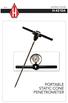 08.09 product manual H-4210A PORTABLE STATIC CONE PENETROMETER PORTABLE STATIC CONE PENETROMETER GENERAL INFORMATION The H-4210A Static Cone Penetrometer is an unparalleled device for measuring soil consistency.
High-Speed Nondestructive Testing and Intelligent Construction Systems
 High-Speed Nondestructive Testing and Intelligent Construction Systems 1st International Conference on Transportation Construction Management February 9-11, 9 2008 Orlando, Florida Ted Ferragut, P.E. NDT
A LABORATORY STUDY ON EFFECT OF TEST CONDITIONS ON SUBGRADE STRENGTH
 A LABORATORY STUDY ON EFFECT OF TEST CONDITIONS ON SUBGRADE STRENGTH A REPORT SUBMITTED IN PARTIAL FULFILLMENT OF THE REQUIREMENTS FOR THE DEGREE OF Bachelor of Technology In Civil Engineering By: Rajesh
Evaluation of PMS Recommendations for Flexible Pavement Rehabilitation Using RWD Deflection Data
 Evaluation of PMS Recommendations for Flexible Pavement Rehabilitation Using RWD Deflection Data Zhongjie Zhang Pavement & Geotech Research Administrator Louisiana Transportation Research Center Louisiana
EARTHWORKS COMPLETION REPORT ELLEN STIRLING PARADE, ELLENBROOK. Ellenbrook, W.A. Georgiou Group Pty Ltd
 EARTHWORKS COMPLETION REPORT ELLEN STIRLING PARADE, ELLENBROOK Ellenbrook, W.A. Georgiou Group Pty Ltd GEOTPERT08050AZ-AH 27 March 2013 EARTHWORKS COMPLETION REPORT ELLEN STIRLING PARADE, ELLENBROOK Ellenbrook,
Technical Presentation: Follow up on HVS testing of Roller Compacted Concrete and Ultra-thin reinforced concrete test sections
 Technical Presentation: Follow up on HVS testing of Roller Compacted Concrete and Ultra-thin reinforced concrete test sections Louw du Plessis 12 Febuary 2015 Objectives UTRCP Previous round of HVS testing
CW 3110 SUB-GRADE, SUB-BASE AND BASE COURSE CONSTRUCTION TABLE OF CONTENTS
 December 2014 CW 3110 SUB-GRADE, SUB-BASE AND BASE COURSE CONSTRUCTION TABLE OF CONTENTS 1. DESCRIPTION... 1 1.1 General... 1 1.2 Definitions... 1 1.3 Referenced Standard Construction Specifications...
PAVEMENT STRUCTURE DESIGN GUIDELINES
 PAVEMENT STRUCTURE DESIGN GUIDELINES Technical Circular T- 01/15 (Replaces Technical Circular T-01/04) Final Update: Jan. 26, 2015 Geotechnical, Materials and Pavement Engineering TABLE OF CONTENTS 1.0
User Manual UK DCP 2.2
 User Manual UK DCP 2.2 Measurement of Road Pavement Strength by Dynamic Cone Penetrometer by Simon Done and Piouslin Samuel Unpublished Project Report PR INT/278/04 Project Record No R8157 PROJECT REPORT
METHOD OF TEST FOR UNIT WEIGHT OF FRESH CONCRETE
 STATE OF CALIFORNIA BUSINESS, TRANSPORTATION AND HOUSING AGENCY DEPARTMENT OF TRANSPORTATION DIVISION OF ENGINEERING SERVICES Transportation Laboratory 5900 Folsom Blvd. Sacramento, California 95819-4612
CHAPTER 1 INTRODUCTION
 CHAPTER 1 INTRODUCTION 1.1 Introduction The design and construction of foundations require a good knowledge of the mechanical behaviour of soils and of their spatial variability. Such information can be
Module 1 : Site Exploration and Geotechnical Investigation. Lecture 4 : In-situ tests [ Section 4.1: Penetrometer Tests ] Objectives
![Module 1 : Site Exploration and Geotechnical Investigation. Lecture 4 : In-situ tests [ Section 4.1: Penetrometer Tests ] Objectives](/thumbs/26/8734290.jpg "Module 1 : Site Exploration and Geotechnical Investigation. Lecture 4 : In-situ tests [ Section 4.1: Penetrometer Tests ] Objectives") Lecture 4 : In-situ tests [ Section 4.1: Penetrometer Tests ] Objectives In this section you will learn the following Penetrometer Tests Standard penetration test Static cone penetration test Dynamic cone
Lecture 4 : In-situ tests [ Section 4.1: Penetrometer Tests ] Objectives In this section you will learn the following Penetrometer Tests Standard penetration test Static cone penetration test Dynamic cone
Lymon C. Reese & Associates LCR&A Consulting Services Tests of Piles Under Axial Load
 Lymon C. Reese & Associates LCR&A Consulting Services Tests of Piles Under Axial Load Nature of Services The company has a long history of performance of tests of piles and pile groups under a variety
Construction and Preliminary HVS Tests of Pre-Cast Concrete Pavement Slabs
 January 27 Research Report: Construction and Preliminary HVS Tests of Pre-Cast Concrete Pavement Slabs Authors: E. Kohler, L. du Plessis, and H. Theyse Work Conducted as part of Partnered Pavement Research
Measurement of Soil Parameters by Using Penetrometer Needle Apparatus
 Vol.3, Issue.1, Jan-Feb. 2013 pp-284-290 ISSN: 2249-6645 Measurement of Soil Parameters by Using Penetrometer Needle Apparatus Mahmoud M. Abu zeid, 1 Amr M. Radwan, 2 Emad A. Osman, 3 Ahmed M.Abu-bakr,
PAVEMENT REHABILITATION using BITUMEN STABILISATION STATE OF THE ART
 PAVEMENT REHABILITATION using BITUMEN STABILISATION STATE OF THE ART 23 rd Road Pavement Forum Fern Hill Hotel, Tweedie, KZN Wednesday 9 th May 2012 Dave Collings UCD Technology LOUDON INTERNATIONAL THE
Lecture Notes CT 4860 Structural Pavement Design. Design of Flexible Pavements
 Lecture Notes CT 4860 Structural Pavement Design Design of Flexible Pavements Prof.dr.ir. A.A.A. Molenaar Delft, March 2007 Table of contents Preface 3 1. Introduction 4 2. Major defect types in flexible
CHAPTER 2 HYDRAULICS OF SEWERS
 CHAPTER 2 HYDRAULICS OF SEWERS SANITARY SEWERS The hydraulic design procedure for sewers requires: 1. Determination of Sewer System Type 2. Determination of Design Flow 3. Selection of Pipe Size 4. Determination
Evaluation of Initial Setting Time of Fresh Concrete
 Evaluation of Initial Setting Time of Fresh Concrete R R C Piyasena, P A T S Premerathne, B T D Perera, S M A Nanayakkara Abstract According to ASTM 403C, initial setting time of concrete is measured based
EVALUATION OF STRUCTURAL PROPERTIES OF LIME STABILIZED SOILS AND AGGREGATES VOLUME 3: MIXTURE DESIGN AND TESTING PROCEDURE FOR LIME STABILIZED SOILS
 EVALUATION OF STRUCTURAL PROPERTIES OF LIME STABILIZED SOILS AND AGGREGATES VOLUME 3: MIXTURE DESIGN AND TESTING PROCEDURE FOR LIME STABILIZED SOILS PREPARED FOR THE NATIONAL LIME ASSOCIATION by Dallas
SECTION 31 20 00 EARTH MOVING
 SECTION 31 20 00 PART 1 - GENERAL 1.01 DESCRIPTION A. This Section describes the requirements for excavating, filling, and grading for earthwork at Parking Structure, new exit stair and as required to
Numerical Simulation of CPT Tip Resistance in Layered Soil
 Numerical Simulation of CPT Tip Resistance in Layered Soil M.M. Ahmadi, Assistant Professor, [email protected] Dept. of Civil Engineering, Sharif University of Technology, Tehran, Iran Abstract The paper
Specific Task Training Program Course S-33 Soils Field Testing and Inspection: Course Reference Manual
 Specific Task Training Program Course S-33 Soils Field Testing and Inspection: Course Reference Manual Specific Task Training Program Course S 33 Soils Field Testing and Inspection Course Reference Manual
STRUCTURES. 1.1. Excavation and backfill for structures should conform to the topic EXCAVATION AND BACKFILL.
 STRUCTURES 1. General. Critical structures may impact the integrity of a flood control project in several manners such as the excavation for construction of the structure, the type of foundation, backfill
Specification Guidelines: Allan Block Modular Retaining Wall Systems
 Specification Guidelines: Allan Block Modular Retaining Wall Systems The following specifications provide Allan Block Corporation's typical requirements and recommendations. At the engineer of record's
Commonwealth of Pennsylvania PA Test Method No. 632 Department of Transportation October 2013 5 Pages LABORATORY TESTING SECTION. Method of Test for
 Commonwealth of Pennsylvania PA Test Method No. 632 Department of Transportation 5 Pages LABORATORY TESTING SECTION Method of Test for TIME OF SETTING OF CONCRETE MIXTURES BY PENETRATION RESISTANCE 1.
Testing and appraisal of Lucobit polymer effect as an additive on asphalt mixture performance
 Abstract Testing and appraisal of polymer effect as an additive on asphalt mixture performance Hamid Sabbagh mollahosseini*,golazin Yadollahi**, Ershad Amoosoltani*** *, ***Executive of Engineering and
Comparison of the Humboldt GeoGauge With In-Place Quasi-Static Plate Load Tests. Charles R. Nelson, P.E. Mike Sondag
 Comparison of the Humboldt GeoGauge With In-Place Quasi-Static Plate Load Tests Charles R. Nelson, P.E. Mike Sondag CNA Consulting Engineers 2800 University Ave. S.E. Minneapolis, MN 55414 December, 1999
HIGHWAYS DEPARTMENT GUIDANCE NOTES ON SOIL TEST FOR PAVEMENT DESIGN
 HIGHWAYS DEPARTMENT GUIDANCE NOTES ON SOIL TEST FOR PAVEMENT DESIGN Research & Development Division RD/GN/012 August 1990 HIGHWAYS DEPARTMENT GUIDANCE NOTES (RD/GN/012) SOIL TEST FOR PAVEMENT DESIGN Prepared
How To Design A Foundation
 The Islamic university - Gaza Faculty of Engineering Civil Engineering Department CHAPTER (2) SITE INVESTIGATION Instructor : Dr. Jehad Hamad Definition The process of determining the layers of natural
Evaluation of In-Place Strength of Concrete By The Break-Off Method. Tarun Naik Ziad Salameh Amr Hassaballah
 Evaluation of In-Place Strength of Concrete By The Break-Off Method By Tarun Naik Ziad Salameh Amr Hassaballah Evaluation of In-Place Strength of Concrete By The Break-Off Method By Tarun R. Naik Associate
Standard Test Method for Mechanical Cone Penetration Tests of Soil 1
 Designation: D 3441 98 AMERICAN SOCIETY FOR TESTING AND MATERIALS 100 Barr Harbor Dr., West Conshohocken, PA 19428 Reprinted from the Annual Book of ASTM Standards. Copyright ASTM Standard Test Method
KWANG SING ENGINEERING PTE LTD
 KWANG SING ENGINEERING PTE LTD 1. INTRODUCTION This report represents the soil investigation works at Aljunied Road / Geylang East Central. The objective of the soil investigation is to obtain soil parameters
IS THAT LINER THICK ENOUGH?
 IS THAT LINER THICK ENOUGH? Philip McFarlane, Opus International Consultants Ltd ABSTRACT The amount of pipeline rehabilitation being undertaken in New Zealand is increasing each year. Larger diameter
Measurement with Ratios
 Grade 6 Mathematics, Quarter 2, Unit 2.1 Measurement with Ratios Overview Number of instructional days: 15 (1 day = 45 minutes) Content to be learned Use ratio reasoning to solve real-world and mathematical
Thickness estimation of road pavement layers using Ground Penetrating Radar
 Dr. Eng. Audrey Van der Wielen Environment Concrete Roads Geotechnics & Surface Characteristics Division Belgian Road Research Centre (BRRC) [email protected] Thickness estimation of road pavement
Nevada DOT Cold In-Place Recycling Federal Highway Administration National Review Close out meeting, August 25, 2005
 Nevada DOT Cold In-Place Recycling Federal Highway Administration National Review Close out meeting, August 25, 2005 Purpose The purpose of this review is to capture for technical deployment the most advanced
INTRODUCTION TO SOIL MODULI. Jean-Louis BRIAUD 1
 INTRODUCTION TO SOIL MODULI By Jean-Louis BRIAUD 1 The modulus of a soil is one of the most difficult soil parameters to estimate because it depends on so many factors. Therefore when one says for example:
Objectives. Experimentally determine the yield strength, tensile strength, and modules of elasticity and ductility of given materials.
 Lab 3 Tension Test Objectives Concepts Background Experimental Procedure Report Requirements Discussion Objectives Experimentally determine the yield strength, tensile strength, and modules of elasticity
Application of the Endurance Limit Premise in Mechanistic-Empirical Based Pavement Design Procedures
 Application of the Endurance Limit Premise in Mechanistic-Empirical Based Pavement Design Procedures Text Word Count: 5,409 Tables & Figures: 3,250 Total Word Count: 8,659 By: 102 Northwest Drive, Suite