
LABORATORY DETERMINATION OF CALIFORNIA BEARING RATIO
|
|
|
- Hester Summers
- 10 years ago
- Views:
Transcription
1 LABORATORY DETERMINATION OF CALIFORNIA BEARING RATIO STANDARD IS: 2720 (Part 16) DEFINITION California bearing ratio is the ratio of force per unit area required to penetrate in to a soil mass with a circular plunger of 50mm diameter at the rate of 1.25mm / min. APPARTUS Moulds 2250cc capacity with base plate, stay rod and wing nut confirming to 4.1, 4.3 and 4.4 of IS: Collar confirming to 4.2 of IS: Spacer Disc confirming to 4.4 of IS: Metal rammer confirming to IS: Expansion measuring apparatus with the adjustable stem, perforated plates, tripod confirming and to weights confirming to 4.4 of IS: Loading machine having a capacity of at least 5000kg and equipped with a movable head or base that travels at a uniform rate of 1.25mm / min for use in forcing the penetration plunger in to the specimen. Penetration plunger confirming to 4.4 of IS: Dial gauge two numbers reading to 0.01mm. IS sieves or or 19mm and 4.75mm. Miscellaneous apparatus such as mixing bowl, straight edge, scales, soaking tank, drying oven, filter paper, dishes and calibrated measuring jar. PROCEDURE There are two types of methods in compacting soil specimen in the CBR moulds i. Static Compaction method. ii. Dynamic Compaction method.

2 The material used in the above two methods shall pass 19mm sieve for fine grained soils and 37.50mm sieve for coarse materials up to 37.50mm. Replace the material retained on 19mm sieve by an equal amount of material passing 19mm sieve and retained on 4.75mm sieve Replace the material retained on 37.50mm sieve by an equal amount of material passing 37.50mm sieve and retained on 4.75mm sieve. Static Compaction In this method calculate the mass of wet soil at required moisture content to give a desired density when compacted in a standard test mould as given below Volume of mould = 2250cc. Weight of dry soil (W) = 2250 x MDD. m Weight of wet soil = x W 100 Weight of water = Weight of wet soil - Weight of dry soil. m = Optimum moisture content obtained from the laboratory compaction test. Take oven dried soil sample of calculated weight and thoroughly mix with water (OMC) as obtained from the above equation. Record the empty weight of the mould with base plate, with extension collar removed (m 1 ). Place the correct mass of the wet soil in to the mould in five layers. Gently compact each layer with the spacer disc. Place a filter paper on top of the soil followed by a 5cms displacer disc. Compact the mould by pressing it in between the platens of the compression testing machine until the top of the spacer disc comes flush with the top of the mould. Held the load for about 30 seconds and then release.

3 In some soil types where a certain amount of rebound occurs, it may be necessary to reapply load to force the displacer disc slightly below the top of the mould so that on rebound the right volume is obtained. Remove the mould from the compression testing machine. Remove the spacer disc and weigh the mould with compacted soil (m 2 ). Replace the extension collar of the mould. Prepare two more specimens in the same procedure as described above. Dynamic Compaction Take representative sample of soil weighing approximately 6kg and mix thoroughly at OMC. Record the empty weight of the mould with base plate, with extension collar removed (m 1 ). Replace the extension collar of the mould. Insert a spacer disc over the base plate and place a coarse filter paper on the top of the spacer disc. Place the mould on a solid base such as a concrete floor or plinth and compact the wet soil in to the mould in five layers of approximately equal mass each layer being given 56 blows with 4.90kg hammer equally distributed and dropped from a height of 450 mm above the soil. The amount of soil used shall be sufficient to fill the mould, leaving not more than about 6mm to be struck off when the extension collar is removed. Remove the extension collar and carefully level the compacted soil to the top of the mould by means of a straight edge. Remove the spacer disc by inverting the mould and weigh the mould with compacted soil (m 2 ). Place a filter paper between the base plate and the inverted mould. Replace the extension collar of the mould. Prepare two more specimens in the same procedure as described above.

4 In both the cases of compaction, if the sample is to be soaked, take representative samples of the material at the beginning of compaction and another sample of remaining material after compaction for the determination of moisture content. Each sample shall weigh not less than 100g for fine-grained soils and not less than 500 for granular soils. Place the adjustable stem and perforated plate on the compacted soil specimen in the mould. Place the weights to produce a surcharge equal to the weight of base material and pavement to the nearest 2.5kg on the perforated plate. Immerse the whole mould and weights in a tank of water allowing free access of water to the top and bottom of specimen for 96 hours. Test for Swelling This test is optional and may be omitted if not necessary. Determine the initial height of specimen (h) in mm. Mount the expansion-measuring device along with the tripod on the edge of the mould and record the initial dial gauge reading (d s ). Keep this set up as such undisturbed for 96 hours noting down the readings every day against the time of reading. Maintain a constant water level through out the period of soaking. Note the final reading of the dial gauge at the end of soaking period (d h ). Calculations for Swelling d f -d s Expansion ratio = x 100 h d s = Initial dial gauge reading in mm d f = final dial gauge reading in mm h = initial height of specimen in mm Penetration Test After 96 hours of soaking take out the specimen from the water and remove the extension collar, perforated disc, surcharge weights and filter paper.

5 Drain off the excess water by placing the mould inclined for about 15 minutes and weigh the mould. Testing of CBR specimen Place the mould on the lower plate of the testing machine with top face exposed To prevent upheaval of soil in to the hole of surcharge weights, place 2.5kg annular weights on the soil surface prior to seating the penetration plunger after which place the reminder of the surcharge weights. Set the plunger under a load of 4 kg so that full contact is established between the surface of the specimen and the plunger. Set the stress and strain gauges to zero. Consider the initial load applied to the plunger as the zero load. Apply the load at the rate of 1.25 mm / min. Take the readings of the load at penetration of 0, 0.5, 1.0, 1.5, 2.0, 2.5, 3.0, 4, 5, 7.5, 10 and Raise the plunger and detach the mould from the loading equipment. Collect the sample of about 20 to 50gms of soil from the top 30mm layer of specimen and determine the water content in accordance with IS: 2720 (Part 4) Examine the specimen carefully after the test is completed for the presence of any over size soil particles, which are likely to affect the results if they happen to be located directly below the penetration plunger.

6 CALCULATION OF CBR FROM LOAD PENETRATION CURVE Plot the load penetration curve in natural scale, load on Y - axis and penetration on X axis as shown in Fig: If the curve is uniformly convex upwards although the initial portion of the curve may be concave upwards due to surface irregularities make correction by drawing a tangent to the upper curve at the point of contra flexure as below NO CORRECTION REQUIRED Load on Piston in Kg/Cm CORRECTED 5mm PENETRATION CORRECTED 2.5mm PENETRATION CORRECTED FOR CONCAVE UPWARD SHAPE Penetration in mm Load vs. Penetration curve Take the intersection point of the tangent and the X axis as the origin. Calculate the CBR values for penetration of 2.50mm and 5.00mm. Corresponding to the penetration value at which CBR is to be desired, take the corrected load values from the load penetration curve and calculate the CBR from the equation P T x C f California Bearing Ratio = x 100. P S

7 P T = Corrected unit test load corresponding to the chosen penetration from load penetration curve P S = Total standard load for the same depth of penetration, which can be taken from the Table below C f = Proving ring correction factor. Standard loads at specified penetrations Penetration depth (mm) Unit Standard load Kgf/ cm 2 Total Standard load (Kgf) REPORT Report the CBR value to the nearest second decimal. Take the average of three test specimens as the CBR value of the test. Generally, the CBR value at 2.50mm penetration will be greater than that at 5.00mm penetration and in such case take the value at 2.50mm as the CBR value. If the CBR value corresponding to a penetration of 5.00mm exceeds that of 2.50mm,repeat the test. If the identical results follow, take the value corresponding to 5.00mm as the CBR value. PRECAUTIONS Clean the holes of the base plate and that of perforated disc thoroughly. Align the surcharge weight with the plunger so that the plunger penetrates freely in to the soil. Format on next page

8

9

10

HIGHWAYS DEPARTMENT GUIDANCE NOTES ON SOIL TEST FOR PAVEMENT DESIGN
 HIGHWAYS DEPARTMENT GUIDANCE NOTES ON SOIL TEST FOR PAVEMENT DESIGN Research & Development Division RD/GN/012 August 1990 HIGHWAYS DEPARTMENT GUIDANCE NOTES (RD/GN/012) SOIL TEST FOR PAVEMENT DESIGN Prepared
A LABORATORY STUDY ON EFFECT OF TEST CONDITIONS ON SUBGRADE STRENGTH
 A LABORATORY STUDY ON EFFECT OF TEST CONDITIONS ON SUBGRADE STRENGTH A REPORT SUBMITTED IN PARTIAL FULFILLMENT OF THE REQUIREMENTS FOR THE DEGREE OF Bachelor of Technology In Civil Engineering By: Rajesh
Soil Testing 24 Compaction and CBR. Compaction Test 4.5 kg BS 1377-4, 1924-2, EN DD ENV 1997-2
 24 Compaction and CBR Dry Density/Moisture Relationship BS/EN DD ENV Compaction Test 2.5 kg BS 1377-4, 1924-2, EN DD ENV 1997-2 This test method utilises a 2.5 kg hand compaction hammer and a one litre
PERMEABILITY TEST. To determine the coefficient of permeability of a soil using constant head method.
 PERMEABILITY TEST A. CONSTANT HEAD OBJECTIVE To determine the coefficient of permeability of a soil using constant head method. need and Scope The knowledge of this property is much useful in solving problems
EXPERIMENT NO.1. : Vicat s apparatus, plunger
 EXPERIMENT NO.1 Name of experiment:to determine the percentage of water for normal consistency for a given sample of cement Apparatus : Vicat s apparatus with plunger of 10mm dia, measuring cylinder, weighing
METHOD OF TEST FOR DETERMINATION OF PERMEABILITY OF GRANULAR SOILS
 Laboratory Testing Manual Date: 99 06 21 Page 1 of 7 METHOD OF TEST FOR DETERMINATION OF PERMEABILITY OF GRANULAR SOILS 1. SCOPE 1.1 This method covers the determination of the coefficient of permeability
Effect of grain size, gradation and relative density on shear strength and dynamic cone penetration index of Mahi, Sabarmati and Vatrak Sand
 Discovery ANALYSIS The International Daily journal ISSN 2278 5469 EISSN 2278 5450 2015 Discovery Publication. All Rights Reserved Effect of grain size, gradation and relative density on shear strength
METHOD A7 THE DETERMINATION OF THE MAXIMUM DRY DENSITY AND OPTIMUM MOISTURE CONTENT OF GRAVEL, SOIL AND SAND
 SCOPE METHOD A7 THE DETERMINATION OF THE MAXIMUM DRY DENSITY AND OPTIMUM MOISTURE CONTENT OF GRAVEL, SOIL AND SAND Definition The maximum dry density and optimum moisture content, as defined below, is
product manual HS-4210 HS-4210_MAN_09.08 Digital Static Cone Penetrometer
 HS-4210_MAN_09.08 product manual HS-4210 Digital Static Cone Penetrometer Introduction This Manual covers the measurement of bearing capacity using the Humboldt Digital Static Cone Penetrometer (DSCP).
DIRECT SHEAR TEST SOIL MECHANICS SOIL MECHANICS LABORATORY DEPARTMENT OF CIVIL ENGINEERING UNIVERSITY OF MORATUWA SRI LANKA
 DIRECT SHEAR TEST SOIL MECHANICS SOIL MECHANICS LABORATORY DEPARTMENT OF CIVIL ENGINEERING UNIVERSITY OF MORATUWA SRI LANKA DIRECT SHEAR TEST OBJEVTIVES To determine the shear strength parameters for a
Measurement of Soil Parameters by Using Penetrometer Needle Apparatus
 Vol.3, Issue.1, Jan-Feb. 2013 pp-284-290 ISSN: 2249-6645 Measurement of Soil Parameters by Using Penetrometer Needle Apparatus Mahmoud M. Abu zeid, 1 Amr M. Radwan, 2 Emad A. Osman, 3 Ahmed M.Abu-bakr,
Standard Test Procedures Manual
 STP 205-13 Standard Test Procedures Manual Section: 1. SCOPE 1.1. Description of Test This method describes the procedure for determining the relationship between the moisture and density of fine-grained
KWANG SING ENGINEERING PTE LTD
 KWANG SING ENGINEERING PTE LTD 1. INTRODUCTION This report represents the soil investigation works at Aljunied Road / Geylang East Central. The objective of the soil investigation is to obtain soil parameters
THE DETERMINATION OF THE MAXIMUM DRY DENSITY AND OPTIMUM MOISTURE CONTENT OF MATERIALS USING THE VIBRATORY HAMMER COMPACTION
 THE DETERMINATION OF THE MAXIMUM DRY DENSITY AND OPTIMUM MOISTURE CONTENT OF MATERIALS USING THE VIBRATORY HAMMER COMPACTION 1. SCOPE The maximum dry density and optimum moisture content, as defined below,
CEEN 162 - Geotechnical Engineering Laboratory Session 7 - Direct Shear and Unconfined Compression Tests
 PURPOSE: The parameters of the shear strength relationship provide a means of evaluating the load carrying capacity of soils, stability of slopes, and pile capacity. The direct shear test is one of the
The University of Toledo Soil Mechanics Laboratory
 The University of Toledo Soil Mechanics Laboratory 1 Soil Moisture-Density Relationship Standard and Modified Proctor Tests Introduction For earthork construction it is important to compact soils to a
SOIL-LIME TESTING. Test Procedure for. TxDOT Designation: Tex-121-E 1. SCOPE 2. APPARATUS 3. MATERIALS TXDOT DESIGNATION: TEX-121-E
 Test Procedure for SOIL-LIME TESTING TxDOT Designation: Tex-121-E Effective Date: August 2002 1. SCOPE 1.1 This method consists of three parts. 1.1.1 Part I determines the unconfined compressive strength
Commonwealth of Pennsylvania PA Test Method No. 632 Department of Transportation October 2013 5 Pages LABORATORY TESTING SECTION. Method of Test for
 Commonwealth of Pennsylvania PA Test Method No. 632 Department of Transportation 5 Pages LABORATORY TESTING SECTION Method of Test for TIME OF SETTING OF CONCRETE MIXTURES BY PENETRATION RESISTANCE 1.
METHOD OF TEST FOR UNIT WEIGHT OF FRESH CONCRETE
 STATE OF CALIFORNIA BUSINESS, TRANSPORTATION AND HOUSING AGENCY DEPARTMENT OF TRANSPORTATION DIVISION OF ENGINEERING SERVICES Transportation Laboratory 5900 Folsom Blvd. Sacramento, California 95819-4612
METHOD A10 (a) THE DETERMINATION OF THE IN-PLACE DRY DENSITY OF SOIL OR GRAVEL BY THE SAND REPLACEMENT METHOD
 METHOD A10 (a) THE DETERMINATION OF THE IN-PLACE DRY DENSITY OF SOIL OR GRAVEL BY THE SAND REPLACEMENT METHOD 1 SCOPE The in-place dry density of compacted soil or gravel, as defined below, is determined
CONSTANT HEAD AND FALLING HEAD PERMEABILITY TEST
 CONSTANT HEAD AND FALLING HEAD PERMEABILITY TEST 1 Permeability is a measure of the ease in which water can flow through a soil volume. It is one of the most important geotechnical parameters. However,
Standard Test Procedures Manual
 STP 240-6 Standard Test Procedures Manual Section: PENETRATION TEST & SPLIT- BARREL SAMPLING 1. SCOPE 1.1. Description of Test This method describes the standard penetration test using the split-barrel
PART I SIEVE ANALYSIS OF MATERIAL RETAINED ON THE 425 M (NO. 40) SIEVE
 Test Procedure for PARTICLE SIZE ANALYSIS OF SOILS TxDOT Designation: Tex-110-E Effective Date: August 1999 1. SCOPE 1.1 This method covers the quantitative determination of the distribution of particle
Figure 2.31. CPT Equipment
 Soil tests (1) In-situ test In order to sound the strength of the soils in Las Colinas Mountain, portable cone penetration tests (Japan Geotechnical Society, 1995) were performed at three points C1-C3
Evaluation of Initial Setting Time of Fresh Concrete
 Evaluation of Initial Setting Time of Fresh Concrete R R C Piyasena, P A T S Premerathne, B T D Perera, S M A Nanayakkara Abstract According to ASTM 403C, initial setting time of concrete is measured based
EXPERIMENT 10 CONSTANT HEAD METHOD
 EXPERIMENT 10 PERMEABILITY (HYDRAULIC CONDUCTIVITY) TEST CONSTANT HEAD METHOD 106 Purpose: The purpose of this test is to determine the permeability (hydraulic conductivity) of a sandy soil by the constant
COMMENTARY TO AG:PT/T251 - BALL PENETRATION TEST
 COMMENTARY TO AG:PT/T251 - BALL PENETRATION TEST PREFACE This test method is an update of the method originally prepared by the Bituminous Surfacings Research Reference Group on behalf of Austroads. FOREWORD
SIEVE ANALYSIS OF FINE AND COARSE AGGREGATES
 Test Procedure for SIEVE ANALYSIS OF FINE AND COARSE AGGREGATES TxDOT Designation: Tex-200-F Effective Date: January 2016 1. SCOPE 1.1 Use this test method to determine the particle size distribution of
INDEX 03010-1 DESCRIPTION 2 03010-2 MATERIALS 2 03010-3 APPROVAL OF SUBBASE COURSE 3 03010-4 CONSTRUCTION 4 03010-5 MEASUREMENT 6 03010-6 PAYMENT 6
 03010_Dec22_2009.pdf Page 1 of 5 INDEX Page 03010-1 DESCRIPTION 2 03010-2 MATERIALS 2 03010-3 APPROVAL OF SUBBASE COURSE 3 03010-4 CONSTRUCTION 4 03010-5 MEASUREMENT 6 03010-6 PAYMENT 6 03010_Dec22_2009.pdf
TECHNICAL Summary. TRB Subject Code:62-7 Soil Foundation Subgrades February 2003 Publication No.: FHWA/IN/JTRP-2002/30, SPR-2362
 INDOT Research TECHNICAL Summary Technology Transfer and Project Implementation Information TRB Subject Code:62-7 Soil Foundation Subgrades February 3 Publication No.: FHWA/IN/JTRP-2/3, SPR-2362 Final
The Standard & Modified Proctor Density Tests
 Revise 2003, WKS Datasheet No. 7 OHAWK COLLEGE OF APPLIED ARTS AND TECHNOLOGY BUILDING AND CONSTRUCTION SCIENCES DEPARTENT The Stanar & oifie Proctor Density Tests INTRODUCTION: In placing fill, it is
DryWeight BulkVolume
 Test Procedure for BULK SPECIFIC GRAVITY AND WATER ABSORPTION OF AGGREGATE TxDOT Designation: Tex-201-F Effective Date: January 2016 1. SCOPE 1.1 Use this method to determine the bulk specific gravity
SOIL INVESTIGATION REPORT
 SOIL INVESTIGATION REPORT PROJECT GEOTECHNICAL INVESTIGATION FOR PROPOSED WINDMILL FOUNDATION AT LOCATION JDA-13 AT BALNABA VILLAGE, BHUJ-KUTCH CLIENT M/S SUZLON INFRASTRUCTURES SERVICES LTD PROJECT NO.
PHYSICAL AND PLASTICITY CHARACTERISTICS
 0 PHYSICAL AND PLASTICITY CHARACTERISTICS EXPERIMENTS #1-5 CE 3143 October 7, 2003 Group A David Bennett 1 TABLE OF CONTENTS 1. Experiment # 1: Determination of Water Content (August 26, 2003) pp. 1-3
POWDER PROPERTIES LABORATORY
 Ground Rules POWDER PROPERTIES LABORATORY You will work as a team of no more than 6 students. At the end of this laboratory session each team will turn in a single report. The report will be reviewed,
Step 11 Static Load Testing
 Step 11 Static Load Testing Test loading is the most definitive method of determining load capacity of a pile. Testing a pile to failure provides valuable information to the design engineer and is recommended
Module 1 : Site Exploration and Geotechnical Investigation. Lecture 4 : In-situ tests [ Section 4.1: Penetrometer Tests ] Objectives
![Module 1 : Site Exploration and Geotechnical Investigation. Lecture 4 : In-situ tests [ Section 4.1: Penetrometer Tests ] Objectives](/thumbs/26/8734290.jpg "Module 1 : Site Exploration and Geotechnical Investigation. Lecture 4 : In-situ tests [ Section 4.1: Penetrometer Tests ] Objectives") Lecture 4 : In-situ tests [ Section 4.1: Penetrometer Tests ] Objectives In this section you will learn the following Penetrometer Tests Standard penetration test Static cone penetration test Dynamic cone
Lecture 4 : In-situ tests [ Section 4.1: Penetrometer Tests ] Objectives In this section you will learn the following Penetrometer Tests Standard penetration test Static cone penetration test Dynamic cone
Evaluation of Properties of Soil Subgrade Using Dynamic Cone Penetration Index A Case Study
 International Journal of Engineering Research and Development e-issn: 2278-067X, p-issn: 2278-800X Volume 4, Issue 4 (October 202), PP. 07-5 Evaluation of Properties of Soil Subgrade Using Dynamic Cone
SPECIFIC GRAVITY OF COARSE AGGREGATE AASHTO T 85
 SPECIFIC GRAVITY OF COARSE AGGREGATE AASHTO T 85 GLOSSARY Absorption: The increase in weight due to water contained in the pores of the material. Bulk Specific Gravity (also known as Bulk Dry Specific
Specific volume and absorption properties
 Accepted 1980 Fluff Specific volume and absorption properties 1 Scope This SCAN-test Method describes the preparation of test pieces of fluff and a procedure for their use in determining the specific volume
c. Borehole Shear Test (BST): BST is performed according to the instructions published by Handy Geotechnical Instruments, Inc.
 Design Manual Chapter 6 - Geotechnical 6B - Subsurface Exploration Program 6B-2 Testing A. General Information Several testing methods can be used to measure soil engineering properties. The advantages,
1 Mobilisation and demobilisation 1 Deep boring sum 2 Cone penetration tests sum 3 Miscellenous tests sum
 Malaysian Civil Engineering Standard Method of Measurement (MyCESMM) CLASS D: SITE INVESTIGATION WORK Measurement covered under other classes: Excavation not carried out for the purpose of soil investigation
GUIDELINES FOR TESTING FRESH SELF-COMPACTING CONCRETE
 Growth Contract No. GRD2-2000-30024 GUIDELINES FOR TESTING FRESH SELF-COMPACTING CONCRETE Principal author: G. DE SCHUTTER September 2005 European Research Project: MEASUREMENT OF PROPERTIES OF FRESH SELF-COMPACTING
Standard Test Procedures Manual
 STP 206-4 Standard Test Procedures Manual Section: 1. SCOPE 1.1. Description of Test This method describes the procedure for determining the liquid limit, plastic limit and the plasticity index of coarse-grained
How To Design A Foundation
 The Islamic university - Gaza Faculty of Engineering Civil Engineering Department CHAPTER (2) SITE INVESTIGATION Instructor : Dr. Jehad Hamad Definition The process of determining the layers of natural
FINAL REPORT ON SOIL INVESTIGATION
 FINAL REPORT ON SOIL INVESTIGATION FOR PROPOSED CONSTRUCTION AT SS-6B AREA AT HPCL VISAKH REFINERY VISAKHAPATNAM ANDHRA PRADESH J.J. ASSOCIATES(VISAKHAPATNAM) AETP(P) LIMITED #11-6-3, RockDale Layout,
Attachment G-1: Pit Latrine Diagram. Fig E.1a: Pit Latrine. Fig E.1b: Plan View of Twin Pits
 Attachment G-1: Pit Latrine Diagram Fig E.1a: Pit Latrine Fig E.1b: Plan View of Twin Pits Fig E.1c: Section of a water-sealed pan Fig E.1d: 3D view of Overflow Pipe Fig E.1e: 2D view of Overflow Pipe
A.17. OXIDIZING PROPERTIES (SOLIDS)
 A.17. OXIDIZING PROPERTIES (SOLIDS) 1. METHOD 1.1. INTRODUCTION It is useful to have preliminary information on any potentially explosive properties of the substance before performing this test. This test
Calibration of Volumetric Glassware
 Chemistry 119: Experiment 2 Calibration of Volumetric Glassware For making accurate measurements in analytical procedures, next in importance to the balance is volumetric equipment. In this section volumetric
Quality control: Annex-A.
 Quality control: Quality of the constructed work has been checked by our staff as per frequency and provision mentioned section 900 in MoRT&H and as per provision mentioned in Concession Agreement. The
In-situ Density Determination by Sand Replacement Method
 University of Texas at Arlington Geotechnical Engineering Laboratory Test Procedure In-situ Density Determination by Sand Replacement Method Lecture Note 7 (Thursday 03-04-04) 1 Definitions, Objectives
INTRODUCTION TO SOIL MODULI. Jean-Louis BRIAUD 1
 INTRODUCTION TO SOIL MODULI By Jean-Louis BRIAUD 1 The modulus of a soil is one of the most difficult soil parameters to estimate because it depends on so many factors. Therefore when one says for example:
SAMPLE GUIDE SPECIFICATIONS FOR OSTERBERG CELL LOAD TESTING OF DEEP FOUNDATIONS
 Page 1 of 9 SAMPLE GUIDE SPECIFICATIONS FOR OSTERBERG CELL LOAD TESTING OF DEEP FOUNDATIONS 1. GENERAL REQUIREMENTS 1. Description of Work: This work consists of furnishing all materials, equipment and
The AASHO Road Test site (which eventually became part of I-80) at Ottawa, Illinois, was typical of northern climates (see Table 1).
 Página 1 de 12 AASHO Road Test The AASHO Road Test, a $27 million (1960 dollars) investment and the largest road experiment of its time, was conceived and sponsored by the American Association of State
TECHNICAL REPORT ON SCALA DYNAMIC CONE PENETROMETER IRREGULARITY
 TECHNICAL REPORT ON SCALA DYNAMIC CONE PENETROMETER IRREGULARITY CETANZ Technical Report TR 1 Author(s) SJ Anderson, Geotechnics Ltd Report Date First Issue May 2010 Report Revision Date September 2011
INTERNATIONAL HOCKEY FEDERATION PERFORMANCE REQUIREMENTS AND TEST PROCEDURES FOR HOCKEY BALLS. Published: April 1999
 INTERNATIONAL HOCKEY FEDERATION PERFORMANCE REQUIREMENTS AND TEST PROCEDURES FOR HOCKEY BALLS Published: April 1999 CONTENTS 1 Introduction 2 Test Procedures General 3 Standards and Specific Test Procedures
Drained and Undrained Conditions. Undrained and Drained Shear Strength
 Drained and Undrained Conditions Undrained and Drained Shear Strength Lecture No. October, 00 Drained condition occurs when there is no change in pore water pressure due to external loading. In a drained
Florida Method of Test for TESTING OF GROUND TIRE RUBBER Designation: FM 5-559
 Florida Method of Test for TESTING OF GROUND TIRE RUBBER Designation: FM 5-559 1 SCOPE 1.1 This method is used to determine the physical requirements of ground tire rubber for use in asphalt rubber using
Soil Testing Soil index properties 24. Cone Penetrometer Method BS 1377, 1924-2, EN DD ENV 1997-2. Semi-Automatic Cone Penetrometer
 24 Soil index properties Soil Index Properties Soil index properties are used extensively by engineers to discriminate between the different kinds of soil within a broad category, e.g. clay will exhibit
product manual 08.09 H-4210A PORTABLE STATIC CONE PENETROMETER
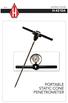 08.09 product manual H-4210A PORTABLE STATIC CONE PENETROMETER PORTABLE STATIC CONE PENETROMETER GENERAL INFORMATION The H-4210A Static Cone Penetrometer is an unparalleled device for measuring soil consistency.
SECTION 32 14 13.19 PERMEABLE INTERLOCKING CONCRETE PAVEMENT
 PART 1 GENERAL 1.1 SECTION INCLUDES SECTION 32 14 13.19 PERMEABLE INTERLOCKING CONCRETE PAVEMENT A. The requirements for construction of permeable interlocking concrete pavement: 1. Install the interlocking
INDIRECT METHODS SOUNDING OR PENETRATION TESTS. Dr. K. M. Kouzer, Associate Professor in Civil Engineering, GEC Kozhikode
 INDIRECT METHODS SOUNDING OR PENETRATION TESTS STANDARD PENETRATION TEST (SPT) Reference can be made to IS 2131 1981 for details on SPT. It is a field edtest to estimate e the penetration e resistance
Apr 17, 2000 LAB MANUAL 1302.0. 1302 PARTICLE SIZE ANALYSIS OF SOILS AASHTO Designation T 88 (Mn/DOT Modified)
 Apr 17, 2000 LAB MANUAL 1302.0 1302 PARTICLE SIZE ANALYSIS OF SOILS AASHTO Designation T 88 (Mn/DOT Modified) 1302.1 SCOPE This method describes a procedure for the quantitative determination of the distribution
9.00 THE USE OF HUNTER LAND DRAINAGE PERFORATED PIPES. Hunter Underground Systems
 9.00 THE USE OF HUNTER LAND DRAINAGE PERFORATED PIPES Hunter Underground Systems 9.01 General 9.02 Surface water Drainage 9.03 Groundwater Drainage 9.04 Dispersal of Septic Tank Effluent 9.01 The use of
Division 2 Section 32 14 13.19 Section 02795
 Note: The text must be edited to suit specific project requirements. It should be reviewed by a qualified civil or geotechnical engineer, or landscape architect familiar with the site conditions. Edit
Construction Specifications for Keyhole Pavement Coring and Reinstatement
 F I N A L Construction Specifications for Keyhole Pavement Coring and Reinstatement Gas Technology Institute 1700 S. Mount Prospect Rd. Des Plaines, Illinois 60018 www.gastechnology.org Version 13 October
LABORATORY CLASSIFICATION OF SOILS FOR ENGINEERING PURPOSES
 Test Procedure for LABORATORY CLASSIFICATION OF SOILS FOR ENGINEERING PURPOSES TxDOT Designation: Tex-142-E Effective Date: August 1999 1. SCOPE 1.1 This method is a system for classifying disturbed and
Geotechnical Measurements and Explorations Prof. Nihar Ranjan Patra Department of Civil Engineering Indian Institute of Technology, Kanpur
 Geotechnical Measurements and Explorations Prof. Nihar Ranjan Patra Department of Civil Engineering Indian Institute of Technology, Kanpur Lecture No. # 28 Last lecture we have covered this Atterberg limit,
XI / PHYSICS FLUIDS IN MOTION 11/PA
 Viscosity It is the property of a liquid due to which it flows in the form of layers and each layer opposes the motion of its adjacent layer. Cause of viscosity Consider two neighboring liquid layers A
LABORATORY II. PLASTICITY - Atterberg limits. w L - Cone test, Cassagrande test
 LABORATORY II. PLASTICITY - Atterberg limits w L - Cone test, Cassagrande test Consistency - limits I P w L w P Is plasticity important? Smectite Structure Tetrahedral layer Octahedral layer Tetrahedral
Guidelines for Earthquake Bracing of Residential Water Heaters
 Guidelines for Earthquake Bracing of Residential Water Heaters Department of General Services Division of the State Architect 1102 Q Street, Suite 5100 Sacramento, CA 95814 Phone: (916) 324-7099 Fax: (916)
GUIDELINE FOR HAND HELD SHEAR VANE TEST
 GUIDELINE FOR HAND HELD SHEAR VANE TEST NZ GEOTECHNICAL SOCIETY INC August 2001 CONTENTS Page 1.0 Introduction 2 2.0 Background 2 3.0 Recommended Practice 3 4.0 Undrained Shear Strength 3 5.0 Particular
Apr 17, 2000 LAB MANUAL 1811.0
 Apr 17, 2000 LAB MANUAL 1811.0 1811 BULK SPECIFIC GRAVITY (GMB) AND DENSITY OF COMPACTED BITUMINOUS SPECIMENS USING PARAFFIN OR PARAFILM ASTM Designation D 1188 (MN/DOT Modified) 1811.1 SCOPE This test
PRESENTATION ON REPAIR AND REHABILITATION OF BUILDINGS DAMAGED IN EARTHQUAKE. By H P Gupta & D K Gupta
 PRESENTATION ON REPAIR AND REHABILITATION OF BUILDINGS DAMAGED IN EARTHQUAKE By H P Gupta & D K Gupta DIFFERENT TYPES OF DAMAGES 1.Minor cracks 0.5 to 5 mm wide in load or non-load bearing walls 2.Major
METHOD OF TEST FOR SAMPLING AND TESTING CRUMB RUBBER MODIFIER
 STATE OF CALIFORNIA BUSINESS, TRANSPORTATION AND HOUSING AGENCY DEPARTMENT OF TRANSPORTATION DIVISION OF ENGINEERING SERVICES Transportation Laboratory 5900 Folsom Boulevard Sacramento, California 95819-4612
DYNAMIC CONE PENETRATION TEST INSTRUCTIONAL MANUAL GEOTECHANICAL
 DYNAMIC CONE PENETRATION TEST INSTRUCTIONAL MANUAL GEOTECHANICAL J. P. Scientific Instruments 7, Civil Lines, Roorkee-247667 DYNAMIC CONE PENETRATION TEST CONTENTS: PAGE NO. 1.0 INTRODUCTION 03 2.0 PROBLEM
SECTION 32 14 13.19 PERMEABLE INTERLOCKING CONCRETE PAVEMENT (1995 MasterFormat Section 02795)
 SECTION 32 14 13.19 PERMEABLE INTERLOCKING CONCRETE PAVEMENT (1995 MasterFormat Section 02795) Note: This guide specification for U.S. applications describes construction of permeable interlocking concrete
Compacted Road Base and Subbase Soils
 Compacted Road Base and Subbase Soils INTRODUCTION When highway or railway earthworks, bases, subbases and dams are constructed and subgrades are prepared, it is necessary to compact the material mechanically,
Lab 1 Concrete Proportioning, Mixing, and Testing
 Lab 1 Concrete Proportioning, Mixing, and Testing Supplemental Lab manual Objectives Concepts Background Experimental Procedure Report Requirements Discussion Prepared By Mutlu Ozer Objectives Students
Testing and appraisal of Lucobit polymer effect as an additive on asphalt mixture performance
 Abstract Testing and appraisal of polymer effect as an additive on asphalt mixture performance Hamid Sabbagh mollahosseini*,golazin Yadollahi**, Ershad Amoosoltani*** *, ***Executive of Engineering and
COMPENDIUM OF INDIAN STANDARDS ON SOIL ENGINEERING PART 2
 (PREVIEW) SP 36 (Part 2) : 1988 COMPENDIUM OF INDIAN STANDARDS ON SOIL ENGINEERING PART 2 IS 1893 : 1979 (Reaffirmed 1987) CODE OF PRACTICE FOR SUBSURFACE INVESTIGATION FOR FOUNDATIONS 1.1 This code deals
Treatment of a surface or structure to resist the passage of water in the absence of hydrostatic pressure. presence of hydrostatic pressure.
 Recommend Approval: Team Leader Date Division Chief Date Approved: Director Date Maryland Department of Transportation State Highway Administration Office of Materials Technology MARYLAND STANDARD METHOD
Mitigation of Expansive Soils Damages
 Mitigation of Expansive Soils Damages Joseph Muhirwa Richard Benda Robert Sargent REU Program University of Texas at Arlington This presentation will focus on four main sections Introduction and Background
Load Frames. www.humboldtmfg.com 1.800.544.7220 708.468.6300
 Lab Equipment Soil Lab Consolidation Load Frames 80 52 ConMatic IPC, Automated Consolidation System, 120/220V 50/60Hz HM-2470A.3F The ConMatic IPC is a fully-automated, incremental pressure controller
SUPPLEMENTAL TECHNICAL SPECIFICATIONS BI-DIRECTIONAL STATIC LOAD TESTING OF DRILLED SHAFTS
 July 14, 2015 1.0 GENERAL BI-DIRECTIONAL STATIC LOAD TESTING OF DRILLED SHAFTS This work shall consist of furnishing all materials, equipment, labor, and incidentals necessary for conducting bi-directional
INTERNATIONAL JOURNAL OF CIVIL AND STRUCTURAL ENGINEERING Volume 3, No 3, 2013
 INTERNATIONAL JOURNAL OF CIVIL AND STRUCTURAL ENGINEERING Volume 3, No 3, 2013 Copyright by the authors - Licensee IPA- Under Creative Commons license 3.0 Research article ISSN 0976 4399 Reliability of
Section 02702 SEWER PIPE INSTALLATION AND TESTING
 PART 1 - GENERAL Section 02702 SEWER PIPE INSTALLATION AND TESTING 1-1. SCOPE. This section covers the installation and testing of all sewer pipe furnished under the following specification sections: Concrete
How To Design A 3D Print In Metal
 DMLS / SLM Metal 3D Printing. An introductory design guide for our 3d printing in metal service. v2.2-8th July 2015 Pricing considerations. Part Volume. One of the biggest factors in the price for DMLS
Soil Mechanics. Soil Mechanics
 Soil is the most misunderstood term in the field. The problem arises in the reasons for which different groups or professions study soils. Soil scientists are interested in soils as a medium for plant
Sample preparation for X-ray fluorescence analysis
 Technical articles Sample preparation for X-ray fluorescence analysis III. Pressed and loose powder methods Gakuto Takahashi* 1. Introduction There are two main sample preparation techniques for measurement
SECTION 32 14 13.19 PERMEABLE INTERLOCKING CONCRETE PAVEMENT (1995 MasterFormat Section 02795)
 SECTION 32 14 13.19 PERMEABLE INTERLOCKING CONCRETE PAVEMENT (1995 MasterFormat Section 02795) Note: This guide specification for U.S. applications describes construction of permeable interlocking concrete
FIELD SAMPLING AND TESTING MANUAL TESTING PROCEDURES FOR ALL TESTS
 FIELD SAMPLING AND TESTING MANUAL TESTING PROCEDURES FOR ALL TESTS Intentionally Left Blank TESTING PROCEDURES FOR ALL TESTS TABLE OF CONTENTS ND T 2 ND T 11 ND T 23 ND T 27 ND T 84 ND T 85 ND T 87 ND
6 QUALITY CONTROL PROCEDURES
 6 QUALITY CONTROL PROCEDURES Producer Personnel Management Representative Certified Asphalt Technicians Qualified Technicians Reference Publications Field Laboratory Test Equipment Calibration Diary Materials
SELECTING THE ELECTRIC VIBRATOR
 SELECTING THE ELECTRIC VIBRATOR Vibration systems and methods The systems that use the vibration technique can be divided into the following categories: freely oscillating systems, which will be described
Construction Materials Testing. Classes of Test
 Construction Materials Testing Classes of Test February 2014 Copyright National Association of Testing Authorities, Australia 2014 This publication is protected by copyright under the Commonwealth of Australia
Geotechnical Testing Methods II
 Geotechnical Testing Methods II Ajanta Sachan Assistant Professor Civil Engineering IIT Gandhinagar FIELD TESTING 2 1 Field Test (In-situ Test) When it is difficult to obtain undisturbed samples. In case
SPECIFICATION FOR CONSTRUCTION OF UNBOUND GRANULAR PAVEMENT LAYERS
 TNZ B/02:2005 SPECIFICATION FOR CONSTRUCTION OF UNBOUND 1. SCOPE This specification shall apply to the construction of unbound granular pavement layers. The term pavement layer shall apply to any layer
Physics 1114: Unit 6 Homework: Answers
 Physics 1114: Unit 6 Homework: Answers Problem set 1 1. A rod 4.2 m long and 0.50 cm 2 in cross-sectional area is stretched 0.20 cm under a tension of 12,000 N. a) The stress is the Force (1.2 10 4 N)