
^-PENETROMETER APPLICATION, SANDS, PERTH
|
|
|
- Marjorie Alexander
- 10 years ago
- Views:
Transcription
1 Cmf Event No ^-PENETROMETER APPLICATION, SANDS, PERTH B. CLEGG, B.E., Ph.D., F.I.E. Aust., Senior Lecturer, Civil Engineering, University of Western Australia SUMMARY This paper reviews the introduction and application of penetrometers to site investigation and compaction control in sands of Perth area. It deals principally with the 9 kg, 600 mm drop, 16 mm dia. rod penetrometer. A survey has shown extensive use of this device as an alternative to field density testing. Influence of sand type, depth and moisture content on penetration resistance are discussed. Comparison is made with other penetrometers. Recent field and laboratory observations indicate its possible application to settlement analysis by correlation with moduli! from screw plate bearing and bore hole pressure meter tests. 1 INTRODUCTION The expansion of the Perth Metropolitan Area has led to extensive use of the light (9kg)penetrometer as presented by the author together with Mr. Graham Click just 14 years ago at the I.E.Aust. Conference in Perth. (Click and Clegg 1965). A large proportion of the light structures, principally houses, are founded on sand and also, where clay and other soils are encountered near the Darling escarpment and in the ranges, it is now common practice to excavate and replace with a "sand pad". The compaction requirements in these situations are now almost invariably expressed directly in terms of driving resistance of this penetrometer. At times the density is inferred by a calibration of density with driving resistance but this is generally confined to major projects for a specific purpose. At the same time there has been a swing away from what was the traditional limestone block strip footings with suspended timber floors to concrete strip footings and "slab on the ground" construction. This has required uniform compaction over the whole site and as a result rapid compaction with use of vibratory devices has also become common. Rapid assessment of the compaction achieved has been essential, hence the acceptance of the penetrometer. Local authorities now require compaction certificates for house sites and these are generally accepted on the basis of penetrometer tests. In view of the considerable increase in its application this paper reviews the historical background; assesses its current useage; reports some research and comments on future possibilities, particularly as a means of estimating settlement. 2 HISTORICAL BACKGROUND Soon after taking up the position as first full time lecturer in Soil Mechanics at the University of Western Australia, Department of Civil Engineering, the author included projects on the use of penetrometers as final year thesis topics. The emphasis was then on their use for site investigations. The first penetrometer consisted of 'E' type 33.3 mm dia. diamond drill rods fitted with a 3.1 mm dia. cone and driven by a 32.3 kg mass dropping 45 mm. This penetrometer was calibrated in a 3 m length of 495 mm diameter pipe with the results as shown in Figure 1 and Table 1 (Yim 195). This device was used on a number of small site investigations. One of particular interest is that at St. George's College Chapel (Fernie 195). Typical penetration resistance with depth profiles at this site are shown in Figure 2. It is of interest to note that the test marked 'g1, taken in the vicinity of a badly cracked area of the building, shows approximately constant driving resistance below about 2 m whereas the other tests show a definite increase with depth. About the same time the standard Penetration Test was introduced to Perth for the site investigation for the proposed Chevron Hotel - where the Perth Concert Hall is now located. (Clegg and Smith 1965). In the early 1960's the Department of Civil Engineering offered the only commercial soil testing in Perth as an extension of its general testing facilities established many years previously. When the demand for field density tests in sand fill became excessive the need for a simple rapid test became evident. About this time the Main Roads Department had acquired from the Country Roads Board Victoria a Scala Penetrometer (Scala 1960). Using only a 9kg mass this device was considerably more portable than the 32kg mass being used and appeared to be more useful since there was only a need for shallow probing. Experiments showed that the conical point was not necessary in the find sand. The Scala penetrometer was therefore modified slightly to a blunt end, 16 mm diameter rod, driven with a 9kg mass dropping 600 mm. This rod was calibrated by Pihu (1961). In his study he investigated such factors as the effect of conical tip versus blunt ended, height of drop, depth of penetration and moisture content. One of the first projects on which it was used was the 1962 Empire Games Village at City Beach. The growing demand for field density testing of sand prompted the author to persuade a local machinery merchant to have the device manufactured and readily available in his showroom. Its use spread rapidly with " blows per foot" becoming the specification for good compaction. This value was determined between the 0 mm and 450 mm depth, since the calibration had shown a linear blows vs depth over this range. The suggestions for compaction control and site investigations put forward by Click and Clegg (1965) became generally accepted and its use widespread. By 195 a review of the use of this penetrometer seemed appropriate and a "state of the art" report was undertaken by Hewitt (195). He followed this with some field and laboratory investigations

2 Event No Penetrometer details hammer 32.3 kg. drop 45 mm cone,3mmdia rods 33.3 mm dia. BLOWS/300mm 25 I 30 I 35 For details of penetrometer see Figure 1 1- g E 2- GO 3 1 m T Q. Q 3- u 4- < cc Q OT w rr Figure 1. Depth m RELATIVE DENSITY ' mm 0 0 Calibration, 32.3 kg penetrometer showing influence of depth (Yim 195) TABLE 1 Data for calibration 32.3 kg penetrometer showing influence of submergence (Yim 195) Relative Density, Moisture, 0 \ % Figures indicate number of blows per 300 mm. 5 submerged,note effect of submergence and rapid increase in blows at higher relative densities. For details of penetrometer see Figure 1 (Yim 195) Figure 2. Application, 32.3 kg penetrometer, St.George's College Chapel (Fernie 195) as described in later sections of this paper. In 190 the CSIRO Symposium on Foundations on Interbedded Sands held in Perth included several papers that should be referred to. Clegg (190) reviewed the question of "Coastal Plain Dune Sand as a Foundation Material". Others discussed more specifically the use of SPT and Static Cone penetrometers for estimating bearing capacity and settlement. (D'Appolonia and D'Appolonia 190), (Hollingsworth and Wood 190), (Greenwood and Tait 190). This interest in penetrometers for settlement estimates led the author to investigate a project using the penetrometer for determination of an in-situ modulus of deformation. (Dumas 19). 3 EXTENT OF USE In order to obtain an overall picture of the penetrometer 's use in Perth, Hewitt (195) carried out a survey by questionnaire. Of the 419 forms sent out 11 were returned with 90 organisations indicating either possessing or having access to one of the devices. The distribution among the various categories of users was found to be as follows : Architects Consulting Engineers Local Authorities Contractors Government " Informal enquiries around the firms manufacturing the penetrometer suggest that some two thousand have been produced. Even allowing for its consumable nature it appears that many small contractors and builders make use of it. The questionnaire also showed that the expectancy varies from simply an assessment of uniformity of a site to predicting per cent compaction. The recogni-

3 Event No tion that for most domestic construction purposes broad categories of density i.e. "loose", "medium" and "dense" are all that is required, has led to the achievement of a specific blow count, generally or for 300 mm as indicating good compaction. However the returns indicated some concern about the influence of the following factors : 0 13 BLOWS/300mm, PSP 16 - variation with sand type - influence of depth - influence of moisture content 0 In view of this concern Hewitt (195) carried out a limited programme of laboratory and field testing concentrating on the first two of these. The third aspect, the moisture content, was found to be too difficult for the kind of study being undertaken and this awaits possible future investigation. ^ > 4 INFLUENCE OF SAND TYPE, DEPTH, MOISTURE CONTENT j The variation in sand types in the Perth area may best be seen in relation to the Soil Association of the Swan Coastal Plan (Bettenay, McArthur, Kingston 1960). The associations of particular interest are as follows. They roughly parallel the coastline. Quindalup Cottesloe - calcareous dunes, along the coast. - yellow and brown over limestone, Spearwood dune system. Karrakatta - leached yellow and brown over limestone Spearwood dune system. Bassendean - grey highly leached,dunes. While this pedalogical classification may not be considered the most desirable from the point of view of penetrometer calibration it is considered a reasonably sound basis from which to proceed. Information about the gradings of these sands is given by Clegg (1962), Beattie (1964). For his studies Hewitt chose two test areas in each of the above Associations, one north and one south of the Swan River. At his test sites, in terms of grading, the Quindalup sand was found to be much finer than the other three having D5Q of 0.2 mm compared to D of 0.35mm to 0.45 mm for the others. This difference was also evident in the range of densities from minimum to maximum, 1.1 to 1.3 Mg/m3 for Quindalup and 1.4 to 1. Mg/m3 for the others. He did however encounter the well recognised problem with respect to the laboratory test methods for determining the maximum and minimum densities on which the relative density is based. He obtained a much better correlation between blows and minimum density and therefore doubted the reproducibility of the maximum density test procedure of vibrating wet under a surcharge. This aspect needs careful consideration since the original correlation of Pihu (1961) appears to have produced higher maximum densities and consequently lower relative densities for the same blow count. He therefore adjusted his data to the earlier study with results as shown in Figures 3 and 4. From this study it was concluded that there was essentially no difference between the Cottesloe, Karrakatta and Bassendean Associations and that Quindalup Association appeared to give lower density for a given number of blows, but this needed further substantiation. With respect to a depth, the Hewitt study confirmed the general observations that there is frequently an increase in driving resistance with depth, at least down to 90 mm and that, (as illistrated in Figure 4) this need not correspond to an increase in density. He suggested that the influence of depth may become complicated near the surface Q LU 60 5 LU CC Figure 3. > 0 0 I60 LU cc 40 Figure I MOISTURE CONTENT % LEGEND A Cottesloe Sand D Karakatta Sand Bassendean Sand Figures with bar indicate mm others mm depth 12 Field data on laboratory calibration (Hewitt 195) mm depth Laboratory calibration at 4% m. (G LICK & CLEGG 1965) 5 PSP BLOWS/300 mm mm depth Comparison field and laboratory, relative density vs. penetration resistance.

4 Event No because o:f the compaction modifying the stress history so that the driving resistance may not be influenced by the overburden stress alone. Experiments with friction on the rod suggested that it was not a factor to be concerned with at least down to the depth used when testing for compaction control.» The original calibration (Pihu 1961) indicated a decrease in driving resistance for an increase in moisture content. Attempts to verify this in the field were not successful. The free draining characteristics of these sands is such that they very quickly adjust after wetting to their field capacity. Also, excessively low moisture contents do not occur until after prolonged periods. 5 COMPARISON WITH OTHER PENETROMETERS In view of the possible extension of the application of the penetrometer to site investigation and settlement estimates it is appropriate to consider it in relation to other similar devices. The penetrometer closely resembles the Scala Penetrometer with the two important differences. As previously mentioned it uses a blunt ended rod instead of a cone and the second is that the height of drop is 600 mm instead of mm. The difference in driving resistance between these two penetrometers appears to be related mainly to the height of drop with % more blows being required for the Scala Penetrometer. The blunt ended rod is much easier to manufacture and is in fact easier to remove and this has become virtually the "standard model". It is possible that the sand trapped below the blunt end provides a "natural" cone with some clearance. The status of penetration testing in Australia was reported by Holden (194). The shallow probing devices for depths down to about one metre were said to be not relevant to his study. However, the penetrometer was included, presumably because of the possible use of extension rods and its adaptation to site investigations. He made an interesting comment to the effect that the use of the penetrometer should be discouraged because of the unknown effect of the skin friction on the rods. Similar penetrometers are in use elsewhere, particularly in Europe. Details of some of these are given in Table II. It should be noted that all of these devices have conical ends with larger diameters than the rods while hammer masses of kg and drop heights of mm are common. Thus again,the blunt end is the unique feature of the penetrometer under discussion. A more comprehensive review is given by Sanglerat (192). Of particular interest in relation to the present discussion is the relationship between the SPT and the penetrometer. The SPT while not used for shallow density control probing is used extensively for site investigations and if the penetrometer is to be used for this purpose it would be helpful to have a correlation between them. Assuming that the SPT "cone" is the full cross sectional area of the sampler, it is of interest to note that the "driving energy" would be 24 kg.mm/mm2 compared with the penetrometer at 2 of these units. Gibbs and Holz (195) reported the effect of surcharge on SPT as obtained from comprehensive laboratory studies. Their suggested relationship between SPT and relative density for "zero" overburden stress is very close to the penetrometer for damp sand with the SPT requiring slightly more blows for the same relative density. From some shallow SPT tests Chodorowski (1964) undisturbed "typical Perth sand" at a relative density of about 45% has an SPT blow count N of about 4 - the same as the penetrometer for this relative density. It is worth noting here that Chodorowski also reported the use of the penetrometer consisting of a 60 solid cone on the end of the SPT sampler. This device has since been used extensively around Perth for site investigations. It appears to give slightly higher N values than the SPT. Name and (country) - (Bulgaria - (Czechoslovakia) Veritas (France) Socotec (France) Nordemeyer (Germany) - (Poland) Penetrometer tip Diameter Angle (mm) or TABLE II Details of various light penetrometers (Hewitt 195) Cone Cone Cone 60 Rod Diameter (mm) Weight (kg).2 Mass Height of fall (mm) "Driving Energy khmm/mm2 40 or 5 Main use and comments Site investigations (eccentric lifter to lift mass) Site investigation of low earth dams, probing. ) Checking shallow soil depth ) below footing levels. ) Electro- automatic Site investigation - (Portugal) Sounding to bedrock - (Switzerland) Mechanised, electrical) Site ) investi- ) gation. The "driving energy" is introduced as a measure of comparison of the different penetrometers.,,,..,, mass x height of fall "driving energy" = >f. & 5 area o± tip of penetrometer

5 6 CORRELATION; WITH SOIL rmodulus There has developed in recent years an interest in predicting settlement on sand based on in-situ modulus determinations from bearing tests or inferrence from penetration tests such as the Static Cone or> SPT. Schmertman (190) presented a study of the use of the static cone for settlement estimates by correlating with a modulus derived from a 230 mm dia. screw plate bearing test. From his observations he considered that the static cone was more desirable than the SPT although the latter could be used if the only field data available. In view of the apparent correlation between SPT and the penetrometer the project of Dumas (19) was undertaken. This consisted of some preliminary experiments aimed at establishing a correlation with the screw plate as used previously by Simpson (192). The results are shown in Figure 5. The modulus, E, was derived from the load settlement data by first calculating a secant modulus E' and converting this to a representative modulus for the zone down to a depth of twice the diameter, B, of the plate using Schmertman's equation, that incorporates a vertical strain influence factor I and correction factors viz.: z Ap 2B I o Az The constant cj, used to account for the reduced settlement to be expected at high ratios of overburden stress to net foundation pressure increase was taken as unity in accordance with Shultze and Sherif (193). The constant C2, to allow for creep was also taken as unity so that the relationship used became E = 0.6 E'B or ES ~ 0.14 E' (MPa) It should be noted that the field screw plate tests were over a depth from about 1.0 m to 2.5 m, the laboratory tests from 0 mm to 600 mm and the pressuremeter tests were all at about 1 m depth. While these tests may be seen as preliminary only the possibility of using the penetrometer for settlement analysis is evident. Correlation with the modulus as obtained from bore hole pressure meter tests is also indicated. Schultz and Bierdam (19) presented the results of comprehensive study of the pressuremeter-penetrometer relationships. Three types of sounding apparatus were considered, heavy, light and SPT. The light penetrometer used had two variations but would be basically similar to that of Nordmeyer of Germany as indicated in Table 2. The pressuremeter used was of the Menard type. Excellent correlations were established between the penetration resistance and lateral modulus of deformation. In view of this it is of interest to note the results of Van der Meer (193). While not seeking a correlation he performed bore hole pressuremeter tests and used the penetrometer at the same sites. Data from his work is also plotted on Figure 5. DISCUSSION From the foregoing it can be seen that the penetrometer was introduced and developed out of necessity. Its usefulness is amply demonstrated by its almost universal acceptance in the Perth area as the basis for compaction assessment. Its simplicity has resulted in it being used extensively by the "man on the job". Its reliability has resulted in it Q CO u I I O Figure 5. LEGEND A Screw plate, field O " " Jab. (DUMAS 19) G] Pressuremeter, field (VAN DER MEER 193) O 5 PSP, BLOWS/300mm Event No Penetration resistance vs. equivalent Young's Modulus Es,from screw plate bearing and bore hole pressure meter tests. being specified by "those in control". Basically it is little different from other penetrometers and may in fact be seen as merely another variety adapted to a particular local environment. It is suffering a little at the moment from lack of a standard name. It seems logical that this should embrace both "penetrometer" and "sand" or even "fine sand". While those associated with its introduction may well deserve recognition it has been the ready acceptance by the "technologists" of Perth that has led to its adaption to this particular soil environment. Thus "Perth Sand Penetrometer" or "PSP" is perhaps the most appropriate title together with possibly the use of symbol N to denote the driving resistance. Among the problems that have arisen with its application, the influence of sand type seems to have been the most prominent but, readily accounted for by recognition of departures from the "typical Perth sand", such as in the case of the finer Quindalup sand near the coast. It seems desirable to report a description of the sand type or at least an indication of the precise location of the site or origin of any imported sand. The influence of depth should only arise when using extension rods. Provided the 0 to 450 mm interval is used consistently there should be no problem in this regard for compaction control. However evidence is that the penetration resistance increases with depth, principally due to the increase in overburden stress. There is also the possibility that "compaction history" may be a factor due to its effect on the lateral earth pressure conditions. It seems safe to assume that a cons'tant or

6 Event lowering of driving resistance with depth means lower relative density or alternatively that the water table has been reached. With respect to the effect of moisture content, apart from the saturated, submerged and completely conditions, this appears to be minimal in a practical sense and is largely ignored. It may make a slight difference but the usual requirement for about blows/300 mm probably has within it sufficient margin of safety to allow for this. In relation to other penetrometers the fact that the penetrometer is blunt ended instead of conical and that the height of drop is 600 mm instead of mm must be recognised. The lower drop height instruments are manufactured in Australia and while they may be used the results will certainly be different. In case of the comparison with SPT there is some evidence of a similarity between the penetrometer and SPT 'N' values for nominally zero overburden stress. The need to confirm this may become more important as the use of the penetrometer for site investigation becomes more widespread. The prediction of settlement on sand is not usually considered as important as with clay soils but there seems to be a growing need to properly assess level of compaction that is in fact necessary. Is for instance blows/300 mm too high for most situations? The suggested correlations with the modulii obtained from bore hole pressure meter tests and the screw plate bearing tests look very promising and well worth pursuing. A possible approach in applying this correlation would be to use the relationship of Schultz and Sherif (193) viz that settlement, s = 0. 6 p/jt and to estimate a Es suitable value for ES from the penetrometer so that s = 0.6 pss. A very interesting result is. Np obtained when applying this to the settlement data for the Department of Main Roads building as given by Click (190). The sand beneath the 12 footings was reported as having been compacted to between 12 and 16 blows/300 mm. Using 14 blows/ 300 mm and the above equation an Es of 13. MPa is obtained. With an average footing width of 4.3 m and an average pressure of 132 (MPa the settlement is estimated as 12 mm which is the same as the average of the observed settlements for the 12 footings at months after construction. Dumas (19), using the relationship that Np = 1.2 NSPT (Clegg 190), obtained good agreement between predicted and observed settlements for the sites considered by Schultz and Sherif (193), further supporting this suggested procedure. One of the difficulties that has arisen but not yet been considered is the rather more philosophical question of who should conduct the tests and make the judgement. Should this alway be a qualified Engineer? The device is so simple that very little skill is required to obtain values. "Why pay for someone else to perform such a test when the device can be purchased for under $0 and you can do it yourself?" appears to be a common attitude. There appears to be a definite need to have some form of "code of practice" particularly to indicate the required minimum number of tests and whether deeper probing is required. CONCLUSION The penetrometer (or PSP?) is now so well established in the Perth area that one has to conclude that it is here to stay. It may become modified in time to meet a changing "environment" but as a basic tool for compaction in sand it should remain for some time. It is used so widely by so many different people and at so many different levels of technical knowledge that some form of code of practice now seems desirable. There is a need to be aware of the differences that can occur through variations in sand type, with depth of penetration and also of changing moisture and groundwater conditions. These appear to be important but nevertheless ignoring them doesn't appear to have created any unsurmountable problems. The possible application of the penetrometer to settlement estimates along the lines being considered elsewhere suggests that there is scope for the extension of its use in these more technically sophisticated areas. 9 ACKNOWLEDGEMENT The author wishes to acknowledge the invaluable contribution made by those Engineers who, as undergraduates, attacked with enthusiasm the various projects reported in this paper and as listed in the references. REFERENCES BEATTIE, R.B. (1964). Flexible pavements built on sand subgrades in the Perth Area, Western Australia. Australian Road Research, Vol. 1, No., pp BETTENAY, E., McARTHUR, W.M., HINGSTON, F.J., (1960) The soil associations of part of the Swan Coastal Plain, W.A., C.S.I.R.O. Soil and Land Use Series, No. 35. CHODOROWSKI, T., (1964). Correlation of two types of penetrometers in yellow sand. Thesis, Department of Civil Eng., University of IT. A. Unpublished. CLEGG, B., (190). Coastal plain dune sand as a foundation material. Proc. C.S.I.R.O. Symposium Foundations on Interbedded Sands, Perth. CLEGG, B., (1962). Flexible pavements on Perth Sands. Proc. Jnl. I.E. Aust., Vol. 34, No CLEGG, B., and SMITH, B. (1965). Site investigation for a multi-storey building in Perth. Proc. Jnl. I.E. Aust., Vol. 3, No D'APPOLONIA, D.J., and D'APPOLONIA, E. (190). Use of the SPT to estimate settlement of footings on s and. Proc. C.S.I.R.O. Symp. Foundations on Interbedded Sands, Perth. DUMAS, R.F., (19). Uniwest penetrometer to tiredict the settlement of shallow foundations on sand. Hons. thesis Dept. Civil Eng., University of W.A. Unpublished. FERNIE, G.N., (195). Structural stability of St. George's College Chapel and retaining wall. Thesis, Dept. Civil Eng., University of W.A. Unpublished. GIBBS, H.J., and HOLTZ, W.G., (195). Research on determining the density of sands by spoon penetration testing. Proc. 4th Int. Conf. Soil Mech. and Fdt., Eng. L o n d o n ~ ~

7 CLICK, G.L. (190). Settlement study of Main Roads Department building. Proc. C.S.I.R.O. Symp. Foundations on Interbedded Sands, Perth. CLICK, G.L. and CLEGG, B., (1965). Use of a penetrometer for site investigation and compaction control at Perth, W.A. Civil Eng. Trans. I.E. Aust. Vol. CE, No. 2. GREENWOOD, D.A. and TAIT, J.B. (190). Prediction of settlements of Foundations on sands. Proc. C.S.I.R.O. Symp. Foundations on Interbedded sands, Perth. HEWITT, G.M. (195). The Uniwest penetrometer. Hons. Thesis Dept. Civil Eng., University of W.A. Unpublished. HOLDEN, J.C., (194). Current status of penetration testing in Australia. Research Report, Country Road Board of Victoria. HOLLINGSWORTH, P., and WOOD, C.G., (190). Investigation and design of footings on sand. Proc. C.S.I.R.O. Symp. Foundations on Interbedded sands, Perth. PIHU, 0., (1961). Calibration of a sounding rod for Perth yellow sand. Report, Dept. Civil Eng., University of W.A. Unpublished. Event No SANGLERAT, G., (192). The Penetrometer and Soil Exploration, Amsterdam, Elsevier. -/ SCALA, A.J., (19-60). Simple methods of flexible pavement design using cone penetrometers. Proc. 2nd ANZ Conf. S.M. and F.E. Sydney. SCHMERTMAN, J.H. (190). Static cone to compute static settlement over sand. Jnl. Soil Mech. and Fdts. Div. ASCE. Vol. 96, Part 1, No. SMS, pp SCHULTZE, E., and BIEDERMANN, B., (19). Pressuremeter, penetrometer, and oedometer tests. Proc. 9th Int. Conf. Soil Mech. and Fdt. Eng. Vol. 1. Tokyo, pp SCHULTZE, E., and SHERIF, G. (193). Prediction of settlements from settlement observations on sand. Proc. th Int. Conf. Soil Mech. and Fdt. Eng., Moscow, Vol. 1-3, pp SIMPSON, R.N., (192). Use of screw anchors for reaction in plate bearing tests. Hon. Thesis, Dept. Civil Eng. University of W.A. Unpublished. VAN DER MEER, A.T. (193). A feasibility study of the use of lime piles for compaction of sand at depth. M. Eng. Sc. Thesis, Dept. Civil Eng., University of W.A. Unpublished.

DYNAMIC CONE PENETRATION TEST INSTRUCTIONAL MANUAL GEOTECHANICAL
 DYNAMIC CONE PENETRATION TEST INSTRUCTIONAL MANUAL GEOTECHANICAL J. P. Scientific Instruments 7, Civil Lines, Roorkee-247667 DYNAMIC CONE PENETRATION TEST CONTENTS: PAGE NO. 1.0 INTRODUCTION 03 2.0 PROBLEM
Geotechnical Measurements and Explorations Prof. Nihar Ranjan Patra Department of Civil Engineering Indian Institute of Technology, Kanpur
 Geotechnical Measurements and Explorations Prof. Nihar Ranjan Patra Department of Civil Engineering Indian Institute of Technology, Kanpur Lecture No. # 13 (Refer Slide Time: 00:18) So last class, it was
INSITU TESTS! Shear Vanes! Shear Vanes! Shear Vane Test! Sensitive Soils! Insitu testing is used for two reasons:!
 In-situ Testing! Insitu Testing! Insitu testing is used for two reasons:! To allow the determination of shear strength or penetration resistance or permeability of soils that would be difficult or impossible
EARTHWORKS COMPLETION REPORT ELLEN STIRLING PARADE, ELLENBROOK. Ellenbrook, W.A. Georgiou Group Pty Ltd
 EARTHWORKS COMPLETION REPORT ELLEN STIRLING PARADE, ELLENBROOK Ellenbrook, W.A. Georgiou Group Pty Ltd GEOTPERT08050AZ-AH 27 March 2013 EARTHWORKS COMPLETION REPORT ELLEN STIRLING PARADE, ELLENBROOK Ellenbrook,
Module 1 : Site Exploration and Geotechnical Investigation. Lecture 4 : In-situ tests [ Section 4.1: Penetrometer Tests ] Objectives
![Module 1 : Site Exploration and Geotechnical Investigation. Lecture 4 : In-situ tests [ Section 4.1: Penetrometer Tests ] Objectives](/thumbs/26/8734290.jpg "Module 1 : Site Exploration and Geotechnical Investigation. Lecture 4 : In-situ tests [ Section 4.1: Penetrometer Tests ] Objectives") Lecture 4 : In-situ tests [ Section 4.1: Penetrometer Tests ] Objectives In this section you will learn the following Penetrometer Tests Standard penetration test Static cone penetration test Dynamic cone
Lecture 4 : In-situ tests [ Section 4.1: Penetrometer Tests ] Objectives In this section you will learn the following Penetrometer Tests Standard penetration test Static cone penetration test Dynamic cone
A study on the Effect of Distorted Sampler Shoe on Standard Penetration Test Result in Cohesionless soil
 ISSN: 319-53 (An ISO 39: 00 Certified Organization) A study on the Effect of Distorted Sampler Shoe on Standard Penetration Test Result in Cohesionless soil Utpal Kumar Das Associate Professor, Department
c. Borehole Shear Test (BST): BST is performed according to the instructions published by Handy Geotechnical Instruments, Inc.
 Design Manual Chapter 6 - Geotechnical 6B - Subsurface Exploration Program 6B-2 Testing A. General Information Several testing methods can be used to measure soil engineering properties. The advantages,
INDIRECT METHODS SOUNDING OR PENETRATION TESTS. Dr. K. M. Kouzer, Associate Professor in Civil Engineering, GEC Kozhikode
 INDIRECT METHODS SOUNDING OR PENETRATION TESTS STANDARD PENETRATION TEST (SPT) Reference can be made to IS 2131 1981 for details on SPT. It is a field edtest to estimate e the penetration e resistance
Effect of grain size, gradation and relative density on shear strength and dynamic cone penetration index of Mahi, Sabarmati and Vatrak Sand
 Discovery ANALYSIS The International Daily journal ISSN 2278 5469 EISSN 2278 5450 2015 Discovery Publication. All Rights Reserved Effect of grain size, gradation and relative density on shear strength
Measurement of Soil Parameters by Using Penetrometer Needle Apparatus
 Vol.3, Issue.1, Jan-Feb. 2013 pp-284-290 ISSN: 2249-6645 Measurement of Soil Parameters by Using Penetrometer Needle Apparatus Mahmoud M. Abu zeid, 1 Amr M. Radwan, 2 Emad A. Osman, 3 Ahmed M.Abu-bakr,
Eurocode 7 - Geotechnical design - Part 2 Ground investigation and testing
 Brussels, 18-20 February 2008 Dissemination of information workshop 1 Eurocode 7 - Geotechnical design - Part 2 Ground investigation and testing Dr.-Ing. Bernd Schuppener, Federal Waterways Engineering
How To Design A Foundation
 The Islamic university - Gaza Faculty of Engineering Civil Engineering Department CHAPTER (2) SITE INVESTIGATION Instructor : Dr. Jehad Hamad Definition The process of determining the layers of natural
An Automatic Kunzelstab Penetration Test
 An Automatic Kunzelstab Penetration Test Yongyuth Sirisriphet 1, Kitidech Santichaianant 2 1 Graduated student: Faculty of Industrial Education in and Technology. King Mongkut's University of Technology
SPECIFICATION FOR DYNAMIC CONSOLIDATION / DYNAMIC REPLACEMENT
 SPECIFICATION FOR DYNAMIC CONSOLIDATION / DYNAMIC REPLACEMENT 1.0 SOIL IMPROVEMENT 1.1 General Soil Investigation Information are provided in Part B1 annex as a guide to the Contractor for his consideration
Numerical Simulation of CPT Tip Resistance in Layered Soil
 Numerical Simulation of CPT Tip Resistance in Layered Soil M.M. Ahmadi, Assistant Professor, [email protected] Dept. of Civil Engineering, Sharif University of Technology, Tehran, Iran Abstract The paper
CIVL451. Soil Exploration and Characterization
 CIVL451 Soil Exploration and Characterization 1 Definition The process of determining the layers of natural soil deposits that will underlie a proposed structure and their physical properties is generally
LABORATORY DETERMINATION OF CALIFORNIA BEARING RATIO
 LABORATORY DETERMINATION OF CALIFORNIA BEARING RATIO STANDARD IS: 2720 (Part 16) 1979. DEFINITION California bearing ratio is the ratio of force per unit area required to penetrate in to a soil mass with
TECHNICAL REPORT ON SCALA DYNAMIC CONE PENETROMETER IRREGULARITY
 TECHNICAL REPORT ON SCALA DYNAMIC CONE PENETROMETER IRREGULARITY CETANZ Technical Report TR 1 Author(s) SJ Anderson, Geotechnics Ltd Report Date First Issue May 2010 Report Revision Date September 2011
EVALUATING THE IMPROVEMENT FROM IMPACT ROLLING ON SAND
 EVALUATING THE IMPROVEMENT FROM IMPACT ROLLING ON SAND D.L. Avalle, Broons Hire (SA) Pty Ltd, Australia J.P. Carter, The University of Sydney, Australia Abstract Impact rolling, utilising a non-circular
Pavements should be well drained both during and upon completion of construction. Water should not be allowed to pond on or near pavement surfaces.
 Project No. 208-8719 January, 2009 Ref: 2-8719BR Anthony Hudson - Broadscale Geotechnical Investigation - Proposed Commercial Development - 52 Old Pacific Highway, Pimpama Page 32 iii) Pavements should
Anirudhan I.V. Geotechnical Solutions, Chennai
 Anirudhan I.V. Geotechnical Solutions, Chennai Often inadequate In some cases, excess In some cases, disoriented Bad investigation Once in a while good ones Depends on one type of investigation, often
Improvement in physical properties for ground treated with rapid impact compaction
 International Journal of the Physical Sciences Vol. 6(22), pp. 5133-5140, 2 October 2011 Available online at http://www.academicjournals.org/ijps ISSN 1992-1950 2011 Academic Journals Full Length Research
Site Investigation. Some unsung heroes of Civil Engineering. buried right under your feet. 4. Need good knowledge of the soil conditions
 This is an attempt to create a stand alone self learning module on site investigation. Fasten your seat belts. Sit back, relax and enjoy. 1 2 Site Investigation Some unsung heroes of Civil Engineering
ENCE 4610 Foundation Analysis and Design
 This image cannot currently be displayed. ENCE 4610 Foundation Analysis and Design Shallow Foundations Total and Differential Settlement Schmertmann s Method This image cannot currently be displayed. Strength
THE DEVELOPMENT OF DESIGN METHODS FOR REINFORCED AND UNREINFORCED MASONRY BASEMENT WALLS J.J. ROBERTS
 THE DEVELOPMENT OF DESIGN METHODS FOR REINFORCED AND UNREINFORCED MASONRY BASEMENT WALLS J.J. ROBERTS Technical Innovation Consultancy Emeritus Professor of Civil Engineering Kingston University, London.
1 Mobilisation and demobilisation 1 Deep boring sum 2 Cone penetration tests sum 3 Miscellenous tests sum
 Malaysian Civil Engineering Standard Method of Measurement (MyCESMM) CLASS D: SITE INVESTIGATION WORK Measurement covered under other classes: Excavation not carried out for the purpose of soil investigation
TECHNICAL Summary. TRB Subject Code:62-7 Soil Foundation Subgrades February 2003 Publication No.: FHWA/IN/JTRP-2002/30, SPR-2362
 INDOT Research TECHNICAL Summary Technology Transfer and Project Implementation Information TRB Subject Code:62-7 Soil Foundation Subgrades February 3 Publication No.: FHWA/IN/JTRP-2/3, SPR-2362 Final
COMPENDIUM OF INDIAN STANDARDS ON SOIL ENGINEERING PART 2
 (PREVIEW) SP 36 (Part 2) : 1988 COMPENDIUM OF INDIAN STANDARDS ON SOIL ENGINEERING PART 2 IS 1893 : 1979 (Reaffirmed 1987) CODE OF PRACTICE FOR SUBSURFACE INVESTIGATION FOR FOUNDATIONS 1.1 This code deals
CHAPTER 1 INTRODUCTION
 CHAPTER 1 INTRODUCTION 1.1 Introduction The design and construction of foundations require a good knowledge of the mechanical behaviour of soils and of their spatial variability. Such information can be
By D. P. StewarP and M. F. Randolph z
 T-BAR PENETRATION TESTING IN SOFT CLAY By D. P. StewarP and M. F. Randolph z ABSTRACT: A t-bar penetration test for soft clay that can be performed with existing cone penetration test (CPT) equipment is
Numerical Analysis of Texas Cone Penetration Test
 International Journal of Applied Science and Technology Vol. 2 No. 3; March 2012 Numerical Analysis of Texas Cone Penetration Test Nutan Palla Project Engineer, Tolunay-Wong Engineers, Inc. 10710 S Sam
Engineering Road Note 9 May 2012
 Engineering Road Note 9 May 2012 PROCEDURE FOR THE DESIGN OF ROAD PAVEMENTS 1. INTRODUCTION This Note outlines the procedure to be used for the design of road pavements under the control of the Commissioner
INTERNATIONAL JOURNAL OF CIVIL AND STRUCTURAL ENGINEERING Volume 3, No 3, 2013
 INTERNATIONAL JOURNAL OF CIVIL AND STRUCTURAL ENGINEERING Volume 3, No 3, 2013 Copyright by the authors - Licensee IPA- Under Creative Commons license 3.0 Research article ISSN 0976 4399 Reliability of
SUGGESTION ABOUT DETERMINATION OF THE BEARING CAPACITY OF PILES ON THE BASIS OF CPT SOUNDING TESTS
 SUGGESTION ABOUT DETERMINATION OF THE BEARING CAPACITY OF PILES ON THE BASIS OF CPT SOUNDING TESTS JóZSEF PUSZTAI About the authors Pusztai József Budapest University of Technology and Economics, Department
Geotechnical Investigation Reports and Foundation Recommendations - Scope for Improvement - Examples
 Geotechnical Investigation Reports and Foundation Recommendations - Scope for Improvement - Examples Prof. V.S.Raju (Formerly: Director, IIT Delhi & Professor and Dean, IIT Madras) Email: [email protected]
Penetration rate effects on cone resistance measured in a calibration chamber
 Penetration rate effects on cone resistance measured in a calibration chamber K. Kim Professional Service Industries, Inc, Houston, TX, USA M. Prezzi & R. Salgado Purdue University, West Lafayette, IN,
ASSESSMENT OF SHEAR WAVE VELOCITY FROM INDIRECT INSITU TESTS
 Proceedings of Indian Geotechnical Conference IGC-2014 December 18-20, 2014, Kakinada, India ASSESSMENT OF SHEAR WAVE VELOCITY FROM INDIRECT INSITU TESTS Kant, L., M. Tech Student, Department of Earthquake
Comparison of Continuous Dynamic Probing with the Standard Penetration Test for Highly Weathered Limestone of Eastern Sudan
 Comparison of Continuous Dynamic Probing with the Standard Penetration Test for Highly Weathered Limestone of Eastern Sudan Prof. Dr. Khairul Anuar Kassim Deputy Dean, Research and Graduate Studies, Faculty
PILE FOUNDATIONS FM 5-134
 C H A P T E R 6 PILE FOUNDATIONS Section I. GROUP BEHAVIOR 6-1. Group action. Piles are most effective when combined in groups or clusters. Combining piles in a group complicates analysis since the characteristics
NUMERICAL MODELLING OF PIEZOCONE PENETRATION IN CLAY
 NUMERICAL MODELLING OF PIEZOCONE PENETRATION IN CLAY Ilaria Giusti University of Pisa [email protected] Andrew J. Whittle Massachusetts Institute of Technology [email protected] Abstract This paper
Washington 98102-3699, [email protected]
 LESSONS LEARNED FROM A STONE COLUMN TEST PROGRAM IN GLACIAL DEPOSITS Barry S. Chen 1, P.E., Member, Geo-Institute and Michael J. Bailey 2, P.E., Member, Geo-Institute ABSTRACT A stone column test program
Soil Classification Through Penetration Tests
 Pak. J. Engg. & Appl. Sci. Vol. 9, Jul., 2011 (p. 76-86) Soil Classification Through Penetration Tests A. H. Khan, A. Akbar, K. Farooq, N. M. Khan, M. Aziz and H. Mujtaba Department of Civil Engineering,
Geotechnical Testing Methods II
 Geotechnical Testing Methods II Ajanta Sachan Assistant Professor Civil Engineering IIT Gandhinagar FIELD TESTING 2 1 Field Test (In-situ Test) When it is difficult to obtain undisturbed samples. In case
Chapter 4 SUBSURFACE INVESTIGATION GUIDELINES
 Chapter 4 SUBSURFACE INVESTIGATION GUIDELINES Final SCDOT GEOTECHNICAL DESIGN MANUAL August 2008 Table of Contents Section Page 4.1 Introduction...4-1 4.2 Subsurface Investigation...4-2 4.2.1 Preliminary
A Ground Improvement Update from TerraSystems
 TERRANOTES A Ground Improvement Update from TerraSystems SOIL MODULUS AFTER GROUND IMPROVEMENT Evaluation of ground improvement is accomplished using a variety of methods, from simple elevation surveys
2009 Japan-Russia Energy and Environment Dialogue in Niigata S2-6 TANAKA ERINA
 Importance of the Site Investigation for Development of Methane Hydrate Hokkaido University Hiroyuki Tanaka Civil Engineer My Background Site Investigation Soil Parameters for Design Very Soft Clay and
How To Prepare A Geotechnical Study For A Trunk Sewer Project In Lincoln, Nebraska
 APPENDIX B Geotechnical Engineering Report GEOTECHNICAL ENGINEERING REPORT Preliminary Geotechnical Study Upper Southeast Salt Creek Sanitary Trunk Sewer Lincoln Wastewater System Lincoln, Nebraska PREPARED
CE 366 SETTLEMENT (Problems & Solutions)
 CE 366 SETTLEMENT (Problems & Solutions) P. 1) LOAD UNDER A RECTANGULAR AREA (1) Question: The footing shown in the figure below exerts a uniform pressure of 300 kn/m 2 to the soil. Determine vertical
USE OF CONE PENETRATION TEST IN PILE DESIGN
 PERIODICA POLYTECHNICA SER. CIV. ENG. VOL. 47, NO. 2, PP. 189 197 (23) USE OF CONE PENETRATION TEST IN PILE DESIGN András MAHLER Department of Geotechnics Budapest University of Technology and Economics
product manual HS-4210 HS-4210_MAN_09.08 Digital Static Cone Penetrometer
 HS-4210_MAN_09.08 product manual HS-4210 Digital Static Cone Penetrometer Introduction This Manual covers the measurement of bearing capacity using the Humboldt Digital Static Cone Penetrometer (DSCP).
ATLAS RESISTANCE Pier Foundation Systems
 ATLAS RESISTANCE Pier Foundation Systems Foundation Repair Systems for Civil Construction Applications: Residential, Commercial, Industrial Atlas Resistance Piers have been used to restore and/or stabilize
Penetrometer testing in residual soils from granitic rocks in the South of Portugal
 Penetrometer testing in residual soils from granitic rocks in the South of Portugal Isabel M. R. Duarte Department of Geosciences, University of Évora; Research Centre Industrial Minerals and Clays António
ALLOWABLE LOADS ON A SINGLE PILE
 C H A P T E R 5 ALLOWABLE LOADS ON A SINGLE PILE Section I. BASICS 5-1. Considerations. For safe, economical pile foundations in military construction, it is necessary to determine the allowable load capacity
DEM modeling of penetration test in static and dynamic conditions
 DEM modeling of penetration test in static and dynamic conditions Quoc Anh Tran, Bastien Chevalier, Pierre Breul To cite this version: Quoc Anh Tran, Bastien Chevalier, Pierre Breul. DEM modeling of penetration
Design, Testing and Automated Monitoring of ACIP Piles in Residual Soils
 Design, Testing and Automated Monitoring of ACIP Piles in Residual Soils Stephen W. Lacz 1, M. ASCE, P.E. and Richard C. Wells 2, F. ASCE, P.E. 1 Senior Professional, Trigon Kleinfelder, Inc., 313 Gallimore
Local Authority Building Control Technical Information Note 3 Driven and In-situ Piled Foundations
 Local Authority Building Control Technical Information Note 3 Driven and In-situ Piled Foundations Cambridge City Council - East Cambridgeshire District Council - Fenland District Council, Huntingdonshire
HIGHWAYS DEPARTMENT GUIDANCE NOTES ON SOIL TEST FOR PAVEMENT DESIGN
 HIGHWAYS DEPARTMENT GUIDANCE NOTES ON SOIL TEST FOR PAVEMENT DESIGN Research & Development Division RD/GN/012 August 1990 HIGHWAYS DEPARTMENT GUIDANCE NOTES (RD/GN/012) SOIL TEST FOR PAVEMENT DESIGN Prepared
Cone Penetration Testing in Geotechnical Practice. Tom Lunne Peter K. Robertson John J.M. Powell
 Cone Penetration Testing in Geotechnical Practice Tom Lunne Peter K. Robertson John J.M. Powell BLACKIE ACADEMIC & PROFESSIONAL An Imprint of Chapman & Hall London Weinheim New York Tokyo Melbourne Madras
Designed and Engineered to Perform
 History EARTH CONTACT PRODUCTS, L.L.C., is a family owned company, based in Olathe, Kansas. This company was built upon Don May s U.S. Patented fourth-generation Steel Piering System that has led to the
Lymon C. Reese & Associates LCR&A Consulting Services Tests of Piles Under Axial Load
 Lymon C. Reese & Associates LCR&A Consulting Services Tests of Piles Under Axial Load Nature of Services The company has a long history of performance of tests of piles and pile groups under a variety
KWANG SING ENGINEERING PTE LTD
 KWANG SING ENGINEERING PTE LTD 1. INTRODUCTION This report represents the soil investigation works at Aljunied Road / Geylang East Central. The objective of the soil investigation is to obtain soil parameters
Field tests using an instrumented model pipe pile in sand
 Field tests using an instrumented model pipe pile in sand D. Igoe University College Dublin K. Gavin University College Dublin B. O Kelly Trinity College Dublin Reference: Igoe D., Gavin K., and O'Kelly
Evaluation of Properties of Soil Subgrade Using Dynamic Cone Penetration Index A Case Study
 International Journal of Engineering Research and Development e-issn: 2278-067X, p-issn: 2278-800X Volume 4, Issue 4 (October 202), PP. 07-5 Evaluation of Properties of Soil Subgrade Using Dynamic Cone
BEARING CAPACITY AND SETTLEMENT RESPONSE OF RAFT FOUNDATION ON SAND USING STANDARD PENETRATION TEST METHOD
 SENRA Academic Publishers, British Columbia Vol., No. 1, pp. 27-2774, February 20 Online ISSN: 0-353; Print ISSN: 17-7 BEARING CAPACITY AND SETTLEMENT RESPONSE OF RAFT FOUNDATION ON SAND USING STANDARD
What is QuickBase? Traditional foundations (left) compared with QuickBase (right)
 QuickBase is an innovative new foundation and floor system for conservatories and lightweight structures which was launched in prototype form at last year s Interbuild exhibition, where it was hailed as
Geotechnical Investigation Test Report
 Geotechnical Investigation Test Report Report No. htsc/rcd/ 3457 Dated: - 20/03/2010 Asphalt Standard Penetration Test as per IS 2131 ------------- IS 6403 Soil Job Card No - 1649 Cement Client/Department
A guide to preventing structural damage
 A guide to preventing structural damage Home owners guide to planning landscaping and maintenance of foundations Structural damage can result from movement in clay soils caused by varying moisture conditions
-SQA-SCOTTISH QUALIFICATIONS AUTHORITY HIGHER NATIONAL UNIT SPECIFICATION GENERAL INFORMATION
 -SQA-SCOTTISH QUALIFICATIONS AUTHORITY HIGHER NATIONAL UNIT SPECIFICATION GENERAL INFORMATION -Unit number- 4420798 -Unit title- CONSTRUCTION TECHNOLOGY 2: SUBSTRUCTURE AND REMEDIAL WORKS -Superclass category-
Figure 2.31. CPT Equipment
 Soil tests (1) In-situ test In order to sound the strength of the soils in Las Colinas Mountain, portable cone penetration tests (Japan Geotechnical Society, 1995) were performed at three points C1-C3
T2: Reduce overall transport cost by cost effective road rehabilitation and maintenance
 PROJECT REPORT PR/INT/277/04 Dynamic Cone Penetrometer tests and analysis Technical Information Note By Colin Jones Sector: Theme: Project Title: Project Reference: Transport T2: Reduce overall transport
State of Illinois Department Of Transportation CONSTRUCTION INSPECTOR S CHECKLIST FOR STORM SEWERS
 State of Illinois Department Of Transportation CONSTRUCTION INSPECTOR S CHECKLIST FOR STORM SEWERS While its use is not required, this checklist has been prepared to provide the field inspector a summary
Soils, Foundations & Moisture Control
 Soils, Foundations & Moisture Control Soil The top loose layer mineral and/or organic material on the surface of the Earth that serves as a natural medium for the growth of plants and support for the foundations
How To Model A Shallow Foundation
 Finite Element Analysis of Elastic Settlement of Spreadfootings Founded in Soil Jae H. Chung, Ph.D. Bid Bridge Software Institute t University of Florida, Gainesville, FL, USA Content 1. Background 2.
Standard Test Method for Mechanical Cone Penetration Tests of Soil 1
 Designation: D 3441 98 AMERICAN SOCIETY FOR TESTING AND MATERIALS 100 Barr Harbor Dr., West Conshohocken, PA 19428 Reprinted from the Annual Book of ASTM Standards. Copyright ASTM Standard Test Method
Using Combination of SPT, DMT and CPT to Estimate Geotechnical Model for a Special Project in Turkey
 Using Combination of SPT, DMT and CPT to Estimate Geotechnical Model for a Special Project in Turkey Figen Orhun Onal GE, M.Sc., Site Works Manager, Zemin Etud ve Tasarım A.Ş., Istanbul, [email protected]
GLOSSARY OF TERMINOLOGY
 GLOSSARY OF TERMINOLOGY AUTHORIZED PILE LENGTHS - (a.k.a. Authorized Pile Lengths letter) Official letter stating Engineer's recommended length of concrete piles to be cast for construction of foundation.
DIRECT SHEAR TEST SOIL MECHANICS SOIL MECHANICS LABORATORY DEPARTMENT OF CIVIL ENGINEERING UNIVERSITY OF MORATUWA SRI LANKA
 DIRECT SHEAR TEST SOIL MECHANICS SOIL MECHANICS LABORATORY DEPARTMENT OF CIVIL ENGINEERING UNIVERSITY OF MORATUWA SRI LANKA DIRECT SHEAR TEST OBJEVTIVES To determine the shear strength parameters for a
Civil. 2. City of Seattle Supplement to the Specification for Road, Bridge and Municipal Construction, most current addition.
 Design Guide Basis of Design This section applies to the design and installation of earthwork and backfill. Design Criteria No stockpiling of excavation materials is allowed unless the Geotechnical Engineer
Measurement of In-Place Relative Density in Coarse Grained Alluvium for Comparison to Penetration Tests DSO-99-01
 Measurement of In-Place Relative Density in Coarse Grained Alluvium for Comparison to Penetration Tests DSO-99-01 Department of the Interior Bureau of Reclamation Earth Sciences and Research Laboratory
Design of diaphragm and sheet pile walls. D-Sheet Piling. User Manual
 Design of diaphragm and sheet pile walls D-Sheet Piling User Manual D-SHEET PILING Design of diaphragm and sheet pile walls User Manual Version: 14.1.34974 31 July 2014 D-SHEET PILING, User Manual Published
TECHNICAL NOTE: SI 01 SPECIFIC REQUIREMENTS FOR THE ACCREDITATION OF INSPECTION BODIES FOR SITE INVESTIGATION
 ACCREDITATION SCHEME FOR INSPECTION BODIES TECHNICAL NOTE: SI 01 SPECIFIC REQUIREMENTS FOR THE ACCREDITATION OF INSPECTION BODIES FOR SITE INVESTIGATION Technical Note SI 01: 3 February 2016 The SAC Accreditation
System. Stability. Security. Integrity. 150 Helical Anchor
 Model 150 HELICAL ANCHOR System PN #MBHAT Stability. Security. Integrity. 150 Helical Anchor System About Foundation Supportworks is a network of the most experienced and knowledgeable foundation repair
Cone Penetration Test (CPT)
 Cone Penetration Test (CPT) The cone penetration test, or CPT in short, is a soil testing method which will provide a great deal of high quality information. In the Cone Penetration Test (CPT), a cone
Caltrans Geotechnical Manual
 Cone Penetration Test The cone penetration test (CPT) is an in-situ sounding that pushes an electronic penetrometer into soil and records multiple measurements continuously with depth. Compared with rotary
King Saud University College of Engineering Civil Engineering Department DEFORMATION OF PARTIALLY SATURATED SAND. Sultan Musaed Al-Ghamdi
 King Saud University College of Engineering Civil Engineering Department DEFORMATION OF PARTIALLY SATURATED SAND By Sultan Musaed Al-Ghamdi Submitted in Partial Fulfillment of The Required For the Degree
ON THE INTERPRETATION OF SEISMIC CONE PENETRATION TEST (SCPT) RESULTS
 Studia Geotechnica et Mechanica, Vol. XXXV, No. 4, 213 DOI: 1.2478/sgem-213-33 ON THE INTERPRETATION OF SEISMIC CONE PENETRATION TEST (SCPT) RESULTS IRENA BAGIŃSKA Wrocław University of Technology, Faculty
How to Design and Build a Fence/G traverse Bridge or Graffiti Project
 Outline Project Location Project Description Project History Site Constraints Geotechnical Investigation & Soil Profile Foundation Design Process Photos Project Location Project Limits: The Grand River
product manual 08.09 H-4210A PORTABLE STATIC CONE PENETROMETER
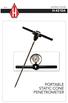 08.09 product manual H-4210A PORTABLE STATIC CONE PENETROMETER PORTABLE STATIC CONE PENETROMETER GENERAL INFORMATION The H-4210A Static Cone Penetrometer is an unparalleled device for measuring soil consistency.
NOTES on the STANDARD PENETRATION TEST
 GE 441 Advanced Engineering Geology & Geotechnics Spring 2004 NOTES on the STANDARD PENETRATION TEST Origins of the Standard Penetration Test Around 1902 Colonel Charles R. Gow, owner of the Gow Construction
Compression load testing straw bale walls. Peter Walker Dept. Architecture & Civil Engineering University of Bath Bath BA2 7AY.
 Compression load testing straw bale walls Peter Walker Dept. Architecture & Civil Engineering University of Bath Bath BA2 7AY May 2004 1. Introduction Over the last 10 years a growing number of loadbearing
FOUNDATION TECHNICAL CATEGORY 3 (TC3) AUGUST 2012
 FOUNDATION TECHNICAL CATEGORY 3 (TC3) AUGUST 2012 Building and Housing has published technical guidance for foundation repairs and reconstruction for residential properties in green zone Foundation Technical
Settlement of Precast Culverts Under High Fills; The Influence of Construction Sequence and Structural Effects of Longitudinal Strains
 Settlement of Precast Culverts Under High Fills; The Influence of Construction Sequence and Structural Effects of Longitudinal Strains Doug Jenkins 1, Chris Lawson 2 1 Interactive Design Services, 2 Reinforced
SERVICES 2015 ISO 18001
 SERVICES 2015 A family business with a solid foundation of experience, we handle all aspects of site investigation.... Phase 1 Environmental Studies Phase 2 Intrusive Investigations Phase 3 Remediation
DEM modelling of the dynamic penetration process on Mars as a part of the NASA InSight Mission
 Proceedings of the 4th European Young Geotechnical Engineers Conference (EYGEC), Durham, UK Osman, A.S. & Toll, D.G. (Eds.) 05 ISBN 978-0-9933836-0 DEM modelling of the dynamic penetration process on Mars
13. AN INTRODUCTION TO FOUNDATION ENGINEERING
 13-1 13. AN INTRODUCTION TO FOUNDATION ENGINEERING 13.1 TYPES OF FOUNDATIONS The foundation is that portion of a structure that transmits the loads from the structure to the underlying foundation material.
Module 5 (Lectures 17 to 19) MAT FOUNDATIONS
 Module 5 (Lectures 17 to 19) MAT FOUNDATIONS Topics 17.1 INTRODUCTION Rectangular Combined Footing: Trapezoidal Combined Footings: Cantilever Footing: Mat foundation: 17.2 COMMON TYPES OF MAT FOUNDATIONS
COSMOS 2012: Earthquakes in Action COSMOS 2012
 COSMOS 2012 What is SFSI and why is it important? Soil issues in Earthquakes Structures where SFSI important Retaining structures (lateral earth pressure) Foundations (spread and pile footings, bearing
Commonwealth of Pennsylvania PA Test Method No. 632 Department of Transportation October 2013 5 Pages LABORATORY TESTING SECTION. Method of Test for
 Commonwealth of Pennsylvania PA Test Method No. 632 Department of Transportation 5 Pages LABORATORY TESTING SECTION Method of Test for TIME OF SETTING OF CONCRETE MIXTURES BY PENETRATION RESISTANCE 1.
BUTE Department of Construction Management and Technology
 BUTE Department of Construction Management and Technology 02.10.2012 Definition 1: Foundation: The structure, that transmits the load of the building to the soil Definition 2: Load bearing soil (strata):