
How To Calculate A College Degree In The United States
|
|
|
- Valentine Shaw
- 5 years ago
- Views:
Transcription
1 Projections of Education Statistics to 2020 Thirty-ninth Edition NCES U.S. DEPARTMENT OF EDUCATION

2

3 Projections of Education Statistics to 2020 Thirty-ninth Edition September 2011 William J. Hussar National Center for Education Statistics Tabitha M. Bailey IHS Global Insight NCES U.S. DEPARTMENT OF EDUCATION

4 U.S. Department of Education Arne Duncan Secretary Institute of Education Sciences John Q. Easton Director National Center for Education Statistics Jack Buckley Commissioner The National Center for Education Statistics (NCES) is the primary federal entity for collecting, analyzing, and reporting data related to education in the United States and other nations. It fulfills a congressional mandate to collect, collate, analyze, and report full and complete statistics on the condition of education in the United States; conduct and publish reports and specialized analyses of the meaning and significance of such statistics; assist state and local education agencies in improving their statistical systems; and review and report on education activities in foreign countries. NCES activities are designed to address high-priority education data needs; provide consistent, reliable, complete, and accurate indicators of education status and trends; and report timely, useful, and high-quality data to the U.S. Department of Education, the Congress, the states, other education policymakers, practitioners, data users, and the general public. Unless specifically noted, all information contained herein is in the public domain. We strive to make our products available in a variety of formats and in language that is appropriate to a variety of audiences. You, as our customer, are the best judge of our success in communicating information effectively. If you have any comments or suggestions about this or any other NCES product or report, we would like to hear from you. Please direct your comments to NCES, IES, U.S. Department of Education 1990 K Street NW Washington, DC September 2011 The NCES Home Page address is The NCES Publications and Products address is This report was prepared in part under Contract No. ED-08-DO-0087 with IHS Global Insight. Mention of trade names, commercial products, or organizations does not imply endorsement by the U.S. Government. Suggested Citation Hussar, W.J., and Bailey, T.M. (2011). Projections of Education Statistics to 2020 (NCES ). U.S. Department of Education, National Center for Education Statistics. Washington, DC: U.S. Government Printing Office. For ordering information on this report, write to ED Pubs, U.S. Department of Education P.O. Box Alexandria, VA or call toll free ED-PUBS or order online at Content Contact William J. Hussar (202) [email protected]

5 Foreword Projections of Education Statistics to 2020 is the 39th report in a series begun in It includes statistics on elementary and secondary schools and postsecondary degree-granting institutions. This report provides revisions of projections shown in Projections of Education Statistics to Included are projections of enrollment, graduates, teachers, and expenditures to the year In addition to projections at the national level, the report includes projections of public elementary and secondary school enrollment and public high school graduates to the year 2020 at the state level. The projections in this report were produced by the National Center for Education Statistics (NCES) to provide researchers, policy analysts, and others with state-level projections developed using a consistent methodology. They are not intended to supplant detailed projections prepared for individual states. Assumptions regarding the population and the economy are the key factors underlying the projections of education statistics. NCES projections do not reflect changes in national, state, or local education policies that may affect education statistics. Appendix A of this report outlines the projection methodology and describes the models and assumptions used to develop the national and state projections. The enrollment models use enrollment data and population estimates and projections from NCES and the U.S. Census Bureau. The models are based on the mathematical projection of past data patterns into the future. The models also use projections of economic variables from IHS Global Insight, an economic forecasting service. The projections presented in this report are based on the 2000 census and assumptions for the fertility rate, internal migration, net immigration, and mortality rate from the Census Bureau. For further information, see appendix A. Val Plisko, Associate Commissioner Early Childhood, International, and Crosscutting Studies Division Projections of Education Statistics to 2020 iii

6 This page intentionally left blank.

7 Contents Foreword...iii List of Tables... vii List of Figures... xi About This Report...1 Projections...1 Limitations of Projections...1 Section 1. Elementary and Secondary Enrollment...3 Introduction...3 Accuracy of Projections...3 National...4 State and Regional (Public School Data)...6 Section 2. High School Graduates...7 Introduction...7 Accuracy of Projections...7 National...8 State and Regional (Public School Data)...10 Section 3. Elementary and Secondary Teachers...11 Introduction...11 Accuracy of Projections...11 Teachers in Elementary and Secondary Schools...12 Section 4. Expenditures for Public Elementary and Secondary Education...15 Introduction...15 Accuracy of Projections...15 Current Expenditures...16 Section 5. Enrollment in Postsecondary Degree-Granting Institutions...19 Introduction...19 Accuracy of Projections...19 Total Enrollment...20 Enrollment by Selected Characteristics and Control of Institution...21 First-Time Freshmen Enrollment...24 Page Projections of Education Statistics to 2020 v

8 Page Section 6. Postsecondary Degrees Conferred...25 Introduction...25 Accuracy of Projections...25 Degrees, by Level of Degree and Sex of Recipient...26 Reference Tables...29 Technical Appendixes...77 Appendix A. Introduction to Projection Methodology...78 A.0. Introduction to Projection Methodology...78 A.1. Elementary and Secondary Enrollment...85 A.2. High School Graduates...98 A.3. Elementary and Secondary Teachers A.4. Expenditures for Public Elementary and Secondary Education A.5. Enrollment in Postsecondary Degree-Granting Institutions A.6. Postsecondary Degrees Conferred Appendix B. Supplementary Tables Appendix C. Data Sources Appendix D. References Appendix E. List of Abbreviations Appendix F. Glossary vi Contents

9 List of Tables Table 1. Actual and projected numbers for enrollment in grades PK 12, PK 8, and 9 12 in elementary and secondary schools, by control of school: Fall 1995 through fall Actual and projected numbers for enrollment in public elementary and secondary schools, by grade: Fall 1995 through fall Actual and projected numbers for enrollment in public elementary and secondary schools, by race/ethnicity: Fall 1995 through fall Actual and projected numbers for enrollment in grades PK 8 in public elementary and secondary schools, by race/ethnicity: Fall 1995 through fall Actual and projected numbers for enrollment in grades 9 12 in public schools, by race/ethnicity: Fall 1995 through fall Actual and projected numbers for enrollment in grades PK 12 in public elementary and secondary schools, by region and state: Fall 2002 through fall Actual and projected percentage changes in grades PK 12 enrollment in public elementary and secondary schools, by region and state: Selected years, fall 2002 through fall Actual and projected numbers for enrollment in grades PK 8 in public elementary and secondary schools, by region and state: Fall 2002 through fall Actual and projected percentage changes in grades PK 8 enrollment in public elementary and secondary schools, by region and state: Selected years, fall 2002 through fall Actual and projected numbers for enrollment in grades 9 12 in public schools, by region and state: Fall 2002 through fall Actual and projected percentage changes in grades 9 12 enrollment in public schools, by region and state: Selected years, fall 2002 through fall Actual and projected numbers for high school graduates, by control of school: School years through Actual and projected numbers for public high school graduates, by race/ethnicity: School years through Actual and projected numbers for public high school graduates, by region and state: School years through Actual and projected percentage changes in public high school graduates, by region and state: Selected school years, through Actual and projected numbers for elementary and secondary teachers and elementary and secondary new teacher hires, by control of school: Fall 1995 through fall Actual and projected numbers for the pupil/teacher ratios in elementary and secondary schools, by control of school: Fall 1995 through fall Actual and projected numbers for current expenditures and current expenditures per pupil in fall enrollment for public elementary and secondary education: through Actual and projected numbers for current expenditures and current expenditures per pupil in average daily attendance (ADA) for public elementary and secondary education: School years through Actual and projected numbers for total enrollment in all postsecondary degree-granting institutions, by sex, attendance status, and control of institution: Fall 1995 through fall Page Projections of Education Statistics to 2020 vii

10 Table 21. Actual and projected numbers for total enrollment in all postsecondary degree-granting institutions, by age group, sex, and attendance status: Fall 1995 through fall Actual and projected numbers for enrollment in all postsecondary degree-granting institutions, by sex and attendance status: Fall 1995 through fall Actual and projected numbers for enrollment in public 4-year postsecondary degree-granting institutions, by sex and attendance status: Fall 1995 through fall Actual and projected numbers for enrollment in public 2-year postsecondary degree-granting institutions, by sex and attendance status: Fall 1995 through fall Actual and projected numbers for enrollment in private 4-year postsecondary degree-granting institutions, by sex and attendance status: Fall 1995 through fall Actual and projected numbers for enrollment in private 2-year postsecondary degree-granting institutions, by sex and attendance status: Fall 1995 through fall Actual and projected numbers for undergraduate enrollment in all postsecondary degree-granting institutions, by sex, attendance status, and control of institution: Fall 1995 through fall Actual and projected numbers for postbaccalaureate enrollment in all postsecondary degree-granting institutions, by sex, attendance status, and control of institution: Fall 1995 through fall Actual and projected numbers for enrollment in all postsecondary degree-granting institutions, by race/ethnicity: Fall 1995 through fall Actual and projected numbers for first-time freshmen fall enrollment in all postsecondary degree-granting institutions, by sex: Fall 1995 through fall Actual and projected numbers for full-time-equivalent enrollment in all postsecondary degree-granting institutions, by control and type of institution: Fall 1995 through fall Actual and projected numbers for associate s degrees conferred by postsecondary degree-granting institutions, by sex of recipient: through Actual and projected numbers for bachelor s degrees conferred by postsecondary degree-granting institutions, by sex of recipient: through Actual and projected numbers for master s degrees conferred by postsecondary degree-granting institutions, by sex of recipient: through Actual and projected numbers for doctor s degrees conferred by postsecondary degree-granting institutions, by sex of recipient: through Actual and projected numbers for first-professional degrees conferred by postsecondary degree-granting institutions, by sex of recipient: through Text Tables A. Mean absolute percentage errors (MAPEs) of enrollment projections, by lead time, control of school, and grade in elementary and secondary schools: B. Mean absolute percentage errors (MAPEs) of projections of high school graduates, by lead time and control of school: C. Mean absolute percentage errors (MAPEs) of projections of number of public elementary and secondary teachers, by lead time: D. Mean absolute percentage errors (MAPEs) of projections for total and per pupil current expenditures for public elementary and secondary education, by lead time: E. Mean absolute percentage errors (MAPEs) of projected enrollment in postsecondary degree-granting institutions, by lead time, sex, and level of institution: F. Mean absolute percentage errors (MAPEs) of projected enrollment in postsecondary degree-granting insitutions, by lead time and race/ethnicity: Page viii List of Tables

11 Table Appendix A. Introduction to Projection Methodology A-1. Summary of forecast assumptions to A-2. Mean absolute percentage errors (MAPEs) by lead time for selected statistics in all public elementary and secondary schools and postsecondary degree-granting institutions: A-3. Example of constructing mean absolute percentage errors, part A-4. Example of constructing mean absolute percentage errors, part A-5. Actual and projected national public school grade progression rates: Fall 2008, and fall 2009 through fall A-6. Actual and projected national enrollment rates in public schools, by grade level: Fall 2008, and fall 2009 through fall A-7. Mean absolute percentage errors (MAPEs) for projected prekindergarten 12 enrollment in public elementary and secondary schools, by lead time, region, and state: A-8. Mean absolute percentage errors (MAPEs) for projected prekindergarten 8 enrollment in public elementary and secondary schools, by lead time, region, and state: A-9. Mean absolute percentage errors (MAPEs) for projected grades 9 12 enrollment in public schools, by lead time, region, and state: A-10. Mean absolute percentage errors (MAPEs) for the projected number of high school graduates in public schools, by lead time, region, and state: A-11. Estimated equations and model statistics for public elementary and secondary teachers A-12. Percentage distribution of full-time and part-time school teachers, by age, control of school, and teaching status: A-13. Percentage distribution of full-time and part-time newly hired teachers, by age and control of school: Selected years, through A-14. Actual and projected continuation rates of full-time and part-time school teachers, by age and control of school: Selected years, to through to A-15. Estimated equations and model statistics for current expenditures per pupil in fall enrollment for public elementary and secondary schools, and education revenue from state sources per capita A-16. Actual and projected numbers for college enrollment rates, by sex, attendance status, and age: Fall 2009, fall 2015, and fall A-17. Estimated equations and model statistics for full-time and part-time college enrollment rates of men A-18. Estimated equations and model statistics for full-time and part-time college enrollment rates of women A-19. Actual and projected percentages of full-time students at postsecondary degree-granting institutions, by sex, age group, student level, and institution level: Fall 2009, and fall 2010 through fall A-20. Actual and projected percentages of part-time students at postsecondary degree-granting institutions, by sex, age group, level enrolled, and level of institution: Fall 2009, and fall 2010 through fall A-21. Actual and projected enrollment in public postsecondary degree-granting institutions as a percent of total postsecondary enrollment, by sex, attendance status, level enrolled, and level of institution: Fall 2009, and fall 2010 through fall A-22. Estimated equations and model statistics for full-time and part-time college enrollment rates of White men A-23. Estimated equations and model statistics for full-time and part-time college enrollment rates of White women..128 A-24. Estimated equations and model statistics for full-time and part-time college enrollment rates of Black men A-25. Estimated equations and model statistics for full-time and part-time college enrollment rates of Black women A-26. Estimated equations and model statistics for full-time and part-time college enrollment rates of Hispanic men..131 A-27. Estimated equations and model statistics for full-time and part-time college enrollment rates of Hispanic women Page Projections of Education Statistics to 2020 ix

12 Table A-28. A-29. A-30. Page Estimated equations and model statistics for full-time and part-time college enrollment rates of Asian/Pacific Islander men Estimated equations and model statistics for full-time and part-time college enrollment rates of Asian/Pacific Islander women Estimated equations and model statistics for degrees conferred, by degree level and sex Appendix B. Supplementary Tables B-1. Annual number of births: 1946 through B-2. Actual and projected prekindergarten- and kindergarten-age populations, by age: 1995 through B-3. Actual and projected school-age populations, by selected ages: 1995 through B-4. Actual and projected college-age populations, by selected ages: 1995 through B-5. Actual and projected fall enrollment in public elementary and secondary schools, change in fall enrollment from previous year, resident population, and fall enrollment as a ratio of the population: School years through B-6. Actual and projected macroeconomic measures of the economy: School years through x List of Tables
13 List of Figures Figure 1. Actual and projected numbers for enrollment in elementary and secondary schools, by grade level: Fall 1995 through fall Actual and projected numbers for enrollment in elementary and secondary schools, by control of school: Fall 1995 through fall Actual and projected numbers for enrollment in public elementary and secondary schools, by race/ethnicity: Fall 1995 through fall Projected percentage change in enrollment in public elementary and secondary schools, by state: Fall 2008 through fall Actual and projected numbers for enrollment in public elementary and secondary schools, by region: Fall 2002, fall 2008, and fall Actual and projected numbers for high school graduates, by control of school: School years through Actual and projected numbers for public high school graduates, by race/ethnicity: School years through Projected percentage change in the number of public high school graduates, by state: School years through Actual and projected numbers for public high school graduates, by region: School years , , and Actual and projected numbers for elementary and secondary teachers, by control of school: Fall 1995 through fall Actual and projected numbers for the pupil/teacher ratios in elementary and secondary schools, by control of school: Fall 1995 through fall Actual and projected numbers for elementary and secondary new teacher hires, by control of school: Fall 1999, fall 2008, and fall Actual and projected current expenditures for public elementary and secondary schools (in constant dollars): School years through Actual and projected current expenditures per pupil in fall enrollment in public elementary and secondary schools (in constant dollars): School years through Actual and projected population numbers for 18- to 24-year-olds and 25- to 29-year-olds: 1995 through Actual and projected numbers for total enrollment in all postsecondary degree-granting institutions: Fall 1995 through fall Actual and projected numbers for enrollment in all postsecondary degree-granting institutions, by age group: Fall 1995, fall 2009, and fall Actual and projected numbers for enrollment in all postsecondary degree-granting institutions, by sex: Fall 1995 through fall Actual and projected numbers for enrollment in all postsecondary degree-granting institutions, by attendance status: Fall 1995 through fall Actual and projected numbers for undergraduate and postbaccalaureate enrollment in all postsecondary degree-granting institutions: Fall 1995 through fall Page Projections of Education Statistics to 2020 xi

14 Figure 21. Actual and projected numbers for enrollment in all postsecondary degree-granting institutions, by race/ethnicity: Fall 1995 through fall Actual and projected numbers for enrollment in all postsecondary degree-granting institutions, by control of institution: Fall 1995 through fall Actual and projected numbers for total first-time freshmen enrollment in all postsecondary degree-granting institutions, by sex: Fall 1995 through fall Actual and projected numbers for associate s degrees conferred by postsecondary degree-granting institutions, by sex of recipient: through Actual and projected numbers for bachelor s degrees conferred by postsecondary degree-granting institutions, by sex of recipient: through Actual and projected numbers for master s degrees conferred by postsecondary degree-granting institutions, by sex of recipient: through Actual and projected numbers for doctor s degrees conferred by postsecondary degree-granting institutions, by sex of recipient: through Actual and projected numbers for first-professional degrees conferred by postsecondary degree-granting institutions, by sex of recipient: through Page xii List of Figures
15 About This Report PROJECTIONS This edition of Projections of Education Statistics provides projections for key education statistics, including enrollment, graduates, teachers, and expenditures in elementary and secondary public and private schools, as well as enrollment and degrees conferred at postsecondary degree-granting institutions. Included are national data on enrollment and graduates for the past 15 years and projections to the year Also included are state-level data on enrollment in public elementary and secondary schools and public high schools from 2002, with projections to This report is organized by the level of schooling with sections 1, 2, 3, and 4 covering aspects of elementary and secondary education and sections 5 and 6 covering aspects of postsecondary education. There are a number of limitations in projecting some statistics. First, state-level data on enrollment and graduates in private elementary and secondary schools and on enrollment and degrees conferred in postsecondary degree-granting institutions are not included. Further research and model development are needed to develop reliable projections of private school enrollment and graduates by state. Neither the actual numbers nor the projections of public and private elementary and secondary school enrollment include homeschooled students because more data are required to develop reliable projections. Similar methodologies were used to obtain a uniform set of projections for each of the 50 states and the District of Columbia. These projections are further adjusted to agree with the national projections of public elementary and secondary school enrollment and public high school graduates contained in this report. There were changes in how the exponential smoothing forecasting technique was used in this edition of Projections of Education Statistics, compared to how it had been used in previous editions. Exponential smoothing is used in the projections for elementary and secondary enrollments, high school graduates, new teacher hires, postsecondary degreegranting enrollments, and degrees conferred. In prior editions of Projections of Education Statistics, the smoothing formula used fixed coefficients and the new methodology uses variable coefficients. There has been no systematic examination to determine whether the projections computed using the new method are comparable to those using the prior method. For information about exponential smoothing used in Projections, see appendix A.0. The summary of projections provides highlights of the national and state data, while the reference tables and figures present more detail. All calculations within Projections of Education Statistics are based on unrounded estimates. Therefore, the reader may find that a calculation, such as a difference or percentage change, cited in the text or figure may not be identical to the calculation obtained by using the rounded values shown in the accompanying tables. Appendix A describes the methodology and assumptions used to develop the projections; appendix B presents supplementary tables; appendix C describes data sources; appendix D is a list of abbreviations; appendix E presents a list of the references; and appendix F is a glossary of terms. LIMITATIONS OF PROJECTIONS Projections of a time series usually differ from the final reported data due to errors from many sources, such as the properties of the projection methodologies, which depend on the validity of many assumptions. The mean absolute percentage error is one way to express the forecast accuracy of past projections. This measure expresses the average of the absolute values of errors in percentage terms, where errors are the differences between past projections and actual data. For example, based on past editions of Projections of Education Statistics, the mean absolute percentage errors of public school enrollment in grades prekindergarten 12 for lead times of 1, 2, 5, and 10 years were 0.3, 0.6, 1.3, and 2.4 percent, respectively. In contrast, mean absolute percentage errors of private school enrollment in grades prekindergarten through 8 for lead times of 1, 2, 5, and 10 years were 3.5, 4.9, 9.2, and 7.9 percent, respectively. For more information on mean absolute percentage errors, see table A-2 in appendix A. Projections of Education Statistics to

16 This page intentionally left blank.

17 Section 1 Elementary and Secondary Enrollment INTRODUCTION Total public and private elementary and secondary school enrollment was 55 million in fall 2008, representing an 8 percent increase since fall Between fall 2008, the last year of actual public school data, and fall 2020, a further increase of 5 percent is expected, with increases projected in public schools and decreases in private schools. Increases in public school enrollment are expected for Blacks, Hispanics, Asians/Pacific Islanders, and American Indians/Alaska Natives, and a decrease is expected for Whites. Increases in public school enrollment are expected in the Midwest, South, and West, and a decrease is expected in the Northeast. Factors affecting the projections The grade progression rate method was used to project school enrollments. This method assumes that future trends in factors affecting enrollments will be consistent with past patterns. It implicitly includes the net effect of factors such as dropouts, deaths, nonpromotion, transfers to and from public schools, and, at the state level, migration. See appendixes A.0 and A.1 for more details. Factors that were not considered The projections do not assume changes in policies or attitudes that may affect enrollment levels. For example, they do not account for changing state and local policies on prekindergarten (PK) and kindergarten programs. Continued expansion of these programs could lead to higher enrollments at the elementary school level. Projections also exclude the number of students who are homeschooled because more data are needed. Accuracy of Projections An analysis of projection errors from the past 27 editions of Projections of Education Statistics indicates that the mean absolute percentage errors (MAPEs) for lead times of 1, 2, 5, and 10 years out for projections of public school enrollment in grades PK 12 were 0.3, 0.6, 1.3, and 2.4 percent, respectively. For the 1-year-out prediction, this means that the methodology used by the National Center for Education Statistics (NCES) has produced projections that have, on average, deviated from actual observed values by 0.3 percent. For projections of public school enrollment in grades PK 8, the MAPEs for lead times of 1, 2, 5, and 10 years out were 0.4, 0.7, 1.3, and 3.2 percent, respectively, while the MAPEs for projections of public school enrollment in grades 9 12 were 0.3, 0.6, 1.3, and 2.3 percent, respectively, for the same lead times. An analysis of projection errors from the past nine editions of Projections of Education Statistics indicates that the mean absolute percentage errors (MAPEs) for lead times of 1, 2, 5, and 10 years out for projections of private school enrollment in grades PK 12 were 3.4, 4.6, 7.7, and 6.3 percent, respectively. For projections of private school enrollment in grades PK 8, the MAPEs for lead times of 1, 2, 5, and 10 years out were 3.5, 4.9, 9.2, and 7.9 percent, respectively, while the MAPEs for projections of private school enrollment in grades 9 12 were 3.0, 3.8, 2.8, and 1.3 percent, respectively, for the same lead times. For more information, see table A-2 in appendix A. Projections of Education Statistics to

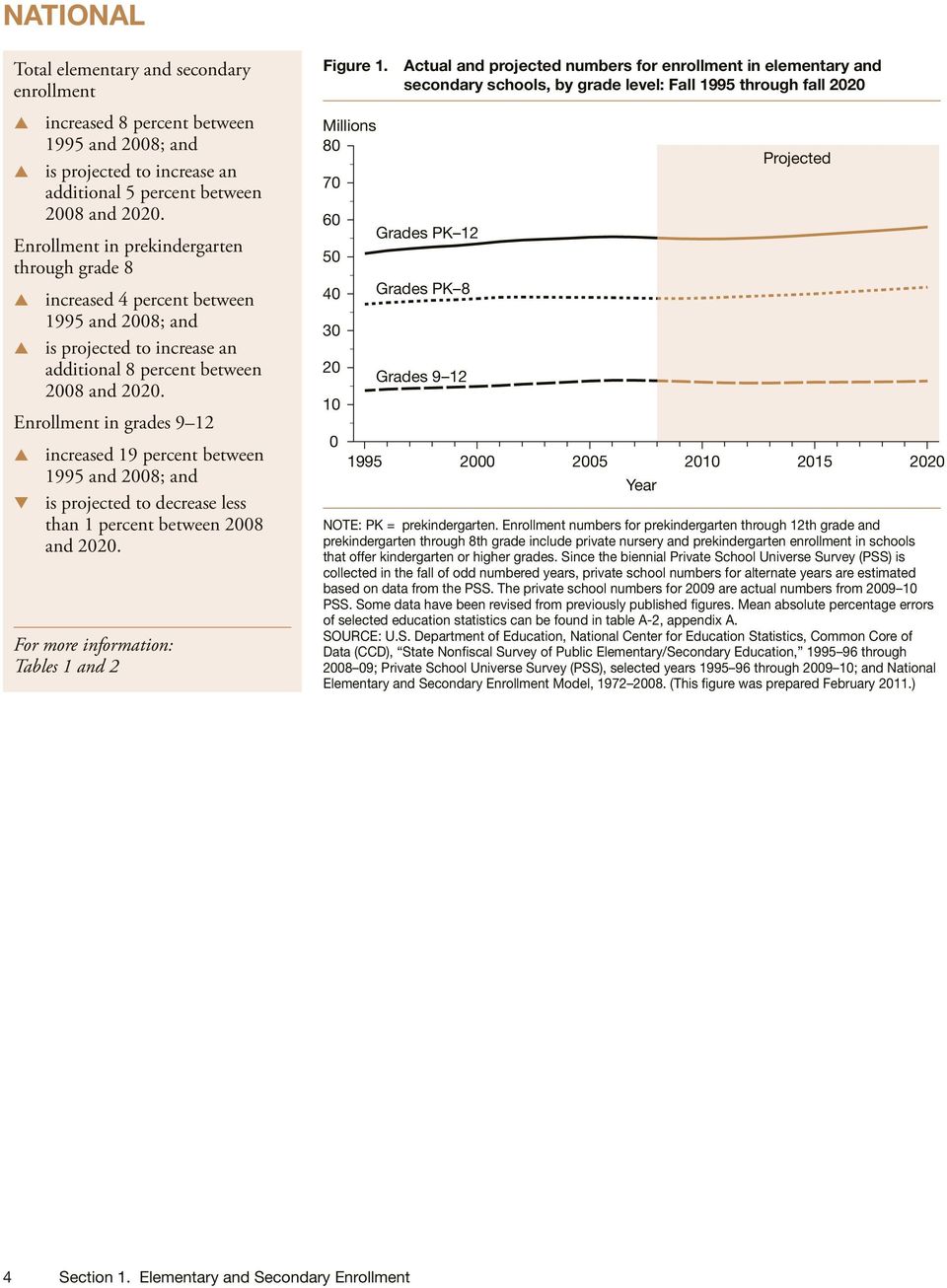
18 NATIONAL Total elementary and secondary enrollment SS SS increased 8 percent between 1995 and 2008; and is projected to increase an additional 5 percent between 2008 and Enrollment in prekindergarten through grade 8 SS SS increased 4 percent between 1995 and 2008; and is projected to increase an additional 8 percent between 2008 and Enrollment in grades 9 12 SS TT increased 19 percent between 1995 and 2008; and is projected to decrease less than 1 percent between 2008 and For more information: Tables 1 and 2 Figure 1. Actual and projected numbers for enrollment in elementary and secondary schools, by grade level: Fall 1995 through fall 2020 Millions Grades PK 12 Grades PK 8 Grades Year Projected NOTE: PK = prekindergarten. Enrollment numbers for prekindergarten through 12th grade and prekindergarten through 8th grade include private nursery and prekindergarten enrollment in schools that offer kindergarten or higher grades. Since the biennial Private School Universe Survey (PSS) is collected in the fall of odd numbered years, private school numbers for alternate years are estimated based on data from the PSS. The private school numbers for 2009 are actual numbers from PSS. Some data have been revised from previously published figures. Mean absolute percentage errors of selected education statistics can be found in table A-2, appendix A. SOURCE: U.S. Department of Education, National Center for Education Statistics, Common Core of Data (CCD), State Nonfiscal Survey of Public Elementary/Secondary Education, through ; Private School Universe Survey (PSS), selected years through ; and National Elementary and Secondary Enrollment Model, (This figure was prepared February 2011.) 4 Section 1. Elementary and Secondary Enrollment
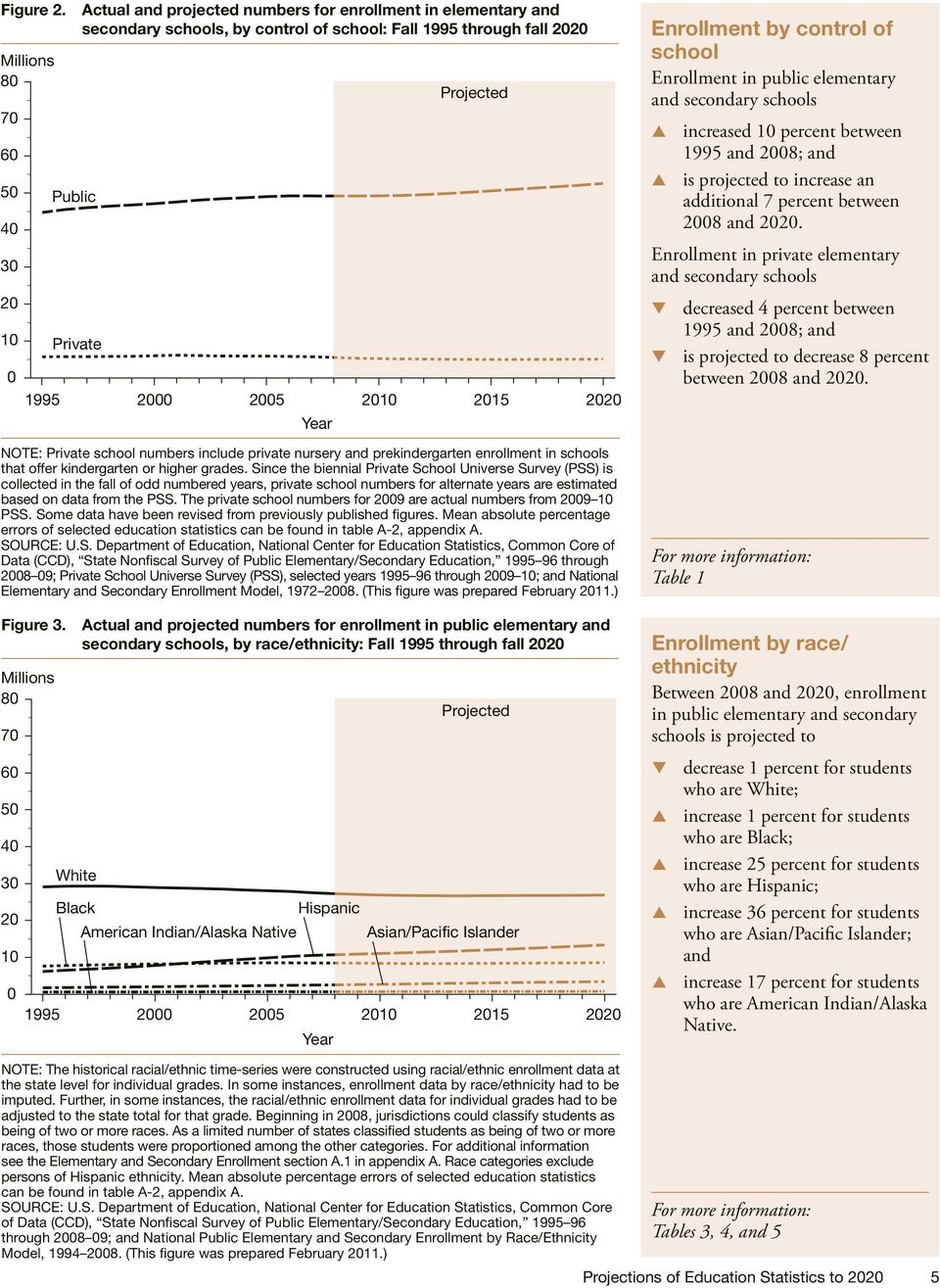
19 Figure 2. Actual and projected numbers for enrollment in elementary and secondary schools, by control of school: Fall 1995 through fall 2020 Millions Public Private Year Projected NOTE: Private school numbers include private nursery and prekindergarten enrollment in schools that offer kindergarten or higher grades. Since the biennial Private School Universe Survey (PSS) is collected in the fall of odd numbered years, private school numbers for alternate years are estimated based on data from the PSS. The private school numbers for 2009 are actual numbers from PSS. Some data have been revised from previously published figures. Mean absolute percentage errors of selected education statistics can be found in table A-2, appendix A. SOURCE: U.S. Department of Education, National Center for Education Statistics, Common Core of Data (CCD), State Nonfiscal Survey of Public Elementary/Secondary Education, through ; Private School Universe Survey (PSS), selected years through ; and National Elementary and Secondary Enrollment Model, (This figure was prepared February 2011.) Figure 3. Actual and projected numbers for enrollment in public elementary and secondary schools, by race/ethnicity: Fall 1995 through fall 2020 Millions White Black American Indian/Alaska Native Hispanic Projected Asian/Pacific Islander Year Enrollment by control of school Enrollment in public elementary and secondary schools SS SS increased 10 percent between 1995 and 2008; and is projected to increase an additional 7 percent between 2008 and Enrollment in private elementary and secondary schools TT TT decreased 4 percent between 1995 and 2008; and is projected to decrease 8 per cent between 2008 and For more information: Table 1 Enrollment by race/ ethnicity Between 2008 and 2020, enrollment in public elementary and secondary schools is projected to TT SS SS SS SS decrease 1 percent for students who are White; increase 1 percent for students who are Black; increase 25 percent for students who are Hispanic; increase 36 percent for students who are Asian/Pacific Islander; and increase 17 percent for students who are American Indian/Alaska Native. NOTE: The historical racial/ethnic time-series were constructed using racial/ethnic enrollment data at the state level for individual grades. In some instances, enrollment data by race/ethnicity had to be imputed. Further, in some instances, the racial/ethnic enrollment data for individual grades had to be adjusted to the state total for that grade. Beginning in 2008, jurisdictions could classify students as being of two or more races. As a limited number of states classified students as being of two or more races, those students were proportioned among the other categories. For additional information see the Elementary and Secondary Enrollment section A.1 in appendix A. Race categories exclude persons of Hispanic ethnicity. Mean absolute percentage errors of selected education statistics can be found in table A-2, appendix A. SOURCE: U.S. Department of Education, National Center for Education Statistics, Common Core of Data (CCD), State Nonfiscal Survey of Public Elementary/Secondary Education, through ; and National Public Elementary and Secondary Enrollment by Race/Ethnicity Model, (This figure was prepared February 2011.) For more information: Tables 3, 4, and 5 Projections of Education Statistics to
20 STATE AND REGIONAL (PUBLIC SCHOOL DATA) Enrollment by state The expected 7 percent national increase in public school enrollment between 2008 and 2020 plays out differently among the states. SS TT Increases are projected for 36 states and the District of Columbia, with increases of more than 15 percent projected for 8 states; increases between 5 and 15 percent projected for 17 states and the District of Columbia; and increases of less than 5 percent projected for 11 states. Decreases are projected for 14 states, with decreases of 5 percent or more projected for 3 states; and decreases of less than 5 percent projected for 11 states. For more information: Tables 6 through 11 Figure 4. Projected percentage change in enrollment in public elementary and secondary schools, by state: Fall 2008 through fall 2020 DE DC RI Decrease of 5 percent or more Decrease of less than 5 percent Increase of less than 5 percent Increase of 5 to 15 percent Increase of more than 15 percent NOTE: Calculations are based on unrounded numbers. Mean absolute percentage errors of enrollment in public elementary and secondary schools by state and region can be found in table A-7, appendix A. SOURCE: U.S. Department of Education, National Center for Education Statistics, Common Core of Data (CCD), State Nonfiscal Survey of Public Elementary/Secondary Education, ; and State Elementary and Secondary Enrollment Model, (This figure was prepared February 2011.) Enrollment by region Between 2008 and 2020, public elementary and secondary enrollment is projected to TT SS SS SS decrease 3 percent in the Northeast; increase 1 percent in the Midwest; increase 10 percent in the South; and increase 13 percent in the West. Figure 5. Actual and projected numbers for enrollment in public elementary and secondary schools, by region: Fall 2002, fall 2008, and fall 2020 Millions Northeast Midwest South West (projected) For more information: Tables 6 through 11 NOTE: Calculations are based on unrounded numbers. See the glossary for a list of the states in each region. Mean absolute percentage errors of enrollment in public elementary and secondary schools by state and region can be found in table A-7, appendix A. SOURCE: U.S. Department of Education, National Center for Education Statistics, Common Core of Data (CCD), State Nonfiscal Survey of Public Elementary/Secondary Education, and ; and State Elementary and Secondary Enrollment Model, (This figure was prepared February 2011.) 6 Section 1. Elementary and Secondary Enrollment

21 Section 2 High School Graduates INTRODUCTION The number of high school graduates increased nationally by 32 percent between and , the last year of actual data. A decrease of 3 percent is expected between and Both public schools and private schools are expected to have decreases in the number of high school graduates. Increases are expected in the West and South, and decreases are expected in the Northeast and Midwest. Factors affecting the projections The projections of high school graduates are related to projections of 12th-graders and the historical relationship between the number of 12th-graders and the number of high school graduates. The methodology implicitly includes the net effect of factors such as dropouts, transfers to and from public schools, and, at the state level, migration. For more details, see appendixes A.0 and A.2. About high school graduates A high school graduate is defined as an individual who has received formal recognition from school authorities, by the granting of a diploma, for completing a prescribed course of study. This definition does not include other high school completers or high school equivalency recipients. Projected changes in the number of graduates reflect changes in the 18-year-old population over the projection period, rather than projected changes in the graduation rates of 12thgraders. Projections of graduates could be affected by changes in policies influencing graduation requirements. Accuracy of Projections For National Center for Education Statistics (NCES) projections of public high school graduates produced over the last 20 years, the mean absolute percentage errors (MAPEs) for lead times of 1, 2, 5, and 10 years out were 1.0, 1.0, 1.6, and 4.0, respectively. For NCES projections of private high school graduates produced over the last 9 years, the MAPEs for lead times of 1, 2, 5, and 10 years out were 0.9, 0.9, 5.0, and 1.6, respectively. For more information, see table A-2 in appendix A. Projections of Education Statistics to
22 NATIONAL The total number of high school graduates SS TT increased 32 percent between and , a period of 12 years; and is projected to decrease 3 percent between and , a period of 13 years. The number of public high school graduates SS increased 32 percent between and ; and TT is projected to decrease 1 percent between and The number of private high school graduates SS increased 27 percent between and ; and TT is projected to decrease 27 percent between and For more information: Table 12 Figure 6. Actual and projected numbers for high school graduates, by control of school: School years through Millions Total Public Private Projected School year NOTE: Since the biennial Private School Universe Survey (PSS) is collected in the fall of odd numbered years, private school numbers for alternate years are estimated based on data from the PSS. Some data have been revised from previously published figures. Mean absolute percentage errors of selected education statistics can be found in table A-2, appendix A. SOURCE: U.S. Department of Education, National Center for Education Statistics, Common Core of Data (CCD), State Nonfiscal Survey of Public Elementary/Secondary Education, through ; Private School Universe Survey (PSS), selected years, through ; and National Elementary and Secondary High School Graduates Enrollment Model, through (This figure was prepared February 2011.) 8 Section 2. High School Graduates
23 Figure 7. Actual and projected numbers for public high school graduates, by race/ethnicity: School years through Millions White Black Hispanic Projected Asian/Pacific Islander American Indian/Alaska Native School year NOTE: The historical racial/ethnic time series were constructed using racial/ethnic high school graduate data at the state level. In some instances, high school graduate data by race/ethnicity had to be imputed. Further, in some instances, the racial/ethnic data had to be adjusted in order for them to sum to the state total for high school graduates. For additional information, see the High School Graduates section A.2 in appendix A. Race categories exclude persons of Hispanic ethnicity. Some data have been revised from previously published figures. Mean absolute percentage errors of selected education statistics can be found in table A-2, appendix A. SOURCE: U.S. Department of Education, National Center for Education Statistics, Common Core of Data (CCD), State Nonfiscal Survey of Public Elementary/Secondary Education, through ; and National Public Elementary and Secondary High School Graduates by Race/Ethnicity Model, through (This figure was prepared February 2011.) High school graduates by race/ethnicity Between and , the number of public high school graduates is projected to TT TT SS SS SS decrease 11 percent for students who are White; decrease 2 percent for students who are Black; increase 27 percent for students who are Hispanic; increase 46 percent for students who are Asian/Pacific Islander; and increase 1 percent for students who are American Indian/Alaska Native. For more information: Table 13 Projections of Education Statistics to
24 STATE AND REGIONAL (PUBLIC SCHOOL DATA) High school graduates by state The expected 1 percent national decrease in public high school graduates between and plays out differently among the states. SS Increases are projected for 23 states, with increases of more than 15 percent projected for 8 states; increases between 5 and 15 percent projected for 8 states; and increases of less than 5 percent projected for 7 states. TT Decreases are projected for 27 states and the District of Columbia, with decreases of 5 percent or more projected for 16 states and the District of Columbia; and decreases of less than 5 percent projected for 11 states. For more information: Tables 14 and 15 Figure 8. Projected percentage change in the number of public high school graduates, by state: School years through DE DC RI Decrease of 5 percent or more Decrease of less than 5 percent Increase of less than 5 percent Increase of 5 to 15 percent Increase of more than 15 percent NOTE: Calculations are based on unrounded numbers. Mean absolute percentage errors of public high school graduates by state and region can be found in table A-10, appendix A. SOURCE: U.S. Department of Education, National Center for Education Statistics, Common Core of Data (CCD), State Nonfiscal Survey of Public Elementary/Secondary Education, ; and State Public High School Graduates Model, through (This figure was prepared February 2011.) High school graduates by region Between and , the number of public high school graduates is projected to TT TT SS SS decrease 13 percent in the Northeast; decrease 6 percent in the Midwest; increase 7 percent in the South; and increase 4 percent in the West. Figure 9. Actual and projected numbers for public high school graduates, by region: School years , , and Thousands 2,000 1,500 1, ,0321, Northeast Midwest South West (projected) For more information: Tables 14 and 15 NOTE: See the glossary for a list of states in each region. Mean absolute percentage errors of public high school graduates by state and region can be found in table A-10, appendix A. SOURCE: U.S. Department of Education, National Center for Education Statistics, Common Core of Data (CCD), State Nonfiscal Survey of Public Elementary/Secondary Education, and ; and State Public High School Graduates Model, through (This figure was prepared February 2011.) 10 Section 2. High School Graduates
25 Section 3 Elementary and Secondary Teachers INTRODUCTION Between fall 2008, the last year of actual public school data, and fall 2020, the number of teachers in elementary and secondary schools is projected to rise. The number of public school teachers is projected to increase and the number of private school teachers is projected to decrease. The pupil/teacher ratios are projected to decrease in both public and private schools. The annual number of new teacher hires is projected to increase in both public and private schools. Factors affecting the projections The projections of the number of elementary and secondary teachers are related to projected levels of enrollments and education revenue receipts from state sources per capita. For more details, see appendixes A. 0 and A.3. Factors that were not considered The projections do not take into account possible changes in the number of teachers due to the effects of government policies. About pupil/teacher ratios The overall elementary and secondary pupil/teacher ratio and pupil/teacher ratios for public and private schools were computed based on elementary and secondary enrollment and the number of classroom teachers by control of school. About new teacher hires A teacher is considered to be a new teacher hire for a certain control of school (public or private) for a given year if the teacher teaches in that control that year but had not taught in that control in the previous year. A teacher who moves from teaching in one control to the other control is considered a new teacher hire, but a teacher who moves from one school to another school in the same control is not considered a new teacher hire. It is important to note that these projections measure the total number of teacher hires, including those hired to replace teachers retiring or leaving the teaching profession permanently or temporarily. Thus, the new teacher hire projections should not be interpreted as predicting teacher shortages. Accuracy of Projections An analysis of projection errors from the past 20 editions of Projections of Education Statistics indicates that the mean absolute percentage errors (MAPEs) for projections of classroom teachers in public elementary and secondary schools were 1.0 percent for 1 year out, 1.4 percent for 2 years out, 2.9 percent for 5 years out, and 5.9 percent for 10 years out. For more information on the MAPEs of different National Center for Education Statistics (NCES) projection series, see table A-2 in appendix A. Projections of Education Statistics to
26 TEACHERS IN ELEMENTARY AND SECONDARY SCHOOLS Number of teachers The total number of elementary and secondary teachers SS SS increased 23 percent between 1995 and 2008, a period of 13 years; and is projected to increase 7 percent between 2008 and 2020, a period of 12 years. The number of teachers in public elementary and secondary schools SS SS increased 24 percent between 1995 and 2008; and is projected to increase 9 percent between 2008 and The number of teachers in private elementary and secondary schools SS TT increased 19 percent between 1995 and 2008; and is projected to decrease 4 percent between 2008 and For more information: Table 16 Figure 10. Actual and projected numbers for elementary and secondary teachers, by control of school: Fall 1995 through fall 2020 Millions Total Public Private Year Projected NOTE: Since the biennial Private School Universe Survey (PSS) is collected in the fall of odd numbered years, private school numbers for alternate years are estimated based on data from the PSS. The private school teacher number for 2009 is an actual number from the PSS. Teachers reported in full-time equivalents. Some data have been revised from previously published figures. Mean absolute percentage errors of selected education statistics can be found in table A-2, appendix A. SOURCE: U.S. Department of Education, National Center for Education Statistics, Common Core of Data (CCD), State Nonfiscal Survey of Public Elementary/Secondary Education, through ; Private School Universe Survey (PSS), selected years, through ; Elementary and Secondary Teacher Model, (This figure was prepared April 2011.) 12 Section 3. Elementary and Secondary Teachers
27 Figure 11. Actual and projected numbers for the pupil/teacher ratios in elementary and secondary schools, by control of school: Fall 1995 through fall 2020 Ratio Public Private Total Year Projected NOTE: Since the biennial Private School Universe Survey (PSS) is collected in the fall of odd numbered years, private school numbers for alternate years are estimated based on data from the PSS. The private school teacher number for 2009 is an actual number from the PSS. The pupil/teacher ratios were derived from tables 1 and 16. Teachers are reported in full-time equivalents. Some data have been revised from previously published figures. Mean absolute percentage errors of selected education statistics can be found in table A-2, appendix A. SOURCE: U.S. Department of Education, National Center for Education Statistics, Common Core of Data (CCD), State Nonfiscal Survey of Public Elementary/Secondary Education, through ; Private School Universe Survey (PSS), selected years, through ; National Elementary and Secondary Enrollment Model, ; and Elementary and Secondary Teacher Model, (This figure was prepared April 2011.) Figure 12. Actual and projected numbers for elementary and secondary new teacher hires, by control of school: Fall 1999, fall 2008, and fall 2020 Thousands Total Public Private 1999 (actual) 2008 (estimated) 2020 (projected) NOTE: Public and private new teacher hire numbers for 2008 are estimated using the New Teacher Hires Model. SOURCE: U.S. Department of Education, National Center for Education Statistics, Common Core of Data (CCD), State Nonfiscal Survey of Public Elementary/Secondary Education, ; Private School Universe Survey (PSS), ; Schools and Staffing Survey (SASS), Public School Teacher Questionnaire, and Private School Teacher Questionnaire, ; Elementary and Secondary Teacher Model, ; and New Teacher Hires Model, (This figure was prepared April 2011.) Pupil/teacher ratios The pupil/teacher ratio in elementary and secondary schools TT decreased from 17.1 to 15.0 between 1995 and 2008; and TT is projected to decrease to 14.7 in The pupil/teacher ratio in public elementary and secondary schools TT decreased from 17.3 to 15.3 between 1995 and 2008; and TT is projected to decrease to 15.0 in The pupil/teacher ratio in private elementary and secondary schools TT decreased from 15.7 to 12.8 between 1995 and 2008; and TT is projected to decrease to 12.3 in For more information: Table 17 New teacher hires Between 2008 and 2020, increases are expected in the annual numbers of new public school teacher hires and new private school teacher hires. The number of new teacher hires in public schools was approximately 313,000 in 2008, reflecting an increase of 41 percent compared to 1999; and SS is projected to increase 12 percent to 350,000 in The number of new teacher hires in private schools was approximately 76,000 in 2008, reflecting a decrease of 9 percent compared to 1999; and SS is projected to increase 5 percent to 79,000 in For more information: Table 16 Projections of Education Statistics to
28 This page intentionally left blank.
29 Section 4 Expenditures for Public Elementary and Secondary Education INTRODUCTION Current expenditures for public elementary and secondary education are projected to increase 22 percent in constant dollars between school years , the last year of actual data, and Factors affecting the projections The projections of current expenditures are related to projections of economic growth as measured by disposable income per capita and assistance by state governments to local governments. For more details, see appendixes A.0 and A.4. Factors that were not considered Many factors that may affect future school expenditures were not considered in the production of these projections. Such factors include policy initiatives as well as potential changes in the age distribution of elementary and secondary teachers as older teachers retire and are replaced by younger teachers. About constant dollars and current dollars Throughout this section, projections of current expenditures are presented in constant dollars. The reference tables, later in this report, present these data both in constant dollars and in current dollars. The projections were developed in constant dollars and then placed in current dollars using projections for the Consumer Price Index (CPI) (table B-6 in appendix B). Accuracy of Projections An analysis of projection errors from similar models used in the past 20 editions of Projections of Education Statistics that contained expenditure projections indicates that mean absolute percentage errors (MAPEs) for current expenditures in constant dollars were 1.3 percent for 1 year out, 2.0 percent for 2 years out, 2.6 percent for 5 years out, and 4.1 percent for 10 years out. MAPEs for current expenditures per pupil in fall enrollment in current dollars were 1.3 percent for 1 year out, 2.0 percent for 2 years out, 3.0 percent for 5 years out, and 5.5 percent for 10 years out. See appendix A for further discussion of the accuracy of recent projections of current expenditures, and see table A-2 in appendix A for the mean absolute percentage errors (MAPEs) of these projections. Projections of Education Statistics to
30 CURRENT EXPENDITURES Current expenditures Current expenditures in constant dollars SS increased 45 percent from to , a period of 12 years; and SS are projected to increase 22 percent, to $627 billion, from to , a period of 13 years. Figure 13. Actual and projected current expenditures for public elementary and secondary schools (in constant dollars): School years through Billions of dollars $ Projected School year For more information: Tables 18 and 19 NOTE: Numbers were placed in constant dollars using the Consumer Price Index (CPI) for all urban consumers, Bureau of Labor Statistics, U.S. Department of Labor. For more detail about CPI, see table B-6 in appendix B. Some data have been revised from previously published figures. Mean absolute percentage errors of selected education statistics can be found in table A-2, appendix A. SOURCE: U.S. Department of Education, National Center for Education Statistics, Common Core of Data (CCD), National Public Education Financial Survey, through ; Public Elementary and Secondary School Current Expenditures Model, through (This figure was prepared March 2011.) 16 Section 4. Expenditures for Public Elementary and Secondary Education
31 Figure 14. Actual and projected current expenditures per pupil in fall enrollment in public elementary and secondary schools (in constant dollars): School years through Thousands of dollars $ Projected Current expenditures per pupil Current expenditures per pupil in fall enrollment in constant dollars SS increased 32 percent from to ; and SS are projected to increase 14 percent, to $11,900, from to School year NOTE: Numbers were placed in constant dollars using the Consumer Price Index (CPI) for all urban consumers, Bureau of Labor Statistics, U.S. Department of Labor. For more detail about CPI, see table B-6 in appendix B. Some data have been revised from previously published figures. Mean absolute percentage errors of selected education statistics can be found in table A-2, appendix A. SOURCE: U.S. Department of Education, National Center for Education Statistics, Common Core of Data (CCD), State Nonfiscal Survey of Public Elementary/Secondary Education, through ; National Public Education Financial Survey, through ; National Elementary and Secondary Enrollment Model, ; and Public Elementary and Secondary School Current Expenditures Model, through (This figure was prepared March 2011.) For more information: Tables 18 and 19 Projections of Education Statistics to
32 This page intentionally left blank.
33 Section 5 Enrollment in Postsecondary Degree-Granting Institutions INTRODUCTION Total enrollment in postsecondary degree-granting institutions is expected to increase 13 percent between fall 2009, the last year of actual data, and fall Degree-granting institutions are postsecondary institutions that provide study beyond secondary school and offer programs terminating in an associate s, baccalaureate, or higher degree and participate in federal financial aid programs. Differential growth is expected by student characteristics such as age, sex, and attendance status (parttime or full-time). Enrollment is expected to increase in both public and private postsecondary degree-granting institutions. Factors affecting the projections The projections of enrollment levels are related to projections of college-age populations, disposable income, and unemployment rates. For more details, see appendixes A.0 and A.5. An important factor in the enrollment projections is the expected increase in the population of 25- to 29-yearolds (table B-4 in appendix B). Factors that were not considered The enrollment projections do not take into account such factors as the cost of a college education, the economic value of an education, and the impact of distance learning due to technological changes. These factors may produce changes in enrollment levels. The racial/ethnic backgrounds of nonresident aliens are not known. Figure 15. Actual and projected population numbers for 18- to 24-year-olds and 25- to 29-year-olds: 1995 through 2020 Millions Projected to 24-year old population 25- to 29-year old population Year NOTE: Some data have been revised from previously published figures. Projections are from the U.S. Census Bureau s 2008 National Population Projections, ratio-adjusted to line up with the most recent historical estimate. SOURCE: U.S. Department of Commerce, Census Bureau, Population Estimates, retrieved October 4, 2010, from national/; and Population Projections, retrieved November 2, 2009, from (This figure was prepared March 2011.) Accuracy of Projections For projections of total enrollment in postsecondary degree-granting institutions, an analysis of projection errors based on the past 13 editions of Projections of Education Statistics indicates that the mean absolute percentage errors (MAPEs) for lead times of 1, 2, 5, and 10 years out were 1.6, 2.8, 5.2, and 11.4 percent, respectively. For the 1-year-out prediction, this means that one would expect the projection to be within 1.6 percent of the actual value, on average. For more information, see table A-2 in appendix A. Projections of Education Statistics to
34 TOTAL ENROLLMENT Total enrollment in postsecondary degreegranting institutions SS increased 43 percent from 1995 to 2009, a period of 14 years; and SS is projected to increase 13 percent, to 23 million, from 2009 to 2020, a period of 11 years. Figure 16. Actual and projected numbers for total enrollment in all postsecondary degree-granting institutions: Fall 1995 through fall 2020 Millions Projected Year For more information: Table 20 NOTE: Some data have been revised from previously published figures. Mean absolute percentage errors of selected education statistics can be found in table A-2, appendix A. SOURCE: U.S. Department of Education, National Center for Education Statistics, Integrated Postsecondary Education Data System, Fall Enrollment Survey (IPEDS-EF:95 99), and Spring 2001 through Spring 2010; and Enrollment in Degree-Granting Institutions Model, (This figure was prepared March 2011.) 20 Section 5. Enrollment in Postsecondary Degree-Granting Institutions
35 ENROLLMENT BY SELECTED CHARACTERISTICS AND CONTROL OF INSTITUTION Figure 17. Millions Actual and projected numbers for enrollment in all postsecondary degreegranting institutions, by age group: Fall 1995, fall 2009, and fall Enrollment by age of student Between 2009 and 2020, enrollment is projected to increase SS SS SS 9 percent for students who are 18 to 24 years old; 21 percent for students who are 25 to 34 years old; and 16 percent for students who are 35 years old and over years old years old Age group 35 years old and over (projected) NOTE: Some data have been revised from previously published figures. Data by age are based on the distribution by age from the Census Bureau. Mean absolute percentage errors of selected education statistics can be found in table A-2, appendix A. SOURCE: U.S. Department of Education, National Center for Education Statistics, Integrated Postsecondary Education Data System, Fall Enrollment Survey (IPEDS-EF:95) and Spring 2010; Enrollment in Degree-Granting Institutions Model, ; and U.S. Department of Commerce, Census Bureau, Current Population Reports, Social and Economic Characteristics of Students, various years. (This figure was prepared March 2011.) Figure 18. Actual and projected numbers for enrollment in all postsecondary degree-granting institutions, by sex: Fall 1995 through fall 2020 Millions Projected For more information: Table 21 Enrollment by sex of student Between 2009 and 2020, enrollment is projected to increase SS SS 8 percent for men; and 16 percent for women Women Men Year NOTE: Some data have been revised from previously published figures. Mean absolute percentage errors of selected education statistics can be found in table A-2, appendix A. SOURCE: U.S. Department of Education, National Center for Education Statistics, Integrated Postsecondary Education Data System, Fall Enrollment Survey (IPEDS-EF:95 99), and Spring 2001 through Spring 2010; and Enrollment in Degree-Granting Institutions Model, (This figure was prepared March 2011.) For more information: Tables Projections of Education Statistics to
36 Enrollment by attendance status Between 2009 and 2020, enrollment is projected to increase SS SS 11 percent for full-time students; and 16 percent for part-time students. Figure 19. Actual and projected numbers for enrollment in all postsecondary degreegranting institutions, by attendance status: Fall 1995 through fall 2020 Millions Projected 10 5 Full-time Part-time Year For more information: Tables NOTE: Some data have been revised from previously published figures. Mean absolute percentage errors of selected education statistics can be found in table A-2, appendix A. SOURCE: U.S. Department of Education, National Center for Education Statistics, Integrated Postsecondary Education Data System, Fall Enrollment Survey (IPEDS-EF:95 99), and Spring 2001 through Spring 2010; and Enrollment in Degree-Granting Institutions Model, (This figure was prepared March 2011.) Enrollment by level of student Between 2009 and 2020, enrollment is projected to increase SS SS 12 percent for undergraduate students; and 18 percent for postbaccalaureate students. Figure 20. Actual and projected numbers for undergraduate and postbaccalaureate enrollment in all postsecondary degree-granting institutions: Fall 1995 through fall 2020 Millions Projected 15 Undergraduate 10 5 Postbaccalaureate Year For more information: Tables NOTE: Some data have been revised from previously published figures. Mean absolute percentage errors of selected education statistics can be found in table A-2, appendix A. SOURCE: U.S. Department of Education, National Center for Education Statistics, Integrated Postsecondary Education Data System, Fall Enrollment Survey (IPEDS-EF:95 99), and Spring 2001 through Spring 2010; and Enrollment in Degree-Granting Institutions Model, (This figure was prepared April 2011.) 22 Section 5. Enrollment in Postsecondary Degree-Granting Institutions
37 Figure 21. Millions White Black Hispanic Actual and projected numbers for enrollment in all postsecondary degree-granting institutions, by race/ethnicity: Fall 1995 through fall Asian/Pacific Islander American Indian/Alaska Native Year Projected NOTE: Race categories exclude persons of Hispanic ethnicity. Enrollment data in the race/ethnicity unknown (all years) and two or more races (2008 and 2009 only) categories of the IPEDS Fall Enrollment Survey have been prorated to the other racial/ethnic categories at the institutional level. Mean absolute percentage errors of selected education statistics can be found in table A-2, appendix A. SOURCE: U.S. Department of Education, National Center for Education Statistics, Integrated Postsecondary Education Data System, Fall Enrollment Survey (IPEDS-EF:95 99), and Spring 2001 through Spring 2010; and Enrollment in Degree-Granting Institutions by Race/Ethnicity Model, (This figure was prepared March 2011.) Enrollment by race/ ethnicity Between 2009 and 2020, enrollment is projected to SS SS SS SS TT increase 1 percent for students who are White; increase 25 percent for students who are Black; increase 46 percent for students who are Hispanic; increase 25 percent for students who are Asian/Pacific Islander; and decrease 1 percent for students who are American Indian/Alaska Native. For more information: Table 29 Figure 22. Actual and projected numbers for enrollment in all postsecondary degree-granting institutions, by control of institution: Fall 1995 through fall 2020 Millions Projected Enrollment in public and private institutions Between 2009 and 2020, enrollment is projected to increase SS SS 13 percent in public institutions; and 13 percent in private institutions. 15 Public institutions 10 5 Private institutions Year NOTE: Some data have been revised from previously published figures. Mean absolute percentage errors of selected education statistics can be found in table A-2, appendix A. SOURCE: U.S. Department of Education, National Center for Education Statistics, Integrated Postsecondary Education Data System, Fall Enrollment Survey (IPEDS-EF:95 99), and Spring 2001 through Spring 2010; Enrollment in Degree-Granting Institutions Model, (This figure was prepared March 2011.) For more information: Table 20 Projections of Education Statistics to
38 FIRST-TIME FRESHMEN ENROLLMENT Total first-time freshmen enrollment in degree-granting institutions increased 48 percent from 1995 to Between 2009 and 2020, first-time freshmen enrollment is projected to increase SS SS SS 11 percent overall; 6 percent for men; and 15 percent for women. Figure 23. Actual and projected numbers for total first-time freshmen enrollment in all postsecondary degree-granting institutions, by sex: Fall 1995 through fall 2020 Millions Total Projected 1 Women Men Year For more information: Table 30 NOTE: Some data have been revised from previously published figures. Mean absolute percentage errors of selected education statistics can be found in table A-2, appendix A. SOURCE: U.S. Department of Education, National Center for Education Statistics, Integrated Postsecondary Education Data System, Fall Enrollment Survey (IPEDS-EF:95 99), and Spring 2001 through Spring 2010; Enrollment in Degree-Granting Institutions Model, ; and First-Time Freshmen Model, (This figure was prepared March 2011.) 24 Section 5. Enrollment in Postsecondary Degree-Granting Institutions
39 Section 6 Postsecondary Degrees Conferred INTRODUCTION Continuing growth in enrollment in postsecondary degree-granting institutions has been reflected by an increase in the number of degrees conferred. Increases in the number of degrees conferred are expected to continue between academic year , the last year of actual data, and academic year Factors affecting the projections The projections of the number of degrees conferred are related to projections of the college-age populations developed by the Census Bureau and college enrollments from this report. For more details, see appendixes A.0 and A.6. Factors that were not considered Some factors that may affect future numbers of degrees, such as choice of degree and labor force requirements, were not included in the projection models. About first-professional degrees A first-professional degree is one that signifies both completion of the academic requirements for beginning practice in a given profession and a level of professional skill beyond that required for a bachelor s degree. A first-professional degree is based on a program requiring at least 2 academic years of work beyond the bachelor s degree. Degree fields include dentistry, medicine, optometry, osteopathic medicine, pharmacy, podiatric medicine, veterinary medicine, chiropractic, law, and theological professions. Accuracy of Projections No MAPEs were calculated for degrees conferred as the current model used for producing their projections has been used for only two other editions of Projections of Education Statistics. For more information on the MAPEs of different National Center for Education Statistics (NCES) projection series, see table A-2 in appendix A. Projections of Education Statistics to
40 DEGREES, BY LEVEL OF DEGREE AND SEX OF RECIPIENT Associate s degrees Between and , the number of associate s degrees is projected to increase SS SS SS 26 percent overall; 23 percent for men; and 28 percent for women. For more information: Table 32 Figure 24. Thousands 2,000 1,800 1,600 1,400 1,200 1, Actual and projected numbers for associate s degrees conferred by postsecondary degree-granting institutions, by sex of recipient: through Total Women 200 Men Year Projected NOTE: Some data have been revised from previously published figures. Mean absolute percentage errors of selected education statistics can be found in table A-2, appendix A. SOURCE: U.S. Department of Education, National Center for Education Statistics, Integrated Postsecondary Education Data System, Completions Survey (IPEDS-C:95 99), and Fall 2000 through Fall 2009; and Degrees Conferred Model, through (This figure was prepared April 2011.) Bachelor s degrees Between and , the number of bachelor s degrees is projected to increase SS SS SS 21 percent overall; 18 percent for men; and 24 percent for women. For more information: Table 33 Figure 25. Thousands 2,000 1,800 1,600 1,400 1,200 1, Actual and projected numbers for bachelor s degrees conferred by postsecondary degree-granting institutions, by sex of recipient: through Total Women Men Projected Year NOTE: Some data have been revised from previously published figures. Mean absolute percentage errors of selected education statistics can be found in table A-2, appendix A. SOURCE: U.S. Department of Education, National Center for Education Statistics, Integrated Postsecondary Education Data System, Completions Survey (IPEDS-C:95 99), and Fall 2000 through Fall 2009; and Degrees Conferred Model, through (This figure was prepared April 2011.) 26 Section 6. Postsecondary Degrees Conferred
41 1,800 1,600 1,400 1,200 1, Figure 26. Thousands 2,000 Actual and projected numbers for master s degrees conferred by postsecondary degree-granting institutions, by sex of recipient: through Projected 600 Total 400 Women 200 Men Year NOTE: Some data have been revised from previously published figures. Mean absolute percentage errors of selected education statistics can be found in table A-2, appendix A. SOURCE: U.S. Department of Education, National Center for Education Statistics, Integrated Postsecondary Education Data System, Completions Survey (IPEDS-C:95 99), and Fall 2000 through Fall 2009; and Degrees Conferred Model, through (This figure was prepared April 2011.) Master s degrees Between and , the number of master s degrees is projected to increase SS SS SS 32 percent overall; 30 percent for men; and 33 percent for women. For more information: Table 34 Figure 27. Thousands Actual and projected numbers for doctor s degrees conferred by postsecondary degree-granting institutions, by sex of recipient: through Projected Doctor s degrees Between and , the number of doctor s degrees is projected to increase SS SS SS 57 percent overall; 42 percent for men; and 70 percent for women. 60 Total 40 Men 20 Women Year NOTE: Doctor s degrees include Ph.D., Ed.D., and comparable degrees at the doctoral level. Excluded are first-professional degrees, such as M.D., D.D.S., and law degrees. Some data have been revised from previously published figures. Mean absolute percentage errors of selected education statistics can be found in table A-2, appendix A. SOURCE: U.S. Department of Education, National Center for Education Statistics, Integrated Postsecondary Education Data System, Completions Survey (IPEDS-C:95 99), and Fall 2000 through Fall 2009; and Degrees Conferred Model, through (This figure was prepared April 2011.) For more information: Table 35 Projections of Education Statistics to
42 First-professional degrees Between and , the number of first-professional degrees is projected to increase SS SS SS 30 percent overall; 26 percent for men; and 33 percent for women. Figure 28. Thousands Actual and projected numbers for first-professional degrees conferred by postsecondary degree-granting institutions, by sex of recipient: through Projected Total Men Women Year For more information: Table 36 NOTE: Some data have been revised from previously published figures. Mean absolute percentage errors of selected education statistics can be found in table A-2, appendix A. SOURCE: U.S. Department of Education, National Center for Education Statistics, Integrated Postsecondary Education Data System, Completions Survey (IPEDS-C:95 99), and Fall 2000 through Fall 2009; and Degrees Conferred Model, through (This figure was prepared April 2011.) 28 Section 6. Postsecondary Degrees Conferred
43 Reference Tables Projections of Education Statistics to
44 This page intentionally left blank.
45 Table 1. Year Actual and projected numbers for enrollment in grades PK 12, PK 8, and 9 12 in elementary and secondary schools, by control of school: Fall 1995 through fall 2020 [In thousands] Total Public Private PK 12 1 PK PK 12 PK PK 12 PK Actual ,759 37,059 13,699 44,840 32,338 12,502 5,918 4,721 1, ,544 37,481 14,062 45,611 32,762 12,849 5,933 4,719 1, ,071 37,797 14,275 46,127 33,071 13,056 5,944 4,726 1, ,526 38,091 14,435 46,539 33,344 13,195 5,988 4,747 1, ,875 38,251 14,625 46,857 33,486 13,371 6,018 4,764 1, ,373 38,564 14,809 47,204 33,686 13,517 6,169 4,877 1, ,992 38,929 15,063 47,672 33,936 13,736 6,320 4,993 1, ,403 39,000 15,404 48,183 34,114 14,069 6,220 4,886 1, ,639 38,962 15,678 48,540 34,201 14,339 6,099 4,761 1, ,882 38,908 15,974 48,795 34,178 14,618 6,087 4,731 1, ,187 38,903 16,283 49,113 34,204 14,909 6,073 4,699 1, ,307 38,838 16,469 49,316 34,235 15,081 5,991 4,604 1, ,203 38,722 16,481 49,293 34,205 15,087 5,910 4,517 1, ,972 38,620 16,352 49,265 34,285 14,980 5,707 4,335 1,373 Projected ,770 38,592 16,179 49,282 34,440 14,842 5,488 4,151 1, ,704 38,729 15,975 49,306 34,637 14,668 5,398 4,092 1, ,746 38,949 15,797 49,422 34,892 14,530 5,324 4,057 1, ,905 39,163 15,742 49,642 35,129 14,512 5,263 4,034 1, ,133 39,394 15,739 49,914 35,368 14,545 5,219 4,025 1, ,455 39,606 15,849 50,268 35,579 14,689 5,187 4,027 1, ,836 39,872 15,964 50,659 35,829 14,830 5,176 4,042 1, ,214 40,234 15,980 51,038 36,161 14,877 5,176 4,073 1, ,617 40,602 16,015 51,430 36,491 14,939 5,187 4,110 1, ,009 40,949 16,060 51,803 36,803 15,000 5,206 4,146 1, ,438 41,303 16,135 52,204 37,121 15,083 5,234 4,181 1, ,939 41,661 16,278 52,666 37,444 15,222 5,273 4,216 1,056 1 Includes private nursery and prekindergarten enrollment in schools that offer kindergarten or higher grades. 2 Since the biennial Private School Universe Survey (PSS) is collected in the fall of odd numbered years, private school numbers for alternate years are estimated based on data from the PSS. NOTE: PK=prekindergarten. Some data have been revised from previously published figures. Detail may not sum to totals because of rounding. Mean absolute percentage errors of selected education statistics can be found in table A-2, appendix A. SOURCE: U.S. Department of Education, National Center for Education Statistics, Common Core of Data (CCD), State Nonfiscal Survey of Public Elementary/Secondary Education, through ; Private School Universe Survey (PSS), selected years through ; and National Elementary and Secondary Enrollment Model, (This table was prepared January 2011.) Projections of Education Statistics to
46 Table 2. Actual and projected numbers for enrollment in public elementary and secondary schools, by grade: Fall 1995 through fall 2020 [In thousands] Year Total Grade PK K Actual , ,536 3,671 3,507 3,445 3,431 3,438 3, , ,532 3,770 3,600 3,524 3,454 3,453 3, , ,503 3,755 3,689 3,597 3,507 3,458 3, , ,443 3,727 3,681 3,696 3,592 3,520 3, , ,397 3,684 3,656 3,691 3,686 3,604 3, , ,382 3,636 3,634 3,676 3,711 3,707 3, , ,379 3,614 3,593 3,653 3,695 3,727 3, , ,434 3,594 3,565 3,623 3,669 3,711 3, , ,503 3,613 3,544 3,611 3,619 3,685 3, , ,544 3,663 3,560 3,580 3,612 3,635 3, ,113 1,036 3,619 3,691 3,606 3,586 3,578 3,633 3, ,316 1,084 3,631 3,751 3,641 3,627 3,586 3,602 3, ,293 1,081 3,609 3,750 3,704 3,659 3,624 3,600 3, ,265 1,179 3,640 3,709 3,699 3,708 3,647 3,629 3,613 Projected ,282 1,196 3,692 3,747 3,658 3,709 3,712 3,662 3, ,306 1,199 3,698 3,800 3,696 3,668 3,713 3,727 3, ,422 1,206 3,722 3,826 3,748 3,705 3,672 3,728 3, ,642 1,215 3,750 3,850 3,773 3,758 3,710 3,687 3, ,914 1,225 3,782 3,879 3,798 3,783 3,763 3,725 3, ,268 1,237 3,818 3,913 3,826 3,808 3,788 3,778 3, ,659 1,249 3,855 3,950 3,859 3,836 3,812 3,803 3, ,038 1,262 3,893 3,989 3,896 3,869 3,841 3,828 3, ,430 1,273 3,929 4,029 3,935 3,906 3,874 3,857 3, ,803 1,284 3,963 4,066 3,974 3,945 3,911 3,890 3, ,204 1,295 3,995 4,102 4,011 3,984 3,950 3,927 3, ,666 1,304 4,024 4,135 4,046 4,022 3,989 3,966 3,960 See notes at end of table. 32 Reference Tables
47 Table 2. Actual and projected numbers for enrollment in public elementary and secondary schools, by grade: Fall 1995 through fall 2020 Continued [In thousands] Year Grade Elementary ungraded Secondary ungraded Actual ,422 3,356 3,704 3,237 2,826 2, ,464 3,403 3,801 3,323 2,930 2, ,520 3,415 3,819 3,376 2,972 2, ,530 3,480 3,856 3,382 3,021 2, ,541 3,497 3,935 3,415 3,034 2, ,629 3,538 3,963 3,491 3,083 2, ,720 3,616 4,012 3,528 3,174 2, ,821 3,709 4,105 3,584 3,229 2, ,841 3,809 4,190 3,675 3,277 3, ,818 3,825 4,281 3,750 3,369 3, ,777 3,802 4,287 3,866 3,454 3, ,716 3,766 4,260 3,882 3,551 3, ,701 3,709 4,200 3,863 3,558 3, ,653 3,692 4,122 3,822 3,548 3, Projected ,643 3,644 4,103 3,752 3,510 3, ,691 3,635 4,049 3,734 3,446 3, ,724 3,681 4,039 3,685 3,429 3, ,791 3,715 4,091 3,676 3,384 3, ,791 3,781 4,128 3,723 3,376 3, ,750 3,782 4,202 3,757 3,420 3, ,788 3,740 4,203 3,824 3,450 3, ,842 3,779 4,157 3,825 3,512 3, ,868 3,832 4,199 3,783 3,513 3, ,893 3,858 4,259 3,822 3,474 3, ,922 3,883 4,288 3,876 3,510 3, ,956 3,912 4,315 3,902 3,560 3, NOTE: PK=prekindergarten. K=kindergarten. Elementary ungraded includes students in grades prekindergarten through 8 who are in classes or programs to which students are assigned without standard grade designations. Secondary ungraded includes students in grades 9 through 12 who are in classes or programs to which students are assigned without standard grade designations. Some data have been revised from previously published figures. Detail may not sum to totals because of rounding. Mean absolute percentage errors of selected education statistics can be found in table A-2, appendix A. SOURCE: U.S. Department of Education, National Center for Education Statistics, Common Core of Data (CCD), State Nonfiscal Survey of Public Elementary/Secondary Education, through ; and National Elementary and Secondary Enrollment Model, (This table was prepared January 2011.) Projections of Education Statistics to
48 Table 3. Year Actual and projected numbers for enrollment in public elementary and secondary schools, by race/ethnicity: Fall 1995 through fall 2020 [In thousands] Total Race/ethnicity White Black Hispanic Asian/Pacific Islander American Indian/ Alaska Native Actual ,840 29,030 7,552 6,085 1, ,611 29,217 7,708 6,429 1, ,127 29,241 7,851 6,705 1, ,539 29,217 7,935 7,007 1, ,857 29,032 8,054 7,337 1, ,204 28,873 8,099 7,733 1, ,672 28,731 8,176 8,175 2, ,183 28,614 8,297 8,601 2, ,540 28,438 8,347 9,018 2, ,795 28,186 8,400 9,415 2, ,113 28,001 8,443 9,794 2, ,316 27,797 8,421 10,171 2, ,293 27,454 8,392 10,457 2, ,265 27,191 8,399 10,621 2, Projected ,282 26,998 8,346 10,800 2, ,306 26,827 8,291 10,963 2, ,422 26,716 8,251 11,139 2, ,642 26,658 8,239 11,334 2, ,914 26,628 8,244 11,534 2, ,268 26,634 8,278 11,753 2, ,659 26,664 8,315 11,982 3, ,038 26,687 8,344 12,217 3, ,430 26,710 8,372 12,470 3, ,803 26,728 8,399 12,729 3, ,204 26,755 8,435 12,999 3, ,666 26,814 8,481 13,289 3, In 2008, five states reported enrollment counts for students of two or more races. These enrollment counts were proportioned across the other racial/ethnic categories. When more complete sets of data for students of two or more races are compiled, separate projections for that category will be presented. NOTE: Some data have been revised from previously published figures. Race categories exclude persons of Hispanic ethnicity. The historical racial/ ethnic time-series were constructed using racial/ethnic enrollment data at the state level for individual grades. In some instances, enrollment data by race/ethnicity had to be imputed. Further, in some instances, the racial/ethnic enrollment data for individual grades had to be adjusted in order for them to sum to the state total for that grade. For additional information, see the Elementary and Secondary Enrollment section A.1 in appendix A. Detail may not sum to totals because of rounding. Mean absolute percentage errors of selected education statistics can be found in table A-2, appendix A. SOURCE: U.S. Department of Education, National Center for Education Statistics, Common Core of Data (CCD), State Nonfiscal Survey of Public Elementary/Secondary Education, through ; and National Public Elementary and Secondary Enrollment by Race/Ethnicity Model, (This table was prepared January 2011.) 34 Reference Tables
49 Table 4. Year Actual and projected numbers for enrollment in grades PK-8 in public elementary and secondary schools, by race/ ethnicity: Fall 1995 through fall 2020 [In thousands] Total Race/ethnicity White Black Hispanic Asian/Pacific Islander American Indian/ Alaska Native Actual ,338 20,684 5,549 4,565 1, ,762 20,687 5,664 4,821 1, ,071 20,625 5,782 5,030 1, ,344 20,548 5,861 5,274 1, ,486 20,313 5,948 5,529 1, ,686 20,123 5,980 5,838 1, ,936 19,954 6,002 6,167 1, ,114 19,760 6,040 6,453 1, ,201 19,554 6,013 6,736 1, ,178 19,266 5,992 6,988 1, ,204 19,047 5,953 7,223 1, ,235 18,859 5,880 7,470 1, ,205 18,678 5,821 7,636 1, ,285 18,600 5,824 7,737 1, Projected ,440 18,582 5,792 7,869 1, ,637 18,572 5,794 8,005 1, ,892 18,592 5,804 8,156 1, ,129 18,600 5,809 8,310 1, ,368 18,599 5,814 8,475 2, ,579 18,590 5,818 8,641 2, ,829 18,597 5,831 8,821 2, ,161 18,648 5,858 9,026 2, ,491 18,689 5,906 9,223 2, ,803 18,710 5,967 9,416 2, ,121 18,737 6,024 9,615 2, ,444 18,769 6,077 9,820 2, In 2008, five states reported enrollment counts for students of two or more races. These enrollment counts were proportioned across the other racial/ethnic categories. When more complete sets of data for students of two or more races are compiled, separate projections for that category will be presented. NOTE: Some data have been revised from previously published figures. The historical racial/ethnic time-series were constructed using racial/ethnic enrollment data at the state level for individual grades. In some instances, enrollment data by race/ethnicity had to be imputed. Further, in some instances, the racial/ethnic enrollment data for individual grades had to be adjusted in order for them to sum to the state total for that grade. Race categories exclude persons of Hispanic ethnicity. For additional information, see the Elementary and Secondary Enrollment section A.1 in appendix A. Detail may not sum to totals because of rounding. Mean absolute percentage errors of selected education statistics can be found in table A-2, appendix A. SOURCE: U.S. Department of Education, National Center for Education Statistics, Common Core of Data (CCD), State Nonfiscal Survey of Public Elementary/Secondary Education, through ; and National Public Elementary and Secondary Enrollment by Race/Ethnicity Model, (This table was prepared January 2011.) Projections of Education Statistics to
50 Table 5. Actual and projected numbers for enrollment in grades 9 12 in public schools, by race/ethnicity: Fall 1995 through fall 2020 [In thousands] Race/ethnicity Year Total White Black Hispanic Asian/Pacific Islander American Indian/ Alaska Native Actual ,502 8,347 2,002 1, ,849 8,530 2,043 1, ,056 8,616 2,068 1, ,195 8,670 2,073 1, ,371 8,719 2,106 1, ,517 8,750 2,119 1, ,736 8,777 2,173 2, ,069 8,854 2,257 2, ,339 8,884 2,334 2, ,618 8,920 2,408 2, ,909 8,954 2,490 2, ,081 8,938 2,540 2, ,087 8,776 2,571 2, ,980 8,590 2,575 2, Projected ,842 8,416 2,553 2, ,668 8,254 2,497 2, ,530 8,125 2,446 2, ,512 8,058 2,430 3, ,545 8,029 2,430 3, ,689 8,044 2,460 3, ,830 8,066 2,484 3, ,877 8,040 2,486 3, ,939 8,021 2,466 3, ,000 8,018 2,432 3,314 1, ,083 8,018 2,410 3,384 1, ,222 8,046 2,403 3,470 1, In 2008, five states reported enrollment counts for students of two or more races. These enrollment counts were proportioned across the other racial/ethnic categories. When more complete sets of data for students of two or more races are compiled, separate projections for that category will be presented. NOTE: Some data have been revised from previously published figures. The historical racial/ethnic time-series were constructed using racial/ ethnic enrollment data at the state level for individual grades. In some instances, enrollment data by race/ethnicity had to be imputed. Further, in some instances, the racial/ethnic enrollment data for individual grades had to be adjusted in order for them to sum to the state total for that grade. Race categories exclude persons of Hispanic ethnicity. For additional information, see the Elementary and Secondary Enrollment section A.1 in appendix A. Detail may not sum to totals because of rounding. Mean absolute percentage errors of selected education statistics can be found in table A-2, appendix A. SOURCE: U.S. Department of Education, National Center for Education Statistics, Common Core of Data (CCD), State Nonfiscal Survey of Public Elementary/Secondary Education, through ; and National Public Elementary and Secondary Enrollment by Race/Ethnicity Model, (This table was prepared January 2011.) 36 Reference Tables
51 This page intentionally left blank.
52 Table 6. Region and state Actual and projected numbers for enrollment in grades PK 12 in public elementary and secondary schools, by region and state: Fall 2002 through fall 2020 [In thousands] Actual Projected United States 48,183 48,540 48,795 49,113 49,316 49,293 49,265 49,282 49,306 49,422 Northeast 8,297 8,292 8,271 8,240 8,258 8,122 8,052 7,960 7,887 7,831 Connecticut Maine Massachusetts New Hampshire New Jersey 1,367 1,381 1,393 1,396 1,389 1,382 1,381 1,375 1,374 1,373 New York 2,888 2,865 2,836 2,816 2,810 2,765 2,741 2,700 2,667 2,641 Pennsylvania 1,817 1,821 1,828 1,831 1,871 1,802 1,775 1,752 1,735 1,720 Rhode Island Vermont Midwest 10,819 10,809 10,775 10,819 10,819 10,770 10,743 10,700 10,654 10,622 Illinois 2,084 2,101 2,098 2,112 2,118 2,113 2,120 2,121 2,120 2,115 Indiana 1,004 1,011 1,021 1,035 1,046 1,047 1,046 1,046 1,044 1,044 Iowa Kansas Michigan 1,785 1,758 1,751 1,742 1,723 1,693 1,660 1,631 1,605 1,581 Minnesota Missouri Nebraska North Dakota Ohio 1,838 1,845 1,840 1,840 1,837 1,827 1,817 1,803 1,789 1,778 South Dakota Wisconsin South 17,471 17,673 17,892 18,103 18,294 18,425 18,491 18,600 18,691 18,814 Alabama Arkansas Delaware District of Columbia Florida 2,540 2,588 2,639 2,675 2,672 2,667 2,631 2,606 2,591 2,586 Georgia 1,496 1,523 1,553 1,598 1,629 1,650 1,656 1,667 1,676 1,686 Kentucky Louisiana Maryland Mississippi North Carolina 1,336 1,360 1,386 1,416 1,444 1,489 1,489 1,509 1,526 1,541 Oklahoma South Carolina Tennessee Texas 4,260 4,332 4,405 4,525 4,600 4,675 4,752 4,839 4,920 5,011 Virginia 1,177 1,192 1,205 1,214 1,220 1,231 1,236 1,239 1,241 1,245 West Virginia West 11,596 11,766 11,857 11,951 11,945 11,976 11,979 12,022 12,073 12,155 Alaska Arizona 938 1,012 1,043 1,094 1,068 1,087 1,088 1,100 1,116 1,136 California 6,354 6,414 6,442 6,437 6,407 6,343 6,323 6,319 6,318 6,329 Colorado Hawaii Idaho Montana Nevada New Mexico Oregon Utah Washington 1,015 1,021 1,020 1,032 1,027 1,030 1,037 1,043 1,048 1,057 Wyoming See notes at end of table. 38 Reference Tables
53 Table 6. Region and state Actual and projected numbers for enrollment in grades PK 12 in public elementary and secondary schools, by region and state: Fall 2002 through fall 2020 Continued [In thousands] Projected Continued United States 49,642 49,914 50,268 50,659 51,038 51,430 51,803 52,204 52,666 Northeast 7,790 7,762 7,752 7,753 7,758 7,770 7,784 7,805 7,836 Connecticut Maine Massachusetts New Hampshire New Jersey 1,373 1,373 1,375 1,377 1,380 1,382 1,386 1,390 1,396 New York 2,621 2,606 2,598 2,594 2,592 2,593 2,593 2,597 2,602 Pennsylvania 1,711 1,706 1,706 1,710 1,714 1,718 1,723 1,729 1,739 Rhode Island Vermont Midwest 10,619 10,631 10,662 10,699 10,730 10,760 10,783 10,805 10,846 Illinois 2,113 2,113 2,118 2,123 2,128 2,131 2,133 2,136 2,143 Indiana 1,044 1,045 1,046 1,049 1,051 1,053 1,055 1,055 1,059 Iowa Kansas Michigan 1,570 1,560 1,555 1,552 1,549 1,548 1,547 1,547 1,552 Minnesota Missouri Nebraska North Dakota Ohio 1,770 1,766 1,765 1,765 1,762 1,760 1,757 1,753 1,752 South Dakota Wisconsin South 18,977 19,146 19,339 19,531 19,709 19,883 20,043 20,211 20,399 Alabama Arkansas Delaware District of Columbia Florida 2,595 2,602 2,617 2,634 2,657 2,682 2,712 2,746 2,788 Georgia 1,700 1,716 1,733 1,751 1,766 1,780 1,794 1,808 1,826 Kentucky Louisiana Maryland Mississippi North Carolina 1,556 1,576 1,598 1,619 1,638 1,656 1,673 1,690 1,713 Oklahoma South Carolina Tennessee ,004 1,010 1,014 1,019 1,024 1,031 Texas 5,113 5,211 5,313 5,408 5,502 5,592 5,673 5,751 5,830 Virginia 1,252 1,261 1,273 1,287 1,299 1,312 1,325 1,338 1,352 West Virginia West 12,256 12,374 12,515 12,676 12,842 13,017 13,194 13,383 13,585 Alaska Arizona 1,160 1,184 1,209 1,236 1,263 1,289 1,316 1,343 1,373 California 6,349 6,379 6,425 6,488 6,558 6,640 6,721 6,812 6,908 Colorado Hawaii Idaho Montana Nevada New Mexico Oregon Utah Washington 1,069 1,082 1,098 1,116 1,133 1,151 1,170 1,191 1,213 Wyoming NOTE: PK=prekindergarten. Some data have been revised from previously published figures. Detail may not sum to totals because of rounding. Mean absolute percentage errors of PK-12 enrollment in public elementary and secondary schools by state and region can be found in table A-7, appendix A. SOURCE: U.S. Department of Education, National Center for Education Statistics, Common Core of Data (CCD), State Nonfiscal Survey of Public Elementary/Secondary Education, through ; and State Public Elementary and Secondary Enrollment Model, (This table was prepared January 2011.) Projections of Education Statistics to
54 Table 7. Region and state Actual and projected percentage changes in grades PK 12 enrollment in public elementary and secondary schools, by region and state: Selected years, fall 2002 through fall Reference Tables Projected Actual United States Northeast Connecticut Maine Massachusetts New Hampshire New Jersey New York Pennsylvania Rhode Island Vermont Midwest Illinois Indiana 4.2 # Iowa Kansas # Michigan Minnesota Missouri Nebraska North Dakota Ohio South Dakota Wisconsin South Alabama Arkansas Delaware District of Columbia Florida Georgia Kentucky Louisiana Maryland Mississippi North Carolina Oklahoma South Carolina Tennessee Texas Virginia West Virginia West Alaska Arizona California Colorado Hawaii Idaho Montana Nevada New Mexico Oregon Utah Washington Wyoming # Rounds to zero. NOTE: PK=prekindergarten. Calculations are based on unrounded numbers. Mean absolute percentage errors of PK-12 enrollment in public elementary and secondary schools by state and region can be found in table A-7, appendix A. SOURCE: U.S. Department of Education, National Center for Education Statistics, Common Core of Data (CCD), State Nonfiscal Survey of Public Elementary/Secondary Education, selected years, through ; and State Public Elementary and Secondary Enrollment Model, (This table was prepared January 2011.)
55 Table 8. Region and state Actual and projected numbers for enrollment in grades PK 8 in public elementary and secondary schools, by region and state: Fall 2002 through fall 2020 [In thousands] Actual Projected United States 34,114 34,201 34,178 34,204 34,235 34,205 34,285 34,440 34,637 34,892 Northeast 5,810 5,752 5,689 5,623 5,574 5,504 5,476 5,435 5,413 5,403 Connecticut Maine Massachusetts New Hampshire New Jersey New York 2,016 1,978 1,943 1,909 1,887 1,856 1,843 1,823 1,812 1,807 Pennsylvania 1,242 1,236 1,235 1,228 1,220 1,205 1,194 1,186 1,182 1,182 Rhode Island Vermont Midwest 7,535 7,502 7,439 7,425 7,405 7,359 7,374 7,383 7,393 7,414 Illinois 1,488 1,493 1,484 1,480 1,478 1,473 1,479 1,483 1,484 1,488 Indiana Iowa Kansas Michigan 1,254 1,229 1,212 1,191 1,171 1,137 1,119 1,106 1,098 1,091 Minnesota Missouri Nebraska North Dakota Ohio 1,284 1,278 1,267 1,261 1,253 1,241 1,239 1,236 1,234 1,233 South Dakota Wisconsin South 12,573 12,675 12,780 12,882 12,990 13,086 13,167 13,299 13,431 13,573 Alabama Arkansas Delaware District of Columbia Florida 1,809 1,832 1,858 1,873 1,867 1,856 1,849 1,840 1,840 1,843 Georgia 1,089 1,103 1,118 1,145 1,167 1,179 1,186 1,199 1,210 1,223 Kentucky Louisiana Maryland Mississippi North Carolina ,003 1,027 1,072 1,059 1,074 1,090 1,105 Oklahoma South Carolina Tennessee Texas 3,080 3,133 3,184 3,268 3,320 3,375 3,447 3,524 3,601 3,676 Virginia West Virginia West 8,197 8,272 8,270 8,274 8,267 8,256 8,269 8,324 8,400 8,501 Alaska Arizona California 4,525 4,540 4,507 4,466 4,410 4,329 4,306 4,301 4,315 4,347 Colorado Hawaii Idaho Montana Nevada New Mexico Oregon Utah Washington Wyoming See notes at end of table. Projections of Education Statistics to
56 Table 8. Region and state Actual and projected numbers for enrollment in grades PK 8 in public elementary and secondary schools, by region and state: Fall 2002 through fall 2020 Continued [In thousands] 42 Reference Tables Projected Continued United States 35,129 35,368 35,579 35,829 36,161 36,491 36,803 37,121 37,444 Northeast 5,395 5,391 5,389 5,395 5,415 5,435 5,455 5,479 5,505 Connecticut Maine Massachusetts New Hampshire New Jersey New York 1,802 1,799 1,795 1,794 1,797 1,801 1,804 1,809 1,814 Pennsylvania 1,183 1,183 1,184 1,188 1,196 1,203 1,210 1,217 1,223 Rhode Island Vermont Midwest 7,430 7,446 7,455 7,468 7,503 7,538 7,568 7,596 7,622 Illinois 1,491 1,492 1,491 1,491 1,498 1,503 1,507 1,511 1,515 Indiana Iowa Kansas Michigan 1,085 1,081 1,078 1,078 1,082 1,089 1,095 1,100 1,105 Minnesota Missouri Nebraska North Dakota Ohio 1,231 1,228 1,224 1,221 1,221 1,222 1,222 1,222 1,221 South Dakota Wisconsin South 13,699 13,814 13,906 14,008 14,138 14,274 14,402 14,535 14,672 Alabama Arkansas Delaware District of Columbia Florida 1,852 1,863 1,876 1,894 1,921 1,954 1,986 2,018 2,051 Georgia 1,233 1,242 1,250 1,257 1,268 1,281 1,294 1,307 1,321 Kentucky Louisiana Maryland Mississippi North Carolina 1,117 1,127 1,135 1,144 1,156 1,172 1,187 1,205 1,224 Oklahoma South Carolina Tennessee Texas 3,750 3,819 3,878 3,936 3,997 4,052 4,103 4,153 4,202 Virginia West Virginia West 8,606 8,717 8,829 8,958 9,104 9,244 9,378 9,512 9,645 Alaska Arizona California 4,386 4,435 4,485 4,548 4,619 4,686 4,750 4,813 4,875 Colorado Hawaii Idaho Montana Nevada New Mexico Oregon Utah Washington Wyoming NOTE: PK=prekindergarten. Some data have been revised from previously published figures. Detail may not sum to totals because of rounding. Mean absolute percentage errors of PK-8 enrollment in public elementary and secondary schools by state and region can be found in table A-8, appendix A. SOURCE: U.S. Department of Education, National Center for Education Statistics, Common Core of Data (CCD), State Nonfiscal Survey of Public Elementary/Secondary Education, through ; and State Public Elementary and Secondary Enrollment Model, (This table was prepared January 2011.)
57 Table 9. Region and state Actual and projected percentage changes in grades PK 8 enrollment in public elementary and secondary schools, by region and state: Selected years, fall 2002 through fall 2020 Projected Actual United States Northeast Connecticut Maine Massachusetts New Hampshire New Jersey New York Pennsylvania Rhode Island Vermont Midwest Illinois Indiana Iowa Kansas Michigan Minnesota Missouri Nebraska North Dakota Ohio South Dakota Wisconsin South Alabama Arkansas Delaware District of Columbia Florida Georgia Kentucky Louisiana Maryland Mississippi North Carolina Oklahoma South Carolina Tennessee Texas Virginia West Virginia West Alaska Arizona California Colorado Hawaii Idaho Montana Nevada New Mexico Oregon Utah Washington Wyoming NOTE: PK=prekindergarten. Calculations are based on unrounded numbers. Mean absolute percentage errors of PK-8 enrollment in public elementary and secondary schools by state and region can be found in table A-8, appendix A. SOURCE: U.S. Department of Education, National Center for Education Statistics, Common Core of Data (CCD), State Nonfiscal Survey of Public Elementary/Secondary Education, selected years, through ; and State Public Elementary and Secondary Enrollment Model, (This table was prepared January 2011.) Projections of Education Statistics to
58 Table 10. Actual and projected numbers for enrollment in grades 9 12 in public schools, by region and state: Fall 2002 through fall 2020 [In thousands] Region and state Actual Projected United States 14,069 14,339 14,618 14,909 15,081 15,087 14,980 14,842 14,668 14,530 Northeast 2,487 2,541 2,582 2,617 2,684 2,618 2,576 2,525 2,474 2,428 Connecticut Maine Massachusetts New Hampshire New Jersey New York Pennsylvania Rhode Island Vermont Midwest 3,284 3,307 3,337 3,394 3,415 3,411 3,370 3,317 3,261 3,208 Illinois Indiana Iowa Kansas Michigan Minnesota Missouri Nebraska North Dakota Ohio South Dakota Wisconsin South 4,898 4,998 5,112 5,221 5,304 5,338 5,324 5,301 5,260 5,241 Alabama Arkansas Delaware District of Columbia Florida Georgia Kentucky Louisiana Maryland Mississippi North Carolina Oklahoma South Carolina Tennessee Texas 1,180 1,199 1,221 1,257 1,280 1,300 1,306 1,315 1,319 1,335 Virginia West Virginia West 3,399 3,494 3,587 3,677 3,678 3,720 3,710 3,698 3,673 3,654 Alaska Arizona California 1,828 1,874 1,934 1,972 1,997 2,015 2,016 2,018 2,002 1,982 Colorado Hawaii Idaho Montana Nevada New Mexico Oregon Utah Washington Wyoming See notes at end of table. 44 Reference Tables
59 Table 10. Actual and projected numbers for enrollment in grades 9 12 in public schools, by region and state: Fall 2002 through fall 2020 Continued [In thousands] Region and state Projected Continued United States 14,512 14,545 14,689 14,830 14,877 14,939 15,000 15,083 15,222 Northeast 2,396 2,371 2,363 2,358 2,343 2,335 2,329 2,326 2,331 Connecticut Maine Massachusetts New Hampshire New Jersey New York Pennsylvania Rhode Island Vermont Midwest 3,189 3,185 3,206 3,232 3,226 3,222 3,215 3,210 3,224 Illinois Indiana Iowa Kansas Michigan Minnesota Missouri Nebraska North Dakota Ohio South Dakota Wisconsin South 5,278 5,332 5,434 5,523 5,570 5,609 5,640 5,676 5,726 Alabama Arkansas Delaware District of Columbia Florida Georgia Kentucky Louisiana Maryland Mississippi North Carolina Oklahoma South Carolina Tennessee Texas 1,363 1,392 1,435 1,472 1,505 1,540 1,569 1,599 1,629 Virginia West Virginia West 3,650 3,657 3,686 3,718 3,738 3,773 3,816 3,872 3,941 Alaska Arizona California 1,963 1,944 1,941 1,940 1,939 1,954 1,971 1,999 2,034 Colorado Hawaii Idaho Montana Nevada New Mexico Oregon Utah Washington Wyoming NOTE: Some data have been revised from previously published figures. Detail may not sum to totals because of rounding. Mean absolute percentage errors of grades 9-12 enrollment in public schools by state and region can be found in table A-9, appendix A. SOURCE: U.S. Department of Education, National Center for Education Statistics, Common Core of Data (CCD), State Nonfiscal Survey of Public Elementary/Secondary Education, through ; and State Public Elementary and Secondary Enrollment Model, (This table was prepared January 2011.) Projections of Education Statistics to
60 Table 11. Region and state Actual and projected percentage changes in grades 9 12 enrollment in public schools, by region and state: Selected years, fall 2002 through fall 2020 Projected Actual United States Northeast Connecticut Maine Massachusetts New Hampshire New Jersey New York Pennsylvania Rhode Island Vermont Midwest Illinois Indiana Iowa Kansas Michigan Minnesota Missouri Nebraska North Dakota Ohio South Dakota Wisconsin South Alabama Arkansas Delaware District of Columbia Florida Georgia Kentucky Louisiana Maryland Mississippi North Carolina Oklahoma South Carolina Tennessee Texas Virginia West Virginia West Alaska Arizona California Colorado Hawaii Idaho Montana Nevada New Mexico Oregon Utah Washington Wyoming NOTE: Calculations are based on unrounded numbers. Mean absolute percentage errors of grades 9-12 enrollment in public schools by state and region can be found in table A-9, appendix A. SOURCE: U.S. Department of Education, National Center for Education Statistics, Common Core of Data (CCD), State Nonfiscal Survey of Public Elementary/Secondary Education, selected years, through ; and State Public Elementary and Secondary Enrollment Model, (This table was prepared January 2011.) 46 Reference Tables
61 Table 12. Actual and projected numbers for high school graduates, by control of school: School years through School year Total Public Private Actual ,518,064 2,273, , ,611,988 2,358, , ,704,133 2,439, , ,758,655 2,485, , ,832,656 2,553, , ,847,973 2,569, , ,906,287 2,621, , ,015,702 2,719, , ,054,247 2,753, , ,106,499 2,799, , ,119,294 2,815, , ,198,956 2,892, , ,311,771 2,999, ,263 Projected ,330,340 3,021, , ,321,380 3,013, , ,282,200 2,981, , ,220,050 2,926, , ,197,300 2,912, , ,153,500 2,874, , ,132,400 2,867, , ,164,790 2,904, , ,182,750 2,930, , ,231,350 2,983, , ,224,820 2,983, , ,182,520 2,950, , ,209,510 2,981, ,340 1 Since the biennial Private School Universe Survey (PSS) is collected in the fall of odd numbered years, private school numbers for alternate years are estimated based on data from the PSS. NOTE: Some data have been revised from previously published figures. Detail may not sum to totals because of rounding. Mean absolute percentage errors of selected education statistics can be found in table A-2, appendix A. SOURCE: U.S. Department of Education, National Center for Education Statistics, Common Core of Data (CCD), State Nonfiscal Survey of Public Elementary/Secondary Education, through ; Private School Universe Survey (PSS), selected years, through ; and National Elementary and Secondary High School Graduates Model, through (This table was prepared January 2011.) Projections of Education Statistics to
62 Table 13. Actual and projected numbers for public high school graduates, by race/ethnicity: School years through Race/ethnicity School year Total White Black Hispanic Asian/Pacific Islander American Indian/ Alaska Native Actual ,273,109 1,639, , ,785 99,189 21, ,358,403 1,687, , , ,764 22, ,439,050 1,733, , , ,089 23, ,485,630 1,754, , , ,930 24, ,553,844 1,787, , , ,231 25, ,569,200 1,782, , , ,847 25, ,621,534 1,801, , , ,347 27, ,719,947 1,857, , , ,614 27, ,753,438 1,851, , , ,913 28, ,799,250 1,856, , , ,751 30, ,815,544 1,854, , , ,567 29, ,892,351 1,883, , , ,871 30, ,999,508 1,916, , , ,164 32,401 Projected ,021,530 1,893, , , ,290 32, ,013,400 1,860, , , ,920 32, ,981,520 1,814, , , ,270 31, ,926,440 1,769, , , ,650 30, ,912,480 1,748, , , ,360 29, ,874,500 1,721, , , ,000 29, ,867,400 1,703, , , ,720 29, ,904,410 1,713, , , ,750 31, ,930,530 1,722, , , ,250 31, ,983,130 1,733, , , ,160 31, ,983,780 1,726, , , ,000 32, ,950,880 1,695, , , ,000 31, ,981,170 1,707, , , ,550 32,690 NOTE: Some data have been revised from previously published figures. Detail may not sum to totals because of rounding. The historical racial/ethnic time-series were constructed using racial/ethnic high school graduate data at the state level. In some instances, high school graduate data by race/ ethnicity had to be imputed. Further, in some instances, the racial/ethnic data had to be adjusted in order for them to sum to the state total for high school graduates. Race categories exclude persons of Hispanic ethnicity. For additional information see the High School Graduates section A.2 in appendix A. Mean absolute percentage errors of selected education statistics can be found in table A-2, appendix A. SOURCE: U.S. Department of Education, National Center for Education Statistics, Common Core of Data (CCD), State Nonfiscal Survey of Public Elementary/Secondary Education, through ; and National Public Elementary and Secondary High School Graduates Model by Race/Ethnicity Model, through (This table was prepared January 2011.) 48 Reference Tables
63 This page intentionally left blank.
64 Table 14. Actual and projected numbers for public high school graduates, by region and state: School years through Region and state Actual Projected United States 2,719,947 2,753,438 2,799,250 2,815,544 2,892,351 2,999,508 3,021,530 3,013,400 2,981,520 2,926,440 Northeast 477, , , , , , , , , ,650 Connecticut 33,667 34,573 35,515 36,222 37,541 38,419 38,340 37,750 37,130 36,220 Maine 12,947 13,278 13,077 12,950 13,151 14,350 13,570 13,970 13,280 13,200 Massachusetts 55,987 58,326 59,665 61,272 63,903 65,197 64,040 63,650 61,470 61,270 New Hampshire 13,210 13,309 13,775 13,988 14,452 14,982 14,440 14,480 13,890 13,680 New Jersey 81,391 83,826 86,502 90,049 93,013 94,994 95,510 94,660 94,480 93,790 New York 143, , , , , , , , , ,610 Pennsylvania 119, , , , , , , , , ,300 Rhode Island 9,318 9,258 9,881 10,108 10,384 10,347 10,140 9,480 9,330 9,290 Vermont 6,970 7,100 7,152 6,779 7,317 7,392 6,980 7,070 6,540 6,290 Midwest 673, , , , , , , , , ,710 Illinois 117, , , , , , , , , ,140 Indiana 57,897 56,008 55,444 57,920 59,887 61,901 63,020 62,440 61,860 61,650 Iowa 34,860 34,339 33,547 33,693 34,127 34,573 33,660 33,510 32,500 31,700 Kansas 29,963 30,155 30,355 29,818 30,139 30,737 29,950 30,060 29,520 29,370 Michigan 100,301 98, , , , , , , , ,890 Minnesota 59,432 59,096 58,391 58,898 59,497 60,409 60,280 59,700 58,190 56,890 Missouri 56,925 57,983 57,841 58,417 60,275 61,717 62,300 63,720 62,130 59,220 Nebraska 20,161 20,309 19,940 19,764 19,873 20,035 20,260 20,070 19,660 19,120 North Dakota 8,169 7,888 7,555 7,192 7,159 6,999 6,960 6,780 6,650 6,320 Ohio 115, , , , , , , , , ,560 South Dakota 8,999 9,001 8,585 8,589 8,346 8,582 8,400 8,640 8,890 8,890 Wisconsin 63,272 62,784 63,229 63,003 63,968 65,183 64,830 64,040 62,600 60,960 South 930, , , , ,801 1,031,610 1,046,660 1,051,540 1,045,530 1,023,570 Alabama 36,741 36,464 37,453 37,918 38,912 41,346 41,310 40,630 41,650 41,010 Arkansas 27,555 27,181 26,621 28,790 27,166 28,725 28,400 28,510 27,680 27,870 Delaware 6,817 6,951 6,934 7,275 7,205 7,388 7,820 8,140 8,000 8,110 District of Columbia 2,725 3,031 2,781 3,150 2,944 3,352 3,260 3,010 2,940 2,890 Florida 127, , , , , , , , , ,660 Georgia 66,890 68,550 70,834 73,498 77,829 83,505 84,160 85,370 85,600 83,900 Kentucky 37,654 37,787 38,399 38,449 39,099 39,339 41,480 40,980 40,900 39,620 Louisiana 37,610 37,019 36,009 33,275 34,274 34,401 34,190 34,570 32,620 33,260 Maryland 51,864 52,870 54,170 55,536 57,564 59,171 58,010 58,150 57,370 57,120 Mississippi 23,810 23,735 23,523 23,848 24,186 24,795 25,630 25,970 26,240 25,470 North Carolina 69,696 72,126 75,010 76,710 76,031 83,307 84,050 85,490 89,700 91,520 Oklahoma 36,694 36,799 36,227 36,497 37,100 37,630 37,230 38,110 37,040 36,850 South Carolina 32,482 33,235 33,439 34,970 35,108 35,140 37,690 38,590 38,270 37,350 Tennessee 44,113 46,096 47,967 50,880 54,502 57,486 60,410 58,180 57,600 56,280 Texas 238, , , , , , , , , ,550 Virginia 72,943 72,042 73,667 69,597 73,997 77,369 78,790 78,440 78,670 76,920 West Virginia 17,287 17,339 17,137 16,763 17,407 17,489 17,770 17,520 17,330 17,190 West 638, , , , , , , , , ,520 Alaska 7,297 7,236 6,909 7,361 7,666 7,855 7,700 8,360 7,780 7,590 Arizona 49,986 45,508 59,498 54,091 55,954 61,667 62,180 60,610 59,170 58,350 California 341, , , , , , , , , ,140 Colorado 42,379 44,777 44,532 44,424 45,628 46,082 46,620 47,740 47,400 47,740 Hawaii 10,013 10,324 10,813 10,922 11,063 11,613 11,700 10,700 11,130 10,930 Idaho 15,858 15,547 15,768 16,096 16,242 16,567 16,950 17,220 16,840 16,840 Montana 10,657 10,500 10,335 10,283 10,122 10,396 9,970 9,940 9,430 9,260 Nevada 16,378 15,201 15,740 16,455 16,455 17,149 18,300 18,540 18,810 19,450 New Mexico 16,923 17,892 17,353 17,822 16,131 18,264 18,480 18,130 18,160 18,370 Oregon 32,587 32,958 32,602 32,394 33,446 34,949 35,580 34,860 33,720 33,230 Utah 29,527 30,252 30,253 29,050 28,276 28,167 26,410 26,390 25,930 26,460 Washington 60,435 61,274 61,094 60,213 62,801 61,625 64,150 64,510 62,920 62,020 Wyoming 5,845 5,833 5,616 5,527 5,441 5,494 5,430 5,390 5,200 5,140 See notes at end of table. 50 Reference Tables
65 Table 14. Actual and projected numbers for public high school graduates, by region and state: School years through Continued Region and state Projected Continued United States 2,912,480 2,874,500 2,867,400 2,904,410 2,930,530 2,983,130 2,983,780 2,950,880 2,981,170 Northeast 510, , , , , , , , ,850 Connecticut 35,720 35,570 34,960 35,240 34,730 34,660 34,220 33,490 33,710 Maine 12,790 12,490 12,420 12,410 12,090 12,170 12,190 12,040 12,120 Massachusetts 60,960 59,600 58,950 59,820 58,940 59,120 58,710 58,010 58,080 New Hampshire 13,330 13,040 12,890 12,840 12,550 12,510 12,330 12,170 11,860 New Jersey 93,690 92,570 92,650 93,150 93,660 93,590 93,590 92,370 93,990 New York 164, , , , , , , , ,970 Pennsylvania 113, , , , , , , , ,440 Rhode Island 8,750 8,480 8,240 8,300 7,300 7,560 8,110 7,950 8,000 Vermont 6,100 5,850 5,870 5,800 5,780 5,610 5,610 5,590 5,690 Midwest 680, , , , , , , , ,490 Illinois 135, , , , , , , , ,050 Indiana 61,640 61,700 60,740 60,830 61,360 62,450 64,230 61,100 61,140 Iowa 31,090 31,040 31,230 31,670 32,090 32,590 32,560 32,540 32,970 Kansas 29,190 28,990 28,770 29,910 30,410 31,070 31,250 31,140 31,290 Michigan 101,800 98,550 97,590 97,830 96,950 97,240 95,600 91,670 90,100 Minnesota 55,790 55,100 55,610 56,040 56,770 58,150 59,370 58,130 59,900 Missouri 58,720 57,980 58,150 59,580 59,260 60,380 60,130 59,590 59,380 Nebraska 19,040 18,910 18,950 19,120 19,530 20,080 20,360 20,720 21,300 North Dakota 6,240 6,130 6,140 6,080 5,980 5,770 5,970 5,880 6,090 Ohio 112, , , , , , , , ,920 South Dakota 9,020 8,830 8,910 8,820 8,880 9,110 9,010 9,330 9,560 Wisconsin 59,540 58,830 58,370 59,190 59,570 60,730 60,440 59,780 59,810 South 1,029,680 1,019,970 1,028,350 1,050,110 1,068,770 1,097,710 1,102,230 1,095,210 1,103,230 Alabama 40,050 39,190 39,640 40,710 41,280 42,070 41,710 40,160 39,960 Arkansas 27,450 27,530 28,030 28,420 29,010 29,190 29,720 29,550 29,330 Delaware 7,730 7,760 7,810 7,980 8,330 8,450 8,550 8,430 8,770 District of Columbia 2,650 2,470 2,400 2,370 2,210 2,290 2,170 1,980 2,180 Florida 135, , , , , , , , ,850 Georgia 83,450 83,440 83,400 86,210 87,850 90,010 91,050 89,690 89,960 Kentucky 39,770 39,290 39,280 40,550 40,830 40,900 40,870 41,190 41,340 Louisiana 33,620 33,880 31,220 33,340 33,990 34,960 34,210 33,510 33,670 Maryland 55,700 54,220 53,520 53,340 52,310 53,860 52,880 54,940 54,730 Mississippi 25,430 24,390 24,080 24,400 25,000 26,080 25,440 24,560 25,150 North Carolina 88,820 87,750 89,750 93,160 96,030 99, ,690 98,700 98,700 Oklahoma 36,280 36,140 36,610 38,170 38,490 39,240 39,460 39,460 39,540 South Carolina 36,960 36,190 36,560 37,810 38,670 39,960 40,070 39,090 39,030 Tennessee 57,280 56,200 56,990 58,710 60,080 60,660 60,880 60,170 59,840 Texas 266, , , , , , , , ,560 Virginia 76,100 74,960 74,190 76,110 76,700 78,650 79,120 79,050 79,270 West Virginia 17,140 16,600 16,590 16,930 16,880 17,480 17,210 17,530 17,380 West 691, , , , , , , , ,610 Alaska 7,380 7,240 7,190 7,270 7,580 7,770 7,850 7,770 7,950 Arizona 59,250 59,760 60,940 62,400 64,760 66,430 67,690 67,760 68,930 California 375, , , , , , , , ,000 Colorado 47,960 48,360 48,900 50,460 51,770 53,800 54,820 55,500 56,760 Hawaii 10,310 10,720 10,120 10,280 10,300 10,590 10,010 10,460 10,790 Idaho 16,940 17,460 17,060 17,590 18,340 18,450 19,010 19,080 19,150 Montana 9,020 9,010 8,880 8,990 9,060 9,020 9,170 9,210 9,210 Nevada 19,610 19,880 19,860 20,670 21,570 22,380 22,730 22,590 22,470 New Mexico 17,570 17,150 17,490 17,620 18,080 18,290 18,680 18,680 19,040 Oregon 33,600 33,630 33,580 34,350 34,780 34,820 34,800 34,570 34,780 Utah 27,390 27,970 29,070 30,450 31,450 32,260 32,850 33,420 35,540 Washington 62,550 61,780 62,680 63,780 64,850 65,730 66,180 65,650 66,650 Wyoming 4,980 5,130 5,260 5,500 5,590 5,750 5,890 6,070 6,340 NOTE: Some data have been revised from previously published figures. Detail may not sum to totals because of rounding. Mean absolute percentage errors of public high school graduates by state and region can be found in table A-10, appendix A. SOURCE: U.S. Department of Education, National Center for Education Statistics, Common Core of Data (CCD), State Nonfiscal Survey of Public Elementary/Secondary Education, through ; and State Public High School Graduates Model, through (This table was prepared January 2011.) Projections of Education Statistics to
66 Table 15. Region and state Actual and projected percentage changes in public high school graduates, by region and state: Selected school years, through Actual to Projected to to to United States Northeast Connecticut Maine Massachusetts New Hampshire New Jersey New York Pennsylvania Rhode Island Vermont Midwest Illinois Indiana Iowa Kansas Michigan Minnesota Missouri Nebraska North Dakota Ohio South Dakota Wisconsin South Alabama Arkansas Delaware District of Columbia Florida Georgia Kentucky Louisiana Maryland Mississippi North Carolina Oklahoma South Carolina Tennessee Texas Virginia West Virginia West Alaska Arizona California Colorado Hawaii Idaho Montana Nevada New Mexico Oregon Utah Washington Wyoming NOTE: Calculations are based on unrounded numbers. Mean absolute percentage errors of public high school graduates by state and region can be found in table A-10, appendix A. SOURCE: U.S. Department of Education, National Center for Education Statistics, Common Core of Data (CCD), State Nonfiscal Survey of Public Elementary/Secondary Education, and ; and State Public High School Graduates Model, through (This table was prepared January 2011.) 52 Reference Tables
67 Table 16. Year Actual and projected numbers for elementary and secondary teachers and elementary and secondary new teacher hires, by control of school: Fall 1995 through fall 2020 [In thousands] Total Number of teachers Control Number of new teacher hires Control Public Private Total Public Private Actual ,974 2, ,051 2, ,138 2, ,230 2, ,319 2, ,366 2, ,440 3, ,476 3, ,490 3, ,536 3, ,593 3, ,619 3, ,634 3, ,2 3,670 3, Projected ,644 3, ,668 3, ,679 3, ,696 3, ,725 3, ,752 3, ,782 3, ,814 3, ,846 3, ,876 3, ,910 3, ,939 3, Not available. 1 Since the biennial Private School Universe Survey (PSS) is collected in the fall of odd numbered years, private school numbers for alternate years are estimated based on data from the PSS. 2 Public and private new teacher hire numbers are estimated using the New Teacher Hires Model. For more information about the New Teacher Hires Model, see appendix A-3. 3 The private school teacher number is an actual number from the PSS. NOTE: Number of teachers reported in full-time equivalents. Some data have been revised from previously published figures. Detail may not sum to totals because of rounding. Mean absolute percentage errors of selected education statistics can be found in table A-2, appendix A. SOURCE: U.S. Department of Education, National Center for Education Statistics, Common Core of Data (CCD), State Nonfiscal Survey of Public Elementary/Secondary Education, through ; Private School Universe Survey (PSS), selected years, through ; Schools and Staffing Survey (SASS), Public School Teacher Questionnaire, through and Private School Teacher Questionnaire, through ; Elementary and Secondary Teacher Model, ; and New Teacher Hires Model, (This table was prepared April 2011.) Projections of Education Statistics to
68 Table 17. Actual and projected numbers for the pupil/teacher ratios in elementary and secondary schools, by control of school: Fall 1995 through fall 2020 Year Total Public Private Actual Projected Since the biennial Private School Universe Survey (PSS) is collected in the fall of odd numbered years, private school numbers for alternate years are estimated based on data from the PSS. 2 The private school teacher number is an actual number from the PSS. NOTE: The pupil/teacher ratios were derived from tables 1 and 16. Teachers reported in full-time equivalents. Some data have been revised from previously published figures. Mean absolute percentage errors of selected education statistics can be found in table A-2, appendix A. SOURCE: U.S. Department of Education, National Center for Education Statistics, Common Core of Data (CCD), State Nonfiscal Survey of Public Elementary/Secondary Education, through ; Private School Universe Survey (PSS), selected years, through ; National Elementary and Secondary Enrollment Model, ; and Elementary and Secondary Teacher Model, (This table was prepared February 2011.) 54 Reference Tables
69 Table 18. School year Actual and projected numbers for current expenditures and current expenditures per pupil in fall enrollment for public elementary and secondary education: School years through Fall enrollment (in thousands) Constant dollars 1 Total (in billions) Per pupil in fall enrollment Current expenditures Total (in billions) Current dollars Per pupil in fall enrollment Actual ,840 $354.3 $7,902 $255.1 $5, , , , , , , , , , , , , , , , , , , , , , , , , , , , , , , , , , , , ,297 Projected , , , , , , , , , , , , , , , , , , , , , , , , , , , , , , , ,905 Not available. 1 Based on the Consumer Price Index for all urban consumers, Bureau of Labor Statistics, U.S. Department of Labor. For more detail about CPI, see table B-6 in appendix B. 2 Fall enrollment pertains only to students for whom finance data were collected. This enrollment count differs slightly from enrollment counts reported on other tables. 3 The fall enrollment number for is an actual number. NOTE: Calculations were made using unrounded numbers. Some data have been revised from previously published figures. Mean absolute percentage errors of selected education statistics can be found in table A-2, appendix A. SOURCE: U.S. Department of Education, National Center for Education Statistics, Common Core of Data (CCD), State Nonfiscal Survey of Public Elementary/Secondary Education, through ; National Public Education Financial Survey, through ; National Elementary and Secondary Enrollment Model, ; and Elementary and Secondary Education Current Expenditures Model, through (This table was prepared February 2011.) Projections of Education Statistics to
70 Table 19. School year Actual and projected numbers for current expenditures and current expenditures per pupil in average daily attendance (ADA) for public elementary and secondary education: School years through ADA (in thousands) Constant dollars 1 Total (in billions) Per pupil in ADA Current expenditures Total (in billions) Current dollars Per pupil in ADA Actual ,502 $354.3 $8,538 $255.1 $6, , , , , , , , , , , , , , , , , , , , , , , , , , , , , , , , , , , , ,981 Projected , , , , , , , , , , , , , , , , , , , , , , , , , , , , , , , ,743 Not available. 1 Based on the Consumer Price Index for all urban consumers, Bureau of Labor Statistics, U.S. Department of Labor. For more detail about CPI, see table B-6 in appendix B. NOTE: Calculations were made using unrounded numbers. Some data have been revised from previously published figures. Mean absolute percentage errors of selected education statistics can be found in table A-2, appendix A. SOURCE: U.S. Department of Education, National Center for Education Statistics, Common Core of Data (CCD), National Public Education Financial Survey, through ; National Elementary and Secondary Average Daily Attendance Model, through ; and Elementary and Secondary Education Current Expenditures Model, through (This table was prepared February 2011.) 56 Reference Tables
71 Table 20. Year Actual and projected numbers for total enrollment in all postsecondary degree-granting institutions, by sex, attendance status, and control of institution: Fall 1995 through fall 2020 [In thousands] Total Sex Attendance status Control Men Women Full-time Part-time Public Private Actual ,262 6,343 7,919 8,129 6,133 11,092 3, ,368 6,353 8,015 8,303 6,065 11,121 3, ,502 6,396 8,106 8,438 6,064 11,196 3, ,507 6,369 8,138 8,563 5,944 11,138 3, ,791 6,491 8,301 8,786 6,005 11,309 3, ,312 6,722 8,591 9,010 6,303 11,753 3, ,928 6,961 8,967 9,448 6,480 12,233 3, ,612 7,202 9,410 9,946 6,665 12,752 3, ,911 7,260 9,651 10,326 6,585 12,859 4, ,272 7,387 9,885 10,610 6,662 12,980 4, ,487 7,456 10,032 10,797 6,690 13,022 4, ,759 7,575 10,184 10,957 6,802 13,180 4, ,248 7,816 10,432 11,270 6,978 13,491 4, ,103 8,189 10,914 11,748 7,355 13,972 5, ,428 8,770 11,658 12,723 7,705 14,811 5,617 Projected ,582 8,862 11,720 12,784 7,798 14,926 5, ,688 8,896 11,793 12,854 7,835 14,998 5, ,727 8,894 11,833 12,856 7,872 15,023 5, ,948 8,941 12,008 12,961 7,987 15,180 5, ,320 9,028 12,291 13,158 8,162 15,445 5, ,651 9,100 12,551 13,329 8,322 15,682 5, ,968 9,172 12,796 13,493 8,475 15,909 6, ,251 9,239 13,013 13,641 8,610 16,115 6, ,546 9,313 13,233 13,801 8,745 16,330 6, ,821 9,390 13,431 13,967 8,854 16,532 6, ,016 9,450 13,566 14,089 8,927 16,676 6,340 NOTE: Detail may not sum to totals because of rounding. Some data have been revised from previously published figures. Mean absolute percentage errors of selected education statistics can be found in table A-2, appendix A. SOURCE: U.S. Department of Education, National Center for Education Statistics, Integrated Postsecondary Education Data System, Fall Enrollment Survey (IPEDS-EF:95 99), and Spring 2001 through Spring 2010; and Enrollment in Degree-Granting Institutions Model, (This table was prepared January 2011.) Projections of Education Statistics to
72 Table 21. Actual and projected numbers for total enrollment in all postsecondary degree-granting institutions, by age group, sex, and attendance status: Fall 1995 through fall 2020 [In thousands] Age group, sex, and Actual attendance status Total enrollment 14,262 14,368 14,502 14,507 14,791 15,312 15,928 16,612 16,911 17,272 17,487 17,759 18, to 17 years old and 19 years old 2,893 3,001 3,164 3,251 3,461 3,473 3,561 3,525 3,542 3,560 3,640 3,777 3, and 21 years old 2,680 2,752 2,782 2,876 2,954 3,104 3,291 3,405 3,519 3,634 3,676 3,717 3, to 24 years old 2,397 2,396 2,406 2,416 2,462 2,602 2,769 3,079 3,137 3,211 3,104 3,191 3, to 29 years old 2,074 2,078 2,051 1,944 1,914 1,963 2,023 2,130 2,195 2,306 2,397 2,421 2, to 34 years old 1,282 1,177 1,171 1,145 1,181 1,244 1,284 1,358 1,333 1,354 1,365 1,391 1, years old and over 2,765 2,780 2,754 2,733 2,683 2,786 2,839 2,954 3,001 3,022 3,095 3,058 3,091 Men 6,343 6,353 6,396 6,369 6,491 6,722 6,961 7,202 7,260 7,387 7,456 7,575 7, to 17 years old and 19 years old 1,329 1,363 1,443 1,470 1,570 1,559 1,608 1,590 1,580 1,569 1,608 1,690 1, and 21 years old 1,255 1,293 1,327 1,367 1,392 1,427 1,522 1,545 1,602 1,672 1,727 1,680 1, to 24 years old 1,185 1,175 1,172 1,136 1,160 1,234 1,315 1,430 1,427 1,453 1,401 1,451 1, to 29 years old ,024 1,016 1, to 34 years old years old and over ,014 1,032 1,065 1,072 1,080 1,078 1,073 1,045 Women 7,919 8,015 8,106 8,138 8,301 8,591 8,967 9,410 9,651 9,885 10,032 10,184 10, to 17 years old and 19 years old 1,564 1,638 1,720 1,782 1,890 1,914 1,953 1,935 1,962 1,991 2,031 2,087 2, and 21 years old 1,425 1,459 1,455 1,509 1,562 1,677 1,769 1,860 1,916 1,963 1,949 2,037 2, to 24 years old 1,213 1,221 1,234 1,280 1,302 1,368 1,453 1,649 1,710 1,759 1,703 1,740 1, to 29 years old 1,114 1,103 1,090 1,028 1,050 1,068 1,133 1,189 1,240 1,315 1,373 1,405 1, to 34 years old years old and over 1,768 1,796 1,787 1,783 1,727 1,772 1,807 1,889 1,930 1,942 2,018 1,984 2,046 Full-time, total 8,129 8,303 8,438 8,563 8,786 9,010 9,448 9,946 10,326 10,610 10,797 10,957 11, to 17 years old and 19 years old 2,402 2,501 2,619 2,704 2,882 2,859 2,932 2,924 2,992 3,006 3,065 3,181 3, and 21 years old 2,114 2,179 2,211 2,301 2,354 2,434 2,618 2,719 2,845 2,897 2,951 2,991 3, to 24 years old 1,543 1,571 1,594 1,611 1,618 1,690 1,765 1,947 2,041 2,113 2,095 2,096 2, to 29 years old ,023 1,069 1,127 1,170 1,193 1, to 34 years old years old and over Men 3,807 3,851 3,890 3,934 4,026 4,111 4,300 4,501 4,638 4,739 4,803 4,879 5, to 17 years old and 19 years old 1,094 1,122 1,175 1,202 1,275 1,255 1,302 1,312 1,332 1,324 1,356 1,420 1, and 21 years old 993 1,015 1,053 1,104 1,130 1,133 1,217 1,241 1,304 1,353 1,392 1,366 1, to 24 years old , to 29 years old to 34 years old years old and over Women 4,321 4,452 4,548 4,630 4,761 4,899 5,148 5,445 5,688 5,871 5,994 6,078 6, to 17 years old and 19 years old 1,308 1,379 1,444 1,502 1,607 1,604 1,630 1,612 1,659 1,682 1,709 1,761 1, and 21 years old 1,121 1,163 1,158 1,197 1,224 1,302 1,400 1,477 1,541 1,544 1,559 1,625 1, to 24 years old ,001 1,071 1,125 1,123 1,112 1, to 29 years old to 34 years old years old and over See notes at end of table. 58 Reference Tables
73 Table 21. Actual and projected numbers for total enrollment in all postsecondary degree-granting institutions, by age group, sex, and attendance status: Fall 1995 through fall 2020 Continued [In thousands] Age group, sex, and Actual Projected attendance status Total enrollment 19,103 20,428 20,582 20,688 20,727 20,948 21,320 21,651 21,968 22,251 22,546 22,821 23, to 17 years old and 19 years old 4,015 4,295 4,341 4,295 4,244 4,232 4,264 4,282 4,305 4,364 4,441 4,556 4, and 21 years old 3,881 4,123 4,243 4,308 4,277 4,259 4,263 4,278 4,305 4,303 4,310 4,350 4, to 24 years old 3,485 3,682 3,713 3,771 3,860 3,958 4,044 4,083 4,098 4,106 4,113 4,100 4, to 29 years old 2,748 2,971 2,975 2,980 2,987 3,043 3,146 3,264 3,372 3,456 3,514 3,528 3, to 34 years old 1,512 1,617 1,624 1,669 1,703 1,751 1,807 1,853 1,894 1,930 1,969 2,006 2, years old and over 3,273 3,531 3,480 3,461 3,453 3,501 3,590 3,681 3,777 3,869 3,967 4,046 4,105 Men 8,189 8,770 8,862 8,896 8,894 8,941 9,028 9,100 9,172 9,239 9,313 9,390 9, to 17 years old and 19 years old 1,801 1,895 1,910 1,887 1,863 1,852 1,860 1,861 1,865 1,888 1,917 1,963 2, and 21 years old 1,797 1,951 1,989 2,014 1,995 1,981 1,975 1,974 1,980 1,972 1,970 1,985 2, to 24 years old 1,577 1,665 1,700 1,724 1,763 1,799 1,825 1,831 1,829 1,825 1,821 1,809 1, to 29 years old 1,178 1,327 1,333 1,333 1,332 1,346 1,377 1,415 1,451 1,477 1,494 1,494 1, to 34 years old years old and over 1,105 1,165 1,148 1,140 1,133 1,140 1,153 1,167 1,184 1,203 1,225 1,243 1,257 Women 10,914 11,658 11,720 11,793 11,833 12,008 12,291 12,551 12,796 13,013 13,233 13,431 13, to 17 years old and 19 years old 2,214 2,400 2,431 2,408 2,381 2,380 2,404 2,421 2,439 2,476 2,524 2,593 2, and 21 years old 2,084 2,172 2,255 2,294 2,282 2,279 2,289 2,304 2,325 2,331 2,340 2,365 2, to 24 years old 1,908 2,017 2,012 2,047 2,098 2,159 2,219 2,251 2,269 2,281 2,292 2,291 2, to 29 years old 1,570 1,644 1,641 1,647 1,655 1,697 1,769 1,848 1,921 1,978 2,020 2,035 2, to 34 years old ,024 1,064 1,099 1,131 1,159 1,189 1,215 1, years old and over 2,167 2,366 2,333 2,322 2,320 2,361 2,437 2,514 2,593 2,666 2,742 2,804 2,848 Full-time, total 11,748 12,723 12,784 12,854 12,856 12,961 13,158 13,329 13,493 13,641 13,801 13,967 14, to 17 years old and 19 years old 3,398 3,664 3,705 3,667 3,623 3,614 3,645 3,663 3,685 3,738 3,805 3,905 3, and 21 years old 3,120 3,342 3,417 3,470 3,444 3,432 3,438 3,454 3,479 3,480 3,487 3,520 3, to 24 years old 2,336 2,561 2,542 2,584 2,646 2,711 2,769 2,797 2,810 2,818 2,825 2,815 2, to 29 years old 1,323 1,425 1,435 1,439 1,441 1,469 1,522 1,582 1,637 1,680 1,710 1,717 1, to 34 years old years old and over ,008 1,034 1,061 1,081 1,096 Men 5,234 5,671 5,689 5,709 5,705 5,730 5,787 5,834 5,883 5,927 5,978 6,036 6, to 17 years old and 19 years old 1,545 1,645 1,646 1,626 1,606 1,598 1,607 1,610 1,616 1,637 1,664 1,705 1, and 21 years old 1,441 1,553 1,574 1,594 1,579 1,570 1,568 1,571 1,578 1,574 1,574 1,588 1, to 24 years old 1,095 1,212 1,220 1,237 1,266 1,293 1,313 1,320 1,322 1,322 1,321 1,314 1, to 29 years old to 34 years old years old and over Women 6,513 7,052 7,095 7,145 7,151 7,232 7,371 7,495 7,610 7,714 7,824 7,931 8, to 17 years old and 19 years old 1,853 2,019 2,059 2,040 2,017 2,017 2,038 2,053 2,069 2,101 2,141 2,200 2, and 21 years old 1,679 1,789 1,843 1,875 1,865 1,862 1,871 1,884 1,901 1,905 1,912 1,932 1, to 24 years old 1,241 1,350 1,322 1,346 1,379 1,419 1,456 1,477 1,488 1,496 1,503 1,501 1, to 29 years old , to 34 years old years old and over See notes at end of table. Projections of Education Statistics to
74 Table 21. Actual and projected numbers for total enrollment in all postsecondary degree-granting institutions, by age group, sex, and attendance status: Fall 1995 through fall 2020 Continued [In thousands] Age group, sex, and Actual attendance status Part-time, total 6,133 6,065 6,064 5,944 6,005 6,303 6,480 6,665 6,585 6,662 6,690 6,802 6, to 17 years old and 19 years old and 21 years old to 24 years old ,003 1,132 1,097 1,098 1,009 1,096 1, to 29 years old 1,184 1,176 1,144 1,067 1,054 1,083 1,103 1,107 1,126 1,179 1,227 1,228 1, to 34 years old years old and over 2,135 2,164 2,153 2,136 2,096 2,184 2,219 2,260 2,258 2,217 2,287 2,275 2,297 Men 2,535 2,502 2,506 2,436 2,465 2,611 2,661 2,701 2,622 2,648 2,653 2,695 2, to 17 years old and 19 years old and 21 years old to 24 years old to 29 years old to 34 years old years old and over Women 3,598 3,563 3,559 3,508 3,540 3,692 3,820 3,964 3,963 4,014 4,038 4,106 4, to 17 years old and 19 years old and 21 years old to 24 years old to 29 years old to 34 years old years old and over 1,372 1,409 1,398 1,389 1,353 1,402 1,422 1,447 1,460 1,441 1,511 1,494 1,518 See notes at end of table. 60 Reference Tables
75 Table 21. Actual and projected numbers for total enrollment in all postsecondary degree-granting institutions, by age group, sex, and attendance status: Fall 1995 through fall 2020 Continued [In thousands] Age group, sex, and Actual Projected attendance status Part-time, total 7,355 7,705 7,798 7,835 7,872 7,987 8,162 8,322 8,475 8,610 8,745 8,854 8, to 17 years old and 19 years old and 21 years old to 24 years old 1,149 1,121 1,171 1,187 1,215 1,247 1,275 1,285 1,288 1,288 1,289 1,285 1, to 29 years old 1,425 1,546 1,539 1,542 1,546 1,574 1,624 1,682 1,735 1,776 1,804 1,812 1, to 34 years old 962 1,029 1,032 1,060 1,083 1,113 1,147 1,175 1,200 1,222 1,247 1,271 1, years old and over 2,409 2,560 2,557 2,542 2,537 2,572 2,635 2,700 2,768 2,835 2,906 2,965 3,009 Men 2,955 3,099 3,172 3,186 3,189 3,211 3,242 3,266 3,289 3,312 3,336 3,354 3, to 17 years old and 19 years old and 21 years old to 24 years old to 29 years old to 34 years old years old and over Women 4,401 4,606 4,625 4,648 4,682 4,776 4,921 5,056 5,185 5,299 5,409 5,500 5, to 17 years old and 19 years old and 21 years old to 24 years old to 29 years old ,003 1,024 1,033 1, to 34 years old years old and over 1,579 1,696 1,697 1,688 1,688 1,718 1,773 1,829 1,887 1,941 1,997 2,044 2,078 NOTE: Detail may not sum to totals because of rounding. Some data have been revised from previously published figures. Data by age are based on the distribution by age from the Census Bureau. For additional information see section A.4 in appendix A. Mean absolute percentage errors of selected education statistics can be found in table A-2, appendix A. SOURCE: U.S. Department of Education, National Center for Education Statistics, Integrated Postsecondary Education Data System, Fall Enrollment Survey (IPEDS-EF:95 99), and Spring 2001 through Spring 2010; Enrollment in Degree-Granting Institutions Model, ; and U.S. Department of Commerce, Census Bureau, Current Population Reports, Social and Economic Characteristics of Students, various years. (This table was prepared February 2011.) Projections of Education Statistics to
76 Table 22. Year Actual and projected numbers for enrollment in all postsecondary degree-granting institutions, by sex and attendance status: Fall 1995 through fall 2020 [In thousands] Total Men Women Full-time Part-time Full-time Part-time Actual ,262 3,807 2,535 4,321 3, ,368 3,851 2,502 4,452 3, ,502 3,890 2,506 4,548 3, ,507 3,934 2,436 4,630 3, ,791 4,026 2,465 4,761 3, ,312 4,111 2,611 4,899 3, ,928 4,300 2,661 5,148 3, ,612 4,501 2,701 5,445 3, ,911 4,638 2,622 5,688 3, ,272 4,739 2,648 5,871 4, ,487 4,803 2,653 5,994 4, ,759 4,879 2,695 6,078 4, ,248 5,029 2,786 6,240 4, ,103 5,234 2,955 6,513 4, ,428 5,671 3,099 7,052 4,606 Projected ,582 5,689 3,172 7,095 4, ,688 5,709 3,186 7,145 4, ,727 5,705 3,189 7,151 4, ,948 5,730 3,211 7,232 4, ,320 5,787 3,242 7,371 4, ,651 5,834 3,266 7,495 5, ,968 5,883 3,289 7,610 5, ,251 5,927 3,312 7,714 5, ,546 5,978 3,336 7,824 5, ,821 6,036 3,354 7,931 5, ,016 6,085 3,365 8,004 5,562 NOTE: Detail may not sum to totals because of rounding. Some data have been revised from previously published figures. Mean absolute percentage errors of selected education statistics can be found in table A-2, appendix A. SOURCE: U.S. Department of Education, National Center for Education Statistics, Integrated Postsecondary Education Data System, Fall Enrollment Survey (IPEDS-EF:95 99), and Spring 2001 through Spring 2010; and Enrollment in Degree-Granting Institutions Model, (This table was prepared February 2011.) 62 Reference Tables
77 Table 23. Year Actual and projected numbers for enrollment in public 4-year postsecondary degree-granting institutions, by sex and attendance status: Fall 1995 through fall 2020 [In thousands] Total Men Women Full-time Part-time Full-time Part-time Actual ,815 1, ,134 1, ,806 1, , ,835 1, , ,892 1, , ,970 1, , ,055 2, ,363 1, ,236 2, ,450 1, ,482 2, ,557 1, ,649 2, ,639 1, ,737 2, ,684 1, ,838 2, ,726 1, ,955 2, ,765 1, ,167 2, ,827 1, ,332 2, ,890 1, ,709 2, ,024 1,226 Projected ,771 2, ,046 1, ,817 2, ,071 1, ,833 2, ,074 1, ,913 2, ,109 1, ,048 2, ,166 1, ,167 2, ,217 1, ,280 2, ,264 1, ,379 2, ,306 1, ,483 2, ,349 1, ,581 2, ,393 1, ,651 2, ,423 1,498 NOTE: Detail may not sum to totals because of rounding. Some data have been revised from previously published figures. Mean absolute percentage errors of selected education statistics can be found in table A-2, appendix A. SOURCE: U.S. Department of Education, National Center for Education Statistics, Integrated Postsecondary Education Data System, Fall Enrollment Survey (IPEDS-EF:95 99), and Spring 2001 through Spring 2010; and Enrollment in Degree-Granting Institutions Model, (This table was prepared February 2011.) Projections of Education Statistics to
78 Table 24. Year Actual and projected numbers for enrollment in public 2-year postsecondary degree-granting institutions, by sex and attendance status: Fall 1995 through fall 2020 [In thousands] Total Men Women Full-time Part-time Full-time Part-time Actual , ,417 1,022 2, , ,423 1,039 2, , ,444 1,049 2, , ,383 1,040 1, , ,404 1,063 2, , ,549 1,109 2, , ,596 1,194 2, ,270 1,035 1,605 1,299 2, ,209 1,060 1,515 1,346 2, ,244 1,065 1,518 1,360 2, ,184 1,055 1,514 1,332 2, ,225 1,067 1,533 1,325 2, ,324 1,099 1,568 1,343 2, ,640 1,152 1,672 1,396 2, ,101 1,318 1,733 1,563 2,488 Projected ,155 1,307 1,784 1,569 2, ,181 1,309 1,791 1,575 2, ,190 1,305 1,790 1,573 2, ,266 1,308 1,799 1,590 2, ,397 1,320 1,813 1,621 2, ,515 1,330 1,824 1,649 2, ,629 1,341 1,834 1,676 2, ,736 1,352 1,845 1,703 2, ,847 1,366 1,857 1,731 2, ,951 1,383 1,867 1,760 2, ,025 1,397 1,874 1,779 2,975 NOTE: Detail may not sum to totals because of rounding. Some data have been revised from previously published figures. Mean absolute percentage errors of selected education statistics can be found in table A-2, appendix A. SOURCE: U.S. Department of Education, National Center for Education Statistics, Integrated Postsecondary Education Data System, Fall Enrollment Survey (IPEDS-EF:95 99), and Spring 2001 through Spring 2010; and Enrollment in Degree-Granting Institutions Model, (This table was prepared January 2011.) 64 Reference Tables
79 Table 25. Year Actual and projected numbers for enrollment in private 4-year postsecondary degree-granting institutions, by sex and attendance status: Fall 1995 through fall 2020 [In thousands] Total Men Women Full-time Part-time Full-time Part-time Actual , , , , ,061 1, , ,126 1, , ,229 1, , ,308 1, , ,441 1, , ,601 1, , ,768 1, , ,990 1, , ,162 1, , ,285 1, , ,464 1, , ,800 1, , ,197 1, , Projected ,238 1, , ,271 1, , ,285 1, , ,346 1, , ,445 1, , ,533 1, , ,616 1, , ,688 1, , ,761 1, ,480 1, ,827 1, ,511 1, ,873 1, ,532 1,046 NOTE: Detail may not sum to totals because of rounding. Some data have been revised from previously published figures. Mean absolute percentage errors of selected education statistics can be found in table A-2, appendix A. SOURCE: U.S. Department of Education, National Center for Education Statistics, Integrated Postsecondary Education Data System, Fall Enrollment Survey (IPEDS-EF:95 99), and Spring 2001 through Spring 2010; and Enrollment in Degree-Granting Institutions Model, (This table was prepared February 2011.) Projections of Education Statistics to
80 Table 26. Year Actual and projected numbers for enrollment in private 2-year postsecondary degree-granting institutions, by sex and attendance status: Fall 1995 through fall 2020 [In thousands] Total Men Women Full-time Part-time Full-time Part-time Actual Projected NOTE: Detail may not sum to totals because of rounding. Some data have been revised from previously published figures. Mean absolute percentage errors of selected education statistics can be found in table A-2, appendix A. SOURCE: U.S. Department of Education, National Center for Education Statistics, Integrated Postsecondary Education Data System, Fall Enrollment Survey (IPEDS-EF:95 99), and Spring 2001 through Spring 2010; and Enrollment in Degree-Granting Institutions Model, (This table was prepared January 2011.) 66 Reference Tables
81 Table 27. Year Actual and projected numbers for undergraduate enrollment in all postsecondary degree-granting institutions, by sex, attendance status, and control of institution: Fall 1995 through fall 2020 [In thousands] Total Sex Attendance status Control Men Women Full-time Part-time Public Private Actual ,232 5,401 6,831 7,145 5,086 9,904 2, ,327 5,421 6,906 7,299 5,028 9,935 2, ,451 5,469 6,982 7,419 5,032 10,007 2, ,437 5,446 6,991 7,539 4,898 9,950 2, ,681 5,559 7,122 7,735 4,946 10,110 2, ,155 5,778 7,377 7,923 5,232 10,539 2, ,716 6,004 7,711 8,328 5,388 10,986 2, ,257 6,192 8,065 8,734 5,523 11,433 2, ,480 6,227 8,253 9,045 5,435 11,523 2, ,781 6,340 8,441 9,284 5,496 11,651 3, ,964 6,409 8,555 9,446 5,518 11,698 3, ,184 6,514 8,671 9,571 5,613 11,847 3, ,604 6,728 8,876 9,841 5,763 12,138 3, ,366 7,067 9,299 10,255 6,111 12,591 3, ,565 7,595 9,970 11,143 6,422 13,387 4,179 Projected ,699 7,657 10,042 11,190 6,509 13,491 4, ,786 7,684 10,101 11,245 6,541 13,554 4, ,801 7,675 10,125 11,231 6,570 13,567 4, ,965 7,706 10,259 11,304 6,661 13,695 4, ,255 7,771 10,484 11,455 6,801 13,921 4, ,512 7,824 10,688 11,585 6,927 14,121 4, ,759 7,877 10,882 11,713 7,046 14,313 4, ,985 7,928 11,057 11,832 7,153 14,490 4, ,226 7,989 11,237 11,968 7,259 14,678 4, ,469 8,059 11,409 12,122 7,347 14,864 4, ,649 8,117 11,532 12,243 7,406 15,000 4,648 NOTE: Detail may not sum to totals because of rounding. Some data have been revised from previously published figures. Mean absolute percentage errors of selected education statistics can be found in table A-2, appendix A. SOURCE: U.S. Department of Education, National Center for Education Statistics, Integrated Postsecondary Education Data System, Fall Enrollment Survey (IPEDS-EF:95 99), and Spring 2001 through Spring 2010; and Enrollment in Degree-Granting Institutions Model, (This table was prepared January 2011.) Projections of Education Statistics to
82 Table 28. Year Actual and projected numbers for postbaccalaureate enrollment in all postsecondary degree-granting institutions, by sex, attendance status, and control of institution: Fall 1995 through fall 2020 [In thousands] Total Sex Attendance status Control Men Women Full-time Part-time Public Private Actual , , ,046 1, , ,108 1,004 1,036 1, , ,124 1,019 1,032 1, , ,147 1,025 1,045 1, , ,179 1,051 1,058 1, , ,213 1,087 1,070 1, , ,256 1,120 1,092 1, ,355 1,010 1,345 1,212 1,142 1,319 1, ,431 1,033 1,398 1,281 1,150 1,336 1, ,491 1,047 1,444 1,326 1,165 1,330 1, ,524 1,047 1,476 1,351 1,173 1,324 1, ,575 1,061 1,513 1,386 1,188 1,333 1, ,644 1,088 1,556 1,429 1,215 1,353 1, ,737 1,122 1,615 1,493 1,244 1,381 1, ,862 1,174 1,688 1,579 1,283 1,424 1,438 Projected ,884 1,205 1,678 1,594 1,289 1,435 1, ,903 1,212 1,691 1,609 1,294 1,445 1, ,927 1,219 1,707 1,625 1,302 1,456 1, ,984 1,235 1,748 1,658 1,326 1,484 1, ,065 1,257 1,807 1,703 1,362 1,525 1, ,140 1,277 1,863 1,744 1,396 1,562 1, ,209 1,295 1,913 1,781 1,428 1,596 1, ,267 1,311 1,956 1,809 1,458 1,625 1, ,320 1,324 1,996 1,834 1,486 1,652 1, ,353 1,331 2,021 1,845 1,507 1,668 1, ,368 1,333 2,034 1,847 1,521 1,676 1,692 NOTE: Detail may not sum to totals because of rounding. Some data have been revised from previously published figures. Mean absolute percentage errors of selected education statistics can be found in table A-2, appendix A. SOURCE: U.S. Department of Education, National Center for Education Statistics, Integrated Postsecondary Education Data System, Fall Enrollment Survey (IPEDS-EF:95 99), and Spring 2001 through Spring 2010; and Enrollment in Degree-Granting Institutions Model, (This table was prepared January 2011.) 68 Reference Tables
83 Table 29. Year Actual and projected numbers for enrollment in all postsecondary degree-granting institutions, by race/ethnicity: Fall 1995 through fall 2020 [In thousands] Total Race/ethnicity White Black Hispanic Asian/Pacific American Indian/ Islander Alaska Native Nonresident alien 1 Actual ,262 10,311 1,474 1, ,368 10,264 1,506 1, ,502 10,266 1,551 1, ,507 10,179 1,583 1, ,791 10,282 1,643 1, ,312 10,462 1,730 1, ,928 10,775 1,850 1,561 1, ,612 11,140 1,979 1,662 1, ,911 11,281 2,068 1,716 1, ,272 11,423 2,165 1,810 1, ,487 11,495 2,215 1,882 1, ,759 11,572 2,280 1,964 1, ,248 11,756 2,383 2,076 1, ,103 12,089 2,584 2,273 1, ,428 12,731 2,920 2,547 1, Projected ,582 12,745 2,946 2,620 1, ,688 12,709 2,989 2,687 1, ,727 12,613 3,031 2,753 1, ,948 12,618 3,104 2,851 1, ,320 12,702 3,201 2,982 1, ,651 12,751 3,294 3,114 1, ,968 12,794 3,382 3,243 1, ,251 12,826 3,461 3,364 1, ,546 12,873 3,536 3,486 1, ,821 12,918 3,598 3,606 1, ,016 12,921 3,646 3,707 1, The racial/ethnic backgrounds of nonresident aliens are not known. NOTE: Race categories exclude persons of Hispanic ethnicity. Enrollment data in the race/ethnicity unknown (all years) and two or more races (2008 and 2009 only) categories of the IPEDS Fall Enrollment Survey have been prorated to the other racial/ethnic categories at the institutional level. Detail may not sum to totals because of rounding. Mean absolute percentage errors of selected education statistics can be found in table A-2, appendix A. SOURCE: U.S. Department of Education, National Center for Education Statistics, Integrated Postsecondary Education Data System, Fall Enrollment Survey (IPEDS-EF:95 99), and Spring 2001 through Spring 2009; and Enrollment in Degree-Granting Institutions by Race/Ethnicity Model, (This table was prepared February 2011.) Projections of Education Statistics to
84 Table 30. Actual and projected numbers for first-time freshmen fall enrollment in all postsecondary degree-granting institutions, by sex: Fall 1995 through fall 2020 Year Total Men Women Actual ,169 1,001 1, ,274 1,047 1, ,219 1,026 1, ,213 1,023 1, ,352 1,092 1, ,428 1,124 1, ,497 1,153 1, ,571 1,171 1, ,592 1,176 1, ,630 1,190 1, ,657 1,200 1, ,707 1,229 1, ,776 1,267 1, ,025 1,389 1, ,210 1,480 1,730 Projected ,215 1,477 1, ,231 1,483 1, ,233 1,481 1, ,262 1,487 1, ,314 1,499 1, ,359 1,510 1, ,403 1,520 1, ,443 1,530 1, ,486 1,541 1, ,530 1,555 1, ,562 1,566 1,996 NOTE: Detail may not sum to totals because of rounding. Some data have been revised from previously published figures. Mean absolute percentage errors of selected education statistics can be found in table A-2, appendix A. SOURCE: U.S. Department of Education, National Center for Education Statistics, Integrated Postsecondary Education Data System, Fall Enrollment Survey (IPEDS-EF:95 99), and Spring 2001 through Spring 2010; and First-Time Freshmen Model, (This table was prepared March 2011.) 70 Reference Tables
85 Table 31. Year Actual and projected numbers for full-time-equivalent enrollment in all postsecondary degree-granting institutions, by control and level of institution: Fall 1995 through fall 2020 [In thousands] Total Public Private 4-year 2-year 4-year 2-year Actual ,337 4,757 2,994 2, ,482 4,767 3,028 2, ,615 4,814 3,056 2, ,699 4,869 3,011 2, ,944 4,945 3,075 2, ,267 5,026 3,241 2, ,766 5,194 3,445 2, ,331 5,406 3,655 3, ,689 5,558 3,684 3, ,001 5,641 3,707 3, ,201 5,728 3,662 3, ,403 5,825 3,679 3, ,783 5,994 3,745 3, ,394 6,140 3,922 4, ,496 6,452 4,298 4, Projected ,593 6,501 4,312 4, ,677 6,541 4,326 4, ,692 6,548 4,325 4, ,840 6,608 4,364 4, ,099 6,711 4,437 4, ,329 6,802 4,502 4, ,548 6,888 4,565 4, ,745 6,963 4,626 4, ,954 7,043 4,692 4, ,159 7,124 4,756 4, ,307 7,183 4,804 4, NOTE: Detail may not sum to totals because of rounding. Some data have been revised from previously published figures. Mean absolute percentage errors of selected education statistics can be found in table A-2, appendix A. SOURCE: U.S. Department of Education, National Center for Education Statistics, Integrated Postsecondary Education Data System, Fall Enrollment Survey (IPEDS-EF:95 99), and Spring 2001 through Spring 2010; and Enrollment in Degree-Granting Institutions Model, (This table was prepared February 2011.) Projections of Education Statistics to
86 Table 32. Actual and projected numbers for associate s degrees conferred by postsecondary degree-granting institutions, by sex of recipient: through Year Total Men Women Actual , , , , , , , , , , , , , , , , , , , , , , , , , , , , , , , , , , , , , , , , , ,184 Projected , , , , , , , , , , , , , , , , , , , , , , , , , , , , , , , , , , , ,000 NOTE: Some data have been revised from previously published figures. Detail may not sum to totals because of rounding. Mean absolute percentage errors of selected education statistics can be found in table A-2, appendix A. SOURCE: U.S. Department of Education, National Center for Education Statistics, Integrated Postsecondary Education Data System, Completions Survey (IPEDS-C:96 99), and Fall 2000 through Fall 2009; and Degrees Conferred Model, through (This table was prepared March 2011.) 72 Reference Tables
87 Table 33. Actual and projected numbers for bachelor s degrees conferred by postsecondary degree-granting institutions, by sex of recipient: through Year Total Men Women Actual ,164, , , ,172, , , ,184, , , ,200, , , ,237, , , ,244, , , ,291, , , ,348, , , ,399, , , ,439, , , ,485, , , ,524, , , ,563, , , ,601, , ,986 Projected ,673, , , ,715, , , ,781, ,000 1,016, ,791, ,000 1,025, ,805, ,000 1,036, ,817, ,000 1,046, ,835, ,000 1,060, ,858, ,000 1,076, ,879, ,000 1,092, ,901, ,000 1,107, ,923, ,000 1,123, ,945, ,000 1,137,000 NOTE: Some data have been revised from previously published figures. Detail may not sum to totals because of rounding. Mean absolute percentage errors of selected education statistics can be found in table A-2, appendix A. SOURCE: U.S. Department of Education, National Center for Education Statistics, Integrated Postsecondary Education Data System, Completions Survey (IPEDS-C:96 99), and Fall 2000 through Fall 2009; and Degrees Conferred Model, through (This table was prepared March 2011.) Projections of Education Statistics to
88 Table 34. Actual and projected numbers for master s degrees conferred by postsecondary degree-granting institutions, by sex of recipient: through Year Total Men Women Actual , , , , , , , , , , , , , , , , , , , , , , , , , , , , , , , , , , , , , , , , , ,786 Projected , , , , , , , , , , , , , , , , , , , , , , , , , , , , , , , , , , , ,000 NOTE: Some data have been revised from previously published figures. Detail may not sum to totals because of rounding. Mean absolute percentage errors of selected education statistics can be found in table A-2, appendix A. SOURCE: U.S. Department of Education, National Center for Education Statistics, Integrated Postsecondary Education Data System, Completions Survey (IPEDS-C:96 99), and Fall 2000 through Fall 2009; and Degrees Conferred Model, through (This table was prepared March 2011.) 74 Reference Tables
89 Table 35. Actual and projected numbers for doctor s degrees conferred by postsecondary degree-granting institutions, by sex of recipient: through Year Total Men Women Actual ,652 26,841 17, ,876 27,146 18, ,010 26,664 19, ,077 25,146 18, ,808 25,028 19, ,904 24,728 20, ,160 23,708 20, ,042 24,351 21, ,378 25,323 23, ,631 26,973 25, ,067 28,634 27, ,616 30,251 30, ,712 31,215 32, ,716 32,279 35,437 Projected ,400 33,400 37, ,700 34,600 39, ,900 35,700 41, ,200 36,800 43, ,400 38,000 45, ,600 39,100 47, ,900 40,200 49, ,100 41,400 51, ,400 42,500 53, ,600 43,600 56, ,800 44,700 58, ,100 45,900 60,200 NOTE: Doctor s degrees include Ph.D., Ed.D., and comparable degrees at the doctoral level. See Glossary. Excluded are first-professional degrees, such as M.D., D.D.S., and law degrees. Some data have been revised from previously published figures. Detail may not sum to totals because of rounding. Mean absolute percentage errors of selected education statistics can be found in table A-2, appendix A. SOURCE: U.S. Department of Education, National Center for Education Statistics, Integrated Postsecondary Education Data System, Completions Survey (IPEDS-C:96 99), and Fall 2000 through Fall 2009; and Degrees Conferred Model, through (This table was prepared March 2011.) Projections of Education Statistics to
90 Table 36. Actual and projected numbers for first-professional degrees conferred by postsecondary degree-granting institutions, by sex of recipient: through Year Total Men Women Actual ,734 44,748 31, ,730 45,564 33, ,598 44,911 33, ,439 44,339 34, ,057 44,239 35, ,707 42,862 36, ,698 42,507 38, ,897 41,887 39, ,041 42,169 40, ,289 43,849 43, ,655 44,038 43, ,064 45,057 45, ,309 45,916 45, ,004 46,900 45,104 Projected ,100 48,400 46, ,800 50,600 49, ,200 52,500 50, ,000 53,400 50, ,100 53,900 51, ,700 54,600 52, ,100 55,500 53, ,800 56,500 55, ,200 57,500 56, ,300 58,200 58, ,000 58,900 59, ,200 59,300 59,900 NOTE: Some data have been revised from previously published figures. Detail may not sum to totals because of rounding. Mean absolute percentage errors of selected education statistics can be found in table A-2, appendix A. SOURCE: U.S. Department of Education, National Center for Education Statistics, Integrated Postsecondary Education Data System, Completions Survey (IPEDS-C:96 99), and Fall 2000 through Fall 2009; and Degrees Conferred Model, through (This table was prepared March 2011.) 76 Reference Tables
91 Technical Appendixes Projections of Education Statistics to
92 Appendix A Introduction to Projection Methodology A.0. INTRODUCTION TO PROJECTION METHODOLOGY Content of appendix A Since its inception in 1964, the Projections of Education Statistics series has been providing projections of key education statistics to policy makers, educators, researchers, the press, and the general public. This edition of Projections of Education Statistics is the thirty-ninth in the series. Appendix A contains this introduction, which provides a general overview of the projection methodology, as well as six additional sections, which discuss the specific methodology for the different statistics projected:»» A.0. Introduction to Projection Methodology;»» A.1. Elementary and Secondary Enrollment;»» A.2. High School Graduates;»» A.3. Elementary and Secondary Teachers;»» A.4. Expenditures for Public Elementary and Secondary Education;»» A.5. Enrollment in Postsecondary Degree-Granting Institutions; and»» A.6. Postsecondary Degrees Conferred. This introduction»» outlines the two major techniques used to make the projections;»» summarizes key demographic and economic assumptions underlying the projections;»» examines the accuracy of the projections; and»» introduces the subsequent sections of appendix A. Projection techniques Two major projection techniques were used to develop the projections presented in this publication:»» Exponential smoothing was the technique used in the projections of elementary and secondary enrollments and high school graduates. This technique also played a role in the projections of teachers at the elementary and secondary level, as well as enrollments and degrees conferred at the postsecondary level.»» Multiple linear regression was the primary technique used in the projections of teachers and expenditures at the elementary and secondary level, as well as enrollments and degrees conferred at the postsecondary level. Exponential smoothing Two different types of exponential smoothing, single exponential smoothing and double exponential smoothing, were used in producing the projections presented in this publication. 78 Appendix A: Introduction to Projection Methodology
93 Single exponential smoothing was used when the historical data had a basically horizontal pattern. Single exponential smoothing produces a single forecast for all years in the forecast period. In developing projections of elementary and secondary enrollments, for example, the rate at which students progress from one particular grade to the next (e.g., from grade 2 to grade 3) was projected using single exponential smoothing. Thus, this percentage was assumed to be constant over the forecast period. In general, exponential smoothing places more weight on recent observations than on earlier ones. The weights for observations decrease exponentially as one moves further into the past. As a result, the older data have less influence on the projections. The rate at which the weights of older observations decrease is determined by the smoothing constant. When using single exponential smoothing for a time series, P t, a smoothed series, P, is computed recursively by evaluating where 0< 1 is the smoothing constant. By repeated substitution, we can rewrite the equation as P t = P t +(1 ) P t-1 P t = t-1 (1 ) s s=0 where time, s, goes from the first period in the time series, 0, to time period t-1. The forecasts are constant for all years in the forecast period. The constant equals where T is the last year in the estimation sample and k > 0. P T+k = P T These equations illustrate that the projection is a weighted average based on exponentially decreasing weights. For higher smoothing constants, weights for earlier observations decrease more rapidly than for lower smoothing constants. For each of the approximately 1,200 single exponential smoothing equations in this edition of Projections of Education Statistics, a smoothing constant was individually chosen to minimize the sum of squared forecast errors for that equation. The smoothing constants used to produce the projections in this report ranged from to Double exponential smoothing is an extension of single exponential smoothing that allows the forecasting of data with trends. It produces different forecasts for different years in the forecast period. Double exponential smoothing with two smoothing constants was used to forecast the number of doctor s degrees awarded to men and women. The smoothing forecast using double exponential smoothing is found using the three equations: P t+k = a t + b t k P t-s a t = P t + (1 ) (a t 1 + b t 1 ) b t = β (a t a t 1 ) + (1 β) b t 1 where a t denotes an estimate of the level of the series at time t, b t denotes an estimate of the level of the series at time t, and 0 <, β < 1 are the smoothing constants. Forecasts from double smoothing are computed as P T+k = a T + b T k where T is the last year in the estimation sample and k > 0. The last expression shows that forecasts from double smoothing lie on a linear trend with intercept a T and slope bt. Single exponential smoothing can be viewed as a special case of double exponential smoothing where the impact that time has on the forecasts has been eliminated (i.e., requiring the slope term b t to equal 0.0). Projections of Education Statistics to
94 The smoothing constants for each of the two double exponential smoothing equations used for this report were selected using a search algorithm that finds the pair of smoothing constants that together minimizes the sum of forecast errors for their equation. There were two differences in the exponential smoothing methodology used for this edition of Projections of Education Statistics compared to that used in previous editions. In previous editions of Projections of Education Statistics, a smoothing constant of 0.4 was used for both single and double exponential smoothing. This change was made because there is evidence that it is preferable to select smoothing constants by using a selection criterion such as minimizing the sum of squared forecast errors rather than by using a set value for the smoothing constant. The minimization of the sum of squared forecast errors was used because it is the most commonly used selection criterion. The second difference is that this edition of Projections of Education Statistics uses two smoothing constants for double exponential smoothing, while previous editions used only one smoothing constant. This second change was made to eliminate the assumption that the two smoothing constants were equal. There was no systematic attempt to measure the impact of these two changes in methodology compared to the methods used in previous editions of Projections of Education Statistics. For more information about exponential smoothing, including the choice of the smoothing constants, see Gardner (1985) and Makridakis, Wheelwright, and Hyndman (1998). Multiple linear regression Multiple linear regression was used in cases where a strong relationship exists between the variable being projected (the dependent variable) and independent variables. This technique can be used only when accurate data and reliable projections of the independent variables are available. Key independent variables for this publication include demographic and economic factors. For example, current expenditures for public elementary and secondary education are related to economic factors such as disposable income and education revenues from state sources. The sources of the demographic and economic projections used for this publication are discussed below, under Assumptions. The equations in this appendix should be viewed as forecasting rather than structural equations. That is, the equations are intended only to project values for the dependent variables, not to reflect all elements of underlying social, political, and economic structures. Lack of available data precluded the building of large-scale structural models. The particular equations shown were selected on the basis of their statistical properties, such as coefficients of determination (R²s), the t-statistics of the coefficients, the Durbin-Watson statistic, the Breusch-Godfrey Serial Correlation LM test statistic, and residual plots. The functional form primarily used is the multiplicative model. When used with two independent variables, this model takes the form: b1 b2 Y = a X 1 X 2 This equation can easily be transformed into the linear form by taking the natural log (ln) of both sides of the equation: ln(y) = ln(a) + b 1 lnx 1 + b 2 lnx 2 One property of this model is that the coefficient of an independent variable shows how responsive in percentage terms the dependent variable is to a one percent change in that independent variable (also called the elasticity). For example, a 1 percent change in X 1 in the above equation would lead to a b 1 percent change in Y. Assumptions All projections are based on underlying assumptions, and these assumptions determine projection results to a large extent. It is important that users of projections understand the assumptions to determine the acceptability of projected time series for their purposes. All the projections in this publication are to some extent dependent on demographic and/or economic assumptions. Demographic assumptions Many of the projections in this publication are demographically based on the U.S. Census Bureau s 2008 National Population Projections (August 2008) and the State Interim Population Projections (April 2005). The two sets of Census Bureau population projections are produced using cohort-component models. In order for the national-level population projections by age, sex, and race/ethnicity to be consistent with the most recent historical estimates released by the Census Bureau, the projections were ratio-adjusted by applying the ratio of the last historical estimate to the corresponding projections year to the projections for each age, sex, and race/ethnicity combination. This allows for a consistent set of historical estimates and projections. For more information on the methodology used for Census Bureau population projections, see appendix C, Data Sources. 80 Appendix A: Introduction to Projection Methodology
95 The enrollment projections in this publication depend on Census Bureau population projections for the various age groups that attend school. The future fertility rate assumption (along with corresponding projections of female populations) determines projections of the number of births, a key factor for population projections. The fertility rate assumption plays a major role in determining population projections for the age groups enrolled in nursery school, kindergarten, and elementary grades. The effects of the fertility rate assumption are more pronounced toward the end of the forecast period, while immigration assumptions affect all years. For enrollments in secondary grades and college, the fertility rate assumption is of no consequence, since all the population cohorts for these enrollment ranges have already been born. Economic assumptions Various economic variables are used in the forecasting models for numbers of elementary and secondary teachers, public elementary and secondary school expenditures, and postsecondary enrollment. The source of these variables is the trend scenario of the U.S. Monthly Model November 2010: Short-Term Projections developed by the economic consulting firm IHS Global Insight. The trend scenario depicts a mean of possible paths that the economy could take over the forecast period, barring major shocks. The economy, in this scenario, evolves smoothly, without major fluctuations. More information about specific assumptions For details about the primary assumptions used in this edition of Projections of Education Statistics, see table A-1 on page 82. Accuracy of the projections Projections of time series usually differ from the final reported data due to errors from many sources. This is because of the inherent nature of the statistical universe from which the basic data are obtained and the properties of projection methodologies, which depend on the validity of many assumptions. The mean absolute percentage error (MAPE) is one way to express the forecast accuracy of past projections. This measure expresses the average absolute value of errors over past projections in percentage terms. For example, an analysis of projection errors over the past 27 editions of Projections of Education Statistics indicates that the MAPEs for public school enrollment in grades PK 12 for lead times of 1, 2, 5, and 10 years were 0.3, 0.6, 1.3, and 2.4 percent, respectively. For the 1-year-out projection, this means that one would expect the projection to be within 0.3 percent of the actual value, on average. For a list of MAPEs for selected national statistics in this publication, see table A-2 on page 83. Sections A.1 through A.5 each contains at least one text table (tables A through F) that presents the MAPEs for the key national statistics of that section. Each text table appears directly after the discussion of accuracy of that section s national projections. For a list of MAPEs by state and region for public elementary and secondary enrollment, see tables A-7 through A-9 on pages and for a list of MAPEs by state and region for the number of high school graduates in public schools, see table A-10 on pages Tables A-3 and A-4 present an example of how the MAPEs were constructed using actual values for national public elementary and secondary enrollment projections for schools years 2005 through 2008 and enrollment projections from the last four editions of Projections of Education Statistics. The top panel of table A-3 shows the actual values for school years 2005 through 2008 and enrollment projections for each year from Projections of Education Statistics to 2016 with the number of projections decreasing by one for each subsequent edition. The bottom panel of table A-3 shows the percentage differences between the actual values and the projected values. For example, the projected value for 2005 presented in Projections of Education Statistics to 2016 was 0.2 lower than the actual value for that year. The top panel of table A-4 shows the absolute value of the percent differences from table A-3 arranged by lead time rather than year. Hence, the 0.3 appearing in the column for lead times of 1 year and the row for projections from Projections of Education Statistics to 2017 indicates that projection of the 1-year-out forecast from Projections of Education Statistics to 2017 differed by 0.3 in absolute terms from its actual value. The MAPEs for each lead time shown in the bottom panel of table A-4 were calculated by computing the average of the absolute values of the percentage differences for that lead time. These MAPEs are different from the MAPEs for public elementary and secondary enrollment projections elsewhere in this report because the MAPEs in the example were calculated using only the last 4 editions of Projections of Education Statistics. The number of years used in the analysis of the projection error differs by statistics both because projections of additional education statistics have been added to the report over time and because, for some statistics, there have been such a substantial change in the methodology used to produce the projections that the projections produced using the earlier methodology were not included in the analysis of the projection error. MAPEs are presented for a statistic only after it has been produced using substantially the same methodology in five previous editions of Projections of Education Statistics. Projections of Education Statistics to
96 Table A-1. Summary of forecast assumptions to 2020 Variable Assumption Demographic assumptions Population Projections are consistent with the Census Bureau estimates to 24-year-old population Census Bureau projection: average annual growth rate of 0.1% 25- to 29-year-old population Census Bureau projection: average annual growth rate of 0.7% 30- to 34-year-old population Census Bureau projection: average annual growth rate of 1.4% 35- to 44-year-old population Census Bureau projection: average annual growth rate of 0.4% Economic assumptions Disposable income per capita in Annual percent changes range between 0.1% and 2.6% constant dollars with an annual growth rate of 1.3% Education revenue receipts from state Annual percent changes range between -1.6% and 2.7% sources per capita in constant dollars with an annual growth rate of 1.2% Inflation rate Inflation rate ranges between 1.0% and 2.2% Unemployment rate (men) Ages 18 and 19 Remains between 17.4% and 28.4% Ages 20 to 24 Remains between 10.3% and 17.8% Age 25 and over Remains between 4.6% and 8.4% Unemployment rate (women) Ages 18 and 19 Remains between 13.1% and 20.4% Ages 20 to 24 Remains between 8.1% and 13.1% Age 25 and over Remains between 4.3% and 7.0% 1 As the Census Bureau projections were not updated to reflect 2010 Census Bureau population estimates, the Census Bureau age-specific population projections for each year were adjusted by multiplying the ratio of the total Census Bureau estimate for 2010 to the total Census Bureau projection for SOURCE: U.S. Department of Commerce, Census Bureau, Population Estimates, retrieved October 4, 2010, from national/; and Population Projections, retrieved November 2, 2008, from projections.html; and IHS Global Insight, U.S. Monthly Model November 2010 Short-Term Projections. (This table was prepared March 2011.) 82 Appendix A: Introduction to Projection Methodology
97 Table A-2. Mean absolute percentage errors (MAPEs) by lead time for selected statistics in all public elementary and secondary schools and postsecondary degree-granting institutions: 2011 Statistic Lead time (years) Public elementary and secondary schools Prekindergarten 12 enrollment Prekindergarten 8 enrollment enrollment High school graduates Elementary and secondary teachers Total current expenditures Current expenditures per pupil in fall enrollment Private elementary and secondary schools 5 Prekindergarten 12 enrollment Prekindergarten 8 enrollment enrollment High school graduates Postsecondary degree-granting institutions 6 Total enrollment Men Women year institutions year institutions White Black or African American Hispanic or Latino Asian/Hawaiian or other Pacific Islander American Indian/Alaska Native Nonresident alien Not available. 1 MAPEs for public prekindergarten 12 enrollments were calculated using the last 27 editions of Projections of Education Statistics. 2 MAPEs for public high school graduates were calculated from the past 20 editions of Projections of Education Statistics. 3 Data for teachers expressed in full-time equivalents. MAPEs for teachers were calculated from the past 20 editions containing teacher projections. 4 In constant dollars based on the Consumer Price Index for all urban consumers, Bureau of Labor Statistics, U.S. Department of Labor. MAPEs for current expenditures were calculated using projections from the last 20 editions containing current expenditure projections. 5 MAPEs for private prekindergarten 12 enrollments and high school graduates were calculated from the past 9 editions. 6 MAPEs for postsecondary degree-granting institution enrollments were calculated using the last 12 editions of Projections of Education Statistics. NOTE: Mean absolute percentage error is the average value over past projections of the absolute values of errors expressed in percentage terms. No MAPEs are presented for degrees conferred as the current models used for producing these projections have only been used for two other editions of Projections of Education Statistics. Calculations were made using unrounded numbers. Some data have been revised from previously published figures. SOURCE: U.S. Department of Education, National Center for Education Statistics, Projections of Education Statistics, various issues. (This table was prepared February 2011.) Projections of Education Statistics to
98 Table A-3. Example of constructing mean absolute percentage errors, part 1 Source Year of data Enrollment in thousands Actual 49,113 49,316 49,293 49,265 Projected enrollment, in thousands Projections of Education Statistics ,028 49,370 49,610 49,812 Projections of Education Statistics ,464 49,644 49,825 Projections of Education Statistics ,470 49,623 Projections of Education Statistics ,265 Percentage difference between actual and projected values Projections of Education Statistics Projections of Education Statistics Projections of Education Statistics Projections of Education Statistics 2019 # Not applicable. # Rounds to zero. SOURCE: U.S. Department of Education, National Center for Education Statistics, Common Core of Data (CCD), State Nonfiscal Survey of Public Elementary/Secondary Education, through ; and Projections of Education Statistics, various editions. (This table was prepared January 2011.) Table A-4. Example of constructing mean absolute percentage errors, part 2 Lead time (years) Source Absolute value of percentage difference between actual and projected values Projections of Education Statistics Projections of Education Statistics Projections of Education Statistics Projections of Education Statistics 2019 # Mean absolute percentage error Example Not applicable. # Rounds to zero. NOTE: The mean absolute percentage errors presented on this table are for illustrative purpose only. SOURCE: U.S. Department of Education, National Center for Education Statistics, Common Core of Data (CCD), State Nonfiscal Survey of Public Elementary/Secondary Education, through ; and Projections of Education Statistics, various editions. (This table was prepared January 2011.) 84 Appendix A: Introduction to Projection Methodology
99 A.1. ELEMENTARY AND SECONDARY ENROLLMENT Projections in this edition This edition of Projections of Education Statistics presents projected trends in elementary and secondary enrollment from 2009 to These projections were made using three models:»» The National Elementary and Secondary Enrollment Model was used to project total, public, and private school enrollments for the nation by grade level and for ungraded elementary and ungraded secondary programs.»» The State Public Elementary and Secondary Enrollment Model was used to project total public school enrollments by grade level for individual states and regions.»» The National Public Elementary and Secondary Enrollment by Race/Ethnicity Model was used to project public school enrollments for the nation by race/ethnicity and grade level. All three elementary and secondary enrollment models used the following same methods. Overview of approach Two methods were used in all the elementary and secondary enrollment models:»» The grade progression rate method was used to project enrollments in grades 2 through 12. In this method, a rate of progression from each grade (1 through 11) to the next grade (2 through 12) was projected using single exponential smoothing. (For example, the rate of progression from grade 2 to grade 3 is the current year s grade 3 enrollment expressed as a percentage of the previous year s grade 2 enrollment.) To calculate enrollment for each year in the forecast period, the progression rate for each grade was applied to the previous year s enrollment in the previous grade.»» The enrollment rate method was used to project prekindergarten, kindergarten, and first-grade enrollments as well as elementary special and ungraded and secondary special and ungraded enrollments. For each of these enrollment categories, the enrollment rate for the last year of actual data was used as the projected enrollment rate. To calculate enrollment for each year in the forecast period, the enrollment rate for each category was applied to the projected population in the appropriate age group. Assumptions underlying these methods The grade progression and enrollment rate methods assume that past trends in factors affecting public and private elementary and secondary school enrollments will continue over the forecast period. This assumption implies that all factors influencing enrollments will display future patterns consistent with past patterns. This method implicitly includes the net effect of such factors as migration, dropouts, deaths, nonpromotion, and transfers between public and private schools. For more details on the use of the grade progression and enrollment rate methods, see Procedures and equations used in all three elementary and secondary enrollment models, below. Procedures and equations used in all three elementary and secondary enrollment models The notation and equations that follow describe the basic procedures used to project elementary and secondary enrollments in each of the three elementary and secondary enrollment models. Let: i = Subscript denoting age j = Subscript denoting grade t = Subscript denoting time T = Subscript of the first year in the forecast period N t = Enrollment at the prekindergarten (nursery) level K t = Enrollment at the kindergarten level G j,t = Enrollment in grade j E t = Enrollment in elementary special and ungraded programs Projections of Education Statistics to
100 S t P i,t R j,t = Enrollment in secondary special and ungraded programs = Population age i = Progression rate for grade j RN t = Enrollment rate for prekindergarten (nursery school) RK t = Enrollment rate for kindergarten RG 1,t = Enrollment rate for grade 1 RE t = Enrollment rate for elementary special and ungraded programs RS t = Enrollment rate for secondary special and ungraded programs. Step 1. Calculate historical grade progression rates for each of grades 2 through 12. The first step in projecting the enrollments for grades 2 through 12 using the grade progression method was to calculate, for each grade, a progression rate for each year in the sample period except for the first year. The progression rate for grade j in year t equals R j,t = G j,t /G j 1,t 1 Step 2. Produce a projected progression rate for each of grades 2 through 12. Projections for each grade s progression rate were then produced for the forecast period using single exponential smoothing. A separate smoothing constant, chosen to minimize the sum of squared forecast errors, was used to calculate the projected progression rate for each grade. Single exponential smoothing produces a single forecast for all years in the forecast period. Therefore, for each grade j, the projected progression rate, R j, is the same for each year in the forecast period. Step 3. Calculate enrollment projections for each of grades 2 through 12. For the first year in the forecast period, T, enrollment projections, G j, t, for grades 2 through 12, were produced using the projected progression rates and the enrollments of grades 1 through 11 from the last year of actual data, T 1. Specifically, G j,t = R j G j 1,T 1 This same procedure was then used to produce the projections for the following year, T+1, except that enrollment projections for year T were used rather than actual numbers: G j,t+1 = R j G j,t The enrollment projections for grades 2 through 11 for year T were those just produced using the grade progression method. The projection for grade 1 for year T was produced using the enrollment rate method, as outlined in steps 4 and 5 below. The same procedure was used for the remaining years in the projections period. Step 4. For the last year of actual data, calculate enrollment rates for prekindergarten, kindergarten, grade 1, elementary special and ungraded, and secondary special and ungraded. The first step in projecting prekindergarten, kindergarten, first-grade, elementary special and ungraded, and secondary special and ungraded enrollments using the enrollment rate method was to calculate enrollment rates for each enrollment category for the last year in the sample period, T 1, where: RN T 1 = N T 1 /P 5,T 1 RK T 1 = K T 1 /P 5,T 1 RG 1,T 1 = G 1,T 1 /P 6,T 1 13 RE T 1 = E T 1 /Σ i=5 P i,t 1 RS T 1 17 = S T 1 /Σ i=14 P i,t 1 These enrollment rates were then used as the projected enrollment rates for each year in the sample period (RN, RK, RG 1, RE, and RS.) 86 Appendix A: Introduction to Projection Methodology
101 Step 5. Using the rates for the last year of actual data as the projected enrollment rates, calculate enrollment projections for prekindergarten through grade 1 and the ungraded categories. For each year in the forecast period, the enrollment rates were then multiplied by the appropriate population projections from the U.S. Census Bureau ( P i,t) to calculate enrollment projections for prekindergarten (nursery school) (N t), kindergarten (K t ), first grade (G 1, t ), elementary ungraded (E t ), and secondary ungraded ( S t) N t = RN P 5,t K t = RK P 5,t G 1,t = RG 1 P 5,t E t = RE (Σ 13 P i,t ) i=5 17 S t = RS (Σ P i,t ) Step 6. Calculate total elementary and secondary enrollments by summing the projections for each grade and the ungraded categories. To obtain projections of total enrollment, projections of enrollments for the individual grades (prekindergarten through 12), elementary ungraded, and secondary ungraded were summed. National Elementary and Secondary Enrollment Model This model was used to project national total, public, and private school enrollments by grade level and for ungraded elementary and ungraded secondary programs. National enrollment projections for public and private schools were developed separately, then added together to yield total elementary and secondary enrollment projections for the nation. To develop these projections, enrollment data from NCES were used, along with population estimates and projections from the U.S. Census Bureau. Below is information about the specific data used to develop the public school projections and the private school projections, as well as information about the grade progression rates and enrollment rates specific to public schools and private schools. For details on procedures used to develop the projections, see Procedures and equations used in all three elementary and secondary enrollment models, earlier in this section of appendix A. Data used to develop national elementary and secondary enrollment projections Public school enrollment data. Public school enrollment data from the NCES Common Core of Data (CCD) for 1972 to 2008 were used to develop the national public school enrollment projections. Private school enrollment data. Private school enrollment data from the NCES Private School Universe Survey (PSS) for , , , , , , , , , , and were used to develop the national private school enrollment projections. Since the PSS is collected in the fall of odd numbered years, data for even numbered years without a PSS collection were estimated by interpolating grade-by-grade progression data from PSS. Population estimates and projections used for public school enrollment projections. Population estimates for 1972 to 2009 and population projections for 2010 to 2020 from the U.S. Census Bureau were also used to develop the public school enrollment projections. The set of population projections used in this year s Projections of Education Statistics are the Census Bureau s 2008 National Population Projections by age and sex (August 2008), adjusted to line up with the most recent historical estimates. This was done through the use of ratio adjustments in which, for each combination of state, age, and sex, the population projections from 2010 to 2020 were multiplied by the ratio of the population estimate for 2009 to the population projection for Population estimates and projections used for private school enrollment projections. Population estimates for 1989 to 2009 and population projections for 2010 to 2020 from the U.S. Census Bureau were used to develop the private school enrollment projections. The population projections were ratio-adjusted to line up with the most recent historical estimates. Grade progression and enrollment rates for national elementary and secondary enrollment projections Public school grade progression and enrollment rates. Table A-5 on page 91 shows the public school grade progression rates for 2008 and projections for 2009 through Table A-6 on page 91 shows the public school enrollment rates for 2008 and projections for 2009 through i=14 Projections of Education Statistics to
102 Accuracy of national elementary and secondary enrollment projections Mean absolute percentage errors (MAPEs) for projections of public school enrollment were calculated using the last 27 editions of Projections of Education Statistics, while MAPEs for projections of private school enrollment were calculated using the last nine editions. Table A, below, shows MAPEs for both public and private school enrollment projections. Table A. Mean absolute percentage errors (MAPEs) of enrollment projections, by lead time, control of school, and grade in elementary and secondary schools: 2011 Lead time (years) Statistic Public elementary and secondary schools Prekindergarten 12 enrollment Prekindergarten 8 enrollment 9 12 enrollment Private elementary and secondary schools Prekindergarten 12 enrollment Prekindergarten 8 enrollment 9 12 enrollment NOTE: Mean absolute percentage error is the average value over past projections of the absolute values of errors expressed in percentage terms. MAPEs for public PK 12 enrollments were calculated using the last 27 editions of Projections of Education Statistics. MAPEs for private PK-12 enrollments were calculated from the past nine editions. Calculations were made using unrounded numbers. Some data have been revised from previously published figures. SOURCE: U.S. Department of Education, National Center for Education Statistics, Projections of Education Statistics, various issues. (This table was prepared March 2011.) For more information about MAPEs, see Section A.0. Introduction, earlier in appendix A. State Public Elementary and Secondary Enrollment Model This edition of Projections of Education Statistics contains projected trends in public elementary and secondary enrollment by grade level from 2009 to 2020 for each of the 50 states and the District of Columbia, as well as for each region of the country. The state enrollment projections were produced in two stages:»» first, an initial set of projections for each state was produced; and»» second, these initial projections were adjusted to sum to the national public enrollment totals produced by the National Elementary and Secondary Enrollment Model. For each region, the enrollment projections equaled the sum of enrollment projections for the states within that region. Initial set of state projections The same methods used to produce the national enrollment projections namely, the grade progression rate method and the enrollment rate method were used to produce the initial sets of public school enrollment projections for each state and the District of Columbia. A separate smoothing constant, chosen to minimize the sum of squared forecast errors, was used to calculate the projected progression rate for each combination of jurisdiction and grade. For details on the procedures used to develop the initial sets of projections, see Procedures and equations used in all three elementary and secondary enrollment models, earlier in this section of appendix A. Limitations of the grade progression method for state projections The grade progression rate method assumes that past trends in factors affecting public school enrollments will continue over the forecast period. This assumption implies that all factors influencing enrollments will display future patterns consistent with past patterns. Therefore, this method has limitations when applied to states with unanticipated changes in migration rates. This method implicitly includes the net effect of such factors as migration, dropouts, deaths, nonpromotion, and transfers to and from private schools. 88 Appendix A: Introduction to Projection Methodology
103 Adjustments to the state projections The initial projections of state public school enrollments were adjusted to sum to the national projections of public school prekindergarten (PK) 12, PK 8, and 9 12 enrollments shown in table 1 on page 31. This was done through the use of ratio adjustments in which all the states initial enrollment projections for each grade level were multiplied by the ratio of the national enrollment projection for that grade level to the sum of the state enrollment projections for that grade level. Data used to develop state elementary and secondary enrollment projections Public school enrollment data. Public school enrollment data from the NCES Common Core of Data (CCD) for 1980 to 2008 were used to develop these projections. Population estimates and projections. Population estimates for 1980 to 2009 and population projections for 2010 to 2020 from the U.S. Census Bureau were used to develop the state-level enrollment projections. The set of population projections used in this year s Projections of Education Statistics are the Census Bureau s set of interim state-level population projections by age and sex (April 2005). In order for the state-level population projections to be consistent with the most recent historical estimates released by the Census Bureau, these projections were adjusted to line up with the most recent historical estimate for each state. This was done through the use of ratio adjustments in which, for each combination of state, age, and sex, the population projections from 2010 to 2020 were multiplied by the ratio of the population estimate for 2009 to the population projection for Accuracy of state elementary and secondary enrollment projections Mean absolute percentage errors (MAPEs) for projections of public school enrollment by state were calculated using the last 15 editions of Projections of Education Statistics. Tables A-7 through A-9 on pages show MAPEs for PK 12, PK 8, and 9 12 enrollment in public elementary and secondary schools by state. National Public Elementary and Secondary Enrollment by Race/Ethnicity Model This edition of Projections of Education Statistics contains projected trends in national public elementary and secondary enrollment by race/ethnicity from 2009 to The enrollment projections by race/ethnicity were produced in two stages:»» first, an initial set of projections by race/ethnicity was produced; and»» second, these initial projections were adjusted to sum to the national totals. Initial set of projections by race/ethnicity The same methods used to produce the national enrollment projections namely, the grade progression rate method and the enrollment rate method were used to produce initial sets of projections for each of the following five racial/ethnic groups: White, Black, Hispanic, Asian/Pacific Islander, and American Indian/Alaska Native. A separate smoothing constant, chosen to minimize the sum of squared forecast errors, was used to calculate the projected progression rate for each combination of race/ethnicity and grade. For details on the procedures used to develop the initial sets of projections, see Procedures and equations used in all three elementary and secondary enrollment models, earlier in this section of appendix A. Adjustments to the projections by race/ethnicity The initial projections of enrollments by race/ethnicity were adjusted to sum to the national projections of public school PK 12, PK 8, and 9 12 enrollments shown in table 1 on page 31. This was done through the use of ratio adjustments in which all the initial enrollment projections by race/ethnicity for each grade level were multiplied by the ratio of the national enrollment projection for that grade level to the sum of the initial enrollment projections by race/ethnicity for that grade level. Projections of Education Statistics to
104 Data and imputations used to develop enrollment projections by race/ethnicity Public school enrollment data. Public school enrollment data by grade level and race/ethnicity from the NCES Common Core of Data (CCD) for 1994 to 2008 were used to develop these projections. While projections by race/ethnicity were produced at the national level only, the national data used to develop these projections were constructed from state-level data on enrollment by grade level and race/ethnicity. In those instances where states did not report their enrollment data by grade level and race/ethnicity, the state-level data had to be examined and some imputations made in order to produce the national public school enrollment by grade level and race/ethnicity data. For example, in 1994, North Dakota did not report gradelevel enrollment data by race/ethnicity. It did, however, report these numbers for So, to impute these numbers for 1994, North Dakota s 1994 grade-level enrollment data were multiplied by the state s 1995 racial/ethnic breakdowns at each grade level. In 2008, jurisdictions could classify students by an additional racial/ethnic group - those of two or more races. As only five states used this reporting category, those numbers were proportioned among the other five racial/ethnic groups by each of the five ethnic groups shares of total enrollment, excluding enrollment of those of two or more races. When a sufficient number of states use this racial/ethnic group, projections will be developed for this group. Population estimates and projections. Population estimates for 2000 to 2009 and population projections for 2010 to 2020 from the U.S. Census Bureau were used to develop the enrollment projections by race/ethnicity. The set of population projections used in this year s Projections of Education Statistics are the Census Bureau s 2008 National Population Projections by age, sex, and race/ethnicity (August 2008), ratio-adjusted to line up with the most recent historical estimates. Accuracy of enrollment projections by race/ethnicity Because this is the second edition of Projections of Education Statistics to include projections of elementary and secondary public school enrollments by race/ethnicity, the difference between the projections and actual data for the same years cannot yet be determined. 90 Appendix A: Introduction to Projection Methodology
105 Table A-5. Actual and projected national public school grade progression rates: Fall 2008, and fall 2009 through fall 2020 Grade Actual 2008 Projected 2009 through to to to to to to to to to to to NOTE: The progression rate for a particular grade in a year equals the enrollment in the grade for that year divided by the enrollment in the previous grade in the previous year, all multiplied by 100. For example, the progression rate for third-graders in 2008 equals the enrollment of third-graders in 2008 divided by the enrollment of second-graders in 2007, all multiplied by 100. SOURCE: U.S. Department of Education, National Center for Education Statistics, Common Core of Data (CCD), State Nonfiscal Survey of Public Elementary/Secondary Education, ; and National Elementary and Secondary Enrollment Model, (This table was prepared February 2011.) Table A-6. Actual and projected national enrollment rates in public schools, by grade level: Fall 2008, and fall 2009 through fall 2020 Grade level Actual 2008 Projected 2009 through 2020 Prekindergarten Kindergarten Grade Elementary ungraded Secondary ungraded NOTE: The enrollment rate for each grade level equals the enrollment at that grade level divided by the population of that grade s base age, all multiplied by 100. The base age for each grade level is as follows: kindergarten, 5 years old; grade 1, 6 years old; elementary ungraded, 5 to 13 years old; and secondary ungraded, 14 to 17 years old. Projected values for 2009 through 2020 were held constant at the actual values for SOURCE: U.S. Department of Education, National Center for Education Statistics, Common Core of Data (CCD), State Nonfiscal Survey of Public Elementary/Secondary Education, ; and National Elementary and Secondary Enrollment Model, (This table was prepared February 2011.) Projections of Education Statistics to
106 Table A-7. Mean absolute percentage errors (MAPEs) for projected prekindergarten 12 enrollment in public elementary and secondary schools, by lead time, region, and state: 2011 Region and state Lead time (years) United States Northeast Connecticut Maine Massachusetts New Hampshire New Jersey New York Pennsylvania Rhode Island Vermont Midwest Illinois Indiana Iowa Kansas Michigan Minnesota Missouri Nebraska North Dakota Ohio South Dakota Wisconsin See notes at end of table. 92 Appendix A: Introduction to Projection Methodology
107 Table A-7. Mean absolute percentage errors (MAPEs) for projected prekindergarten 12 enrollment in public elementary and secondary schools, by lead time, region, and state: 2011 Continued Region and state Lead time (years) United States South Alabama Arkansas Delaware District of Columbia Florida Georgia Kentucky Louisiana Maryland Mississippi North Carolina Oklahoma South Carolina Tennessee Texas Virginia West Virginia West Alaska Arizona California Colorado Hawaii Idaho Montana Nevada New Mexico Oregon Utah Washington Wyoming NOTE: Mean absolute percentage error is the average value over past projections of the absolute values of errors expressed in percentage terms. National MAPEs for public prekindergarten 12 enrollments were calculated using the last 27 editions of Projections of Education Statistics and state MAPEs were calculated using the last 15 editions of Projections of Education Statistics. Calculations were made using unrounded numbers. Some data have been revised from previously published figures. SOURCE: U.S. Department of Education, National Center for Education Statistics, Projections of Education Statistics, various issues. (This table was prepared February 2011.) Projections of Education Statistics to
108 Table A-8. Mean absolute percentage errors (MAPEs) for projected prekindergarten 8 enrollment in public elementary and secondary schools, by lead time, region, and state: 2011 Region and state Lead time (years) United States Northeast Connecticut Maine Massachusetts New Hampshire New Jersey New York Pennsylvania Rhode Island Vermont Midwest Illinois Indiana Iowa Kansas Michigan Minnesota Missouri Nebraska North Dakota Ohio South Dakota Wisconsin See notes at end of table. 94 Appendix A: Introduction to Projection Methodology
109 Table A-8. Mean absolute percentage errors (MAPEs) for projected prekindergarten 8 enrollment in public elementary and secondary schools, by lead time, region, and state: 2011 Continued Region and state Lead time (years) United States South Alabama Arkansas Delaware District of Columbia Florida Georgia Kentucky Louisiana Maryland Mississippi North Carolina Oklahoma South Carolina Tennessee Texas Virginia West Virginia West Alaska Arizona California Colorado Hawaii Idaho Montana Nevada New Mexico Oregon Utah Washington Wyoming NOTE: Mean absolute percentage error is the average value over past projections of the absolute values of errors expressed in percentage terms. National MAPEs for public prekindergarten-8 enrollment were calculated using the last 27 editions of Projections of Education Statistics and state MAPEs were calculated using the last 15 editions of Projections of Education Statistics. Calculations were made using unrounded numbers. Some data have been revised from previously published figures. SOURCE: U.S. Department of Education, National Center for Education Statistics, Projections of Education Statistics, various issues. (This table was prepared February 2011.) Projections of Education Statistics to
110 Table A-9. Mean absolute percentage errors (MAPEs) for projected grades 9 12 enrollment in public schools, by lead time, region, and state: 2011 Region and state Lead time (years) United States Northeast Connecticut Maine Massachusetts New Hampshire New Jersey New York Pennsylvania Rhode Island Vermont Midwest Illinois Indiana Iowa Kansas Michigan Minnesota Missouri Nebraska North Dakota Ohio South Dakota Wisconsin See notes at end of table. 96 Appendix A: Introduction to Projection Methodology
111 Table A-9. Mean absolute percentage errors (MAPEs) for projected grades 9 12 enrollment in public schools, by lead time, region, and state: 2011 Continued Region and state Lead time (years) United States South Alabama Arkansas Delaware District of Columbia Florida Georgia Kentucky Louisiana Maryland Mississippi North Carolina Oklahoma South Carolina Tennessee Texas Virginia West Virginia West Alaska Arizona California Colorado Hawaii Idaho Montana Nevada New Mexico Oregon Utah Washington Wyoming NOTE: Mean absolute percentage error is the average value over past projections of the absolute values of errors expressed in percentage terms. National MAPEs for public 9 12 enrollments were calculated using the last 27 editions of Projections of Education Statistics and state MAPEs were calculated using the last 15 editions of Projections of Education Statistics. Calculations were made using unrounded numbers. Some data have been revised from previously published figures. SOURCE: U.S. Department of Education, National Center for Education Statistics, Projections of Education Statistics, various issues. (This table was prepared February 2011.) Projections of Education Statistics to
112 A.2. HIGH SCHOOL GRADUATES Projections in this edition This edition of Projections of Education Statistics presents projected trends in the number of high school graduates from to These projections were made using three models:»» The National High School Graduates Model was used to project the number of public high school graduates, the number of private high school graduates, and the total number of high school graduates for the nation.»» The State Public High School Graduates Model was used to project the number of public high school graduates for individual states and regions.»» The National Public High School Graduates by Race/Ethnicity Model was used to project the number of public high school graduates for the nation by race/ethnicity. Overview of approach All the high school graduates models first calculated the number of high school graduates as a percentage of grade 12 enrollment based on historical data. Single exponential smoothing was used to project this percentage. The projected percentage was then applied to projections of grade 12 enrollment. Assumptions underlying this approach The percentage of 12th-graders who graduate was assumed to remain constant at levels consistent with the most recent rates. This methodology assumes that past trends in factors affecting graduation rates, such as dropouts, migration, and public or private transfers, will continue over the forecast period. (No specific assumptions were made regarding the dropout rate; the effect of the 12th grade dropout proportion is reflected implicitly in the graduate proportion.) In addition to student behaviors, the projected number of graduates could be affected by changes in graduation requirements, but this is not considered in the projections in this report. For more details on the steps used for projections of high school graduates, see Procedures used in all three high school graduates models, below. Procedures used in all three high school graduates models The following steps were used to project the numbers of high school graduates: Step 1. For each year in the historic period, express the number of high school graduates as a percentage of grade 12 enrollment. This value represents the approximate percentage of 12th-graders who graduate. For information about the specific historical data and analysis periods used for the National High School Graduates Model, the State Public High School Graduates Model, and the National Public High School Graduates by Race/Ethnicity Model, see the description of the appropriate model, later in this section of appendix A. Step 2. Project the percentage of 12th-graders who graduate from step 1. This percentage was projected using single exponential smoothing with a smoothing constant chosen to minimize the sum of squared forecast errors. Because single exponential smoothing produces a single forecast for all years in the forecast period, the same projected percentage of grade 12 enrollment was used for each year in the forecast period. Step 3. Calculate projections of the numbers of high school graduates. For each year in the forecast period, the projected percentage from step 2 was applied to projections of grade 12 enrollment to yield projections of high school graduates. National High School Graduates Model This model was used to project the number of public high school graduates, the number of private high school graduates, and the total number of high school graduates for the nation. Public and private high school graduates were projected separately. The public and private projections were then summed to yield projections of the total number of high school graduates for the nation. For details of the procedures used to develop the projections, see Procedures used in all three high school graduates models, above. 98 Appendix A: Introduction to Projection Methodology
113 Data used in the National High School Graduates Model Public school data on graduates and grade 12 enrollment. Data on public school 12th-grade enrollments and high school graduates from the NCES Common Core of Data (CCD) for to were used to develop national projections of public high school graduates. Private school data on graduates and grade 12 enrollment. Data on private school 12th-grade enrollments for through and high school graduates for through were used to develop national projections of private high school graduates. The data were from the biennial NCES Private School Universe Survey (PSS) from to with data for 12th grade enrollment the same as the year of the survey and the data for high school graduates for the preceding year (i.e. the PSS presents high school graduates for ). Since the PSS is collected in the fall of odd numbered years, data for missing years were estimated using data from the PSS. For 12th grade enrollment, estimates for missing years were linear interpolations of the prior year s and succeeding year s actual values. For high school graduates, estimates for the missing years were the interpolations of the high school graduates to estimated 12th grade enrollment percentages for the prior and succeeding years multiplied by the estimated enrollments for the current year. Public and private school enrollment projections for grade 12. Projections of grade 12 enrollment in public schools and in private schools were used to develop projections of public high school graduates and private high school graduates, respectively. The grade 12 enrollment projections were made using the grade progression method. For more information, see Section A.1. Elementary and Secondary Enrollment, earlier in this appendix. Accuracy of national high school graduates projections Mean absolute percentage errors (MAPEs) for projections of graduates from public high schools were calculated using the last 20 editions of Projections of Education Statistics, while MAPEs for projections of graduates from private high schools were calculated using the last nine editions. Table B, below, shows MAPEs for both public and private school graduation projections. Table B. Mean absolute percentage errors (MAPEs) of projections of high school graduates, by lead time and control of school: 2011 Lead time (years) Statistic Public high school graduates Private high school graduates NOTE: MAPEs for public high school graduates were calculated from the past 20 editions of Projections of Education Statistics. MAPEs for private high school graduates were calculated from the past nine editions. Calculations were made using unrounded numbers. Some data have been revised from previously published figures. SOURCE: U.S. Department of Education, National Center for Education Statistics, Projections of Education Statistics, various issues. (This table was prepared March 2011.) For more information about MAPEs, see Section A.0. Introduction, earlier in appendix A. State Public High School Graduates Model This edition of Projections of Education Statistics contains projections of public high school graduates from to for each of the 50 states and the District of Columbia, as well as for each region of the country. The state projections of high school graduates were produced in two stages:»» first, an initial set of projections for each state was produced; and»» second, these initial projections were adjusted to sum to the national public school totals produced by the National High School Graduates Model. For each region, the high school graduate projections equaled the sum of high school graduate projections for the states within that region. Projections of Education Statistics to
114 Initial set of state projections The same steps used to produce the national projections of high school graduates were used to produce an initial set of projections for each state and the District of Columbia. A separate smoothing constant, chosen to minimize the sum of squared forecast errors, was used to calculate the projected percentage of 12th grade enrollment for each jurisdiction. For details on the steps used to develop the initial sets of projections, see Procedures used in all three high school graduate models, earlier in this section of appendix A. Adjustments to the state projections The initial projections of state public high school graduates were adjusted to sum to the national projections of public high school graduates shown in table 12 on page 47. This was done through the use of ratio adjustments in which all the states high school graduate projections were multiplied by the ratio of the national public high school graduate projection to the sum of the state public high school projections. Data used in the State Public High School Graduates Model Public school data on graduates and grade 12 enrollment at the state level. State-level data on public school 12th-grade enrollments and high school graduates from the NCES Common Core of Data (CCD) for to were used to develop these projections. Public school projections for grade 12 enrollment at the state level. State-level projections of grade 12 enrollment in public schools were used to develop the state-level projections of public high school graduates. The grade 12 enrollment projections were made using the grade progression method. For more information, see Section A.1. Elementary and Secondary Enrollment, earlier in this appendix. Accuracy of state public high school graduate projections Mean absolute percentage errors (MAPEs) for projections of the number of public high school graduates by state were calculated using the last 15 editions of Projections of Education Statistics. Table A-10 on pages show MAPEs for the number of high school graduates by state. National Public High School Graduates by Race/Ethnicity Model The projections of public high school graduates by race/ethnicity were produced in two stages:»» first, an initial set of projections for each racial/ethnic group was produced; and»» second, these initial projections were adjusted to sum to the national public school totals produced by the National High School Graduates Model. Initial set of projections by race/ethnicity The same steps used to produce the national projections of high school graduates were used to produce an initial set of projections for each of the following five racial/ethnic groups: White, Black, Hispanic, Asian/Pacific Islander, and American Indian/Alaska Native. For example, the number of White public high school graduates was projected as a percentage of White grade 12 enrollment in public schools. A separate smoothing constant, chosen to minimize the sum of squared forecast errors, was used to calculate the projected percentage of 12th-grade enrollment for each racial/ethnic group. Adjustments to the projections by race/ethnicity The projections of public high school graduates by race/ethnicity were adjusted to sum to the national projections of public high school graduates shown in table 12 on page 47. This was done through the use of ratio adjustments in which all high school graduate projections by race/ethnicity were multiplied by the ratio of the national high school graduate projection to the sum of the high school projections by race/ethnicity. 100 Appendix A: Introduction to Projection Methodology
115 Data and imputations used in the Public High School Graduates by Race/Ethnicity Model Public school data on graduates and grade 12 enrollment by race/ethnicity. Data on public high school graduates and grade 12 enrollment by race/ethnicity from the NCES Common Core of Data (CCD) for to were used to develop these projections. In those instances where states did not report their high school graduate data by race/ethnicity, the state-level data had to be examined and some imputations made. For example, in 1994, Arizona did not release high school graduate data by race/ethnicity. It did, however, release grade 12 enrollment numbers by race/ethnicity for that year. So, to impute the high school graduate numbers by race/ethnicity for that year, Arizona s total number of high school graduates for 1994 was multiplied by the state s 1994 racial/ethnic breakdowns for grade 12 enrollment. Public enrollment projections for grade 12 by race/ethnicity. Projections of grade 12 enrollment in public schools by race/ ethnicity were used to develop the projections of public high school graduates by race/ethnicity. The grade 12 enrollment projections were made using the grade progression method. For more information, see Section A.1. Elementary and Secondary Enrollment, earlier in this appendix. Accuracy of enrollment projections by race/ethnicity Because this is the second edition of Projections of Education Statistics to include projections of public high school graduates by race/ethnicity, the difference between the projections and actual data for the same years cannot yet be determined. Projections of Education Statistics to
116 Table A-10. Mean absolute percentage errors (MAPEs) for the projected number of high school graduates in public schools, by lead time, region, and state: 2011 Region and state Lead time (years) United States Northeast Connecticut Maine Massachusetts New Hampshire New Jersey New York Pennsylvania Rhode Island Vermont Midwest Illinois Indiana Iowa Kansas Michigan Minnesota Missouri Nebraska North Dakota Ohio South Dakota Wisconsin See notes at end of table. 102 Appendix A: Introduction to Projection Methodology
117 Table A-10. Mean absolute percentage errors (MAPEs) for the projected number of high school graduates in public schools, by lead time, region, and state: 2011 Continued Region and state Lead time (years) United States South Alabama Arkansas Delaware District of Columbia Florida Georgia Kentucky Louisiana Maryland Mississippi North Carolina Oklahoma South Carolina Tennessee Texas Virginia West Virginia West Alaska Arizona California Colorado Hawaii Idaho Montana Nevada New Mexico Oregon Utah Washington Wyoming NOTE: Mean absolute percentage error is the average value over past projections of the absolute values of errors expressed in percentage terms. National MAPEs for public high school graduates were calculated using the last 20 editions of Projections of Education Statistics and state MAPEs were calculated using the last 15 editions of Projections of Education Statistics. Calculations were made using unrounded numbers. Some data have been revised from previously published figures. SOURCE: U.S. Department of Education, National Center for Education Statistics, Projections of Education Statistics, various issues. (This table was prepared February 2011.) Projections of Education Statistics to
118 A.3. ELEMENTARY AND SECONDARY TEACHERS Projections in this edition This edition of Projections of Education Statistics presents projected trends in elementary and secondary teachers, pupil/teacher ratios, and new teacher hires from 2009 to These projections were made using two models:»» The Elementary and Secondary Teacher Model was used to project the number of public school teachers, the number of private school teachers, and the total number of teachers for the nation. It was also used to project pupil/teacher ratios for public schools, private schools, and all elementary and secondary schools.»» The New Teacher Hires Model was used to project the number of new teacher hires in public schools, private schools, and all schools. Overview of approach Approach for numbers of teachers and pupil/teacher ratios Public schools. Multiple linear regression was used to produce initial projections of public school pupil/teacher ratios separately for elementary and secondary schools. The initial projections of elementary pupil/teacher ratios and secondary pupil/ teacher ratios were applied to enrollment projections to project the numbers of elementary teachers and secondary teachers, which were summed to get the total number of public school teachers. Final projections of the overall public school pupil/ teacher ratios were produced by dividing total projected public school enrollment by the total projected number of teachers. Assumptions underlying this method This method assumes that past relationships between the public school pupil/teacher ratio (the dependent variable) and the independent variables used in the regression analysis will continue throughout the forecast period. For more information about the independent variables, see Elementary and Secondary Teacher Model, later in this section of appendix A. Private schools. Private school pupil/teacher ratios were projected by applying each year s projected annual percentage change in the overall public school pupil/teacher ratio to the previous year s private school pupil/teacher ratio. The projected private school pupil/teacher ratios were then applied to projected enrollments at private schools to produce projected numbers of private school teachers. Assumptions underlying this method This method assumes that the future pattern in the trend of private school pupil/teacher ratios will be the same as that for public school pupil/teacher ratios. The reader is cautioned that a number of factors could alter the assumption of constant ratios over the forecast period. Approach for new teacher hires The following numbers were projected separately for public schools and for private schools:»» The number of teachers needed to replace teachers who leave teaching from one year to the next. This number was estimated based on continuation rates of teachers by their age.»» The number of teachers needed to fill openings due to an increase in the size of the teaching workforce from one year to the next. This number was estimated by subtracting the projected number of teachers in one year from the projected number of teachers in the next year. These two numbers were summed to yield the total number of new teacher hires for each control of school that is, teachers who will be hired in a given year, but who did not teach in that control the previous year. A teacher who moves from one control to the other control (e.g. from a public to private school or from a private to a public school) is considered a new teacher hire, but a teacher who moves from one school to another school in the same control is not considered a new teacher hire. Elementary and Secondary Teacher Model Projections for public schools were produced first. Projections for private schools were produced based partially on input from the public school projections. Finally, the public and private school projections were combined into total elementary and secondary school projections (not shown in the steps below). 104 Appendix A: Introduction to Projection Methodology
119 Steps used to project numbers of teachers and pupil/teacher ratios Public school teachers. The following steps were used for the public school projections: Step 1. Produce projections of pupil/teacher ratios for public elementary schools and public secondary schools separately. Two separate equations were used one for elementary schools and one for secondary schools. The equations for elementary and secondary schools included an AR(1) term for correcting for autocorrelation and the following independent variables:»» Independent variables for public elementary school pupil/teacher ratios (1) average teacher wage relative to the overall economy-level wage, and (2) level of education revenue from state sources in constant dollars per public elementary student.»» Independent variables for public secondary school pupil/teacher ratios (1) level of education revenue from state sources in constant dollars per public secondary student, and (2) the number of students enrolled in public secondary schools relative to the secondary school age population. To estimate the models, they were first transformed into nonlinear models and then the coefficients were estimated simultaneously by applying a Marquardt nonlinear least squares algorithm to the transformed equation. For details on the equations, model statistics, and data used to project public school pupil/teacher ratios, see Data and equations used for projections of teachers and pupil/teacher ratios, below. Step 2. Produce projections of the number of teachers for public elementary schools and public secondary schools separately. The projections of the public elementary pupil/teacher ratio and public secondary pupil/teacher ratio were applied to projections of enrollments in elementary schools and secondary schools, respectively, to produce projections of public elementary teachers and public secondary teachers. Step 3. Produce projections of the total number of teachers for public elementary and secondary schools combined. The projections of public elementary teachers and public secondary teachers were added together to produce the projections of the total number of public elementary and secondary teachers. Step 4. Produce projections of the pupil/teacher ratio for public elementary and secondary schools combined. The projections of the total number of public elementary and secondary teachers were divided by projections of total enrollment in public elementary and secondary schools to produce projections of the overall pupil/teacher ratio in public elementary and secondary schools. Private school teachers. The following steps were used for the private school projections: Step 1. Produce projections of the private school pupil/teacher ratio. First, the projection of the private school pupil/teacher ratio for 2010 was calculated by multiplying the private school pupil/teacher ratio for 2009 (the last year of actual data) by the percentage change from 2008 to 2010 in the public school pupil/teacher ratio. The same method was used to calculate the projections of the private school pupil/teacher ratio for 2011 through That is, each year s projected annual percentage change in the public school pupil/teacher ratio was applied to the previous year s private school pupil/teacher ratio. Step 2. Produce projections of the number of private school teachers. The projected pupil/teacher ratios were applied to projected private school enrollments to produce projections of private school teachers from 2010 through For information about the private school teacher and enrollment data used for the private school projections, see Data and equations used for projections of teachers and pupil/teacher ratios, below. Data and equations used for projections of teachers and pupil/teacher ratios Public school data used in these projections were by organizational level (i.e., school level), not by grade level. Thus, secondary school enrollment is not the same as enrollment in grades 9 through 12 because some jurisdictions count some grade 7 and 8 enrollment as secondary. For example, some jurisdictions may have 6-year high schools with grades 7 through 12. Data used to estimate the equation for public elementary school pupil/teacher ratios. The following data were used to estimate the equation:»» To compute the historical elementary school pupil/teacher ratios Data on to enrollments in public elementary schools came from the NCES Common Core of Data (CCD). The proportion of public school teachers who taught in elementary schools was taken from the National Education Association and then applied to the total number of public school teachers from the CCD to produce the number of teachers in elementary schools.»» Data on to education revenue from state sources came from the CCD. Projections of Education Statistics to
120 Estimated equation and model statistics for public elementary school pupil/teacher ratios. For the estimated equation and model statistics, see table A-11 on page 109. In the public elementary pupil/teacher ratio equation, the independent variables affect the dependent variable in the expected way:»» As the average teacher wage relative to the overall economy-level wage increases, the pupil/teacher ratio increases; and»» As the level of education revenue from state sources in constant dollars per public elementary student increases, the pupil/teacher ratio decreases. Data used to project public elementary school pupil/teacher ratios. The estimated equation was run using projected values for teacher salaries and education revenues from state sources from through For more information, see Section A.0. Introduction, earlier in this appendix and Section A.4 Expenditures for Public Elementary and Secondary Education later in this appendix. Data used to estimate the equation for public secondary school pupil/teacher ratios. The following data were used to estimate the equation:»» To compute the historical secondary school pupil/teacher ratios Data on to enrollments in public secondary schools came from the NCES Common Core of Data (CCD). The proportion of public school teachers who taught in secondary schools was taken from the National Education Association and then applied to the total number of public school teachers from the CCD to produce the number of teachers in secondary schools.»» Data on to education revenue from state sources came from the CCD.»» To compute the historical secondary school enrollment rate Data on the secondary school-age population from to came from the U.S. Census Bureau. Data on enrollments in public secondary schools during the same period came from the CCD, as noted above. Estimated equation and model statistics for public secondary school pupil/teacher ratios. For the estimated equation and model statistics, see table A-11 on page 109. In the public secondary pupil/teacher ratio equation, the independent variables affect the dependent variable in the expected way:»» As enrollment rates (number of enrolled students relative to the school-age population) increase, the pupil/teacher ratio increases; and»» As the level of education revenue per secondary student increases, the pupil/teacher ratio decreases. Data used to project public secondary school pupil/teacher ratios. The estimated equation was run using projections for education revenues, public secondary enrollments, and secondary school age populations from through Secondary enrollment projections were derived from the enrollment projections described in Section A.1. Elementary and Secondary Enrollment. Population projections were from the Census Bureau s 2008 National Population Projections by age and sex (August 2008), ratio-adjusted to line up with the most recent historical estimates. Private school teacher and enrollment data. Private school data for , , , , , , , , , , and came from the biennial NCES Private School Universe Survey (PSS). Since the PSS is collected in the fall of odd numbered years, data for years without a PSS collection were estimated using data from the PSS. Private school enrollment projections. Private school enrollments from 2009 to 2020 came from the projections described in Section A.1. Elementary and Secondary Enrollment, earlier in this appendix. Accuracy of projections of numbers of teachers Mean absolute percentage errors (MAPEs) for projections of public school teachers were calculated using the last 20 editions of Projections of Education Statistics. Table C, below, shows MAPEs for projections of the numbers of public school teachers. There was a change in the methodology for projecting private school teachers beginning with Projections of Education Statistics to 2017, and therefore there are too few years of data to present the MAPEs for private school teachers. 106 Appendix A: Introduction to Projection Methodology
121 Table C. Mean absolute percentage errors (MAPEs) of projections of number of public elementary and secondary teachers, by lead time: 2011 Lead time (years) Statistic Public elementary and secondary teachers NOTE: MAPEs for teachers were calculated from the past 20 editions of Projections of Education Statistics containing teacher projections. Calculations were made using unrounded numbers. Some data have been revised from previously published figures. SOURCE: U.S. Department of Education, National Center for Education Statistics, Projections of Education Statistics, various issues. (This table was prepared March 2011.) For more information about MAPEs, see Section A.0. Introduction, earlier in this appendix. New Teacher Hires Model The New Teacher Hires Model was estimated separately for public and private school teachers. The model produces projections of the number of teachers who were not teaching in the previous year, but who will be hired in a given year. About new teacher hires A teacher is considered to be a new teacher hire for a control of school (public or private) for a given year if the teacher teaches in that control that year but had not taught in that control in the previous year. Included among new teachers hires are: (1) teachers who are new to the profession; (2) teachers who had taught previously but had not been teaching the previous year; and (3) teachers who had been teaching in one control the previous year but have moved to the other control. Concerning the last category, if a teacher moves from one public school to a different public school, that teacher would not be counted as a new teacher hire for the purposes of this model. On the other hand, if a teacher moves from a public school to a private school, that teacher would be counted as a private school new teacher hire, since the teacher did not teach in a private school in the previous year. The New Teacher Hires Model measures the demand for teacher hires. Due to difficulties in defining and measuring the pool of potential teachers, no attempt was made to measure the supply of new teacher candidates. Steps used to project numbers of new teacher hires The steps outlined below provide a general summary of how the New Teacher Hires Model was used to produce projections of the need for new teacher hires. For more information about the New Teacher Hires Model, see Hussar (1999). First, the whole series of steps outlined below was used to produce projections of public school new teacher hires. Then, the same steps were used to produce projections of private school new hires. Finally, the public and private new teacher hires were combined to produce projections of total new teacher hires. Step 1. Estimate the age distribution of full-time-equivalent (FTE) teachers in For this estimate, the age distribution of the headcount of school teachers (including both full-time and part-time teachers) in 2007 was applied to the national number of FTE teachers in the same year. Step 2. Estimate the number of new FTE teacher hires needed to replace those who left teaching between 2007 and In this step»» Age-specific continuation rates for 2004 were applied to the FTE count of teachers by age for 2007, resulting in estimates of the number of FTE teachers who remained in teaching in 2008 by individual age.»» The FTE teachers who remained in teaching by individual age were summed across all ages to produce an estimate of the total number of FTE teachers who remained teaching in 2008.»» The total number of remaining FTE teachers in 2008 was subtracted from the total FTE teacher count for 2007 to produce the estimated number of FTE teachers who left teaching. Step 3. Estimate the number of new FTE teacher hires needed due to the overall increase in the teacher workforce between 2007 and The total number of FTE teachers in 2007 was subtracted from the total number of FTE teachers in 2008 to determine the overall increase in the teaching workforce between 2007 and Step 4. Estimate the total number of new FTE teacher hires needed in The number of FTE teachers who left teaching from step 2 was added to the estimated net change in the number of FTE teachers from step 3 to estimate the total number of new FTE teacher hires needed in Projections of Education Statistics to
122 Step 5. Estimate the FTE count of teachers by age for In this step»» The age distribution for the headcount of newly hired teachers in 2007 was applied to the estimated total number of new FTE teacher hires in 2008, resulting in the estimated number of new FTE teacher hires by age.»» For each individual age, the estimated number of new FTE teacher hires was added to the estimated number of remaining FTE teachers (from step 2, first bullet) to produce the estimated FTE count of teachers by age for Step 6. Repeat steps 2 to 5 for each year from 2009 through 2020.»» In step 2 For public school teachers ages 22 through 66 and private school teachers ages 21 through 65, projections of age-specific continuation rates were used. A separate smoothing constant, chosen to minimize the sum of squared forecast errors, was used to calculate the projected progression rate for each age. (For a general description of the exponential smoothing technique, see Section A.0. Introduction, earlier in this appendix.) For all other ages, the age-specific continuation rates for 2008 (the last year of actual data) were used.»» In step 3, projections of the numbers of FTE teachers were used for all years in which there were no actual teacher numbers. The projections of FTE teachers are described under Elementary and Secondary Teacher Model, earlier in this section of appendix A. Assumptions underlying this method A number of assumptions are made in order to make these projections. They include that (1) the age distribution of FTE teachers in 2007 was similar to that of full-time and part-time teachers in that year (step 1); (2) the age-specific continuation rates for FTE teachers for each year from 2008 through 2020 are similar to either the projections produced using single exponential smoothing or the values for 2008, depending on the age of the teachers (step 2); (3) the age distribution for newly hired FTE teachers from 2008 through 2020 is similar to that of newly hired full-time and part-time teachers in 2007 (step 3); (4) the actual numbers of FTE teachers for each year from 2008 through 2020 are similar to projections of FTE teachers shown in table 16 on page 53; and (5) no economic or political changes further affect the size of the teaching force. Data used for projections of new teacher hires Data on numbers of public school teachers. Numbers of FTE teachers for 2008 came from the NCES Common Core of Data (CCD). Data on numbers of private school teachers. Private school data on the numbers of FTE teachers in , , , and came from the biennial NCES Private School Universe Survey (PSS). Since the PSS is collected in the fall of odd numbered years, data for years without a PSS collection were estimated using data from the PSS. Data on the age distribution of public and private school teachers. Data on the age distribution of full-time and part-time public and private school teachers came from the NCES Schools and Staffing Survey (SASS). These data and their standard errors are shown in table A-12 on page 110. Data on the age distribution of public and private new teacher hires. Data on the age distribution of newly hired full-time and part-time public and private school teachers came from the NCES Schools and Staffing Survey (SASS). These data and their standard errors are shown in table A-13 on page 110. Data on and projections of age-specific continuation rates of public and private school teachers. The 2008 continuation rates came from the NCES Teacher Follow-Up Survey (TFS). Data from the , , and TFS were also used in the projection of age-specific continuation rates. The actual data, their standard errors, and the projections are shown in table A-14 on page 111. Projections of the numbers of public and private elementary and secondary school teachers. These projections are described under Elementary and Secondary Teacher Model, earlier in this section of appendix A. Accuracy of projections of new teacher hires Because this is the fourth edition of Projections of Education Statistics to include projections of new teacher hires, there are too few years of data to present the MAPEs for new teacher hires. 108 Appendix A: Introduction to Projection Methodology
123 Table A-11. Estimated equations and model statistics for public elementary and secondary teachers Dependent variable Equation 1 R 2 Breusch- Godfrey Serial Correlation LM test statistic 2 Time period Elementary ln(relenrtch) = ln(rsalary) -.23 ln(rsgrntelenr) +.32 AR(1) (0.985) 1973 to (40.307) (5.102) ( ) (1.989) 2009 Secondary ln(rscenrtch) = ln(rsgrntscenr) +.49 ln(rscenrpu) +.63 AR(1) (0.912) 1973 to (41.407) ( ) (4.293) (4.383) AR(1) indicates that the model was estimated using least squares with the AR(1) process for correcting for first-order autocorrelation. To estimate the model, it was first transformed into a nonlinear model and then the coefficients were estimated simultaneously by applying a Marquardt nonlinear least squares algorithm to the transformed equation. For a general discussion of the problem of autocorrelation, and the method used to forecast in the presence of autocorrelation, see Judge, G., Hill, W., Griffiths, R., Lutkepohl, H., and Lee, T. (1985). The Theory and Practice of Econometrics, New York: John Wiley and Sons, pp The number in parentheses is the probability of the Chi-Square(2) associated with the Breusch-Godfrey Serial Correlation LM Test. A p value greater than 0.05 implies that we do not reject the null hypothesis of no autocorrelation at the 5 percent significance level for a two-tailed test and the 10 percent significance level for a one-tailed test (i.e., there is no autocorrelation present). For an explanation of the Breusch-Godfrey Serial Correlation LM test statistic, see Greene, W. (2000). Econometric Analysis. New Jersey: Prentice-Hall. NOTE: R 2 indicates the coefficient of determination. Numbers in parentheses are t-statistics. RELENRTCH = Ratio of public elementary school enrollment to classroom teachers (i.e., pupil/teacher ratio). RSCENRTCH = Ratio of public secondary school enrollment to classroom teachers (i.e., pupil/teacher ratio). RSALARY = Average annual teacher salary relative to the overall economy wage in 2000 dollars. RSGRNTELENR = Ratio of education revenue receipts from state sources per capita to public elementary school enrollment in 2000 dollars. RSGRNTSCENR = Ratio of education revenue receipts from state sources per capita to public secondary school enrollment in 2000 dollars. RSCENRPU = Ratio of enrollment in public secondary schools to the 11- to 18-year-old population. SOURCE: U.S. Department of Education, National Center for Education Statistics, Elementary and Secondary Teacher Model, (This table was prepared March 2011.) Projections of Education Statistics to
124 Table A-12. Percentage distribution of full-time and part-time school teachers, by age, control of school, and teaching status: Age distribution Control of school and teaching status Percent of total Total Less than 25 years years years years years years 65 years or more Public-actual ( ) (0.21) 14.3 (0.51) 26.4 (0.39) 23.7 (0.47) 25.8 (0.51) 4.8 (0.24) 1.3 (0.12) Full-time 91.8 (0.29) (0.22) 14.6 (0.50) 26.5 (0.40) 23.6 (0.50) 25.7 (0.54) 4.7 (0.25) 1.2 (0.13) Part-time 8.2 (0.29) (0.46) 11.8 (1.18) 25.3 (1.56) 24.7 (1.48) 27.6 (1.33) 6.0 (0.83) 2.1 (0.34) Private-actual ( ) (0.34) 11.7 (0.48) 22.3 (0.91) 23.8 (0.65) 26.2 (0.87) 7.9 (0.52) 3.6 (0.41) Full-time 78.8 (0.93) (0.37) 13.0 (0.66) 23.0 (0.96) 23.0 (0.65) 25.0 (0.98) 8.0 (0.56) 3.0 (0.38) Part-time 21.2 (0.93) (0.80) 7.0 (0.90) 19.0 (1.86) 27.0 (1.90) 29.0 (1.46) 9.0 (1.57) 7.0 (1.09) Not applicable. NOTE: Detail may not sum to totals because of rounding. Standard errors appear in parentheses. The data are the most recent data available. SOURCE: U.S. Department of Education, National Center for Education Statistics, Schools and Staffing Survey (SASS), Public School Teacher Questionnaire, and Private School Teacher Questionnaire, ; and unpublished tabulations. (This table was prepared October 2010.) Table A-13. Percentage distribution of full-time and part-time newly hired teachers, by age and control of school: Selected years, through Age distribution Control of school and school year Total Less than 25 years years years years years years 65 years or more Public (0.79) 23.7 (1.19) 33.0 (1.43) 21.2 (0.80) 4.0 (0.51) 0.3! (0.11) ( ) (1.06) 24.0 (1.35) 30.6 (1.33) 21.4 (1.28) 5.6 (0.65) 0.6 (0.18) ( ) (0.91) 28.7 (1.15) 24.9 (1.04) 24.6 (1.16) 5.0 (0.63) 0.5 (0.13) 0.2! (0.09) (1.28) 22.5 (0.97) 22.2 (1.10) 19.2 (0.90) 11.1 (0.88) 0.9 (0.23) 0.6! (0.26) (1.21) 19.0 (1.23) 24.6 (1.10) 16.5 (1.18) 13.3 (0.93) 1.5 (0.29) 0.7! (0.29) (1.75) 24.3 (1.79) 20.4 (1.56) 15.1 (0.94) 13.6 (1.22) 2.3 (0.39) 0.5! (0.22) Private (1.27) 22.8 (1.68) 32.5 (2.17) 17.9 (1.61) 5.3 (1.09) ( ) 1.8! (0.77) (1.47) 26.3 (1.83) 29.1 (1.86) 21.1 (1.67) 5.6 (0.88) 1.1! (0.40) 1.0! (0.42) (1.13) 24.4 (1.19) 24.9 (1.49) 22.6 (1.18) 7.3 (0.85) 0.9 (0.20) 0.6! (0.23) (0.89) 17.2 (0.87) 24.1 (1.24) 22.1 (1.19) 14.0 (1.01) 2.6 (0.39) 1.5 (0.38) (1.59) 16.0 (2.13) 23.0 (2.19) 22.8 (3.32) 15.3 (1.77) 3.6 (0.83) 2.1 (0.58) (1.26) 18.2 (1.36) 23.2 (1.97) 23.6 (1.92) 14.4 (1.49) 4.2 (0.84) 2.1! (0.69) Not applicable.! Interpret data with caution. The coefficient of variation (CV) for this estimate is 30 percent or greater. Reporting standards not met. The coefficient of variation (CV) for this estimate is 50 percent or greater. NOTE: Detail may not sum to totals because of rounding. Standard errors appear in parentheses. The data are the most recent data available. SOURCE: U.S. Department of Education, National Center for Education Statistics, Schools and Staffing Survey (SASS), Public School Teacher Questionnaire, through and Private School Teacher Questionnaire, through ; and unpublished tabulations. (This table was prepared October 2010.) 110 Appendix A: Introduction to Projection Methodology
125 Table A-14. Actual and projected continuation rates of full-time and part-time school teachers, by age and control of school: Selected years, to through to Continuation rates, by age Control of school and school year Total Less than 25 years years years years years years 65 years or older Public actual to (0.36) 96.2 (1.09) 90.0 (1.22) 93.3 (1.03) 96.1 (0.54) 93.7 (0.77) 69.5 (4.79) 65.9 (8.81) to (0.38) 95.8 (0.98) 89.3 (7.38) 93.2 (2.76) 94.5 (0.61) 92.9 (4.58) 76.8! (29.18) ( ) ( ) to (0.55) 94.9 (1.79) 90.1 (1.71) 92.6 (0.93) 94.5 (0.78) 90.8 (0.81) 77.2 (3.00) 70.3 (9.40) to (0.45) 92.2 (1.95) 89.0 (2.33) 92.4 (1.29) 95.1 (1.06) 92.3 (1.23) 82.8 (3.97) 88.9 (4.26) Public projected to ( ) 88.9 ( ) 89.0 ( ) 92.6 ( ) 94.1 ( ) 91.4 ( ) 76.5 ( ) 65.0 ( ) to ( ) 89.2 ( ) 89.0 ( ) 92.6 ( ) 93.9 ( ) 91.4 ( ) 76.4 ( ) 64.6 ( ) to ( ) 88.7 ( ) 89.0 ( ) 92.6 ( ) 94.0 ( ) 91.4 ( ) 76.2 ( ) 63.7 ( ) to ( ) 89.0 ( ) 89.0 ( ) 92.6 ( ) 94.1 ( ) 91.4 ( ) 76.1 ( ) 62.6 ( ) to ( ) 88.9 ( ) 89.0 ( ) 92.6 ( ) 94.1 ( ) 91.4 ( ) 76.1 ( ) 63.3 ( ) to ( ) 88.9 ( ) 89.0 ( ) 92.6 ( ) 94.1 ( ) 91.5 ( ) 76.0 ( ) 63.1 ( ) to ( ) 88.8 ( ) 89.0 ( ) 92.6 ( ) 94.0 ( ) 91.5 ( ) 75.8 ( ) 64.4 ( ) to ( ) 88.9 ( ) 89.0 ( ) 92.6 ( ) 94.1 ( ) 91.5 ( ) 75.8 ( ) 64.1 ( ) to ( ) 88.9 ( ) 89.0 ( ) 92.6 ( ) 94.2 ( ) 91.6 ( ) 75.9 ( ) 63.8 ( ) to ( ) 89.0 ( ) 89.0 ( ) 92.6 ( ) 94.1 ( ) 91.6 ( ) 75.9 ( ) 63.8 ( ) to ( ) 89.0 ( ) 89.0 ( ) 92.6 ( ) 94.1 ( ) 91.6 ( ) 75.9 ( ) 63.9 ( ) to ( ) 88.9 ( ) 89.0 ( ) 92.6 ( ) 94.1 ( ) 91.6 ( ) 75.9 ( ) 63.7 ( ) to ( ) 89.0 ( ) 89.0 ( ) 92.5 ( ) 94.0 ( ) 91.6 ( ) 76.0 ( ) 63.4 ( ) Private actual to (0.74) 80.0 (4.42) 86.9 (1.64) 85.1 (1.70) 91.3 (1.14) 91.8 (1.52) 86.9 (2.74) 58.1 (8.67) to (0.72) 61.7 (4.90) 72.2 (2.76) 80.2 (1.57) 86.1 (1.47) 92.3 (1.00) 78.8 (4.79) 75.2 (5.17) to (2.06) 75.4 (5.97) 71.7 (3.62) 82.2 (2.30) 86.8 (2.28) 89.2 (9.17) 80.1 (4.15) 79.5 (6.07) to (1.69) 77.7 (8.33) 71.7 (6.44) 79.1 (3.43) 86.1 (2.92) 86.8 (2.17) 85.2 (4.21) 77.3 (8.23) Private projected to ( ) 68.5 ( ) 73.1 ( ) 80.5 ( ) 86.2 ( ) 87.7 ( ) 80.7 ( ) 78.4 ( ) to ( ) 68.2 ( ) 73.2 ( ) 80.5 ( ) 86.2 ( ) 87.7 ( ) 79.9 ( ) 74.6 ( ) to ( ) 68.1 ( ) 73.4 ( ) 80.4 ( ) 86.1 ( ) 87.8 ( ) 79.4 ( ) 76.7 ( ) to ( ) 67.8 ( ) 73.3 ( ) 80.3 ( ) 86.2 ( ) 87.8 ( ) 80.1 ( ) 75.0 ( ) to ( ) 68.0 ( ) 73.2 ( ) 80.3 ( ) 86.1 ( ) 87.7 ( ) 80.4 ( ) 75.3 ( ) to ( ) 68.0 ( ) 73.2 ( ) 80.3 ( ) 86.3 ( ) 87.8 ( ) 80.0 ( ) 76.9 ( ) to ( ) 68.0 ( ) 73.1 ( ) 80.3 ( ) 86.2 ( ) 87.8 ( ) 79.8 ( ) 76.4 ( ) to ( ) 67.9 ( ) 73.1 ( ) 80.3 ( ) 86.3 ( ) 87.6 ( ) 80.3 ( ) 75.7 ( ) to ( ) 67.9 ( ) 73.1 ( ) 80.4 ( ) 86.2 ( ) 87.8 ( ) 80.4 ( ) 76.2 ( ) to ( ) 67.9 ( ) 73.1 ( ) 80.3 ( ) 86.3 ( ) 87.8 ( ) 80.2 ( ) 76.0 ( ) to ( ) 67.9 ( ) 73.1 ( ) 80.3 ( ) 86.3 ( ) 87.7 ( ) 80.3 ( ) 75.6 ( ) to ( ) 67.9 ( ) 73.1 ( ) 80.3 ( ) 86.3 ( ) 87.7 ( ) 80.0 ( ) 76.0 ( ) to ( ) 67.9 ( ) 73.1 ( ) 80.3 ( ) 86.3 ( ) 87.7 ( ) 80.1 ( ) 76.1 ( ) Not applicable.! Interpret with caution. The coefficient of variation (CV) for this estimate is 30 percent or greater. Reporting standards not met. The coefficient of variation (CV) for this estimate is 50 percent or greater. NOTE: The continuation rate for teachers for each control of school (public schools and private schools) is the percentage of teachers in that control who continued teaching in the same control from one year to the next. Standard errors appear in parentheses. SOURCE: U.S. Department of Education, National Center for Education Statistics, Teacher Follow up Survey (TFS), Public School Teacher Questionnaire, through and Private School Teacher Questionnaire, through ; and unpublished tabulations. (This table was prepared January 2011.) Projections of Education Statistics to
126 A.4. EXPENDITURES FOR PUBLIC ELEMENTARY AND SECONDARY EDUCATION Projections in this edition This edition of Projections of Education Statistics presents projections of total current expenditures for public elementary and secondary education, current expenditures per pupil in fall enrollment, and current expenditures per pupil in average daily attendance for through As the source of the elementary and secondary private school data, the NCES Private School Universe Survey, does not collect data for current expenditures, there are no projections for private school current expenditures. Overview of approach Theoretical and empirical background The Public Elementary and Secondary Education Current Expenditure Model used in this report is based on the theoretical and empirical literature on the demand for local public services such as education. 1 Specifically, it is based on a type of model that has been called a median voter model. In brief, a median voter model posits that spending for each public good in the community (in this case, spending for education) reflects the preferences of the median voter in the community. This individual is identified as the voter in the community with the median income and median property value. The amount of spending in the community reflects the price of education facing the voter with the median income, as well as his income and tastes. There are competing models in which the level of spending reflects the choices of others in the community, such as government officials. In a median voter model, the demand for education expenditures is typically linked to four different types of independent variables: (1) measures of the income of the median voter; (2) measures of intergovernmental aid for education going indirectly to the median voter; (3) measures of the price to the median voter of providing one more dollar of education expenditures per pupil; and (4) any other variables that may affect one s tastes for education. The Public Elementary and Secondary Education Current Expenditure Model contains independent variables of the first two types. It uses multiple linear regression analysis to define the relationships between these independent variables and current expenditures (the dependent variable). Elementary and Secondary Education Current Expenditure Model Projections for current expenditures per pupil in fall enrollment were produced first. These projections were then used in calculating total expenditures and expenditures per pupil in average daily attendance. Steps used to project current expenditures for public elementary and secondary education Step 1. Produce projections of education revenue from state sources. The equation for education revenue included an AR(1) term for correcting for autocorrelation and the following independent variables:»» disposable income per capita in constant dollars; and»» the ratio of fall enrollment to the population. To estimate the model, it was first transformed into a nonlinear model and then the coefficients were estimated simultaneously by applying a Marquardt nonlinear least squares algorithm to the transformed equation. Step 2. Produce projections of current expenditures per pupil in fall enrollment. The equation for current expenditures per pupil for fall enrollment included an AR(1) term for correcting for autocorrelation and the following independent variables:»» disposable income per capita in constant dollars; and»» education revenue from state sources per capita in constant dollars. This variable was projected in step 1. 1 For a discussion of the theory together with a review of some of the older literature, see Inman (1979). More recent empirical work includes Gamkhar and Oates (1996) and Mitias and Turnbull (2001). 112 Appendix A: Introduction to Projection Methodology
127 To estimate the models, they were first transformed into nonlinear models and then the coefficients were estimated simultaneously by applying a Marquardt nonlinear least squares algorithm to the transformed equation. For details on the equations used in steps 1 and 2, the data used to estimate these equations, and their results, see Data and equations used for projections of current expenditures for public elementary and secondary education, below. Step 3. Produce projections of total current expenditures. Projections of total current expenditures were made by multiplying the projections for current expenditures per pupil in fall enrollment by projections for fall enrollment. Step 4. Produce projections of current expenditures per pupil in average daily attendance. The projections for total current expenditures were divided by projections for average daily attendance to produce projections of current expenditures per pupil in average daily attendance. All the projections were developed in dollars and then placed in dollars using the projections of the Consumer Price Index. Current-dollar projections were produced by multiplying the constant-dollar projections by projections for the Consumer Price Index. The Consumer Price Index and the other economic variables used in calculating the projections presented in this report were placed in school year terms rather than calendar year terms. Data and equations used for projections of current expenditures for public elementary and secondary education Data used to estimate the equations for revenue from state sources and current expenditures per pupil. The following data for the period from to were used to estimate the equations:»» Current expenditures and revenues from state sources For and , the current expenditures data came from Statistics of State School Systems, published by NCES. For and , the current expenditures data came from Revenues and Expenditures for Public Elementary and Secondary Education, also published by NCES. For through , these data came from the NCES Common Core of Data (CCD) and unpublished data. For most years, the sources for the past values of revenue from state sources were identical to the sources for current expenditures.»» Disposable personal income per capita Disposable personal income from the Bureau of Economic Analysis were divided by population data from the U.S. Census Bureau.»» The ratio of fall enrollment to population data Fall enrollment data from the CCD were divided by population data from the U.S. Census Bureau. Estimated equations and model statistics for revenue from state sources and current expenditures per pupil. For the results of the equations, see table A-15 on page 115. In each equation, the independent variables affect the dependent variable in the expected way. In the revenues from state sources equation:»» All other things being equal, as disposable income per capita increases so does local governments education revenue from state sources per capita; and»» As enrollment increases relative to the population, so does the local governments education revenue from state sources per capita.»» In the current expenditures per pupil equation: All other things being equal, as disposable income per capita increases, so does current expenditures per pupil; and»» As local governments education revenue from state sources per capita increases, so does current expenditures per pupil. Projections for economic variables. Projections for economic variables, including disposable income and the Consumer Price Index, were from the U.S. Monthly Model: November 2009 Short-Term Projections from the economic consulting firm, IHS Global Insight (see supplemental table B-6). The values of all the variables from IHS Global Insight were placed in school-year terms. The school-year numbers were calculated by taking the average of the last two quarters of one year and the first two quarters of the next year. Projections for fall enrollment. The projections for fall enrollment are those presented in section 1 of this publication. The methodology for these projections is presented in Section A.1. Elementary and Secondary Enrollment, earlier in this appendix. Projections for population. Population estimates for 1973 to 2009 and population projections for 2010 to 2020 from the U.S. Census Bureau were used to develop the public school current expenditure projections. The set of population projections used in this year s Projections of Education Statistics are the Census Bureau s 2008 National Population Projections (August 2008). Projections of Education Statistics to
128 Historical data for average daily attendance. For and , these data came from Statistics of State School Systems, published by NCES. For and , the current expenditures data came from Revenues and Expenditures for Public Elementary and Secondary Education, also published by NCES. For through , these data came from the CCD and unpublished NCES data. Projections for average daily attendance. These projections were made by multiplying the projections for enrollment by the average value of the ratios of average daily attendance to enrollment from to ; this average value was approximately Accuracy of projections Mean absolute percentage errors (MAPEs) for projections of current expenditures for public elementary and secondary education were calculated using the last 20 editions of Projections of Education Statistics. Table D, below, shows the MAPEs for projections of current expenditures. Table D. Mean absolute percentage errors (MAPEs) of projections for total and per pupil current expenditures for public elementary and secondary education, by lead time: 2011 Lead time (years) Statistic Total current expenditures Current expenditures per pupil in fall enrollment NOTE: Expenditures were in constant dollars based on the Consumer Price Index for all urban consumers, Bureau of Labor Statistics, U.S. Department of Labor. MAPEs for current expenditures were calculated using projections from the last 20 editions of Projections of Education Statistics containing current expenditure projections. Calculations were made using unrounded numbers. Some data have been revised from previously published figures. SOURCE: U.S. Department of Education, National Center for Education Statistics, Projections of Education Statistics, various issues. (This table was prepared March 2011.) For more information about MAPEs, see Section A.0. Introduction, earlier in this appendix. 114 Appendix A: Introduction to Projection Methodology
129 Table A-15. Estimated equations and model statistics for current expenditures per pupil in fall enrollment for public elementary and secondary schools, and education revenue from state sources per capita Dependent variable Equation 1 R 2 Current expenditures per pupil Education revenue from state sources per capita ln(sgrant) = ln(curexp) = ln(PCI) ln(SGRANT) AR(1) (0.371) (3.814) (2.456) (18.176) 0.85 (0.724) ln(PCI) (20.324) ln(ENRPOP) (4.350) + Breusch- Godfrey Serial Correlation LM test statistic 2 Time period (0.30) to AR(1) (4.153) (0.31) to AR(1) indicates that the model was estimated using least squares with the AR(1) process for correcting for first-order autocorrelation. To estimate the model, it was first transformed into a nonlinear model and then the coefficients were estimated simultaneously by applying a Marquardt nonlinear least squares algorithm to the transformed equation. For a general discussion of the problem of autocorrelation, and the method used to forecast in the presence of autocorrelation, see Judge, G., Hill, W., Griffiths, R., Lutkepohl, H., and Lee, T. The Theory and Practice of Econometrics, New York: John Wiley and Sons, 1985, pp The number in parentheses is the probability of the Chi-Square(2) associated with the Breusch-Godfrey Serial Correlation LM Test. A p value greater than 0.05 implies that we do not reject the null hypothesis of no autocorrelation at the 5 percent significance level for a two-tailed test and the 10 percent significance level for a one-tailed test (i.e., there is no autocorrelation present). For an explanation of the Breusch-Godfrey Serial Correlation LM test statistic, see Greene, W. Econometric Analysis. New Jersey: Prentice-Hall, NOTE: R 2 indicates the coefficient of determination. Numbers in parentheses are t-statistics. CUREXP = Current expenditures of public elementary and secondary schools per pupil in fall enrollment in constant dollars. SGRANT = Local governments education revenue from state sources, per capita, in constant dollars. PCI = Disposable income per capita in constant 2000 chained dollars. ENRPOP = Ratio of fall enrollment to the population. SOURCE: U.S. Department of Education, National Center for Education Statistics, Elementary and Secondary School Current Expenditures Model, through ; and Revenue Receipts from State Sources Model, through (This table was prepared March 2011.) Projections of Education Statistics to
130 A.5. ENROLLMENT IN POSTSECONDARY DEGREE-GRANTING INSTITUTIONS Projections in this edition This edition of Projections of Education Statistics presents projections of enrollment in postsecondary degree-granting institutions for fall 2010 through fall Three different models were used to produce these enrollment projections:»» The Enrollment in Degree-Granting Institutions Model produced projections of enrollments by attendance status, level of student, level of institution, control of institution, sex, and age. It also produced projections of full-time-equivalent enrollments by level of student, level of institution, and control of institution.»» The Enrollment in Degree-Granting Institutions by Race/Ethnicity Model produced projections of enrollments by race/ ethnicity.»» The First-Time Freshmen Model produced projections of enrollments of first-time freshmen by sex. Overview of approach Basic features of the three degree-granting enrollment models The Enrollment in Degree-Granting Institutions Model is the primary model for projecting enrollment in postsecondary degree-granting institutions. For this model, enrollment rates by attendance status and sex are projected for various age categories using either the pooled seemingly unrelated regression method or the pooled seemingly unrelated regression method with a first-order autocorrelation correction. These rates are applied to projections of populations of the same sex and age to produce projections of enrollment by attendance status, sex, and age. To project enrollments by level of student, level of institution, and control of institution, rates for these characteristics are projected using single exponential smoothing and applied to enrollment projections previously produced by the model. The Enrollment in Degree-Granting Institutions by Race/Ethnicity Model takes an approach similar to that of the Enrollment in Degree-Granting Institutions Model. Enrollment rates by attendance status, sex, and race/ethnicity are projected for the age categories using either the pooled seemingly unrelated regression method or the pooled seemingly unrelated regression method with a first-order autocorrelation correction. The resulting rates are iteratively corrected to ensure consistency with those projected by the Enrollment in Degree-Granting Institutions Model. The adjusted rates are then applied to projections of populations of the same sex, age, and race/ethnicity. The First-Time Freshmen Enrollment in Degree-Granting Institutions Model uses single exponential smoothing to project the ratio of freshmen enrollment to undergraduate enrollment separately for males and for females. It then applies the projected ratios to the projections of undergraduate enrollment by sex that were produced by the Enrollment in Degree- Granting Institutions Model. The Enrollment in Degree-Granting Institutions Model The Enrollment in Degree-Granting Institutions Model produces projections of enrollment counts by six levels of detail, as well as projections of full-time-equivalent enrollments by level of student, level of institution, and control of institution. Steps used in the Enrollment in Degree-Granting Institutions Model Step 1. Adjust age-specific enrollment counts from the U.S. Census Bureau to make them agree with the more highly aggregated NCES enrollment counts that do not include age. The Enrollment in Degree-Granting Institutions Model projects enrollments by six levels of detail: attendance status, level of student, level of institution, control of institution, sex, and age. While NCES does produce enrollment counts by the first five levels of detail, it does not produce data by the sixth level of detail, age, every year. However, the U.S. Census Bureau does produce age-specific enrollment counts. In step 1, the age distributions from the Census Bureau counts for 1980 to 2009 were applied to the NCES counts to produce a set of enrollment data that breaks enrollments down by age while being consistent with NCES counts. Specifically, the most detailed level of Census Bureau data (by attendance status, level of student, level of institution, control of institution, sex, and age) was iteratively changed using proportions based on the more highly aggregated NCES enrollment numbers to ensure that all sums across this most detailed level of Census enrollment data equaled the more highly aggregated NCES enrollment totals that did not include age. 116 Appendix A: Introduction to Projection Methodology
131 Step 2. Calculate enrollment rates by attendance status, sex, and age category. The enrollment data were broken up into 14 age categories, with separate age categories for individual ages 14 through 24 as well as for the age groups 25 to 29, 30 to 34, and 35 and over. For each of the 14 age categories, 4 enrollment rates were calculated part-time male, full-time male, part-time female, and full-time female resulting in a total of 56 enrollment rates. Each of the 56 enrollment rates was calculated by dividing the enrollment count for that combination of attendance status, sex, and age category by the total population for the corresponding combination of sex and age category. For each combination of attendance and sex, the enrollment rate for the oldest age category was calculated by dividing the enrollment count for those 35 and over by the total population for those 35 to 44. Step 3. Produce projections of enrollment rates by attendance status, sex, and age category. Enrollment rates for most of the age groups were projected using multiple linear regression. However, because enrollment in postsecondary degree-granting institutions is negligible for ages 14, 15, and 16, these ages were not included in the multiple linear regression models. Instead, projections for individual ages 14, 15, and 16 were produced by double exponential smoothing. The following 11 age categories were modeled: individual ages 17 through 24 and age groups 25 to 29, 30 to 34, and 35 and over. For each of these age categories, enrollment rates by attendance status and sex were produced using four pooled time-series models one for each combination of attendance status and sex. Each model was pooled across age categories. Each equation contained two independent variables, which were measures of»» disposable income; and»» the unemployment rate. Either the pooled seemingly unrelated regression method or the pooled seemingly unrelated regression method with a firstorder autocorrelation correction was used to estimate each equation. For more details on the equations used in step 3, the data used to estimate these equations, and their results, see tables A-16 through A-18 on pages Step 4. Produce projections of enrollments by attendance status, sex, and age category. For each combination of attendance status, sex, and age category, enrollment projections were produced by multiplying the projected enrollment rate for that combination by projections of the total population with the corresponding combination of sex and age category. Step 5. Add two additional levels of detail level of student and level of institution to the projected enrollments by attendance status, sex, and age category. For this step, the 14 age categories used in the previous steps were collapsed into the following 8 categories: ages 14 to 16, 17, 18 and 19, 20 and 21, 22 to 24, 25 to 29, 30 to 34, and 35 and over. Step 5 can be broken into three parts: First, the historic data were used to calculate the percentage distribution of enrollment by level of student and level of institution for each combination of attendance status, sex, and age category. Because it was assumed that there was no enrollment in 2-year institutions at the postbaccalaureate level, three combinations of student level and institution type were used: undergraduates at 4-year institutions, undergraduates at 2-year institutions, and postbaccalaureate students at 4-year institutions. Second, for each combination of attendance status, sex, and age category, the percentage distribution by level of student and level of institution was projected using single exponential smoothing. A separate smoothing constant, chosen to minimize the sum of squared forecast errors, was used in each case. The percentages were then adjusted so the sum of the categories by attendance status, level of student, level of institution, sex, and age category would equal 100 percent. For the projected percentage distributions from step 5 and the actual 2009 distributions, see tables A-19 and A-20 on pages Third, the projected distributions by level of student and type of institution were applied to the projected enrollments by attendance status, sex, and age category from step 4 to obtain the enrollment projections by attendance status, level of student, level of institution, sex, and age category. Step 6. Add the sixth level of detail control of institutions to the projected enrollments in postsecondary degree-granting institutions. In this step, the data on enrollment by age category were not used. Control of institutions was added in the following manner: First, the historic data were used to calculate the percentage of enrollment in public institutions for each combination of attendance status, level of student, level of institution, and sex. Second, the percentages of enrollment in public institutions were projected using single exponential smoothing. A separate smoothing constant, chosen to minimize the sum of squared forecast errors, was used for each percentage. Projections of Education Statistics to
132 For the projected percentages from step 6 and the actual 2009 percentages, see table A-21 on page 126. Third, the projected percentages were applied to the projected enrollments in each corresponding enrollment combination to obtain projections for public institutions by attendance status, level of student, level of institution, and sex. Fourth, the projected enrollments for public institutions were subtracted from the total to produce the projected enrollments for private institutions. Step 7. Produce projections of full-time-equivalent enrollment by level of student, level of institution, and control of institution. Full-time-equivalent enrollment represents total full-time and part-time enrollment as if it were enrollment on a full-time basis. It equals the sum of full-time enrollment plus the full-time-equivalent of part-time enrollment. Full-time-equivalent enrollment projections were produced in the following manner: First, for each combination of level of student, level of institution, and control of institution, the historic data were used to calculate the full-time-equivalent of part-time enrollment as a percentage of part-time enrollment. Second, for each combination of level of student, level of institution, and control of institution, the full-time equivalent of part-time enrollment as a percentage of part-time enrollment was projected using single exponential smoothing. A separate smoothing constant, chosen to minimize the sum of squared forecast errors, was used for each percentage. Third, for each combination of level of student, level of institution, and control of institution, the projected percentages were applied to the projections of part-time enrollment to project the full-time equivalent of the part-time enrollment. Fourth, the projections of full-time equivalents of part-time enrollment were added to projections of full-time enrollment to obtain projections of full-time-equivalent enrollment. Data and equation results for the Enrollment in Degree-Granting Institutions Model Enrollment data for postsecondary degree-granting institutions. Enrollment data for 1981 to 2009 by attendance status, level of student, level of institution, control of institution, and sex came from the NCES Integrated Postsecondary Education Data System (IPEDS). These are universe counts. The U.S. Census Bureau was the source for enrollment estimates for 1981 to 2009 by the characteristics listed above, as well as age of student. Population data and projections. Population counts for 1980 to 2009 came from the U.S. Census Bureau. Population projections for 2010 to 2020 are the Census Bureau s 2008 National Population Projections of the population by sex and age (August 2008), ratio-adjusted to line up with the most recent historical estimates. For more information, see Section A.0. Introduction, earlier in this appendix. Projections for economic variables. The economic variables used in developing these projections were from the U.S. Monthly Model: November 2010 Short-Term Projections from the economic consulting firm, IHS Global Insight. Data and results for the equations. The following details for the equations are shown on pages :»» Table A-16 shows enrollment rates by sex, attendance status, and age for fall 2009 and projected enrollment rates for fall 2015 and fall 2020.»» Table A-17 shows the estimated equations and model statistics used to project enrollments for men by attendance status, and table A-18 shows the estimated equations and model statistics used to project enrollment rates for women by attendance status. The particular equations shown were selected on the basis of their statistical properties, such as coefficients of determination (R 2 s), the t-statistics of the coefficients, the Durbin-Watson statistic, the Breusch-Godfrey Serial Correlation LM test statistic, and residual plots.»» Table A-19 shows actual and projected percentage distributions of full-time students, and table A-20 shows actual and projected percentage distributions of part-time students.»» Table A-21 shows actual and projected data for enrollment in public degree-granting institutions as a percentage of total enrollment by sex, attendance status, level enrolled, and type of institution. 118 Appendix A: Introduction to Projection Methodology
133 Accuracy of projections for the Enrollment in Degree-Granting Institutions Model Mean absolute percentage errors (MAPEs) for enrollment in degree-granting institutions were calculated using the last 13 editions of Projections of Education Statistics. Table E, below, shows MAPEs for key projections of the Enrollment in Degree- Granting Institutions Model. Table E. Mean absolute percentage errors (MAPEs) of projected enrollment in postsecondary degree-granting institutions, by lead time, sex, and level of institution: 2011 Lead time (years) Statistic Total enrollment Men Women year institutions year institutions NOTE: MAPEs for degree-granting institution enrollments were calculated using the last 13 editions of Projections of Education Statistics. Calculations were made using unrounded numbers. Some data have been revised from previously published figures. SOURCE: U.S. Department of Education, National Center for Education Statistics, Projections of Education Statistics, various issues. (This table was prepared March 2011.) For more information about MAPEs, see Section A.0. Introduction, earlier in this appendix. The Enrollment in Degree-Granting Institutions by Race/Ethnicity Model The Enrollment in Degree-Granting Institutions by Race/Ethnicity Model projects enrollments in degree-granting institutions by attendance status, sex, age, and race/ethnicity. The following groups are projected in this model:»» White;»» Black;»» Hispanic;»» Asian/Pacific Islander;»» American Indian/Alaska Native; and»» nonresident alien. See the Glossary for definitions of the five racial/ethnic categories and the nonresident alien category. (The race/ethnicity of nonresident aliens is unknown, but they are considered a separate group for purposes of this analysis.) Steps used in the Degree-Granting Institutions by Race/Ethnicity Model Step 1. Adjust U.S. Census Bureau enrollment counts by attendance status, sex, age, and race/ethnicity to make them sum to NCES enrollment counts by attendance status, sex, and race/ethnicity. For 1981 to 2009, the most detailed levels of Census Bureau enrollment data (by enrollment status, sex, age, and race/ethnicity) were iteratively changed using proportions that were based on the more highly aggregated NCES enrollment numbers to ensure that the sums across these most detailed levels of enrollment data equaled the more highly aggregated NCES enrollment numbers that did not include age. Step 2. Calculate enrollment rates by attendance status, sex, age category, and race/ethnicity. The enrollment data were broken up into 14 age categories, with separate age categories for individual ages 14 through 24 as well as for the age groups 25 to 29, 30 to 34, and 35 and over. For each of the 14 age categories, enrollment rates were calculated for each combination of attendance status, sex, and the six racial/ethnic groups, resulting in a total of 336 enrollment rates. Each of the 336 enrollment rates was calculated by dividing the enrollment count for that combination of attendance status, sex, age category, and race/ethnicity by the total population for the corresponding combination of sex, age category, and race/ ethnicity. For each combination of attendance status, sex and racial/ethnic group, the enrollment rate for the oldest age category was calculated by dividing the enrollment count for those 35 and over by the total population for those 35 to 44. Projections of Education Statistics to
134 Step 3. Produce projections of enrollment rates by attendance status, sex, age category, and race/ethnicity. Enrollment rates for most of the age groups and racial/ethnic groups were projected using multiple linear regression. However, there were several exceptions:»» Due to negligible enrollments for ages 14, 15, and 16, these ages were not included in the multiple linear regression models. Instead, projections for individual ages 14, 15, and 16 were produced by single exponential smoothing.»» Due to the relatively large fluctuations in the historical enrollment rates resulting from small sample sizes, American Indian/Alaska Native enrollments were projected using single exponential smoothing.»» Since there were no applicable population counts to compute enrollment rates for non-resident aliens, their enrollments were projected using patterns in recent historical growth. Four racial/ethnic groups were modeled: White, Black, Hispanic, and Asian/Pacific Islander. Eleven age categories were modeled: individual ages 17 through 24 and age groups 25 to 29, 30 to 34, and 35 to 44. For each of the age categories, projected enrollment rates by attendance status, sex, and race/ethnicity were produced using 16 pooled time-series models one for each combination of attendance status, sex, and the four racial/ethnic groups. Each equation included variables measuring»» recent trends;»» economic conditions (such as disposable income); and»» demographic changes. For more information on the equations used to project enrollment rates for the combinations of attendance status, sex, and race/ ethnicity, see tables A-22 through A-29, under Data and equations used for the Enrollment in Degree-Granting Institutions by Race/Ethnicity Model, below. The final set of projected rates by attendance status, sex, age, and race/ethnicity were controlled to enrollment rates by attendance status, sex, and age produced by the Enrollment in Degree-Granting Institutions Model to ensure consistency across models. Step 4. Produce projections of enrollments by attendance status, sex, age category, and race/ethnicity. For each combination of attendance status, sex, age category, and race/ethnicity, enrollment projections were produced by multiplying the projected enrollment rate for that combination by projections of the total population with the corresponding combination of sex, age category, and race/ethnicity. Data and equations used for the Enrollment in Degree-Granting Institutions by Race/Ethnicity Model Enrollment data for degree-granting institutions by race/ethnicity. Enrollment data for 1981 to 2009 by attendance status, sex, and race/ethnicity came from the NCES Integrated Postsecondary Education Data System (IPEDS). These are universe counts. The U.S. Census Bureau, Current Population Survey was the source for enrollment estimates for 1981 to 2009 by the characteristics listed above, as well as age of student. Population data and projections by race/ethnicity. Population counts for 1981 to 2009 came from the U.S. Census Bureau, Population Estimates series. Population projections for 2010 to 2020 are the Census Bureau s 2008 National Population Projections of the population by sex, age and race/ethnicity (August 2008), ratio-adjusted to line up with most recent historical estimates. Projections for economic variables. The economic variables used in developing these projections were from the U.S. Monthly Model: November 2010 Short-Term Projections from the economic consulting firm, IHS Global Insight. Estimated equations and model statistics. Tables A-22 through A-29 show the estimated equations and model statistics used to project enrollment rates for the various combinations of attendance status, sex, and race/ethnicity. 120 Appendix A: Introduction to Projection Methodology
135 Accuracy of projections for the Degree-Granting Institutions by Race/Ethnicity Model Mean absolute percentage errors (MAPEs) for enrollment in degree-granting institutions by race/ethnicity were calculated using the last five editions of Projections of Education Statistics. Table F, below, shows MAPEs for key projections of the Enrollment in Degree-Granting Institutions by Race/Ethnicity Model. Table F. Mean absolute percentage errors (MAPEs) of projected enrollment in postsecondary degree-granting institutions, by lead time and race/ethnicity: 2011 Lead time (years) Statistic Total enrollment White Black Hispanic Asian/Pacific Islander American Indian/Alaska Native Nonresident alien Not available. NOTE: MAPEs for degree-granting institution enrollments were calculated using the last five editions of Projections of Education Statistics. Calculations were made using unrounded numbers. Some data have been revised from previously published figures. SOURCE: U.S. Department of Education, National Center for Education Statistics, Projections of Education Statistics, various issues. (This table was prepared March 2011.) The First-Time Freshmen Enrollment in Degree-Granting Institutions Model The First-Time Freshmen Enrollment in Degree-Granting Institutions Model produced projections of first-time freshmen enrollment in degree-granting institutions by sex. Steps used in the First-Time Freshmen Enrollment in Degree-Granting Institutions Model The projections were produced in the following manner: Step 1. Calculate the ratio of first-time freshmen enrollment to undergraduate enrollment. For 1975 to 2009, the ratio of firsttime freshmen enrollment to undergraduate enrollment was calculated for males and females. Step 2. Project the ratio of first-time freshmen enrollment to undergraduate enrollment. Second, the percentages for both males and females were projected using single exponential smoothing. A separate smoothing constant, chosen to minimize the sum of squared forecast errors, was used for each percentage. Step 3. Apply the projected ratio to projected undergraduate enrollment. The projected ratios were applied to projections of undergraduate enrollment by sex from the Enrollment in Degree-Granting Institutions Model to yield projections of firsttime freshmen enrollment. Assumptions underlying this method This method assumes that the future pattern in the trend of first-time freshmen enrollment will be the same as that for undergraduate enrollment. Data used in the First-Time Freshmen Enrollment in Degree-Granting Institutions Model Undergraduate and freshmen enrollment data for degree-granting institutions. Undergraduate and freshmen enrollment data by sex for 1975 to 2009 came from the NCES Integrated Postsecondary Education Data System (IPEDS). Projections of undergraduate enrollment. Projections of undergraduate enrollment by sex came from the Enrollment in Degree-Granting Institutions Model, discussed earlier in this section of appendix A. Accuracy of projections for the First-Time Freshmen Enrollment Model Because this is the third edition of Projections of Education Statistics to include projections of first-time freshmen, there are too few years of data to present the MAPEs. Projections of Education Statistics to
136 Table A-16. Actual and projected numbers for college enrollment rates, by sex, attendance status, and age: Fall 2009, fall 2015, and fall 2020 Sex, attendance status, and age Actual 2009 Projected Men Full-time 16 years old years old years old years old years old years old years old years old years old to 29 years old to 34 years old to 44 years old Part-time 16 years old years old years old years old years old years old years old years old years old to 29 years old to 34 years old to 44 years old Women Full-time 16 years old years old years old years old years old years old years old years old years old to 29 years old to 34 years old to 44 years old Part-time 16 years old years old years old years old years old years old years old years old years old to 29 years old to 34 years old to 44 years old SOURCE: U.S. Department of Education, National Center for Education Statistics, Integrated Postsecondary Education Data System, Spring 2010; Enrollment in Degree-Granting Institutions Model, ; and U.S. Department of Commerce, Census Bureau, Current Population Reports, Social and Economic Characteristics of Students, (This table was prepared February 2011.) 122 Appendix A: Introduction to Projection Methodology
137 Table A-17. Estimated equations and model statistics for full-time and part-time college enrollment rates of men Independent variable Coefficient Standard error t-statistic R 2 D.W. statistic Full-time Intercept term for 17-year-olds * Intercept term for 18-year-olds Intercept term for 19-year-olds Intercept term for 20-year-olds Intercept term for 21-year-olds Intercept term for 22-year-olds Intercept term for 23-year-olds Intercept term for 24-year-olds Intercept term for 25- to 29-year-olds Intercept term for 30- to 34-year-olds Intercept term for 35- to 44-year-olds Log of three-period weighted average of per capita disposable income in 2000 dollars, using the present period and the previous two periods Log of age-specific unemployment rate for men Autocorrelation coefficient for 17-year-olds Autocorrelation coefficient for 18-year-olds Autocorrelation coefficient for 19-year-olds Autocorrelation coefficient for 20-year-olds Autocorrelation coefficient for 21-year-olds Autocorrelation coefficient for 22-year-olds Autocorrelation coefficient for 23-year-olds Autocorrelation coefficient for 24-year-olds Autocorrelation coefficient for 25- to 29-year-olds Autocorrelation coefficient for 30- to 34-year-olds Autocorrelation coefficient for 35- to 44-year-olds Part-time Intercept term for 17-year-olds * Intercept term for 18-year-olds Intercept term for 19-year-olds Intercept term for 20-year-olds Intercept term for 21-year-olds Intercept term for 22-year-olds Intercept term for 23-year-olds Intercept term for 24-year-olds Intercept term for 25- to 29-year-olds Intercept term for 30- to 34-year-olds Intercept term for 35- to 44-year-olds Log of three-period weighted average of per capita disposable income in 2000 dollars, using the present period and the previous two periods Log of unemployment rate Autocorrelation coefficient for 17-year-olds Autocorrelation coefficient for 18-year-olds Autocorrelation coefficient for 19-year-olds Autocorrelation coefficient for 20-year-olds Autocorrelation coefficient for 21-year-olds Autocorrelation coefficient for 22-year-olds Autocorrelation coefficient for 23-year-olds Autocorrelation coefficient for 24-year-olds Autocorrelation coefficient for 25- to 29-year-olds Autocorrelation coefficient for 30- to 34-year-olds Autocorrelation coefficient for 35- to 44-year-olds * p <.05. NOTE: R 2 = Coefficient of determination. D.W. statistic = Durbin-Watson statistic, a test for autocorrelation among regression residuals. For more details, see Johnston, J., and Dinardo, J. (1996). Econometric Methods, New York: McGraw-Hill. The regression method used to estimate the fulltime and part-time equations was the pooled seemingly unrelated regression method with a first-order autocorrelation correction. The time period used to estimate both equations is from 1981 to 2009, and the number of observations is 319 after the correction for autocorrelation. For additional information, see Intriligator, M.D. (1978). Econometric Models, Techniques, & Applications. New Jersey: Prentice-Hall, Inc., pp SOURCE: U.S. Department of Education, National Center for Education Statistics, Enrollment in Degree-Granting Institutions Model, (This table was prepared January 2011.) Projections of Education Statistics to
138 Table A-18. Estimated equations and model statistics for full-time and part-time college enrollment rates of women Independent variable Coefficient Standard error t-statistic R 2 D.W. statistic Full-time Intercept term for 17-year-olds ** Intercept term for 18-year-olds Intercept term for 19-year-olds Intercept term for 20-year-olds Intercept term for 21-year-olds Intercept term for 22-year-olds Intercept term for 23-year-olds Intercept term for 24-year-olds Intercept term for 25- to 29-year-olds Intercept term for 30- to 34-year-olds Intercept term for 35- to 44-year-olds Log of three-period weighted average of per capita disposable income in 2000 dollars, using the present period and the previous two periods Log of age-specific unemployment rate for women Part-time Intercept term for 17-year-olds * Intercept term for 18-year-olds Intercept term for 19-year-olds Intercept term for 20-year-olds Intercept term for 21-year-olds Intercept term for 22-year-olds Intercept term for 23-year-olds Intercept term for 24-year-olds Intercept term for 25- to 29-year-olds Intercept term for 30- to 34-year-olds Intercept term for 35- to 44-year-olds Log of three-period weighted average of per capita disposable income in 2000 dollars, using the present period and the previous two periods Log of unemployment rate Autocorrelation coefficient for 17-year-olds Autocorrelation coefficient for 18-year-olds Autocorrelation coefficient for 19-year-olds Autocorrelation coefficient for 20-year-olds Autocorrelation coefficient for 21-year-olds Autocorrelation coefficient for 22-year-olds Autocorrelation coefficient for 23-year-olds Autocorrelation coefficient for 24-year-olds Autocorrelation coefficient for 25- to 29-year-olds Autocorrelation coefficient for 30- to 34-year-olds Autocorrelation coefficient for 35- to 44-year-olds * p <.05. ** Inconclusive. NOTE: R 2 = Coefficient of determination. D.W. statistic = Durbin-Watson statistic, a test for autocorrelation among regression residuals. For more details, see Johnston, J., and Dinardo, J. (1996). Econometric Methods, New York: McGraw-Hill. The regression method used to estimate the full-time equation was the pooled seemingly unrelated regression method. The regression method used to estimate the part-time equation was the pooled seemingly unrelated regression method with a first-order autocorrelation correction. The time period used to estimate the full-time equation was from 1980 to 2009 and that for the part-time equation was from 1981 to The number of observations for the full-time equation is 330 and the number of observations for the part-time equation, after the correction for autocorrelation, is 319. For additional information, see Intriligator, M.D. (1978). Econometric Models, Techniques, & Applications. New Jersey: Prentice-Hall, Inc., pp SOURCE: U.S. Department of Education, National Center for Education Statistics, Enrollment in Degree-Granting Institutions Model, (This table was prepared March 2011.) 124 Appendix A: Introduction to Projection Methodology
139 Table A-19. Actual and projected percentages of full-time students at postsecondary degree-granting institutions, by sex, age group, student level, and institution level: Fall 2009, and fall 2010 through fall 2020 Age and institution type Actual 2009 Men Projected 2010 through 2020 Actual 2009 Women Projected 2010 through and 19 years old Undergraduate, 4-year institutions Undergraduate, 2-year institutions Postbaccalaureate, 4-year institutions # and 21 years old Undergraduate, 4-year institutions Undergraduate, 2-year institutions Postbaccalaureate, 4-year institutions to 24 years old Undergraduate, 4-year institutions Undergraduate, 2-year institutions Postbaccalaureate, 4-year institutions to 29 years old Undergraduate, 4-year institutions Undergraduate, 2-year institutions Postbaccalaureate, 4-year institutions to 34 years old Undergraduate, 4-year institutions Undergraduate, 2-year institutions Postbaccalaureate, 4-year institutions years and over Undergraduate, 4-year institutions Undergraduate, 2-year institutions Postbaccalaureate, 4-year institutions # Rounds to zero. NOTE: Detail may not sum to totals because of rounding. SOURCE: U.S. Department of Education, National Center for Education Statistics, Integrated Postsecondary Education Data System, Spring 2010; Enrollment in Degree-Granting Institutions Model, ; and U.S. Department of Commerce, Census Bureau, Current Population Reports, Social and Economic Characteristics of Students, (This table was prepared February 2011.) Projections of Education Statistics to
140 Table A-20. Actual and projected percentages of part-time students at postsecondary degree-granting institutions, by sex, age group, level enrolled, and level of institution: Fall 2009, and fall 2010 through fall 2020 Age group and level of institution Actual 2009 Men Projected 2010 through 2020 Actual 2009 Women Projected 2010 through and 19 years old Undergraduate, 4-year institutions Undergraduate, 2-year institutions Postbaccalaureate, 4-year institutions and 21 years old Undergraduate, 4-year institutions Undergraduate, 2-year institutions Postbaccalaureate, 4-year institutions to 24 years old Undergraduate, 4-year institutions Undergraduate, 2-year institutions Postbaccalaureate, 4-year institutions to 29 years old Undergraduate, 4-year institutions Undergraduate, 2-year institutions Postbaccalaureate, 4-year institutions to 34 years old Undergraduate, 4-year institutions Undergraduate, 2-year institutions Postbaccalaureate, 4-year institutions years and over Undergraduate, 4-year institutions Undergraduate, 2-year institutions Postbaccalaureate, 4-year institutions NOTE: Detail may not sum to totals because of rounding. SOURCE: U.S. Department of Education, National Center for Education Statistics, Integrated Postsecondary Education Data System, Spring 2010; Enrollment in Degree-Granting Institutions Model, ; and U.S. Department of Commerce, Census Bureau, Current Population Reports, Social and Economic Characteristics of Students, (This table was prepared February 2011.) Table A-21. Actual and projected enrollment in public postsecondary degree-granting institutions as a percent of total postsecondary enrollment, by sex, attendance status, level enrolled, and level of institution: Fall 2009, and fall 2010 through fall 2020 Men Women Enrollment category Actual 2009 Projected 2010 through 2020 Actual 2009 Projected 2010 through 2020 Full-time, undergraduate, 4-year institutions Part-time, undergraduate, 4-year institutions Full-time, undergraduate, 2-year institutions Part-time, undergraduate, 2-year institutions Full-time, postbaccalaureate, 4-year institutions Part-time, postbaccalaureate, 4-year institutions SOURCE: U.S. Department of Education, National Center for Education Statistics, Integrated Postsecondary Education Data System, Spring 2010; and Enrollment in Degree-Granting Institutions Model, (This table was prepared February 2011.) 126 Appendix A: Introduction to Projection Methodology
141 Table A-22. Estimated equations and model statistics for full-time and part-time college enrollment rates of White men Independent variable Coefficient Standard error t-statistic R 2 D.W. statistic Full-time Intercept term for 17-year-olds ** Intercept term for 18-year-olds Intercept term for 19-year-olds Intercept term for 20-year-olds Intercept term for 21-year-olds Intercept term for 22-year-olds Intercept term for 23-year-olds Intercept term for 24-year-olds Intercept term for 25- to 29-year-olds Intercept term for 30- to 34-year-olds Intercept term for 35- to 44-year-olds Log of White per capita disposable income in current dollars Part-time Intercept term for 17-year-olds * Intercept term for 18-year-olds Intercept term for 19-year-olds Intercept term for 20-year-olds Intercept term for 21-year-olds Intercept term for 22-year-olds Intercept term for 23-year-olds Intercept term for 24-year-olds Intercept term for 25- to 29-year-olds Intercept term for 30- to 34-year-olds Intercept term for 35- to 44-year-olds Log of real total private compensation employment cost index * p <.05. ** Inconclusive. NOTE: R 2 = Coefficient of determination. D.W. statistic = Durbin-Watson statistic, a test for autocorrelation among regression residuals. For more details, see Johnston, J., and Dinardo, J. (1996). Econometric Methods, New York: McGraw-Hill. The regression method used to estimate the full-time and part-time equations was the pooled seemingly unrelated regression method. The time period used to estimate the equations is from 1980 to The number of observations is 330. For additional information, see Intriligator, M.D. (1978). Econometric Models, Techniques, & Applications. New Jersey: Prentice-Hall, Inc., pp Race categories exclude persons of Hispanic ethnicity. SOURCE: U.S. Department of Education, National Center for Education Statistics, Enrollment in Degree-Granting Institutions by Race/Ethnicity Model, (This table was prepared March 2011.) Projections of Education Statistics to
142 Table A-23. Estimated equations and model statistics for full-time and part-time college enrollment rates of White women Independent variable Coefficient Standard error t-statistic R 2 D.W. statistic Full-time Intercept term for 17-year-olds * Intercept term for 18-year-olds Intercept term for 19-year-olds Intercept term for 20-year-olds Intercept term for 21-year-olds Intercept term for 22-year-olds Intercept term for 23-year-olds Intercept term for 24-year-olds Intercept term for 25- to 29-year-olds Intercept term for 30- to 34-year-olds Intercept term for 35- to 44-year-olds Log of White per capita disposable income in current dollars Part-time Intercept term for 17-year-olds * Intercept term for 18-year-olds Intercept term for 19-year-olds Intercept term for 20-year-olds Intercept term for 21-year-olds Intercept term for 22-year-olds Intercept term for 23-year-olds Intercept term for 24-year-olds Intercept term for 25- to 29-year-olds Intercept term for 30- to 34-year-olds Intercept term for 35- to 44-year-olds Log of real total private compensation employment cost index * p <.05. NOTE: R 2 = Coefficient of determination. D.W. statistic = Durbin-Watson statistic, a test for autocorrelation among regression residuals. For more details, see Johnston, J., and Dinardo, J. (1996). Econometric Methods, New York: McGraw-Hill. The regression method used to estimate the full-time and part-time equations was the pooled seemingly unrelated regression method. The time period used to estimate the equations is from 1980 to The number of observations is 330. For additional information, see Intriligator, M.D. (1978). Econometric Models, Techniques, & Applications. New Jersey: Prentice-Hall, Inc., pp Race categories exclude persons of Hispanic ethnicity. SOURCE: U.S. Department of Education, National Center for Education Statistics, Enrollment in Degree-Granting Institutions by Race/Ethnicity Model, (This table was prepared March 2011.) 128 Appendix A: Introduction to Projection Methodology
143 Table A-24. Estimated equations and model statistics for full-time and part-time college enrollment rates of Black men Independent variable Coefficient Standard error t-statistic R 2 D.W. statistic Full-time Intercept term for 17-year-olds * Intercept term for 18-year-olds Intercept term for 19-year-olds Intercept term for 20-year-olds Intercept term for 21-year-olds Intercept term for 22-year-olds Intercept term for 23-year-olds Intercept term for 24-year-olds Intercept term for 25- to 29-year-olds Intercept term for 30- to 34-year-olds Intercept term for 35- to 44-year-olds Log of Black per capita disposable income in current dollars Part-time Intercept term for 17-year-olds * Intercept term for 18-year-olds Intercept term for 19-year-olds Intercept term for 20-year-olds Intercept term for 21-year-olds Intercept term for 22-year-olds Intercept term for 23-year-olds Intercept term for 24-year-olds Intercept term for 25- to 29-year-olds Intercept term for 30- to 34-year-olds Intercept term for 35- to 44-year-olds Log of Black per capita disposable income in current dollars * p <.05. NOTE: R 2 = Coefficient of determination. D.W. statistic = Durbin-Watson statistic, a test for autocorrelation among regression residuals. For more details, see Johnston, J., and Dinardo, J. (1996). Econometric Methods, New York: McGraw-Hill. The regression method used to estimate the full-time and part-time equations was the pooled seemingly unrelated regression method. The time period used to estimate the equations is from 1980 to The number of observations is 330. For additional information, see Intriligator, M.D. (1978). Econometric Models, Techniques, & Applications. New Jersey: Prentice-Hall, Inc., pp Race categories exclude persons of Hispanic ethnicity. SOURCE: U.S. Department of Education, National Center for Education Statistics, Enrollment in Degree-Granting Institutions by Race/Ethnicity Model, (This table was prepared March 2011.) Projections of Education Statistics to
144 Table A-25. Estimated equations and model statistics for full-time and part-time college enrollment rates of Black women Independent variable Coefficient Standard error t-statistic R 2 D.W. statistic Full-time Intercept term for 17-year-olds * Intercept term for 18-year-olds Intercept term for 19-year-olds Intercept term for 20-year-olds Intercept term for 21-year-olds Intercept term for 22-year-olds Intercept term for 23-year-olds Intercept term for 24-year-olds Intercept term for 25- to 29-year-olds Intercept term for 30- to 34-year-olds Intercept term for 35- to 44-year-olds Log of Black per capita disposable income in current dollars Part-time Intercept term for 17-year-olds * Intercept term for 18-year-olds Intercept term for 19-year-olds Intercept term for 20-year-olds Intercept term for 21-year-olds Intercept term for 22-year-olds Intercept term for 23-year-olds Intercept term for 24-year-olds Intercept term for 25- to 29-year-olds Intercept term for 30- to 34-year-olds Intercept term for 35- to 44-year-olds Log of Black per capita disposable income in current dollars * p <.05. NOTE: R 2 = Coefficient of determination. D.W. statistic = Durbin-Watson statistic, a test for autocorrelation among regression residuals. For more details, see Johnston, J., and Dinardo, J. (1996). Econometric Methods, New York: McGraw-Hill. The regression method used to estimate the full-time and part-time equations was the pooled seemingly unrelated regression method. The time period used to estimate the equations is from 1980 to The number of observations is 330. For additional information, see Intriligator, M.D. (1978). Econometric Models, Techniques, & Applications. New Jersey: Prentice-Hall, Inc., pp Race categories exclude persons of Hispanic ethnicity. SOURCE: U.S. Department of Education, National Center for Education Statistics, Enrollment in Degree-Granting Institutions by Race/Ethnicity Model, (This table was prepared March 2011.) 130 Appendix A: Introduction to Projection Methodology
145 Table A-26. Estimated equations and model statistics for full-time and part-time college enrollment rates of Hispanic men Independent variable Coefficient Standard error t-statistic R 2 D.W. statistic Full-time Intercept term for 17-year-olds * Intercept term for 18-year-olds Intercept term for 19-year-olds Intercept term for 20-year-olds Intercept term for 21-year-olds Intercept term for 22-year-olds Intercept term for 23-year-olds Intercept term for 24-year-olds Intercept term for 25- to 29-year-olds Intercept term for 30- to 34-year-olds Intercept term for 35- to 44-year-olds Log of Hispanic per capita disposable income in current dollars Part-time Intercept term for 17-year-olds * Intercept term for 18-year-olds Intercept term for 19-year-olds Intercept term for 20-year-olds Intercept term for 21-year-olds Intercept term for 22-year-olds Intercept term for 23-year-olds Intercept term for 24-year-olds Intercept term for 25- to 29-year-olds Intercept term for 30- to 34-year-olds Intercept term for 35- to 44-year-olds Log of Hispanic per capita disposable income in current dollars * p <.05. NOTE: R 2 = Coefficient of determination. D.W. statistic = Durbin-Watson statistic, a test for autocorrelation among regression residuals. For more details, see Johnston, J., and Dinardo, J. (1996). Econometric Methods, New York: McGraw-Hill. The regression method used to estimate the full-time and part-time equations was the pooled seemingly unrelated regression method. The time period used to estimate the equations is from 1980 to The number of observations is 330. For additional information, see Intriligator, M.D. (1978). Econometric Models, Techniques, & Applications. New Jersey: Prentice-Hall, Inc., pp SOURCE: U.S. Department of Education, National Center for Education Statistics, Enrollment in Degree-Granting Institutions by Race/Ethnicity Model, (This table was prepared March 2011.) Projections of Education Statistics to
146 Table A-27. Estimated equations and model statistics for full-time and part-time college enrollment rates of Hispanic women Independent variable Coefficient Standard error t-statistic R 2 D.W. statistic Full-time Intercept term for 17-year-olds * Intercept term for 18-year-olds Intercept term for 19-year-olds Intercept term for 20-year-olds Intercept term for 21-year-olds Intercept term for 22-year-olds Intercept term for 23-year-olds Intercept term for 24-year-olds Intercept term for 25- to 29-year-olds Intercept term for 30- to 34-year-olds Intercept term for 35- to 44-year-olds Log of Hispanic per capita disposable income in current dollars Part-time Intercept term for 17-year-olds * Intercept term for 18-year-olds Intercept term for 19-year-olds Intercept term for 20-year-olds Intercept term for 21-year-olds Intercept term for 22-year-olds Intercept term for 23-year-olds Intercept term for 24-year-olds Intercept term for 25- to 29-year-olds Intercept term for 30- to 34-year-olds Intercept term for 35- to 44-year-olds Log of Hispanic per capita disposable income in current dollars * p <.05. NOTE: R 2 = Coefficient of determination. D.W. statistic = Durbin-Watson statistic, a test for autocorrelation among regression residuals. For more details, see Johnston, J., and Dinardo, J. (1996). Econometric Methods, New York: McGraw-Hill. The regression method used to estimate the full-time and part-time equations was the pooled seemingly unrelated regression method. The time period used to estimate the equations is from 1980 to The number of observations is 330. For additional information, see Intriligator, M.D. (1978). Econometric Models, Techniques, & Applications. New Jersey: Prentice-Hall, Inc., pp SOURCE: U.S. Department of Education, National Center for Education Statistics, Enrollment in Degree-Granting Institutions by Race/Ethnicity Model, (This table was prepared March 2011.) 132 Appendix A: Introduction to Projection Methodology
147 Table A-28. Estimated equations and model statistics for full-time and part-time college enrollment rates of Asian/Pacific Islander men Independent variable Coefficient Standard error t-statistic R 2 D.W. statistic Full-time Intercept term for 17-year-olds * Intercept term for 18-year-olds Intercept term for 19-year-olds Intercept term for 20-year-olds Intercept term for 21-year-olds Intercept term for 22-year-olds Intercept term for 23-year-olds Intercept term for 24-year-olds Intercept term for 25- to 29-year-olds Intercept term for 30- to 34-year-olds Intercept term for 35- to 44-year-olds Log of Asian/Pacific Islander per capita disposable income in current dollars Part-time Intercept term for 17-year-olds * Intercept term for 18-year-olds Intercept term for 19-year-olds Intercept term for 20-year-olds Intercept term for 21-year-olds Intercept term for 22-year-olds Intercept term for 23-year-olds Intercept term for 24-year-olds Intercept term for 25- to 29-year-olds Intercept term for 30- to 34-year-olds Intercept term for 35- to 44-year-olds Log of Asian/Pacific Islander per capita disposable income in current dollars * p <.05. NOTE: R 2 = Coefficient of determination. D.W. statistic = Durbin-Watson statistic, a test for autocorrelation among regression residuals. For more details, see Johnston, J., and Dinardo, J. (1996). Econometric Methods, New York: McGraw-Hill. The regression method used to estimate the full-time and part-time equations was the pooled seemingly unrelated regression method. The time period used to estimate the equations is from 1989 to The number of observations is 231. For additional information, see Intriligator, M.D. (1978). Econometric Models, Techniques, & Applications. New Jersey: Prentice-Hall, Inc., pp Race categories exclude persons of Hispanic ethnicity. SOURCE: U.S. Department of Education, National Center for Education Statistics, Enrollment in Degree-Granting Institutions by Race/Ethnicity Model, (This table was prepared March 2011.) Projections of Education Statistics to
148 Table A-29. Estimated equations and model statistics for full-time and part-time college enrollment rates of Asian/Pacific Islander women Independent variable Coefficient Standard error t-statistic R 2 D.W. statistic Full-time Intercept term for 17-year-olds * Intercept term for 18-year-olds Intercept term for 19-year-olds Intercept term for 20-year-olds Intercept term for 21-year-olds Intercept term for 22-year-olds Intercept term for 23-year-olds Intercept term for 24-year-olds Intercept term for 25- to 29-year-olds Intercept term for 30- to 34-year-olds Intercept term for 35- to 44-year-olds Log of Asian/Pacific Islander per capita disposable income in current dollars Part-time Intercept term for 17-year-olds * Intercept term for 18-year-olds Intercept term for 19-year-olds Intercept term for 20-year-olds Intercept term for 21-year-olds Intercept term for 22-year-olds Intercept term for 23-year-olds Intercept term for 24-year-olds Intercept term for 25- to 29-year-olds Intercept term for 30- to 34-year-olds Intercept term for 35- to 44-year-olds Log of Asian/Pacific Islander per capita disposable income in current dollars * p <.05. NOTE: R 2 = Coefficient of determination. D.W. statistic = Durbin-Watson statistic, a test for autocorrelation among regression residuals. For more details, see Johnston, J., and Dinardo, J. (1996). Econometric Methods, New York: McGraw-Hill. The regression method used to estimate the full-time and part-time equations was the pooled seemingly unrelated regression method. The time period used to estimate the equations is from 1989 to The number of observations is 231. For additional information, see Intriligator, M.D. (1978). Econometric Models, Techniques, & Applications. New Jersey: Prentice-Hall, Inc., pp Race categories exclude persons of Hispanic ethnicity. SOURCE: U.S. Department of Education, National Center for Education Statistics, Enrollment in Degree-Granting Institutions by Race/Ethnicity Model, (This table was prepared March 2011.) 134 Appendix A: Introduction to Projection Methodology
149 A.6. POSTSECONDARY DEGREES CONFERRED Projections in this edition This edition of Projections of Education Statistics presents projections of postsecondary degrees conferred by level of degree and sex of recipient for through Overview of approach Basic approach Projections of associate s, bachelor s, master s, and first-professional degrees for men and women were produced using forecasting equations that relate degrees conferred to full-time enrollment in degree-granting institutions by sex, student level (undergraduate or postbaccalaureate), and institution level (2-year or 4-year). Projections of doctor s degrees for men and women were produced using double exponential smoothing. Degrees Conferred Model Procedures used to project degrees For all degree levels, projections of degrees conferred were made separately for men and for women. The projections for men and women were then summed to get projections of the total number of degrees. Double exponential smoothing was used to project doctor s degrees, as described below. Multiple linear regression was used to project associate s, bachelor s, master s, and first-professional degrees based on enrollment variables for men and women. The enrollment variables used for the different levels of degrees are briefly described below. For details and results of the regression analyses used to project associate s, bachelor s, master s, and first-professional degrees, see table A-30, under Data and equations used to project degrees, later in this section. Associate s degrees. Projections were based on full-time undergraduate enrollment in 2-year institutions by sex. Men s projections of associate s degrees were based on current full-time enrollment and full-time enrollment lagged 2 years. Women s projections of associate s degrees were based on current full-time enrollment and full-time enrollment lagged 1 and 2 years. Bachelor s degrees. Projections were based on full-time undergraduate enrollment in 4-year institutions by sex. For men and for women, bachelor s degree projections were based on current full-time enrollment and full-time enrollment lagged 2 years. Master s degrees. Projections were based on full-time postbaccalaureate enrollment by sex. Men s projections of master s degrees were based on current full-time enrollment and full-time enrollment lagged 1 year. Women s projections of master s degrees were based on current full-time enrollment. Doctor s degrees. Projections were obtained by double exponential smoothing of the historical data on doctor s degrees awarded by sex. The smoothing constants for each sex were chosen to minimize the sum of squared forecast errors. First-professional degrees. Projections were based on full-time postbaccalaureate enrollment by sex. For men and for women, first-professional degree projections were based on current full-time postbaccalaureate enrollment and full-time postbaccalaureate enrollment lagged 1 and 2 years. Data and equations used to project degrees Enrollment data and projections for degree-granting institutions. Historical enrollment data by sex, level of student, and level of institution came from the NCES Integrated Postsecondary Education Data System (IPEDS). For the time period used for each level of degree, see table A-30 on page 137. The enrollment projections used are those produced for this edition of Projections of Education Statistics. For more information about the enrollment projections, see Section A.5. Enrollment in Postsecondary Degree-Granting Institutions, earlier in this appendix. Data on degrees awarded at all levels. Historical data by level of degree and sex of recipient came from the NCES Integrated Postsecondary Education Data System (IPEDS). Doctor s degrees were projected using data for to For the time periods used for the other degree levels, see table A-30 on page 137. Projections of Education Statistics to
150 Estimated equations and model statistics. For details on the equations used to project associate s, bachelor s, master s, and first-professional degrees, see table A-30 on page 137. The equations shown were selected on the basis of their statistical properties, such as coefficients of determination (R 2 s), the t-statistics of the coefficients, the Durbin-Watson statistic, the Breusch-Godfrey Serial Correlation LM test statistic, and residual plots. Accuracy of projections No MAPEs were calculated for degrees conferred as the current models used for producing these projections have been used for only two other editions of Projections of Education Statistics. For more information about MAPEs, see Section A.0. Introduction, earlier in this appendix. 136 Appendix A: Introduction to Projection Methodology
151 Table A-30. Estimated equations and model statistics for degrees conferred, by degree level and sex Dependent variable Equation 1 R 2 Breusch- Godfrey Serial Correlation LM test statistic 2 Time period Associate s degrees, men DASSOCM = 1, DUGFT2M + 58DUGFT2ML (0.951) to (2.3) (4.4) (3.0) Associate s degrees, women DLOGASSOCW = # + 0.7DLOGUGFT2WS MA(1) (0.992) to ( ) (3.9) (2.9) Bachelor s degrees, men DBACHM = DUGFT4M + 141DUGFT4ML (0.445) to (0.70) (3.6) (5.8) Bachelor s degrees, women DBACHW = DUGFT4W + 108DUGFT4WL (0.684) to (1.7) (2.8) (3.2) Master s degrees, men PCHMASTM = # + 0.6PCHPBFTM + 0.5PCHPBFTML AR(1) (0.226) to ( ) (4.38) (3.71) (2.66) Master s degrees, women PCHMASTW = # + 0.4PCHPBFTW + 0.6AR(1) (0.579) to ( ) (2.35) (3.79) First-professional degrees, DFPROM = DPBFTML1 + 89DPBFTML (0.188) to men (0.5) (5.2) (3.0) First-professional degrees, DFPROW = DPBFTWL DPBFTWL (0.23) to women (0.2) (2.5) (3.8) # Rounds to zero. Not applicable. 1 AR(1) indicates that the model was estimated to account for first-order autocorrelation. To estimate the model, it was first transformed into a nonlinear model and then the coefficients were estimated simultaneously by applying a Marquardt nonlinear least squares algorithm to the transformed equation. MA(1) indicates that the model was estimated to incorporate moving average of the residual into model fit. For a general discussion of the problem of autocorrelation and the method used to forecast in the presence of autocorrelation, see Judge, G., Hill, W., Griffiths, R., Lutkepohl, H., and Lee, T. (1985). The Theory and Practice of Econometrics, New York: John Wiley and Sons, pp The number in parentheses is the probability of the Chi-Square(2) associated with the Breusch-Godfrey Serial Correlation LM Test. A p value greater than 0.05 implies that we do not reject the null hypothesis of no autocorrelation at the 5 percent significance level for a two-tailed test and the 10 percent significance level for a one-tailed test (i.e., there is no autocorrelation present). For an explanation of the Breusch-Godfrey Serial Correlation LM test statistic, see Greene, W. (2000). Econometric Analysis. New Jersey: Prentice-Hall. NOTE: R 2 is the coefficient of determination. Numbers in parentheses are t-statistics. There are no equations for doctor s degrees for men and women as projections of those items were obtained using double exponential smoothing. DASSOCM = First difference of associate s degrees awarded to men. DLOGASSOCW = First difference of the log of associate s degrees awarded to women. DBACHM = First difference of bachelor s degrees awarded to men. DBACHW = First difference of bachelor s degrees awarded to women. PCHMASTM = Percentage change in master s degrees awarded to men. PCHMASTW = Percentage change in master s degrees awarded to women. DFPROM = First difference of first-professional degrees awarded to men. DFPROW = First difference of first-professional degrees awarded to women. DUGFT2M = First difference of full-time male undergraduate enrollment in 2-year institutions. DUGFT2ML2 = First difference of full-time male undergraduate enrollment in 2-year institutions, lagged two periods. DLOGUGFT2WS3 = First difference of the sum of the full-time female undergraduate enrollment in 2-year institutions over the present year and the previous 2 years. DUGFT4M = First difference of full-time male undergraduate enrollment in 4-year institutions. DUGFT4ML2 = First difference of full-time male undergraduate enrollment in 4-year institutions, lagged two periods. DUGFT4W = First difference of full-time female undergraduate enrollment in 4-year institutions. DUGFT4WL2 = First difference of full-time female undergraduate enrollment in 4-year institutions, lagged two periods. PCHPBFTM = Percentage change in full-time male postbaccalaureate enrollment. PCHPBFTML1 = Percentage change in full-time female postbaccalaureate enrollment lagged one year. PCHPBFTW = Percentage change in full-time female postbaccalaureate enrollment. DBPFTML1 = First difference of full-time male postbaccalaureate enrollment lagged one year. DBPFTML2 = First difference of full-time male postbaccalaureate enrollment lagged two years. DBPFTWL1 = First difference of full-time female postbaccalaureate enrollment lagged one year. DBPFTWL2 = First difference of full-time female postbaccalaureate enrollment lagged two years. SOURCE: U.S. Department of Education, National Center for Education Statistics, Degrees Conferred Model, through (This table was prepared March 2010.) Projections of Education Statistics to
152 This page intentionally left blank.
153 Appendix B Supplementary Tables Projections of Education Statistics to
154 Table B-1. Annual number of births: 1946 through 2009 Calendar year Number of births, in thousands Calendar year Number of births, in thousands , , , , , , , , , , , , , , , , , , , , , , , , , , , , , , , , , , , , , , , , , , , , , , , , , , , , , , , , , , , , , , , ,131 NOTE: Some data have been revised from previously published figures. SOURCE: U.S. Department of Health and Human Services, National Center for Health Statistics (NCHS), National Vital Statistics Reports, various years. (This table was prepared February 2011.) 140 Appendix B: Supplementary Tables
155 Table B-2. Actual and projected prekindergarten- and kindergarten-age populations, by age: 1995 through 2020 [In thousands] Year (July 1) 3- to 5-year-olds 3-year-olds 4-year-olds 5-year-olds Actual ,188 4,004 4,103 4, ,141 3,936 4,086 4, ,019 3,894 4,021 4, ,880 3,862 3,979 4, ,768 3,827 3,946 3, ,703 3,826 3,906 3, ,601 3,828 3,847 3, ,563 3,850 3,847 3, ,657 3,928 3,867 3, ,921 4,098 3,942 3, ,122 4,052 4,113 3, ,292 4,097 4,067 4, ,356 4,159 4,113 4, ,468 4,168 4,173 4, ,590 4,224 4,181 4,186 Projected ,779 4,349 4,236 4, ,874 4,386 4,268 4, ,983 4,428 4,304 4, ,104 4,471 4,345 4, ,231 4,515 4,388 4, ,358 4,557 4,430 4, ,481 4,596 4,471 4, ,597 4,632 4,510 4, ,705 4,665 4,546 4, ,804 4,696 4,578 4, ,896 4,725 4,609 4,562 NOTE: Some data have been revised from previously published figures. Detail may not sum to totals because of rounding. Projections are from the U.S. Census Bureau s 2008 National Population Projections, ratio-adjusted to line up with the most recent historical estimate. SOURCE: U.S. Department of Commerce, Census Bureau, Population Estimates, retrieved October 4, 2010, from national/; and Population Projections, retrieved November 2, 2009, from (This table was prepared January 2011.) Projections of Education Statistics to
156 Table B-3. Actual and projected school-age populations, by selected ages: 1995 through 2020 [In thousands] Year (July 1) 5-year-olds 6-year-olds 5- to 13- year-olds 14- to 17- year-olds Actual ,081 3,919 34,825 15, ,119 4,088 35,375 15, ,104 4,127 35,915 15, ,040 4,112 36,454 15, ,996 4,045 36,804 16, ,971 4,008 37,051 16, ,926 3,990 37,085 16, ,865 3,944 36,980 16, ,863 3,881 36,774 16, ,881 3,877 36,396 16, ,957 3,895 36,162 17, ,128 3,971 36,159 17, ,084 4,144 36,180 17, ,127 4,097 36,297 16, ,186 4,139 36,487 16,761 Projected ,193 4,198 36,736 16, ,220 4,226 37,103 16, ,251 4,253 37,504 16, ,288 4,285 37,902 16, ,328 4,322 38,302 16, ,371 4,364 38,600 16, ,414 4,407 38,941 16, ,455 4,451 39,297 17, ,494 4,492 39,645 17, ,529 4,531 40,001 17, ,562 4,568 40,362 17,576 NOTE: Some data have been revised from previously published figures. Projections are from the U.S. Census Bureau s 2008 National Population Projections, ratio-adjusted to line up with the most recent historical estimate. SOURCE: U.S. Department of Commerce, Census Bureau, Population Estimates, retrieved October 4, 2010, from national/; and Population Projections, retrieved November 2, 2009, from projections.html. (This table was prepared January 2011.) 142 Appendix B: Supplementary Tables
157 Table B-4. Actual and projected college-age populations, by selected ages: 1995 through 2020 [In thousands] Year (July 1) 18-year-olds 18- to 24- year-olds 25- to 29- year-olds 30- to 34- year-olds 35- to 44- year-olds Actual ,601 25,585 19,742 22,425 42, ,650 25,376 19,927 21,996 43, ,780 25,574 19,960 21,494 44, ,984 26,155 19,863 20,999 44, ,993 26,780 19,632 20,647 45, ,078 27,391 19,343 20,566 45, ,087 28,089 18,945 20,722 45, ,052 28,606 18,891 20,763 44, ,154 29,117 19,071 20,624 44, ,150 29,458 19,458 20,320 43, ,146 29,572 19,960 19,910 43, ,205 29,696 20,601 19,490 43, ,285 29,899 21,116 19,413 42, ,459 30,251 21,542 19,576 42, ,391 30,569 21,783 19,951 41,615 Projected ,332 30,729 21,888 20,432 41, ,291 30,972 21,936 21,012 40, ,233 31,147 22,034 21,482 40, ,212 31,215 22,217 21,846 40, ,191 31,166 22,515 22,058 41, ,142 30,920 22,891 22,135 41, ,147 30,677 23,227 22,188 41, ,194 30,534 23,499 22,291 41, ,241 30,481 23,642 22,477 42, ,395 30,643 23,629 22,774 42, ,402 30,833 23,451 23,149 43,485 NOTE: Some data have been revised from previously published figures. Projections are from the U.S. Census Bureau s 2008 National Population Projections, ratio-adjusted to line up with the most recent historical estimate. SOURCE: U.S. Department of Commerce, Census Bureau, Population Estimates, retrieved October 4, 2010, from national/; and Population Projections, retrieved November 2, 2009, from projections.html. (This table was prepared January 2011.) Projections of Education Statistics to
158 Table B-5. Actual and projected fall enrollment in public elementary and secondary schools, change in fall enrollment from previous year, resident population, and fall enrollment as a ratio of the population: School years through School year Fall enrollment (in thousands) Change in fall enrollment from previous year (in thousands) Resident population (in millions) Fall enrollment as a ratio of the population Actual , , , , , , , , , , , , , , Projected , , , , , , , , , , , , NOTE: Resident population includes civilian population and armed forces personnel residing within the United States; it excludes armed forces personnel overseas. Calculations were made using unrounded numbers. Some data have been revised from previously published figures. Projections are from the U.S. Census Bureau s 2008 National Population Projections, ratio-adjusted to line up with the most recent historical estimate. SOURCE: U.S. Department of Commerce, Census Bureau, Population Estimates, retrieved October 4, 2010, from national/; and Population Projections, retrieved November 2, 2009, from U.S. Department of Education, National Center for Education Statistics, Common Core of Data (CCD), State Nonfiscal Survey of Public Elementary/ Secondary Education, through ; and Elementary and Secondary Enrollment Model, (This table was prepared March 2011.) 144 Appendix B: Supplementary Tables
159 Table B-6. Actual and projected macroeconomic measures of the economy: School years through School year Disposable income per capita in constant dollars 1 Education revenue receipts from state sources per capita in constant dollars 2 Consumer Price Index 3 Actual $27,616 $ , , , , , , , , , , , , , Projected , , , , , , , ,375 1, ,116 1, ,843 1, ,647 1, ,218 1, Based on the price deflator for personal consumption expenditures, Bureau of Labor Statistics, U.S. Department of Labor. 2 Based on the Consumer Price Index for all urban consumers, Bureau of Labor Statistics, U.S. Department of Labor. 3 Consumer Price Index adjusted to a school-year basis (July through June). 4 Disposable income per capita and consumer price index numbers are actual numbers. NOTE: Calculations were made using unrounded numbers. Some data have been revised from previously published figures. SOURCE: U.S. Department of Education, National Center for Education Statistics, Common Core of Data (CCD), National Public Education Financial Survey, through ; Revenue Receipts From State Sources Model, through ; and IHS Global Insight, U.S. Monthly Model: November 2010 Short-Term-Projections. (This table was prepared January 2011.) Projections of Education Statistics to
160 This page intentionally left blank.
161 Appendix C Data Sources SOURCES AND COMPARABILITY OF DATA The information in this report was obtained from many sources, including federal and state agencies, private research organizations, and professional associations. The data were collected by many methods, including surveys of a universe (such as all colleges) or of a sample, and compilations of administrative records. Care should be used when comparing data from different sources. Differences in procedures, such as timing, phrasing of questions, and interviewer training, mean that the results from the different sources are not strictly comparable. More extensive documentation of one survey s procedures than of another s does not imply more problems with the data, only that more information is available on the survey. ACCURACY OF DATA The accuracy of any statistic is determined by the joint effects of sampling and nonsampling errors. Estimates based on a sample will differ from the figures that would have been obtained if a complete census had been taken using the same survey instruments, instructions, and procedures. Besides sampling errors, both of the surveys, universe and sample, are subject to errors of design, reporting, and processing, and errors due to nonresponse. To the extent possible, these nonsampling errors are kept to a minimum by methods built into the survey procedures. In general, however, the effects of nonsampling errors are more difficult to gauge than those produced by sampling variability. SAMPLING ERRORS The standard error is the primary measure of the sampling variability of an estimate. Standard errors can be used to produce confidence intervals. For example, from table A-12, an estimated 91.8 percent of public school teachers reported that they worked full time in This figure has an estimated standard error of 0.29 percent. Therefore, the estimated 95 percent confidence interval for this statistic is approximately to percent (91.8 ± 1.96 (0.29)). That is, if the processes of selecting a sample, collecting the data, and constructing the confidence interval were repeated, it would be expected that in 95 out of 100 samples from the same population, the confidence interval would contain the true full time working rate. Analysis of standard errors can help assess how valid a comparison between two estimates might be. The standard error of a difference between two independent sample estimates is equal to the square root of the sum of the squared standard errors of the estimates. The standard error (se) of the difference between independent sample estimates a and b is se a-b = (se a 2 + se b2 ) 1/2 Note that most of the standard errors in the original documents are approximations. That is, to derive estimates of standard errors that would be applicable to a wide variety of items and could be prepared at a moderate cost, a number of approximations were required. As a result, most of the standard errors presented provide a general order of magnitude rather than the exact standard error for any specific item. NONSAMPLING ERRORS Both universe and sample surveys are subject to nonsampling errors. Nonsampling errors are of two kinds random and nonrandom. Random nonsampling errors may arise when respondents or interviewers interpret questions differently, when respondents must estimate values, or when coders, keyers, and other processors handle answers differently. Nonrandom nonsampling errors result from total nonresponse (no usable data obtained for a sampled unit), partial or item nonresponse (only a portion of a response may be usable), inability or unwillingness on the part of respondents to provide information, difficulty interpreting questions, mistakes in recording or keying data, errors of collection or processing, and overcoverage Projections of Education Statistics to
162 or undercoverage of the target universe. Random nonresponse errors usually, but not always, result in an understatement of sampling errors and thus an overstatement of the precision of survey estimates. Because estimating the magnitude of nonsampling errors would require special experiments or access to independent data, these magnitudes are seldom available. To compensate for suspected nonrandom errors, adjustments of the sample estimates are often made. For example, adjustments are frequently made for nonresponse, both total and partial. Imputations are usually made separately within various groups of sample members that have similar survey characteristics. Imputation for item nonresponse is usually made by substituting for a missing item the response to that item of a respondent having characteristics similar to those of the respondent. Although the magnitude of nonsampling errors in the data used in Projections of Education Statistics is frequently unknown, idiosyncrasies that have been identified are noted on the appropriate tables. FEDERAL AGENCY SOURCES National Center for Education Statistics (NCES) Common Core of Data NCES uses the Common Core of Data (CCD) to acquire and maintain statistical data from each of the 50 states, the District of Columbia, the Bureau of Indian Education, Department of Defense Dependents Schools (overseas), and the outlying areas (American Samoa, Guam, Northern Marianas, Puerto Rico, and U.S. Virgin Islands). Information about staff and students is collected annually at the school, local education agency (LEA) or school district, and state levels. Information about revenues and expenditures is also collected at the state and LEA levels. Data are collected for a particular school year via an on-line reporting system open to state education agencies during the school year. Since the CCD is a universe collection, CCD data are not subject to sampling errors. However, nonsampling errors could come from two sources: nonresponse and inaccurate reporting. Almost all of the states submit the five CCD survey instruments each year, but submissions are sometimes incomplete. Misreporting can occur when 58 education agencies compile and submit data for approximately 100,000 public schools and over 18,000 local education agencies. Typically, this results from varying interpretations of NCES definitions and differing record-keeping systems. NCES attempts to minimize these errors by working closely with the state education agencies through the National Forum on Education Statistics. The state education agencies report data to NCES from data collected and edited in their regular reporting cycles. NCES encourages the agencies to incorporate into their own survey systems the NCES items they do not already collect so that these items will also be available for the subsequent CCD survey. Over time, this has meant fewer missing data cells in each state s response, reducing the need to impute data. NCES subjects data from the state education agencies to a comprehensive edit. Where data are determined to be inconsistent, missing, or out of range, NCES contacts the agencies for verification. NCES-prepared state summary forms are returned to the agencies for verification. Each year, states are also given an opportunity to revise their state-level aggregates from the previous survey cycle. Further information on the nonfiscal CCD may be obtained from Chen-Su Chen Elementary/Secondary and Libraries Studies Division Elementary/Secondary Cooperative System and Institutional Studies Program National Center for Education Statistics 1990 K Street NW Washington, DC [email protected] Appendix C: Data Sources
163 Further information on the fiscal CCD data may be obtained from Stephen Cornman Elementary/Secondary and Libraries Studies Division Elementary/Secondary Cooperative System and Institutional Studies Program National Center for Education Statistics 1990 K Street NW Washington, DC [email protected] Integrated Postsecondary Education Data System The Integrated Postsecondary Education Data System (IPEDS) surveys approximately 6,800 postsecondary institutions, including universities and colleges, as well as institutions offering technical and vocational education beyond the high school level. IPEDS, which began in 1986, replaced the Higher Education General Information Survey (HEGIS). IPEDS consists of nine integrated components that obtain information on who provides postsecondary education (institutions), who participates in it and completes it (students), what programs are offered and what programs are completed, and both the human and financial resources involved in the provision of institutionally based postsecondary education. Until 2000 these components included institutional characteristics, fall enrollment, completions, salaries, finance, and fall staff. Since 2000, data are collected in the fall for institutional characteristics and completions; in the winter for employees by assigned position (EAP), salaries, and fall staff; and in the spring for enrollment, student financial aid, finances, and graduation rates. With the winter survey the employees by assigned position, fall staff, and salaries components were merged into the human resources component. In , the enrollment component was broken into two separate components: 12-month enrollment (collected in the fall) and fall enrollment (collected in the spring). The graduation rates 200 percent survey is new to the Spring 2010 collection. Data are collected for the number of students who completed their program within 200 percent of the normal time period. This survey was developed to fulfill requirements in the Higher Education Opportunity Act of The degree-granting institutions portion of IPEDS is a census of colleges awarding associate s or higher degrees, that are eligible to participate in Title IV financial aid programs. Prior to 1993, data from technical and vocational institutions were collected through a sample survey. Beginning in 1993, all data were gathered in a census of all postsecondary institutions. The IPEDS tabulations developed for this edition of Projections of Education Statistics are based on lists of all institutions and are not subject to sampling errors. The definition of institutions generally thought of as offering college and university education has changed in recent years. The old standard for higher education institutions included those institutions that had courses leading to an associate degree or higher, or that had courses accepted for credit toward those degrees. The higher education institutions were accredited by an agency or association that was recognized by the U.S. Department of Education, or were recognized directly by the Secretary of Education. The current category includes institutions that award associate or higher level degrees and that are eligible to participate in Title IV federal financial aid programs. The impact of this change has generally not been large. For example, tables on degrees awarded at the bachelor s level or higher were not heavily affected. Most of the data on public 4-year colleges have been affected only to a minimal extent. The impact on enrollment in public 2-year colleges was noticeable in certain states, but relatively small at the national level. The largest impact has been on private 2-year college enrollment. Overall, total enrollment for all institutions was about one-half of a percent higher for degree-granting institutions than for higher education institutions. Prior to the establishment of IPEDS in 1986, HEGIS acquired and maintained statistical data on the characteristics and operations of institutions of higher education. Implemented in 1966, HEGIS was an annual universe survey of institutions accredited at the college level by an agency recognized by the Secretary of the U.S. Department of Education. These institutions were listed in the NCES publication Education Directory, Colleges and Universities. HEGIS surveys collected information concerning institutional characteristics, faculty salaries, finances, enrollment, and degrees. Since these surveys were distributed to all higher education institutions, the data presented are not subject to sampling error. However, they are subject to nonsampling error, the sources of which varied with the survey instrument. Information concerning the nonsampling error of the HEGIS enrollment and degrees surveys can be obtained from the HEGIS Post Survey Validation Study conducted in Projections of Education Statistics to
164 Further information may be obtained from Elise Miller Postsecondary Studies Division Postsecondary Institutional Studies Program National Center for Education Statistics 1990 K Street NW Washington, DC [email protected] Fall (Institutional Characteristics) This survey collects the basic information necessary to classify institutions, including control, level, and types of programs offered, as well as information on tuition, fees, and room and board charges. Beginning in 2000, the survey collected institutional pricing data from institutions with first-time, full-time, degree/certificate-seeking undergraduate students. Unduplicated full-year enrollment headcounts and instructional activity are now collected in a separate component (12-month Enrollment), part of the fall collection. The overall response rate was almost 100 percent for Title IV degree-granting institutions in reporting fall 2009 data. Further information may be obtained from Tara Lawley Postsecondary Studies Division Postsecondary Institutional Studies Program National Center for Education Statistics 1990 K Street NW Washington, DC [email protected] Spring (Fall Enrollment) This survey has been part of the HEGIS and IPEDS series since Response rates for this survey have been relatively high, generally exceeding 85 percent. Beginning in 2000, with web-based data collection, higher response rates were attained. In , the overall response rate was over 99.9 percent for degree-granting institutions. The response rate for 4-year private not-for-profit institutions was 99.9 percent, while 4-year public, 4-year private-for-profit, 2-year public, 2-year private not-for-profit, and 2-year private for-profit institutions had response rates of percent. Imputation methods and the response bias analysis for the survey are discussed in Knapp (2010). Public institutions made the majority of changes to enrollment data during the 2004 revision period (Jackson et al. 2005). The majority of changes were made to unduplicated headcount data, with the net differences between the original data and the revised data at about 1 percent. Part-time students in general and enrollment in private not-for-profit institutions were often underestimated. The fewest changes by institutions were to Classification of Instructional Programs (CIP) code data. Further information about the Spring (Fall Enrollment) survey may be obtained from Jessica Shedd Postsecondary Studies Division Postsecondary Institutional Studies Program National Center for Education Statistics 1990 K Street NW Washington, DC [email protected] Fall (Completions) This survey was part of the HEGIS series throughout its existence. Collection of degree data has been maintained through IPEDS. However, the degree classification taxonomy was revised in , , , and The nonresponse rate does not appear to be a significant source of nonsampling error for this survey. The response rate over the years has been high, with the overall response rate for fall 2009 at percent for degree-granting institutions. Because of the high response rate for degree-granting institutions, nonsampling error caused by imputation is also minimal. Imputation methods and the response bias analysis for the fall 2008 survey are discussed in Knapp, Kelly-Reid, and Ginder (2010). 150 Appendix C: Data Sources
165 Most Title IV institutions supplying revised data on completions in were able to supply missing data for the prior year (Jackson et al. 2005). The size of the differences between imputed data for the prior year and the revised actual data supplied by the institution indicated that the imputed values produced by NCES were acceptable. Further information on the IPEDS Completions surveys may be obtained from Andrew Mary Postsecondary Studies Division Postsecondary Institutional Studies Program National Center for Education Statistics 1990 K Street NW Washington, DC [email protected] Private School Universe Survey The purposes of Private School Universe Survey (PSS) data collection activities are to build an accurate and complete list of private schools to serve as a sampling frame for NCES sample surveys of private schools, and to report data on the total number of private schools, teachers, and students in the survey universe. The PSS is conducted every 2 years, with collections in the , , , , , , , , , , and school years. The PSS produces data similar to that of the CCD for public schools and can be used for public-private comparisons. The data are useful for a variety of policy and research-relevant issues, such as the growth of religiously affiliated schools, the number of private high school graduates, the length of the school year for various private schools, and the number of private school students and teachers. The target population for this universe survey is all private schools in the United States that meet the NCES criteria of a school (i.e., a private school is an institution that provides instruction for any of grades K through 12, has one or more teachers to give instruction, is not administered by a public agency, and is not operated in a private home). The survey universe is composed of schools identified from a variety of sources. The main source is a list frame, initially developed for the PSS. The list is updated regularly, matching it with lists provided by nationwide private school associations, state departments of education, and other national guides and sources that list private schools. The other source is an area frame search in approximately 124 geographic areas, conducted by the U.S. Census Bureau. Further information on the PSS may be obtained from Steve Broughman Elementary/Secondary and Libraries Studies Division Elementary/Secondary Sample Survey Studies Program National Center for Education Statistics 1990 K Street NW Washington, DC [email protected] Census Bureau Current Population Survey Prior to July 2001, estimates of school enrollment rates, as well as social and economic characteristics of students, were based on data collected in the Census Bureau s monthly household survey of about 50,000 dwelling units. Beginning in July 2001, this sample was expanded to 60,000 dwelling units. The monthly Current Population Survey (CPS) sample consists of 754 areas comprising 2,007 geographic areas, independent cities, and minor civil divisions throughout the 50 states and the District of Columbia. The samples are initially selected based on the decennial census files and are periodically updated to reflect new housing construction. The monthly CPS deals primarily with labor force data for the civilian noninstitutional population (i.e., excluding military personnel and their families living on post and inmates of institutions). In addition, in October of each year, supplemental questions are asked about highest grade completed, level and grade of current enrollment, attendance status, number and type Projections of Education Statistics to
166 of courses, degree or certificate objective, and type of organization offering instruction for each member of the household. In March of each year, supplemental questions on income are asked. The responses to these questions are combined with answers to two questions on educational attainment: highest grade of school ever attended and whether that grade was completed. The estimation procedure employed for monthly CPS data involves inflating weighted sample results to independent estimates of characteristics of the civilian noninstitutional population in the United States by age, sex, and race. These independent estimates are based on statistics from decennial censuses; statistics on births, deaths, immigration, and emigration; and statistics on the population in the armed services. Generalized standard error tables are provided in the Current Population Reports or methods for deriving standard errors can be found within the CPS technical documentation at The CPS data are subject to both nonsampling and sampling errors. Caution should also be used when comparing data between Census years. With the release of the January 2003 CPS data, population controls that reflect the results of Census 2000 were used in the monthly CPS estimation process. The new controls increased the size of the civilian noninstitutional population by about 3.5 million in May This adjustment usually occurs 3 to 4 years after the census, and, if the adjustment is substantial, historical data will be revised. Data from January 2000 through December 2002 were revised to reflect these new controls. Over and above these revisions, the U.S. Census Bureau introduced another large upward adjustment to the controls as part of its annual update of population estimates for The prior change in population controls occurred in March 1993, where data after this date were based on the 1990 census-based population controls and data before this date were based on 1980 or earlier census based population controls. This change in population controls between 1980-based and 1990-based had relatively little impact on summary measures, such as means, medians, and percentage distributions. It does, however, have a significant impact on levels. For example, use of 1990-based population controls resulted in about a 1 percent increase in the civilian noninstitutional population and in the number of families and households. Thus, estimates of levels for data collected in 1994 and later years differed from those for earlier years by more than what could be attributed to actual changes in the population. These differences could be disproportionately greater for certain subpopulation groups than for the total population. In addition to the changes in population controls, two other relevant changes were introduced into the CPS with the release of the January 2003 data. First, the questions on race and Hispanic origin in the CPS were modified to comply with the new standards for maintaining, collecting, and presenting Federal data on race and ethnicity for Federal statistical agencies. A major change under those standards is that respondents may select more than one race when answering the survey. Respondents continued to be asked a separate question to determine if they are Hispanic or Latino, which is considered an ethnicity rather than a race. The ethnicity question was reworded to ask directly whether the respondent was Hispanic. Persons who report they are Hispanic also are classified separately in the race (or races) they consider themselves to be. Second, improvements were introduced to both the second stage and composite weighting procedures. These changes adapt the weighting procedures to the new race/ethnic classification system and enhance the stability over time of national and state/substate labor force estimates for demographic groups. These two changes, in addition to the change in population controls discussed above, benchmark the CPS data to the results of Census 2000, improve the estimation procedures, and ensure that the data series produced from the survey reflect the evolving composition of the U.S. population. Further information on CPS may be obtained from Education and Social Stratification Branch Population Division Census Bureau U.S. Department of Commerce Washington, DC School Enrollment Each October, the Current Population Survey (CPS) includes supplemental questions on the enrollment status of the population 3 years old and over, in addition to the monthly basic survey on labor force participation. Prior to 2001, the October supplement consisted of approximately 47,000 interviewed households. Beginning with the October 2001 supplement, the sample was expanded by 9,000 to a total of approximately 56,000 interviewed households. The main sources of non-sampling variability in the responses to the supplement are those inherent in the survey instrument. The question of current enrollment may not be answered accurately for various reasons. Some respondents may not know current grade information for every student in the household, a problem especially prevalent for households with members in college or in nursery school. Confusion over college credits or hours taken by a student may make it difficult to determine the year in which the student is enrolled. Problems may occur with the definition of nursery school (a group or class organized to provide educational experiences for children), where respondents interpretations of educational experiences vary. 152 Appendix C: Data Sources
167 The October 2009 basic CPS household-level response rate was 92.1 percent and the school enrollment supplement personlevel response rate was 93.8 percent. Since these rates are determined at different levels they cannot be combined to derive an overall response rate. Further information on CPS methodology may be obtained from Further information on CPS School Enrollment may be obtained from Education and Social Stratification Branch Census Bureau U.S. Department of Commerce Washington, DC National Population Projections The 2008 National Population Projections provide projections of resident population and demographic components of change (births, deaths, and net international migration) through Population projections are available by age, sex, race and Hispanic origin. The following is a general description of the methods used to produce the 2008 National Population Projections. The projections originated with a base population from Census 2000 and were produced using a cohort-component method. Many of the characteristics of the U.S. resident population, as measured by Census 2000, were preserved as demographic patterns that worked their way through the projection period. Using the cohort-component method, the components of population change (births, deaths, and net international migration) were projected for each birth cohort (persons born in a given year). For each passing year, the population was advanced one year of age. The new age categories were updated using survival rates and levels of net international migration projected for the passing year. A new birth cohort was added to form the population under one year of age by applying projected age-specific fertility rates to the female population aged 15 to 49, and updating the new cohort for the effects of mortality and net international migration. The assumptions for the components of change were based on time series analysis. Initially, demographic models were used to summarize historical trends. The forecast parameters obtained from these models were utilized in the models framework to create fertility, mortality, and migration schedules required for the cohort-component method. Because of limited data about racial characteristics in the fertility and mortality historical series, the assumptions were first developed for three mutually exclusive and exhaustive groups: Hispanic origin (any race), non-hispanic Black alone, and non-hispanic all other races. These assumptions were then applied to their respective detailed race/ethnic categories to project the population, allowing presentation of the race categories described above. Further information on the National Population Projections may be obtained from Population Division Census Bureau U.S. Department of Commerce Washington, DC State Population Projections These state population projections were prepared using a cohort-component method by which each component of population change births, deaths, state-to-state migration flows, international in-migration, and international out-migration was projected separately for each birth cohort by sex, race, and Hispanic origin. The basic framework was the same as in past Census Bureau projections. Detailed components necessary to create the projections were obtained from vital statistics, administrative records, census data, and national projections. The cohort-component method is based on the traditional demographic accounting system: P 1 = P 0 + B D + DIM DOM + IIM IOM Projections of Education Statistics to
168 where: P 1 = population at the end of the period P 0 = population at the beginning of the period B = births during the period D = deaths during the period DIM = domestic in-migration during the period DOM = domestic out-migration during the period IIM = international in-migration during the period IOM = international out-migration during the period To generate population projections with this model, the Census Bureau created separate datasets for each of these components. In general, the assumptions concerning the future levels of fertility, mortality, and international migration are consistent with the assumptions developed for the national population projections of the Census Bureau. Once the data for each component were developed the cohort-component method was applied to produce the projections. For each projection year, the base population for each state was disaggregated into eight race and Hispanic categories (non-hispanic White; non-hispanic Black; non-hispanic American Indian, Eskimo, and Aleut; non-hispanic Asian and Pacific Islander; Hispanic White; Hispanic Black; Hispanic American Indian, Eskimo, and Aleut; and Hispanic Asian and Pacific Islander), by sex, and single year of age (ages 0 to 85+). The next step was to survive each age-sex-race-ethnic group forward 1 year using the pertinent survival rate. The internal redistribution of the population was accomplished by applying the appropriate stateto-state migration rates to the survived population in each state. The projected out-migrants were subtracted from the state of origin and added to the state of destination (as in-migrants). Next, the appropriate number of immigrants from abroad was added to each group. The population under age 1 was created by applying the appropriate age-race-ethnic-specific birth rates to females of childbearing age (ages 15 to 49). The number of births by sex and race/ethnicity were survived forward and exposed to the appropriate migration rate to yield the population under age 1. The final results of the projection process were proportionally adjusted to be consistent with the national population projections by single years of age, sex, race, and Hispanic origin. The entire process was then repeated for each year of the projection. More information on Census Bureau projections may be obtained from Population Division Census Bureau U.S. Department of Commerce Washington, DC OTHER SOURCES IHS Global Insight IHS Global Insight provides an information system that includes databases of economic and financial information; simulation and planning models; regular publications and special studies; data retrieval and management systems; and access to experts on economic, financial, industrial, and market activities. One service is the IHS Global Insight Model of the U.S. Economy, which contains annual projections of U.S. economic and financial conditions, including forecasts for the federal government, incomes, population, prices and wages, and state and local governments, over a long-term (10- to 25-year) forecast period. Additional information is available from IHS Global Insight 1000 Winter Street Suite 4300N Waltham, MA Appendix C: Data Sources
169 Appendix D References Gamkhar, S., and Oates, W. (1996). Asymmetries in the Response to Increases and Decreases in Intergovernmental Grants: Some Empirical Findings. National Tax Journal, 49(3): pp Gardner, E.S. (1985). Exponential Smoothing: The State of the Art. Journal of Forecasting, 4(1): pp Greene, W. (2000). Econometric Analysis. New Jersey: Prentice-Hall. Hussar, W.J. (1999). Predicting the Need for Newly Hired Teachers in the United States to (NCES ). National Center for Education Statistics, U.S. Department of Education. Washington, DC. Inman, R.P. (1979). The Fiscal Performance of Local Governments: An Interpretive Review. In P. Mieszkowski and M. Straszheim (Eds.), Current Issues in Urban Economics (pp ). Baltimore, Maryland: Johns Hopkins Press. Intriligator, M.D. (1978). Econometric Models, Techniques, & Applications. New Jersey: Prentice-Hall, Inc. IHS Global Insight, U.S. Monthly Model November 2009: Short-Term Projections. Jackson, K.W., Jang, D., Sukasih, A., and Peeckson, S. (2005). Integrated Postsecondary Education Data System Data Quality Study (NCES ). National Center for Education Statistics, Institute of Education Sciences, U.S. Department of Education. Washington, DC. Johnston, J., and Dinardo, J. (1996). Econometric Methods. New York: McGraw-Hill. Judge, G., Hill, W., Griffiths, R., Lutkepohl, H., and Lee, T. (1985). The Theory and Practice of Econometrics. New York: John Wiley and Sons. Knapp, L.G. (2010). Postsecondary Institutions and Price of Attendance in the United States: Fall 2009 and Degrees and Other Awards Conferred: , and 12-Month Enrollment (NCES ). National Center for Education Statistics, Institute of Education Sciences, U.S. Department of Education. Washington, DC. Knapp, L.G., Kelly-Reid, J.E., and Ginder, S.A. (2010). Enrollment in Postsecondary Institutions, Fall 2008; Graduation Rates, 2002 & 2005 Cohorts; and Financial Statistics, Fiscal Year 2008 (NCES REV). National Center for Education Statistics, Institute of Education Sciences, U.S. Department of Education. Washington, DC. Makridakis, S., Wheelwright, S.C., and Hyndman, R.J. (1998). Forecasting: Methods and Applications (3rd ed.). New York: John Wiley & Sons, Inc. Mitias, P., and Turnbull, G. (2001). Grant Illusion, Tax Illusion, and Local Government Spending. Public Finance Review, 29(5): pp U.S. Department of Commerce, Census Bureau, 2008 National Population Projections, retrieved November 2, 2009, from U.S. Department of Commerce, Census Bureau, State Interim Population Projections, retrieved November 2, 2009, from Projections of Education Statistics to
170 This page intentionally left blank.
171 Appendix E List of Abbreviations ADA BLS CCD CIP CPI CPS EAP EDMOD FTE HEGIS IPEDS LEA MAPE NCES NCHS Average daily attendance Bureau of Labor Statistics Common Core of Data Classification of Instructional Programs Consumer Price Index Current Population Survey Employees by assigned position Education Forecasting Model Full-time-equivalent Higher Education General Information Survey Integrated Postsecondary Education Data System Local education agency Mean absolute percentage error National Center for Education Statistics National Center for Health Statistics Projections of Education Statistics to
172 This page intentionally left blank.
173 Appendix F Glossary American Indian/Alaska Native: A person having origins in any of the original peoples of North America and who maintains cultural identification through tribal affiliation or community recognition. Asian/Pacific Islander: A person having origins in any of the original peoples of the Far East, Southeast Asia, the Indian Subcontinent, and Pacific Islands. This includes people from China, Japan, Korea, the Philippine Islands, American Samoa, India, and Vietnam. Associate s degree: An award that normally requires at least 2 but less than 4 years of full-time equivalent college work. Autocorrelation: Correlation of the error terms from different observations of the same variable. Also called serial correlation. Average daily attendance (ADA): The aggregate attendance of a school during a reporting period (normally a school year) divided by the number of days school is in session during this period. Only days on which the pupils are under the guidance and direction of teachers should be considered days in session. Average daily membership (ADM): The aggregate membership of a school during a reporting period (normally a school year) divided by the number of days school is in session during this period. Only days on which the pupils are under the guidance and direction of teachers should be considered as days in session. The ADM for groups of schools having varying lengths of terms is the average of the ADMs obtained for the individual schools. Bachelor s degree: An award (baccalaureate or equivalent degree, as determined by the Secretary, U.S. Department of Education) that normally requires at least 4 but not more than 5 years of full-time equivalent college-level work. This includes all bachelor s degrees conferred in a 5-year cooperative (work-study) program. A cooperative plan provides for alternate class attendance and employment in business, industry, or government; thus, it allows students to combine actual work experience with their college studies. Also includes bachelor s degrees in which the normal 4 years of work are completed in 3 years. Black: A person having origins in any of the black racial groups of Africa (except those of Hispanic origin). Breusch-Godfrey serial correlation LM test: A statistic testing the independence of errors in least-squares regression against alternatives of first-order and higher degrees of serial correlation. The test belongs to a class of asymptotic tests known as the Lagrange multiplier (LM) tests. Classroom teacher: A staff member assigned the professional activities of instructing pupils in self-contained classes or courses, or in classroom situations. Usually expressed in fulltime-equivalents. Cohort: A group of individuals that have a statistical factor in common (e.g., year of birth). Cohort-component method: A method for estimating and projecting a population is distinguished by its ability to preserve knowledge of an age distribution of a population (which may be of a single sex, race, and Hispanic origin) over time. College: A postsecondary school that offers a general or liberal arts education, usually leading to an associate s, bachelor s, master s, doctor s, or first-professional degree. Junior colleges and community colleges are included in this term. Constant dollars: Dollar amounts that have been adjusted by means of price and cost indexes to eliminate inflationary factors and allow direct comparison across years. Consumer Price Index (CPI): This price index measures the average change in the cost of a fixed-market basket of goods and services purchased by consumers. Current dollars: Dollar amounts that have not been adjusted to compensate for inflation. Current expenditures (elementary/secondary): The expenditures for operating local public schools and school districts, excluding capital outlay, interest on school debt, and programs outside of public elementary and secondary education. These expenditures include such items as salaries for school personnel, fixed charges, student transportation, school books and materials, and energy costs. Current expenditures per pupil in average daily attendance (ADA): Current expenditures for the regular school term divided by the ADA of full-time pupils (or full-timeequivalency of pupils) during the term. See also Current expenditures and Average daily attendance. Current Population Survey: See appendix C, Data Sources. Degree-granting institutions: Postsecondary institutions that are eligible for Title IV federal financial aid programs and that Projections of Education Statistics to
174 grant an associate s or higher degree. For an institution to be eligible to participate in Title IV financial aid programs it must offer a program of at least 300 clock hours in length, have accreditation recognized by the U.S. Department of Education, have been in business for at least 2 years, and have signed a participation agreement with the Department. Degrees of freedom: The number of free or linearly independent sample observations used in the calculation of a statistic. In a time series regression with t time periods and k independent variables including a constant term, there would be t minus k degrees of freedom. Dependent variable: A mathematical variable whose value is determined by that of one or more other variables in a function. In regression analysis, when a random variable, y, is expressed as a function of variables x 1, x 2,...x k, plus a stochastic term, then y is known as the dependent variable. Disposable income: Current income received by persons less their contributions for social insurance, personal tax, and nontax payments. It is the income available to persons for spending and saving. Nontax payments include passport fees, fines and penalties, donations, and tuitions and fees paid to schools and hospitals operated mainly by the government. See also Personal income. Doctor s degree: The highest award a student can earn for graduate study. The doctor s degree classification includes such degrees as Doctor of Education, Doctor of Juridical Science, Doctor of Public Health, and the Doctor of Philosophy degree in any field such as agronomy, food technology, education, engineering, public administration, ophthalmology, or radiology. Double exponential smoothing: A method that takes a single smoothed average component of demand and smoothes it a second time to allow for estimation of a trend effect. Durbin-Watson statistic: A statistic testing the independence of errors in least squares regression against the alternative of first-order serial correlation. The statistic is a simple linear transformation of the first-order serial correlation of residuals and, although its distribution is unknown, it is tested by bounding statistics that follow R. L. Anderson s distribution. Econometrics: The quantitative examination of economic trends and relationships using statistical techniques, and the development, examination, and refinement of those techniques. Elementary and secondary schools: As used in this publication, includes only regular schools, that is, schools that are part of state and local school systems and also most private elementary and secondary schools, both religiously affiliated and nonsectarian. Schools not included in this term are subcollegiate departments of institutions of higher education, federal schools for Indians, and federal schools on military posts and other federal installations. Elementary school: A school classified as elementary by state and local practice and composed of any span of grades not above grade 8. A preschool or kindergarten school is included under this heading only if it is an integral part of an elementary school or a regularly established school system. Enrollment: The number of students registered in a given school unit at a given time, generally in the fall of a year. Estimate: A numerical value obtained from a statistical sample and assigned to a population parameter. The particular value yielded by an estimator in a given set of circumstances or the rule by which such particular values are calculated. Estimating equation: An equation involving observed quantities and an unknown that serves to estimate the latter. Estimation: Estimation is concerned with inference about the numerical value of unknown population values from incomplete data, such as a sample. If a single figure is calculated for each unknown parameter, the process is called point estimation. If an interval is calculated within which the parameter is likely, in some sense, to lie, the process is called interval estimation. Expenditures: Charges incurred, whether paid or unpaid, that are presumed to benefit the current fiscal year. For elementary and secondary schools, these include all charges for current outlays plus capital outlays and interest on school debt. For degree-granting institutions, these include current outlays plus capital outlays. For government, these include charges net of recoveries and other correcting transactions other than for retirement of debt, investment in securities, or extension of credit. Government expenditures include only external transactions, such as the provision of perquisites or other payments in kind. Aggregates for groups of governments exclude intergovernmental transactions. Expenditures per pupil: Charges incurred for a particular period of time divided by a student unit of measure, such as average daily attendance or average daily membership. Exponential smoothing: A method used in time series analysis to smooth or to predict a series. There are various forms, but all are based on the supposition that more remote history has less importance than more recent history. First-order serial correlation: When errors in one time period are correlated directly with errors in the ensuing time period. Also called autocorrelation. First-professional degree: An award that requires completion of a program that meets all of the following criteria: (1) completion of the academic requirements to begin practice in the profession; (2) at least 2 years of college work prior to entering the program; and (3) a total of at least 6 academic years of college work to complete the degree program, including prior required college work plus the length of the professional program itself. Firstprofessional degrees may be awarded in the following 10 fields: Chiropractic (D.C. or D.C.M.), Dentistry (D.D.S. or D.M.D.), 160 Appendix F: Glossary
175 Law (L.L.B., J.D.), Medicine (M.D.), Optometry (O.D.), Osteopathic Medicine (D.O.), Pharmacy (Pharm.D.), Podiatry (D.P.M., D.P., or Pod.D.), Theology (M.Div., M.H.L., B.D., or Ordination), Veterinary Medicine (D.V.M.). First-professional enrollment: The number of students enrolled in following degree programs: Chiropractic (D.C. or D.C.M.), Dentistry (D.D.S. or D.M.D.), Law (L.L.B., J.D.), Medicine (M.D.), Optometry (O.D.), Osteopathic Medicine (D.O.), Pharmacy (Pharm.D.), Podiatry (D.P.M., D.P., or Pod.D.), Theology (M.Div., M.H.L., B.D., or Ordination), Veterinary Medicine (D.V.M.). First-time freshman: A student attending any institution for the first time at the undergraduate level. Includes students enrolled in academic or occupational programs. Also includes students enrolled in the fall term who attended college for the first time in the prior summer term, as well as students who entered with advanced standing (college credits earned before graduation from high school). Forecast: An estimate of the future based on rational study and analysis of available pertinent data, as opposed to subjective prediction. Forecasting: Assessing the magnitude that a quantity will assume at some future point in time, as distinct from estimation, which attempts to assess the magnitude of an already existent quantity. Four-year institution: A postsecondary institution that offers programs of at least 4 years duration or one that offers programs at or above the baccalaureate level. Includes schools that offer postbaccalaureate certificates only or those that offer graduate programs only. Also includes free-standing medical, law or other first-professional schools. Full-time-equivalent (FTE) enrollment: A measurement equal to one student enrolled full time for one academic year. Total FTE enrollment includes full time plus the calculated equivalent of the part-time enrollment. The full-time equivalent of the part-time students can be estimated using different factors depending on the type and control of institution and level of student. Full-time worker: In educational institutions, an employee whose position requires being on the job on school days throughout the school year at least the number of hours the schools are in session; for higher education, a member of an educational institution s staff who is employed full time. Function: A mathematical correspondence that assigns exactly one element of one set to each element of the same or another set. A variable that depends on and varies with another. Functional form: A mathematical statement of the relationship among the variables in a model. Graduate: An individual who has received formal recognition for the successful completion of a prescribed program of studies. Graduate enrollment: The number of students who hold the bachelor s or first-professional degree, or the equivalent, and who are working towards a master s or doctor s degree. First-professional students are counted separately. These enrollment data measure those students who are registered at a particular time during the fall. Higher education: Study beyond secondary school at an institution that offers programs terminating in an associate s, baccalaureate, or higher degree. Higher education institutions (traditional classifications): 4-year institution: An institution legally authorized to offer and offering at least a 4-year program of collegelevel studies wholly or principally creditable toward a bachelor s degree. A university is a postsecondary institution that typically includes one or more graduate professional schools. 2-year institution: An institution legally authorized to offer and offering at least a 2-year program of collegelevel studies that terminates in an associate s degree or is principally creditable toward a baccalaureate. See also Degree-granting institutions and Postsecondary education. High school: A secondary school offering the final years of high school work necessary for graduation, usually including grades 10, 11, and 12 (in a plan) or grades 9, 10, 11, and 12 (in a plan). Hispanic: A person of Mexican, Puerto Rican, Cuban, Central or South American or other Spanish culture or origin, regardless of race. Independent variable: In regression analysis, a random variable, y, is expressed as a function of variables x 1, x 2,...x k, plus a stochastic term; the x s are known as independent variables. Interpolation: See Linear interpolation. Lag: An event occurring at time t + k (k > 0) is said to lag behind an event occurring at time t, the extent of the lag being k. An event occurring k time periods before another may be regarded as having a negative lag. Linear interpolation: A method that allows the prediction of an unknown value if any two particular values on the same scale are known and the rate of change is assumed constant. Master s degree: An award that requires the successful completion of a program of study of at least the full-time equivalent of 1 but not more than 2 academic years of work beyond the bachelor s degree. Projections of Education Statistics to
176 Mean absolute percentage error (MAPE): The average value of the absolute value of errors expressed in percentage terms. Model: A system of postulates, data, and inferences presented as a mathematical description of a phenomenon, such as an actual system or process. The actual phenomenon is represented by the model in order to explain, predict, and control it. Nonresident alien: A person who is not a citizen or national of the United States and who is in this country on a visa or temporary basis and does not have the right to remain indefinitely. Ordinary least squares (OLS): The estimator that minimizes the sum of squared residuals. Parameter: A quantity that describes a statistical population. Part-time enrollment: Undergraduate A student enrolled for either 11 semester credits or less, or 11 quarter credits or less, or less than 24 contact hours a week each term. Graduate A student enrolled for either 8 semester credits or less, or 8 quarter credits or less. Personal income: Current income received by persons from all sources minus their personal contributions for social insurance. Classified as persons are individuals (including owners of unincorporated firms), nonprofit institutions serving individuals, private trust funds, and private noninsured welfare funds. Personal income includes transfers (payments not resulting from current production) from government and business such as social security benefits, military pensions, and so forth, but excludes transfers among persons. Postbaccalaureate enrollment: The number of students with a bachelor s degree who are enrolled in graduate-level or firstprofessional courses. Postsecondary education: The provision of a formal instructional program whose curriculum is designed primarily for students who are beyond the compulsory age for high school. This includes programs whose purpose is academic, vocational, and continuing professional education, and excludes avocational and adult basic education programs. Postsecondary education institution: An institution which has as its sole purpose or one of its primary missions, the provision of postsecondary education. Private institution: A school or institution that is controlled by an individual or agency other than a state, a subdivision of a state, or the federal government (i.e., usually supported primarily by other than public funds) and the operation of whose program rests with other than publicly elected or appointed officials. Projection: In relation to a time series, an estimate of future values based on a current trend. Property tax: The sum of money collected from a tax levied against the value of property. Public school or institution: A school or institution controlled and operated by publicly elected or appointed officials, and generally deriving its primary support from public funds. Pupil/teacher ratio: The enrollment of pupils at a given period of time, divided by the full-time-equivalent number of classroom teachers serving these pupils during the same period. R 2 : The coefficient of determination; the square of the correlation coefficient between the dependent variable and its OLS estimate. Race/ethnicity: Categories used to describe groups to which individuals belong, identify with, or belong in the eyes of the community. The categories do not denote scientific definitions of anthropological origins. A person may be counted in only one group. The groups used to categorize U.S. citizens, resident aliens, and other eligible non-citizens in this report are as follows: Black, American Indian/Alaska Native, Asian/Pacific Islander, Hispanic, White. Region: The four geographical regions of the United States as defined by the Census Bureau of the U.S. Department of Commerce presented below: Northeast: Connecticut, Maine, Massachusetts, New Hampshire, New Jersey, New York, Pennsylvania, Rhode Island, and Vermont. Midwest: Illinois, Indiana, Iowa, Kansas, Michigan, Minnesota, Missouri, Nebraska, North Dakota, Ohio, South Dakota, and Wisconsin. South: Alabama, Arkansas, Delaware, District of Columbia, Florida, Georgia, Kentucky, Louisiana, Maryland, Mississippi, North Carolina, Oklahoma, South Carolina, Tennessee, Texas, Virginia, and West Virginia. West: Alaska, Arizona, California, Colorado, Hawaii, Idaho, Montana, Nevada, New Mexico, Oregon, Utah, Washington, and Wyoming. Regression analysis: A statistical technique for investigating and modeling the relationship between variables. Revenue receipts: Additions to assets that do not incur an obligation that must be met at some future date and do not represent exchanges of property for money. Assets must be available for expenditures. Revenues: All funds received from external sources, net of refunds and correcting transactions. Noncash transactions such as receipt of services, commodities, or other receipts in kind are excluded, as are funds received from the issuance of debt, liquidation of investments, or nonroutine sale of property. 162 Appendix F: Glossary
177 Rho: A measure of the correlation coefficient between errors in time period t and time period t minus 1. Salary: The total amount regularly paid or stipulated to be paid to an individual, before deductions, for personal services rendered while on the payroll of a business or organization. School: A division of the school system consisting of students in one or more grades or other identifiable groups and organized to give instruction of a defined type. One school may share a building with another school or one school may be housed in several buildings. Secondary instructional level: The general level of instruction provided for pupils in secondary schools (generally covering grades 7 through 12 or 9 through 12), and any instruction of a comparable nature and difficulty provided for adults and youth beyond the age of compulsory school attendance. Secondary school: A school including any span of grades beginning with the next grade following elementary or middle school (usually 7, 8, or 9) and ending with or below grade 12. Both junior high schools and senior high schools are included. Senior high school: A secondary school offering the final years of high school work necessary for graduation. Serial correlation: Correlation of the error terms from different observations of the same variable. Also called autocorrelation. Standard error of estimate: An expression for the standard deviation of the observed values about a regression line. An estimate of the variation likely to be encountered in making predictions from the regression equation. Student: An individual for whom instruction is provided in an educational program under the jurisdiction of a school, school system, or other educational institution. No distinction is made between the terms student and pupil, although student may refer to one receiving instruction at any level while pupil refers only to one attending school at the elementary or secondary level. The term student is used to include individuals at all instructional levels. A student may receive instruction in a school facility or in another location, such as at home or in a hospital. Instruction may be provided by direct student-teacher interaction or by some other approved medium, such as the Internet, television, radio, telephone, or correspondence. Tax base: The collective value of sales, assets, and income components against which a tax is levied. Time series: A set of ordered observations on a quantitative characteristic of an individual or collective phenomenon taken at different points in time. Usually the observations are successive and equally spaced in time. Time series analysis: The branch of quantitative forecasting in which data for one variable are examined for patterns of trend, seasonality, and cycle. Two-year institution: A postsecondary institution that offers programs of at least 2 but less than 4 years duration. Includes occupational and vocational schools with programs of at least 1800 hours and academic institutions with programs of less than 4 years. Does not include bachelor s degreegranting institutions where the baccalaureate program can be completed in 3 years. Undergraduate enrollment: The number of students enrolled in a 4- or 5-year bachelor s degree program, an associate s degree program, or a vocational or technical program below the baccalaureate. Undergraduate students: Students registered at an institution of higher education who are working in a program leading to a baccalaureate or other formal award below the baccalaureate, such as an associate s degree. Ungraded student (elementary/secondary): A student who has been assigned to a school or program that does not have standard grade designations. Variable: A quantity that may assume any one of a set of values. White: A person having origins in any of the original peoples of Europe, North Africa, or the Middle East (except those of Hispanic origin). Projections of Education Statistics to
Projections of Education Statistics to 2021
 Projections of Education Statistics to 2021 Fortieth Edition 17 017 2018 2018 2020 2020 2019 2019 2021 2021 NCES 2013-008 U.S. DEPARTMENT OF EDUCATION Projections of Education Statistics to 2021 Fortieth
Projections of Education Statistics to 2022
 Projections of Education Statistics to 2022 Forty-first Edition 18 018 2019 2019 2020 2020 2021 2021 2022 2022 NCES 2014-051 U.S. DEPARTMENT OF EDUCATION Projections of Education Statistics to 2022 Forty-first
Characteristics of Public and Private Elementary and Secondary School Teachers in the United States:
 NCES 2013-314 U.S. DEPARTMENT OF EDUCATION Characteristics of Public and Private Elementary and Secondary School Teachers in the United States: Results From the 2011 12 Schools and Staffing Survey First
NCES 2011-034 U.S. DEPARTMENT OF EDUCATION
 NCES 2011-034 U.S. DEPARTMENT OF EDUCATION The Condition of Education 2011 in Brief MAY 2011 Editors Susan Aud National Center for Education Statistics Gretchen Hannes American Institutes for Research
Arts. Education. In Public Elementary and Secondary Schools 1999 2000 and 2009 10
 Arts Education In Public Elementary and Secondary Schools 1999 2000 and 2009 10 NCES 2012-014 U.S. Department of Education Arts Education In Public Elementary and Secondary Schools 1999 2000 and 2009 10
Distance Education Courses for Public Elementary and Secondary School Students: 2009 10
 Distance Education Courses for Public Elementary and Secondary School Students: 2009 10 First Look NCES 2012 008 U.S. DEPARTMENT OF EDUCATION Distance Education Courses for Public Elementary and Secondary
Employees in Postsecondary Institutions, Fall 2009, and Salaries of Full-Time Instructional Staff, 2009-10
 Employees in Postsecondary Institutions, Fall 2009, and Salaries of Full-Time Instructional Staff, 2009-10 First Look NCES 2011-150 U.S. DEPARTMENT OF EDUCATION Employees in Postsecondary Institutions,
June 2003. Suggested Citation
 U.S. Department of Education Rod Paige Secretary Institute of Education Sciences Grover J. Whitehurst Director National Center for Education Statistics Val Plisko Associate Commissioner The National Center
NCES 2012-045 U.S. DEPARTMENT OF EDUCATION
 NCES 2012-045 U.S. DEPARTMENT OF EDUCATION The Condition of Education 2012 MAY 2012 Susan Aud William Hussar Frank Johnson Grace Kena Erin Roth National Center for Education Statistics Eileen Manning
Revenues and Expenditures for Public Elementary and Secondary Education: School Year 2011 12 (Fiscal Year 2012) First Look
 NCES 2014-301 U.S. DEPARTMENT OF EDUCATION Revenues and Expenditures for Public Elementary and Secondary Education: School Year 2011 12 (Fiscal Year 2012) First Look Revenues and Expenditures for Public
NATIONAL CENTER FOR EDUCATION STATISTICS. Statistical Analysis Report February 2001. Postsecondary Education Descriptive Analysis Reports
 NATIONAL CENTER FOR EDUCATION STATISTICS Statistical Analysis Report February 2001 Postsecondary Education Descriptive Analysis Reports From Bachelor s Degree to Work Major Field of Study and Employment
The. Condition. Education NCES 2013-037 U.S. DEPARTMENT OF EDUCATION
 The Condition of Education 213 NCES 213-37 U.S. DEPARTMENT OF EDUCATION The Condition of Education 213 MAY 213 Susan Aud National Center for Education Statistics Sidney Wilkinson-Flicker Paul Kristapovich
Revenues and Expenditures for Public Elementary and Secondary Education: School Year 2012 13 (Fiscal Year 2013)
 Revenues and Expenditures for Public Elementary and Secondary Education: School Year 2012 13 (Fiscal Year 2013) First Look NCES 2015-301 U.S. DEPARTMENT OF EDUCATION Revenues and Expenditures for Public
Services and Support Programs for Military Service Members and Veterans at Postsecondary Institutions, 2012 13
 Services and Support Programs for Military Service Members and Veterans at Postsecondary Institutions, 2012 13 First Look NCES 2014-017 U.S. DEPARTMENT OF EDUCATION Services and Support Programs for Military
APPENDIX A. Tables. Appendix A Tables 119
 118 The Condition of Education 2012 APPENDIX A Tables Appendix A Tables 119 Indicator 1 Enrollment Trends by Age Table A-1-1. Percentage of the population ages 3 34 enrolled in school, by age group: October
Public School Teacher Attrition and Mobility in the First Five Years:
 NCES 2015-337 U.S. DEPARTMENT OF EDUCATION Public School Teacher Attrition and Mobility in the First Five Years: Results From the First Through Fifth Waves of the 2007 08 Beginning Teacher Longitudinal
NCES 2010-015 U.S. DEPARTMENT OF EDUCATION
 Status and Trends in the Education of Racial and Ethnic Groups NCES 2010-015 U.S. DEPARTMENT OF EDUCATION Status and Trends in the Education of Racial and Ethnic Groups JULY 2010 Susan Aud National Center
Interstate Migration Patterns of Recent Recipients of Bachelor s and Master s Degrees in Science and Engineering
 Interstate Migration Patterns of Recent Recipients of Bachelor s and Master s Degrees in Science and Engineering Special Report Basmat Parsad and Lucinda Gray, Authors John Tsapogas, Project Officer Division
NCES 2008-033 U.S. DEPARTMENT OF EDUCATION
 Special Supplement to The Condition of Education 2008 NCES 2008-033 U.S. DEPARTMENT OF EDUCATION THIS PAGE INTENTIONALLY LEFT BLANK Special Supplement to The Condition of Education 2008 Statistical Analysis
Trends in High School Dropout and Completion Rates in the United States: 1972 2009
 IES 2012-006 U. S. DEPARTMENT OF EDUCATION Trends in High School Dropout and Completion Rates in the United States: 1972 2009 Compendium Report THIS PAGE INTENTIONALLY LEFT BLANK Trends in High School
GRADUATE AND FIRST-PROFESSIONAL STUDENTS
 NATIONAL CENTER FOR EDUCATION STATISTICS GRADUATE AND FIRST-PROFESSIONAL STUDENTS NATIONAL POSTSECONDARY STUDENT AID STUDY 1996 U.S. Department of Education Office of Educational Research and Improvement
Distance Education at Degree-Granting Postsecondary Institutions: 2000-2001
 Distance Education at Degree-Granting Postsecondary Institutions: 2000-2001 U.S. Department of Education Institute of Education Sciences NCES 2003-017 E.D. Tabs Distance Education at Degree-Granting Postsecondary
Teacher Attrition and Mobility:
 NCES 2014-077 U.S. DEPARTMENT OF EDUCATION Teacher Attrition and Mobility: Results From the 2012 13 Teacher Follow-up Survey First Look Teacher Attrition and Mobility: Results From the 2012 13 Teacher
Educational Technology in Teacher Education Programs for Initial Licensure
 U.S. Department of Education NCES 2008-040 Educational Technology in Teacher Education Programs for Initial Licensure Statistical Analysis Report Educational Technology in Teacher Education Programs for
Arts Education in Public Elementary and Secondary Schools: 1999 2000
 NATIONAL CENTER FOR EDUCATION STATISTICS Statistical Analysis Report June 2002 Arts Education in Public Elementary and Secondary Schools: 1999 2000 Nancy Carey Mathematica Brian Kleiner Rebecca Porch Elizabeth
Text table 4-1 Enrollment, degree attainment, and employment status of academic year 1996/97 and 1997/98 S&E bachelor s degree recipients: April 1999
 Chapter 4 Graduate Enrollment Overview Graduate enrollment in science and engineering 1 rose in after 5 consecutive years of decline. (See appendix table 4-1.) The growth was entirely attributable to increases
Dealing With Debt. 1992 93 Bachelor s Degree Recipients 10 Years Later. Postsecondary Education Descriptive Analysis Report
 Dealing With Debt 1992 93 Bachelor s Degree Recipients 10 Years Later Postsecondary Education Descriptive Analysis Report U.S. Department of Education NCES 2006-156 THIS PAGE INTENTIONALLY LEFT BLANK Dealing
First Look U.S. DEPARTMENT OF EDUCATION NCES 2010-161
 Postsecondary Institutions and Price of Attendance in the United States: Fall 2009, Degrees and Other Awards Conferred: 2008 09, and 12-Month Enrollment: 2008 09 First Look NCES 2010-161 U.S. DEPARTMENT
NCES 2007-039 U.S. DEPARTMENT OF EDUCATION
 Status and Trends in the Education of Racial and Ethnic Minorities NCES 2007-039 U.S. DEPARTMENT OF EDUCATION Status and Trends in the Education of Racial and Ethnic Minorities SEPTEMBER 2007 Angelina
2012 Demographics PROFILE OF THE MILITARY COMMUNITY
 2012 Demographics PROFILE OF THE MILITARY COMMUNITY Acknowledgements ACKNOWLEDGEMENTS This report is published by the Office of the Deputy Assistant Secretary of Defense (Military Community and Family
Introduction: Online school report cards are not new in North Carolina. The North Carolina Department of Public Instruction (NCDPI) has been
 Introduction: Online school report cards are not new in North Carolina. The North Carolina Department of Public Instruction (NCDPI) has been reporting ABCs results since 1996-97. In 2001, the state General
Placing College Graduation Rates in Context
 U.S. Department of Education NCES 2007-161 Placing College Graduation Rates in Context How 4-Year College Graduation Rates Vary With Selectivity and the Size of Low-Income Enrollment Postsecondary Education
To Teach or Not to Teach?
 To Teach or Not to Teach? U.S. Department of Education NCES 2007 163 Teaching Experience and Preparation Among 1992 93 Bachelor s Degree Recipients 10 Years After College Statistical Analysis Report THIS
bachelor s degree-granting institutions were located.
 WEB Profile of 2007 08 2007-08 First-Time Bachelor s TABLES Degree Recipients U.S. DEPARTMENT OF EDUCATION in 2009 OCTOBER 2012 NCES 2013-150 These Web Tables provide wideranging information on the demographic
Data The estimates presented in the tables originate from the 2013 SCS to the NCVS. The SCS collects information about student and school
 This document reports data from the 2013 School Crime Supplement (SCS) of the National Crime Victimization Survey (NCVS). 1 The Web Tables show the extent to which with different personal characteristics
Graduate Enrollment and Degrees by Fine Field: 2002 to 2012
 Graduate Enrollment and Degrees by Fine Field: September 2013 Jeffrey R. Allum The CGS/GRE Survey of Graduate Enrollment and Degrees is jointly sponsored by the Council of Graduate Schools and the Graduate
U.S. Department of Education. 36th Annual Report to Congress on the Implementation of the Individuals with Disabilities Education Act, 2014
 U.S. Department of Education 36th Annual Report to Congress on the Implementation of the Individuals with Disabilities Education Act, 2014 Discrimination Prohibited Sec. 504(a) of the Rehabilitation Act
Postsecondary Institutions and Cost of Attendance in 2014-15; Degrees and Other Awards Conferred, 2013-14; and 12-Month Enrollment, 2013-14
 Postsecondary Institutions and Cost of Attendance in 2014-15; Degrees and Other Awards Conferred, 2013-14; and 12-Month Enrollment, 2013-14 First Look (Preliminary Data) NCES 2015-097 U.S. DEPARTMENT OF
America s Youth: Transitions to Adulthood
 America s Youth: Transitions to Adulthood NCES 2012-026 U.S. DEPARTMENT OF EDUCATION America s Youth: Transitions to Adulthood DECEMBER 2011 Susan Aud National Center for Education Statistics Angelina
WEB TABLES. Characteristics of Associate s Degree Attainers and Time to Associate s Degree U.S. DEPARTMENT OF EDUCATION MARCH 2012 NCES 2012-271
 WEB TABLES U.S. DEPARTMENT OF EDUCATION MARCH 2012 NCES 2012-271 Characteristics of Associate s Degree Attainers and Time to Associate s Degree The number of associate s degrees conferred by U.S. postsecondary
THE EDUCATIONAL PROGRESS OF BLACK STUDENTS
 NATIONAL CENTER FOR EDUCATION STATISTICS Findings from THE CONDITION OF EDUCATION 1994 NO. 2 THE EDUCATIONAL PROGRESS OF BLACK STUDENTS U.S. Department of Education Office of Educational Research and Improvement
Minorities in Higher Education. 2010 2011 Supplement. Young M. Kim
 Minorities in Higher Education 2010 Twenty-FOURTH Status Report 2011 Supplement Young M. Kim Minorities in Higher Education 2010 Twenty-FOURTH Status Report 2011 Supplement Young M. Kim PROJECT COORDINATOR:
2013 Demographics PROFILE OF THE MILITARY COMMUNITY
 2013 Demographics PROFILE OF THE MILITARY COMMUNITY Acknowledgements ACKNOWLEDGEMENTS This report is published by the Office of the Deputy Assistant Secretary of Defense (Military Community and Family
Data Center --> County Data: Education
 Selected Tables Adult Literacy - 1992 Survey Degree-Granting Institutions (added 02/16/07) Elementary and Secondary Educational Expenses (updated 09/18/06) School Lunch Program Expenditures (updated 02/16/07)
ETS s Addressing Achievement Gaps Symposium. Advancing Success for Black Men in College. A Statistical Profile
 ETS s Addressing Achievement Gaps Symposium Advancing Success for Black Men in College A Statistical Profile ETS s Addressing Achievement Gaps Symposium Advancing Success for Black Men in College Co-sponsored
COLLEGE ENROLLMENT AND WORK ACTIVITY OF 2014 HIGH SCHOOL GRADUATES
 For release 10:00 a.m. (EDT) Thursday, April 16, 2015 USDL-15-0608 Technical information: (202) 691-6378 [email protected] www.bls.gov/cps Media contact: (202) 691-5902 [email protected] COLLEGE ENROLLMENT
Women, Minorities, and Persons with Disabilities in Science and Engineering: 2013
 Women, Minorities, and Persons with Disabilities in Science and Engineering: 213 National Center for Science and Engineering Statistics Directorate for Social, Behavioral and Economic Sciences National
Undergraduate Enrollment
 Undergraduate Enrollment Total undergraduate enrollment in degree-granting postsecondary institutions increased 31 percent from 13.2 million in 2000 to 17.3 million in 2014. By 2025, total undergraduate
FACTBOOK. The Condition. Excelencia in Education www.edexcelencia.org
 FACTBOOK The Condition Education2015 of Latinos in Excelencia in Education www.edexcelencia.org 1 THE CONDITION OF LATINOS IN EDUCATION: 2015 FACTBOOK JANUARY 2015 COMPILED BY: Deborah A. Santiago, COO
Chapter 2 Higher Education in Science and Engineering
 Please see chapter errata Chapter 2 Higher Education in Science and Engineering Highlights...2-4 Characteristics of the U.S. Higher Education System...2-4 Undergraduate Education, Enrollment, and Degrees...2-4
U.S. Department of Education NCES 2011-460 NAEP. Tools on the Web
 U.S. Department of Education NCES 2011-460 NAEP Tools on the Web Whether you re an educator, a member of the media, a parent, a student, a policymaker, or a researcher, there are many resources available
Iowa School District Profiles. Central City
 Iowa School District Profiles Overview This profile describes enrollment trends, student performance, income levels, population, and other characteristics of the Central City public school district. The
Projections of the Size and Composition of the U.S. Population: 2014 to 2060 Population Estimates and Projections
 Projections of the Size and Composition of the U.S. Population: to Population Estimates and Projections Current Population Reports By Sandra L. Colby and Jennifer M. Ortman Issued March 15 P25-1143 INTRODUCTION
First-Generation Students:
 NATIONAL CENTER FOR EDUCATION STATISTICS Statistical Analysis Report June 1998 Postsecondary Education Descriptive Analysis Reports First-Generation Students: Undergraduates Whose Parents Never Enrolled
2014 Demographics PROFILE OF THE MILITARY COMMUNITY
 Demographics PROFILE OF THE MILITARY COMMUNITY ACKNOWLEDGEMENTS This report is published by the Office of the Deputy Assistant Secretary of Defense (Military Community and Family Policy), under contract
What It s Worth: Field of Training and Economic Status in 2009
 What It s Worth: Field of Training and Economic Status in 2009 Household Economic Studies Issued February 2012 P70-129 INTRODUCTION The relationship between educational attainment and economic outcomes
AMERICA S High School Graduates
 U.S. Department of Education NCES 2011-462 AMERICA S High School Graduates results of the 2009 naep high school transcript study What is the High School Transcript Study? The High School Transcript Study
Persistence and Attainment of Beginning Students With Pell Grants
 NATIONAL CENTER FOR EDUCATION STATISTICS Statistical Analysis Report May 2002 Postsecondary Education Descriptive Analysis Reports Persistence and Attainment of Beginning Students With Pell Grants Christina
Stats. in Brief. Changes in Postsecondary Awards Below the Bachelor s Degree: 1997 to 2007. Introduction
 Stats U.S. Departt of Education NCES -167 November 09 in Brief AUTHORS Laura Horn Xiaojie Li MPR Associates, Inc. Thomas Weko Project Officer National Center for Education Statistics CONTENTS Introduction...
Educational Attainment. Five Key Data Releases From the U.S. Census Bureau
 Educational Attainment Five Key Data Releases From the U.S. Census Bureau 100% 90% 80% 70% Educational Attainment of the Population 25 Years and Older: 2011 30 percent 1% 2% 8% 19% Doctorate degree Professional
Florida. Who attends Florida's public schools? Total 2010-11 Public Elementary and Secondary Enrollment: 2,643,347
 Florida Who attends Florida's public schools? Total 2010-11 Public Elementary and Secondary Enrollment: 2,643,347 Student Enrollment by Race/Ethnicity Student Enrollment by Income, Disability, and English
Enrollment Projections. New York City Public Schools. 2012-13 to 2021-22. Volume II
 Enrollment Projections for the New York City Public Schools 2012-13 to 2021-22 Volume II Prepared for the New York City School Construction Authority February 2013 2 TABLE OF CO TE TS Page Executive Summary...