
First Look U.S. DEPARTMENT OF EDUCATION NCES
|
|
|
- Imogen Robinson
- 10 years ago
- Views:
Transcription
1 Postsecondary Institutions and Price of Attendance in the United States: Fall 2009, Degrees and Other Awards Conferred: , and 12-Month Enrollment: First Look NCES U.S. DEPARTMENT OF EDUCATION
2 Postsecondary Institutions and Price of Attendance in the United States: Fall 2009, Degrees and Other Awards Conferred: , and 12-Month Enrollment: First Look AUGUST 2010 Laura G. Knapp Janice E. Kelly-Reid Scott A. Ginder RTI International NCES U.S. DEPARTMENT OF EDUCATION

3 U.S. Department of Education Arne Duncan Secretary Institute of Education Sciences John Q. Easton Director National Center for Education Statistics Stuart Kerachsky Acting Commissioner The National Center for Education Statistics (NCES) is the primary federal entity for collecting, analyzing, and reporting data related to education in the United States and other nations. It fulfills a congressional mandate to collect, collate, analyze, and report full and complete statistics on the condition of education in the United States; conduct and publish reports and specialized analyses of the meaning and significance of such statistics; assist state and local education agencies in improving their statistical systems; and review and report on education activities in foreign countries. NCES activities are designed to address high-priority education data needs; provide consistent, reliable, complete, and accurate indicators of education status and trends; and report timely, useful, and high-quality data to the U.S. Department of Education, the Congress, the states, other education policymakers, practitioners, data users, and the general public. Unless specifically noted, all information contained herein is in the public domain. We strive to make our products available in a variety of formats and in language that is appropriate to a variety of audiences. You, as our customer, are the best judge of our success in communicating information effectively. If you have any comments or suggestions about this or any other NCES product or report, we would like to hear from you. Please direct your comments to August 2010 National Center for Education Statistics Institute of Education Sciences U.S. Department of Education 1990 K Street NW Washington, DC The NCES World Wide Web Home Page address is The NCES World Wide Web Electronic Catalog address is This publication is only available online. To download, view, and print the report as a PDF file, go to the NCES World Wide Web Electronic Catalog address shown above. Suggested Citation Knapp, L.G., Kelly-Reid, J.E., and Ginder, S.A. (2010). Postsecondary Institutions and Price of Attendance in the United States: Fall 2009, Degrees and Other Awards Conferred: , and 12-Month Enrollment: (NCES ). U.S. Department of Education. Washington, DC: National Center for Education Statistics. Retrieved [date] from Content Contact Aurora D Amico (202) [email protected]
4 Foreword This First Look presents findings from the Integrated Postsecondary Education Data System (IPEDS) fall 2009 data collection, which included three survey components: Institutional Characteristics for the academic year, Completions covering the period July 1, 2008, through June 30, 2009, and 12-Month Enrollment covering academic year The data on which this report is based are available to researchers and the public through the IPEDS Data Center and the College Navigator. Both of these sources can be found at This First Look report is based on the collection of data from more than 6,700 postsecondary education institutions that participate in Title IV federal student financial aid programs. The purpose of this report is to introduce new data through the presentation of tables containing descriptive information. As a result, only selected findings are presented. These findings have been chosen to demonstrate the range of information available when using the IPEDS data rather than to discuss all of the observed differences, and they are not meant to emphasize any particular issue. We hope that the information provided in the report will be useful to a wide range of readers. Further, we hope that the results reported here will encourage researchers and others to make full use of the IPEDS data for analysis, peer comparisons, or to help answer questions about postsecondary education institutions. Thomas Weko Associate Commissioner Postsecondary, Adult, and Career Education Division iii
5 This page intentionally left blank.

6 Acknowledgments The information presented in this publication was provided by either state coordinators for the Integrated Postsecondary Education Data System (IPEDS) or officials at individual institutions. In addition, these persons provided assistance in resolving questions about the data, which resulted in more accurate information. Their assistance was invaluable and is much appreciated. The U.S. Department of Education, National Center for Education Statistics (NCES), and the Office for Civil Rights, with the approval of the Office of Management and Budget, cooperate in the collection of racial/ethnic and gender information from all postsecondary institutions that participate in the Enrollment and Completions components of the IPEDS survey. In this collaboration, data provided by postsecondary institutions are designated as Compliance Reports pursuant to the Civil Rights Act of 1964 (34 CFR 100.6(b)). v
7 This page intentionally left blank.

8 Contents Foreword... iii Acknowledgments...v List of Tables... viii Introduction...1 IPEDS Institutional Characteristics, Price of Attendance, and Tuition and Fees...1 Completions Month Enrollment...2 Changes in Reporting Categories...2 Focus of This Report...3 Selected Findings...4 Institutional Characteristics of Title IV Institutions...4 Tuition and Fees Charged to Full-Time Undergraduate Students at Title IV Institutions in the United States...4 Price of Attendance for Full-Time, First-Time Degree/Certificate-Seeking Undergraduate Students at Title IV Institutions in the United States...4 Completions at Title IV Institutions in the United States During Month Enrollment at Title IV Institutions in the United States During Appendix A: Survey Methodology... A-1 Overview... A-1 Universe, Institutions Surveyed, and Response Rates... A-1 Inflation Adjustments... A-5 Survey Components... A-5 Changes in Reporting Categories... A-6 Survey Procedures... A-7 Edit Procedures... A-8 Imputation Procedures... A-10 Appendix B: Glossary of IPEDS Terms...B-1 Page vii
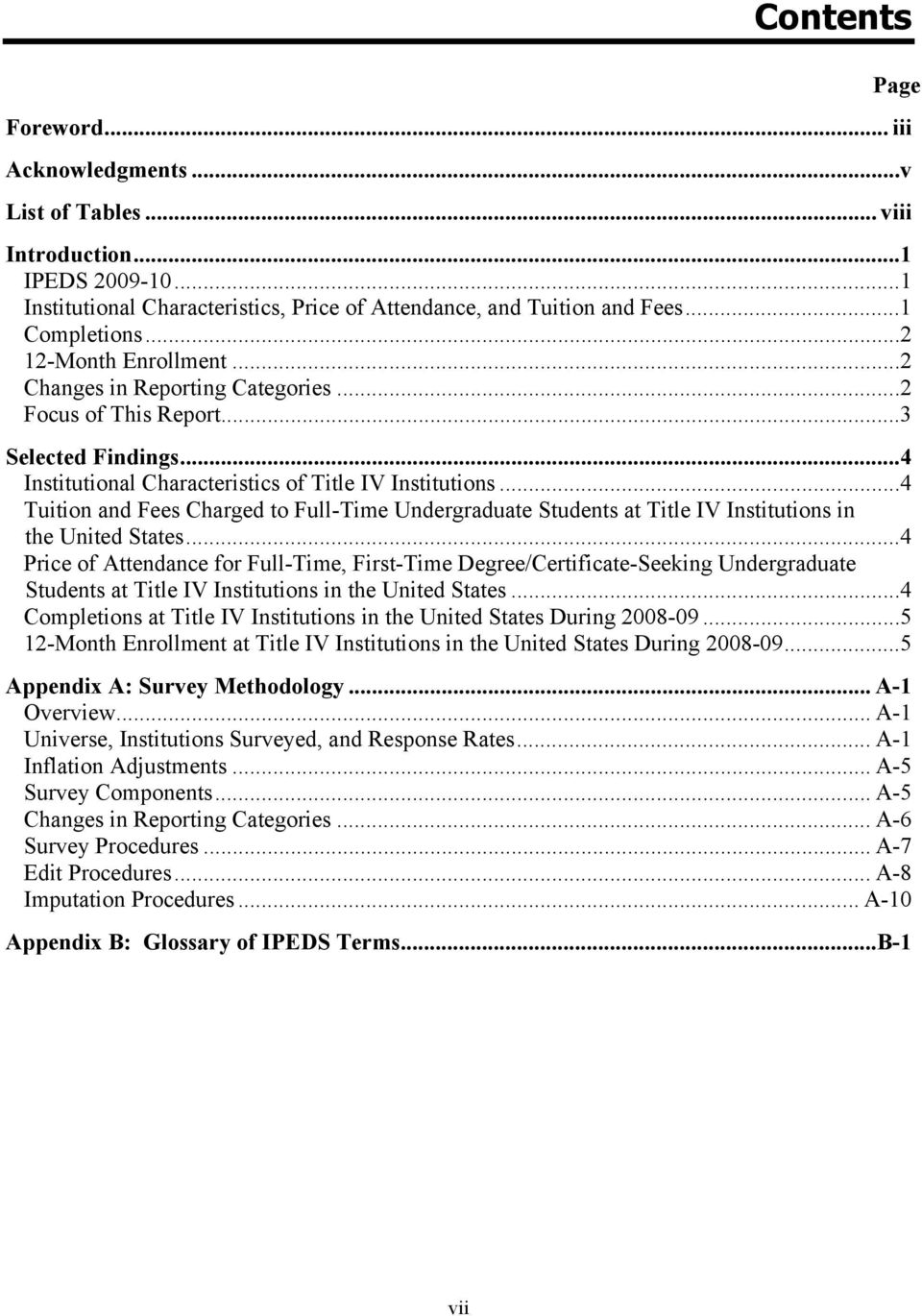
9 List of Tables Table Page Number and percentage distribution of Title IV institutions, by control of institution, level of institution, and region: United States and other jurisdictions, academic year Number and percentage distribution of Title IV institutions, by control of institution, degree-granting status, and highest level of offering: United States, academic year Average, median, and number of institutions reporting academic year tuition and required fees for full-time students at Title IV institutions, by control of institution, student level, and level of institution: United States, academic year Average and median tuition and required fees, percentage change in average and median tuition and required fees, and number of institutions reporting academic year tuition and required fees, measured in constant dollars, for full-time students at Title IV institutions, by student level, sector, and residency: United States, academic years , , , and Average components of academic year price of attendance and percentage change in average components of price of attendance, measured in constant dollars, for full-time, first-time degree/certificate-seeking undergraduates at Title IV institutions, by level and control of institution, residency, and student housing: United States, academic years and Average academic year price of attendance and percentage change in average price of attendance, measured in constant dollars, for full-time, first-time degree/certificate-seeking undergraduates at Title IV institutions, by level and control of institution, student housing, and residency: United States, academic years and Number and percentage distribution of degrees conferred at Title IV institutions, by control of institution, level of institution, gender, race/ethnicity, and degree level: United States, academic year Awards conferred by Title IV institutions, by race/ethnicity, level of award, and gender: United States, academic year The 10 largest programs of study for men and women at 4-year Title IV institutions, by level of degree and program of study: United States, academic year month unduplicated headcount enrollment at Title IV institutions, by student level, institution sector, race/ethnicity, and gender: United States, academic year month full-time-equivalent enrollment at Title IV institutions, by student level and institution sector: United States, academic year viii

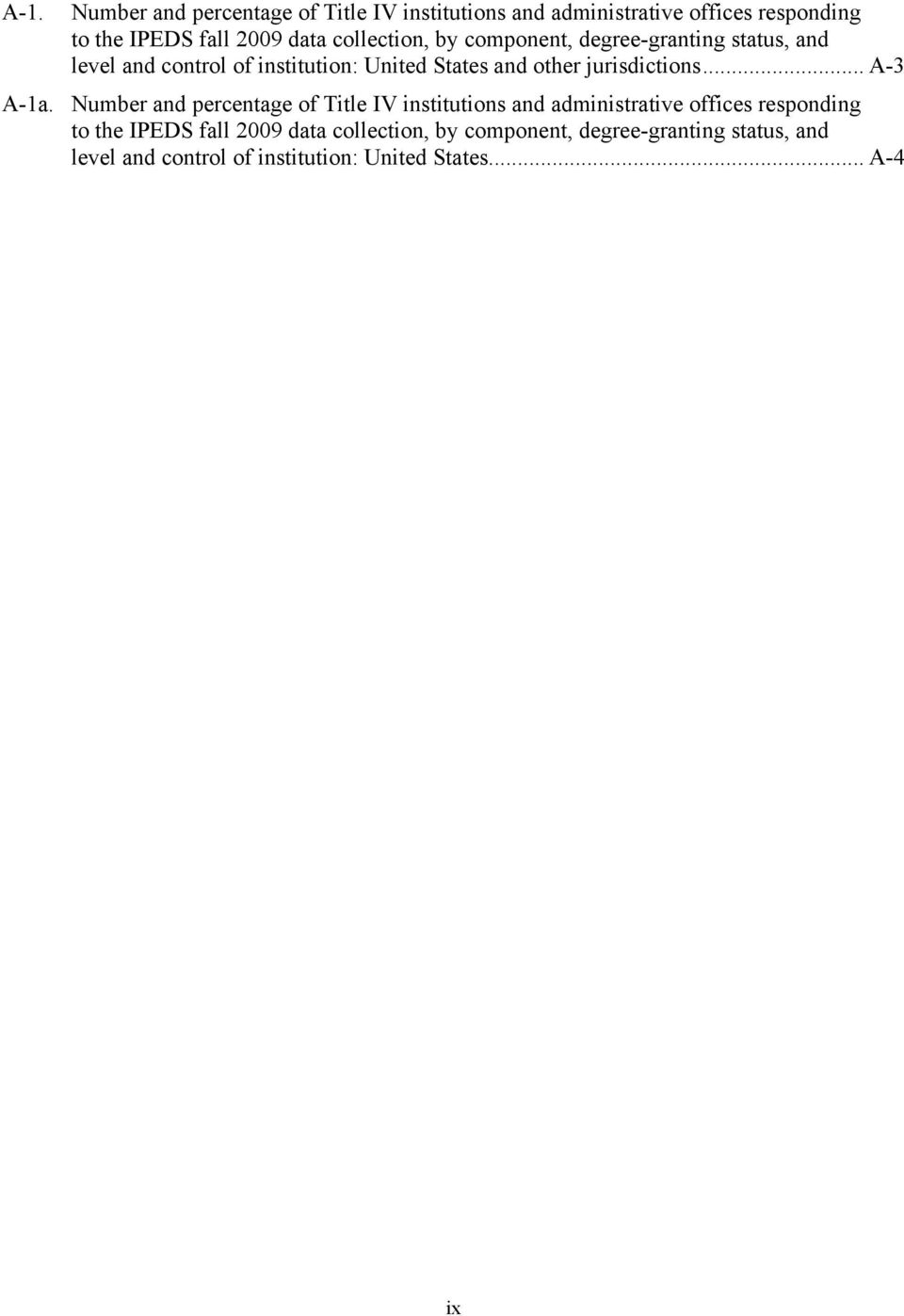
10 A-1. A-1a. Number and percentage of Title IV institutions and administrative offices responding to the IPEDS fall 2009 data collection, by component, degree-granting status, and level and control of institution: United States and other jurisdictions... A-3 Number and percentage of Title IV institutions and administrative offices responding to the IPEDS fall 2009 data collection, by component, degree-granting status, and level and control of institution: United States... A-4 ix
11 This page intentionally left blank.

12 Introduction The Integrated Postsecondary Education Data System (IPEDS) collects institution-level data from postsecondary institutions in the United States (the 50 states and the District of Columbia) and other jurisdictions. 1 For IPEDS, a postsecondary institution is defined as an organization that is open to the public and has as its primary mission the provision of postsecondary education, that is, formal instructional programs with a curriculum designed primarily for students who are beyond the compulsory age for high school. This definition includes academic, vocational, and continuing professional education programs and excludes institutions that offer only avocational (leisure) and adult basic education programs. IPEDS Participation in IPEDS was required for institutions and administrative offices that participated in Title IV federal student financial aid programs such as Pell Grants or Stafford Loans during the academic year. 2 Title IV institutions include 4-year colleges and universities, 2-year institutions, and non-degree-granting institutions (such as schools of cosmetology), among others. Accordingly, 6,896 institutions and 83 administrative offices (central or system offices) in the United States and other jurisdictions were expected to participate in the fall collection. Four of the U.S. service academies are included in the IPEDS universe as if they were Title IV institutions. 3 Other institutions that do not participate in Title IV programs may participate in the IPEDS data collection on a voluntary basis. During fall 2009, institutions provided data on institutional characteristics, price of attendance, and tuition and fees for the academic year, completions data (degrees, certificates, and other formal awards conferred) for the academic year, and 12-month enrollment data for the academic year. Information regarding IPEDS survey procedures and response rates is available in appendix A. Detailed definitions of terms used in this report are available in appendix B. Institutional Characteristics, Price of Attendance, and Tuition and Fees The Institutional Characteristics (IC) component of IPEDS collects and maintains information used to classify postsecondary institutions based on a variety of characteristics. Data on level (4-year, 2-year, less-than-2-year), control (public, private not-for-profit, private for-profit), and sector (level crossed with control) allow classification within general categories. More specific categories of institutions can be defined by using additional data, such as types of programs 1 The other jurisdictions surveyed in IPEDS are American Samoa, the Federated States of Micronesia, Guam, the Marshall Islands, the Northern Marianas, Palau, Puerto Rico, and the Virgin Islands. 2 Institutions participating in Title IV programs are accredited by an agency or organization recognized by the Secretary of the U.S. Department of Education, have a program of more than 300 clock hours or 8 credit hours, have been in business for at least 2 years, and have a signed Program Participation Agreement with the Office of Postsecondary Education, U.S. Department of Education. 3 The four U.S. service academies that are not Title IV eligible are the U.S. Naval Academy, the U.S. Military Academy, the U.S. Coast Guard Academy, and the U.S. Air Force Academy. One academy, the U.S. Merchant Marine Academy, is Title IV eligible. Data for all five institutions are included in the tables and counts of institutions unless otherwise indicated. 1

13 offered, levels of degrees and awards, calendar system, admission requirements, student charges, and basic enrollment information. In addition, the IC component collects data on tuition and fees (by level of program: undergraduate and graduate) and room and board charges. Price of attendance is also collected for full-time, first-time degree/certificate-seeking undergraduate students. Price of attendance is the total amount institutions estimate that undergraduate-level full-time, first-time degree-seeking students will pay to attend before financial aid is considered. This price includes tuition and fees, books and supplies, room and board, and certain other designated expenses such as transportation. These estimates are the average amounts used by the financial aid office to determine a student s financial aid. Completions The Completions component collects data annually on recognized program completions 4 in postsecondary education programs by level of degree (associate s, bachelor s, master s, doctor s, and first-professional) and on other formal awards by length of program. Data are collected on the race/ethnicity and gender of recipients and their fields of study. In addition, completions data on the number of students with multiple majors are collected by field of study, degree level, race/ethnicity, and gender from those schools that award degrees with multiple majors. The data from this component reflect all formal awards (i.e., degrees, diplomas, certificates) conferred between July 1, 2008, and June 30, Month Enrollment The 12-Month Enrollment component collects unduplicated headcount enrollment and instructional activity data at each institution for the academic year. The unduplicated headcount part of this component collects race/ethnicity, gender, and level of study (undergraduate, graduate, or first-professional) for each individual enrolled during the reporting period. The instructional activity portion of this component collects the number of contact or credit hours attempted by undergraduate and graduate students enrolled for credit. Activity data is classified as undergraduate or graduate level by course, not by student level of study. Credit and contact hours are not collected for first-professional students. Changes in Reporting Categories Beginning in fall 2008, several changes began to take effect regarding reporting of data (1) by race/ethnicity and (2) by level of study/level of award. 5 These changes are being phased in over several IPEDS collections. As a result of the optional reporting categories in use during the adoption period, caution should be exercised when drawing conclusions from the data presented in this First Look. Data presented in this report on students of two or more races are based on only those institutions that reported using the optional new race/ethnicity categories and are not representative of all students who could be classified into two or more races. Also, data in this First Look regarding first-professional students are based solely on those institutions that 4 Recognized program completions are those where an award has officially been conferred. This does not include completions where the requirements for the award have been satisfied, but the award has not yet been conferred. 5 For more information, see 2

14 reported using the old level of student categories and cannot be considered representative of all students enrolled in programs that were formerly classified as first-professional. Comparisons between data from prior IPEDS collections and the data presented in this First Look should be undertaken with caution for these same reasons. Please see the Changes in Reporting Categories section of appendix A for details. Focus of This Report Tabulations in this report focus on selected data items collected in fall 2009 from 6,822 Title IV institutions and administrative offices in the United States. Table 1 also includes the 154 Title IV institutions in the other jurisdictions. Since table 1 only pertains to institutions, the 3 administrative offices located in the other jurisdictions are not included in the table. Unless otherwise indicated, imputed data were included in the tabulations in place of missing data for institutions that did not report values for the necessary items. The selected items in this report, as well as the other items collected in fall 2009, are available through the IPEDS Data Center. 6 Several tables in this First Look display trends over time. In table 4, the time points displayed were chosen to demonstrate the range of data available from IPEDS for trend analysis, not to emphasize any particular period of change. In tables 5 and 6, the time period of three years was chosen to reflect the same period as the College Affordability Index (CAI). The CAI, which is calculated over a three year period, is the ratio of the percentage change in tuition and required fees for full-time, first-time undergraduate students to the percentage change in the Consumer Price Index. No comparison of tables 5 and 6 to the CAI is intended. Instead, tables 5 and 6 provide an additional, complementary source of information on the change in the price of attendance for full-time, first-time undergraduate students. 6 See 3
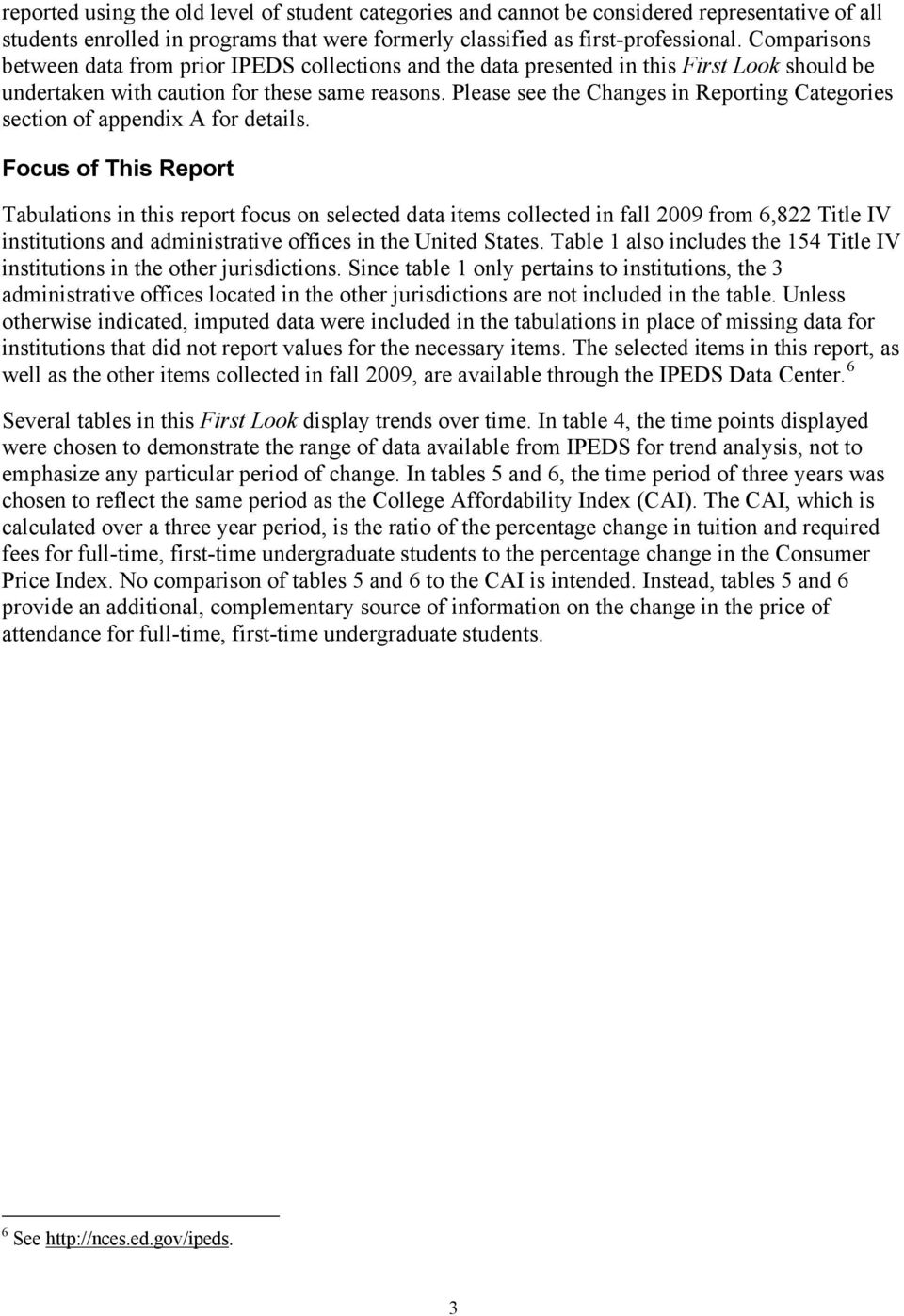
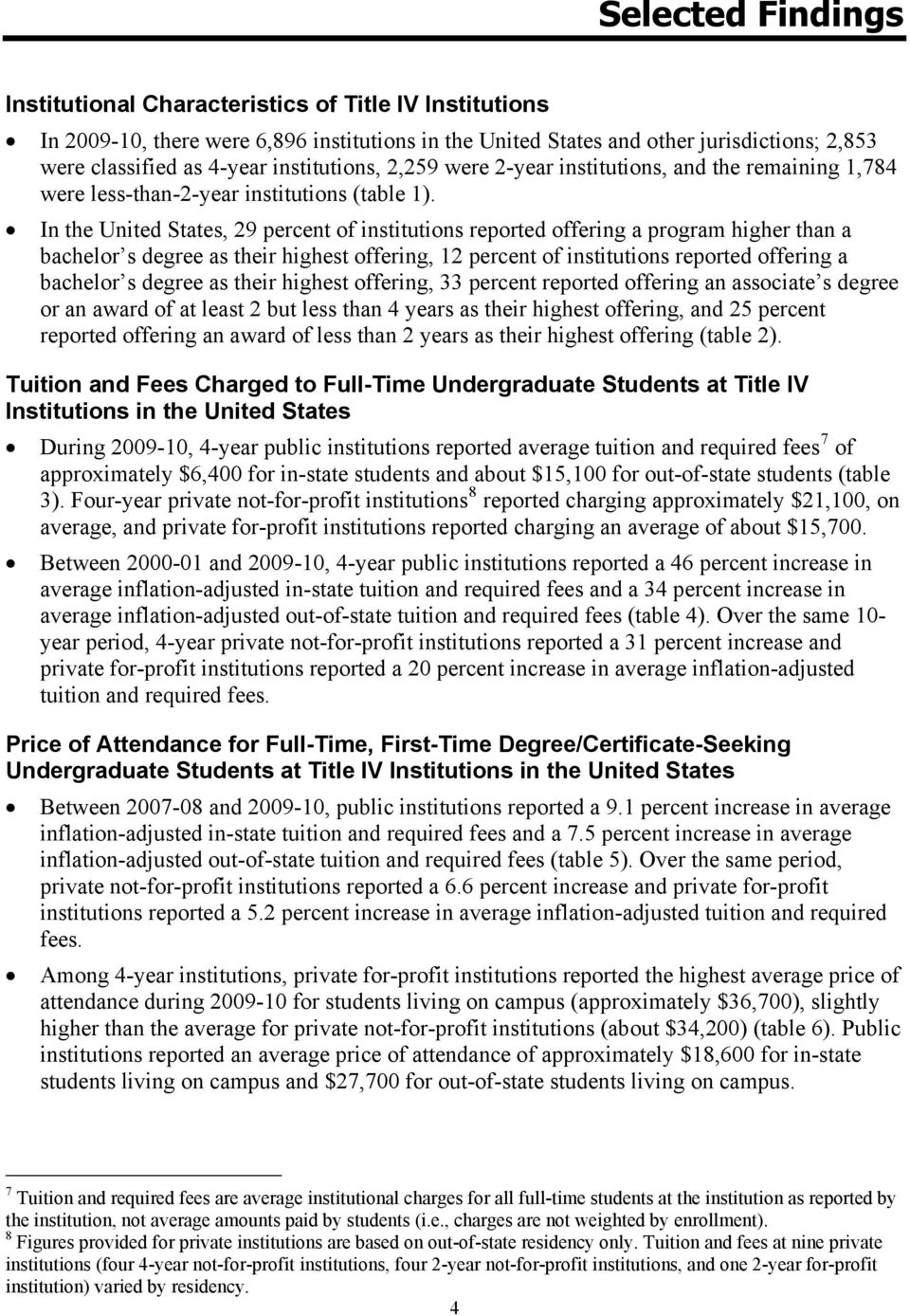
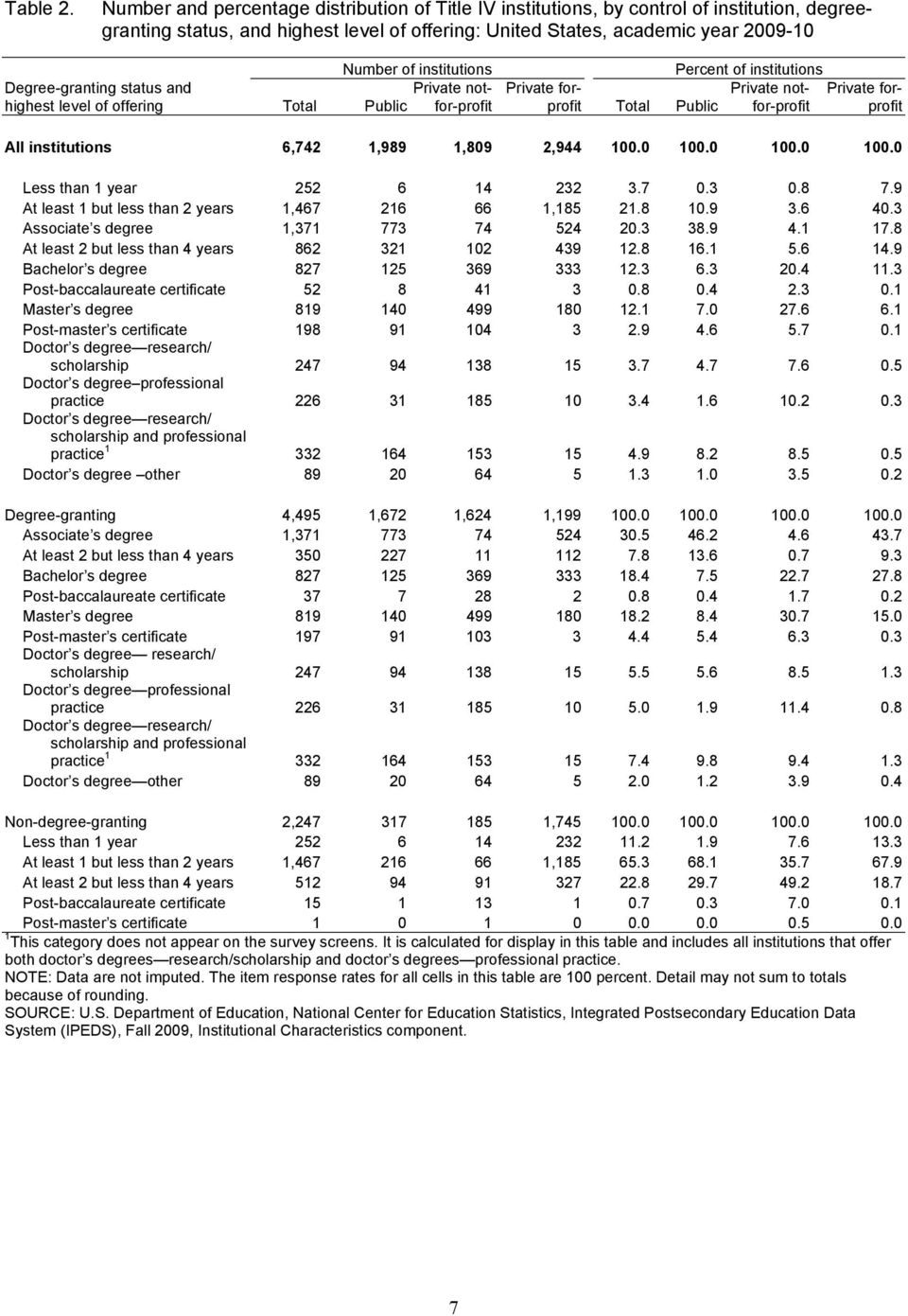
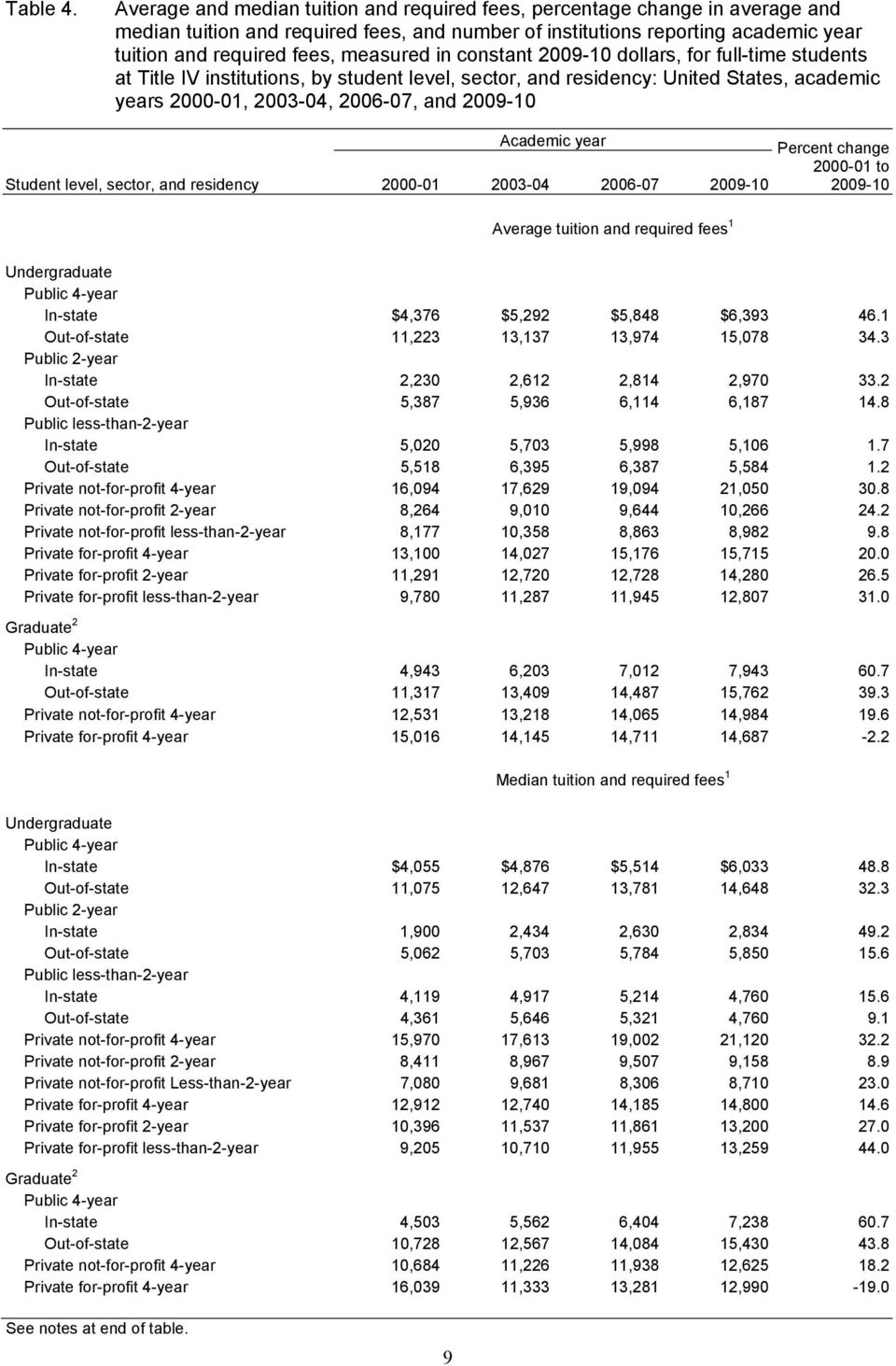
15 Selected Findings Institutional Characteristics of Title IV Institutions In , there were 6,896 institutions in the United States and other jurisdictions; 2,853 were classified as 4-year institutions, 2,259 were 2-year institutions, and the remaining 1,784 were less-than-2-year institutions (table 1). In the United States, 29 percent of institutions reported offering a program higher than a bachelor s degree as their highest offering, 12 percent of institutions reported offering a bachelor s degree as their highest offering, 33 percent reported offering an associate s degree or an award of at least 2 but less than 4 years as their highest offering, and 25 percent reported offering an award of less than 2 years as their highest offering (table 2). Tuition and Fees Charged to Full-Time Undergraduate Students at Title IV Institutions in the United States During , 4-year public institutions reported average tuition and required fees 7 of approximately $6,400 for in-state students and about $15,100 for out-of-state students (table 3). Four-year private not-for-profit institutions 8 reported charging approximately $21,100, on average, and private for-profit institutions reported charging an average of about $15,700. Between and , 4-year public institutions reported a 46 percent increase in average inflation-adjusted in-state tuition and required fees and a 34 percent increase in average inflation-adjusted out-of-state tuition and required fees (table 4). Over the same 10- year period, 4-year private not-for-profit institutions reported a 31 percent increase and private for-profit institutions reported a 20 percent increase in average inflation-adjusted tuition and required fees. Price of Attendance for Full-Time, First-Time Degree/Certificate-Seeking Undergraduate Students at Title IV Institutions in the United States Between and , public institutions reported a 9.1 percent increase in average inflation-adjusted in-state tuition and required fees and a 7.5 percent increase in average inflation-adjusted out-of-state tuition and required fees (table 5). Over the same period, private not-for-profit institutions reported a 6.6 percent increase and private for-profit institutions reported a 5.2 percent increase in average inflation-adjusted tuition and required fees. Among 4-year institutions, private for-profit institutions reported the highest average price of attendance during for students living on campus (approximately $36,700), slightly higher than the average for private not-for-profit institutions (about $34,200) (table 6). Public institutions reported an average price of attendance of approximately $18,600 for in-state students living on campus and $27,700 for out-of-state students living on campus. 7 Tuition and required fees are average institutional charges for all full-time students at the institution as reported by the institution, not average amounts paid by students (i.e., charges are not weighted by enrollment). 8 Figures provided for private institutions are based on out-of-state residency only. Tuition and fees at nine private institutions (four 4-year not-for-profit institutions, four 2-year not-for-profit institutions, and one 2-year for-profit institution) varied by residency. 4
16 Completions at Title IV Institutions in the United States During Of the 2.6 million degrees awarded by 4-year institutions, 42 percent were awarded to men and 58 percent to women (table 7). Of the almost 574,000 degrees awarded by 2-year institutions, 38 percent were awarded to men and 62 percent to women. Institutions reported conferring about 4.1 million postsecondary awards (degrees or certificates) (table 8). About 769,000 were less than 2 year certificates, 824,000 were associate s degrees or at least 2 but less than 4 year certificates, 1.6 million were bachelor s degrees, and 863,000 were graduate degrees and certificates. At 4-year institutions, the largest program of study for bachelor s degree recipients for men was Business Administration and Management (10 percent of the approximately 690,000 degrees); the largest for women was Psychology (8 percent of the approximately 920,000 degrees), followed closely by Business Administration and Management (7 percent) (table 9). Business Administration and Management was also the largest program of study for master s degree recipients for both men (22 percent of the approximately 260,000 degrees) and women (11 percent of the approximately 400,000 degrees). Law was the largest program of study for both men and women who earned doctor s degrees 9 (32 percent of the approximately 80,000 degrees awarded to men and 26 percent of the approximately 80,000 degrees awarded to women). 12-Month Enrollment at Title IV Institutions in the United States During Institutions reported a 12-month unduplicated headcount enrollment totaling 27.4 million individual students (table 10). Of these, 23.7 million were undergraduates, 3.5 million were graduate students, and 197,000 were first-professional students. Institutions reported full-time-equivalent enrollment of 16.5 million graduate and undergraduate students 10 (table 11). 9 Doctoral level degrees reported as first-professional degrees by institutions not utilizing the optional new levels of award were included when calculating the largest doctoral program of study. 10 Full-time-equivalent enrollment does not represent first-professional students for the 247 institutions still utilizing that reporting category since credit hour activity is not collected for first-professional students. 5

17 Table 1. Number and percentage distribution of Title IV institutions, by control of institution, level of institution, and region: United States and other jurisdictions, academic year Level of institution and region Total Number of institutions Private notfor-profit Public Private forprofit Total Public Percent of institutions Private notfor-profit Private forprofit Total institutions 6,896 2,015 1,865 3, Total U.S. institutions 6,742 1,989 1,809 2, Level of institution 4-year 2, , U.S. 2, , Other jurisdictions year 2,259 1, U.S. 2,233 1, Other jurisdictions Less-than-2-year 1, , U.S. 1, , Other jurisdictions Region New England Mid East 1, Great Lakes 1, Plains Southeast 1, Southwest Rocky Mountains Far West U.S. service academies Other jurisdictions NOTE: Data are not imputed. The item response rates for all cells in this table are 100 percent. The New England region includes Connecticut, Maine, Massachusetts, New Hampshire, Rhode Island, and Vermont. The Mid East region includes Delaware, the District of Columbia, Maryland, New Jersey, New York, and Pennsylvania. The Great Lakes region includes Illinois, Indiana, Michigan, Ohio, and Wisconsin. The Plains region includes Iowa, Kansas, Minnesota, Missouri, Nebraska, North Dakota, and South Dakota. The Southeast region includes Alabama, Arkansas, Florida, Georgia, Kentucky, Louisiana, Mississippi, North Carolina, South Carolina, Tennessee, Virginia, and West Virginia. The Southwest region includes Arizona, New Mexico, Oklahoma, and Texas. The Rocky Mountains region includes Colorado, Idaho, Montana, Utah, and Wyoming. The Far West region includes Alaska, California, Hawaii, Nevada, Oregon, and Washington. The other jurisdictions include American Samoa, the Federated States of Micronesia, Guam, the Marshall Islands, the Northern Marianas, Palau, Puerto Rico, and the Virgin Islands. Detail may not sum to totals because of rounding. SOURCE: U.S. Department of Education, National Center for Education Statistics, Integrated Postsecondary Education Data System (IPEDS), Fall 2009, Institutional Characteristics component. 6
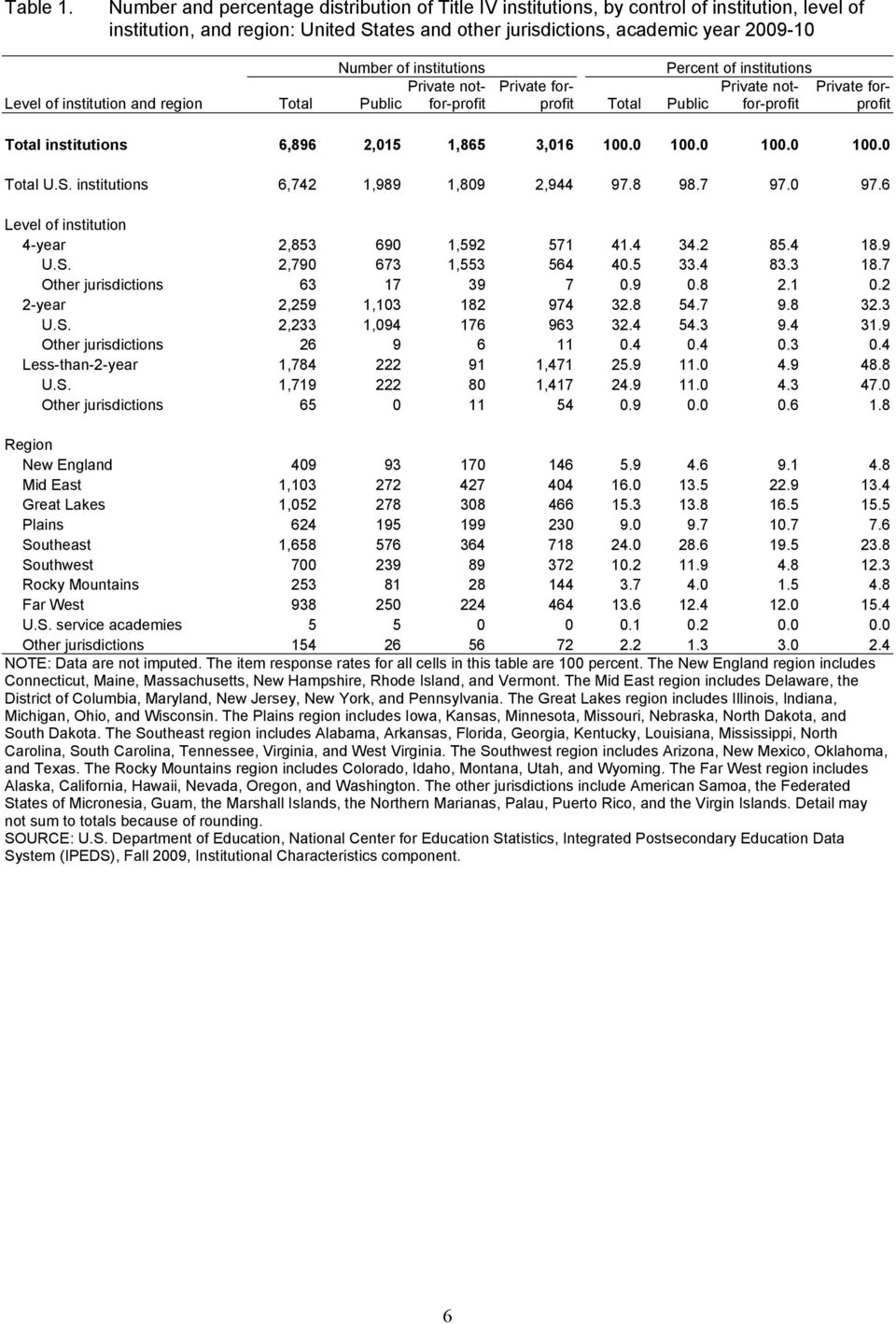
18 Table 2. Number and percentage distribution of Title IV institutions, by control of institution, degreegranting status, and highest level of offering: United States, academic year Degree-granting status and highest level of offering Total Number of institutions Private notfor-profit Public Private forprofit Total Public Percent of institutions Private notfor-profit Private forprofit All institutions 6,742 1,989 1,809 2, Less than 1 year At least 1 but less than 2 years 1, , Associate s degree 1, At least 2 but less than 4 years Bachelor s degree Post-baccalaureate certificate Master s degree Post-master s certificate Doctor s degree research/ scholarship Doctor s degree professional practice Doctor s degree research/ scholarship and professional practice Doctor s degree other Degree-granting 4,495 1,672 1,624 1, Associate s degree 1, At least 2 but less than 4 years Bachelor s degree Post-baccalaureate certificate Master s degree Post-master s certificate Doctor s degree research/ scholarship Doctor s degree professional practice Doctor s degree research/ scholarship and professional practice Doctor s degree other Non-degree-granting 2, , Less than 1 year At least 1 but less than 2 years 1, , At least 2 but less than 4 years Post-baccalaureate certificate Post-master s certificate This category does not appear on the survey screens. It is calculated for display in this table and includes all institutions that offer both doctor s degrees research/scholarship and doctor s degrees professional practice. NOTE: Data are not imputed. The item response rates for all cells in this table are 100 percent. Detail may not sum to totals because of rounding. SOURCE: U.S. Department of Education, National Center for Education Statistics, Integrated Postsecondary Education Data System (IPEDS), Fall 2009, Institutional Characteristics component. 7
19 Table 3. Average, median, and number of institutions reporting academic year tuition and required fees for full-time students at Title IV institutions, by control of institution, student level, and level of institution: United States, academic year Student level and level of institution Public In-state Out-of-state Private notfor-profit 1 Private forprofit 1 Average tuition and required fees Undergraduate 4-year $6,393 $15,078 $21,050 $15,715 2-year 2,970 6,187 10,266 14,280 Less-than-2-year 5,106 5,584 8,982 12,807 Graduate 2 7,943 15,762 14,984 14,687 Median tuition and required fees Undergraduate 4-year 6,033 14,648 21,120 14,800 2-year 2,834 5,850 9,158 13,200 Less-than-2-year 4,760 4,760 8,710 13,259 Graduate 2 7,238 15,430 12,625 12,990 Number of institutions reporting tuition and required fees Undergraduate 4-year , year 1,006 1, Less-than-2-year Graduate , Out-of-state average and median tuition and required fees were used for private institutions that reported varying tuitions by residency. 2 Tuition and fee charges for graduate students do not include charges for programs designated as doctor s degrees professional practice. NOTE: Tuition and required fees are average institutional charges for all full-time students at the institution as reported by the institution, not average amounts paid by students (i.e., charges are not weighted by enrollment). These figures for undergraduates differ from the pricing data in table 5 that apply only to fulltime, first-time degree/certificate-seeking undergraduates. The 2,269 institutions with academic calendars that differ by program or allow continuous enrollment are not included. U.S. service academies are not included. Medians were calculated using SAS, Version 9, Proc Univariate. SOURCE: U.S. Department of Education, National Center for Education Statistics, Integrated Postsecondary Education Data System (IPEDS), Fall 2009, Institutional Characteristics component. 8

20 Table 4. Average and median tuition and required fees, percentage change in average and median tuition and required fees, and number of institutions reporting academic year tuition and required fees, measured in constant dollars, for full-time students at Title IV institutions, by student level, sector, and residency: United States, academic years , , , and Student level, sector, and residency Academic year Percent change to Average tuition and required fees 1 Undergraduate Public 4-year In-state $4,376 $5,292 $5,848 $6, Out-of-state 11,223 13,137 13,974 15, Public 2-year In-state 2,230 2,612 2,814 2, Out-of-state 5,387 5,936 6,114 6, Public less-than-2-year In-state 5,020 5,703 5,998 5, Out-of-state 5,518 6,395 6,387 5, Private not-for-profit 4-year 16,094 17,629 19,094 21, Private not-for-profit 2-year 8,264 9,010 9,644 10, Private not-for-profit less-than-2-year 8,177 10,358 8,863 8, Private for-profit 4-year 13,100 14,027 15,176 15, Private for-profit 2-year 11,291 12,720 12,728 14, Private for-profit less-than-2-year 9,780 11,287 11,945 12, Graduate 2 Public 4-year In-state 4,943 6,203 7,012 7, Out-of-state 11,317 13,409 14,487 15, Private not-for-profit 4-year 12,531 13,218 14,065 14, Private for-profit 4-year 15,016 14,145 14,711 14, Median tuition and required fees 1 Undergraduate Public 4-year In-state $4,055 $4,876 $5,514 $6, Out-of-state 11,075 12,647 13,781 14, Public 2-year In-state 1,900 2,434 2,630 2, Out-of-state 5,062 5,703 5,784 5, Public less-than-2-year In-state 4,119 4,917 5,214 4, Out-of-state 4,361 5,646 5,321 4, Private not-for-profit 4-year 15,970 17,613 19,002 21, Private not-for-profit 2-year 8,411 8,967 9,507 9, Private not-for-profit Less-than-2-year 7,080 9,681 8,306 8, Private for-profit 4-year 12,912 12,740 14,185 14, Private for-profit 2-year 10,396 11,537 11,861 13, Private for-profit less-than-2-year 9,205 10,710 11,955 13, Graduate 2 Public 4-year In-state 4,503 5,562 6,404 7, Out-of-state 10,728 12,567 14,084 15, Private not-for-profit 4-year 10,684 11,226 11,938 12, Private for-profit 4-year 16,039 11,333 13,281 12, See notes at end of table. 9
21 Table 4. Average and median tuition and required fees, percentage change in average and median tuition and required fees, and number of institutions reporting academic year tuition and required fees, measured in constant dollars, for full-time students at Title IV institutions, by student level, sector, and residency: United States, academic years , , , and Continued Student level, sector, and residency Academic year Percent change to Number of institutions reporting tuition and required fees Undergraduate Public 4-year In-state Out-of-state Public 2-year In-state 1,112 1,105 1,063 1, Out-of-state 1,113 1,106 1,063 1, Public less-than-2-year In-state Out-of-state Private not-for-profit 4-year 1,258 1,300 1,294 1, Private not-for-profit 2-year Private not-for-profit Less-than-2-year Private for-profit 4-year Private for-profit 2-year Private for-profit less-than-2-year Graduate 2 Public 4-year In-state Out-of-state Private not-for-profit 4-year 933 1,011 1,058 1, Private for-profit 4-year Out-of-state average and median tuition and required fees were used for private institutions that reported varying tuitions by residency. 2 Tuition and fee charges for graduate students do not include charges for programs designated as doctor s degrees professional practice. NOTE: Tuition and required fees are average institutional charges for all full-time students at the institution as reported by the institution, not average amounts paid by students (i.e., charges are not weighted by enrollment). The time points displayed in this table were chosen to demonstrate the range of data available from IPEDS for trend analysis, not to emphasize any particular period of change. Data for years included in the range of this table, but not specifically displayed in the table, are available via the IPEDS Data Center. These figures for undergraduates differ from the pricing data in table 5 that apply only to full-time, first-time degree/certificate-seeking undergraduates. Institutions with academic calendars that differ by program or allow continuous enrollment (2,269 in fall 2009, 2,141 in fall 2006, 1,929 in fall 2003, and 1,836 in fall 2000) are not included. U.S. service academies are not included. All amounts from prior years were converted to dollars using the average Consumer Price Index values for the 12-month period ending in October of the academic year the data represent (e.g., October 2000) and the CPI value for the 12-month period ending in October Medians were calculated using SAS, Version 9, Proc Univariate. SOURCE: U.S. Department of Education, National Center for Education Statistics, Integrated Postsecondary Education Data System (IPEDS), Fall 2000, Fall2003, Fall2006, and Fall 2009, Institutional Characteristics component. 10
22 Table 5. Average components of academic year price of attendance and percentage change in average components of price of attendance, measured in constant dollars, for fulltime, first-time degree/certificate-seeking undergraduates at Title IV institutions, by level and control of institution, residency, and student housing: United States, academic years and Component of price, control of institution, residency, and student housing 4-year 2-year Less-than-2-year Percent change Percent change Percent change Tuition and required fees Public In-district 1 $5,862 $6, $2,366 $2, $4,862 $5, In-state 5,865 6, ,789 2, ,887 5, Out-of-state 14,006 15, ,077 6, ,368 5, Private not-for-profit 20,009 21, ,630 11, ,474 10, Private for-profit 14,885 15, ,315 14, ,801 12, Books and supplies Public 1,112 1, ,136 1, ,011 1, Private not-for-profit 1,045 1, ,157 1, Private for-profit 1,253 1, ,450 1, , Room and board Public On campus 7,179 7, ,746 5, Off campus (not with family) 8,025 8, ,959 7, ,522 6, Private not-for-profit On campus 7,634 8, ,864 6, ,984 2, Off campus (not with family) 8,023 8, ,297 8, ,611 8, Private for-profit On campus 9,004 9, ,754 8, ,108 3, Off campus (not with family) 9,045 9, ,768 7, ,354 7, Other expenses Public On campus 3,021 3, ,754 2, Off campus (not with family) 3,692 3, ,409 3, ,130 3, Off campus (with family) 3,651 3, ,497 3, ,330 3, Private not-for-profit On campus 2,423 2, ,657 2, ,449 5, Off campus (not with family) 3,184 3, ,758 3, ,748 2, Off campus (with family) 3,443 3, ,772 3, ,282 4, Private for-profit On campus 4,139 4, ,859 4, ,670 7, Off campus (not with family) 5,203 5, ,728 3, ,598 3, Off campus (with family) 5,810 6, ,939 4, ,181 3, Not applicable. 1 For public institutions, in district refers to the charges paid by a student who lives in the locality surrounding the institution, such as county. NOTE: Amounts are institutional averages as reported by the institution, not average amounts paid by students (i.e., charges are not weighted by enrollment). The time period of the percentage change in this table was chosen to reflect the same period as the College Affordability Index. The College Affordability Index, which is calculated over a three year period, is the ratio of the percentage change in tuition and required fees for full-time, first-time undergraduate students to the percentage change in the Consumer Price Index (CPI). Out-of-state average tuition and required fees were used for private institutions that reported varying tuitions by residency. These figures may differ from the tuition and required fee charges in table 3 and table 4 that apply to all fulltime undergraduates. The average components of academic year price of attendance in this table may not sum to the corresponding average price of attendance in table 6 because not all institutions report all components of academic year price of attendance separately (e.g., an institution may report a comprehensive fee in lieu of the individual components). The 2,226 institutions with academic calendars that differ by program or allow continuous enrollment are not included. U.S. service academies are not included. All amounts from were converted to dollars using the average CPI values for the 12-month periods ending in October 2007 and October SOURCE: U.S. Department of Education, National Center for Education Statistics, Integrated Postsecondary Education Data System (IPEDS), Fall 2009, Institutional Characteristics component. 11
23 Table 6. Average academic year price of attendance and percentage change in average price of attendance, measured in constant dollars, for full-time, first-time degree/certificateseeking undergraduates at Title IV institutions, by level and control of institution, student housing, and residency: United States, academic years and Control of institution, student housing, and residency 4-year 2-year Less-than-2-year Percent change Percent change Percent change Public On campus 1 In-district 2 $17,183 $18, $10,945 $11, $ $ In-state 17,185 18, ,171 12, Out-of-state 25,694 27, ,639 14, Off campus (not with family) 3 In-district 2 18,608 19, ,849 14, ,478 15, In-state 18,612 19, ,276 15, ,503 15, Out-of-state 26,798 28, ,552 18, ,984 16, Off campus (with family) 3 In-district 2 10,541 11, ,977 7, ,156 9, In-state 10,545 11, ,404 7, ,181 9, Out-of-state 18,731 20, ,680 11, ,662 10, Private not-for-profit On campus 1 32,159 34, ,207 23, ,068 20, Off campus (not with family) 3 29,987 31, ,550 24, ,429 22, Off campus (with family) 3 22,238 23, ,267 16, ,351 15, Private for-profit On campus 1 34,548 36, ,648 29, ,962 38, Off campus (not with family) 3 29,992 31, ,964 27, ,437 25, Off campus (with family) 3 21,572 22, ,407 19, ,665 17, Not applicable. 1 On-campus average price is based on those institutions that offer on-campus housing and/or meal service. 2 For public institutions, in district refers to the charges paid by a student who lives in the locality surrounding the institution, such as county. 3 Off-campus average price is based on those institutions that do not require full-time, first-time students to live on campus. NOTE: Price of attendance includes tuition and required fees, books and supplies, room and board charges, and other expenses. Amounts are institutional averages as reported by the institution, not average amounts paid by students (i.e., charges are not weighted by enrollment). The time period of the percentage change was chosen to reflect the same period as the College Affordability Index. The College Affordability Index, which is calculated over a three year period, is the ratio of the percentage change in tuition and required fees for full-time, first-time undergraduate students to the percentage change in the Consumer Price Index (CPI). Out-of-state average tuition and required fees were used for private institutions that reported varying tuitions by residency. The average components of academic year price of attendance in table 5 may not sum to the corresponding average price of attendance in this table because not all institutions report all components of academic year price of attendance separately (e.g., an institution may report a comprehensive fee in lieu of the individual components). The 2,226 institutions with academic calendars that differ by program or allow continuous enrollment are not included. U.S. service academies are not included. All amounts from were converted to dollars using the average Consumer Price Index values for the 12-month periods ending in October 2007 and October SOURCE: U.S. Department of Education, National Center for Education Statistics, Integrated Postsecondary Education Data System (IPEDS), Fall 2009, Institutional Characteristics component. 12
24 Table 7. Number and percentage distribution of degrees conferred at Title IV institutions, by control of institution, level of institution, gender, race/ethnicity, and degree level: United States, academic year Level of institution, 1 gender, race/ethnicity, and degree level All institutions Public Private not-for profit Private for-profit Percent Percent Percent Percent Number of total Number of total Number of total Number of total 4-year institutions Total degrees 2,631, ,493, , , Gender Men 1,105, , , , Women 1,526, , , , Race/ethnicity American Indian or Alaska Native 17, , , , Asian, Native Hawaiian, or Pacific Islander 161, , , , Black or African American 247, , , , Hispanic or Latino 186, , , , White 1,662, , , , Two or more races 2 2, , Race/ethnicity unknown 204, , , , Nonresident alien 148, , , , Degree level Associate s degrees 213, , , , Bachelor s degrees 1,601, ,020, , , Master s degrees 3 662, , , , Doctor s degrees 4 154, , , , year institutions Total degrees 573, , , , Gender Men 217, , , , Women 356, , , , Race/ethnicity American Indian or Alaska Native 5, , Asian, Native Hawaiian, or Pacific Islander 30, , , Black or African American 64, , , , Hispanic or Latino 67, , , White 363, , , , Two or more races Race/ethnicity unknown 30, , , Nonresident alien 11, , See notes at end of table. 13
25 Table 7. Number and percentage distribution of degrees conferred at Title IV institutions, by control of institution, level of institution, gender, race/ethnicity, and degree level: United States, academic year Continued Level of institution, 1 gender, race/ethnicity, and degree level All institutions Public Private not-for profit Private for-profit Percent Percent Percent Percent Number of total Number of total Number of total Number of total 2-year institutions Continued Degree level Associate s degrees 5 573, , , , Bachelor s degrees 6 1 # # # Rounds to zero. 1 Institutions are classified as 4-year or 2-year based on the highest level of awards offered in the collection year. 2 Two or more races was an optional reporting category in IPEDS , and 424 institutions reported awarding degrees using this option. The figures reported here should not be considered representative of all completions awarded to individuals who could be classified into two or more races. 3 Includes 2,812 degrees reported as first-professional degrees by 84 institutions. 4 Includes 44,930 degrees reported as doctor s degrees professional practice by 285 institutions, and 47,189 degrees reported as first-professional degrees by 184 institutions. 5 Includes 119 associate s degrees awarded by four 2-year institutions that were classified as non-degree-granting in the collection year ( ). 6 Includes one bachelor s degree awarded by one institution that was a 2-year institution in the collection year ( ). NOTE: Awards to individuals of Hispanic or Latino ethnicity are included in the Hispanic or Latino category regardless of race. One institution that was a less-than-2-year institution in the collection year ( ) reported awarding 22 associate s degrees in the reporting year ( ); these 22 degrees are not included in this table. Detail may not sum to totals because of rounding. SOURCE: U.S. Department of Education, National Center for Education Statistics, Integrated Postsecondary Education Data System (IPEDS), Fall 2009, Completions component. 14
26 Table 8. Awards conferred by Title IV institutions, by race/ethnicity, level of award, and gender: United States, academic year Level of award and gender Total Awards American Indian or Alaska Native Asian, Native Hawaiian, or Pacific Islander Black or African American Hispanic or Latino White Two or more races 1 Race/ ethnicity unknown Nonresident alien Total awards 4,057,501 32, , , ,860 2,475,312 5, , ,992 Men 1,641,280 12,629 99, , ,933 1,022,693 1, ,855 89,895 Women 2,416,221 20, , , ,927 1,452,619 3, ,829 79,097 Less than 1 year 429,640 4,261 19,737 86,053 69, , ,386 3,419 Men 170,424 1,734 7,559 30,362 23,528 94, ,963 1,241 Women 259,216 2,527 12,178 55,691 46, , ,423 2,178 At least 1 but less than 2 years 339,163 4,261 13,723 60,861 55, ,801 1,046 20,090 3,042 Men 113,926 1,710 4,934 17,922 18,548 62, ,353 1,204 Women 225,237 2,551 8,789 42,939 36, , ,737 1,838 Associate s degrees 2 787,466 8,234 38,085 94,409 91, ,541 1,227 51,639 15,184 Men 298,252 2,857 15,935 29,715 34, , ,301 6,092 Women 489,214 5,377 22,150 64,694 57, , ,338 9,092 At least 2 but less than 4 years 3 36, ,763 4,099 3,707 23, , Men 18, ,982 2,361 10, , Women 18, ,117 1,346 12, Bachelor s degrees 4 1,601,368 11, , , ,722 1,068,983 1, ,842 45,883 Men 685,382 4,515 47,288 49,729 47, , ,542 22,333 Women 915,986 6,892 57,650 96,105 73, ,846 1,017 57,300 23,550 Post-baccalaureate certificates 28, ,462 1,979 1,789 17, ,742 1,349 Men 9, , , Women 18, ,378 1,180 11, , Master s degrees 5 662,079 3,318 35,181 62,169 34, , ,872 79,733 Men 263,538 1,171 16,222 17,495 12, , ,152 45,972 Women 398,541 2,147 18,959 44,674 22, , ,720 33,761 Post-master s certificates 6 18, , , ,838 1,351 Men 5, , Women 12, , , , Doctor s degrees 7 154, ,550 9,300 6,822 92, ,633 18,662 Men 75, ,345 3,207 3,068 45, ,796 11,501 Women 78, ,205 6,093 3,754 47, ,837 7,161 1 Two or more races was an optional reporting category in IPEDS , and a total of 771 institutions reported awarding degrees or certificates using this option. The figures reported here should not be considered representative of all completions awarded to individuals who could be classified into two or more races. 2 Includes 22 associate s degrees awarded by one institution that was a less-than-2-year institution in the collection year ( ) and 119 associate s degrees awarded by four 2-year institutions that were classified as non-degree-granting in the collection year ( ). 3 Includes 247 certificates of at least 2 but less than 4 years awarded by eight institutions that were less-than-2-year institutions in the collection year ( ). 4 Includes one bachelor s degree awarded by one institution that was a 2-year institution in the collection year ( ). 5 Includes 2,812 degrees reported as first-professional degrees by 84 institutions. 6 Includes 527 certificates reported as first-professional certificates by 28 institutions. 7 Includes 44,930 degrees reported as doctor s degrees professional practice by 285 institutions, and 47,189 degrees reported as firstprofessional degrees by 184 institutions. NOTE: Awards to individuals of Hispanic or Latino ethnicity are included in the Hispanic or Latino category regardless of race. SOURCE: U.S. Department of Education, National Center for Education Statistics, Integrated Postsecondary Education Data System (IPEDS), Fall 2009, Completions component. 15
27 Table 9. The 10 largest programs of study for men and women at 4-year Title IV institutions, by level of degree and program of study: United States, academic year Men Women Level of degree and program of study 1 Count Percent Level of degree and program of study 1 Count Percent Associate s degrees Total 81, Total 132, Liberal Arts and Sciences/Liberal Studies 15, Liberal Arts and Sciences/Liberal Studies 25, Business Administration and Management, General 8, Business Administration and Management, General 17, General Studies 5, Nursing/Registered Nurse (RN, ASN, BSN, MSN) 15, Computer Systems Networking and Telecommunications 3, General Studies 6, Electrical, Electronic and Communications Engineering Technology/Technician 2, Accounting 3, Culinary Arts/Chef Training 2, Medical/Clinical Assistant 3, Nursing/Registered Nurse (RN, ASN, BSN, MSN) 2, Legal Assistant/Paralegal 2, Information Technology 1, Fashion Merchandising 2, CAD/CADD Drafting and/or Design Hospital and Health Care Facilities Technology/Technician 1, Administration/Management 2, Recording Arts Technology/Technician 1, Corrections and Criminal Justice, Other 2, Bachelor s degrees Total 685, Total 915, Business Administration and Management, General 66, Psychology, General 68, Finance, General 22, Business Administration and Management, General 64, Biology/Biological Sciences, General 21, Nursing/Registered Nurse (RN, ASN, BSN, MSN) 61, Political Science and Government, General 20, Elementary Education and Teaching 36, Accounting 20, Biology/Biological Sciences, General 33, Psychology, General 20, English Language and Literature, General 28, History, General 20, Accounting 24, Economics, General 17, Communication Studies/Speech Communication and Rhetoric 22, Mechanical Engineering 15, Sociology 20, Marketing/Marketing Management, General 14, Liberal Arts and Sciences/Liberal Studies 19, Master s degrees 2 Total 263, Total 398, Business Administration and Management, General 58, Business Administration and Management, General 45, Electrical, Electronics and Communications Engineering 7, Education, General 20, Educational Leadership and Administration, General 7, Social Work 16, Business/Commerce, General 6, Elementary Education and Teaching 15, Education, General 5, Curriculum and Instruction 14, Accounting 5, Educational Leadership and Administration, General 13, Public Administration 4, Special Education and Teaching, General 11, Computer Science 3, Counselor Education/School Counseling and Guidance Services 10, Mechanical Engineering 3, Nursing/Registered Nurse (RN, ASN, BSN, MSN) 8, Computer and Information Sciences, General 3, Reading Teacher Education 7, See notes at end of table. 16
28 Table 9. The 10 largest programs of study for men and women at 4-year Title IV institutions, by gender, level of degree, and program of study: United States, academic year Continued Men Women Level of degree and program of study 1 Count Percent Level of degree and program of study 1 Count Percent Doctor s degrees 3 Total 75, Total 78, Law (LL.B., J.D.) 23, Law (LL.B., J.D.) 20, Medicine (MD) 8, Medicine (MD) 7, Pharmacy (PharmD [USA], PharmD or BS/BPharm [Canada]) 4, Pharmacy (PharmD [USA], PharmD or BS/BPharm [Canada]) 7, Dentistry (DDS, DMD) 2, Physical Therapy/Therapist 5, Physical Therapy/Therapist 2, Dentistry (DDS, DMD) 2, Osteopathic Medicine/Osteopathy (DO) 1, Educational Leadership and Administration, General 2, Chiropractic (DC) 1, Osteopathic Medicine/Osteopathy (DO) 1, Electrical, Electronics and Communications Engineering 1, Veterinary Medicine (DVM) 1, Chemistry, General 1, Clinical Psychology 1, Educational Leadership and Administration, General 1, Psychology, General 1, Degrees by program of study (6-digit Classification of Instructional Programs [CIP] level) are based on the 2000 version of the ClPs. 2 A total of 2,812 degrees reported as first-professional degrees by 84 institutions were included when determining the 10 largest programs of study. 3 A total of 44,930 degrees reported as doctor s degrees professional practice by 285 institutions, and 47,189 degrees reported as firstprofessional degrees by 184 institutions, were included when determining the 10 largest programs of study. NOTE: Largest program of study is based on the first major for degrees awarded with multiple majors. SOURCE: U.S. Department of Education, National Center for Education Statistics, Integrated Postsecondary Education Data System (IPEDS), Fall 2009, Completions component. 17
29 Table month unduplicated headcount enrollment at Title IV institutions, by student level, institution sector, race/ethnicity, and gender: United States, academic year Institution sector, race/ethnicity, and gender Total Undergraduate Graduate 1 First-professional Total students 27,369,242 23,668,037 3,504, ,061 Sector Public 4-year 9,050,563 7,237,615 1,723,544 89,404 Public 2-year 2 10,452,884 10,452, Public less-than-2-year 106, , Private not-for-profit 4-year 4,460,007 2,948,610 1,405, ,074 Private not-for-profit 2-year 59,253 59, Private not-for-profit less-than-2-year 23,888 23, Private for-profit 4-year 2,076,225 1,699, ,182 1,583 Private for-profit 2-year 673, , Private for-profit less-than-2-year 466, , Race/ethnicity American Indian or Alaska Native 267, ,814 19,870 1,383 Asian, Native Hawaiian, or Pacific Islander 1,596,893 1,395, ,250 24,837 Black or African American 3,661,296 3,279, ,011 14,589 Hispanic or Latino 3,147,176 2,949, ,605 10,739 White 15,283,861 13,214,408 1,950, ,861 Two or more races 3 36,200 33,286 2, Race/ethnicity unknown 2,554,679 2,080, ,728 20,682 Nonresident alien 822, , ,296 5,848 Gender Male 11,604,365 10,145,229 1,359,540 99,596 Female 15,764,877 13,522,808 2,144,604 97,465 1 A total of 305 institutions reported unduplicated headcount enrollment using the optional revised levels of study that eliminated the first-professional category. For these institutions, students formerly classified as first-professional students are now classified as graduate students. 2 One 2-year institution reported students enrolled in graduate-level courses. 3 Two or more races was an optional reporting category in IPEDS , and a total of 1,351 institutions reported unduplicated headcount enrollment using this option. The figures reported here should not be considered representative of the unduplicated headcount enrollment of all individuals that could be classified into two or more races. NOTE: Students of Hispanic or Latino ethnicity are included in the Hispanic or Latino category regardless of race. SOURCE: U.S. Department of Education, National Center for Education Statistics, Integrated Postsecondary Education Data System (IPEDS), Fall 2009, 12-Month Enrollment component. 18
30 Table month full-time-equivalent enrollment at Title IV institutions, by student level and institution sector: United States, academic year Institution sector Total Undergraduate Graduate 1 Total students 16,545,130 14,463,838 2,081,292 Public 4-year 6,425,725 5,425,560 1,000,165 Public 2-year 2 4,495,065 4,495, Public less-than-2-year 62,528 62,528 0 Private not-for-profit 4-year 3,233,360 2,369, ,824 Private not-for-profit 2-year 44,691 44,691 0 Private not-for-profit less-than-2-year 17,172 17,172 0 Private for-profit 4-year 1,225,408 1,008, ,264 Private for-profit 2-year 527, ,616 0 Private for-profit less-than-2-year 513, , A total of 305 institutions reported full-time-equivalent enrollment using the optional revised levels of study that eliminated the first-professional category. For these institutions, students formerly classified as first-professional students are now classified as graduate students and are included in this table. Students reported as firstprofessional by 247 institutions are not included in this table. 2 One 2-year institution reported full-time-equivalent enrollment in graduate-level courses. NOTE: The full-time equivalent (FTE) enrollment displayed in this table is calculated from institutions instructional activity over a 12-month period. For institutions following a quarter calendar system, 45 undergraduate credit hours is considered 1 undergraduate FTE and 36 graduate credit hours is considered 1 graduate FTE. For institutions following a semester, trimester, 4-1-4, or other academic year calendar system, 30 undergraduate credit hours is considered 1 undergraduate FTE and 24 graduate credit hours is considered 1 graduate FTE. For all calendar systems (both academic year-based systems and continuous enrollment systems), 900 undergraduate contact hours is considered 1 undergraduate FTE. SOURCE: U.S. Department of Education, National Center for Education Statistics, Integrated Postsecondary Education Data System (IPEDS), Fall 2009, 12-Month Enrollment component. 19
31 This page intentionally left blank.
32 Appendix A: Survey Methodology Overview The Integrated Postsecondary Education Data System (IPEDS) defines a postsecondary institution as an organization that is open to the public and has a primary mission of providing education or training beyond the high school level. The primary focus of the IPEDS fall 2009 data collection was to collect data from Title IV institutions. These institutions have Program Participation Agreements (PPAs) with the Office of Postsecondary Education (OPE) within the U.S. Department of Education and thus are eligible to participate in Title IV student financial aid programs. There were 6,979 Title IV institutions 1 and administrative offices located in the United States and the other jurisdictions of the United States, such as Puerto Rico, 2 in the academic year. The fall 2009 data collection was entirely web-based. Institutions in the universe were asked to enter their survey responses using the IPEDS data collection website. The fall 2009 IPEDS data were collected between September 2, 2009, and October 14, The collection had three components: Institutional Characteristics (IC), Completions (C), and 12-Month Enrollment (E12). Universe, Institutions Surveyed, and Response Rates The IPEDS universe is established during the fall collection period. For , 56 postsecondary institutions and 1 administrative office included in prior IPEDS data collections were determined to be outside the scope of IPEDS because they were closed or were merged with another institution. Additionally, 251 postsecondary institutions were reported exclusively by a parent institution 3 and are not included in the universe counts; also, 252 postsecondary institutions were added to the universe. These added schools were identified from several sources, including a universe review by state coordinators, a review of the data file maintained by OPE, and information provided by the institutions themselves. The full set of 6,979 Title IV entities was validated by matching the IPEDS universe file with OPE s Postsecondary Education Participation System (PEPS) file. Because most of the studies that use IPEDS data concentrate on the Title IV institutions, this group is the main focus of IPEDS. Also, according to Section 490 of the Higher Education Amendments of 1992 (P.L ), IPEDS is mandatory for any institutions that participate in or are applicants for participation in any federal financial assistance program authorized by Title IV of the Higher Education Act of 1965, as amended (20 USC 1094(a)(17)). 1 Includes 6,896 institutions and 83 administrative (central or system) offices. The central and system offices are required to complete the Institutional Characteristics component in the fall, the Human Resources component in the winter, and the Finance component in the spring (if they have their own separate budget). 2 The other jurisdictions include American Samoa, the Federated States of Micronesia, Guam, the Marshall Islands, the Northern Marianas, Palau, Puerto Rico, and the Virgin Islands. 3 A parent institution reports data for another institution, known as the child institution. A-1
33 The IPEDS database includes institutions that do not participate in Title IV financial aid programs. These institutions are invited to participate in the IPEDS program, and if they voluntarily respond to the surveys, the institutions are included in the College Navigator ( The College Navigator is designed to help college students, prospective students, and their parents learn about admission requirements, degrees offered, costs, graduation rates, and other characteristics of institutions that they may find helpful in selecting among postsecondary institutions. For fall 2009, 151 non Title IV institutions and administrative offices responded voluntarily (150 to IC, 150 to C, and 145 to E12). Table A-1 provides the number of Title IV institutions and administrative offices and the component response rates by degree-granting status and by level and control of institution for the United States and other jurisdictions for the three fall components. Because Title IV institutions are the primary focus of IPEDS and they are required to respond, response rates for Title IV institutions in the fall 2009 IPEDS collection were high. Response rates for the Institutional Characteristics component are based on 6,896 institutions and 83 administrative offices (central and system offices). The IC component response rate among all Title IV entities was approximately percent (6,976 of the 6,979 Title IV entities responded). The response rate for the C component was 99.9 percent; 6,891 out of 6,895 eligible institutions responded. The response rate for the E12 component was about percent; 6,877 out of 6,879 eligible institutions responded. Table A-1a provides the number of Title IV institutions and administrative offices and the survey response rates by degree-granting status and by level and control of institution for those institutions located in the United States only (excluding any other jurisdictions). NCES statistical standards require that the potential for nonresponse bias for all institutions (including those in other jurisdictions) be analyzed for sectors for which the response rate is less than 90 percent. As shown in table A-1, no sectors required this analysis. A-2
34 Table A-1. Number and percentage of Title IV institutions and administrative offices responding to the IPEDS fall 2009 data collection, by component, degree-granting status, and level and control of institution: United States and other jurisdictions Degree-granting status and level and control of institution Institutional Characteristics Completions 12-Month Enrollment Number Response Final Number Response Final Number responded rate (%) universe responded rate (%) universe responded Final universe Response rate (%) All institutions 6,979 6, ,895 6, ,879 6, Public 2,086 2, ,014 2, ,013 2, Private not-for-profit 1,871 1, ,865 1, ,864 1, Private for-profit 3,022 3, ,016 3, ,002 3, year 2,901 2, ,852 2, ,847 2, Public Private not-for-profit 1,597 1, ,592 1, ,592 1, Private for-profit year 2,292 2, ,259 2, ,254 2, Public 1,134 1, ,103 1, ,103 1, Private not-for-profit Private for-profit Less-than-2-year 1,786 1, ,784 1, ,778 1, Public Private not-for-profit Private for-profit 1,472 1, ,471 1, ,467 1, Degree-granting 4,662 4, ,580 4, ,570 4, year 2,885 2, ,836 2, ,831 2, Public Private not-for-profit 1,583 1, ,578 1, ,578 1, Private for-profit year 1,777 1, ,744 1, ,739 1, Public 1,039 1, ,008 1, ,008 1, Private not-for-profit Private for-profit Non-degree-granting 2,317 2, ,315 2, ,309 2, year Public Private not-for-profit Private for-profit year Public Private not-for-profit Private for-profit Less-than-2-year 1,786 1, ,784 1, ,778 1, Public Private not-for-profit Private for-profit 1,472 1, ,471 1, ,467 1, These institutions grant certificates only at the post-baccalaureate, post-master s, and post-doctorate levels. NOTE: For the Institutional Characteristics (IC) response rates, administrative offices (central and system offices) are included in the counts according to the highest level of the institution(s) they serve because they complete the IC component. Sixteen institutions new to IPEDS were not required to respond to the 12-Month Enrollment component, but did respond to the Completions component. Data were imputed for all nonresponding institutions; however, the set of items subject to imputation varied by component. For the IC component, only data from part D (student charges) were subject to imputation. For the Completions and 12-Month Enrollment components, all data elements were subject to imputation. The other jurisdictions include American Samoa, the Federated States of Micronesia, Guam, the Marshall Islands, the Northern Marianas, Palau, Puerto Rico, and the Virgin Islands. SOURCE: U.S. Department of Education, National Center for Education Statistics, Integrated Postsecondary Education Data System (IPEDS), Fall A-3
35 Table A-1a. Number and percentage of Title IV institutions and administrative offices responding to the IPEDS fall 2009 data collection, by component, degree-granting status, and level and control of institution: United States Degree-granting status and level and control of institution Institutional Characteristics Completions 12-Month Enrollment Number Response Final Number Response Final Number responded rate (%) universe responded rate (%) universe responded Final universe Response rate (%) All institutions 6,822 6, ,741 6, ,725 6, Public 2,059 2, ,988 1, ,987 1, Private not-for-profit 1,813 1, ,809 1, ,808 1, Private for-profit 2,950 2, ,944 2, ,930 2, year 2,835 2, ,789 2, ,784 2, Public Private not-for-profit 1,556 1, ,553 1, ,553 1, Private for-profit year 2,266 2, ,233 2, ,228 2, Public 1,125 1, ,094 1, ,094 1, Private not-for-profit Private for-profit Less-than-2-year 1,721 1, ,719 1, ,713 1, Public Private not-for-profit Private for-profit 1,418 1, ,417 1, ,413 1, Degree-granting 4,573 4, ,494 4, ,484 4, year 2,819 2, ,773 2, ,768 2, Public Private not-for-profit 1,542 1, ,539 1, ,539 1, Private for-profit year 1,754 1, ,721 1, ,716 1, Public 1,031 1, ,000 1, ,000 1, Private not-for-profit Private for-profit Non-degree-granting 2,249 2, ,247 2, ,241 2, year Public Private not-for-profit Private for-profit year Public Private not-for-profit Private for-profit Less-than-2-year 1,721 1, ,719 1, ,713 1, Public Private not-for-profit Private for-profit 1,418 1, ,417 1, ,413 1, These institutions grant certificates only at the post-baccalaureate, post-master s, and post-doctorate levels. NOTE: For the Institutional Characteristics (IC) response rates, administrative offices (central and system offices) are included in the counts according to the highest level of the institution(s) they serve because they complete the IC component. Sixteen institutions new to IPEDS were not required to respond to the 12-Month Enrollment component, but did respond to the Completions component. Data were imputed for all nonresponding institutions; however, the set of items subject to imputation varied by component. For the IC component, only data from part D (student charges) were subject to imputation. For the Completions and 12-Month Enrollment components, all data elements were subject to imputation. SOURCE: U.S. Department of Education, National Center for Education Statistics, Integrated Postsecondary Education Data System (IPEDS), Fall A-4
36 Inflation Adjustments Tables 4, 5, and 6 in this report are reported in constant dollars. To convert the previous years tuition, required fees, books and supplies, room and board, and other expenses data to dollar amounts, the average Consumer Price Index (CPI) for All Urban Consumers values for the 12-month period ending in October of the academic year the data represent were used. The ratio of the average CPI for the 12-month period ending in October 2009 to the average CPI ending in October of the appropriate prior year was multiplied by the data from the prior year to calculate the constant dollar amounts. These amounts were then used in the calculations shown in the table. Percentage changes in these tables reflect changes over and above changes due to inflation. Survey Components Institutional Characteristics This component of the web-based survey collects basic data on each institution, such as institution name, location, educational offerings, control or affiliation, admission requirements, estimated fall enrollment, and student services. In addition, data were collected on student charges for academic year for each level of enrollment (undergraduate and graduate) or for the institution s six largest programs (if programs are primarily occupational/vocational). Finally, price of attendance for full-time, first-time degreeor certificate-seeking (undergraduate) students is requested, which includes tuition and fees, books and supplies, room and board, and other expenses (such as transportation, laundry, and entertainment). Price data are those used by the institutions financial aid offices to determine student aid. Student charges data for undergraduates, which are the average for all full-time students, may differ from institutional pricing data, which include published tuition and fees for full-time, first-time degree/certificate-seeking students. Completions This component of the web-based survey collects detailed data on the number of degrees or other formal awards conferred in academic year by degree level, race/ ethnicity, gender, and 6-digit Classification of Instructional Program (CIP) code. Completions data on the number of students with multiple majors are collected by 6-digit CIP code, degree level, race/ethnicity, and gender from institutions that award degrees with multiple majors. Summaries by degree level, race/ethnicity, and gender based on the first two digits of the CIP code are generated by the data collection system. CIP code information is based on the 2000 version of the CIP codes. 12-Month Enrollment This component collects enrollment data for a 12-month reporting period. Institutions indicate whether they are reporting for either July 1, 2008 through June 30, 2009, or September 1, 2008 through August 31, Total unduplicated student counts by race/ethnicity, gender, and level of student for those students enrolled during the reporting period is collected. Students who attend at different levels within the 12-month period are reported at the highest level in which the student was enrolled. Data on instructional activity for the reported students is collected and the full-time equivalent (FTE) undergraduate student enrollment and FTE graduate student enrollment are calculated. Activity data for students currently classified as first-professional are not collected, hence no first-professional FTE is calculated. Students formerly classified as first-professional who are now reported as graduate students are included A-5
37 in the graduate activity data, and consequently are represented in the graduate FTE that is calculated in this component. Changes in Reporting Categories Beginning in fall 2008, several changes began to take effect regarding reporting of data (1) by race/ethnicity and (2) by level of study/level of award. 4 These changes are being phased in over several IPEDS collections. Regarding the changes to race/ethnicity reporting, institutions can report via the historical categories, with seven race/ethnicity categories; the new categories, with nine race/ethnicity categories; or a combination of the old and new categories. The seven historic categories are American Indian or Alaska Native; Asian, Native Hawaiian, or Pacific Islander; Black or African American; Hispanic or Latino; White; race/ethnicity unknown; and nonresident alien. The nine new categories are American Indian or Alaska Native; Asian; Black or African American; Hispanic/Latino; Native Hawaiian or other Pacific Islander; White; two or more races; race/ethnicity unknown; and nonresident alien. During the phase-in period, data reported separately in the new Asian and new Native Hawaiian or other Pacific Islander categories will be combined to correspond to the historic category of Asian, Native Hawaiian, or Pacific Islander when analyzed, discussed in findings, and displayed in tables. The Completions and 12-Month Enrollment components are both affected by these race/ethnicity reporting options. The use of the two or more races category may decrease aggregate counts in the other race/ ethnicity categories because students classified into the two or more races category may have previously been classified into one of the other categories. For the academic year Completions component, 771 institutions utilized the two or more races category, reporting approximately 458,000 degree and certificate completions. Of the 458,000 completions at these institutions, about 6,000 (1 percent) were classified into the two or more races category. In total, the 458,000 completions reported at these institutions make up 11 percent of the approximately 4.1 million completions reported at all Title IV institutions. For the 12-Month Enrollment component, 1,351 institutions utilized the two or more races category, reporting a total unduplicated headcount enrollment of about 3.5 million students. Of these students, approximately 36,000 (1 percent) were classified into the two or more races category, and in total, these 3.5 million students make up 13 percent of the 27.4 million students reported at all Title IV institutions. Changes to level of study/level of award affect the IC, Completions, and 12-Month Enrollment components. For the Completions component, institutions can continue to use the categories from previous years and report data on first-professional programs and awards, or they can report programs and awards previously classified as first-professional as master s degrees, if appropriate, or under one of three types of doctor s degrees: doctor s research/scholarship; doctor s professional practice; or doctor s other. For institutions reporting using the new categories, degrees formerly classified into a single doctor s degrees category are now classified into one of the three types of doctor s degrees. For the tabulations presented in this report, the three types of doctor s degrees are combined and displayed with the doctor s degrees of institutions using the reporting categories of previous years. Also for the tabulations presented in 4 For more information, see A-6
38 this report, degrees reported in the first-professional category were allocated to master s or doctor s degrees depending on the discipline in which the degree was awarded. First-professional degrees in Theology (M.Div., M.H.L., B.D., or Ordination) are included with master s degrees; first-professional degrees in Chiropractic (D.C. or D.C.M.), Osteopathic medicine (D.O.), Dentistry (D.D.S. or D.M.D.), Pharmacy (Pharm.D.), Law (L.L.B. or J.D.), Podiatry (D.P.M., D.P., or Pod.D.), Medicine (M.D.), Optometry (O.D.), and Veterinary Medicine (D.V.M.) are included with doctor s degrees. Certificates reported in the first-professional category were categorized as post-master s certificates. In the 12-Month Enrollment component, institutions can identify students as first-professional students using the old classification scheme or can classify students previously classified as firstprofessional as graduate students using the new categories. If institutions choose to classify these students as graduate students, then these students are included in the graduate unduplicated headcount enrollment, the graduate instructional activity data, and the graduate full-time equivalent (FTE) enrollment. For each component, the institution selects one set of categories to be used; no option to mix the categories within a component was provided. For the collection, use of the new categories was required for the IC component. Reporting using the new categories that eliminate the first-professional designation impacts the aggregate counts of graduate and first-professional students. For the Completions component, 461 institutions chose to report degree and certificate completions using the new level of award categories. These institutions reported about 305,000 graduate-level awards, which is 35 percent of the approximately 863,000 total graduate level awards reported by all Title IV institutions. For the 12-Month Enrollment component, 305 institutions chose to report students formerly classified as first-professional students as graduate students. These institutions reported an unduplicated headcount of about 823,000 graduate students, which is 23 percent of the approximately 3.5 million graduate student unduplicated headcount enrollment reported by all Title IV institutions. The lengths of the optional reporting periods for these changes differ by component and by the type of change. For the IPEDS collection, the first-professional designation will no longer be available for the Completions and 12-Month Enrollment components; and for the IPEDS collection, the use of the new race/ethnicity categories will become mandatory for the Completions and 12-Month Enrollment components. Survey Procedures The fall 2009 IPEDS data collection was a web-based data collection. Each institution appointed a keyholder who was responsible for ensuring that survey data submitted by the institution were correct and complete. The keyholder could generate UserIDs and passwords for up to six additional survey respondents who could also enter or review data. For many institutions, keyholders were also required to edit and lock the data; locking the data submits the completed data to NCES. Many states or systems have one or more IPEDS coordinators who take responsibility for a specified group of institutions to ensure that all data are entered correctly. Some coordinators may be responsible for a system of institutions (e.g., SUNY the State University of New York); others may coordinate all or some institutions in a state. Also, coordinators may elect to provide A-7
39 different levels of review. For example, some may only view data provided by their institutions, while others may upload data from state databases, review, and/or lock data for their institutions. In early August, letters were sent to chief executive officers (CEOs) at institutions without preexisting keyholders requesting that they appoint a keyholder for the collection year. The package included a letter for the keyholder and a registration certificate with the institution s UserID and password for the entire collection year. Additionally, in early August, messages were sent to keyholders and coordinators who were continuing in their respective roles, providing them with their new UserID and password and requesting that they update or confirm their registration information beginning August 5, As with previous IPEDS studies, follow-ups for nonresponse were conducted. Follow-up activities began August 26, 2009, with a letter to CEOs of institutions whose keyholder had not registered. Additional follow-ups were conducted via mail, , and telephone throughout the collection period with CEOs, coordinators, and keyholders. The web-based survey instruments offered many features to improve the quality and timeliness of the data. As indicated above, survey respondents were required to register before entering data to provide a point of contact between NCES/IPEDS and the institution. Online data entry forms were tailored to each institution based on characteristics such as institutional control (public, private not-for-profit, private for-profit), level of institution (4-year, 2-year, and less-than-2-year), and calendar system (standard academic terms vs. enrollment by program). When data from previous years were available for an institution, they were preloaded on the customized forms for easy reference and comparison purposes. Once the data were entered, either manually or through file upload, the keyholders were required to run edit checks and resolve all errors before they were able to lock (submit) their data. Once data were locked, they were considered submitted, regardless of whether or not a coordinator had reviewed the submission. Once the data were complete and all locks were applied, IPEDS help desk staff conducted a final review. If any additional problems were detected, the help desk staff contacted the institutions or their coordinator to resolve any remaining questions. When all problems were resolved, the final data were migrated to the IPEDS Data Center, where they were available to other responding institutions for comparison purposes. Edit Procedures Edit checks are built into the web-based instrument to detect major reporting errors. The system automatically generates percentages and totals for each collection component, and compares current responses to data reported the previous year. Edit checks can be run at any time during the collection. As edit checks were executed, survey respondents were allowed to correct any errors detected by the system. If data were entered correctly but failed the edit checks, the survey respondents were asked either to confirm the data were entered correctly or to explain why the data appeared to be out of the expected data range. All edit checks had to be resolved (confirmed or explained) before each survey was permitted to be locked. In some cases, edit failures could not be confirmed or explained by the respondents, in which case they were required to contact A-8
40 the IPEDS Help Desk for edit overrides. Survey respondents were also provided with one or more context boxes on each survey component and were encouraged to use this area to explain any special circumstances that might not be evident in their reported data. In addition, the data were manually reviewed for additional errors by the IPEDS help desk staff. When necessary, keyholders were contacted to verify the accuracy of the data. For the Completions component of the collection, CIP codes previously reported were preloaded using the 2000 edition of the CIP. All institutions were required to use CIP:2000 for reporting Completions data. Award levels reported for each CIP code were checked against a predetermined list (of valid award levels for each 6-digit CIP code) developed by subject matter experts. Award levels also were checked against those indicated on the prior year s Institutional Characteristics component. CIP codes and award levels were compared to the prior year s data for consistency. For each award level except first-professional, 5 the gender totals for each twodigit CIP were compared to the information from the prior year. The first-professional categories were compared to the prior year s response at the six-digit CIP level, by gender. For large current year and prior year values, the absolute relative percent difference of current year values versus prior year values was not expected to be more than 50 percent. Small values, numbers less than 20 for both years, were not subjected to comparisons. Also, the number of awards for each race/ethnicity and gender combination, within each award level, was compared to the corresponding value from the prior year. Finally, the total number of awards was expected to be less than the total enrollment reported on the fall 2008 Enrollment component, by level of enrollment (undergraduate, graduate, and first-professional) and by gender. Data that failed any of these checks triggered a required confirmation or explanation. Edits were also applied to the Institutional Characteristics component of the collection. The types of educational offerings (occupational, academic, continuing professional, avocational, adult basic, or secondary) were checked to determine whether the institution qualified as primarily postsecondary and thus should be considered in scope for IPEDS. All levels of offering and levels of awards, admission requirements, application fees, tuition and fees, and room and board charges were compared to the prior year s data for consistency. Large changes in the student charges section were flagged for follow-up; for example, the percentage increase or decrease of current year versus prior year data were not expected to exceed 50 percent for application fees, 30 percent for tuition and fees, and 40 percent for room and board charges. The 12-Month Enrollment survey also had several automated edit checks. Student counts, by level, were compared to prior year counts to ensure consistency. For undergraduate and graduate student levels, instructional activity hours were checked to ensure that hours were reported if students were reported at these levels. Total instructional activity was also compared to the unduplicated headcount, for each student level, to ensure that the reported activity was appropriate for the number of students reported. That is, the contact and credit hours reported were expected to fall in a specific range defined by the institution s calendar system and unduplicated headcount enrollment. Any discrepancies or data reported outside the expected ranges had to be explained. 5 First-professional degrees are awarded after completion of the academic requirements to begin practice in the following professions: chiropractic (D.C. or D.C.M.); dentistry (D.D.S. or D.M.D.); law (L.L.B. or J.D.); medicine (M.D.); optometry (O.D.); osteopathic medicine (D.O.); pharmacy (Pharm.D.); podiatry (D.P.M., D.P., or Pod.D.); theology (M.Div., M.H.L., B.D., or Ordination); or veterinary medicine (D.V.M.). A-9
41 Inconsistencies noted: Four institutions classified in the IPEDS universe as non-degreegranting based on their levels of offering as reported in the Institutional Characteristics component reported a total of 119 associate s degrees in the Completions component (for the academic year). The associate s degrees granted by these institutions are not included in table rows restricted to institutions classified as degree-granting. Another institution that indicated it is a 2-year institution reported awarding one bachelor s degree. The bachelor s degree granted by this institution is not included in table rows restricted to 4-year institutions. A less-than-2-year institution, by definition classified as non-degree-granting, reported awarding 22 associates degrees; these degrees are not included in table rows that exclude less-than-2-year institutions, and are not included in table rows restricted to institutions classified as degreegranting. Finally, eight institutions that indicated they are less-than-2-year institutions reported awarding 247 certificates of at least 2 but less than 4 years. These 247 certificates are not included in table rows that exclude less-than-2-year institutions. Imputation Procedures Institutional Characteristics Part D (student charges) of the Institutional Characteristics (IC) component was subject to imputation for nonresponse, both institutional nonresponse and item nonresponse. In addition, the imputation base was restricted to institutions satisfying the following conditions: The institution must participate in Title IV student financial aid programs. The institution must be currently active 6 in IPEDS. The institution must not be an administrative office. For Part D, 25 imputation groups were formed primarily based on institutional sector and levels of offering. Then, the following imputation method was used within imputation groups to impute missing data: Carry Forward Reported institutional characteristics data were carried forward to the current year. A year-to-year adjustment factor was applied to tuition and fee variables. Three institutions in the United States were imputed for institutional nonresponse. For two of the three institutions, data on student charges by program were imputed. For the remaining institution, data on academic year student charges were imputed. No imputation was necessary for institutions in other jurisdictions. Completions The completions data were subject to imputation for nonresponse both institutional nonresponse and item nonresponse but no institutions required item imputation. In addition, the imputation base was restricted to institutions satisfying the following conditions: The institution must participate in Title IV student financial aid programs. The institution must be currently active in IPEDS. The institution must not be an administrative office. 6 Institutions that did not respond were verified as currently active (open for business) prior to imputation through telephone calls and/or . A-10
42 The institution must not be a child institution (a child institution s data are reported by another institution, referred to as the parent ). The institution must not be new to the IPEDS universe. For the Completions component, 61 imputation groups were formed primarily based on institutional sector and levels of offering. Then the following imputation method was used to impute missing data: Carry Forward Reported (or ) completions data, including race/ethnicity and 6-digit CIP codes, were carried forward to the current year. The number of awards base value was then multiplied by the ratio of current year mean completions to past year mean completions within the imputation group to adjust for year-to-year change. Completions data were imputed for four nonrespondent institutions in the United States. No imputation was necessary for institutions in other jurisdictions. Item nonresponse is determined by comparison with the existing past data. It was determined that there were no institutions with item nonresponse. 12-Month Enrollment The unduplicated headcount and instructional activity data were subject to imputation for nonresponse both institutional nonresponse and item nonresponse. In addition, the imputation base was restricted to institutions satisfying the following conditions: The institution must participate in Title IV student financial aid programs. The institution must be currently active in IPEDS. The institution must not be an administrative office. The institution must not be a child institution (a child institution s data are reported by another institution, referred to as the parent ). The institution must not be new to the IPEDS universe. For the 12-Month Enrollment component, 81 imputation groups were formed primarily based on institutional sector and levels of offering. Then the following imputation methods were used to impute missing data: Carry Forward Reported (or ) enrollment data, including race/ethnicity and level of study, were carried forward to the current year. The imputed values were then adjusted by the ratio of current year enrollment to prior year enrollment by level of study, within imputation group. Ratio Adjustment Based on Part A Data First, each institution in the imputation group was assigned a pseudo-fte, a calculated value based on the current year s reported unduplicated headcount used as a proxy for FTE enrollment. The pseudo-fte was equal to an institution s full-time students plus one-third of its part-time students. This formula for the pseudo-fte was developed from data collected in the Higher Education General Information System (HEGIS) from The factors vary by sector, ranging from approximately one-third to two-fifths. One-third was used uniformly for the pseudo-fte for simplicity and to be conservative. The unduplicated headcount was split into full- and part-time using the imputation group s full- and part-time student distribution in the 2008 fall enrollment data. A-11
43 Then three ratios were computed for each responding institution in the imputation group: number of contact hours to undergraduate pseudo-fte, number of undergraduate credit hours to undergraduate pseudo-fte, and number of graduate credit hours to graduate pseudo-fte. The median of each of these three ratios over the imputation group was determined, and these median ratios were then multiplied by the imputee s appropriate pseudo-fte to obtain the imputed activity data. For institutions that had undergraduate offerings, the institution s calendar year indicator determined whether the imputed activity data were assigned to contact or credit hours. Data for 12-Month Enrollment were imputed for two institutional nonrespondents in the United States. In addition, three institutions received item imputation; one for first-professional unduplicated headcount and two for instructional activity. No imputation was necessary for institutions in other jurisdictions. A-12
44 Appendix B: Glossary of IPEDS Terms academic program: An instructional program leading toward an associate s, bachelor s, master s, doctor s, or first-professional degree or resulting in credits that can be applied to one of these degrees. academic year: The period of time generally extending from September of one calendar year to June of the following year; usually equated to 2 semesters or trimesters, 3 quarters, or the period covered by a calendar system. associate s degree: An award that normally requires at least 2 but less than 4 years of full-timeequivalent college work. bachelor s degree: An award (baccalaureate or equivalent degree, as determined by the Secretary, U.S. Department of Education) that normally requires at least 4 but not more than 5 years of fulltime-equivalent college-level work. This includes all bachelor s degrees conferred in a 5-year cooperative (work-study) program. A cooperative plan provides for alternate class attendance and employment in business, industry, or government; thus, it allows students to combine actual work experience with their college studies. This also includes bachelor s degrees in which the normal 4 years of work are completed in 3 years. board charges: Charges assessed students for an academic year for meals. certificate: A formal award certifying the satisfactory completion of a postsecondary education program. child institution: An institution that has its data reported by another institution, known as the parent institution. Classification of Instructional Programs (CIP): A taxonomic coding scheme for secondary and postsecondary instructional programs. It is intended to facilitate the organization, collection, and reporting of program data using classifications that capture the majority of reportable data. The CIP is the accepted Federal Government statistical standard on instructional program classifications and is used in a variety of education information surveys and databases. collection year: The academic year in which IPEDS data were collected. Most Institutional Characteristics, Salaries, Fall Staff, Fall Enrollment, and Employees by Assigned Position data are collected for the current year; Completions, 12-Month Enrollment, Student Financial Aid, and Finance data collections cover the prior year. Completions: This annual component of IPEDS collects number of degrees and other formal awards (certificates) conferred. These data are reported by level (associate s, bachelor s, master s, doctor s, and first-professional), as well as by length of program for some. Both are reported by race/ethnicity and gender of recipient, and the field of study, using the Classification of Instructional Programs (CIP) code. Institutions report all degrees and other awards conferred during an entire academic year, from July 1 of one calendar year through June 30 of the following year. Completions data by race/ethnicity at the 2-digit CIP level became an annual collection in 1990; since the 1995 collection, race/ethnicity is collected at the 6-digit CIP level. In 2001, IPEDS began collecting completers of double majors by level, 6-digit CIP code, and race/ethnicity and gender of recipient. B-1
45 control (of institution): A classification of whether an institution is operated by publicly elected or appointed officials (public control) or by privately elected or appointed officials and derives its major source of funds from private sources (private, not-for profit or private, for-profit control). coordinator: The person responsible for Integrated Postsecondary Education Data System (IPEDS) survey related coordination activities for a specified group of schools within a state. This person may have certain viewing, verifying, and locking privileges on the data collection system. degree: An award conferred by a college, university, or other postsecondary education institution as official recognition for the successful completion of an undergraduate or graduate program of studies. degree-granting institution: An institution offering an associate s, bachelor s, master s, doctor s, or first-professional degree. doctor s degree: The highest award a student can earn for graduate study. The doctor s degree classification includes such degrees as Doctor of Education, Doctor of Juridical Science, Doctor of Public Health, and the Doctor of Philosophy degree in any field such as agronomy, food technology, education, engineering, public administration, ophthalmology, or radiology. doctor s degree other: A doctor s degree that does not meet the definition of a doctor s degree research/scholarship or a doctor s degree professional practice. doctor s degree professional practice: A doctor s degree that is conferred upon completion of a program providing the knowledge and skills for the recognition, credential, or license required for professional practice. The degree is awarded after a period of study such that the total time to the degree, including both preprofessional and professional preparation, equals at least 6 full-timeequivalent academic years. Some of these degrees were formerly classified as first-professional and may include chiropractic (D.C. or D.C.M.), dentistry (D.D.S. or D.M.D.), law (L.L.B. or J.D.), medicine (M.D.), optometry (O.D.), osteopathic medicine (D.O.), pharmacy (Pharm.D.), podiatry (D.P.M., Pod.D., D.P.), veterinary medicine (D.V.M.), and others, as designated by the awarding institution. doctor s degree research/scholarship: A Ph.D. or other doctor s degree that requires advanced work beyond the master s level, including the preparation and defense of a dissertation based on original research, or the planning and execution of an original project demonstrating substantial artistic or scholarly achievement. Some examples of this type of degree may include Ed.D., D.M.A., D.B.A., D.Sc., D.A., and D.M., as well as others designated by the awarding institution. donor: A responding institution whose values are assigned to the imputee. first-professional certificate (post-degree): An award that requires completion of an organized program of study designed for persons who have completed the first-professional degree. Examples could be refresher courses or additional units of study in a specialty or subspecialty. first-professional degree: An award that requires completion of a program that meets all of the following criteria: (1) completion of the academic requirements to begin practice in the profession; (2) at least 2 years of college work prior to entering the program; and (3) a total of at least 6 academic years of college work to complete the degree program, including prior required college work plus the length of the professional program itself. First-professional degrees may be awarded in the following 10 fields: B-2
46 Chiropractic (D.C. or D.C.M.) Dentistry (D.D.S. or D.M.D.) Law (L.L.B. or J.D.) Medicine (M.D.) Optometry (O.D.) Osteopathic medicine (D.O.) Pharmacy (Pharm.D.) Podiatry (D.P.M., D.P., or Pod.D.) Theology (M.Div., M.H.L., B.D., or Ordination) Veterinary medicine (D.V.M.) full-time equivalent (students): The full-time equivalent (FTE) of students is a single value providing a meaningful combination of full-time and part-time students. The number of FTE students is calculated based on (1) the credit and/or contact hours reported by the institution in the instructional activity portion of the12-month Enrollment component and (2) the institution s calendar system as reported on the Institutional Characteristics component. For institutions following a quarter calendar system, 45 undergraduate credit hours is considered 1 undergraduate FTE and 36 graduate credit hours is considered 1 graduate FTE. For institutions following a semester, trimester, 4-1-4, or other academic year calendar system, 30 undergraduate credit hours is considered 1 undergraduate FTE and 24 graduate credit hours is considered 1 graduate FTE. For all calendar systems (both academic year-based systems and continuous enrollment systems), 900 undergraduate contact hours is considered 1 undergraduate FTE. imputee: A nonresponding institution that has its values imputed. institutional affiliation: A classification that indicates whether a private not-for-profit institution is associated with a religious group or denomination. Private not-for-profit institutions may be either independent or religiously affiliated. Institutional Characteristics: This annual component is the core of the IPEDS system and is required of all currently operating Title IV postsecondary institutions in the United States and its outlying areas. As the control file for the entire IPEDS system, IC constitutes the sampling frame for all other NCES surveys of postsecondary institutions. It also helps determine the specific IPEDS screens that are shown to each institution. This component collects the basic institutional data that are necessary to sort and analyze not only the IC database, but also all other IPEDS databases. IC data are collected for the academic year, which generally extends from September of one calendar year to June of the following year. Specific data elements currently collected for each institution include institution name, address, telephone number, control or affiliation, calendar system, levels of degrees and awards offered, types of programs, application information, student services, and accreditation. The IC component also collects pricing information including tuition and required fees, room and board charges, books and supplies, and other expenses for release on College Navigator. keyholder: The person designated by an official institutional representative to have in their possession the necessary UserID and password to gain access to the Integrated Postsecondary Education Data System (IPEDS) data collection system to complete the survey. The keyholder is responsible for entering data and locking the site by each survey completion date. less-than-2-year institution: A postsecondary institution that offers programs of less than 2 years duration below the baccalaureate level. Includes occupational and vocational schools with programs that do not exceed 1,800 contact hours. level (of institution): A classification of whether an institution s programs are 4 years or higher (4- year), at least 2 but less than 4 years (2-year), or less than 2 years (less-than-2-year). master s degree: An award that requires the successful completion of a program of study of generally one or two full-time-equivalent academic years of work beyond the bachelor s degree. Some of these degrees, such as those in Theology (M.Div., M.H.L./Rav) that were formerly B-3
47 classified as first-professional may require more than 2 full-time-equivalent academic years of work. non-degree-granting institution: An institution offering only postbaccalaureate, post-master s, or first-professional certificates, or certificates or diplomas of 4 years or less. OPE (Office of Postsecondary Education): OPE formulates federal postsecondary education policy and administers programs that address critical national needs in support of its mission to increase access to quality postsecondary education. other expenses: The amount of money (estimated by the financial aid office) needed by a student to cover expenses such as laundry, transportation, and entertainment. parent institution: An institution that reports data for another institution, known as the child institution. PEPS (Postsecondary Education Participation System): Database used by OPE to track all institutions eligible for Title IV federal student financial aid programs. postsecondary institution: An institution which has as its sole purpose, or one of its primary missions, the provision of postsecondary education. Postsecondary education is the provision of a formal instructional program whose curriculum is designed primarily for students beyond the compulsory age for high school. This includes programs whose purpose is academic, vocational, and continuing professional education, and excludes avocational and adult basic education programs. For IPEDS, these institutions must be open to the public. Program Participation Agreement (PPA): A written agreement between a postsecondary institution and the Secretary of Education. This agreement allows institutions to participate in any of the Title IV student assistance programs other than the State Student Incentive Grant (SSIG) and the National Early Intervention Scholarship and Partnership (NEISP) programs. The PPA conditions the initial and continued participation of an eligible institution in any Title IV program upon compliance with the General Provisions regulations, the individual program regulations, and any additional conditions specified in the program participation agreement that the Department of Education requires the institution to meet. Institutions with such an agreement are referred to as Title IV institutions. price of attendance: The amount of tuition and fees, room and board, books and supplies, and other expenses that a full-time, first-time degree/certificate-seeking student can expect to pay to go to college. Prices reported by the institutions are those amounts used by the financial aid office to determine student financial need. race/ethnicity (old definition): Categories used to describe groups to which individuals belong, identify with, or belong in the eyes of the community. The categories do not denote scientific definitions of anthropological origins. A person may be counted in only one group. The groups used to categorize U.S. citizens, resident aliens, and other eligible noncitizens are as follows: American Indian/Alaska Native; Asian/Pacific Islander; Black, non-hispanic; Hispanic; White, non-hispanic. race/ethnicity (new definition): Categories developed in 1997 by the Office of Management and Budget that are used to describe groups to which individuals belong, identify with, or belong in the eyes of the community. The categories do not denote scientific definitions of anthropological origins. The designations are used to categorize U.S. citizens, resident aliens, and other eligible noncitizens. B-4
48 Individuals are asked to first designate ethnicity as Hispanic or Latino; or Not Hispanic or Latino. Second, individuals are asked to indicate all races that apply among the following: American Indian or Alaska Native; Asian; Black or African American; Native Hawaiian or Other Pacific Islander; and White. required fees: Fixed sum charged to students for items not covered by tuition and required of such a large proportion of all students that the student who does not pay the charge is an exception. room charges: The charges for an academic year for rooming accommodations for a typical student sharing a room with one other student. sector: One of nine institutional categories resulting from dividing the universe according to control and level. Control categories are public, private not-for-profit, and private for-profit. Level categories are 4 years and higher (4-year), at least 2 but less than 4 years (2-year), and less than 2 years (lessthan-2-year). For example: public 4-year institutions. student charges: Average amount for tuition and fees, room, and board charged to all students by the institution. Tuition and fees may vary by the level of student (undergraduate, graduate, or firstprofessional). Title IV institution: An institution that has a written agreement with the Secretary of Education that allows the institution to participate in any of the Title IV federal student financial assistance programs (other than the State Student Incentive Grant [SSIG] and the National Early Intervention Scholarship and Partnership [NEISP] programs). tuition: Amount of money charged to students for instructional services. Tuition may be charged per term, per course, or per credit. UserID: A series of numbers possibly with an alpha prefix that is created for a specific user to be able to access a system. For security purposes, each user is required to have a UserID and a password in order to access the Integrated Postsecondary Education Data System (IPEDS) data collection system. 4-year institution: A postsecondary institution that offers programs of at least 4 years duration or one that offers programs at or above the baccalaureate level. Includes schools that offer postbaccalaureate certificates only or those that offer graduate programs only. Also includes freestanding medical, law, or other first-professional schools. 12-Month Enrollment: This annual component of IPEDS collects the number of students enrolled in a 12-month reporting period in the previous year. Institutions report an unduplicated head count for the total number of students by gender, race/ethnicity, and level (undergraduate, graduate, firstprofessional) enrolled throughout the reporting period. Students included are those enrolled in any courses leading to a degree or other formal award, as well as those enrolled in courses that are part of a terminal vocational or occupational program. Institutions also report the total instructional activity for the same 12-month period for both undergraduate and graduate programs. Instructional activity B-5
49 data are reported in units of contact hours (sometimes referred to as clock hours) or credit hours. Prior to the 2008 IPEDS, these data were collected as part of the Enrollment component, which collects the number of students enrolled as of the institution s official fall reporting date. 2-year institution: A postsecondary institution that offers programs of at least 2 but less than 4 years duration. Includes occupational and vocational schools with programs of at least 1,800 hours and academic institutions with programs of less than 4 years. Does not include bachelor s-degreegranting institutions where the baccalaureate program can be completed in 3 years. B-6
Employees in Postsecondary Institutions, Fall 2009, and Salaries of Full-Time Instructional Staff, 2009-10
 Employees in Postsecondary Institutions, Fall 2009, and Salaries of Full-Time Instructional Staff, 2009-10 First Look NCES 2011-150 U.S. DEPARTMENT OF EDUCATION Employees in Postsecondary Institutions,
Postsecondary Institutions and Cost of Attendance in 2014-15; Degrees and Other Awards Conferred, 2013-14; and 12-Month Enrollment, 2013-14
 Postsecondary Institutions and Cost of Attendance in 2014-15; Degrees and Other Awards Conferred, 2013-14; and 12-Month Enrollment, 2013-14 First Look (Preliminary Data) NCES 2015-097 U.S. DEPARTMENT OF
other distance education innovations, have changed distance education offerings.
 WEB TABLES DEPARTMENT OF EDUCATION JUNE 2014 NCES 2014-023 Enrollment in Distance Education Courses, by State: Fall 2012 Postsecondary enrollment in, particularly those offered online, has rapidly increased
National Center for Education Statistics
 National Center for Education Statistics IPEDS Data Center University of Florida UnitID 134130 OPEID 00153500 Address, Gainesville, FL, 32611 Web Address www.ufl.edu/ Fall Enrollment 2013 Part C Selection
National Center for Education Statistics
 National Center for Education Statistics IPEDS Data Center University of Florida UnitID 134130 OPEID 00153500 Address, Gainesville, FL, 32611 Web Address www.ufl.edu/ Institution: University of Florida
Revenues and Expenditures for Public Elementary and Secondary Education: School Year 2012 13 (Fiscal Year 2013)
 Revenues and Expenditures for Public Elementary and Secondary Education: School Year 2012 13 (Fiscal Year 2013) First Look NCES 2015-301 U.S. DEPARTMENT OF EDUCATION Revenues and Expenditures for Public
Revenues and Expenditures for Public Elementary and Secondary Education: School Year 2011 12 (Fiscal Year 2012) First Look
 NCES 2014-301 U.S. DEPARTMENT OF EDUCATION Revenues and Expenditures for Public Elementary and Secondary Education: School Year 2011 12 (Fiscal Year 2012) First Look Revenues and Expenditures for Public
Chex Systems, Inc. does not currently charge a fee to place, lift or remove a freeze; however, we reserve the right to apply the following fees:
 Chex Systems, Inc. does not currently charge a fee to place, lift or remove a freeze; however, we reserve the right to apply the following fees: Security Freeze Table AA, AP and AE Military addresses*
The Obama Administration and Community Health Centers
 The Obama Administration and Community Health Centers Community health centers are a critical source of health care for millions of Americans particularly those in underserved communities. Thanks primarily
Public School Teacher Experience Distribution. Public School Teacher Experience Distribution
 Public School Teacher Experience Distribution Lower Quartile Median Upper Quartile Mode Alabama Percent of Teachers FY Public School Teacher Experience Distribution Lower Quartile Median Upper Quartile
NOTICE OF PROTECTION PROVIDED BY [STATE] LIFE AND HEALTH INSURANCE GUARANTY ASSOCIATION
![NOTICE OF PROTECTION PROVIDED BY [STATE] LIFE AND HEALTH INSURANCE GUARANTY ASSOCIATION](/thumbs/25/5402451.jpg "NOTICE OF PROTECTION PROVIDED BY [STATE] LIFE AND HEALTH INSURANCE GUARANTY ASSOCIATION") NOTICE OF PROTECTION PROVIDED BY This notice provides a brief summary of the [STATE] Life and Health Insurance Guaranty Association (the Association) and the protection it provides for policyholders. This
NOTICE OF PROTECTION PROVIDED BY This notice provides a brief summary of the [STATE] Life and Health Insurance Guaranty Association (the Association) and the protection it provides for policyholders. This
NON-RESIDENT INDEPENDENT, PUBLIC, AND COMPANY ADJUSTER LICENSING CHECKLIST
 NON-RESIDENT INDEPENDENT, PUBLIC, AND COMPANY ADJUSTER LICENSING CHECKLIST ** Utilize this list to determine whether or not a non-resident applicant may waive the Oklahoma examination or become licensed
2014-2015 Program Director Survey: Traditional Program
 Semester Quarter Number 1 2 3 4 5 6 7 8 9 10 11 12 13 14 15 29 2014-2015 Program Director Survey: Traditional Program What type of calendar system is your program on? Sequences Sequential Terms Two 8-week
Three-Year Moving Averages by States % Home Internet Access
 Three-Year Moving Averages by States % Home Internet Access Alabama Alaska Arizona Arkansas California Colorado Connecticut Delaware Florida Georgia Hawaii Idaho Illinois Indiana Iowa Kansas Kentucky Louisiana
Licensure Resources by State
 Licensure Resources by State Alabama Alabama State Board of Social Work Examiners http://socialwork.alabama.gov/ Alaska Alaska Board of Social Work Examiners http://commerce.state.ak.us/dnn/cbpl/professionallicensing/socialworkexaminers.as
Impacts of Sequestration on the States
 Impacts of Sequestration on the States Alabama Alabama will lose about $230,000 in Justice Assistance Grants that support law STOP Violence Against Women Program: Alabama could lose up to $102,000 in funds
SECTION 109 HOST STATE LOAN-TO-DEPOSIT RATIOS. or branches outside of its home state primarily for the purpose of deposit production.
 SECTION 109 HOST STATE LOAN-TO-DEPOSIT RATIOS The Board of Governors of the Federal Reserve System, the Federal Deposit Insurance Corporation, and the Office of the Comptroller of the Currency (the agencies)
Real Progress in Food Code Adoption
 Real Progress in Food Code Adoption The Association of Food and Drug Officials (AFDO), under contract to the Food and Drug Administration, is gathering data on the progress of FDA Food Code adoptions by
State Agency Name Link to and/or Information about Complaint Process
 Alabama Alabama Alabama Commission on Higher - Office of Institutional Effectiveness and Planning Alabama Department of Postsecondary - Office of Private School Licensing Division Complaints for out of
APPENDIX A. Tables. Appendix A Tables 119
 118 The Condition of Education 2012 APPENDIX A Tables Appendix A Tables 119 Indicator 1 Enrollment Trends by Age Table A-1-1. Percentage of the population ages 3 34 enrolled in school, by age group: October
State Tax Information
 State Tax Information The information contained in this document is not intended or written as specific legal or tax advice and may not be relied on for purposes of avoiding any state tax penalties. Neither
A/B MAC Jurisdiction 1 Original Medicare Claims Processor
 A/B MAC Jurisdiction 1 Jurisdiction 1 - American Samoa, California, Guam, Hawaii, Nevada and Northern Mariana Islands Total Number of Fee-For-Service Beneficiaries: 3,141,183 (as of Total Number of Beneficiaries
********************
 THE SURETY & FIDELITY ASSOCIATION OF AMERICA 1101 Connecticut Avenue, N.W., Suite 800 Washington, D. C. 20036 Phone: (202) 463-0600 Fax: (202) 463-0606 Web page: www.surety.org APPLICATION Application
BUSINESS DEVELOPMENT OUTCOMES
 BUSINESS DEVELOPMENT OUTCOMES Small Business Ownership Description Total number of employer firms and self-employment in the state per 100 people in the labor force, 2003. Explanation Business ownership
American C.E. Requirements
 American C.E. Requirements Alaska Board of Nursing Two of the following: 30 contact hours 30 hours of professional nursing activities 320 hours of nursing employment Arizona State Board of Nursing Arkansas
Census Data on Uninsured Women and Children September 2009
 March of Dimes Foundation Office of Government Affairs 1146 19 th Street, NW, 6 th Floor Washington, DC 20036 Telephone (202) 659-1800 Fax (202) 296-2964 marchofdimes.com nacersano.org Census Data on Uninsured
Data show key role for community colleges in 4-year
 Page 1 of 7 (https://www.insidehighered.com) Data show key role for community colleges in 4-year degree production Submitted by Doug Lederman on September 10, 2012-3:00am The notion that community colleges
Workers Compensation State Guidelines & Availability
 ALABAMA Alabama State Specific Release Form Control\Release Forms_pdf\Alabama 1-2 Weeks ALASKA ARIZONA Arizona State Specific Release Form Control\Release Forms_pdf\Arizona 7-8 Weeks by mail By Mail ARKANSAS
Higher Education in Florida: Trends and Key Issues. 1990-2014 The LeRoy Collins Institute Dr. Carol Weissert, Director
 Higher Education in Florida: Trends and Key Issues 1990-2014 The LeRoy Collins Institute Dr. Carol Weissert, Director Key Observations Florida universities are more accessible than those in many other
SECTION 109 HOST STATE LOAN-TO-DEPOSIT RATIOS. The Board of Governors of the Federal Reserve System (Board), the Federal Deposit
 SECTION 109 HOST STATE LOAN-TO-DEPOSIT RATIOS The Board of Governors of the Federal Reserve System (Board), the Federal Deposit Insurance Corporation (FDIC), and the Office of the Comptroller of the Currency
MAINE (Augusta) Maryland (Annapolis) MICHIGAN (Lansing) MINNESOTA (St. Paul) MISSISSIPPI (Jackson) MISSOURI (Jefferson City) MONTANA (Helena)
 HAWAII () IDAHO () Illinois () MAINE () Maryland () MASSACHUSETTS () NEBRASKA () NEVADA (Carson ) NEW HAMPSHIRE () OHIO () OKLAHOMA ( ) OREGON () TEXAS () UTAH ( ) VERMONT () ALABAMA () COLORADO () INDIANA
Model Regulation Service January 2006 DISCLOSURE FOR SMALL FACE AMOUNT LIFE INSURANCE POLICIES MODEL ACT
 Table of Contents Section 1. Section 2. Section 3. Section 4. Section 5. Section 6. Section 1. Model Regulation Service January 2006 Purpose Definition Exemptions Disclosure Requirements Insurer Duties
The Value of National Accreditation
 The Value of National Accreditation 2015 Table of Contents What is Accreditation... 3 Functions of Accreditation... 4 Types of Accrediting Agencies... 5 What Does it Mean to be a Recognized Accrediting
2015 National Utilization and Compensation Survey Report. Section 3 Billing Rates. Based on Data Collected: 4 th Quarter 2014
 2015 National Utilization and Compensation Survey Report Section 3 Billing s Based on Data Collected: 4 th Quarter Copyright 2015 Reproduction of this report or portions thereof without express written
State Tax Information
 State Tax Information The information contained in this document is not intended or written as specific legal or tax advice and may not be relied on for purposes of avoiding any state tax penalties. Neither
Englishinusa.com Positions in MSN under different search terms.
 Englishinusa.com Positions in MSN under different search terms. Search Term Position 1 Accent Reduction Programs in USA 1 2 American English for Business Students 1 3 American English for Graduate Students
Highlights and Trends: ASHA Counts for Year End 2009
 Highlights and Trends: ASHA Counts for Year End 2009 Constituents -- How many are there? How have the numbers changed? v ASHA currently represents 140,039 speech-language pathologists, audiologists, and
High Risk Health Pools and Plans by State
 High Risk Health Pools and Plans by State State Program Contact Alabama Alabama Health 1-866-833-3375 Insurance Plan 1-334-263-8311 http://www.alseib.org/healthinsurance/ahip/ Alaska Alaska Comprehensive
State-Specific Annuity Suitability Requirements
 Alabama Alaska Arizona Arkansas California Colorado Connecticut Delaware District of Columbia Effective 10/16/11: Producers holding a life line of authority on or before 10/16/11 who sell or wish to sell
Acceptable Certificates from States other than New York
 Alabama 2 2 Professional Educator Certificate 5 Years Teacher Yes Professional Educator Certificate 5 Years Support Services Yes Alaska 2 Regular Certificate, Type A 5 Years, renewable Teacher Yes At least
STATISTICAL BRIEF #273
 STATISTICAL BRIEF #273 December 29 Employer-Sponsored Health Insurance for Employees of State and Local Governments, by Census Division, 28 Beth Levin Crimmel, M.S. Introduction Employees of state and
Changes in Self-Employment: 2010 to 2011
 Changes in Self-Employment: 2010 to 2011 American Community Survey Briefs By China Layne Issued January 2013 ACSBR/11-21 INTRODUCTION From December 2007 to June 2009, the United States experienced an economic
In 2013, 75.9 million workers age 16 and older in the. Characteristics of Minimum Wage Workers, 2013. Highlights CONTENTS
 U.S. BUREAU OF LABOR STATISTICS M A R C H 2 0 1 4 R E P O R T 1 0 4 8 Characteristics of Minimum Wage Workers, 2013 below the figure of 13.4 percent in 1979, when data were first collected on a regular
TOTAL AWARD AMOUNT $119,067,687 1. State and Territory Base Awards for Policy and Environmental Change $44,602,383
 American Recovery and Reinvestment Act Prevention and Wellness Initiative Final s for State and Territory Component Friday February 5, 2010 TOTAL AWARD AMOUNT $119,067,687 1. State and Territory Base Awards
State Pest Control/Pesticide Application Laws & Regulations. As Compiled by NPMA, as of December 2011
 State Pest Control/Pesticide Application Laws & As Compiled by NPMA, as of December 2011 Alabama http://alabamaadministrativecode.state.al.us/docs/agr/mcword10agr9.pdf Alabama Pest Control Alaska http://dec.alaska.gov/commish/regulations/pdfs/18%20aac%2090.pdf
Overview of School Choice Policies
 Overview of School Choice Policies Tonette Salazar, Director of State Relations Micah Wixom, Policy Analyst CSG West Education Committee July 29, 2015 Who we are The essential, indispensable member of
STATE DATA CENTER. District of Columbia MONTHLY BRIEF
 District of Columbia STATE DATA CENTER MONTHLY BRIEF N o v e m b e r 2 0 1 2 District Residents Health Insurance Coverage 2000-2010 By Minwuyelet Azimeraw Joy Phillips, Ph.D. This report is based on data
NAIC ANNUITY TRAINING Regulations By State
 Select a state below to display the current regulation and requirements, or continue to scroll down. Light grey text signifies states that have not adopted an annuity training program. Alabama Illinois
Net-Temps Job Distribution Network
 Net-Temps Job Distribution Network The Net-Temps Job Distribution Network is a group of 25,000 employment-related websites with a local, regional, national, industry and niche focus. Net-Temps customers'
Exploring the Impact of the RAC Program on Hospitals Nationwide
 Exploring the Impact of the RAC Program on Hospitals Nationwide Overview of AHA RACTrac Survey Results, 4 th Quarter 2010 For complete report go to: http://www.aha.org/aha/issues/rac/ractrac.html Agenda
Attachment A. Program approval is aligned to NCATE and is outcomes/performance based
 Attachment A The following table provides information on student teaching requirements across several states. There are several models for these requirements; minimum number of weeks, number of required
Healthcare. State Report. Anthony P. Carnevale Nicole Smith Artem Gulish Bennett H. Beach. June 2012
 Healthcare State Report June 2012 Anthony P. Carnevale Nicole Smith Artem Gulish Bennett H. Beach B Table of Contents Healthcare: State Level Analysis... 3 Alabama... 12 Alaska... 14 Arizona... 16 Arkansas...
Summary Enrollment Report, which can be accessed at http://aspe.hhs.gov/health/reports/2014/marketplaceenrollment/apr2014/ib_2014apr_enrollment.pdf.
 ASPE ISSUE BRIEF HEALTH INSURANCE MARKETPLACE 2015 OPEN ENROLLMENT PERIOD: JANUARY ENROLLMENT REPORT For the period: November 15, 2014 January 16, 2015 1 January 27, 2015 The Health Insurance Marketplace
STATE-SPECIFIC ANNUITY SUITABILITY REQUIREMENTS
 Alabama Alaska Arizona Arkansas California This jurisdiction has pending annuity training legislation/regulation Annuity Training Requirement Currently Effective Initial 8-Hour Annuity Training Requirement:
Summary of Laws Regarding International Adoptions Finalized Abroad 50 States and 6 U.S. Territories
 Summary of Laws Regarding International Adoptions Finalized Abroad 50 States and 6 U.S. Territories (7/01) Effect of Foreign Adoption Decree Twenty-five States and one territory (Commonwealth of the Northern
Stats. in Brief. Changes in Postsecondary Awards Below the Bachelor s Degree: 1997 to 2007. Introduction
 Stats U.S. Departt of Education NCES -167 November 09 in Brief AUTHORS Laura Horn Xiaojie Li MPR Associates, Inc. Thomas Weko Project Officer National Center for Education Statistics CONTENTS Introduction...
In-state Tuition & Fees at Flagship Universities by State 2014-15 Rank School State In-state Tuition & Fees Penn State University Park Pennsylvania 1
 In-state Tuition & Fees at Flagship Universities by State 2014-15 Rank School State In-state Tuition & Fees Penn State University Park Pennsylvania 1 $18,464 New New Hampshire 2 Hampshire $16,552 3 Vermont
Schedule B DS1 & DS3 Service
 Schedule B DS1 & DS3 Service SCHEDULE B Private Line Data Services DS1 & DS3 Service... 2 DS-1 Local Access Channel... 2 DS-1 Local Access Channel, New Jersey... 2 DS-1 Local Access Channel, Out-of-State...
$7.5 appropriation $6.5 2011 2012 2013 2014 2015 2016. Preschool Development Grants
 School Readiness: High-Quality Early Learning Head Start $10.5 $9.5 $10.1 +$1.5 +17.7% $8.5 $7.5 +$2.1 +27.0% $6.5 for fiscal year 2010 Included in the budget is $1.078 billion to ensure that every Head
State Specific Annuity Suitability Requirements updated 10/10/11
 Alabama Alaska Ai Arizona Arkansas California This jurisdiction has pending annuity training legislation/regulation Initial 8 Hour Annuity Training Requirement: Prior to selling annuities in California,
Higher Education in New England: Enrollment and Migration. Presentation by the New England Board of Higher Education February 13, 2014
 Higher Education in New England: Enrollment and Migration Presentation by the New England Board of Higher Education February 13, 2014 About NEBHE Interstate agency, chartered by New England Governors in
(In effect as of January 1, 2004*) TABLE 5a. MEDICAL BENEFITS PROVIDED BY WORKERS' COMPENSATION STATUTES FECA LHWCA
 (In effect as of January 1, 2004*) TABLE 5a. MEDICAL BENEFITS PROVIDED BY WORKERS' COMPENSATION STATUTES Full Medical Benefits** Alabama Indiana Nebraska South Carolina Alaska Iowa Nevada South Dakota
State by State Summary of Nurses Allowed to Perform Conservative Sharp Debridement
 State by State Summary of Nurses Allowed to Perform Conservative Sharp Debridement THE FOLLOWING ARE ONLY GENERAL SUMMARIES OF THE PRACTICE ACTS EACH STATE HAS REGARDING CONSERVATIVE SHARP DEBRIDEMENT
List of State Residual Insurance Market Entities and State Workers Compensation Funds
 List of State Residual Insurance Market Entities and State Workers Compensation Funds On November 26, 2002, President Bush signed into law the Terrorism Risk Insurance Act of 2002 (Public Law 107-297,
Demographic Profile of ASHA Members Providing Bilingual Services March 2016
 Demographic Profile of ASHA Members Providing Bilingual Services March 2016 Introduction State data on the number of bilingual speech-language pathologists (SLPs) and audiologists are frequently requested
Enhancing Educational Attainment in Arizona
 Enhancing Educational Attainment in Arizona Status Report on the 2002 Changing Directions Policy of the Arizona Board of Regents at Arizona State University February 2006 Chance for College in the U.S.
2011 State Physician Workforce Data Book
 Center for Workforce Studies November 2011 Association of American Medical Colleges Association of American Medical Colleges 2009 Acknowledgments The 2011 State Physician Workforce Data Book was produced
Impact of the House Full-Year Continuing Resolution for FY 2011 (H.R. 1)
 U.S. DEPARTMENT OF EDUCATION DISCRETIONARY PROGRAMS Impact of the House Full-Year Continuing Resolution for (H.R. 1) Students Impacted* Job Losses Elementary & Secondary Education Programs Grants to Local
Saint Francis Medical Center College of Nursing Peoria, Illinois. Doctor of Nursing Practice. Application for Admission
 Saint Francis Medical Center College of Nursing Peoria, Illinois Doctor of Nursing Practice Application for Admission Saint Francis Medical Center College of Nursing 511 N.E. Greenleaf Street, Peoria,
Annual Salaries. For additional information, please contact:
 Annual Salaries For additional information, please contact: Jeanette Janota, Surveys & Analysis American Speech-Language-Hearing Association 2200 Research Boulevard Rockville, MD 20850-3289 800-498-2071,
2014 INCOME EARNED BY STATE INFORMATION
 BY STATE INFORMATION This information is being provided to assist in your 2014 tax preparations. The information is also mailed to applicable Columbia fund non-corporate shareholders with their year-end
Low-Profit Limited Liability Company (L3C) Date: July 29, 2013. [Low-Profit Limited Liability Company (L3C)] [July 29, 2013]
![Low-Profit Limited Liability Company (L3C) Date: July 29, 2013. [Low-Profit Limited Liability Company (L3C)] [July 29, 2013]](/thumbs/27/11522934.jpg "Low-Profit Limited Liability Company (L3C) Date: July 29, 2013. [Low-Profit Limited Liability Company (L3C)] [July 29, 2013]") Topic: Question by: : Low-Profit Limited Liability Company (L3C) Kevin Rayburn, Esq., MBA Tennessee Date: July 29, 2013 Manitoba Corporations Canada Alabama Alaska Arizona Arkansas California Colorado
Topic: Question by: : Low-Profit Limited Liability Company (L3C) Kevin Rayburn, Esq., MBA Tennessee Date: July 29, 2013 Manitoba Corporations Canada Alabama Alaska Arizona Arkansas California Colorado
Special Education Reform: Basics for SLTs
 Special Education Reform: Basics for SLTs Introduction This overview is designed to explain the New York City Department of Education s special education reform and how it relates to your school. We will
What to Know About State CPA Reciprocity Rules. John Gillett, PhD, CPA Chair, Department of Accounting Bradley University, Peoria, IL
 What to Know About State CPA Reciprocity Rules Paul Swanson, MBA, CPA Instructor of Accounting John Gillett, PhD, CPA Chair, Department of Accounting Kevin Berry, PhD, Assistant Professor of Accounting
Real Progress in Food Code Adoption
 Real Progress in Food Code Adoption August 27, 2013 The Association of Food and Drug Officials (AFDO), under contract to the Food and Drug Administration, is gathering data on the progress of FDA Food
ADDENDUM TO THE HEALTH INSURANCE MARKETPLACE SUMMARY ENROLLMENT REPORT FOR THE INITIAL ANNUAL OPEN ENROLLMENT PERIOD
 ASPE Issue BRIEF ADDENDUM TO THE HEALTH INSURANCE MARKETPLACE SUMMARY ENROLLMENT REPORT FOR THE INITIAL ANNUAL OPEN ENROLLMENT PERIOD For the period: October 1, 2013 March 31, 2014 (Including Additional
Research Brief November 2015
 College Board Research Research Brief November 2015 Trends in Community Colleges: Enrollment, Prices, Student Debt, and Completion Jennifer Ma The College Board Sandy Baum The Urban Institute Highlights
Master of Science in Nursing
 Saint Francis Medical Center College of Nursing Peoria, Illinois Master of Science in Nursing Application for Admission Saint Francis Medical Center College of Nursing 511 N.E. Greenleaf Street, Peoria,
14-Sep-15 State and Local Tax Deduction by State, Tax Year 2013
 14-Sep-15 State and Local Tax Deduction by State, Tax Year 2013 (millions) deduction in state dollars) claimed (dollars) taxes paid [1] state AGI United States 44.2 100.0 30.2 507.7 100.0 11,483 100.0
New York State Trends in Student Financial Aid and Cost of Attendance
 New York State Trends in Student Financial Aid and Cost of Attendance Presented to the Higher Education Committee of the New York State Board of Regents January 10, 2011 Joseph Frey Glenwood Rowse Office
LPSC Renewable Energy Pilot y RFPs issued by Utility Companies by Order of Commission, November 2010
 Renewable Energy LPSC Renewable Energy Pilot y RFPs issued by Utility Companies by Order of Commission, November 2010 y Searching for various forms of renewable energy and their actual cost in Louisiana
Summary of the State Elder Abuse. Questionnaire for West Virginia
 Summary of the State Elder Abuse Questionnaire for West Virginia A Final Report to: Department of Health and Human Services February 2002 Prepared by Researchers at The University of Iowa Department of