
NCES U.S. DEPARTMENT OF EDUCATION
|
|
|
- Valentine Blair
- 10 years ago
- Views:
Transcription
1 Status and Trends in the Education of Racial and Ethnic Groups NCES U.S. DEPARTMENT OF EDUCATION

2

3 Status and Trends in the Education of Racial and Ethnic Groups JULY 2010 Susan Aud National Center for Education Statistics Mary Ann Fox Angelina KewalRamani Education Statistics Services Institute American Institutes for Research NCES U.S. DEPARTMENT OF EDUCATION
4 U.S. Department of Education Arne Duncan Secretary Institute of Education Sciences John Q. Easton Director National Center for Education Statistics Stuart Kerachsky Deputy Commissioner The National Center for Education Statistics (NCES) is the primary federal entity for collecting, analyzing, and reporting data related to education in the United States and other nations. It fulfills a congressional mandate to collect, collate, analyze, and report full and complete statistics on the condition of education in the United States; conduct and publish reports and specialized analyses of the meaning and significance of such statistics; assist state and local education agencies in improving their statistical systems; and review and report on education activities in foreign countries. NCES activities are designed to address high-priority education data needs; provide consistent, reliable, complete, and accurate indicators of education status and trends; and report timely, useful, and high-quality data to the U.S. Department of Education, the Congress, the states, other education policymakers, practitioners, data users, and the general public. Unless specifically noted, all information contained herein is in the public domain. We strive to make our products available in a variety of formats and in language that is appropriate to a variety of audiences. You, as our customer, are the best judge of our success in communicating information effectively. If you have any comments or suggestions about this or any other NCES product or report, we would like to hear from you. Please direct your comments to July 2010 National Center for Education Statistics Institute of Education Sciences U.S. Department of Education 1990 K Street NW Washington, DC The NCES World Wide Web Home Page address is The NCES World Wide Web Publications and Products address is Suggested Citation Aud, S., Fox, M., and KewalRamani, A. (2010). Status and Trends in the Education of Racial and Ethnic Groups (NCES ). U.S. Department of Education, National Center for Education Statistics. Washington, DC: U.S. Government Printing Office. For ordering information on this report, write to ED Pubs U.S. Department of Education P.O. Box Alexandria, VA or call toll free ED-Pubs or order online at Content Contact Susan Aud (202) [email protected]
5 Highlights Status and Trends in the Education of Racial and Ethnic Groups examines the educational progress and challenges of students in the United States by race/ethnicity. This report shows that over time, the numbers of students of each race/ethnicity who have completed high school and continued their education in college have increased. Despite these gains, the rate of progress has varied, and differences persist among Whites, Blacks, Hispanics, Asians, Native Hawaiians or Other Pacific Islanders, American Indians/ Alaska Natives and students of two or more races in their performance on key indicators of educational performance. Demographics Between 1980 and 2008, the racial/ethnic composition of the United States shifted the White population declined from 80 percent of the total population to 66 percent; the Hispanic population increased from 6 percent of the total to 15 percent; the Black population remained at about 12 percent; and the Asian/Pacific Islander population increased from less than 2 percent of the total population to 4 percent. In 2008, American Indians/Alaska Natives made up about 1 percent and people of two or more races made up about 1 percent of the population. (Indicator 1) In 2007, about 14 percent of the U.S. population was born outside of the United States; this included the approximately 69 percent of Asians and 44 percent of Hispanics who were foreign born. (Indicator 2) In 2007, across all racial/ethnic groups except Blacks and American Indians/Alaska Natives, the majority of children under 18 lived with married parents. About 34 percent of Black children under 18 lived with married parents and 56 percent of Black children lived with a female parent with no spouse present. (Indicator 3) The percentages of children who were living in poverty were higher for Blacks (34 percent), American Indians/Alaska Natives (33 percent), Hispanics (27 percent), and Native Hawaiians or Other Pacific Islanders (26 percent), than for children of two or more races (18 percent), Asians (11 percent) and Whites (10 percent). (Indicator 4) In 2008, a higher percentage of Asian children (51 percent) had a mother with at least a bachelor s degree than did White children (36 percent), children of two or more races (31 percent), Black children (17 percent), American Indian/Alaska Native children (16 percent), and Hispanic children (11 percent). (Indicator 5)

6 iv Status and Trends in the Education of Racial and Ethnic Groups Highlights Preprimary, Elementary, and Secondary Education Participation In , a higher percentage of White, Black, and Asian 4-year-olds participated in center-based care than did Hispanic 4-yearolds. (Indicator 6) From to , the proportion of public school enrollment composed of White students decreased from 61 to 56 percent. During the same period, Hispanic school enrollment increased from 17 to 21 percent of the total enrollment and Asian/ Pacific Islander enrollment increased from 4 to 5 percent of the total. The percentage of Black (17 percent) and American Indian/ Alaska Native (1 percent) students remained unchanged. (Indicator 7.1) In , White students were concentrated in suburban and rural areas, with lower percentages in cities and towns. Black, Hispanic, and Asian/Pacific Islander students were concentrated in cities and suburban areas. (Indicator 7.2) In , public schools in which at least half of the enrollment was White enrolled 87 percent of all White students. Schools in which at least half of the enrollment was Black enrolled 48 percent of all Black students, and schools in which at least half of the enrollment was Hispanic enrolled 57 percent of all Hispanic students. (Indicator 7.4) Forty-eight percent of public school 4th-graders were eligible for free or reducedprice lunches in 2009, including 77 percent of Hispanic, 74 percent of Black, 68 percent of American Indian/Alaska Native, 34 percent of Asian/Pacific Islander, and 29 percent of White 4th-graders. (Indicator 7.5) From 1998 to 2007, the percentage of 6- to 21-year-olds who were served by the Individuals with Disabilities Education Act (IDEA) increased by less than 1 percentage point, and in 2007, 9 percent were served by IDEA. Fourteen percent of American Indians/Alaska Natives in this age group were served under IDEA in 2007, compared with 12 percent of Blacks, 9 percent of Hispanics, 8 percent of Whites, and 5 percent of Asians/ Pacific Islanders. (Indicator 8.1) Achievement In 2007, about 69 percent of Hispanic and 64 percent of Asian elementary/secondary school students spoke a language other than English at home. About 18 percent of Hispanic and 17 percent of Asian students spoke English with difficulty, compared with 7 percent of Native Hawaiians or Other Pacific Islanders, 3 percent of American Indians/Alaska Natives, and 1 percent each of Whites and Blacks, according to household reports. (Indicator 8.2) In , about 25 percent of secondary mathematics teachers who taught in schools with at least half Black enrollment had neither a certification nor a college major in mathematics, compared to 8 percent of secondary mathematics teachers who taught in schools with at least half White enrollment. (Indicator 9.1) Hispanic and American Indian/Alaska Native 4-year-olds had lower rates of proficiency in letter recognition compared with 4-year-olds of other racial/ethnic groups in (Indicator 10) On the 2007 National Assessment of Educational Progress (NAEP) reading assessment, higher percentages of Asian/ Pacific Islander and White 4th-graders and 8th-graders scored at or above Proficient than did American Indian/Alaska Native, Black, and Hispanic students at the same grade levels. On the 2009 NAEP 4th and 8th grade mathematics assessment, a higher percentage of Asians/Pacific Islanders scored at or above Proficient than did 4th- and 8th-graders of all other races/ethnicities shown. (Indicator 11) On the 2007 Trends in International Mathematics and Science Study (TIMSS), Asians in the United States scored higher in mathematics at both the 4th- and 8thgrade levels than students of any other race/ ethnicity in the United States. In 4th-grade mathematics, Asians in the United States scored higher than students from all other participating jurisdictions except Hong Kong, Singapore, and Chinese Taipei. (Indicator 12)
7 Status and Trends in the Education of Racial and Ethnic Groups v Persistence Among 2005 high school graduates, a lower percentage of Hispanic students had completed courses in geometry, algebra II, and statistics than had White, Black or Asian/Pacific Islander students. (Indicator 13.1) From 1999 to 2008, the total number of Black and Hispanic students taking an Advanced Placement (AP) exam more than tripled, from 94,000 to 318,000 students. In 2008, Asians had the highest mean AP exam score (3.08) across all exams, while Blacks had the lowest (1.91). (Indicator 14) The population of SAT test-takers has become more diverse in the past decade, predominantly due to an increase in participation among Hispanic students. Hispanics comprised 9 percent of test-takers in 1998 and 13 percent in 2008, while Asians comprised 9 percent of test-takers in 1998 and 11 percent in White students scored higher than any other racial/ethnic group on the critical reading portion of the exam in 2008, while Asian students had the highest average scores on the mathematics portion. (Indicator 15.1) In 2008, Black students were 14 percent of ACT test-takers, compared with 11 percent in 1998, and Hispanic students were 9 percent, compared with 6 percent in Nearly one-third of Asian ACT test-takers met the college readiness benchmark, established by ACT, on all four exams, compared to 3 percent of Black test-takers. (Indicator 15.2) Among 8th-graders in 2009, Asians/ Pacific Islanders, at 63 percent, had the highest percentage of students who had no absences in the past month, compared to 35 percent of American Indians/Alaska Natives. (Indicator 16) In 2007, a higher percentage of Black elementary/secondary students had been retained in a grade (21 percent) than was the case for White, Hispanic, or Asian elementary/secondary students. Additionally, a higher percentage of Black 6th- through 12th-grade students had been suspended (43 percent) from school at some point than was the case for students of any other race/ethnicity. (Indicator 17) Between 1997 and 2007, the percentage of 16- to 24-year-olds who were high school status dropouts 1 decreased from 11 percent to 9 percent. In 2007, the status dropout rate was higher among Hispanics (21 percent) than among Blacks (8 percent), Asians/ Pacific Islanders (6 percent), and Whites (5 percent). (Indicator 18.1) Of the students who entered high school in the school year, 74 percent graduated within 4 years, including 91 percent of Asians, 80 percent of Whites, 62 percent of Hispanics, 61 percent of American Indians/ Alaska Natives, and 60 percent of Blacks. (Indicator 18.2) Student Behaviors In 2007, parents of Asian high school students reported that their children spent the most hours per week on homework (10 hours, on average). Of the students ages 16 years and older who were employed, higher percentages of Black and Hispanic students reported that they worked more than 20 hours per week (50 and 54 percent, respectively) than White students (35 percent), although the percentage of White students who worked was higher than that of Black and Hispanic students. (Indicator 19) In 2007, a higher percentage of White (18 percent) children ages 12 to 17 reported drinking alcohol in the past month than did their Hispanic (15 percent) peers, peers of two or more races (13 percent), and Black (10 percent) and Asian (8 percent) peers. (Indicator 20) Between 1991 and 2005, birth rates for 15- to 19-year-old females decreased for all racial/ethnic groups. However, the teen Highlights 1 Status dropouts are 16- to 24-year-olds who are not enrolled in school and who have not completed a high school program, regardless of when they left school. People who have received a GED are considered high school completers.

8 vi Status and Trends in the Education of Racial and Ethnic Groups Highlights birth rates increased between 2005 and 2007 for Whites, Blacks, and American Indians/ Alaska Natives. (Indicator 21) In 2007, among 9th- through 12th-grade students, higher percentages of students of two or more races (13 percent), Black students (10 percent), and Hispanic students (9 percent) reported being threatened or injured with a weapon on school property in the past 12 months than did White (7 percent) and American Indian/Alaska Native students (6 percent). (Indicator 22) Postsecondary Education In 2008, about 72 percent of recent White high school completers were enrolled in college in that same year, up from 50 percent in In addition, the immediate transition to college rate was higher in 2007 than the rate in 1980 for Blacks (56 vs. 44 percent) and for Hispanics (62 vs. 50 percent). (Indicator 23.1) In 2008, some 44 percent of White 18- to 24-year-olds were enrolled in colleges and universities, while in 1980 some 28 percent were enrolled. In addition, approximately 32 percent of Black 18- to 24-year-olds were enrolled in colleges or universities (an increase of 12 percentage points from 1980) and 26 percent of Hispanic 18- to 24-year-olds were enrolled (an increase of 10 percentage points from 1980). (Indicator 23.2) Between 1976 and 2008, total undergraduate fall enrollment increased for each racial/ ethnic group; Hispanics and Asians/Pacific Islanders had the fastest rates of increase and Whites had the slowest rate of increase. In 2008, more females than males were enrolled as undergraduates the gender gap was largest for Black undergraduates, with females accounting for 64 percent of Black undergraduate enrollment. (Indicator 24.1) Trends in graduate enrollments were similar to those in undergraduate enrollment, in that while there were increases in the rates for all racial/ethnic groups, the largest increases were for Hispanics and Asians/Pacific Islanders and the smallest increase was for Whites. Again, the largest gender gap was for Black graduate students, with females representing 71 percent of Black graduate enrollment in (Indicator 24.2) Among students enrolled in college in 2008, about 81 percent of Hispanics and 79 percent of American Indians/Alaska Natives attended public institutions, higher than the percentages of Whites (73 percent), Blacks (68 percent), and Asians/Pacific Islanders (75 percent) who did so. Some 21 percent of White, 18 percent of Asian/Pacific Islander, and 17 percent of Black students attended private not-for-profit institutions, while 11 percent of Hispanic and 12 percent of American Indian/Alaska Native students did so. A higher percentage of Black students (15 percent) attended private for-profit institutions than did students of the other races/ethnicities shown (ranging from 6 to 8 percent). (Indicator 24.3) In , some 80 percent of full-time, full-year undergraduates received financial aid (grants or loans); Black students had the highest percentage of recipients (92 percent) and received the largest average amount per person ($13,500). (Indicator 25) In 2008, females earned more degrees than males within each racial/ethnic group, and Black females received over twice as many degrees as Black males. (Indicator 26.1) Outcomes of Education In 2008, about 29 percent of U.S. adults (25 years of age or older) had at least a bachelor s degree, including 52 percent of Asian/Pacific Islander adults, 33 percent of White adults, 20 percent of Black adults, 13 percent of Hispanic adults, and 15 percent of American Indian/Alaska Native adults. (Indicator 27) In 2008, the unemployment rate was higher for Hispanics (8 percent), Blacks (9 percent), American Indians/Alaska Natives (10 percent), and persons of two or more races (10 percent), than it was for Whites and Asians (4 percent each). In general, lower unemployment rates were associated with higher levels of education for each racial/ ethnic group. The unemployment rate for Blacks without a high school diploma or equivalent was 22 percent, compared with
9 Status and Trends in the Education of Racial and Ethnic Groups vii 11 percent for those with a high school credential and 4 percent for those with at least a bachelor s degree. (Indicator 28) In 2007, the median income of male workers was generally higher than that of female workers for each race/ethnicity and at each educational level. Median income differed by race/ethnicity. For example, of those with at least a bachelor s degree, the median income was $71,000 for White males and $69,000 for Asian males, compared with $55,000 for Black males and $54,000 for Hispanic males. For females, of those with at least a bachelor s degree, the median income was $54,000 for Asians, compared with $50,000 for Whites, $45,000 for Blacks, and $43,000 for Hispanics. (Indicator 29) Highlights

10 This page intentionally left blank.

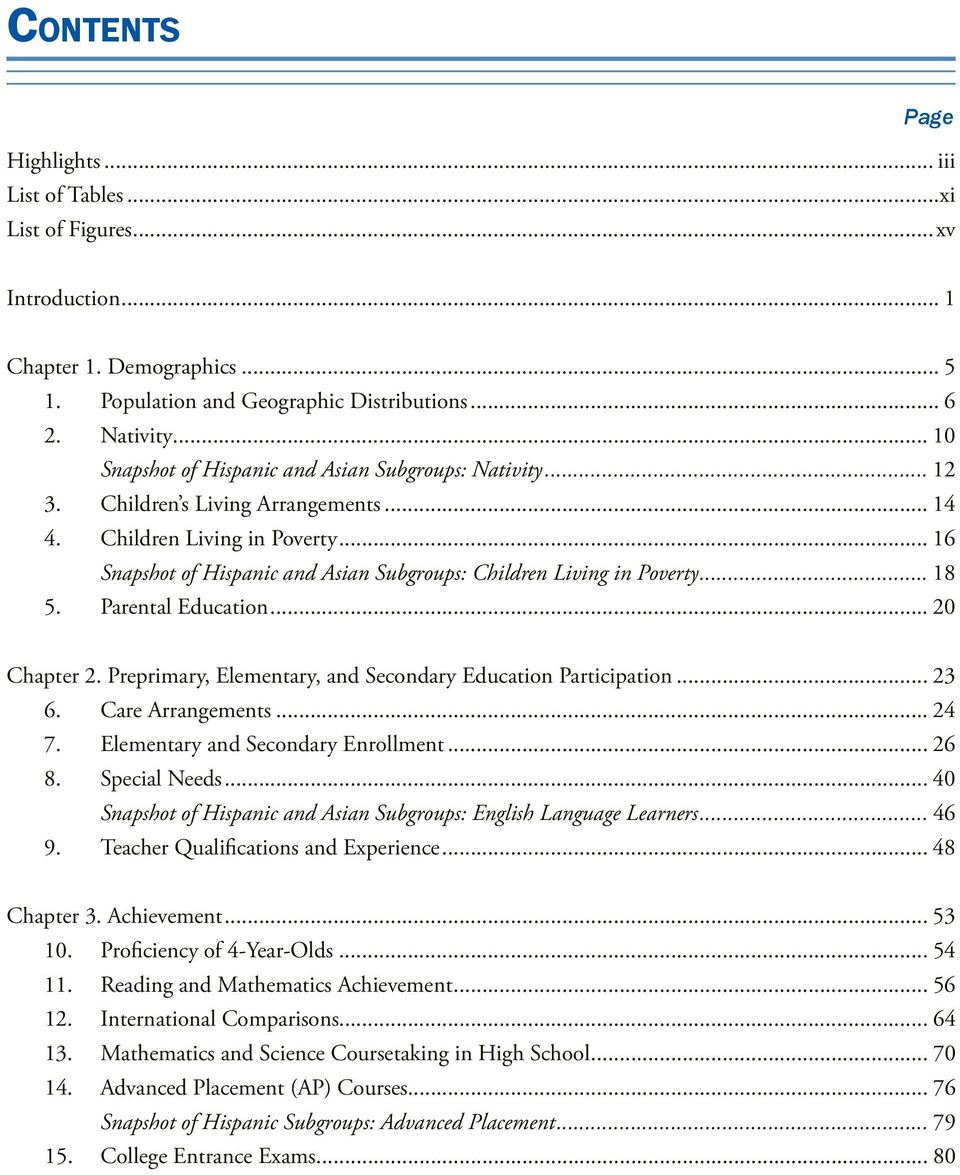
11 Contents Page Highlights... iii List of Tables...xi List of Figures...xv Introduction... 1 Chapter 1. Demographics Population and Geographic Distributions Nativity Snapshot of Hispanic and Asian Subgroups: Nativity Children s Living Arrangements Children Living in Poverty Snapshot of Hispanic and Asian Subgroups: Children Living in Poverty Parental Education Chapter 2. Preprimary, Elementary, and Secondary Education Participation Care Arrangements Elementary and Secondary Enrollment Special Needs Snapshot of Hispanic and Asian Subgroups: English Language Learners Teacher Qualifications and Experience Chapter 3. Achievement Proficiency of 4-Year-Olds Reading and Mathematics Achievement International Comparisons Mathematics and Science Coursetaking in High School Advanced Placement (AP) Courses Snapshot of Hispanic Subgroups: Advanced Placement College Entrance Exams... 80
12 x Status and Trends in the Education of Racial and Ethnic Groups Page Contents Chapter 4. Persistence Absences Retention, Suspension, and Expulsion Dropout Rates and Graduation Rates Snapshot of Hispanic and Asian Subgroups: Dropout Rate by Nativity Snapshot: Dropout Rates for Institutionalized Youth and Young Adults by Race/Ethnicity Chapter 5. Student Behaviors After-School Time Use Cigarette, Alcohol, and Drug Use Teenage Pregnancy Safety at School Chapter 6. Postsecondary Education College Participation Rates Enrollment Snapshot: Enrollment in Historically Black Colleges and Universities, Hispanic Serving Institutions, and Tribal Colleges Financial Aid Degrees Awarded Chapter 7. Outcomes of Education Educational Attainment Snapshot of Hispanic and Asian Subgroups: Educational Attainment Unemployment Rates Median Income References Appendix A: Guide to Sources

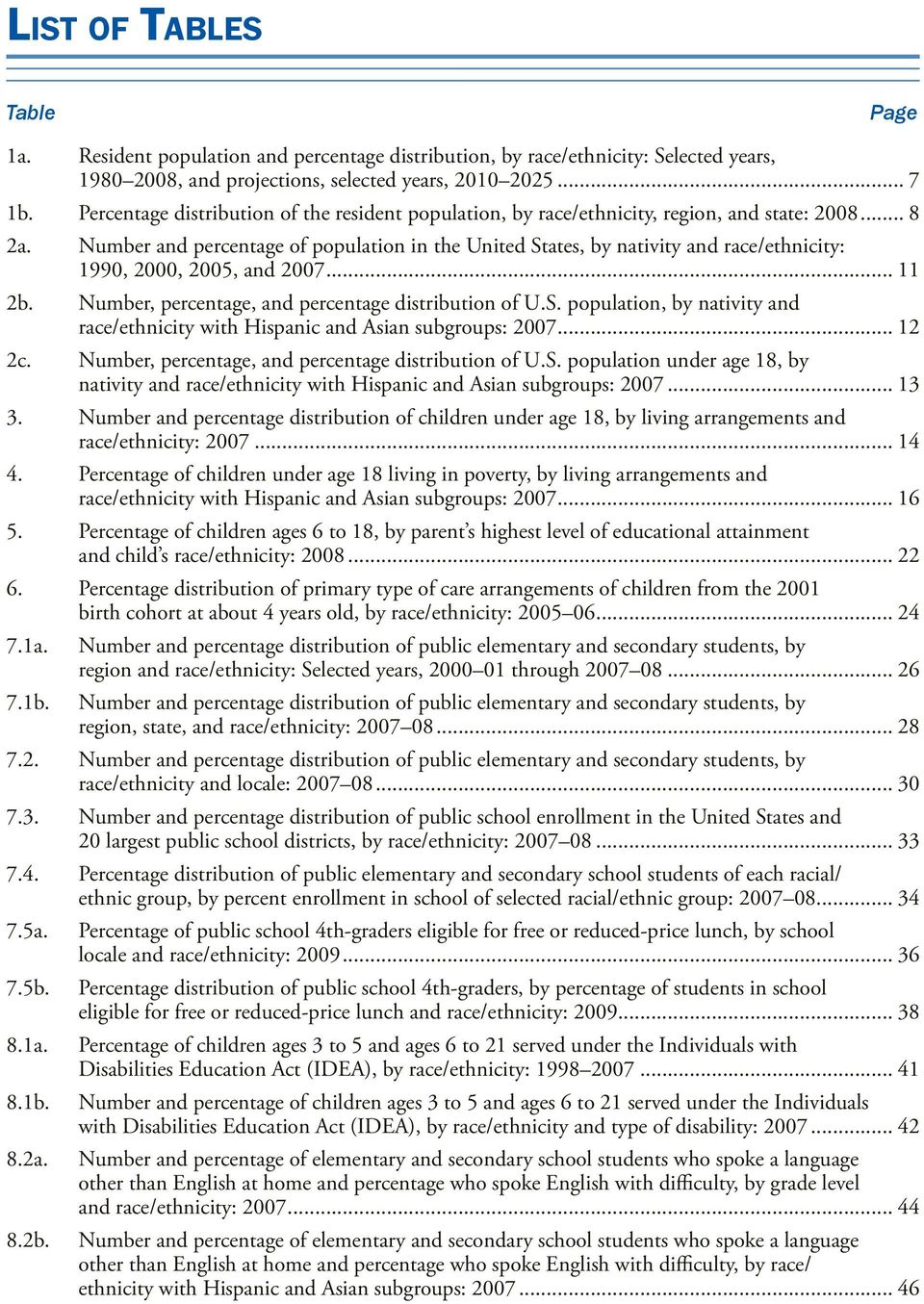
13 List of Tables Table Page 1a. Resident population and percentage distribution, by race/ethnicity: Selected years, , and projections, selected years, b. Percentage distribution of the resident population, by race/ethnicity, region, and state: a. Number and percentage of population in the United States, by nativity and race/ethnicity: 1990, 2000, 2005, and b. Number, percentage, and percentage distribution of U.S. population, by nativity and race/ethnicity with Hispanic and Asian subgroups: c. Number, percentage, and percentage distribution of U.S. population under age 18, by nativity and race/ethnicity with Hispanic and Asian subgroups: Number and percentage distribution of children under age 18, by living arrangements and race/ethnicity: Percentage of children under age 18 living in poverty, by living arrangements and race/ethnicity with Hispanic and Asian subgroups: Percentage of children ages 6 to 18, by parent s highest level of educational attainment and child s race/ethnicity: Percentage distribution of primary type of care arrangements of children from the 2001 birth cohort at about 4 years old, by race/ethnicity: a. Number and percentage distribution of public elementary and secondary students, by region and race/ethnicity: Selected years, through b. Number and percentage distribution of public elementary and secondary students, by region, state, and race/ethnicity: Number and percentage distribution of public elementary and secondary students, by race/ethnicity and locale: Number and percentage distribution of public school enrollment in the United States and 20 largest public school districts, by race/ethnicity: Percentage distribution of public elementary and secondary school students of each racial/ ethnic group, by percent enrollment in school of selected racial/ethnic group: a. Percentage of public school 4th-graders eligible for free or reduced-price lunch, by school locale and race/ethnicity: b. Percentage distribution of public school 4th-graders, by percentage of students in school eligible for free or reduced-price lunch and race/ethnicity: a. Percentage of children ages 3 to 5 and ages 6 to 21 served under the Individuals with Disabilities Education Act (IDEA), by race/ethnicity: b. Number and percentage of children ages 3 to 5 and ages 6 to 21 served under the Individuals with Disabilities Education Act (IDEA), by race/ethnicity and type of disability: a. Number and percentage of elementary and secondary school students who spoke a language other than English at home and percentage who spoke English with difficulty, by grade level and race/ethnicity: b. Number and percentage of elementary and secondary school students who spoke a language other than English at home and percentage who spoke English with difficulty, by race/ ethnicity with Hispanic and Asian subgroups:
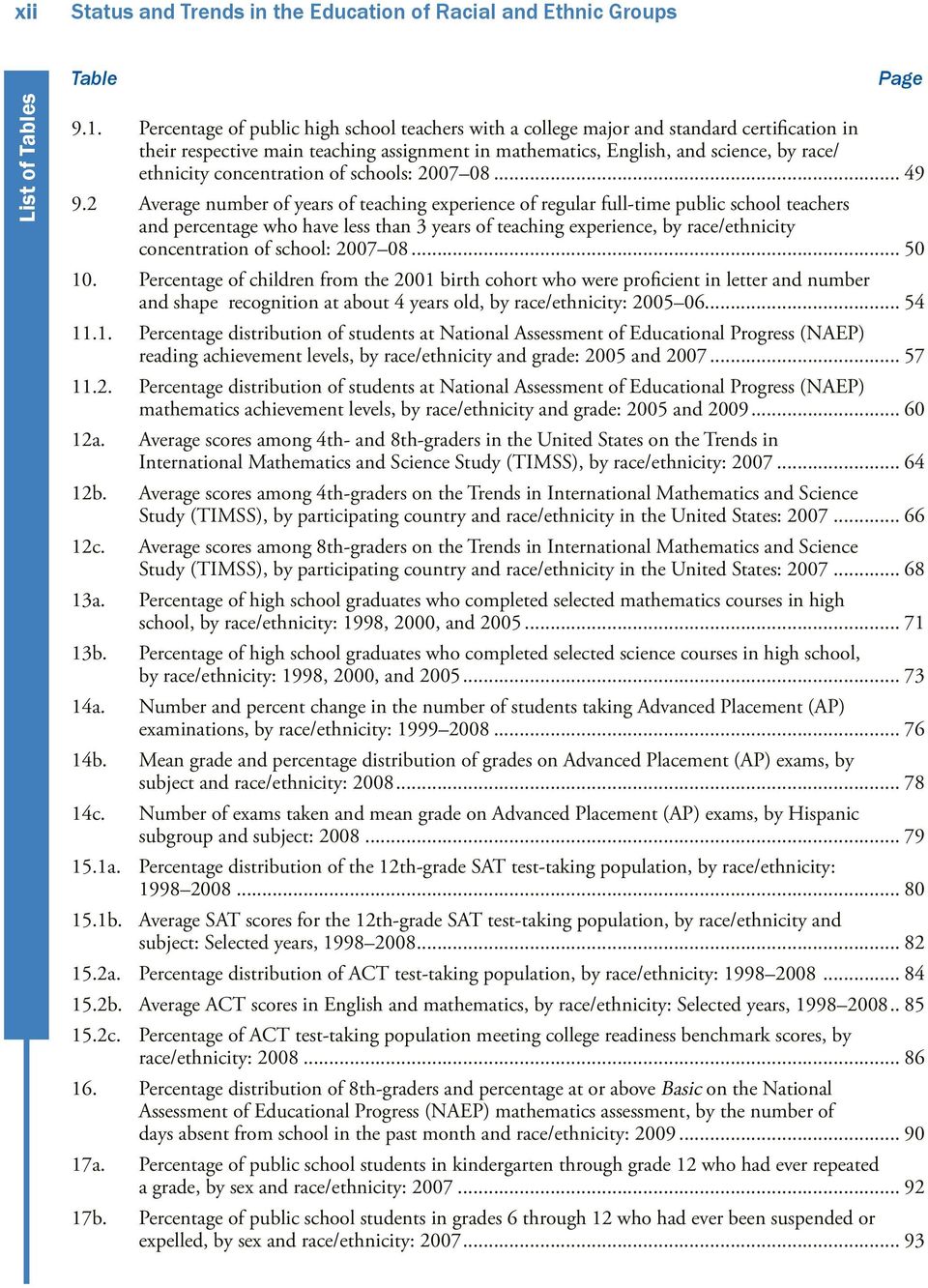
14 xii Status and Trends in the Education of Racial and Ethnic Groups Table Page List of Tables 9.1. Percentage of public high school teachers with a college major and standard certification in their respective main teaching assignment in mathematics, English, and science, by race/ ethnicity concentration of schools: Average number of years of teaching experience of regular full-time public school teachers and percentage who have less than 3 years of teaching experience, by race/ethnicity concentration of school: Percentage of children from the 2001 birth cohort who were proficient in letter and number and shape recognition at about 4 years old, by race/ethnicity: Percentage distribution of students at National Assessment of Educational Progress (NAEP) reading achievement levels, by race/ethnicity and grade: 2005 and Percentage distribution of students at National Assessment of Educational Progress (NAEP) mathematics achievement levels, by race/ethnicity and grade: 2005 and a. Average scores among 4th- and 8th-graders in the United States on the Trends in International Mathematics and Science Study (TIMSS), by race/ethnicity: b. Average scores among 4th-graders on the Trends in International Mathematics and Science Study (TIMSS), by participating country and race/ethnicity in the United States: c. Average scores among 8th-graders on the Trends in International Mathematics and Science Study (TIMSS), by participating country and race/ethnicity in the United States: a. Percentage of high school graduates who completed selected mathematics courses in high school, by race/ethnicity: 1998, 2000, and b. Percentage of high school graduates who completed selected science courses in high school, by race/ethnicity: 1998, 2000, and a. Number and percent change in the number of students taking Advanced Placement (AP) examinations, by race/ethnicity: b. Mean grade and percentage distribution of grades on Advanced Placement (AP) exams, by subject and race/ethnicity: c. Number of exams taken and mean grade on Advanced Placement (AP) exams, by Hispanic subgroup and subject: a. Percentage distribution of the 12th-grade SAT test-taking population, by race/ethnicity: b. Average SAT scores for the 12th-grade SAT test-taking population, by race/ethnicity and subject: Selected years, a. Percentage distribution of ACT test-taking population, by race/ethnicity: b. Average ACT scores in English and mathematics, by race/ethnicity: Selected years, c. Percentage of ACT test-taking population meeting college readiness benchmark scores, by race/ethnicity: Percentage distribution of 8th-graders and percentage at or above Basic on the National Assessment of Educational Progress (NAEP) mathematics assessment, by the number of days absent from school in the past month and race/ethnicity: a. Percentage of public school students in kindergarten through grade 12 who had ever repeated a grade, by sex and race/ethnicity: b. Percentage of public school students in grades 6 through 12 who had ever been suspended or expelled, by sex and race/ethnicity:
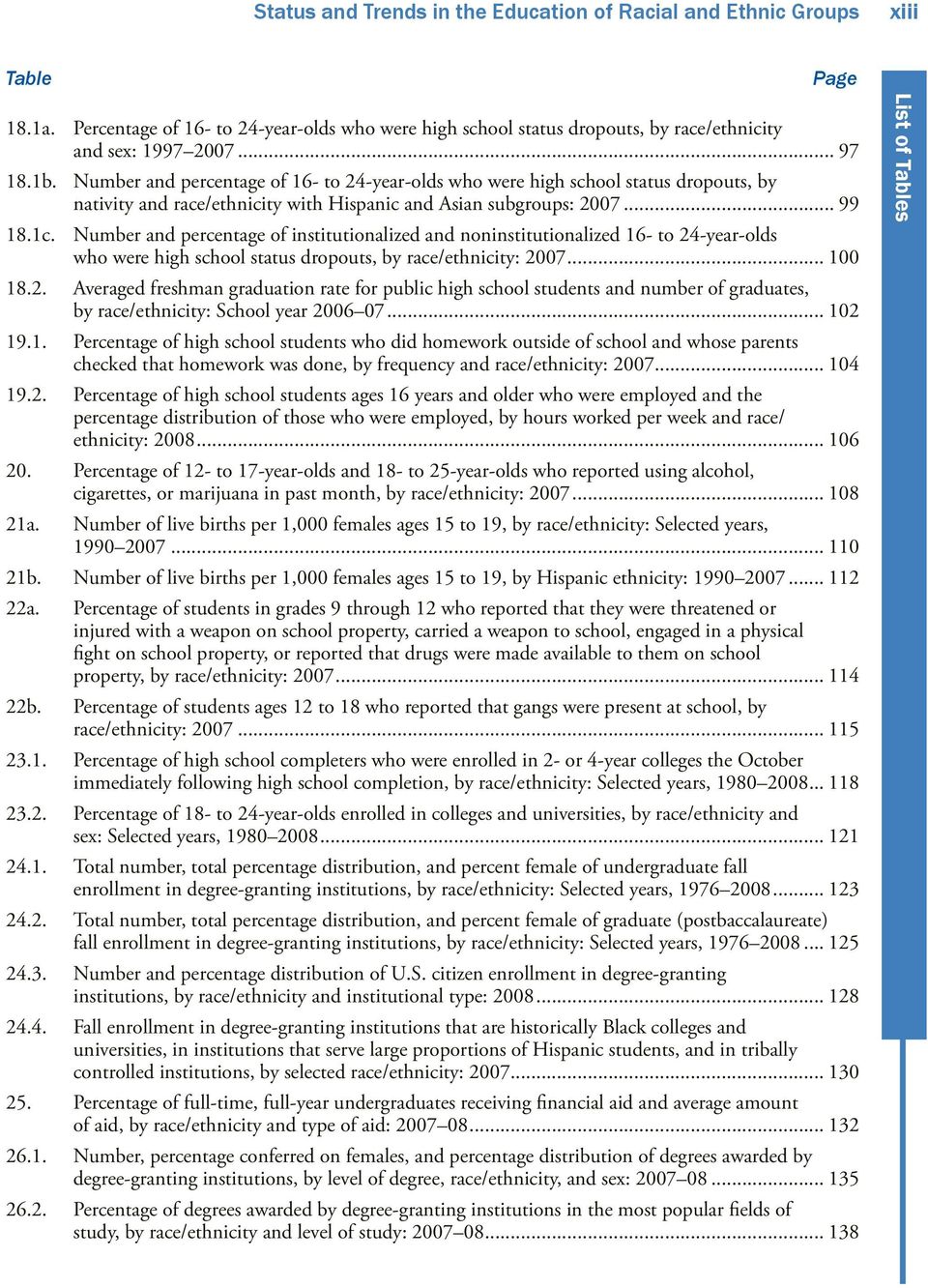
15 Status and Trends in the Education of Racial and Ethnic Groups xiii Table Page 18.1a. Percentage of 16- to 24-year-olds who were high school status dropouts, by race/ethnicity and sex: b. Number and percentage of 16- to 24-year-olds who were high school status dropouts, by nativity and race/ethnicity with Hispanic and Asian subgroups: c. Number and percentage of institutionalized and noninstitutionalized 16- to 24-year-olds who were high school status dropouts, by race/ethnicity: Averaged freshman graduation rate for public high school students and number of graduates, by race/ethnicity: School year Percentage of high school students who did homework outside of school and whose parents checked that homework was done, by frequency and race/ethnicity: Percentage of high school students ages 16 years and older who were employed and the percentage distribution of those who were employed, by hours worked per week and race/ ethnicity: Percentage of 12- to 17-year-olds and 18- to 25-year-olds who reported using alcohol, cigarettes, or marijuana in past month, by race/ethnicity: a. Number of live births per 1,000 females ages 15 to 19, by race/ethnicity: Selected years, b. Number of live births per 1,000 females ages 15 to 19, by Hispanic ethnicity: a. Percentage of students in grades 9 through 12 who reported that they were threatened or injured with a weapon on school property, carried a weapon to school, engaged in a physical fight on school property, or reported that drugs were made available to them on school property, by race/ethnicity: b. Percentage of students ages 12 to 18 who reported that gangs were present at school, by race/ethnicity: Percentage of high school completers who were enrolled in 2- or 4-year colleges the October immediately following high school completion, by race/ethnicity: Selected years, Percentage of 18- to 24-year-olds enrolled in colleges and universities, by race/ethnicity and sex: Selected years, Total number, total percentage distribution, and percent female of undergraduate fall enrollment in degree-granting institutions, by race/ethnicity: Selected years, Total number, total percentage distribution, and percent female of graduate (postbaccalaureate) fall enrollment in degree-granting institutions, by race/ethnicity: Selected years, Number and percentage distribution of U.S. citizen enrollment in degree-granting institutions, by race/ethnicity and institutional type: Fall enrollment in degree-granting institutions that are historically Black colleges and universities, in institutions that serve large proportions of Hispanic students, and in tribally controlled institutions, by selected race/ethnicity: Percentage of full-time, full-year undergraduates receiving financial aid and average amount of aid, by race/ethnicity and type of aid: Number, percentage conferred on females, and percentage distribution of degrees awarded by degree-granting institutions, by level of degree, race/ethnicity, and sex: Percentage of degrees awarded by degree-granting institutions in the most popular fields of study, by race/ethnicity and level of study: List of Tables
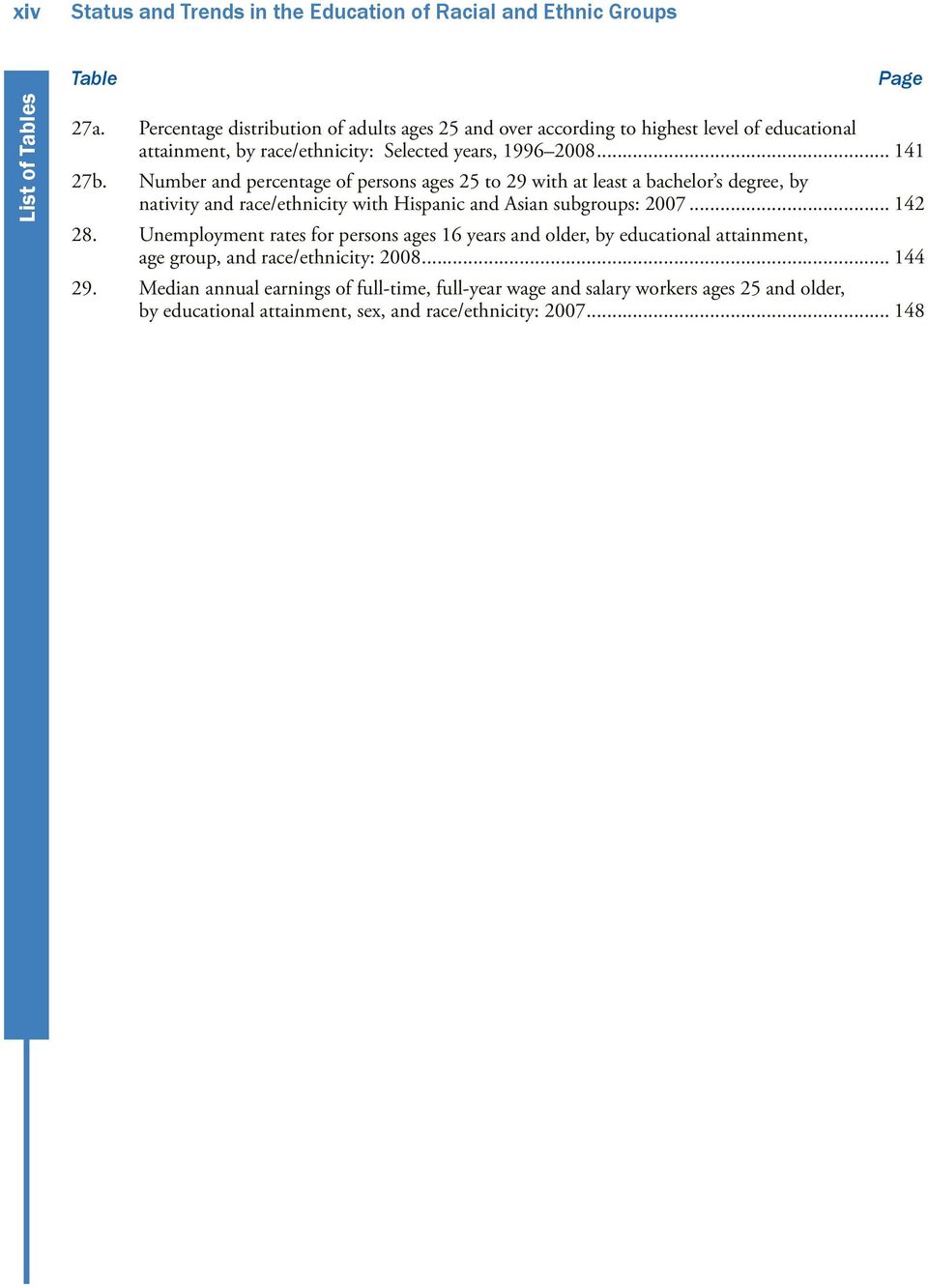
16 xiv Status and Trends in the Education of Racial and Ethnic Groups List of Tables Table Page 27a. Percentage distribution of adults ages 25 and over according to highest level of educational attainment, by race/ethnicity: Selected years, b. Number and percentage of persons ages 25 to 29 with at least a bachelor s degree, by nativity and race/ethnicity with Hispanic and Asian subgroups: Unemployment rates for persons ages 16 years and older, by educational attainment, age group, and race/ethnicity: Median annual earnings of full-time, full-year wage and salary workers ages 25 and older, by educational attainment, sex, and race/ethnicity:
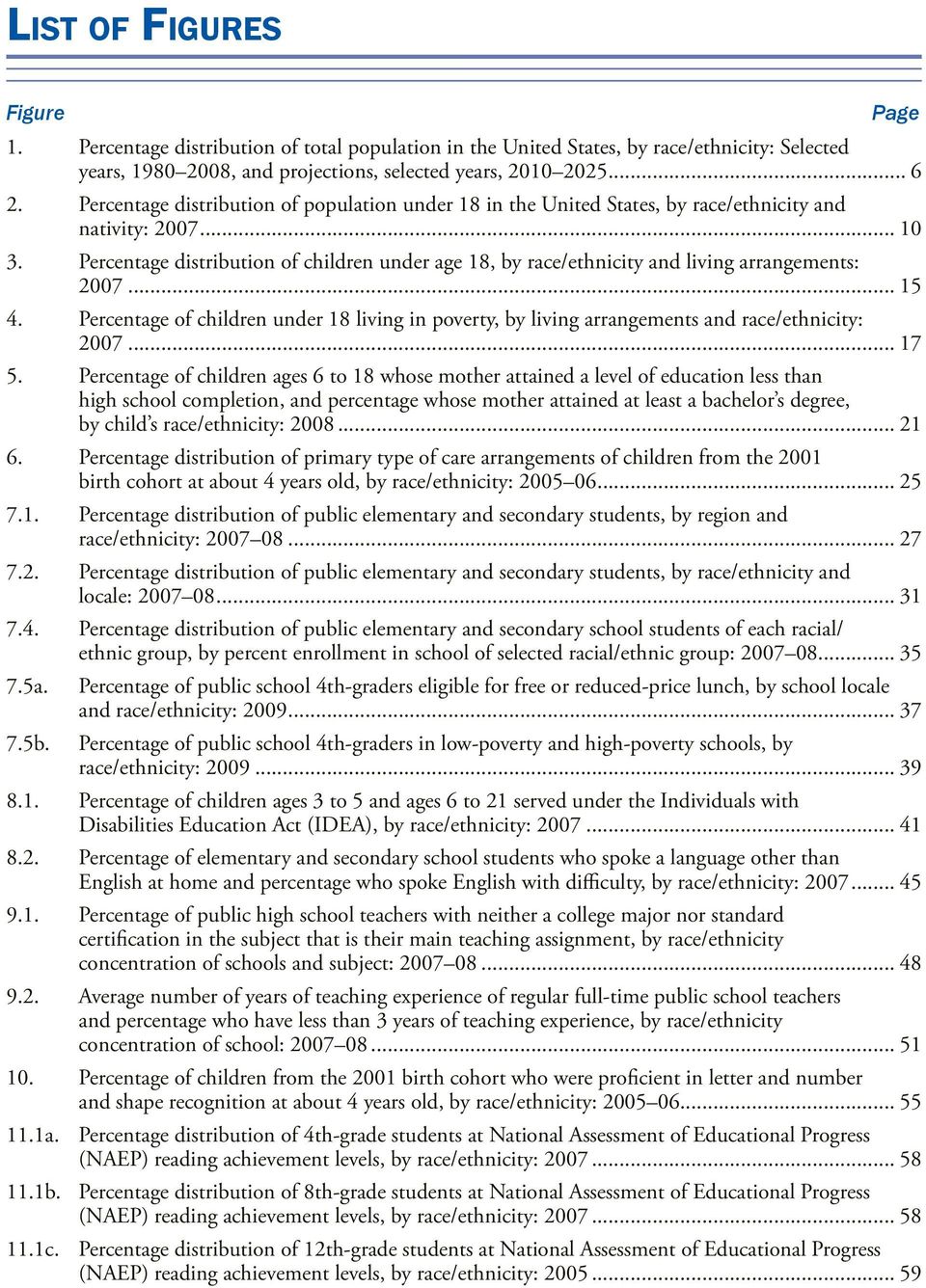
17 List of Figures Figure Page 1. Percentage distribution of total population in the United States, by race/ethnicity: Selected years, , and projections, selected years, Percentage distribution of population under 18 in the United States, by race/ethnicity and nativity: Percentage distribution of children under age 18, by race/ethnicity and living arrangements: Percentage of children under 18 living in poverty, by living arrangements and race/ethnicity: Percentage of children ages 6 to 18 whose mother attained a level of education less than high school completion, and percentage whose mother attained at least a bachelor s degree, by child s race/ethnicity: Percentage distribution of primary type of care arrangements of children from the 2001 birth cohort at about 4 years old, by race/ethnicity: Percentage distribution of public elementary and secondary students, by region and race/ethnicity: Percentage distribution of public elementary and secondary students, by race/ethnicity and locale: Percentage distribution of public elementary and secondary school students of each racial/ ethnic group, by percent enrollment in school of selected racial/ethnic group: a. Percentage of public school 4th-graders eligible for free or reduced-price lunch, by school locale and race/ethnicity: b. Percentage of public school 4th-graders in low-poverty and high-poverty schools, by race/ethnicity: Percentage of children ages 3 to 5 and ages 6 to 21 served under the Individuals with Disabilities Education Act (IDEA), by race/ethnicity: Percentage of elementary and secondary school students who spoke a language other than English at home and percentage who spoke English with difficulty, by race/ethnicity: Percentage of public high school teachers with neither a college major nor standard certification in the subject that is their main teaching assignment, by race/ethnicity concentration of schools and subject: Average number of years of teaching experience of regular full-time public school teachers and percentage who have less than 3 years of teaching experience, by race/ethnicity concentration of school: Percentage of children from the 2001 birth cohort who were proficient in letter and number and shape recognition at about 4 years old, by race/ethnicity: a. Percentage distribution of 4th-grade students at National Assessment of Educational Progress (NAEP) reading achievement levels, by race/ethnicity: b. Percentage distribution of 8th-grade students at National Assessment of Educational Progress (NAEP) reading achievement levels, by race/ethnicity: c. Percentage distribution of 12th-grade students at National Assessment of Educational Progress (NAEP) reading achievement levels, by race/ethnicity:
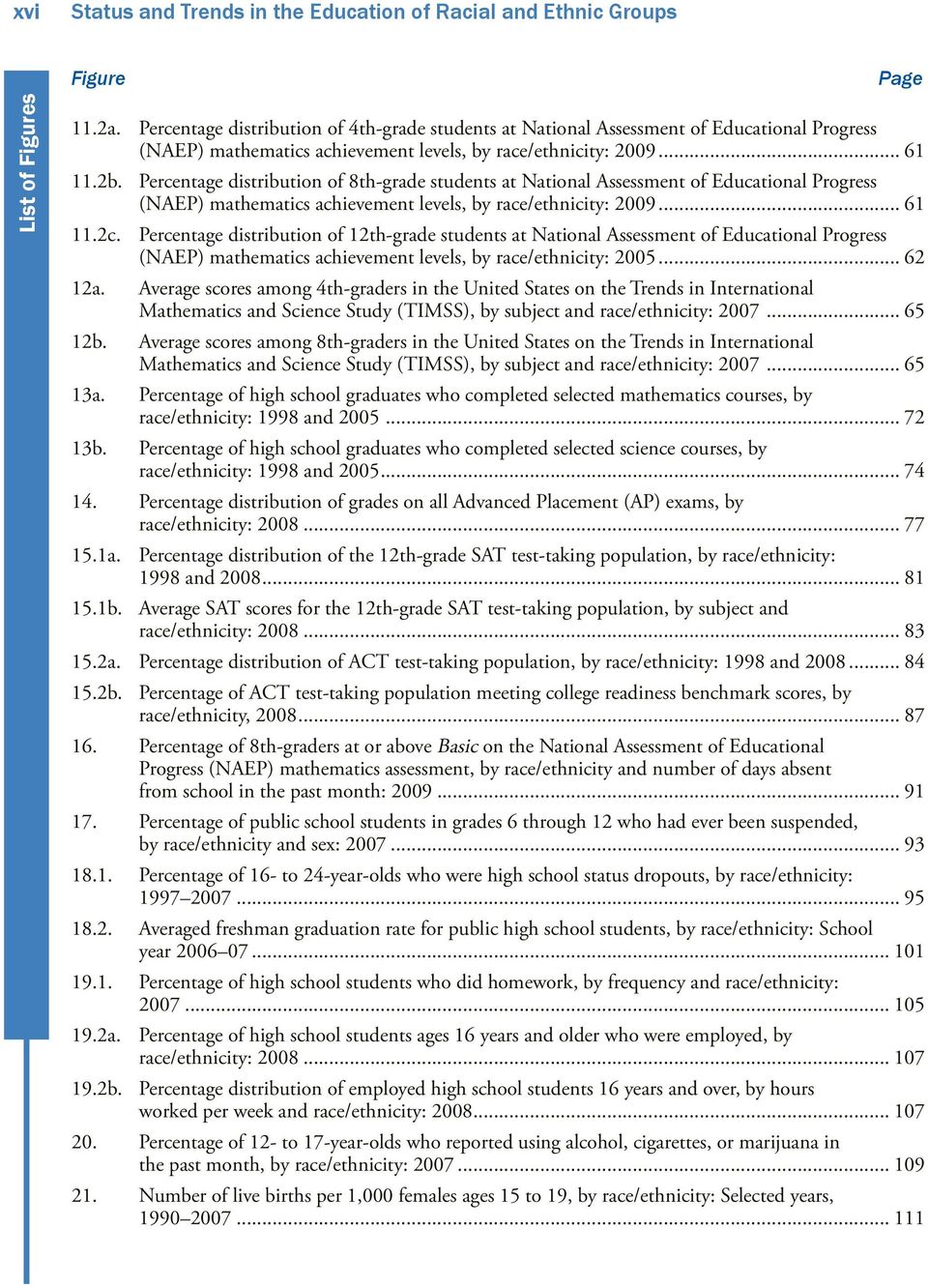
18 xvi Status and Trends in the Education of Racial and Ethnic Groups Figure Page List of Figures 11.2a. Percentage distribution of 4th-grade students at National Assessment of Educational Progress (NAEP) mathematics achievement levels, by race/ethnicity: b. Percentage distribution of 8th-grade students at National Assessment of Educational Progress (NAEP) mathematics achievement levels, by race/ethnicity: c. Percentage distribution of 12th-grade students at National Assessment of Educational Progress (NAEP) mathematics achievement levels, by race/ethnicity: a. Average scores among 4th-graders in the United States on the Trends in International Mathematics and Science Study (TIMSS), by subject and race/ethnicity: b. Average scores among 8th-graders in the United States on the Trends in International Mathematics and Science Study (TIMSS), by subject and race/ethnicity: a. Percentage of high school graduates who completed selected mathematics courses, by race/ethnicity: 1998 and b. Percentage of high school graduates who completed selected science courses, by race/ethnicity: 1998 and Percentage distribution of grades on all Advanced Placement (AP) exams, by race/ethnicity: a. Percentage distribution of the 12th-grade SAT test-taking population, by race/ethnicity: 1998 and b. Average SAT scores for the 12th-grade SAT test-taking population, by subject and race/ethnicity: a. Percentage distribution of ACT test-taking population, by race/ethnicity: 1998 and b. Percentage of ACT test-taking population meeting college readiness benchmark scores, by race/ethnicity, Percentage of 8th-graders at or above Basic on the National Assessment of Educational Progress (NAEP) mathematics assessment, by race/ethnicity and number of days absent from school in the past month: Percentage of public school students in grades 6 through 12 who had ever been suspended, by race/ethnicity and sex: Percentage of 16- to 24-year-olds who were high school status dropouts, by race/ethnicity: Averaged freshman graduation rate for public high school students, by race/ethnicity: School year Percentage of high school students who did homework, by frequency and race/ethnicity: a. Percentage of high school students ages 16 years and older who were employed, by race/ethnicity: b. Percentage distribution of employed high school students 16 years and over, by hours worked per week and race/ethnicity: Percentage of 12- to 17-year-olds who reported using alcohol, cigarettes, or marijuana in the past month, by race/ethnicity: Number of live births per 1,000 females ages 15 to 19, by race/ethnicity: Selected years,
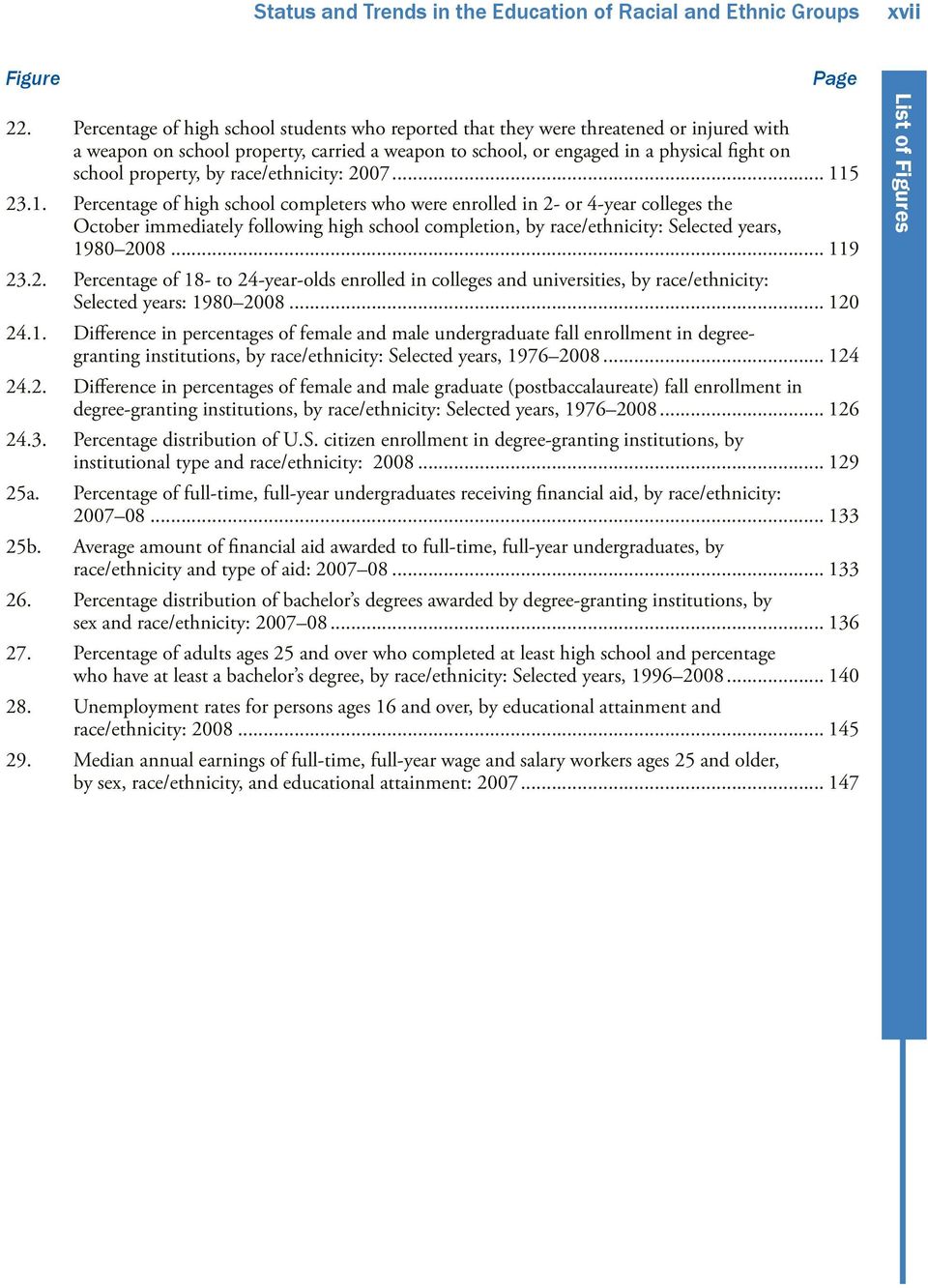
19 Status and Trends in the Education of Racial and Ethnic Groups xvii Figure Page 22. Percentage of high school students who reported that they were threatened or injured with a weapon on school property, carried a weapon to school, or engaged in a physical fight on school property, by race/ethnicity: Percentage of high school completers who were enrolled in 2- or 4-year colleges the October immediately following high school completion, by race/ethnicity: Selected years, Percentage of 18- to 24-year-olds enrolled in colleges and universities, by race/ethnicity: Selected years: Difference in percentages of female and male undergraduate fall enrollment in degreegranting institutions, by race/ethnicity: Selected years, Difference in percentages of female and male graduate (postbaccalaureate) fall enrollment in degree-granting institutions, by race/ethnicity: Selected years, Percentage distribution of U.S. citizen enrollment in degree-granting institutions, by institutional type and race/ethnicity: a. Percentage of full-time, full-year undergraduates receiving financial aid, by race/ethnicity: b. Average amount of financial aid awarded to full-time, full-year undergraduates, by race/ethnicity and type of aid: Percentage distribution of bachelor s degrees awarded by degree-granting institutions, by sex and race/ethnicity: Percentage of adults ages 25 and over who completed at least high school and percentage who have at least a bachelor s degree, by race/ethnicity: Selected years, Unemployment rates for persons ages 16 and over, by educational attainment and race/ethnicity: Median annual earnings of full-time, full-year wage and salary workers ages 25 and older, by sex, race/ethnicity, and educational attainment: List of Figures
20 This page intentionally left blank.

21 Introduction This report uses statistics to examine, by racial/ethnic group, current conditions and changes over time in education activities and outcomes in the United States. Some traditionally disadvantaged racial/ethnic groups have made strides in educational achievement over the past few decades, but gaps persist. Status and Trends in the Education of Racial and Ethnic Groups is part of a series of reports produced by the National Center for Education Statistics (NCES) that focus on specific racial/ethnic groups, including Status and Trends in the Education of American Indians and Alaska Natives: 2008 (DeVoe and Darling-Churchill 2008), Status and Trends in the Education of Racial and Ethnic Minorities (KewalRamani et al. 2007), Status and Trends in the Education of Blacks (Hoffman and Llagas 2003), and Status and Trends in the Education of Hispanics (Llagas 2003). Organization of the Report The report begins with demographic information (chapter 1) and then is organized roughly according to the chronology of an individual s education, starting with indicators on preprimary, elementary, and secondary education participation (chapter 2) and continuing with student achievement (chapter 3) and persistence in education (chapter 4), behaviors that can affect educational experience (chapter 5), participation in postsecondary education (chapter 6), and outcomes of education (chapter 7). A list of references and a guide to sources appear at the end of the report. Standard error tables are available on the NCES website: pubsinfo.asp?pubid= The indicators presented in this report are intended to provide an overview of the education data available from many federal surveys. Readers are cautioned not to draw causal inferences based on the univariate and bivariate results presented in this report. It is important to note that many of the variables examined in this report may be related to one another, and complex interactions and relationships among the variables have not been explored. The variables presented here are also just a sample of the thousands that can be examined using the surveys included in this report. The indicators were selected to provide a range of data that are relevant to a variety of policy issues, rather than emphasize comprehensive information on any particular issue. Definitions of Race and Ethnicity The Office of Management and Budget (OMB) is responsible for the standards that govern the categories used to collect and present federal data on race and ethnicity. The OMB revised the guidelines on racial/ethnic categories used by the federal government in October 1997, with a January 2003 deadline for implementation (Office of Management and Budget 1997). The revised standards require a minimum of these five categories for data on race: American Indian or Alaska Native, Asian, Black or African American, Native Hawaiian or Other Pacific Islander, and White. The standards also require the collection of data on the ethnicity categories Hispanic or Latino and Not Hispanic or Latino. It is important to note that Hispanic origin is an ethnicity rather than a race, and therefore persons of Hispanic origin may be of any race. Origin can be viewed as the heritage, nationality group, lineage, or country of birth of the person or the person s parents or ancestors before their arrival in the United States. The races White, Black, Asian, Native Hawaiian or Other Pacific Islander, and American Indian/Alaska Native, as presented in this report, exclude persons of Hispanic origin unless noted otherwise.
22 2 Status and Trends in the Education of Racial and Ethnic Groups Definitions of Race and Ethnicity These racial/ethnic categories are defined as follows: American Indian or Alaska Native: A person having origins in any of the original peoples of North and South America (including Central America) and who maintains tribal affiliation or community attachment. Asian: A person having origins in any of the original peoples of the Far East, Southeast Asia, or the Indian subcontinent, including, for example, Cambodia, China, India, Japan, Korea, Malaysia, Pakistan, the Philippine Islands, Thailand, and Vietnam. Black or African American: A person having origins in any of the black racial groups of Africa. Native Hawaiian or Other Pacific Islander: A person having origins in any of the original peoples of Hawaii, Guam, Samoa, or other Pacific Islands. White: A person having origins in any of the original peoples of Europe, the Middle East, or North Africa. Hispanic or Latino: A person of Mexican, Puerto Rican, Cuban, South or Central American, or other Spanish culture or origin, regardless of race. Within this report, some of the category names have been shortened. American Indian or Alaska Native is denoted as American Indian/Alaska Native; Black or African American is shortened to Black; and Hispanic or Latino is shortened to Hispanic. When discussed separately, Native Hawaiian or Other Pacific Islander is not shortened in the text, but is shortened in tables and figures to Native Hawaiian/Pacific Islander. The indicators in this report are drawn from a number of different sources. Many are federal surveys that collect data using the OMB standards for racial/ ethnic classification described above; however, some sources have not fully adopted the standards and some indicators include data collected prior to the adoption of the OMB standards. This report focuses on the six categories that are the most common among the various data sources used: White, Black, Hispanic, Asian, Native Hawaiian or Other Pacific Islander, and American Indian/Alaska Native. Asians and Native Hawaiians or Other Pacific Islanders are combined into one category in indicators for which the data were not collected separately for the two groups. Some of the surveys from which data are presented in this report give respondents the option of selecting either an other race category, or two or more races (in some cases a multiracial category is the option), or both. Therefore, the remaining categories presented consist entirely of persons who identify as belonging to only one race or ethnicity. Where possible, indicators present data on the two or more races category; however, in some cases this category may not be separately shown, due to various data issues. The other category is not separately shown. Any comparisons made between persons of one racial/ethnic group to all other racial/ethnic groups include only the racial/ ethnic groups shown in the indicator. In some surveys, respondents are not given the option to select more than one race. In these surveys, respondents of two or more races must select a single race category. Any comparisons between data from surveys that give the option to select more than one race and surveys that do not offer such an option should take into account the fact that there is a potential for bias if members of one racial group are more likely than members of the others to identify themselves as two or more races. 2 For postsecondary data, foreign students are counted separately and therefore are not included in any racial/ethnic category. Please see Appendix A: Guide to Sources at the end of this report for specific information on each of the report s data sources. The American Community Survey, conducted by the U.S. Census Bureau, collects information regarding specific ancestry. Snapshots throughout this report highlight Hispanic ancestry subgroups (such as Mexican, Puerto Rican, or Cuban) and Asian ancestry subgroups (such as Asian Indian, Chinese, or Filipino). Indicator 2 (Nativity), Indicator 4 (Children Living in Poverty), Indicator 8.2 (English Language Learner Students), Indicator 18 (Dropout Rates and Graduation Rates), and Indicator 27 (Educational Attainment) each provide a Snapshot table that includes detailed Hispanic and Asian ancestries and a brief comparison among the subgroups and race/ethnicity categories. For more information on these subgroup definitions, see Appendix A: Guide to Sources. 2 Such bias was found by a National Center for Health Statistics study that examined race/ethnicity responses to the 2000 Census. This study found, for example, that as the percentage of multiple-race respondents in a county increased, the likelihood of respondents stating Black as their primary race increased among Black/White respondents but decreased among American Indian or Alaska Native/Black respondents. See Parker, J., et al., (2004). Bridging between two standards for collecting information on race and ethnicity: an application to Census 2000 and vital rates. Public Health Reports 119(2): Available through
23 Status and Trends in the Education of Racial and Ethnic Groups 3 Technical Note This report includes data from both universe and sample surveys. In the case of universe data, all relevant units are included in the data collection. As a result, there is no sampling error, and observed differences are reported as true. In the case of sample surveys, a nationally representative sample of respondents is selected and asked to participate in the data collection. Since the sample represents just one of many possible samples that could be selected, there is error associated with the sample. To avoid reaching false conclusions about differences between groups or differences over time measured by sample survey data, sampling error is taken into account in statistical tests that are conducted to support statements about differences. Thus, all statements about differences in this report are supported by the data, either directly in the case of universe surveys or with statistical significance testing in the case of sample survey data. In addition, there are occasional references to apparent differences that are not significant. All significance tests of differences in sample survey data are tested at the.05 level of significance. Several test procedures were used, depending on the type of data interpreted and the nature of the statement tested. The most commonly used test procedures were t tests, linear trend tests, and equivalency tests. The t tests were not adjusted to compensate for multiple comparisons being made simultaneously. Trend tests were conducted by evaluating the significance of the slope of a simple regression of the annual data points and by conducting a t test to compare the end points. Equivalence tests at the 0.15 level were used to determine whether two statistics were substantively equivalent; this was accomplished by using a hypothesis test to determine whether the confidence interval of the difference between sample estimates was significantly greater or less than a preset substantively important difference. In most cases involving percentages, a difference of 3.0 percentage points was used to determine substantive equivalence or difference. In some indicators involving only very small percentages, a lower value was used. The appearance of a! symbol (meaning Interpret data with caution ) in a table or figure indicates a data cell with a high ratio of standard error to estimate (0.30 or greater); therefore, the estimate may be unstable and the reader should use caution when interpreting the data. These unstable estimates are discussed, however, when statistically significant differences are found despite large standard errors. Although percentages reported in the tables are generally rounded to one decimal place (e.g., 76.5 percent), percentages reported in the text and figures are generally rounded from the original number to whole numbers (with any value of 0.50 or above rounded to the next highest whole number). While the data labels on the figures have been rounded to whole numbers, the graphical presentation of these data are based on the unrounded estimates shown in the corresponding table. Due to rounding, cumulative percentages may sometimes equal 99 or 101 percent, rather than 100 percent. In addition, sometimes a whole number in the text may seem rounded incorrectly based on its value when rounded to one decimal place. For example, the percentage rounds to 14.5 at one decimal place, but rounds to 14 when reported as a whole number. Introduction
24 This page intentionally left blank.
25 1 Demographics The first chapter in this report presents demographic information that provides context for the education indicators presented in later chapters. In order to describe the status of the various racial/ethnic groups in this country s education system, it is important to provide contextual information on the relative size of each group, where the members of those groups come from, and where and how they live. For this reason, indicators 1 and 2 describe the size and distribution of the U.S. population in terms of race/ethnicity, geographic distribution, and nativity. Between 1999 and 2000, Hispanics surpassed Blacks as the country s largest racial/ethnic group other than Whites, and the population of Hispanics continued to grow at a faster rate than the overall population through 2008 (indicator 1). In 2008, Hispanics represented 15 percent of the total U.S. population. In the Western United States, in 2008, the percentages of the population who were Hispanic, Asian, Native Hawaiian or Other Pacific Islander, American Indian/ Alaska Native, and persons of two or more races were higher than the national percentages. New Mexico, California, and Texas had the highest percentages of the population who were Hispanic (ranging from 36 to 45 percent). In 2007, about 14 percent of the U.S. population was born outside of the United States (indicator 2). Approximately 69 percent of Asians and 44 percent of Hispanics were born outside of the United States. Of the population under 18 years old, 5 percent were born outside of the United States, including 24 percent of Asians, 21 percent of Native Hawaiians or Other Pacific Islanders, and 11 percent of Hispanics. Indicators 3 and 4 examine the living arrangements and poverty status of children under the age of 18. In 2007, across all racial/ethnic groups except Blacks and American Indians/Alaska Natives, the majority of children under 18 were living with married parents (indicator 3). About 34 percent of Black children under 18 lived with married parents and 56 percent of Black children lived with a female parent with no spouse present. About 18 percent of children under 18 were living in poverty (indicator 4). The overall percentages of children who were living in poverty were higher for Blacks (34 percent), American Indians/Alaska Natives (33 percent), Hispanics (27 percent), and Native Hawaiians or Other Pacific Islanders (26 percent), than for children of two or more races (18 percent), Asians (11 percent), and Whites (10 percent). The last indicator in Chapter 1 focuses on the educational attainment of parents. In 2008, a higher percentage of Asian children had a mother with at least a bachelor s degree than did White, Black, Hispanic, and American Indian/Alaska Native children (indicator 5). In addition, a higher percentage of Asian children had mothers with at least a bachelor s degree than Native Hawaiian or Other Pacific Islander children and children of two or more races. This pattern was also true for the percentages of children with a father who had at least a bachelor s degree.
26 6 Status and Trends in the Education of Racial and Ethnic Groups Indicator 1 Population and Geographic Distributions 1. Population and Geographic Distributions The U.S. population has become more diverse over the past two decades as the populations of Hispanics and Asians have increased more rapidly than the populations of Whites and Blacks. In particular, between 1999 and 2000, Hispanics surpassed Blacks as the largest racial/ethnic group other than Whites (U.S. Department of Commerce 2001a). 3 The populations of Hispanics, Asians, Native Hawaiians or Other Pacific Islanders, and those of two or more races are expected to grow faster than the populations of Whites, Blacks, and American Indians/Alaska Natives between 2008 and Between 1980 and 2008, there were shifts in the racial/ethnic composition of the resident population of the United States. In 1980, the White population represented about 80 percent of the total population. Figure 1. Percent This percentage decreased to 69 percent in 2000 and to 66 percent in In contrast, the Hispanic population s share of the total population increased from 6.4 percent in 1980 to 12.6 percent in 2000 to 15.4 percent in In addition, Asians/Pacific Islanders represented less than 2 percent of the population in 1980 and by 2008, their share had increased to 4.5 percent (Asians represented 4.4 percent and Native Hawaiian or Other Pacific Islanders represented 0.1 percent of the population). The percentage of the total population who were Black increased from 11.5 to 12.2 percent between 1980 and Since 2000, the growth rate for the Black population has been similar to the growth rate of the overall population; thus, the Black population continued to represent 12.2 percent of the total population through Percentage distribution of total population in the United States, by race/ethnicity: Selected years, , and projections, selected years, Projected Year White Black Hispanic Asian Other NOTE: Other includes the following race categories: Native Hawaiian or Other Pacific Islander, American Indian/Alaska Native, and Two or more races. Numbers for the year 2000 are from the Decennial Census. All other years are population estimates. Prior to 2000, Asian includes Native Hawaiian or Other Pacific Islander. The category Two or more races was not an option prior to Race categories exclude persons of Hispanic ethnicity. SOURCE: U.S. Department of Commerce, Census Bureau, Statistical Abstract of the United States: 2000 and 2004, Population Estimates Program, ; Table 4: Estimates of the Population by Race and Hispanic Origin for the United States and States: July 1, 2008 (SC-EST ), released May 14, 2009, retrieved May 15, 2009, from and Projected Population by Single Year of Age, Sex, Race, and Hispanic Origin for the United States: July 1, 2000 to July 1, 2050 (NP2008-T4), released August 14, In 1999, Blacks represented 12.1 percent of the population and Hispanics represented 11.5 percent (U.S. Department of Commerce 2001b). In Census 2000 (table 1a) Blacks represented 12.2 percent of the population and Hispanics represented 12.6 percent.
27 Status and Trends in the Education of Racial and Ethnic Groups 7 Between 2008 and 2025, these patterns of population change are expected to continue. For example, the Hispanic population is expected to grow at a faster rate than most other races/ethnicities. In 2025, about 21 percent of the population is expected to be of Hispanic ethnicity. In addition, the growth rate for Whites is expected to be slower than the rate for Table 1a. other races/ethnicities, decreasing their share of the total population. In 2025, the distribution of the population is expected to be 58 percent White, 21 percent Hispanic, 12 percent Black, 6 percent Asian, 2 percent two or more races, 1 percent American Indian/Alaska Native, and less than 1 percent Native Hawaiian or Other Pacific Islander. Resident population and percentage distribution, by race/ethnicity: Selected years, , and projections, selected years, Year Total White Black Hispanic Asian Native Hawaiian/ Pacific Islander American Indian/ Alaska Native Two or more races Number (in thousands) , ,906 26,142 14,609 3,563 ( 1 ) 1, , ,945 27,738 18,368 5,315 ( 1 ) 1, , ,315 29,304 22,379 6,996 ( 1 ) 1, , ,328 31,590 27,107 8,846 ( 1 ) 1, , ,771 34,414 35,629 10, ,104 3, , ,325 34,793 36,958 10, ,131 3, , ,773 35,147 38,264 11, ,158 3, , ,152 35,457 39,579 11, ,184 3, , ,727 35,811 40,956 11, ,213 3, , ,244 36,145 42,354 12, ,241 4, , ,781 36,499 43,777 12, ,271 4, , ,272 36,849 45,219 12, ,300 4, , ,491 37,172 46,944 13, ,329 4, , ,853 37,985 49,726 14, ,392 4, , ,208 39,916 57,711 16, ,548 5, , ,255 41,847 66,365 18, ,697 6, , ,662 43,703 75,772 20, ,830 7,309 Percentage distribution ( 1 ) ( 1 ) ( 1 ) ( 1 ) Not available. 1 Prior to 2000, estimates for Native Hawaiian or Other Pacific Islander are included in the estimates for Asian. 2 Projected. NOTE: Numbers for the year 2000 are from the Decennial Census. All other years are population estimates. The category Two or more races was not an option prior to Race categories exclude persons of Hispanic ethnicity. Detail may not sum to totals because of rounding. SOURCE: U.S. Department of Commerce, Census Bureau, Statistical Abstract of the United States: 2000 and 2004, Population Estimates Program, ; Table 4: Estimates of the Population by Race and Hispanic Origin for the United States and States: July 1, 2008 (SC-EST ), released May 14, 2009, retrieved May 15, 2009, from and Projected Population by Single Year of Age, Sex, Race, and Hispanic Origin for the United States: July 1, 2000 to July 1, 2050 (NP2008-T4), released August 14, Chapter 1 Demographics
28 8 Status and Trends in the Education of Racial and Ethnic Groups Indicator 1 Population and Geographic Distributions Racial/ethnic composition varies regionally and from state to state. In 2008, the West had higher percentages of its population who were Hispanic, Asian, Native Hawaiian or Other Pacific Islander, American Indian/Alaska Native, and of two or more races when compared with the national proportions. In the West, the population was 28 percent Hispanic, 9 percent Asian, 0.5 percent Native Hawaiian or Other Pacific Islander, 2 percent American Indian/ Alaska Native, and 2 percent persons of two or more races. In contrast, the Midwest had lower percentages of these racial/ethnic groups when compared with the national percentages. In the Midwest, the population was 6 percent Hispanic, 2 percent Asian, 1 percent each American Indian/Alaska Native and persons of two or more races, and less than 0.05 percent Native Hawaiian or Other Pacific Islander. Among the 50 states and the District of Columbia, Hawaii had the highest percentage of its population who were Asian (38 percent), Native Hawaiian or Other Pacific Islander (9 percent), and of two or more races (16 percent). New Mexico had the highest percentage of its population who were Hispanic (45 percent). Other states with large percentages of their population who were Hispanic included California (37 percent) and Texas (36 percent). The District of Columbia had the highest percentage of its population who were Black (53 percent) when compared with the 50 states. In contrast to other states, several states had smaller percentages of its population who were Black, Hispanic, Asian, Native Hawaiian or Other Pacific Islander, American Indian/Alaska Native, and of two or more races. In such states as Maine, Vermont, West Virginia, New Hampshire, and Iowa, those racial/ ethnic groups combined represented less than 10 percent of the population. Table 1b. Percentage distribution of the resident population, by race/ethnicity, region, and state: 2008 Region and state White Black Hispanic Asian Native Hawaiian/ Pacific Islander American Indian/ Alaska Native Two or more races United States Northeast # Connecticut # Maine # Massachusetts # New Hampshire # New Jersey # New York # Pennsylvania # Rhode Island Vermont # Midwest # Illinois # Indiana # Iowa # Kansas Michigan # Minnesota # Missouri Nebraska North Dakota # Ohio # South Dakota # Wisconsin # See notes at end of table.
29 Status and Trends in the Education of Racial and Ethnic Groups 9 Table 1b. Percentage distribution of the resident population, by race/ethnicity, region, and state: 2008 Continued Region and state White Black Hispanic Asian Native Hawaiian/ Pacific Islander American Indian/ Alaska Native Two or more races United States South Alabama # Arkansas Delaware # District of Columbia Florida Georgia Kentucky # Louisiana # Maryland Mississippi # North Carolina Oklahoma South Carolina # Tennessee # Texas Virginia West Virginia # Chapter 1 Demographics West Alaska Arizona California Colorado Hawaii Idaho Montana Nevada New Mexico Oregon Utah Washington Wyoming # Rounds to zero. NOTE: Race categories exclude persons of Hispanic ethnicity. Detail may not sum to totals because of rounding. SOURCE: U.S. Department of Commerce, Census Bureau, Table 4: Estimates of the Population by Race and Hispanic Origin for the United States and States: July 1, 2008 (SC-EST ), released May 14, 2009, retrieved May 15, 2009, from SC-EST html.
30 10 Status and Trends in the Education of Racial and Ethnic Groups Indicator 2 Nativity 2. Nativity The total foreign-born population in the United States increased between 1990 and 2007, making up 8 percent of the U.S. population in 1990 and 14 percent in The percentage of foreign-born children, however, has remained steady since 2000 at 5 percent of the U.S. population. Research suggests that foreign-born children and children of foreignborn parents, who tend to be of lower socioeconomic status than their U.S.-born peers, may not perform as well as their U.S.-born peers on measures of academic achievement (Glick 2004), and tend to have higher dropout rates (U.S. Department of Education 2009, indicator 20). In the United States in 2007, about 5 percent of the 73.9 million children under age 18 were born outside of the United States and its territories. Some 24 percent of Asian children were foreign born, a higher percentage than any other race/ethnicity except Native Hawaiian or Other Pacific Islander. The percentages of Native Hawaiian or Other Pacific Islander (21 percent) and Hispanic (11 percent) children who were foreign born were also higher than those for children of two or more races (3 percent), Black children (3 percent), White children (2 percent), and American Indian/Alaska Native children (0.4 percent). Between 2000 and 2007, the percentage of children under age 18 who were foreign born increased by 7 percentage points for Native Hawaiians or Other Pacific Islanders and decreased for Hispanics and Asians by 3 and 2 percentage points, respectively. In 2007, some 14 percent of the total population was foreign born. The percentage of the total foreign-born population was higher than the percentage of foreignborn children for all racial/ethnic groups. Among the racial/ethnic groups, 69 percent of Asians, 44 percent of Hispanics, 40 percent of Native Hawaiians or Other Pacific Islanders, 8 percent of Blacks, 7 percent of those of two or more races, 5 percent of Whites, and 2 percent of American Indians/Alaska Natives were foreign born. Between 2000 and 2007, the percentage of Blacks and Native Hawaiians or other Pacific Islanders who were foreign born increased. However, during the same period, there was a decline in the percentage of foreign-born persons of two or more races. Figure 2. Percentage distribution of population under 18 in the United States, by race/ethnicity and nativity: 2007 Percent # Total 1 White Black Hispanic Asian Race/ethnicity Native American Hawaiian/ Indian/Alaska Pacific Islander Native Two or more races Native Foreign-born # Rounds to zero. 1 Total includes other race/ethnicity categories not separately shown. NOTE: Race categories exclude persons of Hispanic ethnicity. Detail may not sum to totals because of rounding. SOURCE: U.S. Department of Commerce, Census Bureau, American Community Survey, 2007.
31 Status and Trends in the Education of Racial and Ethnic Groups 11 Table 2a. Number and percentage of population in the United States, by nativity and race/ethnicity: 1990, 2000, 2005, and 2007 Number (in thousands) Total population Under 18 Native Foreign-born Native Foreign-born Number (in thousands) Number (in thousands) Number (in thousands) Year and race/ ethnicity Percent Percent Percent Percent Total 229, , White 182, , Black 28, , Hispanic 14, , Asian/Pacific Islander 2, , American Indian/ Alaska Native 1, Two or more races Chapter 1 Demographics 2000 Total 2 239, , , , White 181, , , Black 29, , , Hispanic 19, , , , Asian 3, , , Native Hawaiian/ Pacific Islander American Indian/ Alaska Native 1, Two or more races 3, , Total 2 249, , , , White 183, , , Black 31, , , Hispanic 23, , , , Asian 3, , , Native Hawaiian/ Pacific Islander American Indian/ Alaska Native 1, Two or more races 3, , Total 2 259, , , , White 189, , , Black 33, , , Hispanic 25, , , , Asian 4, , , Native Hawaiian/ Pacific Islander American Indian/ Alaska Native 1, Two or more races 4, , Not available data are from Census Bureau population estimates, rather than the American Community Survey. Use caution when comparing these percentages to those from 2000, 2005, and Total includes other race/ethnicity categories not separately shown. NOTE: Race categories exclude persons of Hispanic ethnicity. This table uses a different data source from table 1a; therefore, detail in this table will not sum to the totals in table 1a. Detail may not sum to totals because of rounding. SOURCE: U.S. Department of Commerce, Census Bureau, Population Estimates Program, Foreign-Born Resident Population Estimates and Native Population Estimates of the United States by Sex, Race, and Hispanic Origin: July 1, 1990, released April 11, 2000; and American Community Survey, 2000, 2005, and 2007.
32 12 Status and Trends in the Education of Racial and Ethnic Groups Indicator 2 Nativity Snapshot of Hispanic and Asian Subgroups: Nativity The two racial/ethnic groups whose populations had the largest proportions of foreign-born persons in 2007 were Asians and Hispanics. About 69 percent of the 13.1 million Asians and 44 percent of the 45.4 million Hispanics living in the United States in 2007 were foreign born. Among foreign-born children under the age of 18 in 2007, some 49 percent were Hispanic and 19 percent were Asian. Approximately 32 percent of all foreign-born children were Mexican, a higher percentage than any other Hispanic subgroup. About 4 percent of foreign-born children were South American, 4 percent were Puerto Rican, 3 percent were Other Central American, 2 percent were Dominican, 2 percent were Salvadoran, and 1 percent each were Cuban and Other Hispanic/Latino. Some 19 percent of all foreign-born children were Asian, with children in the following subgroups: Chinese children (5 percent), Asian Indian children (4 percent), Filipino and Korean children (3 percent each), Other Asian and Vietnamese children (2 percent each), and Japanese children (1 percent). Table 2b. Race/ethnicity and subgroup Number, percentage, and percentage distribution of U.S. population, by nativity and race/ethnicity with Hispanic and Asian subgroups: 2007 Foreign-born Total population Percent native Number Percent Percentage distribution Total 1 301,621, ,820, White 198,594, ,097, Black 36,624, ,002, Hispanic 45,378, ,806, Mexican 29,189, ,812, Puerto Rican 4,114, ,448, Cuban 1,608, ,004, Dominican 1,198, , Salvadoran 1,473, , Other Central American 2,059, ,417, South American 2,500, ,779, Other Hispanic or Latino 3,233, , Asian 13,100, ,064, Asian Indian 2,578, ,901, Chinese 2 3,022, ,170, Filipino 2,383, ,678, Japanese 783, , Korean 1,350, ,044, Vietnamese 1,478, ,000, Other Asian 1,504, , Native Hawaiian/Pacific Islander 404, , American Indian/Alaska Native 2,021, , Two or more races 4,785, , Total includes other race/ethnicity categories not separately shown. 2 Excludes Taiwanese. Taiwanese is included in the Other Asian category. NOTE: Population estimates may differ from those in other tables due to time of year of estimation. Race categories exclude persons of Hispanic ethnicity. Detail may not sum to totals because of rounding. SOURCE: U.S. Department of Commerce, Census Bureau, American Community Survey, 2007.
33 Status and Trends in the Education of Racial and Ethnic Groups 13 Of all the Hispanic subgroups, South Americans had the highest percentage of children who were foreign born (26 percent). Among Asian subgroups, Koreans had the highest percentage of foreign-born children (39 percent). The percentage of children under age 18 who were foreign born was lower than the percentage of the total population who were foreign born for all Hispanics (11 vs. 44 percent) and Asians (24 vs. 69 percent). There were also differences between the distributions of foreign-born children and the total foreign-born population among some subgroups. A larger proportion of foreign-born children were Mexican (32 percent), compared with the proportion of Mexicans in the total foreign-born population (28 percent). In contrast, a smaller percentage of Vietnamese children were foreign born, compared with the percentage of Vietnamese in the total foreign-born population (1.7 vs. 2.4 percent). Chapter 1 Demographics Table 2c. Number, percentage, and percentage distribution of U.S. population under age 18, by nativity and race/ethnicity with Hispanic and Asian subgroups: 2007 Foreign-born Race/ethnicity and subgroup Total population Percent native Number Percent Percentage distribution Total 1 73,912, ,576, White 41,955, , Black 10,565, , Hispanic 15,332, ,751, Mexican 10,616, ,134, Puerto Rican 1,334, , Cuban 328, , Dominican 370, , Salvadoran 429, , Other Central American 558, , South American 609, , Other Hispanic or Latino 1,084, , Asian 2,886, , Asian Indian 623, , Chinese 2 607, , Filipino 460, , Japanese 84, , Korean 287, , Vietnamese 372, , Other Asian 451, , Native Hawaiian/Pacific Islander 103, , American Indian/Alaska Native 558, , Two or more races 2,265, , Total includes other race/ethnicity categories not separately shown. 2 Excludes Taiwanese. Taiwanese is included in the Other Asian category. NOTE: Population estimates may differ from those in other tables due to time of year of estimation. Race categories exclude persons of Hispanic ethnicity. Detail may not sum to totals because of rounding. SOURCE: U.S. Department of Commerce, Census Bureau, American Community Survey, 2007.
34 14 Status and Trends in the Education of Racial and Ethnic Groups Indicator 3 Children s Living Arrangements 3. Children s Living Arrangements In 2007, about 73.9 million children under 18 years old resided in the United States. Of these children, 66 percent lived with married parents, 25 percent lived with a female parent with no spouse present, 7 percent lived with a male parent with no spouse present, and 2 percent lived in other arrangements. 4 Across all racial/ethnic groups shown except Blacks and American Indians/Alaska Natives, the majority of children under 18 years old lived with married parents. About 83 percent of all Asian children lived with married parents, higher than the percentages for White children (75 percent), Native Hawaiian or Other Pacific Islander children (61 percent), Hispanic children (61 percent), children of two or more races (56 percent), American Indian/Alaska Native children (47 percent), and Black children Table 3. Race/ethnicity (34 percent). A higher percentage of Black children lived with a female parent with no spouse present (56 percent) than did American Indian/Alaska Native children (38 percent), children of two or more races (34 percent), Hispanic children (28 percent), Native Hawaiian or Other Pacific Islander children (27 percent), White children (17 percent), and Asian children (11 percent). A higher percentage of American Indian/Alaska Native children (11 percent) lived with a male parent with no spouse present than did Hispanic children (9 percent), Black children (8 percent), children of two or more races (7 percent), White children (6 percent), and Asian children (5 percent). Two percent of all children lived in other arrangements, with percentages by race/ethnicity ranging from 1 percent of Asian children to 4 percent of American Indian/Alaska Native children. Number and percentage distribution of children under age 18, by living arrangements and race/ethnicity: 2007 Percentage distribution of children, by living arrangements Children living with parent(s) or related to householder 1 Number of children Total Married parents Female parent, no spouse present Male parent, no spouse present All other children 2 Total 3 73,913, White 41,955, Black 10,565, Hispanic 15,332, Asian 2,886, Native Hawaiian/ Pacific Islander 104, American Indian/ Alaska Native 559, Two or more races 2,265, Children in these living arrangements live with their parent(s) or live with a householder to whom they are related in some way. Children are classified by either their parent s marital status or, if no parents are present in the household, by the marital status of the related householder. 2 Children in this category are those who are not related to the householder (foster children, children in unrelated subfamilies, and children living in group quarters), plus any children who were reported as the householder or spouse of the householder. 3 Total includes other race/ethnicity categories not separately shown. NOTE: The householder of record is the person living or staying in the household in whose name the house or apartment is owned, being bought, or rented. Race categories exclude persons of Hispanic ethnicity. Detail may not sum to totals because of rounding. SOURCE: U.S. Department of Commerce, Census Bureau, American Community Survey, Children are classified by either their parent s marital status or, if no parents are present in the household, by the marital status of the related householder. Children in the Other category include those who are not related to the householder (foster children, children in unrelated subfamilies, and children living in group quarters), plus any children who were reported as the householder or spouse of the householder.
35 Status and Trends in the Education of Racial and Ethnic Groups 15 Figure 3. Percentage distribution of children under age 18, by race/ethnicity and living arrangements: 2007 Percent Chapter 1 Demographics 0 White Black Hispanic Asian Native Hawaiian/ Pacific Islander American Indian/Alaska Native Two or more races Race/ethnicity Married parents Female parent, no Male parent, no Other 1 spouse present spouse present 1 Children in this category are those who are not related to the householder (foster children, children in unrelated subfamilies, and children living in group quarters), plus any children who were reported as the householder or spouse of the householder. NOTE: Children are classified by either their parent s marital status or, if no parents are present in the household, by the marital status of the related householder. The householder of record is the person living or staying in the household in whose name the house or apartment is owned, being bought, or rented. Race categories exclude persons of Hispanic ethnicity. Detail may not sum to totals because of rounding. SOURCE: U.S. Department of Commerce, Census Bureau, American Community Survey, 2007.
36 16 Status and Trends in the Education of Racial and Ethnic Groups Indicator 4 Children Living in Poverty 4. Children Living in Poverty Poverty poses a serious challenge to a child s ability to succeed in school. Research has suggested that living in poverty in the early childhood years can lead to lower rates of school completion (Brooks-Gunn and Duncan, 1997). Further, growing up in poverty can negatively affect a child s physical health as well as his or her working memory, due to the chronic Table 4. psychological stress of living in poverty (Evans and Schamberg 2009). In the United States in 2007, some 18 percent of children under age 18 were living in poverty. 5 The percentage of these children living in poverty ranged from 5 to 52 percent depending on race/ethnicity and living arrangement. Percentage of children under age 18 living in poverty, by living arrangements and race/ethnicity with Hispanic and Asian subgroups: 2007 Race/ethnicity and subgroup All children related to householder Married parents Living arrangement Female parent, no spouse present Male parent, no spouse present Total White Black Hispanic Mexican Puerto Rican Cuban Dominican Salvadoran Other Central American South American Other Hispanic or Latino Asian Asian Indian Chinese Filipino ! Japanese ! Korean ! Vietnamese Other Asian Native Hawaiian/Pacific Islander American Indian/Alaska Native Two or more races ! Interpret data with caution. 1 Total includes other race/ethnicity categories not separately shown. 2 Excludes Taiwanese. Taiwanese is included in the Other Asian category. NOTE: Children are classified by either their parent s marital status or, if no parents are present in the household, by the marital status of the related householder. Poverty information was available for children who were related to the householder. Therefore, this table excludes any children who were not related to the householder or who are recorded as the householder or spouse of the householder. To define poverty, the U.S. Census Bureau utilizes a set of money income thresholds that vary by family size and composition. A family, along with each individual in it, is considered poor if the family s total income is less than that family s threshold. The poverty thresholds do not vary geographically and are adjusted annually for inflation using the Consumer Price Index. The official poverty definition counts money income before taxes and does not include capital gains and noncash benefits (such as public housing, Medicaid, and food stamps). Race categories exclude persons of Hispanic ethnicity. SOURCE: U.S. Department of Commerce, Census Bureau, American Community Survey, Children are classified by either their parent s marital status or, if no parents are present in the household, by the marital status of the related householder. Poverty information was available for children who were related to the householder. Therefore, this indicator excludes any children who were not related to the householder or who are recorded as the householder or spouse of the householder. To define poverty, the U.S. Census Bureau utilizes a set of money income thresholds that vary by family size and composition. A family, along with each individual in it, is considered poor if the family s total income is less than that family s threshold. The poverty thresholds do not vary geographically and are adjusted annually for inflation using the Consumer Price Index. The official poverty definition counts money income before taxes and does not include capital gains and noncash benefits (such as public housing, Medicaid, and food stamps).
37 Status and Trends in the Education of Racial and Ethnic Groups 17 The percentages of children who were living in poverty were higher for Blacks (34 percent), American Indians/Alaska Natives (33 percent), Hispanics (27 percent), and Native Hawaiians or Other Pacific Islanders (26 percent), than for children of two or more races (18 percent), Asians (11 percent), and Whites (10 percent). The poverty rate for children living with a female parent with no spouse present was higher for American Indian/Alaska Native children (52 percent), Hispanic and Black children (49 percent each) and children of two or more races (39 percent) than for White children (31 percent) and Asian children (31 percent). In addition, the percentage of children living with a female parent with no spouse present and living in poverty was higher for American Indian/Alaska Native children than for Native Hawaiian or Other Pacific Islander children (38 percent). No other measurable differences were found between Native Hawaiians or Other Pacific Islanders and other racial/ethnic groups living with a female parent with no spouse present and living in poverty, in part due to high standard errors. For children living with a male parent with no spouse present, the percentages in poverty for American Indian/Alaska Native children (30 percent) and Black children (28 percent) were higher than the percentages for Hispanic children in poverty (24 percent), and each were higher than the percentages for children of two or more races (20 percent), Asian children (16 percent), and White children (15 percent). Among married-parent living arrangements, a smaller percentage of White children and children of two or more races (5 percent each) were living in poverty than was the case for Asian (8 percent), Black (11 percent), Hispanic (18 percent), American Indian/Alaska Native (18 percent), and Native Hawaiian or Other Pacific Islander (19 percent) children. In general, across racial/ethnic groups, a higher percentage of children living with a female parent with no spouse present were living in poverty than children living with a male parent with no spouse present. Compared with other living arrangements, children living with married parents had the lowest poverty rate for each race/ethnicity shown. For instance, 49 percent of all Hispanic children classified as living with a female parent with no spouse present lived in poverty in 2007, compared with 24 percent of Hispanic children living with a male parent with no spouse present and 18 percent of Hispanic children living with married parents. Chapter 1 Demographics Figure 4. Percentage of children under 18 living in poverty, by living arrangements and race/ethnicity: 2007 Percent All children: 18% 0 Married parents Female parent, no spouse present Living arranagement Male parent, no spouse present White Black Hispanic Asian Native Hawaiian/ American Indian/ Two or more races Pacific Islander Alaska Native NOTE: Children are classified by either their parent s marital status or, if no parents are present in the household, by the marital status of the related householder. Poverty information was available for children who were related to the householder. Poverty information was available for children who were related to the householder. Therefore, this table excludes any children who were not related to the householder or who are recorded as the householder or spouse of the householder. To define poverty, the U.S. Census Bureau utilizes a set of money income thresholds that vary by family size and composition. A family, along with each individual in it, is considered poor if the family s total income is less than that family s threshold. The poverty thresholds do not vary geographically and are adjusted annually for inflation using the Consumer Price Index. The official poverty definition counts money income before taxes and does not include capital gains and noncash benefits (such as public housing, Medicaid, and food stamps). Race categories exclude persons of Hispanic ethnicity. SOURCE: U.S. Department of Commerce, Census Bureau, American Community Survey, 2007.
38 18 Status and Trends in the Education of Racial and Ethnic Groups Indicator 4 Children Living in Poverty Snapshot of Hispanic and Asian Subgroups: Children Living in Poverty In 2007, there were 15.3 million Hispanic children and 2.9 million Asian children under age 18 (see indicator 3). Of these children who were living with their parents or a relative, 27 percent of Hispanic children and 11 percent of Asian children were living in poverty. A higher percentage of Hispanic children were living in poverty (27 percent) than the national percentage of children living in poverty (18 percent). Some 34 percent of Dominican, 32 percent of Puerto Rican, 29 percent of Mexican, 25 percent of Other Central American, and 21 percent of Other Hispanic or Latino children were living in poverty; each percentage was higher than the national estimate. A lower percentage of Cuban children (13 percent) and South American children (14 percent) were living in poverty compared with the national estimate. The percentage of Salvadoran families living in poverty was not measurably different from the national percentage. A lower percentage of Asian children were living in poverty (11 percent) than the national percentage of children in poverty (18 percent). Specifically, percentages for Filipino (5 percent), Asian Indian (8 percent), Japanese (10 percent), Chinese (11 percent), Korean (11 percent), and Vietnamese (15 percent) children in poverty were lower than the national percentage, while the percentage of Other Asian (20 percent) children living in poverty was not measurably different than the national percentage.
39 This page intentionally left blank.
40 20 Status and Trends in the Education of Racial and Ethnic Groups Indicator 5 Parental Education 5. Parental Education Research has shown a link between parental education levels and child outcomes such as educational experience, attainment, and academic achievement. For example, there was a positive association between children with highly educated mothers and their rates of participation in early childhood education programs and home literacy activities (U.S. Department of Education 2009, indicators 2 and 3). In addition, children with more highly educated parents earned higher average reading and mathematics scores on the National Assessment of Educational Progress (NAEP) than did children with less-educated parents (U.S. Department of Education 2009, indicators 12 and 13). Although the overall level of educational attainment, in terms of the percentage of students earning a college degree, increased between 1996 and 2008 for each racial/ethnic group (see indicator 27), there were differences across these groups. Generally, the percentages of Asian and White children who had parents with at least a bachelor s degree were higher than the percentages of children of other races/ethnicities who had parents with at least a bachelor s degree in In addition, the percentage of Asian children whose mothers held at least a bachelor s degree (51 percent) was higher than the corresponding percentage for White children (36 percent). These two percentages were higher than the percentages of Black (17 percent), Hispanic (11 percent), and American Indian/Alaska Native (16 percent) children who had mothers with at least a bachelor s degree. In addition, the percentage of Asian children with mothers who had at least a bachelor s degree was higher than the percentages of Native Hawaiian or Other Pacific Islander children (25 percent) and children of two or more races (31 percent) whose mothers had similar educational attainment. 6 A higher percentage of children of two more races than Black or Hispanic children had a mother who had at least a bachelor s degree, and a higher percentage of Black children than Hispanic children had mothers who had at least a bachelor s degree. The same patterns held true for the percentages of children who had fathers with at least a bachelor s degree. Differences also were apparent across races/ethnicities in the lower level of parental education in Among Hispanic children, 39 percent had mothers whose highest level of education was less than high school completion. This percentage was higher than the percentages for Whites (5 percent), Blacks (13 percent), Asians (15 percent), Native Hawaiians or Other Pacific Islanders (9 percent), American Indians/ Alaska Natives (19 percent), and children of two or more races (6 percent). Similarly, the percentage of Hispanic children with fathers whose highest level of education was less than high school completion (41 percent) was higher than the respective percentages for Whites (6 percent), Blacks (11 percent), Asians (11 percent), Native Hawaiians or Other Pacific Islanders (2 percent), American Indians/Alaska Natives (14 percent), and children of two or more races (5 percent). 6 Although there appear to be differences between the percentages of Native Hawaiian or Other Pacific Islander children with a parent who had at least a bachelor s degree and children of other races/ethnicities, only the differences between the percentage of Asian children and the percentage of Native Hawaiian or Other Pacific Islander children with a parent who had at least a bachelor s degree were statistically significant.
41 Status and Trends in the Education of Racial and Ethnic Groups 21 Figure 5. Percentage of children ages 6 to 18 whose mother attained a level of education less than high school completion, and percentage whose mother attained at least a bachelor s degree, by child s race/ ethnicity: 2008 Race/ethnicity Mother with less than high school completion White Black Hispanic Asian Native Hawaiian/ Pacific Islander American Indian/ Alaska Native Two or more races 5 6 9! Chapter 1 Demographics Mother with at least a bachelor s degree White 36 Black 17 Hispanic 11 Asian 51 Native Hawaiian/ Pacific Islander American Indian/ Alaska Native Two or more races 16 25! Percent! Interpret data with caution. NOTE: Parents include adoptive and stepparents but exclude parents not residing in the same household as their children. Race categories exclude persons of Hispanic ethnicity. SOURCE: U.S. Department of Commerce, Census Bureau, Current Population Survey (CPS), Annual Social and Economic Supplement,
42 22 Status and Trends in the Education of Racial and Ethnic Groups Indicator 5 Parental Education Table 5. Parent and race/ethnicity Percentage of children ages 6 to 18, by parent s highest level of educational attainment and child s race/ethnicity: 2008 Bachelor s or higher degree Less than high school completion High school completion 1 Some college Associate s degree Total Bachelor s degree Master s degree Doctor s or firstprofessional degree Mother Total White Black Hispanic Asian Native Hawaiian/ Pacific Islander 8.8! ! 12.6! 24.6! 17.4! 1.4! 5.8! American Indian/ Alaska Native Two or more races ! Father Total White Black Hispanic Asian Native Hawaiian/ Pacific Islander 2.4! 30.9! 18.0! 24.1! 24.6! 15.5! 4.6! 4.4! American Indian/ Alaska Native 14.0! ! ! 0.7! 5.3! Two or more races !! Interpret data with caution. Reporting standards not met. 1 Includes high school diploma or equivalent. 2 Total includes other race/ethnicity categories not separately shown. NOTE: Parents include adoptive and stepparents but exclude parents not residing in the same household as their children. Race categories exclude persons of Hispanic ethnicity. Detail may not sum to totals because of rounding. SOURCE: U.S. Department of Commerce, Census Bureau, Current Population Survey (CPS), Annual Social and Economic Supplement, 2008.
43 2 Preprimary, Elementary, and Secondary Education Participation This chapter examines characteristics of students in preprimary, elementary, and secondary education. Indicator 6 focuses on care arrangements for 4-yearolds from the birth cohort born in the United States in In , rates of participation in center-based care were higher for White, Black, Asian, and American Indian/Alaska Native 4-year-olds than for Hispanic and Native Hawaiian or Other Pacific Islander 4-year-olds. Indicator 7 looks at components of elementary and secondary enrollment. The racial/ethnic distribution of public school students among the total enrolled in school has changed over time. Between and , the percentage of White students in school decreased from 61 to 56 percent (indicator 7.1). During this same time period, the percentage of students who were Black and American Indian/Alaska Native remained unchanged, while the percentage of students who were Hispanic increased from 17 to 21 percent. In addition, the percentage of Asian/Pacific Islander students increased from 4 to 5 percent. In the school year, Vermont and Maine had the highest percentages of students who were White (95 and 94 percent, respectively), and the District of Columbia had the highest percentage of enrolled students who were Black (83 percent). New Mexico had the highest percentage of Hispanic students (56 percent), Hawaii had the highest percentage of Asian/ Pacific Islander students (73 percent), and Alaska had the highest percentage of American Indian/ Alaska Native students (25 percent). White students were concentrated in suburban and rural areas, with lower percentages residing in cities and towns. In contrast, Black, Hispanic, and Asian/Pacific Islander students were concentrated in cities and suburban areas. American Indian/Alaska Native students were clustered in rural areas (indicator 7.2). A higher percentage of Black, Hispanic, and American Indian/Alaska Native students in public schools were eligible for the free and reduced-price lunch program (frequently used as a proxy measure of poverty) compared with their White and Asian/ Pacific Islander peers. A higher percentage of Black and Hispanic students attended high-poverty schools (as determined by the percentage of students in school eligible for the free and reduced-lunch program) than did students of other racial/ethnic groups, while a lower percentage of Asian/Pacific Islander and White students attended high-poverty schools (indicator 7.5). Indicator 8 explores the demographics of children who may require special services in order to address their disabilities or their difficulties speaking English. In 2007, greater percentages of American Indian/ Alaska Native 6- to 21-year-olds were served under the Individuals with Disabilities Education Act than was the case for White, Black, Hispanic, and Asian/ Pacific Islander 6- to 21-year-olds (indicator 8.1). Also, in 2007, greater percentages of Hispanic and Asian elementary and secondary students spoke a language other than English at home, compared with students of other racial/ethnic groups (indicator 8.2). In addition, higher percentages of Hispanic and Asian students spoke English with difficulty than students of other races/ethnicities. The first section of indicator 9 examines the percentage of high school teachers who either have a major or certification in the subject that they consider their main teaching assignment. Twelve percent of teachers whose main assignment was secondary mathematics had neither a major nor a certification in that subject (indicator 9.1). The second section in this indicator focuses on new teachers, meaning those with less than 3 years of experience, by the racial/ethnic concentration of schools. Schools that were at least half White employed a smaller percentage of new teachers (10 percent) than did schools that were at least half Black (13 percent) or at least half Hispanic (15 percent) (indicator 9.2).
44 24 Status and Trends in the Education of Racial and Ethnic Groups Indicator 6 Care Arrangements 6. Care Arrangements The Early Childhood Longitudinal Study, conducted by the National Center for Education Statistics, contains a birth cohort of a representative sample of children born in the United States in This indicator examines the distribution of 4-year-olds from this cohort by their primary type of care arrangement, as reported by their parents. The types of arrangements include staying home with a parent (no regular nonparental arrangement), home-based care with either a relative or a non-relative, centerbased care, or multiple arrangements. Overall, in 2005, the primary care arrangement for 20 percent of 4-year-olds was staying at home without any regular nonparental care. A higher percentage of Hispanic 4-year-olds (27 percent) than 4-year-olds of other races/ethnicities were in this arrangement; the percentage for Hispanics was 9 percentage points higher than Whites, 11 percentage points higher than Blacks, 10 percentage points higher than Asians, 7 percentage points higher than American Indians/ Alaska Natives, and 9 percentage points higher than children of two or more races. Although the overall rate of participation in center-based care was 57 percent, 20 percent of Native Hawaiian or Other Pacific Islander 4-year-olds and 49 percent of Hispanic 4-year-olds participated in centerbased care. These percentages were lower than the percentages for White, Black, Asian, and American Indian/Alaska Native 4-year-olds (ranging between 60 and 62 percent). Thirty-one percent of American Indian/Alaska Native 4-year-olds and 25 percent of Black 4-year-olds were enrolled in Head Start, the federal program for disadvantaged children, compared with 7 percent of Whites, 19 percent of Hispanics, 5 percent of Asians, and 5 percent of Native Hawaiians or Other Pacific Islanders. White (53 percent) and Asian (55 percent) 4-year-olds had the highest percentages of enrollment in center-based programs other than Head Start. Table 6. Percentage distribution of primary type of care arrangements of children from the 2001 birth cohort at about 4 years old, by race/ethnicity: Primary type of care arrangement No regular Home-based care Center-based care 1 Multiple Race/ethnicity nonparental arrangement Relative care 3 Non-relative care 4 Total Head Start Other than Head Start arrangements Total White Black Hispanic Asian ! Native Hawaiian/ Pacific Islander 22.3! 45.0! 19.9! 5.0! 14.9! American Indian/ Alaska Native ! Two or more races !! Interpret data with caution. Reporting standards not met. 1 Care provided in places such as early learning centers, nursery schools, and preschools, including Head Start. 2 Children who spent an equal amount of time in each of two or more arrangements. 3 Care provided in the child s home or in another private home by a relative (excluding parents). 4 Care provided in the child s home or in another private home by a person unrelated to the child. NOTE: Primary type of care arrangement is the type of nonparental care in which the child spent the most hours. Data are based on a representative sample of children born in Detail may not sum to totals because of rounding and suppression of cells that do not meet standards. Race categories exclude persons of Hispanic ethnicity. SOURCE: U.S. Department of Education, National Center for Education Statistics, Early Childhood Longitudinal Study, Birth Cohort, Longitudinal 9-month Preschool Restricted-Use Data File.
45 Status and Trends in the Education of Racial and Ethnic Groups 25 Figure 6. Race/ethnicity Percentage distribution of primary type of care arrangements of children from the 2001 birth cohort at about 4 years old, by race/ethnicity: White Black Hispanic Asian American Indian/ Alaska Native Two or more races Percent 5 7 No regular nonparental Home-based care, Head Start Center-based care, Multiple arrangement nonparental other than arrangements 2 Head Start 1! Interpret data with caution. 1 Care provided in places such as early learning centers, nursery schools, and preschools, excluding Head Start. 2 Children who spent an equal amount of time in each of two or more arrangements. NOTE: Primary type of care arrangement is the type of nonparental care in which the child spent the most hours. Data are based on a representative sample of children born in Detail may not sum to totals because of rounding. Reporting standards for Native Hawaiian and Other Pacific Islanders were not met in some categories; therefore, estimates are not shown. Race categories exclude persons of Hispanic ethnicity. SOURCE: U.S. Department of Education, National Center for Education Statistics, Early Childhood Longitudinal Study, Birth Cohort, Longitudinal 9-month Preschool Restricted-Use Data File ! 1! 2! 100 Chapter 2 Preprimary, Elementary, and Secondary Education Participation
46 26 Status and Trends in the Education of Racial and Ethnic Groups Indicator 7 Elementary and Secondary Enrollment 7. Elementary and Secondary Enrollment Examining patterns in elementary and secondary enrollment and the characteristics of schools and students helps to illustrate the educational experiences of students. Indicator 7.1 looks at the racial/ethnic composition of public school enrollment in the 50 states and the District of Columbia. Indicator 7.2 examines school enrollment in the four major types of locales (city, suburban, town, and rural) by race/ ethnicity. Indicator 7.3 profiles the students enrolled in the 20 largest school districts in the United States. Indicator 7.4 focuses on the distribution of students of different races/ethnicities across schools with varying enrollments of White, Black, Hispanic, Asian/Pacific Islander, and American Indian/Alaska Native students. Finally, indicator 7.5 examines enrollment in terms of race/ethnicity and eligibility for the federal free and reduced-price lunch program Enrollment by Region and State The racial/ethnic distribution of public elementary and secondary students has changed over time. Between and , the percentage of students enrolled in public school who were White decreased from 61 to 56 percent. During this same time period, the percentage of Black (17 percent) and American Indian/Alaska Native students (1 percent) remained unchanged. However, the percentage of Hispanic students increased from 17 to 21 percent, and the percentage of Asian/Pacific Islander students increased from 4 to 5 percent. Regional differences in the racial/ethnic distribution of students were observed over time. For instance, the percentage of White students in the West decreased from 50 percent in to 44 percent in The percentage of Hispanic students increased in all regions of the United States. For example, the percentage of Hispanic students in the West increased from 32 to 38 percent between and , and the percentage of Hispanics in the South increased from 15 to 20 percent. In the Northeast, enrollment of Asian/Pacific Islander students increased from 4 to 6 percent during that time period. Table 7.1a. Year and region Number and percentage distribution of public elementary and secondary students, by region and race/ethnicity: Selected years, through Total enrollment Total White Black Hispanic Asian/ Pacific Islander American Indian/ Alaska Native Total 46,120, Northeast 8,227, Midwest 10,749, South 16,040, West 11,103, Total 47,277, Northeast 8,303, Midwest 10,752, South 16,684, West 11,537, Total 48,397, Northeast 8,059, Midwest 10,555, South 18,149, West 11,633, NOTE: Enrollment counts exclude schools with no reported enrollment or missing race/ethnicity information. Total enrollment including students with missing race/ethnicity information was 47,060,714 in ; 48,353,523 in ; and 48,910,025 in Race categories exclude persons of Hispanic ethnicity. Northeast includes CT, ME, MA, NH, NJ, NY, PA, RI, and VT; Midwest includes IL, IN, IA, KS, MI, MN, MO, NE, ND, OH, SD, and WI; South includes AL, AR, DE, DC, FL, GA, KY, LA, MD, MS, NC, OK, SC, TN, TX, VA, and WV; West includes AK, AZ, CA, CO, HI, ID, MT, NV, NM, OR, UT, WA, and WY. Detail may not sum to totals because of rounding. SOURCE: U.S. Department of Education, National Center for Education Statistics, Common Core of Data (CCD), Public Elementary/Secondary School Universe Survey, , , and
47 Status and Trends in the Education of Racial and Ethnic Groups 27 Figure 7.1. Region Total, United States Northeast Midwest South Percentage distribution of public elementary and secondary students, by region and race/ethnicity: West # Percent White Black Hispanic Asian/Pacific American Indian/ Islander Alaska Native # Rounds to zero. NOTE: Enrollment counts exclude schools with no reported enrollment or missing race/ethnicity information. Race categories exclude persons of Hispanic ethnicity. Northeast includes CT, ME, MA, NH, NJ, NY, PA, RI, and VT; Midwest includes IL, IN, IA, KS, MI, MN, MO, NE, ND, OH, SD, and WI; South includes AL, AR, DE, DC, FL, GA, KY, LA, MD, MS, NC, OK, SC, TN, TX, VA, and WV; West includes AK, AZ, CA, CO, HI, ID, MT, NV, NM, OR, UT, WA, and WY. Detail may not sum to totals because of rounding. SOURCE: U.S. Department of Education, National Center for Education Statistics, Common Core of Data (CCD), Public Elementary/Secondary School Universe Survey, Chapter 2 Preprimary, Elementary, and Secondary Education Participation
48 28 Status and Trends in the Education of Racial and Ethnic Groups Indicator 7 Elementary and Secondary Enrollment As with the resident population discussed in indicator 1, the distribution of Black, Hispanic, Asian/Pacific Islander, and American Indian/Alaska Native students enrolled in public schools varied by state. In the school year, Vermont and Maine enrolled the highest percentages of White students (95 and 94 percent, respectively), and the District of Columbia enrolled the lowest (5 percent). The District of Columbia had the highest percentage of enrolled students who were Black: 83 percent of the 78,000 public school students were Black, while Blacks made up 53 percent of the District s resident population in 2008 (indicator 1). 7 New Mexico had the highest percentage of Hispanic enrollment (56 percent of 328,000 public school students). This percentage was Table 7.1b. Region and state 11 points higher than the percentage of the state s resident population that was Hispanic in 2008 (45 percent). Hawaii had the highest percentage of Asian/ Pacific Islander enrollment: 73 percent of 180,000 public school students were Asians/Pacific Islanders. In comparison, Hawaii s resident population was 38 percent Asian and 9 percent Native Hawaiian or Other Pacific Islander in 2008 (in addition, 16 percent of Hawaiians identified themselves as two or more races ). Some 25 percent of 123,000 public school students in Alaska were American Indian/ Alaska Native in , a larger percentage than in any other state. This percentage was 11 points higher than the percentage of the Alaska resident population that was American Indian/Alaska Native in Number and percentage distribution of public elementary and secondary students, by region, state, and race/ethnicity: Total enrollment Total White Black Hispanic Asian/ Pacific Islander American Indian/ Alaska Native Total 48,397, Northeast 8,059, Connecticut 568, Maine 190, Massachusetts 943, New Hampshire 200, New Jersey 1,379, New York 2,760, Pennsylvania 1,779, Rhode Island 146, Vermont 90, Midwest 10,555, Illinois 2,054, Indiana 1,006, Iowa 482, Kansas 463, Michigan 1,652, Minnesota 837, Missouri 917, Nebraska 291, North Dakota 95, Ohio 1,760, South Dakota 120, Wisconsin 874, See notes at end of table. 7 See table 1b on page 9 for the resident population estimates presented in this paragraph.
49 Status and Trends in the Education of Racial and Ethnic Groups 29 Table 7.1b. Region and state Number and percentage distribution of public elementary and secondary students, by region, state, and race/ethnicity: Continued Total enrollment Total White Black Hispanic Asian/ Pacific Islander American Indian/ Alaska Native Total 48,397, South 18,149, Alabama 743, Arkansas 479, Delaware 122, District of Columbia 78, Florida 2,570, Georgia 1,600, Kentucky 654, Louisiana 680, Maryland 845, Mississippi 494, North Carolina 1,408, Oklahoma 642, South Carolina 709, Tennessee 963, Texas 4,673, Virginia 1,200, West Virginia 282, West 11,633, Alaska 123, Arizona 1,087, California 6,070, Colorado 801, Hawaii 179, Idaho 271, Montana 142, Nevada 429, New Mexico 327, Oregon 535, Utah 573, Washington 1,003, Wyoming 86, NOTE: Enrollment counts exclude schools with no reported enrollment or missing race/ethnicity information. Total enrollment including students with missing race/ethnicity information was 48,910,025. Race categories exclude persons of Hispanic ethnicity. Detail may not sum to totals because of rounding. SOURCE: U.S. Department of Education, National Center for Education Statistics, Common Core of Data (CCD), Public Elementary/Secondary School Universe Survey, Chapter 2 Preprimary, Elementary, and Secondary Education Participation
50 30 Status and Trends in the Education of Racial and Ethnic Groups Indicator 7 Elementary and Secondary Enrollment 7.2. Enrollment by Locale The racial/ethnic distribution of public school students by locale illustrates how Black, Hispanic, Asian/Pacific Islander, and American Indian/Alaska Native students are distributed across city, suburban, town, and rural areas. 8 In the school year, 56 percent of all public elementary and secondary students in the nation were White, 17 percent were Black, 21 percent were Hispanic, 5 percent were Asian/Pacific Islander, and 1 percent were American Indian/Alaska Native. A greater percentage of public elementary and secondary students attended schools in suburban areas (35 percent) than in cities (29 percent), rural areas (23 percent), and towns (13 percent). White students were concentrated in suburban (36 percent) and rural areas (31 percent), with lower percentages in cities (17 percent) and towns (16 percent). In contrast, Black, Hispanic, and Asian/Pacific Islander students were concentrated in cities and suburban areas. About 47 percent of all Black students, 45 percent of Hispanic students, and 42 percent of Asian/Pacific Islander students were in cities, while 14 percent of Black, 11 percent of Hispanic, and 10 percent of Asian/Pacific Islander students were in rural areas. A greater percentage of American Indian/ Alaska Native students (41 percent) were in rural areas than in cities (20 percent), suburban areas (16 percent), and towns (22 percent). Table 7.2. Number and percentage distribution of public elementary and secondary students, by race/ethnicity and locale: Locale Total White Black Hispanic Asian/ Pacific Islander American Indian/ Alaska Native Number Total 48,397,895 26,991,389 8,238,245 10,237,009 2,345, ,284 City 14,232,071 4,659,317 3,881,265 4,589, , ,019 Suburban 16,913,887 9,751,799 2,513,524 3,536,220 1,017,506 94,838 Town 6,097,471 4,218, , , , ,105 Rural 11,154,466 8,361,810 1,151,652 1,170, , ,322 Percentage distribution of race/ethnicity for each locale Total City Suburban Town Rural Percentage distribution of locale for each race/ethnicity Total City Suburban Town Rural NOTE: Enrollment counts exclude schools with no reported enrollment or missing race/ethnicity information. Total enrollment including students with missing race/ethnicity information is 48,910,025. Race/ethnicity categories exclude persons of Hispanic ethnicity. For definitions of locales, see Appendix A: Guide to Sources. Detail may not sum to totals because of rounding. SOURCE: U.S. Department of Education, National Center for Education Statistics, Common Core of Data (CCD), Public Elementary/Secondary School Universe Survey, The NCES Common Core of Data (CCD), collected annually, is one source of data on the racial/ethnic composition of schools, both overall and for specific locales. See Appendix A: Guide to Sources for definitions of locales.
51 Status and Trends in the Education of Racial and Ethnic Groups 31 Figure 7.2. Percentage distribution of public elementary and secondary students, by race/ethnicity and locale: Race/ethnicity Total White Black Hispanic Asian/ Pacific Islander American Indian/ Alaska Native Percent NOTE: Enrollment counts exclude schools with no reported enrollment or missing race/ethnicity information. Race categories exclude persons of Hispanic ethnicity. For definitions of locales, see Appendix A: Guide to Sources. Detail may not sum to totals because of rounding. SOURCE: U.S. Department of Education, National Center for Education Statistics, Common Core of Data (CCD), Public Elementary/Secondary School Universe Survey, City Suburban Town Rural Chapter 2 Preprimary, Elementary, and Secondary Education Participation
52 32 Status and Trends in the Education of Racial and Ethnic Groups Indicator 7 Elementary and Secondary Enrollment 7.3. Enrollment in the 20 Largest School Districts The largest school districts differ from school districts in general in their average school size, median pupil/ teacher ratio, and levels of Black, Hispanic, Asian/ Pacific Islander, and American Indian/Alaska Native student enrollment (Tang and Sable 2009). During the school year, approximately 49 million 9 students were enrolled in U.S. public schools within 13,900 regular public school districts. 10 The 20 largest school districts enrolled over 5 million students, or 11 percent of the total student enrollment. The number of students enrolled in the 20 largest school districts varied substantially, ranging from 990,000 students in New York City Public Schools to 130,000 students in Maryland s Prince George s County Public Schools. Five of the 20 largest school districts were located in Florida, two districts each were located in California, Texas, Maryland, and North Carolina, and the rest were located in seven different states across the country. Many, but not all, were located in large cities or their suburbs. The racial/ethnic distribution of students in the 20 largest school districts varied. In 18 out of the 20 school districts, less than 50 percent of all students were White. Dallas Independent School District (TX) and Prince George s County Public Schools (MD) had the lowest percentages of White students (5 percent each), while Wake County Public Schools (NC) had the highest percentage of White students (55 percent). Of the 20 largest public school districts, Prince George s County Public Schools (MD) had the highest percentage of students who were Black (74 percent of 130,000 students). Los Angeles Unified (CA) had the highest percentage of students who were Hispanic (74 percent of 694,000 students). The Hawaii Department of Education, the school district that encompasses the entire state s education system, had the highest percentage of students who were Asian/Pacific Islander (73 percent of 180,000 students), followed by the Fairfax County Public Schools District (VA) (20 percent of 166,000 students). In each of the 20 largest districts, the percentage of students who were American Indian/ Alaska Native was less than the national percentage of students who were American Indian/Alaska Native. 9 Total enrollment is higher than the total on table 7.3 due to missing race/ethnicity information. 10 Regular public school districts are local agencies that are responsible for providing education services to school-age children within their jurisdiction. For more information, see
53 Status and Trends in the Education of Racial and Ethnic Groups 33 Table 7.3. Number and percentage distribution of public school enrollment in the United States and 20 largest public school districts, by race/ethnicity: School district State Total enrollment Total White Black Hispanic Asian/ Pacific Islander American Indian/ Alaska Native Total, United States 48,397, Total, 20 largest public school districts 5,241, New York City Public Schools NY 989, Los Angeles Unified CA 693, City of Chicago IL 407, Dade County School District FL 348, Clark County School District NV 309, Broward County School District FL 258, Houston Independent School District TX 199, Hillsborough County School District FL 193, Hawaii Department of Education HI 179, Orange County School District FL 174, Philadelphia City School District PA 172, Palm Beach County School District FL 170, Fairfax County Public Schools VA 165, Dallas Independent School District TX 157, Qwinnett County GA 155, Montgomery County Public Schools MD 137, Wake County Public Schools NC 134, San Diego Unified School District CA 131, Charlotte-Mecklenburg Schools NC 131, Prince George s County Public Schools MD 129, Not applicable. NOTE: Total enrollment, including students with missing race/ethnicity information, is 48,910,025. Race categories exclude persons of Hispanic ethnicity. Detail may not sum to totals because of rounding. SOURCE: U.S. Department of Education, National Center for Education Statistics, Common Core of Data (CCD), Public Elementary/Secondary School Universe Survey, Chapter 2 Preprimary, Elementary, and Secondary Education Participation
54 34 Status and Trends in the Education of Racial and Ethnic Groups Indicator 7 Elementary and Secondary Enrollment 7.4. Racial/Ethnic Concentration Examining the composition of public schools by specific racial/ethnic group provides a more detailed snapshot of the extent to which students are concentrated in schools in which at least half of the students were White, Black, or Hispanic. Nationally, public schools in which at least half of the students were White enrolled 87 percent of all White, 51 percent of all American Indian/Alaska Native, 43 percent of all Asian/Pacific Islander, 26 percent of all Black, and 22 percent of all Hispanic public school students in Public schools in which at least half of the students were Black enrolled 48 percent of all Black public school students and 2 to 4 percent of public school students from each of the other racial/ ethnic groups. Similarly, public schools in which at least half of the students were Hispanic enrolled 57 percent of all Hispanic public school students, 12 percent of all Asian/Pacific Islander public school students, 8 percent each of Black and American Indian/Alaska Native students, and 3 percent of White students. Table 7.4. Percentage distribution of public elementary and secondary school students of each racial/ethnic group, by percent enrollment in school of selected racial/ethnic group: Percent White enrollment 50 percent or more Race/ethnicity Total Less than 25 percent percent Total percent 75 percent or more Total White Black Hispanic Asian/Pacific Islander American Indian/Alaska Native Percent Black enrollment 50 percent or more Total Less than 25 percent percent Total percent 75 percent or more Total White Black Hispanic Asian/Pacific Islander American Indian/Alaska Native Percent Hispanic enrollment 50 percent or more Total Less than 25 percent percent Total percent 75 percent or more Total White Black Hispanic Asian/Pacific Islander American Indian/Alaska Native Total includes other race/ethnicity categories not separately shown. NOTE: Race categories exclude persons of Hispanic ethnicity. Detail may not sum to totals because of rounding. SOURCE: U.S. Department of Education, National Center for Education Statistics, Common Core of Data (CCD), Public Elementary/Secondary School Universe Survey,
55 Status and Trends in the Education of Racial and Ethnic Groups 35 Figure 7.4. Race/ethnicity Percentage distribution of public elementary and secondary school students of each racial/ethnic group, by percent enrollment in school of selected racial/ethnic group: White Black Hispanic Asian/ Pacific Islander American Indian/ Alaska Native Race/ethnicity White Black Hispanic Asian/ Pacific Islander American Indian/ Alaska Native Race/ethnicity Percent White enrollment Percent 60 Percent Black enrollment Percent Percent Hispanic enrollment Chapter 2 Preprimary, Elementary, and Secondary Education Participation White Black Hispanic Asian/ Pacific Islander American Indian/ Alaska Native Percent Less than 25 percent percent 50 percent or more NOTE: Race categories exclude persons of Hispanic ethnicity. Detail may not sum to totals because of rounding. SOURCE: U.S. Department of Education, National Center for Education Statistics, Common Core of Data (CCD), Public Elementary/Secondary School Universe Survey,
56 36 Status and Trends in the Education of Racial and Ethnic Groups Indicator 7 Elementary and Secondary Enrollment 7.5. Free and Reduced-Price Lunch The National School Lunch Program is a federally assisted meal program that provides nutritionally balanced, low-cost or free lunches to children from low-income families in public and nonprofit private schools and residential child care institutions (U.S. Department of Agriculture 2005). 11 Eligibility for the free and reduced-price lunch program is often used as a proxy measure of family income. Overall, 48 percent of public school 4th-graders were eligible for free or reduced-price lunches in White 4th-graders had the lowest percentage of eligible students (29 percent). The percentages of Black (74 percent), Hispanic (77 percent), and American Indian/Alaska Native (68 percent) 4th-graders who were eligible were higher than the percentages of White 4th-graders and Asian/Pacific Islander (34 percent) 4th-graders who were eligible. A higher percentage of public school 4th-graders in cities (62 percent) were eligible for free or reducedprice lunch than were 4th-graders in suburban areas (39 percent), towns (52 percent), and rural areas (42 percent). Eighty-two percent of Hispanics in cities and 84 percent of Hispanics in towns were eligible; these percentages were higher than those for their Hispanic counterparts in suburban (70 percent) and rural areas (72 percent). For Blacks, the percentage of eligible students was higher in cities and towns (80 and 83 percent, respectively) than in suburban and rural areas (65 and 72 percent, respectively). Higher percentages of Black and Hispanic students in cities were eligible compared with students of other races/ ethnicities living in cities. Table 7.5a. Percentage of public school 4th-graders eligible for free or reduced-price lunch, by school locale and race/ethnicity: 2009 Race/ethnicity Total City Suburban Town Rural Total White Black Hispanic Asian/Pacific Islander American Indian/Alaska Native Total includes other race/ethnicity categories not separately shown. NOTE: To be eligible for the National School Lunch Program, a student must be from a household with an income at or below 185 percent of the poverty level for reduced-price lunch or at or below 130 percent of the poverty level for free lunch. Race categories exclude persons of Hispanic ethnicity. For definitions of locales, see Appendix A: Guide to Sources. SOURCE: U.S. Department of Education, National Center for Education Statistics, National Assessment of Educational Progress (NAEP), 2009 Mathematics Assessment, NAEP Data Explorer. 11 Children from households with incomes at or below 130 percent of the poverty level are eligible for free meals. Those with incomes between 130 percent and 185 percent of the poverty level are eligible for reduced-price meals, for which students can be charged no more than 40 cents. The poverty level for a family of four in 2009 was $22,050. The thresholds for free and reducedprice lunch are $28,665 and $40,793, respectively.
57 Status and Trends in the Education of Racial and Ethnic Groups 37 Figure 7.5a. Percent Percentage of public school 4th-graders eligible for free or reduced-price lunch, by school locale and race/ethnicity: City Suburban 52 School locale NOTE: To be eligible for the National School Lunch Program, a student must be from a household with an income at or below 185 percent of the poverty level for reduced-price lunch or at or below 130 percent of the poverty level for free lunch. Race categories exclude persons of Hispanic ethnicity. For definitions of locales, see Appendix A: Guide to Sources. SOURCE: U.S. Department of Education, National Center for Education Statistics, National Assessment of Educational Progress (NAEP), 2009 Mathematics Assessment, NAEP Data Explorer Town White Black Hispanic Asian/Pacific American Indian/ Islander Alaska Native Rural Total: 48% Chapter 2 Preprimary, Elementary, and Secondary Education Participation
58 38 Status and Trends in the Education of Racial and Ethnic Groups Indicator 7 Elementary and Secondary Enrollment The concentration of students in low-poverty and high-poverty public schools also differed by race/ ethnicity in Low-poverty public schools are defined here as schools in which 10 percent or less of students are eligible for free or reduced-price lunch. High-poverty public schools pertain here to schools in which more than 75 percent of students are eligible for free or reduced-price lunch. Higher percentages of Asian/Pacific Islander (27 percent) and White Table 7.5b. Race/ethnicity (19 percent) public school 4th-graders attended low-poverty schools than did Black (3 percent), Hispanic (3 percent), and American Indian/Alaska Native (4 percent) 4th-graders. Black and Hispanic 4th-graders had the highest percentages of attendance at high-poverty public schools (47 and 52 percent, respectively), while White 4th-graders had the lowest percentage of attendance at schools in this category (7 percent). Percentage distribution of public school 4th-graders, by percentage of students in school eligible for free or reduced-price lunch and race/ethnicity: 2009 Percentage eligible for free or reduced-price lunch Total 10 percent or less percent percent percent More than 75 percent Total White Black Hispanic Asian/Pacific Islander American Indian/Alaska Native Total includes other race/ethnicity categories not separately shown. NOTE: To be eligible for the National School Lunch Program, a student must be from a household with an income at or below 185 percent of the poverty level for reduced-price lunch or at or below 130 percent of the poverty level for free lunch. Race categories exclude persons of Hispanic ethnicity. Detail may not sum to total because of rounding. SOURCE: U.S. Department of Education, National Center for Education Statistics, National Assessment of Educational Progress (NAEP), 2009 Mathematics Assessment, NAEP Data Explorer.
59 Status and Trends in the Education of Racial and Ethnic Groups 39 Figure 7.5b. Percent Percentage of public school 4th-graders in low-poverty and high-poverty schools, by race/ethnicity: Low-poverty schools 4 High-poverty schools White Black Hispanic Asian/Pacific American Indian/ Islander Alaska Native NOTE: Low-poverty schools are those in which 10 percent or less of students are eligible for free or reduced-price lunch, and high-poverty schools are those in which more than 75 percent of students are eligible. To be eligible for the National School Lunch Program, a student must be from a household with an income at or below 185 percent of the poverty level for reduced-price lunch or at or below 130 percent of the poverty level for free lunch. Race categories exclude persons of Hispanic ethnicity. SOURCE: U.S. Department of Education, National Center for Education Statistics, National Assessment of Educational Progress (NAEP), 2009 Mathematics Assessment, NAEP Data Explorer Chapter 2 Preprimary, Elementary, and Secondary Education Participation
60 40 Status and Trends in the Education of Racial and Ethnic Groups Indicator 8 Special Needs 8. Special Needs Students with special needs are protected by federal laws that are aimed at improving their educational outcomes. The Individuals with Disabilities Education Act (IDEA) supports state and local education systems efforts to protect the rights and meet the needs of children with disabilities. Indicator 8.1 profiles the students served by IDEA. Students with limited English proficiency, or English Language Learners (ELL), are protected by the Civil Rights Act, which requires schools to improve language deficiencies of students so that they may fully participate in the education system. Indicator 8.2 presents data on the number and percentage of elementary and secondary students who spoke another language at home and who spoke English with difficulty in Students With Disabilities Students with disabilities may require services to provide them access to the same learning opportunities as students without disabilities. The Individuals with Disabilities Education Act, or IDEA, 12 supports states and localities in their efforts to aid infants, toddlers, children, and the families of youth with disabilities by protecting their rights, meeting their individual needs, and improving their educational outcomes 13 (U.S. Department of Education, Office of Special Education and Rehabilitative Services, n.d.; Individuals with Disabilities Education Act of 2004). This indicator examines trend data for racial/ethnic groups in percentages of the resident population served by IDEA and the 2007 prevalence rates of different disabilities. The percentage of all preschoolers (children 3 to 5 years old) served under IDEA increased 1 percentage point from 1998 to Six percent of 3- to 5-year-olds, or 700,000 children, received services under IDEA in Nine percent of American Indian/Alaska Native preschoolers in this age group were served under IDEA, compared with 6 percent each of White and Black preschoolers and 4 percent each of Hispanic and Asian preschoolers. In 2007, three percent of all preschoolers were identified as having a speech or language impairment; 4 percent of American Indian/Alaska Native preschoolers had this disability, compared with 3 percent of Whites and 2 percent each of Blacks, Hispanics, and Asians/Pacific Islanders in this age group. Though percentages varied by race, all other disabilities shown were identified in less than 1 percent of all preschoolers. From 1998 to 2007, the percentage of 6- to 21-yearolds served under IDEA increased by less than 1 percentage point; increases in this percentage were seen for all races/ethnicities shown, with the exception of Whites. Nine percent of all 6- to 21-year-olds, or 5.9 million people in this age group, were served in Fourteen percent of American Indians/Alaska Natives in this age group were served under IDEA, compared with 12 percent of Blacks, 9 percent of Hispanics, 8 percent of Whites, and 5 percent of Asians/Pacific Islanders. Four percent of all 6- to 21-year-olds were identified as having a specific learning disability; 7 percent of American Indians/ Alaska Natives in this age group had this type of disability, compared with 5 percent of Blacks and Hispanics, 3 percent of Whites, and 2 percent of Asians/Pacific Islanders. Two percent of 6- to 21-year-olds were identified as having a speech or language impairment. In addition, 2 percent of Black 6- to 21-year-olds were identified as having mental retardation, while 1 percent or less of 6- to 21-yearolds in other racial/ethnic groups had this disability. All other disabilities shown had a prevalence rate of 1 percent or less of the population in this age group, though percentages varied by race/ethnicity. 12 Previously the Education for All Handicapped Children Act, and amended in the Individuals with Disabilities Education Act (IDEA) of 2004 (P.L ). 13 Under IDEA, each public school child who receives special education and related services must have an Individualized Education Program (IEP) to address the student s unique needs. See Appendix A: Guide to Sources for more information about IDEA history and requirements.
61 Status and Trends in the Education of Racial and Ethnic Groups 41 Table 8.1a. Percentage of children ages 3 to 5 and ages 6 to 21 served under the Individuals with Disabilities Education Act (IDEA), by race/ethnicity: Age group and year Total White Black Hispanic Asian/ Pacific Islander American Indian/Alaska Native 3 to 5 years to 21 years NOTE: Race categories exclude persons of Hispanic ethnicity. SOURCE: U.S. Department of Education, Office of Special Education Programs (OSEP), 1998 through Figure 8.1. Percentage of children ages 3 to 5 and ages 6 to 21 served under the Individuals with Disabilities Education Act (IDEA), by race/ethnicity: 2007 Percent Chapter 2 Preprimary, Elementary, and Secondary Education Participation to 5 years 6 to 21 years Age group White Black Hispanic Asian/Pacific American Indian/ Islander Alaska Native NOTE: Race categories exclude persons of Hispanic ethnicity. SOURCE: U.S. Department of Education, Office of Special Education Programs (OSEP), 2007.
62 42 Status and Trends in the Education of Racial and Ethnic Groups Indicator 8 Special Needs Table 8.1b. Number and percentage of children ages 3 to 5 and ages 6 to 21 served under the Individuals with Disabilities Education Act (IDEA), by race/ethnicity and type of disability: 2007 Age group and type of disability Total White Black Hispanic Asian/ Pacific Islander American Indian/ Alaska Native 3 to 5 years Number Any disability 1 700, , , ,796 23,649 9,377 Specific learning disability 11,922 6,875 1,502 3, Speech or language impairment 318, ,627 39,230 59,320 8,939 3,821 Mental retardation 12,380 5,428 2,308 3, Emotional disturbance 3,416 2, Autism 39,041 23,602 4,834 7,251 3, Hearing impairment 7,678 4, , Visual impairment 3,200 1, Percent Any disability Specific learning disability Speech or language impairment Mental retardation Emotional disturbance Autism Hearing impairment Visual impairment to 21 years Number Any disability 1 5,912,586 3,399,744 1,208,195 1,060, ,098 90,741 Specific learning disability 2,563,665 1,372, , ,082 46,542 47,703 Speech or language impairment 1,085, , , ,919 37,360 15,696 Mental retardation 487, , ,151 73,136 10,734 6,402 Emotional disturbance 438, , ,384 50,523 5,044 7,029 Autism 79, ,020 36,264 31,707 14,095 1,889 Hearing impairment 71,332 38,362 11,514 16,678 3, Visual impairment 25,855 15,176 4,404 4,796 1, Percent Any disability Specific learning disability Speech or language impairment Mental retardation Emotional disturbance Autism Hearing impairment Visual impairment Total includes other disabilities not separately shown. NOTE: Race categories exclude persons of Hispanic ethnicity. SOURCE: U.S. Department of Education, Office of Special Education Programs (OSEP), 2007.
63 This page intentionally left blank.
64 44 Status and Trends in the Education of Racial and Ethnic Groups Indicator 8 Special Needs 8.2. English Language Learner Students Providing equal educational opportunities to students who may not be proficient in English presents a growing challenge to schools. Students who are English language learners (ELL) must be evaluated by school officials to determine if they are eligible for special services. 14 Students who speak a language other than English at home and speak English with difficulty 15 may be in need of special services. In 2007, an estimated 11 million elementary and secondary students, or 21 percent of all such students, spoke a language other than English at home. According to a survey of parents, about one-quarter of these students had difficulty speaking English; this means that approximately 5 percent of all elementary and secondary students spoke another language at home and had difficulty speaking English. Table 8.2a. Number and percentage of elementary and secondary school students who spoke a language other than English at home and percentage who spoke English with difficulty, by grade level and race/ ethnicity: 2007 Grade level and race/ethnicity Number who spoke a language other than English at home Percentage of population who spoke a language other than English at home Percentage of population who spoke English with difficulty Kindergarten grade ,008, White 1,723, Black 450, Hispanic 7,231, Asian 1,331, Native Hawaiian/Pacific Islander 30, American Indian/Alaska Native 69, Two or more races 117, Kindergarten grade 8 1 7,308, White 1,026, Black 262, Hispanic 4,964, Asian 884, Native Hawaiian/Pacific Islander 17, American Indian/Alaska Native 39, Two or more races 76, Grades ,701, White 696, Black 187, Hispanic 2,267, Asian 447, Native Hawaiian/Pacific Islander 14, ! American Indian/Alaska Native 30, Two or more races 41, ! Interpret data with caution. 1 Total includes other race/ethnicity categories not separately shown. NOTE: Respondents were asked if each child in the household spoke a language other than English at home. If they answered yes, they were asked how well each child could speak English. Categories used for reporting were very well, well, not well, and not at all. All those who reported speaking English less than very well were considered to have difficulty speaking English. Includes those students who are age 5 or older. Race categories exclude persons of Hispanic ethnicity. SOURCE: U.S. Department of Commerce, Census Bureau, American Community Survey, Title VI of the Civil Rights Act of 1964 prohibits discrimination based on race, color, or national origin. This law requires school districts to help limited-english-proficient (LEP) students overcome language barriers and to ensure that they can participate meaningfully in the district s educational programs. 15 Speaking English with difficulty was defined by responses to a survey. Respondents were asked if each child in the household spoke a language other than English at home. If they answered yes, they were asked how well each child could speak English. Categories used for reporting were very well, well, not well, and not at all. All those who reported speaking English less than very well were considered to have difficulty speaking English.
65 Status and Trends in the Education of Racial and Ethnic Groups 45 Among the races/ethnicities, higher percentages of Hispanic (69 percent) and Asian (64 percent) elementary and secondary students spoke a language other than English at home than students of other racial/ethnic groups. The percentage of Native Hawaiian or Other Pacific Islander students (37 percent) and American Indian/Alaska Native students (16 percent) who spoke languages other than English at home were also higher than the percentages of White and Black students (both 6 percent) who did so. About 18 percent of Hispanic and 17 percent Figure 8.2. Race/ethnicity of Asian students spoke English with difficulty; these percentages were higher than those for Native Hawaiian or Other Pacific Islander students (7 percent) and American Indian/Alaska Native (3 percent) students. Whites, Blacks, and students of students of two or more races (1 percent each) had the lowest percentages of students who spoke English with difficulty. Comparisons were similar among students in kindergarten through grade 8 and among students in grades 9 through 12. Percentage of elementary and secondary school students who spoke a language other than English at home and percentage who spoke English with difficulty, by race/ethnicity: 2007 Total White Black Hispanic Asian Chapter 2 Preprimary, Elementary, and Secondary Education Participation Native Hawaiian/ Pacific Islander 7 37 American Indian/ Alaska Native 3 16 Two or more races Percent Spoke a language other than English at home Spoke English with difficulty NOTE: Respondents were asked if each child in the household spoke a language other than English at home. If they answered yes, they were asked how well each child could speak English. Categories used for reporting were very well, well, not well, and not at all. All those who reported speaking English less than very well were considered to have difficulty speaking English. Includes those students who are age 5 or older. The percentages shown are of the total population for that particular race/ethnicity. Race categories exclude persons of Hispanic ethnicity. SOURCE: U.S. Department of Commerce, Census Bureau, American Community Survey, 2007.
66 46 Status and Trends in the Education of Racial and Ethnic Groups Indicator 8 Special Needs Snapshot of Hispanic and Asian Subgroups: English Language Learners In 2007, about 7.2 million Hispanic elementary and secondary school students spoke a language other than English at home. Higher percentages of Dominican and Salvadoran students (88 and 87 percent, respectively) spoke a language other than English at home when compared with South American (79 percent), other Central American (78 percent), Mexican (72 percent), and Cuban (70 percent) students. Of those of Hispanic ethnicity, Puerto Ricans (50 percent) and Other Hispanics or Latinos (43 percent) had the lowest percentages of students who spoke a language other than English at home. In addition, the percentages of Mexican, Dominican, Salvadoran, and other Central American students (ranging from 18 to 20 percent) who had difficulty speaking English were higher than the percentages of Cuban (13 percent), South American (14 percent), Puerto Rican (8 percent), and Other Hispanic or Latino (8 percent) students who had difficulty speaking English. In 2007, an estimated 1.3 million Asian students spoke a language other than English at home. A higher percentage of Vietnamese students (80 percent) spoke a language other than English at home than was the case for Korean (75 percent), Chinese (71 percent), Other Asian (69 percent), and Asian Indian (66 percent) students. Of those of Asian race, Japanese (51 percent) and Filipinos (34 percent) had the lowest percentages of students who spoke a language other than English at home. In addition, 18 to 25 percent of Chinese, Japanese, Korean, Vietnamese, and other Asian students spoke English with difficulty, compared with 8 percent of Filipino students and 10 percent of Asian Indian students. Table 8.2b. Number and percentage of elementary and secondary school students who spoke a language other than English at home and percentage who spoke English with difficulty, by race/ethnicity with Hispanic and Asian subgroups: 2007 Race/ethnicity and subgroup Number who spoke a language other than English at home Percentage of population who spoke a language other than English at home Percentage of population who spoke English with difficulty Total 1 11,008, White 1,723, Black 450, Hispanic 7,231, Mexican 5,132, Puerto Rican 474, Cuban 164, Dominican 242, Salvadoran 257, Other Central American 296, South American 338, Other Hispanic or Latino 327, Asian 1,331, Asian Indian 257, Chinese 2 315, Filipino 121, Japanese 32, Korean 165, Vietnamese 212, Other Asian 228, Native Hawaiian or other Pacific Islander 30, American Indian/Alaska Native 69, Two or more races 117, Total includes other race/ethnicity categories not separately shown. 2 Excludes Taiwanese. Taiwanese is included in the Other Asian category. NOTE: Respondents were asked if each child in the household spoke a language other than English at home. If they answered yes, they were asked how well each child could speak English. Categories used for reporting were very well, well, not well, and not at all. All those who reported speaking English less than very well were considered to have difficulty speaking English. Includes those students who are age 5 or older. Race categories exclude persons of Hispanic ethnicity. Detail may not sum to totals because of rounding. SOURCE: U.S. Department of Commerce, Census Bureau, American Community Survey, 2007.
67 This page intentionally left blank.
68 48 Status and Trends in the Education of Racial and Ethnic Groups Indicator 9 Teacher Qualifications and Experience 9. Teacher Qualifications and Experience Current federal education legislation requires school districts to measure and report on teacher qualifications, both to ensure that students are being taught by highly qualified teachers and to ensure that teachers are distributed equitably across schools, regardless of student demographics. Indicator 9.1 examines the percentage of high school teachers who had either a college major or certification in the subject that they consider to be their main teaching assignment. The focus is on those teachers who are lacking both, as they are not likely to be considered highly qualified. Indicator 9.2 reports the percentage of novice teachers (teachers with less than 3 years of experience), as well as the average years of teaching experience, by the concentration of various racial/ ethnic groups in high schools. These data indicate where the most experienced teachers are working. It has been suggested that, even for highly effective teachers, the first few years of their career can be difficult. Research has shown that Black and White students have different levels of exposure to novice teachers (Clotfelter, Ladd, and Vigdor 2004) Teacher Qualifications Teachers are certified by the state in which they teach. Certification can be standard, advanced professional, or probationary. The Schools and Staffing Survey (SASS) asked teachers whether they were certified in the subject that they taught most often (referred to as their main assignment), as well as what their major was in college. These data were combined for public high school teachers and reported by subject area (mathematics, English, and science), as well as by the percentage of the school enrollment that was White, Black, or Hispanic. 16 Figure 9.1. Percentage of public high school teachers with neither a college major nor standard certification in the subject that is their main teaching assignment, by race/ethnicity concentration of schools and subject: Percent ! ! 0 Total White enrollment of 50 percent or more Black enrollment of 50 percent or more Hispanic enrollment of 50 percent or more Race/ethnicity concentration of school Math English Science! Interpret data with caution. NOTE: Race categories exclude persons of Hispanic ethnicity. SOURCE: U.S. Department of Education, National Center for Education Statistics, Schools and Staffing Survey, Public School Teacher and Public School Data Files, The Schools and Staffing Survey did not contain sufficient numbers of public secondary school teachers to be able to analyze schools with concentrations of Asian/Pacific Islander or American Indian/Alaska Native students.
69 Status and Trends in the Education of Racial and Ethnic Groups 49 Twelve percent of teachers whose main assignment was secondary mathematics had neither a major nor a certification in the subject. This percentage was higher than the percentage of English teachers or science teachers that had neither qualification (8 and 4 percent, respectively). For schools with at least half White enrollment, 8 percent of mathematics teachers had neither qualification, which was lower than the overall rate and the rate for schools with at least half Black enrollment (25 percent). Other differences between racial/ethnic groups could not be distinguished, in part due to large standard errors. Table 9.1. Percentage of public high school teachers with a college major and standard certification in their respective main teaching assignment in mathematics, English, and science, by race/ethnicity concentration of schools: Major in main assignment No major in main assignment Subject and race/ethnicity concentration of school Total Total Certified Not certified Total Certified Not certified Main assignment in mathematics All schools Percentage of White enrollment Less than 10 percent ! percent or more Percentage of Black enrollment Less than 10 percent percent or more ! Percentage of Hispanic enrollment Less than 10 percent percent or more ! Main assignment in English All schools Percentage of White enrollment Less than 10 percent percent or more Percentage of Black enrollment Less than 10 percent percent or more ! 13.0 Percentage of Hispanic enrollment Less than 10 percent percent or more Chapter 2 Preprimary, Elementary, and Secondary Education Participation Main assignment in science All schools Percentage of White enrollment Less than 10 percent ! 11.9! 5.6! 50 percent or more Percentage of Black enrollment Less than 10 percent percent or more ! Percentage of Hispanic enrollment Less than 10 percent percent or more ! 19.5! 10.6! 8.9!! Interpret data with caution. NOTE: Race categories exclude persons of Hispanic ethnicity. SOURCE: U.S. Department of Education, National Center for Education Statistics, Schools and Staffing Survey, Public School Teacher and Public School Data Files,
70 50 Status and Trends in the Education of Racial and Ethnic Groups Indicator 9 Teacher Qualifications and Experience 9.2. Teacher Experience Another measure of potential teacher quality is years of teaching experience. Indicator 9.2 uses Schools and Staffing Survey data to look at the percentage of new teachers, meaning those with less than 3 years of experience, by the racial/ethnic concentration of schools. Schools with at least half White enrollment had a smaller percentage of new teachers (10 percent) than schools that were more than half Black (13 percent), or at least half Hispanic (15 percent). In contrast, schools with at least half White enrollment had teachers with more experience (14 years of experience, on average) than schools with at least half Hispanic enrollment (12 years of experience, on average). Table 9.2 Average number of years of teaching experience of regular full-time public school teachers and percentage who have less than 3 years of teaching experience, by race/ethnicity concentration of school: Race/ethnicity concentration of school Average number of years of teaching experience Percentage of teachers with less than 3 years of experience Total White enrollment of 50 percent or more Black enrollment of 50 percent or more Hispanic enrollment of 50 percent or more Asian/Pacific Islander enrollment of 50 percent or more ! American Indian/Alaska Native enrollment of 50 percent or more Total includes all regular full-time public school teachers.! Interpret data with caution. NOTE: Race categories exclude persons of Hispanic ethnicity. SOURCE: U.S. Department of Education, National Center for Education Statistics, Schools and Staffing Survey, Public School Teacher, and Public School Data Files,
71 Status and Trends in the Education of Racial and Ethnic Groups 51 Figure 9.2. Years Average number of years of teaching experience of regular full-time public school teachers and percentage who have less than 3 years of teaching experience, by race/ethnicity concentration of school: Average number of years of teaching experience 13 Percent Schools in which enrollment is 50 percent or more: Percentage of teachers with less than 3 years of experience White Black Hispanic Asian/Pacific American Indian/ Islander Alaska Native! Interpret data with caution. NOTE: Race categories exclude persons of Hispanic ethnicity. SOURCE: U.S. Department of Education, National Center for Education Statistics, Schools and Staffing Survey, Public School Teacher, and Public School Data Files, ! 14 Chapter 2 Preprimary, Elementary, and Secondary Education Participation
72 This page intentionally left blank.
73 3 Achievement Chapter 3 focuses on different measures of academic achievement for elementary and secondary students. In 2005, Hispanic and American Indian/Alaska Native 4-year-olds from the 2001 birth cohort had lower rates of proficiency in letter recognition than White, Black, and Asian children and children of two or more races (indicator 10). On the 2007 main National Assessment of Educational Progress (NAEP) reading assessment, higher percentages of Asian/Pacific Islander and White 4th- and 8th-graders scored at or above Proficient than did Black, Hispanic, or American Indian/Alaska Native students at the same grade levels. At 12th grade, a higher percentage of White students scored at or above Proficient than did Asian/ Pacific Islander, Black, and Hispanic students. On the 2009 (4th and 8th grade) and 2005 (12th grade) NAEP mathematics assessment, a higher proportion of Asians/Pacific Islanders in 4th, 8th, and 12th grade scored at or above Proficient than did White, Black, Hispanic, and American Indian/Alaska Native 4th-, 8th-, and 12th-graders (indicator 11). On an international level, U.S. 4th- and 8th-graders scored higher than the international average on the 2007 Trends in International Mathematics and Science Study (TIMSS). Within the United States, Asian students scored higher in mathematics than any other race/ethnicity at both the 4th- and 8th-grade level. A similar pattern held for science, with the exception that there was no measurable difference between the scores of Asian students and White students at either 4th or 8th grade (indicator 12). Another way to measure student achievement is by the courses that students complete in high school. In 2005, a smaller percentage of Hispanic students took geometry, algebra II, and statistics than did White, Black, or Asian/Pacific Islander students. A higher percentage of Asian/Pacific Islander students took chemistry and physics than did White, Black, Hispanic, and American Indian/Alaska Native students (indicator 13). High school students who wish to advance in a particular area of study may take Advanced Placement (AP) courses. Students who take an AP exam can earn college credit based on their scores. In 2008, over 1.5 million students in the United States took an AP exam, up from nearly 0.7 million students in Black students experienced the largest percentage increase in the number of students taking an AP exam during this time period. Similarly, the number of Hispanics participating in the AP program has more than tripled between 1999 and 2008 (indicator 14). College entrance examination test-takers have become more diverse over the past decade. In 1998, Hispanic students represented 9 percent of SAT test-takers and 6 percent of ACT test-takers. By 2008, those percentages had increased to 13 percent and 9 percent, respectively. On the SAT, White students had the highest average critical reading score in 2008 and Asian students had the highest average mathematics score. On the ACT exam, one-third of Asian students met the college readiness benchmarks on all four sections, compared with 3 percent of Black students (indicator 15).
74 54 Status and Trends in the Education of Racial and Ethnic Groups Indicator 10 Proficiency of 4-Year-Olds 10. Proficiency of 4-Year-Olds The Early Childhood Longitudinal Study Birth Cohort of 2001 assessed a representative sample of children born in the United States in These children were assessed when they were about 4 years old on their ability to identify a letter by either its name or the sound it makes (letter recognition), and their ability to identify single-digit numbers and basic geometric shapes (number and shape recognition). Children who met predetermined thresholds on letter recognition or number and shape recognition were considered proficient in those subjects. This indicator reports on the cognitive abilities of these 4-year-olds, in terms of letter recognition and number and shape recognition. Overall, 33 percent of the 4-year-olds tested in were proficient in letter recognition. Hispanic and American Indian/Alaska Native children had lower rates of proficiency (23 percent and 19 percent, respectively), while Asian children had a higher rate of proficiency (49 percent) than other groups. White children (37 percent) and children of two or more races (35 percent) had higher rates of proficiency than Black (28 percent), Hispanic (23 percent), and American Indian/Alaska Native (19 percent) children. Approximately 65 percent of the 4-year-olds tested were proficient in recognizing numbers and shapes. American Indian/Alaska Native children had a lower rate of number and shape proficiency (40 percent) than Hispanic children (51 percent), Black children (55 percent), children of two or more races (65 percent), White children (73 percent), and Asian children (81 percent). Asian 4-year-olds had higher rates of proficiency than any other racial/ethnic group. No measurable differences in the proficiency rates were found between Hispanic and Black children. Table 10. Race/ethnicity Percentage of children from the 2001 birth cohort who were proficient in letter and number and shape recognition at about 4 years old, by race/ethnicity: Proficient in letter recognition Proficient in numbers and shape recognition Total White Black Hispanic Asian Native Hawaiian/Pacific Islander American Indian/Alaska Native Two or more races Reporting standards not met. NOTE: Data are based on a representative sample of children born in Race categories exclude persons of Hispanic ethnicity. SOURCE: U.S. Department of Education, National Center for Education Statistics, Early Childhood Longitudinal Study, Birth Cohort, Longitudinal 9-month Preschool Restricted-Use Data File.
75 Status and Trends in the Education of Racial and Ethnic Groups 55 Figure 10. Percent Percentage of children from the 2001 birth cohort who were proficient in letter and number and shape recognition at about 4 years old, by race/ethnicity: Chapter 3 Achievement 10 0 Percent proficient at letter recognition Percent proficient in numbers and shapes White Black Hispanic Asian American Indian/ Two or more races Alaska Native NOTE: Data are based on a representative sample of children born in Estimates for Native Hawaiian and Other Pacific Islanders are not shown because reporting standards were not met. Race categories exclude persons of Hispanic ethnicity. SOURCE: U.S. Department of Education, National Center for Education Statistics, Early Childhood Longitudinal Study, Birth Cohort, Longitudinal 9-month Preschool Restricted-Use Data File.
76 56 Status and Trends in the Education of Racial and Ethnic Groups Indicator 11 Reading and Mathematics Achievement 11. Reading and Mathematics Achievement The National Assessment of Educational Progress (NAEP) is a nationally representative assessment of what U.S. students know and can do in various subject areas. This indicator focuses on the results of 4th-, 8th-, and 12th-grade students in the subjects of reading and mathematics. NAEP results are reported as average scores and the percentage of students performing at or above three achievement levels: Basic, Proficient, and Advanced. These achievement levels are performance standards showing what students should know and be able to do. Basic denotes partial mastery of knowledge and skills that are fundamental for proficient work at a given grade. (Below Basic, therefore, denotes less than this level of achievement.) Proficient represents solid academic performance. Students reaching this level have demonstrated competency over challenging subject matter. Advanced signifies superior performance Reading Achievement In grades 4, 8, and 12 the NAEP reading assessment gauges student performance in reading for literary experience and reading for information. In grades 8 and 12 it also gauges performance in reading to perform a task. In 2007, about 33 percent of 4th-graders scored at or above the Proficient level. Higher percentages of Asian/Pacific Islander (46 percent) and White (43 percent) students scored at or above this level than did their Black (14 percent), Hispanic (17 percent), and American Indian/Alaska Native (18 percent) peers. Over one-half of Black (54 percent) 4th-graders and about one-half of Hispanic (50 percent) and American Indian/Alaska Native (51 percent) 4th-graders scored below the Basic achievement level in At the 8th-grade level, 31 percent of all students scored at or above the Proficient level. Higher percentages of Asian/Pacific Islander (41 percent) and White (40 percent) students scored at or above this level than did their Black (13 percent), Hispanic (15 percent), and American Indian/Alaska Native (18 percent) peers. In 2005, approximately 35 percent of 12th-grade students scored at or above the Proficient level. The percentages of White (43 percent) and Asian/Pacific Islander (36 percent) students who scored at or above Proficient were higher than the percentages of Black (16 percent) and Hispanic (20 percent) students who did so. The percentage of White 12th-graders at the Proficient level was also higher than the percentage of Asian/Pacific Islander 12th-graders at that level. The percentage of American Indian/Alaska Native 12th-graders at the Proficient level was not measurably different from the respective percentages of other racial/ethnic groups, which may be due in part to a large standard error. 17 Achievement levels are determined by the National Assessment Governing Board (NAGB), based on recommendations from panels of educators and members of the public, to provide a context for interpreting student performance on NAEP. Detailed descriptions of the NAEP achievement levels for each subject and grade can be found on the NAGB website ( publications/achievement.htm).
77 Status and Trends in the Education of Racial and Ethnic Groups 57 Table Percentage distribution of students at National Assessment of Educational Progress (NAEP) reading achievement levels, by race/ethnicity and grade: 2005 and 2007 Grade, year, and achievement level Total 1 White Black Hispanic Asian/ Pacific Islander American Indian/ Alaska Native 4th grade, 2007 Below Basic At Basic At or above Proficient At Advanced th grade, 2007 Below Basic At Basic At or above Proficient At Advanced 3 4 # 1 5 2! Chapter 3 Achievement 12th grade, 2005 Below Basic ! At Basic At or above Proficient ! At Advanced 5 6 1! 2! 5 # Rounds to zero.! Interpret data with caution. Reporting standards not met. 1 Total includes other race/ethnicity categories not separately shown. NOTE: Achievement levels are performance standards showing what students should know and be able to do. Basic denotes partial mastery of knowledge and skills that are fundamental for proficient work at a given grade. (Below Basic, therefore, denotes less than this level of achievement.) Proficient represents solid academic performance. Students reaching this level have demonstrated competency over challenging subject matter. Advanced signifies superior performance. NAEP reports data on student race/ethnicity based on information obtained from school rosters. Race categories exclude persons of Hispanic ethnicity. The NAEP assessment was not administered to grade 12 in Detail may not sum to totals because of rounding. SOURCE: U.S. Department of Education, National Center for Education Statistics, National Assessment of Educational Progress (NAEP), 2005 and 2007 Reading Assessment, NAEP Data Explorer.
78 58 Status and Trends in the Education of Racial and Ethnic Groups Indicator 11 Reading and Mathematics Achievement Figure 11.1a. Percentage distribution of 4th-grade students at National Assessment of Educational Progress (NAEP) reading achievement levels, by race/ethnicity: 2007 Race/ethnicity White Black Hispanic Asian/ Pacific Islander American Indian/ Alaska Native Percent below Basic Percent at or above Basic Below Basic At Basic At Proficient At Advanced NOTE: Achievement levels are performance standards showing what students should know and be able to do. Basic denotes partial mastery of knowledge and skills that are fundamental for proficient work at a given grade. (Below Basic, therefore, denotes less than this level of achievement.) Proficient represents solid academic performance. Students reaching this level have demonstrated competency over challenging subject matter. Advanced signifies superior performance. NAEP reports data on student race/ethnicity based on information obtained from school rosters. Race categories exclude persons of Hispanic ethnicity. Detail may not sum to totals because of rounding. SOURCE: U.S. Department of Education, National Center for Education Statistics, National Assessment of Educational Progress (NAEP), 2007 Reading Assessment, NAEP Data Explorer. Figure 11.1b. Percentage distribution of 8th-grade students at National Assessment of Educational Progress (NAEP) reading achievement levels, by race/ethnicity: 2007 Race/ethnicity White Black # Hispanic Asian/ Pacific Islander American Indian/ Alaska Native ! Percent below Basic Percent at or above Basic Below Basic At Basic At Proficient At Advanced # Rounds to zero.! Interpret data with caution. NOTE: Achievement levels are performance standards showing what students should know and be able to do. Basic denotes partial mastery of knowledge and skills that are fundamental for proficient work at a given grade. (Below Basic, therefore, denotes less than this level of achievement.) Proficient represents solid academic performance. Students reaching this level have demonstrated competency over challenging subject matter. Advanced signifies superior performance. NAEP reports data on student race/ethnicity based on information obtained from school rosters. Race categories exclude persons of Hispanic ethnicity. Detail may not sum to totals because of rounding. SOURCE: U.S. Department of Education, National Center for Education Statistics, National Assessment of Educational Progress (NAEP), 2007 Reading Assessment, NAEP Data Explorer.
79 Status and Trends in the Education of Racial and Ethnic Groups 59 Figure 11.1c. Percentage distribution of 12th-grade students at National Assessment of Educational Progress (NAEP) reading achievement levels, by race/ethnicity: 2005 Race/ethnicity White Black Hispanic Asian/ Pacific Islander ! ! Chapter 3 Achievement American Indian/ Alaska Native 33! 41 24! Percent below Basic Percent at or above Basic Below Basic At Basic At Proficient At Advanced! Interpret data with caution. Reporting standards not met. NOTE: Achievement levels are performance standards showing what students should know and be able to do. Basic denotes partial mastery of knowledge and skills that are fundamental for proficient work at a given grade. (Below Basic, therefore, denotes less than this level of achievement.) Proficient represents solid academic performance. Students reaching this level have demonstrated competency over challenging subject matter. Advanced signifies superior performance. NAEP reports data on student race/ethnicity based on information obtained from school rosters. Race categories exclude persons of Hispanic ethnicity. The NAEP assessment was not administered to grade 12 in Detail may not sum to totals because of rounding. SOURCE: U.S. Department of Education, National Center for Education Statistics, National Assessment of Educational Progress (NAEP), 2005 Reading Assessment, NAEP Data Explorer.
80 60 Status and Trends in the Education of Racial and Ethnic Groups Indicator 11 Reading and Mathematics Achievement Mathematics Achievement The NAEP mathematics assessment measures students abilities in five content areas: number sense, properties, and operations; measurement; geometry and spatial sense; data analysis, statistics, and probability; and algebra and functions. In 2009, about 39 percent of 4th- graders scored at or above the Proficient level. Asians/Pacific Islanders (60 percent) had the highest percentage of 4th-graders scoring at or above Proficient, followed by White students (51 percent). Both of these groups had higher percentages of students scoring at this level than did Hispanics (22 percent) and American Indian/Alaska Natives (21 percent) students. Blacks had the lowest Table percentage of 4th-grade students scoring at or above the Proficient level (16 percent) of all groups. The percentage of 8th-graders scoring at or above Proficient followed a similar pattern: in 2009, approximately 54 percent of Asian/Pacific Islander students scored at or above Proficient, higher than the percentages for White (44 percent), American Indian/ Alaska Native (18 percent), Hispanic (17 percent), and Black (12 percent) 8th-graders. In 2005, at the 12th-grade level, a higher percentage of Asian/Pacific Islander students (36 percent) scored at or above Proficient than did White (29 percent), Hispanic (8 percent), Black (6 percent), and American Indian/ Alaska Native (6 percent) students. Percentage distribution of students at National Assessment of Educational Progress (NAEP) mathematics achievement levels, by race/ethnicity and grade: 2005 and 2009 Grade, year, and achievement level Total 1 White Black Hispanic Asian/ Pacific Islander American Indian/ Alaska Native 4th grade, 2009 Below Basic At Basic At or above Proficient At Advanced th grade, 2009 Below Basic At Basic At or above Proficient At Advanced th grade, 2005 Below Basic At Basic At or above Proficient ! At Advanced 2 3 # # 6 1! # Rounds to zero.! Interpret data with caution. 1 Total includes other race/ethnicity categories not separately shown. NOTE: Achievement levels are performance standards showing what students should know and be able to do. Basic denotes partial mastery of knowledge and skills that are fundamental for proficient work at a given grade. (Below Basic, therefore, denotes less than this level of achievement.) Proficient represents solid academic performance. Students reaching this level have demonstrated competency over challenging subject matter. Advanced signifies superior performance. NAEP reports data on student race/ethnicity based on information obtained from school rosters. Race categories exclude persons of Hispanic ethnicity. The NAEP assessment was not administered to grade 12 in Detail may not sum to totals because of rounding. SOURCE: U.S. Department of Education, National Center for Education Statistics, National Assessment of Educational Progress (NAEP), 2005 and 2009 Mathematics Assessment, NAEP Data Explorer.
81 Status and Trends in the Education of Racial and Ethnic Groups 61 Figure 11.2a. Percentage distribution of 4th-grade students at National Assessment of Educational Progress (NAEP) mathematics achievement levels, by race/ethnicity: 2009 Race/ethnicity White Black Hispanic Asian/ Pacific Islander Chapter 3 Achievement American Indian/ Alaska Native Percent below Basic Percent at or above Basic Below Basic At Basic At Proficient At Advanced NOTE: Achievement levels are performance standards showing what students should know and be able to do. Basic denotes partial mastery of knowledge and skills that are fundamental for proficient work at a given grade. (Below Basic, therefore, denotes less than this level of achievement.) Proficient represents solid academic performance. Students reaching this level have demonstrated competency over challenging subject matter. Advanced signifies superior performance. NAEP reports data on student race/ethnicity based on information obtained from school rosters. Race categories exclude persons of Hispanic ethnicity. Detail may not sum to totals because of rounding. SOURCE: U.S. Department of Education, National Center for Education Statistics, National Assessment of Educational Progress (NAEP), 2009 Mathematics Assessment, NAEP Data Explorer. Figure 11.2b. Percentage distribution of 8th-grade students at National Assessment of Educational Progress (NAEP) mathematics achievement levels, by race/ethnicity: 2009 Race/ethnicity White Black Hispanic Asian/ Pacific Islander American Indian/ Alaska Native Percent below Basic Percent at or above Basic Below Basic At Basic At Proficient At Advanced NOTE: Achievement levels are performance standards showing what students should know and be able to do. Basic denotes partial mastery of knowledge and skills that are fundamental for proficient work at a given grade. (Below Basic, therefore, denotes less than this level of achievement.) Proficient represents solid academic performance. Students reaching this level have demonstrated competency over challenging subject matter. Advanced signifies superior performance. NAEP reports data on student race/ethnicity based on information obtained from school rosters. Race categories exclude persons of Hispanic ethnicity. Detail may not sum to totals because of rounding. SOURCE: U.S. Department of Education, National Center for Education Statistics, National Assessment of Educational Progress (NAEP), 2009 Mathematics Assessment, NAEP Data Explorer.
82 62 Status and Trends in the Education of Racial and Ethnic Groups Indicator 11 Reading and Mathematics Achievement Figure 11.2c. Race/ethnicity White Black Hispanic Asian/ Pacific Islander American Indian/ Alaska Native Percentage distribution of 12th-grade students at National Assessment of Educational Progress (NAEP) mathematics achievement levels, by race/ethnicity: # # ! 1! Percent below Basic Percent at or above Basic Below Basic At Basic At Proficient At Advanced # Rounds to zero.! Interpret data with caution. NOTE: Achievement levels are performance standards showing what students should know and be able to do. Basic denotes partial mastery of knowledge and skills that are fundamental for proficient work at a given grade. (Below Basic, therefore, denotes less than this level of achievement.) Proficient represents solid academic performance. Students reaching this level have demonstrated competency over challenging subject matter. Advanced signifies superior performance. NAEP reports data on student race/ethnicity based on information obtained from school rosters. Race categories exclude persons of Hispanic ethnicity. The NAEP assessment was not administered to grade 12 in Detail may not sum to totals because of rounding. SOURCE: U.S. Department of Education, National Center for Education Statistics, National Assessment of Educational Progress (NAEP), 2005 Mathematics Assessment, NAEP Data Explorer.
83 This page intentionally left blank.
84 64 Status and Trends in the Education of Racial and Ethnic Groups Indicator 12 International Comparisons 12. International Comparisons The Trends in International Mathematics and Science Study (TIMSS) began in 1995 and has been administered four times since by the International Association for the Evaluation of Educational Achievement (IEA). In 2007, thirty-six jurisdictions participated at the 4th-grade level and 48 participated at the 8th-grade level. These assessments measure how well students have acquired knowledge and skills taught in school, as they are designed to align with the curricula of participating jurisdictions. This indicator compares the 2007 average mathematics and science scores of 4th- and 8th-grade students in the United States with the overall TIMSS average and the scores of the other participating jurisdictions. In all grades and subjects, the U.S. average score exceeded the TIMSS average of 500. At the 4th-grade level in mathematics, the U.S. average score was 529. Of U.S. students, Asian students scored the highest at 582, compared with White students who scored 550, students of two or more races who scored 534, Hispanic students who scored 504, and Black students who scored 482, on average. At the 8th-grade level in mathematics, the U.S. average score was 508, with scores ranging from 457 for Black students to 549 for Asian students. Asian and White students scored higher than the TIMSS average of 500, while Black and Hispanic students scored lower. The average score for students of two or more races (506) was not measurably different than the TIMSS average. The U.S. average score on the 4th-grade science assessment was 539, with Asian students scoring 573, White students scoring 567, students of two or more races scoring 550, Hispanic students scoring 502, and Black students scoring 488. The U.S. average score in 8th-grade science was 520; scores ranged from 455 for Black students to 551 for White students. White students, Asian students, and students of two or more races scored higher than the TIMSS average, while Black and Hispanic students scored lower. Table 12a. Average scores among 4th- and 8th-graders in the United States on the Trends in International Mathematics and Science Study (TIMSS), by race/ethnicity: 2007 Mathematics Science Grade and race/ethnicity Average score Grade and race/ethnicity Average score 4th grade 4th grade TIMSS scale average 500 TIMSS scale average 500 United States United States White 550 White 567 Black 482 Black 488 Hispanic 504 Hispanic 502 Asian 582 Asian 573 Two or more races 534 Two or more races 550 8th grade 8th grade TIMSS scale average 500 TIMSS scale average 500 United States United States White 533 White 551 Black 457 Black 455 Hispanic 475 Hispanic 480 Asian 549 Asian 543 Two or more races 506 Two or more races Includes other races/ethnicities not separately shown. NOTE: Scores are reported on a scale of 0 to 1,000. Race categories exclude persons of Hispanic ethnicity. SOURCE: International Association for the Evaluation of Educational Achievement (IEA), Trends in International Mathematics and Science Study (TIMSS), 2007.
85 Status and Trends in the Education of Racial and Ethnic Groups 65 Figure 12a. Score Average scores among 4th-graders in the United States on the Trends in International Mathematics and Science Study (TIMSS), by subject and race/ethnicity: TIMSS average: Chapter 3 Achievement Mathematics Subject Science U.S. average 1 White Black Hispanic Asian Two or more races 1 Includes other races/ethnicities not separately shown. NOTE: Scores are reported on a scale of 0 to 1,000. Race categories exclude persons of Hispanic ethnicity. SOURCE: International Association for the Evaluation of Educational Achievement (IEA), Trends in International Mathematics and Science Study (TIMSS), Figure 12b. Score 700 Average scores among 8th-graders in the United States on the Trends in International Mathematics and Science Study (TIMSS), by subject and race/ethnicity: TIMSS 520 average: Mathematics Subject Science U.S. average 1 White Black Hispanic Asian Two or more races 1 Includes other races/ethnicities not separately shown. NOTE: Scores are reported on a scale of 0 to 1,000. Race categories exclude persons of Hispanic ethnicity. SOURCE: International Association for the Evaluation of Educational Achievement (IEA), Trends in International Mathematics and Science Study (TIMSS), 2007.
86 66 Status and Trends in the Education of Racial and Ethnic Groups Indicator 12 International Comparisons Table 12b. Average scores among 4th-graders on the Trends in International Mathematics and Science Study (TIMSS), by participating country and race/ethnicity in the United States: 2007 Mathematics Science Country and race/ethnicity Average score Country and race/ethnicity Average score TIMSS scale average 500 TIMSS scale average 500 United States 1,2,3 529 United States 1,2,3 539 White 550 White 567 Black 482 Black 488 Hispanic 504 Hispanic 502 Asian 582 Asian 573 Two or more races 534 Two or more races 550 Countries whose scores were higher than the U.S. score Countries whose scores were higher than the U.S. score Hong Kong SAR Singapore 587 Singapore 599 Chinese Taipei 557 Chinese Taipei 576 Hong Kong SAR Japan 568 Japan 548 Kazakhstan Russian Federation 544 Countries whose scores were not measurably different England 541 from the U.S. score Latvia Russian Federation 546 Latvia Countries whose scores were not measurably different England 542 from the U.S. score Hungary 536 Netherlands Italy 535 Lithuania Kazakhstan Germany 525 Denmark Countries whose scores were lower than the U.S. score Germany 528 Countries whose scores were lower than the U.S. score Australia 527 Australia 516 Slovak Republic 526 Hungary 510 Austria 526 Italy 507 Sweden 525 Austria 505 Netherlands Sweden 503 Slovenia 518 Slovenia 502 Denmark Armenia 500 Czech Republic 515 Slovak Republic 496 Lithuania Scotland New Zealand 504 New Zealand 492 Scotland Czech Republic 486 Armenia 484 Norway 473 Norway 477 Ukraine 469 Ukraine 474 Georgia Iran, Islamic Republic of 436 Iran, Islamic Republic of 402 Georgia Algeria 378 Colombia 400 Colombia 355 El Salvador 390 Morocco 341 Algeria 354 El Salvador 330 Kuwait Tunisia 327 Tunisia 318 Kuwait Morocco 297 Qatar 296 Qatar 294 Yemen 224 Yemen Met guidelines for sample participation rates only after substitute schools were included. 2 National Defined Population covers 90 percent to 95 percent of National Target Population. 3 Includes other races/ethnicities not separately shown. 4 Hong Kong is a Special Administrative Region (SAR) of the People s Republic of China. 5 National Target Population does not include all of the International Target Population defined by TIMSS. 6 Nearly satisfied guidelines for sample participation rates only after substitute schools were included. 7 Kuwait tested the same cohort of students as other countries, but later in 2007, at the beginning of the next school year. NOTE: Scores are reported on a scale of 0 to 1,000. The tests for significance take into account the standard error for the reported difference. Thus, a small difference between the United States and one country may be significant while a larger difference between the United States and another country may not be significant. For more information on the international requirements for sampling, data collection, and participation rates, see Highlights From TIMSS 2007: Mathematics and Science Achievement of U.S. Fourth- and Eighth-Grade Students in an International Context, Appendix A (Gonzales et al. 2008) for information. SOURCE: International Association for the Evaluation of Educational Achievement (IEA), Trends in International Mathematics and Science Study (TIMSS), 2007.
87 This page intentionally left blank.
88 68 Status and Trends in the Education of Racial and Ethnic Groups Indicator 12 International Comparisons Table 12c. Average scores among 8th-graders on the Trends in International Mathematics and Science Study (TIMSS), by participating country and race/ethnicity in the United States: 2007 Mathematics Science Country and race/ethnicity Average score Country and race/ethnicity Average score TIMSS scale average 500 TIMSS scale average 500 United States 1,2,3 508 United States 1,2,3 520 White 533 White 551 Black 457 Black 455 Hispanic 475 Hispanic 480 Asian 549 Asian 543 Two or more races 506 Two or more races 522 Countries whose scores were higher than the U.S. score Countries whose scores were higher than the U.S. score Chinese Taipei 598 Singapore 567 Korea, Republic of 597 Chinese Taipei 561 Singapore 593 Japan 554 Hong Kong SAR 1,4 572 Korea, Republic of 553 Japan 570 England Hungary 539 Countries whose scores were not measurably different Czech Republic 539 from the U.S. score Slovenia 538 Hungary 517 Russian Federation 530 England Russian Federation 512 Countries whose scores were not measurably different Lithuania from the U.S. score Czech Republic 504 Hong Kong SAR 1,4 530 Lithuania Australia 515 See notes at end of table.
89 Status and Trends in the Education of Racial and Ethnic Groups 69 Table 12c. Average scores among 8th-graders on the Trends in International Mathematics and Science Study (TIMSS), by participating country and race/ethnicity in the United States: 2007 Continued Mathematics Science Country and race/ethnicity Average score Country and race/ethnicity Average score Countries whose scores were lower than the U.S. score Countries whose scores were lower than the U.S. score Slovenia 501 Sweden 511 Armenia 499 Scotland Australia 496 Italy 495 Sweden 491 Armenia 488 Malta 488 Norway 487 Scotland Ukraine 485 Serbia 2,5 486 Jordan 482 Italy 480 Malaysia 471 Malaysia 474 Thailand 471 Norway 469 Serbia 2,5 470 Cyprus 465 Bulgaria Bulgaria 464 Israel Israel Bahrain 467 Ukraine 462 Bosnia and Herzegovina 466 Romania 461 Romania 462 Bosnia and Herzegovina 456 Iran, Islamic Republic of 459 Lebanon 449 Malta 457 Thailand 441 Turkey 454 Turkey 432 Syrian Arab Republic 452 Jordan 427 Cyprus 452 Tunisia 420 Tunisia 445 Georgia Indonesia 427 Iran, Islamic Republic of 403 Oman 423 Bahrain 398 Georgia Indonesia 397 Kuwait Syrian Arab Republic 395 Colombia 417 Egypt 391 Lebanon 414 Algeria 387 Egypt 408 Colombia 380 Algeria 408 Oman 372 Palestinian National Authority 404 Palestinian National Authority 367 Saudi Arabia 403 Botswana 364 El Salvador 387 Kuwait Botswana 355 El Salvador 340 Qatar 319 Saudi Arabia 329 Ghana 303 Ghana 309 Qatar Met guidelines for sample participation rates only after substitute schools were included. 2 National Defined Population covers 90 percent to 95 percent of National Target Population. 3 Includes other races/ethnicities not separately shown. 4 Hong Kong is a Special Administrative Region (SAR) of the People s Republic of China. 5 National Target Population does not include all of the International Target Population defined by TIMSS. 6 National Defined Population covers less than 90 percent of National Target Population (but at least 77 percent). 7 Kuwait tested the same cohort of students as other countries, but later in 2007, at the beginning of the next school year. NOTE: Scores are reported on a scale of 0 to 1,000. The tests for significance take into account the standard error for the reported difference. Thus, a small difference between the United States and one country may be significant while a larger difference between the United States and another country may not be significant. For more information on the international requirements for sampling, data collection, and participation rates, see Highlights From TIMSS 2007: Mathematics and Science Achievement of U.S. Fourth- and Eighth-Grade Students in an International Context, Appendix A (Gonzales et al. 2008) for information. SOURCE: International Association for the Evaluation of Educational Achievement (IEA), Trends in International Mathematics and Science Study (TIMSS), Chapter 3 Achievement
90 70 Status and Trends in the Education of Racial and Ethnic Groups Indicator 13 Mathematics and Science Coursetaking in High School 13. Mathematics and Science Coursetaking in High School This indicator examines the percentage of high school students who completed selected mathematics and science courses using data from high school graduates transcripts from 1998, 2000, and These data only report the percentage of students who earned credit in each course while in high school (grades 9 12) and do not count those students who took these courses prior to entering high school Mathematics Coursetaking Compared with 1998 high school graduates, a higher percentage of 2005 graduates had completed geometry, algebra II, statistics, precalculus, and calculus while in high school. For all racial/ethnic groups, a higher percentage of graduates had completed a geometry course in 2005 than in 1998, including Blacks, Hispanics, and American Indians/ Alaska Natives: these groups had increases ranging from 12 to 18 percentage points. A similar pattern was found for the completion of algebra II a higher percentage of White, Black, Hispanic, and American Indian/Alaska Native students had completed algebra II in 2005 than in 1998, and these increases ranged from 7 to 21 percentage points. Partly due to high standard errors, there was no measurable difference between the 1998 and 2005 percentages of Asian/ Pacific Islander graduates who had completed algebra II. Furthermore, the gap between the percentage of White students and Black students who had taken algebra II decreased from 9 percentage points in 1998 to 2 percentage points in Similarly, the gap between the percentage of White students and Hispanic students who had taken algebra II decreased from 16 to 9 percentage points between 1998 and A higher percentage of White and Asian/Pacific Islander graduates had completed a calculus course in 2005 than in During this period, the percentage of White students who had completed a calculus course increased by 3 percentage points, while the percentage of Asian/Pacific Islander students increased by 11 percentage points. Among 2005 high school graduates, a lower percentage of Hispanic students had completed courses in geometry, algebra II, and statistics than had White, Black, or Asian/Pacific Islander students. A higher percentage of Asian/Pacific Islander graduates than graduates of other racial/ethnic groups had completed precalculus and calculus courses. For example, 30 percent of Asian/Pacific Islander graduates had completed a calculus course in high school, compared with 15 percent of White, 6 percent each of Black and Hispanic, and 8 percent of American Indian/Alaska Native graduates.
91 Status and Trends in the Education of Racial and Ethnic Groups 71 Table 13a. Percentage of high school graduates who completed selected mathematics courses in high school, by race/ethnicity: 1998, 2000, and 2005 Year and race/ethnicity Geometry Algebra II Trigonometry Statistics Precalculus Calculus 1998 Total White Black Hispanic Asian/Pacific Islander American Indian/Alaska Native ! ! 2000 Total White Black ! Hispanic Asian/Pacific Islander ! American Indian/Alaska Native ! 2.1! ! Chapter 3 Achievement 2005 Total White Black Hispanic Asian/Pacific Islander American Indian/Alaska Native ! 2.8! !! Interpret data with caution. NOTE: These data only report the percentage of students who earned credit for each course while in high school and do not count those students who took these courses before entering high school. Race categories exclude persons of Hispanic ethnicity. SOURCE: U.S. Department of Education, National Center for Education Statistics, High School Transcript Study (HSTS), 1998, 2000, and 2005.
92 72 Status and Trends in the Education of Racial and Ethnic Groups Indicator 13 Mathematics and Science Coursetaking in High School Figure 13a. Course and race/ethnicity Geometry White Black Hispanic Asian/ Pacific Islander American Indian/ Alaska Native Algebra II White Black Hispanic Asian/ Pacific Islander American Indian/ Alaska Native Percentage of high school graduates who completed selected mathematics courses, by race/ ethnicity: 1998 and Calculus White Black Hispanic Asian/ Pacific Islander American Indian/ Alaska Native 6! 8! Percent ! Interpret data with caution. NOTE: These data only report the percentage of students who earned credit for each course while in high school and do not count those students who took these courses before entering high school. Race categories exclude persons of Hispanic ethnicity. SOURCE: U.S. Department of Education, National Center for Education Statistics, High School Transcript Study (HSTS), 1998 and 2005.
93 Status and Trends in the Education of Racial and Ethnic Groups Science Coursetaking A higher percentage of 2005 high school graduates than 1998 graduates completed chemistry and/or physics while in high school. Higher percentages of 2005 graduates who were White, Black, Hispanic, and Asian/Pacific Islander had completed a chemistry course than had 1998 graduates from those racial/ ethnic groups. In addition, a higher percentage of White graduates had completed physics in 2005 than in The percentage of 2005 graduates who had completed both a biology and a chemistry course was higher than the percentage of 1998 graduates who had completed both courses, and this held true for White, Black, Hispanic, and Asian/Pacific Islander graduates. The percentage of 2005 graduates who had completed courses in all three subjects biology, chemistry, and physics did not differ measurably from In 2005, a higher percentage of Asian/Pacific Islander graduates had completed a chemistry course than had White, Black, Hispanic, and American Indian/ Alaska Native graduates. This pattern was also true for physics. Asian/Pacific Islander students had the highest percentages of graduates who completed courses in both biology and chemistry (75 percent) and who completed courses in biology, chemistry, and physics (43 percent). There was a 29 percentage point difference between Asians/Pacific Islanders who took biology, chemistry, and physics and American Indians/Alaska Natives who did so, a 24 percentage point difference between Asians/Pacific Islanders and Hispanics who did so, a 22 point difference between Asians/Pacific Islanders and Blacks who did so, and a 14 percentage point difference between Asians/Pacific Islanders and Whites who did so. Chapter 3 Achievement Table 13b. Percentage of high school graduates who completed selected science courses in high school, by race/ ethnicity: 1998, 2000, and 2005 Year and race/ethnicity Biology Chemistry Physics Biology and chemistry Biology, chemistry, and physics 1998 Total White Black Hispanic Asian/Pacific Islander American Indian/Alaska Native Total White Black Hispanic Asian/Pacific Islander American Indian/Alaska Native Total White Black Hispanic Asian/Pacific Islander American Indian/Alaska Native NOTE: These data only report the percentage of students who earned credit for each course while in high school and do not count those students who took these courses before entering high school. Race categories exclude persons of Hispanic ethnicity. SOURCE: U.S. Department of Education, National Center for Education Statistics, High School Transcript Study (HSTS), 1998, 2000, and 2005.
94 74 Status and Trends in the Education of Racial and Ethnic Groups Indicator 13 Mathematics and Science Coursetaking in High School Figure 13b. Course and race/ethnicity Chemistry White Black Hispanic Asian/ Pacific Islander American Indian/ Alaska Native Physics White Black Hispanic Asian/ Pacific Islander American Indian/ Alaska Native Percentage of high school graduates who completed selected science courses, by race/ethnicity: 1998 and See notes at end of figure Percent
95 Status and Trends in the Education of Racial and Ethnic Groups 75 Figure 13b. Percentage of high school graduates who completed selected science courses, by race/ethnicity: 1998 and 2005 Continued Course and race/ethnicity Biology and Chemistry White Black Hispanic Chapter 3 Achievement Asian/ Pacific Islander American Indian/ Alaska Native Biology, Chemistry, and Physics White Black Hispanic Asian/ Pacific Islander American Indian/ Alaska Native Percent NOTE: These data only report the percentage of students who earned credit for each course while in high school and do not count those students who took these courses before entering high school. Race categories exclude persons of Hispanic ethnicity. SOURCE: U.S. Department of Education, National Center for Education Statistics, High School Transcript Study (HSTS), 1998 and 2005.
96 76 Status and Trends in the Education of Racial and Ethnic Groups Indicator 14 Advanced Placement (AP) Courses 14. Advanced Placement (AP) Courses In 2008, a total of 12,323 U.S. public high schools offered Advanced Placement (AP) courses to their graduating classes (The College Board 2008). Students who take AP courses in high school are eligible to take AP exams and may earn college credit for scores above a minimum threshold. Currently, 37 AP exams are offered, and a school that offers the AP program offers 10 different AP courses, on average. Students who complete AP courses may be better prepared for college than their peers and could potentially complete their college degrees in a shorter time period. In 2008, over 1.5 million students in the United States took at least one AP exam, a number that has more than doubled since 10 years ago. While the number of students taking an AP exam increased for all racial and ethnic groups, the largest relative increase in AP exam taking was among Black students. Just over 31,000 Black students participated in 1999, while more than 108,500 Black students participated in In addition, Hispanic student participation in AP exam taking has more than tripled over the same time period, increasing from 62,900 students to 209,700 students. Table 14a. Number and percent change in the number of students taking Advanced Placement (AP) examinations, by race/ethnicity: Year Total 1 White Black Hispanic Asian American Indian/Alaska Native , ,880 31,023 62,853 75,875 3, , ,600 36,158 74,852 85,756 3, , ,065 40,078 86,018 92,762 3, , ,816 45,271 98, ,653 3, , ,225 51, , ,704 4, ,081, ,489 57, , ,038 4, ,197, ,548 67, , ,815 5, ,312, ,301 79, , ,381 6, ,432, ,169 92, , ,505 7, ,546, , , , ,198 7,750 Percent change 1999 to Total includes other race/ethnicity categories not separately shown. NOTE: Data reported are for all students who completed an Advanced Placement exam. The College Board collects racial/ethnic information based on the following categories: American Indian/Alaskan, Asian/Asian American, Black/Afro-American, Latino (Chicano/Mexican, Puerto Rican, Other Latino), White, and Other. Black refers to test-takers who identified themselves as Black/Afro-American, and Hispanic refers to the sum of all Latino subgroups. Race categories exclude persons of Hispanic ethnicity. SOURCE: The College Board, Advanced Placement Program, National Summary Report,
97 Status and Trends in the Education of Racial and Ethnic Groups 77 AP examinations are scored on a scale from 1 to 5, with a 5 being the highest. The College Board considers a student to have been successful on an exam if he or she receives a 3 or higher. In 2008, the average score across all exams was a 2.83, with 57 percent of all test scores being a 3 or higher. The highest mean score was attained by Asian students (3.08), followed by White (2.96), Hispanic (2.42), American Indian/Alaska Native (2.39), and Black students (1.91). Some 26 percent of Black students received a score of 3 or higher, compared with 64 percent of Asian students. Figure 14. Percentage distribution of grades on all Advanced Placement (AP) exams, by race/ethnicity: 2008 Race/ethnicity White 16 Percent of all exams scoring 3 or above: 57% Chapter 3 Achievement Black Hispanic Asian American Indian/ Alaska Native Percent NOTE: The grades for all AP examinations range from 1 to 5, with 5 being the highest score. Data reported are for all students who completed an Advanced Placement exam. The College Board collects racial/ethnic information based on the following categories: American Indian/Alaskan, Asian/Asian American, Black/Afro-American, Latino (Chicano/Mexican, Puerto Rican, Other Latino), White, and Other. Black refers to test-takers who identified themselves as Black/Afro-American, and Hispanic refers to the sum of all Latino subgroups. Race categories exclude persons of Hispanic ethnicity. SOURCE: The College Board, Advanced Placement Program, National Summary Report, 2008.
98 78 Status and Trends in the Education of Racial and Ethnic Groups Indicator 14 Advanced Placement (AP) Courses The most common AP exams taken each year are calculus AB, English literature and composition, and U.S. history. The average score on the calculus AB exam was 3.01 and ranged from a low of 2.00 for Black students to a high of 3.23 for Asian students. For the English literature and composition exam, the average score was White students scored the highest on this exam (3.03), followed by Asian students (2.94). The average score on the U.S. history exam was On this exam, Asian students scored the highest (2.81), followed by White (2.73), American Indian/Alaska Native (2.19), Hispanic (1.93), and Black students (1.77). Table 14b. Mean grade and percentage distribution of grades on Advanced Placement (AP) exams, by subject and race/ethnicity: 2008 Grade Subject and race/ethnicity Mean grade All exams, total White Black Hispanic Asian/Asian American American Indian/Alaska Native Calculus AB, total White Black Hispanic Asian/Asian American American Indian/Alaska Native English literature and composition, total White Black Hispanic Asian/Asian American American Indian/Alaska Native U.S. history, total White Black Hispanic Asian/Asian American American Indian/Alaska Native Total includes other race/ethnicity categories not separately shown. NOTE: Calculus AB, English literature and composition, and U.S. history are some of the most frequently taken AP exams (The College Board 2005). The grades for all AP examinations range from 1 to 5, with 5 being the highest score. Data reported are for all students who completed an Advanced Placement exam. The College Board collects racial/ethnic information based on the following categories: American Indian/Alaskan, Asian/Asian American, Black/Afro-American, Latino (Chicano/Mexican, Puerto Rican, Other Latino), White, and Other. Black refers to test-takers who identified themselves as Black/Afro-American, and Hispanic refers to the sum of all Latino subgroups. Race categories exclude persons of Hispanic ethnicity. SOURCE: The College Board, Advanced Placement Program, National Summary Report, 2008.
99 Status and Trends in the Education of Racial and Ethnic Groups 79 Snapshot of Hispanic Subgroups: Advanced Placement In 2008, Hispanic students in the United States took about 338,700 AP exams. The most common exam taken by Hispanic students, Spanish language, had the highest average scores for each Hispanic subgroup 3.69 for both Mexican American students and Other Hispanic students, and 3.27 for Puerto Rican students. In addition to the 57,200 Spanish language exams they completed, students of Hispanic ethnicity also completed about 40,300 exams in English language and composition and approximately 39,400 exams in U.S. history in Puerto Rican students had the highest average score of the Hispanic subgroups on four of the five most commonly taken AP exams biology, calculus AB, English language and composition, and U.S. history. Table 14c. Number of exams taken and mean grade on Advanced Placement (AP) exams, by Hispanic subgroup and subject: 2008 Mexican American Puerto Rican Other Hispanic Subject Exams taken Mean grade Exams taken Mean grade Exams taken Mean grade Total 1 161, , , Biology 6, , , Calculus AB 9, , , Calculus BC 1, , Chemistry 3, , English language and composition 19, , , English literature and composition 16, , , Human geography 1, , Psychology 4, , , Spanish language 30, , , Spanish literature 6, , U.S. history 19, , , World history 7, , , Totals include other subjects not separately shown. NOTE: Data reported are for all students who completed an Advanced Placement exam. The College Board collects racial/ethnic information based on the following categories: American Indian/Alaskan, Asian/Asian American, Black/Afro-American, Latino (Chicano/Mexican, Puerto Rican, Other Latino), White, and Other. SOURCE: The College Board, Advanced Placement Program, National Summary Report, Chapter 3 Achievement 18 English language and composition and U.S. history exams represented approximately 12 percent each of the exams taken by Hispanic students. In comparison, 12 percent of all AP exams taken in 2008 were English language and composition and 11 percent were U.S. history.
100 80 Status and Trends in the Education of Racial and Ethnic Groups Indicator 15 College Entrance Exams 15. College Entrance Exams Many colleges and universities in the United States require students to submit standardized assessment scores from either the SAT or ACT as part of their applications (Snyder, Dillow, and Hoffman 2009, table 326). Of the class that graduated from high school in 2008, 1.5 million students took the SAT and 1.4 million students took the ACT (SAT 2008 and ACT 2008). While overall more students are taking these examinations, differences remain across racial/ethnic groups in both SAT and ACT results. Compared with previous years, in 2008, White students represented a lower percentage of SAT testtakers (60 percent) and ACT test-takers (68 percent) SAT Results The population of SAT test-takers is becoming more diverse. Over the last decade, Black students have consistently represented percent of high school graduates who took the SAT. Hispanic students, however, represented 13 percent of total test-takers in 2008, up from 9 percent in The percentage of Asian/Pacific Islander test-takers also increased, from 9 percent in 1998 to 11 percent in Table 15.1a. Percentage distribution of the 12th-grade SAT test-taking population, by race/ethnicity: Race/ethnicity Total White Black Hispanic Asian/Pacific Islander American Indian/Alaska Native Total includes other races/ethnicities not separately shown; therefore, detail may not sum to 100. NOTE: Test-takers were asked to self-identify a single racial/ethnic group. The categories Mexican American, Puerto Rican, and Other Hispanic/Latino are combined into the category Hispanic for this table. Race categories exclude persons of Hispanic ethnicity. SOURCE: The College Board, College Bound Seniors,
101 Status and Trends in the Education of Racial and Ethnic Groups 81 Figure 15.1a. Percent Percentage distribution of the 12th-grade SAT test-taking population, by race/ethnicity: 1998 and Chapter 3 Achievement White Black Hispanic 9 11 Asian/Pacific Islander 1 1 American Indian/ Alaska Native Race/ethnicity NOTE: Test-takers were asked to self-identify a single racial/ethnic group. Race categories exclude persons of Hispanic ethnicity. SOURCE: The College Board, College Bound Seniors, 1998 and 2008.
102 82 Status and Trends in the Education of Racial and Ethnic Groups Indicator 15 College Entrance Exams The SAT includes a critical reading section and a mathematics section, each scored on a scale ranging from 200 to 800 points. 19,20 In 2008, the overall average score on the critical reading section was 502, with White students having the highest average of any racial/ethnic group (528). Asian/Pacific Islander students had the second highest average critical reading score (513), followed by American Indian/ Alaska Native (485), Puerto Rican (456), Other Hispanic/Latino (455), Mexican American (454), and Black students (430). The overall average score on the critical reading section has declined over the last decade from 505 to 502, yet many of the racial/ethnic groups have not followed the pattern. White, Mexican American, Puerto Rican, Asian/Pacific Islander, and American Indian/Alaska Native students each had higher average critical reading scores in 2008 than in Black students average critical reading score declined from 434 in 1998 to 430 in 2008, and Other Hispanic/Latino students average score declined from 461 to 455 during this time period. Although the critical reading and mathematics sections have the same score range, in general, average scores were higher on the mathematics section. The overall average score on the mathematics section was 515 in Asian/Pacific Islander students had the highest mathematics average in 2008 (581), which was higher than the averages of White (537), American Indian/Alaska Native (491), Mexican American (463), Other Hispanic/Latino (461), Puerto Rican (453), and Black (426) students. Although Asian/Pacific Islander and White students improved their mathematics scores from 2006 to 2008 (by 3 points and 1 point, respectively), the performance of all other racial/ethnic groups shown declined by 1 to 3 points. Table 15.1b. Average SAT scores for the 12th-grade SAT test-taking population, by race/ethnicity and subject: Selected years, Subject and year Total 1 White Black Mexican American Puerto Rican Other Hispanic/ Latino Asian/ Pacific Islander American Indian/ Alaska Native Critical Reading Mathematics Writing Total includes other race/ethnicity categories not separately shown. NOTE: Data are for seniors who took the SAT any time during high school (through March of their senior year). If a student took a test more than once, the most recent score was used. The SAT was formerly known as the Scholastic Assessment Test and the Scholastic Aptitude Test. Possible scores on each part of the SAT range from 200 to 800. The critical reading section was formerly known as the verbal section. The writing section was introduced in March 2005; however, the first aggregate data on the writing section was reported in Test-takers were asked to self-identify a single racial/ethnic group. Race categories exclude persons of Hispanic ethnicity. SOURCE: The College Board, College Bound Seniors, selected years, The critical reading section of the exam includes sentence completions, passage-based reading, and analogies that measure extended reasoning, literal comprehension, and vocabulary in context. The mathematics section of the exam includes multiplechoice items, student-produced responses, and quantitative comparisons. 20 In 2006, the SAT introduced a new writing section, but results are not discussed in this indicator.
103 Status and Trends in the Education of Racial and Ethnic Groups 83 Figure 15.1b. Subject Writing Average SAT scores for the 12th-grade SAT test-taking population, by subject and race/ethnicity: Chapter 3 Achievement Mathematics Critical Reading Score White Black Mexican Puerto Rican Other Hispanic/ Asian/Pacific American Indian/ American Latino Islander Alaska Native NOTE: Data are for seniors who took the SAT any time during their high school years through March of their senior year. If a student took a test more than once, the most recent score was used. The SAT was formerly known as the Scholastic Assessment Test and the Scholastic Aptitude Test. Possible scores on each part of the SAT range from 200 to 800. The critical reading section was formerly known as the verbal section. Test-takers were asked to selfidentify a single racial/ethnic group. Race categories exclude persons of Hispanic ethnicity. SOURCE: The College Board, College Bound Seniors, 2008.
104 84 Status and Trends in the Education of Racial and Ethnic Groups Indicator 15 College Entrance Exams ACT Results The ACT consists of four sections: English, mathematics, reading, and science. Scores for each section range from 0 to 36. The ACT calculates composite scores for each section that indicate a minimal readiness for college (Allen and Scoming 2005). Similar to the SAT, the race/ethnicity mix of ACT test-takers has changed over the past decade. Black students represented 14 percent of the test-takers in 2008, up from 11 percent in Similarly, the percent of test-takers that were Hispanic increased from 6 percent in 1998 to 9 percent in Table 15.2a. Percentage distribution of ACT test-taking population, by race/ethnicity: Race/ethnicity Total White Black Hispanic Asian/Pacific Islander American Indian/Alaska Native Includes other race/ethnicity categories not separately shown; therefore, detail may not sum to 100. NOTE: Estimates are based on all students who took the ACT assessment during their sophomore, junior, or senior year, and who graduated from high school in the spring of the respective year shown. Test-takers were asked to self-identify a single racial/ethnic group. Race categories exclude persons of Hispanic ethnicity. SOURCE: American College Testing Program, ACT National Scores Report, Figure 15.2a. Percentage distribution of ACT test-taking population, by race/ethnicity: 1998 and 2008 Percent White Black Hispanic Race/ethnicity 3 4 Asian/ Pacific Islander 1 1 American Indian/ Alaska Native NOTE: Estimates are based on all students who took the ACT assessment during their sophomore, junior, or senior year, and who graduated from high school in the spring of the respective year shown. If a student tested more than once, only his/her most recent test record was used. Test-takers were asked to self-identify a single racial/ethnic group. Race categories exclude persons of Hispanic ethnicity. SOURCE: American College Testing Program, ACT National Scores Report, 1998 and 2008.
105 Status and Trends in the Education of Racial and Ethnic Groups 85 ACT English scores have fluctuated over time. In English, the overall average score decreased from 20.4 in 1998 to 20.2 in 2002 and then increased to 20.6 in The racial/ethnic groups whose scores in 2008 were not higher than their scores in 1998 were Black students (16.4 in 1998 and 16.1 in 2008) and American Indian/Alaska Native students (18.1 in both years). ACT mathematics scores also decreased between 1998 and 2002 and then increased between 2002 and 2008 for each race/ethnicity group. The largest overall gain made during this time period was for Asian/Pacific Islander students. Their average score was 0.7 points higher in 2008 than it was in 1998 (24.1 and 23.4, respectively). Table 15.2b. Average ACT scores in English and mathematics, by race/ethnicity: Selected years, Year Total 1 White Black Hispanic Mexican American Puerto Rican/ Other Hispanic Asian/ Pacific Islander American Indian/ Alaska Native English Chapter 3 Achievement Mathematics Not available. 1 Includes students who did not report their race/ethnicity. NOTE: Scores for both English and mathematics range from 0 to 36. Some data have been revised from previously published figures. Estimates are based on all students who took the ACT assessment during their sophomore, junior or senior year, and who graduated from high school in the spring of the respective year shown. Test-takers were asked to self-identify a single racial/ethnic group. Race categories exclude persons of Hispanic ethnicity. SOURCE: American College Testing Program, ACT National Scores Reports, selected years,
106 86 Status and Trends in the Education of Racial and Ethnic Groups Indicator 15 College Entrance Exams The ACT benchmarking scores provide insight as to the college preparedness of high school seniors who took the ACT. For each subject area, benchmarking scores reflect the average score associated with a 50 percent likelihood of obtaining a B, or a 75 percent likelihood of obtaining a C in a corresponding college course. In 2008, about 22 percent of the ACT test-takers met the college readiness benchmark in all four subjects. About one-third of Asian/ Pacific Islander test-takers met all four benchmarks, compared to 3 percent of Black test-takers. The highest college readiness rate was in English and the lowest was in science (68 percent vs. 28 percent). In all four subjects, Black test-takers had the lowest readiness rates. White test-takers had the highest readiness rates in English and reading (77 percent and 61 percent, respectively), while Asians/ Pacific Islanders had the highest readiness rates in mathematics and science (63 percent and 38 percent, respectively). Table 15.2c. Percentage of ACT test-taking population meeting college readiness benchmark scores, by race/ ethnicity: 2008 Race/ethnicity All four English (benchmark score: 18) Mathematics (benchmark score: 22) Reading (benchmark score: 21) Science (benchmark score: 24) Total White Black Hispanic Asian/Pacific Islander American Indian/Alaska Native Includes students who did not report their race/ethnicity. NOTE: College readiness benchmark scores are based on the actual performance of college students and are the minimum ACT subject-area scores associated with a 50 percent chance of earning at least a B or a 75 percent chance of earning at least a C in corresponding college classes. English scores predict performance in English composition, mathematics scores predict performance in algebra, reading scores predict performance in social sciences, and science scores predict performance in biology. Estimates are based on all students who took the ACT assessment during their sophomore, junior, or senior year, and who graduated from high school in the spring of Test-takers were asked to self-identify a single racial/ethnic group. Race categories exclude persons of Hispanic ethnicity. SOURCE: American College Testing Program, ACT National Scores Report, 2008.
107 Status and Trends in the Education of Racial and Ethnic Groups 87 Figure 15.2b. Subject area All four English Percentage of ACT test-taking population meeting college readiness benchmark scores, by race/ ethnicity, Chapter 3 Achievement Mathematics Reading Science Percent White Black Hispanic Asian/Pacific Islander American Indian/Alaska Native NOTE: College readiness benchmark scores are based on the actual performance of college students and are the minimum ACT subject-area scores associated with a 50 percent chance of earning at least a B or a 75 percent chance of earning at least a C in corresponding college classes. English scores predict performance in English composition, mathematics scores predict performance in algebra, reading scores predict performance in social sciences, and science scores predict performance in biology. Estimates are based on all students who took the ACT assessment during their sophomore, junior, or senior year, and who graduated from high school in the spring of Test-takers were asked to self-identify a single racial/ethnic group. Race categories exclude persons of Hispanic ethnicity. SOURCE: American College Testing Program, ACT National Scores Report, 2008.
108 This page intentionally left blank.
109 4 Persistence Chapter 4 looks at three measures of student persistence in school. Indicator 16 examines student absences from school. Among eighth-graders in 2009, Asians/Pacific Islanders had the highest percentage of students who had no absences in the month prior to the survey, while American Indians/Alaska Natives had the highest percentage of students who had missed 3 or more days. Generally, a higher percentage of students who had not missed school scored at or above the Basic achievement level on the NAEP mathematics assessment than students who had been absent. Indicator 17 examines rates of retention, suspension, and expulsion. In 2007, a higher percentage of Black students than students of any other race/ethnicity in grades 6 through 12 had been suspended from school at some point in their school career. Additionally, a higher percentage of Black students than White, Hispanic, or Asian students in kindergarten through grade 12 had been retained in a grade. Overall rates of retention, suspension, and expulsion were higher for males than females. Indicator 18 discusses high school status dropout rates and graduation rates. Between 1997 and 2007, the percentage of 16- to 24-year-olds who were high school status dropouts, meaning they were not enrolled in school and had not earned a high school credential (either a diploma or equivalency credential, such as a General Education Development [GED] certificate), decreased from 11 percent to 9 percent. In 2007, Hispanics had a higher percentage of status dropouts (21 percent) than did Blacks, Whites, and Asians/Pacific Islanders, and Blacks and American Indians/Alaska Natives had higher percentages than did Whites and Asians/Pacific Islanders (indicator 18.1). For each year between 1997 and 2007, males had a higher status dropout rate than females. This indicator also examines the averaged freshman graduation rate (AFGR), which is an estimate of the percentage of a freshman class that receives a regular high school diploma within 4 years of entering high school. Of the students that entered high school in the school year, some 74 percent graduated within 4 years (indicator 18.2). The AFGR was higher for White and Asian/Pacific Islander students than for Black, Hispanic, and American Indian/Alaska Native students.
110 90 Status and Trends in the Education of Racial and Ethnic Groups Indicator 16 Absences 16. Absences Children who are frequently absent from school may experience academic difficulties and are less likely to complete school if no intervention takes place (DeSocio et al. 2007). Examining school absences by racial/ethnic group may reveal racial/ethnic differences in the percentages of students who are at risk academically. In 2009, about 63 percent of Asian/Pacific Islander 8th-grade students reported zero absences from school in the preceding month, while 35 percent of American Indian/Alaska Native 8th-grade students reported no absences. Asians/Pacific Islanders had the lowest percentage of students who had missed 3 or more days of school (11 percent), while American Indians/Alaska Natives had the highest (28 percent). Higher percentages of Black (23 percent) and Hispanic students (22 percent) had missed 3 or more days than was the case for White students (19 percent). Examining students school attendance and their scores on the National Assessment of Educational Progress (NAEP) mathematics assessment sheds light on the link between absences and achievement (see indicator 11.2 for more information on the NAEP mathematics assessment). Students with fewer absences were more likely to score at or above Basic on the NAEP mathematics assessment. For 8th-graders overall, 78 percent of students who had no absences in the past month scored at or above Basic, whereas 74 percent of those with one or two absences and 60 percent of those with three or more absences scored at or above Basic. This pattern held true for most racial/ethnic groups. 21 Table 16. Percentage distribution of 8th-graders and percentage at or above Basic on the National Assessment of Educational Progress (NAEP) mathematics assessment, by the number of days absent from school in the past month and race/ethnicity: 2009 Race/ethnicity Total No absences 1 2 absences 3 or more absences Percentage distribution Total White Black Hispanic Asian/Pacific Islander American Indian/Alaska Native Percentage at or above Basic Total White Black Hispanic Asian/Pacific Islander American Indian/Alaska Native Total includes other race/ethnicity categories not separately shown. NOTE: Race categories exclude persons of Hispanic ethnicity. Detail may not sum to totals because of rounding. SOURCE: U.S. Department of Education, National Center for Education Statistics, National Assessment of Educational Progress (NAEP), 2009 Mathematics Assessment, retrieved November 18, 2009, from the NAEP Data Explorer ( 21 There was one exception to this pattern: the percentage of American Indian/Alaska Native students with no absences who scored at or above Basic was not measurably different from the percentage with one or two absences who scored at or above Basic.
111 Status and Trends in the Education of Racial and Ethnic Groups 91 Figure 16. Percent Percentage of 8th-graders at or above Basic on the National Assessment of Educational Progress (NAEP) mathematics assessment, by race/ethnicity and number of days absent from school in the past month: White Black Hispanic 44 Race/ethnicity Asian/ Pacific Islander American Indian/ Alaska Native Chapter 4 Persistence No absences 1 2 absences 3 or more absences NOTE: Race categories exclude persons of Hispanic ethnicity. SOURCE: U.S. Department of Education, National Center for Education Statistics, National Assessment of Educational Progress (NAEP), 2009 Mathematics Assessment, retrieved November 18, 2009, from the NAEP Data Explorer (
112 92 Status and Trends in the Education of Racial and Ethnic Groups Indicator 17 Retention, Suspension, and Expulsion 17. Retention, Suspension, and Expulsion Students may be retained in a grade if they lack the required academic or social skills to advance to the next grade. In 2007, some 11 percent of public school students in kindergarten through grade 12 had ever been retained (i.e., repeated a grade since starting school). Students in higher grades may also be suspended (temporarily removed from regular school activities either in or out of school) or expelled (permanently removed from school with no services) due to behavior problems. In 2007, some 22 percent of public school students in grades 6 through 12 had been suspended and 3 percent had been expelled. In 2007, about 21 percent of Black students in kindergarten through grade 12 had been retained, a higher percentage than the percentages for White, Hispanic, or Asian students. The percentages of Hispanic students (12 percent) and students of two or more races (14 percent) who had been retained in a grade were higher than the percentages of White (9 percent) and Asian (3 percent) students who had been retained. Of students in grades 6 through 12, a larger percentage of Black students (43 percent) had been suspended than White (16 percent), Hispanic (22 percent), Asian (11 percent), American Indian/Alaska Native (14 percent) students, and students of two or more races (25 percent). Students of two or more races and Hispanic students had higher rates of suspension than the rates for White and Asian students. In addition, a higher percentage of Black students had been expelled (13 percent) than was the case for White students (1 percent), Hispanic students (3 percent), and students of two or more races (4 percent). Differences exist between males and females when examining rates of retention, suspension, and expulsion. In 2007, about 14 percent of male students in kindergarten through grade 12 had repeated a grade, compared with 9 percent of female students. Additionally, for both Black and White students, a larger percentage of males than females had been retained. A similar pattern emerged for suspensions. Overall, the percentage of males in grades 6 through 12 who had been suspended was almost twice the percentage of females who had been suspended (28 vs. 15 percent) and the same ratio was observed for White and Hispanic males and females. Additionally, among students overall, the percentage of males in grades 6 through 12 who had been expelled was twice that of their female counterparts. Table 17a. Percentage of public school students in kindergarten through grade 12 who had ever repeated a grade, by sex and race/ethnicity: 2007 Race/ethnicity Total Male Female Total White Black Hispanic Asian 3.5! 6.5! # American Indian/Alaska Native 13.0! Two or more races # Rounds to zero.! Interpret data with caution. Reporting standards not met. 1 Total includes other race/ethnicity categories not separately shown. NOTE: All data are based on parent reports. Reporting standards for Native Hawaiian and Other Pacific Islanders were not met; therefore, data for this group are not shown on the table. Race categories exclude persons of Hispanic ethnicity. SOURCE: U.S. Department of Education, National Center for Education Statistics, Parent and Family Involvement in Education Survey of the National Household Education Surveys Program (NHES), 2007.
113 Status and Trends in the Education of Racial and Ethnic Groups 93 Table 17b. Percentage of public school students in grades 6 through 12 who had ever been suspended or expelled, by sex and race/ethnicity: 2007 Suspended Expelled Race/ethnicity Total Male Female Total Male Female Total White ! Black Hispanic ! 3.1! 2.9! Asian 10.8! 14.9! American Indian/Alaska Native 14.2! Two or more races ! 6.2! 0.3!! Interpret data with caution. Reporting standards not met. 1 Total includes other race/ethnicity categories not separately shown. NOTE: All data are based on parent reports. Reporting standards for Native Hawaiian and Other Pacific Islanders were not met; therefore, data for this group are not shown on the table. Race categories exclude persons of Hispanic ethnicity. SOURCE: U.S. Department of Education, National Center for Education Statistics, Parent and Family Involvement in Education Survey of the National Household Education Surveys Program (NHES), Chapter 4 Persistence Figure 17. Percent 50 Percentage of public school students in grades 6 through 12 who had ever been suspended, by race/ ethnicity and sex: ! White Black Hispanic Asian Two or more races Race/ethnicity! Interpret data with caution. Reporting standards not met. Male Female NOTE: All data are based on parent reports. Reporting standards for Native Hawaiian and Other Pacific Islanders and American Indians or Alaska Natives were not met; therefore, data for those groups are not shown on the figure. Race categories exclude persons of Hispanic ethnicity. SOURCE: U.S. Department of Education, National Center for Education Statistics, Parent and Family Involvement in Education Survey of the National Household Education Surveys Program (NHES), 2007.
114 94 Status and Trends in the Education of Racial and Ethnic Groups Indicator 18 Dropout Rates and Graduation Rates 18. Dropout Rates and Graduation Rates Young adults who do not finish high school are more likely to be unemployed than those who complete high school and if they do find employment they may earn less than high school graduates. (see indicators 28 and 29). The status dropout rate represents the percentage of 16- to 24-year-olds who are not enrolled in school and have not earned a high school credential (either a diploma or an equivalency credential such as a General Educational Development [GED] certificate). In the first part of this indicator, status dropout rates are estimated using both the Current Population Survey (CPS) and the American Community Survey (ACS). The CPS provides several decades of historical trends on status dropouts that are not available from the ACS. However, the ACS allows for more detailed comparisons of status dropout rates by race/ethnicity and nativity. And unlike the CPS, the ACS includes institutionalized persons, such as those who are incarcerated. The second part of this indicator provides estimates on the percentage of public school students who are graduating on time with a regular diploma. To do so, it uses the Averaged Freshman Graduation Rate an estimate of the percentage of a freshman class that receives a regular diploma within four years of entering high school Dropouts Between 1997 and 2007, the percentage of 16- to 24-year-olds who were status dropouts decreased from 11 to 9 percent. Status dropout rates and changes in these rates over time differ by race/ethnicity. In 1997, a higher percentage of Hispanics were status dropouts (25 percent) than were Blacks (13 percent), Whites (8 percent), Asians/Pacific Islanders (7 percent), and American Indians/Alaska Natives (15 percent). The percentages of Blacks and American Indians/Alaska Natives who were status dropouts were also higher than the respective percentages of Whites and Asians/ Pacific Islanders. In 2007, a similar pattern was evident: a higher percentage of Hispanics were status dropouts (21 percent) than Blacks (8 percent), Asians/ Pacific Islanders (6 percent), and Whites (5 percent), and the percentages of Blacks and American Indians/ Alaska Natives (19 percent) who were status dropouts were higher than the percentages of Whites and Asians/Pacific Islanders who were status dropouts. No measurable differences in status dropout rates were found between Hispanics and American Indians/ Alaska Natives in In general, the status dropout rates for Whites, Blacks, and Hispanics declined between 1997 and However, for each year during that period, the status dropout rate was lower for Whites and Blacks than for Hispanics. The rate for Asians/Pacific Islanders was also lower than the rates for Hispanics and Blacks between 1997 and During that period, the gap between the status dropout rates of Blacks and Whites narrowed. While the gap between the status dropout rates of Hispanics and Whites was larger in 1998 than in 1997, this gap narrowed between 1998 and 2007.
115 Status and Trends in the Education of Racial and Ethnic Groups 95 Figure Percentage of 16- to 24-year-olds who were high school status dropouts, by race/ethnicity: Percent Year Chapter 4 Persistence White Black Hispanic Asian/Pacific Islander American Indian/Alaska Native NOTE: The data presented here represent status dropout rates. The status dropout rate is the percentage of civilian, noninstitutionalized 16- to 24-yearolds who are not in high school and who have not earned a high school credential (either a diploma or equivalency credential such as a GED). It includes all dropouts, regardless of when they last attended school, as well as individuals who may have never attended school in the United States, such as immigrants who did not complete a high school diploma in their home country. The 1999 data for American Indians/Alaska Natives have been suppressed due to unstable estimates. Race categories exclude persons of Hispanic ethnicity. SOURCE: U.S. Department of Commerce, Census Bureau, Current Population Survey (CPS), October
116 96 Status and Trends in the Education of Racial and Ethnic Groups Indicator 18 Dropout Rates and Graduation Rates The decreases in status dropout rates that were found for males and females were similar to the decreases in overall status dropout rates. For example, status dropout rates were lower in 2007 than in 1997 for males (10 percent vs. 12 percent) and for females (8 percent vs. 10 percent). In addition, the rates varied by race/ethnicity for each sex. A higher percentage of Hispanic males (25 percent) were status dropouts than were Black males (8 percent) and White and Asian/Pacific Islander males (6 percent each) in Similarly, a higher percentage of Hispanic females (18 percent) were status dropouts than were Black (9 percent), White (4 percent), and Asian/Pacific Islander (6 percent) females. Overall, males had a higher status dropout rate than females for each year between 1997 and In addition, in 2007, White and Hispanic males had higher status dropout rates (6 and 25 percent, respectively) than their female counterparts (4 and 18 percent, respectively). Status dropout rates for White and Black males and White, Black, and Hispanic females declined between 1997 and Comparing rates in 1997 with those in 2007, there was no measurable change in the gap between White males and females or the gap between Black males and females. Despite apparent differences in the rates of Hispanic males and females, no measurable change in the gap was found between 1997 and 2007.
117 Status and Trends in the Education of Racial and Ethnic Groups 97 Table 18.1a. Percentage of 16- to 24-year-olds who were high school status dropouts, by race/ethnicity and sex: Year and sex Total White Black Hispanic Asian/Pacific Islander American Indian/Alaska Native Total Chapter 4 Persistence Male ! ! 9.0! ! ! ! ! 12.6! ! ! Female ! ! ! 17.8! ! ! ! 12.7! ! 11.3! ! 12.1! Reporting standards not met.! Interpret data with caution. 1 For 2003 through 2007, totals include other race/ethnicity categories not separately shown. NOTE: The data presented here represent status dropout rates. The status dropout rate is defined for this table as the percentage of civilian, noninstitutionalized 16- to 24-year-olds who are not in high school and who have not earned a high school credential (either a diploma or equivalency credential such as a GED). It includes all dropouts, regardless of when they last attended school, as well as individuals who may have never attended school in the United States, such as immigrants who did not complete a high school diploma in their home country. The 1999 data for American Indians/Alaska Natives have been suppressed due to unstable estimates. This table uses a different data source from table 18.1b. In addition, this table includes persons in the civilian, noninstitutionalized population, while tables 18.1b and 18.1c include institutionalized persons in addition to noninstitutionalized persons. Therefore, estimates are not directly comparable to the 2007 estimates in table 18.1b or 18.1c. Race categories exclude persons of Hispanic ethnicity. SOURCE: U.S. Department of Commerce, Census Bureau, Current Population Survey (CPS), October
118 98 Status and Trends in the Education of Racial and Ethnic Groups Indicator 18 Dropout Rates and Graduation Rates Snapshot of Hispanic and Asian Subgroups: Dropout Rate by Nativity The status dropout rate includes all 16- to 24-year-old dropouts, regardless of when they last attended school, as well as individuals who may never have attended school in the United States and who may never have earned a high school credential. Therefore, examining status dropout rates for the native-born population may provide a more accurate measure of those who have attended U.S. schools. Based on data from the ACS, the status dropout rate in 2007 was higher for native-born Hispanics (11 percent) than for native-born Whites (6 percent), Asians (2 percent), and Native Hawaiians or Other Pacific Islanders (6 percent). However, the status dropout rate for native-born Hispanics was lower than the rate for native-born American Indians/Alaska Natives, and no measurable differences were found between native-born Hispanics and native-born Blacks. Overall, the status dropout rate for native-born 16- to 24-year-olds was lower than the rate for their foreignborn peers (8 vs. 21 percent). Native-born Hispanics, Asians, and Native Hawaiians or Other Pacific Islanders had lower status dropout rates than their foreign-born counterparts, whereas native-born Whites, Blacks, and American Indians/Alaskan Natives had higher status dropout rates than their foreign-born counterparts. Higher dropout rates among foreign-born Hispanics partially account for the high dropout rates among all Hispanic young adults. For Hispanic 16- to 24-year-olds who were born outside the United States, the 2007 status dropout rate was 34 percent higher than the rate for native-born Hispanics (11 percent). Among Hispanic subgroups, Other Central Americans (29 percent) and Salvadorans (26 percent) in the United States had the highest percentages of young adults who were status dropouts, followed by Mexicans (22 percent), Puerto Ricans (15 percent), Dominicans (13 percent), and Other Hispanics or Latinos (12 percent). Cubans (6 percent) and South Americans (8 percent) had the lowest percentages among all Hispanic subgroups of young adults who were status dropouts. Among Mexicans, Puerto Ricans, Dominicans, Salvadorans, Other Central Americans, South Americans, and Other Hispanics or Latinos, the status dropout rate was higher for young adults who were foreign born than for those who were born in the United States. Among Asian subgroups, the status dropout rate for young adults in the Other Asian subgroup (including Cambodian, Hmong, and other groups) (7 percent) was higher than the rates for Indian (1 percent), Filipino (1 percent), Korean (1 percent), Chinese (3 percent), Japanese (3 percent), and Vietnamese young adults (4 percent). Indian, Chinese, Filipino, and Other Asian young adults who were foreign born had higher status dropout rates than did U.S. natives of the same subgroups.
119 Status and Trends in the Education of Racial and Ethnic Groups 99 Table 18.1b. Number and percentage of 16- to 24-year-olds who were high school status dropouts, by nativity and race/ethnicity with Hispanic and Asian subgroups: 2007 Race/ethnicity Population Number of status dropouts Status dropout rate (percent) Native-born dropout rate (percent) Foreign-born dropout rate (percent) Total 1 38,491,300 3,582, White 23,350,100 1,425, Black 5,535, , Hispanic 6,766,000 1,349, Mexican 4,459, , Puerto Rican 604,100 89, Cuban 180,200 10, Dominican 192,500 25, Salvadoran 215,300 55, Other Central American 323,600 94, South American 319,900 25, Other Hispanic or Latino 471,200 57, Asian 1,565,400 46, Asian Indian 286,200 3, ! 1.8 Chinese 2 356,700 10, ! 4.6 Filipino 192,900 2, ! 1.7 Japanese 266,900 6, Korean 63, ! 1.3! 1.3! 1.4! Vietnamese 164,600 6, Other Asian 234,900 16, Native Hawaiian/Pacific Islander 72,400 5, American Indian/Alaska Native 317,700 48, !! Interpret data with caution. 1 Total includes other race/ethnicity categories not separately shown. 2 Excludes Taiwanese. Taiwanese is included in the Other Asian category. NOTE: The data presented here represent status dropout rates. The status dropout rate is defined for this table as the percentage of 16- to 24-year-olds who are not in high school and who have not earned a high school credential (either a diploma or equivalency credential such as a GED). It includes all dropouts, regardless of when they last attended school, as well as individuals who may have never attended school in the United States, such as immigrants who did not complete a high school diploma in their home country. This table uses a different data source from table 18.1a. In addition, this table includes institutionalized persons and noninstitutionalized persons, whereas table 18.1a includes only noninstitutionalized persons. Therefore, estimates are not directly comparable to the 2007 estimates in table 18.1a. Race categories exclude persons of Hispanic ethnicity. SOURCE: U.S. Department of Commerce, Census Bureau, American Community Survey, Chapter 4 Persistence
120 100 Status and Trends in the Education of Racial and Ethnic Groups Indicator 18 Dropout Rates and Graduation Rates Snapshot: Dropout Rates for Institutionalized Youth and Young Adults by Race/Ethnicity The 2007 ACS included persons residing in institutionalized and noninstitutionalized group quarters. Institutionalized group quarters include adult and juvenile correctional facilities, nursing facilities, and other health care facilities. Noninstitutionalized group quarters include college and university housing, military quarters, and other noninstitutional facilities such as quarters for workers and religious groups and temporary shelters for the homeless. This section focuses on status dropout rates for institutionalized 16- to 24-year-olds. Comparisons are made between institutionalized 16- to 24-year-olds and their peers residing in both households and noninstitutionalized group quarters. In 2007, the status dropout rate was 46 percent for institutionalized youth and young adults and 9 percent for their noninstitutionalized agemates. Institutionalized Whites, Blacks, Hispanics, Asians, and American Indians/Alaska Natives had higher status dropout rates than their noninstitutionalized peers. Among the institutionalized, Hispanics (52 percent) had a higher status dropout rate than Whites (40 percent), Asians (38 percent), and American Indians/Alaska Natives (38 percent). Additionally, the rate for institutionalized Blacks (50 percent) was higher than the rate for institutionalized Whites. Similarly, looking at noninstitutionalized youth and young adults, the status dropout rate for Hispanics (19 percent) was higher than the rates for Whites (6 percent), Blacks (10 percent), Asians (3 percent), Native Hawaiians/Pacific Islanders (7 percent), and American Indians/Alaska Natives (15 percent). Table 18.1c. Number and percentage of institutionalized and noninstitutionalized 16- to 24-year-olds who were high school status dropouts, by race/ethnicity: 2007 Institutionalized group quarters Noninstitutionalized Race/ethnicity Total status dropout rate Total number Status dropout rate Total number Status dropout rate Total , ,953, White , ,157, Black , ,332, Hispanic , ,651, Asian 3.0 6, ,559, Native Hawaiian/Pacific Islander , American Indian/Alaska Native , , Reporting standards not met. 1 Total includes other race/ethnicity categories not separately shown. NOTE: The data presented here represent status dropout rates for 16- to 24-year-olds. The status dropout rate is defined for this table as the percentage of 16- to 24-year-olds who are not in high school and who have not earned a high school credential (either a diploma or equivalency credential such as a GED). It includes all dropouts, regardless of when they last attended school, as well as individuals who may have never attended school in the United States, such as immigrants who did not complete a high school diploma in their home country. This table uses a different data source from table 18.1a. In addition, this table includes institutionalized persons and noninstitutionalized persons, whereas table 18.1a includes only noninstitutionalized persons. Therefore, total status dropout rate estimates are not directly comparable to the 2007 estimates in table 18.1a. Institutionalized group quarters include adult and juvenile correctional facilities, nursing facilities, and other health care facilities. Noninstitutionalized group quarters, such as college and university housing, military quarters, facilities for workers and religious groups, and temporary shelters for the homeless are included in the noninstitutionalized category. Race categories exclude persons of Hispanic ethnicity. SOURCE: U.S. Department of Commerce, Census Bureau, American Community Survey, 2007.
121 Status and Trends in the Education of Racial and Ethnic Groups Averaged Freshman Graduation Rates The averaged freshman graduation rate (AFGR) estimates the percentage of an incoming freshman class that graduates with a regular high school diploma 4 years later. The averaged freshman enrollment count is the average of the number of 8th-graders enrolled 5 years prior to graduation, the number of 9th-graders enrolled 4 years prior, and the number of 10th-graders enrolled 3 years prior. The intent of this averaging is to Figure Percent account for the relatively high rate of grade retention in the freshman year. Of the 3.9 million students estimated to have entered public high school in the school year (data not shown), 2.9 million, or 74 percent, graduated in However, the numbers vary across race/ethnicities. The AFGR was 91 percent for Asian students and 80 percent for White students; in contrast, it was 60 percent for Blacks, 62 percent for Hispanics, and 61 percent for American Indians/Alaska Natives. Averaged freshman graduation rate for public high school students, by race/ethnicity: School year White Black Hispanic Race/ethnicity 91 Asian/ Pacific Islander 61 American Indian/ Alaska Native Total: 74% Chapter 4 Persistence NOTE: New York and Kentucky did not report graduate counts by race/ethnicity, and race/ethnicity graduate counts for the District of Columbia were suppressed due to inaccuracy. Therefore, data for the AFGR for these states are not included. In addition, the AFGR could not be calculated by race/ ethnicity for Nevada as enrollments by race/ethnicity were not reported for the school year. For more information, see Appendix A: Guide to Sources. The AFGR is an estimate of the percentage of an entering freshman class that graduates within 4 years. For , it equals the total number of diploma recipients in divided by the average membership of the 8th-grade class in , the 9th-grade class in , and the 10thgrade class in Ungraded students were allocated to individual grades proportional to each state s enrollment in those grades. Graduates include only those who earned regular diplomas or diplomas for advanced academic achievement (e.g., honors diplomas) as defined by the state or jurisdiction. Race categories exclude persons of Hispanic ethnicity. SOURCE: U.S. Department of Education, National Center for Education Statistics (NCES), Common Core of Data (CCD), NCES Common Core of Data State Dropout and Completion Data File, school year , version 1a.
122 102 Status and Trends in the Education of Racial and Ethnic Groups Indicator 18 Dropout Rates and Graduation Rates Table Race/ethnicity Averaged freshman graduation rate for public high school students and number of graduates, by race/ ethnicity: School year Averaged freshman graduation rate (AFGR) Number of graduates Total ,892,351 White ,723,915 Black ,075 Hispanic ,396 Asian/Pacific Islander ,589 American Indian/Alaska Native ,724 NOTE: New York and Kentucky did not report graduate counts by race/ethnicity, and race/ethnicity graduate counts for the District of Columbia were suppressed due to inaccuracy. Data for these states were used in the calculation of the totals, but are not included in the race/ethnicity categories. In addition, the AFGR could not be calculated by race/ethnicity for Nevada as enrollments by race/ethnicity were not reported for the school year. Data for Nevada are included in the totals and the number of graduates by race/ethnicity, but are not included in the AFGR by race/ethnicity. As a result, the sum of the number of graduates in each racial/ethnic group does not equal the total number of graduates. For more information, see Appendix A: Guide to Sources. The AFGR is an estimate of the percentage of an entering freshman class that graduates within 4 years. For , it equals the total number of diploma recipients in divided by the average membership of the 8th-grade class in , the 9th-grade class in , and the 10th-grade class in Ungraded students were allocated to individual grades proportional to each state s enrollment in those grades. Graduates include only those who earned regular diplomas or diplomas for advanced academic achievement (e.g., honors diploma) as defined by the state or jurisdiction. Race categories exclude persons of Hispanic ethnicity. SOURCE: U.S. Department of Education, National Center for Education Statistics (NCES), Common Core of Data (CCD), NCES Common Core of Data State Dropout and Completion Data File, school year , version 1a.
123 5 Student Behaviors This chapter focuses on behaviors students engage in that could influence their educational experiences and outcomes. The first indicator, indicator 19, examines students use of after-school time, focusing on the time spent on homework or at a part-time job. For example, in 2007, parents of Asian high schoolers reported that their children spent the highest number of hours on homework per week 10 hours on average when compared with parents of students of other races/ethnicities. In addition, 68 percent of parents of Asian students reported that their children did homework 5 or more days per week; this percentage was higher than the percentages for White (44 percent), Hispanic (40 percent), and Black (30 percent) students. In 2008, about 24 percent of all high school students who were 16 years or older were employed. The percentage of White students who worked (29 percent) was higher than that of Black (14 percent), Hispanic (18 percent), Asian (14 percent), or American Indian/Alaska Native (14 percent) students. Indicators 20, 21, and 22 examine negative student behaviors and focus on illegal substance usage, teenage pregnancy rates, and crime rates at school. In 2007, among children between the ages of 12 and 17, about 16 percent reported drinking alcohol in the past month, 10 percent reported smoking cigarettes in the past month, and 7 percent reported using marijuana in the past month. These percentages varied by race/ethnicity (indicator 20). For example, a higher percentage of White (18 percent) and Hispanic (15 percent) children ages 12 to 17 reported drinking alcohol in the past month than did their Black and Asian peers (10 and 8 percent, respectively). Although teenage birth rates declined between 1991 and 2005, they increased in the more recent time period between 2005 and 2007 (indicator 21). Expressed as a rate per 1, to 19-year-olds, the 2007 birth rates for Hispanic (82 births per 1, to 19-year-olds), Black (64 per 1,000), and American Indian/Alaska Native (59 per 1,000) teenage females were higher than the birth rates for White (27 per 1,000) and Asian/Pacific Islander (17 per 1,000) teenage females. Indicator 22 provides information on the percentages of high school students who reported being threatened or injured with a weapon on school property; the percentages who reported having illegal drugs offered, sold, or given to them on school property; and the reported presence of gangs in elementary and secondary schools. Percentages also varied by race/ ethnicity: for example in grades 9 through 12, in 2007, about 13 percent of students of two or more races, 10 percent of Black students, and 9 percent of Hispanic students reported being threatened or injured with a weapon on school property in the past 12 months. The percentages for White and American Indian/Alaska Native students were lower: 7 percent and 6 percent, respectively.
124 104 Status and Trends in the Education of Racial and Ethnic Groups Indicator 19 After-School Time Use 19. After-School Time Use What adolescents do with their time after school can influence their success. Some research has shown that how students spend their time outside of school is linked to their academic achievement (Tierney, Baldwin Grossman, and Resch 1995; Zaff et al. 2003) Homework The completion of homework has been found to have a positive effect on academic achievement, particularly for high school students (Cooper, Robinson and Patall 2006). In 2007, parents reported that their high school students spent 7 hours, on average, on homework per week. About 42 percent of parents reported that their students did homework 5 or more days per week, while 5 percent reported that their students did homework less than once per week. Overall, 65 percent of parents reported that they checked to make sure that their high school students homework was done. Asian high school students spent more hours per week on homework (10 hours on average) than students of all other races/ethnicities shown (who spent an average of 6 to 7 hours per week on homework). Additionally, 68 percent of Asian parents reported that their students did homework 5 or more days per week, compared with 44 percent of White parents, 30 percent of Black parents, and 40 percent of Hispanic parents. There was no measurable difference between the percentage of parents of Asian students and the percentage of parents of students of two or more races who reported that their children did homework 5 or more days per week. A higher percentage of parents of Black students (83 percent) reported that they checked to make sure that their students homework was done than did the parents of White students (57 percent), Asian students (59 percent), or students of two or more races (66 percent). In addition, a higher percentage of Hispanic parents (76 percent) than of White or Asian parents reported checking their students homework. Table Race/ethnicity Percentage of high school students who did homework outside of school and whose parents checked that homework was done, by frequency and race/ethnicity: 2007 Average hours per week spent on homework by students who did homework outside of school Percentage distribution of students who did homework outside of school by how frequently they did homework Less than once per week 1 to 2 days per week 3 to 4 days per week 5 or more days per week Percent of students whose parents 1 checked that homework was done All high school students 2 (grades 9 through 12) White Black ! Hispanic Asian 10.3 # 13.8! 18.5! Two or more races # Rounds to zero.! Interpret data with caution. 1 Refers to one or more parent or other household adult. 2 Total includes other race/ethnicity categories not separately shown. NOTE: Data based on responses of the parent most knowledgeable about the student s education. Reporting standards for Native Hawaiian and Other Pacific Islanders and American Indians/Alaska Natives were not met; therefore, data for these groups are not shown in the table. Race categories exclude persons of Hispanic ethnicity. Detail may not sum to totals because of rounding. SOURCE: U.S. Department of Education, National Center for Education Statistics, Parent and Family Involvement in Education Survey of the National Household Education Surveys Program (NHES), 2007.
125 Status and Trends in the Education of Racial and Ethnic Groups 105 Figure Percentage of high school students who did homework, by frequency and race/ethnicity: 2007 Race/ethnicity White Black Hispanic # Asian Two or more races ! ! 19! Chapter 5 Student Behaviors Percent Less than once per week 1 2 days per week 3 4 days per week 5 or more days per week # Rounds to zero.! Interpret data with caution. NOTE: Data based on responses of the parent most knowledgeable about the student s education. Reporting standards for Native Hawaiian and Other Pacific Islanders and American Indians/Alaska Natives were not met; therefore, data for these groups are not shown in the figure. Race categories exclude persons of Hispanic ethnicity. Detail may not sum to totals because of rounding. SOURCE: U.S. Department of Education, National Center for Education Statistics, Parent and Family Involvement in Education Survey of the National Household Education Surveys Program (NHES), 2007.
126 106 Status and Trends in the Education of Racial and Ethnic Groups Indicator 19 After-School Time Use 19.2 Part-Time Work Research suggests that working more than 15 hours per week while in high school can have a negative effect on academic achievement (Singh, Change, and Dike 2007). Overall, 24 percent of high school students who were 16 years or older were employed in The percentage of White students (29 percent) who worked was higher than the percentages of Black (14 percent), Hispanic (18 percent), Asian (14 percent), and American Indian/Alaska Native (14 percent) students who worked. However, of the students who did work, White students worked fewer hours, on average, than Black and Hispanic students. For example, 35 percent of White students who were employed worked more than 20 hours per week, compared with 50 percent of Black students and 54 percent of Hispanic students. Table Percentage of high school students ages 16 years and older who were employed and the percentage distribution of those who were employed, by hours worked per week and race/ethnicity: 2008 Percentage distribution of hours worked per week Race/ethnicity Percent employed Less than 10 hours hours More than 20 hours Total White Black ! Hispanic Asian 13.8 American Indian/Alaska Native 13.6! Two or more races 22.5 Reporting standards not met.! Interpret data with caution. 1 Total includes other race/ethnicity categories not separately shown. NOTE: Reporting standards for Native Hawaiian and Other Pacific Islanders were not met; therefore, data for this group are not shown in the table. Race categories exclude persons of Hispanic ethnicity. Detail may not sum to 100 percent because of rounding. SOURCE: U.S. Department of Commerce, Census Bureau, Current Population Survey (CPS), Annual Social and Economic Supplement, 2008.
127 Status and Trends in the Education of Racial and Ethnic Groups 107 Figure 19.2a. Percent Percentage of high school students ages 16 years and older who were employed, by race/ethnicity: ! 22 Chapter 5 Student Behaviors 0 Total 1 White Black Hispanic Asian American Indian/ Alaska Native Two or more races Race/ethnicity! Interpret data with caution. 1 Total includes other race/ethnicity categories not separately shown. NOTE: Reporting standards for Native Hawaiian and Other Pacific Islanders were not met; therefore, data for this group are not shown in the figure. Race categories exclude persons of Hispanic ethnicity. SOURCE: U.S. Department of Commerce, Census Bureau, Current Population Survey (CPS), Annual Social and Economic Supplement, Figure 19.2b. Race/ethnicity Percentage distribution of employed high school students 16 years and over, by hours worked per week and race/ethnicity: 2008 Total White Black Hispanic Percent Less than 10 hours hours More than 20 hours NOTE: Total includes other race/ethnicity categories not separately shown. Reporting standards for Asian, Native Hawaiian and Other Pacific Islanders, American Indian/Alaska Native, and two or more races were not met; therefore, data for these groups are not shown in the figure. Race categories exclude persons of Hispanic ethnicity. SOURCE: U.S. Department of Commerce, Census Bureau, Current Population Survey (CPS), Annual Social and Economic Supplement, 2008.
128 108 Status and Trends in the Education of Racial and Ethnic Groups Indicator 20 Cigarette, Alcohol, and Drug Use 20. Cigarette, Alcohol, and Drug Use Students who use alcohol, cigarettes, and drugs such as marijuana are more likely than their peers to experience low academic achievement, truancy, and other discipline-related issues (Bryant et al. 2003; Bryant and Zimmerman 2002). In the National Survey on Drug Use and Health, children between the ages of 12 and 17 and adults between the ages of 18 and 25 were surveyed to determine whether they had used alcohol, cigarettes, or marijuana in the past 30 days. In 2007, among youth between the ages of 12 and 17, about 16 percent reported drinking alcohol in the past month, 10 percent reported smoking cigarettes in the past month, and 7 percent reported using marijuana in the past month. These percentages varied by race/ethnicity. A higher percentage of White (18 percent) and Hispanic (15 percent) children ages 12 to 17 reported drinking alcohol in the past month than did their Black and Asian peers (10 and 8 percent, respectively), with the percentage of Whites exceeding that of Hispanics. In addition, the percentage of White 12- to 17-year-olds drinking alcohol in the past month was higher than the percentage of youth of two or more races doing so (13 percent). Cigarette use was reported by a higher percentage of Whites (12 percent) than Blacks (6 percent), Hispanics (7 percent), Asians (3 percent), and youth of two or more races (9 percent). Although there appear to be differences in the percentage of American Indians/Alaska Natives and the percentages of Blacks and Hispanics reporting cigarette use in the past month, these differences were not statistically significant. Marijuana use was reported by 7 percent of White 12- to 17-year-olds, higher than the percentages reported by Black (6 percent), Hispanic (6 percent), and Asian (4 percent) 12- to 17-year-olds. Among young adults ages 18 to 25, a higher percentage of Whites (68 percent) and young adults of two or more races (63 percent) reported having at least one alcoholic drink in the past month than did Blacks, Hispanics, or Asians (whose percentages ranged from 50 to 51 percent). Fifty-two percent of American Indians/Alaska Natives reported cigarette smoking in the past month, higher than the percentage of most other races: 41 percent of White young adults reported cigarette use in the past month, and the percentage of Black, Hispanic, and Asian young adults who reported cigarette use in the past month ranged between 26 and 30 percent. There was no measurable difference in the percentage of American Indian/Alaska Native young adults and young adults of two or more races who reported cigarette smoking in the past month, in part due to large standard errors. A higher percentage of White and Black young adults ages 18 to 25 reported using marijuana in the past month (18 and 16 percent, respectively) than did Hispanic (12 percent) and Asian (9 percent) young adults. In addition, the percentage of young adults of two or more races who reported using marijuana in the past month (24 percent) was higher than the percentage of Blacks, Hispanics, and Asians who reported doing so. Table 20. Percentage of 12- to 17-year-olds and 18- to 25-year-olds who reported using alcohol, cigarettes, or marijuana in past month, by race/ethnicity: 2007 Age group and substance used Total 1 White Black Hispanic Asian American Indian/ Alaska Native Two or more races 12- to 17-year-olds Alcohol Cigarettes Marijuana ! to 25-year-olds Alcohol Cigarettes Marijuana ! Interpret data with caution. Reporting standards not met. 1 Total includes other race/ethnicity categories not separately shown. NOTE: Reporting standards for Native Hawaiian and Other Pacific Islanders were not met; therefore, data for this group are not shown on the table. Race categories exclude persons of Hispanic ethnicity. SOURCE: U.S. Department of Health and Human Services, Substance Abuse and Mental Health Services Administration, Office of Applied Studies, National Survey on Drug Use and Health, 2007.
129 Status and Trends in the Education of Racial and Ethnic Groups 109 Figure 20. Substance Alcohol Cigarettes Percentage of 12- to 17-year-olds who reported using alcohol, cigarettes, or marijuana in the past month, by race/ethnicity: Chapter 5 Student Behaviors Marijuana ! Percent White Black Hispanic Asian American Indian/ Two or more races Alaska Native! Interpret data with caution. Reporting standards not met. NOTE: Reporting standards for Native Hawaiian and Other Pacific Islanders were not met; therefore, data for this group are not shown on the figure. Race categories exclude persons of Hispanic ethnicity. SOURCE: U.S. Department of Health and Human Services, Substance Abuse and Mental Health Services Administration, Office of Applied Studies, National Survey on Drug Use and Health, 2007.
130 110 Status and Trends in the Education of Racial and Ethnic Groups Indicator 21 Teenage Pregnancy 21. Teenage Pregnancy Teenagers who have children are less likely to complete high school than their peers who do not have children (Hofferth, Reid, and Mott 2001). For this indicator, teenage birth rates are reported as the number of live births per 1,000 females who are 15 to 19 years old. In 2007, the birth rate was 43 births per 1, to 19-year-old females. 22 The birth rates for Hispanic (82 per 1,000), Black (64 per 1,000), and American Indian/Alaska Native (59 per 1,000) teenage females were higher than that of the general population of teenage females. Comparatively, the 2007 birth rate for White teenage females was 27 births per 1,000 females and that for Asians/Pacific Islanders was 17 per 1,000. In 1991, the teenage birth rate was highest for Black females (118 per 1,000) and Hispanic females (105 per 1,000). Between 1991 and 2005, birth rates dropped for 15- to 19-year-old females of all racial/ ethnic groups. The birth rate for Black teenage females declined from 118 per 1,000 in 1991 to 61 per 1,000 in 2005, which was the greatest drop of all racial/ ethnic groups. During this same period, the birth rates for Hispanic teenage females declined from 105 per 1,000 to 82 per 1,000, and American Indian/ Alaska Native teenage birth rates declined from 84 per 1,000 to 53 per 1,000. White teenage birth rates declined from 43 per 1,000 to 26 per 1,000, and Asian/Pacific Islander teenage birth rates declined from 27 per 1,000 to 17 per 1,000. Between 2005 and 2007, birth rates increased for the first time in 15 years for each race/ethnicity, with the exception of Hispanics and Asians/Pacific Islanders. The birth rate increased to 64 per 1,000 for Blacks, 59 per 1,000 for American Indians/Alaska Natives, and 27 per 1,000 for Whites. The birth rate in 2007 for Hispanic 15- to 19-year-olds was the same as the birth rate in 2005 (82 per 1,000). Asian/Pacific Islander teenage females have had consistently lower birth rates compared with White, Black, Hispanic, and American Indian/Alaska Native teenage females. Black teenage females had higher birth rates than their peers of other racial/ ethnic groups from 1990 through Since 1995, Hispanic teenage females have had higher birth rates than Black teenage females and teenage females from all other racial groups shown. The gap between the birth rates of Blacks and Hispanics generally increased through 2005, but decreased more recently between 2005 and Table 21a. Number of live births per 1,000 females ages 15 to 19, by race/ethnicity: Selected years, Year Total White Black Hispanic Asian/Pacific Islander American Indian/ Alaska Native Data are preliminary. NOTE: The race categories White and Black exclude persons of Hispanic ethnicity, and the categories Asian/Pacific Islander and American Indian/Alaska Native include persons of Hispanic ethnicity. SOURCE: U.S. Department of Health and Human Services, Centers for Disease Control and Prevention (CDC), National Vital Statistics Reports, Vol. 57, no. 12, Births: Preliminary Data for 2007, National Center for Health Statistics, Data for 2007 are preliminary.
131 Status and Trends in the Education of Racial and Ethnic Groups 111 Figure 21. Number of live births per 1,000 females ages 15 to 19, by race/ethnicity: Selected years, Number of live births per 1,000 females Year Chapter 5 Student Behaviors White Black Hispanic Asian/Pacific Islander American Indian/Alaska Native 1 Data are preliminary. NOTE: The race categories White and Black exclude persons of Hispanic ethnicity, and the categories Asian/Pacific Islander and American Indian/Alaska Native include persons of Hispanic ethnicity. SOURCE: U.S. Department of Health and Human Services, Centers for Disease Control and Prevention (CDC), National Vital Statistics Reports, Vol. 57, no. 12, Births: Preliminary Data for 2007, National Center for Health Statistics, 2009.
132 112 Status and Trends in the Education of Racial and Ethnic Groups Indicator 21 Teenage Pregnancy In 2006, teenage birth rates varied across Hispanic subgroups. 23 Mexican-American teenage females had a higher birth rate (93 per 1,000) than Puerto Ricans (69 per 1,000) and other Hispanics (67 per 1,000). From 1990 to 2005, all Hispanic subgroups experienced a decline in teenage birth rates. The greatest decline was for Puerto Rican teenage females, whose birth rate declined from 102 per 1,000 to 63 per 1,000. For Cuban teenage females, the birth rate declined from 30 per 1,000 to 24 per 1,000 between 1990 and 2000 (the last year of available data). Between 2005 and 2006, the birth rates increased to 69 per 1,000 for Puerto Ricans and 67 per 1,000 for other Hispanic subgroups, while the birth rate for Mexican-American females remained at 93 per 1,000. In 2006, Mexican-Americans, Puerto Ricans, and other Hispanics each had birth rates higher than the rates for the general population of teenage females. Table 21b. Number of live births per 1,000 females ages 15 to 19, by Hispanic ethnicity: Year Total Hispanic Mexican Puerto Rican Cuban Other Hispanic Not available. 1 Data are preliminary. SOURCE: U.S. Department of Health and Human Services, Centers for Disease Control and Prevention (CDC), National Vital Statistics Reports, Vol. 57, no. 7, Births: Final Data for 2006, and Vol. 57, no. 12, Births: Preliminary Data for 2007, National Center for Health Statistics, Final Natality Statistics, Data for 2007 by Hispanic subgroups were not available at the time of publication.
133 This page intentionally left blank.
134 114 Status and Trends in the Education of Racial and Ethnic Groups Indicator 22 Safety at School 22. Safety at School Student reports of experiencing violence, the threat of violence, and the presence of gangs at school are one indicator of school safety. The Youth Risk Behavior Survey, conducted by the Centers for Disease Control and Prevention (CDC), asks students in grades 9 through 12 whether they have carried a weapon to school in the past 30 days, have been threatened or injured with a weapon in school in the past year, or have engaged in a physical fight on school property in the past year, as well as whether drugs were available to them on school property in the past year. The School Crime Supplement to the National Crime Victimization Survey (SCS/ NCVS) asks students ages 12 to 18 in elementary and secondary schools about crime on their campuses, including the presence of gangs. In 2007, among 9th- through 12th-grade students, higher percentages of students of two or more races (13 percent), Black students (10 percent), and Hispanic students (9 percent) reported being threatened or injured with a weapon on school property in the past 12 months than did White students (7 percent) and American Indian/Alaska Native students (6 percent). No other measurable differences were found among the races/ethnicities. In 2007, approximately 6 percent of all students in grades 9 through 12 reported carrying a weapon on school property during the previous 30 days. Few measurable differences were found among the races/ ethnicities in the percentage who reported carrying a weapon on school property a larger percentage of Hispanic students (7 percent) reported doing so than did White (5 percent) and Asian (4 percent) students, but no other differences were detected. About 12 percent of all high school students engaged in a physical fight on school property in the past 12 months. This percentage was higher for Black students, Hispanic students, American Indian/Alaska Native students, and students of two or more races (from 15 to 20 percent) than for White and Asian students (10 and 8 percent, respectively). An estimated 22 percent of high school students reported having illegal drugs offered, sold, or given to them on school property in Differences in this percentage were found across racial/ethnic groups. Specifically, higher percentages of Hispanic (29 percent) and Native Hawaiian or Other Pacific Islander (38 percent) students reported that drugs were made available to them than did Black, White, and Asian students (from 19 to 21 percent). Although it appears that a higher percentage of Native Hawaiian or Other Pacific Islander students than Hispanic students reported that drugs were made available to them, the difference was not found to be statistically significant. Table 22a. Percentage of students in grades 9 through 12 who reported that they were threatened or injured with a weapon on school property, carried a weapon to school, engaged in a physical fight on school property, or reported that drugs were made available to them on school property, by race/ethnicity: 2007 Were threatened or injured with a Engaged in Drugs were available Race/ethnicity weapon 1 Carried a weapon 2 a physical fight 1 on school property 1 Total White Black Hispanic Asian 7.6! Native Hawaiian/Pacific Islander 8.1! 9.5! 9.6! 38.5 American Indian/Alaska Native Two or more races ! Interpret with caution. 1 In the past 12 months. 2 On one or more of the past 30 days. NOTE: Race categories exclude persons of Hispanic ethnicity. SOURCE: Centers for Disease Control and Prevention (CDC), National Center for Chronic Disease Prevention and Health Promotion, Youth Risk Behavior Surveillance System (YRBSS), 2007.
135 Status and Trends in the Education of Racial and Ethnic Groups 115 Figure 22. Percent Percentage of high school students who reported that they were threatened or injured with a weapon on school property, carried a weapon to school, or engaged in a physical fight on school property, by race/ethnicity: ! 8! ! ! Chapter 5 Student Behaviors 0 Were threatened or injured with a weapon 1 Carried a weapon 2 Engaged in a physical fight 1 Incident White Black Hispanic Asian Native Hawaiian/ American Indian/ Two or more races Pacific Islander Alaska Native! Interpret with caution. 1 In the past 12 months. 2 On one or more of the past 30 days. NOTE: High school students are defined as students enrolled in grades 9 through 12. Race categories exclude persons of Hispanic ethnicity. SOURCE: Centers for Disease Control and Prevention (CDC), National Center for Chronic Disease Prevention and Health Promotion, Youth Risk Behavior Surveillance System (YRBSS), Youth gangs are linked to serious crime problems such as the presence of guns and drugs in elementary and secondary schools (Chandler et al. 1998). In 2007, about 23 percent of students ages 12 to 18 reported a presence of gangs at their school. A higher percentage of Black (38 percent) and Hispanic (36 percent) students reported a presence of gangs at their schools than did White (16 percent) and Asian (17 percent) students. Table 22b. Race/ethnicity Percentage of students ages 12 to 18 who reported that gangs were present at school, by race/ ethnicity: 2007 Total 23.2 White 16.0 Black 37.6 Hispanic 36.1 Asian 17.4 Other Includes American Indians, Alaska Natives, Pacific Islanders, and persons of two or more races. NOTE: Race categories exclude persons of Hispanic ethnicity. SOURCE: U.S. Department of Justice, Bureau of Justice Statistics, School Crime Supplement (SCS) to the National Crime Victimization Survey, Total
136 This page intentionally left blank.
137 6 Postsecondary Education This chapter focuses on indicators of postsecondary education participation, including the number of students who enroll in 2-year and 4-year colleges and universities and the rate at which they enroll, the percentage of students who receive financial aid and the amount received, and the number of students awarded degrees from colleges and universities by type of degree and field of study. About 72 percent of 2008 White high school completers were enrolled in college in that same year, up from 50 percent for White recent high school completers in In addition, this immediate transition to college rate was higher in 2007 (the latest year for which data are available due to the use of a moving average) than the rate in 1980 for Blacks (56 vs. 44 percent) and for Hispanics (62 vs. 50 percent) (indicator 23.1). Similarly, the overall college participation rate, meaning the percentage of 18- to 24-year-olds enrolled in 2-year or 4-year colleges or universities, was higher in 2008 than it was in 1980 for Whites, Blacks, and Hispanics. In 2008, 44 percent of White 18- to 24-year-olds (up from 28 percent in 1980), 32 percent of Black 18- to 24-year-olds (up from 20 percent in 1980), and 26 percent of Hispanic 18- to 24-year-olds (up from 16 percent in 1980) were enrolled in 2- or 4-year colleges and universities (indicator 23.2). Although there was no measurable increase in the participation rate of Asians/Pacific Islanders between 1990 and 2008, the rates for Asians/Pacific Islanders have been consistently higher than the rates for the other racial/ethnic groups shown: in 2008, 58 percent of 18- to 24-year-old Asians/Pacific Islanders were enrolled in 2- or 4-year colleges and universities. Between 1976 and 2008, total undergraduate enrollment increased for several racial/ethnic groups (indicator 24.1). The fastest rate of increase was for Hispanics and Asians/ Pacific Islanders, and the slowest rate was for Whites. Differences in the rate of increase accounted for shifts in the racial/ethnic distribution of students enrolled. For example, in 1976, Hispanics accounted for 4 percent of total undergraduate enrollment; in 2008, Hispanics accounted for 13 percent of enrollment. In 2008, females made up 57 percent of undergraduate enrollment. The difference between male and female enrollments was largest for Black students, with females accounting for 64 percent of Black undergraduate enrollment in Trends in graduate enrollments were similar to those in undergraduate enrollment, with enrollment of Hispanics and Asians/Pacific Islanders each increasing five- and six-fold, respectively, between 1976 and 2008 (indicator 24.2). As with undergraduate enrollment, female graduate enrollment exceeded male graduate enrollment for all racial/ethnic groups, with the largest difference being between Black males and Black females. By 2008, some 71 percent of Black graduate students were female. In terms of undergraduate enrollment by institution type, Black students had the highest percentage (15 percent) attending private, for-profit schools, and nearly half of Hispanic students attended 2-year public institutions (indicator 24.3). In , some 80 percent of full-time, full-year undergraduate students received some financial aid. A higher percentage of Black undergraduate students received financial aid than did White, Hispanic, and Asian/Pacific Islander undergraduates. Black students also received higher average amounts of aid ($13,500) in than White, Hispanic, Asian/Pacific Islander, or American Indian/Alaska Native students. Hispanics had a lower average amount of aid than White and Asian/Pacific Islander students (indicator 25). Over 3 million degrees were awarded by colleges and universities in 2008, of which 51 percent were bachelor s degrees. Within each racial/ethnic group, more females than males received degrees. Over twice as many Black females received degrees as Black males (indicator 26.1). Business was the most popular field of study for recipients of bachelor s degrees in 2008 for all racial/ethnic groups. Of all racial/ethnic groups, Blacks had the highest percentage of bachelor s degrees awarded in business (25 percent) and the lowest percentage of degrees awarded in engineering and engineering technologies (indicator 26.2). Asian recipients of master s degrees had a higher percentage awarded in engineering and engineering technologies, computer and information sciences and support services, and biological and biomedical sciences than any other racial/ethnic group.
138 118 Status and Trends in the Education of Racial and Ethnic Groups Indicator 23 College Participation Rates 23. College Participation Rates Immediate Transition to College Rate The immediate college enrollment rate is defined as the percentage of high school completers 24 of a given year who enroll in 2- or 4-year colleges in the fall immediately after completing high school. In 2008, this rate was 69 percent, up from 49 percent in In 1980, the immediate transition to college rate was higher for White high school completers (50 percent) than it was for Black high school completers (44 percent), but was not measurably different from Table the rate for Hispanic high school completers (50 percent). 25 Although the immediate transition to college rate increased for each of these racial and ethnic groups between 1980 and 2007 (and to 2008 for Whites), the rates for Blacks and Hispanics have been lower than the rate for their White peers for almost all years shown since Between 1980 and 2008, the rate increased from 50 percent to 72 percent for Whites; and between 1980 and 2007, the rate increased from 44 percent to 56 percent for Blacks and from 50 percent to 62 percent for Hispanics. Percentage of high school completers who were enrolled in 2- or 4-year colleges the October immediately following high school completion, by race/ethnicity: Selected years, Black Hispanic Year Total 1 White Annual Moving average 2 Annual Moving average Not available. 1 Total includes other race/ethnicity categories not separately shown. 2 Due to short-term data fluctuations associated with small sample sizes for the Black and Hispanic categories, moving average rates are also presented. Moving average rates were calculated as the average of the annual estimates for the following three adjacent years: the year in question, the year immediately before it, and the year immediately after it. NOTE: Includes high school completers ages 16 24, who accounted for about 98 percent of all high school completers in a given year. The Current Population Survey (CPS) questions about educational attainment were reworded in Before then, high school completers referred to those who had completed 12 years of schooling; beginning in 1992, the term referred to those who had received a high school diploma or equivalency certificate. Race categories exclude persons of Hispanic ethnicity. SOURCE: U.S. Department of Commerce, Census Bureau, Current Population Survey (CPS), selected years, October Includes high school completers ages 16 24, who accounted for about 98 percent of all high school completers in a given year. Before 1992, high school completer referred to those who had completed 12 years of schooling. Beginning in 1992, high school completer has referred to those who have received a high school diploma or equivalency certificate. 25 For this indicator, moving averages are reported for Blacks and Hispanics due to short-term fluctuations associated with small sample sizes. The moving average is defined here as the average of the annual estimates for the following three adjacent years: the year in question, the year immediately before it, and the year immediately after it. Therefore, 2007 data is the most recent year mentioned for comparisons among races/ethnicities.
139 Status and Trends in the Education of Racial and Ethnic Groups 119 Figure Percent Percentage of high school completers who were enrolled in 2- or 4-year colleges the October immediately following high school completion, by race/ethnicity: Selected years, Year Chapter 6 Postsecondary Education White Black 1 Hispanic 1 1 Due to short-term data fluctuations associated with small sample sizes for the Black and Hispanic categories, moving average rates are presented. Moving average rates were calculated as the average of the annual estimates for the following three adjacent years: the year in question, the year immediately before it, and the year immediately after it. NOTE: Includes high school completers ages 16 24, who accounted for about 98 percent of all high school completers in a given year. The Current Population Survey (CPS) questions about educational attainment were reworded in Before then, high school completers referred to those who had completed 12 years of schooling; beginning in 1992, the term referred to those who had received a high school diploma or equivalency certificate. Race categories exclude persons of Hispanic ethnicity. Detail may not sum to totals because of rounding. SOURCE: U.S. Department of Commerce, Census Bureau, Current Population Survey (CPS), selected years, October
140 120 Status and Trends in the Education of Racial and Ethnic Groups Indicator 23 College Participation Rates College Participation Rate The college participation rate is the percentage of all 18- to 24-year-olds enrolled in 2-year and 4-year colleges or universities, including both undergraduate and graduate studies. This measure accounts for population growth within the demographic group. The overall college participation rate has increased over the past 27 years. In 1980, some 28 percent of White 18- to 24-year-olds were enrolled in colleges and universities, compared with 44 percent in 2008 an increase of 17 percentage points. The college participation rates of Blacks and Hispanics also increased. In 2008, approximately 32 percent of Black 18- to 24-year-olds were enrolled in colleges or universities (an increase of 12 percentage points from 1980) and 26 percent of Hispanic 18- to 24-year-olds were enrolled (an increase of 10 percentage points from 1980). No measurable differences were found between 1990 and 2008 in the participation rates of Asians/Pacific Islanders or American Indians/ Alaska Natives (data were not available for 1980). The apparent increase in the participation rate of American Indians/Alaska Natives was not statistically significant, in part due to large standard errors. Although there was no measurable increase in the participation rate of Asians/Pacific Islanders between 1990 and 2008, the participation rates of Asians/ Pacific Islanders have been consistently higher than the rates of the other racial/ethnic groups shown. For example, in 2008, 58 percent of all 18- to 24-year old Asians/Pacific Islanders were enrolled in colleges and universities, and this rate was higher than each of the rates of the other races/ethnicities shown (ranging from 22 to 44 percent). Participation rates also differed for males and females in Hispanic females had a participation rate of 29 percent, compared to a rate of 23 percent for Hispanic males. In addition, Black females had a higher participation rate (34 percent) than their male counterparts (30 percent). White females also enrolled at a higher rate (47 percent) than White males (42 percent). No measurable differences were detected between the sexes in the participation rates of Asians/Pacific Islanders and American Indians/ Alaska Natives, in part due to high standard errors. Figure Percent Percentage of 18- to 24-year-olds enrolled in colleges and universities, by race/ethnicity: Selected years: Year NOTE: Race categories exclude persons of Hispanic ethnicity. SOURCE: U.S. Department of Commerce, Census Bureau, Current Population Survey (CPS), October White Black Hispanic Asian/Pacific Islander American Indian/Alaska Native
141 Status and Trends in the Education of Racial and Ethnic Groups 121 Table Percentage of 18- to 24-year-olds enrolled in colleges and universities, by race/ethnicity and sex: Selected years, Sex and year Total 1 White Black Hispanic Asian/Pacific Islander American Indian/Alaska Native Total Male ! ! ! ! ! ! Chapter 6 Postsecondary Education Female ! ! ! Not available.! Interpret data with caution. 1 Total includes other race/ethnicity categories not separately shown. NOTE: Race categories exclude persons of Hispanic ethnicity. SOURCE: U.S. Department of Commerce, Census Bureau, Current Population Survey (CPS), selected years, October
142 122 Status and Trends in the Education of Racial and Ethnic Groups Indicator 24 Enrollment 24. Enrollment Over the past 25 years, the total enrollment of adults in degree-granting institutions increased for Whites, Blacks, and Hispanics. Within each racial/ethnic group, female enrollment increased more than male enrollment, although the rates of increase varied by race/ethnicity. This indicator also examines differences in the percentage distribution of enrollment by institution type among the races/ethnicities Undergraduate Enrollment Undergraduate enrollment figures include all students, regardless of age, enrolled either part time or full time in undergraduate studies at a degreegranting institution. Between 1976 and 2008, total undergraduate fall enrollment increased for each racial/ethnic group. Asian/Pacific Islander enrollment increased six-fold, from 169,000 in 1976 to 1,118,000 in Hispanic enrollment rose from 353,000 in 1976 to 2,103,000 in 2008 approximately six times the enrollment in These two racial/ethnic groups had the fastest rates of enrollment growth, leading to increases in their share of total enrollment between 1976 and 2008: from 2 to 7 percent for Asians/Pacific Islanders and from 4 to 13 percent for Hispanics. 26 During that time period, American Indian/Alaska Native enrollment more than doubled, increasing from 70,000 to 176,000. Black enrollment rose from 943,000 to 2,269,000, increasing their share of overall enrollment from 10 to 14 percent. White enrollment also increased, but at the slowest rate of all racial/ethnic groups. Although White enrollment rose from 7,740,000 to 10,339,000, White enrollment as a percentage of total enrollment declined from 82 percent in 1976 to 63 percent in Percentages are based on total enrollment, including nonresident aliens, for whom race/ethnicity is not known.
143 Status and Trends in the Education of Racial and Ethnic Groups 123 Table Total number, total percentage distribution, and percent female of undergraduate fall enrollment in degree-granting institutions, by race/ethnicity: Selected years, Race/ethnicity Number enrolled Total 9,418,970 10,469,088 11,959,106 13,155,393 14,480,364 14,963,964 16,345,738 White 7,740,485 8,480,661 9,272,630 8,983,455 9,664,641 9,828,594 10,339,216 Black 943,355 1,018,840 1,147,220 1,548,893 1,838,043 1,955,356 2,269,284 Hispanic 352, , ,561 1,351,025 1,579,783 1,733,555 2,103,524 Asian/Pacific Islander 169, , , , , ,353 1,117,865 American Indian/ Alaska Native 69,729 77,900 95, , , , ,552 Nonresident alien 143, , , , , , ,297 Percentage distribution Total White Black Hispanic Asian/Pacific Islander American Indian/ Alaska Native Nonresident alien Chapter 6 Postsecondary Education Percent female Total White Black Hispanic Asian/Pacific Islander American Indian/ Alaska Native Nonresident alien NOTE: Data from 1976 through 1990 are for institutions of higher education, while later data are for degree-granting institutions. Degree-granting institutions grant associate s or higher degrees and participate in Title IV federal financial aid programs. The degree-granting classification is very similar to the earlier higher education classification, but it includes more 2-year colleges and excludes a few higher education institutions that do not grant degrees. Race categories exclude persons of Hispanic ethnicity. Detail may not sum to totals because of rounding. SOURCE: U.S. Department of Education, National Center for Education Statistics, Higher Education General Information Survey (HEGIS), Fall Enrollment in Colleges and Universities surveys, 1976 and 1980, and 1990 through 2008 Integrated Postsecondary Education Data System (IPEDS), Fall Enrollment survey, 1990, and selected years, Spring 2001 through Spring 2009.
144 124 Status and Trends in the Education of Racial and Ethnic Groups Indicator 24 Enrollment Overall, the number of both males and females in undergraduate programs has increased since By 1980, the percentage of females enrolled as undergraduates surpassed the percentage of males enrolled as undergraduates. The largest difference between male and female enrollments was among Black students. In 1976, some 54 percent of Black undergraduates were female. Over time, Black females continued to enroll in degree-granting institutions in larger numbers than Black males, and in 2008, females accounted for 64 percent of the total Black undergraduate enrollment. American Indian/ Alaska Native female enrollment also overtook male enrollment. In 1976, enrollment numbers were almost equal between American Indian/Alaska Native males and females, but by 2008, females made up 60 percent of the total American Indian/Alaska Native student enrollment. Additionally, females increased their shares of the total Hispanic and White enrollment (from 46 to 58 percent for Hispanic females and from 48 to 56 percent for White females). Between 1976 and 1990, Asian/Pacific Islander females represented less than half of the total Asian/Pacific Islander enrollment. Since 2000, however, more females have enrolled, and in 2008, females represented 54 percent and males represented 46 percent of total Asian/Pacific Islander undergraduate enrollment. For Asians/Pacific Islanders, these percentages are a near reversal from the percentages of three decades earlier. Figure Difference in percentages of female and male undergraduate fall enrollment in degree-granting institutions, by race/ethnicity: Selected years, Difference in percentage (female percent male percent) More females enrolled More males enrolled Year White Black Hispanic Asian/Pacific American Indian/ Nonresident alien Islander Alaska Native NOTE: Data from 1976 through 1990 are for institutions of higher education, while later data are for degree-granting institutions. Degree-granting institutions grant associate s or higher degrees and participate in Title IV federal financial aid programs. The degree-granting classification is very similar to the earlier higher education classification, but it includes more 2-year colleges and excludes a few higher education institutions that do not grant degrees. Race categories exclude persons of Hispanic ethnicity. SOURCE: U.S. Department of Education, National Center for Education Statistics, Higher Education General Information Survey (HEGIS), Fall Enrollment in Colleges and Universities surveys, 1976 and 1980, and 1990 through 2008 Integrated Postsecondary Education Data System (IPEDS), Fall Enrollment survey, 1990, and selected years, Spring 2001 through Spring 2009.
145 Status and Trends in the Education of Racial and Ethnic Groups Graduate Enrollment Total graduate 27 enrollment also increased for each racial/ethnic group between 1976 and During that time period, Asian/Pacific Islander enrollment grew six-fold, rising from 29,000 to 185,000 students. Hispanic graduate enrollment in 2008 was over five times that of enrollment in 1976, increasing from 31,000 to 169,000 students. Additionally, the number of Black graduate students increased from 90,000 in 1976 to 315,000 in Each of these racial/ethnic groups increased its share of total enrollment during this time. For example, the percent of total graduate enrollment increased from 6 to 12 percent for Blacks, from 2 to 6 percent for Hispanics, and from 2 to 7 percent for Asians/ Pacific Islanders. 28 American Indian/Alaska Native graduate enrollment more than doubled, increasing from 6,400 to 17,700 students. Although the number of White graduate students increased from 1,336,000 to 1,750,000, the percentage share of total enrollment decreased for Whites between 1976 and 2008 from 85 to 64 percent. Table Total number, total percentage distribution, and percent female of graduate (postbaccalaureate) fall enrollment in degree-granting institutions, by race/ethnicity: Selected years, Race/ethnicity Number enrolled Total 1,566,644 1,617,720 1,859,531 2,156,896 2,431,117 2,523,511 2,737,076 White 1,335,646 1,352,351 1,449,830 1,478,644 1,616,272 1,666,846 1,749,565 Black 89,670 87,910 99, , , , ,194 Hispanic 30,897 38,642 57, , , , ,364 Asian/Pacific Islander 28,587 37,735 71, , , , ,932 American Indian/ Alaska Native 6,381 6,003 7,319 12,644 14,825 15,899 17,737 Nonresident alien 75,463 95, , , , , ,284 Chapter 6 Postsecondary Education Percentage distribution Total White Black Hispanic Asian/Pacific Islander American Indian/ Alaska Native Nonresident alien Percent female Total White Black Hispanic Asian/Pacific Islander American Indian/ Alaska Native Nonresident alien NOTE: Data from 1976 through 1990 are for institutions of higher education, while later data are for degree-granting institutions. Degree-granting institutions grant associate s or higher degrees and participate in Title IV federal financial aid programs. The degree-granting classification is very similar to the earlier higher education classification, but it includes more 2-year colleges and excludes a few higher education institutions that do not grant degrees. Data include enrollment in master s, first-professional, and doctorate programs. Race categories exclude persons of Hispanic ethnicity. Detail may not sum to totals because of rounding. SOURCE: U.S. Department of Education, National Center for Education Statistics, Higher Education General Information Survey (HEGIS), Fall Enrollment in Colleges and Universities surveys, 1976 and 1980, and 1990 through 2008 Integrated Postsecondary Education Data System (IPEDS), Fall Enrollment survey, 1990, and selected years, Spring 2001 through Spring Includes enrollment in master s, first-professional, and doctorate programs. 28 Percentages are based on total enrollment, including nonresident aliens, for whom race/ethnicity is not known.
146 126 Status and Trends in the Education of Racial and Ethnic Groups Indicator 24 Enrollment Shifts between male and female graduate enrollment were similar to shifts between male and female undergraduate enrollment. More females were enrolled in graduate programs in 2008 than males, and the size of the gap differed by race/ethnicity. Again, the difference in the percentages of males and females enrolled was largest for Black students. In 1976, Black females composed 56 percent of the total Black graduate enrollment. Black females continued to enroll at faster rates than did their male counterparts and, by 2008, some 71 percent of Black graduate students were female. In 1976, females represented less than 50 percent of the total graduate enrollment of Whites, Hispanics, Asians/Pacific Islanders, and American Indians/Alaska Natives. However, between 1976 and 2008, female enrollment grew faster than male enrollment for each of these racial/ethnic groups, and in 2008 females accounted for 60 percent of White, 63 percent of Hispanic, 55 percent of Asian/ Pacific Islander, and 63 percent of American Indian/ Alaska Native graduate enrollment. Figure Difference in percentages of female and male graduate (postbaccalaureate) fall enrollment in degree-granting institutions, by race/ethnicity: Selected years, Difference in percentage (female percent male percent) More females enrolled More males enrolled Year White Black Hispanic Asian/Pacific American Indian/ Nonresident alien Islander Alaska Native NOTE: Data from 1976 through 1990 are for institutions of higher education, while later data are for degree-granting institutions. Degree-granting institutions grant associate s or higher degrees and participate in Title IV federal financial aid programs. The degree-granting classification is very similar to the earlier higher education classification, but it includes more 2-year colleges and excludes a few higher education institutions that do not grant degrees. Race categories exclude persons of Hispanic ethnicity. SOURCE: U.S. Department of Education, National Center for Education Statistics, Higher Education General Information Survey (HEGIS), Fall Enrollment in Colleges and Universities surveys, 1976 and 1980, and 1990 through 2008 Integrated Postsecondary Education Data System (IPEDS), Fall Enrollment survey, 1990, and selected years, Spring 2001 through Spring 2009.
147 Status and Trends in the Education of Racial and Ethnic Groups Enrollment by Institutional Type Within the broader context of higher education are several different types of institutions. In terms of governance, institutions are public, private not-for-profit, or private for-profit. The first group includes most traditional state university systems, as well as community colleges. The second group ranges from major research universities, such as Harvard or Stanford, to small liberal arts colleges. The third group includes privately operated higher education corporations, such as Strayer University or the University of Phoenix. Beyond their ownership structure, postsecondary institutions can also be characterized by the length of programs offered, from less than 2-year to 4-year institutions, and by their level of research activity. In 2008, some 73 percent of the 18.4 million U.S. college students attended public institutions, 19 percent attended private not-for-profit institutions, and 8 percent attended private for-profit institutions. There were variations by race/ethnicity, however. About 81 percent of Hispanics and 79 percent of American Indians/Alaska Natives attended public institutions, higher than the percentages for Whites (73 percent), Blacks (68 percent), and Asians/Pacific Islanders (75 percent). Some 21 percent of White, 18 percent of Asian/Pacific Islander, and 17 percent of Black students attended private not-for-profit institutions, while 11 percent of Hispanic and 12 percent of American Indian/Alaska Native students did so. A higher percentage of Black students (15 percent) attended private for-profit institutions than of students of any of the other races/ethnicities shown (ranging from 6 to 8 percent). Enrollment among the races/ethnicities also varied by the length of programs offered and by the level of research activity at the institutions that students attended. About 24 percent of Asian/Pacific Islander students and 22 percent of White students attended public research institutions, 29 higher than the percentages for Black, Hispanic, and American Indian/Alaska Native students (ranging from 13 to 17 percent). A higher percentage of Asian/Pacific Islander students attended private research institutions (9 percent) compared with the other races/ethnicities shown (ranging from 3 to 6 percent). Almost half (49 percent) of Hispanic college and university students attended public 2-year institutions, a higher percentage than any other race/ethnicity shown (ranging from 33 to 42 percent). Chapter 6 Postsecondary Education 29 Research institutions include those with a high level of research activity or those that award at least 20 doctor s degrees per year. Relative levels of research activity for research universities were determined by an analysis of research and development expenditures, science and engineering research staffing, and doctoral degrees conferred, by field. Further information on the research index ranking may be obtained from
148 128 Status and Trends in the Education of Racial and Ethnic Groups Indicator 24 Enrollment Table Number and percentage distribution of U.S. citizen enrollment in degree-granting institutions, by race/ethnicity and institutional type: 2008 Institutional type Total White Black Hispanic Asian/Pacific Islander American Indian/Alaska Native Number enrolled Total, all types 18,442,233 12,088,781 2,584,478 2,272,888 1,302, ,289 Public institutions 13,545,180 8,817,677 1,759,200 1,832, , ,030 Research 3,614,610 2,612, , , ,678 32,826 Other 4-year 3,392,814 2,266, , , ,662 39,774 2-year 6,537,756 3,938, ,858 1,122, ,536 80,430 Private, not-for-profit 3,454,943 2,513, , , ,537 24,124 Research 1,012, , ,743 87, ,796 5,811 Other 4-year 2,407,925 1,799, , , ,079 16,752 2-year 34,539 21,336 6,934 3,046 1,662 1,561 Private, for-profit 1,442, , , ,946 83,384 16,135 4-year 1,147, , , ,784 70,205 12,675 2-year 294, ,848 80,731 55,162 13,179 3,460 Percentage distribution Total, all types Public institutions Research Other 4-year year Private, not-for-profit Research Other 4-year year Private, for-profit year year NOTE: Nonresident alien enrollment is not included in table. Research institutions include those with a high level of research activity or those that award at least 20 doctor s degrees per year. Relative levels of research activity for research universities were determined by an analysis of research and development expenditures, science and engineering research staffing, and doctoral degrees conferred, by field. Further information on the research index ranking may be obtained from Other 4-year institutions include those that award at least 50 master s degrees per year, those that primarily emphasize undergraduate education, and those that award degrees primarily in single fields of study such as medicine, business, fine arts, theology, and engineering. SOURCE: U.S. Department of Education, National Center for Education Statistics, 2008 Integrated Postsecondary Education Data System (IPEDS), Spring 2009.
149 Status and Trends in the Education of Racial and Ethnic Groups 129 Figure Percentage distribution of U.S. citizen enrollment in degree-granting institutions, by institutional type and race/ethnicity: 2008 Institutional type Public research Public other 4-year Public 2-year Chapter 6 Postsecondary Education Private not-for-profit research Private not-for-profit other 4-year Private for-profit 4-year Private for-profit 2-year Percent White Black Hispanic Asian/Pacific Islander American Indian/Alaska Native NOTE: Research institutions include those with a high level of research activity or those that award at least 20 doctor s degrees per year. Relative levels of research activity for research universities were determined by an analysis of research and development expenditures, science and engineering research staffing, and doctoral degrees conferred, by field. Further information on the research index ranking may be obtained from org/classifications/index.asp?key=798#related. Other 4-year institutions include those that award at least 50 master s degrees per year, those that primarily emphasize undergraduate education, and those that award degrees primarily in single fields of study such as medicine, business, fine arts, theology, and engineering. SOURCE: U.S. Department of Education, National Center for Education Statistics, 2008 Integrated Postsecondary Education Data System (IPEDS), Spring 2009.
150 130 Status and Trends in the Education of Racial and Ethnic Groups Indicator 24 Enrollment Snapshot: Enrollment in Historically Black Colleges and Universities, Hispanic Serving Institutions, and Tribal Colleges Almost 2.8 million college students are enrolled in institutions that serve large percentages of particular races/ethnicities. Historically Black colleges and universities (HBCUs) are those that were established prior to 1964 and have the principal mission of educating Black Americans. In 2007, approximately 11 percent of Black students attended one of these institutions. Half of all Hispanic college and university students (50 percent) attended an institution in which Hispanics represent 25 percent or more of the full-time equivalent undergraduate enrollment (sometimes referred to as Hispanic serving institutions, or HSIs). Tribally controlled institutions are, for the most part, located on reservations and controlled by a Native American tribe. Of the total American Indian/Alaska Native college and university enrollment, 7 percent attended one of these institutions in Table Fall enrollment in degree-granting institutions that are historically Black colleges and universities, in institutions that serve large proportions of Hispanic students, and in tribally controlled institutions, by selected race/ethnicity: 2007 Institution and race/ethnicity Enrollment Enrollment in historically Black colleges and universities (HBCUs) 306,515 As a percentage of total enrollment 1.7 Black HBCU enrollment 253,415 As a percentage of total Black enrollment 10.6 Enrollment in institutions that serve large proportions of Hispanic students 2,453,109 As a percentage of total enrollment 13.4 Hispanic enrollment in institutions that serve large proportions of Hispanic students 1,034,762 As a percentage of total Hispanic enrollment 49.8 Enrollment in tribally controlled institutions 17,418 As a percentage of total enrollment 0.1 American Indian/Alaska Native enrollment in tribally controlled institutions 13,820 As a percentage of total American Indian/Alaska Native enrollment 7.3 NOTE: Historically Black colleges and universities are degree-granting institutions established prior to 1964 with the principal mission of educating Black Americans. Federal regulations, 20 U.S. Code, Section 1061 (2), allow for certain exceptions to the founding date. Institutions that serve large proportions of Hispanic students are defined as institutions with a full-time-equivalent undergraduate enrollment of Hispanic students that represent 25 percent or more of the full-time-equivalent undergraduate enrollment of U.S. citizens. Tribally controlled institutions are, with a few exceptions, tribally controlled and located on reservations they are all members of the American Indian Higher Education Consortium. SOURCE: U.S. Department of Education, National Center for Education Statistics, 2007 Integrated Postsecondary Education Data System (IPEDS), Spring 2008.
151 This page intentionally left blank.
152 132 Status and Trends in the Education of Racial and Ethnic Groups Indicator 25 Financial Aid 25. Financial Aid The cost of a postsecondary education is a potential barrier to completing an undergraduate degree. Financial aid can help ease this burden. Financial aid includes assistance in the form of grants, loans, work-study, or any other type of aid. In the school year, the percentage of full-time undergraduate students who received financial aid and the amount of financial aid received varied by racial/ethnic group. In , a higher percentage of Black full-time, full-year undergraduate students received financial aid than did White, Hispanic, Asian, and Native Hawaiian or Other Pacific Islander full-time, full-year undergraduates and full-time, full-year undergraduates of two or more races. Ninety-two percent of full-time, full-year Black undergraduate students received financial aid, compared to 85 percent of Hispanic students, 77 percent of White students, 68 percent of Asian students, 80 percent of Native Hawaiian or Other Pacific Islander students, and 83 percent of students or two or more races. The percentage of American Indian/Alaska Native students (85 percent) who received aid was not measurably different from the percentage of Black students who received aid, in part due to a large standard error. Grants and loans are two primary forms of financial aid. Grants are a type of student financial aid that does not require repayment or employment. Grants include need-based grants, merit-only scholarships, tuition waivers, and employer tuition reimbursements. In contrast, loans require repayment and can be issued by federal, state, institutional, or private sector financial institutions. Loans also include federal PLUS loans 30 to parents, but do not include loans from family or friends to the student or commercial loans to parents. In , among full-time, full-year students who received financial aid, Black students received higher average amounts of aid ($13,500), than White ($12,900), Hispanic ($11,400), Asian ($12,600), and American Indian/Alaska Native ($10,900) students. Hispanic students received a lower average amount of aid than White and Asian students. Asian students received the highest amount of aid in the form of grants ($8,800). However, Asian students received a lower amount of aid in the form of loans ($8,800) than did White students ($9,800). Table 25. Percentage of full-time, full-year undergraduates receiving financial aid and average amount of aid, by race/ethnicity and type of aid: Percent receiving aid Average amount of aid Race/ethnicity Any aid Grants Loans Any aid Grants Loans Total $12,700 $7,100 $9,500 White ,900 7,100 9,800 Black ,500 7,000 8,900 Hispanic ,400 6,500 9,000 Asian ,600 8,800 8,800 Native Hawaiian/Pacific Islander ,400 6,100 11,100 American Indian/Alaska Native ,900 6,700 8,000 Two or more races ,600 8,200 8,900 1 Total includes other race/ethnicity categories not separately shown. NOTE: Students may receive aid from multiple sources. Estimates include PLUS loans (loans to parents). Data include undergraduates in degree-granting and non-degree-granting institutions. Race categories exclude persons of Hispanic ethnicity. SOURCE: U.S. Department of Education, National Center for Education Statistics, National Postsecondary Student Aid Study (NPSAS:08). 30 Federal PLUS loans are available to parents of dependent undergraduate students and include Direct Loans from the federal government and loans from private lenders under the Federal Family Education Loan (FFEL) program.
153 Status and Trends in the Education of Racial and Ethnic Groups 133 Figure 25a. Percentage of full-time, full-year undergraduates receiving financial aid, by race/ethnicity: Percent White Black Hispanic Asian Race/ethnicity 80 Native Hawaiian/ Pacific Islander 85 American Indian/ Alaska Native 83 Two or more races Total: 80% Chapter 6 Postsecondary Education NOTE: Race categories exclude persons of Hispanic ethnicity. SOURCE: U.S. Department of Education, National Center for Education Statistics, National Postsecondary Student Aid Study (NPSAS:08). Figure 25b. Dollars $15,000 Average amount of financial aid awarded to full-time, full-year undergraduates, by race/ethnicity and type of aid: ,000 9,000 6,000 3,000 0 Any aid Grants Loans Type of aid White Black Hispanic Asian Native Hawaiian/ American Indian/ Two or more races Pacific Islander Alaska Native NOTE: Aid averages are for those full-time, full-year students who received the specified type of aid. Students may receive aid from multiple sources. Figures include PLUS loans (loans to parents). Data include undergraduates in degree-granting and non-degree-granting institutions. Race categories exclude persons of Hispanic ethnicity. SOURCE: U.S. Department of Education, National Center for Education Statistics, National Postsecondary Student Aid Study (NPSAS:08).
154 134 Status and Trends in the Education of Racial and Ethnic Groups Indicator 26 Degrees Awarded 26. Degrees Awarded Adults who graduate from a postsecondary institution have more stable employment patterns and higher earnings than adults without postsecondary degrees (indicators 28 and 29). This indicator provides a snapshot by race/ethnicity of the degrees conferred in the school year with a focus on the different types of degrees earned, the differences in the number of degrees earned by males and females, and the most common fields of study Types of Degrees Over 3 million degrees were awarded in 2008; about half of these degrees (51 percent) were bachelor s degrees. Twenty-four percent of all degrees conferred were associate s degrees, 20 percent were master s degrees, 3 percent were first-professional degrees, and 2 percent were doctor s degrees. This overall distribution of degrees awarded was not the same for each racial/ethnic group. Bachelor s degrees were the most common degree conferred for all races/ethnicities shown: 54 percent of degrees conferred on Asians/Pacific Islanders were bachelor s degrees, compared with 53 percent conferred on Whites, 48 percent conferred on Hispanics, 47 percent conferred on Blacks, and 46 percent conferred on American Indians/Alaska Natives. In 2008, a higher percentage of the total degrees earned by Hispanics and American Indians/ Alaska Natives were associate s degrees compared with other racial/ethnic groups: 36 percent of degrees conferred on Hispanics and 35 percent of degrees conferred on American Indians/Alaska Natives were associate s degrees, compared with 30 percent for Blacks, 23 percent for Whites, and 19 percent for Asians/Pacific Islanders. Master s degrees accounted for 19 to 20 percent of all degrees awarded to Whites, Blacks, and Asians/ Pacific Islanders, whereas master s degrees accounted for 15 percent of degrees of American Indians/Alaska Natives and 14 percent of degrees of Hispanics. The percentage of first-professional degrees conferred on Asians/Pacific Islanders (6 percent) was higher than the percentages of first-professional degrees conferred on all other racial/ethnic groups shown, including Whites (3 percent), American Indians/Alaska Natives (3 percent), Blacks (2 percent) and Hispanics (2 percent). The percentage of doctor s degrees awarded ranged from 1 to 2 percent of all degrees conferred in 2007 for each race/ethnicity shown.
155 Status and Trends in the Education of Racial and Ethnic Groups 135 Table Number, percentage conferred on females, and percentage distribution of degrees awarded by degree-granting institutions, by level of degree, race/ethnicity, and sex: Race/ethnicity and sex Total Associate s Bachelor s Master s Firstprofessional 1 Doctor s Number of degrees Total 2 3,093, ,164 1,563, ,023 91,309 63,712 White 2,134, ,079 1,122, ,312 65,383 36,390 Male 892, , , ,035 34,618 16,168 Female 1,242, , , ,277 30,765 20,222 Percent female Black 323,527 95, ,457 65,062 6,400 3,906 Male 104,321 30,016 52,247 18,357 2,389 1,312 Female 219,206 65, ,210 46,705 4,011 2,594 Percent female Hispanic 256,940 91, ,048 36,801 4,840 2,279 Male 98,036 33,817 47,884 13,057 2, Female 158,904 57,457 75,164 23,744 2,539 1,302 Percent female Asian/Pacific Islander 200,773 38, ,058 37,408 11,846 3,618 Male 89,411 15,936 49,485 17,227 5,135 1,628 Female 111,362 22,907 59,573 20,181 6,711 1,990 Percent female American Indian/Alaska Native 25,063 8,849 11,509 3, Male 9,264 3,003 4,523 1, Female 15,799 5,846 6,986 2, Percent female Chapter 6 Postsecondary Education Percentage distribution Total White Male Female Black Male Female Hispanic Male Female Asian/Pacific Islander Male Female American Indian/Alaska Native Male Female Includes degrees that require at least 6 years of college work for completion (including at least 2 years of preprofessional training). By the National Center for Education Statistics definition, first-professional degrees are awarded in the fields of dentistry (D.D.S. or D.M.D.), medicine (M.D.), optometry (O.D.), osteopathic medicine (D.O.), pharmacy (D.Phar.), podiatric medicine (D.P.M.), veterinary medicine (D.V.M.), chiropractic (D.C. or D.C.M.), law (J.D.), and theological professions (M.Div. or M.H.L.). 2 Includes degrees conferred to nonresident aliens not separately shown; therefore, numbers within each degree do not sum to totals. NOTE: Estimates in this table may differ from those reported in other publications due to a change in the level of award categories; see Appendix A: Guide to Sources for more information. Race categories exclude persons of Hispanic ethnicity. Detail may not sum to totals because of rounding. SOURCE: U.S. Department of Education, National Center for Education Statistics, Integrated Postsecondary Education Data System (IPEDS), Fall 2008.
156 136 Status and Trends in the Education of Racial and Ethnic Groups Indicator 26 Degrees Awarded Within each racial/ethnic group shown, more females than males received degrees in 2008, which reflects the increased number of females enrolling in degreegranting institutions (see indicator 24). The difference in the number of degrees awarded to females and males was pronounced among Blacks, with Black females representing 68 percent of recipients and receiving over twice as many degrees (219,200) as Black males (104,300). This pattern was evident across the levels of degrees, with about twice as many degrees conferred on Black females as Black males at each level. The largest difference was seen at the master s degree level: about 2.5 times as many Black females received master s degrees as Black males. The difference in the number of degrees between the sexes was also seen for other races/ethnicities: the percentage of degrees conferred on females was 63 percent for American Indians/Alaska Natives, 62 percent for Hispanics, 58 percent for Whites, and 55 percent for Asians/Pacific Islanders. Similar patterns were evident across levels of degree; for example, the percentage of bachelor s degrees conferred on females was 66 percent for Blacks, 61 percent each for Hispanics and American Indians/Alaska Natives, 56 percent for Whites, and 55 percent for Asians/Pacific Islanders. The only exception to this overall pattern was seen among Whites earning first-professional degrees: in 2008, White males earned about 3,900 more first professional degrees than White females. Figure 26. Percent Percentage distribution of bachelor s degrees awarded by degree-granting institutions, by sex and race/ethnicity: White Black Hispanic Race/ethnicity Asian/Pacific Islander American Indian/ Alaska Native Male Female NOTE: Race categories exclude persons of Hispanic ethnicity. Detail may not sum to totals because of rounding. SOURCE: U.S. Department of Education, National Center for Education Statistics, Integrated Postsecondary Education Data System (IPEDS), Fall 2008.
157 Status and Trends in the Education of Racial and Ethnic Groups Degrees by Level and Field of Study In , similarities and differences existed in the relative percentage of bachelor s, master s, and doctor s degrees awarded in various fields of study among the races/ethnicities shown. This indicator discusses the 10 most popular fields of study as measured by the percentage of degrees awarded in those fields for each type of degree. Business was the most popular bachelor s degree for all racial/ethnic groups shown, followed by the social sciences and history. Of all racial/ethnic groups, Blacks had the highest percentage of bachelor s degrees awarded in business (25 percent) and the lowest percentage awarded in engineering and engineering technologies (3 percent). Asians/Pacific Islanders received 12 percent of their bachelor s degrees in the biological and biomedical sciences and 9 percent in engineering technologies; these were higher percentages than those of all other racial/ ethnic groups shown. They also received the lowest percentage of degrees in education (2 percent) of any racial/ethnic group shown. American Indians/Alaska Natives and Whites had higher percentages of their bachelor s degrees awarded in education (8 percent for both) than all other racial/ethnic groups shown. The most popular master s degrees were in education and business. This was true for all racial/ethnic groups shown, although the relative percentages varied. For example, although education was either the most common or second most common field of study for all races/ethnicities shown, 12 percent of master s degrees awarded to Asians/Pacific Islanders were in education, compared with the 33 percent awarded to Whites and 33 percent awarded to Hispanics. Asians/Pacific Islanders had higher percentages of their master s degrees awarded in engineering and engineering technologies (11 percent), computer and information sciences and support services (5 percent), and biological and biomedical sciences (3 percent) than all other racial/ethnic groups shown. American Indians/Alaska Natives, Blacks, and Hispanics received higher percentages of master s degrees in public administration and social services (8 to 9 percent) than all other racial/ethnic groups shown. Blacks earned the lowest percentage of their master s degrees in engineering and engineering technologies (2 percent) of any racial/ethnic group shown. There was also variation by race and ethnicity in the fields of study for doctor s degrees. For example, 37 percent of all doctor s degrees awarded to Blacks were in education, compared with 15 percent for Whites, 19 percent for Hispanics, 8 percent for Asians/Pacific Islanders, and 22 percent for American Indians/ Alaska Natives. Also, 15 percent of degrees awarded to Asians/Pacific Islanders were in engineering and engineering technologies this percentage was higher than the respective percentages for all other races/ ethnicities shown (ranging from 4 to 6 percent). Chapter 6 Postsecondary Education
158 138 Status and Trends in the Education of Racial and Ethnic Groups Indicator 26 Degrees Awarded Table Percentage of degrees awarded by degree-granting institutions in the most popular fields of study, by race/ethnicity and level of study: Level and field of study Total 1 White Black Hispanic Asian/ Pacific Islander American Indian/ Alaska Native Bachelor s degrees Total Biological and biomedical sciences Business Communication and communications technologies Education Engineering and engineering technologies English language and literature/letters Health professions and related clinical sciences Psychology Social sciences and history Visual and performing arts Master s degrees Total Biological and biomedical sciences Business Computer and information sciences Education Engineering and engineering technologies Health professions and related clinical sciences Psychology Public administration and social services Social sciences and history Visual and performing arts Doctor s degrees Total Biological and biomedical sciences Business Computer and information sciences Education Engineering and engineering technologies Health professions and related clinical sciences Physical sciences and science technologies Psychology Social sciences and history Visual and performing arts Includes degrees conferred to nonresident aliens not separately shown. NOTE: Reported racial/ethnic distributions of students by level of degree, field of degree, and sex were used to estimate race/ethnicity for students whose race/ethnicity was not reported. Detail does not sum to totals because degree-granting institutions conferred degrees in many other fields not shown separately. Race categories exclude persons of Hispanic ethnicity. SOURCE: U.S. Department of Education, National Center for Education Statistics, Integrated Postsecondary Education Data System (IPEDS), Fall 2008.
159 7 Outcomes of Education The final chapter of this report discusses three measures of educational outcomes in adults. Indicator 27 looks at educational attainment and completion. In 2008, about 29 percent of U.S. adults over the age of 25 had at least a bachelor s degree, an increase of 6 percentage points from In 2008, 13 percent of Hispanic adults and 15 percent of American Indian/Alaska Native adults had obtained at least a bachelor s degree, compared with 52 percent of Asians/Pacific Islanders, 33 percent of Whites, and 20 percent of Blacks. Adults with higher levels of education had higher median incomes and lower unemployment rates than their less educated peers. In 2008, about 5 percent of the labor force ages 16 and over were unemployed. The unemployment rates for Hispanics (8 percent), Blacks (9 percent), American Indians/Alaska Natives (10 percent) and persons of two or more races (10 percent) were higher than the unemployment rates for Asians and Whites (4 percent each) (indicator 28). In general, higher unemployment rates were associated with lower levels of education for each racial/ethnic group. For example, the unemployment rate for Blacks without a high school credential was 22 percent, compared with 11 percent for Blacks with a high school credential and 4 percent for Blacks with at least a bachelor s degree. Finally, the median income in 2007 for all full-time, full-year workers ages 25 and over was $41,000 (indicator 29). White workers at all educational levels, other than doctorate or first-professional, had higher median incomes than Black workers at the same educational level. Similarly, Whites at all educational levels, other than master s, had higher median incomes than Hispanics at the same level.
160 140 Status and Trends in the Education of Racial and Ethnic Groups Indicator 27 Educational Attainment 27. Educational Attainment Educational attainment contributes to future earnings and employment opportunities. In 2008, about 87 percent of U.S. adults over the age of 25 had completed at least high school or the equivalent. This was a 5 percentage point increase from Similarly, in 2008, about 29 percent of U.S. adults over the age of 25 had at least a bachelor s degree, an increase of 6 percentage points from Overall, Hispanic adults in the United States had lower rates of high school attainment than adults of other racial/ethnic groups. In 2008, about 62 percent of Hispanic adults over the age of 25 had completed at least high school or the equivalent, while 92 percent of Whites, 89 percent of Asians/ Pacific Islanders, 83 percent of Blacks, and 78 percent of American Indians/Alaska Natives had done so. Between 1996 and 2008, the percentage of adults who had completed at least high school increased for each race/ethnicity, and some gaps between racial/ ethnic groups decreased. For example, the percentage of adults who had completed at least high school increased by 9 percentage points each for Blacks and Hispanics, compared with an increase of 5 percentage points each for Whites and Asians/Pacific Islanders. In 2008, in terms of college education, 13 percent of Hispanic adults and 15 percent of American Indian/ Alaska Native adults had obtained at least a bachelor s degree; 52 percent of Asians/Pacific Islanders, 33 percent of Whites, and 20 percent of Blacks had done so. Although bachelor s degree attainment rates for all racial/ethnic groups have increased over the past 12 years, gaps are not narrowing and, in some cases, they are widening. For example, between 1996 and 2008, the percentage of adults who had at least a bachelor s degree increased by 10 percentage points for Asians/Pacific Islanders, by 7 percentage points for Whites, by 6 percentage points for Blacks, and by 4 percentage points each for Hispanics and American Indians/Alaska Natives. In 2007, a higher percentage of foreign-born White and Black adults (ages 25 to 29) had at least a bachelor s degree (45 and 24 percent, respectively) than did native-born White and Black adults in this age group (32 and 16 percent, respectively). For Hispanics and Native Hawaiians/Pacific Islanders, a higher percentage of native-born adults (ages 25 to 29) had at least a bachelor s degree (16 and 24 percent, respectively), than did foreign-born adults (8 and 11 percent, respectively). Figure 27. Percent Percentage of adults ages 25 and over who completed at least high school and percentage who have at least a bachelor s degree, by race/ethnicity: Selected years, Percent who completed at least high school Percent 100 Percent who have at least a bachelor s degree Year Year White Black Hispanic Asian/Pacific Islander American Indian/Alaska Native NOTE: Completed high school includes persons with a high school diploma or equivalent. Race categories exclude persons of Hispanic ethnicity. SOURCE: U.S. Department of Commerce, Census Bureau, Current Population Survey (CPS), Annual Demographic Supplement, 1996, 2000, 2004, and Annual Social and Economic Supplement, 2008.
161 Status and Trends in the Education of Racial and Ethnic Groups 141 Table 27a. Race/ethnicity and year Percentage distribution of adults ages 25 and over according to highest level of educational attainment, by race/ethnicity: Selected years, At least high school completion At least a bachelor s degree Less than high school completion Total High school completion 1 Some college Associate s degree Total Bachelor s degree Master s degree Doctorate or firstprofessional degree Total White Chapter 7 Outcomes of Education Black Hispanic Asian/Pacific Islander American Indian/ Alaska Native ! ! ! ! Interpret data with caution. 1 Includes high school diploma or equivalent. NOTE: Race categories exclude persons of Hispanic ethnicity. Detail may not sum to totals because of rounding. SOURCE: U.S. Department of Commerce, Census Bureau, Current Population Survey (CPS), Annual Demographic Supplement, 1996, 2000, 2004, and Annual Social and Economic Supplement, 2008.
162 142 Status and Trends in the Education of Racial and Ethnic Groups Indicator 27 Educational Attainment Snapshot of Hispanic and Asian Subgroups: Educational Attainment In the United States, 11 percent of Hispanic adults between the ages of 25 and 29 had at least a bachelor s degree (compared with 27 percent of the total population, 33 percent of Whites, and 17 percent of Blacks in that age group) in However, there was variation among the different Hispanic subgroups. Cubans and South Americans had the highest rates of college attainment (30 and 28 percent, respectively), which were not measurably different from the average rate for the United States. Among the Hispanic subgroups, Salvadorans and Mexicans generally had the lowest rates of college attainment at 8 percent each. Among the Hispanic subgroups, Mexican Americans, Cubans, Salvadorans, other Central Americans and South Americans who were native born had higher rates of college attainment than foreign-born adults of those subgroups. For example, within the Cuban subgroup, those who were born in the United States had a college attainment rate of 38 percent, while those who were foreign born had a rate of 18 percent. Sixty percent of Asian adults ages 25 to 29 had at least a bachelor s degree in Among Asian subgroups, Asian Indians had the highest percentage of adults with at least a bachelor s degree (80 percent), while the Other Asian category generally had the lowest percentage (36 percent). The percentage of Native Hawaiians and other Pacific Islanders who had completed college (18 percent) was lower than the percentages for each of the Asian subgroups and lower than the U.S. average. Native-born members of the Chinese, Japanese, and Vietnamese subgroups had higher college attainment rates than foreign-born members of the same subgroups. For example, within the Vietnamese subgroup, 57 percent of those who were native born had a college degree, compared to 39 percent of those who were foreign born. Table 27b. Number and percentage of persons ages 25 to 29 with at least a bachelor s degree, by nativity and race/ethnicity with Hispanic and Asian subgroups: 2007 Number with at least a Percentage Race/ethnicity Population bachelor s degree Total Native-born Foreign-born Total 1 20,612,000 5,648, White 12,341,000 4,025, Black 2,661, , Hispanic 4,082, , Mexican 2,768, , Puerto Rican 318,000 50, Cuban 84,000 25, Dominican 96,000 15, Salvadoran 154,000 12, Other Central American 225,000 23, South American 205,000 58, Other Hispanic or Latino 230,000 41, Asian 999, , Asian Indian 276, , Chinese 2 202, , Filipino 99,000 59, Japanese 164,000 67, Korean 38,000 20, Vietnamese 83,000 37, Other Asian 138,000 49, Native Hawaiian/Pacific Islander 36,000 6, ! American Indian/Alaska Native 144,000 14, ! Interpret data with caution. Reporting standards not met. 1 Total includes other race/ethnicity categories not separately shown. 2 Excludes Taiwanese. Taiwanese is included in Other Asian. NOTE: Race categories exclude persons of Hispanic ethnicity. Detail may not sum to totals because of rounding. SOURCE: U.S. Department of Commerce, Census Bureau, American Community Survey, 2007.
163 This page intentionally left blank.
164 144 Status and Trends in the Education of Racial and Ethnic Groups Indicator 28 Unemployment Rates 28. Unemployment Rates The unemployment rate, one of the important labor market outcomes related to educational attainment, is the percentage of the total labor force population that is jobless, looking for a job, and available for work. People who have no job and are not looking for one, such as those who are going to school, who have retired, or who have a physical or mental disability that prevents them from participating in the labor force are not included in the labor force and are not considered unemployed. In 2008, about 5 percent of the labor force ages 16 and over were unemployed; however, this rate varied by race/ethnicity and level of educational attainment. Table 28. Unemployment rates for persons ages 16 years and older, by educational attainment, age group, and race/ethnicity: 2008 Age group and race/ethnicity Total Less than high school completion High school completion 1 Some college Associate s degree At least a bachelor s degree Total, 2 ages 16 and older White Black Hispanic Asian ! 3.3! 2.5 Native Hawaiian/Pacific Islander 5.6! 9.7! 3.5! American Indian/Alaska Native ! ! 3.4! 5.2! Two or more races ! 12.0! 2.6! Ages 16 to White ! 3.9 Black ! 6.5! Hispanic ! 8.3! Asian ! 8.9! 5.5! 2.0! Native Hawaiian/Pacific Islander American Indian/Alaska Native 20.3! Two or more races ! 6.8! Ages 25 and over White Black Hispanic Asian ! ! 3.0! 2.5 Native Hawaiian/Pacific Islander 4.5! 6.0! American Indian/Alaska Native ! 11.6! 5.3! 2.7! 5.3! Two or more races ! ! 11.0! 2.1!! Interpret data with caution. Reporting standards not met. 1 Includes equivalency. 2 Total includes other race/ethnicity categories not separately shown. NOTE: Race categories exclude persons of Hispanic ethnicity. SOURCE: U.S. Department of Commerce, Census Bureau, Current Population Survey (CPS), Annual Social and Economic Supplement, 2008.
165 Status and Trends in the Education of Racial and Ethnic Groups 145 In 2008, for person ages 16 and over, the unemployment rates for Hispanics (8 percent), Blacks (9 percent), American Indians/Alaska Natives (10 percent) and persons of two or more races (10 percent) were higher than the rates for Asians and Whites (4 percent each). 31 Youth and young adults (ages 16 to 24) generally had higher unemployment rates than adults ages 25 and over, and differences in unemployment rates were found among racial/ethnic groups within each age group. Among 16- to 24-yearolds, the unemployment rate for Blacks (20 percent) was higher than the rate for Hispanics (13 percent), and both were higher than the rates for Whites (9 percent) and Asians (7 percent). In addition, among adults ages 25 and over, the unemployment rates for Blacks, American Indians/Alaska Natives, and persons of two or more races (8 percent each) and Hispanics (6 percent) were higher than the unemployment rates for Whites (4 percent) and Asians (3 percent). In general, lower unemployment rates were associated with higher levels of education for each racial/ethnic group. While the overall unemployment rate for those over 16 years old was 5 percent, it was 13 percent for those without a high school diploma and 2 percent for those with at least a bachelor s degree. Similarly, the unemployment rate for Blacks without a high school credential was 22 percent, compared with 11 percent for those with a high school credential and 4 percent for those with at least a bachelor s degree. This pattern was also generally evident in the unemployment rates for the two age groups youth and young adults ages 16 to 24 and adults ages 25 and over. For example, for Hispanic adults (ages 25 and over) who did not complete high school, the unemployment rate was 9 percent, compared with 6 percent for those whose highest level of education was a high school credential and 3 percent for those who completed at least a bachelor s degree. Chapter 7 Outcomes of Education Figure 28. Unemployment rate 30 Unemployment rates for persons ages 16 and over, by educational attainment and race/ethnicity: ! ! Less than high school completion High school completion 1 Educational attainment 5! Total: % 2 3! At least a bachelor s degree White Black Hispanic Asian Native Hawaiian/ American Indian/ Two or more races Pacific Islander Alaska Native! Interpret data with caution. Reporting standards not met. 1 Includes equivalency. NOTE: Race categories exclude persons of Hispanic ethnicity. SOURCE: U.S. Department of Commerce, Census Bureau, Current Population Survey (CPS), Annual Social and Economic Supplement, No statistical differences were found between the unemployment rate for Native Hawaiians/Pacific Islanders and the rate of any other race/ethnicity group shown; the estimates for Native Hawaiians/Pacific Islanders had relatively large standard errors.
166 146 Status and Trends in the Education of Racial and Ethnic Groups Indicator 29 Median Income 29. Median Income This indicator compares the median income of different racial/ethnic groups in 2007 by educational attainment. Median income is the reported annual wage and salary earnings of full-time, full-year workers ages 25 years and over. The median income in 2007 for all full-time, full-year workers ages 25 and over was $41,000. Generally, for both sexes and all races/ethnicities, higher median earnings were associated with higher educational attainment. For example, those with at least a bachelor s degree had a median income of $58,900, while those who had completed high school had a median income of $32,000. In 2007, the median income of male workers was higher than the median income of female workers ($48,000 vs. $36,000). Males generally had higher median incomes than females for each race/ethnicity and at each educational level, although the income gaps varied in size. For example, White males with at least a bachelor s degree out-earned their female peers by $21,000. At the same level of educational attainment, Black males out-earned their female peers by $10,000. Among Blacks with a master s degree, no measurable difference was found between the income of males and the income of females. Among males, Asians and Whites had higher median incomes ($52,000 and $50,000, respectively) than males of other racial/ethnic groups, except Native Hawaiian or Other Pacific Islander males. 32 Hispanic males had a lower median income ($33,000) than Black males ($38,000), American Indian/Alaska Native males ($39,000), Native Hawaiian or Other Pacific Islander males ($45,000), and males of two or more races ($45,000). At all levels of educational attainment, other than doctorate/first-professional, the median income for Black males was lower than the median income for White males. Similarly, at each level of educational attainment, other than master s, the median income for Hispanic males was lower than the income for White males. Additionally, the median income of Asian males with at least a bachelor s degree was higher than that of Black males and Hispanic males with the same level of educational attainment. Among those with at least a bachelor s degree, the median income was $71,000 for White males and $69,000 for Asian males, compared with $55,000 for Black males and $54,000 for Hispanic males. Among females, Asians had a higher median income ($42,000) than females of other racial/ethnic groups, except Native Hawaiian or Other Pacific Islanders. 33 In addition, White females and females of two or more races had higher median incomes ($38,000 and $35,000, respectively) than Black ($31,000) and Hispanic ($30,000) females. White females who had completed high school, some college, or an associate s degree had a higher median income than Black and Hispanic females with similar educational attainment. Asian females with at least a bachelor s degree had higher median earnings ($54,000) compared to White females ($50,000), Black females ($45,000), and Hispanic females ($43,000). In addition, Asian females with a master s degree had higher median earnings ($67,000) than other females with the same level of education (ranging between $52,500 and $55,000). 32 There was no statistically significant difference between the median income of White males or Asian males and the median income of Native Hawaiian and Other Pacific Islander males, as the standard error for Native Hawaiian and Other Pacific Islander males was relatively large. 33 There were no statistically significant differences between the median income of Native Hawaiian and Other Pacific Islander females and females of any other racial/ethnic group, as the standard error for Native Hawaiian and Other Pacific Islander females was relatively large.
167 Status and Trends in the Education of Racial and Ethnic Groups 147 Figure 29. Median earnings $80,000 60,000 40,000 20,000 0 Median annual earnings of full-time, full-year wage and salary workers ages 25 and older, by sex, race/ethnicity, and educational attainment: 2007 White Black Hispanic Male Asian White Black Hispanic Asian Female Chapter 7 Outcomes of Education Less than high school High school Associate s Bachelor s or completion completion 1 degree higher degree Reporting standards not met. 1 Includes equivalency. NOTE: Reporting standards for many of the educational attainment categories for Native Hawaiians or Other Pacific Islanders, American Indians/Alaska Natives, or persons of two or more races were not met; therefore, data for these groups are not shown on the figure. Race categories exclude persons of Hispanic ethnicity. SOURCE: U.S. Department of Commerce, Census Bureau, Current Population Survey (CPS), Annual Social and Economic Supplement, 2008.
168 148 Status and Trends in the Education of Racial and Ethnic Groups Indicator 29 Median Income Table 29. Median annual earnings of full-time, full-year wage and salary workers ages 25 and older, by educational attainment, sex, and race/ethnicity: 2007 Sex and race/ethnicity Total Less than high school completion High school completion 1 Some college Associate s degree Total Bachelor s or higher degree Bachelor s degree Master s degree Doctorate or firstprofessional degree Total $41,000 $25,000 $32,000 $38,000 $41,700 $58,900 $53,000 $62,000 $86,000 Male 48,000 28,000 37,200 45,000 49,000 69,000 61,000 75, ,000 White 50,000 32,000 40,000 47,000 50,000 71,000 65,000 75, ,000 Black 38,000 27,000 32,000 37,000 41,000 55,000 50,000 60,000 95,000 Hispanic 33,000 25,000 30,000 38,000 42,000 54,000 50,000 68,000 85,000 Asian 52,000 28,000 32,000 44,000 41,000 69,000 60,000 75,000 95,000 Native Hawaiian/ Pacific Islander 45,000 American Indian/ Alaska Native 39,000 35,000 Two or more races 45,000 30,000 39,000 78,000 75,600 Female 36,000 20,000 27,000 33,000 35,800 50,000 45,000 55,000 70,000 White 38,000 20,800 29,000 34,000 38,000 50,000 46,000 55,000 70,000 Black 31,000 20,000 25,000 30,000 33,000 45,000 42,000 55,000 65,400 Hispanic 30,000 18,200 25,000 31,000 32,500 43,000 40,000 52,500 Asian 42,000 26,000 34,000 35,000 54,000 50,000 67,000 65,000 Native Hawaiian/ Pacific Islander 35,000 American Indian/ Alaska Native 30,000 Two or more races 35,000 26,500 32,900 50,000 Reporting standards not met. 1 Includes equivalency. NOTE: Race categories exclude persons of Hispanic ethnicity. SOURCE: U.S. Department of Commerce, Census Bureau, Current Population Survey (CPS), Annual Social and Economic Supplement, 2008.
169 References ACT. (2008). ACT High School Profile Report. Retrieved May 10, 2009, from org/news/data/08/pdf/national2008.pdf. Allen, J. and Scoming, J. (2005) Using ACT Assessment Scores to Set Benchmarks for College Readiness, ACT Research Report Series Retrieved August 2009 from research/researchers/reports/pdf/act_rr pdf. Brooks-Gunn, J., and Duncan, G. (1997). Effects of Poverty on Children, The Future of Children: Children and Poverty. Summer/Fall 1997, Bryant, A.L., and Zimmerman, M.A. (2002). Examining the Effects of Academic Beliefs and Behaviors on Changes in Substance Use Among Urban Adolescents. Journal of Educational Psychology, 94: Bryant, A.L., Schulenberg, J.E., O Malley, P.M., Bachman, J.G., and Johnston, L.D. (2003). How Academic Achievement, Attitudes, and Behaviors Relate to the Course of Substance Use During Adolescence: A 6-Year, Multiwave National Longitudinal Study. Journal of Research on Adolescence, 13: Chandler, K.A., Chapman, C.D., Rand, M.R., and Taylor, B.M. (1998). Students Reports of School Crime: 1989 and U.S. Department of Education, National Center for Education Statistics; and U.S. Department of Justice, Office of Justice Programs, Bureau of Justice Statistics. Washington, DC: U.S. Government Printing Office. Clotfelter, C., Ladd, H., and Vigdor, J. (2004). Do School Accountability Systems Make It More Difficult for Low Performing Schools to Attract and Retain High Quality Teachers? Journal of Policy Analysis and Management, 23(2), The College Board, Advanced Placement Program. (2008). The 5th Annual AP Report to the Nation, Appendix A. Retrieved September 25, 2009, from ap_report_to_the_nation_data_at_a_glance_ app_a.pdf. Cooper, H., Robinson, J.C., and Patall, E. (2006). Does Homework Improve Academic Achievement? A Synthesis of Research, , Review of Educational Research, 76(1): DeVoe, J.F., and Darling-Churchill, K.E. (2008). Status and Trends in the Education of American Indians and Alaska Natives: 2008 (NCES ). National Center for Education Statistics, Institute of Education Sciences, U.S. Department of Education. Washington, DC. DeSocio, J., VanCura, M., Nelson, L., Hewitt, G., Kitsman, H., and Cole, R. (2007). Engaging Truant Adolescents: Results From a Multifaceted Intervention Pilot, Preventing School Failure, 51(3), 3 9. Evans, G.W., and Schamberg, M.A. (2009). Childhood Poverty, Chronic Stress, and Adult Working Memory, Proceedings of the National Academy of Sciences, 106(16): Glick, J.E. (2004). Country of Origin and Ethnicity as Predictors of Educational Outcomes for Children in Immigrant Families. Proceedings of the August 2004 meeting of the American Sociological Association. Gonzales, P., Williams, T., Jocelyn, L., Roey, S., Kastberg, D., and Brenwald, S. (2008). Highlights From TIMSS 2007: Mathematics and Science Achievement of U.S. Fourth- and Eighth-Grade Students in an International Context (NCES ). National Center for Education Statistics, Institute of Education Sciences, U.S. Department of Education. Washington, DC.
170 150 Status and Trends in the Education of Racial and Ethnic Minorities References Hofferth, S.L., Reid, L., and Mott, F.L. (2001). The Effects of Early Childbearing on Schooling Over Time. Family Planning Perspectives, 33(6): Hoffman, K., and Llagas, C. (2003). Status and Trends in the Education of Blacks (NCES ). National Center for Education Statistics, U.S. Department of Education. Washington, DC. Individuals with Disabilities Education Improvement Act of P.L , 118 Stat (2004). KewalRamani, A., Gilbertson, L., Fox, M., and Provasnik, S. (2007). Status and Trends in the Education of Racial and Ethnic Minorities (NCES ), National Center for Education Statistics, Institute of Education Sciences, U.S. Department of Education. Washington, DC. Llagas, C. (2003). Status and Trends in the Education of Hispanics (NCES ). National Center for Education Statistics, U.S. Department of Education. Washington, DC. Office of Management and Budget. (1997). Revisions to the Standards for the Classification of Federal Data on Race and Ethnicity. Washington, DC: U.S. Government Printing Office. Parker, J. et al. (2004). Bridging Between Two Standards for Collecting Information on Race and Ethnicity: An Application to Census 2000 and Vital Rates. Public Health Reports 119(2): SAT. (2008) College-Bound Seniors. Retrieved May 9, 2009, from collegeboard.com/data-reports-research/sat. Singh, K., Change, M., and Dike, S. (2007). Effects of Part-Time Work on School Achievement During High School, The Journal of Education Research, 101(1), September-October 2007: Snyder, T.D., Dillow, S.A., and Hoffman, C.M. (2009). Digest of Education Statistics 2008 (NCES ), table 326. National Center for Education Statistics, Institute of Education Sciences, U.S. Department of Education. Washington, DC. Tang, J., and Sable, J. (2009). Characteristics of the 100 Largest Public Elementary and Secondary School Districts in the United States: (NCES ). National Center for Education Statistics, Institute of Education Sciences, U.S. Department of Education. Washington, DC. Tierney, J., Baldwin Grossman, J., and Resch, N. (1995). Making a Difference: An Impact Study of Big Brothers/Big Sisters. Philadelphia: Public/ Private Ventures. U.S. Department of Agriculture. (2005). Nutrition Program Facts, Food and Nutrition Service: National School Lunch Program. Retrieved December 13, 2005, from AboutLunch/NSLPFactSheet.pdf. U.S. Department of Commerce, Census Bureau. (2001a). Overview of Race and Hispanic Origin. Washington, DC: U.S. Government Printing Office. U.S. Department of Commerce, Census Bureau. (2001b). Statistical Abstract of the United States: 2000 (120 ed.). Washington, DC: Author. U.S. Department of Commerce, Census Bureau. (2008). Methodology for the United States Resident Population Estimates by Age, Sex, Race, and Hispanic Origin (Vintage 2008): April 1, 2000, to July 1, Retrieved August 1, 2009 from census.gov/popest/topics/methodology/. U.S. Department of Education, National Center for Education Statistics. (2009). The Condition of Education 2009 (NCES ), indicators 2, 3, 12, 13, and 20. Washington, DC: U.S. Government Printing Office. U.S. Department of Education, Office for Civil Rights. (2005). The Rights of Limited-English Proficient Students, Questions and Answers. Retrieved January 14, 2005, from ed.gov/about/offices/list/ocr/qa-ell.html. U.S. Department of Education, Office of Special Education and Rehabilitative Services. (n.d.). Building the Legacy: IDEA Retrieved September 4, 2009, from U.S. Department of Education, Office of Special Education and Rehabilitative Services. (2000). A Guide to the Individualized Education Program. Retrieved December 20, 2005, from ed.gov/parents/needs/speced/iepguide/iepguide. pdf. Zaff, J., Moore, K., Romano Papillo, A., and Williams, S. (2003). Implications of Extracurricular Activity Participation During Adolescence on Positive Outcomes. Journal of Adolescent Research, 18(6):
171 Appendix A: Guide to Sources The indicators in this report present data from a variety of sources. The sources and their definitions of key terms are described below. Most of these sources are federal surveys and many are conducted by the National Center for Education Statistics (NCES). The majority of the sources are sample surveys; these are the sources of the estimates for which standard errors are provided on the NCES website: ed.gov/. A few sources are universe surveys, meaning that they collect information on the entire population of interest, and therefore there are no standard errors because there is no error introduced by sampling. All of the definitions of key terms appear after the description of the data source to which they apply. Some of the indicators in this report use different data sources or different definitions of terms to present estimates on similar variables. It is important to note that comparisons between estimates with such differences should be made with caution, if at all, because differences in populations, methodologies, question phrasing, and other factors may compromise such comparisons. American College Testing Program (ACT) ACT (formerly the American College Testing Program) is an independent, not-for-profit organization that provides services in the broad areas of education and workforce development. ACT scores represent a selfselecting sample, and therefore are not necessarily representative of the population as a whole. Students taking the ACT college entrance exam are asked to self-select one of the following racial/ ethnic groups to describe themselves: African- American/Black, American Indian/Alaskan Native, Caucasian-American/White, Mexican-American/ Chicano, Asian-American/Pacific Islander, Puerto Rican/Hispanic, Other, Multiracial, or prefer not to respond. Indicator 15.2 includes data on the ACT, presented for the following mutually exclusive race/ethnicity categories: White (non-hispanic), Black (non-hispanic), Mexican-American, or Puerto Rican/Other Hispanic, Asian/Pacific Islander (non-hispanic), and American Indian/Alaska Native (non-hispanic). Since students could only select one racial/ethnic category, all persons of Hispanic origin are included in one of the two Hispanic categories, regardless of race. Data for students who selected the categories Other, Multiracial, or Prefer not to respond are not separately shown, but these data are included in the totals. For more information on the ACT, see act.org/news/data.html. The College Board The College Board is a not-for-profit membership association whose mission is to connect students to college success and opportunity. The College Board conducts the SAT and Advanced Placement (AP) testing. Scores on tests conducted by the College Board are not necessarily representative of the population as a whole as test-takers are self-selected. Advanced Placement (AP) Program Students taking an AP test are asked to select one of the following categories to describe their race/ ethnicity: American Indian/Alaskan; Asian/Asian American; Black/Afro-American; Latino: Chicano/ Mexican, Puerto Rican, and Other Latino; White; and Other. Indicator 14 presents data from the AP program, and presents data on the following mutually exclusive race/ ethnicity categories: White (non-hispanic), Black (non-hispanic), Hispanic, Asian (non-hispanic), and American Indian/Alaska Native (non-hispanic). The
172 152 Status and Trends in the Education of Racial and Ethnic Minorities Guide to Sources category Hispanic includes the Chicano/Mexican, Puerto Rican, and Other Latino categories listed above. Since students could only select one racial/ ethnic category, all persons of Hispanic origin are included in the Hispanic category, regardless of race. Data for students who selected the category Other are not separately shown, but these data are included in the totals. SAT Students taking the SAT are asked to select one of the following categories to describe their race/ethnicity: American Indian or Alaskan Native; Asian, Asian American, or Pacific Islander; African American or Black; Latino: Chicano/Mexican, Puerto Rican, and Other Latino; White; and Other. Indicator 15.1 reports SAT data. This indicator uses the following mutually exclusive race/ethnicity categories: White (non-hispanic), Black (non-hispanic), Mexican American, Puerto Rican, Other Hispanic/ Latino, Asian/Pacific Islander (non-hispanic), and American Indian/Alaska Native (non-hispanic). In table 15.1a, Mexican American, Puerto Rican, and Other Hispanic/Latino were combined into the category labeled Hispanic. Since students could only select one racial/ethnic category, all persons of Hispanic origin are included in one of the three Hispanic categories, regardless of race. Data for students who selected the category Other are not separately shown, but are included in the totals. For more information on the College Board, see U.S. Department of Commerce, Census Bureau American Community Survey (ACS) The American Community Survey (ACS) is a sample survey conducted by the U.S. Census Bureau. The ACS was first implemented in 1996 and expanded in scope in subsequent years. The ACS will replace the long-form survey in the 2010 Decennial Census. The race/ethnicity questions in the ACS are the same as in the Decennial Census (see p. 153). Therefore, prior to 1999, respondents could choose only one race, but from 2000 on respondents could choose one or more races. The ACS also asks respondents to write in their ancestry or ethnic origin. Indicators 2, 3, 4, 8.2, 18.1b, and 27b present the following mutually exclusive race/ethnicity categories: White (non-hispanic), Black (non-hispanic), Hispanic, Asian (non-hispanic), Native Hawaiian or Other Pacific Islander (non-hispanic), American Indian/Alaska Native (non-hispanic), and Two or more races (non-hispanic). Data on persons who identified themselves as Some other race are included in the totals, but these data are not separately shown. All persons of Hispanic origin are included in the Hispanic category regardless of the race option(s) chosen. Therefore, persons of Hispanic origin may be of any race. Indicators 2, 4, 8.2, 18, and 27 include Snapshots that provide statistics on more detailed ancestry subgroups for Hispanics and Asians. Due to sample size limitations, several subgroups have been combined into broader categories. The Hispanic ancestry categories presented in this report are Mexican, Puerto Rican, Cuban, Dominican, Salvadoran, Other Central American (includes Costa Rican, Guatemalan, Honduran, Nicaraguan, Panamanian, and Other Central American), South American (includes Argentinean, Bolivian, Chilean, Colombian, Ecuadorian, Peruvian, Uruguayan, Venezuelan, and Other South American), and Other Hispanic or Latino (includes Spaniard and All other Spanish/Hispanic/Latino). The Asian ancestry categories presented in this report are Asian Indian, Chinese, Filipino, Japanese, Korean, Vietnamese, and Other Asian (includes Taiwanese, Bangladeshi, Cambodian, Hmong, Indonesian, Laotian, Malaysian, Pakistani, Sri Lankan, Thai, and Other Asian). For more information on the American Community Survey, see Current Population Survey (CPS) The Current Population Survey (CPS) is a monthly sample survey of households conducted by the Census Bureau for the Bureau of Labor Statistics to obtain information on the labor force characteristics of the U.S. population. Supplementary questions are often added to the CPS interview in a particular month to gather in-depth information on specific aspects of the labor force or other topics. For example, the Annual Social and Economic Supplement in March includes questions on income and work experience. CPS respondents are asked to identify their race. Between 1979 and 2002, respondents were asked to choose one of the following race categories: White,
173 Status and Trends in the Education of Racial and Ethnic Minorities 153 Black, Asian or Pacific Islander, or American Indian/ Aleut/Eskimo. For 2003 and later years, respondents were asked to choose from White, Black or African American, Asian, Native Hawaiian or Other Pacific Islander, and American Indian/Alaska Native; respondents had the option to select more than one race category from that list. Also, in 2003 and subsequent years, respondents were asked to specify whether or not they were of Hispanic origin after answering the race question. Indicators 5, 18.1a, 19, 23, 27a, 28, and 29 use data from the CPS. In each of these indicators, data are presented for the following mutually exclusive race/ ethnicity categories: White (non-hispanic), Black (non-hispanic), Hispanic, Asian (non-hispanic), Native Hawaiian/Pacific Islander (non-hispanic), and American Indian/Alaska Native (non-hispanic). All persons of Hispanic origin are included in the Hispanic category regardless of the race option(s) chosen. Therefore, persons of Hispanic origin may be of any race. In Indicators 18.1 and 27a, data for the categories Asian and Native Hawaiian or Other Pacific Islander are combined for 2003 and later years in order to provide continuity with previous years of data and in order for cell sizes to meet reporting standards. For more information on the CPS, see census.gov/cps/. Decennial Census, Population Estimates, and Population Projections The Decennial Census is a universe survey mandated by the U.S. Constitution. It is a questionnaire sent to every household in the country, and it is composed of seven questions about the household and its members (name, sex, age, relationship, Hispanic origin, race, and whether the housing unit is owned or rented). The Census Bureau also produces annual estimates of the resident population by demographic characteristics (age, sex, race, and Hispanic origin) for the nation, states, and counties, as well as national and state projections for the resident population. The reference date for population estimates is July 1 of the given year. With each new issue of July 1 estimates, the Census Bureau revises estimates for each year back to the last census. Previously published estimates are superseded and archived. Census respondents self-report race and ethnicity. In the 2000 Census, they were first asked, Is this person Spanish/Hispanic/Latino? and then given the following options: No, not Spanish/Hispanic/ Latino; Yes, Puerto Rican; Yes, Mexican, Mexican American, Chicano; Yes, Cuban; and Yes, other Spanish/Hispanic/Latino (with space to print the specific group). The next question was What is this person s race?, and the options were White; Black, African American, or Negro; American Indian or Alaska Native (with space to print the name of enrolled or principal tribe); Asian Indian; Japanese; Native Hawaiian; Chinese; Korean; Guamanian or Chamorro; Filipino; Vietnamese; Samoan; Other Asian; Other Pacific Islander; and Some other race. The last three options included space to print the specific race. The 2000 Census was also the first time that respondents were given the option of choosing more than one race. The Census population estimates program modified the enumerated population from the 2000 Census to produce the population estimates base for 2000 and onward. As part of the modification, the Census Bureau recoded the Some other race responses from Census 2000 to one or more of the five OMB race categories used in the estimates program (U.S. Department of Commerce 2008). Prior to 2000, the Census Bureau combined the categories Asian and Native Hawaiian or Other Pacific Islander. For all years, all persons of Hispanic origin were included in the Hispanic category regardless of the race option(s) chosen. Therefore, persons of Hispanic origin may be of any race. Indicators 1 and 2 use data from the Decennial Census and the Census population estimates and projections program. For more information, see Decennial Census terms: Native Born in the United States or a U.S. territory, or born outside the country to U.S. citizens. Foreign born Born outside of the United States and its territories to parents who were not U.S. citizens. Poverty To define poverty, the Census Bureau utilizes a set of money income thresholds that vary by family size and composition. A family, along with each individual in it, is considered poor if the family s total income is less than that family s threshold. The poverty thresholds do not vary geographically and are updated annually for inflation using the Consumer Price Index. The official poverty definition counts money income before taxes Appendix A
174 154 Status and Trends in the Education of Racial and Ethnic Minorities Guide to Sources and does not include capital gains and noncash benefits (such as public housing, Medicaid, and food stamps). U.S. Department of Education Office of Special Education Programs (OSEP) The Office of Special Education Programs (OSEP) assesses progress in implementing the Individuals with Disabilities Education Act (IDEA), including state and local efforts to provide (1) free and appropriate public education to children with disabilities and (2) early intervention services to infants and toddlers with disabilities. Prior to the IDEA Amendments of 1997, disabled children whose parents enrolled them in private schools were also required to have Individualized Education Plans (IEPs). Beginning in 1997, parentally placed private school children were required to have service plans, rather than IEPs, to denote the fact that IEP is a term used in the definition of Free Appropriate Public Education (FAPE), which does not apply to families who choose to place their children in private schools. Children who are placed in or referred to private schools by a public agency are still required to have IEPs (U.S. Department of Education, Office of Special Education and Rehabilitative Services 2000). States are required to report counts of children who have IEPs or service plans. Each child can only be reported in one of the following race/ethnicity categories: American Indian or Alaska Native, Asian or Pacific Islander, Black, Hispanic, and White. Since children may only be reported in one category, all children of Hispanic origin are reported as Hispanic, regardless of race, and are not included in any of the four race categories. Indicator 8.1 reports OSEP data. The mutually exclusive race/ethnicity categories are White (non- Hispanic), Black (non-hispanic), Hispanic, Asian/ Pacific Islander (non-hispanic), and American Indian/Alaska Native (non-hispanic). For more information about OSEP, see ed.gov/about/offices/list/osers/index.html. OSEP terms: Child with a disability This term refers to a child... having mental retardation, a hearing impairment including deafness, a speech or language impairment, a visual impairment including blindness, serious emotional disturbance (hereafter referred to as emotional disturbance), an orthopedic impairment, autism, traumatic brain injury, another health impairment, a specific learning disability, deaf-blindness, or multiple disabilities, and who, by reason thereof, needs special education and related services. (34 Code of Federal Regulations 300.7(a)(1)) Specific learning disability... a disorder in one or more of the basic psychological processes involved in understanding or in using language, spoken or written, that may manifest itself in an imperfect ability to listen, think, speak, read, write, spell, or to do mathematical calculations, including conditions such as perceptual disabilities, brain injury, minimal brain dysfunction, dyslexia, and developmental aphasia. The term does not include learning problems that are primarily the result of visual, hearing, or motor disabilities, of mental retardation, of emotional disturbance, or of environmental, cultural, or economic disadvantage. (34 Code of Federal Regulations 300.7(c)(10)) Mental retardation... significantly subaverage general intellectual functioning, existing concurrently with deficits in adaptive behavior and manifested during the developmental period, that adversely affects a child s educational performance. (34 Code of Federal Regulations 300.7(c)(6)) Speech or language impairment... a communication disorder, such as stuttering, impaired articulation, a language impairment, or a voice impairment, that adversely affects a child s educational performance. (34 Code of Federal Regulations 300.7(c)(11)) Hearing impairment... an impairment in hearing, whether permanent or fluctuating, that adversely affects a child s educational performance but that is not included under the definition of deafness in this section. Although children and youth with deafness are not included in the definition of hearing impairment, they are counted in the hearing impairment category. (34 Code of Federal Regulations 300.7(c)(5)) Visual impairment including blindness... an impairment in vision that, even with correction, adversely affects a child s educational
175 Status and Trends in the Education of Racial and Ethnic Minorities 155 performance. The term includes both partial sight and blindness. (34 Code of Federal Regulations 300.7(c)(13)) Autism... a developmental disability significantly affecting verbal and nonverbal communication and social interaction, generally evident before age 3, that adversely affects a child s educational performance. Other characteristics often associated with autism are engagement in repetitive activities and stereotyped movements, resistance to environmental change or change in daily routines, and unusual responses to sensory experiences. The term does not apply if a child s educational performance is adversely affected primarily because the child has an emotional disturbance, as defined in paragraph (b)(4) of this section. (34 Code of Federal Regulations 300.7(c)(1)(i)) Emotional disturbance (previously termed serious emotional disturbance) The term means a condition exhibiting one or more of the following characteristics over a long period of time and to a marked degree that adversely affects a child s educational performance: (A) An inability to learn that cannot be explained by intellectual, sensory, or health factors; (B) An inability to build or maintain satisfactory interpersonal relationships with peers and teachers; (C) Inappropriate types of behavior or feelings under normal circumstances; (D) A general pervasive mood of unhappiness or depression; or (E) A tendency to develop physical symptoms or fears associated with personal or school problems. The term includes schizophrenia. The term does not apply to children who are socially maladjusted, unless it is determined that they have an emotional disturbance. (34 Code of Federal Regulations 300.7(c)(4)) National Center for Education Statistics (NCES) Common Core of Data (CCD), Public Elementary/ Secondary School Universe Survey The Common Core of Data (CCD) is a universe survey database with comprehensive, annually updated information. The Public Elementary/Secondary School Universe Survey compiles data from state education agencies based on school records to provide a complete listing of all public elementary and secondary schools in the country and basic information and descriptive statistics on all schools, their students, and their teachers. Data are collected for a particular school year via an online reporting system open to state education agencies during the school year. Beginning with the school year, nonfiscal CCD data are collected through the Department of Education s Education Data Exchange Network (EDEN). Since the CCD is a universe collection, CCD data are not subject to sampling errors. Indicators 7 and 18.2 report CCD data. The mutually exclusive race/ethnicity categories for CCD, which are presented in these indicators, are White (non-hispanic), Black (non-hispanic), Hispanic, Asian/Pacific Islander (non-hispanic), and American Indian/Alaska Native (non-hispanic). All students of Hispanic origin are included in the Hispanic category regardless of their race. In , Kentucky and New York did not report graduate counts by race/ethnicity. In addition, race/ ethnicity graduate counts for the District of Columbia were suppressed due to inaccuracy. Further, the averaged freshman graduation rates (AFGR) (indicator 18.2) could not be calculated by race/ethnicity for Nevada as enrollments by race/ethnicity were not reported for the school year. Data for each of these states were included in the totals, but these data were excluded in the race/ethnicity categories for the AFGR, and data for the District of Columbia, Kentucky, and New York were excluded in the race/ ethnicity categories for the number of graduates. In , the number of graduates and the percentage of total graduates were: 2,944 (0.1 percent) for the District of Columbia, 39,099 (1.4 percent) for Kentucky, 16,455 (0.6 percent) for Nevada, and 168,333 (5.8 percent) for New York. For more information on the CCD, see ed.gov/ccd/index.asp. CCD terms: Locale A school s locale is classified based on its address, according to a mix of classifications from the Office of Management and Budget (OMB) and the Census Bureau. The Census Bureau updated its classification system after the 2000 Decennial Census, and the CCD adopted these new standards for the data collection. The definitions are as follows: Appendix A
176 156 Status and Trends in the Education of Racial and Ethnic Minorities Guide to Sources City Large: Territory inside an urbanized area and inside a principal city with population of 250,000 or more Midsize: Territory inside an urbanized area and inside a principal city with population less than 250,000 and greater than or equal to 100,000 Small: Territory inside an urbanized area and inside a principal city with population less than 100,000 Suburb Large: Territory outside a principal city and inside an urbanized area with population of 250,000 or more Midsize: Territory outside a principal city and inside an urbanized area with population less than 250,000 and greater than or equal to 100,000 Small: Territory outside a principal city and inside an urbanized area with population less than 100,000 Town Fringe: Territory inside an urban cluster that is less than or equal to 10 miles from an urbanized area Distant: Territory inside an urban cluster that is more than 10 miles and less than or equal to 35 miles from an urbanized area Remote: Territory inside an urban cluster that is more than 35 miles from an urbanized area Rural Fringe: Census-defined rural territory that is less than or equal to 5 miles from an urbanized area, as well as rural territory that is less than or equal to 2.5 miles from an urban cluster Distant: Census-defined rural territory that is more than 5 miles but less than or equal to 25 miles from an urbanized area, as well as rural territory that is more than 2.5 miles but less than or equal to 10 miles from an urban cluster Remote: Census-defined rural territory that is more than 25 miles from an urbanized area and is also more than 10 miles from an urban cluster For more information on locale codes, see ed.gov/ccd/rural_locales.asp. Early Childhood Longitudinal Study, Birth Cohort of 2001 The Early Childhood Longitudinal Study, Birth Cohort (ECLS-B) is designed to provide decisionmakers, researchers, child care providers, teachers, and parents with nationally representative information about children s early learning experiences and the transition to child care and school. Children s physical and cognitive development, care, and learning experiences at home and school are measured from birth through kindergarten entry using standardized assessments. At the 9-month parent interview, respondents indicated whether the child belonged to one or more of 14 race categories: (1) White, (2) Black or African American, (3) American Indian or Alaska Native, (4) Asian Indian, (5) Chinese, (6) Filipino, (7) Japanese, (8) Korean, (9) Vietnamese, (10) Other Asian, (11) Native Hawaiian, (12) Guamanian or Chamorro, (13) Samoan, and (14) Other Pacific Islander. Data were collected on Hispanic ethnicity as well; specifically, respondents were asked whether the child was of Hispanic or Latino origin. A child s ethnicity was classified as Hispanic if a parent respondent indicated the child s ethnicity was Hispanic, regardless of the race identified. During the 2-year parent interview, for cases that were identified as being of American Indian/Alaska Native descent in the 9-month collection (by either the birth certificate data or during the parent interview), parent interview respondents were asked to confirm that the child was of American Indian/Alaska Native descent. If the parent interview respondent indicated no, the case was reclassified as the race/ethnicity specified by the parent interview respondent. Similar procedures were repeated at the preschool round. Indicators 6 and 10 report ECLS-B data. The mutually exclusive race/ethnicity categories presented in these indicators are White (non-hispanic), Black (non- Hispanic), Hispanic, Asian (non-hispanic), Native Hawaiian or Other Pacific Islander (non-hispanic), American Indian/Alaska Native (non-hispanic), and Two or more races (non-hispanic). All children of Hispanic origin are included in the Hispanic category regardless of the race option(s) chosen. Therefore, children of Hispanic origin may be of any race. Further information on the ECLS-B may be obtained from
177 Status and Trends in the Education of Racial and Ethnic Minorities 157 High School Transcript Study Tabulations High school transcript studies have been conducted since 1982 and are associated with a major NCES data collection. The studies collect information that is contained in a student s high school record courses taken while attending secondary school, information on credits earned, when specific courses were taken, and final grades. Studies were conducted of the coursetaking patterns of 1998, 2000, and 2005 high school graduates. For these studies, NCES collected high school transcripts from a nationally representative sample of both public and private schools that had been selected to participate in the National Assessment of Educational Progress (NAEP). A representative sample of graduating seniors within each school was selected. Most of the transcripts collected were those of students who participated in the NAEP assessments that year. After collection, the courses appearing on the student transcripts were coded using the Classification of Secondary School Courses, which contains over 2,200 course codes. Actual course content may vary widely among schools. NAEP reports data on student race/ethnicity based on information obtained from school rosters. Indicator 13 reports the following race/ethnicity categories: White (non-hispanic), Black (non-hispanic), Hispanic, Asian American/Pacific Islander (non-hispanic), American Indian (non-hispanic), and Unclassified. Unclassified students are reported in the total, but not separately shown. All students of Hispanic origin are classified as Hispanic, regardless of race. For more information on the High School Transcript Studies, see Integrated Postsecondary Education Data System (IPEDS) The Integrated Postsecondary Education Data System (IPEDS) and the postsecondary survey that preceded it, the Higher Education General Information Survey (HEGIS), are systems of universe surveys that collect data from all institutions whose primary mission is the provision of postsecondary education. The surveys collect institution-level data in such areas as enrollments, program completions, faculty, staff, and finances. HEGIS was conducted in 1980, 1984, and 1985, while IPEDS has been conducted annually from 1986 on. This report uses the IPEDS Fall Enrollment survey and Completions survey. Beginning in fall 2008, the IPEDS data collection began phasing out the category first-professional degree. Institutions had the option to report programs previously classified as first-professional programs and awards as first-professional as master s degrees, if appropriate, or under one of three types of doctor s degrees: doctor s research/scholarship, doctor s professional practice, or doctor s other. In this publication, table 26.1 provides estimates based on the old classification. Estimates from institutions who provided information based on the new classification were cross-walked back to the old categories. Therefore, estimates in table 26.1 may not match estimates reported in other publications. IPEDS asks institutions to provide enrollment and completion data on students based on the following race/ethnicity categories: Black; American Indian/ Alaska Native; Asian/Pacific Islander; Hispanic; and White. Each student may only be reported in one category. Indicators 24 and 26 use data from IPEDS and its predecessor, HEGIS, with the following mutually exclusive race/ethnicity categories: White (non-hispanic), Black (non-hispanic), Hispanic, Asian/Pacific Islander (non-hispanic), and American Indian/Alaska Native (non-hispanic). Persons of Hispanic origin may be of any race. For more information on HEGIS/IPEDS, see nces.ed.gov/ipeds/. National Assessment of Educational Progress (NAEP) The National Assessment of Educational Progress (NAEP) is a nationally representative and continuing assessment of what America s students know and can do in various subject areas. For over three decades, assessments have been conducted periodically in reading, mathematics, science, writing, history, geography, and other subjects. NAEP reports data on student race/ethnicity based on information obtained from school rosters. Race/ ethnicity categories are White, Black, Hispanic, Asian American/Pacific Islander, American Indian, and Unclassified. All students of Hispanic origin are classified as Hispanic, regardless of race. Information on student eligibility for free or reduced-price lunch (as presented in indicator 7.5) is reported by school administrators in the school background questionnaire. Appendix A
178 158 Status and Trends in the Education of Racial and Ethnic Minorities Guide to Sources Indicators 7.5, 11, and 16 provide data from NAEP, using the following mutually exclusive race/ ethnicity categories: White (non-hispanic), Black (non-hispanic), Hispanic, Asian/Pacific Islander (non-hispanic), and American Indian/Alaska Native (non-hispanic). Data on unclassified students are included in the totals, but these data are not separately shown. For more information on NAEP, see ed.gov/nationsreportcard/. NAEP terms: Achievement levels In addition to reporting student scale scores, NAEP reports results in terms of achievement levels, which are intended to measure how well students actual achievement matches the achievement desired of them in different subjects assessed by NAEP. Basic Partial mastery of prerequisite knowledge and skills that are fundamental for proficient work at each grade. Proficient Solid academic performance for each grade assessed. Students reaching this level have demonstrated competency over challenging subject matter, including subject-matter knowledge, application of such knowledge to real-world situations, and analytical skills appropriate to the subject matter. Advanced Superior performance. The National Household Education Surveys (NHES) Program The National Household Education Surveys Program (NHES) was developed by NCES to complement its institutional surveys. This program is the principal mechanism for addressing topics that cannot be addressed in institutional data collections. By collecting data directly from households, NHES enables NCES to gather data on a wide range of issues, such as early childhood care and education, children s readiness for school, parent perceptions of school safety and discipline, before- and after-school activities of school-age children, participation in adult and continuing education, parent involvement in education, and civic involvement. The 2007 NHES reports data on the following race categories: White, Black or African American, Asian, Native Hawaiian and Other Pacific Islander, American Indian or Alaska Native, and Other races. NHES allows respondents to choose more than one race. NHES also asked respondents about Hispanic origin; those who were Hispanic were classified as Hispanic, regardless of race. Indicators 17 and 19 report NHES data on the following mutually exclusive race/ethnicity categories: White (non-hispanic), Black (non-hispanic), Hispanic, Asian (non-hispanic), American Indian/ Alaska Native (non-hispanic), and Two or more races (non-hispanic). All persons of Hispanic origin were included in the Hispanic category regardless of race. Data on respondents who reported Native Hawaiian and Other Pacific Islander and Other race are included in the totals, but these data are not separately shown. For more information on the NHES Program, see National Postsecondary Student Aid Study (NPSAS) The National Postsecondary Student Aid Study (NPSAS) is a comprehensive nationwide study designed to determine how students and their families pay for postsecondary education and describe some demographic and other characteristics of those enrolled. The study is based on a nationally representative sample of students in postsecondary education institutions, including undergraduate, graduate, and first-professional students. Students attending all types and levels of institutions are represented, including public and private not-forprofit and for-profit institutions, less-than-2-year institutions, 2-year institutions, and 4-year colleges and universities. The NPSAS surveys provide information on the price of postsecondary education, the distribution of financial aid, and the characteristics of both aided and nonaided students and their families. NPSAS asks students to self-report race/ethnicity. Race/ethnicity categories are White, Black, Hispanic, Asian, American Indian, Pacific Islander, and Other. Students may select more than one race and students of Hispanic origin are classified as Hispanic regardless of race. Indicator 25 presents NPSAS data for the following mutually exclusive race/ethnicity categories: White (non-hispanic), Black (non-hispanic), Hispanic,
179 Status and Trends in the Education of Racial and Ethnic Minorities 159 Asian/Pacific Islander (non-hispanic), and American Indian/Alaska Native (non-hispanic). Students who selected Other or specified more than one race are included in the totals, but these data are not separately shown. For more information about NPSAS, see ed.gov/surveys/npsas/. NPSAS terms: Total financial aid The total amount of financial aid received by a student. Includes grants, loans, work-study, or any other types of aid, as well as loans to parents under the PLUS program and veterans benefits and military education aid. Total grants The total amount of grant and scholarship aid received from any source for the NPSAS year. A grant is a type of student financial aid that does not require repayment or employment. Grants include need-based grants, merit-only scholarships, tuition waivers, and employer tuition reimbursements. Total loans The total amount of all student loans (federal, state, institutional, and private sector) and federal PLUS loans to parents received during the NPSAS year. Does not include loans from family or friends to the student or commercial loans to parents (such as home equity loans). School Crime Supplement to the National Crime Victimization Survey (SCS/NCVS) Created as a supplement to the National Crime Victimization Survey (NCVS) and co-designed by the National Center for Education Statistics (NCES) and Bureau of Justice Statistics (BJS), the School Crime Supplement (SCS) survey collects information about school-related victimization, crime, and safety. The SCS is a national survey of about 8,300 students ages in U.S. public and private elementary, middle, and high schools. In the NCVS, a question on Hispanic origin is followed by a question on race. Race categories are White, Black, Asian, Native Hawaiian or Other Pacific Islander, and American Indian/Alaska Native. Respondents in 2007 were allowed to specify more than one race. Respondents who identified themselves as Hispanic were classified as Hispanic regardless of their race. Indicator 22 reports data from the SCS. Table 22b reports the following mutually exclusive race/ ethnicity categories: White (non-hispanic), Black (non-hispanic), Hispanic, Asian, and Other. The Other category in this case includes data on Native Hawaiians or Other Pacific Islanders, American Indians/Alaska Natives, and persons of two or more races which were combined due to data reporting issues for these groups. For more information about the SCS, see ed.gov/programs/crime/surveys.asp. Schools and Staffing Survey (SASS) This report draws upon data from the Schools and Staffing Survey (SASS), which provides national- and state-level data on public schools and national- and affiliation-level data on private schools. The SASS was collected by the U.S. Census Bureau and sponsored by the National Center for Education Statistics (NCES). SASS consists of five sets of linked surveys, including surveys of schools, the principal of each selected school, a subsample of teachers within each school, the public school district in which the sample school is located, and public school library media centers. In , there were three types each of teacher and school questionnaires: public (including public charter), private, and Bureau of Indian Education (BIE). For this report, public charter schools are included with public schools, but BIE schools are not. The public school sampling frames for the SASS were created using the NCES Common Core of Data (CCD) Public School Universe Files. In SASS, a school was defined as an institution or part of an institution that provides classroom instruction to students; has one or more teachers to provide instruction; serves students in one or more of grades 1 12 or the ungraded equivalent; and is located in one or more buildings apart from a private home. It was possible for two or more schools to share the same building; in this case they were treated as different schools if they had different administrations (i.e., principals or school head). Information on the racial and ethnic composition of schools was provided by the school questionnaire. Each respondent to the school questionnaire was asked how many students were in each of the following categories: Hispanic, White (non-hispanic), Black (non-hispanic), Asian or Pacific Islander (non-hispanic), and American Indian/Alaska Native (non-hispanic). Each student had to be included in Appendix A
180 160 Status and Trends in the Education of Racial and Ethnic Minorities Guide to Sources only one of these categories. Based on these counts, the percentages of enrolled students who were White (non-hispanic), Black (non-hispanic), Hispanic, Asian/Pacific Islander (non-hispanic), and American Indian/Alaska Native (non-hispanic) were calculated. Indicator 9 reports data from SASS, and results are shown separately for schools with varying percentages of White (non-hispanic), Black (non-hispanic), Hispanic, Asian/Pacific Islander (non-hispanic), and American Indian/Alaska Native (non-hispanic) enrollment. For more information about the SASS, see nces.ed.gov/surveys/sass/. Trends in International Mathematics and Science Study (TIMSS) Trends in International Mathematics and Science Study (TIMSS) (formerly known as the Third International Mathematics and Science Study) is a cross-national comparative study of the performance and schooling contexts of 4th- and 8th-grade students in mathematics and science. TIMSS provides trend data on students mathematics and science achievement from an international perspective. Through participation in TIMSS, the United States has gained reliable and timely data on the mathematics and science achievement of U.S. students compared to that of students in other jurisdictions. TIMSS is coordinated by the International Association for the Evaluation of Educational Achievement (IEA), with national sponsors in each participating jurisdiction. Students races/ethnicities were obtained through student responses to a two-part question. Students were asked first whether they were Hispanic or Latino, and then whether they were members of the following racial groups: American Indian or Alaska Native, Asian, Black or African American, Native Hawaiian or other Pacific Islander, or White. Multiple responses to the race classification question were allowed. All students of Hispanic origin are classified as Hispanic, regardless of race. The small numbers of students indicating that they were American Indian or Alaska Native or Native Hawaiian or other Pacific Islander were combined into a group labeled Other. This category is reported as part of the total but is not reported separately. Indicator 12 reports data from TIMSS, and results are shown separately for Whites (non-hispanic), Blacks (non-hispanic), Hispanics, Asians (non-hispanic), and persons of two or more races (non-hispanic). For more information about the TIMSS, see nces.ed.gov/timss/. U.S. Department of Health and Human Services Centers for Disease Control and Prevention National Vital Statistics System (NVSS) The National Vital Statistics System (NVSS) is the method by which data on births, deaths, marriages, and divorces are provided to the National Center for Health Statistics (NCHS), part of the Centers for Disease Control and Prevention (CDC). The data are provided to NCHS through the Vital Statistics Cooperative Program (VSCP). In 1984 and earlier years, the VSCP included varying numbers of states that provided data based on a 100-percent sample of their birth certificates. Data for states not in the VSCP were based on a 50-percent sample of birth certificates filed in those states. Population data used to compile birth rates are based on special estimation procedures and are not actual counts. Race and Hispanic ethnicity are reported separately in the NVSS. Data are available for non-hispanic Whites and non-hispanic Blacks for 1990 and later; however, for 1980 and 1985, data for Whites and Blacks may include persons of Hispanic ethnicity. For all years, Asian/Pacific Islander and American Indian/Alaska Native categories include persons of Hispanic ethnicity. Indicator 21 uses NVSS natality data. Race/ethnicity categories are White, Black, Hispanic, Asian/Pacific Islander, and American Indian/Alaska Native. Data for specified Hispanic subgroups are shown for these groups: Mexican, Puerto Rican, Cuban, and Other Hispanic, which includes Central and South American and other and unknown Hispanic. This indicator excludes data from New Hampshire for and from Oklahoma for 1990 because information on Hispanic ethnicity was not reported. Since 2003, respondents in 18 states and the District of Columbia had the option of selecting more than one Hispanic origin group. Those respondents who selected more than one Hispanic origin group are classified as other Hispanic. Changes in the reporting of Hispanic origin, including the reporting of more than one Hispanic origin, have affected the distribution of births among specified Hispanic categories, resulting in increases for other and unknown Hispanic and small decreases for the specified Hispanic origin groups. For more information on the National Center for Health Statistics and the NVSS, see gov/nchs/nvss.htm.
181 Status and Trends in the Education of Racial and Ethnic Minorities 161 Youth Risk Behavior Survey (YRBS) The National School-Based Youth Risk Behavior Survey (YRBS) is one component of the Youth Risk Behavior Surveillance System (YRBSS), an epidemiological surveillance system developed to monitor the prevalence of youth behaviors that most influence health. The YRBS uses a three-stage cluster sampling design to produce a nationally representative sample of students in grades 9 12 in the United States. Race/ethnicity was computed from two questions: (1) Are you Hispanic or Latino? (response options were yes and no ); and (2) What is your race? (response options were American Indian or Alaska Native, Asian, Black or African American, Native Hawaiian or Other Pacific Islander, or White ). For the second question, students could select more than one response option. Students were classified as Hispanic if they answered yes to the first question, regardless of how they answered the second question regarding race. Students who answered no to the first question and selected more than one race/ethnicity in the second category were classified as Two or more races. Students who answered no to the first question and selected only one race/ethnicity were classified as that race/ ethnicity. Indicator 22 uses data from the YRBS. The mutually exclusive race/ethnicity categories reported are White (non-hispanic), Black (non-hispanic), Hispanic, Asian (non-hispanic), Native Hawaiian and Other Pacific Islander (non-hispanic), American Indian/ Alaska Native (non-hispanic), and Two or more races (non-hispanic). For more information on the YRBS, see cdc.gov/yrbs. National Survey on Drug Use and Health (NSDUH) The Substance Abuse and Mental Health Services Administration s National Survey on Drug Use and Health (NSDUH) collects information on the prevalence, patterns, and consequences of drug and alcohol use and abuse in the general U.S. civilian noninstitutionalized population ages 12 and over. NSDUH is an annual sample survey. The survey asks separate questions about Hispanic ethnicity and race. Respondents race options are White, Black/African American, American Indian or Alaska Native, Native Hawaiian or Other Pacific Islander, and Asian. Respondents may choose more than one race. Indicator 20 uses data from the NSDUH. The mutually exclusive race/ethnicity categories reported are White (non-hispanic), Black (non-hispanic), Hispanic, Asian (non-hispanic), American Indian/ Alaska Native (non-hispanic), and Two or more races (non-hispanic). The Substance Abuse and Mental Health Services Administration did not report estimates on drug use for Native Hawaiians or Other Pacific Islanders; therefore, data for this race group are included in the totals, but these data are not shown separately in indicator 20. For more information on the NSDUH, see oas.samhsa.gov/nsduh.htm. Appendix A
NCES 2007-039 U.S. DEPARTMENT OF EDUCATION
 Status and Trends in the Education of Racial and Ethnic Minorities NCES 2007-039 U.S. DEPARTMENT OF EDUCATION Status and Trends in the Education of Racial and Ethnic Minorities SEPTEMBER 2007 Angelina
America s Youth: Transitions to Adulthood
 America s Youth: Transitions to Adulthood NCES 2012-026 U.S. DEPARTMENT OF EDUCATION America s Youth: Transitions to Adulthood DECEMBER 2011 Susan Aud National Center for Education Statistics Angelina
NCES 2011-034 U.S. DEPARTMENT OF EDUCATION
 NCES 2011-034 U.S. DEPARTMENT OF EDUCATION The Condition of Education 2011 in Brief MAY 2011 Editors Susan Aud National Center for Education Statistics Gretchen Hannes American Institutes for Research
NCES 2012-045 U.S. DEPARTMENT OF EDUCATION
 NCES 2012-045 U.S. DEPARTMENT OF EDUCATION The Condition of Education 2012 MAY 2012 Susan Aud William Hussar Frank Johnson Grace Kena Erin Roth National Center for Education Statistics Eileen Manning
The. Condition. Education NCES 2013-037 U.S. DEPARTMENT OF EDUCATION
 The Condition of Education 213 NCES 213-37 U.S. DEPARTMENT OF EDUCATION The Condition of Education 213 MAY 213 Susan Aud National Center for Education Statistics Sidney Wilkinson-Flicker Paul Kristapovich
Projections of Education Statistics to 2022
 Projections of Education Statistics to 2022 Forty-first Edition 18 018 2019 2019 2020 2020 2021 2021 2022 2022 NCES 2014-051 U.S. DEPARTMENT OF EDUCATION Projections of Education Statistics to 2022 Forty-first
How To Calculate A College Degree In The United States
 Projections of Education Statistics to 2020 Thirty-ninth Edition 2017 2017 2019 16 2018 2019 2020 016 2018 2020 NCES 2011-026 U.S. DEPARTMENT OF EDUCATION Projections of Education Statistics to 2020 Thirty-ninth
Projections of Education Statistics to 2021
 Projections of Education Statistics to 2021 Fortieth Edition 17 017 2018 2018 2020 2020 2019 2019 2021 2021 NCES 2013-008 U.S. DEPARTMENT OF EDUCATION Projections of Education Statistics to 2021 Fortieth
Characteristics of Public and Private Elementary and Secondary School Teachers in the United States:
 NCES 2013-314 U.S. DEPARTMENT OF EDUCATION Characteristics of Public and Private Elementary and Secondary School Teachers in the United States: Results From the 2011 12 Schools and Staffing Survey First
NON-DEGREE STUDENT APPLICATION PROCESS
 NON-DEGREE STUDENT APPLICATION PROCESS Thank you for your interest in taking classes as a non-degree student at St. Mary s College of Maryland. Individuals who wish to take a limited number of credit classes
Collection: Hispanic or Latino OR Not Hispanic or Latino. Second, individuals are asked to indicate one or more races that apply among the following:
 Overview: The United States Office of Management and Budget (OMB) issued standards for maintaining, collecting, and reporting federal data on race and ethnicity. On October 19, 2007 the Department of Education
THE EDUCATIONAL PROGRESS OF BLACK STUDENTS
 NATIONAL CENTER FOR EDUCATION STATISTICS Findings from THE CONDITION OF EDUCATION 1994 NO. 2 THE EDUCATIONAL PROGRESS OF BLACK STUDENTS U.S. Department of Education Office of Educational Research and Improvement
CAMPUS ADMISSIONS APPLICATION
 FORM 19-18 ASHFORD UNIVERSITY CAMPUS ADMISSIONS APPLICATION 2011/12 ACADEMIC YEAR I will be attending: Full-Time Part-Time Commuter Resident Freshman Transfer Student 1 Personal Information Start Date:
Employees in Postsecondary Institutions, Fall 2009, and Salaries of Full-Time Instructional Staff, 2009-10
 Employees in Postsecondary Institutions, Fall 2009, and Salaries of Full-Time Instructional Staff, 2009-10 First Look NCES 2011-150 U.S. DEPARTMENT OF EDUCATION Employees in Postsecondary Institutions,
HEALTH INSURANCE COVERAGE STATUS. 2009-2013 American Community Survey 5-Year Estimates
 S2701 HEALTH INSURANCE COVERAGE STATUS 2009-2013 American Community Survey 5-Year Estimates Supporting documentation on code lists, subject definitions, data accuracy, and statistical testing can be found
2012 Demographics PROFILE OF THE MILITARY COMMUNITY
 2012 Demographics PROFILE OF THE MILITARY COMMUNITY Acknowledgements ACKNOWLEDGEMENTS This report is published by the Office of the Deputy Assistant Secretary of Defense (Military Community and Family
Arts. Education. In Public Elementary and Secondary Schools 1999 2000 and 2009 10
 Arts Education In Public Elementary and Secondary Schools 1999 2000 and 2009 10 NCES 2012-014 U.S. Department of Education Arts Education In Public Elementary and Secondary Schools 1999 2000 and 2009 10
How To Get A Good Grade At Univeristica Bmcc
 1 Profiles of Accepted Dental School Applicants from one application year at UMBC The PreMedical and PreDental Advising Office, University Center 116 PreMedical PreDental PreOptometry PrePodiatry PreVeterinary
2015-2016 SAMPLE APPLICATION
 2015-2016 SAMPLE APPLICATION Pages in the Application 1. Eligibility 2. Student Information 3. Race and Ethnicity 4. Academic Information 5. Academic Plans 6. Activities 7. Work Experience 8. Financial
SOUTHEASTERN TECHNICAL INSTITUTE
 SOUTHEASTERN TECHNICAL INSTITUTE COSMETOLOGY CULINARY ARTS HEATING, VENTILATION AND AIR CONDITIONING APPLICATION FOR ACADEMIC YEAR 2016-2017 250 Foundry Street South Easton, MA 02375 Phone: 508.238.1860
APPENDIX A. Tables. Appendix A Tables 119
 118 The Condition of Education 2012 APPENDIX A Tables Appendix A Tables 119 Indicator 1 Enrollment Trends by Age Table A-1-1. Percentage of the population ages 3 34 enrolled in school, by age group: October
2013 Demographics PROFILE OF THE MILITARY COMMUNITY
 2013 Demographics PROFILE OF THE MILITARY COMMUNITY Acknowledgements ACKNOWLEDGEMENTS This report is published by the Office of the Deputy Assistant Secretary of Defense (Military Community and Family
REQUIREMENTS FOR ORIGINAL OPTOMETRY LICENSURE
 REQUIREMENTS FOR ORIGINAL OPTOMETRY LICENSURE Applicants must have attained their 18 th birthday. The academic requirements are at least six calendar years at the college level, four years of which shall
SOUTHEASTERN TECHNICAL INSTITUTE
 SOUTHEASTERN TECHNICAL INSTITUTE DENTAL ASSISTING MEDICAL ASSISTING APPLICATION FOR ACADEMIC YEAR 201 6-2017 250 Foundry Street South Easton, MA 02375 Phone: 508.238.1860 Website: www.stitech.org Southeastern
APPLICATION FOR EMPLOYMENT INSTRUCTION SHEET
 APPLICATION FOR EMPLOYMENT INSTRUCTION SHEET Thank you for your interest in Navarro College. Please take a moment to read the following instructions before completing this application. Please follow the
Collecting and Reporting Racial and Ethnic Data Instructions and Guidance on the Federal Guidelines effective December 3, 2007
 Collecting and Reporting Racial and Ethnic Data Instructions and Guidance on the Federal Guidelines effective December 3, 2007 January 2008 Maryland State Department of Education Division of Accountability
Neillsville Care & Rehab
 216 Sunset Pl Phone: (715) 743-5444 Fax: (715) 743-5448 An Equal Opportunity, Affirmative Action Employer Employment Application Position Applying for: PLEASE PRINT IN INK PERSONAL DATA LAST NAME FIRST
DANVILLE-PITTSYLVANIA COMMUNITY SERVICES 245 HAIRSTON STREET DANVILLE, VIRGINIA 24540 434-799-0456
 APPLICATION FOR EMPLOYMENT DANVILLE-PITTSYLVANIA COMMUNITY SERVICES 245 HAIRSTON STREET DANVILLE, VIRGINIA 24540 434-799-0456 INSTRUCTIONS: PLEASE READ CAREFULLY BEFORE COMPLETING THIS APPLICATION 1. The
Graduate Enrollment and Degrees by Fine Field: 2002 to 2012
 Graduate Enrollment and Degrees by Fine Field: September 2013 Jeffrey R. Allum The CGS/GRE Survey of Graduate Enrollment and Degrees is jointly sponsored by the Council of Graduate Schools and the Graduate
UNDERGRADUATE NON-DEGREE ENROLLMENT FORM
 UNDERGRADUATE NON-DEGREE ENROLLMENT FORM UNDERGRADUATE STUDENTS ONLY: You WILL NOT be eligible for non-degree enrollment if any of the following statements apply to you. If you have: n Previously attended
UNDERGRADUATE TEACHER CERTIFICATION ENROLLMENT FORM
 UNDERGRADUATE TEACHER CERTIFICATION ENROLLMENT FORM ELED, SPED and ECED are not available through the Teacher s Certification program. For any K 12 programs listed below, please seek advising from the
ADMISSIONS POLICY AND PROCEDURES POLICY:
 ADMISSIONS POLICY AND PROCEDURES POLICY: Section 1002.32 (4), Florida Statute - Student Admissions Each developmental research school may establish a primary research objective related to fundamental issues
New U.S. Department of Education Race and Ethnicity Data Standards
 New U.S. Department of Education Race and Ethnicity Data Standards December 2009 Data Collection and Reporting Changes Starting School Year 2010-11 11 Data Analysis and Progress Reporting Division Illinois
NON-DEGREE/SPECIAL STUDENT ENROLLMENT
 NON-DEGREE/SPECIAL STUDENT ENROLLMENT Enrolling as a non-degree student enables a person to take one or two graduate level social work courses per term in order to help focus their interests, to test capabilities
Distance Education Courses for Public Elementary and Secondary School Students: 2009 10
 Distance Education Courses for Public Elementary and Secondary School Students: 2009 10 First Look NCES 2012 008 U.S. DEPARTMENT OF EDUCATION Distance Education Courses for Public Elementary and Secondary
Employment Application An Equal Opportunity Employer
 Employment Application An Equal Opportunity Employer PO Box 520 76 East Market Street Xenia, Ohio 45385 937-352-4000 The Greene County Public Library considers applications for all positions without regard
UNIVERSITY OF ROCHESTER SCHOOL OF NURSING. Accelerated Bachelor s Program for Non-Nurses
 UNIVERSITY OF ROCHESTER SCHOOL OF NURSING Accelerated Bachelor s Program for Non-Nurses Web Page Address: www.son.rochester.edu Thank you for your interest in the University of Rochester School of Nursing.
UNIVERSITY OF ROCHESTER SCHOOL OF NURSING RN to BS Program Web Page Address: www.son.rochester.edu
 UNIVERSITY OF ROCHESTER SCHOOL OF NURSING RN to BS Program Web Page Address: www.son.rochester.edu Thank you for your interest in the University of Rochester School of Nursing combined RN to BS Program
University of Michigan STUDENT SERVICES: ADMISSIONS
 RACKHAM GRADUATE SCHOOL University of Michigan STUDENT SERVICES: ADMISSIONS 915 E. Washington Street 0120 Rackham Building Ann Arbor, MI 48109-1070 E-Mail: [email protected] www.rackham.umich.edu/prospective-students/admissions
WATONGA ELEMENTARY SCHOOL 900 North Leach Main Office: (580) 623-5248 P.O. Box 640 Facsimile: (580) 623-5238 Watonga, Oklahoma 73772
 WATONGA ELEMENTARY SCHOOL 900 North Leach Main Office: (580) 623-5248 P.O. Box 640 Facsimile: (580) 623-5238 Watonga, Oklahoma 73772 Website: www.watongapublicschools.com 2014-2015 STUDENT ENROLLMENT INFORMATION
UNIVERSITY OF ROCHESTER SCHOOL OF NURSING Accelerated Masters Program for Non-Nurses
 UNIVERSITY OF ROCHESTER SCHOOL OF NURSING Accelerated Masters Program for Non-Nurses Web Page Address: www.son.rochester.edu Thank you for your interest in the University of Rochester School of Nursing.
2014 Demographics PROFILE OF THE MILITARY COMMUNITY
 Demographics PROFILE OF THE MILITARY COMMUNITY ACKNOWLEDGEMENTS This report is published by the Office of the Deputy Assistant Secretary of Defense (Military Community and Family Policy), under contract
EMPLOYMENT APPLICATION An Equal Opportunity Affirmative Action Employer
 Waukesha County Technical College 800 Main Street, Pewaukee, WI 53072 EMPLOYMENT APPLICATION An Equal Opportunity Affirmative Action Employer Position(s) Applied For Full Time Part Time Name Last First
AMERICA S High School Graduates
 U.S. Department of Education NCES 2011-462 AMERICA S High School Graduates results of the 2009 naep high school transcript study What is the High School Transcript Study? The High School Transcript Study
Food Safety and Inspection Service Research Participation Program
 Food Safety and Inspection Service Research Participation Program Application Date: Applicant Type: If other, please specify: Position Posting Number: 1. Name: First Name Middle Name Last Name Suffix 2.
ATTORNEY APPLICATION FOR EMPLOYMENT DIVISION OF LAW DEPARTMENT OF LAW AND PUBLIC SAFETY STATE OF NEW JERSEY
 ATTORNEY APPLICATION FOR EMPLOYMENT DIVISION OF LAW DEPARTMENT OF LAW AND PUBLIC SAFETY STATE OF NEW JERSEY The Division of Law provides legal counsel and representation to agencies of State government
New York State Profile
 New York State Profile Jennifer Guinn EDUC 547 FALL 2008 According to 2006 U.S. Census estimates, with a total population of over 19 million people, 20 percent of New York State s population were foreign-born
Recruiting Manager Announcement Number SE-16-0137
 Career Opportunity This is not a Federal Position We are currently accepting applications to fill the following vacancy: Recruiting Manager Announcement Number SE-16-0137 OPEN DATE: March 17, 2016 CLOSING
June 2003. Suggested Citation
 U.S. Department of Education Rod Paige Secretary Institute of Education Sciences Grover J. Whitehurst Director National Center for Education Statistics Val Plisko Associate Commissioner The National Center
Projections of the Size and Composition of the U.S. Population: 2014 to 2060 Population Estimates and Projections
 Projections of the Size and Composition of the U.S. Population: to Population Estimates and Projections Current Population Reports By Sandra L. Colby and Jennifer M. Ortman Issued March 15 P25-1143 INTRODUCTION
Public School Teacher Attrition and Mobility in the First Five Years:
 NCES 2015-337 U.S. DEPARTMENT OF EDUCATION Public School Teacher Attrition and Mobility in the First Five Years: Results From the First Through Fifth Waves of the 2007 08 Beginning Teacher Longitudinal
UNIVERSITY OF ROCHESTER SCHOOL OF NURSING
 UNIVERSITY OF ROCHESTER SCHOOL OF NURSING Instructions for Applicants to the PhD Program Web page address: www.son.rochester.edu The University of Rochester School of Nursing uses a self-managed application
Johns Hopkins University School of Medicine. Application for Postdoctoral Research Fellowship Training
 Johns Hopkins University School of Medicine Application for Postdoctoral Research Fellowship Training General Instructions for Completion of this Application Each section must be complete and legible or
Educational Attainment in the United States: 2003
 Educational Attainment in the United States: 2003 Population Characteristics Issued June 2004 P20-550 The population in the United States is becoming more educated, but significant differences in educational
NCES 2008-033 U.S. DEPARTMENT OF EDUCATION
 Special Supplement to The Condition of Education 2008 NCES 2008-033 U.S. DEPARTMENT OF EDUCATION THIS PAGE INTENTIONALLY LEFT BLANK Special Supplement to The Condition of Education 2008 Statistical Analysis
UNIVERSITY OF ROCHESTER SCHOOL OF NURSING Nurse Practitioner Masters Program Web Page Address: www.son.rochester.edu
 UNIVERSITY OF ROCHESTER SCHOOL OF NURSING Nurse Practitioner Masters Program Web Page Address: www.son.rochester.edu Thank you for your interest in the University of Rochester School of Nursing Nurse Practitioner
PUBLIC HEALTH - DAYTON & MONTGOMERY COUNTY APPLICATION PROCEDURES
 PUBLIC HEALTH - DAYTON & MONTGOMERY COUNTY APPLICATION PROCEDURES 1. A completed Application for Employment and Consent to Procurement of Consumer Credit Report are mandatory. The Office of Human Resources
University Of Rochester School of Nursing. Leadership in Health Care Systems Masters Program Clinical Nurse Leader
 University Of Rochester School of Nursing Leadership in Health Care Systems Masters Program Clinical Nurse Leader Thank you for your interest in the University of Rochester School of Nursing Clinical Nurse
UNIVERSITY OF ROCHESTER SCHOOL OF NURSING
 UNIVERSITY OF ROCHESTER SCHOOL OF NURSING Instructions for Applicants to the DNP Program Web page address: www.son.rochester.edu Thank you for your interest in the University of Rochester School of Nursing
WEB TABLES. Characteristics of Associate s Degree Attainers and Time to Associate s Degree U.S. DEPARTMENT OF EDUCATION MARCH 2012 NCES 2012-271
 WEB TABLES U.S. DEPARTMENT OF EDUCATION MARCH 2012 NCES 2012-271 Characteristics of Associate s Degree Attainers and Time to Associate s Degree The number of associate s degrees conferred by U.S. postsecondary
Trends in High School Dropout and Completion Rates in the United States: 1972 2009
 IES 2012-006 U. S. DEPARTMENT OF EDUCATION Trends in High School Dropout and Completion Rates in the United States: 1972 2009 Compendium Report THIS PAGE INTENTIONALLY LEFT BLANK Trends in High School
Allen Elementary School
 Allen Elementary School April 4, 216 Dear Parents and Community Members: We are pleased to present you with the (AER), which provides key information on the 214-15 educational progress for the. The AER
TRIO Student Support Services
 TRIO Student Support Services Participant Application 2015-2016 Office Use Only Student Name: S# Reviewed By: First-Gen & Low-Income Disabled & Low-Income Low-Income Only First-Gen Only Disabled Denied/Not
Housing Counseling Agency Activity Report
 Housing Counseling Agency Activity Report U.S. Department of Housing and Urban Development Office of Housing Counseling Federal Housing Commissioner Read the instructions and Public Reporting Statement
ETS s Addressing Achievement Gaps Symposium. Black Male Teens: Moving to Success in the High School Years. A Statistical Profile
 ETS s Addressing Achievement Gaps Symposium Black Male Teens: Moving to Success in the High School Years A Statistical Profile ETS s Addressing Achievement Gaps Symposium Black Male Teens: Moving to Success
Iowa School District Profiles. Central City
 Iowa School District Profiles Overview This profile describes enrollment trends, student performance, income levels, population, and other characteristics of the Central City public school district. The
Information for Non-Degree Applicants Fall 2015 and Winter 2016 Terms only
 Information for Non-Degree Applicants Fall 2015 and Winter 2016 Terms only Use this application for Non-Degree application to the following Schools and Colleges: College of Literature, Science, and the
Health Care Compliance Certificate
 Health Care Compliance Certificate The Health Care Compliance Certificate provides the unique skills needed to guide a health care organization through the complex maze of government laws and regulations.
Demographic Analysis of the Salt River Pima-Maricopa Indian Community Using 2010 Census and 2010 American Community Survey Estimates
 Demographic Analysis of the Salt River Pima-Maricopa Indian Community Using 2010 Census and 2010 American Community Survey Estimates Completed for: Grants & Contract Office The Salt River Pima-Maricopa
REQUIRED KNOWLEDGE/SKILLS:
 Sysco Portland, an Operating Company of North America s Leading Foodservice Distributor, is looking for an exceptional Contract Compliance Coordinator. PURPOSE OF POSITION: This position is responsible
Cardiff Elementary School School Accountability Report Card Reported Using Data from the 2010 11 School Year
 Cardiff Elementary School School Accountability Report Card Reported Using Data from the 2010 11 School Year Published During 2011 12 Every school in California is required by state law to publish a School
Data The estimates presented in the tables originate from the 2013 SCS to the NCVS. The SCS collects information about student and school
 This document reports data from the 2013 School Crime Supplement (SCS) of the National Crime Victimization Survey (NCVS). 1 The Web Tables show the extent to which with different personal characteristics
bachelor s degree-granting institutions were located.
 WEB Profile of 2007 08 2007-08 First-Time Bachelor s TABLES Degree Recipients U.S. DEPARTMENT OF EDUCATION in 2009 OCTOBER 2012 NCES 2013-150 These Web Tables provide wideranging information on the demographic
APPLICATION FOR EMPLOYMENT
 USE ONLY BLACK INK OR TYPEWRITER ON THIS FORM. INCOMPLETE APPLICATION MAY DISQUALIFY YOU FROM FURTHER CONSIDERATION. APPLICATION FOR EMPLOYMENT METROPOLITAN TRANSPORTATION AUTHORITY The MTA is an Equal
AN EQUAL OPPORTUNITY EMPLOYER ~ THROUGH AFFIRMATIVE ACTION
 APPLICATION FOR EMPLOYMENT ACTION FOR BRIDGEPORT COMMUNITY DEVELOPMENT 1070 PARK AVENUE, BRIDGEPORT, CT O6604 PLEASE PRINT 203 366-8241 =========================================================================================
Ohio Civil Service Application forstateandcountyagencies
 Ohio Civil Service Application forstateandcountyagencies GEN-4268 (REVISED 01/12) ThestateofOhioisanEqualOpportunityEmployerandproviderofADAservices. POSITION: AGENCY: POSITION NUMBER: POSITION: DEPARTMENT: