
Calorimetry in particle physics experiments
|
|
|
- Nicholas Lamb
- 10 years ago
- Views:
Transcription
1 Calorimetry in particle physics experiments Unit n. 8 Calibration techniques Roberta Arcidiacono

2 Lecture overview Introduction Hardware Calibration Test Beam Calibration In-situ Calibration (EM calorimeters) R. Arcidiacono Calorimetria a LHC 2

3 Introduction The goal of the calibration strategy is to achieve the most accurate energy measurement for the particles absorbed by the calorimeter. ADC counts MeV conversion factor Relationship between the energy deposited and the resulting calorimeter signal R. Arcidiacono Calorimetria a LHC 3

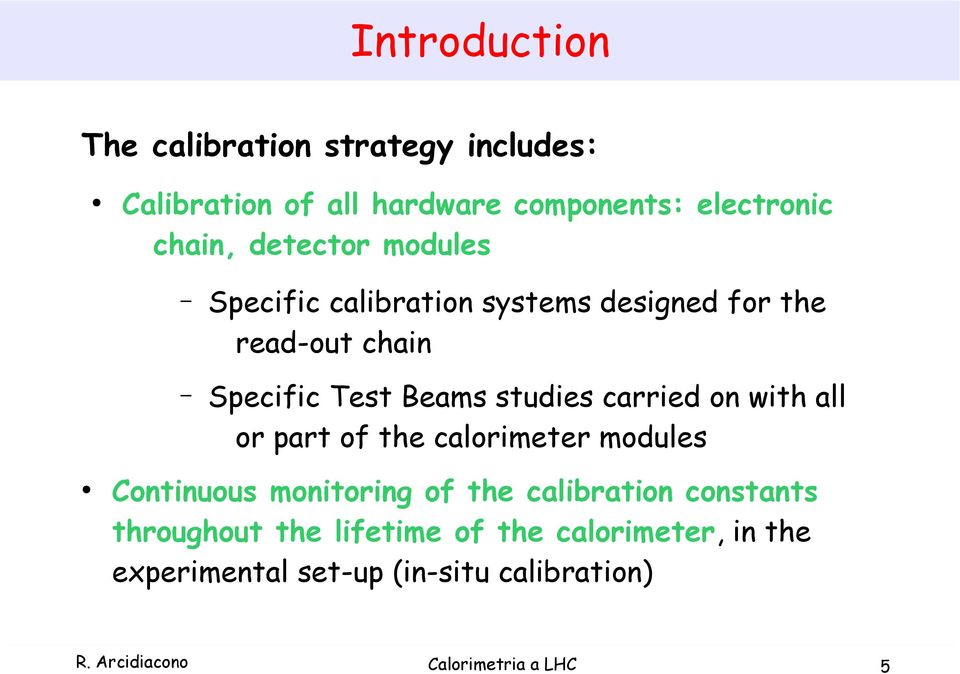
4 Introduction In general, one can always parametrize the energy deposited inside one em or hadronic shower as E p = G F p i c i s i A i A i Single channel amplitude s i Single channel time dependent correction for response variations c i Intercalibration coefficient (IC): relative single channel response F p G Particle energy correction (geometry, clustering, etc ) Global scale calibration R. Arcidiacono Calorimetria a LHC 4
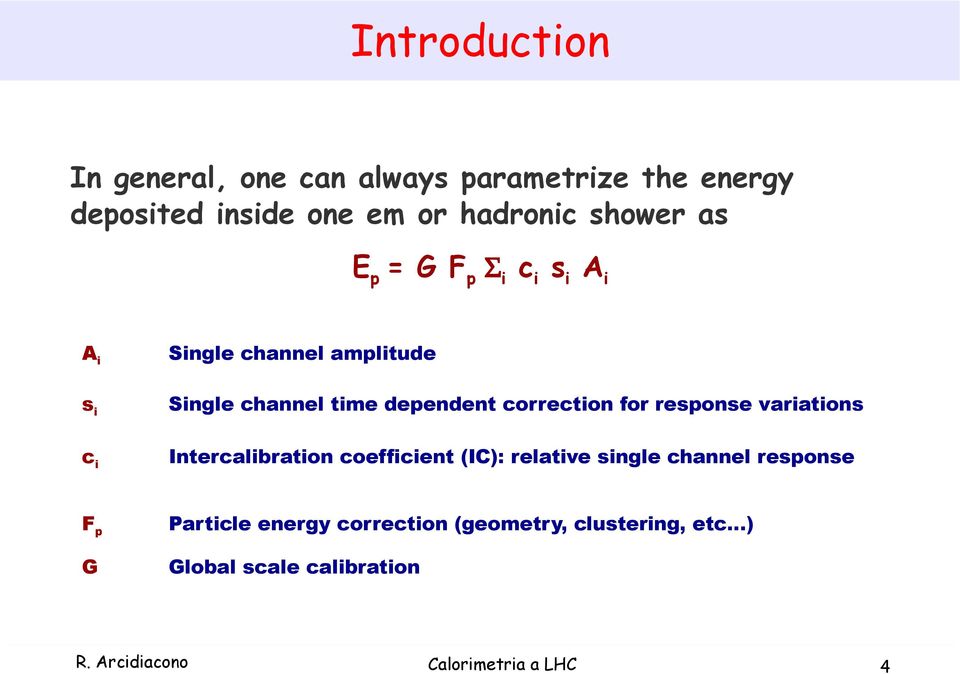
5 Introduction The calibration strategy includes: Calibration of all hardware components: electronic chain, detector modules Specific calibration systems designed for the read-out chain Specific Test Beams studies carried on with all or part of the calorimeter modules Continuous monitoring of the calibration constants throughout the lifetime of the calorimeter, in the experimental set-up (in-situ calibration) R. Arcidiacono Calorimetria a LHC 5
6 Hardware calibration Used to equalize and monitor the cell-to-cell response of the detector and associated electronics, and to track the time-variations of the response The electronics calibration system injects a known pulse at the input of the readout chain (typically at PA level). Channel-to-channel dispersions as small as 0.2% can be achieved (precision and stability of the calibration system are essential) However, this system does not allow a calibration of the detector response, for which other devices (e.g. lasers, radioactive sources) are used that inject a well-known light or charge signal into the active elements of the detector R. Arcidiacono Calorimetria a LHC 6

7 Hardware calibration For Gain Switching PA: calibration system plays a crucial role in monitoring the gain stability and the gain offset values Calibration pulses are typically issued regularly during data taking, in allocated time slots without physics ex: in SPS cycles: calibration time is right after the 3s physics spill - extra 0.5 s every cycle (14 s); ex: in LHC cycles: using LHC gaps (1 of ~ 3ms every ~ 3200 Bunch crossings) radioactive sources used to calibrate hadron calorimeters or calorimeter designed for low energies, or to track transparency changes in crystals ( light transmission curve) Radioactive sources have very well defined decay energy [ Cobalt 60 (2.8 MeV) Cesium 137 (1.2 MeV) ] R. Arcidiacono Calorimetria a LHC 7

8 Test Beam calibration Usually some (or ALL) calorimeter modules are exposed to test beams (like e-/pion beam/muons) before being installed in the final detector Among the reasons: Commission the hardware/read-out/software systems around a detector; study detector performance compute a first set of inter-calibration constants set the preliminary absolute energy scale for electrons and pions, given that the incident beam energy is well known. R. Arcidiacono Calorimetria a LHC 8

9 In-situ calibration In-situ calibration is performed with physics samples. Every calorimeter needs to be calibrated (re-calibrated) after installation in the experimental hall. The experimental environment (ex. presence of material in front of the calorimeter) is different from test beam environment, and it is not seen by the hardware calibration. Also, calorimeter response to jets and the missing transverse energy cannot be measured at the test beam where only single particles are available. Finally, calibration stability has to be monitored. R. Arcidiacono Calorimetria a LHC 9
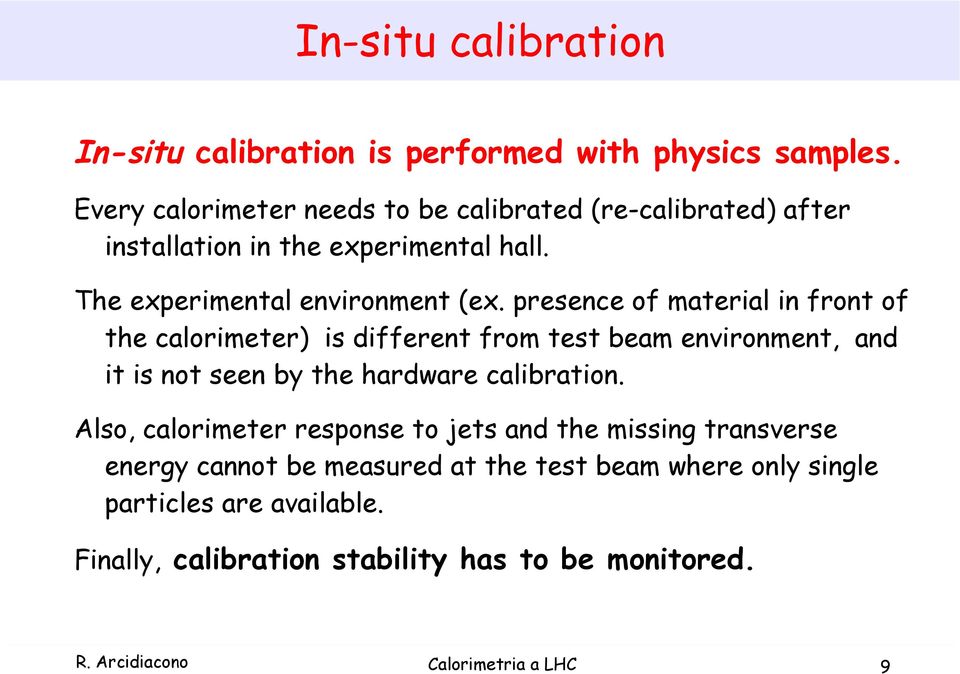
10 In-situ calibration (2) In-situ calibration allows correction of residual non uniformities, to follow the detector response variations with time, and to set the final absolute energy scale under experimental conditions. Well-known control physics samples (having high branching ratios) are used, such as: 0 /, Ke3 (K L e ) J/ψ,Z ee, W e (collider) W jj (collider) or, when possible (fixed-target), calibration electron beams R. Arcidiacono Calorimetria a LHC 10

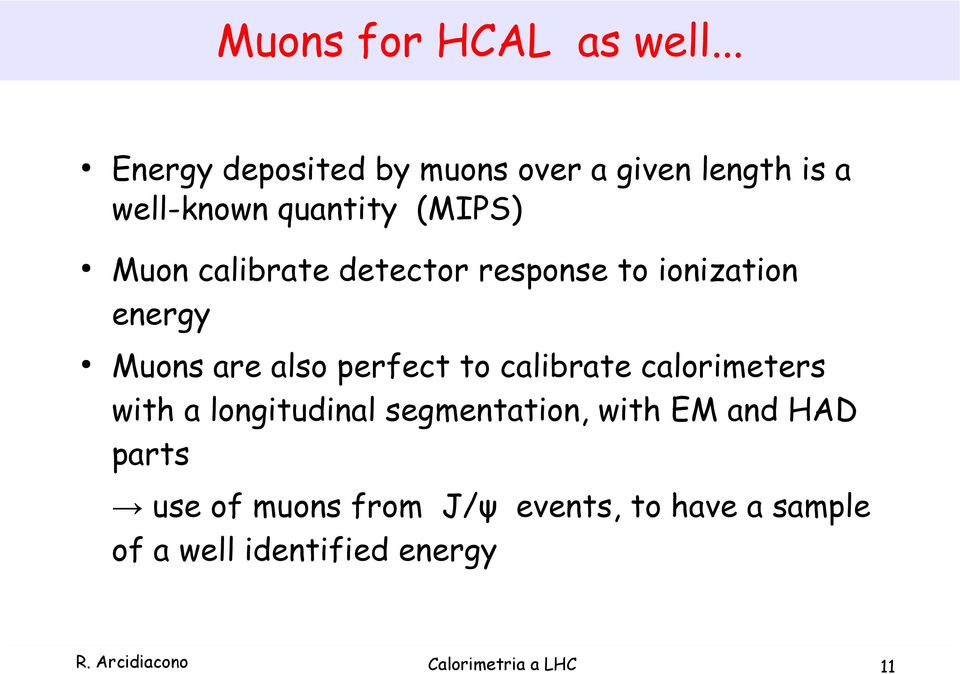
11 Muons for HCAL as well... Energy deposited by muons over a given length is a well-known quantity (MIPS) Muon calibrate detector response to ionization energy Muons are also perfect to calibrate calorimeters with a longitudinal segmentation, with EM and HAD parts use of muons from J/ψ events, to have a sample of a well identified energy R. Arcidiacono Calorimetria a LHC 11
12 Setting the energy scale Issue of setting the absolute energy scale: Hadron colliders - see next e+e- colliders precise knowledge of the center-of-mass energy provides useful constraints and renders this operation easier fixed target experiments use well-known particles decays R. Arcidiacono Calorimetria a LHC 12

13 Absolute Energy Scale: Hadron colliders The electromagnetic absolute energy scale at hadron colliders is set mainly by using well-known resonances such as 0 /, J/ ee, ee in the low-energy range and Z ee at higher energies. Resonance Mass error or = ħ/ MeV (8.4 ± 0.6) s MeV 1.30 ± 0.07 kev J/ MeV 93.2 ± 2.1 kev Z GeV GeV W GeV GeV R. Arcidiacono Calorimetria a LHC 13

14 Absolute Energy Scale: Hadron colliders Another method: transfer the energy scale from the tracker to the electromagnetic calorimeter by measuring the E/p ratio for isolated electrons (E from calorimeter, p from tracker) The tracker momentum scale in the inner tracker is calibrated by using isolated muons, (ex: from Z decays) For the electron momentum scale, Monte Carlo simulation of the tracker material distribution is used to compute the electron energy losses (bremsstrahlung) and hence obtain the initial electron momentum. Finally, the momentum scale is transferred to the calorimeter by adjusting the E/p distribution for electrons to 1. R. Arcidiacono Calorimetria a LHC 14

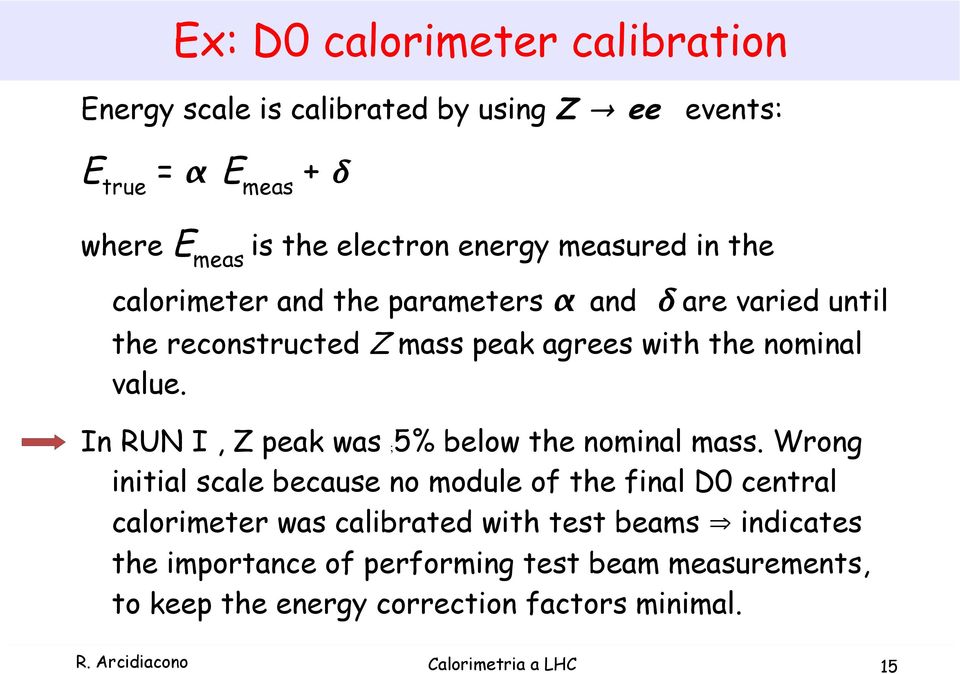
15 Ex: D0 calorimeter calibration Energy scale is calibrated by using Z ee events: E true = E meas + where E meas is the electron energy measured in the calorimeter and the parameters and are varied until the reconstructed Z mass peak agrees with the nominal value. In RUN I, Z peak was ;5% below the nominal mass. Wrong initial scale because no module of the final D0 central calorimeter was calibrated with test beams indicates the importance of performing test beam measurements, to keep the energy correction factors minimal. R. Arcidiacono Calorimetria a LHC 15
16 Ex: D0 and CDF The E/p ratio for isolated electrons from W decays as obtained from the CDF run-ib data (Abe et al., 1995; Kim, 1999). The di-electron mass spectrum reconstructed in the D0 central calorimeter before the final energy scale calibration, Zee data sample (Abbott et al.,1998). Both D0 and CDF achieved a precision on the absolute electron energy scale of ~0.1%. R. Arcidiacono Calorimetria a LHC 16

17 Ex: D0 and CDF Absolute Energy scale precision was limited by: the statistics of the physics samples used to calibrate the mass peak or the E/p peak. systematic uncertainties: dominant sources are the incomplete knowledge of the dead material, calorimeter response non-linearities, the knowledge of the mass of the resonance used, and radiative Z decays ( Z eeg with low energy undetected photons). R. Arcidiacono Calorimetria a LHC 17

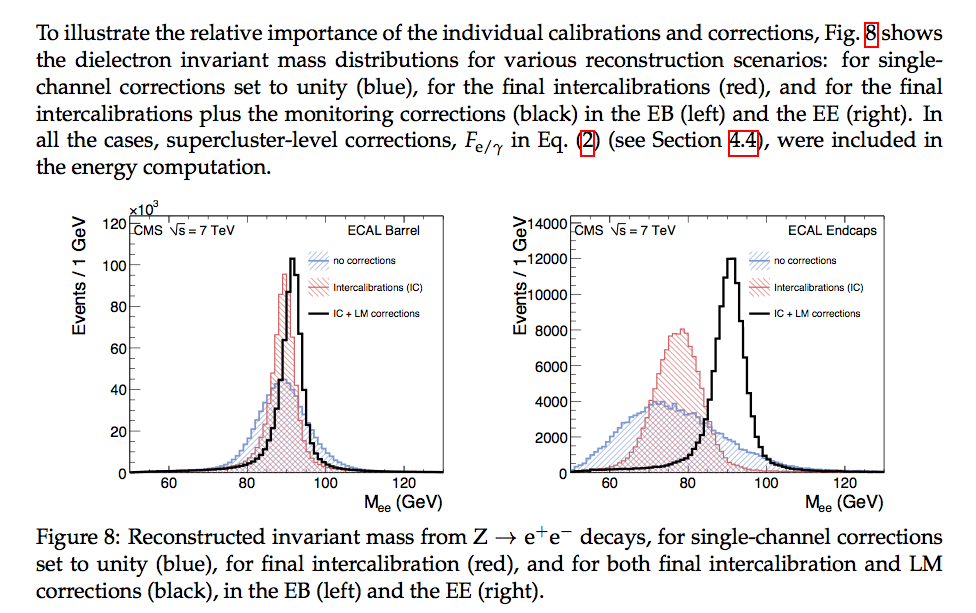
18 Ex: effect of calibration in CMS ECAL R. Arcidiacono Calorimetria a LHC 18

19 Measurement of Jets Jet is a collimated group of particles that result from the fragmentation of quarks and gluons measured as clusters by the calorimeters Previous calorimeter calibrations are not sufficient to get calibrated jet energy R. Arcidiacono Calorimetria a LHC 19

20 Jet Energy Scale The setting of the energy scale of the jet, inferring the original parton energy from the measured jet debris, is more complex than the setting of the electron scale: there are more numerous (and more difficult to control) sources of uncertainties Samples used at hadron colliders: events with associated production of a single jet with a photon or a boson, like Z ll If there is only one jet and one boson in the event, then the boson and the jet must have equal and opposite momenta in the plane transverse to the beam ( E T = 0 ) The transverse momentum of the photon or Z particle can be determined with high precision R. Arcidiacono Calorimetria a LHC 20

21 Jet energy calibration Jet energy measurement depend on location in detector and relative energy scale Another sample: QCD dijet events, should have equal transverse momentum Response to single pion nonlinear (in test beam) For a 50 GeV jet: calibration is not the same whether: One 50 GeV pion 10 times 5 GeV pion Solution: Get the average energy scale Simulate an average particles configuration inside jet R. Arcidiacono Calorimetria a LHC 21
22 Jet energy scale Corrections: Out-of-cone energy Cone of fixed radius used to identify jets Need to correct for fraction of energy out-of-cone (typically 15%) Underlying event Spoils jet energy measurement Depends on the number of primary interactions per event Extracted from minimum bias events R. Arcidiacono Calorimetria a LHC 22
23 Final JES uncertainty Dominated by out-of-cone (low-pt ) and absolute energy scale (high-p T ) Ranges from 10% to 3% W jj calibration In ttbar events, invariant mass of two jets from W boson decay should be equal to M W Can use W jj decays to further constraint JES R. Arcidiacono Calorimetria a LHC 23
Measurement of the Mass of the Top Quark in the l+ Jets Channel Using the Matrix Element Method
 Measurement of the Mass of the Top Quark in the l+ Jets Channel Using the Matrix Element Method Carlos Garcia University of Rochester For the DØ Collaboration APS Meeting 2007 Outline Introduction Top
Top rediscovery at ATLAS and CMS
 Top rediscovery at ATLAS and CMS on behalf of ATLAS and CMS collaborations CNRS/IN2P3 & UJF/ENSPG, LPSC, Grenoble, France E-mail: [email protected] We describe the plans and strategies of the
The accurate calibration of all detectors is crucial for the subsequent data
 Chapter 4 Calibration The accurate calibration of all detectors is crucial for the subsequent data analysis. The stability of the gain and offset for energy and time calibration of all detectors involved
PHYSICS WITH LHC EARLY DATA
 PHYSICS WITH LHC EARLY DATA ONE OF THE LAST PROPHETIC TALKS ON THIS SUBJECT HOPEFULLY We may have some two month of the Machine operation in 2008 LONG HISTORY... I will extensively use: Fabiola GIANOTTI
Measurement of Neutralino Mass Differences with CMS in Dilepton Final States at the Benchmark Point LM9
 Measurement of Neutralino Mass Differences with CMS in Dilepton Final States at the Benchmark Point LM9, Katja Klein, Lutz Feld, Niklas Mohr 1. Physikalisches Institut B RWTH Aachen Introduction Fast discovery
FCC 1309180800 JGU WBS_v0034.xlsm
 1 Accelerators 1.1 Hadron injectors 1.1.1 Overall design parameters 1.1.1.1 Performance and gap of existing injector chain 1.1.1.2 Performance and gap of existing injector chain 1.1.1.3 Baseline parameters
Jets energy calibration in ATLAS
 Jets energy calibration in ATLAS V.Giangiobbe Università di Pisa INFN sezione di Pisa Supported by the ARTEMIS Research Training Network Workshop sui Monte Carlo, la Fisica e le Simulazioni a LHC V.Giangiobbe
ATLAS Test Beam Analysis in Stockholm: An Overview
 ATLAS Test Beam Analysis in Stockholm: An Overview Elin Bergeås, Stockholm University Stand-alone test beam 2003 and before - test beam targeted at TileCal modules only Combined test beam 2004 - test beam
Jet Reconstruction in CMS using Charged Tracks only
 Jet Reconstruction in CMS using Charged Tracks only Andreas Hinzmann for the CMS Collaboration JET2010 12 Aug 2010 Jet Reconstruction in CMS Calorimeter Jets clustered from calorimeter towers independent
IMPROVEMENT OF JET ENERGY RESOLUTION FOR SEGMENTED HCAL USING LAYER WEIGHTING TECHNIQUE
 IMPROVEMEN OF JE ENERGY RESOLUION FOR SEGMENED HCAL USING LAYER WEIGHING ECHNIQUE V. Andreev 1, I. Golutvin 2, A. Nikitenko 3,V.Palichik 2 1 Lebedev Physical Institute, Moscow, Russia 2 Joint Institute
A Guide to Detectors Particle Physics Masterclass. M. van Dijk
 A Guide to Particle Physics Masterclass M. van Dijk 16/04/2013 How detectors work Scintillation Ionization Particle identification Tracking Calorimetry Data Analysis W & Z bosons 2 Reconstructing collisions
Top-Quark Studies at CMS
 Top-Quark Studies at CMS Tim Christiansen (CERN) on behalf of the CMS Collaboration ICHEP 2010, Paris 35th International Conference on High-Energy Physics tt 2 km 22 28 July 2010 Single-top 4 km New Physics
ATLAS NOTE ATLAS-CONF-2010-063. July 21, 2010. Search for top pair candidate events in ATLAS at s = 7 TeV. The ATLAS Collaboration.
 ATLAS NOTE ATLAS-CONF-2010-063 July 21, 2010 Search for top pair candidate events in ATLAS at s = 7 TeV The ATLAS Collaboration Abstract A search is performed for events consistent with top quark pair
Proton tracking for medical imaging and dosimetry
 Proton tracking for medical imaging and dosimetry J.Taylor, P.Allport, G.Casse For the PRaVDA Consortium 1 Background and motivation - What is the PRaVDA experiment? - Why are we using Monte Carlo? GEANT4
How To Teach Physics At The Lhc
 LHC discoveries and Particle Physics Concepts for Education Farid Ould- Saada, University of Oslo On behalf of IPPOG EPS- HEP, Vienna, 25.07.2015 A successful program LHC data are successfully deployed
Real Time Tracking with ATLAS Silicon Detectors and its Applications to Beauty Hadron Physics
 Real Time Tracking with ATLAS Silicon Detectors and its Applications to Beauty Hadron Physics Carlo Schiavi Dottorato in Fisica - XVII Ciclo Outline The ATLAS Experiment The SiTrack Algorithm Application
Electron-Muon Ranger (EMR)
 Electron-Muon Ranger (EMR) Digitization and Reconstruction François Drielsma Ruslan Asfandiyarov University of Geneva On Behalf of the EMR Group 38 th MICE Collaboration Meeting February 23, 2014 Electron-Muon
CMS Tracking Performance Results from early LHC Running
 CMS Tracking Performance Results from early LHC Running CMS PAPER TRK-10-001 L. Spiegel, K. Stenson, M. Swartz 1 First Collisions Tracking Paper Provide description of tracker, tracking algorithm, and
Physik des Higgs Bosons. Higgs decays V( ) Re( ) Im( ) Figures and calculations from A. Djouadi, Phys.Rept. 457 (2008) 1-216
 : Higgs decays V( ) Re( ) Im( ) Figures and calculations from A. Djouadi, Phys.Rept. 457 (2008) 1-216 1 Reminder 10.6.2014 Higgs couplings: 2 Reminder 10.6.2014 Higgs BF as a function of mh Higgs total
variables to investigate Monte Carlo methods of t t production
 Using the M 2 and variables to investigate Monte Carlo methods of t t production Caitlin Jones September 8, 25 Abstract In this project the behaviour of Monte Carlo simulations for the event t t! ` `+b
Delphes, a framework for fast simulation of a general purpose LHC detector
 Delphes, a framework for fast simulation of a general purpose LHC detector S. Ovyn and X. Rouby Center for Particle Physics and Phenomenology (CP3) Université catholique de Louvain B-1348 Louvain-la-Neuve,
Silicon Sensors for CMS Tracker at High-Luminosity Environment - Challenges in particle detection -
 [email protected] Finnish Society for Natural Philosophy, Helsinki, 17 February 2015 Silicon Sensors for CMS Tracker at High-Luminosity Environment - Challenges in particle detection - Timo Peltola
The Compact Muon Solenoid Experiment. CMS Note. Mailing address: CMS CERN, CH-1211 GENEVA 23, Switzerland. D. J. Mangeol, U.
 Available on CMS information server CMS NOTE 6/96 The Compact Muon Solenoid Experiment CMS Note Mailing address: CMS CERN, CH11 GENEVA 3, Switzerland July, 6 Search for χ decays to ττ and SUSY mass spectrum
Study of the B D* ℓ ν with the Partial Reconstruction Technique
 Study of the B D* ℓ ν with the Partial Reconstruction Technique + University of Ferrara / INFN Ferrara Dottorato di Ricerca in Fisica Ciclo XVII Mirco Andreotti 4 March 25 Measurement of B(B D*ℓν) from
Information about the T9 beam line and experimental facilities
 Information about the T9 beam line and experimental facilities The incoming proton beam from the PS accelerator impinges on the North target and thus produces the particles for the T9 beam line. The collisions
Theoretical Particle Physics FYTN04: Oral Exam Questions, version ht15
 Theoretical Particle Physics FYTN04: Oral Exam Questions, version ht15 Examples of The questions are roughly ordered by chapter but are often connected across the different chapters. Ordering is as in
The TOTEM experiment at the LHC: results and perspective
 The TOTEM experiment at the LHC: results and perspective Edoardo Bossini Università degli studi di Siena and INFN-Pisa (on behalf of the TOTEM collaboration) Trieste, 24 Settembre 2013 OUTLINE: Detector
Interstellar Cosmic-Ray Spectrum from Gamma Rays and Synchrotron
 Interstellar Cosmic-Ray Spectrum from Gamma Rays and Synchrotron Chuck Naval Research Laboratory, Washington, DC [email protected] Andy Strong Max-Planck-Institut für extraterrestrische Physik,
Development of on line monitor detectors used for clinical routine in proton and ion therapy
 Development of on line monitor detectors used for clinical routine in proton and ion therapy A. Ansarinejad Torino, february 8 th, 2010 Overview Hadrontherapy CNAO Project Monitor system: Part1:preliminary
Cross section, Flux, Luminosity, Scattering Rates
 Cross section, Flux, Luminosity, Scattering Rates Table of Contents Paul Avery (Andrey Korytov) Sep. 9, 013 1 Introduction... 1 Cross section, flux and scattering... 1 3 Scattering length λ and λ ρ...
arxiv:hep-ph/0310021v2 4 Oct 2003
 Physics in Collision - Zeuthen, Germany, June 6-8, 003 arxiv:hep-ph/0300v 4 Oct 003 SEARCHES FOR NEW PARTICLES AT THE ENERGY FRONTIER AT THE TEVATRON Patrice VERDIER LAL, Université Paris-Sud, 9898 Orsay
High Energy Physics. Lecture 4 More kinematics and a picture show of particle collisions
 High Energy Physics Lecture 4 More kinematics and a picture show of particle collisions 1 Recall from the previous lecture: the momentum of the scattered Particle in an elastic collision is given by p
Damping Wigglers in PETRA III
 Damping Wigglers in PETRA III WIGGLE2005, Frascati 21-22.2.2005 Winni Decking, DESY-MPY Introduction Damping Wiggler Parameters Nonlinear Dynamics with DW Operational Aspects Summary DESY and its Accelerators
MICE detectors and first results. M. Bonesini Sezione INFN Milano Bicocca
 MICE detectors and first results M. Bonesini Sezione INFN Milano Bicocca I will speak of the installed beamline PID detectors (TOFes, CKOVs, KL) and only shortly of EMR (to be built)/ the trackers (tested
Track Trigger and Modules For the HLT
 CMS L1 Track Trigger for SLHC Anders Ryd for the CMS Track Trigger Task Force Vertex 2009 Sept. 13-18, 2009 L=1035 cm-2s-1 Outline: SLHC trigger challenge Tracking triggers Track trigger modules Simulation
Implications of CMS searches for the Constrained MSSM A Bayesian approach
 Implications of CMS searches for the Constrained MSSM A Bayesian approach Małgorzata Kazana, Yue-Lin Sming Tsai On behalf of the BayesFITS group National Centre for Nuclear Research Warsaw, Poland BayesFITS,
Highlights of Recent CMS Results. Dmytro Kovalskyi (UCSB)
 Highlights of Recent CMS Results Dmytro Kovalskyi (UCSB) Introduction Number of CMS publication is over 0 already It is very hard to review all the recent results in one talk This talk concentrates on
Particle Physics. Bryan Webber University of Cambridge. IMPRS, Munich. 19-23 November 2007
 Monte Carlo Methods in Particle Physics University of Cambridge IMPRS, Munich 19-23 November 2007 See also ESW: QCD and Collider Physics, C.U.P. 1996 http://www.hep.phy.cam.ac.uk/theory/webber/qcdupdates.html
Electron-Muon Ranger (EMR)
 Electron-Muon Ranger (EMR) Ruslan Asfandiyarov MICE Video Conference April 11, 2013 Construction Construction quarter of the detector completed (12 planes) every plane tested (LED / Camera / image analysis)
How To Find The Higgs Boson
 Dezső Horváth: Search for Higgs bosons Balaton Summer School, Balatongyörök, 07.07.2009 p. 1/25 Search for Higgs bosons Balaton Summer School, Balatongyörök, 07.07.2009 Dezső Horváth MTA KFKI Research
Energy Deposition in MICE Absorbers and Coils
 in MICE Absorbers and Coils November 2, 2003 Video Conference Page 1 An Application for G4Mice We would like to estimate how much energy is deposited in magnet coils and the hydrogen absorber. Most of
Fermilab FERMILAB-THESIS-2000-10
 Fermilab FERMILAB-THESIS-2000-10 CDF/THESIS/JET/PUBLIC/5555 Version 1.0 12th February 2001 Calorimetric Measurements in CDF: A New Algorithm to Improve The Energy Resolution of Hadronic Jets A Thesis Submitted
07 - Cherenkov and transition radiation detectors
 07 - Cherenkov and transition radiation detectors Jaroslav Adam Czech Technical University in Prague Version 1.0 Jaroslav Adam (CTU, Prague) DPD_07, Cherenkov and transition radiation Version 1.0 1 / 30
1 Experiments (Brahms, PHENIX, and STAR)
 1 Experiments (Brahms, PHENIX, and STAR) This section describes the three experiments capable of making spin measurements. 1.1 PHENIX RHIC has made great strides towards providing high luminosity beams
JET ENERGY CALIBRATION IN ATLAS
 JET ENERGY CALIBRATION IN ATLAS by Douglas William Schouten B.Sc., University of British Columbia, 2004 a thesis submitted in partial fulfillment of the requirements for the degree of Master of Science
Testing thermo-acoustic sound generation in water with proton and laser beams
 International ARENA Workshop DESY, Zeuthen 17th 19th of May 25 Testing thermo-acoustic sound generation in water with proton and laser beams Kay Graf Universität Erlangen-Nürnberg Physikalisches Institut
Bounding the Higgs width at the LHC
 Bounding the Higgs width at the LHC Higgs XSWG workshop, June 2014 John Campbell, Fermilab with K. Ellis, C. Williams 1107.5569, 1311.3589, 1312.1628 Reminder of the method This is the essence of the original
Calorimeter Upgrades for the High Luminosity LHC
 Calorimeter Upgrades for the High Luminosity LHC A. Straessner FSP 101 ATLAS DPG Frühjahrstagung Göttingen März, 2012 Outline Introduction: ATLAS and CMS Detectors Today Physics at the High-Luminosity
Operation and Performance of the CMS Silicon Tracker
 Operation and Performance of the CMS Silicon Tracker Manfred Krammer 1 on behalf of the CMS Tracker Collaboration Institute of High Energy Physics, Austrian Academy of Sciences, Vienna, Austria Abstract.
π 0 γγ calibration Savrina Daria, ITEP, Moscow SINP MSU, Moscow Victor Egorychev, ITEP, Moscow Ivan Belyaev
 π 0 γγ calibration Savrina Daria, ITEP, Moscow SINP MSU, Moscow Ivan Belyaev Victor Egorychev, ITEP, Moscow Loose cuts for π 0 selection One of the ways to improve the calibration procedure is to increase
Research Management Plan (RMP) for the. STAR Heavy Flavor Tracker (HFT)
 Research Management Plan (RMP) for the STAR Heavy Flavor Tracker (HFT) Version 4 March 31, 2009 1. Introduction This document describes the plans of a group of institutions within the STAR collaboration
A New Precise Measurement of the W Boson Mass by CDF Ashutosh Kotwal Duke University. For the CDF Collaboration
 A New Precise Measurement of the W Boson Mass by CDF Ashutosh Kotwal Duke University For the CDF Collaboration Joint Theoretical-Experimental Physics Seminar Fermilab, 23 February 2012 Spontaneous Symmetry
90 degrees Bremsstrahlung Source Term Produced in Thick Targets by 50 MeV to 10 GeV Electrons
 SLAC-PUB-7722 January 9 degrees Bremsstrahlung Source Term Produced in Thick Targets by 5 MeV to GeV Electrons X. S. Mao et al. Presented at the Ninth International Conference on Radiation Shielding, Tsukuba,
arxiv:1508.07811v1 [hep-ph] 31 Aug 2015
![arxiv:1508.07811v1 [hep-ph] 31 Aug 2015](/thumbs/40/20643283.jpg "arxiv:1508.07811v1 [hep-ph] 31 Aug 2015") DESY 5-47 RAL-P-05-007 reating jet correlations in high pile-up at hadron colliders arxiv:508.078v [hep-ph] 3 Aug 05 F. Hautmann,, H. Jung, 3, 4 and H. Van Haevermaet 4 Rutherford Appleton Laboratory &
DESY 5-47 RAL-P-05-007 reating jet correlations in high pile-up at hadron colliders arxiv:508.078v [hep-ph] 3 Aug 05 F. Hautmann,, H. Jung, 3, 4 and H. Van Haevermaet 4 Rutherford Appleton Laboratory &
Open access to data and analysis tools from the CMS experiment at the LHC
 Open access to data and analysis tools from the CMS experiment at the LHC Thomas McCauley (for the CMS Collaboration and QuarkNet) University of Notre Dame, USA [email protected]! 5 Feb 2015 Outline
Recent developments in Electromagnetic Hadron Form Factors
 Recent developments in Electromagnetic Hadron Form Factors (JOH7RPDVL*XVWDIVVRQ '$31,$63K16DFOD\ :KDW are Form Factors? :K\ to measure? +RZ to measure? :KDWLVQHZ" Consequences, Conclusions 6SRNHSHUVR QV
Extraction of Polarised Quark Distributions of the Nucleon from Deep Inelastic Scattering at the HERMES Experiment
 Extraction of Polarised Quark Distributions of the Nucleon from Deep Inelastic Scattering at the HERMES Experiment Marc Beckmann FAKULTÄT FÜR PHYSIK ALBERT-LUDWIGS-UNIVERSITÄT FREIBURG Extraction of Polarised
Theory versus Experiment. Prof. Jorgen D Hondt Vrije Universiteit Brussel [email protected]
 Theory versus Experiment Prof. Jorgen D Hondt Vrije Universiteit Brussel [email protected] Theory versus Experiment Pag. 2 Dangerous cocktail!!! Pag. 3 The basics in these lectures Part1 : Theory meets
Progress in understanding quarkonium polarization measurements
 1 Progress in understanding quarkonium polarization measurements 1. Why it is essential that we approach the measurement of polarization as a multidimensional problem: we must not average out information!.
Which calorimeter for FCC detector
 Which calorimeter for FCC detector Jean-Claude Brient* Laboratoire Leprince-Ringuet Ecole Polytechnique CNRS Palaiseau J. C. Brient ( LLR) 1 * ECAL contact for ILD and former spokesperson of CALICE FCC
Large Hadron Collider am CERN
 The CMS Silicon Tracker Lutz Feld 1. Physikalisches Institut, RWTH Aachen GSI Darmstadt, 18. 4. 2007 Large Hadron Collider am CERN proton proton quarks & gluons circumference 27 km 1200 superconducting
Search for Dark Matter at the LHC
 Search for Dark Matter at the LHC Steven Lowette Vrije Universiteit Brussel - IIHE 19 November 2014 3rd CosPa Meeting Université de Liège Content Introduction Generic DM searches at the LHC Explicit DM
Characterisation of the Timepix Chip for the LHCb VELO Upgrade
 Particle and Astroparticle Physics Master Thesis Characterisation of the Timepix Chip for the LHCb VELO Upgrade Veerle Heijne Supervisor: Dr. Martin van Beuzekom Second reviewer: Dr. Auke-Pieter Colijn
Parton showering effects in central heavy-boson hadroproduction
 Parton showering effects in central heavy-boson hadroproduction DOI: will be assigned M. Deak, A. Grebenyuk 2, F. Hautmann 3, H. Jung 2,4 and K. Kutak 2 IFT, University of Madrid 2 Deutsches Elektronen
Beam Instrumentation Group, CERN ACAS, Australian Collaboration for Accelerator Science 3. School of Physics, University of Melbourne 4
 Prototype tests of a wide-band Synchrotron-Light based Beam Pattern Monitor for measuring charge-couple bunch instabilities in High-Energy Particle Accelerator Beams Sophie Dawson2,3, Mark Boland2,4, David
Searching for the Building Blocks of Matter
 1 Searching for the Building Blocks of Matter Building Blocks of Matter The Smallest Scales Physicists at Fermilab are searching for the smallest building blocks of matter and determining how they interact
ATLAS Tile Calorimeter Readout Electronics Upgrade Program for the High Luminosity LHC
 ATLAS Tile Calorimeter Readout Electronics Upgrade Program for the High Luminosity LHC Augusto Santiago Cerqueira On behalf of the ATLAS Tile Calorimeter Group Federal University of Juiz de Fora, Brazil
The OPERA Emulsions. Jan Lenkeit. Hamburg Student Seminar, 12 June 2008. Institut für Experimentalphysik Forschungsgruppe Neutrinophysik
 The OPERA Emulsions Jan Lenkeit Institut für Experimentalphysik Forschungsgruppe Neutrinophysik Hamburg Student Seminar, 12 June 2008 1/43 Outline The OPERA experiment Nuclear emulsions The OPERA emulsions
An Innovative Method for Dead Time Correction in Nuclear Spectroscopy
 An Innovative Method for Dead Time Correction in Nuclear Spectroscopy Upp, Daniel L.; Keyser, Ronald M.; Gedcke, Dale A.; Twomey, Timothy R.; and Bingham, Russell D. PerkinElmer Instruments, Inc. ORTEC,
AC coupled pitch adapters for silicon strip detectors
 AC coupled pitch adapters for silicon strip detectors J. Härkönen1), E. Tuovinen1), P. Luukka1), T. Mäenpää1), E. Tuovinen1), E. Tuominen1), Y. Gotra2), L. Spiegel2) Helsinki Institute of Physics, Finland
Zero Degree Extraction using an Electrostatic Separator
 Zero Degree Extraction using an Electrostatic Separator L. Keller Aug. 2005 Take another look at using an electrostatic separator and a weak dipole to allow a zero degree crossing angle a la the TESLA
Experimental results for the focal waveform and beam width in the focusing lens with a 100 ps filter
 EM Implosion Memos Memo 51 July, 2010 Experimental results for the focal waveform and beam width in the focusing lens with a 100 ps filter Prashanth Kumar, Carl E. Baum, Serhat Altunc, Christos G. Christodoulou
Relativistic kinematics basic energy, mass and momentum units, Lorents force, track bending, sagitta. First accelerator: cathode ray tube
 Accelerators Relativistic kinematics basic energy, mass and momentum units, Lorents force, track bending, sagitta Basic static acceleration: First accelerator: cathode ray tube Cathode C consist of a filament,
How To Understand Light And Color
 PRACTICE EXAM IV P202 SPRING 2004 1. In two separate double slit experiments, an interference pattern is observed on a screen. In the first experiment, violet light (λ = 754 nm) is used and a second-order
Development of the electromagnetic calorimeter waveform digitizers for the Fermilab Muon g-2 experiment
 Development of the electromagnetic calorimeter waveform digitizers for the Fermilab g-2 experiment 1 on behalf of the Fermilab E989 g-2 Collaboration European Physical Society Conference on High Energy
Status of the FERMI@Elettra Free Electron Laser
 Status of the FERMI@Elettra Free Electron Laser E. Allaria on behalf of the FERMI team Work partially supported by the Italian Ministry of University and Research under grants FIRB-RBAP045JF2 and FIRB-RBAP06AWK3
The CMS All Silicon Tracker
 The CMS All Silicon Tracker A Detector for the Exploration of the Terascale Lutz Feld 1. Physikalisches Institut, RWTH Aachen Göttingen, 25. 1. 2008 Large Hadron Collider at CERN proton proton quarks &
Characteristics of an Integrated Germanium Detector Based Gamma-Ray Spectrometer for Monitoring Systems
 Characteristics of an Integrated Germanium Detector Based Gamma-Ray Spectrometer for Monitoring Systems Ronald M. Keyser, Timothy R. Twomey, Sam Hitch ORTEC 801 South Illinois Avenue Oak Ridge, TN, 37831
Biasing. 7 th FLUKA Course NEA Paris, Sept.29-Oct.3, 2008
 Biasing 7 th FLUKA Course NEA Paris, Sept.29-Oct.3, 2008 Overview General concepts: Analog vs. biased Monte Carlo calculation Biasing options (only the most important / common options available in FLUKA)
Introduction to the Monte Carlo method
 Some history Simple applications Radiation transport modelling Flux and Dose calculations Variance reduction Easy Monte Carlo Pioneers of the Monte Carlo Simulation Method: Stanisław Ulam (1909 1984) Stanislaw
hij Teacher Resource Bank GCE Physics A Other Guidance: Particle Physics By J Breithaupt
 hij Teacher Resource Bank GCE Physics A Other Guidance: Particle Physics By J Breithaupt Copyright 2008 AQA and its licensors. All rights reserved. The Assessment and Qualifications Alliance (AQA) is a
ACCELERATORS AND MEDICAL PHYSICS 2
 ACCELERATORS AND MEDICAL PHYSICS 2 Ugo Amaldi University of Milano Bicocca and TERA Foundation EPFL 2-28.10.10 - U. Amaldi 1 The icone of radiation therapy Radiation beam in matter EPFL 2-28.10.10 - U.
Performance of the CMS cathode strip chambers with cosmic rays
 Home Search Collections Journals About Contact us My IOPscience Performance of the CMS cathode strip chambers with cosmic rays This article has been downloaded from IOPscience. Please scroll down to see
Chapter 8. Low energy ion scattering study of Fe 4 N on Cu(100)
 Low energy ion scattering study of 4 on Cu(1) Chapter 8. Low energy ion scattering study of 4 on Cu(1) 8.1. Introduction For a better understanding of the reconstructed 4 surfaces one would like to know