
Qualys API V1. User Guide. Version 8.6
|
|
|
- Louise Marshall
- 10 years ago
- Views:
Transcription
1 Qualys API V1 User Guide Version 8.6 September 30, 2015

2 Copyright by Qualys, Inc. All Rights Reserved. Qualys and the Qualys logo are registered trademarks of Qualys, Inc. All other trademarks are the property of their respective owners. Qualys, Inc Bridge Parkway Redwood Shores, CA (650)

3 Preface Chapter 1 Welcome Qualys API v1 Features Processing API Requests Qualys User Account Decoding XML Reports API Conventions API Limits Chapter 2 Vulnerability Scans About Vulnerability Scanning Scan Functions Scan Request View Running Scans and Maps Cancel a Scan View Scan Report List Retrieve a Saved Scan Report Delete a Saved Scan Report View Scan Target History KnowledgeBase Download Chapter 3 Network Discovery About Network Discovery Map Functions Map Request Version Map Request Single Domain View Running Maps and Scans Cancel a Running Map View Map Report List Retrieve a Saved Map Report Delete a Saved Map Report Chapter 4 Account Preferences Preferences Functions Scheduled Scans and Maps Scan Service Options View Scanner Appliance List View IP List View Domain List View Group List

4 Contents Chapter 5 Asset Management Asset Management Functions Automatic Host Scan Data Add/Edit Asset IPs View Asset IP List Add/Edit Domains View Asset Domain List Add/Edit Asset Group View Asset Group List Delete Asset Group Search Assets by Attributes Download Asset Data Report Download Asset Range Info Report Chapter 6 Remediation Management About Remediation Tickets Ticket Functions Ticket Selection Parameters View Ticket List Edit Tickets Delete Tickets View Deleted Ticket List Get Ticket Information Host Functions View Host Information Set Vulnerabilities to Ignore on Hosts Chapter 7 User Management About User Management User Management Functions Add/Edit Users User Registration Process Accept the Qualys EULA Activate/Deactivate Users View User List Download User Action Log Report User Password Change Appendix A Vulnerability Scan Reports Scan Results Scan Report List Running Scans and Maps List Scan Target History Output KnowledgeBase Download Output Qualys API V1 User Guide
5 Contents Appendix B Map Reports Map Report Version Map Report Single Domain Map Report List Appendix C Preferences Reports Scheduled Tasks Report Scan Options Report Scanner Appliance List Group List Appendix D Asset Management Reports Asset IP List Asset Domain List Asset Group List Asset Search Report Asset Range Info Report Asset Data Report Appendix E Remediation Management Reports Ticket List Output Ticket Edit Output Ticket Delete Output Deleted Ticket List Get Ticket Information Report Get Host Information Report Ignore Vulnerability Output Appendix F User Management Reports User Output User List Output User Action Log Report Password Change Output Appendix G Error Codes Index Qualys API V1 User Guide 5

6 Contents 6 Qualys API V1 User Guide

7 Preface Using the Qualys API, third parties can integrate their own applications with Qualys cloud security and compliance solutions using an extensible XML interface. The API functions described in this guide are available to customers with Qualys Vulnerability Management (VM) and Policy Compliance (PC). About Qualys Qualys, Inc. (NASDAQ: QLYS) is a pioneer and leading provider of cloud security and compliance solutions with over 7,700 customers in more than 100 countries, including a majority of each of the Forbes Global 100 and Fortune 100.The Qualys Cloud Platform and integrated suite of solutions help organizations simplify security operations and lower the cost of compliance by delivering critical security intelligence on demand and automating the full spectrum of auditing, compliance and protection for IT systems and web applications. Founded in 1999, Qualys has established strategic partnerships with leading managed service providers and consulting organizations including Accenture, Accuvant, BT, Cognizant Technology Solutions, Dell SecureWorks, Fujitsu, HCL Comnet, InfoSys, NTT, Tata Communications, Verizon and Wipro. The company is also a founding member of the Cloud Security Alliance (CSA). For more information, please visit Contact Qualys Support Qualys is committed to providing you with the most thorough support. Through online documentation, telephone help, and direct support, Qualys ensures that your questions will be answered in the fastest time possible. We support you 7 days a week, 24 hours a day. Access support information at
8 Preface 8 Qualys API V1 User Guide

9 1 Welcome The Qualys API allows third parties to integrate their own applications with Qualys cloud security and compliance solutions using an extensible XML interface. The API functions described in this guide are available to customers with Qualys Vulnerability Management (VM) and Policy Compliance (PC). This chapter introduces you to the Qualys API v1. These topics are included: Qualys API v1 Features Qualys User Account Decoding XML Reports API Conventions API Limits Additional capabilities are available using the Qualys API v2. For details, please see the Qualys API v2 User Guide.

10 Welcome Qualys API v1 Features Qualys API v1 Features Using the Qualys API v1, partners can access the following Qualys cloud security and compliance features: Vulnerability Scans Network Discovery Account Preferences Remediation Management User Management Vulnerability Scans Qualys vulnerability scans evaluate the security of your network devices and systems and produce reports, with up-to-date information on network security based on the latest vulnerabilities. A vulnerability scan is accomplished by requesting a scan for devices using the scan API functions. The vulnerability scan functions enable Qualys API users to: Scan one or more IP addresses and receive XML scan reports. Each scan request returns a scan report identifying network and systems vulnerabilities found, potential consequences if exploited, and suggested solutions. Retrieve a list of scans in progress, and cancel scans in progress. Save scan reports on the Qualys server for future use. Retrieve and delete saved scan reports. View scan history on selected hosts within a certain date range to identify hosts that were scanned and not scanned within a period of time. Network Discovery Qualys network discovery produces an inventory of devices detected through a discovery process. Network discovery is accomplished by requesting network maps using the map API functions. The map functions enable Qualys API users to: Request network maps and receive XML map reports. Each map request returns a map report, an inventory of network devices found. Retrieve a list of maps in progress, and cancel maps in progress. 10 Qualys API V1 User Guide

11 Welcome Qualys API v1 Features Save map reports on the Qualys server for future use. Retrieve and delete saved map reports. Account Preferences Preferences are set for each Qualys account, allowing users the ability to customize their experience using the Qualys service. Many preferences are set automatically at account creation time. The preferences functions enable Qualys API users to: Schedule daily, weekly, and monthly scans and maps. Set scan service options in the user s default option profile to scan dead hosts, check for load balancers and scan all systems behind them, and set TCP ports to scan. List scanner appliances in the user account. Asset Management The Qualys API provides many ways to manage assets in the user account. Managers have the ability manage IP addresses and domains (add, edit, list) in the subscription. Users with asset permissions have the ability to manage asset groups, search assets based on asset attributes, and download asset reports based on the latest automatic host scan data. Remediation Management Qualys provides fully secure audit trails that track vulnerability status on all scanned IP addresses in the subscription. As follow up audits occur, vulnerability status levels new, active, fixed, and re-opened are updated automatically and available for download by API users in various reports, including the asset search report, the asset data report and the asset range info report. The host information report identifies a particular host and its current security status based on the most current automatic host scan data. Remediation workflow is an optional feature for managing vulnerabilities and their remediation using Qualys ticketing system. When enabled in the Qualys user interface, new tickets are created automatically based on customer defined policy. As new scan results become available tickets are updated and automatically when previously detected vulnerabilities are verified as fixed. Qualys API users with appropriate account permissions can list tickets, edit tickets, delete tickets and list deleted tickets. The functions provide for simple integration with third-party applications. Qualys API V1 User Guide 11

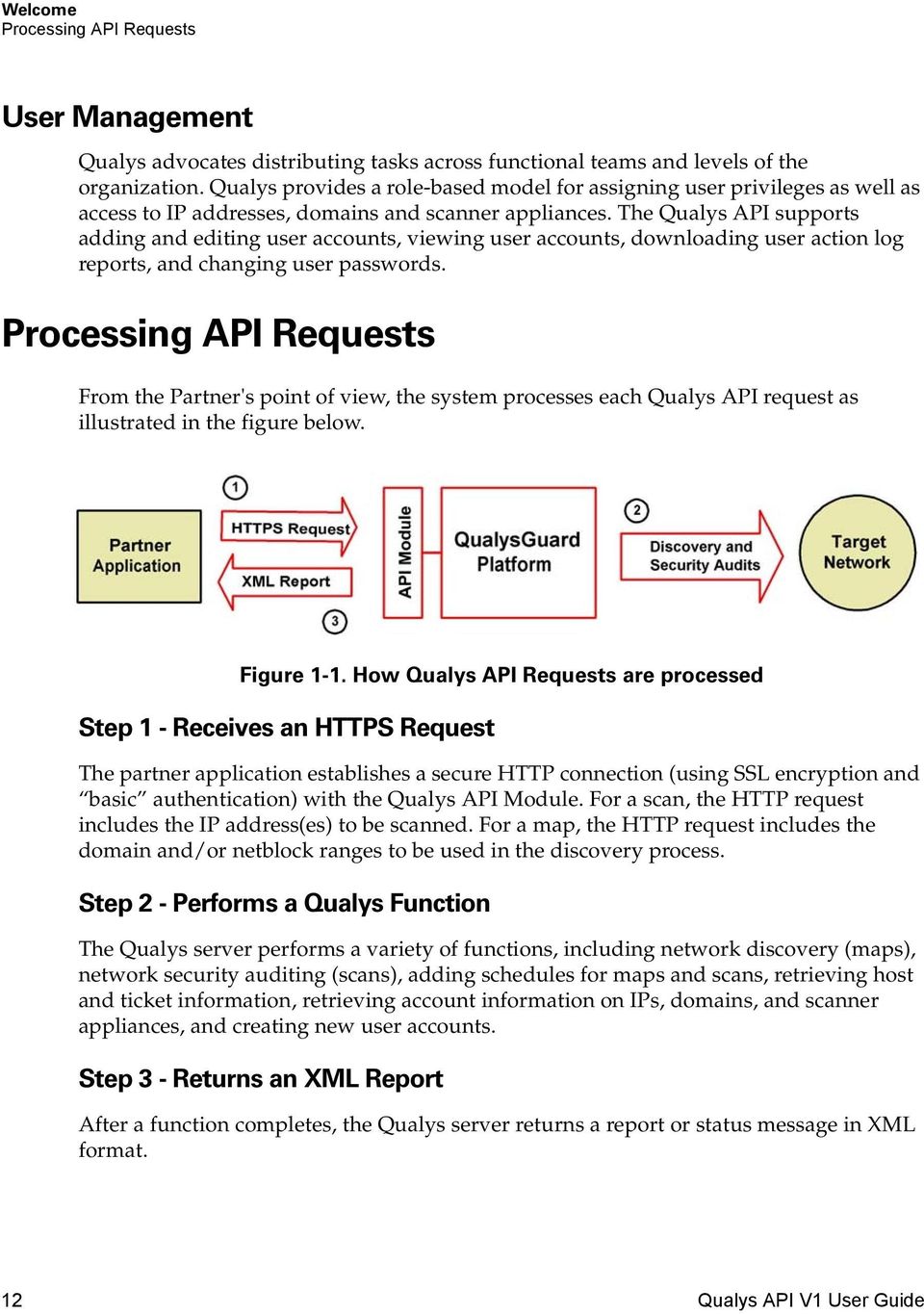
12 Welcome Processing API Requests User Management Qualys advocates distributing tasks across functional teams and levels of the organization. Qualys provides a role-based model for assigning user privileges as well as access to IP addresses, domains and scanner appliances. The Qualys API supports adding and editing user accounts, viewing user accounts, downloading user action log reports, and changing user passwords. Processing API Requests From the Partner's point of view, the system processes each Qualys API request as illustrated in the figure below. Figure 1-1. How Qualys API Requests are processed Step 1 - Receives an HTTPS Request The partner application establishes a secure HTTP connection (using SSL encryption and basic authentication) with the Qualys API Module. For a scan, the HTTP request includes the IP address(es) to be scanned. For a map, the HTTP request includes the domain and/or netblock ranges to be used in the discovery process. Step 2 - Performs a Qualys Function The Qualys server performs a variety of functions, including network discovery (maps), network security auditing (scans), adding schedules for maps and scans, retrieving host and ticket information, retrieving account information on IPs, domains, and scanner appliances, and creating new user accounts. Step 3 - Returns an XML Report After a function completes, the Qualys server returns a report or status message in XML format. 12 Qualys API V1 User Guide
13 Welcome Qualys User Account Qualys User Account The application must authenticate using Qualys user account credentials (user name and password) as part of HTTP requests made to the Qualys server. For all functions, a Qualys (Front Office) account is required. If you need assistance with obtaining a Qualys account, please contact your Qualys account representative. Users with a Qualys user account may access the API to run map and scan functions and view reports. When a subscription has multiple users, all users with any user role (except Contact) can use the Qualys API. Each user s permissions correspond to their assigned user role. Users may access and view any report including IPs in their account. In the case where a single scan report includes IPs not assigned to the user, the report data does not include the results for the unassigned IPs. Qualys user accounts enabled with Two Factor Authentication cannot be used with the Qualys API. Decoding XML Reports There are a number of ways to parse an XML file. Select the method which is most appropriate for your application and its users. Qualys publishes DTDs for each report on its Web site. For example, the URL to the scan report can be found at the URL shown below: The URLs to current report DTDs are included with the function descriptions in this document. There is a generic report returned by a few functions. Occasionally Qualys updates the report DTDs. It is recommended that you request the most recent DTDs from the Qualys platform to decode your reports. The URLs to the report DTDs are included in this user guide. Detailed information about each XML report is provided in the appendices at the end of this document. For each XML report a recent report DTD and the report's XML elements and attributes (XPaths) are described in detail. Some parts of the XML report may contain HTML tags or other special characters (such as accented letters). Therefore, many elements contain CDATA sections, which allow HTML tags to be included in the report. High ASCII and other non-printable characters are escaped using question marks. Qualys API V1 User Guide 13

14 Welcome API Conventions API Conventions Before using Qualys API functions, please review the API conventions below. URL to the Qualys API Server Qualys maintains multiple Qualys platforms. The Qualys API server URL that you should use for API requests depends on the platform where your account is located. Account Location Qualys US Platform 1 Qualys US Platform 2 Qualys EU Platform Qualys Private Cloud Platform API Server URL The Qualys API documentation and sample code use the API server URL for the Qualys US Platform 1. If your account is located on another platform, please replace this URL with the appropriate server URL for your account. Authentication The application must authenticate using Qualys account credentials (user name and password) as part of the HTTP request. The credentials are transmitted using the Basic Authentication Scheme over HTTPS. For more information, see the Basic Authentication Scheme section of RFC #2617: The exact method of implementing authentication will vary according to which programming language is used. See the sample code in Chapter 8, Sample API Code for more information. GET and POST Methods are Supported Using the Qualys API, you can submit parameters (name=value pairs) using the GET or POST method. Some functions support the GET method only, while others support both the GET and POST methods. There are known limits for the amount of data that can be sent using the GET method. These limits are dependent on the toolkit used. There is no fundamental limit with sending data using the POST method. All functions support the GET method. These Network Discovery and Network Scanning functions support the GET and POST methods: map.php, map-2.php, scan.php, scan_report.php, and scheduled_scans.php. 14 Qualys API V1 User Guide

15 Welcome API Conventions Asset Management functions support the GET and POST methods. Remediation Management functions support the GET and POST methods. User Management functions support the GET and POST methods. Date Format in API Results The Qualys API has adopted a date/time format to provide consistency and interoperability of the Qualys API with third-party applications. The date format follows standards published in RFC 3339 and ISO 8601, and applies throughout the Qualys API. The date format is: yyyy-mm-ddthh-mm-ssz This represents a UTC value (GMT time zone). URL Encoding in API Code You must URL encode variables when using the Qualys API. This is standard practice for HTTP communications. If your application passes special characters, like the single quote ( ), parentheses, and symbols, they must be URL encoded. For example, the pound (#) character cannot be used as an input parameter in URLs. If # is specified, the Qualys API returns an error. To specify the # character in a URL you must enter the encoded value %23. The # character is considered by browsers and other Internet tools as a separator between the URL and the results page, so whatever follows an un-encoded # character is not passed to the Qualys API server and returns an error. UTF-8 Encoding The Qualys API uses UTF-8 encoding. The encoding is specified in the XML output header as shown below. <?xml version="1.0" encoding="utf-8"?> URL Elements are Case Sensitive URL elements are case sensitive. The sample URL below will retrieve a previously saved scan report that has the reference code scan/ The parameter name ref is defined in lower-case characters. This URL will return the specified scan report: ref=scan/ Qualys API V1 User Guide 15
16 Welcome API Conventions The sample URL below is incorrect and will not return the specified scan report because the parameter name Ref appears in mixed-case characters: Ref=scan/ Parameters in URLs API parameters, as documented in this user guide, should be specified one time for each URL. In the case where the same parameter is specified multiple times in a single URL, the last parameter takes effect and the previous instances are silently ignored. 16 Qualys API V1 User Guide
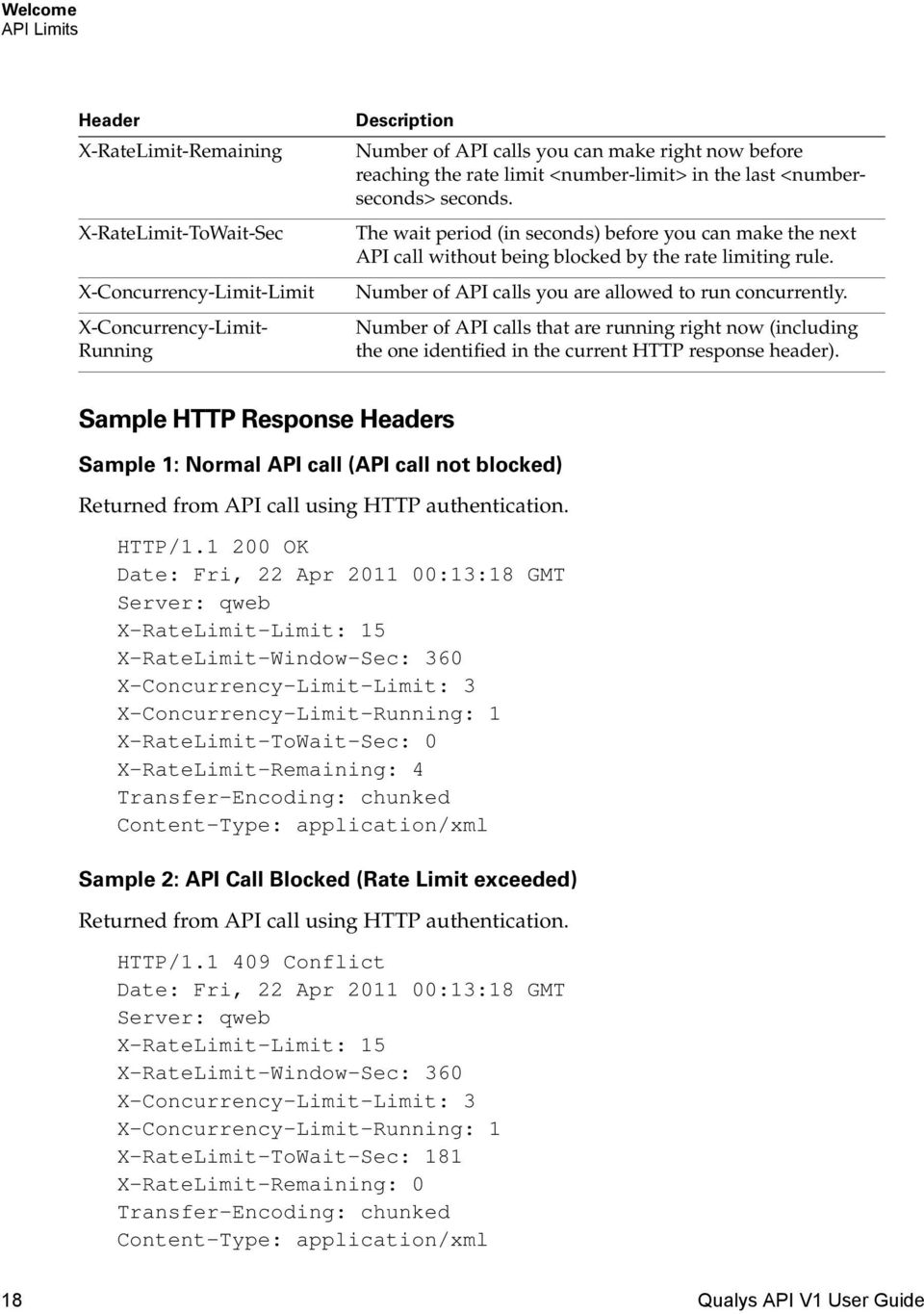
17 Welcome API Limits API Limits The service enforces limits on the API calls subscription users can make. The limits apply to the use of all APIs, except session V2 API (session login/logout). Important! All API controls are applied on a subscription basis. Concurrency and Rate Limits API Usage Default settings are provided and these may be customized per subscription by Support. Concurrency Limit per Subscription (per API). The maximum number of concurrent API call instances allowed within the subscription for each API. Default is 2. Rate Limit per Subscription (per API). The maximum number of API calls allowed per day (or a customized period, in seconds) within the subscription for each API. The rate limit is defined by the rate limit count and rate limit period. The default rate limit count is 300. The default rate limit period is seconds (24 hours). The service checks the concurrency limit and rate limit each time an API request is received. In a case where an API call is received and the service determines a limit has been exceeded, the API call is blocked and an error is returned (the concurrency limit error takes precedence). Please see the document Qualys API Limits for complete information. Your subscription s API usage and quota information is exposed in the HTTP response headers generated by Qualys APIs (all APIs except session V2 API). HTTP Response Headers The HTTP response headers generated by Qualys APIs are described below. Note: The HTTP status code OK (example: HTTP/ OK ) is returned in the header for normal (not blocked) API calls. The HTTP status code Conflict (example: HTTP/ Conflict ) is returned for API calls that were blocked. Header X-RateLimit-Limit X-RateLimit-Window-Sec Description Maximum number of API calls allowed in any given time period of <number-seconds> seconds, where <numberseconds> is the value of X-RateLimit-Window-Sec. Time period (in seconds) during which up to <numberlimit> API calls are allowed, where <number-limit> is the value of X-RateLimit-Limit. Qualys API V1 User Guide 17

18 Welcome API Limits Header X-RateLimit-Remaining X-RateLimit-ToWait-Sec X-Concurrency-Limit-Limit X-Concurrency-Limit- Running Description Number of API calls you can make right now before reaching the rate limit <number-limit> in the last <numberseconds> seconds. The wait period (in seconds) before you can make the next API call without being blocked by the rate limiting rule. Number of API calls you are allowed to run concurrently. Number of API calls that are running right now (including the one identified in the current HTTP response header). Sample HTTP Response Headers Sample 1: Normal API call (API call not blocked) Returned from API call using HTTP authentication. HTTP/ OK Date: Fri, 22 Apr :13:18 GMT Server: qweb X-RateLimit-Limit: 15 X-RateLimit-Window-Sec: 360 X-Concurrency-Limit-Limit: 3 X-Concurrency-Limit-Running: 1 X-RateLimit-ToWait-Sec: 0 X-RateLimit-Remaining: 4 Transfer-Encoding: chunked Content-Type: application/xml Sample 2: API Call Blocked (Rate Limit exceeded) Returned from API call using HTTP authentication. HTTP/ Conflict Date: Fri, 22 Apr :13:18 GMT Server: qweb X-RateLimit-Limit: 15 X-RateLimit-Window-Sec: 360 X-Concurrency-Limit-Limit: 3 X-Concurrency-Limit-Running: 1 X-RateLimit-ToWait-Sec: 181 X-RateLimit-Remaining: 0 Transfer-Encoding: chunked Content-Type: application/xml 18 Qualys API V1 User Guide
19 Welcome API Limits Sample 3: API V2 Call Blocked (Concurrency Limit exceeded) Returned from API V2 call using API V2 session authentication. HTTP/ Conflict Date: Fri, 22 Apr :13:18 GMT Server: qweb Expires: Mon, 24 Oct :30:00 GMT Cache-Control: post-check=0,pre-check=0 Pragma: no-cache X-RateLimit-Limit: 15 X-RateLimit-Window-Sec: 360 X-Concurrency-Limit-Limit: 3 X-Concurrency-Limit-Running: 3 Transfer-Encoding: chunked Content-Type: application/xml Note: In the case where the concurrency limit has been reached, no information about rate limits will appear in the HTTP headers. Activity Log within User Interface The Activity Log within the Qualys user interface shows details about user activities actions taken using the user interface and the API. To view the Activity Log, log into your Qualys account. Go to VM > Users and click the Activity Log tab. Select Filters > Recent API Calls. Uou ll see the API Processes list showing the API calls subject to the API limits (all APIs except session V2 API) made by subscription users and/or updated by the service in the past week. Tip: You can search the processes list to find API processes. You can search by process state (Queued, Running, Expired, Finished and/or Blocked), by submitted date and by last updated date. You can search for API processes that were blocked due to exceeding the API rate limit and/or the API concurrency limit. Qualys API V1 User Guide 19

20 Welcome API Limits 20 Qualys API V1 User Guide

21 2 Vulnerability Scans Qualys performs network security scans on network devices and systems, identifying vulnerabilities and potential vulnerabilities using a powerful scanning engine and a continuously updated Vulnerability KnowledgeBase. At the conclusion of each vulnerability scan, a comprehensive scan report is produced with details about the vulnerabilities and potential vulnerabilities found, and links to recommended fixes. This chapter describes how to use the Qualys API functions to start and manage vulnerability scans, and access the resulting scan reports: About Vulnerability Scanning Scan Functions Scan Request View Running Scans and Maps Cancel a Scan View Scan Report List Retrieve a Saved Scan Report Delete a Saved Scan Report View Scan Target History KnowledgeBase Download
22 Vulnerability Scans About Vulnerability Scanning About Vulnerability Scanning Qualys performs network security scans of your network devices and systems for vulnerabilities. You initiate a network security audit by specifying one or more registered IP addresses to be scanned. The service intelligently runs tests applicable to each target host, including routers, switches, hubs firewalls, Web servers, mail exchangers, servers, workstations, desktop computers, printers and other network appliances. The scan report includes a comprehensive audit of all vulnerabilities, their severity and potential impact. For each security risk detected, the scan report includes a description of the vulnerability, its severity, potential consequences if exploited, and a recommended solution. The impact of scans on your network load is minimal because the service samples available bandwidth and then uses a fixed amount of resources. Scan service options allow you to configure the overall performance level, whether dead hosts and/or load balanced hosts will be scanned, and ports to scan. See the Scan Service Options section in Chapter 4 for details. Role of the Option Profile An option profile is a set of preferences used to process maps and scans. By default, the Qualys API applies the default option profile, as defined in the Qualys user interface, to a new scan request unless another profile is specified. To create or edit option profiles, use the Qualys user interface. See the Qualys online help for more information. A selective vulnerability scan may be performed when the option profile is configured to scan user-selected vulnerabilities. When setting up a custom option profile you may wish to include certain vulnerability checks to ensure that certain host information, such as services running, operating system and host names, is available in scan results. If certain checks are not included, then certain vulnerability assessment data will not be available in your scan results and related vulnerability history in other scan reports and views in the user interface. For more information, see Scan Results and Host Scan Data in Chapter 5. Security Audit Process Security auditing is a dynamic process that involves several main events. The standard behavior for vulnerability scanning events is described below. The service enables this standard behavior in new option profiles, including the Initial Options (default) profile that is provided by the service. You can modify this standard behavior by creating or editing an option profile and applying the profile to the scan request. 22 Qualys API V1 User Guide
23 Vulnerability Scans About Vulnerability Scanning Host Discovery The service checks availability of the target hosts. For each host, the service checks whether the host is connected to the network, whether it has been shut down and whether it forbids all Internet connections. The service pings each target host using a combination of ICMP, TCP, and UDP probes based on options configured in the option profile. If these probes trigger at least one response from the host, the host is considered alive and the service proceeds to the next event as described in Port Scanning for Open Ports. If a host is found to be not alive, the audit stops for that host. The types of probes sent to hosts and the list of ports scanned during host discovery are configurable (on the Additional tab). The service provides standard port scanning options, and when these options are enabled TCP and UDP probes are sent to default ports for common services, such as HTTP, HTTPS, FTP, SSH, Telnet, SMTP, DNS, and NetBIOS. Port Scanning for Open Ports The service finds open TCP and UDP ports on target hosts. The TCP and UDP ports to be scanned are configurable as scan options in the option profile. Operating System Detection The service attempts to identify the operating system installed on target hosts through TCP/IP stack fingerprinting and operating system fingerprinting on redirected ports. The service gathers additional information during the scan process, such as the NetBIOS name and DNS host name when available. Service Discovery When TCP or UDP ports are reported as open, the scanning service uses several discovery methods to identify which service is running on the port, and confirms the type of service running to obtain the most accurate data. Vulnerability Assessment Each of the previous events results in information gathered for each target host, such as the operating system and version installed, which TCP and UDP ports are open and which services are running on those ports. This information is used to begin vulnerability assessment. The scanning engine runs tests that are applicable to each target host based on the information gathered for the host. Qualys API V1 User Guide 23
24 Vulnerability Scans About Vulnerability Scanning Scanner Appliances Scanning for security vulnerabilities may be performed using the Qualys External Scanners or Qualys Scanner Appliances. Note that you must use a scanner appliance to scan private use internal IPs on your internal network. To improve scan speed on large networks, you may choose to use scanner feature to distribute scanning across multiple scanners. See Scanner Selection for Scans for more information. 24 Qualys API V1 User Guide
25 Vulnerability Scans Scan Functions Scan Functions The vulnerability scan API v1 functions are used to launch and manage scans and these are described in this chapter. Please Note: We recommend using the scan API v2 functions (endpoint /api/2.0/fo/scan/), instead of the scan API v1 functions, for launching and managing vulnerability scans. The newer scan API v2 provides newer features and added value to users. All the details are explained in the Qualys API v2 User Guide. Summary of Scan Functions The scan API v1 functions are listed below. Function Name scan.php scan_running_list.php scan_cancel.php scan_report_list.php scan_report.php scan_report_delete.php Description Request a scan for one or more IP addresses that results in producing a scan report. Selective vulnerability scans are supported. URL to the scan report DTD: Retrieve a list of running scans and network maps. All scans and maps in progress are listed. URL to the running scans and maps report DTD: Cancel a scan or map in progress. URL to the generic message DTD: Retrieve a list of scan reports in your account. URL to the scans report DTD: Retrieve a previously saved scan report. URL to the scan report DTD: Delete a saved scan report. Note that this function may be used to delete a saved map report. This function returns a generic message. URL to the generic message DTD: Qualys API V1 User Guide 25
26 Vulnerability Scans Scan Functions Function Name scan_target_history.php knowledgebase_download. php Description Download a report that identifies whether selected hosts were targeted (included in the target) for scans launched in a particular time period. Hosts may be selected by IP address/range or asset group. The XML output identifies IPs targeted and IPs not targeted, based on the request. The output may be restricted to IPs scanned with a certain option profile title, or set of titles. URL to the scan history output DTD: https//qualysapi.qualys.com/scan_target_history_output.dtd Authorized users can download vulnerability data from the Qualys KnowledgeBase, which is constantly updated by Qualys Research and Development team. Please contact Qualys Support or your sales representative for information. URL to the KnowledgeBase output DTD: https//qualysapi.qualys.com/knowledgebase_download.dtd Related Functions Scan-related functions are described in other chapters in this user guide. Chapter 4, Account Preferences describes the schedules function (scheduled_scans.php) which is used to add and remove scan schedules. A scan schedule can be defined to run daily, weekly, monthly or one time only. Once defined, a scan schedule will run automatically. Chapter 5, Asset Management describes the asset management suite. Functionality is provided for managing assets and asset groups based on the permissions set in the user account. Functions allow API users to manage IP addresses and domains in the subscription, manage asset groups, search assets by host attributes, and download asset reports with the most recent host scan data. 26 Qualys API V1 User Guide
27 Vulnerability Scans Scan Request Scan Request scan.php Function Function Overview The Vulnerability Scan API (/msp/scan.php is used to request a Qualys network scan for one or more IP addresses/ranges. At the completion of each scan a scan results report is produced. Please Note: We recommend using the scan API v2 (/api/2.0/fo/scan/?action=launch), instead of the scan API v1 (/msp/scan.php), for launching vulnerability scans. The newer scan API v2 provides newer features and added value to users. All the details are explained in the Qualys API v2 User Guide. Using the scan API v1 (/msp/scan.php), the scan request parameters specify the scan target (required) and scanner selection (required for scanning private use internal IPs). There are other optional parameters. Scan Target. The scan target identifies the IPs to be scanned. You may specify a combination of IP addresses, IP address ranges, and asset groups. To scan target IP addresses using the external scanners, use this URL: save_report=yes where the ip={addresses} parameter identifies IPs and/or IP ranges to be scanned, the optional save_report=yes parameter specifies that the scan report will be saved on the Qualys server. Use the asset_groups={title1,title2...} parameter to scan asset groups. See Target Hosts for further details. Scanner Selection. Qualys supports external scanning using its external scanners and internal scanning using Qualys scanner appliances installed inside the corporate network. When a scanner is unspecified for a scan, the external scanners are used. A scanner option must be specified when the task includes internal devices. You may select a scanner appliance name, the All Scanners in Asset Group option for scanner parallelization, or the Default option for the default scanner in each target asset group. To scan target asset groups using the scanner parallelization option, use this URL: asset_groups={title1,title2...}&scanners_in_ag=1 Qualys API V1 User Guide 27
28 Vulnerability Scans Scan Request where the asset_groups={title1,title2...} parameter identifies the titles of asset groups with IPs to be scanned. See Scanner Selection for Scans for further details. Other parameters. The scan.php function applies the default option profile in the user account, unless another profile is specified using the option={title} parameter. By default the function scans all vulnerabilities in the Vulnerability KnowledgeBase, however you may limit scanning to select vulnerabilities using the specific_vulns={id1,id2...} parameter. A scan title may be specified using the scan_title={title} parameter. Hosts Tracked by DNS and/or NetBIOS. To scan hosts tracked by DNS and/or NetBIOS the service must be able to reference the appropriate host names for all target hosts from the host scan data in the user account, otherwise an error is returned. Scan data is part of a host s vulnerability history, which is stored separately from saved scan results. For more information, refer to Automatic Host Scan Data in Chapter 5. Running Scans While the scan is running, the service uses a keep alive mechanism to maintain an open connection to the Qualys server for the duration of the scan. Note that most firewalls terminate a TCP connection if there is no traffic after a minute. To keep the socket alive, the service sends a <!--keep-alive --> line every 30 to 40 seconds. These <! -- keepalive -- > lines appear as comments at the top of the resulting XML scan report, available at the completion of the scan. At the conclusion of the scan process, the Qualys service returns an XML scan report. This report is not saved on the Qualys server unless the save_report=yes parameter is present. The scan.php function cancels a scan in progress if you close the HTTP connection unless save_report=yes is set when the scan request is made. User Permissions User permissions for the scan.php function are described below. User Role Manager Unit Manager Scanner Reader Permissions Scan all IP addresses in subscription. Scan IP addresses in user s business unit. Scan IP addresses in user s account. No permission to scan IP addresses. 28 Qualys API V1 User Guide
29 Vulnerability Scans Scan Request Parameters The parameters for scan.php are described below. Parameter scan_title={title} ip={value} asset_groups={title1,title2...} exclude_ip_per_scan={value} iscanner_name={name} default_scanner={0 1} Description (Optional) Specifies a title for the scan. The scan title can have a maximum of 2,000 characters. When specified, the scan title appears in the header section of the scan results. When unspecified, the API returns a standard, descriptive title in the header section. (Optional) Specifies one or more IP addresses and/or ranges to be included in the scan target. Multiple entries must be comma separated. An IP range is specified with a hyphen (for example, ). This parameter and/or asset_groups must be specified. The scan target may include a combination of IP addresses and asset groups. See Target Hosts below for more information. (Optional) Specifies the titles of asset groups to be included in the scan target. Multiple asset groups must be comma separated. This parameter and/or the ip parameter must be specified. The scan target may include a combination of IP addresses and asset groups. See Target Hosts below for more information. (Optional) Used to exclude certain IP addresses/ranges for the scan. One or more IPs/ranges may be specified. Multiple entries are comma separated. An IP range is specified with a hyphen (for example, ). (Optional) Specifies the name of the Scanner Appliance for the scan, when the scan target includes internal IP addresses. See Scanner Selection for Scans below for more information. One of these parameters may be specified in the same request: iscanner_name, default_scanner, or scanners_in_ag. (Optional) Enables the default scanner feature, which is only valid when the scan target consists of asset groups. A valid value is 1 to enable the default scanner, or 0 (the default) to disable it. See Scanner Selection for Scans below for more information. One of these parameters may be specified in the same request: iscanner_name, default_scanner, or scanners_in_ag. Qualys API V1 User Guide 29
30 Vulnerability Scans Scan Request Parameter scanners_in_ag={0 1} specific_vulns={id1,id2,id3...} Description (Optional) Enables the scanner parallelization feature, which is only valid when the scan target consists of asset groups. A valid value is 1 to enable scanner parallelization, or 0 (the default) to disable it. See Scanner Selection for Scans below for more information. One of these parameters may be specified in the same request: iscanner_name, default_scanner, or scanners_in_ag. (Optional) Specifies a selective vulnerability scan. When set, the service scans your target IPs for the one or more vulnerabilities you specify. Enter a comma-separated list of Qualys IDs for the vulnerabilities you wish to scan. A maximum of 250 vulnerabilities may be selected for a single scan. option={title} If specified, it s recommended that you include certain QIDs to ensure host information is available in your scan results and other reports. For more information, see Scan Results and Host Scan Data in Chapter 5. (Optional) Specifies the title of an option profile to be applied to the scan. The profile title must be defined in the user account, and it can have a maximum of 64 characters. If unspecified, the default option profile in the user account is applied. Note that custom option profiles can be added only using the Qualys user interface. You can specify the title of a custom option profile with selected vulnerabilities (a subset of the QIDs in the KnowledgeBase). It s recommended that you include certain QIDs to ensure host information is available in your scan results and other reports. For more information, see Scan Results and Host Scan Data in Chapter Qualys API V1 User Guide
31 Vulnerability Scans Scan Request Parameter save_report={no yes} Description (Optional) Used to save the scan report on the Qualys server for later use. A valid value is yes to save the scan report, or no (the default) to not save the report. When set to yes, you can close the HTTP connection when the scan is in progress, without cancelling the scan. When the scan completes the resulting scan report is saved on the Qualys server, and a scan summary notification is sent (if this option is enabled in your user account). runtime_http_header={value} Saved scan reports can be retrieved using the scan_report_list.php and scan_report.php functions. Set a custom value in order to drop defenses (such as logging, IPs, etc) when an authorized scan is being run. The value you enter will be used in the Qualys-Scan: header that will be set for many CGI and web application fingerprinting checks. Some discovery and web server fingerprinting checks will not use this header. Target Hosts The host target identifies IP addresses to be scanned and reported on. A host target may include a combination of user-entered IPs, in the form of individual IPs and/or IP ranges, as well as asset groups that contain IPs. IP Addresses and Ranges A host target may include IP addresses and/or ranges. Using the scan.php function, user-entered IPs are specified in the ip={addresses} parameter. Using the scheduled_scans.php function, these IPs are specified in the scan_target={addresses} parameter. IP addresses may be entered using the formats described below: Multiple IPs. Multiple IP addresses must be comma separated like this: , , IP Ranges. An IP address range specifies a start and end IP address separated by a dash (-) like this: IPs and Ranges. A combination of IPs and IP ranges may be specified. Multiple entries must be comma separated like this: , , Qualys API V1 User Guide 31
32 Vulnerability Scans Scan Request Asset Groups The asset_groups={title1,title2...} parameter identifies titles of one or more asset groups with IPs to be scanned and reported on. Only asset group titles in the user account may be specified. Multiple Asset Group Titles. Multiple titles must be comma separated, as shown below: Corporate,Finance,Customer+Service Asset Group Title All. The asset group title All includes all IPs in the user account. This asset group title may be specified for most API functions as indicated in the individual function descriptions in this user guide. Scanner Selection for Scans For each scan an on demand scan or a scheduled scan a scanner is applied to the task. External scanning at the network perimeter is supported by the Qualys external scanners, and internal scanning of private use internal IPs is supported using Qualys Scanner Appliances. Private use internal IPs must be scanned using scanner appliances, which are installed inside the corporate network. When a scanner is unspecified for a scan task, the Qualys External Scanners are used. A scanner option must be selected when the scan target includes internal devices. You may select a scanner appliance name, the All Scanners in Asset Group option for scanner parallelization, or the Default option for the default scanner in each target asset group. External Scanners The external scanners at the Qualys Security Operations Center (SOC) can be used for scanning external IPs, devices on your network perimeter that can be seen from the Internet. The external scanners are used by default when a scanner appliance name is unspecified and the default scanner feature is disabled. Scanner Appliance Name A scanner appliance can be used for scanning IPs on the internal network. Use the iscanner_name parameter to specify the scanner appliance name for a scan request. If the scan target is the All group and the user account has private use internal IPs, a scanner appliance name is the only valid scanner option. Scanner Parallelization The scanner parallelization feature, for internal scanning, increases scan speed making a scan up to 4 times faster, depending on the size of the network, while maintaining the scan accuracy. Such an increase in speed allows scanning all ports when required. This feature is available for both on demand and scheduled scans. 32 Qualys API V1 User Guide
33 Vulnerability Scans Scan Request Examples The scanner parallelization feature allows you to distribute a scan task to multiple scanner appliances, when the scan target includes asset groups. Use the scanners_in_ag parameter to enable scanner parallelization for a scan request. When this feature is enabled, the scan task is distributed to multiple scanner appliances in parallel. The first 5 scanner appliances added to each target asset group make up the pool of scanners used to scan the group s IP addresses. At the completion of the scan, the service compiles a single report with scan results. During scan processing, if a scanner appliance is not available for some reason, perhaps because it is offline, the service automatically distributes the scan task to another appliance in the same scanner appliance pool for the asset group. A scan task may be distributed across scanner appliances that have the same software versions (vulnerability signatures and scanner) at the time of the scan. If one of the scanner appliances in the pool has a software version that does not match the other scanner appliances, then it will not be used. If some scanner appliances have identical software versions and others do not, then appliances with the most matching versions are used, regardless of whether the software is the most current. For example, if 3 appliances have the same software version and the other 2 appliances have a different version, then the 3 appliances with the same software version are used. Default Scanner The default scanner feature allows you to distribute a scan task to the default scanner in each target asset group. Use the default_scanner parameter to enable the default scanner for a scan request. When this feature is enabled, the default scanner as defined in each target asset group is used for scanning the asset group s IP addresses. When multiple asset groups are scanned, the scan request is distributed to the various scanners (scanner appliances and/or extenal scanners) and the service compiles a single report with scan results. To scan the IP address , receive a scan report, and save the scan report on the Qualys server, specify this URL: save_report=yes To scan more than one IP address and receive a scan report, the IP addresses must be comma separated as shown in the example URL below: ip= , Qualys API V1 User Guide 33
34 Vulnerability Scans Scan Request To scan the IP address for the Microsoft MFC Could Allow Remote Code Execution (MS07-012) (Qualys ID 90381) and the Microsoft VBScript Remote Code Execution Vulnerability (KB981169) - Zero Day (Qualys ID 90587) using the scanner appliance Milan, specify this URL: specific_vulns=90381,90587&iscanner_name=milan&scan_title= IP &save_report=yes To scan the asset groups Corporate and New York using the default scanner, the option profile Profile A, and the scan title My Network Security Report, specify this URL: Corporate,New+York&default_scanner=1&option=Profile+A& scan_title=my+network+security+report&save_report=yes To scan the asset groups Unix Servers and Finance using the scanner parallelization feature, the option profile Initial Options and the scan title Scan+with+Scanner+Parallelization, specify this URL: Unix+Servers,Finance&scanners_in_ag=1&option=Initial+Options& scan_title=scan+with+scanner+parallelization&save_report=yes XML Report The DTD for the XML scan report returned by the scan.php function can be found at the following URL: Appendix A provides information about the XML report generated by the scan.php function, including a recent DTD and XPath listing. 34 Qualys API V1 User Guide
35 Vulnerability Scans View Running Scans and Maps View Running Scans and Maps scan_running_list.php Function The Scan Running List API (/msp/scan_running_list.php is used to retrieve a list of scans and network maps that are currently running in XML format. To retrieve a list of running scans and maps, use the following URL: For each scan and map task, the XML output includes a reference code and properties. The reference code can be used to cancel a running scan or map using the scan_cancel.php function. User permissions for the scan_running_list.php function are described below. User Role Manager Unit Manager Scanner Reader Permissions View all running maps/scans in subscription. View running maps/scans in user s business unit, including their own tasks and tasks run by other users in the same business unit. View running scans/maps in user s account. No permission to view running maps/scans. Please Note: We recommend using the scan list API v2 (/api/2.0/fo/scan/?action=list), instead of the running scan list API v1 (/msp/scan_running_list.php). The newer scan API v2 provides newer features and added value to customers. All the details are explained in the Qualys API V2 User Guide. XML Report The DTD for the XML running scans and maps list report returned by the scan_running_list.php function can be found at the following URL: Appendix A provides information about the XML report generated by the scan_running_list.php function, including a recent DTD and XPath listing. Qualys API V1 User Guide 35
36 Vulnerability Scans Cancel a Scan Cancel a Scan scan_cancel.php Function The Scan Cancel API (/msp/scan_cancel.php) is used to cancel a scan (or map) in progress. It s not possible to cancel a scan when it has the status Loading. To cancel a scan, use the following URL: ref={referencecode} where the ref={referencecode} parameter specifies the scan reference for the scan to be cancelled. User permissions for the scan_cancel.php function are described below. User Role Manager Unit Manager Scanner Reader Permissions Cancel any scan in progress in subscription. Cancel any scan in progress in user s business unit, including user s own scans and scans run by other users in the same business unit. Cancel any scan in progress in user s account. No permission to cancel scans. Please Note: We recommend using the scan cancel API v2 (/api/2.0/fo/scan/?action=cancel), instead of the scan cancel API v1 (/msp/scan_cancel.php). The newer scan API v2 provides newer features and added value to customers. All the details are explained in the Qualys API V2 User Guide. Parameters The one parameter for scan_cancel.php is described below. Parameter Description ref={value} (Required) Specifies the scan reference for the scan in progress. A scan reference starts with scan/. To find the appropriate reference, use the scan_running_list.php function or the V2 scan API function (see the Qualys API V2 User Guide). Example To cancel a scan in progress with the reference code scan/ , use the following URL: 36 Qualys API V1 User Guide
37 Vulnerability Scans Cancel a Scan ref=scan/ XML Success Message When you cancel a scan, the scan_cancel.php returns an XML success message like this: <?xml version="1.0" encoding="utf-8"?> <!DOCTYPE GENERIC_RETURN SYSTEM " <GENERIC_RETURN> <API name="scan_cancel" username="joe" at=" T16:17:42Z" /> <RETURN status="success"> The scan will be cancelled ASAP. </RETURN> </GENERIC_RETURN> The DTD for the message returned by the scan_cancel.php function can be found at the following URL: Qualys API V1 User Guide 37
38 Vulnerability Scans View Scan Report List View Scan Report List scan_report_list.php Function The Scan Report List API (/msp/scan_report_list.php) is used to retrieve a list of saved scan reports in XML format. To list scan reports, use the following URL: User permissions for the scan_report_list.php function are described below. User Role Manager Unit Managers Scanner Reader Permissions View all saved scan reports in subscription. View saved scan reports for IP addresses in user s business unit. View saved scan reports for IP addresses in user s account. View saved scan reports for IP addresses in user s account. Please Note: We recommend using the scan list API v2 (/api/2.0/fo/scan/?action=list), instead of the scan report list API v1 (/msp/scan_report_list.php). The newer scan API v2 provides newer features and added value to customers. All the details are explained in the Qualys API V2 User Guide. Parameters The parameters for scan_report_list.php are described below. Parameter last={no yes} target={address} since_datetime={value} Description (Optional) Used to retrieve information only about the last saved scan report. A valid value is yes to retrieve the last saved report or no (the default) to retrieve all scan reports. (Optional) Used to retrieve all saved scan reports for a target IP address. (Optional) Used to filter the report list, including only saved scan reports for scans launched since a certain date/time. If time is not specified, the list output includes reports for scans launched anytime during the entire day. The date/time is specified in this format (UTC/GMT): YYYY-MM-DD[THH:MM:SSZ] For example: or T23:30:00Z 38 Qualys API V1 User Guide
39 Vulnerability Scans View Scan Report List Examples If you include both target={address} and last=yes, you will receive information about the last saved scan that included the target IP address. To receive a list of saved scan reports for the target IP address , specify this URL: target= To receive information about the last saved scan, specify this URL: last=yes To receive information about the last saved scan that included the target IP address , specify this URL: last=yes&target= To receive a list of saved scan reports for scans launched since January 10, 2010 (anytime during the day), specify this URL: since_datetime= XML Report The DTD for the XML scan report list report returned by the scan_report_list.php function can be found at the following URL: Appendix A provides information about the XML generated by the scan_report_list.php function, including a recent DTD and XPath listing. Qualys API V1 User Guide 39
40 Vulnerability Scans Retrieve a Saved Scan Report Retrieve a Saved Scan Report scan_report.php Function The Scan Report API (/msp/scan_report.php) is used to retrieve a saved scan report. Complete scan results are available only when the scan status is Finished. If the scan status is other than Finished some scan results may be available. To retrieve a saved scan report, use the following URL: ref={referencecode} where the ref={referencecode} parameter specifies the scan report to be retrieved. User permissions for the scan_report.php function are described below. User Role Manager Unit Managers Scanner Reader Permissions View saved scan report in subscription. View saved scan report for IP addresses in user s business unit. View saved scan report for IP addresses in user s account. View saved scan report for IP addresses in user s account. Please Note: We recommend using the scan API v2 (/api/2.0/fo/scan/?action=fetch), instead of the scan report API v1 (/msp/scan_report.php). The newer scan API v2 provides newer features and added value to customers. All the details are explained in the Qualys API V2 User Guide. Parameters The parameters for scan_report.php are described below. Parameter ref={value} target={value} Description (Required) Specifies the scan reference for the scan to be retrieved. A scan reference starts with scan/. To find the appropriate reference, use the scan_report_list.php function or the V2 scan API function (see the Qualys API V2 User Guide). (Optional) Used to specify that the scan report will include sections that match one or more specified IP addresses. Multiple IPs/ranges may be specified. See Target Hosts for information. 40 Qualys API V1 User Guide
41 Vulnerability Scans Retrieve a Saved Scan Report Examples To retrieve a saved scan report with the reference code scan/ , use the following URL: ref=scan/ To retrieve a saved scan report with the reference code scan/ , including sections that match the target IPs and only, use the following URL: XML Report ref=scan/ &target= , The reports returned by the scan_report.php and scan.php functions have the same DTD. The DTD for the XML report returned by these functions can be found at the following URL: Typically a scan report returned from the scan_report.php function is returned quicker than a report returned from the scan.php function because the scan_report.php function returns scan report data for a scan that has already been performed. Appendix A provides information about the XML scan report generated by the scan.php and scan_report.php functions, including a recent DTD and XPath listing. Qualys API V1 User Guide 41
42 Vulnerability Scans Delete a Saved Scan Report Delete a Saved Scan Report scan_report_delete.php Function The Scan Report Delete API (/msp/scan_report_delete.php) is used to delete a saved scan report, when the scan status is Finished. To delete a saved scan report, use the following URL: ref={referencecode} where the ref={referencecode} parameter specifies the scan report to be deleted. User permissions for the scan_report_delete.php function are described below. User Role Manager Unit Manager Scanner Reader Permissions Delete saved scan reports in the subscription. Delete saved scan reports for IPs in user s business unit, including user s own scans and scans run by other users in the same business unit. Delete saved scan reports in user s account. No permission to delete scan reports. Please Note: We recommend using the scan API v2 (/api/2.0/fo/scan/?action=delete), instead of the scan report delete API v1 (/msp/scan_report_delete.php). The newer scan API v2 provides newer features and added value to customers. All the details are explained in the Qualys API V2 User Guide. Parameters The one parameter for scan_report_delete.php is described below. Parameter ref={value} Description (Required) Specifies the scan reference for the scan to be deleted. A scan reference starts with scan/. To find the appropriate reference, use the scan_report_list.php function or the V2 scan API function (see the Qualys API V2 User Guide). XML Success Message The scan_report_delete.php returns an XML success message like this: <?xml version="1.0" encoding="utf-8"?> 42 Qualys API V1 User Guide
43 Vulnerability Scans Delete a Saved Scan Report <!DOCTYPE GENERIC_RETURN SYSTEM " <GENERIC_RETURN> <API name="scan_report_delete.php" username="joe" at=" t14:29:08z" /> <RETURN status="success"> The operation was successfully completed. </RETURN> </GENERIC_RETURN> The DTD for the message returned by the scan_report_delete.php function can be found at the following URL: Qualys API V1 User Guide 43
44 Vulnerability Scans View Scan Target History View Scan Target History scan_target_history.php Function The Scan Target History API (/msp/scan_target_history.php) identifies whether selected hosts were targeted (included in the target) for scans launched during a certain time period. Hosts may be selected by IP address/range or asset group. The XML output may be restricted IPs scanned with a certain option profile title, or set of titles. The scan target history output includes an IP Targeted List and/or an IP Not Targeted List based on the request. The IP Targeted List includes IPs on which scan task(s) were launched, regardless of the scan outcome (completed, canceled or aborted). A targeted IP may or may not have been actually scanned as in the case when the service does not complete the scan because the host was not alive. The IP Not Targeted List includes IPs on which scan task(s) were not launched. An optional input parameter allows you to include detailed history about scanned hosts in the IP Targeted List. When specified, detailed history for each scan on each host is provided, including the date/time when the scan was launched, the scan reference code, the option profile used, the scan job status (at the time of the request), and whether the scan results were deleted. User permissions for the scan_target_history.php function are described below. User Role Manager Unit Manager Scanner Reader Permissions View scan history for scans on all IP addresses in subscription. View scan history for scans on IP addresses in user s business unit. View scan history for scans on IP addresses in user s account. View scan history for scans on IP addresses in user s account. Parameters The parameters for scan_target_history.php are described below. Host Selection Parameters The scan_target_history.php request must specify target hosts. The ips parameter is used to specify IP addresses and/or ranges. The asset_group parameter is used to specify a single asset group. One of these parameters is required. These parameters are mutually exclusive, and cannot be specified together in the same request. 44 Qualys API V1 User Guide
45 Vulnerability Scans View Scan Target History Parameter ips={addresses} asset_group={title} Description (Optional) Specifies one or more IP addresses and/or ranges to be included in the scan history report. Multiple entries are comma separated. This parameter or the asset_group parameter must be specified. You cannot specify this parameter and the asset_group parameter in the same request. (Optional) Specifies one asset group title to be included in the scan history report. The title All may be specified to include all IP addresses in the user account. This parameter or the ips parameter must be specified. You cannot specify this parameter and the ips parameter in the same request. IP Targeted/Not Targeted List Parameters The scan_target_history.php request must specify whether the output will include the IP targeted list and/or the IP not targeted list using the parameters: ip_targeted_list and ip_not_targeted_list. Parameter ip_targeted_list={0 1} ip_not_targeted_list={0 1} Description (Optional) Specifies whether the IP targeted list will be included in the output. When unspecified, the parameter is set to 0 and the IP targeted list is not included. When this parameter is specified and set to 1, the list is included. This parameter or the ip_not_targeted_list parameter must be specified and set to 1. (Optional) Specifies whether the IP not targeted list will be included in the output. When unspecified, the parameter is set to 0 and the IP not targeted list is not included. When this parameter is specified and set to 1, the list is included. This parameter or the ip_targeted_list parameter must be specified and set to 1. Qualys API V1 User Guide 45
46 Vulnerability Scans View Scan Target History Date Range Parameters The request must specify a date range for retrieving scan data. Scans launched within this period will be retrieved and included in your report. The date_from parameter (required) and the date_to parameter (optional) are used to specify this date range. The date range specified in a single request may include a maximum of 12 months. If a request identifies a longer period an error message is returned. The date range parameters for scan_target_hostory.php are described below. Parameter date_from={value} Description (Required) Specifies the start date/time of the time window for retrieving scan data. Scans launched on or after this date/time will be included in the report. The start date/time is specified in UTC/GMT format. See Date/Time Format below. date_to={value} The date range specified by this parameter and the date_to parameter (optional) may include a maximum of 12 months. (Optional) Specifies the end date/time of the time window for retrieving scan data. Scans launched on or before this date/time will be included in the report. If not specified, the end date/time is set to the date/time when the request is made. The end date/time is specified in UTC/GMT format. See Date/Time Format below. The date range specified by this parameter and the date_from parameter may include a maximum of 12 months. Date/Time Format The start and end date/time is specified in this format (UTC/GMT): YYYY-MM-DD[THH:MM:SSZ] where date (YYYY-MM-DD) is required and time is optional. For example you can specify: or T23:12:00Z. The date element is required and the time element is optional. If time is not specified, the following values are set by the application automatically. Range Parameter Default Time (when not supplied) Start Date date_from T00:00:00Z End Date date_to T23:59:59Z 46 Qualys API V1 User Guide
47 Vulnerability Scans View Scan Target History Additional Parameters The additional parameters (optional) for scan_target_history.php are below. Parameter option_profile_title= {prefix:text} Description (Optional) Specifies a filter to restrict the output to IPs targeted with a certain option profile title or a set of option profile titles in the user s subscription. A filter is entered in this format: option_profile_title=prefix:text A valid prefix is: begin, match, contain, or end. The text string may include a maximum of 64 characters (ascii). detailed_history={0 1} Note: When this parameter is properly specified, the output does not include deleted scans. Do not specify this parameter if you wish to retrieve information on deleted scans. (Optional) Specifies whether the output will include detailed history for IPs targeted. If you set detailed_history=1, detailed history data is included for IPs targeted. When specified, detailed history for each scan on each host is provided, including the date/time when the scan was launched, the scan reference code, the option profile used, the scan job status (at the time of the request), the scan title, and whether the scan results were deleted. Examples To view scan history from June 1, 2009 on all IP addresses in your account with the IP targeted list and the IP not targeted list, specify this URL: group=all&date_from= &ip_targeted_list=1& ip_not_targeted_list=1 To view scan history from August 4, 2009 on the asset group New York and an option profile title starting with SANS20, specify this URL: group=new+york&date_from= &ip_targeted_list=1&option_ profile_title=begin:sans20 Qualys API V1 User Guide 47
48 Vulnerability Scans View Scan Target History To view scan history from March 1, 2009 to June 30, 2009 on the IP range and include scan history details, specify this URL: ip_targeted_list=1&detailed_history=1 XML Report The DTD for the XML scan target history output report returned by the scan_history.php function can be found at the following URL: Appendix A provides information about the XML generated by the scan_target_history.php function, including a recent DTD and XPath listing. 48 Qualys API V1 User Guide
49 Vulnerability Scans KnowledgeBase Download KnowledgeBase Download Function Overview The Qualys Cloud Platform includes a KnowledgeBase with the industry s largest number vulnerability signatures. The KnowledgeBase is continuously updated by Qualys Research and Development team. Qualys is fully dedicated to providing the most accurate security audits in the industry. Each day new and updated signatures are tested in Qualys own vulnerability labs and then published, making them available to Qualys customers. The KnowledgeBase Download API (/msp/knowledgebase_download.php) allows authorized Qualys users to download contents of the Qualys KnowledgeBase to benefit from a comprehensive solution that is always up to date. Please contact Qualys Support or your sales representative if you would like to use this API. Express Lite: This API is available to Express Lite users. Please Note: We recommend using the KnowledgeBase API v2 (/api/2.0/fo/knowledge_base/vuln/?action=list), instead of the KnowledgeBase download API v1 (/msp/knowledgebase_download.php). The newer API v2 provides newer features and added value to customers. All the details are explained in the Qualys API V2 User Guide. knowledgebase_download.php Function The knowledgebase_download.php function allows authorized Qualys users to download the vulnerability data for the entire Qualys KnowledgeBase (all vulnerabilities) or for a single Qualys vulnerability (QID). To download the data for the entire KnowledgeBase, use this URL: where <qualysapi.qualys.com> is the Qualys server URL where your Qualys account is located. After making a knowledgebase_download.php request, a KnowledgeBase download XML report is returned with vulnerability data in English. The vulnerability data returned from a knowledgebase_download.php request corresponds to the data in your user account. Customizations to vulnerabilities are downloaded, such as custom severity levels and descriptions for threat, impact, and solution. Also user-defined OVAL vulnerabilities are downloaded. Qualys API V1 User Guide 49
50 Vulnerability Scans KnowledgeBase Download User permissions for the knowledgebase_download.php function are described below. Note: Your subscription must be granted permission to run this function. Please contact Qualys Support or your sales representative to receive this authorization. User Role Manager, Unit Manager, Scanner, Reader Auditor Permissions Download vulnerability data from the KnowledgeBase. No permission to download vulnerability data from the KnowledgeBase. Parameters The parameters for knowledgebase_downlaod.php are described below. Parameter vuln_id={value} show_cvss_submetrics={0 1} show_pci_flag={0 1} is_patchable={0 1} Description (Optional) Specify the QID number for a vulnerability in the KnowledgeBase to return vulnerability data for. When specified, only vulnerability data for the selected QID will appear in the XML output. (Optional) Specify 1 to show CVSS submetrics for vulnerabilities in the XML output when the CVSS scoring feature is enabled in the user account. When unspecified, CVSS submetrics are not shown in the XML output. (Optional) Specify 1 to show the PCI flag for vulnerabilities in the XML output. Also the reasons for passing or failing PCI compliance will be shown (when the CVSS scoring feature is enabled for your account). The PCI flag identifies whether the vulnerability must be fixed to pass PCI compliance. When unspecified, the PCI flag and reasons are not shown. (Optional) For each vulnerability in the XML output, the service indicates whether a patch is available to fix the issue. Specify 1 to show only vulnerabilities which have patches in the XML output. Specify 0 to show only vulnerabilities which do not have patches in the XML output. When unspecified, all vulnerabilities are included. Examples To download the data for a single Qualys vulnerability (QID), use this URL: vuln_id= Qualys API V1 User Guide
51 Vulnerability Scans KnowledgeBase Download To download the data for all Qualys vulnerabilities (QIDs) including CVSS submetrics when the CVSS scoring feature is enabled in your account, use this URL: show_cvss_submetrics=1 To download the data for a single Qualys vulnerability (QID) including CVSS submetrics (when the CVSS scoring feature is enabled in your account) and the PCI flag, use this URL: vuln_id=38461&show_cvss_submetrics=1&show_pci_flag=1 XML Report The DTD for the KnowledgeBase output report returned by the knowledgebase_download.php function can be found at the following URL: where <qualysapi.qualys.com> is the Qualys server URL where your Qualys account is located. Appendix A provides information about the XML generated by the knowledgebase_download.php function, including a recent DTD and XPath listing. Qualys API V1 User Guide 51
52 Vulnerability Scans KnowledgeBase Download 52 Qualys API V1 User Guide
53 3 Network Discovery Qualys network discovery produces an inventory of all network devices on your network. Qualys accurately characterizes devices including: access points to the network, machine names, IP addresses, operating systems, and discovered services such as HTTP, SMTP, and Telnet. This chapter describes how to use the Qualys API functions to start and manage network maps and the resulting map reports: About Network Discovery Map Functions Map Request Version 2 Map Request Single Domain View Running Maps and Scans Cancel a Running Map View Map Report List Retrieve a Saved Map Report Delete a Saved Map Report
54 Network Discovery About Network Discovery About Network Discovery The Qualys map is a network discovery tool that finds network devices for one or more domains, and produces an inventory of the devices found. The map provides you with a topology of your network elements on the perimeter or within the internal network. The discovery process can detect devices and services running without authorization, placed by a non-authorized user. It also finds weaknesses due to DNS server and other network mis-configurations. Networks are continually evolving and changes in firewall rules or DNS setups may allow intruders to find more information than they should. For each map request, Qualys generates a network map report in XML format. The map report includes the following information about the devices found: Operating systems Access points to the network IP addresses and machine names Methods used to discover devices Discovered services, such as HTTP, SMTP, and Telnet Discovering Your Network Perimeter A map request produces a map of visible devices on your network perimeter. These are devices that can be seen from the Internet. It provides you with an outside-in perspective of your network elements. The scope of the discovery includes the devices found for a domain through the domain s DNS (Domain Name Server), plus the devices between those devices and the Internet. For this reason, the map report may include more devices than those identified by a domain. Discovering Your Internal Network If you use a Qualys Scanner Appliance, which is installed inside the corporate network, the map service produces a map of visible devices on your internal network. All devices that can be seen from the Intranet by the appliance are included in the map report. The scope of the network discovery includes the devices found for a domain through the internal DNS in your network plus the devices between those devices and the Scanner Appliance. For this reason, the map report may include more devices than those identified by a domain. 54 Qualys API V1 User Guide
55 Network Discovery About Network Discovery The Role of the Option Profile An option profile is a set of preferences used to process maps and scans. By default, the Qualys API applies the default option profile, as defined in the Qualys user interface, to a new map request unless another profile is specified. A new Qualys account has a pre-defined, default option profile called Initial Options. You have the ability to edit this profile and create custom profiles in the Qualys user interface. See the Qualys online help for more information. The Discovery Process The discovery process begins by using each target domain s DNS to find as many hosts within that domain as possible. Then information is gathered about each identified host. The following methods Qualys uses to find hosts within a specified domain: The service identifies the Name Server (NS), and then sends a request to list all the hosts managed by the NS. Note that this request is not always allowed and may be forbidden by the administrator. Using a proprietary list of roughly 100 common names, such as www or ftp, to form a list of Fully Qualified Domain Names (FQDN), the service queries the NS to find the IP address assigned to each FQDN. The service sequentially checks IP addresses provided as netblocks in the domain specification, if any (see Using Domains with Netblocks below). After hosts in the domain are identified, Qualys determines whether hosts are alive and gathers information about the hosts, such as information about the operating system and routers detected on each host. Operating system detection is mainly based on TCP/IP stack fingerprinting. Multiple information gathering methods may be employed. Note that the precise methods used relate to the option profile configuration (see the next section Discovery Events ). Qualys API V1 User Guide 55
56 Network Discovery About Network Discovery Discovery Events Network discovery for each domain is a dynamic process that involves two main events: host discovery and basic information gathering. The standard behavior for these events is described below. Qualys enables this standard behavior in new option profiles, including the Initial Options profile. You can modify this standard behavior by creating or editing an option profile and applying the profile to the map. Host Discovery Qualys gathers data from public records to identify hosts in each domain using various methods including Whois lookups, DNS zone transfer, and DNS brute force. The service then checks availability of the hosts in the target domain. For each host, the service checks whether the host is connected to the network, whether it has been shut down and whether it forbids all Internet connections. The service pings each target host using a combination of TCP, UDP, and ICMP probes based on the option profile configuration. If these probes trigger at least one response from the host, the host is considered alive and the service proceeds to the next event as described in Basic Information Gathering on Hosts. If a host is found to be not alive, discovery stops for that host. The types of probes sent to hosts and the list of ports scanned during host discovery are configurable in the option profile. With the standard options enabled, the service sends probes to TCP, UDP, and ICMP ports for common services, such as HTTP, HTTPS, FTP, SSH, Telnet, SMTP, DNS, and NetBIOS. For information about the profile configuration, including the ports scanned, view the option profile in the Qualys user interface. Basic Information Gathering on Hosts Qualys attempts to identify the operating system installed on each host, and scans standard TCP ports to determine which ports are open. Note that by performing basic information gathering, additional scan tests are launched, which may result in the detection of additional devices, such as routers. The type of hosts scanned (all hosts, registered hosts, netblock hosts, or none) and the list of ports scanned for open port detection and operating system detection are configurable as map options (on the Map tab). With the standard options are enabled, the service scans 13 standard TCP ports for common services. For information about profile configuration, including the ports scanned, view the option profile in the Qualys user interface. Using Domains with Netblocks Domains may include one or more network IP address ranges called netblocks. Netblocks are included in a domain specification to expand the scope of the discovery process beyond the domain. Domain specifications are defined for your Qualys account at account creation time and/or later using the Qualys user interface. 56 Qualys API V1 User Guide
57 Network Discovery About Network Discovery When you launch a map for a domain with netblocks, Qualys collects information about these devices: a) devices discovered in the domain, b) devices discovered in the netblocks, and c) devices discovered between a and b and the Internet (or the Scanner Appliance when producing a map for your internal network). Using netblocks in this way enables the user to be certain that specific IP addresses are included in the resulting map report. The domain named none identifies a netblock without a domain name. There can be only one none domain in your account. This is useful for scanning an internal network using Scanner Appliances because an internal network may not have a domain name defined, or an internal DNS server may not be present. When you launch a map for the network perimeter using the none domain with netblocks, Qualys discovers devices between the IP addresses defined in the netblock and the Intranet. When you launch a map for the internal network using the none domain with netblocks, the service discovers devices between the netblock IP addresses and the Scanner Appliance. Scanner Appliances Network discovery may be performed using the Qualys External Scanners or Qualys Scanner Appliances. Note that you must use a scanner appliance to map domains with private use internal IPs on your internal network. This includes domains for which Qualys will discover internal IPs and domains with netblocks that have internal IPs. You may choose to use the default scanner feature to distribute mapping across multiple scanners when the map target has asset groups. See Scanner Selection for Maps for more information. Qualys API V1 User Guide 57
58 Network Discovery Map Functions Map Functions The map functions are used to perform the following: request network maps for domains and receive map reports, retrieve a list of maps in progress, cancel maps in progress, save map reports on the Qualys server for future use, retrieve and delete saved map reports. Map-related functions assist with managing map tasks. Summary of Map Functions The map functions are listed below. For each map function a summary description is provided. Detailed descriptions and examples for all functions are provided in the following sections. Function Name map-2.php map.php scan_running_list.php scan_cancel.php map_report_list.php Description Request a network map for one or more domains that produces an inventory of network devices. The default scanner may be used to distribute mapping of target asset groups across multiple scanners. This function provides enhancements to the map.php function. URL to the map report DTD: Request a network map for a single domain that produces an inventory of network devices. URL to the map report DTD: Retrieve a list of running maps and scans. All scans and maps in progress are listed. URL to the running scans and maps report DTD: Cancel a map or scan in progress. URL to the map report DTD: Retrieve a list of map reports in your account. URL to the map report list DTD: 58 Qualys API V1 User Guide
59 Network Discovery Map Functions Function Name map_report.php scan_report_delete.php Description Retrieve a previously saved map report for a particular domain. URL to the map report DTD: Delete a saved map report for a particular domain. Note that this function may be used to delete a saved scan report. This function returns a generic message. URL to the generic message DTD: Related Functions Map-related functions are described in other chapters in this user guide. Chapter 4, Account Preferences describes the schedules function (scheduled_scans.php) which is used to add and remove map schedules. A map schedule can be defined to run daily, weekly, monthly or one time only. Once defined, a map schedule will run automatically. Chapter 5, Asset Management describes the asset management suite. Functionality is provided for managing assets and asset groups based on the permissions set in the user account. Functions allow API users to manage IP addresses and domains in the subscription, manage asset groups, search assets by host attributes, and download asset reports with the most recent host scan data. Qualys API V1 User Guide 59
60 Network Discovery Map Request Version 2 Map Request Version 2 map-2.php Function Function Overview The Network Map API (/msp/map-2.php is used to request a Qualys network map for one or more domains. The map target may include asset groups and the default scanner option may be enabled for distributed mapping across multiple scanner appliances. This function provides enhancements to the map.php function. Express Lite: This API is available to Express Lite users. The map request parameters specify the map target (required) and scanner selection (required for scanning private use internal IPs). There are other optional parameters. Map Target. The map target identifies the domains to be mapped. You may specify both user-entered domain names and asset groups. To map a target domain using the external scanners, use this URL: where the domain={target} parameter specifies the domains for which a network map will be produced. This parameter may be specified with a netblock. See Target Domains for further details. Use the asset_groups={title1,title2...} parameter to scan asset groups. See Target Domains for further details. Scanner Selection. Qualys supports external domain mapping using its external scanners and internal domain mapping using Qualys Scanner Appliances. When a scanner is unspecified, external scanners are used. A scanner option must be specified when the target domain includes internal devices. You may select a scanner appliance name or the Default option for the default scanner in each target asset group. To map domains in asset groups using the default scanner, use this URL: efault_scanner=1 where the asset_groups={title1,title2...} parameter identifies titles of asset groups with domains to be mapped. See Scanner Selection for Maps for further details. Other parameters. The map-2.php function applies the default option profile in the user account, unless another profile is specified using the option={title} parameter. A map title may be specified using the map_title={title} parameter. 60 Qualys API V1 User Guide
61 Network Discovery Map Request Version 2 Running Maps While the map is running, the service uses a keep alive mechanism to maintain an open connection to the Qualys server for the duration of map processing. Note that most firewalls terminate a TCP connection if there is no traffic after a minute. To keep the socket alive, the service sends a <!--keep-alive --> line every 30 to 40 seconds. These <! -- keep-alive -- > lines appear as comments at the top of the resulting XML map report, available at the completion of the map. See Appendix B to view a sample map report containing these lines. At the conclusion of the network discovery process, the Qualys service returns an XML map report. This report is not saved on the Qualys server unless the save_report=yes parameter is present. The map-2.php function cancels a map in progress if you close the HTTP connection unless save_report=yes is set when the map request is made. User Permissions User permissions for the map-2.php function are described below. User Role Manager Unit Manager Scanner Reader Permissions Map all domains in subscription. Map domains in user s business unit. Map domains in user s account. No permission to map any domains. Qualys API V1 User Guide 61
62 Network Discovery Map Request Version 2 Parameters The parameters for map-2.php are described below. Parameter map_title={title} domain={target} asset_groups={title1,title2...} iscanner_name={name} default_scanner=1 Description (Optional) Specifies a title for the map. The map title can have a maximum of 2,000 characters. When specified, the map title appears in the header section of the map results. When unspecified, the API returns a standard, descriptive title in the header section. (Optional) Specifies one or more domains to be included in the map target. For each domain, include the domain name only; do not enter www. at the start of the domain name. Netblocks may be specified with each domain name to extend the scope of the map. Multiple domains must be comma separated. This parameter and/or asset_groups must be specified. The map target may include both domain names and asset groups. See Target Domains below for more information. (Optional) Specifies the titles of asset groups to be included in the map target. Multiple asset groups must be comma separated. This parameter and/or the domain parameter must be specified. The map target may include both a domain name and asset groups. See Target Domains below for more information. (Optional) Specifies the name of the Scanner Appliance for the map, when the map target has private use internal IPs. See Scanner Selection for Maps below for more information. Using Express Lite, Internal Scanning must be enabled in your account. One of these parameters may be specified in the same map request: iscanner_name or default scanner. (Optional) Enables the default scanner feature, which is only valid when the map target consists of asset groups. A valid value is 1 to enable the default scanner, or 0 (the default) to disable it. See Scanner Selection for Maps below for more information. Using Express Lite, Internal Scanning must be enabled in your account. One of these parameters may be specified in the same map request: iscanner_name or default scanner. 62 Qualys API V1 User Guide
63 Network Discovery Map Request Version 2 Parameter option={title} save_report=yes Description (Optional) Specifies the title of an option profile to be applied to the map. The profile title must be defined in the user account, and it can have a maximum of 64 characters. If unspecified, the default option profile in the user account is applied. Note that custom option profiles can be defined only using the Qualys user interface. (Optional) Saves a map report for each target domain on the Qualys server for later use. A valid value is yes to save a map report for each target domain, or no (the default) to not save the report. If set to yes, you can close the HTTP connection when the map is in progress, without cancelling the map. When the map completes the resulting map report is saved on the Qualys server, and a map summary notification is sent (if this option is enabled in your user account). Saved map reports can be retrieved using the map_report_list.php and map_report.php functions. Qualys API V1 User Guide 63
64 Network Discovery Map Request Version 2 Target Domains The map target defined for the map request identifies the domains to be mapped. A map target may include both user-entered domains and asset groups that contain domains. Domains A map task may include multiple domains when the map-2.php function for an on demand map or the scheduled_scans.php function is used for a scheduled map. When using the map.php function for an on demand map, the map target may include a single domain. Using the map-2.php function, user-entered domains are specified in the domain={target} parameter. Using the scheduled_scans.php function for a scheduled map, domains are specified in the scan_target={target} parameter. Using the map.php function, a single domain may be specified in the domain={target} parameter. Domain Formats A domain can be identified as follows: 1) a domain name, 2) a domain name with netblocks (one or more IPs and/or IP ranges), or 3) the special none domain with netblocks. The none domain allows you to run multiple maps and map reports on different network segments. The domain specification is domain:netblocks, where the domain element is the domain name (or fully qualified domain name) and each netblock may identify a single IP address or IP range. When running a map, netblocks may be included with a domain specification to expand the scope of the discovery process beyond the domain. See The Discovery Process earlier in this chapter for information about network discovery and how netblocks are used in the network discovery process. Domains may be specified as follows: Domain Domain Name Multiple Domain Names Domain Name with Netblocks Single IP IP Range IP Range and Single IP User-specified IP Example mydomain.com mydomain1.com,mydomain2.com mydomain.com: mydomain.com: mydomain.com: ; none: Qualys API V1 User Guide
65 Network Discovery Map Request Version 2 Domain User-specified IPs User-specified IPs/Ranges Example none: ; none: ; When specifying a target domain, use the following syntax: Separate the domain name and the netblocks by a colon (:). For a netblock with an IP range, use a dash (-) to separate the first and last IP. For multiple netblocks, use the semi-colon (;) to separate the netblocks. Domain Definitions The user-entered target domains you supply for the map target override the domain definition in your Qualys account. Let s say that your account has this domain: mail.mymail.com: If you specify domain=mail.mymail.com, then the discovery process involves host detection and information gathering for the target domain and the netblock. If you specify domain=mail.mymail.com: , then the discovery process involves host detection and information gathering for mail.mymail.com and the netblock In this case, discovery includes fewer IPs than those defined for the domain in the account. It s possible to specify the domain name with two netblocks, fragments of the netblock defined in the account. For the mail.mymail.com domain, you can specify: domain=mail.mymail.com: ; The netblock in a map request overrides the netblock defined in the user account. Asset Groups The asset_groups={title1,title2...} parameter identifies titles of one or more asset groups with domains for the map request. Only asset group titles in the user account may be specified. Scanner Selection for Maps For each map a map request or a scheduled map you must select a scanner to apply to the task. External scanning at the network perimeter is supported by the Qualys External Scanners, and internal scanning of private use internal IPs is supported using Qualys Scanner Appliances. Qualys API V1 User Guide 65
66 Network Discovery Map Request Version 2 Examples Domains with private use internal IPs must be mapped using scanner appliances, which are installed inside the corporate network. Domains for which the service discovers internal IPs and domains specified with internal IPs in a netblock must be mapped using scanner appliances. Select one of these scanner options for each map. To map a domain with external devices, select Qualys External Scanners. To map a domain with internal devices, select a Scanner Appliance name or the Default Scanner option for the default scanner in each target asset group. When a scanner is unspecified for a map task, the Qualys External Scanners are used. A scanner option must be selected when the map target includes internal devices. You may select a Scanner Appliance name or the Default Scanner option for the default scanner in each target asset group. External Scanners The external scanners at the Qualys Security Operations Center (SOC) can be used for mapping domains with external IPs, devices on the network perimeter that can be seen from the Internet. The external scanners are used by default when a scanner appliance name is unspecified and the default scanner is disabled. Scanner Appliance Name A scanner appliance can be used for mapping domains on the internal network. Use the iscanner_name parameter to specify the scanner appliance name for a map request. If the map target is the All group and the user account has domains with private use internal IPs, a scanner appliance name is the only valid scanner option. Default Scanner The default scanner feature allows you to distribute a map task to the default scanner in each target asset group. Use the default_scanner parameter to enable the default scanner for a map request. When this feature is enabled, the default scanner as defined in each target asset group is used for mapping the asset group s domains. When multiple asset groups are mapped, the map request is distributed to the various scanners (scanner appliances and/or external scanners) and the service compiles a single report with map results. To request a map of the domain using the external scanners and to receive a map report, use this URL: 66 Qualys API V1 User Guide
67 Network Discovery Map Request Version 2 To request a map of the domain using the external scanners, and to receive a map report and save it on the Qualys server, use this URL: &save_report=yes To request a map of the domain using the option profile My Profile and the scanner appliance London and to receive a map report, use this URL: &option=my+profile&iscanner_name=london To request a map for the following domain/netblock pair using the scanner appliance Hong Kong : mycompany.com: use this URL: &iscanner_name=Hong+Kong To request a map for this domain/netblock pair using the scanner appliance San Francisco : none: use this URL: Qualys API V1 User Guide 67
68 Network Discovery Map Request Version 2 To request a map of the domains in asset groups Corporate, Finance, and Operations using the default scanner and the option profile My Profile, to receive a map report and it on the Qualys server, use this URL: Finance,Operations&default_scanner=1&option=My+Profile&save_report =yes XML Report The DTD for the XML map report returned by the map-2.php function can be found at the following URL: Appendix B provides information about the XML report generated by the map-2.php function, including a recent DTD and XPath listing. For a map request with multiple domains, the XML map report returned by the map-2.php function includes all domains that were successfully discovered. Note that when you view the map results for this request using the map_report.php function or the Qualys user interface, each map report includes map results for one domain. Also, if the map summary notification is enabled in your account, there is a separate notification for each target domain. 68 Qualys API V1 User Guide
69 Network Discovery Map Request Single Domain Map Request Single Domain map.php Function Function Overview The map.php function is used to request a Qualys network map for a domain, initiating the network discovery process. To request a network map, use the following URL: where the domain={target} parameter specifies the domain for which a network map will be produced. This parameter is required and may be specified with a netblock. See Target Domain Single Domain for more information. Only one domain can be specified for each map request, as shown in the example below: The target domain you specify must be defined in your Qualys account. You may add domains to your account using the Qualys user interface. For information, refer to the Qualys online help. The map.php function applies the default option profile in the user account, unless another profile is specified using the option={title} parameter. The external scanner is used, unless a scanner appliance is specified using the iscanner_name={name} parameter. Running Maps While the map is running, the service uses a keep alive mechanism to maintain an open connection to the Qualys server for the duration of map processing. Note that most firewalls terminate a TCP connection if there is no traffic after a minute. To keep the socket alive, the service sends a <!--keep-alive --> line every 30 to 40 seconds. These <! -- keep-alive -- > lines appear as comments at the top of the resulting XML map report, available at the completion of the map. At the conclusion of the network discovery process, the Qualys service returns an XML map report. This report is not saved on the Qualys server unless the save_report=yes parameter is present. The map.php function cancels a map in progress if you close the HTTP connection unless save_report=yes is set when the map request is made. Qualys API V1 User Guide 69
70 Network Discovery Map Request Single Domain User Permissions User permissions for the map.php function are described below. User Role Manager Unit Manager Scanner Reader Permissions Map any domain in subscription. Map domain in user s business unit. Map domain in user s account. No permission to map any domains. Parameters The parameters for map.php are described below. Parameter map_title={title} domain={target} iscanner_name={name} Description (Optional) Specifies a title for the map. The map title can have a maximum of 2,000 characters. When specified, the map title appears in the header section of the map results. When unspecified, the API returns a standard, descriptive title in the header section. (Required) Specifies the target domain. Include the domain name only; do not enter www. at the start of the domain name. Netblocks may be specified with a domain name. See Target Domain Single Domain below for more information. (Optional) Specifies the name of the scanner appliance to be used for the map. If the map target has private use internal IPs, you must specify this parameter. See Scanner Selection for Maps Single Domain below for more information. 70 Qualys API V1 User Guide
71 Network Discovery Map Request Single Domain Parameter option={title} save_report=yes Description (Optional) Specifies the title of an option profile to be applied to the map. The profile title must be defined in the user account, and it can have a maximum of 64 characters. If unspecified, the default option profile in the user account is applied. Note that custom option profiles can be defined only in the Qualys user interface. (Optional) Saves the map report on the Qualys server for later use. When specified, a map summary notification is sent to users who have this option enabled in their user accounts. A valid value is yes to save the map report, or no (the default) to not save the report. If set, you can close the HTTP connection when the map is in progress, without cancelling the map. In this case, the map continues and the resulting map report is saved on the Qualys server. Saved map reports can be accessed using the map_report_list.php and map_report.php functions. Target Domain Single Domain Use the domain={target} parameter specifies the target domain for a map request. The target domain specified in this parameter must be defined in the user account. Netblocks may be included with a domain specification to expand the scope of the discovery process beyond the domain. See The Discovery Process earlier in this chapter for more information. One of these formats may be specified as the target domain: Domain only, Domain with netblocks and Netblock only. For more information, see Domain Formats and Domain Definitions earlier in this chapter. Scanner Selection for Maps Single Domain For each map request using the map.php function, you must select a scanner to apply to the task. External scanning at the network perimeter is supported by the external scanner and enabled by default, and internal scanning of private use internal IPs is supported using a Qualys Scanner Appliance. A domain with private use internal IPs must be mapped using a scanner appliance. A domain for which the service discovers internal IPs and a domain which includes a netblock with internal IPs must be mapped using a scanner appliance. To use a scanner appliance, specify the scanner appliance name using the iscanner_name={name} parameter. If unspecified, the external scanner is used. Qualys API V1 User Guide 71
72 Network Discovery Map Request Single Domain Examples To request a map of the domain using the scanner appliance My Scanner and the default option profile, and to receive a map report, use this URL: nner_name=my+scanner To request a map of the domain using the appliance My Scanner and the option profile My Profile and to receive a map report, use this URL: nner_name=my+scanner&option=my+profile To request a map of the domain using the scanner appliance Tiger and the default option profile and to receive a map report and save the map report on the Qualys server, use this URL: iscanner_name=tiger&save_report=yes To request a map using the scanner appliance Tiger for this domain/netblock pair: mycompany.com: use this URL: &iscanner_name=Tiger To request a map using the scanner appliance Giraffe for this domain/netblock pair: none: use this URL: XML Report The DTD for the XML map report returned by the map.php function can be found at the following URL: Appendix B provides information about the XML report generated by the map.php function, including a recent DTD and XPath listing. 72 Qualys API V1 User Guide
73 Network Discovery View Running Maps and Scans View Running Maps and Scans scan_running_list.php Function The scan_running_list.php function is used to retrieve a list of maps and scans that are currently running. To retrieve a list of running maps and scans, use the following URL: The scan_running_list.php function returns a list of currently running scans and network maps in XML format. For each scan and map, this information is provided: a reference code, a start date/time, the target IP addresses (for a scan), the target domain (for a map), the number of hosts already scanned, and a flag indicating whether the scan or map is a scheduled task. The reference code can be used to cancel a running scan or map using the scan_cancel.php function. User permissions for the scan_running_list.php function are described below. User Role Manager Unit Manager Scanner Reader Permissions View all running maps/scans. in subscription. View running maps/scans in user s business unit, including their own tasks and tasks run by other users in the same business unit. View running scans/maps in user s account. No permission to view running maps/scans. XML Report The DTD for the XML running scans and maps list report returned by the scan_running_list.php function can be found at the following URL: Appendix A provides information about the XML report generated by the scan_running_list.php function, including a recent DTD and XPath listing. Qualys API V1 User Guide 73
74 Network Discovery Cancel a Running Map Cancel a Running Map scan_cancel.php Function The Scan Cancel API (/msp/scan_cancel.php is used to cancel a map in progress. It s not possible to cancel a map when it has the scan status Loading. To cancel a map, use the following URL: ref={referencecode} where the ref={referencecode} parameter specifies the network map to be cancelled. A map request for multiple domains issued using the map-2.php function, runs one map at a time, one domain at a time. If you cancel a running map for a domain using the scan_cancel.php function and there are multiple domains in the map target, the service cancels the maps for any remaining, undiscovered domains in the same map target. Note the map target may include multiple asset groups each of which may have multiple domains. See Target Domains for further information. Note: This function can be used to cancel a running scan. User permissions for the scan_cancel.php function are described below. User Role Manager Unit Manager Scanner Reader Permissions Cancel any map in subscription. Cancel maps in user s business unit, including the user s own maps and maps run by other users in the business unit. Cancel maps in user s account. No permission to cancel maps. Parameters The one parameter for scan_cancel.php is described below. Parameter ref={value} Description (Required) Specifies the map reference for the map to be cancelled (or a scan reference for the scan to be cancelled). A map reference starts with map/. To find the appropriate reference, use the scan_running_list.php function. 74 Qualys API V1 User Guide
75 Network Discovery Cancel a Running Map Example To cancel a map in progress with the code map/ , use the following URL: XML Report ref=map/ When you cancel a map, the scan_cancel.php returns an XML success message like this: <?xml version="1.0" encoding="utf-8"?> <!DOCTYPE GENERIC_RETURN SYSTEM " <GENERIC_RETURN> <API name="scan_cancel" username="jim" at=" T22:32:20Z" /> <RETURN status="success"> The map will be canceled ASAP. </RETURN> </GENERIC_RETURN> The DTD for the message returned by the scan_cancel.php function can be found at the following URL: Qualys API V1 User Guide 75
76 Network Discovery View Map Report List View Map Report List map_report_list.php Function The Map Report List API (/msp/map_report_list.php) is used to retrieve a list of map reports. To list saved map reports, use the following URL: You will receive a list of map reports in XML format. Each report has a reference code, a date, and the target domain. The network map report reference code can be used to retrieve a network map report using the map_report.php function. User permissions for the map_report_list.php function are described below. User Role Manager Unit Manager Scanner Reader Permissions View all saved map reports in the subscription. View saved map reports for domains in user s business unit. View saved map reports for domains in user s account. View saved map reports for domains in user s account. Parameters The two optional parameters for map_report_list.php are described below. Parameter last=yes domain={target} Description (Optional) Used to retrieve information only about the last saved map report. A valid value is yes to retrieve the last saved map report, or no (the default) to retrieve all map reports. (Optional) Used to receive a list of all saved map reports for the specified target domain. If you include both domain={target} and last=yes, you will receive information about the last saved map for the target domain. 76 Qualys API V1 User Guide
77 Network Discovery View Map Report List Example To receive information about the last saved network map for the domain specify a URL with the last=yes and the domain={target} parameters like this: domain= XML Report The DTD for the XML map report list report returned by the map_report_list.php function can be found at the following URL: Appendix B provides information about the XML report generated by the map_report_list.php function, including a recent DTD and XPath listing. Each entry in the map report list returned by the map_report_list.php function identifies a saved map report for a specific domain. If you issue a map request for multiple domains using the map-2.php function, there is a separate saved map report for each domain in the map target. For example, if you run the map-2.php function and your map target includes asset groups with a total of five domains, there are five separate map reports saved on the Qualys server. The separate maps may be retrieved using the map_report.php function, one at a time. Qualys API V1 User Guide 77
78 Network Discovery Retrieve a Saved Map Report Retrieve a Saved Map Report map_report.php Function The Map Report API (/msp/map_report.php) is used to retrieve a saved map, when the map has the scan status Finished. To retrieve a saved map report, use the following URL: ref={referencecode} The ref={referencecode} parameter specifies the map report to be retrieved. Each saved map report identifies map results for a specific domain. If you issue a map request for multiple domains using the map-2.php function, there is a separate saved map report for each domain in the map target. For example, if you run the map-2.php function and your map target includes a single domain and a single asset group with three domains, there are four separate saved map reports, one for each domain. User permissions for the map_report.php function are described below. User Role Manager Unit Managers Scanner Reader Permissions View saved map report in subscription. View saved map report for domain in user s business unit. View saved map report for domain in user s account. View saved map report for domain in user s account. Parameters The one parameter for map_report.php is described below. Parameter ref={value} Description (Required) Specifies the map reference for the scan to be retrieved. A map reference starts with map/. To find the appropriate reference, use the map_report_list.php function. Example To retrieve a saved map report with the reference code map/ , use the following URL: ref=map/ Qualys API V1 User Guide
79 Network Discovery Retrieve a Saved Map Report XML Report The output from the map_report.php function is identical to the report produced by the map.php function. The DTD for the XML map report returned by these functions can be found at the following URL: Typically a report returned from the map_report.php function will be returned quicker than a report returned from the map.php function because the network map request has already been processed. Appendix B provides information about the XML report generated by the map.php and map_report.php functions, including a recent DTD and XPath listing. Qualys API V1 User Guide 79
80 Network Discovery Delete a Saved Map Report Delete a Saved Map Report scan_report_delete.php Function The Scan Report Delete API (/msp/scan_report_delete.php) is used to delete a previously saved network map or scan report, when the scan status is Finished. The reference code identifies the report to delete. To delete a saved map, use the following URL: ref={referencecode} where the ref={referencecode} parameter specifies the map report to be deleted. You can use the scan_report_delete.php function to delete a map report for a particular domain. User permissions for the scan_report_delete.php function are described below. User Role Manager Unit Manager Scanner Reader Permissions Delete saved map reports in the subscription. Delete saved map reports for domains in user s business unit, including the user s own maps and maps run by other users in the same business unit. Delete saved map reports in user s account. No permission to delete map reports. Parameters The one parameter for scan_report_delete.php is described below. Parameter ref={value} Description (Required) Specifies the map reference for the map to be deleted. A map reference starts with map/. To find the appropriate reference, use the map_report_list.php function. Example To delete a saved map report with the reference code map/ , use the following URL: ref=map/ Qualys API V1 User Guide
81 Network Discovery Delete a Saved Map Report XML Success Message The scan_report_delete.php function returns an XML success message, like this: <?xml version="1.0" encoding="utf-8"?> <!DOCTYPE GENERIC_RETURN SYSTEM " <GENERIC_RETURN> <API name="scan_report_delete.php" username="joe" at=" t11:14:38z" /> <RETURN status="success"> The operation was successfully completed. </RETURN> </GENERIC_RETURN> The DTD for the message returned by the scan_report_delete.php function can be found at the following URL: Qualys API V1 User Guide 81
82 Network Discovery Delete a Saved Map Report 82 Qualys API V1 User Guide
83 4 Account Preferences Preference options in your Qualys account allow you to customize the behavior of the Qualys service. Using the Qualys API, you can view scheduled tasks (scans and maps), scan options in the default option profile, asset groups, and Scanner Appliances. Also, scheduled tasks and scan options can be edited. This chapter describes how to use API functions to set preferences and view information about them. These topics are covered: Preferences Functions Scheduled Scans and Maps Scan Service Options View Scanner Appliance List View IP List View Domain List View Group List When editing preferences for scheduled tasks and/or scan options, note that preference configurations affect the Qualys service whether you are using the Qualys API or the Qualys user interface.
84 Account Preferences Preferences Functions Preferences Functions The preferences functions perform the following: schedule scans and/or maps to occur on a regular basis, set scan service options in the default option profile, view asset groups and Scanner Appliances in the user account. Preferences are account-level configurations. The preferences functions display and edit configurations in the user account. Scheduled Tasks Maps and Scans The scheduled_scans.php function is used to schedule tasks, both scans and maps, to occur on a regular basis. Scheduled tasks can be scheduled daily, weekly, and monthly. When a task is scheduled, the service starts the scan at the specified time. The DTD for the XML document returned by the scheduled_scans.php function can be found at the following URL: Scan Options The scan_options.php function is used to set scan options in the default option profile in the user account. These options allow you to specify ports to scan, and whether dead hosts and/or load balanced hosts will be scanned. The DTD for the XML document returned by the scan_options.php function can be found at the following URL: Scanner Appliance List The iscanner_list.php function is used to view information about Scanner Appliances in the user account. The DTD for the XML document returned by the iscanner_list.php function can be found at the following URL: 84 Qualys API V1 User Guide
85 Account Preferences Preferences Functions Asset Management Qualys has released a new Asset Management Suite. This suite of API functions supports the management, assignment and tracking of assets for effective vulnerability management. It is recommended that you update to the new asset management functions which are described in Chapter 5, Asset Management. These asset management functions will be retired at a future date: ip_list.php, domain_list.php and group_list.php. Function Name ip_list.php domain_list.php group_list.php Description View information about IP addresses that your account has access to. URL to report DTD: View information about domains that your account has access to. URL to report DTD: View information about asset groups in the user account. An asset group may include domains for mapping, IPs for scanning security vulnerabilities, and Scanner Appliances for scanning internal networks. URL to report DTD: Qualys API V1 User Guide 85
86 Account Preferences Scheduled Scans and Maps Scheduled Scans and Maps scheduled_scans.php Function Function Overview The Scheduled Scans API (/msp/scheduled_scans.php) is used to add, list, and remove scheduled scan and map tasks on the Qualys server. Scheduled tasks can be defined to run daily, weekly, and monthly. The Qualys service automatically starts the scheduled tasks according to their specifications. Express Lite: This API is available to Express Lite users. The scheduled_scans.php function applies the default option profile in the user account to a scheduled task, unless another profile is specified for the task using the option={name} parameter. Each scheduled task runs in local time defined for the task. You have the option to specify the local time as a time zone code or as a GMT shift value. When a time zone code that supports Daylight Saving Time (DST) is specified in the time_zone_code parameter with observe_dst=yes, the task observes DST by automatically adjusting the task s run time to reflect local time. The Qualys service assigns a task ID to each scheduled task when the scheduled task is added. This task ID can be used to delete the scheduled task as described below in Remove Task. Each time a scheduled task successfully completes, the API user receives an notification with scan or map results, unless this notification option is disabled in the user account. This includes summary information plus a link to the detailed scan or map report. These results may also be returned using the scan_report_list.php and scan_report.php functions. The reports produced by scheduled scans and maps are saved on the Qualys server. A scan report can be retrieved using the scan_report.php function. A map report can be retrieved using the map_report.php function. A report for a scheduled scan or map can be removed using the scan_report_delete.php function. The scan_report_list.php function lists reports for scheduled scans and maps. Important: The scheduled_scans.php function does not check for validity of IP addresses and other task settings until run time the first time the scheduled task is initiated. For example, in a case where you submit a request to add a new scheduled scan with an invalid IP address, the scheduled_scans.php function will create the new task without error or warning. Then, at run time the Qualys service will send an notification stating This scheduled task has been deactivated, with a reason for the deactivation. This is sent to the registered Qualys user of the account. 86 Qualys API V1 User Guide
87 Account Preferences Scheduled Scans and Maps Task Type Selection The type parameter specifies the scheduled task type. When this parameter is not set, the default is type=scan for a scheduled scan. Use the type=map parameter to add a scheduled map or request a list of scheduled maps. For example, to request a list of scheduled maps, use this URL: Use the type=all parameter to request a list of scheduled scans and maps together. Task Target The task target is defined using the scan_target and asset_groups parameters. For a scan task, you may specify a combination of IP addresses, IP address ranges, and asset groups. For a map task, you may specify a combination of domain names and asset groups. The scan_target parameter is used to specify the target for a new scheduled scan or map. To add a scan task on IP addresses using the external scanner, use this URL: add_task=yes&type=scan&scan_target={addresses} To add a map task on two domains using a scanner appliance, use this URL: es&type=map&scan_target={domain1,domain2}&iscanner_name=name Use the asset_groups={title1,title2...} parameter to specify asset groups for a task target. For more information about the task target for a scheduled scan, see Target Hosts in Chapter 2. For a scheduled map, see Target Domains in Chapter 3. Scanner Selection Qualys supports internal and external scanning for both scan and map tasks. When a scanner is unspecified for a task, the Qualys External Scanners are used. A scanner option must be selected when the task target includes internal devices. You may select a Scanner Appliance name, the Default Scanner option for the default scanner in each target asset group. For a scheduled scan, you may select the All Scanners in Asset Group option for scanner parallelization. The scanner parameters are described in the Parameters section. For more information, see Scanner Selection for Scans in Chapter 2 and Scanner Selection for Maps in Chapter 3. Qualys API V1 User Guide 87
88 Account Preferences Scheduled Scans and Maps User Permissions User permissions for the scheduled_scans.php function are described below. User Role Manager Unit Manager Scanner Readers Permissions Add tasks for all assets in the subscription. Remove all tasks. View all tasks in the subscription. Add tasks for assets in user s business unit. Remove tasks in user s business unit. View tasks in the subscription* (see below). Add tasks for assets in user s account. Remove user s scheduled tasks. View tasks in the subscription* (see below). No permission to add and remove tasks. View tasks in the subscription* (see below). * Qualys includes an account permission setting that restricts Unit Managers, Scanners, and Readers from viewing scheduled tasks on unassigned assets. For more details on this and user role-based permissions, see the Qualys online help. Parameters General Information The parameters below apply to all scheduled tasks, both scans and maps. There are four required parameters to add a scheduled scan, and five required parameters for a scheduled map. The iscanner_name parameter is required when a Scanner Appliance is used. Parameter add_task=yes scan_title={title} type=scan map all active=yes no Description (Required to add a task) Used to add a scheduled task. (Required to add a task) Specifies a title for the scheduled task. (Optional) Specifies the scheduled task type: scan for a scan task or map for a map task. If unspecified, the type is set to type=scan. For a scheduled map, this parameter must be set to type=map. The all type applies only when retrieving a list of scheduled tasks. For example, to receive a list of scheduled scans and maps, specify type=all. (Required to add a task) Specifies whether the scheduled task is active. When active, the scheduled task runs at the specified time. When inactive, the scheduled task does not run at its specified time. 88 Qualys API V1 User Guide
89 Account Preferences Scheduled Scans and Maps Parameter scan_target={target} asset_groups={title1,title2...} exclude_ip_per_scan={value} iscanner_name={name} runtime_http_header={value} Description (Optional) Specifies the task target. For a scheduled scan, specify IPs and/or IP ranges. For a scheduled map, specify one or more domain names. Multiple domain names must be comma separated. This parameter and/or asset_groups must be specified when adding a scheduled task. For a scheduled scan, see Target Hosts in Chapter 2 for further details. For a scheduled map, see Target Domains in Chapter 3. (Optional) Specifies the titles of asset groups to be included in the scheduled task target. Multiple asset groups must be comma separated. This parameter and/or scan_target must be specified when adding a scheduled task. For a scheduled scan, see Target Hosts in Chapter 2 for further details. For a scheduled map, see Target Domains in Chapter 3. (Optional) Used to exclude certain IP addresses/ranges for the scheduled scan. One or more IPs/ranges may be specified. Multiple entries are comma separated. An IP range is specified with a hyphen (for example, ). (Optional) Specifies the name of the Scanner Appliance to be used for the scheduled task, when the task target has private use internal IPs. Using Express Lite, Internal Scanning must be enabled in your account. For a scheduled scan, see Scanner Selection for Scans in Chapter 2 for further details. For a scheduled map, see Scanner Selection for Maps in Chapter 3. One of these parameters may be specified in the same request: iscanner_name, default_scanner, or scanners_in_ag (for scheduled scan only). Set a custom value in order to drop defenses (such as logging, IPs, etc) when an authorized scan is being run. The value you enter will be used in the Qualys-Scan: header that will be set for many CGI and web application fingerprinting checks. Some discovery and web server fingerprinting checks will not use this header. Qualys API V1 User Guide 89
90 Account Preferences Scheduled Scans and Maps Parameter default_scanner=1 scanners_in_ag=1 option={title} Description (Optional) Enables the default scanner feature, which is only valid when the task target consists of asset groups. A valid value is 1 to enable the default scanner, or 0 (the default) to disable it. Using Express Lite, Internal Scanning must be enabled in your account. For a scheduled scan, see Scanner Selection for Scans in Chapter 2 for further details. For a scheduled map, see Scanner Selection for Maps in Chapter 3. One of these parameters may be specified in the same request: iscanner_name, default_scanner, or scanners_in_ag (for scheduled scan only). (Optional) Enables the scanner parallelization feature for a scheduled scan, which is only valid when the scan target consists of asset groups. A valid value is 1 to enable scanner parallelization, or 0 (the default) to disable it. The scanner parallelization feature is not available for a scheduled map. Using Express Lite, Internal Scanning must be enabled in your account. See Scanner Selection for Scans in Chapter 2 for further details. One of these parameters may be specified in the same request: iscanner_name, default_scanner, or scanners_in_ag (for scheduled scan only). (Optional) Specifies the title of an option profile to be applied to the task, used when adding a task. The profile title must be defined in the user account, and it can have a maximum of 64 characters. If unspecified, the default option profile in the user account is applied. Note that custom option profiles can be defined only using the Qualys user interface. A selective vulnerability scan that includes a subset vulnerabilities (QIDs) in the KnowledgeBase may be specified. It s recommended that you include certain QIDs to ensure host information is available in your scan results and other reports. For more information, see Scan Results and Host Scan Data in Chapter Qualys API V1 User Guide
91 Account Preferences Scheduled Scans and Maps Add Daily Task The parameters listed below are required for daily tasks. See Recurrence for an optional parameter. Parameter occurrence=daily frequency_days={value} {start time parameters} Description (Required) Specifies that the task will occur daily. (Required) Specifies that the task will run every N days, where N is a number of days. A valid value is an integer from 1 to 365. (Required) Specifies when the task will start. See Start Time for a complete list of parameters. Add Weekly Task The parameters listed below are required for a weekly task. See Recurrence for an optional parameter. Parameter occurrence=weekly frequency_weeks={value} weekdays={value} {start time parameters} Description (Required) Specifies that the task will occur weekly. (Required) Specifies that the task will run every N weeks, where N is a number of weeks. A valid value is an integer from 1 to 52. (Required) Specifies on which weekdays the task will run. One or more days may be specified. A valid value is: Sunday, Monday, Tuesday, Wednesday, Thursday, Friday, Saturday. Multiple days are comma separated. (Required) Specifies when the task will start. See Start Time for a complete list of parameters. Qualys API V1 User Guide 91
92 Account Preferences Scheduled Scans and Maps Add Monthly Task Nth Day of Month The parameters listed below are required for a monthly task to be run on the Nth day of the month where N is a day of the month that you specify. For example, you can setup a monthly task to run on the 15th day of each month. See Recurrence for an optional parameter. Parameter occurrence=monthly frequency_months={value} day_of_month={value} {start time parameters} Description (Required) Specifies that the scheduled task will occur monthly. (Required) Specifies that the task will run, as in every N months, where N is a number of months. A valid value is an integer from 1 to 12. (Required) Specifies the day of the month to run. A valid value is an integer from 1 to 31. (Required) Specifies when the task will start. See Start Time for a complete list of parameters. Add Monthly Task Weekday in Nth Week of Month The parameters listed below are required for a monthly task to be run on a day of the week (for example Monday, Tuesday) in a particular week of the month. For example, you can setup a monthly task to run on the second Tuesday of the month. See Recurrence for an optional parameter. Parameter occurrence=monthly frequency_months={value} day_of_week={value} week_of_month={value} {start time parameters} Description (Required) Specifies that the scheduled task will occur monthly. (Required) Specifies that the task will run every N months, where N is a number of months. A valid value is an integer from 1 to 12. (Required) Specifies the day of the week when the task will run. A valid value is an integer from 0 to 6, where 0 is Sunday and 6 is Saturday. (Required) Specifies the Nth week of the month, when the task will run. A valid value is: first, second, third, fourth, or last. (Required) Specifies when the task will start. See Start Time for a complete list of parameters. 92 Qualys API V1 User Guide
93 Account Preferences Scheduled Scans and Maps Start Time The parameters listed below specify start time settings used to launch the scheduled task. Some start time parameters are required for all scheduled tasks as indicated. Parameter time_zone_code={value} Description (Optional) Specifies the time zone for the task as a pre-defined code. For example, the time zone code for US California is US-CA. Time zone codes must be specified in upper case. Valid time zone codes are provided in the Time Zone Code List returned by the time_zone_code_list.php function. For a time zone code that supports Daylight Saving Time, you can specify observe_dst=yes so that the task is updated automatically to reflect local time. observe_dst={yes} This parameter or time_zone must be specified. See Time Zone Selection below for further details. (Optional) Enables the observe Daylight Saving Time (DST) feature for the task. This feature can be enabled when the time zone code specified in time_zone_code supports DST. When enabled, the service automatically adjusts the start time for the task to reflect local time. To enable this feature, specify observe_dst=yes. Some locales do not support DST, like Arizona and Hawaii. For these locales, if you specify a time zone code with observe_dst=yes, the function returns an error. time_zone={value} This parameter may be specified with time_zone_code. (This parameter is invalid when specified with time_zone.) (Optional) Specifies the time zone for the task as a GMT shift value. This is the difference, in hours, between GMT and the local time zone. A valid value is an integer from -12 to 12. For example, the GMT shift for Pacific Standard Time (PST) in California is -8. This parameter cannot be used when the timezone has a 30 or 15 minute offset (for example GMT-930 or GMT+1245). This parameter or time_zone_code must be specified. See Time Zone Selection below for further details. start_date={mm/dd/yyyy} Note: This parameter is available for backward compatibility and may not be supported in future releases. (Optional) Specifies the start date in mm/dd/yyyy format. By default, the start date is the date when the task is created. Qualys API V1 User Guide 93
94 Account Preferences Scheduled Scans and Maps Parameter start_hour={hour} start_minute={minute} end_after={value} Description (Required) Specifies the hour when the task will start. The hour variable is an integer from 0 to 23, where 0 represents 12 AM, 7 represents 7 AM, and 22 represents 10 PM. (Optional) Specifies the minute when the task will start. A valid value is an integer from 0 to 59. (Optional) Specifies the number of hours to wait for a map or scan to complete before deactivating the task. By default the service does not deactivate tasks until they complete. A valid value is an integer from 1 to 48. Recurrence The recurrence parameter listed below is optional. By default the task does not end unless it is deactivated or deleted. Parameter recurrence={value} Description (Optional) Specifies the number of times the task will be run before it is deactivated. A valid value is an integer from 1 to 99. For example, if you set recurrence=2, the scheduled task will be deactivated after it runs 2 times. Remove Task The following parameters are required to remove a scheduled task. Both parameters must be specified. When these parameters are set, the function removes the specified scheduled task and returns an XML success message. Parameter drop_task=yes task_id={taskid} Description (Required) Used to delete a scheduled task. A valid value is yes to delete the task or no (the default) to not delete the task. (Required) Specifies the task ID of the task to be deleted. The Qualys service assigns a task ID to each scheduled task when the task is added. If you remove a scheduled task, any saved reports for the scheduled task remain on the Qualys server. 94 Qualys API V1 User Guide
95 Account Preferences Scheduled Scans and Maps Time Zone Selection When adding a task, you must identify local time by specifying either a time zone code or a GMT shift value using the parameters described below. These are mutually exclusive parameters which cannot be used together. Time Zone Parameters For the time_zone_code parameter, you specify a time zone code that corresponds to local time. Refer to the Time Zone Code List below to select an appropriate code. For example if the task will run in New York, then you specify the code US-NY. Many time zones, like New York, observe DST. If you specify a code for a time zone that supports DST, you have the option to enable the observe Daylight Saving Time (DST) feature so the task is updated automatically to reflect local time. To enable this feature. specify observe_dst=yes. For the time_zone parameter, you specify a GMT shift, like -8 for Pacific Standard Time in California, that corresponds to local time. When the timezone has a 30 or 15 minute offset, then the time_zone parameter cannot be used. When specified, the service automatically determines the appropriate time zone code for the task and includes this in scheduled scans reports. See Automatic Translation GMT Shift to Time Zone Code in Appendix C for further information. Note this parameter has been available in previous releases and is supported for backward compatibility. Time Zone Code List The time_zone_code_list.php function provides a list of all available time zone codes that can be specified with the time_zone_code parameter. To retrieve a list of time zone codes, use this URL: Qualys API V1 User Guide 95
96 Account Preferences Scheduled Scans and Maps The DTD for the XML document returned from time_zone_code_list.php can be found at the following URL: Sample time zone code list output is shown below: <?xml version="1.0" encoding="utf-8"?> <!DOCTYPE SCHEDULEDSCANS SYSTEM " <TIME_ZONES> <TIME_ZONE> <TIME_ZONE_CODE>AS</TIME_ZONE_CODE> <TIME_ZONE_DETALS><![CDATA[(GMT-1100) American Samoa: Pago Pago]]></TIME_ZONE_DETALS> <DST_SUPPORTED>0</DST_SUPPORTED> </TIME_ZONE> <TIME_ZONE> <TIME_ZONE_CODE>UM2</TIME_ZONE_CODE> <TIME_ZONE_DETALS><![CDATA[(GMT-1100) Midway Islands (U.S.)]]></TIME_ZONE_DETALS> <DST_SUPPORTED>0</DST_SUPPORTED> </TIME_ZONE> <TIME_ZONE> <TIME_ZONE_CODE>NU</TIME_ZONE_CODE> <TIME_ZONE_DETALS><![CDATA[(GMT-1100) Niue: Alofi]]> </TIME_ZONE_DETALS> <DST_SUPPORTED>0</DST_SUPPORTED> </TIME_ZONE> <TIME_ZONES> Each <TIME_ZONE> element identifies a time zone properties, including the code, in the sub-elements described below. Element <TIME_ZONE_CODE> <TIME_ZONE_DETAILS> <DST_SUPPORTED> Description A time zone code. These are pre-defined codes. Text describing the time zone. A value (0 or 1) indicating whether the time zone supports Daylight Saving Time (DST). 1 is reported when DST is supported, and 0 is reported when DST is not supported. 96 Qualys API V1 User Guide
97 Account Preferences Scheduled Scans and Maps Examples Scheduled Tasks Lists To receive an XML document including a list of all scheduled scans, use this URL: To receive an XML document with a list of all scheduled scans and maps, use this URL: To receive an XML document including a list of all scheduled maps, use this URL: Scheduled Scans The URL below adds a daily scan called Scan1 that is defined to scan IP address Scan1 is scheduled to start at 2 PM every day in Los Angeles, California where DST is observed. The URL below includes all parameters required to add Scan1 as an active scan: es&scan_title=scan1&active=yes&scan_target= &iscanner_ name=scanner1&occurrence=daily&frequency_days=1&time_zone_code= US-CA&observe_dst=yes&start_hour=14&start_minute=0 To add a daily scan called My Daily Scan that is defined to scan IP address , specify the URL below. This daily scan is scheduled to start at 4 PM every day in the California time zone. The URL below includes all required parameters: es&scan_title=my+daily+scan&active=yes&scan_target= &i scanner_name=scanner1&occurrence=daily&frequency_days=1&time_zo ne_code=us-ca&observe_dst=yes&start_hour=14&start_minute=0 The URL below adds a weekly scan called Scan2 that is defined to scan the asset groups Finance and Operations. Scan2 is scheduled to start at 10 AM every 2nd Tuesday in Paris, France where DST is observed. The URL below includes all required parameters: es&scan_title=scan2&active=yes&asset_groups=finance,operations& iscanner_name=scanner2&option=rv10+options&occurrence=weekly&fr equency_weeks=2&weekdays=tuesday&time_zone_code=fr&observe_dst= yes&start_hour=10&start_minute=0&recurrence=90 Qualys API V1 User Guide 97
98 Account Preferences Scheduled Scans and Maps The URL below adds a monthly scan called Scan3 that is defined to scan 3 asset groups with the default scanner enabled. Scan3 starts every 2 months on the 2nd Friday of the month at 6 PM in New York City where DST is observed. es&scan_title=scan3&active=yes&asset_groups=critical+group+4,cr itical+group+5,critical+group+6&default_scanner=1&occurrence=mo nthly&frequency_months=2&day_of_week=5&week_of_month=2&time_zon e_code=us-ny&observe_dst=yes&start_hour=18&start_minute=0 The URL below adds a monthly scan called My Scheduled Scan that uses the scanner parallelization feature. add_task=yes&scan_title=my+scheduled+scan&active=yes& asset_groups=group+a,group+b,group+c&scanners_in_ag=1& occurrence=monthly&frequency_months=2&day_of_week=5& week_of_month=2& time_zone_code=us-ny& observe_dst=yes&start_hour=18& start_minute=0 The URL below removes a scheduled scan with the task ID Two parameters are required as shown. yes&task_id=6703 Scheduled Maps To add a weekly map called My Weekly Map to perform discovery on mydomain.com, specify the URL below. This weekly map runs every 8 weeks and starts on Sunday at 2 AM in Tokyo, Japan. es&scan_title=my+weekly+map&active=yes&type=map&scan_target=myd omain.com&iscanner_name=scanner5&occurrence=weekly&frequency_we eks=8&weekdays=sunday&time_zone_code=jp&start_hour=2&start_minu te=0 The URL below removes a scheduled map with the task ID Note that two parameters are required as shown. drop_task=yes&task_id= Qualys API V1 User Guide
99 Account Preferences Scheduled Scans and Maps XML Report The DTD for the XML results returned by the scheduled_scans.php function can be found at the following URL: This XML document supports reporting on scheduled scans and maps. Appendix C provides information about the XML report generated by the scheduled_scans.php function, including a recent DTD and XPath listing. Qualys API V1 User Guide 99
100 Account Preferences Scan Service Options Scan Service Options scan_options.php Function The scan_options.php function is used to view and edit scan options in the default options profile in the user account. This function allows you to specify TCP ports to scan, and whether dead hosts and/or load balanced hosts will be scanned. To send a scan service option request to the Qualys server, use this URL: where {parameters} represents one or more parameters in the form of name-value pairs. To list the parameters for the scan service options, specify this URL: Upon completion of the function, an XML scan options report is returned. The scan service settings are stored persistently on the Qualys server in the default options profile (in the user account). You can update one or all of the settings at any time using the scan_options.php function. If a name-value pair is missing, the previous setting is used. If one field is invalid or would otherwise produce an error, all subsequent change attempts will not occur. User permissions for the scan_options.php function are described below. User Role Manager Unit Manager Scanner Reader Permissions Set scan options in the default options profile. View settings in default option profile. No permission to set scan options. View settings in default options profile. No permission to set scan options. View settings in default options profile. No permission to set scan options. View settings in default options profile. Note: The Performance Level settings provide users with greater control over the overall performance level for both scans and maps. The Bandwidth Impact (set using the bandwidth parameter) was a scan option in Qualys API Versions 3.4 and earlier, is no longer supported. 100 Qualys API V1 User Guide
101 Account Preferences Scan Service Options Parameters Three parameters can be specified with the scan_options.php function. Parameter scandeadhosts={yes no} loadbalancer={yes no} Description Supports scanning dead hosts. By default, dead hosts are not scanned. Checks for load balanced hosts during scans. When a load balancer is detected, all systems behind it are also scanned for vulnerabilities. By default, load balanced hosts are not checked. ports={default full {range}} Specifies TCP ports to scan. By default, the service scans the most commonly-used TCP ports. Scan Dead Hosts The scandeadhosts=yes parameter is used to scan dead hosts. For a new account, the service does not scan dead hosts. The syntax for this parameter is below: scandeadhosts=yes no During a scan, the scan service determines whether a host is dead or alive. The service checks network services on the host, such as ping, SMTP, SSH, and HTTP, and tries to connect using each one. If none of the network services respond, the scan service determines that the host is dead and no further security analysis occurs for that host. If you set scandeadhosts=yes, the scan service will perform all the usual tests on dead hosts in addition to live ones. Load Balancer Check The loadbalancer parameter is used to check for load balanced hosts. For a new account, the service does not check for load balanced hosts. The syntax for this parameter is below: loadbalancer=yes no If you set loadbalancer=yes, the scan service checks for load balanced hosts. When a load balancer is detected, all systems behind it are also scanned for vulnerabilities. Qualys API V1 User Guide 101
102 Account Preferences Scan Service Options Scan TCP Ports The ports parameter is used to specify which TCP ports are scanned. The syntax for this parameter is below: ports=default full {range} The valid name-value pairs for the ports parameter are below. Parameter name-value pairs ports=default ports=full ports={range} Description Scan using the Standard TCP Ports list, including the most commonly-used ports (about 1,900 ports). This ports list is available in the Qualys user interface. Full scan of all TCP ports. Note: This setting may increase scan time and is not recommended for Class C or larger networks. Scan a custom list of TCP ports, including individual ports and/or port ranges. Use the dash (-) character to separate the start and end ports in the range. Use the comma (,) to separate port numbers and ranges. Examples To scan dead hosts, use this URL: To check for load balancer hosts and scan all systems behind them, use this URL: To scan the Standard TCP port list, use this URL: To scan only TCP ports 80 and 443, use this URL: XML Report The DTD for the XML scan options report returned by the scan_options.php function can be found at the following URL: Appendix C provides information about the XML report generated by the scan_options.php function, including a recent DTD and XPath listing. 102 Qualys API V1 User Guide
103 Account Preferences View Scanner Appliance List View Scanner Appliance List iscanner_list.php Function The Scanner Appliances List API (/msp/iscanner_list.php) is used to view information about the Scanner Appliances in the user account. Express Lite: This API is available to Express Lite users when Internal Scanning is enabled in your account. For each Scanner Appliance this information is provided: scanner appliance ID and friendly name, IP address and status. The status is reported as online if the Scanner Appliance responded to the most recent heartbeat check and contacted the Qualys Security Operations Center at that time; the status is offline if the appliance did not respond to the most recent heartbeat check and did not contact the Qualys Security Operations Center at that time. The service automatically performs a heartbeat check every 4 hours. A Scanner Appliance available in your account after it has been installed following the three-step Quick Start that is described in the Qualys Scanner Appliance User Guide. For a user other than a Manager, a Manager must add the Scanner Appliance to your account after installation. To view Scanner Appliances in the user account, use the following URL: User permissions for the iscanner_list.php function are described below. User Role Manager Unit Manager Scanner Reader Permissions View all scanner appliances in the subscription. View scanner appliances in user s business unit. View scanner appliances in user s account. View scanner appliances in user s account. XML Report The DTD for the XML Scanner Appliance list report returned by the iscanner_list.php function can be found at the following URL: Appendix C provides information about the XML report generated by the iscanner_list.php function, including a recent DTD and XPath listing. Qualys API V1 User Guide 103
104 Account Preferences View IP List View IP List ip_list.php Function The ip_list.php function is used to view a list of IP addresses in the user account. To view the IP list, use the following URL: When no parameters are specified with an ip_list.php request, the function returns a list of IP ranges. Each range is defined by a start IP address and an end IP address. There are two optional parameters, which may be used to retrieve host details: detailed_results and detailed_no_results. For information on these parameters, see View Asset IP List in Chapter 5, Asset Management. User permissions for the ip_list.php function are the same as the user permissions for the new asset_ip_list.php function. See below for information on this new function. The DTD for the XML IP list report returned by the ip_list.php function can be found at the following URL: Appendix D provides information about the XML report generated by the ip_list.php function and the new asset_ip_list.php function. New asset_ip_list.php Function Qualys has released a new function called asset_ip_list.php. It is recommended that you update to the new function which is described in Chapter 5, Asset Management. The ip_list.php function will be retired at a future date. 104 Qualys API V1 User Guide
105 Account Preferences View Domain List View Domain List domain_list.php Function The domain_list.php function is used to view a list of domains in the user account. To view the domain list, use the following URL: User permissions for the domain_list.php function are the same as the user permissions for the new asset_domain_list.php function. See below for information on this new function. The DTD for the XML domain list report returned by the domain_list.php function can be found at the following URL: Appendix D provides information about the XML report generated by the domain_list.php function and the new asset_domain_list.php function. New asset_domain_list.php Function Qualys has released a new function called asset_domain_list.php. It is recommended that you update to the new function which is described in Chapter 5, Asset Management. The domain_list.php function will be retired at a future date. Qualys API V1 User Guide 105
106 Account Preferences View Group List View Group List group_list.php Function The Asset Group List API (/msp/group_list.php) is used to view the asset groups in the user account. To view the group list, use the following URL: Express Lite: This API is available to Express Lite users. User permissions for the group_list.php function are the same as the user permissions for the new asset_group_list.php function. See below for information on the new function. The DTD for the XML group list report returned by the group_list.php function can be found at the following URL: Appendix C provides information about the XML report generated by the group_list.php function. New asset_group_list.php Function Qualys has released a new function called asset_group_list.php. This new function lists additional asset group data, including business information, CVSS Environmental Metrics, and assigned users. It is recommended that you update to the new function which is described in Chapter 5, Asset Management. The group_list.php function will be retired at a future date. 106 Qualys API V1 User Guide
107 5 Asset Management The Qualys API provides many ways to manage assets in the user account. Several functions allow you to manage assets in the subscription (IP addresses and domains), manage asset groups, search assets based on attributes, and download asset reports. The asset management capabilities that available using the Qualys API are described in this chapter. A quick reference to these function is below. Options Capabilities Functions Manage Assets in Subscription Manage Asset Groups Add/Edit Asset IPs View Asset IP List Add/Edit Domains View Asset Domain List Add/Edit Asset Group View Asset Group List Delete Asset Group asset_ip.php asset_ip_list.php asset_domain.php asset_domain_list.php asset_group.php asset_group_list.php asset_group_delete.php Search Assets Search Assets by Attributes asset_search.php Download Asset Reports Download Asset Data Report Report Template List Download Asset Range Info Report asset_data_report.php report_template_list.php asset_range_info.php Asset management configurations are available in both the Qualys user interface and the Qualys API. For example if you add an IP range to the subscription, the IP range is listed in the user interface as well as the asset IP list returned by the asset_ip_list.php function. These IP addresses are available to all users based on their user role and associated asset permissions.
108 Asset Management Asset Management Functions Asset Management Functions A summary of the asset management functions that are available in the Qualys API are described below. Manage Assets in Subscription Function Name asset_ip.php asset_ip_list.php asset_domain.php asset_domain_list.php Description Add/edit asset IP addresses and related data, such as host tracking method, owner, user-defined attributes and comments. XML results returned using the generic return DTD: View a list of asset IP addresses which the API user has permission to access. (Note: This function was formerly named ip_list.php.) XML results returned using the IP list DTD: Add/edit asset domains and related netblocks. XML results returned using the generic return DTD: View a list of asset domains which the API user has permission to access. (Note: This function was formerly named domain_list.php.) XML results returned using the domain list DTD: Qualys API V1 User Guide
109 Asset Management Asset Management Functions Manage Asset Groups Function Name asset_group.php asset_group_list.php asset_group_delete.php Description Add/edit an asset group and its related data, including assigned IP addresses, domains, business information and scanner appliances. XML results returned using the generic return DTD: View a list of asset groups. (Note: This function was formerly named domain_list.php.) XML results returned using the asset group list DTD: Delete an asset group. XML results returned using the generic return DTD: Search Assets The asset search function (asset_search.php) is used to search for assets that the user account has permission to access, and return search results. The search results are returned using the asset search DTD (asset_search_report.dtd). Download Asset Reports Function Name asset_data_report.php asset_range_info.php Description Download an asset data report for an automatic report template which is available in the API user s account. To obtain a list of report templates in the user account, use report_template_list.php. XML results returned using the asset data report DTD: Download an asset data report for a range of assets specified with the request. The report target may include a combination of IP addresses, ranges, and asset groups. XML results returned using the asset group list DTD: Qualys API V1 User Guide 109
110 Asset Management Automatic Host Scan Data Automatic Host Scan Data Scan data is part of a host s vulnerability history, which is saved separately from saved scan results. The Qualys API references host scan data to search assets (asset_search.php), list IP addresses with detailed results (asset_ip_list.php), and to download reports such as the asset data report (asset_data_report.php), the asset range info report (asset_range_info.php), the host information report (get_host_info.php) and the tickets report (get_tickets.php). Scan Results and Host Scan Data It is important to note that host scan data is based on saved scan results. When scan results become available from a scan request (on demand or scheduled), Qualys saves the scan data in two forms: saved scan results and host scan data. Saved scan results provide a task based profile with scan data as of the time when the scan task was run. Host scan data is optimized for retrieval and report generation to provide a current profile with scan data as of the time when the scan data was retrieved. Scan results may be deleted so that they are no longer available for viewing in the user account. Using the Qualys API, scan results may be deleted using the scan report delete function (scan_report_delete.php). Using the Qualys user interface, scan results may be deleted manually or automatically based on user configurations. Note however that deleting scan results does not delete any host scan data. This means that you can delete all scan results for a particular host and still access the host scan data for that host in asset reports that are generated using automatic data selection. To remove host scan data, the host must be purged using the Qualys user interface. See the Qualys online help for information on how to purge hosts. No Host Scan Data Hosts that have not been scanned do not have associated scan data. A host that is in your account may not have scan data even though it was scanned at some time. A host may not have scan data because the host was included in a scan target however the host was identified as not alive during host discovery and thus not scanned. A host will not have scan data if it was scanned, then purged, and not scanned again. When no host scan data is available for target hosts, Qualys does not include these hosts in the XML results, such as asset search results or asset scan reports (automatic), produced using the Qualys API and/or the Qualys user interface. Selective Vulnerability Scans and Partial Host Scan Data A selective vulnerability scan performs vulnerability assessment only for the specific vulnerability checks configured in the profile that is applied to the scan task on demand or scheduled. When setting up a profile for a selective vulnerability scan, you may wish to include certain vulnerability checks to ensure that target host information, including operating system and services running, are available in your scan results. 110 Qualys API V1 User Guide
111 Asset Management Automatic Host Scan Data It s recommended best practice to include these vulnerability checks to obtain basic host information available in your account. Host Scan Data Vulnerability Check Title (QID) Operating System Operating System Detected (QID 45017) TCP services Open TCP Services List (QID 82023) UDP services Open UDP Services List (QID 82004) DNS host name DNS Host Name (QID 6) NetBIOS host name NetBIOS Host Name (QID 82044) For host management, it may be desirable to find additional host settings, which are returned by specific vulnerability checks. Using the Qualys user interface, you can search for vulnerabilities to include. Host Tracking Method When a host is tracked by DNS or NetBIOS, the appropriate host name is gathered during the scanning process, reported in scan results, and saved with the host scan data. If a host name is not gathered, the host is not scanned and scan results are not returned. Each host in the subscription is assigned a tracking method: IP address, DNS host name or NetBIOS host name. The tracking method is included in scan results and host scan data. Initially, when a subscription is created with IP addresses, the hosts are assigned the IP address tracking method. Using the asset IP address function (asset_ip.php), API users can specify the tracking method when adding and editing IP addresses. Managers can add IP addresses (up to the subscription limit) for a specified tracking method. All Managers and Unit Managers, who have asset permission, can edit hosts to change the assigned tracking method. After a host is scanned, a user may attempt to change the tracking method to DNS or NetBIOS. This request prompts Qualys to reference the host scan data entry in the user account. In order to commit the change, the service must find an associated host name in the host scan data entry, and must resolve the target IP address to one host name. For more information, see Add/Edit Asset IPs later in this chapter. To scan hosts tracked by DNS and/or NetBIOS it s required that the scanning engine reference the appropriate host names for all target hosts from the host scan data in the user account. When scanning hosts tracked by DNS, be sure that your DNS servers are configured to communicate with Qualys scanners. DNS servers must be able to resolve the scan target IP addresses to DNS host names. When scanning hosts by NetBIOS, be sure to include UDP port 137 in scan options (options profile). UDP port 137 is included in the Initial Options option profile provided by the service. If you use a custom profile, this port is included when the Scanned UDP Ports scan option is set to Standard Scan, Light Scan or Full. Qualys API V1 User Guide 111
112 Asset Management Add/Edit Asset IPs Add/Edit Asset IPs asset_ip.php Function Function Overview The Asset IP API (/msp/asset_ip.php) is used to manage (add and edit) asset IP addresses and related data in the subscription. Related data for each host includes the tracking method, owner, user-defined attributes such as Location, Function and Asset Tag, and comments. The IP addresses in the subscription may be used as targets for vulnerability scanning and reporting. Using the Qualys user interface, Managers and Unit Managers can assign these IP addresses to other users. Express Lite: This API is available to Express Lite users. This API enables a Manager to make requests to add or edit IP addresses in the subscription. A Unit Manager with the add asset permission may add IP addresses to their business unit. Any Unit Manager can edit IP addresses in their business unit, regardless of whether the Unit Manager has the add assets permission. When you make a request, the function performs the requested update and returns an XML document indicating the status of the request. Host Tracking Every host IP address in the subscription is assigned a tracking method: IP address, DNS host name or NetBIOS host name. In a new subscription, all hosts are tracked by IP address. The assigned tracking method determines how the host will be reported in scan reports. Hosts assigned a tracking method of DNS or NetBIOS host name will be listed in alphabetical order by host name. Hosts assigned a tracking method of IP address will be listed in numerical order by IP address. Using asset_ip.php, you can assign another tracking method to one or more host IP addresses using the tracking_method parameter. For each request, one tracking method may be assigned to the target IP addresses specified in the request. For an add request, the new IP addresses are tracked by IP address by default unless the tracking_method parameter is used to specify another method. Qualys creates host scan data entries (records) for each scan task. Host scan data is a part of a host s vulnerability history, which is saved separately from saved scan results. Each host scan data entry identifies the host information including it s IP address, DNS host name and NetBIOS host name if available. Note these important issues when changing the tracking method. You can change the tracking method to dns or netbios when the service can: 1) Find an associated host name (DNS or NetBIOS) in the scan data entry for each target host, and 2) Resolve each target IP address to one host name (DNS or NetBIOS) based in a host scan data entry. 112 Qualys API V1 User Guide
113 Asset Management Add/Edit Asset IPs The tracking method can be changed to DNS or NetBIOS when the associated host name was gathered in a previous scan. It s possible that the host IP address was scanned, however the DNS or NetBIOS host name was not gathered and thus not part of the host scan data entry. Numerous scan tasks on the same IP address may gather different DNS and NetBIOS host names. In this case, your account will have multiple host scan data entries. To change the tracking method, there can be only one scan data entry for each host. If there are multiple entries for the same IP address, you must purge scan data entries using the Qualys user interface before sending an edit request using asset_ip.php to change the tracking method for the host. User Permissions User permissions for the asset_ip.php function are described below. User Role Manager Unit Manager Scanner Reader Permissions Add/Edit IP addresses and related data in the subscription. Add IP addresses and related data in the subscription when the Unit Manager has the add assets permission. Edit IP addresses and related data in the subscription when IP addresses are in asset groups assigned to the Unit Manager s business unit. Any Unit Manager can edit IP addresses in their own business unit, regardless of whether the Unit Manager has the add assets permission. No permission to add/edit asset IP addresses and related data. No permission to add/edit asset IP addresses and related data. Qualys API V1 User Guide 113
114 Asset Management Add/Edit Asset IPs Parameters The parameters for asset_ip.php are described below. Parameter action=add edit host_ips={addresses} Description (Required) A flag indicating an add or edit request. Specify add to add a new IP address, or edit to edit an existing IP address. (Required) Specifies one or more IP addresses to add or edit. You may enter a combination of individual IPs and IP ranges. CIDR notation is supported. Multiple entries are comma separated. For each API request, you can specify an unlimited number of IPs, if your subscription permits. For example, an entire class A network can be added using /8. Note: The maximum number of IP addresses that can be added depends on the number of IPs purchased for the subscription. Please contact your Qualys account representative or Qualys Support if you wish to add more IP addresses to your subscription. ag_title={title} host_dns={hostname} You may enter only one IP address when this parameter is specified with host_dns or host_netbios. (Required for add request by Unit Managers only) Specifies the title of an asset group which is assigned to your business unit. When specified, the IP addresses will be added to: 1) the subscription, and 2) the asset group, making them available to Unit Managers in your business unit and other users assigned the asset group. This parameter is invalid for add requests by Managers, and all edit requests. (Optional for edit request only) Specifies a DNS host name to identify a specific host scan data entry (record) that you wish to edit. This parameter is used when there are multiple host scan data entries with the same IP address. This parameter may be specified only for an edit request (and is invalid for an add request). This parameter cannot be specified with tracking_method. 114 Qualys API V1 User Guide
115 Asset Management Add/Edit Asset IPs Parameter host_netbios={hostname} tracking_method={method} Description (Optional for edit request only) Specifies a NetBIOS host name to identify a specific host scan data entry (record) that you wish to edit. This parameter is used when there are multiple host scan data entries with the same IP address. This parameter may be specified only for an edit request (and is invalid for an add request). This parameter cannot be specified with tracking_method. (Optional) Specifies the host tracking method assigned to the IP addresses specified in the host_ips parameter. For an add request, the default method is IP. A valid tracking method is: ip (for IP address), dns (for DNS host name) or netbios (for NetBIOS host name). Initially in a new subscription, IP addresses are assigned the IP tracking method. This parameter is invalid if specified with host_dns or host_netbios. Note these important issues when changing the tracking method. You can change the tracking method to dns or netbios when the service can: 1) Find an associated host name (DNS or NetBIOS) in the scan data entry for each target host, and 2) Resolve each target IP address to one host name (DNS or NetBIOS) in a host scan data entry. owner={owner} (Optional) Specify the login name of the asset owner. For an add request, a Manager account must be specified. For an edit request, any user account that has permission to the host IP addresses may be specified. ud1={attribute1} (Optional) Specify a value for user-defined host attribute 1. Initially the name of this attribute is Location and it may be customized using the Qualys user interface. ud2={attribute2} (Optional) Specify a value for the user-defined host attribute 2. Initially the name of this attribute is Function and it may be customized using the Qualys user interface. ud3={attribute3} (Optional) Specify a value for the user-defined host attribute 3. Initially the name of this attribute is Asset Tag and it may be customized using the Qualys user interface. comment={text} (Optional) Specify comments, notes about the target host IP addresses. The comments may include a maximum of 2048 characters (ascii). A specified comment overwrites any existing comment. Qualys API V1 User Guide 115
116 Asset Management Add/Edit Asset IPs Examples (Manager) Use this URL to add the IP addresses , tracked by IP address, to the subscription: host_ips= &owner=acme_bb&ud1=toyko &ud2=manufacturing&ud3=4567 Next we ll describe some use cases for a user account including several IP addresses that have been scanned. Multiple host scan data entries are shown below. IP Address NetBIOS Host name DNS Host name Tracking Method Apple corp1.acme.com IP address Orange corp1.acme.com IP address DEMO02 demo02.qualys.com NetBIOS host name The host in the user account has been scanned 2 times and there are 2 host scan data entries. For the first scan in row 1 the NetBIOS host name was detected as Apple, and for the second scan in row 2 the NetBIOS host name was detected as Orange. Use this URL to add the comment RB Team to both host scan data entries: host_ips= &comment=rb+team Use this URL to add the comment RB Team to the host scan data entry with the NetBIOS host name Apple : host_ips= &comment=rb+team&host_netbios=apple It s not possible to change the tracking method for IP address in the sample user account because there are 2 host scan data entries with different NetBIOS host names. Note that this limitation applies when there are multiple host scan data entries with different DNS names. For this user account, the URL below will return an error: host_ips= &tracking_method=netbios To resolve the error, log into the Qualys user interface and edit the host and follow the online instructions to purge host scan data entries. If you select the purge option, the most recent scan data is saved and the older scan data is purged (removed from the user account). 116 Qualys API V1 User Guide
117 Asset Management Add/Edit Asset IPs The IP address has only one host scan data entry, so you can change the tracking method. Use this URL to change the tracking method from NetBIOS host name to DNS host name: host_ips= &tracking_method=dns XML Status Report After processing an asset IP update, the asset_ip.php function returns an XML status message like this: <?xml version="1.0" encoding="utf-8"?> <!DOCTYPE GENERIC_RETURN SYSTEM " <GENERIC_RETURN> <API name="asset_ip.php" username="mycompany_jb" at=" T11:14:28Z" /> <RETURN status="success"> The operation was successfully completed. </RETURN> </GENERIC_RETURN> The DTD for the XML status message can be found at the following URL: Qualys API V1 User Guide 117
118 Asset Management View Asset IP List View Asset IP List asset_ip_list.php Function The Asset IP List API (/msp/asset_ip_list.php) is used to view a list of asset IP addresses in the user account. To view the asset IP list, use the following URL: Express Lite: This API is available to Express Lite users. When no parameters are specified with an asset_ip_list.php request, the function returns a list of IP ranges. Each range is defined by a start IP address and an end IP address. For an individual IP address not in a range, the IP address is returned in its own range where the start and end IPs are the same. Optional parameters allow you to retrieve additional host details about hosts that have been scanned and hosts that have not been scanned. When detailed_results=1 is specified, the report includes details for scanned hosts sorted by IP address. Details for these hosts appear under the <RESULTS> element. Included are scanned hosts with vulnerabilities detected, as well as scanned hosts with no vulnerabilities detected. Specifically, the details provided for each host include the tracking method, the DNS host name when known, the NetBIOS host name when known, the operating system detected, and user-supplied configurations such as the asset owner, comments, and parameters. When detailed_no_results=1 is specified, the report includes details for hosts that do not have associated assessment (scan) data. Details for these hosts appear under the <NO_RESULTS> element. Assessment data is part of a host s vulnerability history, which is saved separately from saved scan results. Hosts without assessment data include hosts that have not been scanned, hosts that were scan targets and were identified as not alive during host discovery (and thus not scanned), and hosts that were scanned and then purged. When this option is set, details are sorted by host tracking method, comment, owner, and user-defined parameters. The detailed_results parameter and detailed_no_results parameter may be specified together in the same asset_ip_list.php request. When specified together, the IP list report includes details for all hosts in the user account. Each host will appear under <RESULTS> or <NO_RESULTS>. User permissions for the asset_ip_list.php function are described below. User Role Manager Unit Manager Scanner Reader Permissions View all IP addresses in subscription. View IP addresses in user s business unit. View IP addresses in user s account. View IP addresses in user s account. 118 Qualys API V1 User Guide
119 Asset Management View Asset IP List Parameters The parameters for asset_ip_list.php are described below. These parameters are optional, and are used to retrieve host details. Both parameters may be specified together in the same asset_ip_list.php request to retrieve host details for all hosts in the user account. Parameter detailed_results={0 1} detailed_no_results={0 1} Description (Optional) Specifies whether to display details for scanned hosts, sorted by IP address. These include hosts with vulnerabilities detected, and hosts with no vulnerabilities detected. By default, details are not displayed for scanned hosts. To display details for scanned hosts, specify detailed_results=1. (Optional) Specifies whether to display details for hosts without assessment (scan) data. These include hosts that have not been scanned, hosts that were scan targets but were found not alive during host discovery, and hosts purged by users. These details are sorted by host tracking method, comment, owner, and user-defined parameters. By default, details are not displayed for hosts without assessment data. To display these details, specify detailed_no_results=1. XML Report The DTD for the XML IP list report returned by the asset_ip_list.php function can be found at the following URL: Appendix D provides information about the XML report generated by the asset_ip_list.php function, including a recent DTD and XPath listing. Qualys API V1 User Guide 119
120 Asset Management Add/Edit Domains Add/Edit Domains asset_domain.php Function The Asset Domain API (/msp/asset_domain.php) is used to manage (add and edit) asset domains and related netblocks in the subscription. The domains in the subscription may be used as targets for network discovery, also referred to as mapping. For information on domains with netblocks, refer to Using Domains with Netblocks in Chapter 3. Using the Qualys user interface, Managers can assign domains to other users. Express Lite: This API is available to Express Lite users. The asset_domain.php function enables a Manager to make a request to add or edit domains in the subscription. When you make a request, the function performs the requested update and returns an XML document indicating the status of the request. User permissions for the asset_domain.php function are described below. User Role Manager Unit Manager Scanner Reader Permissions Add/Edit asset domains and related netblocks in the subscription. No permission to add/edit domains and related netblocks. No permission to add/edit domains and related netblocks. No permission to add/edit domains and related netblocks. Parameters The parameters for asset_domain.php are described below. Parameter action=add edit domain={domain} netblock={ranges} Description (Required) A flag indicating an add or edit request. Specify add to add a new domain, or edit to edit an existing domain. (Required) Specifies the domain name to add or edit. Include the domain name only; do not enter www. at the start of the domain name. (Optional for add request, and Required for an edit request) Specifies the netblock(s) associated with the domain name. Multiple netblocks are comma separated. For an edit request, it s not possible to add or remove netblocks for a domain. To clear associated netblocks for an existing domain, specify netblock= 120 Qualys API V1 User Guide
121 Asset Management Add/Edit Domains Examples Add Domain Use the URL below to add the domain mydomain.com to the subscription: domain=mydomain.com Use the URL below to add the domain mydomain.com with netblocks to the subscription: domain=mydomain.com&netblock= /24, Use the URL below to add the domain none with netblocks to the subscription: domain=none&netblock= /24, Edit Domain For the domain acme.com there are no netblocks defined. Use the URL below to add netblocks to the domain: domain=acme.com&netblock= /24, Qualys API V1 User Guide 121
122 Asset Management Add/Edit Domains For the domain mycompany.com there are multiple netblocks defined. Use the URL below to remove all netblocks associated with the domain: domain=mycompany.com&netblock= XML Status Report After processing an asset domain update, the asset_domain.php function returns an XML status message like this: <?xml version="1.0" encoding="utf-8"?> <!DOCTYPE GENERIC_RETURN SYSTEM " <GENERIC_RETURN> <API name="asset_domain.php" username="mycompany_jb" at=" t11:14:28z" /> <RETURN status="success"> The operation was successfully completed. </RETURN> </GENERIC_RETURN> The DTD for the XML status message can be found at the following URL: Qualys API V1 User Guide
123 Asset Management View Asset Domain List View Asset Domain List asset_domain_list.php Function The asset_domain_list.php function is used to view a list of asset domains in the user account. To view the asset domain list, use the following URL: User permissions for the asset_domain_list.php function are described below. User Role Manager Unit Manager Scanner Reader Permissions View all domains in subscription. View domains in user s business unit. View domains in user s account. View domains in user s account. XML Report The DTD for the XML domain list report returned by the asset_domain_list.php function can be found at the following URL: Appendix D provides information about the XML report generated by the asset_domain_list.php function, including a recent DTD and XPath listing. Qualys API V1 User Guide 123
124 Asset Management Add/Edit Asset Group Add/Edit Asset Group asset_group.php Function Function Overview The Asset Group API (/msp/asset_group.php) is used to manage asset groups and related data, including IP addresses, domain names, scanner appliances, business information and CVSS Environmental metrics used to calculate CVSS scores (when the CVSS Scoring feature is enabled). Using asset groups you can prioritize assets and manage business risk. Asset groups provide great flexibility in managing cases where assets in a subscription have multiple business uses, possibly even different priorities, when part of multiple applications and/or business units. Express Lite: This API is available to Express Lite users. When you make a request using this API, our service performs the requested update and returns an XML document indicating the status of the request. Asset Group Requests A single request using the asset_group.php function allows you to add an asset group or edit an existing asset group. The asset group title, specified in the title parameter, is used to identify the asset group and is required for all requests. The asset_group.php function has several optional parameters for assigning asset group properties. IPs, Domains, Scanner Appliances. An asset_group.php request allows the user to add or edit parameters for scanning, such as IP addresses, domain names, and scanner appliances. The user has permission to add or edit these assets only when they are available in the user account. For reference, the Qualys API provides information on the assets in the user account. Function asset_ip_list.php asset_domain_list.php iscanner_list.php Description Returns a list of IP addresses and related information, such as tracking method, owner, user defined information, and userdefined parameters. For more information, see View Asset IP List earlier in this chapter. Returns a list of domain names and related netblocks. For more information, see View Asset Domain List earlier in this chapter. Returns a list of scanner appliances. For more information, see View Scanner Appliance List in Chapter Qualys API V1 User Guide
125 Asset Management Add/Edit Asset Group Edit Title. When editing an asset group, the title can be changed using the new_title parameter. For this type of request, you specify both the title parameter and the new_title parameter in the edit request. Edit IP Addresses. For an add request, specify the host_ips parameter to add IPs. If you specify this parameter for an edit request, the IPs you specify replace any existing IPs. For example, if the target asset group includes IP and the edit request includes the parameter host_ips= , then IP is saved in the asset group and IP is removed. Other parameters are available for an edit request, allowing you to manage IP addresses on an ongoing basis. The add_host_ips parameter allows you to append IP addresses in an existing group, and the remove_host_ips parameter allows you to remove IP addresses in an existing group. (Note if both add_host_ips and remove_host_ips are included in the same request, the IPs in add_host_ips are added first before IPs in remove_host_ips are removed.) Edit Other Attributes. When editing asset group attributes other than title or IP addresses, as described above, existing attribute values are replaced with newly specified values. Clear Attributes. When editing asset group attributes other than title, the user can send an edit request to clear (reset) attributes by assigning the empty string. For example, if the division attribute is set to Division 70 and you want to clear the division value, send an edit request with division equal to empty string (division= ). CVSS Scoring Attributes CVSS stands for the Common Vulnerability Scoring System, the emerging open standard for vulnerability scoring. CVSS scoring provides a common language for understanding vulnerabilities and threats. When CVSS Scoring is enabled in your account, you can assign CVSS Environmental metrics to an asset group. These metrics are used to calculate the final CVSS scores for vulnerabilities in automatic scan reports, when the reports have target asset groups. Qualys API V1 User Guide 125
126 Asset Management Add/Edit Asset Group User Permissions User permissions for the asset_group.php function are described below. Unit Managers and Scanners have edit permissions on limited asset groups related to asset group owner (user account). Note the user who creates an asset group becomes its owner. User Role Manager Unit Manager Scanner Reader Permissions Add/Edit asset group in subscription. Asset group may include IP addresses, domains, and scanner appliances in the subscription. Add/Edit asset group in user s business unit. Asset group may include IP addresses, domains, and scanner appliances in the user s business unit. Edit asset group owned by any user (self, another Unit Manager, Scanner) in the same business unit. Add/Edit asset group in user s business unit. Asset group may include IP addresses, domains, and scanner appliances in the user s account. Edit asset group owned by the user. No permission to add/edit an asset group. Parameters The parameters for asset_group.php are described below. Parameter action=add edit title={title} new_title={new_title} Description (Required) A flag indicating an add or edit request. Specify add to add a new asset group, or edit to edit an existing group. (Required) Specifies the title of the asset group. The title may include a maximum of 255 characters (ascii). (Optional for edit request only) Specifies the new title of the asset group. The title may include a maximum of 255 characters (ascii). This parameter may be specified for an edit request (and it is invalid for an add request). 126 Qualys API V1 User Guide
127 Asset Management Add/Edit Asset Group Parameter host_ips={addresses} add_host_ips={addresses} remove_host_ips={addresses} domains={domains} scanner_appliances= {name1,name2...} Description (Optional) Specifies one or more IP addresses to be added to the asset group. This parameter may be specified for an add request (action=add) or edit request (action=edit). When this parameter is specified for an edit request, IPs you specify are added and any existing IPs are removed. You may enter a combination of IPs and IP ranges. Multiple entries are comma separated. For more information on entering target IPs and ranges, see Target Hosts in Chapter 2. This parameter and the add_host_ips parameter or the remove_host_ips parameter cannot be specified in the same request. (Optional) Specifies one or more IP addresses to be added to the existing asset group. This parameter may be specified for an edit request (action=edit). You may enter a combination of IPs and IP ranges. Multiple entries are comma separated. For more information on entering target IPs and ranges, see Target Hosts in Chapter 2. This parameter and the host_ips parameter cannot be specified in the same request. (Optional) Specifies one or more IP addresses to be removed from the existing asset group. This parameter may be specified for an edit request (action=edit). You may enter a combination of IPs and IP ranges. Multiple entries are comma separated. For more information on entering target IPs and ranges, see Target Hosts in Chapter 2. This parameter and the host_ips parameter cannot be specified in the same request. (Optional) Specifies one or more domains to be added to the asset group. Each domain entry may include one or more netblocks (IP ranges). Multiple domain entries are comma separated. Multiple netblock entries are semi-colon separated. For more information on entering domains, see Target Domains in Chapter 3. (Optional) The names of the scanner appliances to be added to the asset group. Multiple appliance names are comma separated. Qualys API V1 User Guide 127
128 Asset Management Add/Edit Asset Group Parameter default_scanner_appliance= {name} business_impact={level} Description (Optional) Specifies the name of the default scanner appliance for the asset group. The default scanner appliance name must be available in the user account, and must be one of the appliance names in the asset group. A default scanner must be defined for an asset group with scanner appliances. This parameter must be specified when adding a group with appliances. (Optional) Specifies the business impact level, or business risk, of the assets (IP addresses) in the asset group. The impact level value is case sensitive. When adding a new asset group, the default is set to the rank 4 value, which is initially set to High. The impact level is used to calculate business risk in scan reports using automatic data selection. The higher the impact level, the higher the potential for business loss if compromised. The impact level is defined in the Qualys user interface. division={value} function={value} location={value} comments={value} cvss_enviro_cdp={setting} Initial impact levels are provided by Qualys. When Qualys provided levels are used, a valid value is: Critical (rank 5), High (rank 4), Medium (rank 3), Minor (rank 2), or Low (rank 1). (Optional) The division name or organization that the assets belong to. The division may include a maximum of 64 characters (ascii). (Optional) The user-defined business function of the assets (IP addresses) in the asset group. The function may include a maximum of 64 characters (ascii). (Optional) The user-defined location where the assets in the asset group are located. The location may include a maximum of 64 characters (ascii). (Optional) The user-defined notes about the asset group. The comment section may include a maximum of 255 characters (ascii). (Optional) The setting for CVSS Environmental metric: Collateral Damage Potential. This parameter is valid only when CVSS Scoring is enabled in the user account. A valid value is: none, low, low-medium, medium-high, or high. When adding a new asset group, the default value is not defined. 128 Qualys API V1 User Guide
129 Asset Management Add/Edit Asset Group Parameter cvss_enviro_td={setting} cvss_enviro_cr={setting} cvss_enviro_ir={setting} cvss_enviro_ar={setting} network_id={value} Description (Optional) The setting for CVSS Environmental metric: Target Distribution. This parameter is valid only when CVSS Scoring is enabled in the user account. A valid value is: none, low, medium, or high. When adding a new asset group, the default value is not defined. (Optional) The setting for CVSS Environmental metric: Confidentiality Requirement. This parameter is valid only when CVSS Scoring is enabled in the user account. A valid value is: low, medium, or high. When adding a new asset group, the default value is not defined. (Optional) The setting for CVSS Environmental metric: Integrity Requirement. This parameter is valid only when CVSS Scoring is enabled in the user account. A valid value is: low, medium, or high. When adding a new asset group, the default value is not defined. (Optional) The setting for CVSS Environmental metric: Availability Requirement. This parameter is valid only when CVSS Scoring is enabled in the user account. A valid value is: low, medium, or high. When adding a new asset group, the default value is not defined. (Optional) This parameter is valid only when the network support feature is enabled for your account and the request includes action=add. Want to assign your new asset group to a custom network? Specify a network ID for the custom network - this must already be defined in your account. If you have the network support feature enabled, we ll assign the Global Default Network (network_id=0) by default. Qualys API V1 User Guide 129
130 Asset Management Add/Edit Asset Group Examples The URL below adds a new asset group Finance for scanning that includes internal IP addresses and scanner appliances: title=finance&host_ips= &scanner_appli ances=tiger,monkey&default_scanner_appliance=tiger The URL below edits the asset group Finance and renames the title to Finance NY : title=finance&new_title=finance+ny The URL below edits the asset group Finance and appends the IPs and to the group: title=finance&add_host_ips= , The URL below adds a new asset group Finance NY Map that includes domain names for network discovery/mapping: title=finance+ny+map&domains=mycompany.com,none: ,qualys-test.com&scanner_appliances=tiger&defau lt_scanner_appliance=tiger The URL below adds a new asset group Finance for scanning that includes internal IP addresses and scanner appliances, and CVSS Environmental metrics are assigned: title=finance& host_ips= & scanner_appliances=tiger,monkey& default_scanner_appliance=tiger& cvss_enviro_cdp=medium-high& cvss_enviro_td=medium& cvss_enviro_ir=medium& cvss_enviro_ar=high 130 Qualys API V1 User Guide
131 Asset Management Add/Edit Asset Group The URL below edits the asset group Finance and changes the CVSS Environmental metric Integrity Requirement to low. title=finance&cvss_enviro_ir=low XML Status Report After processing an asset group update, the asset_group.php function returns an XML status message like this: <?xml version="1.0" encoding="utf-8"?> <!DOCTYPE GENERIC_RETURN SYSTEM " <GENERIC_RETURN> <API name="asset_group.php" username="mycompany_jb" at=" t11:14:28z" /> <RETURN status="success"> The operation was successfully completed. </RETURN> </GENERIC_RETURN> The DTD for the XML status message can be found at the following URL: Qualys API V1 User Guide 131
132 Asset Management View Asset Group List View Asset Group List asset_group_list.php Function The Asset Group List API (/msp/asset_group_list.php)is used to view the asset groups in the user account. To view the asset groups in the user account, use the following URL: Express Lite: This API is available to Express Lite users. The XML results returned by the asset_group_list.php function provide details about each asset group, such as its title, ID, associated IPs, domains, scanner appliances, and user-defined business information. CVSS scoring metrics are listed when the CVSS Scoring feature is enabled in the user account. See CVSS Scoring Attributes. The title parameter (optional) is used to request information on a specific asset group. To view an asset group with the title Worldwide Sales, use the following URL: title=worldwide+sales User permissions for the asset_group_list.php function are described below. User Role Manager Unit Manager Scanner Reader Permissions View asset groups in the subscription. View asset groups in the user s business unit. Ability to view asset groups assigned to the business unit, and asset groups owned by any user (self, another Unit Manager, Scanner) in the same business unit. View asset groups in the user s account. Ability to view asset groups assigned to the user, and asset groups owned by the user. View asset groups in the user s account. Ability to view asset groups assigned to the user. XML Report The DTD for the XML asset group list returned by the asset_group_list.php function can be found at the following URL: Appendix D provides information about the XML report generated by the asset_group_list.php function, including a recent DTD and XPath listing 132 Qualys API V1 User Guide
133 Asset Management Delete Asset Group Delete Asset Group asset_group_delete.php Function The Asset Group Delete API (/msp/asset_group_delete.php) is used to delete an asset group from the user account. To delete an asset group from the user account, use the following URL (where title={title} represents the asset group title): title={title} Express Lite: This API is available to Express Lite users. User permissions for the asset_group_delete.php function are described below. User Role Manager Unit Manager Scanner Reader Permissions Delete any asset group in the subscription. Delete asset group owned by any user (self, another Unit Manager, Scanner) in the same business unit. Delete asset group owned by the user. No permission to delete an asset group. XML Status Report After processing an asset group update, the asset_group_delete.php function returns an XML status message like this: <?xml version="1.0" encoding="utf-8"?> <!DOCTYPE GENERIC_RETURN SYSTEM " <GENERIC_RETURN> <API name="asset_group_delete.php" username="mycompany_jb" at=" t11:14:28z" /> <RETURN status="success"> The operation was successfully completed. Please note that some of your scheduled tasks may become inactive. </RETURN> </GENERIC_RETURN> The DTD for the XML status message can be found at the following URL: Qualys API V1 User Guide 133
134 Asset Management Search Assets by Attributes Search Assets by Attributes asset_search.php Function The asset_search.php function is used to search assets in the user account and retrieve asset information matching search attributes. For the search target, you may specify a combination of IP addresses, asset groups, a DNS host name and/or a NetBIOS host name. Several search attributes are available to refine the search results, such as operating system, running services, open ports, QIDs (Qualys vulnerability IDs) and last scan date. The XML search results returned by the asset_search.php function include host scan data for the target hosts. Hosts must be scanned at least once to appear in asset search results. If a host was scanned and then purged, the host does not appear in asset search results until after the host is scanned again. Disabled vulnerabilities and Ignored vulnerabilities, as defined in the Qualys user interface, are not included in the XML results. The XML results include a header section and a results section. The header section contains information about the user requesting the report, the date of the request, and the search criteria. The results section contains a list of host records, each of which includes host properties. The properties returned depend on what information is available in the user account and which search attributes were specified. The IP address and tracking method are always reported. Ports and services are reported if they were among the search criteria. Other properties are returned when available for the host. If scan tasks do not scan for certain vulnerabilities, then the appropriate host scan data may not be available for searching. Specifically, these vulnerability checks must be scanned. Host Scan Data to Search Vulnerability Check Operating System Operating System Detected vulnerability check (QID 45017) TCP services Open TCP Services List vulnerability check (QID 82023) UDP services Open UDP Services List vulnerability check (QID 82004) When host scan data is not available for searching, any search requests on the data return no asset search results. For example, if you performed a selective vulnerability scan on a particular host without scanning for the Operating System Detected vulnerability check (QID 45017), and then send an asset_search.php request for hosts by operating system, using the host_os parameter, this particular host is not searched and it will not appear in scan results. 134 Qualys API V1 User Guide
135 Asset Management Search Assets by Attributes User permissions for the asset_search.php function are described below. User Role Manager Unit Manager Scanner Reader Permissions Search all IP addresses in the subscription. Search IP addresses in the user s business unit. Search IP addresses in the user s account. Search IP addresses in the user s account. Parameters The parameters for asset_search.php are described below. At least one parameter is required to identify target hosts. Target Hosts The search target identifies target hosts. You must specify target_ips with IP addresses/ranges and/or target_asset_groups with asset group titles. All specified hosts are searched and results are returned for hosts matching the host parameters given. Parameter target_ips={addresses} target_asset_groups= {title1,title2,...} Description (Optional) For the search target, specify hosts based on one or more IP addresses. Enter IP addresses and/or ranges to be included. Multiple entries are comma separated. For more information, see Target Hosts in Chapter 2. One of these parameters must be specified: target_ips or target_asset_groups. (Optional) For the search target, specify hosts in one or more asset groups. Enter one or more asset group titles to be included. Multiple titles are comma separated. The title All may be specified to include all IP addresses in the user account. One of these parameters must be specified: target_ips or target_asset_groups. Qualys API V1 User Guide 135
136 Asset Management Search Assets by Attributes Host Parameters Specifying host parameters allows you to limit search results to hosts having certain attributes. Attributes include operating system, open ports, running services and others. When host parameters are specified, only hosts in the search target with the specified attributes are returned. Parameter dns={prefix:text} netbios={prefix:text} host_os={prefix:text} tracking_method={method} vuln_service={service} vuln_port={number} Description (Optional) Search for hosts based on a DNS host name that matches a string you specify. A valid prefix is: begin, match, contain, or end. The host name string may have a maximum of 256 characters. (Optional) Search for hosts based on a NetBIOS host name that matches a string you specify. A valid prefix is: begin, match, contain, or end. The host name string may have a maximum of 256 characters. (Optional) Search for hosts with an operating system name using a text match prefix. For example, to search for operating system names containing Linux, specify this: host_os=contain:linux A valid prefix is: begin, match, contain, or end. A valid operating system name must match a Qualys defined name which the scanning engine has already scanned and detected in the subscription. Operating system names are case sensitive. An operating system name may include a maximum of 128 characters. (Optional) Search for hosts with a particular tracking method. A valid value is: ip (for IP tracked hosts), dns (for DNS tracked hosts), or netbios (for NetBIOS tracked hosts). (Optional) Search for hosts running particular service names. Up to 10 service names may be entered. Multiple services are comma separated. A valid service name must match a Qualys defined name. The service name may include a maximum of 128 characters. (Optional) Search for hosts with particular open ports (TCP and UDP). Up to 10 port numbers may be entered. Multiple ports are comma separated. A port number may include a maximum of 5 characters. 136 Qualys API V1 User Guide
137 Asset Management Search Assets by Attributes Parameter vuln_qid={qid} vuln_results={prefix:text} Description (Optional) Specifies one or more QIDs (Qualys IDs) to search for hosts with particular vulnerabilities. Up to 20 QIDs may be entered. Multiple QIDs are comma separated. A QID entry may include a maximum of 6 characters. (Optional) This parameter is valid only when specified with the vuln_qid parameter. Search for hosts with QIDs containing certain vulnerability results using a text match prefix. For example, to search for results text starting with SQL, specify this: vuln_results=begin:sql last_scan={prefix:n_days} A valid prefix is: begin, match, contain, or end. A vulnerability results entry may include a maximum of 256 characters. (Optional) Search for hosts that were last scanned in a time frame using a match prefix. For example, to search for hosts last scanned within 15 days, specify this: last_scan=within:15 A valid prefix is: within or not_within. The number of days is an integer from 1 to 365. Qualys API V1 User Guide 137
138 Asset Management Search Assets by Attributes Examples The URL below searches for hosts in the asset group Critical Servers that are vulnerable to QID FTP Backdoor Allows Administrator Privileges : groups=critical+servers&vuln_qid=27279 The URL below searches for hosts in the asset group Critical Servers that have vulnerabilities on TCP ports 80 and 443: target_asset_groups=critical+servers&vuln_port=80,443 The URL below searches for hosts in the IP range that were scanned within the last 10 days: target_ips= &last_scan=within:10 The URL below searches for hosts which have a DNS host name starting with the string demo : target_asset_groups=all&dns=begin:demo XML Report The DTD for the XML asset search results returned by the asset_search.php function can be found at the following URL: Appendix D provides information about the XML report generated by the asset_search.php function, including a recent DTD and XPath listing. 138 Qualys API V1 User Guide
139 Asset Management Download Asset Data Report Download Asset Data Report asset_data_report.php Function The asset_data_report.php function is used to download an asset data report based on a scan report template (automatic) in the user account. Parameters allow for downloading an asset data report by template title or template ID. The XML report returned by this function includes detailed information on each host based on the most up-to-date vulnerability data. Disabled vulnerabilities and Ignored vulnerabilities are not included in the XML report. Using the asset_data_report.php function, you can download a scan report with current vulnerability data using an automatic type scan report template. It s not possible to download scan report using a manual report template or a system report template like the Qualys Top 20 Report. The report_template_list.php function provides a list of available report templates available in your account. The report target is defined in the report template itself. The target may include a combination of IP addresses, ranges and asset groups. The template_title parameter is used to request an asset data report based on a scan report template title. To download a report for the template Technical Report, use the following URL: template_title=technical+report The template_id parameter is used to request an asset data report based on template ID for an automatic type scan report To download a report for template ID 13527, use the following URL: template_id=13527 User permissions for the asset_data_report.php function are described below. User Role Manager Unit Manager Scanner Reader Permissions Download asset data report for IP addresses in subscription. Download asset data report for IP addresses in user s business unit. Download asset data report for IP addresses in user s account. Download asset data report for IP addresses in user s account. Qualys API V1 User Guide 139
140 Asset Management Download Asset Data Report Report Template List The report_template_list.php function provides a list of available report templates, including template titles and IDs, in the user account. The report list includes templates for all report types. To retrieve a list of report templates, use this URL: The DTD for the XML document returned from report_template_list.php can be found at the following URL: Sample report template list output is shown below: <?xml version="1.0" encoding="utf-8"?> <!DOCTYPE REPORT_TEMPLATE_LIST SYSTEM " <REPORT_TEMPLATE_LIST> <REPORT_TEMPLATE> <ID>235288</ID> <TYPE>Auto</TYPE> <TEMPLATE_TYPE>Scan</TEMPLATE_TYPE> <TITLE><![CDATA[Windows Authentication QIDs]]></TITLE> <USER> <LOGIN><![CDATA[quays_ak12]]></LOGIN> <FIRSTNAME><![CDATA[Jason]]></FIRSTNAME> <LASTNAME><![CDATA[Kim]]></LASTNAME> </USER> <LAST_UPDATE> T18:09:10Z</LAST_UPDATE> <GLOBAL>0</GLOBAL> </REPORT_TEMPLATE> <REPORT_TEMPLATE> <ID>235164</ID> <TYPE>Auto</TYPE> <TEMPLATE_TYPE>Policy</TEMPLATE_TYPE> <TITLE><![CDATA[My Policy Report Template]]></TITLE> <USER> <LOGIN><![CDATA[quays_vs]]></LOGIN> <FIRSTNAME><![CDATA[Victor]]></FIRSTNAME> <LASTNAME><![CDATA[Smith]]></LASTNAME> </USER> <LAST_UPDATE> T22:47:58Z</LAST_UPDATE> 140 Qualys API V1 User Guide
141 Asset Management Download Asset Data Report <GLOBAL>0</GLOBAL> </REPORT_TEMPLATE> <REPORT_TEMPLATE> <ID>232556</ID> <TYPE>Auto</TYPE> <TEMPLATE_TYPE>Scan</TEMPLATE_TYPE> <TITLE><![CDATA[Executive Report]]></TITLE> <USER> <LOGIN><![CDATA[quays_ak12]]></LOGIN> <FIRSTNAME><![CDATA[Jason]]></FIRSTNAME> <LASTNAME><![CDATA[Kim]]></LASTNAME> </USER> <LAST_UPDATE> T17:11:55Z</LAST_UPDATE> <GLOBAL>1</GLOBAL> </REPORT_TEMPLATE> <REPORT_TEMPLATE> <ID>232557</ID> <TYPE>Auto</TYPE> <TEMPLATE_TYPE>Scan</TEMPLATE_TYPE> <TITLE><![CDATA[Technical Report]]></TITLE> <USER> <LOGIN><![CDATA[quays_ak12]]></LOGIN> <FIRSTNAME><![CDATA[Jason]]></FIRSTNAME> <LASTNAME><![CDATA[Kim]]></LASTNAME> </USER> <LAST_UPDATE> T17:11:55Z</LAST_UPDATE> <GLOBAL>1</GLOBAL> </REPORT_TEMPLATE>... </REPORT_TEMPLATE_LIST> Qualys API V1 User Guide 141
142 Asset Management Download Asset Data Report Each <REPORT_TEMPLATE> element identifies template properties, including the ID and title, in the sub-elements described below. Element <ID> <TYPE> <TEMPLATE_TYPE> <TITLE> <USER> <LAST_UPDATE> <GLOBAL> Description The template ID number. The template type: Auto (for automatic) or Manual. Note: The asset_data_report.php function can be used to download a scan report using an automatic template. The report template type: Scan (for a scan report template) Map (for a map report template) Remediation (for a remediation report template) Compliance (for a compliance report template) Policy (for a compliance policy report template) Patch (for a patch report template) The template title, as defined in the Qualys user interface. The template owner, identified by login, first name and last name. For a system template, the login system is reported. Note: The asset_data_report.php function cannot be used to download a report using a system template. The most recent date and time when the template was updated. For a global template, the value 1 appears. For a non global template, the value 0 appears. XML Report The DTD for the XML report returned by the asset_data_report.php function can be found at the following URL: Appendix D provides information about the XML report generated by the asset_data_report.php function, including a recent DTD and XPath listing. 142 Qualys API V1 User Guide
143 Asset Management Download Asset Range Info Report Download Asset Range Info Report asset_range_info.php Function The asset_range_info.php function is used to download an asset report for a range of IP addresses specified with the request. The report target may include a combination of IP addresses, ranges and asset groups. The XML report returned by this function includes detailed information on each host based on the most up-to-date vulnerability data. Disabled vulnerabilities and Ignored vulnerabilities, as defined in the Qualys user interface, are not included in the XML report. This report is based on a Qualys defined report template. For more information, see Pre-defined Template for XML Report User permissions for the asset_range_info.php function are described below. User Role Manager Unit Manager Scanner Reader Permissions Download asset range info report for IP addresses and asset groups in subscription. Download asset range info report for IP addresses and asset groups in user s business unit. Download asset range info report for IP addresses and asset groups in user s account. Download asset range info report for IP addresses and asset groups in user s account. Parameters The parameters for asset_range_info.php are described below. Parameter target_ips={addresses} Description (Optional) Specifies one or more IP addresses and/or ranges to be included in the report target. Multiple entries are comma separated. The report target may include a combination of IP addresses, ranges, and asset groups. For more information on syntax, see Target Hosts in Chapter 2. This parameter and/or the target_asset_groups parameter must be specified. Qualys API V1 User Guide 143
144 Asset Management Download Asset Range Info Report Parameter target_asset_groups= {title1,title2,...} Description (Optional) Specifies one or more asset group titles to be included in the report target. The asset group title All may be specified to include all IP addresses in the user account. Multiple titles are comma separated. The report target may include a combination of IP addresses, ranges, and asset groups. For more information on syntax, see Target Hosts in Chapter 2. This parameter and/or the target_ips parameter must be specified. Examples Use the following URL to download an asset range info report for the target IP address range and /24 as well as the target IP addresses target_ips= , /24, Use the following URL to download an asset range info report for the asset group with the title New York : target_asset_groups=new+york Use the following URL to download an asset range info report for the target IP address range /24 and the asset groups New York and Tokyo : target_ips= /24&target_asset_groups=new+york,tokyo XML Report The DTD for the XML report returned by the asset_range_info.php function can be found at the following URL: Appendix D provides information about the XML report generated by the asset_range_info.php function, including a recent DTD and XPath listing. 144 Qualys API V1 User Guide
145 Asset Management Download Asset Range Info Report Pre-defined Template for XML Report The asset range info report output is generated based on a Qualys defined report template, which cannot be configured by the API user. The settings directly correspond to report template settings in the Qualys user interface as described below. Template setting Template Information Scan Results Selection Status Display Tab Report Summary Text Summary not checked Report Summary Graphics options not checked Detailed Results Sort by Host Detailed Results Vulnerability Details Options selected Detailed Results Appendix selected Filter Tab Selective Vulnerability Reporting Complete selected Filters Status Codes checked (except Fixed) Filters Severity Severity 1 to 5 selected Filters Vulnerability Checks Active selected Filters Vulnerability Checks Disabled not selected Description The template generates a status report using Automatic scan results selection. The service automatically gathers the most up-to-date scan results data based on report template settings. A text summary is not included for summary of vulnerabilities or detailed results. Graphics are not included. Detailed results are sorted by host. Vulnerability details are included: Threat, Impact, Solution and Result. Report appendix is included. Complete KnowledgeBase (all vulnerabilities) is selected. Vulnerabilities with these status codes are selected: New, Active, and Re-opened. (Note: Vulnerabilities with a status of Fixed are not included.) Vulnerabilities with all severity levels (1 to 5) are selected. All active vulnerability types are selected: vulnerabilities, potential vulnerabilities and information gathered. Disabled vulnerabilities are not selected. This setting is not checked for vulnerabilities, potential vulnerabilities, and information gathered. Qualys API V1 User Guide 145
146 Asset Management Download Asset Range Info Report Template setting Filters Vulnerability Checks Ignored not selected Included Categories All categories selected Services and Ports Tab Required Services none selected Unauthorized Services none selected Customizations customized vulnerabilites Description Ignored vulnerabilities are not selected. This setting is not checked for vulnerabilities and potential vulnerabilities (and does not apply to information gathered). All vulnerability categories are selected. No required services are selected. No unauthorized services are selected. Customized vulnerabilities are selected. This the default behavior of all Qualys scan report templates. For complete information on report templates, refer to the Report section in the Qualys online help. 146 Qualys API V1 User Guide
147 6 Remediation Management The Qualys API allows users to retrieve host information and ticket information for the purpose of remediation tracking and reporting in third-party applications. This chapter describes remediation management using host information and remediation tickets in Qualys accounts. These topics are included: About Remediation Tickets Ticket Functions Ticket Selection Parameters View Ticket List Edit Tickets Delete Tickets View Deleted Ticket List Get Ticket Information Host Functions View Host Information Set Vulnerabilities to Ignore on Hosts
148 Remediation Management About Remediation Tickets About Remediation Tickets Qualys provides fully secure audit trails that track vulnerability status for all detected vulnerabilities. As follow up audits occur, vulnerability status levels new, active, fixed, and re-opened are updated automatically and identified in trend reports, giving users access to the most up-to-date security status. Using Remediation Workflow, Qualys automatically updates vulnerability status in remediation tickets, triggering ticket updates and closure in cases where vulnerabilities are verified as fixed. Ticket Lifecycle Qualys Manager users have the option to enable the Remediation Workflow feature for the subscription using the Qualys user interface. Remediation Workflow is an automated ticketing system based on remediation policy created by users. When this feature is enabled, new tickets are created automatically based on the user-defined policy. Ticket updates occur automatically by the service, triggered by security audits, and by users editing tickets. Role-based access controls determine which users have the ability to view which tickets, ensuring that only the appropriate users can access ticket information. As new scan results become available, tickets are updated. Users perform ticket updates when they take action on tickets by fixing vulnerabilities, adding comments, or reassigning to other users as appropriate. Users also have the ability to create tickets manually to track vulnerabilities which are not created automatically by the policy in place. Ticket Information A remediation ticket tracks a vulnerability detected on a particular host and port. Each ticket includes the following information: Properties Every ticket is assigned a unique ticket number and ticket state (Open, Resolved, Closed/Fixed, Closed/Ignored). Tickets may have a designated assignee and may be marked as overdue or invalid. Host information Host related information including IP address, operating system detected, DNS host name and NetBIOS host name (if applicable). Vulnerability information Information about the vulnerability associated with this ticket, including the vulnerability title, its severity level as well as a description of the threat and a verified solution to fix the issue. History Ticket history including a complete history of ticket actions. With this information, users with access rights to the ticket may take action on the ticket to fix the vulnerability on the host. 148 Qualys API V1 User Guide
149 Remediation Management About Remediation Tickets Ticket Update Events Several events trigger updates to remediation tickets. Some events occur as the result of users editing tickets and taking actions in the Qualys user interface, while others occur automatically by the service as the result of a scan. The table below describes how certain events cause ticket information to be updated. Ticket Information New ticket Host information updated Host information purged (by a user) Ticket statistics Ticket state/status (by the service) Ticket state/status (by a user) Ticket assignee Ticket comments Vulnerability severity level Vulnerability details Ticket Update Event A new ticket was created. A ticket may be created by the service based on a policy rule and triggered by a scan. A ticket may be created by users for vulnerabilities that appear in their automatic scan reports. The host information associated with the ticket was updated. This information may be updated by the service automatically based on new scan results. It is updated when users add host comments. The host information associated with the ticket was purged by a user. This permission is granted to all Managers automatically. Managers may grant this permission to Unit Managers, Scanners, and Readers. The ticket statistics were updated by the service. Ticket statistics include the most recent date/time when the host was scanned, the first date/time when the host was scanned, and the number of times the vulnerability was detected on the host. An existing ticket may change state/status based on a scan. For example, if a scan verifies that a ticket s vulnerability is fixed, the ticket state is changed from Open to Closed/Fixed. An existing ticket may change state/status based on some user action. For example, a user can edit the ticket and change the state from Open to Resolved or Closed/Ignored. The ticket was reassigned at least one time to a different user for remediation. Users can edit the ticket to reassign the ticket owner. Ticket comments were added by one or more users. The vulnerability associated with the ticket was assigned a new severity level by a Manager user. The vulnerability details for each vulnerability includes a description of the threat, impact, and solution. A Manager user may update these descriptions in the KnowledgeBase using the Qualys user interface. Qualys API V1 User Guide 149
150 Remediation Management Ticket Functions Ticket Functions A summary of the ticket functions that are available in the Qualys API are described below. Function Name ticket_list.php ticket_edit.php ticket_delete.php ticket_list_deleted.php get_tickets.php Description View a list of selected tickets which the API user has permission to access. Several methods for ticket selection are available. XML results returned using the ticket list output DTD: Edit selected tickets in the subscription to update ticket state, change the assignee, and add comments. Several methods for ticket selection are available. Managers and Unit Managers have permission to run this function. XML results returned using the ticket edit output DTD: Delete tickets in the subscription. Managers and Unit Managers have permission to run this function. XML results returned using the ticket delete output DTD: View a list of deleted tickets which the API user has permission to access. Managers have permission to run this function. XML results returned using the deleted ticket list output DTD: Get ticket information for selected tickets which the API user has permission to access. Methods for ticket selection are by ticket number or date/time since last update. XML results returned using the domain list DTD: It s recommended to use the new ticket_list.php instead of get_tickets.php since the new function provides more functionality, including more ticket selection methods. 150 Qualys API V1 User Guide
151 Remediation Management Ticket Selection Parameters Ticket Selection Parameters Functions for editing, viewing and deleting active tickets support several ticket selection parameters. Using these parameters you select which tickets in your account to take action on. Overdue and Invalid tickets are selected automatically, unless otherwise requested. All ticket selection parameters are valid with these ticket functions: ticket_list.php, ticket_edit.php and ticket_delete.php. A small subset of these parameters is valid with the ticket_list_deleted.php function. None of these parameters is valid with get_tickets.php (see Get Ticket Information for information). Parameters valid with all ticket functions (except get_tickets.php). Parameter Ticket Numbers ticket_numbers= {nnn,nnn-nnn,...} since_ticket_number={value} until_ticket_number={value} Select these tickets Tickets with certain ticket numbers. Specify one or more ticket numbers and/or ranges. Use a dash (-) to separate the ticket range start and end. Multiple entries are comma separated. Tickets since a certain ticket number. Specify the lowest ticket number to be selected. Selected tickets will have numbers greater than or equal to the ticket number specified. Tickets until a certain ticket number. Specify the highest ticket number to be selected. Selected tickets will have numbers less than or equal to the ticket number specified. Parameters valid with all ticket functions (except ticket_list_deleted.php and get_tickets.php). Parameter Ticket Properties ticket_assignee={value} overdue={0 1} Select these tickets Tickets with a certain assignee. Specify the user login of an active user account. Tickets that are overdue or not overdue. See Overdue Tickets below. When not specified, overdue and non-overdue tickets are selected. Specify 1 to select only overdue tickets. Specify 0 to select only tickets that are not overdue. Qualys API V1 User Guide 151
152 Remediation Management Ticket Selection Parameters Parameter invalid={0 1} states={state} Ticket History modified_since_datetime= {value} unmodified_since_datetime= {value} Ticket Host Information ips={nnn,nnn-nnn,...} asset_groups={ag1,ag2,...} Select these tickets Tickets that are invalid or valid. See Invalid Tickets below. When not specified, both valid and invalid tickets are selected. Specify 1 to select only invalid tickets. Specify 0 to select only valid tickets. You can select invalid tickets owned by other users, not yourself. Tickets with certain ticket state/status. See Ticket State/Status below. Specify one or more state/status codes. A valid value is OPEN (for state/status Open or Open/Reopened), RESOLVED (for state Resolved), CLOSED (for state/status Closed/Fixed), or IGNORED (for state/status Closed/Ignored). Multiple entries are comma separated. To select ignored vulnerabilities on hosts, specify: states=ignored Tickets modified since a certain date/time. Specify a date (required) and time (optional) since tickets were modified. Tickets modified on or after the date/time are selected. The start date/time is specified in YYYY-MM- DD[THH:MM:SSZ] format (UTC/GMT), like or T23:12:00Z. Tickets not modified since a certain date/time. Specify a date (required) and time (optional) since tickets were not modified. Tickets not modified on or after the date/time are selected. The date/time is specified in YYYY-MM-DD[THH:MM:SSZ] format (UTC/GMT), like or T23:12:00Z. Tickets on hosts with certain IP addresses. Specify one or more IP addresses and/or ranges. Multiple entries are comma separated. Tickets on hosts with IP addresses which are defined in certain asset groups. Specify the title of one or more asset groups. Multiple asset groups are comma separated. The title All may be specified to select all IP addresses in the user account. 152 Qualys API V1 User Guide
153 Remediation Management Ticket Selection Parameters Parameter dns_contains={value} netbios_contains={value} Tickets on hosts that have a NetBIOS host name which contains a certain text string. Specify a text string to be used. This string may include a maximum of 100 characters (ascii). Tickets on hosts that have a NetBIOS host name which contains a certain text string. Specify a text string to be used. This string may include a maximum of 100 characters (ascii). Ticket Vulnerability Information vuln_severities={1,2,3,4,5} Tickets for vulnerabilities with certain severity levels. Specify one or more severity levels. Multiple levels are comma separated. potential_vuln_severities= {1,2,3,4,5} qids={qid,qid,...} vuln_title_contains={value} vuln_details_contains={value} vendor_ref_contains={value} Select these tickets Tickets for potential vulnerabilities with certain severity levels. Specify one or more severity levels. Multiple levels are comma separated. Tickets for vulnerabilities with certain QIDs (Qualys IDs). Specify one or more QIDs. A maximum of 10 QIDs may be specified. Multiple QIDs are comma separated. Tickets for vulnerabilities that have a title which contains a certain text string. The vulnerability title is defined in the KnowledgeBase. Specify a text string. This string may include a maximum of 100 characters (ascii). Tickets for vulnerabilities that have vulnerability details which contain a certain text string. Vulnerability details provide descriptions for threat, impact, solution and results (scan test results, when available). Specify a text string. This string may include a maximum of 100 characters (ascii). Tickets for vulnerabilities that have a vendor reference which contains a certain text string. Specify a text string. This string may include a maximum of 100 characters (ascii). Overdue Tickets Each ticket has a due date for ticket resolution. The number of days allowed for ticket resolution is set as part of the policy rule configuration. Overdue tickets are those tickets for which the due date for resolution has passed. Invalid Tickets Tickets are invalid due to the changing status of the IP address or ticket owner. Regarding the IP address, a ticket is marked invalid when the ticket s IP address is removed from the ticket owner s account (applies to Unit Manager, Scanner, or Reader). Regarding the ticket owner, a ticket is marked invalid when the ticket owner's account is inactive, deleted, or the user's role was changed to Contact. Qualys API V1 User Guide 153
154 Remediation Management Ticket Selection Parameters Ticket State/Status Several events trigger ticket updates as described earlier in Ticket Update Events. Certain ticket updates result in changes to ticket state/status as indicated below. Open refers to new and reopened tickets. Tickets are reopened in these cases: 1) when the service detected vulnerabilities for tickets with state/status Resolved or Closed/Fixed, and 2) when users or the service reopened Closed/Ignored tickets. Resolved refers to tickets marked as resolved by users. Closed/Fixed refers to tickets with vulnerabilities verified as fixed by the service. Closed/Ignored refers to tickets ignored by users or the service (based on a user policy). Also, users can ignore vulnerabilities on hosts. If tickets exist for vulnerabilities set to ignore status, the service sets them to Closed/Ignored, and if tickets do not exist for these issues the service adds new tickets and changes them to Closed/Ignored. See Set Vulnerabilities to Ignore on Hosts for more information. 154 Qualys API V1 User Guide
155 Remediation Management View Ticket List View Ticket List ticket_list.php Function The ticket_list.php function is used to view remediation ticket information from the user s Qualys account that can be integrated with third-party applications. For performance reasons, a maximum of 1,000 tickets can be returned from a single ticket_list.php request. If this maximum is reached, the function returns a Truncated after 1,000 records message at the end of the XML output with the last ticket number included. Using an account with more than 1,000 tickets (or potentially more than 1,000 tickets), it is recommended that you write a script that makes multiple ticket_list.php requests until all tickets have been retrieved. The function returns a remediation ticket list report. There are several input parameters available to filter the ticket list report to only include the tickets you want to see. For example, you can filter the list by ticket details, vulnerability details and host information. Note that only remediation tickets that the Qualys API user has permission to view are returned in the resulting report. To view ticket information, use the following URL: The XML results returned by the ticket_list.php function identify tickets by ticket number with detailed ticket information, including general ticket information, host information, ticket statistics, ticket history, vulnerability detection information and vulnerability details, if requested. Permissions User permissions for the ticket_list.php function are described below. User Role Manager Unit Manager Scanner Reader Permissions View tickets for all IP addresses in subscription. View tickets for IP addresses in user s business unit. View tickets for IP addresses in user s account. View tickets for IP addresses in user s account. Parameters Several parameters for ticket_list.php allow you to select tickets to include in the ticket list. These parameters are described earlier in the section titled Ticket Selection Parameters. All ticket selection parameters are optional. At least one ticket selection parameter is required. Multiple parameters are combined with a logical and. Qualys API V1 User Guide 155
156 Remediation Management View Ticket List Examples A display parameter for ticket_list.php allows you to specify whether vulnerability details will be included in the ticket list XML output. This parameter is: show_vuln_details={0 1} By default, vulnerability details are not included in the ticket list XML output. When set to 1, vulnerability details are included. Vulnerability details provide descriptions for the threat posed by the vulnerability, the impact if exploited, the solution provided by Qualys as well as the scan test results (when available). Using an account with more than 1,000 tickets (or potentially more than 1,000 tickets), it is recommended that you write a script that makes multiple ticket_list.php requests until all tickets are retrieved. To view Open tickets owned by James Adrian (comp_ja), use the following URL: ticket_assignee=comp_ja&states=open To view tickets from ticket # to ticket #002800, use the following URL: ticket_numbers= To view tickets on vulnerabilities and potential vulnerabilities with an assigned severity level of 5, use the following URL: vuln_severities=5&potential_vuln_severities=5 To view tickets that have been marked as Closed/Fixed or Closed/Ignored since June 1, 2006, use the following URL: IGNORED&modified_since_datetime= If there are ignored vulnerabilities in your account, you can list all ignored vulnerabilities in the account using the following URL: All&states=IGNORED 156 Qualys API V1 User Guide
157 Remediation Management View Ticket List To view tickets related to SSH vulnerabilities, use the following URL: vuln_title_contains=ssh&vuln_details_contains=ssh To view Invalid tickets for hosts in the Desktops or Servers asset groups, use the following URL: Desktops,Servers&invalid=1 To view Overdue tickets assigned to James Adrian (comp_ja) that have not been modified since September 30, 2005 at 16:30:00 (UTC/GMT) for vulnerabilities with a severity level of 3, 4 or 5 and to include vulnerability details in the results, use the following URL: unmodified_since_datetime= t16:30:00z &vuln_severities=3,4,5&overdue=1&ticket_assignee=comp_ja &show_vuln_details=1 XML Report The DTD for the XML ticket list output returned by the ticket_list.php function can be found at the following URL: Appendix E provides information about the XML report generated by the ticket_list.php function, including a recent DTD and XPath listing. Qualys API V1 User Guide 157
158 Remediation Management Edit Tickets Edit Tickets ticket_edit.php Function The ticket_edit.php function is used to edit remediation tickets in a Qualys subscription. This function allows Managers and Unit Managers to edit multiple tickets at once in bulk. Using this function Managers can make requests to change the ticket assignee, open and close tickets, flag Closed/Ignored tickets to be reopened automatically by the service, and add comments to tickets. Several input parameters are available for ticket selection. For example, these parameters support selecting tickets modified since a given date and/or since a given ticket number. Upon success the ticket_edit.php function returns a report with ticket edit XML output with a listing of the edited tickets. Editing tickets can be a time intensive task, especially when batch editing many tickets. To ensure best performance, a maximum of 20,000 tickets can be edited in one ticket_edit.php request. It s recommended best practice that you choose to schedule batch updates to occur when ticket processing will least impact user productivity. If the ticket_edit.php request identifies more than 20,000 tickets to be edited, then an error is returned. Permissions User permissions for the ticket_edit.php function are described below. User Role Manager Unit Manager Scanner Reader Permissions Edit tickets for all IP addresses in subscription. Edit tickets for IP addresses in user s business unit. No permission to edit tickets. No permission to edit tickets. Parameters The parameters for ticket_edit.php are described below. At least one ticket selection parameter is required, and one edit parameter is required. Ticket Selection Parameters. Several parameters for ticket_edit.php allow you to select tickets to edit. These parameters are described earlier in the section titled Ticket Selection Parameters. At least one ticket selection parameter is required. Multiple ticket selection parameters are combined with a logical and. 158 Qualys API V1 User Guide
159 Remediation Management Edit Tickets Edit Parameters. The following parameters are used to specify the ticket data to be edited. At least one of the following edit parameters is required. Parameter change_assignee= {value} change_state={value} add_comment={value} reopen_ignored_days={value} Description (Optional) Used to change the ticket assignee, specified by user login, in all selected tickets. The assignee s account must have a user role other than Contact, and the hosts associated with the selected tickets must be in the user account. (Optional) Used to change the ticket state/status to the specified state/status in all selected tickets. A valid value is OPEN (for state/status Open and Open/Reopened), RESOLVED (for state Resolved), or IGNORED (for state/status Closed/Ignored). See Ticket State/Status Transitions below for information on valid changes. (Optional) Used to add a comment in all selected tickets. The comment text may include a maximum of 2,000 characters (ascii). (Optional) Used to reopen Closed/Ignored tickets in a set number of days. Specify the due date in N days, where N is a number of days from today. A valid value is an integer from 1 to 730. When the due date is reached, the ticket state is changed from Closed/Ignored to Open, assuming the issue still exists, and the ticket is marked as overdue. If the issue was resolved at some point while the ticket was in the Closed/Ignored state, then the ticket state is changed from Closed/Ignored to Closed/Fixed. Ticket State/Status Transitions The Qualys remediation workflow feature is a closed loop ticketing system for remediation management and policy compliance. Users may edit tickets to make certain ticket state changes as shown below. To State/Status From State/Status Open Resolved Closed/Ignored Open valid valid valid Resolved valid valid valid Closed/Ignored valid invalid valid Closed/Fixed valid invalid valid See Ticket State/Status earlier in this chapter for more information. Qualys API V1 User Guide 159
160 Remediation Management Edit Tickets Examples To edit ticket # and add a comment, use this URL: = &add_comment=Host+patched,+ready+for+re-scan To edit multiple tickets to change the ticket owner to Alice Cook (acme_ac) for tickets since ticket number # (tickets with numbers greater than or equal to # ) which are marked invalid, use this URL: umber= &invalid=1&change_assignee=acme_ac To edit Open tickets on IP addresses in asset groups New York and London and change the ticket state to Ignored, use this URL: set_groups=new+york,london&change_state=ignored To edit Open tickets unmodified since August 1, 2012 that are assigned to Tim Burke (acme_tb) and change the ticket assignee to Alice Cook (acme_ac), use this URL: modified_since= &ticket_assignee=acme_tb&change_assign ee=acme_ac To reopen all Closed/Ignored tickets on host in 7 days, use this URL: 20&reopen_ignored_days=7 XML Report The DTD for the XML ticket edit output returned by the ticket_edit.php function can be found at the following URL: Appendix E provides information about the XML report generated by the ticket_edit.php function, including a recent DTD and XPath listing. 160 Qualys API V1 User Guide
161 Remediation Management Delete Tickets Delete Tickets ticket_delete.php Function The ticket_delete.php function is used to delete remediation tickets in a Qualys subscription. This function allows Managers and Unit Managers to delete multiple tickets at once in bulk. Several input parameters are available for ticket selection. For example, these parameters support selecting tickets modified since a given date and/or since a given ticket number. Upon success the ticket_delete.php function returns a report with ticket delete XML output with a listing of the deleted tickets. Deleting tickets can be a time intensive task, especially when batch deleting many tickets. To ensure best performance, a maximum of 20,000 tickets can be deleted in one ticket_delete.php request. It s recommended best practice that you choose to schedule batch updates to occur when ticket processing will least impact user productivity. If the ticket_delete.php request identifies more than 20,000 tickets to be deleted, then an error is returned. Permissions User permissions for the ticket_delete.php function are described below. User Role Manager Unit Manager Scanner Reader Permissions Delete tickets for all IP addresses in subscription. Delete tickets for IP addresses in same business unit. No permission to delete tickets. No permission to delete tickets. Parameters Examples Several parameters for ticket_delete.php allow you to select tickets to delete. These parameters are described earlier in the section titled Ticket Selection Parameters. All ticket selection parameters are optional. At least one ticket selection parameter is required with each request. Multiple parameters are combined with a logical and. To delete ticket #002487, use this URL: ticket_numbers=2487 Qualys API V1 User Guide 161
162 Remediation Management Delete Tickets To delete tickets between ticket # and ticket #002500, use the following URL: since_ticket_number=1000&until_ticket_number=2500 To delete Closed/Fixed tickets owned by James Adrian (comp_ja), use the following URL: states=closed&ticket_assignee=comp_ja To delete tickets on vulnerabilities with an assigned severity level of 1 and potential vulnerabilities with an assigned severity level of 1-3, use the following URL: vuln_severities=1&potential_vuln_severities=1,2,3 To delete Overdue tickets assigned to James Adrian (comp_ja) that have not been modified since July 04, 2006 at 12:00:00 (UTC/GMT), use the following URL: unmodified_since_datetime= t12:00:00z &overdue=1&ticket_assignee=comp_ja XML Report The DTD for the XML ticket delete output returned by the ticket_delete.php function can be found at the following URL: Appendix E provides information about the XML report generated by the ticket_delete.php function, including a recent DTD and XPath listing. 162 Qualys API V1 User Guide
163 Remediation Management View Deleted Ticket List View Deleted Ticket List ticket_list_deleted.php The ticket_list_deleted.php function is used to view deleted tickets in the user s Qualys account. This function may be run by Managers. The functionality provided allows for real-time integration with third-party applications. The XML results returned by the ticket_list_deleted.php function identifies deleted tickets by ticket number and deletion date/time. For performance reasons, a maximum of 1,000 deleted tickets can be returned from a single ticket_list_deleted.php request. If this maximum is reached, the function returns a Truncated after 1,000 records message at the end of the XML report with the last ticket number included. User permissions for the ticket_list_deleted.php function are described below. User Role Manager Unit Manager Scanner Reader Permissions View deleted tickets for all IP addresses in subscription. No permission to view deleted tickets. No permission to view deleted tickets. No permission to view deleted tickets. Parameters The parameters for ticket_list_deleted.php are described below. All parameters are optional. At least one parameter is required. Multiple parameters are combined with a logical and. Ticket Number Parameters. The following parameters are used to select deleted tickets by ticket number. These same parameters are available with other ticket functions. Parameter ticket_numbers= {nnn,nnn-nnn,...} Description (Optional) Specifies certain ticket numbers. Specify one or more ticket numbers and/or ranges. Ticket range start and end is separated by a dash (-). Multiple entries are comma separated. Qualys API V1 User Guide 163
164 Remediation Management View Deleted Ticket List Parameter since_ticket_number={value} until_ticket_number={value} Description (Optional) Specifies tickets since a certain ticket number. Specify the lowest ticket number to be selected. Selected tickets will have numbers greater than or equal to the ticket number specified. (Optional) Specifies tickets until a certain ticket number. Specify the highest ticket number to be selected. Selected tickets will have numbers less than or equal to the ticket number specified. Deletion Date Parameters. The following parameters are used to select deleted tickets based on the date/time when tickets were deleted. Parameter deleted_since_datetime= {value} deleted_before_datetime= {value} Selects these tickets (Optional) Specifies tickets deleted since a certain date/time. Specify a date (required) and time (optional) to identify this timeframe. Tickets deleted on or after the date/time are selected. The date/time is specified in YYYY-MM-DD[THH:MM:SSZ] format (UTC/GMT) like or T23:12:00Z. (Optional) Specifies tickets deleted before a certain date/time. Specify a date (required) and time (optional) to identify this timeframe. Tickets deleted on or before the date/time are selected. The date/time is specified in YYYY-MM-DD[THH:MM:SSZ] format (UTC/GMT) like or T23:12:00Z. Examples To view tickets deleted from # to #000200, use this URL: ticket_numbers= To view tickets deleted since ticket number #000400, use this URL: since_ticket_number= Qualys API V1 User Guide
165 Remediation Management View Deleted Ticket List To view tickets deleted since June 1, 2006, use this URL: deleted_since_datetime= XML Report The DTD for the XML deleted ticket list output returned by the ticket_list_deleted.php function can be found at the following URL: Appendix E provides information about the XML report generated by the ticket_list_deleted.php function, including a recent DTD and XPath listing. Qualys API V1 User Guide 165
166 Remediation Management Get Ticket Information Get Ticket Information get_tickets.php Function Function Overview The get_tickets.php function is used to view remediation ticket information from the user s Qualys account that can be integrated with third-party applications. The function returns a ticket information report. Only remediation tickets that the Qualys API user has permission to view are returned in the resulting ticket information report. Qualys recommends that you run the get_tickets.php function two times a day, so that ticket updates due to the latest scan results and user productivity are made available in the ticket information reports. User permissions for the get_tickets.php function are described below. User Role Manager Unit Manager Scanner Reader Permissions View tickets for all IP addresses in subscription. View tickets for IP addresses in user s business unit. View tickets for IP addresses in user s account. View tickets for IP addresses in user s account. New ticket_list.php Function Qualys has released a new function called ticket_list.php. It is recommended that you update to the new function which is described earlier in this chapter in the section View Ticket List. 166 Qualys API V1 User Guide
167 Remediation Management Get Ticket Information Parameters The parameters for get_tickets.php are described below. Parameter ticket_numbers={nnn,nnn,..} since={value} Description (Optional) Specifies ticket numbers for which ticket information will be retrieved. Ticket numbers are integers, assigned by the service automatically. A maximum of 1,000 ticket numbers may be specified. Multiple ticket numbers are comma separated. This parameter or since must be specified. (Optional) Specifies the start date/time of the time window for retrieving tickets. Only tickets that have been updated within this time window will be retrieved. The end date/time of the time window for retrieving tickets is the date/time when get_tickets.php is run. The start date/time is specified in YYYY-MM- DDTHH:MM:SSZ format (UTC/GMT), like T02:33:11Z. state={value} vuln_details={0 1} This parameter or ticket_numbers must be specified. (Optional) Specifies the current state of tickets to be retrieved. A valid value is OPEN, RESOLVED, or CLOSED. If unspecified, tickets with all states are retrieved. (Optional) Specifies whether vulnerability details will be retrieved. Vulnerability details include a description of the threat posed by the vulnerability, the impact if it is exploited, a verified solution, and in some cases test results returned by the scanning engine. By default, vulnerability details will not be retrieved. To retrieve vulnerability details, specify vuln_details=1. Qualys API V1 User Guide 167
168 Remediation Management Get Ticket Information Examples To retrieve remediation tickets that have been updated since July 15, 2005 at 1:00:00 AM (UTC/GMT) and that have any state (Open, Resolved, or Closed), use the following URL: since= t01:00:00z To retrieve remediation tickets that have been updated since July 15, 2005 at 4:20:00 PM (UTC/GMT) and with the current state of Open, use the following URL: since= t16:20:00z&state=open To retrieve remediation tickets , , and with vulnerability details, use the following URL: ticket_numbers=002737,002738,002740&vuln_details=1 XML Report The DTD for the XML ticket information report returned by the get_tickets.php function can be found at the following URL: Appendix E provides information about the XML report generated by the get_tickets.php function, including a recent DTD and XPath listing. 168 Qualys API V1 User Guide
169 Remediation Management Host Functions Host Functions These Qualys API functions support host-level remediation management in the enterprise. These functions allow you to: View Host Information Set Vulnerabilities to Ignore on Hosts The get_host_info.php function returns a host information report (get_host_info.dtd) based on the most recent host scan data available in the user account. Several parameters allow you to specify the amount of detail to include in the report to customize it as needed. The host scan data is part of a host s vulnerability history which is saved separately from saved scan results. For more information, see Automatic Host Scan Data in Chapter 5. The ignore_vuln.php function allows you to ignore vulnerabilities on certain hosts. This functionality mirrors the ignored vulnerabilities feature available in the Qualys user interface. The ignore_vuln.php function returns a status message with a list of tickets that were modified. An ignored vulnerability is defined to be a vulnerability on a certain host and port. Users may set vulnerabilities to ignore so that they are removed from automatic scan reports, host information reports, asset search portal results as well as other views in the Qualys user interface. When your account has ignored vulnerabilities you can use ignore_vuln.php to restore (un-ignore) selected issues. Also since the service automatically creates tickets for ignored vulnerabilities, you have the option to un-ignore issues using the ticket_delete.php function. For more information, see Delete Tickets earlier in this chapter. The sections that follow describe how to view host information using get_host_info.php and how to ignore vulnerabilities using ignore_vuln.php. Qualys API V1 User Guide 169
170 Remediation Management View Host Information View Host Information get_host_info.php Function Function Overview The get_host_info.php function is used to retrieve host information for a single host in the user s Qualys account. The function returns a host information report, which includes only the information that the user has permission to view. Host information identifies a particular host and provides current security information about the host. The report returned by get_host_info.php identifies the host by its IP address, tracking method, and lists system information that was gathered during the most recent scan, such as DNS host name, NetBIOS host name (if applicable) and operating system. Additional information identifies the host s security risk rating, current vulnerabilities and tickets based on the host s most recent assessment data. To obtain a host information report for IP address , use this URL: Instead of an IP address, you may specify the DNS host name or the NetBIOS host name when the host name is available. See Host Identification for further information. If you specify no parameters for a get_host_info.php request, the resulting report includes host parameters and standard host remediation data. Host parameters identify the host s IP address, DNS host name and NetBIOS host name when available, the operating system, and which host tracking method is enabled. Statistics on current vulnerabilities and tickets associated with the host are provided. Several parameters allow you to request additional information to be included in the host information report. Multiple parameters may be specified for the desired report output. Permissions User permissions for the get_host_info.php function are described below. User Role Manager Unit Manager Scanner Reader Permissions View host information for all IP addresses in subscription. View host information for IP addresses in user s business unit. View host information for IP addresses in user s account. View host information for IP addresses in user s account. 170 Qualys API V1 User Guide
171 Remediation Management View Host Information Parameters The parameters for get_host_info.php are described below. Host Identification Identify the host for which host information will be retrieved. You must specify one of these values: IP address, DNS or NetBIOS host name. The DNS or NetBIOS host name may be specified when the host name is available in your account. The service detects these host names when running scans, during host discovery. The parameters for identifying the host are described below. Parameter host_ip={value} host_dns={value} host_netbios={value} Description (Optional) Specifies the host s IP address. (Optional) Specifies the host s DNS host name, as in mycompany.com. (Optional) Specify the host s NetBIOS host name. Vulnerability Levels The parameters for specifying the vulnerability and severity levels to be included in the report are described below. By default all vulnerability and severity levels are included. Parameter vuln_severity= {1,2,3,4,5 all none} potential_vuln_severity= {1,2,3,4,5 all none} ig_severity= {1,2,3,4,5 all none} Description (Optional) Specifies whether confirmed vulnerabilities will be retrieved. By default, all confirmed vulnerabilities will be retrieved. Specify none to not retrieve any confirmed vulnerabilities. Specify one or more severity levels, 1 to 5 to retrieve certain severity levels. Multiple levels are comma separated. (Optional) Specifies whether potential vulnerabilities will be retrieved. By default, all potential vulnerabilities will be retrieved. Specify none to not retrieve any potential vulnerabilities. Specify one or more severity levels, 1 to 5, to retrieve certain severity levels. Multiple levels are comma separated. (Optional) Specifies whether information gathered detected on the host will be retrieved. By default, all information gathered will be retrieved. Specify none to not retrieve information gathered. Specify one or more severity levels, 1 to 3, to retrieve certain severity levels. Multiple levels are comma separated. Qualys API V1 User Guide 171
172 Remediation Management View Host Information Additional Host Information Identify whether additional information will be included in the host information report. By default, additional host information will not be included. These options are available: General Information. User configurations associated with the host, including: the asset owner, asset groups, business units, authentication records that include the host, user accounts with permission to access the host, host attributes, and comments. Vulnerability Information. Additional details on each current vulnerability, including the QID, severity level, title, category, detection history identifying how many times the host was scanned and the date and time of the last scan, and vulnerability details the threat, impact, solution and scan test result descriptions. When CVSS scoring is enabled in the account, CVSS Base and Temporal scores are included. Ticket Information. The ticket numbers associated with each current ticket sorted by ticket state (Open and Resolved) and by vulnerability severity level. The parameters used to request additional host information are described below. Parameter general_info={0 1} vuln_details={0 1} ticket_details={0 1} Description (Optional) Specifies whether general information about the host will be retrieved. By default, general information will not be retrieved. To retrieve general information, specify general_info=1. (Optional) Specifies whether vulnerability details for the host will be retrieved. By default, vulnerability details will not be retrieved. To retrieve vulnerability details, specify vuln_details=1. (Optional) Specifies whether ticket details for the host will be retrieved. By default, ticket details will not be retrieved. To retrieve ticket details, specify ticket_details=1. Examples To retrieve host information for IP address , use the following URL: To retrieve host information for DNS host name demo02.qualys.com, use the following URL: o02.qualys.com 172 Qualys API V1 User Guide
173 Remediation Management View Host Information To retrieve host information for IP address with general host information, vulnerability details, and ticket details, use the following URL: &general_info=1&vuln_details=1&ticket_details=1 XML Report The DTD for the XML host information report returned by the get_host_info.php function can be found at the following URL: Appendix E provides information about the XML report generated by the get_host_info.php function, including a recent DTD and XPath listing. Qualys API V1 User Guide 173
174 Remediation Management Set Vulnerabilities to Ignore on Hosts Set Vulnerabilities to Ignore on Hosts ignore_vuln.php Function The ignore_vuln.php function is used to ignore or restore (un-ignore) vulnerabilities on certain hosts. The ignore status applies to a vulnerability/host pair. Vulnerabilities can be set to ignore on hosts so that they do not appear in automatic scan reports, host information reports, asset search reports as well as other views in the Qualys user interface. Both Vulnerabilities and Potential Vulnerabilities may be set to the ignore status on hosts in the user s account. Information Gathered issues cannot be set to the ignore status. Note that the following QIDs cannot be set to ignore: (Unauthorized Service Detected), (Unauthorized Open Port Detected), (Required Service Not Detected) and (Required Port Not Detected). When making an ignore_vuln.php request, you must specify QIDs (up to 10) and target hosts. Host selection parameters allow you to specify hosts by IP address, asset group, DNS host name or NetBIOS host name. Target Hosts A vulnerability can be set to ignore/restore only on hosts with scan results. If a host was previously scanned and then purged, the scan results are removed and no longer available. In this case an ignore vulnerability request will have no effect until a re-scan populates the host with fresh scan results. The ignore/restore request applies to the target hosts at the time of the request. For example, if you specify an ignore action on asset groups, the request applies to the IP addresses in the asset groups at the time of the request. Subsequently, if an asset group is updated with new IP addresses, the new IPs are not set to the ignore status. Ignored Status and Tickets The ignore/restore actions have an effect on remediation tickets in the user account. When you set the ignore status for vulnerabilities on hosts, the service closes associated remediation tickets with the ticket state/status of Closed/Ignored. If no ticket exists, a new one will be created and closed automatically for tracking purposes as Closed/Ignored. When you restore vulnerabilities on hosts, the service automatically reopens the associated tickets and sets them to Open/Reopened. The ticket_list.php function allows you to list tickets in the user account and this information could be useful for taking actions using ignore_vuln.php. For example, you could use ticket_list.php to find tickets on certain QIDs in the Closed/Ignored state and then use the information returned to make ignore_vuln.php requests to restore vulnerabilities on certain hosts. 174 Qualys API V1 User Guide
175 Remediation Management Set Vulnerabilities to Ignore on Hosts Permissions User permissions for the ignore_vuln.php function are described below. User Role Manager Unit Manager Scanner Reader Permissions Ignore/Restore vulnerabilities and potential vulnerabilities on all hosts in subscription. Ignore/Restore vulnerabilities and potential vulnerabilities on hosts in user s business unit. Ignore/Restore vulnerabilities and potential vulnerabilities on hosts in user s account, when a certain remediation policy option is enabled. * Ignore/Restore vulnerabilities and potential vulnerabilities on hosts in user s account, when a certain remediation policy option is enabled.* * Scanners and Readers have permission to ignore/restore vulnerabilities when the option Allow Scanners and Readers to mark tickets as Closed/Ignored is enabled in the Qualys user interface. A Manager can edit this setting for the subscription. See the Qualys online help for information. Parameters The parameters for ignore_vuln.php are described below. Request Parameters. The request parameters are below. Parameter action=ignore restore qids={qid,qid,...} Description A flag indicating an ignore or restore request. When unspecified, the action is set to ignore. Specify restore to restore (un-ignore) vulnerabilities. Ignore request: Optional Restore request: Required (Required) Specifies the QIDs (Qualys IDs) to ignore/restore. A maximum of 10 QIDs may be specified. Multiple QIDs are comma separated. Qualys API V1 User Guide 175
176 Remediation Management Set Vulnerabilities to Ignore on Hosts Parameter comments={value} reopen_ignored_days={date} Description (Required) Specify comments for the action. The comments may include a maximum of 255 characters. Comments are stored with ignored vulnerabilities, and are visible to users in the Qualys user interface. (Optional) Set to reopen ignored vulnerabilities that are detected after a number of days (1-730). If the ignored vulnerability is reopened by the service, the corresponding ticket s state/status is changed from Closed/Ignored to Open/Reopened. Host Selection Parameters. These host parameters are optional and mutually exclusive (only one may be specified per request). At least one parameter must be specified. Parameter asset_groups={ag1,ag2,...} ips={nnn, nnn-nnn,...} dns_contains={value} netbios_contains={value} Description (Optional) Selects hosts by asset group. The hosts included in the one or more asset groups provided are selected. A maximum of 5 asset group titles may be specified. The asset group title All as defined in the Qualys user interface may be specified. Multiple asset groups are comma separated. This parameter or another host selection parameter is required. (Optional) Selects hosts by IP address. Enter one or more IP addresses and/or ranges. Multiple entries are comma separated. The parameter value may include a maximum of 512 characters (ascii). This parameter or another host selection parameter is required. (Optional) Selects hosts by DNS host name. Specify a text string contained in one or more DNS host names. The text string may include a maximum of 100 characters (ascii). This parameter or another host selection parameter is required. (Optional) Selects hosts by NetBIOS host name. Specify a text string contained in one or more NetBIOS host names. The text string may include a maximum of 100 characters (ascii). This parameter or another host selection parameter is required. Examples To ignore QID MS-SQL 8.0 UDP Slammer Worm Buffer Overflow Vulnerability for the hosts in asset group New York, use a URL like this: qids=19070&asset_groups=new+york&comments=security+policy 176 Qualys API V1 User Guide
177 Remediation Management Set Vulnerabilities to Ignore on Hosts To restore (un-ignore) QIDs and on IP address and IP range , use a URL like this: &qids=90305,100035&ips= , &co mments=request+by+gstevenson If there are ignored vulnerabilities in your account, you can list all ignored vulnerabilities in the account using the ticket_list.php function as shown in the following URL: All&states=IGNORED XML Report The DTD for the XML ignored vulnerability output returned by the ignore_vuln.php function can be found at the following URL: Appendix E provides information about the XML report generated by the ignore_vuln.php function, including a recent DTD and XPath listing. Qualys API V1 User Guide 177
178 Remediation Management Set Vulnerabilities to Ignore on Hosts 178 Qualys API V1 User Guide
179 7 User Management Qualys supports adding users to a subscription, so that multiple users can participate in vulnerability management and policy compliance. For a new subscription the service provides one user account with full rights. Additional users may be granted full rights or limited rights depending on their user role and assigned assets. These assets include IP addresses for scans, domains for network discovery (maps) and scanner appliances for scanning the internal network. This chapter describes how to add users to an existing subscription, update user account data, list users, and download action log reports. These topics are covered: About User Management User Management Functions Add/Edit Users User Registration Process Accept the Qualys EULA Activate/Deactivate Users View User List Download User Action Log Report User Password Change
180 User Management About User Management About User Management Users may be added to active Qualys subscriptions to distribute vulnerability management and policy compliance within the enterprise. Qualys has a role-based model for granting privileges to users. These user roles are described below. The most privileged users are Managers and Unit Managers. These users have the ability to manage assets and users. The main difference between Managers and Unit Managers is that Managers have management authority for the subscription (including any business units it may have), while Unit Managers have management authority on an assigned business unit only. Scanners and Readers have limited rights on their assigned assets. Readers cannot run maps and scans, however they can view scan and map results, run reports, and view/edit remediation tickets. Auditors may be added to a subscription when the compliance module is enabled in order to perform compliance management tasks. These users have limited rights on hosts that have been defined as compliance hosts for the subscription. While Auditors cannot run compliance scans, they can define policies and run reports based on compliance scan data. All users have the option to receive summary notifications at the completion of maps and scans for their permitted assets. The Contact user role grants users one privilege only to receive these summary notifications. Please see the online help for further information about user roles and privileges. 180 Qualys API V1 User Guide
181 User Management User Management Functions User Management Functions A summary of the user management functions that are available in the Qualys API are described below. Function Name user.php user_list.php action_log_report.php password_change.php Description Add a user account to an existing subscription, edit an existing user account, activate a user account with an Inactive status, and deactivate a user account with an Active status. Managers and Unit Managers may use this function. XML results returned using the user output DTD: View a list of user accounts which the API user has permission to access. Managers and Unit Managers may view users using this function. XML results returned using the user list output DTD: Download user action log report for users which the API user has permission to view. Managers, Unit Managers, Scanners and Readers may view an action log report appropriate to their permission level. XML results returned using the action log report DTD: Change passwords for all or some users in the same subscription. Managers and Unit Managers may change passwords for multiple users at once using this function. Note the requesting user cannot change their own password. XML results returned using the password change output DTD: Qualys API V1 User Guide 181
182 User Management Add/Edit Users Add/Edit Users user.php Function Function Overview The User API (/msp/user.php) is used to manage user accounts in an active Qualys subscription. With additional users, you can delegate responsibility across the organization. Using the user.php function, Managers and Unit Managers can add new user accounts and update existing accounts. Express Lite: This API is available to Express Lite users. A total of 3 users can be added per subscription. The API user can make a user.php request to add an account or edit an existing account. Upon success the function performs the requested update and returns an XML document indicating the status of the request as success or failure. For each new account (except when the user role is Contact) the service automatically generates login credentials, including a login ID and strong password. To add a new user using user.php, there are several required parameters such as the user s name, general information, business unit and user role. Default parameters are set for notifications and extended permissions (for Scanner or Unit Manager only). The account recipient can update these default settings using the Qualys user interface. Using user.php you can add users to the Unassigned business unit or an existing, custom business unit. To add users to a custom business unit, follow these steps: 1 With a Manager account, log into the Qualys user interface and create the business unit. Note that business units may be created using the Qualys user interface only. 2 If a Unit Manager is not already assigned to the business unit, you must add one. With a Manager account, make a user.php request to add a Unit Manager who is automatically assigned as the business unit s point of contact (POC). 3 With a Manager or Unit Manager account, make a user.php request to add other users to the custom business unit. A Manager can add a user to any business unit, while a Unit Manager can add a user to their own business unit. There are several default values when adding a new user. For more information, see Default Parameters New User. When adding a new user (except Contact), the API user has the option to deliver login credentials directly to the user via or through the application as follows. By default the user.php function sends the new user an notification with a secure link to their login credentials. When the user clicks the secure link to view the credentials, the service changes the account status automatically from Pending Activation to Active. Instead of sending an notification, the API user has the option to return 182 Qualys API V1 User Guide
183 User Management Add/Edit Users the new user s login credentials in the XML output document. To do this, make a user.php request with the send_ =0 input parameter. As a result the service returns the user s login ID and password as XML value pairs in the XML output, and the account status is automatically set to Active. To complete account registration, a new user must log into the Qualys user interface with their assigned login information (platform URL and login credentials). When the user has been created using the user.php function the user can login using the Qualys user interface or using the accepteula.php API function. See User Registration Process and Accept the Qualys EULA or more information. For an existing account, you can edit and clear account parameters as follows. Edit Parameters. An existing user may be edited using user.php to update the user name, general information and user interface style. Additional parameters can be edited using the Qualys user interface. When editing parameters using user.php, existing parameter values are replaced with newly specified ones. For example, if you edit an existing Scanner with the assigned asset group New York and you wish to add the asset group Hong Kong, then the edit request must include the parameter (for example, asset_groups=new+york,hong+kong). Clear Parameters. When editing a user using user.php, an edit request can be used to clear (reset) parameters by assigning the empty string. For example, if the user interface style is set to olive green and you want to reset the interface to the system default, which is standard blue, send an edit request with this parameter equal to empty string (ui_interface_style= ). User Permissions User permissions for using the user.php function to create and edit user accounts are described below. User Role Manager Unit Manager Scanner Reader Auditor Permissions Add user account to any business unit. Edit user data for any user account. Add user account to API user s same business unit. Edit user data for any user account in same business unit. No permission to add/edit user accounts. No permission to add/edit user accounts. No permission to add/edit user accounts. Qualys API V1 User Guide 183
184 User Management Add/Edit Users Parameters The parameters for using the user.php function to create and edit user accounts are described below. There are numerous parameters for user.php. Each parameter should appear at most once in a single API request. If the same parameter is specified multiple times, typically the last instance overrides the rest. Both GET and POST methods are supported. For more information, see API Conventions in Chapter 1. Request Type These parameters specify whether the request is to add or edit a user account. Parameter action=add edit login={login} Description A flag indicating an add or edit request. Specify add to add a new user, or edit to edit an existing user. Add request: Required Edit request: Required Specifies the Qualys user login of the user account you wish to edit. This parameter is invalid for an add request. Add Request: Invalid Edit Request: Required New User Login Credentials The send_ parameter may be specified when adding a new user account. Parameter send_ ={0 1} Description (Optional) Specifies whether the new user will receive an notification with a secure link to their login credentials. This parameter is invalid when the user role is Contact. 1 (the default) specifies that an notification will be sent to the new user. The user clicks a secure link in the to view the login ID and password. 0 specifies that an notification will not be sent to the new user, and the XML report returned by the function will include the login ID and password for the user account as XML value pairs. Add request: Optional Edit request: Invalid 184 Qualys API V1 User Guide
185 User Management Add/Edit Users Permissions When adding a user, you must specify the user role and business unit. For a Scanner, Reader or Contact, at least one asset group must be assigned to the user account. Parameter user_role={role} business_unit={title} asset_groups={grp1,grp2...} ui_interface_style={style} Description Specifies the user role. A valid value is: manager, unit_manager, scanner, reader, or contact. The first user added to a new custom business unit must be unit_manager. Add request: Required (Invalid for Express Lite user) Edit request: Invalid Specifies the user s business unit. A valid value is Unassigned, or the title of an existing custom business unit. Note a custom business unit may be added using the Qualys user interface. Add request: Required (Invalid for Express Lite user) Edit request: Invalid Specifies the asset groups assigned to the user, when the user role is Scanner, Reader or Contact. Multiple asset groups are comma separated. This parameter is invalid when the user role is Manager or Unit Manager. Add request: Optional Edit request: Optional Specifies the user interface style. A valid value is: standard_blue, navy_blue, coral_red, olive_green, accessible_high_contrast. When adding a new user, the default is set to standard_blue. Add request: Optional Edit request: Optional General Information General information parameters are described below. Parameter first_name={name} Description Specifies the user's first name. The name may include a maximum of 50 characters. Add request: Required Edit Request: Optional Qualys API V1 User Guide 185
186 User Management Add/Edit Users Parameter last_name={name} title={title} phone={value} fax={value} ={value} address1={value} address2={value} city={value} Description Specifies the user's last name. The name may include a maximum of 50 characters. Add request: Required Edit request: Optional Specifies the user's job title. The title may include a maximum of 100 characters. Add request: Required Edit request: Optional Specifies the user's phone number. This value may include a maximum of 40 characters. Add request: Required Edit request: Optional The user's FAX number. This value may include a maximum of 40 characters. Add request: Optional Edit request: Optional Specifies the user's address. The address must be a properly formatted address with a maximum of 100 characters. Add request: Required Edit request: Optional Specifies the user s address line 1. This value may include a maximum of 80 characters. Add request: Required Edit request: Optional Specifies the user s address line 2. This value may include a maximum of 80 characters. Add request: Optional Edit request: Optional Specifies the user s city. This value may include a maximum of 50 characters. Add request: Required Edit request: Optional 186 Qualys API V1 User Guide
187 User Management Add/Edit Users Parameter country={code} state={code} Description Specifies the user s country code. See Examples to find an appropriate country code. Add request: Required Edit request: Optional Specifies the user s state code. A valid value depends on the country code specified for the country parameter. You must enter a state code using the state parameter when the country code is one of: United States of America, Australia, Canada or India. See State Codes to find an appropriate state code. zip_code={zipcode} external_id={value} For other country codes, a state code does not need to be specified using the state parameter. If specified, enter the state code none. Add request: Required for some country codes Edit request: Optional Specifies the user s zip code. This value may include a maximum of 20 characters. If not specified, this is set to the zip code in the API user s account. Add request: Optional Edit request: Optional Specify a custom external ID value. The external ID value can have a maximum of 256 characters, and it is case sensitive. The characters can be in uppercase, lowercase or mixed case. HTML or PHP tags cannot be included. Specify external_id= or external_id= to delete an external ID value from an existing account. Add request: Optional Edit request: Optional Set Timezone Assign a timezone to a user using the optional parameter time_zone_code. Sample request Set the user profile to a specific timezone (i.e. pass timezone code). siness_unit=unassigned&asset_groups=new+york,dallas&ui_interface_style=st andard_blue&first_name=chris&last_name=woods&title=security+consultant&ph Qualys API V1 User Guide 187
188 User Management Add/Edit Users les_avenue&address2=suite+1260&city=new+york&country=united+states+of+ame rica&state=new+york&zip_code=10004&time_zone_code=us-ny Sample request Set the user profile to the browser s timezone (i.e. pass empty/null). zone_code=" Looking for timezone codes? Use the time zone code list function to request the list (where qualysapi.qualys.com is your Qualys API server URL): Default Parameters New User Several user parameters are set automatically when a new user is created. These are identified below. The parameter value *** is the value defined for the user account making the API request. Manager Unit Manager Scanner Reader Contact General and User Role Zip code *** *** *** *** *** Company *** *** *** *** *** Interface Style Standard Standard Standard Standard n/a Blue Blue Blue Blue Language KnowledgeBase *** *** *** *** *** User Status Pending activation Pending activation Pending activation Pending activation Active Allow access to Notification Options GUI and API GUI and API GUI and API GUI and API Latest Vulnerabilities Weekly Weekly Weekly Weekly Weekly Scan Summary All Scans on assigned groups Map Summary All Maps on assigned groups Scans on assigned groups Maps on assigned groups Scans on assigned groups Maps on assigned groups Daily Trouble Ticket Updates NO NO NO NO n/a n/a Scans on assigned groups Maps on assigned groups 188 Qualys API V1 User Guide
189 User Management Add/Edit Users Unit Manager Manager Scanner Reader Contact Extended Permissions Add assets n/a NO n/a n/a n/a Create option profiles n/a YES YES n/a n/a Purge host information/history n/a NO NO n/a n/a Create/edit remediation policy Create/edit authentication records n/a NO n/a n/a n/a n/a NO n/a n/a n/a Some of the default parameters values may be edited by the account users. For more information, see the Qualys online help. Country Codes Valid country codes: Afghanistan Albania Algeria Andorra Angola Anguilla Antartica Antigua and Barbuda Argentina Armenia Aruba Australia Austria Azerbaijan Bahamas Bahrain Bangladesh Barbados Belarus Belgium Belize Benin Bermuda Bhutan Bolivia Bosnia-Herzegovina Botswana Bouvet Island Brazil British Indian Ocean Territory Brunei Darussalam Bulgaria Burkina Faso Burundi Cambodia Cameroon Canada Cape Verde Cayman Islands Central African Republic Chad Chile China Christmas Island Cocos (Keeling) Islands Colombia Comoros Congo Cook Islands Costa Rica Cote D'Ivoire Croatia Cuba Cyprus Czech Republic Denmark Djibouti Dominica Dominican Republic East Timor Ecuador Egypt El Salvador Equatorial Guinea Estonia Ethiopia Faeroe Islands Falkland Islands (Malvinas) Fiji Finland France French Guiana French Polynesia French Southern Territories Gabon Gambia Georgia Germany Ghana Gibraltar Greece Greenland Grenada Guadeloupe Guatemala Guernsey, C.I. Guinea Guinea-Bissau Guyana Haiti Heard and McDonald Islands Honduras Hong Kong Hungary Iceland India Indonesia Iran (Islamic Republic of) Iraq Ireland Isle of Man Israel Italy Jamaica Japan Jersey, C.I. Jordan Kazakhstan Kenya Kiribati Korea Kuwait Kyrgyzstan Lao Peoples Democratic Republi Latvia Lebanon Lesotho Liberia Libyan Arab Jamahiriya Liechtenstein Lithuania Luxembourg Macau Macedonia Madagascar Malawi Malaysia Maldives Mali Malta Marshall Islands Martinique Mauritania Mauritius Mexico Micronesia, Fed. States of Moldova, Republic of Monaco Mongolia Montserrat Morocco Mozambique Myanmar Namibia Nauru Nepal Netherland Antilles Netherlands Neutral Zone (Saudi/Iraq) New Caledonia New Zealand Nicaragua Niger Nigeria Niue Norfolk Island Northern Mariana Islands Norway Oman Pakistan Palau Panama Canal Zone Panama Papua New Guinea Paraguay Peru Philippines Pitcairn Poland Portugal Puerto Rico Qatar Reunion Romania Russia Rwanda Saint Kitts and Nevis Saint Lucia Samoa San Marino Sao Tome and Principe Saudi Arabia Senegal Seychelles Sierra Leone Singapore Slovak Republic Slovenia Solomon Islands Somalia South Africa Spain Sri Lanka St. Helena St. Pierre and Miquelon St. Vincent and the Grenadines Sudan Suriname Svalbard and Jan Mayen Islands Swaziland Sweden Switzerland Syrian Arab Republic Taiwan Tajikistan Tanzania, United Republic of Thailand Togo Tokelau Tonga Trinidad and Tobago Tunisia Turkey Turkmenistan Turks and Caicos Islands Tuvalu U.S.Minor Outlying Islands Qualys API V1 User Guide 189
190 User Management Add/Edit Users Uganda Ukraine United Arab Emirates United Kingdom United States of America Uruguay Uzbekistan Vanuatu Vatican City State Venezuela Vietnam Virgin Islands (British) Wallis and Futuna Islands Western Sahara Yemen Yugoslavia Zaire Zambia Zimbabwe State Codes State Codes for United States Value state codes when country is United States of America : Alabama Alaska Arizona Arkansas Armed Forces Asia Armed Forces Europe Armed Forces Pacific California Colorado Connecticut Delaware District of Columbia Florida Georgia Hawaii Idaho Illinois Indiana Iowa Kansas Kentucky Louisiana Maine Maryland Massachusetts Michigan Minnesota Mississippi Missouri Montana Nebraska Nevada New Hampshire New Jersey New Mexico New York North Carolina North Dakota Ohio Oklahoma Oregon Pennsylvania Rhode Island South Carolina South Dakota Tennessee Texas Utah Vermont Virginia Washington West Virginia Wisconsin Wyoming State Codes for Australia Valid state codes when country is Australia : No State New South Wales Northern Territory Queensland Tasmania Victoria Western Australia State Codes for Canada Valid state codes when country is Canada : No State Alberta British Columbia Manitoba New Brunswick Newfoundland Northwest Territories Nova Scotia Nunavut Ontario Prince Edward Island Quebec Saskatchewan Yukon State Codes for India Valid state codes when country is India : No State Andhra Pradesh Andaman and Nicobar Islands Arunachal Pradesh Assam Bihar Chandigarh Chattisgarh Dadra and Nagar Haveli Daman and Diu Delhi Goa Gujarat Haryana Himachal Pradesh Jammu and Kashmir Jharkhand Karnataka Kerala Lakshadadweep Madhya Pradesh Maharashtra Manipur Meghalaya Mizoram Nagaland Orissa Pondicherry Punjab Rajasthan Sikkim Tamil Nadu Tripura Uttar Pradesh Uttaranchal West Bengal 190 Qualys API V1 User Guide
191 User Management Add/Edit Users Examples Use this URL to add a new user, Chris Woods, to the Unassigned business unit with the Scanner user role, assign the user two asset groups, and automatically send the user an notification with a secure link to his login credentials: scanner&business_unit=unassigned&asset_groups=new+york,dallas&u i_interface_style=standard_blue&first_name=chris&last_name=wood s&title=security+consultant&phone= &fax= &ema [email protected]&address1=500+charles_avenue&address2=sui te+1260&city=new+york&country=united+states+of+america&state=ne w+york&zip_code=10004 Use this URL to edit the Chris Woods account to add the asset group Atlanta : orp_cw&asset_groups=new+york,dallas,atlanta Use this URL to edit the Chris Woods account and change the user interface style: orp_cw&ui_interface_style=olive_green To add the external ID Qualys123 to the existing user account qualys_ab5 when that account does not already have an external ID: login=qualys_ab5&external_id=qualys123 To add the external ID Qualy123 to the existing user account qualys_ab when that account already has an external ID: login=qualys_ab5&external_id=qualys123 To delete the external ID currently defined for the user account qualys_ab5 : login=qualys_ab5&external_id= Qualys API V1 User Guide 191
192 User Management Add/Edit Users XML Report The DTD for the XML user output returned by the user.php function can be found at the following URL (where qualysapi.qualys.com is the Qualys API server where your account is located): Appendix F provides information about the XML report generated by the user.php function, including a recent DTD and XPath listing. 192 Qualys API V1 User Guide
193 User Management User Registration Process User Registration Process When a new user account is created, the service by default sends the user an titled Registration - Start Now. This includes a secure link to the user's login information platform URL and login credentials. Instead of sending an notification, the API user has the option to return login credentials using user.php function with the send_ =0 input parameter. The user must complete the first login to the service in order to complete the account registration and accept the Qualys EULA (End User License Agreement). When the first login is completed, the service sends the user an titled Registration - Complete. A new user has the option to complete the first login by simply logging into the Qualys user interface, as long as the user is granted the GUI access method. (Note a new user created using the user.php function is automatically granted the GUI and API access methods.) Using the Qualys user interface, the user is directed to the First Login form to complete the registration and accept the Qualys EULA. The accepteula.php API function is provided as a programmatic method for completing the registration and accepting the Qualys EULA. To use complete the first login using the accepteula.php function, the user must submit an API request using their platform URL and login credentials. Important: If a new user account is created using the Qualys user interface and the account is granted the API access method only (without the GUI access method), the user must complete the first login using the accepteula.php API function. If the accepteula.php API request is not made or it is not successful, the new account will not be activated and any API requests submitted using the new account will fail. Qualys API V1 User Guide 193
194 User Management Accept the Qualys EULA Accept the Qualys EULA accepteula.php Function Function Overview The accepteula.php function allows Qualys users to complete the registration process and accept the Qualys End User License Agreement (EULA) on behalf of their customers. This function provides programmatic acceptance of the Qualys EULA. A new user can complete the registration process and accept the Qualys EULA through the Qualys user interface as long as their account is granted the GUI access method. (Note a new user created using the user.php function is automatically granted the GUI and API access methods.) Optionally, a new user can complete the registration and accept the Qualys EULA using the accepteula.php function. See User Registration Process for information. A Web application that allows Qualys EULA acceptance can be setup as follows. Inside the third party web application, a developer can setup a Web form that displays the Qualys EULA and has an I Accept button. A new Qualys user opens the Web form in a browser, reads the EULA description and clicks I Accept in the Web form. The third party s program submits an HTTP request to the Qualys API server using the accepteula.php. Along with the accepteula.php URL, the application must send Qualys user account credentials (login and password) as part of the HTTP request. User Permissions User permissions for using the accepteula.php function to complete the user registration process and accept the Qualys EULA are described below. User Role Manager Unit Manager Scanner Reader Auditor Permissions Complete user registration and accept EULA. Complete user registration and accept EULA. Complete user registration and accept EULA. Complete user registration and accept EULA. Complete user registration and accept EULA. 194 Qualys API V1 User Guide
195 User Management Accept the Qualys EULA Example To accept the Qualys EULA on behalf of a user, use the following URL: XML Success Message The accepteula.php function returns an XML success message like this: <?xml version="1.0" encoding="utf-8"?> <!DOCTYPE GENERIC_RETURN SYSTEM " <GENERIC_RETURN> <API name="accepteula.php" username="rob" at=" T13:44:23" /> <RETURN status="success"> TNC accepted within MSP </RETURN> </GENERIC_RETURN> The DTD for the message returned by the accepteula.php function can be found at the following URL: Qualys API V1 User Guide 195
196 User Management Activate/Deactivate Users Activate/Deactivate Users user.php Function Function Overview The User API (/msp/user.php) is used to manage user accounts in an active Qualys subscription. With additional users, you can delegate responsibility across the organization. Using the user.php function, Managers and Unit Managers can add new user accounts and update existing accounts. Express Lite: This API is available to Express Lite users. The API user can make a user.php request to activate and deactivate user accounts. These actions correspond to the activate/deactivate options in the Qualys UI. Note new accounts are activated by default after the user completes the account activation process (registration) by logging into the service for the first time. Upon success the function performs the requested update and returns an XML document indicating the status of the request as success or failure. User Permissions User permissions for using the user.php function to activate and deactivate user accounts are described below. User Role Manager Unit Manager Scanner Reader Auditor Permissions Activate any user account that has an Inactive status. Deactivate any user account that has an Active status. Activate a user account which is in the user s business unit and which has an Inactive status. Deactivate a user account which is in the user s business unit and which has an Active status. No permission to activate/deactivate user accounts. No permission to activate/deactivate user accounts. No permission to activate/deactivate user accounts. 196 Qualys API V1 User Guide
197 User Management Activate/Deactivate Users Parameters The parameters for using the user.php function to activate and deactivate user accounts are described below. Parameter action=activate deactivate login={login} Description (Required) A flag indicating the desired action. Specify activate to activate a user account that has an Inactive status, or specify deactivate to deactivate a user account that has an Active status. When an account is deactivated, the user s account settings will not be deleted. A user account cannot be activated or deactivated if the account status is Pending Activation. (Required) Specifies the Qualys user login for the user account you wish to activate or deactivate. Examples Sample user.php API requests that demonstrate how to activate/deactivate a user account are provided below. Note the syntax used assumes qualysapi.qualys.com is the name of the Qualys API server where the user s account is located. To deactivate the user account qualys_ab3 (and this account has an Active status): login=qualys_ab3 To activate the user account qualys_ab3 (and this account has an Inactive status): login=qualys_ab3 XML Report The DTD for the XML user output returned by the user.php function can be found at the following URL (where qualysapi.qualys.com is the Qualys API server where your account is located): Appendix F provides information about the XML report generated by the user.php function, including a recent DTD and XPath listing. Qualys API V1 User Guide 197
198 User Management View User List View User List user_list.php Function The User List API (/msp/user_list.php) is used to view the users in the subscription. To view the users in the subscription, use the following URL: Express Lite: This API is available to Express Lite users. The XML results returned by the user_list.php function provide details about each user, such as the user s login ID, general information, assigned asset groups, user interface style, and extended permissions. When the API request is made by a Manager or Unit Manager, the last login date for each user is provided in the XML results. This is the most recent date and time the user logged into the service. For a Manager, the last login date appears for all users in the subscription. For a Unit Manager, the last login date appears for all users in the Unit Manager s same business unit. User permissions for the user_list.php function are described below. User Role Manager Unit Manager Scanner Reader Auditor Permissions View all user accounts in the subscription with full details. See Unit Manager Permissions below. No permission to view user accounts. No permission to view user accounts. No permission to view user accounts. Unit Manager Permissions Unit Managers can view full user account details for users in their business unit. Unit Managers may also be able to view partial user account details for users outside of their business unit. This is determined by a subscription level permission set by Managers in the user interface. If Restrict view of user information for users outside of business unit is not selected (the default), then Unit Managers have an unrestricted view and can see partial details about users who are not in their assigned business unit. 198 Qualys API V1 User Guide
199 User Management View User List If Restrict view of user information for users outside of business unit is selected, then Unit Managers have a restricted view and cannot see any details for users who are not in their assigned business unit. For example, Unit Managers in Business Unit A would not be able to view general information or asset group assignments for users in Business Unit B. The following table describes the amount of detail visible to Unit Managers for different types of users based on whether the Unit Manager has a restricted or unrestricted view. Amount of Detail Visible User Type Being Viewed Unrestricted View Restricted View Unit Manager, Scanner or Reader in the business unit Full Full Scanner or Reader not in the business unit Partial None Unit Manager not in the business unit Partial None Manager Partial None Full user account details include: user login, general information, assigned asset groups, user role, business unit, the Unit Manager Point of Contact (POC), the Manager POC, extended permissions, notifications and user interface style. With a Partial view, the following details are not visible: user login, extended permissions, notifications and user interface style. Qualys API V1 User Guide 199
200 User Management View User List Parameters The optional parameters available for the user_list.php function are described below. These parameters are mutually exclusive. Parameter external_id_contains={string} external_id_assigned={0 1} Description (Optional) Show only user accounts with an external ID value that contains a certain string. The string you specify can have a maximum of 256 characters. The characters can be in uppercase, lowercase or mixed case (the service performs case sensitive matching). HTML or PHP tags cannot be included. Only one of these parameters may be specified for a single API request: external_id_contains or external_id_assigned. (Optional) Specify 1 to show only user accounts which have an external ID value assigned. Specify 0 to show only user accounts which do not have an external ID value assigned. Only one of these parameters may be specified for a single API request: external_id_contains or external_id_assigned. XML Report The DTD for the XML user list output returned by the user_list.php function can be found at the following URL (where qualysapi.qualys.com is the Qualys API server where your account is located): Appendix F provides information about the XML report generated by the user_list.php function, including a recent DTD and XPath listing. 200 Qualys API V1 User Guide
201 User Management Download User Action Log Report Download User Action Log Report action_log_report.php Function The Action Log API (/msp/action_log_report.php) is used to download a report of user actions recorded in the user action log for the subscription. You can download actions performed by all users over any 3 month range and filter the list to only include actions performed by a particular user. To download the user action log report, use a URL like this: date_from= Express Lite: This API is available to Express Lite users. The XML results returned by the action_log_report.php function provide details about recorded user actions, such as the date/time of the action, the user who performed the action, the user s IP address from which the action was initiated and other details. User permissions for the action_log_report.php function are described below. User Role Manager Unit Manager Scanner Reader Auditor Permissions Download an action log report with actions performed by all users in the subscription. Download an action log report with actions performed by all users within the user s business unit. Download an action log report with the user s own actions. Download an action log report with the user s own actions. No permission to download action log reports. Types of actions recorded in the action log include: Log in and Log out Launch maps and scans (on demand and scheduled) Completion of maps and scans Pause and resume scans Create, edit, and delete various account configurations, such as asset groups, option profiles, report templates and scheduled tasks Change password Change security settings (Manager only) Qualys API V1 User Guide 201
202 User Management Download User Action Log Report Parameters The parameters for action_log_report.php are described below. Parameter date_from={value} Description (Required) Specifies the start date/time of the time window for downloading action log entries. The start time is optional. The start date/time is specified in YYYY-MM- DD[THH:MM:SSZ] format (UTC/GMT) like or T23:12:00Z. date_to={value} If a start time is not specified, then the time is automatically set to the start of the day: T00:00:00Z (Optional) Specifies the end date/time of the time window for downloading action log entries. The end date must be later than the start date and not exceed 3 months. The end date/time is specified in YYYY-MM- DD[THH:MM:SSZ] format (UTC/GMT) like or T23:12:00Z. user_login={value} If an end date is not specified, the end date is automatically set to the current date and time when action_log_report.php is run. If an end date is supplied without an end time, then the time is automatically set to the end of the day: T23:59:59Z. (Optional) Specifies a Qualys user login ID. This parameter may be specified by a Manager or Unit Manager to filter results to only download actions performed by the specified user. Examples To download all user actions since May 1, 2006, use the following URL: date_from= To download user actions between May 1, 2006 and June 1, 2006, use the following URL: date_from= &date_to= To download all user actions performed by user ID john_doe since July 15, 2006 at 16:30:00 (UTC/GMT), use the following URL: date_from= t16:30:00z&user_login=john_doe 202 Qualys API V1 User Guide
203 User Management Download User Action Log Report XML Report The DTD for the XML action log report returned by the action_log_report.php function can be found at the following URL (where qualysapi.qualys.com is the Qualys API server where your account is located): Appendix F provides information about the XML report generated by the action_log_report.php function, including a recent DTD and XPath listing. Action Log Details Each action log entry in the action log report includes the following details: Date and time of the action Module affected by the action Action performed (e.g. create, update, delete) Specific details of the action (e.g. changes made to a scheduled task) Qualys user login ID for the user who performed the action Name of the user who performed the action User role assigned to the user who performed the action IP address of the user system from which the action was initiated Refer to Actions and Modules in the Qualys online help for a current listing. Qualys API V1 User Guide 203
204 User Management User Password Change User Password Change password_change.php Function The Password Channge API (/msp/password_change.php) is used to change passwords for all or some users in the same subscription. Many Qualys customers have an internal security policy requirement to change passwords for users at a particular time interval. This function allows Managers and Unit Managers to change passwords for multiple users at once as a batch process. New passwords are automatically generated by the service. Express Lite: This API is available to Express Lite users. Using the password_change.php function you can change passwords for user accounts with a status of active, inactive or pending activation. It s not possible to change passwords for deleted accounts. Since Contact users do not have login access to Qualys, it s not possible to change passwords for Contacts. The password_change.php function returns a password change XML report indicating the user accounts affected and whether password changes were made for each account. A success message is included when passwords were changed on all target accounts. A warning message is included if passwords for any of the target accounts could not be changed. Upon error, an error message is included. By default the password changes made by the password_change.php function causes the service to automatically send each affected user an which notifies them of the password change. If you do not wish users to receive this notification, you have the option to return the user login ID and password for affected users as XML value pairs in the password change report. To do this, make a password_change.php request and specify the =0 parameter. If you make such a request on an account with the status pending activation, the function automatically assigns the active status since the login credentials are available in the XML report. Permissions User permissions for the password_change.php function are described below. Note this function cannot be used to change the password of the requesting user (Manager or Unit Manager). User Role Manager Unit Manager Scanner Permissions Change passwords for all users in subscription, except the user making the request. Change passwords for all users in same business unit, except the user making the request. No permission to change passwords. 204 Qualys API V1 User Guide
205 User Management User Password Change User Role Reader Auditor Permissions No permission to change user passwords. No permission to change user passwords. Parameters The parameters for password_change.php are described below. Parameter user_logins={value} ={0 1} Description (Required) Specifies one or more Qualys user login IDs of target user accounts. Multiple user login IDs are comma separated. Specify user_logins=all to change the password for all users in the user s account, except the requesting user. See the Permissions section for more information. (Optional) Specifies whether users will receive an notification alerting them to the password change. 1 (the default) specifies that an notification will be sent to affected users. Each user clicks a secure link in the to view the new password. 0 specifies that notifications will not be sent to affected users, and the XML report returned by the function will include the login ID and password for each user account as XML value pairs. Examples To make a password change request for two accounts and send affected users an notification including a secure link to their new password, use this URL: user_logins=acme_jr,acme_dd To make a password change request for all users in the API user s account (except the API user) and return the login ID and password for each affected user in the password change XML report, use this URL: user_logins=all& =0 Qualys API V1 User Guide 205
206 User Management User Password Change XML Report The DTD for the XML password change output returned by the password_change.php function can be found at the following URL (where qualysapi.qualys.com is the Qualys API server where your account is located): Appendix F provides information about the XML report generated by the password_change.php function, including a recent DTD and XPath listing. 206 Qualys API V1 User Guide
207 A Vulnerability Scan Reports This appendix provides details about the XML output returned by vulnerability scan functions and the KnowledgeBase download function: Scan Results Scan Report List Running Scans and Maps List Scan Target History Output KnowledgeBase Download Output
208 Vulnerability Scan Reports Scan Results Scan Results The vulnerability scan results report is an XML report returned from the functions: scan.php and scan_report.php. The scan report includes summary and host-based results. A selective vulnerability scan may be performed when the option profile is configured to scan user-selected vulnerabilities. If certain checks are not included, then certain vulnerability assessment data will not be available in your scan results and related vulnerability history in other scan reports and views in the user interface. For more information, see Scan Results and Host Scan Data in Chapter 5. The report summary in the header section provides summary information about the scan, including the user who requested the scan, the time when the scan was initiated, the target hosts, and how long the scan took to complete. Host-based results include detailed information on vulnerabilities detected for each scanned host. DTD for Vulnerability Scan Results A recent scan-1.dtd is shown below. <!-- QUALYS SCAN DTD --> <!ELEMENT SCAN ((HEADER ERROR IP)+)> <!ATTLIST SCAN value CDATA #REQUIRED > <!ELEMENT ERROR (#PCDATA)> <!ATTLIST ERROR number CDATA #IMPLIED > <!-- INFORMATION ABOUT THE SCAN --> <!ELEMENT HEADER (KEY+, ASSET_GROUPS?, ASSET_TAG_LIST?, OPTION_PROFILE?)> <!ELEMENT KEY (#PCDATA)> <!ATTLIST KEY value CDATA #IMPLIED > <!-- NAME of the asset group with the TYPE attribute with possible values of (DEFAULT EXTERNAL ISCANNER) --> <!ELEMENT ASSET_GROUP (ASSET_GROUP_TITLE)> <!ELEMENT ASSET_GROUPS (ASSET_GROUP+)> <!ELEMENT ASSET_GROUP_TITLE (#PCDATA)> <!ELEMENT OPTION_PROFILE (OPTION_PROFILE_TITLE)> <!ELEMENT OPTION_PROFILE_TITLE (#PCDATA)> <!ATTLIST OPTION_PROFILE_TITLE option_profile_default CDATA #IMPLIED > 208 Qualys API V1 User Guide
209 Vulnerability Scan Reports Scan Results <!-- TAGSET --> <!ELEMENT ASSET_TAG_LIST (INCLUDED_TAGS?, EXCLUDED_TAGS?)> <!ELEMENT INCLUDED_TAGS (ASSET_TAG+)> <!ELEMENT EXCLUDED_TAGS (ASSET_TAG+)> <!ELEMENT ASSET_TAG (#PCDATA)> <!ATTLIST INCLUDED_TAGS scope (any all) #REQUIRED> <!ATTLIST EXCLUDED_TAGS scope (any all) #REQUIRED> <!-- IP --> <!ELEMENT IP (OS?, OS_CPE?, NETBIOS_HOSTNAME?, INFOS?, SERVICES?, VULNS?, PRACTICES?)> <!ATTLIST IP value CDATA #REQUIRED name CDATA #IMPLIED status CDATA #IMPLIED > <!ELEMENT OS (#PCDATA)> <!ELEMENT OS_CPE (#PCDATA)> <!ELEMENT NETBIOS_HOSTNAME (#PCDATA)> <!-- CATEGORIES OF INFO, SERVICE, VULN or PRACTICE --> <!ELEMENT CAT (INFO+ SERVICE+ VULN+ PRACTICE+)> <!ATTLIST CAT value CDATA #REQUIRED fqdn CDATA #IMPLIED port CDATA #IMPLIED protocol CDATA #IMPLIED misc CDATA #IMPLIED > <!-- IP INFORMATIONS --> <!ELEMENT INFOS (CAT)+> <!ELEMENT INFO (TITLE, LAST_UPDATE?, PCI_FLAG, INSTANCE?, VENDOR_REFERENCE_LIST?, CVE_ID_LIST?, BUGTRAQ_ID_LIST?, DIAGNOSIS?, DIAGNOSIS_COMMENT?, CONSEQUENCE?, CONSEQUENCE_COMMENT?, SOLUTION?, SOLUTION_COMMENT?, COMPLIANCE?, CORRELATION?, RESULT?)> <!ATTLIST INFO severity CDATA #IMPLIED standard-severity CDATA #IMPLIED number CDATA #IMPLIED > <!-- MAP OF SERVICES --> <!ELEMENT SERVICES (CAT)+> <!ELEMENT SERVICE (TITLE, LAST_UPDATE?, PCI_FLAG, INSTANCE?, VENDOR_REFERENCE_LIST?, CVE_ID_LIST?, BUGTRAQ_ID_LIST?, DIAGNOSIS?, DIAGNOSIS_COMMENT?, CONSEQUENCE?, CONSEQUENCE_COMMENT?, SOLUTION?, SOLUTION_COMMENT?, COMPLIANCE?, CORRELATION?, RESULT?)> Qualys API V1 User Guide 209
210 Vulnerability Scan Reports Scan Results <!ATTLIST SERVICE severity CDATA #REQUIRED standard-severity CDATA #IMPLIED number CDATA #IMPLIED > <!-- VULNERABILITIES --> <!ELEMENT VULNS (CAT)+> <!ELEMENT VULN (TITLE, LAST_UPDATE?, CVSS_BASE?, CVSS_TEMPORAL?, PCI_FLAG, INSTANCE?, VENDOR_REFERENCE_LIST?, CVE_ID_LIST?, BUGTRAQ_ID_LIST?, DIAGNOSIS?, DIAGNOSIS_COMMENT?, CONSEQUENCE?, CONSEQUENCE_COMMENT?, SOLUTION?, SOLUTION_COMMENT?, COMPLIANCE?, CORRELATION?, RESULT?)> <!-- number is Qualys numeric ID --> <!-- cveid is the CVE identification code (if any) --> <!-- severity is Qualys severity level 1 to 5 (possibly customized) --> <!-- standard-severity is the original Qualys severity level 1 to 5 if it has been customized by the user --> <!ATTLIST VULN number CDATA #REQUIRED cveid CDATA #IMPLIED severity CDATA #REQUIRED standard-severity CDATA #IMPLIED > <!-- Required Element --> <!ELEMENT TITLE (#PCDATA)> <!-- Optional Elements --> <!ELEMENT LAST_UPDATE (#PCDATA)> <!ELEMENT CVSS_BASE (#PCDATA)> <!ATTLIST CVSS_BASE source CDATA #IMPLIED > <!ELEMENT CVSS_TEMPORAL (#PCDATA)> <!ELEMENT PCI_FLAG (#PCDATA)> <!ELEMENT VENDOR_REFERENCE_LIST (VENDOR_REFERENCE+)> <!ELEMENT VENDOR_REFERENCE (ID,URL)> <!ELEMENT ID (#PCDATA)> <!ELEMENT URL (#PCDATA)> <!ELEMENT CVE_ID_LIST (CVE_ID+)> <!ELEMENT CVE_ID (ID,URL)> 210 Qualys API V1 User Guide
211 Vulnerability Scan Reports Scan Results <!ELEMENT BUGTRAQ_ID_LIST (BUGTRAQ_ID+)> <!ELEMENT BUGTRAQ_ID (ID,URL)> <!ELEMENT DIAGNOSIS (#PCDATA)> <!ELEMENT DIAGNOSIS_COMMENT (#PCDATA)> <!ELEMENT CONSEQUENCE (#PCDATA)> <!ELEMENT CONSEQUENCE_COMMENT (#PCDATA)> <!ELEMENT SOLUTION (#PCDATA)> <!ELEMENT SOLUTION_COMMENT (#PCDATA)> <!ELEMENT COMPLIANCE (COMPLIANCE_INFO+)> <!ELEMENT COMPLIANCE_INFO (COMPLIANCE_TYPE, COMPLIANCE_SECTION, COMPLIANCE_DESCRIPTION)> <!ELEMENT COMPLIANCE_TYPE (#PCDATA)> <!ELEMENT COMPLIANCE_SECTION (#PCDATA)> <!ELEMENT COMPLIANCE_DESCRIPTION (#PCDATA)> <!ELEMENT CORRELATION (EXPLOITABILITY?,MALWARE?)> <!ELEMENT EXPLOITABILITY (EXPLT_SRC)+> <!ELEMENT EXPLT_SRC (SRC_NAME, EXPLT_LIST)> <!ELEMENT SRC_NAME (#PCDATA)> <!ELEMENT EXPLT_LIST (EXPLT)+> <!ELEMENT EXPLT (REF, DESC, LINK?)> <!ELEMENT REF (#PCDATA)> <!ELEMENT DESC (#PCDATA)> <!ELEMENT LINK (#PCDATA)> <!ELEMENT MALWARE (MW_SRC)+> <!ELEMENT MW_SRC (SRC_NAME, MW_LIST)> <!ELEMENT MW_LIST (MW_INFO)+> <!ELEMENT MW_INFO (MW_ID, MW_TYPE?, MW_PLATFORM?, MW_ALIAS?, MW_RATING?, MW_LINK?)> <!ELEMENT MW_ID (#PCDATA)> <!ELEMENT MW_TYPE (#PCDATA)> <!ELEMENT MW_PLATFORM (#PCDATA)> <!ELEMENT MW_ALIAS (#PCDATA)> <!ELEMENT MW_RATING (#PCDATA)> <!ELEMENT MW_LINK (#PCDATA)> <!ELEMENT INSTANCE (#PCDATA)> <!-- if format is set to "table" --> <!-- tab '\t' is the col separator --> <!-- and new line '\n' is the end of row --> <!ELEMENT RESULT (#PCDATA)> <!ATTLIST RESULT format CDATA #IMPLIED > Qualys API V1 User Guide 211
212 Vulnerability Scan Reports Scan Results <!-- SECURITY TIPS --> <!ELEMENT PRACTICES (CAT+)> <!ELEMENT PRACTICE (TITLE, LAST_UPDATE?, CVSS_BASE?, CVSS_TEMPORAL?, PCI_FLAG, INSTANCE?, VENDOR_REFERENCE_LIST?, CVE_ID_LIST?, BUGTRAQ_ID_LIST?, DIAGNOSIS?, DIAGNOSIS_COMMENT?, CONSEQUENCE?, CONSEQUENCE_COMMENT?, SOLUTION?, SOLUTION_COMMENT?, COMPLIANCE?, CORRELATION?, RESULT?)> <!ATTLIST PRACTICE number CDATA #REQUIRED cveid CDATA #IMPLIED severity CDATA #REQUIRED standard-severity CDATA #IMPLIED > <!-- EOF --> 212 Qualys API V1 User Guide
213 Vulnerability Scan Reports Scan Results XPaths for Vulnerability Scan Results Header Information HEADER and IP Elements XPath /SCAN attribute: value /SCAN/HEADER /SCAN/HEADER/KEY attribute: value element specification / notes ((HEADER ERROR IP)+) value is required and is the reference number for the scan (KEY+, ASSET_GROUPS?, ASSET_TAG_LIST?, OPTION_PROFILE?) (#PCDATA) value is implied and, if present, will be one of the following: USERNAME...The Qualys user login name for the user that initiated the scan request. COMPANY...The company associated with the Qualys user. DATE...The date when the scan was started. The date appears in YYYY-MM-DDTHH:MM:SSZ format (in UTC/GMT) like this: " T16:30:15Z" TITLE...A descriptive title. When the user specifies a title for the scan request, the user-supplied title appears. When unspecified, a standard title is assigned. TARGET...The host(s) specified for the scan target. EXCLUDED_TARGET...The host(s) excluded from the scan. DURATION...The time it took to complete the scan. SCAN_HOST...The host name of the host that processed the scan. NBHOST_ALIVE...The number of hosts found to be alive. NBHOST_TOTAL...The total number of hosts. REPORT_TYPE...The report type: API for an on-demand scan request launched from the API, On-demand for an on-demand scan launched from the Qualys user interface, and Scheduled for a scheduled task. OPTIONS...The options settings in the options profile that was applied to the scan. Note the options information provided may be incomplete. DEFAULT_SCANNER...The value 1 indicates that the default scanner was enabled for the scan. ISCANNER_NAME...The scanner appliance name or external (for external scanner) used for the scan. Qualys API V1 User Guide 213
214 Vulnerability Scan Reports Scan Results HEADER and IP Elements <body>(continued) XPath /SCAN/HEADER/KEY attribute: value /SCAN/ERROR attribute: number (#PCDATA) (#PCDATA) /SCAN/HEADER/ASSET_GROUPS (ASSET_GROUP+) number is implied and, if present, is an error code /SCAN/HEADER/ASSET_GROUPS/ASSET_GROUP (ASSET_GROUP_TITLE) /SCAN/HEADER/ASSET_GROUPS/ASSET_GROUP/ASSET_GROUP_TITLE (#PCDATA) The title of an asset group that was included in the scan target. /SCAN/HEADER/OPTION_PROFILE (OPTION_PROFILE_TITLE) /SCAN/HEADER/OPTION_PROFILE/OPTION_PROFILE_TITLE (#PCDATA) The title of the option profile that was applied to the scan. attribute: option_profile_default /SCAN/HEADER/ASSET_TAG_LIST element specification / notes STATUS... The scan job status. QUEUED - A user launched the scan or the service started a scan based on a scan schedule. The scan job is waiting to be distributed to scanner(s). RUNNING - The scanner(s) are actively running the scan job. FINISHED - The scanner(s) have finished the scan job, the scan results were loaded onto the platform, and vulnerabilities were found. NOVULNSFOUND - The scanner(s) have finished the scan job, the scan results were loaded onto the platform, and no vulnerabilities were found. NOHOSTALIVE - The scanner(s) have finished the scan job, the scan results were loaded onto the platform, and target hosts were down (not alive). LOADING - The scanner(s) have finished the scan job, the scan results are being loaded onto the platform, and some scan results may be available. CANCELING - A user canceled the scan, and the scanner(s) are in the process of stopping the scan job. CANCELED - A user canceled the scan, the scanner(s) have stopped the scan job, and some scan results may be available. PAUSING - A user paused the scan, and the scanner(s) are in the process of stopping the scan. PAUSED - A user paused the scan, the scanner(s) stopped the scan job (segment), and some scan results may be available. RESUMING - A user resumed the scan, and the scanner(s) are starting to run the scan job (a new scan segment). ERROR - An error occurred during scan, and the scan did not complete. INTERRUPTED - The scan was interrupted and did not complete. option_profile_default is implied and, if present, 1 means this option profile is the default in the user s account; 0 means it is not the default profile. (INCLUDED_TAGS, EXCLUDED_TAGS?) /SCAN/HEADER/ASSET_TAG_LIST/INCLUDED_TAGS/ASSET_TAG (#PCDATA) The list of asset tags included in the scan target. The scope all means hosts matching all tags; scope any means hosts matching at least one of the tags. /SCAN/HEADER/ASSET_TAG_LIST/EXCLUDED_TAGS/ASSET_TAG (#PCDATA) The list of asset tags excluded from the scan target. The scope all means hosts matching all tags; scope any means hosts matching at least one of the tags. 214 Qualys API V1 User Guide
215 Vulnerability Scan Reports Scan Results HEADER and IP Elements <body>(continued) XPath /SCAN/IP attribute: value attribute: name attribute: status element specification / notes (OS?, OS_CPE?, NETBIOS_HOSTNAME?, INFOS?, SERVICES?, VULNS?, PRACTICES?) value is required and is an IP address name is implied and, if present, is an Internet DNS host name status is implied and, if present, will be one of the following: down...the host was down (appears in live scan results only). Finish...The scan finished (appears in live scan results only). no vuln...no vulnerabilities were found on the host (appears in saved scan reports and live scan results). Note: The down or Finish element appears online in live scan results only, the results returned directly from the scanner. These elements are not present in saved scan reports, retrieved using the scan_report.php function. /SCAN/IP/OS (#PCDATA) The operating system name detected on the host. /SCAN/IP/OS_CPE (#PCDATA) The OS CPE name assigned to the operating system detected on the host. (The OS CPE name appears only when the OS CPE feature is enabled for the subscription, and an authenticated scan was run on this host after enabling this feature.) /SCAN/IP/NETBIOS_HOSTNAME (#PCDATA) The NetBIOS host name, when available. Information Gathered Information gathered vulnerabilities are grouped under the <INFOS> element. INFOS Element XPath /SCAN/IP/INFOS /SCAN/IP/INFOS/CAT attribute: value attribute: fqdn attribute: port attribute: protocol attribute: misc element specification / notes (CAT)+ (INFO+) Note: When CAT is a child of INFOS, it can only contain INFO elements. value is required and will be one vulnerability category name fqdn is implied and, if present, is the fully qualified Internet host name port is implied and, if present, is the port number that the information gathered was detected on protocol is implied and, if present, is the protocol used to detect the information gathered, such as TCP or UDP misc is implied and, if present, will be over ssl, indicating the information gathered was detected using SSL Qualys API V1 User Guide 215
216 Vulnerability Scan Reports Scan Results Services Service vulnerabilities are grouped under the <SERVICES> element. SERVICES Element XPath /SCAN/IP/SERVICES /SCAN/IP/SERVICES/CAT attribute: value attribute: fqdn attribute: port attribute: protocol attribute: misc element specification / notes (CAT)+ (SERVICE+) Note: When CAT is a child of SERVICES, it can only contain SERVICE elements. value is required and will be one vulnerability category name fqdn is implied and, if present, is the fully qualified Internet host name port is implied and, if present, is the port number that the service was detected on protocol is implied and, if present, is the protocol used to detect the service, such as TCP or UDP misc is implied and, if present, will contain over ssl, indicating the service was detected using SSL Confirmed Vulnerabilities Confirmed vulnerabilities are grouped under the <VULNS> element. VULNS Element XPath /SCAN/IP/VULNS /SCAN/IP/VULNS/CAT attribute: value attribute: fqdn attribute: port attribute: protocol attribute: misc element specifications / notes (CAT)+ (VULN+) Note: When CAT is a child of VULNS, it can only contain VULN elements. value is required and will be one vulnerability category name fqdn is implied and, if present, is the fully qualified Internet host name port is implied and, if present, is the port number the confirmed vulnerability was detected on protocol is implied and, if present, is the protocol used to detect the confirmed vulnerability, such as TCP or UDP misc is implied and, if present, will contain over ssl, indicating the confirmed vulnerability was detected using SSL 216 Qualys API V1 User Guide
217 Vulnerability Scan Reports Scan Results Potential Vulnerabilities Potential vulnerabilities are grouped under the <PRACTICES> element. PRACTICES Element XPath /SCAN/IP/PRACTICES /SCAN/IP/PRACTICES/CAT attribute: value attribute: fqdn attribute: port attribute: protocol attribute: misc element specifications / notes (CAT)+ (PRACTICE+) Note: When CAT is a child of PRACTICES, it can only contain PRACTICE elements. A practice is a potential vulnerability. value is required and will be one vulnerability category name fqdn is implied and, if present, is the fully qualified Internet host name port is implied and, if present, is the port number that he potential vulnerability was detected on protocol is implied and, if present, is the protocol used to detect the potential vulnerability, such as TCP or UDP misc is implied and, if present, will contain over ssl, indicating the potential vulnerability was detected using SSL Qualys API V1 User Guide 217
218 Vulnerability Scan Reports Scan Results Vulnerability Details Vulnerability details are provided for each detected vulnerability using the vulnerability elements. The details for each vulnerability instance appear under grouping and category elements: confirmed vulnerability (VULNS/CAT/VULN), potential vulnerability (PRACTICES/CAT/PRACTICE), information gathered (INFOS/CAT/INFO), and service (SERVICES/CAT/SERVICE). Vulnerability Details Element XPath element specifications / notes /SCAN/IP/VULNS/CAT/vulnerability_element (TITLE, LAST_UPDATE, CVSS_BASE?, CVSS_TEMPORAL?, PCI_FLAG, INSTANCE?, VENDOR_REFERENCE_LIST?, CVE_ID_LIST, BUGTRAQ_ID_LIST?, DIAGNOSIS?, DIAGNOSIS_COMMENT?, CONSEQUENCE?, CONSEQUENCE?_COMMENT, SOLUTION?, SOLUTION_COMMENT?, COMPLIANCE?, CORRELATION?, RESULT?) The vulnerability element, where the variable vulnerability_elements represents a vulnerability element grouping: VULNS for confirmed vulnerabilities, PRACTICES for potential vulnerabilities, INFOS for information gathered, or SERVICES for services. The variable vulnerability_element represents a vulnerability element for a single vulnerability instance: VULN for confirmed vulnerability, PRACTICE for potential vulnerability, INFO for information gathered, or SERVICE for service. attribute: number number is required and is the Qualys ID number assigned to the vulnerability attribute: cveid cveid is implied and, if present, is the CVE ID (name) for the vulnerability attribute: severity severity is required and is the severity level assigned to the vulnerability, an integer between 1 and 5 attribute: standard-severity standard-severity is implied and, if present, is the standard severity level assigned to the vulnerability by Qualys, an integer between 1 and 5 /SCAN/IP/VULNS/CAT/vulnerability_element/TITLE (#PCDATA) The title of the vulnerability, from the Qualys KnowledgeBase. /SCAN/IP/VULNS/CAT/vulnerability_element/LAST_UPDATE (#PCDATA) The date and time when the vulnerability was last updated in the Qualys KnowledgeBase, in YYYY-MM-DDTHH:MM:SSZ format (UTC/GMT). /SCAN/IP/VULNS/CAT/vulnerability_element/CVSS_BASE (#PCDATA) The CVSS base score assigned to the vulnerability. attribute: source Note: This attribute is never present in XML output for this release. /SCAN/IP/VULNS/CAT/vulnerability_element/CVSS_TEMPORAL (#PCDATA) The CVSS temporal score assigned to the vulnerability. 218 Qualys API V1 User Guide
219 Vulnerability Scan Reports Scan Results Vulnerability Details Element <body>(continued) XPath element specifications / notes /SCAN/IP/vulnerability_elements/CAT/vulnerability_element/PCI_FLAG (#PCDATA) A flag indicating whether this vulnerability must be fixed to pass a PCI compliance scan. This information helps users to determine whether the vulnerability must be fixed to meet PCI compliance goals, without having to run additional PCI compliance scans. The value 1 is returned when the vulnerability must be fixed to pass PCI compliance; the value 0 is returned when the vulnerability does not need to be fixed to pass PCI compliance. /SCAN/IP/vulnerability_elements/CAT/vulnerability_element/DIAGNOSIS (#PCDATA) The Qualys provided description of the threat. /SCAN/IP/vulnerability_elements/CAT/vulnerability_element/DIAGNOSIS_COMMENT (#PCDATA) User-defined description of the threat, if any /SCAN/IP/vulnerability_elements/CAT/vulnerability_element/CONSEQUENCE (#PCDATA) The Qualys provided description of the impact. /SCAN/IP/vulnerability_elements/CAT/vulnerability_element/CONSEQUENCE_COMMENT (#PCDATA) User-defined description of the impact, if any. /SCAN/IP/vulnerability_elements/CAT/vulnerability_element/SOLUTION (#PCDATA) The Qualys provided description of the solution. When virtual patch information is correlated with a vulnerability, the virtual patch information from Trend Micro appears under the heading Virtual Patches:. This includes a list of virtual patches and a link to more information. /SCAN/IP/vulnerability_elements/CAT/vulnerability_element/SOLUTION_COMMENT (#PCDATA) User-defined description of the solution, if any. /SCAN/IP/vulnerability_elements/CAT/vulnerability_element/COMPLIANCE (COMPLIANCE_INFO+) /SCAN/IP/vulnerability_elements/CAT/vulnerability_element/COMPLIANCE/COMPLIANCE_INFO (COMPLIANCE_TYPE, COMPLIANCE_SECTION, COMPLIANCE_DESCRIPTION) /SCAN/IP/vulnerability_elements/CAT/vulnerability_element/COMPLIANCE/COMPLIANCE_INFO/ COMPLIANCE_TYPE (#PCDATA) The type of a compliance policy or regulation that is associated with the vulnerability. A valid value is: -HIPAA (Health Insurance Portability and Accountability Act) -GLBA (Gramm-Leach-Bliley Act) -CobIT (Control Objectives for Information and related Technology -SOX (Sarbanes-Oxley Act) /SCAN/IP/vulnerability_elements/CAT/vulnerability_element/COMPLIANCE/COMPLIANCE_INFO/ COMPLIANCE_SECTION (#PCDATA The section of a compliance policy or regulation associated with the vulnerability. /SCAN/IP/vulnerability_elements/CAT/vulnerability_element/COMPLIANCE/COMPLIANCE_INFO/ COMPLIANCE_DESCRIPTION (#PCDATA) The description of a compliance policy or regulation associated with the vulnerability. Qualys API V1 User Guide 219
220 Vulnerability Scan Reports Scan Results Vulnerability Details Element <body>(continued) XPath element specifications / notes /SCAN/IP/vulnerability_elements/CAT/vulnerability_element/CORRELATION (EXPLOITABILITY?, MALWARE?) /SCAN/IP/vulnerability_elements/CAT/vulnerability_element/CORRELATION/EXPLOITABILITY (EXPLT_SRC)+ The <EXPLOITABILITY> element and its sub-elements appear only when there is exploitability information for the vulnerability from third party vendors and/or publicly available sources. /SCAN/IP/vulnerability_elements/CAT/vulnerability_element/CORRELATION/EXPLOITABILITY/ EXPLT_SRC (SRC_NAME, EXPLT_LIST) /SCAN/IP/vulnerability_elements/CAT/vulnerability_element/CORRELATION/EXPLOITABILITY/ EXPLT_SRC/SRC_NAME (#PCDATA) The name of a third party vendor or publicly available source of the vulnerability information. /SCAN/IP/vulnerability_elements/CAT/vulnerability_element/CORRELATION/EXPLOITABILITY/ EXPLT_SRC/EXPLT_LIST (EXPLT)+ /SCAN/IP/vulnerability_elements/CAT/vulnerability_element/CORRELATION/EXPLOITABILITY/ EXPLT_SRC/EXPLT_LIST/EXPLT (REF, DESC, LINK?) /SCAN/IP/vulnerability_elements/CAT/vulnerability_element/CORRELATION/EXPLOITABILITY/ EXPLT_SRC/EXPLT_LIST/EXPLT/REF (#PCDATA) The CVE reference for the exploitability information. /SCAN/IP/vulnerability_elements/CAT/vulnerability_element/CORRELATION/EXPLOITABILITY/ EXPLT_SRC/EXPLT_LIST/EXPLT/DESC (#PCDATA) The description provided by the source of the exploitability information (third party vendor or publicly available source). /SCAN/IP/vulnerability_elements/CAT/vulnerability_element/CORRELATION/EXPLOITABILITY/ EXPLT_SRC/EXPLT_LIST/EXPLT/LINK (#PCDATA) A link to the exploit, when available. /SCAN/IP/vulnerability_elements/CAT/vulnerability_element/CORRELATION/MALWARE (MW_SRC)+ The <MALWARE> element and its sub-elements appear only when there is malware information for the vulnerability from Trend Micro. /SCAN/IP/vulnerability_elements/CAT/vulnerability_element/CORRELATION/MALWARE/ MW_SRC (SRC_NAME, MW_LIST) /SCAN/IP/vulnerability_elements/CAT/vulnerability_element/CORRELATION/MALWARE/ MW_SRC/SRC_NAME (#PCDATA) The name of the source of the malware information: Trend Micro. /SCAN/IP/vulnerability_elements/CAT/vulnerability_element/CORRELATION/MALWARE/ MW_SRC/MW_LIST (MW_INFO)+ /SCAN/IP/vulnerability_elements/CAT/vulnerability_element/CORRELATION/MALWARE/ MW_SRC/MW_LIST/MW_INFO (MW_ID, MW_TYPE?, MW_PLATFORM?, MW_ALIAS?, MW_RATING?, MW_LINK?) /SCAN/IP/vulnerability_elements/CAT/vulnerability_element/CORRELATION/MALWARE/ MW_SRC/MW_LIST/MW_INFO /MW_ID (#PCDATA) The malware name/id assigned by Trend Micro. 220 Qualys API V1 User Guide
221 Vulnerability Scan Reports Scan Results Vulnerability Details Element <body>(continued) XPath element specifications / notes /SCAN/IP/vulnerability_elements/CAT/vulnerability_element/CORRELATION/MALWARE/ MW_SRC/MW_LIST/MW_INFO /MW_TYPE (#PCDATA) The type of malware, such as Backdoor, Virus, Worm or Trojan. /SCAN/IP/vulnerability_elements/CAT/vulnerability_element/CORRELATION/MALWARE/ MW_SRC/MW_LIST/MW_INFO /MW_PLATFORM (#PCDATA) A list of the platforms that may be affected by the malware. /SCAN/IP/vulnerability_elements/CAT/vulnerability_element/CORRELATION/MALWARE/ MW_SRC/MW_LIST/MW_INFO /MW_ALIAS (#PCDATA) A list of other names used by different vendors and/or publicly available sources to refer to the same threat. /SCAN/IP/vulnerability_elements/CAT/vulnerability_element/CORRELATION/MALWARE/ MW_SRC/MW_LIST/MW_INFO /MW_RATING (#PCDATA) The overall risk rating as determined by Trend Micro: Low, Medium or High. /SCAN/IP/vulnerability_elements/CAT/vulnerability_element/CORRELATION/MALWARE/ MW_SRC/MW_LIST/MW_INFO /MW_LINK (#PCDATA) A link to malware details. /SCAN/IP/vulnerability_elements/CAT/vulnerability_element/INSTANCE (#PCDATA) The Oracle DB instance the vulnerability was deteccted on. /SCAN/IP/vulnerability_elements/CAT/vulnerability_element/RESULT (#PCDATA) Specific scan test results for the vulnerability, from the host assessment data. attribute: format format is implied and, if present, will be table to indicate that the results are a table that has columns separated by tabulation characters and rows separated by new-line characters /SCAN/IP/vulnerability_elements/CAT/vulnerability_element/VENDOR_REFERENCE_LIST (VENDOR_REFERENCE+) /SCAN/IP/vulnerability_elements/CAT/vulnerability_element/VENDOR_REFERENCE_LIST/ VENDOR_REFERENCE (ID, URL) The name of a vendor reference, and the URL to this vendor reference. /SCAN/IP/vulnerability_elements/CAT/vulnerability_element/reference_list/reference/ID (#PCDATA) The name of a vendor reference, CVE name, or Bugtraq ID. /SCAN/IP/vulnerability_elements/CAT/vulnerability_element/reference_list/reference/URL (#PCDATA) The URL to the vendor reference, CVE name, or Bugtraq ID. /SCAN/IP/vulnerability_elements/CAT/vulnerability_element/CVE_ID_LIST (CVE_ID+) Qualys API V1 User Guide 221
222 Vulnerability Scan Reports Scan Results Vulnerability Details Element <body>(continued) XPath element specifications / notes /SCAN/IP/vulnerability_elements/CAT/vulnerability_element/CVE_ID_LIST/CVE_ID (ID, URL) A CVE name assigned to the vulnerability, and the URL to this CVE name. CVE (Common Vulnerabilities and Exposures) is a list of common names for publicly known vulnerabilities and exposures. Through open and collaborative discussions, the CVE Editorial Board determines which vulnerabilities or exposures are included in CVE. If the CVE name starts with CAN (candidate) then it is under consideration for entry into CVE. /SCAN/IP/vulnerability_elements/CAT/vulnerability_element/BUGTRAQ_LIST (BUGTRAQ_ID+) /SCAN/IP/vulnerability_elements/CAT/vulnerability_element/BUGTRAQ_LIST/BUGTRAQ_ID (ID, URL) A Bugtraq ID assigned to the vulnerability, and the URL to this Bugtraq ID. Live and Saved Scan Results Live scan results are the results returned directly from the scanner. The live scan results provide a status indicator for each host in the <IP> section. When the scan results are saved on the Qualys server, the report may be viewed using the scan_report.php function or the Qualys user interface. XML Header Response for Saved Scan Results Once a scan_report.php API request is made for saved scan results, the service immediately sends an XML header response as shown below: <?xml version="1.0" encoding="utf-8"?> <!DOCTYPE SCAN SYSTEM " scan-1.dtd"> <! -- Initializing Data -- > <!-- Generating XML report --> <SCAN value="scan/xxxxxx"> where <qualysapi.qualys.com> is the API server where your account is located. The API response is sent right away while waiting for the scan data to be processed. This immediate response is very helpful for customers with large scan results. 222 Qualys API V1 User Guide
223 Vulnerability Scan Reports Scan Results Scan Results with Vulnerabilities Detected In the case where vulnerabilities were detected during a scan, the service returns live scan results including the full vulnerability assessment details. At the completion of a scan, the live scan results include the Finish status in the <IP> tag: <IP value=" " name="tiger.corp.us.com" status="finish"> In the saved scan report returned by the scan_report.php function, the <IP> tag appears without the status attribute like this: <IP value=" " name="tiger.corp.us.com"> Scan Results with No Vulnerabilities Detected If the target was scanned and no vulnerabilities were found, the live scan results include scan summary information and the no vuln status as shown in the sample below. This status may be returned due to one or more of these reasons: there was no data found for the host(s), the host(s) were never scanned, the data for the host(s) was purged. The no vuln status appears in live and saved scan reports. <?xml version="1.0" encoding="utf-8"?> <!DOCTYPE SCAN (View Source for full doctype...)> - <!-- scan is running on > - <SCAN value="scan/nnnnnnnnnn.nnnnn"> - <!-- keep-alive --> <IP value=" " status="no vuln" /> <HEADER> <KEY value="username">user_name</key> <KEY value="company"><![cdata[company_name]]></key> <KEY value="date"> t17:36:53z</key> <KEY value="title"><![cdata[vulnerability analysis on ]]</KEY> <KEY value="target"> </key> <KEY value="duration">00:02:30</key> <KEY value="scan_host">hostname (Scanner version, Web version, Vulnsigs version)</key> <KEY value="nbhost_alive">1</key> <KEY value="nbhost_total">1</key> <KEY value="report_type">api (default option profile)</key> <KEY value="options">option settings</key> Qualys API V1 User Guide 223
224 Vulnerability Scan Reports Scan Results <KEY value="iscanner_name">scanner_appliance_name</key> <KEY value="status">novulnsfound</key> <OPTION_PROFILE> <OPTION_PROFILE_TITLE option_profile_default="1"><![cdata[initial Options]]></OPTION_PROFILE_TITLE> </OPTION_PROFILE> </HEADER> </SCAN> Scan reports with no vulnerabilities found that are saved on the Qualys server may be viewed using the scan_report.php function or the Qualys user interface. Empty Scan Results The service returns empty scan results if the target hosts were down (not alive), or if a scan was cancelled or interrupted before a single host was scanned. Empty results include scan summary information plus the down status as shown in the sample below (variables appear in italics). The down status appears in live and saved scan reports. <?xml version="1.0" encoding="utf-8"?>... - <SCAN value="scan/nnnnnnnnnn.nnnnn"> <IP value=" " status="down" /> <ERROR number= 3509 >No host alive</error> <HEADER> <KEY value="username">user_name</key> <KEY value="company"><![cdata[company_name]]></key> <KEY value="date"> t00:19:03z</key>... </HEADER> </SCAN> Empty scan results that are saved on the Qualys server may be viewed using the scan_report.php function or the Qualys user interface. 224 Qualys API V1 User Guide
225 Vulnerability Scan Reports Scan Report List Scan Report List The scan report list is returned from the scan_report_list.php function. All saved scans for the user account are listed. The scan report list DTD and XPaths are described below. DTD for Scan Report List A recent DTD for the scan report list (scan_report_list.dtd) is shown below. <!-- QUALYS SCAN_REPORT_LIST DTD --> <!ELEMENT SCAN_REPORT_LIST (ERROR (SCAN_REPORT*))> <!ATTLIST SCAN_REPORT_LIST user CDATA #REQUIRED from CDATA #REQUIRED to CDATA #REQUIRED with_target CDATA #IMPLIED > <!ELEMENT SCAN_REPORT (ASSET_GROUPS?, OPTION_PROFILE?)> <!ATTLIST SCAN_REPORT ref CDATA #REQUIRED date CDATA #REQUIRED target CDATA #REQUIRED status CDATA #IMPLIED > <!ELEMENT ERROR (#PCDATA)> <!ATTLIST ERROR number CDATA #IMPLIED > <!ELEMENT ASSET_GROUP (ASSET_GROUP_TITLE)> <!ELEMENT ASSET_GROUPS (ASSET_GROUP*)> <!ELEMENT ASSET_GROUP_TITLE (#PCDATA)> <!ELEMENT OPTION_PROFILE (OPTION_PROFILE_TITLE)> <!ELEMENT OPTION_PROFILE_TITLE (#PCDATA)> <!ATTLIST OPTION_PROFILE_TITLE option_profile_default CDATA #IMPLIED > <!-- EOF --> Qualys API V1 User Guide 225
226 Vulnerability Scan Reports Scan Report List XPaths for Scan Report List XPath This section describes the XPaths for the scan report list. /SCAN_REPORT_LIST attribute: user attribute: from attribute: to element specification / notes (ERROR (SCAN_REPORT*)) user is required and is the Qualys user name from is required and is the oldest date in the range of available scans. The date appears in YYYY-MM-DDTHH:MM:SSZ format (in UTC/GMT) like this: " T16:30:15Z" to is required and is the newest date in the range of available scans. The date appears in YYYY-MM-DDTHH:MM:SSZ format (in UTC/GMT) like this: " T16:30:15Z" attribute: with_target with_target is implied and, if present, is an IP address that will be found in each of the reports in the list /SCAN_REPORT_LIST/SCAN_REPORT (ASSET_GROUPS?, OPTION_PROFILE? attribute: ref ref is required and is the scan reference attribute: date attribute: target attribute: status date is required and is the date when the scan was performed. The date appears in YYYY-MM-DDTHH:MM:SSZ format (in UTC/GMT) like this: " T16:30:15Z" target is required and is the IP address (or range of IP addresses) upon which the scan was performed status is implied and, if present, is the job status of the scan. QUEUED - A user launched the scan or the service started a scan based on a scan schedule. The scan job is waiting to be distributed to scanner(s). RUNNING - The scanner(s) are actively running the scan job. FINISHED - The scanner(s) have finished the scan job, the scan results were loaded onto the platform, and vulnerabilities were found. NOVULNSFOUND - The scanner(s) have finished the scan job, the scan results were loaded onto the platform, and no vulnerabilities were found. NOHOSTALIVE - The scanner(s) have finished the scan job, the scan results were loaded onto the platform, and target hosts were down (not alive). LOADING - The scanner(s) have finished the scan job, the scan results are being loaded onto the platform, and some scan results may be available. CANCELING - A user canceled the scan, and the scanner(s) are in the process of stopping the scan job. CANCELED - A user canceled the scan, the scanner(s) have stopped the scan job, and some scan results may be available. PAUSING - A user paused the scan, and the scanner(s) are in the process of stopping the scan. PAUSED - A user paused the scan, the scanner(s) stopped the scan job (segment), and some scan results may be available. RESUMING - A user resumed the scan, and the scanner(s) are starting to run the scan job (a new scan segment). ERROR - An error occurred during scan, and the scan did not complete. INTERRUPTED - The scan was interrupted and did not complete. /SCAN_REPORT_LIST/SCAN_REPORT/ASSET_GROUPS (ASSET_GROUP+) /SCAN_REPORT_LIST/SCAN_REPORT/ASSET_GROUPS/ASSET_GROUP (ASSET_GROUP_TITLE) 226 Qualys API V1 User Guide
227 Vulnerability Scan Reports Scan Report List XPath /SCAN_REPORT_LIST/SCAN_REPORT/ASSET_GROUPS/ASSET_GROUP/ASSET_GROUP_TITLE (#PCDATA) The title of an asset group that was included in the scan target. /SCAN_REPORT_LIST/SCAN_REPORT/OPTION_PROFILE (OPTION_PROFILE_TITLE) /SCAN_REPORT_LIST/SCAN_REPORT/OPTION_PROFILE/OPTION_PROFILE_TITLE (#PCDATA) The title of the option profile, as defined in the Qualys user interface, that was applied to the scan. attribute: option_profile_default /SCAN_REPORT/ERROR attribute: number element specification / notes option_profile_default is implied and, if present, is a code that specifies whether the option profile was defined as the default option profile in the API user s account. A value of 1 is returned when this option profile is the default. A value of 0 is returned when this option profile is not the default. (#PCDATA) number is implied and, if present, is an error code Qualys API V1 User Guide 227
228 Vulnerability Scan Reports Running Scans and Maps List Running Scans and Maps List The running tasks list is returned from the scan_running_list.php function. All running tasks in the user account are listed. The running tasks list DTD and XPaths are described below. DTD for Running Scans and Maps List A recent DTD for the running scans and maps list (scan_running_list.dtd) is below. <!-- QUALYS SCAN_RUNNING_LIST DTD --> <!ELEMENT SCAN_RUNNING_LIST (SCAN*,ERROR*)> <!-- "at" attribute is the current platform date and time --> <!ATTLIST SCAN_RUNNING_LIST username CDATA #REQUIRED at CDATA #REQUIRED> <!-- value is the reference of the scan --> <!ELEMENT SCAN (KEY+, ASSET_GROUPS?, OPTION_PROFILE+)> <!ATTLIST SCAN value CDATA #REQUIRED <!-- some information about the running scan --> <!ELEMENT KEY (#PCDATA)*> <!ATTLIST KEY value CDATA #IMPLIED> <!ELEMENT ERROR (#PCDATA)*> <!ATTLIST ERROR number CDATA #IMPLIED> <!ELEMENT ASSET_GROUP (ASSET_GROUP_TITLE)> <!ELEMENT ASSET_GROUPS (ASSET_GROUP+)> <!ELEMENT ASSET_GROUP_TITLE (#PCDATA)> <!ELEMENT OPTION_PROFILE (OPTION_PROFILE_TITLE)> <!ELEMENT OPTION_PROFILE_TITLE (#PCDATA)> <!ATTLIST OPTION_PROFILE_TITLE option_profile_default CDATA #IMPLIED > <!-- EOF --> 228 Qualys API V1 User Guide
229 Vulnerability Scan Reports Running Scans and Maps List XPaths for Running Scans and Maps List This section describes the XPaths in the XML running scans and maps list. XPath /SCAN_RUNNING_LIST attribute: username attribute: at /SCAN_RUNNING_LIST/SCAN attribute: value element specifications / notes (SCAN*,ERROR*) username is required and is the Qualys user name at is required and is the start timestamp of the longest running map or scan in the running scans and maps list. The timestamp appears in YYYY-MM- DDTHH:MM:SSZ format (in UTC/GMT) like this: " T16:30:15Z" (KEY+, ASSET_GROUPS?, OPTION_PROFILE+) value is required and is the reference, or key, for the scan as follows: /SCAN_RUNNING_LIST/SCAN/KEY (#PCDATA)* attribute: value value is implied and, if present, will be one of the following: /SCAN_RUNNING_LIST/ERROR attribute: number number is implied and, if present, will be an error code /SCAN_RUNNING_LIST/ASSET_GROUPS (ASSET_GROUP+) scan/nn...the reference number for a scan (IP/Group). map/nn...the reference number for a network map. type...the type is either scan or map. target...the target for a scan identifies IPs; the target for a map is a domain. nbhost_already_scanned...the number of hosts already scanned. startdate...the start timestamp of the scan or map. The timestamp appears in YYYY-MM-DDTHH:MM:SSZ format (in UTC/GMT) like this: " T16:30:15Z" scheduled...valid value is true for a scheduled task and false for an on-demand task. status...the job status. One of RUNNING, FINISHED, LOADING, CANCELED, NOHOSTALIVE, NOVULNSFOUND (scan only). For a paused scan, PAUSED (scan in paused state). See the SCAN/HEADER/KEY status attribute in Scan Results for a description of each status. /SCAN_RUNNING_LIST/ASSET_GROUPS/ASSET_GROUP (ASSET_GROUP_TITLE) /SCAN_RUNNING_LIST/ASSET_GROUPS/ASSET_GROUP/ASSET_GROUP_TITLE (#PCDATA) The title of an asset group that was specified as a scan or map target. Qualys API V1 User Guide 229
230 Vulnerability Scan Reports Running Scans and Maps List XPath /SCAN_RUNNING_LIST/OPTION_PROFILE (OPTION_PROFILE_TITLE) /SCAN_RUNNING_LIST/OPTION_PROFILE/OPTION_PROFILE_TITLE (#PCDATA) The title of the option profile that was applied to the scan or map. attribute: option_profile_default element specifications / notes option_profile_default is implied and, if present, is a code that specifies whether the option profile was defined as the default in the user account. A value of 1 is returned when this option profile is the default. A value of 0 is returned when this option profile is not the default. 230 Qualys API V1 User Guide
231 Vulnerability Scan Reports Scan Target History Output Scan Target History Output The scan target history output is an XML report returned from the scan_target_history.php function. The report allows users to check whether a given set of IP addresses were included as targets for scans launched during a particular period of time. The scan target history output DTD and XPaths are described below. DTD for Scan History Output A recent DTD for the scan target history output (scan_target_history_output.dtd) is below. <!-- QUALYS SCAN TARGET HISTORY OUTPUT DTD --> <!ELEMENT SCAN_TARGET_HISTORY_OUTPUT (ERROR (HEADER, IP_TARGETED_LIST?, IP_NOT_TARGETED_LIST?))> <!ELEMENT ERROR (#PCDATA)*> <!ATTLIST ERROR number CDATA #IMPLIED> <!-- HEADER --> <!ELEMENT HEADER (USER_LOGIN, COMPANY, DATETIME, WHERE)> <!ELEMENT USER_LOGIN (#PCDATA)> <!ELEMENT COMPANY (#PCDATA)> <!ELEMENT DATETIME (#PCDATA)> <!ELEMENT WHERE (DATE_FROM, DATE_TO, IPS?, ASSET_GROUP?, FILTER_OPTION_PROFILE_TITLE?, DETAILED_HISTORY?, IP_TARGETED_FLAG?, IP_NOT_TARGETED_FLAG?)> <!ELEMENT DATE_FROM (#PCDATA)> <!ELEMENT DATE_TO (#PCDATA)> <!ELEMENT IPS (#PCDATA)> <!ELEMENT ASSET_GROUP (#PCDATA)> <!ELEMENT FILTER_OPTION_PROFILE_TITLE (#PCDATA)> <!ATTLIST FILTER_OPTION_PROFILE_TITLE criterion CDATA #IMPLIED> <!ELEMENT DETAILED_HISTORY (#PCDATA)> <!ELEMENT IP_TARGETED_FLAG (#PCDATA)> <!ELEMENT IP_NOT_TARGETED_FLAG (#PCDATA)> <!-- TARGETED LIST --> <!ELEMENT IP_TARGETED_LIST (IP_TARGETED*)> <!ELEMENT IP_TARGETED (IP, NB_SCANS, IP_DETAILED_HISTORY?)> <!ELEMENT IP (#PCDATA)> <!ELEMENT NB_SCANS (#PCDATA)> Qualys API V1 User Guide 231
232 Vulnerability Scan Reports Scan Target History Output <!ELEMENT IP_DETAILED_HISTORY (SCAN*)> <!ELEMENT SCAN (DATE, STATUS, REF, SCAN_TYPE, SCAN_TITLE, OPTION_PROFILE_TITLE?, DELETED?)> <!ELEMENT DATE (#PCDATA)> <!ELEMENT STATUS (#PCDATA)> <!ELEMENT REF (#PCDATA)> <!ELEMENT SCAN_TYPE (#PCDATA)> <!ELEMENT SCAN_TITLE (#PCDATA)> <!ELEMENT OPTION_PROFILE_TITLE (#PCDATA)> <!ELEMENT DELETED (#PCDATA)> <!-- NOT TARGETED LIST --> <!ELEMENT IP_NOT_TARGETED_LIST (RANGE*)> <!ELEMENT RANGE (START, END)> <!ELEMENT START (#PCDATA)> <!ELEMENT END (#PCDATA)> XPaths for Scan Target History Output This section describes the XPaths in the scan target history output. Scan Target History Output Header Information XPath /SCAN_TARGET_HISTORY_OUTPUT element specifications / notes (ERROR (HEADER, IP_TARGETED_LIST?, IP_NOT_TARGETED_LIST?)) /SCAN_TARGET_HISTORY_OUTPUT/ERROR (#PCDATA) attribute: number number is implied and, if present, is an error code. /SCAN_TARGET_HISTORY_OUTPUT/HEADER (USER_LOGIN, COMPANY, DATETIME, WHERE) /SCAN_TARGET_HISTORY_OUTPUT/HEADER/USER_LOGIN (#PCDATA) The Qualys user login name for the user who made the scan target history request. /SCAN_TARGET_HISTORY_OUTPUT/HEADER/COMPANY (#PCDATA) The company associated with the Qualys user who made the API request. /SCAN_TARGET_HISTORY_OUTPUT/HEADER/DATETIME (#PCDATA) The date and time of the API request. The date appears in YYYY-MM- DDTHH:MM:SSZ format (UTC/GMT). /SCAN_TARGET_HISTORY_OUTPUT/HEADER/WHERE (DATE_FROM, DATE_TO, IPS?, ASSET_GROUP?, FILTER_OPTION_PROFILE_TITLE?, DETAILED_HISTORY?, IP_TARGETED_FLAG?, IP_NOT_TARGETED_FLAG?) The WHERE element describes the input attributes specified with the scan_target_history.php request. 232 Qualys API V1 User Guide
233 Vulnerability Scan Reports Scan Target History Output XPath element specifications / notes /SCAN_TARGET_HISTORY_OUTPUT/HEADER/WHERE/DATE_FROM (#PCDATA) The start date/time, in YYYY-MM-DD[THH:MM:SSZ] format (UTC/GMT), of the time period representing the scope of the scan target history. /SCAN_TARGET_HISTORY_OUTPUT/HEADER/WHERE/DATE_TO (#PCDATA) The end date/time, in YYYY-MM-DD[THH:MM:SSZ] format (UTC/GMT), of the time period representing the scope of scan target history. If not specified by the user, the service sets this value to the date/time of the API request. /SCAN_TARGET_HISTORY_OUTPUT/HEADER/WHERE/IPS (#PCDATA) The specified IP addresses and/or ranges. /SCAN_TARGET_HISTORY_OUTPUT/HEADER/ASSET_GROUP (#PCDATA) The specified title of a target asset group including IP addresses. /SCAN_TARGET_HISTORY_OUTPUT/HEADER/WHERE/FILTER_OPTION_PROFILE_TITLE (#PCDATA) The text string used to filter scan data based on option profile title. The filter is defined by the text string and a prefix. attribute: criterion number is implied and, if present, indicates the match prefix: begin, match, contain, or end. /SCAN_TARGET_HISTORY_OUTPUT/HEADER/WHERE/DETAILED_HISTORY (#PCDATA) A flag indicating whether the output includes detailed history for IPs that were targeted (i.e. included the target for scans). The value 1 indicates detailed history is included. /SCAN_TARGET_HISTORY_OUTPUT/HEADER/WHERE/IP_TARGETED_FLAG (#PCDATA) A flag indicating whether the output includes information on IPs that were targeted (i.e. included in the target for scans). The value 1 indicates that IPs targeted are included. /SCAN_TARGET_HISTORY_OUTPUT/HEADER/WHERE/IP_NOT_TARGETED_FLAG (#PCDATA) A flag indicating whether the output includes information on IPs that were not targeted (i.e. not included in the target for scans). The value 1 indicates that IPs not targeted are included. Qualys API V1 User Guide 233
234 Vulnerability Scan Reports Scan Target History Output Scan Target History Output IP Targeted List XPath element specifications / notes /SCAN_TARGET_HISTORY_OUTPUT/IP_TARGETED_LIST (IP_TARGETED*) /SCAN_TARGET_HISTORY_OUTPUT/IP_TARGETED_LIST/IP_TARGETED (IP, NB_SCANS, IP_DETAILED_HISTORY?) /SCAN_TARGET_HISTORY_OUTPUT/IP_TARGETED_LIST/IP_TARGETED/IP (#PCDATA) The IP address of a host that was scanned. /SCAN_TARGET_HISTORY_OUTPUT/IP_TARGETED_LIST/IP_TARGETED/NB_SCANS (#PCDATA) The number of scans found to have the IP address in the scan target. /SCAN_TARGET_HISTORY_OUTPUT/IP_TARGETED_LIST/IP_TARGETED/IP_DETAILED_HISTORY (SCAN*) This element is included only when the detailed_history=1 attribute was specified for the API request. The sub-elements provide detailed history data on IPs targeted. /SCAN_TARGET_HISTORY_OUTPUT/IP_TARGETED_LIST/IP_TARGETED/IP_DETAILED_HISTORY/SCAN (DATE, STATUS, REF, SCAN_TYPE, SCAN_TITLE, OPTION_PROFILE_TITLE?, DELETED?) /SCAN_TARGET_HISTORY_OUTPUT/IP_TARGETED_LIST/IP_TARGETED/IP_DETAILED_HISTORY/ SCAN/DATE (#PCDATA) The date/time when the scan was launched on the IP address, in YYYY-MM- DD[THH:MM:SSZ] format (UTC/GMT). /SCAN_TARGET_HISTORY_OUTPUT/IP_TARGETED_LIST/IP_TARGETED/IP_DETAILED_HISTORY/ SCAN/STATUS (#PCDATA) The status of the scan task on the IP address at the time of the request. Possible values are: FINISHED Scan finished with vulnerabilities detected. NOVULNSFOUND Scan finished with no vulnerabilities detected. NOHOSTALIVE Scan finished with no hosts alive. CANCELED Scan was canceled and did not complete. INTERRUPTED Scan was interrupted and did not complete. /SCAN_TARGET_HISTORY_OUTPUT/IP_TARGETED_LIST/IP_TARGETED/IP_DETAILED_HISTORY/ SCAN/REF (#PCDATA) The Qualys scan reference code assigned to the scan on the IP address. /SCAN_TARGET_HISTORY_OUTPUT/IP_TARGETED_LIST/IP_TARGETED/IP_DETAILED_HISTORY/ SCAN/SCAN_TYPE (#PCDATA) The Qualys scan type: ON-DEMAND for an on demand scan launched from the Qualys user interface, SCHEDULED for a scheduled scan, and API for a scan request launched from the Qualys API. /SCAN_TARGET_HISTORY_OUTPUT/IP_TARGETED_LIST/IP_TARGETED/IP_DETAILED_HISTORY/ SCAN/SCAN_TITLE (#PCDATA) A descriptive scan title. When the user specifies a title for the scan request, the user-supplied title appears. When unspecified, a standard title is assigned. 234 Qualys API V1 User Guide
235 Vulnerability Scan Reports Scan Target History Output XPath element specifications / notes /SCAN_TARGET_HISTORY_OUTPUT/IP_TARGETED_LIST/IP_TARGETED/IP_DETAILED_HISTORY/ SCAN/OPTION_PROFILE_TITLE (#PCDATA) The title of the option profile applied to the scan on the IP address. If the scan results were deleted, then the option profile title is not available and thus not reported. /SCAN_TARGET_HISTORY_OUTPUT/IP_TARGETED_LIST/IP_TARGETED/IP_DETAILED_HISTORY/ SCAN/DELETED (#PCDATA) A flag indicating whether the scan results were deleted. The value 1 indicates that scan results were deleted for the scan on the IP address. Scan Target History Output IP Not Targeted List XPath element specifications / notes /SCAN_TARGET_HISTORY_OUTPUT/IP_NOT_TARGETED_LIST (RANGE*) /SCAN_TARGET_HISTORY_OUTPUT/IP_NOT_TARGETED_LIST/RANGE (START, END) The RANGE elements identify the IP addresses that were not targeted (i.e. not included in the target for scans). IP addresses are returned in ranges. For a single IP not in a range, the start and end IPs are the same. /SCAN_TARGET_HISTORY_OUTPUT/IP_NOT_TARGETED_LIST/RANGE/START (#PCDATA) The start IP address. /SCAN_TARGET_HISTORY_OUTPUT/IP_NOT_TARGETED_LIST/RANGE/END (#PCDATA) The end IP address. Qualys API V1 User Guide 235
236 Vulnerability Scan Reports KnowledgeBase Download Output KnowledgeBase Download Output The KnowledgeBase download output is an XML report returned from the knowledgebase_download.php function. This includes vulnerability data from the Qualys KnowledgeBase. The KnowledgeBase download output DTD and XPaths are described below. DTD for KnowledgeBase Download Output A recent DTD for the KnowledgeBase download output (knowledgebase_download.dtd) is below. <!-- QUALYS KNOWLEDGEBASE DOWNLOAD DTD --> <!-- ===== VULNERABILITY INFORMATION ===== --> <!ELEMENT VULNS (ERROR (VULN)+)> <!-- Error Information --> <!ELEMENT ERROR (#PCDATA) > <!ATTLIST ERROR number CDATA #IMPLIED > <!ELEMENT VULN (QID, VULN_TYPE, SEVERITY_LEVEL, TITLE, CATEGORY?, LAST_UPDATE?, BUGTRAQ_ID_LIST?, PATCHABLE, VENDOR_REFERENCE_LIST?, CVE_ID_LIST?, DIAGNOSIS?, CONSEQUENCE?, SOLUTION?, COMPLIANCE?, CORRELATION?, CVSS_BASE?, CVSS_TEMPORAL?, CVSS_ACCESS_VECTOR?, CVSS_ACCESS_COMPLEXITY?, CVSS_AUTHENTICATION?, CVSS_CONFIDENTIALITY_IMPACT?, CVSS_INTEGRITY_IMPACT?, CVSS_AVAILABILITY_IMPACT?, CVSS_EXPLOITABILITY?, CVSS_REMEDIATION_LEVEL?, CVSS_REPORT_CONFIDENCE?, PCI_FLAG?, PCI_REASONS?)> <!-- Required Elements --> <!ELEMENT QID (#PCDATA)> <!ELEMENT VULN_TYPE (#PCDATA)> <!-- Vulnerability Potential Vulnerability Vulnerability or Potential Vulnerability Information Gathered --> <!ELEMENT SEVERITY_LEVEL (#PCDATA)> <!ELEMENT TITLE (#PCDATA)> <!-- Optional Elements --> <!ELEMENT CATEGORY (#PCDATA)> <!ELEMENT LAST_UPDATE (#PCDATA)> <!ELEMENT BUGTRAQ_ID_LIST (BUGTRAQ_ID)+> <!ELEMENT BUGTRAQ_ID (ID,URL)> 236 Qualys API V1 User Guide
237 Vulnerability Scan Reports KnowledgeBase Download Output <!ELEMENT ID (#PCDATA)> <!ELEMENT URL (#PCDATA)> <!ELEMENT PATCHABLE (#PCDATA)> <!ELEMENT VENDOR_REFERENCE_LIST (VENDOR_REFERENCE)+> <!ELEMENT VENDOR_REFERENCE (ID,URL)> <!ELEMENT CVE_ID_LIST (CVE_ID)+> <!ELEMENT CVE_ID (ID,URL)> <!ELEMENT DIAGNOSIS (#PCDATA)> <!ELEMENT CONSEQUENCE (#PCDATA)> <!ELEMENT SOLUTION (#PCDATA)> <!ELEMENT COMPLIANCE (COMPLIANCE_INFO+)> <!ELEMENT COMPLIANCE_INFO (COMPLIANCE_TYPE, COMPLIANCE_SECTION, COMPLIANCE_DESCRIPTION)> <!ELEMENT COMPLIANCE_TYPE (#PCDATA)> <!ELEMENT COMPLIANCE_SECTION (#PCDATA)> <!ELEMENT COMPLIANCE_DESCRIPTION (#PCDATA)> <!ELEMENT CORRELATION (EXPLOITABILITY?,MALWARE?)> <!ELEMENT EXPLOITABILITY (EXPLT_SRC)+> <!ELEMENT EXPLT_SRC (SRC_NAME, EXPLT_LIST)> <!ELEMENT SRC_NAME (#PCDATA)> <!ELEMENT EXPLT_LIST (EXPLT)+> <!ELEMENT EXPLT (REF, DESC, LINK?)> <!ELEMENT REF (#PCDATA)> <!ELEMENT DESC (#PCDATA)> <!ELEMENT LINK (#PCDATA)> <!ELEMENT MALWARE (MW_SRC)+> <!ELEMENT MW_SRC (SRC_NAME, MW_LIST)> <!ELEMENT MW_LIST (MW_INFO)+> <!ELEMENT MW_INFO (MW_ID, MW_TYPE?, MW_PLATFORM?, MW_ALIAS?, MW_RATING?, MW_LINK?)> <!ELEMENT MW_ID (#PCDATA)> <!ELEMENT MW_TYPE (#PCDATA)> <!ELEMENT MW_PLATFORM (#PCDATA)> <!ELEMENT MW_ALIAS (#PCDATA)> <!ELEMENT MW_RATING (#PCDATA)> <!ELEMENT MW_LINK (#PCDATA)> <!ELEMENT CVSS_BASE (#PCDATA)> <!ATTLIST CVSS_BASE source CDATA #IMPLIED > <!ELEMENT CVSS_TEMPORAL (#PCDATA)> <!ELEMENT CVSS_ACCESS_VECTOR (#PCDATA)> <!ELEMENT CVSS_ACCESS_COMPLEXITY (#PCDATA)> Qualys API V1 User Guide 237
238 Vulnerability Scan Reports KnowledgeBase Download Output <!ELEMENT CVSS_AUTHENTICATION (#PCDATA)> <!ELEMENT CVSS_CONFIDENTIALITY_IMPACT (#PCDATA)> <!ELEMENT CVSS_INTEGRITY_IMPACT (#PCDATA)> <!ELEMENT CVSS_AVAILABILITY_IMPACT (#PCDATA)> <!ELEMENT CVSS_EXPLOITABILITY (#PCDATA)> <!ELEMENT CVSS_REMEDIATION_LEVEL (#PCDATA)> <!ELEMENT CVSS_REPORT_CONFIDENCE (#PCDATA)> <!ELEMENT PCI_FLAG (#PCDATA)> <!ELEMENT PCI_REASONS (PCI_REASON)+> <!ELEMENT PCI_REASON (#PCDATA)> 238 Qualys API V1 User Guide
239 Vulnerability Scan Reports KnowledgeBase Download Output XPaths for KnowledgeBase Download Output This section describes the XPaths in the KnowledgeBase download output. XPath /VULNS /VULNS/VUL N /VULNS/ERROR attribute: number /VULNS/VULN/QID /VULNS/VULN/VULN_TYPE element specifications / notes (ERROR (VULN)+) (QID, VULN_TYPE, SEVERITY_LEVEL, TITLE, CATEGORY?, LAST_UPDATE?, BUGTRAQ_ID_LIST?, PATCHABLE, VENDOR_REFERENCE_LIST?, CVE_ID_LIST?, DIAGNOSIS?, CONSEQUENCE?, SOLUTION?, COMPLIANCE?, CORRELATION?, CVSS_BASE?, CVSS_TEMPORAL?, CVSS_ACCESS_VECTOR?, CVSS_ACCESS_COMPLEXITY?, CVSS_AUTHENTICATION?, CVSS_CONFIDENTIALITY_IMPACT?, CVSS_INTEGRITY_IMPACT?, CVSS_AVAILABILITY_IMPACT?, CVSS_EXPLOITABILITY?, CVSS_REMEDIATION_LEVEL?, CVSS_REPORT_CONFIDENCE?, PCI_FLAG?, PCI_REASONS?) (#PCDATA) number is implied and, if present, is an error code (#PCDATA) The Qualys ID (QID) assigned to the vulnerability. (#PCDATA) The vulnerability type. A valid value is Vulnerability for a confirmed vulnerability, Potential Vulnerability for a potential vulnerability, Vulnerability or Potential Vulnerability for a vulnerability that may be confirmed by the scanning engine during a scan, or Information Gathered for information gathered. The type Vulnerability or Potential Vulnerability is identified in the Qualys web application with the half red/half yellow icon. If confirmed to exist during a scan, the service reports this as a confirmed vulnerability. If not confirmed, the service reports this as a potential vulnerability. See the Qualys online help for further information. /VULNS/VULN/SEVERITY_LEVEL (#PCDATA) The severity level assigned to the vulnerability. A valid value for a confirmed or potential vulnerability is an integer 1 to 5, where 5 represents the most serious risk if exploited. A valid value for information gathered is a value 1 to 3, where 3 represents the most serious risk if exploited. /VULNS/VULN/TITLE (#PCDATA) The title of the vulnerability. Qualys API V1 User Guide 239
240 Vulnerability Scan Reports KnowledgeBase Download Output XPath Optional Elements element specifications / notes /VULNS/VULN/CATEGORY (#PCDATA) The vulnerability category, from the Qualys KnowledgeBase. /VULNS/VULN/LAST_UPDATE (#PCDATA) The date this vulnerability was last updated in the Qualys KnowledgeBase, in YYYY-MM-DDTHH:MM:SSZ format (UTC/GMT). /VULNS/VULN/BUGTRAQ_ID_LIST (BUGTRAQ_ID+) /VULNS/VULN/BUGTRAQ_ID_LIST/BUGTRAQ_ID (ID, URL) A Bugtraq ID assigned to the vulnerability, and the URL to this Bugtraq ID. /VULNS/VULN/PATCHABLE (#PCDATA) A flag indicating whether there is a patch available to fix the vulnerability. The value 1 indicates a patch is available to fix the vulnerability. The value 0 indicates a patch is not available to fix the vulnerability. /VULNS/VULN/VENDOR_REFERENCE_LIST (VENDOR_REFERENCE+) /VULNS/VULN/VENDOR_REFERENCE_LIST/VENDOR_REFERENCE /VULNS/VULN/CVE_ID_LIST (ID, URL) The name of a vendor reference, and the URL to this vendor reference. (CVE_ID+) /VULNS/VULN/CVE_ID_LIST/CVE_ID (ID, URL) A CVE name assigned to the vulnerability, and the URL to this CVE name. CVE (Common Vulnerabilities and Exposures) is a list of common names for publicly known vulnerabilities and exposures. Through open and collaborative discussions, the CVE Editorial Board determines which vulnerabilities or exposures are included in CVE. If the CVE name starts with CAN (candidate) then it is under consideration for entry into CVE. /VULNS/VULN/DIAGNOSIS (#PCDATA) A description of the threat posed by the vulnerability if successfully exploited. /VULNS/VULN/CONSEQUENCE(#PCDATA) A description of the consequences that may occur if this vulnerability is successfully exploited. /VULNS/VULN/SOLUTION (#PCDATA) A verified solution to fix the vulnerability, from the Qualys KnowledgeBase. When virtual patch information is correlated with a vulnerability, the virtual patch information from Trend Micro appears under the heading Virtual Patches:. This includes a list of virtual patches and a link to more information. 240 Qualys API V1 User Guide
241 Vulnerability Scan Reports KnowledgeBase Download Output XPath /VULNS/VULN/COMPLIANCE element specifications / notes (COMPLIANCE_INFO+) /VULNS/VULN/COMPLIANCE/COMPLIANCE_INFO (COMPLIANCE_TYPE, COMPLIANCE_SECTION, COMPLIANCE_DESCRIPTION) /VULNS/VULN/COMPLIANCE/COMPLIANCE_INFO/COMPLIANCE_TYPE (#PCDATA) The type of a compliance policy or regulation that is associated with the vulnerability. A valid value is: -HIPAA (Health Insurance Portability and Accountability Act) -GLBA (Gramm-Leach-Bliley Act) -CobIT (Control Objectives for Information and related Technology -SOX (Sarbanes-Oxley Act) /VULNS/VULN/COMPLIANCE/COMPLIANCE_INFO/COMPLIANCE_SECTION (#PCDATA) The section of a compliance policy or regulation associated with the vulnerability. /VULNS/VULN/COMPLIANCE/COMPLIANCE_INFO/COMPLIANCE_DESCRIPTION (#PCDATA) The description of a compliance policy or regulation associated with the vulnerability. /VULNS/VULN/CORRELATION (EXPLOITABILITY?, MALWARE?) /VULNS/VULN/CORRELATION/EXPLOITABILITY (EXPLT_SRC)+ The <EXPLOITABILITY> element and its sub-elements appear only when there is exploitability information for the vulnerability from third party vendors and/or publicly available sources. /VULNS/VULN/CORRELATION/EXPLOITABILITY/EXPLT_SRC (SRC_NAME, EXPLT_LIST) /VULNS/VULN/CORRELATION/EXPLOITABILITY/EXPLT_SRC/SRC_NAME (#PCDATA) The name of a third party vendor or publicly available source whose exploitability information is correlated with a certain vulnerability. /VULNS/VULN/CORRELATION/EXPLOITABILITY/EXPLT_SRC/EXPLT_LIST (EXPLT)+ /VULNS/VULN/CORRELATION/EXPLOITABILITY/EXPLT_SRC/EXPLT_LIST/EXPLT (REF, DESC, LINK?) /VULNS/VULN/CORRELATION/EXPLOITABILITY/EXPLT_SRC/EXPLT_LIST/EXPLT/REF (#PCDATA) The CVE reference for the exploitability information. /VULNS/VULN/CORRELATION/EXPLOITABILITY/EXPLT_SRC/EXPLT_LIST/EXPLT/DESC (#PCDATA) The description of the exploitability information provided by the source (third party vendor or publicly available source) for a certain vulnerability. /VULNS/VULN/CORRELATION/EXPLOITABILITY/EXPLT_SRC/EXPLT_LIST/EXPLT/LINK (#PCDATA) A link to the exploit for a certain vulnerability, when available from the source. /VULNS/VULN/CORRELATION/MALWARE (MW_SRC)+ The <MALWARE> element and its sub-elements appear only when there is malware information for the vulnerability from Trend Micro. /VULNS/VULN/CORRELATION/MALWARE/MW_SRC (SRC_NAME, MW_LIST) /VULNS/VULN/CORRELATION/MALWARE/MW_SRC/SRC_NAME (#PCDATA) The name of the source of the malware information: Trend Micro. /VULNS/VULN/CORRELATION/MALWARE/MW_SRC/MW_LIST (MW_INFO)+ Qualys API V1 User Guide 241
242 Vulnerability Scan Reports KnowledgeBase Download Output XPath /VULNS/VULN/CORRELATION/MALWARE/MW_SRC/MW_LIST/MW_INFO (MW_ID, MW_TYPE?, MW_PLATFORM?, MW_ALIAS?, MW_RATING?, MW_LINK?) /VULNS/VULN/CORRELATION/MALWARE/MW_SRC/MW_LIST/MW_INFO /MW_ID The malware name/id assigned by Trend Micro. (#PCDATA) /VULNS/VULN/CORRELATION/MALWARE/MW_SRC/MW_LIST/MW_INFO /MW_TYPE (#PCDATA) The type of malware, such as Backdoor, Virus, Worm or Trojan. /VULNS/VULN/CORRELATION/MALWARE/MW_SRC/MW_LIST/MW_INFO /MW_PLATFORM A list of the platforms that may be affected by the malware. /VULNS/VULN/CORRELATION/MALWARE/MW_SRC/MW_LIST/MW_INFO /MW_ALIAS (#PCDATA) (#PCDATA) A list of other names used by different vendors and/or publicly available sources to refer to the same threat. /VULNS/VULN/CORRELATION/MALWARE/MW_SRC/MW_LIST/MW_INFO /MW_RATING (#PCDATA) The overall risk rating as determined by Trend Micro: Low, Medium or High. /VULNS/VULN/CORRELATION/MALWARE/MW_SRC/MW_LIST/MW_INFO /MW_LINK /VULNS/VULN/CVSS_BASE attribute: source element specifications / notes A link to malware details. (#PCDATA) (#PCDATA) The CVSS base score assigned to the vulnerability. This value is displayed only when the CVSS scoring feature is enabled in the user account. source is implied and, if present, is service to indicate that the CVSS base score for the vulnerability is not supplied by NIST, as published in the National Vulnerability Database (NVD). The service displays a CVSS base score provided by NIST whenever available. In a case where NIST lists a CVSS base score of 0 or does not provide a score for a vulnerability in the NVD, the service determines whether the severity of the vulnerability warrants a higher CVSS base score. If so, a service generated score is provided and the attribute source=service appears in the XML output. /VULNS/VULN/CVSS_TEMPORAL (#PCDATA) The CVSS temporal score. This value is displayed only when the CVSS scoring feature is enabled in the user account. /VULNS/VULN/CVSS_ACCESS_VECTOR (#PCDATA) The CVSS access vector metric in the Base Metrics group. This metric reflects how the vulnerability is exploited. The more remote an attacker can be to attack a host, the greater the vulnerability score. The value is one of the following: Network, Adjacent Network, Local Access, or Undefined. This element only appears when the API request includes the parameter show_cvss_submetrics=1. /VULNS/VULN/CVSS_ACCESS_COMPLEXITY (#PCDATA) The CVSS access complexity metric in the Base Metrics group. This metric measures the complexity of the attack required to exploit the vulnerability once an attacker has gained access to the target system. The value is one of the following: Undefined, Low, Medium, or High. This element only appears when the API request includes the parameter show_cvss_submetrics= Qualys API V1 User Guide
243 Vulnerability Scan Reports KnowledgeBase Download Output XPath /VULNS/VULN/CVSS_AUTHENTICATION (#PCDATA) The CVSS authentication metric in the Base Metrics group. This metric measures the number of times an attacker must authenticate to a target in order to exploit a vulnerability. The value is: Undefined, Non required, Require single instance, or Require multiple instances. This element only appears when the API request includes the parameter show_cvss_submetrics=1. /VULNS/VULN/CVSS_CONFIDENTIALITY_IMPACT (#PCDATA) The CVSS confidentiality impact metric in the Base Metrics group. This metric measures the impact on confidentiality of a successfully exploited vulnerability. The value is: Undefined, None, Partial, or Complete. This element only appears when the API request includes the parameter show_cvss_submetrics=1. /VULNS/VULN/CVSS_INTEGRITY_IMPACT (#PCDATA) The CVSS integrity impact metric in the Base Metrics group. This metric measures the impact to integrity of a successfully exploited vulnerability. The value is: Undefined, None, Partial, or Complete. This element only appears when the API request includes the parameter show_cvss_submetrics=1. /VULNS/VULN/CVSS_AVAILABILITY_IMPACT (#PCDATA) The CVSS availability impact metric in the Base Metrics group. This metric measures the impact to availability of a successfully exploited vulnerability. The value is: Undefined, None, Partial, or Complete. This element only appears when the API request includes the parameter show_cvss_submetrics=1. /VULNS/VULN/CVSS_EXPLOITABILITY (#PCDATA) The CVSS exploitability metric in the Temporal Metrics group. This metric measures the current state of exploit techniques or code availability. The value is: Undefined, Unproven, Proof-of-concept, Functional, or Widespread. This element only appears when the API request includes the parameter show_cvss_submetrics=1. /VULNS/VULN/CVSS_REMEDIATION_LEVEL (#PCDATA) The CVSS remediation level metric in the Temporal Metrics group. The remediation level of a vulnerability is an important factor for prioritization. The value is: Undefined, Official-fix, Temporary-fix, Workaround, or Unavailable. This element only appears when the API request includes the parameter show_cvss_submetrics=1. /VULNS/VULN/CVSS_REPORT_CONFIDENCE (#PCDATA) The CVSS report confidence metric in the Temporal Metrics group. This metric measures the degree of confidence in the existence of the vulnerability and the credibility of the known technical details. The value is: Undefined, Not confirmed, Uncorroborated, or Confirmed. This element only appears when the API request includes the parameter show_cvss_submetrics=1. /VULNS/VULN/PCI_FLAG element specifications / notes (#PCDATA) A flag indicating whether the vulnerability must be fixed to pass PCI compliance. The value 1 indicates the vulnerability must be fixed to pass PCI compliance. The value 0 indicates the vulnerability does not need to be fixed to pass PCI compliance. This element only appears when the API request includes the parameter show_pci_flag=1. Qualys API V1 User Guide 243
244 Vulnerability Scan Reports KnowledgeBase Download Output XPath /VULNS/VULN/PCI_REASONS element specifications / notes (PCI_REASON)+ /VULNS/VULN/PCI_REASONS/PCI_REASON (#PCDATA) A reason why the vulnerability passed or failed PCI compliance. This element only appears when the CVSS scoring feature is turned on for the user s subscription and the API request includes the parameter show_pci_flag= Qualys API V1 User Guide
245 B Map Reports The map.php function returns a map report including an inventory of network devices that were discovered in a domain. Using the map_report_list.php function, you can obtain a list of all saved map reports stored on the Qualys server. This appendix provides details about these reports: Map Report Version 2 Map Report Single Domain Map Report List
246 Map Reports Map Report Version 2 Map Report Version 2 The network map report Version 2 is an XML report returned from the map-2.php function. The map report identifies hosts found during the network discovery, and the discovery methods used to identify services on the hosts found. The map report version 2 DTD and XPaths are described below. DTD for Map Report The map-2.php function returns live map results using the map-2.dtd shown below. This is used for live map results only. When you retrieve a saved map report using map_report.php function or download a saved map report from the Qualys application, the map.dtd is used. <!-- QUALYS MAP-2 DTD --> <!ELEMENT MAP_REQUEST (MAP* ERROR*) > <!-- value is the report ref --> <!ELEMENT MAP (HEADER?,(IP+ ERROR)?)> <!ATTLIST MAP value CDATA #IMPLIED> <!ELEMENT ERROR (#PCDATA)*> <!ATTLIST ERROR number CDATA #IMPLIED> <!-- INFORMATION ABOUT THE MAP --> <!ELEMENT HEADER (KEY+, ASSET_GROUPS?, USER_ENTERED_DOMAINS?, OPTION_PROFILE?)> <!ELEMENT KEY (#PCDATA)*> <!ATTLIST KEY value CDATA #IMPLIED> <!ELEMENT ASSET_GROUP (ASSET_GROUP_TITLE)> <!ELEMENT ASSET_GROUPS (ASSET_GROUP+)> <!ELEMENT ASSET_GROUP_TITLE (#PCDATA)> <!ELEMENT USER_ENTERED_DOMAINS (DOMAIN+, NETBLOCK*)> <!ELEMENT DOMAIN (#PCDATA)> <!ELEMENT NETBLOCK (RANGE+)> <!ELEMENT RANGE (START+, END+)> <!ELEMENT START (#PCDATA)> <!ELEMENT END (#PCDATA)> 246 Qualys API V1 User Guide
247 Map Reports Map Report Version 2 <!ELEMENT OPTION_PROFILE (OPTION_PROFILE_TITLE)> <!ELEMENT OPTION_PROFILE_TITLE (#PCDATA)> <!ATTLIST OPTION_PROFILE_TITLE option_profile_default CDATA #IMPLIED > <!-- value is the IP --> <!-- type is the kind of server : router, mail server... --> <!-- "port" is deprecated, replaced by "discovery" --> <!ELEMENT IP ((PORT*,DISCOVERY*,LINK*) LINK+)?> <!ATTLIST IP value CDATA #REQUIRED name CDATA #IMPLIED type CDATA #IMPLIED os CDATA #IMPLIED netbios CDATA #IMPLIED account CDATA #IMPLIED> <!-- value indicates an open port on a server (deprecated) --> <!ELEMENT PORT (#PCDATA)*> <!ATTLIST PORT value CDATA #REQUIRED> <!-- value indicates a method that discovered this machine --> <!ELEMENT DISCOVERY (#PCDATA)*> <!ATTLIST DISCOVERY method CDATA #REQUIRED> <!-- value of a link, indicates the need to go trough a server to see --> <!-- another (ie. gateway or router) --> <!ELEMENT LINK EMPTY> <!ATTLIST LINK value CDATA #REQUIRED> Qualys API V1 User Guide 247
248 Map Reports Map Report Version 2 XPaths for Map Report This section describes the XPaths in the live map results returned from the map-2.php function. XPath /MAP attribute: value /MAP/ERROR attribute: number /MAP/HEADER /MAP/HEADER/KEY attribute: value element specification / notes (HEADER?,(IP+ ERROR)?) value is implied and, if present, is the reference number for the map (#PCDATA)* number is implied and, if present, is an error code ((KEY+, ASSET_GROUPS?, USER_ENTERED_DOMAINS?, OPTION_PROFILE?) (#PCDATA)* value is implied and, if present, will be one of the following: USERNAME... The Qualys user login name for the user that initiated the map request. COMPANY... The company associated with the Qualys user. DATE... The date when the map was started. The date appears in YYYY-MM-DDTHH:MM:SSZ format (in UTC/GMT) like this: " T16:30:15Z" TITLE... A descriptive title. TARGET... The target domain. NBHOST_TOTAL... The total number of hosts included in the map. DURATION... The time it took to complete the map. SCAN_HOST... The IP address of the host that processed the map. REPORT_TYPE... The report type: API for an on-demand map request launched from the API, On-demand for an on-demand map request launched from the Qualys user interface, and Scheduled for a scheduled map. OPTIONS... The option profile applied to the map. Note that the options information provided may be incomplete. DEFAULT_SCANNER.. The value 1 indicates that the default scanner was enabled for the map. ISCANNER_NAME... The scanner appliance name or "external" (for external scanner) used for the map. STATUS... The job status of the map. FINISHED - The scanner(s) have finished the map job, the map results were loaded onto the platform, and hosts were discovered. NOHOSTALIVE - The scanner(s) have finished the map job, the map results were loaded onto the platform, and no devices were discovered. LOADING - The scanner(s) have finished the map job, and the map results are being loaded onto the platform. CANCELED - A user canceled the map, and the scanner(s) have stopped the map job. ERROR - An error occurred during the map, and the map did not complete. INTERRUPTED - The map was interrupted and did not complete. 248 Qualys API V1 User Guide
249 Map Reports Map Report Version 2 XPath /MAP/HEADER/ASSET_GROUPS (ASSET_GROUP+) /MAP/HEADER/ASSET_GROUPS/ASSET_GROUP (ASSET_GROUP_TITLE) /MAP/HEADER/ASSET_GROUPS/ASSET_GROUP/ASSET_GROUP_TITLE (#PCDATA) The title of an asset group that was specified as a map target. /MAP/HEADER/USER_ENTERED_DOMAINS (DOMAIN+, NETBLOCK*) /MAP/HEADER/USER_ENTERED_DOMAINS/DOMAIN (#PCDATA) A domain name entered as a target for the map. /MAP/HEADER/USER_ENTERED_DOMAINS/NETBLOCK (RANGE+) /MAP/HEADER/USER_ENTERED_DOMAINS/NETBLOCK/RANGE (START+, END+) /MAP/HEADER/USER_ENTERED_DOMAINS/NETBLOCK/RANGE/START (#PCDATA) An IP address that represents the start of the netblock range. /MAP/HEADER/USER_ENTERED_DOMAINS/NETBLOCK/RANGE/END (#PCDATA) An IP address that represents the end of the netblock range. /MAP/HEADER/OPTION_PROFILE (OPTION_PROFILE_TITLE) /MAP/HEADER/OPTION_PROFILE/OPTION_PROFILE_TITLE (#PCDATA) The title of the option profile, as defined in the Qualys user interface, that was applied to the map. attribute: option_profile_default /MAP/IP attribute: value attribute: name attribute: type attribute: os attribute: netbios attribute: account element specification / notes option_profile_default is implied and, if present, is a code that specifies whether the option profile was defined as the default option profile in the user account. A value of 1 is returned when this option profile is the default. A value of 0 is returned when this option profile is not the default. ((PORT*,DISCOVERY*,LINK*) LINK+)? value is required and is an IP address name is implied and, if present, is the device s registered DNS host name type is implied and, if present, will indicate a device type such as router os is implied and, if present, is a string indicating the device s operating system netbios is implied and, if present, is the device s Windows NetBIOS name account is implied and, if present, will be the following: yes... The user account allows the IP address to be scanned Qualys API V1 User Guide 249
250 Map Reports Map Report Version 2 XPath /MAP/IP/DISCOVERY attribute: method element specification / notes (#PCDATA) method is required and will be one of the following: DNS... DNS lookup DNS Zone Transfer... DNS zone transfer detected ICMP... ICMP packets received from the host Reverse_DNS... Reverse DNS lookup TCP Port [n]... Open TCP port [number] TCP RST... TCP reset packets received from the host TraceRoute... Trace route UDP Port [n]... Open UDP port [number] Other Protocol or ICMP... IP packet received from the host whose protocol is not TCP, UDP, or ICMP Other TCP Ports... TCP packet received containing source ports not in the list of probed ports /MAP/IP/PORT attribute: value (#PCDATA) value is required and will be one of the following: FTP SSH Telnet SMTP DNS HTTP POP NetBios HTTPS Note: The PORT element no longer appears in map reports, including new reports and existing reports saved on the Qualys platform. The PORT element may appear in existing reports that you have saved locally. /MAP/IP/LINK attribute: value EMPTY value is required. If /MAP/IP[@type="router"] then there will be one /MAP/IP/LINK per host found in the domain that is served by that router. In this case, value will be the IP address of the host that this router serves. Otherwise, value is the IP address of the router that serves this host; if value is empty in this case, it means that the router was protected by a firewall or otherwise shielded from discovery. 250 Qualys API V1 User Guide
251 Map Reports Map Report Version 2 No Devices Detected When a network discovery does not detect any devices, live map results are returned. Live map results include header information and an error message. Live map results are not saved on the Qualys server and cannot be retrieved. Sample live map results are shown below. <?xml version="1.0" encoding="utf-8"?> <!DOCTYPE MAP_REQUEST SYSTEM " <!-- Map is running on: mydomain.com --> <!-- keep-alive --> <MAP_REQUEST> <MAP value="map/ "> <HEADER> <KEY value="username">username</key> <KEY value="company"><![cdata[my Company]]></KEY> <KEY value="date"> t21:11:48z</key> <KEY value="title"><![cdata[my Map]]></KEY> <KEY value="target">mydomain.com</key> <KEY value="nbhost_total">0</key> <KEY value="duration">00:00:31</key> <KEY value="scan_host">hostname (SCANNER , WEB , VULNSIGS )</KEY> <KEY value="report_type">api (default option profile)</key> <KEY value="status">nohostalive</key> <KEY value="options"><![cdata[information gathering: All Hosts, Perform live host sweep, Standard TCP port list, ICMP Host Discovery]]></KEY> <USER_ENTERED_DOMAINS> <DOMAIN><![CDATA[mydomain.com]]></DOMAIN> </USER_ENTERED_DOMAINS> <OPTION_PROFILE> <OPTION_PROFILE_TITLE option_profile_default="1"><![cdata[initial Options]]></OPTION_PROFILE_TITLE> </OPTION_PROFILE> </HEADER> </ERROR number="4503">no host found</error> </MAP> </ERROR number="4503">no host found</error> </MAP_REQUEST> Qualys API V1 User Guide 251
252 Map Reports Map Report Single Domain Map Report Single Domain The network map report (map.dtd) is returned from the map.php function. The map report identifies hosts found during the network discovery, and the discovery methods used to identify services on the hosts found. When no hosts are found, empty results are returned. The map report single domain DTD and XPaths are described below. DTD for Map Report Single Domain A recent DTD for the map report single domain returned from the map.php function is shown below. <!-- QUALYS MAP DTD --> <!-- value is the report ref --> <!ELEMENT MAP (HEADER?,(IP+ ERROR)?) > <!ATTLIST MAP value CDATA #IMPLIED> <!ELEMENT ERROR (#PCDATA)*> <!ATTLIST ERROR number CDATA #IMPLIED> <!-- INFORMATION ABOUT THE MAP --> <!ELEMENT HEADER (KEY+, ASSET_GROUPS?, USER_ENTERED_DOMAINS?, OPTION_PROFILE?)> <!ELEMENT KEY (#PCDATA)*> <!ATTLIST KEY value CDATA #IMPLIED> <!ELEMENT ASSET_GROUP (ASSET_GROUP_TITLE)> <!ELEMENT ASSET_GROUPS (ASSET_GROUP+)> <!ELEMENT ASSET_GROUP_TITLE (#PCDATA)> <!ELEMENT USER_ENTERED_DOMAINS (DOMAIN+, NETBLOCK*)> <!ELEMENT DOMAIN (#PCDATA)> <!ELEMENT NETBLOCK (RANGE+)> <!ELEMENT RANGE (START+, END+)> <!ELEMENT START (#PCDATA)> <!ELEMENT END (#PCDATA)> <!ELEMENT OPTION_PROFILE (OPTION_PROFILE_TITLE)> <!ELEMENT OPTION_PROFILE_TITLE (#PCDATA)> <!ATTLIST OPTION_PROFILE_TITLE option_profile_default CDATA #IMPLIED > 252 Qualys API V1 User Guide
253 Map Reports Map Report Single Domain <!-- value is the IP --> <!-- type is the kind of server : router, mail server... --> <!-- "port" is deprecated, replaced by "discovery" --> <!ELEMENT IP ((PORT*,DISCOVERY*,LINK*) LINK+)?> <!ATTLIST IP value CDATA #REQUIRED name CDATA #IMPLIED type CDATA #IMPLIED os CDATA #IMPLIED account CDATA #IMPLIED netbios CDATA #IMPLIED> <!-- value indicates an open port on a server (deprecated) --> <!ELEMENT PORT (#PCDATA)*> <!ATTLIST PORT value CDATA #REQUIRED> <!-- value indicates a method that successfully discovered this machine - -> <!ELEMENT DISCOVERY (#PCDATA)*> <!ATTLIST DISCOVERY method CDATA #REQUIRED> <!-- value of a link, indicates the need to go trough a server to see --> <!-- another (ie. gateway or router) --> <!ELEMENT LINK EMPTY> <!ATTLIST LINK value CDATA #REQUIRED> Qualys API V1 User Guide 253
254 Map Reports Map Report Single Domain XPaths for Map Report Single Domain This section describes the XPaths in the XML map report single domain returned by the map.php function. XPath /MAP attribute: value /MAP/ERROR attribute: number /MAP/HEADER /MAP/HEADER/KEY attribute: value element specification / notes (HEADER?,(IP+ ERROR)?) value is implied and, if present, is the reference number for the map (#PCDATA)* number is implied and, if present, is an error code (KEY)+ (PCDATA)* value is implied and, if present, will be one of the following: USERNAME... The Qualys user login name for the user that initiated the map request. COMPANY... The company associated with the Qualys user. DATE... The date when the map was started. The date appears in YYYY-MM-DDTHH:MM:SSZ format (in UTC/GMT) like this: " T16:30:15Z" TITLE... A descriptive title. When the user specifies a title for the map request, the user-supplied title appears. When unspecified, a standard title is assigned. TARGET... The target domain. NBHOST_TOTAL... The total number of hosts included in the map. DURATION... The time it took to complete the map. SCAN_HOST... The IP address of the host that processed the map. REPORT_TYPE... The report type: API for an on-demand map request launched from the API, On-demand for an on-demand map request launched from the Qualys user interface, and Scheduled for a scheduled map. OPTIONS... The option profile applied to the map. Note that the options information provided may be incomplete. DEFAULT_SCANNER.. The value 1 indicates that the default scanner was enabled for the map. ISCANNER_NAME... The name of the scanner appliance applied to the map. STATUS... The job status of the map. FINISHED - The scanner(s) have finished the map job, the map results were loaded onto the platform, and hosts were discovered. NOHOSTALIVE - The scanner(s) have finished the map job, the map results were loaded onto the platform, and no devices were discovered. LOADING - The scanner(s) have finished the map job, and the map results are being loaded onto the platform. CANCELED - A user canceled the map, and the scanner(s) have stopped the map job. ERROR - An error occurred during the map, and the map did not complete. INTERRUPTED - The map was interrupted and did not complete. 254 Qualys API V1 User Guide
255 Map Reports Map Report Single Domain XPath /MAP/HEADER/ASSET_GROUPS (ASSET_GROUP+) /MAP/HEADER/ASSET_GROUPS/ASSET_GROUP (ASSET_GROUP_TITLE) /MAP/HEADER/ASSET_GROUPS/ASSET_GROUP/ASSET_GROUP_TITLE (#PCDATA) The title of an asset group that was specified as a map target. /MAP/HEADER/USER_ENTERED_DOMAINS (DOMAIN+, NETBLOCK*) /MAP/HEADER/USER_ENTERED_DOMAINS/DOMAIN (#PCDATA) A domain name entered as a target for the map. /MAP/HEADER/USER_ENTERED_DOMAINS/NETBLOCK (RANGE+) /MAP/HEADER/USER_ENTERED_DOMAINS/NETBLOCK/RANGE (START+, END+) /MAP/HEADER/USER_ENTERED_DOMAINS/NETBLOCK/RANGE/START (#PCDATA) An IP address that represents the start of the netblock range. /MAP/HEADER/USER_ENTERED_DOMAINS/NETBLOCK/RANGE/END (#PCDATA) An IP address that represents the end of the netblock range. /MAP/HEADER/OPTION_PROFILE (OPTION_PROFILE_TITLE) /MAP/HEADER/OPTION_PROFILE/OPTION_PROFILE_TITLE (#PCDATA) The title of the option profile, as defined in the Qualys user interface, that was applied to the map. attribute: option_profile_default /MAP/IP attribute: value attribute: name attribute: type attribute: os attribute: account element specification / notes option_profile_default is implied and, if present, is a code that specifies whether the option profile was defined as the default option profile in the user account. A value of 1 is returned when this option profile is the default. A value of 0 is returned when this option profile is not the default. (PORT*,DISCOVERY*,LINK*) LINK+)? value is required and is an IP address name is implied and, if present, is an Internet host name type is implied and, if present, will indicate a device type such as router os is implied and, if present, is a string indicating the device s operating system account is implied and, if present, will be the following: yes... The user account allows the IP address to be scanned attribute: netbios netbios is implied and, if present, is the device s Windows NetBIOS name Qualys API V1 User Guide 255
256 Map Reports Map Report Single Domain XPath /MAP/IP/DISCOVERY attribute: method element specification / notes (#PCDATA) method is required and will be one of the following: DNS... DNS lookup DNS Zone Transfer... DNS zone transfer detected ICMP... ICMP packets received from the host Reverse_DNS... Reverse DNS lookup TCP Port [n]... Open TCP port [number] TCP RST... TCP reset packets received from the host TraceRoute... Trace route UDP Port [n]... Open UDP port [number] Other Protocol or ICMP... IP packet received from the host whose protocol is not TCP, UDP, or ICMP Other TCP Ports... TCP packet received containing source ports not in the list of probed ports /MAP/IP/PORT attribute: value (#PCDATA) value is required and will be one of the following: FTP SSH Telnet SMTP DNS HTTP POP NetBios HTTPS Note: The PORT element no longer appears in map reports, including new reports and existing reports saved on the Qualys platform. The PORT element may appear in existing reports that you have saved locally. /MAP/IP/LINK attribute: value EMPTY value is required. If /MAP/IP[@type="router"] then there will be one /MAP/IP/LINK per host found in the domain that is served by that router. In this case, value will be the IP address of the host that this router serves. Otherwise, value is the IP address of the router that serves this host; if value is empty in this case, it means that the router was protected by a firewall or otherwise shielded from discovery. 256 Qualys API V1 User Guide
257 Map Reports Map Report List Map Report List The map report list is an XML report returned from the map_report_list.php function. All maps for the user account are listed. The map report list DTD and XPaths are described below. DTD for Map Report List A recent DTD for the map report list (map_report_list.dtd) is shown below. <!-- QUALYS MAP_REPORT_LIST DTD --> <!ELEMENT MAP_REPORT_LIST (ERROR MAP_REPORT*))> <!ATTLIST MAP_REPORT_LIST user CDATA #REQUIRED from CDATA #REQUIRED to CDATA #REQUIRED with_domain CDATA #IMPLIED> <!ELEMENT ERROR (#PCDATA)*> <!ATTLIST ERROR number CDATA #IMPLIED> <!ELEMENT MAP_REPORT (TITLE, ASSET_GROUPS?, OPTION_PROFILE?)> <!ATTLIST MAP_REPORT ref CDATA #REQUIRED date CDATA #REQUIRED domain CDATA #REQUIRED status CDATA #REQUIRED> <!ELEMENT TITLE (#PCDATA)> <!ELEMENT ASSET_GROUP (ASSET_GROUP_TITLE)> <!ELEMENT ASSET_GROUPS (ASSET_GROUP+)> <!ELEMENT ASSET_GROUP_TITLE (#PCDATA)> <!ELEMENT OPTION_PROFILE (OPTION_PROFILE_TITLE)> <!ELEMENT OPTION_PROFILE_TITLE (#PCDATA)> <!ATTLIST OPTION_PROFILE_TITLE option_profile_default CDATA #IMPLIED > <!-- EOF --> Qualys API V1 User Guide 257
258 Map Reports Map Report List XPaths for Map Report List This section describes the XPaths in the XML map report list. XPath /MAP_REPORT_LIST attribute: user attribute: from attribute: to attribute: with_domain /MAP_REPORT_LIST/ERROR attribute: number element specification / notes (ERROR MAP_REPORT*)) user is required and is the Qualys user name. from is required and is the oldest date in the available map reports, in YYYY-MM-DDTHH:MM:SSZ format (in UTC/GMT) like this: " T16:30:15Z" to is required and is the newest date in the available map reports, in YYYY-MM-DDTHH:MM:SSZ format (in UTC/GMT) with_domain is implied and, if present, is a domain found in each of the map reports in the list (#PCDATA)* number is implied and, if present, is an error code /MAP_REPORT_LIST/MAP_REPORT (TITLE, ASSET_GROUPS?, OPTION_PROFILE?) attribute: ref ref is required and is the reference, or key, for the map attribute: date date is required and is the date when the network discovery was performed, in YYYY-MM-DDTHH:MM:SSZ format (in UTC/GMT) attribute: domain domain is required and is the domain for which the map was produced attribute: status status is required and is the job status reported for the map. QUEUED - A user launched the map or the service started a map based on a map schedule. The map job is waiting to be distributed to scanner(s). RUNNING - The scanner(s) are actively running the map job. LOADING - The scanner(s) finished the map job, and the map results are being loaded onto the platform. FINISHED - The scanner(s) have finished the map job, and the map results were loaded onto the platform. CANCELED - A user canceled the map, the scanner(s) have stopped the map job, and some results may be available. NOHOSTALIVE - The scanner(s) finished the map job, the map results were loaded onto the platform, and target hosts were down (not alive). ERROR - An error occurred during map, and the map did not complete. INTERRUPTED - The map was interrupted and did not complete. /MAP_REPORT_LIST/MAP_REPORT/TITLE (#PCDATA)* The map title. /MAP_REPORT_LIST/MAP_REPORT/ASSET_GROUPS (ASSET_GROUP+) 258 Qualys API V1 User Guide
259 Map Reports Map Report List XPath /MAP_REPORT_LIST/MAP_REPORT/ASSET_GROUPS/ASSET_GROUP (ASSET_GROUP_TITLE) (#PCDATA) The title of an asset group that was specified as a map target. /MAP_REPORT_LIST/MAP_REPORT/OPTION_PROFILE (OPTION_PROFILE_TITLE) /MAP_REPORT_LIST/MAP_REPORT/OPTION_PROFILE/OPTION_PROFILE_TITLE (#PCDATA) The title of the option profile that was applied to the map. attribute: option_profile_default element specification / notes option_profile_default is implied and, if present, specifies whether the option profile was defined as the default in the user account. A valid value is: 1 (option profile is the default), or 0 (option profile is not the default). Qualys API V1 User Guide 259
260 Map Reports Map Report List 260 Qualys API V1 User Guide
261 C Preferences Reports Preferences reports are returned by the preferences functions described in Chapter 4. This appendix provides details about each of these reports: Scheduled Tasks Report Scan Options Report Scanner Appliance List Group List
262 Preferences Reports Scheduled Tasks Report Scheduled Tasks Report The scheduled tasks report is an XML report returned from the scheduled_scans.php function. This report supports reporting on both scheduled scan and/or map tasks. The scheduled tasks report DTD and XPaths are described below. DTD for Scheduled Tasks Report The DTD for the XML document returned by the scheduled_scans.php function, called scheduled_scans.dtd, is shown below. It supports reporting on scheduled scans and maps. <!-- QUALYS SCHEDULED TASKS DTD --> <!ELEMENT SCHEDULEDSCANS (SCAN* ERROR)> <!ELEMENT SCAN (TITLE,TARGETS,SCHEDULE,NEXTLAUNCH_UTC?,DEFAULT_SCANNER?,ISCANNER_NAME?,O PTION?,TYPE, ASSET_GROUPS?, EXCLUDE_IP_PER_SCAN?, USER_ENTERED_DOMAINS?, USER_ENTERED_IPS?, NETWORK_ID?,OPTION_PROFILE?)> <!ATTLIST SCAN active (yes no) #REQUIRED ref CDATA #REQUIRED> <!ELEMENT TITLE (#PCDATA)> <!-- Option profile --> <!ELEMENT OPTION (#PCDATA)> <!-- Type: SCAN or MAP --> <!ELEMENT TYPE (#PCDATA)> <!ELEMENT TARGETS (#PCDATA)> <!-- Schedule is daily or weekly or monthly. Start_Date is CCYY-MM-DD-Thh:mm:ss end_after implies number of hours after which scan should be terminated if not finished. Recurrence is max count the schedule will be executed. --> <!ELEMENT SCHEDULE ((DAILY WEEKLY MONTHLY RELAUNCH_ON_FINISH),START_DATE_UTC,START_HOUR,STAR T_MINUTE,END_AFTER_HOURS?,PAUSE_AFTER_HOURS?,RESUME_IN_DAYS?,TIME_ZONE,DS T_SELECTED,RECURRENCE?)> <!ELEMENT RELAUNCH_ON_FINISH EMPTY> <!ELEMENT DAILY EMPTY> <!ATTLIST DAILY 262 Qualys API V1 User Guide
263 Preferences Reports Scheduled Tasks Report frequency_days CDATA #REQUIRED> <!-- weekdays is comma-separated list of weekdays e.g. 0,1,4,5 --> <!ELEMENT WEEKLY EMPTY> <!ATTLIST WEEKLY frequency_weeks CDATA #REQUIRED weekdays CDATA #REQUIRED> <!-- either day of month, or (day of week and week of month) must be provided --> <!ELEMENT MONTHLY EMPTY> <!ATTLIST MONTHLY frequency_months CDATA #REQUIRED day_of_month CDATA #IMPLIED day_of_week ( ) #IMPLIED week_of_month ( ) #IMPLIED> <!-- start date of the task in UTC --> <!ELEMENT START_DATE_UTC (#PCDATA)> <!-- User Selected hour --> <!ELEMENT START_HOUR (#PCDATA)> <!-- User Selected Minute --> <!ELEMENT START_MINUTE (#PCDATA)> <!-- end after how many hours --> <!ELEMENT END_AFTER_HOURS (#PCDATA)> <!-- pause after how many hours --> <!ELEMENT PAUSE_AFTER_HOURS (#PCDATA)> <!-- if paused then resume after how many days --> <!ELEMENT RESUME_IN_DAYS (#PCDATA)> <!ELEMENT TIME_ZONE (TIME_ZONE_CODE,TIME_ZONE_DETAILS)> <!-- timezone code like US-CA --> <!ELEMENT TIME_ZONE_CODE (#PCDATA)> <!-- timezone details like (GMT-0800) United States (California): Los Angeles, Sacramento, San Diego, San Francisco--> <!ELEMENT TIME_ZONE_DETAILS (#PCDATA)> <!-- Did user select DST? 0-not selected 1-selected --> <!ELEMENT DST_SELECTED (#PCDATA)> <!ELEMENT RECURRENCE EMPTY> <!ATTLIST RECURRENCE value CDATA #REQUIRED> <!-- NEXTLAUNCH_UTC is in CCYY-MM-DD-Thh:mm:ss see: --> Qualys API V1 User Guide 263
264 Preferences Reports Scheduled Tasks Report <!ELEMENT NEXTLAUNCH_UTC (#PCDATA)> <!ELEMENT DEFAULT_SCANNER (#PCDATA)> <!ELEMENT ISCANNER_NAME (#PCDATA)> <!ELEMENT ERROR (FIELD*,SUMMARY)> <!ATTLIST ERROR number CDATA #IMPLIED> <!ELEMENT FIELD (#PCDATA)*> <!ATTLIST FIELD name (add_task drop_task scan_title type active scan_target option occurrence time_zone start_hour start_date start_minute iscanner_name frequency_days frequency_weeks frequency_months weekdays day_of_week day_of_month week_ of_month end_after recurrence observe_dst exclude_ip_per_scan) #REQUIRED error_type (invalid missing) #REQUIRED> <!ELEMENT SUMMARY (#PCDATA)> <!-- NAME of the asset group with the TYPE attribute with possible values of (DEFAULT EXTERNAL ISCANNER) --> <!ELEMENT ASSET_GROUP (ASSET_GROUP_TITLE, NETWORK_ID?)> <!ELEMENT ASSET_GROUPS (ASSET_GROUP+)> <!ELEMENT ASSET_GROUP_TITLE (#PCDATA)> <!ELEMENT NETWORK_ID (#PCDATA)> <!ELEMENT EXCLUDE_IP_PER_SCAN (#PCDATA)> <!ATTLIST EXCLUDE_IP_PER_SCAN network_id CDATA #IMPLIED > <!ELEMENT USER_ENTERED_DOMAINS (DOMAIN*)> <!ELEMENT DOMAIN (DOMAIN_NAME+, NETBLOCK*)> <!ELEMENT DOMAIN_NAME (#PCDATA)> <!ATTLIST DOMAIN_NAME network_id CDATA #IMPLIED > <!ELEMENT NETBLOCK (RANGE+)> <!ELEMENT RANGE (START+, END+)> <!ELEMENT START (#PCDATA)> <!ELEMENT END (#PCDATA)> <!ELEMENT USER_ENTERED_IPS (RANGE*)> <!ATTLIST USER_ENTERED_IPS network_id CDATA #IMPLIED > <!ELEMENT OPTION_PROFILE (OPTION_PROFILE_TITLE)> <!ELEMENT OPTION_PROFILE_TITLE (#PCDATA)> <!ATTLIST OPTION_PROFILE_TITLE option_profile_default CDATA #IMPLIED > 264 Qualys API V1 User Guide
265 Preferences Reports Scheduled Tasks Report XPaths for Scheduled Tasks Report This section describes the XPaths for the scheduled tasks report. Scheduled scans and/or maps may be included. XPath /SCHEDULEDSCANS /SCHEDULEDSCANS/SCAN attribute: active attribute: ref element specifications / notes (SCAN* ERROR) (TITLE,TARGETS,SCHEDULE,NEXTLAUNCH_UTC?,DEFAULT_SCANNER?, ISCANNER_NAME?,OPTION?,TYPE, ASSET_GROUPS?, EXCLUDE_IP_PER_SCAN?, USER_ENTERED_DOMAINS?, USER_ENTERED_IPS?, NETWORK_ID?, OPTION_PROFILE?) active is required and indicates whether the scheduled task is active ref is required and is the task ID for the scheduled task /SCHEDULEDSCANS/SCAN/TITLE (#PCDATA) The title of the scheduled task. /SCHEDULEDSCANS/SCAN/TARGETS (#PCDATA) The target of the scheduled task -- IPs, domains, and/or asset groups /SCHEDULEDSCANS/SCAN/SCHEDULE (DAILY WEEKLY MONTHLY LAUNCH_ON_FINISH), START_DATE_UTC, START_HOUR, START_MINUTE, END_AFTER_HOURS?, PAUSE_AFTER_HOURS?, RESUME_IN_DAYS?, TIME_ZONE, DST_SELECTED, RECURRENCE?) /SCHEDULEDSCANS/SCAN/SCHEDULE/DAILY attribute: frequency_days frequency_days is required and indicates the frequency with which the task will run, expressed as a number of days (from 1 to 365) /SCHEDULEDSCANS/SCAN/SCHEDULE/WEEKLY attribute: frequency_weeks frequency_weeks is required and indicates the frequency with which the weekly task is defined to run, expressed as a number of weeks (from 1 to 52) attribute: weekdays weekdays is required an indicates on which weekdays the weekly task is defined to run (from 0 to 6), where 0 is Sunday and 6 is Saturday and multiple weekdays are comma separated /SCHEDULEDSCANS/SCAN/SCHEDULE/MONTHLY attribute: frequency_months frequency_months is required and indicates the frequency with which the monthly task will run, expressed as a number of months (from 1 to 12) attribute: day_of_month day_of_month is implied and, if present, indicates the day of month to run the monthly task, when the task runs on the Nth day of the month (from 0 to 31) attribute: day_of_week day_of_week is implied and, if present, indicates the day of week to run the monthly task, when the task runs on a weekday on the Nth day of the month (from 0 to 6), where 0 is Sunday and 6 is Saturday attribute: week_of_month week_of_month is implied and, if present, indicates the Nth week of the month to run the monthly task when the task runs on a weekday on the Nth day of the month (from 1 to 5), where 1 is the first week of the month and 5 is the fifth week of the month Qualys API V1 User Guide 265
266 Preferences Reports Scheduled Tasks Report XPath element specifications / notes /SCHEDULEDSCANS/SCAN/SCHEDULE/RELAUNCH_ON_FINISH This element appears when the task is configured with the Relaunch on Finish option. When configured, the service launches a new scan as soon as the previous one finishes. This gives users the ability to perform continuous scanning. /SCHEDULEDSCANS/SCAN/SCHEDULE/START_DATE_UTC (#PCDATA) The start date defined for the task in UTC format. /SCHEDULEDSCANS/SCAN/SCHEDULE/START_HOUR (#PCDATA) The start hour defined for the task. /SCHEDULEDSCANS/SCAN/SCHEDULE/START_MINUTE (#PCDATA) The start minute defined for the task. /SCHEDULEDSCANS/SCAN/SCHEDULE/END_AFTER_HOURS (#PCDATA) The number of hours to wait for the task to complete before it is deactivated. /SCHEDULEDSCANS/SCAN/SCHEDULE/PAUSE_AFTER_HOURS (#PCDATA) The pause after number of hours run time setting defined for the task. /SCHEDULEDSCANS/SCAN/SCHEDULE/RESUME_IN_DAYS (#PCDATA) The resume in number of days setting defined for the task. /SCHEDULEDSCANS/SCAN/SCHEDULE/TIME_ZONE (TIME_ZONE_CODE,TIME_ZONE_DETAILS) /SCHEDULEDSCANS/SCAN/SCHEDULE/TIME_ZONE/TIME_ZONE_CODE (#PCDATA) The time zone code defined for the task. For example: US-CA. If a GMT shift value was specified to add the task in the time_zone parameter of scheduled_scans.php, the GMT shift value is translated automatically to an equivalent time zone code and reported in this element. For more information, see Automatic Translation GMT Shift to Time Zone Code below. /SCHEDULEDSCANS/SCAN/SCHEDULE/TIME_ZONE/TIME_ZONE_DETAILS (#PCDATA) The time zone details (description) for the local time zone, identified in the <TIME_ZONE_CODE> element. For example:, (GMT-0800) United States (California): Los Angeles, Sacramento, San Diego, San Francisco. /SCHEDULEDSCANS/SCAN/SCHEDULE/DST_SELECTED When set to 1, Daylight Saving Time (DST) is enabled for the task. /SCHEDULEDSCANS/SCAN/SCHEDULE/RECURRENCE attribute: value value is required and indicates the number of times the task will be run before it is deactivated (from 1 to 99) /SCHEDULEDSCANS/SCAN/NEXTLAUNCH_UTC (#PCDATA) The next date and time when the task will be launched. /SCHEDULEDSCANS/SCAN/DEFAULT_SCANNER (#PCDATA) A value (0 or 1) indicating whether the default scanner is enabled for the task. 1 is returned when the default scanner is enabled for the task, and 0 is returned when the default scanner is disabled for the task. This element is included in the report only when one or more scanner appliances are in the user account. 266 Qualys API V1 User Guide
267 Preferences Reports Scheduled Tasks Report XPath element specifications / notes /SCHEDULEDSCANS/SCAN/ISCANNER_NAME (#PCDATA) The scanner appliance assigned to the task.the value returned can be a scanner appliance name, default for the default scanner, or external for the external scanners. This element is included in the report only when one or more scanner appliances are in the user account. /SCHEDULEDSCANS/SCAN/OPTION (#PCDATA) The option profile name assigned to the task. /SCHEDULEDSCANS/SCAN/TYPE (#PCDATA) The task type, either scan or map. /SCHEDULEDSCANS/SCAN/ERROR (FIELD*,SUMMARY) attribute: number number is implied and, if present, is an error code /SCHEDULEDSCANS/SCAN/ERROR/FIELD (#PCDATA) attribute: name name is required and indicates information about the scheduled task (scan or map); values correspond to scheduled_scans.php input parameters attribute: error_type error_type is required and indicates whether the field is invalid or missing: invalid... The attribute value is invalid missing... The attribute value is missing /SCHEDULEDSCANS/SCAN/ERROR/SUMMARY (#PCDATA) The error summary. /SCHEDULED_SCANS/SCAN/ASSET_GROUPS (ASSET_GROUP+) /SCHEDULED_SCANS/SCAN/ASSET_GROUPS/ASSET_GROUP (ASSET_GROUP_TITLE, NETWORK_ID?) /SCHEDULED_SCANS/SCAN/ASSET_GROUPS/ASSET_GROUP/ASSET_GROUP_TITLE (#PCDATA) The title of an asset group that is included in the task target. /SCHEDULED_SCANS/SCAN/ASSET_GROUPS/ASSET_GROUP/NETWORK_ID (#PCDATA) The network ID assigned to the asset group (appears only when the user has access to custom networks). /SCHEDULEDSCANS/SCAN/EXCLUDE_IP_PER_SCAN (#PCDATA) The IP addresses/ranges that are excluded for the scheduled scan. attribute: network_id network_id is implied and, if present, is the network ID associated with the IPs/ranges excluded from the scan target (appears only when the user has access to custom networks) /SCHEDULEDSCANS/SCAN/USER_ENTERED_DOMAINS (DOMAIN*) /SCHEDULEDSCANS/SCAN/USER_ENTERED_DOMAINS/DOMAIN (DOMAIN_NAME+, NETBLOCK*) /SCHEDULEDSCANS/SCAN/USER_ENTERED_DOMAINS/DOMAIN/DOMAIN_NAME (#PCDATA) The domain name defined for the scheduled map target. attribute: network_id network_id is implied and, if present, is the network ID associated with the domain name (appears only when the user has access to custom networks) /SCHEDULEDSCANS/SCAN/USER_ENTERED_DOMAINS/DOMAIN/NETBLOCK (#PCDATA) The netblock associated with a domain asset. Qualys API V1 User Guide 267
268 Preferences Reports Scheduled Tasks Report XPath element specifications / notes /SCHEDULEDSCANS/SCAN/USER_ENTERED_DOMAINS/DOMAIN/RANGE (START+, END+) /SCHEDULEDSCANS/SCAN/USER_ENTERED_DOMAINS/DOMAIN/DOMAIN_NAME/RANGE/START (#PCDATA) The starting IP address of an IP address range. /SCHEDULEDSCANS/SCAN/USER_ENTERED_DOMAINS/DOMAIN/DOMAIN_NAME/RANGE/START (#PCDATA) The ending IP address of an IP address range. /SCHEDULEDSCANS/SCAN/USER_ENTERED_IPS (RANGE*) The IP addresses/ranges defined for the scheduled scan target by the user. attribute: network_id network_id is implied and, if present, is the network ID associated with the IPs/ranges (appears only when the user has access to custom networks) /SCHEDULED_SCANS/SCAN/OPTION_PROFILE (OPTION_PROFILE_TITLE) /SCHEDULED_SCANS/SCAN/OPTION_PROFILE/OPTION_PROFILE_TITLE (#PCDATA) The title of the option profile, as defined in the Qualys user interface, that is applied to the task. attribute: option_profile_default option_profile_default is implied and, if present, is a value (0 or 1) that indicates whether the option profile is defined as the default option profile in the user account. 1 is returned when the option profile is the default, 0 is returned when the option profile is not the default. Automatic Translation GMT Shift to Time Zone Code To add a scheduled task using the scheduled_scans.php function, you must specify the local time zone for the task. You have the option to specify a time zone code using the time_zone_code parameter or a GMT shift using the time_zone parameter. For further information, see Time Zone Selection in Chapter 4. When the time_zone parameter with GMT shift is used, the scheduled_scans.php function automatically translates the GMT shift to an equivalent time zone code. This time zone code is included the scheduled scans report returned from scheduled_scans.php in the <TIME_ZONE_CODE> element. The time zone code also appears when viewing/editing a scheduled task in the Qualys user interface. The translation to the time zone code ensures that your scheduled tasks run at the local time. The translation of the various GMT shift values is provided below, where code represents the value returned in the <TIME_ZONE_CODE> element and details represents the value returned in the <TIME_ZONE_DETAILS> element. 268 Qualys API V1 User Guide
269 Preferences Reports Scheduled Tasks Report GMT shift code details -11 AS American Samoa: Pago Pago -10 US-HI United States (Hawaii): Honolulu -9 US-AK United States (Alaska): Anchorage, Juneau, Nome -8 US-CA United States (California): Los Angeles, Sacramento, San Diego, San Francisco -7 US-AZ United States (Arizona): Phoenix. Tuscon -6 US-TX United States (Texas): Austin, Dallas, Houston, San Antonio -5 US-NY United States (New York): New York, Albany, Buffalo -4 PR Puerto Rico: San Juan -3 BR-RJ Brazil (Rio de Janeiro): Rio de Janeiro -2 BR-FN Brazil (Fernando de Noronha) -1 CV Cape Verde: Praia 0 GB United Kingdom: London, Belfast, Birmingham, Cardiff, Edinburgh, Glasgow +1 FR France: Paris +2 GR Greece: Athens +3 RU-MOW Russia (Moscow City) +4 AE United Arab Emirates: Abu Dhabi, Dubai +5 PK Pakistan: Islamabad, Karachi +6 LK Sri Lanka, Colombo +7 TH Thailand, Bangkok +8 CN China: Beijing, Chengdu, Chongqing, Shanghai, Wuhan +9 JP Japan: Kyoto, Osaka, Tokyo, Yokohama +10 AU-NSW Austalia (New South Wales): Sydney +11 NC New Caledonia +12 NZ New Zealand: Auckland, Wellington DTD for Time Zone Code List The DTD for the XML document returned by the time_zone_code_list.php function, called time_zone_code_list.dtd, is shown below. <!-- QUALYS TIME ZONE CODES DTD --> <!ELEMENT TIME_ZONES (TIME_ZONE*)> Qualys API V1 User Guide 269
270 Preferences Reports Scheduled Tasks Report <!ELEMENT TIME_ZONE (TIME_ZONE_CODE,TIME_ZONE_DETAILS,DST_SUPPORTED)> <!-- Code to be used in schedule scan api US-CA --> <!ELEMENT TIME_ZONE_CODE (#PCDATA)> <!-- details like GMT+0100 country and citylist --> <!ELEMENT TIME_ZONE_DETAILS (#PCDATA)> <!-- does this timezone support dst --> <!ELEMENT DST_SUPPORTED (#PCDATA)> <!-- EOF --> Each <TIME_ZONE> element identifies a time zone properties, including the code, in the sub-elements described below. Element <TIME_ZONE_CODE> <TIME_ZONE_DETAILS> <DST_SUPPORTED> Description A time zone code. These are pre-defined codes. Text describing the time zone. A value (0 or 1) indicating whether the time zone supports Daylight Saving Time (DST). 1 is reported when DST is supported, and 0 is reported when DST is not supported. 270 Qualys API V1 User Guide
271 Preferences Reports Scan Options Report Scan Options Report The scan options report includes information about options set in the default option profile of the API user account. The scan options report is an XML report returned from the scan_options.php function. All scan options settings for the user account are included. The scan options report DTD and XPaths are described below. DTD for Scan Options Report A recent DTD for the scan options report is shown below. <!-- QUALYS SCAN OPTIONS DTD --> <!ELEMENT SCANNEROPTIONS ((SCANDEADHOSTS,PORTS,LOADBALANCER) ERROR)> <!ELEMENT SCANDEADHOSTS EMPTY> <!ATTLIST SCANDEADHOSTS value (yes no) #REQUIRED> <!ELEMENT PORTS (#PCDATA)> <!-- element value is the range --> <!ATTLIST PORTS range (default full custom additional light none) #REQUIRED> <!ELEMENT LOADBALANCER EMPTY> <!ATTLIST LOADBALANCER value (yes no) #REQUIRED> <!-- ((#PCDATA) (FIELD+, SUMMARY)) does not work, so we use ANY --> <!ELEMENT ERROR ANY> <!ATTLIST ERROR number CDATA #IMPLIED> <!ELEMENT FIELD (#PCDATA)> <!ATTLIST FIELD name (scandeadhosts portsrange customrange maxbandwidth loadbalancer) #REQUIRED error_type (invalid missing) #REQUIRED> <!ELEMENT SUMMARY (#PCDATA)> <!-- EOF --> Qualys API V1 User Guide 271
272 Preferences Reports Scan Options Report XPaths for Scan Options Report This section describes the XPaths in the XML scan options report. XPath /SCANNEROPTIONS element specifications / notes ( (SCANDEADHOSTS,PORTS,LOADBALANCER) ERROR) /SCANNEROPTIONS/SCANDEADHOSTS attribute: value value is required and is one of the following: yes... The service is invalid no... The service does not scan dead hosts /SCANNEROPTIONS/PORTS attribute: range (#PCDATA)* range is required and will be one of the following: /SCANNEROPTIONS/LOADBALANCER default... Standard scan using the Standard TCP ports list (commonly-used ports) full... Full scan of all TCP ports custom... Custom scan using user-defined TCP ports list additional... Standard scan using Standard TCP ports list plus additional, user-defined ports list light... Light scan using the Light TCP ports list; also may indicate light scan using the Light TCP ports list plus additional, user-defined ports list none... None of the TCP ports scanned attribute: value value is required and is one of the following: yes... The service checks for load balanced hosts; when found, all systems behind load balanced hosts are scanned no... The service does not check for load balanced hosts /SCANNEROPTIONS/ERROR attribute: number number is implied and, if present, is an error code /SCANNEROPTIONS/ERROR/FIELD attribute: name name is required and is one of the following: scandeadhosts... Error with scan dead hosts setting portstoscan... Error with scan port range setting customrange... Error with scan custom range setting loadbalancer... Error with scan load balanced hosts setting attribute: error_type error_type is required and is one of the following: /SCANNEROPTIONS/ERROR/SUMMARY invalid... The field value is invalid missing... A required field is missing 272 Qualys API V1 User Guide
273 Preferences Reports Scanner Appliance List Scanner Appliance List The Scanner Appliance list is an XML report is returned from the iscanner_list.php function. This report includes information about the Scanner Appliances that are assigned to the Qualys account. The Scanner Appliance list DTD and XPaths are described below. DTD for Scanner Appliance List A recent DTD for the Scanner Appliance list is shown below. <!-- QUALYS SCANNER APPLIANCE LIST DTD --> <!ELEMENT ISCANNER_LIST (ISCANNER* ERROR)> <!ELEMENT ISCANNER (NAC_ENABLED?, NAM_ENABLED?)> <!ATTLIST ISCANNER id CDATA #REQUIRED name CDATA #REQUIRED ip CDATA #REQUIRED interval CDATA #REQUIRED status CDATA #REQUIRED> <!ELEMENT NAC_ENABLED (#PCDATA)> <!ELEMENT NAM_ENABLED (#PCDATA)> <!ELEMENT ERROR (#PCDATA)*> <!ATTLIST ERROR number CDATA #IMPLIED> <!-- EOF --> XPaths for Scanner Appliance List This section describes the XPaths for the Scanner Appliance list. XPath /ISCANNER_LIST /ISCANNER_LIST/ISCANNER attribute: id attribute: name attribute: ip attribute: interval element specifications / notes (ISCANNER* ERROR) (NAC_ENABLED?, NAM_ENABLED?) id is required and is the Qualys ID assigned to the Scanner Appliance. name is required and is the name of the Scanner Appliance. ip is required and is the IP address assigned to the Scanner Appliance. interval is required and is the polling interval, in seconds, assigned to the Scanner Appliance. Qualys API V1 User Guide 273
274 Preferences Reports Scanner Appliance List XPath attribute: status element specifications / notes status is required and is the status of the scanner appliance. The status "online" indicates the scanner appliance responded to the latest heartbeat check and contacted the Qualys Security Operations Center at that time. The status "offline" indicates the scanner appliance did not respond to the latest heartbeat check and did not contact the Qualys Security Operations Center at that time. The service automatically performs a heartbeat check every 4 hours. /ISCANNER_LIST/ISCANNER\NAC_ENABLED (#PCDATA) A value (0 or 1) indicating whether the scanner appliance is enabled for Cisco NAC. 1 is returned when NAC is enabled for the appliance, and 0 is returned when NAC is not enabled for the appliance. This element is included in the report only when the NAC feature is enabled in the user account (subscription level feature that can be enabled by Qualys). /ISCANNER_LIST/ISCANNER\NAM_ENABLED (#PCDATA) A value (0 or 1) indicating whether the scanner appliance is enabled for Qualys NAM. 1 is returned when NAM is enabled for the appliance, and 0 is returned when NAM is not enabled for the appliance. This element is included in the report only when the NAM feature is enabled in the user account (subscription level feature that can be enabled by Qualys). /ISCANNER_LIST/ERROR (#PCDATA)* attribute: error error is implied and, if present, is an error code. 274 Qualys API V1 User Guide
275 Preferences Reports Group List Group List The group list is an XML report is returned from the group_list.php function. This report includes information about the asset groups defined in the user account. The group list DTD is described below. DTD for Group List A recent DTD for the group list (group_list.dtd) is shown below. <!-- QUALYS ASSET GROUP LIST DTD --> <!ELEMENT GROUP_LIST (GROUP*)> <!ELEMENT GROUP (NAME, SCANIPS?, MAPDOMAINS?, SCANNER_APPLIANCES?, COMMENTS?)> <!ELEMENT NAME (#PCDATA)> <!ELEMENT SCANIPS (IP+)> <!ELEMENT IP (#PCDATA)> <!ELEMENT MAPDOMAINS (DOMAIN+)> <!ELEMENT DOMAIN (#PCDATA)> <!ATTLIST DOMAIN netblock CDATA #IMPLIED > <!ELEMENT SCANNER_APPLIANCE (SCANNER_APPLIANCE_NAME,SCANNER_APPLIANCE_SN+)> <!ELEMENT SCANNER_APPLIANCES (SCANNER_APPLIANCE*)> <!ELEMENT SCANNER_APPLIANCE_NAME (#PCDATA)> <!ELEMENT SCANNER_APPLIANCE_SN (#PCDATA)> <!ATTLIST SCANNER_APPLIANCE asset_group_default CDATA #IMPLIED > <!ELEMENT COMMENTS (#PCDATA)> <!-- EOF --> Qualys API V1 User Guide 275
276 Preferences Reports Group List XPaths for Group List This section describes the XPaths for the group list (group_list.dtd). XPath /GROUP_LIST /GROUP_LIST/GROUP /GROUP_LIST/NAME /GROUP_LIST/SCANIPS /GROUP_LIST/IP /GROUP_LIST/MAPDOMAINS /GROUP_LIST/DOMAIN attribute: netblock element specifications / notes (GROUP*) (NAME, SCANIPS?, MAPDOMAINS?, SCANNER_APPLIANCES?, COMMENTS?) (#PCDATA) (IP+) (#PCDATA) (DOMAIN+) (#PCDATA) netblock is implied and, if present, is netblock information associated with the domain. (#PCDATA) /GROUP_LIST/COMMENTS /GROUP_LIST/SCANNER_APPLIANCES (SCANNER_APPLIANCE*) /GROUP_LIST/SCANNER_APPLIANCES/SCANNER_APPLIANCE (SCANNER_APPLIANCE_NAME,SCANNER_APPLIANCE_SN+) attribute: asset_group_default asset_group_default is implied and, if present, indicates whether the scanner appliance is the default scanner in the asset group. /GROUP_LIST/SCANNER_APPLIANCES/SCANNER_APPLIANCE/SCANNER_APPLIANCE_NAME (#PCDATA) The name of the scanner appliance. /GROUP_LIST/SCANNER_APPLIANCES/SCANNER_APPLIANCE/SCANNER_APPLIANCE_SN (#PCDATA) The serial number of the scanner appliance. 276 Qualys API V1 User Guide
277 D Asset Management Reports The XML reports returned by the asset management functions are described in this appendix. These reports are covered: Asset IP List Asset Domain List Asset Group List Asset Search Report Asset Range Info Report Asset Data Report
278 Asset Management Reports Asset IP List Asset IP List The asset IP list is an XML report that is returned from the asset_ip_list.php function and the ip_list.php function. This report includes information about the IP addresses in the subscription. The asset IP list DTD and XPaths are described below. DTD for Asset IP List A recent DTD for the asset IP list (ip_list.dtd) is shown below. <!-- QUALYS IP LIST DTD --> <!ELEMENT HOST_LIST (ERROR (IP_LIST, RESULTS?, NO_RESULTS?))> <!ELEMENT ERROR (#PCDATA)> <!ATTLIST ERROR number CDATA #IMPLIED> <!ELEMENT IP_LIST (RANGE*)> <!ELEMENT RANGE (START, END)> <!ELEMENT START (#PCDATA)> <!ELEMENT END (#PCDATA)> <!ELEMENT RESULTS (HOST+)> <!ELEMENT HOST (ERROR (IP, TRACKING_METHOD, DNS?, NETBIOS?, OPERATING_SYSTEM?, OWNER?, COMMENT?, USER_DEFINED_ATTR_LIST?))> <!ELEMENT TRACKING_METHOD (VALUE, IP_LIST*)> <!ELEMENT VALUE (#PCDATA)> <!ELEMENT IP (#PCDATA)> <!ELEMENT DNS (#PCDATA)> <!ELEMENT NETBIOS (#PCDATA)> <!ELEMENT OPERATING_SYSTEM (#PCDATA)> <!ELEMENT COMMENT (VALUE, IP_LIST*)> <!ELEMENT OWNER (FIRSTNAME, LASTNAME, USER_LOGIN, IP_LIST*)> <!ELEMENT FIRSTNAME (#PCDATA)> <!ELEMENT LASTNAME (#PCDATA)> <!ELEMENT USER_LOGIN (#PCDATA)> 278 Qualys API V1 User Guide
279 Asset Management Reports Asset IP List <!ELEMENT USER_DEFINED_ATTR_LIST (USER_DEFINED_ATTR+)> <!ELEMENT USER_DEFINED_ATTR (UDA_INDEX, UDA_TITLE, UDA_VALUE, IP_LIST*)> <!ELEMENT UDA_INDEX (#PCDATA)> <!ELEMENT UDA_TITLE (#PCDATA)> <!ELEMENT UDA_VALUE (#PCDATA)> <!ELEMENT NO_RESULTS (ERROR (COMMENT_LIST?, OWNER_LIST?, USER_DEFINED_ATTR_LIST?, TRACKING_METHOD_LIST?))> <!ELEMENT COMMENT_LIST (COMMENT+)> <!ELEMENT OWNER_LIST (OWNER+)> <!ELEMENT TRACKING_METHOD_LIST (TRACKING_METHOD+)> XPaths for Asset IP List This section describes the XPaths for the asset IP list (ip_list.dtd). XPath /HOST_LIST /HOST_LIST/ERROR attribute: number /HOST_LIST/IP_LIST /HOST_LIST/IP_LIST/RANGE element specifications / notes (ERROR (IP_LIST, RESULTS?, NO_RESULTS?)) (#PCDATA) number is implied and if present, will be an error code. (RANGE*) (START, END) /HOST_LIST/IP_LIST/RANGE/START (#PCDATA) An IP address that represents the start of an IP range. /HOST_LIST/IP_LIST/RANGE/END (#PCDATA) An IP address that represents the end an IP range. /HOST_LIST/RESULTS (HOST+) /HOST_LIST/RESULTS/HOST (ERROR (IP, TRACKING_METHOD, DNS?, NETBIOS?, OPERATING_SYSTEM?, OWNER?, COMMENT?, USER_DEFINED_ATTR_LIST?)) /HOST_LIST/RESULTS/HOST/IP (#PCDATA) The IP address of the host for which details are reported. /HOST_LIST/RESULTS/HOST/TRACKING_METHOD (VALUE, IP_LIST*) /HOST_LIST/RESULTS/HOST/TRACKING_METHOD/VALUE (#PCDATA) The tracking method of the host for which details are reported. A valid value is IP address, DNS hostname, or NetBIOS hostname. /HOST_LIST/RESULTS/HOST/DNS (#PCDATA) The DNS host name when known. /HOST_LIST/RESULTS/HOST/NETBIOS (#PCDATA) The DNS host name if appropriate, when known. Qualys API V1 User Guide 279
280 Asset Management Reports Asset IP List XPath element specifications / notes /HOST_LIST/RESULTS/HOST/OPERATING_SYSTEM (#PCDATA) The operating system detected on the host. /HOST_LIST/RESULTS/HOST/OWNER (FIRSTNAME, LASTNAME, USER_LOGIN, IP_LIST*) /HOST_LIST/RESULTS/HOST/OWNER/FIRSTNAME (#PCDATA) The owner s first name. /HOST_LIST/RESULTS/HOST/OWNER/LASTNAME (#PCDATA) The owner s last name. /HOST_LIST/RESULTS/HOST/OWNER/USER_LOGIN (#PCDATA) The user login for the owner s Qualys account. /HOST_LIST/RESULTS/HOST/COMMENT (VALUE, IP_LIST*) /HOST_LIST/RESULTS/HOST/COMMENT/VALUE (#PCDATA) User-defined host comments for a particular host. /HOST_LIST/RESULTS/HOST/USER_DEFINED_ATTR_LIST (USER_DEFINED_ATTR+) /HOST_LIST/RESULTS/HOST/USER_DEFINED_ATTR_LIST/USER_DEFINED_ATTR (UDA_INDEX, UDA_TITLE, UDA_VALUE, IP_LIST*) /HOST_LIST/RESULTS/HOST/USER_DEFINED_ATTR_LIST/USER_DEFINED_ATTR/UDA_INDEX (#PCDATA) The index number associated with a user-defined host attribute. /HOST_LIST/RESULTS/HOST/USER_DEFINED_ATTR_LIST/USER_DEFINED_ATTR/UDA_TITLE (#PCDATA) The title of a user-defined attribute. /HOST_LIST/RESULTS/HOST/USER_DEFINED_ATTR_LIST/USER_DEFINED_ATTR/UDA_VALUE (#PCDATA) The value of a user-defined attribute. /HOST_LIST/NO_RESULTS (ERROR (COMMENT_LIST?, OWNER_LIST?, USER_DEFINED_ATTR_LIST?, TRACKING_METHOD_LIST?)) /HOST_LIST/NO_RESULTS/COMMENT_LIST (COMMENT+) /HOST_LIST/NO_RESULTS/COMMENT_LIST/COMMENT (VALUE, IP_LIST*) /HOST_LIST/RESULTS/COMMENT_LIST/COMMENT/VALUE (#PCDATA) Host comments for which host details are reported. /HOST_LIST/NO_RESULTS/OWNER_LIST (OWNER+) /HOST_LIST/NO_RESULTS/OWNER_LIST/OWNER (FIRSTNAME, LASTNAME, USER_LOGIN, IP_LIST*) /HOST_LIST/NO_RESULTS/OWNER_LIST/OWNER/FIRSTNAME (#PCDATA) The first name of an asset owner, for which host details are reported. /HOST_LIST/NO_RESULTS/OWNER_LIST/OWNER/LASTNAME (#PCDATA) The last name of an asset owner, for which host details are reported. /HOST_LIST/NO_RESULTS/OWNER_LIST/OWNER/USER_LOGIN (#PCDATA) The Qualys user login for the asset owner, for which host details are reported. 280 Qualys API V1 User Guide
281 Asset Management Reports Asset IP List XPath element specifications / notes /HOST_LIST/NO_RESULTS/TRACKING_METHOD_LIST (TRACKING_METHOD+) /HOST_LIST/NO_RESULTS/TRACKING_METHOD_LIST /TRACKING_METHOD (VALUE, IP_LIST*) /HOST_LIST/NO_RESULTS/TRACKING_METHOD_LIST /TRACKING_METHOD/VALUE (#PCDATA) The tracking methods for which host details are reported. Qualys API V1 User Guide 281
282 Asset Management Reports Asset Domain List Asset Domain List The asset domain list is an XML report is returned from the asset_domain_list.php function and the domain_list.php function. This report includes information about the domains in the subscription. The asset domain list DTD and XPaths are described below. DTD for Asset Domain List A recent DTD for the asset domain list (domain_list.dtd) is shown below. <!-- QUALYS DOMAIN LIST DTD --> <!ELEMENT DOMAIN (DOMAIN_NAME, NETBLOCK?)> <!ELEMENT DOMAIN_LIST (DOMAIN*)> <!ELEMENT DOMAIN_NAME (#PCDATA)> <!ELEMENT NETBLOCK (RANGE+)> <!ELEMENT RANGE (START, END)> <!ELEMENT START (#PCDATA)> <!ELEMENT END (#PCDATA)> XPaths for Asset Domain List This section describes the XPaths for the domain list (domain_list.dtd). XPath /DOMAIN /DOMAIN/DOMAIN_LIST element specifications / notes (DOMAIN_NAME, NETBLOCK?) (DOMAIN*) /DOMAIN/DOMAIN_LIST/DOMAIN_NAME (#PCDATA) A domain name. /DOMAIN/DOMAIN_LIST/NETBLOCK (RANGE+) /DOMAIN/DOMAIN_LIST/NETBLOCK/RANGE (START, END) /DOMAIN/DOMAIN_LIST/NETBLOCK/RANGE/START (#PCDATA) An IP address that represents the start of a netblock range that is defined for the domain. /DOMAIN/DOMAIN_LIST/NETBLOCK/RANGE/END (#PCDATA) An IP address that represents the end of a netblock range that is defined for the domain. 282 Qualys API V1 User Guide
283 Asset Management Reports Asset Group List Asset Group List The asset group list is an XML report is returned from the asset_group_list.php function. This report includes information about asset groups in the user account. The asset group list DTD and XPaths are described below. DTD for Asset Group List A recent DTD for the asset group list (asset_group_list.dtd) is shown below. <!-- QUALYS ASSET GROUP LIST DTD --> <!ELEMENT ASSET_GROUP_LIST (ASSET_GROUP* ERROR)> <!ELEMENT ASSET_GROUP (ID, TITLE, SCANIPS?, SCANDNS?, SCANNETBIOS?, MAPDOMAINS?, SCANNER_APPLIANCES?, COMMENTS?, BUSINESS_IMPACT, DIVISION?, FUNCTION?, LOCATION?, CVSS_ENVIRO_CDP?, CVSS_ENVIRO_TD?, CVSS_ENVIRO_CR?, CVSS_ENVIRO_IR?, CVSS_ENVIRO_AR?, LAST_UPDATE, ASSIGNED_USERS?)> <!ELEMENT ID (#PCDATA)> <!ELEMENT TITLE (#PCDATA)> <!ELEMENT SCANIPS (IP+)> <!ELEMENT IP (#PCDATA)> <!ELEMENT SCANDNS (DNS+)> <!ELEMENT DNS (#PCDATA)> <!ELEMENT SCANNETBIOS (NETBIOS+)> <!ELEMENT NETBIOS (#PCDATA)> <!ELEMENT MAPDOMAINS (DOMAIN+)> <!ELEMENT DOMAIN (#PCDATA)> <!ATTLIST DOMAIN netblock CDATA #IMPLIED > <!ELEMENT SCANNER_APPLIANCE (SCANNER_APPLIANCE_NAME,SCANNER_APPLIANCE_SN+)> <!ELEMENT SCANNER_APPLIANCES (SCANNER_APPLIANCE*)> <!ELEMENT SCANNER_APPLIANCE_NAME (#PCDATA)> <!ELEMENT SCANNER_APPLIANCE_SN (#PCDATA)> <!ATTLIST SCANNER_APPLIANCE asset_group_default CDATA #IMPLIED > <!ELEMENT COMMENTS (#PCDATA)> <!ELEMENT BUSINESS_IMPACT (RANK,IMPACT_TITLE)> <!ELEMENT RANK (#PCDATA)> <!ELEMENT IMPACT_TITLE (#PCDATA)> <!ELEMENT DIVISION (#PCDATA)> <!ELEMENT FUNCTION (#PCDATA)> Qualys API V1 User Guide 283
284 Asset Management Reports Asset Group List <!ELEMENT LOCATION (#PCDATA)> <!ELEMENT CVSS_ENVIRO_CDP (#PCDATA)> <!ELEMENT CVSS_ENVIRO_TD (#PCDATA)> <!ELEMENT CVSS_ENVIRO_CR (#PCDATA)> <!ELEMENT CVSS_ENVIRO_IR (#PCDATA)> <!ELEMENT CVSS_ENVIRO_AR (#PCDATA)> <!ELEMENT LAST_UPDATE (#PCDATA)> <!ELEMENT ASSIGNED_USERS (ASSIGNED_USER+)> <!ELEMENT ASSIGNED_USER (LOGIN, FIRSTNAME, LASTNAME, ROLE)> <!ELEMENT LOGIN (#PCDATA)> <!ELEMENT FIRSTNAME (#PCDATA)> <!ELEMENT LASTNAME (#PCDATA)> <!ELEMENT ROLE (#PCDATA)> <!ELEMENT ERROR (#PCDATA)*> <!ATTLIST ERROR number CDATA #IMPLIED> <!-- EOF --> XPaths for Asset Group List This section describes the XPaths for the asset group list (asset_group_list.dtd). XPath /ASSET_GROUP_LIST /ASSET_GROUP_LIST/ASSET_GROUP element specifications / notes (ASSET_GROUP* ERROR) (ID, TITLE, SCANIPS?, SCANDNS?, SCANNETBIOS?, MAPDOMAINS?, SCANNER_APPLIANCES?, COMMENTS?, BUSINESS_IMPACT, DIVISION?, FUNCTION?, LOCATION?, CVSS_ENVIRO_CDP?, CVSS_ENVIRO_TD?, CVSS_ENVIRO_CR?, CVSS_ENVIRO_IR?, CVSS_ENVIRO_AR?, LAST_UPDATE, ASSIGNED_USERS?) /ASSET_GROUP_LIST/ASSET_GROUP/ID (#PCDATA) Asset group ID. /ASSET_GROUP_LIST/ASSET_GROUP/TITLE (#PCDATA) Asset group title. /ASSET_GROUP_LIST/ASSET_GROUP/SCANIPS (IP+) /ASSET_GROUP_LIST/ASSET_GROUP/SCANIPS/IP (#PCDATA) IP address or IP address range in the asset group. /ASSET_GROUP_LIST/ASSET_GROUP/SCANDNS (DNS+) /ASSET_GROUP_LIST/ASSET_GROUP/SCANDNS/DNS (#PCDATA) DNS hostname in the asset group, used to scan by hostname. /ASSET_GROUP_LIST/ASSET_GROUP/SCANNETBIOS (NETBIOS+) /ASSET_GROUP_LIST/ASSET_GROUP/SCANNETBIOS/NETBIOS (#PCDATA) NetBIOS hostname in the asset group, used to scan by hostname. 284 Qualys API V1 User Guide
285 Asset Management Reports Asset Group List XPath /ASSET_GROUP_LIST/ASSET_GROUP/MAPDOMAINS (DOMAIN+) /ASSET_GROUP_LIST/ASSET_GROUP/MAPDOMAINS/DOMAIN (#PCDATA) Domain name in the asset group. attribute: netblock netblock is implied and, if present, is the netblock defined for the domain name. /ASSET_GROUP_LIST/ASSET_GROUP/SCANNER_APPLIANCES (SCANNER_APPLIANCE*) /ASSET_GROUP_LIST/ASSET_GROUP/SCANNER_APPLIANCES/SCANNER_APPLIANCE attribute: asset_group_default element specifications / notes (SCANNER_APPLIANCE_NAME,SCANNER_APPLIANCE_SN+) asset_group_default is implied and, if present, indicates whether the scanner appliance is the default scanner in the asset group. /ASSET_GROUP_LIST/ASSET_GROUP/SCANNER_APPLIANCES/SCANNER_APPLIANCE/ SCANNER_APPLIANCE_NAME (#PCDATA) Name of a scanner appliance in the asset group. /ASSET_GROUP_LIST/ASSET_GROUP/SCANNER_APPLIANCES/SCANNER_APPLIANCE/ SCANNER_APPLIANCE_SN (#PCDATA) The serial number of a scanner appliance. /ASSET_GROUP_LIST/ASSET_GROUP/COMMENTS (#PCDATA) The comments defined for the asset group. /ASSET_GROUP_LIST/ASSET_GROUP/BUSINESS_IMPACT (RANK, IMPACT_TITLE) /ASSET_GROUP_LIST/ASSET_GROUP/BUSINESS_IMPACT/RANK (#PCDATA) The rank of the business impact level as defined for the asset group s business information. When Qualys provided levels are used, a valid value is an integer from 1 to 5 where 5 represents the highest level. /ASSET_GROUP_LIST/ASSET_GROUP/BUSINESS_IMPACT/IMPACT_TITLE (#PCDATA) The title of the business impact level as defined for the asset group s business information. When Qualys provided levels are used, a valid value is a title string: Critical (rank 5), High (rank 4), Medium (rank 3), Minor (rank 2), or Low (rank 1). /ASSET_GROUP_LIST/ASSET_GROUP/DIVISION (#PCDATA) The division defined for the asset group s business information. /ASSET_GROUP_LIST/ASSET_GROUP/FUNCTION (#PCDATA) The function defined for the asset group s business information. /ASSET_GROUP_LIST/ASSET_GROUP/LOCATION (#PCDATA) The location defined for the asset group s business information. /ASSET_GROUP_LIST/ASSET_GROUP/CVSS_ENVIRO_CDP (#PCDATA) The setting for the CVSS Environmental Metric: Collateral Damage Potential as defined for the asset group. For the All asset group, the service automatically sets the metric value to High. /ASSET_GROUP_LIST/ASSET_GROUP/CVSS_ENVIRO_TD (#PCDATA) The setting for the CVSS Environmental Metric: Target Distribution as defined for the asset group. For the All asset group, the service automatically sets the metric value to High. Qualys API V1 User Guide 285
286 Asset Management Reports Asset Group List XPath element specifications / notes /ASSET_GROUP_LIST/ASSET_GROUP/CVSS_ENVIRO_CR (#PCDATA) The setting for the CVSS Environmental Metric: Confidentiality Requirement as defined for the asset group. For the All asset group, the service automatically sets the metric value to Not Defined. /ASSET_GROUP_LIST/ASSET_GROUP/CVSS_ENVIRO_IR (#PCDATA) The setting for the CVSS Environmental Metric: Integrity Requirement as defined for the asset group. For the All asset group, the service automatically sets the metric value to Not Defined. /ASSET_GROUP_LIST/ASSET_GROUP/CVSS_ENVIRO_AR (#PCDATA) The setting for the CVSS Environmental Metric: Availability Requirement as defined for the asset group. For the All asset group, the service automatically sets the metric value to Not Defined. /ASSET_GROUP_LIST/ASSET_GROUP/LAST_UPDATE (#PCDATA) The date and time when the asset group was last updated, in YYYY-MM- DDTHH:MM:SSZ format (UTC/GMT). /ASSET_GROUP_LIST/ASSET_GROUP/ASSIGNED_USERS (ASSIGNED_USER+) /ASSET_GROUP_LIST/ASSET_GROUP/ASSIGNED_USERS/ASSIGNED_USER (LOGIN, FIRSTNAME, LASTNAME, ROLE) /ASSET_GROUP_LIST/ASSET_GROUP/ASSIGNED_USERS/ASSIGNED_USER/LOGIN (#PCDATA) The login of the user account that owns the asset group. /ASSET_GROUP_LIST/ASSET_GROUP/ASSIGNED_USERS/ASSIGNED_USER/FIRSTNAME (#PCDATA) The first name of the user account that owns the asset group. /ASSET_GROUP_LIST/ASSET_GROUP/ASSIGNED_USERS/ASSIGNED_USER/LASTNAME (#PCDATA) The last name of the user account that owns the asset group. /ASSET_GROUP_LIST/ASSET_GROUP/ASSIGNED_USERS/ASSIGNED_USER/ROLE (#PCDATA) The user role associated with the user account that owns the asset group. /ASSET_GROUP_LIST/ERROR (#PCDATA) attribute: number number is implied and if present, will be an error code. 286 Qualys API V1 User Guide
287 Asset Management Reports Asset Search Report Asset Search Report The asset search report is an XML report is returned from the asset_search.php function. The asset search report includes information about hosts in the user account that have been scanned. The asset search report DTD and XPaths are described below. DTD for Asset Search Report A recent DTD for the asset search report (asset_search_report.dtd) is shown below. <!-- QUALYS ASSET SEARCH REPORT DTD --> <!ELEMENT ASSET_SEARCH_REPORT (ERROR (HEADER, HOST_LIST?))> <!ELEMENT ERROR (#PCDATA)*> <!ATTLIST ERROR number CDATA #IMPLIED> <!-- HEADER --> <!ELEMENT HEADER (COMPANY, USERNAME, GENERATION_DATETIME, FILTERS)> <!ELEMENT COMPANY (#PCDATA)> <!ELEMENT USERNAME (#PCDATA)> <!ELEMENT GENERATION_DATETIME (#PCDATA)> <!ELEMENT FILTERS ((IP_LIST ASSET_GROUPS ASSET_TAGS FILTER_DNS FILTER_NETBIOS TRACKING_METH OD FILTER_OPERATING_SYSTEM FILTER_OS_CPE FILTER_PORT FILTER_SERVICE FILTER_QID FILTER_RESULT FILTER_LAST_SCAN_DATE)+)> <!ELEMENT IP_LIST (RANGE*)> <!ELEMENT RANGE (START, END)> <!ELEMENT START (#PCDATA)> <!ELEMENT END (#PCDATA)> <!ELEMENT ASSET_GROUPS (ASSET_GROUP_TITLE+)> <!ELEMENT ASSET_GROUP_TITLE (#PCDATA)> <!ELEMENT ASSET_TAGS (INCLUDED_TAGS, EXCLUDED_TAGS?)> <!ELEMENT INCLUDED_TAGS (ASSET_TAG*)> <!ATTLIST INCLUDED_TAGS scope CDATA #IMPLIED> <!ELEMENT EXCLUDED_TAGS (ASSET_TAG*)> <!ATTLIST EXCLUDED_TAGS scope CDATA #IMPLIED> <!ELEMENT ASSET_TAG (#PCDATA)> Qualys API V1 User Guide 287
288 Asset Management Reports Asset Search Report <!ELEMENT FILTER_DNS (#PCDATA)> <!ATTLIST FILTER_DNS criterion CDATA #IMPLIED> <!ELEMENT FILTER_NETBIOS (#PCDATA)> <!ATTLIST FILTER_NETBIOS criterion CDATA #IMPLIED> <!ELEMENT TRACKING_METHOD (#PCDATA)> <!ELEMENT FILTER_OPERATING_SYSTEM (#PCDATA)> <!ATTLIST FILTER_OPERATING_SYSTEM criterion CDATA #IMPLIED> <!ELEMENT FILTER_OS_CPE (#PCDATA)> <!ELEMENT FILTER_PORT (#PCDATA)> <!ELEMENT FILTER_SERVICE (#PCDATA)> <!ELEMENT FILTER_QID (#PCDATA)> <!ELEMENT FILTER_RESULT (#PCDATA)> <!ATTLIST FILTER_RESULT criterion CDATA #IMPLIED> <!ELEMENT FILTER_LAST_SCAN_DATE (#PCDATA)> <!ATTLIST FILTER_LAST_SCAN_DATE criterion CDATA #IMPLIED> <!-- HOST_LIST --> <!ELEMENT HOST_LIST ((HOST WARNING)+)> <!ELEMENT HOST (ERROR (IP, HOST_TAGS?,TRACKING_METHOD, DNS?, NETBIOS?, OPERATING_SYSTEM?, OS_CPE?, QID_LIST?, PORT_SERVICE_LIST?, ASSET_GROUPS?, LAST_SCAN_DATE?))> <!ELEMENT IP (#PCDATA)> <!ELEMENT HOST_TAGS (#PCDATA)> <!ELEMENT DNS (#PCDATA)> <!ELEMENT NETBIOS (#PCDATA)> <!ELEMENT OPERATING_SYSTEM (#PCDATA)> <!ELEMENT OS_CPE (#PCDATA)> <!ELEMENT QID_LIST (QID+)> <!ELEMENT QID (ID, RESULT?)> <!ELEMENT ID (#PCDATA)> <!-- if format is set to "table" --> <!-- tab '\t' is the col separator --> <!-- and new line '\n' is the end of row --> <!ELEMENT RESULT (#PCDATA)> <!ATTLIST RESULT format CDATA #IMPLIED > <!ELEMENT PORT_SERVICE_LIST (PORT_SERVICE+)> <!ELEMENT PORT_SERVICE (PORT,SERVICE)> <!ELEMENT PORT (#PCDATA)> <!ELEMENT SERVICE (#PCDATA)> 288 Qualys API V1 User Guide
289 Asset Management Reports Asset Search Report <!ELEMENT LAST_SCAN_DATE (#PCDATA)> <!ELEMENT WARNING (#PCDATA)> <!ATTLIST WARNING number CDATA #IMPLIED> XPaths for Asset Search Report This section describes the XPaths for the asset search report (asset_search_report.dtd). XPath /ASSET_SEARCH_REPORT /ASSET_SEARCH_REPORT/ERROR attribute: number /ASSET_SEARCH_REPORT/HEADER element specifications / notes (ERROR (HEADER, HOST_LIST?)) (#PCDATA) number is implied and if present, will be an error code. (COMPANY, USERNAME, GENERATION_DATETIME, FILTERS) /ASSET_SEARCH_REPORT/HEADER/COMPANY (#PCDATA) The company name. /ASSET_SEARCH_REPORT/HEADER/USERNAME (#PCDATA) The login ID for the account used to request the asset search. /ASSET_SEARCH_REPORT/HEADER/GENERATION_DATETIME (#PCDATA) The date and time when the report was generated, in YYYY-MM-DDTHH:MM:SSZ format (UTC/GMT). /ASSET_SEARCH_REPORT/HEADER/FILTERS ((IP_LIST ASSET_GROUPS ASSET_TAGS FILTER_DNS FILTER_NETBIOS TRACKING_METHOD FILTER_OPERATING_SYSTEM FILTER_OS_CPE FILTER_PORT FILTER_SERVICE FILTER_QID FILTER_RESULT FILTER_LAST_SCAN_DATE)+) /ASSET_SEARCH_REPORT/HEADER/FILTERS/IP_LIST (RANGE*) /ASSET_SEARCH_REPORT/HEADER/FILTERS/IP_LIST/RANGE (START, END) /ASSET_SEARCH_REPORT/HEADER/FILTERS/IP_LIST/RANGE/START (#PCDATA) An IP address identifying the start of an IP range specified for the search target. /ASSET_SEARCH_REPORT/HEADER/FILTERS/IP_LIST/RANGE/END (#PCDATA) An IP address identifying the end of an IP range specified for the search target. /ASSET_SEARCH_REPORT/HEADER/FILTERS/ASSET_GROUPS (ASSET_GROUP_TITLE+) /ASSET_SEARCH_REPORT/HEADER/FILTERS/ASSET_GROUPS/ASSET_GROUP_TITLE An asset group title specified for the search target. (#PCDATA) Qualys API V1 User Guide 289
290 Asset Management Reports Asset Search Report XPath /ASSET_SEARCH_REPORT/HEADER/FILTERS/ASSET_GROUPS/ASSET_TAGS (INCLUDED_TAGS, EXCLUDED_TAGS?) /ASSET_SEARCH_REPORT/HEADER/FILTERS/ASSET_GROUPS/ASSET_TAGS/INCLUDED_TAGS/ ASSET_TAG (#PCDATA) The list of asset tags included in the search target. The scope all means hosts matching all tags; scope any means hosts matching at least one of the tags. /ASSET_SEARCH_REPORT/HEADER/FILTERS/ASSET_GROUPS/ASSET_TAGS/EXCLUDED_TAGS / ASSET_TAG (#PCDATA) The list of asset tags excluded from the search target. The scope all means hosts matching all tags; scope any means hosts matching at least one of the tags. /ASSET_SEARCH_REPORT/HEADER/FILTERS/FILTER_DNS (#PCDATA) A DNS host name string specified for the search target. attribute: criterion criterion is implied and if present, indicates the match prefix specified for the DNS host name string: begin, match, contain, or end. /ASSET_SEARCH_REPORT/HEADER/FILTERS/FILTERN_NETBIOS (#PCDATA) A NetBIOS host name string defined for the search target. attribute: criterion criterion is implied and if present, indicates the match prefix specified for the NetBIOS host name string: begin, match, contain, or end. /ASSET_SEARCH_REPORT/HEADER/FILTERS/TRACKING_METHOD (#PCDATA) A tracking method specified as a search attribute. A valid value is ip, dns, or netbios. /ASSET_SEARCH_REPORT/HEADER/FILTERS/FILTER_OPERATING_SYSTEM (#PCDATA) Operating system names specified as a search attribute. attribute: criterion criterion is implied and, if present, indicates the match prefix for the specified operating systems: begin, match, contain, or end. /ASSET_SEARCH_REPORT/HEADER/FILTERS/FILTER_OS_CPE (#PCDATA) OS CPE name specified as a search attribute. (It s possible to search by OS CPE name when the OS CPE feature is enabled for the subscription, and an authenticated scan was run on target hosts after enabling this feature.) /ASSET_SEARCH_REPORT/HEADER/FILTERS/FILTER_PORT (#PCDATA) Port numbers specified as a search attribute. /ASSET_SEARCH_REPORT/HEADER/FILTERS/FILTER_SERVICE (#PCDATA) Service names specified as a search attribute. /ASSET_SEARCH_REPORT/HEADER/FILTERS/FILTER_QID (#PCDATA) QIDs specified as a search attribute. /ASSET_SEARCH_REPORT/HEADER/FILTERS/FILTER_RESULT (#PCDATA) A text string in vulnerability test results specified as a search attribute. attribute: criterion element specifications / notes criterion is implied and, if present, indicates the match prefix specified for the vulnerability test results: begin, match, contain or end. 290 Qualys API V1 User Guide
291 Asset Management Reports Asset Search Report XPath /ASSET_SEARCH_REPORT/HEADER/FILTERS/FILTER_LAST_SCAN_DATE (#PCDATA) The last scan date specified as a search attribute, in YYYY-MM-DDTHH:MM:SSZ format (UTC/GMT). attribute: criterion criterion is implied and, if present, indicates the match prefix specified for the last scan date: within or not_within. /ASSET_SEARCH_REPORT/HOST_LIST ((HOST WARNING)+) /ASSET_SEARCH_REPORT/HOST_LIST/HOST element specifications / notes (ERROR (IP, HOST_TAGS?, TRACKING_METHOD, DNS?, NETBIOS?, OPERATING_SYSTEM?, OS _CPE?, QID_LIST?, PORT_SERVICE_LIST?, ASSET_GROUPS?, LAST_SCAN_DATE?)) /ASSET_SEARCH_REPORT/HOST_LIST/HOST/IP (#PCDATA) The IP address of a host. /ASSET_SEARCH_REPORT/HOST_LIST/HOST/HOST_TAGS (#PCDATA) The tags assigned to the host. /ASSET_SEARCH_REPORT/HOST_LIST/HOST/TRACKING_METHOD (#PCDATA) The tracking method assigned to a host. /ASSET_SEARCH_REPORT/HOST_LIST/HOST/DNS (#PCDATA) The DNS host name of a host. /ASSET_SEARCH_REPORT/HOST_LIST/HOST/NETBIOS (#PCDATA) The NetBIOS name of a host. /ASSET_SEARCH_REPORT/HOST_LIST/HOST/OPERATING_SYSTEM (#PCDATA) The operating system detected on the host. /ASSET_SEARCH_REPORT/HOST_LIST/HOST/OS_CPE (#PCDATA) The OS CPE name assigned to the operating system detected on the host. (The OS CPE name appears only when the OS CPE feature is enabled for the subscription, and an authenticated scan was run on this host after enabling this feature.) /ASSET_SEARCH_REPORT/HOST_LIST/HOST/QID_LIST (QID+) /ASSET_SEARCH_REPORT/HOST_LIST/HOST/QID_LIST/QID (ID, RESULT?) /ASSET_SEARCH_REPORT/HOST_LIST/HOST/QID_LIST/QID/ID (#PCDATA) The QID of a vulnerability detected on the host. This appears only when QIDs are specified as a search filter. /ASSET_SEARCH_REPORT/HOST_LIST/HOST/QID_LIST/QID/RESULT (#PCDATA) Specific scan test results for the vulnerability, from the host assessment data. attribute: format format is implied and if present, will be table, indicating that the results are a table that has columns separated by tabulation characters and rows separated by new-line characters /ASSET_SEARCH_REPORT/HOST_LIST/HOST/PORT_SERVICE_LIST (PORT_SERVICE+) /ASSET_SEARCH_REPORT/HOST_LIST/HOST/PORT_SERVICE_LIST/PORT_SERVICE (PORT, SERVICE) Qualys API V1 User Guide 291
292 Asset Management Reports Asset Search Report XPath element specifications / notes /ASSET_SEARCH_REPORT/HOST_LIST/HOST/PORT_SERVICE_LIST/PORT_SERVICE/PORT (#PCDATA) The number of an open port detected on the host. This port is associated with the service in the <SERVICE> element which is inside the same <PORT_SERVICE> element. Note: This element appears only when the vuln_port and/or vuln_service input parameters are specified for the asset search request. /ASSET_SEARCH_REPORT/HOST_LIST/HOST/PORT_SERVICE_LIST/PORT_SERVICE/SERVICE (#PCDATA) The name of a service found to be running on the host. This service is associated with the port number in the <PORT> element which is inside the same <PORT_SERVICE> element. Note: This element appears only when the vuln_port and/or vuln_service input parameters are specified for the asset search request. /ASSET_SEARCH_REPORT/HOST_LIST/HOST/ASSET_GROUPS (ASSET_GROUP_TITLE+) /ASSET_SEARCH_REPORT/HOST_LIST/HOST/ASSET_GROUPS/ASSET_GROUP_TITLE (#PCDATA) The title of an asset group to which the host belongs. /ASSET_SEARCH_REPORT/HOST_LIST/HOST/LAST_SCAN_DATE (#PCDATA) The date and time when the host was last scanned, in YYYY-MM- DDTHH:MM:SSZ format (UTC/GMT). /ASSET_SEARCH_REPORT/HOST_LIST/WARNING (#PCDATA) attribute: number number is implied and if present, will be a warning code. 292 Qualys API V1 User Guide
293 Asset Management Reports Asset Search Report Empty Asset Search Results The sample asset search report shown below was returned from this URL: target_asset_groups=dallas&tracking_method=netbios This request searched for hosts in the asset group Dallas that are tracked by NetBIOS host name. The search report is empty since no hosts were found to match the search criteria. <?xml version="1.0" encoding="utf-8"?> <!DOCTYPE ASSET_SEARCH_REPORT SYSTEM " <ASSET_SEARCH_REPORT> <HEADER> <COMPANY><![CDATA[Acme]]></COMPANY> <USERNAME>acme_bb</USERNAME> <GENERATION_DATETIME> T20:08:07Z</GENERATION_DATETIME> <FILTERS> <ASSET_GROUPS> <ASSET_GROUP_TITLE><![CDATA[Dallas]]></ASSET_GROUP_TITLE> </ASSET_GROUPS> <TRACKING_METHOD>netbios</TRACKING_METHOD> </FILTERS> </HEADER> </ASSET_SEARCH_REPORT> Qualys API V1 User Guide 293
294 Asset Management Reports Asset Range Info Report Asset Range Info Report The asset range info report is an XML report is returned from the asset_range_info.php function. This asset report includes information about hosts in the user account that have been scanned based on target hosts (IP addresses and/or asset groups) specified as a part of the report request. The DTD for the asset range info report is very similar to the asset data report, with these slight differences: 1) The header section in the asset range info report includes the company name, user login, report generation time and target hosts, and 2) There are no appendices in the asset range info report, and 3) The glossary section always includes Exploitability information for vulnerabilities, when this information is available in the KnowledgeBase. The elements in the asset range info report also appear in the asset data report, with the exceptions noted above. For a reference of report elements and XPaths, refer to Asset Data Report earlier in this appendix. DTD for Asset Range Info Report A recent DTD for the asset range info report (asset_range_info.dtd) is shown below. <!-- QUALYS ASSET RANGE INFO DTD --> <!ELEMENT ASSET_RANGE_INFO (ERROR (HEADER, HOST_LIST?, GLOSSARY?))> <!ELEMENT ERROR (#PCDATA)*> <!ATTLIST ERROR number CDATA #IMPLIED> <!-- HEADER --> <!ELEMENT HEADER (COMPANY, USERNAME, GENERATION_DATETIME, TARGET)> <!ELEMENT COMPANY (#PCDATA)> <!ELEMENT USERNAME (#PCDATA)> <!ELEMENT GENERATION_DATETIME (#PCDATA)> <!ELEMENT TARGET (USER_ASSET_GROUPS?, USER_IP_LIST?, COMBINED_IP_LIST)> <!ELEMENT USER_ASSET_GROUPS (ASSET_GROUP_TITLE+)> <!ELEMENT ASSET_GROUP_TITLE (#PCDATA)> <!ELEMENT USER_IP_LIST (RANGE*)> <!ELEMENT RANGE (START, END)> <!ELEMENT START (#PCDATA)> <!ELEMENT END (#PCDATA)> <!ELEMENT COMBINED_IP_LIST (RANGE*)> 294 Qualys API V1 User Guide
295 Asset Management Reports Asset Range Info Report <!-- HOST_LIST --> <!ELEMENT HOST_LIST (HOST+)> <!ELEMENT HOST (ERROR (IP, TRACKING_METHOD, DNS?, NETBIOS?, OPERATING_SYSTEM?, ASSET_GROUPS?, VULN_INFO_LIST?))> <!ELEMENT IP (#PCDATA)> <!ELEMENT TRACKING_METHOD (#PCDATA)> <!ELEMENT DNS (#PCDATA)> <!ELEMENT NETBIOS (#PCDATA)> <!ELEMENT OPERATING_SYSTEM (#PCDATA)> <!ELEMENT ASSET_GROUPS (ASSET_GROUP_TITLE+)> <!ELEMENT VULN_INFO_LIST (VULN_INFO+)> <!ELEMENT VULN_INFO (QID, TYPE, PORT?, SERVICE?, FQDN?, PROTOCOL?, SSL?, RESULT?, FIRST_FOUND?, LAST_FOUND?, TIMES_FOUND?, VULN_STATUS?, TICKET_NUMBER?, TICKET_STATE?)> <!ELEMENT QID (#PCDATA)> <!ATTLIST QID id IDREF #REQUIRED> <!ELEMENT TYPE (#PCDATA)> <!ELEMENT PORT (#PCDATA)> <!ELEMENT SERVICE (#PCDATA)> <!ELEMENT FQDN (#PCDATA)> <!ELEMENT PROTOCOL (#PCDATA)> <!ELEMENT SSL (#PCDATA)> <!ELEMENT RESULT (#PCDATA)> <!ATTLIST RESULT format CDATA #IMPLIED> <!ELEMENT FIRST_FOUND (#PCDATA)> <!ELEMENT LAST_FOUND (#PCDATA)> <!ELEMENT TIMES_FOUND (#PCDATA)> <!-- Note: VULN_STATUS is N/A for IGs --> <!ELEMENT VULN_STATUS (#PCDATA)> <!ELEMENT TICKET_NUMBER (#PCDATA)> <!ELEMENT TICKET_STATE (#PCDATA)> <!-- GLOSSARY --> <!ELEMENT GLOSSARY (VULN_DETAILS_LIST)> <!ELEMENT VULN_DETAILS_LIST (VULN_DETAILS+)> Qualys API V1 User Guide 295
296 Asset Management Reports Asset Range Info Report <!ELEMENT VULN_DETAILS (QID, TITLE, SEVERITY, CATEGORY, CUSTOMIZED?, THREAT, THREAT_COMMENT?, IMPACT, IMPACT_COMMENT?, SOLUTION, SOLUTION_COMMENT?, COMPLIANCE?, CORRELATION?, LAST_UPDATE?, CVSS_SCORE?, VENDOR_REFERENCE_LIST?, CVE_ID_LIST?, BUGTRAQ_ID_LIST?)> <!ATTLIST VULN_DETAILS id ID #REQUIRED> <!ELEMENT TITLE (#PCDATA)> <!ELEMENT SEVERITY (#PCDATA)> <!ELEMENT CATEGORY (#PCDATA)> <!ELEMENT CUSTOMIZED (CUSTOM_SEVERITY)> <!ELEMENT CUSTOM_SEVERITY (#PCDATA)> <!ELEMENT THREAT (#PCDATA)> <!ELEMENT THREAT_COMMENT (#PCDATA)> <!ELEMENT IMPACT (#PCDATA)> <!ELEMENT IMPACT_COMMENT (#PCDATA)> <!ELEMENT SOLUTION (#PCDATA)> <!ELEMENT SOLUTION_COMMENT (#PCDATA)> <!ELEMENT COMPLIANCE (COMPLIANCE_INFO+)> <!ELEMENT COMPLIANCE_INFO (COMPLIANCE_TYPE, COMPLIANCE_SECTION, COMPLIANCE_DESCRIPTION)> <!ELEMENT COMPLIANCE_TYPE (#PCDATA)> <!ELEMENT COMPLIANCE_SECTION (#PCDATA)> <!ELEMENT COMPLIANCE_DESCRIPTION (#PCDATA)> <!ELEMENT CORRELATION (EXPLOITABILITY?,MALWARE?)> <!ELEMENT EXPLOITABILITY (EXPLT_SRC)+> <!ELEMENT EXPLT_SRC (SRC_NAME, EXPLT_LIST)> <!ELEMENT SRC_NAME (#PCDATA)> <!ELEMENT EXPLT_LIST (EXPLT)+> <!ELEMENT EXPLT (REF, DESC, LINK?)> <!ELEMENT REF (#PCDATA)> <!ELEMENT DESC (#PCDATA)> <!ELEMENT LINK (#PCDATA)> <!ELEMENT MALWARE (MW_SRC)+> <!ELEMENT MW_SRC (SRC_NAME, MW_LIST)> <!ELEMENT MW_LIST (MW_INFO)+> <!ELEMENT MW_INFO (MW_ID, MW_TYPE?, MW_PLATFORM?, MW_ALIAS?, MW_RATING?, MW_LINK?)> <!ELEMENT MW_ID (#PCDATA)> <!ELEMENT MW_TYPE (#PCDATA)> <!ELEMENT MW_PLATFORM (#PCDATA)> <!ELEMENT MW_ALIAS (#PCDATA)> 296 Qualys API V1 User Guide
297 Asset Management Reports Asset Range Info Report <!ELEMENT MW_RATING (#PCDATA)> <!ELEMENT MW_LINK (#PCDATA)> <!ELEMENT LAST_UPDATE (#PCDATA)> <!ELEMENT CVSS_SCORE (CVSS_BASE?, CVSS_TEMPORAL?)> <!ELEMENT CVSS_BASE (#PCDATA)> <!ATTLIST CVSS_BASE source CDATA #IMPLIED > <!ELEMENT CVSS_TEMPORAL (#PCDATA)> <!ELEMENT VENDOR_REFERENCE_LIST (VENDOR_REFERENCE+)> <!ELEMENT VENDOR_REFERENCE (ID,URL)> <!ELEMENT ID (#PCDATA)> <!ELEMENT URL (#PCDATA)> <!ELEMENT CVE_ID_LIST (CVE_ID+)> <!ELEMENT CVE_ID (ID,URL)> <!ELEMENT BUGTRAQ_ID_LIST (BUGTRAQ_ID+)> <!ELEMENT BUGTRAQ_ID (ID,URL)> Qualys API V1 User Guide 297
298 Asset Management Reports Asset Data Report Asset Data Report The asset data report is an XML report is returned from the asset_data_report.php function. The asset data report includes information about hosts in the user account that have been scanned based on a report template (automatic) specified as a part of the report request. DTD for Asset Data Report A recent DTD for the asset data report (asset_data_report.dtd) is shown below. <!-- QUALYS ASSET DATA REPORT DTD --> <!ELEMENT ASSET_DATA_REPORT (ERROR (HEADER, RISK_SCORE_PER_HOST?, HOST_LIST?, GLOSSARY?, APPENDICES?))> <!ELEMENT ERROR (#PCDATA)*> <!ATTLIST ERROR number CDATA #IMPLIED> <!-- HEADER --> <!ELEMENT HEADER (COMPANY, USERNAME, GENERATION_DATETIME, TEMPLATE, TARGET, RISK_SCORE_SUMMARY?)> <!ELEMENT COMPANY (#PCDATA)> <!ELEMENT USERNAME (#PCDATA)> <!ELEMENT GENERATION_DATETIME (#PCDATA)> <!ELEMENT TEMPLATE (#PCDATA)> <!ELEMENT TARGET (USER_ASSET_GROUPS?, USER_IP_LIST?, COMBINED_IP_LIST?, ASSET_TAG_LIST?)> <!ELEMENT USER_ASSET_GROUPS (ASSET_GROUP_TITLE+)> <!ELEMENT ASSET_GROUP_TITLE (#PCDATA)> <!ELEMENT USER_IP_LIST (NETWORK?, RANGE*)> <!ELEMENT RANGE (START, END)> <!ELEMENT START (#PCDATA)> <!ELEMENT END (#PCDATA)> <!ELEMENT COMBINED_IP_LIST (NETWORK?, RANGE*)> <!ELEMENT ASSET_TAG_LIST (INCLUDED_TAGS, EXCLUDED_TAGS?)> <!ELEMENT INCLUDED_TAGS (ASSET_TAG*)> <!ATTLIST INCLUDED_TAGS scope CDATA #IMPLIED> 298 Qualys API V1 User Guide
299 Asset Management Reports Asset Data Report <!ELEMENT EXCLUDED_TAGS (ASSET_TAG*)> <!ATTLIST EXCLUDED_TAGS scope CDATA #IMPLIED> <!-- AVERAGE RISK_SCORE_SUMMARY --> <!ELEMENT RISK_SCORE_SUMMARY (TOTAL_VULNERABILITIES, AVG_SECURITY_RISK, BUSINESS_RISK)> <!ELEMENT TOTAL_VULNERABILITIES (#PCDATA)> <!ELEMENT AVG_SECURITY_RISK (#PCDATA)> <!ELEMENT BUSINESS_RISK (#PCDATA)> <!-- RISK_SCORE_PER_HOST --> <!ELEMENT RISK_SCORE_PER_HOST (HOSTS+)> <!ELEMENT HOSTS (IP_ADDRESS, NETWORK?, TOTAL_VULNERABILITIES, SECURITY_RISK)> <!ELEMENT IP_ADDRESS (#PCDATA)> <!ELEMENT SECURITY_RISK (#PCDATA)> <!-- HOST_LIST --> <!ELEMENT HOST_LIST (HOST+)> <!ELEMENT HOST (ERROR (IP, NETWORK?, TRACKING_METHOD, ASSET_TAGS?, DNS?, NETBIOS?, OPERATING_SYSTEM?, OS_CPE?, ASSET_GROUPS?, VULN_INFO_LIST?))> <!ELEMENT IP (#PCDATA)> <!ELEMENT NETWORK (#PCDATA)> <!ELEMENT TRACKING_METHOD (#PCDATA)> <!ELEMENT ASSET_TAGS (ASSET_TAG+)> <!ELEMENT ASSET_TAG (#PCDATA)> <!ELEMENT DNS (#PCDATA)> <!ELEMENT NETBIOS (#PCDATA)> <!ELEMENT OPERATING_SYSTEM (#PCDATA)> <!ELEMENT OS_CPE (#PCDATA)> <!ELEMENT ASSET_GROUPS (ASSET_GROUP_TITLE+)> <!ELEMENT VULN_INFO_LIST (VULN_INFO+)> <!ELEMENT VULN_INFO (QID, TYPE, PORT?, SERVICE?, FQDN?, PROTOCOL?, SSL?, INSTANCE?, RESULT?, FIRST_FOUND?, LAST_FOUND?, TIMES_FOUND?, VULN_STATUS?, CVSS_FINAL?, TICKET_NUMBER?, TICKET_STATE?)> <!ELEMENT QID (#PCDATA)> <!ATTLIST QID id IDREF #REQUIRED> <!ELEMENT TYPE (#PCDATA)> <!ELEMENT PORT (#PCDATA)> <!ELEMENT SERVICE (#PCDATA)> Qualys API V1 User Guide 299
300 Asset Management Reports Asset Data Report <!ELEMENT FQDN (#PCDATA)> <!ELEMENT PROTOCOL (#PCDATA)> <!ELEMENT SSL (#PCDATA)> <!ELEMENT RESULT (#PCDATA)> <!ATTLIST RESULT format CDATA #IMPLIED> <!ELEMENT FIRST_FOUND (#PCDATA)> <!ELEMENT LAST_FOUND (#PCDATA)> <!ELEMENT TIMES_FOUND (#PCDATA)> <!-- Note: VULN_STATUS is N/A for IGs --> <!ELEMENT VULN_STATUS (#PCDATA)> <!ELEMENT CVSS_FINAL (#PCDATA)> <!ELEMENT TICKET_NUMBER (#PCDATA)> <!ELEMENT TICKET_STATE (#PCDATA)> <!ELEMENT INSTANCE (#PCDATA)> <!-- GLOSSARY --> <!ELEMENT GLOSSARY (VULN_DETAILS_LIST)> <!ELEMENT VULN_DETAILS_LIST (VULN_DETAILS+)> <!ELEMENT VULN_DETAILS (QID, TITLE, SEVERITY, CATEGORY, CUSTOMIZED?, THREAT, THREAT_COMMENT?, IMPACT, IMPACT_COMMENT?, SOLUTION, SOLUTION_COMMENT?, COMPLIANCE?, CORRELATION?, PCI_FLAG, LAST_UPDATE?, CVSS_SCORE?, VENDOR_REFERENCE_LIST?, CVE_ID_LIST?, BUGTRAQ_ID_LIST?)> <!ATTLIST VULN_DETAILS id ID #REQUIRED> <!ELEMENT TITLE (#PCDATA)> <!ELEMENT SEVERITY (#PCDATA)> <!ELEMENT CATEGORY (#PCDATA)> <!ELEMENT CUSTOMIZED (DISABLED?, CUSTOM_SEVERITY?)> <!ELEMENT DISABLED (#PCDATA)> <!ELEMENT CUSTOM_SEVERITY (#PCDATA)> <!ELEMENT THREAT (#PCDATA)> <!ELEMENT THREAT_COMMENT (#PCDATA)> <!ELEMENT IMPACT (#PCDATA)> <!ELEMENT IMPACT_COMMENT (#PCDATA)> <!ELEMENT SOLUTION (#PCDATA)> <!ELEMENT SOLUTION_COMMENT (#PCDATA)> <!ELEMENT PCI_FLAG (#PCDATA)> 300 Qualys API V1 User Guide
301 Asset Management Reports Asset Data Report <!ELEMENT CORRELATION (EXPLOITABILITY?, MALWARE?)> <!ELEMENT EXPLOITABILITY (EXPLT_SRC)+> <!ELEMENT EXPLT_SRC (SRC_NAME, EXPLT_LIST)> <!ELEMENT SRC_NAME (#PCDATA)> <!ELEMENT EXPLT_LIST (EXPLT)+> <!ELEMENT EXPLT (REF, DESC, LINK?)> <!ELEMENT REF (#PCDATA)> <!ELEMENT DESC (#PCDATA)> <!ELEMENT LINK (#PCDATA)> <!ELEMENT MALWARE (MW_SRC)+> <!ELEMENT MW_SRC (SRC_NAME, MW_LIST)> <!ELEMENT MW_LIST (MW_INFO)+> <!ELEMENT MW_INFO (MW_ID, MW_TYPE?, MW_PLATFORM?, MW_ALIAS?, MW_RATING?, MW_LINK?)> <!ELEMENT MW_ID (#PCDATA)> <!ELEMENT MW_TYPE (#PCDATA)> <!ELEMENT MW_PLATFORM (#PCDATA)> <!ELEMENT MW_ALIAS (#PCDATA)> <!ELEMENT MW_RATING (#PCDATA)> <!ELEMENT MW_LINK (#PCDATA)> <!ELEMENT LAST_UPDATE (#PCDATA)> <!ELEMENT CVSS_SCORE (CVSS_BASE?, CVSS_TEMPORAL?)> <!ELEMENT CVSS_BASE (#PCDATA)> <!ATTLIST CVSS_BASE source CDATA #IMPLIED > <!ELEMENT CVSS_TEMPORAL (#PCDATA)> <!ELEMENT VENDOR_REFERENCE_LIST (VENDOR_REFERENCE+)> <!ELEMENT VENDOR_REFERENCE (ID,URL)> <!ELEMENT ID (#PCDATA)> <!ELEMENT URL (#PCDATA)> <!ELEMENT CVE_ID_LIST (CVE_ID+)> <!ELEMENT CVE_ID (ID,URL)> <!ELEMENT BUGTRAQ_ID_LIST (BUGTRAQ_ID+)> <!ELEMENT BUGTRAQ_ID (ID,URL)> <!ELEMENT COMPLIANCE (COMPLIANCE_INFO+)> <!ELEMENT COMPLIANCE_INFO (COMPLIANCE_TYPE, COMPLIANCE_SECTION, COMPLIANCE_DESCRIPTION)> <!ELEMENT COMPLIANCE_TYPE (#PCDATA)> <!ELEMENT COMPLIANCE_SECTION (#PCDATA)> <!ELEMENT COMPLIANCE_DESCRIPTION (#PCDATA)> Qualys API V1 User Guide 301
302 Asset Management Reports Asset Data Report <!-- APPENDICES --> <!ELEMENT APPENDICES (NO_RESULTS?, NO_VULNS?, TEMPLATE_DETAILS?)> <!ELEMENT NO_RESULTS (IP_LIST)> <!ELEMENT IP_LIST (NETWORK?, RANGE*)> <!ELEMENT NO_VULNS (IP_LIST)> <!ELEMENT TEMPLATE_DETAILS (VULN_LISTS?, SELECTIVE_VULNS?, EXCLUDED_VULN_LISTS?, EXCLUDED_VULNS?, RESULTING_VULNS?, FILTER_SUMMARY?, EXCLUDED_CATEGORIES?)> <!ELEMENT VULN_LISTS (#PCDATA)> <!ELEMENT SELECTIVE_VULNS (#PCDATA)> <!ELEMENT EXCLUDED_VULN_LISTS (#PCDATA)> <!ELEMENT EXCLUDED_VULNS (#PCDATA)> <!ELEMENT RESULTING_VULNS (#PCDATA)> <!ELEMENT FILTER_SUMMARY (#PCDATA)> <!ELEMENT EXCLUDED_CATEGORIES (#PCDATA)> XPaths for Asset Data Report This section describes the XPaths for the asset data report (asset_data_report.dtd). Report Sections There are four main sections to the asset data report Header, Host List, Glossary and Appendices. These sections are summarized below. XPath element specifications / notes /ASSET_DATA_REPORT (ERROR (HEADER, RISK_SCORE_PER_HOST?, HOST_LIST?, GLOSSARY?, APPENDICES?)) /ASSET_DATA_REPORT/HEADER (COMPANY, USERNAME, GENERATION_DATETIME, TEMPLATE, TARGET, RISK_SCORE_SUMMARY?) Report summary information. /ASSET_DATA_REPORT/RISK_SCORE_PER_HOST (HOSTS+) Risk score summary per host. This is included when the report template has the Text Summary setting selected. /ASSET_DATA_REPORT/HOST_LIST (HOST+) Detected vulnerabilities for each host. For each detected vulnerability, information specific to its detection on the host is also provided. /ASSET_DATA_REPORT/GLOSSARY (VULN_DETAILS_LIST) Vulnerability information applicable to all hosts. /ASSET_DATA_REPORT/APPENDICES (NO_RESULTS?, NO_VULNS?, TEMPLATE_DETAILS?) Additional data such as hosts with no scan results and template settings. 302 Qualys API V1 User Guide
303 Asset Management Reports Asset Data Report XPath /ASSET_DATA_REPORT/ERROR attribute: number element specifications / notes (#PCDATA) number is implied and, if present, will be an error code. Header XPath /ASSET_DATA_REPORT/HEADER element specifications / notes (COMPANY, USERNAME, GENERATION_DATETIME, TEMPLATE, TARGET, RISK_SCORE_SUMMARY?) /ASSET_DATA_REPORT/HEADER/COMPANY (#PCDATA) The company name. /ASSET_DATA_REPORT/HEADER/USERNAME (#PCDATA) The login ID for the user who generated the report. /ASSET_DATA_REPORT/HEADER/GENERATION_DATETIME (#PCDATA) The date and time when the report was generated, in YYYY-MM-DDTHH:MM:SSZ format (UTC/GMT). /ASSET_DATA_REPORT/HEADER/TEMPLATE (#PCDATA) The title assigned to the template used to generate the report. /ASSET_DATA_REPORT/HEADER/TARGET (USER_ASSET_GROUPS?, USER_IP_LIST?, COMBINED_IP_LIST?, ASSET_TAG_LIST?) /ASSET_DATA_REPORT/HEADER/TARGET/USER_ASSET_GROUPS (ASSET_GROUP_TITLE+) /ASSET_DATA_REPORT/HEADER/TARGET/USER_ASSET_GROUPS/ASSET_GROUP_TITLE (#PCDATA) The title of an asset group that the user specified in the report template. /ASSET_DATA_REPORT/HEADER/TARGET/USER_IP_LIST (NETWORK?, RANGE*) The user specified report target. /ASSET_DATA_REPORT/HEADER/TARGET/USER_IP_LIST/NETWORK (#PCDATA) The network selected in the report template, when network support is enabled. /ASSET_DATA_REPORT/HEADER/TARGET/USER_IP_LIST/RANGE (START, END) /ASSET_DATA_REPORT/HEADER/TARGET/USER_IP_LIST/RANGE/START (#PCDATA) The first IP address in a range of IPs that the user specified in the report template. /ASSET_DATA_REPORT/HEADER/TARGET/USER_IP_LIST/RANGE/END (#PCDATA) The last IP address in a range of IPs that the user specified in the report template. /ASSET_DATA_REPORT/HEADER/TARGET/COMBINED_IP_LIST (NETWORK?, RANGE*) The combined report target. /ASSET_DATA_REPORT/HEADER/TARGET/COMBINED_IP_LIST/NETWORK (#PCDATA) The network in the combined report target, when network support is enabled. Qualys API V1 User Guide 303
304 Asset Management Reports Asset Data Report XPath element specifications / notes /ASSET_DATA_REPORT/HEADER/TARGET/COMBINED_IP_LIST/RANGE (START, END) /ASSET_DATA_REPORT/HEADER/TARGET/COMBINED_IP_LIST/RANGE/START (#PCDATA) The first IP address in the combined IP range. This IP range combines IPs that the user specified in the report template (USER_IP_LIST) as well as IPs that make up the asset groups that the user specified in the report template (USER_ASSET_GROUPS). /ASSET_DATA_REPORT/HEADER/TARGET/COMBINED_IP_LIST/RANGE/END (#PCDATA) The last IP address in the combined IP range. This IP range combines IPs that the user specified in the report template (USER_IP_LIST) as well as IPs that make up the asset groups that the user specified in the report template (USER_ASSET_GROUPS). /ASSET_DATA_REPORT/HEADER/TARGET/ASSET_TAG_LIST (INCLUDED_TAGS, EXCLUDED_TAGS?) /ASSET_DATA_REPORT/HEADER/TARGET/ASSET_TAG_LIST/INCLUDED_TAGS/ASSET_TAG (#PCDATA) The list of asset tags included in the scan target. The scope all means hosts matching all tags; scope any means hosts matching at least one of the tags. /ASSET_DATA_REPORT/HEADER/TARGET/ASSET_TAG_LIST/EXCLUDED_TAGS/ASSET_TAG (#PCDATA) The list of asset tags excluded from the scan target. The scope all means hosts matching all tags; scope any means hosts matching at least one of the tags. /ASSET_DATA_REPORT/RISK_SCORE_SUMMARY (TOTAL_VULNERABILITIES, AVG_SECURITY_RISK, BUSINESS_RISK) /ASSET_DATA_REPORT/RISK_SCORE_SUMMARY/TOTAL_VULNERABILITIES (#PCDATA) The sum of the vulnerabilities found on all hosts in the report. /ASSET_DATA_REPORT/RISK_SCORE_SUMMARY/AVG_SECURITY_RISK (#PCDATA) The average security risk calculated for the report. /ASSET_DATA_REPORT/RISK_SCORE_SUMMARY/RISK, BUSINESS_RISK (#PCDATA) The business risk score calculated for the report. 304 Qualys API V1 User Guide
305 Asset Management Reports Asset Data Report XPath Security Risk Score per Host /ASSET_DATA_REPORT/RISK_SCORE_PER_HOST element specifications / notes (HOSTS+) /ASSET_DATA_REPORT/RISK_SCORE_PER_HOST/HOSTS (IP_ADDRESS, NETWORK?, TOTAL_VULNERABILITIES, SECURITY_RISK) /ASSET_DATA_REPORT/RISK_SCORE_PER_HOST/HOSTS/IP_ADDRESS (#PCDATA) The IP address of a host. /ASSET_DATA_REPORT/RISK_SCORE_PER_HOST/HOSTS/NETWORK (#PCDATA) The name of the network the host belongs to, when network support is enabled. /ASSET_DATA_REPORT/RISK_SCORE_PER_HOST/HOSTS/TOTAL_VULNERABILITIES (#PCDATA) The total number of vulnerabilties found on the host. /ASSET_DATA_REPORT/RISK_SCORE_PER_HOST/HOSTS/SECURITY_RISK (#PCDATA) The security risk score, either the average severity level detected or the highest severity level detected, based on the security risk setup setting for the subscription. For Express Lite, the average severity level is used. XPath Host List The host list section includes a list of hosts in your report with detected vulnerabilities. For each vulnerability, information specific to its detection on the host is also included. /ASSET_DATA_REPORT/HOST_LIST element specifications / notes (HOST+) /ASSET_DATA_REPORT/HOST_LIST/HOST (ERROR (IP, NETWORK?, TRACKING_METHOD, ASSET_TAGS?, DNS?, NETBIOS?, OPERATING_SYSTEM?, OS_CPE?, ASSET_GROUPS?, VULN_INFO_LIST?)) /ASSET_DATA_REPORT/HOST_LIST/HOST/IP (#PCDATA) The IP address of a host. /ASSET_DATA_REPORT/HOST_LIST/HOST/NETWORK (#PCDATA) The network the host belongs to, when network support is enabled. /ASSET_DATA_REPORT/HOST_LIST/HOST/TRACKING_METHOD (#PCDATA) The tracking method. A valid value is IP, DNS, or NETBIOS. /ASSET_DATA_REPORT/HOST_LIST/HOST/ASSET_TAGS (ASSET_TAG+) /ASSET_DATA_REPORT/HOST_LIST/HOST/ASSET_TAGS/ASSET_TAG (#PCDATA) An asset tag assigned to the host. /ASSET_DATA_REPORT/HOST_LIST/HOST/DNS (#PCDATA) The DNS host name when known. /ASSET_DATA_REPORT/HOST_LIST/HOST/NETBIOS (#PCDATA) The Microsoft Windows NetBIOS host name if appropriate, when known. Qualys API V1 User Guide 305
306 Asset Management Reports Asset Data Report XPath element specifications / notes /ASSET_DATA_REPORT/HOST_LIST/HOST/OPERATING_SYSTEM (#PCDATA) The operating system detected on the host. /ASSET_DATA_REPORT/HOST_LIST/HOST/OS_CPE (#PCDATA) The OS CPE name assigned to the operating system detected on the host. (The OS CPE name appears only when the OS CPE feature is enabled for the subscription, and an authenticated scan was run on this host after enabling this feature.) /ASSET_DATA_REPORT/HOST_LIST/HOST/ASSET_GROUPS (ASSET_GROUP_TITLE+) /ASSET_DATA_REPORT/HOST_LIST/HOST/ASSET_GROUPS/ASSET_GROUP_TITLE (#PCDATA) The title of an asset group that the host belongs to. This list includes all asset groups that the host belongs to in the user s account. /ASSET_DATA_REPORT/HOST_LIST/HOST/VULN_INFO_LIST (VULN_INFO+) /ASSET_DATA_REPORT/HOST_LIST/HOST/VULN_INFO_LIST/VULN_INFO (QID, TYPE, PORT?, SERVICE?, FQDN?, PROTOCOL?, SSL?, INSTANCE?, RESULT?, FIRST_FOUND?, LAST_FOUND?, TIMES_FOUND?, VULN_STATUS?, CVSS_FINAL?, TICKET_NUMBER?, TICKET_STATE?) /ASSET_DATA_REPORT/HOST_LIST/HOST/VULN_INFO_LIST/VULN_INFO/QID (#PCDATA) The Qualys ID (QID) assigned to the vulnerability. attribute: id id is required and is a reference ID that corresponds to a QID defined under the Glossary section. For more information, see /ASSET_DATA_REPORT/GLOSSARY/VULN_DETAILS_LIST/VULN_DETAILS/QID /ASSET_DATA_REPORT/HOST_LIST/HOST/VULN_INFO_LIST/VULN_INFO/TYPE (#PCDATA) The type of vulnerability check. A valid value is Vuln for a confirmed vulnerability, Practice for a potential vulnerability, or Ig for an information gathered. /ASSET_DATA_REPORT/HOST_LIST/HOST/VULN_INFO_LIST/VULN_INFO/PORT (#PCDATA) The port number that the vulnerability was detected on. /ASSET_DATA_REPORT/HOST_LIST/HOST/VULN_INFO_LIST/VULN_INFO/SERVICE (#PCDATA) The service that the vulnerability was detected on. /ASSET_DATA_REPORT/HOST_LIST/HOST/VULN_INFO_LIST/VULN_INFO/FQDN (#PCDATA) The Fully Qualified Domain Name (FQDN) associated with the host. /ASSET_DATA_REPORT/HOST_LIST/HOST/VULN_INFO_LIST/VULN_INFO/PROTOCOL (#PCDATA) The protocol that the vulnerability was detected on. /ASSET_DATA_REPORT/HOST_LIST/HOST/VULN_INFO_LIST/VULN_INFO/SSL (#PCDATA) A flag indicating whether SSL was present on this host. If SSL was present, the SSL element appears with the value true. /ASSET_DATA_REPORT/HOST_LIST/HOST/VULN_INFO_LIST/VULN_INFO/RESULT (#PCDATA) Specific scan test results for the vulnerability, from the host assessment data. attribute: format format is implied and, if present, will be table, indicating that the results are a table that has columns separated by tabulation characters and rows separated by new-line characters 306 Qualys API V1 User Guide
307 Asset Management Reports Asset Data Report XPath element specifications / notes /ASSET_DATA_REPORT/HOST_LIST/HOST/VULN_INFO_LIST/VULN_INFO/FIRST_FOUND (#PCDATA) The date and time when the vulnerability was first detected on the host, in YYYY-MM-DDTHH:MM:SSZ format (UTC/GMT). /ASSET_DATA_REPORT/HOST_LIST/HOST/VULN_INFO_LIST/VULN_INFO/LAST_FOUND (#PCDATA) The date and time when the vulnerability was last detected on the host (from the most recent scan), in YYYY-MM-DDTHH:MM:SSZ format (UTC/GMT). /ASSET_DATA_REPORT/HOST_LIST/HOST/VULN_INFO_LIST/VULN_INFO/TIMES_FOUND (#PCDATA) The total number of times the vulnerability was detected on the host. /ASSET_DATA_REPORT/HOST_LIST/HOST/VULN_INFO_LIST/VULN_INFO/VULN_STATUS (#PCDATA) The vulnerability status. (Note that status levels do not apply to information gathered.) A valid value is New for an active vulnerability that was detected one time, Active for an active vulnerability that was detected at least two times, Re-Opened for an active vulnerability that was fixed and then re-opened, and Fixed for a vulnerability that was detected previously and is now fixed. /ASSET_DATA_REPORT/HOST_LIST/HOST/VULN_INFO_LIST/VULN_INFO/CVSS_FINAL (#PCDATA) The final CVSS score calculated for the host. /ASSET_DATA_REPORT/HOST_LIST/HOST/VULN_INFO_LIST/VULN_INFO/TICKET_NUMBER (#PCDATA) The number of the ticket that applies to the vulnerability instance on the host. /ASSET_DATA_REPORT/HOST_LIST/HOST/VULN_INFO_LIST/VULN_INFO/TICKET_STATE (#PCDATA) The state/status of the ticket that applies to the vulnerability instance on the host. /ASSET_DATA_REPORT/HOST_LIST/HOST/VULN_INFO_LIST/VULN_INFO/INSTANCE (#PCDATA) The Oracle DB instance the vulnerability was detected on. /ASSET_DATA_REPORT/HOST_LIST/HOST/ERROR (#PCDATA) attribute: number number is implied and, if present, will be an error code. XPath Glossary The glossary section includes static vulnerability details. element specifications / notes /ASSET_DATA_REPORT/GLOSSARY (VULN_DETAILS_LIST) /ASSET_DATA_REPORT/GLOSSARY/VULN_DETAILS_LIST (VULN_DETAILS+) /ASSET_DATA_REPORT/GLOSSARY/VULN_DETAILS_LIST/VULN_DETAILS (QID, TITLE, SEVERITY, CATEGORY, CUSTOMIZED?, THREAT, THREAT_COMMENT?, IMPACT, IMPACT_COMMENT?, SOLUTION, SOLUTION_COMMENT?, COMPLIANCE?, CORRELATION?, PCI_FLAG, LAST_UPDATE?, CVSS_SCORE?, VENDOR_REFERENCE_LIST?, CVE_ID_LIST?, BUGTRAQ_ID_LIST?) Qualys API V1 User Guide 307
308 Asset Management Reports Asset Data Report XPath element specifications / notes /ASSET_DATA_REPORT/GLOSSARY/VULN_DETAILS_LIST/VULN_DETAILS/QID (#PCDATA) The Qualys ID (QID) assigned to the vulnerability. attribute: id id is required and is a reference ID that corresponds to a QID listed in the Host List section. For more information, see /ASSET_DATA_REPORT/HOST_LIST/HOST/VULN_INFO_LIST/VULN_INFO/QID /ASSET_DATA_REPORT/GLOSSARY/VULN_DETAILS_LIST/VULN_DETAILS/TITLE (#PCDATA) The title of the vulnerability. /ASSET_DATA_REPORT/GLOSSARY/VULN_DETAILS_LIST/VULN_DETAILS/SEVERITY (#PCDATA) The severity level assigned to the vulnerability. /ASSET_DATA_REPORT/GLOSSARY/VULN_DETAILS_LIST/VULN_DETAILS/CATEGORY (#PCDATA) The category of the vulnerability. /ASSET_DATA_REPORT/GLOSSARY/VULN_DETAILS_LIST/VULN_DETAILS/CUSTOMIZED (DISABLED?, CUSTOM_SEVERITY?) /ASSET_DATA_REPORT/GLOSSARY/VULN_DETAILS_LIST/VULN_DETAILS/CUSTOMIZED/DISABLED (#PCDATA) Identifies whether the vulnerability was disabled by a Manager users. If disabled, the vulnerabilities is filtered from reports. /ASSET_DATA_REPORT/GLOSSARY/VULN_DETAILS_LIST/VULN_DETAILS/CUSTOMIZED/ CUSTOM_SEVERITY (#PCDATA) Identifies whether the severity level was changed. Managers can change the severity level by editing the vulnerability in the Qualys KnowledgeBase. /ASSET_DATA_REPORT/GLOSSARY/VULN_DETAILS_LIST/VULN_DETAILS/THREAT (#PCDATA) The Qualys provided description of the threat. /ASSET_DATA_REPORT/GLOSSARY/VULN_DETAILS_LIST/VULN_DETAILS/THREAT_COMMENT (#PCDATA) User-defined description of the threat, if any. /ASSET_DATA_REPORT/GLOSSARY/VULN_DETAILS_LIST/VULN_DETAILS/IMPACT (#PCDATA) The Qualys provided description of the impact. /ASSET_DATA_REPORT/GLOSSARY/VULN_DETAILS_LIST/VULN_DETAILS/IMPACT_COMMENT (#PCDATA) User-defined description of the impact, if any. /ASSET_DATA_REPORT/GLOSSARY/VULN_DETAILS_LIST/VULN_DETAILS/ SOLUTION (#PCDATA) The Qualys provided description of the solution. When virtual patch information is correlated with a vulnerability, the virtual patch information from Trend Micro appears under the heading Virtual Patches:. This includes a list of virtual patches and a link to more information. /ASSET_DATA_REPORT/GLOSSARY/VULN_DETAILS_LIST/VULN_DETAILS/ SOLUTION_COMMENT (#PCDATA) User-defined description of the solution, if any. 308 Qualys API V1 User Guide
309 Asset Management Reports Asset Data Report XPath element specifications / notes /ASSET_DATA_REPORT/GLOSSARY/VULN_DETAILS_LIST/VULN_DETAILS/PCI_FLAG (#PCDATA) A flag that indicates whether the vulnerability must be fixed to pass a PCI compliance scan. The value 1 indicates the vulnerability must be fixed to pass PCI compliance. The value 0 indicates the vulnerability does not need to be fixed to pass PCI compliance. /ASSET_DATA_REPORT/GLOSSARY/VULN_DETAILS_LIST/VULN_DETAILS/CORRELATION (EXPLOITABILITY?, MALWARE?) /ASSET_DATA_REPORT/GLOSSARY/VULN_DETAILS_LIST/VULN_DETAILS/CORRELATION/ EXPLOITABILITY (EXPLT_SRC)+ The <EXPLOITABILITY> element and its sub-elements appear only when there is exploitability information for the vulnerability from third party vendors and/or publicly available sources. /ASSET_DATA_REPORT/GLOSSARY/VULN_DETAILS_LIST/VULN_DETAILS/CORRELATION/ EXPLOITABILITY/EXPLT_SRC (SRC_NAME, EXPLT_LIST) /ASSET_DATA_REPORT/GLOSSARY/VULN_DETAILS_LIST/VULN_DETAILS/CORRELATION/ EXPLOITABILITY/EXPLT_SRC/SRC_NAME (#PCDATA) The name of a third party vendor or publicly available source of the vulnerability information. /ASSET_DATA_REPORT/GLOSSARY/VULN_DETAILS_LIST/VULN_DETAILS/CORRELATION/ EXPLOITABILITY/EXPLT_SRC/EXPLT_LIST (EXPLT)+ /ASSET_DATA_REPORT/GLOSSARY/VULN_DETAILS_LIST/VULN_DETAILS/CORRELATION/ EXPLOITABILITY/EXPLT_SRC/EXPLT_LIST/EXPLT (REF, DESC, LINK?) /ASSET_DATA_REPORT/GLOSSARY/VULN_DETAILS_LIST/VULN_DETAILS/CORRELATION/ EXPLOITABILITY/EXPLT_SRC/EXPLT_LIST/EXPLT/REF (#PCDATA) The CVE reference for the exploitability information. /ASSET_DATA_REPORT/GLOSSARY/VULN_DETAILS_LIST/VULN_DETAILS/CORRELATION/ EXPLOITABILITY/EXPLT_SRC/EXPLT_LIST/EXPLT/DESC (#PCDATA) The description provided by the source of the exploitability information (third party vendor or publicly available source). /ASSET_DATA_REPORT/GLOSSARY/VULN_DETAILS_LIST/VULN_DETAILS/CORRELATION/ EXPLOITABILITY/EXPLT_SRC/EXPLT_LIST/EXPLT/LINK (#PCDATA) A link to the exploit, when available. /ASSET_DATA_REPORT/GLOSSARY/VULN_DETAILS_LIST/VULN_DETAILS/CORRELATION/ MALWARE (MW_SRC)+ The <MALWARE> element and its sub-elements appear only when there is malware information for the vulnerability from Trend Micro. /ASSET_DATA_REPORT/GLOSSARY/VULN_DETAILS_LIST/VULN_DETAILS/CORRELATION/ MALWARE/MW_SRC (SRC_NAME, MW_LIST) /ASSET_DATA_REPORT/GLOSSARY/VULN_DETAILS_LIST/VULN_DETAILS/CORRELATION/ MALWARE/MW_SRC/SRC_NAME (#PCDATA) The name of the source of the malware information: Trend Micro. /ASSET_DATA_REPORT/GLOSSARY/VULN_DETAILS_LIST/VULN_DETAILS/CORRELATION/ MALWARE/MW_SRC/MW_LIST (MW_INFO)+ Qualys API V1 User Guide 309
310 Asset Management Reports Asset Data Report XPath /ASSET_DATA_REPORT/GLOSSARY/VULN_DETAILS_LIST/VULN_DETAILS/CORRELATION/ MALWARE/MW_SRC/MW_LIST/MW_INFO (MW_ID, MW_TYPE?, MW_PLATFORM?, MW_ALIAS?, MW_RATING?, MW_LINK?) /ASSET_DATA_REPORT/GLOSSARY/VULN_DETAILS_LIST/VULN_DETAILS/CORRELATION/ MALWARE/MW_SRC/MW_LIST/MW_INFO /MW_ID (#PCDATA) The malware name/id assigned by Trend Micro. /ASSET_DATA_REPORT/GLOSSARY/VULN_DETAILS_LIST/VULN_DETAILS/CORRELATION/ MALWARE/MW_SRC/MW_LIST/MW_INFO /MW_TYPE (#PCDATA) The type of malware, such as Backdoor, Virus, Worm or Trojan. /ASSET_DATA_REPORT/GLOSSARY/VULN_DETAILS_LIST/VULN_DETAILS/CORRELATION/ MALWARE/MW_SRC/MW_LIST/MW_INFO /MW_PLATFORM (#PCDATA) A list of the platforms that may be affected by the malware. /ASSET_DATA_REPORT/GLOSSARY/VULN_DETAILS_LIST/VULN_DETAILS/CORRELATION/ MALWARE/MW_SRC/MW_LIST/MW_INFO /MW_ALIAS (#PCDATA) A list of other names used by different vendors and/or publicly available sources to refer to the same threat. /ASSET_DATA_REPORT/GLOSSARY/VULN_DETAILS_LIST/VULN_DETAILS/CORRELATION/ MALWARE/MW_SRC/MW_LIST/MW_INFO /MW_RATING (#PCDATA) The overall risk rating as determined by Trend Micro: Low, Medium or High. /ASSET_DATA_REPORT/GLOSSARY/VULN_DETAILS_LIST/VULN_DETAILS/CORRELATION/ MALWARE/MW_SRC/MW_LIST/MW_INFO /MW_LINK (#PCDATA) A link to malware details. /ASSET_DATA_REPORT/GLOSSARY/VULN_DETAILS_LIST/VULN_DETAILS/LAST_UPDATE (#PCDATA) The date and time when the vulnerability was last updated in the Qualys KnowledgeBase, in YYYY-MM-DDTHH:MM:SSZ format (UTC/GMT). /ASSET_DATA_REPORT/GLOSSARY/VULN_DETAILS_LIST/VULN_DETAILS/CVSS_SCORE (CVSS_BASE?, CVSS_TEMPORAL?) /ASSET_DATA_REPORT/GLOSSARY/VULN_DETAILS_LIST/VULN_DETAILS/CVSS_SCORE/CVSS_BASE attribute: source element specifications / notes (#PCDATA) The CVSS Base score defined for the vulnerability. Note: This attribute is never present in XML output for this release. /ASSET_DATA_REPORT/GLOSSARY/VULN_DETAILS_LIST/VULN_DETAILS/CVSS_SCORE/ CVSS_TEMPORAL (#PCDATA) The CVSS Temporal score defined for the vulnerability. /ASSET_DATA_REPORT/GLOSSARY/VULN_DETAILS_LIST/VULN_DETAILS/VENDOR_REFERENCE_LIST (VENDOR_REFERENCE+) /ASSET_DATA_REPORT/GLOSSARY/VULN_DETAILS_LIST/VULN_DETAILS/VENDOR_REFERENCE_LIST/ VENDOR_REFERENCE (ID, URL) The name of a vendor reference, and the URL to this vendor reference. 310 Qualys API V1 User Guide
311 Asset Management Reports Asset Data Report XPath element specifications / notes /ASSET_DATA_REPORT/GLOSSARY/VULN_DETAILS_LIST/VULN_DETAILS/reference_list/reference/ID (#PCDATA) The name of a vendor reference, CVE name, or Bugtraq ID. /ASSET_DATA_REPORT/GLOSSARY/VULN_DETAILS_LIST/VULN_DETAILS/reference_list/reference/URL (#PCDATA) The URL to the vendor reference, CVE name, or Bugtraq ID. /ASSET_DATA_REPORT/GLOSSARY/VULN_DETAILS_LIST/VULN_DETAILS/CVE_ID_LIST (CVE_ID+) /ASSET_DATA_REPORT/GLOSSARY/VULN_DETAILS_LIST/VULN_DETAILS/CVE_ID_LIST/CVE_ID (ID, URL) A CVE name assigned to the vulnerability, and the URL to this CVE name. CVE (Common Vulnerabilities and Exposures) is a list of common names for publicly known vulnerabilities and exposures. Through open and collaborative discussions, the CVE Editorial Board determines which vulnerabilities or exposures are included in CVE. If the CVE name starts with CAN (candidate) then it is under consideration for entry into CVE. /ASSET_DATA_REPORT/GLOSSARY/VULN_DETAILS_LIST/VULN_DETAILS/BUGTRAQ_ID_LIST (BUGTRAQ_ID+) /ASSET_DATA_REPORT/GLOSSARY/VULN_DETAILS_LIST/VULN_DETAILS/BUGTRAQ_ID_LIST/BUGTRAQ_ID (ID, URL) A Bugtraq ID assigned to the vulnerability, and the URL to this Bugtraq ID. /ASSET_DATA_REPORT/GLOSSARY/VULN_DETAILS_LIST/VULN_DETAILS/COMPLIANCE (COMPLIANCE_INFO+) /ASSET_DATA_REPORT/GLOSSARY/VULN_DETAILS_LIST/VULN_DETAILS/COMPLIANCE/ COMPLIANCE_INFO (COMPLIANCE_TYPE, COMPLIANCE_SECTION, COMPLIANCE_DESCRIPTION) /ASSET_DATA_REPORT/GLOSSARY/VULN_DETAILS_LIST/VULN_DETAILS/COMPLIANCE/ COMPLIANCE_INFO/COMPLIANCE_TYPE (#PCDATA) The type of a compliance policy or regulation that is associated with the vulnerability. A valid value is: HIPAA, GLBA, CobIT or SOX. /ASSET_DATA_REPORT/GLOSSARY/VULN_DETAILS_LIST/VULN_DETAILS/COMPLIANCE/ COMPLIANCE_INFO/COMPLIANCE_SECTION (#PCDATA) The section of a compliance policy or regulation associated with the vulnerability. /ASSET_DATA_REPORT/GLOSSARY/VULN_DETAILS_LIST/VULN_DETAILS/COMPLIANCE/ COMPLIANCE_INFO/COMPLIANCE_DESCRIPTION (#PCDATA) The description of a compliance policy or regulation associated with the vulnerability. Qualys API V1 User Guide 311
312 Asset Management Reports Asset Data Report Appendices The appendices section includes additional report information including hosts for which there are no scan results and report template settings. XPath element specifications / notes /ASSET_DATA_REPORT/APPENDICES (NO_RESULTS?, NO_VULNS?, TEMPLATE_DETAILS?) /ASSET_DATA_REPORT/APPENDICES/NO_RESULTS (IP_LIST) A list of IPs for which there are no available scan results. This includes hosts that were not alive at the time of the scan. /ASSET_DATA_REPORT/APPENDICES/NO_RESULTS /IP_LIST (NETWORK?, RANGE*) /ASSET_DATA_REPORT/APPENDICES/NO_RESULTS /IP_LIST/NETWORK (#PCDATA) The network the IPs belong to, when network support is enabled. /ASSET_DATA_REPORT/APPENDICES/NO_RESULTS/IP_LIST/RANGE (START, END) /ASSET_DATA_REPORT/APPENDICES/NO_RESULTS/IP_LIST/RANGE/START (#PCDATA) The first IP address in the range. /ASSET_DATA_REPORT/APPENDICES/NO_RESULTS/IP_LIST/RANGE/END (#PCDATA) The last IP address in the range. /ASSET_DATA_REPORT/APPENDICES/NO_VULNS (IP_LIST) A list of IPs for which you have saved scan results but the results are not displayed because all vulnerability checks have been filtered out. To display these results, make changes to the filter settings in your report template. This appendix also lists IPs for which no vulnerabilities were detected by the service. Verify the scan options specified in your option profile. /ASSET_DATA_REPORT/APPENDICES/NO_VULNS/IP_LIST (NETWORK?, RANGE*) /ASSET_DATA_REPORT/APPENDICES/NO_VULNS/IP_LIST/NETWORK (#PCDATA) The network the IPs belong to, when network support is enabled. /ASSET_DATA_REPORT/APPENDICES/NO_VULNS/IP_LIST/RANGE (START, END) /ASSET_DATA_REPORT/APPENDICES/NO_VULNS/IP_LIST/RANGE/START (#PCDATA) The first IP address in the range. /ASSET_DATA_REPORT/APPENDICES/NO_VULNS/IP_LIST/RANGE/END (#PCDATA) The last IP address in the range. /ASSET_DATA_REPORT/APPENDICES/TEMPLATE_DETAILS (VULN_LISTS?, SELECTIVE_VULNS?, EXCLUDED_VULN_LISTS?, EXCLUDED_VULNS?, RESULTING_VULNS?, FILTER_SUMMARY?, EXCLUDED_CATEGORIES?) /ASSET_DATA_REPORT/APPENDICES/TEMPLATE_DETAILS/VULN_LISTS (#PCDATA) The title of each included search list when specified in the report template. /ASSET_DATA_REPORT/APPENDICES/TEMPLATE_DETAILS/SELECTIVE_VULNS (#PCDATA) /ASSET_DATA_REPORT/APPENDICES/TEMPLATE_DETAILS/EXCLUDED_VULN_LISTS (#PCDATA) The title of each excluded search list when specified in the report template. 312 Qualys API V1 User Guide
313 Asset Management Reports Asset Data Report XPath element specifications / notes /ASSET_DATA_REPORT/APPENDICES/TEMPLATE_DETAILS/EXCLUDED_VULNS (#PCDATA) All excluded QIDs contained in the excluded search lists specified in the report template. /ASSET_DATA_REPORT/APPENDICES/TEMPLATE_DETAILS/RESULTING_VULNS (#PCDATA) This element appears when both included search lists and excluded search lists were specified in the report template. When present, this element contains the resulting list of included QIDs, where all excluded QIDs have been removed. No value appears if there were no resulting QIDs. /ASSET_DATA_REPORT/APPENDICES/TEMPLATE_DETAILS/FILTER_SUMMARY (#PCDATA) A summary of the filters set on the Filter tab in the report template. For example, you may filter particular status levels, severity levels and types of vulnerability checks (active, disabled and ignored) for vulnerabilities, potential vulnerabilities and information gathered. /ASSET_DATA_REPORT/APPENDICES/TEMPLATE_DETAILS/EXCLUDED_CATEGORIES (#PCDATA) A list of vulnerability categories that were filtered out of the report. Identify which vulnerability categories to include on the Filter tab in the report template. Qualys API V1 User Guide 313
314 Asset Management Reports Asset Data Report 314 Qualys API V1 User Guide
315 E Remediation Management Reports The remediation management reports provide information about hosts and remediation tickets in the API user s account. These reports are returned from the functions described in Chapter 6. This appendix describes these reports: Ticket List Output Ticket Edit Output Ticket Delete Output Deleted Ticket List Get Ticket Information Report Get Host Information Report Ignore Vulnerability Output
316 Remediation Management Reports Ticket List Output Ticket List Output The ticket list output (ticket_list_output.dtd) is an XML report returned from the ticket_list.php function. This report includes information on selected tickets. DTD for Ticket List Output A recent DTD for the remediation ticket list output (ticket_list_output.dtd) is shown below. <!-- QUALYS TICKET LIST OUTPUT DTD --> <!ELEMENT REMEDIATION_TICKETS (ERROR (HEADER, (TICKET_LIST, TRUNCATION?)?))> <!-- Ticket Report error --> <!ELEMENT ERROR (#PCDATA)> <!ATTLIST ERROR number CDATA #IMPLIED> <!-- Truncation warning --> <!ELEMENT TRUNCATION (#PCDATA)> <!ATTLIST TRUNCATION last CDATA #IMPLIED> <!-- Information about the Ticket Report --> <!ELEMENT HEADER (USER_LOGIN, COMPANY, DATETIME, WHERE)> <!ELEMENT USER_LOGIN (#PCDATA)> <!ELEMENT COMPANY (#PCDATA)> <!ELEMENT DATETIME (#PCDATA)> <!-- Search criteria --> <!ELEMENT WHERE ((MODIFIED_SINCE_DATETIME?,UNMODIFIED_SINCE_DATETIME?, TICKET_NUMBERS?, SINCE_TICKET_NUMBER?, UNTIL_TICKET_NUMBER?, STATES?, IPS?, ASSET_GROUPS?, DNS_CONTAINS?, NETBIOS_CONTAINS?, VULN_SEVERITIES?, POTENTIAL_VULN_SEVERITIES?, OVERDUE?, INVALID?, TICKET_ASSIGNEE?, QIDS?, SHOW_VULN_DETAILS?, VULN_TITLE_CONTAINS?, VULN_DETAILS_CONTAINS?, VENDOR_REF_CONTAINS?)+) > <!ELEMENT MODIFIED_SINCE_DATETIME (#PCDATA)> <!ELEMENT UNMODIFIED_SINCE_DATETIME (#PCDATA)> <!ELEMENT TICKET_NUMBERS (#PCDATA)> <!ELEMENT SINCE_TICKET_NUMBER (#PCDATA)> <!ELEMENT UNTIL_TICKET_NUMBER (#PCDATA)> <!ELEMENT STATES (#PCDATA)> <!ELEMENT IPS (#PCDATA)> <!ELEMENT ASSET_GROUPS (#PCDATA)> <!ELEMENT DNS_CONTAINS (#PCDATA)> <!ELEMENT NETBIOS_CONTAINS (#PCDATA)> 316 Qualys API V1 User Guide
317 Remediation Management Reports Ticket List Output <!ELEMENT VULN_SEVERITIES (#PCDATA)> <!ELEMENT POTENTIAL_VULN_SEVERITIES (#PCDATA)> <!ELEMENT OVERDUE (#PCDATA)> <!ELEMENT INVALID (#PCDATA)> <!ELEMENT TICKET_ASSIGNEE (#PCDATA)> <!ELEMENT QIDS (#PCDATA)> <!ELEMENT SHOW_VULN_DETAILS (#PCDATA)> <!ELEMENT VULN_TITLE_CONTAINS (#PCDATA)> <!ELEMENT VULN_DETAILS_CONTAINS (#PCDATA)> <!ELEMENT VENDOR_REF_CONTAINS (#PCDATA)> <!-- AVOID COLISIONS BETWEEN LISTS ABOVE AND BELOW!--> <!ELEMENT TICKET_LIST (TICKET+)> <!ELEMENT TICKET (NUMBER, CREATION_DATETIME, DUE_DATETIME, CURRENT_STATE, CURRENT_STATUS?, INVALID?, ASSIGNEE, DETECTION, STATS?, HISTORY_LIST?, VULNINFO?, DETAILS?)> <!ELEMENT NUMBER (#PCDATA)> <!ELEMENT CREATION_DATETIME (#PCDATA)> <!ELEMENT DUE_DATETIME (#PCDATA)> <!ELEMENT CURRENT_STATE (#PCDATA)> <!ELEMENT CURRENT_STATUS (#PCDATA)> <!ELEMENT ASSIGNEE (NAME, , LOGIN)> <!ELEMENT NAME (#PCDATA)> <!ELEMENT (#PCDATA)> <!ELEMENT LOGIN (#PCDATA)> <!-- Target Asset --> <!ELEMENT DETECTION (IP, DNSNAME?, NBHNAME?, PORT?, SERVICE?, PROTOCOL?, FQDN?, SSL?, INSTANCE?)> <!ELEMENT IP (#PCDATA) > <!-- DNS Hostname --> <!ELEMENT DNSNAME (#PCDATA)> <!-- NetBios Hostname --> <!ELEMENT NBHNAME (#PCDATA)> <!-- TCP Port of the vuln --> <!ELEMENT PORT (#PCDATA)> <!-- service name on the host--> <!ELEMENT SERVICE (#PCDATA)> <!-- Protocol --> <!ELEMENT PROTOCOL (#PCDATA)> <!-- FQDN --> <!ELEMENT FQDN (#PCDATA)> <!-- was this found using SSL --> <!ELEMENT SSL (#PCDATA)> <!-- Ticket Statistics --> <!ELEMENT INSTANCE (#PCDATA)> <!ELEMENT STATS (FIRST_FOUND_DATETIME, LAST_FOUND_DATETIME, LAST_SCAN_DATETIME, TIMES_FOUND, TIMES_NOT_FOUND, LAST_OPEN_DATETIME, LAST_RESOLVED_DATETIME?, Qualys API V1 User Guide 317
318 Remediation Management Reports Ticket List Output LAST_CLOSED_DATETIME?, LAST_IGNORED_DATETIME?)> <!ELEMENT FIRST_FOUND_DATETIME (#PCDATA)> <!ELEMENT LAST_FOUND_DATETIME (#PCDATA)> <!ELEMENT LAST_SCAN_DATETIME (#PCDATA)> <!ELEMENT TIMES_FOUND (#PCDATA)> <!ELEMENT TIMES_NOT_FOUND (#PCDATA)> <!ELEMENT LAST_OPEN_DATETIME (#PCDATA)> <!ELEMENT LAST_RESOLVED_DATETIME (#PCDATA)> <!ELEMENT LAST_CLOSED_DATETIME (#PCDATA)> <!ELEMENT LAST_IGNORED_DATETIME (#PCDATA)> <!-- Ticket History --> <!ELEMENT HISTORY_LIST (HISTORY+)> <!ELEMENT HISTORY (DATETIME, ACTOR, STATE?, ADDED_ASSIGNEE?, REMOVED_ASSIGNEE?, SCAN?, RULE?, COMMENT?) > <!ELEMENT ACTOR (#PCDATA)> <!-- Ticket state/status --> <!ELEMENT STATE (OLD?, NEW)> <!ELEMENT OLD (#PCDATA)> <!ELEMENT NEW (#PCDATA)> <!-- added assignee --> <!ELEMENT ADDED_ASSIGNEE (NAME, , LOGIN)> <!-- removed assignee --> <!ELEMENT REMOVED_ASSIGNEE (NAME, , LOGIN)> <!-- Scan Report that triggered ticket policy --> <!ELEMENT SCAN (REF, DATETIME?)> <!ELEMENT REF (#PCDATA)> <!-- Ticket Creation Rule (Policy) --> <!ELEMENT RULE (#PCDATA) > <!-- Ticket Comment --> <!ELEMENT COMMENT (#PCDATA) > <!-- Ticket Vulnerability Information --> <!ELEMENT VULNINFO (TITLE, TYPE, QID, SEVERITY, STANDARD_SEVERITY, CVE_ID_LIST?, VENDOR_REF_LIST?)> <!-- Severity is Qualys severity level 1 to 5 (possibly customized), whereas standard-severity is the original Qualys severity level 1 to 5 (which may differ if the vuln has been customized by one of the users in the subscription). --> <!ELEMENT TITLE (#PCDATA)> <!-- VULN POSS --> 318 Qualys API V1 User Guide
319 Remediation Management Reports Ticket List Output <!ELEMENT TYPE (#PCDATA)> <!ELEMENT QID (#PCDATA)> <!ELEMENT SEVERITY (#PCDATA)> <!ELEMENT STANDARD_SEVERITY (#PCDATA)> <!-- CVE ID (no URI) --> <!ELEMENT CVE_ID_LIST (CVE_ID+)> <!ELEMENT CVE_ID (#PCDATA) > <!-- Vendor Reference (no URI) --> <!ELEMENT VENDOR_REF_LIST (VENDOR_REF+)> <!ELEMENT VENDOR_REF (#PCDATA) > <!-- Ticket Vulnerability Details --> <!ELEMENT DETAILS (DIAGNOSIS?,CONSEQUENCE?,SOLUTION?,CORRELATION?,RESULT?)> <!ELEMENT DIAGNOSIS (#PCDATA) > <!ELEMENT CONSEQUENCE (#PCDATA) > <!ELEMENT SOLUTION (#PCDATA) > <!ELEMENT CORRELATION (EXPLOITABILITY?,MALWARE?)> <!ELEMENT EXPLOITABILITY (EXPLT_SRC)+> <!ELEMENT EXPLT_SRC (SRC_NAME, EXPLT_LIST)> <!ELEMENT SRC_NAME (#PCDATA)> <!ELEMENT EXPLT_LIST (EXPLT)+> <!ELEMENT EXPLT (REF, DESC, LINK?)> <!ELEMENT DESC (#PCDATA)> <!ELEMENT LINK (#PCDATA)> <!ELEMENT MALWARE (MW_SRC)+> <!ELEMENT MW_SRC (SRC_NAME, MW_LIST)> <!ELEMENT MW_LIST (MW_INFO)+> <!ELEMENT MW_INFO (MW_ID, MW_TYPE?, MW_PLATFORM?, MW_ALIAS?, MW_RATING?, MW_LINK?)> <!ELEMENT MW_ID (#PCDATA)> <!ELEMENT MW_TYPE (#PCDATA)> <!ELEMENT MW_PLATFORM (#PCDATA)> <!ELEMENT MW_ALIAS (#PCDATA)> <!ELEMENT MW_RATING (#PCDATA)> <!ELEMENT MW_LINK (#PCDATA)> <!ELEMENT RESULT (#PCDATA) > <!-- If the "format" attribute is set to "table", then column values are separated by tab '\t', and rows are terminated by new line '\n'. --> <!ATTLIST RESULT format CDATA #IMPLIED> Qualys API V1 User Guide 319
320 Remediation Management Reports Ticket List Output XPaths for Ticket List Output This section describes the XPaths for the ticket list output (ticket_list_output.dtd). Ticket List Header Information XPath /REMEDIATION_TICKETS element specifications / notes (ERROR (HEADER, (TICKET_LIST, TRUNCATION?)?)) /REMEDIATION_TICKETS/ERROR (#PCDATA) attribute: number number is implied and if present, is an error code /REMEDIATION_TICKETS/TRUNCATION (#PCDATA) attribute: last last is implied and if present, is the last ticket number included in the ticket list report. The ticket list is truncated after 1000 records. /REMEDIATION_TICKETS/HEADER (USER_LOGIN, COMPANY, DATETIME, WHERE) /REMEDIATION_TICKETS/HEADER/USER_LOGIN (#PCDATA) The Qualys user login name for the user that requested the ticket list report. /REMEDIATION_TICKETS/HEADER/COMPANY (#PCDATA) The company associated with the Qualys user. /REMEDIATION_TICKETS/HEADER/DATETIME (#PCDATA) The date and time when the ticket list report was requested. The date appears in YYYY-MM-DDTHH:MM:SSZ format (UTC/GMT) like this: T02:33:11Z. /REMEDIATION_TICKETS/HEADER/WHERE ((MODIFIED_SINCE_DATETIME?,UNMODIFIED_SINCE_DATETIME?, TICKET_NUMBERS?, SINCE_TICKET_NUMBER?, UNTIL_TICKET_NUMBER?, STATES?, IPS?, ASSET_GROUPS?, DNS_CONTAINS?, NETBIOS_CONTAINS?, VULN_SEVERITIES?, POTENTIAL_VULN_SEVERITIES?, OVERDUE?, INVALID?, TICKET_ASSIGNEE?, QIDS?, SHOW_VULN_DETAILS?, VULN_TITLE_CONTAINS?, VULN_DETAILS_CONTAINS?, VENDOR_REF_CONTAINS?) +) Ticket selection parameters that were specified as part of the ticket_list.php request. Only the specified parameters appear in the output. Ticket selection parameters are described below. /REMEDIATION_TICKETS/HEADER/WHERE/MODIFIED_SINCE_DATETIME (#PCDATA) The start date/time of a time window when tickets were modified. The end of the time window is the date/time when the API function was run. Only tickets modified within this time window are retrieved. The start date/time appears in YYYY-MM-DD[THH:MM:SSZ] format (UTC/GMT) like or T23:12:00Z. 320 Qualys API V1 User Guide
321 Remediation Management Reports Ticket List Output XPath element specifications / notes /REMEDIATION_TICKETS/HEADER/WHERE/UNMODIFIED_SINCE_DATETIME (#PCDATA) The start date/time of the time window when tickets were not modified. The end of the time window is the date/time when the API function was run. Only tickets that were not modified within this time window are retrieved. The start date/time appears in YYYY-MM-DD[THH:MM:SSZ] format (UTC/GMT) like or T23:12:00Z. /REMEDIATION_TICKETS/HEADER/WHERE/TICKET_NUMBERS (#PCDATA) One or more ticket numbers and/or ranges. Ticket range start and end is separated by a dash (-). /REMEDIATION_TICKETS/HEADER/WHERE/SINCE_TICKET_NUMBER (#PCDATA) The lowest ticket number selected. Selected tickets will have numbers greater than or equal to the ticket number specified. /REMEDIATION_TICKETS/HEADER/WHERE/UNTIL_TICKET_NUMBER (#PCDATA) The highest ticket number selected. Selected tickets will have numbers less than or equal to the ticket number specified. /REMEDIATION_TICKETS/HEADER/WHERE/STATES (#PCDATA) One or more ticket states. Possible values are OPEN (for state/status Open or Open/Reopened), RESOLVED (for state Resolved), CLOSED (for state/status Closed/Fixed) and IGNORED (for state/status Closed/Ignored). /REMEDIATION_TICKETS/HEADER/WHERE/IPS (#PCDATA) One or more IP addresses and/or ranges. /REMEDIATION_TICKETS/HEADER/WHERE/ASSET_GROUPS (#PCDATA) The title of one or more asset groups. /REMEDIATION_TICKETS/HEADER/WHERE/DNS_CONTAINS (#PCDATA) A text string contained within the DNS host name. /REMEDIATION_TICKETS/HEADER/WHERE/NETBIOS_CONTAINS (#PCDATA) A text string contained within the NetBIOS host name. /REMEDIATION_TICKETS/HEADER/WHERE/VULN_SEVERITIES (#PCDATA) One or more vulnerability severity levels. /REMEDIATION_TICKETS/HEADER/WHERE/POTENTIAL_VULN_SEVERITIES (#PCDATA) One or more potential vulnerability severity levels. /REMEDIATION_TICKETS/HEADER/WHERE/OVERDUE (#PCDATA) When not specified, overdue and non-overdue tickets are selected. The value 1 indicates that only overdue tickets were requested. The value 0 indicates that only non-overdue tickets were requested. /REMEDIATION_TICKETS/HEADER/WHERE/INVALID (#PCDATA) When not specified, both valid and invalid tickets are selected. The value 1 indicates that only invalid tickets were requested. The value 0 indicates that only valid tickets that were requested. Qualys API V1 User Guide 321
322 Remediation Management Reports Ticket List Output XPath element specifications / notes /REMEDIATION_TICKETS/HEADER/WHERE/TICKET_ASSIGNEE (#PCDATA) The user login of an active account. /REMEDIATION_TICKETS/HEADER/WHERE/QIDS (#PCDATA) One or more Qualys IDs (QIDs). /REMEDIATION_TICKETS/HEADER/WHERE/SHOW_VULN_DETAILS (#PCDATA) A flag identifying whether vulnerability details are included in the ticket list XML output. The value 1 indicates that vulnerability details were requested. The value 0 indicates that vulnerability details were not requested. /REMEDIATION_TICKETS/HEADER/WHERE/VULN_TITLE_CONTAINS (#PCDATA) A text string contained within the vulnerability title. /REMEDIATION_TICKETS/HEADER/WHERE/VULN_DETAILS_CONTAINS (#PCDATA) A text string contained within vulnerability details. /REMEDIATION_TICKETS/HEADER/WHERE/VENDOR_REF_CONTAINS (#PCDATA) A text string contained within a vendor reference for the vulnerability. Ticket List General Ticket Information XPath element specifications / notes /REMEDIATION_TICKETS/TICKET_LIST (TICKET+) /REMEDIATION_TICKETS/TICKET_LIST/TICKET (NUMBER, CREATION_DATETIME, DUE_DATETIME, CURRENT_STATE, CURRENT_STATUS?, INVALID?, ASSIGNEE, DETECTION, STATS?, HISTORY_LIST?, VULNINFO?, DETAILS?) /REMEDIATION_TICKETS/TICKET_LIST/TICKET/NUMBER (#PCDATA) The number assigned to the ticket by Qualys. /REMEDIATION_TICKETS/TICKET_LIST/TICKET/CREATION_DATETIME (#PCDATA) The date when the ticket was first created in YYYY-MM-DDTHH:MM:SSZ format (UTC/GMT). /REMEDIATION_TICKETS/TICKET_LIST/TICKET/DUE_DATETIME (#PCDATA) The due date for ticket resolution in YYYY-MM-DDTHH:MM:SSZ format (UTC/GMT). /REMEDIATION_TICKETS/TICKET_LIST/TICKET/CURRENT_STATE (#PCDATA) The current ticket state: OPEN, RESOLVED, or CLOSED. /REMEDIATION_TICKETS/TICKET_LIST/TICKET/CURRENT_STATUS (#PCDATA) The current ticket status: REOPENED, FIXED, IGNORED. /REMEDIATION_TICKETS/TICKET_LIST/TICKET/INVALID (#PCDATA) A flag indicating whether the ticket is currently invalid. The value 1 is returned when the ticket is invalid. The value 0 is returned when the ticket is valid. 322 Qualys API V1 User Guide
323 Remediation Management Reports Ticket List Output XPath element specifications / notes /REMEDIATION_TICKETS/TICKET_LIST/TICKET/ASSIGNEE (NAME, , LOGIN) /REMEDIATION_TICKETS/TICKET_LIST/TICKET/ASSIGNEE/NAME (#PCDATA) The full name (first and last) of the assignee, as defined in the assignee s Qualys user account. /REMEDIATION_TICKETS/TICKET_LIST/TICKET/ASSIGNEE/ (#PCDATA) The address of the assignee, as defined in the assignee s Qualys user account. /REMEDIATION_TICKETS/TICKET_LIST/TICKET/ASSIGNEE/LOGIN (#PCDATA) The Qualys user login name for the assignee. /REMEDIATION_TICKETS/TICKET_LIST/TICKET/DETECTION (#PCDATA) See Ticket List Host Information for descriptions of the DETECTION sub-elements. /REMEDIATION_TICKETS/TICKET_LIST/TICKET/STATS (#PCDATA) See Ticket List Statistics for descriptions of the STATS sub-elements. /REMEDIATION_TICKETS/TICKET_LIST/TICKET/HISTORY_LIST (#PCDATA) See Ticket List History for descriptions of the HISTORY sub-elements. /REMEDIATION_TICKETS/TICKET_LIST/TICKET/VULNINFO (#PCDATA) See Ticket List Vulnerability Information for descriptions of the VULNINFO sub-elements. /REMEDIATION_TICKETS/TICKET_LIST/TICKET/DETAILS (#PCDATA) See Ticket List Vulnerability Details for descriptions of the DETAILS sub-elements. Ticket List Host Information XPath element specifications / notes /REMEDIATION_TICKETS/TICKET_LIST/TICKET/DETECTION (IP, DNSNAME?, NBHNAME?, PORT?, SERVICE?, PROTOCOL?, FQDN?, SSL?, INSTANCE?) /REMEDIATION_TICKETS/TICKET_LIST/TICKET/DETECTION/IP (#PCDATA) The IP address of the host. /REMEDIATION_TICKETS/TICKET_LIST/TICKET/DETECTION/DNSNAME (#PCDATA) The DNS host name when known. /REMEDIATION_TICKETS/TICKET_LIST/TICKET/DETECTION/NBHNAME (#PCDATA) The Microsoft Windows NetBIOS host name if appropriate, when known. /REMEDIATION_TICKETS/TICKET_LIST/TICKET/DETECTION/PORT (#PCDATA) The port number that the vulnerability was detected on. Qualys API V1 User Guide 323
324 Remediation Management Reports Ticket List Output XPath element specifications / notes /REMEDIATION_TICKETS/TICKET_LIST/TICKET/DETECTION/SERVICE (#PCDATA) The service that the vulnerability was detected on. /REMEDIATION_TICKETS/TICKET_LIST/TICKET/DETECTION/PROTOCOL (#PCDATA) The protocol that the vulnerability was detected on. /REMEDIATION_TICKETS/TICKET_LIST/TICKET/DETECTION/FQDN (#PCDATA) The fully qualified domain name of the host, when known. /REMEDIATION_TICKETS/TICKET_LIST/TICKET/DETECTION/SSL (#PCDATA) A flag indicating whether SSL was present on this host, when known. If SSL was present, the SSL element appears with the value TRUE. /REMEDIATION_TICKETS/TICKET_LIST/TICKET/DETECTION/INSTANCE (#PCDATA) The Oracle DB instance the vulnerability was detected on. Ticket List Statistics XPath element specifications / notes /REMEDIATION_TICKETS/TICKET_LIST/TICKET/STATS (FIRST_FOUND_DATETIME, LAST_FOUND_DATETIME, LAST_SCAN_DATETIME, TIMES_FOUND, TIMES_NOT_FOUND, LAST_OPEN_DATETIME, LAST_RESOLVED_DATETIME?, LAST_CLOSED_DATETIME?, LAST_IGNORED_DATETIME?) /REMEDIATION_TICKETS/TICKET_LIST/TICKET/STATS/FIRST_FOUND_DATETIME (#PCDATA) The date and time when the vulnerability was first detected on the host, in YYYY-MM-DDTHH:MM:SSZ format (UTC/GMT). /REMEDIATION_TICKETS/TICKET_LIST/TICKET/STATS/LAST_FOUND_DATETIME (#PCDATA) The date and time when the vulnerability was last detected on the host (from the most recent scan), in YYYY-MM-DDTHH:MM:SSZ format (UTC/GMT). /REMEDIATION_TICKETS/TICKET_LIST/TICKET/STATS/LAST_SCAN_DATETIME (#PCDATA) The date and time of the most recent scan of the host, in YYYY-MM-DDTHH:MM:SSZ format (UTC/GMT). /REMEDIATION_TICKETS/TICKET_LIST/TICKET/STATS/TIMES_FOUND (#PCDATA) The total number of times the vulnerability was detected on the host. /REMEDIATION_TICKETS/TICKET_LIST/TICKET/STATS/TIMES_NOT_FOUND (#PCDATA) The total number of times the host was scanned and the vulnerability was not detected. /REMEDIATION_TICKETS/TICKET_LIST/TICKET/STATS/LAST_OPEN_DATETIME (#PCDATA) The date of the most recent scan which caused the ticket state to be changed to Open, in YYYY-MM-DDTHH:MM:SSZ format (UTC/GMT). /REMEDIATION_TICKETS/TICKET_LIST/TICKET/STATS/LAST_RESOLVED_DATETIME (#PCDATA) The date of the most recent scan which caused the ticket state to be changed to Resolved, in YYYY-MM-DDTHH:MM:SSZ format (UTC/GMT). 324 Qualys API V1 User Guide
325 Remediation Management Reports Ticket List Output XPath element specifications / notes /REMEDIATION_TICKETS/TICKET_LIST/TICKET/STATS/LAST_CLOSED_DATETIME (#PCDATA) The date of the most recent scan which caused the ticket state to be changed to Closed, in YYYY-MM-DDTHH:MM:SSZ format (UTC/GMT). /REMEDIATION_TICKETS/TICKET_LIST/TICKET/STATS/LAST_IGNORED_DATETIME (#PCDATA) The most recent date and time when the ticket was marked as Ignored, in YYYY-MM-DDTHH:MM:SSZ format (UTC/GMT). Ticket List History XPath element specifications / notes /REMEDIATION_TICKETS/TICKET_LIST/TICKET/HISTORY_LIST (HISTORY+) /REMEDIATION_TICKETS/TICKET_LIST/TICKET/HISTORY_LIST/HISTORY (DATETIME, ACTOR, STATE?, ADDED_ASSIGNEE?, REMOVED_ASSIGNEE?, SCAN?, RULE?, COMMENT?) /REMEDIATION_TICKETS/TICKET_LIST/TICKET/HISTORY_LIST/HISTORY/DATETIME (#PCDATA) The date and time of the ticket history event, in YYYY-MM-DDTHH:MM:SSZ format (UTC/GMT). /REMEDIATION_TICKETS/TICKET_LIST/TICKET/HISTORY_LIST/HISTORY/ACTOR (#PCDATA) The Qualys user login name, identifying the user whose action prompted the ticket history event (such as user scan resulting in ticket state/status change, user ticket edit). /REMEDIATION_TICKETS/TICKET_LIST/TICKET/HISTORY_LIST/HISTORY/STATE (OLD?, NEW) /REMEDIATION_TICKETS/TICKET_LIST/TICKET/HISTORY_LIST/HISTORY/STATE/OLD (#PCDATA) The old (previous) state of the ticket. /REMEDIATION_TICKETS/TICKET_LIST/TICKET/HISTORY_LIST/HISTORY/STATE/NEW (#PCDATA) The new (current) state of the ticket. /REMEDIATION_TICKETS/TICKET_LIST/TICKET/HISTORY_LIST/HISTORY/ADDED_ASSIGNEE (NAME, , LOGIN) Qualys user who was added as the ticket assignee. For a complete description of the ADDED_ASSIGNEE sub-elements, see the ASSIGNEE description in the Ticket List General Ticket Information table. /REMEDIATION_TICKETS/TICKET_LIST/TICKET/HISTORY_LIST/HISTORY/REMOVED_ASSIGNEE (NAME, , LOGIN) Qualys user who was removed as the ticket assignee. For a complete description of the REMOVED_ASSIGNEE sub-elements, see the ASSIGNEE description in the Ticket List General Ticket Information table. /REMEDIATION_TICKETS/TICKET_LIST/TICKET/HISTORY_LIST/HISTORY/SCAN (REF, DATETIME?) /REMEDIATION_TICKETS/TICKET_LIST/TICKET/HISTORY_LIST/HISTORY/SCAN/REF (#PCDATA) The scan report reference for the scan that triggered the ticket update event. Note: For a new ticket created by a user, a scan report reference is not returned. Qualys API V1 User Guide 325
326 Remediation Management Reports Ticket List Output XPath element specifications / notes /REMEDIATION_TICKETS/TICKET_LIST/TICKET/HISTORY_LIST/HISTORY/SCAN/DATETIME (#PCDATA) The date and time of the scan that triggered the ticket update event, in YYYY-MM-DDTHH:MM:SSZ format (UTC/GMT). /REMEDIATION_TICKETS/TICKET_LIST/TICKET/HISTORY_LIST/HISTORY/RULE (#PCDATA) The name of the policy rule that triggered the automatic ticket creation. /REMEDIATION_TICKETS/TICKET_LIST/TICKET/HISTORY_LIST/HISTORY/COMMENT Comments added to the ticket by Qualys users. (#PCDATA) Ticket List Vulnerability Information XPath element specifications / notes /REMEDIATION_TICKETS/TICKET_LIST/TICKET/VULNINFO (TITLE, TYPE, QID, SEVERITY, STANDARD_SEVERITY, CVE_ID_LIST?, VENDOR_REF_LIST?) /REMEDIATION_TICKETS/TICKET_LIST/TICKET/VULNINFO/TITLE (#PCDATA) The title of the vulnerability, from the Qualys KnowledgeBase. /REMEDIATION_TICKETS/TICKET_LIST/TICKET/VULNINFO/TYPE (#PCDATA) Type is VULN for a vulnerability, and POSS for a potential vulnerability. /REMEDIATION_TICKETS/TICKET_LIST/TICKET/VULNINFO/QID (#PCDATA) The Qualys ID (QID) assigned to the vulnerability, from the Qualys KnowledgeBase. /REMEDIATION_TICKETS/TICKET_LIST/TICKET/VULNINFO/SEVERITY (#PCDATA) The current severity level assigned to the vulnerability. This severity level may be different from the standard severity level if it was customized by a Manager user. /REMEDIATION_TICKETS/TICKET_LIST/TICKET/VULNINFO/STANDARD_SEVERITY (#PCDATA) The standard or initial severity level assigned to the vulnerability by Qualys. /REMEDIATION_TICKETS/TICKET_LIST/TICKET/VULNINFO/CVE_ID_LIST (CVE_ID+) /REMEDIATION_TICKETS/TICKET_LIST/TICKET/VULNINFO/CVE_ID_LIST/CVE_ID A CVE name assigned to the vulnerability. (#PCDATA) CVE (Common Vulnerabilities and Exposures) is a list of common names for publicly known vulnerabilities and exposures. Through open and collaborative discussions, the CVE Editorial Board determines which vulnerabilities or exposures are included in CVE. If the CVE name starts with CAN (candidate) then it is under consideration for entry into CVE. /REMEDIATION_TICKETS/TICKET_LIST/TICKET/VULNINFO/VENDOR_REF_LIST (VENDOR_REF+) /REMEDIATION_TICKETS/TICKET_LIST/TICKET/VULNINFO/VENDOR_REF_LIST/VENDOR_REF (#PCDATA) A vendor reference number assigned to the vulnerability. 326 Qualys API V1 User Guide
327 Remediation Management Reports Ticket List Output Ticket List Vulnerability Details XPath element specifications / notes /REMEDIATION_TICKETS/TICKET_LIST/TICKET/DETAILS (DIAGNOSIS?, CONSEQUENCE?, SOLUTION?, CORRELATION?, RESULT?) /REMEDIATION_TICKETS/TICKET_LIST/TICKET/DETAILS/DIAGNOSIS (#PCDATA) A description of the threat that the vulnerability presents, from the Qualys KnowledgeBase. /REMEDIATION_TICKETS/TICKET_LIST/TICKET/DETAILS/CONSEQUENCES (#PCDATA) A description of the potential impact if this vulnerability is exploited, from the Qualys KnowledgeBase. /REMEDIATION_TICKETS/TICKET_LIST/TICKET/DETAILS/SOLUTION (#PCDATA) A verified solution to fix the vulnerability, from the Qualys KnowledgeBase. When virtual patch information is correlated with a vulnerability, the virtual patch information from Trend Micro appears under the heading Virtual Patches:. This includes a list of virtual patches and a link to more information. /REMEDIATION_TICKETS/TICKET_LIST/TICKET/DETAILS/CORRELATION (EXPLOITABILITY?, MALWARE?) /REMEDIATION_TICKETS/TICKET_LIST/TICKET/DETAILS/CORRELATION/ EXPLOITABILITY (EXPLT_SRC)+ The <EXPLOITABILITY> element and its sub-elements appear only when there is exploitability information for the vulnerability from third party vendors and/or publicly available sources. /REMEDIATION_TICKETS/TICKET_LIST/TICKET/DETAILS/CORRELATION/ EXPLOITABILITY/EXPLT_SRC (SRC_NAME, EXPLT_LIST) /REMEDIATION_TICKETS/TICKET_LIST/TICKET/DETAILS/CORRELATION/ EXPLOITABILITY/EXPLT_SRC/SRC_NAME (#PCDATA) The name of a third party vendor or publicly available source of the vulnerability information. /REMEDIATION_TICKETS/TICKET_LIST/TICKET/DETAILS/CORRELATION/ EXPLOITABILITY/EXPLT_SRC/EXPLT_LIST (EXPLT)+ /REMEDIATION_TICKETS/TICKET_LIST/TICKET/DETAILS/CORRELATION/ EXPLOITABILITY/EXPLT_SRC/EXPLT_LIST/EXPLT (REF, DESC, LINK?) /REMEDIATION_TICKETS/TICKET_LIST/TICKET/DETAILS/CORRELATION/ EXPLOITABILITY/EXPLT_SRC/EXPLT_LIST/EXPLT/REF (#PCDATA) The CVE reference for the exploitability information. /REMEDIATION_TICKETS/TICKET_LIST/TICKET/DETAILS/CORRELATION/ EXPLOITABILITY/EXPLT_SRC/EXPLT_LIST/EXPLT/DESC (#PCDATA) The description provided by the source of the exploitability information (third party vendor or publicly available source). /REMEDIATION_TICKETS/TICKET_LIST/TICKET/DETAILS/CORRELATION/ EXPLOITABILITY/EXPLT_SRC/EXPLT_LIST/EXPLT/LINK (#PCDATA) A link to the exploit, when available. Qualys API V1 User Guide 327
328 Remediation Management Reports Ticket List Output XPath /REMEDIATION_TICKETS/TICKET_LIST/TICKET/DETAILS/CORRELATION/ MALWARE (MW_SRC)+ The <MALWARE> element and its sub-elements appear only when there is malware information for the vulnerability from Trend Micro. /REMEDIATION_TICKETS/TICKET_LIST/TICKET/DETAILS/CORRELATION/ MALWARE/MW_SRC (SRC_NAME, MW_LIST) /REMEDIATION_TICKETS/TICKET_LIST/TICKET/DETAILS/CORRELATION/ MALWARE/MW_SRC/SRC_NAME (#PCDATA) The name of the source of the malware information: Trend Micro. /REMEDIATION_TICKETS/TICKET_LIST/TICKET/DETAILS/CORRELATION/ MALWARE/MW_SRC/MW_LIST (MW_INFO)+ /REMEDIATION_TICKETS/TICKET_LIST/TICKET/DETAILS/CORRELATION/ MALWARE/MW_SRC/MW_LIST/MW_INFO (MW_ID, MW_TYPE?, MW_PLATFORM?, MW_ALIAS?, MW_RATING?, MW_LINK?) /REMEDIATION_TICKETS/TICKET_LIST/TICKET/DETAILS/CORRELATION/ MALWARE/MW_SRC/MW_LIST/MW_INFO /MW_ID (#PCDATA) The malware name/id assigned by Trend Micro. /REMEDIATION_TICKETS/TICKET_LIST/TICKET/DETAILS/CORRELATION/ MALWARE/MW_SRC/MW_LIST/MW_INFO /MW_TYPE (#PCDATA) The type of malware, such as Backdoor, Virus, Worm or Trojan. /REMEDIATION_TICKETS/TICKET_LIST/TICKET/DETAILS/CORRELATION/ MALWARE/MW_SRC/MW_LIST/MW_INFO /MW_PLATFORM (#PCDATA) A list of the platforms that may be affected by the malware. /REMEDIATION_TICKETS/TICKET_LIST/TICKET/DETAILS/CORRELATION/ MALWARE/MW_SRC/MW_LIST/MW_INFO /MW_ALIAS (#PCDATA) A list of other names used by different vendors and/or publicly available sources to refer to the same threat. /REMEDIATION_TICKETS/TICKET_LIST/TICKET/DETAILS/CORRELATION/ MALWARE/MW_SRC/MW_LIST/MW_INFO /MW_RATING (#PCDATA) The overall risk rating as determined by Trend Micro: Low, Medium or High. /REMEDIATION_TICKETS/TICKET_LIST/TICKET/DETAILS/CORRELATION/ MALWARE/MW_SRC/MW_LIST/MW_INFO /MW_LINK (#PCDATA) A link to malware details. /REMEDIATION_TICKETS/TICKET_LIST/TICKET/DETAILS/RESULT (#PCDATA) Specific scan test results for the vulnerability, from the host assessment data. attribute: format element specifications / notes format is implied and if present, will be table, indicating that the results are a table that has columns separated by tabulation characters and rows separated by new-line characters 328 Qualys API V1 User Guide
329 Remediation Management Reports Ticket Edit Output Ticket Edit Output The ticket edit output (ticket_edit_output.dtd) is an XML report returned from the ticket_edit.php function. This report includes a status message and identifies tickets that were changed. DTD for Edit Ticket Output A recent DTD for the ticket edit output (ticket_edit_output.dtd) is shown below. <!-- QUALYS TICKET EDIT OUTPUT DTD --> <!ELEMENT TICKET_EDIT_OUTPUT (ERROR (HEADER, CHANGES, SKIPPED))> <!-- Ticket Report error --> <!ELEMENT ERROR (#PCDATA)> <!ATTLIST ERROR number CDATA #IMPLIED> <!-- Information about the Ticket Report --> <!ELEMENT HEADER (USER_LOGIN, COMPANY, DATETIME, UPDATE, WHERE)> <!ELEMENT USER_LOGIN (#PCDATA)> <!ELEMENT COMPANY (#PCDATA)> <!ELEMENT DATETIME (#PCDATA)> <!-- Edit criteria --> <!ELEMENT UPDATE ((ASSIGNEE?, STATE?, COMMENT?, REOPEN_IGNORED_DAYS?)+) > <!ELEMENT ASSIGNEE (#PCDATA)> <!ELEMENT STATE (#PCDATA)> <!ELEMENT COMMENT (#PCDATA)> <!ELEMENT REOPEN_IGNORED_DAYS (#PCDATA)> <!-- Search criteria --> <!ELEMENT WHERE ((MODIFIED_SINCE_DATETIME?,UNMODIFIED_SINCE_DATETIME?, TICKET_NUMBERS?, SINCE_TICKET_NUMBER?, UNTIL_TICKET_NUMBER?, STATES?, IPS?, ASSET_GROUPS?, DNS_CONTAINS?, NETBIOS_CONTAINS?, VULN_SEVERITIES?, POTENTIAL_VULN_SEVERITIES?, OVERDUE?, INVALID?, TICKET_ASSIGNEE?, QIDS?, VULN_TITLE_CONTAINS?, VULN_DETAILS_CONTAINS?, VENDOR_REF_CONTAINS?)+) > <!ELEMENT MODIFIED_SINCE_DATETIME (#PCDATA)> <!ELEMENT UNMODIFIED_SINCE_DATETIME (#PCDATA)> <!ELEMENT TICKET_NUMBERS (#PCDATA)> <!ELEMENT SINCE_TICKET_NUMBER (#PCDATA)> <!ELEMENT UNTIL_TICKET_NUMBER (#PCDATA)> <!ELEMENT STATES (#PCDATA)> <!ELEMENT IPS (#PCDATA)> <!ELEMENT ASSET_GROUPS (#PCDATA)> <!ELEMENT DNS_CONTAINS (#PCDATA)> Qualys API V1 User Guide 329
330 Remediation Management Reports Ticket Edit Output <!ELEMENT NETBIOS_CONTAINS (#PCDATA)> <!ELEMENT VULN_SEVERITIES (#PCDATA)> <!ELEMENT POTENTIAL_VULN_SEVERITIES (#PCDATA)> <!ELEMENT OVERDUE (#PCDATA)> <!ELEMENT INVALID (#PCDATA)> <!ELEMENT TICKET_ASSIGNEE (#PCDATA)> <!ELEMENT QIDS (#PCDATA)> <!ELEMENT VULN_TITLE_CONTAINS (#PCDATA)> <!ELEMENT VULN_DETAILS_CONTAINS (#PCDATA)> <!ELEMENT VENDOR_REF_CONTAINS (#PCDATA)> <!-- AVOID COLISIONS BETWEEN LISTS ABOVE AND BELOW!--> <!ELEMENT CHANGES (TICKET_NUMBER_LIST)?> <!ATTLIST CHANGES count CDATA #IMPLIED> <!ELEMENT TICKET_NUMBER_LIST (TICKET_NUMBER+)> <!ELEMENT TICKET_NUMBER (#PCDATA)> <!ELEMENT SKIPPED (TICKET_LIST)?> <!ATTLIST SKIPPED count CDATA #IMPLIED> <!ELEMENT TICKET_LIST (TICKET+)> <!ELEMENT TICKET (NUMBER, REASON)> <!ELEMENT NUMBER (#PCDATA)> <!ELEMENT REASON (#PCDATA)> XPaths for Edit Ticket Output This section describes the XPaths for the ticket edit output (ticket_edit_output.dtd). Edit Ticket Output Header Information XPath /TICKET_EDIT_OUTPUT element specifications / notes (ERROR (HEADER, CHANGES, SKIPPED)) /TICKET_EDIT_OUTPUT/ERROR (#PCDATA) attribute: number number is implied and, if present, is an error code. /TICKET_EDIT_OUTPUT/HEADER (USER_LOGIN, COMPANY, DATETIME, UPDATE, WHERE) /TICKET_EDIT_OUTPUT/HEADER/USER_LOGIN (#PCDATA) The Qualys user login name for the user that issued the ticket edit request. /TICKET_EDIT_OUTPUT/HEADER/COMPANY (#PCDATA) The company associated with the Qualys user. /TICKET_EDIT_OUTPUT/HEADER/DATETIME (#PCDATA) The date and time of the ticket edit request. The date appears in YYYY-MM- DDTHH:MM:SSZ format (UTC/GMT). 330 Qualys API V1 User Guide
331 Remediation Management Reports Ticket Edit Output XPath /TICKET_EDIT_OUTPUT/HEADER/UPDATE element specifications / notes ((ASSIGNEE?, STATE?, COMMENT?, REOPEN_IGNORED_DAYS?)+) The ticket update parameters specified with the ticket_edit.php request are described below. /TICKET_EDIT_OUTPUT/HEADER/UPDATE/ASSIGNEE (#PCDATA) The user login ID of the current ticket assignee. The ticket assignee was updated by the ticket edit request. /TICKET_EDIT_OUTPUT/HEADER/UPDATE/STATE (#PCDATA) The current ticket state. The ticket state was updated by the ticket edit request. A possible value is OPEN (for state/status Open and Open/Reopened), RESOLVED (for state Resolved), or IGNORED (for state/status Closed/Ignored). /TICKET_EDIT_OUTPUT/HEADER/UPDATE/COMMENT (#PCDATA) A ticket comment. This comment was added by the ticket edit request. /TICKET_EDIT_OUTPUT/HEADER/UPDATE/REOPEN_IGNORED_DAYS (#PCDATA) The number of days when the Closed/Ignored ticket will be reopened. The number was set by the ticket edit request. /TICKET_EDIT_OUTPUT/HEADER/WHERE ((MODIFIED_SINCE_DATETIME?,UNMODIFIED_SINCE_DATETIME?, TICKET_NUMBERS?, SINCE_TICKET_NUMBER?, UNTIL_TICKET_NUMBER?, STATES?, IPS?, ASSET_GROUPS?, DNS_CONTAINS?, NETBIOS_CONTAINS?, VULN_SEVERITIES?, POTENTIAL_VULN_SEVERITIES?, OVERDUE?, INVALID?, TICKET_ASSIGNEE?, QIDS?, VULN_TITLE_CONTAINS?, VULN_DETAILS_CONTAINS?, VENDOR_REF_CONTAINS?) +) The ticket selection parameters specified with the ticket_edit.php request are described below. /TICKET_EDIT_OUTPUT/HEADER/WHERE/MODIFIED_SINCE_DATETIME (#PCDATA) The start date/time of a time window when tickets were modified. The end of the time window is the date/time when the API function was run. Only tickets modified within this time window were selected. The date/time appears in YYYY-MM-DD[THH:MM:SSZ] format (UTC/GMT). /TICKET_EDIT_OUTPUT/HEADER/WHERE/UNMODIFIED_SINCE_DATETIME (#PCDATA) The start date/time of a time window when tickets were not modified. The end of the time window is the date/time when the API function was run. Only tickets that were not modified within this time window were selected. The date/time appears in YYYY-MM-DD[THH:MM:SSZ] format (UTC/GMT). /TICKET_EDIT_OUTPUT/HEADER/WHERE/TICKET_NUMBERS (#PCDATA) One or more ticket numbers and/or ranges were selected. Ticket range start and end is separated by a dash (-). /TICKET_EDIT_OUTPUT/HEADER/WHERE/SINCE_TICKET_NUMBER (#PCDATA) The lowest ticket number selected. Selected tickets have numbers greater than or equal to the ticket number specified. Qualys API V1 User Guide 331
332 Remediation Management Reports Ticket Edit Output XPath element specifications / notes /TICKET_EDIT_OUTPUT/HEADER/WHERE/UNTIL_TICKET_NUMBER (#PCDATA) The highest ticket number selected. Selected tickets have numbers less than or equal to the ticket number specified. /TICKET_EDIT_OUTPUT/HEADER/WHERE/STATES (#PCDATA) The selected ticket states. Possible values are OPEN (for state/status Open or Open/Reopened), RESOLVED (for state Resolved), CLOSED (for state/status Closed/Fixed) and IGNORED (for state/status Closed/Ignored). /TICKET_EDIT_OUTPUT/HEADER/WHERE/IPS (#PCDATA) The selected IP addresses and/or ranges. Tickets on these IP addresses/ranges were selected. /TICKET_EDIT_OUTPUT/HEADER/WHERE/ASSET_GROUPS (#PCDATA) The title of one or more selected asset groups. Tickets on IPs in these asset groups were selected. /TICKET_EDIT_OUTPUT/HEADER/WHERE/DNS_CONTAINS (#PCDATA) A text string contained within the DNS host name. Tickets with a DNS host name containing this text string were selected. /TICKET_EDIT_OUTPUT/HEADER/WHERE/NETBIOS_CONTAINS (#PCDATA) A text string contained within the NetBIOS host name. Tickets with a NetBIOS host name containing this text string were selected. /TICKET_EDIT_OUTPUT/HEADER/WHERE/VULN_SEVERITIES (#PCDATA) One or more vulnerability severity levels. Tickets with vulnerabilities having these severity levels were selected. /TICKET_EDIT_OUTPUT/HEADER/WHERE/POTENTIAL_VULN_SEVERITIES (#PCDATA) One or more potential vulnerability severity levels. Tickets with potential vulnerabilities having these severity levels were selected. /TICKET_EDIT_OUTPUT/HEADER/WHERE/OVERDUE (#PCDATA) The value 1 indicates that only overdue tickets were selected. The value 0 indicates that only non-overdue tickets were selected. /TICKET_EDIT_OUTPUT/HEADER/WHERE/INVALID (#PCDATA) The value 1 indicates that only invalid tickets were selected. The value 0 indicates that only valid tickets that were selected. /TICKET_EDIT_OUTPUT/HEADER/WHERE/TICKET_ASSIGNEE (#PCDATA) The user login of an active account who is the ticket assignee. Tickets with this assignee were selected. /TICKET_EDIT_OUTPUT/HEADER/WHERE/QIDS (#PCDATA) One or more Qualys IDs (QIDs). Tickets with these QIDs were selected. /TICKET_EDIT_OUTPUT/HEADER/WHERE/VULN_TITLE_CONTAINS (#PCDATA) A text string contained within the vulnerability title. Tickets with vulnerabilities containing this text string were selected. 332 Qualys API V1 User Guide
333 Remediation Management Reports Ticket Edit Output XPath element specifications / notes /TICKET_EDIT_OUTPUT/HEADER/WHERE/VULN_DETAILS_CONTAINS (#PCDATA) A text string contained within vulnerability details. Tickets with vulnerability details containing this text string were selected. /TICKET_EDIT_OUTPUT/HEADER/WHERE/VENDOR_REF_CONTAINS (#PCDATA) A text string contained within a vendor reference for the vulnerability. Tickets with a vendor reference containing this text string were selected. Ticket Edit Output Changed and Skipped Tickets XPath element specifications / notes /TICKET_EDIT_OUTPUT/CHANGES (TICKET_NUMBER_LIST) attribute: count count is implied and, if present, is the total number of tickets that were edited. /TICKET_EDIT_OUTPUT/CHANGES/TICKET_NUMBER_LIST (TICKET_NUMBER+) /TICKET_EDIT_OUTPUT/CHANGES/TICKET_NUMBER_LIST/TICKET_NUMBER (#PCDATA) The number of a ticket that was changed. /TICKET_EDIT_OUTPUT/SKIPPED (TICKET_LIST) attribute: count count is implied and, if present, is the total number of tickets that were not changed for some reason. /TICKET_EDIT_OUTPUT/SKIPPED/TICKET_LIST (TICKET+) /TICKET_EDIT_OUTPUT/SKIPPED/TICKET_LIST/TICKET (NUMBER, REASON) /TICKET_EDIT_OUTPUT/SKIPPED/TICKET_LIST/TICKET /NUMBER (#PCDATA) The number of a ticket that was not changed for some reason. /TICKET_EDIT_OUTPUT/SKIPPED/TICKET_LIST/TICKET /REASON (#PCDATA) The reason why the ticket identified in the NUMBER element was not changed. Possible reasons are: Nothing to change Ticket not found (# ticket number) Ticket cannot be moved from Closed into Resolved state The IP in this ticket is not in the user s account Mid-air collision detected Note: The "Mid-air collision detected" reason is returned when two Qualys entities (end users, API requests, and/or the service itself) attempts to change a ticket at the same time. In this case, the first request is processed and any additional requests return an error. Qualys API V1 User Guide 333
334 Remediation Management Reports Ticket Delete Output Ticket Delete Output The ticket delete output (ticket_delete_output.dtd) is an XML report returned from the ticket_delete.php function. This report includes a status message and identifies tickets that were deleted. DTD for Ticket Delete Output A recent DTD for the ticket delete output (ticket_delete_output.dtd) is shown below. <!-- QUALYS TICKET DELETE OUTPUT DTD --> <!ELEMENT TICKET_DELETE_OUTPUT (ERROR (HEADER, RETURN?)?)> <!-- Ticket Report error --> <!ELEMENT ERROR (#PCDATA)> <!ATTLIST ERROR number CDATA #IMPLIED> <!-- Information about the Ticket Report --> <!ELEMENT HEADER (USER_LOGIN, COMPANY, DATETIME, WHERE)> <!ELEMENT USER_LOGIN (#PCDATA)> <!ELEMENT COMPANY (#PCDATA)> <!ELEMENT DATETIME (#PCDATA)> <!-- Search criteria --> <!ELEMENT WHERE ((MODIFIED_SINCE_DATETIME?, UNMODIFIED_SINCE_DATETIME?, TICKET_NUMBERS?, SINCE_TICKET_NUMBER?, UNTIL_TICKET_NUMBER?, STATES?, IPS?, ASSET_GROUPS?, DNS_CONTAINS?, NETBIOS_CONTAINS?, VULN_SEVERITIES?, POTENTIAL_VULN_SEVERITIES?, OVERDUE?, INVALID?, TICKET_ASSIGNEE?, QIDS?, VULN_TITLE_CONTAINS?, VULN_DETAILS_CONTAINS?,VENDOR_REF_CONTAINS?)+) > <!ELEMENT MODIFIED_SINCE_DATETIME (#PCDATA)> <!ELEMENT UNMODIFIED_SINCE_DATETIME (#PCDATA)> <!ELEMENT TICKET_NUMBERS (#PCDATA)> <!ELEMENT SINCE_TICKET_NUMBER (#PCDATA)> <!ELEMENT UNTIL_TICKET_NUMBER (#PCDATA)> <!ELEMENT STATES (#PCDATA)> <!ELEMENT IPS (#PCDATA)> <!ELEMENT ASSET_GROUPS (#PCDATA)> <!ELEMENT DNS_CONTAINS (#PCDATA)> <!ELEMENT NETBIOS_CONTAINS (#PCDATA)> <!ELEMENT VULN_SEVERITIES (#PCDATA)> <!ELEMENT POTENTIAL_VULN_SEVERITIES (#PCDATA)> <!ELEMENT OVERDUE (#PCDATA)> <!ELEMENT INVALID (#PCDATA)> <!ELEMENT TICKET_ASSIGNEE (#PCDATA)> <!ELEMENT QIDS (#PCDATA)> 334 Qualys API V1 User Guide
335 Remediation Management Reports Ticket Delete Output <!ELEMENT VULN_TITLE_CONTAINS (#PCDATA)> <!ELEMENT VULN_DETAILS_CONTAINS (#PCDATA)> <!ELEMENT VENDOR_REF_CONTAINS (#PCDATA)> <!ELEMENT RETURN (MESSAGE?, CHANGES?)> <!ATTLIST RETURN status (FAILED SUCCESS WARNING) #REQUIRED number CDATA #IMPLIED> <!ELEMENT MESSAGE (#PCDATA)> <!ELEMENT CHANGES (TICKET_NUMBER_LIST)> <!ATTLIST CHANGES count CDATA #REQUIRED> <!ELEMENT TICKET_NUMBER_LIST (TICKET_NUMBER+)> <!ELEMENT TICKET_NUMBER (#PCDATA)> XPaths for Ticket Delete Output This section describes the XPaths for the ticket delete output (ticket_delete_output.dtd). XPath /TICKET_DELETE_OUTPUT element specifications / notes (ERROR (HEADER, RETURN?)?) /TICKET_DELETE_OUTPUT/ERROR (#PCDATA) attribute: number number is implied and, if present, is an error code. /TICKET_DELETE_OUTPUT/HEADER (USER_LOGIN, COMPANY, DATETIME, WHERE) /TICKET_DELETE_OUTPUT/HEADER/USER_LOGIN (#PCDATA) The Qualys user login name for the user who requested the delete function. /TICKET_DELETE_OUTPUT/HEADER/COMPANY (#PCDATA) The company associated with the Qualys user. /TICKET_DELETE_OUTPUT/HEADER/DATETIME (#PCDATA) The date and time when the function was run. The date appears in YYYY-MM- DDTHH:MM:SSZ format (UTC/GMT) like this: T02:33:11Z. /TICKET_DELETE_OUTPUT/HEADER/WHERE ((MODIFIED_SINCE_DATETIME?, UNMODIFIED_SINCE_DATETIME?, TICKET_NUMBERS?, SINCE_TICKET_NUMBER?, UNTIL_TICKET_NUMBER?, STATES?, IPS?, ASSET_GROUPS?, DNS_CONTAINS?, NETBIOS_CONTAINS?, VULN_SEVERITIES?, POTENTIAL_VULN_SEVERITIES?, OVERDUE?, INVALID?, TICKET_ASSIGNEE?, QIDS?, VULN_TITLE_CONTAINS?, VULN_DETAILS_CONTAINS?, VENDOR_REF_CONTAINS?) +) The ticket selection parameters specified with the ticket_delete.php request are described below. Qualys API V1 User Guide 335
336 Remediation Management Reports Ticket Delete Output XPath element specifications / notes /TICKET_DELETE_OUTPUT/HEADER/WHERE/MODIFIED_SINCE_DATETIME (#PCDATA) The start date/time of a time window when tickets were modified. The end of the time window is the date/time when the API function was run. Only tickets modified within this time window were selected. The start date/time appears in YYYY-MM-DD[THH:MM:SSZ] format (UTC/GMT). /TICKET_DELETE_OUTPUT/HEADER/WHERE/UNMODIFIED_SINCE_DATETIME (#PCDATA) The start date/time of the time window when tickets were not modified. The end of the time window is the date/time when the API function was run. Only tickets that were not modified within this time window were retrieved. The start date/time appears in YYYY-MM-DD[THH:MM:SSZ] format (UTC/GMT). /TICKET_DELETE_OUTPUT/HEADER/WHERE/TICKET_NUMBERS (#PCDATA) One or more ticket numbers and/or ranges. Ticket range start and end is separated by a dash (-). /TICKET_DELETE_OUTPUT/HEADER/WHERE/SINCE_TICKET_NUMBER (#PCDATA) The lowest ticket number selected. Selected tickets have numbers greater than or equal to the ticket number specified. /TICKET_DELETE_OUTPUT/HEADER/WHERE/UNTIL_TICKET_NUMBER (#PCDATA) The highest ticket number selected. Selected tickets have numbers less than or equal to the ticket number specified. /TICKET_DELETE_OUTPUT/HEADER/WHERE/STATES (#PCDATA) The selected ticket states. Possible values are OPEN (for state/status Open or Open/Reopened), RESOLVED (for state Resolved), CLOSED (for state/status Closed/Fixed) and IGNORED (for state/status Closed/Ignored). /TICKET_DELETE_OUTPUT/HEADER/WHERE/IPS (#PCDATA) The selected IP addresses and/or ranges. Tickets on these IP addresses and/or ranges were selected. /TICKET_DELETE_OUTPUT/HEADER/WHERE/ASSET_GROUPS (#PCDATA) The title of one or more selected asset groups. Tickets on IP addresses in these asset groups were selected. /TICKET_DELETE_OUTPUT/HEADER/WHERE/DNS_CONTAINS (#PCDATA) A text string contained within the DNS host name. Tickets with a DNS host name containing this string were selected. /TICKET_DELETE_OUTPUT/HEADER/WHERE/NETBIOS_CONTAINS (#PCDATA) A text string contained within the NetBIOS host name. Tickets with a NetBIOS host name containing this string were selected. /TICKET_DELETE_OUTPUT/HEADER/WHERE/VULN_SEVERITIES (#PCDATA) One or more vulnerability severity levels. Tickets with vulnerabilities having these severity levels were selected. 336 Qualys API V1 User Guide
337 Remediation Management Reports Ticket Delete Output XPath element specifications / notes /TICKET_DELETE_OUTPUT/HEADER/WHERE/POTENTIAL_VULN_SEVERITIES (#PCDATA) One or more potential vulnerability severity levels. Tickets with potential vulnerabilities having these severity levels were selected. /TICKET_DELETE_OUTPUT/HEADER/WHERE/OVERDUE (#PCDATA) The value 1 indicates that only overdue tickets were selected. The value 0 indicates that only non-overdue tickets were selected. /TICKET_DELETE_OUTPUT/HEADER/WHERE/INVALID (#PCDATA) The value 1 indicates that only invalid tickets were selected. The value 0 indicates that only valid tickets were selected. /TICKET_DELETE_OUTPUT/HEADER/WHERE/TICKET_ASSIGNEE (#PCDATA) The user login of an active account who is the ticket assignee. Tickets with this assignee were selected. /TICKET_DELETE_OUTPUT/HEADER/WHERE/QIDS (#PCDATA) One or more Qualys IDs (QIDs). Tickets with these QIDs were selected. /TICKET_DELETE_OUTPUT/HEADER/WHERE/VULN_TITLE_CONTAINS (#PCDATA) A text string contained within the vulnerability title. Tickets with vulnerabilities containing this text string were selected. /TICKET_DELETE_OUTPUT/HEADER/WHERE/VULN_DETAILS_CONTAINS (#PCDATA) A text string contained within vulnerability details. Tickets with vulnerability details containing this text string were selected. /TICKET_DELETE_OUTPUT/HEADER/WHERE/VENDOR_REF_CONTAINS (#PCDATA) A text string contained within a vendor reference for the vulnerability. Tickets with a vendor reference containing this text string were selected. /TICKET_DELETE_OUTPUT/RETURN (MESSAGE?, CHANGES?) attribute: status status is required and is a status code, either SUCCESS, FAILED, or WARNING. attribute: number number is implied and, if present, is an error code. /TICKET_DELETE_OUTPUT/RETURN/MESSAGE (#PCDATA) A descriptive message that corresponds to the status code. /TICKET_DELETE_OUTPUT/RETURN/CHANGES (TICKET_NUMBER_LIST) attribute: count count is implied and, if present, is the total number of tickets that were deleted. /TICKET_DELETE_OUTPUT/RETURN/CHANGES/TICKET_NUMBER_LIST (TICKET_NUMBER+) /TICKET_DELETE_OUTPUT/RETURN/CHANGES/TICKET_NUMBER_LIST/TICKET_NUMBER A single ticket number that was deleted. (#PCDATA) Qualys API V1 User Guide 337
338 Remediation Management Reports Deleted Ticket List Deleted Ticket List The deleted ticket list output (ticket_list_deleted_output.dtd) is an XML report returned from the ticket_list_deleted.php function. This report includes a status message and identifies tickets that were changed. DTD for Deleted Ticket List Output A recent DTD for the deleted ticket list output (ticket_list_deleted_output.dtd) is shown below. <!-- QUALYS TICKET LIST DELETED OUTPUT DTD --> <!ELEMENT TICKET_LIST_DELETED_OUTPUT ((HEADER,(TICKET_LIST ERROR TRUNCATION)*) ERROR)> <!-- Ticket Report error --> <!ELEMENT ERROR (#PCDATA)> <!ATTLIST ERROR number CDATA #IMPLIED> <!-- Truncation warning --> <!ELEMENT TRUNCATION (#PCDATA)> <!ATTLIST TRUNCATION last CDATA #IMPLIED> <!-- Information about the Ticket Report --> <!ELEMENT HEADER (USER_LOGIN, COMPANY, DATETIME, WHERE)> <!ELEMENT USER_LOGIN (#PCDATA)> <!ELEMENT COMPANY (#PCDATA)> <!ELEMENT DATETIME (#PCDATA)> <!-- Search criteria --> <!ELEMENT WHERE ((DELETED_SINCE_DATETIME?,DELETED_BEFORE_DATETIME?, SINCE_TICKET_NUMBER?, UNTIL_TICKET_NUMBER?, TICKET_NUMBERS?)+)> <!ELEMENT DELETED_SINCE_DATETIME (#PCDATA)> <!ELEMENT DELETED_BEFORE_DATETIME (#PCDATA)> <!ELEMENT SINCE_TICKET_NUMBER (#PCDATA)> <!ELEMENT UNTIL_TICKET_NUMBER (#PCDATA)> <!ELEMENT TICKET_NUMBERS (#PCDATA)> <!-- Ticket information --> <!ELEMENT TICKET_LIST (TICKET+)> <!ELEMENT TICKET (NUMBER, DELETION_DATETIME)> <!ELEMENT NUMBER (#PCDATA)> <!ELEMENT DELETION_DATETIME (#PCDATA)> 338 Qualys API V1 User Guide
339 Remediation Management Reports Deleted Ticket List XPaths for Deleted Ticket List Output This section describes the XPaths for the deleted tickets list output (ticket_list_deleted_output.dtd). Deleted Ticket List Header Information XPath /TICKET_LIST_DELETED_OUTPUT element specifications / notes ((HEADER,(TICKET_LIST ERROR TRUNCATION)*) ERROR) /TICKET_LIST_DELETED_OUTPUT/ERROR (#PCDATA) attribute: number number is implied and if present, is an error code. /TICKET_LIST_DELETED_OUTPUT/TRUNCATION (#PCDATA) attribute: last last is implied and if present, is the last ticket number included in the deleted ticket list. This list is truncated after 1000 records. /TICKET_LIST_DELETED_OUTPUT/HEADER (USER_LOGIN, COMPANY, DATETIME, WHERE) /TICKET_LIST_DELETED_OUTPUT/HEADER/USER_LOGIN The Qualys user login for the user that requested the deleted ticket list. /TICKET_LIST_DELETED_OUTPUT/HEADER/COMPANY The company associated with the Qualys user. /TICKET_LIST_DELETED_OUTPUT/HEADER/DATETIME The date and time when the ticket list report was requested, in YYYY-MM-DDTHH:MM:SSZ format (UTC/GMT). /TICKET_LIST_DELETED_OUTPUT/HEADER/WHERE ((DELETED_SINCE_DATETIME?, DELETED_BEFORE_DATETIME?, SINCE_TICKET_NUMBER?, UNTIL_TICKET_NUMBER?, TICKET_NUMBERS?) +) Ticket selection parameters specified as part of the ticket_list_deleted.php request. /TICKET_LIST_DELETED_OUTPUT/HEADER/WHERE/DELETED_SINCE_DATETIME (#PCDATA) Tickets deleted since this date/time, in YYYY-MM-DD[THH:MM:SSZ] format (UTC/GMT). /TICKET_LIST_DELETED_OUTPUT/HEADER/WHERE/DELETED_BEFORE_DATETIME (#PCDATA) Tickets deleted since this date/time, in YYYY-MM-DD[THH:MM:SSZ] format (UTC/GMT). /TICKET_LIST_DELETED_OUTPUT/HEADER/WHERE/SINCE_TICKET_NUMBER (#PCDATA) Tickets since this ticket number. Selected tickets will have numbers greater than or equal to the ticket number specified. /TICKET_LIST_DELETED_OUTPUT/HEADER/WHERE/UNTIL_TICKET_NUMBER (#PCDATA) Tickets until this ticket number. Selected tickets will have numbers less than or equal to the ticket number specified. Qualys API V1 User Guide 339
340 Remediation Management Reports Deleted Ticket List XPath element specifications / notes /TICKET_LIST_DELETED_OUTPUT/HEADER/WHERE/TICKET_NUMBERS (#PCDATA) Tickets with certain ticket numbers. One or more ticket numbers and/or ranges. Ticket range start and end is separated by a dash (-). Deleted Ticket List General Ticket Information XPath element specifications / notes /TICKET_LIST_DELETED_OUTPUT/TICKET_LIST (TICKET+) /TICKET_LIST_DELETED_OUTPUT/TICKET_LIST/TICKET (NUMBER, DELETION_DATETIME) /TICKET_LIST_DELETED_OUTPUT/TICKET_LIST/TICKET/NUMBER (#PCDATA) The total number of deleted tickets. /TICKET_LIST_DELETED_OUTPUT/TICKET_LIST/TICKET/DELETION_DATETIME (#PCDATA) The date when the ticket was deleted, in YYYY-MM-DDTHH:MM:SSZ format (UTC/GMT). 340 Qualys API V1 User Guide
341 Remediation Management Reports Get Ticket Information Report Get Ticket Information Report The get ticket information report (remediation_tickets.dtd) is an XML report returned from the get_tickets.php function. This report includes information about remediation tickets available in the user s Qualys account. DTD for Get Ticket Information Report A recent DTD for the get ticket information report (remediation_tickets.dtd) is shown below. <!-- QUALYS REMEDIATION TICKET INFO DTD --> <!ELEMENT REMEDIATION_TICKETS ((HEADER,ACCOUNT,(TICKET ERROR)*) ERROR) > <!-- Ticket Report error --> <!ELEMENT ERROR (#PCDATA) > <!ATTLIST ERROR number CDATA #IMPLIED > <!-- Information about the Ticket Report --> <!ELEMENT HEADER (KEY+) > <!-- Header Keys, e.g. USERNAME: corp_xxn COMPANY: <![CDATA[corp name]]> DATE: yyyy-dd-mm-ddthh-mm-ssz --> <!ELEMENT KEY (#PCDATA) > <!ATTLIST KEY value CDATA #IMPLIED > <!-- Account information --> <!ELEMENT ACCOUNT EMPTY > <!ATTLIST ACCOUNT account-id CDATA #REQUIRED> <!ELEMENT TICKET (ASSIGNEE+,HOST,STATS?,HISTORY+,VULNINFO?,DETAILS?) > <!ATTLIST TICKET number NMTOKEN #REQUIRED created CDATA #IMPLIED due CDATA #IMPLIED state CDATA #REQUIRED status CDATA #IMPLIED ticket-id CDATA #REQUIRED > Qualys API V1 User Guide 341
342 Remediation Management Reports Get Ticket Information Report <!-- Ticket Assignee - content is QualysGuard user login ID --> <!ELEMENT ASSIGNEE (#PCDATA) > <!ATTLIST ASSIGNEE name CDATA #REQUIRED CDATA #REQUIRED > <!-- Target Asset --> <!ELEMENT HOST (DNSNAME?,NBHNAME?,PORT?,SERVICE?,PROTOCOL?,FQDN?,SSL?) > <!ATTLIST HOST ip CDATA #REQUIRED> <!-- DNS Hostname --> <!ELEMENT DNSNAME (#PCDATA) > <!-- NetBios Hostname --> <!ELEMENT NBHNAME (#PCDATA) > <!-- TCP Port of the vuln --> <!ELEMENT PORT (#PCDATA) > <!-- service name on the host--> <!ELEMENT SERVICE (#PCDATA) > <!-- Protocol --> <!ELEMENT PROTOCOL (#PCDATA) > <!-- FQDN --> <!ELEMENT FQDN (#PCDATA) > <!-- was this found using SSL --> <!ELEMENT SSL (#PCDATA) > <!-- Ticket Statistics --> <!ELEMENT STATS EMPTY > <!ATTLIST STATS first-found CDATA #REQUIRED last-found CDATA #REQUIRED last-scan CDATA #REQUIRED times-found CDATA #REQUIRED times-not-found CDATA #REQUIRED last-open CDATA #REQUIRED last-resolved CDATA #IMPLIED last-closed CDATA #IMPLIED last-ignored CDATA #IMPLIED > <!-- Ticket History --> <!ELEMENT HISTORY (STATE?,ADDED_ASSIGNEES?,REMOVED_ASSIGNEES?,SCAN?,RULE?,COMMENT?) > <!ATTLIST HISTORY added NMTOKEN #REQUIRED by CDATA #REQUIRED> <!-- Ticket state/status --> <!ELEMENT STATE EMPTY > 342 Qualys API V1 User Guide
343 Remediation Management Reports Get Ticket Information Report <!ATTLIST STATE old-state CDATA #IMPLIED new-state CDATA #IMPLIED> <!-- added assignees --> <!ELEMENT ADDED_ASSIGNEES (ASSIGNEE+) > <!-- added assignees --> <!ELEMENT REMOVED_ASSIGNEES (ASSIGNEE+) > <!-- Scan Report that triggered ticket policy --> <!ELEMENT SCAN EMPTY > <!ATTLIST SCAN ref CDATA #REQUIRED date CDATA #REQUIRED > <!-- Ticket Creation Rule (Policy) --> <!ELEMENT RULE (#PCDATA) > <!-- Ticket Comment --> <!ELEMENT COMMENT (#PCDATA) > <!-- Ticket Vulnerability Information --> <!ELEMENT VULNINFO (TITLE,CVE*,VENDOR*)> <!-- severity is Qualys severity level 1 to 5 (possibly customized) --> <!-- standard-severity is the original Qualys severity level 1 to 5 if it has been customized by the user --> <!ATTLIST VULNINFO type (VULN POSS) #REQUIRED qid CDATA #REQUIRED severity CDATA #REQUIRED standard-severity CDATA #IMPLIED > <!-- CVE ID and optional URI to CVE website --> <!ELEMENT CVE (#PCDATA) > <!ATTLIST CVE id CDATA #REQUIRED > <!-- Vendor Reference and optional URI to vendor website, e.g. name and location of vendor patch from Microsoft, RedHat, SUSE, Sun --> <!ELEMENT VENDOR (#PCDATA) > Qualys API V1 User Guide 343
344 Remediation Management Reports Get Ticket Information Report <!ATTLIST VENDOR ref CDATA #REQUIRED> <!ELEMENT TITLE (#PCDATA) > <!-- Ticket Vulnerability Details --> <!ELEMENT DETAILS (DIAGNOSIS?,CONSEQUENCE?,SOLUTION?,CORRELATION?,RESULT?)> <!ELEMENT DIAGNOSIS (#PCDATA) > <!ELEMENT CONSEQUENCE (#PCDATA) > <!ELEMENT SOLUTION (#PCDATA) > <!ELEMENT CORRELATION (EXPLOITABILITY?,MALWARE?)> <!ELEMENT EXPLOITABILITY (EXPLT_SRC)+> <!ELEMENT EXPLT_SRC (SRC_NAME, EXPLT_LIST)> <!ELEMENT SRC_NAME (#PCDATA)> <!ELEMENT EXPLT_LIST (EXPLT)+> <!ELEMENT EXPLT (REF, DESC, LINK?)> <!ELEMENT REF (#PCDATA)> <!ELEMENT DESC (#PCDATA)> <!ELEMENT LINK (#PCDATA)> <!ELEMENT MALWARE (MW_SRC)+> <!ELEMENT MW_SRC (SRC_NAME, MW_LIST)> <!ELEMENT MW_LIST (MW_INFO)+> <!ELEMENT MW_INFO (MW_ID, MW_TYPE?, MW_PLATFORM?, MW_ALIAS?, MW_RATING?, MW_LINK?)> <!ELEMENT MW_ID (#PCDATA)> <!ELEMENT MW_TYPE (#PCDATA)> <!ELEMENT MW_PLATFORM (#PCDATA)> <!ELEMENT MW_ALIAS (#PCDATA)> <!ELEMENT MW_RATING (#PCDATA)> <!ELEMENT MW_LINK (#PCDATA)> <!ELEMENT RESULT (#PCDATA) > <!-- If the "format" attribute is set to "table", then column values are separated by tab '\t', and rows are terminated by new line '\n'. --> <!ATTLIST RESULT format CDATA #IMPLIED > 344 Qualys API V1 User Guide
345 Remediation Management Reports Get Ticket Information Report XPaths for Ticket Information Report This section describes the XPaths for the ticket information report (remediation_tickets.dtd). Tickets Header Information XPath element specifications / notes /REMEDIATION_TICKETS ((HEADER,ACCOUNT,TICKET*) ERROR) /REMEDIATION_TICKETS/HEADER (KEY)+ /REMEDIATION_TICKETS/HEADER/KEY attribute: value value is implied and, if present, will be one of the following: USERNAME... The Qualys user login name for the user that requested the ticket report. COMPANY... The company associated with the Qualys user. DATE... The date when the ticket report was requested in YYYY-MM-DDTHH:MM:SSZ format (UTC/GMT). /REMEDIATION_TICKETS/ACCOUNT attribute: account-id account-id is required and will be the MD5 hash of the Qualys subscription ID associated with the Qualys user account specified in the header key USERNAME. /REMEDIATION_TICKETS/ERROR attribute: number number is implied and, if present, is an error code. XPath Tickets General Ticket Information /REMEDIATION_TICKETS/TICKET attribute: number attribute: created attribute: due attribute: state attribute: status attribute: ticket-id element specifications / notes (ASSIGNEE+,HOST,STATS?,HISTORY+,VULNINFO?,DETAILS?) value is required and is the remediation ticket number that appears in the Qualys user interface. created is implied, and if present, will be the date when the ticket was first created in YYYY-MM-DDTHH:MM:SSZ format (UTC/GMT). due is implied, and if present, will be the due date for ticket resolution in YYYY- MM-DDTHH:MM:SSZ format (UTC/GMT). state is required and will be the current ticket state: OPEN, RESOLVED, or CLOSED. status is implied, and if present, will be the current ticket status: REOPENED, FIXED, IGNORED. ticket-id is required and will be the unique ID of the remediation ticket, used to identify the ticket within the Qualys application. Qualys API V1 User Guide 345
346 Remediation Management Reports Get Ticket Information Report XPath element specifications / notes /REMEDIATION_TICKETS/TICKET/ASSIGNEE The user login name of the assignee s Qualys user account. attribute: name name is required and is the full name (first and last) of the assignee, as defined in the assignee s Qualys user account. attribute: is required and is the address of the assignee, as defined in the assignee s Qualys user account. /REMEDIATION_TICKETS/TICKET/COMMENT Comments added to the ticket by Qualys users. Tickets Host Information XPath element specifications / notes /REMEDIATION_TICKETS/TICKET/HOST (DNSNAME?,NBHNAME?,PORT?,SERVICE?,PROTOCOL?,FQDN?,SSL?) attribute: ip ip is required and is the IP address that the ticket applies to, the IP address on which the vulnerability was detected. /REMEDIATION_TICKETS/TICKET/HOST/DNSNAME The registered DNS host name. /REMEDIATION_TICKETS/TICKET/HOST/NBHNAME The Microsoft Windows NetBIOS host name. /REMEDIATION_TICKETS/TICKET/HOST/PORT The TCP port on which the vulnerability was detected. /REMEDIATION_TICKETS/TICKET/HOST/SERVICE The service name of the host, found during information gathering. /REMEDIATION_TICKETS/TICKET/HOST/PROTOCOL The protocol running on the host, when known. /REMEDIATION_TICKETS/TICKET/HOST/FQDN The fully qualified domain name of the host, when known. /REMEDIATION_TICKETS/TICKET/HOST/SSL A flag indicating whether SSL was present on this host when known. If SSL was present, the SSL element appears with the value TRUE. 346 Qualys API V1 User Guide
347 Remediation Management Reports Get Ticket Information Report XPath Tickets Statistics and History element specifications / notes /REMEDIATION_TICKETS/TICKET/STATS attribute: first-found first-found is required and will be the date and time when the vulnerability was first detected on the host, in YYYY-MM-DDTHH:MM:SSZ format (UTC/GMT) attribute: last-found last-found is required and will be the date and time when the vulnerability was last detected on the host (from the most recent scan), in YYYY-MM- DDTHH:MM:SSZ format (UTC/GMT) attribute: last-scan last-scan is required and will be the date and time of the most recent scan of the host, in YYYY-MM-DDTHH:MM:SSZ format (UTC/GMT) attribute: times-found times-found is required and will be the total number of times the vulnerability was detected on the host attribute: times-not-found times-not-found is required and will be the total number of times the host was scanned and the vulnerability not detected attribute: last-open last-open is required and will be the date of the most recent scan which caused the ticket state to be changed to Open, in YYYY-MM-DDTHH:MM:SSZ format (UTC/GMT) attribute: last-resolved last-resolved is implied, and if present, will be the date of the most recent scan which caused the ticket state to be changed to Resolved, in YYYY-MM- DDTHH:MM:SSZ format (UTC/GMT) attribute: last-closed last-closed is implied, and if present, will be the date of the most recent scan which caused the ticket state to be changed to Closed, in YYYY-MM- DDTHH:MM:SSZ format (UTC/GMT) attribute: last-ignored last-ignored is implied, and if present, will be the most recent date and time when the ticket was marked as Ignored, in YYYY-MM-DDTHH:MM:SSZ format (UTC/GMT) /REMEDIATION_TICKETS/TICKET/HISTORY (STATE?,ADDED_ASSIGNEES?,REMOVED_ASSIGNEES?,SCAN?,RULE?,COMMENT?) attribute: added added is required and is the token name for the ticket history event attribute: by by is required and is the Qualys user login name, identifying the user whose action prompted the ticket history event (such as user scan resulting in ticket state/status change, user ticket edit) /REMEDIATION_TICKETS/TICKET/HISTORY/STATE attribute: old-state old-state is implied, and if present, will be the old (previous) state of the ticket attribute: new-state new-state implied, and if present, will be the new state of the ticket /REMEDIATION_TICKETS/TICKET/HISTORY/ADDED_ASSIGNEES Qualys user login name of an assignee that was added. /REMEDIATION_TICKETS/TICKET/HISTORY/REMOVED_ASSIGNEES Qualys user login name of an assignee that was removed. Qualys API V1 User Guide 347
348 Remediation Management Reports Get Ticket Information Report XPath element specifications / notes /REMEDIATION_TICKETS/TICKET/HISTORY/SCAN attribute: ref ref is required and is the scan report reference for the scan that triggered the ticket update event. Note: For a new ticket created by a user, a scan report reference is not returned. attribute: date date is required and is the date and time of the scan that triggered the ticket update event, in YYYY-MM-DDTHH:MM:SSZ format (UTC/GMT) /REMEDIATION_TICKETS/TICKET/HISTORY/RULE The name of the policy rule that triggered the automatic ticket creation. Tickets Vulnerability Information XPath element specifications / notes /REMEDIATION_TICKETS/TICKET/VULNINFO (TITLE,CVE*,VENDOR*) attribute: type type is required and is a vulnerability type flag, VULN for vulnerability and POSS for potential vulnerability attribute: qid qid is required and is the Qualys ID number assigned to the vulnerability attribute: severity severity is required and is the Qualys assigned severity level (from 1 to 5) attribute: standard-severity standard-severity is implied, and if present, will be a user-defined severity level (from 1 to 5) /REMEDIATION_TICKETS/TICKET/VULNINFO/TITLE The title of the vulnerability as defined for the vulnerability in the Qualys Vulnerability KnowledgeBase. /REMEDIATION_TICKETS/TICKET/VULNINFO/CVE CVE (Common Vulnerabilities and Exposures) is a list of common names for publicly known vulnerabilities and exposures. Through open and collaborative discussions, the CVE Editorial Board determines which vulnerabilities or exposures are included in CVE. If the CVE name starts with CAN (candidate) then it is under consideration for entry into CVE. attribute: id id is required and is the CVE name(s) associated with the Qualys vulnerability check associated with the ticket /REMEDIATION_TICKETS/TICKET/VULNINFO/VENDOR URI to the vendor Web site, when available attribute: ref ref is required and is a vendor reference name, like Microsoft, Red Hat, SUSE, Sun /REMEDIATION_TICKETS/TICKET/DETAILS (DIAGNOSIS?,CONSEQUENCE?,SOLUTION?,CORRELATION?,RESULT?) /REMEDIATION_TICKETS/TICKET/DETAILS/DIAGNOSIS A description of the threat posted by the vulnerability, from the Qualys KnowledgeBase. This element may be present only when get_tickets.php is specified with the vuln_details=1 parameter. 348 Qualys API V1 User Guide
349 Remediation Management Reports Get Ticket Information Report XPath element specifications / notes /REMEDIATION_TICKETS/TICKET/DETAILS/CONSEQUENCE A description of the possible impact if the vulnerability is exploited, from the Qualys KnowledgeBase. This element may be present only when get_tickets.php is specified with the vuln_details=1 parameter. /REMEDIATION_TICKETS/TICKET/DETAILS/SOLUTION A verified solution to fix the vulnerability, from the Qualys KnowledgeBase. When virtual patch information is correlated with a vulnerability, the virtual patch information from Trend Micro appears under the heading Virtual Patches:. This includes a list of virtual patches and a link to more information. This element may be present only when get_tickets.php is specified with the vuln_details=1 parameter. /REMEDIATION_TICKETS/TICKET/DETAILS/CORRELATION (EXPLOITABILITY?, MALWARE?) /REMEDIATION_TICKETS/TICKET/DETAILS/CORRELATION/ EXPLOITABILITY (EXPLT_SRC)+ The <EXPLOITABILITY> element and its sub-elements appear only when there is exploitability information for the vulnerability from third party vendors and/or publicly available sources. /REMEDIATION_TICKETS/TICKET/DETAILS/CORRELATION/ EXPLOITABILITY/EXPLT_SRC (SRC_NAME, EXPLT_LIST) /REMEDIATION_TICKETS/TICKET/DETAILS/CORRELATION/ EXPLOITABILITY/EXPLT_SRC/SRC_NAME (#PCDATA) The name of a third party vendor or publicly available source of the vulnerability information. /REMEDIATION_TICKETS/TICKET/DETAILS/CORRELATION/ EXPLOITABILITY/EXPLT_SRC/EXPLT_LIST (EXPLT)+ /REMEDIATION_TICKETS/TICKET/DETAILS/CORRELATION/ EXPLOITABILITY/EXPLT_SRC/EXPLT_LIST/EXPLT (REF, DESC, LINK?) /REMEDIATION_TICKETS/TICKET/DETAILS/CORRELATION/ EXPLOITABILITY/EXPLT_SRC/EXPLT_LIST/EXPLT/REF (#PCDATA) The CVE reference for the exploitability information. /REMEDIATION_TICKETS/TICKET/DETAILS/CORRELATION/ EXPLOITABILITY/EXPLT_SRC/EXPLT_LIST/EXPLT/DESC (#PCDATA) The description provided by the source of the exploitability information (third party vendor or publicly available source). /REMEDIATION_TICKETS/TICKET/DETAILS/CORRELATION/ EXPLOITABILITY/EXPLT_SRC/EXPLT_LIST/EXPLT/LINK (#PCDATA) A link to the exploit, when available. /REMEDIATION_TICKETS/TICKET/DETAILS/CORRELATION/ MALWARE (MW_SRC)+ The <MALWARE> element and its sub-elements appear only when there is malware information for the vulnerability from Trend Micro. /REMEDIATION_TICKETS/TICKET/DETAILS/CORRELATION/ MALWARE/MW_SRC (SRC_NAME, MW_LIST) Qualys API V1 User Guide 349
350 Remediation Management Reports Get Ticket Information Report XPath element specifications / notes /REMEDIATION_TICKETS/TICKET/DETAILS/CORRELATION/ MALWARE/MW_SRC/SRC_NAME (#PCDATA) The name of the source of the malware information: Trend Micro. /REMEDIATION_TICKETS/TICKET/DETAILS/CORRELATION/ MALWARE/MW_SRC/MW_LIST (MW_INFO)+ /REMEDIATION_TICKETS/TICKET/DETAILS/CORRELATION/ MALWARE/MW_SRC/MW_LIST/MW_INFO (MW_ID, MW_TYPE?, MW_PLATFORM?, MW_ALIAS?, MW_RATING?, MW_LINK?) /REMEDIATION_TICKETS/TICKET/DETAILS/CORRELATION/ MALWARE/MW_SRC/MW_LIST/MW_INFO /MW_ID (#PCDATA) The malware name/id assigned by Trend Micro. /REMEDIATION_TICKETS/TICKET/DETAILS/CORRELATION/ MALWARE/MW_SRC/MW_LIST/MW_INFO /MW_TYPE (#PCDATA) The type of malware, such as Backdoor, Virus, Worm or Trojan. /REMEDIATION_TICKETS/TICKET/DETAILS/CORRELATION/ MALWARE/MW_SRC/MW_LIST/MW_INFO /MW_PLATFORM (#PCDATA) A list of the platforms that may be affected by the malware. /REMEDIATION_TICKETS/TICKET/DETAILS/CORRELATION/ MALWARE/MW_SRC/MW_LIST/MW_INFO /MW_ALIAS (#PCDATA) A list of other names used by different vendors and/or publicly available sources to refer to the same threat. /REMEDIATION_TICKETS/TICKET/DETAILS/CORRELATION/ MALWARE/MW_SRC/MW_LIST/MW_INFO /MW_RATING (#PCDATA) The overall risk rating as determined by Trend Micro: Low, Medium or High. /REMEDIATION_TICKETS/TICKET/DETAILS/CORRELATION/ MALWARE/MW_SRC/MW_LIST/MW_INFO /MW_LINK (#PCDATA) A link to malware details. /REMEDIATION_TICKETS/TICKET/DETAILS/RESULT Specific scan test results for the vulnerability, from the host assessment data. This element may be present only when get_tickets.php is specified with the vuln_details=1 parameter. attribute: format format is implied and if present, will be the result format 350 Qualys API V1 User Guide
351 Remediation Management Reports Get Host Information Report Get Host Information Report The get host information report (get_host_info.dtd) is an XML report returned from the get_host_info.php function. This report identifies a specific host and provides additional host-related information for network security management, such as the host s vulnerability status, latest assessment data and user configurations. The host information report content varies based on whether parameters are specified for the get_host_info.php function. When no parameters are specified, the function returns host identification information as well as vulnerability and ticket counts by severity level. Included are current vulnerabilities as well as tickets with Open and Resolved status. When a get_host_info.php request includes one or more parameters, additional content is included. See the referenced sections below for further details. Request type All requests general_info=1 vuln_details=1 ticket_details=1 Report content (see referenced sections) Host Header Information Host Vulnerability Counts Host Ticket Information Host General Information Host Vulnerability Information Host Vulnerability References CVSS Scoring Information Host Ticket Information DTD for Get Host Information Report A recent DTD for the get host information report (get_host_info.dtd) is shown below. <!-- QUALYS HOST INFO DTD --> <!ELEMENT HOST (ERROR (TRACKING_METHOD, SECURITY_RISK, IP, DNS?, NETBIOS?, OPERATING_SYSTEM?, LAST_SCAN_DATE?, COMMENT?, OWNER?, USER_DEFINED_ATTR_LIST?, USER_LIST?, ASSET_GROUP_LIST?, AUTHENTICATION_RECORD_LIST?, BUSINESS_UNIT_LIST?, VULNS?, POTENTIAL_VULNS?, INFO_GATHERED?, TICKETS?))> <!ELEMENT ERROR (#PCDATA)*> <!ATTLIST ERROR number CDATA #IMPLIED> <!-- ================= HOST INFORMATION ================ --> Qualys API V1 User Guide 351
352 Remediation Management Reports Get Host Information Report <!-- Required elements --> <!ELEMENT TRACKING_METHOD (#PCDATA)> <!-- IP address DNS hostname NETBIOS hostname --> <!ELEMENT SECURITY_RISK (#PCDATA)> <!-- INT > <!ELEMENT IP (#PCDATA)> <!-- Optional elements --> <!ELEMENT DNS (#PCDATA)> <!ELEMENT NETBIOS (#PCDATA)> <!ELEMENT OPERATING_SYSTEM (#PCDATA)> <!ELEMENT LAST_SCAN_DATE (#PCDATA)> <!ELEMENT COMMENT (#PCDATA)> <!ELEMENT OWNER (USER)> <!ELEMENT USER (FIRSTNAME?, LASTNAME?, USER_LOGIN?)> <!ELEMENT FIRSTNAME (#PCDATA)> <!ELEMENT LASTNAME (#PCDATA)> <!ELEMENT USER_LOGIN (#PCDATA)> <!ELEMENT USER_DEFINED_ATTR_LIST (USER_DEFINED_ATTR+)> <!ELEMENT USER_DEFINED_ATTR (UDA_INDEX, UDA_TITLE, UDA_VALUE)> <!ELEMENT UDA_INDEX (#PCDATA)> <!ELEMENT UDA_TITLE (#PCDATA)> <!ELEMENT UDA_VALUE (#PCDATA)> <!ELEMENT USER_LIST (USER+)> <!ELEMENT ASSET_GROUP_LIST (ASSET_GROUP+)> <!ELEMENT ASSET_GROUP (ASSET_GROUP_TITLE?,CVSS_ENVIRONMENT?)> <!ELEMENT ASSET_GROUP_TITLE (#PCDATA)> <!ELEMENT AUTHENTICATION_RECORD_LIST (AUTH_WINDOWS?, AUTH_UNIX?, AUTH_ORACLE?, AUTH_SNMP?)> <!ELEMENT AUTH_WINDOWS (#PCDATA)> <!ELEMENT AUTH_UNIX (#PCDATA)> <!ELEMENT AUTH_ORACLE (#PCDATA)> <!ELEMENT AUTH_SNMP (#PCDATA)> <!ELEMENT BUSINESS_UNIT_LIST (BUSINESS_UNIT+)> <!ELEMENT BUSINESS_UNIT (#PCDATA)> <!-- ============ VULN COUNT INFO AND LIST ============== --> <!ELEMENT VULNS (SEVERITY_LEVEL_1?, SEVERITY_LEVEL_2?, SEVERITY_LEVEL_3?, SEVERITY_LEVEL_4?, SEVERITY_LEVEL_5?)> <!ELEMENT POTENTIAL_VULNS (SEVERITY_LEVEL_1?, SEVERITY_LEVEL_2?, 352 Qualys API V1 User Guide
353 Remediation Management Reports Get Host Information Report <!ELEMENT INFO_GATHERED SEVERITY_LEVEL_3?, SEVERITY_LEVEL_4?, SEVERITY_LEVEL_5?)> (SEVERITY_LEVEL_1?, SEVERITY_LEVEL_2?, SEVERITY_LEVEL_3?, SEVERITY_LEVEL_4?, SEVERITY_LEVEL_5?)> <!ELEMENT SEVERITY_LEVEL_1 (COUNT, (VULNINFO* TICKET_NUMBER*))> <!ELEMENT SEVERITY_LEVEL_2 (COUNT, (VULNINFO* TICKET_NUMBER*))> <!ELEMENT SEVERITY_LEVEL_3 (COUNT, (VULNINFO* TICKET_NUMBER*))> <!ELEMENT SEVERITY_LEVEL_4 (COUNT, (VULNINFO* TICKET_NUMBER*))> <!ELEMENT SEVERITY_LEVEL_5 (COUNT, (VULNINFO* TICKET_NUMBER*))> <!ELEMENT COUNT (#PCDATA)> <!-- ===== VULN INFORMATION ===== --> <!-- Note that VULN_STATUS does not apply to IGs --> <!ELEMENT VULNINFO (QID, SEVERITY_LEVEL, TITLE, VULN_STATUS?, CATEGORY?, PORT?, SERVICE?, PROTOCOL?, INSTANCE?, CVSS_SCORE?, FIRST_FOUND?, LAST_FOUND?, TIMES_FOUND?, VENDOR_REFERENCE_LIST?, CVE_ID_LIST?, BUGTRAQ_ID_LIST?, LAST_UPDATE?, DIAGNOSIS?, DIAGNOSIS_COMMENT?, CONSEQUENCE?, CONSEQUENCE_COMMENT?, SOLUTION?, SOLUTION_COMMENT?, COMPLIANCE?, CORRELATION?, RESULT?)> <!-- Required Elements --> <!ELEMENT QID (#PCDATA)> <!ELEMENT SEVERITY_LEVEL (#PCDATA)> <!ELEMENT TITLE (#PCDATA)> <!-- Optional Elements --> <!ELEMENT VULN_STATUS (#PCDATA)> <!ELEMENT CATEGORY (#PCDATA)> <!ELEMENT PORT (#PCDATA)> <!ELEMENT SERVICE (#PCDATA)> <!ELEMENT PROTOCOL (#PCDATA)> <!ELEMENT INSTANCE (#PCDATA)> <!ELEMENT CVSS_SCORE (CVSS_BASE?, CVSS_TEMPORAL?, CVSS_ENVIRONMENT?)> <!ELEMENT CVSS_BASE (#PCDATA)> <!ATTLIST CVSS_BASE source CDATA #IMPLIED > <!ELEMENT CVSS_TEMPORAL (#PCDATA)> <!ELEMENT CVSS_ENVIRONMENT (CVSS_COLLATERAL_DAMAGE_POTENTIAL, CVSS_TARGET_DISTRIBUTION, CVSS_ENV_CR, Qualys API V1 User Guide 353
354 Remediation Management Reports Get Host Information Report CVSS_ENV_IR, CVSS_ENV_AR)> <!ELEMENT CVSS_COLLATERAL_DAMAGE_POTENTIAL (#PCDATA)> <!ELEMENT CVSS_TARGET_DISTRIBUTION (#PCDATA)> <!ELEMENT CVSS_ENV_CR (#PCDATA)> <!ELEMENT CVSS_ENV_IR (#PCDATA)> <!ELEMENT CVSS_ENV_AR (#PCDATA)> <!ELEMENT FIRST_FOUND (#PCDATA)> <!ELEMENT LAST_FOUND (#PCDATA)> <!ELEMENT TIMES_FOUND (#PCDATA)> <!ELEMENT VENDOR_REFERENCE_LIST (VENDOR_REFERENCE+)> <!ELEMENT VENDOR_REFERENCE (ID,URL)> <!ELEMENT ID (#PCDATA)> <!ELEMENT URL (#PCDATA)> <!ELEMENT CVE_ID_LIST (CVE_ID+)> <!ELEMENT CVE_ID (ID,URL)> <!ELEMENT BUGTRAQ_ID_LIST (BUGTRAQ_ID+)> <!ELEMENT BUGTRAQ_ID (ID,URL)> <!ELEMENT LAST_UPDATE (#PCDATA)> <!ELEMENT DIAGNOSIS (#PCDATA)> <!ELEMENT DIAGNOSIS_COMMENT (#PCDATA)> <!ELEMENT CONSEQUENCE (#PCDATA)> <!ELEMENT CONSEQUENCE_COMMENT (#PCDATA)> <!ELEMENT SOLUTION (#PCDATA)> <!ELEMENT SOLUTION_COMMENT (#PCDATA)> <!ELEMENT COMPLIANCE (COMPLIANCE_INFO+)> <!ELEMENT COMPLIANCE_INFO (COMPLIANCE_TYPE, COMPLIANCE_SECTION, COMPLIANCE_DESCRIPTION)> <!ELEMENT COMPLIANCE_TYPE (#PCDATA)> <!ELEMENT COMPLIANCE_SECTION (#PCDATA)> <!ELEMENT COMPLIANCE_DESCRIPTION (#PCDATA)> <!ELEMENT CORRELATION (EXPLOITABILITY?,MALWARE?)> <!ELEMENT EXPLOITABILITY (EXPLT_SRC)+> <!ELEMENT EXPLT_SRC (SRC_NAME, EXPLT_LIST)> <!ELEMENT SRC_NAME (#PCDATA)> <!ELEMENT EXPLT_LIST (EXPLT)+> <!ELEMENT EXPLT (REF, DESC, LINK?)> <!ELEMENT REF (#PCDATA)> <!ELEMENT DESC (#PCDATA)> <!ELEMENT LINK (#PCDATA)> 354 Qualys API V1 User Guide
355 Remediation Management Reports Get Host Information Report <!ELEMENT MALWARE (MW_SRC)+> <!ELEMENT MW_SRC (SRC_NAME, MW_LIST)> <!ELEMENT MW_LIST (MW_INFO)+> <!ELEMENT MW_INFO (MW_ID, MW_TYPE?, MW_PLATFORM?, MW_ALIAS?, MW_RATING?, MW_LINK?)> <!ELEMENT MW_ID (#PCDATA)> <!ELEMENT MW_TYPE (#PCDATA)> <!ELEMENT MW_PLATFORM (#PCDATA)> <!ELEMENT MW_ALIAS (#PCDATA)> <!ELEMENT MW_RATING (#PCDATA)> <!ELEMENT MW_LINK (#PCDATA)> <!ELEMENT RESULT (#PCDATA)> <!ATTLIST RESULT format CDATA #IMPLIED> <!-- ============ TICKET INFORMATION ============== --> <!ELEMENT TICKETS (OPEN?, RESOLVED?)> <!ELEMENT OPEN (SEVERITY_LEVEL_1?, SEVERITY_LEVEL_2?, SEVERITY_LEVEL_3?, SEVERITY_LEVEL_4?, SEVERITY_LEVEL_5?)> <!ELEMENT RESOLVED (SEVERITY_LEVEL_1?, SEVERITY_LEVEL_2?, SEVERITY_LEVEL_3?, SEVERITY_LEVEL_4?, SEVERITY_LEVEL_5?)> <!ELEMENT TICKET_NUMBER (#PCDATA)> XPaths for Get Host Information Report This section describes the XPaths for the get host information report (get_host_info.dtd). Host Header Information The following host information is returned by a get_host_info.php request. XPath /HOST /HOST/TRACKING_METHOD element specifications / notes (ERROR (TRACKING_METHOD, SECURITY_RISK, IP, DNS?, NETBIOS?, OPERATING_SYSTEM?, LAST_SCAN_DATE?, COMMENT?, OWNER?, USER_DEFINED_ATTR_LIST?, USER_LIST?, ASSET_GROUP_LIST?, AUTHENTICATION_RECORD_LIST?, BUSINESS_UNIT_LIST?, VULNS?, POTENTIAL_VULNS?, INFO_GATHERED?, TICKETS?)) (#PCDATA) The host tracking method assigned to the host. A valid value is IP address, DNS hostname, or NetBIOS hostname. Qualys API V1 User Guide 355
356 Remediation Management Reports Get Host Information Report XPath /HOST/SECURITY_RISK /HOST/IP /HOST/DNS /HOST/NETBIOS /HOST/OPERATING_SYSTEM /HOST/ERROR attribute: number element specifications / notes (#PCDATA) The current security risk of the host, reflecting the number of vulnerabilities detected on the host and the relative security risk of those vulnerabilities. Security risk is a value from 1 to 5, where a rating of 5 represents the highest security risk. (#PCDATA) The IP address of the host. (#PCDATA) The DNS host name when known. (#PCDATA) The Microsoft Windows NetBIOS host name if appropriate, when known. (#PCDATA) The operating system detected on the host. (#PCDATA) number is implied and if present, will be an error code. XPath Host General Information The host information, described below, is returned by a successful get_host_info.php request that includes the general_info=1 parameter. element specifications / notes /HOST/LAST_SCAN_DATE (#PCDATA) The date and time when the host was last scanned (most recent scan, in YYYY-MM-DDTHH:MM:SSZ format (UTC/GMT). /HOST/COMMENT (#PCDATA) User-supplied host comments. /HOST/OWNER (USER) /HOST/OWNER/USER (FIRSTNAME?, LASTNAME?, USER_LOGIN?) /HOST/OWNER/USER/FIRSTNAME (#PCDATA) The first name of a user who is the asset owner. /HOST/OWNER/USER/LASTNAME (#PCDATA) The last name of a user who is the asset owner. /HOST/OWNER/USER/USER_LOGIN (#PCDATA) The user login name of a user who is the asset owner. /HOST/USER_LIST (USER+) /HOST/USER_LIST/USER/FIRSTNAME (#PCDATA) The first name of a user who has permissions to access the host. /HOST/USER_LIST/USER/LASTNAME (#PCDATA) The last name of a user who has permission to access the host. 356 Qualys API V1 User Guide
357 Remediation Management Reports Get Host Information Report XPath element specifications / notes /HOST/USER_LIST/USER/USER_LOGIN (#PCDATA) The user login name of a user who has permission to access the host. /HOST/USER_DEFINED_ATTR_LIST (USER_DEFINED_ATTR+) /HOST/USER_DEFINED_ATTR_LIST/USER_DEFINED_ATTR (UDA_INDEX, UDA_TITLE, IDA_VALUE) /HOST/USER_DEFINED_ATTR_LIST/USER_DEFINED_ATTR/UDA_INDEX (#PCDATA) The index value of the user-defined host attribute. /HOST/USER_DEFINED_ATTR_LIST/USER_DEFINED_ATTR/UDA_TITLE (#PCDATA) The title of the user-defined host attribute. /HOST/USER_DEFINED_ATTR_LIST/USER_DEFINED_ATTR/UDA_VALUE (#PCDATA) The value of the user-defined host attribute. /HOST/ASSET_GROUP_LIST (ASSET_GROUP+) /HOST/ASSET_GROUP_LIST/ASSET_GROUP (ASSET_GROUP_TITLE?, CVSS_ENVIRONMENT?) /HOST/ASSET_GROUP_LIST/ASSET_GROUP_TITLE The title of an asset group that includes the host. /HOST/ASSET_GROUP_LIST/CVSS_ENVIRONMENT (CVSS_COLLATERAL_DAMAGE_POTENTIAL, CVSS_TARGET_DISTRIBUTION, CVSS_ENV_CR, CVSS_ENV_IR, CVSS_ENV_AR) /HOST/ASSET_GROUP_LIST/CVSS_ENVIRONMENT/CVSS_COLLATERAL_DAMAGE_POTENTIAL The setting for the CVSS Environmental metric: Collateral Damage Potential as defined for the asset group. /HOST/ASSET_GROUP_LIST/CVSS_ENVIRONMENT/CVSS_TARGET_DISTRIBUTION The setting for the CVSS Environmental metric: Target Distribution as defined for the asset group. /HOST/ASSET_GROUP_LIST/CVSS_ENVIRONMENT/CVSS_ENV_CR The setting for the CVSS Environmental metric: Confidentiality Requirement as defined for the asset group. /HOST/ASSET_GROUP_LIST/CVSS_ENVIRONMENT/CVSS_ENV_IR The setting for the CVSS Environmental metric: Integrity Requirement as defined for the asset group. /HOST/ASSET_GROUP_LIST/CVSS_ENVIRONMENT/CVSS_ENV_AR The setting for the CVSS Environmental metric: Availability Requirement as defined for the asset group. /HOST/AUTHENTICATION_RECORD_LIST (AUTH_WINDOWS?, AUTH_UNIX?, AUTH_ORACLE?, AUTH_SNMP?) Qualys API V1 User Guide 357
358 Remediation Management Reports Get Host Information Report XPath element specifications / notes /HOST/AUTHENTICATION_RECORD_LIST/AUTH_WINDOWS (#PCDATA) The title of a Windows authentication record that includes the host. /HOST/AUTHENTICATION_RECORD_LIST/AUTH_UNIX (#PCDATA) The title of a Unix authentication record that includes the host. /HOST/AUTHENTICATION_RECORD_LIST/AUTH_ORACLE (#PCDATA) The title of an Oracle authentication record that includes the host. /HOST/AUTHENTICATION_RECORD_LIST/AUTH_SNMP (#PCDATA) The title of an SNMP authentication record that includes the host. /HOST/BUSINESS_UNIT_LIST (BUSINESS_UNIT+) /HOST/BUSINESS_UNIT_LIST/BUSINESS UNIT (#PCDATA) The title of a business unit that includes the host. Host Vulnerability Counts A vulnerability count by severity level list is returned by a successful get_host_info.php request. Current vulnerabilities that are not fixed are included. XPath element specifications / notes /HOST/VULNS (SEVERITY_LEVEL_1?, SEVERITY_LEVEL_2?, SEVERITY_LEVEL_3?, SEVERITY_LEVEL_4?, SEVERITY_LEVEL_5?) /HOST/VULNS/SEVERITY_LEVEL_n (n is a severity level, 1 through 5) (COUNT, (VULNINFO* TICKET_NUMBER*) /HOST/VULNS/SEVERITY_LEVEL_n/COUNT The total number of vulnerabilities at each severity level. /HOST/POTENTIAL_VULNS (SEVERITY_LEVEL_1?, SEVERITY_LEVEL_2?, SEVERITY_LEVEL_3?, SEVERITY_LEVEL_4?, SEVERITY_LEVEL_5?) /HOST/POTENTIAL_VULNS/SEVERITY_LEVEL_n (n is a severity level, 1 through 5) (COUNT, (VULNINFO* TICKET_NUMBER*) /HOST/POTENTIAL_VULNS/SEVERITY_LEVEL_n/COUNT The total number of potential vulnerabilities at each severity level. /HOST/INFO_GATHERED (SEVERITY_LEVEL_1?, SEVERITY_LEVEL_2?, SEVERITY_LEVEL_3?, SEVERITY_LEVEL_4?, SEVERITY_LEVEL_5?) /HOST/INFO_GATHERED/SEVERITY_LEVEL_n (n is a severity level, 1 through 3) (COUNT, (VULNINFO* TICKET_NUMBER*) /HOST/INFO_GATHERED/SEVERITY_LEVEL_n/COUNT The total number of information gathered at each severity level. Qualys assigns severity levels 1 through 3 to information gathered, however users may customize these to assign severity levels 4 and Qualys API V1 User Guide
359 Remediation Management Reports Get Host Information Report XPath Host Vulnerability Information The host s vulnerability details, described below, are returned by a successful get_host_info.php request that includes the vuln_details=1 parameter. element specifications / notes /HOST/vuln_level/SEVERITY_LEVEL_n/COUNT/VULNINFO (QID, SEVERITY_LEVEL, TITLE, VULN_STATUS?, CATEGORY?, PORT?, SERVICE?, PROTOCOL?, INSTANCE?, CVSS_SCORE?, FIRST_FOUND?, LAST_FOUND?, TIMES_FOUND?, VENDOR_REFERENCE_LIST?, CVE_ID_LIST?, BUGTRAQ_ID_LIST?, LAST_UPDATE?, DIAGNOSIS?, DIAGNOSIS_COMMENT?, CONSEQUENCE?, CONSEQUENCE_COMMENT?, SOLUTION?, SOLUTION_COMMENT?, COMPLIANCE?, CORRELATION?, RESULT?) vuln_level is VULN for a vulnerability, POTENTIAL_VULNS for a potential vulnerability, or INFO_GATHERED for information gathered. /HOST/vuln_level/SEVERITY_LEVEL_n/COUNT/VULNINFO/QID (#PCDATA) The Qualys ID (QID) assigned to the vulnerability, from the Qualys KnowledgeBase. /HOST/vuln_level/SEVERITY_LEVEL_n/COUNT/VULNINFO/SEVERITY_LEVEL (#PCDATA) The severity level assigned to the vulnerability, from the Qualys KnowledgeBase. /HOST/vuln_level/SEVERITY_LEVEL_n/COUNT/VULNINFO/TITLE (#PCDATA) The title of the vulnerability, from the Qualys KnowledgeBase. /HOST/vuln_level/SEVERITY_LEVEL_n/COUNT/VULNINFO/VULN_STATUS (#PCDATA) The vulnerability status. Note: This element not present for information gathered. A valid value is New for an active vulnerability that was detected one time, Active for an active vulnerability that was detected at least two times, Re-Opened for an active vulnerability that was fixed and then re-opened, and Fixed for a vulnerability that was detected previously and is now fixed. /HOST/vuln_level/SEVERITY_LEVEL_n/COUNT/VULNINFO/CATEGORY (#PCDATA) The category of the vulnerability. /HOST/vuln_level/SEVERITY_LEVEL_n/COUNT/VULNINFO/PORT (#PCDATA) The port number that the vulnerability was detected on. /HOST/vuln_level/SEVERITY_LEVEL_n/COUNT/VULNINFO/SERVICE (#PCDATA) The service that the vulnerability was detected on. /HOST/vuln_level/SEVERITY_LEVEL_n/COUNT/VULNINFO/PROTOCOL (#PCDATA) The protocol that the vulnerability was detected on. /HOST/vuln_level/SEVERITY_LEVEL_n/COUNT/VULNINFO/INSTANCE (#PCDATA) The Oracle DB instance the vulnerability was detected on. /HOST/vuln_level/SEVERITY_LEVEL_n/COUNT/VULNINFO/FIRST_FOUND (#PCDATA) The date and time when the vulnerability was first detected on the host, in YYYY- MM-DDTHH:MM:SSZ format (UTC/GMT). Qualys API V1 User Guide 359
360 Remediation Management Reports Get Host Information Report XPath element specifications / notes /HOST/vuln_level/SEVERITY_LEVEL_n/COUNT/VULNINFO/LAST_FOUND (#PCDATA) The date and time when the vulnerability was last detected on the host (from the most recent scan), in YYYY-MM-DDTHH:MM:SSZ format (UTC/GMT). /HOST/vuln_level/SEVERITY_LEVEL_n/COUNT/VULNINFO/TIMES_FOUND (#PCDATA) The total number of times the vulnerability was detected on the host. /HOST/vuln_level/SEVERITY_LEVEL_n/COUNT/VULNINFO/LAST_UPDATE (#PCDATA) The date and time when the vulnerability was last updated in the Qualys KnowledgeBase, in YYYY-MM-DDTHH:MM:SSZ format (UTC/GMT). /HOST/vuln_level/SEVERITY_LEVEL_n/COUNT/VULNINFO/DIAGNOSIS (#PCDATA) The Qualys provided description of the threat. /HOST/vuln_level/SEVERITY_LEVEL_n/COUNT/VULNINFO/DIAGNOSIS_COMMENT (#PCDATA) User-defined description of the threat, if any. /HOST/vuln_level/SEVERITY_LEVEL_n/COUNT/VULNINFO/CONSEQUENCE (#PCDATA) Qualys provided description of the impact. /HOST/vuln_level/SEVERITY_LEVEL_n/COUNT/VULNINFO/CONSEQUENCE_COMMENT (#PCDATA) User-provided description of the impact, if any. /HOST/vuln_level/SEVERITY_LEVEL_n/COUNT/VULNINFO/SOLUTION (#PCDATA) Qualys provided description of the solution. When virtual patch information is correlated with a vulnerability, the virtual patch information from Trend Micro appears under the heading Virtual Patches:. This includes a list of virtual patches and a link to more information. /HOST/vuln_level/SEVERITY_LEVEL_n/COUNT/VULNINFO/SOLUTION_COMMENT (#PCDATA) User-defined description of the solution, if any. /HOST/vuln_level/SEVERITY_LEVEL_n/COUNT/VULNINFO/COMPLIANCE (COMPLIANCE_INFO+) /HOST/vuln_level/SEVERITY_LEVEL_n/COUNT/VULNINFO/COMPLIANCE/COMPLIANCE_INFO (COMPLIANCE_TYPE, COMPLIANCE_SECTION, COMPLIANCE_DESCRIPTION) /HOST/vuln_level/SEVERITY_LEVEL_n/COUNT/VULNINFO/COMPLIANCE/COMPLIANCE_INFO/ COMPLIANCE_TYPE (#PCDATA) The type of a compliance policy or regulation that is associated with the vulnerability. A valid value is: -HIPAA (Health Insurance Portability and Accountability Act) -GLBA (Gramm-Leach-Bliley Act) -CobIT (Control Objectives for Information and related Technology -SOX (Sarbanes-Oxley Act) /HOST/vuln_level/SEVERITY_LEVEL_n/COUNT/VULNINFO/COMPLIANCE/COMPLIANCE_INFO/ COMPLIANCE_SECTION (#PCDATA) The section of a compliance policy or regulation associated with the vulnerability. /HOST/vuln_level/SEVERITY_LEVEL_n/COUNT/VULNINFO/COMPLIANCE/COMPLIANCE_INFO/ COMPLIANCE_DESCRIPTION (#PCDATA) The description of a compliance policy or regulation associated with the vulnerability. 360 Qualys API V1 User Guide
361 Remediation Management Reports Get Host Information Report XPath element specifications / notes /HOST/vuln_level/SEVERITY_LEVEL_n/COUNT/VULNINFO/CORRELATION (EXPLOITABILITY?, MALWARE?) /HOST/vuln_level/SEVERITY_LEVEL_n/COUNT/VULNINFO/CORRELATION/ EXPLOITABILITY (EXPLT_SRC)+ The <EXPLOITABILITY> element and its sub-elements appear only when there is exploitability information for the vulnerability from third party vendors and/or publicly available sources. /HOST/vuln_level/SEVERITY_LEVEL_n/COUNT/VULNINFO/CORRELATION/ EXPLOITABILITY/EXPLT_SRC (SRC_NAME, EXPLT_LIST) /HOST/vuln_level/SEVERITY_LEVEL_n/COUNT/VULNINFO/CORRELATION/ EXPLOITABILITY/EXPLT_SRC/SRC_NAME (#PCDATA) The name of a third party vendor or publicly available source of the vulnerability information. /HOST/vuln_level/SEVERITY_LEVEL_n/COUNT/VULNINFO/CORRELATION/ EXPLOITABILITY/EXPLT_SRC/EXPLT_LIST (EXPLT)+ /HOST/vuln_level/SEVERITY_LEVEL_n/COUNT/VULNINFO/CORRELATION/ EXPLOITABILITY/EXPLT_SRC/EXPLT_LIST/EXPLT (REF, DESC, LINK?) /HOST/vuln_level/SEVERITY_LEVEL_n/COUNT/VULNINFO/CORRELATION/ EXPLOITABILITY/EXPLT_SRC/EXPLT_LIST/EXPLT/REF (#PCDATA) The CVE reference for the exploitability information. /HOST/vuln_level/SEVERITY_LEVEL_n/COUNT/VULNINFO/CORRELATION/ EXPLOITABILITY/EXPLT_SRC/EXPLT_LIST/EXPLT/DESC (#PCDATA) The description provided by the source of the exploitability information (third party vendor or publicly available source). /HOST/vuln_level/SEVERITY_LEVEL_n/COUNT/VULNINFO/CORRELATION/ EXPLOITABILITY/EXPLT_SRC/EXPLT_LIST/EXPLT/LINK (#PCDATA) A link to the exploit, when available. /HOST/vuln_level/SEVERITY_LEVEL_n/COUNT/VULNINFO/CORRELATION/ MALWARE (MW_SRC)+ The <MALWARE> element and its sub-elements appear only when there is malware information for the vulnerability from Trend Micro. /HOST/vuln_level/SEVERITY_LEVEL_n/COUNT/VULNINFO/CORRELATION/ MALWARE/MW_SRC (SRC_NAME, MW_LIST) /HOST/vuln_level/SEVERITY_LEVEL_n/COUNT/VULNINFO/CORRELATION/ MALWARE/MW_SRC/SRC_NAME (#PCDATA) The name of the source of the malware information: Trend Micro. /HOST/vuln_level/SEVERITY_LEVEL_n/COUNT/VULNINFO/CORRELATION/ MALWARE/MW_SRC/MW_LIST (MW_INFO)+ /HOST/vuln_level/SEVERITY_LEVEL_n/COUNT/VULNINFO/CORRELATION/ MALWARE/MW_SRC/MW_LIST/MW_INFO (MW_ID, MW_TYPE?, MW_PLATFORM?, MW_ALIAS?, MW_RATING?, MW_LINK?) Qualys API V1 User Guide 361
362 Remediation Management Reports Get Host Information Report XPath element specifications / notes /HOST/vuln_level/SEVERITY_LEVEL_n/COUNT/VULNINFO/CORRELATION/ MALWARE/MW_SRC/MW_LIST/MW_INFO /MW_ID (#PCDATA) The malware name/id assigned by Trend Micro. /HOST/vuln_level/SEVERITY_LEVEL_n/COUNT/VULNINFO/CORRELATION/ MALWARE/MW_SRC/MW_LIST/MW_INFO /MW_TYPE (#PCDATA) The type of malware, such as Backdoor, Virus, Worm or Trojan. /HOST/vuln_level/SEVERITY_LEVEL_n/COUNT/VULNINFO/CORRELATION/ MALWARE/MW_SRC/MW_LIST/MW_INFO /MW_PLATFORM (#PCDATA) A list of the platforms that may be affected by the malware. /HOST/vuln_level/SEVERITY_LEVEL_n/COUNT/VULNINFO/CORRELATION/ MALWARE/MW_SRC/MW_LIST/MW_INFO /MW_ALIAS (#PCDATA) A list of other names used by different vendors and/or publicly available sources to refer to the same threat. /HOST/vuln_level/SEVERITY_LEVEL_n/COUNT/VULNINFO/CORRELATION/ MALWARE/MW_SRC/MW_LIST/MW_INFO /MW_RATING (#PCDATA) The overall risk rating as determined by Trend Micro: Low, Medium or High. /HOST/vuln_level/SEVERITY_LEVEL_n/COUNT/VULNINFO/CORRELATION/ MALWARE/MW_SRC/MW_LIST/MW_INFO /MW_LINK (#PCDATA) A link to malware details. /HOST/vuln_level/SEVERITY_LEVEL_n/COUNT/VULNINFO/RESULT (#PCDATA) Specific scan test results for the vulnerability, from the host assessment data. attribute: format format is implied and if present, will be table, indicating that the results are a table that has columns separated by tabulation characters and rows separated by new-line characters Host Vulnerability References Vulnerability references from sources outside of Qualys are returned by a successful get_host_info.php request that includes the vuln_details=1 parameter when references are available in the Qualys KnowledgeBase. XPath element specifications / notes /HOST/vuln_level/SEVERITY_LEVEL_n/COUNT/VULNINFO/VENDOR_REFERENCE_LIST (VENDOR_REFERENCE+) /HOST/vuln_level/SEVERITY_LEVEL_n/COUNT/VULNINFO/VENDOR_REFERENCE_LIST/VENDOR_REFERENCE (ID, URL) The name of a vendor reference, and the URL to this vendor reference. /HOST/vuln_level/SEVERITY_LEVEL_n/COUNT/VULNINFO/reference_list/reference/ID (#PCDATA) The name of a vendor reference, CVE name, or Bugtraq ID. /HOST/vuln_level/SEVERITY_LEVEL_n/COUNT/VULNINFO/reference_list/reference/URL The URL to the vendor reference, CVE name, or Bugtraq ID. (#PCDATA) 362 Qualys API V1 User Guide
363 Remediation Management Reports Get Host Information Report XPath element specifications / notes /HOST/vuln_level/SEVERITY_LEVEL_n/COUNT/VULNINFO/CVE_ID_LIST (CVE_ID+) /HOST/vuln_level/SEVERITY_LEVEL_n/COUNT/VULNINFO/CVE_ID_LIST/CVE_ID (ID, URL) A CVE name assigned to the vulnerability, and the URL to this CVE name. CVE (Common Vulnerabilities and Exposures) is a list of common names for publicly known vulnerabilities and exposures. Through open and collaborative discussions, the CVE Editorial Board determines which vulnerabilities or exposures are included in CVE. If the CVE name starts with CAN (candidate) then it is under consideration for entry into CVE. /HOST/vuln_level/SEVERITY_LEVEL_n/COUNT/VULNINFO/BUGTRAQ_LIST (BUGTRAQ_ID+) /HOST/vuln_level/SEVERITY_LEVEL_n/COUNT/VULNINFO/BUGTRAQ_LIST/BUGTRAQ_ID (ID, URL) A Bugtraq ID assigned to the vulnerability, and the URL to this Bugtraq ID. CVSS Scoring Information CVSS scoring information is returned in the host information report only when CVSS scoring is enabled in the user s account. Specifically, data is returned as follows: The CVSS Base and Temporal scores for a particular vulnerability are returned by a successful get_host_info.php request that includes the vuln_details=1 parameter. The CVSS Environmental metrics are returned by a successful get_host_info.php request that includes the general_info=1 parameter. The CVSS scoring information returned is described below. XPath element specifications / notes /HOST/vuln_level/SEVERITY_LEVEL_n/COUNT/VULNINFO/CVSS_SCORE (CVSS_BASE?, CVSS_TEMPORAL?, CVSS_ENVIRONMENT?) /HOST/vuln_level/SEVERITY_LEVEL_n/COUNT/VULNINFO/CVSS_SCORE/CVSS_BASE attribute: source (#PCDATA) The CVSS Base score defined for the vulnerability. Note: This attribute is never returned in XML output for this release. /HOST/vuln_level/SEVERITY_LEVEL_n/COUNT/VULNINFO/CVSS_SCORE/CVSS_TEMPORAL (#PCDATA) The CVSS Temporal score defined for the vulnerability. /HOST/vuln_level/SEVERITY_LEVEL_n/COUNT/VULNINFO/CVSS_SCORE/CVSS_ENVIRONMENT (CVSS_COLLATERAL_DAMAGE_POTENTIAL, CVSS_TARGET_DISTRIBUTION, CVSS_ENV_CR, CVSS_ENV_IR, CVSS_ENV_AR) Qualys API V1 User Guide 363
364 Remediation Management Reports Get Host Information Report XPath element specifications / notes /HOST/ASSET_GROUP_LIST/CVSS_ENVIRONMENT/CVSS_COLLATERAL_DAMAGE_POTENTIAL (#PCDATA) The setting for the CVSS Environmental metric: Collateral Damage Potential as defined for the asset group. /HOST/ASSET_GROUP_LIST/CVSS_ENVIRONMENT/CVSS_TARGET_DISTRIBUTION (#PCDATA) The setting for the CVSS Environmental metric: Target Distribution as defined for the asset group. /HOST/ASSET_GROUP_LIST/CVSS_ENVIRONMENT/CVSS_ENV_CR (#PCDATA) The setting for the CVSS Environmental metric: Confidentiality Requirement as defined for the asset group. /HOST/ASSET_GROUP_LIST/CVSS_ENVIRONMENT/CVSS_ENV_IR (#PCDATA) The setting for the CVSS Environmental metric: Integrity Requirement as defined for the asset group. /HOST/ASSET_GROUP_LIST/CVSS_ENVIRONMENT/CVSS_ENV_AR (#PCDATA) The setting for the CVSS Environmental metric: Availability Requirement as defined for the asset group. Host Ticket Information The host s ticket information is returned by a successful get_host_info.php request. The total number of Open and Resolved tickets at each severity level is reported by default. When the get_host_info.php request includes the ticket_details=1 parameter, the host information report lists the ticket numbers at each severity level. XPath element specifications / notes /HOST/TICKETS (OPEN?, RESOLVED?) /HOST/TICKETS/OPEN (SEVERITY_LEVEL_1?, SEVERITY_LEVEL_2?, SEVERITY_LEVEL_3?, SEVERITY_LEVEL_4?, SEVERITY_LEVEL_5?) /HOST/TICKETS/OPEN/TICKET_NUMBER (#PCDATA) The number of an Open ticket that applies to the host. /HOST/TICKETS/RESOLVED (SEVERITY_LEVEL_1?, SEVERITY_LEVEL_2?, SEVERITY_LEVEL_3?, SEVERITY_LEVEL_4?, SEVERITY_LEVEL_5?) /HOST/TICKETS/RESOLVED/TICKET_NUMBER (#PCDATA) The number of a Resolved ticket that applies to the host. 364 Qualys API V1 User Guide
365 Remediation Management Reports Ignore Vulnerability Output Ignore Vulnerability Output The ignore vulnerability output (ignore_vuln_output.dtd) is an XML report returned from the ignore_vuln.php function. This report includes a status message and identifies ignored vulnerabilities that were newly defined or removed. DTD for Ignore Vulnerability Output A recent DTD for the ignore vulnerability output (ignore_vuln_output.dtd) is shown below. <!-- QUALYS IGNORE VULNERABILITY OUTPUT DTD --> <!ELEMENT IGNORE_VULN_OUTPUT (API,RETURN)> <!-- "name" is the name of API --> <!-- "at" attribute is the current platform date and time --> <!ELEMENT API (#PCDATA)> <!ATTLIST API name CDATA #REQUIRED username CDATA #REQUIRED at CDATA #REQUIRED> <!-- the PCDATA contains an explanation of the status --> <!ELEMENT RETURN (MESSAGE, IGNORED_LIST?, RESTORED_LIST?)> <!ATTLIST RETURN status (FAILED SUCCESS WARNING) #REQUIRED number CDATA #IMPLIED> <!ELEMENT MESSAGE (#PCDATA)*> <!ELEMENT IGNORED_LIST (IGNORED+)> <!ELEMENT IGNORED (TICKET_NUMBER, QID, IP, DNS?, NETBIOS?)> <!ELEMENT TICKET_NUMBER (#PCDATA)> <!ELEMENT QID (#PCDATA)> <!ELEMENT IP (#PCDATA)> <!ELEMENT DNS (#PCDATA)> <!ELEMENT NETBIOS (#PCDATA)> <!ELEMENT RESTORED_LIST (RESTORED+)> <!ELEMENT RESTORED (TICKET_NUMBER, QID, IP, DNS?, NETBIOS?)> Qualys API V1 User Guide 365
366 Remediation Management Reports Ignore Vulnerability Output XPaths for Ignore Vulnerability Output This section describes the XPaths for the ignore vulnerability output (ignore_vuln_output.dtd). XPath /IGNORE_VULN_OUTPUT /IGNORE_VULN_OUTPUT/API attribute: name attribute: username attribute: at element specifications / notes (API, RETURN) (#PCDATA) name is required and is the API function name. username is required and is the user login of the API user. at is required and is the date/time when the function was run in YYYY-MM-DDTHH:MM:SSZ format (UTC/GMT). (MESSAGE, IGNORED_LIST?, RESTORED_LIST?) /IGNORE_VULN_OUTPUT/RETURN attribute: status status is required and is a status code, either SUCCESS, FAILED, or WARNING. attribute: number number is implied and, if present, is an error code. /IGNORE_VULN_OUTPUT/RETURN/MESSAGE (#PCDATA) A descriptive message that corresponds to the status code. /IGNORE_VULN_OUTPUT/RETURN/IGNORED_LIST (IGNORED+) /IGNORE_VULN_OUTPUT/RETURN/IGNORED_LIST/IGNORED (TICKET_NUMBER, QID, IP, DNS?, NETBIOS?) /IGNORE_VULN_OUTPUT/RETURN/RESTORED_LIST (RESTORED+) /IGNORE_VULN_OUTPUT/RETURN/RESTORED_LIST/RESTORED (TICKET_NUMBER, QID, IP, DNS?, NETBIOS?) /IGNORE_VULN_OUTPUT/RETURN/{LIST}/{VULN}/TICKET_NUMBER (#PCDATA) The ticket number related to a vulnerability that was ignored or restored. {LIST} stands for an ignored or restored list. {VULN} stands for an ignored or restored vulnerability. /IGNORE_VULN_OUTPUT/RETURN/{LIST}/{VULN}/QID (#PCDATA) The QID related to a vulnerability that was ignored or restored. {LIST} stands for an ignored or restored list. {VULN} stands for an ignored or restored vulnerability. /IGNORE_VULN_OUTPUT/RETURN/{LIST}/{VULN}/IP (#PCDATA) The IP address related to a vulnerability that was ignored or restored. {LIST} stands for an ignored or restored list. {VULN} stands for an ignored or restored vulnerability. /IGNORE_VULN_OUTPUT/RETURN/{LIST}/{VULN}/DNS (#PCDATA) The DNS host name related to a vulnerability that was ignored or restored. {LIST} stands for an ignored or restored list. {VULN} stands for an ignored or restored vulnerability. /IGNORE_VULN_OUTPUT/RETURN/{LIST}/{VULN}/NETBIOS (#PCDATA) The NetBIOS host name related to a vulnerability that was ignored or restored. {LIST} stands for an ignored or restored list. {VULN} stands for an ignored or restored vulnerability. 366 Qualys API V1 User Guide
367 F User Management Reports The user management reports provide information about users in a Qualys subscription. This appendix covers the following topics: User Output User List Output User Action Log Report Password Change Output
368 User Management Reports User Output User Output The user output is an XML report returned from the user.php function. The user output DTD and XPaths are described below. DTD for User Output A recent DTD for the user output (user_output.dtd) is shown below. <!-- QUALYS USER OUTPUT DTD --> <!ELEMENT USER_OUTPUT (API, RETURN, USER?)> <!-- "name" is the name of API --> <!-- "at" is the current platform date and time --> <!ELEMENT API (#PCDATA)> <!ATTLIST API name CDATA #REQUIRED username CDATA #REQUIRED at CDATA #REQUIRED> <!-- the PCDATA contains an explanation of the status --> <!ELEMENT RETURN (MESSAGE?)> <!ATTLIST RETURN status (FAILED SUCCESS WARNING) #REQUIRED number CDATA #IMPLIED> <!ELEMENT MESSAGE (#PCDATA)> <!-- USER element in case password needs to be returned in XML --> <!ELEMENT USER (USER_LOGIN, PASSWORD)> <!ELEMENT USER_LOGIN (#PCDATA)> <!ELEMENT PASSWORD (#PCDATA)> 368 Qualys API V1 User Guide
369 User Management Reports User Output XPaths for User Output This section describes the XPaths for the user output (user_output.dtd). XPath /USER_OUTPUT element specifications / notes (API, RETURN, USER?) /USER_OUTPUT/API (#PCDATA) attribute: name name is required and is the API function name. attribute: username username is required and is the user login of the API user. attribute: at at is required and is the date/time when the function was run in YYYY-MM-DDTHH:MM:SSZ format (UTC/GMT). /USER_OUTPUT/RETURN (MESSAGE?) attribute: status status is required and is a status code, either SUCCESS, FAILED, or WARNING. attribute: number number is implied and, if present, is an error code. /USER_OUTPUT/RETURN/MESSAGE (#PCDATA) A descriptive message that corresponds to the status code. /USER_OUTPUT/USER (USER_LOGIN, PASSWORD) The USER element (with sub-elements) is returned for a new user account when the user.php request included the send_ =0 input parameter. /USER_OUTPUT/USER/USER_LOGIN (#PCDATA) The user login ID for the new user account. /USER_OUTPUT/USER/PASSWORD (#PCDATA) The new and current password for the new user account. Qualys API V1 User Guide 369
370 User Management Reports User List Output User List Output The user list is an XML report returned from the user_list.php function. This report includes information about users in a subscription. The user list DTD and XPaths are described below. DTD for User List Output A recent DTD for the user list output (user_list_output.dtd) is shown below. <!-- QUALYS USER LIST OUTPUT DTD --> <!ELEMENT USER_LIST_OUTPUT (ERROR USER_LIST)> <!ELEMENT ERROR (#PCDATA)*> <!ATTLIST ERROR number CDATA #IMPLIED> <!ELEMENT USER_LIST (USER*)> <!ELEMENT USER (USER_LOGIN?, EXTERNAL_ID?, CONTACT_INFO, ASSIGNED_ASSET_GROUPS?, USER_STATUS, CREATION_DATE, LAST_LOGIN_DATE?, USER_ROLE, MANAGER_POC?, BUSINESS_UNIT?, UNIT_MANAGER_POC?, UI_INTERFACE_STYLE?, PERMISSIONS?, NOTIFICATIONS?)> <!ELEMENT USER_LOGIN (#PCDATA)> <!ELEMENT EXTERNAL_ID (#PCDATA)> <!ELEMENT CONTACT_INFO (FIRSTNAME, LASTNAME, TITLE, PHONE, FAX, , COMPANY, ADDRESS1, ADDRESS2, CITY, COUNTRY, STATE, ZIP_CODE, TIME_ZONE_CODE)> <!ELEMENT FIRSTNAME (#PCDATA)> <!ELEMENT LASTNAME (#PCDATA)> <!ELEMENT TITLE (#PCDATA)> <!ELEMENT PHONE (#PCDATA)> <!ELEMENT FAX (#PCDATA)> <!ELEMENT (#PCDATA)> <!ELEMENT COMPANY (#PCDATA)> <!ELEMENT ADDRESS1 (#PCDATA)> <!ELEMENT ADDRESS2 (#PCDATA)> <!ELEMENT CITY (#PCDATA)> <!ELEMENT COUNTRY (#PCDATA)> <!ELEMENT STATE (#PCDATA)> <!ELEMENT ZIP_CODE (#PCDATA)> <!ELEMENT TIME_ZONE_CODE (#PCDATA)> 370 Qualys API V1 User Guide
371 User Management Reports User List Output <!ELEMENT ASSIGNED_ASSET_GROUPS (ASSET_GROUP_TITLE+)> <!ELEMENT ASSET_GROUP_TITLE (#PCDATA)> <!ELEMENT USER_STATUS (#PCDATA)> <!ELEMENT CREATION_DATE (#PCDATA)> <!ELEMENT LAST_LOGIN_DATE (#PCDATA)> <!ELEMENT USER_ROLE (#PCDATA)> <!ELEMENT MANAGER_POC (#PCDATA)> <!ELEMENT BUSINESS_UNIT (#PCDATA)> <!ELEMENT UNIT_MANAGER_POC (#PCDATA)> <!ELEMENT UI_INTERFACE_STYLE (#PCDATA)> <!ELEMENT PERMISSIONS (CREATE_OPTION_PROFILES, PURGE_INFO, ADD_ASSETS, EDIT_REMEDIATION_POLICY, EDIT_AUTH_RECORDS)> <!ELEMENT CREATE_OPTION_PROFILES (#PCDATA)> <!ELEMENT PURGE_INFO (#PCDATA)> <!ELEMENT ADD_ASSETS (#PCDATA)> <!ELEMENT EDIT_REMEDIATION_POLICY (#PCDATA)> <!ELEMENT EDIT_AUTH_RECORDS (#PCDATA)> <!ELEMENT NOTIFICATIONS (LATEST_VULN, MAP, SCAN, DAILY_TICKETS)> <!ELEMENT LATEST_VULN (#PCDATA)> <!ELEMENT MAP (#PCDATA)> <!ELEMENT SCAN (#PCDATA)> <!ELEMENT DAILY_TICKETS (#PCDATA)> XPaths for User List Output This section describes the XPaths for the user list (user_list_output.dtd). XPath /USER_LIST_OUTPUT /USER_LIST_OUTPUT/ERROR attribute: number /USER_LIST_OUTPUT/USER_LIST element specifications / notes (ERROR USER_LIST) (#PCDATA) number is implied and if present, will be an error code. (USER*) /USER_LIST_OUTPUT/USER_LIST/USER (USER_LOGIN?, EXTERNAL_ID?, CONTACT_INFO, ASSIGNED_ASSET_GROUPS?, USER_STATUS, CREATION_DATE, LAST_LOGIN_DATE?, USER_ROLE, MANAGER_POC?, BUSINESS_UNIT?, UNIT_MANAGER_POC?, UI_INTERFACE_STYLE?, PERMISSIONS?, NOTIFICATIONS?) /USER_LIST_OUTPUT/USER_LIST/USER/USER_LOGIN (#PCDATA) Qualys API V1 User Guide 371
372 User Management Reports User List Output XPath element specifications / notes The Qualys user login ID for the user s account. /USER_LIST_OUTPUT/USER_LIST/USER/EXTERNAL_ID (#PCDATA) The user s custom external ID, if defined. If not defined, this element does not appear. /USER_LIST_OUTPUT/USER_LIST/USER/CONTACT_INFO (FIRSTNAME, LASTNAME, TITLE, PHONE, FAX, , COMPANY, ADDRESS1, ADDRESS2, CITY, COUNTRY, STATE, ZIP_CODE, TIME_ZONE_CODE) /USER_LIST_OUTPUT/USER_LIST/USER/CONTACT_INFO/FIRSTNAME (#PCDATA) The user s first name. /USER_LIST_OUTPUT/USER_LIST/USER/CONTACT_INFO/LASTNAME (#PCDATA) The user s last name. /USER_LIST_OUTPUT/USER_LIST/USER/CONTACT_INFO/TITLE (#PCDATA) The user s job title. /USER_LIST_OUTPUT/USER_LIST/USER/CONTACT_INFO/PHONE (#PCDATA) The user s phone number. /USER_LIST_OUTPUT/USER_LIST/USER/CONTACT_INFO/FAX (#PCDATA) The user s fax number. /USER_LIST_OUTPUT/USER_LIST/USER/CONTACT_INFO/ (#PCDATA) The user s address. /USER_LIST_OUTPUT/USER_LIST/USER/CONTACT_INFO/COMPANY (#PCDATA) The user s company name. /USER_LIST_OUTPUT/USER_LIST/USER/CONTACT_INFO/ADDRESS1 (#PCDATA) The first line of the user s street address. /USER_LIST_OUTPUT/USER_LIST/USER/CONTACT_INFO/ADDRESS2 (#PCDATA) The second line of the user s street address. /USER_LIST_OUTPUT/USER_LIST/USER/CONTACT_INFO/CITY (#PCDATA) The user s city. /USER_LIST_OUTPUT/USER_LIST/USER/CONTACT_INFO/COUNTRY (#PCDATA) The user s country. /USER_LIST_OUTPUT/USER_LIST/USER/CONTACT_INFO/STATE (#PCDATA) The user s state. /USER_LIST_OUTPUT/USER_LIST/USER/CONTACT_INFO/ZIP_CODE (#PCDATA) The zip code of the user s street address. /USER_LIST_OUTPUT/USER_LIST/USER/CONTACT_INFO/TIME_ZONE_CODE (#PCDATA) The user s time zone code This will be the browser s timezone (Auto) or a userselected code (e.g. US-NY). 372 Qualys API V1 User Guide
373 User Management Reports User List Output XPath element specifications / notes /USER_LIST_OUTPUT/USER_LIST/USER/ASSIGNED_ASSET_GROUPS (ASSET_GROUP_TITLE+) /USER_LIST_OUTPUT/USER_LIST/USER/ASSIGNED_ASSET_GROUPS/ASSET_GROUP_TITLE (#PCDATA) The title of an asset group assigned to the user. /USER_LIST_OUTPUT/USER_LIST/USER/USER_STATUS (#PCDATA) The user status. Possible values are Active, Inactive and Pending Activation. /USER_LIST_OUTPUT/USER_LIST/USER/CREATION_DATE (#PCDATA) The date and time when the user account was created. /USER_LIST_OUTPUT/USER_LIST/USER/LAST_LOGIN_DATE (#PCDATA) The most recent date/time the user logged into Qualys using the user login ID specified in the <USER_LOGIN> element. This element is returned when the API request was made by a Manager or Unit Manager. For a Manager, the last login date is returned for all users in the subscription. For a Unit Manager, the last login date is returned for users in the Unit Manager s same business unit. /USER_LIST_OUTPUT/USER_LIST/USER/USER_ROLE (#PCDATA) The user role assigned to the user. Possible values are Manager, Unit Manager, Scanner, Reader and Contact. /USER_LIST_OUTPUT/USER_LIST/USER/MANAGER_POC (#PCDATA) A flag indicating whether the user is the Manager Point of Contact (POC) for the subscription. The value 1 is returned when this user is the Manager POC. The value 0 is returned when this user is not the Manager POC. /USER_LIST_OUTPUT/USER_LIST/USER/BUSINESS_UNIT (#PCDATA) The business unit the user belongs to. If the user is not part of a business unit then the value is Unassigned. /USER_LIST_OUTPUT/USER_LIST/USER/UNIT_MANAGER_POC (#PCDATA) A flag indicating whether this user is the Unit Manager Point of Contact (POC) for the user s business unit. The value 1 is returned when this user is the Unit Manager POC. The value 0 is returned when this user is not the Unit Manager POC. /USER_LIST_OUTPUT/USER_LIST/USER/UI_INTERFACE_STYLE (#PCDATA) The user interface style applied to the user account. Possible values are standard_blue, navy_blue, coral_red, olive_green and accessible_high_contrast. /USER_LIST_OUTPUT/USER_LIST/USER/PERMISSIONS (CREATE_OPTION_PROFILES, PURGE_INFO, ADD_ASSETS, EDIT_REMEDIATION_POLICY, EDIT_AUTH_RECORDS) /USER_LIST_OUTPUT/USER_LIST/USER/PERMISSIONS/CREATE_OPTION_PROFILES (#PCDATA) A flag indicating whether the user is granted permission to create personal option profiles. The value 1 is returned when the user is granted this permission. The value 0 is returned when the user is not granted this permission. /USER_LIST_OUTPUT/USER_LIST/USER/PERMISSIONS/PURGE_INFO (#PCDATA) A flag indicating whether the user is granted permission to permanently delete saved host information. The value 1 is returned when the user is granted this permission. The value 0 is returned when the user is not granted this permission. Qualys API V1 User Guide 373
374 User Management Reports User List Output XPath element specifications / notes /USER_LIST_OUTPUT/USER_LIST/USER/PERMISSIONS/ADD_ASSETS (#PCDATA) A flag indicating whether the Unit Manager is granted permission to add IPs and domains to the user s business unit, and thus to the subscription. The value 1 is returned when the user is granted this permission. The value 0 is returned when the user is not granted this permission. /USER_LIST_OUTPUT/USER_LIST/USER/PERMISSIONS/EDIT_REMEDIATION_POLICY (#PCDATA) A flag indicating whether the Unit Manager is granted permission to create and edit a remediation policy for the user s business unit. The value 1 is returned when the user is granted this permission. The value 0 is returned when the user is not granted this permission. /USER_LIST_OUTPUT/USER_LIST/USER/PERMISSIONS/EDIT_AUTH_RECORDS (#PCDATA) A flag indicating whether the Unit Manager is granted permission to create and edit authentication records when all of the target hosts in the record are in the user s business unit. The value 1 is returned when the user is granted this permission. The value 0 is returned when the user is not granted this permission. /USER_LIST_OUTPUT/USER_LIST/USER/NOTIFICATIONS (LATEST_VULN, MAP, SCAN, DAILY_TICKETS) /USER_LIST_OUTPUT/USER_LIST/USER/NOTIFICATIONS/LATEST_VULN (#PCDATA) A flag indicating how often the user receives the Latest Vulnerabilities notification. Possible values are weekly, daily and none. /USER_LIST_OUTPUT/USER_LIST/USER/NOTIFICATIONS/MAP (#PCDATA) A flag indicating whether the user receives the Map Notification via . The value will be one of: ags - the user receives the Map Notification (this option is set to On in the UI) none - the user does not receive the Map Notification (this option is set to Off in the UI) /USER_LIST_OUTPUT/USER_LIST/USER/NOTIFICATIONS/SCAN (#PCDATA) A flag indicating whether the user receives the Scan Summary Notification via . The value will be one of: ags - the user receives the Scan Summary Notification (this option is set to On in the UI) none - the user does not receive the Scan Summary Notification (this option is set to Off in the UI) /USER_LIST_OUTPUT/USER_LIST/USER/NOTIFICATIONS/DAILY_TICKETS (#PCDATA) A flag indicating whether the user receives the Daily Trouble Tickets Updates notification. The value 1 is returned when this notification should be sent to the user. The value 0 is returned when this notification should not be sent to the user. 374 Qualys API V1 User Guide
375 User Management Reports User Action Log Report User Action Log Report The action log report is an XML report returned from the action_log_report.php function. This report includes information about actions performed by users in the subscription. The action log report DTD and XPaths are described below. DTD for Action Log Report A recent DTD for the action log report (action_log_report.dtd) is shown below. <!-- QUALYS ACTION LOG REPORT DTD --> <!ELEMENT ACTION_LOG_REPORT (ERROR (DATE_FROM, DATE_TO, USER_LOGIN?, ACTION_LOG_LIST))> <!ELEMENT ERROR (#PCDATA)*> <!ATTLIST ERROR number CDATA #IMPLIED> <!ELEMENT DATE_FROM (#PCDATA)*> <!ELEMENT DATE_TO (#PCDATA)*> <!ELEMENT USER_LOGIN (#PCDATA)*> <!ELEMENT ACTION_LOG_LIST (ACTION_LOG)*> <!ELEMENT ACTION_LOG (DATE, MODULE, ACTION, DETAILS, USER, IP?)> <!ELEMENT DATE (#PCDATA)> <!ELEMENT MODULE (#PCDATA)> <!ELEMENT ACTION (#PCDATA)> <!ELEMENT DETAILS (#PCDATA)> <!ELEMENT USER (USER_LOGIN, FIRSTNAME, LASTNAME, ROLE)> <!ELEMENT FIRSTNAME (#PCDATA)> <!ELEMENT LASTNAME (#PCDATA)> <!ELEMENT ROLE (#PCDATA)> <!ELEMENT IP (#PCDATA)> XPaths for Action Log Report This section describes the XPaths for the action log report (action_log_report.dtd). XPath element specifications / notes /ACTION_LOG_REPORT (ERROR (DATE_FROM, DATE_TO, USER_LOGIN?, ACTION_LOG_LIST)) /ACTION_LOG_REPORT/ERROR (#PCDATA) attribute: number number is implied and if present, will be an error code. Qualys API V1 User Guide 375
376 User Management Reports User Action Log Report XPath element specifications / notes /ACTION_LOG_REPORT/DATE_FROM (#PCDATA) The start date and time of the time window for downloading action log entries, in YYYY-MMDDTHH:MM:SSZ format (UTC/GMT). Note: If the time is not specified as part of the date_from input parameter for the action log request, then the time is set to the start of the day: T00:00:00Z /ACTION_LOG_REPORT/DATE_TO (#PCDATA) The end date and time of the time window for downloading action log entries, in YYYY-MMDDTHH:MM:SSZ format (UTC/GMT). Note: If the date_to input parameter is not specified for the action log request, then the current date and time are used. If the date is specified but the time is not specified, then the time is set to the end of the day: T23:59:59Z /ACTION_LOG_REPORT/USER_LOGIN (#PCDATA) The Qualys user login ID specified to filter results. Note: This element appears only when the user_login input parameter is specified for the action log request. /ACTION_LOG_REPORT/ACTION_LOG_LIST (ACTION_LOG)* /ACTION_LOG_REPORT/ACTION_LOG_LIST/ACTION_LOG (DATE, MODULE, ACTION, DETAILS, USER, IP?) /ACTION_LOG_REPORT/ACTION_LOG_LIST/ACTION_LOG/DATE (#PCDATA) The date and time when the action occurred, in YYYY-MMDDTHH:MM:SSZ format (UTC/GMT). /ACTION_LOG_REPORT/ACTION_LOG_LIST/ACTION_LOG/MODULE (#PCDATA) The module affected by the action. See the Qualys online help for a listing. /ACTION_LOG_REPORT/ACTION_LOG_LIST/ACTION_LOG/ACTION (#PCDATA) The action performed. See the Qualys online help for a listing. /ACTION_LOG_REPORT/ACTION_LOG_LIST/ACTION_LOG/DETAILS (#PCDATA) Additional information about the action. For example, details may include map and scan targets, scan reference numbers and specific changes to account configurations. /ACTION_LOG_REPORT/ACTION_LOG_LIST/ACTION_LOG/USER (USER_LOGIN, FIRSTNAME, LASTNAME, ROLE) /ACTION_LOG_REPORT/ACTION_LOG_LIST/ACTION_LOG/USER/USER_LOGIN (#PCDATA) The Qualys user login ID for the user who performed the action. /ACTION_LOG_REPORT/ACTION_LOG_LIST/ACTION_LOG/USER/FIRSTNAME (#PCDATA) The first name of the user who performed the action. /ACTION_LOG_REPORT/ACTION_LOG_LIST/ACTION_LOG/USER/LASTNAME (#PCDATA) The last name of the user who performed the action. /ACTION_LOG_REPORT/ACTION_LOG_LIST/ACTION_LOG/USER/ROLE (#PCDATA) The user role (Manager, Unit Manager, Scanner or Reader) assigned to the user who performed the action. /ACTION_LOG_REPORT/ACTION_LOG_LIST/ACTION_LOG/IP (#PCDATA) The IP address of the system used by the user to perform the action. 376 Qualys API V1 User Guide
377 User Management Reports Password Change Output Password Change Output The password change output is an XML report returned from the password_change.php function. This report identifies whether passwords were changed for user accounts. The password change report DTD and XPaths are described below. DTD for Password Change Report A recent DTD for the password change output (password_change_output.dtd) is shown below. <!-- QUALYS PASSWORD CHANGE OUTPUT DTD --> <!ELEMENT PASSWORD_CHANGE_OUTPUT (API,RETURN)> <!-- "name" is the name of API --> <!-- "at" attribute is the current platform date and time --> <!ELEMENT API (#PCDATA)> <!ATTLIST API name CDATA #REQUIRED username CDATA #REQUIRED at CDATA #REQUIRED> <!-- the PCDATA contains an explanation of the status --> <!ELEMENT RETURN (MESSAGE, CHANGES?, NO_CHANGES?)> <!ATTLIST RETURN status (FAILED SUCCESS WARNING) #REQUIRED number CDATA #IMPLIED> <!ELEMENT MESSAGE (#PCDATA)*> <!ELEMENT CHANGES (USER_LIST)> <!ATTLIST CHANGES count CDATA #IMPLIED> <!ELEMENT USER_LIST (USER+)> <!ELEMENT USER (USER_LOGIN, PASSWORD?, REASON?)> <!ELEMENT NO_CHANGES (USER_LIST)> <!ATTLIST NO_CHANGES count CDATA #IMPLIED> Qualys API V1 User Guide 377
378 User Management Reports Password Change Output XPaths for Password Change Report This section describes the XPaths for the password change output (password_change_output.dtd). XPath element specifications / notes /PASSWORD_CHANGE_OUTPUT (API, RETURN) /PASSWORD_CHANGE_OUTPUT/API (#PCDATA) attribute: name name is required and is the API function name. attribute: username username is required and is the user login of the API user. attribute: at at is required and is the date/time when the function was run in YYYY-MM-DDTHH:MM:SSZ format (UTC/GMT). /PASSWORD_CHANGE_OUTPUT/RETURN (MESSAGE, CHANGES?, NO_CHANGES?) attribute: status status is required and is a status code, either SUCCESS, FAILED, or WARNING. attribute: number number is implied and, if present, is an error code. /PASSWORD_CHANGE_OUTPUT/RETURN/MESSAGE (#PCDATA) A descriptive message that corresponds to the status code. /PASSWORD_CHANGE_OUTPUT/RETURN/CHANGES (USER_LIST) attribute: count count is implied and, if present, is the total number of user accounts for which passwords were updated. /PASSWORD_CHANGE_OUTPUT/RETURN/CHANGES/USER_LIST (USER+) /PASSWORD_CHANGE_OUTPUT/RETURN/CHANGES/USER_LIST/USER (USER_LOGIN, PASSWORD?, REASON?) The USER element (with sub-elements) is returned for a user account when the password_change.php request included the =0 input parameter. /PASSWORD_CHANGE_OUTPUT/RETURN/CHANGES/USER_LIST/USER/USER_LOGIN (#PCDATA) The user login ID for a user account. /PASSWORD_CHANGE_OUTPUT/RETURN/CHANGES/USER_LIST/USER/PASSWORD (#PCDATA) The new and current password for the user account. /PASSWORD_CHANGE_OUTPUT/RETURN/CHANGES/USER_LIST/USER/REASON (#PCDATA) The reason why the password for the user account was not updated. For example, if the user has running maps and/or scans. /PASSWORD_CHANGE_OUTPUT/RETURN/NO_CHANGES (USER_LIST) attribute: count count is implied and, if present, is the total number of user accounts which do not have changed passwords. /PASSWORD_CHANGE_OUTPUT/RETURN/NO_CHANGES/USER_LIST (USER+) 378 Qualys API V1 User Guide
379 G Error Codes The Qualys API functions return numeric error codes that are grouped by category. This appendix identifies the error categories and the individual error codes they contain. Each Qualys API function can return errors from multiple categories. There are error categories for authentication, maps, scans, scheduled scans, reports, management functions like report list and report delete, and input parameters like IP addresses and domains. Applications should standardize on numeric error codes, not the error message text, since the numeric codes remain constant from release to release of the Qualys API.
380 Error Codes Error Codes by Category This section describes the error codes listed by category. Error code range Category / Error codes Maintenance Errors Generic Authentication Errors User-produced errors Generic Invalid option on url line Unknown parameter <parameter> Missing targets. You must have entered a domain or have domains in an entered asset group Missing value for <parameter> Invalid/unknown parameter <parameter> Invalid value for <parameter> Invalid value for <parameter>. Maximum text length exceeded The configured maximum number of API instances are already running The configured maximum number of API calls have already been made in the configured time period Generic maintenance error Invalid login/password Account expired Account inactive Has not accepted EULA Account locked: recrypting reports Account used is not enabled for use with a Scanner Appliance Only Enterprise accounts can use the MSP API Client IP is not in the list of secure IPs This account has been locked after too many unsuccessful login attempts Password has expired User account is not authorized to perform this function Two factor authentication requirement for this account prevents access to the MSP API Platform-produced errors Service level does not exist Generic authentication error 380 Qualys API V1 User Guide
381 Error Codes Error code range Category / Error codes Scan Errors User-produced errors No IP address submitted Missing Scanner Appliance name Invalid Scanner Appliance name Non-authorized IPs found in target Maximum number of scans per IP exceeded Maximum number of scans exceeded Service level does not allow scanning Maximum concurrent scan limit reached Too many IP addresses (pay per scan) Too many IP scans (pay per scan) Invalid list of vulnids Too many vulnids specified Two lists of vulnids specified Invalid option <profile title>. Expecting one of The option profile <title> enables runtime vulnerability selection, and this feature is not supported using the API Private use network IP addresses can only be scanned or mapped using a scanner appliance. Please either select another target or select a scanner appliance for this task You have chosen specific_vulns: <vulnids>. The option profile <title> has <profile option> selected which is incompatible with using specific_vulns. Platform-produced errors Unable to determine scanner version Unable to determine vulnerability signatures version No output No report reference returned No end of scan returned No number of hosts returned Thread still running Modules still running Scan cancelled No hosts alive Save error while storing report Unable to save report data because the scan did not complete Internal web server error (orchestrators not responding) Generic Generic scan error Qualys API V1 User Guide 381
382 Error Codes Error code range Category / Error codes Map Errors User-produced errors No target supplied Domain not in account Netblock not in account Service level does not allow discovery (mapping) Maximum concurrent map limit exceeded Missing Scanner Appliance name Invalid Scanner Appliance name Private use network IP addresses can only be scanned or mapped using a scanner appliance. Please either select another target or select a scanner appliance for this task. Platform-produced errors Unable to determine scanner version Unable to determine vulnerability signatures package version Map cancelled No hosts found Generic Generic map error 382 Qualys API V1 User Guide
383 Error Codes Error code range Category / Error codes IP and Get Host Info Errors User-produced errors Domain Errors User-produced errors Invalid IP or range Loopback not allowed IP in reverse order Multiple class A networks are not allowed Duplicate start of range Duplicate end of range IP range intersection IP range inside another range Single IP in netblock Same start and end No parameter given for host_ip, host_dns, or host_netbios You must specify only one host_ip, host_dns, or host_netbios Invalid subnet mask More than one host found for the specified host_ip host_dns host_netbios Invalid syntax for the specified IP Bad DNS host name specified Bad NetBIOS host name specified Invalid vuln_severity specified Invalid potential_vuln_severity specified Invalid ig_severity specified Invalid general_info value specified Invalid vuln_details value specified Invalid ticket_details value specified Maximum allowed length for field exceeded Maximum allowed length for comment field exceeded Invalid user account specified Invalid <parameter>. IPs do not exist in the user account Invalid <parameter> : invalid target IPs (invalid subnet mask) Generic Generic IP error Domain not RFC compliant (invalid domain) Cannot start with www Invalid value for <parameter> : <domains>. Cannot add or delete domains which are not in the subscription. Generic Generic domain error Qualys API V1 User Guide 383
384 Error Codes Error code range Category / Error codes Report Errors User-produced errors Scan Report Errors Platform-produced errors Missing reference code for map or scan Invalid reference code for map or scan No report with this reference code Scan or map is running No host alive (an empty scan report was saved since the scan didn t find any target hosts alive) Generic Generic reference error Scan currently running Generic Scan Report List Errors Generic Generic scan report list error Scan Report Delete Errors Generic Generic scan report delete error Scan Running List Errors Platform-produced errors Map Report List Errors Generic Map Report Delete Errors Generic Generic scan report error No scan or map running Generic Generic scan running error Generic map report list error Generic map report delete error 384 Qualys API V1 User Guide
385 Error Codes Error code range Category / Error codes Scheduled Task Errors User-produced errors Scan Cancel Errors User-produced errors A scheduled task with this name already exists Too many scheduled tasks Missing Day of Week Missing Day of Month This task does not exist or you don t have permissions to delete it The option profile <title> enables runtime vulnerability selection, and this feature is not supported using the API Either Time Zone code or Time Zone parameter must be specified Time zone code does not match the list from the schedule_scan_time_zones.php API Cannot specify gmt shift -7 together with time zone code US-CA and/or DST Specified time zone code does not support DST Generic Generic scheduled task error No running scan with this reference Platform-produced errors Internal error Generic Generic scan cancel error Qualys API V1 User Guide 385
386 Error Codes Error code range Category / Error codes Remediation Ticket Errors User-produced errors Invalid value for <parameter>. Date is invalid Invalid value for states. Must contain only valid values: OPEN, RESOLVED, CLOSED, IGNORED Invalid value for <parameter>. Must contain only valid ticket numbers or ranges You must supply a value for ticket_numbers or since date Specified too many tickets to <edit or delete> all at once (limit is 20,000) Value of vuln_details is invalid Invalid value for <parameter> (vuln_severities or potential_vuln_severities). Valid value is: 1, 2, 3, 4, Invalid value for overdue. Valid value is: 0, Invalid value for <parameter>. The user is not an active, assignable user in your subscription Invalid value for qids. Too many QIDs (maximum is 10) XML parsing error: error message from PHP4 XML parsing engine Asset Group Errors User-produced errors Invalid value for <parameter> : <title> Invalid value for <parameter> : <title>. User not authorized to view/delete asset group Asset group has no IPs Invalid value for <parameter> : All. This title is reserved by the service. Please use a different title Invalid value for <parameter> : <title>. Asset group title does not exist Invalid value for <title>. Asset group title already exists. Generic Generic asset group error Option Profile Errors User-produced errors Invalid option profile name <title>. Expecting one of Bandwidth impact no longer supported Missing value for <parameter> Invalid value for <parameter> Invalid value for <parameter>. Value is longer than <n> characters. 386 Qualys API V1 User Guide
387 Error Codes Error code range Category / Error codes Scanner Appliance Errors User-produced errors Default Scanner Appliance requested, no iscanner_name allowed This account has no active Scanner Appliance. Please contact your administrator if you think this is an error The default scanner for the asset group <title> is no longer valid. Please see your administrator or add a new default scanner to the asset group Invalid scanner appliances: not assigned to this subscription Account Errors User-produced errors There are already 100 accounts with the same contact information. Please enter a different first name and/or last name KnowledgeBase Errors User-produced errors QID does not exist Not authorized to download knowledgebase Subscription Errors User-produced errors The tracking method cannot be applied because the host name is not known for one or more hosts Duplicate entries found for tracking method. Please use the Qualys user interface to change tracking method The number of purchased IPs has been exceeded IP does not exist in the subscription IP exists in the subscription Qualys API V1 User Guide 387
388 Error Codes Error code range Category / Error codes Account Configuration Errors User-produced errors Invalid <parameter> : CVSS scoring not enabled Invalid value for <parameter> : <template ID>. Report template does not exist Invalid value for parameter : <template ID>. User account not authorized to run template Invalid value for parameter : <template ID>. Report template type is not automatic No target hosts are defined for <parameter> : <template ID>. Missing target asset groups Invalid value for <parameter> : <prefix:value>. Valid prefix value is: begin, match, contain, or end Invalid value for tracking_method. Valid value is: ip, dns, or netbios Invalid value for host_os : <prefix:string>. Operating system name does not match available names Invalid value for vuln_service : <value>. Unknown service name Invalid value for qids : -1. QID (Qualys ID) must be an integer in range Asset search result set truncated at 15,001 records Invalid value for <parameter1> and <parameter2>. Dates are in reverse order. Please switch start and end dates Invalid value for <parameter1> and <parameter2>. Date range must not exceed 12 months. Please reduce the date range. 388 Qualys API V1 User Guide
389 A accepteula.php function 194 action log report DTD 375 XPath elements 375 action log report DTD 203 action_log_report.php function 201 API conventions 14 API limits 17 asset data report DTD 142, 298 request 139 XPath elements 302 asset domain list DTD 123, 282 XPath elements 282 asset group list DTD 132, 283 XPath elements 276, 284 asset groups 29, 32, 62, 89, 135, 144 asset IP list DTD 119, 278 XPath elements 279 asset management functions asset_data_report.php 139 asset_domain_list.php 123 asset_domain.php 120 asset_group_delete.php 133 asset_group_list.php 132 asset_group.php 124 asset_ip_list.php 118 asset_ip.php 112 asset_range_info.php 143 asset_search.php 134 report_template_list.php 140 summary of functions 108 asset range info report DTD 144, 294 request 143 asset search report DTD 138, 287 XPath elements 289 asset search request 134 asset_data_report.php function 139 asset_domain_list.php function 123 asset_domain.php function 120 asset_group_delete.php function 133 asset_group_list.php function 132 asset_group.php function 124 asset_groups parameter 29, 62, 89, 135, 144 asset_ip_list.php function 118 asset_ip.php function 112 asset_range_info.php function 143 asset_search.php function 134 authentication 13, 14 automatic scan data 110 C cancel a running map 74 cancel a running scan 36 characters in URLs 15 compliance information 219, 241, 311, 360 country codes 189 custom ports 102 CVE 218 CVSS Scoring 125, 218 D date format 15 dead hosts 101 default ports 102 default scanner 29, 33, 62, 66, 90 default_scanner parameter 29, 62, 90 delete a saved map report 80 delete a saved scan report 42 discovery 10, 53, 54
390 Contents domain names map requests 65, 71 none domain 57 domain parameter 62, 71 domain_list.php function 105 DTDs for reports action log report 203 asset data report 142 asset domain list 123 asset group list 132 asset IP list 119 asset range info report 144 asset search report 138 host information report 173 ignore vulnerability output 177 KnowledgeBase download output 51 map report 68, 72 map report list 77 password change output 206 running scans and maps list 35, 73 scan options report 102 scan report 34 scan report list 39 scan target history output 48 scanner appliance list 103 scheduled scans report 99 ticket delete output 162 ticket edit output 160 ticket information report 168 ticket list deleted output 165 ticket list output 157 user list output 200 user output 192, 197 DTDs, most recent 13 E notification 31, 63 error codes 379 external scanners 32, 66 F function name action_log_report.php 201 asset_data_report.php 139 asset_domain_list.php 123 asset_domain.php 120 asset_group_delete.php 133 asset_group_list.php 132 asset_group.php 124 asset_ip_list.php 118 asset_ip.php 112 asset_range_info.php 143 asset_search.php 134 get_host_info.php 170 get_tickets.php 166 ignore_vuln.php 174 iscanner_list.php 103 knowledgebase_download.php 49 map_report_list.php 76 map_report.php 78 map.php 69 map-2.php 60 password_change.php 204 report_template_list.php 140 scan_cancel.php 36, 74 scan_options.php 100 scan_report_delete.php 42, 80 scan_report_list.php 38 scan_report.php 40 scan_running_list.php 35, 73 scan_target_history.php 44 scan.php 27 scheduled_scans.php 86 ticket_delete.php 161 ticket_edit.php 158 ticket_list_deleted.php 163 ticket_list.php 155 time_zone_code_list.php 95 user_list.php 198 user.php 182, 194, Qualys API V1 User Guide
391 Contents function suite asset management 108 network discovery (map) 58 preferences 84 remediation management 150, 169 security audit (scan) 25 user management 181 G GET method 14 get_host_info.php function 170 get_tickets.php function 166 group_list.php function 106 H host information function get_host_info.php 170 host information report DTD 173, 351 XPath elements 355 host remediation functions 169 host scan data 110 host target 31, 32 host tracking method 111, 112 I ignore vulnerability output DTD 177, 365 XPath elements 366 ignore_vuln.php function 174 invalid tickets 153 IP addresses 31, 32 IP ranges 31 ip_list.php function 104 iscanner_list.php function 103 iscanner_name parameter 29, 62, 89 K keep alive line 28, 61, 69 KnowledgeBase download 49 KnowledgeBase download output DTD 51 XPath elements 239 knowledgebase download output DTD 236 knowledgebase_download.php function 49 L load balancer check 101 M map functions asset_domain_list.php 123 asset_group_list.php 132 cancel a running map 74 delete a saved map report 80 list running maps 73 map_report_list.php 76 map_report.php 78 map.php 69 map-2.php 60 overview 10, 54 scan_cancel.php 74 scan_report_delete.php 80 scan_running_list.php 73 summary of functions 58 map report DTD 68, 72, 79, 246, 252 internal network 54 network perimeter 54 XPath elements 248, 254 map report list 76 DTD 77, 257 XPath elements 258 map request 60, 69 map summary notification 63 map_report_list.php function 76 map_report.php function 78 map.php function 69 map-2.php function 60 Qualys API V1 User Guide 391
392 Contents N NAC option, scanner appliance 274 NAM option, scanner appliance 274 netblocks 56 network discovery 10, 53, 54 network IP address blocks 56 network security audits 10, 21 ng 219 O option parameter 30, 63, 90 option profile 22, 55, 213, 248, 254 overdue tickets 153 P password change output DTD 377 XPath elements 378 password change output DTD 206 password_change.php function 204 PCI flag in scan report 219 ports custom list 102 default 102 full 102 range 102 ports to scan 101, 102 POST method 14 preferences functions iscanner_list.php 103 scan_options.php 100 scheduled_scans.php 86 summary of functions 84 profile 22, 55, 213, 248, 254 Q Qualys API server 14 network discovery 53 network security audits 21 reporting 207, 245 user account 13 Qualys API server 14 Qualys End User Agreement (EULA) 194 Qualys EULA 194 Qualys platform 12 Qualys Support 7 Qualys user account 13 Qualys user interface 83 R range of IP addresses 31 remediation management functions get_tickets.php 166 ignore_vuln.php 174 summary of functions 150, 169 ticket_delete.php 161 ticket_edit.php 158 ticket_list_deleted.php 163 ticket_list.php 155 report DTDs, most recent 13 report template ID 140 report template list 140 report_template_list.php function Qualys API V1 User Guide
393 Contents reports action log report 203, 375 asset data report 142, 298 asset domain list 123, 282 asset group list 132, 283 asset IP list 119, 278 asset range info report 144, 294 asset search report 138, 287 date format 15 decoding reports 13 host information report 173 ignore vulnerability output 177 KnowledgeBase download output 51, 236 map report 68, 72, 79 map report list 77, 257 password change output 206, 377 running scans and maps list 35, 73, 228 scan options report 102 scan report 34, 41, 208 scan report list 39, 225 scan target history output 48, 231 scanner appliance list 103, 273 scheduled scans report 99 scheduled tasks report 262 ticket delete output 162 ticket edit output 160 ticket information report 168 ticket list deleted output 165 ticket list output 157 time zone code list 96 user list output 200, 370 user output 192, 197, 368 running maps 73, 74 running scans 35, 36 running scans and maps 35, 73 running scans and maps list DTD 35, 73, 228 XPath elements 229 S save_report parameter 31, 63 saved map report 78 saved scan report 40 scan dead hosts 101 scan functions asset_domain.php 120 asset_group_list.php 132 asset_group.php 124 asset_ip_list.php 118 asset_ip.php 112 knowledgebase_download.php 49 overview 10, 22 scan_cancel.php 36 scan_options.php 100 scan_report_delete.php 42 scan_report_list.php 38 scan_report.php 40 scan_running_list.php 35 scan_target_history.php 44 scan.php 27 scheduled_scans.php 86 summary of functions 25 scan options bandwidth impact 100 load balancer check 101 scan dead hosts 101 scan ports 102 scan options report DTD 102, 271 XPath elements 272 scan ports 102 scan report DTD 34, 41 scan report list 38 DTD 39, 225 XPath elements 226 scan request 27 scan summary notification 31 scan target 31, 32 scan target history 44 scan target history output DTD 48, 231 XPath elements 232 scan_cancel.php function 36, 74 scan_options.php function 100 scan_report_delete.php function 42, 80 scan_report_list.php function 38 scan_report.php function 40 scan_running_list.php function 35, 73 Qualys API V1 User Guide 393
394 Contents scan_target_history.php function 44 scan.php function 27 scanner appliance 29, 32, 54, 62, 66, 71, 89, 103 scanner appliance list DTD 273 XPath elements 273 scanner appliance, NAC option 274 scanner appliance, NAM option 274 scanner parallelization 24, 30, 32 scheduled scans daily scans 91 list scheduled scans 97 monthly scans 92 remove scheduled scans 94 weekly scans 91 scheduled scans report DTD 99, 262 XPath elements 99, 265 scheduled tasks report DTD 99, 262 XPath elements 99, 265 scheduled_scans.php function 86 security audits 10, 21 special characters in URLs 15 state codes Australia 190 Canada 190 India 190 United States of America 190 T ticket delete output DTD 162, 334 XPath elements 335 ticket edit output DTD 160, 329 XPath elements 330 ticket functions 150 ticket information report DTD 168, 341 XPath elements 345 ticket list deleted output DTD 165, 338 XPath elements 339 ticket list output DTD 157, 316 XPath elements 320 ticket state/status 154 ticket_delete.php function 161 ticket_edit.php function 158 ticket_list_deleted.php function 163 ticket_list.php function 155 time zone code list 96 time zone code list DTD 269 time_zone_code_list.php function 95 tracking method 111, 112 U URL elements 15 URL encoded variables 15 user account login credentials 13 user list output DTD 200, 370 XPath elements 371 user management functions accepteula.php 194 action_log_report.php 201 password_change.php 204 summary of functions 181 user_list.php 198 user.php 182, 196 user output DTD 192, 197, 368 XPath elements 369 user_list.php function 198 user.php function 182, 196 country codes 189 state codes 190 UTF-8 encoding Qualys API V1 User Guide
Offline Scanner Appliance
 Offline Scanner Appliance User Guide March 27, 2015 Copyright 2014-2015 by Qualys, Inc. All Rights Reserved. Qualys, the Qualys logo and QualysGuard are registered trademarks of Qualys, Inc. All other
Qualys API Limits. July 10, 2014. Overview. API Control Settings. Implementation
 Qualys API Limits July 10, 2014 Overview The Qualys API enforces limits on the API calls a customer can make based on their subscription settings, starting with Qualys version 6.5. The limits apply to
Security and Compliance Suite Rollout Guide. August 4, 2015
 Security and Compliance Suite Rollout Guide August 4, 2015 Copyright 2005-2015 by Qualys, Inc. All Rights Reserved. Qualys and the Qualys logo are registered trademarks of Qualys, Inc. All other trademarks
Asset Management and Tagging API v2. User Guide Version 2.9
 Asset Management and Tagging API v2 User Guide Version 2.9 July 15, 2015 Copyright 2013-2015 by Qualys, Inc. All Rights Reserved. Qualys, the Qualys logo and QualysGuard are registered trademarks of Qualys,
QualysGuard WAS. Getting Started Guide Version 4.1. April 24, 2015
 QualysGuard WAS Getting Started Guide Version 4.1 April 24, 2015 Copyright 2011-2015 by Qualys, Inc. All Rights Reserved. Qualys, the Qualys logo and QualysGuard are registered trademarks of Qualys, Inc.
Policy Compliance. Getting Started Guide. January 22, 2016
 Policy Compliance Getting Started Guide January 22, 2016 Copyright 2011-2016 by Qualys, Inc. All Rights Reserved. Qualys and the Qualys logo are registered trademarks of Qualys, Inc. All other trademarks
Qualys PC/SCAP Auditor
 Qualys PC/SCAP Auditor Getting Started Guide August 3, 2015 COPYRIGHT 2011-2015 BY QUALYS, INC. ALL RIGHTS RESERVED. QUALYS AND THE QUALYS LOGO ARE REGISTERED TRADEMARKS OF QUALYS, INC. ALL OTHER TRADEMARKS
Web Application Firewall
 Web Application Firewall Getting Started Guide August 3, 2015 Copyright 2014-2015 by Qualys, Inc. All Rights Reserved. Qualys and the Qualys logo are registered trademarks of Qualys, Inc. All other trademarks
QualysGuard WAS. Getting Started Guide Version 3.3. March 21, 2014
 QualysGuard WAS Getting Started Guide Version 3.3 March 21, 2014 Copyright 2011-2014 by Qualys, Inc. All Rights Reserved. Qualys, the Qualys logo and QualysGuard are registered trademarks of Qualys, Inc.
GETTING STARTED WITH THE PCI COMPLIANCE SERVICE VERSION 2.3. May 1, 2008
 GETTING STARTED WITH THE PCI COMPLIANCE SERVICE VERSION 2.3 May 1, 2008 Copyright 2006-2008 by Qualys, Inc. All Rights Reserved. Qualys, the Qualys logo and QualysGuard are registered trademarks of Qualys,
Asset Management and Tagging API v1. User Guide Version 2.3
 Asset Management and Tagging API v1 User Guide Version 2.3 February 18, 2014 Copyright 2013-2014 by Qualys, Inc. All Rights Reserved. Qualys, the Qualys logo and QualysGuard are registered trademarks of
NE T GENERATION CLOUD SECURITY PLATFORM
 Qualys Cloud Platform The Qualys Cloud Platform and integrated suite of solutions enable organizations to simplify the process and reduce the cost of identifying and securing their IT assets, while ensuring
Secret Server Qualys Integration Guide
 Secret Server Qualys Integration Guide Table of Contents Secret Server and Qualys Cloud Platform... 2 Authenticated vs. Unauthenticated Scanning... 2 What are the Advantages?... 2 Integrating Secret Server
NETWRIX EVENT LOG MANAGER
 NETWRIX EVENT LOG MANAGER ADMINISTRATOR S GUIDE Product Version: 4.0 July/2012. Legal Notice The information in this publication is furnished for information use only, and does not constitute a commitment
Setting Up Scan to SMB on TaskALFA series MFP s.
 Setting Up Scan to SMB on TaskALFA series MFP s. There are three steps necessary to set up a new Scan to SMB function button on the TaskALFA series color MFP. 1. A folder must be created on the PC and
Vulnerability Scan Results in XML
 Vulnerability Scan Results in XML Vulnerability scan results may be downloaded in XML format from the scan history list. The vulnerability scan results in XML format contains the same content as the vulnerability
IBM. Vulnerability scanning and best practices
 IBM Vulnerability scanning and best practices ii Vulnerability scanning and best practices Contents Vulnerability scanning strategy and best practices.............. 1 Scan types............... 2 Scan duration
Chapter 6 Virtual Private Networking Using SSL Connections
 Chapter 6 Virtual Private Networking Using SSL Connections The FVS336G ProSafe Dual WAN Gigabit Firewall with SSL & IPsec VPN provides a hardwarebased SSL VPN solution designed specifically to provide
Bringing Continuous Security to the Global Enterprise
 Bringing Continuous to the Global Enterprise Asset Discovery Network Web App Compliance Monitoring Threat Protection The Most Advanced Platform 3+ Billion IP Scans/Audits a Year 1+ Trillion Events The
TRUSTWAVE VULNERABILITY MANAGEMENT USER GUIDE
 .trust TRUSTWAVE VULNERABILITY MANAGEMENT USER GUIDE 2007 Table of Contents Introducing Trustwave Vulnerability Management 3 1 Logging In and Accessing Scans 4 1.1 Portal Navigation and Utility Functions...
Network Detective. Network Detective Inspector. 2015 RapidFire Tools, Inc. All rights reserved 20151013 Ver 3D
 Network Detective 2015 RapidFire Tools, Inc. All rights reserved 20151013 Ver 3D Contents Overview... 3 Components of the Inspector... 3 Inspector Appliance... 3 Inspector Diagnostic Tool... 3 Network
Security and Compliance Suite Evaluator s Guide. August 11, 2015
 Security and Compliance Suite Evaluator s Guide August 11, 2015 Copyright 2011-2015 by Qualys, Inc. All Rights Reserved. Qualys and the Qualys logo are registered trademarks of Qualys, Inc. All other trademarks
Installing and Configuring vcloud Connector
 Installing and Configuring vcloud Connector vcloud Connector 2.7.0 This document supports the version of each product listed and supports all subsequent versions until the document is replaced by a new
Managing Qualys Scanners
 Q1 Labs Help Build 7.0 Maintenance Release 3 [email protected] Managing Qualys Scanners Managing Qualys Scanners A QualysGuard vulnerability scanner runs on a remote web server. QRadar must access
Technical Brief for Windows Home Server Remote Access
 Technical Brief for Windows Home Server Remote Access Microsoft Corporation Published: October, 2008 Version: 1.1 Abstract This Technical Brief provides an in-depth look at the features and functionality
QUICK START GUIDE. Cisco C170 Email Security Appliance
 1 0 0 1 QUICK START GUIDE Email Security Appliance Cisco C170 303357 Cisco C170 Email Security Appliance 1 Welcome 2 Before You Begin 3 Document Network Settings 4 Plan the Installation 5 Install the Appliance
SSL Guide. (Secure Socket Layer)
 SSL Guide (Secure Socket Layer) To find basic information about network and advanced network features of your Brother machine: uu Network User's Guide. To download the latest manual, please visit the Brother
NETASQ SSO Agent Installation and deployment
 NETASQ SSO Agent Installation and deployment Document version: 1.3 Reference: naentno_sso_agent Page 1 / 20 Copyright NETASQ 2013 General information 3 Principle 3 Requirements 3 Active Directory user
PCI Compliance. Network Scanning. Getting Started Guide
 PCI Compliance Getting Started Guide Qualys PCI provides businesses, merchants and online service providers with the easiest, most cost effective and highly automated way to achieve compliance with the
NEFSIS DEDICATED SERVER
 NEFSIS TRAINING SERIES Nefsis Dedicated Server version 5.2.0.XXX (DRAFT Document) Requirements and Implementation Guide (Rev5-113009) REQUIREMENTS AND INSTALLATION OF THE NEFSIS DEDICATED SERVER Nefsis
Configuration Information
 This chapter describes some basic Email Security Gateway configuration settings, some of which can be set in the first-time Configuration Wizard. Other topics covered include Email Security interface navigation,
Scanner Appliance. User Guide. April 6, 2015
 Scanner Appliance User Guide April 6, 2015 Copyright 2005-2015 by Qualys, Inc. All Rights Reserved. Qualys, the Qualys logo and QualysGuard are registered trademarks of Qualys, Inc. All other trademarks
Dell SupportAssist Version 2.0 for Dell OpenManage Essentials Quick Start Guide
 Dell SupportAssist Version 2.0 for Dell OpenManage Essentials Quick Start Guide Notes, Cautions, and Warnings NOTE: A NOTE indicates important information that helps you make better use of your computer.
Copyright 2012 Trend Micro Incorporated. All rights reserved.
 Trend Micro Incorporated reserves the right to make changes to this document and to the products described herein without notice. Before installing and using the software, please review the readme files,
Administrator Guide. v 11
 Administrator Guide JustSSO is a Single Sign On (SSO) solution specially developed to integrate Google Apps suite to your Directory Service. Product developed by Just Digital v 11 Index Overview... 3 Main
NMS300 Network Management System
 NMS300 Network Management System User Manual June 2013 202-11289-01 350 East Plumeria Drive San Jose, CA 95134 USA Support Thank you for purchasing this NETGEAR product. After installing your device, locate
BlackBerry Enterprise Service 10. Universal Device Service Version: 10.2. Administration Guide
 BlackBerry Enterprise Service 10 Universal Service Version: 10.2 Administration Guide Published: 2015-02-24 SWD-20150223125016631 Contents 1 Introduction...9 About this guide...10 What is BlackBerry
Contents. Before You Install... 3. Server Installation... 5. Configuring Print Audit Secure... 10
 Installation Guide Contents Before You Install... 3 Server Installation... 5 Configuring Print Audit Secure... 10 Configuring Print Audit Secure to use with Print Audit 6... 15 Licensing Print Audit Secure...
Sonian Getting Started Guide October 2008
 Sonian Getting Started Guide October 2008 Sonian, Inc. For Authorized Use Only 1 Create your new archiving account 3 Configure your firewall for IMAP collections 4 (Skip this step if you will be using
Parallels. for your Linux or Windows Server. Small Business Panel. Getting Started Guide. Parallels Small Business Panel // Linux & Windows Server
 Getting Started Guide Parallels Small Business Panel for your Linux or Windows Server Getting Started Guide Page 1 Getting Started Guide: Parallels Small Business Panel, Linux & Windows Server Version
Using WhatsUp IP Address Manager 1.0
 Using WhatsUp IP Address Manager 1.0 Contents Table of Contents Welcome to WhatsUp IP Address Manager Finding more information and updates... 1 Sending feedback... 2 Installing and Licensing IP Address
IBM Security QRadar Vulnerability Manager Version 7.2.1. User Guide
 IBM Security QRadar Vulnerability Manager Version 7.2.1 User Guide Note Before using this information and the product that it supports, read the information in Notices on page 61. Copyright IBM Corporation
How to Secure a Groove Manager Web Site
 How to Secure a Groove Manager Web Site Information in this document, including URL and other Internet Web site references, is subject to change without notice. Unless otherwise noted, the companies, organizations,
Audit Management Reference
 www.novell.com/documentation Audit Management Reference ZENworks 11 Support Pack 3 February 2014 Legal Notices Novell, Inc., makes no representations or warranties with respect to the contents or use of
Installation and Setup Guide
 Installation and Setup Guide Contents 1. Introduction... 1 2. Before You Install... 3 3. Server Installation... 6 4. Configuring Print Audit Secure... 11 5. Licensing... 16 6. Printer Manager... 17 7.
Kaseya Server Instal ation User Guide June 6, 2008
 Kaseya Server Installation User Guide June 6, 2008 About Kaseya Kaseya is a global provider of IT automation software for IT Solution Providers and Public and Private Sector IT organizations. Kaseya's
Configuring PA Firewalls for a Layer 3 Deployment
 Configuring PA Firewalls for a Layer 3 Deployment Configuring PAN Firewalls for a Layer 3 Deployment Configuration Guide January 2009 Introduction The following document provides detailed step-by-step
eprism Email Security Suite
 Guide eprism 2505 eprism Email Security Suite 800-782-3762 www.edgewave.com 2001 2012 EdgeWave. All rights reserved. The EdgeWave logo is a trademark of EdgeWave Inc. All other trademarks and registered
Quick Install Guide. Lumension Endpoint Management and Security Suite 7.1
 Quick Install Guide Lumension Endpoint Management and Security Suite 7.1 Lumension Endpoint Management and Security Suite - 2 - Notices Version Information Lumension Endpoint Management and Security Suite
Considerations In Developing Firewall Selection Criteria. Adeptech Systems, Inc.
 Considerations In Developing Firewall Selection Criteria Adeptech Systems, Inc. Table of Contents Introduction... 1 Firewall s Function...1 Firewall Selection Considerations... 1 Firewall Types... 2 Packet
Administration Quick Start
 www.novell.com/documentation Administration Quick Start ZENworks 11 Support Pack 3 February 2014 Legal Notices Novell, Inc., makes no representations or warranties with respect to the contents or use of
LabVIEW Internet Toolkit User Guide
 LabVIEW Internet Toolkit User Guide Version 6.0 Contents The LabVIEW Internet Toolkit provides you with the ability to incorporate Internet capabilities into VIs. You can use LabVIEW to work with XML documents,
MFPConnect Monitoring. Monitoring with IPCheck Server Monitor. Integration Manual Version 2.05.00 Edition 1
 MFPConnect Monitoring Monitoring with IPCheck Server Monitor Integration Manual Version 2.05.00 Edition 1 TABLE OF CONTENTS 1. INTRODUCTION...3 2. REQUIREMENTS...4 3. RESTRICTIONS...5 4. INSTALLATION...6
Novell ZENworks Asset Management 7.5
 Novell ZENworks Asset Management 7.5 w w w. n o v e l l. c o m October 2006 USING THE WEB CONSOLE Table Of Contents Getting Started with ZENworks Asset Management Web Console... 1 How to Get Started...
McAfee Web Gateway 7.4.1
 Release Notes Revision B McAfee Web Gateway 7.4.1 Contents About this release New features and enhancements Resolved issues Installation instructions Known issues Find product documentation About this
A Guide to New Features in Propalms OneGate 4.0
 A Guide to New Features in Propalms OneGate 4.0 Propalms Ltd. Published April 2013 Overview This document covers the new features, enhancements and changes introduced in Propalms OneGate 4.0 Server (previously
Step-by-Step Guide for Microsoft Advanced Group Policy Management 4.0
 Step-by-Step Guide for Microsoft Advanced Group Policy Management 4.0 Microsoft Corporation Published: September 2009 Abstract This step-by-step guide describes a sample scenario for installing Microsoft
Configuration Information
 Configuration Information Email Security Gateway Version 7.7 This chapter describes some basic Email Security Gateway configuration settings, some of which can be set in the first-time Configuration Wizard.
F-Secure Messaging Security Gateway. Deployment Guide
 F-Secure Messaging Security Gateway Deployment Guide TOC F-Secure Messaging Security Gateway Contents Chapter 1: Deploying F-Secure Messaging Security Gateway...3 1.1 The typical product deployment model...4
How to Configure Windows Firewall on a Single Computer
 Security How to Configure Windows Firewall on a Single Computer Introduction Windows Firewall is a new feature of Microsoft Windows XP Service Pack 2 (SP2) that is turned on by default. It monitors and
Qualys API Release Notes
 Qualys API Release Notes Version 8.3 November 15, 2014 Qualys 8.3 includes improvements to the Qualys API, giving you more ways to integrate your programs and API calls with Qualys Vulnerability Management
Troubleshooting File and Printer Sharing in Microsoft Windows XP
 Operating System Troubleshooting File and Printer Sharing in Microsoft Windows XP Microsoft Corporation Published: November 2003 Updated: August 2004 Abstract File and printer sharing for Microsoft Windows
Email Migration Manual (For Outlook 2010)
 Email Migration Manual (For Outlook 2010) By SYSCOM (USA) May 13, 2013 Version 2.2 1 Contents 1. How to Change POP3/SMTP Setting for Outlook 2010... 3 2. How to Login to Webmail... 10 3. How to Change
Test Case 3 Active Directory Integration
 April 12, 2010 Author: Audience: Joe Lowry and SWAT Team Evaluator Test Case 3 Active Directory Integration The following steps will guide you through the process of directory integration. The goal of
Flight Workflow User's Guide. Release 12.0.0
 Flight Workflow User's Guide Release 12.0.0 Copyright 2015 Signiant Inc. All rights reserved. Contents CHAPTER 1 Flight Introduction 4 FlightUploadReference 4 FlightDownloadReference 4 Cloud Storage Configuration
REPORT ON AUDIT OF LOCAL AREA NETWORK OF C-STAR LAB
 REPORT ON AUDIT OF LOCAL AREA NETWORK OF C-STAR LAB Conducted: 29 th March 5 th April 2007 Prepared By: Pankaj Kohli (200607011) Chandan Kumar (200607003) Aamil Farooq (200505001) Network Audit Table of
TRIPWIRE PURECLOUD. TRIPWIRE PureCloud USER GUIDE
 TRIPWIRE PURECLOUD TRIPWIRE PureCloud USER GUIDE 2001-2015 Tripwire, Inc. All rights reserved. Tripwire and ncircle are registered trademarks of Tripwire, Inc. Other brand or product names may be trademarks
Parallels Plesk Panel 11 for your Linux server
 Getting Started Guide Parallels Plesk Panel 11 for your Linux server Getting Started Guide Page 1 Getting Started Guide: Parallels Plesk Panel 11, Linux Server Version 1.1 (11.1.2012) Copyright 2012. All
RoomWizard Synchronization Software Manual Installation Instructions
 2 RoomWizard Synchronization Software Manual Installation Instructions Table of Contents Exchange Server Configuration... 4 RoomWizard Synchronization Software Installation and Configuration... 5 System
WhatsUp Gold v16.2 MSP Edition Deployment Guide This guide provides information about installing and configuring WhatsUp Gold MSP Edition to central
 WhatsUp Gold v16.2 MSP Edition Deployment Guide This guide provides information about installing and configuring WhatsUp Gold MSP Edition to central and remote sites. Contents Table of Contents Using WhatsUp
Protected Trust Setup Guide for Brother MFC Devices
 Protected Trust Setup Guide for Brother MFC Devices Summary Protected Trust Email Encryption is a versatile secure email service. This guide details three use cases between Protected Trust and your Brother
Getting Started With Your Dedicated Server. Getting Started Guide
 Getting Started Guide Getting Started With Your Dedicated Server Setting up and hosting a domain on your Windows Server 2003 Dedicated Server using Plesk. Getting Started with Your Dedicated Server Version
1 You will need the following items to get started:
 QUICKSTART GUIDE 1 Getting Started You will need the following items to get started: A desktop or laptop computer Two ethernet cables (one ethernet cable is shipped with the _ Blocker, and you must provide
http://docs.trendmicro.com
 Trend Micro Incorporated reserves the right to make changes to this document and to the products described herein without notice. Before installing and using the product, please review the readme files,
Virtual Web Appliance Setup Guide
 Virtual Web Appliance Setup Guide 2 Sophos Installing a Virtual Appliance Installing a Virtual Appliance This guide describes the procedures for installing a Virtual Web Appliance. If you are installing
DiskPulse DISK CHANGE MONITOR
 DiskPulse DISK CHANGE MONITOR User Manual Version 7.9 Oct 2015 www.diskpulse.com [email protected] 1 1 DiskPulse Overview...3 2 DiskPulse Product Versions...5 3 Using Desktop Product Version...6 3.1 Product
FortKnox Personal Firewall
 FortKnox Personal Firewall User Manual Document version 1.4 EN ( 15. 9. 2009 ) Copyright (c) 2007-2009 NETGATE Technologies s.r.o. All rights reserved. This product uses compression library zlib Copyright
Remote Console Installation & Setup Guide. November 2009
 Remote Console Installation & Setup Guide November 2009 Legal Information All rights reserved. No part of this document shall be reproduced or transmitted by any means or otherwise, without written permission
WildFire Cloud File Analysis
 WildFire 6.1 Administrator s Guide WildFire Cloud File Analysis Palo Alto Networks WildFire Administrator s Guide Version 6.1 Contact Information Corporate Headquarters: Palo Alto Networks 4401 Great America
Administrator's Guide
 Administrator's Guide Contents Administrator's Guide... 7 Using Web Config Network Configuration Software... 8 About Web Config... 8 Accessing Web Config... 8 Restricting Features Available for Users...
Migrating to vcloud Automation Center 6.1
 Migrating to vcloud Automation Center 6.1 vcloud Automation Center 6.1 This document supports the version of each product listed and supports all subsequent versions until the document is replaced by a
CTS2134 Introduction to Networking. Module 8.4 8.7 Network Security
 CTS2134 Introduction to Networking Module 8.4 8.7 Network Security Switch Security: VLANs A virtual LAN (VLAN) is a logical grouping of computers based on a switch port. VLAN membership is configured by
Customer Tips. Xerox Network Scanning TWAIN Configuration for the WorkCentre 7328/7335/7345. for the user. Purpose. Background
 Xerox Multifunction Devices Customer Tips dc07cc0432 October 19, 2007 This document applies to these Xerox products: X WC 7328/7335/7345 for the user Xerox Network Scanning TWAIN Configuration for the
Integrating with BarTender Integration Builder
 Integrating with BarTender Integration Builder WHITE PAPER Contents Overview 3 Understanding BarTender's Native Integration Platform 4 Integration Builder 4 Administration Console 5 BarTender Integration
Installation Guide ARGUS Symphony 1.6 and Business App Toolkit. 6/13/2014 2014 ARGUS Software, Inc.
 ARGUS Symphony 1.6 and Business App Toolkit 6/13/2014 2014 ARGUS Software, Inc. Installation Guide for ARGUS Symphony 1.600.0 6/13/2014 Published by: ARGUS Software, Inc. 3050 Post Oak Boulevard Suite
IBM Security QRadar SIEM Version 7.1.0 MR1. Vulnerability Assessment Configuration Guide
 IBM Security QRadar SIEM Version 7.1.0 MR1 Vulnerability Assessment Configuration Guide Note: Before using this information and the product that it supports, read the information in Notices and Trademarks
NETWRIX EVENT LOG MANAGER
 NETWRIX EVENT LOG MANAGER QUICK-START GUIDE FOR THE ENTERPRISE EDITION Product Version: 4.0 July/2012. Legal Notice The information in this publication is furnished for information use only, and does not
Configuring Security Features of Session Recording
 Configuring Security Features of Session Recording Summary This article provides information about the security features of Citrix Session Recording and outlines the process of configuring Session Recording
WildFire Reporting. WildFire Administrator s Guide 55. Copyright 2007-2015 Palo Alto Networks
 WildFire Reporting When malware is discovered on your network, it is important to take quick action to prevent spread of the malware to other systems. To ensure immediate alerts to malware discovered on
GRAVITYZONE HERE. Deployment Guide VLE Environment
 GRAVITYZONE HERE Deployment Guide VLE Environment LEGAL NOTICE All rights reserved. No part of this document may be reproduced or transmitted in any form or by any means, electronic or mechanical, including
Network Configuration Settings
 Network Configuration Settings Many small businesses already have an existing firewall device for their local network when they purchase Microsoft Windows Small Business Server 2003. Often, these devices
CA Nimsoft Service Desk
 CA Nimsoft Service Desk Configure Outbound Web Services 7.13.7 Legal Notices Copyright 2013, CA. All rights reserved. Warranty The material contained in this document is provided "as is," and is subject
Phone Inventory 1.0 (1000) Installation and Administration Guide
 Phone Inventory 1.0 (1000) Installation and Administration Guide 2010 VoIP Integration June 23, 2010 Table of Contents Product Overview... 3 Requirements... 3 Application Requirements... 3 Call Manager...
000-284. Easy CramBible Lab DEMO ONLY VERSION 000-284. Test284,IBM WbS.DataPower SOA Appliances, Firmware V3.6.0
 Easy CramBible Lab 000-284 Test284,IBM WbS.DataPower SOA Appliances, Firmware V3.6.0 ** Single-user License ** This copy can be only used by yourself for educational purposes Web: http://www.crambible.com/
Architecture and Data Flow Overview. BlackBerry Enterprise Service 10 721-08877-123 Version: 10.2. Quick Reference
 Architecture and Data Flow Overview BlackBerry Enterprise Service 10 721-08877-123 Version: Quick Reference Published: 2013-11-28 SWD-20131128130321045 Contents Key components of BlackBerry Enterprise
StruxureWare Power Monitoring 7.0.1
 StruxureWare Power Monitoring 7.0.1 Installation Guide 7EN02-0308-01 07/2012 Contents Safety information 5 Introduction 7 Summary of topics in this guide 7 Supported operating systems and SQL Server editions
Parallels Plesk Panel 11 for your Windows Server
 Getting Started Guide Parallels Plesk Panel 11 for your Windows Server Getting Started Guide Page 1 Getting Started Guide: Parallels Plesk Panel 11, Windows Server Version 1.1 (11.1.2012) Copyright 2012.
www.novell.com/documentation Jobs Guide Identity Manager 4.0.1 February 10, 2012
 www.novell.com/documentation Jobs Guide Identity Manager 4.0.1 February 10, 2012 Legal Notices Novell, Inc. makes no representations or warranties with respect to the contents or use of this documentation,
Getting Started With Your Virtual Dedicated Server. Getting Started Guide
 Getting Started Guide Getting Started With Your Virtual Dedicated Server Setting up and hosting a domain on your Linux Virtual Dedicated Server using Plesk 8.0. Getting Started with Your Virtual Dedicated
MadCap Software. Upgrading Guide. Pulse
 MadCap Software Upgrading Guide Pulse Copyright 2014 MadCap Software. All rights reserved. Information in this document is subject to change without notice. The software described in this document is furnished