
AAT(SA) Code of Professional Ethics January 2014
|
|
|
- Lucinda Chambers
- 10 years ago
- Views:
Transcription
1 1

2 AAT(SA) Code of Professional Ethics Contents Foreword... 4 Introduction... 4 Part A: General application of the Code... 7 Section 100 Introduction and code of fundamental principles... 7 Section 110 Integrity...11 Section 120 Objectivity...12 Section 130 Professional competence and due care...12 Section 140 Confidentiality...13 Section 150 Professional behaviour...14 Part B: Members in practice Section 200 Introduction...15 Section 210 Professional appointment...18 Section 220 Conflicts of interest...20 Section 230 Second opinions...24 Section 240 Fees and other types of remuneration...24 Section 250 Marketing professional services...26 Section 260 Gifts and hospitality...26 Section 270 Custody of client assets...27 Section 280 Objectivity all services...27 Part C: Members in business Section 300 Introduction...29 Section 310 Conflicts of interest...31 Section 320 Preparation and reporting of information...33 Section 330 Acting with sufficient expertise...34 Section 340 Financial interests, compensation and incentives linked to financial reporting and decision-making...35 Section 350 Inducements...36 PART D: MEMBERS IN SOUTH AFRICA Section 400 Joint and Vicarious liability...39 Section 410 Tax...40 Section 420 Discrimination
3 Section 430 Cross Border Activities...41 Section 440 Publicity, Advertising and Solicitation...42 Section 450 Responsibilities to colleagues...43 Section 460 Recruiting...44 Glossary of terms

4 The Association of Accounting Technicians (South Africa) Foreword Being a member of AAT(SA) is more than a qualification. AAT(SA) is well recognised and respected throughout a wide range of businesses and, in order to maintain this reputation and to continue to offer quality training and support, we require our members to have a professional and ethical approach throughout their lives. It is because of our exceptionally high standards, quality training and the professionalism of our members that we are so highly regarded. This is a benefit to us as an Association and to you as a member. To help our members maintain these standards and offer the highest levels of professional service at all times, we publish the AAT(SA) Code of Professional Ethics which set out a code of fundamental ethical principles and supporting guidance. The decisions you make in the everyday course of your professional lives can have real ethical implications. This is where the Code helps. It: sets out the required standards of professional behaviour with guidance to help you achieve them helps you to protect the public interest helps you to maintain AAT(SA) s good reputation. Introduction 1.1 This Code was revised in 2013, and approved by the AAT(SA) Board, to come into force on 7 February It is based on the Code of Ethics for Professional Accountants approved by the International Federation of Accountants (IFAC) which came into force on 1 January A number of revisions were made to this Code in 2013, and these have been incorporated by AAT(SA). AAT and SAICA are both full members of IFAC. The mission of IFAC, as set out in its constitution, is the worldwide development and enhancement of an accountancy profession with harmonised standards, able to provide services of consistently high quality in the public interest. In pursuing this mission, the IFAC Board has established the International Ethics Standards Board for Accountants (IESBA) to develop and issue, under its own authority, high quality ethical standards and other pronouncements for members for use around the world. The IFAC Code of Ethics on which this Code is based establishes ethical requirements for IFAC members. 1.3 In keeping with the IFAC Code, this Code adopts a principles-based approach. It does not attempt to cover every situation where a member may encounter professional ethical issues, prescribing the way in which he or she should respond. Instead, it adopts a value system, focusing on fundamental professional and ethical principles which are at the heart of proper professional behaviour and which members must therefore follow. To supplement this, the Code also provides detailed guidance of specific relevance to AAT(SA) members to help ensure that they follow the fundamental principles both in word and in spirit in all of their professional activities. 1.4 This Code therefore: Sets out five fundamental principles which members must follow: 4
5 integrity objectivity professional competence and due care confidentiality professional behaviour. Provides a conceptual framework which members must apply to enable them to identify and evaluate threats to compliance with the fundamental principles and to respond appropriately to them. Provides guidance and illustrations on how to apply the conceptual framework in practice both generally and in specific problem situations. Members should consider these and apply them as appropriate to ensure that they adhere to the fundamental principles in their own situation. 1.5 This Code applies to all red, silver, gold, platinum and diamond members, whether acting for reward or not. Unless otherwise indicated, the term member used for the purposes of this Code is deemed to include all these categories. 1.6 This Code is in three parts: Part A applies to all members. Part B represents additional guidance which applies specifically to members providing accountancy services on a self-employed basis (referred to in this Code as members in practice). Part C applies specifically to members in employment (referred to in this Code as members in business). Part D applies to all members operating in South Africa, whether selfemployed, or, in employment. See the definitions of member in practice and member in business in the glossary of terms at the end of this Code. 1.7 Three key words are used throughout this document to guide members in the action needed in order to comply with the fundamental principles: The word consider is used when members are required to think about several matters. The word evaluate is used when members are required to think about several matters and assess the positive and negative elements. The word determine is used when members are required to conclude and make a decision. 1.8 This Code is based on the laws effective in South Africa, which members are expected to comply with as a minimum requirement. Members working or living overseas are expected to know and apply the laws of the overseas country, having taken local legal advice if necessary. Where this Code refers to legal issues, it does not purport to give definitive legal advice or to cover every situation, nor does this Code highlight every legal issue that members may need to consider. Members who encounter problems in relation to legal aspects are recommended to seek their own legal advice. 5
6 1.9 There may be occasions when members, whether having sought independent advice or not, and having considered the application of the Code in a particular situation, are still in doubt about the proper course of action to be taken. In such cases they may contact the Ethics Advice line on: +44 (0) (outside UK), e: [email protected] giving all the relevant facts Members should note that disciplinary action may be taken for non-compliance with this Code where the member s conduct is considered to prejudice their status as a member or to reflect adversely on the reputation of AAT(SA) Members should note that where they are also a member of another professional or regulatory body which is a member of a chartered or certified accountancy body, there may be differences in some areas between the professional and ethical conduct requirements of the different bodies. Where there are differences, members should follow the more stringent provision and must do so where the more stringent provision is an AAT(SA) requirement The accountancy profession, including the part represented by AAT(SA) members, is committed to the following objectives: (iv) (v) (vi) the mastering of particular skills and techniques acquired through learning and education and maintained through continuing professional development development of an ethical approach to work as well as to employers and clients. This is acquired by experience and professional supervision under training and is safeguarded by strict ethical and disciplinary codes acknowledgement of duties to society as a whole in addition to duties to the employer or the client maintaining an outlook which is essentially objective, obtained by being fair minded and free from conflicts of interest rendering services to the highest standards of conduct and performance achieving acceptance by the public that members provide accountancy services in accordance with these high standards and requirements. This Code aims to assist members to achieve these objectives. 6
7 Part A: General application of the Code Section 100 Introduction and code of fundamental principles Section 110 Integrity Section 120 Objectivity Section 130 Professional competence and due care Section 140 Confidentiality Section 150 Professional behaviour Section 160 Taxation services Section 100 Introduction and code of fundamental principles A distinguishing feature of the accountancy profession is its acceptance of the responsibility to act in the public interest. Therefore, your responsibility as a member is not exclusively to satisfy the needs of an individual client or employer. In acting in the public interest members shall observe and comply with the ethical requirements set out in this Code This Code is in four parts. Part A establishes the code of fundamental principles of professional ethics for members and provides a conceptual framework for applying those principles. The conceptual framework provides guidance on fundamental ethical principles. Members are required to apply this conceptual framework to enable them to identify threats to compliance with the fundamental principles, to evaluate their significance and, if such threats are not clearly insignificant, to apply safeguards to eliminate them or reduce them to an acceptable level such that compliance with the fundamental principles is not compromised Parts B and C describe how the conceptual framework applies in certain situations. They provide examples of safeguards that may be appropriate to address threats to compliance with the fundamental principles. They also describe situations where safeguards are not available to address the threats and where the activity or relationship creating the threats shall be avoided. Part B applies to members in practice. Part C applies to members in business. Members in practice may also find Part C relevant to their particular circumstances. Part D explains additional requirements to those set out by the IESBA, which are required under South African law In this Code the use of the word shall imposes a requirement on the member to comply with the specific provision in which shall has been used. Compliance is required unless an exception is permitted by this Code. Fundamental principles A member shall comply with the following fundamental principles: 7
8 (iv) (v) Integrity: to be straightforward and honest in all professional and business relationships. Objectivity: to not allow bias, conflict of interest or undue influence of others to override professional or business judgements. Professional competence and due care: to maintain professional knowledge and skill at the level required to ensure that a client or employer receives competent professional service based on current developments in practice, legislation and techniques. A member shall act diligently and in accordance with applicable technical and professional standards when providing professional services. Confidentiality: to, in accordance with the law, respect the confidentiality of information acquired as a result of professional and business relationships and not disclose any such information to third parties without proper and specific authority unless there is a legal or professional right or duty to disclose. Confidential information acquired as a result of professional and business relationships shall not be used for the personal advantage of the member or third parties. Adopt professional behaviour to comply with relevant laws and regulations and avoid any action that brings our profession into disrepute. Each of these fundamental principles is discussed in more detail in Sections Conceptual framework approach The circumstances in which members operate may give rise to specific threats to compliance with the fundamental principles. It is impossible to define every situation that creates such threats and specify the appropriate mitigating action. In addition, the nature of engagements and work assignments may differ and consequently different threats may exist, requiring the application of different safeguards. Therefore, this Code establishes a conceptual framework that requires a member to identify, evaluate and address threats to compliance with the fundamental principles. The conceptual framework approach assists members in complying with the ethical requirements of this Code and meeting their responsibility to act in the public interest. It accommodates many variations in circumstances that create threats to compliance with the fundamental principles and can deter a professional accountant from concluding that a situation is permitted if it is not specifically prohibited When a member identifies threats to compliance with the fundamental principles and, based on an evaluation of those threats, determines that they are not at an acceptable level, the member shall determine whether appropriate safeguards are available and can be applied to eliminate the threats, or reduce them to an acceptable level. In making that determination, the member shall exercise professional judgement and take into account whether a reasonable and informed third party, weighing all the specific facts and circumstances available to the member at the time, would be likely to conclude that the threats would be eliminated or reduced to an acceptable level by the application of the safeguards, such that compliance with the fundamental principles is not compromised A member shall evaluate any threats to compliance with the fundamental principles when the member knows, or could reasonably be expected to know, of circumstances or relationships that may compromise compliance with the fundamental principles A member shall take qualitative as well as quantitative factors into account when considering the significance of a threat. When applying the conceptual framework, a member may encounter situations in which threats cannot be eliminated or reduced to an acceptable level, either because the threat is too significant or because appropriate safeguards are not available, 8
9 or cannot be applied. In such situations, a member shall decline or discontinue the specific professional service involved or, when necessary, resign from the engagement (in the case of a member in practice) or the employing organisation (in the case of a member in business) When a member encounters unusual circumstances in which the application of a specific requirement of the Code would result in a disproportionate outcome or an outcome that may not be in the public interest, it is recommended that the member consult with AAT(SA) on the issue. Threats and safeguards Threats may be created by a broad range of relationships and circumstances. When a relationship or circumstance creates a threat, such a threat could compromise, or could be perceived to compromise, a member s compliance with the fundamental principles. A circumstance may create more than one threat, and a threat may affect compliance with more than one fundamental principle. Threats fall into the following categories: (iv) (v) self-interest threats, which may occur where a financial or other interest will inappropriately influence the member s judgement or behaviour self-review threats, which may occur when a previous judgement needs to be reevaluated by the member responsible for that judgement advocacy threats, which may occur when a member promotes a position or opinion to the point that subsequent objectivity may be compromised familiarity threats, which may occur when, because of a close or personal relationship, a member becomes too sympathetic to the interests of others intimidation threats, which may occur when a member may be deterred from acting objectively by threats, whether actual or perceived. Parts B and C of this Code explain how these categories of threats may be created for members in practice and members in business respectively. Members in practice may also find Part C relevant to their particular circumstances Safeguards are actions or other measures that may eliminate threats or reduce them to an acceptable level. These fall into two broad categories: safeguards created by the profession, legislation or regulation safeguards in the work environment Safeguards created by the profession, legislation or regulation include, but are not restricted to: (iv) (v) (vi) educational, training and experience requirements for entry into the profession continuing professional development requirements corporate governance regulations professional standards professional or regulatory monitoring and disciplinary procedures external review of the reports, returns, communications or information produced by a member and carried out by a legally empowered third party. 9

10 Parts B and C of this Code, respectively, discuss safeguards in the work environment for members in practice and members in business Certain safeguards may increase the likelihood of identifying or deterring unethical behaviour. Such safeguards, which may be created by the accounting profession, legislation, regulation or an employing organisation, include, but are not restricted to: effective, well publicised complaints systems operated by the employing organisation, the profession or a regulator, which enable colleagues, employers and members of the public to draw attention to unprofessional or unethical behaviour an explicitly stated duty to report breaches of ethical requirements. Conflicts of interest A member may be faced with a conflict of interest when undertaking a professional activity. A conflict of interest creates a threat to objectivity and may create threats to the other fundamental principles. Such threats may be created when: the member undertakes a professional activity related to a particular matter for two or more parties whose interests with respect to that matter are in conflict or the interests of the member with respect to a particular matter and the interests of a party for whom the member undertakes a professional activity related to that matter are in conflict Parts B and C of this Code discuss conflicts of interest for members in practice and members in business respectively. Ethical conflict resolution In evaluating compliance with the fundamental principles, a member may be required to resolve a conflict in the application of fundamental principles When initiating either a formal or informal conflict resolution process, a member shall consider the following, either individually or together with others, as part of the resolution process: relevant facts ethical issues involved fundamental principles related to the matter in question (iv) established internal procedures (v) alternative courses of action. Having considered these factors, a member shall determine the appropriate course of action that is consistent with the fundamental principles identified. The member shall also weigh the consequences of each possible course of action. If the matter remains unresolved, the member may wish to consult with other appropriate persons within the firm or employing organisation for help in obtaining resolution. 10

11 Where a matter involves a conflict with, or within, an organisation, a member shall determine whether to consult with those charged with governance of the organisation, such as the board of directors or the audit committee It may be in the best interests of the member to document the substance of the issue and details of any discussions held or decisions taken concerning that issue If a significant conflict cannot be resolved, a member may consider obtaining professional advice from the relevant professional body or legal advisers on a confidential basis and thereby obtain guidance on ethical issues without breaching confidentiality. For example, a member may suspect that he or she has encountered a fraud and may need to discuss confidential information in order to satisfy themselves as to whether their suspicions are justified If, after exhausting all relevant possibilities, the ethical conflict remains unresolved, a member shall, where possible, refuse to remain associated with the matter creating the conflict. The member shall determine whether, in the circumstances, it is appropriate to withdraw from the engagement team or specific assignment, or to resign altogether from the engagement, the firm or the employing organisation. Communicating with those charged with governance When communicating with those charged with governance in accordance with the provisions of this Code, the member or firm shall determine, having regard to the nature and importance of the particular circumstances and matter to be communicated, the appropriate person(s) within the entity s governance structure with whom to communicate. If the member or firm communicates with a subgroup of those charged with governance for example, an audit committee or an individual the member or firm shall determine whether communication with all of those charged with governance is also necessary so that they are adequately informed. Section 110 Integrity The principle of integrity imposes an obligation on all members to be straightforward and honest in professional and business relationships. Integrity also implies fair dealing and truthfulness A member shall not be associated with reports, returns, communications or other information where they believe that the information: contains a false or misleading statement contains statements or information furnished recklessly omits or obscures information required to be included where such omission or obscurity would be misleading. When a member becomes aware that they have been associated with such information they shall take steps to be disassociated from the information A member will not be considered to be in breach of paragraph if the member provides a modified report in respect of a matter contained in paragraph

12 Section 120 Objectivity The principle of objectivity imposes an obligation on all members not to compromise their professional or business judgement because of bias, conflict of interest or the undue influence of others A member may be exposed to situations that may impair objectivity. It is impractical to define and prescribe all such situations. Relationships that bias or unduly influence the professional judgement of the member shall be avoided. A member shall not perform a professional service if a circumstance or relationship biases or unduly influences their professional judgement with respect to that service. Section 130 Professional competence and due care The principle of professional competence and due care imposes the following obligations on members: to maintain professional knowledge and skill at the level required to ensure that clients or employers receive competent professional service and to act diligently in accordance with applicable technical and professional standards when providing professional services Competent professional service requires the exercise of sound judgement in applying professional knowledge and skill in the performance of such service. Professional competence may be divided into two separate phases: attainment of professional competence and maintenance of professional competence The maintenance of professional competence requires continuing awareness and understanding of relevant technical, professional and business developments. Continuing professional development (CPD) develops and maintains the capabilities that enable a member to perform competently within the professional environment. To achieve this, the AAT(SA) Board expects all members to undertake CPD in accordance with the AAT(SA) Policy on Continuing Professional Development. This requires members to assess, plan, action and evaluate their learning and development needs. Tax Practitioners should also refer to the CPD requirements of the South African Revenue Services, which has recognised AAT(SA) as a Controlling Body for Tax Practitioners, with which they are required to comply Diligence encompasses the responsibility to act in accordance with the requirements of an assignment, carefully, thoroughly and on a timely basis A member shall take reasonable steps to ensure that those working under the member s authority in a professional capacity have appropriate training and supervision Where appropriate, a member shall make clients, employers or other users of the professional services aware of limitations inherent in the services to avoid the misinterpretation of an expression of opinion as an assertion of fact. 12

13 Section 140 Confidentiality In general terms, there is a legal obligation to maintain the confidentiality of information which is given or obtained in circumstances giving rise to a duty of confidentiality. There are some situations where the law allows a breach of this duty. The following sections help to explain what this means in practice for members as well as giving guidance on the standards required of members from an ethical perspective The principle of confidentiality imposes an obligation on members to refrain from: disclosing outside the firm or employing organisation confidential information acquired as a result of professional and business relationships without proper and specific authority or unless there is a legal or professional right or duty to disclose and using confidential information acquired as a result of professional and business relationships to their personal advantage or the advantage of third parties. Information about a past, present, or prospective client s or employer s affairs, or the affairs of clients of employers, acquired in a work context, is likely to be confidential if it is not a matter of public knowledge A member shall maintain confidentiality even in a social environment. The member shall be alert to the possibility of inadvertent disclosure, particularly in circumstances involving close or personal relations, associates and long established business relationships A member shall maintain confidentiality of information disclosed by a prospective client or employer A member shall maintain confidentiality of information within the firm or employing organisation A member shall take all reasonable steps to ensure that staff under their control and persons from whom advice and assistance is obtained respect the principle of confidentiality. The restriction on using confidential information also means not using it for any purpose other than that for which it was legitimately acquired The need to comply with the principle of confidentiality continues even after the end of relationships between a member and a client or employer. When a member changes employment or acquires a new client, the member is entitled to use prior experience. The member shall not, however, use or disclose any confidential information either acquired or received as a result of a professional or business relationship The following are circumstances where members are or may be required to disclose confidential information or when such disclosure may be appropriate: where disclosure is permitted by law and is authorised by the client or the employer (or any other person to whom an obligation of confidence is owed) where disclosure is required by law, for example: (a) production of documents or other provision of evidence in the course of legal proceedings or 13
14 (b) disclosure to the appropriate public authorities (for example, SARS) of infringements of the law that come to light where there is a professional duty or right to disclose, which is in the public interest, and is not prohibited by law. Examples may include: (a) (b) (c) (d) to comply with the quality review of an IFAC member body or other relevant professional body to respond to an inquiry or investigation by AAT(SA) or a relevant regulatory or professional body to protect the member s professional interests in legal proceedings to comply with technical standards and ethics requirements. This is a difficult and complex area and members are therefore specifically advised to seek professional advice before disclosing confidential information under (c) above In deciding whether to disclose confidential information, members should consider the following points: whether the interests of all parties, including third parties, could be harmed even though the client or employer (or other person to whom there is a duty of confidentiality) consents to the disclosure of information by the member whether all the relevant information is known and substantiated, to the extent that this is practicable. When the situation involves unsubstantiated facts, incomplete information or unsubstantiated conclusions, professional judgement should be used in determining the type of disclosure to be made, if any the type of communication or disclosure that may be made and by whom it is to be received; in particular, members should be satisfied that the parties to whom the communication is addressed are appropriate recipients. Members who are in any doubt about their obligations in a particular situation should seek professional advice. Section 150 Professional behaviour The principle of professional behaviour imposes an obligation on members to comply with relevant laws and regulations and avoid any action that may bring disrepute to the profession. This includes actions which a reasonable and informed third party, having knowledge of all relevant information, would conclude negatively affect the good reputation of the profession. Members should note that conduct reflecting adversely on the reputation of AAT(SA) is a ground for disciplinary action under AAT(SA) s Disciplinary Regulations An example of this principle is that in marketing and promoting themselves and their work, members shall be honest and truthful. They may bring the profession into disrepute if they: make exaggerated claims for the services they are able to offer, the qualifications they possess, or experience they have gained make disparaging references or unsubstantiated comparisons to the work of others. 14
15 Part B: Members in practice Section 200 Introduction Section 210 Professional appointment Section 220 Conflicts of interest Section 230 Second opinions Section 240 Fees and other types of remuneration Section 250 Marketing professional services Section 260 Gifts and hospitality Section 270 Custody of client assets Section 280 Objectivity all services Section 200 Introduction This part of the Code illustrates how the conceptual framework contained in Part A is to be applied in specific situations relevant to members in practice. It should be read in conjunction with the general guidance in Part A. The examples in the following sections are intended to illustrate how the conceptual framework is to be applied and are not intended to be, nor should they be interpreted as, an exhaustive list of all circumstances experienced by a member in practice that may create threats to compliance with the fundamental principles. Therefore, it is not sufficient for a member in practice merely to comply with the examples presented; rather, the framework must be applied to the particular circumstances faced A member in practice shall not knowingly engage in any business, occupation or activity that impairs or might impair integrity, objectivity or the good reputation of the profession and as a result would be incompatible with the rendering of professional services in accordance with the fundamental principles laid out in this Code. Threats and safeguards The nature and significance of the threats for a member in practice may differ depending on the services provided Examples of circumstances that may create self-interest threats for a member in practice include, but are not limited to: a financial interest in a client or jointly holding a financial interest with a client undue dependence on total fees from a client having a close business relationship with a client (iv) concern about the possibility of losing a client 15

16 (v) (vi) (vii) potential employment with a client a loan to or from a client or any of its directors or officers discovering a significant error when evaluating the results of a previous professional service performed by a member of staff working with or for the member Examples of circumstances that may create self-review threats include, but are not limited to: the discovery of a significant error during a re-evaluation of the work of the member in practice reporting on the operation of financial systems after being involved in their design or implementation a member of the team being, or having recently been, employed by the client in a position to exert significant influence over the subject matter of the engagement Examples of circumstances that may create advocacy threats include, but are not limited to: promoting shares in a listed entity when that entity is a financial statement audit client acting as an advocate on behalf of a client in litigation or disputes with third parties Examples of circumstances that may create familiarity threats include, but are not limited to: a former partner of the firm being a director or officer of the client or an employee in a position to exert direct and significant influence over the subject matter of the engagement accepting gifts or preferential treatment from a client, unless the value is clearly insignificant Examples of circumstances that may create intimidation threats include, but are not limited to: being threatened with dismissal or replacement in relation to a client engagement being threatened with litigation being pressured to reduce inappropriately the quality or extent of work performed in order to reduce fees (iv) feeling pressured to agree with the judgement of a client employee because the employee has more expertise on the matter in question A member in practice may also find that specific circumstances give rise to unique threats to compliance with one or more of the fundamental principles. Such unique threats obviously cannot be categorised. In either professional or business relationships, a member in practice shall always be on the alert for such circumstances and threats Examples of safeguards created by the profession, legislation or regulation are described in paragraphs and of Part A of this Code In the work environment, the relevant safeguards will vary depending on the circumstances. Work environment safeguards may be either firm-wide safeguards or safeguards which are specific to one particular engagement. A member in practice shall in both cases exercise judgement to determine how to best deal with an identified threat. 16
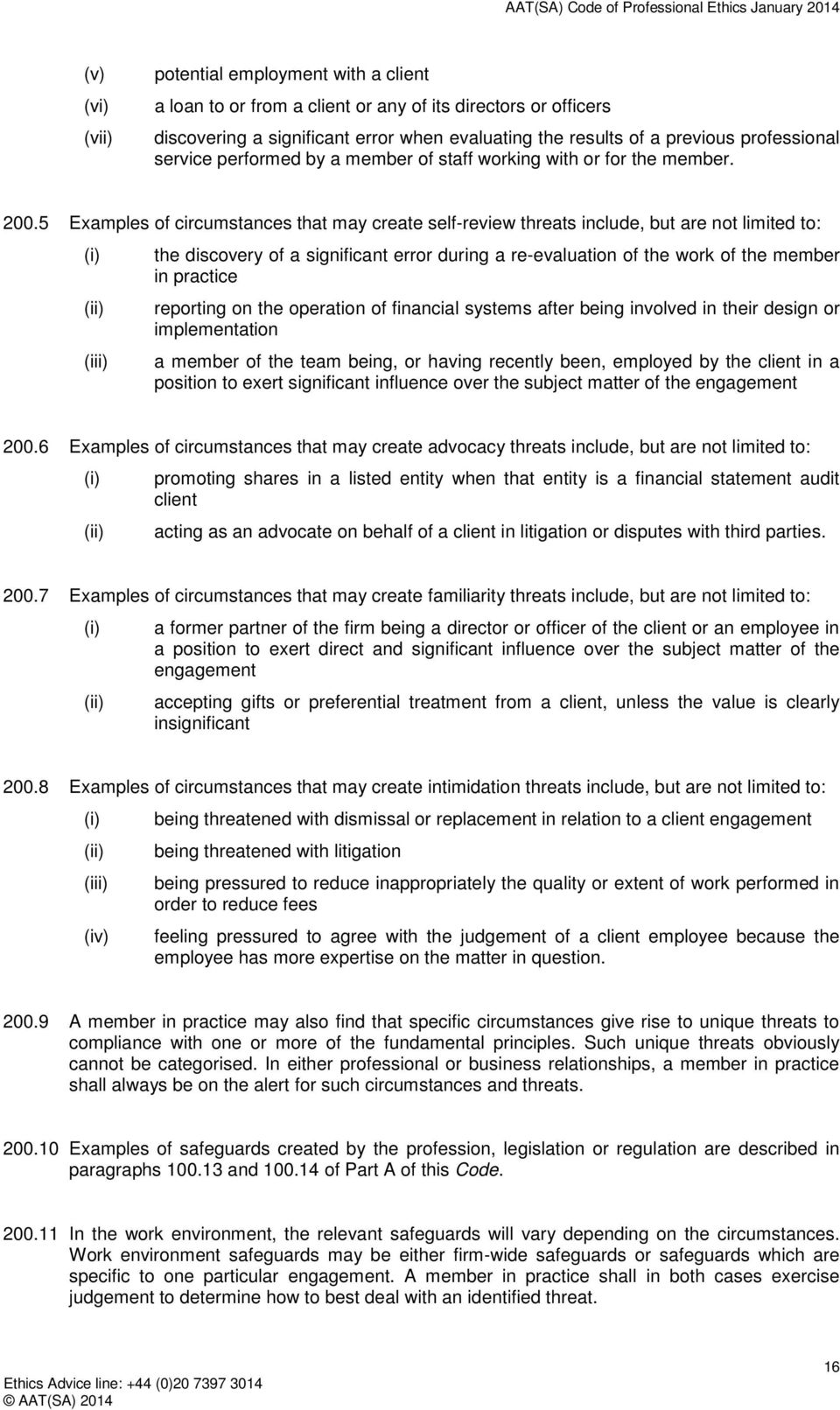
17 Firm-wide safeguards in the work environment may include: (iv) (v) (vi) (vii) (viii) (ix) (x) (xi) (xii) leadership of the firm that stresses the importance of compliance with the fundamental principles a leadership culture within the firm that establishes the expectation that members will act in the public interest policies and procedures to implement and monitor quality control of engagements documented policies regarding the identification of threats to compliance with the fundamental principles, the evaluation of the significance of these threats and the identification and the application of safeguards to eliminate or reduce the threats, other than those that are clearly insignificant, to an acceptable level or when appropriate safeguards are not available or cannot be applied, terminate or decline the relevant engagement documented internal policies and procedures requiring compliance with the fundamental principles policies and procedures that will enable the identification of interests or relationships between the firm or members of engagement teams and clients policies and procedures to monitor and, if necessary, manage the reliance on revenue received from a single client policies and procedures to prohibit individuals who are not members of an engagement team from inappropriately influencing the outcome of the engagement timely communication of a firm s policies and procedures, including any changes to them, to all partners and professional staff, and appropriate training and education on such policies and procedures designating a member of senior management to be responsible for overseeing the adequate functioning of the firm s quality control system a disciplinary mechanism to promote compliance with policies and procedures published policies and procedures to encourage and empower staff to communicate to senior levels within the firm any issue relating to compliance with the fundamental principles that concerns them Engagement-specific safeguards in the work environment may include: involving an additional member to review the work done or otherwise advise as necessary consulting an independent third party, such as a committee of independent directors, a professional regulatory body or another member discussing ethical issues with those charged with governance of the client (iv) disclosing to those charged with governance of the client the nature of services provided and extent of fees charged (v) involving another firm to perform or re-perform part of the engagement Depending on the nature of the engagement, a member in practice may also be able to rely on safeguards that the client has implemented. However, it is not possible to rely solely on such safeguards to reduce threats to an acceptable level Safeguards within the client s systems and procedures may include: 17
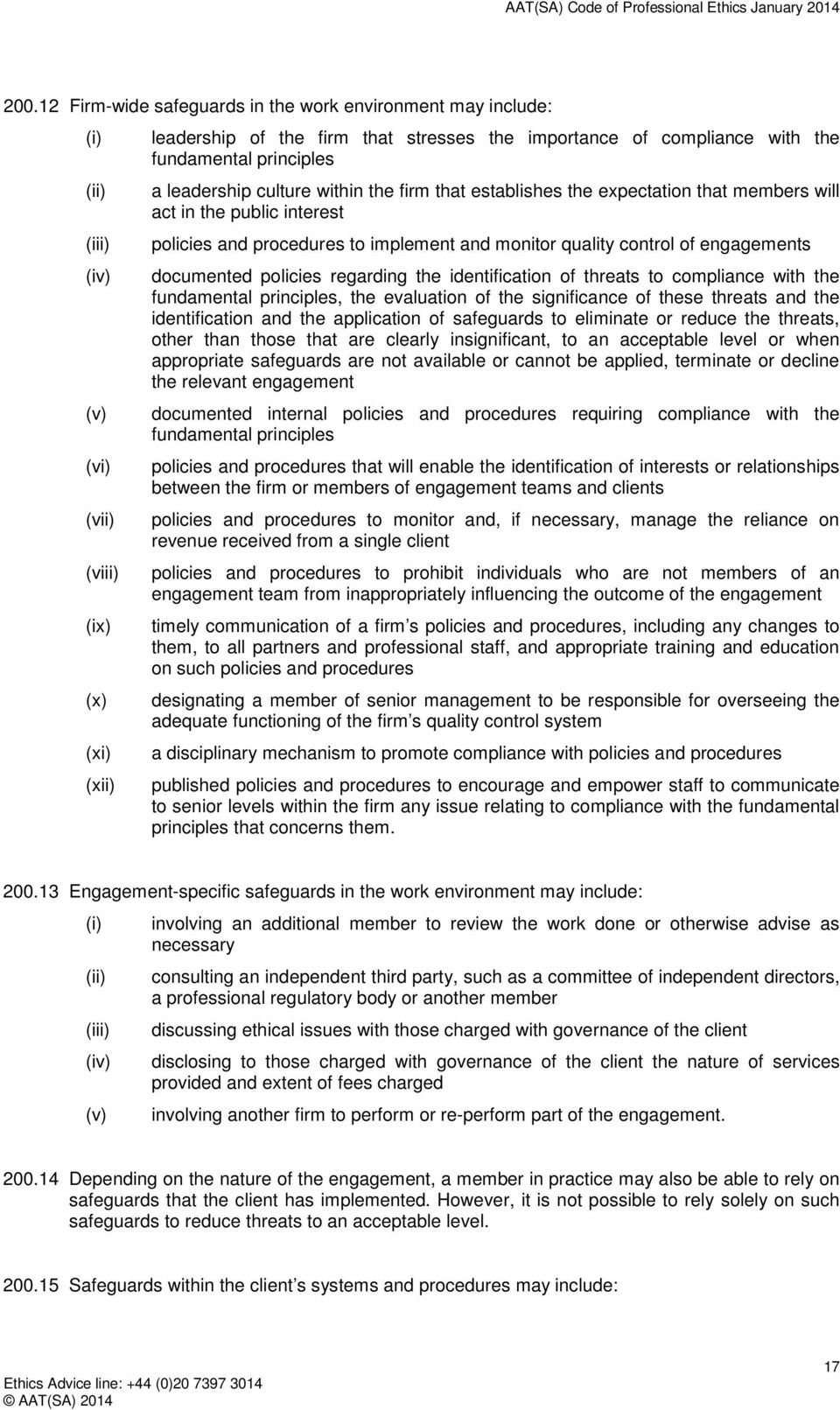
18 (iv) when a client appoints a member in practice or a firm to perform an engagement, where appropriate persons other than management ratify or approve the appointment the client has competent employees with experience and seniority to make managerial decisions the client has implemented internal procedures that ensure objective choices in commissioning services the client has a corporate governance structure that provides appropriate oversight and communications regarding the firm s services. Section 210 Professional appointment Client acceptance Before accepting a new client relationship, a member in practice shall determine whether acceptance would create any threats to compliance with the fundamental principles. Potential threats may be created by the characteristics and character of the client, or the nature of the client s business. Examples of such threats include: the client s involvement in illegal activities (such as money laundering) dishonesty questionable financial reporting practices A member in practice shall evaluate the significance of any threats and if they are not clearly insignificant, safeguards shall be determined and applied as necessary to eliminate them or reduce them to an acceptable level. Examples of safeguards include: obtaining knowledge and understanding of the client, its owners, managers and those responsible for its governance and business activities securing the client s commitment to improve corporate governance practices or internal controls ensuring that any concerns are addressed by way of a letter of engagement Where it is not possible to reduce the threats to an acceptable level, a member in practice shall decline to enter into the client relationship It is recommended that a professional accountant in public practice periodically reviews acceptance decisions for recurring client engagements. Engagement acceptance A member in practice shall agree to provide only those services that the member in practice is competent to perform. Before accepting a specific client engagement, a member in practice shall consider whether acceptance would create any threats to compliance with the fundamental principles. For example, a self-interest threat to professional competence and due 18

19 care is created if the engagement team does not possess, or cannot acquire, the competencies necessary to properly carry out the engagement A member in practice shall evaluate the significance of identified threats and, if they are not clearly insignificant, safeguards shall be applied as necessary to eliminate them or reduce them to an acceptable level. Such safeguards may include: acquiring an appropriate understanding of the nature of the client s business, the complexity of its operations, the specific requirements of the engagement and the purpose, nature and scope of the work to be performed acquiring knowledge of relevant industries or subject matters possessing or obtaining experience with relevant regulatory or reporting requirements (iv) (v) (vi) (vii) assigning sufficient staff with the necessary competencies using experts where necessary agreeing on a realistic time frame for the performance of the engagement complying with quality control policies and procedures designed to provide reasonable assurance that specific engagements are accepted only when they can be performed competently When a member in practice intends to rely on the advice or work of an expert, the member in practice shall determine whether such reliance is warranted. The member in practice shall consider factors such as reputation, expertise, resources available and applicable professional and ethical standards. Such information may be gained from prior association with the expert or from consulting others. Changes in a professional appointment A member in practice who is asked to replace an existing accountant, or who is considering tendering for an engagement currently held by an existing accountant, shall determine whether there are any reasons, professional or other, for not accepting the engagement, such as circumstances that threaten compliance with the fundamental principles. For example, there may be a threat to professional competence and due care if a member in practice accepts the engagement before knowing all the pertinent facts A member in practice shall evaluate the significance of the threats. Depending on the nature of the engagement, this may require direct communication with the existing accountant to establish the facts and circumstances behind the proposed change so that the member in practice can decide whether it would be appropriate to accept the engagement. For example, the apparent reasons for the change in appointment may not fully reflect the facts and may indicate disagreements with the existing accountant that may influence the decision as to whether or not to accept the appointment. If the identified threats are not clearly insignificant, safeguards must be considered and applied as necessary to eliminate them or reduce them to an acceptable level Such safeguards may include: when replying to requests to submit tenders, stating in the tender that, before accepting the engagement, contact with the existing accountant will be requested so that enquiries may be made as to whether there are any professional or other reasons why the appointment should not be accepted 19

20 asking the existing accountant to provide known information on any facts or circumstances, that, in the existing accountant s opinion, the proposed accountant should be aware of before deciding whether or not to accept the engagement obtaining necessary information from other sources If the proposed accountant is unable to communicate with the existing accountant, the proposed accountant should try to obtain information about any possible threats by other means such as through enquiries of third parties or background investigations on senior management or those charged with governance of the client A member in practice may be asked to undertake work that is complementary or additional to the work of an existing accountant. Such circumstances may create threats to professional competence and due care resulting from, for example, a lack of or incomplete information. In this circumstance a member in practice shall evaluate the significance of any such risks and safeguards applied when necessary to eliminate the threat or reduce it to an acceptable level. An example of a safeguard in this circumstance would be to notify the existing accountant of the proposed work which would give the existing accountant the opportunity to provide any relevant information needed for the proper conduct of the work An existing accountant is bound by confidentiality, subject to legal exceptions. The extent to which the member in practice can, and should, as existing accountant, discuss the affairs of a client with a proposed accountant will depend on the nature of the engagement and on: whether the client s permission to do so has been obtained the legal or ethical requirements relating to such communications and disclosure, which may vary by jurisdiction In the absence of specific instructions by the client, an existing accountant should not ordinarily volunteer information about the client s affairs. Circumstances where it may be appropriate to disclose confidential information are set out in Section 140 of Part A of this Code Where the threats cannot be eliminated or reduced to an acceptable level through the application of safeguards, a member in practice shall, unless there is satisfaction as to necessary facts by other means, decline the engagement. Section 220 Conflicts of interest A member in practice may be faced with a conflict of interest when performing a professional service. A conflict of interest creates a threat to objectivity and may create threats to the other fundamental principles. Such threats may be created when: the member in practice provides a professional service related to a particular matter for two or more clients whose interests with respect to that matter are in conflict or the interests of the member in practice with respect to a particular matter and the interests of the client for whom the member in practice provides a professional service related to that matter are in conflict. A member in practice shall not allow a conflict of interest to compromise professional or business judgement Examples of situations in which conflicts of interest may arise include: 20

21 (iv) (v) (vi) (vii) (viii) (ix) advising two clients at the same time who are competing to acquire the same company where the advice might be relevant to the parties competitive positions providing services to both a vendor and a purchaser in relation to the same transaction preparing valuations of assets for two parties who are in an adversarial position with respect to the assets representing two clients regarding the same matter who are in legal dispute with each other, such as during divorce proceedings or the dissolution of a partnership providing an assurance report for a licensor on royalties due under a licence agreement when at the same time advising the licensee of the correctness of the amount payable advising a client to invest in a business in which, for example, the spouse of the member in practice has a financial interest providing strategic advice to a client on its competitive position while having a joint venture or similar interest with a major competitor of the client advising a client on the acquisition of a business which the firm is also interested in acquiring advising a client on the purchase of a product or service while having a royalty or commission agreement with one of the potential vendors of that product or service When identifying and evaluating the interests and relationships that might create a conflict of interest and implementing safeguards, when necessary, to eliminate or reduce any threat to compliance with the fundamental principles to an acceptable level, a member in practice shall exercise professional judgement and take into account whether a reasonable and informed third party, weighing all the specific facts and circumstances available to the member in practice at the time, would be likely to conclude that compliance with the fundamental principles is not compromised When addressing conflicts of interest, including making disclosures or sharing information within the firm or network and seeking guidance of third parties, the member in practice shall remain alert to the fundamental principle of confidentiality If the threat created by a conflict of interest is not at an acceptable level, the member in practice shall apply safeguards to eliminate the threat or reduce it to an acceptable level. If safeguards cannot reduce the threat to an acceptable level, the member in practice shall decline to perform or discontinue professional services that would result in the conflict of interest, or shall terminate relevant relationships or dispose of relevant interests to eliminate the threat or reduce it to an acceptable level Before accepting a new client relationship, engagement, or business relationship, a member in practice shall take reasonable steps to identify circumstances that might create a conflict of interest, including identification of: the nature of relevant interests and relationships between the parties involved and the nature of the service and its implications for relevant parties. The nature of the services and the relevant interests and relationships may change during the course of the engagement. This is particularly true when a member in practice is asked to conduct an engagement in a situation that may become adversarial, even though the parties who engage the member may not initially be involved in a dispute. The member in practice shall remain alert to such changes for the purpose of identifying circumstances that might create a conflict of interest. 21
22 220.7 For the purpose of identifying interests and relationships that might create a conflict of interest, having an effective conflict identification process assists a member in practice to identify actual or potential conflicts of interest prior to determining whether to accept an engagement and throughout an engagement. This includes matters identified by external parties, for example, clients or potential clients. The earlier an actual or potential conflict of interest is identified, the greater the likelihood of the member being able to apply safeguards, when necessary, to eliminate the threat to objectivity and any threat to compliance with other fundamental principles or to reduce it to an acceptable level. The process of identifying an actual or potential conflict of interest will depend on factors such as: (iv) the nature of the professional services provided the size of the firm the size and nature of the client base the structure of the firm; for example, the number and geographic location of offices If the firm is a member of a network, conflict identification shall include any conflicts of interest that the member in practice has reason to believe may exist or might arise due to interests and relationships of a network firm. Reasonable steps to identify such interests and relationships involving a network firm will depend on factors such as the nature of the professional services provided, the clients served by the network and the geographic location of all relevant parties If a conflict of interest is identified, the member in practice shall evaluate: the significance of relevant interests or relationships and the significance of the threats created by performing the professional service or services. In general, the more direct the connection between the professional service and the matter on which the parties interests are in conflict, the more significant the threat to objectivity and compliance with the other fundamental principles The member in practice shall apply safeguards, when necessary, to eliminate the threats to compliance with the fundamental principles created by the conflict of interest or reduce them to an acceptable level. Examples of safeguards include: (iv) implementing mechanisms to prevent unauthorised disclosure of confidential information when performing professional services related to a particular matter for two or more clients whose interests with respect to that matter are in conflict. This could include: (a) (b) (c) using separate engagement teams who are provided with clear policies and procedures on maintaining confidentiality creating separate areas of practice for speciality functions within the firm, which may act as a barrier to the passing of confidential client information from one practice area to another within a firm establishing policies and procedures to limit access to client files, the use of confidentiality agreements signed by employees and partners of the firm and/or the physical and electronic separation of confidential information regular review of the application of safeguards by a senior individual not involved with the client engagement or engagements having a professional accountant who is not involved in providing the service or otherwise affected by the conflict review the work performed to assess whether the key judgements and conclusions are appropriate consulting with third parties, such as a professional body, legal advisers, or another professional accountant. 22
23 In addition, it is generally necessary to disclose the nature of the conflict of interest and the related safeguards, if any, to clients affected by the conflict and, when safeguards are required to reduce the threat to an acceptable level, to obtain their consent to the member in practice performing the professional services. Disclosure and consent may take different forms, for example: general disclosure to clients of circumstances where the member in practice, in keeping with common commercial practice, does not provide services exclusively for any one client (for example, in a particular service in a particular market sector) in order for the client to provide general consent accordingly. Such disclosure might, for example, be made in the member in practice s standard terms and conditions for the engagement, as drafted into the mandatory letter of engagement specific disclosure to affected clients of the circumstances of the particular conflict, including a detailed presentation of the situation and a comprehensive explanation of any planned safeguards and the risks involved, sufficient to enable the client to make an informed decision with respect to the matter and to provide explicit consent accordingly in certain circumstances, consent may be implied by the client s conduct where the member in practice has sufficient evidence to conclude that clients know the circumstances at the outset and have accepted the conflict of interest if they do not raise an objection to the existence of the conflict. The member in practice shall determine whether the nature and significance of the conflict of interest is such that specific disclosure and explicit consent is necessary. For this purpose, the professional accountant shall exercise professional judgement in weighing the outcome of the evaluation of the circumstances that create a conflict of interest, including the parties that might be affected, the nature of the issues that might arise and the potential for the particular matter to develop in an unexpected manner Where a member in practice has requested explicit consent from a client and that consent has been refused by the client, the member in practice shall decline to perform or shall discontinue professional services that would result in the conflict of interest, or shall terminate relevant relationships or dispose of relevant interests to eliminate the threat or reduce it to an acceptable level, such that consent can be obtained, after applying any relevant safeguards if necessary When disclosure is verbal, or consent is verbal or implied, the member in practice is encouraged to document the nature of the circumstances giving rise to the conflict of interest, the safeguards applied to reduce the threats to an acceptable level and the consent obtained In certain circumstances, making specific disclosure for the purpose of obtaining explicit consent would result in a breach of confidentiality. Examples of such circumstances may include: performing a transaction-related service for a client in connection with a hostile takeover of another client of the firm performing a forensic investigation for a client in connection with a suspected fraudulent act where the firm has confidential information obtained through having performed a professional service for another client who might be involved in the fraud. The firm shall not accept or continue an engagement under such circumstances unless the following conditions are met: 23
24 (iv) (v) the firm does not act in an advocacy role for one client where this requires the firm to assume an adversarial position against the other client with respect to the same matter specific mechanisms are in place to prevent disclosure of confidential information between the engagement teams serving the two clients and the firm is satisfied that a reasonable and informed third party, weighing all the specific facts and circumstances available to the member in practice at the time, would be likely to conclude that it is appropriate for the firm to accept or continue the engagement because a restriction on the firm s ability to provide the service would produce a disproportionate adverse outcome for the client or other relevant third parties. The member in practice shall document the nature of the circumstances, including the role that the member in practice is to undertake, the specific mechanisms in place to prevent disclosure of information between the engagement teams serving the two clients and the rationale for the conclusion that it is appropriate to accept the engagement. Section 230 Second opinions A member in practice may be asked to provide a second opinion on the application of accounting, auditing, reporting or other standards or principles to specific circumstances or transactions by or on behalf of a company or an entity that is not an existing client. This may give rise to threats to compliance with the fundamental principles. For example, there may be a threat to professional competence and due care in circumstances where the second opinion is not based on the same set of facts that were made available to the existing accountant, or is based on inadequate evidence. The significance of the threat will depend on the circumstances of the request and all the other available facts and assumptions relevant to the expression of a professional judgement When asked to provide such an opinion, a member in practice shall evaluate the significance of the threats. Unless they are clearly insignificant, safeguards must be considered and applied as necessary to eliminate them or reduce them to an acceptable level. Such safeguards may include seeking client permission to contact the existing accountant, describing the limitations surrounding any opinion in communications with the client and providing the existing accountant with a copy of the opinion If the company or entity seeking the opinion will not permit communication with the existing accountant, a member in practice shall determine whether it is appropriate to provide the opinion sought, taking all the circumstances into account. Section 240 Fees and other types of remuneration When entering into negotiations regarding professional services, a member in practice may quote whatever fee is deemed to be appropriate. The fact that one member in practice or member of another IFAC member body may quote a fee lower than another is not in itself unethical. Nevertheless, there may be threats to compliance with the fundamental principles arising from the level of fees quoted. For example, a self-interest threat to professional competence and due care is created if the fee quoted is so low that it may be difficult to perform the engagement in accordance with applicable technical and professional standards for that price. 24
25 240.2 The existence and significance of such threats will depend on factors such as the level of fee quoted and the services to which it applies. In view of these potential threats, safeguards shall be considered and applied as necessary to eliminate them or reduce them to an acceptable level. Safeguards which may be adopted include: making the client aware of the terms of the engagement and, in particular, the basis on which fees are charged and which services are covered by the quoted fee assigning appropriate time and qualified staff to the task Contingent fees are widely used for certain types of non-assurance engagements. They may, however, give rise to threats to compliance with the fundamental principles in certain circumstances. They may also give rise to a self-interest threat to objectivity. The significance of such threats will depend on factors including: the nature of the engagement the range of possible fee amounts the basis for determining the fee (iv) whether the outcome or result of the transaction is to be reviewed by an independent third party A member in practice in South Africa shall not complete tax returns on the basis of a contingent fee agreement A member in practice shall evaluate the significance of such threats and, if they are not clearly insignificant, safeguards must be considered and applied as necessary to eliminate or reduce them to an acceptable level. Such safeguards may include: an advance written agreement with the client as to the basis of remuneration disclosure to intended users of the work performed by the member in practice and the basis of remuneration quality control policies and procedures (iv) review by an objective third party of the work performed by the member in practice. Commission In certain circumstances, a member in practice may receive a referral fee or commission relating to a client. For example, where the member in practice does not provide the specific service required, a fee may be received for referring a continuing client to another member in practice or member of another IFAC member body or other expert. A member in practice may receive a commission from a third party (for example, a software vendor) in connection with the sale of goods or services to a client A member who receives a commission or other reward in return for the introduction of a client should be aware that if such an introduction is made in the course of a fiduciary relationship with the client, the member will be accountable for the commission or reward to the client. That means that the member will, be bound to pass over the commission or reward to the client, unless the latter, having been informed of the nature and amount of the commission or reward, agrees that the member can keep it. 25
26 240.8 Accepting such a referral fee or commission may give rise to self-interest threats to objectivity and professional competence and due care A member in practice may also pay a referral fee to obtain a client, for example, where the client continues as a client of another member in practice or member of another IFAC member body but requires specialist services not offered by the existing accountant. The payment of such a referral fee may also create a self-interest threat to objectivity and professional competence and due care A member in practice shall not pay or receive a referral fee or commission, unless the member in practice has established safeguards to eliminate the threats or reduce them to an acceptable level. Such safeguards may include: disclosing to the client any arrangements to pay a referral fee to another member in practice or member of another IFAC member body for the work referred disclosing to the client any arrangements to receive a referral fee for referring the client to another member in practice obtaining advance agreement from the client for commission arrangements in connection with the sale by a third party of goods or services to the client A member in practice may purchase all or part of another firm on the basis that payments will be made to individuals formerly owning the firm or to their heirs or estates. Such payments are not regarded as commissions or referral fees for the purpose of paragraphs above. Section 250 Marketing professional services When a member in practice solicits new work through advertising or other forms of marketing, there may be potential threats to compliance with the fundamental principles. For example, a self-interest threat to compliance with the principle of professional behaviour is created if services, achievements or products are marketed in a way that is inconsistent with that principle A member in practice shall not bring the profession into disrepute when marketing professional services. The member in practice shall be honest and truthful and should not: make exaggerated claims for services offered, qualifications possessed or experience gained, including being unclear on the membership level of the member or making use of the AAT(SA) designations not yet achieved. make disparaging references or unsubstantiated comparisons to the work of another member. If the member in practice is in doubt about whether a proposed form of advertising or marketing is appropriate, the member in practice shall consult with AAT(SA). Further advice and guidance on acceptable practise is detailed in section 440. Section 260 Gifts and hospitality A member in practice, or a close or personal relation, may be offered gifts and hospitality from a client. Such an offer ordinarily gives rise to threats to compliance with the fundamental principles. For example, self-interest threats to objectivity may be created if a gift from a client 26
27 is accepted; intimidation threats to objectivity may result from the possibility of such offers being made public The existence and significance of such threats will depend on the nature, value and intent behind the offer. Where gifts or hospitality which a reasonable and informed third party, having knowledge of all relevant information, would consider clearly insignificant are made, a member in practice may conclude that the offer is made in the normal course of business without the specific intent to influence decision-making or to obtain information. In such cases, the member in practice may generally conclude that there is no significant threat to compliance with the fundamental principles If evaluated threats are not clearly insignificant, safeguards must be considered and applied as necessary to eliminate them or reduce them to an acceptable level. When the threats cannot be eliminated or reduced to an acceptable level through the application of safeguards, a member in practice shall not accept such an offer. Section 270 Custody of client assets A member in practice shall not assume custody of client monies or other assets unless permitted to do so by law and, if so, in compliance with any additional legal duties imposed on a member in practice holding such assets The holding of client assets creates threats to compliance with the fundamental principles; for example, there is a self-interest threat to professional behaviour and there may be a selfinterest threat to objectivity arising from holding client assets. To safeguard against such threats, a member in practice entrusted with money (or other assets) belonging to others should: keep such assets separately from their personal or firm s assets use such assets only for the purpose for which they are intended at all times, be ready to account for those assets, and any income, dividends or gains generated, to any persons entitled to such accounting (iv) comply with all relevant laws and regulations relevant to the holding of and accounting for such assets In addition, members in practice should be aware of threats to compliance with the fundamental principles through association with such assets; for example, if the assets were found to derive from illegal activities, and as a result put the member at risk of laundering the proceeds of crime. Section 280 Objectivity all services A member in practice shall consider, when providing any professional service, whether there are threats to compliance with the fundamental principle of objectivity resulting from having interests in, or relationships with, a client or directors, officers or employees of a client. For example, a familiarity threat to objectivity may be created from a close personal or business relationship. 27
28 280.2 The existence of threats to objectivity when providing any professional service will depend upon the particular circumstances of the engagement and the nature of the work that the member in practice is performing A member in practice shall evaluate the significance of identified threats and, if they are not clearly insignificant, safeguards must be considered and applied as necessary to eliminate them or reduce them to an acceptable level. Such safeguards may include: withdrawing from the engagement team supervisory procedures terminating the financial or business relationship giving rise to the threat (iv) discussing the issue with higher levels of management within the firm (v) discussing the issue with those charged with governance of the client. If safeguards cannot eliminate or reduce the threat to an acceptable level, a member in practice shall decline or terminate the relevant engagement. 28
29 Part C: Members in business Section 300 Introduction Section 310 Conflicts of interest Section 320 Preparation and reporting of information Section 330 Acting with sufficient expertise Section 340 Financial interests, compensation and incentives linked to financial reporting and decision-making Section 350 Inducements Section 300 Introduction This part of the Code illustrates how the conceptual framework contained in Part A is to be applied in specific situations relevant to members in business. It should be read in conjunction with the general guidance in Part A Investors, creditors, employers and other sectors of the business community, as well as governments and the public at large, all may rely on the work of members in business. Members in business may be solely or jointly responsible for the preparation and reporting of financial and other information, which both their employing organisations and third parties may rely on. They may also be responsible for providing effective financial management and competent advice on a variety of business-related matters A member in business may be, for example, a salaried employee, a partner, director (whether executive or non-executive), an owner-manager, a volunteer or another working for one or more employing organisations. The legal form of the relationship between the member in business and the employing organisation has no bearing on the responsibility of the member to comply with the fundamental principles laid out in this Code A member in business has a responsibility to further the legitimate aims of their employing organisation. This Code does not seek to hinder a member in business from properly fulfilling that responsibility but to consider circumstances in which conflicts may be created with the duty to comply with the fundamental principles A member in business may hold a senior position within an organisation. The more senior the position, the greater will be the ability and opportunity to influence events, practices and attitudes. A member in business is expected, therefore, to encourage an ethics-based culture in an employing organisation that emphasises the importance that senior management places on ethical behaviour A member in business shall not knowingly engage in any business, occupation or activity that impairs or might impair integrity, objectivity or the good reputation of the profession and as a result would be incompatible with the fundamental principles. 29
30 300.7 The examples presented in the following sections are intended to illustrate how the conceptual framework is to be applied and are not intended to be, nor should they be interpreted as, an exhaustive list of all circumstances experienced by a member in business that may create threats to compliance with the principles. Consequently, it is not sufficient for a member in business merely to comply with the examples; rather, the framework must be applied to the particular circumstances faced. Threats and safeguards Examples of circumstances that may create self-interest threats for a member in business include, but are not limited to: financial interests, loans or guarantees receipt of incentive compensation arrangements inappropriate personal use of corporate assets (iv) concern over employment security (v) commercial pressure from outside the employing organisation (vi) commissions Circumstances that may create self-review threats include, but are not limited to, business decisions or data being subject to review and justification by the same member in business responsible for making those decisions or preparing that data When furthering the legitimate goals and objectives of their employing organisations, members in business may promote the organisation s position, provided any statements made are neither false nor misleading. Such actions generally would not create an advocacy threat Examples of circumstances that may create familiarity threats include, but are not limited to: being responsible for the employing organisation s financial reporting when an immediate or close family member employed by the entity makes decisions that affect the entity s financial reporting long association with business contacts influencing business decisions acceptance of a gift or preferential treatment, unless the value is clearly insignificant Examples of circumstances that may create intimidation threats include, but are not limited to: threat of dismissal or replacement of the member in business or their close or personal relation or associate over a disagreement about the application of an accounting principle or the way in which financial information is to be reported a dominant personality attempting to influence the decision-making process, for example, with regard to the awarding of contracts or the application of an accounting principle Members in business may also find that specific circumstances give rise to unique threats to compliance with one or more of the fundamental principles. Such unique threats obviously cannot be categorised. In all professional and business relationships, members in business shall always be on the alert for such circumstances and threats. 30
31 Examples of safeguards created by the profession, legislation or regulation are detailed in paragraphs and (regarding Safeguards created by the profession, legislation or regulation ) Safeguards in the work environment include, but are not restricted to: the employing organisation s systems of corporate oversight or other oversight structures the employing organisation s ethics and conduct programmes recruitment procedures in the employing organisation emphasising the importance of employing high calibre competent staff (iv) strong internal controls (v) appropriate disciplinary processes (vi) leadership that stresses the importance of ethical behaviour and the expectation that employees will act in an ethical manner (vii) policies and procedures to implement and monitor the quality of employee performance (viii) timely communication of the employing organisation s policies and procedures, including any changes to them, to all employees and appropriate training and education on such policies and procedures (ix) policies and procedures to empower and encourage employees to communicate to senior levels within the employing organisation any ethical issues that concern them without fear of retribution (x) consultation with another appropriate professional There may be circumstances where a member in business believes that unethical behaviour or actions by others or by him or herself cannot be avoided or will continue to occur within the employing organisation. In such circumstances, the member in business shall consider seeking legal advice. In those extreme situations where all available safeguards have been exhausted and it is not possible to reduce the threat to an acceptable level, a member in business may conclude that it is appropriate to resign from the employing organisation. Section 310 Conflicts of interest A member in business may be faced with a conflict of interest when undertaking a professional activity. A conflict of interest creates a threat to objectivity and may create threats to the other fundamental principles. Such threats may be created when: the member undertakes a professional activity related to a particular matter for two or more parties whose interests in respect of that matter are in conflict or the interests of the member with respect to a particular matter and the interests of a party for whom the member undertakes a professional activity related to that matter are in conflict. A party may include an employing organisation, a vendor, a customer, a lender, a shareholder or another party. A member shall not allow a conflict of interest to compromise professional or business judgement Examples of situations in which conflicts of interest may arise include: 31
32 (iv) (v) serving in a management or governance position for two employing organisations and acquiring confidential information from one employing organisation that could be used by the member to the advantage or disadvantage of the other employing organisation undertaking a professional activity for each of two parties in a partnership employing the member to assist them to dissolve their partnership preparing financial information for certain members of management of the entity employing the member who are seeking to undertake a management buy-out being responsible for selecting a vendor for the member s employing organisation when an immediate family member of the member could benefit financially from the transaction serving in a governance capacity in an employing organisation that is approving certain investments for the company where one of those specific investments will increase the value of the personal investment portfolio of the member or an immediate family member When identifying and evaluating the interests and relationships that might create a conflict of interest and implementing safeguards, when necessary, to eliminate or reduce any threat to compliance with the fundamental principles to an acceptable level, a member in business shall exercise professional judgement and be alert to all interests and relationships that a reasonable and informed third party, weighing all the specific facts and circumstances available to the member at the time, would be likely to conclude might compromise compliance with the fundamental principles When addressing a conflict of interest, a member in business is encouraged to seek guidance from within the employing organisation or from others, such as a professional body, legal counsel or another professional accountant. When making disclosures or sharing information within the employing organisation and seeking guidance of third parties, the member shall remain alert to the fundamental principle of confidentiality If the threat created by a conflict of interest is not at an acceptable level, the member in business shall apply safeguards to eliminate the threat or reduce it to an acceptable level. If safeguards cannot reduce the threat to an acceptable level, the member shall decline to undertake, or discontinue the professional activity that would result in the conflict of interest, or shall terminate the relevant relationships or dispose of relevant interests to eliminate the threat or reduce it to an acceptable level In identifying whether a conflict of interest exists or may be created, a member in business shall take reasonable steps to determine: the nature of the relevant interests and relationships between the parties involved and the nature of the activity and its implications for relevant parties. The nature of the activities and the relevant interests and relationships may change over time. The member shall remain alert to such changes for the purposes of identifying circumstances that might create a conflict of interest If a conflict of interest is identified, the member in business shall evaluate: the significance of relevant interests or relationships and the significance of the threats created by undertaking the professional activity or activities. In general, the more direct the connection between the professional activity 32
33 and the matter on which the parties interests are in conflict, the more significant the threat to objectivity and compliance with the other fundamental principles The member in business shall apply safeguards, when necessary, to eliminate the threats to compliance with the fundamental principles created by the conflict of interest or reduce them to an acceptable level. Depending on the circumstances giving rise to the conflict of interest, application of one or more of the following safeguards may be appropriate: (iv) restructuring or segregating certain responsibilities and duties obtaining appropriate oversight; for example, acting under the supervision of an executive or non-executive director withdrawing from the decision-making process related to the matter giving rise to the conflict of interest consulting with third parties, such as a professional body, legal counsel or another professional accountant In addition, it is generally necessary to disclose the nature of the conflict to the relevant parties, including to the appropriate levels within the employing organisation and, when safeguards are required to reduce the threat to an acceptable level, to obtain their consent to the member in business undertaking the professional activity. In certain circumstances, consent may be implied by a party s conduct where the member has sufficient evidence to conclude that parties know the circumstances at the outset and have accepted the conflict of interest if they do not raise an objection to the existence of the conflict When disclosure is verbal, or consent is verbal or implied, the member in business is encouraged to document the nature of the circumstances giving rise to the conflict of interest, the safeguards applied to reduce the threats to an acceptable level and the consent obtained A member in business may encounter other threats to compliance with the fundamental principles. This may occur, for example, when preparing or reporting financial information as a result of undue pressure from others within the employing organisation or financial, business or personal relationships that close or immediate family members of the member have with the employing organisation. Guidance on managing such threats is covered by Sections 320 and 340 of the Code. Section 320 Preparation and reporting of information Members in business are often involved in the preparation and reporting of information that may either be made public or used by others inside or outside the employing organisation. Such information may include financial or management information; for example, forecasts and budgets, financial statements, management discussion and analysis and the management letter of representation provided to the auditors as part of an audit of financial statements. A member in business shall prepare or present such information fairly, honestly and in accordance with relevant professional standards so that the information will be understood in its context A member in business who has responsibility for the preparation or approval of the general purpose financial statements of an employing organisation shall be satisfied that those financial statements are presented in accordance with the applicable financial reporting standards. 33
34 320.3 A member in business shall take reasonable steps to maintain information for which the member in business is responsible in a manner that: describes clearly the true nature of business transactions, assets or liabilities classifies and records information accurately and in a timely and proper manner and represents the facts accurately and completely in all material respects Threats to compliance with the fundamental principles, for example self-interest or intimidation threats to integrity, objectivity or professional competence and due care, are created where a member in business is pressured (either externally or by the possibility of personal gain) to prepare or report information in a misleading way or to become associated with misleading information through the actions of others The significance of such threats will depend on factors such as the source of the pressure and the corporate culture of the organisation. The member in business shall be alert to the principle of integrity, which imposes an obligation on all members to be straightforward and honest in all professional and business relationships. Where the threats arise from compensation and incentive arrangements, the guidance in Section 340 is relevant The significance of any threat shall be evaluated and safeguards applied when necessary to eliminate the threat or reduce it to an acceptable level. Such safeguards include consultation with superiors within the employing organisation, the audit committee or those charged with governance, or with a relevant professional body Where it is not possible to reduce the threat to an acceptable level, a member in business shall refuse to be or remain associated with information that the member determines is misleading. A member in business may have been unknowingly associated with misleading information. Upon becoming aware of this, the member in business shall take steps to be disassociated from that information. In determining whether there is a requirement to report the circumstances outside the organisation, the member in business may consider obtaining legal advice. In addition, the member in business may consider whether to resign. Section 330 Acting with sufficient expertise The fundamental principle of professional competence and due care requires that a member in business shall only undertake significant tasks for which the member in business has, or can obtain, sufficient specific training or experience. However, if the member in business has adequate support, usually in the form of supervision from an individual who has the necessary training and experience, then it may be possible to undertake appropriate significant tasks. A member in business shall not intentionally mislead an employer as to the level of expertise or experience possessed and a member in business shall seek appropriate expert advice and assistance when required Circumstances that create a threat to the member in business performing duties with the appropriate degree of professional competence and due care include: insufficient time for properly performing or completing the relevant duties incomplete, restricted or otherwise inadequate information for performing the duties properly insufficient experience, training and/or education (iv) inadequate resources for the proper performance of the duties. 34
35 330.3 The significance of such threats will depend on factors such as the extent to which the member in business is working with others, their relative seniority in the business and the level of supervision and review applied to the work. The member in business shall evaluate the significance of the threats and, if they are not clearly insignificant, shall consider and apply safeguards as necessary to eliminate them or reduce them to an acceptable level. Safeguards that may be considered include: (iv) obtaining additional advice or training ensuring that there is adequate time available for performing the relevant duties obtaining assistance from someone with the necessary expertise consulting, where appropriate, with: (a) (b) (c) superiors within the employing organisation independent experts the relevant professional body Where threats cannot be eliminated or reduced to an acceptable level, members in business shall determine whether to refuse to perform the duties in question. If the member in business determines that refusal is appropriate, the reasons for doing so shall be clearly communicated to the appropriate parties Before resigning, it is strongly recommended that members obtain appropriate legal advice. Section 340 Financial interests, compensation and incentives linked to financial reporting and decision-making Members in business may have financial interests, including those arising from compensation or incentive arrangements, or may know of financial interests of close or personal relations or associates, that, in certain circumstances, may create threats to compliance with the fundamental principles. For example, self-interest threats to objectivity or confidentiality may be created through the existence of the motive and opportunity to manipulate price sensitive information in order to gain financially. Examples of circumstances that may create self-interest threats include, but are not limited to, situations where the member in business or close or personal relation or associate: (iv) holds a direct or indirect financial interest in the employing organisation and the value of that financial interest could be directly affected by decisions made by the member in business is eligible for a profit-related bonus and the value of that bonus could be directly affected by decisions made by the member in business holds, directly or indirectly, deferred bonus share entitlements or share options in the employing organisation, the value of which could be directly affected by decisions made by the member in business otherwise participates in compensation arrangements which provide incentives to achieve performance targets or to support efforts to maximise the value of the employing organisation s shares, for example, through participation in long-term incentive plans which are linked to certain performance conditions being met Self-interest threats arising from compensation or incentive arrangements may be further compounded by pressure from superiors or peers in the employing organisation who 35
36 participate in the same arrangements. For example, such arrangements often entitle participants to be awarded shares in the employing organisation at little or no cost to the employee provided certain performance criteria are met. In some cases the value of the shares awarded may be significantly greater than the base salary of the member in business A member in business shall not manipulate information or use confidential information for personal gain or for the financial gain of others. The more senior the position that the member in business holds, the greater the ability and opportunity to influence financial reporting and decision-making and the greater the pressure there might be from superiors and peers to manipulate information. In such situations, the member in business shall be particularly alert to the principle of integrity, which imposes an obligation on all professional accountants to be straightforward and honest in all professional and business relationships In evaluating the significance of such a threat, and the appropriate safeguards to be applied to eliminate the threat or reduce it to an acceptable level, members in business shall evaluate the nature of the financial interest. This includes evaluating the significance of the financial interest and whether it is direct or indirect. Clearly, what constitutes a significant or valuable stake in an organisation will vary from individual to individual, depending on personal circumstances The significance of any threat created by financial interests shall be evaluated and safeguards applied, when necessary, to eliminate the threat or reduce it to an acceptable level. In evaluating the significance of any threat, and, when necessary, determining the appropriate safeguards to be applied, a member in business shall evaluate the nature of the interest. What constitutes a significant interest will depend upon personal circumstances. Examples of such safeguards include: (iv) (v) (vi) policies and procedures for a committee independent of management to determine the level or form of remuneration of senior management disclosure of all relevant interests, and of any plans to trade in relevant shares to those charged with the governance of the employing organisation, in accordance with any internal policies consultation, where appropriate, with superiors within the employing organisation consultation, where appropriate, with those charged with the governance of the employing organisation or relevant professional bodies internal and external audit procedures up to date education on ethical issues and the legal restrictions and other regulations around potential insider trading. Section 350 Inducements Receiving offers A member in business or their close or personal relation may be offered an inducement. Inducements may take various forms, including gifts, hospitality, preferential treatment and inappropriate appeals to friendship or loyalty Offers of inducements may create threats to compliance with the fundamental principles. When a member in business or an immediate or close family member is offered an inducement, the member in business shall evaluate the situation. Self-interest threats to objectivity or confidentiality are created where an inducement is made in an attempt to unduly influence 36
37 actions or decisions, encourage illegal or dishonest behaviour or obtain confidential information. Intimidation threats to objectivity or confidentiality are created if such an inducement is accepted and it is followed by threats to make that offer public and damage the reputation of either the member in business or their close or personal relation The existence and significance of such threats will depend on the nature, value and intent behind the offer. If a reasonable and informed third party, having knowledge of all relevant information, would consider the inducement insignificant and not intended to encourage unethical behaviour, then a member in business may conclude that the offer is made in the normal course of business and may generally conclude that there is no significant threat to compliance with the fundamental principles If evaluated threats are not clearly insignificant, safeguards shall be considered and applied as necessary to eliminate them or reduce them to an acceptable level. When the threats cannot be eliminated or reduced to an acceptable level through the application of safeguards, a member in business shall not accept the inducement. As the real or apparent threats to compliance with the fundamental principles do not merely arise from acceptance of an inducement but, sometimes, merely from the fact of the offer having been made, the member in practice shall adopt additional safeguards. A member in business shall assess the risk associated with all such offers and consider whether the following actions should be taken: (iv) where such offers have been made, immediately inform higher levels of management or those charged with governance of the employing organisation inform third parties of the offer for example, a professional body or the employer of the individual who made the offer; a member in business shall, however, consider seeking legal advice before taking such a step advise close or personal relations or associates of relevant threats and safeguards where they are potentially in positions that might result in offers of inducements, for example, as a result of their employment situation inform higher levels of management or those charged with governance of the employing organisation where close or personal relations are employed by competitors or potential suppliers of that organisation. The attention of members is drawn to the bribery and corruption legislation detailed in the Companies Act (71/2008). Making offers A member in business may be in a situation where the member in business is expected to, or is under other pressure to, offer inducements to influence the judgement of another individual or organisation, influence a decision-making process or obtain confidential information Such pressure may come from within the employing organisation, for example, from a colleague or superior. It may also come from an external individual or organisation suggesting actions or business decisions that would be advantageous to the employing organisation, possibly influencing the member in business improperly A member in business shall not offer an inducement to improperly influence the professional judgement of a third party. 37
38 350.8 Where the pressure to offer an unethical inducement comes from within the employing organisation, the member shall follow the principles and guidance regarding ethical conflict resolution set out in Part A of this Code. 38
39 PART D: MEMBERS IN SOUTH AFRICA The IFAC Code of Ethics for Professional Accountants establishes ethical requirements for members of member bodies. A member body may not apply less stringent standards than those stated in the IFAC Code. The IFAC Code recognizes that some jurisdictions may have requirements and guidance that differs from its Code, and this Part D of this Code contains those sections which the Board of AAT(SA) has adopted in addition to the IFAC Code. Members should therefore be aware of these differences and their need to comply with these more stringent requirements. Sections of general application Section 400 Joint and Vicarious Liability Section 410 Tax Practice Section 420 Discrimination Section 430 Cross Border Activities Section 440 Publicity, Advertising and Solicitation Section 450 Responsibilities to Colleagues Section 460 Recruiting Section 400 Joint and Vicarious liability A member may be held responsible for a breach of, or failure to comply with, this Code on the part of all persons who are (iv) (v) their employees; or under his supervision; or their partners; or fellow shareholders in, or directors or employees of, a company controlled by the member or the member and their partners and offering professional services to the public. (For purposes of this Code a company will be deemed to be controlled by members if members between them hold directly or indirectly, more than half of the voting rights attached to the shares of the company or directly or indirectly and either alone or together with anyone else are entitled to exercise the de facto right to control the manner in which the business of the company is carried on (including, but without limitation, the right to appoint the majority of the persons entitled to exercise control over its management and affairs)); or fellow members in or employees of a close corporation controlled by the member or the member and their partners and offering to do professional work to the public. (For purposes of this Code a close corporation will be deemed to be controlled by members if members between them hold an interest in the corporation which would entitle them to a majority vote at a meeting of members of the corporation, or would otherwise entitle them to exercise the de facto right to control the manner in which the business of the corporation is carried on.) A member may not, under the guise or through the medium of a partnership, company, close corporation or any other entity, do anything or allow anything to be done which they would not be permitted to do as an individual. 39
40 400.3 A member may not permit others to carry out on their behalf, either with or without remuneration, acts which, if carried out by themselves, would constitute a contravention of this Code. Section 410 Tax Taxation- personal affairs Members undertaking tax practice shall be compliant with taxation laws in respect of their personal affairs. Tax Practice A member rendering professional tax services is entitled to put forward the best position in favour of a client, or an employer, provided the service is rendered with professional competence, does not in any way impair integrity and objectivity, and is in the opinion of the member consistent with the law. Doubt may be resolved in favour of the client or the employer if there is reasonable support for the position A member should not hold out to a client or an employer the assurance that the tax return prepared and the tax advice offered are beyond challenge. Instead, the member should ensure that the client or the employer are aware of the limitations attaching to tax advice and services so that they do not misinterpret an expression of opinion as an assertion of fact A member who undertakes or assists in the preparation of a tax return should advise the client or the employer that the responsibility for the content of the return rests primarily with the client or employer. The member should take the necessary steps to ensure that the tax return is properly prepared on the basis of the information received Tax advice or opinions of material consequence given to a client or an employer should be recorded, either in the form of a letter or in a memorandum for the files A member should not be associated with any return or communication in which there is reason to believe that it: Contains a false or misleading statement; Contains statements or information furnished recklessly or without any real knowledge of whether they are true or false; or Omits or obscures information required to be submitted and such omission or obscurity would mislead the revenue authorities For the purpose of this section of this Code, "associated" has the following meaning: A member, or in the case of a practice, their practice is "associated" with a return or with a financial statement to be submitted with a return or with a submission on behalf of a client or employer when they have consented to the use of their or their practice's name in that return or statement or submission or when they have submitted to the taxation authorities, with or without a covering letter, a return or financial statement or submission which they or their practice has prepared or assisted in preparing. The fact that the return or financial statement or submission may be typed or otherwise reproduced on plain paper (as distinct from the member s or their practice's own stationery) or that the name of the member or their practice is not appended to them does not itself negate such association A member may prepare tax returns involving the use of estimates if such use is generally acceptable or if it is impractical under the circumstances to obtain exact data. When estimates are 40
41 used, they should be presented as such in a manner so as to avoid the implication of greater accuracy than exists. The member should be satisfied that estimated amounts are reasonable under the circumstances In preparing a tax return, a member ordinarily may rely on information furnished by the client or employer provided that the information appears reasonable. Although the examination or review of documents or other evidence in support of the information is not required, the member should encourage, when appropriate, such supporting data to be provided In addition, the member: should make use of the client's returns for prior years whenever feasible. is required to make reasonable inquiries when the information presented appears to be incorrect or incomplete. is encouraged to make reference to the books and records of the business operations When a member learns of a material error or omission in a tax return of a prior year (with which the member may or may not have been associated), or of the failure to file a required tax return, the member has a responsibility to promptly advise the client or employer of the error or omission and recommend that disclosure be made to the revenue authorities. The member is not obligated to inform the revenue authorities, nor may this be done without permission If the client or the employer does not correct the error the member: should inform the client or the employer that it is not possible to act for them in connection with that return or other related information submitted to the authorities; and should consider whether continued association with the client or employer in any capacity is consistent with professional responsibilities; and should refer to the section in this Code dealing with the resolution of ethical conflicts If the member concludes that a professional relationship with the client or employer can be continued, all reasonable steps should be taken to ensure that the error is not repeated in subsequent tax returns Members providing taxation services, and in particular completing tax returns shall not be remunerated on the basis of a contingent fee. Section 420 Discrimination A member should not practise discrimination against any person based on race, colour, religion, sex, marital status, age or origin in engagement, promotion, dismissal, salary, transfer, training or other practices relating to employment. Section 430 Cross Border Activities When considering the application of ethical requirements in cross border activities a number of situations may arise. Whether a member is a member of the profession in one country only or is also a member of the profession in the country where the services are performed should not affect the manner of dealing with each situation. 41
42 430.2 A member qualifying in one country may reside in another country or may be temporarily visiting that country to perform professional services. In all circumstances, the member should carry out professional services in accordance with the relevant technical standards and ethical requirements. The particular technical standards which should be followed are not dealt with in this section. In all other respects, however, the member should be guided by the ethical requirements set out below When a member performs services in a country other than the home country and differences on specific matters exist between ethical requirements of the two countries the following provisions should be applied: When the ethical requirements of the country in which the services are being performed are less strict than the IFAC Code of Ethics, then the IFAC Code of Ethics should be applied. When the ethical requirements of the country in which services are being performed are stricter than the IFAC Code of Ethics, then the ethical requirements in the country where services are being performed should be applied. Section 440 Publicity, Advertising and Solicitation Publicity and advertising Members in practice ordinarily offer a wide range of professional services and products. For their practices to be conducted in a business-like manner and to compete effectively with individuals and organisations offering similar services and products, it is necessary for the public to be informed of the services and products on offer Publicity and advertising by all members of all services and products is therefore permitted A member preparing or authorising the issue of material for the purpose of publicity, advertising, direct mailing or cold calling of their services and products should do so with a due sense of responsibility to the profession and to the public as a whole. In particular, such material should be aimed at informing the public in an objective manner and be in good taste both as to content and presentation. The medium used must be consistent with the dignity of the profession Advertisements should conform to the accepted norms of legality, decency, honesty and truthfulness A member will be personally responsible for ensuring that the provisions of this section are complied with, and that what is published about them or their firm complies with this Code. A member will also be personally responsible for ensuring that all publicity, advertising, direct mailing and cold calling is subject to the limitations and requirements of this Code. Good taste Judgement as to what may or may not constitute good taste can only be made in the context of the particular facts on which that judgement is exercised It is possible, however, to give some broad guidance and general examples as to what might, in appropriate circumstances, be regarded as not being in accordance with good taste. Thus material which tends to sensationalise or shock, or which is likely to give offence to religious beliefs, or is racist, is unacceptable. Other possible examples include the trivialisation of important issues, 42
43 excessive reliance on a particular personality or personalities, the deriding of public figures, disparagement of educational attainment and material which makes odious comparisons or is strident in tone, hectoring or extravagant. Furthermore, such material should not compare with nor belittle services offered by others, whether members or not, either by claiming superiority for the services of a particular member or otherwise and should not contain testimonials or endorsements. Advertisements Advertisements may refer to the basis on which professional fees for services are calculated but to state hourly or other charging rates could be misleading and is considered to be inconsistent with the dignity of the profession. Solicitation Direct mailing by all members, pertaining to any services and products, is permitted A member may not continue to address direct mail material, for the purpose of offering to perform professional work, to a recipient who has asked them to desist Cold calling by members not in practice in respect of all services and products is permitted Cold calling by members in practice for professional work is not permitted. Section 450 Responsibilities to colleagues A member should conduct themselves in a manner which will promote co-operation and good relations between members and within the profession The support of a profession by its members and their co-operation with one another are essential elements of professional character. The public confidence and respect which a member enjoys is largely the result of the cumulative accomplishments of all members, past and present. It is, therefore, in the member s own interest as well as that of the general public, to support the collective efforts of colleagues through professional societies and organisations and to deal with fellow practitioners in a manner that will not detract from their reputation and well-being While this Code prescribes certain specific actions in the area of relationships with colleagues, it should be understood that these prescriptions do not define the limits of desirable intra-professional conduct. Such conduct should encompass the professional consideration and courtesies which member would like to have fellow members extend to them A member should assist their fellow members in complying with this Code and should co-operate with the appropriate disciplinary authorities in applying this Code. To condone serious fault can be as bad as to commit it. It may be even worse, in fact, since some errors may result from ignorance rather than intent and, if let pass without action, will probably be repeated. In situations of this kind the welfare of the profession as a whole should be the guide to a member s action Although the reluctance of a professional to give testimony that may be damaging to a colleague is understandable, the obligation of professional courtesy and fraternal consideration can never excuse lack of complete candour if the member is testifying as an expert witness in a judicial proceeding or properly constituted enquiry A member should not irresponsibly criticise another member. 43
44 450.7 It is natural that a member in practice will seek to develop their practice. However, in doing so they should not seek to displace another member in a client relationship by means which will lessen the effectiveness of technical performance, and in particular the integrity and objectivity of audit opinions or impinge upon the rights of third parties to reliable information. Further, a member should not act in any way that reflects negatively on fellow members A member should extend the same professional considerations and courtesies to any non-member with whom they may have a professional relationship, as set out in paragraph.1. They should also follow the same procedures of conduct as they would with a member where there is a change in appointment, as set out in Section 210. Section 460 Recruiting Educational institutions A member may offer bursaries and prizes for students at educational institutions, and may allow the bursaries and prizes to be named after them or their firm A member may endow a chair at a university and may allow their or their firm's sponsorship to be acknowledged publicly by the university. Competitors' staff A member should not, directly or indirectly, offer employment to an employee of another member without first informing the latter. However, an employee of another member who, in response to an advertisement or of their own initiative, applies to a member for employment may be engaged subject to the member informing the applicant's employer. 44
45 Glossary of terms In the AAT(SA) Code of Professional Ethics for members, the following expressions have the following meanings assigned to them: AAT(SA) Advertising Associate Assurance client Assurance engagement Association of Accounting Technicians, South Africa The communication to the public of information as to the services or skills provided by members in practice with a view to procuring professional business. Business partner or colleague. The responsible party that is the person (or persons) who: in a direct reporting engagement, is responsible for the subject matter or in an assertion-based engagement, is responsible for the subject matter information and may be responsible for the subject matter. (For an assurance client that is a financial statement audit client see the definition of financial statement audit client.) An engagement in which a member in practice expresses a conclusion designed to enhance the degree of confidence of the intended users other than the responsible party about the outcome of the evaluation or measurement of a subject matter against criteria. (For guidance on assurance engagements see the International Framework for Assurance Engagements issued by the International Auditing and Assurance Standards Board which describes the elements and objectives of an assurance engagement and identifies engagements to which International Standards on Auditing (ISAs), International Standards on Review Engagements (ISREs) and International Standards on Assurance Engagements (ISAEs) apply.) Assurance team All members of the engagement team for the assurance engagement. All others within a firm who can directly influence the outcome of the assurance engagement, including: (a) those who recommend the compensation of, or who provide direct supervisory, management or other oversight of the assurance engagement partner in connection with the performance of the assurance engagement. For the purposes of a financial statement audit engagement this includes those at all successively senior levels above the engagement partner tot the firm s chief executive (b) those who provide consultation regarding technical or industry specific issues, transactions or events for the assurance engagement and (c) those who provide quality control for the assurance engagement, including those who perform the engagement quality control review for the assurance engagement. Clearly insignificant A matter that is deemed to be both trivial and inconsequential. 45
46 Close or personal relation/ relationship A spouse (including a civil partner); a parent, child, grandparent, grandchild, sibling, aunt, uncle, nephew, niece or cousin (including in each case where applicable those related on a half, step or in-law basis); a dependant; or a person who would be regarded as a friend by a reasonable and informed third party having knowledge of all relevant information. Contingent fee Continuing Professional Development (CPD) A fee calculated on a predetermined basis relating to the outcome or result of a transaction or the result of the work performed. A fee that is established by a court or other public authority is not a contingent fee. The process of a member continuously maintaining and developing knowledge, skills and competence to improve their performance at work. Direct interest financial A financial interest: owned directly by and under the control of an individual or entity (including those managed on a discretionary basis by others) or beneficially owned through a collective investment vehicle, estate, trust or other intermediary over which the individual or entity has control. Director or officer Engagement partner A person charged with or otherwise having significant influence or control of the governance of an entity (including a shadow director), regardless of his or her title, which may vary from country to country. The partner or other person in the firm who is responsible for the engagement and its performance and for the report that is issued on behalf of the firm and who, where required, has the appropriate authority from a professional, legal or regulatory body. Engagement quality control review Engagement team Existing accountant A process designed to provide an objective evaluation, before the report is issued, of the significant judgements the engagement team made and the conclusions they reached in formulating the report. All partners and staff performing the engagement, and any individuals engaged by the firm or a network firm who perform assurance procedures on the engagement. This excludes external experts engaged by the firm or by a network firm. The term engagement team also excludes individuals within the client s internal audit function who provide direct assistance on an audit engagement when the external auditor complies with the requirements of ISA 610 (Revised 2013), Using the Work of Internal Auditors. A member in practice, or an individual who is a member of another IFAC member body, currently holding an audit appointment or carrying out accounting, taxation, consulting or similar professional services for a client. Fiduciary relationship Financial interest A relationship which arises between a member in practice and his or her client where the trust and confidence in the relationship is such that the client is entitled to trust the member to act only in the client s interests and not in the member s own interest. This would be likely to include, for the purposes of this Code, where the member acts as the client s agent. An interest in an equity or other security, debenture, loan or other debt instrument of an entity, including rights and obligations to acquire such an interest and derivatives directly related to such interest. 46
47 Financial statements The balance sheets, income statements or profit and loss accounts, statements of changes in financial position (which may be presented in a variety of ways, for example, as a statement of cash flows or a statement of fund flows), notes and other statements and explanatory material which are identified as being part of the financial statements. Firm A sole practitioner, partnership or corporation of members. An entity that controls such parties. An entity controlled by such parties. IFAC Independence Indirect financial interest Listed entity International Federation of Accountants Independence is: independence of mind the state of mind that permits the provision of an opinion without being affected by influences that compromise professional judgement, allowing an individual to act with integrity, and exercise objectivity and professional judgement independence in appearance the avoidance of facts and circumstances that are so significant that a reasonable and informed third party, having knowledge of all relevant information, including any safeguards applied, would reasonably conclude a firm s, or a member of the assurance team s, integrity, objectivity or professional scepticism had been compromised. A financial interest beneficially owned through a collective investment vehicle, estate, trust or other intermediary over which the individual or entity has no control. An entity whose shares, stock or debt are quoted or listed on a recognised investment exchange, or are marketed under the regulations of a recognised investment exchange. Member A red, silver, gold, platinum or diamond member of AAT(SA). Member business Member practice in in A member employed or engaged in an executive or non-executive capacity in such areas as commerce, industry, service, the public sector, education, the not for profit sector, regulatory bodies or professional bodies, or a member contracted by such entities. This includes AAT(SA) members who are employed by others in such areas, as well as AAT(SA) members who work (whether or not in an employed capacity) in fields other than accountancy. A member who provides accountancy, taxation or related consultancy services to the public or to another business on a self-employed basis, whether as a sole trader, or trading through a partnership or a limited company. This includes all AAT(SA) members who are registered, or who are required to register, annually with AAT(SA) in accordance with the South African Revenue Services legislation regarding Tax Practitioners. Network firm a firm that is part of a larger structure and: (a) uses a name in its firm name that is common to the larger structure or (b) shares significant professional resources with other firms in the larger structure or (c) shares profits or costs with other firms within the larger structure an entity that controls, is controlled by, or is under common control with the firm through ownership, management or other means. 47
48 Professional activity An activity requiring accountancy or related skills undertaken by a member, including accounting, auditing, taxation, management consulting and financial management. Professional services Professional activities performed for clients. Publicity The communication to the public of information about a member or their firm or bringing their name or the name of their firm to the notice of the public. Responsible party Solicitation Those charged with governance Working papers and records The person (or persons) who is either: in a direct reporting assurance engagement, responsible for the subject matter in an assertion-based assurance engagement, responsible for the subject matter information and may be responsible for the subject matter. Direct mailing and cold-calling The direct or indirect approach to a potential client for the purpose of offering to perform professional work. Direct mailing and cold-calling are forms of solicitation. Direct mailing includes sending a brochure to a non-client who did not request it. Cold-calling includes the direct or indirect approach to a potential client in person or by telephone. The person(s) or organisation(s) (for example, a corporate trustee) with responsibility for overseeing the strategic direction of the entity and obligations related to the accountability of the entity. This includes overseeing the financial reporting process. For some entities in some jurisdictions, those charged with governance may include management personnel, for example, executive members of a governance board of a private or public sector entity, or an owner-manager. Papers, background notes and reference materials that are used to prepare or complete other documents. 48
Code of Ethics for Professional Accountants
 COE Issued December 2005; revised June 2010 Effective on 30 June 2006 until 31 December 2010 Code of Ethics for Professional Accountants CODE OF ETHICS FOR PROFESSIONAL ACCOUNTANTS CONTENTS Page PREFACE...
International Federation of. June 2005. Accountants. Ethics Committee. Code of Ethics for Professional. Accountants
 International Federation of Accountants Ethics Committee June 2005 Code of Ethics for Professional Accountants Mission of the International Federation of Accountants (IFAC) To serve the public interest,
Code of Ethics for Professional Accountants
 COE Revised May 2015 July 2015 Effective on 1 January 2011 (including subsequent amendments as indicated) Code of Ethics for Professional Accountants COPYRIGHT Copyright 2015 Hong Kong Institute of Certified
AAT CODE OF PROFESSIONAL ETHICS 2014
 AAT CODE OF PROFESSIONAL ETHICS 2014 Contents 4 Foreword 5 Introduction 7 Part A: General application of the Code 9 Section 100 Introduction and code of fundamental principles 13 Section 110 Integrity
HANDBOOK OF THE CODE OF ETHICS FOR PROFESSIONAL ACCOUNTANTS
 HANDBOOK OF THE CODE OF ETHICS FOR PROFESSIONAL ACCOUNTANTS HANDBOOK OF THE CODE OF ETHICS FOR PROFESSIONAL ACCOUNTANTS THE INSTITUTE OF CHARTERED ACCOUNTANTS OF NEPAL Satdobato, Lalitpur HANDBOOK OF THE
NEW ZEALAND INSTITUTE OF CHARTERED ACCOUNTANTS CODE OF ETHICS
 Issued 07/13 NEW ZEALAND INSTITUTE OF CHARTERED ACCOUNTANTS CODE OF ETHICS Notice of Legal Status of the Code of Ethics The Code of Ethics of the New Zealand Institute of Chartered Accountants is made
Code of Ethics for Professional Accountants
 International Ethics Standards Board for Accountants June 2005 Revised July 2006 Code of Ethics for Professional Accountants 1 International Ethics Standards Board for Accountants International Federation
ASSOCIATION OF ACCOUNTING TECHNICIANS. Code of Ethics
 ASSOCIATION OF ACCOUNTING TECHNICIANS Code of Ethics This Code of Ethics is set by the Board of Directors of the Association of Accounting Technicians (AAT) as the minimum standards of ethical behaviour
Insolvency Practitioners Association of Singapore Limited Code of Professional Conduct and Ethics
 PRELIMINARY DRAFT Insolvency Practitioners Association of Singapore Limited Code of Professional Conduct and Ethics Sections 1 to 6 only T:\Committees\IPAS\Extracts of IPAS Code of Ethics ver 6.draft (clean).doc
Proposed Code of Ethical Principles for Professional Valuers
 INTERNATIONAL VALUATION STANDARDS COUNCIL Second Exposure Draft Proposed Code of Ethical Principles for Professional Valuers Comments to be received by 31 August 2011 Copyright 2011 International Valuation
APES 110 Code of Ethics for Professional Accountants
 APES 110 Code of Ethics for Professional Accountants [Supersedes APES 110 Code of Ethics for Professional Accountants (Issued in June 2006 and subsequently amended in February 2008)] ISSUED: December 2010
Code of Professional Ethics
 Code of Professional Ethics The AAT Code of Professional Ethics is based on the Code of Ethics for Professional Accountants of the International Ethics Standards Board for Accountants, published by the
HANDBOOK OF THE CODE OF ETHICS FOR PROFESSIONAL ACCOUNTANTS
 HANDBOOK OF THE CODE OF ETHICS FOR PROFESSIONAL ACCOUNTANTS THE INSTITUTE OF CHARTERED ACCOUNTANTS OF NEPAL HANDBOOK OF THE CODE OF ETHICS FOR PROFESSIONAL ACCOUNTANTS-2010 Published : The Institute of
Code of Ethics for Professional Accountants. ICPAK Code of Ethics for Professional Accountants
 ICPAK Code of Ethics for Professional Accountants I CONTENTS PREFACE... 3 PART A: GENERAL APPLICATION OF THE CODE 100 Introduction and Fundamental Principles...5 110 Integrity...13 120 Objectivity...14
International Federation of Accountants 545 Fifth Avenue, 14 th Floor New York, New York 10017 USA
 International Federation of Accountants 545 Fifth Avenue, 14 th Floor New York, New York 10017 USA This publication was prepared by the International Federation of Accountants (IFAC). Its mission is to
Code of Ethics for Warrant Holders
 November 2004 Code of Ethics for Warrant Holders Accountancy Profession Act 1979 Cap 281 Directive Number 2 issued in terms of the Accountancy Profession Act (Cap 281) and of the Accountancy Profession
CIMA CODE OF ETHICS. For professional accountants
 CIMA CODE OF ETHICS For professional accountants October 2007 CIMA PREFACE As chartered management accountants, CIMA members (and registered students) throughout the world have a duty to observe the highest
CPA Code of Ethics. June 2011. The Institute of Certified Public Accountants in Ireland
 CPA Code of Ethics June 2011 The Institute of Certified Public Accountants in Ireland CONTENTS Definitions 2 PART A: GENERAL APPLICATION OF THE CODE ALL MEMBERS 100 Introduction and Fundamental Principles...
Professional Ethics in Liquidation and Insolvency
 COE Section 500 Issued February 2012Revised July 2015 Effective on 1 April 2012 Code of Ethics for Professional Accountants Part E Section 500 Professional Ethics in Liquidation and Insolvency SECTION
Effective from 1 January 2009. Code of Ethics for insolvency practitioners.
 INSOLVENCY PRACTITIONERS (PART D) Effective from 1 January 2009. Code of Ethics for insolvency practitioners. On 1 January 2014 a minor change was made to paragraph 400.3 of the code. The change clarifies
INSOLVENCY CODE OF ETHICS
 LIST OF CONTENTS INSOLVENCY CODE OF ETHICS Paragraphs Page No. Definitions 2 PART 1 GENERAL APPLICATION OF THE CODE 1-3 Introduction 3 4 Fundamental Principles 3 5-6 Framework Approach 3 7-16 Identification
CODE OF ETHICS FOR PROFESSIONAL ACCOUNTANTS IN SAFA COUNTRIES
 CODE OF ETHICS FOR PROFESSIONAL ACCOUNTANTS IN SAFA COUNTRIES PREPARED BY: SAFA ETHICS & INDEPENDENCE COMMITTEE MARCH 2004 1 CODE OF ETHICS FOR PROFESSIONAL ACCOUNTANTS IN SAFA COUNTRIES SECTION CONTENTS
AN OVERVIEW OF APES 110 CODE OF ETHICS FOR PROFESSIONAL ACCOUNTANTS
 LICENCES AND REGISTRATIONS FOR PUBLIC PRACTITIONERS 1 1 AN OVERVIEW OF APES 110 CODE OF ETHICS FOR PROFESSIONAL ACCOUNTANTS AN OVERVIEW OF APES 110 CODE OF ETHICS FOR PROFESSIONAL ACCOUNTANTS The objective
4374 The Mauritius Government Gazette
 4374 The Mauritius Government Gazette General Notice No. 2260 of 2012 THE INSOLVENCY ACT Notice is hereby given that the following Rules governing the performance and conduct of Insolvency Practitioners
INSOLVENCY CODE OF ETHICS
 Definitions INSOLVENCY CODE OF ETHICS Authorising Body A body declared by Order of the Secretary of State for Trade and Industry or the Department of Enterprise, Trade and Investment to be a recognised
THE INSTITUTE OF CHARTERED ACCOUNTANTS OF NIGERIA PROFESSIONAL CODE OF CONDUCT AND GUIDE FOR MEMBERS
 THE INSTITUTE OF CHARTERED ACCOUNTANTS OF NIGERIA PROFESSIONAL CODE OF CONDUCT AND GUIDE FOR MEMBERS Approved 2009 TABLE OF CONTENTS PAGES 1. Title page.. 2 2. Foreword. 3 3. Acknowledgements 5 PART ONE
Code of Professional Conduct & Ethics Association of Accounting Technicians of Sri Lanka
 Code of Professional Conduct & Ethics Association of Accounting Technicians of Sri Lanka (Incorporated under the Companies Act No: 17 of 1982) Contents 1. Purpose of the Code of Ethics 2. Fundamental Principles
APB ETHICAL STANDARD 5 (REVISED) NON-AUDIT SERVICES PROVIDED TO AUDITED ENTITIES
 APB ETHICAL STANDARD 5 (REVISED) NON-AUDIT SERVICES PROVIDED TO AUDITED ENTITIES (Revised December 2010, updated December 2011) Contents paragraph Introduction 1 4 General approach to non-audit services
Codes of professional ethics
 chapter 14 Codes of professional ethics Contents Introduction Examination context Topic List 1 Professional ethics 2 IFAC Code 3 ICAEW Code 4 APB Ethical Standards Summary and Self-test Answers to Self-test
Code of Professional Ethics. Professional, Practical, Proven. www.accountingtechniciansireland.ie
 Code of Professional Ethics Professional, Practical, Proven www.accountingtechniciansireland.ie Contents Preface 1 Section 1 Context of the Code of Professional Ethics 2 Section 2 Fundamental principles
International Ethics Standards Board for Accountants. Overview. Code of Ethics for Professional Accountants
 International Ethics Standards Board for Accountants Code of Ethics for Professional Accountants Overview Sandrine Van Bellinghen IESBA Member Jan Munro IESBA Deputy Director IESBA - Mission To serve the
APES 320 Quality Control for Firms
 APES 320 Quality Control for Firms APES 320 Quality Control for Firms is based on International Standard on Quality Control (ISQC 1) (as published in the Handbook of International Auditing, Assurance,
Certified Practising Accountants Papua New Guinea
 Certified Practising Accountants Papua New Guinea STATEMENT OF POLICY OF IFAC BOARD PREFACE TO ETHICAL REQUIREMENTS OF CERTIFIED PRACTISING ACCOUNTANTS PAPUA NEW GUINEA This Preface has been approved by
New Zealand Institute of Chartered Accountants
 New Zealand Institute of Chartered Accountants FAES Issued 11/09 Amended 07/13 ENGAGEMENT STANDARD FINANCIAL ADVISORY ENGAGEMENTS Issued by the Board of the New Zealand Institute of Chartered Accountants
(Effective as of December 15, 2009) CONTENTS
 INTERNATIONAL STANDARD ON QUALITY CONTROL 1 QUALITY CONTROL FOR FIRMS THAT PERFORM AUDITS AND REVIEWS OF FINANCIAL STATEMENTS, AND OTHER ASSURANCE AND RELATED SERVICES ENGAGEMENTS (Effective as of December
FRAMEWORK FOR THE PREPARATION OF ACCOUNTS. Best Practice Guidance
 FRAMEWORK FOR THE PREPARATION OF ACCOUNTS Best Practice Guidance Revised Edition April 2010 PUBLISHED IN APRIL 2010 THE INSTITUTE OF CHARTERED ACCOUNTANTS OF SCOTLAND This document is published by the
KINGDOM OF SAUDI ARABIA. Capital Market Authority CREDIT RATING AGENCIES REGULATIONS
 KINGDOM OF SAUDI ARABIA Capital Market Authority CREDIT RATING AGENCIES REGULATIONS English Translation of the Official Arabic Text Issued by the Board of the Capital Market Authority Pursuant to its Resolution
CORPORATE CODE OF ETHICS. Codes of corporate ethics normally have features including:
 E. Professional values and ethics CORPORATE CODE OF ETHICS An ethical code typically contains a series of statements setting out the organization s values and explaining how it sees its responsibilities
APB ETHICAL STANDARD 5 NON-AUDIT SERVICES PROVIDED TO AUDIT CLIENTS
 APB ETHICAL STANDARD 5 NON-AUDIT SERVICES PROVIDED TO AUDIT CLIENTS (Re-issued December 2004) Contents paragraph Introduction 1-4 General approach to non-audit services 5-38 Identification and assessment
INSURANCE ACT 2008 CORPORATE GOVERNANCE CODE OF PRACTICE FOR REGULATED INSURANCE ENTITIES
 SD 0880/10 INSURANCE ACT 2008 CORPORATE GOVERNANCE CODE OF PRACTICE FOR REGULATED INSURANCE ENTITIES Laid before Tynwald 16 November 2010 Coming into operation 1 October 2010 The Supervisor, after consulting
INSTITUTE OF CHARTERED ACCOUNTANTS OF JAMAICA CODE OF ETHICS
 INSTITUTE OF CHARTERED ACCOUNTANTS OF JAMAICA CODE OF ETHICS PART A - APPLICABLE TO ALL MEMBERS SECTION 1 Integrity and Objectivity Integrity implies not merely honesty but fair dealing and truthfulness.
(Effective for audits of financial statements for periods beginning on or after December 15, 2009) CONTENTS
 INTERNATIONAL STANDARD ON 200 OVERALL OBJECTIVES OF THE INDEPENDENT AUDITOR AND THE CONDUCT OF AN AUDIT IN ACCORDANCE WITH INTERNATIONAL STANDARDS ON (Effective for audits of financial statements for periods
KINGDOM OF SAUDI ARABIA. Capital Market Authority CREDIT RATING AGENCIES REGULATIONS
 KINGDOM OF SAUDI ARABIA Capital Market Authority CREDIT RATING AGENCIES REGULATIONS English Translation of the Official Arabic Text Issued by the Board of the Capital Market Authority Pursuant to its Resolution
PRINCIPLES OF CORPORATE GOVERNANCE FOR SUPERVISED INSTITUTIONS
 PRINCIPLES OF CORPORATE GOVERNANCE FOR SUPERVISED INSTITUTIONS Content of principles I. ORGANISATION AND ORGANISATIONAL STRUCTURE 1. 1 The organisation of a supervised institution should enable meeting
Authorised Persons Regulations
 Authorised Persons Regulations Contents Part 1: General Provisions Article 1: Preliminary... Article 2: Definitions... Article 3: Compliance with the Regulations and Rules... Article 4: Waivers... Part
How To Ensure That A Quality Control System Is Working Properly
 HKSQC 1 Issued June 2009; revised July 2010, May 2013, February 2015 Effective as of 15 December 2009 Hong Kong Standard on Quality Control 1 Quality Control for Firms that Perform Audits and Reviews of
INTERNATIONAL STANDARD ON AUDITING (UK AND IRELAND) 200
 INTERNATIONAL STANDARD ON AUDITING (UK AND IRELAND) 200 OVERALL OBJECTIVES OF THE INDEPENDENT AUDITOR AND THE CONDUCT OF AN AUDIT IN ACCORDANCE WITH INTERNATIONAL STANDARDS ON AUDITING (UK AND IRELAND)
APES 230 Financial Planning Services
 APES 230 Financial Planning Services Prepared and issued by Accounting Professional & Ethical Standards Board Limited ISSUED: April 2013 Copyright 2013 Accounting Professional & Ethical Standards Board
Final Draft Revised Ethical Standard 2016
 Standard Audit and Assurance April 2016 Final Draft Revised Ethical Standard 2016 The FRC is responsible for promoting high quality corporate governance and reporting to foster investment. We set the UK
APB ETHICAL STANDARD 1 (REVISED) INTEGRITY, OBJECTIVITY AND INDEPENDENCE
 APB ETHICAL STANDARD 1 (REVISED) INTEGRITY, OBJECTIVITY AND INDEPENDENCE (Revised December 2010, updated December 2011) Contents paragraph Introduction 1-15 Compliance with ethical standards 16-29 Identification
INTERNATIONAL STANDARD ON AUDITING 260 COMMUNICATION WITH THOSE CHARGED WITH GOVERNANCE CONTENTS
 INTERNATIONAL STANDARD ON AUDITING 260 COMMUNICATION WITH THOSE CHARGED WITH GOVERNANCE (Effective for audits of financial statements for periods beginning on or after December 15, 2009) CONTENTS Paragraph
How To Comply With The Law Of The Firm
 A Firm s System of Quality Control 2523 QC Section 10 A Firm s System of Quality Control (Supersedes SQCS No. 7.) Source: SQCS No. 8. Effective date: Applicable to a CPA firm s system of quality control
Independence Audit and Review Engagements. Independence Other Assurance Engagements
 International Ethics Standards Board for Accountants Exposure Draft December 2006 Comments are requested by April 30, 2007 Section 290 of the Code of Ethics Independence Audit and Review Engagements Section
Ethical Dilemmas Case Studies. Professional Accountants in the Public Sector
 Ethical Dilemmas Case Studies Professional Accountants in the Public Sector April 2012 Contents Introduction... 3 Case Study 1... 5 Performance information... 5 Case Study 2... 7 Political pressure...
CIMA CODE OF ETHICS For professional accountants Annex 1 (Sections 290 and 291)
 CIMA CODE OF ETHICS For professional accountants Annex 1 (Sections 290 and 291) October 2010 CIMA PREFACE Annex 1 comprises section 290 and 291 of the CIMA Code of Ethics which address the independence
Audit, Risk and Compliance Committee Charter
 1. Background Audit, Risk and Compliance Committee Charter The Audit, Risk and Compliance Committee is a Committee of the Board of Directors ( Board ) of Syrah Resources Limited (ACN 125 242 284) ( Syrah
Guidelines for Parenting Coordination FOREWORD
 BC PARENTING COORDINATORS ROSTER SOCIETY Guidelines for Parenting Coordination FOREWORD These Guidelines for Parenting Coordination in British Columbia ( Guidelines") have been developed from the Guidelines
Introduction to the Quality Control Manual 2. Developing a quality control system in your firm 10
 Quality Control Manual A guide for public practitioners Revised October 2010 Warning The manual is NOT an alternative to appropriate education, training or experience. s must refer to the actual text of
GUIDELINES ON COMPLIANCE FUNCTION FOR FUND MANAGEMENT COMPANIES
 GUIDELINES ON COMPLIANCE FUNCTION FOR FUND MANAGEMENT COMPANIES Issued: 15 March 2005 Revised: 25 April 2014 1 P a g e List of Revision Revision Effective Date 1 st Revision 23 May 2011 2 nd Revision 16
Codes of Ethics and Professional Conduct for Accountants
 EYK 1 5 Codes of Ethics and Professional Conduct for Accountants SELECTION FROM THE CERTIFIED GENERAL ACCOUNTANTS OF ALBERTA S CODE OF ETHICAL PRINCIPLES AND RULES OF CONDUCT 1 CODE OF ETHICAL PRINCIPLES
Proposed Changes to Part C of the Code Addressing Presentation of Information and Pressure to Breach the Fundamental Principles
 IFAC Board Exposure Draft November 2014 Comments due: April 15, 2015 International Ethics Standards Board for Accountants Proposed Changes to Part C of the Code Addressing Presentation of Information and
Code of Ethics for Pharmacists and Pharmacy Technicians
 Code of Ethics for Pharmacists and Pharmacy Technicians About this document Registration as a pharmacist or pharmacy technician carries obligations as well as privileges. It requires you to: develop and
Credit Union Board of Directors Introduction, Resolution and Code for the Protection of Personal Information
 Credit Union Board of Directors Introduction, Resolution and Code for the Protection of Personal Information INTRODUCTION Privacy legislation establishes legal privacy rights for individuals and sets enforceable
How To Be A Successful Businessperson
 FURGISON & CO., CPA, P.C. QUALITY CONTROL DOCUMENT Furgison & Co., CPA, P.C. s quality control policies and procedures for the six elements of quality control are presented below. All employees of the
DRAFT. Anti-Bribery and Anti-Corruption Policy. Introduction. Scope. 1. Definitions
 DRAFT Change History: Anti-Bribery and Anti-Corruption Policy Control Risks Group Ltd Commercial in confidence Introduction This document defines Control Risks policy on the avoidance of bribery and corruption.
Ethical Dilemmas Case Studies. Professional Accountants in Business
 Ethical Dilemmas Case Studies Professional Accountants in Business November 2011 Contents Introduction... 3 Case Study 1... 5 Pressure to overstate stock valuation... 5 Case Study 2... 7 Pressure to participate
The pillars of our profession. code of professional practice july 2013
 The pillars of our profession. code of professional practice july 2013 First Published November 2009. Reprinted September 2010 (incorporating new Charging Model Definitions enforceable (July 2012) under
SECTION 6: RFQ Process, Terms and Conditions
 SECTION 6: RFQ Process, Terms and Conditions Note to suppliers and Respondents In managing this procurement the Buyer will endeavour to act fairly and reasonably in all of its dealings with interested
Corporate Finance Adviser. Code of Conduct
 Corporate Finance Adviser Code of Conduct Securities and Futures Commission Hong Kong December 2001 TABLE OF CONTENTS Page 1. Introduction 1 2. Conduct of business 4 3. Competence 6 4. Conflicts of interest
New Zealand Institute of Chartered Accountants
 New Zealand Institute of Chartered Accountants PS-2 Issued 06/03 Revised 05/08 Amended 07/13 PROFESSIONAL STANDARD NO. 2, 2008 CLIENT MONIES Issued by the Council of the New Zealand Institute of Chartered
Compliance Policy ALCO recommended standard
 1. PURPOSE In accordance with CSSF Circular 2004/155, the board of directors of [NAME OF COMPANY] (hereafter the Company ) has adopted the following Compliance Policy. The Company s Compliance function
A Guide to the Financial Services Regulations
 A Guide to the Financial Services Regulations Contents Chapter 1 2 Introduction to the Financial Services Regulations Legislative Background Chapter 2 3 Overview of FSR Regulated Activities Authorisation
INVESTMENT MANAGEMENT RISK ASSESSMENT: MARKETING AND SELLING PRACTICES
 INVESTMENT MANAGEMENT RISK ASSESSMENT: MARKETING AND SELLING PRACTICES A REPORT OF THE TECHNICAL COMMITTEE OF THE INTERNATIONAL ORGANIZATION OF SECURITIES COMMISSIONS SEPTEMBER 2003 INVESTMENT MANAGEMENT
Business Ethics Policy
 Business Ethics Policy Page 1 of 12 Preface and document control This document is intended to provide information in respect of G4S Group Head Office policy, procedure, standards or guidance and will be
NOTICE 158 OF 2014 FINANCIAL SERVICES BOARD REGISTRAR OF LONG-TERM INSURANCE AND SHORT-TERM INSURANCE
 STAATSKOERANT, 19 DESEMBER 2014 No. 38357 3 BOARD NOTICE NOTICE 158 OF 2014 FINANCIAL SERVICES BOARD REGISTRAR OF LONG-TERM INSURANCE AND SHORT-TERM INSURANCE LONG-TERM INSURANCE ACT, 1998 (ACT NO. 52
CODE OF ETHICS FOR THE PRACTISING ACCOUNTANTS
 CODE OF ETHICS FOR THE PRACTISING ACCOUNTANTS 1 A U G U S T / S E P T E M B E R 2 0 1 0 MIA - ETHICS STANDARDS BOARD 2 Rationale MIA set up ESB on 9 June 2009. An endeavor to supplement the Malaysian Government
Code of Conduct for registered migration agents
 Code of Conduct for registered migration agents Current from 1 JULY 2012 SCHEDULE 2: CODE OF CONDUCT (regulation 8) Migration Act 1958, subsection 314(1) THIS CODE OF CONDUCT SHOULD BE DISPLAYED PROMINENTLY
Special Purpose Reports on the Effectiveness of Control Procedures
 Auditing Standard AUS 810 (July 2002) Special Purpose Reports on the Effectiveness of Control Procedures Prepared by the Auditing & Assurance Standards Board of the Australian Accounting Research Foundation
Professional Ethics Study and assessment guide
 Professional Ethics Study and assessment guide 2013 AAT Accounting Qualification Version date: December 2013 (version 3) c Changes to the previous version of this document are shown in blue Professional
Audit and Risk Committee Charter. Knosys Limited ACN 604 777 862 (Company)
 Audit and Risk Committee Charter Knosys Limited ACN 604 777 862 (Company) Audit and Risk Committee Charter 1. Introduction 1.1 The Audit and Risk Committee is a committee established by the board of directors
Thompson Jenner LLP Last revised April 2013 Standard Terms of Business
 The following standard terms of business apply to all engagements accepted by Thompson Jenner LLP. All work carried out is subject to these terms except where changes are expressly agreed in writing. 1
THE CIPM ASSOCIATION CODE OF ETHICS AND STANDARDS OF PROFESSIONAL CONDUCT PREAMBLE THE CODE OF ETHICS
 THE CIPM ASSOCIATION CODE OF ETHICS AND STANDARDS OF PROFESSIONAL CONDUCT PREAMBLE The CIPM Association Code of Ethics and Standards of Professional Conduct (Code and Standards) are essential to achieving
CODE OF ETHICS AND PROFESSIONAL CONDUCT
 CODE OF ETHICS AND PROFESSIONAL CONDUCT SINGAPORE NURSING BOARD CONTENTS PAGE I Preamble 2 II A Code of Ethics and Professional Conduct Nurses/Midwives and their clients Value Statement 1: Respect clients
Managing General Agents (MGAs) Guideline
 Managing General Agents (MGAs) Guideline JUNE 2013 DRAFT FOR COMMENT BC AUTHORIZED LIFE INSURERS www.fic.gov.bc.ca PURPOSE This draft guideline outlines best practices that the Financial Institutions Commission
INTERNATIONAL STANDARD ON AUDITING 220 QUALITY CONTROL FOR AN AUDIT OF FINANCIAL STATEMENTS CONTENTS
 INTERNATIONAL STANDARD ON 220 QUALITY CONTROL FOR AN AUDIT OF FINANCIAL STATEMENTS (Effective for audits of financial statements for periods beginning on or after December 15, 2009) CONTENTS Introduction
INTERNATIONAL STANDARD ON AUDITING 620 USING THE WORK OF AN AUDITOR S EXPERT CONTENTS
 INTERNATIONAL STANDARD ON AUDITING 620 USING THE WORK OF AN AUDITOR S EXPERT (Effective for audits of financial statements for periods beginning on or after December 15, 2009) CONTENTS Paragraph Introduction
GUERNSEY FINANCIAL SERVICES COMMISSION
 GUERNSEY FINANCIAL SERVICES COMMISSION LICENCE APPLICATIONS FOR ENTITIES ACTING IN RESPECT OF QUALIFYING INVESTOR FUNDS OR REGISTERED CLOSED-ENDED INVESTMENT FUNDS GUIDANCE In recent years, the Commission
Financial Services Guidance Note Outsourcing
 Financial Services Guidance Note Issued: April 2005 Revised: August 2007 Table of Contents 1. Introduction... 3 1.1 Background... 3 1.2 Definitions... 3 2. Guiding Principles... 5 3. Key Risks of... 14
Real Estate Agents Act (Professional Conduct and Client Care) Rules 2012
 Real Estate Agents Act (Professional Conduct and Client Care) Rules 2012 Contents Page 1 Title 1 2 Commencement 1 3 Scope and objectives 1 4 Interpretation 1 5 Standards of professional competence 2 6
Guidance for Small and Medium Practitioners on the Code of Ethics for Professional Accountants
 EC 1 Revised November 2013 May 2015 Ethics Circular 1 Guidance for Small and Medium Practitioners on the Code of Ethics for Professional Accountants This revised Ethics Circular 1 was endorsed by the Institute's
Ryanair Holdings PLC Code of Business Conduct & Ethics 2012
 Ryanair Holdings PLC Code of Business Conduct & Ethics 2012 1 TABLE OF CONTENTS 1. INTRODUCTION 3 2. WORK ENVIRONMENT 3 2.1 Discrimination & Harassment 3 2.2 Privacy of Personal Information 3 2.3 Internet
The Institute of Public Accountants. Pronouncement 11 Providing Financial Advice
 The Institute of Public Accountants Pronouncement 11 Providing Financial Advice December 2013 Pronouncement 11 Providing Financial Advice 1. Preamble 1.1 The Board of Directors of the Institute of Public
ALABAMA STATE BOARD OF REGISTRATION FOR PROFESSIONAL ENGINEERS AND LAND SURVEYORS ADMINISTRATIVE CODE
 ALABAMA STATE BOARD OF REGISTRATION FOR PROFESSIONAL ENGINEERS AND LAND SURVEYORS ADMINISTRATIVE CODE CHAPTER 330-X-14 PROFESSIONAL CONDUCT (CODE OF ETHICS) TABLE OF CONTENTS 330-X-14-.01 Preamble 330-X-14-.02
Anti-Bribery and Corruption Policy
 Newcrest strictly prohibits bribery and other unlawful or improper payments made to any individual or entity, as outlined in this Anti-Bribery & Corruption Policy. Newcrest's Anti- Bribery & Corruption