
Code of Ethics for Professional Accountants
|
|
|
- Moses Blankenship
- 10 years ago
- Views:
Transcription
1 COE Revised May 2015 July 2015 Effective on 1 January 2011 (including subsequent amendments as indicated) Code of Ethics for Professional Accountants
2 COPYRIGHT Copyright 2015 Hong Kong Institute of Certified Public Accountants This Code of Ethics for Professional Accountants is based on the Code of Ethics for Professional Accountants of the International Ethics Standards Board for Accountants, published by the International Federation of Accountants (IFAC) in April 2015 and is used with permission of IFAC. Changes to the Code Addressing Certain Non-Assurance Services Provisions for Audit and Assurance Clients, ISBN April 2015 by the International Federation of Accountants. This Code of Ethics contains IFAC copyright material. Reproduction within Hong Kong in unaltered form (retaining this notice) is permitted for personal and non-commercial use subject to the inclusion of an acknowledgment of the source. Requests and inquiries concerning reproduction and rights for commercial purposes within Hong Kong should be addressed to the Director, Operation and Finance, Hong Kong Institute of Certified Public Accountants, 37/F., Wu Chung House, 213 Queen's Road East, Wanchai, Hong Kong. All rights in this material outside of Hong Kong are reserved by IFAC. Reproduction of Code of Ethics outside of Hong Kong in unaltered form (retaining this notice) is permitted for personal and noncommercial use only. Further information and requests for authorisation to reproduce for commercial purposes outside Hong Kong should be addressed to the IFAC at 2 COE (Revised July 2015)

3 CODE OF ETHICS FOR PROFESSIONAL ACCOUNTANTS CONTENTS Pages PREFACE... 5 PART A: GENERAL APPLICATION OF THE CODE Introduction and Fundamental Principles Integrity Objectivity Professional Competence and Due Care Confidentiality Professional Behavior PART B: PROFESSIONAL ACCOUNTANTS IN PUBLIC PRACTICE Introduction Professional Appointment Conflicts of Interest Second Opinions Fees and Other Types of Remuneration Marketing Professional Services Gifts and Hospitality Custody of Client Assets Objectivity All Services Independence Audit and Review Engagements Independence Other Assurance Engagements PART C: PROFESSIONAL ACCOUNTANTS IN BUSINESS Introduction Conflicts of Interests Preparation and Reporting of Information Acting with Sufficient Expertise Financial Interests, Compensation and Incentives Linked to Financial Reporting and Decision Making Inducements PART D: ADDITIONAL ETHICAL REQUIREMENTS Introduction Unlawful Acts or Defaults by Clients of Members Unlawful Acts or Defaults by or on Behalf of a Member s Employer Use of Designations and Institute s Logo Ethics in Tax Practice Corporate Finance Advice Changes in a Professional Appointment Change of Auditors of a Listed Issuer of The Stock Exchange of Hong Kong A 450 Practice Promotion Clients Monies PART E: SPECIALIZED AREAS OF PRACTICE Professional Ethics in Liquidation and Insolvency (Effective on 1 April 2012) COE (Revised May 2015)

4 DEFINITIONS EFFECTIVE DATE APPENDIX 1: Sample Code of Conduct under the Prevention of Bribery Ordinance APPENDIX 2: Comparison with the IESBA Code of Ethics for Professional Accountants APPENDIX 3: Amendments to the Code of Ethics for Professional Accountants COE (Revised July 2015)

5 PREFACE This Preface has been approved by the Council of the Hong Kong Institute of Certified Public Accountants (the Institute ) for publication. 1. Pursuant to section 18A of the Professional Accountants Ordinance, Council may, in relation to the practice of accountancy, issue or specify any statement of professional ethics required to be observed, maintained or otherwise applied by members of the Institute. 2. The Institute, as a member of the International Federation of Accountants (IFAC), is committed to the IFAC s broad objective of developing and enhancing a coordinated worldwide accountancy profession with common standards. In working toward this objective, IFAC develops guidance on ethics for professional accountants. IFAC believes that issuing such guidance will improve the degree of uniformity of professional ethics throughout the world. 3. As an obligation of its membership, the Institute is obliged to support the work of IFAC by informing its members of every pronouncement developed by IFAC, and implementing those pronouncements, when and to the extent possible under local circumstances. 4. The Institute has determined to adopt the IESBA Code of Ethics for Professional Accountants issued by the IFAC International Ethics Standards Board of Accountants (IESBA) as the ethical requirements for its members. 5. Where the Council of the Institute deems it necessary, it has included, and may develop further, additional ethical requirements on matters of relevance not covered by the IESBA Code of Ethics for Professional Accountants. 6. In addition to the IESBA Code, the Hong Kong Institute of Certified Public Accountants Code of Ethics for Professional Accountants (the Code) has an additional Part D, which are either local application or represent an amplification of provisions in the IESBA Code, and Part E, which applies to specialized areas of practice. There are relevant sections in Part A and Part B for which there are additional requirements in Part D or additional local requirements. Part D and Part E form an integral part of this Code. Members need to be aware of these additional requirements and comply with them. Additional local guidance is also provided, which is either incorporated by way of footnotes, Appendices or references to the relevant sections in Part D and Part E. 7. It is not practical to establish ethical requirements that apply to all situations and circumstances members of the Institute may encounter. Members of the Institute should therefore consider the ethical requirements as the basic principles they should follow in performing their work. 8. Council requires members of the Institute to comply with the Code. Apparent failures by members of the Institute to comply with the Code are liable to be enquired into by the appropriate committee established under the authority of the Institute, and disciplinary action may result. Disciplinary action may include an order that the name of the member be removed from the Institute s membership register. 9. The Code of Ethics for Professional Accountants is likely to be taken into account when the work of members of the Institute is being considered in a court of law or in other contested situations. 5 COE (Revised January 2015)
6 PART A GENERAL APPLICATION OF THE CODE Pages Section 100 Introduction and Fundamental Principles Section 110 Integrity Section 120 Objectivity Section 130 Professional Competence and Due Care Section 140 Confidentiality Section 150 Professional Behavior COE (Revised January 2015)

7 SECTION 100 Introduction and Fundamental Principles A distinguishing mark of the accountancy profession is its acceptance of the responsibility to act in the public interest. Therefore, a professional accountant s responsibility is not exclusively to satisfy the needs of an individual client or employer. In acting in the public interest, a professional accountant shall observe and comply with this Code. If a professional accountant is prohibited from complying with certain parts of this Code by law or regulation, the professional accountant shall comply with all other parts of this Code This Code contains five parts. Part A establishes the fundamental principles of professional ethics for professional accountants and provides a conceptual framework that professional accountants shall apply to: (c) Identify threats to compliance with the fundamental principles; Evaluate the significance of the threats identified; and Apply safeguards, when necessary, to eliminate the threats or reduce them to an acceptable level. Safeguards are necessary when the professional accountant determines that the threats are not at a level at which a reasonable and informed third party would be likely to conclude, weighing all the specific facts and circumstances available to the professional accountant at that time, that compliance with the fundamental principles is not compromised. A professional accountant shall use professional judgment in applying this conceptual framework Parts B, C, D and E describe how the conceptual framework applies in certain situations. They provide examples of safeguards that may be appropriate to address threats to compliance with the fundamental principles. They also describe situations where safeguards are not available to address the threats, and consequently, the circumstance or relationship creating the threats shall be avoided. Part B applies to professional accountants in public practice. Part C applies to professional accountants in business. Professional accountants in public practice may also find Part C relevant to their particular circumstances. Part D sets out additional ethical requirements on specific areas. Part E sets out ethical requirements that apply to specialized areas of practice The use of the word shall in this Code imposes a requirement on the professional accountant or firm to comply with the specific provision in which shall has been used. Compliance is required unless an exception is permitted by this Code. Fundamental Principles A professional accountant shall comply with the following fundamental principles: (c) (d) Integrity to be straightforward and honest in all professional and business relationships. Objectivity to not allow bias, conflict of interest or undue influence of others to override professional or business judgments. Professional Competence and Due Care to maintain professional knowledge and skill at the level required to ensure that a client or employer receives competent professional services based on current developments in practice, legislation and techniques and act diligently and in accordance with applicable technical and professional standards. Confidentiality to respect the confidentiality of information acquired as a result of professional and business relationships and, therefore, not disclose any such information to third parties without proper and specific authority, unless there is a legal or professional right or duty to disclose, nor use the information for the personal advantage of the professional accountant or third parties. 7 COE (Revised January 2015)
8 (e) Professional Behavior to comply with relevant laws and regulations and avoid any action that discredits the profession. Each of these fundamental principles is discussed in more detail in Sections Conceptual Framework Approach The circumstances in which professional accountants operate may create specific threats to compliance with the fundamental principles. It is impossible to define every situation that creates threats to compliance with the fundamental principles and specify the appropriate action. In addition, the nature of engagements and work assignments may differ and, consequently, different threats may be created, requiring the application of different safeguards. Therefore, this Code establishes a conceptual framework that requires a professional accountant to identify, evaluate, and address threats to compliance with the fundamental principles. The conceptual framework approach assists professional accountants in complying with the ethical requirements of this Code and meeting their responsibility to act in the public interest. It accommodates many variations in circumstances that create threats to compliance with the fundamental principles and can deter a professional accountant from concluding that a situation is permitted if it is not specifically prohibited When a professional accountant identifies threats to compliance with the fundamental principles and, based on an evaluation of those threats, determines that they are not at an acceptable level, the professional accountant shall determine whether appropriate safeguards are available and can be applied to eliminate the threats or reduce them to an acceptable level. In making that determination, the professional accountant shall exercise professional judgment and take into account whether a reasonable and informed third party, weighing all the specific facts and circumstances available to the professional accountant at the time, would be likely to conclude that the threats would be eliminated or reduced to an acceptable level by the application of the safeguards, such that compliance with the fundamental principles is not compromised A professional accountant shall evaluate any threats to compliance with the fundamental principles when the professional accountant knows, or could reasonably be expected to know, of circumstances or relationships that may compromise compliance with the fundamental principles A professional accountant shall take qualitative as well as quantitative factors into account when evaluating the significance of a threat. When applying the conceptual framework, a professional accountant may encounter situations in which threats cannot be eliminated or reduced to an acceptable level, either because the threat is too significant or because appropriate safeguards are not available or cannot be applied. In such situations, the professional accountant shall decline or discontinue the specific professional activity or service involved or, when necessary, resign from the engagement (in the case of a professional accountant in public practice) or the employing organization (in the case of a professional accountant in business) Sections 290 and 291 contain provisions with which a professional accountant shall comply if the professional accountant identifies a breach of an independence provision of the Code. If a professional accountant identifies a breach of any other provision of this Code, the professional accountant shall evaluate the significance of the breach and its impact on the accountant s ability to comply with the fundamental principles. The accountant shall take whatever actions that may be available, as soon as possible, to satisfactorily address the consequences of the breach. The accountant shall determine whether to report the breach, for example, to those who may have been affected by the breach, the Institute, relevant regulator or oversight authority. 8 COE (Revised January 2015)

9 When a professional accountant encounters unusual circumstances in which the application of a specific requirement of the Code would result in a disproportionate outcome or an outcome that may not be in the public interest, it is recommended that the professional accountant consult with the Institute or the relevant regulator. Threats and Safeguards Threats may be created by a broad range of relationships and circumstances. When a relationship or circumstance creates a threat, such a threat could compromise, or could be perceived to compromise, a professional accountant s compliance with the fundamental principles. A circumstance or relationship may create more than one threat, and a threat may affect compliance with more than one fundamental principle. Threats fall into one or more of the following categories: (c) (d) (e) Self-interest threat the threat that a financial or other interest will inappropriately influence the professional accountant s judgment or behavior; Self-review threat the threat that a professional accountant will not appropriately evaluate the results of a previous judgment made, or activity or service performed by the professional accountant, or by another individual within the professional accountant s firm or employing organization, on which the accountant will rely when forming a judgment as part of providing a current service; Advocacy threat the threat that a professional accountant will promote a client s or employer s position to the point that the professional accountant s objectivity is compromised; Familiarity threat the threat that due to a long or close relationship with a client or employer, a professional accountant will be too sympathetic to their interests or too accepting of their work; and Intimidation threat the threat that a professional accountant will be deterred from acting objectively because of actual or perceived pressures, including attempts to exercise undue influence over the professional accountant. Parts B and C of this Code explain how these categories of threats may be created for professional accountants in public practice and professional accountants in business, respectively. Professional accountants in public practice may also find Part C relevant to their particular circumstances Safeguards are actions or other measures that may eliminate threats or reduce them to an acceptable level. They fall into two broad categories: Safeguards created by the profession, legislation or regulation; and Safeguards in the work environment Safeguards created by the profession, legislation or regulation include: Educational, training and experience requirements for entry into the profession. Continuing professional development requirements. Corporate governance regulations. Professional standards. Professional or regulatory monitoring and disciplinary procedures. External review by a legally empowered third party of the reports, returns, communications or information produced by a professional accountant. 9 COE (Revised January 2015)
10 Parts B and C of this Code discuss safeguards in the work environment for professional accountants in public practice and professional accountants in business, respectively Certain safeguards may increase the likelihood of identifying or deterring unethical behavior. Such safeguards, which may be created by the accounting profession, legislation, regulation, or an employing organization, include: Conflicts of Interest Effective, well-publicized complaint systems operated by the employing organization, the profession or a regulator, which enable colleagues, employers and members of the public to draw attention to unprofessional or unethical behavior. An explicitly stated duty to report breaches of ethical requirements A professional accountant may be faced with a conflict of interest when undertaking a professional activity. A conflict of interest creates a threat to objectivity and may create threats to the other fundamental principles. Such threats may be created when: The professional accountant undertakes a professional activity related to a particular matter for two or more parties whose interests with respect to that matter are in conflict; or The interests of the professional accountant with respect to a particular matter and the interests of a party for whom the professional accountant undertakes a professional activity related to that matter are in conflict Parts B and C of this Code discuss conflicts of interest for professional accountants in public practice and professional accountants in business, respectively. Ethical Conflict Resolution A professional accountant may be required to resolve a conflict in complying with the fundamental principles When initiating either a formal or informal conflict resolution process, the following factors, either individually or together with other factors, may be relevant to the resolution process: (c) (d) (e) Relevant facts; Ethical issues involved; Fundamental principles related to the matter in question; Established internal procedures; and Alternative courses of action. Having considered the relevant factors, a professional accountant shall determine the appropriate course of action, weighing the consequences of each possible course of action. If the matter remains unresolved, the professional accountant may wish to consult with other appropriate persons within the firm or employing organization for help in obtaining resolution Where a matter involves a conflict with, or within, an organization, a professional accountant shall determine whether to consult with those charged with governance of the organization, such as the board of directors or the audit committee It may be in the best interests of the professional accountant to document the substance of the issue, the details of any discussions held, and the decisions made concerning that issue If a significant conflict cannot be resolved, a professional accountant may consider obtaining professional advice from the relevant professional body or from legal advisors. The professional accountant generally can obtain guidance on ethical issues without breaching the fundamental principle of confidentiality if the matter is discussed with the 10 COE (Revised January 2015)

11 relevant professional body on an anonymous basis or with a legal advisor under the protection of legal privilege. Instances in which the professional accountant may consider obtaining legal advice vary. For example, a professional accountant may have encountered a fraud, the reporting of which could breach the professional accountant s responsibility to respect confidentiality. The professional accountant may consider obtaining legal advice in that instance to determine whether there is a requirement to report If, after exhausting all relevant possibilities, the ethical conflict remains unresolved, a professional accountant shall, where possible, refuse to remain associated with the matter creating the conflict. The professional accountant shall determine whether, in the circumstances, it is appropriate to withdraw from the engagement team or specific assignment, or to resign altogether from the engagement, the firm or the employing organization. Communicating with Those Charged with Governance When communicating with those charged with governance in accordance with the provisions of this Code, the professional accountant or firm shall determine, having regard to the nature and importance of the particular circumstances and matter to be communicated, the appropriate person(s) within the entity's governance structure with whom to communicate. If the professional accountant or firm communicates with a subgroup of those charged with governance, for example, an audit committee or an individual, the professional accountant or firm shall determine whether communication with all of those charged with governance is also necessary so that they are adequately informed. 11 COE (Revised January 2015)

12 SECTION 110 Integrity The principle of integrity imposes an obligation on all professional accountants to be straightforward and honest in all professional and business relationships. Integrity also implies fair dealing and truthfulness A professional accountant shall not knowingly be associated with reports, returns, communications or other information where the professional accountant believes that the information: (c) Contains a materially false or misleading statement; Contains statements or information furnished recklessly; or Omits or obscures information required to be included where such omission or obscurity would be misleading. When a professional accountant becomes aware that the accountant has been associated with such information, the accountant shall take steps to be disassociated from that information A professional accountant will be deemed not to be in breach of paragraph if the professional accountant provides a modified report in respect of a matter contained in paragraph COE (Revised January 2015)

13 SECTION 120 Objectivity The principle of objectivity imposes an obligation on all professional accountants not to compromise their professional or business judgment because of bias, conflict of interest or the undue influence of others A professional accountant may be exposed to situations that may impair objectivity. It is impracticable to define and prescribe all such situations. A professional accountant shall not perform a professional activity or service if a circumstance or relationship biases or unduly influences the accountant s professional judgment with respect to that service. 13 COE (Revised January 2015)

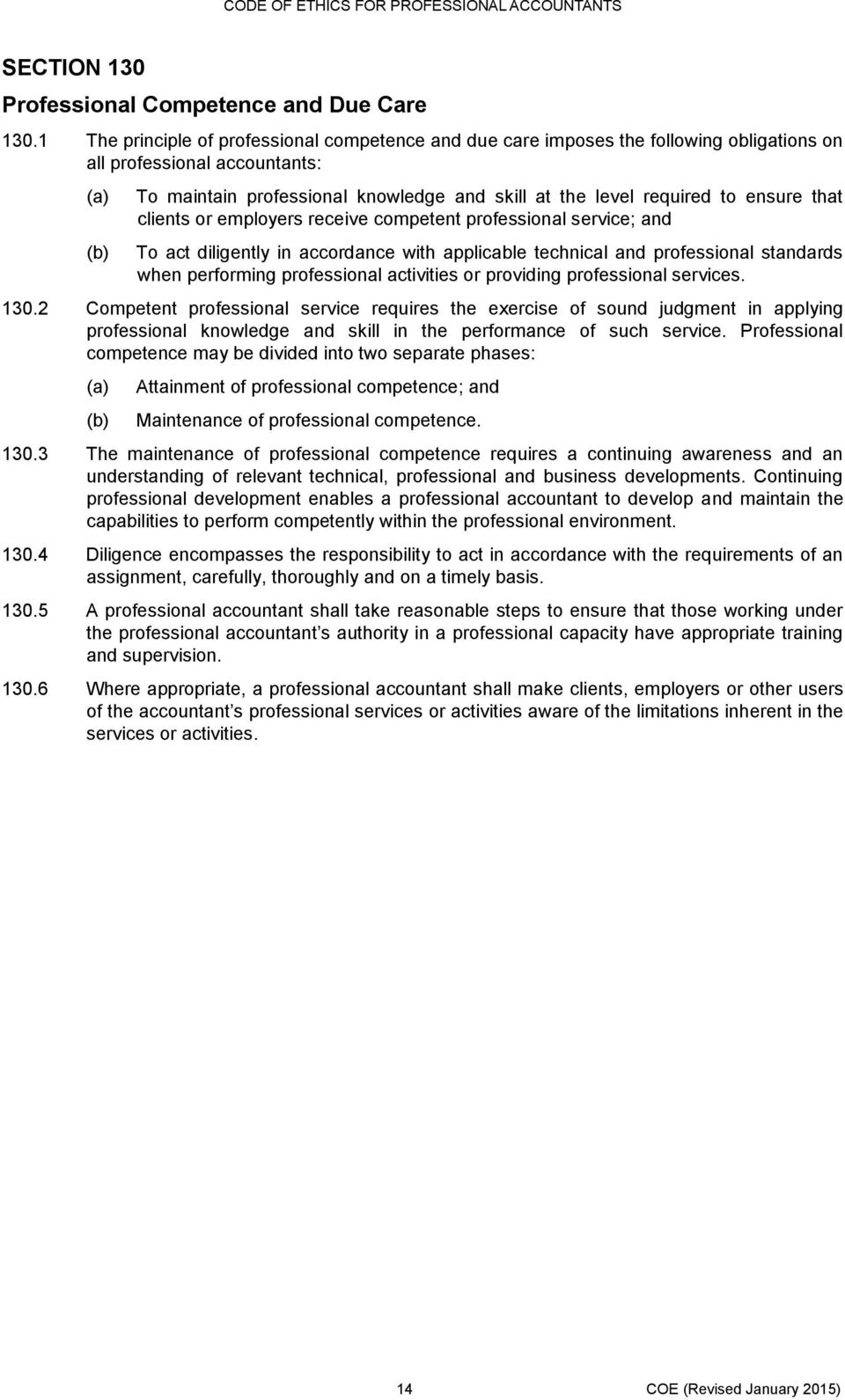
14 SECTION 130 Professional Competence and Due Care The principle of professional competence and due care imposes the following obligations on all professional accountants: To maintain professional knowledge and skill at the level required to ensure that clients or employers receive competent professional service; and To act diligently in accordance with applicable technical and professional standards when performing professional activities or providing professional services Competent professional service requires the exercise of sound judgment in applying professional knowledge and skill in the performance of such service. Professional competence may be divided into two separate phases: Attainment of professional competence; and Maintenance of professional competence The maintenance of professional competence requires a continuing awareness and an understanding of relevant technical, professional and business developments. Continuing professional development enables a professional accountant to develop and maintain the capabilities to perform competently within the professional environment Diligence encompasses the responsibility to act in accordance with the requirements of an assignment, carefully, thoroughly and on a timely basis A professional accountant shall take reasonable steps to ensure that those working under the professional accountant s authority in a professional capacity have appropriate training and supervision Where appropriate, a professional accountant shall make clients, employers or other users of the accountant s professional services or activities aware of the limitations inherent in the services or activities. 14 COE (Revised January 2015)
15 SECTION 140 Confidentiality The principle of confidentiality imposes an obligation on all professional accountants to refrain from: Disclosing outside the firm or employing organization confidential information acquired as a result of professional and business relationships without proper and specific authority or unless there is a legal or professional right or duty to disclose; and Using confidential information acquired as a result of professional and business relationships to their personal advantage or the advantage of third parties A professional accountant shall maintain confidentiality, including in a social environment, being alert to the possibility of inadvertent disclosure, particularly to a close business associate or a close or immediate family member A professional accountant shall maintain confidentiality of information disclosed by a prospective client or employer A professional accountant shall maintain confidentiality of information within the firm or employing organization A professional accountant shall take reasonable steps to ensure that staff under the professional accountant s control and persons from whom advice and assistance is obtained respect the professional accountant s duty of confidentiality The need to comply with the principle of confidentiality continues even after the end of relationships between a professional accountant and a client or employer. When a professional accountant changes employment or acquires a new client, the professional accountant is entitled to use prior experience. The professional accountant shall not, however, use or disclose any confidential information either acquired or received as a result of a professional or business relationship The following are circumstances where professional accountants are or may be required to disclose confidential information or when such disclosure may be appropriate: (c) Disclosure is permitted by law and is authorized by the client or the employer; Disclosure is required by law, for example: (i) (ii) Production of documents or other provision of evidence in the course of legal proceedings; or Disclosure to the appropriate public authorities of infringements of the law that come to light; and There is a professional duty or right to disclose, when not prohibited by law: (i) (ii) (iii) (iv) To comply with the quality review of the Institute or professional body; To respond to an inquiry or investigation by the Institute or regulatory body; To protect the professional interests of a professional accountant in legal proceedings; or To comply with technical standards and ethics requirements. 15 COE (Revised January 2015)

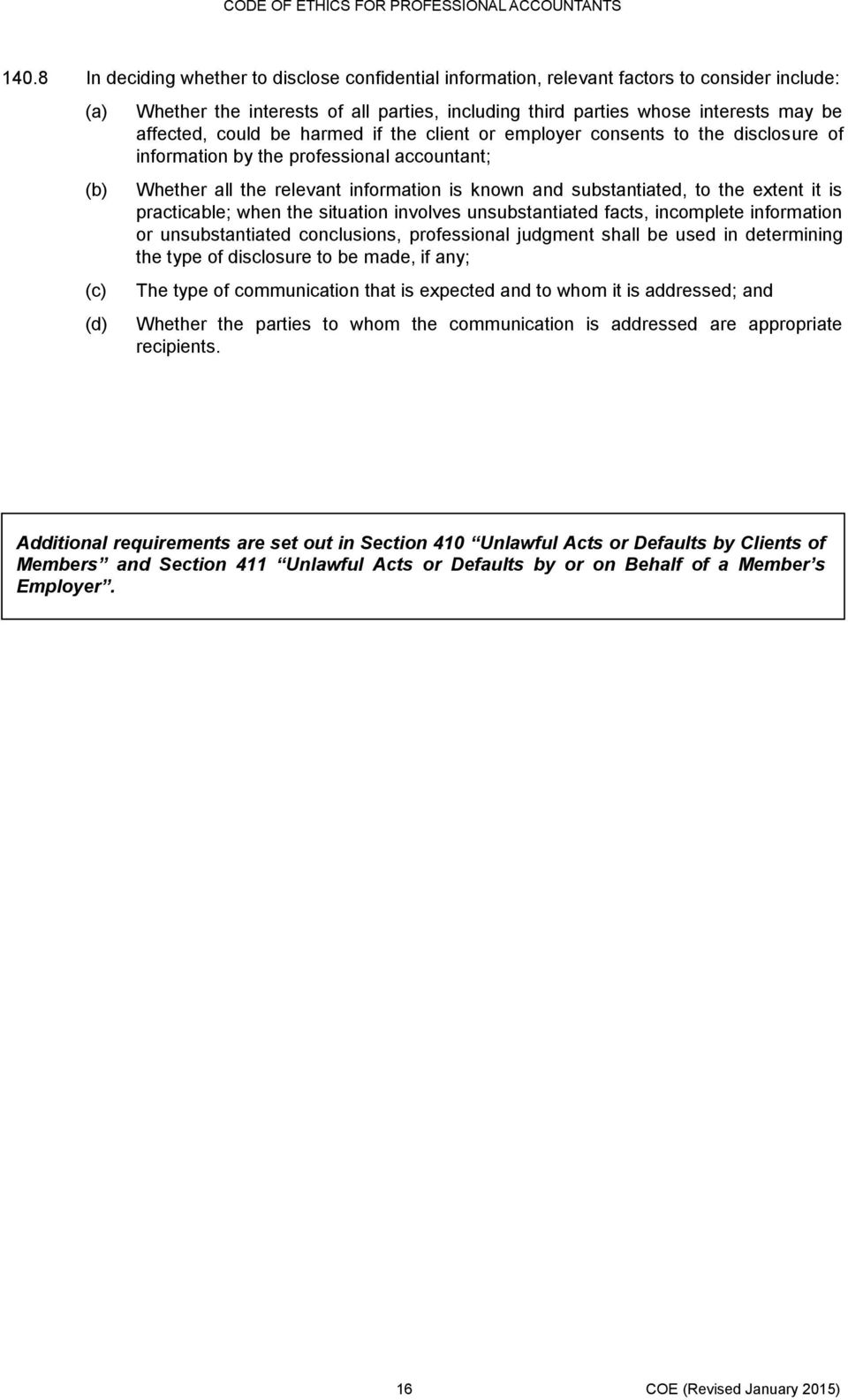
16 140.8 In deciding whether to disclose confidential information, relevant factors to consider include: (c) (d) Whether the interests of all parties, including third parties whose interests may be affected, could be harmed if the client or employer consents to the disclosure of information by the professional accountant; Whether all the relevant information is known and substantiated, to the extent it is practicable; when the situation involves unsubstantiated facts, incomplete information or unsubstantiated conclusions, professional judgment shall be used in determining the type of disclosure to be made, if any; The type of communication that is expected and to whom it is addressed; and Whether the parties to whom the communication is addressed are appropriate recipients. Additional requirements are set out in Section 410 Unlawful Acts or Defaults by Clients of Members and Section 411 Unlawful Acts or Defaults by or on Behalf of a Member s Employer. 16 COE (Revised January 2015)
17 SECTION 150 Professional Behavior The principle of professional behavior imposes an obligation on all professional accountants to comply with relevant laws and regulations and avoid any action that the professional accountant knows or should know may discredit the profession. This includes actions that a reasonable and informed third party, weighing all the specific facts and circumstances available to the professional accountant at that time, would be likely to conclude adversely affects the good reputation of the profession In marketing and promoting themselves and their work, professional accountants shall not bring the profession into disrepute. Professional accountants shall be honest and truthful and not: Make exaggerated claims for the services they are able to offer, the qualifications they possess, or experience they have gained; or Make disparaging references or unsubstantiated comparisons to the work of others. Additional requirements are set out in Section 420 Use of Designations and Institute s Logo. 17 COE (Revised January 2015)

18 PART B PROFESSIONAL ACCOUNTANTS IN PUBLIC PRACTICE Pages Section 200 Introduction Section 210 Professional Appointment Section 220 Conflicts of Interest Section 230 Second Opinions Section 240 Fees and Other Types of Remuneration Section 250 Marketing Professional Services Section 260 Gifts and Hospitality Section 270 Custody of Client Assets Section 280 Objectivity All Services Section 290 Independence Audit and Review Engagements Section 291 Independence Other Assurance Engagements COE (Revised January 2015)

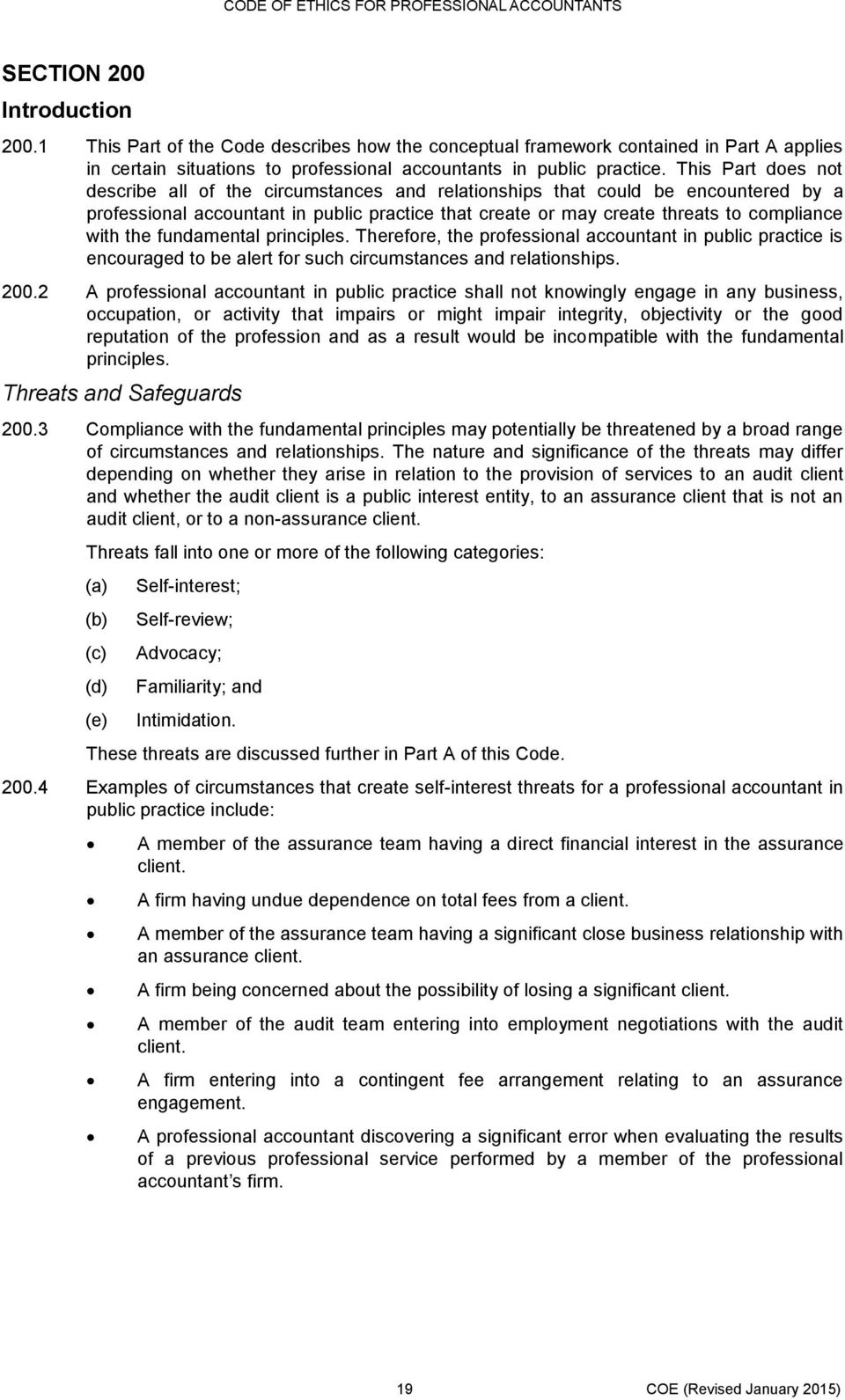
19 SECTION 200 Introduction This Part of the Code describes how the conceptual framework contained in Part A applies in certain situations to professional accountants in public practice. This Part does not describe all of the circumstances and relationships that could be encountered by a professional accountant in public practice that create or may create threats to compliance with the fundamental principles. Therefore, the professional accountant in public practice is encouraged to be alert for such circumstances and relationships A professional accountant in public practice shall not knowingly engage in any business, occupation, or activity that impairs or might impair integrity, objectivity or the good reputation of the profession and as a result would be incompatible with the fundamental principles. Threats and Safeguards Compliance with the fundamental principles may potentially be threatened by a broad range of circumstances and relationships. The nature and significance of the threats may differ depending on whether they arise in relation to the provision of services to an audit client and whether the audit client is a public interest entity, to an assurance client that is not an audit client, or to a non-assurance client. Threats fall into one or more of the following categories: (c) (d) (e) Self-interest; Self-review; Advocacy; Familiarity; and Intimidation. These threats are discussed further in Part A of this Code Examples of circumstances that create self-interest threats for a professional accountant in public practice include: A member of the assurance team having a direct financial interest in the assurance client. A firm having undue dependence on total fees from a client. A member of the assurance team having a significant close business relationship with an assurance client. A firm being concerned about the possibility of losing a significant client. A member of the audit team entering into employment negotiations with the audit client. A firm entering into a contingent fee arrangement relating to an assurance engagement. A professional accountant discovering a significant error when evaluating the results of a previous professional service performed by a member of the professional accountant s firm. 19 COE (Revised January 2015)
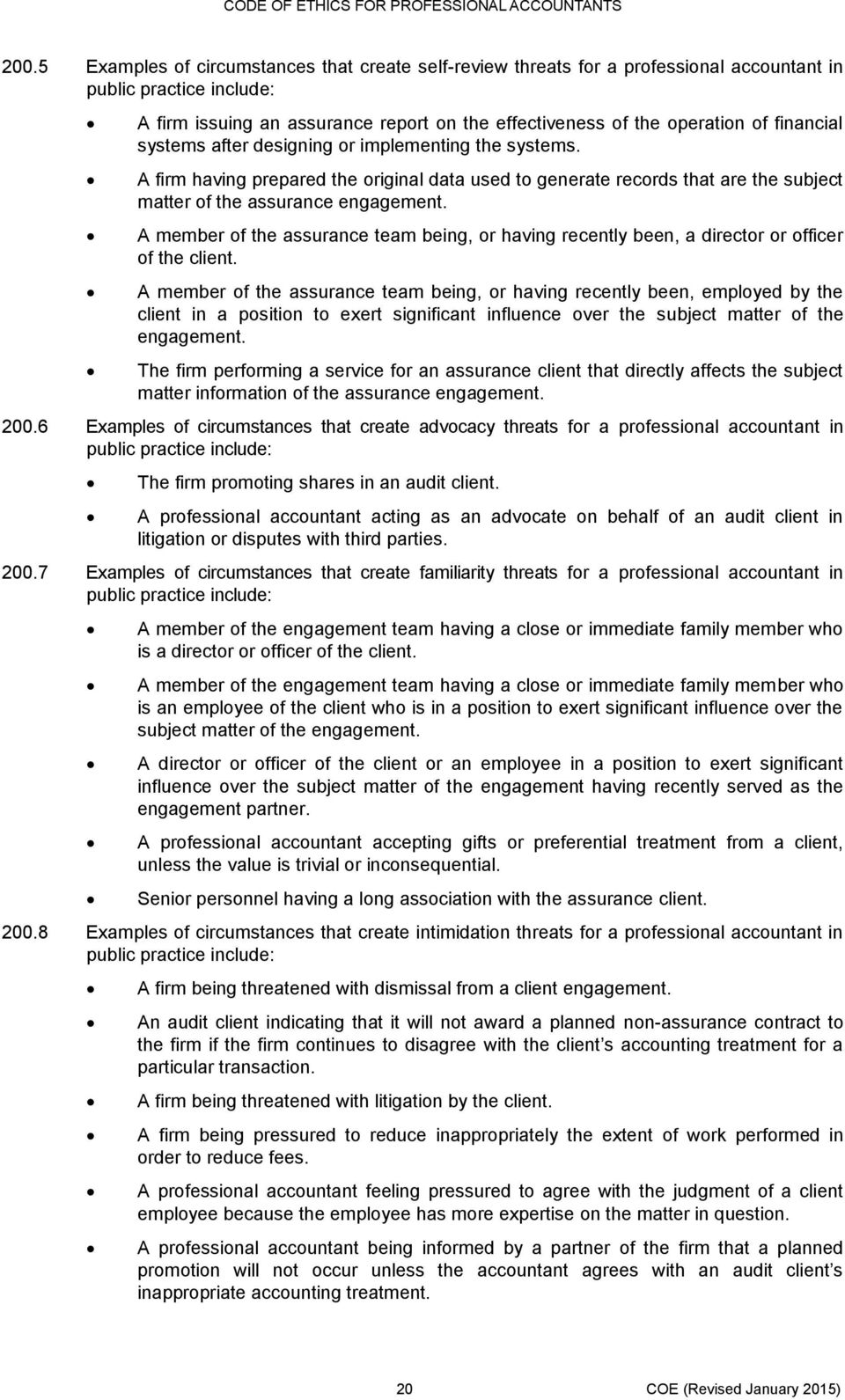
20 200.5 Examples of circumstances that create self-review threats for a professional accountant in public practice include: A firm issuing an assurance report on the effectiveness of the operation of financial systems after designing or implementing the systems. A firm having prepared the original data used to generate records that are the subject matter of the assurance engagement. A member of the assurance team being, or having recently been, a director or officer of the client. A member of the assurance team being, or having recently been, employed by the client in a position to exert significant influence over the subject matter of the engagement. The firm performing a service for an assurance client that directly affects the subject matter information of the assurance engagement Examples of circumstances that create advocacy threats for a professional accountant in public practice include: The firm promoting shares in an audit client. A professional accountant acting as an advocate on behalf of an audit client in litigation or disputes with third parties Examples of circumstances that create familiarity threats for a professional accountant in public practice include: A member of the engagement team having a close or immediate family member who is a director or officer of the client. A member of the engagement team having a close or immediate family member who is an employee of the client who is in a position to exert significant influence over the subject matter of the engagement. A director or officer of the client or an employee in a position to exert significant influence over the subject matter of the engagement having recently served as the engagement partner. A professional accountant accepting gifts or preferential treatment from a client, unless the value is trivial or inconsequential. Senior personnel having a long association with the assurance client Examples of circumstances that create intimidation threats for a professional accountant in public practice include: A firm being threatened with dismissal from a client engagement. An audit client indicating that it will not award a planned non-assurance contract to the firm if the firm continues to disagree with the client s accounting treatment for a particular transaction. A firm being threatened with litigation by the client. A firm being pressured to reduce inappropriately the extent of work performed in order to reduce fees. A professional accountant feeling pressured to agree with the judgment of a client employee because the employee has more expertise on the matter in question. A professional accountant being informed by a partner of the firm that a planned promotion will not occur unless the accountant agrees with an audit client s inappropriate accounting treatment. 20 COE (Revised January 2015)
21 200.9 Safeguards that may eliminate or reduce threats to an acceptable level fall into two broad categories: Safeguards created by the profession, legislation or regulation; and Safeguards in the work environment. Examples of safeguards created by the profession, legislation or regulation are described in paragraph of Part A of this Code A professional accountant in public practice shall exercise judgment to determine how best to deal with threats that are not at an acceptable level, whether by applying safeguards to eliminate the threat or reduce it to an acceptable level or by terminating or declining the relevant engagement. In exercising this judgment, a professional accountant in public practice shall consider whether a reasonable and informed third party, weighing all the specific facts and circumstances available to the professional accountant at that time, would be likely to conclude that the threats would be eliminated or reduced to an acceptable level by the application of safeguards, such that compliance with the fundamental principles is not compromised. This consideration will be affected by matters such as the significance of the threat, the nature of the engagement and the structure of the firm In the work environment, the relevant safeguards will vary depending on the circumstances. Work environment safeguards comprise firm-wide safeguards and engagement-specific safeguards Examples of firm-wide safeguards in the work environment include: Leadership of the firm that stresses the importance of compliance with the fundamental principles. Leadership of the firm that establishes the expectation that members of an assurance team will act in the public interest. Policies and procedures to implement and monitor quality control of engagements. Documented policies regarding the need to identify threats to compliance with the fundamental principles, evaluate the significance of those threats, and apply safeguards to eliminate or reduce the threats to an acceptable level or, when appropriate safeguards are not available or cannot be applied, terminate or decline the relevant engagement. Documented internal policies and procedures requiring compliance with the fundamental principles. Policies and procedures that will enable the identification of interests or relationships between the firm or members of engagement teams and clients. Policies and procedures to monitor and, if necessary, manage the reliance on revenue received from a single client. Using different partners and engagement teams with separate reporting lines for the provision of non-assurance services to an assurance client. Policies and procedures to prohibit individuals who are not members of an engagement team from inappropriately influencing the outcome of the engagement. Timely communication of a firm s policies and procedures, including any changes to them, to all partners and professional staff, and appropriate training and education on such policies and procedures. Designating a member of senior management to be responsible for overseeing the adequate functioning of the firm s quality control system. Advising partners and professional staff of assurance clients and related entities from which independence is required. 21 COE (Revised January 2015)
22 A disciplinary mechanism to promote compliance with policies and procedures. Published policies and procedures to encourage and empower staff to communicate to senior levels within the firm any issue relating to compliance with the fundamental principles that concerns them Examples of engagement-specific safeguards in the work environment include: Having a professional accountant who was not involved with the non-assurance service review the non-assurance work performed or otherwise advise as necessary. Having a professional accountant who was not a member of the assurance team review the assurance work performed or otherwise advise as necessary. Consulting an independent third party, such as a committee of independent directors, a professional regulatory body or another professional accountant. Discussing ethical issues with those charged with governance of the client. Disclosing to those charged with governance of the client the nature of services provided and extent of fees charged. Involving another firm to perform or re-perform part of the engagement. Rotating senior assurance team personnel Depending on the nature of the engagement, a professional accountant in public practice may also be able to rely on safeguards that the client has implemented. However it is not possible to rely solely on such safeguards to reduce threats to an acceptable level Examples of safeguards within the client s systems and procedures include: The client requires persons other than management to ratify or approve the appointment of a firm to perform an engagement. The client has competent employees with experience and seniority to make managerial decisions. The client has implemented internal procedures that ensure objective choices in commissioning non-assurance engagements. The client has a corporate governance structure that provides appropriate oversight and communications regarding the firm s services. Additional requirements are set out in Section 430 Ethics in Tax Practice, Section 431 Corporate Finance Advice and Section 432 Integrity, Objectivity and Independence in Insolvency. 22 COE (Revised January 2015)
23 SECTION 210 Professional Appointment Client Acceptance Before accepting a new client relationship, a professional accountant in public practice shall determine whether acceptance would create any threats to compliance with the fundamental principles. Potential threats to integrity or professional behavior may be created from, for example, questionable issues associated with the client (its owners, management or activities) Client issues that, if known, could threaten compliance with the fundamental principles include, for example, client involvement in illegal activities (such as money laundering), dishonesty or questionable financial reporting practices A professional accountant in public practice shall evaluate the significance of any threats and apply safeguards when necessary to eliminate them or reduce them to an acceptable level. Examples of such safeguards include: Obtaining knowledge and understanding of the client, its owners, managers and those responsible for its governance and business activities; or Securing the client s commitment to improve corporate governance practices or internal controls Where it is not possible to reduce the threats to an acceptable level, the professional accountant in public practice shall decline to enter into the client relationship It is recommended that a professional accountant in public practice periodically review acceptance decisions for recurring client engagements. Engagement Acceptance The fundamental principle of professional competence and due care imposes an obligation on a professional accountant in public practice to provide only those services that the professional accountant in public practice is competent to perform. Before accepting a specific client engagement, a professional accountant in public practice shall determine whether acceptance would create any threats to compliance with the fundamental principles. For example, a self-interest threat to professional competence and due care is created if the engagement team does not possess, or cannot acquire, the competencies necessary to properly carry out the engagement A professional accountant in public practice shall evaluate the significance of threats and apply safeguards, when necessary, to eliminate them or reduce them to an acceptable level. Examples of such safeguards include: Acquiring an appropriate understanding of the nature of the client s business, the complexity of its operations, the specific requirements of the engagement and the purpose, nature and scope of the work to be performed. Acquiring knowledge of relevant industries or subject matters. Possessing or obtaining experience with relevant regulatory or reporting requirements. Assigning sufficient staff with the necessary competencies. Using experts where necessary. Agreeing on a realistic time frame for the performance of the engagement. 23 COE (Revised January 2015)
24 Complying with quality control policies and procedures designed to provide reasonable assurance that specific engagements are accepted only when they can be performed competently When a professional accountant in public practice intends to rely on the advice or work of an expert, the professional accountant in public practice shall determine whether such reliance is warranted. Factors to consider include: reputation, expertise, resources available and applicable professional and ethical standards. Such information may be gained from prior association with the expert or from consulting others. Changes in a Professional Appointment A professional accountant in public practice who is asked to replace another professional accountant in public practice, or who is considering tendering for an engagement currently held by another professional accountant in public practice, shall determine whether there are any reasons, professional or otherwise, for not accepting the engagement, such as circumstances that create threats to compliance with the fundamental principles that cannot be eliminated or reduced to an acceptable level by the application of safeguards. For example, there may be a threat to professional competence and due care if a professional accountant in public practice accepts the engagement before knowing all the pertinent facts A professional accountant in public practice shall evaluate the significance of any threats. Depending on the nature of the engagement, this may require direct communication with the existing accountant to establish the facts and circumstances regarding the proposed change so that the professional accountant in public practice can decide whether it would be appropriate to accept the engagement. For example, the apparent reasons for the change in appointment may not fully reflect the facts and may indicate disagreements with the existing accountant that may influence the decision to accept the appointment Safeguards shall be applied when necessary to eliminate any threats or reduce them to an acceptable level. Examples of such safeguards include: When replying to requests to submit tenders, stating in the tender that, before accepting the engagement, contact with the existing accountant will be requested so that inquiries may be made as to whether there are any professional or other reasons why the appointment should not be accepted; Asking the existing accountant to provide known information on any facts or circumstances that, in the existing accountant s opinion, the proposed accountant needs to be aware of before deciding whether to accept the engagement; or Obtaining necessary information from other sources. When the threats cannot be eliminated or reduced to an acceptable level through the application of safeguards, a professional accountant in public practice shall, unless there is satisfaction as to necessary facts by other means, decline the engagement A professional accountant in public practice may be asked to undertake work that is complementary or additional to the work of the existing accountant. Such circumstances may create threats to professional competence and due care resulting from, for example, a lack of or incomplete information. The significance of any threats shall be evaluated and safeguards applied when necessary to eliminate the threat or reduce it to an acceptable level. An example of such a safeguard is notifying the existing accountant of the proposed work, which would give the existing accountant the opportunity to provide any relevant information needed for the proper conduct of the work. 24 COE (Revised January 2015)
25 An existing accountant is bound by confidentiality. Whether that professional accountant is permitted or required to discuss the affairs of a client with a proposed accountant will depend on the nature of the engagement and on: Whether the client s permission to do so has been obtained; or The legal or ethical requirements relating to such communications and disclosure, which may vary by jurisdiction. Circumstances where the professional accountant is or may be required to disclose confidential information or where such disclosure may otherwise be appropriate are set out in Section 140 of Part A of this Code A professional accountant in public practice will generally need to obtain the client s permission, preferably in writing, to initiate discussion with an existing accountant. Once that permission is obtained, the existing accountant shall comply with relevant legal and other regulations governing such requests. Where the existing accountant provides information, it shall be provided honestly and unambiguously. If the proposed accountant is unable to communicate with the existing accountant, the proposed accountant shall take reasonable steps to obtain information about any possible threats by other means, such as through inquiries of third parties or background investigations of senior management or those charged with governance of the client. Additional requirements are set out in Section 440 Changes in a Professional Appointment and Section 441 Change of Auditors of a Listed Issuer of The Stock Exchange of Hong Kong. 25 COE (Revised January 2015)
26 SECTION 220 Conflicts of Interest A professional accountant in public practice may be faced with a conflict of interest when performing a professional service. A conflict of interest creates a threat to objectivity and may create threats to the other fundamental principles. Such threats may be created when: The professional accountant provides a professional service related to a particular matter for two or more clients whose interests with respect to that matter are in conflict; or The interests of the professional accountant with respect to a particular matter and the interests of the client for whom the professional accountant provides a professional service related to that matter are in conflict. A professional accountant shall not allow a conflict of interest to compromise professional or business judgment. When the professional service is an assurance service, compliance with the fundamental principle of objectivity also requires being independent of assurance clients in accordance with Sections 290 or 291 as appropriate Examples of situations in which conflicts of interest may arise include: Providing a transaction advisory service to a client seeking to acquire an audit client of the firm, where the firm has obtained confidential information during the course of the audit that may be relevant to the transaction. Advising two clients at the same time who are competing to acquire the same company where the advice might be relevant to the parties competitive positions. Providing services to both a vendor and a purchaser in relation to the same transaction. Preparing valuations of assets for two parties who are in an adversarial position with respect to the assets. Representing two clients regarding the same matter who are in a legal dispute with each other, such as during divorce proceedings or the dissolution of a partnership. Providing an assurance report for a licensor on royalties due under a license agreement when at the same time advising the licensee of the correctness of the amounts payable. Advising a client to invest in a business in which, for example, the spouse of the professional accountant in public practice has a financial interest. Providing strategic advice to a client on its competitive position while having a joint venture or similar interest with a major competitor of the client. Advising a client on the acquisition of a business which the firm is also interested in acquiring. Advising a client on the purchase of a product or service while having a royalty or commission agreement with one of the potential vendors of that product or service When identifying and evaluating the interests and relationships that might create a conflict of interest and implementing safeguards, when necessary, to eliminate or reduce any threat to compliance with the fundamental principles to an acceptable level, a professional accountant in public practice shall exercise professional judgment and take into account whether a reasonable and informed third party, weighing all the specific facts and circumstances available to the professional accountant at the time, would be likely to conclude that compliance with the fundamental principles is not compromised. 26 COE (Revised January 2015)
27 220.4 When addressing conflicts of interest, including making disclosures or sharing information within the firm or network and seeking guidance of third parties, the professional accountant in public practice shall remain alert to the fundamental principle of confidentiality If the threat created by a conflict of interest is not at an acceptable level, the professional accountant in public practice shall apply safeguards to eliminate the threat or reduce it to an acceptable level. If safeguards cannot reduce the threat to an acceptable level, the professional accountant shall decline to perform or shall discontinue professional services that would result in the conflict of interest; or shall terminate relevant relationships or dispose of relevant interests to eliminate the threat or reduce it to an acceptable level Before accepting a new client relationship, engagement, or business relationship, a professional accountant in public practice shall take reasonable steps to identify circumstances that might create a conflict of interest, including identification of: The nature of the relevant interests and relationships between the parties involved; and The nature of the service and its implication for relevant parties. The nature of the services and the relevant interests and relationships may change during the course of the engagement. This is particularly true when a professional accountant is asked to conduct an engagement in a situation that may become adversarial, even though the parties who engage the professional accountant may not initially be involved in a dispute. The professional accountant shall remain alert to such changes for the purpose of identifying circumstances that might create a conflict of interest For the purpose of identifying interests and relationships that might create a conflict of interest, having an effective conflict identification process assists a professional accountant in public practice to identify actual or potential conflicts of interest prior to determining whether to accept an engagement and throughout an engagement. This includes matters identified by external parties, for example clients or potential clients. The earlier an actual or potential conflict of interest is identified, the greater the likelihood of the professional accountant being able to apply safeguards, when necessary, to eliminate the threat to objectivity and any threat to compliance with other fundamental principles or reduce it to an acceptable level. The process to identify actual or potential conflicts of interest will depend on such factors as: The nature of the professional services provided. The size of the firm. The size and nature of the client base. The structure of the firm, for example, the number and geographic location of offices If the firm is a member of a network, conflict identification shall include any conflicts of interest that the professional accountant in public practice has reason to believe may exist or might arise due to interests and relationships of a network firm. Reasonable steps to identify such interests and relationships involving a network firm will depend on factors such as the nature of the professional services provided, the clients served by the network and the geographic locations of all relevant parties If a conflict of interest is identified, the professional accountant in public practice shall evaluate: The significance of relevant interests or relationships; and The significance of the threats created by performing the professional service or services. In general, the more direct the connection between the professional service and the matter on which the parties interests are in conflict, the more significant the threat to objectivity and compliance with the other fundamental principles will be. 27 COE (Revised January 2015)
28 The professional accountant in public practice shall apply safeguards, when necessary, to eliminate the threats to compliance with the fundamental principles created by the conflict of interest or reduce them to an acceptable level. Examples of safeguards include: Implementing mechanisms to prevent unauthorized disclosure of confidential information when performing professional services related to a particular matter for two or more clients whose interests with respect to that matter are in conflict. This could include: o o o Using separate engagement teams who are provided with clear policies and procedures on maintaining confidentiality. Creating separate areas of practice for specialty functions within the firm, which may act as a barrier to the passing of confidential client information from one practice area to another within a firm. Establishing policies and procedures to limit access to client files, the use of confidentiality agreements signed by employees and partners of the firm and/or the physical and electronic separation of confidential information. Regular review of the application of safeguards by a senior individual not involved with the client engagement or engagements. Having a professional accountant who is not involved in providing the service or otherwise affected by the conflict, review the work performed to assess whether the key judgments and conclusions are appropriate. Consulting with third parties, such as a professional body, legal counsel or another professional accountant In addition, it is generally necessary to disclose the nature of the conflict of interest and the related safeguards, if any, to clients affected by the conflict and, when safeguards are required to reduce the threat to an acceptable level, to obtain their consent to the professional accountant in public practice performing the professional services. Disclosure and consent may take different forms, for example: General disclosure to clients of circumstances where the professional accountant, in keeping with common commercial practice, does not provide services exclusively for any one client (for example, in a particular service in a particular market sector) in order for the client to provide general consent accordingly. Such disclosure might, for example, be made in the professional accountant s standard terms and conditions for the engagement. Specific disclosure to affected clients of the circumstances of the particular conflict, including a detailed presentation of the situation and a comprehensive explanation of any planned safeguards and the risks involved, sufficient to enable the client to make an informed decision with respect to the matter and to provide explicit consent accordingly. In certain circumstances, consent may be implied by the client s conduct where the professional accountant has sufficient evidence to conclude that clients know the circumstances at the outset and have accepted the conflict of interest if they do not raise an objection to the existence of the conflict. The professional accountant shall determine whether the nature and significance of the conflict of interest is such that specific disclosure and explicit consent is necessary. For this purpose, the professional accountant shall exercise professional judgment in weighing the outcome of the evaluation of the circumstances that create a conflict of interest, including the parties that might be affected, the nature of the issues that might arise and the potential for the particular matter to develop in an unexpected manner. 28 COE (Revised January 2015)
29 Where a professional accountant in public practice has requested explicit consent from a client and that consent has been refused by the client, the professional accountant shall decline to perform or shall discontinue professional services that would result in the conflict of interest; or shall terminate relevant relationships or dispose of relevant interests to eliminate the threat or reduce it to an acceptable level, such that consent can be obtained, after applying any additional safeguards if necessary When disclosure is verbal, or consent is verbal or implied, the professional accountant in public practice is encouraged to document the nature of the circumstances giving rise to the conflict of interest, the safeguards applied to reduce the threats to an acceptable level and the consent obtained In certain circumstances, making specific disclosure for the purpose of obtaining explicit consent would result in a breach of confidentiality. Examples of such circumstances may include: Performing a transaction-related service for a client in connection with a hostile takeover of another client of the firm. Performing a forensic investigation for a client in connection with a suspected fraudulent act where the firm has confidential information obtained through having performed a professional service for another client who might be involved in the fraud. The firm shall not accept or continue an engagement under such circumstances unless the following conditions are met: The firm does not act in an advocacy role for one client where this requires the firm to assume an adversarial position against the other client with respect to the same matter; Specific mechanisms are in place to prevent disclosure of confidential information between the engagement teams serving the two clients; and The firm is satisfied that a reasonable and informed third party, weighing all the specific facts and circumstances available to the professional accountant in public practice at the time, would be likely to conclude that it is appropriate for the firm to accept or continue the engagement because a restriction on the firm s ability to provide the service would produce a disproportionate adverse outcome for the clients or other relevant third parties. The professional accountant shall document the nature of the circumstances, including the role that the professional accountant is to undertake, the specific mechanisms in place to prevent disclosure of information between the engagement teams serving the two clients and the rationale for the conclusion that it is appropriate to accept the engagement. 29 COE (Revised January 2015)
30 SECTION 230 Second Opinions Situations where a professional accountant in public practice is asked to provide a second opinion on the application of accounting, auditing, reporting or other standards or principles to specific circumstances or transactions by or on behalf of a company or an entity that is not an existing client may create threats to compliance with the fundamental principles. For example, there may be a threat to professional competence and due care in circumstances where the second opinion is not based on the same set of facts that were made available to the existing accountant or is based on inadequate evidence. The existence and significance of any threat will depend on the circumstances of the request and all the other available facts and assumptions relevant to the expression of a professional judgment When asked to provide such an opinion, a professional accountant in public practice shall evaluate the significance of any threats and apply safeguards when necessary to eliminate them or reduce them to an acceptable level. Examples of such safeguards include seeking client permission to contact the existing accountant, describing the limitations surrounding any opinion in communications with the client and providing the existing accountant with a copy of the opinion If the company or entity seeking the opinion will not permit communication with the existing accountant, a professional accountant in public practice shall determine whether, taking all the circumstances into account, it is appropriate to provide the opinion sought. 30 COE (Revised January 2015)
31 SECTION 240 Fees and Other Types of Remuneration When entering into negotiations regarding professional services, a professional accountant in public practice may quote whatever fee is deemed appropriate. The fact that one professional accountant in public practice may quote a fee lower than another is not in itself unethical. Nevertheless, there may be threats to compliance with the fundamental principles arising from the level of fees quoted. For example, a self-interest threat to professional competence and due care is created if the fee quoted is so low that it may be difficult to perform the engagement in accordance with applicable technical and professional standards for that price The existence and significance of any threats created will depend on factors such as the level of fee quoted and the services to which it applies. The significance of any threat shall be evaluated and safeguards applied when necessary to eliminate the threat or reduce it to an acceptable level. Examples of such safeguards include: Making the client aware of the terms of the engagement and, in particular, the basis on which fees are charged and which services are covered by the quoted fee. Assigning appropriate time and qualified staff to the task Contingent fees are widely used for certain types of non-assurance engagements. 1 They may, however, create threats to compliance with the fundamental principles in certain circumstances. They may create a self-interest threat to objectivity. The existence and significance of such threats will depend on factors including: The nature of the engagement. The range of possible fee amounts. The basis for determining the fee. Whether the outcome or result of the transaction is to be reviewed by an independent third party The significance of any such threats shall be evaluated and safeguards applied when necessary to eliminate or reduce them to an acceptable level. Examples of such safeguards include: An advance written agreement with the client as to the basis of remuneration. Disclosure to intended users of the work performed by the professional accountant in public practice and the basis of remuneration. Quality control policies and procedures. Review by an independent third party of the work performed by the professional accountant in public practice In certain circumstances, a professional accountant in public practice may receive a referral fee or commission relating to a client. For example, where the professional accountant in public practice does not provide the specific service required, a fee may be received for referring a continuing client to another professional accountant in public practice or other expert. A professional accountant in public practice may receive a commission from a third party (e.g., a software vendor) in connection with the sale of goods or services to a client. Accepting such a referral fee or commission creates a self-interest threat to objectivity and professional competence and due care. 1 Contingent fees for non-assurance services provided to audit clients and other assurance clients are discussed in Sections 290 and 291 of this part of the Code. 31 COE (Revised January 2015)
32 240.6 A professional accountant in public practice may also pay a referral fee to obtain a client, for example, where the client continues as a client of another professional accountant in public practice but requires specialist services not offered by the existing accountant. The payment of such a referral fee also creates a self-interest threat to objectivity and professional competence and due care The significance of the threat shall be evaluated and safeguards applied when necessary to eliminate the threat or reduce it to an acceptable level. Examples of such safeguards include: Disclosing to the client any arrangements to pay a referral fee to another professional accountant for the work referred. Disclosing to the client any arrangements to receive a referral fee for referring the client to another professional accountant in public practice. Obtaining advance agreement from the client for commission arrangements in connection with the sale by a third party of goods or services to the client A Members should note that under the Prevention of Bribery Ordinance 1a, there are provisions governing acceptance of any payment by someone who is in an agent-principal relationship with another person. For example, if an agent receives payment from another for doing something or showing favour to another in relation to the affairs or business of the agent s principal (who may be the agent s employer or in some other relationships with the agent which involve trust and confidence), the permission of the principal should be obtained first before receiving the payment in order to avoid the risk of contravening the Prevention of Bribery Ordinance. The same principle applies to someone who is paying another person who is in an agentprincipal relationship with some other person: the payer should ensure that the agent has obtained permission from his principal for receiving the payment. Whether an agent-principal relationship exists in any given situation depends on the facts of each case. Members should consult their own legal advisors as and when necessary A professional accountant in public practice may purchase all or part of another firm on the basis that payments will be made to individuals formerly owning the firm or to their heirs or estates. Such payments are not regarded as commissions or referral fees for the purpose of paragraphs above. 1a Additional guidance on the Prevention of Bribery Ordinance (POBO) is available on the ICAC s website: Members may use the sample code of conduct based on the POBO in Appendix 1 provided by the ICAC for the private sector as a reference. 32 COE (Revised January 2015)
33 SECTION 250 Marketing Professional Services When a professional accountant in public practice solicits new work through advertising or other forms of marketing, there may be a threat to compliance with the fundamental principles. For example, a self-interest threat to compliance with the principle of professional behavior is created if services, achievements, or products are marketed in a way that is inconsistent with that principle A professional accountant in public practice shall not bring the profession into disrepute when marketing professional services. The professional accountant in public practice shall be honest and truthful and not: Make exaggerated claims for services offered, qualifications possessed, or experience gained; or Make disparaging references or unsubstantiated comparisons to the work of another. If the professional accountant in public practice is in doubt about whether a proposed form of advertising or marketing is appropriate, the professional accountant in public practice shall consider consulting with the relevant professional body. Additional requirements are set out in Section 450 Practice Promotion. 33 COE (Revised January 2015)
34 SECTION 260 Gifts and Hospitality A professional accountant in public practice, or an immediate or close family member, may be offered gifts and hospitality from a client. Such an offer may create threats to compliance with the fundamental principles. For example, a self-interest or familiarity threat to objectivity may be created if a gift from a client is accepted; an intimidation threat to objectivity may result from the possibility of such offers being made public The existence and significance of any threat will depend on the nature, value, and intent of the offer. Where gifts or hospitality are offered that a reasonable and informed third party, weighing all the specific facts and circumstances, would consider trivial and inconsequential, a professional accountant in public practice may conclude that the offer is made in the normal course of business without the specific intent to influence decision making or to obtain information. In such cases, the professional accountant in public practice may generally conclude that any threat to compliance with the fundamental principles is at an acceptable level A professional accountant in public practice shall evaluate the significance of any threats and apply safeguards when necessary to eliminate the threats or reduce them to an acceptable level. When the threats cannot be eliminated or reduced to an acceptable level through the application of safeguards, a professional accountant in public practice shall not accept such an offer. 34 COE (Revised January 2015)
35 SECTION 270 Custody of Client Assets A professional accountant in public practice shall not assume custody of client monies or other assets unless permitted to do so by law and, if so, in compliance with any additional legal duties imposed on a professional accountant in public practice holding such assets The holding of client assets creates threats to compliance with the fundamental principles; for example, there is a self-interest threat to professional behavior and may be a self interest threat to objectivity arising from holding client assets. A professional accountant in public practice entrusted with money (or other assets) belonging to others shall therefore: (c) (d) Keep such assets separately from personal or firm assets; Use such assets only for the purpose for which they are intended; At all times be ready to account for those assets and any income, dividends, or gains generated, to any persons entitled to such accounting; and Comply with all relevant laws and regulations relevant to the holding of and accounting for such assets As part of client and engagement acceptance procedures for services that may involve the holding of client assets, a professional accountant in public practice shall make appropriate inquiries about the source of such assets and consider legal and regulatory obligations. For example, if the assets were derived from illegal activities, such as money laundering, a threat to compliance with the fundamental principles would be created. In such situations, the professional accountant may consider seeking legal advice. Additional requirements are set out in Section 460 Clients Monies. 35 COE (Revised January 2015)
36 SECTION 280 Objectivity All Services A professional accountant in public practice shall determine when providing any professional service whether there are threats to compliance with the fundamental principle of objectivity resulting from having interests in, or relationships with, a client or its directors, officers or employees. For example, a familiarity threat to objectivity may be created from a family or close personal or business relationship A professional accountant in public practice who provides an assurance service shall be independent of the assurance client. Independence of mind and in appearance is necessary to enable the professional accountant in public practice to express a conclusion, and be seen to express a conclusion, without bias, conflict of interest, or undue influence of others. Sections 290 and 291 provide specific guidance on independence requirements for professional accountants in public practice when performing assurance engagements The existence of threats to objectivity when providing any professional service will depend upon the particular circumstances of the engagement and the nature of the work that the professional accountant in public practice is performing A professional accountant in public practice shall evaluate the significance of any threats and apply safeguards when necessary to eliminate them or reduce them to an acceptable level. Examples of such safeguards include: Withdrawing from the engagement team. Supervisory procedures. Terminating the financial or business relationship giving rise to the threat. Discussing the issue with higher levels of management within the firm. Discussing the issue with those charged with governance of the client. If safeguards cannot eliminate or reduce the threat to an acceptable level, the professional accountant shall decline or terminate the relevant engagement. 36 COE (Revised January 2015)
37 SECTION 290 INDEPENDENCE AUDIT AND REVIEW ENGAGEMENTS CONTENTS Paragraph Structure of Section A Conceptual Framework Approach to Independence Networks and Network Firms Public Interest Entities Related Entities Those Charged with Governance Documentation Engagement Period Mergers and Acquisitions Breach of a Provision of this Section Application of the Conceptual Framework Approach to Independence Financial Interests Loans and Guarantees Business Relationships Family and Personal Relationships Employment with an Audit Client Temporary Staff Assignments Recent Service with an Audit Client Serving as a Director or Officer of an Audit Client Long Association of Senior Personnel (Including Partner Rotation) with an Audit Client Provision of Non-assurance Services to Audit Clients Management Responsibilities Preparing Accounting Records and Financial Statements Valuation Services Taxation Services Internal Audit Services IT Systems Services Litigation Support Services Legal Services Recruiting Services Corporate Finance Services Fees Fees Relative Size Fees Overdue Contingent Fees Compensation and Evaluation Policies Gifts and Hospitality Actual or Threatened Litigation Reports that Include a Restriction on Use and Distribution COE (Revised January 2015)
38 Structure of Section This section addresses the independence requirements for audit engagements and review engagements, which are assurance engagements in which a professional accountant in public practice expresses a conclusion on financial statements. Such engagements comprise audit and review engagements to report on a complete set of financial statements and a single financial statement. Independence requirements for assurance engagements that are not audit or review engagements are addressed in Section In certain circumstances involving audit engagements where the audit report includes a restriction on use and distribution and provided certain conditions are met, the independence requirements in this section may be modified as provided in paragraphs to The modifications are not permitted in the case of an audit of financial statements required by law or regulation In this section, the term(s): Audit, audit team, audit engagement, audit client and audit report includes review, review team, review engagement, review client and review report; and Firm includes network firm, except where otherwise stated. A Conceptual Framework Approach to Independence In the case of audit engagements, it is in the public interest and, therefore, required by this Code of Ethics, that members of audit teams, firms and network firms shall be independent of audit clients The objective of this section is to assist firms and members of audit teams in applying the conceptual framework approach described below to achieving and maintaining independence Independence comprises: Independence of Mind The state of mind that permits the expression of a conclusion without being affected by influences that compromise professional judgment, thereby allowing an individual to act with integrity and exercise objectivity and professional skepticism. Independence in Appearance The avoidance of facts and circumstances that are so significant that a reasonable and informed third party would be likely to conclude, weighing all the specific facts and circumstances, that a firm s, or a member of the audit team s, integrity, objectivity or professional skepticism has been compromised The conceptual framework approach shall be applied by professional accountants to: (c) Identify threats to independence; Evaluate the significance of the threats identified; and Apply safeguards, when necessary, to eliminate the threats or reduce them to an acceptable level. When the professional accountant determines that appropriate safeguards are not available or cannot be applied to eliminate the threats or reduce them to an acceptable level, the professional accountant shall eliminate the circumstance or relationship creating the threats or decline or terminate the audit engagement. A professional accountant shall use professional judgment in applying this conceptual framework. 38 COE (Revised January 2015)
39 290.8 Many different circumstances, or combinations of circumstances, may be relevant in assessing threats to independence. It is impossible to define every situation that creates threats to independence and to specify the appropriate action. Therefore, this Code establishes a conceptual framework that requires firms and members of audit teams to identify, evaluate, and address threats to independence. The conceptual framework approach assists professional accountants in practice in complying with the ethical requirements in this Code. It accommodates many variations in circumstances that create threats to independence and can deter a professional accountant from concluding that a situation is permitted if it is not specifically prohibited Paragraphs and onwards describe how the conceptual framework approach to independence is to be applied. These paragraphs do not address all the circumstances and relationships that create or may create threats to independence In deciding whether to accept or continue an engagement, or whether a particular individual may be a member of the audit team, a firm shall identify and evaluate threats to independence. If the threats are not at an acceptable level, and the decision is whether to accept an engagement or include a particular individual on the audit team, the firm shall determine whether safeguards are available to eliminate the threats or reduce them to an acceptable level. If the decision is whether to continue an engagement, the firm shall determine whether any existing safeguards will continue to be effective to eliminate the threats or reduce them to an acceptable level or whether other safeguards will need to be applied or whether the engagement needs to be terminated. Whenever new information about a threat to independence comes to the attention of the firm during the engagement, the firm shall evaluate the significance of the threat in accordance with the conceptual framework approach Throughout this section, reference is made to the significance of threats to independence. In evaluating the significance of a threat, qualitative as well as quantitative factors shall be taken into account This section does not, in most cases, prescribe the specific responsibility of individuals within the firm for actions related to independence because responsibility may differ depending on the size, structure and organization of a firm. The firm is required by Hong Kong Standards on Quality Control to establish policies and procedures designed to provide it with reasonable assurance that independence is maintained when required by relevant ethical requirements. In addition, Hong Kong Standards on Auditing require the engagement partner to form a conclusion on compliance with the independence requirements that apply to the engagement. Networks and Network Firms If a firm is deemed to be a network firm, the firm shall be independent of the audit clients of the other firms within the network (unless otherwise stated in this Code). The independence requirements in this section that apply to a network firm apply to any entity, such as a consulting practice or professional law practice, that meets the definition of a network firm irrespective of whether the entity itself meets the definition of a firm To enhance their ability to provide professional services, firms frequently form larger structures with other firms and entities. Whether these larger structures create a network depends on the particular facts and circumstances and does not depend on whether the firms and entities are legally separate and distinct. For example, a larger structure may be aimed only at facilitating the referral of work, which in itself does not meet the criteria necessary to constitute a network. Alternatively, a larger structure might be such that it is aimed at co-operation and the firms share a common brand name, a common system of quality control, or significant professional resources and consequently is deemed to be a network. 39 COE (Revised January 2015)
40 The judgment as to whether the larger structure is a network shall be made in light of whether a reasonable and informed third party would be likely to conclude, weighing all the specific facts and circumstances, that the entities are associated in such a way that a network exists. This judgment shall be applied consistently throughout the network Where the larger structure is aimed at co-operation and it is clearly aimed at profit or cost sharing among the entities within the structure, it is deemed to be a network. However, the sharing of immaterial costs does not in itself create a network. In addition, if the sharing of costs is limited only to those costs related to the development of audit methodologies, manuals, or training courses, this would not in itself create a network. Further, an association between a firm and an otherwise unrelated entity to jointly provide a service or develop a product does not in itself create a network Where the larger structure is aimed at cooperation and the entities within the structure share common ownership, control or management, it is deemed to be a network. This could be achieved by contract or other means Where the larger structure is aimed at co-operation and the entities within the structure share common quality control policies and procedures, it is deemed to be a network. For this purpose, common quality control policies and procedures are those designed, implemented and monitored across the larger structure Where the larger structure is aimed at co-operation and the entities within the structure share a common business strategy, it is deemed to be a network. Sharing a common business strategy involves an agreement by the entities to achieve common strategic objectives. An entity is not deemed to be a network firm merely because it co-operates with another entity solely to respond jointly to a request for a proposal for the provision of a professional service Where the larger structure is aimed at co-operation and the entities within the structure share the use of a common brand name, it is deemed to be a network. A common brand name includes common initials or a common name. A firm is deemed to be using a common brand name if it includes, for example, the common brand name as part of, or along with, its firm name, when a partner of the firm signs an audit report Even though a firm does not belong to a network and does not use a common brand name as part of its firm name, it may give the appearance that it belongs to a network if it makes reference in its stationery or promotional materials to being a member of an association of firms. Accordingly, if care is not taken in how a firm describes such memberships, a perception may be created that the firm belongs to a network If a firm sells a component of its practice, the sales agreement sometimes provides that, for a limited period of time, the component may continue to use the name of the firm, or an element of the name, even though it is no longer connected to the firm. In such circumstances, while the two entities may be practicing under a common name, the facts are such that they do not belong to a larger structure aimed at co-operation and are, therefore, not network firms. Those entities shall determine how to disclose that they are not network firms when presenting themselves to outside parties Where the larger structure is aimed at co-operation and the entities within the structure share a significant part of professional resources, it is deemed to be a network. Professional resources include: Common systems that enable firms to exchange information such as client data, billing and time records; Partners and staff; Technical departments that consult on technical or industry specific issues, transactions or events for assurance engagements; 40 COE (Revised January 2015)
41 Audit methodology or audit manuals; and Training courses and facilities The determination of whether the professional resources shared are significant, and therefore the firms are network firms, shall be made based on the relevant facts and circumstances. Where the shared resources are limited to common audit methodology or audit manuals, with no exchange of personnel or client or market information, it is unlikely that the shared resources would be significant. The same applies to a common training endeavor. Where, however, the shared resources involve the exchange of people or information, such as where staff are drawn from a shared pool, or a common technical department is created within the larger structure to provide participating firms with technical advice that the firms are required to follow, a reasonable and informed third party is more likely to conclude that the shared resources are significant. Public Interest Entities Section 290 contains additional provisions that reflect the extent of public interest in certain entities. For the purpose of this section, public interest entities are: All listed entities; and Any entity defined by regulation or legislation as a public interest entity or for which the audit is required by regulation or legislation to be conducted in compliance with the same independence requirements that apply to the audit of listed entities 1b. Such regulation may be promulgated by any relevant regulator, including an audit regulator Firms are encouraged to determine whether to treat additional entities, or certain categories of entities, as public interest entities because they have a large number and wide range of stakeholders. Factors to be considered include: Related Entities The nature of the business, such as the holding of assets in a fiduciary capacity for a large number of stakeholders. Examples may include financial institutions, such as banks and insurance companies, and pension funds; Size; and Number of employees In the case of an audit client that is a listed entity, references to an audit client in this section include related entities of the client (unless otherwise stated). For all other audit clients, references to an audit client in this section include related entities over which the client has direct or indirect control. When the audit team knows or has reason to believe that a relationship or circumstance involving another related entity of the client is relevant to the evaluation of the firm s independence from the client, the audit team shall include that related entity when identifying and evaluating threats to independence and applying appropriate safeguards. 1b Currently under the legislation of Hong Kong, there is no definition of public interest entity or requirement for audit of an entity to be conducted with the same independence requirements applicable to the audit of listed entities. Hence, there is no entity falling within this part of the definition under the legislation of Hong Kong. 41 COE (Revised January 2015)
42 Those Charged with Governance Even when not required by the Code, applicable auditing standards, law or regulation, regular communication is encouraged between the firm and those charged with governance of the audit client regarding relationships and other matters that might, in the firm s opinion, reasonably bear on independence. Such communication enables those charged with governance to: Consider the firm s judgments in identifying and evaluating threats to independence; Consider the appropriateness of safeguards applied to eliminate them or reduce them to an acceptable level; and (c) Take appropriate action. Such an approach can be particularly helpful with respect to intimidation and familiarity threats. In complying with requirements in this section to communicate with those charged with governance, the firm shall determine, having regard to the nature and importance of the particular circumstances and matter to be communicated, the appropriate person(s) within the entity s governance structure with whom to communicate. If the firm communicates with a subgroup of those charged with governance, for example, an audit committee or an individual, the firm shall determine whether communication with all of those charged with governance is also necessary so that they are adequately informed. Documentation Documentation provides evidence of the professional accountant s judgments in forming conclusions regarding compliance with independence requirements. The absence of documentation is not a determinant of whether a firm considered a particular matter nor whether it is independent. The professional accountant shall document conclusions regarding compliance with independence requirements, and the substance of any relevant discussions that support those conclusions. Accordingly: Engagement Period When safeguards are required to reduce a threat to an acceptable level, the professional accountant shall document the nature of the threat and the safeguards in place or applied that reduce the threat to an acceptable level; and When a threat required significant analysis to determine whether safeguards were necessary and the professional accountant concluded that they were not because the threat was already at an acceptable level, the professional accountant shall document the nature of the threat and the rationale for the conclusion Independence from the audit client is required both during the engagement period and the period covered by the financial statements. The engagement period starts when the audit team begins to perform audit services. The engagement period ends when the audit report is issued. When the engagement is of a recurring nature, it ends at the later of the notification by either party that the professional relationship has terminated or the issuance of the final audit report When an entity becomes an audit client during or after the period covered by the financial statements on which the firm will express an opinion, the firm shall determine whether any threats to independence are created by: Financial or business relationships with the audit client during or after the period covered by the financial statements but before accepting the audit engagement; or Previous services provided to the audit client. 42 COE (Revised January 2015)
43 If a non-assurance service was provided to the audit client during or after the period covered by the financial statements but before the audit team begins to perform audit services and the service would not be permitted during the period of the audit engagement, the firm shall evaluate any threat to independence created by the service. If a threat is not at an acceptable level, the audit engagement shall only be accepted if safeguards are applied to eliminate any threats or reduce them to an acceptable level. Examples of such safeguards include: Not including personnel who provided the non-assurance service as members of the audit team; Having a professional accountant review the audit and non-assurance work as appropriate; or Engaging another firm to evaluate the results of the non-assurance service or having another firm re-perform the non-assurance service to the extent necessary to enable it to take responsibility for the service. Mergers and Acquisitions When, as a result of a merger or acquisition, an entity becomes a related entity of an audit client, the firm shall identify and evaluate previous and current interests and relationships with the related entity that, taking into account available safeguards, could affect its independence and therefore its ability to continue the audit engagement after the effective date of the merger or acquisition The firm shall take steps necessary to terminate, by the effective date of the merger or acquisition, any current interests or relationships that are not permitted under this Code. However, if such a current interest or relationship cannot reasonably be terminated by the effective date of the merger or acquisition, for example, because the related entity is unable by the effective date to effect an orderly transition to another service provider of a nonassurance service provided by the firm, the firm shall evaluate the threat that is created by such interest or relationship. The more significant the threat, the more likely the firm s objectivity will be compromised and it will be unable to continue as auditor. The significance of the threat will depend upon factors such as: The nature and significance of the interest or relationship; The nature and significance of the related entity relationship (for example, whether the related entity is a subsidiary or parent); and The length of time until the interest or relationship can reasonably be terminated. The firm shall discuss with those charged with governance the reasons why the interest or relationship cannot reasonably be terminated by the effective date of the merger or acquisition and the evaluation of the significance of the threat If those charged with governance request the firm to continue as auditor, the firm shall do so only if: (c) the interest or relationship will be terminated as soon as reasonably possible and in all cases within six months of the effective date of the merger or acquisition; any individual who has such an interest or relationship, including one that has arisen through performing a non-assurance service that would not be permitted under this section, will not be a member of the engagement team for the audit or the individual responsible for the engagement quality control review; and appropriate transitional measures will be applied, as necessary, and discussed with those charged with governance. Examples of transitional measures include: Having a professional accountant review the audit or non-assurance work as appropriate; 43 COE (Revised January 2015)
44 Having a professional accountant, who is not a member of the firm expressing the opinion on the financial statements, perform a review that is equivalent to an engagement quality control review; or Engaging another firm to evaluate the results of the non-assurance service or having another firm re-perform the non-assurance service to the extent necessary to enable it to take responsibility for the service The firm may have completed a significant amount of work on the audit prior to the effective date of the merger or acquisition and may be able to complete the remaining audit procedures within a short period of time. In such circumstances, if those charged with governance request the firm to complete the audit while continuing with an interest or relationship identified in , the firm shall do so only if it: (c) Has evaluated the significance of the threat created by such interest or relationship and discussed the evaluation with those charged with governance; Complies with the requirements of paragraph (c); and Ceases to be the auditor no later than the issuance of the audit report When addressing previous and current interests and relationships covered by paragraphs to , the firm shall determine whether, even if all the requirements could be met, the interests and relationships create threats that would remain so significant that objectivity would be compromised and, if so, the firm shall cease to be the auditor The professional accountant shall document any interests or relationships covered by paragraphs and 36 that will not be terminated by the effective date of the merger or acquisition and the reasons why they will not be terminated, the transitional measures applied, the results of the discussion with those charged with governance, and the rationale as to why the previous and current interests and relationships do not create threats that would remain so significant that objectivity would be compromised. Breach of a Provision of this Section A breach of a provision of this section may occur despite the firm having policies and procedures designed to provide it with reasonable assurance that independence is maintained. A consequence of a breach may be that termination of the audit engagement is necessary When the firm concludes that a breach has occurred, the firm shall terminate, suspend or eliminate the interest or relationship that caused the breach and address the consequences of the breach When a breach is identified, the firm shall consider whether there are any legal or regulatory requirements that apply with respect to the breach and, if so, shall comply with those requirements. The firm shall consider reporting the breach to the Institute, relevant regulator or oversight authority if such reporting is common practice or is expected in the particular jurisdiction When a breach is identified, the firm shall, in accordance with its policies and procedures, promptly communicate the breach to the engagement partner, those with responsibility for the policies and procedures relating to independence, other relevant personnel in the firm, and, where appropriate, the network, and those subject to the independence requirements who need to take appropriate action. The firm shall evaluate the significance of that breach and its impact on the firm s objectivity and ability to issue an audit report. The significance of the breach will depend on factors such as: The nature and duration of the breach; The number and nature of any previous breaches with respect to the current audit engagement; 44 COE (Revised January 2015)
45 Whether a member of the audit team had knowledge of the interest or relationship that caused the breach; Whether the individual who caused the breach is a member of the audit team or another individual for whom there are independence requirements; If the breach relates to a member of the audit team, the role of that individual; If the breach was caused by the provision of a professional service, the impact of that service, if any, on the accounting records or the amounts recorded in the financial statements on which the firm will express an opinion; and The extent of the self-interest, advocacy, intimidation or other threats created by the breach Depending upon the significance of the breach, it may be necessary to terminate the audit engagement or it may be possible to take action that satisfactorily addresses the consequences of the breach. The firm shall determine whether such action can be taken and is appropriate in the circumstances. In making this determination, the firm shall exercise professional judgment and take into account whether a reasonable and informed third party, weighing the significance of the breach, the action to be taken and all the specific facts and circumstances available to the professional accountant at that time, would be likely to conclude that the firm's objectivity would be compromised and therefore the firm is unable to issue an audit report Examples of actions that the firm may consider include: Removing the relevant individual from the audit team; Conducting an additional review of the affected audit work or re-performing that work to the extent necessary, in either case using different personnel; Recommending that the audit client engage another firm to review or re-perform the affected audit work to the extent necessary; and Where the breach relates to a non-assurance service that affects the accounting records or an amount that is recorded in the financial statements, engaging another firm to evaluate the results of the non-assurance service or having another firm reperform the non-assurance service to the extent necessary to enable it to take responsibility for the service If the firm determines that action cannot be taken to satisfactorily address the consequences of the breach, the firm shall inform those charged with governance as soon as possible and take the steps necessary to terminate the audit engagement in compliance with any applicable legal or regulatory requirements relevant to terminating the audit engagement. Where termination is not permitted by law or regulation, the firm shall comply with any reporting or disclosure requirements If the firm determines that action can be taken to satisfactorily address the consequences of the breach, the firm shall discuss the breach and the action it has taken or proposes to take with those charged with governance. The firm shall discuss the breach and the action as soon as possible, unless those charged with governance have specified an alternative timing for reporting less significant breaches. The matters to be discussed shall include: The significance of the breach, including its nature and duration; How the breach occurred and how it was identified; 45 COE (Revised January 2015)
46 The action taken or proposed to be taken and the firm's rationale for why the action will satisfactorily address the consequences of the breach and enable it to issue an audit report; The conclusion that, in the firm s professional judgment, objectivity has not been compromised and the rationale for that conclusion; and Any steps that the firm has taken or proposes to take to reduce or avoid the risk of further breaches occurring The firm shall communicate in writing with those charged with governance all matters discussed in accordance with paragraph and obtain the concurrence of those charged with governance that action can be, or has been, taken to satisfactorily address the consequences of the breach. The communication shall include a description of the firm s policies and procedures relevant to the breach designed to provide it with reasonable assurance that independence is maintained and any steps that the firm has taken, or proposes to take, to reduce or avoid the risk of further breaches occurring. If those charged with governance do not concur that the action satisfactorily addresses the consequences of the breach, the firm shall take the steps necessary to terminate the audit engagement, where permitted by law or regulation, in compliance with any applicable legal or regulatory requirements relevant to terminating the audit engagement. Where termination is not permitted by law or regulation, the firm shall comply with any reporting or disclosure requirements If the breach occurred prior to the issuance of the previous audit report, the firm shall comply with this section in evaluating the significance of the breach and its impact on the firm s objectivity and its ability to issue an audit report in the current period. The firm shall also consider the impact of the breach, if any, on the firm s objectivity in relation to any previously issued audit reports, and the possibility of withdrawing such audit reports, and discuss the matter with those charged with governance The firm shall document the breach, the action taken, key decisions made and all the matters discussed with those charged with governance and any discussions with the Institute, relevant regulator or oversight authority. When the firm continues with the audit engagement, the matters to be documented shall also include the conclusion that, in the firm s professional judgment, objectivity has not been compromised and the rationale for why the action taken satisfactorily addressed the consequences of the breach such that the firm could issue an audit report. Paragraphs to are intentionally left blank. 46 COE (Revised January 2015)
47 Application of the Conceptual Framework Approach to Independence Paragraphs to describe specific circumstances and relationships that create or may create threats to independence. The paragraphs describe the potential threats and the types of safeguards that may be appropriate to eliminate the threats or reduce them to an acceptable level and identify certain situations where no safeguards could reduce the threats to an acceptable level. The paragraphs do not describe all of the circumstances and relationships that create or may create a threat to independence. The firm and the members of the audit team shall evaluate the implications of similar, but different, circumstances and relationships and determine whether safeguards, including the safeguards in paragraphs to , can be applied when necessary to eliminate the threats to independence or reduce them to an acceptable level Paragraphs to contain references to the materiality of a financial interest, loan, or guarantee, or the significance of a business relationship. For the purpose of determining whether such an interest is material to an individual, the combined net worth of the individual and the individual s immediate family members may be taken into account. Financial Interests Holding a financial interest in an audit client may create a self-interest threat. The existence and significance of any threat created depends on: the role of the person holding the financial interest, whether the financial interest is direct or indirect, and (c) the materiality of the financial interest Financial interests may be held through an intermediary (e.g. a collective investment vehicle, estate or trust). The determination of whether such financial interests are direct or indirect will depend upon whether the beneficial owner has control over the investment vehicle or the ability to influence its investment decisions. When control over the investment vehicle or the ability to influence investment decisions exists, this Code defines that financial interest to be a direct financial interest. Conversely, when the beneficial owner of the financial interest has no control over the investment vehicle or ability to influence its investment decisions, this Code defines that financial interest to be an indirect financial interest If a member of the audit team, a member of that individual s immediate family, or a firm has a direct financial interest or a material indirect financial interest in the audit client, the selfinterest threat created would be so significant that no safeguards could reduce the threat to an acceptable level. Therefore, none of the following shall have a direct financial interest or a material indirect financial interest in the client: a member of the audit team; a member of that individual s immediate family; or the firm When a member of the audit team has a close family member who the audit team member knows has a direct financial interest or a material indirect financial interest in the audit client, a self-interest threat is created. The significance of the threat will depend on factors such as: The nature of the relationship between the member of the audit team and the close family member; and The materiality of the financial interest to the close family member. The significance of the threat shall be evaluated and safeguards applied when necessary to eliminate the threat or reduce it to an acceptable level. Examples of such safeguards include: The close family member disposing, as soon as practicable, of all of the financial interest or disposing of a sufficient portion of an indirect financial interest so that the remaining interest is no longer material; Having a professional accountant review the work of the member of the audit team; or Removing the individual from the audit team. 47 COE (Revised January 2015)
48 If a member of the audit team, a member of that individual s immediate family, or a firm has a direct or material indirect financial interest in an entity that has a controlling interest in the audit client, and the client is material to the entity, the self-interest threat created would be so significant that no safeguards could reduce the threat to an acceptable level. Therefore, none of the following shall have such a financial interest: a member of the audit team; a member of that individual s immediate family; and the firm The holding by a firm s retirement benefit plan of a direct financial interest in an audit client creates a self-interest threat. The significance of the threat would be so significant that no safeguards could reduce the threat to an acceptable level. Consequently, disposal of the financial interest would be the only action appropriate to permit the firm to perform the engagement. If the retirement benefit plan of a firm, or network firm, has a material indirect financial interest in an audit client a self-interest threat is also created. The only actions appropriate to permit the firm to perform the engagement would be for the retirement benefit plan of a firm, or network firm, either to dispose of the indirect interest in total or to dispose of a sufficient amount of it so that the remaining interest is no longer material If other partners in the office in which the engagement partner practices in connection with the audit engagement, or their immediate family members, hold a direct financial interest or a material indirect financial interest in that audit client, the self-interest threat created would be so significant that no safeguards could reduce the threat to an acceptable level. Therefore, neither such partners nor their immediate family members shall hold any such financial interests in such an audit client The office in which the engagement partner practices in connection with the audit engagement is not necessarily the office to which that partner is assigned. Accordingly, when the engagement partner is located in a different office from that of the other members of the audit team, professional judgment shall be used to determine in which office the partner practices in connection with that engagement If other partners and managerial employees who provide non-audit services to the audit client, except those whose involvement is minimal, or their immediate family members, hold a direct financial interest or a material indirect financial interest in the audit client, the selfinterest threat created would be so significant that no safeguards could reduce the threat to an acceptable level. Accordingly, neither such personnel nor their immediate family members shall hold any such financial interests in such an audit client Despite paragraphs and , the holding of a financial interest in an audit client by an immediate family member of a partner located in the office in which the engagement partner practices in connection with the audit engagement, or a partner or managerial employee who provides non-audit services to the audit client, is deemed not to compromise independence if the financial interest is received as a result of the immediate family member s employment rights (e.g., through pension or share option plans) and, when necessary, safeguards are applied to eliminate any threat to independence or reduce it to an acceptable level. However, when the immediate family member has or obtains the right to dispose of the financial interest or, in the case of a stock option, the right to exercise the option, the financial interest shall be disposed of or forfeited as soon as practicable A self-interest threat may be created if the firm or a member of the audit team, or a member of that individual s immediate family, has a financial interest in an entity and an audit client also has a financial interest in that entity. However, independence is deemed not to be compromised if these interests are immaterial and the audit client cannot exercise significant influence over the entity. If such interest is material to any party, and the audit client can exercise significant influence over the other entity, no safeguards could reduce the threat to an acceptable level. Accordingly, the firm shall not have such an interest and any individual with such an interest shall, before becoming a member of the audit team, either: Dispose of the interest; or 48 COE (Revised January 2015)
49 Dispose of a sufficient amount of the interest so that the remaining interest is no longer material A self-interest, familiarity or intimidation threat may be created if a member of the audit team, or a member of that individual s immediate family, or the firm, has a financial interest in an entity when a director, officer or controlling owner of the audit client is also known to have a financial interest in that entity. The existence and significance of any threat will depend upon factors such as: The role of the professional on the audit team; Whether ownership of the entity is closely or widely held; Whether the interest gives the investor the ability to control or significantly influence the entity; and The materiality of the financial interest. The significance of any threat shall be evaluated and safeguards applied when necessary to eliminate the threat or reduce it to an acceptable level. Examples of such safeguards include: Removing the member of the audit team with the financial interest from the audit team; or Having a professional accountant review the work of the member of the audit team The holding by a firm, or a member of the audit team, or a member of that individual s immediate family, of a direct financial interest or a material indirect financial interest in the audit client as a trustee creates a self-interest threat. Similarly, a self-interest threat is created when a partner in the office in which the engagement partner practices in connection with the audit, other partners and managerial employees who provide nonassurance services to the audit client, except those whose involvement is minimal, or (c) their immediate family members, hold a direct financial interest or a material indirect financial interest in the audit client as trustee. Such an interest shall not be held unless: (c) (d) Neither the trustee, nor an immediate family member of the trustee, nor the firm are beneficiaries of the trust; The interest in the audit client held by the trust is not material to the trust; The trust is not able to exercise significant influence over the audit client; and The trustee, an immediate family member of the trustee, or the firm cannot significantly influence any investment decision involving a financial interest in the audit client Members of the audit team shall determine whether a self-interest threat is created by any known financial interests in the audit client held by other individuals including: Partners and professional employees of the firm, other than those referred to above, or their immediate family members; and Individuals with a close personal relationship with a member of the audit team. Whether these interests create a self-interest threat will depend on factors such as: The firm s organizational, operating and reporting structure; and The nature of the relationship between the individual and the member of the audit team. The significance of any threat shall be evaluated and safeguards applied when necessary to eliminate the threat or reduce it to an acceptable level. Examples of such safeguards include: 49 COE (Revised January 2015)
50 Removing the member of the audit team with the personal relationship from the audit team; Excluding the member of the audit team from any significant decision-making concerning the audit engagement; or Having a professional accountant review the work of the member of the audit team If a firm or a partner or employee of the firm, or a member of that individual s immediate family, receives a direct financial interest or a material indirect financial interest in an audit client, for example, by way of an inheritance, gift or as a result of a merger and such interest would not be permitted to be held under this section, then: (c) Loans and Guarantees If the interest is received by the firm, the financial interest shall be disposed of immediately, or a sufficient amount of an indirect financial interest shall be disposed of so that the remaining interest is no longer material; If the interest is received by a member of the audit team, or a member of that individual s immediate family, the individual who received the financial interest shall immediately dispose of the financial interest, or dispose of a sufficient amount of an indirect financial interest so that the remaining interest is no longer material; or If the interest is received by an individual who is not a member of the audit team, or by an immediate family member of the individual, the financial interest shall be disposed of as soon as possible, or a sufficient amount of an indirect financial interest shall be disposed of so that the remaining interest is no longer material. Pending the disposal of the financial interest, a determination shall be made as to whether any safeguards are necessary A loan, or a guarantee of a loan, to a member of the audit team, or a member of that individual s immediate family, or the firm from an audit client that is a bank or a similar institution may create a threat to independence. If the loan or guarantee is not made under normal lending procedures, terms and conditions, a self-interest threat would be created that would be so significant that no safeguards could reduce the threat to an acceptable level. Accordingly, neither a member of the audit team, a member of that individual s immediate family, nor a firm shall accept such a loan or guarantee If a loan to a firm from an audit client that is a bank or similar institution is made under normal lending procedures, terms and conditions and it is material to the audit client or firm receiving the loan, it may be possible to apply safeguards to reduce the self-interest threat to an acceptable level. An example of such a safeguard is having the work reviewed by a professional accountant from a network firm that is neither involved with the audit nor received the loan A loan, or a guarantee of a loan, from an audit client that is a bank or a similar institution to a member of the audit team, or a member of that individual s immediate family, does not create a threat to independence if the loan or guarantee is made under normal lending procedures, terms and conditions. Examples of such loans include home mortgages, bank overdrafts, car loans and credit card balances If the firm or a member of the audit team, or a member of that individual s immediate family, accepts a loan from, or has a borrowing guaranteed by, an audit client that is not a bank or similar institution, the self-interest threat created would be so significant that no safeguards could reduce the threat to an acceptable level, unless the loan or guarantee is immaterial to both the firm or the member of the audit team and the immediate family member, and the client. 50 COE (Revised January 2015)
51 Similarly, if the firm or a member of the audit team, or a member of that individual s immediate family, makes or guarantees a loan to an audit client, the self-interest threat created would be so significant that no safeguards could reduce the threat to an acceptable level, unless the loan or guarantee is immaterial to both the firm or the member of the audit team and the immediate family member, and the client If a firm or a member of the audit team, or a member of that individual s immediate family, has deposits or a brokerage account with an audit client that is a bank, broker or similar institution, a threat to independence is not created if the deposit or account is held under normal commercial terms. Business Relationships A close business relationship between a firm, or a member of the audit team, or a member of that individual s immediate family, and the audit client or its management, arises from a commercial relationship or common financial interest and may create self-interest or intimidation threats. Examples of such relationships include: Having a financial interest in a joint venture with either the client or a controlling owner, director, officer or other individual who performs senior managerial activities for that client. Arrangements to combine one or more services or products of the firm with one or more services or products of the client and to market the package with reference to both parties. Distribution or marketing arrangements under which the firm distributes or markets the client s products or services, or the client distributes or markets the firm s products or services. Unless any financial interest is immaterial and the business relationship is insignificant to the firm and the client or its management, the threat created would be so significant that no safeguards could reduce the threat to an acceptable level. Therefore, unless the financial interest is immaterial and the business relationship is insignificant, the business relationship shall not be entered into, or it shall be reduced to an insignificant level or terminated. In the case of a member of the audit team, unless any such financial interest is immaterial and the relationship is insignificant to that member, the individual shall be removed from the audit team. If the business relationship is between an immediate family member of a member of the audit team and the audit client or its management, the significance of any threat shall be evaluated and safeguards applied when necessary to eliminate the threat or reduce it to an acceptable level A business relationship involving the holding of an interest by the firm, or a member of the audit team, or a member of that individual s immediate family, in a closely-held entity when the audit client or a director or officer of the client, or any group thereof, also holds an interest in that entity does not create threats to independence if: (c) The business relationship is insignificant to the firm, the member of the audit team and the immediate family member, and the client; The financial interest is immaterial to the investor or group of investors; and The financial interest does not give the investor, or group of investors, the ability to control the closely-held entity The purchase of goods and services from an audit client by the firm, or a member of the audit team, or a member of that individual s immediate family, does not generally create a threat to independence if the transaction is in the normal course of business and at arm s length. However, such transactions may be of such a nature or magnitude that they create a self-interest threat. The significance of any threat shall be evaluated and safeguards 51 COE (Revised January 2015)
52 applied when necessary to eliminate the threat or reduce it to an acceptable level. Examples of such safeguards include: Eliminating or reducing the magnitude of the transaction; or Removing the individual from the audit team. Family and Personal Relationships Family and personal relationships between a member of the audit team and a director or officer or certain employees (depending on their role) of the audit client may create selfinterest, familiarity or intimidation threats. The existence and significance of any threats will depend on a number of factors, including the individual s responsibilities on the audit team, the role of the family member or other individual within the client and the closeness of the relationship When an immediate family member of a member of the audit team is: A director or officer of the audit client; or An employee in a position to exert significant influence over the preparation of the client s accounting records or the financial statements on which the firm will express an opinion, or was in such a position during any period covered by the engagement or the financial statements, the threats to independence can only be reduced to an acceptable level by removing the individual from the audit team. The closeness of the relationship is such that no other safeguards could reduce the threat to an acceptable level. Accordingly, no individual who has such a relationship shall be a member of the audit team Threats to independence are created when an immediate family member of a member of the audit team is an employee in a position to exert significant influence over the client s financial position, financial performance or cash flows. The significance of the threats will depend on factors such as: The position held by the immediate family member; and The role of the professional on the audit team. The significance of the threat shall be evaluated and safeguards applied when necessary to eliminate the threat or reduce it to an acceptable level. Examples of such safeguards include: Removing the individual from the audit team; or Structuring the responsibilities of the audit team so that the professional does not deal with matters that are within the responsibility of the immediate family member Threats to independence are created when a close family member of a member of the audit team is: A director or officer of the audit client; or An employee in a position to exert significant influence over the preparation of the client s accounting records or the financial statements on which the firm will express an opinion. The significance of the threats will depend on factors such as: The nature of the relationship between the member of the audit team and the close family member; The position held by the close family member; and The role of the professional on the audit team. 52 COE (Revised January 2015)
53 The significance of the threat shall be evaluated and safeguards applied when necessary to eliminate the threat or reduce it to an acceptable level. Examples of such safeguards include: Removing the individual from the audit team; or Structuring the responsibilities of the audit team so that the professional does not deal with matters that are within the responsibility of the close family member Threats to independence are created when a member of the audit team has a close relationship with a person who is not an immediate or close family member, but who is a director or officer or an employee in a position to exert significant influence over the preparation of the client s accounting records or the financial statements on which the firm will express an opinion. A member of the audit team who has such a relationship shall consult in accordance with firm policies and procedures. The significance of the threats will depend on factors such as: The nature of the relationship between the individual and the member of the audit team; The position the individual holds with the client; and The role of the professional on the audit team. The significance of the threats shall be evaluated and safeguards applied when necessary to eliminate the threats or reduce them to an acceptable level. Examples of such safeguards include: Removing the professional from the audit team; or Structuring the responsibilities of the audit team so that the professional does not deal with matters that are within the responsibility of the individual with whom the professional has a close relationship Self-interest, familiarity or intimidation threats may be created by a personal or family relationship between a partner or employee of the firm who is not a member of the audit team and a director or officer of the audit client or an employee in a position to exert significant influence over the preparation of the client s accounting records or the financial statements on which the firm will express an opinion. Partners and employees of the firm who are aware of such relationships shall consult in accordance with firm policies and procedures. The existence and significance of any threat will depend on factors such as: The nature of the relationship between the partner or employee of the firm and the director or officer or employee of the client; The interaction of the partner or employee of the firm with the audit team; The position of the partner or employee within the firm; and The position the individual holds with the client. The significance of any threat shall be evaluated and safeguards applied when necessary to eliminate the threat or reduce it to an acceptable level. Examples of such safeguards include: Structuring the partner s or employee s responsibilities to reduce any potential influence over the audit engagement; or Having a professional accountant review the relevant audit work performed. Employment with an Audit Client Familiarity or intimidation threats may be created if a director or officer of the audit client, or an employee in a position to exert significant influence over the preparation of the client s 53 COE (Revised January 2015)
54 accounting records or the financial statements on which the firm will express an opinion, has been a member of the audit team or partner of the firm If a former member of the audit team or partner of the firm has joined the audit client in such a position and a significant connection remains between the firm and the individual, the threat would be so significant that no safeguards could reduce the threat to an acceptable level. Therefore, independence would be deemed to be compromised if a former member of the audit team or partner joins the audit client as a director or officer, or as an employee in a position to exert significant influence over the preparation of the client s accounting records or the financial statements on which the firm will express an opinion, unless: The individual is not entitled to any benefits or payments from the firm, unless made in accordance with fixed pre-determined arrangements, and any amount owed to the individual is not material to the firm; and The individual does not continue to participate or appear to participate in the firm s business or professional activities If a former member of the audit team or partner of the firm has joined the audit client in such a position, and no significant connection remains between the firm and the individual, the existence and significance of any familiarity or intimidation threats will depend on factors such as: The position the individual has taken at the client; Any involvement the individual will have with the audit team; The length of time since the individual was a member of the audit team or partner of the firm; and The former position of the individual within the audit team or firm, for example, whether the individual was responsible for maintaining regular contact with the client s management or those charged with governance. The significance of any threats created shall be evaluated and safeguards applied when necessary to eliminate the threats or reduce them to an acceptable level. Examples of such safeguards include: Modifying the audit plan; Assigning individuals to the audit team who have sufficient experience in relation to the individual who has joined the client; or Having a professional accountant review the work of the former member of the audit team If a former partner of the firm has previously joined an entity in such a position and the entity subsequently becomes an audit client of the firm, the significance of any threat to independence shall be evaluated and safeguards applied when necessary to eliminate the threat or reduce it to an acceptable level A self-interest threat is created when a member of the audit team participates in the audit engagement while knowing that the member of the audit team will, or may, join the client some time in the future. Firm policies and procedures shall require members of an audit team to notify the firm when entering employment negotiations with the client. On receiving such notification, the significance of the threat shall be evaluated and safeguards applied when necessary to eliminate the threat or reduce it to an acceptable level. Examples of such safeguards include: Removing the individual from the audit team; or A review of any significant judgments made by that individual while on the team. 54 COE (Revised January 2015)
55 Audit Clients that are Public Interest Entities Familiarity or intimidation threats are created when a key audit partner joins the audit client that is a public interest entity as: A director or officer of the entity; or An employee in a position to exert significant influence over the preparation of the client s accounting records or the financial statements on which the firm will express an opinion. Independence would be deemed to be compromised unless, subsequent to the partner ceasing to be a key audit partner, the public interest entity had issued audited financial statements covering a period of not less than twelve months and the partner was not a member of the audit team with respect to the audit of those financial statements An intimidation threat is created when the individual who was the firm s Senior or Managing Partner (Chief Executive or equivalent) joins an audit client that is a public interest entity as an employee in a position to exert significant influence over the preparation of the entity s accounting records or its financial statements or a director or officer of the entity. Independence would be deemed to be compromised unless twelve months have passed since the individual was the Senior or Managing Partner (Chief Executive or equivalent) of the firm Independence is deemed not to be compromised if, as a result of a business combination, a former key audit partner or the individual who was the firm s former Senior or Managing Partner is in a position as described in paragraphs and , and: (c) (d) The position was not taken in contemplation of the business combination; Any benefits or payments due to the former partner from the firm have been settled in full, unless made in accordance with fixed pre-determined arrangements and any amount owed to the partner is not material to the firm; The former partner does not continue to participate or appear to participate in the firm s business or professional activities; and The position held by the former partner with the audit client is discussed with those charged with governance. Temporary Staff Assignments The lending of staff by a firm to an audit client may create a self-review threat. Such assistance may be given, but only for a short period of time and the firm s personnel shall not be involved in: Providing non-assurance services that would not be permitted under this section; or Assuming management responsibilities. In all circumstances, the audit client shall be responsible for directing and supervising the activities of the loaned staff. The significance of any threat shall be evaluated and safeguards applied when necessary to eliminate the threat or reduce it to an acceptable level. Examples of such safeguards include: Conducting an additional review of the work performed by the loaned staff; Not giving the loaned staff audit responsibility for any function or activity that the staff performed during the temporary staff assignment; or Not including the loaned staff as a member of the audit team. 55 COE (Revised January 2015)
56 Recent Service with an Audit Client Self-interest, self-review or familiarity threats may be created if a member of the audit team has recently served as a director, officer, or employee of the audit client. This would be the case when, for example, a member of the audit team has to evaluate elements of the financial statements for which the member of the audit team had prepared the accounting records while with the client If, during the period covered by the audit report, a member of the audit team had served as a director or officer of the audit client, or was an employee in a position to exert significant influence over the preparation of the client s accounting records or the financial statements on which the firm will express an opinion, the threat created would be so significant that no safeguards could reduce the threat to an acceptable level. Consequently, such individuals shall not be assigned to the audit team Self-interest, self-review or familiarity threats may be created if, before the period covered by the audit report, a member of the audit team had served as a director or officer of the audit client, or was an employee in a position to exert significant influence over the preparation of the client s accounting records or financial statements on which the firm will express an opinion. For example, such threats would be created if a decision made or work performed by the individual in the prior period, while employed by the client, is to be evaluated in the current period as part of the current audit engagement. The existence and significance of any threats will depend on factors such as: The position the individual held with the client; The length of time since the individual left the client; and The role of the professional on the audit team. The significance of any threat shall be evaluated and safeguards applied when necessary to reduce the threat to an acceptable level. An example of such a safeguard is conducting a review of the work performed by the individual as a member of the audit team. Serving as a Director or Officer of an Audit Client If a partner or employee of the firm serves as a director or officer of an audit client, the selfreview and self-interest threats created would be so significant that no safeguards could reduce the threats to an acceptable level. Accordingly, no partner or employee shall serve as a director or officer of an audit client The position of Company Secretary has different implications in different jurisdictions. Duties may range from administrative duties, such as personnel management and the maintenance of company records and registers, to duties as diverse as ensuring that the company complies with regulations or providing advice on corporate governance matters. Generally, this position is seen to imply a close association with the entity If a partner or employee of the firm or a network firm serves as Company Secretary for a financial statement audit client the self-review and advocacy threats created would generally be so significant that no safeguards could reduce the threat to an acceptable level unless the duties and functions undertaken are limited to those of a routine and formal administrative nature such as the preparation of minutes and maintenance of statutory returns, and are permitted by law Performing routine administrative services to support a company secretarial function or providing advice in relation to company secretarial administration matters does not generally create threats to independence, as long as client management makes all relevant decisions. 56 COE (Revised January 2015)
57 Long Association of Senior Personnel (Including Partner Rotation) with an Audit Client General Provisions Familiarity and self-interest threats are created by using the same senior personnel on an audit engagement over a long period of time. The significance of the threats will depend on factors such as: How long the individual has been a member of the audit team; The role of the individual on the audit team; The structure of the firm; The nature of the audit engagement; Whether the client s management team has changed; and Whether the nature or complexity of the client s accounting and reporting issues has changed. The significance of the threats shall be evaluated and safeguards applied when necessary to eliminate the threats or reduce them to an acceptable level. Examples of such safeguards include: Rotating the senior personnel off the audit team; Having a professional accountant who was not a member of the audit team review the work of the senior personnel; or Regular independent internal or external quality reviews of the engagement. Audit Clients that are Public Interest Entities In respect of an audit of a public interest entity, an individual shall not be a key audit partner for more than seven years. After such time, the individual shall not be a member of the engagement team or be a key audit partner for the client for two years. During that period, the individual shall not participate in the audit of the entity, provide quality control for the engagement, consult with the engagement team or the client regarding technical or industry-specific issues, transactions or events or otherwise directly influence the outcome of the engagement Despite paragraph , key audit partners whose continuity is especially important to audit quality may, in rare cases due to unforeseen circumstances outside the firm s control, be permitted an additional year on the audit team as long as the threat to independence can be eliminated or reduced to an acceptable level by applying safeguards. For example, a key audit partner may remain on the audit team for up to one additional year in circumstances where, due to unforeseen events, a required rotation was not possible, as might be the case due to serious illness of the intended engagement partner The long association of other partners with an audit client that is a public interest entity creates familiarity and self-interest threats. The significance of the threats will depend on factors such as: How long any such partner has been associated with the audit client; The role, if any, of the individual on the audit team; and The nature, frequency and extent of the individual s interactions with the client s management or those charged with governance. The significance of the threats shall be evaluated and safeguards applied when necessary to eliminate the threats or reduce them to an acceptable level. Examples of such safeguards include: 57 COE (Revised January 2015)
58 Rotating the partner off the audit team or otherwise ending the partner s association with the audit client; or Regular independent internal or external quality reviews of the engagement When an audit client becomes a public interest entity, the length of time the individual has served the audit client as a key audit partner before the client becomes a public interest entity shall be taken into account in determining the timing of the rotation. If the individual has served the audit client as a key audit partner for five years or less when the client becomes a public interest entity, the number of years the individual may continue to serve the client in that capacity before rotating off the engagement is seven years less the number of years already served. If the individual has served the audit client as a key audit partner for six or more years when the client becomes a public interest entity, the partner may continue to serve in that capacity for a maximum of two additional years before rotating off the engagement When a firm has only a few people with the necessary knowledge and experience to serve as a key audit partner on the audit of a public interest entity, rotation of key audit partners may not be an available safeguard. If an independent regulator in the relevant jurisdiction has provided an exemption from partner rotation in such circumstances, an individual may remain a key audit partner for more than seven years, in accordance with such regulation, provided that the independent regulator has specified alternative safeguards which are applied, such as a regular independent external review. Provision of Non-assurance Services to Audit Clients Firms have traditionally provided to their audit clients a range of non-assurance services that are consistent with their skills and expertise. Providing non-assurance services may, however, create threats to the independence of the firm or members of the audit team. The threats created are most often self-review, self-interest and advocacy threats New developments in business, the evolution of financial markets and changes in information technology make it impossible to draw up an all-inclusive list of non-assurance services that might be provided to an audit client. When specific guidance on a particular non-assurance service is not included in this section, the conceptual framework shall be applied when evaluating the particular circumstances Before the firm accepts an engagement to provide a non-assurance service to an audit client, a determination shall be made as to whether providing such a service would create a threat to independence. In evaluating the significance of any threat created by a particular non-assurance service, consideration shall be given to any threat that the audit team has reason to believe is created by providing other related non-assurance services. If a threat is created that cannot be reduced to an acceptable level by the application of safeguards, the non-assurance service shall not be provided A firm may provide non-assurance services that would otherwise be restricted under this section to the following related entities of the audit client: (c) An entity, which is not an audit client, that has direct or indirect control over the audit client; An entity, which is not an audit client, with a direct financial interest in the client if that entity has significant influence over the client and the interest in the client is material to such entity; or An entity, which is not an audit client, that is under common control with the audit client. If it is reasonable to conclude that the services do not create a self-review threat because the results of the services will not be subject to audit procedures and any threats that are created by the provision of such services are eliminated or reduced to an acceptable level by the application of safeguards. 58 COE (Revised January 2015)
59 A non-assurance service provided to an audit client does not compromise the firm's independence when the client becomes a public interest entity if: (c) The previous non-assurance service complies with the provisions of this section that relate to audit clients that are not public interest entities; Services that are not permitted under this section for audit clients that are public interest entities are terminated before or as soon as practicable after the client becomes a public interest entity; and The firm applies safeguards when necessary to eliminate or reduce to an acceptable level any threats to independence arising from the service. Management Responsibilities Management of an entity performs many activities in managing the entity in the best interests of stakeholders of the entity. It is not possible to specify every activity that is a management responsibility. However, management responsibilities involve leading and directing an entity, including making significant decisions regarding the acquisition, deployment and control of human, financial, physical and intangible resources Whether an activity is a management responsibility depends on the circumstances and requires the exercise of judgment. Examples of activities that would generally be considered a management responsibility include: Setting policies and strategic direction; Directing and taking responsibility for the actions of the entity s employees; Authorizing transactions; Deciding which recommendations of the firm or other third parties to implement; Taking responsibility for the preparation and fair presentation of the financial statements in accordance with the applicable financial reporting framework; and Taking responsibility for designing, implementing and maintaining internal control Activities that are routine and administrative, or involve matters that are insignificant, generally are deemed not to be a management responsibility. For example, executing an insignificant transaction that has been authorized by management or monitoring the dates for filing statutory returns and advising an audit client of those dates is deemed not to be a management responsibility. Further, providing advice and recommendations to assist management in discharging its responsibilities is not assuming a management responsibility If a firm were to assume a management responsibility for an audit client, the threats created would be so significant that no safeguards could reduce the threats to an acceptable level. For example, deciding which recommendations of the firm to implement will create selfreview and self-interest threats. Further, assuming a management responsibility creates a familiarity threat because the firm becomes too closely aligned with the views and interests of management. Therefore, the firm shall not assume a management responsibility for an audit client To avoid the risk of assuming a management responsibility when providing non-assurance services to an audit client, the firm shall be satisfied that a member of management is responsible for making the significant judgments and decisions that are the proper responsibility of management, evaluating the results of the service and accepting responsibility for the actions to be taken arising from the results of the service. This reduces the risk of the firm inadvertently making any significant judgments or decisions on behalf of management. The risk is further reduced when the firm gives the client the opportunity to make judgments and decisions based on an objective and transparent analysis and presentation of the issues. 59 COE (Revised January 2015)
60 Preparing Accounting Records and Financial Statements General Provisions Management is responsible for the preparation and fair presentation of the financial statements in accordance with the applicable financial reporting framework. These responsibilities include: Originating or changing journal entries, or determining the account classifications of transactions; and Preparing or changing source documents or originating data, in electronic or other form, evidencing the occurrence of a transaction (for example, purchase orders, payroll time records, and customer orders) Providing an audit client with accounting and bookkeeping services, such as preparing accounting records or financial statements, creates a self-review threat when the firm subsequently audits the financial statements The audit process, however, necessitates dialogue between the firm and management of the audit client, which may involve the application of accounting standards or policies and financial statement disclosure requirements, the appropriateness of financial and accounting control and the methods used in determining the stated amounts of assets and liabilities, or (c) proposing adjusting journal entries. These activities are considered to be a normal part of the audit process and do not, generally, create threats to independence Similarly, the client may request technical assistance from the firm on matters such as resolving account reconciliation problems or analyzing and accumulating information for regulatory reporting. In addition, the client may request technical advice on accounting issues such as the conversion of existing financial statements from one financial reporting framework to another (for example, to comply with group accounting policies or to transition to a different financial reporting framework such as International Financial Reporting Standards). Such services do not, generally, create threats to independence provided the firm does not assume a management responsibility for the client. Audit Clients that are Not Public Interest Entities The firm may provide services related to the preparation of accounting records and financial statements to an audit client that is not a public interest entity where the services are of a routine or mechanical nature, so long as any self-review threat created is reduced to an acceptable level. Examples of such services include: Providing payroll services based on client-originated data; Recording transactions for which the client has determined or approved the appropriate account classification; Posting transactions coded by the client to the general ledger; Posting client-approved entries to the trial balance; and Preparing financial statements based on information in the trial balance. In all cases, the significance of any threat created shall be evaluated and safeguards applied when necessary to eliminate the threat or reduce it to an acceptable level. Examples of such safeguards include: Arranging for such services to be performed by an individual who is not a member of the audit team; or If such services are performed by a member of the audit team, using a partner or senior staff member with appropriate expertise who is not a member of the audit team to review the work performed. 60 COE (Revised January 2015)
61 Audit Clients that are Public Interest Entities Except in emergency situations, a firm shall not provide to an audit client that is a public interest entity accounting and bookkeeping services, including payroll services, or prepare financial statements on which the firm will express an opinion or financial information which forms the basis of the financial statements Despite paragraph , a firm may provide accounting and bookkeeping services, including payroll services and the preparation of financial statements or other financial information, of a routine or mechanical nature for divisions or related entities of an audit client that is a public interest entity if the personnel providing the services are not members of the audit team and: Emergency Situations The divisions or related entities for which the service is provided are collectively immaterial to the financial statements on which the firm will express an opinion; or The services relate to matters that are collectively immaterial to the financial statements of the division or related entity Accounting and bookkeeping services, which would otherwise not be permitted under this section, may be provided to audit clients in emergency or other unusual situations when it is impractical for the audit client to make other arrangements. This may be the case when only the firm has the resources and necessary knowledge of the client s systems and procedures to assist the client in the timely preparation of its accounting records and financial statements, and a restriction on the firm s ability to provide the services would result in significant difficulties for the client (for example, as might result from a failure to meet regulatory reporting requirements). In such situations, the following conditions shall be met: (c) Valuation Services General Provisions Those who provide the services are not members of the audit team; The services are provided for only a short period of time and are not expected to recur; and The situation is discussed with those charged with governance A valuation comprises the making of assumptions with regard to future developments, the application of appropriate methodologies and techniques, and the combination of both to compute a certain value, or range of values, for an asset, a liability or for a business as a whole Performing valuation services for an audit client may create a self-review threat. The existence and significance of any threat will depend on factors such as: Whether the valuation will have a material effect on the financial statements. The extent of the client s involvement in determining and approving the valuation methodology and other significant matters of judgment. The availability of established methodologies and professional guidelines. For valuations involving standard or established methodologies, the degree of subjectivity inherent in the item. The reliability and extent of the underlying data. The degree of dependence on future events of a nature that could create significant volatility inherent in the amounts involved. The extent and clarity of the disclosures in the financial statements. 61 COE (Revised January 2015)
62 The significance of any threat created shall be evaluated and safeguards applied when necessary to eliminate the threat or reduce it to an acceptable level. Examples of such safeguards include: Having a professional who was not involved in providing the valuation service review the audit or valuation work performed; or Making arrangements so that personnel providing such services do not participate in the audit engagement Certain valuations do not involve a significant degree of subjectivity. This is likely the case where the underlying assumptions are either established by law or regulation, or are widely accepted and when the techniques and methodologies to be used are based on generally accepted standards or prescribed by law or regulation. In such circumstances, the results of a valuation performed by two or more parties are not likely to be materially different If a firm is requested to perform a valuation to assist an audit client with its tax reporting obligations or for tax planning purposes and the results of the valuation will not have a direct effect on the financial statements, the provisions included in paragraph apply. Audit Clients that are Not Public Interest Entities In the case of an audit client that is not a public interest entity, if the valuation service has a material effect on the financial statements on which the firm will express an opinion and the valuation involves a significant degree of subjectivity, no safeguards could reduce the selfreview threat to an acceptable level. Accordingly a firm shall not provide such a valuation service to an audit client. Audit Clients that are Public Interest Entities A firm shall not provide valuation services to an audit client that is a public interest entity if the valuations would have a material effect, separately or in the aggregate, on the financial statements on which the firm will express an opinion. Taxation Services Taxation services comprise a broad range of services, including: Tax return preparation; Tax calculations for the purpose of preparing the accounting entries; Tax planning and other tax advisory services; and Assistance in the resolution of tax disputes. While taxation services provided by a firm to an audit client are addressed separately under each of these broad headings; in practice, these activities are often interrelated Performing certain tax services creates self-review and advocacy threats. The existence and significance of any threats will depend on factors such as the system by which the tax authorities assess and administer the tax in question and the role of the firm in that process, the complexity of the relevant tax regime and the degree of judgment necessary in applying it, (c) the particular characteristics of the engagement, and (d) the level of tax expertise of the client s employees. Tax Return Preparation Tax return preparation services involve assisting clients with their tax reporting obligations by drafting and completing information, including the amount of tax due (usually on standardized forms) required to be submitted to the applicable tax authorities. Such services also include advising on the tax return treatment of past transactions and responding on behalf of the audit client to the tax authorities requests for additional information and analysis (including providing explanations of and technical support for the approach being taken). Tax return preparation services are generally based on historical 62 COE (Revised January 2015)
63 information and principally involve analysis and presentation of such historical information under existing tax law, including precedents and established practice. Further, the tax returns are subject to whatever review or approval process the tax authority deems appropriate. Accordingly, providing such services does not generally create a threat to independence if management takes responsibility for the returns including any significant judgments made. Tax Calculations for the Purpose of Preparing Accounting Entries Audit Clients that are Not Public Interest Entities Preparing calculations of current and deferred tax liabilities (or assets) for an audit client for the purpose of preparing accounting entries that will be subsequently audited by the firm creates a self-review threat. The significance of the threat will depend on the complexity of the relevant tax law and regulation and the degree of judgment necessary in applying them, the level of tax expertise of the client s personnel, and (c) the materiality of the amounts to the financial statements. Safeguards shall be applied when necessary to eliminate the threat or reduce it to an acceptable level. Examples of such safeguards include: Using professionals who are not members of the audit team to perform the service; If the service is performed by a member of the audit team, using a partner or senior staff member with appropriate expertise who is not a member of the audit team to review the tax calculations; or Obtaining advice on the service from an external tax professional. Audit Clients that are Public Interest Entities Except in emergency situations, in the case of an audit client that is a public interest entity, a firm shall not prepare tax calculations of current and deferred tax liabilities (or assets) for the purpose of preparing accounting entries that are material to the financial statements on which the firm will express an opinion The preparation of calculations of current and deferred tax liabilities (or assets) for an audit client for the purpose of the preparation of accounting entries, which would otherwise not be permitted under this section, may be provided to audit clients in emergency or other unusual situations when it is impractical for the audit client to make other arrangements. This may be the case when only the firm has the resources and necessary knowledge of the client s business to assist the client in the timely preparation of its calculations of current and deferred tax liabilities (or assets), and a restriction on the firm s ability to provide the services would result in significant difficulties for the client (for example, as might result from a failure to meet regulatory reporting requirements). In such situations, the following conditions shall be met: (c) Those who provide the services are not members of the audit team; The services are provided for only a short period of time and are not expected to recur; and The situation is discussed with those charged with governance. Tax Planning and Other Tax Advisory Services Tax planning or other tax advisory services comprise a broad range of services, such as advising the client how to structure its affairs in a tax efficient manner or advising on the application of a new tax law or regulation A self-review threat may be created where the advice will affect matters to be reflected in the financial statements. The existence and significance of any threat will depend on factors such as: 63 COE (Revised January 2015)
64 The degree of subjectivity involved in determining the appropriate treatment for the tax advice in the financial statements; The extent to which the outcome of the tax advice will have a material effect on the financial statements; Whether the effectiveness of the tax advice depends on the accounting treatment or presentation in the financial statements and there is doubt as to the appropriateness of the accounting treatment or presentation under the relevant financial reporting framework; The level of tax expertise of the client s employees; The extent to which the advice is supported by tax law or regulation, other precedent or established practice; and Whether the tax treatment is supported by a private ruling or has otherwise been cleared by the tax authority before the preparation of the financial statements. For example, providing tax planning and other tax advisory services where the advice is clearly supported by tax authority or other precedent, by established practice or has a basis in tax law that is likely to prevail does not generally create a threat to independence The significance of any threat shall be evaluated and safeguards applied when necessary to eliminate the threat or reduce it to an acceptable level. Examples of such safeguards include: Using professionals who are not members of the audit team to perform the service; Having a tax professional, who was not involved in providing the tax service, advise the audit team on the service and review the financial statement treatment; Obtaining advice on the service from an external tax professional; or Obtaining pre-clearance or advice from the tax authorities Where the effectiveness of the tax advice depends on a particular accounting treatment or presentation in the financial statements and: The audit team has reasonable doubt as to the appropriateness of the related accounting treatment or presentation under the relevant financial reporting framework; and The outcome or consequences of the tax advice will have a material effect on the financial statements on which the firm will express an opinion; The self-review threat would be so significant that no safeguards could reduce the threat to an acceptable level. Accordingly, a firm shall not provide such tax advice to an audit client In providing tax services to an audit client, a firm may be requested to perform a valuation to assist the client with its tax reporting obligations or for tax planning purposes. Where the result of the valuation will have a direct effect on the financial statements, the provisions included in paragraphs to relating to valuation services are applicable. Where the valuation is performed for tax purposes only and the result of the valuation will not have a direct effect on the financial statements (i.e. the financial statements are only affected through accounting entries related to tax), this would not generally create threats to independence if such effect on the financial statements is immaterial or if the valuation is subject to external review by a tax authority or similar regulatory authority. If the valuation is not subject to such an external review and the effect is material to the financial statements, the existence and significance of any threat created will depend upon factors such as: The extent to which the valuation methodology is supported by tax law or regulation, other precedent or established practice and the degree of subjectivity inherent in the valuation. 64 COE (Revised January 2015)
65 The reliability and extent of the underlying data. The significance of any threat created shall be evaluated and safeguards applied when necessary to eliminate the threat or reduce it to an acceptable level. Examples of such safeguards include: Using professionals who are not members of the audit team to perform the service; Having a professional review the audit work or the result of the tax service; or Obtaining pre-clearance or advice from the tax authorities. Assistance in the Resolution of Tax Disputes An advocacy or self-review threat may be created when the firm represents an audit client in the resolution of a tax dispute once the tax authorities have notified the client that they have rejected the client s arguments on a particular issue and either the tax authority or the client is referring the matter for determination in a formal proceeding, for example before a tribunal or court. The existence and significance of any threat will depend on factors such as: Whether the firm has provided the advice which is the subject of the tax dispute; The extent to which the outcome of the dispute will have a material effect on the financial statements on which the firm will express an opinion; The extent to which the matter is supported by tax law or regulation, other precedent, or established practice; Whether the proceedings are conducted in public; and The role management plays in the resolution of the dispute. The significance of any threat created shall be evaluated and safeguards applied when necessary to eliminate the threat or reduce it to an acceptable level. Examples of such safeguards include: Using professionals who are not members of the audit team to perform the service; Having a tax professional, who was not involved in providing the tax service, advise the audit team on the services and review the financial statement treatment; or Obtaining advice on the service from an external tax professional Where the taxation services involve acting as an advocate for an audit client before a public tribunal or court in the resolution of a tax matter and the amounts involved are material to the financial statements on which the firm will express an opinion, the advocacy threat created would be so significant that no safeguards could eliminate or reduce the threat to an acceptable level. Therefore, the firm shall not perform this type of service for an audit client. What constitutes a public tribunal or court shall be determined according to how tax proceedings are heard in the particular jurisdiction The firm is not, however, precluded from having a continuing advisory role (for example, responding to specific requests for information, providing factual accounts or testimony about the work performed or assisting the client in analyzing the tax issues) for the audit client in relation to the matter that is being heard before a public tribunal or court. Internal Audit Services General Provisions The scope and objectives of internal audit activities vary widely and depend on the size and structure of the entity and the requirements of management and those charged with governance. Internal audit activities may include: 65 COE (Revised January 2015)
66 Monitoring of internal control reviewing controls, monitoring their operation and recommending improvements thereto; Examination of financial and operating information reviewing the means used to identify, measure, classify and report financial and operating information, and specific inquiry into individual items including detailed testing of transactions, balances and procedures; Review of the economy, efficiency and effectiveness of operating activities including non-financial activities of an entity; and Review of compliance with laws, regulations and other external requirements, and with management policies and directives and other internal requirements Internal audit services involve assisting the audit client in the performance of its internal audit activities. The provision of internal audit services to an audit client creates a selfreview threat to independence if the firm uses the internal audit work in the course of a subsequent external audit. Performing a significant part of the client s internal audit activities increases the possibility that firm personnel providing internal audit services will assume a management responsibility. If the firm s personnel assume a management responsibility when providing internal audit services to an audit client, the threat created would be so significant that no safeguards could reduce the threat to an acceptable level. Accordingly, a firm s personnel shall not assume a management responsibility when providing internal audit services to an audit client Examples of internal audit services that involve assuming management responsibilities include: (c) (d) (e) (f) (g) Setting internal audit policies or the strategic direction of internal audit activities; Directing and taking responsibility for the actions of the entity s internal audit employees; Deciding which recommendations resulting from internal audit activities shall be implemented; Reporting the results of the internal audit activities to those charged with governance on behalf of management; Performing procedures that form part of the internal control, such as reviewing and approving changes to employee data access privileges; Taking responsibility for designing, implementing and maintaining internal control; and Performing outsourced internal audit services, comprising all or a substantial portion of the internal audit function, where the firm is responsible for determining the scope of the internal audit work and may have responsibility for one or more of the matters noted in (f) To avoid assuming a management responsibility, the firm shall only provide internal audit services to an audit client if it is satisfied that: (c) The client designates an appropriate and competent resource, preferably within senior management, to be responsible at all times for internal audit activities and to acknowledge responsibility for designing, implementing, and maintaining internal control; The client s management or those charged with governance reviews, assesses and approves the scope, risk and frequency of the internal audit services; The client s management evaluates the adequacy of the internal audit services and the findings resulting from their performance; 66 COE (Revised January 2015)
67 (d) (e) The client s management evaluates and determines which recommendations resulting from internal audit services to implement and manages the implementation process; and The client s management reports to those charged with governance the significant findings and recommendations resulting from the internal audit services When a firm uses the work of an internal audit function, Hong Kong Standards on Auditing require the performance of procedures to evaluate the adequacy of that work. When a firm accepts an engagement to provide internal audit services to an audit client, and the results of those services will be used in conducting the external audit, a self-review threat is created because of the possibility that the audit team will use the results of the internal audit service without appropriately evaluating those results or exercising the same level of professional skepticism as would be exercised when the internal audit work is performed by individuals who are not members of the firm. The significance of the threat will depend on factors such as: The materiality of the related financial statement amounts; The risk of misstatement of the assertions related to those financial statement amounts; and The degree of reliance that will be placed on the internal audit service. The significance of the threat shall be evaluated and safeguards applied when necessary to eliminate the threat or reduce it to an acceptable level. An example of such a safeguard is using professionals who are not members of the audit team to perform the internal audit service. Audit Clients that are Public Interest Entities In the case of an audit client that is a public interest entity, a firm shall not provide internal audit services that relate to: (c) IT Systems Services General Provisions A significant part of the internal controls over financial reporting; Financial accounting systems that generate information that is, separately or in the aggregate, significant to the client s accounting records or financial statements on which the firm will express an opinion; or Amounts or disclosures that are, separately or in the aggregate, material to the financial statements on which the firm will express an opinion Services related to information technology ( IT ) systems include the design or implementation of hardware or software systems. The systems may aggregate source data, form part of the internal control over financial reporting or generate information that affects the accounting records or financial statements, or the systems may be unrelated to the audit client s accounting records, the internal control over financial reporting or financial statements. Providing systems services may create a self-review threat depending on the nature of the services and the IT systems The following IT systems services are deemed not to create a threat to independence as long as the firm s personnel do not assume a management responsibility: Design or implementation of IT systems that are unrelated to internal control over financial reporting; Design or implementation of IT systems that do not generate information forming a significant part of the accounting records or financial statements; 67 COE (Revised January 2015)
68 (c) (d) Implementation of off-the-shelf accounting or financial information reporting software that was not developed by the firm if the customization required to meet the client s needs is not significant; and Evaluating and making recommendations with respect to a system designed, implemented or operated by another service provider or the client. Audit Clients that are Not Public Interest Entities Providing services to an audit client that is not a public interest entity involving the design or implementation of IT systems that form a significant part of the internal control over financial reporting or generate information that is significant to the client s accounting records or financial statements on which the firm will express an opinion creates a selfreview threat The self-review threat is too significant to permit such services unless appropriate safeguards are put in place ensuring that: (c) (d) (e) The client acknowledges its responsibility for establishing and monitoring a system of internal controls; The client assigns the responsibility to make all management decisions with respect to the design and implementation of the hardware or software system to a competent employee, preferably within senior management; The client makes all management decisions with respect to the design and implementation process; The client evaluates the adequacy and results of the design and implementation of the system; and The client is responsible for operating the system (hardware or software) and for the data it uses or generates Depending on the degree of reliance that will be placed on the particular IT systems as part of the audit, a determination shall be made as to whether to provide such non-assurance services only with personnel who are not members of the audit team and who have different reporting lines within the firm. The significance of any remaining threat shall be evaluated and safeguards applied when necessary to eliminate the threat or reduce it to an acceptable level. An example of such a safeguard is having a professional accountant review the audit or non-assurance work. Audit Clients that are Public Interest Entities In the case of an audit client that is a public interest entity, a firm shall not provide services involving the design or implementation of IT systems that form a significant part of the internal control over financial reporting or generate information that is significant to the client s accounting records or financial statements on which the firm will express an opinion. Litigation Support Services Litigation support services may include activities such as acting as an expert witness, calculating estimated damages or other amounts that might become receivable or payable as the result of litigation or other legal dispute, and assistance with document management and retrieval. These services may create a self-review or advocacy threat If the firm provides a litigation support service to an audit client and the service involves estimating damages or other amounts that affect the financial statements on which the firm will express an opinion, the valuation service provisions included in paragraphs to shall be followed. In the case of other litigation support services, the significance of any threat created shall be evaluated and safeguards applied when necessary to eliminate the threat or reduce it to an acceptable level. 68 COE (Revised January 2015)
69 Legal Services For the purpose of this section, legal services are defined as any services for which the person providing the services must either be admitted to practice law before the courts of the jurisdiction in which such services are to be provided or have the required legal training to practice law. Such legal services may include, depending on the jurisdiction, a wide and diversified range of areas including both corporate and commercial services to clients, such as contract support, litigation, mergers and acquisition legal advice and support and assistance to clients internal legal departments. Providing legal services to an entity that is an audit client may create both self-review and advocacy threats Legal services that support an audit client in executing a transaction (e.g., contract support, legal advice, legal due diligence and restructuring) may create self-review threats. The existence and significance of any threat will depend on factors such as: The nature of the service; Whether the service is provided by a member of the audit team; and The materiality of any matter in relation to the client s financial statements. The significance of any threat created shall be evaluated and safeguards applied when necessary to eliminate the threat or reduce it to an acceptable level. Examples of such safeguards include: Using professionals who are not members of the audit team to perform the service; or Having a professional who was not involved in providing the legal services provide advice to the audit team on the service and review any financial statement treatment Acting in an advocacy role for an audit client in resolving a dispute or litigation when the amounts involved are material to the financial statements on which the firm will express an opinion would create advocacy and self-review threats so significant that no safeguards could reduce the threat to an acceptable level. Therefore, the firm shall not perform this type of service for an audit client When a firm is asked to act in an advocacy role for an audit client in resolving a dispute or litigation when the amounts involved are not material to the financial statements on which the firm will express an opinion, the firm shall evaluate the significance of any advocacy and self-review threats created and apply safeguards when necessary to eliminate the threat or reduce it to an acceptable level. Examples of such safeguards include: Using professionals who are not members of the audit team to perform the service; or Having a professional who was not involved in providing the legal services advise the audit team on the service and review any financial statement treatment The appointment of a partner or an employee of the firm as General Counsel for legal affairs of an audit client would create self-review and advocacy threats that are so significant that no safeguards could reduce the threats to an acceptable level. The position of General Counsel is generally a senior management position with broad responsibility for the legal affairs of a company, and consequently, no member of the firm shall accept such an appointment for an audit client. Recruiting Services General Provisions Providing recruiting services to an audit client may create self-interest, familiarity or intimidation threats. The existence and significance of any threat will depend on factors such as: The nature of the requested assistance; and The role of the person to be recruited. 69 COE (Revised January 2015)
70 The significance of any threat created shall be evaluated and safeguards applied when necessary to eliminate the threat or reduce it to an acceptable level. In all cases, the firm shall not assume management responsibilities, including acting as a negotiator on the client s behalf, and the hiring decision shall be left to the client. The firm may generally provide such services as reviewing the professional qualifications of a number of applicants and providing advice on their suitability for the post. In addition, the firm may interview candidates and advise on a candidate s competence for financial accounting, administrative or control positions. Audit Clients that are Public Interest Entities A firm shall not provide the following recruiting services to an audit client that is a public interest entity with respect to a director or officer of the entity or senior management in a position to exert significant influence over the preparation of the client s accounting records or the financial statements on which the firm will express an opinion: Searching for or seeking out candidates for such positions; and Undertaking reference checks of prospective candidates for such positions. Corporate Finance Services Providing corporate finance services such as assisting an audit client in developing corporate strategies, identifying possible targets for the audit client to acquire, (c) advising on disposal transactions, (d) assisting finance raising transactions, and (e) providing structuring advice may create advocacy and self-review threats. The significance of any threat shall be evaluated and safeguards applied when necessary to eliminate the threat or reduce it to an acceptable level. Examples of such safeguards include: Using professionals who are not members of the audit team to provide the services; or Having a professional who was not involved in providing the corporate finance service advise the audit team on the service and review the accounting treatment and any financial statement treatment Providing a corporate finance service, for example advice on the structuring of a corporate finance transaction or on financing arrangements that will directly affect amounts that will be reported in the financial statements on which the firm will provide an opinion may create a self-review threat. The existence and significance of any threat will depend on factors such as: The degree of subjectivity involved in determining the appropriate treatment for the outcome or consequences of the corporate finance advice in the financial statements; The extent to which the outcome of the corporate finance advice will directly affect amounts recorded in the financial statements and the extent to which the amounts are material to the financial statements; and Whether the effectiveness of the corporate finance advice depends on a particular accounting treatment or presentation in the financial statements and there is doubt as to the appropriateness of the related accounting treatment or presentation under the relevant financial reporting framework. The significance of any threat shall be evaluated and safeguards applied when necessary to eliminate the threat or reduce it to an acceptable level. Examples of such safeguards include: Using professionals who are not members of the audit team to perform the service; or Having a professional who was not involved in providing the corporate finance service to the client advise the audit team on the service and review the accounting treatment and any financial statement treatment. 70 COE (Revised January 2015)
71 Where the effectiveness of corporate finance advice depends on a particular accounting treatment or presentation in the financial statements and: The audit team has reasonable doubt as to the appropriateness of the related accounting treatment or presentation under the relevant financial reporting framework; and The outcome or consequences of the corporate finance advice will have a material effect on the financial statements on which the firm will express an opinion; The self-review threat would be so significant that no safeguards could reduce the threat to an acceptable level, in which case the corporate finance advice shall not be provided Providing corporate finance services involving promoting, dealing in, or underwriting an audit client s shares would create an advocacy or self-review threat that is so significant that no safeguards could reduce the threat to an acceptable level. Accordingly, a firm shall not provide such services to an audit client. Fees Fees Relative Size When the total fees from an audit client represent a large proportion of the total fees of the firm expressing the audit opinion, the dependence on that client and concern about losing the client creates a self-interest or intimidation threat. The significance of the threat will depend on factors such as: The operating structure of the firm; Whether the firm is well established or new; and The significance of the client qualitatively and/or quantitatively to the firm. The significance of the threat shall be evaluated and safeguards applied when necessary to eliminate the threat or reduce it to an acceptable level. Examples of such safeguards include: Reducing the dependency on the client; External quality control reviews; or Consulting a third party, such as a professional regulatory body or a professional accountant, on key audit judgments A self-interest or intimidation threat is also created when the fees generated from an audit client represent a large proportion of the revenue from an individual partner s clients or a large proportion of the revenue of an individual office of the firm. The significance of the threat will depend upon factors such as: The significance of the client qualitatively and/or quantitatively to the partner or office; and The extent to which the remuneration of the partner, or the partners in the office, is dependent upon the fees generated from the client. The significance of the threat shall be evaluated and safeguards applied when necessary to eliminate the threat or reduce it to an acceptable level. Examples of such safeguards include: Reducing the dependency on the audit client; Having a professional accountant review the work or otherwise advise as necessary; or Regular independent internal or external quality reviews of the engagement. 71 COE (Revised January 2015)
72 Audit Clients that are Public Interest Entities Where an audit client is a public interest entity and, for two consecutive years, the total fees from the client and its related entities (subject to the considerations in paragraph ) represent more than 15% of the total fees received by the firm expressing the opinion on the financial statements of the client, the firm shall disclose to those charged with governance of the audit client the fact that the total of such fees represents more than 15% of the total fees received by the firm, and discuss which of the safeguards below it will apply to reduce the threat to an acceptable level, and apply the selected safeguard: Fees Overdue Prior to the issuance of the audit opinion on the second year s financial statements, a professional accountant, who is not a member of the firm expressing the opinion on the financial statements, performs an engagement quality control review of that engagement or a professional regulatory body performs a review of that engagement that is equivalent to an engagement quality control review ( a pre-issuance review ); or After the audit opinion on the second year s financial statements has been issued, and before the issuance of the audit opinion on the third year s financial statements, a professional accountant, who is not a member of the firm expressing the opinion on the financial statements, or a professional regulatory body performs a review of the second year s audit that is equivalent to an engagement quality control review ( a post-issuance review ). When the total fees significantly exceed 15%, the firm shall determine whether the significance of the threat is such that a post-issuance review would not reduce the threat to an acceptable level and, therefore, a pre-issuance review is required. In such circumstances a pre-issuance review shall be performed. Thereafter, when the fees continue to exceed 15% each year, the disclosure to and discussion with those charged with governance shall occur and one of the above safeguards shall be applied. If the fees significantly exceed 15%, the firm shall determine whether the significance of the threat is such that a post-issuance review would not reduce the threat to an acceptable level and, therefore, a pre-issuance review is required. In such circumstances a pre-issuance review shall be performed A self-interest threat may be created if fees due from an audit client remain unpaid for a long time, especially if a significant part is not paid before the issue of the audit report for the following year. Generally the firm is expected to require payment of such fees before such audit report is issued. If fees remain unpaid after the report has been issued, the existence and significance of any threat shall be evaluated and safeguards applied when necessary to eliminate the threat or reduce it to an acceptable level. An example of such a safeguard is having an additional professional accountant who did not take part in the audit engagement provide advice or review the work performed. The firm shall determine whether the overdue fees might be regarded as being equivalent to a loan to the client and whether, because of the significance of the overdue fees, it is appropriate for the firm to be reappointed or continue the audit engagement. Contingent Fees Contingent fees are fees calculated on a predetermined basis relating to the outcome of a transaction or the result of the services performed by the firm. For the purposes of this section, a fee is not regarded as being contingent if established by a court or other public authority A contingent fee charged directly or indirectly, for example through an intermediary, by a firm in respect of an audit engagement creates a self-interest threat that is so significant that no safeguards could reduce the threat to an acceptable level. Accordingly, a firm shall not enter into any such fee arrangement. 72 COE (Revised January 2015)
73 A contingent fee charged directly or indirectly, for example through an intermediary, by a firm in respect of a non-assurance service provided to an audit client may also create a selfinterest threat. The threat created would be so significant that no safeguards could reduce the threat to an acceptable level if: (c) The fee is charged by the firm expressing the opinion on the financial statements and the fee is material or expected to be material to that firm; The fee is charged by a network firm that participates in a significant part of the audit and the fee is material or expected to be material to that firm; or The outcome of the non-assurance service, and therefore the amount of the fee, is dependent on a future or contemporary judgment related to the audit of a material amount in the financial statements. Accordingly, such arrangements shall not be accepted For other contingent fee arrangements charged by a firm for a non-assurance service to an audit client, the existence and significance of any threats will depend on factors such as: The range of possible fee amounts; Whether an appropriate authority determines the outcome of the matter upon which the contingent fee will be determined; The nature of the service; and The effect of the event or transaction on the financial statements. The significance of any threats shall be evaluated and safeguards applied when necessary to eliminate the threats or reduce them to an acceptable level. Examples of such safeguards include: Having a professional accountant review the relevant audit work or otherwise advise as necessary; or Using professionals who are not members of the audit team to perform the nonassurance service. Compensation and Evaluation Policies A self-interest threat is created when a member of the audit team is evaluated on or compensated for selling non-assurance services to that audit client. The significance of the threat will depend on: The proportion of the individual s compensation or performance evaluation that is based on the sale of such services; The role of the individual on the audit team; and Whether promotion decisions are influenced by the sale of such services. The significance of the threat shall be evaluated and, if the threat is not at an acceptable level, the firm shall either revise the compensation plan or evaluation process for that individual or apply safeguards to eliminate the threat or reduce it to an acceptable level. Examples of such safeguards include: Removing such members from the audit team; or Having a professional accountant review the work of the member of the audit team A key audit partner shall not be evaluated on or compensated based on that partner s success in selling non-assurance services to the partner s audit client. This is not intended to prohibit normal profit-sharing arrangements between partners of a firm. 73 COE (Revised January 2015)
74 Gifts and Hospitality Accepting gifts or hospitality from an audit client may create self-interest and familiarity threats. If a firm or a member of the audit team accepts gifts or hospitality, unless the value is trivial and inconsequential, the threats created would be so significant that no safeguards could reduce the threats to an acceptable level. Consequently, a firm or a member of the audit team shall not accept such gifts or hospitality. Actual or Threatened Litigation When litigation takes place, or appears likely, between the firm or a member of the audit team and the audit client, self-interest and intimidation threats are created. The relationship between client management and the members of the audit team must be characterized by complete candor and full disclosure regarding all aspects of a client s business operations. When the firm and the client s management are placed in adversarial positions by actual or threatened litigation, affecting management s willingness to make complete disclosures, self-interest and intimidation threats are created. The significance of the threats created will depend on such factors as: The materiality of the litigation; and Whether the litigation relates to a prior audit engagement. The significance of the threats shall be evaluated and safeguards applied when necessary to eliminate the threats or reduce them to an acceptable level. Examples of such safeguards include: If the litigation involves a member of the audit team, removing that individual from the audit team; or Having a professional review the work performed. If such safeguards do not reduce the threats to an acceptable level, the only appropriate action is to withdraw from, or decline, the audit engagement. Paragraphs to are intentionally left blank. Reports that Include a Restriction on Use and Distribution Introduction The independence requirements in Section 290 apply to all audit engagements. However, in certain circumstances involving audit engagements where the report includes a restriction on use and distribution, and provided the conditions described in to are met, the independence requirements in this section may be modified as provided in paragraphs to These paragraphs are only applicable to an audit engagement on special purpose financial statements that is intended to provide a conclusion in positive or negative form that the financial statements are prepared in all material respects, in accordance with the applicable financial reporting framework, including, in the case of a fair presentation framework, that the financial statements give a true and fair view or are presented fairly, in all material respects, in accordance with the applicable financial reporting framework, and where the audit report includes a restriction on use and distribution. The modifications are not permitted in the case of an audit of financial statements required by law or regulation The modifications to the requirements of Section 290 are permitted if the intended users of the report are knowledgeable as to the purpose and limitations of the report, and explicitly agree to the application of the modified independence requirements. Knowledge as to the purpose and limitations of the report may be obtained by the intended users through their participation, either directly or indirectly through their representative who has the authority to act for the intended users, in establishing the nature and scope of the engagement. Such participation enhances the ability of the firm to communicate with intended users about independence matters, including the circumstances that are relevant 74 COE (Revised January 2015)
75 to the evaluation of the threats to independence and the applicable safeguards necessary to eliminate the threats or reduce them to an acceptable level, and to obtain their agreement to the modified independence requirements that are to be applied The firm shall communicate (for example, in an engagement letter) with the intended users regarding the independence requirements that are to be applied with respect to the provision of the audit engagement. Where the intended users are a class of users (for example, lenders in a syndicated loan arrangement) who are not specifically identifiable by name at the time the engagement terms are established, such users shall subsequently be made aware of the independence requirements agreed to by the representative (for example, by the representative making the firm s engagement letter available to all users) If the firm also issues an audit report that does not include a restriction on use and distribution for the same client, the provisions of paragraphs to do not change the requirement to apply the provisions of paragraphs to to that audit engagement The modifications to the requirements of Section 290 that are permitted in the circumstances set out above are described in paragraphs to Compliance in all other respects with the provisions of Section 290 is required. Public Interest Entities When the conditions set out in paragraphs to are met, it is not necessary to apply the additional requirements in paragraphs to that apply to audit engagements for public interest entities. Related Entities When the conditions set out in paragraphs to are met, references to audit client do not include its related entities. However, when the audit team knows or has reason to believe that a relationship or circumstance involving a related entity of the client is relevant to the evaluation of the firm s independence of the client, the audit team shall include that related entity when identifying and evaluating threats to independence and applying appropriate safeguards. Networks and Network Firms When the conditions set out in paragraphs to are met, reference to the firm does not include network firms. However, when the firm knows or has reason to believe that threats are created by any interests and relationships of a network firm, they shall be included in the evaluation of threats to independence. Financial Interests, Loans and Guarantees, Close Business Relationships and Family and Personal Relationships When the conditions set out in paragraphs to are met, the relevant provisions set out in paragraphs to apply only to the members of the engagement team, their immediate family members and close family members In addition, a determination shall be made as to whether threats to independence are created by interests and relationships, as described in paragraphs to , between the audit client and the following members of the audit team: Those who provide consultation regarding technical or industry specific issues, transactions or events; and Those who provide quality control for the engagement, including those who perform the engagement quality control review. An evaluation shall be made of the significance of any threats that the engagement team has reason to believe are created by interests and relationships between the audit client and others within the firm who can directly influence the outcome of the audit engagement, 75 COE (Revised January 2015)
76 including those who recommend the compensation of, or who provide direct supervisory, management or other oversight of the audit engagement partner in connection with the performance of the audit engagement (including those at all successively senior levels above the engagement partner through to the individual who is the firm s Senior or Managing Partner (Chief Executive or equivalent)) An evaluation shall also be made of the significance of any threats that the engagement team has reason to believe are created by financial interests in the audit client held by individuals, as described in paragraphs to and paragraphs to Where a threat to independence is not at an acceptable level, safeguards shall be applied to eliminate the threat or reduce it to an acceptable level In applying the provisions set out in paragraphs and to interests of the firm, if the firm has a material financial interest, whether direct or indirect, in the audit client, the self-interest threat created would be so significant that no safeguards could reduce the threat to an acceptable level. Accordingly, the firm shall not have such a financial interest. Employment with an Audit Client An evaluation shall be made of the significance of any threats from any employment relationships as described in paragraphs to Where a threat exists that is not at an acceptable level, safeguards shall be applied to eliminate the threat or reduce it to an acceptable level. Examples of safeguards that might be appropriate include those set out in paragraph Provision of Non-Assurance Services If the firm conducts an engagement to issue a restricted use and distribution report for an audit client and provides a non-assurance service to the audit client, the provisions of paragraphs to shall be complied with, subject to paragraphs to COE (Revised January 2015)
77 SECTION 291 INDEPENDENCE OTHER ASSURANCE ENGAGEMENTS CONTENTS Paragraph Structure of Section A Conceptual Framework Approach to Independence Assurance Engagements Assertion-Based Assurance Engagements Direct Reporting Assurance Engagements Reports that Include a Restriction on Use and Distribution Multiple Responsible Parties Documentation Engagement Period Breach of a Provision of this Section Application of the Conceptual Framework Approach to Independence Financial Interests Loans and Guarantees Business Relationships Family and Personal Relationships Employment with Assurance Clients Recent Service with an Assurance Client Serving as a Director or Officer of an Assurance Client Long Association of Senior Personnel with Assurance Clients Provision of Non-assurance Services to Assurance Clients Management Responsibilities Other Considerations Fees Fees Relative Size Fees Overdue Contingent Fees Gifts and Hospitality Actual or Threatened Litigation COE (Revised January 2015)
78 Structure of Section This section addresses independence requirements for assurance engagements that are not audit or review engagements. Independence requirements for audit and review engagements are addressed in Section 290. If the assurance client is also an audit or review client, the requirements in Section 290 also apply to the firm, network firms and members of the audit or review team. In certain circumstances involving assurance engagements where the assurance report includes a restriction on use and distribution and provided certain conditions are met, the independence requirements in this section may be modified as provided in to Assurance engagements are designed to enhance intended users degree of confidence about the outcome of the evaluation or measurement of a subject matter against criteria. The Hong Kong Framework for Assurance Engagements (the Assurance Framework) describes the elements and objectives of an assurance engagement and identifies engagements to which Hong Kong Standards on Assurance Engagements (HKSAEs) apply. For a description of the elements and objectives of an assurance engagement, refer to the Assurance Framework Compliance with the fundamental principle of objectivity requires being independent of assurance clients. In the case of assurance engagements, it is in the public interest and, therefore, required by this Code of Ethics, that members of assurance teams and firms be independent of assurance clients and that any threats that the firm has reason to believe are created by a network firm s interests and relationships be evaluated. In addition, when the assurance team knows or has reason to believe that a relationship or circumstance involving a related entity of the assurance client is relevant to the evaluation of the firm s independence from the client, the assurance team shall include that related entity when identifying and evaluating threats to independence and applying appropriate safeguards. A Conceptual Framework Approach to Independence The objective of this section is to assist firms and members of assurance teams in applying the conceptual framework approach described below to achieving and maintaining independence Independence comprises: Independence of Mind The state of mind that permits the expression of a conclusion without being affected by influences that compromise professional judgment, thereby allowing an individual to act with integrity and exercise objectivity and professional skepticism. Independence in Appearance The avoidance of facts and circumstances that are so significant that a reasonable and informed third party would be likely to conclude, weighing all the specific facts and circumstances, that a firm s, or a member of the assurance team s, integrity, objectivity or professional skepticism has been compromised The conceptual framework approach shall be applied by professional accountants to: (c) Identify threats to independence; Evaluate the significance of the threats identified; and Apply safeguards when necessary to eliminate the threats or reduce them to an acceptable level. When the professional accountant determines that appropriate safeguards are not available or cannot be applied to eliminate the threats or reduce them to an acceptable level, the professional accountant shall eliminate the circumstance or relationship creating the threats or decline or terminate the assurance engagement. 78 COE (Revised January 2015)
79 A professional accountant shall use professional judgment in applying this conceptual framework Many different circumstances, or combinations of circumstances, may be relevant in assessing threats to independence. It is impossible to define every situation that creates threats to independence and to specify the appropriate action. Therefore, this Code establishes a conceptual framework that requires firms and members of assurance teams to identify, evaluate, and address threats to independence. The conceptual framework approach assists professional accountants in public practice in complying with the ethical requirements in this Code. It accommodates many variations in circumstances that create threats to independence and can deter a professional accountant from concluding that a situation is permitted if it is not specifically prohibited Paragraphs and onwards describe how the conceptual framework approach to independence is to be applied. These paragraphs do not address all the circumstances and relationships that create or may create threats to independence In deciding whether to accept or continue an engagement, or whether a particular individual may be a member of the assurance team, a firm shall identify and evaluate any threats to independence. If the threats are not at an acceptable level, and the decision is whether to accept an engagement or include a particular individual on the assurance team, the firm shall determine whether safeguards are available to eliminate the threats or reduce them to an acceptable level. If the decision is whether to continue an engagement, the firm shall determine whether any existing safeguards will continue to be effective to eliminate the threats or reduce them to an acceptable level or whether other safeguards will need to be applied or whether the engagement needs to be terminated. Whenever new information about a threat comes to the attention of the firm during the engagement, the firm shall evaluate the significance of the threat in accordance with the conceptual framework approach Throughout this section, reference is made to the significance of threats to independence. In evaluating the significance of a threat, qualitative as well as quantitative factors shall be taken into account This section does not, in most cases, prescribe the specific responsibility of individuals within the firm for actions related to independence because responsibility may differ depending on the size, structure and organization of a firm. The firm is required by Hong Kong Standards on Quality Control to establish policies and procedures designed to provide it with reasonable assurance that independence is maintained when required by relevant ethical standards. Assurance Engagements As further explained in the Assurance Framework, in an assurance engagement the professional accountant in public practice expresses a conclusion designed to enhance the degree of confidence of the intended users (other than the responsible party) about the outcome of the evaluation or measurement of a subject matter against criteria The outcome of the evaluation or measurement of a subject matter is the information that results from applying the criteria to the subject matter. The term subject matter information is used to mean the outcome of the evaluation or measurement of a subject matter. For example, the Framework states that an assertion about the effectiveness of internal control (subject matter information) results from applying a framework for evaluating the effectiveness of internal control, such as COSO 2 or CoCo 3 (criteria), to internal control, a process (subject matter). 2 Internal Control Integrated Framework The Committee of Sponsoring Organizations of the Treadway Commission. 3 Guidance on Assessing Control The CoCo Principles Criteria of Control Board, The Canadian Institute of Chartered Accountants. 79 COE (Revised January 2015)
80 Assurance engagements may be assertion-based or direct reporting. In either case, they involve three separate parties: a professional accountant in public practice, a responsible party and intended users In an assertion-based assurance engagement, the evaluation or measurement of the subject matter is performed by the responsible party, and the subject matter information is in the form of an assertion by the responsible party that is made available to the intended users In a direct reporting assurance engagement, the professional accountant in public practice either directly performs the evaluation or measurement of the subject matter, or obtains a representation from the responsible party that has performed the evaluation or measurement that is not available to the intended users. The subject matter information is provided to the intended users in the assurance report. Assertion-based Assurance Engagements In an assertion-based assurance engagement, the members of the assurance team and the firm shall be independent of the assurance client (the party responsible for the subject matter information, and which may be responsible for the subject matter). Such independence requirements prohibit certain relationships between members of the assurance team and directors or officers, and individuals at the client in a position to exert significant influence over the subject matter information. Also, a determination shall be made as to whether threats to independence are created by relationships with individuals at the client in a position to exert significant influence over the subject matter of the engagement. An evaluation shall be made of the significance of any threats that the firm has reason to believe are created by network firm 4 interests and relationships In the majority of assertion-based assurance engagements, the responsible party is responsible for both the subject matter information and the subject matter. However, in some engagements, the responsible party may not be responsible for the subject matter. For example, when a professional accountant in public practice is engaged to perform an assurance engagement regarding a report that an environmental consultant has prepared about a company s sustainability practices for distribution to intended users, the environmental consultant is the responsible party for the subject matter information but the company is responsible for the subject matter (the sustainability practices) In assertion-based assurance engagements where the responsible party is responsible for the subject matter information but not the subject matter, the members of the assurance team and the firm shall be independent of the party responsible for the subject matter information (the assurance client). In addition, an evaluation shall be made of any threats the firm has reason to believe are created by interests and relationships between a member of the assurance team, the firm, a network firm and the party responsible for the subject matter. Direct Reporting Assurance Engagements In a direct reporting assurance engagement, the members of the assurance team and the firm shall be independent of the assurance client (the party responsible for the subject matter). An evaluation shall also be made of any threats the firm has reason to believe are created by network firm interests and relationships. Reports that Include a Restriction on Use and Distribution In certain circumstances where the assurance report includes a restriction on use and distribution, and provided the conditions in this paragraph and in are met, the independence requirements in this section may be modified. The modifications to the requirements of Section 291 are permitted if the intended users of the report are knowledgeable as to the purpose, subject matter information and limitations of the report 4 See paragraphs to for guidance on what constitutes a network firm. 80 COE (Revised January 2015)
81 and explicitly agree to the application of the modified independence requirements. Knowledge as to the purpose, subject matter information, and limitations of the report may be obtained by the intended users through their participation, either directly or indirectly through their representative who has the authority to act for the intended users, in establishing the nature and scope of the engagement. Such participation enhances the ability of the firm to communicate with intended users about independence matters, including the circumstances that are relevant to the evaluation of the threats to independence and the applicable safeguards necessary to eliminate the threats or reduce them to an acceptable level, and to obtain their agreement to the modified independence requirements that are to be applied The firm shall communicate (for example, in an engagement letter) with the intended users regarding the independence requirements that are to be applied with respect to the provision of the assurance engagement. Where the intended users are a class of users (for example, lenders in a syndicated loan arrangement) who are not specifically identifiable by name at the time the engagement terms are established, such users shall subsequently be made aware of the independence requirements agreed to by the representative (for example, by the representative making the firm s engagement letter available to all users) If the firm also issues an assurance report that does not include a restriction on use and distribution for the same client, the provisions of paragraphs to do not change the requirement to apply the provisions of paragraphs to to that assurance engagement. If the firm also issues an audit report, whether or not it includes a restriction on use and distribution, for the same client, the provisions of Section 290 shall apply to that audit engagement The modifications to the requirements of Section 291 that are permitted in the circumstances set out above are described in paragraphs to Compliance in all other respects with the provisions of Section 291 is required When the conditions set out in paragraphs and are met, the relevant provisions set out in paragraphs to apply to all members of the engagement team, and their immediate and close family members. In addition, a determination shall be made as to whether threats to independence are created by interests and relationships between the assurance client and the following other members of the assurance team: Those who provide consultation regarding technical or industry specific issues, transactions or events; and Those who provide quality control for the engagement, including those who perform the engagement quality control review. An evaluation shall also be made, by reference to the provisions set out in paragraphs to , of any threats that the engagement team has reason to believe are created by interests and relationships between the assurance client and others within the firm who can directly influence the outcome of the assurance engagement, including those who recommend the compensation, or who provide direct supervisory, management or other oversight, of the assurance engagement partner in connection with the performance of the assurance engagement Even though the conditions set out in paragraphs to are met, if the firm had a material financial interest, whether direct or indirect, in the assurance client, the self-interest threat created would be so significant that no safeguards could reduce the threat to an acceptable level. Accordingly, the firm shall not have such a financial interest. In addition, the firm shall comply with the other applicable provisions of this section described in paragraphs to An evaluation shall also be made of any threats that the firm has reason to believe are created by network firm interests and relationships. 81 COE (Revised January 2015)
82 Multiple Responsible Parties In some assurance engagements, whether assertion-based or direct reporting, there might be several responsible parties. In determining whether it is necessary to apply the provisions in this section to each responsible party in such engagements, the firm may take into account whether an interest or relationship between the firm, or a member of the assurance team, and a particular responsible party would create a threat to independence that is not trivial and inconsequential in the context of the subject matter information. This will take into account factors such as: The materiality of the subject matter information (or of the subject matter) for which the particular responsible party is responsible; and The degree of public interest associated with the engagement. If the firm determines that the threat to independence created by any such interest or relationship with a particular responsible party would be trivial and inconsequential, it may not be necessary to apply all of the provisions of this section to that responsible party. Documentation Documentation provides evidence of the professional accountant s judgments in forming conclusions regarding compliance with independence requirements. The absence of documentation is not a determinant of whether a firm considered a particular matter nor whether it is independent. The professional accountant shall document conclusions regarding compliance with independence requirements, and the substance of any relevant discussions that support those conclusions. Accordingly: Engagement Period When safeguards are required to reduce a threat to an acceptable level, the professional accountant shall document the nature of the threat and the safeguards in place or applied that reduce the threat to an acceptable level; and When a threat required significant analysis to determine whether safeguards were necessary and the professional accountant concluded that they were not because the threat was already at an acceptable level, the professional accountant shall document the nature of the threat and the rationale for the conclusion Independence from the assurance client is required both during the engagement period and the period covered by the subject matter information. The engagement period starts when the assurance team begins to perform assurance services with respect to the particular engagement. The engagement period ends when the assurance report is issued. When the engagement is of a recurring nature, it ends at the later of the notification by either party that the professional relationship has terminated or the issuance of the final assurance report When an entity becomes an assurance client during or after the period covered by the subject matter information on which the firm will express a conclusion, the firm shall determine whether any threats to independence are created by: Financial or business relationships with the assurance client during or after the period covered by the subject matter information but before accepting the assurance engagement; or Previous services provided to the assurance client If a non-assurance service was provided to the assurance client during or after the period covered by the subject matter information but before the assurance team begins to perform assurance services and the service would not be permitted during the period of the assurance engagement, the firm shall evaluate any threat to independence created by the service. If any 82 COE (Revised January 2015)
83 threat is not at an acceptable level, the assurance engagement shall only be accepted if safeguards are applied to eliminate any threats or reduce them to an acceptable level. Examples of such safeguards include: Not including personnel who provided the non-assurance service as members of the assurance team; Having a professional accountant review the assurance and non-assurance work as appropriate; or Engaging another firm to evaluate the results of the non-assurance service or having another firm re-perform the non-assurance service to the extent necessary to enable it to take responsibility for the service. However, if the non-assurance service has not been completed and it is not practical to complete or terminate the service before the commencement of professional services in connection with the assurance engagement, the firm shall only accept the assurance engagement if it is satisfied: The non-assurance service will be completed within a short period of time; or The client has arrangements in place to transition the service to another provider within a short period of time. During the service period, safeguards shall be applied when necessary. In addition, the matter shall be discussed with those charged with governance. Breach of a Provision of this Section When a breach of a provision of this section is identified, the firm shall terminate, suspend or eliminate the interest or relationship that caused the breach, and shall evaluate the significance of that breach and its impact on the firm s objectivity and ability to issue an assurance report. The firm shall determine whether action can be taken that satisfactorily addresses the consequences of the breach. In making this determination, the firm shall exercise professional judgment and take into account whether a reasonable and informed third party, weighing the significance of the breach, the action to be taken and all the specific facts and circumstances available to the professional accountant at that time, would be likely to conclude that the firm s objectivity would be compromised such that the firm is unable to issue an assurance report If the firm determines that action cannot be taken to satisfactorily address the consequences of the breach, the firm shall, as soon as possible, inform the party that engaged the firm or those charged with governance, as appropriate, and take the steps necessary to terminate the assurance engagement in compliance with any applicable legal or regulatory requirements relevant to terminating the assurance engagement If the firm determines that action can be taken to satisfactorily address the consequences of the breach, the firm shall discuss the breach and the action it has taken or proposes to take with the party that engaged the firm or those charged with governance, as appropriate. The firm shall discuss the breach and the proposed action on a timely basis, taking into account the circumstances of the engagement and the breach If the party that engaged the firm or those charged with governance, as appropriate, do not concur that the action satisfactorily addresses the consequences of the breach, the firm shall take the steps necessary to terminate the assurance engagement in compliance with any applicable legal or regulatory requirements relevant to terminating the assurance engagement The firm shall document the breach, the actions taken, key decisions made and all the matters discussed with the party that engaged the firm or those charged with governance. When the firm continues with the assurance engagement, the matters to be documented shall also include the conclusion that, in the firm s professional judgment, objectivity has not 83 COE (Revised January 2015)
84 been compromised and the rationale for why the action taken satisfactorily addressed the consequences of the breach such that the firm could issue an assurance report. Paragraphs to are intentionally left blank. Application of the Conceptual Framework Approach to Independence Paragraphs to describe specific circumstances and relationships that create or may create threats to independence. The paragraphs describe the potential threats and the types of safeguards that may be appropriate to eliminate the threats or reduce them to an acceptable level and identify certain situations where no safeguards could reduce the threats to an acceptable level. The paragraphs do not describe all of the circumstances and relationships that create or may create a threat to independence. The firm and the members of the assurance team shall evaluate the implications of similar, but different, circumstances and relationships and determine whether safeguards, including the safeguards in paragraphs to can be applied when necessary to eliminate the threats to independence or reduce them to an acceptable level The paragraphs demonstrate how the conceptual framework approach applies to assurance engagements and are to be read in conjunction with paragraph which explains that, in the majority of assurance engagements, there is one responsible party and that responsible party is the assurance client. However, in some assurance engagements there are two or more responsible parties. In such circumstances, an evaluation shall be made of any threats the firm has reason to believe are created by interests and relationships between a member of the assurance team, the firm, a network firm and the party responsible for the subject matter. For assurance reports that include a restriction on use and distribution, the paragraphs are to be read in the context of paragraphs to Interpretation provides further guidance on applying the independence requirements contained in this section to assurance engagements Paragraphs to contain references to the materiality of a financial interest, loan, or guarantee, or the significance of a business relationship. For the purpose of determining whether such an interest is material to an individual, the combined net worth of the individual and the individual s immediate family members may be taken into account. Financial Interests Holding a financial interest in an assurance client may create a self-interest threat. The existence and significance of any threat created depends on: the role of the person holding the financial interest, whether the financial interest is direct or indirect, and (c) the materiality of the financial interest Financial interests may be held through an intermediary (e.g. a collective investment vehicle, estate or trust). The determination of whether such financial interests are direct or indirect will depend upon whether the beneficial owner has control over the investment vehicle or the ability to influence its investment decisions. When control over the investment vehicle or the ability to influence investment decisions exists, this Code defines that financial interest to be a direct financial interest. Conversely, when the beneficial owner of the financial interest has no control over the investment vehicle or ability to influence its investment decisions, this Code defines that financial interest to be an indirect financial interest If a member of the assurance team, a member of that individual s immediate family, or a firm has a direct financial interest or a material indirect financial interest in the assurance client, the self-interest threat created would be so significant that no safeguards could reduce the threat to an acceptable level. Therefore, none of the following shall have a direct financial interest or a material indirect financial interest in the client: a member of the assurance team; a member of that individual s immediate family member; or the firm. 84 COE (Revised January 2015)
85 When a member of the assurance team has a close family member who the assurance team member knows has a direct financial interest or a material indirect financial interest in the assurance client, a self-interest threat is created. The significance of the threat will depend on factors such as The nature of the relationship between the member of the assurance team and the close family member; and The materiality of the financial interest to the close family member. The significance of the threat shall be evaluated and safeguards applied when necessary to eliminate the threat or reduce it to an acceptable level. Examples of such safeguards include: The close family member disposing, as soon as practicable, of all of the financial interest or disposing of a sufficient portion of an indirect financial interest so that the remaining interest is no longer material; Having a professional accountant review the work of the member of the assurance team; or Removing the individual from the assurance team If a member of the assurance team, a member of that individual s immediate family, or a firm has a direct or material indirect financial interest in an entity that has a controlling interest in the assurance client, and the client is material to the entity, the self-interest threat created would be so significant that no safeguards could reduce the threat to an acceptable level. Therefore, none of the following shall have such a financial interest: a member of the assurance team; a member of that individual s immediate family; and the firm The holding by a firm or a member of the assurance team, or a member of that individual s immediate family, of a direct financial interest or a material indirect financial interest in the assurance client as a trustee creates a self-interest threat. Such an interest shall not be held unless: (c) (d) Neither the trustee, nor an immediate family member of the trustee, nor the firm are beneficiaries of the trust; The interest in the assurance client held by the trust is not material to the trust; The trust is not able to exercise significant influence over the assurance client; and The trustee, an immediate family member of the trustee, or the firm cannot significantly influence any investment decision involving a financial interest in the assurance client Members of the assurance team shall determine whether a self-interest threat is created by any known financial interests in the assurance client held by other individuals including: Partners and professional employees of the firm, other than those referred to above, or their immediate family members; and Individuals with a close personal relationship with a member of the assurance team. Whether these interests create a self-interest threat will depend on factors such as: The firm s organizational, operating and reporting structure; and The nature of the relationship between the individual and the member of the assurance team. The significance of any threat shall be evaluated and safeguards applied when necessary to eliminate the threat or reduce it to an acceptable level. Examples of such safeguards include: 85 COE (Revised January 2015)
86 Removing the member of the assurance team with the personal relationship from the assurance team; Excluding the member of the assurance team from any significant decision-making concerning the assurance engagement; or Having a professional accountant review the work of the member of the assurance team If a firm, a member of the assurance team, or an immediate family member of the individual, receives a direct financial interest or a material indirect financial interest in an assurance client, for example, by way of an inheritance, gift or as a result of a merger, and such interest would not be permitted to be held under this section, then: Loans and Guarantees If the interest is received by the firm, the financial interest shall be disposed of immediately, or a sufficient amount of an indirect financial interest shall be disposed of so that the remaining interest is no longer material, or If the interest is received by a member of the assurance team, or a member of that individual s immediate family, the individual who received the financial interest shall immediately dispose of the financial interest, or dispose of a sufficient amount of an indirect financial interest so that the remaining interest is no longer material A loan, or a guarantee of a loan, to a member of the assurance team, or a member of that individual s immediate family, or the firm from an assurance client that is a bank or a similar institution, may create a threat to independence. If the loan or guarantee is not made under normal lending procedures, terms and conditions, a self-interest threat would be created that would be so significant that no safeguards could reduce the threat to an acceptable level. Accordingly, neither a member of the assurance team, a member of that individual s immediate family, nor a firm shall accept such a loan or guarantee If a loan to a firm from an assurance client that is a bank or similar institution is made under normal lending procedures, terms and conditions and it is material to the assurance client or firm receiving the loan, it may be possible to apply safeguards to reduce the self-interest threat to an acceptable level. An example of such a safeguard is having the work reviewed by a professional accountant from a network firm that is neither involved with the assurance engagement nor received the loan A loan, or a guarantee of a loan, from an assurance client that is a bank or a similar institution to a member of the assurance team, or a member of that individual s immediate family, does not create a threat to independence if the loan or guarantee is made under normal lending procedures, terms and conditions. Examples of such loans include home mortgages, bank overdrafts, car loans and credit card balances If the firm or a member of the assurance team, or a member of that individual s immediate family, accepts a loan from, or has a borrowing guaranteed by, an assurance client that is not a bank or similar institution, the self-interest threat created would be so significant that no safeguards could reduce the threat to an acceptable level, unless the loan or guarantee is immaterial to both the firm, or the member of the assurance team and the immediate family member, and the client Similarly, if the firm, or a member of the assurance team, or a member of that individual s immediate family, makes or guarantees a loan to an assurance client, the self-interest threat created would be so significant that no safeguards could reduce the threat to an acceptable level, unless the loan or guarantee is immaterial to both the firm, or the member of the assurance team and the immediate family member, and the client. 86 COE (Revised January 2015)
87 If a firm or a member of the assurance team, or a member of that individual s immediate family, has deposits or a brokerage account with an assurance client that is a bank, broker, or similar institution, a threat to independence is not created if the deposit or account is held under normal commercial terms. Business Relationships A close business relationship between a firm, or a member of the assurance team, or a member of that individual s immediate family, and the assurance client or its management arises from a commercial relationship or common financial interest and may create selfinterest or intimidation threats. Examples of such relationships include: Having a financial interest in a joint venture with either the client or a controlling owner, director or officer or other individual who performs senior managerial activities for that client. Arrangements to combine one or more services or products of the firm with one or more services or products of the client and to market the package with reference to both parties. Distribution or marketing arrangements under which the firm distributes or markets the client s products or services, or the client distributes or markets the firm s products or services. Unless any financial interest is immaterial and the business relationship is insignificant to the firm and the client or its management, the threat created would be so significant that no safeguards could reduce the threat to an acceptable level. Therefore, unless the financial interest is immaterial and the business relationship is insignificant, the business relationship shall not be entered into, or shall be reduced to an insignificant level or terminated. In the case of a member of the assurance team, unless any such financial interest is immaterial and the relationship is insignificant to that member, the individual shall be removed from the assurance team. If the business relationship is between an immediate family member of a member of the assurance team and the assurance client or its management, the significance of any threat shall be evaluated and safeguards applied when necessary to eliminate the threat or reduce it to an acceptable level The purchase of goods and services from an assurance client by the firm, or a member of the assurance team, or a member of that individual s immediate family, does not generally create a threat to independence if the transaction is in the normal course of business and at arm s length. However, such transactions may be of such a nature or magnitude that they create a self-interest threat. The significance of any threat shall be evaluated and safeguards applied when necessary to eliminate the threat or reduce it to an acceptable level. Examples of such safeguards include: Eliminating or reducing the magnitude of the transaction; or Removing the individual from the assurance team. Family and Personal Relationships Family and personal relationships between a member of the assurance team and a director or officer or certain employees (depending on their role) of the assurance client, may create self-interest, familiarity or intimidation threats. The existence and significance of any threats will depend on a number of factors, including the individual s responsibilities on the assurance team, the role of the family member or other individual within the client, and the closeness of the relationship When an immediate family member of a member of the assurance team is: A director or officer of the assurance client, or 87 COE (Revised January 2015)
88 An employee in a position to exert significant influence over the subject matter information of the assurance engagement, or was in such a position during any period covered by the engagement or the subject matter information, the threats to independence can only be reduced to an acceptable level by removing the individual from the assurance team. The closeness of the relationship is such that no other safeguards could reduce the threat to an acceptable level. Accordingly, no individual who has such a relationship shall be a member of the assurance team Threats to independence are created when an immediate family member of a member of the assurance team is an employee in a position to exert significant influence over the subject matter of the engagement. The significance of the threats will depend on factors such as: The position held by the immediate family member; and The role of the professional on the assurance team. The significance of the threat shall be evaluated and safeguards applied when necessary to eliminate the threat or reduce it to an acceptable level. Examples of such safeguards include: Removing the individual from the assurance team; or Structuring the responsibilities of the assurance team so that the professional does not deal with matters that are within the responsibility of the immediate family member Threats to independence are created when a close family member of a member of the assurance team is: A director or officer of the assurance client; or An employee in a position to exert significant influence over the subject matter information of the assurance engagement. The significance of the threats will depend on factors such as: The nature of the relationship between the member of the assurance team and the close family member; The position held by the close family member; and The role of the professional on the assurance team. The significance of the threat shall be evaluated and safeguards applied when necessary to eliminate the threat or reduce it to an acceptable level. Examples of such safeguards include: Removing the individual from the assurance team; or Structuring the responsibilities of the assurance team so that the professional does not deal with matters that are within the responsibility of the close family member Threats to independence are created when a member of the assurance team has a close relationship with a person who is not an immediate or close family member, but who is a director or officer or an employee in a position to exert significant influence over the subject matter information of the assurance engagement. A member of the assurance team who has such a relationship shall consult in accordance with firm policies and procedures. The significance of the threats will depend on factors such as: The nature of the relationship between the individual and the member of the assurance team; The position the individual holds with the client; and The role of the professional on the assurance team. 88 COE (Revised January 2015)
89 The significance of the threats shall be evaluated and safeguards applied when necessary to eliminate the threats or reduce them to an acceptable level. Examples of such safeguards include: Removing the professional from the assurance team; or Structuring the responsibilities of the assurance team so that the professional does not deal with matters that are within the responsibility of the individual with whom the professional has a close relationship Self-interest, familiarity or intimidation threats may be created by a personal or family relationship between a partner or employee of the firm who is not a member of the assurance team and a director or officer of the assurance client or an employee in a position to exert significant influence over the subject matter information of the assurance engagement. The existence and significance of any threat will depend on factors such as: The nature of the relationship between the partner or employee of the firm and the director or officer or employee of the client; The interaction of the partner or employee of the firm with the assurance team; The position of the partner or employee within the firm; and The role of the individual within the client. The significance of any threat shall be evaluated and safeguards applied when necessary to eliminate the threat or reduce it to an acceptable level. Examples of such safeguards include: Structuring the partner s or employee s responsibilities to reduce any potential influence over the assurance engagement; or Having a professional accountant review the relevant assurance work performed. Employment with Assurance Clients Familiarity or intimidation threats may be created if a director or officer of the assurance client, or an employee who is in a position to exert significant influence over the subject matter information of the assurance engagement, has been a member of the assurance team or partner of the firm If a former member of the assurance team or partner of the firm has joined the assurance client in such a position, the existence and significance of any familiarity or intimidation threats will depend on factors such as: The position the individual has taken at the client; Any involvement the individual will have with the assurance team; The length of time since the individual was a member of the assurance team or partner of the firm; and The former position of the individual within the assurance team or firm, for example, whether the individual was responsible for maintaining regular contact with the client s management or those charged with governance. In all cases the individual shall not continue to participate in the firm s business or professional activities. The significance of any threats created shall be evaluated and safeguards applied when necessary to eliminate the threats or reduce them to an acceptable level. Examples of such safeguards include: Making arrangements such that the individual is not entitled to any benefits or payments from the firm, unless made in accordance with fixed pre-determined arrangements. 89 COE (Revised January 2015)
90 Making arrangements such that any amount owed to the individual is not material to the firm; Modifying the plan for the assurance engagement; Assigning individuals to the assurance team who have sufficient experience in relation to the individual who has joined the client; or Having a professional accountant review the work of the former member of the assurance team If a former partner of the firm has previously joined an entity in such a position and the entity subsequently becomes an assurance client of the firm, the significance of any threats to independence shall be evaluated and safeguards applied when necessary, to eliminate the threat or reduce it to an acceptable level A self-interest threat is created when a member of the assurance team participates in the assurance engagement while knowing that the member of the assurance team will, or may, join the client some time in the future. Firm policies and procedures shall require members of an assurance team to notify the firm when entering employment negotiations with the client. On receiving such notification, the significance of the threat shall be evaluated and safeguards applied when necessary to eliminate the threat or reduce it to an acceptable level. Examples of such safeguards include: Removing the individual from the assurance team; or A review of any significant judgments made by that individual while on the team. Recent Service with an Assurance Client Self-interest, self-review or familiarity threats may be created if a member of the assurance team has recently served as a director, officer, or employee of the assurance client. This would be the case when, for example, a member of the assurance team has to evaluate elements of the subject matter information the member of the assurance team had prepared while with the client If, during the period covered by the assurance report, a member of the assurance team had served as director or officer of the assurance client, or was an employee in a position to exert significant influence over the subject matter information of the assurance engagement, the threat created would be so significant that no safeguards could reduce the threat to an acceptable level. Consequently, such individuals shall not be assigned to the assurance team Self-interest, self-review or familiarity threats may be created if, before the period covered by the assurance report, a member of the assurance team had served as director or officer of the assurance client, or was an employee in a position to exert significant influence over the subject matter information of the assurance engagement. For example, such threats would be created if a decision made or work performed by the individual in the prior period, while employed by the client, is to be evaluated in the current period as part of the current assurance engagement. The existence and significance of any threats will depend on factors such as: The position the individual held with the client; The length of time since the individual left the client; and The role of the professional on the assurance team. The significance of any threat shall be evaluated and safeguards applied when necessary to reduce the threat to an acceptable level. An example of such a safeguard is conducting a review of the work performed by the individual as part of the assurance team. 90 COE (Revised January 2015)
91 Serving as a Director or Officer of an Assurance Client If a partner or employee of the firm serves a director or officer of an assurance client, the self-review and self-interest threats would be so significant that no safeguards could reduce the threats to an acceptable level. Accordingly, no partner or employee shall serve as a director or officer of an assurance client The position of Company Secretary has different implications in different jurisdictions. Duties may range from administrative duties, such as personnel management and the maintenance of company records and registers, to duties as diverse as ensuring that the company complies with regulation or providing advice on corporate governance matters. Generally, this position is seen to imply a close association with the entity If a partner or employee of the firm serves as Company Secretary for an assurance client, self-review and advocacy threats are created that would generally be so significant that no safeguards could reduce the threats to an acceptable level. Despite paragraph , when this practice is specifically permitted under local law, professional rules or practice, and provided management makes all relevant decisions, the duties and activities shall be limited to those of a routine and administrative nature, such as preparing minutes and maintaining statutory returns. In those circumstances, the significance of any threats shall be evaluated and safeguards applied when necessary to eliminate the threats or reduce them to an acceptable level Performing routine administrative services to support a company secretarial function or providing advice in relation to company secretarial administration matters does not generally create threats to independence, as long as client management makes all relevant decisions. Long Association of Senior Personnel with Assurance Clients Familiarity and self-interest threats are created by using the same senior personnel on an assurance engagement over a long period of time. The significance of the threats will depend on factors such as: How long the individual has been a member of the assurance team; The role of the individual on the assurance team; The structure of the firm; The nature of the assurance engagement; Whether the client s management team has changed; and Whether the nature or complexity of the subject matter information has changed. The significance of the threats shall be evaluated and safeguards applied when necessary to eliminate the threats or reduce them to an acceptable level. Examples of such safeguards include: Rotating the senior personnel off the assurance team; Having a professional accountant who was not a member of the assurance team review the work of the senior personnel; or Regular independent internal or external quality reviews of the engagement. Provision of Non-assurance Services to Assurance Clients Firms have traditionally provided to their assurance clients a range of non-assurance services that are consistent with their skills and expertise. Providing non-assurance services may, however, create threats to the independence of the firm or members of the assurance team. The threats created are most often self-review, self-interest and advocacy threats. 91 COE (Revised January 2015)
92 When specific guidance on a particular non-assurance service is not included in this section, the conceptual framework shall be applied when evaluating the particular circumstances Before the firm accepts an engagement to provide a non-assurance service to an assurance client, a determination shall be made as to whether providing such a service would create a threat to independence. In evaluating the significance of any threat created by a particular non-assurance service, consideration shall be given to any threat that the assurance team has reason to believe is created by providing other related non-assurance services. If a threat is created that cannot be reduced to an acceptable level by the application of safeguards the non-assurance service shall not be provided. Management Responsibilities Management of an entity performs many activities in managing the entity in the best interests of stakeholders of the entity. It is not possible to specify every activity that is a management responsibility. However, management responsibilities involve leading and directing an entity, including making significant decisions regarding the acquisition, deployment and control of human, financial, physical and intangible resources Whether an activity is a management responsibility depends on the circumstances and requires the exercise of judgment. Examples of activities that would generally be considered a management responsibility include: Setting policies and strategic direction; Directing and taking responsibility for the actions of the entity s employees; Authorizing transactions; Deciding which recommendations of the firm or other third parties to implement; and Taking responsibility for designing, implementing and maintaining internal control Activities that are routine and administrative, or involve matters that are insignificant, generally are deemed not to be a management responsibility. For example, executing an insignificant transaction that has been authorized by management or monitoring the dates for filing statutory returns and advising an assurance client of those dates is deemed not to be a management responsibility. Further, providing advice and recommendations to assist management in discharging its responsibilities is not assuming a management responsibility Assuming a management responsibility for an assurance client may create threats to independence. If a firm were to assume a management responsibility as part of the assurance service, the threats created would be so significant that no safeguards could reduce the threats to an acceptable level. Accordingly, in providing assurance services to an assurance client, a firm shall not assume a management responsibility as part of the assurance service. If the firm assumes a management responsibility as part of any other services provided to the assurance client, it shall ensure that the responsibility is not related to the subject matter and subject matter information of an assurance engagement provided by the firm To avoid the risk of assuming a management responsibility related to the subject matter or subject matter information of the assurance engagement, the firm shall be satisfied that a member of management is responsible for making the significant judgments and decisions that are the proper responsibility of management, evaluating the results of the service and accepting responsibility for the actions to be taken arising from the results of the service. This reduces the risk of the firm inadvertently making any significant judgments or decisions on behalf of management. This risk is further reduced when the firm gives the client the opportunity to make judgments and decisions based on an objective and transparent analysis and presentation of the issues. 92 COE (Revised January 2015)
93 Other Considerations Threats to independence may be created when a firm provides a non-assurance service related to the subject matter information of an assurance engagement. In such cases, an evaluation of the significance of the firm s involvement with the subject matter information of the engagement shall be made, and a determination shall be made of whether any selfreview threats that are not at an acceptable level can be reduced to an acceptable level by the application of safeguards A self-review threat may be created if the firm is involved in the preparation of subject matter information which is subsequently the subject matter information of an assurance engagement. For example, a self-review threat would be created if the firm developed and prepared prospective financial information and subsequently provided assurance on this information. Consequently, the firm shall evaluate the significance of any self-review threat created by the provision of such services and apply safeguards when necessary to eliminate the threat or reduce it to an acceptable level When a firm performs a valuation that forms part of the subject matter information of an assurance engagement, the firm shall evaluate the significance of any self-review threat and apply safeguards when necessary to eliminate the threat or reduce it to an acceptable level. Fees Fees Relative Size When the total fees from an assurance client represent a large proportion of the total fees of the firm expressing the conclusion, the dependence on that client and concern about losing the client creates a self-interest or intimidation threat. The significance of the threat will depend on factors such as: The operating structure of the firm; Whether the firm is well established or new; and The significance of the client qualitatively and/or quantitatively to the firm. The significance of the threat shall be evaluated and safeguards applied when necessary to eliminate the threat or reduce it to an acceptable level. Examples of such safeguards include: Reducing the dependency on the client; External quality control reviews; or Consulting a third party, such as a professional regulatory body or a professional accountant, on key assurance judgments A self-interest or intimidation threat is also created when the fees generated from an assurance client represent a large proportion of the revenue from an individual partner s clients. The significance of the threat shall be evaluated and safeguards applied when necessary to eliminate the threat or reduce it to an acceptable level. An example of such a safeguard is having an additional professional accountant who was not a member of the assurance team review the work or otherwise advise as necessary. Fees Overdue A self-interest threat may be created if fees due from an assurance client remain unpaid for a long time, especially if a significant part is not paid before the issue of the assurance report, if any, for the following period. Generally the firm is expected to require payment of such fees before any such report is issued. If fees remain unpaid after the report has been issued, the existence and significance of any threat shall be evaluated and safeguards applied when necessary to eliminate the threat or reduce it to an acceptable level. An example of such a safeguard is having another professional accountant who did not take 93 COE (Revised January 2015)
94 part in the assurance engagement provide advice or review the work performed. The firm shall determine whether the overdue fees might be regarded as being equivalent to a loan to the client and whether, because of the significance of the overdue fees, it is appropriate for the firm to be re-appointed or continue the assurance engagement. Contingent Fees Contingent fees are fees calculated on a predetermined basis relating to the outcome of a transaction or the result of the services performed by the firm. For the purposes of this section, fees are not regarded as being contingent if established by a court or other public authority A contingent fee charged directly or indirectly, for example through an intermediary, by a firm in respect of an assurance engagement creates a self-interest threat that is so significant that no safeguards could reduce the threat to an acceptable level. Accordingly, a firm shall not enter into any such fee arrangement A contingent fee charged directly or indirectly, for example through an intermediary, by a firm in respect of a non-assurance service provided to an assurance client may also create a self-interest threat. If the outcome of the non-assurance service, and therefore, the amount of the fee, is dependent on a future or contemporary judgment related to a matter that is material to the subject matter information of the assurance engagement, no safeguards could reduce the threat to an acceptable level. Accordingly, such arrangements shall not be accepted For other contingent fee arrangements charged by a firm for a non-assurance service to an assurance client, the existence and significance of any threats will depend on factors such as: The range of possible fee amounts; Whether an appropriate authority determines the outcome of the matter upon which the contingent fee will be determined; The nature of the service; and The effect of the event or transaction on the subject matter information. The significance of any threats shall be evaluated and safeguards applied when necessary to eliminate the threats or reduce them to an acceptable level. Examples of such safeguards include: Gifts and Hospitality Having a professional accountant review the relevant assurance work or otherwise advise as necessary; or Using professionals who are not members of the assurance team to perform the nonassurance service Accepting gifts or hospitality from an assurance client may create self-interest and familiarity threats. If a firm or a member of the assurance team accepts gifts or hospitality, unless the value is trivial and inconsequential, the threats created would be so significant that no safeguards could reduce the threats to an acceptable level. Consequently, a firm or a member of the assurance team shall not accept such gifts or hospitality. Actual or Threatened Litigation When litigation takes place, or appears likely, between the firm or a member of the assurance team and the assurance client, self-interest and intimidation threats are created. The relationship between client management and the members of the assurance team must be characterized by complete candor and full disclosure regarding all aspects of a client s business operations. When the firm and the client s management are placed in adversarial positions by actual or threatened litigation, affecting management s willingness to make 94 COE (Revised January 2015)
95 complete disclosures self-interest and intimidation threats are created. The significance of the threats created will depend on such factors as: The materiality of the litigation; and Whether the litigation relates to a prior assurance engagement. The significance of the threats shall be evaluated and safeguards applied when necessary to eliminate the threats or reduce them to an acceptable level. Examples of such safeguards include: If the litigation involves a member of the assurance team, removing that individual from the assurance team; or Having a professional review the work performed. If such safeguards do not reduce the threats to an acceptable level, the only appropriate action is to withdraw from, or decline, the assurance engagement. Interpretation (Revised June 2010 to conform to changes resulting from the IESBA s project to improve the clarity of the Code) Application of Section 291 to Assurance Engagements that are Not Financial Statement Audit Engagements This interpretation provides guidance on the application of the independence requirements contained in Section 291 to assurance engagements that are not financial statement audit engagements. This interpretation focuses on the application issues that are particular to assurance engagements that are not financial statement audit engagements. There are other matters noted in Section 291 that are relevant in the consideration of independence requirements for all assurance engagements. For example, paragraph states that an evaluation shall be made of any threats the firm has reason to believe are created by a network firm s interests and relationships. It also states that when the assurance team has reason to believe that a related entity of such an assurance client is relevant to the evaluation of the firm s independence of the client, the assurance team shall include the related entity when evaluating threats to independence and when necessary applying safeguards. These matters are not specifically addressed in this interpretation. As explained in the Hong Kong Framework for Assurance Engagements issued by the Hong Kong Institute of Certified Public Accountants, in an assurance engagement, the professional accountant in public practice expresses a conclusion designed to enhance the degree of confidence of the intended users other than the responsible party about the outcome of the evaluation or measurement of a subject matter against criteria. Assertion-Based Assurance Engagements In an assertion-based assurance engagement, the evaluation or measurement of the subject matter is performed by the responsible party, and the subject matter information is in the form of an assertion by the responsible party that is made available to the intended users. In an assertion-based assurance engagement independence is required from the responsible party, which is responsible for the subject matter information and may be responsible for the subject matter. In those assertion-based assurance engagements where the responsible party is responsible for the subject matter information but not the subject matter, independence is required from the responsible party. In addition, an evaluation shall be made of any threats the firm has reason to believe are created by interests and relationships between a member of the assurance team, the firm, a network firm and the party responsible for the subject matter. Direct Reporting Assurance Engagements In a direct reporting assurance engagement, the professional accountant in public practice either directly performs the evaluation or measurement of the subject matter, or obtains a representation from the responsible party that has performed the evaluation or measurement that is not available to 95 COE (Revised January 2015)
96 the intended users. The subject matter information is provided to the intended users in the assurance report. In a direct reporting assurance engagement independence is required from the responsible party, which is responsible for the subject matter. Multiple Responsible Parties In both assertion-based assurance engagements and direct reporting assurance engagements there may be several responsible parties. For example, a public accountant in public practice may be asked to provide assurance on the monthly circulation statistics of a number of independently owned newspapers. The assignment could be an assertion based assurance engagement where each newspaper measures its circulation and the statistics are presented in an assertion that is available to the intended users. Alternatively, the assignment could be a direct reporting assurance engagement, where there is no assertion and there may or may not be a written representation from the newspapers. In such engagements, when determining whether it is necessary to apply the provisions in Section 291 to each responsible party, the firm may take into account whether an interest or relationship between the firm, or a member of the assurance team, and a particular responsible party would create a threat to independence that is not trivial and inconsequential in the context of the subject matter information. This will take into account: The materiality of the subject matter information (or the subject matter) for which the particular responsible party is responsible; and The degree of public interest that is associated with the engagement. If the firm determines that the threat to independence created by any such relationships with a particular responsible party would be trivial and inconsequential it may not be necessary to apply all of the provisions of this section to that responsible party. Example The following example has been developed to demonstrate the application of Section 291. It is assumed that the client is not also a financial statement audit client of the firm, or a network firm. A firm is engaged to provide assurance on the total proven oil reserves of 10 independent companies. Each company has conducted geographical and engineering surveys to determine their reserves (subject matter). There are established criteria to determine when a reserve may be considered to be proven which the professional accountant in public practice determines to be suitable criteria for the engagement. The proven reserves for each company as at 31 December 20X0 were as follows: Proven oil reserves thousands of barrels Company 1 5,200 Company Company 3 3,260 Company 4 15,000 Company 5 6,700 Company 6 39,126 Company COE (Revised January 2015)
97 Company Company 9 24,135 Company 10 9,635 Total 104,301 The engagement could be structured in differing ways: Assertion-Based Engagements A1 A2 Each company measures its reserves and provides an assertion to the firm and to intended users. An entity other than the companies measures the reserves and provides an assertion to the firm and to intended users. Direct Reporting Engagements D1 D2 Each company measures the reserves and provides the firm with a written representation that measures its reserves against the established criteria for measuring proven reserves. The representation is not available to the intended users. The firm directly measures the reserves of some of the companies. Application of Approach A1 Each company measures its reserves and provides an assertion to the firm and to intended users. There are several responsible parties in this engagement (companies 1-10). When determining whether it is necessary to apply the independence provisions to all of the companies, the firm may take into account whether an interest or relationship with a particular company would create a threat to independence that is not at an acceptable level. This will take into account factors such as: The materiality of the company s proven reserves in relation to the total reserves to be reported on; and The degree of public interest associated with the engagement. (Paragraph ) For example Company 8 accounts for 0.17% of the total reserves, therefore a business relationship or interest with Company 8 would create less of a threat than a similar relationship with Company 6, which accounts for approximately 37.5% of the reserves. Having determined those companies to which the independence requirements apply, the assurance team and the firm are required to be independent of those responsible parties that would be considered to be the assurance client (paragraph ). A2 An entity other than the companies measures the reserves and provides an assertion to the firm and to intended users. The firm shall be independent of the entity that measures the reserves and provides an assertion to the firm and to intended users (paragraph ). That entity is not responsible for the subject matter and so an evaluation shall be made of any threats the firm has reason to believe are created by interests/relationships with the party responsible for the subject matter (paragraph ). There are several parties responsible for the subject matter in this engagement (Companies 1-10). As discussed in example A1 above, the firm may take into account whether an interest or relationship with a particular company would create a threat to independence that is not at an acceptable level. D1 Each company provides the firm with a representation that measures its reserves against the established criteria for measuring proven reserves. The representation is not available to the intended users. 97 COE (Revised January 2015)
98 There are several responsible parties in this engagement (Companies 1-10). When determining whether it is necessary to apply the independence provisions to all of the companies, the firm may take into account whether an interest or relationship with a particular company would create a threat to independence that is not at an acceptable level. This will take into account factors such as: The materiality of the company s proven reserves in relation to the total reserves to be reported on; and The degree of public interest associated with the engagement. (Paragraph ). For example, Company 8 accounts for 0.17% of the reserves, therefore a business relationship or interest with Company 8 would create less of a threat than a similar relationship with Company 6 that accounts for approximately 37.5% of the reserves. Having determined those companies to which the independence requirements apply, the assurance team and the firm shall be independent of those responsible parties that would be considered to be the assurance client (paragraph ). D2 The firm directly measures the reserves of some of the companies. The application is the same as in example D1. 98 COE (Revised January 2015)
99 PART C PROFESSIONAL ACCOUNTANTS IN BUSINESS Pages Section 300 Introduction Section 310 Conflicts of Interests Section 320 Preparation and Reporting of Information Section 330 Acting with Sufficient Expertise Section 340 Financial Interests, Compensation and Incentives Linked to Financial Reporting and Decision Making Section 350 Inducements COE (Revised January 2015)
100 SECTION 300 Introduction This Part of the Code describes how the conceptual framework contained in Part A applies in certain situations to professional accountants in business. This Part does not describe all of the circumstances and relationships that could be encountered by a professional accountant in business that create or may create threats to compliance with the fundamental principles. Therefore, the professional accountant in business is encouraged to be alert for such circumstances and relationships Investors, creditors, employers and other sectors of the business community, as well as governments and the public at large, all may rely on the work of professional accountants in business. Professional accountants in business may be solely or jointly responsible for the preparation and reporting of financial and other information, which both their employing organizations and third parties may rely on. They may also be responsible for providing effective financial management and competent advice on a variety of business-related matters A professional accountant in business may be a salaried employee, a partner, director (whether executive or non-executive), an owner manager, a volunteer or another working for one or more employing organization. The legal form of the relationship with the employing organization, if any, has no bearing on the ethical responsibilities incumbent on the professional accountant in business A professional accountant in business has a responsibility to further the legitimate aims of the accountant s employing organization. This Code does not seek to hinder a professional accountant in business from properly fulfilling that responsibility, but addresses circumstances in which compliance with the fundamental principles may be compromised A professional accountant in business may hold a senior position within an organization. The more senior the position, the greater will be the ability and opportunity to influence events, practices and attitudes. A professional accountant in business is expected, therefore, to encourage an ethics-based culture in an employing organization that emphasizes the importance that senior management places on ethical behavior A professional accountant in business shall not knowingly engage in any business, occupation, or activity that impairs or might impair integrity, objectivity or the good reputation of the profession and as a result would be incompatible with the fundamental principles Compliance with the fundamental principles may potentially be threatened by a broad range of circumstances and relationships. Threats fall into one or more of the following categories: (c) (d) (e) Self-interest; Self-review; Advocacy; Familiarity; and Intimidation. These threats are discussed further in Part A of this Code Examples of circumstances that may create self-interest threats for a professional accountant in business include: Holding a financial interest in, or receiving a loan or guarantee from the employing organization. Participating in incentive compensation arrangements offered by the employing organization. 100 COE (Revised January 2015)
101 Inappropriate personal use of corporate assets. Concern over employment security. Commercial pressure from outside the employing organization An example of a circumstance that creates a self-review threat for a professional accountant in business is determining the appropriate accounting treatment for a business combination after performing the feasibility study that supported the acquisition decision When furthering the legitimate goals and objectives of their employing organizations, professional accountants in business may promote the organization s position, provided any statements made are neither false nor misleading. Such actions generally would not create an advocacy threat Examples of circumstances that may create familiarity threats for a professional accountant in business include: Being responsible for the employing organization s financial reporting when an immediate or close family member employed by the entity makes decisions that affect the entity s financial reporting. Long association with business contacts influencing business decisions. Accepting a gift or preferential treatment, unless the value is trivial and inconsequential Examples of circumstances that may create intimidation threats for a professional accountant in business include: Threat of dismissal or replacement of the professional accountant in business or a close or immediate family member over a disagreement about the application of an accounting principle or the way in which financial information is to be reported. A dominant personality attempting to influence the decision making process, for example with regard to the awarding of contracts or the application of an accounting principle Safeguards that may eliminate or reduce threats to an acceptable level fall into two broad categories: Safeguards created by the profession, legislation or regulation; and Safeguards in the work environment. Examples of safeguards created by the profession, legislation or regulation are detailed in paragraph of Part A of this Code Safeguards in the work environment include: The employing organization s systems of corporate oversight or other oversight structures. The employing organization s ethics and conduct programs. Recruitment procedures in the employing organization emphasizing the importance of employing high caliber competent staff. Strong internal controls. Appropriate disciplinary processes. Leadership that stresses the importance of ethical behavior and the expectation that employees will act in an ethical manner. Policies and procedures to implement and monitor the quality of employee performance. 101 COE (Revised January 2015)
102 Timely communication of the employing organization s policies and procedures, including any changes to them, to all employees and appropriate training and education on such policies and procedures. Policies and procedures to empower and encourage employees to communicate to senior levels within the employing organization any ethical issues that concern them without fear of retribution. Consultation with another appropriate professional accountant In circumstances where a professional accountant in business believes that unethical behavior or actions by others will continue to occur within the employing organization, the professional accountant in business may consider obtaining legal advice. In those extreme situations where all available safeguards have been exhausted and it is not possible to reduce the threat to an acceptable level, a professional accountant in business may conclude that it is appropriate to resign from the employing organization. 102 COE (Revised January 2015)
103 SECTION 310 Conflicts of Interest A professional accountant in business may be faced with a conflict of interest when undertaking a professional activity. A conflict of interest creates a threat to objectivity and may create threats to the other fundamental principles. Such threats may be created when: The professional accountant undertakes a professional activity related to a particular matter for two or more parties whose interests with respect to that matter are in conflict; or The interests of the professional accountant with respect to a particular matter and the interests of a party for whom the professional accountant undertakes a professional activity related to that matter are in conflict. A party may include an employing organization, a vendor, a customer, a lender, a shareholder, or another party. A professional accountant shall not allow a conflict of interest to compromise professional or business judgment Examples of situations in which conflicts of interest may arise include: Serving in a management or governance position for two employing organizations and acquiring confidential information from one employing organization that could be used by the professional accountant to the advantage or disadvantage of the other employing organization. Undertaking a professional activity for each of two parties in a partnership employing the professional accountant to assist them to dissolve their partnership. Preparing financial information for certain members of management of the entity employing the professional accountant who are seeking to undertake a management buy-out. Being responsible for selecting a vendor for the accountant s employing organization when an immediate family member of the professional accountant could benefit financially from the transaction. Serving in a governance capacity in an employing organization that is approving certain investments for the company where one of those specific investments will increase the value of the personal investment portfolio of the professional accountant or an immediate family member When identifying and evaluating the interests and relationships that might create a conflict of interest and implementing safeguards, when necessary, to eliminate or reduce any threat to compliance with the fundamental principles to an acceptable level, a professional accountant in business shall exercise professional judgment and be alert to all interests and relationships that a reasonable and informed third party, weighing all the specific facts and circumstances available to the professional accountant at the time, would be likely to conclude might compromise compliance with the fundamental principles When addressing a conflict of interest, a professional accountant in business is encouraged to seek guidance from within the employing organization or from others, such as a professional body, legal counsel or another professional accountant. When making disclosures or sharing information within the employing organization and seeking guidance of third parties, the professional accountant shall remain alert to the fundamental principle of confidentiality If the threat created by a conflict of interest is not at an acceptable level, the professional accountant in business shall apply safeguards to eliminate the threat or reduce it to an acceptable level. If safeguards cannot reduce the threat to an acceptable level, the 103 COE (Revised January 2015)
104 professional accountant shall decline to undertake or discontinue the professional activity that would result in the conflict of interest; or shall terminate the relevant relationships or dispose of relevant interests to eliminate the threat or reduce it to an acceptable level In identifying whether a conflict of interest exists or may be created, a professional accountant in business shall take reasonable steps to determine: The nature of the relevant interests and relationships between the parties involved; and The nature of the activity and its implication for relevant parties. The nature of the activities and the relevant interests and relationships may change over time. The professional accountant shall remain alert to such changes for the purposes of identifying circumstances that might create a conflict of interest If a conflict of interest is identified, the professional accountant in business shall evaluate: The significance of relevant interests or relationships; and The significance of the threats created by undertaking the professional activity or activities. In general, the more direct the connection between the professional activity and the matter on which the parties interests are in conflict, the more significant the threat to objectivity and compliance with the other fundamental principles will be The professional accountant in business shall apply safeguards, when necessary, to eliminate the threats to compliance with the fundamental principles created by the conflict of interest or reduce them to an acceptable level. Depending on the circumstances giving rise to the conflict of interest, application of one or more of the following safeguards may be appropriate: Restructuring or segregating certain responsibilities and duties. Obtaining appropriate oversight, for example, acting under the supervision of an executive or non-executive director. Withdrawing from the decision-making process related to the matter giving rise to the conflict of interest. Consulting with third parties, such as a professional body, legal counsel or another professional accountant In addition, it is generally necessary to disclose the nature of the conflict to the relevant parties, including to the appropriate levels within the employing organization and, when safeguards are required to reduce the threat to an acceptable level, to obtain their consent to the professional accountant in business undertaking the professional activity. In certain circumstances, consent may be implied by a party s conduct where the professional accountant has sufficient evidence to conclude that parties know the circumstances at the outset and have accepted the conflict of interest if they do not raise an objection to the existence of the conflict When disclosure is verbal, or consent is verbal or implied, the professional accountant in business is encouraged to document the nature of the circumstances giving rise to the conflict of interest, the safeguards applied to reduce the threats to an acceptable level and the consent obtained A professional accountant in business may encounter other threats to compliance with the fundamental principles. This may occur, for example, when preparing or reporting financial information as a result of undue pressure from others within the employing organization or financial, business or personal relationships that close or immediate family members of the professional accountant have with the employing organization. Guidance on managing such threats is covered by Sections 320 and 340 of the Code. 104 COE (Revised January 2015)
105 SECTION 320 Preparation and Reporting of Information Professional accountants in business are often involved in the preparation and reporting of information that may either be made public or used by others inside or outside the employing organization. Such information may include financial or management information, for example, forecasts and budgets, financial statements, management's discussion and analysis, and the management letter of representation provided to the auditors during the audit of the entity s financial statements. A professional accountant in business shall prepare or present such information fairly, honestly and in accordance with relevant professional standards so that the information will be understood in its context A professional accountant in business who has responsibility for the preparation or approval of the general purpose financial statements of an employing organization shall be satisfied that those financial statements are presented in accordance with the applicable financial reporting standards A professional accountant in business shall take reasonable steps to maintain information for which the professional accountant in business is responsible in a manner that: (c) Describes clearly the true nature of business transactions, assets, or liabilities; Classifies and records information in a timely and proper manner; and Represents the facts accurately and completely in all material respects Threats to compliance with the fundamental principles, for example, self-interest or intimidation threats to integrity, objectivity or professional competence and due care, are created where a professional accountant in business is pressured (either externally or by the possibility of personal gain) to prepare or report information in a misleading way or to become associated with misleading information through the actions of others The significance of such threats will depend on factors such as the source of the pressure and the corporate culture within the employing organization. The professional accountant in business shall be alert to the principle of integrity, which imposes an obligation on all professional accountants to be straightforward and honest in all professional and business relationships. Where the threats arise from compensation and incentive arrangements, the guidance in section 340 is relevant The significance of any threat shall be evaluated and safeguards applied when necessary to eliminate the threat or reduce it to an acceptable level. Such safeguards include consultation with superiors within the employing organization, the audit committee or those charged with governance of the organization, or with a relevant professional body Where it is not possible to reduce the threat to an acceptable level, a professional accountant in business shall refuse to be or remain associated with information the professional accountant determines is misleading. A professional accountant in business may have been unknowingly associated with misleading information. Upon becoming aware of this, the professional accountant in business shall take steps to be disassociated from that information. In determining whether there is a requirement to report the circumstances outside the organization, the professional accountant in business may consider obtaining legal advice. In addition, the professional accountant may consider whether to resign. 105 COE (Revised January 2015)
106 SECTION 330 Acting with Sufficient Expertise The fundamental principle of professional competence and due care requires that a professional accountant in business only undertake significant tasks for which the professional accountant in business has, or can obtain, sufficient specific training or experience. A professional accountant in business shall not intentionally mislead an employer as to the level of expertise or experience possessed, nor shall a professional accountant in business fail to seek appropriate expert advice and assistance when required Circumstances that create a threat to a professional accountant in business performing duties with the appropriate degree of professional competence and due care include having: Insufficient time for properly performing or completing the relevant duties. Incomplete, restricted or otherwise inadequate information for performing the duties properly. Insufficient experience, training and/or education. Inadequate resources for the proper performance of the duties The significance of the threat will depend on factors such as the extent to which the professional accountant in business is working with others, relative seniority in the business, and the level of supervision and review applied to the work. The significance of the threat shall be evaluated and safeguards applied when necessary to eliminate the threat or reduce it to an acceptable level. Examples of such safeguards include: Obtaining additional advice or training. Ensuring that there is adequate time available for performing the relevant duties. Obtaining assistance from someone with the necessary expertise. Consulting, where appropriate, with: o o o Superiors within the employing organization; Independent experts; or A relevant professional body When threats cannot be eliminated or reduced to an acceptable level, professional accountants in business shall determine whether to refuse to perform the duties in question. If the professional accountant in business determines that refusal is appropriate, the reasons for doing so shall be clearly communicated. 106 COE (Revised January 2015)
107 SECTION 340 Financial Interests, Compensation and Incentives Linked to Financial Reporting and Decision Making Professional accountants in business may have financial interests, including those arising from compensation or incentive arrangements, or may know of financial interests of immediate or close family members, that, in certain circumstances, may create threats to compliance with the fundamental principles. For example, self-interest threats to objectivity or confidentiality may be created through the existence of the motive and opportunity to manipulate price-sensitive information in order to gain financially. Examples of circumstances that may create self-interest threats include situations where the professional accountant in business or an immediate or close family member: Holds a direct or indirect financial interest in the employing organization and the value of that financial interest could be directly affected by decisions made by the professional accountant in business. Is eligible for a profit-related bonus and the value of that bonus could be directly affected by decisions made by the professional accountant in business. Holds, directly or indirectly, deferred bonus share entitlements or share options in the employing organization, the value of which could be directly affected by decisions made by the professional accountant in business. Otherwise participates in compensation arrangements which provide incentives to achieve performance targets or to support efforts to maximize the value of the employing organization s shares, for example, through participation in long-term incentive plans which are linked to certain performance conditions being met Self-interest threats arising from compensation or incentive arrangements may be further compounded by pressure from superiors or peers in the employing organization who participate in the same arrangements. For example, such arrangements often entitle participants to be awarded shares in the employing organization at little or no cost to the employee provided certain performance criteria are met. In some cases, the value of the shares awarded may be significantly greater than the base salary of the professional accountant in business A professional accountant in business shall not manipulate information or use confidential information for personal gain or for the financial gain of others. The more senior the position that the professional accountant in business holds, the greater the ability and opportunity to influence financial reporting and decision making and the greater the pressure there might be from superiors and peers to manipulate information. In such situations, the professional accountant in business shall be particularly alert to the principle of integrity, which imposes an obligation on all professional accountants to be straightforward and honest in all professional and business relationships The significance of any threat created by financial interests, shall be evaluated and safeguards applied, when necessary, to eliminate the threat or reduce it to an acceptable level. In evaluating the significance of any threat, and, when necessary, determining the appropriate safeguards to be applied, a professional accountant in business shall evaluate the nature of the interest. This includes evaluating the significance of the interest. What constitutes a significant interest will depend on personal circumstances. Examples of such safeguards include: Policies and procedures for a committee independent of management to determine the level or form of remuneration of senior management. Disclosure of all relevant interests, and of any plans to exercise entitlements or trade in relevant shares, to those charged with the governance of the employing organization, in accordance with any internal policies. 107 COE (Revised January 2015)
108 Consultation, where appropriate, with superiors within the employing organization. Consultation, where appropriate, with those charged with the governance of the employing organization or relevant professional bodies. Internal and external audit procedures. Up-to-date education on ethical issues and on the legal restrictions and other regulations around potential insider trading. 108 COE (Revised January 2015)
109 SECTION 350 Inducements Receiving Offers A professional accountant in business or an immediate or close family member may be offered an inducement. Inducements may take various forms, including gifts, hospitality, preferential treatment, and inappropriate appeals to friendship or loyalty Offers of inducements may create threats to compliance with the fundamental principles. When a professional accountant in business or an immediate or close family member is offered an inducement, the situation shall be evaluated. Self-interest threats to objectivity or confidentiality are created when an inducement is made in an attempt to unduly influence actions or decisions, encourage illegal or dishonest behavior, or obtain confidential information. Intimidation threats to objectivity or confidentiality are created if such an inducement is accepted and it is followed by threats to make that offer public and damage the reputation of either the professional accountant in business or an immediate or close family member The existence and significance of any threats will depend on the nature, value and intent behind the offer. If a reasonable and informed third party, weighing all the specific facts and circumstances, would consider the inducement insignificant and not intended to encourage unethical behavior, then a professional accountant in business may conclude that the offer is made in the normal course of business and may generally conclude that there is no significant threat to compliance with the fundamental principles The significance of any threats shall be evaluated and safeguards applied when necessary to eliminate them or reduce them to an acceptable level. When the threats cannot be eliminated or reduced to an acceptable level through the application of safeguards, a professional accountant in business shall not accept the inducement. As the real or apparent threats to compliance with the fundamental principles do not merely arise from acceptance of an inducement but, sometimes, merely from the fact of the offer having been made, additional safeguards shall be adopted. A professional accountant in business shall evaluate any threats created by such offers and determine whether to take one or more of the following actions: (c) (d) Making Offers Informing higher levels of management or those charged with governance of the employing organization immediately when such offers have been made; Informing third parties of the offer for example, a professional body or the employer of the individual who made the offer; a professional accountant in business may however, consider seeking legal advice before taking such a step; and Advising immediate or close family members of relevant threats and safeguards where they are potentially in positions that might result in offers of inducements, for example, as a result of their employment situation; and Informing higher levels of management or those charged with governance of the employing organization where immediate or close family members are employed by competitors or potential suppliers of that organization A professional accountant in business may be in a situation where the professional accountant in business is expected, or is under other pressure, to offer inducements to influence the judgment or decision-making process of an individual or organization, or obtain confidential information. 109 COE (Revised January 2015)
110 350.6 Such pressure may come from within the employing organization, for example, from a colleague or superior. It may also come from an external individual or organization suggesting actions or business decisions that would be advantageous to the employing organization, possibly influencing the professional accountant in business improperly A professional accountant in business shall not offer an inducement to improperly influence professional judgment of a third party Where the pressure to offer an unethical inducement comes from within the employing organization, the professional accountant shall follow the principles and guidance regarding ethical conflict resolution set out in Part A of this Code. 110 COE (Revised January 2015)
111 PART D: ADDITIONAL ETHICAL REQUIREMENTS Pages Section 400 Introduction Section 410 Unlawful Acts or Defaults by Clients of Members Section 411 Unlawful Acts or Defaults by or on Behalf of a Member s Employer Section 420 Use of Designations and Institute s Logo Section 430 Ethics in Tax Practice Section 431 Corporate Finance Advice Section 440 Changes in a Professional Appointment Section 441 Change of Auditors of a Listed Issuer of The Stock Exchange of Hong Kong A Section 450 Practice Promotion Section 460 Clients Monies COE (Revised May 2015)
112 SECTION 400 Introduction This Part of the Code sets out the additional ethical requirements on specific areas. Where the Council of the Institute deems it necessary, it has included, and may develop further, additional ethical requirements on matters of relevance not covered by the IESBA Code of Ethics for Professional Accountants. The existing additional ethical requirements are primarily derived from local legal or regulatory requirements The sections under this Part are to be read in the context of the fundamental principles of professional ethics for professional accountants and the conceptual framework for applying those principles which are set out in Parts A to C. Consequently, it is not sufficient for a professional accountant merely to comply with the additional ethical requirements under this Part; rather, the entire Code should be applied to the particular circumstances faced The sections under this Part originate from Professional Ethics Statements that were in existence prior to the issuance of the Code. They have not yet been conformed to all the requirements under Parts A to C which are adopted from the IESBA Code of Ethics for Professional Accountants. The Institute plans to review and update where necessary all the sections under this Part. The references to the previous Professional Ethics Statements are inserted in the relevant sections for easy reference Until the sections under this Part are updated, where members encounter situations where a requirement under this Part is: more stringent than a provision in Part A, B or C, the requirement under this Part should prevail; or in conflict with or less stringent than a provision in Part A, B or C, the relevant provision in Part A, B or C should be followed. 112 COE (Revised May 2015)
113 SECTION 410 Unlawful Acts or Defaults by Clients of Members This section should be read in conjunction with Section 140 Confidentiality. Occasions sometimes arise where a member, in carrying out his professional duties, acquires knowledge indicating that a client or an officer or employee of the client may have been guilty of some default or unlawful act. This may put him in a difficult situation of conflicting duties, aggravated sometimes by allegations that he himself is implicated in some way in those unlawful acts, or has some legal responsibility arising from those acts. This section gives guidance to members concerning these areas of difficulty. However, it is for general guidance only and in any particular case reference should also be made to any relevant legislation. Although various examples are given of the duties of members, they are examples only. These areas of difficulty involve not only questions of professional conduct but also important legal considerations. Every case depends upon its own circumstances and if a member is in the slightest doubt as to his correct course of action he should seek independent legal or other professional advice. This section of guidance has been settled in consultation with counsel. General Principles Introduction In recent years there has been a steady growth internationally in the number of criminal offences committed, or suspected by the authorities to have been committed, in the business environment. It is not practicable to set out all the offences which members may encounter in the course of their work but the principal statutory and common law offences concerned are: (c) (d) (e) (f) theft, obtaining by deception, false accounting; fraud, forgery and offences in relation to companies including frauds on creditors and shareholders; corruption offences; conspiracy, soliciting or inciting to commit crime; offences in relation to taxation; involvement in arrangements relating to the proceeds of drug trafficking The Guidelines which follow are intended to assist members in the discharge of their professional responsibilities when, in one way or another, their clients or officers or employees of their clients come under suspicion by the authorities (whether justified or not) of having committed some criminal offences, or members themselves have information that their clients have in one way or another become so implicated. The guidance given in the Guidelines is not intended to be exhaustive. There will arise from time to time situations of conflicting duties not covered by these Guidelines. Members should therefore use their own judgement in all cases and would be well advised to consult a solicitor if in doubt. 113 COE (Revised May 2015)
114 410.3 A practising member, acting in any professional capacity, has access to much information of a private nature. It is essential that he should normally treat such information as available to him for the purpose only of carrying out the professional duties for which he has been engaged. To divulge information about a client s affairs would normally be a breach of professional confidence. However, the duty of confidentiality is not absolute. Where, for example, members acquire information in the course of an audit showing that defaults and unlawful acts have taken place, members may be duty-bound to make such disclosures and statements in their reports as would ensure that their functions and duties as auditors are properly discharged. Likewise members may have duties to make reports as auditors under the Banking Ordinance 1986 or to make disclosures to the relevant authorities under the Drug Trafficking (Recovery of Proceeds) Ordinance both of which require the disclosure of confidential information. Relations Between a Member and His Client Disclosure of Information by His Client to a Member Where a member is engaged to prepare or audit accounts of a client or to deal with taxation or any other work relating to that client he should always make it clear to the client that he can only do so on the basis of full disclosure of all information relevant to the work in question. If the client will not agree, the member should not act for him If the client fails to provide such information or explanation as the member may require, the member has a clear professional obligation to indicate this fact in any report and may consider that he can no longer act. Under section 408 of the Companies Ordinance the auditor commits an offence if he knowingly or recklessly cause certain statements required by section 407(2) and (3) of the Companies Ordinance to be omitted from the auditor's report. Section 407(2) and (3) contain requirements on auditor's report when the auditor cannot obtain adequate information or explanation that are necessary and material for the purpose of the audit or when the financial statements are not in agreement with the accounting records in any material respect Under section 413 of the Companies Ordinance a person commits an offence if: the person makes a statement to an auditor of a company that conveys or purports to convey any information or explanation that the auditor requires, or is entitled to require, under section 412(2) or (4) of the Companies Ordinance; the statement is misleading, false or deceptive in a material particular; and (c) the person knows that, or is reckless as to whether or not, the statement is misleading, false or deceptive in a material particular A member may, in the course of acting for one client, acquire information which he is aware discredits the information supplied to the member by a second client. In such a case the member may not reveal to the second client any information obtained as a result of his dealings with the first client. To do so without permission would be a breach of the duty of confidentially owed to the first client. In practice it will probably not be possible to obtain the first client s permission to disclose information to the second client without a breach of confidentiality in respect of the second client s affairs. The member must first do his best to make sure that the information that he has acquired is valid. Thereafter, the member should use every endeavour to obtain from within the records of the second client evidence to substantiate independently the information acquired from the first client. In the absence of any such evidence the member should, in appropriate cases, consider seeking the second client s consent to obtaining direct confirmation of the information concerned. If the member is seeking confirmation in connection with his work as auditor of the second client and consent is refused he should consider qualifying his report or resigning, and, where relevant, making an appropriate statement under sections 417 and 424 of the Companies Ordinance without revealing the name of the first client. In other cases where consent is refused the member should consider ceasing to act. 114 COE (Revised May 2015)
115 Disclosure of Defaults or Unlawful Acts It is an implied term of a member s contract with his client that the member will not, as a general rule, disclose to other persons information about his client s affairs acquired during and as a result of their professional relationship, against his client s wishes. Therefore where a member becomes aware that a client has committed a default or unlawful act, the member should in principle keep the matter between himself and his client The relationship between client and member is a highly confidential one, in which candour on the part of the client is of great importance, and it is in the public interest that, in general, that confidence should be maintained. The very fact that, relying on the confidential relationship which exists, clients are frank with members probably prevents a large number of offences being committed because a client, on discussing his intentions and proposed action with the member, will have the dangers pointed out to him; if he acts on the member s advice, he will refrain from putting his proposal into action However, the confidentiality, whether arising from contract - paragraph above - or as a matter of public interest - paragraph above - is by no means absolute. There will be circumstances where a member is (1) required to disclose to others knowledge of defaults or criminal acts acquired in the course of such confidential relationship and (2) free to make such disclosure (refer paragraph above). Obligation to Disclose A member must disclose information if compelled by process of law, for example under a court order or under the compulsion of a statute, in particular sections 13 and 14(1)(d) of the Prevention of Bribery Ordinance, section 51(4) of the Inland Revenue Ordinance and sections 20, 21 and 25 of the Drug Trafficking (Recovery of Proceeds) Ordinance The only exception to the above rule - paragraph might be where, in the course of giving the information, the member might incriminate himself in relation to crimes that he might himself have committed. In such circumstances he might be entitled to the benefit of the ordinary privilege against self-incrimination. If such a situation should arise, members are strongly advised to seek legal representation. However it should be noted that a person cannot refuse to reply to a section 14(1)(d) Notice on the grounds of self-incrimination because any reply to the Notice cannot be used as evidence against the maker Where a member is approached by the police, the Inland Revenue Department, the ICAC or other authority in the course of making enquiries concerning the affairs of a client or former client, the member should act with caution. He should first ascertain whether or not the person requesting information has a statutory right to demand it. Generally speaking, a member will not be acting contrary to law if he refuses to impart information to persons who have no statutory right to demand it; on the other hand, he might well be acting in breach of his duty of confidence to his client if he volunteers the information. It should be emphasized that, broadly speaking, members are under no general duty to co-operate with the authorities by assisting in their investigations - unless so expressly authorised by their clients or required to do so by law. Accordingly, if thus approached, the member should state that he is not in a position to discuss his client s affairs. In these circumstances it is advisable for members to seek legal advice to clarify the legal aspects of their positions If a notice is served on a client requiring production of documents which are in the possession of the member but are the property of the client the member should read the notice carefully to see if he is under compulsion of law to produce the documents. If he is, then the question of the client s permission is not relevant and the member must comply with the notice. If there is doubt in the matter - where, for example, the notice does not sufficiently identify the documents or class of documents to be produced - then the member should not produce the document unconditionally. One way of resolving a dispute of this nature is to have the documents put separately and sealed, pending the taking of legal advice. Generally speaking, unless the notice is addressed to the member, the member should assume that he is under no legal requirement to produce the documents to anyone 115 COE (Revised May 2015)
116 except his client, and that he would be acting contrary to his fiduciary duties to his client to do so Likewise, if the notice requires the giving of information (rather than the production of documents) the considerations set out in paragraph will generally apply A member should not normally appear in court as a witness in a case against a client or former client, unless he is served with a subpoena or other lawful summons to do so. He cannot lawfully refuse to produce in court any documents in his ownership or possession which the court may direct him to produce. If the persons in charge of the prosecution have indicated that they will call upon him to produce certain documents in court, the member should have the documents with him, but the power to order the production in court rests with the court. Freedom to Disclose As the duty of confidentiality is not absolute, there will be circumstances where a member is free to disclose defaults or unlawful acts, either because there is some obligation which overrides the duty of confidence (examples are statutory notices referred to in paragraph ), or it is in the member s own interests to make the disclosure A member may disclose to the appropriate authorities information concerning his client where the member s own interests require disclosure of that information. Under such circumstances there is no contractual bar to disclosure of information concerning a client. Examples of circumstances where a member is free to disclose include the following: (c) (d) where it might enable the member to defend himself against a criminal charge or to clear himself of suspicion; or to resist an action for negligence brought against him by his client or some third person; or to enable the member to defend himself against disciplinary proceedings or criticism of him which is the subject of enquiry under the disciplinary rules of the Hong Kong Institute of Certified Public Accountants (the Institute ); or to enable the member to sue for his fees. Members Own Relations with Authorities Criminal Offences A member himself commits a criminal offence: (c) if he incites a client or anyone else to commit a criminal offence; or if he helps or encourages a client or anyone else in the planning or execution of a criminal offence; or if he agrees with a client or anyone else to pervert or obstruct the course of justice by concealing, destroying or fabricating evidence or by misleading the police by statements which he knows to be untrue Further, section 90 of the Criminal Procedure Ordinance makes it a criminal offence for anyone to do any act with intent to impede the apprehension or prosecution of another person, knowing that the other person has committed a serious offence Section 91 of the Criminal Procedure Ordinance makes it a criminal offence for anyone, knowing that a serious offence has been committed by another person, and knowing (or believing) that he has information that might be of material assistance in securing the prosecution or conviction of that person, accepts any consideration for not disclosing such information. 116 COE (Revised May 2015)
117 With regard to paragraphs and above, offences under the Inland Revenue Ordinance involving the evasion (or attempted evasion) of tax assessable under the Ordinance may constitute a serious offence as referred to in those two paragraphs above. Taxation Matters Introduction Fraudulent evasion and attempted evasion of taxes are criminal offences The making of false statements (whether written or not) relating to tax with intent to defraud the Revenue or delivery of false documents with that intent are likewise criminal offences Tax avoidance is not an offence and should be distinguished from evasion. Avoidance consists of the arrangement of a taxpayer s affairs within the law so as to minimise the incidence of tax. In advising on methods of minimizing tax, members must obviously have regard to the dominant objectives of the client s transactions, particularly having regard to the provisions of sections 61 and 61A of the Inland Revenue Ordinance. Penalty Proceedings and Mitigation The statutes imposing taxes and duties usually define a number of offences for which money penalties recoverable in penalty proceedings are prescribed. Penalty proceedings are not criminal proceedings, and the recovery of a penalty against a taxpayer does not normally prejudice the institution of criminal proceedings against him; although in the case of proceedings instituted under section 82A of the Inland Revenue Ordinance to recover additional tax, the taxpayer is protected from criminal proceedings under section 80(2) or 82(1) in respect of the same facts. Property Tax, Salaries Tax, Profits Tax and Interest Tax At the date of publication of this section the taxes with which members are most likely to be concerned are property tax, salaries tax, profits tax and interest tax. The position as regards these taxes is considered in more detail in paragraphs to below. Taxation Frauds and Negligence Involving Accounts Presumption as to returns statements and forms submitted by one person on behalf of another The attention of members is drawn to subsection (5) of section 51 of the Inland Revenue Ordinance which provides that any returns or statements submitted by or on behalf of any person shall be deemed to have been submitted by him or by his authority unless he proves the contrary. In view of this provision, and in order to minimise the risk of misunderstanding between the client and the accountant, members are recommended to ensure that they are acting under an appropriate authority when submitting accounts to the Inland Revenue Department in connection with the ascertainment of a client s liability to property tax, profits tax or interest tax and to take steps to ensure that the client has signed or otherwise approved the accounts. Past accounts later found to be defective A member s duty of confidence to his client can be qualified by the client s own conduct. If a client has withheld information from or otherwise deceived a member, with the result that accounts prepared or reported upon by him or returns or computations based thereon were defective, and the member has submitted or is aware that the client has submitted those accounts or documents to the Inland Revenue Department, it would be improper for the member to allow the Inland Revenue Department to continue to rely upon them. He should advise his client to make a complete disclosure to the Inland Revenue Department. (For the circumstances in which disclosure may be justified see paragraphs to above). 117 COE (Revised May 2015)
118 Having advised his client to make such disclosure without delay, the member should, for his own protection, ensure that a record of his advice to his client is kept, so as to rebut any possible charge of conspiracy with or of aiding and abetting his client under section 80(4) or of assisting his client to evade tax under section 82(1) of the Inland Revenue Ordinance If the client refuses to act in accordance with the member s advice to make an immediate disclosure, the member should inform his client that he can no longer act for him in tax matters and that it will be necessary for the member to inform the Inland Revenue Department that, since he prepared or reported upon the accounts concerned or the returns or computations based thereon, he has acquired information which indicates that those accounts or documents cannot be relied upon and that he has ceased to act for the client in tax matters. The member should then so inform the Inland Revenue Department, but he is under no legal duty to furnish details of the reasons why the accounts are defective and normally it would be improper for him to do so without first obtaining the client s consent. (For the circumstances in which he could do so see paragraphs to above). Although members are normally under no legal duty to furnish such information to the Inland Revenue Department, attention is drawn to sections 51(4) and 51B of the Inland Revenue Ordinance. Under these sections the Inland Revenue Department may require members to furnish such relevant information as may be required, and may obtain search warrants for the purpose of obtaining such information. Should such action be taken by the Inland Revenue Department, the member would be under no obligation to obtain the client s consent before releasing such information. Accounts currently being prepared or audited A member may acquire knowledge of matters which do not affect past accounts but would result in the Inland Revenue Department being defrauded if not properly dealt with in accounts which the member is currently engaged in preparing or auditing. If the client fails to provide such information as the member may require or refuses to agree to the accounts being drawn up in the manner which the member considers necessary, then the member clearly has a professional obligation to include such qualifications in his report on the accounts as will indicate the respects in which they are defective. A member must always bear in mind that Any person who wilfully with intent to evade or to assist any other person to evade tax... makes any false statement;... signs any statement or return without reasonable grounds for believing the same to be true; or falsifies or authorises the falsification of any books of account or records shall be guilty of a misdemeanour. (section 82 of the Inland Revenue Ordinance) If the client dispenses with the member s services or if the member resigns before he has completed his work and reported on the accounts, no further legal duty rests on the member and he has no responsibility towards the Inland Revenue Department and no authority to give information. It would normally be improper for him to do so unless the Inland Revenue Department invokes section 51(4) or 51B of the Inland Revenue Ordinance. (For the circumstances in which he could do so see paragraphs to above) Where, however, the member s services are not dispensed with, his position in relation to the Inland Revenue Department after he has completed his professional duties as accountant or auditor is as follows: the member should not without the client s authority send the accounts to the Inland Revenue Department (see paragraph ). if the member is not requested to undertake the taxation work (that is to say, to act on the client s behalf in dealing with the Inland Revenue Department) he has no direct responsibility towards the Inland Revenue Department and no authority to give any information. In the event of his receiving any enquiry from the Inland Revenue Department he should normally do no more than state that he is not dealing with taxation matters and that all enquiries should be addressed to the client. If the enquiry indicates that accounts bearing the member s name have been submitted he should normally state that he cannot add to his report thereon. The position is the 118 COE (Revised May 2015)
119 (c) same whether or not the member has acted for the client in taxation matters in previous years. The Inland Revenue Department may however invoke section 51(4) or 51B of the Inland Revenue Ordinance to obtain relevant information from members. (For a discussion of the circumstances in which he may do this see paragraphs to above). on the other hand, if the client requests the member to undertake the taxation work he should always make it clear to the client that he can do so only on the basis of full disclosure of all relevant information. If the client will not agree, the member should state that he cannot act for him in taxation matters and in that case the position regarding any enquiries the member may receive from the Inland Revenue Department is the same as in b above Where the member has not been requested, or has declined, to act in taxation matters (items and (c) of the preceding paragraph), he could lawfully continue in the future to act as accountant or auditor, including appropriate qualifications when necessary in his reports on the accounts, but not taking any part in taxation matters. In the circumstances envisaged, however, it seems likely that either the member or the client would not wish to continue the professional association between them. Past accounts of a new client A member who is engaged in preparing or auditing accounts for a new client may acquire knowledge indicating that accounts submitted to the Inland Revenue Department for previous years were defective. In these circumstances: the member should advise his client to make a complete disclosure to the Inland Revenue Department; the member has no responsibility for the past accounts but if the nature of the defects in them is such as to affect the correctness of the accounts which the member is engaged in preparing or auditing he should inform his client that an appropriate adjustment will need to be made and shown separately in those accounts; and if the client refuses to agree to such an adjustment the member should include appropriate qualifications in his report on the accounts. Paragraphs to would then apply. Taxation Frauds and Negligence not Involving Accounts Paragraphs to above relate to taxation frauds and negligence through the medium of defective accounts. A member may, however, acquire knowledge indicating that a client has been guilty of taxation frauds or negligence by means which do not affect the client s accounts, for example, the submission of incorrect returns of private income. The member should advise his client to make a complete disclosure to the Inland Revenue Department. If the client refuses to do so, the member s position will depend upon whether or not the matter is within the scope of the duties he has undertaken for the client: if it relates to taxation matters on which the member has not acted for the client (for example, omission of private income where the member has dealt only with the tax computations of business profits and not with the client s tax returns), the member has no further duty and it would normally be improper for him to make any disclosure to the Inland Revenue Department. (For the circumstances in which disclosure may be justified see paragraphs to above). He could lawfully continue to act for the client as hitherto. He may prefer to terminate the association. if it relates to taxation matters on which the member has acted for the client, then the member should inform the client that he can no longer act for him and that it will be necessary for the member to inform the Inland Revenue Department that he must dissociate himself from the returns (or other information involved) for the years in question and that he has ceased to act for the client on taxation matters. The member should then so inform the Inland Revenue Department, but he is under no 119 COE (Revised May 2015)
120 duty to give further details and it would normally be improper for him to do so without first obtaining the consent of the client. (For the circumstances in which he could do so see paragraphs to above). In the case of either a or b above, the Inland Revenue Department may invoke section 51(4) or 51B to obtain such further details as may be relevant. General Professional Duty to Give Guidance The advice given in preceding paragraphs is in no way intended to assist a member to shield a client from the consequences of having defrauded the Crown of tax, or of having been negligent in regard to tax matters. A member should regard himself as having a professional obligation to urge upon a client, in the client s own interests, the importance of making a full disclosure and authorising the member to proceed, where necessary, with back duty negotiations Circumstances vary and it is not always that a client fully appreciates the seriousness of his offence or the consequences that may ensue: in particular he may not realise that if there is no disclosure and the Inland Revenue Department later discovers a fraud there is considerably greater likelihood of a criminal prosecution (with the possibility of imprisonment on conviction) than where a suitable monetary settlement is offered on the client s own disclosure The client may also not realise that if a member is obliged to cease to act for him and notifies the Inland Revenue Department to that effect in the manner advised in preceding paragraphs (after which the member would have no further dealings with the Inland Revenue Department in relation to the client) this may well result in the Inland Revenue Department commencing enquiries which lead to discovery of fraud All these are matters which the member should regard as his professional duty to impress upon the client. If nevertheless his advice is not accepted, it is important that the member s subsequent conduct should, from both the legal and professional standpoints, be correct and such as to safeguard his own position and reputation. It is to this position that the whole of this section is directed. Statutory Provisions Relating to Disclosure of Information Under section 51(4) of the Inland Revenue Ordinance an assessor of the Inland Revenue Department has power to serve a notice requiring any person on whom the notice is served to make available for inspection any documents which may be relevant for the purposes of obtaining full information on any matter which may affect any liability, responsibility, or obligation of any person under the Inland Revenue Ordinance. A member on whom such a notice is served has a statutory duty to comply with the notice. No question of confidentiality to the client could arise if the notice sufficiently identifies the documents or class of documents for which production for inspection is required It is, however, not unusual for assessors as a matter of practical convenience to ask a client, or the member acting for him, for information which the assessor may have no statutory right to demand but which could be called for by the Assistant Commissioners or by the Commissioner of Inland Revenue under the statutory provisions referred to above. A client need not comply with an assessor s request where it exceeds the rights which could be exercised by the assessor. The client may, however, prefer to comply (and it may be in his best interests to do so) rather than wait for the formal exercise of powers under section 51B As indicated in paragraphs and b above, a member should inform the Inland Revenue Department when he subsequently learns that accounts prepared by him, or returns or computations based thereon, are defective and cannot be relied upon, and where such is the fact, that he has ceased to act for the client in taxation matters. Subject thereto, a member normally ought not to take any independent action that may bring the affairs of a client under the scrutiny of the Investigation Section of the Inland Revenue Department without first obtaining the consent of the client. This point can be of considerable 120 COE (Revised May 2015)
121 importance where a member has taken over the practice of another accountant. He may receive a request from the Inland Revenue Department for his co-operation by way of providing information relating to his clients, the object being to enable the Department to make a general review to decide whether there are any clients whose affairs appear to need further investigation. The professional relationship between a member and his client is normally such as to debar a member from co-operating in this way with the Department and his proper course in such circumstances is so to inform the Department. (For a discussion of the circumstances in which a member would be justified in an action see paragraphs to above). Members Working Papers As indicated in the Institute s Statement Books and Papers - Ownership, Disclosure and Lien, a member s working papers are his own property and not that of his client. However, working papers do fall within the powers given to the various commissioners under the sections referred to in paragraphs and above and they may have to be produced as relevant evidence in connection with sections 51(4) and 51B(1)(i) and in terms of section 51B(1) subsections (i) and (iii) the powers relating to search warrants were specifically extended to allow the Commissioner or authorised officer to make copies of accounts etc. relating to a client but not belonging to the person being investigated (see subsection (iii)). In contrast to the above, correspondence with the Inland Revenue Department and tax computations are the property of the client as the member is acting as agent for his client in his dealing with the Inland Revenue Department. Accordingly, he would seldom be justified in acceding to a request for the surrender of such papers without the client s consent. (For the circumstances in which he could accede to the request see paragraphs to above) The Institute s Council understands from discussion with the Inland Revenue Department that in back duty cases working papers are regarded by the Inland Revenue Department as including: (c) (d) (e) analyses of banking accounts; schedules supporting the statements submitted with the report; correspondence such as with bankers and stockbrokers; correspondence with the client and with solicitors; and notes of questions and answers between the client and the accountant The Council wishes to emphasise that it is entirely for the member to decide whether to make his working papers available to the Inland Revenue Department. He should not normally do so without the consent of his client (for the circumstances in which he could do so see paragraphs to above) but the client is not in a position to instruct him to do so. Even if the client s consent is obtained, it would not place the member under any obligation to the Inland Revenue Department as it could in no way affect his right to maintain the privacy of his own property. Subject to these fundamental considerations, the opinion of the Council on the items listed in the preceding paragraph is as follows: with regard to the analyses, schedules and correspondence referred to in paragraph , and (c), the Council would see no objection to the production of relevant working papers to the Inland Revenue Department in appropriate cases if they are likely to be significant as factual evidence supporting the accountant s report and the statements submitted therewith; the correspondence and notes referred to in paragraph (d) and (e) may well be of a highly confidential nature. They should not be produced to the Inland Revenue Department unless the accountant considers there are exceptional circumstances, in which event he should if possible obtain his client s authority covering the specific documents which it is desired to produce and before doing so should advise his client to seek legal advice if there is any doubt as to the wisdom of 121 COE (Revised May 2015)
122 Other Taxes and Duties giving such authority. If his client will not give his authority the accountant will seldom be justified in producing the papers to the Inland Revenue Department. (For the circumstances in which he may do so see paragraphs to above) Taxes and duties other than property, salaries, profits and interest taxes with which members or their clients may be concerned include at the date of publication of this section: Special Areas Stamp, Estate, Betting, Entertainment and Hotel Accommodation Duties. Business Registration Fees. The general considerations regarding taxation frauds and negligence mentioned in paragraphs to above broadly apply to the above mentioned fees and duties: and where a practising member is acting as an agent for a client for the purpose of any of them similar considerations to those set out in paragraphs to above arise. With regard to requirements to disclose information or to produce documents, reference should be made in each case to the relevant statutory provisions, which vary in their terms as between one tax or duty and another. Special Points in Connection with Companies In considering the advice given in this section it is important to bear in mind that in the case of a company governed by the Companies Ordinance the auditor s client is the company and not the directors. Where, however, the directors have so acted as to result in the company defrauding the Revenue or committing other offences, references in this section to the client should be regarded in the first instance as referring to the directors of the company: for example, where it is necessary for the member to advise a client to make a full disclosure to the Revenue the advice should be given to the directors. Qualifications in the Auditor s Report If it becomes necessary for the member to include qualifications in his report on the accounts, the qualifications should be in such terms as will indicate clearly the respects in which he has been unable to satisfy himself on the matters on which he is required to satisfy himself or to express an opinion, even though the result will be to disclose, to the shareholders and others who may see the accounts, the fact that offences have been committed Members are advised not to attempt to avoid the awkward responsibility of qualifying the report on the accounts by refusing to report and by resigning. A member has a contractual duty to the shareholders to report to them on the accounts, and should make every effort to discharge this duty. The member s proper course of action is to report upon the accounts. He should then consider whether to accept reappointment at the next General Meeting when his term of office expires. In any case, the member will not be able to avoid bringing to the attention of shareholders circumstances which may indicate that offences have been committed by resigning his office. Section 424 of the Companies Ordinance requires him to include in his notice of resignation a statement of any circumstances connected with his resignation which he considers should be brought to the notice of members or creditors of the company, or else a statement to the effect that there are no such circumstances. His resignation will be treated as ineffective unless he complies with this obligation. Members should refer to Section 440 Changes in a Professional Appointment for further guidance In deciding whether to accept an audit appointment or reappointment as auditor, a member should consider whether limitations on the scope of his work are likely to be imposed by the client such that the member may be frustrated in performing his functions as an auditor. Such limitations may result from a client s conduct, such as the directors refusal to provide access to books and records, or to give the required information and explanations, or where the directors prevent a particular procedure considered necessary by the auditor from being 122 COE (Revised May 2015)
123 carried out. When the envisaged limitation is so significant that the member believes that the need to issue a qualification of opinion exists, or when the limitation infringes on his statutory duties as the auditor, the member would normally not accept appointment or reappointment as auditor. Transmission of Report to Shareholders An auditor s duty is normally performed when he sends his report to the secretary or directors of the company for onward transmission to the shareholders of the company. But if he knows that his report has not been sent to the shareholders or if he has good reason to believe that his report, when sent to the secretary or directors, will not be sent to the shareholders, it may be necessary for him to take such steps as are practicable to communicate the contents of his report direct to the shareholders. As soon as the possibility of making such a communication arises, therefore, he should seek legal advice about his duty to the shareholders in the particular circumstances of the case, as to the method of any communication his duty requires and as to the terms in which the communication should be made. Past Accounts In relation to past accounts on which the auditor has reported and now finds to be defective he should consider the positions of the Inland Revenue Department, the shareholders and third parties other than the Inland Revenue Department. (c) The Inland Revenue Department. The auditor should follow the procedure set out in paragraphs to above whether it is the directors or the directors and the shareholders who refuse to comply with the auditor s advice and whether or not the auditor is removed from office by means of a general meeting specially called for that purpose. Shareholders. The auditor should consider whether it is necessary that the shareholders be informed of the falsity of the past accounts. If it is necessary, he should do so either by exercising his right to speak at a general meeting on any part of the business which concerns him or by adjusting the next accounts or, if he feels that matters cannot properly be left for so long, by requesting the directors to issue a suitable statement to the shareholders. If they refuse to do so, or do not do so to his satisfaction, the auditor may have to take such steps as are practicable to notify the shareholders himself. As soon as the possibility of making such a communication arises, therefore, he should seek legal advice about his duty to the shareholders in the particular circumstances of the case, as to the method of any communications his duty requires and as to the terms in which the communication should be made. Third parties. The auditor ought not to allow anyone to continue to rely upon accounts on which he has reported, but now finds to be false, if there is any possibility of the third party acting to his detriment through reliance on the false accounts. An auditor might be held to be guilty of fraud (though the point is not covered by any authority) or held to be civilly liable in negligence (see the ICAEW statement Accountants Liability to Third Parties - The Hedley Byrne Decision ) if he knew that the accounts had been submitted to a third party as an inducement to the third party to act thereon and he failed to inform the third party on discovering the falsity of the accounts before the third party had acted to his detriment. And in the case of a listed company an auditor would need in some circumstances to consider whether he should inform the relevant Stock Exchanges of what he had discovered. Before making any such communication, therefore, he should seek legal advice about his duty and rights in the particular circumstances of the case, as to the method of any communication he decides to make and as to the terms in which the communication should be made. 123 COE (Revised May 2015)
124 Removal of the Auditor The distinction between the directors and the shareholders will sometimes have little or no relevance, either because the directors hold a controlling interest or because all the shareholders are directors. When in these circumstances the directors fail to comply with the auditor s advice they are likely to wish to prevent the auditor from completing his audit and making a report containing qualifications. They could achieve this by calling a general meeting at which the sole business would be the removal of the auditor, no accounts being placed before the meeting. If this procedure is followed, the auditor may wish to exercise his right under section 411 of the Companies Ordinance to attend the meeting and be heard. The auditor may also consider exercising the rights under section 422(3) of the Companies Ordinance by giving the company a statement that sets out in reasonable length the circumstances surrounding the proposed removal and may request the company to comply with the requirements specified in section 422(5) of the Companies Ordinance in relation to the statement. If he has been acting for the company in relation to taxation matters, and he receives any enquiries from the Revenue he should confine his reply to a statement that he has been removed from office at general meeting called specially for that purpose and that the enquiries should accordingly be addressed to the company. Companies in Liquidation Although the appointment of an auditor of a company is made by the shareholders in general meeting his appointment is by the company as a legal entity and his duty of confidence is to the company as distinct from the individual shareholders. If the company goes into liquidation the company s rights remain vested in the company as an entity and it is therefore still the company to which the auditor has a duty of confidence. The liquidator is the person through whom the company s rights are exercised, enforced, or defended and it follows therefore that there can be no breach of confidence on the part of an auditor in giving to the liquidator information to which the company itself is entitled The auditor of a company which is in liquidation may be approached by the police for assistance in enquiries which may lead to a director or other individual being prosecuted. A member who is approached in this way need not give to the police any information obtained in the course of his professional duties and normally he should not do so unless he has the permission of the liquidator (the liquidator being the person who could exercise the right of the company to release the auditor from his duty of confidence). But such a release should not normally be sought by the member. His appropriate course is to make available to the liquidator all relevant information, leaving with the liquidator the responsibility of deciding whether under section 277 of Companies (Winding Up and Miscellaneous Provisions) Ordinance the liquidator has a duty to make a report to the Secretary for Justice. If such a report is made by the liquidator then the auditor is, by subsection (4), one of the persons having a statutory duty to give assistance to the Secretary for Justice, so that in these circumstances his duty of confidence is overridden by the statutory provisions. There may, however, be exceptional circumstances in which a member would be justified in giving assistance or information without referring to the liquidator. (For a discussion of these circumstances see paragraphs to above) The appointment of a member to the office of liquidator or receiver of a company does not give rise to a professional, client relationship vis-a-vis the company and a member would not therefore in such circumstances normally be under any duty of confidence towards the company. If, however, the member is already the auditor of the company at the time of his appointment as liquidator in a members voluntary winding up, he is clearly under a duty of confidence in respect of matters which came to his knowledge while as auditor and the normal considerations would apply except to the extent that as liquidator he is under a statutory duty to disclose or report certain matters. Though a receiver appointed under the powers contained in an instrument is normally appointed as agent of the company, a receiver of the property of a company, whether appointed by the Court or under hand, is not a representative of the company in the way in which a liquidator is. Therefore an auditor of 124 COE (Revised May 2015)
125 the company should continue to regard the company or its liquidator as his client, the appointment of a receiver notwithstanding. Companies under Investigation In respect of the inspector appointed to investigate a company's affairs, under section 846 of the Companies Ordinance, the auditor is one of the persons who has a statutory duty to: (c) (d) (e) produce any record or document that is or may be relevant to the investigation and is in the person's custody or power; take all reasonable steps to preserve the record or document before it is produced to the inspector; attend before the inspector at the time and place specified in the notice, and answer any question, whether on oath or otherwise, relating to any matter under investigation that the inspector may raise with the person; answer any question relating to any matter under investigation; give the inspector all other assistance in connection with the investigation that the person is reasonably able to give. Where these provisions apply the auditor s duty of confidence is overridden by his statutory duty A Under section 848 of the Companies Ordinance the inspector may make copies, or otherwise record the details, of the record or document; and by notice in writing, require the person to provide any information or explanation in respect of the record or document. The inspector may also, by notice in writing, further require the person to verify, within the time specified in that further requirement, the answer, information or explanation by a statutory declaration. If a person does not give any answer or provide any information or explanation for the answer, information or explanation is not within the person's knowledge or in the person's possession, the inspector may, by notice in writing, further require the person to verify, within the time specified in that further requirement, that reason and fact by a statutory declaration B In case the inspector considers it necessary for the purpose of the investigation, under section 849 of the Companies Ordinance the inspector may also exercise any or all of the powers under section 846 and 848 of the Companies Ordinance as described in the paragraphs and A in relation to an associated body corporate of the company. Special Points In Connection with Sole Traders and Partnerships For sole traders and partnerships a practising member may have to work from incomplete records and within limits laid down by his client. Such clients are not subject to statutory requirements similar to those relating to the accounts and audit of companies incorporated under the Companies Ordinance. Such a company has statutory obligations in regard to its accounting records and the auditor has a statutory duty to report when in his opinion those obligations have not been complied with: moreover such a company is required to have its accounts audited and it cannot limit the duties and powers of the auditor or the responsibility he undertakes for satisfying himself that the accounts show a true and fair view except as provided for the private companies and companies limited by guarantee falling within the reporting exemption under section 359 of the Companies Ordinance. As such statutory requirements are not present in the case of sole traders and partnerships, it is important that anyone who sees the accounts should be made aware, by the member s report, of the significance of the association of his name with the accounts Where a member is acting for a client in taxation matters he may receive from the Inland Revenue Department questions designed to ascertain whether all receipts have been properly accounted for, or whether disallowable expenditure is included in amounts charged in the accounts, or whether stock has been valued on proper and consistent principles. A member should not undertake responsibility for replies to such questions unless he is 125 COE (Revised May 2015)
126 satisfied from his examination of the books and records that all relevant information is available to him. Where he is not so satisfied his proper course is to obtain answers from his client and pass them on as such to the Inland Revenue Department, in doing so he would of course not pass on information which he does not believe to be correct or which he knows to be incorrect In the event of a member discovering that past accounts which he has prepared or audited were false or misleading through his having been deceived by his client, the procedure he should follow in relation to the Inland Revenue Department has been indicated in paragraphs to With regard to third parties other than the Inland Revenue Department the member should act, where necessary, on the basis of the advice given in paragraph (c). Special Points in Connection with Independent Commission Against Corruption Investigation Procedures Members may find that they are requested in their professional capacity by the Independent Commission Against Corruption ( ICAC ) to assist in investigation of certain corruption allegations, mainly against their own clients. Such assistance usually is requested in the form of furnishing information to ICAC officers either orally or in writing. Since the relevant Ordinances do not cover all the procedural aspects arising from different practical situations, where members have duties under the Prevention of Bribery Ordinance and ICAC Ordinance, the following procedures have been the subject of agreement with the Commission. Principles Underlying an Approach Made by ICAC No investigation will be commenced by the ICAC without reasonable suspicion that an offence has been committed. In other words, fishing expeditions will not be conducted. When an approach is made by ICAC to firm of Certified Public Accountants (Practising), such approach will in all cases be made firstly to the senior partner or someone designated by him. If the matter is extremely urgent and the most senior partner is not available, the most senior member of the firm available will be approached. In the event of an urgent or confused situation arising, liaison can be maintained by the Registrar on the part of the Institute. ICAC will do its best to ensure that investigating officers who approach members for information and assistance are sufficiently qualified to be able to understand what they are being given. In return, members of the Institute will be expected to do their utmost to explain matters in clear and simple terms to ICAC officers. Access to Documents Where copies of documents are taken by ICAC officers from members a receipt will be given by the officer concerned. If required, the accountant can make out his own form of receipt which will be signed by the officer. Where files are being used currently for the purpose of an interim or final audit which will suffer if the files are removed during an investigation by ICAC, ICAC officers will either take copies of the files they require or take the originals and give copies back. In such an instance the member concerned shall contact the officer in charge of the investigation to come to a suitable arrangement. ICAC will pay for copies of documents prepared by members provided that such charges are reasonably computed. No remuneration will be paid for man-hours expended in locating information required by investigating officers. Member under Investigation It is not possible for ICAC to advise the Institute when a member is under investigation. This would be an infringement of section 30 of the Prevention of Bribery Ordinance. In the event of an investigation uncovering improper activities which ICAC do not prosecute it will be 126 COE (Revised May 2015)
127 possible, with the approval of the Operations Review Committee, for information to be lodged with the Registrar, in confidence, to enable disciplinary proceedings to be commenced by the Institute itself. Client under Investigation If ICAC shall require information on a client under investigation from a member which for some reason will result in that member disclosing to the client that he is under investigation, the member should immediately contact the investigating officer in charge and ask for advice. Responsibilities of a Member who Discovers During his Work that His Client is Committing or Has Committed an Offence under the Prevention of Bribery Ordinance Although in the absence of compulsion by due process of law, a member is not at liberty and is generally under no legal obligation to disclose to the ICAC information acquired during the performance of his duties, he should, in the event of his discovering a corruption offence, urge his client to report the offence to the ICAC. If the client fails to do so, then the member should review his position having regard to paragraphs to above Under the Prevention of Bribery Ordinance certain powers of investigation are conferred on the Commissioner or a duly authorised investigating officer. Where such powers are properly invoked a member will be compelled under sections 13 and 14 of the Ordinance to disclose any relevant information or produce any relevant documents. In such circumstances a member has no privilege to withhold the information. Special Points in Connection with Investigation Procedures under the Drug Trafficking (Recovery of Proceeds) Ordinance The law enforcement agencies primarily responsible for narcotics enforcement are the Royal Hong Kong Police Force and the Customs and Excise Department and as such they have each set up a Financial Investigation Group (FIG) to deal with all investigations under the Ordinance. Members may be requested, in their professional capacity, to assist in an investigation of certain drug trafficking allegations against their clients by FIG officers. Such assistance is usually in the form of providing information to requesting officers either orally or in writing. As the Ordinance does not cover all the procedural aspects arising from different practical situations where members have duties under the Ordinance, the following procedures have been accepted by the relevant law enforcement authorities When an approach is made by the law enforcement authorities to a firm of Certified Public Accountants (Practising), such approach will in all cases be made to the firm s Compliance Officer, if one has been appointed, or someone designated by him. Information should only be divulged to the authorities in response to a valid production order or search warrant. If the matter is extremely urgent and the Compliance Officer, if one has been appointed, is not available the senior partner of the firm or someone designated by him will be approached. In the event of an urgent or confused situation arising, liaison can be maintained by the Registrar on the part of the Institute. In no circumstances should the member disclose the identity of the party under investigation. The FIG has advised the Institute that it will do its best to ensure that investigating officers who approach members for information and assistance are sufficiently qualified to be able to understand what they are being given. In return, members of the Institute will be expected to do their utmost to explain matters in clear and simple terms to FIG officers. Access to Documents Documents requested will be specified in a production order or search warrant. The accountant should ensure that the existence of all documents so specified is disclosed to the officers. The contents of those documents which are the subject of legal privilege in 127 COE (Revised May 2015)
128 accordance with section 20(4)(ii) do not need to be disclosed, but this may be contested in the courts by the authorities. All other documents specified in the production order or search warrant should be made available to the authorised officers Where copies of documents are taken by investigating officers from members a receipt will be given by the officer concerned. If required, the accountant can make out his own form of receipt which will be signed by the officer. Where files are removed by FIG for an investigation, FIG officers will normally take the originals and give copies back if requested. In such an instance the member concerned should contact the officer in charge of the investigation to come to a suitable arrangement. The investigating authorities will pay for copies of documents prepared by members provided that such charges are reasonably computed. No remuneration will be paid for man-hours expended in locating information required by investigating officers. Member under Investigation It is not possible for FIG to advise the Institute when a member is under investigation. This would be an infringement of section 24 of the Drug Trafficking (Recovery of Proceeds) Ordinance. In the event of an investigation uncovering improper activities which FIG do not prosecute, it may be lawful for FIG to pass the information on to the Registrar, in confidence, to enable disciplinary proceedings to be commenced by the Institute itself. Client under Investigation If FIG shall require information on a client under investigation from a member which for some reason will result in that member disclosing to the client that he is under investigation, the member should immediately contact the investigating officer in charge and ask for advice. Any disclosure to the client which may indicate that he is under investigation could prejudice the investigation and is an offence under section 24. Responsibilities of a member who discovers during his work that his client is committing or has committed an offence under the Drug Trafficking (Recovery of Proceeds) Ordinance Members should familiarise themselves with the provisions of section 25 of the Drug Trafficking (Recovery of Proceeds) Ordinance and in particular with subsection (1) Subsection (1) is aimed at persons (including professional accountants) who become concerned in arrangements whereby the retention or control of proceeds of drug trafficking is facilitated. If a person becomes knowingly involved in this way, or has reasons to believe that he has become so involved, he commits a criminal offence. Subsection (3) makes provisions for disclosure of suspicion or belief by persons who have become thus involved, and relieves them of criminal and civil liability in certain circumstances. The disclosure should be made to the firm s Compliance Officer (if one has been appointed) or to the FIG. Subsection (3) expressly states that such disclosure shall not be treated as a breach of any restriction upon disclosure of information imposed by contract or by rules of professional conduct Under the Ordinance certain powers of investigation are conferred on the courts of a duly authorised investigating officer. Where such powers are properly invoked a member will be compelled under sections 20 and 21 of the Ordinance to disclose any relevant information or produce any relevant documents. In such circumstances a member has no privilege to withhold the information, except that subject to legal privilege. Items subject to legal privilege may include communications between a legal advisor and an accountant representing his client, or legal advice on behalf of his client and in the possession of the accountant. 128 COE (Revised May 2015)
129 Other Matters Member s Relationship with a successor It is the duty of any member of the Institute, before accepting nomination for appointment as auditor for a company, partnership or individual, to communicate with the previous auditor. In this connection attention is drawn to the Institute's Statement Changes in a Professional Appointment wherein the Council makes it clear that it is essential for a member who is proposed for appointment as auditor to have an opportunity of knowing all the reasons for the change, that this requirement can only be fulfilled by direct communication with the holder of the only be fulfilled by direct communication with the holder of the existing appointment and that a member should not accept the appointment if he is refused permission to make this communication Where a member resigns his appointment or indicates to his client that he will not accept reappointment, or where the client terminates the appointment, the question arises whether the member should inform his prospective successor of the reasons for the change where they relate to fraud on the Inland Revenue Department or other unlawful acts or defaults. Members are advised as follows: (c) (d) (e) the initiative in the matter of communication rests with the prospective successor: the retiring member should not volunteer information in the absence of any communication; the prospective successor should seek the permission of the client to make this communication and should not accept the appointment if permission to make the communication is refused; subject to what is said in the next sub-paragraph, when a member receives a communication from a prospective successor he should inform the prospective successor of at least the general nature of the reason for the change: and to the extent that it seems necessary in order to put the prospective successor adequately on his guard he should be informed of the facts constituting that reason; where a member has unconfirmed suspicion but no actual knowledge that the client has defrauded the Inland Revenue Department or been guilty of some other unlawful act or default, no general rule can be laid down as to whether and if so in what detail he should communicate his suspicion to a prospective successor who communicates with him. It must rest with the individual member in the particular circumstances of the case to determine what he considers to be a proper course. Where, however, there has been failure or refusal by the client to supply the member with information required by him for the performance of his duties, he should in any event so inform a prospective successor who communicates with him; the legal position of the retiring member depends not upon whether the prospective successor has received the client s permission to communicate with the retiring members but upon whether the retiring member has been authorised by the client to discuss the client s affairs with the prospective successor. The retiring member could obtain this authorisation either by having made it a term of his contract with his client that he should be entitled to comply with the statements of the Council of the Institute regarding these communications or by informing his client when the prospective successor communicates with him and getting express permission to tell the prospective successor the reasons for his retirement. If he has this authorisation then provided he says what he honestly believes to be true he can state the reasons for his retirement without any fear of an action for either breach of contract or defamation. If he does not have this authorisation the Council is advised that he would nevertheless have a strong measure of protection against an action for defamation in that his communication would be the subject of qualified privilege, which means that he would not be liable to pay damages for defamatory statements, even though untrue, if they were made without malice: and provided he stated only what he 129 COE (Revised May 2015)
130 (f) sincerely believed to be true the chances of his being held malicious are remote. Moreover although in making a communication without authorisation a retiring member might technically be in breach of contract and although there could be circumstances in which the resulting damages were substantial, the likelihood of an action being brought against him is small and in most cases the damages awarded in such an action would be nominal; the prospective successor should treat in the strictest confidence any information given to him by the retiring member. After due consideration of the information it is for the prospective successor to decide whether as a matter of professional conduct or as one of personal inclination he can properly accept the appointment. If he does so, the advice given in this section would then be applicable to him The consideration arising on a change of auditor apply to a large extent also where a member is invited to undertake other recurring professional work in place of another accountant. Prosecution of a Client or Former Client It follows from paragraphs to above that it would depend upon the nature of the offence and other circumstances connected with it whether or not a member would be acting in breach of his contractual duty of confidence or contrary to proper professional standards if he were, except under legal compulsion or with his client s consent, to assist the police, Inland Revenue Department, Independent Commission Against Corruption or other authority by giving information about his client s affairs for the purposes of enquiries leading towards a prosecution of the client for an offence other than treason. A member should therefore be careful, and if time allows seek legal advice, before volunteering any such information. If he is requested to give information he should discover from the person requesting the information whether or not he has a statutory right to demand it. Unless it is clear that there is statutory authority for the request and that the member is bound to give the information the member would be wise to decline to do so until he has obtained his client s authority to give the information or has consulted his solicitor and been advised that he should give the information whether or not his client consents. He should state that in the meanwhile he is not in a position to discuss his client s affairs A member should not normally appear in Court as a witness for the Crown in a case against a client or former client, unless he is served with a subpoena or other lawful summons to do so, in which case he must of course answer truthfully any questions that the Court allows to be put to him even though this involves disclosure of facts of which he obtained knowledge in his confidential professional capacity. Moreover he cannot lawfully refuse to produce in Court any documents in his ownership or possession which the Court may direct him to produce. If the persons in charge of the prosecution have indicated that they will call upon the member to produce certain documents in Court, the member would be wise to have the documents with him but the power to order their production in Court rests with the Court A member would be wise to keep in close touch with his solicitor on the legal aspects of his position in relation to a prosecution or possible prosecution of a client or former client. 130 COE (Revised May 2015)
131 SECTION 411 Unlawful Acts or Defaults by or on Behalf of a Member s Employer This section should be read in conjunction with Section 140 Confidentiality. A statement by the Council for the guidance of members in business. Occasions sometimes arise where a member, in the course of his work, acquires knowledge indicating that his employer, or someone acting on behalf of his employer, may have been guilty of some default or unlawful act. A member may consequently find himself the subject of allegations that he ought to have communicated what he had discovered to others, either within or outside the company. This section gives guidance to members concerning some of the questions of professional conduct and legal obligation which arise in these circumstances. It does not cover obligations of company directors. The section is intended for general guidance only and does not deal with the special circumstances of regulated sectors such as banks and investment businesses. Although examples are given to illustrate the duties of members it should be borne in mind that they are examples only. Every case depends upon its own circumstances and if a member is in doubt as to his correct course of action he should seek independent legal or other professional advice or contact the Hong Kong Institute of Certified Public Accountants (the Institute ) Registrar. Part 1 - Introduction It is not practicable to set out all the offences which members may encounter in the course of their work but the principal statutory and common law offences concerned are: (c) (d) (e) (f) (g) theft, obtaining by deception, false accounting, and suppression of documents; fraud, forgery and offences in relation to companies; corruption offences; bankruptcy or insolvency offences, frauds on creditors or customers, false trade descriptions, and offences arising out of relations between employers and employees; conspiracy, soliciting or inciting to commit crime and attempting to commit crime; offences in relation to taxation; insider dealing If a member acquires knowledge indicating that his employer or someone acting on behalf of his employer may have been guilty of some default or unlawful act he should normally raise the matter with management internally at an appropriate level. If his concerns are not satisfactorily resolved, he should consider reporting the matter to non-executive directors where these exist. Where this is not possible or fails to resolve the matter a member may wish to consider making a report to a third party. Guidance is provided below on reporting suspected defaults or unlawful acts to third parties outside the organisation for which he works. Part 2 - Relations between a Member and His Employer Disclosure of Information by His Employer to a Member Where a member is employed to prepare accounts or to deal with taxation or any other work he can only do so on the basis of full disclosure of all information relevant to the work in question. A member in employment is responsible for his work and, if he is aware that there has not been full disclosure to him of all relevant information, he should raise the matter internally at an appropriate level. The member should make clear to his employer the effect of this professional obligation of integrity, which requires that if there is still not full disclosure, he should indicate this in any accounts or reports that he prepares. If this is not 131 COE (Revised May 2015)
132 possible, he would be well-advised to consider his position in the company in the light of his responsibility for the accounts or reports in question. Disclosure to Third Parties of Defaults or Unlawful Acts There is no general obligation in law for a member who becomes aware that a default or unlawful act has been committed by or on behalf of his employer to disclose what he knows to any third party. Rather an employed member has a general duty to his employer to act with good faith and fidelity, including a duty to keep confidential information obtained as a result of this employment. If no such express term appears in his contract of employment it will be implied by law Provided that the information is not public knowledge it can be confidential irrespective of whether or not it appears trivial to the employee. The employer will be entitled to restrain the use of such information during the period of employment and disclosure of confidential information without good cause may entitle the employer to dismiss the member from his employment. Therefore an employed member should not generally disclose any confidential information without his employer s prior authority, or without first exhausting internal reporting channels There are, however, circumstances in which, in spite of any duty of confidentiality, a member may be obliged to disclose. Even if not obliged to disclose, he may be free to do so if he wishes and may conclude that it is right to do so in the public interest or for his own protection. Obligation to disclose and freedom to disclose are dealt with at paragraphs and respectively below. Obligation to Disclose A member will be obliged to disclose information if compelled to do so by the process of law, for example under a court order. He may also be obliged to disclose information by statute, for example: (c) a member may be obliged to disclose specified information to the liquidator, administrative receiver or administrator of his employer; he may be obliged to give information on oath to an inspector appointed by the Financial Secretary to investigate an alleged insider dealing offence; he may be obliged to disclose information to the ICAC under a statutory notice. In each case the member need not disclose any information which would incriminate himself Under section 412 of the Companies Ordinance, the auditors of a company have a right of access to the company's accounting records and may require a person that is a related entity of the company (as defined in section 412(9) of the Companies Ordinance), or was a related entity of the company (as defined in section 412(9) of the Companies Ordinance) at the time to which the information or explanation relates, to provide the auditor with any information or explanation that the auditor reasonably requires for the performance of the duties as auditor of the company. Under section 413 of the Ordinance, a person commits an offence if: (c) the person makes a statement to an auditor of a company that conveys or purports to convey any information or explanation that the auditor requires, or is entitled to require, under section 412(2) or (4) of the Ordinance; the statement is misleading, false or deceptive in a material particular; and the person knows that, or is reckless as to whether or not, the statement is misleading, false or deceptive in a material particular. A person guilty of an offence under this section is liable to imprisonment or a fine, or both. 132 COE (Revised May 2015)
133 Freedom to Disclose A member is free to disclose information, whatever its nature, where that freedom is expressly provided by statute (see paragraphs and below) or where disclosure is authorised by the employer either expressly or by implication. A member is also free to disclose information which would otherwise be confidential, where such disclosure is justified in the public interest or required for the protection of the member s own interest. These two exceptions are discussed in paragraphs to below. Disclosure in the Public Interest In certain circumstances information which would otherwise be confidential, will cease to be so if the information is such that disclosure is justified in the public interest, for example, where the employer has committed or proposes to commit a crime, fraud or misdeed. Whilst it is a concept recognised by the courts, no definition of public interest has ever been given by the courts. This state of the law leaves the member with a difficult decision as to whether matters which he may wish to disclose are subject to a duty of confidentiality or whether that duty has ceased because their disclosure is justified in the public interest. It is, in any case, clear that these exceptions to the duty of confidentiality cover only disclosure to one who has a proper interest to receive the information [Per Denning LJ in Initial Services v Putterill, 1968]. The proper authorities may, for example, be the police, the Department of Trade and Industry or a regulatory body, and will depend upon the particular circumstances. Where information is relevant to the auditor s performance of his duties, disclosure to the auditor may be appropriate. Matters which should be taken into account when considering whether or not disclosure is justified in the public interest include the following which are not meant to be exhaustive: the relative size of the amounts involved and the extent of the likely financial damage; whether members of the public are likely to be affected; the possibility of likelihood of repetition; the reasons for the employer s unwillingness to disclose the matters to the proper authority; the gravity of the matter; and any legal advice obtained. Bearing in mind the profession s widely perceived role in upholding the public interest, members need to weigh the public interest in maintaining confidentiality against the public interest in disclosure to the proper authority. Determination of where the balance of public interest lies will require very careful consideration and it will often be appropriate before making a decision to take legal advice or to consult the Institute s Registrar. A record should be kept of any advice or authority received from a member s employer as well as of any legal or other advice obtained in the course of deciding whether or not to disclose information. Disclosure for the Protection of the Member s Own Interest A member may disclose to the proper authorities information concerning his employer where the protection of the member s own interest requires disclosure of that information: to enable the member to defend himself against a criminal charge or to clear himself of suspicion; or to resist proceedings for a penalty in respect of a taxation offence, for example in a case where it is suggested that he assisted or induced his employer to make or deliver incorrect returns or accounts; or 133 COE (Revised May 2015)
134 (c) (d) (e) to resist a legal action brought against him by his employer or some third person; or to enable the member to defend himself against disciplinary proceedings, or against criticism of him which is the subject of enquiry under the Institute s disciplinary rules; or to enable the member to take legal action in relation, for example, to an unfair dismissal claim or redundancy payment claim. Disclosure Authorised by Statute In some cases the public interest in disclosure of information to a proper authority is such that the authorities have made express statutory provision for the duty of confidentiality to be set aside. An example of this is to be found in the Drug Trafficking (Recovery of Proceeds) Ordinance. (Guidance on the implications of this Ordinance was included in Section 410 and Statement ) Each example of a statutory freedom to disclose must be considered separately since the scope of the freedom and the protection offered to the person making the disclosure varies from statute to statute. Disclosure to Non-governmental Bodies Members are sometimes approached by recognised but non-governmental bodies seeking information concerning suspected acts of misconduct not amounting to a crime or civil wrong. Some non-governmental bodies enjoy statutory powers to require persons to supply information for that purpose, in which case the member should comply. In other cases, however, the member will not ordinarily be at liberty to comply with the bodies requests without his employer s consent. A member who is in any doubt as to the position should consult the Institute s Registrar or take legal advice promptly. Prosecution of an Employer or Former Employer Where a member is approached by the police, the Inland Revenue Department, or other public authority making enquiries which may lead to the prosecution of an employer or former employer for an offence, the member should act with caution. He should ascertain whether or not the person requesting information has a legal right to demand it, and unless obliged to give the information by court order or some statutory authority should decline to do so unless he has the authority of his employer or former employer, or is so advised by an independent legal or professional adviser. Part 3 - Criminal Offences Members Own Relations with Authorities and Third Parties A member himself commits a criminal offence: (c) (d) if he incites anyone to commit a criminal offence, whether or not his advice is accepted; or if he helps or encourages anyone in the planning or execution of a criminal offence which is committed; or if he agrees with anyone to pervert or obstruct the course of justice by concealing, destroying or fabricating evidence or by misleading the police by statements which he knows to be untrue; or if with a view to obtaining property or to obtaining for himself or another a pecuniary advantage he deceives any person, either by making a statement which he knows to be false or (in certain circumstances) by stating a half-truth, i.e. making a statement but suppressing matters relevant to a proper appreciation of its significance. 134 COE (Revised May 2015)
135 Where a member knows or believes that an arrestable offence has been committed the member would himself commit a criminal offence if he were to do any act with the intention of impeding the arrest or prosecution of the person in question unless the member has lawful authority or reasonable excuse (section 90 of the Criminal Procedure Ordinance). The mere fact that he was the suspect s employee or fellow-employee would not be a reasonable excuse. An arrestable offence is one for which the sentence is fixed by law or serious offences for which a person not previously convicted can be sentenced to imprisonment A member would have to do some positive act to assist the suspect to escape arrest or prosecution for an arrestable offence in order to be convicted of the offence of impeding the arrest or prosecution of the suspect. If a member refuses to answer questions by the police about the suspect s affairs or refuses to produce documents relating to the suspect s affairs without the suspect s consent, the refusal would not be an act to impede the arrest or prosecution of the suspect Where a member knows or believes an arrestable offence has been committed and the member has information which might be of material assistance in the prosecution of the suspect for the offence, the member would be committing a criminal offence if he were to accept or agree to accept any consideration in return for not disclosing that information (section 91 of the Criminal Procedure Ordinance) In these circumstances, the acceptance of reasonable remuneration for employment would not be an offence. However, if the remuneration were wholly or partly paid in consideration for the member not disclosing the information, the member would be committing an offence. The acceptance of unusually high remuneration might be used as evidence against a member A member must give full disclosure in his dealings with the Inland Revenue Department. Fraudulent evasion and attempted evasion of taxes are criminal offences. The making of false statements with intent to defraud the Revenue is also an offence. Some tax legislations (for example section 82 of the Inland Revenue Ordinance) create specific criminal offences, whilst breach of other provisions leads to the imposition of penalties. Civil Liability A member may himself incur civil liability to third parties if, knowing of a course of unlawful conduct by his employer or any co-employee, he allows himself to become implicated in it by assisting in its planning or execution. In some cases the nature of a member s work may make it impossible to avoid implication in the execution of another person s wrong unless disclosure is made. 135 COE (Revised May 2015)
136 SECTION 420 Use of Designations and Institute s Logo This section should be read in conjunction with Section 150 Professional Behaviour. Use of Designations Designations of Certified Public Accountant Certified Public Accountant Use of the designation Certified Public Accountant ( 會 計 師 ) or the initials CPA is governed by By-law 22 of the Professional Accountants By-laws (Cap. 50A) (By-laws) With effect from the commencement of the Professional Accountants (Amendment) Ordinance 2004 on 8 September 2004, all current members on the Hong Kong Institute of Certified Public Accountants (the Institute ) membership register are deemed to be registered as certified public accountants under section 22(4) of the Professional Accountants Ordinance (Cap. 50) (PAO). They therefore acquire the designation Certified Public Accountant ( 會 計 師 ) and are entitled to use the initials CPA under By-law The designation Certified Public Accountant ( 會 計 師 ) or the initials CPA is used to describe a member s professional qualification. Under sections 42(1)(h), (ha), (i) and (ia) of the PAO the right to the use of the description certified public accountant, the initials CPA or the characters 會 計 師 to carry on a business, trade or profession is reserved only for practice units as defined in section 2 of the PAO. Practice unit means a firm of Certified Public Accountants (Practising) practising accountancy, a Certified Public Accountant (Practising) practising on his own account or a Corporate Practice. Accordingly, Fellow a CPA not holding a practising certificate, who carries on a business, trade or profession whether by himself or through an entity, should not include the description Certified Public Accountant or the initials CPA or the characters 會 計 師 in his trade or business name or the trade or business name of the entity; and A CPA not holding a practising certificate, who registers his own name or the name of his entity as a trade or business name under the Business Registration Ordinance, should not include the description Certified Public Accountant or the initials CPA or the characters 會 計 師 in the trade or business name Use of the designation Fellow of the Hong Kong Institute of Certified Public Accountants ( 資 深 會 計 師 ) or the initials FCPA is governed by By-law Under a Council Ruling, a Fellow of the Hong Kong Institute of Certified Public Accountants who holds a practising certificate may describe himself as a Fellow of the Hong Kong Institute of Certified Public Accountants (Practising) ( 執 業 資 深 會 計 師 ) and use the initials FCPA (practising). Practice of Public Accountancy Under the PAO, the use of the description Certified Public Accountant (Practising) is restricted to a certified public accountant holding a practising certificate Under By-law 25 however: a certified public accountant holding a practising certificate has the option of describing himself as Certified Public Accountant ( 會 計 師 ) or Certified Public Accountant (Practising) ( 執 業 會 計 師 ) and using the initials CPA or CPA (practising) ; and 136 COE (Revised May 2015)
137 Designation of Affiliate a firm of Certified Public Accountants (Practising) or a Corporate Practice has the option of describing itself as Certified Public Accountants or Certified Public Accountants (Practising), or in Chinese 會 計 師 事 務 所 or 會 計 師 行 Use of the designation International Affiliate of the Hong Kong Institute of Certified Public Accountants is governed by By-law 22A. Members in Overseas Countries Outside Hong Kong, the rights of members to use the designations to which they are entitled as members of the Institute depend upon the law of the country concerned. Use of Institute s Logo In the light of the provisions laid down in sections 42(1)(h), (ha), (i) and (ia) of the PAO, which restrict the use of the description certified public accountant, the initials CPA or the characters 會 計 師 for business purposes by practice units, only practice units are permitted to use the logo of the Institute on their stationery and only those CPAs working for practice units and holding practising certificates are allowed to use the logo of the Institute on their business name cards Guidelines on the use of the logo of the Institute are available on the Institute s website. 137 COE (Revised May 2015)
138 SECTION 430 Ethics in Tax Practice This section should be read in conjunction with Section 200 Introduction to Professional Accountants in Public Practice. Fundamental Principles The fundamental principles to be observed when developing ethical requirements relating to tax practice include all five Fundamental Principles by which a member is governed in the conduct of his professional relations with others. These principles are enumerated in Section 100 Introduction and Fundamental Principles, paragraphs and expanded upon in the rest of the Code. Development of the Fundamental Principles A member rendering professional tax services is entitled to put forward the best position in favour of his client, provided he can render the service with professional competence, it does not in any way impair his standard of integrity and objectivity, and is in his opinion consistent with the law. He may resolve doubt in favour of his client if in his judgment there is reasonable support for his position A member should not hold out to clients the assurance that the tax return he prepares and the tax advice he offers are beyond challenge. Instead, he should ensure that his clients are aware of the limitations attaching to tax advice and services so that they do not misinterpret an expression of opinion as an assertion of fact A member who undertakes or assists in the preparation of a tax return should advise his client that the responsibility for the content of the return rests primarily with the client. The member should take the necessary steps to ensure that the tax return is properly prepared based on the information received from the client Tax advice or opinions of material consequence given to a client should be recorded either in the form of a letter to the client or in a memorandum for the files A member must not associate himself with any return or communication which he has reason to believe: (c) contains a false or misleading statement; contains statements or information furnished by the client recklessly or without any real knowledge of whether they are true or false; or omits or obscures information required to be submitted and such omission or obscurity would mislead the Inland Revenue Department. If any of the above situations prevails, the member s responsibility is to resign from acting as the client s tax representative. Having resigned the member should: inform the Inland Revenue Department that he has withdrawn his services. give no further information to the authorities without the consent of the client, unless required to do so by law A member may prepare tax returns involving the use of estimates if such use is generally acceptable or if it is impractical under the circumstances to obtain exact data. When estimates are used, they should be presented as such in a manner so as to avoid the implication of greater accuracy than exists. The member should be satisfied the estimated amounts are reasonable under the circumstances. 138 COE (Revised May 2015)
139 430.8 In preparing a tax return, a member ordinarily may rely on information furnished by his client provided that the information appears reasonable. Although the examination or review of documents or other evidence in support of the client s information is not required, the member should encourage his client to provide such supporting data, where appropriate. In addition, the member: should make use of his client s returns for prior years whenever feasible. is required to make reasonable inquiries where the information presented appears to be incorrect or incomplete The member s responsibility when he learns of a material error or omission in a client s tax return of a prior year (with which he may or may not have been associated), or of the failure of a client to file a required tax return, is as follows: (c) He should promptly advise his client of the error or omission and recommend that the client make disclosure to the Inland Revenue Department. Normally, the member is not obligated to inform the Inland Revenue Department, nor may he do so without his client s permission. If the client does not correct the error: (i) (ii) (iii) the member should inform the client that he cannot act for him in connection with that return or other related information submitted to the authorities; the member should consider whether continued association with the client in any capacity is consistent with his professional responsibilities; and if the member concludes that he can continue with his professional relationships with the client, he should take all reasonable steps to assure himself that the error is not repeated in subsequent tax returns. If because of the error or omission, the member ceases to act for the client, in these circumstances, the member should advise the client of the position before informing the authorities of his having ceased to act and should give no further information to the authorities without the consent of the client, unless required to do so by law. 139 COE (Revised May 2015)
140 SECTION 431 Corporate Finance Advice This section should be read in conjunction with Section 200 Introduction to Professional Accountants in Public Practice. Introduction This section applies to all members, and is issued by the Council not as a directive but to assist members to conduct themselves in a manner which the Council considers appropriate to the members of the Hong Kong Institute of Certified Public Accountants (the Institute ) Its objective is to provide ethical guidance that will safeguard corporate finance clients by ensuring that they can rely on the objectivity and integrity of the advice given to them by members Failure to follow such guidance does not of itself necessarily constitute misconduct, but means that a member concerned may be at risk of having to justify his actions in answer to a complaint to the Institute. In addition, matters discussed in this section may have legal implications and a member who is in doubt as to his position should consider obtaining legal advice Corporate finance activities are wide-ranging in their nature and members are frequently involved in giving corporate finance advice, to both audit and non-audit clients. The role and nature of advice expected of a member may change in character when the client becomes involved in or anticipates a particular transaction, such as a takeover bid, issue of securities or acquisition or disposal of securities, in respect of which advice or an opinion is required from a member. It is at that point that problems of independence and conflict of interest can arise. The guidance which follows is designed to assist members who find themselves advising in these and related circumstances A definition of corporate finance activities is set out in Annex I. Objectivity and Integrity Section 110 Integrity, Section 120 Objectivity and Section 290 Independence Assurance Engagements include the guidance on integrity, objectivity and independence for members which is applicable to corporate finance activities Subject to paragraph above, and provided that a member maintains objectivity and integrity throughout, both in regard to the client and to other interested third parties, there can be no objection to a firm accepting an engagement which is designed primarily with a view to advancing the client s case. Conflicts of Interest It may be in the best interests of a client company for corporate finance advice to be provided by its auditor and there is nothing improper in the auditor supporting a client in this way. There are however a variety of situations in which conflict can arise It would not on the face of it be improper for the firm to continue to act as auditor to both parties in a takeover situation, even if the takeover were contested. Avoiding Conflicts of Interest All reasonable steps should be taken to ascertain whether a conflict of interest exists or is likely to arise in the future between a firm and its clients, both in regard to new engagements and to the changing circumstances of existing clients, and including any implications arising from the possession of confidential information. (See section below headed Documents for client and public use/confidentiality.) 140 COE (Revised May 2015)
141 A firm should not accept or continue an engagement in which there is or is likely to be a significant conflict of interest between the firm and its clients Whether a significant conflict of interest exists will depend on all the circumstances of the case. The test is whether a reasonable observer, seized with all the facts, would consider the interest as likely to affect the objectivity of the firm. However, any material financial gain which accrues or is likely to accrue to the firm as a result of the engagement, otherwise than in the form of fees or other reward from the client for its services, or commission, etc. properly earned and declared will always amount to a significant conflict of interests Relationships with clients and former clients need to be reviewed before accepting a new appointment and annually thereafter. A relationship which ended over two years before is unlikely to constitute a conflict. Where it is clear that a material conflict of interest exists a firm should decline to act as corporate finance adviser. Conflict between Interests of Different Clients There is, on the face of it, nothing improper in a firm having two or more clients whose interests may be in conflict. In such a case however, the work of the firm should be so managed as to avoid the interests of one client adversely affecting those of another. Where the acceptance or continuance of an engagement would, even with safeguards, materially prejudice the interests of any client, the appointment should not be accepted or continued, or one of the appointments discontinued It would be neither reasonable nor necessary to discontinue acting in any capacity in anticipation of every potential conflict. It could in some instances give rise to harmful rumour or speculation for a firm to disengage from a situation before a transaction had become public knowledge Where there appears to be a conflict of interests between clients but after careful consideration the firm considers that the conflict is not material and unlikely seriously to prejudice the interests of any of those clients, the firm may accept or continue the engagement, but not without first informing the clients concerned and obtaining the consent of both in writing A firm should not act or continue as lead adviser for two or more clients if the disclosure called for in paragraph would materially prejudice the interests of a client For the purposes of the preceding paragraph the lead adviser is the firm or person primarily responsible for advising on, organising and presenting an offer or the response to an offer acting in its or his capacity as a sponsor or independent financial adviser. This definition would include the independent financial adviser required by a defending company under Rule 2.1 of the Hong Kong Takeovers and Share Repurchase Codes (see below) Where a conflict of interests is likely to materially prejudice the interests of a client an engagement should not be accepted or continued even at the informed request of the clients concerned Where a firm is required for any reason to disengage from an existing client it should do so as speedily as practicable having regard to the interests of the client Wherever there is identified a significant conflict between the interests of different clients or potential clients, sufficient disclosure in writing should be made to the clients or potential clients concerned together with details of the safeguards proposed below so that they may make an informed decision as to whether to engage the firm or continue their relationship with the firm. 141 COE (Revised May 2015)
142 Safeguards Where a firm acts or continues to act for two or more clients following disclosure in accordance with paragraph , all reasonable steps should be taken to manage the conflict which arises and thereby avoid any adverse consequences. These steps should include the following safeguards except to the extent that they are inappropriate: (c) (d) the use of different partners and teams for different engagements; standing instructions and all other necessary steps to prevent the leakage of confidential information between different teams and sections within the firm; regular review of the situation by a senior partner or compliance officer not personally involved with either client; and advising at least one or all the clients to seek additional independent advice Any decision on the part of a sole practitioner should take account of the fact that the safeguards at to (c) of paragraph will not be available to him. Similar considerations apply to a small practice. Documents for Client and Public Use/Confidentiality Information acquired in the course of professional work should not be disclosed except where consent has been obtained from the client, employer or other proper source, or where there is a public duty to disclose or where there is a legal or professional right or duty to disclose (see Section 140 Confidentiality ) Where in the course of corporate finance advice a firm prepares information for a client (for example a critique of the accounts of another company) it may be called upon to do so: (c) in a document which is for the consumption of the client only; in order to assist the client to produce a document which will go out solely under the client s name and authority, whether including quotations from the original document or not; or as part of a document which is to be published over the name of the firm Any statements or observations in a document prepared for a client must be such as, taken individually and as a whole, are justifiable on an objective examination of the available facts In the case of a document prepared solely for the client and its professional advisers, it should be a condition of the engagement that the document should not be disclosed to any third party without the firm s express permission Any document whether for private or public use should be prepared in accordance with normal professional standards of integrity and objectivity and with a proper degree of care A firm is, in the absence of any indication to the contrary, entitled to assume that the published accounts of the company on which it is commenting have been prepared properly and in accordance with all relevant Accounting Standards. Where scope for alternative accounting treatment exists, and the accuracy of the comment or observation is dependent on an assumption as to the actual accounting treatment chosen, that assumption must be stated, together with any other assumptions material to the commentary. Where the firm is not in possession of sufficient information to warrant a clear opinion this should be declared in the document A firm must take responsibility for anything published under its name, and the published document should make clear the identity of the client for whom the firm is acting. To prevent misleading or out-of-context quotations, it should be a condition for the engagement that, if anything less than the full document is to be published, the text and its context should be expressly agreed with the firm. 142 COE (Revised May 2015)
143 A firm should ensure that public documents and circulars include prominently the name of the brokers, investment bank or other advisers responsible for promoting or underwriting the share or securities described in the document or circular, where different from that firm which has accepted the roles of sponsor, in order to make abundantly clear the roles undertaken by the various advisers. The Hong Kong Takeovers and Share Repurchase Codes (the Codes) A member who provides takeover services for clients is required to comply with the Codes which are expressly applied to professional advisers as well as to those engaged in the securities market. Members attention is particularly drawn to Annex II - Guidance note: Compliance with the Hong Kong Takeovers and Share Repurchase Codes The Codes apply to what are described as public companies in Hong Kong and the persons to whom the Codes apply are stated to be as follows: (c) (d) directors of public companies; persons or groups of persons who seek to gain or consolidate control of public companies; their professional advisers; and those who are actively engaged in the securities market in all its aspects There is a definition of a private company under section 11 of the Companies Ordinance. It is a company which is not a company limited by guarantee and has three restrictions imposed by its articles: (c) the right to transfer shares must be restricted; the maximum number of members, exclusive of employees and persons who were members while being employees of the company and who continue to be members after ceasing to be such employees, is 50; and the company is prohibited to invite the public to subscribe for any shares or debentures of the company Section 12 of the Companies Ordinance defines a "public company" as a company that is not a private company and not a company limited by guarantee. Section 94 of the Companies Ordinance stipulates that if a private company alters its articles so that they no longer include the three restrictions required to constitute it as a private company; on the date on which the alteration takes effect the company ceases to be a private company. Requirement for Independent Advice Rule 2.1 of the Codes states the general principle that the financial adviser must be independent. Rule 2.6 of the Codes provides that: A person who has, or had, a connection, financial or otherwise, with the offeror or offeree company of a kind likely to create a conflict of interest will not be regarded as a suitable person to give independent advice. Independence is particularly important in Hong Kong, where many companies are dominated by a single shareholder. Rule 2.7 of the Codes, which gives guidance on relationships which are inconsistent with the independence of the financial adviser, takes exception not only to a relationship between the financial adviser and the offeror or offeree company, but also to a relationship between the financial advisers with the controlling shareholder of either the offeror or offeree company The onus is on the financial adviser to ensure that no conflict of interest exists which might affect, or be perceived to affect, the impartiality of the advice he gives. When there is any doubt, the financial adviser should disclose the conflict to the Takovers and Mergers Executive (the Executive). The adviser should not assume that the Executive is aware of the conflict or that the independence of the adviser is accepted by the Executive merely 143 COE (Revised May 2015)
144 because an announcement of the offer and appointment of the adviser is published. Consulting the Executive is always advisable to minimise the risk of any objection to the appointment after it has been publicly announced. When consulting the Executive, the financial adviser must disclose all relevant information which the Executive will require in order to render a fully informed decision. It should be noted that the Codes do not provide a strict definition of independence and the Executive will decide if the independent financial adviser is qualified to so act on a case by case basis. Takeovers Subject to the Codes A firm may find itself acting as auditor or corporate finance adviser for two or more parties involved in a takeover subject to the Codes. For the firm to cease to act for a client within the limited period of the takeover, on the basis that conflict might arise, could damage the client s interests. Accordingly in such circumstances a firm may continue to act for more than one party as auditor, as reporting accountants on any profit forecast, and in the provision of incidental advice consistent with these roles. However the firm should not act as lead adviser for any party involved or issue a critique of a client s accounts, and should implement proper safeguards (see paragraph above) The attention of firms is also directed to those sections of the Codes dealing with conflict of interest in particular Note 1 Conflicts of interest to paragraph 2.9 in the Chapter headed Rules including the possession of material confidential information. Members in doubt as to their position under the Codes should consult the Takeovers and Mergers Panel. Takeovers Not Subject to the Codes Where a takeover is not subject to the Codes, and there is no substantial public interest involved, a firm may, subject to the implementation of appropriate safeguards (see paragraph above), continue to advise both sides. However the firm should ensure that the interests of minority shareholders are protected, and in such cases should consider the desirability of one company having a wholly independent adviser. The Stock Exchange of Hong Kong Limited s (Stock Exchange) Rules Governing the Listing of Securities (Listing Rules) Members attention is also drawn to the Listing Rules in particular when acting as a sponsor or as an independent financial adviser. When a firm accepts the responsibilities of a sponsor set out in Chapter 3 of the Listing Rules in respect of a client where it acts as auditor or reporting accountant, it should adopt steps described in paragraph above and additionally set up procedures to review and to identity any potential conflicts of interest which could compromise the firm s objectivity. Connected Transactions Whilst the Listing Rules do not provide a strict definition of independence, when a firm accepts the responsibility to act as an independent financial adviser in relation to a connected transaction under Chapter 14 of the Listing Rules, it should take care to ensure that it has not previously advised the client on a previous transaction such as advising the shareholders of a listed issuer, which, because it is in possession of material confidential information of a kind likely to create a conflict of interest, could result in the firm being regarded as not suitable to give independent advice. It will ultimately be the Stock Exchange who will decide if the independent financial adviser is qualified to so act, but the onus is on the financial adviser to ensure that no conflict of interests exists which might affect, or be perceived to affect, the impartiality of the advice he gives. 144 COE (Revised May 2015)
145 Promoting an Issue or Sale to the Public of Shares or Securities A firm should not promote an issue or sale to the public of shares or securities of a company on which it has reported or is to report. Neither should the firm undertake to accept nomination as auditor or reporting accountant of the company whose shares it is promoting to the public. Involvement of this kind would endanger the independence of the firm in the audit and/or reporting function It is not inappropriate however: Fees (c) (d) for an auditor or reporting accountant to assist a client in raising capital; for a firm to conduct an acquisition search, which could identify another client as a target, provided the search is based solely on information which is not confidential to that client; for an auditor or reporting accountant to provide independent advice to a client or its professional advisers in connection with the issue or sale of shares or securities to the public; or for an auditor or reporting accountant to fulfil the responsibilities of a sponsor Where a member undertakes an engagement for a fee which is contingent upon the successful outcome of a transaction such as a bid, offer, purchase, sale or raising finance, the member should take particular care to ensure that the arrangements do not prejudice his independence and objectivity with regard to any other role which the member may have, notably as auditor or reporting accountant of either the bidder or the target In some circumstances, such as advising on a management buy-out, the raising of venture capital, acquisitions search or sales mandates, fees cannot realistically be charged save on a contingency basis; to require otherwise would, in certain cases, deprive potential clients of professional assistance, for example where the capacity of the client to pay is dependent upon the success or failure of the venture Where work is subject to a fee on a contingency, percentage or similar basis the capacity in which a member has worked and the basis of the remuneration should be made clear in any document prepared by the member in contemplation that a third party may rely on it. Overseas Transactions This section has been drafted with regard to the situation in Hong Kong. Members should apply the spirit of the guidance, subject to local legislation and regulation, to overseas transactions of a similar nature. ANNEX I TO SECTION 431 Definition of Corporate Finance Activities In this section, corporate finance activities shall include any of the following matters: 1. general corporate or general financial advice or assistance, in relation to the affairs of a company or any of its associates, to the company or officers thereof, including in particular advice or assistance as to borrowing profile, capital requirements and fund raising, investment and foreign exchange policies, dividend policies, share incentive schemes, investor relations, general meetings and proxy solicitation, board composition and management structure; 2. a takeover, acquisition, management buy-out, management buy-in or disposal of a business or a merger, de-merger, division, reconstruction or reorganisation: by or on behalf of the client; or 145 COE (Revised May 2015)
146 concerning any securities issued by any business carried on by or for the client; 3. the valuation or appraisal of any investment, asset, business or security; 4. giving advice to any country or its central bank or other monetary authority or an international banking or financial institution whose members are countries (or their central banks or monetary authorities) with respect to financial matters including in particular the management, restructuring and securitisation of external debt and the promotion of inward investments; or any scheme for providing finance in connection with above; 5. any kind of financing, refinancing or rescheduling or reorganisation of debt or any interest rate or currency swap or comparable operation related to any financing, refinancing or rescheduling or reorganisation of debt which has previously been effected or which is in contemplation; 6. the financing of a construction or other commercial or industrial project or the establishment of a new business or the expansion of a business; 7. the raising of borrowed moneys, whether by the issue of securitised debt instruments or otherwise, and including the formation and management of a syndicate to provide such finance; 8. an offering or placement or other distribution of investments whether by the issuer or any other person or group of persons to the public or privately for subscription or purchase; or a listing of, or the admission of any securities to dealings on an investment exchange or a suspension or discontinuance of, or other matters arising from, any such listing or admission to dealings; 9. an exchange, conversion, redemption, sale, purchase, re-issue or cancellation of any securities; or (c) an alteration in the terms of any securities; or a reduction of capital or share premium account or a scheme of arrangement or similar operation involving or affecting any securities; 10. the underwriting of securities whether by the client himself or by a third party on behalf of the client or making arrangements with a view to or in connection with any such underwriting; and 11. provision of advice in relation to any transaction governed by the Listing Rules. ANNEX II TO SECTION 431 Guidance Note Compliance with the Hong Kong Takeovers and Share Repurchase Codes (see paragraph of Section 431) 1. A member who provides takeover services for clients is required to comply with the Hong Kong Takeovers and Share Repurchase Codes (the Codes), and with all rulings made and guidance issued under them by the Takeovers and Mergers Panel (the Panel). 2. Accordingly a member proposing to provide takeover services to a client should at the outset: explain that these responsibilities will apply; and include in the terms of the engagement recognition of the member s obligation to comply with the Codes including any steps which the member may be obliged to take 146 COE (Revised May 2015)
147 in performing those responsibilities. A specimen clause for the engagement letter is set out in paragraph 10 below. Note: For breaches of the Codes, members are referred to Chapter 1 Introduction to the Codes and in particular paragraph 12 Disciplinary proceedings. 3. As regards contractual relationships existing at the date of publication of this Guidance Note, members should seek to amend the relevant engagement letter to include such wording. Where this does not prove possible, members should inform clients of their intention to comply with the Codes. If the client objects to this, the member should carefully consider the reasons given for such objection and then consider whether it is appropriate to continue to act for the client. In such a situation it may be necessary for the member to take separate legal advice. 4. In this Guidance, takeover services means any professional services provided by a member to a client in connection with a transaction to which the Codes apply. 5. In the case of accountants, the kinds of activities most commonly relevant for this purpose include: (c) (d) acting as financial adviser to one of the parties; reporting on profit forecasts and/or valuations for the purposes of takeover documents; conducting acquisition searches for clients, and introducing clients to other parties with a view to potential acquisitions; and advising in relation to acquisitions and disposals of securities to which the Codes may apply. 6. Whilst the Codes do not define precisely the range of activities and transactions within its scope, paragraph 4 Companies to which the Codes apply of Chapter 1 Introduction to the Codes describes the companies which are subject to the Codes. In practice, those engaging in providing takeover services rarely experience difficulty in determining whether the Codes are or may be relevant to the activities proposed to be undertaken for any particular client. 7. A member who has provided or is providing takeover services to a client should: supply to the Panel any information, books, documents or other records concerning the relevant transaction or arrangement which the Panel may properly require and which are in the possession or under the control of the member; and otherwise render all such assistance as the member is reasonably able to give to the Panel, provided that in each case the relevant information, books, documents or other records were acquired by the member in the course of the member providing the relevant takeover services. 8. Except with the consent of the Panel, a member should not provide or continue to provide takeover services for any person if the Panel has stated that it considers that the facilities of the securities markets in the Hong Kong should be withheld from that person and has not subsequently indicated a change in this view. 9. If members have included in the engagement letter agreed with their client a provision to the effect of that recommended in paragraph 2 above, they will be able to discharge their responsibilities under paragraphs 7 and/or 8 above, without any breach of confidentiality or duty to the client. While members should include such a provision, it is recognised that, on occasion, compliance with such responsibilities may still involve a breach of confidentiality to a third party or a breach of some other duty owed to the client. In such circumstances members should consider obtaining legal advice. 147 COE (Revised May 2015)
148 10. The client agrees and acknowledges that where the services provided by the firm relate to a transaction within the scope of the Codes, the client and the firm will comply with the provisions of the Codes and the firm will observe Section 431 issued by the Institute relevant to such services or transactions. In particular, the client acknowledges that: if the client or its advisers or agents fail to comply with the Codes then the firm may withdraw from acting for the client; and the firm is obliged to supply to the Panel any information, books, documents or other records concerning the services or transaction which the Panel may properly require. 148 COE (Revised May 2015)
149 SECTION 440 Changes in a Professional Appointment This section should be read in conjunction with Section 210 Professional Appointment. The Statement Preamble Where a change of auditor is contemplated, the nominated auditor should write to the existing auditor to obtain professional clearance. This is an important procedure to be followed to protect the interest of the nominated auditor, such that he may be made aware of any unusual circumstances surrounding the proposed change of auditor which may be relevant in determining his acceptance of nomination The existing auditor should act promptly upon receipt of such written request from the nominated auditor. Where it is the wish of a client to change auditor, the existing auditor should not cause undue hindrance to such a change, and should co-operate with the client and the nominated auditor to facilitate the flow of information and an effective change over. Audit Appointments A member who is asked to accept nomination as auditor should, save where the company or organisation has not previously had an auditor: find out whether the change of auditor has been properly dealt with in accordance with the Companies Ordinance or other legislation; and request the prospective client s permission to communicate with the auditor last appointed If a member is aware that the change of auditor has not been properly dealt with in accordance with the Companies Ordinance or other legislation by the company or organisation, he should advise his prospective client of any remedial action A member should decline nomination if the prospective client: fails to properly deal with the change of auditor in accordance with the Companies Ordinance or other legislation; or refuses permission for him to communicate with the auditor last appointed On receipt of permission to communicate with the auditor last appointed, a member should request in writing of the latter if there are any unusual circumstances surrounding the proposed change which he should be aware of, so that he may determine whether he should accept nomination. An example of such written request is given in the Appendix A member receiving such written request should act expeditiously and: if there is no professional or other reason why the proposed nominee should not accept nomination, reply accordingly without delay; or if he considers it appropriate to discuss the client s affairs with the proposed nominee, request permission of the client to do so freely. 1 If this request is not granted the member should report that fact to the proposed nominee who should not accept nomination. 1 Section 414 of the Companies Ordinance (Cap.622) aims to facilitate transitional arrangements in the event of any changes in the auditor of a company. The section provides that an outgoing auditor does not contravene any duty just because he gives "work-related information" to an incoming auditor. "Work-related information" means information of which the person became aware in the capacity as such auditor. Please refer to the section for details. 149 COE (Revised May 2015)
150 440.8 On receipt of permission from the client, the member should advise the proposed nominee of his concern about the circumstances surrounding the proposed change and disclose fully all information needed by the proposed nominee to enable him to decide whether to accept nomination. Other Appointments The same principles apply in respect of changes of appointment for all other recurring professional work A member invited to undertake professional work additional to that already being carried out by the auditor and/or another accountant, who will still continue with his/their existing duties, should notify the auditor and/or the other accountant of the work he is undertaking. This notification need not be given if the client advances a valid reason against it. The member undertaking the additional work has the right to expect of the continuing auditor and/or accountant full co-operation in carrying out his assignment. Guidelines General Although the guidance which follows takes as its basis the replacement of an auditor of a company, that basis is adopted as but one example of a change in a professional appointment. It follows that the considerations arising on a change of auditor also apply, in appropriate fashion, when a member is invited to undertake advisory work of a recurring nature (including the provision of services such as, e.g. accountancy and taxation) in place of another accountant. They apply whether the client is a company or any other corporate body, an individual, a partnership or any other kind of association, and a member invited to accept nomination or appointment as auditor of a body other than a company should be guided by the same considerations as those indicated in relation to a company. In the case of an audit client they apply in respect of non-audit work as they do to audit work. The reasons for communication as set out in this guidance are equally applicable in all cases A member may be invited to undertake professional work which is additional to that already being carried out by another accountant who will continue with his existing duties. In that event, the member should notify the other accountant that he is undertaking the special work unless the client gives a valid reason why such notice should not be given. The reason for this notification is not merely to adhere to a pattern of common professional courtesy, but to give the existing accountant notice of the scope of the new appointment which may have an important bearing on the way he discharges his own continuing responsibilities to the client and to enable him to meet the obligation placed on him under paragraph to offer full co-operation to the member carrying out the new assignment. Audit Appointments In this guidance the term existing auditor means the individual or firm currently filling or who last filled the office. The term member is used to denote the individual member or firm invited to accept appointment, whilst the term proposed new auditor is used when referring to the obligations of an existing auditor to any prospective successor The client has an indisputable right to choose its auditors and other professional advisors and to change to others if it so decides Auditors of a company are usually appointed to hold office until the conclusion of the next general meeting at which accounts are submitted. Provided the relevant statutory procedure is followed, the shareholders are entitled in general meeting to appoint an auditor other than the existing auditor, just as, when the necessary notice of such an intention is received, the existing auditor is entitled under the Companies Ordinance to make written representations and to address the meeting A member who is invited to accept nomination in replacement of an existing auditor should endeavour to ascertain the reasons for the proposed change. This he cannot effectively do 150 COE (Revised May 2015)
151 without direct communication with the existing auditor. The member, therefore, should not accept nomination without first communicating in writing with the existing auditor to enquire whether there is any reason for or circumstance behind the proposed change of which he should be aware when deciding whether or not to accept nomination When a member is first approached by a prospective client he should explain his duty to communicate with the existing auditor and request authority to do so. If authority is refused he should explain to the client that in that case he may not accept nomination and the matter can proceed no further. He should, in any event, make it clear that he must not be nominated until he has informed the client in writing that he is prepared to accept nomination. The member should ask that the client inform the existing auditor of the proposed change, making it clear that the member has not at that stage accepted nomination, before he himself communicates with the existing auditor. He should also ask that, at the same time, the client should give the existing auditor written authority to discuss the client s affairs with the member. The member should decline to accept nomination if he is informed by the existing auditor that the client has refused to give the existing auditor authority to discuss its affairs with him The initiative in the matter of communication rests with the member. The existing auditor should not volunteer information in the absence of such communication and of authority from the client The purpose of finding out the background to the proposed change is to enable the member to determine whether, in all the circumstances, it would be proper for him to accept nomination. In particular, members will wish to ensure that they do not unwittingly become the means by which any unsatisfactory practices of the company or any impropriety in the conduct of its affairs may be enabled to continue or may be concealed from shareholders or other legitimately interested persons. Communication is meant to ensure that all relevant facts are known to the member who, having considered them, is then entitled to accept the nomination if he wishes so to do. The need to communicate exists whether or not the existing auditor intends to make representations to the proprietors, including his statutory right to make representations to the shareholders of a client company, and whether or not he still holds office as auditor. Communication of the facts to a prospective successor cannot relieve the existing auditor of his duty to continue to press on the client his views on any technical or ethical matters which may have led him into dispute with the client, nor does it affect the freedom of the client to exercise his right to a change of auditor The existing auditor should answer without delay the communication from a proposed new auditor. If there are no matters of which the new auditor should be made aware, the existing auditor should write to say that this is the case. Subject to what is said in paragraphs , and , if there are such matters, he should inform the proposed new auditor of those factors of which in his opinion the latter should be aware. The proposed auditor may wish to confer with the existing auditor and the latter may explain why in his opinion it is not advisable for the proposed auditor to accept nomination. He may prefer to explain this orally The existing auditor should give information as to the professional considerations which arise. This information may indicate, for example, that the reasons for the change which are advanced by the client are not in accordance with the facts. It may disclose that the proposal made to displace the existing auditor is put forward because he has stood his ground and carried out his duties as auditor in the face of opposition or evasion on an occasion on which important differences of principle or practice have arisen between him and the client Should it be represented to the member, by the client or by the existing auditor, that the desire to replace the existing auditor is prompted by disagreement over such matters as the truth and fairness of the view shown by the client s accounts or the depth or methods of audit work performed, the member should, after ascertaining the existing auditor s views, discuss with the client the areas of disagreement and satisfy himself either that the client s view is one which he can accept as reasonable, or that, if he does not accept it, the client 151 COE (Revised May 2015)
152 will accept his right to that contrary opinion, and, if appropriate, his duty to express it in his audit report. Only if he is so satisfied should the member be prepared to accept nomination Where an existing auditor believes but cannot be certain that the client or its directors or servants may have been guilty of some unlawful act or default, or that any aspect of the conduct of the client or its directors or servants which is relevant to the carrying out of an audit ought to be investigated, he should impart his belief to a proposed new auditor who communicates with him in accordance with this section Where there has been failure or refusal by the client to supply him with information properly required by him for the performance of his duties, the existing auditor should so inform the proposed new auditor It may be essential for the performance of his professional obligations defined in this guidance or (if the member subsequently accepts appointment) for the proper discharge of his duties as auditor, that the member should disclose information given to him by his predecessor. For example, disclosure to officers or employees of the client may be unavoidable if the matters brought to his attention by his predecessor are to be properly investigated. However, such disclosure should be no wider than is necessary for the performance of these obligations and duties. Unless the foregoing considerations apply, the member should treat in the strictest confidence any information given to him by an outgoing auditor. He should give due weight to the reply of that auditor and to any representations which the latter may inform him he intends to make to the shareholders. Resentment on the part of the existing auditor of the actions taken by those who propose a change or at the possible loss of an audit is not a valid argument against the change If the member does not receive within a reasonable time a reply to his communication to the existing auditor and he has no reason to believe that there are any unusual circumstances surrounding the proposed change, he should endeavour to get into touch with the existing auditor by some other means. If he is unable to do so, or is unable to obtain a satisfactory outcome in this way he should send a further letter, preferably by recorded delivery service, stating that unless he receives a reply within a specified time, he will assume that there are no matters of which he should be aware before deciding whether to accept [Not used] The foregoing paragraphs indicate the general principles by which a member should be guided when invited to act as auditor of a company. Additional considerations on matters of detail are indicated below. Appointment of a Joint Auditor When a member receives an invitation to accept nomination as a joint auditor either with a prospective new joint appointee or with an existing auditor he should be guided by similar principles to those set out above in relation to nomination as sole auditor. Retirement of a Joint Auditor when the Fellow Joint Auditor Continues in Office The appointment of joint auditors confers joint and several responsibility on all the joint auditors appointed by a company. The proposed withdrawal or displacement of a joint auditor creates a circumstance in which the nature of the appointment is substantially changed so that a surviving joint auditor should communicate formally with his fellow joint auditors as though he was being asked to undertake a completely new appointment. Filling a Casual Vacancy When a member is invited by the directors to accept appointment to fill a casual vacancy, he should be guided by principles similar to those set out above in relation to an ordinary nomination. He may, however, need to adapt his procedure in the light of the particular circumstances, obtaining such information as he may need from the previous auditor s 152 COE (Revised May 2015)
153 partners, if any, or the administrators of his estate or such other source as seems appropriate. Business Acquired by a New Company When a member is asked to accept appointment as auditor of a new company formed to acquire an existing business and the ownership of the company is substantially the same as it was of the acquired business, the member should, in his own interest, communicate with the auditor or accountant who acted for that business. Unpaid Fees of Previous Auditor The fact that there may be fees owing to the existing auditor is not of itself a reason why the member should not accept nomination. If he does accept, it may be appropriate for him to assist in any way open to him towards achieving a settlement of the fees outstanding; whether or not he does so is entirely a matter for his own judgement in the light of all the circumstances. He should not seek to interfere with the exercise of any lien which the existing auditor may have (see Statement 1.301, paragraphs 29 et seq). Transfer of Books and Papers The existing auditor should transfer promptly to his successor after he has been duly appointed all books and papers of the company which are in his possession, unless he is exercising a lien thereon for unpaid fees. As to the exercising of a lien, see Statement and, in particular, in relation to corporate clients, paragraphs thereof. Providing Information to a Successor The new auditor will often need to ask his predecessor for information as to the client s affairs, lack of which might prejudice the client s interests. Such information should be promptly given and, unless there is good reason to the contrary, such as an unusual amount of work involved, no charge should be made The existing auditor is under no legal obligation to make any of his working papers available for review by the new auditor but he has an ethical obligation to respond to the new auditor s specific enquiries and, inter alia, should make available, in respect of those specific areas, working papers relating to matters of continuing accounting significance, including information which may assist the new auditor in determining consistent application of accounting principles. Statutory Provisions By statute, an outgoing auditor or one whose replacement is proposed, is entitled and may be obliged to communicate to members or creditors matters connected with his ceasing to hold office and which he considers should be brought to their notice. Nothing in this section affects the exercise of those statutory rights or duties. Paragraphs contain a nonexhaustive summary of the relevant provisions For an auditor whose appointment is terminated either when the term of office expires (unless the auditor is appointed as auditor of the company for a term immediately following the term of office that expires or is deemed to be reappointed as auditor of the company for the next financial year) or when the auditor is removed from office by an ordinary resolution of the company passed at a general meeting:, under section 425 of the Companies Ordinance, the auditor must, on the termination, give the company: if he considers that there are circumstances connected with the termination that should be brought to the attention of the company's members or creditors, a statement of those circumstances (i.e. statement of circumstances); or if he considers that there are no such circumstances, a statement to that effect. 153 COE (Revised May 2015)
154 When special notice is given by the company for a resolution for appointing an incoming auditor in place of the outgoing auditor, under section 422(2) of the Companies Ordinance, the outgoing auditor: may give the company a statement that sets out in reasonable length the circumstances surrounding the termination of the appointment as auditor (i.e. cessation statement); may request the company to state in every notice of the meeting given to the members that the statement has been made and to send a copy of the statement to every member to whom a notice of the meeting is or has been given, if the company receives the statement on a date that is more than 2 days before the last day on which notice may be given to call the general meeting; (c) may request the company to ensure that the statement is read out at the meeting, if the company has not sent a copy of the statement to every member to whom a notice of the meeting is or has been given; (d) is entitled: to be given every notice of, and every other item of communication, relating to the general meeting, that a member of the company is entitled to be given; to attend the general meeting; and to be heard at the general meeting on any part of the business of the meeting that concerns the person as auditor or former auditor of the company When special notice is given by the company to the auditor on an ordinary resolution for removing him from the office of auditor, under section 422(3) of the Companies Ordinance the outgoing auditor: may give the company a statement that sets out in reasonable length the circumstances surrounding the proposed removal (i.e. cessation statement); may request the company to state in every notice of the meeting given to the members that the statement has been made and to send a copy of the statement to every member to whom a notice of the meeting is or has been given, if the company receives the statement on a date that is more than 2 days before the last day on which notice may be given to call the general meeting; may request the company to ensure that the statement is read out at the meeting, if the company has not sent a copy of the statement to every member to whom a notice of the meeting is or has been given When a proposed written resolution is given by the company for appointing an incoming auditor in place of the outgoing auditor, under section 423(2) of the Companies Ordinance, the outgoing auditor: may give the company a statement that sets out in reasonable length the circumstances surrounding the proposed termination of the appointment as auditor (i.e. cessation statement); and may require the company to send a copy of the statement to every member at the same time when the written resolution is circulated under section 550 or For an auditor who resigns by giving the company a notice in writing under section 417(1): his term of office expires at the end of the day on which the notice is given to the company or at a later date as specified in the notice. By section 424 of the Companies Ordinance such auditor must, on the resignation, give the company: if he considers that there are circumstances connected with the resignation that should be brought to the attention of the company's members or creditors, a statement of those circumstances (i.e. statement of circumstances); or if he considers that there are no such circumstances, a statement to that effect. 154 COE (Revised May 2015)
155 By section 421 of the Companies Ordinance, if the notice of resignation is accompanied by a statement of circumstances, such auditor may require the directors to convene a general meeting for receiving and considering the explanation of the circumstances connected with the resignation that the auditor places before the meeting. If such general meeting is convened, under section 422(1) of the Companies Ordinance such auditor: may give the company a statement that sets out in reasonable length the circumstances surrounding the resignation (i.e. cessation statement); may request the company to state in every notice of the meeting given to the members that the cessation statement has been made and to send a copy of the cessation statement to every member to whom a notice of the meeting is or has been given, if the company receives the statement on a date that is more than 2 days before the last day on which notice may be given to call the general meeting; may request the company to ensure that the cessation statement is read out at the meeting, if the company has not sent a copy of the cessation statement to every member to whom a notice of the meeting is or has been given; is entitled to be given every notice of, and every other item of communication, relating to the general meeting, that a member of the company is entitled to be given; is entitled to attend the general meeting and to be heard at the general meeting on any part of the business of the meeting that concerns the person as auditor or former auditor of the company Section 410 of the Companies Ordinance gives an auditor qualified privilege for statements made in the course of performing duties as auditor of the company. In particular, in the absence of malice, an auditor is not liable for defamation in respect of any cessation statement or statement of circumstances connected with his or her cessation of office. 155 COE (Revised May 2015)
156 Dear Sirs, APPENDIX AN EXAMPLE OF A CLEARANCE LETTER We have been nominated to act as auditors of... Limited. In order to assist us in determining whether to accept such nomination, we should be grateful if you would advise if there are any circumstances surrounding the proposed change of which we should be aware. Yours faithfully, 156 COE (Revised May 2015)
157 SECTION 441 Change of Auditors of a Listed Issuer of The Stock Exchange of Hong Kong This section should be read in conjunction with Section 210 Professional Appointment The Stock Exchange of Hong Kong Limited (SEHK) and the Securities and Futures Commission (SFC) have raised concerns with the Hong Kong Institute of Certified Public Accountants concerning announcements made by listed issuers of the SEHK of the reasons for changes in auditors. In many cases, fee disputes are stated to be the reason for the change. Concern has been expressed that certain auditors have been relying on purported fee disputes to disguise the real reasons for the change. As a result, potentially significant and fundamental matters about the listed issuer may not be disclosed to investors and creditors and the market is not therefore being kept fully informed. It is important that the situation concerning the change of auditors should be disclosed in full to avoid the possibility of the market being misled The purpose of this section, which has been prepared in consultation with the SEHK and the SFC, is to establish a framework to enhance communication by auditors with a listed issuer where there is a change of auditors. The framework requires the outgoing auditors to prepare a letter to the audit committee and the board of directors setting out the circumstances leading to their resignation or termination This section deals with changes of auditors of a listed issuer including auditors who resign before the expiration of their term of office, decide not to seek re-election at the Annual General Meeting, are notified by the directors that they will not be nominated for reappointment, or are removed during their term of office This section should be read in conjunction with Section 210 Professional Appointment and Section 440 Changes in a Professional Appointment Under Rule of the Main Board Listing Rule and Rule of the GEM Listing Rule, a listed issuer must at each annual general meeting appoint an auditor to hold office from the conclusion of that meeting until the next annual general meeting. The issuer must not remove its auditor before the end of the auditor's term of office without first obtaining shareholders' approval at a general meeting. An issuer must send a circular proposing the removal of the auditor to shareholders with any written representations from the auditor, not less than 10 business days before general meeting. An issuer must allow the auditor to attend the general meeting and make written and/or verbal representations to shareholders at the general meeting. Under code provision E.1.2 in Appendix 14 of Main Board Listing Rule and Appendix 15 of GEM Listing Rule, an issuer's management should ensure the external auditor attend the annual general meeting to answer questions about the conduct of the audit, the preparation and content of the auditor's report, the accounting policies and auditor independence Auditors of Hong Kong incorporated listed issuers are reminded that sections 417 and 424 of the Companies Ordinance require an auditor who resigns from office before the expiry of its term must, if the resignation is to be effective, include in his resignation a statement of any circumstances connected with his resignation which he considers ought to be brought to the notice of members or creditors of the company, or a statement that there are no such circumstances. Under section 425(1) such requirements are also extended to an auditor who has been removed and a retiring auditor who has not been reappointed. However, auditors are to note that this section is not intended to provide guidance regarding the above requirements of the Companies Ordinance The terms listed issuer, incoming auditors and outgoing auditors are used throughout this section and are defined as follows: Listed issuer means a company listed on the Main Board or Growth Enterprise Market (GEM) of the SEHK. 157 COE (Revised May 2015)
158 (c) Incoming auditors means the auditors or the auditors to be nominated for the current period who did not audit the preceding period s financial statements. Outgoing auditors means the auditors who were previously the auditors and have been or are to be replaced by any incoming auditors. Duty to the Shareholders to Report on the Financial Statements Auditors are reminded that once they are appointed, they have a duty to the shareholders to report to them on the financial statements, and should make every reasonable effort to discharge this duty. Auditors should not attempt to avoid the responsibility of reporting on the financial statements by resigning The auditors proper course of action, once appointed, is to report on the financial statements. If they are considering resigning during their term of office they should discuss the contentious issues which may lead to their resignation with the audit committee and seek the audit committee s assistance to resolve the issues with management and to complete the audit. Having completed the audit, if they do not wish to be re-appointed, they should decline to stand for re-appointment when their term of office expires. Communication with the Audit Committee and the Board of Directors This section requires the outgoing auditors to prepare a letter to the audit committee and the board of directors of the listed issuer, whenever: the outgoing auditors resign or decline to stand for re-appointment (Resignation); or the listed issuer decides to propose to its shareholders that the outgoing auditors be removed from office during the auditors term of office, or there is a proposal or intention not to re-appoint them on the expiry of their term of office (Termination) The outgoing auditors letter to the audit committee and the board of directors should set out the circumstances leading to their Resignation or Termination, hereafter referred to as Letter of Resignation or Termination. The circumstances to be disclosed in the Letter of Resignation or Termination are all occurrences that, in the opinion of the outgoing auditors, affect the relationship between the listed issuer and the outgoing auditors Occurrences that affect the relationship between the listed issuer and the outgoing auditors include, but are not limited to, disagreements and/or unresolved issues, as discussed below. The disagreements and unresolved issues to be disclosed will generally be those that occurred in connection with: the audit of the listed issuer s most recently completed financial year; any period subsequent to the most recently completed financial period for which an audit report has been issued up to the date of the Resignation or Termination Disagreements refer to any matter of audit scope, accounting principles or policies or financial statement disclosure that, if not resolved to the satisfaction of the outgoing auditors, would have resulted in a qualification in the audit report Disagreements include both those resolved to the outgoing auditors satisfaction which affect the relationship between the listed issuer and the outgoing auditors, and those not resolved to the outgoing auditors satisfaction. Disagreements should have occurred at the decision making level, i.e., between personnel of the listed issuer responsible for the finalization of its financial statements and personnel of the auditors responsible for authorizing the issuance of audit reports with respect to the listed issuer The term disagreement is to be interpreted broadly. It is not necessary for there to have been an argument for there to have been a disagreement, merely a difference of opinion. The term disagreement does not include initial differences of opinion, based on incomplete facts or preliminary information, that were later resolved to the outgoing auditors satisfaction, provided that the listed issuer and the outgoing auditors do not continue to have a difference of opinion upon obtaining additional facts or information. 158 COE (Revised May 2015)
159 Unresolved issues refer to matters which come to the outgoing auditors attention and which, in the outgoing auditors opinion, materially impact on the financial statements or audit reports (or which could have a material impact on them), where the outgoing auditors have advised the listed issuer about the matter and: (c) the outgoing auditors have been unable to fully explore the matter and reach a conclusion as to its implications prior to a Resignation or Termination; the matter was not resolved to the outgoing auditors satisfaction prior to a Resignation or Termination; or the outgoing auditors are no longer willing to be associated with the financial statements prepared by management of the listed issuer in relation to circumstances described in HKSA 560 Subsequent Events when it becomes effective on Facts which become known to the auditor after the financial statements have been issued" resulting in the withdrawal of an audit report The outgoing auditors should note that disclosing the circumstances leading to their Resignation or Termination in the Letter of Resignation or Termination is the appropriate method of discharging their responsibilities during a change in a professional appointment without having to be concerned with the professional duty of confidentiality owed to the listed issuer. In the event that the incoming auditors approach the outgoing auditors for professional clearance and ask whether the outgoing auditors are aware of any unusual circumstances surrounding the proposed change of auditors which may be relevant in determining their acceptance of nomination, as required by Section 440 Changes in a Professional Appointment, the outgoing auditors can refer the incoming auditors to their Letter of Resignation or Termination. The Incoming Auditors Since the outgoing auditors are required to disclose the circumstances leading to their Resignation or Termination in the Letter of Resignation or Termination, the incoming auditors should request a copy of the Letter of Resignation or Termination and any correspondence referred to in the letter directly from the listed issuer for consideration in addition to requesting professional clearance from the outgoing auditors before accepting the appointment If the listed issuer refuses to provide the incoming auditors with a copy of the Letter of Resignation or Termination and any correspondence referred to in the Letter of Resignation or Termination, the incoming auditors should decline to accept nomination. Announcement Made by the Listed Issuer on the Change of Auditors Auditors of a listed issuer should be cognizant of the provisions of the Main Board and GEM Listing Rules (Listing Rules) regarding changes in audit appointments The outgoing auditors should note that the listed issuer is required to make an announcement pursuant to the Listing Rules setting out the reason(s) for the change of auditors and any other matters that need to be brought to the attention of holders of securities of the issuer (including, but not limited to, circumstances set out in the outgoing auditors Letter of Resignation or Termination in relation to the change of auditors). In the Letter of Resignation or Termination, the outgoing auditors should remind the listed issuer of this obligation and should give their express consent to the letter being supplied to the SEHK. 159 COE (Revised May 2015)
160 The outgoing auditors should read and assess whether the circumstances as reported in their Letter of Resignation or Termination, which, in their opinion, need to be brought to the attention of the shareholders, are reflected in the announcement made by the listed issuer. In the event that the outgoing auditors notice that the circumstances leading to their Resignation or Termination as announced by the listed issuer are materially different from the circumstances as reported by them in their Letter of Resignation or Termination in respect of matters that need to be brought to the attention of the shareholders, they should write to the audit committee and board of directors of the listed issuer regarding those matters In practice, it is recommended that the listed issuer should agree with the outgoing auditors the details relating to the circumstances in the announcement before its issuance. This is to help avoid the situation described in paragraph above. However, it should be noted that such an approach should not unduly delay the listed issuer s announcement of the change of auditors If the outgoing auditors write in accordance with paragraph above and the listed issuer takes no adequate action in response, they should consider whether the market has been adequately informed as to the circumstances leading to their Resignation or Termination. If not, the outgoing auditors should consider whether these should be brought to the attention of the relevant regulatory authority The outgoing auditors should note that if they were to report those matters to the SEHK, there might be a breach of confidentiality Should the outgoing auditors decide it necessary to report those matters to the SFC, they will be subject to the protection of sections 380 and 381 of the Securities and Futures Ordinance. Sections 380 and 381 of the Securities and Futures Ordinance provide immunity to a person who is or was an auditor of a company which is listed, or any associated company of the company, who reports to the SFC matters which come to his attention that suggest that at any time since the formation of the listed company, its shareholders have not been given all the information with respect to its affairs that they might reasonably expect. The outgoing auditors are advised to consult their lawyers before communicating. 159A COE (Revised May 2015)
161 SECTION 450 Practice Promotion This section should be read in conjunction with Section 250 Marketing Professional Services. Introduction This section sets out the requirements for practice promotion activities, including all forms of publicity and advertising. This section comprises four parts: Part 1 deals with scope and responsibilities; Part 2 sets out the general principles which must be observed in respect of all practice promotion activities; Part 3 sets out additional principles which apply to advertising; and Part 4 sets out prohibited media. Part 1 - Scope and Responsibilities Scope This section applies to: Certified Public Accountants (Practising), including member practices, their affiliates and, members who are employees of member practices; and members advertising themselves as professional accountants providing professional and other services, whether as individuals, partnerships or through other entities over which they exercise control For the purposes of this section, an affiliate of a Certified Public Accountants (Practising) is deemed to be any individual or entity over which the Certified Public Accountants (Practising) exercises control or significant influence, regardless of whether such control or significant influence results from direct or indirect ownership, common ownership or other arrangement The provisions of this section are applicable to all forms of practice promotion, including publicity sought by members for their services, achievements and products and any advertising thereof The principles set out in this section apply equally to all forms of communication by members, e.g. letterheads, invoices, name cards and via electronic media. Responsibilities Members to whom this section applies will be held responsible for the form and content of any advertisement, publicity, or solicitation, whether undertaken personally or by another person or organisation on behalf of the member or his practice. Any practice promotion activity or material relating to a member or member practice shall be presumed, subject to proof by the member to the contrary, to have been issued (in the form in which it was issued) with his authority Where members receive the benefits of promotional activities by third parties they are reminded that they are not permitted to do through others what they are prohibited from doing themselves by the Code of Ethics for Professional Accountants issued by the Hong Kong Institute of Certified Public Accountants (the Institute ) Members are required to use their best endeavours to ensure that promotional activities in Hong Kong by connected or associated individuals or entities outside Hong Kong, comply with this section In the event of a complaint being received by the Institute relating to the promotion of professional services, members will be required to justify their position or actions. 160 COE (Revised January 2015)
162 Part 2 - General Principles Applicable to All Forms of Practice Promotion The general principles set out in this Part must be observed in respect of any practice promotion activities Where publicity, advertising or other forms of practice promotion are carried out, such activities should: (c) be aimed at informing the recipients or the public in an objective manner; conform to the basic principles of legality, decency, clarity, honesty and truthfulness; and not project an image which is inconsistent with that of a professional person bound to high ethical and technical standards In no circumstances should any promotional activities be conducted in such a way or to such an extent as to amount to harassment or coercion of prospective clients Activities which are expressly prohibited include those which: (c) (d) (e) (f) (g) create false, deceptive or unjustified expectations of favourable results; imply the ability to influence any court, tribunal, regulatory agency or similar body or official; make unjustified claims to be an expert or specialist in a particular field; contain purported statements of fact which cannot be verified or which are misleading by reason of the context in which they appear; make disparaging references to or disparaging comparisons with the services of others; contain testimonials or endorsements other than where: (i) (ii) (iii) the prior consent has been obtained from the giver of the testimonial or endorsement; the giver of the testimonial or endorsement is clearly identified; and the testimonial or endorsement has not been obtained for reward; contain any other representations that would be likely to cause a reasonable person to misunderstand or be deceived Practising members should not give any commission, fee or reward to a third party, unless he/she is either their employee or another professional accountant, in return for the introduction of a client. Part 3 - Principles Applicable to Advertising This Part sets out additional principles which must be observed with regard to advertising or other forms of promotional material which are widely circulated or on public display (subject to the restrictions set out in Part 4) An advertisement should be clearly identified as such Advertising and promotional material should not contain references to scale charges or amounts of fees for professional and other services, nor should members make comparisons between their fees and the fees of others. It is, however, permissible to make reference to a free initial consultation at which levels of fees will be discussed. This Part of the section refers to advertising and therefore does not preclude members from quoting fees or a range of fees in proposals where they have been requested to do so by a prospective client. 161 COE (Revised January 2015)
163 As the Homepage of a website of a member or member practice is considered analogous to a newspaper advertisement, it is not allowed to contain any references to scale charges or amounts of fees. However information on scale charges or amounts of fees contained in a separate file on the website which is linked to the Homepage is allowed as the user is required to act to gain access to such information by clicking the relevant icon on the Homepage Members should not make generalised claims as regards size or quality. A claim to be, for example, the largest or fastest growing member practice in any area or field of practice is likely to be misleading, as it is impossible to know whether such a claim refers to the number of partners or staff, the number of offices or the amount of fee income. A claim to be the best or the leading member practice is subjective and cannot be substantiated Signboards and other notices on public display should be maintained at all times to a high standard and consistent with the dignity of the profession. Notices in the nature of handbills, stickers, etc. are unacceptable. Part 4 - Prohibited Media This Part sets out prohibitions and restrictions on the use of certain media for practice promotion activities including publicity and advertising The restrictions set out below do not apply to members standing as candidates for public office. Such members are, however, required to ensure that they are not using their election campaigns to advertise their professional services. Direct Mailing Except as permitted by paragraph below, members should not mail, deliver or send directly or indirectly (whether by mail, fax, electronic mail or other means) material promoting their services The general exceptions to the above prohibition on direct mailing are: (c) Cold Calling direct mailing of material to clients, close associates and other practising members or upon receipt of an unsolicited request from the recipient; direct mailing of material in relation to seminars, provided that it is strictly relevant to the seminar in question and should not be capable of being construed as an advertisement for the general professional services of the member; a member may send a letter introducing his practice and its range of services to another professional adviser, such as a solicitor or banker, provided that it is made clear that this is not done with the aim of procuring the professional adviser itself as a client A member should not make or instigate an unsolicited approach to a non client for the purpose of obtaining professional work, for example by making an uninvited visit or by telephone either to solicit business or to make an appointment to visit. Distribution of Leaflets, Promotional Gifts and Other Items Leaflets, flyers, handbills, promotional gifts or other items advertising or promoting the name of a member or member practice or its services may not be distributed in public places. It is, however, acceptable for such items to be distributed at the location of events sponsored by the member or member practice during that event. 162 COE (Revised January 2015)
164 SECTION 460 Clients Monies This section should be read in conjunction with Section 270 Custody of Client Assets. The Statement A member in practice is strictly accountable for all clients monies received by him. Such monies should be kept separate from all other monies in his hands and be applied only for the purposes of the client. Guidelines In this section, the term clients monies includes all monies received by a practice to be held or disbursed by it on the instructions of the person from whom or on whose behalf they are received Clients monies should under normal circumstances be paid within five working days into a separate bank account, which may be either a general account or an account in the name of a specific client but which shall in all cases include in its title the word client. Any such bank account is referred to herein as a client account. It is desirable for a member to open a general client account at the commencement of his practice Whenever a practice opens a client account appropriate notice of the nature of the account should be given in clear terms to the bank at which the account is to be opened. Legal advice has been received to the effect that if this is done no question will arise of set-off by the bank against the member s other accounts or of sequestration by a trustee in bankruptcy of a member of the amounts held in the client account for the benefit of the general creditors of the bankrupt member Where a practice receives a cheque or draft which includes both clients monies and other monies he should cause the same to be credited to a client account. Once the monies have been received into such client account a practice may withdraw from that account such part of the sum received as can properly be transferred to the office account in accordance with the principles set out in paragraph below Save as referred to in paragraph above, no monies other than clients monies should be paid into a client account Drawings on a client account may be made only: (c) to meet payments due from a client to the practice for professional work done by the practice for that client provided that: (i) (ii) a bill has been rendered; and the client has been informed in writing, and has not disagreed within a reasonable period of time, that money held or received for him will be so applied; to cover disbursements made on a client s behalf; to, or on the instructions of, a client A practice must be careful to differentiate, both in its records and, where appropriate, in its use of client accounts, between monies held on behalf of a client in his personal capacity and those, within the knowledge of the practice, held on behalf of the same client as trustee for others. Save where the size of the fund does not, on grounds of expense, warrant it, a separate client account should be opened to receive the trust monies of each separate trust In no circumstances should a practice permit any payment to be made to or on behalf of a client from a client account, whether by transfer to office account of the practice or otherwise, which will result in a drawing on the relevant client account exceeding the balance held in that account on such client s behalf. 163 COE (Revised January 2015)
165 Interest on client account monies: (c) In the absence of express agreement to the contrary any interest received on a client s monies may be retained by the practice. Variations to sub-paragraph above should be agreed between members and their clients. Any such agreement might conveniently be recorded in the engagement letter, or in any subsequent correspondence. Where a practice receives monies of a client for retention and it is under instructions from the client that the monies be deposited at interest, the practice shall so deposit them in a designated client deposit account in respect of which notice shall have been given as provided in paragraph It may be appropriate for a practice to charge a fee for this service. If monies belonging to more than one client are held in the same client bank account, any interest arising thereon should be apportioned as appropriate among the clients concerned Money held by a member as stakeholder should be regarded as clients money and should be paid into a separate bank account maintained for the purpose or into a client bank account. The disposition of interest arising from such monies should be the subject of an agreement between the parties Every member in practice should at all times maintain records so as to show clearly the money he has received, held or paid on account of his clients, and the details of any other money dealt with by him through a client account, clearly distinguishing the money of each client from the money of any other client and from his own money. 164 COE (Revised January 2015)
166 PART E SPECIALIZED AREAS OF PRACTICE Pages Section 500 Professional Ethics in Liquidation and Insolvency COE (Revised May 2015)
167 SECTION 500 PROFESSIONAL ETHICS IN LIQUIDATION AND INSOLVENCY (EFFECTIVE ON 1 APRIL 2012) CONTENTS Part 1 - General Application Paragraphs Introduction Scope Fundamental principles Framework Approach Identification of threats to the fundamental principles Evaluation of threats Possible safeguards Part 2 - Specific Application Accepting or Not Accepting Appointments Conflicts of interest Practice mergers Transparency Professional competency and due care Professional and Personal Relationships Identifying relationships Is the relationship significant to the conduct of the appointment? Dealing with the Assets of an Entity Obtaining Specialist Advice and Services Fees and Other Types of Remuneration Obtaining Appointments Gifts and Hospitality Record Keeping Part 3 - The Application of the Framework to Specific Situations Introduction to specific situations Category A Examples that do not relate to a previous or existing appointment Category B Examples relating to previous or existing appointments Definitions Effective Date COE (Revised May 2015)
168 Section 500 Professional Ethics in Liquidation and Insolvency This section should be read in the context of the fundamental principles of professional ethics for professional accountants and the conceptual framework for applying those principles which are set out in Part A of the Code of Ethics for Professional Accountants ("the Code"). Part 1 General Application Introduction This section of the Code is intended to assist an insolvency practitioner meets the standards of conduct and ethics expected of him when undertaking or preparing to undertake liquidation and insolvency appointments. It should be noted that this section does not purport to cover the requirements that are imposed by authorities in other jurisdictions. It is also not intended to detract from any responsibilities which may be imposed by law or regulations. The headings in this section are intended to facilitate its presentation only and do not in any way affect the interpretation or meaning of its contents For avoidance of doubt, the use of the word shall in this section imposes a requirement on the insolvency practitioner or practice to comply with the specific provision in which shall has been used. Compliance is required unless an exception is permitted by this section. Scope This section of the Code is applicable to and governs the standards of conduct of all insolvency practitioners. An insolvency practitioner shall take steps to ensure that this section is applied in all professional work relating to liquidation and insolvency appointments, and to any professional work that may lead to such appointments. Although such an appointment will normally be of the insolvency practitioner personally rather than his practice, he shall ensure that the standards set out in this section are applied to all members of the insolvency team and his practice, where appropriate The appointments, to which this section of the Code refers, include but are not limited to the following appointments, whether in insolvent or solvent estates: liquidator, provisional liquidator, special manager, receiver (or receiver and manager), trustee in bankruptcy, provisional trustee in bankruptcy, nominee of an individual voluntary arrangement; administrator, manager, adjudicator or any other similar role, however described in respect of a scheme of arrangement between a company and its creditors; (c) (d) administrator under the Securities and Futures Ordinance (Cap. 571); and examiner in bankruptcy cases under the Official Receiver's Office tender scheme. Fundamental Principles An insolvency practitioner shall comply with the fundamental principles set out under paragraph of this Code. The five fundamental principles are: Integrity to be straightforward and honest in all professional and business relationships. Objectivity to not allow bias, conflict of interest or undue influence of others to override professional or business judgements 167 COE (Revised May 2015)
169 (c) (d) (e) Professional Competence and Due Care to maintain professional knowledge and skill at the level required to ensure that a client or employer receives competent professional services based on current developments in practice, legislation and techniques, and act diligently and in accordance with applicable technical and professional standards. Confidentiality to respect the confidentiality of information acquired as a result of professional and business relationships and, therefore, not disclose any such information to third parties without proper and specific authority, unless there is a legal or professional right or duty to disclose, nor use the information for the personal advantage of the insolvency practitioner or third parties. Professional Behaviour to comply with relevant laws and regulations and avoid any action that discredits the profession It is important for an insolvency practitioner to be aware of the intention of this section of the Code. An insolvency practitioner shall look to and comply with the fundamental principles and not merely focus on the specific situations analysed in this section. All of the fundamental principles are important. They direct the attention of an insolvency practitioner to the overriding importance of professional ethics in his professional life. They are as important in the acceptance and conduct of liquidation and insolvency work as in any other area of professional life As it is the fundamental principle of objectivity that more frequently gives rise to ethical dilemmas, this section of the Code provides more specific guidance primarily in respect of objectivity. The preservation of objectivity needs to be demonstrated by the maintenance of an insolvency practitioner's independence from influences, which could affect his objectivity. An insolvency practitioner shall not only be satisfied as to the actual objectivity which he can bring to his judgement, decisions and conduct, but shall also be mindful of how his objectivity may be perceived by others. An insolvency practitioner shall also be aware of the possible threat to objectivity if he engages in regular or reciprocal arrangements in relation to appointments with another practice or organisation. Framework Approach Paragraphs to of this Code set out the conceptual framework approach that requires a professional accountant to: identify threats to compliance with the fundamental principles; evaluate such threats; and (c) address such threats in an appropriate manner This section of the Code provides a framework which insolvency practitioners can use to identify actual or potential threats to compliance with the fundamental principles, and determine whether there are any safeguards that may be available to mitigate them. As well as including illustrative guidance, it includes examples of specific threats and possible safeguards. These examples are illustrative only and are not intended to be, nor should they be interpreted as an exhaustive list of all relevant threats or safeguards. It is impossible to define all circumstances that may create threats to compliance with the fundamental principles or to specify safeguards that may be available. 168 COE (Revised May 2015)
170 Identification of threats to the fundamental principles An insolvency practitioner shall take reasonable steps to identify the existence of any threats to compliance with the fundamental principles which arise during the course of his professional work An insolvency practitioner shall take particular care to identify the existence of threats which exist prior to or at the time of taking an appointment or which, at that stage, may reasonably be expected to arise during the course of such an appointment. Paragraphs on accepting or not accepting appointments and professional and personal relationships below contain particular factors an insolvency practitioner shall take into account when deciding whether to accept an appointment In identifying the existence of any threats, an insolvency practitioner shall have regard to relationships whereby the practice is held out as being part of a network, which is aimed at co-operation and profit or cost sharing or which shares common ownership, control or management, common quality control policies and procedures, common business strategy, the use of a common brand-name, or a significant part of professional resources Many threats fall into one or more of five categories: Self-interest threat The threat that a financial or other interest will inappropriately influence the insolvency practitioner's judgement or behaviour; Self-review threat The threat that an insolvency practitioner will not appropriately evaluate the results of a previous judgement made or service performed by him, or by another individual within his practice or employing practice, on which the insolvency practitioner will rely when forming a judgement as part of providing a current service; (c) Advocacy threat The threat that an insolvency practitioner or an individual within the practice will promote a position to the point that the insolvency practitioner's objectivity is compromised; (d) Familiarity threat The threat that due to a long or close relationship with others, an insolvency practitioner or an individual within the practice will be too sympathetic to the interests of others or too accepting of the work of others; and (e) Intimidation threat The threat that an insolvency practitioner will be deterred from acting objectively because of actual or perceived pressures, including attempts to exercise undue influence over the insolvency practitioner The following paragraphs give examples of the possible threats that an insolvency practitioner may face. These examples are illustrative only and they are not intended to be, nor should they be interpreted as an exhaustive list of all relevant threats Examples of circumstances that may create self-interest threats for an insolvency practitioner include: An individual within the practice having an interest in a creditor or potential creditor with a claim which requires adjudication. Concern about the possibility of damaging a business relationship. (c) Concern about potential future employment Examples of circumstances that may create self-review threats include: The acceptance of an appointment in respect of an entity where an individual within the practice has recently been employed by or seconded to that entity. 169 COE (Revised May 2015)
171 An insolvency practitioner or the practice has carried out professional work of any description, including sequential appointments, for that entity. Such self-review threats may diminish over the passage of time Examples of circumstances that may create advocacy threats include: Acting or having acted in an advisory capacity for a creditor of an entity which subsequently becomes insolvent. Acting or having acted as an advocate for a client in litigation or dispute with an entity which subsequently becomes insolvent Examples of circumstances that may create familiarity threats include: An individual within the practice having a close relationship with any individual having a financial interest in the entity. An individual within the practice having a close relationship with a potential purchaser of an insolvent entity s assets and/or business. In this regard a close relationship includes both a close professional relationship and a close personal relationship Examples of circumstances that may create intimidation threats include: The threat of dismissal or replacement being used to: (i) (ii) apply pressure not to follow regulations, this section of the Code, any other applicable code, technical or professional standards. exert influence over an appointment where the insolvency practitioner is an employee rather than a principal of the practice. Being threatened with litigation. (c) The threat of a complaint being made to the insolvency practitioner's professional body and/or his employer. Evaluation of threats An insolvency practitioner shall take reasonable steps to evaluate any threats to compliance with the fundamental principles when he knows, or could reasonably be expected to know, of circumstances or relationships that may compromise compliance with the fundamental principles An insolvency practitioner shall exercise judgment to determine how best to deal with threats that are not at an acceptable level, whether by applying safeguards to eliminate the threat or reduce it to an acceptable level or, particularly where this is not possible, by terminating or declining the relevant appointment. In exercising this judgment, an insolvency practitioner shall consider whether a reasonable and informed third party, weighing all the specific facts and circumstances available to him at that time, would be likely to conclude that the threats would be eliminated or reduced to an acceptable level by the application of safeguards, such that compliance with the fundamental principles is not compromised. This consideration will be affected by matters such as the significance of the threat, the nature of the appointment and the structure of the practice. 170 COE (Revised May 2015)
172 Possible safeguards Having identified and evaluated threats to compliance with the fundamental principles, an insolvency practitioner shall determine whether appropriate safeguards are available and can be applied to eliminate the threats or reduce them to an acceptable level. The relevant safeguards will vary depending on the circumstances. Generally, safeguards fall into two broad categories. Firstly, safeguards created by the profession, legislation or regulation. Secondly, safeguards in the work environment. In the insolvency or liquidation context, safeguards in the work environment can include safeguards specific to an appointment. These are considered in the paragraphs on accepting or not accepting appointments below. In addition, safeguards can be introduced across the practice. These safeguards seek to create a work environment in which threats are identified and the introduction of appropriate safeguards is encouraged. Some examples include: Leadership of the practice that stresses the importance of compliance with the fundamental principles. Policies and procedures to implement and monitor quality control of appointments. (c) Documented policies regarding the need to identify threats to compliance with the fundamental principles, evaluate the significance of those threats, and apply safeguards to eliminate or reduce the threats to an acceptable level or, when appropriate safeguards are not available or cannot be applied, terminate or decline the relevant appointment. (d) Documented internal policies and procedures requiring compliance with the fundamental principles. (e) Policies and procedures to consider the fundamental principles of this section of the Code before the acceptance of an appointment. (f) Policies and procedures that will enable the identification of interests or relationships between the insolvency practitioner or the practice or individuals within the practice and third parties. (g) Policies and procedures to prohibit individuals (including those who are not members of the insolvency team) from inappropriately influencing the outcome of an appointment. (h) Timely communication of a practice's policies and procedures, including any changes to them, to all individuals within the practice, and appropriate training and education on such policies and procedures. (i) (j) (k) Designating a member of senior management to be responsible for overseeing the adequate functioning of the practice's quality control system. A disciplinary mechanism to promote compliance with policies and procedures. Published policies and procedures to encourage and empower individuals within the practice to communicate to senior levels within the practice and/or the insolvency practitioner any issue relating to compliance with the fundamental principles that concerns them. 171 COE (Revised May 2015)
173 Part 2 Specific Application Accepting or Not Accepting Appointments The practice of liquidation and insolvency is principally governed by statute and secondary legislation and in many cases is subject ultimately to the control of the court. Where circumstances are dealt with by statute or secondary legislation, an insolvency practitioner shall comply with such provisions. An insolvency practitioner shall also comply with any relevant judicial authority relating to his conduct and any directions given by the court An insolvency practitioner shall act in a manner appropriate to his position as an officer of the court (where applicable) and in accordance with any fiduciary or other duties that he may be under Before accepting an appointment (including a joint appointment), an insolvency practitioner shall determine whether acceptance would create any threats to compliance with the fundamental principles. Of particular importance will be any threats to the fundamental principles of objectivity and integrity created by conflicts of interest or by any significant professional or personal relationships. These are considered in more detail below In considering whether objectivity or integrity may be threatened, an insolvency practitioner shall identify and evaluate any professional or personal relationship (see paragraphs to below dealing with the assets of an entity) which may affect compliance with the fundamental principles. The appropriate response to the threats arising from any such relationships shall then be considered, together with the introduction of any possible safeguards Generally, it will be inappropriate for an insolvency practitioner to accept an appointment where a threat to the fundamental principles exists or may reasonably be expected to arise during the course of the appointment unless: prior to the appointment, disclosure of the existence of such a threat is made to the court or to the creditors on whose behalf the insolvency practitioner would be appointed to act and no objection is made to the insolvency practitioner being appointed; and if the threat is other than trivial, safeguards are or will be available to eliminate or reduce that threat to an acceptable level The following are among the safeguards that may be considered: Involving and/or consulting another insolvency practitioner from within the practice to review the work done. Consulting an independent third party, such as a creditors' committee, a professional body or another insolvency practitioner. (c) Involving another insolvency practitioner to perform part of the work, which may include another insolvency practitioner taking a joint appointment where the conflict arises during the course of the appointment. (d) Obtaining legal advice from a solicitor or barrister with appropriate experience and expertise. (e) Changing the members of the insolvency team. (f) The use of separate insolvency practitioners and/or staff. (g) Procedures to prevent access to information (e.g. strict physical separation of such insolvency teams, confidential and secure data filing). 172 COE (Revised May 2015)
174 (h) Clear guidelines for individuals within the practice on issues of security and confidentiality. (i) (j) (k) (l) The use of confidentiality agreements signed by individuals within the practice. Regular review of the application of safeguards by a senior individual within the practice not involved with the appointment. Terminating the financial or business relationship that gives rise to the threat. Seeking directions from the court As regards joint appointments, where an insolvency practitioner is specifically precluded by this section of the Code from accepting an appointment as an individual, a joint appointment will not be an appropriate safeguard and will not make accepting the appointment appropriate In deciding whether to take an appointment in circumstances where a threat to the fundamental principles has been identified, an insolvency practitioner shall consider whether the interests of those on whose behalf he would be appointed to act would best be served by the appointment of another insolvency practitioner who does not face the same threat and, if so, whether any such appropriately qualified and experienced other insolvency practitioner is likely to be available to be appointed An insolvency practitioner may encounter situations where no safeguards can reduce a threat to an acceptable level. Where this is the case, an insolvency practitioner shall conclude that it is not appropriate to accept the appointment Following acceptance of an appointment, any threats shall continue to be kept under appropriate review and an insolvency practitioner shall be mindful that other threats may come to light or arise. There may be occasions when the insolvency practitioner is no longer in compliance with this section of the Code because of changed circumstances or something that has been inadvertently overlooked. This would generally not be an issue, provided the insolvency practitioner has appropriate quality control policies and procedures in place to deal with such matters and, once discovered, the matter is corrected promptly and any necessary safeguards are applied. In deciding whether to continue an appointment, the insolvency practitioner may take into account the wishes of the creditors, who after full disclosure has been made have the right to retain or replace the insolvency practitioner In all cases an insolvency practitioner shall exercise his judgment to determine how best to deal with an identified threat. In exercising his judgment, an insolvency practitioner shall take into account whether a reasonable and informed third party, weighing all the specific facts and circumstances available to the insolvency practitioner at the time, including the significance of the threat and the efficacy of the safeguards applied, would be likely to conclude that the threats would be eliminated or reduced to an acceptable level by the application of the safeguards, such that compliance with the fundamental principles would not be compromised. This consideration will be affected by matters such as the significance of the threat, the nature of the work and the structure of the practice. Conflicts of interest An insolvency practitioner shall take reasonable steps to identify circumstances that could pose a conflict of interest. Such circumstances may create threats to compliance with the fundamental principles. Examples of where a conflict of interest may arise are where: An insolvency practitioner has deal with claims between the separate and conflicting interests of entities over which he is appointed. He should be particularly aware of the difficulties likely to arise from the existence of inter-company transactions or guarantees in group, associated or family-connected company situations. Acceptance of an appointment in relation to more than one company in the group or association may 173 COE (Revised May 2015)
175 raise issues of conflict of interest. Nevertheless it may be impracticable for a series of different insolvency practitioners to act. An insolvency practitioner therefore should not accept multiple appointments in such situations unless he is satisfied that he is able to take steps to minimise potential conflicts and that his overall integrity and objectivity are, and are seen to be maintained. There are a succession of or sequential appointments (see examples in category B of Part 3 on the application of the framework to specific situations). (c) A significant relationship has existed with the entity or someone connected with the entity (see also paragraphs to below on professional and personal relationships). An insolvency practitioner, or a member of his practice, who is acting as insolvency practitioner in relation to an individual debtor may be asked to accept an appointment in relation to an entity of which the debtor is a major shareholder or creditor or where the entity is a creditor of the debtor. It is essential that, if the insolvency practitioner is to accept the new appointment, he should be able to show that the steps indicated in paragraph above have been taken. Similar considerations apply if it is the entity appointment which precedes the individual appointment It is important to note that conflicts may arise not only at the time an appointment is offered but also after it has been accepted. It is always a matter for an insolvency practitioner to assess whether he may accept and/or continue an engagement in the particular context that applies at the time. It will always be up to an insolvency practitioner to justify his actions in cases of doubt. Whether an insolvency practitioner takes or continues an appointment will depend on what threats there are and whether, in the event that there are threats, the introduction of safeguards will overcome those threats. Sometimes, though, the mere perception of risk or conflict will make acceptance or continuation unwise so that the insolvency practitioner shall not only be satisfied as to the actual objectivity which he can bring to his judgment, decisions and conduct but also shall be mindful of how his objectivity could be perceived by others Some of the safeguards listed at paragraph may be applied to reduce the threats created by a conflict of interest to an acceptable level. Where a conflict of interest arises, the preservation of confidentiality will be of paramount importance; therefore, the safeguards used should generally include the use of effective information barriers. Practice mergers Where practices merge, they shall subsequently be treated as one for the purposes of assessing threats to the fundamental principles. At the time of the merger, existing appointments shall be reviewed and any threats identified. Principals and employees of the merged practice become subject to common ethical constraints in relation to accepting new appointments to clients of either of the former practices. However, existing appointments which are rendered in apparent breach of this section of the Code by such a merger need not be determined automatically, provided that a considered review of the situation by the practice discloses no obvious and immediate ethical conflict Where an individual within the practice has, in any former practice, undertaken work upon the affairs of an entity in a capacity that is incompatible with an appointment of the new practice, the individual shall not personally work or be employed on that assignment. Transparency Both before and during an appointment an insolvency practitioner may acquire personal information that is not directly relevant to the insolvency or confidential commercial information relating to the affairs of third parties. The information may be such that others might expect that confidentiality would be maintained. 174 COE (Revised May 2015)
176 An insolvency practitioner in the role as office holder has a professional duty to report openly to those with an interest in the outcome of the insolvency or liquidation. An insolvency practitioner shall report on his acts and dealings as fully as possible having regard to the circumstances of the case, in a way that is transparent and understandable. An insolvency practitioner shall bear in mind the expectations of others and what a reasonable and informed third party would consider appropriate. Professional competence and due care Prior to accepting an appointment an insolvency practitioner, to the extent reasonably possible, shall ensure that he is satisfied that the following matters have been taken into consideration: Obtaining knowledge and understanding of the entity, its owners, managers and those responsible for its governance and business activities. Acquiring an appropriate understanding of the nature of the entity s business, the complexity of its operations, the specific requirements of the engagement and the purpose, nature and scope of the work to be performed. (c) Acquiring knowledge of relevant industries or subject matters. (d) Possessing or obtaining experience with relevant regulatory or reporting requirements. (e) Assigning sufficient staff with the necessary competencies. (f) Using experts where necessary. (g) Complying with quality control policies and procedures designed to provide reasonable assurance that specific engagements are accepted only when they can be performed competently The fundamental principle of professional competence and due care imposes an obligation on an insolvency practitioner to only accept an appointment that the insolvency practitioner is competent to perform. For example, a self-interest threat to professional competence and due care is created if the insolvency team does not possess or cannot acquire the competencies necessary to properly carry out the appointment. Expertise will include appropriate training, technical knowledge, knowledge of the entity and the business with which the entity is concerned If any appointment necessitates the employment of agents, an insolvency practitioner shall exercise care to retain overall control of the conduct of the engagement. An insolvency practitioner shall not accept any insolvency or liquidation work as agent of another insolvency practitioner unless satisfied that he has been employed on this basis and the other insolvency practitioner has retained overall control of the conduct of the engagement Maintaining and acquiring professional competence requires a continuing awareness and an understanding of relevant technical, professional and business developments, including: Developments in insolvency and related legislation. The regulations of the Institute, including the continuing professional development requirements. (c) (d) Guidance issued by the Institute, e.g. Insolvency Guidance Notes, and relevant circulars issued by regulatory bodies. Technical issues being discussed within the profession. 175 COE (Revised May 2015)
177 Professional and Personal Relationships The environment in which an insolvency practitioner works and the relationships formed in his professional and personal life can lead to threats to compliance with the fundamental principle of objectivity. Identifying relationships In particular, the principle of objectivity may be threatened if any individual within the practice, the close relative of an individual within the practice, or the practice itself, has or has had a professional or personal relationship which relates to the appointment being considered Professional or personal relationships may include, but are not restricted to, relationships with: the entity; (c) (d) (e) (f) (g) (h) (i) (j) (k) any director or shadow director or former director or shadow director of the entity; shareholders of the entity; any principal or employee of the entity; business partners of the entity; companies or entities controlled by the entity; companies which are under common control; creditors (including debenture holders or floating charge holders) of the entity; debtors of the entity; close relative of the entity (if an individual) or its officers (if a corporate body); others with commercial relationships with the practice A practice shall have policies and procedures to identify relationships between individuals within the practice and third parties in a way that is proportionate and reasonable in relation to the appointment being considered. Is the relationship significant to the conduct of the appointment? Where a professional or personal relationship of the type described in paragraph has been identified, an insolvency practitioner shall evaluate the impact of the relationship in the context of the appointment being sought or considered. Issues to consider in evaluating whether a relationship creates a threat to compliance with the fundamental principles may include the following: (c) The nature of the previous duties undertaken by a practice during an earlier relationship with the entity. The impact of the work conducted by the practice on the financial state and/or the financial stability of the entity in respect of which the appointment is being considered. Whether the fee received for the work by the practice is or was significant to the practice itself or is or was substantial. 176 COE (Revised May 2015)
178 (d) (e) (f) (g) (h) (i) How recently any professional work was carried out. It is likely that greater threats will arise (or may be seen to arise) where work has been carried out within the previous two years. However, there may still be instances where, in respect of non-audit work, any threat is at an acceptable level. Conversely, there may be situations whereby the nature of the work carried out was such that a considerably longer period should elapse before any threat can be reduced to an acceptable level. Whether the appointment being considered involves consideration of any work previously undertaken by the practice for that entity. The nature of any personal relationship and the proximity of the insolvency practitioner to the individual with whom the relationship exists and, where appropriate, the proximity of that individual to the entity in relation to which the appointment relates. Whether any reporting obligations will arise in respect of the relevant individual with whom the relationship exists (e.g. an obligation to report on the conduct of directors and shadow directors of a company to which the appointment relates). The nature of any previous duties undertaken by an individual within the practice during any earlier relationship with the entity. The extent of the insolvency team s familiarity with the individuals connected with the entity Having identified and evaluated a relationship that may create a threat to compliance with the fundamental principles, an insolvency practitioner shall consider his response including the introduction of any possible safeguards to reduce the threat to an acceptable level Some of the safeguards which may be considered to reduce the threat created by a professional or personal relationship to an acceptable level are considered in paragraph Other safeguards may include: Withdrawing from the insolvency team. Terminating (where possible) the financial or business relationship giving rise to the threat. (c) Disclosure of the relationship and any financial benefit received by the practice (whether directly or indirectly) to the entity or to those on whose behalf the insolvency practitioner would be appointed to act An insolvency practitioner may encounter situations in which no or no reasonable safeguards can be introduced to eliminate a threat arising from a professional or personal relationship, or to reduce it to an acceptable level. In such situations, the relationship in question will constitute a significant professional relationship or a significant personal relationship. Where this is the case, the insolvency practitioner shall conclude that it is not appropriate for him or any member of his practice to take the appointment Consideration should always be given to the perception of others when deciding whether to accept an appointment. Whilst an insolvency practitioner may regard a relationship as not being significant to the appointment, the perception of others may differ and this may in some circumstances be sufficient to make the relationship significant. Dealing with the Assets of an Entity Actual or perceived threats (for example self-interest threats) to compliance with the fundamental principles may arise when during an appointment, an insolvency practitioner realises assets. 177 COE (Revised May 2015)
179 An insolvency practitioner appointed to, or who is providing services which may lead to an appointment in relation to an entity shall not acquire, directly or indirectly, any of the assets of the entity. An insolvency practitioner shall not knowingly permit any individual within the practice, or any close relative of the insolvency practitioner or of an individual within the practice, directly or indirectly, to do so, save in circumstances which clearly do not impair the insolvency practitioner's objectivity Where the assets and business of an insolvent company are sold by an insolvency practitioner shortly after appointment on pre-agreed terms, this could lead to an actual or perceived threat to objectivity. The sale may also be seen as a threat to objectivity by creditors or others not involved in the prior agreement. The threat to objectivity may be eliminated or reduced to an acceptable level by safeguards such as obtaining an independent valuation of the assets or business being sold, or the consideration of other potential purchasers It is also particularly important for an insolvency practitioner to take care to ensure (where to do so does not conflict with any legal or professional obligation) that his decision making processes are transparent, understandable and readily identifiable to all third parties who may be affected by the sale or proposed sale. Obtaining Specialist Advice and Services When an insolvency practitioner intends to rely on the advice or work of another, the insolvency practitioner shall evaluate whether such reliance is warranted. The insolvency practitioner shall consider factors such as reputation, expertise, resources available and applicable professional and ethical standards. Any payment to the third party shall reflect the value of the work undertaken Threats to compliance with the fundamental principles (for example familiarity threats and self-interest threats) can arise if services are provided by a regular source even if it is independent of the practice Safeguards should be introduced to eliminate such threats or reduce them to an acceptable level. These safeguards should ensure that a proper business relationship is maintained between the parties and that such relationships are reviewed periodically to ensure that best value and service are being obtained in relation to each appointment. Additional safeguards may include clear guidelines and policies within the practice on such relationships. An insolvency practitioner shall also consider disclosure of the existence of such business relationships to the general body of creditors or the creditor s committee if one exists Threats to compliance with the fundamental principles can also arise where services are provided from within the practice or by a party with whom the practice, or an individual within the practice, has a business or personal relationship. An insolvency practitioner shall take particular care in such circumstances to ensure that the best value and service are being provided. Fees and Other Types of Remuneration Where an engagement may lead to an appointment, an insolvency practitioner shall make any party to the work aware of the terms of the work and, in particular, the basis on which any fees are charged and which services are covered by those fees An insolvency practitioner shall not accept referral fees or commissions in relation to an appointment, as accepting referral fees or commissions could represent a significant threat to objectivity. For the avoidance of doubt, any amounts paid on account of liquidation costs (including the insolvency practitioner's fees and expenses) should not be regarded as referral fees or commissions and are not prohibited by this paragraph. 178 COE (Revised May 2015)
180 Insolvency practitioners should note that under the Prevention of Bribery Ordinance (Cap. 201), there are provisions governing acceptance of any payment by someone who is in an agent-principal relationship with another person. For example, if an agent receives payment from another for doing something or showing favour to another in relation to the affairs or business of the agent s principal (who may be the agent s employer or in some other relationships with the agent which involve trust and confidence), the permission of the principal should be obtained first before receiving the payment in order to avoid the risk of contravening the Prevention of Bribery Ordinance. The same principle applies to someone who is paying another person who is in an agent-principal relationship with some other person: the payer should ensure that the agent has obtained permission from his principal for receiving the payment. Whether an agent-principal relationship exists in any given situation depends on the facts of each case. Insolvency practitioners should consult their own legal advisers as and when necessary. Obtaining Appointments The special nature of appointments makes the payment or offer of any commission for, or the furnishing of any valuable consideration towards, the introduction of such appointments inappropriate. For the avoidance of doubt, this does not, however, preclude: An arrangement between an insolvency practitioner and his practice's employee whereby the employee's remuneration is based in whole or in part on introductions obtained for the insolvency practitioner through the efforts of the employee. Change of appointment resulting from transfer/sale of an existing practice due to, e.g., the sale or merger of an insolvency practice or retirement of the outgoing insolvency practitioner (owner of the practice) When an insolvency practitioner solicits an appointment or work that may lead to an appointment through advertising or other forms of marketing, there may be threats to compliance with the fundamental principles An insolvency practitioner shall satisfy himself that any advertising or other form of marketing in relation to soliciting appointments: Is fair and not misleading. (c) Avoids unsubstantiated or disparaging statements. Complies with other codes of practice and guidance in relation to advertising, where applicable. For example, members of the Institute shall take note of section 250 of the Code "Marketing Professional Services" and section 450 of the Code "Practice Promotion" Advertisements and other forms of marketing should be clearly identified as such and conform to the basic principles of legality, decency, clarity, honesty and truthfulness If reference is made in advertisements or other forms of marketing to fees or to the cost of the services to be provided, the basis of calculation and the range of services that the reference is intended to cover should be provided. Care should be taken to ensure that such references do not mislead as to the precise range of services and the time commitment that the reference is intended to cover An insolvency practitioner shall never promote or seek to promote his services, or the services of another insolvency practitioner, in such a way, or to such an extent as to amount to harassment. 179 COE (Revised May 2015)
181 Where an insolvency practitioner or the practice advertises for work via a third party, the insolvency practitioner is responsible for ensuring that the third party follows the above guidance. Gifts and Hospitality An insolvency practitioner, or a close relative, may be offered gifts and hospitality. In relation to an appointment, such an offer may create threats to compliance with the fundamental principles. For example, self-interest or familiarity threats to objectivity may be created if a gift is accepted; and intimidation threats to objectivity may result from the possibility of such offers being made public The existence and significance of any threat will depend on the nature, value and intent of the offer. Where gifts or hospitality are offered that a reasonable and informed third party, weighing all the specific facts and circumstances, would consider trivial and inconsequential, an insolvency practitioner may conclude that the offer is made in the normal course of business without the specific intent to influence decision making or obtain information. In such cases, the insolvency practitioner may generally conclude that any threat to compliance with the fundamental principles is at an acceptable level An insolvency practitioner shall evaluate the significance of any threats and apply safeguards when necessary to eliminate the threats or reduce them to an acceptable level. When the threats cannot be eliminated or reduced to an acceptable level through the application of safeguards, an insolvency practitioner shall not accept such an offer In the light of the above, an insolvency practitioner shall also not offer or provide gifts or hospitality where this would give rise to an unacceptable threat to compliance with the fundamental principles An insolvency practitioner should also note the implications of the Prevention of Bribery Ordinance (Cap. 201) when accepting and/or offering advantages (including gifts). If in doubt legal advice should be sought. Record Keeping It will always be for an insolvency practitioner to justify his actions. An insolvency practitioner will be expected to be able to demonstrate the steps that he took and the conclusions that he reached in identifying, evaluating and responding to any threats, both leading up to and during an appointment, by reference to written contemporaneous records The records an insolvency practitioner maintains, in relation to the steps that he took and the conclusions that he reached, should be sufficient to enable a reasonable and informed third party to reach a view on the appropriateness of his actions. 180 COE (Revised May 2015)
182 Part 3 The Application of the Framework to Specific Situations Introduction to specific situations The general principle is that it is inappropriate for an insolvency practitioner or any member of his practice to accept an appointment where a threat to the fundamental principles exists or may reasonably be expected to arise during the course of the appointment where safeguards are not or will not become available to eliminate such a threat, or to reduce it to an acceptable level (see paragraph ). The following examples outline some specific circumstances and professional or personal relationships that will create threats to compliance with the fundamental principles. The examples may also assist members of the insolvency team to assess the implications of similar, but different, circumstances and relationships The examples are divided into two categories. Category A are examples which do not relate to a previous or existing appointment while Category B are examples that do relate to a previous or existing appointment. The examples are not intended to be exhaustive and should not be treated as such. Category A Examples that do not relate to a previous or existing appointment The following situations involve a professional relationship which does not consist of a previous appointment Appointment following audit related work Relationship: The practice or an individual within the practice has previously carried out audit related work within the previous two years. Response: Except in the case of a members' voluntary liquidation, as provided for below, and in some limited circumstances in relation to an insolvent scheme of arrangement, as provided for in paragraph , a significant professional relationship 1 will arise. An insolvency practitioner should conclude that it is not appropriate to take the appointment, whether that appointment be as liquidator, provisional liquidator, special manager, receiver (and manager), trustee in bankruptcy, provisional trustee in bankruptcy, nominee of an individual voluntary arrangement, or any other appointment referred to in paragraph Where audit related work was carried out more than two years before the proposed date of the appointment of the insolvency practitioner, a threat to compliance with the fundamental principles may still arise. The insolvency practitioner should evaluate any such threat and consider whether the threat can be eliminated or reduced to an acceptable level by the existence or introduction of safeguards, including disclosure to creditors of the previous professional relationship. This restriction does not apply where the appointment is in relation to a members voluntary liquidation. An insolvency practitioner is not generally prevented from taking an appointment as liquidator in a members voluntary liquidation in this situation. However, the insolvency practitioner should consider whether there are any other circumstances that give rise to an unacceptable threat to compliance with the fundamental principles. Further, the insolvency practitioner should satisfy himself that the directors certificate of solvency in a members' voluntary liquidation is likely to be substantiated by events. 1 See paragraphs to COE (Revised May 2015)
183 Appointment relationship with the holder of a debenture or floating charge Relationship: An insolvency practitioner, or an individual within his practice, has a personal or close and distinct business connection with the debenture holder or the floating charge holder. Response: An insolvency practitioner should, in general, decline to accept an appointment in relation to an entity if he, or a member of his practice, has a personal or close and distinct business connection with the debenture holder or the floating charge holder of the entity as might impair or appear to impair the insolvency practitioner's objectivity. Under normal circumstance, it is not considered likely that a close and distinct business connection would normally exist between an insolvency practitioner and, for example, a major financial institution simply because he is a retail customer of that institution. However, such a close and distinct business connection would exist where the insolvency practitioner, or a member of his practice, holds an appointment over such a financial institution Appointment following appointment as investigating accountant Relationship: The practice or a member of the practice was instructed by, or at the instigation of, a creditor or other party having an actual or potential financial interest in an entity to investigate, monitor or advise on its affairs. Response: A significant professional relationship would not normally arise in these circumstances provided that there has not been a direct involvement by an individual within the practice in the management of the entity or business. If the circumstances of the initial appointment were such as to prevent open discussion of the financial affairs of the entity with the directors, the investigating member or other individuals within the practice may be called upon to justify the propriety of their acceptance of the subsequent appointment Appointment as administrator, manager or adjudicator of a scheme of arrangement of an insolvent client Relationship: A significant professional relationship. Where there has been a significant professional relationship with a client, no individual within the practice unit should accept appointment as administrator, manager, adjudicator or any other similar role in respect of a scheme of arrangement of that insolvent client. However, for the purposes of this paragraph a significant professional relationship shall not be deemed to have arisen by virtue of the appointment of an individual within the practice unit as liquidator or provisional liquidator of the client. Response: As indicated in paragraph , where there has been a significant professional relationship with a client, no individual within the practice should accept appointment as administrator, manager, adjudicator or any other similar role in respect of a scheme of arrangement made by that insolvent client. However, this restriction may not apply in circumstances which clearly do not impair, and would not be perceived as impairing, his objectivity. This may be the situation where the scheme assets and scheme liabilities are substantially different from the assets and liabilities of the company that were previously audited. Nevertheless, in such cases, an insolvency practitioner should satisfy himself that there is no self-review threat or any other circumstances that give rise to an unacceptable threat to compliance with the fundamental principles. 182 COE (Revised May 2015)
184 Category B Examples relating to previous or existing appointments The following situations involve a prior professional relationship that involves a previous or existing appointment Appointment following appointment as receiver Previous/existing appointment: An individual within the practice is, or in the previous two years has been, a receiver (or receiver and manager) of an entity or any of its assets. Proposed appointment: Appointment in an insolvent liquidation. Response: No individual within the practice should accept an appointment in relation to the entity in an insolvent liquidation. This restriction does not apply where the previous appointment was made by the court. However, before a court-appointed receiver accepts a subsequent appointment, he should disclose the position to the relevant parties. Even if the creditors do not object to the appointment, he should give careful consideration as to whether there are any circumstances that give rise to an unacceptable threat to compliance with the fundamental principles, such as whether his objectivity might be, or appear to be, impaired, and, if so, the appointment should be refused Conversion of members voluntary winding-up into creditors voluntary winding-up Previous/existing appointment: An individual within the practice has been the liquidator of a company in a members voluntary winding-up. Proposed appointment: Liquidator in a members voluntary winding-up, where it has been necessary to convene a creditors meeting under section 237A of the Companies (Winding Up and Miscellaneous Provisions) Ordinance because it appears that the entity will be unable to pay its debts in full within the period stated in the certificate of solvency. The insolvency practitioner's continuance as liquidator will depend on whether or not he believes on reasonable grounds that the entity will eventually be able to pay its debts in full. Response: If the entity will not be able to pay its debts in full: Where there has been a significant professional relationship, an insolvency practitioner should not accept nomination under the creditors' winding-up. In situations where an insolvency practitioner has had no significant professional relationship, he may continue or accept an appointment as liquidator, subject to creditors approval. However, the insolvency practitioner should consider whether there are any other circumstances that give rise to an unacceptable threat to compliance with the fundamental principles. If the insolvency practitioner concludes that the entity will eventually be able to pay its debts in full, he may accept nomination by the creditors and continue as liquidator. However, if it should subsequently appear that this belief was mistaken, and where he has previously had a significant professional relationship, the insolvency practitioner must then resign and should not seek re-appointment. 183 COE (Revised May 2015)
185 Trustee in bankruptcy following appointment as nominee of an individual voluntary arrangement Previous/existing appointment: An individual within the practice has been the nominee of an individual voluntary arrangement in relation to a debtor. Proposed appointment: Trustee in bankruptcy. Response: An insolvency practitioner may normally accept an appointment as trustee in bankruptcy of that debtor provided that it is effected by a general meeting of creditors under the provisions of section 17 of the Bankruptcy Ordinance (Cap. 6). However, the insolvency practitioner should consider whether there are any circumstances that give rise to an unacceptable threat, in particular self-review threats, to compliance with the fundamental principles Appointment as independent trustee of provident fund schemes of companies in liquidation or receivership Previous/existing appointment: An insolvency practitioner who is the liquidator, provisional liquidator or receiver of a company. Proposed appointment: Independent Trustee of the provident fund scheme of such company. Response: An insolvency practitioner should not act and should not appoint an individual within his practice, or any close relative of any of the above or of himself, as Independent Trustee of the provident fund scheme of a company of which he is the liquidator, provisional liquidator or receiver Appointment as administrator, manager or adjudicator of a scheme of arrangement of an insolvent client Previous/existing appointment: An individual within the practice has been the liquidator or provisional liquidator of an insolvent company. Proposed appointment: Administrator, manager or adjudicator of a scheme of arrangement of such company. Response: An insolvency practitioner may normally accept an appointment as administrator, manager or adjudicator of a scheme of arrangement of an insolvent client. However, when considering whether to accept such appointments, an insolvency practitioner should satisfy himself that there are no circumstances that give rise to an unacceptable threat, in particular self-review threat, to compliance with the fundamental principles. 184 COE (Revised May 2015)
186 Definitions In section 500 of the Code, the following expressions have the following meanings: Close relative Code Entity He/she Individual within the practice Institute Insolvency practitioner Insolvency team Practice Principal Includes a spouse (or equivalent), dependant, parent, grandparent, child or sibling, parents' sibling and his child. Code of Ethics for Professional Accountants issued by the Hong Kong Institute of Certified Public Accountants. Any natural or legal person or any group of such persons, including a partnership. In this section, "he" is to be read as including "she". The insolvency practitioner, any principals in the practice and any employees within the practice. Hong Kong Institute of Certified Public Accountants. An individual who has been appointed in respect of an appointment referred to in paragraph 500.4, or who provides professional services which may lead to such an appointment. An insolvency practitioner and any person under the control or direction of the insolvency practitioner. The organisation in which the insolvency practitioner practises. In respect of a practice: which is a company: a director; which is a partnership: a partner; (c) which is comprised of a sole practitioner: that person; Alternatively any person within the practice who is held out as being director or partner. Effective Date This section of the Code is effective on 1 April COE (Revised May 2015)
187 DEFINITIONS In this Code of Ethics for Professional Accountants the following expressions have the following meanings assigned to them: Acceptable level A level at which a reasonable and informed third party would be likely to conclude, weighing all the specific facts and circumstances available to the professional accountant at that time, that compliance with the fundamental principles is not compromised. Advertising The communication to the public of information as to the services or skills provided by professional accountants in public practice with a view to procuring professional business. Assurance client The responsible party that is the person (or persons) who: In a direct reporting engagement, is responsible for the subject matter; or In an assertion-based engagement, is responsible for the subject matter information and may be responsible for the subject matter. Assurance engagement An engagement in which a professional accountant in public practice expresses a conclusion designed to enhance the degree of confidence of the intended users other than the responsible party about the outcome of the evaluation or measurement of a subject matter against criteria. (For guidance on assurance engagements see the Hong Kong Framework for Assurance Engagements which describes the elements and objectives of an assurance engagement and identifies engagements to which Hong Kong Standards on Auditing (HKSAs), Hong Kong Standards on Review Engagements (HKSREs) and Hong Kong Standards on Assurance Engagements (HKSAEs) apply.) Assurance team All members of the engagement team for the assurance engagement; All others within a firm who can directly influence the outcome of the assurance engagement, including: (i) (ii) (iii) those who recommend the compensation of, or who provide direct supervisory, management or other oversight of the assurance engagement partner in connection with the performance of the assurance engagement; those who provide consultation regarding technical or industry specific issues, transactions or events for the assurance engagement; and those who provide quality control for the assurance engagement, including those who perform the engagement quality control review for the assurance engagement. 186 COE (Revised January 2015)
188 Audit client An entity in respect of which a firm conducts an audit engagement. When the client is a listed entity, audit client will always include its related entities. When the audit client is not a listed entity, audit client includes those related entities over which the client has direct or indirect control. Audit engagement A reasonable assurance engagement in which a professional accountant in public practice expresses an opinion whether financial statements are prepared, in all material respects (or give a true and fair view or are presented fairly, in all material respects,), in accordance with an applicable financial reporting framework, such as an engagement conducted in accordance with Hong Kong Standards on Auditing. This includes a Statutory Audit, which is an audit required by legislation or other regulation. Audit team All members of the engagement team for the audit engagement; (c) All others within a firm who can directly influence the outcome of the audit engagement, including: (i) (ii) (iii) Those who recommend the compensation of, or who provide direct supervisory, management or other oversight of the engagement partner in connection with the performance of the audit engagement including those at all successively senior levels above the engagement partner through to the individual who is the firm s Senior or Managing Partner (Chief Executive or equivalent); Those who provide consultation regarding technical or industryspecific issues, transactions or events for the engagement; and Those who provide quality control for the engagement, including those who perform the engagement quality control review for the engagement; and All those within a network firm who can directly influence the outcome of the audit engagement. Close family A parent, child or sibling who is not an immediate family member. Contingent fee A fee calculated on a predetermined basis relating to the outcome of a transaction or the result of the services performed by the firm. A fee that is established by a court or other public authority is not a contingent fee. Direct financial interest A financial interest: Owned directly by and under the control of an individual or entity (including those managed on a discretionary basis by others); or Beneficially owned through a collective investment vehicle, estate, trust or other intermediary over which the individual or entity has control, or the ability to influence investment decisions. 187 COE (Revised January 2015)
189 Director or officer Those charged with the governance of an entity, or acting in an equivalent capacity, regardless of their title, which may vary from jurisdiction to jurisdiction. Engagement partner The partner or other person in the firm who is responsible for the engagement and its performance, and for the report that is issued on behalf of the firm, and who, where required, has the appropriate authority from a professional, legal or regulatory body. Engagement quality control review A process designed to provide an objective evaluation, on or before the report is issued, of the significant judgments the engagement team made and the conclusions it reached in formulating the report. Engagement team All partners and staff performing the engagement, and any individuals engaged by the firm or a network firm who perform assurance procedures on the engagement. This excludes external experts engaged by the firm or by a network firm. The term "engagement team" also excludes individuals within the client's internal audit function who provide direct assistance on an audit engagement when the external auditor complies with the requirements of HKSA 610 (Revised 2013), Using the Work of Internal Auditors. * Existing accountant A professional accountant in public practice currently holding an audit appointment or carrying out accounting, taxation, consulting or similar professional services for a client. External expert An individual (who is not a partner or a member of the professional staff, including temporary staff, of the firm or a network firm) or organization possessing skills, knowledge and experience in a field other than accounting or auditing, whose work in that field is used to assist the professional accountant in obtaining sufficient appropriate evidence. Financial interest An interest in an equity or other security, debenture, loan or other debt instrument of an entity, including rights and obligations to acquire such an interest and derivatives directly related to such interest. Financial statements A structured representation of historical financial information, including related notes, intended to communicate an entity s economic resources or obligations at a point in time or the changes therein for a period of time in accordance with a financial reporting framework. The related notes ordinarily comprise a summary of significant accounting policies and other explanatory information. The term can relate to a complete set of financial statements, but it can also refer to a single financial statement, for example, a balance sheet, or a statement of revenues and expenses, and related explanatory notes. * HKSA 610 (Revised 2013) establishes limits on the use of direct assistance. It also acknowledges that the external auditor may be prohibited by law or regulation from obtaining direct assistance from internal auditors. Therefore, the use of direct assistance is restricted to situations where it is permitted. 188 COE (Revised July 2015)
190 Financial statements on which the firm will express an opinion In the case of a single entity, the financial statements of that entity. In the case of consolidated financial statements, also referred to as group financial statements, the consolidated financial statements. Firm A sole practitioner, partnership or corporation of professional accountants; (c) An entity that controls such parties, through ownership, management or other means; and An entity controlled by such parties, through ownership, management or other means. Historical financial information Information expressed in financial terms in relation to a particular entity, derived primarily from that entity s accounting system, about economic events occurring in past time periods or about economic conditions or circumstances at points in time in the past. Immediate family A spouse (or equivalent) or dependent. Independence Independence is: Independence of mind the state of mind that permits the expression of a conclusion without being affected by influences that compromise professional judgment, thereby allowing an individual to act with integrity, and exercise objectivity and professional skepticism Independence in appearance the avoidance of facts and circumstances that are so significant that a reasonable and informed third party would be likely to conclude, weighing all the specific facts and circumstances, that a firm s, or a member of the audit or assurance team s, integrity, objectivity or professional skepticism has been compromised. Indirect financial interest A financial interest beneficially owned through a collective investment vehicle, estate, trust or other intermediary over which the individual or entity has no control or ability to influence investment decisions. Key audit partner The engagement partner, the individual responsible for the engagement quality control review, and other audit partners, if any, on the engagement team who make key decisions or judgments on significant matters with respect to the audit of the financial statements on which the firm will express an opinion. Depending upon the circumstances and the role of the individuals on the audit, other audit partners may include, for example, audit partners responsible for significant subsidiaries or divisions. Listed entity An entity whose shares, stock or debt are quoted or listed on a recognized stock exchange, or are marketed under the regulations of a recognized stock exchange or other equivalent body. 189 COE (Revised July 2015)
191 Network A larger structure: That is aimed at co-operation; and That is clearly aimed at profit or cost sharing or shares common ownership, control or management, common quality control policies and procedures, common business strategy, the use of a common brand-name, or a significant part of professional resources. Network firm A firm or entity that belongs to a network. Office A distinct sub-group, whether organized on geographical or practice lines. Professional accountant An individual who is a member of the Hong Kong Institute of Certified Public Accountants. Professional accountant in business A professional accountant employed or engaged in an executive or non-executive capacity in such areas as commerce, industry, service, the public sector, education, the not for profit sector, regulatory bodies or professional bodies, or a professional accountant contracted by such entities. Professional accountant in public practice A professional accountant, irrespective of functional classification (e.g., audit, tax or consulting) in a firm that provides professional services. This term is also used to refer to a firm of professional accountants in public practice. Professional activity An activity requiring accountancy or related skills undertaken by a professional accountant, including accounting, auditing, taxation, management consulting, and financial management. Professional services Professional activities performed for clients. Public interest entity A listed entity; and An entity: (i) defined by regulation or legislation as a public interest entity; or (ii) for which the audit is required by regulation or legislation to be conducted in compliance with the same independence requirements that apply to the audit of listed entities. Such regulation may be promulgated by any relevant regulator, including an audit regulator. Related entity An entity that has any of the following relationships with the client: An entity that has direct or indirect control over the client if the client is material to such entity; An entity with a direct financial interest in the client if that entity has significant influence over the client and the interest in the client is material to such entity; 190 COE (Revised January 2015)
192 (c) (d) (e) An entity over which the client has direct or indirect control; An entity in which the client, or an entity related to the client under (c) above, has a direct financial interest that gives it significant influence over such entity and the interest is material to the client and its related entity in (c); and An entity which is under common control with the client (a sister entity ) if the sister entity and the client are both material to the entity that controls both the client and sister entity. Review client An entity in respect of which a firm conducts a review engagement. Review engagement An assurance engagement, conducted in accordance with Hong Kong Standards on Review Engagements or equivalent, in which a professional accountant in public practice expresses a conclusion on whether, on the basis of the procedures which do not provide all the evidence that would be required in an audit, anything has come to the accountant s attention that causes the accountant to believe that the financial statements are not prepared, in all material respects, in accordance with an applicable financial reporting framework. Review team All members of the engagement team for the review engagement; and (c) All others within a firm who can directly influence the outcome of the review engagement, including: (i) (ii) (iii) Those who recommend the compensation of, or who provide direct supervisory, management or other oversight of the engagement partner in connection with the performance of the review engagement including those at all successively senior levels above the engagement partner through to the individual who is the firm s Senior or Managing Partner (Chief Executive or equivalent); Those who provide consultation regarding technical or industry specific issues, transactions or events for the engagement; and Those who provide quality control for the engagement, including those who perform the engagement quality control review for the engagement; and All those within a network firm who can directly influence the outcome of the review engagement. Special purpose financial statements Financial statements prepared in accordance with a financial reporting framework designed to meet the financial information needs of specified users. Those charged with governance The person(s) or organization(s) (for example, a corporate trustee) with responsibility for overseeing the strategic direction of the entity and obligations related to the accountability of the entity. This includes overseeing the financial reporting process. For some entities in some jurisdictions, those charged with governance may include management personnel, for example, executive members of a governance board of a private or public sector entity, or an ownermanager. 191 COE (Revised January 2015)
193 Effective Date The Code is effective on 1 January 2011; early adoption is permitted. The Code is subject to the following transitional provisions: Public Interest Entities 1. Section 290 of the Code contains additional independence provisions when the audit or review client is a public interest entity. The additional provisions that are applicable because of the new definition of a public interest entity or the guidance in paragraph are effective on 1 January For partner rotation requirements, the transitional provisions contained in paragraphs 2 and 3 below apply Partner Rotation 2. For a partner who is subject to the rotation provisions in paragraph because the partner meets the definition of the new term key audit partner, and the partner is neither the engagement partner nor the individual responsible for the engagement quality control review, the rotation provisions are effective for the audits or reviews of financial statements for years beginning on or after 15 December For example, in the case of an audit client with a calendar year-end, a key audit partner, who is neither the engagement partner nor the individual responsible for the engagement quality control review, who had served as a key audit partner for seven or more years (i.e., the audits of ), would be required to rotate after serving for one more year as a key audit partner (i.e., after completing the 2011 audit). 3. For an engagement partner or an individual responsible for the engagement quality control review who immediately prior to assuming either of these roles served in another key audit partner role for the client, and who, at the beginning of the first fiscal year beginning on or after 15 December 2010, had served as the engagement partner or individual responsible for the engagement quality control review for six or fewer years, the rotation provisions are effective for the audits or reviews of financial statements for years beginning on or after 15 December For example, in the case of an audit client with a calendar year-end, a partner who had served the client in another key audit partner role for four years (i.e., the audits of ) and subsequently as the engagement partner for five years (i.e., the audits of ) would be required to rotate after serving for one more year as the engagement partner (i.e., after completing the 2011 audit). Non-assurance services 4. Paragraphs address the provision of non-assurance services to an audit or review client. If, at the effective date of the Code, services are being provided to an audit or review client and the services were permissible under the June 2005 Code (revised July 2006) but are either prohibited or subject to restrictions under the revised Code, the firm may continue providing such services only if they were contracted for and commenced prior to 1 January 2011, and are completed before 1 July Fees Relative Size 5. Paragraph provides that, in respect of an audit or review client that is a public interest entity, when the total fees from that client and its related entities (subject to the considerations in paragraph ) for two consecutive years represent more than 15% of the total fees of the firm expressing the opinion on the financial statements, a pre- or post-issuance review (as described in paragraph ) of the second year s audit shall be performed. This requirement is effective for audits or reviews of financial statements covering years that begin on or after 15 December For example, in the case of an audit client with a calendar year end, if the total fees from the client exceeded the 15% threshold for 2011 and 2012, the pre- or post-issuance review would be applied with respect to the audit of the 2012 financial statements. 192 COE (Revised January 2015)
194 Compensation and Evaluation Policies 6. Paragraph provides that a key audit partner shall not be evaluated or compensated based on that partner s success in selling non-assurance services to the partner s audit client. This requirement is effective on 1 January A key audit partner may, however, receive compensation after 1 January 2012 based on an evaluation made prior to 1 January 2012 of that partner s success in selling non-assurance services to the audit client. 193 COE (Revised January 2015)
195 APPENDIX 1 Sample Code of Conduct under the Prevention of Bribery Ordinance Introduction 1. The (name of company) (hereafter referred to as the Company) regards honesty, integrity and fair play as our core values that must be upheld by all directors and staff 5 of the Company at all times. This Code sets out the basic standard of conduct expected of all directors and staff, and the Company s policy on acceptance of advantage and handling of conflict of interest when dealing with the Company s business. Prevention of Bribery Prevention of Bribery Ordinance 2. Under the Prevention of Bribery Ordinance (the Ordinance), any director or staff member who, without the permission of his employer or principal (i.e. the Company), solicits or accepts an advantage as a reward or inducement for doing any act or showing favour in relation to the latter s business, commits an offence. The person offering the advantage also commits an offence. (The relevant provisions of Section 9 of the Ordinance and the definition of advantage are detailed at Annex 1.) Acceptance of Advantage 3. It is the Company s policy that directors and staff, in their private capacity, should not solicit or accept an advantage from any person, company or organization having business dealings with the Company, except that they may accept (but not solicit) the following advantages when offered on a voluntary basis: (c) (d) advertising or promotional gifts or souvenirs of a nominal value; or gifts given on festive or special occasions, subject to a maximum limit of $ in value; or discounts or other special offers given by any person or company to them as customers, on terms and conditions equally applicable to other customers in general; or gifts or souvenirs of nominal value presented to them in official functions. No director or staff member should, in his/her private capacity, accept any advantage from a subordinate, except those mentioned in paragraphs and above. 4. Gifts or souvenirs described in paragraph 3(d) above are deemed as offers to the Company. The directors and staff members concerned should report the acceptance to the Company and seek direction as to how to handle the gifts or souvenirs from the approving authority 5 using Form A (Annex 2). If a director or staff member wishes to accept any advantage not covered in paragraph 3, he/she should also seek permission from the approving authority using Form A. 5 Staff cover full-time, part-time and temporary staff, except where specified. 5 Specify the post of the approving authority in the Code and the Form. 194 COE (Revised January 2015)
196 5. However, a director or staff member should decline an offer of advantage if acceptance could affect his/her objectivity in conducting the Company s business or induce him/her to act against the interest of the Company, or acceptance will likely lead to perception or allegation of impropriety. 6. If a director or staff member has to act on behalf of a client in the course of carrying out the Company s business, he/she should also comply with any additional restrictions on acceptance of advantage that may be set by the client. Offer of Advantage 7. Directors and staff are prohibited from offering advantages to any director or staff of another company or organization, for the purpose of influencing such person or company in any dealings, or any public official, whether directly or indirectly through a third party, when conducting the Company s business. Entertainment 8. As defined in Section 2 of the Ordinance, entertainment refers to food or drink provided for immediate consumption on the occasion, and any other entertainment provided at the same time. Although entertainment is an acceptable form of business and social behaviour, a director or staff member should avoid accepting overly lavish or frequent entertainment from persons with whom the Company has business dealings (e.g. suppliers or contractors) or from his/her subordinates to avoid placing himself/herself in a position of obligation. Records, Accounts and other Documents 9. Directors and staff should ensure that all records, receipts, accounts or other documents they submit to the Company, give a true representation of the events or business transactions as shown in the documents. Intentional use of documents containing false information to deceive or mislead the Company, regardless of whether there is any gain or advantage involved, may constitute an offence under the Ordinance. Compliance with Laws of Hong Kong and in Other Jurisdictions 10. Directors or staff must comply with all local laws and regulations when conducting the Company s business, and also those in other jurisdictions when conducting business there. Conflict of Interest 11. Directors and staff should avoid any conflict of interest situation (i.e. situation where their private interest conflicts with the interest of the Company) or the perception of such conflicts. They should not misuse their position or authority in the Company to pursue their own private interests which include both financial or personal interests and those of their family members, relatives or close personal friends. When actual or potential conflict of interest arises, the director or staff member should make a declaration to the management through the reporting channel using Form B (Annex 3). 12. Some common examples of conflict of interest are described below but they are by no means exhaustive: A staff member involved in a procurement exercise is closely related to or has financial interest in the business of a supplier who is being considered for selection by the Company. 195 COE (Revised January 2015)
197 (c) (d) One of the candidates under consideration in a recruitment or promotion exercise is a family member, a relative or a close personal friend of the staff member involved in the process. A director of the Company has financial interest in a company whose quotation or tender is under consideration by the Board. A staff member (full-time or part-time) undertaking part-time work with a contractor whom he is responsible for monitoring. Use of Company Assets 13. Directors and staff in charge of or having access to any Company assets, including funds, property, information, and intellectual property, should use them solely for the purpose of conducting the Company s business. Unauthorized use, such as misuse for personal gain, is strictly prohibited. Confidentiality of Information 14. Directors and staff should not disclose any classified information of the Company without authorization or misuse any Company information (e.g. unauthorized sale of the information). Those who have access to or are in control of such information, including information in the Company s computer system, should at all times protect the information from unauthorized disclosure or misuse. Special care should also be taken in the use of any personal data, including directors, staff s and customers personal data, to ensure compliance with the Personal Data (Privacy) Ordinance (Cap. 486). Outside Employment 15. Any full time staff who wish to take up employment outside the Company, must seek the prior written approval of the approving authority. The approving authority should consider whether the outside employment would give rise to a conflict of interest with the staff s duties or the interest of the Company. Relationship with Suppliers, Contractors and Customers Gambling 16. Directors and staff are advised not to engage in frequent gambling activities (e.g. mahjong) with persons having business dealings with the Company. Loans 17. Directors and staff should not accept any loan from, or through the assistance of, any individual or organization having business dealings with the Company. There is however no restriction on borrowing from licensed banks or financial institutions. [The Company may wish to include other guidelines on the conduct required of directors and staff in their dealings with suppliers, contractors, customers, and other business partners as appropriate to specific trades.] 196 COE (Revised January 2015)
198 Compliance with the Code 18. It is the responsibility of every director and staff member of the Company to understand and comply with this Code, whether performing his company duties in or outside Hong Kong. Managers and supervisors should also ensure that the staff under their supervision understand well and comply with this Code. 19. Any director or staff member in breach of this Code will be subject to disciplinary action, including termination of appointment. In cases of suspected corruption a report should be made to the ICAC and other criminal offences, to the appropriate authority. 20. Any enquiries about this Code or reports of possible breaches of this Code should be made to (post of designated senior staff). (Name of Company) Date: 197 COE (Revised January 2015)
199 Extracts of the Prevention of Bribery Ordinance Annex 1 Section 9 Section 2 (1) Any agent who, without lawful authority or reasonable excuse, solicits or accepts any advantage as an inducement to or reward for or otherwise on account of his shall be guilty of an offence. doing or forbearing to do, or having done or forborne to do, any act in relation to his principal s affairs or business; or showing or forbearing to show, or having shown or forborne to show, favour or disfavour to any person in relation to his principal s affairs or business, (2) Any person, who, without lawful authority or reasonable excuse, offers any advantage to any agent as an inducement to or reward for or otherwise on account of the agent s shall be guilty of an offence. doing or forbearing to do, or having done or forborne to do, any act in relation to his principal s affairs or business; or showing or forbearing to show, or having shown or forborne to show, favour or disfavour to any person in relation to his principal s affairs or business, (3) Any agent who, with intent to deceive his principal, uses any receipt, account or other document (c) shall be guilty of an offence. in respect of which the principal is interested; and which contains any statement which is false or erroneous or defective in any material particular; and which to his knowledge is intended to mislead the principal, (4) If an agent solicits or accepts an advantage with the permission of his principal, being permission which complies with subsection (5), neither he nor the person who offered the advantage shall be guilty of an offence under subsection (1) or (2). Advantage means : any gift, loan, fee, reward or commission consisting of money or of any valuable security or of other property or interest in property of any description; (c) any office, employment or contract; any payment, release, discharge or liquidation of any loan, obligation or other liability, whether in whole or in part; (d) any other service, or favour (other than entertainment), including protection from any penalty or disability incurred or apprehended or from any action or proceedings of a disciplinary, civil or criminal nature, whether or not already instituted; (e) the exercise or forbearance from the exercise of any right or any power or duty; and (f) any offer, undertaking or promise, whether conditional or unconditional, of any advantage within the meaning of any of the preceding paragraphs,, (c), (d) and (e), but does not include an election donation within the meaning of the Elections (Corrupt and Illegal Conduct) Ordinance (10 of 2000), particulars of which are included in an election return in accordance with that Ordinance. Entertainment means : The provision of food or drink, for consumption on the occasion when it is provided, and of any other entertainment connected with, or provided at the same time as, such provisions. Section 19 In any proceedings for an offence under this Ordinance, it shall not be a defence to show that any such advantage as is mentioned in this Ordinance is customary in any profession, trade, vocation or calling. (5) For the purpose of subsection (4) permission shall be given before the advantage is offered, solicited or accepted; or in any case where an advantage has been offered or accepted without prior permission, be applied for and given as soon as reasonably possible after such offer or acceptance, and for such permission to be effective for the purpose of subsection (4), the principal shall, before giving such permission, have regard to the circumstances in which it is sought. 198 COE (Revised January 2015)
200 (Company Name) REPORT ON GIFTS RECEIVED Annex 2 Form A Part A To be completed by Receiving Staff To : (Approving Authority) Description of Offeror : Name & Title of Offeror : Company : Relationship (Business / Personal) : Occasion on which the Gift was / is to be received : Description & (assessed) value of the Gift : Suggested Method of Disposal : ( ) Retain by the Receiving Staff Remark ( ) Retain for Display / as a Souvenir in the Office ( ) Share among the Office ( ) Reserve as Lucky Draw Prize at Staff Function ( ) Donate to a Charitable Organization ( ) Return to Offeror ( ) Others (please specify) : (Date) (Name of Receiving Staff) (Title) Part B To be completed by Approving Authority To : (Name of Receiving Staff) The recommended method of disposal is *approved / not approved. *The gift(s) concerned should be disposed of by way of : (Date) (Name of Approving Authority) (Title) * Delete as appropriate. 199 COE (Revised January 2015)
201 Annex 3 Form B (Company Name) Declaration of Conflict of Interest Part A Declaration (To be completed by Declaring Staff) To : (Approving Authority) via (supervisor of the Declaring Staff) I would like to report the following actual/potential* conflict of interest situation arising during the discharge of my official duties:- Persons/companies with whom/which I have official dealings My relationship with the persons/companies (e.g. relative) Relationship of the persons/companies with our Company (e.g. supplier) Brief description of my duties which involved the persons/companies (e.g. handling of tender exercise) (Date) (Name of Declaring Staff) (Title / Department) Part B Acknowledgement (To be completed by Approving Authority) To : (Declaring Staff) via (supervisor of the Declaring Staff) Acknowledgement of Declaration that:- The information contained in your declaration form of (Date) is noted. It has been decided You should refrain from performing or getting involved in performing the work, as described in Part A, which may give rise to a conflict. You may continue to handle the work as described in Part A, provided that there is no change in the information declared above, and you must uphold the Company s interest without being influenced by your private interest. Others (please specify) : (Date) (Name of Approving Authority) (Title / Department) * Delete as appropriate. 200 COE (Revised January 2015)
202 APPENDIX 2 Comparison with The IESBA Code of Ethics for Professional Accountants Since 2005, the Institute has adopted the IESBA Code of Ethics for Professional Accountants (IESBA Code) as the ethical requirements for its members. Additional guidance has been incorporated to reflect local or legal requirements in Hong Kong. This version of the Code of Ethics for Professional Accountants is based on the IESBA Code. This comparison appendix deals only with significant differences in the Code of Ethics for Professional Accountants with the IESBA Code, is produced for information only and does not form part of the Code of Ethics for Professional Accountants. The following sets out the major textual differences between the Code of Ethics for Professional Accountants and the IESBA Code of Ethics for Professional Accountants and the reasons for the differences. Differences Reasons for the Differences 1. Paragraphs , , 140.7, and The Institute replaced the wording "member body" in the IESBA Code to "the Institute" to adapt for local context. 2. Paragraph 240.7A, Footnote 1a and Appendix 1 The paragraph reflects the legal requirement in Hong Kong and additional guidance on the application of the Prevention of Bribery Ordinance. 3. Paragraph , Footnote 1b Additional guidance on the definition of "public interest entity" under the legislation of Hong Kong. 4. Paragraph of the IESBA Code is modified by deleting or revising certain safeguards. 5. Paragraph of the IESBA Code is modified. 6. Part D on additional ethical requirements is added. Paragraphs and of the IESBA Code are modified to refer to Part D. The Institute takes the view that the threats created in the specified circumstances would be so significant that the safeguards should be tightened or no safeguard could reduce the threat to an acceptable level. The modification reflects the legal requirement in Hong Kong. Part D sets out the additional ethical requirements on specific areas which are primarily derived from local legal or regulatory requirements. 201 COE (Revised January 2015)
203 APPENDIX 3 Amendments to the Code of Ethics for Professional Accountants The following sets out amendments required for this Code of Ethics for Professional Accountants. The amendments set out below will be incorporated into the text of this Code after being effective and relevant content in this appendix will be deleted. Change to the Code of Ethics for Professional Accountants Addressing Certain Non-Assurance Services Provisions for Audit and Assurance Clients (The changes will be effective on 15 April 2016, except for the changes to Section 290 which will be effective for audits of financial statements for periods commencing on or after 15 April 2016; early adoption is permitted) SECTION 290 Provision of Non-assurance Services to an Audit Client Management Responsibilities [Paragraphs will be deleted and replaced with the following paragraphs ] Management responsibilities involve controlling, leading and directing an entity, including making decisions regarding the acquisition, deployment and control of human, financial, technological, physical and intangible resources Determining whether an activity is a management responsibility depends on the circumstances and requires the exercise of judgment. Examples of activities that would be considered a management responsibility include: Setting policies and strategic direction. Hiring or dismissing employees. Directing and taking responsibility for the actions of employees in relation to the employees work for the entity. Authorizing transactions. Controlling or managing of bank accounts or investments. Deciding which recommendations of the firm or other third parties to implement. Reporting to those charged with governance on behalf of management. Taking responsibility for the preparation and fair presentation of financial statements in accordance with the applicable financial reporting framework. Taking responsibility for designing, implementing, monitoring or maintaining internal controls A firm shall not assume a management responsibility for an audit client. The threats created would be so significant that no safeguards could reduce the threats to an acceptable level. 202 COE (Revised July 2015)
204 For example, deciding which recommendations of the firm to implement will create selfreview and self-interest threats. Further, assuming a management responsibility creates a familiarity threat because the firm becomes too closely aligned with the views and interests of management. Subject to compliance with paragraph , providing advice and recommendations to assist management in discharging its responsibilities is not assuming a management responsibility To avoid the risk of assuming a management responsibility when providing non-assurance services to an audit client, the firm shall be satisfied that client management makes all judgments and decisions that are the responsibility of management. This includes ensuring that the client s management: Designates an individual who possesses suitable skill, knowledge and experience to be responsible at all times for the client s decisions and to oversee the services. Such an individual, preferably within senior management, would understand the objectives, nature and results of the services and the respective client and firm responsibilities. However, the individual is not required to possess the expertise to perform or reperform the services; Provides oversight of the services and evaluates the adequacy of the results of the services performed for the client s purpose; and Accepts responsibility for the actions, if any, to be taken arising from the results of the services. [Paragraph and its heading below will be inserted after paragraph ] Administrative Services Administrative services involve assisting clients with their routine or mechanical tasks within the normal course of operations. Such services require little to no professional judgment and are clerical in nature. Examples of administrative services include word processing services, preparing administrative or statutory forms for client approval, submitting such forms as instructed by the client, monitoring statutory filing dates, and advising an audit client of those dates. Providing such services does not generally create a threat to independence. However, the significance of any threat created shall be evaluated and safeguards applied when necessary to eliminate the threat or reduce it to an acceptable level. Preparing Accounting Records and Financial Statements General Provisions [Paragraphs will be deleted and replaced with the following paragraphs ] Management is responsible for the preparation and fair presentation of the financial statements in accordance with the applicable financial reporting framework. These responsibilities include: Determining accounting policies and the accounting treatment within those policies. Preparing or changing source documents or originating data, in electronic or other form, evidencing the occurrence of a transaction (for example, purchase orders, payroll time records, and customer orders). 203 COE (Revised July 2015)
205 Originating or changing journal entries, or determining or approving the account classifications of transactions Providing an audit client with accounting and bookkeeping services, such as preparing accounting records or financial statements, creates a self-review threat when the firm subsequently audits the financial statements The audit process, however, necessitates dialogue between the firm and management of the audit client, which may involve: The application of accounting standards or policies and financial statement disclosure requirements; The appropriateness of financial and accounting control and the methods used in determining the stated amounts of assets and liabilities; or Proposing adjusting journal entries. These activities are considered to be a normal part of the audit process and do not, generally, create threats to independence so long as the client is responsible for making decisions in the preparation of the accounting records and financial statements Similarly, the client may request technical assistance from the firm on matters such as resolving account reconciliation problems or analyzing and accumulating information for regulatory reporting. In addition, the client may request technical advice on accounting issues such as the conversion of existing financial statements from one financial reporting framework to another (for example, to comply with group accounting policies or to transition to a different financial reporting framework such as International Financial Reporting Standards). Such services do not, generally, create threats to independence provided the firm does not assume a management responsibility for the client. Audit clients that are Not Public Interest Entities The firm may provide services related to the preparation of accounting records and financial statements to an audit client that is not a public interest entity where the services are of a routine or mechanical nature, so long as any self-review threat created is reduced to an acceptable level. Services that are routine or mechanical in nature require little to no professional judgment from the professional accountant. Some examples of such services are: Preparing payroll calculations or reports based on client-originated data for approval and payment by the client. Recording recurring transactions for which amounts are easily determinable from source documents or originating data, such as a utility bill where the client has determined or approved the appropriate account classification. Recording a transaction for which the client has already determined the amount to be recorded, even though the transaction involves a significant degree of subjectivity. Calculating depreciation on fixed assets when the client determines the accounting policy and estimates of useful life and residual values. Posting client-approved entries to the trial balance. Preparing financial statements based on information in the client-approved trial balance and preparing the related notes based on client-approved records. 204 COE (Revised July 2015)
206 In all cases, the significance of any threat created shall be evaluated and safeguards applied when necessary to eliminate the threat or reduce it to an acceptable level. Examples of such safeguards include: Arranging for such services to be performed by an individual who is not a member of the audit team; or If such services are performed by a member of the audit team, using a partner or senior staff member with appropriate expertise who is not a member of the audit team to review the work performed. Audit clients that are Public Interest Entities A firm shall not provide to an audit client that is a public interest entity accounting and bookkeeping services, including payroll services, or prepare financial statements on which the firm will express an opinion or financial information which forms the basis of the financial statements Despite paragraph , a firm may provide accounting and bookkeeping services, including payroll services and the preparation of financial statements or other financial information, of a routine or mechanical nature for divisions or related entities of an audit client that is a public interest entity if the personnel providing the services are not members of the audit team and: The divisions or related entities for which the service is provided are collectively immaterial to the financial statements on which the firm will express an opinion; or The services relate to matters that are collectively immaterial to the financial statements of the division or related entity. [Paragraph and its heading Emergency Situation will be deleted.] Taxation Services Tax Calculations for the Purpose of Preparing Accounting Entries Audit clients that are Public Interest Entities [Paragraph will be deleted and replaced with the following paragraph ] In the case of an audit client that is a public interest entity, a firm shall not prepare tax calculations of current and deferred tax liabilities (or assets) for the purpose of preparing accounting entries that are material to the financial statements on which the firm will express an opinion. [Paragraph will be deleted.] SECTION 291 Provision of Non-assurance Services to an Assurance Client Management Responsibilities [Paragraphs will be deleted and replaced with the following paragraph ] 205 COE (Revised July 2015)
207 Management responsibilities involve controlling, leading and directing an entity, including making decisions regarding the acquisition, deployment and control of human, financial, technological, physical and intangible resources Determining whether an activity is a management responsibility depends on the circumstances and requires the exercise of judgment. Examples of activities that would be considered a management responsibility include: Setting policies and strategic direction. Hiring or dismissing employees. Directing and taking responsibility for the actions of employees in relation to the employees work for the entity. Authorizing transactions. Control or management of bank accounts or investments. Deciding which recommendations of the firm or other third parties to implement. Reporting to those charged with governance on behalf of management. Taking responsibility for designing, implementing, monitoring or maintaining internal controls In providing assurance services to an assurance client, a firm shall not assume a management responsibility as part of the assurance service. If the firm were to assume a management responsibility as part of the assurance service, the threats created would be so significant that no safeguards could reduce the threats to an acceptable level. If the firm assumes a management responsibility as part of any other services provided to the assurance client, the firm shall ensure that the responsibility is not related to the subject matter or subject matter information of the assurance engagement provided by the firm When providing services that are related to the subject matter or subject matter information of an assurance engagement provided by the firm, the firm shall be satisfied that client management makes all judgments and decisions relating to the subject matter or subject matter information of the assurance engagement that are the responsibility of management. This includes ensuring that the client s management: Designates an individual who possesses suitable skill, knowledge and experience to be responsible at all times for the client s decisions and to oversee the services. Such an individual, preferably within senior management, would understand the objectives, nature and results of the services and the respective client and firm responsibilities. However, the individual is not required to possess the expertise to perform or reperform the services; Provides oversight of the services and evaluates the adequacy of the results of the services performed for the client s purpose; and Accepts responsibility for the actions, if any, to be taken arising from the results of the services. 206 COE (Revised July 2015)
Code of Ethics for Professional Accountants
 COE Issued December 2005; revised June 2010 Effective on 30 June 2006 until 31 December 2010 Code of Ethics for Professional Accountants CODE OF ETHICS FOR PROFESSIONAL ACCOUNTANTS CONTENTS Page PREFACE...
International Federation of. June 2005. Accountants. Ethics Committee. Code of Ethics for Professional. Accountants
 International Federation of Accountants Ethics Committee June 2005 Code of Ethics for Professional Accountants Mission of the International Federation of Accountants (IFAC) To serve the public interest,
NEW ZEALAND INSTITUTE OF CHARTERED ACCOUNTANTS CODE OF ETHICS
 Issued 07/13 NEW ZEALAND INSTITUTE OF CHARTERED ACCOUNTANTS CODE OF ETHICS Notice of Legal Status of the Code of Ethics The Code of Ethics of the New Zealand Institute of Chartered Accountants is made
HANDBOOK OF THE CODE OF ETHICS FOR PROFESSIONAL ACCOUNTANTS
 HANDBOOK OF THE CODE OF ETHICS FOR PROFESSIONAL ACCOUNTANTS HANDBOOK OF THE CODE OF ETHICS FOR PROFESSIONAL ACCOUNTANTS THE INSTITUTE OF CHARTERED ACCOUNTANTS OF NEPAL Satdobato, Lalitpur HANDBOOK OF THE
Code of Ethics for Professional Accountants
 International Ethics Standards Board for Accountants June 2005 Revised July 2006 Code of Ethics for Professional Accountants 1 International Ethics Standards Board for Accountants International Federation
APES 110 Code of Ethics for Professional Accountants
 APES 110 Code of Ethics for Professional Accountants [Supersedes APES 110 Code of Ethics for Professional Accountants (Issued in June 2006 and subsequently amended in February 2008)] ISSUED: December 2010
Insolvency Practitioners Association of Singapore Limited Code of Professional Conduct and Ethics
 PRELIMINARY DRAFT Insolvency Practitioners Association of Singapore Limited Code of Professional Conduct and Ethics Sections 1 to 6 only T:\Committees\IPAS\Extracts of IPAS Code of Ethics ver 6.draft (clean).doc
International Federation of Accountants 545 Fifth Avenue, 14 th Floor New York, New York 10017 USA
 International Federation of Accountants 545 Fifth Avenue, 14 th Floor New York, New York 10017 USA This publication was prepared by the International Federation of Accountants (IFAC). Its mission is to
Proposed Code of Ethical Principles for Professional Valuers
 INTERNATIONAL VALUATION STANDARDS COUNCIL Second Exposure Draft Proposed Code of Ethical Principles for Professional Valuers Comments to be received by 31 August 2011 Copyright 2011 International Valuation
ASSOCIATION OF ACCOUNTING TECHNICIANS. Code of Ethics
 ASSOCIATION OF ACCOUNTING TECHNICIANS Code of Ethics This Code of Ethics is set by the Board of Directors of the Association of Accounting Technicians (AAT) as the minimum standards of ethical behaviour
HANDBOOK OF THE CODE OF ETHICS FOR PROFESSIONAL ACCOUNTANTS
 HANDBOOK OF THE CODE OF ETHICS FOR PROFESSIONAL ACCOUNTANTS THE INSTITUTE OF CHARTERED ACCOUNTANTS OF NEPAL HANDBOOK OF THE CODE OF ETHICS FOR PROFESSIONAL ACCOUNTANTS-2010 Published : The Institute of
AAT(SA) Code of Professional Ethics January 2014
 1 AAT(SA) Code of Professional Ethics Contents Foreword... 4 Introduction... 4 Part A: General application of the Code... 7 Section 100 Introduction and code of fundamental principles... 7 Section 110
Code of Ethics for Professional Accountants. ICPAK Code of Ethics for Professional Accountants
 ICPAK Code of Ethics for Professional Accountants I CONTENTS PREFACE... 3 PART A: GENERAL APPLICATION OF THE CODE 100 Introduction and Fundamental Principles...5 110 Integrity...13 120 Objectivity...14
AAT CODE OF PROFESSIONAL ETHICS 2014
 AAT CODE OF PROFESSIONAL ETHICS 2014 Contents 4 Foreword 5 Introduction 7 Part A: General application of the Code 9 Section 100 Introduction and code of fundamental principles 13 Section 110 Integrity
Code of Ethics for Warrant Holders
 November 2004 Code of Ethics for Warrant Holders Accountancy Profession Act 1979 Cap 281 Directive Number 2 issued in terms of the Accountancy Profession Act (Cap 281) and of the Accountancy Profession
CPA Code of Ethics. June 2011. The Institute of Certified Public Accountants in Ireland
 CPA Code of Ethics June 2011 The Institute of Certified Public Accountants in Ireland CONTENTS Definitions 2 PART A: GENERAL APPLICATION OF THE CODE ALL MEMBERS 100 Introduction and Fundamental Principles...
CIMA CODE OF ETHICS. For professional accountants
 CIMA CODE OF ETHICS For professional accountants October 2007 CIMA PREFACE As chartered management accountants, CIMA members (and registered students) throughout the world have a duty to observe the highest
Professional Ethics in Liquidation and Insolvency
 COE Section 500 Issued February 2012Revised July 2015 Effective on 1 April 2012 Code of Ethics for Professional Accountants Part E Section 500 Professional Ethics in Liquidation and Insolvency SECTION
AN OVERVIEW OF APES 110 CODE OF ETHICS FOR PROFESSIONAL ACCOUNTANTS
 LICENCES AND REGISTRATIONS FOR PUBLIC PRACTITIONERS 1 1 AN OVERVIEW OF APES 110 CODE OF ETHICS FOR PROFESSIONAL ACCOUNTANTS AN OVERVIEW OF APES 110 CODE OF ETHICS FOR PROFESSIONAL ACCOUNTANTS The objective
Code of Professional Ethics
 Code of Professional Ethics The AAT Code of Professional Ethics is based on the Code of Ethics for Professional Accountants of the International Ethics Standards Board for Accountants, published by the
CODE OF ETHICS FOR PROFESSIONAL ACCOUNTANTS IN SAFA COUNTRIES
 CODE OF ETHICS FOR PROFESSIONAL ACCOUNTANTS IN SAFA COUNTRIES PREPARED BY: SAFA ETHICS & INDEPENDENCE COMMITTEE MARCH 2004 1 CODE OF ETHICS FOR PROFESSIONAL ACCOUNTANTS IN SAFA COUNTRIES SECTION CONTENTS
INSOLVENCY CODE OF ETHICS
 LIST OF CONTENTS INSOLVENCY CODE OF ETHICS Paragraphs Page No. Definitions 2 PART 1 GENERAL APPLICATION OF THE CODE 1-3 Introduction 3 4 Fundamental Principles 3 5-6 Framework Approach 3 7-16 Identification
Effective from 1 January 2009. Code of Ethics for insolvency practitioners.
 INSOLVENCY PRACTITIONERS (PART D) Effective from 1 January 2009. Code of Ethics for insolvency practitioners. On 1 January 2014 a minor change was made to paragraph 400.3 of the code. The change clarifies
4374 The Mauritius Government Gazette
 4374 The Mauritius Government Gazette General Notice No. 2260 of 2012 THE INSOLVENCY ACT Notice is hereby given that the following Rules governing the performance and conduct of Insolvency Practitioners
INSOLVENCY CODE OF ETHICS
 Definitions INSOLVENCY CODE OF ETHICS Authorising Body A body declared by Order of the Secretary of State for Trade and Industry or the Department of Enterprise, Trade and Investment to be a recognised
THE INSTITUTE OF CHARTERED ACCOUNTANTS OF NIGERIA PROFESSIONAL CODE OF CONDUCT AND GUIDE FOR MEMBERS
 THE INSTITUTE OF CHARTERED ACCOUNTANTS OF NIGERIA PROFESSIONAL CODE OF CONDUCT AND GUIDE FOR MEMBERS Approved 2009 TABLE OF CONTENTS PAGES 1. Title page.. 2 2. Foreword. 3 3. Acknowledgements 5 PART ONE
International Ethics Standards Board for Accountants. Overview. Code of Ethics for Professional Accountants
 International Ethics Standards Board for Accountants Code of Ethics for Professional Accountants Overview Sandrine Van Bellinghen IESBA Member Jan Munro IESBA Deputy Director IESBA - Mission To serve the
How To Ensure That A Quality Control System Is Working Properly
 HKSQC 1 Issued June 2009; revised July 2010, May 2013, February 2015 Effective as of 15 December 2009 Hong Kong Standard on Quality Control 1 Quality Control for Firms that Perform Audits and Reviews of
Code of Professional Conduct & Ethics Association of Accounting Technicians of Sri Lanka
 Code of Professional Conduct & Ethics Association of Accounting Technicians of Sri Lanka (Incorporated under the Companies Act No: 17 of 1982) Contents 1. Purpose of the Code of Ethics 2. Fundamental Principles
Codes of professional ethics
 chapter 14 Codes of professional ethics Contents Introduction Examination context Topic List 1 Professional ethics 2 IFAC Code 3 ICAEW Code 4 APB Ethical Standards Summary and Self-test Answers to Self-test
Consideration of Laws and Regulations in an Audit of Financial Statements
 HKSA 250 Issued July 2009; revised July 2010 Effective for audits of financial statements for periods beginning on or after 15 December 2009 Hong Kong Standard on Auditing 250 Consideration of Laws and
APB ETHICAL STANDARD 5 (REVISED) NON-AUDIT SERVICES PROVIDED TO AUDITED ENTITIES
 APB ETHICAL STANDARD 5 (REVISED) NON-AUDIT SERVICES PROVIDED TO AUDITED ENTITIES (Revised December 2010, updated December 2011) Contents paragraph Introduction 1 4 General approach to non-audit services
KINGDOM OF SAUDI ARABIA. Capital Market Authority CREDIT RATING AGENCIES REGULATIONS
 KINGDOM OF SAUDI ARABIA Capital Market Authority CREDIT RATING AGENCIES REGULATIONS English Translation of the Official Arabic Text Issued by the Board of the Capital Market Authority Pursuant to its Resolution
Code of Professional Ethics. Professional, Practical, Proven. www.accountingtechniciansireland.ie
 Code of Professional Ethics Professional, Practical, Proven www.accountingtechniciansireland.ie Contents Preface 1 Section 1 Context of the Code of Professional Ethics 2 Section 2 Fundamental principles
Special Considerations Audits of Group Financial Statements (Including the Work of Component Auditors)
 HKSA 600 Issued September 2009; revised July 2010, May 2013, June 2014*, February 2015 Effective for audits of financial statements for periods beginning on or after 15 December 2009 Hong Kong Standard
KINGDOM OF SAUDI ARABIA. Capital Market Authority CREDIT RATING AGENCIES REGULATIONS
 KINGDOM OF SAUDI ARABIA Capital Market Authority CREDIT RATING AGENCIES REGULATIONS English Translation of the Official Arabic Text Issued by the Board of the Capital Market Authority Pursuant to its Resolution
Guidance for Small and Medium Practitioners on the Code of Ethics for Professional Accountants
 EC 1 Revised November 2013 May 2015 Ethics Circular 1 Guidance for Small and Medium Practitioners on the Code of Ethics for Professional Accountants This revised Ethics Circular 1 was endorsed by the Institute's
APES 230 Financial Planning Services
 APES 230 Financial Planning Services Prepared and issued by Accounting Professional & Ethical Standards Board Limited ISSUED: April 2013 Copyright 2013 Accounting Professional & Ethical Standards Board
APB ETHICAL STANDARD 5 NON-AUDIT SERVICES PROVIDED TO AUDIT CLIENTS
 APB ETHICAL STANDARD 5 NON-AUDIT SERVICES PROVIDED TO AUDIT CLIENTS (Re-issued December 2004) Contents paragraph Introduction 1-4 General approach to non-audit services 5-38 Identification and assessment
HKSAE 3000 (Revised), Assurance Engagements Other than Audits or Reviews of Historical Financial Information
 HKSAE 3000 Issued March 2014; revised February 2015 Hong Kong Standard on Assurance Engagements HKSAE 3000 (Revised), Assurance Engagements Other than Audits or Reviews of Historical Financial Information
(Effective as of December 15, 2009) CONTENTS
 INTERNATIONAL STANDARD ON QUALITY CONTROL 1 QUALITY CONTROL FOR FIRMS THAT PERFORM AUDITS AND REVIEWS OF FINANCIAL STATEMENTS, AND OTHER ASSURANCE AND RELATED SERVICES ENGAGEMENTS (Effective as of December
INTERNATIONAL STANDARD ON AUDITING 260 COMMUNICATION WITH THOSE CHARGED WITH GOVERNANCE CONTENTS
 INTERNATIONAL STANDARD ON AUDITING 260 COMMUNICATION WITH THOSE CHARGED WITH GOVERNANCE (Effective for audits of financial statements for periods beginning on or after December 15, 2009) CONTENTS Paragraph
Modifications to the Opinion in the Independent Auditor s Report
 HKSA 705 Issued September 2009, revised July 2010, June 2014* Effective for audits of financial statements for periods beginning on or after 15 December 2009 Hong Kong Standard on Auditing 705 Modifications
Certified Practising Accountants Papua New Guinea
 Certified Practising Accountants Papua New Guinea STATEMENT OF POLICY OF IFAC BOARD PREFACE TO ETHICAL REQUIREMENTS OF CERTIFIED PRACTISING ACCOUNTANTS PAPUA NEW GUINEA This Preface has been approved by
Independence Audit and Review Engagements. Independence Other Assurance Engagements
 International Ethics Standards Board for Accountants Exposure Draft December 2006 Comments are requested by April 30, 2007 Section 290 of the Code of Ethics Independence Audit and Review Engagements Section
INSTITUTE OF CHARTERED ACCOUNTANTS OF JAMAICA CODE OF ETHICS
 INSTITUTE OF CHARTERED ACCOUNTANTS OF JAMAICA CODE OF ETHICS PART A - APPLICABLE TO ALL MEMBERS SECTION 1 Integrity and Objectivity Integrity implies not merely honesty but fair dealing and truthfulness.
CORPORATE CODE OF ETHICS. Codes of corporate ethics normally have features including:
 E. Professional values and ethics CORPORATE CODE OF ETHICS An ethical code typically contains a series of statements setting out the organization s values and explaining how it sees its responsibilities
(Effective for audits of financial statements for periods beginning on or after December 15, 2009) CONTENTS
 INTERNATIONAL STANDARD ON 200 OVERALL OBJECTIVES OF THE INDEPENDENT AUDITOR AND THE CONDUCT OF AN AUDIT IN ACCORDANCE WITH INTERNATIONAL STANDARDS ON (Effective for audits of financial statements for periods
APES 320 Quality Control for Firms
 APES 320 Quality Control for Firms APES 320 Quality Control for Firms is based on International Standard on Quality Control (ISQC 1) (as published in the Handbook of International Auditing, Assurance,
CIMA CODE OF ETHICS For professional accountants Annex 1 (Sections 290 and 291)
 CIMA CODE OF ETHICS For professional accountants Annex 1 (Sections 290 and 291) October 2010 CIMA PREFACE Annex 1 comprises section 290 and 291 of the CIMA Code of Ethics which address the independence
How To Comply With The Law Of The Firm
 A Firm s System of Quality Control 2523 QC Section 10 A Firm s System of Quality Control (Supersedes SQCS No. 7.) Source: SQCS No. 8. Effective date: Applicable to a CPA firm s system of quality control
Authorised Persons Regulations
 Authorised Persons Regulations Contents Part 1: General Provisions Article 1: Preliminary... Article 2: Definitions... Article 3: Compliance with the Regulations and Rules... Article 4: Waivers... Part
Exposure Draft of Proposed Standard: APES 330 Insolvency Services
 Exposure Draft of Proposed Standard: APES 330 Insolvency Services ED XX/08 P:\Standards & Guidance Notes\APES330 Insolvency Services\Exposure Draft APES330 Insolvency Services.doc Commenting on this Exposure
INTERNATIONAL STANDARD ON AUDITING (UK AND IRELAND) 200
 INTERNATIONAL STANDARD ON AUDITING (UK AND IRELAND) 200 OVERALL OBJECTIVES OF THE INDEPENDENT AUDITOR AND THE CONDUCT OF AN AUDIT IN ACCORDANCE WITH INTERNATIONAL STANDARDS ON AUDITING (UK AND IRELAND)
Ethical Dilemmas Case Studies. Professional Accountants in the Public Sector
 Ethical Dilemmas Case Studies Professional Accountants in the Public Sector April 2012 Contents Introduction... 3 Case Study 1... 5 Performance information... 5 Case Study 2... 7 Political pressure...
APB ETHICAL STANDARD 1 (REVISED) INTEGRITY, OBJECTIVITY AND INDEPENDENCE
 APB ETHICAL STANDARD 1 (REVISED) INTEGRITY, OBJECTIVITY AND INDEPENDENCE (Revised December 2010, updated December 2011) Contents paragraph Introduction 1-15 Compliance with ethical standards 16-29 Identification
Introduction to the Quality Control Manual 2. Developing a quality control system in your firm 10
 Quality Control Manual A guide for public practitioners Revised October 2010 Warning The manual is NOT an alternative to appropriate education, training or experience. s must refer to the actual text of
Gazzetta tal-gvern ta Malta The Malta Government Gazette
 Il-Ġimgħa, 13 ta Marzu, 2009 Friday, 13th March, 2009 Nru./No. 18,389 Prezz/Price 4.66 Gazzetta tal-gvern ta Malta The Malta Government Gazette Pubblikata b Awtorità Published by Authority SOMMARJU SUMMARY
Proposed Changes to Part C of the Code Addressing Presentation of Information and Pressure to Breach the Fundamental Principles
 IFAC Board Exposure Draft November 2014 Comments due: April 15, 2015 International Ethics Standards Board for Accountants Proposed Changes to Part C of the Code Addressing Presentation of Information and
APES 310 Dealing with Client Monies
 M EXPOSURE DRAFT ED 01/10 (April 2010) APES 310 Dealing with Client Monies Proposed Standard: APES 310 Dealing with Client Monies (Supersedes APS 10) [Supersedes APES 310 Dealing with Client Monies issued
Final Draft Revised Ethical Standard 2016
 Standard Audit and Assurance April 2016 Final Draft Revised Ethical Standard 2016 The FRC is responsible for promoting high quality corporate governance and reporting to foster investment. We set the UK
Audit, Risk and Compliance Committee Charter
 1. Background Audit, Risk and Compliance Committee Charter The Audit, Risk and Compliance Committee is a Committee of the Board of Directors ( Board ) of Syrah Resources Limited (ACN 125 242 284) ( Syrah
FRAMEWORK FOR THE PREPARATION OF ACCOUNTS. Best Practice Guidance
 FRAMEWORK FOR THE PREPARATION OF ACCOUNTS Best Practice Guidance Revised Edition April 2010 PUBLISHED IN APRIL 2010 THE INSTITUTE OF CHARTERED ACCOUNTANTS OF SCOTLAND This document is published by the
INTERNATIONAL STANDARD ON AUDITING 620 USING THE WORK OF AN AUDITOR S EXPERT CONTENTS
 INTERNATIONAL STANDARD ON AUDITING 620 USING THE WORK OF AN AUDITOR S EXPERT (Effective for audits of financial statements for periods beginning on or after December 15, 2009) CONTENTS Paragraph Introduction
CHARTERED PROFESSIONAL ACCOUNTANTS OF ONTARIO RULES OF PROFESSIONAL CONDUCT
 CHARTERED PROFESSIONAL ACCOUNTANTS OF ONTARIO RULES OF PROFESSIONAL CONDUCT Adopted or continued under the authority of Section 63 and Section 65 of the Chartered Accountants Act, 2010, S.O. 2010, Chapter
ALABAMA STATE BOARD OF REGISTRATION FOR PROFESSIONAL ENGINEERS AND LAND SURVEYORS ADMINISTRATIVE CODE
 ALABAMA STATE BOARD OF REGISTRATION FOR PROFESSIONAL ENGINEERS AND LAND SURVEYORS ADMINISTRATIVE CODE CHAPTER 330-X-14 PROFESSIONAL CONDUCT (CODE OF ETHICS) TABLE OF CONTENTS 330-X-14-.01 Preamble 330-X-14-.02
Initial Audit Engagements Opening Balances
 HKSA 510 Issued September 2009; revised July 2010, June 2014* Effective for audits of financial statements for periods beginning on or after 15 December 2009 Hong Kong Standard on Auditing 510 Initial
Change of Auditors of a Listed Issuer of The Stock Exchange of Hong Kong
 Statement 1.207A Effective from 1 June 2005 Professional Ethics Statement 1.207A Change of Auditors of a Listed Issuer of The Stock Exchange of Hong Kong 2 CHANGE OF AUDITORS OF A LISTED ISSUER OF THE
HKSA 500 Issued July 2009; revised July 2010, May 2013, February 2015
 HKSA 500 Issued July 2009; revised July 2010, May 2013, February 2015 Effective for audits of financial statements for periods beginning on or after 15 December 2009 Hong Kong Standard on Auditing 500
Insolvency INSOLVENCY PRACTITIONER REGULATIONS 2014
 Insolvency Legislation made under s. 486. 2011-26 (LN. ) Commencement 1.11.2014 Amending enactments Relevant current provisions Commencement date LN. 2015/133 rr. 9, 22 20.8.2015 Regulation 1. Title and
APES 310 Dealing with Client Monies
 EXPOSURE DRAFT ED 01/10 (April 2010) APES 310 Dealing with Client Monies ISSUED: December 2010 Proposed Standard: APES 310 Dealing with Client Monies (Supersedes APS 10) Prepared and issued by Accounting
CODE OF ETHICS FOR THE PRACTISING ACCOUNTANTS
 CODE OF ETHICS FOR THE PRACTISING ACCOUNTANTS 1 A U G U S T / S E P T E M B E R 2 0 1 0 MIA - ETHICS STANDARDS BOARD 2 Rationale MIA set up ESB on 9 June 2009. An endeavor to supplement the Malaysian Government
How To Be A Successful Businessperson
 FURGISON & CO., CPA, P.C. QUALITY CONTROL DOCUMENT Furgison & Co., CPA, P.C. s quality control policies and procedures for the six elements of quality control are presented below. All employees of the
Arkansas State Board of Public Accountancy
 APPENDIX ONE PHYSICAL ADDRESS The principle office and official address of the Board is as follows: Arkansas State Board of Public Accountancy, 101 East Capitol Avenue, Suite 450, Little Rock, AR 72201.
Codes of Ethics and Professional Conduct for Accountants
 EYK 1 5 Codes of Ethics and Professional Conduct for Accountants SELECTION FROM THE CERTIFIED GENERAL ACCOUNTANTS OF ALBERTA S CODE OF ETHICAL PRINCIPLES AND RULES OF CONDUCT 1 CODE OF ETHICAL PRINCIPLES
i-control Holdings Limited 超 智 能 控 股 有 限 公 司 (incorporated in the Cayman Islands with limited liability) (the Company )
 1 Membership i-control Holdings Limited 超 智 能 控 股 有 限 公 司 (incorporated in the Cayman Islands with limited liability) (the Company ) TERMS OF REFERENCE OF THE AUDIT COMMITTEE (AMENDED AND ADOPTED BY THE
The Auditor s Communication With Those Charged With Governance
 The Auditor s Communication With Governance 2083 AU Section 380 The Auditor s Communication With Those Charged With Governance (Supersedes SAS No. 61.) Source: SAS No. 114. Effective for audits of financial
New Zealand Institute of Chartered Accountants
 New Zealand Institute of Chartered Accountants PS-2 Issued 06/03 Revised 05/08 Amended 07/13 PROFESSIONAL STANDARD NO. 2, 2008 CLIENT MONIES Issued by the Council of the New Zealand Institute of Chartered
TIANGONG INTERNATIONAL COMPANY LIMITED (the Company ) TERMS OF REFERENCE OF AUDIT COMMITTEE
 TIANGONG INTERNATIONAL COMPANY LIMITED (the Company ) TERMS OF REFERENCE OF AUDIT COMMITTEE Membership 1. The audit committee (the Committee ) shall consist of not less than three members appointed by
Standard terms of business
 31a Charnham Street, Hungerford, Berkshire, RG17 0EJ Tel: 01488 682546 Fax: 01488 684473 Email: [email protected] Web: www.bradingcryer.co.uk Standard terms of business The following standard
中 國 通 信 服 務 股 份 有 限 公 司
 中 國 通 信 服 務 股 份 有 限 公 司 CHINA COMMUNICATIONS SERVICES CORPORATION LIMITED (A joint stock limited company incorporated in the People s Republic of China with limited liability) (Stock Code: 552) AUDIT COMMITTEE
Whistleblowing. Some Relevant Considerations
 Whistleblowing Some Relevant Considerations Contents Whistleblowing: some ethical and legal considerations 2 What is whistleblowing? 3 Whistleblowing duty 4 Whistleblowing in the Accounting Professional
GUIDANCE FOR MANAGING THIRD-PARTY RISK
 GUIDANCE FOR MANAGING THIRD-PARTY RISK Introduction An institution s board of directors and senior management are ultimately responsible for managing activities conducted through third-party relationships,
INSURANCE ACT 2008 CORPORATE GOVERNANCE CODE OF PRACTICE FOR REGULATED INSURANCE ENTITIES
 SD 0880/10 INSURANCE ACT 2008 CORPORATE GOVERNANCE CODE OF PRACTICE FOR REGULATED INSURANCE ENTITIES Laid before Tynwald 16 November 2010 Coming into operation 1 October 2010 The Supervisor, after consulting
Change to the Definition of Engagement Team in the Code of Ethics for Professional Accountants
 IFAC Board Basis for Conclusions Exposure Draft Prepared by the Staff of the IESBA October 2011 March 2013 Comments due: February 29, 2012 International Ethics Standards Board for Accountants Change to
INSTITUTE OF TRANSLATION AND INTERPRETING
 INSTITUTE OF TRANSLATION AND INTERPRETING CODE OF PROFESSIONAL CONDUCT 1 CONTENTS 1. INTRODUCTION 2. THE PURPOSE OF THE CODE 3. PRINCIPLES OF PRACTICE 4. PROFESSIONAL VALUES 5. AMENDMENTS 6. PRINCIPLE
Thompson Jenner LLP Last revised April 2013 Standard Terms of Business
 The following standard terms of business apply to all engagements accepted by Thompson Jenner LLP. All work carried out is subject to these terms except where changes are expressly agreed in writing. 1
Guidelines for Parenting Coordination FOREWORD
 BC PARENTING COORDINATORS ROSTER SOCIETY Guidelines for Parenting Coordination FOREWORD These Guidelines for Parenting Coordination in British Columbia ( Guidelines") have been developed from the Guidelines
Audit Committee Charter
 Audit Committee Charter Role The Audit Committee of the Board of Directors assists the Board of Directors in fulfilling its responsibility for oversight of the quality and integrity of the accounting,
Ethical Dilemmas Case Studies. Professional Accountants in Business
 Ethical Dilemmas Case Studies Professional Accountants in Business November 2011 Contents Introduction... 3 Case Study 1... 5 Pressure to overstate stock valuation... 5 Case Study 2... 7 Pressure to participate
INTERNATIONAL STANDARD ON AUDITING 220 QUALITY CONTROL FOR AN AUDIT OF FINANCIAL STATEMENTS CONTENTS
 INTERNATIONAL STANDARD ON 220 QUALITY CONTROL FOR AN AUDIT OF FINANCIAL STATEMENTS (Effective for audits of financial statements for periods beginning on or after December 15, 2009) CONTENTS Introduction
Corporate Finance Adviser. Code of Conduct
 Corporate Finance Adviser Code of Conduct Securities and Futures Commission Hong Kong December 2001 TABLE OF CONTENTS Page 1. Introduction 1 2. Conduct of business 4 3. Competence 6 4. Conflicts of interest
Assurance Engagements
 IFAC International Auditing and Assurance Standards Board March 2003 Exposure Draft Response Due Date June 30, 2003 Assurance Engagements Proposed International Framework For Assurance Engagements, Proposed
Fitness and Probity Standards (Code issued under Section 50 of the Central Bank Reform Act 2010)
 2014 Fitness and Probity Standards (Code issued under Section 50 of the Central Bank Reform Act 2010) Fitness and Probity Standards 1 Contents 1. Introduction 2 2. Fitness and Probity Standards 8 3. Conduct
FUND MANAGER CODE OF CONDUCT
 FUND MANAGER CODE OF CONDUCT First Edition pursuant to the Securities and Futures Ordinance (Cap. 571) April 2003 Securities and Futures Commission Hong Kong TABLE OF CONTENTS Page INTRODUCTION 1 I. ORGANISATION