
NATIONAL BOARD FOR TECHNICAL EDUCATION NATIONAL DIPLOMA (ND) MECHATRONICS ENGINEERING TECHNOLOGY CURRICULUM AND COURSE SPECIFICATIONS
|
|
|
- Marylou Porter
- 10 years ago
- Views:
Transcription
1 NATIONAL BOARD FOR TECHNICAL EDUCATION NATIONAL DIPLOMA (ND) IN MECHATRONICS ENGINEERING TECHNOLOGY CURRICULUM AND COURSE SPECIFICATIONS 2005 PLOT 'B' BIDA ROAD, P.M.B. 2239, KADUNA - NIGERIA
2 1.0 GENERAL INFORMATION CERTIFICATION AND TITLE OF THE PROGRAMME: The certificate to be awarded and the programme title shall read: NATIONAL DIPLOMA IN MECHATRONICS ENGINEERING TECHNOLOGY A transcript showing all the courses taken and grades obtained shall be issued on demand. 2.0 MECHATRONICS ENGINEERING TECHNOLOGY The Mechatronics Engineering Technology is an engineering programme that integrates the knowledge of Mechanical, Electrical, and Electronic engineering with Computer technology. The study of Mechatronics involves relevant aspects of electrical, electronics and mechanical engineering together with an understanding of manufacturing methods. It is a relatively new field of engineering with many exciting developments such as internet control of machines, autonomous robots and engine management systems. There is, and will continue to be, a strong demand for engineers who are capable of designing, implementing and operating these systems to meet an increasing need in industry where complexity of projects is done with limited resources. This document should provide the diplomates with skills and knowledge in rapidly developing fields such as digital electronics, manufacturing, information technology and robotics. The target at the National Diploma level is to make the diplomates skillful in Automotive and related industries. The programme includes substantial training in design techniques to prepare the diplomates for an exciting career in this emerging field of engineering at the higher level. 3.0 GOALS AND OBJECTIVES The National Diploma Programme in Mechatronics Engineering Technology is aimed at producing technicians with entrepreneurial skills for both the public and private sectors of the economy. On the completion of this programme, the diplomate should be able to: Function as a technician in automotive and related industries; Produce good Engineering drawings and schedules using CADD and other relevant software; Interpret relevant Engineering drawings; Carry out necessary general tests procedures and standard trouble-shooting techniques in fault detection and rectification of automotive and related products; Use sophisticated diagnostic equipment in trouble shooting automotive products parts; ii
3 ` Carry out the construction and maintenance of Mechatronics Engineering works; Observe relevant safety precautions in Mechatronics Engineering practice; Use Mechatronics techniques to design, implement and operate automated machines, robots and manufacturing machines/engines to manage systems to meet the needs of the automotive and related industries; Adapt technical, creative, communication, management and team-working skills to meet the needs of the industry; manage own enterprises effectively and efficiently. 4.0 ENTRY REQUIREMENTS Applicants with any of the following qualifications may be considered for admission into the National Diploma Programme by direct entry: a. S.S.S.C or its equivalent (NTC, WASC, G.C.E, etc) with passes at credit level in Mathematics, Physics, a Science subject (i.e. Chemistry, Biology, or Agricultural Science), and one other subject and an ordinary pass in English Language at not more than two sittings. In addition credit or ordinary pass in any of the following subjects will be an advantage: Wood Work, Metal Work, Auto-mechanics, Basic Electronics, Basic Electricity, Technical Drawing, Fine Art; b. Four passes at credit level in relevant subjects as stated in (a) above obtained at the final examination of an NBTE recognised preliminary ND Programme offered in a Polytechnic or similar post-secondary technical institution provided that students admitted into the Pre-ND have a Pass in English Language. 5.0 CURRICULUM 5.1 The curriculum of the ND programme consists of four main components. These are: General Studies/Education Foundation Courses Professional Courses Industrial Works Experience (IWE) 5.2 The General Education component shall include courses in: Art and Humanities - English Language, Communication and History. These are compulsory. Social Studies - Citizenship Education (the Nigerian Constitution), Political Science, Sociology, Philosophy, Geography, Entrepreneurship, Philosophy of Science and Sociology are compulsory. iii

4 Physical and Health Education (one credit unit only). 5.3 The General Education component shall account for not more than 10% of total contact hours for the programme. 5.4 Foundation Courses include courses in Economics, Mathematics, Pure Science, Computer Applications, Technical Drawing, Descriptive Geometry, Statistics, etc. The number of hours will vary with the programme and may account for about 10-15% of the total contact hours. 5.5 Professional Courses are courses which give the student the theory and practical skills he needs to practice his field of calling at the technician/technologist level. These may account for between 60-70% of the contact hours depending on the programme. 5.6 Industrial Work Experience (IWE) shall be taken at the third and sixth semesters in the second and third year of the ND programme respectively. See details of IWE at Paragraph CURRICULUM STRUCTURE The structure of the ND programme consists of four semesters of classroom, laboratory and workshop activities in the college and two semesters (9-12 months) of Industrial Work Experience. Each semester shall be of 17 weeks duration made up as follows: 15 contact weeks of teaching, i.e. lecture recitation and practical exercises, etc. and 2 weeks for tests, quizzes, examinations and registration. 7.0 ACCREDITATION The programme offered shall be accredited by the NBTE before the diplomates shall be awarded the diploma certificate. Details about the process of accrediting a programme for the award of the ND or HND are available from the Executive Secretary, National Board for Technical Education (NBTE), Plot 'B' Bida Road, P.M.B. 2239, Kaduna, Nigeria. 8.0 CONDITIONS FOR THE AWARD OF THE ND Institutions offering accredited programmes will award the National Diploma to candidates who successfully completed the programme after passing prescribed course work, examinations, diploma project and the industrial work experience in automotive and related industries. Such candidates should have completed the minimum prescribed credit units. iv
5 Diploma Certificate shall be awarded based on the following classifications: Distinction - CGPA Upper Credit - CGPA Lower Credit - CGPA Pass - CGPA GUIDANCE NOTES FOR TEACHERS TEACHING THE PROGRAMME 9.1 The new curriculum is drawn in course units. This is in keeping with the provisions of the National Policy on Education, which stress the need to introduce the credit units, which will enable a student who so wishes to transfer the units already completed in an institution to another institution of similar standard. 9.2 In designing the units, the principle of the modular system has been adopted; thus making each of the professional modules, when completed self-sufficient and providing the student with technical operative skills, which can be used for employment purposes. 9.3 As the success of the credit unit system depends on the articulation of programmes between different institutions and industries, the curriculum content has been written in terms of behavioural objectives, so that it is clear to all, the expected performance of the student and diplomate of the programme who successfully completed some or all of the courses is clearly defined. There is a slight departure in the presentation of the performance based curriculum which requires the conditions under which the performance are expected to be carried out and the criteria for the acceptable levels of performance. It is a deliberate attempt to further involve the staff of the department teaching the programme to write their own curriculum stating the conditions existing in their institution under which the performance can take place and to follow that with the criteria for determining an acceptable level of performance. Departmental submission on the final curriculum may be vetted by the Academic Board of the institution. Our aim is to continue to see to it that a solid internal evaluation system exists in each institution for ensuring minimum standard and quality of education in the programmes offered throughout the polytechnic system. 9.4 The teaching of the theory and practical work should, as much as possible, be integrated. Practical exercises, especially those in professional courses and laboratory work, should not be taught in isolation from the theory. For each course, there should be a balance of theory to practice depending on the course objectives and content GUIDELINES ON IWE PROGRAMME For the smooth operation of the IWE the following guidelines shall apply: v
6 10.1 Responsibility for Placement of Students (i) Institutions offering the ND Programme shall have a memorandum of understanding (MOU) with the relevant industries for the placement of students in the industries. By the end of second semester and fifth semesters of the programmes, the required copies of the master list showing where each student has been placed shall be submitted to the Executive Secretary, NBTE who shall, in turn, authenticate the list and forward it to the Industrial Training Fund. (ii) The Placement Officer should discuss and agree with industry on the following: A task inventory of what the students should be expected to experience during the period of attachment. It may be wise to adopt the one already approved for each field. The modality of supervision with the industry-based supervisor of the students during the period. The evaluation of the student during the period. N/B: It should be noted that the final grading of the student during the period of attachment should be weighted more on the evaluation by his industry-based supervisor. IWE shall take place in semesters 3 and 6. During the period, specialized and advanced training courses will be provided to the students. This will guarantee long lasting practical experience for the diplomate. The IWE shall therefore be carried out in relevant factory/industry environment Evaluation of Students During IWE In the evaluation of the student, cognisance should be taken of the following items: i. Punctuality ii. Attendance iii. General Attitude to Work iv. Respect for authority v. Interest in the field/technical area Technical competence as a potential technician in his/her field 10.3 Grading of IWE To ensure uniformity of grading scales, the institution shall ensure that the uniform grading of students work which has been agreed to by all polytechnics is adopted. vi

7 10.4 The Institution Based Supervisor The institution-based supervisor should sign the logbook during each visit. This will enable him to check and determine to what extent the objectives of the scheme are being met and to assist students having any problems regarding the specific assignments given to them by their industry-based supervisor Frequency of Visit Institution should ensure that students placed on attachment are visited within one month of their placement. Other visits shall be arranged so that: i. there is another visit not more three months after the first visit; and a final visit in the last month of the attachment Stipend for Students on IWE The rate of stipend payable shall be determined from time to time by the Institutions and the industries IWE as a Component of the Curriculum The completion of IWE is important in the final determination of whether the student is successful in the programme or not. Failure in the IWE is an indication that the student has not shown sufficient interest in the field or has no potential to become a skilled technician in his field. The IWE should be graded on a fail or pass basis. Where a student has satisfied all other requirements but failed IWE, he/she may only be allowed to repeat another six months IWE at his/her own expense. vii

8 TABLE OF CONTENTS Foreword.....i General Information.ii Curriculum Table.x GENERAL STUDIES COURSES Use of English I.2 Citizenship Education....7 Use of English II..11 Entrepreneurship Development...14 MATHEMATICS COURSES Algebra and Elementary Trigonometry 19 Calculus Logic and Linear Algebra Trigonometry and Analytical Geometry INFORMATION & COMMUNICATION TECHNOLOGY (ICT) COURSES Introduction to Computing Computer Aided Design and Drafting.50 Introduction to Computer programming...56 Computer programming using object oriented Basic...61 ELECTRICAL/ELECTRONIC ENGINEERING COURSES Electrical Engineering Science. 71 Digital Electronics...80 MECHANICAL ENGINEERING COURSES Mechanical Workshop Technology and Practice..89 Technical Drawing.. 97 Mechanical Engineering Science Engineering Measurement.111 Properties of Materials 115 viii

9 AUTOMOTIVE COURSES Spark Ignition Engine Engine Fuel System Cooling and Lubrication Systems..131 Compression Ignition Engine Transmission System I Brake system..148 Chassis System Engine Maintenance and Diagnostics Management Safety and Comfort systems Workshop Supervisory Management..174 Fundamental of Auto-Electricity 180 Automotive Electronics Automotive Hydraulic and Pneumatics MECHATRONICS ENGINEERING COURSES Fundamental of Mechatronics I 191 Fundamental of Mechatronics II Mechatronics Technology and Practice Technical Report Writing Electronic Devices and Circuits I..208 Control System I 213 Electronic Devices and Circuits II..219 IWE..224 List of Minimum 226 List of Participants ix

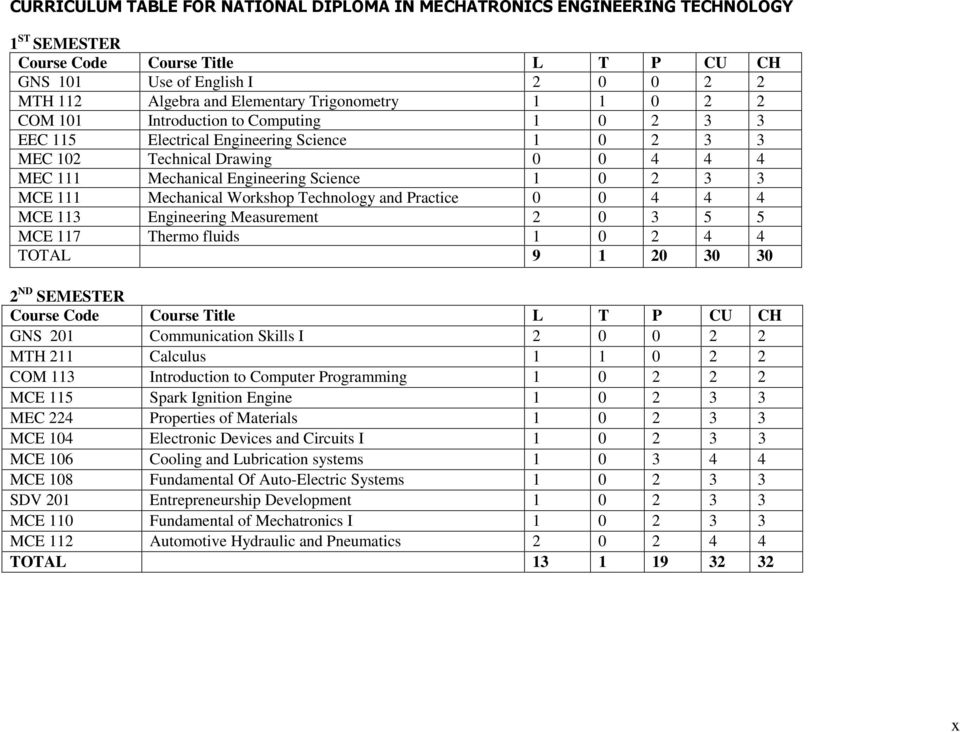
10 CURRICULUM TABLE FOR NATIONAL DIPLOMA IN MECHATRONICS ENGINEERING TECHNOLOGY 1 ST SEMESTER Course Code Course Title L T P CU CH GNS 101 Use of English I MTH 112 Algebra and Elementary Trigonometry COM 101 Introduction to Computing EEC 115 Electrical Engineering Science MEC 102 Technical Drawing MEC 111 Mechanical Engineering Science MCE 111 Mechanical Workshop Technology and Practice MCE 113 Engineering Measurement MCE 117 Thermo fluids TOTAL ND SEMESTER Course Code Course Title L T P CU CH GNS 201 Communication Skills I MTH 211 Calculus COM 113 Introduction to Computer Programming MCE 115 Spark Ignition Engine MEC 224 Properties of Materials MCE 104 Electronic Devices and Circuits I MCE 106 Cooling and Lubrication systems MCE 108 Fundamental Of Auto-Electric Systems SDV 201 Entrepreneurship Development MCE 110 Fundamental of Mechatronics I MCE 112 Automotive Hydraulic and Pneumatics TOTAL x
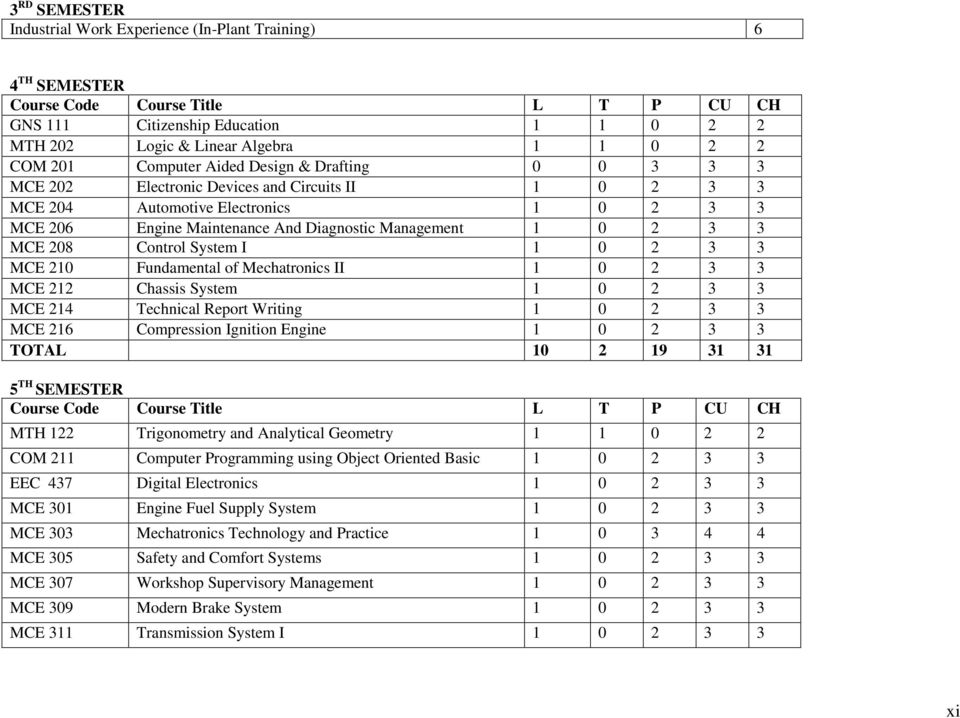
11 3 RD SEMESTER Industrial Work Experience (In-Plant Training) 6 4 TH SEMESTER Course Code Course Title L T P CU CH GNS 111 Citizenship Education MTH 202 Logic & Linear Algebra COM 201 Computer Aided Design & Drafting MCE 202 Electronic Devices and Circuits II MCE 204 Automotive Electronics MCE 206 Engine Maintenance And Diagnostic Management MCE 208 Control System I MCE 210 Fundamental of Mechatronics II MCE 212 Chassis System MCE 214 Technical Report Writing MCE 216 Compression Ignition Engine TOTAL TH SEMESTER Course Code Course Title L T P CU CH MTH 122 Trigonometry and Analytical Geometry COM 211 Computer Programming using Object Oriented Basic EEC 437 Digital Electronics MCE 301 Engine Fuel Supply System MCE 303 Mechatronics Technology and Practice MCE 305 Safety and Comfort Systems MCE 307 Workshop Supervisory Management MCE 309 Modern Brake System MCE 311 Transmission System I xi
12 MCE 311 Project TOTAL TH SEMESTER Industrial Work Experience (In-Plant Training) 6 xii

13 GENERAL STUDIES COURSES 1

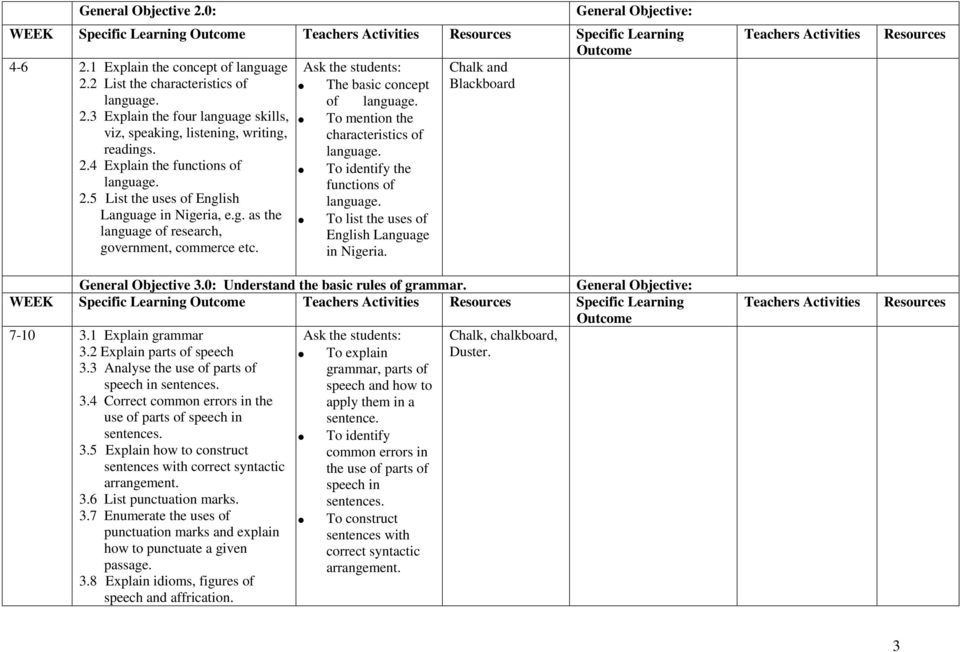
14 USE OF ENGLISH I PROGRAMME: NATIONAL DIPLOMA IN MECHATRONIC ENGINEERING TECHNOLOGY COURSE: Use of English I (Grammar) Course Code: GNS 101 Contact Hours: Hrs/Wk Course Specification: Theoretical Contents WEEK General Objective 1.0: Understand ways of promoting the necessary language skills which will enable student to cope effectively. General Objective: Specific Learning Specific Learning Explain the necessity for acquiring good notetaking/making techniques. 1.2 List the methods of notetaking/making. 1.3 Explain the use of dictionary. 1.4 Explain the use of the library. 1.5 Explain the type of information sources in the library. 1.6 Identify good reading habits. 1.7 Explain the different methods of reading viz, scan, skim, normal and study. 1.8 Use the different methods of reading explained in 1.7 above. Ask the students: The techniques of note taking/making and list the various methods. The correct ways of using the dictionary. The best ways of using the library. To list the various information sources in the library and how to locate these information sources. The different methods of reading and the difference between the methods. Chalkboard, Duster, Recommended Textbooks. 2
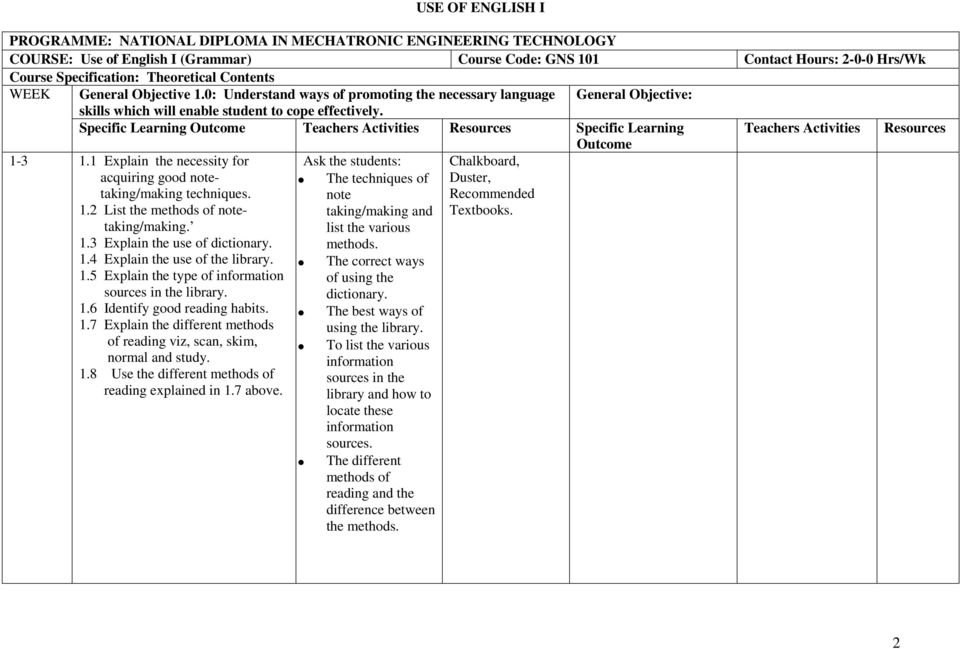
15 General Objective 2.0: General Objective: WEEK Specific Learning Specific Learning Explain the concept of language Ask the students: Chalk and 2.2 List the characteristics of The basic concept Blackboard language. of language. 2.3 Explain the four language skills, To mention the viz, speaking, listening, writing, characteristics of readings. language. 2.4 Explain the functions of To identify the language. functions of 2.5 List the uses of English language. Language in Nigeria, e.g. as the To list the uses of language of research, English Language government, commerce etc. in Nigeria. General Objective 3.0: Understand the basic rules of grammar. General Objective: WEEK Specific Learning Specific Learning Explain grammar Ask the students: Chalk, chalkboard, 3.2 Explain parts of speech To explain Duster. 3.3 Analyse the use of parts of grammar, parts of speech in sentences. speech and how to 3.4 Correct common errors in the apply them in a use of parts of speech in sentence. sentences. To identify 3.5 Explain how to construct common errors in sentences with correct syntactic the use of parts of arrangement. speech in 3.6 List punctuation marks. sentences. 3.7 Enumerate the uses of To construct punctuation marks and explain sentences with how to punctuate a given correct syntactic passage. arrangement. 3.8 Explain idioms, figures of speech and affrication. 3
16 To identify punctuation marks and their uses, and how to punctuate a given passage. To construct sentences to illustrate idioms, figure of speech and affixes. General Objective 4.0: Understand the essential qualities of paragraph. General Objective: WEEK Specific Learning Specific Learning Define a paragraph? Ask the student: Chalk, chalkboard, 4.2 Name the parts of a paragraph To define a Duster viz: topic, sentence, paragraph and to development and name the part of a conclusion/transition. paragraph. 4.3 Explain the thematic qualities What they of a paragraph viz, unity, understand by the coherence and emphasis. thematic qualities 4.4 Explain methods of paragraph of a paragraph. development viz, example, To explain the definition comparison and various methods contrast etc. of paragraph 4.5 Explain method of ordering development and details in a paragraph, viz, less the methods of complex to more complex and ordering details in vice versa, less important to a paragraph. more important and vice versa, spatial, chronological etc. 4.6 Write specific paragraphs to illustrate 4.2 to 4.45 above. 4

17 General Objective 5.0: Appreciating Literary Works in English. Ask the students: The meaning of literature and the development of literature Give the meaning of literature. 5.2 Trace the development of literature. 5.3 Differentiate between the literary genres. 5.4 Explain the functions of literature. 5.5 Explain the terminology of prose fiction, e.g. plot setting, characterization etc. 5.6 Answer an essay question on a given novel. The functions of literature and the terminology of prose fiction. Chalk, chalkboard, Duster General Objective: Assessment: Course work 20%, Course tests 20%, Examination 60% 5

18 CITIZENSHIP EDUCATION PROGRAMME: NATIONAL DIPLOMA IN MECHATRONIC ENGINEERING TECHNOLOGY COURSE: Citizen Education Course Code: GNS 111 Contact Hours: Hrs/Wk Course Specification: Theoretical Contents WEEK General Objective 1.0: Understand the Constitution of Nigeria. General Objective: Specific Learning Specific Learning Ask the students: Chalkboard, Duster, What they chalk understand by the term constitution and to distinguish the different rules of constitution known Explain the term constitution. 1.2 Distinguish the different types of constitution. 1.3 Highlight some provisions of an International Constitution. 1.4 Explain the effectiveness of International Constitution. 1.5 Explain the supremacy of the Nigeria Constitution to other laws with emphasis on the 1989 constitution. 1.6 Evaluate the main parts of the Nigeria Constitution. 1.7 Draft a constitution for an association. 1.8 Trace the historical development of the Nigerian Constitution. 1.9 Discuss the merits and demerits of each of the Nigerian constitutions Explain the concept of rule of law To explain the effectiveness of International Constitution. To explain Nigerian Constitution to other laws. To identify the main parts of the Nigerian Constitution. Assess the students by giving them assignment to draft a constitution for an association 6

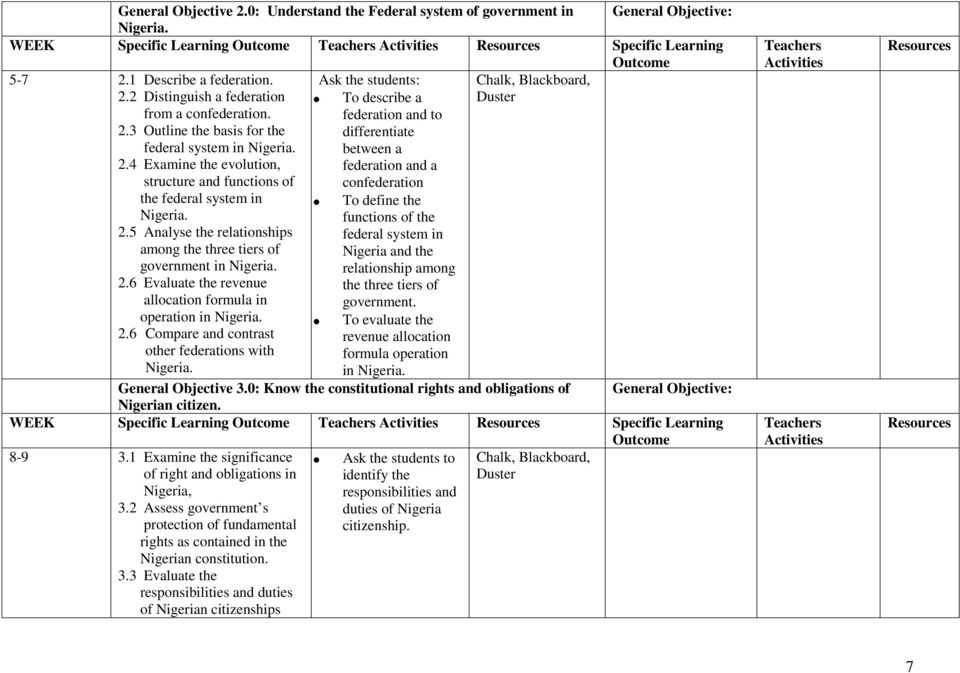
19 General Objective 2.0: Understand the Federal system of government in General Objective: Nigeria. WEEK Specific Learning Specific Learning Describe a federation. Ask the students: Chalk, Blackboard, 2.2 Distinguish a federation To describe a Duster from a confederation. federation and to 2.3 Outline the basis for the differentiate federal system in Nigeria. between a 2.4 Examine the evolution, federation and a structure and functions of confederation the federal system in To define the Nigeria. functions of the 2.5 Analyse the relationships federal system in among the three tiers of Nigeria and the government in Nigeria. relationship among 2.6 Evaluate the revenue the three tiers of allocation formula in government. operation in Nigeria. To evaluate the 2.6 Compare and contrast revenue allocation other federations with formula operation Nigeria. in Nigeria. General Objective 3.0: Know the constitutional rights and obligations of General Objective: Nigerian citizen. WEEK Specific Learning Specific Learning Examine the significance of right and obligations in Nigeria, 3.2 Assess government s protection of fundamental rights as contained in the Nigerian constitution. 3.3 Evaluate the responsibilities and duties of Nigerian citizenships Ask the students to identify the responsibilities and duties of Nigeria citizenship. Chalk, Blackboard, Duster 7
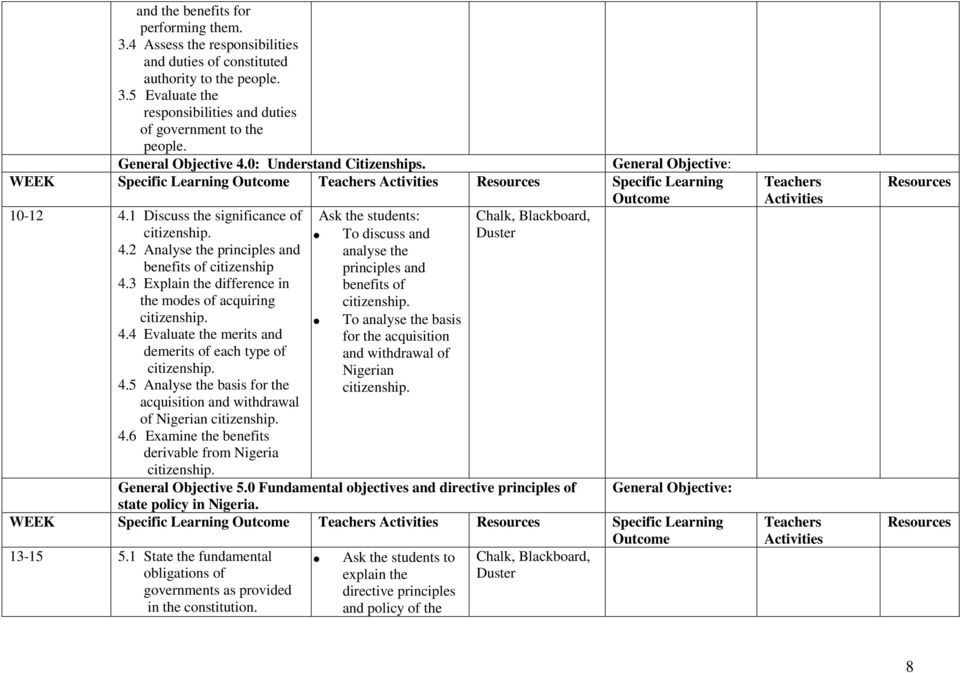
20 and the benefits for performing them. 3.4 Assess the responsibilities and duties of constituted authority to the people. 3.5 Evaluate the responsibilities and duties of government to the people. General Objective 4.0: Understand Citizenships. General Objective: WEEK Specific Learning Specific Learning Discuss the significance of citizenship. 4.2 Analyse the principles and benefits of citizenship 4.3 Explain the difference in the modes of acquiring citizenship. 4.4 Evaluate the merits and demerits of each type of citizenship. 4.5 Analyse the basis for the acquisition and withdrawal of Nigerian citizenship. 4.6 Examine the benefits derivable from Nigeria citizenship. Ask the students: To discuss and analyse the principles and benefits of citizenship. To analyse the basis for the acquisition and withdrawal of Nigerian citizenship. Chalk, Blackboard, Duster General Objective 5.0 Fundamental objectives and directive principles of General Objective: state policy in Nigeria. WEEK Specific Learning Specific Learning State the fundamental Ask the students to Chalk, Blackboard, obligations of explain the Duster governments as provided directive principles in the constitution. and policy of the 8
21 5.2 Explain the general provisions of the fundamental objectives and directive principles of state policy. 5.3 Explain the political, economic, social and education policies of Nigeria. 5.4 Explain the directive principles and policy of the Nigerian government on culture, the mass media, national ethics and duties of the citizen. 5.5 Assess the conformity observance and application of the fundamental objectives and directives principles of state policy by governments and people of Nigeria. 5.6 Recommend improvements on the provision conformity, observance and application of the fundamental objectives and directive principles of state policy. Nigeria government on cultures, the mass media, national ethnics and duties of the citizen. Assessment: Course work 20%, Course tests 20%, Examination 60% 9
22 USE OF ENGLISH II PROGRAMME: NATIONAL DIPLOMA IN MECHATRONIC ENGINEERING TECHNOLOGY COURSE: Use of English II (Essay and Comprehension) Course Code: GNS 201 Contact Hours: Hrs/Wk Course Specification: Theoretical Contents WEEK General Objective 1.0: Understand the rules of grammar. General Objective: Specific Learning Specific Learning Define the phrase? 1.2 Explain the different types of phrases, i.e. structural and functional. 1.3 Define the clause? 1.4 Explain the different types of clauses i.e. structural and functional. 1.5 Define the sentence? 1.6 Explain the different types of sentences, i.e. structural and function. 1.7 Explain the constitution of different types of sentences. Ask the students: To identify the different types of phrases. To define a clause and to identify the different types of clauses. To define a sentence and to identify the different types of sentences. Assess the students on the construction of different types of sentences. Chalkboard, Duster, Recommended Textbooks Lecture Notes etc. General Objective 2.0: Know how to write good essay. General Objective: WEEK Specific Learning Specific Learning List the different types of Ask the student to Chalk and essays. list the different Blackboard, 2.2 Explain the features of types of essays and Duster each type of essay listed in to identify the Recommended 2.1 above. features of each Textbook 2.3 Generate/gather relevant types of essay listed Lecture Notes, etc. information on a given above. topic. Assess the students 10
23 2.4 Draw up a good outline. on essay writing. 2.5 Write a good essay on a given topic. General Objective 3.0: Understand the difference between denotative and General Objective: connotative uses of words. WEEK Specific Learning Specific Learning Explain the term denotation. 3.2 Identify words used denotatively. 3.3 Explain the term connotation. 3.4 Identify words used connotatively. 3.5 Use word Connotatively. 3.6 Compare denotative and connotative usage in groups of synonyms, e.g. women, lady, female, client, customer, patient, fear, terror, dread etc. Ask the students to define the terms denotation and connotation and how to identify words used denotatively connotatively. Assess the student. Chalk and Blackboard, Duster Recommended Textbook Lecture Notes, etc. General Objective 4.0: Understand the techniques of comprehension and General Objective: summary writing. WEEK Specific Learning Specific Learning Answer questions on Ask the students to Chalk and comprehension passage at distinguish the Blackboard, a higher level of difficulty. various types of Duster 4.2 Give contextual summary writing Recommended explanations to statements and the steps in Textbook from the texts used. summary writing. Lecture Notes, etc. 4.3 Identify colloquialisms, Give the students slangs and jargons. passages to 4.4 Explain summary writing. summarise. 4.5 Distinguish between types Assess the students. 11
24 of summary writing. 4.6 Explain the steps in summary writing. 4.7 Write, within a specified length, a goal summary of a given passage. General Objective 5.0 Appreciating Literature in English. General Objective WEEK Specific Learning Specific Learning Describe drama. 5.2 Explain the types of drama. 5.3 Explain the terminology of drama, e.g. act, resolution, conflict, denouement, etc 5.4 Distinguish between radio drama and television drama. 5.5 Answer an essay question on a given drama text. Ask the students to identify the various types of drama and to explain the terminology of drama to differentiate between radio drama and television drama to answer essay question on a given drama text. Assess the students. Television, Video Cassette Recorder, Radio Cassette Player 12
25 ENTREPRENEURSHIP DEVELOPMENT PROGRAMME: NATIONAL DIPLOMA IN MECHATRONIC ENGINEERING TECHNOLOGY COURSE: Entrepreneurship Development I Course Code: SDV 201 Contact Hours: Hrs/Wk Course Specification: Theoretical Contents WEEK General Objective 1.0: Understand the basic concept of Entrepreneurship. General Objective: Specific Learning Specific Learning Lecture and site examples of each Define entrepreneurship, entrepreneur, small business and selfemployment. 1.2 State the entrepreneurship philosophy and identify entrepreneurship characteristics. 1.3 Identify entrepreneurial characteristics. 1.4 Define development enterprise. Chalk, Blackboard, Duster Recommended Textbooks Lecture Notes etc General Objective 2.0: Understand the historical perspective of General Objective: entrepreneurship development. WEEK Specific Learning Specific Learning Historical perspective. Trace the historical; Chalk and 2.2 Trace the origin of evolution of Blackboard, entrepreneurship. business enterprise Duster 2.3 Explain organizational citing example. Recommended structure. Highlight the Textbook 2.4 Explain the role an reasons for their Lecture Notes, etc. entrepreneur. failure/success. 2.5 Explain the reasons for business failure. 13
26 General Objective 3.0: Know how to plan a business General Objective: Entrepreneurship/Project. WEEK Specific Learning Specific Learning Define the concepts: Lecture and Chalk and planning, business illustrate with Blackboard, enterprise and project. examples. Duster 3.2 Explain the importance of Highlight the Recommended planning to a business students the initial Textbook enterprise. problems likely to Lecture Notes, etc. 3.3 Analyse the skills and be faced. techniques of starting and Invite a successful managing small business entrepreneur to successfully. deliver lecture to the 3.4 Prepare and present project student. proposal. Lecture and 3.5 Manage a small business introduce the profitably. students to the formats of various project proposals. General Objective 4.0: Know how to operate simple stock keeping records. General Objective: WEEK Specific Learning Specific Learning Ordering spare parts/materials. 4.2 Receipt of parts/materials. 4.3 Storage of parts/materials. 4.4 Issue of parts/materials. Lecture and demonstrate to students how to write receipt and keep records of ordering storage and issue materials. Store or any storage facility record notebook. General Objective 5.0: Know how to prepare and operate cash flow on General Objective: spreadsheets. WEEK Specific Learning Specific Learning Need for different records Lecture and Chalkboard and (capital, revenue, credit demonstrate for the Computer 14
27 transaction, tax) 5..2 Formatting spreadsheet 5..3 Operating spreadsheet students to appreciate. Give practical exercise to students. General Objective 6.0: Understand employment issues. General Objective: WEEK Specific Learning Specific Learning Define the terms: Lecture and cite Chalkboard, Chalk, education, training and examples. Duster, development. Recommended, 6.2 Relate education, training Textbooks, Lecture and development to Notes, etc. employment. 6.3 Distinguish between skills and employment. 6.4 Explain the role of the private sector in employment generation. 6.5 Identify the forms and informal sectors. 6.6 Explain the issues of: (i) Rural Youth and Employment (ii) Urban Youth and Employment. General Objective 7.0 Understand the Nigerian legal system General Objective: WEEK Specific Learning Specific Learning Explain the nature of law. 7.2 Analyse the sources of Nigerian laws. 7.3 Evaluate the characteristics of Nigerian Legal System. Lecture Chalkboard, Chalk, Duster, Recommended Textbooks, Lecture Notes, etc. 15
28 General Objective 8.0 Comprehend the nature of contract and tort. General Objective: WEEK Specific Learning Specific Learning Define contract. Lecture Chalkboard, Chalk, 8.2 Explain types of contracts. Duster, 8.3 State the basic Recommended requirements for a valid Textbooks, Lecture contract. Notes, etc. 8.4 Analyse contractual terms. 8.5 Examine vitiating terms. 8.6 Explain breach of contract and remedies. 8.7 Define Tort. 8.8 Explain types of Tort. 8.9 Discuss tortuous liabilities and remedies. General Objective 9.0: Understand Agency and Partnership General Objective: WEEK Specific Learning Specific Learning Define agency. Lecture Chalkboard, Chalk, 9.2 Explain creation of agency. Lecture and cite Duster, 9.3 Explain authority of the examples Recommended agent. Textbooks, Lecture 9.4 Analyse the rights and Notes, etc. duties of principal agent and third parties. 9.5 Explain termination of agency and remedies. 9.6 Define partnership. 9.7 Examine creation of partnership. 16
29 9.8 Explain relations of partners to one another and to persons dealing with them. 9.9 Analyse dissolution of partnership and remedies. Assessment: Coursework 20%, Course Test 20%, Practical 0%, Examination 60%. References: 1. Wole Adewunmi, Business Management An Introduction, McMillan Nig. Ltd. Lagos Soji Olokoyo, Small Business Management Guide Entrepreneurs, Ola Jamon Printers and Publishers, Kaduna. 17
30 MATHEMATICAL COURSES 18
31 ALGEBRA AND ELEMENTARY TRIGONOMETRY PROGRAMME: NATIONAL DIPLOMA IN MECHATRONIC ENGINEERING TECHNOLOGY COURSE: Algebra And Elementary Trigonometry Course Code: MTH 112 Contact Hours: Hrs/Wk Course Specification: Theoretical Contents WEEK General Objective 1.0: Understand laws of indices and their applications in simplifying algebra expressions. General Objective: Specific Learning Specific Learning Define index. Explain index and Chalkboard, 1.2 Establish the laws of the laws of indices. Textbooks, indices. Solve problems Calculators, 1.3 Solve simple problems using the laws of Chalk etc. using the laws of indices. indices. General Objective 2.0: Understand theory of logarithms surds and their General Objective: applications in manipulating expression. WEEK Specific Learning Specific Learning Define logarithm 2.2 Establish the four basic laws of logarithm. 2.3 Solve simple logarithms problem. 2.4 Define natural logarithm and common logarithm. 2.5 Define characteristic and mantissa. 2.6 Read the logarithmic table for given numbers. 2.7 Simplify numerical expressions using tables e.g. 18D = 3/4JPC 2 AM B find D when J = 0935, 0 = 35, P = 1.6 Explain logarithm and its four basic laws. Solve logarithmic related problems. Recommended Textbook, Chalk, Chalkboard, Duster, Lecture Note. etc 19
32 10 6, C = 55, M = П = Apply logarithm in solving non-linear equations. e.g. y = ax n, logy=log a + n log x; y = bc x, logy = logb + xlogc; y = a + bx n, Log (y- a) = Logb + nlogx, 2.9 Define surds Reduce a surd into it s simplest form Solve simple problems on surds. General Objective 3.0: Understand principles underlying the construction of charts and graphs. General Objective: WEEK Specific Learning Specific Learning Construct graphs of Ask the students to Recommended functions such as Y + ax = draw graphs. Textbook, b, n = 1, 2Y= CST (a+a) Y Chalk, = ax k, including cases of Chalkboard, asymbles. Duster, 3.2 Apply knowledge from 3.1 Lecture Note. etc in termination as laws from experimental data. General Objective 4.0: Know the different methods of solving quadratic General Objective: equations. WEEK Specific Learning Specific Learning Solve quadratic equation by factorisation. 4.2 Solve quadratic equations by method of completing Ask the students to solve quadratic equations. Recommended Textbook, Chalk, Chalkboard, 20
33 squares. 4.3 Solve quadratic equations by formula. 4.4 Determine the roots. 4.5 Form equations whose roots are given in different methods. Duster, Lecture Note. etc General Objective 5.0: Understand Permutations and Combinations. General Objective: WEEK Specific Learning Specific Learning Define permutation. Explain with good Recommended 5.2 State examples of examples the Textbook, permutations. meaning of Chalk, 5.3 Define combination. permutation and Chalkboard, 5.4 State examples of combination. Duster, combination. Solve problems Lecture Note. etc 5.5 Establish the theorem relating to npr=n!/[!] giving permutation and examples e.g. number of combination. ways of collecting two out of 8 balls. General Objective 6.0: Understand the concept of set theory. General Objective: WEEK Specific Learning Specific Learning Establish n C r = n C n r. 6.2 Define sets, subsets, and null sets. 6.3 Define union, inter-section and completion of sets. 6.4 Draw Venn diagrams to demonstrate the concepts in above. 6.5 Calculate the size or number of elements in a given set. Explain with good examples sets, subset, null sets, and union, intersection and completion of sets. Solve set theory problems using venn diagrams. Recommended Textbook, Chalk, Chalkboard, Duster, Lecture Note. etc 21
34 General Objectives 7.0 Understand the properties of arithmetic and General Objective: geometric progressions. WEEK Specific Learning Specific Learning Define an Arithmetic Ask the students to Recommended progression (A.P.). apply progression Textbook, 7.2 Obtain the formula for nth to solve problems. Chalk, term and the first n terms Explain in detail Chalkboard, of an A. P. with examples Duster, 7.3 Give examples of the Arithmetic and Lecture Note. etc above e.g. find the 20 th Geometric term of the series e.g. progressions. 2,4,6,8... Find also the series of the first 20 terms. 7.4 Define a geometric progression (G.P.) 7.5 Obtain the formula for the nth term and the first n terms of a geometric series. 7.6 State examples of 7.5 above e.g.; given the sequences 1/3, 1, 3 ¼ find the 20 th term and hence the sum of the 1 st 20 terms. 7.7 Define Arithmetic Mean (AM) and Geometric Mean (G.M.). 7.8 Define convergence of series. 7.9 Define divergence of series. 22
35 General Objectives 8.0 Understand the binomial theorem and its General Objective: application of expressions in approximations. WEEK Specific Learning Specific Learning Explain the method of State the Recommended mathematical induction. importance and Textbook, 8.2 State and prove the application of the Chalk, binomial theorem for a theorem. Chalkboard, positive integral index. Explain in details Duster, 8.3 Expand expressions of the binominal theorem Lecture Note. etc forms (x=y) 2, (x 2 1) 8 and its applications applying binominal in approximations. theorem. 8.4 Find the coefficient of a particular term in the expansion of simple binomial expressions. 8.5 Find the middle term in the expansion of binomial expression. 8.6 State the binomial theorem for a rational index. 8.7 Expand expressions of the form: (1=x )-1, (1-x) 1/2 (1- x) - applying binomial theorem. 8.8 Expand and approximate expressions of the type (1.001)n, (0.998) n, (1=x) 1/2, (-x) - to a stated degree of accuracy applying/scalar expression. 23
36 General Objectives 9.0: Understand the basic concepts and manipulation of General Objective: vectors and their applications to the solution of engineering problems. WEEK Specific Learning Specific Learning State the definitions and Explain in details Recommended representations of vectors. and apply the Textbook, 9.2 Define a position vector. techniques of Chalk, 9.3 Define unit vector. vectors to solve Chalkboard, 9.4 Explain scalar multiple of various problems. Duster, a vector. Lecture Note. etc 9.5 List the characteristics of parallel vectors. 9.6 Identify quantities that may be classified as vector e.g. displacement, velocity, acceleration, force, etc. 9.7 Compute the modules of any given vector up to 2 and 3 dimensions. 9.8 State the parallelogram law in solving problems including addition and subtraction of vectors. 9.9 Apply the parallelogram law in solving problems including addition and subtraction of vectors Explain the concept of components of a vector and the meaning of orthogonal components Resolve a vector into its orthogonal components List characteristics of coplanar localized vectors 24
37 9.13 Define the resultant or composition of coplanar vectors Compute the resultant of coplanar forces acting at a point using algebraic and graphical methods Apply the techniques of resolution and resultant to the solution of problems involving coplanar forces Apply vectorial techniques in solving problems involving relative velocity State the scalar product of two vectors Compute the scalar product of given vectors Define the cross product of two vectors Calculate the direction ratios of given vectors Calculate the angle between two vectors using the scalar product. General Objectives 10.0: Understand the concepts of equations and apply it General Objective: to engineering problems. WEEK Specific Learning Specific Learning Explain the concept of equation, i.e. AX + B = D where A and B are expressions. Ask the student to solve carious equations as indicated in section Recommended Textbook, Chalk, Chalkboard, 25
38 10.2 List different types of equations:- Linear, quadratic, cubic, etc State examples of linear simultaneous equations with two unknowns and simultaneous equations with at least one quadratic equation Apply algebraic and graphical methods in solving two simultaneous equations a linear equation and a quadratic equation Apply the algebraic and graphical methods in solving two simultaneous and quadratic equations Define a determinant of n th order Apply determinants of order 2 and 3 in solving simultaneous linear equations. 10. Duster, Lecture Note. etc General Objectives 11.0: Understand the definition, manipulation and General Objective: application of trigonometric functions. WEEK Specific Learning Specific Learning Define the basic Define and Derive Recommended trigonometric ratios, sine, the trigonometric Textbook cosine and tangent of an ratios and Chalk angle. identities. Chalkboard 11.2 Derive the other Duster trigonometric ratios,; Lecture Note etc cosecant, secant and 26
39 cotangent using the basic trigonometric ratios in above Derive identities involving the trigonometric ratios of the form; Cos 2 +Sin 2 =1, Sec 2 =1=tan2, etc 11.4 Derive the compound angle formulae for sin (A-B), Cos (A-B) and Tan (A-B). Assessment: Course work 20%, Course tests 20%, Examination 60% 27
40 CALCULUS PROGRAMME: NATIONAL DIPLOMA IN MECHATRONIC ENGINEERING TECHNOLOGY COURSE: CALCULUS Course Code: MTH 211 Course Specification: Theoretical Content General Objective: 1.0 Understand the basic concepts of differential Week Calculus and in application in solving engineering problems Specific Learning Define limits with are Chalkboard, examples. explain to textbooks, lecture 1.2 State and prove basic give and solve notes, chalk, etc theorems on limits simple 1.3 Prove that lim sin θ/θ, lim engineering Tan θ/θ = 1 as θ 0 and 1.4 Define differentiation as technological an incremental notation of problems a function. 1.5 Differentiate a function from first principles. 1.6 Prove the formulae for derivative of functions, Function of a function, products, and quotient of functions. 1.7 Differentiate simple algebraic, trigonometric, logarithmic, exponential, hyperbolic parametric, inverse and implicit functions. 1.8 Derive second derivative of a function. 1.9 Apply differentiation to simple engineering and Practical Content General Objective: 1.0 Specific Learning Contact Hours Hrs/wk 28
41 technological problems Explain the rate of change of a function Explain the condition for turning point of a function Distinguish between maximum and minimum value of a function Sketch the graph of a function showing its maximum and minimum points and points of reflexion Estimate error quantities from the small increment of a function Determine the tangent to a curve Determine the normal to a curve. General Objective 2.0: Know integration as the reverse of differentiation and its application to engineering problems Week Specific Learning : Define integration as the reverse of differentiation. 2.2 Explain integration as a limit of summation of a function. 2.3 Distinguish between indefinite and definite integrals. 2.4 Determine the indefinite and definite integrals. 2.5 Determine the definite Ask students to apply integral calculus to simple function. Explain in details with solved examples, the principle of Chalkboard, textbooks, lecture notes, chalk General Objective: 2.0 Specific Learning 29
42 integral of a function. 2.6 Integrate algebraic, logarithmic, trigonometric and exponential simple functions. 2.7 List possible methods of integration. 2.8 Integrate algebraic and trigonometric functions by the substitution method. 2.9 Integrate trigonometric and exponential functions by parts Integrate algebraic functions by partial fraction Integrate trigonometric and logarithmic functions applying reduction formula State standard forms of some basic integrals Calculate length of arc, area under a curve, area between two curves, volume of revolution, center of gravity, center of surface area, second moment and moment of inertia Define Trapezoidal and Simpson s rule as methods of approximating areas under given curves. integration. 30
43 2.15 Find approximate area under a curve applying Trapezoidal method Find approximate area under a curve applying Simpson s rule Compare result obtained from Trapezoidal and Simpson s rules with the results by direct integration Apply integration to kinematics. General Objective 3.0: Understand first order homogenous linear ordinary differential equations with constant coefficients as applied to simple engineering problems Week Specific Learning : Define first order differential equation 3.2 List order, degree, general solution, boundary or initial conditions and particular solution of differential equations. 3.3 List examples of various types of first order differential equations. 3.4 Define first order homogenous differential equations 3.5 List the methods of solving differential equations by separable variables. Ask students to apply differential equation to solve engineering problems. Explain in details with solved examples the application of differential equations to engineering problems. Chalkboard, textbooks, lecture notes, chalk, etc. General Objective: 3.0 Specific Learning 31
44 3.6 Identify differential equations reducible to the homogenous form. 3.7 Explain exact differential equations. 3.8 Solve exact differential equations, e.g. (a) Show that (3x 2 + y cos x) dx+(sin x-4y 3 ) dy = O is an exact differential equation. (b) Find its general solution. 3.9 Define integrating factors Determine the solution of differential equations using integrating factors Define linear differential equations of the first order. General Objective 4.0: Understand the basic concepts of partial differentiation and apply same to engineering problems Week Specific Learning : Define partial differentiation 4.2 List and explain the uses of partial derivatives. 4.3 Solve problems on partial differentiation. e.g. f (x, y) = x 2 + y 2 = 2xy find dy/dx, dx/dy 4.4 Apply partial differentiation to engineering problems. Solve problems on partial differential Equations. Chalkboard, textbooks, lecture notes, chalk Assessment: Course work 20%, Course tests 20%, Examination 60% General Objective: 4.0 Specific Learning 32
45 LOGIC AND LINEAR ALGEBRA PROGRAMME: NATIONAL DIPLOMA IN MECHATRONICS ENGINEERING TECHNOLOGY COURSE: LOGIC AND LINEAR ALGEBRA Course Code: MTH 211 Course Specification: Theoretical Content Practical Content General Objective: 1.0 Understand the basic rules of mathematical logic General Objective: 1.0 Week and their application to mathematical proofs. Specific Learning Specific Learning The essential connectives, Explain and Lecture notes, negation, conjunction, illustrate 1.1 to 1.6 Recommended disjunction, implication and ask the textbooks, charts, and bi-implication students to find the chalkboard 1.2 State the essential truth value of the connectives defined in 1.1 logic statement. Recommended above. Assess the student. textbooks, lecture 1.3 Explain grouping and Explain and notes, parenthesis in logic, illustrate 1.7 to 1.2 chalkboard, chalk 1.4 Explain Truth Tables. and asked the 1.5 Define tautology students to solve 1.6 Give examples of types of problems on 1.7 to tautology. e.g i. If P and Q are distinct atomic sentences, which of the following are tautologies? (a) P - Q (b) PUQ - QUP (c) PV(P*Q) ii. Let P = Jane Austen was 3-4 a contemporary of Beethoven. Q = Beethoven was a contemporary of Gauss. R = Gauss was a Contact Hours Hr/Wk 33
46 contemporary of Napoleon S = Napoleon was a contemporary of Julius Caesar. (Thus P, Q and R and true, and S is false). Then find the truth values of sentences:- (a) (P *Q) = R (b) (P - Q) (c) P *Q - R - S 1.7 Define universal quantifier and existential quantifier. 1.8 Translate sentences into symbolic form using quantifiers. e.g. some freshmen are intelligent can be stated as for some x, x, is a freshman and x is intelligent can translate in symbols as (/x) (Fx & Ix). 1.9 Define the scope of a Quantifier Define bound and free variables 1.11 Define term and formula Give simple examples of each of 1.9 to 1.11 above Explain the validity of formulae. 34
47 General Objective 2.0: Know permutation and combination General Objective: 2.0 Week Specific Learning : Specific Learning : 2.1 Define permutations and Explain and Recommended textbooks, combinations. illustrate the lecture notes, chalkboard, 2.2 Give illustrative examples activities in chalk, etc. of each of 2.1 above 2.1 to State and approve the and ask the fundamental principle of student to: permutation. establish the 2.4 Give illustrative examples formula n P r = of the fundamental n!/(n-r)! principles of permutation. - Prove that 2.5 Establish the formula n P r = n P r = n!/ (n - r)! (n-r+1)( n P r Prove that n P r = (n - r + 1) - Establish the x n P r - 1. formula n C r = 2.7 Solve problems of n!/[n-r!]r! permutations with - Prove that 5-7 restrictions on some of the n Cr = nc n-r objects. 2.8 Solve problems of permutations in which the objects may be repeated. 2.9 Describe circular permutations Solve problems of permutation of N things not all different Establish the formula n C r = n!/[(n - r)! r!] 2.12 Solve example State and prove the theorem n C r = n C n-r Solve problems of combinations with 35
48 restrictions on some of the objects Solve problems of combinations of n different things taken any number at a time. General Objective 3.0: Know binomial theorem Week Specific Learning : Explain with illustrative examples - the method of mathematical induction. 3.2 State and prove binomial theorem for positive integral index. 3.3 Explain the properties of binomial expansion. 3.4 State at least seven (7) examples of 3.3 above. e.g. i. A (x 2-1/x) ii. Find the constant term in the expansion of (x + 1/x) A iii. Find the co-efficient of xv in the expansion of (x + k) A where v is a number lying between -n and n- 3.5 State the binomial theorem for a rational number 3.6 State the properties of binomial coefficients. 3.7 Apply binomial expansion in approximations (simple Explain and illustrate activities in 3.1 to 3.7 and ask the students to solve problems on them. Recommended textbooks, lecture notes, chalkboard, chalk, etc Specific Learning : 36
49 examples only). General Objective 4.0: Know matrices and determinants General Objective 4.0: Week Specific Learning : Specific Learning : 4.1 Define Matrix Explain and Recommended textbooks, 4.2 Define the special matrices illustrate the lecture notes, chalkboard, - zero matrix, identity activities in chalk, etc Matrix, square matric, 4.1 to triangular matrix, Ask the symmetric matrix, skew student to symmetric matrix. prove the 4.3 State example for each of theorems and the matrices in 4.2 above. solve 4.4 State the laws of addition problems on and multiplication of the illustrated matrices. activities. 4.5 Illustrate the commutative, Assess the associative, and distributive student nature of the laws stated in above. 4.6 Explain the transpose of a matrix. 4.7 Determine a determinant for 2 x 2 and 3 x 3 matrices. 4.8 Define the minors and cofactors of a determinant. 4.9 Explain the method of evaluating determinants State and prove the theorem Two rows or two columns of a matrix are identical, then the value of it s determinant is 37
50 zero State and prove the theorem If two rows or two columns of a matrix are interchanged, the sign of the value of its determinant is changed State and prove the theorem If any one row or one column of a matrix is multiplied by a constant, the determinant itself is multiplied by the constant State and prove the theorem If a constant times the elements of a row or a column is added to the corresponding elements of any other row or column, the value of the determinant itself is multiplied by the constant State five examples of each of the theorems in above Define the adjoint of a matrix Explain the inverse of a matrix State the linear transformations on the rows and columns of a matrix. 38
51 4.18 Apply Crammer s rule in solving simultaneous linear equation Apply Linear transformation in solving simultaneous linear equations. Assessment: Course work 20%, Course tests 20%, Examination 60% 39
52 TRIGONOMETRY AND ANALYTICAL GEOMETRY PROGRAMME: NATIONAL DIPLOMA IN MECHATRONICS ENGINEERING TECHNOLOGY COURSE: TRIGONOMETRY AND ANALYTICAL GEOMETRY Course Code: MTH 112 Course Specification: Theoretical Content Practical Content: General Objective: 1.0 Understand the manipulation of trigonometric General Objective 3.0: Week equations. Specific Learning Specific Learning 1.1 Convert sums and Illustrate with Recommended 1-3 differences of trigonometric good examples textbooks, lecture ratios to products. activities in 1.1 notes, chalkboard, 1.2 Prove the sine and cosine to 1.10 and ask chalk, etc formulae of triangles the students to 1.3 Solve problems triangles solve problems using the sine and cosine on them. formulae e.g.:- Assess the The sides a,b,c, of a triangle student. are 4cm, 5cm, and 6cm respectively. Find the angles. 1.4 Calculate angles of elevation and depression using trigonometric ratios e.g.:- From the top of a tree 120m high an observer sees a boat 560m away. Calculate the angle of depression. 1.5 Compute bearings, heights and distances of inaccessible objects and projections, e.g. - A man walks 3km due North, and the 3km N.52 o W. How far is the man from his starting point? What is his Contact Hours Hrs/Wk 40
53 Week bearing from his original position. 1.6 Derive half angle formulae from sin, cos and tan. 1.7 Define inverse circular function. 1.8 Explain inverse circular functions graphically. 1.9 Solve problems involving 1.8 and e.g.:- Draw the graph of 1/(cos 2θ) Taking values from 0 o to 90 o inclusive Apply the concepts in 1.8 above to three dimensional problems. General Objective 2.0: Understand the concept of mensuration and its General Objective 2.0: application to engineering problems Specific Learning : Specific Learning Explain circular measure. 2.2 State the relation between radians and degrees 2.3 Prove the formulae for arc length and area of a sector. 2.4 Identify segment and chord of a circle. 2.5 Determine the area of a segment and the chord of length of a given circle. 2.6 Calculate the surface areas and volumes of simples shapes such as cylinder, sphere and cone. E.g. A solid sphere has radius 8cm. Calculate its volume. Describe circular measure and state the relationship between radian an degrees. Solve problems relating to surface areas and volumes of cylinder, sphere, cones, and irregular shapes applying Simpson s Rule. Lecture notes, Recommended textbooks, charts, chalkboard : 41
54 WEEK 2.7 Determine the areas and volumes of irregular shapes applying Simpsons rule. 2.8 Apply mid-ordinate rule to determine the areas and volumes applying midordinate rule. General Objective 3.0: Understand the concept of analytical geometry General Objective 3.0: and their applications Specific Learning : Specific Learning 3.1 Explain two dimensional coordinate systems: Cartesian and Polarcoordinate systems. 3.2 Explain plotting and sketching of graphs w.r.t. the two coordinate systems. 3.3 Relate Cartesian coordinate to polar coordinates. 3.4 Explain the slope of a line in relation to the above concepts in 3.3. above. 3.5 Explain the intercept of a line. 3.6 Derive the formula for the gradient of line passing through two points. 3.7 Derive the equation of a straight line given the gradient and the co-ordinates of a point. 3.8 Reduce a given linear equation to the intercept form. x/a + y/b = 1 Illustrate the activities in 3.1 to 3.20 with good examples and ask the students to solve problems on them. Illustrate the activities in 3.21 to 3.26 and ask the students to solve problems on them. Assess the students Lecture notes, recommended textbooks, chalkboards, chalk, duster etc. : 42
55 3.9 Determine the coordinates of the point of intersection of two straight lines Define locus 3.11 Derive the slope-intercept form of the equation of a straight line: y = mx+c 3.12 Derive the point - slope form of the equation of a straight line: y - y 1 = m(x x 1 ) Derive the double - point form of the equations of the straight line: y - y 1 = y 2 - y 1 (x - x1) x 2 - x Derive the perpendicular form of the equation of a straight line 3.15 Solve examples of 3.11 to 3.14 above Find the angle (Q) between two lines whose slopes, (m 1, and m 2 ) are Known: Q = tan (m 2 - m 1 )/1 + m 1 m Determine the conditions for two lines to be parallel and to be perpendicular Derive the expression for the perpendicular distance from a point to a line Draw a circle Derive the equation of a circle with center at the origin and radius r. 43
56 WEEK 3.21 Derive the equation of a circle with center outside the origin State general equation of a circle Determine the coordinates of the center of a circle from a given equation of a circle Draw orthogonal circles 3.25 Find the equations of the tangent and the normal at a point circle 3.26 List illustrative examples of each of 3.20 to 3.25 above General Objective 4.0: Understand the concept of Parabola, ellipse and General Objective 4.0: hyperbola. Specific Leaning Specific Leaning 4.1 Define the Parabola 4.2 Derive the standard equation of a Parabola y 2 = 4ax 4.3 State the properties of the parabola 4.4 Define the focal chord, axis and locus rectum of the parabola 4.5 Determine the equation of the tangent and normal from a given point to the parabola. 4.6 Solve problems on parabola e.g. Write down the equation of the parabola and state its vertex if the focus - is (2,0) and the directex x = Define an ellipse. Illustrate activities in 4.1 to 4.19 with good examples. Ask the students to solve them. Assess the students. 44
57 4.8 Derive the equation of an ellipse x 2 /G 2 + y 2 /b 2 = State the properties of the Ellipse Determine the equation of the tangent and the normal to an ellipse from a given point Define focal chord and axis of ellipse Solve problems on ellipses e.g. Find the length of the axis and the eccentricity for the ellipse: 4x 2 + 9y 2 = Define the Hyperbola Derive the equation of the Hyperbola Identify the properties of the Hyperbola Define asymptoes, chord, tangent and normal to a hyperbola Solve problems on hyperbola e.g. Find the foci and directrices for hyperbola: x 2 /16 - y 2 /9 = Explain rectangular hyperbola Determine tangent and normal to the rectangular hyperbola. Assessment: Course work 20%, Course tests 20%, Examination 60% 45
58 INFORMATION AND COMMUNICATION TECHNOLOGY COURSES 46
59 INTRODUCTION TO COMPUTING PROGRAMME: NATIONAL DIPLOMA IN MECHATRONICS ENGINEERING TECHNOLOGY COURSE: INTRODUCTION TO COMPUTING Course Code: COM 101 Contact Hours: Hrs/Wk Course Specification: Theoretical Contents Practical Content: WEEK General Objective 1.0: Understand the basic components of the computer and how it has evolved over the year. General Objective: Specific Learning Specific Learning Know a brief history of computer development. 1.2 State the uses of computer and understand the impact of the PC on computer technology. 1.3 Differentiate between hardware and software. 1.4 Understand the input- Relate the present idea of computer to other equipment and items that assess man to perform tasks faster. Trace the historical evolution of computers Maximum of 4 students to a computer system. Maximum of 4 computers to a printer except when a network is in use. Paper and computer accessories. process- output algorithm Assess the impact of Magic Board with the following in computers to every Multimedia projector mind: day living system 1. Central Processor Conduct the 2. Input Mechanism students through the 3. Output Mechanism various parts of the computer and how data is managed by the various parts in the system. General Objective 2.0: State the importance and application of operation General Objective: systerm. WEEK Specific Learning Specific Learning List the application of the Explain the need for Maximum of 4 following: data storage. students to a computer i. RAM Dismantle a system. ii. ROM computer system Maximum of 4 47
60 iii. Fixed discs iv. Removable v. MS Office vi Lotus Smart Suite vii. MS Encarta 2.2 Understand the concept of an operating system. i. PC-DOS/MS DOS ii. Windows iii. Linux iv. Unix and show the students the RAM card, the Hard disk and the processors. Explain the concept of an operating system. computers to a printer except when a network is in use. Paper and computer accessories. Magic Board Multimedia projector system General Objective 3.0: Understand the operation of windows operating system and application packages. WEEK Specific Learning Specific Learning Access computers correctly through windows operating system. 3.2 Understand the steps for opening and closing windows. 3.3 Understand the application of program manager. 3.4 Know the uses and application of the various windows bars. 3.5 Understand how to move from one window to another and how to operate them concurrently. 3.6 Understand file management and how to manage files. 3.7 Know the step in creating files and folders. Discuss the advantage of windows operating system. Explain the windows menu and tools. Each student must be given an opportunity to start a computer, open/close the window operating system, understand the program manager and move around in the windows environment. Explain the process of creating a file, Maximum of 4 students to a computer system. Maximum of 4 computers to a printer except when a network is in use. Paper and computer accessories. Magic Board Multimedia projector system 3.1 Demonstrate the steps for opening and closing windows. 3.2 Use the various windows bars. 3.3 Create files, folders and manipulate them. 3.4 Perform printing operation using print manager. Give opportunity to each student to boot a computer, work on window operating system and shut down the computer. Assess the students. Maximum of 4 students to a computer system. Maximum of 4 computers to a printer except when a network is in use. Paper and computer accessories. Magic Board Multimedia projector system. 48
61 3.8 Understand file manipulation (moving copying saving deleting etc). 3.9 Understand the use of Print Manager. 3.9 Understand the concept of the following software package. manipulating the file and use of the print manager. Assess the student. Load MS Office with the student and explain the various packages that make up MS office. Load MS Encarta and discuss its use with the student. Assess the student General Objective 4.0: Understand file management and software package. General Objective: WEEK Specific Learning Specific Learning Demonstrate ability in the use of a word processing packages such as MS Word or Word Perfect and covering the following: i. Entering text ii. Formatting text (emboldening font size, italising, etc) iii. Creating and saving text files Importing objects iv. v. Spelling and grammar checking vi. Creating and manipulating Demonstrate the installation of MD Word Identify the different features of the software. Ask students to type a short document and save it. Ask student to edit a document and carry out a spell check. Demonstrate the use of tables. Maximum of 4 students to a computer system. Maximum of 4 computers to a printer except when a network is in use. Paper and computer accessories. Magic Board Multimedia projector system 49
62 tables, text boxes equations. vii. Printing and file export. Competency: The student should be able to identify various hardware and software components of the computer and operate a computer. Assessment: Course work 20%, Course tests 20%, Practicals 10%, Exam 50%. Reference: Computer Information System : An Introduction by Adams and Wagner 50
63 COMPUTER AIDED DESIGN AND DRAFTING PROGRAMME: NATIONAL DIPLOMA IN MECHATRONICS ENGINEERING TECHNOLOGY COURSE: Computer Aided Design And Drafting Course Code: COM 201 Contact Hours: Hrs/Wk Course Specification: Theoretical Contents Practical Content: General Objective 1.0: Understand the use of computer in the design and General Objective: drafting process. WEEK Specific Learning Specific Learning State the advantages and Explain advantages Complete Computer disadvantages of computer and disadvantages of Sets. in the design process. computer in the 1 Computer to Explain the links between design process. Students CAD and CAM. Explain the links 1 Large Format 1.3 Understand the principles between CAD and Printer or of operation capabilities and CAM. Plotters in a system requirements of Show the students Network AutoCAD. the main parts of the 1 Digitiser to Identify the main parts of screen of Auto CAD students. the screen of Auto CAD Manuals, or later version. Explain the function Recommended 1.6 Explain the functions of the of the above. Textbooks. above. Ask the students to Complete Computer 1.7 Understand and use the explain and use the Sets different input methods: different input 1 Computer to 2 keyboards, mouse, methods. Students digitisers, and scanners. Ask students to 1 Large Format 1.8 List the different coordinate explain differences Printer or systems. between Cartesian Plotters in a and polar coordinates Network systems. 1 Digitiser to 2 students. Ask students to demonstrate the above options on the computer screen. 1.1 Install the AutoCAD Software correctly. 1.2 Demonstrate the uses of HELP Menu in solving problems when using the package. 1.3 Use the OSNAP facility to select options. 1.4 Use layer control to change the layers in a drawing. 1.5 Use Cartesian and Polar coordinates to draw lines. 1.6 Prepare and change the size of the drawing field. 1.7 Show how to save drawings on demand and also how to set up the auto-save Provide the students the AutoCAD CDROM for the inatallation. Complete Computer Sets, 1 Computer to 2 Students, 1 Large Printer or Plotters in a Network, 1Digitizer to 2 Students. 51
64 Ask students to construct lines at set lengths and angles using above coordinate systems. Ask students to use snap points to construct lines. Ask students to explain the use of snap points and ortho-commands. Assess the students. General Objective 2.0: Understand how to construct simple geometric shapes. features. WEEK Specific Learning Specific Learning Know how to hatch the Ask the students to Complete Computer 2.1 Produce a simple shapes drawn and change hatch the shapes Sets drawing. the hatch pattern and scale. drawn. 1 Computer to Explain how to draw circles, Ask the students to Students ellipse and arcs to given change the hatch 1 Large Format dimensions. pattern and scale. Printer or 2.3 Explain how to construct Ask the students to Plotters in a polygons and squares to draw circles, ellipse Network given dimensions. and arc to given 1 Digitiser to Produce a simple drawing dimensions. students. Drawing 1. Ask the students to construct polygons and squares to a given dimensions. Complete computer sets, 1 computer to 2 students, 1 large format printer or plotters in a network, 1 Digitiser to 2 students. 52
65 General Objective 3.0: Understand the different edit boxes. WEEK Specific Learning Specific Learning Explain the different edit boxes, how to use them and their attributes. 3.2 Explain how to select the shapes using edit boxes. 3.3 Explain how to use the offset command. Ask students to explain the different edit boxes. Ask students to use them. Ask students to explain their attributes. Ask students to draw both polar and rectangular arrays using array command. Ask students to draw using the offset command. Complete Computer Sets 1 Computer to 2 Students 1 Large Format Printer or Plotters in a Network 1 Digitiser to 2 students. 3.1 Use array command to draw both polar and rectangular arrays. General Objective 4.0: Understand how to use edit commands. General Objective: WEEK Specific Learning Specific Learning Explain how to use edit Demonstrate the Complete Computer 4.1 Demonstrate how to commands. installation of MD Sets move objects 4.2 Demonstrate how to move Word 1 Computer to 2 accurately; using objects accurately; using Identify the different Students both snap both snap commands and features of the 1 Large Format commands and coordinates. software. Printer or coordinates. 4.3 Demonstrate how to copy Ask students to type Plotters in a 4.2 Demonstrate how objects from one position to a short document and Network to copy objects from another accurately using save it. 1 Digitiser to 2 one position to snap and coordinate entry. Ask student to edit a students. another accurately 4.4 Demonstrate how to erase document and carry using snap and object. out a spell check. coordinate entry. 4.5 Demonstrate how to trip Demonstrate the use 4.3 Demonstrate how objects. of tables. to erase object. Demonstrate the installation of MD Word Identify the different features of the software. Ask students to type a short document and save it. Ask student to edit a document and 53
66 4.4 Demonstrate how to fillet and chamfer angles. 4.4 Demonstrate how to trip objects. General Objective 5.0: Understand how to create layers General Objective: WEEK Specific Learning Specific Learning Demonstrate how to create Ask students to Complete Computer layers. create layers. Sets 5.2 Demonstrate how to change Ask students to 1 Computer to 2 colour of layers. change colour of Students 5.3 Demonstrate how to change layers. 1 Large Format the line types of a layer. Ask students to Printer or 5.4 Demonstrate how to move change the line type Plotters in a objects from one layer to of a layer. Network another. Ask students to move 1 Digitiser to Demonstrate how to switch objects form one students. layers on and off. layer to another. 5.6 Understand the use of Ask students to layers and how they help in switch layers on an the construction and off. understanding of a draw. Ask students to use layers to construct drawings. 5.1 Demonstrate how to create layers. 5.2 Demonstrate how to change colour of layers. 5.3 Demonstrate how to change the line types of a layer. 5.4 Demonstrate how to move objects from one layer to another. 5.5 Demonstrate how to switch layers on and off. 5.6 Understand the use of layers and how they help in the construction and understanding of a draw. General Objective 6.0: Understand how to create linear and aligned dimensions. WEEK Specific Learning Specific Learning Explain how to create linear and aligned dimensions. 6.2 Understand how to create angular dimensions. Sets of Personal Computers Recommended Textbooks 6.1 Demonstrate how to add to tolerances to dimension. carry out a spell check. Demonstrate the use of tables. Ask students to create layers. Ask students to change colour of layers. Ask students to change the line type of a layer. Ask students to move objects form one layer to another. Ask students to switch layers on an off. Ask students to use layers to construct drawings. Complete Computer Sets 1 Computer to 2 Students 1 Large Format Printer or Plotters in a Network 1 Digitiser to 2 students. Complete computer sets, 1 computer to 2 students, 54
67 6.3 Demonstrate how to add to tolerances to dimension. 6.4 Demonstrate how to create leader lines. 6.5 Demonstrate how to add single line and multiple line texts to drawings. 6.6 Demonstrate how to edit dimensions and text. Manuals etc. 6.2 Demonstrate how to create leader lines. 6.3 Demonstrate how to add single line and multiple line texts to drawings. 6.4 Demonstrate how to edit dimensions and text. General Objective 7.0: General Objective 7.0: WEEK Specific Learning Specific Learning Create the title block for a drawing Write letters and numbers on drawings 7.2 Draw circles be able to erase parts lines or circles. 7.3 Produce a simple drawing with correct details in terms of title block etc. 7.4 Select parts of a drawing in order to do further work. 7.5 Move, copy and rotate drawing parts. 7.6 Produce a full drawing with title Ask each student to carry out his/her own drawing. Let each student carry out his/her own drawings. Ask each student to carry out his/her own drawing. Ask each student to carry out a drawing that is specific to his/her department. Assess the students Grade each student s drawing 1 large format printer or plotters in a network, 1 Digitiser to 2 students. Complete Computer Sets 1 Computer to 2 Students 1 Large Format Printer or Plotters in a Network 1 Digitiser to 2 students. 55
68 blocks from a real engineered object. 7.7 Show all the views. 7.8 Produce a fully dimensioned drawing of a component appropriate to the engineering specification of the department. Competency: The student should be able to use the computer to draw schematic diagrams, graphic diagrams using object oriented technique. Assessment: Course work 20%, Course tests 20%, Practicals 10%, Exam 50%. Reference: Mastering AutoCAD by George Omura 56
69 INTRODUCTION TO COMPUTER PROGRAMMING PROGRAMME: NATIONAL DIPLOMA IN MECHATRONICS ENGINEERING TECHNOLOGY Course: INTRODUCTION TO COMPUTER PROGRAMMING Course Code: COM 113 Contact Hour: Hrs/Wk Course Specification: Theoretical Content Practical Content General Objective 1: Understand features of a good program. Week Specific Learning s Teacher s activities Specific Learning Teacher s activities s Define a program. 1.2 Explain features of good program (Accuracy, maintenance, efficiency, reliability, etc). Define and explain program with concrete illustration. 1.1 View some programming languages in computer To assist student view some programming languages in computer Explain indetails the various feature of a good program. PC loaded with traditional lanqauges such as Basic, Cobol, Fortran etc and OO languages Such as VB, OO- COBOL, OO-Pascal and connected to OHP. General Objective 2: Understand the concept of algorithms and flowcharting Week Specific Learning s Teacher s activities Specific Learning s Define algorithm on a general basis. 2.2 Explain features of an algorithm (e.g. please, effective, finite). 2.3 Describe the methods of algorithm representation of Describe the concept of algorithm with its features. Give concrete examples algorithms. Teach the various methods of oppressing PC loaded with traditional languages such as Basic, Cobol, 2.1 Draw flowcharts for simple programming problems. Teacher s activities To assist students in drawing flowcharts for simple programming problems. PC loaded with traditional languages such as Basic, Cobol, Fortran etc and OO languages Such as VB, OO- COBOL, OO- Pascal in a networked laboratory PC loaded with traditional languages such as Basic, Cobol, Fortran etc and OO languages Such as VB, OO- 57
70 English language, flowchart, pseudocode, decision table, data flow diagram (DFO) etc. 2.4 Describe main ANSI flowcharts as describe algorithms. 2.5 Draw flowcharts to implement some simple programming tasks algorithm with examples. Fortran etc and OO languages Such as VB, OO- COBOL, OO-Pascal and connected to OHP. COBOL, OO- Pascal in a networked laboratory General Objective 3: Understand the principles of designing algorithms for common programming problem Week Specific Learning s Teacher s activities Specific Learning s Teacher s activities Design algorithm for Show the structure and 2.1 Write simple To assist student problems involving. how to develop simple programs in writing simple i. Strictly sequence programming problem using programs using control structure involving each of basic different different control ii Selection control control structure. control structure. Structure. Give class exercise, structure iii Iteration control assignments to Structure. students to practice on. Correct the algorithm developed by the students. PC loaded with traditional languages such as Basic, Cobol, Fortran etc and OO languages Such as VB, OO- COBOL, OO-Pascal and connected to OHP. PC loaded with traditional languages such as Basic, Cobol, Fortran etc and OO languages Such as VB, OO- COBOL, OO- Pascal in a networked laboratory 58
71 General Objective 4: Understand general modular program design principles. Week Specific Learning s Teacher s activities Specific Learning s Explain modular programming concept. 4.2 Explain top-down design technique. 4.3 Illustrate program design with program structure charts, hierarchical Network, Hierarchical. 4.4 Demonstrate each of the above. Discuss the concept and advantage of modular programming Discuss and illustrate with like programs e.g. payroll, student records, etc. Top-down design principles. PC loaded with traditional languages such as Basic, CoBol, Fortran etc and OO languages Such as VB, OO- COBOL, OO-Pascal and connected to OHP. 4.1 Design a program using top-down technique General Objective 5: Understand the procedure in solving a programming problems Week Specific Learning s Teacher s activities Specific Learning s Identify the problem and confirm it solvable. 5.2 Design algorithm for the chosen method of solution with flowcharts or pseudo codes. 5.3 Code the algorithm by using a suitable programming language. 5.4 Test run the program on the computer. Discuss the stages involved developing program. Demonstrate the stages above with real life program possible. PC loaded with traditional languages such as Basic, Cobol, Fortran etc and OO languages Such as VB, OO- COBOL, 5.1 Code a simple algorithm using any suitable language. Teacher s activities To assist student to design a program using top-down technique Teacher s activities To assist student in coding a simple algorithm using any suitable language. PC loaded with traditional languages such as Basic, Cobol, Fortran etc and OO languages Such as VB, OO- COBOL, OO- Pascal in a networked laboratory PC loaded with traditional languages such as Basic, Cobol, Fortran etc and OO languages Such as VB, OO- COBOL, OO- Pascal in a networked laboratory 59
72 OO-Pascal and connected to OHP. General Objective 6: 0 Understand the various levels of programming languages Week Specific Learning s Teacher s activities Specific Learning s Explain machine language, low-level language and high level languages. 6.2 Give examples of the languages stated above. 6.3 Explain the distinguishing features of languages in Distinguish between system commends and program statements. Discuss the feature of machine language, low level language, and high level language. High light the advantages and disadvantage of level of programming layout PC loaded with traditional lanqauges such as Basic, Cobol, Fortran etc and OO languages Such as VB, OO- COBOL, OO-Pascal and connected to OHP. 6.1 To be able to code a very simple high level language and translate it to assembly language. General Objective 7.0 Understand the concept of debugging and maintaining program: Week Specific Learning s Teacher s activities Specific Learning s Define debugging. 7.2 Identify sources of bugs in a program. 7.3 Explain syntax, run-time and logical errors. 7.4 Identify techniques of locating bugs in a program Discuss various methods of debugging, aids. High light classes Differentiate between debugging and maintenance. PC loaded with traditional languages such as Basic, Cobol, Fortran etc 7.1 Create a simple bug in a simple program and correct it. Teacher s activities To assist student code a very simple high level language and translate it to assembly language. Teacher s activities To assist student create a simple bug in a simple program and correct it.pc loaded with traditional lanqauges such as Basic, Cobol, Fortran etc and OO languages Such as VB, OO- COBOL, OO- Pascal in a networked laboratory PC loaded with traditional languages such as Basic, Cobol, Fortran etc and OO languages Such as VB, OO- COBOL, OO- 60
73 7.5 Explain program maintenance. 7.6 Distinguish between debugging and maintaining a program. Discuss sources of bugs in program and OO languages Such as VB, OO- COBOL, OO-Pascal and connected to OHP. General Objective 8.0: To understand good programming practices Week Specific Learning s Teacher s activities Specific Learning s Employ structured approach to both flow charting and program development. 8.2 Employ program documents technique HIPS, data flow diagram, pseudocal. 8.3 Explain graphic user Interface (GUI). 8.4 Define interactive processing. Discuss structured approach to flowcharting and programming. PC loaded with traditional languages such as Basic, Cobol, Fortran etc and OO languages Such as VB, OO- COBOL, OO-Pascal and connected to OHP. 8.1 To be able to write simple structured program General Objective 9.0: Understand the concept of object oriented (OO) programming. Week Specific Learning s Teacher s activities Specific Learning s The concept of OO programming. 9.2 The features of OO programming. Explain object oriented program (OOP). State the features of OOP. PC loaded with traditional languages 9.1 Identify properties, events, objects and class in a running OOP. Teacher s activities To assist student write simple structured program Teacher s activities To assist students identify properties, events, objects Pascal in a networked laboratory PC loaded with traditional languages such as Basic, Cobol, Fortran etc and OO languages Such as VB, OO- COBOL, OO- Pascal in a networked laboratory PC loaded with traditional languages such as Basic, Cobol, 61
74 9.3 The concept of properties, events, objects and classes. Explain the concept of properties. Know the obstacles to internet growth in Nigeria. Discuss writes, methods, events, objects and classes. List various objects oriented programming languages State the advantages of OOP such as Basic, Cobol, Fortran etc and OO languages Such as VB, OO- COBOL, OO-Pascal and connected to OHP. and class in a running OOP Fortran etc and OO languages Such as VB, OO- COBOL, OO- Pascal in a networked laboratory Competency: The student should be able to write simple programs to solve engineering problems using flow chart & algorithms. Assessment: Course work 20%, Course tests 20%, Practicals 20%, Exam 40%. Reference: Computer Information System: An Introduction by Adams and Wagner 62
75 COMPUTER PROGRAMMING USING OBJECT ORIENTED BASIC PROGRAMME: NATIONAL DIPLOMA IN MECHATRONICS ENGINEERING TECHNOLOGY Course: COMPUTER PROGRAMMING USING Course Code: COM 211 Credit Hours: Hrs/Wk OBJECT ORIENTED BASIC LANGUAGE General Objective 1.0: Understand the integrated Development Environment Week Specific Learning Teacher s activities Specific Learning Teacher s s s activities 1.1Explain the concept of The teacher to Writing Material, 1 integrated development environment 1.2 Explain the following:- i. Project window develop a simple programming displaying a line of text. Magnetic Writing Board, Computer Systems, Printers, Multimedia Projector System ii. Toolbox iii. Form layout window iv. Properties window v. Menu and toolbars General Objective 2.0: Understand the visual basic programming Week 2 concept. Specific Learning s 2.1 Explain statements, expression Data types and Data type Conversion. 2.2 Explain various types of variables. 2.3 Understand the rules for forming variable names. 2.4 Storing and retrieving Teacher s activities Specific Learning s The teacher Writing Material, should explain Magnetic Writing statements, Board, Computer expression, and Systems, Printers, data types. Multimedia Projector The teacher System should practically demonstrate this before the student. The teacher should test and Teacher s activities 63
76 Week 3 data in a variable. 2.5 Declaration of variables. Visual programming VB charactertics set. 2.6 Discuss the event- Driving Programming. Variable concept, operators, expressions. access the student understanding. The teacher enumerates the rules for forming variable names. The teacher should write a sample program to demonstrate the above. The teacher should describe constant, scope of variables and constant. He should illustrate with a practical example. General Objective 3.0: Understand operators and object variables. Specific Learning Teacher s activities Specific Learning s s 3.1 Describe the various The teachers Writing Material, 3.1 write a simple types of operators should Magnetic Writing program 3.2 Describe the enumerate Board, Computer involving of application of these operators and Systems, Printers, operators and operators. give the order of Multimedia Projector object 3.3 Explain object data precedence. System variable. Types. The teacher 3.4 Explain object should explain variable declaration. object data 3.5 Explain the scope of types. object variables. The teacher should explain Teacher s activities Teacher should write a sample program to demonstrate object programming and put the student through. Computer sets with integrated development environment packages. 64
77 3.6 Explain how to create instances of an object. scope of variable e.g. private or public. The teacher should explain and demonstrate how to create instances of an object. Week 4 General Objective 4.0: Know control statements in OOP Specific Learning Teacher s activities Specific Learning s s 4.1 Explain the He should Writing Material, 4.1 write simple IF.ELSE, explain the Magnetic Writing programs to statement. control Board, Computer demonstrate 4.2 Explain the switch statements and Systems, Printers, the statement. write a sample Multimedia Projector application of 4.3 Explain the program to System control FOR.NEXT loop show their statement in statement practical OO programs. 4.4 Explain the application WHILE DO loop statement. 4.5 Explain the DO while loop statement. Teacher s activities Teacher should explain and demonstrate how to develop OO programs with control statements. Computer sets with integrated development environment packages. 65
78 Week 5 General Objective 5.0: Know the use of procedure and functions Specific Learning Teacher s activities Specific Learning s s 5.1 Explain the scope of Describe the Writing Material, variables such as scope of Magnetic Writing public, private, variables such Board, Computer global and static. as public, Systems, Printers, 5.2 Explain the different private, global Multimedia Projector types of constants and static. System e.g. system defined. Describe the 5.3 Explain the scope of different types constants. of constants e.g. 5.4 Discuss the concept system defined of circular and users referencing. defined. 5.5 Explain the concept Describe the of procedure. cope of 5.6 Explain User s constants. defined Describe the functions concept of 5.7 Understand how to circular define and referencing. call a function. Explain and 5.8 How to define illustrate with recursive examples procedures. functions, 5.9 Write simple subroutine. program to The teacher demonstrate 5.1 should also 5.4 above. access the understanding of the students by making the students solve a problem. Teacher s activities 66
79 The teacher should give a practical problem. Week 6 Week 7 General Objective6.0: Understand the use of arrays and structures. Specific Learning Teacher s activities Specific Learning s s 6.1 Explain array The teacher Writing Material, declaration and explain array Magnetic Writing subscript range. and when they Board, Computer 6.2 Explain multiple are required in a Systems, Printers, array declaration. program. Multimedia Projector 6.3 Explain static, He should System global and dynamic demonstrate the array declaration. multiple arrays 6.4 Explain static and using a practical dynamic allocations. problem. He should illustrate and explain with example static and dynamic array declaration. The teacher should give a practical test to use student. General Objectives 7.0: Understand how to create classes and objects. Specific Learning Teacher s activities Specific Learning s 7.1 Explain the constructors and destructors 7.2 Explain information The teacher should explain constructor and destructors and Writing Material, Magnetic Writing Board, Computer Systems, Printers, s 7.1 Demonstrate how to create classes and objects with Teacher s activities Teacher s activities Teacher should explain with a sample program. Computer sets with integrated development environment 67
80 guiding using private, public and protected. 7.3 Explain instances of class variables 7.4 Explain the creation of methods. 7.5 Demonstrate above with a sample program. explain their role in the utilization of objects. He should explain the instances access and now it is done. Examples should be given by it. The teacher should explain methods and the procedure for creating it. The teacher should explain with a sample program. Multimedia Projector System. simple program. netwrork. Week 8 General Objectives 8.0: Know how to create and manipulate Data files. Specific Learning Teacher s activities Specific Learning s s 8.1 Describe the The teacher Writing Material, 8.1 Demonstrate different types of should explain Magnetic Writing the creation Data files e.g. data files, the Board, Computer and sequential, random, sequential and Systems, Printers, manipulation Binary. purpose of each Multimedia Projector of data file 8.2 Explain how to type. System with a sample create the file types. The teacher program. 8.3 Explain how to read should explain, and write to the file demonstrate type mentioned how to create above. data file. Teacher s activities Teacher should explain and write program to demonstrate how to read and write a file. Computer sets with integrated development environment packages. 68
81 8.4 Demonstrate above with a Sample program. The teacher should also explain and write program to demonstrate how to read and write a file. The teacher should explain and give procedural steps for creating, linking a database using codes, data control and data environment. The teacher should demonstrate and explain the importance of SQL in database access. 69
82 Week 9 General Objective 9.0: Understand database management concept in OO BASIC. Specific Learning Teacher s activities Specific Learning s s 9.1 Explain database. The teacher Writing Material, 9.2 Describe the should explain Magnetic Writing procedure for data skills. Board, Computer creating a database. Systems, Printers, 9.3 Describe the Multimedia Projector different ways of System accessing a database e.g. codes, data control, and data environment. 9.4 Describe how to perform the following operations: adding, editing, updating, deleting and searching. 9.4 Explain the relevance of structure query language (SQL ). The teacher should explain and give procedural steps for creating, linking a database using codes, data control and data environment. The teacher should demonstrate and explain the importance of SQL in database access. Teacher s activities 70
83 Week 10 Week 11 General Objective 10.0: Know to design report format. Specific Learning Teacher s activities Specific Learning s s 10.1 Explain how to The teacher Writing Material, design a report should explain Magnetic Writing format using data and demonstrate Board, Computer report object. with example Systems, Printers, 10.2 Describe how to how to create Multimedia Projector retrieve output and use a report System using the format in format above Demonstrate 10.1 above with a sample data. General Objective 11.0: Understand different Dialogue boxes Specific Learning Teacher s activities Specific Learning s 11.1 State the different Dialogue boxes available e.g message box, input box file/open dialogue box file/save Dialogue Box, File/print Dialogue Box e.t.c Write a program to demonstrate the use of 13.1 above. They should explain and demonstrate with example the available custom control and their uses. The teacher should revise the course content. The teacher should complete revision. Writing Material, Magnetic Writing Board, Computer Systems, Printers, Multimedia Projector System s 11.1 Write a program to demonstrate the use of different types of dialogue boxes. Teacher s activities Teacher s activities Assess the students programs. Computer sets with integrated development environment packages. Competency: The student should be able to design and develop an application software using object oriented basic language. Assessment: Course work 20%, Course tests 20%, Practicals 20%, Exam 40%. Reference: Mastering Visual Basic 6.0 by Evangelous Petroulsos 71
84 ELECTRICAL/ELECTRONIC ENGINEERING COURSES 72
85 ELECTRICAL ENGINEERING SCIENCE PROGRAMME: NATIONAL DIPLOMA IN MECHATRONICS ENGINEERING TECHNOLOGY Course: ELECTRICAL ENGINEERING SCIENCE Course Code: EEC 115 Contact Hours: Hrs/Wk Course Specification: Theoretical Content Course Specification: Practical Content General Objective 1.0: Understand the concept of electric current flow. General Objective 1.0: Perform experiments on d.c circuits to understand electrical quantities Week Specific Learning Teacher Specific Learning Teacher Learning : : 1.1 Define an atom. 1.2 Explain the structure and composition of an atom 1.3 Differentiate between conductors, insulators and semi- conductors. 1.4 Explain the concepts of current and electron flow. 1.5 Define electric current, potential difference electromotive force (e.m.f) and resistance, Draw atomic structure to explain to the student its composition. Explain the electron mobility Draw the atomic structure to explain the unique differences in Chalk Board, Chalk, recommended Textbook, Charts, writing materials, calculator. 1.1 Perform experiment on a single loop d.c circuit with variable e.m.f should ensure that necessary precautions are taken during the experiment. Resistors, capacitor, voltmenter ohmmeter, cable emf sources, thermometer, practical notebook, practical manual. 1-2 state their units and symbols. 1.6 State multiples and submultiples of Electric quantities; (e.g. Mega 10 6, kilo- 10 3, etc) their structure. Explain with the aid of diagrams how the current & electron flow. Write down the formulae and symbols for current flow, p.d. or e.m.f., resistance. Explain them to 73
86 the students. Explain quantities of electricity and their units. Week 3-4 General Objective 2.0: Understand simple dc circuits Specific Learning Teacher Specific Learning : Objectives 2.1 Define d.c. current. State the Chalk Board, 2.1 Verify Ohm s 2.2 State the analogy definition of Chalk, remember law. between current flow current. Textbook, Charts, 2.2 Carry out and water flow. Explain how writing materials, experiments 2.3 Describe basic d.c. flow of calculator. on series and circuits current is parallel.2.4 Explain Ohm's law. similar to the circuits. 2.5 Solve problems using flow of water. 2.3 Verify Ohm's law. Draw the Kirchoffs 2.6 Define resistively and basic d.c law with d.c conductivity of a circuit with circuits. conductor. source. 2.4 Verify 2.7 State the relationship Explain the superposition between resistance of flow of principles. a conductor, its current. 2.5 Determine by resistively, length and Use diagrams experiment area. to explain the 2.8 Differentiate between Ohms law. temperature series and parallel Give some coefficient circuits. circuit with of resistance. 2.9 Solve problems resistive 2.6 Verify by involving resistively components. experiment and conductivity Verify Ohms the heating 2.10 Deduce the equivalent laws. effect. resistance of series Explain how and parallel circuits. to obtain 2.11 Explain Kirchoff's resistively and Teacher should ensure necessary precautions are taken during the experiments. Resistor, capacitor, voltmeter, ammeter, ohmmeter, cable emf sources, thermometer, practical notebook, practical manual. 74
87 laws Explain the Superposition principles Solve problems involving series and parallel circuits using Kirchoff's laws and superposition principles Define temperature coefficient of resistance Use the expression for resistance at temperature T k and to calculate change in resistance See from 2.17 the change in resistance due to change in temperature Solve problems involving effect of temperature on resistance. conductivity from the formula R =ρ1/a. Explain how to obtain resistivity from the formula R =ρ1/a. Draw the circuit diagrams for series and parallel connections. Explain the differences between the Kirchoff's laws and superposition principles. Give examples. Explain the relationship between the temperature and resistance of a wire. Show how to calculate a change in resistance when the temp 75
88 Week 5-6 changes. Explain why there is a temperature change when the current flows through a wire. Show a typical graph of resistance against temperature. Solve problems. General Objective 3.0: Understand various types of energy and their inter-relationships Specific Learning Teacher Specific Learning : : 3.1 Explain various types of Explain the Recommended 3.1 Perform energy. sources of textbooks, experiment 3.2 Explain the relationship various energy chalkboard, to determine between electrical, generations. writing materials, the d.c mechanical and Show how calculator, and power. thermal energy. they are chalk. 3.3 Verify 3.3 State S.I units of various related to Joules types of energy in 3.2 electrical law 3.4 State Joule's law. energy. 3.4 Perform 3.5 Solve problems Explain their experiment on involving Joule's law. units. charging and Solve discharging of problems. a capacitor. Teacher should ensure necessary precautions are taken during the experiment. Learning Resistors, capacitor, voltmeter, ammeter, ohmmeter, cable emf source, thermometer, practical notebook, practical manual. 76
89 Week 7-8 General Objective 4.0: Understand the concept of electrostatics, electric charge and capacitance of capacitors. Specific Learning Teacher Specific Learning Teacher Learning : : 4.1 Explain electric charge. Explain Recommended 4.1 Perform Teach the 4.2 State its unit. sources of textbooks, experiment students how 4.3 State Coulomb's law. electric chalkboard, on charging to perform the 4.4 Solve problems charges and writing materials, and experiments involving coulomb's electrostatic calculator, and discharging with minimum law. charges. chalk. of a error. 4.5 Define electric field Explain the capacitor. strength, electric flux mathematical density, permittivity, formula for and relative the electric permittivity, and field charge, intensity, potential and electrostatic electric flux. charges. 4.6 Solve problems Treat energy involving the terms in store in 4.5. capacitor. 4.7 Define capacitance. 4.8 Derive an expression for the capacitance of parallel plate capacitors in terms of area, the distance between plates and permittivity of the dielectric. 4.8 Derive an expression for the capacitance of parallel plate capacitors in terms of area, the distance between plates and permittivity of the dielectric. 77
90 4.10 Derive an expression for the capacitance of a capacitor with composite dielectrics 4.11 Derive an expression for the voltage distribution between series connected capacitors Deduce an expression for the equivalent capacitance for capacitors connected in series and in parallel Derive an expression for the energy stored in a capacitor 4.14 Solve problems involving 4.8 to 4.12 General Objective: 5.0 State the general concept of magnetism and magnetic circuits. Week Specific Learning : 5.1 Define magnetic flux, magnetic flux density magnetic motive force, magnetic field strength, reluctance, permeability of free space (magnetic constants), Teacher State the general concept of magnetism and electromagnet ism The teacher is to derive formulae for field strength Magnetic Writing Board, textbooks, coil of conductor, magnetic materials, magnet, Calculator, writing materials. Specific Learning : Teacher Ask students to perform the experiments with minimum error. 78
91 relative permeability. 5.2 State the symbols, units and relationships of terms in Draw the electrical equivalent of a magnetic circuit, with or without air-gap. 5.4 State analogies between electrical and magnetic circuits 5.5 Solve simple magnetic circuit problems 5.6 Distinguish between soft and hard magnetic materials. force etc. Show analogies between electrical and magnetic circuits. Solve problems in the class. Week General Objective: 6.0 Understand the concept of electromagnetism and electromagnetic induction. Specific Learning Teacher Specific Learning Teacher : : The teacher to Chalk Board, show right textbooks, coil of hand rule and conductor, explain the magnetic concept of materials, magnet, electric field and Calculator and writing materials. electromagnetic Induction Explain the magnetic affect of electric current 6.2 Draw magnetic fields around straight conductors, adjacent parallel conductors and solenoids. 6.3 Explain the force on a current carrying conductor in a magnetic field. 6.5 State the direction of the force in Verify by experiment faraday's law of electro magnetic induction. 6.2 Perform experiment on Lenz's law of electro magnetic induction. Conduct the experiments with students. Arrange the practical session in such a way that students participate actively in it 79
92 6.6 Derive the expression for the magnitude of the force in 6.4 (i.e. F = BIL Newton). 6.6 Explain the concept of electromagnetic induction. 6.7 State Faraday's Laws of electromagnetic induction. 6.8 State Lenz's law of Electromagnetic induction. 6.8 Derive the expressions for magnitude of e.m.f induced in a conductor or a coil Solve problems involving 6.6 to 6.10 above State the applications of electromagnetic induction. General Objective: 7.0 Understand the concept of inductance and its applications Week Specific Learning : Specific Learning : Define self and mutual Explain Recommended 7.1 Determine by inductance. mutual textbooks, writing experiment 7.2 State the symbols and inductance materials, the units of the terms in and how to chalkboard, chalk, inductance of 3.1 above. calculate and calculator. a coil. 7.3 State the expression various 7.2 Determine by Conduct the experiments with students. Arrange the practical session in Basic Electricity, Measurement and Instrumentation Laboratory, Inductors, Power Supply Unit. 80
93 for the equivalent inductance of inductances connected in series and in parallel. 7.4 State the expression for the induced voltage across an inductor. 7.5 State the expression for inductance in coupled coils connected in series aiding or opposing. 7.5 Derive an expression for energy stored in an inductor. 7.7 Solve problem involving 3.3 to Describe using suitable diagram, the operation of the induction coiled in a car ignition system. parameters. Show with examples how energy stored is. experiment energy lost in an inductor. such a way that students participate actively in it. Week General Objective: 8.0 Understand the fundamentals of a.c. theory. Specific Learning : The teacher Recommended should explain textbooks, writing in detail the materials, theory of chalkboard, chalk, alternating and calculator. current and voltage Describe the production of an alternating e.m.f. by a rotating coil in a magnetic field. 8.2 Sketch a.c. waveforms both to scale and not to scale. 8.3 Define r.m.s, instantaneous, average, Solve problems on a.c circuits. Specific Learning : 8.1 Demonstrate by experiment the relationship between the following: Frequency period and amplitude of Show the students the necessary precautions to be taken during the experiment. Provide well developed practical Basic Electricity, Measurement and Instrumentation Laboratory, Resistors, Inductors, Capacitors, Ac circuits, Practical manual and Notebooks. 81
94 and peak values, period, and frequency of an a.c. waveform. 8.4 State relationship between instantaneous, and peak values of a sinusoidal wave. 8.5 Solve problems involving 4.2. to Solve problems graphically on a.c circuits with different combinations of resistance, inductance and capacitance. 8.7 Differentiate between series and parallel resonance. 8.8 Explain phase lag or phase lead as applied to a.c. circuits. 8.9 Explain the difference between single-phase and three-phase supply State advantages and disadvantages of three phase supply over single phase supply. sinusoidal wave. 8.2 Determine by experiment the Q factor of circuit containing R, L, and C in Series Parallel manuals for the experiments. Competency: The students should be able to identify basic electrical and electronic components and their applications in electrical, magnetic and electromagnetic circuits. Assessment: Course work 20%, course tests 20 %, Practical 20%, Examination 40% Reference: Electrical Technology by Hughes 82
95 DIGITAL ELECTRONICS PROGRAMME: NATIONAL DIPLOMA IN MECHATRONICS ENGINEERING TECHNOLOGY Course: DIGITAL ELECTRONICS Course Code EEE 437 Contact Hour:1-0- 2Hrs/Week Course specification: Theoretical Content Course specification: Practical Content Week Specific Learning Specific Learning General Objective 1.0 Understand the concept of data and information presentation digital system. 1.1 Define digits of a number. 1.2 Explain the base of a number. 1.3 List the number of digits of figures available in various number systems:- Base 10 Base 8 Base 2 Base Outline the significance of weighting of digits in a number system. 1.5 Convert other number systems to decimal and vice-versa. 1.6 Explain why binary number system is used in digital system. 1.7 State the special relationship between binary, octal and hexa- decimal. Discuss with the students the advantages and disadvantages of various number systems. Explain the application of various binary-based codes listed in 1.9. Ask students to solve problems on number systems. Writing materials, lecturer notes, recommended textbooks, magnetic writing board and calculator. 83
96 1.8 Explain the advantages of octal and hexa- decimal over the binary data. 1.9 Describe the various binary based codes:- i. BCD code ii. Excess-3 code; iii. iv. Gray codes; ASC II code; v. Seven segment display code Perform exercise in problems involving the conversion from one number system to another. General Objective 2.0 Understand the different codes used in digital systems. Week Specific Learning Specific Learning 2.1 Explain the following binary operations; addition; subtraction, multiplication, and division. 2.2 Explain signed Dinary number system. 2.3 Explain the different between the representation of positive Discuss the merits and demerit of various binary number systems Ask students to solve problem on involving number system. Writing materials, Lecture notes, recommended textbooks, magnetic writing board, calculator 2.1 Demonstrate practically the binary operations. Demonstrate the experiments to the students with proper guidance. Digital circuit trainers, electronic counters, electronic registers, A/D and D/A converters, practical notebook/ logbooks, 84
97 and negative numbers. 2.4 Define N s complement where N is any number. 2.5 Perform addition and subtraction using 1 s complement. 2.6 Explain the limitation of 1 s complement. 2.7 Explain 2 s complement. 2.8 Perform addition and subtraction using 2 s complement. 2.9 Identify fixed point and floating point numbers Explain the mantissa and characteristics of a floating-point number. General Objective 3.0 Understand basic digital logic functions. Week Specific Learning Specific Learning 3.1 Explain how YES/NO, TRUE/FALSE, ON/OFF can be coded by 1 and Draw logic gate symbols to represent AND, OR and NOT. 3.3 Explain the operation of AND, OR and NOT using true table and logic gates. 3.4 Distinguish between positive and negative logic. 3.5 Realize AND, OR, NOT gates using:- Diode Resistor Logic (DRL). Ask students to solve problems on logical operation using timetable and logic gates. Discuss the advantages and disadvantages of diode resistor logic, diode transistor logic, transistor-transistor logic and resistor transistor logic. Writing materials, lecture notes, recommended textbooks, magnetic writing board, and calculator. practical manuals 85
98 Diode Transistor Logic (DTL). Transistors Transistor Logic (TTL). Resistor Transistor Logic (RTL). 3.7 Explain the basic differences between:- Open collector output. Tempoles output. Three state output structure of TTL circuits. Fan in and fan not limitations. 3.8 Solve problems involving basic logic functions. General Objective 4.0: Understand the design of simple combinational logic circuits using the basic logic devices. Week Specific Learning Specific Learning 4.1 Explain the principle of should give Writing materials, 4.1 Demonstrate operation of combinational assignments drawing materials practically the logic. involving the design recommended textbooks, logic operations 4.2 Write down a logical sum of of simple magnetic writing board, of AND, OR, product equations. combinational logic lecture notes. NOT using: 4.3 Draw circuit diagram that circuits to students. i. Logic gates; implements the equation of Discuss the practical ii. Discrete 4.2 using; AND, OR, NOT applications of elements gates:- combinational logic AND NOR Exclusive-OR Exclusive-NOR functions. 4.4 Draw the circuit diagram for 4.3. Solve problems involving the design of simple combinational logic circuits using basic logic gates. Demonstrate the experiments to the students with proper guidance. Digital circuit trainers, electronic counters, electronic registers, A/D and D/A converters, practical notebook/logbo oks, practical manuals 86
99 General Objective 5.0 Understand the various methods of minimization required to simplify digital combinational circuit. Week Specific Learning Specific Learning 5.1 State the following Boolean Give students Writing materials, Algebra theorems: assignment on recommended textbooks, Commutative; duality of switching. magnetic writing board, Associative; Discuss set theory lecture notes. Distributive law; with the students as it Absorptions law; applies to digital Double negation; circuits. De Morgan s Law. Ask students to solve 5.2 Reduce a given Boolean problems involving equation, having up to four minimization variables to its simplest form. producers. 5.3 Sketch logic diagram that implement the simplified logic expression in 5.5 above using AND, OR and NOT. 5.4 Implement the circuit of 5.6 above using gates: NAND NOR 5.5 Explain the principles underlining the quality of switching function. 5.6 Use duality of a switching function to prove identities. 5.7 Explain the complement of a function. 5.8 Solve problems by finding the complement of various functions using dualitymethod. 5.9 Explain Venn s diagram 5.10 Use the Venn s diagram to explain: 87
100 Union of a set; Intersection of a set; Universal sets; Complement of a set Apply Venn s diagram to simplify Boolean expression Explain the principle of Karnaugh map Draw Karnaugh s map for two, and three and four variables State the advantages of Karnaugh s map techniques for simplification of Boolean algebra Solve problems involving minimization procedures. General Objective 6.0 Understand the basic principles of bistable elements. Week Specific Learning Specific Learning 6.1 Describe the operation of the following bistable elements:- RS flip-flop; Clocked RS flip- flop; D-flip, T-flip-flop (Toggle flip-flop), J.K. flip flop. 6.2 Explain the function of present and clear of the bistable element. 6.3 Describe some specific I.C bistables elements e.g.:- SN 7474 SN 7476 Discuss the practical application of bistable elements listed in 6.1 Writing materials, recommended textbooks, magnetic writing board, lecture notes. 6.1Demonstrate practically the operations of combinational logic functions. Demonstrate the experiments to the students with proper guidance. Digital circuit trainers, electronic counters, electronic registers, A/D and D/A converters, practical notebook/logbo oks, practical manuals 88
101 General Objective 7.0 Under stand the principles of operation, construction and application of electronic registers. Week Specific Learning Specific Learning 7.1 Explain the term Electronic Register 7.2 Distinguish between parallel and shift registers 7.3 Explain the principles of operations and construction of the following types of registers i. Serial In, seial out ii. Serial in, parallel out iii. Parallel in, serial out iv. Parallel in, parallel out 7.4 Explain the construction of a shift register, using masterslave flip-flops. 7.5 Explain the construction of psendo-random sequence generator, using shift registers. 7.6 State the practical applications of registers. Solve problems involving registers. General Objective: 8.0 Know the Construction of digital- analogue (D/A) and analogue-digital (A/D) Converters. Week Specific Learning Specific Learning 8.1 Define D/A and A/D converters. 8.2 Explain the construction and operation of a D/A converter, using:- Weighted resistor; Resister ladder network Explain the basic elements of D/A and A/D converters. Ask students to solve problems involving A/D and D/A converters. Writing materials, lecture notes, magnetic writing board, calculator, recommended textbooks. 8.1 Perform experiments to illustrate the principle of operation of counters in: i. Decade counters ii. BCD counters. 89
102 8.3 State the practical difficulties in producing a: Weighted resistor D/A converter; Resistor ladder network D/A converter. 8.4 Describe the characteristics, error sources and specification of a D/A Converter. 8.5 Explain the construction and operation of A/D converter using:- i. parallel comparator method; ii. Single-ramp method. 8.6 State the merit and demerit of the A/D converters in 8.5 above. 8.7 Explain A/D conversion specifications e.g.:- Quantization error. Resolution; Linearity; Conversion time etc. 8.8 State the practical applications of A/D and D/A Converters. 8.9 Solve problems involving A/D and D/A converters. iii. Module 3 counters. iv. Module N- counters. v. Reversible counters. vi. Ring counters 8.2 Demonstrate practically the operations of D/A and A/D converters. Competency: The student should be able to construct and apply digital circuitries in a simple Mechatronics circuits. Assessment: Course work 20%, Course tests 20%, Practicals 20%, Exam 40%. Reference: Digital Systems and Principle of Applications Roland T. Tocci 90
103 MECHANICAL ENGINEERING TECHNOLOGY COURSES 91
104 MECHANICAL WORKSHOP TECHNOLOGY & PRACTICE PROGRAMME: NATIONAL DIPLOMA IN MECHATRONICS ENGINEERING TECHNOLOGY COURSE: MECHANICAL WORKSHOP TECHNOLOGY COURSE CODE: MCE 111 CONTACT Hours: 0-0-4Hrs/Wk AND PRACTICE Course Specification: Theoretical Contents Practical Content General Objective: 1.0 Know safety precautions. General Objective: 1.0 Use safety equipment. WEEK Specific Learning Objective Learning State safety Explain in details Chalkboard, Precautions. safety rules and textbooks, 1.2 Explain protective regulations in Safety posters Wears. workshop 1.3 List all safety rules practice. and regulation. General Objective: 2.0 WEEK Specific Learning Objective Learning Specific Learning Objective Learning 1.1 Observe safety Demonstrate precautions activities 1.1 to 1.2 Operate safety 1.4 for the equipment e.g. fire students to learn extinguishers, safety and ask them to water hose etc. carry out all the 1.3 Use of protective wears activities. 1.4 Observe all safety rules and regulations Assess students knowledge of safety precautions Fire extinguisher Water hoses Sand buckets, Overalls, safety boots, goggles, hand gloves, etc. General Objective: 2.0 use simple measuring and testing instruments. Specific Learning Objective Learning 2.1 Perform simple Demonstrate measuring exercises activities 2.1 to using steel rules, vernier 2.3 for the calipers and micrometer. students to learn 2.2 Use dial indicators to and ask them to set up jobs on the lathe carry out all the roundness testing etc. activities. 2.3 Carry out exercises involving flatness squareness. Micrometers External and internal Vernier calipers, Steel rule, test mandrel/test bars, 070 x 300mm long dial indicator with stand etc. 92
105 General Objective: 3.0 WEEK Specific Learning Objective Learning General Objective: 4.0 Drilling and reaming operations. WEEK Specific Learning Objective Learning 4.1 Discuss the nomenclature Explain in Recommended of a twist drill. details the textbooks. 4.2 Discuss the formulae for features and Lecture notes, calculation of speed of processes of Chalkboard, various sizes of drills: drilling and Chalk, Duster N = (v x 1000)/ (1 x d) reaming etc.. Where N = no. operations. of rev/min Guide the d = diameter of drill students to V = cutting calculate the Speed in mms- 1 speed of various sizes of drills. General Objective:3.0 Demonstrate skills in the use of hand tools. Specific Learning Objective Learning 3.1 Use marking-out tools on the bench correctly. 3.2 Produce simple objects using bench/hand tools such as files, chisels, scrappers, saws etc. 3.3 Maintain files, dividers, saws gauges try squares, bevel edge square etc. Demonstrate activities 3.1 to 3.3 for the students to learn and ask them to carry out all the activities. Work bench Bench vice Hammers Set of drills Steel rule Scribers Scribing blocks Inside and outside caliper Surface plate etc. General Objective: 4.0 Demonstrate skills in drilling and reaming Specific Learning Objective Learning 4.1 Operate different types of Demonstrate Radial drilling drilling machines. activities 4.1 to machine, 4.2 Carry out operations such 4.6 for the Bench drilling as counter-boring and students to learn machine, Pillar cou8nter-sincking. and ask them to drilling 4.3 Grind drill bits carry out all the machine, accurately. activities. Column type 4.4 Select correct drilling drilling speeds. machine, Hand 4.5 Carryout reaming reamers, operations on the bench Machine on drilling/lathe. reamers, Tap 4.6 Select correct speeds for wrench, Jacobs reaming small and large Churk and key, holes. Medium size Lathe and reduction sleeves. 93
106 General Objective: 5.0 Know various tapping and metal joining operations. WEEK Specific Learning Objective Learning 5.1 State the correct Explain in details Recommended tapping drill size the principles textbook, 5.2 Explain how to select of tapping and Lecture notes, correct taps metal joining Chalkboard, 5.3 Explain the processes operations. Chalk,Duster, of fabrication of metal Guide the etc. container by knock-up students to joining. calculate the 5.4 Explain soft soldering tapping drill size process. for v-threads. General Objective: 6.0 Know various welding operations. WEEK Specific Learning Objective Learning 6.1 List various welding operations. 6.2 Explain the operations listed in 6.1 above. Explain in details the various welding operations e.g. Arc Welding, Gas Welding etc. Chalkboard, Chalk, Lecture notes etc. General Objective: 5.0 Demonstrate skills in tapping and metal joining operations. Specific Learning Objective Learning 5.1 Select correct tapping Demonstrate - Taps and drill size. activities 5.1 to wrenches 5.2 Select correct taps 5.6 for the - Drill churk and 5.3 Carry out tapping students to learn key operation (i) on the and ask them to - Lathe work bench (ii) on carry out all the machine drilling machine (iii) activities. - medium size on lathe - Bench drilling 5.4 Fabricate metal machine container by Knock-up - Pillar drilling joining machine 5.5 Join metals by the - Cutting fluid grooving technique or 5.6 Carry out soft soldering. lubricants General Objective: 6.0 Cut and join metals by gas welding. Specific Learning Objective Learning 6.1 Assemble OXY Demonstrate OXY-acetylene Acetylene welding plant. activities 6.1 to gas welding set, 6.2 Select various welding 6.3 for the Manual rolling regulators, clips blow students to learn machine, pipe and nozzles. and ask them to Guillotine shear, 6.3 Perform gas welding carryout all the Assorted cutting techniques and cut by activities. snips, Bending techniques. machine. 94
107 General Objective: 6.0 WEEK Specific Learning Objective Learning General Objective: WEEK Specific Learning Objective Learning General Objective 9.0: Know the various wood working tools and their operations. Specific Learning Learning 9.1 State and explain the Explain in details Recommended applications of the the features and textbook, following:- operations of Lecture notes, Geometric/ marking out tools various wood Chalkboard, General Objective: 7.0 Demonstrate skills in arc welding operations. Specific Learning Objective Learning 7.1 Regulate current and Demonstrate Electric arch determine polarity for activities 7.1 to welding metal arc welding. 7.4 for the machine and its 7.2 Determine polarity and students to learn accessories. select current.. and ask them to 7.3 Select prepare metal carry out all the edges for various activities. thickness and techniques welding. 7.4 Perform various arc welding by up and down operations. General Objective: 8.0 Employ various techniques for controlling distortion in welding operations. Specific Learning Objective Learning 8. 1 Apply correctly the stop back and skip method of controlling distortion. 8.2 Apply pre and post heating technique. Demonstrate activities 8.1 to 8.2 for the students to learn and ask them to carry out all the activities. Electric arc welding machine, OXYacetylene welding plant etc. General Objective 9.0: Demonstrate skills in the use of various wood working tools. Specific Learning Learning 9.1 Carry out the applications Demonstrate Try square using the following:- activities 9.1 to Dividers, Geometric/ marking out 9.4 for the Gauges Tools e.g. try square, students to learn Jack plane, 95
108 e.g. try square, divider and gauges. Planing tools e.g. jack, smooth, try planes, spokes shaves, etc. Cutting tools e.g. saws, chisels, knives, etc. Boring tools. Impelling tools e.g hammer and mallet Pneumatic tools. 9.2 Describe portable electric hand tools in woodwork e.g. portable saw, planer, drill, sander and jig saw. 9.3 List basic wood working machines such as surface planning and thicknessing machine, Circular Sawing Machine, Morticing Machine, etc. working tools. Chalk, Duster, etc dividers and gauges. Planning tools e.g. jack, smooth, try planes, spoke shaves, etc. Cutting tools, e.g. saws, chisels, knives, boring tools. Impelling tools e.g. hammers and mallets. Pneumatic tools. 9.2 Mark out and prepare wood to a given specification using the tools in 7.1 above. 9.3 Maintain all tools in 9.1 above. 9.4 Carry out various wood work operations using the tools in 9.1 above. and ask them to carry out all the activities. Smooth plane Try plane, Panel saws Chisels, Knives Boring tools Hammers, Mallets Oil stone, Bench/table grinder, Oil can Portable saw Portable planner Portable drill Portable sander Jig saw General Objective 10.0: Demonstrate skills in simple operations on plastics. WEEK Specific Learning Specific Learning 10.1 Identify various types of plastic groups such as thermo-setting and thermo-plastic Use conventional metal cutting tools to perform operations on each type Demonstrate activities 10.1to 10.4 for the students to learn and ask them to carry out all the activities. Set of drills, Wood lathe, HSS cutting tools, Adhesives, etc. 96
109 ASSESSMENT PROFILE: Course Work = 20% Practical = 20% Test and quizzes = 20% Semester Examination = 40% in Carry out joining operations using plastics in Review previous activities and assess students. COMPETENCY: Students exposed to these activities should be able to weld, fabricate and do simple machining works. Assess the students practical works and reports. RECOMMENDED TEXT BOOK: Chapman, Workshop Technology (Vols. 1-3) Edward Arnold, London. 97
110 TECHNICAL DRAWING PROGRAMME: NATIONAL DIPLOMA IN MECHATRONICS ENGINEERING TECHNOLOGY COURSE: TECHNICAL DRAWING COURSE CODE: MEC 102 CONTACT HOURS: Hrs/Wk Course Specification: Theoretical Content Course Specification: Practical Content General Objective 1.0: Know different drawing instruments, equipment and materials used in technical drawing. Week Specific Learning Teacher Specific Learning Teacher Identify the different Present the Black board types of drawing students all drawing ruler (1m) instruments, equipment instruments: Black board and materials. a. Drawing set Tee-Square 1.2 Outline the uses of the b. T-Square Black board various instruments, c. Drawing board compass equipment and d. Set squares Blackboard materials. e. Types of pencils protector 1.3 State the precautions (H to B) Adjustable setsquare necessary to preserve f. Show to items 1.1 above. demonstrate and 60 set square 1.4 Use each of the items in explain the uses of 45 set square 1.1 above. all of the above. French curve set 1.5 Maintain the various Templates instruments and Duster equipment. Chalk Complete drawing table 98
111 Week General Objective 2.0: Know Graphical Communication Specific Learning Teacher Specific Learning Ask the students to illustrate in a drawing the various types of lines based on BS Part 2. and assess Explain graphics and the different types of graphic present 2.2 Illustrate the various convention present in graphical productions of construction lines, finished lines, hidden and overhead details projections, centre lines, break lines, dimensioning of plane, elevation and sections of objects. 2.3 Layout of drawing sheets with the following (a) Margins (b) Title block etc. 2.4 State the various standards of drawing sheets. 2.5 Print letters and figures of various forms and characters. 2.6 Illustrate conventional signs, symbols and appropriate lettering characters. Ask the students to set drawing area on A1 paper with a title block and the boarder lines and assess. Ask students to illustrate technical lettering in capital and small letters, using, free hand and using letter stencils and assess. Ask students to identify the various standard sheets Ao -A4 and assess Ask students to draw Black board ruler (1m) Black board Tee-Square Black board compass Blackboard protector Adjustable setsquare 60 set square 45 set square French curve set Templates Duster Chalk Complete drawing table Black board ruler (1m) Black board Tee-Square Black board compass Blackboard protector Adjustable setsquare 60 set square 45 set square French curve set Templates Duster Teacher 99
112 Week Explain the purpose of geometrical construction in drawing parallel. 3.2 Construct parallel and perpendicular lines 3.3 Construct and bisect lines, angles and areas 3.4 Divide a straight line into given number of equal parts. 3.5 Identify polygons (regular or irregular) 3.6 Construct regular polygons with N sides in a given circle, given (a) distance across flats (b) distance across corners 3.7 Define a circle 3.8 Explain the properties of a circle, e.g. radius, diameter, normal, tangent, circumference etc. conventional signs and symbols and assess. Chalk Complete drawing table General Objective: 3.0 Know the construction of simple geometrical figures and shapes. Specific Learning Teacher Specific Learning Ask students to illustrate the construction of simple geometrical figures and shapes and assess. Ask students to construct parallel and perpendicular lines and assess. Ask students to construct and bisect lines, angles and areas and assess. Ask students to divide a straight line into a graph number of equal parts using the compasses and assess. Ask students to differentiate between regular Black board ruler (1m) Black board Tee-Square Black board compass Blackboard protector Adjustable setsquare 60 set square 45 set square French curve set Templates Duster Chalk Complete drawing table Teacher 100
113 and irregular polygons and assess. Ask students to construct regular polygon with N side and assess. Week General Objective 4.0: Know the construction of simple geometrical figures and shapes. Specific Learning Teacher Specific Learning Ask students to explain the various properties of a circle and assess Carry out simple geometrical constructions on circles e.g. (a) diameter of a of a circle of a given circumference. (b) the circumference to a circle of a given diameter (c) a circle to pass through 3 points (d) a circle to pass through 2 points and touch a given line (e) a circle to touch a given smaller circle and a given line (f) tangents to circles at various points (g) an arc of radius tangent to two lines at an angle to less than and more than 90. (h) an area externally Ask students to differentiate the different methods of constructing ellipses and assess. Ask students to construct an ellipse using the various methods and assess. Ask students to explain the various draughting techniques and assess. Black board ruler (1m) Black board Tee-Square Black board compass Blackboard protector Adjustable setsquare 60 set square 45 set square French curve set Templates Duster Chalk Complete drawing table Black board ruler (1m) Black board Tee-Square Black board compass Teacher 101
114 Week tangent to two circles (i) inscribing and circumscribing circles 4.2 Define an ellipse 4.3 Construct ellipse by using (a) trammal method (b) concentric circle method. 4.4 Explain the following draughting techniques (a) Projection method (b) Measurement method (c) Transposition method. 4.5 Construct plane scales and diagonal scales, using appropriate instruments. Ask students to construct plane and diagonal scales and assess. Blackboard protector Adjustable setsquare 60 set square 45 set square French curve set Templates Duster Chalk Complete drawing table General Objective 5.0: Know Isometric and Oblique Projections. Specific Learning Teacher Specific Learning 5.1 Explain isometric and Ask students to Black board ruler oblique projections. differentiate (1m) 5.2 Draw a square in between Black board isometric and oblique Isometric and Tee-Square forms. oblique Black board 5.3 Draw a circle in projections and compass Isometric and oblique assess. Blackboard Forms. Ask students to protector 5.4 Draw an ellipse in construct a Adjustable setsquare Isometric and oblique square and forms. circle in 60 set square 5.5 Draw a polygon with a isometric and 45 set square minimum of eight sides oblique French curve set in Isometric and oblique projections and Templates forms. assess. Duster Chalk Teacher 102
115 Week Dimension holes, circles, arcs and angles correctly on isometric and obliques. 5.7 Use appropriate convention symbols and abbreviations. Ask students to draw a polygon in isometric and oblique projections and assess. Ask students to construct and dimension holes circles, arcs and angles in isometric and oblique projection and label with appropriate conventional symbols and abbreviations and assess. Complete drawing table General Objective 6.0: Know single orthographic projections. Specific Learning Teacher Specific Learning 6.1 Explain the principle of Ask students to Black board ruler orthographic differentiate (1m) projection. between first Black board 6.2 Illustrate the principle and third angle Tee-Square planes of projection orthographic Black board (a) Vertical plane projection and compass (b) Horizontal plane. assess. Blackboard 6.3 Explain why the first Ask students to protector and third angles are explain the Adjustable setsquare used and the second vertical and and fourth angles not horizontal 60 set square used. planes in 45 set square 6.4 Project views of three- orthographic French curve set Teacher 103
116 Week dimensional objects on to the basic planes of projection in both first and third angle to obtain projection and assess. Ask students to construct orthographic Templates Duster Chalk Complete drawing table (a) the front view or elevation (b) the top view or plan. projections of simple objects in first and third angle orthographic projections and assess. General Objective: 7.0 Understand the intersections of regular solids. Specific Learning Teacher Specific Learning 7.1 Explain interpretation Ask students to or intersections of give examples solids. of intersection 7.2 Draw the lines of of solids intersections of the following regular solids and planes in both first and third angles. a. Two square-prisms meeting at right angles. b. Two dissimilar square prisms meeting at and angle. c. Two dissimilar square prisms meeting to an angle d. A hexagonal prism meeting a square prism at right Ask students to construct: Two squareprisms meeting at right angles a. Two dissimilar square prisms merely at " b. Two dissimilar square prisms meeting 60 c. An hexagonal prism meeting a square prism d. Two dissimilar cylinders meeting at an angle Black board ruler (1m) Black board Tee-Square Black board compass Blackboard protector Adjustable setsquare 60 set square 45 set square French curve set Templates Duster Chalk Complete drawing table Teacher 104
117 e. angles. f. Two dissimilar cylinders meeting at an angle. g. Two dissimilar cylinders meeting at right angle, their centres not being in the same vertical plane. e. Two dismal cylinders meeting at right angle, then centres at long in the same vertical place. f. As in
118 MECHANICAL ENGINEERING SCIENCE PROGRAMME: NATIONAL DIPLOMA IN MECHATRONIC ENGINEERING TECHNOLOGY COURSE: MECHANICAL ENGINEERING SCIENCE Course Code: MEC 111 Contact Hours Hrs/Wk Course Specification: THEORETICAL CONTENT PRACTICAL CONTENT General Objective 1.0: Understand the concept and effect of forces and their moments. General Objective1.0: Demonstrate the concept and effect of forces and their movements. Week Specific Learning Specific Learning Define force 1.2 Explain how to construct parallelogram of force. 1.3 Calculate the resultant of a system of two forces Explain in details the concept and effects of forces and their moments. Guide the students to solve problems relating to forces and its moments. Recommended textbook, Chalkboard, duster, Chalk, Lecture notes, etc. 1.1 Construct parallelogram of force. 1.2 Draw triangle of forces 1.3 Draw polygon of forces 1.4 Verify Lami s theorem using a force board 1.5 Verify the parallelogram law of forces Demonstrate activities 1.1 to 1.5 for the students to learn and ask them to carry out all the activities Drawing materials/instrume nts. 1.4 State the principle of Assess students triangle of force assignments. 1.5 Resolve forces into Components. 1.6 Resolve a force into force and couple 1.7 State the conditions for the equilibrium of co-planar forces 1.8 Define moment of a Force. 1.9 State the principles of moments Solve problems related to 2.1 to 2.9 above. 106
119 Week General Objective: 2.0 Understand the effect of Friction and the General Objective 2.0: Determine the effect of Friction. law governing it. Specific Learning Specific Learning : : Explain in details Recommended 2.1 Determine the co-efficient Demonstrate the principles and textbook, of friction by means of an activity 3.1 for effects of friction Chalkboard, inclined plane. the students to and the law duster, Chalk, learn and ask governing it. Lecture notes, them to carry out etc. the activity Define friction 2.2 State advantages and disadvantages of friction. 2.3 Define coefficient of Friction. 2.4 Define limiting angle of friction. 2.5 Define angle of Repose. 2.7 Solve problems related to 3.1 to 3.5. Week 5-6 Guide the students to solve problems relating to friction. Specimens of mosses and inclined plain setup. Protractor, etc. General Objective 3.0: Understand Linear and Angular motions of bodies. Specific Learning Specific Learning 3.1 Define displacement, Explain in details Chalk, speed, distance, the concepts of Chalkboard, velocity and linear motion of Duster, acceleration. bodies. Recommended 3.2 State units of Guide the students textbooks, displacement, speed, to draw velocity - Lecture notes, distance, velocity and time graph and Graph sheets, acceleration. solve problems etc. 3.3 Derive the relationship relating to between displacement, displacement, velocity and velocity and acceleration. acceleration. 3.4 Draw velocity time Assess students graph. assignments. 3.5 Add velocities vector ally. 107
120 Week Define relative velocity. 3.7 Solve simple problems related to 1.1 to 1.6 above. 3.8 Define angular motion of a body in a circle. 3.9 Derive the relationship between angular velocity and acceleration Draw angular velocity- time graph. General Objective4.0: Understand curvilinear motion of bodies. General Objective 4.0: Determine Curvilinear motion of bodies. Specific Learning Specific Learning 4.1 Develop the relationship between angular and linear motions. 4.2 Define circular motion. 4.3 Explain centrifugal acceleration and centrifugal force. 4.4 Develop expressions for centripetal and centrifugal forces. 4.5 Give examples of centrifugal effects e.g. Planetary motion, Conical pendulum, etc. Explain in details the concept of curvilinear motion of bodies. Guide students to develop expressions for centripetal and centrifugal forces and solve problems on them. Chalk, Chalkboard, Duster, Recommended textbooks, Lecture notes, etc. 4.1 Show that centrifugal force varies with mass, speed of rotation, and the distance of the mass from the centre of rotation using centrifugal force apparatus. 4.2 Verify the equation of motion using Fletcher s trolley. Illustrate 4.1 to 4.2 and ask the students to perform experiments. Assess the students reports. Practical guide, Centrifugal apparatus. Fletcher s trolley Weights 108
121 Week General Objective 5.0: Understand Momentum of Bodies. General Objective 5.0: Determine Momentum of Bodies. Specific Learning Specific Learning 5.1 Define Mass and Weight of a body. 5.2 State Newton s Laws Describe in details the concepts and principles of Chalk, Chalkboard, Duster, Recommended 5.1 Determine moment of inertia. 5.2 Verify the law of Illustrate activities 5.1 to 5.2 and ask the students to Recommended apparatus. Fletcher s trolley. of motion. 5.3 Define Impulse and Momentum. 5.4 State the Law of Conservation of momentum. Guide the students to solve problems relating to momentum. textbooks, Lecture notes, etc. conservation of moment on Fletcher s trolley. perform experiments. Assess the students reports. 8-9 Momentum. Assess students 5.5 Define Angular assignments. Momentum. 5.6 Define Radius of Gyration. 5.7 Explain Moment of inertia. 5.8 Solve problems related to 5.1 to 5.7. Week General Objective 6.0: Understand the concept of Work, Energy and General Objective 6.0: Determine Forces and Torque of a system. Power Specific Learning Specific Learning Define Work, Energy and Power. 6.2 State the units of work, energy and power. 6.3 Develop expressions for Work, Energy and Power. 6.4 Define Torque and work done by Torque. Explain in details with the concepts of work, energy, torque and power. Guide the students to solve problems on work, energy, power and torque. Assess the students graded assignments. Chalk, Chalkboard duster, Recommended textbooks, Lecture notes, etc. Chalk, Blackboard. 6.1 Determine tractive force and driving torque of a system. 6.2 Determine kinetic energy of rotation. Demonstrate to the students the activities in 6.1 to 6.2 and ask the students to perform the experiments. Assess the students reports. 109
122 6.5 Explain Tractive Force and driving Torque of a system. 6.6 Differentiate between Kinetic Energy and Potential Energy. 6.7 Explain Kinetic Energy of rotating bodies. 6.8 Explain Mechanical Efficiency in power transmission. 6.9 Explain power transmission by flat belts, spur gearing and worm gearing. Week General Objective 7.0: Understand General principle of operation of simple machines. General Objective 7.0: Determine the practical principle of operation of simple machines Specific Learning Specific Learning 7.1 Define simple Explain in details Chalk, Chalkboard, 7.1 Determine the velocity Demonstrate the Practical guide, machine. the features, types Duster, ratio, mechanical activities in 7.1 screw jack and pulley 7.2 Give examples e.g. and principle of Recommended advantage and and 7.2, and ask system. Lever, Pulley, Screw operation of simple textbooks, Lecture mechanical efficiency the students to Jack, etc. machines. notes, etc. of a screw jack. perform the 7.3 Explain the Guide the students 7.2 Determine the velocity experiments. operations of 5.2 to derive the ratio and efficiency of above. expression for the simple pulley system. 7.4 Define Mechanical (i) Mechanical Advantage, Advantage Velocity Ratio and (ii) Velocity Ratio Efficiency of (iii) Mechanical wheel, pulley and Efficiency screw jack and 110
123 7.5 Develop the solve problems on them. relationship for Mechanical Advantage, Velocity Ratio and Efficiency of a wheel, pulley and screw jack 7.6 Solve simple problems related to 5.1 to 5.5 above. Week General Objective 8.0: Know simple harmonic motion. General Objective 8.0: Demonstrate simple harmonic motion Describe periodic motion 8.2 Describe period, frequency and amplitude in simple harmonic motion. 8.3 Develop expressions for 6.3 above. 8.4 Analyse the motion of a simple pendulum. 8.5 Solve problems related to the above. Explain in details Chalk, Blackboard, 8.1 Determine the features and Duster, experimentally the principles of Recommended period and frequency Simple Harmonic textbooks, Lecture of oscillation of a Motion (SHM). notes, etc. simple harmonic motion. Guide the students to derive expression for period, frequency and amplitude of SHM and solve problems on them. Assess the students assignments. Demonstrate the activity in 8.1 and ask the students to carry out experiment.. Assess the students reports. Simple Pendulum ASSESSMENT PROFILE: Course Work = 20% Practical = 20% Test and quizzes = 20% Semester Examination = 40% COMPETENCY: Students exposed to these activities should be able to explain, compute and analyse forces in Mechanical Systems. RECOMMENDED TEXTBOOK Hannah & Hiller, Mechanical Engineering Science. 111
124 ENGINEERING MEASUREMENT PROGRAMME: NATIONAL DIPLOMA IN MECHATRONICS ENGINEERING TECHNOLOGY COURSE: ENGINEERING MEASUREMENT Course Code: MEC 212 Contact Hours 3hrs/wk Course Specification: Theoretical Content Practical Content General Objective 1.0: Know the fundamentals of measurement. Week Specific Learning Out Specific Learning come 1.1 Describe workshop standards of length. Explain in details the Recommended textbooks, List the sub-divisions of standard of length. concepts and fundamentals of charts, Chalkboard, 1.3 Discuss the sub- measurement. chalk, etc. divisions in 1.2. General Objective 2.0: Understand the types and sources of General Objective 2.0: Identify sources of errors in measurement. errors. Week Specific Learning : Specific Learning Describe the types of errors commonly found in engineering measurement. 2.2 Explain sources of errors in measurement such as equipment errors, operational interference, and installation. 2.3 Explain means of overcoming errors mentioned in 2.1 above. 2.4 Describe drunken thread. Explain in details the types, sources and means of overcoming errors. Chalk, Chalkboard, Recommended textbooks, Posters showing sources of errors, etc. 2.1 Identify sources of errors in measurement such as equipment errors, operational interference, and installation and ways of eliminating them. Demonstrate the activity in 2.1 and ask the students to identify the sources of error and suggest ways of overcoming them. Assess students reports. Comparator, Limit gauges, steel rule, Dynamometers, Thermometer, etc. 112
125 General Objective 3.0: Understand the constructional details of simple measuring instruments Week Specific Learning : 3.1 Explain the principles of Explain in Chalk construction and details the Chalkboard, operation of the following features, Recommended (a) dynamometer (b) operations and textbooks, etc. bourdon tube manometers principles of (c) thermometer, construction of pyrometer, thermocouple simple etc. measuring 3.2 State the precautions to be instruments. observed when using the Assess the measuring instruments in students 3.1 above. graded Differentiate between assignments. direct measurement and measurement by comparison General Objective 3.0: Identify the Constructional details of simple measuring instruments. Specific Learning.3.1 Identify the following: Illustrate the Dynamometer, (a) Dynamometer activities in 3.1 Bourdon tube, (b) Bourdon tube to 3.6 and ask Manometers, Manometers the students to Thermometer, (c) thermometer, carry out all the Pyrometer, (d) pyrometer, activities Thermocouple, etc (e) thermocouple. observing safety 3.2 Determine forces precautions. acting on a cutting tool using dynamometer. 3.3 Determine the pressure in a vessel using the bourdon tube manometer. 3.4 Determine the temperature in a cutting zone using a thermocouple. 3.5 Determine the speed of a grinding wheel using a tachometer. 3.6 Determine the flow of liquid in an orifice using a flow meter. 113
126 General Objective 4.0: Understand the principle of limit gauging. Week Specific Learning : 4.1 Explain the concept of calibration. 4.2 Describe the principles of calibrating (i) pressure gauges (ii) thermometers (iii) flow meters. 4.3 State the precautions to be observed during 8-10 calibration of measuring instruments. 4.4 Define maximum and minimum metal limits. 4.5 Describe the limits of gauging. 4.6 State Taylor s principle of gauging. 4.7 Give examples of principle of gauging. Explain in details the concept of calibration and limit gauging. Illustrate the precautions to be observed during calibration. Assess the students graded assignments. Recommended textbooks, charts, Chalkboard, chalk, Lecture notes, etc. General Objective 5.0: Know strain gauges, load cells and Piezoelectric devices and their uses. Week Specific Learning 5.1 Describe various forms of Explain in Recommended strain gauges for details the textbooks, measuring strains in principle of charts, lecture radial, axial and biaxial operation and notes, directions application of Chalkboard, 5.2 Describe load cells and strain gauges. chalk, etc, piezoelectric devices in Assess the measurement. students. General Objective 4.0: Demonstrate skills in limit gauge measurement and design. Specific Learning : 4.1 Calibrate pressure Demonstrate the Gauge apparatus gauges, thermometer, activities in 4.1 and calibration kits etc. to 4.5 for 4.2 Demonstrate the students to learn precautions to be and ask the observed during students to carry calibration. out the 4.3 Identify materials for activities. gauges and its heat Assess students treatment. reports 4.4 Compare gauging with direct measurement. 4.5 Design a gauge. General Objective 5.0: Demonstrate skills in the use of strain gauges, load cells and piezoelectric devices. Specific Learning 5.1 Identify the following: Demonstrate the Strain gauges, load a. Strain gauges activities in 5.1 cells, piezoelectric b. Load cells to 5.3 for devices, etc. c. Piezoelectric students to learn devices and ask the 5.2 Make measurement students to carry with strain gauges and out the compare with other activities. 114
127 5.3 Discuss the effect of heat and other environmental factors in the use of strain gauges. gauges. 5.3 Make measurements with load cells, piezoelectric devices and compare with strain gauge measurement in terms of accuracy. Assess students reports ASSESSMENT PROFILE: Course Work = 20% Practical = 20% Test and quizzes = 10% Semester Examination = 40% COMPETENCY: Students exposed to these activities should be able to use precision measuring devices to take and interpret readings on engineering components. RECOMMENDED TEXTBOOK Chapman, Workshop Technology. Edward Arnold, London 115
128 PROPERTIES OF MATERIALS PROGRAMME: NATIONAL DIPLOMA IN MECHATRONICS ENGINEERING TECHNOLOGY COURSE: PROPERTIES OF MATERIALS Course Code: MEC 224 Course Specification: THEORETICAL CONTENT General Objective 1.0: Understand the Structural Arrangement of atoms Week and their influence on the properties of materials. PRACTICAL CONTENT Contact Hours hrs/wk 1 Week Distinguish between the various types of atomic bonding in materials such as covalent, ionic, metallic, etc. 1.2 Explain the structural arrangement of materials in 1.1 above. Explain in details the features and structural arrangement of atoms and their influence on the properties of materials. Recommended textbooks, Lecture notes, Chalkboard, Chalk, Models, Charts, etc General Objective 2.0: Appreciate the elementary crystal structure of materials. Specific Learning Specific Learning 2.1 Describe the Explain in details the Recommended text elementary features and types of book, Lecture notes, crystal structural of elementary crystal Chalkboard, Chalk, materials. structure of materials. Duster, Charts, 2.2 Illustrate types of models, etc. Crystal patterns. For example, body centred cubic (BCC), Face centred cubic (FCC), close packed hexagonal (CPH), etc. 116
129 Week General Objective 3.0: understand Phase Transformations. General Objective 3.0: Comprehend phase transformation. Specific Learning Specific Learning 3.1 Explain thermal equilibrium diagrams. 3.2 Describe phase Explain in details the features and processes of phase Recommended text book, Lecture notes, Chalkboard, Chalk, 3.1 Construct thermal equilibrium diagrams for the following: Demonstrate activities 3.1 to 3.4 for the Metallurgical microscope, alloy diagrams transformations. Duster, Charts, etc (i) complete solid solubility students to learn specimens, 3 4 in the following transformations: Eutectic, Eutectoid, Peritectic Guide the students to use the lever rule to calculate the relative amounts of phases (ii) complete solid insolubility (iii) limited solid solubility (iv) formation of chemical compound (v) limited solid and ask them to carry out the activities. Assess the furnaces, phase diagrams, etc. Reaction. present in an alloy at a solubility accompanied by students 3.3 Apply the lever rule, given temperature. peritectic reaction. reports. given an equilibrium Assess the students (vi) Iron-Carbon equilibrium diagram to calculate assignments. 3.2 Identify solidus and the relative amounts liquidus lines. of phases present in an alloy at a given temperature. 3.3 Identify and distinguish between:- Eutectic and eutectoid, solidus and liquidus lines. 3.4 Examine the microstructure of alloy specimens and make sketches of the structures. Week General Objective 4.0: Understand the process of nucleation and General Objective 4.0: Identify nucleation and grain growth in grain growth in metals metals. Specific Learning Specific Learning Describe the process of nucleation and grain growth in Metals. Explain in details the features and processes of nucleation and grain growth in metals and also the structure of ingots. Recommended textbooks, Lecture notes, Chalkboard, Chalk, charts, etc. 4.1 View nucleation growth of metals under metallurgical microscope. Demonstrate activities 4.1 for the students to learn and ask them to carry out the activities. Metallurgical Microscope, Metal specimens. 117
130 Week 6 7 Week 8 9 Assess the students reports. General Objective 5.0: Understand the structural arrangements of General Objective 5.0: Identify the non-metallic materials in atoms of non-metals. engineering application. Specific Learning Specific Learning 5.1 Describe noncrystalline atomic structure. 5.2 Explain the structure of: clay, glass & plastics. 5.3 List the properties and applications of the non- metals in 5.2 above. Explain in details the features and structural arrangements of atoms of non-metals. Assess the students graded assignments. Recommended text book, Lecture notes, Chalkboard, Chalk, Duster, Charts, etc. 5.1 Identify non-metallic materials such as plastic, ceramics, wood, rubber and concrete, its composition and properties. Demonstrate for the students to learn and ask them to practice. Assess the students reports. Non-metallic materials. General Objective 6.0: Understand the process of obtaining metals from ores. General Objective 6.0: Identify crushing/grinding machines and separation technique. Specific Learning Specific Learning 6.1 Classify various Explain in details the Recommended text 6.1 Identify machine Demonstrates Cope ores. processes of book, Lecture notes, used for activities 6.1 to crushers, 6.2 Explain the obtaining metals from Chalkboard, Chalk, crushing/grinding. 6.2 for the Hammer crushing ores. Duster, Charts, etc 6.2 Carry out simple students to learn mills, Jaw and grinding of ores. separation by and ask them to crushers, Ball 6.3 Describe the Floatation carryout them. mills, etc. various Magnetic Arrange field processes for Gravity and trips for concentration of Hand sieve. students. ores. 6.4 Describe the Assess students processes of refining metals by electro 118
131 Week chemical, carbonthermic, electrolytic and reduction processes. General Objective 7.0: Understand various types of ferrous metals considering the properties and limitations Specific Learning Specific Learning Describe the production of iron through: (i) the blast furnace (ii) direct reduction. 7.5 Explain the composition of the final product of Pig Iron and DRI produced. 7.6 Describe the following steel making processes (i) the Bessemer process (ii) the open hearth process (iii) the LD process (iv) Kaldo process (v) spray steel making, etc. 7.7 Describe the various types of plain carbon Explain in details the processes of production of iron and steel and also various types of metals considering their properties and limitations. Assess the students assignments. Recommended text book, Lecture notes, Chalkboard, Chalk, Duster, Charts, etc 119
132 Week 12 steels, their properties and limitations. 7.8 Classify various types of alloy steels, their properties and limitations. General Objective 8.0: Understand the common types of non-ferrous metals and their alloys. Specific Learning Specific Learning 8.1 Explain the basic properties and uses of common non-ferrous metals like tin, nickel, titanium magnesium, zinc, copper, aluminum and their alloys. Explain in details the basic properties of nonferrous metals and their alloys. Recommended text book, Lecture notes, Chalkboard, Chalk, Duster, Charts, etc Week General objective 9.0: Understand cold and hot working processes Specific Learning Specific Learning 9.1 Describe hot working Explain in details the Recommended text and cold working processes of hot and books, lecture notes, 13 processes. cold working and their chalkboard, chalk, 9.2 State the effect of hot effects on the properties duster, charts etc. working and cold of materials. working processes on t he mechanical dimensional accuracy and surface finish. 9.1 Carry out hot and cold working processes on a given metal specimen. Demonstrate for the students to learn and ask them to perform the activity. Assess the students reports 120
133 Week General objective 10.0:Understand the basic principles of heat treatment as applied to steel. Specific Learning Specific Learning 10.1 Describe the Explain in details the Recommended text following procedures involved book, lecture notes, processes: in hardening, chalk board, chalk, i) hardening annealing, duster, charts, etc ii) annealing normalising and iii) normalizing tempering. iv)tempering of Assess the students. steel Describe different types of furnaces List the procedure for carbonizing. ASSESSMENT PROFILE: Course Work = 20% Practical = 20% Test and quizzes = 10% Semester Examination = 50% 10.1 Carry out some heat treatment exercises e.g hardening, annealing, normalising and tempering. Demonstrate for the students to learn and ask them to perform the activities Assess the students reports. COMPETENCY: Students exposed to these activities should be able to identify and analyse various properties of engineering materials. 121
134 AUTOMOTIVE COURSES 122
135 SPARK IGNITION ENGINE PROGRAMME: NATIONAL DIPLOMA IN MECHATRONICS ENGINEERING TECHNOLOGY COURSE: SPARK IGNITION ENGINE Course Code: MCE 115 Contact Hours: Hrs/Wks Course Specification: Theoretical Content Course Specification: Practical Content Week Specific Learning Objective General Objective: 1.0: Identify various types of engines. 1.1 Define internal Explain and ask combustion engine. the students to: 1.2 Define External Define internal Combustion engine. and external 1.3 Identify the type used in combustion 1 3 motor vehicle. engines. 1.4 Explain crankcase Identify the type arrangement. used in motor vehicle. Learning White Board & Maker Engine models Textbooks CBT Charts Specific Learning Objective 1.1 Carry out students on a workshop visit. 1.2 Dismantle engine and name the main parts. 1.1 Examine engine Components and inspect for wear and tear visually. 1.4 Use various Measuring Instruments and gauges. 1.5 Reassemble Engine Components and test tuns. 1.6 Carry out final valve Adjustment after engine warm-up. Guide the students to identify engine components. Perform wear and tear examination by using measuring instrument. Service fuel filter. Replace faulty fuel pumps and adjust carburetor. Bleed the fuel system. Perform valve facing. Check cylinder head for distortion. Adjust valves for correct clearance. Live Engine Unit Gauge Filler Gauge Valve refacing equipment Consumables Mechanical tools box Service manuals CBT Compression testers Vernier calipers Micrometers (internal and external) Dial gauge Caliper gauge Cylinder gauge Plastigage 123
136 General Objective: 2.0: Describe The Principles of Operation of petrol engine. Week Specific Learning Objective Learning Explain the four stroke Using four and White Board & cycle operation. two stroke Maker 2.2 Explain the two stroke diagram of Engine models cycle operation. engine, explain to Textbooks 2.3 Identify the major students; CBT differences between 2.1 The sequence of and 2.2. four stroke and 2.4 State the advantages and two stroke cycle disadvantages of 2.1 and of an engine 2.2. operation. Ask the students to identify the major differences between 2.1 & 2.2. Explain and ask the students to state the advantages and disadvantages of 2.1 & Carry out engine tune- Up using diagnostic equipment. Specific Learning Objective 2.1 Carry out routine maintenance of an automobile fuel system. Check piston & gudgeon pin Check con-rod for alignment. Check main & big and bearing. Check crankshaft journals/ alignment Service fuel filter. Replace faulty fuel pumps and adjust carburetor Bleed the fuel system.. -Life and dead engine parts. - Filter gauge. - Valve refacing equipment. - Consumables. - Hand tools. - Service manual - Special service tools e.g. oil filter remover etc 124
137 General Objective: 3.0: Explain engine components and their functions. Week Specific Learning Objective Learning Identify various engine Explain and ask the Recommended and components. students to; textbooks, 3.2 Differentiate between Identify various lecture notes, single engine and manuals, CBT and multi-cylinder components. Engine models, engines. Differentiate between White Board & 3.3 Explain V-engines, single and multicylinder Marker etc. horizontal opposed engine engines. v-engine and horizontal etc. Illustrate with diagrams and make notes. Assess the students. Specific Learning Objective General Objective: 4.0:.Describe the operating principle work of valve, and valve timing. Week Specific Learning Objective Learning Specific Learning Objective Explain valve-operating Ask students Workshop 4.1Carry out principle. to explain; Manuals adjustment works 4.2 Explain valve timing Valve Textbooks on valves. operation. operation White Board & 4.3 Explain firing order. Valve timing Marker 4.4 Explain the relationship operation Engine Models between valve timing and Firing order- CBT firing order Explain principles of operation of overhead drives. 4.6 Illustrate 4 valves arrangement in a cylinder. Illustrate activities in 4.1, 4.2 & 4.3 with diagrams and make notes were necessary. Perform wear and tear examination by using measuring instrument. Measuring tools e.g vernier calipers micrometers (internal and external) Dial gauge Caliper gauge Cylinder gauge Plastigage Special Service Tools -Life engine units. - Filter gauge. - Valve facing equipment. - Consumables. - Hand tools. - Service manual - Calipers gauge - Dial gauge - Special service tools 125
138 Explain and ask the students to relate valve timing and firing order. State reasons for employing 4-valves in cylinder. Competency: Students must be able to do the following: 1. Demonstrate the knowledge of engine arrangement/firing orders. 2. Demonstrate the ability to disassemble, clean, inspect measure and reassemble engines of various cylinder arrangements. 3. Demonstrate the ability to use various measuring tools. 4. Demonstrate the ability to use various special service tools. 5. Demonstrate the ability to determine various engine working conditions using special measuring tools. 126
139 ENGINE FUEL SUPPLY SYSTEM PROGRAMME: NATIONAL DIPLOMA IN MECHATRONICS ENGINEERING TECHNOLOGY COURSE: ENGINE FUEL SUPPLY SYSTEM Course Code: MCE Contact Hours: Hrs/Wk Course Specification: Theoretical Content Practical Content General Objective: 1.0: Describe Engine Fuel Supply System. Week Special Learning Learning Special Learning Objective Define the supply system. 1.2 Explain petrol engine fuel system. 1.3 Explain the design of a simple carburetor. Explain and ask students to; Define fuel management system. Explain petrol engine fuel system. Illustrate and explain with the aid of a diagram the design of a simple carburetor. Chart, Chalk board, etc. Objective 1.1Dismantle and assemble a typical fuel system. 1.2 Identify common filter and gauge faults and rectify them. Assess the students. General Objective: 2.0: Describe The Functions And Operations Of The Carburetor Week Specific Learning Learning Specific Learning Objective Objective 2.1 State the Explain and ask Carburetor 2.1 Carry out the functions of the students to; chart, Chalk design of a the various State the board, etc. combustion elements functions of the chamber. of fuel supply various 2.2 Carry out system. elements of fuel safety 2.2 Explain the supply system. management. Guide the students to assemble a typical fuel management system. Guide the students to identify common filter faults and its remedies Guide the students to identify common fuel gauges and transmitter faults. - Life and dead fuel units. - Fuel filters. - Gauges and transmitters. - Fire fighting equipment. - Hand tools. - Service manuals. - Life and dead fuel units. - Fuel filters. - Gauges and transmitters. - Fire fighting equipment. 127
140 Operation of a carburetor. 2.3 Examine and Identify possible wears in carburetor elements. Explain the operation of a carburetor. Examine and identify possible wears in carburetor elements. Illustrate with diagrams and make notes. Assess the students. General Objective: 3.0: Discuss The Functions And Operations Of Petrol Engine Fuel Pump. Week Specific Learning Objective Learning Specific Learning Objective 3.1 Identify types Explain and ask Charts, Chalk of fuel pump, students to board, etc. e.g. identify types of mechanical fuel pumps. and electrical, Demonstrate the etc. function and 3.2 Explain the operation of fuel functions and pumps. operation of Ask the students the fuel pump. to state the 3.3 State advantages and Advantages disadvantages of And the types in 3.1 Disadvantages of the types in 3.1. General Objective: 4.0: Discuss Common Faults And Remedies In Fuel Supply System. Week Specific Learning Objective Learning Specific Learning Objective 4.1 Identify types Explain and ask Charts, Chalk Identify factors that influence combustion chamber designs. Guide the students to the use of fire fighting equipment available in the workshop. - Hand tools. - Service manuals. - Life and dead fuel units. - Fuel filters. - Gauges and transmitters. - Fire fighting equipment. - Hand tools. - Service manual 128
141 of filters. 4.2 Identify common filter faults. 4.3 Explain uses of fuel gauges and transmitters. 4.4 Identify Common faults in gauges and transmitters. students to; Identify types of filters and common filter faults. Explain uses of fuel gauges and transmitters. Identify common faults in fuel gauges and transmitters. Illustrate with diagrams and make notes. Assess the students. board, Samples of various types of filters, etc. General Objective: 5.0: Explain How Combustion Chamber Design Influences Fuel Consumption. Week Specific Learning Objective Learning 5.1 Identify types Ask students to Chalk board, of combustion identify types of Chart showing chamber combustion combustion design. chamber design. chamber. 5.2State Advantages State advantages and and disadvantages disadvantages of of each design. each design. Specific Learning Objective 129
142 General Objective: 6.0 Describe Fuel Injection System. Week Specific Learning Objective Learning 6.1 Explain diesel Discuss fuel Whiteboard fuel injection. injection Marker 6.2 List Describe Textbook etc component function of parts of the component parts diesel supply of the diesel fuel system. supply system. 6.3 State the Functions of parts in 6.2. Specific Learning Objective 6.1 Carry out service and maintenance of fuel injection system. Demonstrate fuel injection system maintenance. Whiteboard Marker Textbooks Manual etc. Assessment: Coursework 20%, Course Test 20%, Practical 20%, Examination 40%. 130
143 COOLING AND LUBRICATION SYSTEM PROGRAMME: NATIONAL DIPLOMA IN MECHATRONICS ENGINEERING TECHNOLOGY COURSE: COOLING AND LUBRICATION SYSTEM Course Code: MCE 106 Contact Hours: Hrs/Wk Course Specification: Theoretical content practical content General Objective: 1.0: Explain The Purpose And Types Of Cooling And Lubrication System. Week Special Learning Objective Explain cooling and lubrication system. 1.2 State the purpose of cooling and lubrication systems. 1.3 State types of cooling and lubrication systems. 1.4 Mention types of lubricants and their applications. 1.5 State characteristics of lubricants. 1.6 Discuss lubricant rating methods. With the aid of diagrams show and ask students to: Explain cooling and lubricating systems. State the purpose of cooling and lubricating systems. State types of cooling and lubricating systems. List types of lubricants and their application. Explain lubricant characteristic and rating methods. Learning Recommended text books, lecture notes, whiteboard, marker etc. Special Learning Objective 1.1 Dismantle and assemble motor vehicle cooling system. 1.2 Identify different types of lubricants. 1.3 Carry out laboratory analysis of motor vehicle lubricants. 1.4 Identify common faults associated with motor vehicle cooling system. 1.5 Identify common faults associated with motor vehicle lubrication system. 1.6 Drain engine oil from engine sump and replace with new one. Guide the students to assemble motor vehicle cooling system. Demonstrate flushing a radiator. Adjust fan belt. Change water hose. Perform the following test; viscosity, thermal stability, composition, etc. on a typical lubricant. Guide the students to rectify common faults associated with cooling and lubrication system of a motor vehicle. - Life and dead cooling system. - Radiator. - Fan belt. - Water hose. - Hand tools. - Service manual. - Laboratory equipment, - Viscometer etc. - Four litres of engine oil 131
144 General Objective: 2.0: Describe The Principles Of Operation Of The System. WEEK Special Learning Objective Learning State how cooling system works. 2.2 State how lubricating system works. Demonstrate and ask students to: State how cooling and lubricating system works. Illustrate with diagram and Recommended text books, lecture notes, Chalk board, etc. make notes. General Objective: 3.0: Describe Types Of Cooling And Lubricating Media. WEEK Special Learning Objective Learning Identify the various types of cooling and lubricating media Compare the types identified in 3.1 above. 3.4 State properties and viscosity index of lubricants. Ask students to: Identify the various types of cooling and lubricating media. Compare the types identified in 3.1. State properties and viscosity index of lubricants. Assess students. Marker, White board, recommended text books, etc. Special Learning Objective Special Learning Objective General Objective: 4.0: Demonstrate Knowledge in identifying the parts of Cooling And Lubricating Systems. WEEK Special Learning Objective Learning State the various parts of lubricating and cooling systems. 4.2 Explain operating principles of the various parts in State functions of the parts. Explain with the aid of diagram and ask the students to: State the functions of cooling and lubricating systems. Mention causes of cooling and lubricating system failure. Text books, lecture notes, white board, diagram of cooling and lubricating system models. Special Learning Objective 132
145 General Objective: 5.0 Discuss Functions and Common Faults in Cooling and Lubricating System WEEK Special Learning Objective Learning State specific functions Explain using diagram and Textbooks, of cooling system ask students to: lecture note, 5.2 State specific functions State the functions of whiteboard, of lubricating system cooling and lubricating diagrams of 5.2 Mention causes of systems. cooling and cooling system failures Mention causes of cooling lubricating 5.3 Mention causes of and system. lubricating system Lubricating systems Failures failures Competencies: Students must be able to: Special Learning Objective 1. Identify the various colling systems e.g In-line, by-pass etc. 2. Understand the methods of checking cooling system components e.g. Radiator Caps. 3. Understand the methods of checking cooling systems for leaks using the pressing pump. 4. Identify the various types of lubrication systems e.g. fullflew, bypass etc. 5. Understand the methods of checking lubrication system pressure. 6. Understand the methods of checking the lubrication system components for wear. Assessment: Coursework 20%, Course tests 20%, Practicals 20%, Examination 40% References: S. C Mudd Technology for Motor Mechanics I, II, III & IV Heavy and Light Motor Vehicle Encyclopedia VAM Hiller Motor Vehicle Technology 133
146 COMPRESSION IGNITION ENGINE PROGRAMME: NATIONAL DIPLOMA (ND) IN MECHATRONICS ENGINEERING TECHNOLOGY COURSE: COMPRESSION IGNITION ENGINE Course Code: MCE 216 Contact Hours: Hr/wk General Objective 1.0: Explain the Simple Circuit Design of Diesel Fuel Systems Week Specific Learning Learning 1 Diesel Fuel Systems Explain with Recommended Simple circuit explanations the aid of textbooks, 1.1 List the elements of a diagrams and Whiteboard & diesel fuel systems examples Maker, duster, circuits. where lecture notes, 1.2 State the functions of applicable CBT Workshop the various parts/ the principles Manual etc. elements in the systems. of operations 4.4 Draw a simple circuit of and circuits diesel fuel system. of diesel fuel 4.5 Explain the circuit systems. principles. Guide the students to draw the circuit of the diesel fuel systems. Ask the students to draw the circuits. Assess the students graded assignments. Specific Learning Diesel fuel System Circuit 1.1 Identify the elements of diesel fuel systems circuits. 1.2 Draw the circuit of diesel fuel systems. 1.3 Demonstrate the functions and principles of the various parts/elements in the system. Demonstrate activities 1.1 to 1.3 for the students to learn and ask them to perform the activities. Diesel fuel system circuit with all the component parts. 134
147 General Objective 2.0: Know the Functions of the Fuel Injection Pump Equipment and Filter Week Specific Learning Learning 2.1 Functions of fuel Explain with White Board & 2-3 injection pump equipment the aid of Maker and fuel filter diagrams and Recommended 2.2 State the functions of the examples the textbooks, fuel injection pump main chalkboard, equipment and the fuel features, chalk, duster, filters. functions and lecture notes, 2.3 List the components principles of CBT (Computer parts of the fuel injection operations of Board Tag) etc. pump equipment. fuel injection 2.4 Explain the component pump and parts of the fuel filter. filter and lift 2.1 State the function of pumps. fuel lift pump. Specific Learning 2.1 Fuel Injection Pump and Filter. 2.2 Identify component parts of the fuel injection pump equipment and filter. 2.3 Demonstrate the functions of each component part. 2.4 Examine each component parts for faults and repair appropriately. Demonstrate activities 2.1 to 2.3 for the students to learn and allow them to practice till they become competent. Grade students report, practical works, sketches and drawings. Fuel injection pumps, fuel filter, etc. General Objective 3.0: Discuss the Combustion Chamber Design and Phases of Combustion 3.1 State the various types of Recommended 4-5 Combustion chamber designs. 3.2 Give reasons/ advantages of one over the other. 3.5 Explain areas of application of the various designs. 3.6 Describe the phases of combustion in the chambers. textbooks, Whiteboard & Maker, duster, lecture notes CBT, etc. Explain with good diagrams the features, types and applications of combustion chamber designs and the phases of combustion in the chambers. 3.1 Combustion Chamber Designs. 3.2 Identify the various types of combustion chamber designs and their areas of applications. 3.3 Demonstrate the phases of combustion in the chambers. 3.4 Describe hybrid operation 3.5 State reason and Demonstrate activities 3.1 and 3.2 for the students to learn and ask them to carry out the activities. Different designs of combustion chamber. 135
148 advantage. 3.6 Cell chamber design. 3.7 Tube charger operation. General Objective 4.0: Discuss the Injection Nozzles Week Specific Learning List and explain the features of injection nozzles. 4.2 Explain the reasons for the positions of the injection nozzles to the chambers. Explain with good diagrams the features and applications of injection nozzles. Assess students graded assignments. Learning Recommended textbooks, Whiteboard & Maker, duster, lecture notes, CBT etc. General Objective: 5.0 Discuss the overview of diesel fuel-injection systems Week Specific Learning Learning Give overview of diesel- Demonstrate Workshop fuel injection systems. using models models 5.2 State applications areas application Workshop and technical of diesel-fuel manuals requirements. injection Textbooks 5.4 Discuss the various types systems. White Board & of injection pumps in use Explain Maker especially in modern various types Specific Learning 4.1 Identify the injection nozzles. 4.2 Examine injection nozzles for faults and service appropriately. Specific Learning 5.1 Describe the common rail and the distributor types. 5.2 Explain the operating principles of 5.1 above. 5.3 State the advantages/ Demonstrate activities 4.1 and 4.2 for the students to learn and allow them to practice till they become competent. Grade Students reports, practical works, sketches and drawings. Different types of injection nozzles 136
149 diesel engine. of injection pumps in uses. Assess students understandin g injection pumps. disadvantages of the two types. 5.5 Discuss the influence of electronic control to 5.1. General Objective: 6.0 Understand the concepts of electronic diesel control (EDC) Week Specific Learning Learning Justify the need for an Explain the White Board * Electronically operated/ various Maker controlled diesel engine. components Recommended 6.2 Give detailed overview of of diesel fuel Textbooks [the common rail diesel injection Workshop Model fuel injection systems systems and (Application areas and their Functions). functions. 6.3 List the major Explain components of the using systems in 2.2 above. examples 6.4 Discuss the functions/ various operations of components advantages listed in 2.3 above. of electronic 6.5 State and discuss the diesel control advantages of the diesel over control (EDC). mechanical controls. Specific Learning 137
150 General Objective: 7.0 Know the methods of diagnosing diesel electronic engines. Week Specific Learning Learning Discuss the methods of achieving phasing and calibration in diesel electronics. General Objective 8.0 Understand the basic concept of unit injector system unit pump system (UIS & UPS) Week Specific Learning Discuss an overview of UIS & UPS Application fields designs and construction operating concept and basic functions. 8.2 Identify sensors used in electronic diesel control (EDC). 8.3 Differentiate between PTC and NTC sensors. 8.4 State the applications of 4.3 above. Explain with the aid of diagram basic concept functions and operating concept of UIS & UPS. Explain various sensors used in electronic diesel control identified in 4.2. Learning Vehicle pumps models Textbooks General Objective: 9.0 Know the purpose of the electronic control unit (ECU) in diesel electronics. Week Specific Learning Learning Identify an E.C.U. 9.2 Explain data processing sequence in E.C.U. Guide the students to draw block diagram of data Specific Learning Specific Learning Specific Learning 138
151 processing sequence in E.C.U. General Objective 10.0: Understand diesel engine basic maintenance procedures. Week Specific Learning Learning Highlight safety precautions while handling diesel fuel Discuss the following service procedures: Water draining Fuel filter replacement Glow plugs checking Idle and maximum speed adjustment Injector checking/testing Relay testing System self diagnosis Bleeding etc. Explain various safety precautions while handling diesel fuel. Explain the importance of carrying out the procedures listed in 6.2 to the students. Guide students on servicing procedures and items used. Assess students on service procedures with appropriate tools and materials. Chalk Chalkboard Recommended Textbooks Specific Learning 139
152 Competencies: Draw circuits of diesel fuel system. - Trouble shoot on faulty diesel fuel system - Dismantle diesel fuel system. - Reassemble diesel fuel system - Use diesel ;engine analyser in trouble shooting - Present good write-ups on theoretical contents of the diesel fuel system. Assessment: Course work 20%, Course Test 20%, Practicals 20%, Examination 40% References: Newton Advanced Motor Vehicle Technology Heavy and Light Vehicle Automotive Encyclopaedia Vaw Hillia Fundamentals of Motor Vehicle Technology J. N. Dollan Motor Vehicle Technology and Practice 140
153 TRANSMISSION SYSTEM I PROGRAMME: NATIONAL DIPLOMA MECHATRONICS ENGINEERING TECHNOLOGY COURSE: TRANSMISSION SYSTEM I Course Code: MCE 311 Contact Hours: Hr/wk Course Specification: Theoretical content Course Specification: Practical content General Objective 1.0: Justify the Purpose of the Transmission Units Week Specific Learning Learning Specific Learning 1.1 Explain the purpose of transmission units 1.2 Describe the power flow train from the engine to road wheels. Explain with good diagrams the features and functions of transmission units. Recommended textbooks, whiteboard, duster, lecture notes, charts, marker, CBT, transmission cutouts etc. 1.1 Identify Transmission units and its purposes in motor vehicle, e.g. Clutches propeller shafts. 1.2 Fluid coupling Torque converter and drive shafts. Gear boxes (Automatic & manual). 1.4 Demonstrate the Power flow train down to road wheels Demonstrate activities 1.1 and 1.2 for the students to learn and ask them to perform the activities. Assess the students performance in repeating the demonstration, sketches, drawings. Cut-out of: - Clutches - Fluid Coupling - Torque Converters - Gearboxes - Live units of the above Workshop manual General objective 2.0: Know the various types of transmission systems and units Week Specific Learning Learning 2.1 List out the various Explain in Recommended types of transmission details, with good textbooks, system e.g. Manual diagrams the whiteboard, Specific Learning 2.1 Identify the components of clutches and Demonstrate activities 2.1 to 2.5 for the Cut-out of: Clutches Fluid Coupling 141
154 2 gear boxes, utomatic gear boxes. 2.2 List out the various types of transmission units. E.g., Clutches Fluid coupling Torque converter and Planetary gear units features, types and functions of transmission systems. duster, lecture notes, charts, markers,cbt, cut-out etc construction of clutch assemblies, and its operations such as: - mechanical and hydraulic - clutch operating clearance. 2.3 Operate different type of clutches. 2.3 Identify the components and construction assemblies of fluid coupling and torque converter. 2.4 Operate the fluid couplings and torque converters. students to learn and allow them to practice till they become competent. Grade student s reports, practical works, sketches and drawings. Torque Converters Gearboxes Live units of the above workshop manual General Objective 3.0: Understand the Principles of Operation of the Clutches Week Specific Learning Learning Describe the construction Explain with Recommended of different types of good textbooks, clutch assemblies and its diagrams the whiteboard, components clutch features, types duster, lecture plate/pressure plate and operations notes, charts, design. of clutches, marker, CBT, cutouts 3.2 Explain the connection fluid coupling etc between the clutch and torque assembly, engine and converter. Specific Learning 3.1 Identify various types of gears and gearing e.g., spur, Helical and double helical, Found in gear boxes of motor vehicles. Demonstrate activities 3.1 to 3.4 for the students to learn and allow them to practice till they become competent. Cut-out of: Clutches Fluid Coupling Torque Converters Gearboxes Live units of the above Workshop manual 142
155 transmission. 3.3 List the types of clutch assembly operations (actuation) system: Mechanical and Hydraulic. 3.4 Explain the various clearances in the clutch system and reasons for that. 3.5 Explain the operation of the fluid couplings and torque converter. 3.6 Explain the differences in fluid couplings and torque converters and give reasons. Assess students graded assignments. General Objective 4.0: Explain various Types of Gears and Gear Meshes in Gearboxes Week Specific Learning Learning 4.1 Explain the principles of Explain in Recommended synchronization, gear details, with textbooks, ratio, driving torques, good whiteboard, chalk, 3.2 Demonstrate the operations of gears in gear boxes such as synchronization, gear ratio, driving torques, Bearing load and types of meshing devices e.g. sliding, constant and synchro meshes. 3.3 Describe gearboxes, while observing cleaning, inspection and measurement procedures. 3.4 Examine gear for tear and wear. 3.5 Examine synchronizer rings, hubs, springs and keys for wear and weakness. Specific Learning 4.1 Identify various lubrication points and methods in Grade student s reports, practical works, sketches and drawings. Demonstrate activities 4.1 to 4.2 for the - Lubrication equipment - Lubricants 143
156 bearing load and types of meshing devices e.g. sliding, constant, and synchro meshes. 4.2 Calculate gear, speed/torque ratios. 4.3 State the purpose of locking and inter locking devices in the selector mechanism and the function of the fly wheel and overdrive units. 4.4 Explain types of gears and gearings, e.g. spur, helical and double helical. 4.5 State advantages of constant mesh over the sliding mesh. 4.6 Explain speedometer, types of drive gears, drive shafts propeller shafts. 4.5 Explain the principle of operation of the automatic gear box. diagrams, the features, principles of operations and functions of gears and gear boxes. Indicate locking and inter locking devices. Describe speedometer, types of drive gears, drive shaft and propeller shafts. Assess the students graded assignments. Explain in details with good diagrams, the features, principle of operation and function of automatic gear boxes. duster, lecture notes, charts, markers, CBT etc. transmission systems and units. 4.2 Describe the various lubrication methods in transmission systems and units. students to learn and ask them to perform the activities. Grade students reports, practical works, sketches and drawings. - Gearboxes - Grease guns - Oil filler pumps - Volume chart. 144
157 General Objective 5.0: Understand Various Lubrication Methods in Transmission Systems and Units Week Specific Learning Learning Specific Learning 5.1 Explain lubrication principles. 5.2 Describe various lubrication methods in the transmission systems and units. 5.3 Explain the principles of operations of epicyclic gearing in automatic gearboxes. Explain in details, with good diagrams, the principles, methods and functions of lubrication methods in transmission systems. Illustrate the principles of operations, features and functions of epicyclic gearing and automatic gear boxes. Assess the students graded assignments. Recommended textbooks, whiteboard, duster, lecture notes, charts, markers, CBT etc 145
158 Competencies: Drawing Sketches & diagrams of transmission competent. Dismantling of transmission systems Assembling of transmission systems. Writing essay on functions, faults and features of the transmission components. Assessment: Coursework 20%, Course test 20%, Practical 20%, Examination 40%. References: S. C Mudd Motor Vehicle part I, II, III, IV. LC Rhone Auto Body Repair Third Edition. 146
159 MODERN BRAKE SYSTEMS PROGRAMME: NATIONAL DIPLOMA IN MECHATRONICS ENGINEERING TECHNOLOGY COURSE: MODERN BRAKE SYSTEMS Course Code: MCE 309 Contact Hours: 1-0-2hrs/wk Course Specification: Theoretical content Course Specification: Practical content General Objective 1.0: Understand Brake Systems WEEK Specific Learning Learning Specific Learning Explain the purpose of brake systems in automobile. Describe the features of brake system in automobile. Recommended textbook, lecture notes, whiteboard, Demonstrate activities 1.1 to 1.5 for the students 1.2 Define pressure, Explain the use marker, duster, to learn and friction and Pascal s principles in of the Duo check equipment. Duo check equipment etc. allow them to practice till they relation to brake Illustrate become system. pressure, competent. 1.3 Explain the friction and Grade types of brake Pascal s students fluid e.g. Dot 3 principles in reports, and Dot 4. relation to brake practical 1.4 Analyse the system. works, characteristic of drawings brake fluid. and sketches. 1.1 Identify the different component parts of the brake system in a motor vehicle. 1.2 Trace faults in brake system. 1.3 Dismantle, service and reassemble master cylinder. 1.4 Dismantle, service and reassemble disc and drum brake systems. 1.5 Carry out bleeding of the hydraulic brake system. - Complete brake system of a motor vehicle. - Brake fluid - Hand tools 147
160 General Objective 2.0: Classification of Brake Systems Week Specific Learning Learning Classify the Explain in various details the brake various systems in types and automobile. applications 2.2 State the of brake uses/ system. applications Explain the of each application type in 2.1. of the 2.3 Emphasize various the braking importance system of braking system. Assess students graded assignments. Recommended textbook, lecture notes, whiteboard, marker, duster, etc. General Objective 3.0: Know the Legal Requirements of the Brake System Week Specific Learning Learning List the Recommended safety rules textbook, lecture (acts) affecting notes, whiteboard, brake systems. marker, duster, etc. 3.2 Explain the performance of braking effort on different surfaces and weather. Explain the safety act affecting brake systems and the performance of braking effort on different surfaces and weather. Specific Learning Specific Learning 148
161 General Objective 4.0: Know the Operating Principles of Various Brake System Week Specific Learning Learning Specific Learning 4.1 Explain the Guide the Recommended working students to textbook, lecture principles of: understand notes, whiteboard, Exhaust braking the working marker, duster, etc. system. principles of 4.2 Fixed and floating Brake cam. system in 4.3 Single and multi piston master cylinders. 4.4 Single and multipiston types of hydraulic wheel. General Objective: 5.0 Understand the purpose of Antilock brake system Week Specific Learning Learning Specific Learning Explain antilock Explain the Recommended text 5.1 Identify brake system. purpose of book. components of an 5.2 Highlight the ABS. Lecture notes ABS system. Purposes of ABS. Discuss White Board 5.2 Dismantled, 5.2 Explain different different Marker inspect and types of types of Duster reassemble ABS ABS system. ABS. Live component for system. 5.4 List major ABS Identify demonstration. 5.3 Trace and rectify component and major fault in an ABS explain the components system. functions. of ABS and 5.5 Explain the their principles of functions. operation of the Discuss the ABS. principles of 5.6 Explain the ABS Demonstrate activities 5.0 to 5.2 for the students to learn and allow them to practice till they become competent. Live vehicle with ABS system. Or ABS training model 149
162 relationship between the ABS and normal brake system. operation. Competency: 1. Write satisfactory explanations on operations of the brake system. 2. Diagnose faults associated with the brake system. 3. Dismantle a typical brake system. 4. Carry out repairs on faulty brake system. 5. Reassemble the brake system. 6. Trace and rectify faults in an ABS system. Assessment: Coursework 20%, Course tests 20%, Practicals 20%, Examination 40% References: S. C. Mudd Technology for Motor Mechanics 3 Light and Heavy Motor Vehicle Encyclopaedia Hiller VAW Fundamentals of Motor Vehicle Technology 150
163 CHASSIS SYSTEM PROGRAMME: NATIONAL DIPLOMA IN MECHATRONICS ENGINEERING TECHNOLOGY COURSE: CHASSIS SYSTEM Course Code: MCE 212 Contact Hours: Hrs/Wk Course Specification: THEORETICAL CONTENT PRACTICAL CONTENT General Objective: 1.0 Understand the Concept /Functions of chassis system. Week Specific Learning Specific Learning Learning 1.1 Identify types Explain the - Marker White board 1.1 Show tyre thread Guide the students to of wheels tyres. need for tyres. - Duster pattern and rims tyre identify tyre pattern and 1.2 State the Explain - Recommended sizes/marking. perform tyre fitting and purpose of functions of textbooks 1.2 Carryout wheel inflation. rims/tyres wheel/tyres. - Models of Balancing. Guide the students on how 1.3 Describe the Explain tyre wheel/rim and tyres 1.3 Carryout tyre to: construction of construction - Lecture notes etc. inflation and fitting. - gauge correct tyres and state and markings. 1.4 Carryout - Pressure the rims tyre Help students maintenance on - Positioning of sizes/marking to identify steering system the tyre and 1.4 Distinguish various rims 1.5 Inspect suspension rim between and tyres system for - Safety tyre designs e.g. State the component precaution to radial, cross-ply safety malfunction and be and tubeless precautions in draw up repair observed tyres. tyre servicing. procedures. - Perform 1.5 Discuss tyre 1.6 Carryout wheel wheel ervicing alignment exercise balancing using computerized operations alignment gauge. - carryout steering maintenance - Perform wheel alignment using the computerized - Workshop air compress or. - Pressure gauge - Wheel balancing equipmen t - Wheel alignment equipmen t - Hand tools - Services manual etc. 151
164 alignment equipment. Explain tyre markings. Week Week General Objective: 2.0 Specific Learning 2.1 Describe the Explain the procedure procedure for for tyre tyre inflation inflation and and fitting fitting techniques e.g. 2.2 Explain the tyre positioning implication and safety of under precautions. inflation and Explain over inflation dynamic and 2.3 Identify static balancing various types Describe a of tyre valves wheel balancing 2.4 Define Wheel machine Balancing Discuss the 2.5 Establish the implication for need for tyre under wheel balancing inflation or over 2.6 State the types inflation. of balancing methods. General Objective: 3.0 Specific Learning 3.1 State the purpose and functions of the steering Explain the functions of the steering system State the Learning - Maker Whiteboard, Duster - Recommended textbooks - Lecture note etc. Learning - Marker, Whiteboard - Duster - Recommended Specific Learning Specific Learning 152
165 systems. 3.7 Identify the various types of steering system 3.8 Establish the basic requirements of a steering system 3.9 Explain the Ackerman layout and the Ackerman steering geometry Identify steering system component e.g. steering linkages, tierod, pitman arm, and Drag link etc State need for wheel alignment. Ackerman principles as applied to steering linkage. Sketch the steering gear layout of (a) rack and pinion (b) worm and worm wheel. Guide the students to: (1) identify steering system components in 3.5. (2) Explain "toe in" and "toe out" of front wheels. textbooks - Lecture notes etc. General Objectives: 4.0 Know the vehicle suspension system. Week Specific Learning Learning 4.1 Explain how the Discuss the - Chalk, suspension functions of a chalkboard, system affects suspension system Duster the steering in motor vehicles - Recommended and stability of Describe the textbooks a vehicle function and - Lecture notes Specific Learning 153
166 4.2 List the different types of suspension system. 4.3 Describe with the aid of diagram, the component parts of a compressed air suspension system 4.4 Explain the operation of reactive and nonreactive suspension 4.5 Describe with sketches: (a) coil spring (b) torsion bar (c) rubber springs (d) leaf springs 4.6 Describe with sketches hydropneumatic and fluid/gas suspension systems. 4.7 Describe independent suspension utilizing, operation of a leveling valve in a suspension system Describe with the aid of diagram, the component parts of a compressed air suspension system Explain how driving and braking torque in multi-axle suspension arrangements are affected by load distribution. Explain the difference between reactive and nonreactive types of suspension system. Explain hydropneumatic and fluid/gas suspension system State the advantages of hydro-pneumatic over gas suspension system List the reasons for the use of independent front suspension. etc. 154
167 system etc 4.8 Describe rigid suspension. General Objective: 5.0 Know The Techniques Of Wheel Alignment And The Application Of Computerized Wheel Alignment Week Specific Learning Learning Specific Learning 5.1 Define wheel Explain wheel Marker, Whiteboard, alignment. alignment Duster 5.2 Describe the Guide the students Recommended implication of to (1) list the textbooks the non various method of Lecture notes etc. alignment of a wheel alignment 5.3 List the various elements that make methods of up the wheel. computerized alignment wheel alignment 5.4 Define Camber, machine. castor and king Apply pin computerized units inclination. for alignment and 5.5 State the measuring of measuring castor and camber units for castor angles including camber angles Toe-in and toe-out and king pin wheel. Identify the inclination. 5.6 Identify the elements that make up the computerized unit. system. 155
168 5.7 State the different types of camber and castor angles. Competency: 1. Distinguish the various type of tyres and rims. 2. Diagnose wheel balancing and alignment faults. 3. Execute computerized wheel alignment operations. 4. Draw sketches of the steering layout. 5. Overhaul different types of steering boxes and suspension systems. 6. Observe safety precautions. Assessment: Course work 20%, Course tests 20%, Practicals 20%, Examination 40% References: V.A.W. Hiller Fundamentals of Auto Electronics S. C. Mudd Parts I, II, III, IV Dollon Motor Vehicle Technology and Practice 156
169 ENGINE MAINTENANCE AND DIAGNOSTIC MANAGEMENT PROGRAMME: NATIONAL DIPLOMA IN MECHATRONICS ENGINEERING TECHNOLOGY COURSE: ENGINE MAINTENANCE AND Course Code: MCE 206 Contact Hours: Hrs/Wk DIAGNOSTICS MANAGEMENT General Objective: 1.0 Discuss the various safety requirements WEEK Special Learning Learning Special Learning Learning outcome 1.1 Identify the various safety precautions and signs. 1.2 Discuss the importance of Explain the various safety precautions and warning signs. Ask the students to state the importance of safety. Whiteboard & Marker Recommended textbooks Lecture notes etc. National Safety Guide the students to carry out the procedures in 1.1. Assign them graded assignments 1 & 2. safety precautions Discuss when to apply Council for posters. Explain causes of and warning safety precautions and fault read from signs. warning signs. scan tool. 1.3 Discuss when to apply various safety precautions notes. 1.1 Demonstrate procedures for checking/ adjusting. incorrect mixture, setting valve clearance, exhaust gas Leakage, oil pressure etc. 1.2 Demonstrate the procedures for: Fitting a new timing belt/chain/gear, check valve timing with or without manufacturers timing marks. 1.3 Read faults code on diagnostic scan tool. Diagnostic Equipment Live Vehicle Engine White Board & Maker 157
170 General Objective 2.0: Know The Purpose Of Vehicle Specification For Models And Components WEEK Special Learning Learning 2.1 State the purpose Classify models and Whiteboard Maker, of vehicle components Duster specification for Explain the purpose Recommended models and of vehicle textbooks components specification for Models of engine 2.2 State the models and Lecture notes. advantages of components Workshop Manual vehicle Ask the students to CBT specification for state the reasons for models and specification for components model and components. Special Learning outcome 2.1 Test to diagnose the following: - Serviceability, - Correct ignition timing, - Correct mixture adjustment, - Leaking induction system - Exhaust systems - EGR Exhaust gas recirculating - Exhaust gas analyser. 2.2 Demonstrate The following test procedures: - Compression test, - Cylinder leak test, - Abnormal oil pressure, - High/low/interm ittent, - Cylinder balance test. Guide the students, to carry out diagnosis process in 2.1 & 2. Explain tests procedures to students. Assign them to carry out tests procedure for each item. Learning Diagnostic Equipment Live Vehicle Engine White Board & Maker Compression Tester Exhaust Gas Analyser 158
171 General objective 3.0 Understand And Calculate Maintenance Schedule White Board & Maker WEEK Special Learning Learning Special Learning outcome 3.1 Explain the Explain maintenance Whiteboard, & 3.1 Determine importance of interval/worksheet Marker ignition system maintenance general information Duster operations using schedule. Ask the students to Recommended the following: 3.2 Explain the state the relevance of textbooks Meters, test relevance of maintenance Maintenance lams, cathodemaintenance interval/worksheet schedule sheet ray, oscilloscope, interval/worksheets general information, Lecture notes. fault code general produce simple Vehicle owner analysis. information. charts. handbook 3.3Describe Preventive Maintenance maintenance chart schedule methods Gnat charts, pie charts etc. General Objective 4.0 Understand The Method Of Carrying Out Special Maintenance Procedures WEEK Special Learning Learning Special Learning outcome 4.1 Describe the Explain the sequence Whiteboard & 4.1 Diagnose the sequence of of carrying out engine marker following using carrying out maintenance Duster electronic engine 6-7 engine Ask the students to list Recommended tester;injectors, maintenance the various type of textbooks cold start 4.2 State various engine maintenance. Lecture notes etc. injectors, types of engine Describe engine tune Vehicle owner Thermal sensors, maintenance up from general engine handbook Pressure 4.3 Explain engine maintenance. regulators, tune-up CBT 4.2 Demonstrate the procedures. procedures for 4.5 Differentiate remedying the engine tune up following faults: from general Difficult cold Guide students to operate the equipment listed in 3.1. List various test to be performed. Assign students on engine tester and demand report appropriat ely. Assess students Learning Diagnostic Equipment Live Vehicle Engine White Board & Maker Compression Tester Exhaust Gas Analyser Learning 159
172 engine maintenance. General Objective 5.0 Discuss The Concept And Purpose Of Service Data Reminder WEEK Special Learning Learning 5.1 Describe the Explain the purpose of White Board & concept and hand held tester Marker Duster purpose of hand Explain the application Recommended held tester (HHT) of various diagnostics textbooks 5.2 Discuss the equipment and their Lecture notes etc application of importance. Vehicle owner modern diagnostic Explain the functions handbook equipment and of engine test bench Workshop Manual their importance. Guide the students to (1) 5.3 Discuss the perform test on engine test purpose of engine bench and endoscope. test-bench and (2) Describe the endoscope. application of service 5.4 Discuss the manual. application of service manual starting, Lack of acceleration, High fuel consumption, Poor control of exhaust gas emission. 4.3 Demonstrate Methods of Checking /adjusting mixture strength CO emission (with specialised equipment). Special Learning outcome ability to detect faults in starting vehicles. Learning 160
173 General Objective 6.0 Discuss application of Engine diagnostic equipment s. WEEK Special Learning Learning Carry out a safety Perform a signal test Signal tester notes/warning on safety Worksheet notes signal test. notes/warning notes. Engine test bench 6..2 Design a Ask the students to Endoscope Maintenance calculate maintenance Handtools etc worksheet. interval. Engine analyser 6.3 Carry out Perform routine test Engine CAN Tool maintenance using engine test inspection of an bench. engine using Take the students out engine test bench to visit a standard or endoscope. automobile workshop. 6.4 Describe the Guide the students to application of identified handtools Engine/Analyser and equipment use in scan tools. engine maintenance. 6.5 Carry out a Familiarisation visit to a standard engine maintenance shop. Special Learning outcome General Objective: 7.0 Discuss the Diagnostic Techniques of Petrol Engines Whiteboard & Marker WEEK Special Learning Learning Special Learning outcome Describe the Demonstrate engine White Board & engine speed/load diagnosis using models Marker Duster conditions under or diagrams, engine Recommended which the speed load conditions textbooks following, when to detect faults in the Vehicle owner defective produce engine parts listed in handbook abnormal noises: 7.1 that produced Workshop Manual Bigend bearings, abnormal noises. Learning Learning 161
174 main bearings, cam shaft, drive mechanism, distributor, water pump, generator, overhead twin cam & drive belt. 7.2 Discuss the operational effects of the following: Incorrect mixture setting, Incorrect valve clearance, Exhaust gas leakage. Show to the students the various effect caused by abnormalities mentioned in 7.2 General Objective: 8.0 Describe the Diagnostic and Repair Techniques of Modern Engines. WEEK Special Learning Learning Special Learning outcome Describe the Compare the modern White Board & diagnostic and diagnostic and repair Maker repair techniques techniques with the Recommended of modern petrol current practice. Textbooks engines and fuel Guide students to test Workshop Manual system using: them on 8.2. Vehicle Owner Analysers, Assess them on graded Handbook gauges, assignments. Meters etc. Highlight the Conditions necessary for the following tests: Serviceability Correct ignition timing, Learning 162
175 Correct mixture adjustment/co 2 Leaking induction system, Exhaust system EGR Exhaust Gas Recirculation (EGR), Compression test, Cylinder leak test, Abnormal oil pressure High/low/intermittent Cylinder balance test, Exhaust Gas Analyser. General Objective 9.0 Describe the diagnostic/repair techniques of petrol engine. WEEK Special Learning Learning Describe the construction/ operation of various types of ignition system. 9.2 Discuss the procedure for complete ignition system checks, using electronic engine analyser. Highlight safety precautions while performing operations on 9.2. Explain to the students construction/operation of the following: Ballest resistive coil, Electronic with CB (Contact-Breaker) points. Electronic with magnetic/optical/switch distributors. Distributor less ignition systems. White Board & Maker Recommended Textbooks Assorted switched/distribution Workshop Manual Special Learning outcome Learning General Objective 10.0 Explain Fuel Injection System Diagnosis. WEEK Special Learning Learning Special Learning outcome Learning 163
176 10.1 Describe the concept of engine fuel economy and emission systems Discuss factors affecting fuel consumption. Explain (EGR) Explain catalystic convert. Hydro carbon emission. White Board & Maker Competencies: Draw charts on maintenance schedule and ignition circuits Diagnose faults in petrol engine Use diagnostic equipment Tune up a petrol engine. Effect repairs on faulty modern petrol engine. Assessment: Coursework 20%, Course Tests 20%, Practical 20%, Examination 40% References: Dollon J. N. Motor Vehicle Technology & Practice V.A.W Hillier Fundamentals Auto Electronics. 164
177 SAFETY AND COMFORT SYSTEM PROGRAMME: NATIONAL DIPLOMA MECHATRONICS ENGINEERING TECHNOLOGY COURSE: SAFETY AND COMFORT SYSTEM Course Code: MCE 305 Contact Hours: Hrs/Wk COURSE SPECIFICATION: THEORETICAL CONTENTS PRACTICAL CONTENT Week General Objective: 1.0 Differentiate between the Various Types Of Thermometers And Pressure Gauges Specific Learning Learning Specific Learning Learning Define temperature Describe Marker, 1.1 Read common Explain the and pressure. temperature whiteboard thermometer and calibration of 1.2 Identify the various measuring Recommended pressure gauges. thermometer types of instruments. textbooks, and pressure thermometers and Guide the temperature gauge to students. pressure gauges students to and pressure Demonstrate used in refrigeration measure gauges the procedure and air conditioning. temperature of 1.3 Describe various using various disassembling Temperature. thermometers. and assembling measuring scales. Explain the of air 1.4 Plot the various conversion conditioner and temperature scale of one a refrigerator. on a graph and temperature Draw up a convert one maintenance scale to temperature scale to schedule of an another. air conditioner another. and Guide the students to measured the pressure using pressure gauges refrigerator. Guide the students into effective use of hand tools used in the maintenance of the above. Marker, whiteboard recommended textbooks, temperature and pressure gauges Life size refrigerator and air conditioner Tool box, manual 165
178 3 4-5 General Objective: 2.0 Describe The Effect Of Temperature, Pressure And Volume On Refrigeration And Air Conditioning Systems Specific Learning Learning Specific Learning Learning 2.1 State the relevant gas laws. 2.2 Carryout calculation using the various gas laws formulae 2.3 Explain the various gas laws and derive their standard equations. Derive the pressure/ volume relationship and carryout some exercises. Marker, Whiteboard Recommended Textbooks Teaching models 2.1 Disassemble and assemble a typical room air conditioning components General Objective: 3.0 Discuss The Principle Of Conversion Of Electrical Energy To Heat Energy Specific Learning Learning Specific Learning 3.1 Outline the units 3 Explain power Marker, 3.1 Disassemble and of power and and heat. whiteboard assemble a heat. 4 Ask the students recommended typical 3.2 Calculate the power to distinguish textbooks, steam refrigeration used and heat between power table etc. system. generated by the and heat. compressor using 5 Carryout some the pressure and exercises. enthalpy chart. Learning General Objective: 4.0 Describe The Three States Of Matter Specific Learning Learning Define matter. Explain matter. Marker, 4.2 State the three state Distinguish whiteboard of matter between the three recommended 4.3 Differentiate states of matter. textbooks etc. between the three states of matter. Specific Learning 3.1 Carryout maintenance on flow control elements Learning 166
179 General Objective: 5.0 Describe The Refrigeration Cycle And Principles Of Air Conditioning Specific Learning Learning Specific Learning Explain the Carryout trouble characteristic shooting and desire in a maintenance of refrigerant. compressors Ask the students to: Define refrigeration and show refrigerationcycles. 5.2 Define the term Refrigerant. 5.3 Describe the conditions of refrigerant in a refrigeration cycle. 5.4 Define the term air conditioning. 5.5 Explain the principles of air conditioning. 5.5 Use the Psychometer and psychometric chart to determine moist air properties. 5.6 List parts of air conditioner. Identify the characteristic of a refrigerant. Explain the refrigerant numbering system. State the uses of refrigerants. Explain the effects of moisture on refrigerants. Distinguish between primary and secondary refrigerants State the functions of the components of Air- Conditioners. State the applications of Air conditioners. Guide the students through the use of Marker, whiteboard recommended textbooks, Psychometer and Psychometric chart etc. Learning 167
180 psychometer and psychometric chart. General Objective 6.0: Describe the Various Types of.compressors ands Their Working Principles. Specific Learning Learning Specific Learning Learning Define the term compression. 6.2 List the various types of compressors. 6.3 Explain the construction and functions of a compressor. 6.4 Differentiate between the various types of compressors A. Classify them by shapes, size and physical features. B. State their appropriate uses. Explain the operation of a compressor. State the advantages and disadvantages of each type of compressor. Ask the students to explain the difference between open hermetic and semi hermetic compressors. Guide the students to select a compressor required for a given application using a given design data. Perform calculations of a power requirement of a compressor. Marker, whiteboard recommended textbooks, instructional drawing of a compressor, life compressor. 168
181 12 13 General Objective: 7.0 Understand Refrigerant Flow Controls And Functions Specific Learning Learning Specific Learning 7.1 Identify the various Explain the need Marker, refrigerant flow for the flow whiteboard controls. controls. recommended 7.2 Explain the Ask the students textbooks, principles of to state samples of flow operation of a applications of control elements. refrigerant flow the flow controls controls. listed in State the functions List the factors of the various types which guide the of refrigerant flow selections of controls. flow controls in 7.1. Carry out maintenance of flow control. General Objective: 8.0 Describe the charging of refrigeration systems with refrigerants Specific Learning Learning Specific Learning 8.1 Explain the List the tools Marker, charging principles commonly used whiteboard of the refrigeration in the charging recommended systems with of refrigeration textbooks, refrigerants. systems. Typical hand 8.2 Identify point of tools leakages and state how to rectify them. State the precautions taken when handling toxic and explosive refrigerants. Learning Learning 169
182 14-15 General Objective 9.0: Understand The Lubrication Of A Refrigeration System. Specific Learning Learning Specific Learning 9.1 State the types and Explain Marker, functions of lubrication and whiteboard lubricating oil in a its effects on recommended refrigeration refrigeration textbooks, system. systems. Typical hand 9.2 Explain the Guide the tools, lubricants. importance of students in the lubricating oil in a choice of refrigeration lubricants to be system. used in 9.2 State the properties refrigeration of lubricants used systems. in refrigeration system. Learning Competency: 1. Explain in writing the functions and operations of safety and comfort systems. 2. Read common thermometer and pressure gauges. 3. Disassemble typical vehicle air conditioning and refrigeration system. 4. Carry out maintenance operations on air-conditioning and refrigeration systems. 5. Carry out vehicle body interior trimming fittings. Assessment: Course work 20%, Course Tests 20%, Practicals 20%, Examination 40%. References: Fundamentals of Motor Vehicle Technology Motor Vehicle Automotive Encyclopedia 170
183 WORKSHOP SUPERVISORY MANAGEMENT PROGRAMME: NATIONAL DIPLOMA IN MECHATRONICS ENGINEERING TECHNOLOGY COURSE: WORKSHOP SUPERVISORY MANAGEMENT Course Code: MCE 307 Contact Hours:1-0-2 Hrs/Wk Course Specification: THEORETICAL CONTENT PRACTICAL CONTENT Week General Objective: 1.0: Discuss workshop supervision General Objective: Identify Component parts of spark management Specific Learning Describe single workshop organization chart. 1.2 Explain workshop procedure and its application. 1.3 Discuss workshop procedure and controls. Week ignition engine. Specific Learning Explain the Whiteboard and feature of a Marker workshop Textbook organization Automotive chart. /Journal (internet) Distinguish the various features in a workshop. Assess the students on a workshop procedures & control. General Objective: 2.0: Discuss loading and Schedules Specific Learning Specific Learning Explain and ask Whiteboard & students to draw a Maker simple chart of Workshop events in the Journal i.e IMIworkshop and its SAE- (Internet) hierarchy and their functions Explain simple chart of events in the workshop. 2.2 Explain the function of reception tech. In the workshop. 5.2 Explain the process of work schedule. Assess the students on the organo gram of the workshop. 171
184 Week Evaluate students on allocation of work schedule. General Objective: 3.0 Explain automobile workshop staff organization. Specific Learning Specific Learning Describe automobile workshop staff Organization. Week State the various types of organization structure. 4.1 Draw and label organization structure. Week Guide students on the organization of staff in an automobile workshop. Assess to produce simple workshop organogram. Whiteboard & Marker Sample of organogram Textbook General Objective: 4.0 Explain the basic types of organization structure. Specific Learning Specific Learning Explain using Flip chart diagrams various White Board types of Organ Chart organization Model structure. Textbooks General Objective: 5.0 Discuss the responsible of technical adviser schedules. Specific Learning Specific Learning Explain requisition Whiteboard & form. Marker Guide students to Job order form know responsibility schedule Discuss methods of workshop loading. 5.2 Explain the procedure for ordering posts. 172
185 Week General Objective: 6.0 Discuss the concept of planning and control Specific Learning Specific Learning Explain and ask Whiteboard & students the Marker concept of Textbook planning. Supervisor Management Understand the concept of planning and control. 6.2 Differentiate planning and control. Week Discuss the importance of time sheet. Week The difference between planning and control. General Objective: 7.0 Explain the use of time sheet. Specific Learning Specific Learning Explain and ask Sample of time students the sheet. importance of time sheet. General Objective: 8.0 Understand the capital expenditure budget proposal. Specific Learning Specific Learning Explain and ask Sample of students the Capital concept of capital expenditure expenditure budget proposal. proposal. Whiteboard & Maker Explain the concept of capital expenditure budget proposal. 8.2 Draw up list of materials of expenditure budget proposal. How to arrange materials of capital expenditure budget proposal. 173
186 Week General Objective 9.0 Discuss direct costs and indirect costs. Specific Learning Specific Learning Explain direct Explain and ask Whiteboard & costs and indirect students to Marker costs. differentiate Textbook on between direct and Supervisor indirect cost. Management Flip Chart Week General Objective 10.0 Discuss human relations & industrial psychology. Specific Learning Specific Learning Explain human relations and industrial psychology (details of bonus scheme sing a four-part job card set) Explain customer relations. Week Explain and ask students to enumerate human relations and industrial psychology. Assess students. Whiteboard & Marker Textbook on Supervisor Management Flip Chart General Objective: 11.0 Explain the concept of Motivation. Specific Learning Specific Learning Explain and ask the Whiteboard & students to state the Marker elements of Flipchart motivation Explain elements of motivation Discuss MASLOW Hierarchy of needs. MASLOW needs. Competency: 1. Draw various diagrams of organization structure. 2. Prepare a specimen of a crook schedule. 3. Prepare a capital expenditure budget proposal. 174
187 AUTOMOTIVE HYDRAULIC AND PNEUMATICS PROGRAMME: NATIONAL DIPLOMA IN MECHATRONICS ENGINEERING TECHNOLOGY COURSE: AUTOMOTIVE HYDRAULIC AND PNEUMATICS Course Code: MCE 112 Contact Hours: Hrs/Wk Course Specification: Theoretical Content PRACTICAL CONTENT Week General Objective: 1.0: Understand the classifications, types, and characteristics properties. Specific Learning Specific Learning Explain the Marker 1.1 Demonstrate the following fluid Whiteboard use of : properties: Textbook i. Power unit i. Pressure Conference ii. Relief Valve ii. Relative density papers iii. 2-way flow control iii. Specific density Journals valve iv. Specific volume iv. manometers v. Compressibility v. Shut-off valve vi. Viscosity vii.vapour pressure Define fluids. 1.2 List different types of fluids. 1.3 Differentiate between the fluids listed in Describe fluid properties. 1.5 State Newton s law of viscosity. 1.6 Give application of each type of fluids mentioned. viii. Surface tension ix. Capillary x. Cohesion and adhesion. General Objective: 2.0: Analyze the concept of pressure and the principle of pressure measurement. Specific Learning Specific Learning Derive an expression for the pressure at a point in a fluid (i.e weight and depth). 2.2 Explain the working of the following instrument for Explain how a fluid can exert pressure due to its weight. Explain why the pressure in a fluid varies with depth. Calibrate the bourdon pressure gauge. Marker, Whiteboard Duster Recommended Textbooks Instructional DrawingsLectu re notes etc. 2.1 Demonstrate the application of hydraulic & pneumatic equipment/tools. 175
188 pressure measurement: a. Barometer b. Piezometer c. U-tube manometer d. Bourdon gauge e. Aneroid barmeter 2.3 Derive an expression for the total thrust acting on plane vertical surface submerged in a liquid. 2.4 Identify the point where the resultant thrust acts. 2.5 State parallel axes theorem State Archimedes principles. 3.2 Define (I) buoyant force (ii) centre of buoyancy. 3.3 Explain the working of a hydrometer. 3.4 Explain the three equilibrium state of floating objects viz: (i) stable (ii) unstable (iii) neutral. Solve simple problems related to pressure measurement. General Objective: 3.0 Understand Archimedes principles. Specific Learning Specific Learning Explain Archimedes principles. Apply Archimedes principles to determine the density of a substance. Use hydrometer to determine the relative density of liquids. Solve problems associated with floating objects. Marker Whiteboard Duster Recommended Textbooks Lecture notes etc. 176
189 3.5 Explain what is mean by metacentric height of a floating object. 3.6 Derive an expression for metacentric height of a floating object Define thermal efficiency. 4.2 Compose the thermal efficiencies of common heat energy plants e.g. a. The newcome steam engine b. The automobile engine. 4.3 Define a heat engine. Calibrate a hydrometer. General Objective: 4.0 Analyze the concept of thermal efficiency.. Specific Learning Specific Learning Explain thermal efficiency. Guide the student to calculate thermal efficiencies. Solve problems involving the calculation of thermal efficiencies. Marker Whiteboard Duster Recommended Textbooks Lecture notes etc. General Objective: 5.0 Explain ideal gas laws. Specific Learning Specific Learning Define: Explain the ideal Marker Boyle s law gas laws. Whiteboard Charles s law Solve problems Duster Pressure law involving the gas Recommended Ideal gas law law. Textbooks 5..2 Distinguish Lecture notes between real and etc. ideal gas. 177
190 General Objective: 6.0 Classify fuels and their combustion characteristics. Specific Learning Specific Learning Explain exothermic and endothermic reactions Define exothermic and endothermic reactions. 6.2 Define fuels. 6.3 Identify hydrocarbon fuels 6.4 Describe the formation of fossil fuels. 6.5 State the composition of natural gas. 6.6 Define gross and net calorific values of fuels. 6.7 Compute density of gases at S.T.P. 6.8 Describe the chemical changes which takes place during the combustion of: Carbon Hydrogen Hydrocarbons. Classify fuels into gaseous, liquid and solid. Describe the fundamental properties of fossil fuels. List the application of fossil fuels. Explain complete, incomplete and stoichiometric combustion. Explain air-fuel ratio and mixture strength of combustion. Explain the causes and effects of incomplete combustion. Marker Whiteboard Duster Recommended Textbooks Lecture notes etc. Competency: 1. Demonstrate the use of workshop hydraulic and pneumatic tools. 2. Calibrate the bourdon pressure gauge 3. Solve simple problems on, pressure measurement 4. Calibrate a hydrometer Assessment: Course work 20%: Course Test 20%: Examination 60% 178
191 FUNDAMENTAL OF AUTO-ELECTRIC SYSTEMS PROGRAMME: NATIONAL DIPLOMA IN MECHATRONICS ENGINEERING TECHNOLOGY COURSE: FUNDAMENTAL OF AUTO-ELECTRIC Course Code: MCE 108 Contact Hours: Hr/wk SYSTEMS Week General Objective 1.0: Know the Requirements, Designs and Operations of Automotive Starters Batteries Specific Learning Learning Specific Learning Learning 1.1 State the function Explain in Recommended 1.1 Carryout battery Demonstrate Batteries, battery 1 4 and purpose of a battery. 1.2 Explain the construction of a lead-acid cell. 1.3 Discuss the chemistry of charging and discharging processes. 1.4 Explain the process of electrolyte preparation. 1.5 Discuss battery charging process. 1.6 State and explain factors which affect battery life. details the features, functions, chemistry of charging/ discharging, principle.of operations of a battery. Illustrate the procedures for connecting and disconnecting batteries to and from modern vehicles to avoid loss of stored systems codes and information. textbooks, lecture notes, white board, marker, duster, charts etc. charging process. 1.2 Carry out battery capacity and functionality test. 1.3 Demonstrate modern procedures for connecting and disconnecting batteries to and from modern vehicles to avoid loss of stored system codes and information. activities 1.1 t0 1.3 for the students to learn and allow them to practice till they become competent. Grade students reports, practical works, sketches and drawing. charging, equipment, manuals, etc. 1.7 Discuss general Ask the students safety precautions to illustrate the when handling procedures automotive indicated above. batteries. Mark students 1.8 Explain modern graded procedures for assignments. connecting 179
192 batteries and disconnecting batteries to and from modern vehicles to avoid loss of stored system codes and information. General Objective 2.0: Know the Requirements, Construction, Types and Operational.principles of Modern Automotive Charging System. Specific Learning Learning Specific Learning Learning State the purpose of the charging system and list components that make up the system. 2.2 Outline common types used in vehicles. 2.3 Discuss principles of generator operation. 2.4 Differentiate between generators and alternators. 2.5 Highlight the limitations of the dynamo. 2.6 Explain the methods of carrying out functionality test of the system. Explain in details the features, circuits, components, types, functions and principles of operations of charging system and its accessories. Illustrate the methods of carrying out functionality test of charging system. Assess students graded assignments. Recommended textbooks, lecture notes, chalkboard, chalk, duster, charts, etc. 2.1 Identify a typical charging system of a modern vehicle, its components and Functions 2.2 Carry out functionality test of the system. 2.3 Dismantle, service and reassemble a modern alternator and test for functionality. Demonstrate activities 2.1 to 2.3 for the students to learn and ask them to carryout all the activities. Grade students reports, practical works, sketches and drawings. Complete tool box Manuals 180
193 2.7 Explain a typical charging system circuit diagram. General Objective 3.0 Understand the General Operational principles of the Starting System. Specific Learning Learning Specific Learning Explain in Recommended 3.1 Identify the details the textbooks, lecture starting system, features, notes, chalkboard, its components functions, duster, charts etc. and functions s. principle of 3.2 Dismantle, operations and service, frequency of reassemble and use of starting test a typical. system. starter motor for functionality State the function of the starting system and list the components that make up the system. 3.2 Discuss the D.C motor principles of operation. 3.3 Explain power, torque and current requirements for starting. 3.4 Mention types of starter motors in use. 3.5 State common faults associated with the starting. 3.6 Discuss the duration and frequency of use the starting circuit. Illustrate common faults associated with the starting system and possible remedies. Assess students graded assignments. Demonstrate activities 3.1 to 3.2 for the students to learn and allow them to practice till they become competent. Learning Complete tool box. Starting system equipment Manuals 181
194 General Objective 4.0 Understand the Lighting System Principle s.of the Motor Vehicle. WEEK Specific Learning Learning Specific Learning Explain the need for Explain in Recommended 4.1 Identify a typical the lighting system details the textbooks, lecture lighting system in vehicles. features, need, notes, chalkboard, circuits, its 4.2 Discuss the legal legal chalk, duster, charts components and requirements for an requirements, etc. functions. ideal lamp and their types and 4.2 Demonstrate fault effects. principles of tracing on lamp 4.3 Give reasons for the operation of circuits. following:- lighting Writing of lamps in parallel. Anti-dazzle controls. Use of dipped and main beams. 4.4 Discuss the need for: a. Overload protection. b. Fuses, their uses and Sizes. c. Headlamp relays. 4.5 Explain the principle of direction indicating devices e.g. the flasher unit. system. Illustrate the need for overload protection, fuses and headlamp relays. Assess the students graded assignments. Demonstrate activities 4.1 and 4.2 for the students to learn and allow then to practice till they become competent. Grade students reports, practical works, sketches and drawings. Learning 182
195 Competency 1. Perform experiment on a single loop d.c. 2. Use electrical measuring tools. 3. Draw simple electric circuits. 4. Repair an alternator and starter motor. Assessment: Reference: Fundamental Automotive Electronics: V.A.W. Hiller Automobile Electrical Electronic systems: By Tony Tranter Electronic Diesel Control EDC (Automotive Technology): By Bosch 183
196 AUTOMOTIVE ELECTRONICS PROGRAMME: NATIONAL DIPLOMA IN MECHATRONICS ENGINEERING TECHNOLOGY COURSE: AUTOMOTIVE ELECTRONICS COURSE CODE: MCE 204 CONTACT HOURS: Hr/Wk WEEKS COURSE SPECIFICATION: THEORETICAL PRACTICAL CONTENTS CONTENTS General objective: 1.0 Understand fundamentals of General objective: Automotive electronics WEEK Specific Learning Learning Specific Learning Learning Ability to define and explain operations of semi conductor devices. Describe and explain operations of diodes, rectifier circuits, transistors, amplifiers, operational amplifiers indicating their uses in digital circuits. Explain binary number system and its use in digital electronics. Discuss logic circuits and their use in digital computers. White board, markers, recommended text books, etc. 1.1 Produce simple functional electronic circuits. Explain and build simple electronic devices, such as timers and pulse triggers (loud speaker) using operational amplifiers, capacitors and resistors White board, markers, v. boards 184
197 WEEK Define ICs and summarize their manufacturing process. General objectives 2.0: Know Sensors And Actuators Specific Learning Ability to define and explain the operation of sensors and actuators. 2.2 Select sensors and actuators for automotive applications Discuss the automotive control applications of sensors and actuators. Explain electronic ignition MAPPING. Explain the use in electronic fuel injection, electronic carburetor and throttle body fuel injection (TBFI) Discuss ignition and exhaust gas recirculator (EGR) actuators. Learning White board, markers, recommended text books, etc. Specific Learning 2.1 Identify and select sensors and actuators for automotive use. Describe and use sensors and actuators for automotive applications. Learning White board, markers, recommended text books, etc, models/ samples. 185
198 WEEK WEEK General objectives 3.0: Know Typical Digital Engine Control System Specific Learning Learning 3.1 Explain control system input and output signals. 3.2 State control system speculations. 3.3 Explain fuel EGR, electronic spark and integrated engine control systems. Discuss control system signals and specifications. Discuss al subsystems of the electronic engine control. White board, markers, recommended text books, etc. General objectives 4.0: Understand the typical electronic vehicle motion control systems Specific Learning Learning Describe typical automotive motion control systems. Explain and identify vehicle motion control systems for cruise, brake skid, tyre-slip, idle-speed, engine governor and transmission control. White board, markers, recommended text books, models etc. Specific Learning 3.1 Identify component parts of an engine electronic control system. Specific Learning 4.1 Identify motion control mechanisms on vehicles Locate all parts and components of the electronic control system of an engine. Remove and replace such components. Locate, remove and replace control devices. Learning White board, markers, recommended text books, live engine etc. Learning White board, markers, recommended text books, live vehicle and manuals. 186
199 WEEK General objectives 5.0: Know modern automotive instrumentations Specific Learning Learning Explain modern vehicle instrumentation signal processing, sampling and sample period. 5.2 Describe instrumentation for fuel quantity, coolant temperature oil, pressure and vehicle speed measurements. 5.3 Discuss instrumentation for electronic display devices for trip information and engine diagnostic Describe current automotive electronic instrumentatio n practice. White board, markers, recommended text books, life vehicle etc. Specific Learning 5.1 Explain vehicle instrumentation. Describe, identify, locate, remove and replace (where possible) modern vehicle instrumentation. Learning White board, markers, recommended text books, manuals and life vehicles. 187
200 WEEK General objectives 6.0: Know trends in automotive electronics Specific Learning Learning Explain trends in automotive electronics. Discuss trends in motor vehicle electronics illustrating with distributor less ignition system, vehicle occupant protection, collision avoidance radar warning, low tyre pressure warning system, CRT display, electronic automatic transmission, speed synthesis and multiplexing. White board, markers, recommended text books, live vehicles etc. Competency: 1. Draw simple electronic circuits 2. Identify sensors and actuators 3. Select appropriate sensors and actuators for automotive applications Specific Learning 6.1 Describe modern vehicle instrumentation Explain and identify latest automotive electronic components on a life modern vehicle. Learning White board, markers, recommended text books, live vehicle, manuals. Assessment: coursework 20%, course test 20%, practicals 20%, examination 40% 188
201 MECHATRONICS ENGINEERING TECHNOLOGY COURSES 189
202 FUNDAMENTAL OF MECHATRONICS I PROGRAMME: NATIONAL DIPLOMA IN MECHATRONICS ENGINEERING TECHNOLOGY Course: FUNDAMENTAL OF MECHATRONICS I Course Code: MCE 110 Contact Hours :1-0-2 Hrs/Wk Course Specification: Theoretical Content: Know the meaning of Practical Content: Mechatronics General Objectives 1.0: Understand Mechatronics Systems Week Specific Learning Teacher s activities Learning Specific Learning Teacher s Learning s s activities 1.1 Define Mechatronics. Explain the - Chalk board 1.1 Identify household Guide the - Instrumental State the types of Mechatronics. concept of Mechatronics - Chalk - Duster items that can be characterized as students to identify the diagrams - Training 1.3 Discuss the Identify its - Instructional mechatronic various board significant differences drawing System. components - Plug-indifferences between Distinguish - Text books 1.2 What components of cables the different types of between the - Journals do they contain mechatronic - Dc power Mechatronics. types identified. - Lecture notes that help you systems. source 1.4 State the advantages Explain the identify them as Demonstrate - Washing and disadvantages of relevance to mechatronic the use of machine each of the types. engineering Systems. the various - Bread toaster 1.5 Discuss its relevance design. 1.3 If an item components and hand to contemporary contains a micro- of the drilling engineering design. 1.6 Mention Mechatronics system and its primary elements. processor, describe the function that are performed by the micro-processor. training board. Machine. WEEK 4-5 General Objective 2.0: Understand Mechatronics Systems Specific Learning Learning 2.1 Define System Explain 2.2 State the different systems. types Explain system of systems. measurement. Explain control Specific Learning 2.1 Carry out system measurement Demonstrate the use of measurement equipment. Demonstrate Learning - measuring tools 190
203 2.3 State the function of each type. 2.4 Discuss system measurement. 2.5 Discuss system control. 2.6Discuss microprocessor. system. Explain the steps in sequential control. Explain the applications of mechatronic system. General Objective3.0: Know basic electronics WEEK Specific Learning Learning 3.1 Define Ohm s law. Explain the - Chalk 3.2 Define conductor functions of p-n - Chalkboard 5 6 and junction diodes, - Instructional semi-conductor. ac rectification, - Diagrams 3.3 State the sources of zener diodes. - AC, DC Power power supplies. Source - Duster General Objective 4.0: Understanding the Principles and applications of transistors and operational amplifiers WEEK Specific Learning Learning 4.1 Define transistor. Explain: - Chalk State the uses of transistor, - Chalkboard transistor. thyristor, - Instructional 4.2 Differentiate operational - Diagrams between a amplifiers and - AC, DC Power transistor and a state their uses in Source thyristor. electronic - Duster Specific Learning Specific Learning how systems are controlled. Guide the students to identify controlled systems. Demonstrate system measurement and ask the students to practice same. Learning Learning 191
204 4.4 Define amplifiers. 4.5 Mention the various types of amplifiers. e.g differential, instrumentation, inverting, unity gain, non-inverting, etc. components. Explain: common emitter characteristics, emitter follower circuit, FET, Inverting, Unity gain, Noninverting, C/V, V/C amplifier. General Objective 5.0: Understand digital Electronics WEEK Specific Learning Learning 5.1 Discuss Boolean Explain Boolean 8-10 algebra. algebra. 5.2 State the implication Explain simple of 5.1 in digital gates; NAND systems. and NOR gates, 5.3 Discuss simple logic latches, positive gates. & negative logic, 5.2 Discuss sequential tri-state logic, logic systems. etc. Explain J-K flipflop, registers and counters, timers and pulse circuit. Specific Learning Learning General Objective 6.0: Know sensor and Transducer Principles WEEK Specific Learning Learning 6.1 Define sensor. Explain sensors 6.2 Mention the different and transducers types of sensors. Guide the 6.3 Define transducer. students to identify different Specific Learning Learning 192
205 6.4 Mention the different types of sensors types of transducers and transducers. 6.5 Differentiate Explain the uses between a sensor and and applications a transducer. of sensors and 6.6 Discuss calibration transducers; and signal Performance, conditioning classification, static & dynamic characteristics of calibration and signal conditioning. General Objective 7.0: Understand Drive Technology WEEK Specific Learning 7.1 Define actuators 7.2 Mention the different types of actuators 7.3 Define valves 7.4 Mention the different types of valves Explain the physical principles of solenoid-type devices, valves, dc machines, ac machines & stepper motor etc. Guide the students to identify the different items mentioned above. Learning Specific Learning 7.1 Carry out identification of different drives Guide the students to identify the drives. Learning Actuators, valves ac & dc motors, solenoid, etc. Competency: The students should be able to understand the meaning of Mechatronics and its different types. They should also be able to identify conductors, semi-conductors, diodes, logic gates, amplifiers, transistors, and inverters, know their characteristics and uses. Assessment: Course work 20%; Course test 20%; Practicals 10%; Examination 50% References: Elpers and N Weyer Mechatronics Fundamental ; C. Fraser and J. Milne Electromechanical engineering: An introduction IEEE press,
206 FUNDAMENTAL OF MECHATRONICS II Programme: National Diploma in Mechatronics Engineering Technology Course: Fundamental of Mechatronics II Course Code: MCE 212 Contact Hours (1-0-2)/wk (3 Credit Units) Course Specification: Theoretical Content Practical Content: General Objective 1.0: Understand Sensor and transducers. Week Specific Learning s Teacher s activities Learning 1.1 Discuss the Explain the applications uses and 1-2 of sensors in the applications measurement of of sensors angular and position, linear transducers in displacement, rotational conducting speed, force, pressure, measurement strain, flow rate, of angular temperature, etc. position, 1..2 Discuss the linear applications of displacement, transducers in the rotational measurement of flow speed, force, rate, temperature, pressure, strain, pressure, force, strain, flow rotational speed, linear rate, displacement, angular temperature, position, etc. etc. - Chalk board - Chalk - Duster - Instructional drawing - Text books - Journals - Lecture notes Specific Learning s 1.1 Carry out measurement of angular position, linear displacement, rotational speed, force, pressure, strain, flow rate, temperature, etc. Teacher s activities Conduct the experiment and guide the student to the same Learning WEEK 3-4 General Objective 2.0: Understand Drive Technology Application Specific Learning Learning Specific Learning 2.1 Identify the different Explain the Same types of drive. different 2.2 Discuss the types of different types drives Learning 194
207 WEEK 5 6 of drive application. (motors), i.e. linear motors, voice coil motors, electropneumatic, etc. Explain electropneumatic and electrodynamic actuators. General Objective 3.0: Know electromechanical system principles Specific Learning Learning 3.1 Define Explain the Same as above electromechanical principle of systems. conversion of 3.2 Identify rotary to electromechanical linear motion. systems. Guide the 3.3 Discuss the basic students to electromechanical convert rotary principles to linear 3.4 Discuss the basic motion. principles of power transmission. Explain the basic electromecha nical principles involved in power transmission. Specific Learning Learning 195
208 WEEK 7-8 WEEK 9-10 General Objective 4.0: Understand electromechanical system applications Specific Learning Learning Specific Learning 4.1 Discuss the Demonstrate Same as above Applications of the Electromechanical conversion of devices rotary to 4.2 State the advantages linear motion. and disadvantages of each of the devices identified Guide the students to understand the applications of electromecha nical devices in coupling, gearing, belts, pulley, bearings, etc. General Objective 5.0: Know micro-processors Specific Learning Learning 5.1 Define micro- Explain Same as above processor. microprocessor. 5.2 Identify the different component parts of a Guide the micro-processor students to 5.3 Discuss identify the microprocessor different parts basic architecture, of a CPU, microprocess memory, I/O ports. or. 5.4 Discuss the application 4.1 Carry out rotary to linear conversion using lectromechanical devices. 4.2 Guide the students to transmit power through the use of electromechanical devices. Specific Learning Perform the experiment and ask the students to do same Learning - Coupling - Gears - Belts - Pulley - Bearing - Electromechanical devices - Etc. Learning 196
209 of the component parts identified in 5.2. General Objective 6.0: Understand micro-processor interfacing WEEK Specific Learning Learning Discuss micro- Explain Same processor interfacing microprocessor 6.2 Discuss the application of micro-processor interfacing interfacing, Bus and the timing, A/D, D/A application of conversions Bus timing, A/D, D/A conversion Specific Learning 6.1 Carry out microprocessor interfacing, bus timing, A/D, D/A conversion 6.2 Carry out the identification of 6.3 the component parts of a Microprocessor. Guide the students to identify the various component parts of a microprocessor Learning - Micro-Processor devices Competency: The students should be able to identify sensors, transducer systems, and microprocessors. They should also be able to understand their characteristic applications and differences. Assessment: Course work 20%, Course test 20%, Practicals 10%, and Exams 50% References: Elpers and Neyer Advanced Mechatronics ; Michael B. Hestard and David G. Alciatore Introduction to Mechatronics and measurement systems 197
210 MECHATRONICS TECHNOLOGY AND PRACTICE Programme: National Diploma in Mechatronics Engineering Technology Course: Mechatronics Technology and Practice Course Code: MCE 313 Contact Hours: (4Credit Units) Course Specification: Theoretical content Course Specification: Practical contents General Objectives 1.0: Understand basic electronics WEEK Specific Learning s Teacher s activities Learning Specific Learning s Teacher s activities Learning 1.1 Identify basic Explain the - Chalk board 1.1 Demonstrate Guide the - Light control electronic components uses and - Chalk the use of light- students to switches 1-2 and instrumentation, functions of - Duster controlled control - Fog light i.e. light-controlled resistors, - Instructional switch in vehicle - Headlamp switch. potentiometer, drawing controlling lighting - Resistors 1.2 State the functions of photo resistor, - Text books vehicle lighting components, - Potentiometer light-controlled switch etc. - Journals components. using lightcontrolled - Photo resistor in controlling vehicle - Lecture notes - Etc. lighting components, (e.g. LDR, photo resistor) including Instrument cluster, fog light, headlamps, etc. switch General Objective 2.0: Understand electronic scale WEEK Specific Learning Learning Specific Learning Learning Use function generator to determine the input frequency of light-dependent resistor. Explain function generator and its characteristics. Explain the use of amplifiers. Same 2.1 Carry out experiments to determine the input frequency of photo resistor, LDR, etc. Guide the students on how to determine the input frequency of lightdependant - LDR - Oscilloscope - Function generator - Frequency meter 198
211 WEEK Explain the functions and uses of amplifiers. 2.2 Use oscilloscope to measure the characteristic features of the above mentioned semiconductor devices. 2.3 Demonstrate the use of amplifiers as booster in speakers, sound systems, lamps, cooling system, etc. General Objective 3.0: Understand analogue & digital temperature controller Specific Learning Learning Specific Learning 3.1 Describe analog Explain the Same as above temperature controller. functions of 3.2 Describe digital analog and temperature controller. digital 3.3 State the differences temperature between digital and controllers and analog temperature state the controllers. advantages of 3.4 State the advantages of each. the item in Demonstrate using star compact tool as a closed loop to find out the sensor and other related sensors, e.g. pre-heating devices, coil sensor, fuel sensor, tyre pressure sensor, ESP sensor, ABS, etc. resistors Guide the students to the use of oscilloscope Guide the students to carry out the experiment. Learning Guide the - Star compact students to the use of star compact to perform checks on analog/digital temperature controllers. 199
212 WEEK 7-8 WEEK 9-10 General Objective 4.0: Understand cartridge control Specific Learning Learning 4.1 Describe cartridge Explain cartridge Same as above control control and its 4.2 State the uses and uses as limit functions of cartridge switches. control. General Objective 5.0: Understand the concept of transducers Specific Learning Learning 5.1 Explain the concept of Explain Same as above calibration. transducer 5.2 Identify the different calibration. types of transducer Discuss the Calibration. process of 5.3 Describe the use of transducer potentiometer for calibration. angular rotation Use inclinometer measurement. to check wheel 5.4 Explain the use of the alignment. inclinometer to check wheel alignment. Specific Learning 4.1 Demonstrate the use of cartridge control mechanism to control side mirror, trafficator lamps, sun roof, central locking system, etc. Specific Learning 5.1 Carry out checks to determine the amount of angular deviation on axle suspension to effect level control in wheel alignment system. 5.2 Demonstrate the use of potentiometer for angular rotation measurement. Demonstrate the Guide the students to the use of cartridge control, side mirrors, trafficators lamps, sunroof, and central locking system. Explain wheel alignment Guide the students to check wheel alignment of a vehicle. Ask the students to determine the angular deviation on axle suspension to effect level control in wheel alignment Learning - Catride control Learning - wheel alignment tools - potentiometer - inclidometer 200
213 WEEK use of inclinometer using a potentiometer to determine an unknown angle. General Objective 6.0: Understand the concept of dc motor speed control Specific Learning Learning Specific Learning 6.1 Explain dc motor. Ask the students Same 6.2 Explain the to explain the importance of speed importance of control in dc motor speed control 6.3 Build a dc motor and its analog speed implication on controller. dc motors Assemble a dc motor analog speed controller 6.1 Carry out identification of dc motor, tachometer, and analog closed loop speed control. 6.2 Demonstrate using a servomechanism of position control, e.g. in steering unit, electropneumatic/ hydraulic actuators and vehicle audio antenna, etc. system. Ask the students to measure angular rotation using potentiometer Guide the students to determine an unknown angle using inclinometer Demonstrate how to control speed on dc motor. Ask the students to assemble and disassemble analog speed controller. Ask the students to carry out speed control of dc motors in; electric fuel system, electric water pump, electric wipers, Learning - Analog and Digital speed controllers - DC motors - Wipers - Water pump - Fuel system (electrical) 201
214 WEEK General Objective 7.0: Industry tour of mechatronic company Specific Learning Learning 7.1 Identify mechatronic Visit two - Vehicle application companies mechatronic - fuel around you. companies twice 7.1 Tour facilities of in each year of mechatronic study. companies. Specific Learning charging system in a vehicle (drive via pulley). Learning Competency: The students should be able to identify sensors, transducer systems, and micro-=processors. They should also be able to understand their characteristic applications and differences. Assessment: Course work 20%, Course test 20%, Practicals 20%, and Exams 40% References: Elpers and Neyer Advanced Mechatronics ; Michael B. Hestard and David G. Alciatore Introduction to Mechatronics and measurement systems 202
215 TECHNICAL REPORT WRITING PROGRAMME: NATIONAL DIPLOMA IN MECHATRONIC ENGINEERING TECHNOLOGY COURSE: TECHNICAL REPORT Course Code: MCE 214 Contact Hours 2hrr/wk Course Specification: Theoretical Content Practical Content General Objective 1.0: Content of A Technical Report. General Objective 1.0: Week Specific Learning Specific Learning Explain the meaning of technical reports. 1.2 State the purpose of technical reports. 1.3 Explain types and uses of technical reports. 1.4 Understand the methodology and sequence of writing technical report. 1.5 Discuss the methods of determining the following in technical Explain in details the meaning, purpose, types and uses of technical reports. Illustrate with example the methods and sequence of writing technical reports. Recommended text book, Lecture notes, Chalkboard, Chalk, Duster, etc reports:- Assess the - Determination of.topic students graded and little assignments. - Justification of title - Abstract or synopsis of the report. - Classification of data - Scope and limitation of project. - Data analysis (graphical method, tabular method, descriptive method). - Presentation of data (use of appendices) 203
216 Week 8-15 General Objective 2.0: Understand the information that would be required in technical report writing. Specific Learning Specific Learning 2.1 Explain the various Explain in Recommended types of information details the text book, that would be required information Lecture notes, in Reports. required in Chalkboard, 2.2 Determine the factors technical report Chalk, Duster, that influence solutions. writing and etc 2.3 Advance Civil factors that Engineering influence conclusions arising solutions. from factors. Assess the 2.4 Select criteria required students graded in case studies. assignments. 2.5 Determine critical analysis of case studies. 2.6 Produce summary. 2.7 Make propositions (Author s propositions). 2.8 Develop conclusion to a technical report. 2.9 Write a bibliography in standard format Explain terms of reference in report Explain the difference between facts and op inions Explain how facts and opinions may be distinguished in writing report. 204
217 2.13 Write reports on selected technical matters Rewrite the abstract. 205
218 ELECTRONIC DEVICES AND CIRCUITS I PROGRAMME: NATIONAL DIPLOMA IN MECHATRONICS ENGINEERING TECHNOLOGY Course: Electronic Devices and Circuit I Course Code: MCE 104 Contact Hours: Hrs/Week Course Specification: Theoretical Content Course Specification: Practical Content General Objective: Understand the operating characteristics of diodes, transistor, field effect transistors and thyristors WEEK Specific Learning : Special Learning outcome Learning Outline energy levels in materials and the electron as a carrier of electricity or charge. 1.2 Explain valence and conduction bands.and Fermi energy levels. 1.3 Distinguish between conductors, semiconductors, and insulators, using Fermienergy level concept. 1.4 Explain intrinsic and extrinsic semiconductors. 1.5 Explain carriers in semiconductors. 1.6 Define majority and minority carriers. 1.7 Outline the effect of temperature on the conductivity of semiconductors and conductors. The material in this module must be kept at a simple level related to bonding, agitation due to temperature and the movement of free electrons constitute a current. Explain polarity convention between flow direction of charge and flow convention of current being opposite to each other. Chalk, board, textbooks, and lecture notes, charts writing materials. 206
219 General Objective: Week Specific Learning outcome: Special Learning outcome Identify the circuit symbols for PN junction diode. 2.2 Explain with the aid of suitable sketches the forward and reverse and zener characteristics of the PN junction diode. 2.3 Explain zener diode characteristics 2.4 Identify the circuit symbols for zener diode. i. General semi conductor diode. ii. Light emitting diode iii. Variable capacitance diode (varactor) iv) Tunnel diode v) Zener diode vi) Bidirectional zener diode (Breakdown diode) vii) Backward diode viii) Bidirectional diode (Diac) ix) Scholtky diode x) Photo diode 2.5 Explain the zener effect phenomenon 2.5 Explain the applications of zener diode (clipping, clamping, stabilization etc.) Power dissipation consideration must be brought in at all levels of this course even though it is not obvious. Chalkboard, textbooks, and lecture notes, charts writing materials. 2.1 Determine by experiment on PN junction semiinductor diode characteristics using silicon and germanium diode. 2.2 Determine by experiment on the forward and reverse characteristics of a Zener diode. 2.3 Perform experiment on the application of Zener diode of a Zener diode. Teacher should give instructions that will assist the students to successfully carryout the experiments. Learning PN junction diodes, PNP and NPN transistors, thyristor, ammeter, voltmeter, Zener diode and cable, practical manuals, practical logbooks, electronic laboratory. 207
220 General Objective: 3.0 Week Specific Learning outcome: Special Learning outcome Explain the structure and operation of a bipolar transistor (NPN and PNP). 3.2 Explain the biasing arrangements of NPN and PNP bipolar transistors. 3.3 Explain the circuit configurations of NPN and PNP bipolar transistors: a. the common base configuration b. the common collector configuration c. the common emitter configuration. 3.4 Sketch the static characteristic curves of NPN and PNP bipolar transistors for 3.3 (i.) and 3.3 (ii). 3.5 Determine the input and output resistances, current and voltage gains from 3.4. Discuss the applications of bipolar junction transistors in practical systems. Solve problems on the bipolar junction transistors. Chalk board, textbooks, and lecture notes, charts writing materials. 3.1 Determine by experiment the static characteristics of NPN transistor in commonemitter (CE) configuration. 3.2 Perform experiment to determine the static characteristics of NPN transistor in commonemitter (CE) configuration. 3.3 Determine by experiment the static characteristic of NPN transistor in common base (CB) configuration. 3.4 Determine by experiment the static characteristics of PNP transistor Teacher should give instructions that will assist the students to successfully carryout the experiments. Learning PN junction diodes, PNP and NPN transistors, thyristor, ammeter, voltmeter, Zener diode and cable, practical manuals, practical logbooks, electronic laboratory. 208
221 in common base (CB) configuration. 3.5 Determine by experiment the static characteristic of NPN transistor in common collector (CC) configuration 3.5 Perform experiment on the voltage vs. current characteristics of a thyristor. General Objective: Week Specific Learning outcome: Special Learning outcome Explain basic structures of the thyristor. 4.2 Explain the working principles of the thyristor. 4.3 List sample applications of the thyristor. 4.4 State the advantages of the thyristor switch over other types of electromechanical switches e.g. relay. Use appropriate circuit diagrams to discuss the applications and operational principle of thyristor. Writing materials textbook, charts, data books. 4.1 Perform experiments on the voltage vs current characteristics of a thyristor. Teacher should give instructions that will assist the students to successfully carryout the experiments. Learning PN junction diodes, PNP and NPN transistors, thyristor, ammeter, voltmeter, Zener diode and cable, practical manuals, practical logbooks, electronic laboratory. 209
222 General Objective: Week Specific Learning outcome: Special Learning outcome 5.1 Explain the basic constructional features of FET s (junction gate and insulated gate). 5.2 Plot the output and transfer characteristic from data given. 5.3 Determine mutual conductance and drain resistance for the device. 5.4 State precautions necessary when using FET s. 5.5 Obtain voltage gain, input and output resistance from output characteristic curves. Explain different types of biasing arrangement of transistor amplifier viz. i. Fixed bias ii. Collectorbase bias without a decoupling capacitor. iii. Potential divider bias junction-fet simple bias (JFET) Magnetic Writing Board, Field Effect Transistors, Textbooks, Amplifier Circuit. General Objective: Week Specific Learning outcome: Special Learning outcome 6.1 Explain d.c. biasing for d.c and AC load lines, voltage/current/power gain of the stage for bipolar transistors and field effect devices. 6.2 Explain the AC equivalent circuit of a transistor in each configuration. 6.3 Calculate the voltage gain, current and power gain of the stage. Low power amplifiers. Draw the circuit diagram of a single stage common emitter amplifier and common sources transistor amplifier having resistive loads. Learning Learning 210
223 Repeat for transformer loads, and show effects on loadline. Competency: The student should be able to identify and apply the semiconductor devices such as diodes, transistors etc construct electronic circuits. Assessment: Course work 20%, course tests 20 %, Practical 20%, Examination 40% Reference: Electronic Devices by Ralph & Smith 211
224 CONTROL SYSTEM I PROGRAMME: NATIONAL DIPLOMA IN MECHATRONICS ENGINEERING TECHNOLOGY Course: Control System I Course Code: MCE 208 Contact Hours: 2/0/3 Course Specification: Theoretical Content WEEK General Objective:1.0 Understand the general concepts of control General Objective: 1.0 Determine by experiments the basic systems 1-2 Specific Learning 1.1 Outline the common features of control systems (input, process, output). 1.2 Give typical example of control systems in: Engineering Medical Sciences Management Sciences 1.3 Explain open loop and closed loop control systems. 1.4 Give typical examples of systems listed in 1.3. Discuss with the students the importance of control systems in various domestic, commercial and industrial environments. Writing materials, recommended textbooks, Magnetic writing boards, lecturer notes. 3-4 General Objective 2. 0 Understand block diagram representation of control systems. Specific Learning 2.1 Explain composition of an Explain the Writing open-loop system:- significance materials, i. Reference signal or input of open loop recommended signal and closed textbooks, ii. Process or plant loop systems lecturer notes iii. Controlled output in magnetic writing 2.2 Explain composition of a engineering board. simple closed loop system:- control i. Reference signal or input systems signal; Ask students ii. Process or plant to draw the iii. Control output block principles of control systems. Special Learning outcome Special Learning outcome Learning Learning 212
225 iv. Feedback signal v. Comparator or Summing element vi Error signal or actuating signal 2.3 Draw block diagrams of some engineering control systems, e.g.:-water level Control system: Refrigerator and air conditioner. diagrams of common engineering control systems. General Objective 3.0 Understand the deviation of transfer functions of control elements/systems. Specific Learning Special Learning outcome 3.1 Define transfer function of Give Writing control system. assignments materials, 3.2 Explain the general methods of to students on recommended deriving the differential transfer textbooks, equation of a given control functions. lecturer notes, element e.g. RC passive magnetic board network. 3.2 Derive transfer function in the plane (lap lace transform), for the following systems. i. RC, RL, RLC Circuits, and ii. potentiometer iii. Active networks involving operational amplifier iv. Field controlled and armature controlled motors v. D.C generator vi. Simple mass- spring damper system, and simple gas system. vii. Thermal system viii. Hydraulic system ix. Pneumatic system Learning 213
226 8-9 x. Complex systems xi. Single-capacity system xii. Multi-capacity system General Objective 4.0 Understand Components and transducer commonly used in Control systems. Specific Learning Special Learning outcome 4.1 Explain the principle of Discuss the Writing material, 4.1 Perform operation and characteristics of importance of recommended experiments to the following as control control textbooks lecture illustrate elements: elements in notes, magnetic transducers as i. resistive and inductive control writing board. control potentiometers; elements in elements. ii. Linear variable differential control iii. transformer; systems iv. Tachogenerator; v. Thermocouple and resistance vi. thermometers vii. Strain gauges; viii. Thermistor ix. Photo resistor, photo-diodes, x. photo- transistors xi. Magnetic amplifiers. xii. 4.2 State the field of application of the Component in 4.1 above. General Objective 5.0 Understand the simplification of block diagram and its application. Specific Learning Special Learning outcome 5.1 Explain with a block diagram, Ask students Magnetic writing the canonical form of a to apply board, Writing feedback control system. transformatio materials, 5.2 Derive expressions for the n theorem to recommended following:- reduce textbooks, and i. Closed loop transfer function; complex lecturer notes, ii. Primary feedback; block drawing should involve the students in the experiments Ask the students to submit their reports for assessment. Learning Control and Instrumentation laboratory, machines laboratory, practical notebook/logbooks, practical manuals. Learning 214
227 iii. Error ratio; iv. Characteristic equation. 5.3 Explain the following transformation theorems:- i. Blocks in Cascade; ii. Blocks in parallel; iii. Moving a summing point a head of a point; iv. Moving a summing point behind a block; v. Moving a take off point ahead of a block; vi. Moving a take off point behind a block; vii. Reducing a feedback loop. 5.4Apply transformation theorems to reduce complex block diagrams. 5.5 Derive the transfer function of the reduced block diagram in 5.4 above. 5.6 Derive the output signal of a control system with more than one input. 5.7 Derive error ratio (ε) from a given close loop control system. diagrams to simple block diagrams. Discuss the practical application of feedback control system. materials. General Objective 6.0 Know time response of first and second order control systems and their applications. Specific Learning Special Learning outcome Explain time response of a Ask students Writing 6.1 Carry out control system as a to solve materials, lecturer experiment to should combination of transient and problems on notes, magnetic determine the time involve the steady state response. transient and board, response of first students in steady state recommended and second order the Learning Control and Instrumentation laboratory, machines laboratory, practical notebook/logbooks, 215
228 6.2 Define the type of test signals used for time response i.e. i. Step ii. Ramp iii. Impulse iv parabolic v. Sinusoidal. 6.3 Classify control systems according to type, order and class. 6.4 Derive the time response of a first order system to signals in 6.2 (i) to (iii). 6.5 Sketch the output response of first order systems to input in 6.2 (i) to (iii). 6.6 Derive the time response of a second order system to a step input 6.7 Sketch output response of a second order system to a step input. 6.8 Explain using the sketch in 6.7, the following terms; i. Overshoot ii. Period of damped oscillation; iii. Rise time; iv. Settling time. 6.9 Define damping ratio Discuss the effects of different values of damping ratio on the response in 6.7 above Explain the standard transfer function of a second over system Write down expressions for Maximum overshoot Time to successive overshoots and response of control system. Discuss the output response of control systems under various test signals in 6.2. Explain the characteristics of first order system and second order system. textbooks. control systems. experiments Ask the students to submit their reports for assessment. practical manuals. 216
229 undershoots; Setting time 6.13 Solve problems involving 6.11 and 6.12 above Evaluate steady state error for first order and second order systems Identify the problems associated with control system e.g. Transmission lag, process lag and Measurement lag. General Objective 7.0 Understand frequency response of a linear control system element. Specific Learning Special Learning Explain frequency response of a system. 7.2 Describe a laboratory test method to obtain the open-loop frequency response of a linear control system. 7.3 Explain how Nyquist diagram can be plotted from given amplitude and phase data G (jw) = A (w) Q(w). 7.4 Explain how Nyquist diagram can be sketched for systems with transfer functions of form G(s) = K Sn (1+ST) M 7.5 Explain the method of drawing Bode diagrams from given amplitude and phase data G (jw) = A (w)/q (w). 7.6 Explain the asymptotic plot of Bode diagrams Ask the students to plot Nyquist diagrams from: Amplitude and phase data. Transfer functions Ask the students to plot Bode diagrams from given amplitude and phase data. Solve problems on frequency response of Recommended textbooks, writing materials, lecture notes, magnetic board, drawing materials. outcome 7.1 Perform an experiment to illustrate Bode diagram. should involve the students in the experiments. Ask the students to submit their reports for assessment. Learning Control and Instrumentation laboratory, machines laboratory, practical notebook/logbooks, practical manuals. 217
230 Amplitude plot A(w) Phase plot Q (w) 7.7 Define gain margin and phase margin of System from: i. Nyquist diagram ii. Bode diagram 7.8 Solve problems on Bode diagrams. control systems. Competency: The student should be able to simulate control systems in automotive and related systems. Assessment: Course work 20%, Course tests 20%, Practical 20%, Exam 40% Reference: Modern control system by Richard. C. Dorf and Robert. H. Bishop. 218
231 ELECTRONIC DEVICES AND CIRCUITS II PROGRAMME: NATIONAL DIPLOMA MECHATRONICS ENGINEERING TECHNOLOGY Course: Electronic Devices and Circuits II Course Code: MCE 202 Contact Hours: Hrs/Week General Objective: Understand the feedback effects in electronic circuits and their applications General Objective: Investigate through laboratory experiments effects of Feedback in electronic circuits. Week Specific Learning : Teacher's Notes Learning Resource Special Learning outcome Learning Explain the different types of biasing arrangement of a transistor amplifier. Fixed bias. Collector-base bias without and with decoupling capacitor. Potential divider bias. Junction FET simple bias. 1.2 Draw the circuit diagram of a single stage common emitter and source transistor amplifier having resistive load, transformer and tuned circuit loads. 1.3 Calculate the voltage and power gains of Discuss the types of biasing arrangement in a transistor amplifier. Discuss the principles of operation of single stage common emitter and source transistor amplifier having resistive load, transformer and tumid circuit loads. Magnetic Writing Board, Recommended Textbooks and Writing Materials 1.1 Determine by experiment The performance of amplifier using different biasing methods. 1.2 Determine by experiment the gain/frequency curve of a transistor amplifier. Conduct the practical with the students. Provide all the resources to be used for the practicals. Electronic Laboratory, Power Supply Units, Amplifier Modules, Oscilloscopes, Signal Generator, Practical Manuals, Practical Notebooks etc. the amplifier in 1.2 Illustrate above. with the aids 1.4 Explain the principle of diagrams of operation of the the carious circuit in 1.2 above. methods of inter stage 219
232 1.5 Explain the principle and methods of interstage coupling: i. resistancecapacitance ii. Direct coupling\transformer coupling General Objective: Week Specific Learning : Define Input and output of a system, and understand it could mean many things in a given system. (e.g. voltage, or current in an amplifier). 2.2 Understand the general nature of positive and negative feedback in systems. 2.3 Show that the GAIN of a system is mainly determined by the feedback function and independent of forward gain. 2.4 Explain the general expression for stage gain of a basic feedback in amplifiers. coupling in 1.5 above. Give assignments to students and assess them. General Objective: Teacher's Notes Learning Resource Special Learning outcome Draw the Chalkboard, Writing block materials, diagram of a calculators, basic recommended feedback. textbooks Instructor must use Industrial examples wherever possible and bring visual components or demonstratio n to the lecture 2.1 Experiment to investigate the effect (i.e. on a distorted signal, input and output impedances) of negative feedback on amplifiers. 2.2 Experiment to investigate the conditions necessary for oscillation, and measure the frequency and amplitude of a sinusoidal signal of an LC Colpitts oscillator. Conduct the practical with the students. Provide all the resources to be used for the practicals. Learning Electronic Laboratory, Power Supply Units, Amplifier Modules, Oscilloscopes, Signal Generator, Practical Manuals, Practical Notebooks etc. 220
233 General Objective: Week Specific Learning : Understand the effect of applying negative feedback to an amplifier in relation to: i. Gain ii. gain stability iii. bandwidth iv. distortion v. noise vi. input and output resistance in a qualitative sense only. 3.2 Understand the properties of a PID controller. 3.3 Appreciate where it can be used 3.4 Understand the circuit of a simple PID controller as a(p)roportional, (I)ntegral, and (D)erivative function generator. 3.5 Appreciate its widespread use in Industry. General Objective: Teacher's Notes Learning Resource Special Learning outcome Develop Chalkboard, Writing circuits materials, based on an calculators, OPAMP and recommended RC textbooks. components and show how the function is obtained. Give demonstratio ns in the class using an Oscilloscope of the waveforms and frequency meter. Show how the frequency can be changed. Learning 221
234 General Objective: Week Specific Learning : Explain how oscillators can be produced from an amplifier with positive feedback. 4.2 Explain the operation of: i. R- C oscillator ii. L-C oscillator (Hartley & Colpitts Oscillators) 4.3 Describe methods of achieving frequency stability of oscillators e.g. piezo -electric crystal. 4.4 Explain with the aid of suitable sketches the operation of the following multivibrators. 4.5 Explain simple applications of multivibrators circuits. 4.6 Solve simple problems on multivibrators. General Objective: Teacher's Notes Learning Resource Special Learning outcome Show the Chalkboard, Writing 4.1 Experiment to beneficial materials, investigate the non-linearity calculators, factors which of the zener recommended affect the effect on the textbooks. operation of LC transistor Hartley oscillator multivibrator and measure the s leading to frequency and voltage amplitude of a control generated signal. frequency 4.2 Experiment to when the investigate basic base is factors, which driven more influence the than 5 volts operation of, negative. transistorized as This applies table multivibrator. to all 4.3 Experiment to transistors investigate the principle of operation of a transistorised bistable multivibrator. 4.4 Experiment to investigate the operation of a transistorised monostable multivibrator. 4.5 Experiment to observe and measure both the Conduct the practical with the students. Provide all the resources to be used for the practicals. Learning Electronic Laboratory, Power Supply Units, Amplifier Modules, Oscilloscopes, Signal Generator, Practical Manuals, Practical Notebooks etc. 222
235 input and output waveforms of a bridge rectifier and the effects of different filter circuits. Competency: The student should be able to construct different classes of amplifier and apply them in a simple mechatronics circuits. Assessment: Course work 20%, Course tests 20%, Practicals 20%, Exam 40%. Reference: Electronics devices & systems by Floyd. 223
236 INDUSTRIAL WORK EXPERIENCE PROGRAMME: NATIONAL DIPLOMA MECHATRONICS ENGINEERING TECHNOLOGY INDUSTRIAL WORK EXPERIENCE (IWE) General Objective 1.0 Understand the objectives and structure of organization Specific Learning Objective Supervisors 1.1 List the objectives of the organization. 1.2 Draw the organizational chart/organogram of the company. 1.3 Maintain cordial relationship with the members of staff. 1.4 Make safe and adequate use of equipment, instruments, tools and materials. 1.5 Put on appropriate protective clothing. 1.6 Record and maintain a log-book for day-to-day activities. Supervise the students on monthly basis to check log-book in accordance with the expectations here. Request and mark reports. Grade report and submit to IWE officer General Objective 2.0 Identify tools (hand, machine and power) and use them. 2.1 Identify hand tools and be able to use them. Supervise the students regularly. 2.2 Identify power tools and be able to use them. Check log-book and reports. 2.3 Identify machine tools and be able to use them. Grade reports and submit to institution 2.4 Observe safety precautions in the use of tools. based IWE officer. 2.5 Care for and maintain hand, machine and power tools. General Objective 3.0 Choose or select tools for specific jobs 3.1 Select the correct types and sizes of spanners or screwdrivers to loosen or tighten nuts, bolts and screws. 3.2 Select the suitable grade of saw to cut metals 3.3 Select the correct type and size of hammer for each job. Guide the students to perform activities 3.1 to 3.3 and ask them to perform the activities. Grade reports and submit to institution based IWE officer Personnel and Human resources department Fitting shop Service shop General Objective 4.0 Determine dimensional characteristics of engineering components 4.1 Use calibrated instruments such as rule, calipers and micrometers to carry out measurements. Guide the students to perform activities 4.1 to 4.3 and ask them to carryout the 4.2 Use gauges such as go not go, feelers and thread to activities. determine the acceptability or otherwise of parts. Grade reports and submit to IWE officer. Too boxes, thermometers, manometers, etc. 224
237 4.3 Use thermometer and manometers to determine the temperature and pressure of substances. General Objective 5.0 Identify and select suitable engineering material for optimum performance 5.1 Identify practically various engineering material e.g. by sound, grinding etc 5.2 Select appropriate engineering material for specific purposes. Guide students to perform activities 5.1 and 5.2 and ask them to carryout the activities. Grade students reports and submit to IWE officer. Work pieces of different materials for engineering practice. 225
238 MECHATRONIC TECHNOLOGY PRACTICE LABORATORY List of Equipment for Mechatronic Laboratory: S/No. Description Quantity 1. Digital Multimeter (DMM) 5 2. Potentiometer 5 3. Ohmeter 5 4. Oscilloscope 5 5. Independent Power supply panel 5 6. Personal Computers Printers 2 8. Function Generator (a.c.) 5 9. Function Generator (d.c.) Multimedia Data acquisition & Control board Lab View Software (data acquisition & process control) 1 packet 12. MATLAB software Bench link software (HP, LG, IBM, etc.) Engine analysis, Part sourcing & assembling technique tools Training board (Auto-electric) Plug-in-cables Pneumatic training unit Hydraulic board Bearing and Precision assembly kit 1 226
239 Equipment for Workshop S/No. Description Quantity 1. Automatic crane 1 2. Digital alignment unit 1 3. Fuel Injection testing unit 1 4. Live vehicles various models 5. Model diesel & petrol engines 1 each 6. Manual transmission units 1 7. Automatic transmission units 1 8. Assorted motor parts models various 9. Digital wheel balancing machines Mobile cranes Vulcanizing units D.C. charging kits Welding machines (MIG, Arc, Gas, etc.) 1 each 14. Mobile tool boxes Bench vices Column drilling machine Student Lathes Power saw Floor grinding machine Table grinding machines Table drilling machine Measuring and marking out tables Work benches with a.c. plug-in facilities Hydraulic brake testing unit Hydraulic jacks Hydraulic stands Floor jacks (6 ton capacity) Axle stands (mobile and stationary) 2 each 29. Cable stands (mobile and stationary) 2 each 30. Headlight alignment unit Modern training facilities (multimedia & overhead 32. projectors, mobile board, board fax, etc.) 1 each 227
240 BASIC ELECTRICITY/MEASUREMENT AND INSTRUMENTATION LABORATORY (ND) S/NO ITEMS DESCRIPTION QUANTITY 1 Basic Electricity Kit 10 sets 2 Ammeters (Various ranges) A DC A AC 10 3 Milliammeter mA DC mA AC 10 4 Microammeters mA DC mA AC 10 5 Voltmeter 0-500V DC V AC 10 6 Millivoltmeter mV DC 10 7 Variac 5 8 Ohmmeter 0-5 ohms ohms ohms (Multirange) 10 9 Galvanometer (triple range) mA mA ma Wattmeter - Single phase 5 228
241 - Three phase 5 11 Megger tester 5 12 Wheatstone Bridge 5 13 Potentiometer 5 14 Electronic Trainer Units 5 15 Oscillators 5 16 Experimental Trainer for AC and DC 2 17 Rheostats (Various ranges) Earth-loop tester 5 ELECTRONIC LABORATORY 1. Electrical and electronic fundamentals laboratory kits 5 2. Experimental trainer for electronic circuits (Digital 5 Analgues) 3. Transistor amplifier demonstrator Oscilloscopes: - Single trace 5 MHz Probe 5 - Dual trace 15 MHz 5 - Storage screen display Oscilloscope 1 5 Signal generators (AF, RF) 5 each 6. IC tester 2 7. Transistor tester 5 8. Power supply unit 0-60v/3A 10 units 9. Amplifiers circuit trainer Sweep generator Multirange DC voltmeters Multirange AC voltmeter Multirange AC ammeter Multirange DC ammeter Circuit construction deck
242 16. DC power supply out-put 0-20V/0-2A Milliammeter: m A DC m A AC Microammeter: mA DC m A AC Millivolmeter m V DC Galvanometer (triple pole range) m A m A m A RLC bridge Avometer (Model-8) 5 CONTROL ENGINEERING LABORATORY (ND) 1 Servomotors 5 2 Servomechanism units 5 3 X-Y Recorders 2 4 Analogue Computer 2 5 Ward Leonard Set 1 6 Transducers (assorted) 2 Set 7 Digital Phase Meter 2 8 Tachometers 5 9 X-Y Plotters 2 10 Process Trainer 2 11 Control System Trainer 2 230
243 COMPUTER LABORATORY(SOFTWARE) 1. Personal Computers Packages (Word-processing, Spreadsheet,Statistical, Educational, Programming languages, Simulation, Engineering etc) 3. Uninterrupted power supply units Printer (Impact and Non-Impact) 2 each 5. Server 1No. 6. Network accessories Various 1. Tool room lathe with the swing of 483 and length of bed 200 mm with Complete accessories 2 2. Centre lathe with the swing of 330 and length of bed 1500 mm with complete accessories 8 3. Universal milling machine complete with accessories 2 4. Radial drilling machine complete with accessories (optional) 1 5. Universal engraving machine complete with accessories 1 6. Surface grinding machine complete with accessories 1 7. Portable drilling machine Power hacksaw 2 9. Universal cylindrical grinding machine with accessories Column/pillar drilling machine Arbor press Shaping maching with accessories Pedestal grinding machine Universal too, and cutter grinder Box/Sudcket spanners Allen Keys (set) 5 sets 17. Flat screw driver (set) 3 sets 18. Philips/Star screw driver (set) 3 sets 231
244 19. Drift punches (various sizes) 4 each 20. Pin punches (set) 3 sets 21. Knurling tools (set) 2 sets 22. Vernier protractor Parallel strips (assorted) Micrometers outside 0.25 mm mm mm and sets of Inside micrometers Depth gauge Steel rule 300 mm Calipers (inside and outside) 15 each 28. Vee block with clamps Scribing block Surface plate Wheel dresser Oil can Hand reamers (set) Machine reamers (set) 4 sets 35. Centre drills (set) 4 sets 36. Twist drills (set) 4 sets 37. Thread chaser (Assorted) 3 each 38. Marking out table Combination set Thread gauges (assorted) Plug gauges (assorted) Radius gauges (assorted) Dial indicator and stand Slip gauges (set) Grease gun Angle plates Engineer s square
245 48. Measuring balls/rollers (sets) Limit gauges (various types) Vernier calipers (various sizes) Magnetic base Fire extinguisher, water and sand buckets 4 each II. FITTING SHOP 1 Work benches for 30 students 2 Bench vices 30 3 Pillar drilling machine 1 4 Marking out table 1 5 Table bench drilling machine 2 6 Surface plate 2 7 Radial drilling machine 1 8 Pedestal grinder with drill grinding attachment 1 9 Power hacksaw 1 10 Multi purpose furnace 1 11 Arbor press 1 12 Flat rough file (300 mm) Round rough file (300 mm) Round smooth file (300 mm) Square rough file (300 mm) Flat smooth file 250 mm) Half round rough file (150 mm) Triangular rough file (150 mm) Half round smooth file (250 mm) Triangular smooth file (150 mm) Try-square Dividers Steel rule
246 24 Wallets of warding file 10 sets 25 Scribers Vee block with clamp 2 27 Scribing block 2 28 Centre punches Cold chisels (set) 10 sets 30 Scrapers (set) 5 31 Guilotine (Manual) 2 32 Vernier Caliper Hacksaw frame Stock and dies (set) metric 3 sets 35 Taps and wrenches (set) metric 3 set 36 Hand drill 2 37 Centre drills Lot 38 Tap extractor (set) 2 sets 39 Screw extractor (set) 4 40 Thread gauges (assorted) 2 sets 41 Screw driver (set) 4 sets 42 Hammers (assorted weight) Wire brush 5 44 Micrometer (assorted) 5 45 Oil can 5 46 Fire extinguisher, water and sand buckets 4 each 47 Measuring tapes Feeler gauges Rivet gun 6 pairs 50 Goggles (plain) 30 pairs 51 Drill set 4 sets 52 Electric Hand drill 2 234
247 53 Electric hand grinder/sander 5 54 Vernier height gauge 2 55 Dial indicators with stand 5 56 Mallets (rubber, wood and rawhide) 5 each 57 Number stamps 2 sets 58 Letter stamps 2 59 Hydraulic press 1 60 Punches (cold) 4 sets 61 Plier (assorted) Hand shear 5 63 Welding chipping hammer 8 64 Wire brush (bench type) 8 65 Welding shield 8 66 Gloves Gas bottle keys 4 68 Welding and cutting burner set 2 69 Gas cylinder truck 2 70 Brazing rods 6 tins 71 Flash gas lighter 4 72 Soldering flux 6 tins 73 Goggle (welding) Blow lamps Steel rule Stools 6 77 Try-square 6 78 Leg vice 2 (opt) 79 Electrode drying oven 1 80 Swing beam folder 1 81 Bending roller 1 235
248 82 Double ended buffer and polisher 1 83 Profile cutting machine 1 84 Foot operated guillotine machine 1 85 Assorted cutting snips Twist drill sets 4 sets 87 Electric hand drills 2 88 Aprons Spats 10 III. WELDING AND FABRICATION SHOP 1 Welding transformer 8 2 MIG and MAG welding set 1 3 TIG Welding set 1 4 Oxy-acetylene welding set 2 5 Welding table (gas) 4 6 Welding table (arc) 4 7 Protection screen for five booths for both arc and gas welding 10 8 Grinding machine (pedestal type) 2 9 Bench drilling machine 2 10 Bench polishing machine 1 11 Bench shearing machine 1 12 Power hacksaw 1 13 Bench grinding machine 2 14 Bench vice 6 15 Anvil and stand 2 16 Electrode holder 8 17 Clamp 8 236
249 IV. FOUNDRY/HEAT TREATMENT/FORGE WORKSHOP 1 Black smith forge 1 2 Anvil and stand 8 3 Tongs (assorted) 5 each 4 Swage block 2 5 Leg vice 2 6 Black smith hand hammer (various sizes) 6 each 7 Sledge hammer 4 8 Flatters 6 9 Hardies 6 10 Hot chisels 6 11 Cold chisels 6 12 Filler 6 13 Top and bottom swage (various sizes) 6 each 14 Heading tool 6 each 15 Heat treatment furnace 1 16 Salt bath furnace 1 17 Electric furnace with control 2 18 Quenching bath 2 19 Thermocouples 5 20 Optical pyrometer 2 21 Induction hardening equipment 1 22 Flame hardening equipment 2 23 Carburising equipment 2 24 Crucible furnace 1 25 Crucible 4 26 Crucible rest or stool 2 27 Crucible lifting tongs 2 28 Combined slag lifter and skimming ladle 1 29 Combined portable thermocouple pyrometer 1 237
250 30 Degreasing plunger 2 31 Hammers (assorted) 6 each 32 Wire brush 2 33 Pedestal grinder 1 34 Pillar drilling machine 2 35 Hacksaw frame and blades Tapered shank drill bits 2 sets 37 Straight shank drill bits 2 sets 38 Drill drift 2 sets 39 Eye Goggles Face shield Heat resistant gloves 10 pairs 42 Knee leggings (foundry) 10 pairs 43 Leather apron 10 pairs 44 Safety boots (fire resistant) Moulding bench Bottom flask Moulding flask Moulding sand shovel Watering can 5 50 Wheel-barrow 4 51 Rammers (various types) Moulding trowels (various sizes) Strike-off-bars Gate cutter or spoon Sprue pins Vent rods Bellows 5 58 Lifters
251 59 Bubb sponges 5 60 Draw pins Wet brush Bench vice 4 63 Hand vice 2 64 Cutting pliers Combination pliers Half round bastard file Flat file second cut Triangular file Round file Sand mixing machine 1 71 Moulding machine 1 72 Continuous mixer machine dispenser 1 73 Core boxes G. Clamps Core driver 1 76 Woodworking lathe 1 77 Circular saw 2 78 Band saw 2 79 Jig saw 2 80 Wood plan-machine 1 81 Jointer 1 82 Scraper 1 83 Pattern milling machine 1 84 Disc and bobbing sander 2 85 Measuring and Marking out tools Sawing, planning, boring, turning etc tools 10 each 87 Charge make - up Scale (100 kg scale) 1 239
252 B. DRAWING ROOM/STUDIO 1 Drawing table complete with drafting 30 machine/stood 2 Drawing set complete with pens for ink work o set squares o set squares 2 5 Blue printing machine 1 6 Adjustable set squares 5 7 Desk sharpener 5 8 Triangular scale rule (30 mm) 5 9 Flat scale rule (300 mm) 5 10 Blackboard ruler (1m) Blackboard Tee squares Blackboard set square (45o 60o) 4 each-2 13 Blackboard compasses Blackboard protractor French curve set 5 16 Letter stencils (3 mm, 6 mm, 7 mm and 10 mm) 5 each 17 Rubber stencils (3 mm, 6 mm, 7 mm, 6 mm and 10 5 each mm) 18 Erasing stencils 5 each 19 Drawing rack/shelves for 30 students 20 Personal computers 2 21 Plotter 1 22 Printer to handle A3 size 1 240
253 C. LABORATORIES I. MECHANICS OF MACHINES 1 Screw Jack 1 2 Oldham coupling 1 3 Four bar chain mechanism 1 4 Whitworth quick return mechanism 1 5 Slider crank mechanism 1 6 Hooks joint 1 7 Geneva stop 1 8 Conservation of angular momentum 1 9 Forces on beam apparatus 1 10 Simple moment beam 1 11 Comprehensive fly wheel apparatus 1 12 Bourdon tube pressure gauge 1 13 Torsion of bar apparatus 1 14 Spring balance 1 15 Gearing system apparatus 1 16 Compression apparatus 1 17 Wheel and axle set 1 18 Centrifugal/centripetal apparatus 1 19 Polygon of force apparatus 1 20 Extension and compression of springs apparatus 1 21 Crank and connecting rod apparatus 1 22 Rope, belt and coil friction apparatus 1 23 Cam and cam follower mechanism 1 24 Fire extinguishers 4 25 Sand and water buckets 4 241
254 II. STRENGTH OF MATERIALS 1 Shearing force apparatus 1 2 Bending moment apparatus 1 3 Tensometer 1 4 Fire extinguishers 4 5 Sand and water buckets 4 III. FLUID MECHANICS/HYDRAULICS 1 Turbine set (Pelton, Francis pump, or Kaplan) 1 2 Hydraulics Bench with accessories for various experiments in fluid flow 3 measurements 3 Weir tank (impact on jet, orifice) 2 4 Floating body apparatus 1 5 Manometer 1 6 Rotameter 1 7 Laminar/Turbulent flow apparatus 1 8 Pitot-static tube 1 9 Water meter 2 10 Boiler and steam piping instrument (lab. type) 1 11 Smoke tunnel 1 12 Heat exchanger 1 13 Surge in pipe apparatus 1 14 Air flow demonstration apparatus 1 15 Centrifugal and axial fan test rings 1 242
255 IV. THERMODYNAMIC/HEAT ENGINES 1. Water heater/stirrer unit with bath 1 2 Uncalibrated mercury in glass thermometer 10 to 110 C 25 3 Resistance thermometer 1 4 Bench mounted aircooled 2 stroke diesel engine rig including 1 dynamometer 5 Bench mounted aircooled 2 stroke petrol engine rig including 1 dynamometer 6 Auto bomb calorimeter 1 7 Boyle gas calorimeter 1 8 Grant gas analyzer 1 9 Tachometer 1 10 Stroboscope 1 11 Air compressor test rig 1 12 Thermal conductivity apparatus 1 13 Marcet boiler 1 14 Steam boiler plant (laboratory type) 1 15 Mechanical equivalent of heat apparatus 1 16 High pressure vapour unit 1 17 Vapour density apparatus 1 18 Pressure cooker 1 19 Falling ball viscometer 1 20 Rotary viscometer 1 21 Gas laws apparatus 1 22 Speedomax recorder 1 23 Thermal anemometer 1 24 Electric anemometer 1 25 Pyrometer infrared, non-contact digital infrared 1 26 Combined separating and throttling calorimeter 1 27 Fire extinguishers 4 243
256 28 Sand and water buckets 4 29 Air thermometer (constant volume) 4 30 Boiler and steam piping instrument 1 31 Smoke tunnel 1 32 Heat exchanger 1 V. MATERIALS SCIENCE 1 Floor mounted tensile/compression testing machine with accessories 1 2 X-Y recorder for tensile tester 1 3 Table top tensometer with accessories 1 4 Macro hardness testing machine (Brinell,, Vickers, Rockwell) 1 each 5 Impact testers (Izod, charpy) 2 6 Micro hardness testing machine 1 7 Strain gauge 2 8 Creep testing machine 1 9 Torsion tester 1 10 Fatigue tester 1 11 Steel rule 300mm 5 12 Outside caliper 2 13 Inside caliper 5 14 Set of open ended spanners 2 15 Micrometer screw gauge (metric) 2 sets 16 Allen keys 2 sets 17 Screw drivers 2 18 Abbrastive cutters 1 19 Dial gauge 1 20 Pedestal grinder 1 21 Fire extinguisher 1 22 Sand and water buckets 4 244
257 23 Grinding machine 2 24 Polishing machine 2 25 Metallurgical microscopes 5 26 Parting machine 1 27 Etching machine 1 28 Microscope 1 29 Specimen mounting screen 2 30 Decicators 2 VI. METROLOGY LABORATORY 1 Comparator (Mechanical) 1 2 Universal measuring microscope 1 3 Bench testing centers 1 4 Angle gauge 1 5 Set of slip gauge 1 6 Sine bars with centers 1 7 Engineers level 1 8 Micrometers (assorted denomination) 2 each 9 Vee blocks (assorted sizes) 2 each 10 Magnetic vee block 1 11 Vernier calipers 3 12 Vernier height gauge 2 13 Angle plate 1 14 Limit gauges for holes, shafts, and threads 3 each 15 Surface plate 1 16 Marking out table 1 17 Parallel strips 4 pairs 18 Bevel protractor 2 19 Dial gauges and magnetic stand 2 20 Engineers square 2 245
258 21 Thread gauge 2 22 Radius gauge 2 23 Feeler gauge 2 24 Steel rule 4 25 Combination set 2 246
259 LIST OF PARTICIPANTS S/NO. NAME CONTACT ADDRESS 1. Engr. Christopher Ebri Eteng Dept. of Mechanical Engineering Technology, Federal Polytechnic, Bauchi 2. Engr. (Prince) A. Olaniyan Dept. of Mechanical Engineering, The Polytechnic, Ibadan. 3. Engr. M.O. Ebah Dept. of Mechanical Engineering, Delta State Polytechnic, Oguw-Shi-Uku. 4. Dr. B.A. Ogwo Dept. of Vocational Teacher Education, University of Nigeria Nsukka. 5. Engr. Loko, S.K. Dept. of Mechanical Engineering, Yaba College of Technology, Yaba Lagos. 6. Bernard Okpe Dept. of Mech. Engineering, Institute of Management and Technology, Enugu. 7. Engr. V.N. Okoloekwe Dept. of Mech. Engineering, Institute of Management and Technology, Enugu. 8. Sir Chris Ejeogu Institute of Management and Technology, Enugu. 9. Engr. Dr. Manukaji John Mechanical Engineering Department, Federal Polytechnic, Bida Niger State. 10. Engr. Y. Adams Dept. of Mechanical Engineering, Kaduna Polytechnic, Kaduna. 11. Engr. Godfrey D. Bature Dept. of Electrical Engineering, Federal Polytechnic, Bauchi. 12. Engr. B.E. Oseghale Training and Recruitment, PAN Ltd, Kaduna. 13. Engr. Bamidele Adedoga Training Centre, Toyota Nigeria Ltd, Plot 2, Block G Isolo Express Way, Lagos. 14. Mr. Thomas Hetzel MB ANAMMCO, Training Centre, P.M.B. 2523, Enugu. 15. Mr. Philo Egejuru MB ANAMMCO, Training Centre, P.M.B. 2523, Enugu. 16. Mr. Aruku, A.S. MB ANAMMCO, Training Centre, P.M.B. 2523, Enugu. 17. Mr. Ezeatu Godwin MB ANAMMCO, Training Centre, P.M.B. 2523, Enugu. 18. Mr. Nwana Francis MB ANAMMCO, Training Centre, P.M.B. 2523, Enugu. 19. Mr. Udeh F.C. MB ANAMMCO, Training Centre, P.M.B. 2523, Enugu. 20. Mr. Abah R.O. MB ANAMMCO, Training Centre, P.M.B. 2523, Enugu. 247
260 NBTE STAFF S/NO. NAME CONTACT ADDRESS 1. Dr. M.S. Abubakar National Board for Technical Education (NBTE), Kaduna. 2. Engr. J.O. Falade, FNSE National Board for Technical Education (NBTE), Kaduna. 3. Mal. G.M. Nalado National Board for Technical Education (NBTE), Kaduna. 4. Engr. S.M. Yusuf National Board for Technical Education (NBTE), Kaduna. 5. Mr. J.I. Ukpai, MNSE National Board for Technical Education (NBTE), Kaduna. 6. Mal. Suleiman Mohammed National Board for Technical Education (NBTE), Kaduna. 7. Mr. O.O. Bello, MNSE National Board for Technical Education (NBTE), Kaduna. 248
Quantity Surveying National Diploma (ND)
 ED/STV/2001/PI/22 Quantity Surveying National Diploma (ND) Curriculum and Course Specifications NATIONAL BOARD FOR TECHNICAL EDUCATION Federal Republic of Nigeria UNESCO Nigeria Project 2001 Quantity Surveying
Electrical Engineering Technology National Diploma (ND)
 ED/STV/2001/PI/8 Electrical Engineering Technology National Diploma (ND) Curriculum and Course Specifications NATIONAL BOARD FOR TECHNICAL EDUCATION Federal Republic of Nigeria UNESCO Nigeria Project 2001
Civil Engineering Technology National Diploma (ND)
 ED/STV/2001/PI/6 Civil Engineering Technology National Diploma (ND) Curriculum and Course Specifications NATIONAL BOARD FOR TECHNICAL EDUCATION Federal Republic of Nigeria UNESCO Nigeria Project 2001 Civil
Building Technology National Diploma (ND)
 ED/STV/2001/PI/3 Building Technology National Diploma (ND) Curriculum and Course Specifications NATIONAL BOARD FOR TECHNICAL EDUCATION Federal Republic of Nigeria UNESCO Nigeria Project 2001 Building Technology
Appendix 3 IB Diploma Programme Course Outlines
 Appendix 3 IB Diploma Programme Course Outlines The following points should be addressed when preparing course outlines for each IB Diploma Programme subject to be taught. Please be sure to use IBO nomenclature
Georgia Department of Education Kathy Cox, State Superintendent of Schools 7/19/2005 All Rights Reserved 1
 Accelerated Mathematics 3 This is a course in precalculus and statistics, designed to prepare students to take AB or BC Advanced Placement Calculus. It includes rational, circular trigonometric, and inverse
Further Mathematics for Engineering Technicians
 Unit 28: Further Mathematics for Engineering Technicians Unit code: QCF Level 3: Credit value: 10 Guided learning hours: 60 Aim and purpose H/600/0280 BTEC Nationals This unit aims to enhance learners
NATIONAL BOARD FOR TECHNICAL EDUCATION PROPOSED NATIONAL INNOVATION DIPLOMA PETROLEUM GEOSCIENCE CURRICULUM AND COURSE SPECIFICATIONS
 NATIONAL BOARD FOR TECHNICAL EDUCATION PROPOSED NATIONAL INNOVATION DIPLOMA IN PETROLEUM GEOSCIENCE CURRICULUM AND COURSE SPECIFICATIONS 007 PLOT B, BIDA ROAD, P.M.B. 39 KADUNANIGERIA TABLE OF CONTENTS
Accountancy National Diploma (ND)
 ED/STV/2004/PI/2 Accountancy National Diploma (ND) Curriculum and Course Specifications NATIONAL BOARD FOR TECHNICAL EDUCATION Federal Republic of Nigeria UNESCO Nigeria Project 2004 Accountancy - National
COURSE SYLLABUS Pre-Calculus A/B Last Modified: April 2015
 COURSE SYLLABUS Pre-Calculus A/B Last Modified: April 2015 Course Description: In this year-long Pre-Calculus course, students will cover topics over a two semester period (as designated by A and B sections).
PRE-CALCULUS GRADE 12
 PRE-CALCULUS GRADE 12 [C] Communication Trigonometry General Outcome: Develop trigonometric reasoning. A1. Demonstrate an understanding of angles in standard position, expressed in degrees and radians.
Biggar High School Mathematics Department. National 5 Learning Intentions & Success Criteria: Assessing My Progress
 Biggar High School Mathematics Department National 5 Learning Intentions & Success Criteria: Assessing My Progress Expressions & Formulae Topic Learning Intention Success Criteria I understand this Approximation
Higher Education Math Placement
 Higher Education Math Placement Placement Assessment Problem Types 1. Whole Numbers, Fractions, and Decimals 1.1 Operations with Whole Numbers Addition with carry Subtraction with borrowing Multiplication
MATH. ALGEBRA I HONORS 9 th Grade 12003200 ALGEBRA I HONORS
 * Students who scored a Level 3 or above on the Florida Assessment Test Math Florida Standards (FSA-MAFS) are strongly encouraged to make Advanced Placement and/or dual enrollment courses their first choices
Oxford Cambridge and RSA Examinations
 Oxford Cambridge and RSA Examinations OCR FREE STANDING MATHEMATICS QUALIFICATION (ADVANCED): ADDITIONAL MATHEMATICS 6993 Key Features replaces and (MEI); developed jointly by OCR and MEI; designed for
Mathematics. Mathematics MATHEMATICS. 298 2015-16 Sacramento City College Catalog. Degree: A.S. Mathematics AS-T Mathematics for Transfer
 MATH Degree: A.S. AS-T for Transfer Division of /Statistics & Engineering Anne E. Licciardi, Dean South Gym 220 916-558-2202 Associate in Science Degree Program Information The mathematics program provides
Thnkwell s Homeschool Precalculus Course Lesson Plan: 36 weeks
 Thnkwell s Homeschool Precalculus Course Lesson Plan: 36 weeks Welcome to Thinkwell s Homeschool Precalculus! We re thrilled that you ve decided to make us part of your homeschool curriculum. This lesson
In mathematics, there are four attainment targets: using and applying mathematics; number and algebra; shape, space and measures, and handling data.
 MATHEMATICS: THE LEVEL DESCRIPTIONS In mathematics, there are four attainment targets: using and applying mathematics; number and algebra; shape, space and measures, and handling data. Attainment target
South Carolina College- and Career-Ready (SCCCR) Pre-Calculus
 South Carolina College- and Career-Ready (SCCCR) Pre-Calculus Key Concepts Arithmetic with Polynomials and Rational Expressions PC.AAPR.2 PC.AAPR.3 PC.AAPR.4 PC.AAPR.5 PC.AAPR.6 PC.AAPR.7 Standards Know
Mathematics (MAT) MAT 061 Basic Euclidean Geometry 3 Hours. MAT 051 Pre-Algebra 4 Hours
 MAT 051 Pre-Algebra Mathematics (MAT) MAT 051 is designed as a review of the basic operations of arithmetic and an introduction to algebra. The student must earn a grade of C or in order to enroll in MAT
School of Mathematics, Computer Science and Engineering. Mathematics* Associate in Arts Degree COURSES, PROGRAMS AND MAJORS
 Mathematics School of Mathematics, Computer Science and Engineering Dean: Lianna Zhao, MD Academic Chair: Miriam Castroconde Faculty: Miriam Castroconde; Terry Cheng; Howard Dachslager, PhD; Ilknur Erbas
NEW YORK STATE TEACHER CERTIFICATION EXAMINATIONS
 NEW YORK STATE TEACHER CERTIFICATION EXAMINATIONS TEST DESIGN AND FRAMEWORK September 2014 Authorized for Distribution by the New York State Education Department This test design and framework document
Interpretation of Test Scores for the ACCUPLACER Tests
 Interpretation of Test Scores for the ACCUPLACER Tests ACCUPLACER is a trademark owned by the College Entrance Examination Board. Visit The College Board on the Web at: www.collegeboard.com/accuplacer
Pre-Engineering INDIVIDUAL PROGRAM INFORMATION 2014 2015. 866.Macomb1 (866.622.6621) www.macomb.edu
 Pre-Engineering INDIVIDUAL PROGRAM INFORMATION 2014 2015 866.Macomb1 (866.622.6621) www.macomb.edu Pre Engineering PROGRAM OPTIONS CREDENTIAL TITLE CREDIT HOURS REQUIRED NOTES Associate of Science Pre
Mathematics programmes of study: key stage 4. National curriculum in England
 Mathematics programmes of study: key stage 4 National curriculum in England July 2014 Contents Purpose of study 3 Aims 3 Information and communication technology (ICT) 4 Spoken language 4 Working mathematically
SPECIFICATION. Mathematics 6360 2014. General Certificate of Education
 Version 1.0: 0913 General Certificate of Education Mathematics 6360 014 Material accompanying this Specification Specimen and Past Papers and Mark Schemes Reports on the Examination Teachers Guide SPECIFICATION
NATIONAL BOARD FOR TECHNICAL EDUCATION KADUNA NATIONAL DIPLOMA (ND) BUSINESS ADMINISTRATION & MANAGEMENT CURRICULUM AND COURSE SPECIFICATIONS
 NATIONAL BOARD FOR TECHNICAL EDUCATION KADUNA NATIONAL DIPLOMA (ND) IN BUSINESS ADMINISTRATION & MANAGEMENT CURRICULUM AND COURSE SPECIFICATIONS AUGUST 2004 PLOT `B BIDA ROAD, P.M.B. 2239, KADUNA NIGERIA.
SAN DIEGO COMMUNITY COLLEGE DISTRICT CITY COLLEGE ASSOCIATE DEGREE COURSE OUTLINE
 MATH 098 CIC Approval: BOT APPROVAL: STATE APPROVAL: EFFECTIVE TERM: SAN DIEGO COMMUNITY COLLEGE DISTRICT CITY COLLEGE ASSOCIATE DEGREE COURSE OUTLINE SECTION I SUBJECT AREA AND COURSE NUMBER: Mathematics
PHILOSOPHY OF THE MATHEMATICS DEPARTMENT
 PHILOSOPHY OF THE MATHEMATICS DEPARTMENT The Lemont High School Mathematics Department believes that students should develop the following characteristics: Understanding of concepts and procedures Building
How To Learn Math At A Junior High
 MATH DEPARTMENT COURSE DESCRIPTIONS The Mathematics Department provides a challenging curriculum that strives to meet the needs of a diverse student body by: Helping the student realize that the analytical
Mathematics Georgia Performance Standards
 Mathematics Georgia Performance Standards K-12 Mathematics Introduction The Georgia Mathematics Curriculum focuses on actively engaging the students in the development of mathematical understanding by
Alabama Department of Postsecondary Education
 Date Adopted 1998 Dates reviewed 2007, 2011, 2013 Dates revised 2004, 2008, 2011, 2013, 2015 Alabama Department of Postsecondary Education Representing Alabama s Public Two-Year College System Jefferson
Mathematics. GCSE subject content and assessment objectives
 Mathematics GCSE subject content and assessment objectives June 2013 Contents Introduction 3 Subject content 4 Assessment objectives 11 Appendix: Mathematical formulae 12 2 Introduction GCSE subject criteria
Algebra and Geometry Review (61 topics, no due date)
 Course Name: Math 112 Credit Exam LA Tech University Course Code: ALEKS Course: Trigonometry Instructor: Course Dates: Course Content: 159 topics Algebra and Geometry Review (61 topics, no due date) Properties
096 Professional Readiness Examination (Mathematics)
 096 Professional Readiness Examination (Mathematics) Effective after October 1, 2013 MI-SG-FLD096M-02 TABLE OF CONTENTS PART 1: General Information About the MTTC Program and Test Preparation OVERVIEW
DRAFT. Further mathematics. GCE AS and A level subject content
 Further mathematics GCE AS and A level subject content July 2014 s Introduction Purpose Aims and objectives Subject content Structure Background knowledge Overarching themes Use of technology Detailed
Pre-Calculus Semester 1 Course Syllabus
 Pre-Calculus Semester 1 Course Syllabus The Plano ISD eschool Mission is to create a borderless classroom based on a positive student-teacher relationship that fosters independent, innovative critical
National 5 Mathematics Course Assessment Specification (C747 75)
 National 5 Mathematics Course Assessment Specification (C747 75) Valid from August 013 First edition: April 01 Revised: June 013, version 1.1 This specification may be reproduced in whole or in part for
KEANSBURG SCHOOL DISTRICT KEANSBURG HIGH SCHOOL Mathematics Department. HSPA 10 Curriculum. September 2007
 KEANSBURG HIGH SCHOOL Mathematics Department HSPA 10 Curriculum September 2007 Written by: Karen Egan Mathematics Supervisor: Ann Gagliardi 7 days Sample and Display Data (Chapter 1 pp. 4-47) Surveys and
Prentice Hall Mathematics: Algebra 2 2007 Correlated to: Utah Core Curriculum for Math, Intermediate Algebra (Secondary)
 Core Standards of the Course Standard 1 Students will acquire number sense and perform operations with real and complex numbers. Objective 1.1 Compute fluently and make reasonable estimates. 1. Simplify
Birmingham City Schools
 Activity 1 Classroom Rules & Regulations Policies & Procedures Course Curriculum / Syllabus LTF Activity: Interval Notation (Precal) 2 Pre-Assessment 3 & 4 1.2 Functions and Their Properties 5 LTF Activity:
The Mathematics Diagnostic Test
 The Mathematics iagnostic Test Mock Test and Further Information 010 In welcome week, students will be asked to sit a short test in order to determine the appropriate lecture course, tutorial group, whether
General Education Courses
 H. Councill Trenholm State Technical College 185 Courses Statement forms the foundation for lifelong learning. Although H. Councill Trenholm State Technical College s General Education courses do not comprise
Precalculus REVERSE CORRELATION. Content Expectations for. Precalculus. Michigan CONTENT EXPECTATIONS FOR PRECALCULUS CHAPTER/LESSON TITLES
 Content Expectations for Precalculus Michigan Precalculus 2011 REVERSE CORRELATION CHAPTER/LESSON TITLES Chapter 0 Preparing for Precalculus 0-1 Sets There are no state-mandated Precalculus 0-2 Operations
PCHS ALGEBRA PLACEMENT TEST
 MATHEMATICS Students must pass all math courses with a C or better to advance to the next math level. Only classes passed with a C or better will count towards meeting college entrance requirements. If
AMSCO S Ann Xavier Gantert
 AMSCO S Integrated ALGEBRA 1 Ann Xavier Gantert AMSCO SCHOOL PUBLICATIONS, INC. 315 HUDSON STREET, NEW YORK, N.Y. 10013 Dedication This book is dedicated to Edward Keenan who left a profound influence
FOREWORD. Executive Secretary
 FOREWORD The Botswana Examinations Council is pleased to authorise the publication of the revised assessment procedures for the Junior Certificate Examination programme. According to the Revised National
MATH 2 Course Syllabus Spring Semester 2007 Instructor: Brian Rodas
 MATH 2 Course Syllabus Spring Semester 2007 Instructor: Brian Rodas Class Room and Time: MC83 MTWTh 2:15pm-3:20pm Office Room: MC38 Office Phone: (310)434-8673 E-mail: rodas [email protected] Office Hours:
APPLIED MATHEMATICS ADVANCED LEVEL
 APPLIED MATHEMATICS ADVANCED LEVEL INTRODUCTION This syllabus serves to examine candidates knowledge and skills in introductory mathematical and statistical methods, and their applications. For applications
Mathematics for Engineering Technicians
 Unit 4: Mathematics for Engineering Technicians Unit code: A/600/0253 QCF Level 3: BTEC National Credit value: 10 Guided learning hours: 60 Aim and purpose This unit aims to give learners a strong foundation
Credit Number Lecture Lab / Shop Clinic / Co-op Hours. MAC 224 Advanced CNC Milling 1 3 0 2. MAC 229 CNC Programming 2 0 0 2
 MAC 224 Advanced CNC Milling 1 3 0 2 This course covers advanced methods in setup and operation of CNC machining centers. Emphasis is placed on programming and production of complex parts. Upon completion,
Core Maths C2. Revision Notes
 Core Maths C Revision Notes November 0 Core Maths C Algebra... Polnomials: +,,,.... Factorising... Long division... Remainder theorem... Factor theorem... 4 Choosing a suitable factor... 5 Cubic equations...
LAGUARDIA COMMUNITY COLLEGE CITY UNIVERSITY OF NEW YORK DEPARTMENT OF MATHEMATICS, ENGINEERING, AND COMPUTER SCIENCE
 LAGUARDIA COMMUNITY COLLEGE CITY UNIVERSITY OF NEW YORK DEPARTMENT OF MATHEMATICS, ENGINEERING, AND COMPUTER SCIENCE MAT 119 STATISTICS AND ELEMENTARY ALGEBRA 5 Lecture Hours, 2 Lab Hours, 3 Credits Pre-
MATH 095, College Prep Mathematics: Unit Coverage Pre-algebra topics (arithmetic skills) offered through BSE (Basic Skills Education)
 MATH 095, College Prep Mathematics: Unit Coverage Pre-algebra topics (arithmetic skills) offered through BSE (Basic Skills Education) Accurately add, subtract, multiply, and divide whole numbers, integers,
SEMESTER PLANS FOR MATH COURSES, FOR MAJORS OUTSIDE MATH.
 SEMESTER PLANS FOR MATH COURSES, FOR MAJORS OUTSIDE MATH. CONTENTS: AP calculus credit and Math Placement levels. List of semester math courses. Student pathways through the semester math courses Transition
Courses for Grade 11 Students All students are required to select eight (8) courses:
 Courses for Grade 11 Students All students are required to select eight (8) courses: ADVANCED ENGLISH 11 (compulsory or other level) Advanced English 11 is an intensive program of study that offers a challenging
Mathematics I, II and III (9465, 9470, and 9475)
 Mathematics I, II and III (9465, 9470, and 9475) General Introduction There are two syllabuses, one for Mathematics I and Mathematics II, the other for Mathematics III. The syllabus for Mathematics I and
Diablo Valley College Catalog 2014-2015
 Mathematics MATH Michael Norris, Interim Dean Math and Computer Science Division Math Building, Room 267 Possible career opportunities Mathematicians work in a variety of fields, among them statistics,
COURSE SYLLABUS -----------------------------------------------------------------------------------
 Last Reviewed by: Leslie Wurst Date Approved: Date Revised: Fall 2012 COURSE SYLLABUS Syllabus for: MATH 1010 Math for General Studies Former Course and Title: Former Quarter Course(s): Mat 1260 Contemporary
3.1.1 Improve ACT/SAT scores of high school students; 3.1.2 Increase the percentage of high school students going to college;
 SECTION 1. GENERAL TITLE 135 PROCEDURAL RULE West Virginia Council for Community and Technical College SERIES 24 PREPARATION OF STUDENTS FOR COLLEGE 1.1 Scope - This rule sets forth minimum levels of knowledge,
Indiana State Core Curriculum Standards updated 2009 Algebra I
 Indiana State Core Curriculum Standards updated 2009 Algebra I Strand Description Boardworks High School Algebra presentations Operations With Real Numbers Linear Equations and A1.1 Students simplify and
Florida Math for College Readiness
 Core Florida Math for College Readiness Florida Math for College Readiness provides a fourth-year math curriculum focused on developing the mastery of skills identified as critical to postsecondary readiness
HIGH SCHOOL: GEOMETRY (Page 1 of 4)
 HIGH SCHOOL: GEOMETRY (Page 1 of 4) Geometry is a complete college preparatory course of plane and solid geometry. It is recommended that there be a strand of algebra review woven throughout the course
Teacher Questionnaire
 Identification Label Teacher Name: Class Name: Teacher ID: Teacher Link # Teacher Questionnaire Advanced Mathematics International Association for
X On record with the USOE.
 Textbook Alignment to the Utah Core Algebra 2 Name of Company and Individual Conducting Alignment: Chris McHugh, McHugh Inc. A Credential Sheet has been completed on the above company/evaluator and is
Background Knowledge
 Background Knowledge Precalculus GEOMETRY Successful completion of the course with a grade of B or higher Solid understanding of: Right Triangles Congruence Theorems Basic Trigonometry Basic understanding
Solving Simultaneous Equations and Matrices
 Solving Simultaneous Equations and Matrices The following represents a systematic investigation for the steps used to solve two simultaneous linear equations in two unknowns. The motivation for considering
MATHEMATICS EDUCATION IN VOCATIONAL AND INDUSTRIAL TRAINING. Yip Seck Weng Vocational and Industrial Training Board.
 MATHEMATICS EDUCATION IN VOCATIONAL AND INDUSTRIAL TRAINING Yip Seck Weng Vocational and Industrial Training Board. Introduction 1 The general objective of education and training is to prepare a child
Essential Mathematics for Computer Graphics fast
 John Vince Essential Mathematics for Computer Graphics fast Springer Contents 1. MATHEMATICS 1 Is mathematics difficult? 3 Who should read this book? 4 Aims and objectives of this book 4 Assumptions made
Prerequisites: TSI Math Complete and high school Algebra II and geometry or MATH 0303.
 Course Syllabus Math 1314 College Algebra Revision Date: 8-21-15 Catalog Description: In-depth study and applications of polynomial, rational, radical, exponential and logarithmic functions, and systems
Business Administration and Management National Diploma (ND)
 ED/STV/2004/PI/6 Business Administration and Management National Diploma (ND) Curriculum and Course Specifications NATIONAL BOARD FOR TECHNICAL EDUCATION Federal Republic of Nigeria UNESCO Nigeria Project
High School Mathematics Program. High School Math Sequences
 or High School Mathematics Program High School Math Sequences 9 th Grade 10 th Grade 11 th Grade 12 th Grade *Algebra I Pre- Calculus Personal Finance 9 th Grade 10 th Grade 11 th Grade 12 th Grade Calculus
The Australian Curriculum Mathematics
 The Australian Curriculum Mathematics Mathematics ACARA The Australian Curriculum Number Algebra Number place value Fractions decimals Real numbers Foundation Year Year 1 Year 2 Year 3 Year 4 Year 5 Year
MATHS LEVEL DESCRIPTORS
 MATHS LEVEL DESCRIPTORS Number Level 3 Understand the place value of numbers up to thousands. Order numbers up to 9999. Round numbers to the nearest 10 or 100. Understand the number line below zero, and
About Tutorials... 1 Algebra I... 2 Geometry... 3 Algebra II... 4 English I... 5 English II... 6 English III... 7
 Outlines Texas Tutorials Apex Learning Texas Tutorials provide teachers with a solution to support all students in rising to the expectations established by the Texas state standards. With content developed
MATH 132: CALCULUS II SYLLABUS
 MATH 32: CALCULUS II SYLLABUS Prerequisites: Successful completion of Math 3 (or its equivalent elsewhere). Math 27 is normally not a sufficient prerequisite for Math 32. Required Text: Calculus: Early
Glencoe. correlated to SOUTH CAROLINA MATH CURRICULUM STANDARDS GRADE 6 3-3, 5-8 8-4, 8-7 1-6, 4-9
 Glencoe correlated to SOUTH CAROLINA MATH CURRICULUM STANDARDS GRADE 6 STANDARDS 6-8 Number and Operations (NO) Standard I. Understand numbers, ways of representing numbers, relationships among numbers,
Estimated Pre Calculus Pacing Timeline
 Estimated Pre Calculus Pacing Timeline 2010-2011 School Year The timeframes listed on this calendar are estimates based on a fifty-minute class period. You may need to adjust some of them from time to
MATH 0110 Developmental Math Skills Review, 1 Credit, 3 hours lab
 MATH 0110 Developmental Math Skills Review, 1 Credit, 3 hours lab MATH 0110 is established to accommodate students desiring non-course based remediation in developmental mathematics. This structure will
Understanding Basic Calculus
 Understanding Basic Calculus S.K. Chung Dedicated to all the people who have helped me in my life. i Preface This book is a revised and expanded version of the lecture notes for Basic Calculus and other
Math Course Descriptions & Student Learning Outcomes
 Math Course Descriptions & Student Learning Outcomes Table of Contents MAC 100: Business Math... 1 MAC 101: Technical Math... 3 MA 090: Basic Math... 4 MA 095: Introductory Algebra... 5 MA 098: Intermediate
Algebra I Credit Recovery
 Algebra I Credit Recovery COURSE DESCRIPTION: The purpose of this course is to allow the student to gain mastery in working with and evaluating mathematical expressions, equations, graphs, and other topics,
Sequence of Mathematics Courses
 Sequence of ematics Courses Where do I begin? Associates Degree and Non-transferable Courses (For math course below pre-algebra, see the Learning Skills section of the catalog) MATH M09 PRE-ALGEBRA 3 UNITS
04 Mathematics CO-SG-FLD004-03. Program for Licensing Assessments for Colorado Educators
 04 Mathematics CO-SG-FLD004-03 Program for Licensing Assessments for Colorado Educators Readers should be advised that this study guide, including many of the excerpts used herein, is protected by federal
1 TRIGONOMETRY. 1.0 Introduction. 1.1 Sum and product formulae. Objectives
 TRIGONOMETRY Chapter Trigonometry Objectives After studying this chapter you should be able to handle with confidence a wide range of trigonometric identities; be able to express linear combinations of
Algebra I. In this technological age, mathematics is more important than ever. When students
 In this technological age, mathematics is more important than ever. When students leave school, they are more and more likely to use mathematics in their work and everyday lives operating computer equipment,
Algebra 1 2008. Academic Content Standards Grade Eight and Grade Nine Ohio. Grade Eight. Number, Number Sense and Operations Standard
 Academic Content Standards Grade Eight and Grade Nine Ohio Algebra 1 2008 Grade Eight STANDARDS Number, Number Sense and Operations Standard Number and Number Systems 1. Use scientific notation to express
CORRELATED TO THE SOUTH CAROLINA COLLEGE AND CAREER-READY FOUNDATIONS IN ALGEBRA
 We Can Early Learning Curriculum PreK Grades 8 12 INSIDE ALGEBRA, GRADES 8 12 CORRELATED TO THE SOUTH CAROLINA COLLEGE AND CAREER-READY FOUNDATIONS IN ALGEBRA April 2016 www.voyagersopris.com Mathematical
College Credit Plus Dual Enrollment
 Plus Dual Enrollment Plus Dual Enrollment is a program that gives high school students an opportunity to be enrolled in both high school and college course work at the same time. Students who qualify academically
Prentice Hall Algebra 2 2011 Correlated to: Colorado P-12 Academic Standards for High School Mathematics, Adopted 12/2009
 Content Area: Mathematics Grade Level Expectations: High School Standard: Number Sense, Properties, and Operations Understand the structure and properties of our number system. At their most basic level
Curriculum Map by Block Geometry Mapping for Math Block Testing 2007-2008. August 20 to August 24 Review concepts from previous grades.
 Curriculum Map by Geometry Mapping for Math Testing 2007-2008 Pre- s 1 August 20 to August 24 Review concepts from previous grades. August 27 to September 28 (Assessment to be completed by September 28)
Algebra Unpacked Content For the new Common Core standards that will be effective in all North Carolina schools in the 2012-13 school year.
 This document is designed to help North Carolina educators teach the Common Core (Standard Course of Study). NCDPI staff are continually updating and improving these tools to better serve teachers. Algebra
MATHEMATICS (MATH) 3. Provides experiences that enable graduates to find employment in sciencerelated
 194 / Department of Natural Sciences and Mathematics MATHEMATICS (MATH) The Mathematics Program: 1. Provides challenging experiences in Mathematics, Physics, and Physical Science, which prepare graduates
SINCLAIR COMMUNITY COLLEGE SCHOOL AND COMMUNITY PARTNERSHIPS College Credit Plus Course Descriptions 1
 College Credit Plus Course Descriptions 1 ENGLISH & SOCIAL SCIENCES COM-2201: Introduction to Mass Communication An extensive examination of media theory and social effects. Topics covered include history,
CURRICULUM FOR THE COMMON CORE SUBJECT OF MATHEMATICS
 CURRICULUM FOR THE COMMON CORE SUBJECT OF Dette er ei omsetjing av den fastsette læreplanteksten. Læreplanen er fastsett på Nynorsk Established as a Regulation by the Ministry of Education and Research
Math Review. for the Quantitative Reasoning Measure of the GRE revised General Test
 Math Review for the Quantitative Reasoning Measure of the GRE revised General Test www.ets.org Overview This Math Review will familiarize you with the mathematical skills and concepts that are important
MATH BOOK OF PROBLEMS SERIES. New from Pearson Custom Publishing!
 MATH BOOK OF PROBLEMS SERIES New from Pearson Custom Publishing! The Math Book of Problems Series is a database of math problems for the following courses: Pre-algebra Algebra Pre-calculus Calculus Statistics
MATHEMATICS MATHEMATICS
 MATHEMATICS MATHEMATICS 1 443 This course stresses the development of arithmetic skills and emphasizes concepts as well as computation. Proficiency is developed with each of the fundamental operations.
Credit Equivalency Resource Package. Course Comparisons Quebec. English Math Science
 Credit Equivalency Resource Package Course Comparisons Quebec English Math Science Introduction Organizing Framework Secondary school offers five years of general education, divided into two cycles. Cycle