
Quantity Surveying National Diploma (ND)
|
|
|
- Austin Shelton
- 10 years ago
- Views:
Transcription
1 ED/STV/2001/PI/22 Quantity Surveying National Diploma (ND) Curriculum and Course Specifications NATIONAL BOARD FOR TECHNICAL EDUCATION Federal Republic of Nigeria UNESCO Nigeria Project 2001

2 Quantity Surveying - National Diploma (ND) Curriculum and Course Specifications National Board for Technical Education PLOT B, BIDA ROAD, P.M.B KADUNA - NIGERIA PROGRAMME: NATIONAL DIPLOMA IN QUANTITY SURVEYING 1
3 Table of contents General Information... 4 Curriculum Table General Studies Courses Use of English I Communication in English I Communication in English II Use of English II Citizenship Education Mathematics Courses Algebra and Elementary Trigonometry Calculus Logic and Linear Algebra Introduction to Statistics Business Courses Business Entrepreneurship Architectural Courses Basic Principles of Architectural Design and Drawing Building Courses Principles of Construction Economics I Principles of Construction Economics II Wood Workshop Practice Block Laying and Concreting Workshop Practice Workshop Practice and Technology Maintenance Technology Wood Workshop Practice (Practical) Block Laying and Concreting Workshop Practice (Practical) Workshop Practice and Technology (Practical) Maintenance Technology (Practical) Civil Engineering Courses Introduction to Engineering Geology Strength of Materials and Structures Introduction to soil Mechanics Strength of Materials & Structures (Practical) Computer Courses Introduction to Computing Visual Basic Practical Law and Management Courses Principles of Economics

4 Principles of Accounts Principles of Law Principles of Management Mechanical Engineering Courses Technical Drawing Building Services Quantity Surveying Courses Introduction to Measurement Basic Engineering Science Measurement of Building Works Principles of Engineering Measurement Properties of Materials Building Measurement and Specification Tendering and Estimating I Tendering and Estimating II Surveying Courses Basic Principles in Surveying I Basic Principles in Surveying II SIWES and Project Supervised Industrial Work Experience Scheme Project Guidelines for text book writers List of Minimum Resources List of Participants

5 General Information 1.0 CERTIFICATION AND TITLE OF PROGRAMME The certificate to be awarded and programme title shall be: NATIONAL DIPLOMA IN QUANTITY SURVEYING. A statement showing all the courses taken and grades obtained shall be issued together with the certificate. 2.0 GOAL AND OBJECTIVES The National Diploma programme in Quantity Surveying is aimed at producing technicians that are capable of performing basis functions in Quantity Surveying Practice both in private and public sector. The objectives are to produce a diplomate that will assist the professional Quantity Surveyor in the areas of: 1. Preparation of Bills of Quantities and Specifications for minor works. 2. Preparation of Tender documents for minor works. 3. Management of small projects. 4. Costing of simple construction works. 5. Cost control techniques in minor construction and engineering works 6. Selection of materials and techniques for new building systems. 3.0 ENTRY REQUIREMENTS Applicants with any of the following qualifications may be considered for admission into the National Diploma programme by direct entry. a. S.S.S.C. or its equivalent (N.T.C., W.A.S.C., G.C.E. O Level) with credit in Physics and Mathematics and any other two subjects from the following: Further Mathematics, Fine Art/Technical Drawing, Geography, Economics, English Language, Chemistry/Biology, Agricultural Science obtained at not more than two sittings. Candidates are expected to have at least a pass in English Language. b. Four credit passes in relevant subjects as stated in (i) above obtained at the final examination of an NBTE recognized preliminary ND programme offered in a polytechnic or similar post-secondary technical institution. 4

6 4.0 CURRICULUM 4.1 The curriculum of the ND programme consists of four main components. These are: a. General Studies/Education b. Foundation Courses c. Professional Courses d. Supervised Industrial Work Experience Scheme (SIWES) 4.2 The General Education component should include courses in Art and Humanities - English Language, Citizenship Education, Social Studies, Citizenship (the Nigerian Constitution), Political Science, Sociology, Philosophy, Geography and Entrepreneurship. The General Education component shall account for not more than 15% of total contact hours for the programme. 4.3 Foundation courses include courses in Economics, Mathematics, Pure Science, Technical Drawing, Descriptive Geometry, Statistics etc. The number of hours will vary with the programme and may account for about 10-15% of the total contact hours. 4.4 Professional Courses are course which give the students the theory and practical skills he needs to practice his profession at the technician/technologist level. These may account for between 70-80% of the total contact hours. 4.5 Supervised Industrial Work Experience Scheme (SIWES) shall be taken during the long vacation following the end of the second semester of the first year. See details of SIWES at paragraph STAFFING 5.1 For ND programme only, the minimum requirement will be five (5) teaching staff with at least one Senior Lecturer and one Lecturer I. 5.2 For ND and HND combined programmes, the minimum requirement will be seven (7) teaching staff with at least one chief/principal Lecturer, 2 Senior Lecturer, 2 Lecturer I. 5.3 The person appointed to head the Department of Quantity Surveying for ND and HND programmes must be an Associate Member of NIQS and registered with QSRBN in addition to the existing academic qualification. 5

7 6.0 FACILITIES 6.1 Workshop and Laboratories The Building Technology workshops must be available and functional (Carpentry Workshop, Painting and Decorating Workshop, Concrete Workshop and Plumbing Workshop) The Mechanical and Electrical Workshops must be available and functional The Civil Engineering Structure/Maintenance Services, Laboratories must exist and be functional The Computer Centre must exist and be functional In addition to the provision of these physical facilities, the appropriate technologists and technicians must be available in line with the existing NBTE specification requirements. 6.2 Offices and Classrooms Functional offices which are well equipped with furniture, fans, and air-conditioners should be provided for all staff All staff on the rank of Senior Lecturer and above should have individual offices and others should not be more than two in an office. They should be furnished with writing desks and chairs, visitor chairs and bookshelves. In addition to the above, the Head of Departments should have Easy chairs with Centre Table, Filing cabinets, Refrigerator, and Rug Carpet Adequate classrooms which are well equipped with Chairs and Tables, together with teaching boards should be provided. A minimum of four classrooms should be provided for the ND and HND programmes. 7.0 CURRICULUM STRUCTURE FOR THE ND PROGRAMME The structure of the ND programme consists of four semesters of classroom, laboratory and workshop activities in the college - and a semester (3-4 months) of supervised industrial work experience scheme (SIWES). Each semester shall be of 17 weeks duration made up as follows: 15 contact weeks of teaching i.e. lecture, recitation and practical exercise, etc. and 2 weeks for tests, quizzes, examinations and registration. SIWES shall take place at the end of the second semester of the first year. 6

8 8.0. ACCREDITATION Each programme offered at the ND level shall be accredited by the NBTE before the diplomats can be awarded the diploma certificates. Details about the process of accrediting a programme for the award of the ND are available from the Executive Secretary (at the Programmes Department). National Board for Technical Education. 9.0 CONDITIONS FOR THE AWARD OF THE ND Institutions offering accredited programmes will award the National Diploma in Quantity Surveying to candidates who successfully complete the programme after passing prescribed coursework, examinations, diploma experience. Such candidates should have completed a minimum of 72 semester credit units GUIDANCE NOTES FOR TEACHERS TEACHING THE PROGRAMME 10.1 The new curriculum is drawn in unit courses. This is in keeping with the provision of the National Policy on Education which stress the need to introduce the semester credit units which will enable a student who so wish to transfer the units already completed in an institution of similar standard from which he is transferring In designing the units, the principle of the modular system by product has been adopted thus making each of the professional modular, when completed provide the student with technician operative skills, which can be used for employment purposes As the success of the credit unit system depends on the articulation of programmes between the institutions and industry, the curriculum content has been written in behavioural objectives, so that it is clear to all, the expected performance of the student who successfully complete some of the courses or the diplomats of the programme. There is a slight departure in the presentation of the performance based curriculum which requires the conditions under which the performance are expected to be carried out and the criteria for the acceptable levels of performance. It is a deliberate attempt to further involve the staff of the department teaching the programme to write their own curriculum stating the conditions existing in their institution under which the performance can take place and to follow that with the criteria for determining an acceptable level of performance. Departmental submission on the final curriculum may be vetted by the Academic Board of the institution. Our aim is to continue to see to it that a solid internal evaluation system exists in each institution for ensuring minimum standard and quality of education in the programme offered throughout the polytechnic system The teaching of theory and practical work should, as much as possible, be integrated. Practical exercises, especially those in professional courses and laboratory work should not be taught in isolation from the theory. For each course, there should be a balance of theory to practice depending on the course and contents. 7
9 11.0 GUIDELINE OF SIWES PROGRAMME For the smooth operation of the SIWES, the following guidelines shall apply: 11.1 Responsibility for Placement of Students a. Institutions offering the ND Programme shall arrange to place the students in industry. By April 30 of each year, six copies of the master list showing where each student has been placed shall be submitted to the Executive Secretary, NBTE which shall, in turn, authenticate the list and forward it to the Industrial Training Fund b. The Placement Officer should discuss and agree with industry on the following: c. a task inventory of what the students should be expected to experience during the period of attachment. It may be wise to adopt the one already approved for each field; d. an industry-based supervisor of the students during the period, likewise the institution based supervisor. e. The evaluation of the student during the period. It should be noted that the final grading of the student during the period of attachment should be weighted more on the evaluation by his industry based supervisor. Evaluation of Students During the SIWES a. In the evaluation of the students, cognizance should be taken of the following items: b. Punctuality c. Attendance d. General Attitude to work e. Respect for Authority f. Interest in the Field/technical area g. Technical competence as a potential technician in his field. The Institution-based Supervisor The institution-based supervisor should look into the log book during each visit. This will enable him to check and determine to what extend the objectives of the scheme are being met and to assist students having any problems regarding the specific assignments given to them by their industry-based supervisor. 8

10 Frequency of Visit Institution should ensure that students placed on attachment are visited within one month of their placement. Other visits should be arranged so that: a. There is another visit six weeks after the first; and b. a final visit in the last month of the attachment Stipend For Students in SIWES The rate of stipend payable shall be determined from time to time by the Federal Government after due consultation with the Federal Ministry of Education, the Industrial Training Fund and NBTE. SIWES As a Component of the Curriculum The completion of SIWES is important in the final determination of whether the student is successful in the programme or not. The SIWES should be graded following the normal grading system adopted by the institution. Where a student is judged to have failed the SIWES, he should repeat another four months SIWES at his own expense. Computation of Final Result A computation of second semester result of the second year shall include the grade scored by the student at SIWES 9

11 Curriculum Table PROGRAMME: NATIONAL DIPLOMA IN QUANTITY SURVEYING YEAR OF STUDY: ONE SEMESTER: ONE COURSES CODE COURSE TITLE L T P CU CH Prerequisite MTH 111 Logic and Linear Algebra O/L Maths GNS 101 Use of English I O/L English SUG 101 Basic Principles in Surveying I Maths/Phy MEC 101 Technical Drawing O/L Tech.Dr. QUS 101 Introduction to Measurement O/L Maths QUS 103 Basic Engineering Science Phy &Maths QUS 105 Wood Workshop Practice O/L T/Draw QUS 107 Principles of Economics O/L Econs BLD 103 Building Construction SDV 210 Entrepreneurship Development I GNS 111 Citizenship Education TOTAL SEMESTER TWO COURSE CODE COURSE TITLE L T P CU CH Prerequisite MTH 112 Algebra and Elementary Trigonometry MTH111 GNS 102 Communication in English I SUG 102 Basic Principles in Surveying II SUG 101 QUS 102 Measurement of building Works QUS101 QUS 104 Properties of Materials QUS103 QUS 106 Block-laying and Concreting Workshop Practice QUS 108 Principles of Accounts QUS 110 Principles of Law QUS 112 Introduction to Engineering Geology BLD 104 Building Construction II BLD103 TOTAL

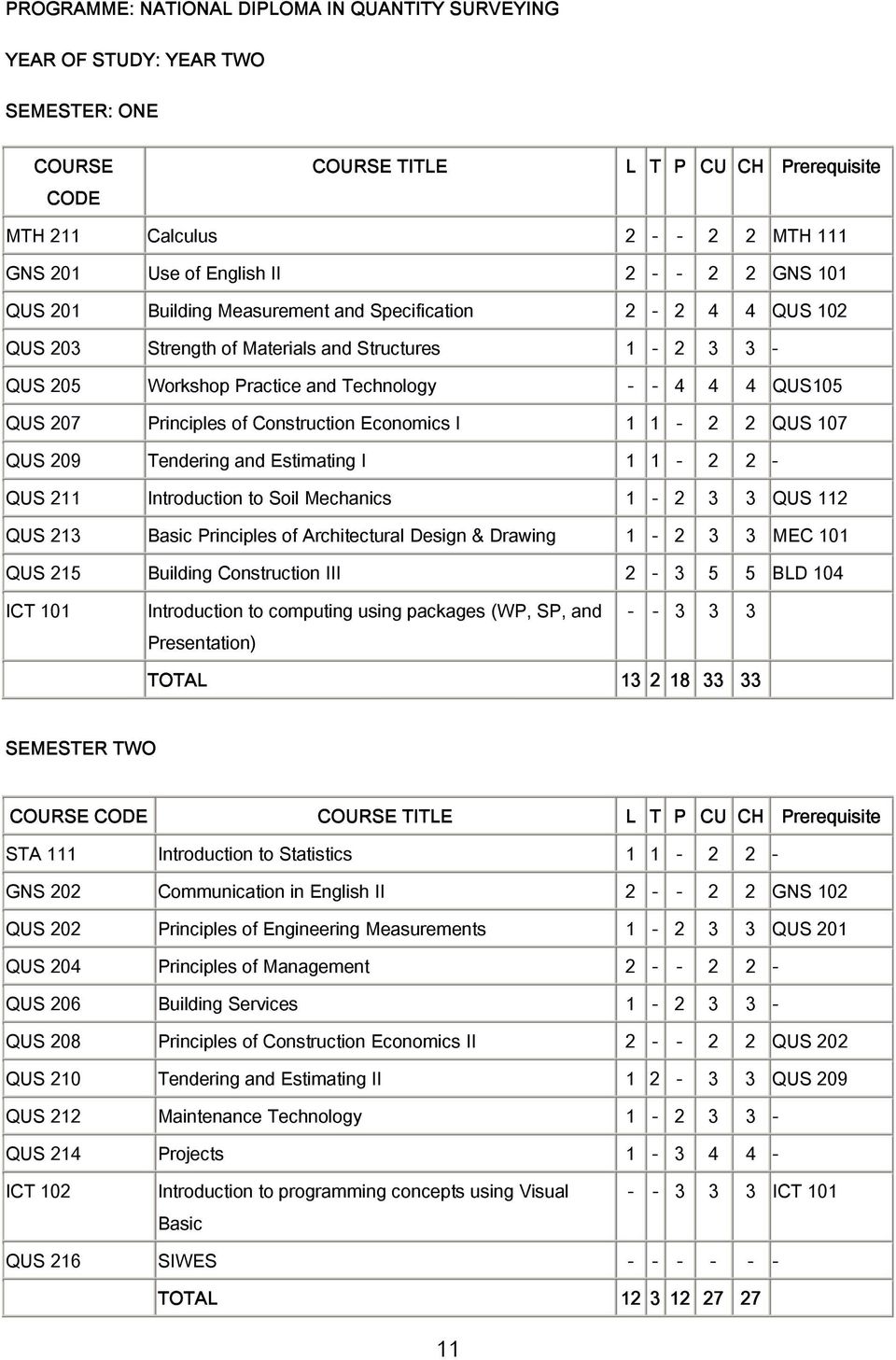
12 PROGRAMME: NATIONAL DIPLOMA IN QUANTITY SURVEYING YEAR OF STUDY: YEAR TWO SEMESTER: ONE COURSE CODE COURSE TITLE L T P CU CH Prerequisite MTH 211 Calculus MTH 111 GNS 201 Use of English II GNS 101 QUS 201 Building Measurement and Specification QUS 102 QUS 203 Strength of Materials and Structures QUS 205 Workshop Practice and Technology QUS105 QUS 207 Principles of Construction Economics I QUS 107 QUS 209 Tendering and Estimating I QUS 211 Introduction to Soil Mechanics QUS 112 QUS 213 Basic Principles of Architectural Design & Drawing MEC 101 QUS 215 Building Construction III BLD 104 ICT 101 Introduction to computing using packages (WP, SP, and Presentation) TOTAL SEMESTER TWO COURSE CODE COURSE TITLE L T P CU CH Prerequisite STA 111 Introduction to Statistics GNS 202 Communication in English II GNS 102 QUS 202 Principles of Engineering Measurements QUS 201 QUS 204 Principles of Management QUS 206 Building Services QUS 208 Principles of Construction Economics II QUS 202 QUS 210 Tendering and Estimating II QUS 209 QUS 212 Maintenance Technology QUS 214 Projects ICT 102 Introduction to programming concepts using Visual Basic ICT 101 QUS 216 SIWES TOTAL
13 General Studies Courses Use of English I PROGRAMME: NATIONAL DIPLOMA IN QUANTITY SURVEYING Course: USE OF ENGLISH I (GRAMMAR) Course Code: GNS 101 Contact Hours: 30Hrs Lectures General Objective 1.0: It will promote the necessary language skills which will enable student to cope effectively. Week Specific Learning Outcome Teacher Activities Resources Explain the necessity for acquiring good note-taking/making techniques 1.2 List the methods of notetaking/making 1.3 Explain the use of dictionary 1.4 Explain the use of the library 1.5 Explain the type of information sources in the library 1.6 Identify good reading habits 1.7 Explain the different methods of reading viz, scan, skim, normal and study 1.8 Use the different methods of reading explained in 1.7 above Ask the students: - the techniques of note-taking/making and list the various methods - the correct ways of using the dictionary - the best ways of using the library - to list the various information sources in the library and how to locate these information sources - the different methods of reading and the difference between the methods Chalkboard, Duster, Recommended textbooks. 12

14 PROGRAMME: NATIONAL DIPLOMA IN QUANTITY SURVEYING Course: USE OF ENGLISH I (GRAMMAR) Course Code: GNS 101 Contact Hours: 30Hrs Lectures General Objective 2.0: Understand the basic roles of grammar, know the nature of the language, appreciate literary words in English Week Specific Learning Outcome Teacher Activities Resources Explain the concept of language 2.2 List the characteristics of language 2.3 Explain the four language skills, viz: speaking, listening, writing, readings 2.4 Explain the functions of language 2.5 List the uses of English language in Nigeria, e.g as the language of research, government, commerce etc. Ask the students: - the basic concept of language - to mention the characteristics of language - to identify the functions of language - to list the uses of English language in Nigeria Chalk and Blackboard General Objective 3.0: Understand the basic rules of grammar Week Specific Learning Outcome Teacher Activities Resources Explain grammar Ask the students: 3.2 Explain parts of speech - to explain grammar, 3.3 Analyse the use of parts of speech parts of speech and in sentences how to apply them in a 3.4 Correct common errors in the use sentence of parts of speech in sentences - to identify common 3.5 Explain how to construct sentences errors in the use of with correct parts of speech in 3.5 syntactic arrangement sentences 3.6 List punctuation marks - to construct 3.7 Enumerate the uses of punctuation sentences with correct marks and explain how to punctuate a syntactic arrangement given passage - to identify 3.8 Explain idioms, figures of speech punctuation marks and and affrication their uses, and how to punctuate a given passage - to construct sentences to illustrate idioms, figure of speech and affixes 13 Chalk, Blackboard, Duster

15 PROGRAMME: NATIONAL DIPLOMA IN QUANTITY SURVEYING Course: USE OF ENGLISH I (GRAMMAR) Course Code: GNS 101 Contact Hours: 30Hrs Lectures General Objective 4.0: Understanding the essential qualities of paragraph Week Specific Learning Outcome Teacher Activities Resources 4.1 Define a paragraph 4.2 Name the parts of a paragraph viz: topic, sentence, development and conclusion/transition 4.3 Explain the thematic qualities of a paragraph viz, unity, coherence and emphasis 4.4 Explain methods of paragraph development viz, example, definition, comparison and contrast etc 4.5 Explain methods of ordering details in a paragraph, viz, less complex to more complex and vice versa, less important to more important and vice versa, spatial, chronological etc. 4.6 Write specific paragraphs to illustrate 4.2 to 4.5 above Ask the students: - to define a paragraph and to name the part of a paragraph - what the understand by the thematic qualities of a paragraph - to explain the various methods of paragraph development and the methods of ordering details in a paragraph Assess the students Chalk, Blackboard and Duster General Objective 5.0: Appreciating Literary works in English Week Specific Learning Outcome Teacher Activities Resources 5.1 Give the meaning of literature Ask the students: 5.2 Trace the development of literature - the meaning of 5.3 Differentiate between the literary literature and the genres development of 5.4 Explain the functions of literature literature Explain the terminology of prose - the functions of fiction, e.g plot setting, characterization literature and the etc terminology of Prose 5.6 Answer an essay question on a fiction given novel Chalk, blackboard, duster 14

16 PROGRAMME: NATIONAL DIPLOMA IN QUANTITY SURVEYING Course: USE OF ENGLISH I (GRAMMAR) Course Code: GNS 101 Contact Hours: 30Hrs Lectures ASSESSMENT: The continuous assessment, tests and quizzes will be awarded 40% of the total score. The end of the Semester Examination will make up for the remaining 60% of the total score. 15

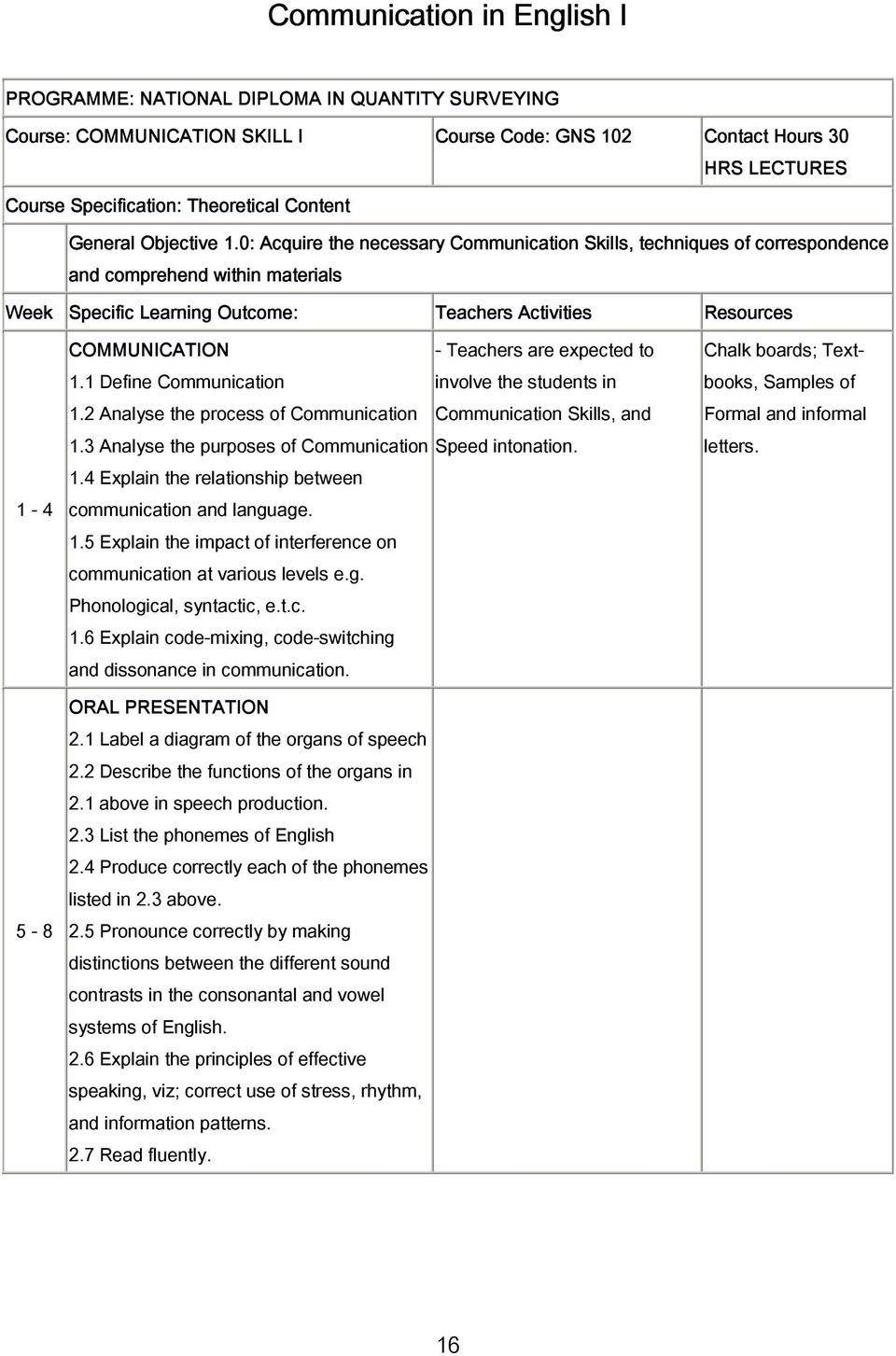
17 Communication in English I PROGRAMME: NATIONAL DIPLOMA IN QUANTITY SURVEYING Course: COMMUNICATION SKILL I Course Code: GNS 102 Contact Hours 30 HRS LECTURES General Objective 1.0: Acquire the necessary Communication Skills, techniques of correspondence and comprehend within materials COMMUNICATION - Teachers are expected to 1.1 Define Communication involve the students in 1.2 Analyse the process of Communication Communication Skills, and 1.3 Analyse the purposes of Communication Speed intonation. 1.4 Explain the relationship between communication and language. 1.5 Explain the impact of interference on communication at various levels e.g. Phonological, syntactic, e.t.c. 1.6 Explain code-mixing, code-switching and dissonance in communication. ORAL PRESENTATION 2.1 Label a diagram of the organs of speech 2.2 Describe the functions of the organs in 2.1 above in speech production. 2.3 List the phonemes of English 2.4 Produce correctly each of the phonemes listed in 2.3 above. 2.5 Pronounce correctly by making distinctions between the different sound contrasts in the consonantal and vowel systems of English. 2.6 Explain the principles of effective speaking, viz; correct use of stress, rhythm, and information patterns. 2.7 Read fluently. Chalk boards; Textbooks, Samples of Formal and informal letters. 16
18 PROGRAMME: NATIONAL DIPLOMA IN QUANTITY SURVEYING Course: COMMUNICATION SKILL I Course Code: GNS 102 Contact Hours 30 HRS LECTURES General Objective 1.0: Acquire the necessary Communication Skills, techniques of correspondence and comprehend within materials 9 11 CORRESPONDENCE 3.1 List the various stype of correspondence, e.g. letter, memo, circular, e.t.c. 3.2 Explain the various parts of a letter. 3.3 Differentiate between formal and informal letter format. 3.4 Explain the characteristics of styles suitable for formal and informal letters. 3.5 Explain the functions of the first, middle and last paragraphs. 3.6 Write a formal and informal letter. Give students assignments on various tyope of correspondence. Chalk boards; Textbooks, Samples of Formal and informal letters. COMPREHENSION AND INTERPRETATION 4.1 Identify main ideas in a given passage. 4.2 Differentiate the main ideas from the details in a passage. 4.3 Use the main idea to anticipate specific details in a passage. 4.4 Use context clues to aid comprehension Identify relationship patterns of ideas in a passage. 4.6 Use context clues such as definitions, restatements and examples to derive meanings. 4.4 Interpret figurative language in a passage. 4.5 Draw conclusions from available information. - Teachers should give necessary aids that will assist the comprehension of passage. Chalk board; Textbooks, Samples of Formal and informal letters. 17

19 PROGRAMME: NATIONAL DIPLOMA IN QUANTITY SURVEYING Course: COMMUNICATION SKILL I Course Code: GNS 102 Contact Hours 30 HRS LECTURES ASSESSMENT: The continuous assessment, tests and quizzes will be awarded 40% of the total score. The end of the Semester Examination make up for the remaining 60% of the total score. 18

20 Communication in English II PROGRAMME: NATIONAL DIPLOMA IN QUANTITY SURVEYING Course: COMMUNICATION SKILL II Course Code: GNS 202 Contact Hours 30 HRS LECTURES General Objective 1.0: Communicate clearly and effectively in both general and specific situations. Week Specific Learning Outcome: Teacher Activities Resources REGISTERS 1.1 Explain registers. 1.2 Explain factors influencing register, viz; field (profession), mode (speech or writing), tenor (relationship between the interacting parties). 1.3 List some items of register peculiar to different professions. 1.4 Identify items of register in a given passage. 1.5 State appropriate use of jargon. CORRESPONDENCE 2.1 Describe different types of business letter e.g., applications, enquiries, invitations and complaints, with their replies. 2.2 Use suitable language for a specific type of letter. 2.3 Write the letter listed in 2.1 above. WRITING FOR PUBLICATION 3.1 Explain techniques of writing for publication. 3.2 Write essays on topical and current issues. 3.3 Analyse published essay of literacy value. 3.4 Evaluate the development of ideas in a given article. 3.5 Write good articles for publication. - Teachers to emphasize on the items and importance of registers to different professions. - Give exercises to students on letter writing and correspondences and assess. - Teachers should involve the class in the analysis of published essays and texts. Text-books, Blackboard, Chalk, Publications, samples of correspondence, Registers and reports. 19

21 PROGRAMME: NATIONAL DIPLOMA IN QUANTITY SURVEYING Course: COMMUNICATION SKILL II Course Code: GNS 202 Contact Hours 30 HRS LECTURES General Objective 1.0: Communicate clearly and effectively in both general and specific situations. REPORT 4.1 Define a report 4.2 List the types of report 4.3 Enumerate uses of report List the characteristics of a good report 4.5 Outline the stage of writing a report 4.6 Evaluate a given report 4.7 Write a report. - Give detail of report writing to students. Text-books, blackboard, Chalk, Publications, samples of correspondence, Registers and reports. ASSESSMENT: The continuous assessment, tests and quizzes will be awarded 40% of the total score. The end of the Semester Examination will make up for the remaining 60% of the total score. 20
22 Use of English II PROGRAMME: NATIONAL DIPLOMA IN QUANTITY SURVEYING Course: USE OF ENGLISH II Course Code: GNS 201 Contact Hours 2HRS/WK General Objective 1.0: Understand the rules of grammar Week Specific Learning Outcome Teachers Activities Resources Define the phrase 1.2 Explain the different types of phrases, i.e, structural and functional 1.3 Define the clause 1.4 Explain the different types of clauses i.e structural and functional 1.5 Define the sentence 1.6 Explain the different types of sentences, i.e structural and function 1.7 Explain the constitution of different types of sentences Ask the students: - to identify the different types of phrases - to define a clause and to identify the different types of clauses to define a sentence and to identify the different types of sentences assess the students on the construction of different types of sentences Chalk, blackboard, duster Recommended textbook, lecture notes, etc. General Objective 2.0: Know how to write good essays Week Specific Learning Outcome Teachers Activities Resources List the different types of essays 2.2 Explain the features of each type of essay listed in 2.1 above 2.3 Generate/gather relevant information on a given topic 2.4 Draw up a good outline 2.4 Write a good essay on a given topic Ask the students to list the different types of essays and to identify the features of each types of essay list above Assess the students on essay writing Chalk, blackboard, duster Recommended textbook, lecture notes, etc. 21
23 PROGRAMME: NATIONAL DIPLOMA IN QUANTITY SURVEYING Course: USE OF ENGLISH II Course Code: GNS 201 Contact Hours 2HRS/WK General Objective 3.0: Understand the difference between denotative and connotative uses of words Week Specific Learning Outcome Teachers Activities Resources Explain the term denotation 3.2 Identify words used denotatively 3.3 Explain the term connotation 3.4 Identify words used connotatively 3.5 Use words connotatively 3.6 Compare denotative and connotative usage in groups of synonyms, e.g, women, lady, female, client, customer, patient, fear, terror, dread etc. Ask the students to define the terms denotation and connotation and how to identify words used denotatively connotatively Assess the students Chalk, blackboard, duster Recommended textbooks, lecture notes, etc. General Objective 4.0: Understand the techniques of comprehension and summary writing Week Specific Learning Outcome Teachers Activities Resources Answer questions on Ask the students to distinguish the various comprehension passage at a types of summary writing and the steps in higher level of difficulty summary writing 4.2 Give contextual explanations Give the students passages to summarise to statements from the texts Assess the students used 4.3 Identify colloquialisms, slangs and jargons 4.4 Explain summary writing 4.5 Distinguish between types of summary writing 4.6 Explain the steps in summary writing 4.7 Write, within a specified length, a goal summary of a given passage Chalk, blackboard, duster Recommended textbooks, lecture notes, etc 22
24 PROGRAMME: NATIONAL DIPLOMA IN QUANTITY SURVEYING Course: USE OF ENGLISH II Course Code: GNS 201 Contact Hours 2HRS/WK General Objective 5.0: Appreciate literature in English Week Specific Learning Outcome Teachers Activities Resources 5.1 Describe drama Ask the students: 5.2 Explain the types of drama - to identify the various 5.3 Explain the terminology of types of drama and to drama, e.g, act, resolution, explain the terminology of conflict, denouement, etc drama to differentiate Distinguish between radio between radio drama and drama and television drama television drama to answer 5.5 Answer an essay question on essay question on a given a given drama text drama text. - Assess the students Television, video cassette recorder, radio cassette player 23
25 Citizenship Education PROGRAMME: NATIONAL DIPLOMA IN QUANTITY SURVEYING Course: CITIZENSHIP EDUCATION Course Code: GNS 111 Contact Hours 2HRS/WEEK General Objective 1.0: Understand the Constitution of Nigeria Explain the term constitution 1.2 Distinguish the different types of constitution 1.3 Highlight some provisions of an International Constitution 1.4 Explain the effectiveness of International Constitution 1.5 Explain the supremacy of the Nigerian Constitution to other laws with emphasis on the 1989 constitution 1.6 Evaluate the main parts of the Nigeria Constitution 1.7 Draft a constitution for an association 1.8 Trace the historical development of the Nigerian Constitution 1.9 Discuss the merits and demerits of each of the Nigerian constitutions 1.10 Explain the concept of rule of law Ask the students: what their understand by the term constitution and to distinguish the different rules of constitution known to explain the effectiveness of International Constitution to explain Nigerian Constitution to other laws. To identify the main parts of the Nigerian Constitution. Assess to the students by given the assignment to draft a constitution for an association Chalkboard, duster 24
26 PROGRAMME: NATIONAL DIPLOMA IN QUANTITY SURVEYING Course: CITIZENSHIP EDUCATION Course Code: GNS 111 Contact Hours 2HRS/WEEK General Objective: 2.0 Understand the federal system of government in Nigeria Describe a federation Ask the students: 2.2 Distinguish a federation from a to describe a confederation federation and to 2.3 Outline the basis for the federal differentiate between a system in Nigeria federation and a 2.4 Examine the evolution, structure and confederation functions of the federal system in to define the functions Nigeria. of the federal system in 2.5 Analyse the relationships among the Nigeria and the three tiers of government in Nigeria relationship among the 2.6 Evaluate the revenue allocation three tiers of formula in operation in Nigeria government 2.7 Compare and contrast other to evaluate the federation with Nigeria11 revenue allocation formula operation in Nigeria Chalk, blackboard, duster General Objective: 3.0 Know the constitutional rights and obligations of Nigerian citizens Examine the significance of rights and obligations in Nigeria 3.2 Assess government s protection of fundamental rights as contained in the Nigerian constitution 3.3 Evaluate the responsibilities and duties of Nigerian citizenships and the benefits for performing them 3.4 Assess the responsibilities and duties of constituted authority to the people 3.5 Evaluate the responsibilities and duties of government to the People Ask the students to identify the responsibilities and duties of Nigerian citizenship Chalk, blackboard, duster 25
27 PROGRAMME: NATIONAL DIPLOMA IN QUANTITY SURVEYING Course: CITIZENSHIP EDUCATION Course Code: GNS 111 Contact Hours 2HRS/WEEK General Objective: 3.0 Understand Citizenships Discuss the significance of citizenship 4.2 Analyse the principles and benefits of citizenship 4.3 Explain the difference in the modes of acquiring citizenship 4.4 Evaluate the merits and demerits of each type of citizenship 4.5 Analyse the basis for the acquisition and withdrawal of Nigerian citizenship 4.5 Examine the benefits derivable from Nigeria citizenship Ask the students: to discuss and analyse the principles and benefits of citizenship to analyse the basis for the acquisition and withdrawal of Nigerian citizenship Chalk, blackboard, duster General Objective: 5.0 Fundamental objectives and directive principles of state policy in Nigeria 5.1 State the fundamental obligations of government as provided in the constitution 5.2 Explain the general provisions of the fundamental objectives and directive principles of state policy 5.3 Explain the political, economic, social and education policies of Nigeria 5.4 Explain the directive principles and policy of the Nigerian government on culture, the mass media, national ethics and duties of the citizen 5.5 Assess the conformity observance and application of the fundamental objectives and directive principles of state policy by governments and people of Nigeria. 5.6 Recommend improvements on the provision conformity, observance and application of the fundamental objectives and directive principles of state policy Ask the students to explain the Chalk, directive principles and policy of the blackboard, Nigerian duster Government on cultures, the mass media, national ethnics and duties of the citizen 26
28 Mathematics Courses Algebra and Elementary Trigonometry General Objectives On completion of this course the student will be able to: 1. Understand the laws of indices and their application in simplifying algebraic expressions. 2. Understand the theory of logarithms and surds and their applications in manipulating expressions. 3. Understand principles underlying the construction of charts and graphs. 4. Know the different methods of solving quadratic equations. 5. Understand permutation and combination 6. Understand the concept of set theory 7. Understand the properties of arithmetic and geometric progressions 8. Understand the binomial theorem and it s application in the expansion of expressions and in approximations. 9. Understand the basic concepts and manipulation of vectors and their applications to the solution of engineering problems. 10. Understand the concept of equations and methods of solving different types of equations and apply same to engineering problems. 11. Understand the definition, manipulation and application of trigonometric functions. 27
29 COURSE: ALGEBRA AND ELEMENTARY TRIGONOMETRY COURSE CODE: MTH 112 CONTACT HOURS: 15 HRS LECTURE 15 HRS TUTORIAL General Objective 1.0: Understand laws of indices and their applications in simplifying algebra expressions Week Specific Learning Outcomes Teacher Activities Resources Define index 1.2 Establish the laws of indices 1.3 Solve simple problems using the laws of indices. - Chalkboard, Textbooks, Calculators. General Objective 2.0: Understand Theory of logarithms surds and their applications in manipulating expression Week Specific Learning Outcomes Teacher Activities Resources Define logarithm 2.2 Establish the four basic laws of logarithm 2.3 Solve simple logarithm problem 2.4 Define natural logarithm and common logarithm. 2.5 Define characteristic and mantissa 2.6 Read the logarithmic table for given numbers 2.7 Simplify numerical expressions using log tables e.g. e.g. 18 D = 3%4JPC 2 Λ M B, find D when J = 0935, e.g. θ = 35, P = , C = 55, M = π = Apply logarithm in solving non-linear equations. e.g. y = ax n ; logy - log a + n log x; y = bc x = logy = logb + xlogc; Y = a + bx n B Log (Y B D) = Logb + nlogx., 2.9 Define surds 2.10 Reduce a surd into it s simplest form 2.11 Solve simple problems on surds - Ask the students to solve logarithmic and surd related problems - do - 28
30 COURSE: ALGEBRA AND ELEMENTARY TRIGONOMETRY COURSE CODE: MTH 112 CONTACT HOURS: 15 HRS LECTURE 15 HRS TUTORIAL General Objective 3.0: Understand Principles underlying the construction of Charts and graphs Week Specific Learning Outcomes Teacher Activities Resources Construct graphs of functions fractions such as Y = ax +b,n = 1,2 Y = CST (a+x) Y = ax k, including cases of asymbles 3.2 Apply knowledge from 3.1 in determination as laws from experimental data. - Ask the students to draw graphs -do- General Objective 4.0: Know the different methods of solving quadratic equations Week Specific Learning Outcomes Teacher Activities Resources Solve quadratic equations by factorization 4.2 Solve quadratic equations by method of completing squares. 4.3 Solve quadratic equations by formula 4.4 Discriminate the roots. 4.5 Form equations whose roots are given in different methods. - Ask the students to solve quadratic equations -do- General Objective 5.0: Understand Permutations and Combinations Week Specific Learning Outcomes Teacher Activities Resources Define permutation - Give exercises on 5.2 State examples of permutations permutation and 5.3 Define combination combination to them 5.4 State examples of combination 5.5 Establish the theorem npr = n!/[(n-r)!]giving examples e.g. number of ways of collecting two out of 8 balls General Objective 6.0: Understand the concept of set theory -do- Week Specific Learning Outcomes Teacher Activities Resources Establish n Cr = n Cn B r. 6.2 Define sets, subsets, and null sets 6.3 Define union, inter-section and completion of sets 6.4 Draw Venn diagrams to demonstrate the concepts in 6.1 B 6.3 above. 6.5 Calculate the size or number of elements in a given set. 29 -do- -do-
31 COURSE: ALGEBRA AND ELEMENTARY TRIGONOMETRY COURSE CODE: MTH 112 CONTACT HOURS: 15 HRS LECTURE 15 HRS TUTORIAL General Objectives 7.0: Understand the properties of arithmetic and geometric progressions Week Specific Learning Outcomes Teacher Activities Resources Define an Arithmetic progression (A.P.) - Ask the students to apply 7.2 Obtain the formula for nth term and the first progression to solve n terms of an A.P. problems 7.3 Give examples of the above e.g. find the 20 th term of the series e.g Y.. Find also the series of the first 20 terms. 7.4 Define a geometric progression (G.P.) 7.5 Obtain the formula for the nth term and the first n terms of a geometric series. 7.6 State examples of 7.5 above e.g. given the sequences 1/3, 1,3 Y find the 20 th term and hence the sum of the 1 st 2o terms. 7.7 Define Arithmetic Mean (AM) and Geometric Mean (G.M.) 7.8 Define convergency of series. 7.9 Define divergence of series. -do- General Objectives 8.0: Understand the binomial theorem and it s application in the expansion of expressions and in approximations. Week Specific Learning Outcomes Teacher Activities Resources Explain the method of mathematical induction 8.2 State and prove the binomial theorem for a positive integral index. 8.3 Expand expressions of the forms (x + y) 2, (x 2 B 1) s applying binominal theorem 8.4 Find the coefficient of a particular term in the expansion of simple binomial expressions. 8.5 Find the middle term in the expansion of binomial expression 8.6 State the binomial theorem for a rational index. 8.7 Expand expressions of the form: (1 + x) -1, (1 B x) 2, (1 B x) -a applying binomial theorem - State the importance and application of the theorem -do- 30
32 COURSE: ALGEBRA AND ELEMENTARY TRIGONOMETRY COURSE CODE: MTH 112 CONTACT HOURS: 15 HRS LECTURE 15 HRS TUTORIAL General Objectives 8.0: Understand the binomial theorem and it s application in the expansion of expressions and in approximations. Week Specific Learning Outcomes Teacher Activities Resources Expand and approximate expressions of the type (1.001) n, (0.998) n, (1 + x) 2, (1 B x) a to a stated degree of accuracy applying scalar expressions. 9.1 State the definitions and representations of vectors. 9.2 Define a position vector. 9.3 Define unit vector 9.4 Explain scalar multiple of a vector 9.5 List the characteristics of parallel vectors 9.6 Identify quantities that may be classified as vector e.g. displacement velocity, acceleration, force etc. 9.7 Compute the modulus of any given vector up to 2 and 3 dimensions. 9.8 State the parallelogram law in solving problems including addition and subtraction of vectors 9.9 Apply the parallelogram law in solving problems including addition and subtraction of vectors Explain the concept of components of a vector and the meaning of orthogonal components Resolve a vector into its orthogonal components List characteristics of coplanar localized vectors Define the resultant or composition of coplanar vectors. - State the importance and application of the theorem - Apply the techniques of vectors to solve various problems -do- -do- 31
33 COURSE: ALGEBRA AND ELEMENTARY TRIGONOMETRY COURSE CODE: MTH 112 CONTACT HOURS: 15 HRS LECTURE 15 HRS TUTORIAL General Objectives 9.0: Understand the basic concepts and manipulation of vectors and their applications to the solutions of engineering problems Week Specific Learning Outcomes Teacher Activities Resources Compute the resultant of coplanar forces acting at a point using algebraic and graphical methods Apply the techniques of resolution and resultant to the solution of problems involving coplanar forces Apply vectoral techniques in solving problems involving relative velocity State the scalar product of two vectors Compute the scalar product of given vectors Define the cross product of the vector product or two vectors Calculate the direction ratios of given vectors Calculate the angle between two vectors using the scalar product. - Apply the techniques of vector to solve various problems -do- General Objectives 10.0: Understand the Concept of equations and apply same to engineering problems Week Specific Learning Outcomes Teacher Activities Resources 10.1 Explain the concept of equation, ie. A = B - Ask the student to solve where A and B are expressions. various equations as 10.2 List different types of equations:- Linear, indicated in section 10 quadratic, cubic, etc State examples of linear simultaneous equations with two unknowns and simultaneous equations with at least one quadratic equation Apply algebraic and graphical methods in solving two simultaneous equations involving a linear equation and a quadratic equation. -do- 32
34 COURSE: ALGEBRA AND ELEMENTARY TRIGONOMETRY COURSE CODE: MTH 112 CONTACT HOURS: 15 HRS LECTURE 15 HRS TUTORIAL General Objectives 10.0: Understand the Concept of equations and apply same to engineering problems Week Specific Learning Outcomes Teacher Activities Resources 10.5 Apply the algebraic and graphical methods in solving two simultaneous quadratic equations Define a determinant of n th order Apply determinants of order 2 and 3 in solving simultaneous linear equations. - Ask the student to solve various equations as indicated in section 10 -do- General Objectives 11.0: Understand the definition, manipulation and application of trigonometric functions Week Specific Learning Outcomes Teacher Activities Resources Define the basic trigonometric ratios, sine, cosine and tangent of an angle Derive the other trigonometric ratios; cosecant, secant and cotangent using the basic trigonometric ratios in 11.1 above Derive identities involving the trigonometric ratios of the form; Cos 2 θ+sin 2 θ = 1, Sec 2 θ = 1 + tan 2 θ, etc Derive the compound angle formulae for sin (A+B), Cos (A+B) and Tan (A+B). - Define and Derive the trigonometric ratios and identities -do- ASSESSMENT: The continuous assessment, tests and quizzes will be awarded 40% of the total score. The end of the Semester Examination will make up for the remaining 60% of the total score. 33
35 General Objectives Calculus On completion of this course the student will be able to: 1. Understand the basic concepts of differential calculus and its application in solving engineering problems. 2. Know integration as the reverse of differentiation and its application to engineering problems. 3. Understand first order homogenous linear ordinary differential equation s with constant coefficients as applied to simple circuits. 4. Understand the basic concepts of partial differentiation and apply same to engineering problems. PROGRAMME: NATIONAL DIPLOMA IN QUANTITY SURVEYING COURSE: CALCULUS Course Code: MTH 211 Contact Hours 3/0/0 General Objective: 1.0 Understand the basic concepts of differential Calculus and in application in solving engineering problems Week Specific Learning Outcome Teachers Activities Resources Define limits with examples 1.2 State and prove basic theorems on limits 1.3 Prove that lim sin θ/θ, lim Tan θ/θ = 1 as θ Define differentiation as an incremental notation or a function. 1.5 Differentiate a function from first principles. 1.6 Prove the formulae for derivative of functions, Function of a function, products, and quotient of functions. 1.7 Differentiate simple algebraic, trigonometric, logarithmic, exponential, hyperbolic parametric, inverse and implicit functions. 1.8 Derive second derivative of a function. 1.9 Apply differentiation to simple engineering and technological problems Explain the rate of change of a function 1.11 Explain the condition for turning point of a function. - Teachers are to give and solve simple engineering and technological problems Chalkboard, textbooks, lecture notes, chalk 34
36 PROGRAMME: NATIONAL DIPLOMA IN QUANTITY SURVEYING COURSE: CALCULUS Course Code: MTH 211 Contact Hours 3/0/0 General Objective: 1.0 Understand the basic concepts of differential Calculus and in application in solving engineering problems Distinguish between maximum and minimum value of a function Sketch the graph of a function showing its maximum and minimum points and points of inflexion Estimate error quantities from the small increment of a function Determine the tangent to a curve Determine the normal to a curve. - Teachers are to give and solve simple engineering and technological problems Chalkboard, textbooks, lecture notes, chalk General Objective 2.0: Know integration as the reverse of differentiation and its application to engineering problems Week Specific Learning Outcome Teachers Activities Resources Define integration as the reverse of differentiation. 2.2 Explain integration as a limit of summation of a function. 2.3 Distinguish between indefinite and definite integrals. 2.4 Determine the indefinite and definite integrals. 2.5 Determine the definite integral of a function. 2.6 Integrate algebraic, logarithmic, trigonometric and exponential simple functions. 2.7 List possible methods of integration. 2.8 Integrate algebraic and trigonometric functions by the substitution method 2.9 Integrate trigonometric and exponential functions by parts 2.10 Integrate algebraic functions by partial fraction Integrate trigonometric and logarithmic functions applying reduction formula. Ask students to apply integral calculus to simple function -do- 35
37 PROGRAMME: NATIONAL DIPLOMA IN QUANTITY SURVEYING COURSE: CALCULUS Course Code: MTH 211 Contact Hours 3/0/0 General Objective 2.0: Know integration as the reverse of differentiation and its application to engineering problems Week Specific Learning Outcome Teachers Activities Resources State standard forms of some basic integrals Calculate length of arc, area under a curve, area between two curves, volume of revolution, center of gravity, center of surface area, second moment and moment of inertia Define Trapezoidal and Simpson s rule as methods of approximating areas under given curves Find approximate area under a curve applying Trapezoidal method Find approximate area under a curve applying Simpson s rule Compare result obtained from Trapezoidal and Simpson s rules with the results by direct integration Apply integration to kinematics. Ask students to apply integral calculus to simple function -do- General Objective 3.0: Understand first order homogenous linear ordinary equations with constant coefficients as applied to simple engineering problems Week Specific Learning Outcome Teachers Activities Resources Define first order differential equation 3.2 List order, degree, general solution, boundary or initial conditions and particular solution of differential equations. 3.3 List examples of various types of first order differential equations. 3.4 Define first order homogenous differential equations 3.5 List the methods of solving differential equations by separable variables. 3.6 Identify differential equations reducible to the homogenous form. Ask students to apply differential equation to solve engineering problerns -do- 36
38 PROGRAMME: NATIONAL DIPLOMA IN QUANTITY SURVEYING COURSE: CALCULUS Course Code: MTH 211 Contact Hours 3/0/0 General Objective 3.0: Understand first order homogenous linear ordinary equations with constant coefficients as applied to simple engineering problems Week Specific Learning Outcome Teachers Activities Resources Explain exact differential equations. 3.8 Solve exact differential equations, e.g. Show that (3x 2 + y cos x) dx+(sin x-4y 3 ) dy = O is an exact differential equation; Find its general solution. 3.9 Define integrating factors Determine the solution of differential equations using integrating factors Define linear differential equations of the first order. Ask students to apply differential equation to solve engineering problerns -do- General Objective 4.0: Understand the basic concepts of partial differentiation and apply same to engineering problems Week Specific Learning Outcome Teachers Activities Resources 4.1 Define partial differentiation 4.2 List and explain the uses of partial derivatives Solve problems on partial differentiation. e.g. f (x, y) = x 2 + y 2 = 2xy, find dy/dx, dx/dy 4.4 Apply partial differentiation to engineering problems. - Solve problems on partial differential -do- Assessment: The continuous assessment, test and quizzes will be awarded 40% of the total score. The end of the semester Examination will make up for the remaining 60% of the score 37
39 Logic and Linear Algebra Logic and Linear Algebra MTH 202 General Objectives On completion of this course the student will be able to: 1. Understand the basic rules of mathematical logic and their application to mathematical proofs. 2. Know permutations and combinations 3. Compute the binomial expansion of algebraic expansions. 4. Understand the algebraic operations of matrices and determinants as well as solve simultaneous linear equations by the methods of matrices. 38
40 COURSE: LOGIC AND LINEAR ALGEBRA COURSE CODE: MTH 202 CONTACT HOURS: 15HRS LECTURE 15 HRS TUTORIAL General Objective 1.0: On completion of this course, the students should be able to: The essential connectives, negation, conjunction, disjunction, implication and biimplication 1.2 State the essential connectives defined in 1.1 above. 1.3 Explain grouping and parenthesis in logic, 1.4 Explain Truth Tables. 1.5 Define tautology 1.6 Give examples of types of tautology. e.g If P and Q are distinct atomic sentences, which of the following are tautologies? P B Q (b) PUQ B QUP (c) PV(P*Q) Let P = Jane Austen was a contemporary of Beethoven. Q = Beethoven was a contemporary of Gauss. R = Gauss was a contemporary of Napoleon S Napoleon was a contemporary of Julius Caesar=. (Thus P, Q and R and true, and S is false). Then find the truth values of sentences:- (a) (P *Q) = R (b) (P B Q) (c) P *Q B R B S - Explain and illustrate 1.1 to 1.6 and ask the students to find the truth value of the logic statement - Assess the student - Lecture notes, Recommended textbooks, charts, chalkboard 39
41 COURSE: LOGIC AND LINEAR ALGEBRA COURSE CODE: MTH 202 CONTACT HOURS: 15HRS LECTURE 15 HRS TUTORIAL General Objective 1.0: On completion of this course, the students should be able to: Define universal quantifier and existential quantifier. 1.8 Translate sentences into symbolic form using quantifiers. e.g. > some freshmen are intelligent = can be stated as for some x, x, is a freshman and x is intelligent = can translate in symbols as (/x) (Fx & Ix). 1.9 Define the scope of a quantifier 1.10 Define > bound = and > free = variables 1.11 Define > term = and formula = 1.12 Give simple examples of each of 1.9 to 1.11 above Explain the validity of formulae - Explain and illustrate 1.7 to 1.2 and asked the students to solve problems on 1.7 to Recommended textbooks, lecture notes, chalkboard, chalk General Objective 2.0: Know permutation and combination Define permutations and combinations - Explain and illustrate the 2.2 Give illustrative examples of each of 2.1 activities in 2.1 to 2.15 and above ask the student to: 2.3 State and approve the fundamental principle - establish of permutation. the formula 2.4 Give illustrative examples of the fundamental NPr = n!/(nr)! principles of permutation. 2.5 Establish the formula n Pr = n!/ (n B r)! - Prove that 2.6 Prove that npr = (n B r + 1) x np (r B 1). npr = (nr+1)(np(r-1) 2.7 Solve problems of permutations with restrictions on some of the objects. - Establish 2.8 Solve problems of permutations in which the the formula objects may be repeated. Ncr = n!/[nr!r! 2.9 Describe circular permutations Solve problems of permutation of N things - Prove that not all different. ncr = ncn-r 2.11 Establish the formula n Cr = n!/[(n B r)! r!] 2.12 Solve example State and prove the theorem n Cr = n Cn-r Recommended textbooks, lecture notes, chalkboard, chalk
42 COURSE: LOGIC AND LINEAR ALGEBRA COURSE CODE: MTH 202 CONTACT HOURS: 15HRS LECTURE 15 HRS TUTORIAL General Objective 2.0: Know permutation and combination Solve problems of combinations with restrictions on some of the objects Solve problems of combinations of n different things taken any number at a time. General Objective 3.0: Know binomial theorem Explain with illustrative examples B the - Explain and illustrate method of mathematical induction. activities in 3.1 to 3.7 and 3.2 State and prove binomial theorem for ask the students to solve positive integral index. them 3.3 Explain the properties of binomial expansion. 3.4 State at least seven (7) examples of 3.3 above. e.g. i. A (x 2-1/x) ii. Find the constant term in the expansion of (x + 1/x) A iii. Find the co-efficient of xv in the expansion of (x ± k) A where v is a number lying between Bn and n- 3.5 State the binomial theorem for a rational number 3.6 State the properties of binomial coefficients. 3.7 Apply binomial expansion in approximations (simple examples only). - Recommended textbooks, lecture notes, chalkboard, chalk, etc 41
43 COURSE: LOGIC AND LINEAR ALGEBRA COURSE CODE: MTH 202 CONTACT HOURS: 15HRS LECTURE 15 HRS TUTORIAL General Objective 4.0: Know matrices and determinants Define Matrix - Explain and illustrate the 4.2 Define the special matrices B zero matrix, activities in 4.1 to Ask identify matrix B square matric, triangular matrix, the student to prove the symmetric matrix, skero symmetric matrix. theorems and solve 4.3 State example for each of the matrices in 4-2 problems on the illustrated above. activities. Assess the 4.4 State the laws of addition and multiplication students of matrices. 4.5 Illustrate the commutative, associative, and distributive nature of the laws states in 4.4 above. 4.6 Explain the transpose of a matrix. 4.7 Determine a determinant for 2by 2 and 3by 2 matrices. 4.8 Define the minors and cofactors of a determinant. 4.9 Explain the method of evaluating determinants State and prove the theorem A Two rows or two columns of a matrix are identical, then the value of it s determinant is zero State and prove the theorem A If two rows or two columns of a matrix are interchanged, the sign of the value of its determinant is changed State and prove the theorem A If any one row or one column of a matrix is multiplied by a constant, the determinant itself is multiplied by the constant State and prove the theorem A If a constant times the elements of a row or a column are added to the corresponding elements of any other row or column, the value of the determinant itself is multiplied by the constant. - Recommended textbooks, lecture notes, chalkboard, chalk, etc 42
44 COURSE: LOGIC AND LINEAR ALGEBRA COURSE CODE: MTH 202 CONTACT HOURS: 15HRS LECTURE 15 HRS TUTORIAL State five examples of each of the - Explain and illustrate the theorems in above. activities in 4.1 to Ask 4.15 Define the adjoint of a matrix the student to prove the 4.16 Explain the inverse of a matrix. theorems and solve 4.17 State the linear transformations on the rows problems on the illustrated and columns of a matrix. activities. Assess the 4.18 Apply Crammer s rule in solving students simultaneous linear equation Apply Linear transformation in solving simultaneous linear equations. - Recommended textbooks, lecture notes, chalkboard, chalk, etc Assessment: The continuous assessment, tests and quizzes will be awarded 40% of the total score. The end of the Semester Examination will make up for the remaining 60% of the total score 43
45 Introduction to Statistics PROGRAMME: NATIONAL DIPLOMA IN QUANTITY SURVEYING COURSE: INTRODUCTION TO STATISTICS s COURSE CODE: STA 111 CONTACT HOURS: General Objectives 1.0: Understand statistics and all that it stands for. Week Special Learning Outcomes Teachers Activities Resources 1.1 Define statistics Lecture Chalkboard, chalk, Explain with approximate illustrations, the use of statistics in Government, Biological Sciences, Physical Give students assignments duster, calculators. Recommended text Science. Business and Economics. books General Objective 2.0: Understand the different methods of data collection and their limitations. Week Specific Learning Outcomes Teachers Activities Resources State the method of collecting data 2.2 Describe the two main methods of collecting primary data: a) Established published sources b) Ad-hoc basic or experimentation 2.3 State the merits and demerits of the methods of collecting primary data 2.4 Explain the concept of data editing and its application in editing primary and secondary data. 2.5 Describe the sources of error in data collection - do - - do - General Objectives 3.0: Know the different forms of data presentation Week Specific Learning Outcomes Teachers Activities Resources 3.1 Explain the objectives of classification of a mass of Lecture - do - raw data Give sample 3.2 Prepare a frequency distribution form a given data charts 3.3 Explain the usefulness of diagrams in presenting Give students 4-5 statistical data 3.4 Construct bar chart, pie chart, histogram, frequency assignments polygon and cumulative frequency polygon knave for a given set of data 3.5 Outline the merits and demerits of each diagram in 3.4 above. 44
46 PROGRAMME: NATIONAL DIPLOMA IN QUANTITY SURVEYING COURSE: INTRODUCTION TO STATISTICS COURSE CODE: STA 111 CONTACT HOURS: General Objective 4.0 Understand the use and the importance of some measures of central tendency in summarizing data. Week Specific Learning Outcomes Teachers Activities Resources 4.1 Define Arithmetic mean, Geometric Mean, Median, Lecture - do - Mode and harmonic mean Give students 4.2 Compute the measurer in 4.1 above given: i. assignments ungrouped ii. grouped data 4.3 Explain the uses of Geometric and Germanic means Calculate: Quantiles Deciles Percentiles given a set of data 4.6 List the merits and demerits of all the above measured of central tendency. General Objective 5.0: Understand the use and importance of measures of dispersion in summarizing data Week Specific Learning Outcomes Teachers Activities Resources State the importance of measures of dispersion 5.2 Defined and calculate the mean deviation Semi interquartile range Variance and standard 5.3 Describe the application of the measures of dispersion defined in 5.2 above. 5.4 Calculate these standard error of the sample mean for given data - do - - do - General Objective: 6.0 Know the different types of random variables Week Specific Learning Outcomes Teachers Activities Resources Define a random variable 6.2 Explain the concept of randomness 6.3 Define discrete and continuous variables 6.4 State examples of discrete and continuous variables - do - - do - 45
47 PROGRAMME: NATIONAL DIPLOMA IN QUANTITY SURVEYING COURSE: INTRODUCTION TO STATISTICS COURSE CODE: STA 111 CONTACT HOURS: General Objective 7.0: Understand the basic principles of probability Week Specific Learning Outcomes Teachers Activities Resources Define probability 7.2 Explain probability using the relative frequency approach 7.3 State the laws of probability 7.4 Solve simple problems by applying the laws of probability 7.5 Define conditional probability for two events. - do - - do - General Objectives 8.0: Understand some basic probability distributions and be able to identify each distribution Week Specific Learning Outcomes Teachers Activities Resources State the probability distribution of a random variable 8.2 Define mathematical expectation of discrete and continuous random variable 8.3 Define expectations of functions of discrete random variable 8.4 Define the binomial distribution 8.5 Define conditional probability for two events 8.6 Calculate the means and variance under the Binomial and the poison distributions 8.7 Define Normal distribution 8.8 Approximate probabilities for given continuous random variables using normal distribution 8.9 Explain the characteristics of Binomial distribution 8.10 Apply Binomial distribution of samples with replacement 8.11 Solve given problems applying binomial distribution 8.12 Describe normal distribution curve and the empirical distribution rule 8.13 Explain the characteristics of Normal distribution Calculate the probability given the deviation from the mean - do - - do - 46
48 PROGRAMME: NATIONAL DIPLOMA IN QUANTITY SURVEYING COURSE: INTRODUCTION TO STATISTICS COURSE CODE: STA 111 CONTACT HOURS: General Objectives 8.0: Understand some basic probability distributions and be able to identify each distribution Week Specific Learning Outcomes Teachers Activities Resources Calculate the deviation given the means, standard deviation and a particular observation 8.15 Calculate the area under the curve at different point from either side of the mean Apply Normal distribution curve to simple problems - do - - do - General Objectives 9.0: Understand the principles of correlation of two variables and the regression of one variable on an. Week Specific Learning Outcomes Teachers Activities Resources 9.1 Define correlation 9.2 State the types of correlation 9.3 Describe the methods of studying correlation i. Scatter diagram (graphic method) ii. Kari Pearson's coefficient of correlation iii. Spearman's rank correlation Lecture Give sample Charts Give students assignments - do Calculate Pearson's and Spearman's correlation coefficients 9.5 Define regression equation of the form Y=a+bx using free-hand method and Method of least squares. ASSESSMENT: Course Work 20%, Course Test 20%, Practical 0%, Examination 60% COMPETENCY: The Student should be able to apply basic statistical methods in the construction industry. 47
49 Business Courses Business Entrepreneurship PROGRAMME: NATIONAL DIPLOMA IN QUANTITY SURVEYING Course: Entrepreneurship Development I Course Code: SDV 210 Contact Hours: Specification Theoretical Content General Objective 1.0: Understand the basic concept of entrepreneurship Week Special Learning Objectives Teachers Activities Resources Define entrepreneurship, entrepreneur, small business and self-employment. 1.2 State the entrepreneurship philosophy and identify entrepreneurial characteristics. 1.3 Identify entrepreneurial characteristics. 1.4 Define development enterprise. - Lecture and site examples of each. Chalkboard General Objective 2.0: Understand the historical perspective of entrepreneurship development Week Special Learning Objectives Teachers Activities Resources Historical perspective. 2.2 Trace the origin of entrepreneurship. 2.3 Explain organizational structure. 2.4 Explain the role of an entrepreneur. 2.5 Explain the reasons for business failure. - Trace the historical evolution of business enterprise citing example Highlight the reasons for their failure/success. Chalkboard General Objective 3.0: Know how to plan a business enterprise/project. Week Special Learning Objectives Teachers Activities Resources Define the concepts: planning, - Lecture and illustrate with examples. business enterprise and project. - Highlight to the students the initial 3.2 Explain the importance of problems likely to be faced. planning to a business enterprise. - Invite a successful entrepreneur to 3.3 Analyse the skills and deliver lecture to the students. Techniques of starting and managing small business successfully. 48 Chalkboard
50 PROGRAMME: NATIONAL DIPLOMA IN QUANTITY SURVEYING Course: Entrepreneurship Development I Course Code: SDV 210 Contact Hours: Specification Theoretical Content Prepare and present project proposal. 3.5 Manage a small business profitably. - Lecture and introduce the students to Chalkboard the formats of various project proposals. General Objective 4.0: Know how to operate simple stock keeping records Week Special Learning Objectives Teachers Activities Resources 4.1 Ordering spare parts/materials Lecture and demonstrate to students Store or any storage Receipt of parts/materials 4.3 Storage of parts/materials how to write receipt and keep records of ordering, storage and issue materials. facility Record notebooks. 4.4 Issue of parts/materials General Objective 5.0: Know how to prepare and operate cash flow on spreadsheets Week Special Learning Objectives Teachers Activities Resources 5.1 Need for different records - Lecture and demonstrate for the Chalkboard and (capital, revenue, credit transaction, students to appreciate Computer 7-8 tax) - Give practical exercise to students. 5.2 Formatting spreadsheet 5.3 Operating spreadsheet General Objective 6.0: Understand employment issues Week Special Learning Objectives Teachers Activities Resources Define the terms: education, training and development. 6.2 Relate education, training and development to employment. 6.3 Distinguish between skills and employment. 6.4 Explain the role of the private sector in employment generation. 6.5 Identify the forms and informal sectors. 6.6 Explain the issues of: (i) Rural youth and employment (ii) Urban youth and employment. - Lecture and cite examples. Chalkboard. 49
51 PROGRAMME: NATIONAL DIPLOMA IN QUANTITY SURVEYING Course: Entrepreneurship Development I Course Code: SDV 210 Contact Hours: Specification Theoretical Content General Objective 7.0: Understand the Nigerian Legal System Week Special Learning Objectives Teachers Activities Resources Explain the nature of law. 7.2 Analyse the sources of Nigerian laws. 7.3 Evaluate the characteristics of Nigerian Legal System. - Lecture Chalkboard General Objective 8.0: Comprehend the nature of contract and tort Week Special Learning Objectives Teachers Activities Resources Define contract. 8.2 Explain types of contracts 8.3 State the basic requirements for a valid contract. 8.4 Analyse contractual terms. 8.5 Examine vitiating terms. 8.6 Explain breach of contract and remedies. 8.7 Define Tort. 8.8 Explain types of Tort. 8.9 Discuss tortuous liabilities and remedies. - Lecture Chalkboard - Lecture Chalkboard General Objective 9.0: Understand Agency and Partnership Week Special Learning Objectives Teachers Activities Resources Define agency 9.2 Explain creation of agency 9.3 Explain authority of the agent. 9.4 Analyse the rights and duties of principal agent and third parties. 9.5 Explain termination of agency and remedies. - Lecture Chalkboard 50
52 PROGRAMME: NATIONAL DIPLOMA IN QUANTITY SURVEYING Course: Entrepreneurship Development I Course Code: SDV 210 Contact Hours: Specification Theoretical Content General Objective 9.0: Understand Agency and Partnership Week Special Learning Objectives Teachers Activities Resources Define partnership. 9.7 Examine creation of partnership. 9.8 Explain relations of partners to one another and to persons dealing with them. 9.9 Analyse dissolution of partnership and remedies - Lecture and cite examples Chalkboard Assessment: Coursework 20% Course tests 20% Practical 0% Examination 60%. References: 1. Wole Adewumi, A Business Management An Introduction, McMillan Nig. Ltd. Lagos Soji Olokoyo, A small Business Management Guide Entrepreneurs, Ola Jamon Printers and Publishers, Kaduna. 51
53 Architectural Courses Basic Principles of Architectural Design and Drawing Course: Basic Principles of Architectural Design Course Code: QUS 213 Contact Hours: & Drawing General Objective: 1.0 Know the Principles in perspective drawing Explain the basic theory of perspective drawing. 1.2 Describe picture plane and its importance to perspective drawing. 1.3 Explain the relationship between object plan, picture plane, station point, varnishing point and eye level. 1.4 Construct ground/line, eye level and true height line in perspective. 1.5 Draw the perspective of simple rectangular objects. 1.6 Differentiate between the three types of perspective drawing: a. one point perspective b. two point perspective c. three point perspective 1.7 Produce a one-point perspective of a rectangular prism. 1.8 Draw a circle in perspective using: a. octagonal method b. tangent square method 1.9 Draw simple objects involving straight and curved lines in: a. one-point perspective b. two-point perspective c. three-point perspective Explain the basic principle in perspective drawing. Use such explanations to draw/construct various perspective shapes. Chalkboard, chalk, duster, protractor, square, pair of compasses, ruler. - do - - do - 52
54 Course: Basic Principles of Architectural Design Course Code: QUS 213 Contact Hours: & Drawing General Objective 2.0: Know how to trace drawings Week Special Learning Objectives Teachers Activities Resources Explain the principles and procedures in tracing. 2.2 Choose pens and pen points for tracing a given set of working drawings. 2.3 Trace in ink a given set of working drawing. 2.4 Stencil the traced set of drawings. Demonstrate how to hold various tracing pens. Demonstrate how to maintain various tracing pens. Demonstrate how to trace a given drawing. Demonstrate how to stencil a traced drawing. Chalkboard, chalk, duster, drawing pens, drawing ink, various stencil sizes. General Objective 3.0: Understand the principle of anthropometrics Week Special Learning Objectives Teachers Activities Resources Define anthropometrics. 3.2 Explain the principle of anthropometrics. 3.3 Derive anthropometrics data for various human functions. 3.4 Derive the space requirement for various types of furniture, fixtures, circulation space, etc. 3.5 Arrange furniture, fixtures and equipment of common usage in a given residential design. Explain the principles of proportioning. Relate this principle with respect to human perspective in space arrangement. Chalkboard, chalk, duster. 53
55 Course: Basic Principles of Architectural Design Course Code: QUS 213 Contact Hours: & Drawing General Objective 4.0: Know the elements in Design Week Special Learning Objectives Teachers Activities Resources Explain the composition of forms in relation to rhythm, balance and texture. 4.2 Explain proportion in relation to anthropometrics principles as a design element 4.3 Explain the structure of light particularly in relation to colour and contrast 4.4 Describe the principle of visible colour of an object in relation to the reflection, refraction and absorption properties of light 4.5 Identify the various colours available 4.6 Construct the colour wheel. 4.7 Illustrate the principle of contrast and harmony in the use of colours. 4.8 Explain the importance of colours and their symbolism in design. 4.9 Explain the importance of scale and dimension as design elements. Explain forms, rhythm, balance, texture. Relate this to principle of proportioning in design criteria. Give examples of light, colour, shade and contrast. Show how these are related in design. Show various types of scale rule available. Interpret them with respect to available dimensions. Chalkboard, chalk, duster, various scale rules. General Objective 5.0: Appreciate the Design Process Week Special Learning Objectives Teachers Activities Resources Identify the functional spaces in any of the following building types: snackbar, kiosk, convenience shops, bus stop shelter, 2bedroom bungalow, etc. 5.2 Work out the space requirement for the various functional spaces in the chosen building type. 5.3 Enumerate the sequence of events in the chosen building type. Identify various Chalkboard, chalk, duster, functional spaces. calculators. Show how to calculate the various functional spaces. Explain the use of bubble diagram in design. Produce complete design. 54
56 Course: Basic Principles of Architectural Design Course Code: QUS 213 Contact Hours: & Drawing General Objective 5.0: Appreciate the Design Process Week Special Learning Objectives Teachers Activities Resources Draw a bubble diagram showing the inter-relationship of the different spaces. 5.5 Prepare an outline sketch of the spaces. 5.6 Determine the form of the outline sketch produced. 5.7 Produce the plan and elevations for the outline sketch. General Objective 6.0: Know how to code and reproduce drawings Week Special Learning Objectives Teachers Activities Resources 6.1 Explain the various systems of coding drawings. 6.2 Illustrate how to lay out drawings. 6.3 Present drawings. 6.4 Enumerate the various equipment used in graphical reproduction, e.g printing machine, scanning machine, photocopying machine etc. 6.5 Maintain the equipment in 6.4 above. Explain why drawings are coded. Explain the various systems of coding drawings. Show how to present drawings. Identify various equipment used in reproducing drawings. Demonstrate the use of these equipment Chalkboard, chalk, duster, printing machine, photocopying machine, scanning machine, computers, appropriate soft wares. Assessment: Course work - 10%, Course Test - 10%; Practical - 40%; Examination - 40% Competency: References: on completing, the student should be able to reproduce drawings Praser Reekie, Draughtmanship ; Robert C.M.C. Working drawing Handbook 55
57 Course: Basic Principles of Architectural Design Course Code: QUS 213 Contact Hours: & Drawing Course Specification: Practical Content General Objective 1.0: Know the Basic Principles of Perspective, Tracing and Designing elements in drawing Week Specific Learning Outcomes: Teachers Activities Resources a. Describe picture plane and its importance to perspective drawing. b. Construct ground/line, eye level and true height line in perspective.. c. Draw the perspective of simple rectangular objects. d. Draw the three types of perspective. e. Produce a one-point perspective of a rectangular prism. f. Draw a circle in perspective using octagonal and tangent square methods. g. Draw simple objects involving straight and curved lines in the three types of perspective. h. Trace in ink a given set of working drawing. i. Stencil the traced set of drawings. j. Describe the principle of visible colour of an object in relation to the reflection, refraction and absorption properties of light. k. Show the various colours available. Draw sample and direct the student to produce various perspective shapes. Produce various perspective shapes. Direct and supervise student to trace and stencil sample drawing. Demonstrate general elements of design to students. Chalkboard, chalk, duster, protractor, square, pair of compasses, ruler. 56
58 Building Courses Principles of Construction Economics I Course: Principles of Construction Economics I Course Code: QUS 207 Contact Hours: General Objective: 1.0 Understand the nature and scope of construction industry Explain the nature of construction industry, emphasizing on its scope of activities. 1.2 Mention some characteristics of its product, such as buildings, bridges, etc, Define the construction industry in relation to its framework i.e. civil, building etc. Itemize the main product assembled by the industry. Chalkboard, chalk, duster. General Objective 2.0: Understand the principles of approximate estimating and various methods and uses of approximate estimates Explain the purpose and forms of Define the technical terms approximate estimating techniques. Use worked examples to 2.2 Describe the various approximate further your illustration. estimating techniques: a. Unit method b. Cubic method c. Superficial or floor area method d. Storey enclosure method e. Approximate quantities 2.3 Explain the situation and occasions where each of the methods can be used. 57
59 Course: Principles of Construction Economics I Course Code: QUS 207 Contact Hours: General Objective 3.0: Understand cost implications of design variable Define design variables. 3.2 Explain the concept of cost as related to the construction industry. 3.3 Explain the effect of the following design variable on cost of construction: (a) Plan shape, (b) size of project (c) perimeter/ floor area ratios (d) strorey height (e) total height of building. Define cost as related to construction industry. Use extensive worked examples. Chalkboard, chalk, duster, calculator. General Objective 4.0: Understand the other factors affecting development Explain the effect of legislation on project cost: a. population density (in case of estate) b. special installation requirement such as lifts, fire fighting equipment, fire and burglary alarm. 4.2 Explain the effect of site condition on project cost. 4.3 Explain the effect of use of plant and market conditions on construction cost. Discuss the influence of indirect cost on project cost. Cite numerous examples. Highlight the need to economize space, etc. Chalkboard, chalk, duster. General Objective 5.0: Understand cost implication of constructional methods Explain various constructional methods. 5.2 Discuss the effect of this on construction cost. Discuss the adaptability of each and state their merits and demerits. Cite relevant practical examples. Chalkboard, chalk, duster. 58
60 Course: Principles of Construction Economics I Course Code: QUS 207 Contact Hours: Assessment: Course work - 20%; Course Test - 20%; Practical - 0%; Examination 60% Competency: References: On completing, the student should be able to appreciate the economic problems and cost control in the building industry. (1) Bathurs, P.E., Building cost control techniques and economics (2) Carryclidge, D.P. Cost planning and building economics 59
61 Principles of Construction Economics II Course: Principles of Construction Economics II Course Code: QUS 208 Contact Hours: General Objective: 1.0 Understand the basic principles of cost control of construction project Week Specific Learning Outcome Teachers Activities Resources 1.1 Define cost control. Use relevant examples to Chalkboard, chalk, 1.2 Explain historical development of cost explain all the related terms. duster 1-2 control process. Give assignment to students. 1.3 Explain the need for cost control. 1.4 State the main aims of cost control. General Objective 2.0: Understand need for role of the QS during the design stage. Week Specific Learning Outcome Teachers Activities Resources 2.1 Explain the role of the QS during the Explain using relevant Chalkboard, chalk, design stage of project. examples. duster, RIBA plan of 2.2 Explain initial estimate as the first step in Use question and answer work cost control. techniques to ascertain level of Chalkboard, chalk, Explain cost control during execution of understanding. duster. project. Use relevant examples to 2.4 Use RIBA design terminology to explain explain. various stages of construction project which must be controlled. General Objective 3.0: Understand nature of cost and cost-in-use as applied to construction projects. Week Specific Learning Outcome Teachers Activities Resources 3.1 Explain concept of cost-in-use. Explain using relevant Chalkboard, chalk, 3.2 Mention and explain cost in-use examples. duster. terminology. Give live examples of cost-in- 3.3 Explain the following: use. a. Initial cost Give assignments. b. Running cost 7-15 c. Maintenance cost d. Replacement cost 3.4 Define and explain: a. Fixed cost b. Variable cost c. Full cost d. Marginal cost 60
62 Course: Principles of Construction Economics II Course Code: QUS 208 Contact Hours: Assessment: Course work - 20; Course Test - 20%; Practical - 0%; Examination - 60% Competency: References: On completion, the student should be able to use cost control principle in building industry. 1. Ivor H. Seeley Building Economics 4 th Edition 2. Stephen L.G. Construction Economics (An Introduction) Macmillan 61
63 Wood Workshop Practice Course: Wood Workshop Practice Course Code: QUS 105 Contact Hours: General Objective: 1.0 Know woodworking tools and equipment. Week Specific Learning Outcomes: Teachers Activities Resources Use the cramps and shooting board. 1.2 Use geometrical tools such as marking gauges, tapes, pencil caliper, wing compasses, the tee-square and sliding level. 1.3 Use cutting tools such as saws, chisels and planes. 1.4 Illustrate the differences between fixing tools such as Hammer, mallets, nail punches and screw drivers and the Rachet brace. All these tools and Chalkboard, chalks, marking equipment should be gauges, tapes, pencil, caliper, shown to all the compasses, saws, chisels, students. hammer, mallets, nail punchet, Examples of how they screw driver, Rachet Brace, should be used to do the Planes, tee-square, sliding work should be done for level. the students. Students should be ensured that they are doing it. General Objective 2.0: Understand factory acts and safety regulations applicable in the wood workshop. Week Specific Learning Outcomes: Teachers Activities Resources Propose adequate ventilation for the workshop. 2.2 Create storage facility for tools and first aid equipment. 2.3 Demonstrate general safety habits with respect to both electrical and machinery. 2.5 Illustrate the layout of an ideal wood workshop. Factory act to be read and explained to the students. A copy of the factory act should be bought. General Objective 3.0: Know the types and characteristics of timber used for various work purposes. Week Specific Learning Outcomes: Teachers Activities Resources Illustrate the growth, structure and shrinkage of timber. 3.2 Differentiate hardwood from softwood. 3.3 Describe suitable timber conversion methods such as slab saw, tangential sawing and quarter sawing. Illustrate with diagrams. Chalkboard, chalk, Duster, Charts. 62
64 Course: Wood Workshop Practice Course Code: QUS 105 Contact Hours: Explain seasoning methods of timber Illustrate with such as natural (air seasoning), kiln diagrams. seasoning - compartment kilns, progressive kilns, combined air and kilns method, chemical seasoning etc. 3.5 Describe timber preservation methods: a. Wood preservative oil method b. Waterborne preservative method c. Other preservation methods like pressure process, open tank (hot and bath process), and brush, dip stray applications 3.6 Analyze diffusion process, identifying the various types and sizes of timber available for use in the market. General Objective 4.0: Know the different types of jointing materials Chalkboard, chalk, Duster, Charts. Week Specific Learning Outcomes: Teachers Activities Resources Use nails of different sizes on given job types. 4.2 Use various types of screws such as raised head, round head, counter sunk head and coach or square head on given job types. 4.3 Use other materials such as bolts and nuts, timber connectors, etc. 4.4 Classify wood adhesive, e.g. thermosetting and thermoplastic. 4.5 Explain the properties of animal and synthetic resin adhesives and their advantages. Example. Epoxyresin, polyvinyl acetate (P.V.A) and rubber based adhesives. Demonstrate with real objects. Real objects like, Screws, nuts etc Chalkboard, chalk. 63
65 Course: Wood Workshop Practice Course Code: QUS 105 Contact Hours: General Objective 5.0: Know the various types of wood joints Week Specific Learning Outcomes: Teachers Activities Resources Construct widening joints, and tongue and groove joints. 5.2 Construct the following joints: a. Frame joint. b. Tee and cross halving joint. c. Common mortise and tenon, and haunched tenon joint. d. Long and short shouldering mortise and tenon with rebate. 5.3 Construct angle joints such as dovetail joint, housing joint and dowel joint. Demonstrate clearly to students; Give more practical assignment to students. ditto General Objective 6.0: Know the various Woodworking machine in use. Week Specific Learning Outcomes: Teachers Activities Resources Classify woodworking machines such as a. Planning machine b. Sawing machine c. Band saw machine d. Spindle moulding machine e. Drilling machine f. mortiser and tenoning machine g. Sanding and portable hand machines 6.2 Use the machines in 6.1 above. 6.3 Maintain the machines listed in 6.1 above. Expose the students to all the machines. ditto 64
66 Course: Wood Workshop Practice Course Code: QUS 105 Contact Hours: Assessment: Coursework - 0%; Course Test - 20%; Practical - 40%; Examination - 40% Competency: On completing, the student should be able to use both the hand tools and carpentry equipment to produce woodwork and maintain the facilities. References: (1) R. Bayliss Carpentary and Joinery Book 1-4 (2) Brett, P. Purpose made Joinery 65
67 Block Laying and Concreting Workshop Practice Course: Block laying and Concreting Workshop Practice Course Code: QUS 106 Contact Hours: HRS General Objective: 1.0: Know block laying and concreting tools, equipment and their uses and maintenance procedures Select block laying and concreting The various tools tools and equipment such as block laying should be shown to the trowel, pointing trowel, spirit level, builders student and the uses square, straight edge (range), wooden should be explained. float, concrete mixers, vibrators, concrete Student should be forms, and block moulding machines for taught how the tools are specific job requirements. to be used. 1.2 Use the tools and equipment in 1.1 Student should be led above. to start to use them as 1.3 Maintain the tools and equipment in appropriate. 1.1 above. 1.4 Select cutting and plastering tools such as club hammer, boister chisel, cold chisel, brack saw, hacksaw for specific job requirements. Block laying trowel, spirit level, builders square, straight edge, wooden float, cement mixers, vibrators, block laying, machines, chisel, hammer, hacksaw, brick saw, chalkboard, chalk. General Objective 2.0: Understand factory act and safety regulations applicable in the blocklaying and concreting workshop. 2.1 Chose adequate ventilation for the Explain the necessary Safety regulations handbook 5-8 workshop. 2.2 Create safe storage for tools and first safety regulations to student and reasons. Chalkboard Chalk aid equipment. 2.3 Demonstrate general safety habits with 7-8 respect to the equipment. 2.4 Demonstrate the layout of an ideal blocklaying and concreting workshop. 66
68 Course: Block laying and Concreting Workshop Practice Course Code: QUS 106 Contact Hours: HRS General Objective 3.0: Know blocks and concrete materials Differentiate between various types of fine aggregates, coarse aggregates blocks, concrete and additives. 3.2 Illustrate types of concrete products 3.3 Select suitable aggregates for different kinds of construction works 3.4 Carry out various tests on blocks and concrete materials Explain with the Sharp sand, granite, soft sand, products the differences additives, chalkboard, chalk, between the aggregates writing materials Let the student be able to identify the materials etc. General Objective 4.0: Understand the various methods of block and bricklaying and concreting 4.1 Lay blocks of various types and sizes 4.2 Lay wet concrete for simple slabs, beams and lintels 4.3 Carry out various ways of vibrating, finishing and curing concrete ditto General Objective 5.0: Know different types of brick and block walls and their types of bonds 5.1 Construct various types of bonds in a Explain using relevant Chalkboard, chalk, duster, block work and brickwork. examples painting workshop and Construct block walls of different Use painting workshop materials, charts thickness materials for demonstration Assessment: Coursework - 0%; Course Test - 20%; Practical - 40%; Examination - 40% Competency: The student should be able to produce concrete and mortar to lay bricks and blocks in various bonds and supervise such jobs on the site. References: (1) R. Chudley Construction Technology Longman, Vol. 1-4 (2) Obande Bricklaying and Concreting Longman 67
69 Workshop Practice and Technology Course: Workshop Practice and Technology Course Code: QUS 205 Contact Hours: General Objective 1.0: Understand Painting and decoration in Bottling works Define the terms painting and decoration Explain using relevant as they apply to building and other facilities examples 1.2 List the components of paint Use painting 1.3 Explain the functions of each of the workshop materials for constituents used in making paint demonstration 1.4 Describe the types of paint in use and their specific peculiarities i.e. emulsion, oil, etc. 1.5 State the conditions for use of each paint type 1.6 Illustrate the methods of preparing surfaces for painting 1.7 Demonstrate the methods of application of paint 1.8 Apply paint to surface materials like block/brick work, concrete, metal etc 1.9 Maintain paint brushes, rollers, spray guns etc. General Objective 2.0: Understand the preservative characteristics Chalkboard, chalk, duster, painting workshop and materials, charts Discuss the preservation characteristics of paint i.e. moisture prevention, rust prevention, etc, 2.2 Mix paint to the right constituents for application using brush, roller or spray gun 2.3 Identify additives which are available for use with paint as preservative and weathering preventive treatment ditto ditto 68
70 Course: Workshop Practice and Technology Course Code: QUS 205 Contact Hours: General Objective 3.0: Know the defects in painting Identify the defects in paintwork 3.2 State their causes and remedies General Objective 4.0: Know plumbing tools and equipments 4.1 Identify plumbing tools and equipment Explain using relevant Chalkboard, chalk, duster, 4.2 Select plumbing tools and equipment examples plumbing workshop, charts, 4.3 Use the tools in 4.1 and portable power Use plumbing models 5 tools and equipment. workshop materials for 4.4 Maintain the tools used in 4.2 above demonstration Allow students use tools and equipment General Objective 5.0: Understand factory acts and safety regulations applicable in plumbing works 5.1 Propose adequate ventilation for the Explain using relevant Chalkboard, chalk, duster, workshop examples charts, models, safety 5.2 Create safe storage facilities for tools and regulations, plumbing 6 first aid equipment 5.3 Demonstrate general safety habits with workshop/its materials and equipment respect to plumbing equipment and tools 5.4 Illustrate the layout of an ideal plumbing workshop General Objective 6.0: Know plumbing materials for various job purposes 6.1 Select pipes and tubes used in plumbing work for hot and cold water, waste, soil and Show live examples ventilating pipes, drainage and domestic control heating Identify their sizes, weights and gauges. 6.3 Apply methods of jointing manipulation and fixing. 6.4 Prepare threading and jointing pipes in galvanized iron, copper and plastic. 69
71 Course: Workshop Practice and Technology Course Code: QUS 205 Contact Hours: General Objective 7.0: Understand various types of water plumbing systems Explain the properties of water based on common sources of supply. 7.2 State the rules to be followed in piping for water supply. 7.3 Observe connections to water mains. 7.4 Illustrate the domestic systems of cold and hot water supply. General Objective 8.0: Know the different methods of installing and fixing appliances Illustrate plumbing constructional features 8.2 Install sanitary appliances, fittings, soil/water/ventilating pipes General Objective 9.0: Know the various drainage systems Show general layout and construction methods for drainage systems. 9.2 Differentiate between private and public sewage systems 9.3 Test drains and soil pipes Explain using relevant examples. Show students live example. General Objective 10.0: Understand Electrical Installation involved in the building process Explain the safety precautions required in workshops and site e.g. how human body can become part of electric circuit and remedy needed: severe electric shock and artificial respirations Describe electrical symbols and regulations with special reference to IEE regulations Identify tools and equipment used in simple electrical works and their maintenance requirements. Explain using relevant Chalkboard, chalk, duster, examples. Use any live example to demonstrate. Use question and answer technique to test understanding. Give practical assignment. charts, models, IEE regulations, Electrical Engineering workshop/its materials and equipment. 70
72 Course: Workshop Practice and Technology Course Code: QUS 205 Contact Hours: General Objective 10.0: Understand Electrical Installation involved in the building process Identify accessory types in use, e.g. lb, sw, dfb, ccu, plug and the like, main switches, fuses, distribution boards, and other protective systems e.g. ELCB Explain the process of electricity generation, transmission and distribution 10.6 Describe the different types of generators 10.7 Explain electrical power distribution systems e.g. 1 and 4 wire system for both AC and DC Explain the meaning of power factor and the effect of power factor on cable sizes Describe types of cables and where used e.g. MICO Identify cable colours and regulations applicable Illustrate the current rating of cables, joints, soldering techniques and regulations applicable Prepare ends of cable for entry into accessories Install the following electrical wiring conduit and surface Describe PVC Carry out bending, cutting and threading of conduit List the types of conduits for practical wiring exercises Demonstrate the following practical wiring diagrams: simple lighting points wiring 1-way, 2-way, and intermediate switches Illustrate series, and parallel circuits Demonstrate wiring socket outlet, plugs and looping system. 71
73 Course: Workshop Practice and Technology Course Code: QUS 205 Contact Hours: General Objective 10.0: Understand Electrical Installation involved in the building process Prepare conversion from 1-way to 2- ways electrical bells and indicating systems Describe regulations applicable to earthing systems. Assessment: Coursework - 0%; Course Test - 20%; Practical - 40%; Examination - 40% Competency: References: The student, should be able to select, construct and supervise painting, plumbing and electrical installation materials and works. (1) Tubb, L.F.J. Painting and Decorating (2) McGuiness W.J. Building Technology Mechanical and Electrical System 72
74 Maintenance Technology Course: Maintenance Technology Course Code: QUS 212 Contact Hours: General Objective 1.0: Understand the meaning of the terms used in maintenance and repairs and related facilities Week Specific Learning Outcomes: Teachers Activities Resources Define the terms used in the practice of Explain the meaning of maintenance repairs and maintenance of building and generally, narrow this to building related facilities maintenance 1.2 Explain the terms used in building Give the various terms used in maintenance and related facilities building maintenance Chalkboard, chalk, duster General Objective 2.0: Understand the ground geological fault and their effects on building Week Specific Learning Outcomes: Teachers Activities Resources Explain the geological faults which cause defects in the foundation of building 2.2 Explain the effects of foundation failures on the walls of buildings 2.3 Illustrate the ground faults and the remedies to foundations 2.4 Describe the remedies to various foundation failures Explain faults generally Explain the meaning of geological fault Show how such fault cause defects in foundation of building Show the effect of foundation failures on the walls of building Explain how these faults can be remedied General Objective 3.0: Understand the types of defects which affect brick, block works and masonry and remedies for them Week Specific Learning Outcomes: Teachers Activities Resources State the types of defects in brick, sand Crete/concrete wall, block wall, sand masonry walls and timber 3.2 Explain the causes of decay in blockwall and sand Crete/concrete wall and masonry wall and timber 3.3 Explain the remedies for the above defects in 3.1 Explain the various defects in walls Give examples of such defects question/answer of decay in walls and timber Question/answer on causes of decay in walls and timber Explain remedies for decay in walls and timber 73
75 Course: Maintenance Technology Course Code: QUS 212 Contact Hours: General Objective 4.0: Understand the causes of defects and their remedies in low-rise buildings. Week Specific Learning Outcomes: Teachers Activities Resources 4.1 State the types of defects in roofs. Questions/answers on different 4.2 Explain the cause and effects of types of roofs. defects in roofs. Describe roof defects. 4.3 Propose simple methods of remedy to Explain the effect of defects on roof. the defects in low-rise building. Explain a simple method of roof 4.4 Explain the causes and effects of rising remedy for simple building damp and penetrating damp on structures Explain generally the effect of and fabric e.g. walls, floors, roofs etc. technology on maintenance. 4.5 Propose simple methods of preventing and remedies for 4.1 above. 4.6 State the effect of technology on maintenance. Assessment: Coursework - 20%; Course Test - 20%; Practical - 20%; Examination - 40% Competency: References: The student should be able to maintain basic defects in building works. (1) Reginald, Lee Building Maintenance (2) Scott, G. Building Disasters and Failures 74
76 Wood Workshop Practice (Practical) Course: Wood Workshop Practice Course Code: QUS 105 Contact Hours: Course Specification: Practical Content General Objective 1.0: Know woodworking tools and equipment. now the types and characteristics of timber used for various work purposes a. Use the cramps and shooting board. b. Use geometrical tools such as marking gauges, tapes, pencil caliper, wing compasses, the tee-square and sliding level. c. Use cutting tools such as saws, chisels and planes. d. Illustrate the differences between fixing tools such as Hammer, mallets, nail punches and screw drivers and the Rachet brace. e. Illustrate the layout of an ideal wood workshop. f. Illustrate the growth, structure and shrinkage of timber. g. Identify hardwood from softwood. h. Describe suitable timber conversion methods such as slab saw, tangential sawing and quarter sawing. Describe timber preservation methods: i. Wood preservative oil method. ii. Waterborne preservative method. iii. Other preservation methods like pressure process, open tank (hot and bath process), and brush, dip stray applications. i. Identifying the various types and sizes of timber available for use in the market. Show tools and equipment to student, give and supervise assignments. Illustrate with diagrams. Demonstrate with physical samples and supervise assignments. Demonstrate with samples Chalkboard, chalks, marking gauges, tapes, pencil, caliper, compasses, saws, chisels, hammer, mallets, nail punchet, screw driver, Rachet Brace, Planes, tee-square, sliding level. Chalkboard, chalk, Duster, Charts. 75
77 Course: Wood Workshop Practice Course Code: QUS 105 Contact Hours: Course Specification: Practical Content General Objective 2.0: Know the different types of jointing materials 7-8 a. Use nails of different sizes on given Demonstrate with real job types. objects. b. Use various types of screws such as raised head, round head, counter sunk head and coach or square head on given job types. c. Use other materials such as bolts and nuts, timber connectors, etc. General Objective 3.0: Know the various types of wood joints. Real objects like, Screws, nuts etc Chalkboard, chalk a. Construct widening joints, tongue and groove joints, frame joint,. b. Tee and cross halving joint. c. Common mortise and tenon, haunched tenon joint. d. Long and short shouldering mortise and tenon with rebate, dovetail joint, housing joint and dowel joint. e. Know the various Woodworking machine in use f. Use the machines as stated above. g. Maintain the machines listed above. Demonstrate clearly to students and Supervise practical assignment to students. 76
78 Block Laying and Concreting Workshop Practice (Practical) Course: Block laying and Concreting Workshop Practice Course Code: QUS 106 Contact Hours: HRS Course Specification: Practical Content General Objective 1.0: Know block laying and concreting tools, equipment and their uses and maintenance procedures Week Specific Learning Outcomes: Teachers Activities Resources 1.1 Use and maintain the tools and Show student the Block laying trowel, spirit level, equipment as stated above. various types of tools, builders square, straight edge, Demonstrate general safety habits with respect to the demonstrate and supervise assignments. wooden float, cement mixers, vibrators, block laying, machines, equipment. Demonstrate with chisel, hammer, hacksaw, brick saw, physical tools. chalkboard, chalk. General Objective 2.0: Know blocks and concrete materials Week Specific Learning Outcomes: Teachers Activities Resources Carry out various tests on blocks Demonstrate and and concrete materials. supervise assignments. 2.2 Understand the various methods of block and bricklaying and concreting, Lay blocks of various types and sizes, Lay wet concrete for simple slabs, beams and lintels. 2.3 Carry out various ways of vibrating, finishing and b. curing concrete. General Objective 3.0: Know different types of brick and block walls and their types of bonds Week Specific Learning Outcomes: Teachers Activities Resources 3.1 Construct various types of bonds in a block work and brickwork. 3.2 Construct block walls of different thickness. Chalkboard, chalk, duster, painting workshop and materials, charts. 77
79 Workshop Practice and Technology (Practical) Course: Workshop Practice and Technology Course Code: QUS 205 Contact Hours: Course Specification: Practical Content General Objective 1.0: Understand Painting and decoration in Bottling works. Week Specific Learning Outcomes: Teachers Activities Resources a. Apply paint to surface materials Explain using relevant Chalkboard, chalk, duster, like block/brick work, concrete, examples painting workshop and materials, metal etc Use painting workshop charts 1 b. Mix paint to the right constituents for application using brush, roller or materials for demonstration spray gun. c. Know the defects in painting d. Identify the defects in paintwork General Objective 2.0: Know plumbing tools and equipments Week Specific Learning Outcomes: Teachers Activities Resources a. Identify plumbing tools and Show students types of Chalkboard, chalk, duster, equipment. tools and equipment and plumbing workshop, charts, models b. Use the above and portable supervise. 5 power types and maintain them. Assignments. c. Understand factory acts and safety regulations applicable in plumbing works 6 d. Demonstrate general safety habits with respect to plumbing equipment and tools. Demonstrate to students Chalkboard, chalk, duster, charts, using tools and equipment. models, safety regulations, plumbing workshop/its materials and equipment General Objective 3.0: Know plumbing materials for various job purposes Week Specific Learning Outcomes: Teachers Activities Resources a. Identify their sizes, weights and Demonstrate using gauges. practical examples. 7 b. Prepare threading and jointing pipes in galvanized iron, copper and plastic. 78
80 Course: Workshop Practice and Technology Course Code: QUS 205 Contact Hours: Course Specification: Practical Content General Objective 4.0: Understand various types of water plumbing systems Week Specific Learning Outcomes: Teachers Activities Resources 8 a. Carryout the domestic systems of cold and hot water supply. General Objective 5.0: Know the different methods of installing and fixing appliances Week Specific Learning Outcomes: Teachers Activities Resources 9 a. Install sanitary appliances, fittings, oil/water/ventilating pipes. General Objective 6.0: Know the various drainage systems Week Specific Learning Outcomes: Teachers Activities Resources a. Test drains and soil pipes. b. Carry out bending, cutting and threading of conduit c. Install conversion from 1-way to 2-ways electrical bells and indicating systems. 79
81 Maintenance Technology (Practical) Course: Maintenance Technology Course Code: QUS 212 Contact Hours: Course Specification: Practical Content General Objective 1.0: Understand the meaning of the terms used in maintenance and repairs and related facilities a. Identify the geological faults Visit site and show practical Chalkboard, chalk, duster, which cause defects in the defects. charts, models, safety foundation of building. Show the effect of foundation regulations, plumbing 1-7 b. Rectify the effects of foundation failures on the walls of building workshop/its materials and failures on the walls of buildings. Explain how these faults can equipment c. Identify the ground faults and be remedied the remedies to foundations. General Objective 2.0: Understand the types of defects which affect brick, block works and masonry and remedies for them a. Identify the types of defects in Explain the various defects in brick, sand Crete/concrete wall, walls. block wall, sand masonry walls Give examples of such and timber. defects question/answer of b. Identify the causes of decay in decay in walls and timber. block-wall and sand Question/answer on causes Crete/concrete wall and masonry of decay in walls and timber wall and timber. Explain remedies for decay in c. Apply the remedies for the walls and timber. above defects in 3.1. d. Propose simple methods of remedy to the defects in low-rise building. e. Propose simple methods of preventing and remedies. 80
82 Civil Engineering Courses Introduction to Engineering Geology Course: Introduction to Engineering Geology Course Code: QUS Contact Hours: General Objective 1.0: Know the nature and composition of the Earth Crust Week Specific Learning Outcome: Teachers Activities Resources Explain the geological formation of the earth 1.2 State the 3 different types of rock 1.3 Explain the formation of the 3 different types of rocks 1.4 Explain the physical characteristics of minerals 1.5 Describe the chemical composition of rocks 1.6 Identify the petrological characteristics 1.7 Explain the formation of sedimentary rocks 1.8 Describe fully the different types of erosion 1.9 Describe all forms of soil deposit 1.10 Explain earthquake, isostacy, ocean floor and continental drift, modern plate tectonics Illustrate with diagrams Chalkboard, chalk, Duster, Rock samples. General Objective 2.0: Know all aspect of structural Geology Week Specific Learning Outcome: Teachers Activities Resources Explain the different aspects of geology (stril, joints, cleavage, dip, fold, fault, slides and thrust) 2.2 Describe the relationship between strata and outcrops 2.3 Interpret given geological survey maps 2.4 Produce dip and strikes from given geological maps Field Trip. Show films to explain this aspect. Chalkboard, chalk, Duster, Geological Maps, Projectors, slide films. 81
83 Course: Introduction to Engineering Geology Course Code: QUS Contact Hours: General Objective 3.0: Understand surface processes. Week Specific Learning Outcome: Teachers Activities Resources Describe the agents of denudation and other types of weathering. 3.2 Describe product of denudation. General Objective 4.0:Understand principal geological factors affecting some engineering projects Week Specific Learning Outcome: Teachers Activities Resources Describe the geological factors affecting stability of slopes, cutting and embankment. 4.2 Mention geological condition affecting impounded surface water (reservoir and dam sites. 4.3 Describe geological consideration in tunneling, drilling and foundations. Assessment: Coursework - 10%; Course Test - 20%; Practical - 10%; Examination - 60% Competency: References: The student should be exposed to basic geology and apply it to building works. (1) Bolton, M. A Guide to Soil Mechanics (2) Farmer, I. Engineering Behaviour of Rocks 82
84 Strength of Materials and Structures Course: Strength of Materials and Structures Course Code: QUS 203 Contact Hours: General Objective 1.0: Understand the relationship between stress and strain, theory of elasticity and elastic constants Define load. 1.2 Explain tension and compression forces. 1.3 Explain stress and strain. 1.4 Define Hooke s law. 1.5 Explain modulus of elasticity. 1.6 Explain the relationship between stress and strain tension. 1.7 Define limit of proportionality, elastic limit, yield point, ductility, brittleness, permanent set. 1.8 Explain shear stress, shear strain, modulus of rigidity, strain energy. 1.9 Illustrate the method of analysis of composite rods with axial tension or compression. Explain using relevant examples. Illustrate terms by experiment in the lab. Give assignment. Chalkboard, chalk, duster, structures laboratory Explain pure normal stress on a given plane - principal planes, and principal stresses Explain the importance of principal stresses Calculate principal stresses Determine normal and shear stresses on a plane using Mohr s circle of stress Define poisson s Ratio v. Modulus of elasticity and Modulus of rigidity G (elastic constants). Explain using relevant Chalkboard, chalk, duster, examples. calculator. Calculate principal stress. Give assignment. Explain using relevant examples. Use question and answer to test understanding. Give assignment 83
85 Course: Strength of Materials and Structures Course Code: QUS 203 Contact Hours: General Objective 2.0: Know how to determine reactions bending moments, shear force value and their diagram Define Bending Moment and Shear Force Describe types of loads, and types of support Explain the equations of equilibrium Illustrate sign conventions for B.M and S.F Determine the relations between load shear force and Bending Moment Calculate shear force and Bending moment values on: a. Simply supported beam and b. Cantilever beam (with concentrated and uniformly distributed loads). 2.7 Draw Bending moment and shear force diagram. 2.8 Use graphical method of determination of reaction, shear force and bending moments. Explain using relevant examples. Explain using relevant worked example. Give life examples of occurrence of the terms. Give assignment. Explain using relevant worked example. Give assignment. Chalkboard, chalk, duster. Chalkboard, chalk, duster, calculator. Chalkboard, chalk, duster, calculator, scale rule, graph paper. General Objective 3.0: Understand moments of Inertia, products of inertia, maximum and minimum principal axis, neutral axis, bending stress, shear stress in beams Explain general principles of simple bending. 3.2 Determine the position of neutral axis. 3.3 Calculate moments of inertia. 3.4 Determine bending stress in Beam section. 3.5 Calculate combined bending and direct stress. 84
86 Course: Strength of Materials and Structures Course Code: QUS 203 Contact Hours: General Objective 3.0: Understand moments of Inertia, products of inertia, maximum and minimum principal axis, neutral axis, bending stress, shear stress in beams Determine shear stresses in rectangular - and I-beam section. 3.7 Determine product of inertia, rotation of axis, maximum and minimum values of principal axis. General Objective 4.0: Understand statistics and graphical resolution of forces. 4.1 Define equilibrium of concurrent and non-concurrent coplanar forces Illustrate polygon of forces. 4.3 Analyze resolution of forces. Assessment: Coursework - 20%; Course Test - 20%; Practical - 10%; Examination - 50% Competency: References: The student should be exposed to analyse problems in statics and dynamics of structures. 1. Joiner, J. H. Strength of materials. 2. Timoshenko, S. P. and Goodier, J. N. Theory of Elasticity Mcgraw Hill,
87 Introduction to soil Mechanics Course: Introduction to Soil Mechanics Course Code: QUS 211 Contact Hours: General Objective 1.0: Know about soil mechanics, its applications and classifications in Civil Engineering Week Specific Learning Outcomes: Teachers Activities Resources Define soil mechanics. 1.2 Differentiate between engineering soil and others. 1.3 Explain the role of soil in civil engineering. 1.4 Explain the different types of soil. 1.5 Explain classification of soil. 1.6 Explain classification by Grain size and M.T.I/consistency method. 1.7 Describe in detail the properties of soil aggregate (void ratio, porosity, moisture content etc). 1.8 Work test examples of above. 1.9 Perform soil classification test e.g. identification, specific gravity, sieve analysis, consistency limits. Explain using relevant examples. Carry out classification of soil test. Give students assignment. Use relevant examples to explain. Demonstrate relevant soil test in lab. Carry out soil classification tests in lab. Make students carry out the test. Chalkboard, chalk, duster, charts, soil mechanics laboratory equipment and materials, calculator. General Objective 2.0: Know Darcy s law and permeability in soil. Week Specific Learning Outcomes: Teachers Activities Resources State Darcy s Law. 2.2 Explain the principles of Darcy s law. 2.3 Describe the constant head and falling head permeameters. 2.4 Perform permeability tests. 2.5 Describe one method of measuring the permeability of soil in the field. Explain using relevant examples. Perform permeability test. Make the students carry out the test. 86
88 Course: Introduction to Soil Mechanics Course Code: QUS 211 Contact Hours: General Objective 3.0: Know about surface drainage and ground water lowering Week Specific Learning Outcomes: Teachers Activities Resources 3.1 Describe surface drainage and Use relevant examples wells to explain Explain the method of lowering Demonstrate test water in ground water and wells example 3.3 Work test examples on all above General Objective 4.0: Know the principle of Neutral and effective stress Week Specific Learning Outcomes: Teachers Activities Resources 4.1 Use piston and spring analogy to Explain using relevant Chalkboard, chalk, duster, 8 substantiate neutral and effective stresses example graph sheets, calculator 4.2 Sketch stress distributed load General Objective 5.0: Understand the principles of compaction and its determination in the laboratory and on site. Week Specific Learning Outcomes: Teachers Activities Resources 5.1 Explain the compaction of soil. Explain using relevant Chalkboard, chalk, duster 5.2 State the different method of examples. compaction. Demonstrate 5.3 State the different forms of fluid compaction test. control compaction characteristics. Make student to carry Describe the three standard out the test. compaction test. 5.5 Perform in the laboratory these three tests in 5.4 above. 5.6 Describe a field compaction test. Explain using relevant examples. Chalkboard, chalk, duster, charts. 87
89 Course: Introduction to Soil Mechanics Course Code: QUS 211 Contact Hours: Describe the type of equipment Explain using relevant used for compaction movement of earth examples. on site. Take students to a site 5.8 Explain how compaction plant is to perform field selected for different types of soils. compaction tests. 5.9 Explain the site compaction procedure Illustrate how to achieve site compaction control Describe field compaction tests Perform field compaction tests. General Objective 6.0: Know about California Bearing Ratio (CBR). Week Specific Learning Outcomes: Teachers Activities Resources 6.1 Explain California bearing ratio. Explain using relevant Chalkboard, chalk, duster, 6.2 Conduct California bearing ratio on examples. charts, Soil Mechanics laboratory site. Carry out CBR test on a equipment and materials State its use in relation to design of site. road pavement. Guide the students to 6.4 Design different layers of pavement design pavement. using CBR values. General Objective 7.0: Understand soil Stabilization Week Specific Learning Outcomes: Teachers Activities Resources 7.2 Explain the different types of soil Use relevant examples Chalkboard, chalk, duster, stabilization (mechanical, cement, lime, bitumen etc). to explain. Give students charts. 7.2 Work test examples. assignments. Assessment: Coursework - 20%; Course Test - 20%; Practical - 10%; Examination - 50% Competency: References: On completing, the student should be exposed to basic theories of strength of materials in relation to the design of structures. 1. Coleman, R.A. Structural System Design 2. Croll, J.G.A. Elements of Structural Stability 88
90 Course: Introduction to Soil Mechanics Course Code: QUS 211 Contact Hours: Course Specification: Practical Content General Objective 1.0: Know about soil mechanics, its applications and classifications in Civil Engineering Week Specific Learning Outcome Teachers Activities Resources a. Perform soil classification test e.g. Carry out classification Chalkboard, chalk, duster, identification, specific gravity, sieve of soil test. charts, soil mechanics laboratory 1-4 analysis, consistency limits. Give students assignment. equipment and materials, calculator. Make students carry out the test. General Objective 2.0: Know Darcy s law and permeability in soil. Week Specific Learning Outcome Teachers Activities Resources a. Use the constant head and falling Perform permeability 5-6 head permeameters. b. Perform permeability tests. test. Make the students carry out the test. General Objective 3.0: Understand the principles of compaction and its determination in the laboratory and on site. Week Specific Learning Outcome Teachers Activities Resources a. Perform in the laboratory the three tests of Compaction b. Perform field compaction tests. Explain using relevant examples. Take students to a site to perform field compaction tests. Chalkboard, chalk, duster General Objective 4.0: Know about California Bearing Ratio (CBR). Week Specific Learning Outcome Teachers Activities Resources a. Conduct California bearing ratio on Explain using relevant Chalkboard, chalk, duster, 12 site. b. Design different layers of pavement examples. charts, Soil Mechanics laboratory equipment and materials. using CBR values. General Objective 5.0 Understand soil Stabilization Week Specific Learning Outcome Teachers Activities Resources a. Carryout different types of soil Use relevant examples Chalkboard, chalk, duster, stabilization (mechanical, cement, lime, bitumen etc). to explain. Give students charts. assignments. 89
91 Strength of Materials & Structures (Practical) Course: Strength of Materials and Structures Course Code: QUS 203 Contact Hours: Course Specification: Practical Content General Objective 1.0: Understand the relationship between stress and strain, theory of elasticity and elastic constants Week Specific Learning Outcomes: Teachers Activities Resources a. Determine normal and shear stresses Use question and answer Chalkboard, chalk, duster, 1-4 on a plane using Mohr s circle of stress. to test understanding. calculator. Give assignment 5-8 b. Determine the relations between load Explain using relevant shear force and Bending Moment worked example. c. Draw Bending moment and shear Give assignment. force diagram. d. Use graphical method of determination of reaction, shear force and bending moments. Chalkboard, chalk, duster, calculator, scale rule, graph paper. General Objective 2.0: Understand moments of Inertia, products of inertia, maximum and minimum principal axis, neutral axis, bending stress, shear stress in beams. Week Specific Learning Outcomes: Teachers Activities Resources a. Determine shear stresses in rectangular - and I-beam section b. Determine product of inertia, rotation of axis, maximum and minimum values of principal axis. 90
92 Computer Courses Introduction to Computing PROGRAMME: WORD PROCESSING Course: Introduction to Computing Course Code: ICT 101 Contact Hours: Course Objectives: To give the students the skill needed to appreciate the use of computers and us specialist software Packages in a competent manner, within their own engineering specialty. The learning methodology should be student centered, with the student using various available packages in order to be competent when using them. The use of student workbooks or guided learning materials is recommended. Key Objectives: The outcome from the learning process should be that the student would be able to do the following. Week Specific Learning Outcome Teachers Resource 1 2 a. Define what is meant by a computer. b. Know the history of computer development (briefly). c. State the uses of computers and understand the impact of the PC on computer technology. d. Differentiate between hardware and software. e. Understand the input-process-output algorithm (hardware). i. Central processor ii. Input mechanisms iii. Output mechanisms a. Know how data is stored i. RAM ii. ROM iii. Fixed discs iv. Removable discs a. Understand the concept of an operating system i. PC-DOS/MS-DOS ii. Windows iii. Linux iv. Unix Define what is meant by a Computer. Teach the history of Computers developments. (Briefly). Teach the uses of computers and the impact of PC on the society: home, office, banks etc. Explain the need for data storage. Dismantle a computer system and show the students the RAM card, the Hard Disk and the Processors. Explain the concept of an operating system. Maximum of 4 students to 1 computer. Maximum of 4 computers to a printer except when a Network is in use. 1 Ream of A4 papers to 10 students. 4 Ink cartridge per printer per semester. 91
93 PROGRAMME: WORD PROCESSING Course: Introduction to Computing Course Code: ICT 101 Contact Hours: Week Specific Learning Outcome Teachers Resource a. Access computers correctly through Windows operating system. i. Open/Close a window ii. Program Manager iii. Button bars/scroll bars/menu bars iv. Moving from one window to another a. Understand file management and how to manage files. i. Creating a file and folder. ii. Manipulating files (moving, copying, saving, deleting). iii. Print manager. a. Understand the concept of a software package. i. MS Office ii. Lotus Smartsuite iii. MS Encarta a. Demonstrate ability in the competent use of a word-processing package such as MS Word (or equivalent standard). i. Entering text ii. Formatting text (emboldening, font size, italicizing). iii. Creating and Saving text files iv. Editing and moving text v. Importing objects Discuss the advantage of the Windows Operating System. Explain the windows menu and tools. Each student must be given an opportunity to start a computer, open/close the window operating system, understand the program manager and move around in the windows environment. Explain the process of creating a file, manipulating the file and use of the print manager. Load MS Office with the students and explain the various packages that make up MS Office. Load MS. Encarta and discuss its use with the students. Demonstrate the installation of MS Words. Identify the different features of the software. Ask students to type a short document and save it. Ask students to edit a document and carry out a spelling check. Demonstrate the use of tables. 92
94 PROGRAMME: WORD PROCESSING Course: Introduction to Computing Course Code: ICT 101 Contact Hours: Week Specific Learning Outcome Teachers Resource vi. Spelling and Grammar Checking. vii. Creating and manipulating tables, text boxes, equations. viii. Printing a. Demonstrate ability in the competent use of a graphics package such as Corel Draw (or equivalent standard). i. Drawing tools ii. Text as graphics iii. Creating and saving image files iv. Editing and moving images v. Importing and exporting graphics vi. Windows Clipboard facility vii. Creating and manipulating images (re-sizing etc). viii. Image file standard (JPEG, PCX, GIF etc) ix. Printing a. Demonstrate ability in the competent use of a spreadsheet package such as MS Excel (or equivalent standard). i. Setting up the worksheet ii. Entering data Load Corel Draw. Explain features of the soft wares. Demonstrate the creating and saving of images. Edit the images saved. Export the graphics to other packages. Demonstrate the manipulation (resizing) of images. Load MS Excel. Explain features of the software. Create a worksheet and edit it. Demonstrate how to format a workshop. 93
95 PROGRAMME: WORD PROCESSING Course: Introduction to Computing Course Code: ICT 101 Contact Hours: Week Specific Learning Outcome Teachers Resource iii. Formatting data (decimal places, alpha-numeric) iv. Creating and saving worksheets v. Creating a formula in cells vi. Importing objects vii. Exporting the worksheet viii. Creating and manipulating graphical representations of data ix. Printing a. Demonstrate ability in the competent use of a database package such as MS Access (or equivalent standard). i. Drawing tools ii. Text as graphics iii. Creating & saving image files iv. Editing & moving images v. Importing & exporting graphics vi. Windows Clipboard facility vii. Creating & manipulating images (resizing etc) viii. Image file standards (JPEG, PCX, GIF etc) ix. Printing Load MS Access. Explain the features and working of the software. Use students record as example and enter the records in the structure query modify and produce typical report. Show how to index and sort files in alphabetical order. 94
96 PROGRAMME: WORD PROCESSING Course: Introduction to Computing Course Code: ICT 101 Contact Hours: Week Specific Learning Outcome Teachers Resource a. Use the Internet to retrieve information. i. World Wide Web (WWW) ii. Download information iii. Paste retrieved information into an appropriate application iv. Use to send and receive messages. v. National and international vi. attachments (sending & receiving) Show students how to look on to the Internet. Write and send an . Surf the net. Assessment: Coursework 20%; Course test 20%; Practical 10%; Examination 50%. Competency: References: The student should be expose to understand basic computer programming. Chapra, S.C. and Canale, R.P. Introduction to Computing for Civil Engineers, Mcgrew hil, 1994 Press, W.H., Teukolsky, S.A., Vetterling, W.T. and Fannery, B.P. Numerical recipes. Cambridge Univ. Press,
97 Visual Basic Practical PROGRAMME: Visual Basic Practical Course: Introduction to Programming Concepts Course Code: ICT 102 Contact Hours Using Q-Basic Practical simultaneously General Objective: To enable student to develop basic programming skills Define programming 1.2 Define Algorithm Outline basic steps in developing algorithm. Write simple algorithm to solve simple problem. 1.3 Explain Flowchart Identify Flowchart symbols. Draw Flowchart of the algorithm in Implement programming concept using BASIC. 2.2 State BASIC character set. 2.3 State BASIC variable names. 2.4 Describe variable name formation. 2.5 Form variable names. 2.6 Define identifiers. 2.6 Classify identifiers e.g. string, numeric, real etc. 3.1 Define Q-BASIC expressions 3.2 Explain arithmetic expressions 3.3 Explain relational expressions 3.4 Explain logical expressions 4.1 Q-BASIC Functions 4.2 Explain Functions 4.3 Explain in-built functions 4.4 Explain user defined functions 5.1 Q-Basic syntax. 5.2 Explain READ/ DATA Statements. 5.3 Explain INPUT Statements. 5.4 Explain REMARK Statements. 5.5 Explain PRINT Statements. Define program and give examples. Give real-life example relating to the student s trade e.g. Building process, Chair making process. Draw different Flow chart symbols and explain each. List different programming languages. Give the features of HLL and LLL Give definitions of translators. List the basic character Set e.g. Alphabets, digits, special character Explain how variable names are formed. Differentiate between identifiers and variable names Give examples of arithmetic, relational and logical expressions Give examples of in-built and user defined Functions. Illustrate the use of the different statements with examples Charts 96
98 PROGRAMME: Visual Basic Practical Course: Introduction to Programming Concepts Course Code: ICT 102 Contact Hours Using Q-Basic Practical simultaneously General Objective: To enable student to develop basic programming skills Introduction to Q-BASIC Environment. 6.2 Explain how to enter the Q-BASIC Editor. 6.3 Explain how to key in programs. 6.4 Explain how to save Q-BASIC programs. 6.5 Explain how to debug Q-BASIC program. 7.1 Simple programs 7.2 Write Simple programs. 7.3 Run the programs. 7.4 Print program result. Get student to switch on to the Q- PCs,Q-BASIC BASIC. Software Show the student how to enter the Q- Printer BASIC Environment. Open the Editor. Instruct the student to SAVE, RUN and DEBUG the program. PRINT results. 8.1 Control Statements. 8.2 Explain Control Statements Explain Branching statements. 8.4 Explain IF-THEN-ELSE. 8.5 Explain FOR-NEXT. 9.1 Write simple programs using the different statement and constructs Write program to illustrate the use of IF-THEN-ELSE and FOR-NEXT. Give the student programming projects embracing all concept that have been taught in their areas of trade. PCs, Q-BASIC Software Printer Assessment: Coursework 20%; Course test 20%; Practical 10%; Examination 50%. Competency: Reference The student should be able to use Q basic to write programs for Quantity Survey works. A.J. Smith Computers and Quantity Surveyors Macmillan 97
99 Law and Management Courses Principles of Economics Course: Principles of Economics Course Code: QUS 107 Contact Hours: General Objective 1.0: Understand the existence of scarcity of resources and recognize the need to allocate resources between alternative uses Identify resources in terms of factors of production i.e land, labour and capital 1.2 Evaluate cost in terms of the marginal foregone alternative using transformation curve analysis 1.3 Explain approximate cost from statistical evidence using production 1.4 Calculate the effect on the production possibility curve of changing levels of influencing economic growth from statistical data provided for analysis Define and explain the terminologies Use environment to cite real examples. Use questions and answers techniques. Chalkboard, classroom, chalk, Duster General Objective 2.0: Understand the Forces of demand and supply operating in the market economy to determine prices Define the functions of demand in terms of income, price of substitutes, price of complements and taste. 2.2 Construct a graph to indicate a demand curve from statistical data provided for examination 2.3 Define elastic, inelastic and unitary price elasticity of demand for good and services 2.4 Define the concept of supply 2.5 Construct a graph to indicate a supply curve from statistical data provided for examination 2.6 Calculate price equilibrium from statistical data involving demand and supply analysis 2.7 Calculate changes in price equilibrium from statistical data involving changes in the conditions of demand and supply Give more definitions of terminologies Give the students more assignments Use relevant examples in the locality to further explain. Chalkboard, chalk, duster, calculator 98
100 Course: Principles of Economics Course Code: QUS 107 Contact Hours: Calculate the effect of subsidy from the statistical data provided for examination General Objective 3.0: Know the production equilibrium of firms in the economy Describe the criteria underlying the nation of Explain the concept of perfect competition, imperfect competition and competition, monopoly, etc. monopoly Give worked examples. 3.2 Calculate the production equilibrium of firm Give more assignments to from statistical data provided students. 3.3 Calculate the breakeven point of firm from statistical data provided General Objective 4.0: Appreciate the stages of Economic growth with reference to the Nigerian Economy Describe the measurement and uses of national income and products 4.2 Explain main reason for differences in per capital national income 4.3 Describe elementary theory of National Income determination General Objective 5.0: Appreciate the economics of land as a resources and development of land by developers 5.1 Define in legal terms land as a factor of production Highlight the importance of land in comparison to other 5.2 Evaluate the demand for land by developers factors of production Explain the aims of public and private developers 5.4 Describe the factors determining the choice and acquisition of site for development Assessment: Coursework - 20%; Course Test - 20%; Practical - 0%; Examination - 60% Competency: Reference: The student should be able to know basic economics of production. Ivor H. Seeley Macmillan Building Economics 4 th Edition ; Stephen L.G. Construction Economics (in Introduction). 99
101 Principles of Accounts Course: Principles of Accounts Course Code: QUS 108 Contact Hours: General Objective: 1.0 Know the recording of transactions in the books of accounts Week Specific Learning Outcomes: Teachers Activities Resources 1.1 Describe the double entry systems of recording Use real samples to Chalkboard transactions. explain. Ledger 1.2 Identify the debit and credit sides of an account Use questions and Calculator 1 entry. answers techniques. Accounting 1.3 Prepare double entry recording of transactions. machine 1.4 Explain the terms and uses of journal, ledger, cash book, etc. General Objective 2.0: Understand the use of General ledger. Week Specific Learning Outcomes: Teachers Activities Resources Explain what a ledger is. 2.2 Illustrate the use of a ledger. 2.3 Describe a ledger for information. General Objective 3.0: Know how to extract a trial balance. - do - Week Specific Learning Outcomes: Teachers Activities Resources 3.1 Explain the term trial balance. Give more worked - do Explain the principle of trial balancing. 3.3 Prepare a final balance. examples. Give assignments to students. General Objective 4.0: Know how to prepare the final Account of a Sole trader. Week Specific Learning Outcomes: Teachers Activities Resources Explain the term Final Account. 4.2 List the components of a Final Account. 4.3 Prepare a Final Account for a Sole trader. - do - General Objective 5.0: Know how to prepare accounts for a Partnership and/or a Sole trader Week Specific Learning Outcomes: Teachers Activities Resources Prepare the draft account of a partnership. 5.2 Prepare the partnership current accounts and capital accounts. - do - 100
102 Course: Principles of Accounts Course Code: QUS 108 Contact Hours: General Objective 5.0: Know how to prepare accounts for a Partnership and/or a Sole trader Week Specific Learning Outcomes: Teachers Activities Resources Prepare the appropriation account of a partnership. 5.4 Prepare profit and loss appropriation account of partnership and/or Sole traders business. 5.5 Prepare a Balance sheet for a partnership and/or Sole trader s business. 5.6 Prepare the Bank reconciliatory statements for Sole trader and partnership account. General Objective 6.0: Understand the preparation of contract accounts. - do - - do - Week Specific Learning Outcomes: Teachers Activities Resources Explain what an Architect s Certificate means. Describe the terms as 6.2 State the uses and importance of Architects herein applied. Certificate in the execution of a contract. Give more worked 6.3 Explain how to treat sub-contract work in the examples. accounts. 6.4 State the treatment of plant and machinery purchases for a contract in the account. 6.5 Describe how to apportion overhead to a particular contract. 6.6 Prepare contract accounts for individual contracts. 6.7 Explain how profit on an uncompleted contract is to be treated. Assessment: Coursework - 20%; Course Test - 20%; Practical - 0%; Examination - 60%. Competency: References: The student should be able to prepare the final account for a small business enterprise. 1. A.E. Jenning Accounting and Finance for Building and Surveying 2. Alan E. Turner Building Procurement Macmillan 101
103 Principles of Law Course: Principles of Law Course Code: QUS 110 Contact Hours: General Objective 1.0: Know the branches and sources of Law and the various schools of Law Week Specific Learning Outcome Teachers Activities Resources State and describe schools of Law i.e.: a. Analytical school. b. Historical school. c. Sociological school. d. Maximum theory of law. e. Natural law school 1.2 State sources of Law i.e. statutory, common law. 1.3 State branches of law i.e. criminal, civil and tort. Explain the different origins. Use question and answer techniques. Give examples from stated cases. Chalkboard, classroom General Objective 2.0: Understand the legislation process and power separation Week Specific Learning Outcome Teachers Activities Resources Explain the doctrine of separation of powers, its advantages and disadvantages 2.2 State the functions of different arms of government Use question and answer technique Use present arrangement to illustrate General Objective 3.0: Know the general principles of constitutional and administrative Law Week Specific Learning Outcome Teachers Activities Resources Define the term constitution 3.2 Describe and distinguish the different kinds of constitutions i.e a. Written as opposed to unwritten constitution b. Flexible as opposed to rigid constitutions c. Federal as opposed to unitary constitutions 3.3 Describe and distinguish between: a. Presidential system of government b. Parliamentary (cabinet, west minister system of government) 102 Give examples to illustrate the term Give exercises and review assignment with students
104 Course: Principles of Law Course Code: QUS 110 Contact Hours: General Objective 4.0 Understand the statutory Acts, Edicts, Decrees, Bye-Laws etc. Week Specific Learning Outcome Teachers Activities Resources Define the following: a. Statutory act b. Decrees c. Edicts d. Bye-laws e. Regulations 4.2 Explain the importance of each of them, their promulgation process and their jurisdiction. General Objective 5.0: Understand the simple Building regulations and planning Laws. Week Specific Learning Outcome Teachers Activities Resources State the various Acts and statutes applicable to the erection of buildings. 5.2 Explain the sources of plans and Hierarchy of plans. Give examples to illustrate. Use life projects to illustrate different plans. Assessment: Coursework - 20%; Course Test - 20%; Practical - 0%; Examination - 60% Competency: References: The student should be able to have the basic knowledge of law and building regulations. 1. I.E. Sagay Nigerian Law of Control Spectrum Law series 2. Kodilinye and Aluko Nigerian Law of Torts Spectrum Law series 103
105 Principles of Management Course: Principles of Management Course Code: QUS 204 Contact Hours: General Objective: 1.0 Understand management and the management process and functions such as forecasting, planning, organizing, motivating, controlling etc. Week Specific Learning Outcome Teachers Activities Resources Explain the meaning of management and management functions of forecasting, planning, organizing, motivating, controlling, communication, leadership, decision-making and coordinating. 1.2 Explain the following areas of relevance to the construction industry in the management process: a. General manager b. Finance c. Design d. Development e. Marketing f. Production g. Maintenance h. Personnel i. Office j. Purchasing 1.3 Explain the major process of management as outlined by Fayol and others. Explain using relevant examples. Use question and answer method to test understanding. Give assignment. Explain using relevant examples. Test students understanding through question and answer session. Give assignment. Chalkboard, chalk, duster. General Objective 2.0: Understand the contribution of pioneers and fathers of management to management process and development. Week Specific Learning Outcome Teachers Activities Resources Explain the specific contributions of: a. Charles Babbage ( ) b. Henri Fayol ( ) c. Oliver Sheldon ( ) d. Mary Parker Follot ( ) e. Fredrick Winslow Taylor ( ) 104
106 Course: Principles of Management Course Code: QUS 204 Contact Hours: General Objective 3.0: Appreciate span of control, delegation accountability and organization principles. Week Specific Learning Outcome Teachers Activities Resources Define span of control. 3.2 Demonstrate how span of control affects site organization. 3.3 Explain delegation, assignment of responsibility and accountability and how they affect site organization. 3.4 Define and explain organizational principles of unit of command scalar principle. Explain using relevant examples. Use question and answer method to test understanding. Give assignment. Chalkboard, chalk, duster. General Objective 4.0: Appreciate the value of effective communications within the construction industry. Week Specific Learning Outcome Teachers Activities Resources 4.1 Explain the value of effective communication. 4.2 Explain the various means of communication with particular reference to construction site. 4.3 Explain line communication with particular reference to the industrial organizational set-up. General Objective 5.0: Understand the various types of business organizations and their various features and characteristics. Week Specific Learning Outcome Teachers Activities Resources Explain the features and characteristics of oneman business, partnership and company. Explain using relevant examples. Use question and answer method to test understanding. Give assignment. Chalkboard. Chalk, duster Assessment: Coursework - 20%; Course Test - 20%; Practical - 0%; Examination - 60%; Competency: References: The student should be able to know basic management principles. 1. Cole G.A. Management Theory and Practice 5 th Edition letts Educational 2. Fellows R. Construction Management in Practice 1983 Edition 105
107 Mechanical Engineering Courses MEC 112 TECHNICAL DRAWING YI/1 ST SEM 0/0/4 Hrs/WK OUTCOMES: On completion of this module, the student should be able to: Know different drawing instruments, equipment and materials used in technical drawing. Know graphical communication. Know the construction of simple geometrical figures and shapes. Know Isometric and Oblique Protections. Know single orthographic projections. Understand the interactions of regular solids. Technical Drawing PROGRAMME: NATIONAL DIPLOMA IN MECHANICAL ENGINEERING COURSE: TECHNICAL DRAWING Course Code: MEC 112 Contact Hours: 60 hrs. General Objective 1.0: Know different drawing instruments, equipment and materials used in technical drawing. 1.1 Identify the different types of Present the students all drawing Black board ruler drawing instruments, equipment and instruments: (1m) materials. Drawing set Black board Tee- 1.2 Outline the uses of the various T-Square Square instruments, equipment and materials. Drawing board Black board compass 1.3 State the precautions necessary to Set squares Blackboard protector preserve items 1.1 above. Types of pencils (H to Adjustable set Use each of the items in 1.1 above. B) square 1.5 Maintain the various instruments Show to demonstrate and explain the 60 set square, 45 set and equipment. uses of all of the above. square French curve set, Templates Duster, Chalk Complete drawing table 106
108 PROGRAMME: NATIONAL DIPLOMA IN MECHANICAL ENGINEERING COURSE: TECHNICAL DRAWING Course Code: MEC 112 Contact Hours: 60 hrs. General Objective 2.0: Know Graphical Communication Explain graphics and the different types of graphic present 2.2 Illustrate the various convention present in graphical productions of construction lines, finished lines, hidden and overhead details projections, centre lines, break lines, dimensioning of plane, elevation and sections of objects. 2.3 Layout of drawing sheets with the following (a) Margins (b) Title block etc. 2.4 State the various standards of drawing sheets. 2.5 Print letters and figures of various forms and characters. 2.6 Illustrate conventional signs, symbols and appropriate lettering characters. Ask the students to illustrate in a drawing the various types of lines based on BS Part 2. and assess. Ask the students to set drawing area on A1 paper with a title block and the boarder lines and assess. Ask students to illustrate technical lettering in capital and small letters, using, free hand and using letter stencils and assess. Ask students to identify the various standard sheets Ao-A4 and assess Ask students to draw conventional signs and symbols and assess the students -do - General Objective: 3.0 Know the construction of simple geometrical figures and shapes Explain the purpose of geometrical construction in drawing parallel. 3.2 Construct parallel and perpendicular lines 3.3 Construct and bisect lines, angles and areas 3.4 Divide a straight line into given number of equal parts. 3.5 Identify polygons (regular or irregular) Ask students to illustrate the construction of simple geometrical figures and shapes and assess Ask students to construct parallel and perpendicular lines and assess Ask students to construct and bisect lines, angles and areas and assess Ask students to divide a straight line into a graph number of equal parts using the compasses and assess 107
109 PROGRAMME: NATIONAL DIPLOMA IN MECHANICAL ENGINEERING COURSE: TECHNICAL DRAWING Course Code: MEC 112 Contact Hours: 60 hrs. General Objective: 3.0 Know the construction of simple geometrical figures and shapes Construct regular polygons with N sides in a given circle, given (a) distance across flats (b) distance across corners 3.7 Define a circle 3.8 Explain the properties of a circle, e.g. radius, diameter, normal, tangent, circumference etc. 3.9 Carry out simple geometrical constructions on circles e.g. (a) diameter of a circle of a circle of a given circumference. (b) the circumference to a circle of a given diameter (c) a circle to pass through 3 points (d) a circle to pass through 2 points and touch a given line (e) a circle to touch a given smaller circle and a given line (f) tangents to circles at various points (g) an arc of radius tangent to two lines at an angle to less than and more than 90 (h) an are externally tangent to two circles (i) inscribing and circumscribing circles Ask students to different between regular and irregular polygons and assess Ask students to construct regular polygon with N side and assess. Ask students to differentiate between regular and irregular polygons and assess Ask students to construct regular polygon with N-sides and assess the students. Ask students to explain the various properties of a circle and assess Ask students to differentiate the different methods of constructing ellipses and assess Ask students to construct an ellipse using the various methods and assess - do Define an ellipse Ask students to explain the various 3.11 Construct ellipse by using (a) draughting techniques and assess trammal method (b) concentric circle Ask students to construct plane and method. diagonal scales and assess Explain the following draughting techniques (a) Projection method (b) Measurement method (c) Transposition method. 108
110 PROGRAMME: NATIONAL DIPLOMA IN MECHANICAL ENGINEERING COURSE: TECHNICAL DRAWING Course Code: MEC 112 Contact Hours: 60 hrs. General Objective: 3.0 Know the construction of simple geometrical figures and shapes Construct plane scales and diagonal scales, using appropriate instruments. General Objective 4.0: Know Isometric and Oblique Projections Explain isometric and oblique projections. 4.2 Draw a square in isometric and oblique forms 4.3 Draw a circle in Isometric and oblique forms 4.4 Draw an ellipse in Isometric and oblique forms. 4.5 Draw a polygon with a minimum of eight sides in Isometric and oblique forms 4.6 Dimension holes, circles, arcs and angles correctly on isometric and obliques. 4.7 Use appropriate convention symbols and abbreviations. Ask students to differentiate between Isometric and oblique projections and assess Ask students to construct a square and circle in isometric and oblique projections and assess Ask students to draw a polygon in isometric and oblique projections and assess Ask students to construct and dimension holes circles, arcs and angles in isometric and oblique projection and label with appropriate conventional symbols and abbreviations and assess Recommended textbooks. Chalkboard, dust, chalk, lecture notes, drawing sets General Objective 5.0: Know single orthographic projections. 5.1 Explain the principle of orthographic projection. 5.2 Illustrate the principle planes of projection (a) Vertical plane (b) Horizontal plane. 5.3 Explain why the first and third angles are used and the second and fourth angles not used. Ask students to differentiate between first and third angle orthographic projection and assess Ask students to explain the vertical and horizontal planes in orthographic projection and assess Recommended textbooks. Chalkboard, dust, chalk, lecture notes, drawing sets 109
111 PROGRAMME: NATIONAL DIPLOMA IN MECHANICAL ENGINEERING COURSE: TECHNICAL DRAWING Course Code: MEC 112 Contact Hours: 60 hrs. General Objective 5.0: Know single orthographic projections. 5.4 Project views of three-dimensional objects on to the basic planes of Ask students to construct orthographic projections of simple objects in first projection in both first and third angle to and third angle orthographic obtain (a) the front view or elevation (b) projections and assess the top view or plan. General Objective 6.0: Understand the intersections of regular solids. 6.1 Explain interpretation or intersections of solids. Draw the lines of intersections of the following regular solids and planes in both first and third angles. Two square-prisms meeting at right angles. Two dissimilar square prisms meeting at and angle. Two dissimilar square prisms meeting to an angle A hexagonal prism meeting a square prism at right angles. Two dissimilar cylinders meeting at an angle. Two dissimilar cylinders meeting at right angle, their centres not being in the same vertical plane. Ask students to give examples of intersection of solids Ask students to construct: Two square-prisms meeting at right angles Two dissimilar square prisms merely at Two dissimilar square prisms meeting 60 An hexagonal prism meeting a square prism Two dissimilar cylinders meeting at an angle Two dismal cylinders meeting at right angle, then centres at long in the same vertical place. As in 6.2 Recommended textbooks. Chalkboard, dust, chalk, lecture notes, drawing sets ASSESSMENT: The continuous assessments, tests and quizzes will be awarded 40%, while the remaining 60% will be for the end of the Semester Examination Score. 110
112 Building Services Course: Building Services Course Code: QUS 206 Contact Hours: General Objective 1.0: Understand the environmental requirements and choice of methods of fire protection Week Specific Learning Outcomes: Teachers Activities Resources Describe and distinguish fire rating for Use relevant examples to the building materials. explain. 1.2 State fire regulations as applied to Give student assignments. building. Use relevant examples to 1.3 Describe various methods of fire explain. protection and precautions. Take students to a fire 1.4 Describe various fire fighting equipment service station. both manual and mechanical. Explain types need in the workshop. Give students assignment. Chalkboard, chalk, duster, building regulations. Chalkboard, chalk, duster. General Objective 2.0: Understand the principle of Electricity and magnetism Week Specific Learning Outcomes: Teachers Activities Resources 2.1 Explain simple principles of electro- Define electro-magnetism. Chalkboard, chalk, magnetism. Use relevant worked duster, calculator Work examples of simple electrical examples to explain. calculation and explain the unit of Give students other measurement of electricity. calculations to make. General Objective 3.0 Appreciate the principles of Electricity generation. Week Specific Learning Outcomes: Teachers Activities Resources 3.1 Describe various methods of electricity Explain using relevant Chalkboard, chalk, 5 generation. 3.2 Explain electricity transmission and examples Give assignment. duster. distribution system. 111
113 Course: Building Services Course Code: QUS 206 Contact Hours: General Objective 4.0: Understand simple electrical installation and layout with conventional signs. Week Specific Learning Outcomes: Teachers Activities Resources Differentiate between typical single phase and 3-phase system 4.2 Identify items of equipment and space required by the Electricity Board (NEPA) at the intake position Use relevant examples to explain. Show students the equipment in an existing building. Use question and answer technique to verify understanding. Chalkboard, chalk, duster, IEE regulation Identify the need for correct cable Use relevant examples to sizing and the protection of circuit in explain. accordance with IEE regulations. Use model of a typical 4.4 Identify the consumers control gear box domestic electrical required at the intake position. installation. 4.5 Identify the electrical accessories used Give students assignments. in a typical domestic installation. 4.6 Identify the main types and sizes of cable used for domestic electrical installation. 4.7 Explain the principles of the ring main wiring system and an open system. 4.8 Sketch and explain a typical domestic electrical installation (layout). Chalkboard, chalk, duster. Charts model. General Objective 5.0: Understand the principles for constructing simple drainage systems. Week Specific Learning Outcomes: Teachers Activities Resources Distinguish between separation and Explain using relevant combined drainage system and draw examples. annotated line diagrams of these systems. Demonstrate construction 5.2 State purpose of highway drains. of manhole. 5.3 Sketch and describe the construction of Give the students practical a typical highway drainage system. assignment. 5.4 Sketch and describe methods of laying rigid and flexible drain pipes. 5.5 Sketch and describe simple manhole construction. Chalkboard chalk, duster, cement, sand, aggregate, charts. 112
114 Course: Building Services Course Code: QUS 206 Contact Hours: General Objective 6.0: Understand the principles of hot and cold water installations. Week Specific Learning Outcomes: Teachers Activities Resources Describe sources of water and method of water treatments. 6.2 Describe direct and indirect hot and cold water systems and explain how they function. 6.3 Sketch typical pipe work layouts indicating components and controls. 6.4 Describe the purpose of storage. 6.5 Describe the functions and operation of indirect hot water storage cylinders. 6.6 Identify fittings required for pipe work installations. Use relevant examples to explain. Give students assignments. Chalkboard, chalk, duster, charts, models. General Objective 7.0: Understand the principal factor involved in selection of sanitary fittings Week Specific Learning Outcomes: Teachers Activities Resources Describe the sanitary fittings for typical domestic installations. 7.2 Sketch waste and water connections to these fittings. 7.3 Sketch the single vent system above ground drainage and describe the operation. 7.4 List the provision to be made during construction to accommodate sanitary fittings and services. 7.5 Describe builders work in connection with the works. Use relevant examples to explain. Show sanitary fittings in existing building. Give assignment. General Objective 8.0: Know building regulations, standards and specifications. Week Specific Learning Outcomes: Teachers Activities Resources Explain the importance of building regulations in building works 8.2 Differentiate between standards, specifications and code of practice Explain using relevant examples. 113
115 Course: Building Services Course Code: QUS 206 Contact Hours: Assessment: Coursework - 20%; Course Test - 20%; Practical - 20%; Examination - 40%. Competency: References: The student should be exposed to the knowledge of services required in and around the building. I. F. Tall Essential Building Services and Equipment 114
116 Quantity Surveying Courses Introduction to Measurement Course: Introduction to Measurement. Course Code: QUS 101 Contact Hours: General Objective 1.0: Understand the History of Quantity Surveying Week Specific Learning Outcomes Teachers Activities Resources Explain the history of the profession from its root in Britain. 1.2 Explain the history of the profession in Nigeria. 1.3 State the various professional bodies in the world. 1.4 State the body regulating the practice of the profession in Nigeria. Discuss the evolution of the profession of Quantity Surveying. Explain the relation of the Nigerian construction industry to the professional bodies like NIQS, QSRBN, etc. General Objective 2.0: Understand the duties and functions of a quantity Surveyors. Week Specific Learning Outcomes Teachers Activities Resources Summarize the duties which a Quantity Surveyor is expected to perform. 2.2 Identify the duties of other professionals involved in building project. Explain with relevant examples. Chalkboard, fly chart, marker, chalk. General Objective 3.0: Know standard method of measurement of building works. Week Specific Learning Outcomes Teachers Activities Resources Identify various works section heading and their unit of measurement. 3.2 Apply the standard method of measurement of building works. 3.3 Determine where and when to use the various units of measurement. Explain using SMM. Explain the various items. SMM, Chalkboard, Fly Chart, Markers 115
117 Course: Introduction to Measurement. Course Code: QUS 101 Contact Hours: General Objective 4.0: Understand in detail the knowledge of measurement. Week Specific Learning Outcomes Teachers Activities Resources Calculate the volume of various shapes. 4.2 Illustrate how they are related to building. 4.3 Calculate the areas of various shapes. 4.4 Explain how they are related to building. 4.5 Calculate the centre line girth of building. 4.6 Explain the importance of centre line girth in measurement. Draw the various shapes. Revise the various mathematical formula for calculating volume and areas (mensuration). Explain how to measure girth. Calculator Scale rule Drawings especially of foundation. Chalks Take-off sheet Assessment: Coursework - 20%; Course Test - 20%; Practical - 0%; Examination - 60%. Competence: References: The student should be familiar with the basic principles of measurement and smm. I.H. Seeley Building Quantities Explained 3 rd Edition 116
118 Basic Engineering Science Course: Basic Engineering Science Course Code: QUS 103 Contact Hours: General Objective 1.0: Understand the principles in Engineering Science. 1.1 Differentiate between a scalar and vector quantity. Explain to student with Calculator 1.2 State the force in a vector quantity. worked example. Chalkboard 1.3 Describe stable, unstable, and neutral equilibrium. Give student some Writing 1.4 Define the moment of a force about a point. questions to practice with. materials 1.5 State the principle of moments. Scale rule Solve simple beam problems. Graph sheets Define centre of gravity. razer. 1.8 Show with the aid of sketches, the position of the Duster centre of gravity of Thin uniform rod. Rectangular lamina Circular lamina. 1.9 Determine graphically the resultant of two or more concurrent and non-concurrent co-planner forces. General Objective 2.0: Appreciate the effects of forces on materials. 2.1 Define stress and strain. Explain to student the Calculator 2.2 Define young s modulus of elasticity. effects of forces on Chalkboard 2.3 Differentiate between compressive, tensile and materials. Writing shear forces. Work some examples materials 2.4 Define working stress. with the students. Scale rule Define tensile strength. 2.6 Explain the need for a factor of safety. 2.7 Solve simple problems relating to 2.1 to 2.6. Give the student some questions to work in the class. Graph sheets 2.8 Define modulus of rigidity. Give student assignment 2.9 Define bulk modulus. to do on this Define Poisson s ratio Explain the relationship between the elastic moments. 117
119 Course: Basic Engineering Science Course Code: QUS 103 Contact Hours: General Objective 2.0: Appreciate the effects of forces on materials Recognize the behaviour of various forms of structure under the action of different loadings and end restraints Differentiate between the actions of (a) Compression (b) Tension (c) Bending (d) Shear (e) Torsion 2.14 Identify configuration of loading which could induce each of the actions, stated in 2.13 in relation to the following: a. Horizontal straight cantilever b. Horizontal supported beam c. Vertical straight column 2.15 Sketch deflected forms associated with configuration Indicate for each deflected form in 2.15 which areas are in tension. General Objective 3.0: Understand atomic structure, chemical reactions and nature and formation of crystals Describe the atom as the basic building block of matter. 3.2 Describe molecule as an independent group of atoms bonded together. 3.3 Explain the terms elements and compounds in terms of atomic composition and distinguish compounds from mixtures. 3.4 Give examples of each of the following:- a. Elements b. Compounds c. Mixtures Explain the atomic structure chemical reactions etc. Give relevant examples Chalkboard Writing materials Chalk, 118
120 Course: Basic Engineering Science Course Code: QUS 103 Contact Hours: General Objective 3.0: Understand atomic structure, chemical reactions and nature and formation of crystals Define a solution, a suspension and solubility. 3.6 List common factors influencing solubility of a solid in a liquid. 3.7 Define a saturated solution 3.8 Describe the shape of crystals 3.9 Describe the process of crystallization from a solution Describe metals as polycrystalline substances Explain how alloys can be solid solutions Describe an oxide or a compound of an element and oxygen Describe the damage done by rusting Explain the effect of the damage done by rusting Describe acidity/alkalinity by means of indicators Describe a base as a substance that removes the acidic properties of acids Describe an alkali as a soluble base, which yields hydrogen ions Describe chemical reactions as interactions between substances, which involve a re-arrangement of atoms Describe an acid as a compound, which yields hydrogen ions Describe a chemical equation as representing a re-arrangement of elements. Explain the atomic structure chemical reactions etc. Give relevant examples Chalkboard Writing materials Chalk, 119
121 Course: Basic Engineering Science Course Code: QUS 103 Contact Hours: General Objective 4.0: Appreciate the factors influencing the causes of dampness in building and relates them to subsequent defect in materials Define cohesion and adhesive. 4.2 Explain surface tension as a cohesive force. 4.3 Explain capillarity in terms of cohesive forces. 4.4 Identify practical situation in construction where capillarity occurs. 4.5 Differentiate between bulk density and solid density. 4.6 Define porosity in the terms of bulk density and solid density. 4.7 Relate porosity to the strength and weathering performance of building materials. 4.8 State that dampness is involved in the deterioration of the majority of building materials. 4.9 Explain measures used to counteract moisture penetration in buildings Derive Bernoulli s equation Solve simple problems using Bernoulli s equation and ignoring friction Relate Bernoulli s equation to the flow of a fluid through a venturimeter Solve simple problems involving the venturimeter Solve problems with formula: Explain the various terms Calculator giving relevant examples. Scale rule Work examples for Writing student to understand. material Give student example to Chalk practice with.. Chalkboard and V = c (RS) Solve simple problems involving flow of water through pipes of uniform cross section Solve simple problems involving flow of water through one channel with rectangular cross-section. 120
122 Course: Basic Engineering Science Course Code: QUS 103 Contact Hours: Assessment: Course work - 20%; Course Test - 20%; Practical - 20%; Examination - 40%. Competency: References: The student should be able to know the basic principles of building science, its characteristics and application in the construction industry. 1. Elliot, J. Building Science and Materials 2. Timoshenko S.P. Theory of Structural Engineering 121
123 Measurement of Building Works Course: Measurement of Building Works Course Code: QUS 102 Contact Hours: General Objective 1.0: Have knowledge on the measurement of the blockwall, roof construction and roof covering, doors and windows, finishes, painting and decorating a. Block wall Explain relevant clauses in the SMM. Use drawings to do example for the student. b. Roof Construction and Covering Explain relevant clauses in the SMM. Use drawings to do example for the student. c. Doors Explain relevant clauses in the SMM. Use drawings to do example for the student d. Windows Explain relevant clauses in the SMM. Use drawings to do example for the student. e. Finishes Explain relevant clauses in the SMM. Use drawings to do example for the student. Chalk board SMM Calculators Scale rule Drawing off sheets Pencil, marker Chalk board SMM Calculators Scale rule Drawing off sheets Pencil, marker Chalk board SMM Calculators Scale rule Drawing off sheets Pencil, marker Chalk board SMM Calculators Scale rule Drawing off sheets Pencil, marker Chalk board SMM Calculators Scale rule Drawing off sheets Pencil, marker 122
124 Course: Measurement of Building Works Course Code: QUS 102 Contact Hours: General Objective 1.0: Have knowledge on the measurement of the blockwall, roof construction and roof covering, doors and windows, finishes, painting and decorating. 12 f. Painting and Decorating Explain relevant clauses in the SMM. Use drawings to do example for the student Chalk board SMM Calculators Scale rule Drawing off sheets Pencil, marker Assessment: Course work - 20%; Course Test - 20%; Practical - 20%; Examination - 40% Competency: References: The student should be able to know the basic measurement of building elements using the standard method of measurement. 1. Ivor H. Seeley and Roger Winfield Building Quantities Explained 5 th Edition 2. T.C. Onoroh Principles of Measurement of Buildings volume one 123
125 Principles of Engineering Measurement Course: Principles of Engineering Measurement Course Code: QUS 202 Contact Hours: General Objective 1.0: Understand the scope of Engineering Works Explain the various constituents of civil Explain the basic Chalkboard, chalk, duster, Engineering works including Earth Works principle in perspective protractor, square, pair of Explain the various aspects of electrical drawing. compasses, ruler, sample 1-4 Installation Use such explanations to materials, Explain the various aspects and draw/construct various constituents of Mechanical and heavy perspective shapes. Engineering General Objective 2.0: Know materials used in Engineering Works 5-8 Mention the materials in use Describe briefly the materials in general use, Materials for filling and explosives - do - - do - General Objective 3.0: Understand general Principles of measurement of Engineering Works 9-15 Explain general principles of Engineering measurement using standard methods of measurement including work classification, coding and numbering of items, preparation of bills of quantities Explain principles of methods related charges, measurement of plant and machinery Explain SMM for civil Engineering and Industrial Engineering Contracts Use question and answer Chalkboard, CESMM, technique to test IESMM, Engineering understanding drawings, sample bills of Give assignments quantities, taking off sheets, Assess the students billing sheets 124
126 Course: Principles of Engineering Measurement Course Code: QUS 202 Contact Hours: PRACTICAL CONTENT Identify the materials in general use and Give samples Filling materials, Engineering materials for filling and explosives Supervise works drawings, CESMM, IESMM, Understand general principles of Give assignments Chalkboard, dusters, 1-14 measurement of Engineering Works Perform measurement of Engineering Assess the students calculator, Scale rule Works using CESMM, IESMM for proper classification, coding and numbering of items Prepare bills of quantities Assessment: Course work - 10%, Course Test - 10%; Practical - 40%; Examination - 40% Competency: References: on completing, the student should be able to reproduce drawings Ivor H. Seeley, Civil Engineering Quantities 5 th Edition, Macmillan Publishers 125
127 Properties of Materials Course: Properties of Materials Course Code: QUS 104 Contact Hours: General Objective 1.0: Identify the composition and principal properties of Building Materials and Appreciate factors affecting their deterioration in use Differentiate between hard and soft wood in terms Explain thoroughly timber, of cell structure. its characteristics, uses and 1.2 Differentiate between heartwood and sap wood. problems. 1.3 State the conditions which may lead to fungal Give specific examples to attack on timber in a structure. students. 1.4 Differentiate between wet and dry rot. 1.5 State how fungal attack may be prevented. 1.6 State how fungal attack may be treated. 1.7 Identify insect attack on timber. 1.8 State how insect attack may be prevented. 1.9 State how insect attack may be treated List the four basic components of ordinary Explain in detail the types Portland cement as calcium, carbonate, silica, alumna and characteristics of the and iron oxide. various cements State the characteristics of the four basic State examples of the uses compound. etc State how the variation in the proportion of basic compounds produces cements with different properties List the various types of cement Indicate the approximate percentage of the four basic compounds in Portland cement State examples of the uses of the various types of cement Explain the setting and hardening processes of cement with respect to ambient temperature, heat of hydration, impurities and curing State the main constituent of high alumna cement State the uses and limitations of high alumi in cement. Chalkboard Chalk Writing materials Chalk Board Chalk Writing materials 126
128 Course: Properties of Materials Course Code: QUS 104 Contact Hours: General Objective 1.0: Identify the composition and principal properties of Building Materials and Appreciate factors affecting their deterioration in use Define coarse, fine and all-in aggregates in accordance with the relevant British Standards Distinguish between light weight, normal, dense and heavy aggregates, giving examples of use State two examples each of the above type of aggregates Interpret results obtained from a B.S sieve test Compare results of sieve analysis with standard grading curve Relate the grading of aggregates to the voids in a hardened concrete Interpret the results of B.S field settling test on aggregates Interpret the results of billing test on aggregate Interpret the importance of the moisture content of aggregate List the constituents of ordinary dense concrete as cement, fine aggregate, coarse aggregate and water Define water-cement ratio Relate surface texture and shape of aggregate to workability Relate water-cement ratio to workability Relate aggregate cement ratio to workability Relate aggregate cement ratio and workability to strength Relate water-cement ratio and workability to strength Explain drying shrinkage moisture movement in hardened concrete Explain sulphate attack on hardened concrete. Explain the types of aggregates with relevant examples. Explain the constituents of the concrete. Chalkboard Chalk Writing materials Chalkboard Chalk Writing materials 127
129 Course: Properties of Materials Course Code: QUS 104 Contact Hours: General Objective 1.0: Identify the composition and principal properties of Building Materials and Appreciate factors affecting their deterioration in use 1.37 Explain the implication and limitation of the destructive compression test on hardened concrete Explain the effect of concreting in cold or hot weather and the necessary precautions to be taken. Explain the constituents of the concrete. Chalkboard Chalk Writing materials Describe the different methods of finishing concrete Distinguish with respect to strength and durability between clay; and calcium silicate brick; facings, common and engineering bricks, solid perforated and frog bricks Identify results of B.S strength, water absorption and soluble salt content tests on bricks State common manufacturing defects in bricks and blocks Distinguish with respect to strength and durability between solid, hollow and cellular concrete blocks. Explain the constituent of Chalkboard bricks and blocks to students. Chalk Give several examples and Writing types. materials List the B.S classes of gypsum plaster Describe the different classes in relation to their additives Describe the different classes in relation to their water content List the different rates of set of the different plasters List the three main constituents of a painting system as primer under coat and top coat Identify the basic constituent of an oil plant Identify the basic constituent of an emulsion paint State the functions of the constituents of paint. Explain - 128
130 Course: Properties of Materials Course Code: QUS 104 Contact Hours: General Objective 1.0: Identify the composition and principal properties of Building Materials and Appreciate factors affecting their deterioration in use Describe the physical processes involved in the drying of paints State the reasons for paint application Identify the main failures of paint films Identify the main causes of failure of paint films State that carbon has a valency of four State that carbon can have multiple bonds State what is meant by a monomer State what is meant by a polymer State what is meant by a co-polymer Differentiate between the structure of a thermosetting plastic and a thermoplastic Differentiate between the properties of a thermoplastic plastic and thermosetting Differentiate between the use of thermosetting plastic and thermoplastic State the main defects occurring in plastics State the main limitations in the use of plastics in construction State the origin of bituminous materials Distinguish between flow bitumen and cut back bitumen Describe the classification of bitumen with respect to viscosity penetration test and softening points and other applicable tests Explain the limitations in use of bituminous materials with respect to their classification Explain the functions of the ingredients of mastic asphalt Explain the reasons for failure of bituminous materials. Explain - Explain Explain in detail bituminous materials. 129
131 Course: Properties of Materials Course Code: QUS 104 Contact Hours: General Objective 1.0: Identify the composition and principal properties of Building Materials and Appreciate factors affecting their deterioration in use Distinguish between ferrous and non-ferrous metals with respect to tensile strength and modulus of elasticity State the approximate percentage of constituents of steel State the difference in properties of steel with different percentages of carbon Interpret the importance of crystalline structure of steel with respect to: a. Corrosion b. Brittleness c. Ductility d. Welding and normalizing 1.76 State the presence of stranger atoms in alloys which usually causes stiffening of the structure Interpret the results of tensile, hardness and notch tests on metals. Explain in detail ferrous and non-ferrous metal State the basic factors causing corrosion. Explain 1.79 Describe the basic electrolytic corrosion process Identify factors which will accelerate/inhibit corrosion process Explain practical methods to control corrosion. Assessment: Coursework - 10%; Course Test - 10%; Practical - 20%; Examination - 60% Competency: References: The student should be exposed to the knowledge of properties basic materials used in building works. 1. Elliot, J. Building Science and Materials 2. Feodesyev, V.T. Selected Problem and Question in Strength of Materials 130
132 Building Measurement and Specification Course: Building Measurement and Specification Course Code: QUS 201 Contact Hours: General Objective: 1.0 Know the duties and the relationship between the quantity surveyor and other members of the design and construction team Summaries the duties which the quantity Explain using relevant surveyors are expected to perform. examples. 1.2 Compare and contrast between the work of consulting Quantity Surveyor and the Quantity Surveyor employed by a construction firm. 1.3 Describe the relationship between the quantity surveyor and, a. The architect b. Consultant civil/structural engineer c. Other specialist engineer d. The site agent Chalkboard Chalk Duster General Objective 2.0: Take off quantities for work involved in traditional domestic building and simple industrial building of not more than two storeys Take-off quantities for sub-structural work Select architectural Architectural drawing 4 including undulating and sloping sites, drawings for a simple SMM. 5 stopped foundations and basement. domestic building. Taking-off sheets, Take-off quantities for simple wall and Explain taking-off using calculator, scale rule 7 floor construction in super structure. relevant clauses of SMM. chalkboard, duster. 2.3 Take-off quantities for Doors and Measure quantities from windows. drawings. 2.4 Take-off quantities for simple roof. Give students construction and coverings. assignment. 2.5 Take - off quantities for simple reinforced Choose suitable concrete frames. architectural drawing of a framed building and. 131
133 Course: Building Measurement and Specification Course Code: QUS 201 Contact Hours: General Objective 3.0: Know the purposes of preparing a bill of quantities using various methods of processing dimensions Produce a bill of quantities using the method of abstracting. 3.2 Produce a bill of quantities using the method of billing direct. 3.3 Describe accurately the method of preparing a bill of quantities using the cut and shuttle method. 3.4 Describe the application of computer in producing a bill of quantities. 3.5 State what items of work are normally covered by the preliminary section of the bill. Explain using relevant Chalkboard, Chalk, examples. Duster, Calculator, Give assignment. Abstracting sheets, Billing sheets. Explain using relevant Computer with relevant examples. software. Write out a typical Chalkboard, Chalk, preliminary bill for a simple Duster, SMM, Calculator. domestic house. General Objective 4.0: Write simple specification State purpose and uses of specification. 4.2 State sources of information for writing specification. 4.3 Write specifications on the following: a. Excavation and earthwork b. Blocks c. Cement d. Aggregate e. Concrete f. Timber, etc 4.4 Write typical preamble and specification clauses for incorporation into a bill. Explain using relevant examples. Write sample specifications for some items. Allow students to write out the rest in class. Explain using relevant examples. Give assignment. Chalkboard, Chalk, Duster, SMM, Calculator. Assessment: Course work - 20%; Course Test - 20%; Practical - 20%; Examination - 40%. Competency: References: The student should be able to know the duties of Quantity Surveyor in relation to other design/construction team; take-off completely for simple buildings and preparation of bills of quantities for same. 1. Ivor H. Seeley Quantity Surveying Practice Second Edition 2. Ivor H. Seeley Advanced Building Measurement Third Edition 132
134 Tendering and Estimating I Course: Tendering and Estimating I Course Code: QUS 209 Contact Hours: General Objective 1.0: Know Terminologies in Tendering and Estimating Week Specific Learning Outcome Teacher Activities Resources Define the terms: All in labour rate Use relevant examples to explain. Give students assignments. Chalkboard, chalk, duster. General Objective 2.0: Appreciate contractor s activities during the tender process. Week Specific Learning Outcome Teacher Activities Resources State the information obtained from the following sources. a. Technical reports, including site visits. b. Bill of quantities. c. Standard form of building contract conditions. d. Architect s drawings, lists, schedules and specifications. e. Codes of practice relating to estimating. f. Labour and plant performance data. g. Manufacturer s and suppliers specifications and quotations. h. Subcontractors requirements and quotations. i. Working rule agreement condition. j. Liaison with parties generally. 2.2 Explain the purpose of pre-tender liaison meetings. Explain using relevant examples. Use questions and answer techniques to ascertain level of understanding. 133
135 Course: Tendering and Estimating I Course Code: QUS 209 Contact Hours: General Objective 2.0: Appreciate contractor s activities during the tender process. Week Specific Learning Outcome Teacher Activities Resources 2.3 Use information obtained in 2.1 for preliminary planning, statement of method, plant and equipment schedule, staffing requirements, including subcontractors, material supply, and cash flow. Use relevant examples to explain. Carry out preliminary planning, etc with a life project. Give the students assignments. General Objective 3.0: Understand the basic principles and scope of estimating Week Specific Learning Outcome Teacher Activities Resources Explain techniques of approximate estimating by the use of the following methods. a. storey enclosure b. Costing c. Superficial d. Lump or spot prices Explain using relevant examples. Carry out at least one worked example for each method. Give students assignment. Chalkboard, chalk, duster, calculator. General Objective 4.0: Understand the constituent parts of unit-rates. Week Specific Learning Outcome Teacher Activities Resources Explain the elements of prime cost under: a. Material elements - delivery, unloading, storing, handling and waste. b. plant elements (applied to unit rate): hiring, with associated charges and running costs, builders own plant, including capital cost, depreciation, insurance licenses and running cost. c. labour element - builders own labour, all in labour rate, labour - only subcontractors. Use relevant examples to explain. Give worked examples to illustrate. Give students assignment. Explain using relevant examples. Explain using relevant examples. 134
136 Course: Tendering and Estimating I Course Code: QUS 209 Contact Hours: General Objective 4.0: Understand the constituent parts of unit-rates. Week Specific Learning Outcome Teacher Activities Resources 4.2 Compare rates based on different analysis e.g: a. Builders own labour V- subcontractors labour. b. Builders own plant V-hired plant. c. Builders own unit rate V- subcontractors or suppliers all-in quotations e.g. plumbing, finishes. General Objective 5.0: Distinguish between prime cost, overhead costs and profits. Week Specific Learning Outcome Teacher Activities Resources Define: a. Prime cost. b. Project overheads. c. General overheads. d. Special risks and consideration. 5.2 Explain the meaning of gross and net profit in a tender. 5.3 Outline the methods by which the various costs and profit may be allowed for a tender. General Objective 6.0: Know types of Contract. Explain using relevant examples. Use relevant example to explain. Week Specific Learning Outcome Teacher Activities Resources Explain cost reimbursable contract: a. Package deal contract. b. Management contract c. Measure and value contract. a. Explain using relevant examples. b. Give students assignments. Assessment: Course work - 20%; Course Test - 20%; Practical - 0%; Examination - 60%. Competency: The student should be able to know the types of tendering procedures and contractual arrangement, their differences and the basic principles of preparation of all-in rates. References: 1. Smith, R.C. Estimating and Tendering for Building Work Longman 2000 Edition 2. Ayeni, J.O. Principles of Tendering and Estimating 135
137 Tendering and Estimating II Course: Tendering and Estimating II Course Code: QUS 210 Contact Hours: General Objective 1.0: Appreciate the build up for preliminary items Illustrate preliminary items in bills of quantities: Explain using prepare lists and schedules of items for pricing relevant examples. including huts, stores, temporary roads, scaffolding, Price some of the hoisting facilities and transport on site, water electricity items. and telephone services, site staff etc. Give students 1.2 Outline the means by which items 1.1 may be assignments to price priced. other items. Chalkboard, chalk, duster, SMM, calculator. General Objective 2.0: Know the pricing of attendance on nominated subcontractors Explain the factors involved in pricing general and special attendance on subcontractors. Explain using relevant examples. Chalkboard, chalk, duster. General Objective 3.0: Use rate analysis to price items in the bill of quantities. 3.1 Build up unit rates for: Use relevant Chalkboard, chalk, a. Surface excavation, trenches and examples to explain. duster, calculator, isolated holes, earthwork support to Build up unit rates dimensions for the 6-8 simple excavations, basement with life data. separate work section excavation, disposal of spoil hardcare. Give students b. Concrete to strip foundations, assignment to build ground floor slab, including formwork up for their work and reinforcement. section. c. Walls in common and facing bricks and block work. General Objective 4.0: Know factors affecting tender prices 4.1 Explain the various factors affecting tender price: Explain using Chalkboard, chalk, Availability of materials, availability of labour, relevant examples. duster. location of site, height of building etc. 136
138 Course: Tendering and Estimating II Course Code: QUS 210 Contact Hours: Assessment: Course work - 20%; Course Test - 20%; Practical - 0%; Examination - 60%. Competency: References: The student should be able to know preparation of Build-up rates for preliminary items, factors and analysis applied to bills of quantities for low rise building. 1. W. Howard wainwright and A.A.B. Wood Practical Builders Estimating 4 th Edition 2. Peurifoy, R.L. Estimating Construction Costs 137
139 Surveying Courses Basic Principles in Surveying I PROGRAMME: SURVEYING Course: Basic Principles in Surveying I Course Code: SUG 101 Contact Hours: General Objective 1.0: Understanding the Basic Principles and Scope of Surveying and Geoinformatics Week Specific Learning Outcome Teachers Activities Resources Explain the principle of working from 'whole to part' in Survey/Geo-data works. 1.2 State the importance of scientific honesty made on observations. 1.3 Explain with examples the various checks made on field observations and during computation. 1.4 Define errors or misclosure in surveys and describe methods of balancing these. 1.5 Explain the need and procedure for examination of surveys and Geo-data. 1.6 Describe the various classes of survey/geodata and their order of accuracy. 1.7 Explain the principles of 'economy of accuracy' and its influence on choice of equipment and methods. 1.8 Explain the principles of 'consistency' in surveys/geo-data. 1.9 Distinguish between accuracy and precision Describe the procedure of entrusting 'custody' of survey/geo-data monuments to local officials and the instructions for their 'preservation' Name the different branches of surveying and Geo-informatics stating their aims e.g geodetic survey topographic survey, cadastral survey, hydrographic survey, engineering and large scale surveys. Lecture, give examples of various classes of survey as used in civil engineering. - do - Field books tables 138
140 PROGRAMME: SURVEYING Course: Basic Principles in Surveying I Course Code: SUG 101 Contact Hours: General Objective 2.0: Understand the use and methods of using Linen and steel tapes in making linear measurements. Week Specific Learning Outcome Teachers Activities Resources Explain the effect of (a) misalignment (b) slope (c) temperature (d) tension and (e) standardization error on measured distances. 2.2 Apply the corrections listed in 2.1 above. 2.3 Identify chain surveying instruments e.g. Linen tapes, steel tapes, ranging rods. 2.4 State the necessary precautions in the use of the above instruments. 2.5 State the criteria for selection of survey lines and offsets and the limitations on lengths. Lecture, examples of calculation for corrections to be given. Tapes, chains, and ranging rods Describe the methods of making linear measurements in chain surveys - both along the survey line and along offsets. 2.7 State limiting conditions on measurement accuracy on 2.6 above. 2.8 Explain common errors in chain surveying and their sources - e.g. squaring of building corners, wrong booking of values. 2.9 Explain with sketches the basic methods of check or proof lines, the use of control frame work for position and orientation Describe the general procedure for carrying out a chain survey Illustrate the method of booking field measurements in chain surveys Enumerate field problems and methods of overcoming them Identify errors in simple chain surveys Carry out survey of an area of at least one hectare Book all field measurements Plot survey at a suitable scale Draw to field standards using conventional signs and hand lettering do - - do - - do - - do -
141 PROGRAMME: SURVEYING Course: Basic Principles in Surveying I Course Code: SUG 101 Contact Hours: General Objective 3.0: Understanding the principles of measurement of angles with theodolites and bearings with a magnetic compass and perform such measurement. Week Specific Learning Outcome Teachers Activities Resources Describe the basic principles of ordinary spirit leveling and digital spirit leveling. 3.2 List the specifications of tertiary leveling. 3.3 Explain the (optimum) observing procedure. Lecture Compass, theodolite, targets Describe the use of and criteria for selections of leveling datums. 3.5 Adjust collimation error in level. 3.6 Describe the construction and use of semipermanent and permanent tertiary bench-marks. 3.7 Book field observations. 3.8 Reduce level. 3.9 Explain arithmetical checks in level reduction Carry out tertiary leveling, reduction and adjustment to produce elevations of all permanent stations along a circuit of about 2km, using ordinary and digital levels Enumerate the uses of tertiary levelling. General Objective 4.0: Understand the principles involved in Tertiary Leveling Week Specific Learning Outcome Teachers Activities Resources Describe the various units of angular measure e.g degrees gradients and radian measures, working out their conversion factors. 4.2 Explain the working principles of a surveyors' (Prismatic) compass. 4.3 Describe the procedure of observation with a surveyors' (Prismatic) compass. 4.4 Explain the method of observation with a theodolite. 4.5 Explain the difference in the reading procedure of a theodolites. 4.6 Carry out angular measurements with prismatic compass and theodolites. Lecture, give examples of reduction of levels to National datum. Levels of various types, staff. 140
142 PROGRAMME: SURVEYING Course: Basic Principles in Surveying I Course Code: SUG 101 Contact Hours: General Objective 5.0: Understand the principles of survey computations and plotting. Week Specific Learning Outcome Teachers Activities Resources Reduce the measured field data with a theodolite to obtain required angles. 5.2 Deduce bearings from the obtained angles. 5.3 Adjust compass bearings of the compass surveyed area. 5.4 Carryout the computation of 5.5 above. 5.5 Retrieve the measured field data of the surveyed area by a total station onto a PC. 5.6 Process the data using the PC. 5.7 Plot the plan of the surveyed area manually at different scales (small, medium and large) Lecture, give examples of computations. Calculators, computer. General Objective 6.0: Read, interpret make measurement from maps, layout and engineering plan. Week Specific Learning Outcome Teachers Activities Resources State the uses of different types of map e.g. Lecture, atlas, geographical, topographical, engineering Give students maps and and guide maps. examples to work on. 6.2 Explain the principles of map scale. 6.3 State the relationships between map scales or representative fractions and the contour interval. 6.4 Identify map symbols and conventional signs. 6.5 Explain their basis and use. 6.6 Identify various Nigerian map series. 6.7 Use map catalogues. 6.8 Describe various methods of showing relief on maps e.g. spot heights, hachures, contours. 6.9 Define map grids Use map grids Explain how to establish different reference directions e.g. true north, grid north and magnetic north Define the relationship between the different directions i.e. convergence, declination and compass variation. Examples of various types of maps to students to examine. Set of maps for student exercises. Drawing instruments, protractors dividers, Parallel rule, Scale rules. 141
143 PROGRAMME: SURVEYING Course: Basic Principles in Surveying I Course Code: SUG 101 Contact Hours: Scale off grid coordinates Interpret different types of map, layout plans and diagrams/sketches Identify simple planimetric details on imageries Measure distances from maps and plans Determine radius of curves from given diagram Read off directions/bearing between given features Describe different map reference system. Revision: 2 weeks Assessment: Coursework 20% course tests 20% Practicals 20% Examination 40%. Competency: References: The student completing this unit should be proficient at measuring distances, and in undertaking a chain survey. The student should also be familiar with leveling techniques be able to reduce the data and plot profiles of levels. The student should be able to use a theodolite for measuring and setting out angles, undertake associated calculations and read maps accurately. 1. Survey for Engineers (1994) Uran J and Price WF MacMillian 2. Site Surveying (1993) Muskett J., Blackwell.. 142
144 PROGRAMME: SURVEYING Course: Basic Principles of Surveying I Course Code: SUG 101 Contact Hours: Course Specification: Practical Content General Objective: To Introduce the Students to Basic Principles and Methods in Surveying Range out a straight line (a) between two - Demonstrate and Total station, intervisible points, (b) between two points that are supervise ranging using target. 1-2 not intervisible. ranging poles and total Line, ranging stations. poles, linen tape, chain. 3-4 Carry out linear measurement with tape. Supervises the art of measuring using tapes. 5-6 Carry out chain surveying exercise of a section of the institution. Organises chain surveying procedure. Chain, tapes, ranging poles. Carry out leveling exercises in the school of Supervise levelling Engineer level, 9-11 Environmental Studies and Engineering. procedure. Directs students to prepare drawing sheets staff. Computer, target. for profiling. Carry out a profile leveling of all major roads and Demonstrates setting up Digital level, isles of the institution and plotting the longitudinal theodolite over a peg and ranging poles, line sections and cross-sections of the profiles. explains the correct tapes drawing Measure horizontal angles and vertical angles procedure to measure paper, pencil eraser. with a theodolite. Set on 90 o and other angles angles. 20 theodolite, with the theodolite. tripods targets, ranging rods peg. 143
145 Basic Principles in Surveying II PROGRAMME: SURVEYING Course: Basic Principles in Surveying II Course Code: SUG Contact Hours Prerequisite SUG 101 General Objective 1.0: Understanding the basic principles and scope of surveying Week Specific Learning Outcomes: Teachers Activities Resources 1.1 Observe small vertical angles precisely by Lecture, with Engineer s level 1 repetition. 1.2 Determine horizontal distance using vertical stage examples. Fieldboob and tacheometer Explain the special characteristics and use of self reducing tacheometers. 1.4 Measure distances using a theodolites as 3 tacheometer. 1.5 Determine spot-heights and survey detail by tacheometry. General Objective 2.0: Understand the procedure and methods of third order theodolite and total station traversing. Week Specific Learning Outcomes: Teachers Activities Resources Identify the various items of equipment used in theodolite and total station traversing. 2.2 List specifications for measurement of angles and distance. 2.3 Determine bearings and tolerable linear and angular misclosures for secondary and tertiary traverses. 2.4 Explain the need for connection to and procedure for verification of existing controls. 2.5 Describe field method of traversing using surface taping. 2.6 Explain the various precautions in field measurements. 2.7 Describe the field checks applicable. Lecture Theodolite Worked examples to Tapes demonstrate computations. 144
146 PROGRAMME: SURVEYING Course: Basic Principles in Surveying II Course Code: SUG Contact Hours Prerequisite SUG 101 General Objective 2.0: Understand the procedure and methods of third order theodolite and total station traversing. Week Specific Learning Outcomes: Teachers Activities Resources Use the force centering equipment explaining special advantage thereof. 2.9 Explain the role of theodolite and total station traversing in provision of control for surveys Carry out traverse using surface taping 2.1. Verify the control to which the survey 2.11 is connected, the surveying of adjacent details (by radiation and intersection), computing the traverse, adjusting distances, bearings and co-ordinates, and producing a plan in ink.. Lecture Theodolite Worked examples to Tapes demonstrate computations. General Objective 3.0: Understand the principles, field methods and calculation procedures for minor triangulation Week Specific Learning Outcomes: Teachers Activities Resources 3.1 Explain the basic principles of triangulation. 3.2 Enumerates other parameters of triangulation such as selection, beaconing, numbering of triangulation 6 stations, baseline, azimuth determination, extension of connected triangles, angular repetition, reciprocal observations, angular misclosures, field measurement checks etc Explain methods of computing coordinates and heights from field records. General Objective 4.0: Understand the basic principles and methods of using total station and GIS Equipment. Week Specific Learning Outcomes: Teachers Activities Resources 4.1 Describe a total station and its accessories. Lecture Total station 4.2 Compare total station with a theodolite. Targets Explain the working principles of a total station. 4.4 Describe the procedures of observation with a total station. 4.5 Carry out a simple survey using a total station. 145
147 PROGRAMME: SURVEYING Course: Basic Principles in Surveying II Course Code: SUG Contact Hours Prerequisite SUG 101 General Objective 4.0: Understand the basic principles and methods of using total station and GIS Equipment. Week Specific Learning Outcomes: Teachers Activities Resources Retrieve the measured data from a total station field data on to a PC. 4.7 Process the data from the PC. 4.8 Plot the plan of the surveyed area manually. 4.9 Describe the various types of GPS equipment e.g hand held and tripod types Explain the working principles of GPS Carry out GPS observations on selected points. Total station Computer GPS Software General Objective 5.0: Understand problems involved in producing contoured plans. Week Specific Learning Outcomes: Teachers Activities Resources Name the different reference directions for contoured plan. 5.2 Explain basic need for heights in topographical Engineering and Township Surveys. 5.3 Illustrate optimum distribution of spot heights for controured plans. 5.4 Describe the use of grids of levels. 5.5 Carry out contouring at 0.5m vertical interval from a mesh of spot heights. Lecture. Levels Theodolite General Objective 6.0: Understand setting in out procedure for a medium sized building including. Week Specific Learning Outcomes: Teachers Activities Resources Identify the equipment required to set-out a building with accompanying access roads. 6.2 Explain how to set-out a building and the accompanying constraints. 6.3 Construct profiles and datum for a building. 6.4 Explain how profiles are used to control. 6.5 Identify the instruments used for taking internal and external dimensions. Lecture, Theodolite/Total Illustrate site Station practice with slides or photographs. 146
148 PROGRAMME: SURVEYING Course: Basic Principles in Surveying II Course Code: SUG Contact Hours Prerequisite SUG 101 General Objective 6.0: Understand setting in out procedure for a medium sized building including. Week Specific Learning Outcomes: Teachers Activities Resources Determine the areas of a building and its site. 6.7 Explain how running internal and external measurements are taken horizontally and vertically. 6.8 State the procedure for checking vertically a building using Theodolite, Optical Plumb, and Plumb-bob. 6.9 Describe the invert of a drain, a sight rail and a traveller Calculate suitable length of a traveller and reduced levels of sight rails from given drawings Establish sight rails for horizontal and depth control of a straight drain between manholes Explain the survey terms use in road construction Describe methods of route surveying Describe the types of control used for embarkments, cuttings and levels Calculate volumes of cut and fill on a given straight road with transverse sloping ground. Theodolite Optical Plumb Plumb-bob Theodolite/total station levels Revision 2 weeks. References Revise main topics, gives worked examples etc. Surveying for Engineers (1994) Uren J Macmillan and Price WF, Setting Out Procedures (1998) Sonlorove BM Butherworth Heineman. Assessment: Coursework 20% Course tests 20% Practical 20% Examination 40%. Competency: The student who competes this unit should be proficient in using levels and theodolites, capable of undertaking simple surveys and be able to set out buildings with confidence. 147
149 PROGRAMME: SURVEYING II Course: Basic Principles of Surveying II Course Code: SUG 102 Contact Hours: Course Specification: Practical Content General Objective 1.0: The use of levels, theodolites and total station in measurement of, bearings, heighting, and triangulation and plan production. Carry out campass traversing of a closed Demonstrate compass Compass, drawing 1-4 figure, produce the plan and make graphical traversing and direct the paper, scales, pencil, adjustment. student to produce plan. rules, eraser. Carry out theodolite traversing of the roads Supervise the use of Theodolite, total surrounding the school of engineering. traversing. station, targets, poles, 5-7 Compute and plot the traverse. Direct the students to use drawing reduced bearing and distances to plot a traverse. Use theodolite along with staff to obtain Supervise the use of paper, pencil, eraser distances and heights. theodolites as in Theodolite, staff. tacheometric surveys. Determine spot levels and survey detail by Demonstrate the procedure Levels, pegs, tape. tacheometer working at accuracies attainable for tertiary leveling along a Theodolite staff. in various methods of optical distance circuit. measurements. Plots datum to scale and prepares a contour drawing. Carry out tertiary leveling, reduction and adjustment to produce elevations of all permanent stations along a circuit of about 5kms. Undertake a service of setting out exercises, e.g. for a small building. Assessment: Coursework - 10%; Course Test - 10%; Practical - 40%; Examination - 40%. Competency: References: The student should be familiar with the uses of theodolites and leveling instrument in Civil and Building works. 1. Benfester Raymond Surveying 2. N.N. Basak Surveying and Leveling 148
150 SIWES and Project Supervised Industrial Work Experience Scheme Course: Supervised Industrial Work Experience Scheme Course Code: QUS 216 Contact Hours: 4 - Months General Objective 1.0: Inculcate into the students the work attitude require of them in the industrial setting. Week Specific Learning Outcomes: Teachers Activities Resources 1.0 Understand the organizational structure in his/her place of attachment. 1.1 Identify the various departments/units of the organization. 1.2 Identify the functions of the various units or department in the organization. 1.3 Identify the relationships between the different units within the organization. General Objective 2.0 Know the general safety precautions in the construction industry. Week Specific Learning Outcomes: Teachers Activities Resources 2.1 State the safety precautions required on a construction site. 2.2 Apply General safety regulations to work situation such as:- a. Personnel safety. b. Safety of other workers. c. Clothing. d. Cleanliness of work environment. e. Equipment/tools on the construction site. General Objective 3.0: Understand the various processes of site preparation. Week Specific Learning Outcomes: Teachers Activities Resources 3.1 Interpret the working drawings either by sketching, demonstration or any other method as the case may be. 3.2 Conduct the Soil investigation by approved method such as trial holes, boreholes. 3.3 Perform on site and laboratory tests. 3.4 Carry out site clearing and leveling using appropriate equipment. 3.5 Set out building using builders or the theodolite methods.. 149
151 Course: Supervised Industrial Work Experience Scheme Course Code: QUS 216 Contact Hours: 4 - Months General Objective 4.0:Understand the methods of setting out of building. Week Specific Learning Outcomes: Teachers Activities Resources 4.1 Interpret building drawings. 4.2 Make working drawings from building design. 4.3 Dig trenches in accordance with the set out lines for even and uneven grounds. 4.4 Establish the final level of the concrete footing using leveling pegs and spirit level. General Objective 5.0:Understand the various construction processes. Week Specific Learning Outcomes: Teachers Activities Resources 5.1 Evaluate the various operations and how they are being sequenced. 5.2 Identify the various operatives involved in the construction processes, participating where feasible. 5.3 Evaluate the economy in the use of labour, material and equipment with high initial costs especially for repetitive works such as scaffolding in metal forms as opposed to timber forms. General Objective 6.0: Understand the post contract relationship among the various professionals, contractors and the client with regard to site meetings and valuations. Week Specific Learning Outcomes: Teachers Activities Resources 6.1 Distinguish the parties to the contract 6.2 Explain the relationship between the professional Quantity Surveyor and other professionals like Architects, Engineer, Clerk works, etc and state their responsibilities on the site. 6.3 Write a valuation report and valuation certificate for a given project stating which professionals are responsible for other certificates. 6.4 State the strength of a payment certificate with regards to the contractor s capability in collecting payment from the client 150
152 Course: Supervised Industrial Work Experience Scheme Course Code: QUS 216 Contact Hours: 4 - Months General Objective 7.0: Know how to read and interpret drawings for residential and office building Week Specific Learning Outcomes: Teachers Activities Resources 7.1 Evaluate the convention being adopted in folding, storing and retrieval of drawings. 7.2 Interpret production drawings i.e plans, elevations, sections, and details drawings 7.3 Interpret simple Engineering drawings, e.g plans, sections, and details drawing 7.4 Make the drawings of an architect project from designs produced by an architect General Objective 8.0: Undertake the working-up of simple buildings. Week Specific Learning Outcomes: Teachers Activities Resources 8.1 Carry out squaring operations. 8.2 Check measured quantities from traditional and cut and shuffle sheets. 8.3 Describe basic abstracting operations. 8.4 State the arrangement of trade sections in the previous bill General Objective 9.0: Understand the Taking-off of quantities, for simple buildings of not more than three bedroom bungalow under the following sections: substructure, concrete work, block and brick work, roofing work, wood work, metal work, finishing and painting and decorating. Week Specific Learning Outcomes: Teachers Activities Resources 9.1 Check the production drawings for discrepancies and report any incorrectness on the drawings. 9.2 Apply standard methods of measurement (SMM) to various work sections. 9.3 Prepare a sequence of measurement for the various work sections. 9.4 Take-off quantities applying the SMM to the various sections. 9.5 Title, page and sign, dimension sheets. 151
153 Course: Supervised Industrial Work Experience Scheme Course Code: QUS 216 Contact Hours: 4 - Months General Objective 10.0: Know the mechanisms of site administration and the safety health and welfare regulations operative at the site. Week Specific Learning Outcomes: Teachers Activities Resources 10.1 Illustrate the organizational chart of the site Describe the relationship between the various construction team of the company Identify the placement of accident prevention signs including provisions of lighting, telephone etc on site Identify the establishment of first aid boxes and their locations on site Identify the type of unions that exist on the site Evaluate the social services provided by the contractor to his staff State the grievances procedure in the construction firm. General Objective 11.0: Know the methods of ordering, receiving requisitioning and checking of materials on site. Week Specific Learning Outcomes: Teachers Activities Resources 11.1 Evaluate the procedure in ordering materials for construction works Check material invoices on delivery Issue out materials from site store following appropriate procedures. General Objective 12.0: Know how to produce technical reports with bar charts of all activities undertaken during the Supervised Industrial Work Experience Scheme programme. Week Specific Learning Outcomes: Teachers Activities Resources 12.1 Record all the activities that are carried out each day (each student should possess an industrial attachment log book to do this) Record the weekly summary of his/her activities in his/her log book and have it certified by his industry based supervisor Record graphically his/her weekly activities using bar charts. 152
154 Course: Supervised Industrial Work Experience Scheme Course Code: QUS 216 Contact Hours: 4 - Months General Objective 12.0: Know how to produce technical reports with bar charts of all activities undertaken during the Supervised Industrial Work Experience Scheme programme. Week Specific Learning Outcomes: Teachers Activities Resources 12.4 Write a monthly summary of his/her activities for his/her supervising lecturers comments in his/her log book 12.5 Write a comprehensive technical end-off industrial attachment report Activities 1. Understanding 2 Read and interpret Week One Week Two Week Three Week four Assessment: Practical - 50%; Report - 50% Competency: The student should be able to know the basic principles of quantity surveying work and attitude required within the Construction Industry. 153
155 Project Course: PROJECT Course Code: QUS 214 Contact Hours: 60 General Objective 1.0: Take-off the quantities from simple drawing Square-up the dimensions. 1.2 Work-up the quantities in 1.1 above. Inspect the various drawing submitted and give approval. Mark taking-off process and give approval to proceed. Mark working up process and give approval to proceed. Architectural drawings Taking-off sheet Abstracting sheets Calculators General Objective 2.0: Prepare a draft bill of quantities Prepare a draft bill of quantities excluding Inspect draft bill for conformity to Billing sheets the conditions of contract, preliminaries and Trade preambles. 2.2 Conduct market survey to obtain prices of various building materials. 2.3 Build-up the rates using information obtained from 2.2 above. 2.4 Price-up the draft bill of quantities. existing practice and give approval to proceed. Make comparison of prices obtained at market survey. Inspect rate analysis for uniformity to existing practice. Inspect priced draft bill for errors in extension and total. A-4 size sheets Calculators 154
156 Guidelines for text book writers NATIONAL DIPLOMA AND HIGHER NATIONAL DIPLOMA The following guidelines are suggestions from the Engineering Committees to the writers of the textbooks for the new curricula. They are intended to supplement the detailed syllabuses which have been produced, and which define the content and level of the courses. Authors should bear in minds that the curriculum has been designed to give the students a broad understanding of applications in industry and commerce, and this is reflected in the curriculum objectives. One book should be produced for each syllabus Page size should be A4 The front size should be 12 point for normal text and 14 point where emphasis is need Line spacing should be set to 1.5 lines Headings and subheadings should be emboldened Photographs, diagrams and charts should used extensively thought the book, and these items must be up-to-date In all cases the material must be related to industry and commerce, using real life examples wherever possible so that the book is just a theory book. It must help the students to see the subject in the content of the real word The philosophy of the courses is one of an integrated approach to theory and practice, and as such the books should reflect this by not making and artificial divided between theory and practice. Illustrations should labeled and numbered. Examples should drawn from Nigeria wherever possible, so that the information is set in a country context. Each chapter should end with student self-assessment quotations (SAG) so that student can check their own master of the subject. Accurate instructions should be given for any practical work having first conducted the practical to check that the instructions do indeed work The books must have a proper index or table of contents, a list of references and an introduction based on the overall course philosophy and aims of the syllabus. Symbols and units must be listed and a unified approach used throughout the book In case of queries regarding the contents of the books and the depth of information, the author must contact the relevant curriculum committee via the National Board for technical Education. 155
157 The final draft version of the books should be submitted to Nigerian members of the curriculum working groups for their comments regarding the content in relation to the desired syllabus. 156
158 List of Minimum Resources LIST OF EQUIPMENT FOR THE NATIONAL DIPLOMA IN BUILDING AND QUANTITY SURVEYING PROGRAMME LABORATORIES 1. Structures/Strength of Materials 2. Material Science Laboratory 1. B & K sound level units octave filter 3 2. Micro-computer 1 3. Planimeter stop 3 sets 4. Stop watches Daylight factor units 3 sets 6. Sound pressure meter 3 7. Accelerometer for vibration analysis 2 Soil Mechanics 1. Consistency limits test apparatus Compacting core machine 1 3. Compacting factor testing machine 1 4. Particles size distribution test apparatus 5 5. Compaction test apparatus 1 6. Core penetrometer 1 7. Moisture content test apparatus 6 8. Specific gravity test apparatus Density test apparatus Le Chatelier test apparatus Augers and rigs V-B Consistometer test apparatus Drying Ovens Sample collecting trays and sample containers mm cube moulds mm cylindrical moulds Balanced 2 of each 18. Vicat apparatus Thermometers 5 of each 157
159 20. Cement fineness test apparatus Measuring cylinders Soil hydrometers Crucibles, spatulas, filter papers funnel and verniercalipers Assorted 24. Desiccators Curing tank 26. Stop watches Beam moulds Crushing machine 1 WORKSHOPS Carpentry (Planes and Saws) 1. Jack planes Smoothing planes Block planes 6 4. Shoulder planes 6 5. Rebate plane 6 6. Multi-plough plane 2 7. Grooving/plough plane 6 8. Bull nose plane 2 9. Compass plane Jointing plane Side rabbet plant Rip saw Cross cut/band saw Tenon saw Panel saw Coping saw Nest of saws compass saw Key hole saw Bracket or Fret Saw 6 Chisels 20. Ordinary firmer (set) 3mm, 6mm, 12mm, 18mm and 25 mm Bevel-edge firmer (set) 3mm, 6mm, 12mm, 18mm and 25mm Mortice (set) 6 each of 6mm, 9mm, and 12mm pairing bevel-edge (set) Firmer gauge (Set) 6 158
160 24. Paring firmer (set) Turning chisels (set) 6 Bits 27. Centre (Set) Auger (set) Twist (set) Counter sink (set) Rose (set) Gimlet 6 Driving/Striking Tools 33. Screw driver (set of six) Mallet Claw hammer Pane hammer Warington hammer Bradawl 6 Cramps 39. Sash (set) G cramp Corner Bench hold fast 6 Miscellaneous 43. Cork rubber Triangular files (set) Flat files Scraper (flat) Dividers Round files (set) Scraper (cabinet) Calipers set (inside and outside) Spoke shaves (Set) Wood-workers pencils 6 Machines 53. Circular saw bench Surfacer 1 159
161 55. Wood lathe with accessories Band saw Spindle moulder Radial circular saw Compression and spraying Universal wood-worker Tenon saw Mortiser (chisel and chain) Sander (drum, disc and belt) Cross cut sawing machine Drilling machine Jig saw Presser (School size) 1 Utilities 68. Work benches Tool trolleys Hangers for dresses A/V 71. Magnetic board Display board Overhead projector and transparencies Slide projector Film strips projector Opaque projector Projector screen 1 Dressing 78. Overalls (aprons-brown) Goggles 40 Chalk Board 80. T. Square Set square 60/ Compasses Protractor Duster Ruler (metre rule) 2 160
162 Powered Hand Tools 86. Circular saw Drills Orbital sander Jig saw Blower Sprayer Grinding machines Sharpening machines Grinding stone Oil cans Saw vices Bench stop (metal type) Band saw setter/sharpener Grinding for long bladese.g surface plane Paint brushes (sets) Paint containers Putty knives Glue pot 2 jacket (for animal glue) Glue spreader Glue brushes (various sizes) 5 each Gauges, Knives, etc 107. Marking gauge Mortice gauge Combination gauge Cutting gauge Marking knives Vernier knives Try square Metre square Four fold wooden ruler metric Measuring tapes metric (6m) 5 Concrete/Blocklaying 1. Portable compressor and accessories 1 2. Bar bending machine 1 161
163 3. Steel cutter 1 4. Mash/BRC cutter 1 5. Tyrolean machine 1 6. Concrete vibrators: poker and table vibrators 1 each 7. Hand rammers 4 each 8. Concrete portable mixer (At least 2cu. ft capacity) 1 9. Crick/block making machine Wheel barrow Watering can Shovels Head pan Terrazzoe polishing machine Brick saw Concrete nail gun Hand toolse.g spirit level, hammers, rulers., squares, mallet, rapes, floats, etc. Assorted 18. Tilting mixer Multiflow mixer Cement box Aggregates and sand box Slump cone Curing Tanks 2 Plumbing 1. Guillotine (three feet) 1 2. Fittings Assorted 3. Pumps various types e.g. centrifugal, submissive etc 1 each 4. Valves, surge tanks, water base Assorted 5. Pipe bending machine 1 6. Light duty drilling machine 1 7. Heavy duty drilling machine 1 8. Table drilling machine 1 9. Sheet metal folding machine Tapping machine Forge Arc-welding machine Oxy-acetylene generator 1 162
164 14. Acetylene generator Electric soldering tool Refix hydraulic pipe bender Grinding machine Jack pump Pipe standing vices Table vices Cooper tube bender Cooper bit Hacksaw 24. Boxwood being dresser Shave hooks Tin snips Hacking knife Gimlet for lead pipe and wood screws Wrenches Assorted 30. Dies Assorted Painting, Decorating and Glazing 1. Spraying machine 2 2. Paint rollers 6 3. Diamond/glass cutter 2 4. Assorted Hand tools, e.g knives., hooks stirrer, hammers, pincers, punch straight edge, screw-drivers, wire brushes, trowels, chisel, strainers, filling board and hawk, rubbing block etc Paint kettle and hook 2 6. Bucker Tray Sanders 6 9. Wire brush Descaling chisels Needles gum Gas torch Brushes Paint pad 15. Pain mitten 1 163
165 Electrical Workshop 1. Bending vices/machine Electrician tool kits 4 3. Soldering Iron Avo meters 2 6. Voltmeters 2 7. Wiring boards 2 8. Consumer units (i) circuit breakers 6 (ii) distribution box Assorted (iii) switches 5 (iv) meters Assorted (v) mains switch 5 Assorted Studio/Drawing Room 1. Drawing table (A1 size) T.square (A1 size) Set square 3 4. Drawing pen 3 5. Chalkboard set square 2 set 6. Chalkboard protectors 2 7. Chalkboard divider 2 8. Chalkboard pair of compasses 2 9. Chalkboard Wooden straight edges Chalkboard lettering set 2 sets 11. Drafting machine for standard drawing table Templates 2 sets 13. Plastic curves 2 sets 14. Projector 2 sets 15. Electronic calculators for the use in Quantity-Surveying Department Drawing Instruments Scale Rules Assorted 18. One light table (AO size) of each Other Facilities 1. Land Surveying Equipment Store 164
166 1. Leveling instruments 6 2. Theodolities 6 3. Compasses with tripods 6 4. Plane table 5 5. Tripods (level and theodolite) Staves Ranging poles Surveying umbrella 2 9. Chains Steel arrows Planimeter Tapes (30m, 50m and 100m) 6 each 13. Optical square Pocket altimeter Set of targets Steel band 5 Computer Room 1. Minicomputer with associated printers and terminals and preferably a UPSS (Uninterrupted Power Supply System) 2 2. Softwares of various Engineering and Environmental Packages Assorted 3. Duplicating and Printing Room 1. Photostating machine 1 2. Plan Printing machine 1 3. Duplicating machine 1 4. Trimming machine 1 5. Scanning machine 1 Safety Equipment for Each Workshop 1. First aid box 1 2. Safety goggles Safety caps Rubber boots 32 pairs 5. Leather apron Leather palm gloves 32 pairs 7. Fire extinguisher 2 8. Fire buckets 2 165
167 9. Safety charts and drawings Assorted 10. Shower 1 Safety Equipment for each Laboratory 1. First Aid Box 1 2. Shower 1 3. Fire Extinguisher 2 4. Fire buckets 2 5. Safety Charts and Drawings Assorted 166
168 List of Participants UNESCO-NIGERIA PROJECT IN SUPPORT OF REVITILISATION OF TECHNICAL AND VOCATIONAL EDUCATION IN NIGERIA PROJECT TEAM MEMBERS S/No. NAME DESIGNATION 1. Engr. Dr. Nuru A. Yakubu National Project Coordinator & Executive Secretary, NBTE 2. Dr. M.S. Abubakar Technical Coordinator 3. Engr. S.C. Odumah Curriculum Development Coordinator 4. Mr. B.N. Niriyus Staff Development Coordinator 5. Engr. Dr. S.N. Mumah Information & Communication Technology Coordinator 6. Isa Alhaji Sulaimanu Project Accountant 7. Mal. A.D.K. Muhammad Project Officer Curriculum Review Team Members for Information and Communication Technology (ND/HND Programmes) S/No. NAME ADDRESS 1. Engr. Dr. S.N. Mumah Kaduna Polytechnic (ICT Coordinator) 1. Dr. (Mrs) A.O. Osofisan University of Ibadan(Team Leader) 2. Dr. (Mrs) Iyabo Fagbulu UNESCO, Abuja 3. Mrs A. Olarewaju HTCC, Kaduna Polytechnic 4. Mr. A. Adekigbe Federal Polytechnic, Ede 5. Dr. O.E. Osuagwa Federal University of Technology, Owerri 6. Dr. E.R. Adagunodo O.A.U. Ile-Ife 2 nd PHASE REVIEW 1. Mrs A. Olarewaju HTCC, Kaduna Polytechnic 2. Engr. E.C. Onyeiwu ECO Project Services, Kaduna 167
169 REVIEW OF NATIONAL DIPLOMA QUANTITY SURVEYING BETWEEN th JUNE 2001 NO NAME ADDRESS TELEPHONE & 1. G. O. Sagboro Dept. of Quantity Surveying, O.A.U. Ile-Ife. Jagboro (OAU Ife. Edu.ng. 2. P. I. C. Onyekwena Director s Office, School of Environmental Studies Federal Ploytechnic Oko - 3. I. M. Kofarbai Dept of Surveying A.B.U. Zaria. 069/ T. C. Onovoh Office of the Director School of Technology I.T.M- Enugu 042/ A. U. Ihesie N.I.Q.S. 17/19/Dowu Tay Const. Victor. Island Lagos. 01/616390, B. A. Mafimidiwo Dept. of QS. Yaba Tech , Arc. T. O. Adekunle N.B.T.E., Kaduna - FINAL REVIEW OF NATIONAL QUANTITY SURVEYING CARRIED OUT BETWEEN 6-10 AUGUST, Mr. L. M. Kofarbai Dept. of Quantity Surveying A.B.U., Zaria. 2. Bld. A. S. Komolafe Dept. of Building Technology Kaduna Polytechnic, Kaduna. 3. Engr. (Mrs) C. M. Bankole Dept. of Civil Engineering Kaduna Polytechnic, Kaduna. 4. Engr. J. O. Falade N.B.T.E., kaduna. 5. Mohammed Ibrahim N.B.T.E., Kaduna. 6. Dr. William Elson UNESCO Consultant 7. Chief S. C. Odumah N.B.T.E, Kaduna 8. Engr. J. O. Falade N.B.T.E., Kaduna 9. M. Ibrahim N.B.T.E., Kaduna 10. A. Danmowa N.B.T.E., Kaduna 11. Y. Yakubu N.B.T.E 168
Electrical Engineering Technology National Diploma (ND)
 ED/STV/2001/PI/8 Electrical Engineering Technology National Diploma (ND) Curriculum and Course Specifications NATIONAL BOARD FOR TECHNICAL EDUCATION Federal Republic of Nigeria UNESCO Nigeria Project 2001
Civil Engineering Technology National Diploma (ND)
 ED/STV/2001/PI/6 Civil Engineering Technology National Diploma (ND) Curriculum and Course Specifications NATIONAL BOARD FOR TECHNICAL EDUCATION Federal Republic of Nigeria UNESCO Nigeria Project 2001 Civil
Building Technology National Diploma (ND)
 ED/STV/2001/PI/3 Building Technology National Diploma (ND) Curriculum and Course Specifications NATIONAL BOARD FOR TECHNICAL EDUCATION Federal Republic of Nigeria UNESCO Nigeria Project 2001 Building Technology
NATIONAL BOARD FOR TECHNICAL EDUCATION NATIONAL DIPLOMA (ND) MECHATRONICS ENGINEERING TECHNOLOGY CURRICULUM AND COURSE SPECIFICATIONS
 NATIONAL BOARD FOR TECHNICAL EDUCATION NATIONAL DIPLOMA (ND) IN MECHATRONICS ENGINEERING TECHNOLOGY CURRICULUM AND COURSE SPECIFICATIONS 2005 PLOT 'B' BIDA ROAD, P.M.B. 2239, KADUNA - NIGERIA 1.0 GENERAL
Accountancy National Diploma (ND)
 ED/STV/2004/PI/2 Accountancy National Diploma (ND) Curriculum and Course Specifications NATIONAL BOARD FOR TECHNICAL EDUCATION Federal Republic of Nigeria UNESCO Nigeria Project 2004 Accountancy - National
Georgia Department of Education Kathy Cox, State Superintendent of Schools 7/19/2005 All Rights Reserved 1
 Accelerated Mathematics 3 This is a course in precalculus and statistics, designed to prepare students to take AB or BC Advanced Placement Calculus. It includes rational, circular trigonometric, and inverse
Appendix 3 IB Diploma Programme Course Outlines
 Appendix 3 IB Diploma Programme Course Outlines The following points should be addressed when preparing course outlines for each IB Diploma Programme subject to be taught. Please be sure to use IBO nomenclature
MATH. ALGEBRA I HONORS 9 th Grade 12003200 ALGEBRA I HONORS
 * Students who scored a Level 3 or above on the Florida Assessment Test Math Florida Standards (FSA-MAFS) are strongly encouraged to make Advanced Placement and/or dual enrollment courses their first choices
Further Mathematics for Engineering Technicians
 Unit 28: Further Mathematics for Engineering Technicians Unit code: QCF Level 3: Credit value: 10 Guided learning hours: 60 Aim and purpose H/600/0280 BTEC Nationals This unit aims to enhance learners
Higher Education Math Placement
 Higher Education Math Placement Placement Assessment Problem Types 1. Whole Numbers, Fractions, and Decimals 1.1 Operations with Whole Numbers Addition with carry Subtraction with borrowing Multiplication
COURSE SYLLABUS Pre-Calculus A/B Last Modified: April 2015
 COURSE SYLLABUS Pre-Calculus A/B Last Modified: April 2015 Course Description: In this year-long Pre-Calculus course, students will cover topics over a two semester period (as designated by A and B sections).
Thnkwell s Homeschool Precalculus Course Lesson Plan: 36 weeks
 Thnkwell s Homeschool Precalculus Course Lesson Plan: 36 weeks Welcome to Thinkwell s Homeschool Precalculus! We re thrilled that you ve decided to make us part of your homeschool curriculum. This lesson
PHILOSOPHY OF THE MATHEMATICS DEPARTMENT
 PHILOSOPHY OF THE MATHEMATICS DEPARTMENT The Lemont High School Mathematics Department believes that students should develop the following characteristics: Understanding of concepts and procedures Building
Biggar High School Mathematics Department. National 5 Learning Intentions & Success Criteria: Assessing My Progress
 Biggar High School Mathematics Department National 5 Learning Intentions & Success Criteria: Assessing My Progress Expressions & Formulae Topic Learning Intention Success Criteria I understand this Approximation
PRE-CALCULUS GRADE 12
 PRE-CALCULUS GRADE 12 [C] Communication Trigonometry General Outcome: Develop trigonometric reasoning. A1. Demonstrate an understanding of angles in standard position, expressed in degrees and radians.
South Carolina College- and Career-Ready (SCCCR) Pre-Calculus
 South Carolina College- and Career-Ready (SCCCR) Pre-Calculus Key Concepts Arithmetic with Polynomials and Rational Expressions PC.AAPR.2 PC.AAPR.3 PC.AAPR.4 PC.AAPR.5 PC.AAPR.6 PC.AAPR.7 Standards Know
School of Mathematics, Computer Science and Engineering. Mathematics* Associate in Arts Degree COURSES, PROGRAMS AND MAJORS
 Mathematics School of Mathematics, Computer Science and Engineering Dean: Lianna Zhao, MD Academic Chair: Miriam Castroconde Faculty: Miriam Castroconde; Terry Cheng; Howard Dachslager, PhD; Ilknur Erbas
Mathematics (MAT) MAT 061 Basic Euclidean Geometry 3 Hours. MAT 051 Pre-Algebra 4 Hours
 MAT 051 Pre-Algebra Mathematics (MAT) MAT 051 is designed as a review of the basic operations of arithmetic and an introduction to algebra. The student must earn a grade of C or in order to enroll in MAT
Interpretation of Test Scores for the ACCUPLACER Tests
 Interpretation of Test Scores for the ACCUPLACER Tests ACCUPLACER is a trademark owned by the College Entrance Examination Board. Visit The College Board on the Web at: www.collegeboard.com/accuplacer
Pre-Engineering INDIVIDUAL PROGRAM INFORMATION 2014 2015. 866.Macomb1 (866.622.6621) www.macomb.edu
 Pre-Engineering INDIVIDUAL PROGRAM INFORMATION 2014 2015 866.Macomb1 (866.622.6621) www.macomb.edu Pre Engineering PROGRAM OPTIONS CREDENTIAL TITLE CREDIT HOURS REQUIRED NOTES Associate of Science Pre
How To Learn Math At A Junior High
 MATH DEPARTMENT COURSE DESCRIPTIONS The Mathematics Department provides a challenging curriculum that strives to meet the needs of a diverse student body by: Helping the student realize that the analytical
Mathematics. Mathematics MATHEMATICS. 298 2015-16 Sacramento City College Catalog. Degree: A.S. Mathematics AS-T Mathematics for Transfer
 MATH Degree: A.S. AS-T for Transfer Division of /Statistics & Engineering Anne E. Licciardi, Dean South Gym 220 916-558-2202 Associate in Science Degree Program Information The mathematics program provides
PCHS ALGEBRA PLACEMENT TEST
 MATHEMATICS Students must pass all math courses with a C or better to advance to the next math level. Only classes passed with a C or better will count towards meeting college entrance requirements. If
In mathematics, there are four attainment targets: using and applying mathematics; number and algebra; shape, space and measures, and handling data.
 MATHEMATICS: THE LEVEL DESCRIPTIONS In mathematics, there are four attainment targets: using and applying mathematics; number and algebra; shape, space and measures, and handling data. Attainment target
SAN DIEGO COMMUNITY COLLEGE DISTRICT CITY COLLEGE ASSOCIATE DEGREE COURSE OUTLINE
 MATH 098 CIC Approval: BOT APPROVAL: STATE APPROVAL: EFFECTIVE TERM: SAN DIEGO COMMUNITY COLLEGE DISTRICT CITY COLLEGE ASSOCIATE DEGREE COURSE OUTLINE SECTION I SUBJECT AREA AND COURSE NUMBER: Mathematics
Pre-Calculus Semester 1 Course Syllabus
 Pre-Calculus Semester 1 Course Syllabus The Plano ISD eschool Mission is to create a borderless classroom based on a positive student-teacher relationship that fosters independent, innovative critical
NATIONAL BOARD FOR TECHNICAL EDUCATION KADUNA NATIONAL DIPLOMA (ND) BUSINESS ADMINISTRATION & MANAGEMENT CURRICULUM AND COURSE SPECIFICATIONS
 NATIONAL BOARD FOR TECHNICAL EDUCATION KADUNA NATIONAL DIPLOMA (ND) IN BUSINESS ADMINISTRATION & MANAGEMENT CURRICULUM AND COURSE SPECIFICATIONS AUGUST 2004 PLOT `B BIDA ROAD, P.M.B. 2239, KADUNA NIGERIA.
Precalculus REVERSE CORRELATION. Content Expectations for. Precalculus. Michigan CONTENT EXPECTATIONS FOR PRECALCULUS CHAPTER/LESSON TITLES
 Content Expectations for Precalculus Michigan Precalculus 2011 REVERSE CORRELATION CHAPTER/LESSON TITLES Chapter 0 Preparing for Precalculus 0-1 Sets There are no state-mandated Precalculus 0-2 Operations
Algebra and Geometry Review (61 topics, no due date)
 Course Name: Math 112 Credit Exam LA Tech University Course Code: ALEKS Course: Trigonometry Instructor: Course Dates: Course Content: 159 topics Algebra and Geometry Review (61 topics, no due date) Properties
Oxford Cambridge and RSA Examinations
 Oxford Cambridge and RSA Examinations OCR FREE STANDING MATHEMATICS QUALIFICATION (ADVANCED): ADDITIONAL MATHEMATICS 6993 Key Features replaces and (MEI); developed jointly by OCR and MEI; designed for
About Tutorials... 1 Algebra I... 2 Geometry... 3 Algebra II... 4 English I... 5 English II... 6 English III... 7
 Outlines Texas Tutorials Apex Learning Texas Tutorials provide teachers with a solution to support all students in rising to the expectations established by the Texas state standards. With content developed
KEANSBURG SCHOOL DISTRICT KEANSBURG HIGH SCHOOL Mathematics Department. HSPA 10 Curriculum. September 2007
 KEANSBURG HIGH SCHOOL Mathematics Department HSPA 10 Curriculum September 2007 Written by: Karen Egan Mathematics Supervisor: Ann Gagliardi 7 days Sample and Display Data (Chapter 1 pp. 4-47) Surveys and
NATIONAL BOARD FOR TECHNICAL EDUCATION PROPOSED NATIONAL INNOVATION DIPLOMA PETROLEUM GEOSCIENCE CURRICULUM AND COURSE SPECIFICATIONS
 NATIONAL BOARD FOR TECHNICAL EDUCATION PROPOSED NATIONAL INNOVATION DIPLOMA IN PETROLEUM GEOSCIENCE CURRICULUM AND COURSE SPECIFICATIONS 007 PLOT B, BIDA ROAD, P.M.B. 39 KADUNANIGERIA TABLE OF CONTENTS
3.1.1 Improve ACT/SAT scores of high school students; 3.1.2 Increase the percentage of high school students going to college;
 SECTION 1. GENERAL TITLE 135 PROCEDURAL RULE West Virginia Council for Community and Technical College SERIES 24 PREPARATION OF STUDENTS FOR COLLEGE 1.1 Scope - This rule sets forth minimum levels of knowledge,
NEW YORK STATE TEACHER CERTIFICATION EXAMINATIONS
 NEW YORK STATE TEACHER CERTIFICATION EXAMINATIONS TEST DESIGN AND FRAMEWORK September 2014 Authorized for Distribution by the New York State Education Department This test design and framework document
Prentice Hall Mathematics: Algebra 2 2007 Correlated to: Utah Core Curriculum for Math, Intermediate Algebra (Secondary)
 Core Standards of the Course Standard 1 Students will acquire number sense and perform operations with real and complex numbers. Objective 1.1 Compute fluently and make reasonable estimates. 1. Simplify
MATH 2 Course Syllabus Spring Semester 2007 Instructor: Brian Rodas
 MATH 2 Course Syllabus Spring Semester 2007 Instructor: Brian Rodas Class Room and Time: MC83 MTWTh 2:15pm-3:20pm Office Room: MC38 Office Phone: (310)434-8673 E-mail: rodas [email protected] Office Hours:
Mathematics programmes of study: key stage 4. National curriculum in England
 Mathematics programmes of study: key stage 4 National curriculum in England July 2014 Contents Purpose of study 3 Aims 3 Information and communication technology (ICT) 4 Spoken language 4 Working mathematically
SEMESTER PLANS FOR MATH COURSES, FOR MAJORS OUTSIDE MATH.
 SEMESTER PLANS FOR MATH COURSES, FOR MAJORS OUTSIDE MATH. CONTENTS: AP calculus credit and Math Placement levels. List of semester math courses. Student pathways through the semester math courses Transition
Prerequisites: TSI Math Complete and high school Algebra II and geometry or MATH 0303.
 Course Syllabus Math 1314 College Algebra Revision Date: 8-21-15 Catalog Description: In-depth study and applications of polynomial, rational, radical, exponential and logarithmic functions, and systems
Birmingham City Schools
 Activity 1 Classroom Rules & Regulations Policies & Procedures Course Curriculum / Syllabus LTF Activity: Interval Notation (Precal) 2 Pre-Assessment 3 & 4 1.2 Functions and Their Properties 5 LTF Activity:
MATH 0110 Developmental Math Skills Review, 1 Credit, 3 hours lab
 MATH 0110 Developmental Math Skills Review, 1 Credit, 3 hours lab MATH 0110 is established to accommodate students desiring non-course based remediation in developmental mathematics. This structure will
General Education Courses
 H. Councill Trenholm State Technical College 185 Courses Statement forms the foundation for lifelong learning. Although H. Councill Trenholm State Technical College s General Education courses do not comprise
Mathematics Georgia Performance Standards
 Mathematics Georgia Performance Standards K-12 Mathematics Introduction The Georgia Mathematics Curriculum focuses on actively engaging the students in the development of mathematical understanding by
Diablo Valley College Catalog 2014-2015
 Mathematics MATH Michael Norris, Interim Dean Math and Computer Science Division Math Building, Room 267 Possible career opportunities Mathematicians work in a variety of fields, among them statistics,
Math 131 College Algebra Fall 2015
 Math 131 College Algebra Fall 2015 Instructor's Name: Office Location: Office Hours: Office Phone: E-mail: Course Description This course has a minimal review of algebraic skills followed by a study of
High School Mathematics Program. High School Math Sequences
 or High School Mathematics Program High School Math Sequences 9 th Grade 10 th Grade 11 th Grade 12 th Grade *Algebra I Pre- Calculus Personal Finance 9 th Grade 10 th Grade 11 th Grade 12 th Grade Calculus
Mathematics. GCSE subject content and assessment objectives
 Mathematics GCSE subject content and assessment objectives June 2013 Contents Introduction 3 Subject content 4 Assessment objectives 11 Appendix: Mathematical formulae 12 2 Introduction GCSE subject criteria
The Mathematics Diagnostic Test
 The Mathematics iagnostic Test Mock Test and Further Information 010 In welcome week, students will be asked to sit a short test in order to determine the appropriate lecture course, tutorial group, whether
Mathematics for Engineering Technicians
 Unit 4: Mathematics for Engineering Technicians Unit code: A/600/0253 QCF Level 3: BTEC National Credit value: 10 Guided learning hours: 60 Aim and purpose This unit aims to give learners a strong foundation
Credit Number Lecture Lab / Shop Clinic / Co-op Hours. MAC 224 Advanced CNC Milling 1 3 0 2. MAC 229 CNC Programming 2 0 0 2
 MAC 224 Advanced CNC Milling 1 3 0 2 This course covers advanced methods in setup and operation of CNC machining centers. Emphasis is placed on programming and production of complex parts. Upon completion,
096 Professional Readiness Examination (Mathematics)
 096 Professional Readiness Examination (Mathematics) Effective after October 1, 2013 MI-SG-FLD096M-02 TABLE OF CONTENTS PART 1: General Information About the MTTC Program and Test Preparation OVERVIEW
National 5 Mathematics Course Assessment Specification (C747 75)
 National 5 Mathematics Course Assessment Specification (C747 75) Valid from August 013 First edition: April 01 Revised: June 013, version 1.1 This specification may be reproduced in whole or in part for
Florida Math for College Readiness
 Core Florida Math for College Readiness Florida Math for College Readiness provides a fourth-year math curriculum focused on developing the mastery of skills identified as critical to postsecondary readiness
SPECIFICATION. Mathematics 6360 2014. General Certificate of Education
 Version 1.0: 0913 General Certificate of Education Mathematics 6360 014 Material accompanying this Specification Specimen and Past Papers and Mark Schemes Reports on the Examination Teachers Guide SPECIFICATION
DRAFT. Further mathematics. GCE AS and A level subject content
 Further mathematics GCE AS and A level subject content July 2014 s Introduction Purpose Aims and objectives Subject content Structure Background knowledge Overarching themes Use of technology Detailed
Teacher Questionnaire
 Identification Label Teacher Name: Class Name: Teacher ID: Teacher Link # Teacher Questionnaire Advanced Mathematics International Association for
APPLIED MATHEMATICS ADVANCED LEVEL
 APPLIED MATHEMATICS ADVANCED LEVEL INTRODUCTION This syllabus serves to examine candidates knowledge and skills in introductory mathematical and statistical methods, and their applications. For applications
LAGUARDIA COMMUNITY COLLEGE CITY UNIVERSITY OF NEW YORK DEPARTMENT OF MATHEMATICS, ENGINEERING, AND COMPUTER SCIENCE
 LAGUARDIA COMMUNITY COLLEGE CITY UNIVERSITY OF NEW YORK DEPARTMENT OF MATHEMATICS, ENGINEERING, AND COMPUTER SCIENCE MAT 119 STATISTICS AND ELEMENTARY ALGEBRA 5 Lecture Hours, 2 Lab Hours, 3 Credits Pre-
X On record with the USOE.
 Textbook Alignment to the Utah Core Algebra 2 Name of Company and Individual Conducting Alignment: Chris McHugh, McHugh Inc. A Credential Sheet has been completed on the above company/evaluator and is
Grade 6 Mathematics Assessment. Eligible Texas Essential Knowledge and Skills
 Grade 6 Mathematics Assessment Eligible Texas Essential Knowledge and Skills STAAR Grade 6 Mathematics Assessment Mathematical Process Standards These student expectations will not be listed under a separate
Mathematics INDIVIDUAL PROGRAM INFORMATION 2014 2015. 866.Macomb1 (866.622.6621) www.macomb.edu
 Mathematics INDIVIDUAL PROGRAM INFORMATION 2014 2015 866.Macomb1 (866.622.6621) www.macomb.edu Mathematics PROGRAM OPTIONS CREDENTIAL TITLE CREDIT HOURS REQUIRED NOTES Associate of Arts Mathematics 62
Mathematics Department Laboratory Technology - Analytical Chemistry Program Calculus I 201-NYA-05
 Mathematics Department Laboratory Technology - Analytical Chemistry Program Calculus I 201-NYA-05 COURSE OBJECTIVES The object of this course is to enable the student to solve problems in differential
Mathematics I, II and III (9465, 9470, and 9475)
 Mathematics I, II and III (9465, 9470, and 9475) General Introduction There are two syllabuses, one for Mathematics I and Mathematics II, the other for Mathematics III. The syllabus for Mathematics I and
Math Course Descriptions & Student Learning Outcomes
 Math Course Descriptions & Student Learning Outcomes Table of Contents MAC 100: Business Math... 1 MAC 101: Technical Math... 3 MA 090: Basic Math... 4 MA 095: Introductory Algebra... 5 MA 098: Intermediate
MATH 132: CALCULUS II SYLLABUS
 MATH 32: CALCULUS II SYLLABUS Prerequisites: Successful completion of Math 3 (or its equivalent elsewhere). Math 27 is normally not a sufficient prerequisite for Math 32. Required Text: Calculus: Early
Computer Science National Diploma (ND)
 ED/STV/2004/PI/14 Computer Science National Diploma (ND) Curriculum and Course Specifications NATIONAL BOARD FOR TECHNICAL EDUCATION Federal Republic of Nigeria UNESCO Nigeria Project 2004 Computer Science
What to Expect on the Compass
 What to Expect on the Compass What is the Compass? COMPASS is a set of untimed computer adaptive tests created by the American College Test (ACT) Program. Because COMPASS tests are "computer adaptive,"
FOREWORD. Executive Secretary
 FOREWORD The Botswana Examinations Council is pleased to authorise the publication of the revised assessment procedures for the Junior Certificate Examination programme. According to the Revised National
Alabama Department of Postsecondary Education
 Date Adopted 1998 Dates reviewed 2007, 2011, 2013 Dates revised 2004, 2008, 2011, 2013, 2015 Alabama Department of Postsecondary Education Representing Alabama s Public Two-Year College System Jefferson
Credit Equivalency Resource Package. Course Comparisons Quebec. English Math Science
 Credit Equivalency Resource Package Course Comparisons Quebec English Math Science Introduction Organizing Framework Secondary school offers five years of general education, divided into two cycles. Cycle
Land Surveying Technology Office Technician
 Land Surveying Technology Office Technician INDIVIDUAL PROGRAM INFORMATION 2015 2016 866.Macomb1 (866.622.6621) www.macomb.edu Land Surveying Technology Office Technician CREDENTIAL Associate of Applied
Courses for Grade 11 Students All students are required to select eight (8) courses:
 Courses for Grade 11 Students All students are required to select eight (8) courses: ADVANCED ENGLISH 11 (compulsory or other level) Advanced English 11 is an intensive program of study that offers a challenging
Estimated Pre Calculus Pacing Timeline
 Estimated Pre Calculus Pacing Timeline 2010-2011 School Year The timeframes listed on this calendar are estimates based on a fifty-minute class period. You may need to adjust some of them from time to
MATHEMATICS EDUCATION IN VOCATIONAL AND INDUSTRIAL TRAINING. Yip Seck Weng Vocational and Industrial Training Board.
 MATHEMATICS EDUCATION IN VOCATIONAL AND INDUSTRIAL TRAINING Yip Seck Weng Vocational and Industrial Training Board. Introduction 1 The general objective of education and training is to prepare a child
MATH BOOK OF PROBLEMS SERIES. New from Pearson Custom Publishing!
 MATH BOOK OF PROBLEMS SERIES New from Pearson Custom Publishing! The Math Book of Problems Series is a database of math problems for the following courses: Pre-algebra Algebra Pre-calculus Calculus Statistics
Cabrillo College Catalog 2015-2016
 MATHEMATICS Natural and Applied Sciences Division Wanda Garner, Division Dean Division Office, Room 701 Jennifer Cass, Department Chair, (831) 479-6363 Aptos Counselor: (831) 479-6274 for appointment Watsonville
http://www.aleks.com Access Code: RVAE4-EGKVN Financial Aid Code: 6A9DB-DEE3B-74F51-57304
 MATH 1340.04 College Algebra Location: MAGC 2.202 Meeting day(s): TR 7:45a 9:00a, Instructor Information Name: Virgil Pierce Email: [email protected] Phone: 665.3535 Teaching Assistant Name: Indalecio
Sequence of Mathematics Courses
 Sequence of ematics Courses Where do I begin? Associates Degree and Non-transferable Courses (For math course below pre-algebra, see the Learning Skills section of the catalog) MATH M09 PRE-ALGEBRA 3 UNITS
Algebra I. In this technological age, mathematics is more important than ever. When students
 In this technological age, mathematics is more important than ever. When students leave school, they are more and more likely to use mathematics in their work and everyday lives operating computer equipment,
Math 1280/1300, Pre-Calculus
 Math 1280/1300, Pre-Calculus Instructor: Office: Office Hours: Phone: E-mail: MyMathLab Course Code: Text and Materials: ISBN: 1269594060 Author: Blitzer Title: Precalculus, Books a la Carte Edition Package
MATH 095, College Prep Mathematics: Unit Coverage Pre-algebra topics (arithmetic skills) offered through BSE (Basic Skills Education)
 MATH 095, College Prep Mathematics: Unit Coverage Pre-algebra topics (arithmetic skills) offered through BSE (Basic Skills Education) Accurately add, subtract, multiply, and divide whole numbers, integers,
Massage Therapy Mathematics
 Massage Therapy Mathematics MT-2701Comprehensive Somatic Studies for Massage Therapists 01 Semester Credit Quizzes and mock exam are given to prepare for State Medical Board of Ohio licensure exam. Comprehensive
Algebra I Credit Recovery
 Algebra I Credit Recovery COURSE DESCRIPTION: The purpose of this course is to allow the student to gain mastery in working with and evaluating mathematical expressions, equations, graphs, and other topics,
Indiana State Core Curriculum Standards updated 2009 Algebra I
 Indiana State Core Curriculum Standards updated 2009 Algebra I Strand Description Boardworks High School Algebra presentations Operations With Real Numbers Linear Equations and A1.1 Students simplify and
MATHEMATICS Department Chair: Michael Cordova - [email protected]
 MATHEMATICS Department Chair: Michael Cordova - [email protected] Course Offerings Grade 9 Algebra I Algebra II/Trig Honors Geometry Honors Geometry Grade 10 Integrated Math II (2014-2015 only) Algebra
MATHEMATICS MATHEMATICS
 MATHEMATICS MATHEMATICS 1 443 This course stresses the development of arithmetic skills and emphasizes concepts as well as computation. Proficiency is developed with each of the fundamental operations.
Algebra 1 2008. Academic Content Standards Grade Eight and Grade Nine Ohio. Grade Eight. Number, Number Sense and Operations Standard
 Academic Content Standards Grade Eight and Grade Nine Ohio Algebra 1 2008 Grade Eight STANDARDS Number, Number Sense and Operations Standard Number and Number Systems 1. Use scientific notation to express
DELAWARE MATHEMATICS CONTENT STANDARDS GRADES 9-10. PAGE(S) WHERE TAUGHT (If submission is not a book, cite appropriate location(s))
 Prentice Hall University of Chicago School Mathematics Project: Advanced Algebra 2002 Delaware Mathematics Content Standards (Grades 9-10) STANDARD #1 Students will develop their ability to SOLVE PROBLEMS
MATHEMATICAL SCIENCES, BACHELOR OF SCIENCE (B.S.) WITH A CONCENTRATION IN APPLIED MATHEMATICS
 VCU MATHEMATICAL SCIENCES, BACHELOR OF SCIENCE (B.S.) WITH A CONCENTRATION IN APPLIED MATHEMATICS The curriculum in mathematical sciences promotes understanding of the mathematical sciences and their structures,
Chapter 111. Texas Essential Knowledge and Skills for Mathematics. Subchapter B. Middle School
 Middle School 111.B. Chapter 111. Texas Essential Knowledge and Skills for Mathematics Subchapter B. Middle School Statutory Authority: The provisions of this Subchapter B issued under the Texas Education
MATHEMATICS (MATH) 3. Provides experiences that enable graduates to find employment in sciencerelated
 194 / Department of Natural Sciences and Mathematics MATHEMATICS (MATH) The Mathematics Program: 1. Provides challenging experiences in Mathematics, Physics, and Physical Science, which prepare graduates
Prentice Hall: Middle School Math, Course 1 2002 Correlated to: New York Mathematics Learning Standards (Intermediate)
 New York Mathematics Learning Standards (Intermediate) Mathematical Reasoning Key Idea: Students use MATHEMATICAL REASONING to analyze mathematical situations, make conjectures, gather evidence, and construct
Glencoe. correlated to SOUTH CAROLINA MATH CURRICULUM STANDARDS GRADE 6 3-3, 5-8 8-4, 8-7 1-6, 4-9
 Glencoe correlated to SOUTH CAROLINA MATH CURRICULUM STANDARDS GRADE 6 STANDARDS 6-8 Number and Operations (NO) Standard I. Understand numbers, ways of representing numbers, relationships among numbers,
ANALYTICAL METHODS FOR ENGINEERS
 UNIT 1: Unit code: QCF Level: 4 Credit value: 15 ANALYTICAL METHODS FOR ENGINEERS A/601/1401 OUTCOME - TRIGONOMETRIC METHODS TUTORIAL 1 SINUSOIDAL FUNCTION Be able to analyse and model engineering situations
Precalculus Orientation and FAQ
 Precalculus Orientation and FAQ MATH 1011 (Precalculus) is a four hour 3 credit course that prepares a student for Calculus. Topics covered include linear, quadratic, polynomial, rational, exponential,
Essential Mathematics for Computer Graphics fast
 John Vince Essential Mathematics for Computer Graphics fast Springer Contents 1. MATHEMATICS 1 Is mathematics difficult? 3 Who should read this book? 4 Aims and objectives of this book 4 Assumptions made
Minnesota K-12 Academic Standards in Language Arts Curriculum and Assessment Alignment Form Rewards Intermediate Grades 4-6
 Minnesota K-12 Academic Standards in Language Arts Curriculum and Assessment Alignment Form Rewards Intermediate Grades 4-6 4 I. READING AND LITERATURE A. Word Recognition, Analysis, and Fluency The student
Basic Math Course Map through algebra and calculus
 Basic Math Course Map through algebra and calculus This map shows the most common and recommended transitions between courses. A grade of C or higher is required to move from one course to the next. For
Core Maths C2. Revision Notes
 Core Maths C Revision Notes November 0 Core Maths C Algebra... Polnomials: +,,,.... Factorising... Long division... Remainder theorem... Factor theorem... 4 Choosing a suitable factor... 5 Cubic equations...