
4 Wireless Communication
|
|
|
- Job Bruce
- 10 years ago
- Views:
Transcription

1 Section 4 Wireless Communication Objectives After this lesson, students will be able to O Explain how radio waves transmit information. O Describe how cellular phones work. O Explain how communications satellites relay information. Target Reading Skill Identifying Main Ideas Explain that using prior knowledge helps students connect what they already know to what they are about to read. Answers Possible answers: What You Know 1. Cellular phones don t use wires. 2. Radio and television signals travel through the air. What You Learned 1. The signals for radio and television programs are carried by radio waves. 2. The signals can be transmitted by changing either the amplitude or the frequency of the radio waves. 3. Cellular phones transmit and receive signals using microwaves. Teaching Resources Transparency O36 Preteach Build Background Knowledge Live Satellite Broadcasts Encourage students to recall live television broadcasts they have seen in which the signal originated on the other side of Earth, for example, in Australia. Ask: How did the signal travel to the United States from there? (Sample answer: It was transmitted by a satellite.) Tell students that in this section they will learn how these and other messages are transmitted using radio waves. 4 Wireless Communication Reading Preview Key Concepts How do radio waves transmit information? How do cellular phones work? How do communications satellites relay information? Key Terms amplitude modulation frequency modulation Target Reading Skill Using Prior Knowledge Your prior knowledge is what you know before you read about a topic. Before you read, write what you know about wireless communication in a graphic organizer. As you read, continue to write in what you learn. FIGURE 13 Miniature Television Radio waves transmit the signals for this small portable television. Skills Focus Making models Materials tracing paper, flat piece of stretchable latex about 20 cm square Time 10 minutes Tips Review the wave concepts of amplitude, wavelength, and frequency. Expected Outcome The wave on the stretched latex in Step 2 is wider and How Can Radio Waves Change? 1. Trace the wave diagram onto a piece of tracing paper. Then transfer the tracing onto a flat piece of latex from a balloon or a glove. 2. Stretch the latex horizontally. How is the stretched wave different from the wave on the tracing paper? 3. Now stretch the latex vertically. How is this wave different from the wave on the tracing paper? How is it different from the wave in Step 2? Think It Over Making Models Which stretch changes the wave s amplitude? The wave s frequency? You race home from school and switch on the TV to catch the final innings of your favorite team s big game. In an instant, you see and hear the game just as if you were sitting in the stands. Today you can communicate with people far away in just seconds. You can watch a live television broadcast of a soccer game from Europe or listen to a radio report from Africa. How do these radio and television programs reach you? Radio and Television Radio waves carry, or transmit, signals for both radio and television programs. The radio waves are produced by charged particles moving back and forth inside transmission antennas. Transmission antennas send out, or broadcast, radio waves in all directions. Radio waves carry information from the antenna of a broadcasting station to the receiving antenna of your radio or television. There are two methods of transmitting the signals amplitude modulation and frequency modulation. Radio stations broadcast using either method. Television stations use both methods amplitude modulation for pictures and frequency modulation for sound. L1 spread farther apart. The wave on the stretched latex in Step 3 is taller and narrower. Think It Over The vertical stretch (Step 3) changes the wave s amplitude. The horizontal stretch (Step 2) changes the wave s frequency.


2 Amplitude Modulation AM stands for amplitude modulation. Amplitude modulation is a method of transmitting signals by changing the amplitude of a wave. The information that will become sound, such as speech and music, is coded in changes, or modulations, of a wave s amplitude. The frequency of the wave remains constant, as shown in Figure 14. At a radio broadcasting station, sound is converted into electronic signals. The electronic signals are then converted into a pattern of changes in the amplitude of a radio wave. Your radio receives the wave and converts it back into sound. AM radio waves have relatively long wavelengths and are easily reflected by Earth s ionosphere. The ionosphere is a region of charged particles high in the atmosphere. The reflected waves bounce back to Earth s surface. Therefore, AM radio stations can broadcast over long distances. Frequency Modulation FM stands for frequency modulation. Frequency modulation is a method of transmitting signals by changing the frequency of a wave. FM signals travel as changes, or modulations, in the frequency of the wave. The amplitude of the wave remains constant. FM waves have higher frequencies and more energy than AM waves. As shown in Figure 14, they pass through the ionosphere instead of being reflected back to Earth. Thus, FM waves do not travel as far as AM waves. So, if you go on a long car trip with an FM radio station tuned in, you may quickly lose reception of the station. But FM waves are usually received clearly and produce better sound quality than AM waves. AM Waves FM Waves FIGURE 14 AM and FM Radio Waves In AM transmissions, the amplitude of a radio wave is changed. In FM transmissions, the frequency is changed. Interpreting Diagrams What property is constant in the AM wave? In the FM wave? Instruct Radio and Television Teach Key Concepts Introducing AM and FM Radio Waves Focus Tell students that there are two ways of sending signals with radio waves: amplitude modulation and frequency modulation. Teach State that modulation means change. Ask: What do you think amplitude modulation means? (Change in amplitude) What do you think frequency modulation means? (Change in frequency) Have students look at Figure 13 and read the caption. Point out how amplitude changes in the AM wave and how wavelength changes in the FM wave. Apply Ask: If the wavelength of FM waves changes, what happens to their frequency? (It also changes, but in the opposite direction.) Why? (Because the product of wavelength and frequency is the speed of light, which is constant for electromagnetic waves in a given medium) learning modality: logical/mathematical Teaching Resources Transparency O37 Independent Practice Teaching Resources Guided Reading and Study Worksheet: Wireless Communication Student Edition on Audio CD Earth Earth Differentiated Instruction English Learners/Beginning L1 Comprehension: Ask Questions Distribute a rewritten, simplified version of the paragraph under the Radio and Television heading. Ask straightforward questions that can be answered directly from the rewritten text. For example, ask: What are two methods of transmitting signals in radio and television broadcasts? learning modality: verbal English Learners/Intermediate Comprehension: Ask Questions Have students read the simplified paragraph and the actual text paragraph. Ask if they find anything confusing in the text paragraph, and try to clarify it for them. Finally, check comprehension by asking questions based on the actual text. For example, ask: What happens to radio waves that reach your radio or television? learning modality: verbal Monitor Progress Skills Check Have students create a Venn diagram comparing and contrasting AM and FM radio waves. Students can keep their Venn diagrams in their portfolios. Answer Figure 13 In the AM wave, frequency is constant. In the FM wave, amplitude is constant.
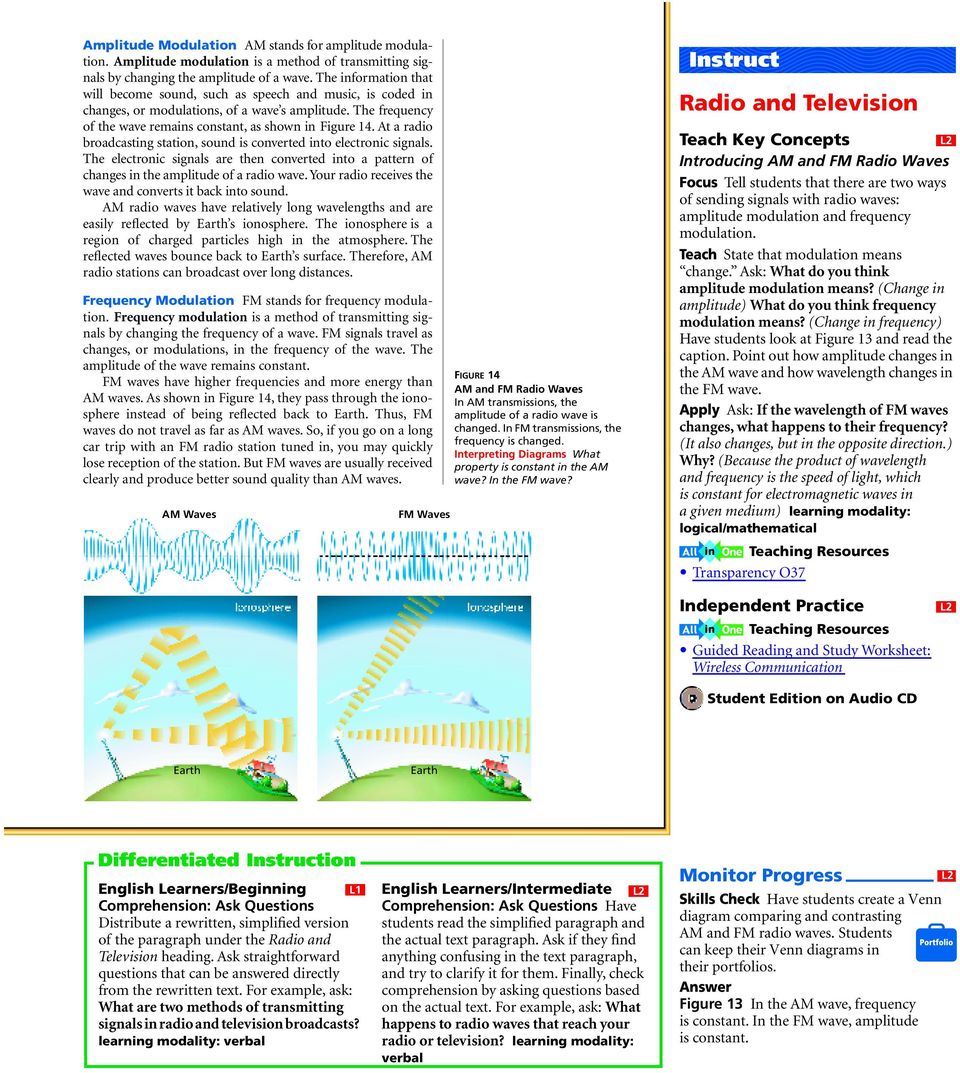
3 Math Skill Interpreting data Focus State that different types of radio and television broadcasts are restricted to using radio waves of a certain range of frequencies. Teach Point out the units used to measure wave frequency. Make sure students know that khz represents kilohertz, or 1,000 hertz, and that MHz represents megahertz, or 1,000,000 hertz. Ask: Which frequency is greater, 54MHz or 1,605 khz? (54 MHz) Answers 1. Kilohertz (khz) and megahertz (MHz) 2. UHF television uses the highest-frequency radio waves, and AM radio broadcast uses the lowest-frequency radio waves. 3. UHF television uses waves with the highest frequency and therefore the shortest wavelength. 4. You cannot tell from this data if it is a television or radio program, because VHF television and FM radio both broadcast radio waves with a frequency of 100 MHz. Help Students Read L1 Visualizing Refer to the Content Refresher in this chapter, which provides guidelines for using the Visualizing strategy. Suggest that students visualize the radio spectrum as a band of increasing wave frequencies, like the electromagnetic spectrum band diagrammed in Figure 3 of Section 2, Waves of the Electromagnetic Spectrum. Help students visualize the order of waves in such a radio band diagram by asking: Which type of radio waves would you place at the low-frequency/longwavelength end of the diagram? (AM radio waves). Which type of radio waves would you place at the high-frequency/shortwavelength end of the diagram? (UHF television) Which type of radio waves would follow AM radio in the diagram? (VHF television) You might want to have students actually draw and label such a radio band diagram to help in their visualizing. Comparing Frequencies The table shows the ranges of radio broadcast frequencies used for AM radio, UHF television, FM radio, and VHF television. 1. Interpreting Data In the table, what units of measurement are used for frequency? 2. Interpreting Data Which type of broadcast shown in the table uses the highestfrequency radio waves? Which uses the lowest-frequency waves? 3. Calculating Which type of broadcast uses waves with the shortest wavelength? The Electromagnetic Spectrum Video Preview Video Field Trip Video Assessment Type of Broadcast AM radio broadcast VHF television FM radio broadcast UHF television Broadcast Frequencies Frequency Range 535 khz to 1,605 khz 54 MHz to 216 MHz 88 MHz to 108 MHz 470 MHz to 806 MHz 4. Inferring A broadcast uses a frequency of 100 MHz. Can you tell from this data if it is a television or a radio program? Explain. The Radio Spectrum In addition to radio and television broadcasts, radio waves are used for many types of communication. For example, taxi drivers, firefighters, and police officers all use radio waves to do their jobs. The Federal Communications Commission, or FCC, assigns different radio frequencies for different uses. Radio stations are allowed to use one part of the radio spectrum. Television stations use other parts. Taxi and police radios are also each assigned a set of frequencies. Because the signals all have different assigned frequencies, they travel without interfering. You probably have seen these assigned frequencies when you tune a radio. AM radio stations use frequencies measured in kilohertz (khz), while FM radio stations use frequencies measured in megahertz (MHz). Recall that a hertz is one cycle per second. If something vibrates 1,000 times a second, it has a frequency of 1,000 Hz, or 1 kilohertz (khz). (The prefix kilomeans one thousand. ) If something vibrates 1,000,000 times a second, it has a frequency of 1,000,000 Hz, or 1 megahertz (MHz). (The prefix mega- means one million. ) AM radio stations range from 535 khz to 1,605 khz. FM radio stations range between 88 MHz and 108 MHz. A television station uses one of two sets of frequencies: Very High Frequency (VHF) or Ultra High Frequency (UHF). VHF stations range from 54 MHz to 216 MHz, corresponding to Channels 2 through 13 on your television set. UHF channels range from 470 MHz to 806 MHz, corresponding to Channels 14 through 69. What does the term kilohertz stand for? The Electromagnetic Spectrum Show the Video Field Trip to let students see how electromagnetic waves are used to help find ships or people lost at sea. Discussion question: What characteristic of radio waves makes them an important part of search-and-rescue operations? (Some radio waves can travel from Earth into space and back again.)
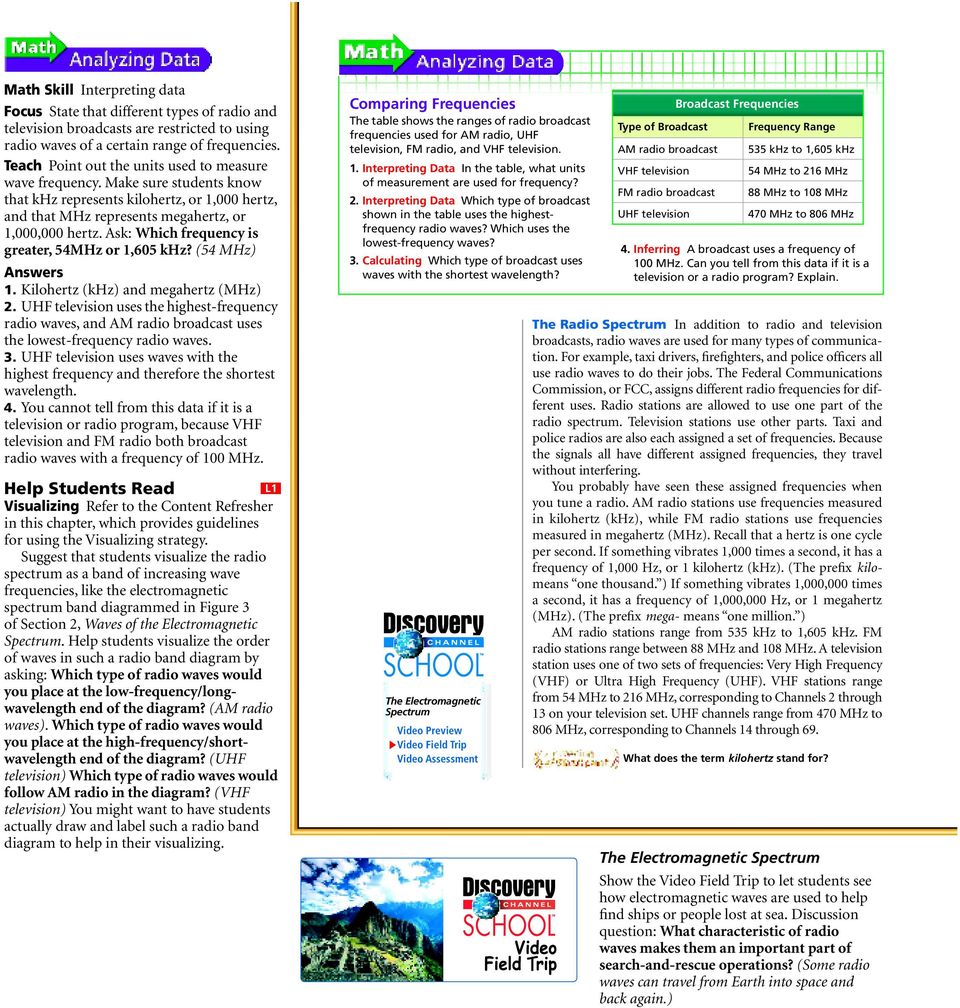

4 Cellular Phones Cellular telephones have become very common, but they only work if they are in or near a cellular system. The cellular system, which is shown in Figure 15, works by dividing regions into many small cells, or geographical areas. Each cell has one or more towers that relay signals to a central hub. Cellular phones transmit and receive signals using highfrequency microwaves. When you place a call on a cellular phone, the phone sends out microwaves. The microwaves are tagged with a number unique to your phone. A tower picks up the microwaves and transfers the signal to a hub. In turn, the hub channels and transmits the signal to a receiver. The receiver may be another tower or another hub, depending on the distance between the two phones. That tower or hub transmits the signal to the receiving cellular phone. The receiving phone rings when it picks up the microwave signal from a tower or hub. The whole exchange seems to be instantaneous. In addition to making phone calls, you can also use some cellular phones to page someone, to send text messages, or to get information from the Internet. Some modern cellular phones can even be used as digital cameras. Central Hub Connecting wires link all towers to a hub. What are three ways to communicate with a cellular phone? Cell A cellular system is divided into many small cells. Tower Each tower transmits and receives radio signals. FIGURE 15 Cellular Phone System In the cellular phone system, cellular phones transmit and receive radio waves that travel to the nearest tower. Predicting What happens if a cellular phone is far away from a tower? Cellular Phones Teach Key Concepts Cellular Phones and Microwaves Focus State that cellular phones send and receive radio signals over short distances. Teach Tell students that the radio waves used for cellular phones are microwaves. Ask: Where are microwaves in the electromagnetic spectrum? (At the upper end of radio waves, just below infrared rays) How much energy do microwaves have, compared with other radio waves? (More energy, because of their higher frequencies) Apply Ask: If microwaves are high-energy radio waves, why can cellular phone signals travel only short distances? (Sample answer: Because cellular phones are small, low-power units) learning modality: verbal Modeling Cellular Phone Transmission Materials small ball Time 5 minutes Focus Tell students they will model how a cellular phone system works. Teach Organize students into small groups, or cells. Give the first group the ball, and tell them it represents a message. Then, have groups pass the ball from one to another. Ask: How is the model like an actual cellular phone system, and how is it different? (Sample answer: The message was transmitted from cell to cell, but much more slowly.) Apply Ask: How fast are messages transmitted in a cellular phone system? (At the speed of light) learning modality: kinesthetic Differentiated Instruction Less Proficient Readers L1 Using Prior Knowledge of Cellular Phone Towers Challenge students to locate two or more adjacent cellular phone towers in the area. Ask: How far apart are the towers? (The towers are likely to be a few miles apart.) Why are cellular phone towers so close together? (Because cellular phones transmit weak signals) learning modality: visual Gifted and Talented L3 Cellular Phone Frequencies Challenge interested students to find the range of frequencies used by cellular phone systems. Urge them to report back to the class with the frequencies and compare them with the frequencies used for radio and television transmissions. learning modality: logical/mathematical Monitor Progress Writing Ask students to write a paragraph describing how microwaves are transmitted by a cellular phone system. Answers Figure 15 It will not be able to transmit and receive radio waves. 1,000 hertz Regular calls, paging, and short text messages and video.


5 Communications Satellites Teach Key Concepts Bouncing Radio Waves Focus Use a familiar sports analogy to introduce communications satellites. Teach Call on a student to describe how to make a basket in basketball by bouncing the ball off the backboard. Explain that a communications satellite is somewhat like the backboard. Radio waves cannot be sent great distances directly over Earth s surface because the surface is curved. Instead, the waves are bounced off a satellite, which returns them to Earth on the other side of the horizon. Apply Ask: Why might more than one satellite be needed for this purpose? (Sample answer: One satellite might not be able to bounce the radio waves far enough.) learning modality: verbal Modeling a Communications Satellite Materials globe, marble Time 5 minutes Focus Use a globe and a marble to model how a communications satellite is positioned to reflect radio waves over Earth s surface. Teach In the feature, have students find the altitude at which communications satellites orbit Earth. (About 35,000 km) Tell students that Earth s diameter is a little less than 13,000 km. Then, ask: About how far above the globe would a communications satellite be? (A little less than three times the globe s diameter.) Holding the marble at the correct height, point out the area of Earth s surface that the satellite could see. Apply Ask: How would you use communications satellites to transmit radio waves from one side of Earth to the other? (Sample answer: By using more than one) learning modality: logical/ mathematical For: Links on using waves to communicate Visit: Web Code: scn-1534 Download a worksheet that will guide students review of Internet resources on using waves to communicate. L1 For: Links on using waves to communicate Visit: Web Code: scn-1534 Wireless Communication Since the late 1800s, many developments in communication have turned our world into a global village Electromagnetic Waves German scientist Heinrich Hertz proved that radio waves exist. Hertz demonstrated that the waves could be reflected, refracted, diffracted, and polarized just like light waves Background Facts and Figures Before the first working cellular phone network was implemented in Japan in 1979, another wireless phone technology, the mobile telephone, was developed and used in the United States. The first mobile phones were introduced in the U. S. in To place a call, the caller would scan the dial for an unused channel and call the operator, who would then dial the number. The phones worked like a CB Communications Satellites Satellites orbiting Earth are used to send information around the world. Communications satellites work like the receivers and transmitters of a cellular phone system. Communications satellites receive radio, television, and telephone signals and relay the signals back to receivers on Earth. Because a satellite can see only part of Earth at any given time, more than one satellite is needed for any given purpose. Satellite Phone Systems Several companies have developed satellite phone systems. The radio waves from one phone are sent up to a communications satellite. The satellite transmits the waves back to the receiving phone on Earth. With this kind of phone, you can call anywhere in the world, but the cost is greater than using a cellular phone First Wireless Transmission Italian engineer and inventor Guglielmo Marconi successfully used radio waves to send a coded wireless signal a distance of more than 2 km First Transatlantic Signals On December 12, the first transatlantic radio signal was sent from Poldhu Cove, Cornwall, England, to Signal Hill, Newfoundland. The coded radio waves traveled more than 3,000 km through the air Ship-to-Ship Communication For the first time, people on one ship could talk to people on another. The signals were sent as electromagnetic waves, received by an antenna, and converted into sound. radio or two-way radio set: the caller had to hold down a button to talk, so only one person at a time could talk. In 1964, an improved mobile telephone service was introduced. These phones dialed automatically and allowed callers to talk without pushing a button. However, only a limited number of channels was available. The first cellular phone system in the U. S. was installed in Rich M sx7372b

6 Television Satellites Both television networks and cable companies use communications satellites. First, the television signals are changed into AM and FM waves. These radio waves are sent up to satellites. Then the signals are relayed to local stations around the world. Some people have their own antennas to receive signals for television programs directly from satellites. Many of the antennas are dish-shaped, so they are known as satellite dishes. Older satellite dishes were very large, more than 2 meters in diameter. But newer dishes are much smaller because the signals from satellites have become more powerful. Television signals from satellites often are scrambled to make sure that only people who pay for the programs can use the signal. Customers need a decoding box to unscramble the signals Sputnik I On October 4, the Soviet Union became the first country to successfully launch an artificial satellite into orbit. This development led to a new era in communications. Since then, more than 5,000 artificial satellites have been placed in orbit Geosynchronous Orbit Communications satellites are launched into orbits at altitudes of about 35,000 km. At this altitude, a satellite orbits Earth at the same rate as Earth rotates. Research and Write Use library or Internet resources to find out more about Guglielmo Marconi. Imagine that you were hired as his assistant. Write a short letter to a friend that describes your new job Cellular Phone Network In Japan, the world's first cellular phone network allowed people to make wireless phone calls. Today, cellular phone towers like the one above are common Focus State that the discoveries and inventions in the timeline are important, because wireless communication has turned the world into a global village. Because of wireless communication, you can talk with someone on another continent almost as clearly as you can talk with someone face to face. Teach Guide students in understanding how important some of the developments in the timeline were to the development of wireless communication. Ask: How did Heinrich Hertz s discoveries in the 1880s contribute to the later development of wireless communication? (Hertz proved that radio waves exist and that they behave like light. This was the basis for all later developments in wireless communication, because wireless communication uses radio waves.) Who was the first person to successfully transmit a wireless signal using radio waves, and when did he do it? (Guglielmo Marconi in 1895) Why was the launching of Sputnik I an important event for wireless communication? (It was the first artificial satellite that was launched into orbit. This event enabled satellite communication and led to a new era in wireless communication.) Writing Mode Research Scoring Rubric 4 Exceeds criteria; includes many interesting and relevant details in a creative letter that clearly conveys the job of Marconi s assistant 3 Meets criteria 2 Includes some relevant details in a letter but contains errors 1 Includes only a general description and/or contains serious errors Background Integrating Science Meteorologists rely on satellite transmissions to analyze Earth s weather. Certain weather satellites orbit from one pole to the other, rather than around Earth s equator. These satellites take photographs of Earth and then transmit the images as television signals. Receivers in many nations allow meteorologists worldwide to have constant surveillance of weather systems. The first meteorological satellite was put into orbit in Since then, the United States has launched several geosynchronous satellites that orbit at the same rate as Earth rotates on its axis. When images from these satellites are used together, they can provide continual global weather coverage. Weather satellites have also been launched by Japan and Russia. Monitor Progress Writing Have students describe how television networks use communications satellites to send signals to local stations around the world.


7 Monitor Progress Answers Assess Global Positioning System Reviewing Key Concepts 1. a. Radio waves b. A radio station converts sound into electronic signals that are then converted into a pattern of changes in the amplitude of a radio wave. A transmitting antenna broadcasts the radio wave. Your radio receives it and converts it back into sound. c. In AM waves, signals are coded as changes in wave amplitude; in FM, signals are coded as changes in wave frequency. AM waves have constant frequency; FM waves have constant amplitude. AM waves reflect off the ionosphere, so they can be received at a greater distance than FM waves, which penetrate the ionosphere. FM waves are received more clearly and produce better sound quality. Both AM and FM waves are radio waves that carry a coded signal from a broadcasting station to a receiver. 2. a. Microwave signals are transmitted by a cellular phone and received by a tower that relays the signals to a hub. b. The signal is passed via connecting wires to the hub. The hub sends the signal to another tower, which transmits it. The signal can then be received by another cellular phone user. c. The phones might interfere with each other. 3. a. Phone-system satellites, television satellites, and GPS satellites b. Communications satellites receive radio, television, and telephone signals and relay the signals back to receivers on Earth. c. Your altitude Reteach L1 Call on students to identify the different uses of radio waves in wireless communication. Performance Assessment Drawing Have students draw a diagram to show how communications satellites receive and transmit radio waves. FIGURE 16 Global Positioning System In the Global Positioning System (GPS), signals from four satellites are used to pinpoint a location on Earth. 4 Section 4 Assessment Target Reading Skill Using Prior Knowledge Review your graphic organizer and revise it based on what you just learned in this section. Reviewing Key Concepts 1. a. Identifying What type of wave carries signals for radio and television programs? b. Sequencing Describe the events that bring an AM broadcast into your home. c. Comparing and Contrasting How are AM waves different from FM waves? How are they the same? 2. a. Summarizing How does a cellular telephone work? b. Interpreting Diagrams A cellular phone transmits a signal to a receiving tower in Figure 15. How is the signal passed on to another cellular phone user? c. Relating Cause and Effect Your cellular phone transmits a signal at a specific frequency. What will happen if a cellular phone next to you also uses this frequency? Global Positioning System The Global Positioning System (GPS) is a system of navigation originally designed for the military. Now many other people use the system. GPS uses a network of satellites that broadcast radio signals to Earth. These signals carry information that tells you your exact location on Earth s surface, or even in the air. Anybody with a GPS receiver can pick up these signals. Figure 16 shows how the signals from four GPS satellites are used to determine your position. The signals from three satellites tell you where you are on Earth s surface. The signal from the fourth satellite tells you how far above Earth s surface you are. Today, GPS receivers are found in airplanes, boats, and cars. In a car, you can type your destination into a computer. The computer uses GPS data to map out your route. A computerized voice might even tell you when to turn right or left. What does GPS stand for? 3. a. Listing What are three kinds of communications satellites? b. Reviewing How do communications satellites work? c. Predicting If your GPS device received signals from only three satellites, what information about your location would you be missing? Cause and Effect Paragraph Just before going to sleep one night, you search for an AM station on your radio. To your surprise, you pick up a station coming from a city 1,000 kilometers away. Your older brother tells you it is because of Earth s ionosphere. Write a paragraph explaining your brother s statement. Be sure to describe how the ionosphere affects AM radio transmissions. Teaching Resources Section Summary: Wireless Communication Review and Reinforcement: Wireless Communication Enrich: Wireless Communication Keep Students on Track At this point, students can collect their surveys and analyze the data. Allow them to use a computer spreadsheet program for this purpose, if one is available. Review graphing skills with the class, and suggest that students also write one or two paragraphs explaining their findings. This will help them organize their findings and conclusions before presenting them. Writing Mode Exposition: cause and effect Scoring Rubric 4 Exceeds criteria; includes concise, accurate explanation with precise description 3 Meets criteria 2 Includes explanation and description but contains errors 1 Includes only general statements and errors


8 Build a Crystal Radio Build a Crystal Radio Problem Can you build a device that can collect and convert radio signals? Skills Focus observing, drawing conclusions, making models Materials cardboard tube (paper towel roll) 3 pieces of enameled or insulated wire, 1 about 30 m long, and 2 about 30 cm long wirestrippers or sandpaper 2 alligator clips scissors aluminum foil 2 pieces of cardboard (sizes can range from 12.5 cm 20 cm to 30 cm 48 cm) masking tape crystal diode earphone 2 pieces of insulated copper antenna wire, 1 about 30 m long, and 1 about 0.5 m long Procedure PART 1 Wind the Radio Coil (Hint: All ends of the insulated wires need to be stripped to bare metal. If the wire is enameled, you need to sandpaper the ends.) 1. Carefully punch two holes approximately 2.5 cm apart in each end of a cardboard tube. The holes should be just large enough to thread the insulated wire through. 2. Feed one end of the 30-m piece of insulated wire through one set of holes. Leave a 50-cm lead at that end. Attach alligator clip #1 to this lead. See Figure 1. Guide Inquiry Invitation Ask: How does a radio work? (Sample answer: A radio receives radio waves and converts the waves into sound.) Explain that radio waves are received by the radio s antenna. Then, the waves are converted into electronic signals. Finally, the electronic signals are converted into sound by the Figure 1 Winding the Coil 3. Wind the wire tightly around the cardboard tube. Make sure the coils are close together but do not overlap one another. 4. Wrap the wire until you come to the end of the tube. Feed the end of the wire through the other set of holes, leaving a 50-cm lead as before. Attach alligator clip #2 to this lead. See Figure 2. Alligator clip #2 Figure 2 The Finished Coil Alligator clip #1 speaker. Remind students how sound waves travel through the air, into the ear, and finally as signals to the brain. Then, ask: How many different radio stations can you receive with a radio at home? (Sample answer: Dozens of radio stations) How many radio stations do you predict you will be able to receive with your crystal radio? (Sample answer: Few if any stations) Prepare for Inquiry Key Concept Students will build crystal radios to receive radio signals and convert the signals into sound. Skills Objective After this lab, students will be able to observe how many stations their radios can receive and where the stations are located draw conclusions about how adjusting the tuning plates affects the reception of radio signals make models to determine how they can improve the antennas of their radios Prep Time 30 minutes Class Time 60 minutes Advance Planning Purchase earphones, crystal diodes, wires, and alligator clips from an electronics supply company. Collect enough cardboard and cardboard tubes for each group, or have students bring them from home. To save time and reduce risk of injury, you may want to strip the ends of the wires yourself. Test the diodes and earphones with an ammeter or multimeter to make sure they work. You may want to set up a demonstration radio ahead of time for students to use as a model as they construct their own radios. Alternative Materials You may mount the circuit on a board and use screws instead of clips to make connections. Safety Caution students to handle the diodes carefully because they can break easily. Tell students not to connect their radios to electrical outlets or electrical appliances. Students should wear safety goggles when using the wire stripper. Advise them that wire strippers are sharp and to use care when stripping the wire. Review the safety guidelines in Appendix A. Teaching Resources Lab Worksheet: Build a Crystal Radio


9 Introduce the Procedure Have students read through the procedure. Review the steps in the construction process to make sure students understand them. Refer to the apparatus diagrams and explain the purpose of each component. Ask students if they have any questions before they begin. Clear up any questions they may have. Troubleshooting the Experiment Students should test the diode and earphone to make sure they work before connecting them. Tell students that the diode arrow must point toward the earphone for the radio to work. For Part 4, students can use themselves as the ground by holding the loose end of the shorter antenna wire instead of connecting it to the water pipe or faucet. The longer antenna wire should be extended and lie flat. Expected Outcome Students should be able to pick up the signals of some radio stations with the crystal radios they construct. PART 2 Make the Tuning Plates 5. Without wrinkling the aluminum foil, cover one side of each piece of cardboard with the foil. Trim off any excess foil and tape the foil in place. 6. Hold the pieces of cardboard together with the foil facing inward. Tape along one edge to make a hinge. It is important for the foil pieces to be close together but not touching. See Figure 3. Figure 3 Taping the Tuning Plates 7. Make a small hole through the cardboard and foil near a corner of one side. Feed one of the short pieces of insulated wire through the hole and tape it onto the foil as shown. Tape the other short piece of insulated wire to the corner of the other side. See Figure 4. Cardboard Figure 4 Connecting the Tuning Plates Masking tape Aluminum foil Tape wire onto aluminum foil 8. Connect one end of the wire from the foil to alligator clip #1. Connect the other wire from the foil to alligator clip #2. PART 3 Prepare the Earphone 9. Handle the diode carefully. Connect one wire from the diode to alligator clip #1. The arrow on the diode should point to the earphone. Tape the other end of the diode wire to one of the earphone wires. 10. Connect the other wire from the earphone to alligator clip #2. See Figure 5.


10 #1 PART 4 Antenna Alligator clips Diode Tuning plates Coil Earphone To water pipe Hook Up the Antenna 11. String the long piece of antenna wire along the floor to an outside window. Connect the other end of the wire to alligator clip # Connect one end of the shorter piece of antenna wire to a cold-water pipe or faucet. Connect the other end to alligator clip #2. See Figure Put on the earphone and try to locate a station by squeezing the tuning plates slowly until you hear a signal. Some stations will come in when the plates are close together. Other stations will come in when the plates are opened far apart. #2 Figure 5 The Completed Radio Earphone wires Analyze and Conclude 1. Observing How many stations can you pick up? Where are these stations located, and which station has the strongest signal? Keep a log of the stations your receive. 2. Forming Operational Definitions In your own words, give a definition of signal strength. How did you compare the signal strengths of different radio stations? 3. Drawing Conclusions How does adjusting the tuning plates affect reception of the radio signals? 4. Making Models You can improve reception by having a good antenna. How can you improve your antenna? 5. Communicating Write a paragraph describing the various parts of the radio and how they are linked together. Design an Experiment Use a radio to test signal reception at various times of the day. Do you receive more stations at night or in the morning? Does weather affect reception? Obtain your teacher s permission before carrying out your investigation. Analyze and Conclude 1. Answers will vary. Students logs should describe the position of the tuning plates and the antenna for each station they receive. They should also record observations about the strength of the signal and the amount of static. 2. Students might define signal strength as the amount of energy with which a signal arrives at the radio, which affects how clearly and loudly the station is heard. Students might have compared signal strengths of different stations by rating the amount of static interference on a scale of 1 to 5 or by rating the loudness on a similar scale, with 1 corresponding to the softest station received and 5 to the loudest. 3. Adjusting the tuning plates allows the radio to receive signals of different frequencies from different stations because different stations transmit signals at different frequencies. 4. Students responses should use examples from their observations to support their opinions. Students might suggest they could improve their antenna and improve reception by using a different type of wire or by changing the length or thickness of the wire. 5. Students paragraphs should include the main parts of the radio: the radio coil, the tuning plates, the earphone, and the antenna. One end of the coil, one wire from the earphone, and one side of the tuning plates are connected to the antenna. The other wires from the coil, tuning plates, and earphone are connected to the grounding wire that goes to the water pipe. Extend Inquiry Design an Experiment Students are likely to receive more stations at night than in the morning. To test whether weather affects reception, students might propose comparing their radio s reception on sunny days with its reception on cloudy days. Give students a chance to test their predictions.

ACCESS CHARGE A fee charged subscribers or other telephone companies by a local exchange carrier for the use of its local exchange networks.
 Glossary of Telecommunications Terms (Source: Federal Communications Commission) ACCESS CHARGE A fee charged subscribers or other telephone companies by a local exchange carrier for the use of its local
Electromagnetic (EM) waves. Electric and Magnetic Fields. L 30 Electricity and Magnetism [7] James Clerk Maxwell (1831-1879)
![Electromagnetic (EM) waves. Electric and Magnetic Fields. L 30 Electricity and Magnetism [7] James Clerk Maxwell (1831-1879)](/thumbs/40/20813653.jpg "Electromagnetic (EM) waves. Electric and Magnetic Fields. L 30 Electricity and Magnetism [7] James Clerk Maxwell (1831-1879)") L 30 Electricity and Magnetism [7] ELECTROMAGNETIC WAVES Faraday laid the groundwork with his discovery of electromagnetic induction Maxwell added the last piece of the puzzle Heinrich Hertz made the experimental
L 30 Electricity and Magnetism [7] ELECTROMAGNETIC WAVES Faraday laid the groundwork with his discovery of electromagnetic induction Maxwell added the last piece of the puzzle Heinrich Hertz made the experimental
Yerkes Summer Institute 2002
 Before we begin our investigations into radio waves you should review the following material on your trip up to Yerkes. For some of you this will be a refresher, but others may want to spend more time
Environmental Monitoring: Guide to Selecting Wireless Communication Solutions
 Environmental Monitoring: Guide to Selecting Wireless Communication Solutions By: Scott South Published in WaterWorld, January 2005 (Page 48) Rapidly growing demands for information and increased productivity
Personal Broadband Networks, PBN (CE74024-3)
 Faculty of Computing, Engineering & Technology Introduction to Radio Systems Personal Broadband Networks, PBN (CE74024-3) Alison L Griffiths C203 [email protected] www.soc.staffs.ac.uk/alg1 2004
Radio Merit Badge Workbook
 Merit Badge Workbook This workbook can help you but you still need to read the merit badge pamphlet. The work space provided for each requirement should be used by the Scout to make notes for discussing
Germanium Diode AM Radio
 Germanium Diode AM Radio LAB 3 3.1 Introduction In this laboratory exercise you will build a germanium diode based AM (Medium Wave) radio. Earliest radios used simple diode detector circuits. The diodes
COLLATED QUESTIONS: ELECTROMAGNETIC RADIATION
 COLLATED QUESTIONS: ELECTROMAGNETIC RADIATION 2011(2): WAVES Doppler radar can determine the speed and direction of a moving car. Pulses of extremely high frequency radio waves are sent out in a narrow
Module 5. Broadcast Communication Networks. Version 2 CSE IIT, Kharagpur
 Module 5 Broadcast Communication Networks Lesson 9 Cellular Telephone Networks Specific Instructional Objectives At the end of this lesson, the student will be able to: Explain the operation of Cellular
Chapters 1-21 Introduction to Wireless Communication Systems
 Chapters 1-21 Introduction to Wireless Communication Systems Yimin Zhang, Ph.D. Department of Electrical & Computer Engineering Villanova University http://yiminzhang.com/ece8708 Yimin Zhang, Villanova
INTRODUCTION TO COMMUNICATION SYSTEMS AND TRANSMISSION MEDIA
 COMM.ENG INTRODUCTION TO COMMUNICATION SYSTEMS AND TRANSMISSION MEDIA 9/6/2014 LECTURES 1 Objectives To give a background on Communication system components and channels (media) A distinction between analogue
1. Introduction. FER-Zagreb, Satellite communication systems 2011/12
 1. Introduction Topics History Characteristics of satellite communications Frequencies Application 1 History Arthur C. Clark suggested in 1945. Earth coverage with 3 geostationary satellites. On 4th of
Can You Hear Me Now? A Study Unit on Cell Phones Introduction & History
 Introduction & History Since the dawn of time, people have found ways to communicate with one another. Smoke signals and tribal drums were some of the earliest forms of communication. Letters, carried
Users Manual FA106 / FA306 version 1.0. Field Analyzer. FA106 and FA306. Users Manual
 Field Analyzer FA106 and FA306 Users Manual 1 Contents Contents...2 Preface...3 Chapter 1 Basic Functions...4 1.1 Turning on/off...4 1.2 Choosing the required measuring mode...4 1.3 Picture of front panel...5
Multiplexing on Wireline Telephone Systems
 Multiplexing on Wireline Telephone Systems Isha Batra, Divya Raheja Information Technology, Dronacharya College of Engineering Farrukh Nagar, Gurgaon, India ABSTRACT- This Paper Outlines a research multiplexing
Single Transistor FM Transmitter Design
 Single Transistor FM Transmitter Design In telecommunications, frequency modulation (FM) conveys information over a carrier wave by varying its frequency. FM is commonly used at VHF radio frequencies for
HOW W I R E L E S S T E C H N O L O G Y WORKS
 HOW WORKS OW ORKS WHAT S INSIDE Inside your wireless phone, there is a compact speaker, a microphone, a keyboard, a display screen, and a powerful circuit board with microprocessors that make each phone
Data Transmission. Data Communications Model. CSE 3461 / 5461: Computer Networking & Internet Technologies. Presentation B
 CSE 3461 / 5461: Computer Networking & Internet Technologies Data Transmission Presentation B Kannan Srinivasan 08/30/2012 Data Communications Model Figure 1.2 Studying Assignment: 3.1-3.4, 4.1 Presentation
Motion & The Global Positioning System (GPS)
 Grade Level: K - 8 Subject: Motion Prep Time: < 10 minutes Duration: 30 minutes Objective: To learn how to analyze GPS data in order to track an object and derive its velocity from positions and times.
Connections and Setup
 12 Connections and Setup HOW TO CONNECT YOUR SATELLITE RECEIVER Use the information in this chapter to connect your receiver to other equipment. CONNECTING TO THE NEARBY HDTV (TV1) CONNECTING TO THE REMOTE
Chapter 6 Telecommunications, Networks, and Wireless. Computing
 Chapter 6 Telecommunications, Networks, and Wireless Computing Essay Questions: 1. Define a hub, switch, and a router. 2. List the challenges associated with managing contemporary telecommunications and
Overview of the Telecommunications Network
 1 Overview of the Telecommunications Network 15 Telecommunication Networks 2 Basic purpose of a telecommunications network: transmit user information in any form to another user of the network. Many forms
PDHonline Course L105 (12 PDH) GPS Surveying. Instructor: Jan Van Sickle, P.L.S. PDH Online PDH Center
 PDHonline Course L105 (12 PDH) GPS Surveying Instructor: Jan Van Sickle, P.L.S. 2012 PDH Online PDH Center 5272 Meadow Estates Drive Fairfax, VA 22030-6658 Phone & Fax: 703-988-0088 www.pdhonline.org www.pdhcenter.com
Receiving Saorview Digital Terrestrial Television
 Receiving Saorview Digital Terrestrial Television Introduction RTÉ NL Nutley Building Donnybrook Dublin 4 Tel: 01-2082223 Fax: 01-2082283 Email: [email protected] Web: www.rtenl.ie Saorview s Digital Terrestrial
Introductory Concepts
 Chapter 1 Introductory Concepts 1.1 Introduction Communication is one of the integral parts of science that has always been a focus point for exchanging information among parties at locations physically
AM TRANSMITTERS & RECEIVERS
 Reading 30 Ron Bertrand VK2DQ http://www.radioelectronicschool.com AM TRANSMITTERS & RECEIVERS Revision: our definition of amplitude modulation. Amplitude modulation is when the modulating audio is combined
Computer Networks and Internets, 5e Chapter 6 Information Sources and Signals. Introduction
 Computer Networks and Internets, 5e Chapter 6 Information Sources and Signals Modified from the lecture slides of Lami Kaya ([email protected]) for use CECS 474, Fall 2008. 2009 Pearson Education Inc., Upper
sources in our environment i.e. Natural and man-made. The sun, earth and ionosphere are the natural source.
 Electromagnetic Radiation (EMR) consist of waves of electric and magnetic energy moving together at the speed of light and sometimes is referred as electromagnetic field (EMF) They are basically two forms
v = fλ PROGRESSIVE WAVES 1 Candidates should be able to :
 PROGRESSIVE WAVES 1 Candidates should be able to : Describe and distinguish between progressive longitudinal and transverse waves. With the exception of electromagnetic waves, which do not need a material
Technician Licensing Class. Lesson 1. presented by the Arlington Radio Public Service Club Arlington County, Virginia
 Technician Licensing Class Lesson 1 presented by the Arlington Radio Public Service Club Arlington County, Virginia 1 FCC Rules Sub element T1 2 Why Amateur Radio? The basis & purpose of the amateur service
Study of RF Spectrum Emissions in High Pressure Sodium and Metal Halide Lamps. Lawrence P. Glaister VE7IT, Automation Engineer.
 Study of RF Spectrum Emissions in High Pressure Sodium and Metal Halide Lamps Lawrence P. Glaister VE7IT, Automation Engineer May 2010 Abstract: This research was performed in collaboration with the City
Chapter 3 Cellular Networks. Wireless Network and Mobile Computing Professor: Dr. Patrick D. Cerna
 Chapter 3 Cellular Networks Wireless Network and Mobile Computing Professor: Dr. Patrick D. Cerna Objectives! Understand Cellular Phone Technology! Know the evolution of evolution network! Distinguish
INTRODUCTION FIGURE 1 1. Cosmic Rays. Gamma Rays. X-Rays. Ultraviolet Violet Blue Green Yellow Orange Red Infrared. Ultraviolet.
 INTRODUCTION Fibre optics behave quite different to metal cables. The concept of information transmission is the same though. We need to take a "carrier" signal, identify a signal parameter we can modulate,
Siemens Energy & Automation. structured. WIRING Product Training Series: Advanced Video Session 3
 s structured WIRING Product Training Series: Advanced Video Session 3 1 Table of Contents This presentation will give you a closer look at Video in Structured Wiring applications. The following Areas will
MEASUREMENT AND ANALYSIS OF RF EME LEVELS FROM MOBILE TELEPHONE BASE STATIONS LOCATED AT LEICHHARDT, NSW
 AUSTRALIAN RADIATION PROTECTION AND NUCLEAR SAFETY AGENCY A R P N S A Lower Plenty Road YALLAMBIE VIC 3085 Phone 61 3 9433 2211 Fax 61 3 9432 1835 E-mail: [email protected] Web: www.arpansa.gov.au
Biology Explorervision. John Lenzini and Jason Gorecki. The Amazing Cell Phone
 Biology Explorervision John Lenzini and Jason Gorecki The Amazing Cell Phone History of the cell phone- The very first concept of the cellular phone started with AT&T car phone around 1970. When Motorola
Unit of Learning # 2 The Physical Layer. Redes de Datos Sergio Guíñez Molinos [email protected] 1-2009
 Unit of Learning # 2 The Physical Layer Redes de Datos Sergio Guíñez Molinos [email protected] 1-2009 The Theoretical Basis for Data Communication Sergio Guíñez Molinos Redes de Computadores 2 The Theoretical
Computer Network and Communication
 2 Computer Network and Communication 2.1 INTRODUCTION As we all know, the advances in Information technology revolutionized almost every aspect of our life. Education, industry, banking, researches and
INSTALLING A SATELLITE DISH USING TV EXPLORER
 INSTALLING A SATELLITE DISH USING TV EXPLORER A bit of history That's it, a bit of history. First artificial satellite "Sputnik I" was launched 4th of October of 1957 by former Soviet Union. It was about
Antennas & Propagation. CS 6710 Spring 2010 Rajmohan Rajaraman
 Antennas & Propagation CS 6710 Spring 2010 Rajmohan Rajaraman Introduction An antenna is an electrical conductor or system of conductors o Transmission - radiates electromagnetic energy into space o Reception
Connections and Setup
 9242_14_Ch12_eng 6/11/07 9:36 AM Page 1 Connections and Setup HOW TO CONNECT YOUR SATELLITE RECEIVER Do you have a handful of cables and a head full of questions? This chapter is the perfect place to find
STRING TELEPHONES. Education Development Center, Inc. DESIGN IT! ENGINEERING IN AFTER SCHOOL PROGRAMS. KELVIN Stock #651817
 STRING TELEPHONES KELVIN Stock #6587 DESIGN IT! ENGINEERING IN AFTER SCHOOL PROGRAMS Education Development Center, Inc. DESIGN IT! Engineering in After School Programs Table of Contents Overview...3...
Vehicle Tracking and Remote Data Acquisition System using Very High Frequency operated devices
 International Journal of Engineering Research and Development e-issn: 2278-067X, p-issn: 2278-800X, www.ijerd.com Volume 11, Issue 05 (May 2015), PP.64-68 Vehicle Tracking and Remote Data Acquisition System
EE4367 Telecom. Switching & Transmission. Prof. Murat Torlak
 Path Loss Radio Wave Propagation The wireless radio channel puts fundamental limitations to the performance of wireless communications systems Radio channels are extremely random, and are not easily analyzed
2. OVERVIEW OF COMMUNICATION SYSTEMS
 2. OVERVIEW OF COMMUNICATION SYSTEMS A communication system is made up of devices that employ one of two communication methods (wireless or wired), different types of equipment (portable radios, mobile
Interference to Hearing Aids by Digital Mobile Telephones Operating in the 1800 MHz Band.
 Interference to Hearing Aids by Digital Mobile Telephones Operating in the 1800 MHz Band. Reference: EB968 Date: January 2008 Author: Eric Burwood (National Acoustic Laboratories) Collaborator: Walter
Students will investigate the characteristics of electromagnetism and then use what they learn to plan and conduct an experiment on electromagnets.
 Electromagnetic Power! Lesson Overview Students will investigate the characteristics of electromagnetism and then use what they learn to plan and conduct an experiment on electromagnets. Suggested Grade
ISS Minimalist Antenna
 ISS Minimalist Antenna The purpose of this project was to develop an antenna suggestion that would allow for a simple to duplicate, affordable antenna solution for reasonable access to signals transmitted
METHODS OF GATHERING EGM DATA Stephen Easley TXU Lone Star Pipeline
 METHODS OF GATHERING EGM DATA Stephen Easley TXU Lone Star Pipeline 301 South Harwood St., Dallas, TX 75201 INTRODUCTION Today s changing world of computers and data communications is an exciting time
Signal directionality Lower frequency signals are omnidirectional Higher frequency signals can be focused in a directional beam
 Transmission Media Transmission medium Physical path between transmitter and receiver May be guided (wired) or unguided (wireless) Communication achieved by using em waves Characteristics and quality of
ELEMENTS OF CABLE TELEVISION
 1 ELEMENTS OF CABLE TELEVISION Introduction Cable television, from its inception, developed in western countries into two separate systems called Master Antenna Television (MATV) and Community Cable Television
RADIOFREQUENCY RADIATION, (RFR): (RFR Information - Technology Newsletter, Full Version)
 RADIOFREQUENCY RADIATION, (RFR): (RFR Information - Technology Newsletter, Full Version) George M. Harris, P.E. (Revised February, 2011) Questions: -What is Radiofrequency Radiation, (RFR)? -With SO MANY
Mechanical Energy. Mechanical Energy is energy due to position or motion.
 Mechanical Energy Mechanical Energy is energy due to position or motion. Position: This means that matter can have energy even though it is not moving. If you knock something off of your kitchen counter,
Spectrum and Power Measurements Using the E6474A Wireless Network Optimization Platform
 Application Note Spectrum and Power Measurements Using the E6474A Wireless Network Optimization Platform By: Richard Komar Introduction With the rapid development of wireless technologies, it has become
Satellite Basics. Benefits of Satellite
 Satellite Basics Benefits of Satellite People need access to enterprise-class, high-speed voice, video and data applications wherever they happen to be. Satellite connectivity has the power to drive communications
Weather Radar Basics
 Weather Radar Basics RADAR: Radio Detection And Ranging Developed during World War II as a method to detect the presence of ships and aircraft (the military considered weather targets as noise) Since WW
Modern Wireless Communication
 Modern Wireless Communication Simon Haykin, Michael Moher CH01-1 Chapter 1 Introduction CH01-2 1 Contents 1.1 Background 1.2 Communication Systems 1.3 Physical Layer 1.4 The Data-Link Layer 1.4.1 FDMA
Trigonometric functions and sound
 Trigonometric functions and sound The sounds we hear are caused by vibrations that send pressure waves through the air. Our ears respond to these pressure waves and signal the brain about their amplitude
The Xtal Set Society Newsletter
 The Xtal Set Society Newsletter In this issue (#67) July 1, 2002!This is an exerpt from our July 2002 issue The Quaker Oats Box Crystal Radio Set If we put this set on the NET, would it create Oatmeal
UNIVERSITY OF CALICUT
 UNIVERSITY OF CALICUT SCHOOL OF DISTANCE EDUCATION BMMC (2011 Admission) V SEMESTER CORE COURSE AUDIO RECORDING & EDITING QUESTION BANK 1. Sound measurement a) Decibel b) frequency c) Wave 2. Acoustics
Cutting the Cable (or Dish) with Antenna TV
 Cutting the Cable (or Dish) with Antenna TV By Tom McMorris (mcmorrisphoto.com) In today s world it seems that the cost of everything keeps climbing and climbing including the price of cable or satellite
DIRECT TO HOME TELEVISION (DTH)
 DIRECT TO HOME TELEVISION (DTH) Today, most satellite TV customers in developed television markets get their programming through a direct broadcast satellite (DBS) provider, such as DISH TV or DTH platform.
Indoor Environment Electromagnetic Radiation
 Indoor Environment Electromagnetic Radiation Purpose: To increase the students awareness of the sources of electric and magnetic fields and the potential for adverse health effects from prolonged exposure
Chief Information Office Safety and Health
 Chief Information Office Safety and Health United States Department of Agriculture Forest Service Technology & Development Program March 2010 6600/6700 1066 2320P MTDC Road Testing Cell Phone Amplifiers
Digital TV Coat Hanger Antenna
 Rabbit ears are for rabbits, not digital televisions. In this project, we ll show you how to build your own digital TV antenna from wire hangers, a piece of wood and some pipe. Television antennas are
Digital TV Coat Hanger Antenna
 Rabbit ears are for rabbits, not digital televisions. In this project, we ll show you how to build your own digital TV antenna from wire hangers, a piece of wood and some pipe. Television antennas are
EH-20 20m antenna. By VE3RGW
 EH-20 20m antenna By VE3RGW Equivalent circuit of EH-20 (prototype 2A) antenna system. Upper cylinder Lower cylinder Ground Counter pose Phasing coil Impedance transformer and tune circuit Tune coil Feed
Computers Are Your Future. 2006 Prentice-Hall, Inc.
 Computers Are Your Future 2006 Prentice-Hall, Inc. Computers Are Your Future Chapter 3 Wired and Wireless Communication 2006 Prentice-Hall, Inc Slide 2 What You Will Learn... ü The definition of bandwidth
Vehicle Tracking System,
 Vehicle Tracking System, The Complete Solution What is GPS? Product Review. Complete system. Contact Us. What is GPS? GPS, which stands for Global Positioning System, is the only system today able to show
Hello viewers, welcome to today s lecture on cellular telephone systems.
 Data Communications Prof. A. Pal Department of Computer Science & Engineering Indian Institute of Technology, Kharagpur Lecture minus 31 Cellular Telephone Systems Hello viewers, welcome to today s lecture
Wireless Medical Telemetry Laboratory
 Wireless Medical Telemetry Laboratory 0 Introduction The development of wireless medical telemetry has become an increasingly popular application in recent years. As the elderly population continues to
AS COMPETITION PAPER 2008
 AS COMPETITION PAPER 28 Name School Town & County Total Mark/5 Time Allowed: One hour Attempt as many questions as you can. Write your answers on this question paper. Marks allocated for each question
Magnets. Electromagnets. and. Thomas Jefferson National Accelerator Facility - Office of Science Education http://education.jlab.
 Magnets and Electromagnets Magnets and Electromagnets Can you make a magnet from a nail, some batteries and some wire? Problems Can the strength of an electromagnet be changed by changing the voltage of
Model PBX 416+ Programming & User Guide
 Model PBX 416+ Programming & User Guide 1 Introduction... 5 Installation hints... 5 Wall mounting... 5 System programming... 6 System password... 6 Changing the password... 6 Exchange line set up... 6
Discovering Computers 2008. Chapter 9 Communications and Networks
 Discovering Computers 2008 Chapter 9 Communications and Networks Chapter 9 Objectives Discuss the the components required for for successful communications Identify various sending and receiving devices
This Document Contains:
 Instructional Documents Video Conference >> PolyCom >> VSX 7000 Extension Computing Technology Unit This Document Contains: A Device Description An Installation Guide Instructions for Use Best Practices
Using FM. A guide for children and their families on how to use an FM solution with hearing aids
 Using FM A guide for children and their families on how to use an FM solution with hearing aids Congratulations on your new FM solution!! This booklet tells you how to use your FM solution, where to use
MD5-26 Stacking Blocks Pages 115 116
 MD5-26 Stacking Blocks Pages 115 116 STANDARDS 5.MD.C.4 Goals Students will find the number of cubes in a rectangular stack and develop the formula length width height for the number of cubes in a stack.
What is Energy? 1 45 minutes Energy and You: Energy Picnic Science, Physical Education Engage
 Unit Grades K-3 Awareness Teacher Overview What is energy? Energy makes change; it does things for us. It moves cars along the road and boats over the water. It bakes a cake in the oven and keeps ice frozen
Interaction at a Distance
 Interaction at a Distance Lesson Overview: Students come in contact with and use magnets every day. They often don t consider that there are different types of magnets and that they are made for different
Indoor/Outdoor Color Camera with Built-in 2.4 GHz Wireless Transmitter, plus X10 controlled power supply, and Video Receiver.
 Indoor/Outdoor Color Camera with Built-in 2.4 GHz Wireless Transmitter, plus X10 controlled power supply, and Video Receiver. OWNER'S MANUAL VR36A XC18A XM13A MODEL VK69A (INCLUDES XC18A CAMERA, XM13A
Materials Needed: Choose one of the following methods depending on how familiar your students are with the internet and how to use it.
 Teacher Information Lesson Title: Global Warming, Green House Effect and Climate Changes Lesson Description: This lesson helps students to understand or review their understanding of global warming, the
Local and Ultra Local Content in Broadcast Mobile TV
 Local and Ultra Local Content in Broadcast Mobile TV Richard LHERMITTE ENENSYS Technologies France ABSTRACT Broadcast Mobile TV is meant to be one of the next killer application for Mobile operators and
After a wave passes through a medium, how does the position of that medium compare to its original position?
 Light Waves Test Question Bank Standard/Advanced Name: Question 1 (1 point) The electromagnetic waves with the highest frequencies are called A. radio waves. B. gamma rays. C. X-rays. D. visible light.
Energy Chains Grade Seven
 Ohio Standards Connection: Physical Science Benchmark D Describe that energy takes many forms, some forms represent kinetic energy and some forms represent potential energy; and during energy transformations
How To Know If You Are Safe To Use An Antenna (Wired) Or Wireless (Wireless)
 1 2 The range of RF spans 3 KHz (3000 Hz) to 300 GHz (300 million Hz) Frequencies of RF devices range from the low frequency AM broadcasts (80 MHz) to higher frequency mobile phones (1900 MHz) smart meters
Personal Assistance System Owner's Guide
 Owner's Guide PSC07 READ THIS FIRST This equipment generates and uses radio frequency energy, and if not installed and used properly, that is, in strict accordance with the manufacturers instructions,
Step by step guide to installing your own Ku Band satellite dish
 Step by step guide to installing your own Ku Band satellite dish If you don't feel comfortable installing your own system, your local TV Aerial or Handyman can easily follow these helpful guidelines for
Engineering with Sound Lesson Plan
 Type of lesson: Challenge Teaching Plan: Engineering with Sound Lesson Plan Goal The goal of this lesson is to introduce the students to sound and its properties and have them apply what they learn to
Instructions for - Installation of Satellite Channels
 ENGLISH Instructions for - Installation of Satellite Channels Updated: March 2011 Experience Reality AQUOS LCD-TVs Spring/Summer 2011 Page - 1 - LE820 - LE822 - LE814 - LE824 - LE914 - LE925 Contents:
Technician Licensing Class
 Technician Licensing Class Antennas Presented by Amateur Radio Technician Class Element 2 Course Presentation ELEMENT 2 SUB-ELEMENTS (Groupings) About Ham Radio Call Signs Control Mind the Rules Tech Frequencies
Cell Phones Past, Present, and Future
 Cell Phones Past, Present, and Future By Sean W. Henry Table of Contents Chapter One How Cell Phones Work 1 Chapter Two The Birth and Growth of Wireless Transmission 2 Chapter Three Landline or Cell Phone?
BASICS OF C & Ku BAND TRANSMISSIONS & LNBs
 Page 1 of 6 BASICS OF C & Ku BAND TRANSMISSIONS & LNBs A satellite broadcasts a few watts of microwave signals from the geostationary orbit 36,000 kilometers above the earth. The transmissions are also
Introduction 1.1 CONCEPT
 1 Introduction 1.1. Concept 1.2. Point-to-Point Communication to Switching Exchange 1.3. Basic Telephone Equipments 1.4. Basic Telephone Communication 1.5. Switching System References Exercise 1.1 CONCEPT
CHAPTER 4. Electromagnetic Spectrum
 ELEC4504 Avionics Systems 9 CHAPTER 4. Electromagnetic Spectrum 4.1. Electromagnetic (EM) Waves In free space (or the atmosphere) the electric field is perpendicular to the magnetic field and both are
CHAPTER 1 1 INTRODUCTION
 CHAPTER 1 1 INTRODUCTION 1.1 Wireless Networks Background 1.1.1 Evolution of Wireless Networks Figure 1.1 shows a general view of the evolution of wireless networks. It is well known that the first successful
Build A Simple Electric Motor (example #1)
 PHY115 Experiment 11 Build A Simple Electric Motor (example #1) MATERIAL This is the necessary equipment. Present any list of material in your written lab report. 1.5 V battery in series 1 ceramic magnet
Do It Yourself Guide for Adventist Satellite Installation System: Fortec Lifetime Ultra / SatelliteAV 36 Dish
 1-888-393-4673 [email protected] http://www.adventistsat.com [email protected] AMC 4 Dish Aiming Information for Zip Code Elevation. Azimuth, Magnetic. Feedhorn Rotation. Do It Yourself Guide
Narrowband and Broadband Access Technologies
 Computer Networks and Internets, 5e Chapters 12 and 16 Access and Interconnection Technologies (slidesets abridged/combined) By Douglas Comer Modified from the lecture slides of Lami Kaya ([email protected])