
D-Link AirPlus G DI-524
|
|
|
- Claude Thomas
- 10 years ago
- Views:
Transcription
1 D-Link AirPlus G DI g/ 2.4 GHz Wireless Router TM Manual Building Networks for People

2 Contents Package Contents... 3 Introduction... 4 Wireless Basics... 8 Getting Started...11 Using the Configuration Menu Networking Basics Troubleshooting Technical Specifications Frequently Asked Questions Contacting Technical Support Warranty and Registration

3 Package Contents Contents of Package: D-Link AirPlus G DI /2.4GHz Wireless Router Power Adapter-DC 7.5V, 1.5A Manual and Warranty on CD Quick Installation Guide Ethernet Cable (All the DI-524 s Ethernet ports are Auto-MDIX) Note: Using a power supply with a different voltage rating than the one included with the DI-524 will cause damage and void the warranty for this product. If any of the above items are missing, please contact your reseller. System Requirements for Configuration: Ethernet-Based Cable or DSL Modem Computers with Windows, Macintosh, or Linux-based operating systems with an installed Ethernet adapter Internet Explorer Version 6.0 or Netscape Navigator Version 7.0 and Above 3

4 Introduction The D-Link AirPlus G DI-524 High-Speed Wireless Router is an g highperformance, wireless router that supports high-speed wireless networking at home, at work or in public places. Unlike most routers, the DI-524 provides data transfers at up to 108 Mbps (compared to the standard 54 Mbps) when used with other D-Link AirPlus G products. The g standard is backwards compatible with b products. This means that you do not need to change your entire network to maintain connectivity. You may sacrifice some of g s speed when you mix b and g devices, but you will not lose the ability to communicate when you incorporate the g standard into your b network. You may choose to slowly change your network by gradually replacing the b devices with g devices. In addition to offering faster data transfer speeds when used with other g products, the DI-524 has the newest, strongest, most advanced security features available today. When used with other g WPA (WiFi Protected Access) and 802.1x compatible products in a network with a RADIUS server, the security features include: WPA: Wi-Fi Protected Access authorizes and identifies users based on a secret key that changes automatically at a regular interval. WPA uses TKIP (Temporal Key Integrity Protocol) to change the temporal key every 10,000 packets (a packet is a kind of message transmitted over a network.) This insures much greater security than the standard WEP security. (By contrast, the older WEP encryption required the keys to be changed manually.) 802.1x: Authentication is a first line of defense against intrusion. In the Authentication process the server verifies the identity of the client attempting to connect to the network. Unfamiliar clients would be denied access. For home users that will not incorporate a RADIUS server in their network, the security for the DI-524, used in conjunction with other g products, will still be much stronger than ever before. Utilizing the Pre Shared Key mode of WPA, the DI-524 will obtain a new security key every time it connects to the g network. You only need to input your encryption information once in the configuration menu. No longer will you have to manually input a new WEP key frequently to ensure security, with the DI-524, you will automatically receive a new key every time you connect, vastly increasing the safety of your communications. 4

5 Connections All Ethernet Ports (WAN and LAN) are auto MDI/MDIX, meaning you can use either a straight-through or a crossover Ethernet cable. Pressing the Reset Button restores the router to its original factory default settings. Auto MDI/MDIX LAN ports automatically sense the cable type when connecting to Ethernet-enabled computers. The Auto MDI/ MDIX WAN port is the connection for the Ethernet cable to the Cable or DSL modem Receptor for the Power Adapter 5

6 LEDs WAN LED A solid light indicates connection on the WAN port. This LED blinks during data transmission WLAN LED A solid light indicates that the wireless segment is ready. This LED blinks during wireless data transmission POWER LED A solid light indicates a proper connection to the power supply STATUS A blinking light indicates that the DI-524 is ready LOCAL NETWORK LED A solid light indicates a connection to an Ethernet-enabled computer on ports 1-4. This LED blinks during data transmission 6

7 Features Fully compatible with the g standard to provide a wireless data rate of up to 54Mbps Backwards compatible with the b standard to provide a wireless data rate of up to 11Mbps WPA (Wi Fi Protected Access) authorizes and identifies users based on a secret key that changes automatically at a regular interval, for example: TKIP (Temporal Key Integrity Protocol), in conjunction with a RADIUS server, changes the temporal key every 10,000 packets, ensuring greater security Pre Shared Key mode means that the home user, without a RADIUS server, will obtain a new security key every time the he or she connects to the network, vastly improving the safety of communications on the network x Authentication in conjunction with the RADIUS server verifies the identity of would be clients Utilizes OFDM technology (Orthogonal Frequency Division Multiplexing) User-friendly configuration and diagnostic utilities Operates in the 2.4GHz frequency range Connects multiple computers to a Broadband (Cable or DSL) modem to share the Internet connection Advanced Firewall features Supports NAT with VPN pass-through, providing added security MAC Filtering IP Filtering URL Filtering Domain Blocking Scheduling DHCP server supported enables all networked computers to automatically receive IP addresses Web-based interface for Managing and Configuring Access Control to manage users on the network Supports special applications that require multiple connections Equipped with 4 10/100 Ethernet ports, 1 WAN port, Auto MDI/MDIX 7

8 Wireless Basics D-Link wireless products are based on industry standards to provide easy-to-use and compatible high-speed wireless connectivity within your home, business or public access wireless networks. D-Link wireless products will allow you access to the data you want, when and where you want it. You will be able to enjoy the freedom that wireless networking brings. A WLAN is a cellular computer network that transmits and receives data with radio signals instead of wires. WLANs are used increasingly in both home and office environments, and public areas such as airports, coffee shops and universities. Innovative ways to utilize WLAN technology are helping people to work and communicate more efficiently. Increased mobility and the absence of cabling and other fixed infrastructure have proven to be beneficial for many users. Wireless users can use the same applications they use on a wired network. Wireless adapter cards used on laptop and desktop systems support the same protocols as Ethernet adapter cards. People use wireless LAN technology for many different purposes: Mobility - Productivity increases when people have access to data in any location within the operating range of the WLAN. Management decisions based on real-time information can significantly improve worker efficiency. Low Implementation Costs WLANs are easy to set up, manage, change and relocate. Networks that frequently change can benefit from WLANs ease of implementation. WLANs can operate in locations where installation of wiring may be impractical. Installation and Network Expansion - Installing a WLAN system can be fast and easy and can eliminate the need to pull cable through walls and ceilings. Wireless technology allows the network to go where wires cannot go - even outside the home or office. Scalability WLANs can be configured in a variety of topologies to meet the needs of specific applications and installations. Configurations are easily changed and range from peer-to-peer networks suitable for a small number of users to larger infrastructure networks to accommodate hundreds or thousands of users, depending on the number of wireless devices deployed. Inexpensive Solution - Wireless network devices are as competitively priced as conventional Ethernet network devices. 8
9 Wireless Basics (continued) Standards-Based Technology The DI-524 Wireless Broadband Router utilizes the new g standard. The IEEE g standard is an extension of the b standard. It increases the data rate up to 54 Mbps within the 2.4GHz band, utilizing OFDM technology. This means that in most environments, within the specified range of this device, you will be able to transfer large files quickly or even watch a movie in MPEG format over your network without noticeable delays. This technology works by transmitting highspeed digital data over a radio wave utilizing OFDM (Orthogonal Frequency Division Multiplexing) technology. OFDM works by splitting the radio signal into multiple smaller sub-signals that are then transmitted simultaneously at different frequencies to the receiver. OFDM reduces the amount of crosstalk (interference) in signal transmissions. The DI-524 is backwards compatible with b devices. This means that if you have an existing b network, the devices in that network will be compatible with g devices at speeds of up to 11Mbps in the 2.4GHz range. 9

10 Wireless Basics (continued) Installation Considerations The D-Link AirPlus G DI-524 lets you access your network, using a wireless connection, from virtually anywhere within its operating range. Keep in mind, however, that the number, thickness and location of walls, ceilings, or other objects that the wireless signals must pass through, may limit the range. Typical ranges vary depending on the types of materials and background RF (radio frequency) noise in your home or business. The key to maximizing wireless range is to follow these basic guidelines: 1 Keep the number of walls and ceilings between the DI-524 and other network devices to a minimum - each wall or ceiling can reduce your D-Link wireless product s range from 3-90 feet (1-30 meters.) Position your devices so that the number of walls or ceilings is minimized. 2 Be aware of the direct line between network devices. A wall that is 1.5 feet thick (.5 meters), at a 45-degree angle appears to be almost 3 feet (1 meter) thick. At a 2-degree angle it looks over 42 feet (14 meters) thick! Position devices so that the signal will travel straight through a wall or ceiling (instead of at an angle) for better reception. 3 Building Materials can impede the wireless signal - a solid metal door or aluminum studs may have a negative effect on range. Try to position wireless devices and computers with wireless adapters so that the signal passes through drywall or open doorways and not other materials. 4 Keep your product away (at least 3-6 feet or 1-2 meters) from electrical devices or appliances that generate extreme RF noise. 10

11 Getting Started Setting up a Wireless Infrastructure Network Please remember that D-Link AirPlus G wireless devices are pre-configured to connect together, right out of the box, with their default settings. For a typical wireless setup at home (as shown above), please do the following: You will need broadband Internet access (a Cable or DSL-subscriber line into your home or office) Consult with your Cable or DSL provider for proper installation of the modem Connect the Cable or DSL modem to the DI-524 Wireless Broadband Router (see the printed Quick Installation Guide included with your router.) If you are connecting a desktop computer to your network, install the D-Link AirPlus G DWL-G510 wireless PCI adapter into an available PCI slot on your desktop computer. You may also install the DWL-G510, or the DWL-520. (See the printed Quick Installation Guide included with the network adapter.) Install the D-Link DWL-G630 wireless Cardbus adapter into a laptop computer. (See the printed Quick Installation Guide included with the DWL-G630.) Install the D-Link DFE-530TX+ adapter into a desktop computer. The four Ethernet LAN ports of the DI-524 are Auto MDI/MDIX and will work with both Straight-Through and Cross-Over cable. (See the printed Quick Installation Guide included with the DFE-530TX+.) 11

12 Using the Configuration Menu Whenever you want to configure your network or the DI-524, you can access the Configuration Menu by opening the web-browser and typing in the IP Address of the DI-524. The DI-524 default IP Address is shown at right: Open the web browser Type in the IP Address of the Router ( Note: if you have changed the default IP Address assigned to the DI-524, make sure to enter the correct IP Address. Type admin in the User Name field Leave the Password blank Click OK Home > Wizard The Home>Wizard screen will appear. Please refer to the Quick Installation Guide for more information regarding the Setup Wizard. These buttons appear on most of the configuration screens in this section. Please click on the appropriate button at the bottom of each screen after you have made a configuration change. 12

13 Using the Configuration Menu (continued) Home > Wireless Network ID(SSID)- Channel- Security- WEP Encryption- Key Mode- Keys 1-4- Service Set Identifier (SSID) is the name designated for a specific wireless local area network (WLAN). The SSID s factory default setting is default. The SSID can be easily changed to connect to an existing wireless network or to establish a new wireless network. 6 is the default channel. All devices on the network must share the same channel. (Note: The wireless adapters will automatically scan and match the wireless setting.) Select None, WEP, 802.1X, WPA-PSK or WPA. None is the default setting. (Note: if you enable encryption on the DI-524, please make sure that you also enable encryption on all the wireless clients, or wireless connection will not be established.) Select the level of encryption desired: 64-bit, or 128-bit Select HEX or ASCII Input up to 4 WEP keys; select the one you wish to use. 13

14 Using the Configuration Menu (continued) Home > WAN > Dynamic IP Address Dynamic IP Address- Host Name- MAC Address- Clone MAC Address- Primary/ Secondary DNS Address- MTU- Auto-reconnect- Choose Dynamic IP Address to obtain IP Address information automatically from your ISP. Select this option if your ISP does not give you any IP numbers to use. This option is commonly used for Cable modem services. The Host Name is optional but may be required by some ISPs. The default host name is the device name of the Router and may be changed. The default MAC Address is set to the WAN s physical interface MAC address on the Broadband Router. It is not recommended that you change the default MAC address unless required by your ISP. The default MAC address is set to the WAN s physical interface MAC address on the Broadband Router. You can use the Clone MAC Address button to copy the MAC address of the Ethernet Card installed by your ISP and replace the WAN MAC address with the MAC address of the router. It is not recommended that you change the default MAC address unless required by your ISP. Enter a DNS Address if you do not wish to use the one provided by your ISP. Enter an MTU value only if required by your ISP. Otherwise, leave it a the default setting. Select Enabled or Disabled. 14

15 Using the Configuration Menu (continued) Home > WAN > Static IP Address Static IP Address- IP Address- Subnet Mask- Choose Static IP Address if all WAN IP information is provided to you by your ISP. You will need to enter in the IP address, subnet mask, gateway address, and DNS address(es) provided to you by your ISP. Each IP address entered in the fields must be in the appropriate IP form, which are four octets separated by a dot (x.x.x.x). The Router will not accept the IP address if it is not in this format. Input the public IP Address provided by your ISP Input your Subnet mask. (All devices in the network must have the same subnet mask.) ISP Gateway Address- Primary DNS Address- Secondary DNS Address- Input the public IP address of the ISP to which you are connecting Input the primary DNS (Domain Name Server) IP address provided by your ISP This is optional MTU- Enter an MTU value only if required by your ISP. Otherwise, leave it at the default setting. 15

16 Using the Configuration Menu (continued) Please be sure to remove any existing PPPoE client software installed on your computers. Home > WAN > PPPoE Choose PPPoE (Point to Point Protocol over Ethernet) if your ISP uses a PPPoE c o n n e c t i o n. Yo u r ISP will provide you with a username and password. This option is typically used for DSL services. Select Dynamic PPPoE to obtain an IP address automatically for your PPPoE connection. Select Static PPPoE to use a static IP address for your PPPoeE connection. PPPoE- User Name- Choose this option if your ISP uses PPPoE. (Most DSL users will select this option.) Dynamic PPPoE- receive an IP Address automatically from your ISP. Static PPPoE-you have an assigned (static) IP Address. Your PPPoE username provided by your ISP. Retype Password- Re-enter the PPPoE password Service Name- IP Address- Primary DNS Address- Secondary DNS Address- Enter the Service Name provided by your ISP (optional). This option is only available for Static PPPoE. Enter the static IP Address for the PPPoE connection. Primary DNS IP address provided by our ISP This option is only available for Static PPPoE. Enter the static IP Address for the PPPoE connection. (Continued on the next page) 16

17 Using the Configuration Menu (continued) Home > WAN > PPPoE continued MTU- Maximum Transmission Unit-1492 is the default setting-you may need to change the MTU for optimal performance with your specific ISP. Auto-reconnect- If enabled, the DI-524 will automatically connect to your ISP after your system is restarted or if the PPPoE connection is dropped. Home > LAN LAN is short for Local Area Network. This is considered your internal network. These are the IP settings of the LAN interface for the DI-524. These settings may be referred to as Private settings. You may change the LAN IP address if needed. The LAN IP address is private to your internal network and cannot be seen on the Internet. IP Address- Subnet Mask- The IP address of the LAN interface. The default IP address is: The subnet mask of the LAN interface. The default subnet mask is Local Domain-Name- This field is optional. Enter in the local domain name. 17

18 Using the Configuration Menu (continued) Home > DHCP DHCP stands for Dynamic Host Control Protocol. The DI-524 has a built-in DHCP server. The DHCP Server will automatically assign an IP address to the computers on the LAN/private network. Be sure to set your computers to be DHCP clients by setting their TCP/IP settings to Obtain an IP Address Automatically. When you turn your computers on, they will automatically load the proper TCP/IP settings provided by the DI-524. The DHCP Server will automatically allocate an unused IP address from the IP address pool to the requesting computer. You must specify the starting and ending address of the IP address pool. DHCP Server- Starting IP Address- Ending IP Address- Lease Time- Select Enabled or Disabled. The default setting is Enabled. The starting IP address for the DHCP server s IP assignment The ending IP address for the DHCP server s IP assignment The length of time for the IP lease. Enter the Lease time. The default setting is one hour 18

19 Using the Configuration Menu (continued) Advanced > Virtual Server The DI-524 can be configured as a virtual server so that remote users accessing Web or FTP services via the public IP address can be automatically redirected to local servers in the LAN (Local Area Network). The DI-524 firewall feature filters out unrecognized packets to protect your LAN network so all computers networked with the DI-524 are invisible to the outside world. If you wish, you can make some of the LAN computers accessible from the Internet by enabling Virtual Server. Depending on the requested service, the DI-524 redirects the external service request to the appropriate server within the LAN network. The DI-524 is also capable of port-redirection meaning incoming traffic to a particular port may be redirected to a different port on the server computer. Each virtual service that is created will be listed at the bottom of the screen in the Virtual Servers List. There are pre-defined virtual services already in the table. You may use them by enabling them and assigning the server IP to use that particular virtual service. 19

20 Using the Configuration Menu (continued) Advanced > Virtual Server continued Virtual Server- Name- Private IP- Protocol Type- Select Enabled or Disabled Enter the name referencing the virtual service The server computer in the LAN (Local Area Network) that will be providing the virtual services. The protocol used for the virtual service Private Port- The port number of the service used by the Private IP com- Public Port- Schedule- The port number on the WAN (Wide Area Network) side that will be used to access the virtual service. The schedule of time when the virtual service will be enabled. The schedule may be set to Always, which will allow the particular service to always be enabled. If it is set to Time, select the time frame for the service to be enabled. If the system time is outside of the scheduled time, the service will be disabled. Example #1: If you have a Web server that you wanted Internet users to access at all times, you would need to enable it. Web (HTTP) server is on LAN (Local Area Network) computer HTTP uses port 80, TCP. Name: Web Server Private IP: Protocol Type: TCP Private Port: 80 Public Port: 80 Schedule: always 20
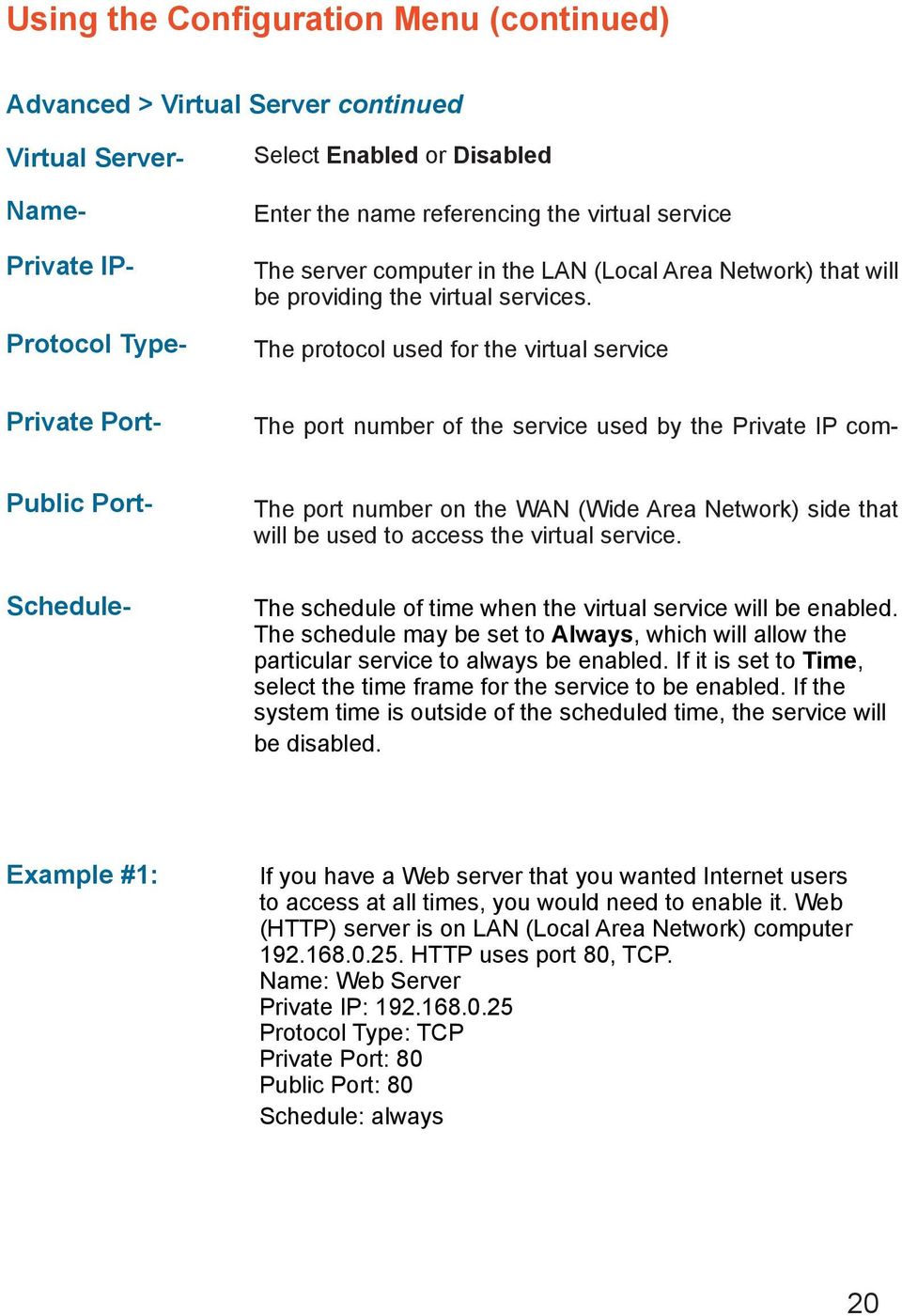
21 Using the Configuration Menu (continued) Advanced > Virtual Server continued Click on this icon to edit the virtual service Click on this icon to delete the virtual service Example #2: If you have an FTP server that you wanted Internet users to access by WAN port 2100 and only during the weekends, you would need to enable it as such. FTP server is on LAN computer FTP uses port 21, TCP. Name: FTP Server Private IP: Protocol Type: TCP Private Port: 21 Public Port: 2100 Schedule: From: 01:00AM to 01:00AM, Sat to Sun All Internet users who want to access this FTP Server must connect to it from port This is an example of port redirection and can be useful in cases where there are many of the same servers on the LAN network. 21
22 Using the Configuration Menu (continued) Advanced > Applications Some applications require multiple connections, such as Internet gaming, video conferencing, Internet telephony and others. These applications have difficulties working through NAT (Network Address Translation). Special Applications makes some of these applications work with the DI-524. If you need to run applications that require multiple connections, specify the port normally associated with an application in the Trigger Port field, select the protocol type as TCP or UDP, then enter the public ports associated with the trigger port to open them for inbound traffic. The DI-524 provides some predefined applications in the table on the bottom of the web page. Select the application you want to use and enable it. Note! Only one PC can use each Special Application tunnel. Name: This is the name referencing the special application. Trigger Port: Trigger Type: Public Port: This is the port used to trigger the application. It can be either a single port or a range of ports. This is the protocol used to trigger the special application. This is the port number on the WAN side that will be used to access the application. You may define a single port or a range of ports. You can use a comma to add multiple ports or port ranges. Public Type: This is the protocol used for the special application. 22
23 Using the Configuration Menu (continued) Advanced > Filters > IP Filters Filters are used to deny or allow LAN (Local Area Network) computers from accessing the Internet. The DI-524 can be setup to deny internal computers by their IP or MAC addresses. The DI-524 can also block users from accessing restricted web sites. IP Filters: IP Address: Port Range: Protocol Type: Schedule: IP Filter is used to deny LAN IP addresses from accessing the Internet. You can deny specific port numbers or all ports for the specific IP address. The IP address of the LAN computer that will be denied access to the Internet. The single port or port range that will be denied access to the Internet. Select the protocol type This is the schedule of time when the IP Filter will be enabled. 23
24 Using the Configuration Menu (continued) Advanced > Filters > URL Blocking URL Blocking is used to deny LAN computers from accessing specific web sites by the URL. A URL is a specially formatted text string that defines a location on the Internet. If any part of the URL contains the blocked word, the site will not be accessible and the web page will not display. To use this feature, enter the text string to be blocked and click Apply. The text to be blocked will appear in the list. To delete the text, just highlight it and click Delete. Filters- URL Blocking- Keywords- Select the filter you wish to use; in this case, URL Blocking was chosen. Select Enabled or Disabled. Enter the keywords in this field. Block URLs which contain keywords listed below. 24
25 Using the Configuration Menu Advanced > Filters > MAC Filters (continued) Use MAC (Media Access Control) Filters to allow or deny LAN (Local Area Network) computers by their MAC addresses from accessing the Network. You can either manually add a MAC address or select the MAC address from the list of clients that are currently connected to the Broadband Router. Filters- MAC Filters- Name- MAC Address- DHCP Client- Select the filter you wish to use; in this case, MAC filters was chosen. Choose Disable MAC filters; allow MAC addresses listed below; or deny MAC addresses listed below. Enter the name here. Enter the MAC Address. Select a DHCP client from the pull-down list; click Clone to copy that MAC Address. 25
26 Using the Configuration Menu (continued) Advanced > Filters > Domain Blocking Domain Blocking is used to allow or deny LAN (Local Area Network) computers from accessing specific domains on the Internet. Domain blocking will deny all requests to a specific domain such as http and ftp. It can also allow computers to access specific sites and deny all other sites. Filters- Domain Blocking- Disabled- Allow- Deny- Blocked Domains- Select the filter you wish to use; in this case, Domain Blocking was chosen. Select Disabled to disable Domain Blocking Allows users to access all domains except Blocked Domains Denies users access to all domains except Permitted Domains Enter the Blocked Domains in this field Permitted Domains- Enter the Permitted Domains in this field 26
27 Using the Configuration Menu (continued) Advanced > Firewall Firewall Rules is an advanced feature used to deny or allow traffic from passing through the DI-524. It works in the same way as IP Filters with additional settings. You can create more detailed access rules for the DI-524. When virtual services are created and enabled, it will also display in Firewall Rules. Firewall Rules contain all network firewall rules pertaining to IP (Internet Protocol). In the Firewall Rules List at the bottom of the screen, the priorities of the rules are from top (highest priority) to bottom (lowest priority.) Note: The DI-524 MAC Address filtering rules have precedence over the Firewall Rules. Firewall Rules- Name- Action- Source- Destination- Schedule- Enable or disable the Firewall Enter the name Allow or Deny Enter the IP Address range Enter the IP Address range; the Protocol; and the Port Range Select Always or enter the Time Range. 27
28 Using the Configuration Menu (continued) Advanced > DDNS Users who have a Dynamic DDNS account may use this feature on the DI-524. Provider- Select from the list of DDNS servers available. Host Name- Username/ - Password/Key- Enter your DDNS account host name. Enter your DDNS account username. Enter your DDNS account password. 28
29 Using the Configuration Menu (continued) Advanced > DMZ If you have a client PC that cannot run Internet applications properly from behind the DI- 524, then you can set the client up for unrestricted Internet access. It allows a computer to be exposed to the Internet. This feature is useful for gaming purposes. Enter the IP address of the internal computer that will be the DMZ host. Adding a client to the DMZ (Demilitarized Zone) may expose your local network to a variety of security risks, so only use this option as a last resort. DMZ- IP Address- Enable or Disable the DMZ. The DMZ (Demilitarized Zone) allows a single computer to be exposed to the internet. By default the DMZ is disabled. Enter the IP Address of the computer to be in the DMZ 29
30 Using the Configuration Menu (continued) Advanced > Performance Beacon Interval- RTS Threshold- Fragmentation- DTIM Interval- Wireless Mode- TX Rates- SSID Broadcast- Beacons are packets sent by an Access Point to synchronize a wireless network. Specify a value. 100 is the default setting and is recommended. This value should remain at its default setting of If inconsistent data flow is a problem, only a minor modification should be made. The fragmentation threshold, which is specified in bytes, determines whether packets will be fragmented. Packets exceeding the 2346 byte setting will be fragmented before transmission.2346 is the default setting (Delivery Traffic Indication Message) 3 is the default setting. A DTIM is a countdown informing clients of the next window for listening to broadcast and multicast messages. Select Short or Long Preamble. The Preamble defines the length of the CRC block (Cyclic Redundancy Check is a common technique for detecting data transmission errors) for communication between the wireless router and the roaming wireless network adapters. Note: High network traffic areas should use the shorter preamble type. Auto is the default selection. Selct from the drop down menu. Choose Enabled to broadcast the SSID across the network. All devices on a network must share the same SSID (Service Set Identifier) to establish communication. Choose Disabled if you do not wish to broadcast the SSID over the network. 30
31 Using the Configuration Menu (continued) Tools> Admin At this page, the DI-524 administrator can change the system password. There are two accounts that can access the Broadband Router s Web-Management interface. They are admin and user. Admin has read/write access while user has read-only access. User can only view the settings but cannot make any changes. Administrator- admin is the Administrator login name Password- User- Enter the password and enter again to confirm user is the User login name Password- Enter the password and enter again to confirm Remote Management- Remote management allows the DI-524 to be configured from the Internet by a web browser. A username and password is still required to access the Web-Management interface. In general, only a member of your network can browse the built-in web pages to perform Administrator tasks. This feature enables you to perform Administrator tasks from the remote (Internet) host. IP Address- The Internet IP address of the computer that has access to the Broadband Router. If you input an asterisk (*) into this field, then any computer will be able to access the Router. Putting an asterisk (*) into this field would present a security risk and is not recommended. Port- The port number used to access the Broadband Router. Example- where x.x.x.x is the WAN IP address of the Broadband Router and 8080 is the port used for the Web-Mangement interface. 31
32 Using the Configuration Menu (continued) Tools > Time Default NTP Server- Time Zone- Set the Time- NTP is short for Network Time Protocol. NTP synchronizes computer clock times in a network of computers. This field is optional. Set Device Date and Time: To manually input the time. Enter the values in these fields for the Year, Month, Day, Hour, Minute, and Second. To manually input the time, enter the values in these fields for the Year, Month, Day, Hour, Minute, and Second. Click Set Time. Daylight Saving- To select Daylight Saving time manually, select enabled or disabled, and enter a start date and an end date for daylight saving time. 32
33 Using the Configuration Menu (continued) Tools > System The current system settings can be saved as a file onto the local hard drive. The saved file or any other saved setting file can be loaded back on the Broadband Router. To reload a system settings file, click on Browse to browse the local hard drive and locate the system file to be used. You may also reset the Broadband Router back to factory settings by clicking on Restore. Save Settings to Local Hard Drive- Click Save to save the current settings to the local Hard Drive Load Settings from Local Hard Drive- Click Browse to find the settings, then click Load Restore to Factory Default Settings- Click Restore to restore the factory default settings 33
34 Using the Configuration Menu (continued) Tools > Firmware You can upgrade the firmware of the Router here. Make sure the firmware you want to use is on the local hard drive of the computer. Click on Browse to browse the local hard drive and locate the firmware to be used for the update. Please check the D-Link support site for firmware updates at You can download firmware upgrades to your hard drive from the D-Link support site. Firmware Upgrade- Click on the link in this screen to find out if there is an updated firmware; if so, download the new firmware to your hard Browse- After you have downloaded the new firmware, click Browse in this window to locate the firmware update on your hard drive. Click Apply to complete the firmware upgrade. 34
35 Using the Configuration Menu (continued) Tools > Misc Ping Test- Restart Device- Block WAN Ping- UPNP- VPN Pass Through- The Ping Test is used to send Ping packets to test if a computer is on the Internet. Enter the IP Address that you wish to Ping, and click Ping Click Reboot to restart the DI-524 If you choose to block WAN Ping, the WAN IP Address of the DI-524 will not respond to pings. Blocking the Ping may provide some extra security from hackers. Discard Ping from WAN side- Click Enabled to block the WAN ping To use the Universal Plug and Play feature click on Enabled. UPNP provides compatibility with networking equipment, software and peripherals of the over 400 vendors that cooperate in the Plug and Play forum. The DI-524 supports VPN (Virtual Private Network) pass-through for both PPTP (Point-to-Point Tunneling Protocol) and IPSec (IP Security). Once VPN pass-through is enabled, there is no need to open up virtual services. Multiple VPN connections can be made through the DI-524. This is useful when you have many VPN clients on the LAN network. PPTP- select Enabled or Disabled IPSec- select Enabled or Disabled 35
36 Using the Configuration Menu (continued) Status > Device Info This page displays the current information for the DI-524. It will display the LAN, WAN and MAC address information. If your WAN connection is set up for a Dynamic IP address then a Release button and a Renew button will be displayed. Use Release to disconnect from your ISP and use Renew to connect to your ISP. If your WAN connection is set up for PPPoE, a Connect button and a Disconnect button will be displayed. Use Disconnect to drop the PPPoE connection and use Connect to establish the PPPoE connection. This window will show the DI-524 s working status: WAN LAN Wireless IP Address: WAN/Public IP Address Subnet Mask: WAN/Public Subnet Mask Gateway: WAN/Public Gateway IP Address Domain Name Server: WAN/Public DNS IP Address WAN Status: WAN Connection Status IP Address: LAN/Private IP Address of the DI-524 Subnet Mask: LAN/Private Subnet Mask of the DI-524 MAC Address: Displays the MAC address SSID: Displays the current SSID Channel: Displays the current channel WEP: indicates whether WEP is enabled or disabled 36
37 Using the Configuration Menu (continued) Status > Log The Broadband Router keeps a running log of events and activities occurring on the Router. If the device is rebooted, the logs are automatically cleared. You may save the log files under Log Settings. View Log- First Page - The first page of the log Last Page - The last page of the log Previous - Moves back one log page Next - Moves forward one log page Clear - Clears the logs completely Log Settings - Brings up the page to configure the log 37
38 Using the Configuration Menu (continued) Status > Log > Log Settings Not only does the Broadband Router display the logs of activities and events, it can setup to send these logs to another location. SMTP Server/ IP Address - Address - The address of the SMTP server that will be used to send the logs The address to which the logs will be sent. Click on Send Mail Now to send the . 38
39 Using the Configuration Menu (continued) Status > Stats The screen above displays thetraffic Statistics. Here you can view the amount of packets that pass through the DI-524 on both the WAN and the LAN ports. The traffic counter will reset if the device is rebooted. Status > Wireless The wireless client table displays a list of current connected wireless clients. This table also displays the connection time and MAC address of the connected wireless client. Click on Help at any time, for more information. 39
40 Networking Basics Using the Network Setup Wizard in Windows XP In this section you will learn how to establish a network at home or work, using Microsoft Windows XP. Note: Please refer to websites such as and for information about networking computers using Windows 2000, ME or 98. Go to Start>Control Panel>Network Connections Select Set up a home or small office network When this screen appears, Click Next. 40
41 Networking Basics Please follow all the instructions in this window: Click Next In the following window, select the best description of your computer. If your computer connects to the internet through a gateway/router, select the second option as shown. Click Next 41
42 Networking Basics Enter a Computer description and a Computer name (optional.) Click Next Enter a Workgroup name. All computers on your network should have the same Workgroup name. Click Next 42
43 Networking Basics Please wait while the Network Setup Wizard applies the changes. When the changes are complete, click Next. Please wait while the Network Setup Wizard configures the computer. This may take a few minutes. 43
44 Networking Basics In the window below, select the option that fits your needs. In this example, Create a Network Setup Disk has been selected. You will run this disk on each of the computers on your network. Click Next. Insert a disk into the Floppy Disk Drive, in this case drive A. Click Next. 44
45 Networking Basics Please read the information under Here s how in the screen below. After you complete the Network Setup Wizard you will use the Network Setup Disk to run the Network Setup Wizard once on each of the computers on your network. To continue click Next. 45
46 Networking Basics Please read the information on this screen, then click Finish to complete the Network Setup Wizard. The new settings will take effect when you restart the computer. Click Yes to restart the computer. You have completed configuring this computer. Next, you will need to run the Network Setup Disk on all the other computers on your network. After running the Network Setup Disk on all your computers, your new wireless network will be ready to use. 46
47 Networking Basics Naming your Computer To name your computer, please follow these directions:in Windows XP: Click Start (in the lower left corner of the screen) Right-click on My Computer Select Properties and click Select the Computer Name Tab in the System Properties window. You may enter a Computer Description if you wish; this field is optional. To rename the computer and join a domain, Click Change. 47
48 Networking Basics Naming your Computer In this window, enter the Computer name Select Workgroup and enter the name of the Workgroup All computers on your network must have the same Workgroup name. Click OK Checking the IP Address in Windows XP The wireless adapter-equipped computers in your network must be in the same IP Address range (see Getting Started in this manual for a definition of IP Address Range.) To check on the IP Address of the adapter, please do the following: Right-click on the Local Area Connection icon in the task bar Click on Status 48
49 Networking Basics Checking the IP Address in Windows XP This window will appear. Click the Support tab Click Close Assigning a Static IP Address in Windows XP/2000 Note: Residential Gateways/Broadband Routers will automatically assign IP Addresses to the computers on the network, using DHCP (Dynamic Host Configuration Protocol) technology. If you are using a DHCP-capable Gateway/Router you will not need to assign Static IP Addresses. If you are not using a DHCP capable Gateway/Router, or you need to assign a Static IP Address, please follow these instructions: Go to Start Double-click on Control Panel 49
50 Networking Basics Assigning a Static IP Address in Windows XP/2000 Double-click on Network Connections Right-click on Local Area Connections Double-click on Properties 50
51 Networking Basics Assigning a Static IP Address in Windows XP/2000 Click on Internet Protocol (TCP/IP) Click Properties Input your IP address and subnet mask. (The IP Addresses on your network must be within the same range. For example, if one computer has an IP Address of , the other computers should have IP Addresses that are sequential, like and The subnet mask must be the same for all the computers on the network.) Input your DNS server addresses. (Note: If you are entering a DNS server, you must enter the IP Address of the Default Gateway.) The DNS server information will be supplied by your ISP (Internet Service Provider.) Click OK 51
52 Networking Basics Assigning a Static IP Address with Macintosh OSX Go to the Apple Menu and select System Preferences cclick on Network Select Built-in Ethernet in the Show pull-down menu Select Manually in the Configure pull-down menu Input the Static IP Address, the Subnet Mask and the Router IP Address in the appropriate fields Click Apply Now 52
53 Networking Basics Selecting a Dynamic IP Address with Macintosh OSX Go to the Apple Menu and select System Preferences Click on Network Select Built-in Ethernet in the Show pull-down menu Select Using DHCP in the Configure pull-down menu Click Apply Now The IP Address, Subnet mask, and the Router s IP Address will appear in a few seconds 53
54 Networking Basics Checking the Wireless Connection by Pinging in Windows XP and 2000 Go to Start > Run > type cmd. A window similar to this one will appear. Type ping xxx.xxx.xxx. xxx, where xxx is the IP Address of the Wireless Router or Access Point. A good wireless connection will show four replies from the Wireless Router or Acess Point, as shown. Checking the Wireless Connection by Pinging in Windows Me and 98 Go to Start > Run > type command. A window similar to this will appear. Type ping xxx.xxx. xxx.xxx where xxx is the IP Address of the Wireless Router or Access Point. A good wireless connection will show four replies from the wireless router or access point, as shown. 54
55 Troubleshooting This Chapter provides solutions to problems that can occur during the installation and operation of the DI-524 Wireless Broadband Router. We cover various aspects of the network setup, including the network adapters. Please read the following if you are having problems. Note: It is recommended that you use an Ethernet connection to configure the DI-524 Wireless Broadband Router. 1. The computer used to configure the DI-524 cannot access the Configuration menu. Check that the Ethernet LED on the DI-524 is ON. If the LED is not ON, check that the cable for the Ethernet connection is securely inserted. Check that the Ethernet Adapter is working properly. Please see item 3 (Check that the drivers for the network adapters are installed properly) in this Troubleshooting section to check that the drivers are loaded properly. Check that the IP Address is in the same range and subnet as the DI-524. Please see Checking the IP Address in Windows XP in the Networking Basics section of this manual. Note: The IP Address of the DI-524 is All the computers on the network must have a unique IP Address in the same range, e.g., x. Any computers that have identical IP Addresses will not be visible on the network. They must all have the same subnet mask, e.g., Do a Ping test to make sure that the DI-524 is responding. Go to Start>Run>Type Command>Type ping A successful ping will show four replies. Note: If you have changed the default IP Address, make sure to ping the correct IP Address assigned to the DI
56 Troubleshooting 2. The wireless client cannot access the Internet in the Infrastructure mode. Make sure the wireless client is associated and joined with the correct Access Point. To check this connection: Right-click on the Local Area Connection icon in the taskbar> select View Available Wireless Networks. The Connect to Wireless Network screen will appear. Please make sure you have selected the correct available network, as shown in the illustrations below. Check that the IP Address assigned to the wireless adapter is within the same IP Address range as the access point and gateway. (Since the DI-524 has an IP Address of , wireless adapters must have an IP Address in the same range, e.g., x. Each device must have a unique IP Address; no two devices may have the same IP Address. The subnet mask must be the same for all the computers on the network.) To check the IP Address assigned to the wireless adapter, double-click on the Local Area Connection icon in the taskbar > select the Support tab and the IP Address will be displayed. (Please refer to Checking the IP Address in the Networking Basics section of this manual.) If it is necessary to assign a Static IP Address to the wireless adapter, please refer to the appropriate section in Networking Basics. If you are entering a DNS Server address you must also enter the Default Gateway Address. (Remember that if you have a DHCP-capable router, you will not need to assign a Static IP Address. See Networking Basics: Assigning a Static IP Address.) 56
57 Troubleshooting 3. Check that the drivers for the network adapters are installed properly. You may be using different network adapters than those illustrated here, but this procedure will remain the same, regardless of the type of network adapters you are using. Go to Start > My Computer > Properties Select the Hardware Tab Click Device Manager 57
58 Troubleshooting Double-click on Network Adapters Right-click on D-Link AirPlus DWL-G650 Wireless Cardbus Adapter (In this example we use the DWL-G650; you may be using other network adapters, but the procedure will remain the same.) D-Link AirPlus DWL-G650 Select Properties to check that the drivers are installed properly D-Link AirPlus DWL-G650 Wireless Cardbus Adapter D-Link AirPlus DWL-G650 Wireless Cardbus Adapter Look under Device Status to check that the device is working properly Click OK 58
59 Troubleshooting 4. What variables may cause my wireless products to lose reception? D-Link products let you access your network from virtually anywhere you want. However, the positioning of the products within your environment will affect the wireless range. Please refer to Installation Considerations in the Wireless Basics section of this manual for further information about the most advantageous placement of your D-Link wireless products. 5. Why does my wireless connection keep dropping? Antenna Orientation- Try different antenna orientations for the DI-524. Try to keep the antenna at least 6 inches away from the wall or other objects. If you are using 2.4GHz cordless phones, X-10 equipment or other home security systems, ceiling fans, and lights, your wireless connection will degrade dramatically or drop altogether. Try changing the Channel on your Router, Access Point and Wireless adapter to a different Channel to avoid interference. Keep your product away (at least 3-6 feet) from electrical devices that generate RF noise, like microwaves, Monitors, electric motors, etc. 6. Why can t I get a wireless connection? If you have enabled Encryption on the DI-524, you must also enable encryption on all wireless clients in order to establish a wireless connection. For b, the Encryption settings are: 64, 128, or 256 bit. Make sure that the encryption bit level is the same on the Router and the Wireless Client. Make sure that the SSID on the Router and the Wireless Client are exactly the same. If they are not, wireless connection will not be established. Move the DI-524 and the wireless client into the same room and then test the wireless connection. Disable all security settings. (WEP, MAC Address Control) 59
60 Troubleshooting 6. Why can t I get a wireless connection? (continued) Turn off your DI-524 and the client. Turn the DI-524 back on again, and then turn on the client. Make sure that all devices are set to Infrastructure mode. Check that the LED indicators are indicating normal activity. If not, check that the AC power and Ethernet cables are firmly connected. Check that the IP Address, subnet mask, gateway and DNS settings are correctly entered for the network. If you are using 2.4GHz cordless phones, X-10 equipment or other home security systems, ceiling fans, and lights, your wireless connection will degrade dramatically or drop altogether. Try changing the Channel on your DI-524, and on all the devices in your network to avoid interference. Keep your product away (at least 3-6 feet) from electrical devices that generate RF noise, like microwaves, Monitors, electric motors, etc. 7. I forgot my encryption key. Reset the DI-524 to its factory default settings and restore the other devices on your network to their default settings. You may do this by pressing the Reset button on the back of the unit. You will lose the current configuration settings. 60
61 Troubleshooting 8. Resetting the DI-524 to Factory Default Settings After you have tried other methods for troubleshooting your network, you may choose to Reset the DI-524 to the factory default settings. Remember that D-Link AirPro products network together, out of the box, at the factory default settings. Reset To hard-reset the DI-524 to Factory Default Settings, please do the following: Locate the Reset button on the back of the DI-524 Use a paper clip to press the Reset button Hold for about 10 seconds and then release After the DI-524 reboots (this may take a few minutes) it will be reset to the factory Default settings 61
62 Technical Specifications Standards IEEE g IEEE b IEEE IEEE 802.3u VPN Pass Through/ Multi-Sessions PPTP L2TP IPSec Device Management Web-Based- Internet Explorer v6 or later; Netscape Navigator v7 or later; or other Java-enabled browsers DHCP Server and Client Advanced Firewall Features NAT with VPN Passthrough (Network Address Translation) MAC Filtering IP Filtering URL Filtering Domain Blocking Scheduling Wireless Operating Range Indoors up to 328 feet (100 meters) Outdoors up to 984 feet (300 meters) Operating Temperature 32ºF to 131ºF (0ºC to 55ºC) Humidity: 95% maximum (non-condensing) Safety and Emissions: FCC, CE Wireless Frequency Range: 2.4GHz to 2.462GHz 62
63 Technical Specifications LEDs: Power WAN LAN (10/100) WLAN (Wireless Connection) Physical Dimensions: L = 5.6 inches (142mm) W = 4.3 inches (109mm) H = 1.2 inches (31mm) Wireless Transmit Power: 14dBm Security: 802.1x WEP WPA WPA-PSK External Antenna Type: Single detachable reverse SMA Modulation Technology: Orthogonal Frequency Division Multiplexing (OFDM) Power Input: Ext. Power Supply DC 7.5V, 1.5A Weight: Warranty: 0.44 lbs. (200g) 1 year 63
64 Technical Specifications Wireless Data Rates with Automatic Fallback: 54 Mbps 48 Mbps 36 Mbps 24 Mbps 18 Mbps 12 Mbps 11 Mbps 9 Mbps 6 Mbps 5.5 Mbps 2 Mbps 1 Mbps Receiver Sensitivity: 54Mbps OFDM, 10% PER, -68dBm 48Mbps OFDM, 10% PER, -68dBm 36Mbps OFDM, 10% PER, -75dBm 24Mbps OFDM, 10% PER, -79dBm 18Mbps OFDM, 10% PER, -82dBm 12Mbps OFDM, 10% PER, -84dBm 11Mbps CCK, 8% PER, -82dBm 9Mbps OFDM, 10% PER, -87dBm 6Mbps OFDM, 10% PER, -88dBm 5.5Mbps CCK, 8% PER, -85dBm 2Mbps QPSK, 8% PER, -86dBm 1Mbps BPSK, 8% PER, -89dBm 64
65 Frequently Asked Questions Why can t I access the web based configuration? When entering the IP Address of the DI-524 ( ), you are not connecting to the Internet or have to be connected to the Internet. The device has the utility built-in to a ROM chip in the device itself. Your computer must be on the same IP subnet to connect to the web-based utility. To resolve difficulties accessing a web utility, please follow the steps below. Step 1 Verify physical connectivity by checking for solid link lights on the device. If you do not get a solid link light, try using a different cable or connect to a different port on the device if possible. If the computer is turned off, the link light may not be on. What type of cable should I be using? The following connections require a Crossover Cable: Computer to Computer Computer to Uplink Port Computer to Access Point Computer to Print Server Computer/XBOX/PS2 to DWL-810 Computer/XBOX/PS2 to DWL-900AP+ Uplink Port to Uplink Port (hub/switch) Normal Port to Normal Port (hub/switch) The following connections require a Straight-through Cable: Computer to Residential Gateway/Router Computer to Normal Port (hub/switch) Access Point to Normal Port (hub/switch) Print Server to Normal Port (hub/switch) Uplink Port to Normal Port (hub/switch) Rule of Thumb: If there is a link light, the cable is right. 65
66 Frequently Asked Questions (continued) Why can t I access the web based configuration? (continued) What type of cable should I be using? (continued) What s the difference between a crossover cable and a straight-through cable? The wiring in crossover and straight-through cables are different. The two types of cable have different purposes for different LAN configurations. EIA/TIA 568A/568B define the wiring standards and allow for two different wiring color codes as illustrated in the following diagram. *The wires with colored backgrounds may have white stripes and may be denoted that way in diagrams found elsewhere. How to tell straight-through cable from a crossover cable: The main way to tell the difference between the two cable types is to compare the wiring order on the ends of the cable. If the wiring is the same on both sides, it is straight-through cable. If one side has opposite wiring, it is a crossover cable. All you need to remember to properly configure the cables is the pinout order of the two cable ends and the following rules: A straight-through cable has identical ends A crossover cable has different ends It makes no functional difference which standard you follow for straight-through cable ends, as long as both ends are the same. You can start a crossover cable with either standard as long as the other end is the other standard. It makes no functional difference which end is which. The order in which you pin the cable is important. Using a pattern other than what is specified in the above diagram could cause connection problems. When to use a crossover cable and when to use a straight-through cable: Computer to Computer Crossover Computer to an normal port on a Hub/Switch Straight-through Computer to an uplink port on a Hub/Switch - Crossover Hub/Switch uplink port to another Hub/Switch uplink port Crossover Hub/Switch uplink port to another Hub/Switch normal port - Straight-through 66
67 Frequently Asked Questions (continued) Why can t I access the web based configuration? (continued) Step 2 Disable any Internet security software running on the computer. Software firewalls like Zone Alarm, Black Ice, Sygate, Norton Personal Firewall, etc. might block access to the configuration pages. Check the help files included with your firewall software for more information on disabling or configuring it. Step 3 Configure your Internet settings. Go to Start>Settings>Control Panel. Double click the Internet Options Icon. From the Security tab, click the button to restore the settings to their defaults. Click to the Connection tab and set the dialup option to Never Dial a Connection. Click the LAN Settings button Nothing should be checked. Click OK Go to the Advanced tab and click the button to restore these settings to their defaults Click OK. Go to the desktop and close any open windows 67
68 Frequently Asked Questions (continued) Why can t I access the web based configuration? (continued) Step 4 Check your IP Address. Your computer must have an IP Address in the same range of the device you are attempting to configure. Most D-Link devices use the X range. How can I find my IP Address in Windows 95, 98, or ME? Step 1 Click on Start, then click on Run. Step 2 The Run Dialogue Box will appear. Type winipcfg in the window as shown then click OK. Step 3 The IP Configuration window will appear, displaying your Ethernet Adapter Information. Select your adapter from the drop down menu. If you do not see your adapter in the drop down menu, your adapter is not properly installed. Step 4 After selecting your adapter, it will display your IP Address, subnet mask, and default gateway. Step 5 Click OK to close the IP Configuration window 68
69 Frequently Asked Questions (continued) Why can t I access the web based configuration? (continued) Step 4 (continued) Check your IP Address. Your computer must have an IP Address in the same range of the device you are attempting to configure. Most D-Link devices use the X range. How can I find my IP Address in Windows 2000/XP? Step 1 Click on Start and select Run. Step 2 Type cmd then click OK. Step 3 From the Command Prompt, enter ipconfig. It will return your IP Address, subnet mask, and default gateway Step 4 Type exit to close the command prompt. 69
70 Frequently Asked Questions (continued) Why can t I access the web based configuration? (continued) Step 4 (continued) Check your IP Address. Your computer must have an IP Address in the same range of the device you are attempting to configure. Most D- Link devices use the X range. Make sure you take note of your computer s Default Gateway IP Address. The Default Gateway is the IP Address of the D-Link router. By default, it should be How can I assign a Static IP Address in Windows XP? Step 1 Click on Start > Control Panel > Network and Internet Connections > Network connections. Step 2 See Step 2 for Windows 2000 and continue from there. How can I assign a Static IP Address in Windows 2000? Step 1 Right-click on My Network Places and select Properties. Step 2 Right-click on the Local Area Connection which represents your network card and select Properties. Highlight Internet Protocol (TCP/ IP) and click Properties. 70
71 Frequently Asked Questions (continued) Why can t I access the web based configuration? (continued) How can I assign a Static IP Address in Windows 2000? (continued) Click Use the following IP Address and enter an IP Address that is on the same subnet as the LAN IP Address on your router. Example: If the router s LAN IP Address is , make your IP Address X where X = Make sure that the number you choose is not in use on the network. Set the Default Gateway to be the same as the LAN IP Address of your router ( ). Set the Primary DNS to be the same as the LAN IP address of your router ( ). The Secondary DNS is not needed or enter a DNS server from your ISP. Click OK twice. You may be asked if you want to reboot your computer. Click Yes. How can I assign a Static IP Address in Windows 98/Me? Step 1 From the desktop, right-click on the Network Neigborhood icon (Win ME - My Network Places) and select Properties Highlight TCP/IP and click the Properties button. If you have more than 1 adapter, then there will be a TCP/IP Binding for each adapter. Highlight TCP/IP > (your network adapter) and then click Properties. 71
72 Frequently Asked Questions (continued) Why can t I access the web based configuration? (continued) How can I assign a Static IP Address in Windows 98/Me? (continued) Step 2 Click Specify an IP Address. Enter in an IP Address that is on the same subnet as the LAN IP Address on your router. Example: If the router s LAN IP Address is , make your IP Address X where X is between Make sure that the number you choose is not in use on the network. Step 3 Click on the Gateway tab. Enter the LAN IP Address of your router here ( ). Click Add when finished. Step 4 Click on the DNS Configuration tab. Click Enable DNS. Type in a Host (can be any word). Under DNS server search order, enter the LAN IP Address of your router ( ). Click Add. Step 5 Click OK twice. When prompted to reboot your computer, click Yes. After you reboot, the computer will now have a static, private IP Address. Step 5 Access the web management. Open your web browser and enter the IP Address of your D-Link device in the address bar. This should open the login page for the web management. Follow instructions to login and complete the configuration. 72
73 Frequently Asked Questions (continued) How can I setup my router to work with a Cable modem connection? Dynamic Cable connection (IE AT&T-BI, Cox, Adelphia, Rogers, Roadrunner, Charter, and Comcast). Note: Please configure the router with the computer that was last connected directly to the cable modem. Step 1 Log into the web based configuration by typing in the IP Address of the router (default: ) in your web browser. The username is admin (all lowercase) and the password is blank (nothing). Step 2 Click the Home tab and click the WAN button. Dynamic IP Address is the default value, however, if Dynamic IP Address is not selected as the WAN type, select Dynamic IP Address by clicking on the radio button. Click Clone Mac Address. Click on Apply and then Continue to save the changes. 73
74 Frequently Asked Questions (continued) How can I setup my router to work with a Cable modem connection? (continued) Step 3 Power cycle the cable modem and router: Turn the cable modem off (first). Turn the router off Leave them off for 2 minutes.** Turn the cable modem on (first). Wait until you get a solid cable light on the cable modem. Turn the router on. Wait 30 seconds. ** If you have a Motorola (Surf Board) modem, leave off for at least 5 minutes. Step 4 Follow step 1 again and log back into the web configuration. Click the Status tab and click the Device Info button. If you do not already have a public IP Address under the WAN heading, click on the DHCP Renew and Continue buttons. Static Cable Connection Step 1 Log into the web based configuration by typing in the IP Address of the router (default: ) in your web browser. The username is admin (all lowercase) and the password is blank (nothing). Step 2 Click the Home tab and click the WAN button. Select Static IP Address and enter your static settings obtained from the ISP in the fields provided. If you do not know your settings, you must contact your ISP. Step 3 Click on Apply and then click Continue to save the changes. Step 4 Click the Status tab and click the Device Info button. Your IP Address information will be displayed under the WAN heading. 74
75 Frequently Asked Questions (continued) How can I setup my router to work with Earthlink DSL or any PPPoE connection? Make sure you disable or uninstall any PPPoE software such as WinPoet or Enternet 300 from your computer or you will not be able to connect to the Internet. Step 1 Upgrade Firmware if needed. (Please visit the D-Link tech support website at: for the latest firmware upgrade information.) Step 2 Take a paperclip and perform a hard reset. With the unit on, use a paperclip and hold down the reset button on the back of the unit for 10 seconds. Release it and the router will recycle, the lights will blink, and then stabilize. Step 3 After the router stabilizes, open your browser and enter into the address window and hit the Enter key. When the password dialog box appears, enter the username admin and leave the password blank. Click OK. If the password dialog box does not come up repeat Step 2. Note: Do not run Wizard. Step 4 Click on the WAN tab on left-hand side of the screen. Select PPPoE. Step 5 Select Dynamic PPPoE (unless your ISP supplied you with a static IP Address). Step 6 In the username field enter ELN/[email protected] and your password, where username is your own username. For SBC Global users, enter [email protected]. For Ameritech users, enter [email protected]. For BellSouth users, enter [email protected]. For Mindspring users, enter [email protected]. For most other ISPs, enter username. Step 7 Maximum Idle Time should be set to zero. Set MTU to 1492, unless specified by your ISP, and set Autoreconnect to Enabled. Note: If you experience problems accessing certain websites and/or issues, please set the MTU to a lower number such as 1472, 1452, etc. Contact your ISP for more information and the proper MTU setting for your connection. 75
76 Frequently Asked Questions (continued) How can I setup my router to work with Earthlink DSL or any PPPoE connection? (continued) Step 8 Click Apply. When prompted, click Continue. Once the screen refreshes, unplug the power to the D-Link router. Step 9 Turn off your DSL modem for 2-3 minutes. Turn back on. Once the modem has established a link to your ISP, plug the power back into the D-Link router. Wait about 30 seconds and log back into the router. Step 10 Click on the Status tab in the web configuration where you can view the device info. Under WAN, click Connect. Click Continue when prompted. You should now see that the device info will show an IP Address, verifying that the device has connected to a server and has been assigned an IP Address. Can I use my D-Link Broadband Router to share my Internet connection provided by AOL DSL Plus? In most cases yes. AOL DSL+ may use PPPoE for authentication bypassing the client software. If this is the case, then our routers will work with this service. Please contact AOL if you are not sure. To set up your router: Step 1 Log into the web-based configuration ( ) and configure the WAN side to use PPPoE. Step 2 Enter your screen name followed for the user name. Enter your AOL password in the password box. Step 3 You will have to set the MTU to AOL DSL does not allow for anything higher than Step 4 Apply settings. Step 5 Recycle the power to the modem for 1 minute and then recycle power to the router. Allow 1 to 2 minutes to connect. If you connect to the Internet with a different internet service provider and want to use the AOL software, you can do that without configuring the router s firewall settings. You need to configure the AOL software to connect using TCP/IP. Go to for more specific configuration information of their software. 76
77 Frequently Asked Questions (continued) How do I open ports on my router? To allow traffic from the internet to enter your local network, you will need to open up ports or the router will block the request. Step 1 Open your web browser and enter the IP Address of your D-Link router ( ). Enter username (admin) and your password (blank by default). Step 2 Click on Advanced on top and then click Virtual Server on the left side. Step 3 Check Enabled to activate entry. Step 4 Enter a name for your virtual server entry. Step 5 Next to Private IP, enter the IP Address of the computer on your local network that you want to allow the incoming service to. Step 6 Choose Protocol Type - either TCP, UDP, or both. If you are not sure, select both. Step 7 Enter the port information next to Private Port and Public Port. The private and public ports are usually the same. The public port is the port seen from the WAN side, and the private port is the port being used by the application on the computer within your local network. Step 8 Enter the Schedule information. Step 9 Click Apply and then click Continue. Note: Make sure DMZ host is disabled. If DMZ is enabled, it will disable all Virtual Server entries. Because our routers use NAT (Network Address Translation), you can only open a specific port to one computer at a time. For example: If you have 2 web servers on your network, you cannot open port 80 to both computers. You will need to configure 1 of the web servers to use port 81. Now you can open port 80 to the first computer and then open port 81 to the other computer. 77
78 Frequently Asked Questions (continued) What is DMZ? Demilitarized Zone: In computer networks, a DMZ (demilitarized zone) is a computer host or small network inserted as a neutral zone between a company s private network and the outside public network. It prevents outside users from getting direct access to a server that has company data. (The term comes from the geographic buffer zone that was set up between North Korea and South Korea following the UN police action in the early 1950s.) A DMZ is an optional and more secure approach to a firewall and effectively acts as a proxy server as well. In a typical DMZ configuration for a small company, a separate computer (or host in network terms) receives requests from users within the private network for access to Web sites or other companies accessible on the public network. The DMZ host then initiates sessions for these requests on the public network. However, the DMZ host is not able to initiate a session back into the private network. It can only forward packets that have already been requested. Users of the public network outside the company can access only the DMZ host. The DMZ may typically also have the company s Web pages so these could be served to the outside world. However, the DMZ provides access to no other company data. In the event that an outside user penetrated the DMZ hosts security, the Web pages might be corrupted but no other company information would be exposed. D-Link, a leading maker of routers, is one company that sells products designed for setting up a DMZ How do I configure the DMZ Host? The DMZ feature allows you to forward all incoming ports to one computer on the local network. The DMZ, or Demilitarized Zone, will allow the specified computer to be exposed to the Internet. DMZ is useful when a certain application or game does not work through the firewall. The computer that is configured for DMZ will be completely vulnerable on the Internet, so it is suggested that you try opening ports from the Virtual Server or Firewall settings before using DMZ. Step 1 Find the IP address of the computer you want to use as the DMZ host. To find out how to locate the IP Address of the computer in Windows XP/2000/ME/9x or Macintosh operating systems please refer to Step 4 of the first question in this section (Frequently Asked Questions). 78
79 Frequently Asked Questions (continued) How do I configure the DMZ Host? (continued) Step 2 Log into the web based configuration of the router by typing in the IP Address of the router (default: ) in your web browser. The username is admin (all lowercase) and the password is blank (nothing) Step 3 Click the Advanced tab and then click on the DMZ button. Select Enable and type in the IP Address you found in step 1. Step 4 Click Apply and then Continue to save the changes. Note: When DMZ is enabled, Virtual Server settings will still be effective. Remember, you cannot forward the same port to multiple IP Addresses, so the Virtual Server settings will take priority over DMZ settings. 79
80 Frequently Asked Questions (continued) How do I open a range of ports on my DI-524 using Firewall rules? Step 1 Access the router s web configuration by entering the router s IP Address in your web browser. The default IP Address is Login using your password. The default username is admin and the password is blank. If you are having difficulty accessing web management, please see the first question in this section. Step 2 From the web management Home page, click the Advanced tab then click the Firewall button. Step 3 Click on Enabled and type in a name for the new rule. Step 4 Choose WAN as the Source and enter a range of IP Addresses out on the internet that you would like this rule applied to. If you would like this rule to allow all internet users to be able to access these ports, then put an Asterisk in the first box and leave the second box empty. Step 5 Select LAN as the Destination and enter the IP Address of the computer on your local network that you want to allow the incoming service to. This will not work with a range of IP Addresses. Step 6 Enter the port or range of ports that are required to be open for the incoming service. Step 7 Click Apply and then click Continue. Note: Make sure DMZ host is disabled. Because our routers use NAT (Network Address Translation), you can only open a specific port to one computer at a time. For example: If you have 2 web servers on your network, you cannot open port 80 to both computers. You will need to configure 1 of the web servers to use port 81. Now you can open port 80 to the first computer and then open port 81 to the other computer. 80
81 Frequently Asked Questions (continued) What are virtual servers? A Virtual Server is defined as a service port, and all requests to this port will be redirected to the computer specified by the server IP. For example, if you have an FTP Server (port 21) at , a Web server (port 80) at , and a VPN server at , then you need to specify the following virtual server mapping table: Server Port Server IP Enable X X X How do I use PC Anywhere with my DI-524 router? You will need to open 3 ports in the Virtual Server section of your D-Link router. Step 1 Open your web browser and enter the IP Address of the router ( ). Step 2 Click on Advanced at the top and then click Virtual Server on the left side. Step 3 Enter the information as seen below. The Private IP is the IP Address of the computer on your local network that you want to connect to. Step 4 The first entry will read as shown here: Step 5 Click Apply and then click Continue. 81
82 Frequently Asked Questions (continued) How do I use PC Anywhere with my DI-524 router? (continued) Step 6 Create a second entry as shown here: Step 7 Click Apply and then click Continue. Step 8 Create a third and final entry as shown here: Step 9 Click Apply and then click Continue. Step 10 Run PCAnywhere from the remote site and use the WAN IP Address of the router, not your computer s IP Address. 82
83 Frequently Asked Questions (continued) How can I use edonkey behind my D-Link Router? You must open ports on your router to allow incoming traffic while using edonkey. edonkey uses three ports (4 if using CLI): 4661 (TCP) To connect with a server 4662 (TCP) To connect with other clients 4665 (UDP) To communicate with servers other than the one you are connected to (TCP) *Used with the command line (CLI) client when it is configured to allow remote connections. This is the case when using a Graphical Interface (such as the Java Interface) with the client. Step 1 Open your web browser and enter the IP Address of your router ( ). Enter username (admin) and your password (leave blank). Step 2 Click on Advanced and then click Firewall. Step 3 Create a new firewall rule: Click Enabled. Enter a name (edonkey). Click Allow. Next to Source, select WAN under interface. In the first box, enter an *. Leave the second box empty. Next to Destination, select LAN under interface. Enter the IP Address of the computer you are running edonkey from. Leave the second box empty. Under Protocol, select *. In the port range boxes, enter 4661 in the first box and then 4665 in the second box. Click Always or set a schedule. Step 4 Click Apply and then Continue. 83
84 Frequently Asked Questions (continued) How do I set up my router for SOCOM on my Playstation 2? To allow you to play SOCOM and hear audio, you must download the latest firmware for the router (if needed), enable Game Mode, and open port 6869 to the IP Address of your Playstation. Step 1 Upgrade firmware (follow link above). Step 2 Open your web browser and enter the IP Address of the router ( ). Enter username (admin) and your password (blank by default). Step 3 Click on the Advanced tab and then click on Virtual Server on the left side. Step 4 You will now create a new Virtual Server entry. Click Enabled and enter a name (socom). Enter the IP Address of your Playstation for Private IP. Step 5 For Protocol Type select Both. Enter 6869 for both the Private Port and Public Port. Click Always. Click Apply to save changes and then Continue Step 6 Click on the Tools tab and then Misc on the left side. Step 7 Make sure Gaming Mode is Enabled. If not, click Enabled. Click Apply and then Continue. 84
85 Frequently Asked Questions (continued) How can I use Gamespy behind my D-Link router? Step 1 Open your web browser and enter the IP Address of the router ( ). Enter admin for the username and your password (blank by default). Step 2 Click on the Advanced tab and then click Virtual Server on the left side. Step 3 You will create 2 entries. Step 4 Click Enabled and enter Settings: NAME - Gamespy1 PRIVATE IP - The IP Address of your computer that you are running Gamespy from. PROTOCOL TYPE - Both PRIVATE PORT PUBLIC PORT SCHEDULE - Always. Click Apply and then continue Step 5 Enter 2nd entry: Click Enabled NAME - Gamespy2 PRIVATE IP - The IP Address of your computer that you are running Gamespy from. PROTOCOL TYPE - Both PRIVATE PORT PUBLIC PORT SCHEDULE - Always. Click Apply and then continue. 85
86 Frequently Asked Questions (continued) How do I configure my router for KaZaA and Grokster? The following is for KaZaA, Grokster, and others using the FastTrack P2P file sharing system. In most cases, you do not have to configure anything on the router or on the Kazaa software. If you are having problems, please follow steps below: Step 1 Enter the IP Address of your router in a web browser ( ). Step 2 Enter your username (admin) and your password (blank by default). Step 3 Click on Advanced and then click Virtual Server. Step 4 Click Enabled and then enter a Name (kazaa for example). Step 5 Enter the IP Address of the computer you are running KaZaA from in the Private IP box. Select TCP for the Protocol Type. Step 6 Enter 1214 in the Private and Public Port boxes. Click Always under schedule or set a time range. Click Apply. Make sure that you did not enable proxy/firewall in the KaZaA software. 86
87 Frequently Asked Questions (continued) How do I configure my router to play Warcraft 3? You must open ports on your router to allow incoming traffic while hosting a game in Warcraft 3. To play a game, you do not have to configure your router. Warcraft 3 (Battlenet) uses port For the DI-604, DI DI-524, DI-754, DI-764, or DI-774: Step 1 Open your web browser and enter the IP Address of your router ( ). Enter username (admin) and your password (leave blank). Step 2 Click on Advanced and then click Virtual Server. Step 3 Create a new entry: Click Enabled. Enter a name (warcraft3). Private IP - Enter the IP Address of the computer you want to host the game. Select Both for Protocol Type Enter 6112 for both Private Port and Public Port Click Always or set a schedule. Step 4 Click Apply and then Continue. Note: If you want multiple computers from you LAN to play in the same game that you are hosting, then repeat the steps above and enter the IP Addresses of the other computers. You will need to change ports. Computer #2 can use port 6113, computer #3 can use 6114, and so on. You will need to change the port information within the Warcraft 3 software for computers #2 and up. Configure the Game Port information on each computer: Start Warcraft 3 on each computer, click Options > Gameplay. Scroll down and you should see Game Port. Enter the port number as you entered in the above steps. 87
88 Frequently Asked Questions (continued) How do I use NetMeeting with my D-Link Router? Unlike most TCP/IP applications, NetMeeting uses DYNAMIC PORTS instead of STATIC PORTS. That means that each NetMeeting connection is somewhat different than the last. For instance, the HTTP web site application uses port 80. NetMeeting can use any of over 60,000 different ports. All broadband routers using (only) standard NAT and all internet sharing programs like Microsoft ICS that use (only) standard NAT will NOT work with NetMeeting or other h.323 software packages. The solution is to put the router in DMZ. Note: A few hardware manufacturers have taken it on themselves to actually provide H.323 compatibility. This is not an easy task since the router must search each incoming packet for signs that it might be a netmeeting packet. This is a whole lot more work than a router normally does and may actually be a weak point in the firewall. D-Link is not one of the manufacturers. To read more on this visit How do I set up my router to use ichat? -for Macintosh users- You must open ports on your router to allow incoming traffic while using ichat. ichat uses the following ports: 5060 (UDP) 5190 (TCP) File Sharing (UDP) To video conference with other clients Step 1 Open your web browser and enter the IP Address of your router ( ). Enter username (admin) and your password (leave blank). Step 2 Click on Advanced and then click Firewall. 88
89 Frequently Asked Questions (continued) How do I set up my router to use ichat? -for Macintosh users- (continued) Step 3 Create a new firewall rule: Click Enabled. Enter a name (ichat1). Click Allow. Next to Source, select WAN under interface. In the first box, enter an *. Leave the second box empty. Next to Destination, select LAN under interface. Enter the IP Address of the computer you are running ichat from. Leave the second box empty. Under Protocol, select UDP. In the port range boxes, enter 5060 in the first box and leave the second box empty. Click Always or set a schedule. Step 4 Click Apply and then Continue. Step 5 Repeat steps 3 and 4 enter ichat2 and open ports (UDP). 89
90 Frequently Asked Questions (continued) How do I set up my router to use ichat? -for Macintosh users- (continued) For File Sharing: Step 1 Click on Advanced and then Virtual Server. Step 2 Check Enabled to activate entry. Step 3 Enter a name for your virtual server entry (ichat3). Step 4 Next to Private IP, enter the IP Address of the computer on your local network that you want to allow the incoming service to. Step 5 Select TCP for Protocol Type. Step 6 Enter 5190 next to Private Port and Public Port. Stsp 7 Click Always or configure a schedule. Step 8 Click Apply and then Continue. If using Mac OS X Firewall, you may need to temporarily turn off the firewall in the Sharing preference pane on both computers. To use the Mac OS X Firewall, you must open the same ports as in the router: Step 1 Choose Apple menu > System Preferences. Step 2 Choose View > Sharing. Step 3 Click the Firewall tab. Step 4 Click New. Step 5 Choose Other from the Port Name pop-up menu. Step 6 In the Port Number, Range or Series field, type in: 5060, Step 7 In the Description field type in: ichat AV Step 8 Click OK. 90
91 Frequently Asked Questions (continued) How do I send or receive a file via ichat when the Mac OSX firewall is active? -for Macintosh users- Mac OS X 10.2 and later The following information is from the online Macintosh AppleCare knowledge base: ichat cannot send or receive a file when the Mac OS X firewall is active in its default state. If you have opened the AIM port, you may be able to receive a file but not send them. In its default state, the Mac OS X firewall blocks file transfers using ichat or America Online AIM software. If either the sender or receiver has turned on the Mac OS X firewall, the transfer may be blocked. The simplest workaround is to temporarily turn off the firewall in the Sharing preference pane on both computers. This is required for the sender. However, the receiver may keep the firewall on if the AIM port is open. To open the AIM port: Step 1 Choose Apple menu > System Preferences. Step 2 Choose View > Sharing. Step 3 Click the Firewall tab. Step 4 Click New. Step 5 Choose AOL IM from the Port Name pop-up menu. The number 5190 should already be filled in for you. Step 6 Click OK. If you do not want to turn off the firewall at the sending computer, a different file sharing service may be used instead of ichat. The types of file sharing available in Mac OS X are outlined in technical document , Mac OS X: File Sharing in the AppleCare Knowledge base online. Note: If you use a file sharing service when the firewall is turned on, be sure to click the Firewall tab and select the service you have chosen in the Allow list. If you do not do this, the firewall will also block the file sharing service. 91
92 Frequently Asked Questions (continued) What is NAT? NAT stands for Network Address Translator. It is proposed and described in RFC-1631 and is used for solving the IP Address depletion problem. Basically, each NAT box has a table consisting of pairs of local IP Addresses and globally unique addresses, by which the box can translate the local IP Addresses to global address and vice versa. Simply put, it is a method of connecting multiple computers to the Internet (or any other IP network) using one IP Address. D-Link s broadband routers (ie: DI-604) support NAT. With proper configuration, multiple users can access the Internet using a single account via the NAT device. For more information on RFC-1631: The IP Network Address Translator (NAT), visit 92
93 Technical Support You can find software updates and user documentation on the D-Link website. D-Link provides free technical support for customers within the United States and within Canada for the duration of the warranty period on this product. U.S. and Canadian customers can contact D-Link technical support through our web site, or by phone. Tech Support for customers within the United States: D-Link Technical Support over the Telephone: (877) hours a day, seven days a week. D-Link Technical Support over the Internet: [email protected] Tech Support for customers within Canada: D-Link Technical Support over the Telephone: (800) Monday to Friday 8:30am to 9:00pm EST D-Link Technical Support over the Internet: [email protected] When contacting technical support, please provide the following information: Serial number of the unit Model number or product name Software type and version number 93
94 Warranty and Registration (USA only) Subject to the terms and conditions set forth herein, D-Link Systems, Inc. ( D-Link ) provides this Limited warranty for its product only to the person or entity that originally purchased the product from: D-Link or its authorized reseller or distributor and Products purchased and delivered within the fifty states of the United States, the District of Columbia, U.S. Possessions or Protectorates, U.S. Military Installations, addresses with an APO or FPO. Limited Warranty: D-Link warrants that the hardware portion of the D-Link products described below will be free from material defects in workmanship and materials from the date of original retail purchase of the product, for the period set forth below applicable to the product type ( Warranty Period ), except as otherwise stated herein. 3-Year Limited Warranty for the Product(s) is defined as follows: Hardware (excluding power supplies and fans) Three (3) Years Power Supplies and Fans One (1) Year Spare parts and spare kits Ninety (90) days D-Link s sole obligation shall be to repair or replace the defective Hardware during the Warranty Period at no charge to the original owner or to refund at D-Link s sole discretion. Such repair or replacement will be rendered by D-Link at an Authorized D-Link Service Office. The replacement Hardware need not be new or have an identical make, model or part. D-Link may in its sole discretion replace the defective Hardware (or any part thereof) with any reconditioned product that D-Link reasonably determines is substantially equivalent (or superior) in all material respects to the defective Hardware. Repaired or replacement Hardware will be warranted for the remainder of the original Warranty Period from the date of original retail purchase. If a material defect is incapable of correction, or if D-Link determines in its sole discretion that it is not practical to repair or replace the defective Hardware, the price paid by the original purchaser for the defective Hardware will be refunded by D-Link upon return to D-Link of the defective Hardware. All Hardware (or part thereof) that is replaced by D-Link, or for which the purchase price is refunded, shall become the property of D-Link upon replacement or refund. Limited Software Warranty: D-Link warrants that the software portion of the product ( Software ) will substantially conform to D-Link s then current functional specifications for the Software, as set forth in the applicable documentation, from the date of original retail purchase of the Software for a period of ninety (90) days ( Warranty Period ), provided that the Software is properly installed on approved hardware and operated as contemplated in its documentation. D-Link further warrants that, during the Warranty Period, the magnetic media on which D-Link delivers the Software will be free of physical defects. D-Link s sole obligation shall be to replace the non-conforming Software (or defective media) with software that substantially conforms to D-Link s functional specifications for the Software or to refund at D-Link s sole discretion. Except as otherwise agreed by D-Link in writing, the replacement Software is provided only to the original licensee, and is subject to the terms and conditions of the license granted by D-Link for the Software. Software will be warranted for the remainder of the original Warranty Period from the date or original retail purchase. If a material non-conformance is incapable of correction, or if D-Link determines in its sole discretion that it is not practical to replace the non-conforming Software, the price paid by the original licensee for the nonconforming Software will be refunded by D-Link; provided that the non-conforming Software (and all copies thereof) is first returned to D-Link. The license granted respecting any Software for which a refund is given automatically terminates. Non-Applicability of Warranty: The Limited Warranty provided hereunder for hardware and software of D- Link s products will not be applied to and does not cover any refurbished product and any product purchased through the inventory clearance or liquidation sale or other sales in which D-Link, the sellers, or the liquidators expressly disclaim their warranty obligation pertaining to the product and in that case, the product is being sold As-Is without any warranty whatsoever including, without limitation, the Limited Warranty as described herein, notwithstanding anything stated herein to the contrary. Submitting A Claim: The customer shall return the product to the original purchase point based on its return policy. In case the return policy period has expired and the product is within warranty, the customer shall submit a claim to D-Link as outlined below: 94
95 The customer must submit with the product as part of the claim a written description of the Hardware defect or Software nonconformance in sufficient detail to allow D-Link to confirm the same. The original product owner must obtain a Return Material Authorization ( RMA ) number from the Authorized D-Link Service Office and, if requested, provide written proof of purchase of the product (such as a copy of the dated purchase invoice for the product) before the warranty service is provided. After an RMA number is issued, the defective product must be packaged securely in the original or other suitable shipping package to ensure that it will not be damaged in transit, and the RMA number must be prominently marked on the outside of the package. Do not include any manuals or accessories in the shipping package. D-Link will only replace the defective portion of the Product and will not ship back any accessories. The customer is responsible for all in-bound shipping charges to D-Link. No Cash on Delivery ( COD ) is allowed. Products sent COD will either be rejected by D-Link or become the property of D-Link. Products shall be fully insured by the customer. D-Link will not be held responsible for any packages that are lost in transit to D-Link. The repaired or replaced packages will be shipped to the customer via UPS Ground or any common carrier selected by D-Link, with shipping charges prepaid. Expedited shipping is available if shipping charges are prepaid by the customer and upon request. Return Merchandise Ship-To Address USA: Mt. Herrmann, Fountain Valley, CA Canada: 2180 Winston Park Drive, Oakville, ON, L6H 5W1 (Visit for detailed warranty information within Canada) D-Link may reject or return any product that is not packaged and shipped in strict compliance with the foregoing requirements, or for which an RMA number is not visible from the outside of the package. The product owner agrees to pay D-Link s reasonable handling and return shipping charges for any product that is not packaged and shipped in accordance with the foregoing requirements, or that is determined by D-Link not to be defective or non-conforming. What Is Not Covered: This limited warranty provided by D-Link does not cover: Products, if in D-Link s judgment, have been subjected to abuse, accident, alteration, modification, tampering, negligence, misuse, faulty installation, lack of reasonable care, repair or service in any way that is not contemplated in the documentation for the product, or if the model or serial number has been altered, tampered with, defaced or removed; Initial installation, installation and removal of the product for repair, and shipping costs; Operational adjustments covered in the operating manual for the product, and normal maintenance; Damage that occurs in shipment, due to act of God, failures due to power surge, and cosmetic damage; Any hardware, software, firmware or other products or services provided by anyone other than D-Link; Products that have been purchased from inventory clearance or liquidation sales or other sales in which D-Link, the sellers, or the liquidators expressly disclaim their warranty obligation pertaining to the product. Repair by anyone other than D-Link or an Authorized D-Link Service Office will void this Warranty. Disclaimer of Other Warranties: EXCEPT FOR THE LIMITED WARRANTY SPECIFIED HEREIN, THE PRODUCT IS PROVIDED AS-IS WITHOUT ANY WARRANTY OF ANY KIND WHATSOEVER INCLUDING, WITHOUT LIMITATION, ANY WARRANTY OF MERCHANTABILITY, FITNESS FOR A PARTICULAR PURPOSE AND NON-INFRINGEMENT. IF ANY IMPLIED WARRANTY CANNOT BE DISCLAIMED IN ANY TERRITORY WHERE A PRODUCT IS SOLD, THE DURATION OF SUCH IMPLIED WARRANTY SHALL BE LIMITED TO NINETY (90) DAYS. EXCEPT AS EXPRESSLY COVERED UNDER THE LIMITED WARRANTY PROVIDED HEREIN, THE ENTIRE RISK AS TO THE QUALITY, SELECTION AND PERFORMANCE OF THE PRODUCT IS WITH THE PURCHASER OF THE PRODUCT. Limitation of Liability: TO THE MAXIMUM EXTENT PERMITTED BY LAW, D-LINK IS NOT LIABLE UNDER ANY CONTRACT, NEGLIGENCE, STRICT LIABILITY OR OTHER LEGAL OR EQUITABLE THEORY FOR ANY LOSS OF USE OF THE PRODUCT, INCONVENIENCE OR DAMAGES OF ANY CHARACTER, WHETHER DIRECT, SPECIAL, INCIDENTAL OR CONSEQUENTIAL (INCLUDING, BUT NOT LIMITED TO, DAMAGES FOR LOSS OF GOODWILL, LOSS OF REVENUE OR PROFIT, WORK STOPPAGE, COMPUTER FAILURE OR MALFUNCTION, FAILURE OF OTHER EQUIPMENT OR COMPUTER PROGRAMS TO WHICH D-LINK S PRODUCT IS CONNECTED WITH, LOSS OF INFORMATION OR DATA CONTAINED IN, STORED ON, OR INTEGRATED WITH ANY PRODUCT RETURNED TO D-LINK FOR WARRANTY SERVICE) RESULTING FROM THE USE OF THE PRODUCT, RELATING TO WARRANTY SERVICE, OR ARISING OUT OF ANY BREACH OF THIS LIMITED WARRANTY, EVEN IF D-LINK HAS BEEN ADVISED OF THE POSSIBILITY OF SUCH DAMAGES. THE SOLE REMEDY FOR A BREACH OF THE FOREGOING LIMITED WARRANTY IS REPAIR, REPLACEMENT OR REFUND OF THE DEFECTIVE OR NON-CONFORMING PRODUCT. THE MAXIMUM 95
96 LIABILITY OF D-LINK UNDER THIS WARRANTY IS LIMITED TO THE PURCHASE PRICE OF THE PRODUCT COVERED BY THE WARRANTY. THE FOREGOING EXPRESS WRITTEN WARRANTIES AND REMEDIES ARE EXCLUSIVE AND ARE IN LIEU OF ANY OTHER WARRANTIES OR REMEDIES, EXPRESS, IMPLIED OR STATUTORY. Governing Law: This Limited Warranty shall be governed by the laws of the State of California. Some states do not allow exclusion or limitation of incidental or consequential damages, or limitations on how long an implied warranty lasts, so the foregoing limitations and exclusions may not apply. This limited warranty provides specific legal rights and the product owner may also have other rights which vary from state to state. Trademarks: D-Link is a registered trademark of D-Link Systems, Inc. Other trademarks or registered trademarks are the property of their respective manufacturers or owners. Copyright Statement: No part of this publication or documentation accompanying this Product may be reproduced in any form or by any means or used to make any derivative such as translation, transformation, or adaptation without permission from D-Link Corporation/D-Link Systems, Inc., as stipulated by the United States Copyright Act of Contents are subject to change without prior notice. Copyright 2002 by D-Link Corporation/D-Link Systems, Inc. All rights reserved. CE Mark Warning: This is a Class B product. In a domestic environment, this product may cause radio interference, in which case the user may be required to take adequate measures. FCC Statement: This equipment has been tested and found to comply with the limits for a Class B digital device, pursuant to part 15 of the FCC Rules. These limits are designed to provide reasonable protection against harmful interference in a residential installation. This equipment generates, uses, and can radiate radio frequency energy and, if not installed and used in accordance with the instructions, may cause harmful interference to radio communication. However, there is no guarantee that interference will not occur in a particular installation. If this equipment does cause harmful interference to radio or television reception, which can be determined by turning the equipment off and on, the user is encouraged to try to correct the interference by one or more of the following measures: Reorient or relocate the receiving antenna. Increase the separation between the equipment and receiver. Connect the equipment into an outlet on a circuit different from that to which the receiver is connected. Consult the dealer or an experienced radio/tv technician for help. For detailed warranty outside the United States, please contact corresponding local D-Link office. FCC Caution: The manufacturer is not responsible for any radio or TV interference caused by unauthorized modifications to this equipment; such modifications could void the user s authority to operate the equipment. (1) The devices are restricted to indoor operations within the 5.15 to 5.25GHz range. (2) For this device to operate in the 5.15 to 5.25GHz range, the devices must use integral antennas. This device complies with Part 15 of the FCC Rules. Operation is subject to the following two conditions: (1) This device may not cause harmful interference, and (2) this device must accept any interference received, including interference that may cause undesired operation. IMPORTANT NOTE: FCC Radiation Exposure Statement: This equipment complies with FCC radiation exposure limits set forth for an uncontrolled environment. The antenna(s) used for this equipment must be installed to provide a separation distance of at least eight inches (20 cm) from all persons. This equipment must not be operated in conjunction with any other antenna. Register your D-Link product online at 96
D-Link AirPlus Xtreme G DI-624
 D-Link AirPlus Xtreme G DI-624 High-Speed 2.4 GHz Wireless Router TM Manual Building Networks for People Contents Package Contents...3 Introduction...4 Wireless Basics...8 Getting Started... 11 Using the
D-Link AirPlus Xtreme G VDI-624
 D-Link AirPlus Xtreme G VDI-624 High-Speed 2.4 GHz Wireless Router TM Manual Version 2.43 Building Networks for People Contents Package Contents...3 Introduction...4 Wireless Basics...8 Getting Started...
Table of Contents. Product Overview...4 Package Contents...4 System Requirements...4 Features...5 Hardware Overview...6 Connections...6 LEDs...
 Table of Contents Product Overview...4 Package Contents...4 System Requirements...4 Features...5 Hardware Overview...6 Connections...6 LEDs...7 Installation...8 Before you Begin...8 Wireless Installation
Table of Contents. Table of Contents
 Table of Contents Product Overview...4 Package Contents...4 System Requirements... 4 Introduction...5 Features... 7 Hardware Overview...8 Connections... 8 LEDs... 9 WPS LED/Button... 10 Installation...11
MN-700 Base Station Configuration Guide
 MN-700 Base Station Configuration Guide Contents pen the Base Station Management Tool...3 Log ff the Base Station Management Tool...3 Navigate the Base Station Management Tool...4 Current Base Station
Table of Contents. Wireless Installation Considerations... 10
 Table of Contents Table of Contents Product Overview...4 Package Contents...4 System Requirements... 4 Introduction...5 Features... 6 Hardware Overview...7 Connections... 7 LEDs... 8 Wireless Installation
DI-634M. Check Your Package Contents. This product can be set up using any current web browser, i.e., Internet Explorer 6 or Netscape Navigator 7.
 This product can be set up using any current web browser, i.e., Internet Explorer 6 or Netscape Navigator 7. DI-634M 108G MIMO Wireless Router Before You Begin 1. If you purchased this router to share
ENHWI-N3. 802.11n Wireless Router
 ENHWI-N3 802.11n Wireless Router Product Description Encore s ENHWI-N3 802.11n Wireless Router s 1T1R Wireless single chip can deliver up to 3x faster speed than of 802.11g devices. ENHWI-N3 supports home
Preface. Manual Revisions. Revision Date Description 1.0 October 8, 2009 Revision A1 with firmware version 1.0
 Preface D-Link reserves the right to revise this publication and to make changes in the content hereof without obligation to notify any person or organization of such revisions or changes. Manual Revisions
AnyDATA.NET Wireless Wi-Fi Router, AWR-501L
 AnyDATA.NET Wireless Wi-Fi Router, AWR-501L (User Manual) V 1.6 2008.11.03 AnyDATA CDMA Module Series Reference Design Specification Copyright 2008 AnyDATA Corp. All Rights Reserved. Any part of this document
D-Link AirPlus DWL-900AP+
 D-Link AirPlus DWL-900AP+ 2.4 GHz Wireless Access Point Manual Rev. 051002 Building Networks for People Contents 1. Package Contents... 3 2. Introduction... 4 3. Wireless Basics... 7 4. Getting Started...
CONCEPTRONIC C54BRS4A 802.11g Wireless Broadband Router
 CONCEPTRONIC C54BRS4A 802.11g Wireless Broadband Router About This Manual This manual provides descriptions of the Conceptronic C54BRS4A 802.11g Wireless Broadband Router, its hardware and software features,
Table of Contents. Product Overview...5
 Product Overview...5 Table of Contents WDS with AP... 18 Package Contents...5 System Requirements... 5 Introduction...6 Features and Benefits... 7 Hardware Overview...8 LEDs... 8 Installation...9 Connect
Table of Contents. Wireless Security...40 What is WEP?...40 Configure WEP...41 What is WPA?...42 Configure WPA-PSK (Personal)... 43.
 Table of Contents Table of Contents Product Overview...4 Package Contents...4 System Requirements... 4 Introduction...5 Features... 6 Hardware Overview...7 Connections... 7 LEDs...8 Configuration...9 Web-based
Preface. Manual Revisions. Trademarks
 Preface D-Link reserves the right to revise this publication and to make changes in the content hereof without obligation to notify any person or organization of such revisions or changes. Manual Revisions
Overview. Introduction
 Table of Contents Manual... 1 Overview... 3 Introduction... 3 Package Contents... 4 System Requirements... 4 Hardware Overview... 5 Rear Panel... 5 Front Pannel... 6 Features... 7 Configuration... 8 Log
How To Set Up A D-Link Dir-610N Router
 Version 1.0 06/24/2013 User Manual Wireless N 150 Home Router Preface D-Link reserves the right to revise this publication and to make changes in the content hereof without obligation to notify any person
Table of Contents. Table of Contents
 Table of Contents Product Overview...4 Package Contents...4 System Requirements...4 Introduction...5 Features...6 Hardware Overview...7 Connections...7 LEDs...8 Installation...9 Before you Begin...9 Wireless
Nokia Siemens Networks. CPEi-lte 7212. User Manual
 Nokia Siemens Networks CPEi-lte 7212 User Manual Contents Chapter 1: CPEi-lte 7212 User Guide Overview... 1-1 Powerful Features in a Single Unit... 1-2 Front of the CPEi-lte 7212... 1-2 Back of the CPEi-lte
Table of Contents. Package Contents...4 System Requirements... 4 Features... 5 Hardware Overview...6 Connections... 6 LEDs...7
 Table of Contents Table of Contents Package Contents...4 System Requirements... 4 Features... 5 Hardware Overview...6 Connections... 6 LEDs...7 Installation...8 Before you Begin...8 Wireless Installation
User Manual. Wireless N 300 Cloud Router
 User Manual Wireless N 300 Cloud Router Preface D-Link reserves the right to revise this publication and to make changes in the content hereof without obligation to notify any person or organization of
Preface. Manual Revisions. Trademarks
 Preface D-Link reserves the right to revise this publication and to make changes in the content hereof without obligation to notify any person or organization of such revisions or changes. Manual Revisions
Version 1.00 08/28/2012. User Manual. Wireless N 300 Cloud Router
 Version 1.00 08/28/2012 User Manual Wireless N 300 Cloud Router Preface D-Link reserves the right to revise this publication and to make changes in the content hereof without obligation to notify any person
your Gateway Windows network installationguide 802.11b wireless series Router model WBR-100 Configuring Installing
 your Gateway Windows network installationguide 802.11b wireless series Router model WBR-100 Installing Configuring Contents 1 Introduction...................................................... 1 Features...........................................................
ESR-9752 802.11b/g/n SOHO Router
 ESR-9752 is a 2T2R Wireless Single chip 11N Broadband Router that delivers up to 6x faster speeds and 3x extended coverage than 802.11g devices. ESR-9752 supports home network with superior throughput
ESR-9753 802.11b/g/n SOHO Router
 ESR-9753 is a 1T1R Wireless Single chip 11N Broadband Router that delivers up to 3x faster speeds than 802.11g devices. ESR-9753 supports home network with superior throughput and performance and unparalleled
User Guide. E-Series Routers
 User Guide E-Series Routers Table of Contents Table of Contents Product overview E900/E1200/E1500/E2500/E3200 1 Back view 1 Bottom view 1 E4200 2 Top view 2 Back view 2 Setting Up Your E-Series Router
2 Setting Up the Hardware for a Wired Ethernet Network... 13. 3 Setting Up the Software for an Ethernet Network... 21
 Contents 1 Networking Basics............................................... 1 Selecting a network connection........................................ 2 Wired Ethernet network...........................................
802.11b/g/n SOHO Router 2.4GHz 150Mbps 11N AP/Router
 802.11b/g/n SOHO Router 2.4GHz 150Mbps 11N AP/Router ESR-9753 PRODUCT DESCRIPTION ESR-9753 is a 1T1R Wireless Single chip 11N Broadband Router that delivers up to 3x faster speeds than 802.11g devices.
Wireless Broadband Router. Manual
 Wireless Broadband Router Manual 1 Introduction... 4 Features... 4 Minimum Requirements... 4 Package Content... 4 Note... 4 Get to know the Broadband Router... 5 Back Panel... 5 Front Panel... 6 Setup
Table of Contents. Product Overview...3 Package Contents...3 System Requirements...3 Introduction...4 Features...5 Hardware Overview...
 Table of Contents Table of Contents Product Overview...3 Package Contents...3 System Requirements...3 Introduction...4 Features...5 Hardware Overview...6 Installation...7 Getting Started...7 Remove Existing
USER GUIDE AC2400. DUAL BAND GIGABIT Wi Fi ROUTER. Model# E8350
 USER GUIDE AC2400 DUAL BAND GIGABIT Wi Fi ROUTER Model# E8350 Table of Contents Product overview E8350..................................... 1 Setting Up Your E-Series Router Where to find more help.........................
Chapter 4 Customizing Your Network Settings
 . Chapter 4 Customizing Your Network Settings This chapter describes how to configure advanced networking features of the Wireless-G Router Model WGR614v9, including LAN, WAN, and routing settings. It
108Mbps Super-G TM Wireless LAN Router with XR USER MANUAL
 108Mbps Super-G TM Wireless LAN Router with XR USER MANUAL Contents 1. Overview...1 1.1 Product Feature...1 1.2 System Requirements...1 1.3 Applications...1 2. Getting Start...2 2.1 Know the 108Mbps Wireless
UIP1868P User Interface Guide
 UIP1868P User Interface Guide (Firmware version 0.13.4 and later) V1.1 Monday, July 8, 2005 Table of Contents Opening the UIP1868P's Configuration Utility... 3 Connecting to Your Broadband Modem... 4 Setting
ESR-9750. (Go Green Series) Wireless-N Broadband Router / AP / Repeater. 2.4 GHz 802.11b/g/n 300 Mbps
 PRODUCT DESCRIPTION ESR-9750 is a Wireless 11N Broadband Router that delivers up to 6x faster speeds and 3x extended coverage than 802.11g devices. ESR-9750 supports home network with superior throughput
Linksys WAP300N. User Guide
 User Guide Contents Contents Overview Package contents 1 Back view 1 Bottom view 2 How to expand your home network 3 What is a network? 3 How to expand your home network 3 Where to find more help 3 Operating
Chapter 15: Advanced Networks
 Chapter 15: Advanced Networks IT Essentials: PC Hardware and Software v4.0 1 Determine a Network Topology A site survey is a physical inspection of the building that will help determine a basic logical
Version 1.01 28/08/2014. User Manual. DAP-1665 Wireless AC1200 Dual Band Access Point DAP-1665
 Version 1.01 28/08/2014 User Manual DAP-1665 Wireless AC1200 Dual Band Access Point DAP-1665 Preface D-Link reserves the right to revise this publication and to make changes in the content hereof without
Version 1.0 January 16, 2015. User Manual. Wireless AC750 Dual Band Router DIR-816
 Version 1.0 January 16, 2015 User Manual Wireless AC750 Dual Band Router DIR-816 Preface D-Link reserves the right to revise this publication and to make changes in the content hereof without obligation
D-Link. DI-804HV Broadband Hardware VPN Router. Manual
 D-Link DI-804HV Broadband Hardware VPN Router Manual Building Networks for People 07/25/2003 Contents Package Contents...3 Introduction...4 Getting Started...10 Using the Configuration Menu... 11 Networking
Quick Start Guide. WRV210 Wireless-G VPN Router with RangeBooster. Cisco Small Business
 Quick Start Guide Cisco Small Business WRV210 Wireless-G VPN Router with RangeBooster Package Contents WRV210 Router Ethernet Cable Power Adapter Product CD-ROM Quick Start Guide Welcome Thank you for
ECB1220R. Wireless SOHO Router/Client Bridge
 Wireless SOHO Router/Client Bridge 2.4GH 802.11 b/g 54Mbps PRODUCT DESCRIPTION ECB-1220R is a 2.4GHz 802.11b/g broadband Wi-Fi Router with advanced AP/Client Bridge/Repeater functions. So you could implement
BR-6104K / BR-6104KP Fast Ethernet Broadband Router User s Manual
 BR-6104K / BR-6104KP Fast Ethernet Broadband Router User s Manual 1 Introduction... 4 Features... 4 Minimum Requirements... 4 Package Content... 4 Note... 4 Get to know the Broadband Router... 4 Back Panel...
Preface. Manual Revisions. Trademarks
 Preface D-Link reserves the right to revise this publication and to make changes in the content hereof without obligation to notify any person or organization of such revisions or changes. Manual Revisions
Belkin Wireless Cable/DSL Gateway Router
 Belkin Wireless Cable/DSL Gateway Router User Manual F5D6230-3 Table of Contents Introduction................................................ 1-3 Knowing your Belkin Router....................................
ZyAIR G-2000 Plus 802.11g Wireless 4-port Router Quick Start Guide
 ZyAIR G-2000 Plus 802.11g Wireless 4-port Router Quick Start Guide Version 3.60 3/2005 Table of Contents 1 Introducing the ZyAIR... 3 2 Hardware Connections... 4 2.1 Side Panel and Connections... 4 2.2
Wireless N Open Source Access Point
 Wireless N Open Source Access Point Table of Contents Package Contents... 4 System Requirements... 5 Introduction... 6 Features... 8 Hardware Overview... 9 Connections... 9 LEDs...10 WPS LED/Button...11
How to Configure a DIR-120 Broadband Router
 CONTENTS About This User s Guide...iv Before You Start...iv Installation Notes...v Installation Information...vi INTRODUCTION... 1 Router Description and Operation...1 Front Panel...3 Rear Panel...4 CONNECTING
DSL-2600U. User Manual V 1.0
 DSL-2600U User Manual V 1.0 CONTENTS 1. OVERVIEW...3 1.1 ABOUT ADSL...3 1.2 ABOUT ADSL2/2+...3 1.3 FEATURES...3 2 SPECIFICATION...4 2.1 INDICATOR AND INTERFACE...4 2.2 HARDWARE CONNECTION...4 2.3 LED STATUS
LevelOne WBR-3405TX. User`s Manual. 11g Wireless AP Router
 LevelOne WBR-3405TX 11g Wireless AP Router User`s Manual Contents 1. Overview...4 1.1 Product Feature...4 1.2 System Requirements...4 1.3 Applications...4 2. Getting Start...5 2.1 Know the 11g Wireless
Protecting the Home Network (Firewall)
 Protecting the Home Network (Firewall) Basic Tab Setup Tab DHCP Tab Advanced Tab Options Tab Port Forwarding Tab Port Triggers Tab DMZ Host Tab Firewall Tab Event Log Tab Status Tab Software Tab Connection
Wireless LAN Access Point. IEEE 802.11g 54Mbps. User s Manual
 Wireless LAN Access Point IEEE 802.11g 54Mbps User s Manual Table of Contents Chapter 1 Introduction... 1 1.1 Package Contents...2 1.2 Features...2 1.3 Specifications...2 1.4 Physical Description...3 Chapter
Wireless Router Setup Manual
 Wireless Router Setup Manual NETGEAR, Inc. 4500 Great America Parkway Santa Clara, CA 95054 USA 208-10082-02 2006-04 2006 by NETGEAR, Inc. All rights reserved. Trademarks NETGEAR is a trademark of Netgear,
Quick Installation Guide DAP-1360. Wireless N 300 Access Point & Router
 DAP-1360 Wireless N 300 Access Point & Router BEFORE YOU BEGIN Delivery Package Access point DAP-1360 Power adapter DC 12V Ethernet cable (CAT 5E) (brochure). If any of the items are missing, please contact
LevelOne. User Manual. FBR-1430 VPN Broadband Router, 1W 4L V1.0
 LevelOne FBR-1430 VPN Broadband Router, 1W 4L User Manual V1.0 Table of Contents CHAPTER 1 INTRODUCTION... 1 VPN BROADBAND ROUTER FEATURES... 1 Internet Access Features... 1 Advanced Internet Functions...
Wireless N 150 PCI Desktop Adapter
 Wireless N 150 PCI Desktop Adapter Table of Contents Product Overview... 3 Package Contents... 3 System Requirements... 3 Introduction... 4 Features... 5 Hardware Overview... 6 LEDs... 6 Installation...
Contents. Section A Networking Basics... 1. 1 Learning the Basics... 3. Section B Wired Ethernet Networking... 17
 Contents Section A Networking Basics...................................... 1 1 Learning the Basics............................................. 3 Selecting a network connection........................................
ESR-9753. 802.11b/g/n SOHO Router PRODUCT OVERVIEW. 2.4 GHz 150Mbps 11N Router/AP
 802.11b/g/n SOHO Router 2.4 GHz 150Mbps 11N Router/AP PRODUCT OVERVIEW is a 1T1R Wireless Single chip 11N Broadband Router that delivers up to 3x faster speeds than 802.11g devices. supports home network
Configuration. Windows 98 and Me Configuration
 Configuration Windows 98 and Me Configuration Installing the TCP/IP Protocol Windows 2000 Configuration Windows XP Configuration Wireless Configuration 128-Bit Encryption Wireless Security in Windows XP
Chapter 2 Connecting the FVX538 to the Internet
 Chapter 2 Connecting the FVX538 to the Internet Typically, six steps are required to complete the basic connection of your firewall. Setting up VPN tunnels are covered in Chapter 5, Virtual Private Networking.
Chapter 4 Customizing Your Network Settings
 Chapter 4 Customizing Your Network Settings This chapter describes how to configure advanced networking features of the RangeMax Dual Band Wireless-N Router WNDR3300, including LAN, WAN, and routing settings.
Configuring Routers and Their Settings
 Configuring Routers and Their Settings When installing a router on your home network the routers settings are usually defaulted to automatically protect your home, and simplify setup. This is done because
Building Networks For People. DIR-100 Triple Play Router User Manual
 Building Networks For People DIR-100 Triple Play Router User Manual CONTENTS Before You Start...iii Packing List...iii Installation Notes...iv Installation Information...v INTRODUCTION...1 Router Description
TW100-BRF114 Firewall Router. User's Guide. Cable/DSL Internet Access. 4-Port Switching Hub
 TW100-BRF114 Firewall Router Cable/DSL Internet Access 4-Port Switching Hub User's Guide Table of Contents CHAPTER 1 INTRODUCTION...1 TW100-BRF114 Features...1 Package Contents...3 Physical Details...
TW100-BRV204 VPN Firewall Router
 TW100-BRV204 VPN Firewall Router Cable/DSL Internet Access 4-Port Switching Hub User's Guide Table of Contents CHAPTER 1 INTRODUCTION... 1 TW100-BRV204 Features... 1 Package Contents... 3 Physical Details...
Building Networks For People. DIR-100 Ethernet Broadband Router User Manual
 Building Networks For People DIR-100 Ethernet Broadband Router User Manual CONTENTS About This User s Guide... iii Before You Start... iii Installation Notes... iv Installation Information... v INTRODUCTION...1
Chapter 1 Configuring Internet Connectivity
 Chapter 1 Configuring Internet Connectivity This chapter describes the settings for your Internet connection and your wireless local area network (LAN) connection. When you perform the initial configuration
Broadband Router ALL1294B
 Broadband Router ALL1294B Broadband Internet Access 4-Port Switching Hub User's Guide Table of Contents CHAPTER 1 INTRODUCTION... 1 Broadband Router Features... 1 Package Contents... 3 Physical Details...
Preface. Trademarks. Copyright 2012 by D-Link Systems, Inc.
 D-Link reserves the right to revise this publication and to make changes in the content hereof without obligation to notify any person or organization of such revisions or changes. Trademarks D-Link and
Link Link sys E3000 sys RE1000
 User Guide High Performance Extender Wireless-N Router Linksys Linksys RE1000 E3000Wireless-N Table of Contents Contents Chapter 1: Product Overview 1 Front 1 Top 1 Bottom 1 Back 2 Chapter 2: Advanced
Broadband Phone Gateway BPG510 Technical Users Guide
 Broadband Phone Gateway BPG510 Technical Users Guide (Firmware version 0.14.1 and later) Revision 1.0 2006, 8x8 Inc. Table of Contents About your Broadband Phone Gateway (BPG510)... 4 Opening the BPG510's
Wireless-N. User Guide. Broadband Router WRT300N WIRELESS. Model No.
 2.4 GHz WIRELESS Wireless-N Broadband Router User Guide Model No. WRT300N Copyright and Trademarks Specifications are subject to change without notice. Linksys is a registered trademark or trademark of
3G Wireless WAN Mobile Broadband Router PCMCIA + USB. User Guide
 3G Wireless WAN Mobile Broadband Router PCMCIA + USB User Guide Copyright The contents of this publication may not be reproduced in any part or as a whole, stored, transcribed in an information retrieval
Table of Contents. Product Overview...3. Wireless Security... 33. Installation...7. Troubleshooting... 44. Wireless Basics... 50. Configuration...
 Table of Contents Product Overview...3 Package Contents... 3 System Requirements... 3 Introduction... 4 Features... 5 Hardware Overview... 6 Installation...7 Getting Started... 7 Remove Existing Installations...
LW310V2 Sweex Wireless 300N Router
 LW310V2 Sweex Wireless 300N Router Please notice! On the included CD-ROM you will find the Setup Wizard. This easy install procedure will show you how to setup the router step-by-step. Do not expose the
N150 WiFi Router (N150R)
 Easy, Reliable & Secure N150 WiFi Router (N150R) User Manual 350 East Plumeria Drive San Jose, CA 95134 USA August 2012 202-11000-01 v1.0 Trademarks Brand and product names are trademarks or registered
Table of Contents. Package Contents...1 System Requirements...1 Features...2 Hardware Overview...3 Connections...3 LEDs and USB Port...
 Table of Contents Table of Contents Package Contents...1 System Requirements...1 Features...2 Hardware Overview...3 Connections...3 LEDs and USB Port...4 Installation...5 Before you Begin...5 Wireless
High Speed. Internet BroadBand Router. User Guide
 High Speed Internet BroadBand Router User Guide FCC Warning This equipment has been tested and found to comply with the regulations for a Class B digital device, pursuant to Part 15 of the FCC Rules. These
High Speed. Internet BroadBand Router. User Guide
 High Speed Internet BroadBand Router User Guide FCC Warning This equipment has been tested and found to comply with the regulations for a Class B digital device, pursuant to Part 15 of the FCC Rules.
running operation mode painless TECHNICAL SPECIFICATION WAN/LAN: One 10/100 Fast Ethernet RJ-45 WPS (WiFi Protected Setup) WAN (Internet connection)
 PRODUCT DESCRIPTION ETR9350 is a 2T2R Wireless Single chip 11N Travel AP/Router that delivers up to 6x faster speeds than 802.11g devices. ETR9350 drives superior performance and unparalleled wireless
User s Guide. High Power Wireless-N 600mW Gigabit Dual Band Router R20000G
 User s Guide High Power Wireless-N 600mW Gigabit Dual Band Router R20000G CONTENTS INTRODUCTION... 2 GETTING STARTED... 3 Package Contents... 3 LED Indicators... 4 Back Panel Description... 5 SETUP GUIDE...
2.4GHz / 5GHz Dual CPU 600Mbps 11N AP/Router
 Dual Band Concurrent Router ESR7750 2.4GHz / 5GHz Dual CPU 600Mbps 11N AP/Router PRODUCT DESCRIPTION ESR7750 is a Dual Band Concurrent Wireless 11N Broadband Router with dual CPU that offers user unprecedented
A Division of Cisco Systems, Inc. GHz 2.4 802.11g. Wireless-G. Access Point with SRX. User Guide WIRELESS WAP54GX. Model No.
 A Division of Cisco Systems, Inc. GHz 2.4 802.11g WIRELESS Wireless-G Access Point with SRX User Guide Model No. WAP54GX Copyright and Trademarks Specifications are subject to change without notice. Linksys
ESR7550 KEY FEATURES PRODUCT DESCRIPTION
 PRODUCT DESCRIPTION ESR7750 is a Dual Band Concurrent Wireless 11N Broadband Router with dual CPU that offers user unprecedented network performance. WMM support boosts streaming and multimedia intensive