
Argumentación en Agentes Inteligentes: Teoría y Aplicaciones Prof. Carlos Iván Chesñevar
|
|
|
- Beverly Derick Gibbs
- 10 years ago
- Views:
Transcription
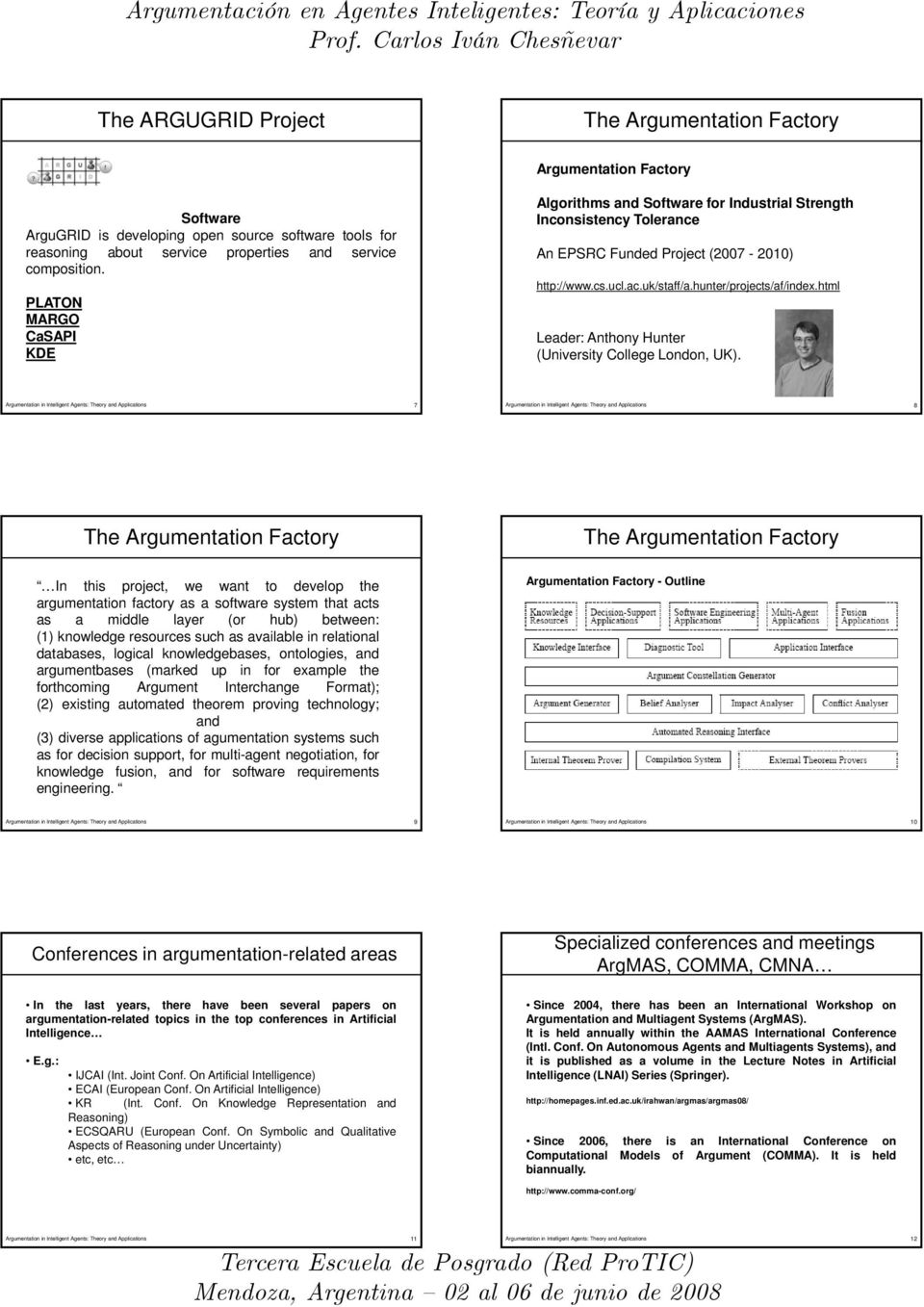
1 Argumentation in Intelligent Agents: Theory and Applications Carlos Iván Chesñevar cic Part 5 - Outline Main research projects in argumentation Main conferences in argumentation Some argumentation people (not a full list!) Six challenges in argumentation for the 21st century CONICET and Laboratory of R&D in A.I. Department of Computer Science Universidad Nacional del Sur Bahía Blanca, Argentina Argumentation in Intelligent Agents: Theory and Applications 2 The ASPIC Project The ASPIC Project ASPIC developed a common framework to underpin the services that are emerging as core functions of the argumentation paradigm. These include reasoning, decision-making, learning and communication. The end goal is a suite of software components based on this framework and a development platform for integrating ti these components with knowledge (e.g. semantic web) resources and legacy systems. ASPIC provided a sound basis for discussions of technical standards. ASPIC stresses the need to establish a formal foundation to support the creation, deployment and validation of practical argumentation systems and the core components developed using rigorous software engineering techniques. Several European universities involved Some companies also worked as partners in the ASPIC project Project duration: Funded by EC Framework V Argumentation in Intelligent Agents: Theory and Applications 3 Argumentation in Intelligent Agents: Theory and Applications 4 ArguGRID has developed a new model for building Gridbased applications through the use of multi-agent technologies and argumentation logic to support the formation of dynamic virtual organizations. The key advantage of the approach is simplifying the interactions between service providers and service consumers in a Service-oriented setting supported by P2P technologies. Argumentation in Intelligent Agents: Theory and Applications 5 Argumentation in Intelligent Agents: Theory and Applications 6

2 Argumentation Factory Software ArguGRID is developing open source software tools for reasoning about service properties and service composition. PLATON MARGO CaSAPI KDE Algorithms and Software for Industrial Strength Inconsistency Tolerance An EPSRC Funded Project ( ) Leader: Anthony Hunter (University College London, UK). Argumentation in Intelligent Agents: Theory and Applications 7 Argumentation in Intelligent Agents: Theory and Applications 8 In this project, we want to develop the argumentation factory as a software system that acts as a middle layer (or hub) between: (1) knowledge resources such as available in relational databases, logical knowledgebases, ontologies, and argumentbases (marked up in for example the forthcoming Argument Interchange Format); (2) existing automated theorem proving technology; and (3) diverse applications of agumentation systems such as for decision support, for multi-agent negotiation, for knowledge fusion, and for software requirements engineering. Argumentation Factory - Outline Argumentation in Intelligent Agents: Theory and Applications 9 Argumentation in Intelligent Agents: Theory and Applications 10 Conferences in argumentation-related areas In the last years, there have been several papers on argumentation-related topics in the top conferences in Artificial Intelligence E.g.: IJCAI (Int. Joint Conf. On Artificial Intelligence) ECAI (European Conf. On Artificial Intelligence) KR (Int. Conf. On Knowledge Representation and Reasoning) ECSQARU (European Conf. On Symbolic and Qualitative Aspects of Reasoning under Uncertainty) etc, etc Since 2004, there has been an International Workshop on Argumentation and Multiagent Systems (ArgMAS). It is held annually within the AAMAS International Conference (Intl. Conf. On Autonomous Agents and Multiagents Systems), and it is published as a volume in the Lecture Notes in Artificial Intelligence (LNAI) Series (Springer). Since 2006, there is an International Conference on Computational Models of Argument (COMMA). It is held biannually. Argumentation in Intelligent Agents: Theory and Applications 11 Argumentation in Intelligent Agents: Theory and Applications 12
3 Since 2001, there has been an International Workshop on Computational Models of Natural Argument (CMNA). It is held annually within important international conferences (e.g. ECAI, IJCAI, etc.). In January 2008, there has been a prestigious Dagstuhl Seminar on Theory and Practice on Argumentation Systems in Dagstuhl, Germany In 2009, there will be a special technical track on Agreement Technologies in the ACM Intl. Symposium on Applied Computing (March 8-12, 2009, Honolulu, Hawai, USA). Argumentation in Intelligent Agents: Theory and Applications 13 Argumentation in Intelligent Agents: Theory and Applications 14 Henry Prakken Lecturer in the Intelligent Systems Group of the computer science department at Utrecht University, Holland. Web: : Nonmonotonic reasoning Argumentation and Law AI & Law Argumentation ti theory Phan Minh Dung Professor /Researcher at Asian Institute of Technology Web: Argumentation Theory Knowledge Representation Logic Programming / Nonmonotonic reasoning Gerd Vreeswijk Lecturer in the Intelligent Systems Group of the computer science department at Utrecht University, Holland. Web: : Nonmonotonic reasoning Argumentation Game, media, agent technology Developed several implementations ti within the ASPIC project Bart Verheij Researcher at the University of Groningen, Department of Artificial Intelligence Web: artificial intelligence, logic and law, with emphasis on defeasible argumentation and legal reasoning. Argumentation in Intelligent Agents: Theory and Applications 15 Argumentation in Intelligent Agents: Theory and Applications 16 Leila Amgoud Research scientist at the French National Research Agency CNRS at IRIT lab of Paul Sabatier University, Toulouse Web: Non-monotonic Reasoning Argumentation theory Decision making and practical reasoning Modelling dialogs and negotiation Agent communication languages Coalition formation Francesca Toni Senior Lecturer at Department of Computing, Imperial College London, UK Web: Argumentation, Negotiation, Logic-Based Multi-Agent Systems, Inter-Agent Communication, Abduction, Logic Programming for Knowledge Representation and Automated Reasoning, Non-monotonic and Default Reasoning. Iyad Rahwan Lecturer at the Informatics Institute at the British University in Dubai, United Arab Emirates / Honorary Fellow at Univ. of Edimburgh, UK Web: Argumentation theory Argumentation and the Web Interest-based Negotiation Carles Sierra Professor at the Artificial Intelligence Research Institute (IIIA- CSIC), Spain. Web: Argumentation, Negotiation, Logic-Based Multi-Agent Systems, Inter-Agent Communication, Argumentation in Intelligent Agents: Theory and Applications 17 Argumentation in Intelligent Agents: Theory and Applications 18

4 Trevor Bench-Capon Professor at Dept. of Computer Science, Univ. of Liverpool, UK Web: Advanced Informatics Applied to Law Argumentation and Persuasion Practical Reasoning, Legal Reasoning Ontologies, Knowledge Representation Paul Dunne Professor at Dept. of Computer Science, Univ. of Liverpool, UK Web: Complexity in Argumentation & Dialogue Coalition Formation Argumentation Theory Tony Hunter Professor at Univ. College London, UK Web: Argumentation Theory Knowledge Representation Applications with Scientific Knowledge Chris Reed Professor at Univ. Dundee, Scotland, UK Web: Argumentation Theory Knowledge Representation Software for representing Argumentation Argumentation in Intelligent Agents: Theory and Applications 19 Argumentation in Intelligent Agents: Theory and Applications 20 Guillermo Simari Professor at Universidad Nacional del Sur, B.Blanca, Argentina Web: Argumentation Theory Knowledge Representation & Logic Programming Multiagent systems Belief Revision Six key challenges in argumentation technologies In Nov./Dec. 2007, a special issue of IEEE Intelligent Systems was published, focused on Argumentation Technologies (Eds. I. Rahwan, P. McBurney). That issue includes relevant papers highlighting the applicability of argumentation for solving real-world problems (e.g. medical domains, user support systems, etc.) In the introduction of this special issue, the editors identified some key challenges in argumentation technologies for the coming years Argumentation in Intelligent Agents: Theory and Applications 21 Argumentation in Intelligent Agents: Theory and Applications 22 Challenge 1: Need for more mature diagrammatic representation of arguments Frameworks and tools for diagrammatic representation of arguments and automatic reasoning on such representations are still in their infancy. Toulmin s model is from 1958, but only recently computer scientists have explored this issue! Challenge 2: Need for engineering frameworks for developing argumentation software Up to now: Some combinations of standard agent-oriented software engineering (AOSE) methods, knowledge ellicitation, etc. have been applied. But there is a need to mix theoretical and practical work in argumentation in order to develop more evolved approaches. Such reasoning over argumentation diagrams needs to be automated for the successful deployment of large-scale argumentation systems. Stephen Toulmin (1997) Argumentation in Intelligent Agents: Theory and Applications 23 Argumentation in Intelligent Agents: Theory and Applications 24

5 Challenge 3: Need for a better understanding of argumentation protocols and languages The Argument Interchange Format (AIF) is a major step towards automated exchange of arguments between intelligent software agents. Need for developing a deeper understanding of properties of interaction protocols and communication languages. This involves providing answers to questions such as: What protocol should two agents use to undertake a negotiation, and why? Should a negotiation always require the same protocol? Should the protocol depend on the type of negotiation? Challenge 4: Solving the bottleneck of computational representation of arguments This is a strong requirement for the wide deployment and adoption of argumentation systems Possible solution: use of usergenerated content and content annotation. There has been some progress in the development of theoretical and software components (e.g. ArgDF, integrating AIF and Semantic Web issues). Argumentation in Intelligent Agents: Theory and Applications 25 Argumentation in Intelligent Agents: Theory and Applications 26 Challenge 5: Need for Scalability in argument-based systems If an argumentation system is intended to support millions of people engaged in some deliberation, considerable work is need for scaling up the emerginig applications Systems are needed to organize people s qualitative arguments and the justifications they hold for their views. Challenge 6: Need for Linking between argumentation and other disciplines Links between argumentation and other disciplines need further attention in the 21st century, e.g. qualitative formalisms for representing uncertainty game theory political theory (moving towards e-democracy, e- government, etc.). Organization theory (systems for collaborative work, etc.). Argumentation in Intelligent Agents: Theory and Applications 27 Argumentation in Intelligent Agents: Theory and Applications 28 Gracias por su atención! Preguntas? END OF PART 5 Argumentation in Intelligent Agents: Theory and Applications 29 Argumentation in Intelligent Agents: Theory and Applications 30

Embedding Defeasible Argumentation in the Semantic Web: an ontology-based approach
 Embedding Defeasible Argumentation in the Semantic Web: an ontology-based approach Sergio Alejandro Gómez 1 Carlos Iván Chesñevar Guillermo Ricardo Simari 1 Laboratorio de Investigación y Desarrollo en
Curriculum Vitae Dr. Yi Zhou
 Curriculum Vitae Dr. Yi Zhou Personal Information Name: Yi Zhou Major: Computer Science Tel (work): +61-2-4736 0802 Tel (home): +61-2-4736 8357 Email: [email protected] Homepage: https://www.scm.uws.edu.au/~yzhou/
Phone: +43 1 4277 783 21 Fax: +43 1 4277 8 783 21 Email: [email protected] Homepage: homepage.univie.ac.at/wolfgang.
 Wolfgang Dvořák University of Vienna Research Group: Theory and Applications of Algorithms Währinger Straße 29, A-1090 Wien, Austria Phone: +43 1 4277 783 21 Fax: +43 1 4277 8 783 21 Email: [email protected]
Identifying Audience Preferences in Legal and Social Domains
 Identifying Audience Preferences in Legal and Social Domains Paul E. Dunne and Trevor Bench-Capon Dept. of Computer Science University of Liverpool Liverpool L69 7ZF, United Kingdom ped,tbc @csc.liv.ac.uk
How To Write A Computer Science Article
 Curriculum Vitae 1 Personal data Family name......... : Chesñevar First and second name : Carlos Iván Date of birth......... : 20 / July / 1969 Place of birth........ : Bahía Blanca, Prov. of Buenos Aires,
EFFICIENT KNOWLEDGE BASE MANAGEMENT IN DCSP
 EFFICIENT KNOWLEDGE BASE MANAGEMENT IN DCSP Hong Jiang Mathematics & Computer Science Department, Benedict College, USA [email protected] ABSTRACT DCSP (Distributed Constraint Satisfaction Problem) has
Curriculum of the research and teaching activities. Matteo Golfarelli
 Curriculum of the research and teaching activities Matteo Golfarelli The curriculum is organized in the following sections I Curriculum Vitae... page 1 II Teaching activity... page 2 II.A. University courses...
AVERs: An argument visualization tool for representing stories about evidence
 AVERs: An argument visualization tool for representing stories about evidence Susan W. van den Braak Gerard A.W. Vreeswijk Henry Prakken Centre for Law & ICT, University of Groningen ABSTRACT This paper
Reaching agreement through argumentation: A possibilistic approach
 Reaching agreement through argumentation: A possibilistic approach Leila Amgoud and Henri Prade Institut de Recherche en Informatique de Toulouse (IRIT) 118, route de Narbonne, 31062 Toulouse, France {amgoud,
Assuring Safety in an Air Traffic Control System with Defeasible Logic Programming
 Assuring Safety in an Air Traffic Control System with Defeasible Logic Programming Sergio Alejandro Gómez, Anca Goron, and Adrian Groza Artificial Intelligence Research and Development Laboratory (LIDIA)
Building Service-oriented User Agents using a Software Product Line Approach. Ingrid Oliveira de Nunes [email protected]
 Building Service-oriented User Agents using a Software Product Line Approach Ingrid Oliveira de Nunes [email protected] 2 Summary Introduction Objectives Integration of SOA, MAS and SPL Related Work
Special Issue on Advances of Utility and Cloud Computing Technologies and Services
 Special Issue on Advances of Utility and Cloud Computing Technologies and Services Aims Computing is rapidly moving towards a model where it is provided as services that are delivered in a manner similar
Yu-Han Chang. USC Information Sciences Institute 4676 Admiralty Way (617) 678-2486 Marina del Rey, CA 90292
 Yu-Han Chang USC Information Sciences Institute [email protected] 4676 Admiralty Way (617) 678-2486 Marina del Rey, CA 90292 Research Interests My research centers on learning in rich multi-agent environments.
Doctor of Philosophy in Computer Science
 Doctor of Philosophy in Computer Science Background/Rationale The program aims to develop computer scientists who are armed with methods, tools and techniques from both theoretical and systems aspects
KING SAUD UNIVERSITY COLLEGE OF COMPUTER AND INFORMATION SCIENCES DEPARTMENT OF INFORMATION SYSTEMS THE MASTER'S DEGREE PROGRAM INFORMATION SYSTEMS
 KING SAUD UNIVERSITY COLLEGE OF COMPUTER AND INFORMATION SCIENCES DEPARTMENT OF INFORMATION SYSTEMS THE MASTER'S DEGREE PROGRAM IN INFORMATION SYSTEMS 1. Introduction 1.1 Information Systems Information
The Case Study of Argumentation in Bioinformatics
 BIOINFORMATICS Vol. 24 ISMB 2008, pages i304 i312 doi:10.1093/bioinformatics/btn157 Towards the use of argumentation in bioinformatics: a gene expression case study Kenneth McLeod 1, and Albert Burger
Bachelor Degree in Informatics Engineering Master courses
 Bachelor Degree in Informatics Engineering Master courses Donostia School of Informatics The University of the Basque Country, UPV/EHU For more information: Universidad del País Vasco / Euskal Herriko
FUTURE RESEARCH DIRECTIONS OF SOFTWARE ENGINEERING AND KNOWLEDGE ENGINEERING *
 International Journal of Software Engineering and Knowledge Engineering World Scientific Publishing Company FUTURE RESEARCH DIRECTIONS OF SOFTWARE ENGINEERING AND KNOWLEDGE ENGINEERING * HAIPING XU Computer
01219211 Software Development Training Camp 1 (0-3) Prerequisite : 01204214 Program development skill enhancement camp, at least 48 person-hours.
 (International Program) 01219141 Object-Oriented Modeling and Programming 3 (3-0) Object concepts, object-oriented design and analysis, object-oriented analysis relating to developing conceptual models
Computation Beyond Turing Machines
 Computation Beyond Turing Machines Peter Wegner, Brown University Dina Goldin, U. of Connecticut 1. Turing s legacy Alan Turing was a brilliant mathematician who showed that computers could not completely
Semantic-based Smart Homes: a Multi-Agent Approach
 Semantic-based Smart Homes: a Multi-Agent Approach Giuseppe Loseto, Floriano Scioscia, Michele Ruta, Eugenio Di Sciascio Politecnico di Bari, BARI, Italy Outline Home and Building Automation (HBA): state
A New MSc Curriculum in Computer Science and Mathematics at the University of Zagreb
 A New MSc Curriculum in Computer Science and Mathematics at the University of Zagreb Robert Manger, Goranka Nogo, Mladen Vuković Department of Mathematics, University of Zagreb Bijenička cesta 30, 10000
Agent-Based Software and Practical Case of Agent-Based Software Development
 Agent-Based Software and Practical Case of Agent-Based Software Development Course 2008/2009 SUBJECTS: AGENT-BASED SOFTWARE and PRACTICAL CASE OF AGENT-BASED SOFTWARE DEVELOPMENT EUROPEAN MASTER on SOFTWARE
Curriculum Vitae. 1 Person Dr. Horst O. Bunke, Prof. Em. Date of birth July 30, 1949 Place of birth Langenzenn, Germany Citizenship Swiss and German
 Curriculum Vitae 1 Person Name Dr. Horst O. Bunke, Prof. Em. Date of birth July 30, 1949 Place of birth Langenzenn, Germany Citizenship Swiss and German 2 Education 1974 Dipl.-Inf. Degree from the University
SECURITY METRICS: MEASUREMENTS TO SUPPORT THE CONTINUED DEVELOPMENT OF INFORMATION SECURITY TECHNOLOGY
 SECURITY METRICS: MEASUREMENTS TO SUPPORT THE CONTINUED DEVELOPMENT OF INFORMATION SECURITY TECHNOLOGY Shirley Radack, Editor Computer Security Division Information Technology Laboratory National Institute
CURRICULUM VITAE. Dept. of Mechanical Engineering and Industrial Design Τ.Ε.Ι. of Western Macedonia 50100 KOZANI, GREECE
 CURRICULUM VITAE PERSONAL DATA Name: Dimokritos Panagiotopoulos Date of birth: March 21, 1960 Family Status: Married, has two children Current Posistion: Work Address: Tel. No. (Work): Mobile No.: E-mail:
Structure of Presentation. The Role of Programming in Informatics Curricula. Concepts of Informatics 2. Concepts of Informatics 1
 The Role of Programming in Informatics Curricula A. J. Cowling Department of Computer Science University of Sheffield Structure of Presentation Introduction The problem, and the key concepts. Dimensions
4. Multiagent Sys stems Design. Part 2: The PROMETHEUS methodology.
 4. Multiagent Systems Design Part 2: Multiagent Syste ems (SMA-UPC) https://kemlg.upc.edu The PROMETHEUS methodology. Javier Vázquez-Salceda SMA-UPC Methodological Extensions to Object-Oriented Approaches
Negotiating over Small Bundles of Resources
 Negotiating over Small Bundles of Resources Yann Chevaleyre 1, Ulle Endriss 2, Jérôme Lang 3 and Nicolas Maudet 1 1 LAMSADE, Université Paris-Daupine (France) 2 Department of Computing, Imperial College
PROGRAMME SPECIFICATION POSTGRADUATE PROGRAMME
 PROGRAMME SPECIFICATION POSTGRADUATE PROGRAMME KEY FACTS Programme name Advanced Computer Science Award MSc School Mathematics, Computer Science and Engineering Department or equivalent Department of Computing
Curriculum Vitæ. EPSRC Senior Researcher in the Information Systems Group, Department of Computer Science, University of Oxford. April 2012 Present.
 Curriculum Vitæ Name: Work Address: Web Site: Telephone Number: e-mail: Gerardo Ignacio Simari Department of Computer Science, University of Oxford Wolfson Building Parks Road Oxford OX1 3QD, United Kingdom
School of Computer Science
 School of Computer Science Head of School Professor S Linton Taught Programmes M.Sc. Advanced Computer Science Artificial Intelligence Computing and Information Technology Information Technology Human
LOUGHBOROUGH UNIVERSITY
 LOUGHBOROUGH UNIVERSITY Programme Specification Computer Science Please note: This specification provides a concise summary of the main features of the programme and the learning outcomes that a typical
Optimised Realistic Test Input Generation
 Optimised Realistic Test Input Generation Mustafa Bozkurt and Mark Harman {m.bozkurt,m.harman}@cs.ucl.ac.uk CREST Centre, Department of Computer Science, University College London. Malet Place, London
An Agent-Based Concept for Problem Management Systems to Enhance Reliability
 An Agent-Based Concept for Problem Management Systems to Enhance Reliability H. Wang, N. Jazdi, P. Goehner A defective component in an industrial automation system affects only a limited number of sub
Curriculum Vitae Timothy R. Colburn Associate Professor Department of Computer Science University of Minnesota, Duluth Duluth, MN 55812
 Curriculum Vitae Timothy R. Colburn Associate Professor Department of Computer Science University of Minnesota, Duluth Duluth, MN 55812 email: [email protected] web: www.d.umn.edu/~tcolburn Education
Modeling and Design of Intelligent Agent System
 International Journal of Control, Automation, and Systems Vol. 1, No. 2, June 2003 257 Modeling and Design of Intelligent Agent System Dae Su Kim, Chang Suk Kim, and Kee Wook Rim Abstract: In this study,
DR AYŞE KÜÇÜKYILMAZ. Imperial College London Personal Robotics Laboratory Department of Electrical and Electronic Engineering SW7 2BT London UK
 DR AYŞE KÜÇÜKYILMAZ Imperial College London Personal Robotics Laboratory Department of Electrical and Electronic Engineering SW7 2BT London UK http://home.ku.edu.tr/~akucukyilmaz [email protected]
How To Create An Abstract Argumentation Framework
 Relating ways to instantiate abstract argumentation frameworks Henry Prakken Department of Information and Computing Sciences, Utrecht University & Faculty of Law, University of Groningen November 25,
Techniques to Produce Good Web Service Compositions in The Semantic Grid
 Techniques to Produce Good Web Service Compositions in The Semantic Grid Eduardo Blanco Universidad Simón Bolívar, Departamento de Computación y Tecnología de la Información, Apartado 89000, Caracas 1080-A,
Integrating XML Data Sources using RDF/S Schemas: The ICS-FORTH Semantic Web Integration Middleware (SWIM)
 Integrating XML Data Sources using RDF/S Schemas: The ICS-FORTH Semantic Web Integration Middleware (SWIM) Extended Abstract Ioanna Koffina 1, Giorgos Serfiotis 1, Vassilis Christophides 1, Val Tannen
Masters in Information Technology
 Computer - Information Technology MSc & MPhil - 2015/6 - July 2015 Masters in Information Technology Programme Requirements Taught Element, and PG Diploma in Information Technology: 120 credits: IS5101
N/A. Computing, Engineering
 UNIVERSITY OF BRADFORD School of Engineering and Informatics School of Electrical Engineering and Computer Science Programme title: BEng (Hons) Software Engineering Awarding institution: Teaching institution:
Programme Specification for the. Cardiff Metropolitan University. Master of Science (MSc) in Information Technology
 LONDON SCHOOL OF COMMERCE Programme Specification for the Cardiff Metropolitan University Master of Science (MSc) in Information Technology Contents Programme Aims and Objectives 3 Programme Structure
Selbo 2 an Environment for Creating Electronic Content in Software Engineering
 BULGARIAN ACADEMY OF SCIENCES CYBERNETICS AND INFORMATION TECHNOLOGIES Volume 9, No 3 Sofia 2009 Selbo 2 an Environment for Creating Electronic Content in Software Engineering Damyan Mitev 1, Stanimir
A Multiagent Model for Intelligent Distributed Control Systems
 A Multiagent Model for Intelligent Distributed Control Systems José Aguilar, Mariela Cerrada, Gloria Mousalli, Franklin Rivas, and Francisco Hidrobo CEMISID, Dpto. de Computación, Facultad de Ingeniería,
A View Integration Approach to Dynamic Composition of Web Services
 A View Integration Approach to Dynamic Composition of Web Services Snehal Thakkar, Craig A. Knoblock, and José Luis Ambite University of Southern California/ Information Sciences Institute 4676 Admiralty
Use of Agent-Based Service Discovery for Resource Management in Metacomputing Environment
 In Proceedings of 7 th International Euro-Par Conference, Manchester, UK, Lecture Notes in Computer Science 2150, Springer Verlag, August 2001, pp. 882-886. Use of Agent-Based Service Discovery for Resource
CS Master Level Courses and Areas COURSE DESCRIPTIONS. CSCI 521 Real-Time Systems. CSCI 522 High Performance Computing
 CS Master Level Courses and Areas The graduate courses offered may change over time, in response to new developments in computer science and the interests of faculty and students; the list of graduate
FACULTY STUDY PROGRAMME FOR POSTGRADUATE STUDIES
 FACULTY OF CONTEMPORARY SCIENCES AND TECHNOLOGIES STUDY PROGRAMME FOR POSTGRADUATE STUDIES (Master of Science) NAME OF THE PROGRAMME: BUSINESS INFORMATICS STUDIES 262 PROGRAMME DESCRIPTION Business Informatics
Masters in Human Computer Interaction
 Masters in Human Computer Interaction Programme Requirements Taught Element, and PG Diploma in Human Computer Interaction: 120 credits: IS5101 CS5001 CS5040 CS5041 CS5042 or CS5044 up to 30 credits from
Sex Female Date of birth 22/07/1984 Nationality Greek. Research Committee Associate
 PERSONAL INFORMATION Kalliopi Kravari Troizinos 2, Ano Toumpa, Thessaloniki, GR-54351 +30 2310 238023 +30 697 7405248 [email protected], [email protected] http://users.auth.gr/kkravari/ skype kalliopi.kravari
Masters in Advanced Computer Science
 Masters in Advanced Computer Science Programme Requirements Taught Element, and PG Diploma in Advanced Computer Science: 120 credits: IS5101 CS5001 up to 30 credits from CS4100 - CS4450, subject to appropriate
Supply Chain Platform as a Service: a Cloud Perspective on Business Collaboration
 Supply Chain Platform as a Service: a Cloud Perspective on Business Collaboration Guopeng Zhao 1, 2 and Zhiqi Shen 1 1 Nanyang Technological University, Singapore 639798 2 HP Labs Singapore, Singapore
Masters in Artificial Intelligence
 Masters in Artificial Intelligence Programme Requirements Taught Element, and PG Diploma in Artificial Intelligence: 120 credits: IS5101 CS5001 CS5010 CS5011 CS4402 or CS5012 in total, up to 30 credits
Logical Data Models for Cloud Computing Architectures
 Logical Data Models for Cloud Computing Architectures Augustine (Gus) Samba, Kent State University Describing generic logical data models for two existing cloud computing architectures, the author helps
Supervisors: Ph.D., Dr.scient. Hans C. Fogedby and Prof. Per Bak Institute of Physics & Astronomy, University of Århus, DK-8000 Århus C, Denmark.
 Curriculum vitae Personal Name: Kim Christensen. Sex: Male. Date of birth: 1st December, 1962. Place of birth: Søndre Sogn, Viborg, Denmark. Nationality: Danish. Affiliation: Imperial College London, Blackett
Cloud Computing for Agent-based Traffic Management Systems
 Cloud Computing for Agent-based Traffic Management Systems Manoj A Patil Asst.Prof. IT Dept. Khyamling A Parane Asst.Prof. CSE Dept. D. Rajesh Asst.Prof. IT Dept. ABSTRACT Increased traffic congestion
Programme Specification Date amended: April 8, 2008
 Programme Specification Date amended: April 8, 2008 1. Programme Title(s) and UCAS code(s): Computing with Management (G4N1); Computing with Management with a year in Europe (G4NF); Computing with Management
Masters in Computing and Information Technology
 Masters in Computing and Information Technology Programme Requirements Taught Element, and PG Diploma in Computing and Information Technology: 120 credits: IS5101 CS5001 or CS5002 CS5003 up to 30 credits
Masters in Networks and Distributed Systems
 Masters in Networks and Distributed Systems Programme Requirements Taught Element, and PG Diploma in Networks and Distributed Systems: 120 credits: IS5101 CS5001 CS5021 CS4103 or CS5023 in total, up to
Sofia Ceppi. Personal Information 2. Association Memberships 2. Education 2. Academic Positions and Affiliations 3
 CURRICULUM VITAE ET STUDIORUM Sofia Ceppi INDICE Personal Information 2 Association Memberships 2 Education 2 Academic Positions and Affiliations 3 Teaching Activities 3 Teaching Assistantships.........................................
Introduction to Formal Methods. Các Phương Pháp Hình Thức Cho Phát Triển Phần Mềm
 Introduction to Formal Methods Các Phương Pháp Hình Thức Cho Phát Triển Phần Mềm Outline Introduction Formal Specification Formal Verification Model Checking Theorem Proving Introduction Good papers to
Home: 54 291 48308093 (home) / 54 291 6440377 (cell phone) Office: 54 291 4595101 ext 2735
 Resume Page 1/5 RESUME NAME: Juan M.C. Larrosa ADDRESS: Indio 1037. Bahia Blanca, Buenos Aires, Argentina 8000 TELEPHONE: EMAIL: EDUCATION: ACADEMIC EXPERIENCE: Home: 54 291 48308093 (home) / 54 291 6440377
KNOWLEDGE-BASED IN MEDICAL DECISION SUPPORT SYSTEM BASED ON SUBJECTIVE INTELLIGENCE
 JOURNAL OF MEDICAL INFORMATICS & TECHNOLOGIES Vol. 22/2013, ISSN 1642-6037 medical diagnosis, ontology, subjective intelligence, reasoning, fuzzy rules Hamido FUJITA 1 KNOWLEDGE-BASED IN MEDICAL DECISION
Course Outline Department of Computing Science Faculty of Science. COMP 3710-3 Applied Artificial Intelligence (3,1,0) Fall 2015
 Course Outline Department of Computing Science Faculty of Science COMP 710 - Applied Artificial Intelligence (,1,0) Fall 2015 Instructor: Office: Phone/Voice Mail: E-Mail: Course Description : Students
Curriculum Reform in Computing in Spain
 Curriculum Reform in Computing in Spain Sergio Luján Mora Deparment of Software and Computing Systems Content Introduction Computing Disciplines i Computer Engineering Computer Science Information Systems
Artificial Intelligence and Robotics @ Politecnico di Milano. Presented by Matteo Matteucci
 1 Artificial Intelligence and Robotics @ Politecnico di Milano Presented by Matteo Matteucci What is Artificial Intelligence «The field of theory & development of computer systems able to perform tasks
Multi-agent System based Service Oriented Architecture for Supply Chain Management System (MAS-SOA-SCM)
 Volume 27 No.5, August 2011 Multi-agent System based Service Oriented Architecture for Supply Chain Management System (MAS-SOA-SCM) Dr. S. Srinivasan Professor PDM Engineering College Bhadurgarh 1245 Haryana,
Dagstuhl seminar on Service Oriented Computing. Service design and development. Group report by Barbara Pernici, Politecnico di Milano
 Dagstuhl seminar on Service Oriented Computing Service design and development Group report by Barbara Pernici, Politecnico di Milano Abstract This paper reports on the discussions on design and development
MDE Adoption in Industry: Challenges and Success Criteria
 MDE Adoption in Industry: Challenges and Success Criteria Parastoo Mohagheghi 1, Miguel A. Fernandez 2, Juan A. Martell 2, Mathias Fritzsche 3 and Wasif Gilani 3 1 SINTEF, P.O.Box 124-Blindern, N-0314
a Data Science initiative @ Univ. Piraeus [GR]
![a Data Science initiative @ Univ. Piraeus [GR]](/thumbs/26/8550886.jpg "a Data Science initiative @ Univ. Piraeus [GR]") a Data Science initiative @ Univ. Piraeus [GR] The Data Science Lab members June 2015 What is Data Science source: quora.com! Looking at data! Tools and methods used to analyze large amounts of data! Anything
a Data Science initiative @ Univ. Piraeus [GR] The Data Science Lab members June 2015 What is Data Science source: quora.com! Looking at data! Tools and methods used to analyze large amounts of data! Anything
Improving Knowledge-Based System Performance by Reordering Rule Sequences
 Improving Knowledge-Based System Performance by Reordering Rule Sequences Neli P. Zlatareva Department of Computer Science Central Connecticut State University 1615 Stanley Street New Britain, CT 06050
Artificial Intelligence for ICT Innovation
 2016 ICT 산업전망컨퍼런스 Artificial Intelligence for ICT Innovation October 5, 2015 Sung-Bae Cho Dept. of Computer Science, Yonsei University http://sclab.yonsei.ac.kr Subjective AI Hype Cycle Expert System Neural