
Use of Agent-Based Service Discovery for Resource Management in Metacomputing Environment
|
|
|
- Barbara Watts
- 9 years ago
- Views:
Transcription
1 In Proceedings of 7 th International Euro-Par Conference, Manchester, UK, Lecture Notes in Computer Science 2150, Springer Verlag, August 2001, pp Use of Agent-Based Service Discovery for Resource Management in Metacomputing Environment Junwei Cao, Darren J. Kerbyson, Graham R. Nudd High Performance Systems Laboratory, Department of Computer Science, University of Warwick, U.K. {junwei, djke, grn}@dcs.warwick.ac.uk Abstract. A new methodology is presented in this paper for resource management in a metacomputing environment using a hierarchy of homogeneous agents that has the capability of service discovery. The PACE [6] tools are used to provide quantitative data concerning the performance of sophisticated applications running on local high performance resources. At metacomputing level, an agent hierarchy is used to model the resource management system, and the implementation of resource management, scheduling, and allocation can be abstracted to the processes of service advertisement and service discovery. Different optimisation strategies can be used to improve the performance of the agent system. 1 Introduction The overall aim of the resource management in the metacomputing environment is to efficiently schedule applications that need to utilize the available resources [5]. Such goals within the high performance community will rely on accurate performance prediction capabilities. Our previous works on PACE [2] can be used to provide quantitative data concerning the performance of sophisticated applications running on local high performance resources. While extremely well-suited for managing a locally distributed multi-computer, the PACE functions do not map well onto wide-area environments, where heterogeneity, multiple administrative domains, and communication irregularities dramatically complicate the job of resource management. There are two key challenges that must be addressed. Scalability. A given component of the grid will have it s own functions, resources, and environment. These are not necessarily geared to work together in the overall grid. They may be physically located in different organizations and may not be aware of each other. Adaptability. A grid is a dynamic environment where the location, type, and performance of the components are constantly changing. For example, a component resource may be added to, or removed from, the grid at any time. These resources may not be entirely dedicated to the grid; hence their computational capabilities will vary over time.
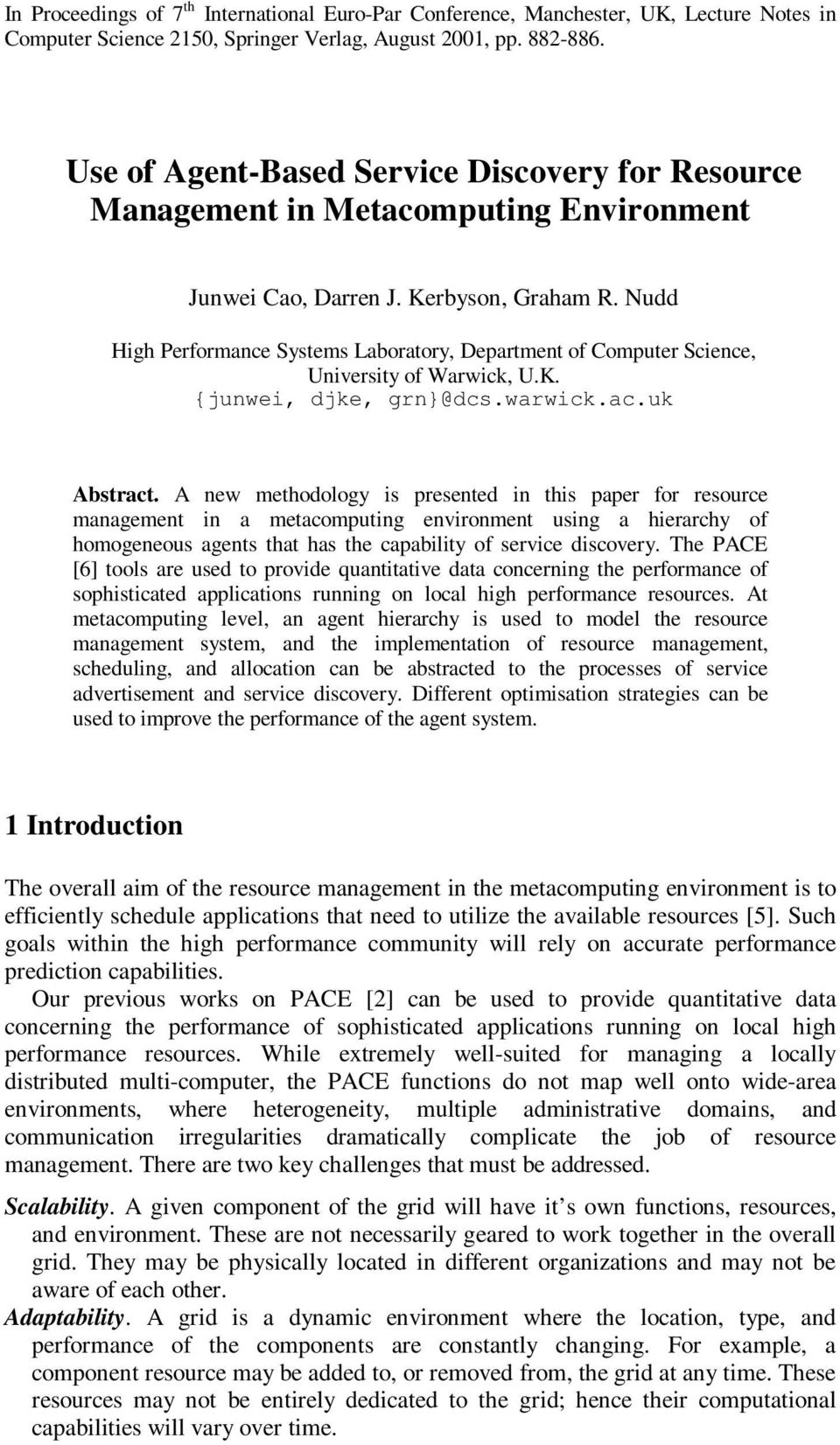
2 In this work, an agent-based service discovery model for resource management in metacomputing environment is introduced to address above challenges. An agent is a local computing resource manager equipped with PACE functions. These homogeneous agents are organised into a hierarchy, which can be used to address the problem of the scalability. An agent is considered to be both a service provider and a service requestor. We use service here to describe the details of a resource within the grid. Resource management, scheduling, and allocation can be abstracted to the processes of service advertisement and service discovery. Performance issues arise when service is advertised and discovered in the agent system. Different optimisation strategies can be used to improve the system performance. 2 PACE Toolset Our previous works on PACE toolset provide the base of the implementation of resource management for metacomputing. Source Code Object Editor Object Library CPU Cache Network Language Scripts Compiler Hardware Model Evaluation Engine Application Model Performance On-the-fly Fig. 1. The PACE Toolset The main components of the PACE toolset are shown in Fig. 1. A core component of PACE is a performance language, CHIP 3 S, which describes the performance aspects of an application and its parallelisation. The evaluation engine combines the workload information with component hardware models to produce time estimates, or trace information of the expected application behaviour. An important application of prediction data is that of dynamic multi-processor scheduling, which can be applied for efficient local resource management. The key features of PACE performance prediction capabilities include: a reasonable prediction accuracy; a rapid evaluation time and easy performance comparison across different computational systems [1]. These enable the prediction data to be used for resource management in a highly dynamic environment.

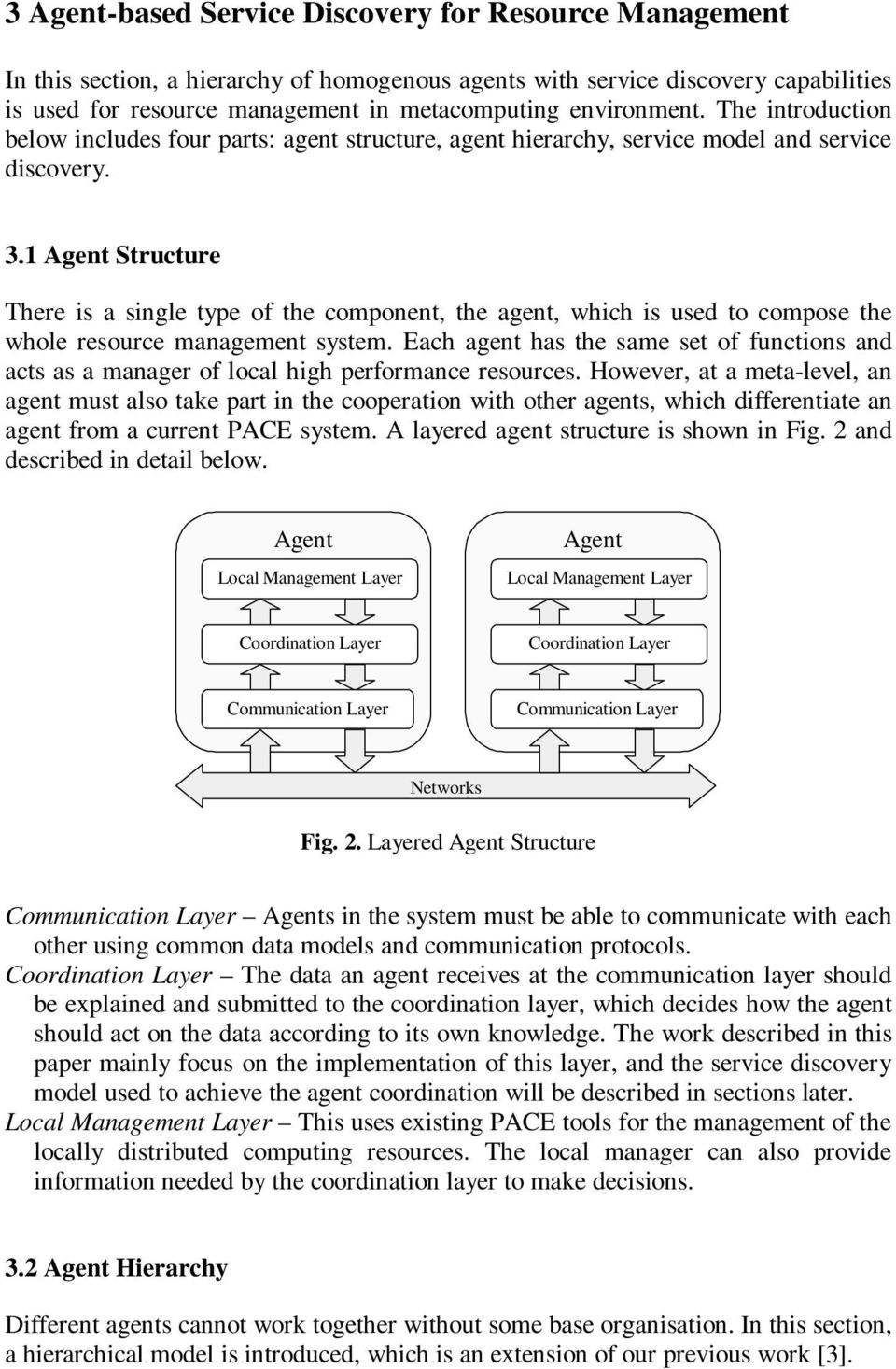
3 3 Agent-based Service Discovery for Resource Management In this section, a hierarchy of homogenous agents with service discovery capabilities is used for resource management in metacomputing environment. The introduction below includes four parts: agent structure, agent hierarchy, service model and service discovery. 3.1 Agent Structure There is a single type of the component, the agent, which is used to compose the whole resource management system. Each agent has the same set of functions and acts as a manager of local high performance resources. However, at a meta-level, an agent must also take part in the cooperation with other agents, which differentiate an agent from a current PACE system. A layered agent structure is shown in Fig. 2 and described in detail below. Agent Local Management Layer Agent Local Management Layer Coordination Layer Coordination Layer Communication Layer Communication Layer Networks Fig. 2. Layered Agent Structure Communication Layer Agents in the system must be able to communicate with each other using common data models and communication protocols. Coordination Layer The data an agent receives at the communication layer should be explained and submitted to the coordination layer, which decides how the agent should act on the data according to its own knowledge. The work described in this paper mainly focus on the implementation of this layer, and the service discovery model used to achieve the agent coordination will be described in sections later. Local Management Layer This uses existing PACE tools for the management of the locally distributed computing resources. The local manager can also provide information needed by the coordination layer to make decisions. 3.2 Agent Hierarchy Different agents cannot work together without some base organisation. In this section, a hierarchical model is introduced, which is an extension of our previous work [3].
4 When a new resource is added into the grid, a new agent is created. The new agent can register with one of existing agents, and hence join the agent hierarchy. An agent can only have one connection to an agent higher in the hierarchy to register with, but be registered with many lower level agents. An agent in the hierarchy has only the identities of its upper agent and lower agents and can communicate with them at the beginning. However, after joining the system, agent can learn more information about other agents and communicate with more agents gradually. Then the agent can benefit from the other agents capabilities, cooperate with each other, and manage all of the computing resources in the metacomputing environment. An agent can also leave the hierarchy at any time, which means the resources it manages are not available to the grid any more. In this situation, its lower agents must be informed to register with a new agent to keep the relations with the hierarchy. The agent-based hierarchical model is used to address the problem of the scalability. The key feature that enables the scalability of this model is the homogeneity of agents. There is no agent with more special functions than any other. The broker does not have any privileges compared to coordinators and agents. 3.3 Service Model An agent is considered to be both a service provider and a service requestor. Every agent can also act as a router between a request and a service. A service model is used to describe the details of local high performance resources within the grid. An initial implementation of a service model is a simple data structure, including an agent identity, corresponding resource information, and some optimisation options. The main part of a service model is the resource information. This should include all of the information needed for performance prediction of corresponding resources, from hardware statistics to application states. When a request arrives, it should be able to turn into useful performance information of corresponding resources using the PACE evaluation engine. These predictions can be used for agents to make decision whether the corresponding resources can meet the performance requirements from the request at the coordination layer. An agent can use several kinds of Agent Capability Tables (ACTs) for maintenance of service models from other agents. The resource performance can vary over time, thus the service offered by the agent will change over time. When this occurs, the resource information in corresponding service model needs also to be updated. The dynamics of this system increases the difficulty of resource management and allocation. The essential issue is how an agent advertises its services and also coordinates with other agents to discover the required services in the most efficient way. 3.4 Service Discovery Resource management, scheduling, and allocation at the meta-level are abstracted to the processes of service advertisement and service discovery in this work. These are performed at the coordination layer in each agent in the system.

5 Service Advertisement. The service model of an agent can be advertised in the hierarchy (both up and down). Service Discovery. When an agent receives a request, it will first check its own knowledge to see if it is already aware of an available service, which can meet the performance requirements of the request. If it is, it will contact the target agent directly. Otherwise it may contact other (e.g. its upper or lower) agents until the available service is found. Different strategies can be used to decide when, and how, to advertise or discover a service but with different performances. These include use of cache, using local and global knowledge, limit service lifetime, limit scope. The performance issues are discussed in greater detail in [4]. 4 Conclusions The resource management system in the grid computing environment will be a largescale distributed software system with high dynamics. In this work, we have developed a homogeneous agent-based hierarchical model to meet the requirements of the scalability. We also abstract the resource management, scheduling and allocation into the processes of the service advertisement and discovery. Ongoing works include the implementation of an agent communication language and a service description language. Future implementation will also integrate a new version of PACE toolset, which is specially lightened up for remote performance evaluation. References 1. J. Cao, D. J. Kerbyson, E. Papaefstathiou, and G. R. Nudd, Modeling of ASCI High Performance Applications Using PACE, in Proc. of 15 th Annual UK Performance Engineering Workshop, Bristol, UK, pp , J. Cao, D. J. Kerbyson, E. Papaefstathiou, and G. R. Nudd, Performance Modeling of Parallel and Distributed Computing Using PACE, in Proc. of 19 th IEEE Int. Performance, Computing and Communication Conf., Phoenix, USA, pp , J. Cao, D. J. Kerbyson, and G. R. Nudd, Dynamic Application Integration Using Agent- Based Operational Administration, in Proc. of 5 th Int. Conf. on Practical Application of Intelligent Agents and Multi-Agent Technology, Manchester, UK, pp , J. Cao, D. J. Kerbyson, and G. R. Nudd, Performance Evaluation of an Agent-Based Resource Management Infrastructure for Grid Computing, in Proc. of 1 st IEEE Int. Symp. on Cluster Computing and the Grid (CCGrid 01), Brisbane, Australia, pp , I. Foster, and C. Kesselman, The Grid: Blueprint for a New Computing Infrastructure, Morgan-Kaufmann, G. R. Nudd, D. J. Kerbyson, E. Papaefstathiou, S. C. Perry, J. S. Harper, and D. V. Wilcox, PACE A Toolset for the Performance Prediction of Parallel and Distributed Systems, Int. J. of High Performance Computing Applications, Special Issues on Performance Modelling Part I, Sage Science Press, 14(3), pp , Fall 2000.
A Study on the Application of Existing Load Balancing Algorithms for Large, Dynamic, Heterogeneous Distributed Systems
 A Study on the Application of Existing Load Balancing Algorithms for Large, Dynamic, Heterogeneous Distributed Systems RUPAM MUKHOPADHYAY, DIBYAJYOTI GHOSH AND NANDINI MUKHERJEE Department of Computer
Analysis on Leveraging social networks for p2p content-based file sharing in disconnected manets
 Analysis on Leveraging social networks for p2p content-based file sharing in disconnected manets # K.Deepika 1, M.Tech Computer Science Engineering, Mail: [email protected] # K.Meena 2, Assistant Professor
Collaborative & Integrated Network & Systems Management: Management Using Grid Technologies
 2011 International Conference on Computer Communication and Management Proc.of CSIT vol.5 (2011) (2011) IACSIT Press, Singapore Collaborative & Integrated Network & Systems Management: Management Using
Service Oriented Distributed Manager for Grid System
 Service Oriented Distributed Manager for Grid System Entisar S. Alkayal Faculty of Computing and Information Technology King Abdul Aziz University Jeddah, Saudi Arabia [email protected] Abstract
Resource Management on Computational Grids
 Univeristà Ca Foscari, Venezia http://www.dsi.unive.it Resource Management on Computational Grids Paolo Palmerini Dottorato di ricerca di Informatica (anno I, ciclo II) email: [email protected] 1/29
Virtual machine interface. Operating system. Physical machine interface
 Software Concepts User applications Operating system Hardware Virtual machine interface Physical machine interface Operating system: Interface between users and hardware Implements a virtual machine that
A STUDY OF THE BEHAVIOUR OF THE MOBILE AGENT IN THE NETWORK MANAGEMENT SYSTEMS
 A STUDY OF THE BEHAVIOUR OF THE MOBILE AGENT IN THE NETWORK MANAGEMENT SYSTEMS Tarag Fahad, Sufian Yousef & Caroline Strange School of Design and Communication Systems, Anglia Polytechnic University Victoria
Xweb: A Framework for Application Network Deployment in a Programmable Internet Service Infrastructure
 Xweb: A Framework for Application Network Deployment in a Programmable Internet Service Infrastructure O. Ardaiz, F. Freitag, L. Navarro Computer Architecture Department, Polytechnic University of Catalonia,
Distributed Systems and Recent Innovations: Challenges and Benefits
 Distributed Systems and Recent Innovations: Challenges and Benefits 1. Introduction Krishna Nadiminti, Marcos Dias de Assunção, and Rajkumar Buyya Grid Computing and Distributed Systems Laboratory Department
A novel load balancing algorithm for computational grid
 International Journal of Computational Intelligence Techniques, ISSN: 0976 0466 & E-ISSN: 0976 0474 Volume 1, Issue 1, 2010, PP-20-26 A novel load balancing algorithm for computational grid Saravanakumar
Symmetric Multiprocessing
 Multicore Computing A multi-core processor is a processing system composed of two or more independent cores. One can describe it as an integrated circuit to which two or more individual processors (called
The Key Technology Research of Virtual Laboratory based On Cloud Computing Ling Zhang
 International Conference on Advances in Mechanical Engineering and Industrial Informatics (AMEII 2015) The Key Technology Research of Virtual Laboratory based On Cloud Computing Ling Zhang Nanjing Communications
International Journal of Computer Science Trends and Technology (IJCST) Volume 3 Issue 3, May-June 2015
 RESEARCH ARTICLE OPEN ACCESS Ensuring Reliability and High Availability in Cloud by Employing a Fault Tolerance Enabled Load Balancing Algorithm G.Gayathri [1], N.Prabakaran [2] Department of Computer
MULTI AGENT-BASED DISTRIBUTED DATA MINING
 MULTI AGENT-BASED DISTRIBUTED DATA MINING REECHA B. PRAJAPATI 1, SUMITRA MENARIA 2 Department of Computer Science and Engineering, Parul Institute of Technology, Gujarat Technology University Abstract:
Service Oriented Architecture
 Service Oriented Architecture Charlie Abela Department of Artificial Intelligence [email protected] Last Lecture Web Ontology Language Problems? CSA 3210 Service Oriented Architecture 2 Lecture Outline
Comparison of Request Admission Based Performance Isolation Approaches in Multi-tenant SaaS Applications
 Comparison of Request Admission Based Performance Isolation Approaches in Multi-tenant SaaS Applications Rouven Kreb 1 and Manuel Loesch 2 1 SAP AG, Walldorf, Germany 2 FZI Research Center for Information
4. Multiagent Sys stems Design. Part 2: The PROMETHEUS methodology.
 4. Multiagent Systems Design Part 2: Multiagent Syste ems (SMA-UPC) https://kemlg.upc.edu The PROMETHEUS methodology. Javier Vázquez-Salceda SMA-UPC Methodological Extensions to Object-Oriented Approaches
Cloud Computing for Agent-based Traffic Management Systems
 Cloud Computing for Agent-based Traffic Management Systems Manoj A Patil Asst.Prof. IT Dept. Khyamling A Parane Asst.Prof. CSE Dept. D. Rajesh Asst.Prof. IT Dept. ABSTRACT Increased traffic congestion
Integration of the OCM-G Monitoring System into the MonALISA Infrastructure
 Integration of the OCM-G Monitoring System into the MonALISA Infrastructure W lodzimierz Funika, Bartosz Jakubowski, and Jakub Jaroszewski Institute of Computer Science, AGH, al. Mickiewicza 30, 30-059,
CS550. Distributed Operating Systems (Advanced Operating Systems) Instructor: Xian-He Sun
 CS550 Distributed Operating Systems (Advanced Operating Systems) Instructor: Xian-He Sun Email: [email protected], Phone: (312) 567-5260 Office hours: 2:10pm-3:10pm Tuesday, 3:30pm-4:30pm Thursday at SB229C,
Load Balancing Mechanism in Agent-based Grid
 Communications on Advanced Comutational Science with Alications 2016 No. 1 (2016) 57-62 Available online at www.isacs.com/cacsa Volume 2016, Issue 1, Year 2016 Article ID cacsa-00042, 6 Pages doi:10.5899/2016/cacsa-00042
Meeting Scheduling with Multi Agent Systems: Design and Implementation
 Proceedings of the 6th WSEAS Int. Conf. on Software Engineering, Parallel and Distributed Systems, Corfu Island, Greece, February 16-19, 2007 92 Meeting Scheduling with Multi Agent Systems: Design and
Distributed communication-aware load balancing with TreeMatch in Charm++
 Distributed communication-aware load balancing with TreeMatch in Charm++ The 9th Scheduling for Large Scale Systems Workshop, Lyon, France Emmanuel Jeannot Guillaume Mercier Francois Tessier In collaboration
Towards a Load Balancing in a Three-level Cloud Computing Network
 Towards a Load Balancing in a Three-level Cloud Computing Network Shu-Ching Wang, Kuo-Qin Yan * (Corresponding author), Wen-Pin Liao and Shun-Sheng Wang Chaoyang University of Technology Taiwan, R.O.C.
Distributed Systems. REK s adaptation of Prof. Claypool s adaptation of Tanenbaum s Distributed Systems Chapter 1
 Distributed Systems REK s adaptation of Prof. Claypool s adaptation of Tanenbaum s Distributed Systems Chapter 1 1 The Rise of Distributed Systems! Computer hardware prices are falling and power increasing.!
1.1.1 Introduction to Cloud Computing
 1 CHAPTER 1 INTRODUCTION 1.1 CLOUD COMPUTING 1.1.1 Introduction to Cloud Computing Computing as a service has seen a phenomenal growth in recent years. The primary motivation for this growth has been the
STANDARDS FOR AGENTS AND AGENT BASED SYSTEMS (FIPA)
 Course Number: SENG 609.22 Session: Fall, 2003 Course Name: Agent-based Software Engineering Department: Electrical and Computer Engineering Document Type: Tutorial Report STANDARDS FOR AGENTS AND AGENT
Neighbour Discovery in IPv6
 Neighbour Discovery in IPv6 Andrew Hines Topic No: 17 Email: [email protected] Organiser: Christian Schindelhauer University of Paderborn Immatriculation No: 6225220 August 4, 2004 1 Abstract
AN INTELLIGENT TUTORING SYSTEM FOR LEARNING DESIGN PATTERNS
 AN INTELLIGENT TUTORING SYSTEM FOR LEARNING DESIGN PATTERNS ZORAN JEREMIĆ, VLADAN DEVEDŽIĆ, DRAGAN GAŠEVIĆ FON School of Business Administration, University of Belgrade Jove Ilića 154, POB 52, 11000 Belgrade,
How To Understand The Concept Of A Distributed System
 Distributed Operating Systems Introduction Ewa Niewiadomska-Szynkiewicz and Adam Kozakiewicz [email protected], [email protected] Institute of Control and Computation Engineering Warsaw University of
Flauncher and DVMS Deploying and Scheduling Thousands of Virtual Machines on Hundreds of Nodes Distributed Geographically
 Flauncher and Deploying and Scheduling Thousands of Virtual Machines on Hundreds of Nodes Distributed Geographically Daniel Balouek, Adrien Lèbre, Flavien Quesnel To cite this version: Daniel Balouek,
Improving Performance in Load Balancing Problem on the Grid Computing System
 Improving Performance in Problem on the Grid Computing System Prabhat Kr.Srivastava IIMT College of Engineering Greater Noida, India Sonu Gupta IIMT College of Engineering Greater Noida, India Dheerendra
KNOWLEDGE GRID An Architecture for Distributed Knowledge Discovery
 KNOWLEDGE GRID An Architecture for Distributed Knowledge Discovery Mario Cannataro 1 and Domenico Talia 2 1 ICAR-CNR 2 DEIS Via P. Bucci, Cubo 41-C University of Calabria 87036 Rende (CS) Via P. Bucci,
A Taxonomy and Survey of Grid Resource Planning and Reservation Systems for Grid Enabled Analysis Environment
 A Taxonomy and Survey of Grid Resource Planning and Reservation Systems for Grid Enabled Analysis Environment Arshad Ali 3, Ashiq Anjum 3, Atif Mehmood 3, Richard McClatchey 2, Ian Willers 2, Julian Bunn
Task Scheduling in Hadoop
 Task Scheduling in Hadoop Sagar Mamdapure Munira Ginwala Neha Papat SAE,Kondhwa SAE,Kondhwa SAE,Kondhwa Abstract Hadoop is widely used for storing large datasets and processing them efficiently under distributed
CHAPTER 2 MODELLING FOR DISTRIBUTED NETWORK SYSTEMS: THE CLIENT- SERVER MODEL
 CHAPTER 2 MODELLING FOR DISTRIBUTED NETWORK SYSTEMS: THE CLIENT- SERVER MODEL This chapter is to introduce the client-server model and its role in the development of distributed network systems. The chapter
Software Concepts. Uniprocessor Operating Systems. System software structures. CIS 505: Software Systems Architectures of Distributed Systems
 CIS 505: Software Systems Architectures of Distributed Systems System DOS Software Concepts Description Tightly-coupled operating system for multiprocessors and homogeneous multicomputers Main Goal Hide
Developing Scalable Smart Grid Infrastructure to Enable Secure Transmission System Control
 Developing Scalable Smart Grid Infrastructure to Enable Secure Transmission System Control EP/K006487/1 UK PI: Prof Gareth Taylor (BU) China PI: Prof Yong-Hua Song (THU) Consortium UK Members: Brunel University
A Survey Study on Monitoring Service for Grid
 A Survey Study on Monitoring Service for Grid Erkang You [email protected] ABSTRACT Grid is a distributed system that integrates heterogeneous systems into a single transparent computer, aiming to provide
Application Of Cloud Computing In University Libraries. Deepti Arora, Shabista Quraishi, Zahira Quraishi. Abstract
 Application Of Cloud Computing In University Libraries Deepti Arora, Shabista Quraishi, Zahira Quraishi Abstract Technology is changing rapidly and is forming a layer that is touching each and every aspect
STUDY AND SIMULATION OF A DISTRIBUTED REAL-TIME FAULT-TOLERANCE WEB MONITORING SYSTEM
 STUDY AND SIMULATION OF A DISTRIBUTED REAL-TIME FAULT-TOLERANCE WEB MONITORING SYSTEM Albert M. K. Cheng, Shaohong Fang Department of Computer Science University of Houston Houston, TX, 77204, USA http://www.cs.uh.edu
Grid Computing vs Cloud
 Chapter 3 Grid Computing vs Cloud Computing 3.1 Grid Computing Grid computing [8, 23, 25] is based on the philosophy of sharing information and power, which gives us access to another type of heterogeneous
Centralized Systems. A Centralized Computer System. Chapter 18: Database System Architectures
 Chapter 18: Database System Architectures Centralized Systems! Centralized Systems! Client--Server Systems! Parallel Systems! Distributed Systems! Network Types! Run on a single computer system and do
How To Balance A Web Server With Remaining Capacity
 Remaining Capacity Based Load Balancing Architecture for Heterogeneous Web Server System Tsang-Long Pao Dept. Computer Science and Engineering Tatung University Taipei, ROC Jian-Bo Chen Dept. Computer
Meeting the Five Key Needs of Next-Generation Cloud Computing Networks with 10 GbE
 White Paper Meeting the Five Key Needs of Next-Generation Cloud Computing Networks Cloud computing promises to bring scalable processing capacity to a wide range of applications in a cost-effective manner.
ANALYSIS OF WORKFLOW SCHEDULING PROCESS USING ENHANCED SUPERIOR ELEMENT MULTITUDE OPTIMIZATION IN CLOUD
 ANALYSIS OF WORKFLOW SCHEDULING PROCESS USING ENHANCED SUPERIOR ELEMENT MULTITUDE OPTIMIZATION IN CLOUD Mrs. D.PONNISELVI, M.Sc., M.Phil., 1 E.SEETHA, 2 ASSISTANT PROFESSOR, M.PHIL FULL-TIME RESEARCH SCHOLAR,
Solar, storage and mining: New opportunities for solar power development. By Thomas Hillig (THEnergy) and James Watson (SolarPower Europe)
 Solar, storage and mining: New opportunities for solar power development By Thomas Hillig (THEnergy) and James Watson (SolarPower Europe) SolarPower Europe / Solar, storage and mining: New opportunities
Middleware and Distributed Systems. Introduction. Dr. Martin v. Löwis
 Middleware and Distributed Systems Introduction Dr. Martin v. Löwis 14 3. Software Engineering What is Middleware? Bauer et al. Software Engineering, Report on a conference sponsored by the NATO SCIENCE
A Study on Service Oriented Network Virtualization convergence of Cloud Computing
 A Study on Service Oriented Network Virtualization convergence of Cloud Computing 1 Kajjam Vinay Kumar, 2 SANTHOSH BODDUPALLI 1 Scholar(M.Tech),Department of Computer Science Engineering, Brilliant Institute
ISO 27001 Gap Analysis - Case Study
 ISO 27001 Gap Analysis - Case Study Ibrahim Al-Mayahi, Sa ad P. Mansoor School of Computer Science, Bangor University, Bangor, Gwynedd, UK Abstract This work describes the initial steps taken toward the
Monitoring Message Passing Applications in the Grid
 Monitoring Message Passing Applications in the Grid with GRM and R-GMA Norbert Podhorszki and Peter Kacsuk MTA SZTAKI, Budapest, H-1528 P.O.Box 63, Hungary [email protected], [email protected] Abstract.
DNS Basics. DNS Basics
 DNS Basics 1 A quick introduction to the Domain Name System (DNS). Shows the basic purpose of DNS, hierarchy of domain names, and an example of how the DNS protocol is used. There are many details of DNS
Cisco Prime Cable Provisioning 5.0
 Data Sheet Cisco Prime Cable Provisioning 5.0 Cable service providers face tremendous challenges in keeping pace with the rapid evolution of residential subscriber services. In light of intense market
Digital libraries of the future and the role of libraries
 Digital libraries of the future and the role of libraries Donatella Castelli ISTI-CNR, Pisa, Italy Abstract Purpose: To introduce the digital libraries of the future, their enabling technologies and their
Implementing Parameterized Dynamic Load Balancing Algorithm Using CPU and Memory
 Implementing Parameterized Dynamic Balancing Algorithm Using CPU and Memory Pradip Wawge 1, Pritish Tijare 2 Master of Engineering, Information Technology, Sipna college of Engineering, Amravati, Maharashtra,
A Comparison Study of Qos Using Different Routing Algorithms In Mobile Ad Hoc Networks
 A Comparison Study of Qos Using Different Routing Algorithms In Mobile Ad Hoc Networks T.Chandrasekhar 1, J.S.Chakravarthi 2, K.Sravya 3 Professor, Dept. of Electronics and Communication Engg., GIET Engg.
BackupEnabler: Virtually effortless backups for VMware Environments
 White Paper BackupEnabler: Virtually effortless backups for VMware Environments Contents Abstract... 3 Why Standard Backup Processes Don t Work with Virtual Servers... 3 Agent-Based File-Level and Image-Level
Research Statement for Henri Casanova
 Research Statement for Henri Casanova Advances in networking technology have made it possible to deploy distributed scientific applications on platforms that aggregate large numbers of diverse and distant
CHAPTER 1 INTRODUCTION
 1 CHAPTER 1 INTRODUCTION 1.1 MOTIVATION OF RESEARCH Multicore processors have two or more execution cores (processors) implemented on a single chip having their own set of execution and architectural recourses.
Structure of Presentation. The Role of Programming in Informatics Curricula. Concepts of Informatics 2. Concepts of Informatics 1
 The Role of Programming in Informatics Curricula A. J. Cowling Department of Computer Science University of Sheffield Structure of Presentation Introduction The problem, and the key concepts. Dimensions
The Data Grid: Towards an Architecture for Distributed Management and Analysis of Large Scientific Datasets
 The Data Grid: Towards an Architecture for Distributed Management and Analysis of Large Scientific Datasets!! Large data collections appear in many scientific domains like climate studies.!! Users and
Portfolio of Products. Integrated Engineering Environment. Overview
 Portfolio of Products Integrated Engineering Environment Overview Automation Studio is an all-in-one easy-to-use software that provides an open, productive and flexible engineering environment for the
Content-Aware Load Balancing using Direct Routing for VOD Streaming Service
 Content-Aware Load Balancing using Direct Routing for VOD Streaming Service Young-Hwan Woo, Jin-Wook Chung, Seok-soo Kim Dept. of Computer & Information System, Geo-chang Provincial College, Korea School
Advanced Grid Management Software for Seamless Services
 Advanced Grid Management Software for Seamless Services Sahin Albayrak¹, Silvan Kaiser¹, Jan Stender¹ ¹DAI-Labor, Technische Universität Berlin, Secretary GOR 1-1, Franklinstrasse 28/29, D-10587 Berlin,
Classic Grid Architecture
 Peer-to to-peer Grids Classic Grid Architecture Resources Database Database Netsolve Collaboration Composition Content Access Computing Security Middle Tier Brokers Service Providers Middle Tier becomes
Keywords Distributed Computing, On Demand Resources, Cloud Computing, Virtualization, Server Consolidation, Load Balancing
 Volume 5, Issue 1, January 2015 ISSN: 2277 128X International Journal of Advanced Research in Computer Science and Software Engineering Research Paper Available online at: www.ijarcsse.com Survey on Load
A Simultaneous Solution for General Linear Equations on a Ring or Hierarchical Cluster
 Acta Technica Jaurinensis Vol. 3. No. 1. 010 A Simultaneous Solution for General Linear Equations on a Ring or Hierarchical Cluster G. Molnárka, N. Varjasi Széchenyi István University Győr, Hungary, H-906
Hierarchical Status Information Exchange Scheduling and Load Balancing For Computational Grid Environments
 IJCSNS International Journal of Computer Science and Network Security, VOL.0 No.2, February 200 77 Hierarchical Status Information Exchange Scheduling and Load Balancing For Computational Grid Environments