
NEW, REVISED AND ARCHIVED CURRICULUM STANDARDS Business Administration Alignment Project (BAAP) for
|
|
|
- Shanon Washington
- 10 years ago
- Views:
Transcription
1 NEW, REVISED AND ARCHIVED CURRICULUM STANDARDS Business Administration Alignment Project (BAAP) for Attachment PROG 6 As a result of the recommendations of the Business Administration Alignment Project (BAAP) participants, the State Board is requested to approve the following: Curriculum standard revisions for the following programs: Business Administration (A25120) Eliminate the current Business Administration Concentrations and streamline into one Career Cluster Model Business Administration/Shooting and Hunting Sports Management (A2512J) Revise title, description and courses to reflect elimination of the current concentration into a standalone program titled Hunting and Shooting Sports Management (A25xxx) New curriculum standard for the following program: Global Logistics and Distribution Management Technology (A25xxx) Combine two current programs (Business Administration/Logistics Management and Global Logistics Technology) into one program It is requested that colleges that currently have approval for either Business Administration/Logistics Management (A2512E) or Global Logistics Technology (A25170) receive approval for Global Logistics and Distribution Management Technology (A25xxx). Both the Business Administration/Logistics Management (A2512E) and the Global Logistics Technology (A25170) are on the titles approved for the Special Application process. Therefore, it is requested that the new Global Logistics and Distribution Management Technology program be added to the list of titles. Archive the following curriculum standards: Business Administration/ Banking and Finance (A2512A) Business Administration/Customer Service (A2512B) Business Administration/Electronic Commerce (A2512I) Business Administration/Human Resources Management (A2512C) Business Administration/Import Export Compliance (A2512K) Business Administration/International Business (A2512D) Business Administration/Logistics Management (A2512E) Business Administration/Marketing and Retailing (A2512F) Business Administration/Operations Management (A2512G) Business Administration/Public Administration (A2512H) Global Logistics Technology (A25170) Rationale The participants of the Business Administration Alignment Project (BAAP) performed a comprehensive review of the Business Administration program and concentrations and felt that new, revised and archived curriculum standard revisions were needed in order to: Streamline the Business Administration standard and concentration standards into one Career Clusters model. Ensure that students who complete the Business Administration program will meet workforce needs and expectations. SBCC 08/15/2014

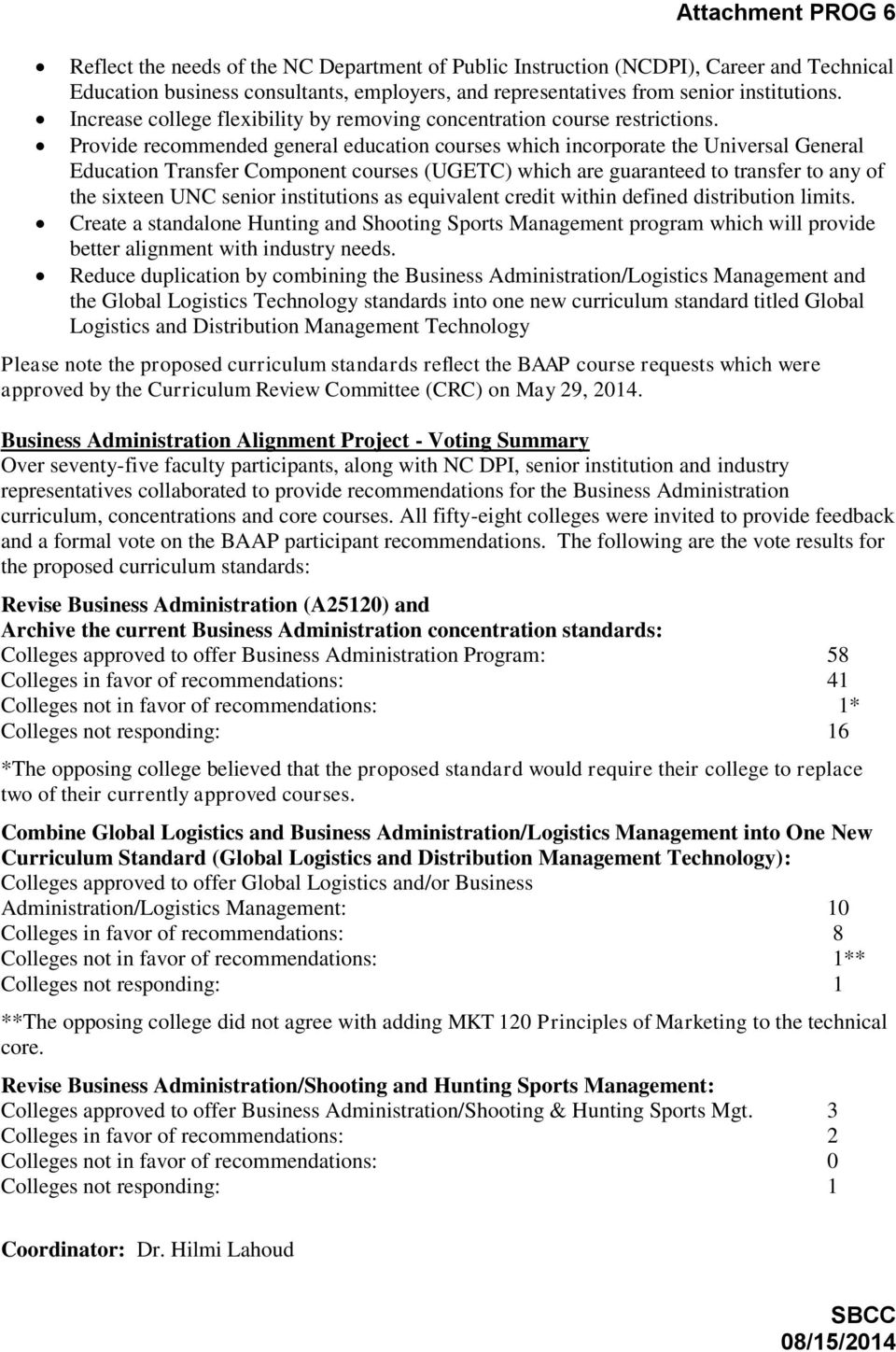
2 Attachment PROG 6 Reflect the needs of the NC Department of Public Instruction (NCDPI), Career and Technical Education business consultants, employers, and representatives from senior institutions. Increase college flexibility by removing concentration course restrictions. Provide recommended general education courses which incorporate the Universal General Education Transfer Component courses (UGETC) which are guaranteed to transfer to any of the sixteen UNC senior institutions as equivalent credit within defined distribution limits. Create a standalone Hunting and Shooting Sports Management program which will provide better alignment with industry needs. Reduce duplication by combining the Business Administration/Logistics Management and the Global Logistics Technology standards into one new curriculum standard titled Global Logistics and Distribution Management Technology Please note the proposed curriculum standards reflect the BAAP course requests which were approved by the Curriculum Review Committee (CRC) on May 29, Business Administration Alignment Project - Voting Summary Over seventy-five faculty participants, along with NC DPI, senior institution and industry representatives collaborated to provide recommendations for the Business Administration curriculum, concentrations and core courses. All fifty-eight colleges were invited to provide feedback and a formal vote on the BAAP participant recommendations. The following are the vote results for the proposed curriculum standards: Revise Business Administration (A25120) and Archive the current Business Administration concentration standards: Colleges approved to offer Business Administration Program: 58 Colleges in favor of recommendations: 41 Colleges not in favor of recommendations: 1* Colleges not responding: 16 *The opposing college believed that the proposed standard would require their college to replace two of their currently approved courses. Combine Global Logistics and Business Administration/Logistics Management into One New Curriculum Standard (Global Logistics and Distribution Management Technology): Colleges approved to offer Global Logistics and/or Business Administration/Logistics Management: 10 Colleges in favor of recommendations: 8 Colleges not in favor of recommendations: 1** Colleges not responding: 1 **The opposing college did not agree with adding MKT 120 Principles of Marketing to the technical core. Revise Business Administration/Shooting and Hunting Sports Management: Colleges approved to offer Business Administration/Shooting & Hunting Sports Mgt. 3 Colleges in favor of recommendations: 2 Colleges not in favor of recommendations: 0 Colleges not responding: 1 Coordinator: Dr. Hilmi Lahoud SBCC 08/15/2014
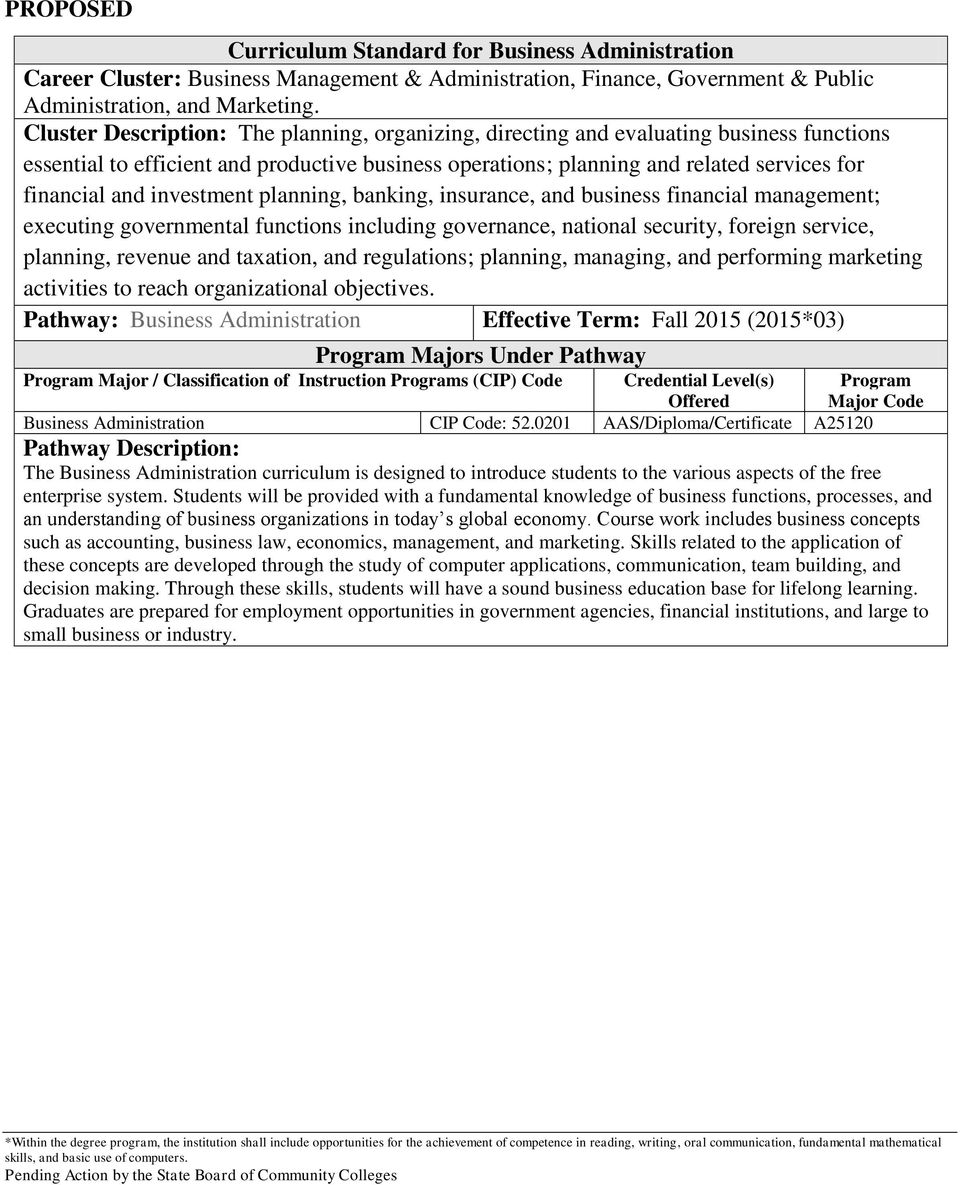
3 PROPOSED Curriculum Standard for Business Administration Career Cluster: Business Management & Administration, Finance, Government & Public Administration, and Marketing. Cluster Description: The planning, organizing, directing and evaluating business functions essential to efficient and productive business operations; planning and related services for financial and investment planning, banking, insurance, and business financial management; executing governmental functions including governance, national security, foreign service, planning, revenue and taxation, and regulations; planning, managing, and performing marketing activities to reach organizational objectives. Pathway: Business Administration Effective Term: Fall 2015 (2015*03) Program Majors Under Pathway Program Major / Classification of Instruction Programs (CIP) Code Credential Level(s) Offered Program Major Code Business Administration CIP Code: AAS/Diploma/Certificate A25120 Pathway Description: The Business Administration curriculum is designed to introduce students to the various aspects of the free enterprise system. Students will be provided with a fundamental knowledge of business functions, processes, and an understanding of business organizations in today s global economy. Course work includes business concepts such as accounting, business law, economics, management, and marketing. Skills related to the application of these concepts are developed through the study of computer applications, communication, team building, and decision making. Through these skills, students will have a sound business education base for lifelong learning. Graduates are prepared for employment opportunities in government agencies, financial institutions, and large to small business or industry. *Within the degree program, the institution shall include opportunities for the achievement of competence in reading, writing, oral communication, fundamental mathematical skills, and basic use of computers. Pending Action by the State Board of Community Colleges
4 I. General Education Academic Core [Curriculum Requirements for associate degree, diploma, and certificate programs in accordance with 1 D SBCC (3): Degree programs must contain a minimum of 15 semester hours including at least one course from each of the following areas: humanities/fine arts, social/behavioral sciences, and natural sciences/mathematics. Degree programs must contain a minimum of 6 semester hours of communications. Diploma programs must contain a minimum of 6 semester hours of general education; 3 semester hours must be in communications. General education is optional in certificate programs. Business Administration Recommended General Education Academic Core Minimum General Education Hours Required: 15 SHC 6 SHC 0 SHC Courses listed below are recommended general education courses for this curriculum standard. Colleges may choose to include additional or alternative general education courses to meet local curriculum needs. Communication: COM 110 Introduction to Communication COM 120 Intro Interpersonal Com COM 231 Public Speaking U ENG 111 Writing and Inquiry U ENG 112 Writing/Research in the Disc U ENG 114 Prof Research & Reporting ENG 116 Technical Report Writing 6 SHC 3-6 SHC Optional Humanities/Fine Arts: ART 111 Art Appreciation U HUM 110 Technology and Society HUM 115 Critical Thinking HUM 230 Leadership Development MUS 110 Music Appreciation U PHI 230 Introduction to Logic PHI 240 Introduction to Ethics U 0- Optional Social /Behavioral Sciences: ECO 151 Survey of Economics ECO 251 Prin of Microeconomics U ECO 252 Prin of Macroeconomics U POL 120 American Government U PSY 118 Interpersonal Psychology PSY 150 General Psychology U SOC 210 Introduction to Sociology U 0- Optional Natural Sciences/Mathematics: MAT 110 Math Measurement and Literacy MAT 121 Algebra/Trigonometry I MAT 143 Quantitative Literacy U MAT 152 Statistical Methods I U MAT 171 Precalculus Algebra U 3-0- Optional U indicates a Universal General Education Transfer Component (UGETC) course included in the Comprehensive Articulation Agreement. UGETC courses are guaranteed to transfer to any of the sixteen University of North Carolina senior institutions as equivalent credit within defined distribution limits. Approved by the State Board of Community Colleges on November 13, 1996; Revised 07/17/98; Revised 09/26/00; Revised 03/22/02; Revised 04/24/02; SBCC Revised 05/17/02; SBCC Revised 11/15/02; CRC Revised 06/13/05; SBCC Revised 07/15/05; Revised 03/27/06; Revised 04/10/06; Revised 04/11/06; SBCC Revised 09/21/07; CRC Revised 03/27/08; SBCC Revised 10/17/08; Revised 12/16/08, Revised 10/08/10; Editorial Revision 06/18/13; Editorial Revision 10/14/13; Editorial Revision 11/22/13. SBCC Revised 2014.

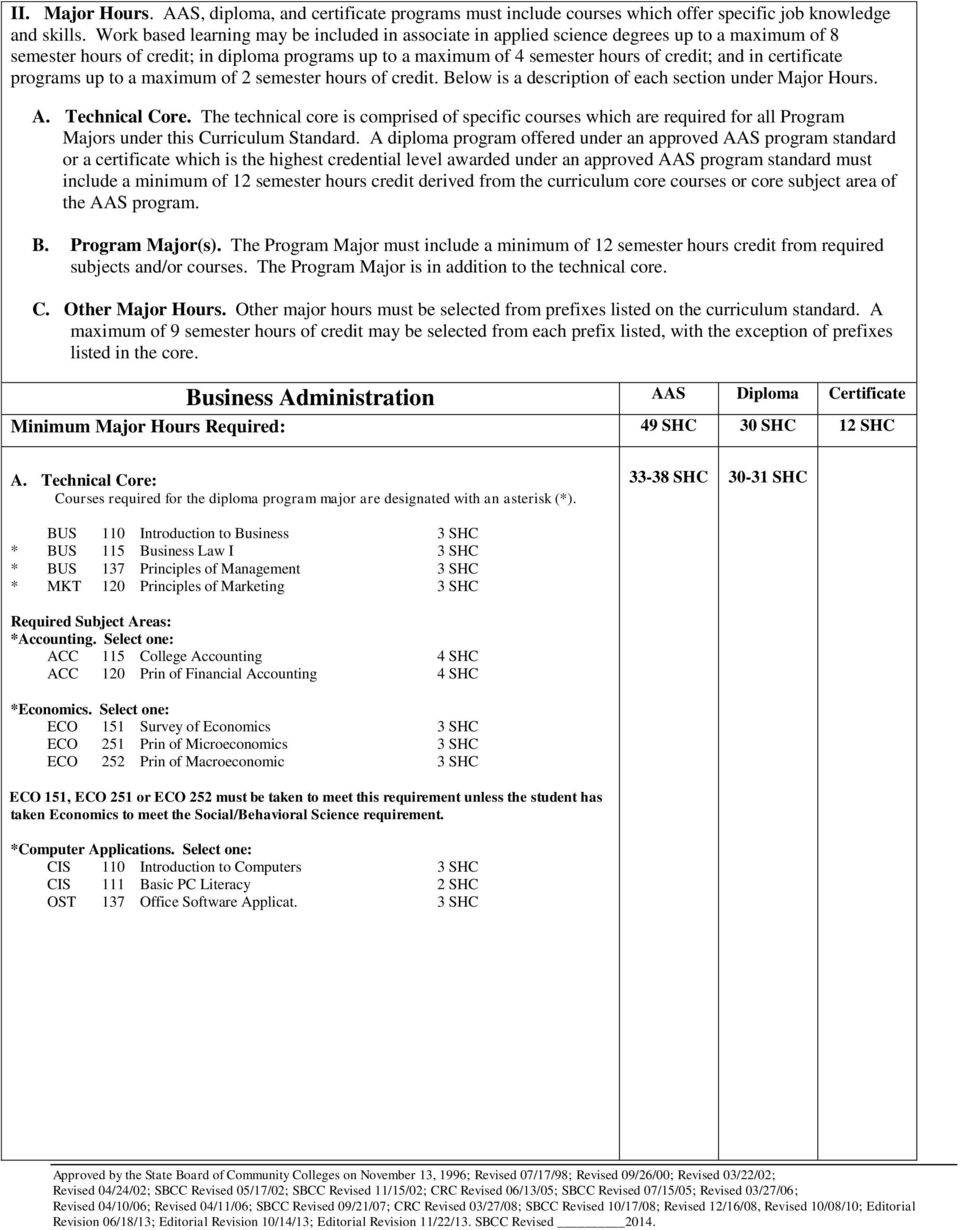
5 II. Major Hours. AAS, diploma, and certificate programs must include courses which offer specific job knowledge and skills. Work based learning may be included in associate in applied science degrees up to a maximum of 8 semester hours of credit; in diploma programs up to a maximum of 4 semester hours of credit; and in certificate programs up to a maximum of 2 semester hours of credit. Below is a description of each section under Major Hours. A. Technical Core. The technical core is comprised of specific courses which are required for all Program Majors under this Curriculum Standard. A diploma program offered under an approved AAS program standard or a certificate which is the highest credential level awarded under an approved AAS program standard must include a minimum of 12 semester hours credit derived from the curriculum core courses or core subject area of the AAS program. B. Program Major(s). The Program Major must include a minimum of 12 semester hours credit from required subjects and/or courses. The Program Major is in addition to the technical core. C. Other Major Hours. Other major hours must be selected from prefixes listed on the curriculum standard. A maximum of 9 semester hours of credit may be selected from each prefix listed, with the exception of prefixes listed in the core. Business Administration Minimum Major Hours Required: 49 SHC 30 SHC 12 SHC A. Technical Core: Courses required for the diploma program major are designated with an asterisk (*) SHC SHC BUS 110 Introduction to Business * BUS 115 Business Law I * BUS 137 Principles of Management * MKT 120 Principles of Marketing Required Subject Areas: *Accounting. Select one: ACC 115 College Accounting ACC 120 Prin of Financial Accounting *Economics. Select one: ECO 151 Survey of Economics ECO 251 Prin of Microeconomics ECO 252 Prin of Macroeconomic ECO 151, ECO 251 or ECO 252 must be taken to meet this requirement unless the student has taken Economics to meet the Social/Behavioral Science requirement. *Computer Applications. Select one: CIS 110 Introduction to Computers CIS 111 Basic PC Literacy 2 SHC OST 137 Office Software Applicat. Approved by the State Board of Community Colleges on November 13, 1996; Revised 07/17/98; Revised 09/26/00; Revised 03/22/02; Revised 04/24/02; SBCC Revised 05/17/02; SBCC Revised 11/15/02; CRC Revised 06/13/05; SBCC Revised 07/15/05; Revised 03/27/06; Revised 04/10/06; Revised 04/11/06; SBCC Revised 09/21/07; CRC Revised 03/27/08; SBCC Revised 10/17/08; Revised 12/16/08, Revised 10/08/10; Editorial Revision 06/18/13; Editorial Revision 10/14/13; Editorial Revision 11/22/13. SBCC Revised 2014.
6 Required Subject Areas (Select one subject area): General Business Administration 12 hours to be selected from the following prefixes: BUS and CSV. Banking and Finance Select one of the following tracks: BAF 110 Principles of Banking BAF 131 Fund of Bank Lending BAF 141 Law & Banking: Principles BAF 222 Money and Banking OR AIB 110 Principles of Banking AIB 131 Fund of Bank Lending AIB 141 Law & Banking: Principles AIB 222 Money and Banking Human Resources Management BUS 217 Employment Law and Regs BUS 234 Training and Development BUS 256 Recruit Select & Per Plan BUS 258 Compensation and Benefits BUS 259 HRM Applications International Business Select one of the following tracks: Global Business Management Track ACC 270 International Accounting INT 110 International Business INT 210 International Trade INT 220 International Economics INT 230 International Law Import Export Compliance Track IEC 225 International Shipping IEC 226 Intro to Export Admin Reg IEC 227 Elec Import/Export Doc IEC 228 Importing Marketing MKT 220 Advertising & Sales Promotio MKT 225 Marketing Research MKT 227 Marketing Applications MKT 232 Social Media Marketing Select one: MKT 123 Fundamentals of Selling MKT 223 Customer Service Operations Management ISC 121 Envir Health & Safety ISC 210 Oper & Prod Planning OMT 112 Materials Management OMT 260 Issues in Operations Mgt Select one: ISC 130 Intro to Quality Control ISC 131 Quality Management ISC 132 Mfg Quality Control ISC 221 Statistical Qual Control Public Administration PAD 151 Intro to Public Admin PAD 251 Public Finance & Budgeting PAD 252 Public Policy Analysis Select one. PAD 152 Ethics in Government BUS 240 Business Ethics Approved by the State Board of Community Colleges on November 13, 1996; Revised 07/17/98; Revised 09/26/00; Revised 03/22/02; Revised 04/24/02; SBCC Revised 05/17/02; SBCC Revised 11/15/02; CRC Revised 06/13/05; SBCC Revised 07/15/05; Revised 03/27/06; Revised 04/10/06; Revised 04/11/06; SBCC Revised 09/21/07; CRC Revised 03/27/08; SBCC Revised 10/17/08; Revised 12/16/08, Revised 10/08/10; Editorial Revision 06/18/13; Editorial Revision 10/14/13; Editorial Revision 11/22/13. SBCC Revised 2014.

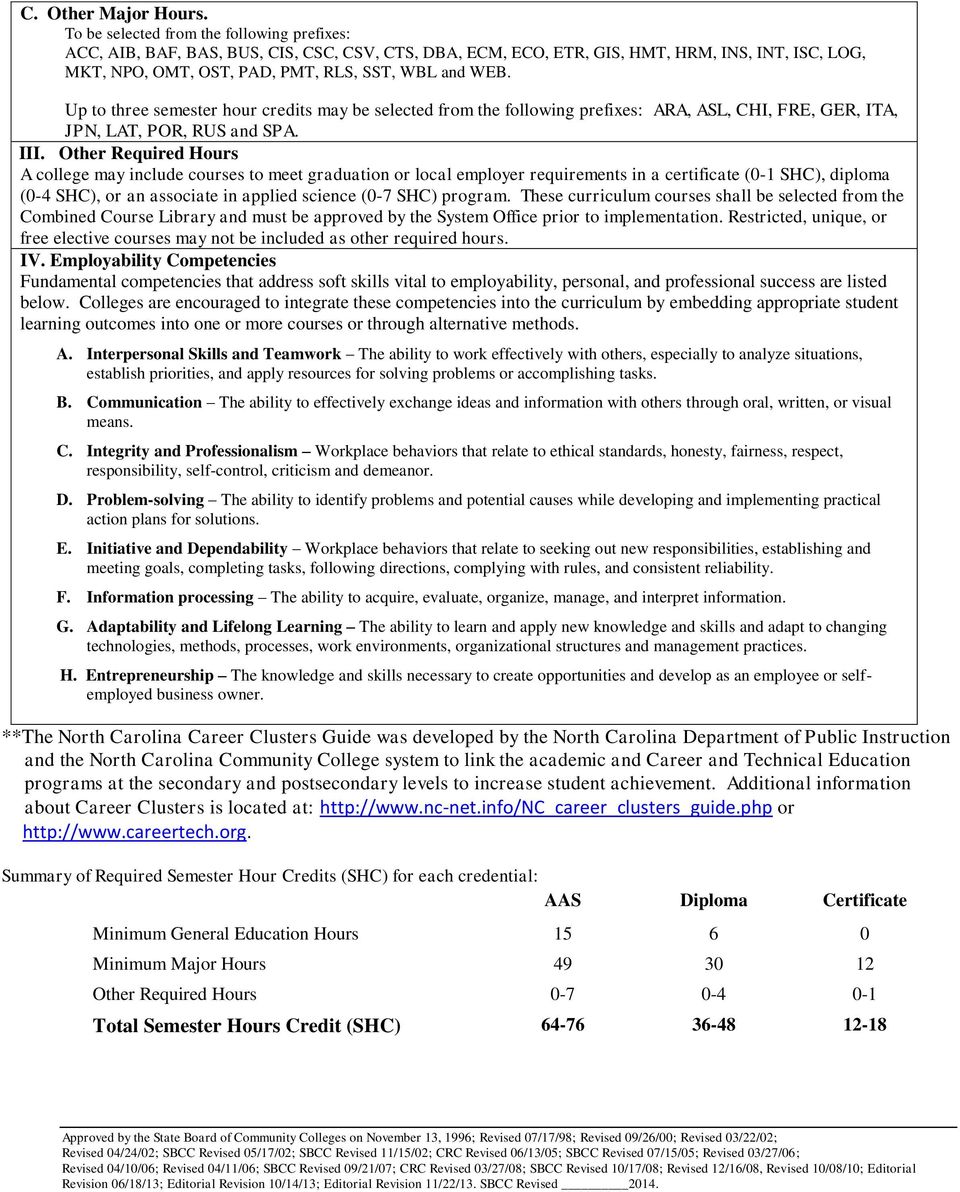
7 C. Other Major Hours. To be selected from the following prefixes: ACC, AIB, BAF, BAS, BUS, CIS, CSC, CSV, CTS, DBA, ECM, ECO, ETR, GIS, HMT, HRM, INS, INT, ISC, LOG, MKT, NPO, OMT, OST, PAD, PMT, RLS, SST, WBL and WEB. Up to three semester hour credits may be selected from the following prefixes: ARA, ASL, CHI, FRE, GER, ITA, JPN, LAT, POR, RUS and SPA. III. Other Required Hours A college may include courses to meet graduation or local employer requirements in a certificate (0-1 SHC), diploma (0-), or an associate in applied science (0-7 SHC) program. These curriculum courses shall be selected from the Combined Course Library and must be approved by the System Office prior to implementation. Restricted, unique, or free elective courses may not be included as other required hours. IV. Employability Competencies Fundamental competencies that address soft skills vital to employability, personal, and professional success are listed below. Colleges are encouraged to integrate these competencies into the curriculum by embedding appropriate student learning outcomes into one or more courses or through alternative methods. A. Interpersonal Skills and Teamwork The ability to work effectively with others, especially to analyze situations, establish priorities, and apply resources for solving problems or accomplishing tasks. B. Communication The ability to effectively exchange ideas and information with others through oral, written, or visual means. C. Integrity and Professionalism Workplace behaviors that relate to ethical standards, honesty, fairness, respect, responsibility, self-control, criticism and demeanor. D. Problem-solving The ability to identify problems and potential causes while developing and implementing practical action plans for solutions. E. Initiative and Dependability Workplace behaviors that relate to seeking out new responsibilities, establishing and meeting goals, completing tasks, following directions, complying with rules, and consistent reliability. F. Information processing The ability to acquire, evaluate, organize, manage, and interpret information. G. Adaptability and Lifelong Learning The ability to learn and apply new knowledge and skills and adapt to changing technologies, methods, processes, work environments, organizational structures and management practices. H. Entrepreneurship The knowledge and skills necessary to create opportunities and develop as an employee or selfemployed business owner. **The North Carolina Career Clusters Guide was developed by the North Carolina Department of Public Instruction and the North Carolina Community College system to link the academic and Career and Technical Education programs at the secondary and postsecondary levels to increase student achievement. Additional information about Career Clusters is located at: or Summary of Required Semester Hour Credits (SHC) for each credential: Minimum General Education Hours Minimum Major Hours Other Required Hours Total Semester Hours Credit (SHC) Approved by the State Board of Community Colleges on November 13, 1996; Revised 07/17/98; Revised 09/26/00; Revised 03/22/02; Revised 04/24/02; SBCC Revised 05/17/02; SBCC Revised 11/15/02; CRC Revised 06/13/05; SBCC Revised 07/15/05; Revised 03/27/06; Revised 04/10/06; Revised 04/11/06; SBCC Revised 09/21/07; CRC Revised 03/27/08; SBCC Revised 10/17/08; Revised 12/16/08, Revised 10/08/10; Editorial Revision 06/18/13; Editorial Revision 10/14/13; Editorial Revision 11/22/13. SBCC Revised 2014.
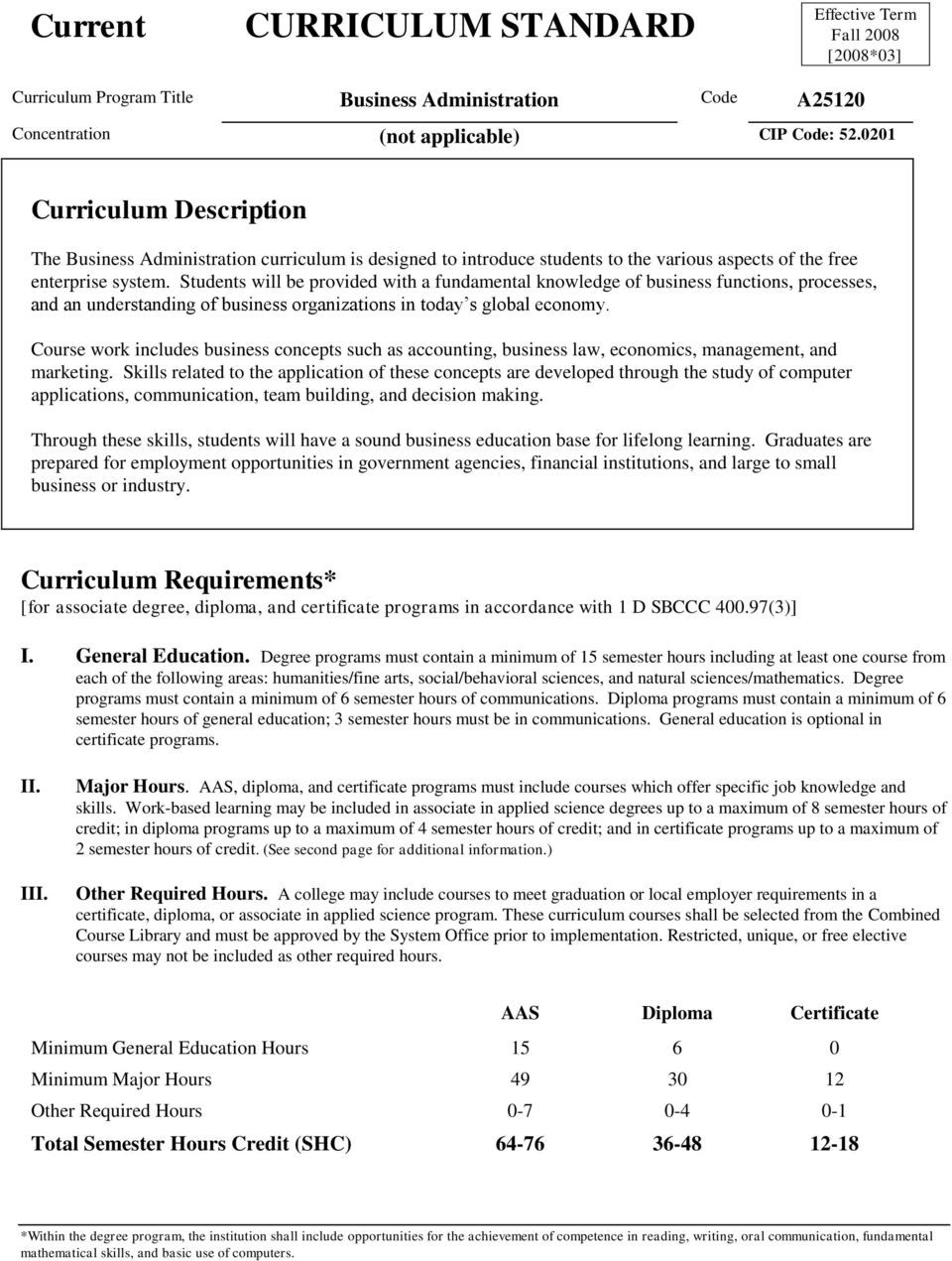
8 Current CURRICULUM STANDARD Effective Term Fall 2008 [2008*03] Curriculum Program Title Business Administration Code A25120 Concentration (not applicable) CIP Code: Curriculum Description The Business Administration curriculum is designed to introduce students to the various aspects of the free enterprise system. Students will be provided with a fundamental knowledge of business functions, processes, and an understanding of business organizations in today s global economy. Course work includes business concepts such as accounting, business law, economics, management, and marketing. Skills related to the application of these concepts are developed through the study of computer applications, communication, team building, and decision making. Through these skills, students will have a sound business education base for lifelong learning. Graduates are prepared for employment opportunities in government agencies, financial institutions, and large to small business or industry. Curriculum Requirements* [for associate degree, diploma, and certificate programs in accordance with 1 D SBCCC (3)] I. General Education. Degree programs must contain a minimum of 15 semester hours including at least one course from each of the following areas: humanities/fine arts, social/behavioral sciences, and natural sciences/mathematics. Degree programs must contain a minimum of 6 semester hours of communications. Diploma programs must contain a minimum of 6 semester hours of general education; 3 semester hours must be in communications. General education is optional in certificate programs. II. III. Major Hours. AAS, diploma, and certificate programs must include courses which offer specific job knowledge and skills. Work-based learning may be included in associate in applied science degrees up to a maximum of 8 semester hours of credit; in diploma programs up to a maximum of 4 semester hours of credit; and in certificate programs up to a maximum of 2 semester hours of credit. (See second page for additional information.) Other Required Hours. A college may include courses to meet graduation or local employer requirements in a certificate, diploma, or associate in applied science program. These curriculum courses shall be selected from the Combined Course Library and must be approved by the System Office prior to implementation. Restricted, unique, or free elective courses may not be included as other required hours. Minimum General Education Hours Minimum Major Hours Other Required Hours Total Semester Hours Credit (SHC) *Within the degree program, the institution shall include opportunities for the achievement of competence in reading, writing, oral communication, fundamental mathematical skills, and basic use of computers.
9 Current Major Hours [ref. 1 D SBCCC (3)] A. Core. The subject/course core is comprised of subject areas and/or specific courses which are required for each curriculum program. A diploma program offered under an approved AAS program standard or a certificate which is the highest credential level awarded under an approved AAS program standard must include a minimum of 12 semester hours credit derived from the subject/course core of the AAS program. B. Concentration (if applicable). A concentration of study must include a minimum of 12 semester hours credit from required subjects and/or courses. The majority of the course credit hours are unique to the concentration. The required subjects and/or courses that make up the concentration of study are in addition to the required subject/course core. C. Other Major Hours. Other major hours must be selected from prefixes listed on the curriculum standard. A maximum of 9 semester hours of credit may be selected from any prefix listed, with the exception of prefixes listed in the core or concentration. Work-based learning may be included in associate in applied science degrees up to a maximum of 8 semester hours of credit; in diploma programs up to a maximum of 4 semester hours of credit; and in certificate programs up to a maximum of 2 semester hours of credit. Business Administration A25120 Minimum Major Hours Required 49 SHC 30 SHC 12 SHC A. CORE Courses required for the diploma are designated with * Required Courses: * BUS 115 Business Law I * BUS 137 Principles of Management * MKT 120 Principles of Marketing SHC SHC Required Subject Areas: *Accounting. Select one: ACC 115 College Accounting ACC 120 Prin of Financial Acct *Economics. Select one: ECO 151 Survey of Economics ECO 251 Principles of Microeconomics ECO 252 Principles of Macroeconomic *Computer Applications. Select one: CIS 110 Introduction to Computers CIS 111 Basic PC Literacy 2 SHC OST 137 Office Software Applications B. CONCENTRATION (not applicable) C. OTHER MAJOR HOURS To be selected from the following prefixes: ACC, AIB, BAF, BAS, BUS, CIS, COE, CSC, CSV, CTS, DBA, ECM, ECO, EQU, ETR, HRM, INS, INT, ISC, LOG, MKT, OMT, OST, PAD, PMT, RLS, SST, *WBL, and WEB Up to three semester hour credits may be selected from the following prefixes: ARA, ASL, CHI, FRE, GER, ITA, JPN, LAT, POR, RUS and SPA. *WBL prefix will be available in fall Approved by the State Board of Community Colleges on November 13, 1996; Revised 07/17/98; Revised 09/26/00; Revised 03/22/02; Revised 04/24/02; SBCC Revised 05/17/02; SBCC Revised 11/15/02; CRC Revised 06/13/05; SBCC Revised 07/15/05; Revised 03/27/06; Revised 04/10/06; Revised 04/11/06; SBCC Revised 09/21/07; CRC Revised 03/27/08; SBCC Revised 10/17/08; Revised 12/16/08, Revised 10/08/10; Editorial Revision 06/18/13; Editorial Revision 10/14/13; Editorial Revision 11/22/13.

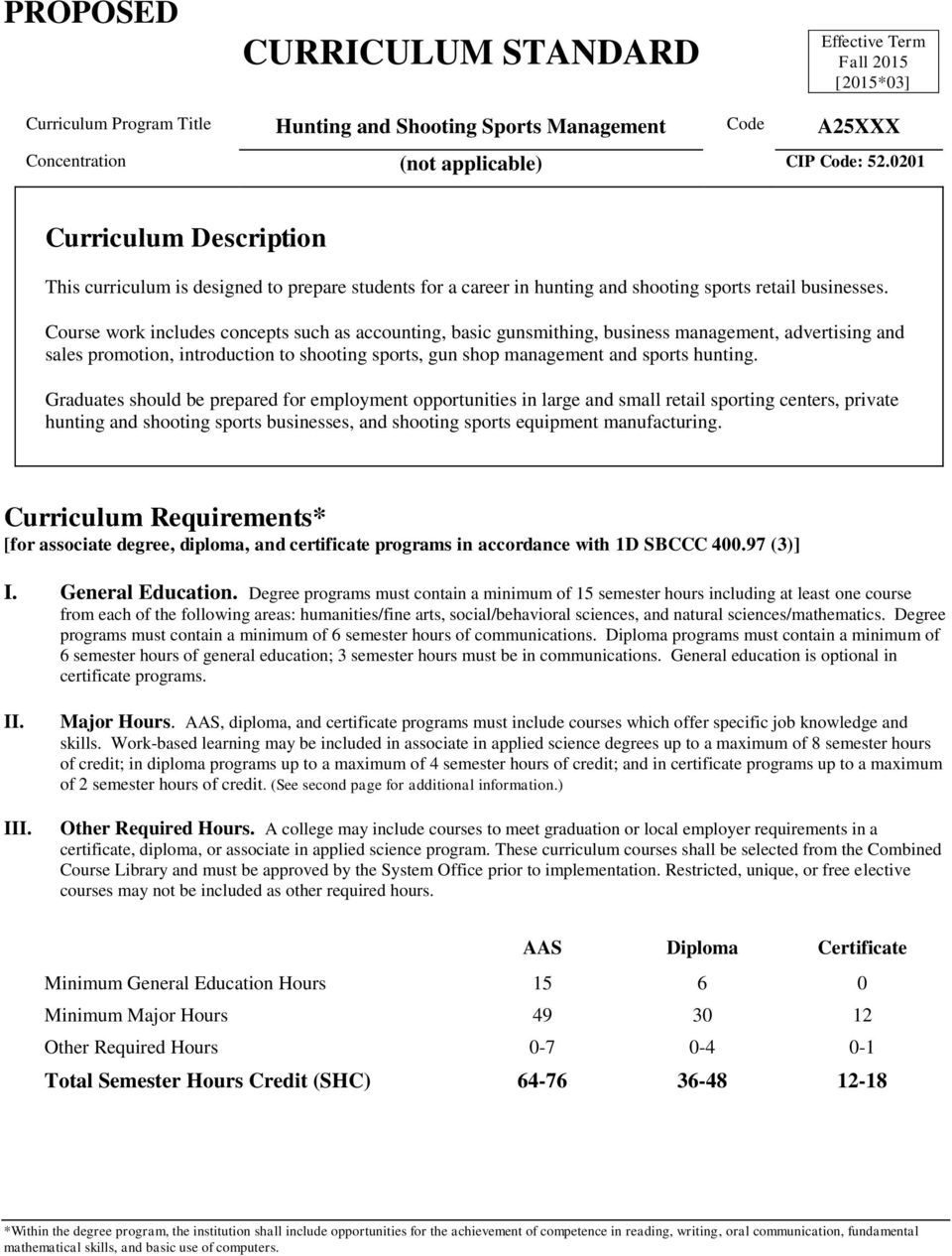
10 PROPOSED CURRICULUM STANDARD Effective Term Fall 2015 [2015*03] Curriculum Program Title Hunting and Shooting Sports Management Code A25XXX Concentration (not applicable) CIP Code: Curriculum Description This curriculum is designed to prepare students for a career in hunting and shooting sports retail businesses. Course work includes concepts such as accounting, basic gunsmithing, business management, advertising and sales promotion, introduction to shooting sports, gun shop management and sports hunting. Graduates should be prepared for employment opportunities in large and small retail sporting centers, private hunting and shooting sports businesses, and shooting sports equipment manufacturing. Curriculum Requirements* [for associate degree, diploma, and certificate programs in accordance with 1D SBCCC (3)] I. General Education. Degree programs must contain a minimum of 15 semester hours including at least one course from each of the following areas: humanities/fine arts, social/behavioral sciences, and natural sciences/mathematics. Degree programs must contain a minimum of 6 semester hours of communications. Diploma programs must contain a minimum of 6 semester hours of general education; 3 semester hours must be in communications. General education is optional in certificate programs. II. III. Major Hours. AAS, diploma, and certificate programs must include courses which offer specific job knowledge and skills. Work-based learning may be included in associate in applied science degrees up to a maximum of 8 semester hours of credit; in diploma programs up to a maximum of 4 semester hours of credit; and in certificate programs up to a maximum of 2 semester hours of credit. (See second page for additional information.) Other Required Hours. A college may include courses to meet graduation or local employer requirements in a certificate, diploma, or associate in applied science program. These curriculum courses shall be selected from the Combined Course Library and must be approved by the System Office prior to implementation. Restricted, unique, or free elective courses may not be included as other required hours. Minimum General Education Hours Minimum Major Hours Other Required Hours Total Semester Hours Credit (SHC) *Within the degree program, the institution shall include opportunities for the achievement of competence in reading, writing, oral communication, fundamental mathematical skills, and basic use of computers.
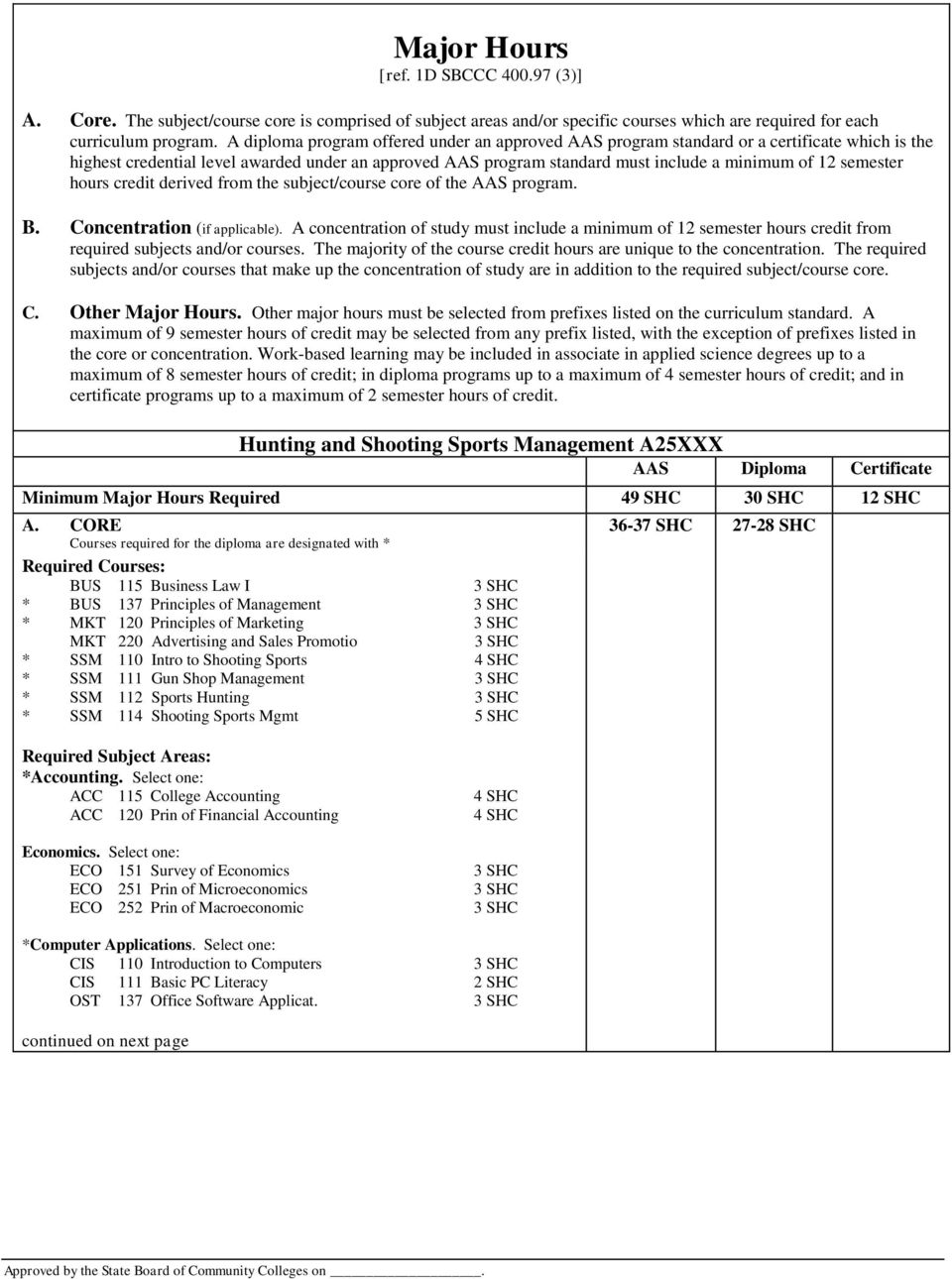
11 Major Hours [ref. 1D SBCCC (3)] A. Core. The subject/course core is comprised of subject areas and/or specific courses which are required for each curriculum program. A diploma program offered under an approved AAS program standard or a certificate which is the highest credential level awarded under an approved AAS program standard must include a minimum of 12 semester hours credit derived from the subject/course core of the AAS program. B. Concentration (if applicable). A concentration of study must include a minimum of 12 semester hours credit from required subjects and/or courses. The majority of the course credit hours are unique to the concentration. The required subjects and/or courses that make up the concentration of study are in addition to the required subject/course core. C. Other Major Hours. Other major hours must be selected from prefixes listed on the curriculum standard. A maximum of 9 semester hours of credit may be selected from any prefix listed, with the exception of prefixes listed in the core or concentration. Work-based learning may be included in associate in applied science degrees up to a maximum of 8 semester hours of credit; in diploma programs up to a maximum of 4 semester hours of credit; and in certificate programs up to a maximum of 2 semester hours of credit. Hunting and Shooting Sports Management A25XXX Minimum Major Hours Required 49 SHC 30 SHC 12 SHC A. CORE Courses required for the diploma are designated with * Required Courses: BUS 115 Business Law I * BUS 137 Principles of Management * MKT 120 Principles of Marketing MKT 220 Advertising and Sales Promotio * SSM 110 Intro to Shooting Sports * SSM 111 Gun Shop Management * SSM 112 Sports Hunting * SSM 114 Shooting Sports Mgmt 5 SHC SHC SHC Required Subject Areas: *Accounting. Select one: ACC 115 College Accounting ACC 120 Prin of Financial Accounting Economics. Select one: ECO 151 Survey of Economics ECO 251 Prin of Microeconomics ECO 252 Prin of Macroeconomic *Computer Applications. Select one: CIS 110 Introduction to Computers CIS 111 Basic PC Literacy 2 SHC OST 137 Office Software Applicat. continued on next page Approved by the State Board of Community Colleges on.
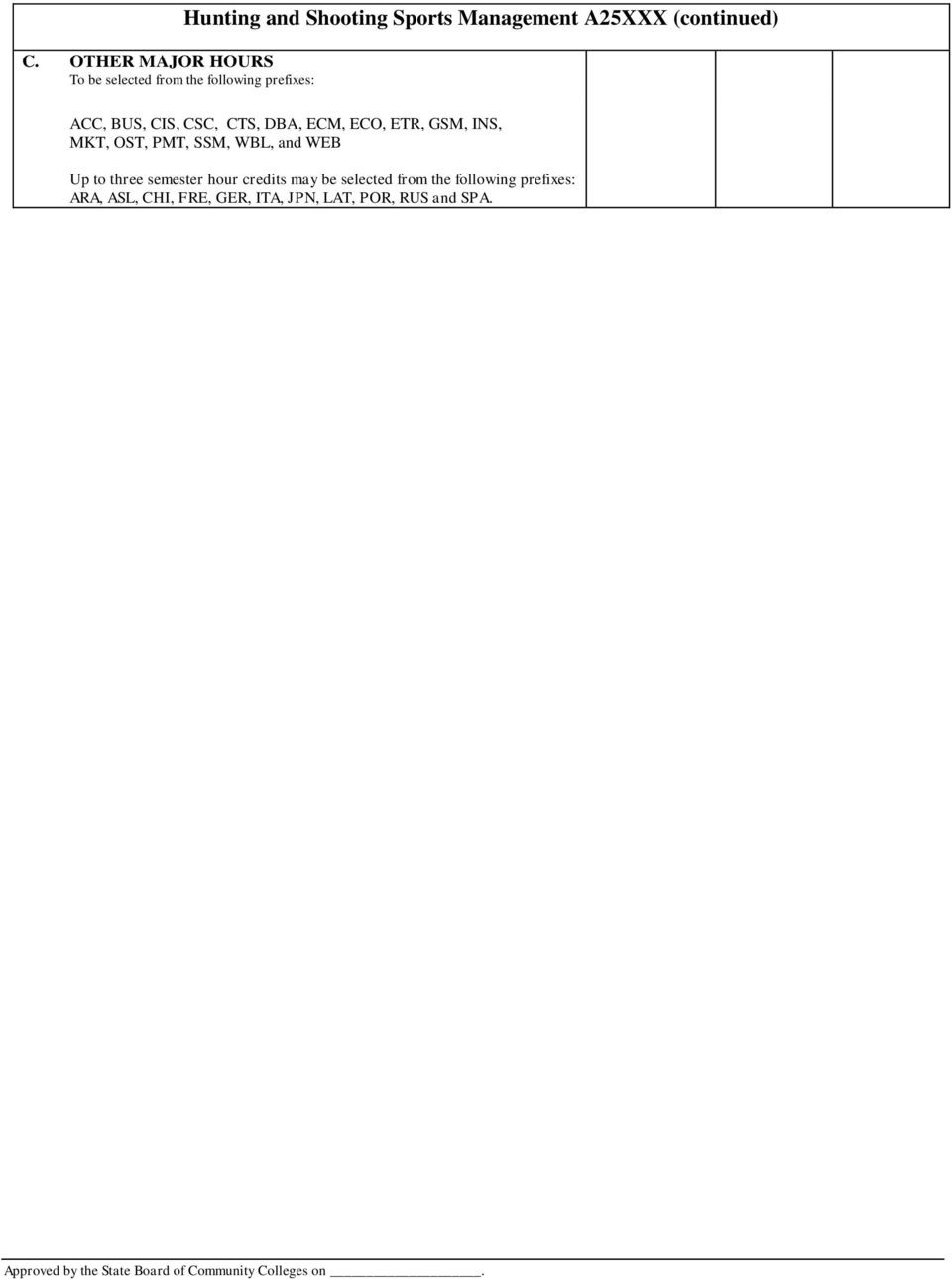
12 C. OTHER MAJOR HOURS To be selected from the following prefixes: Hunting and Shooting Sports Management A25XXX (continued) ACC, BUS, CIS, CSC, CTS, DBA, ECM, ECO, ETR, GSM, INS, MKT, OST, PMT, SSM, WBL, and WEB Up to three semester hour credits may be selected from the following prefixes: ARA, ASL, CHI, FRE, GER, ITA, JPN, LAT, POR, RUS and SPA. Approved by the State Board of Community Colleges on.
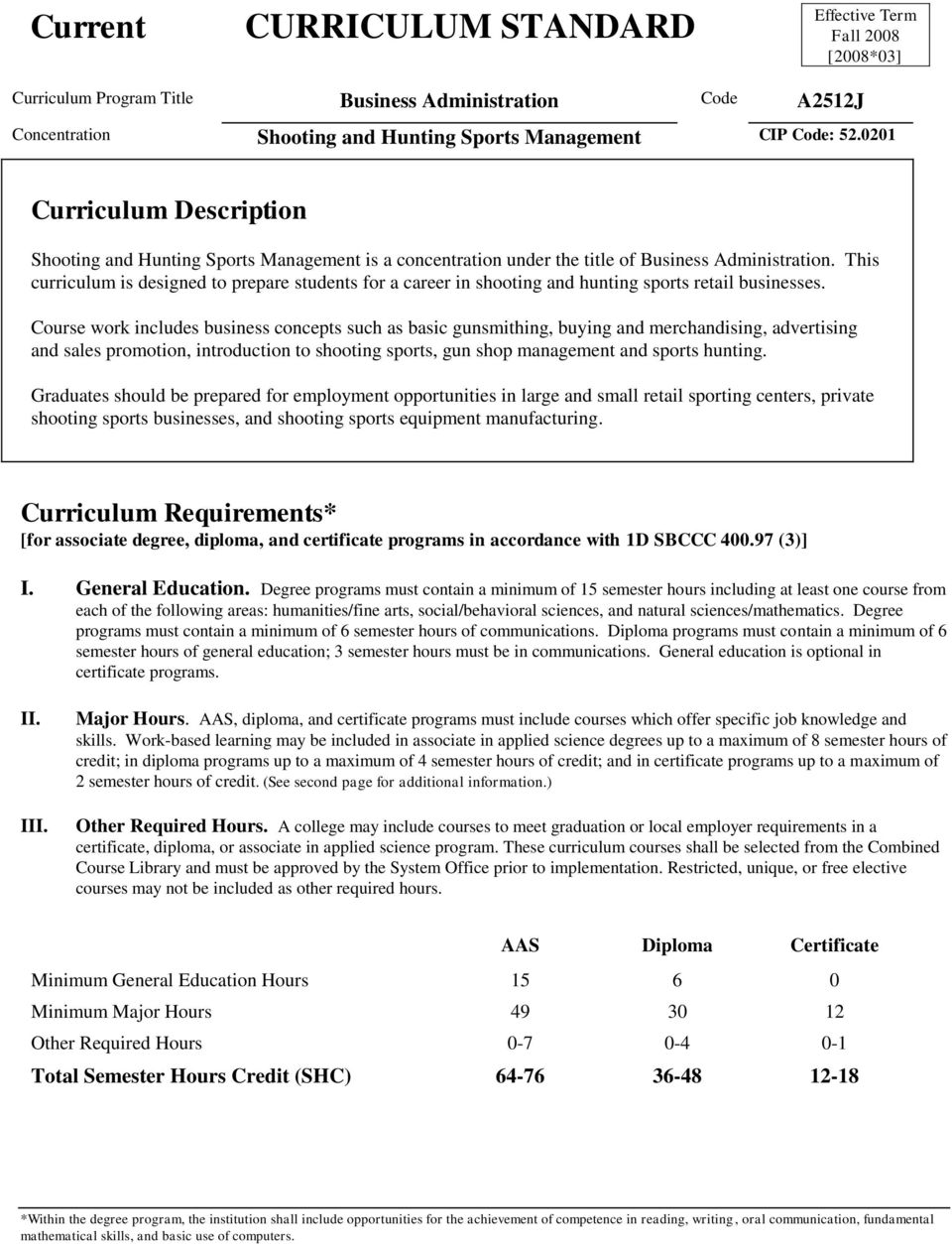
13 Current CURRICULUM STANDARD Effective Term Fall 2008 [2008*03] Curriculum Program Title Business Administration Code A2512J Concentration Shooting and Hunting Sports Management CIP Code: Curriculum Description Shooting and Hunting Sports Management is a concentration under the title of Business Administration. This curriculum is designed to prepare students for a career in shooting and hunting sports retail businesses. Course work includes business concepts such as basic gunsmithing, buying and merchandising, advertising and sales promotion, introduction to shooting sports, gun shop management and sports hunting. Graduates should be prepared for employment opportunities in large and small retail sporting centers, private shooting sports businesses, and shooting sports equipment manufacturing. Curriculum Requirements* [for associate degree, diploma, and certificate programs in accordance with 1D SBCCC (3)] I. General Education. Degree programs must contain a minimum of 15 semester hours including at least one course from each of the following areas: humanities/fine arts, social/behavioral sciences, and natural sciences/mathematics. Degree programs must contain a minimum of 6 semester hours of communications. Diploma programs must contain a minimum of 6 semester hours of general education; 3 semester hours must be in communications. General education is optional in certificate programs. II. III. Major Hours. AAS, diploma, and certificate programs must include courses which offer specific job knowledge and skills. Work-based learning may be included in associate in applied science degrees up to a maximum of 8 semester hours of credit; in diploma programs up to a maximum of 4 semester hours of credit; and in certificate programs up to a maximum of 2 semester hours of credit. (See second page for additional information.) Other Required Hours. A college may include courses to meet graduation or local employer requirements in a certificate, diploma, or associate in applied science program. These curriculum courses shall be selected from the Combined Course Library and must be approved by the System Office prior to implementation. Restricted, unique, or free elective courses may not be included as other required hours. Minimum General Education Hours Minimum Major Hours Other Required Hours Total Semester Hours Credit (SHC) *Within the degree program, the institution shall include opportunities for the achievement of competence in reading, writing, oral communication, fundamental mathematical skills, and basic use of computers.
14 Current Major Hours [ref. 1D SBCCC (3)] A. Core. The subject/course core is comprised of subject areas and/or specific courses which are required for each curriculum program. A diploma program offered under an approved AAS program standard or a certificate which is the highest credential level awarded under an approved AAS program standard must include a minimum of 12 semester hours credit derived from the subject/course core of the AAS program. B. Concentration (if applicable). A concentration of study must include a minimum of 12 semester hours credit from required subjects and/or courses. The majority of the course credit hours are unique to the concentration. The required subjects and/or courses that make up the concentration of study are in addition to the required subject/course core. C. Other Major Hours. Other major hours must be selected from prefixes listed on the curriculum standard. A maximum of 9 semester hours of credit may be selected from any prefix listed, with the exception of prefixes listed in the core or concentration. Work-based learning may be included in associate in applied science degrees up to a maximum of 8 semester hours of credit; in diploma programs up to a maximum of 4 semester hours of credit; and in certificate programs up to a maximum of 2 semester hours of credit. Business Administration/Shooting and Hunting Sports Management A2512J Minimum Major Hours Required 49 SHC 30 SHC 12 SHC A. CORE Courses required for the diploma are designated with * Required Courses: * BUS 115 Business Law I * BUS 137 Principles of Management * MKT 120 Principles of Marketing Required Subject Areas: *Accounting. Select one: ACC 115 College Accounting ACC 120 Prin of Financial Acct *Economics. Select one: ECO 151 Survey of Economics ECO 251 Principles of Microeconomics ECO 252 Principles of Macroeconomic *Computer Applications. Select one: CIS 110 Introduction to Computers CIS 111 Basic PC Literacy 2 SHC OST 137 Office Software Applications B. CONCENTRATION (not applicable) Courses unique to the concentration are designated with ** MKT 125 Buying and Merchandising MKT 220 Advertising and Sales Promotion ** SSM 110 Introduction to Shooting Sports ** SSM 111 Gun Shop Management ** SSM 112 Sports Hunting ** SSM 114 Shooting Sports Mgt 5 SHC C. OTHER MAJOR HOURS To be selected from the following prefixes: ACC, BUS, CIS, COE, CSC, CTS, DBA, ECM, ECO, GSM, INS, MKT, OST, PMT, SSM, *WBL, and WEB Up to three semester hour credits may be selected from the following prefixes: ARA, ASL, CHI, FRE, GER, ITA, JPN, LAT, POR, RUS and SPA. *WBL prefix will be available in fall SHC SHC 21 SHC Approved by the State Board of Community Colleges on March 16, 2007; Corrected 06/21/07; CRC Revised 03/27/08; SBCC Template Revised 10/17/08; Revised 12/16/08.

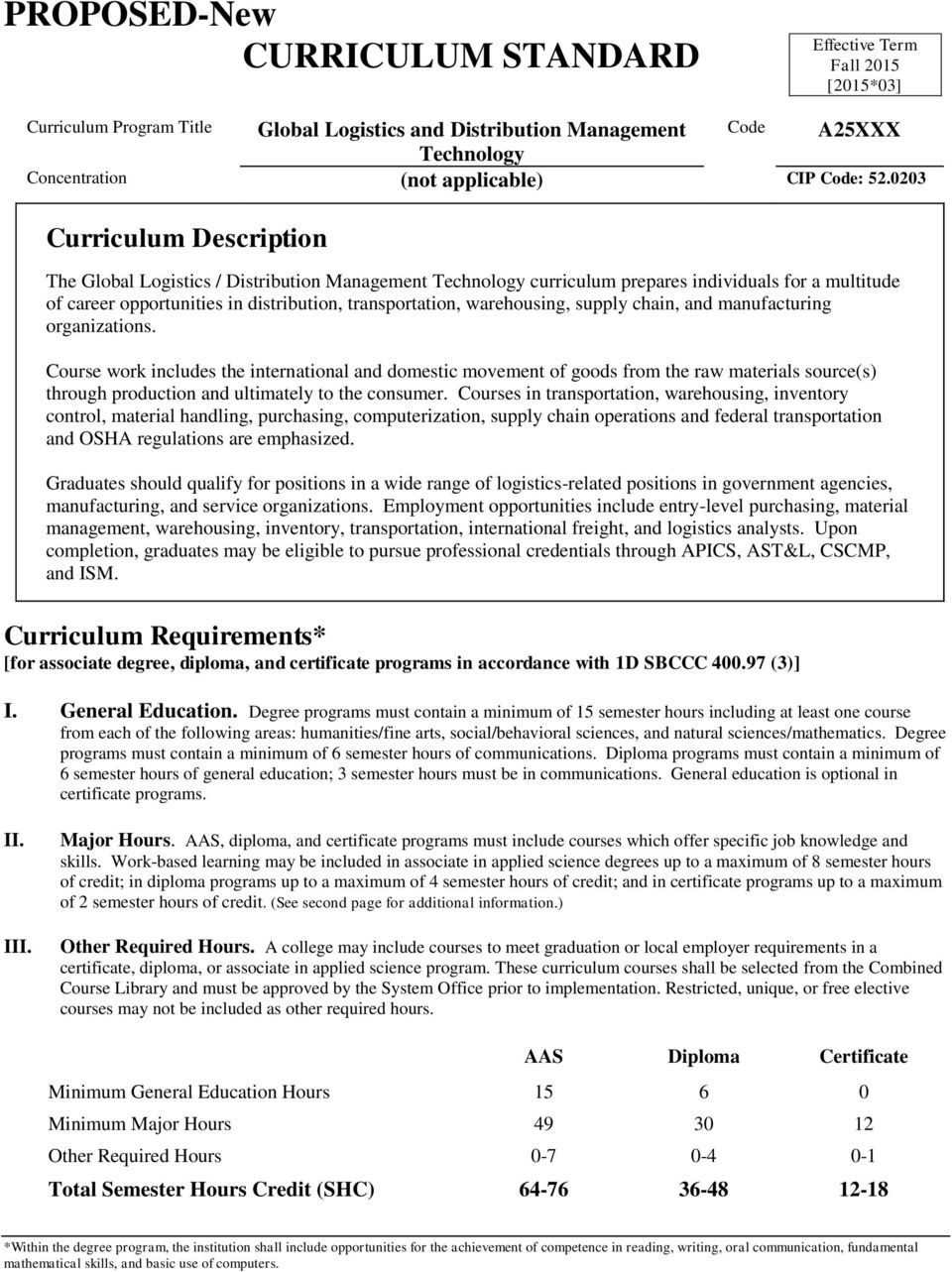
15 PROPOSED-New CURRICULUM STANDARD Effective Term Fall 2015 [2015*03] Curriculum Program Title Global Logistics and Distribution Management Code A25XXX Concentration Technology (not applicable) CIP Code: Curriculum Description The Global Logistics / Distribution Management Technology curriculum prepares individuals for a multitude of career opportunities in distribution, transportation, warehousing, supply chain, and manufacturing organizations. Course work includes the international and domestic movement of goods from the raw materials source(s) through production and ultimately to the consumer. Courses in transportation, warehousing, inventory control, material handling, purchasing, computerization, supply chain operations and federal transportation and OSHA regulations are emphasized. Graduates should qualify for positions in a wide range of logistics-related positions in government agencies, manufacturing, and service organizations. Employment opportunities include entry-level purchasing, material management, warehousing, inventory, transportation, international freight, and logistics analysts. Upon completion, graduates may be eligible to pursue professional credentials through APICS, AST&L, CSCMP, and ISM. Curriculum Requirements* [for associate degree, diploma, and certificate programs in accordance with 1D SBCCC (3)] I. General Education. Degree programs must contain a minimum of 15 semester hours including at least one course from each of the following areas: humanities/fine arts, social/behavioral sciences, and natural sciences/mathematics. Degree programs must contain a minimum of 6 semester hours of communications. Diploma programs must contain a minimum of 6 semester hours of general education; 3 semester hours must be in communications. General education is optional in certificate programs. II. III. Major Hours. AAS, diploma, and certificate programs must include courses which offer specific job knowledge and skills. Work-based learning may be included in associate in applied science degrees up to a maximum of 8 semester hours of credit; in diploma programs up to a maximum of 4 semester hours of credit; and in certificate programs up to a maximum of 2 semester hours of credit. (See second page for additional information.) Other Required Hours. A college may include courses to meet graduation or local employer requirements in a certificate, diploma, or associate in applied science program. These curriculum courses shall be selected from the Combined Course Library and must be approved by the System Office prior to implementation. Restricted, unique, or free elective courses may not be included as other required hours. Minimum General Education Hours Minimum Major Hours Other Required Hours Total Semester Hours Credit (SHC) *Within the degree program, the institution shall include opportunities for the achievement of competence in reading, writing, oral communication, fundamental mathematical skills, and basic use of computers.
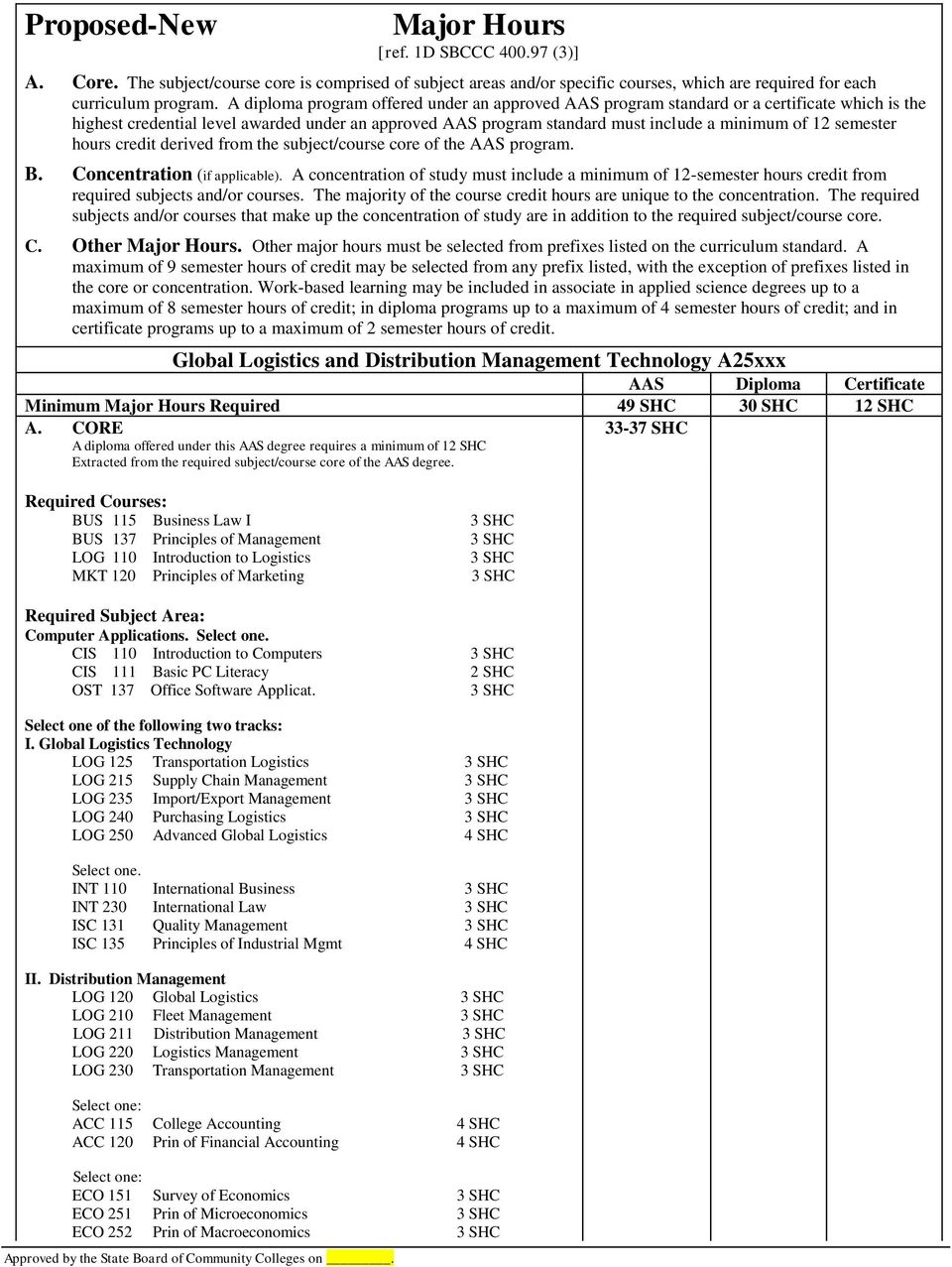
16 Proposed-New Approved by the State Board of Community Colleges on. Major Hours [ref. 1D SBCCC (3)] A. Core. The subject/course core is comprised of subject areas and/or specific courses, which are required for each curriculum program. A diploma program offered under an approved AAS program standard or a certificate which is the highest credential level awarded under an approved AAS program standard must include a minimum of 12 semester hours credit derived from the subject/course core of the AAS program. B. Concentration (if applicable). A concentration of study must include a minimum of 12-semester hours credit from required subjects and/or courses. The majority of the course credit hours are unique to the concentration. The required subjects and/or courses that make up the concentration of study are in addition to the required subject/course core. C. Other Major Hours. Other major hours must be selected from prefixes listed on the curriculum standard. A maximum of 9 semester hours of credit may be selected from any prefix listed, with the exception of prefixes listed in the core or concentration. Work-based learning may be included in associate in applied science degrees up to a maximum of 8 semester hours of credit; in diploma programs up to a maximum of 4 semester hours of credit; and in certificate programs up to a maximum of 2 semester hours of credit. Global Logistics and Distribution Management Technology A25xxx Minimum Major Hours Required 49 SHC 30 SHC 12 SHC A. CORE A diploma offered under this AAS degree requires a minimum of 12 SHC Extracted from the required subject/course core of the AAS degree SHC Required Courses: BUS 115 Business Law I BUS 137 Principles of Management LOG 110 Introduction to Logistics MKT 120 Principles of Marketing Required Subject Area: Computer Applications. Select one. CIS 110 Introduction to Computers CIS 111 Basic PC Literacy 2 SHC OST 137 Office Software Applicat. Select one of the following two tracks: I. Global Logistics Technology LOG 125 Transportation Logistics LOG 215 Supply Chain Management LOG 235 Import/Export Management LOG 240 Purchasing Logistics LOG 250 Advanced Global Logistics Select one. INT 110 International Business INT 230 International Law ISC 131 Quality Management ISC 135 Principles of Industrial Mgmt II. Distribution Management LOG 120 Global Logistics LOG 210 Fleet Management LOG 211 Distribution Management LOG 220 Logistics Management LOG 230 Transportation Management Select one: ACC 115 College Accounting ACC 120 Prin of Financial Accounting Select one: ECO 151 Survey of Economics ECO 251 Prin of Microeconomics ECO 252 Prin of Macroeconomics
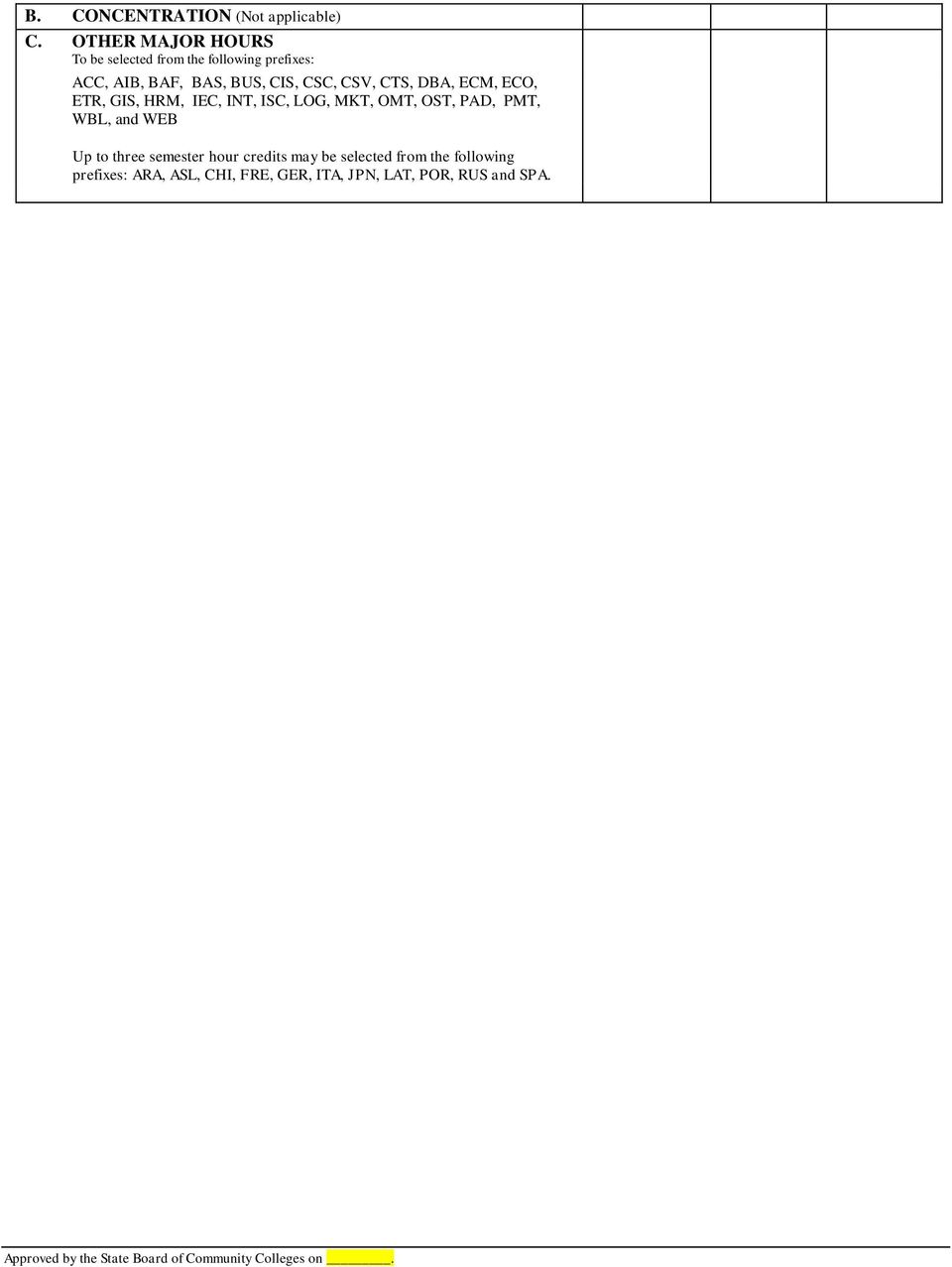
17 B. CONCENTRATION (Not applicable) C. OTHER MAJOR HOURS To be selected from the following prefixes: ACC, AIB, BAF, BAS, BUS, CIS, CSC, CSV, CTS, DBA, ECM, ECO, ETR, GIS, HRM, IEC, INT, ISC, LOG, MKT, OMT, OST, PAD, PMT, WBL, and WEB Up to three semester hour credits may be selected from the following prefixes: ARA, ASL, CHI, FRE, GER, ITA, JPN, LAT, POR, RUS and SPA. Approved by the State Board of Community Colleges on.
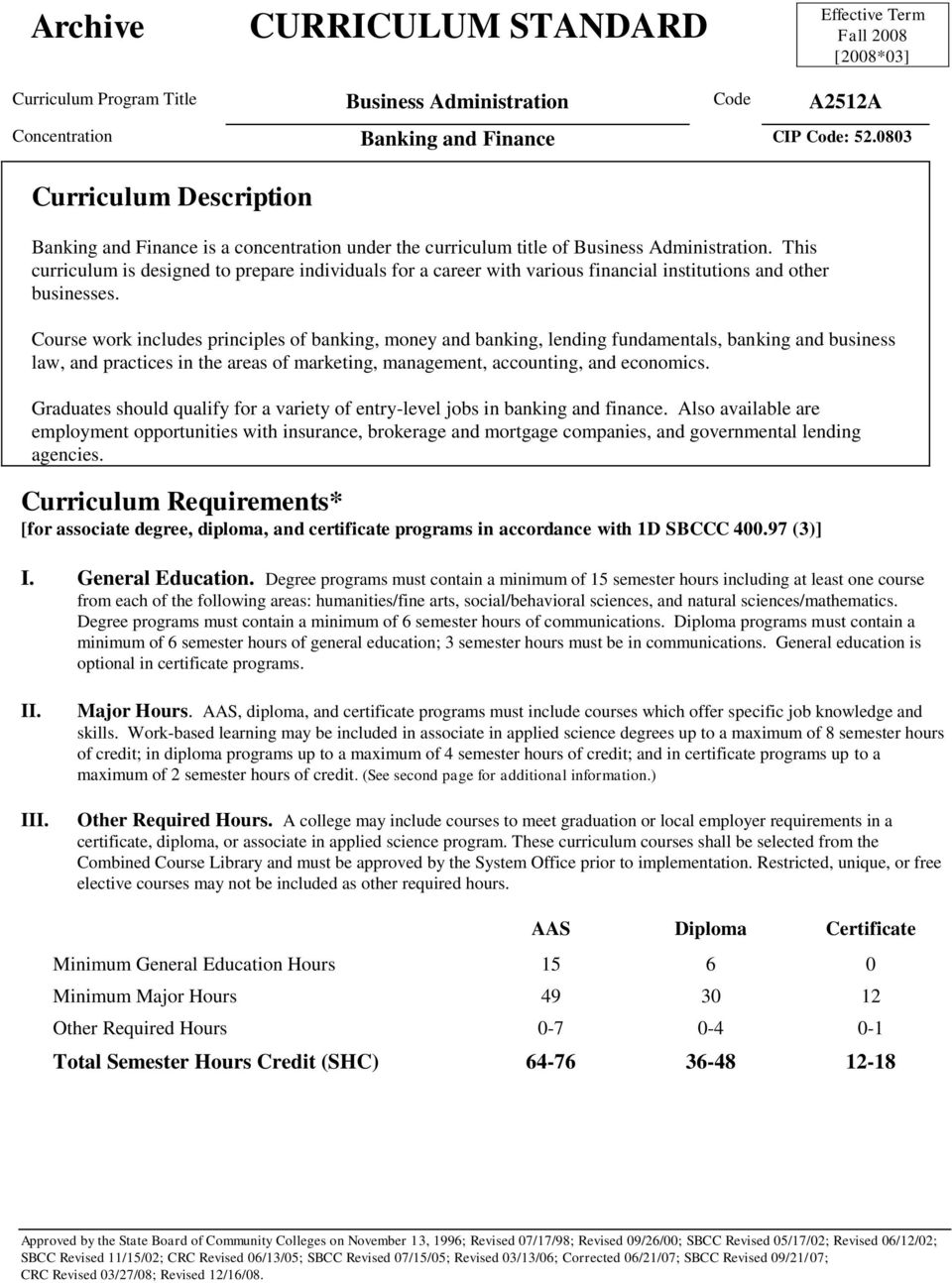
18 Archive CURRICULUM STANDARD Effective Term Fall 2008 [2008*03] Curriculum Program Title Business Administration Code A2512A Concentration Banking and Finance CIP Code: Curriculum Description Banking and Finance is a concentration under the curriculum title of Business Administration. This curriculum is designed to prepare individuals for a career with various financial institutions and other businesses. Course work includes principles of banking, money and banking, lending fundamentals, banking and business law, and practices in the areas of marketing, management, accounting, and economics. Graduates should qualify for a variety of entry-level jobs in banking and finance. Also available are employment opportunities with insurance, brokerage and mortgage companies, and governmental lending agencies. Curriculum Requirements* [for associate degree, diploma, and certificate programs in accordance with 1D SBCCC (3)] I. General Education. Degree programs must contain a minimum of 15 semester hours including at least one course from each of the following areas: humanities/fine arts, social/behavioral sciences, and natural sciences/mathematics. Degree programs must contain a minimum of 6 semester hours of communications. Diploma programs must contain a minimum of 6 semester hours of general education; 3 semester hours must be in communications. General education is optional in certificate programs. II. III. Major Hours. AAS, diploma, and certificate programs must include courses which offer specific job knowledge and skills. Work-based learning may be included in associate in applied science degrees up to a maximum of 8 semester hours of credit; in diploma programs up to a maximum of 4 semester hours of credit; and in certificate programs up to a maximum of 2 semester hours of credit. (See second page for additional information.) Other Required Hours. A college may include courses to meet graduation or local employer requirements in a certificate, diploma, or associate in applied science program. These curriculum courses shall be selected from the Combined Course Library and must be approved by the System Office prior to implementation. Restricted, unique, or free elective courses may not be included as other required hours. Minimum General Education Hours Minimum Major Hours Other Required Hours Total Semester Hours Credit (SHC) Approved by the State Board of Community Colleges on November 13, 1996; Revised 07/17/98; Revised 09/26/00; SBCC Revised 05/17/02; Revised 06/12/02; SBCC Revised 11/15/02; CRC Revised 06/13/05; SBCC Revised 07/15/05; Revised 03/13/06; Corrected 06/21/07; SBCC Revised 09/21/07; CRC Revised 03/27/08; Revised 12/16/08.
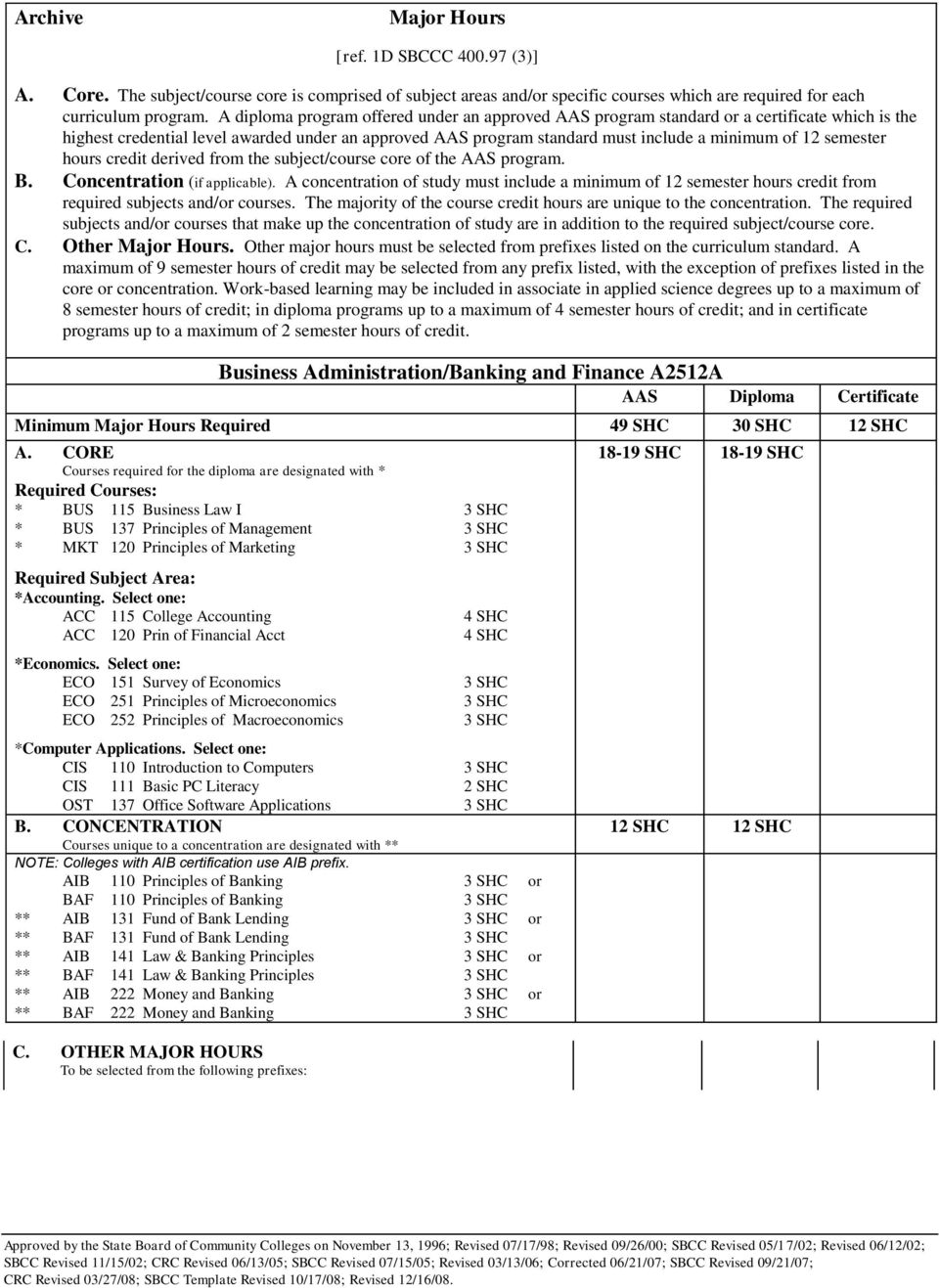
19 Archive Major Hours [ref. 1D SBCCC (3)] A. Core. The subject/course core is comprised of subject areas and/or specific courses which are required for each curriculum program. A diploma program offered under an approved AAS program standard or a certificate which is the highest credential level awarded under an approved AAS program standard must include a minimum of 12 semester hours credit derived from the subject/course core of the AAS program. B. Concentration (if applicable). A concentration of study must include a minimum of 12 semester hours credit from required subjects and/or courses. The majority of the course credit hours are unique to the concentration. The required subjects and/or courses that make up the concentration of study are in addition to the required subject/course core. C. Other Major Hours. Other major hours must be selected from prefixes listed on the curriculum standard. A maximum of 9 semester hours of credit may be selected from any prefix listed, with the exception of prefixes listed in the core or concentration. Work-based learning may be included in associate in applied science degrees up to a maximum of 8 semester hours of credit; in diploma programs up to a maximum of 4 semester hours of credit; and in certificate programs up to a maximum of 2 semester hours of credit. Business Administration/Banking and Finance A2512A Minimum Major Hours Required 49 SHC 30 SHC 12 SHC A. CORE Courses required for the diploma are designated with * Required Courses: * BUS 115 Business Law I * BUS 137 Principles of Management * MKT 120 Principles of Marketing Required Subject Area: *Accounting. Select one: ACC 115 College Accounting ACC 120 Prin of Financial Acct *Economics. Select one: ECO 151 Survey of Economics ECO 251 Principles of Microeconomics ECO 252 Principles of Macroeconomics *Computer Applications. Select one: CIS 110 Introduction to Computers CIS 111 Basic PC Literacy 2 SHC OST 137 Office Software Applications B. CONCENTRATION Courses unique to a concentration are designated with ** NOTE: Colleges with AIB certification use AIB prefix. AIB 110 Principles of Banking or BAF 110 Principles of Banking ** AIB 131 Fund of Bank Lending or ** BAF 131 Fund of Bank Lending ** AIB 141 Law & Banking Principles or ** BAF 141 Law & Banking Principles ** AIB 222 Money and Banking or ** BAF 222 Money and Banking C. OTHER MAJOR HOURS To be selected from the following prefixes: SHC SHC 12 SHC 12 SHC Approved by the State Board of Community Colleges on November 13, 1996; Revised 07/17/98; Revised 09/26/00; SBCC Revised 05/17/02; Revised 06/12/02; SBCC Revised 11/15/02; CRC Revised 06/13/05; SBCC Revised 07/15/05; Revised 03/13/06; Corrected 06/21/07; SBCC Revised 09/21/07; CRC Revised 03/27/08; SBCC Template Revised 10/17/08; Revised 12/16/08.
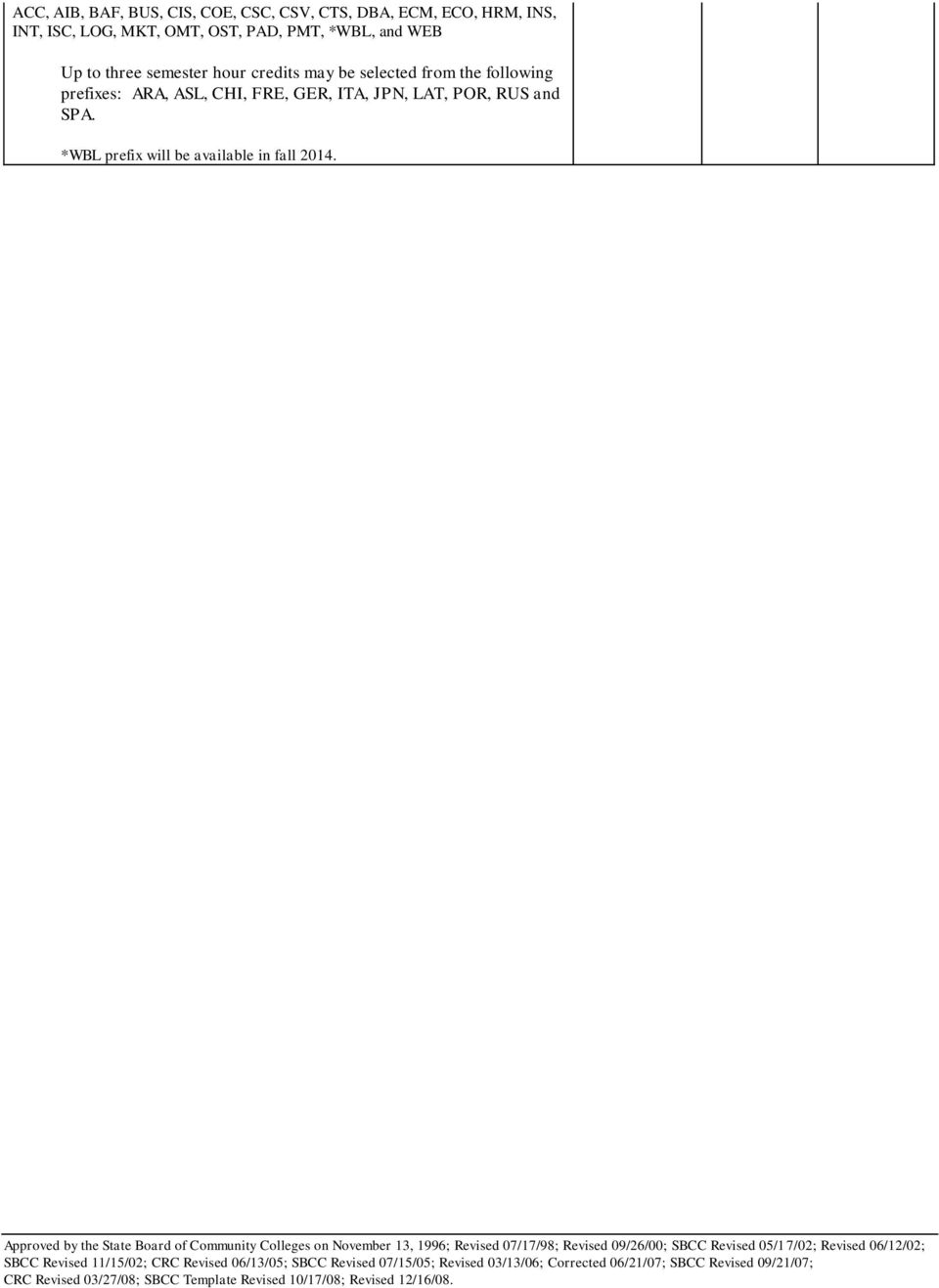
20 ACC, AIB, BAF, BUS, CIS, COE, CSC, CSV, CTS, DBA, ECM, ECO, HRM, INS, INT, ISC, LOG, MKT, OMT, OST, PAD, PMT, *WBL, and WEB Up to three semester hour credits may be selected from the following prefixes: ARA, ASL, CHI, FRE, GER, ITA, JPN, LAT, POR, RUS and SPA. *WBL prefix will be available in fall Approved by the State Board of Community Colleges on November 13, 1996; Revised 07/17/98; Revised 09/26/00; SBCC Revised 05/17/02; Revised 06/12/02; SBCC Revised 11/15/02; CRC Revised 06/13/05; SBCC Revised 07/15/05; Revised 03/13/06; Corrected 06/21/07; SBCC Revised 09/21/07; CRC Revised 03/27/08; SBCC Template Revised 10/17/08; Revised 12/16/08.
21 Archive CURRICULUM STANDARD Effective Term Fall 2008 [2008*03] Curriculum Program Title Business Administration Code A2512B Concentration Customer Service CIP Code: Curriculum Description Customer Service is a concentration under the curriculum title of Business Administration. This curriculum provides a broad foundation of communication and interpersonal skills designed to prepare the individual for customer contact roles within a business organization. Emphasized are concepts in retailing, credit and collections, resolving customer complaints, service followup, consumer law, and consumer behavior. Concepts include communicating effectively, using interpersonal skills, establishing credit worthiness, analyzing common accounting financial and credit documents, and operating a computer. Employment opportunities include customer services representative, customer services manager, consumer relations, credit analyst, credit card specialist, credit and collection specialist, retail sales, accounts control analyst, administrative assistant, authorizations analyst, and telephone sales representative in both serviceand production-oriented businesses. Curriculum Requirements* [for associate degree, diploma, and certificate programs in accordance with 1D SBCCC (3)] I. General Education. Degree programs must contain a minimum of 15 semester hours including at least one course from each of the following areas: humanities/fine arts, social/behavioral sciences, and natural sciences/mathematics. Degree programs must contain a minimum of 6 semester hours of communications. Diploma programs must contain a minimum of 6 semester hours of general education; 3 semester hours must be in communications. General education is optional in certificate programs. II. III. Major Hours. AAS, diploma, and certificate programs must include courses which offer specific job knowledge and skills. Work-based learning may be included in associate in applied science degrees up to a maximum of 8 semester hours of credit; in diploma programs up to a maximum of 4 semester hours of credit; and in certificate programs up to a maximum of 2 semester hours of credit. (See second page for additional information.) Other Required Hours. A college may include courses to meet graduation or local employer requirements in a certificate, diploma, or associate in applied science program. These curriculum courses shall be selected from the Combined Course Library and must be approved by the System Office prior to implementation. Restricted, unique, or free elective courses may not be included as other required hours. Minimum General Education Hours Minimum Major Hours Other Required Hours Total Semester Hours Credit (SHC) *Within the degree program, the institution shall include opportunities for the achievement of competence in reading, writing, oral communication, fundamental mathematical skills, and basic use of computers.
22 Archive Major Hours [ref. 1D SBCCC (3)] A. Core. The subject/course core is comprised of subject areas and/or specific courses which are required for each curriculum program. A diploma program offered under an approved AAS program standard or a certificate which is the highest credential level awarded under an approved AAS program standard must include a minimum of 12 semester hours credit derived from the subject/course core of the AAS program. B. Concentration (if applicable). A concentration of study must include a minimum of 12 semester hours credit from required subjects and/or courses. The majority of the course credit hours are unique to the concentration. The required subjects and/or courses that make up the concentration of study are in addition to the required subject/course core. C. Other Major Hours. Other major hours must be selected from prefixes listed on the curriculum standard. A maximum of 9 semester hours of credit may be selected from any prefix listed, with the exception of prefixes listed in the core or concentration. Work-based may be included in associate in applied science degrees up to a maximum of 8 semester hours of credit; in diploma programs up to a maximum of 4 semester hours of credit; and in certificate programs up to a maximum of 2 semester hours of credit. Business Administration/Customer Service A2512B Minimum Major Hours Required 49 SHC 30 SHC 12 SHC A. CORE Courses required for the diploma are designated with * Required Courses: * BUS 115 Business Law I * BUS 137 Principles of Management * x MKT 120 Principles of Marketing Required Subject Area: *Accounting. Select one: ACC 115 College Accounting ACC 120 Prin of Financial Acct x *Economics. Select one: ECO 151 Survey of Economics ECO 251 Principles of Microeconomics x ECO 252 Principles of Macroeconomics *Computer Applications. Select one: CIS 110 Introduction to Computers CIS 111 Basic PC Literacy 2 SHC OST 137 Office Software Applications B. x CONCENTRATION Courses unique to a concentration are designated with ** ** CSV 110 Introduction to Customer Service ** CSV 210 Advanced Customer Service CSV 220 Consumer Credit ** CSV 221 Letters of Credit MKT 222 Credit Procedures C. OTHER MAJOR HOURS To be selected from the following prefixes: ACC, AIB, BAF, BUS, CIS, COE, CSC, CSV, CTS, DBA, ECM, ECO, INS, INT, ISC, LOG, HRM, MKT, OMT, OST, PAD, PMT, *WBL, and WEB Up to three semester hour credits may be selected from the following prefixes: ARA, ASL, CHI, FRE, GER, ITA, JPN, LAT, POR, RUS and SPA. *WBL prefix will be available in fall SHC SHC 15 SHC 12 SHC Approved by the State Board of Community Colleges on November 13, 1996; Revised 07/17/98, 09/26/00; SBCC Revised 05/17/02; Revised 06/12/02; SBCC Revised 11/15/02; CRC Revised 06/13/05; SBCC Revised 07/15/05; Revised 03/13/06; Corrected 06/21/07; CRC Revised 03/27/08; SBCC Template Revised 10/17/08; Revised 12/16/08.
23 Archive CURRICULUM STANDARD Effective Term Fall 2008 [2008*03] Curriculum Program Title Business Administration Code A2512C Concentration Human Resources Management CIP Code: Curriculum Description Human Resources Management is a concentration under the curriculum title of Business Administration. The curriculum is designed to meet the demands of business and service agencies. The objective is the development of generalists and specialists in the administration, training, and management of human resources. Course work includes studies in management, interviewing, placement, needs assessment, planning, compensation and benefits, and training techniques. Also included are topics such as people skills, learning approaches, skills building, and development of instructional and training materials. Graduates from this program will have a sound business educational base for life-long learning. Students will be prepared for employment opportunities in personnel, training, and other human resources development areas. Curriculum Requirements* [for associate degree, diploma, and certificate programs in accordance with 1D SBCCC (3)] I. General Education. Degree programs must contain a minimum of 15 semester hours including at least one course from each of the following areas: humanities/fine arts, social/behavioral sciences, and natural sciences/mathematics. Degree programs must contain a minimum of 6 semester hours of communications. Diploma programs must contain a minimum of 6 semester hours of general education; 3 semester hours must be in communications. General education is optional in certificate programs. II. III. Major Hours. AAS, diploma, and certificate programs must include courses which offer specific job knowledge and skills. Work-based learning may be included in associate in applied science degrees up to a maximum of 8 semester hours of credit; in diploma programs up to a maximum of 4 semester hours of credit; and in certificate programs up to a maximum of 2 semester hours of credit. (See second page for additional information.) Other Required Hours. A college may include courses to meet graduation or local employer requirements in a certificate, diploma, or associate in applied science program. These curriculum courses shall be selected from the Combined Course Library and must be approved by the System Office prior to implementation. Restricted, unique, or free elective courses may not be included as other required hours. Minimum General Education Hours Minimum Major Hours Other Required Hours Total Semester Hours Credit (SHC) *Within the degree program, the institution shall include opportunities for the achievement of competence in reading, writing, oral communication, fundamental mathematical skills, and basic use of computers.
24 Archive Major Hours [ref. 1D SBCCC (3)] A. Core. The subject/course core is comprised of subject areas and/or specific courses which are required for each curriculum program. A diploma program offered under an approved AAS program standard or a certificate which is the highest credential level awarded under an approved AAS program standard must include a minimum of 12 semester hours credit derived from the subject/course core of the AAS program. B. Concentration (if applicable). A concentration of study must include a minimum of 12 semester hours credit from required subjects and/or courses. The majority of the course credit hours are unique to the concentration. The required subjects and/or courses that make up the concentration of study are in addition to the required subject/course core. C. Other Major Hours. Other major hours must be selected from prefixes listed on the curriculum standard. A maximum of 9 semester hours of credit may be selected from any prefix listed, with the exception of prefixes listed in the core or concentration. Work-based learning may be included in associate in applied science degrees up to a maximum of 8 semester hours of credit; in diploma programs up to a maximum of 4 semester hours of credit; and in certificate programs up to a maximum of 2 semester hours of credit. Business Administration/Human Resources Management A2512C Minimum Major Hours Required 49 SHC 30 SHC 12 SHC A. CORE Courses required for the diploma are designated with * Required Courses: * BUS 115 Business Law I * BUS 137 Principles of Management * MKT 120 Principles of Marketing SHC SHC Required Subject Area: *Accounting. Select one: ACC 115 College Accounting ACC 120 Prin of Financial Acct *Economics. Select one: ECO 151 Survey of Economics ECO 251 Prin of Microeconomics ECO 252 Prin of Macroeconomics *Computer Applications. Select one: CIS 110 Introduction to Computers CIS 111 Basic PC Literacy 2 SHC OST 137 Office Software Applications B. CONCENTRATION Courses unique to the concentration are designated with ** 15 SHC 12 SHC ** BUS 256 Recruit, Selection, & Per Plan BUS 217 Employment Law and Regs BUS 234 Training and Development ** BUS 258 Compensation and Benefits ** BUS 259 HRM Applications C. OTHER MAJOR HOURS To be selected from the following prefixes: ACC, AIB, BAF, BUS, CIS, COE, CSC, CSV, CTS, DBA, ECM, ECO, HRM, INS, INT, ISC, LOG, MKT, OMT, OST, PAD, PMT, *WBL, and WEB Up to three semester hour credits may be selected from the following prefixes: ARA, ASL, CHI, FRE, GER, ITA, JPN, LAT, POR, RUS and SPA. *WBL prefix will be available in fall Approved by the State Board of Community Colleges on November 13, 1996; Revised 07/17/98, 09/26/00; Revised 04/24/02; SBCC 05/17/02; SBCC Revised 11/15/02; CRC Revised 06/13/05; SBCC Revised 07/15/05; Revised 03/13/06; Revised 04/10/06; Corrected 06/21/07; CRC Revised 03/27/08; SBCC Revised 10/17/08; Revised 12/16/08.
25 Archive CURRICULUM STANDARD Effective Term Fall 2008 [2008*03] Curriculum Program Title Business Administration Code A2512D Concentration International Business CIP Code: Curriculum Description International Business is a concentration under the curriculum title of Business Administration. This curriculum prepares individuals for positions in international business through studies in business, social science, foreign language, and specialized courses in international marketing, law, economics, and trade practices. Students will be expected to demonstrate language skills; a knowledge of geographic, political, and cultural differences; the ability to process import/export documentation; and a knowledge of international economics and business practices. Employment opportunities are available in import/export departments, freight forwarder companies, customs house brokerage firms, international banking, state and federal government organizations, world organizations, and other internationally active businesses. Curriculum Requirements* [for associate degree, diploma, and certificate programs in accordance with 1D SBCCC (3)] I. General Education. Degree programs must contain a minimum of 15 semester hours including at least one course from each of the following areas: humanities/fine arts, social/behavioral sciences, and natural sciences/mathematics. Degree programs must contain a minimum of 6 semester hours of communications. Diploma programs must contain a minimum of 6 semester hours of general education; 3 semester hours must be in communications. General education is optional in certificate programs. II. III. Major Hours. AAS, diploma, and certificate programs must include courses which offer specific job knowledge and skills. Work-based learning may be included in associate in applied science degrees up to a maximum of 8 semester hours of credit; in diploma programs up to a maximum of 4 semester hours of credit; and in certificate programs up to a maximum of 2 semester hours of credit. (See second page for additional information.) Other Required Hours. A college may include courses to meet graduation or local employer requirements in a certificate, diploma, or associate in applied science program. These curriculum courses shall be selected from the Combined Course Library and must be approved by the System Office prior to implementation. Restricted, unique, or free elective courses may not be included as other required hours. Minimum General Education Hours Minimum Major Hours Other Required Hours Total Semester Hours Credit (SHC) *Within the degree program, the institution shall include opportunities for the achievement of competence in reading, writing, oral communication, fundamental mathematical skills, and basic use of computers.
26 Archive Major Hours [ref. 1D SBCCC (3)] A. Core. The subject/course core is comprised of subject areas and/or specific courses which are required for each curriculum program. A diploma program offered under an approved AAS program standard or a certificate which is the highest credential level awarded under an approved AAS program standard must include a minimum of 12 semester hours credit derived from the subject/course core of the AAS program. B. Concentration (if applicable). A concentration of study must include a minimum of 12 semester hours credit from required subjects and/or courses. The majority of the course credit hours are unique to the concentration. The required subjects and/or courses that make up the concentration of study are in addition to the required subject/course core. C. Other Major Hours. Other major hours must be selected from prefixes listed on the curriculum standard. A maximum of 9 semester hours of credit may be selected from any prefix listed, with the exception of prefixes listed in the core or concentration. Work-based learning may be included in associate in applied science degrees up to a maximum of 8 semester hours of credit; in diploma programs up to a maximum of 4 semester hours of credit; and in certificate programs up to a maximum of 2 semester hours of credit. Business Administration/International Business A2512D Minimum Major Hours Required 49 SHC 30 SHC 12 SHC A. CORE Courses required for the diploma are designated with * Required Courses: * BUS 115 Business Law I * BUS 137 Principles of Management * x MKT 120 Principles of Marketing Required Subject Area: *Accounting. Select one: ACC 115 College Accounting ACC 120 Prin of Financial Acct SHC SHC x *Economics. Select one: ECO 151 Survey of Economics ECO 251 Prin of Microeconomics x ECO 252 Prin of Macroeconomics *Computer Applications. Select one: CIS 110 Introduction to Computers CIS 111 Basic PC Literacy 2 SHC OST 137 Office Software Applications B. CONCENTRATION 15 SHC 12 SHC Courses unique to a concentration are designated with ** ** ACC 270 International Accounting INT 110 International Business ** INT 210 International Trade ** INT 220 International Economics ** INT 230 International Law C. OTHER MAJOR HOURS To be selected from the following prefixes: ACC, AIB, ARA, BAF, BUS, CHI, CIS, COE, COM, CSC, CSV, CTS, DBA, ECM, ECO, FRE, GEO, GER, HRM, INS, INT, ISC, ITA, JPN, LAT, LOG, MKT, OMT, OST, PAD, PMT, POR, RUS, SPA, *WBL, and WEB Up to three semester hour credits may be selected from the following prefixes: ARA, ASL, CHI, FRE, GER, ITA, JPN, LAT, POR, RUS and SPA. *WBL prefix will be available in fall Approved by the State Board of Community Colleges on November 13, 1996; Revised 07/17/98; Revised 09/26/00; Revised 04/24/02; SBCC Revised 11/15/02; CRC Revised 06/13/05; SBCC Revised 07/15/05; Revised 03/13/06; Revised 04/10/06; Corrected 06/21/07; CRC Revised 03/27/08; SBCC Template Revision 10/17/08; Revised 12/16/08; Revised 09/01/09; Editorial revision 11/05/12.
27 Archive CURRICULUM STANDARD Effective Term Fall 2008 [2008*03] Curriculum Program Title Business Administration Code A2512E Concentration Logistics Management CIP Code: Curriculum Description Logistics Management is a concentration under the curriculum title of Business Administration. This curriculum prepares students for careers in transportation and warehousing through the study of the principles of organization and management in logistics. Course work includes the international and domestic movement of goods from the raw materials source(s) through production and ultimately to the consumer. Courses in transportation, warehousing, inventory control, material handling, computerization, and federal transportation and OSHA regulations are emphasized. Graduates should qualify for employment in logistics-related jobs such as material handling foreman, transportation supervisor, traffic manager, warehouse manager, and inventory control manager. Curriculum Requirements* [for associate degree, diploma, and certificate programs in accordance with 1D SBCCC (3)] I. General Education. Degree programs must contain a minimum of 15 semester hours including at least one course from each of the following areas: humanities/fine arts, social/behavioral sciences, and natural sciences/mathematics. Degree programs must contain a minimum of 6 semester hours of communications. Diploma programs must contain a minimum of 6 semester hours of general education; 3 semester hours must be in communications. General education is optional in certificate programs. II. III. Major Hours. AAS, diploma, and certificate programs must include courses which offer specific job knowledge and skills. Work-based learning may be included in associate in applied science degrees up to a maximum of 8 semester hours of credit; in diploma programs up to a maximum of 4 semester hours of credit; and in certificate programs up to a maximum of 2 semester hours of credit. (See second page for additional information.) Other Required Hours. A college may include courses to meet graduation or local employer requirements in a certificate, diploma, or associate in applied science program. These curriculum courses shall be selected from the Combined Course Library and must be approved by the System Office prior to implementation. Restricted, unique, or free elective courses may not be included as other required hours. Minimum General Education Hours Minimum Major Hours Other Required Hours Total Semester Hours Credit (SHC) *Within the degree program, the institution shall include opportunities for the achievement of competence in reading, writing, oral communication, fundamental mathematical skills, and basic use of computers.
28 Archive Major Hours [ref. 1D SBCCC (3)] A. Core. The subject/course core is comprised of subject areas and/or specific courses which are required for each curriculum program. A diploma program offered under an approved AAS program standard or a certificate which is the highest credential level awarded under an approved AAS program standard must include a minimum of 12 semester hours credit derived from the subject/course core of the AAS program. B. Concentration (if applicable). A concentration of study must include a minimum of 12 semester hours credit from required subjects and/or courses. The majority of the course credit hours are unique to the concentration. The required subjects and/or courses that make up the concentration of study are in addition to the required subject/course core. C. Other Major Hours. Other major hours must be selected from prefixes listed on the curriculum standard. A maximum of 9 semester hours of credit may be selected from any prefix listed, with the exception of prefixes listed in the core or concentration. Work-based learning may be included in associate in applied science degrees up to a maximum of 8 semester hours of credit; in diploma programs up to a maximum of 4 semester hours of credit; and in certificate programs up to a maximum of 2 semester hours of credit. Business Administration/Logistics Management A2512E Minimum Major Hours Required 49 SHC 30 SHC 12 SHC A. CORE Courses required for the diploma are designated with * Required Courses: * BUS 115 Business Law I * BUS 137 Principles of Management * MKT 120 Principles of Marketing SHC SHC Required Subject Area: *Accounting. Select one: ACC 115 College Accounting ACC 120 Prin of Financial Acct *Economics. Select one: ECO 151 Survey of Economics ECO 251 Prin of Microeconomics ECO 252 Prin of Macroeconomics *Computer Applications. Select one: CIS 110 Introduction to Computers CIS 111 Basic PC Literacy 2 SHC OST 137 Office Software Applications B. CONCENTRATION 15 SHC 12 SHC Courses unique to a concentration are designated with ** LOG 110 Introduction to Logistics ** LOG 120 Global Logistics LOG 210 Fleet Management ** LOG 220 Logistics Management ** LOG 230 Transportation Management C. OTHER MAJOR HOURS To be selected from the following prefixes: ACC, AIB, BAF, BUS, CIS, COE, CSV, CTS, DBA, ECM, ECO, HRM, INS, INT, ISC, LOG, MKT, OMT, OST, PAD, PMT, *WBL, and WEB Up to three semester hour credits may be selected from the following prefixes: ARA, ASL, CHI, FRE, GER, ITA, JPN, LAT, POR, RUS and SPA. *WBL prefix will be available in fall Approved by the State Board of Community Colleges on November 13, 1996; Revised 07/17/98; Revised 09/26/00; SBCC Revised 05/17/02; Revised 06/12/02; SBCC Revised 11/15/02; CRC Revised 06/13/05; SBCC Revised 07/15/05; Revised 03/13/06; Corrected 06/21/07; CRC Revised 03/27/08; SBCC Template Revised 10/17/08; Revised 12/16/08.
29 Archive CURRICULUM STANDARD Effective Term Fall 2008 [2008*03] Curriculum Program Title Business Administration Code A2512F Concentration Marketing and Retailing CIP Code: Curriculum Description Marketing and Retailing is a concentration under the curriculum title of Business Administration. This curriculum is designed to provide students with fundamental skills in marketing and retailing. Course work includes marketing, retailing, merchandising, selling, advertising, computer technology, and management. Graduates should qualify for marketing positions within manufacturing, retailing, and service organizations. Curriculum Requirements* [for associate degree, diploma, and certificate programs in accordance with 1D SBCCC (3)] I. General Education. Degree programs must contain a minimum of 15 semester hours including at least one course from each of the following areas: humanities/fine arts, social/behavioral sciences, and natural sciences/mathematics. Degree programs must contain a minimum of 6 semester hours of communications. Diploma programs must contain a minimum of 6 semester hours of general education; 3 semester hours must be in communications. General education is optional in certificate programs. II. III. Major Hours. AAS, diploma, and certificate programs must include courses which offer specific job knowledge and skills. Work-based learning may be included in associate in applied science degrees up to a maximum of 8 semester hours of credit; in diploma programs up to a maximum of 4 semester hours of credit; and in certificate programs up to a maximum of 2 semester hours of credit. (See second page for additional information.) Other Required Hours. A college may include courses to meet graduation or local employer requirements in a certificate, diploma, or associate in applied science program. These curriculum courses shall be selected from the Combined Course Library and must be approved by the System Office prior to implementation. Restricted, unique, or free elective courses may not be included as other required hours. Minimum General Education Hours Minimum Major Hours Other Required Hours Total Semester Hours Credit (SHC) *Within the degree program, the institution shall include opportunities for the achievement of competence in reading, writing, oral communication, fundamental mathematical skills, and basic use of computers.
30 Archive Major Hours [ref. 1D SBCCC (3)] A. Core. The subject/course core is comprised of subject areas and/or specific courses which are required for each curriculum program. A diploma program offered under an approved AAS program standard or a certificate which is the highest credential level awarded under an approved AAS program standard must include a minimum of 12 semester hours credit derived from the subject/course core of the AAS program. B. Concentration (if applicable). A concentration of study must include a minimum of 12 semester hours credit from required subjects and/or courses. The majority of the course credit hours are unique to the concentration. The required subjects and/or courses that make up the concentration of study are in addition to the required subject/course core. C. Other Major Hours. Other major hours must be selected from prefixes listed on the curriculum standard. A maximum of 9 semester hours of credit may be selected from any prefix listed, with the exception of prefixes listed in the core or concentration. Work-based learning may be included in associate in applied science degrees up to a maximum of 8 semester hours of credit; in diploma programs up to a maximum of 4 semester hours of credit; and in certificate programs up to a maximum of 2 semester hours of credit. Business Administration/Marketing and Retailing A2512F Minimum Major Hours Required 49 SHC 30 SHC 12 SHC A. CORE Courses required for the diploma are designated with * Required Courses: * BUS 115 Business Law I * BUS 137 Principles of Management * MKT 120 Principles of Marketing SHC SHC Required Subject Area: *Accounting. Select one. ACC 115 College Accounting ACC 120 Prin of Financial Acct *Economics. Select one: ECO 151 Survey of Economics ECO 251 Prin of Microeconomics ECO 252 Prin of Macroeconomics *Computer Applications. Select one: CIS 110 Introduction to Computers CIS 111 Basic PC Literacy 2 SHC OST 137 Office Software Applications B. CONCENTRATION Courses unique to the concentration are designated with ** 15 SHC 12 SHC ** MKT 122 Visual Merchandising MKT 123 Fundamentals of Selling MKT 220 Advertising & Sales Promotion ** MKT 225 Marketing Research **Applications. Select one: MKT 226 Retail Applications MKT 227 Marketing Applications C. OTHER MAJOR HOURS To be selected from the following prefixes: ACC, AIB, BAF, BUS, CIS, COE, CSC, CSV, CTS, DBA, ECM, ECO, ENT, ETR, HRM, INS, INT, ISC, LOG, MKT, OMT, OST, PAD, PMT, *WBL, and WEB Up to three semester hour credits may be selected from the following prefixes: ARA, ASL, CHI, FRE, GER, ITA, JPN, LAT, POR, RUS and SPA. *WBL prefix will be available in fall Approved by the State Board of Community Colleges on November 13, 1996; Revised 07/17/98, 09/26/00; Revised 04/24/02; SBCC Revised 05/17//02; SBCC Revised 11/15/02; Revised 06/09/03; CRC Revised 06/13/05; SBCC Revised 07/15/05; Revised 03/13/06; Revised 04/10/06; Corrected 06/21/07; CRC Revised 03/27/08; SBCC Revised 10/17/08; Revised 12/16/08.
31 Archive CURRICULUM STANDARD Effective Term Fall 2008 [2008*03] Curriculum Program Title Business Administration Code A2512G Concentration Operations Management CIP Code: Curriculum Description Operations Management is a concentration under the curriculum title of Business Administration. This curriculum is designed to educate individuals in the technical and managerial aspects of operations for manufacturing and service industries. Emphasized are analytical reasoning, problem solving, and continuous improvement concepts required in today s dynamic business and industry environments. Concepts include quality, productivity, organizational effectiveness, financial analysis, and the management of human, physical, and information resources. Graduates should qualify for leadership positions or enhance their professional skills in supervision, team leadership, operations planning, quality assurance, manufacturing and service management, logistics/distribution, health and safety, human resources management, and inventory/materials management. Curriculum Requirements* [for associate degree, diploma, and certificate programs in accordance with 1D SBCCC (3)] I. General Education. Degree programs must contain a minimum of 15 semester hours including at least one course from each of the following areas: humanities/fine arts, social/behavioral sciences, and natural sciences/mathematics. Degree programs must contain a minimum of 6 semester hours of communications. Diploma programs must contain a minimum of 6 semester hours of general education; 3 semester hours must be in communications. General education is optional in certificate programs. II. III. Major Hours. AAS, diploma, and certificate programs must include courses which offer specific job knowledge and skills. Work-based learning may be included in associate in applied science degrees up to a maximum of 8 semester hours of credit; in diploma programs up to a maximum of 4 semester hours of credit; and in certificate programs up to a maximum of 2 semester hours of credit. (See second page for additional information.) Other Required Hours. A college may include courses to meet graduation or local employer requirements in a certificate, diploma, or associate in applied science program. These curriculum courses shall be selected from the Combined Course Library and must be approved by the System Office prior to implementation. Restricted, unique, or free elective courses may not be included as other required hours. Minimum General Education Hours Minimum Major Hours Other Required Hours Total Semester Hours Credit (SHC) *Within the degree program, the institution shall include opportunities for the achievement of competence in reading, writing, oral communication, fundamental mathematical skills, and basic use of computers.
32 Archive Major Hours [ref. 1D SBCCC (3)] A. Core. The subject/course core is comprised of subject areas and/or specific courses which are required for each curriculum program. A diploma program offered under an approved AAS program standard or a certificate which is the highest credential level awarded under an approved AAS program standard must include a minimum of 12 semester hours credit derived from the subject/course core of the AAS program. B. Concentration (if applicable). A concentration of study must include a minimum of 12 semester hours credit from required subjects and/or courses. The majority of the course credit hours are unique to the concentration. The required subjects and/or courses that make up the concentration of study are in addition to the required subject/course core. C. Other Major Hours. Other major hours must be selected from prefixes listed on the curriculum standard. A maximum of 9 semester hours of credit may be selected from any prefix listed, with the exception of prefixes listed in the core or concentration. Work-based learning may be included in associate in applied science degrees up to a maximum of 8 semester hours of credit; in diploma programs up to a maximum of 4 semester hours of credit; and in certificate programs up to a maximum of 2 semester hours of credit. Business Administration/Operations Management A2512G Minimum Major Hours Required 49 SHC 30 SHC 12 SHC A. CORE Courses required for the diploma are designated with * Required Courses: * BUS 115 Business Law I * BUS 137 Principles of Management * MKT 120 Principles of Marketing Required Subject Area: *Accounting. Select one: ACC 115 College Accounting ACC 120 Prin of Financial Acct *Economics. Select one: ECO 151 Survey of Economics ECO 251 Prin of Microeconomics ECO 252 Prin of Macroeconomics *Computer Applications. Select one: CIS 110 Introduction to Computers CIS 111 Basic PC Literacy 2 SHC OST 137 Office Software Applications SHC SHC B. CONCENTRATION Courses unique to a concentration are designated with ** ISC 121 Envir Health & Safety ** ISC 210 Oper & Prod Planning ** OMT 112 Materials Management ** OMT 260 Issues in Operations Mgt Quality. Select one: ISC 130 Introduction to Quality Control ISC 131 Quality Management ISC 132 Manufacturing Quality ISC 221 Statistical Quality Control 15 SHC 15 SHC C. OTHER MAJOR HOURS To be selected from the following prefixes: ACC, AIB, BAF, BPR, BUS, CIS, COE, CSC, CSV, CTS, DBA, DFT, ECM, ECO, HRM, IST, INS, INT, ISC, LOG, MKT, OMT, OST, PAD, PMT, *WBL, and WEB Up to three semester hour credits may be selected from the following prefixes: ARA, ASL, CHI, FRE, GER, ITA, JPN, LAT, POR, RUS and SPA. *WBL prefix will be available in fall Approved by the State Board of Community Colleges on November 13, 1996; Revised 07/17/98, 09/26/00; Revised 04/24/02; SBCC Revised 05/17/02; SBCC Revised 11/15/02; Revised 09/15/04; CRC Revised 06/13/05; SBCC Revised 07/15/05; Revised 03/13/06; Corrected 06/21/07; CRC Revised 03/27/08; SBCC Template Revised 10/17/08; Revised 12/16/08.
33 Archive CURRICULUM STANDARD Effective Term Fall 2008 [2008*03] Curriculum Program Title Business Administration Code A2512H Concentration Public Administration CIP Code: Curriculum Description Public Administration is a concentration under the curriculum title of Business Administration. This curriculum prepares students for entry into management positions in state/local governments and not-forprofit organizations, provides education for current employees, and informs citizens of governmental functions. Course work includes study and practical application in personnel administration, decision making, ethics, organizational theories, and budgetary and other governmental issues. Emphasis is placed on building analytical skills, stimulating moral imagination, and recognizing the discretionary power of the administrator s role. Through acquisition of knowledge and skills, individuals should be able to perform governmental activities. By developing personal competencies and qualities, graduates will be eligible for employment in the public administration profession. Curriculum Requirements* [for associate degree, diploma, and certificate programs in accordance with 1D SBCCC (3)] I. General Education. Degree programs must contain a minimum of 15 semester hours including at least one course from each of the following areas: humanities/fine arts, social/behavioral sciences, and natural sciences/mathematics. Degree programs must contain a minimum of 6 semester hours of communications. Diploma programs must contain a minimum of 6 semester hours of general education; 3 semester hours must be in communications. General education is optional in certificate programs. II. III. Major Hours. AAS, diploma, and certificate programs must include courses which offer specific job knowledge and skills. Work-based learning may be included in associate in applied science degrees up to a maximum of 8 semester hours of credit; in diploma programs up to a maximum of 4 semester hours of credit; and in certificate programs up to a maximum of 2 semester hours of credit. (See second page for additional information.) Other Required Hours. A college may include courses to meet graduation or local employer requirements in a certificate, diploma, or associate in applied science program. These curriculum courses shall be selected from the Combined Course Library and must be approved by the System Office prior to implementation. Restricted, unique, or free elective courses may not be included as other required hours. Minimum General Education Hours Minimum Major Hours Other Required Hours Total Semester Hours Credit (SHC) *Within the degree program, the institution shall include opportunities for the achievement of competence in reading, writing, oral communication, fundamental mathematical skills, and basic use of computers.
34 Archive Major Hours [ref. 1D SBCCC (3)] A. Core. The subject/course core is comprised of subject areas and/or specific courses which are required for each curriculum program. A diploma program offered under an approved AAS program standard or a certificate which is the highest credential level awarded under an approved AAS program standard must include a minimum of 12 semester hours credit derived from the subject/course core of the AAS program. B. Concentration (if applicable). A concentration of study must include a minimum of 12 semester hours credit from required subjects and/or courses. The majority of the course credit hours are unique to the concentration. The required subjects and/or courses that make up the concentration of study are in addition to the required subject/course core. C. Other Major Hours. Other major hours must be selected from prefixes listed on the curriculum standard. A maximum of 9 semester hours of credit may be selected from any prefix listed, with the exception of prefixes listed in the core or concentration. Work-based learning may be included in associate in applied science degrees up to a maximum of 8 semester hours of credit; in diploma programs up to a maximum of 4 semester hours of credit; and in certificate programs up to a maximum of 2 semester hours of credit. Business Administration/Public Administration A2512H Minimum Major Hours Required 49 SHC 30 SHC 12 SHC A. CORE Courses required for the diploma are designated with * SHC SHC Required Courses: * BUS 115 Business Law I * BUS 137 Principles of Management * MKT 120 Principles of Marketing Required Subject Areas: *Accounting. Select one: ACC 115 College Accounting ACC 120 Prin of Financial Acct *Economics. Select one: ECO 151 Survey of Economics ECO 251 Prin of Microeconomics ECO 252 Prin of Macroeconomics *Computer Applications. Select one: CIS 110 Introduction to Computers CIS 111 Basic PC Literacy 2 SHC OST 137 Office Software Applications B. CONCENTRATION Courses unique to a concentration are designated with ** 12 SHC 12 SHC ** PAD 151 Intro to Public Administration PAD 152 Ethics in Government ** PAD 251 Public Finance & Budgeting ** PAD 252 Public Policy Analysis C. OTHER MAJOR HOURS To be selected from the following prefixes: ACC, AIB, BAF, BUS, CIS, COE, CSC, CSV, CTS, DBA, ECM, ECO, GIS, HRM, ISC, INS, INT, ISC, LOG, MKT, NPO, OMT, OST, PAD, PMT, POL, *WBL, and WEB Up to three semester hour credits may be selected from the following prefixes: ARA, ASL, CHI, FRE, GER, ITA, JPN, LAT, POR, RUS and SPA. *WBL prefix will be available in fall Approved by the State Board of Community Colleges on November 13, 1996; Revised; 07/17/98, 09/26/00; SBCC Revised 05/17/02; Revised 06/12/02; SBCC Revised 11/15/02; CRC Revised 06/13/05; SBCC Revised 07/15/05; Revised 03/13/06; Corrected 06/21/07; CRC Revised 03/27/08; SBCC Template Revised 10/17/08; Revised 12/16/08; Revised 10/25/11.
35 Archive CURRICULUM STANDARD Effective Term Fall 2008 [2008*03] Curriculum Program Title Business Administration Code A2512I Concentration Electronic Commerce CIP Code: Curriculum Description Electronic Commerce is a concentration under the title of Business Administration. This curriculum is designed to prepare individuals for a career in the Internet economy. Course work includes topics related to electronic business, Internet strategy in business, basic business principles in the world of E-Commerce. Students will be able to demonstrate the ability to identify and analyze such functional issues as planning, technical systems, marketing, security, finance, law, design, implementation, assessment and policy issues at an entry level. Graduates from this program will have a sound business educational base for life long learning. Graduates are prepared for employment opportunities in government agencies, financial institutions, and small to medium size businesses or industry. Curriculum Requirements* [for associate degree, diploma, and certificate programs in accordance with 1D SBCCC (3)] I. General Education. Degree programs must contain a minimum of 15 semester hours including at least one course from each of the following areas: humanities/fine arts, social/behavioral sciences, and natural sciences/mathematics. Degree programs must contain a minimum of 6 semester hours of communications. Diploma programs must contain a minimum of 6 semester hours of general education; 3 semester hours must be in communications. General education is optional in certificate programs. II. III. Major Hours. AAS, diploma, and certificate programs must include courses which offer specific job knowledge and skills. Work-based learning may be included in associate in applied science degrees up to a maximum of 8 semester hours of credit; in diploma programs up to a maximum of 4 semester hours of credit; and in certificate programs up to a maximum of 2 semester hours of credit. (See second page for additional information.) Other Required Hours. A college may include courses to meet graduation or local employer requirements in a certificate, diploma, or associate in applied science program. These curriculum courses shall be selected from the Combined Course Library and must be approved by the System Office prior to implementation. Restricted, unique, or free elective courses may not be included as other required hours. Minimum General Education Hours Minimum Major Hours Other Required Hours Total Semester Hours Credit (SHC) *Within the degree program, the institution shall include opportunities for the achievement of competence in reading, writing, oral communication, fundamental mathematical skills, and basic use of computers.
36 Archive Major Hours [ref. 1D SBCCC (3)] A. Core. The subject/course core is comprised of subject areas and/or specific courses which are required for each curriculum program. A diploma program offered under an approved AAS program standard or a certificate which is the highest credential level awarded under an approved AAS program standard must include a minimum of 12 semester hours credit derived from the subject/course core of the AAS program. B. Concentration (if applicable). A concentration of study must include a minimum of 12 semester hours credit from required subjects and/or courses. The majority of the course credit hours are unique to the concentration. The required subjects and/or courses that make up the concentration of study are in addition to the required subject/course core. C. Other Major Hours. Other major hours must be selected from prefixes listed on the curriculum standard. A maximum of 9 semester hours of credit may be selected from any prefix listed, with the exception of prefixes listed in the core or concentration. Work-based learning may be included in associate in applied science degrees up to a maximum of 8 semester hours of credit; in diploma programs up to a maximum of 4 semester hours of credit; and in certificate programs up to a maximum of 2 semester hours of credit. Business Administration/Electronic Commerce A2512I Minimum Major Hours Required 49 SHC 30 SHC 12 SHC A. CORE Courses required for the diploma are designated with * Required Courses: * BUS 115 Business Law I * BUS 137 Principles of Management * MKT 120 Principles of Marketing Required Subject Areas: *Accounting. Select one: ACC 115 College Accounting ACC 120 Prin of Financial Acct *Economics: Select one. ECO 151 Survey of Economics ECO 251 Prin of Microeconomics ECO 252 Prin of Macroeconomics *Computer Applications: Select one. CIS 110 Introduction to Computers CIS 111 Basic PC Literacy 2 SHC OST 137 Office Software Applications B. CONCENTRATION Courses unique to the concentration are designated with ** ** ECM 168 Electronic Business ECM 210 Introduction to E-Commerce ** ECM 220 E-Commerce Planning & Implementation ** ECM 230 Capstone Project WEB 110 Internet/Web Fundamentals SHC SHC 15 SHC 15 SHC C. OTHER MAJOR HOURS To be selected from the following prefixes: ACC, AIB, BAF, BUS, CIS, COE, CSC, CSV, CTS, DBA, ECM, ECO, HRM, INS, INT, ISC, ITN, LOG, MKT, OMT, OST, PAD, PMT, TAT, *WBL, and WEB Up to three semester hour credits may be selected from the following prefixes: ARA, ASL, CHI, FRE, GER, ITA, JPN, LAT, POR, RUS and SPA. *WBL prefix will be available in fall Approved by the State Board of Community Colleges on April 14, 2000; Revised Sept. 26, 2000, SBCC Revised 05/17/02; Revised 05/23/02; SBCC Revised 11/15/02, Corrected 10/27/03; CRC Revised 06/13/05; SBCC Revised 07/15/05; Revised 03/13/06, Revised 05/17/07, Corrected 06/21/07; CRC Revised Electronic Only 09/12/07; SBCC Revised 09/21/07; CRC Revised 03/27/08; SBCC Revised 10/17/08; Revised 12/16/08.
37 Archive CURRICULUM STANDARD Effective Term Fall 2010 (2010*03) Curriculum Program Title Business Administration Code A2512K Concentration Import Export Compliance CIP Code: Curriculum Description Import Export Compliance is a concentration under the title of Business Administration. This curriculum is designed to prepare individuals for a career in import export compliance. Course work includes an overview of global operations, electronic import/export documentation, an introduction to Export Administration Regulations, and the regulatory requirements of intermodal and multimodal shipments, an introduction to logistics, supply chain management, and transportation. Successful completion from this program will prepare students to work at all career levels in a global economy. Graduates are prepared for employment opportunities in import/export departments, freight forwarders, export management companies, customs brokerage firms, and state and federal governments. Curriculum Requirements* [for associate degree, diploma, and certificate programs in accordance with 1D SBCCC (3)] I. General Education. Degree programs must contain a minimum of 15 semester hours including at least one course from each of the following areas: humanities/fine arts, social/behavioral sciences, and natural sciences/mathematics. Degree programs must contain a minimum of 6 semester hours of communications. Diploma programs must contain a minimum of 6 semester hours of general education; 3 semester hours must be in communications. General education is optional in certificate programs. II. III. Major Hours. AAS, diploma, and certificate programs must include courses which offer specific job knowledge and skills. Work-based learning be included in associate in applied science degrees up to a maximum of 8 semester hours of credit; in diploma programs up to a maximum of 4 semester hours of credit; and in certificate programs up to a maximum of 2 semester hours of credit. (See second page for additional information.) Other Required Hours. A college may include courses to meet graduation or local employer requirements in a certificate, diploma, or associate in applied science program. These curriculum courses shall be selected from the Combined Course Library and must be approved by the System Office prior to implementation. Restricted, unique, or free elective courses may not be included as other required hours. Minimum General Education Hours Minimum Major Hours Other Required Hours Total Semester Hours Credit in Program *Within the degree program, the institution shall include opportunities for the achievement of competence in reading, writing, oral communication, fundamental mathematical skills, and basic use of computers.
38 Current Major Hours [ref. 1D SBCCC (3)] A. Core. The subject/course core is comprised of subject areas and/or specific courses which are required for each curriculum program. A diploma program offered under an approved AAS program standard or a certificate which is the highest credential level awarded under an approved AAS program standard must include a minimum of 12 semester hours credit derived from the subject/course core of the AAS program. B. Concentration (if applicable). A concentration of study must include a minimum of 12 semester hours credit from required subjects and/or courses. The majority of the course credit hours are unique to the concentration. The required subjects and/or courses that make up the concentration of study are in addition to the required subject/course core. C. Other Major Hours. Other major hours must be selected from prefixes listed on the curriculum standard. A maximum of 9 semester hours of credit may be selected from any prefix listed, with the exception of prefixes listed in the core or concentration. Work-based learning may be included in associate in applied science degrees up to a maximum of 8 semester hours of credit; in diploma programs up to a maximum of 4 semester hours of credit; and in certificate programs up to a maximum of 2 semester hours of credit. Business Administration/Import Export Compliance A2512K Minimum Major Hours Required 49 SHC 30 SHC 12 SHC A. CORE Courses required for the diploma are designated with * Required Courses: * BUS 115 Business Law I * BUS 137 Principles of Management * MKT 120 Principles of Marketing SHC SHC Required Subject Areas: *Accounting. Select one: ACC 115 College Accounting ACC 120 Prin of Financial Acct *Economics: Select one. ECO 151 Survey of Economics ECO 251 Prin of Microeconomics ECO 252 Prin of Macroeconomics *Computer Applications. Select one: CIS 110 Introduction to Computers CIS 111 Basic PC Literacy 2 SHC OST 137 Office Software Applicat B. CONCENTRATION Courses unique to the concentration are designated with ** 12 SHC 12 SHC *IEC 225 International Shipping ** *IEC 226 Intro to Export Admin Reg ** *IEC 227 Elec Imports/Export Doc ** *IEC 228 Importing C. OTHER MAJOR HOURS To be selected from the following prefixes: ACC, AIB, ARA, BAF, BUS, CHI, CIS, COE, CSC, CSV, CTS, DBA, ECM, ECO, FRE, GER, HRM, IEC, INS, INT, ISC, ITA, ITN, JPN, LAT, LOG, MKT, OMT, OST, PAD, PMT, POR, RUS, SPA, TAT, *WBL, and WEB Up to three semester hour credits may be selected from the following prefixes: ARA, ASL, CHI, FRE, GER, ITA, JPN, LAT, POR, RUS and SPA. *WBL prefix will be available in fall Approved by the State Board of Community Colleges on July 16, 2010; Editorial Revision 11/06/12.
39 Current CURRICULUM STANDARD Effective Term Fall 2013 [2013*03] Curriculum Program Title Global Logistics Technology Code A25170 Concentration (not applicable) CIP Code: Curriculum Description The Global Logistics Technology curriculum prepares individuals for a multitude of career opportunities in distribution, transportation, and manufacturing organizations. Classroom instruction, field of study experiences, and practical laboratory applications of logistics management and global technology capabilities are included in the program of study. Course work includes computer applications, accounting, business law, economics, management, industrial sciences, and international studies. Students will solve different levels of logistics-related problems through case study evaluations and supply chain projects utilizing logistical hardware and intelligent software tools. Graduates should qualify for positions in a wide range of government agencies, manufacturing, and service organizations. Employment opportunities include entry-level purchasing, material management, warehousing, inventory, transportation coordinators, and logistics analysts. Upon completion, graduates may be eligible for certification credentials through APICS and AST&L. Curriculum Requirements* [for associate degree, diploma, and certificate programs in accordance with 1D SBCCC (3)] I. General Education. Degree programs must contain a minimum of 15 semester hours including at least one course from each of the following areas: humanities/fine arts, social/behavioral sciences, and natural sciences/mathematics. Degree programs must contain a minimum of 6 semester hours of communications. Diploma programs must contain a minimum of 6 semester hours of general education; 3 semester hours must be in communications. General education is optional in certificate programs. II. III. Major Hours. AAS, diploma, and certificate programs must include courses which offer specific job knowledge and skills. Work-based learning may be included in associate in applied science degrees up to a maximum of 8 semester hours of credit; in diploma programs up to a maximum of 4 semester hours of credit; and in certificate programs up to a maximum of 2 semester hours of credit. (See second page for additional information.) Other Required Hours. A college may include courses to meet graduation or local employer requirements in a certificate, diploma, or associate in applied science program. These curriculum courses shall be selected from the Combined Course Library and must be approved by the System Office prior to implementation. Restricted, unique, or free elective courses may not be included as other required hours. Minimum General Education Hours Minimum Major Hours Other Required Hours Total Semester Hours Credit (SHC) *Within the degree program, the institution shall include opportunities for the achievement of competence in reading, writing, oral communication, fundamental mathematical skills, and basic use of computers.
40 Current Major Hours [ref. 1D SBCCC (3)] A. Core. The subject/course core is comprised of subject areas and/or specific courses, which are required for each curriculum program. A diploma program offered under an approved AAS program standard or a certificate which is the highest credential level awarded under an approved AAS program standard must include a minimum of 12 semester hours credit derived from the subject/course core of the AAS program. B. Concentration (if applicable). A concentration of study must include a minimum of 12-semester hours credit from required subjects and/or courses. The majority of the course credit hours are unique to the concentration. The required subjects and/or courses that make up the concentration of study are in addition to the required subject/course core. C. Other Major Hours. Other major hours must be selected from prefixes listed on the curriculum standard. A maximum of 9 semester hours of credit may be selected from any prefix listed, with the exception of prefixes listed in the core or concentration. Work-based learning may be included in associate in applied science degrees up to a maximum of 8 semester hours of credit; in diploma programs up to a maximum of 4 semester hours of credit; and in certificate programs up to a maximum of 2 semester hours of credit. Global Logistics Technology A25170 Minimum Major Hours Required 49 SHC 30 SHC 12 SHC A. CORE SHC Required Courses: BUS 115 Business Law I BUS 137 Principles of Management DBA 110 Database Concepts LOG 110 Introduction to Logistics LOG 125 Transportation Logistics LOG 215 Supply Chain Management LOG 235 Import/Export Management LOG 240 Purchasing Logistics LOG 250 Advanced Global Logistics Required Subject Areas: Computer Applications. Select one. CIS 110 Introduction to Computers CIS 111 Basic PC Literacy 2 SHC CIS 115 Intro to Prog & Logic Business and Management. Select one. INT 110 International Business INT 230 International Law ISC 131 Quality Management ISC 135 Principles of Industrial Management B. CONCENTRATION (Not applicable) C. OTHER MAJOR HOURS To be selected from the following prefixes: ACC, BUS, CIS, COE, CSC, CTS, DBA, ECM, ECO, GIS, INT, ISC, LOG, MKT, OST, and *WBL Up to three semester hour credits may be selected from the following prefixes: ARA, ASL, CHI, FRE, GER, ITA, JPN, LAT, POR, RUS and SPA. *WBL prefix will be available in fall Approved by the State Board of Community Colleges on February 28, 2001; SBCC Revised 05/17/02; CRC Revised 06/13/05; Revised 06/08/06; CRC Revised 09/20/06; SBCC Revised 09/21/07; SBCC Template Revised 10/17/08; SBCC Revised 08/16/12.
6 SHC 3-6 SHC Optional 3 SHC 3 SHC
 Curriculum Standard for Business Administration Career Cluster: Business Management & Administration, Finance, Government & Public Administration, and Marketing. Cluster Description: The planning, organizing,
Business Administration
 Business Administration The Business Administration curriculum is designed to introduce students to the various aspects of the free enterprise system. Students will be provided with a fundamental knowledge
Supply Chain Management Global Logistics Technology Associate in Applied Science Degree A25620 Course and Hour Requirements
 A25620 The curriculum prepares individuals for a multitude of career opportunities in distribution, transportation, warehousing, trucking operations, supply chain, and manufacturing organizations. Course
2014 CAA-UGETC Articulation Agreement
 University of Mount Olive Tillman School of Business October 28, 2014 This document prescribes how a student may transfer from the North Carolina Community College (NCCC) system to the University of Mount
Information Technology (A25590)
 P a g e 53 Information Technology (A25590) The Information Technology (IT) curriculum prepares graduates for employment in the technology sector as designers, testers, support technicians, system administrators,
Table of Contents. Associate Degrees. Visit Our Website: www.gtcc.edu/elearning
 Table of Contents Associate of General Education... 2 Business Administration... 3 Human Resources Option... 4 College Transfer General Studies... 5 Pre-Major Business Education / Marketing Education...
STATE BOARD OF COMMUNITY COLLEGES
 Attachment PROG 9 STATE BOARD OF COMMUNITY COLLEGES Conversion of the Associate in Fine Arts (A10200) and Associate in Fine Arts Premajor (A1020A, A1020C and A1020D) Programs into Discipline Specific Associate
COLLEGE TRANSFER PROGRAM LISTINGS 2014-2015 COLLEGE TRANSFER. Associate in Arts Degree Curricula: Associate in Arts: General
 PROGRAM LISTINGS 2014-2015 The following pages list alphabetically by discipline area, the curriculum programs to be offered by Catawba Valley Community College during the 2014-2015 academic year. Programs
Comprehensive Articulation Agreement General Education Course Equivalencies between NCCCS and Winston-Salem State University
 Comprehensive Articulation Agreement General Education Course Equivalencies between NCCCS and Winston-Salem State University Campus: Winston-Salem State University NOTES: (1) To transfer, CC course must
Program Planning Guide University Transfer, Associate in Arts (A10100)
 Program Planning Guide University Transfer, Associate in Arts (A10100) The Associate in Arts degree allows students to earn a minimum of 60 semester hours of credit (SHC) of college transfer courses in
BIOTECHNOLOGY BUSINESS ADMINISTRATION
 *Bladen Community College is authorized to offer select courses leading to an Associate in Applied Science Degree in Biotechnology through a collaborative agreement with Fayetteville Technical Community
Programs of Study (Section VI) PROGRAMS OF STUDY
 VI-1 PROGRAMS OF STUDY The Student Learning Division of South Piedmont Community College offers programs of study in a wide range of college transfer and career areas. These programs of study lead to a
NORTH CAROLINA COMMUNITY COLLEGE SYSTEM Dr. R. Scott Ralls, President
 NORTH CAROLINA COMMUNITY COLLEGE SYSTEM Dr. R. Scott Ralls, President November 12, 2013 MEMORANDUM TO: FROM: SUBJECT: Presidents Chief Academic Officers Wesley E. Beddard, Associate Vice President Student
Committee on Educational Planning, Policies and Programs February 26, 2015
 Committee on Educational Planning, Policies and Programs February 26, 2015 10. Uniform Articulation Agreement for Engineering Programs...Katharine Stewart Situation: Individuals with training in engineering
Computer Information Technology - Associate in Applied Science
 TECHNICAL AND VOCATIONAL PROGRAMS A 5 6 0 Computer Information Technology - Associate in Applied Science CONCENTRATION OVERVIEW The Computer Information Technology curriculum is designed to prepare graduates
CURRICULUM PROCEDURES REFERENCE MANUAL. Section 14. Career and College Promise
 CURRICULUM PROCEDURES REFERENCE MANUAL Section 14 Career and College Promise Operating Procedures approved by State Board of Community Colleges on 10/12/11; SBCC revised 03/16/12; SBCC revised 07/19/13;
Program Planning Guide Business Administration, Associate in Applied Science General Business Administration Track (A25120)
 Program Planning Guide Business Administration, Associate in Applied Science General Business Administration Track (A25120) Program Length: 5 semesters Career Pathway Options: Associate in Applied Science
NORTH CAROLINA COMMUNITY COLLEGE SYSTEM H. Martin Lancaster, President
 NORTH CAROLINA COMMUNITY COLLEGE SYSTEM H. Martin Lancaster, President February 7, 2008 RESPONSE DEADLINE: February 28, 2008 MEMORANDUM TO: FROM: SUBJECT: Chief Academic Officers Delores A. Parker, Vice
Elizabeth City State University Elizabeth City, NC
 Elizabeth City State University Elizabeth City, NC Curriculum Guide for Bachelor of Science Degree: Business Administration ASSOCIATE OF SCIENCE DEGREE: Universal General Education Transfer Component (UGETC)
Elizabeth City State University Elizabeth City, NC
 Elizabeth City State University Elizabeth City, NC Curriculum Guide for Bachelor of Science Degree: Industrial Technology (Computer Networking Cybersecurity) ASSOCIATE OF SCIENCE DEGREE: Universal General
Elizabeth City State University Elizabeth City, NC
 Elizabeth City State University Elizabeth City, NC Curriculum Guide for Bachelor of Science Degree: Sport ASSOCIATE OF ARTS DEGREE: Universal General Education Transfer Component (UGETC) First two years
College Transfer Programs of Study
 College Transfer Programs of Study College Transfer (Associate in Arts, Associate in Science and Associate in Fine Arts) The Associate in Arts (AA), Associate in Science (AS), and Associate in Fine Arts
Phone: (606) 759-7141 Ext. 66160 Ext. 66162 18 TOTAL CREDIT HOURS
 College Accounting [ Code 5202013239] ACC 201 Financial Accounting I (3) ACC 202 Managerial Uses of Accounting Information (3) Choose 12 credit hours from the following approved Technical Courses: ACT
Elizabeth City State University Elizabeth City, NC
 Elizabeth City State University Elizabeth City, NC Curriculum Guide for Bachelor of Science Degree: Graphic Design ASSOCIATE OF ARTS DEGREE: Universal General Education Transfer Component (UGETC) First
ASSOCIATE IN GENERAL EDUCATION DEGREE OPTION (A10300)
 ASSOCIATE IN GENERAL EDUCATION DEGREE OPTION (A10300) DEVELOPMENTAL REQUIREMENTS: COURSE CHECKLIST DRE 096 DMA 010 DRE 097 DMA 020 DRE 098 DMA 030 Student Name: DRE 099/ENG 111 DMA 040 DMA 050 DMA 060
Elizabeth City State University Elizabeth City, NC
 Elizabeth City State University Elizabeth City, NC Curriculum Guide for Bachelor of Arts Degree: Communications Studies ASSOCIATE OF ARTS DEGREE: Universal General Education Transfer Component (UGETC)
ARTICULATION AGREEMENT BETWEEN COLORADO COMMUNITY COLLEGE SYSTEM AND NORTHWEST MISSOURI STATE UNIVERSITY
 ARTICULATION AGREEMENT BETWEEN COLORADO COMMUNITY COLLEGE SYSTEM AND NORTHWEST MISSOURI STATE UNIVERSITY AAS in Marketing to BS in Marketing Northwest Catalog 2012-2014 CCCS Catalog 2011-2012 OVERVIEW:
Elizabeth City State University Elizabeth City, NC
 Elizabeth City State University Elizabeth City, NC Curriculum Guide for Bachelor of Art Degree: Music (Sound Recording Technology) ASSOCIATE OF ARTS DEGREE: Universal General Education Transfer Component
COMPREHENSIVE ARTICULATION AGREEMENT
 COMPREHENSIVE ARTICULATION AGREEMENT Transfer Course Equivalency List North Carolina Community College System and Peace College All courses approved to satisfy the North Carolina Community College Comprehensive
STATE BOARD OF COMMUNITY COLLEGES Dr. Linwood Powell, Chair July 18, 2014
 Thursday, July 17, 2014 STATE BOARD OF COMMUNITY COLLEGES Dr. Linwood Powell, Chair July 18, 2014 North Carolina Community College System Dr. W. Dallas Herring State Board Room Caswell Building, 200 West
A1010I Associate in Arts Pre Major Nursing
 A1010I Associate in Arts Pre Major Nursing General Education Required Courses Class Lab Clinic/Exp Credits Students must take all of the following: ENG 111 Expository Writing 3 0 0 3 PSY 150 General Psychology
Elizabeth City State University Elizabeth City, NC
 Elizabeth City State University Elizabeth City, NC Curriculum Guide for Bachelor of Science Degree: Criminal Justice ASSOCIATE OF ARTS DEGREE: Universal General Education Transfer Component (UGETC) First
Career & College Promise (CCP) College Transfer Pathways Career Technical Pathways Cooperative Innovative High Schools Pathway
 Career & College Promise (CCP) Career Technical Pathways Cooperative Innovative High Schools Pathway 2014-15 Academic Year Revised Sept. 2, 2014 Career and College Promise Program Description Career and
How To Pass A Business Course
 N.C. Community College Course Equivalency Barton College accepts up to 64 semester hours of course work taken at two-year institutions. Students must have received at least a C in order for the grades
NC Career and College Promise
 NC Career and College Promise Qualified North Carolina juniors and seniors can begin their two or four year college work, tuition free, while they are in high school. This will allow them to get a head
COMPREHENSIVE ARTICULATION AGREEMENT Transfer Course List Effective Fall 2014
 Appendix G COMPREHENSIVE ARTICULATION AGREEMENT Transfer Course List Effective Fall 2014 UGETC - Indicates a Universal General Education Transfer Component Course Community College Course Transfer Designation
College/University Transfer Programs
 Tidewater Community College 0-5 Catalog Transfer Education College/University Transfer Programs associate Degree Specialization Certificate Liberal Arts page Business Administration page Engineering* page
Elizabeth City State University Elizabeth City, NC
 Elizabeth City State University Elizabeth City, NC Curriculum Guide for Bachelor of Science in Education Degree: Middle Grades Education (Math) ASSOCIATE OF ARTS DEGREE: Universal General Education Transfer
WSSU and North Carolina Community College Transfer Equivalencies and Areas of Knowledge Effective Fall 2014 October 21, 2014 ver.
 WSSU and North Carolina Community College Transfer Equivalencies and Areas of Knowledge Effective Fall 2014 October 21, 2014 ver. WSSU wants transfer students to have a broad exposure to the areas of knowledge
CURRICULUM PROGRAMS - 221 OFFICE SYSTEMS TECHNOLOGY CODE A25360 CREDENTIAL A.A.S.
 CURRICULUM PROGRAMS - 221 CREDENTIAL A.A.S. CODE A25360 The Office Systems Technology curriculum prepares individuals for positions in administrative support careers. It equips office professionals to
Elizabeth City State University Elizabeth City, NC
 Elizabeth City State University Elizabeth City, NC Curriculum Guide for Bachelor of Arts Degree: Music (Business Concentration) ASSOCIATE OF SCIENCE DEGREE: Universal General Education Transfer Component
Elizabeth City State University Elizabeth City, NC
 Elizabeth City State University Elizabeth City, NC Curriculum Guide for Bachelor of Science in Education Degree: Middle Grades Education (Science) ASSOCIATE OF ARTS DEGREE: Universal General Education
APPALACHIAN DISTANCE EDUCATION RN-BSN PROGRAM RN-BSN REQUIRED CORE/COGNATES
 APPALACHIAN DISTANCE EDUCATION RN-BSN PROGRAM RN-BSN REQUIRED CORE/COGNATE COURSES The RN-BSN lower-division course requirements are listed in the RN-BSN REQUIRED CORE/COGNATES column. North Carolina community
Elizabeth City State University Elizabeth City, NC
 Elizabeth City State University Elizabeth City, NC Curriculum Guide for Bachelor of Science Degree: Criminal Justice ASSOCIATE OF SCIENCE DEGREE: Universal General Education Transfer Component (UGETC)
Business. OCtech. Orangeburg-Calhoun Technical College. Business
 OCtech Orangeburg-Calhoun Technical College Business ASSOCIATE DEGREE IN APPLIED SCIENCE MAJOR IN ACCOUNTING 69 SEMESTER HOURS According to the U.S. Bureau of Labor Statistics, a growing economy is expected
CURRICULUM PROGRAMS - 141 COLLEGE TRANSFER CODE A10100 CREDENTIAL A.A.
 CURRICULUM PROGRAMS - 141 COLLEGE TRANSFER CREDENTIAL A.A. CODE A10100 The College Transfer Program is designed to enable graduates to transfer to any constituent institution of the University of North
Computer Programming Technology
 Computer Programming Technology Associate in Applied Science Degree C# Programming Certificate Database Programming Certificate Mobile Application Programming Certificate Visual Basic Programming Certificate
The College of Business Administration
 The College of Business Administration Success in today s complex business world requires employees who are computer literate, understand office dynamics, are familiar with basic office support functions,
Business Administration. Transferring toward Business Administration, AA Degree
 Business Administration Transferring toward Business Administration, AA Degree Students considering a bachelor s degree in the areas of Accounting, Business Administration, Management, Marketing, and Management/Computer