
The potential role of Physician Assistants in the Australian context
|
|
|
- Noel Marsh
- 10 years ago
- Views:
Transcription
1 The potential role of Physician Assistants in the Australian context Volume 2: Literature Review November 2011 Prepared for HWA by Siggins Miller Consultants Professor Mel Miller, Professor Ian Siggins, Gregory Fowler

2 Health Workforce Australia This work is copyright. It may be reproduced in whole or part for study or training purposes only, provided that the acknowledgment below is included. Any reproduction for purposes other than those indicated above, or otherwise not in accordance with the provisions of the Copyright Act 1968 or any other legal obligation, requires the written permission of Health Workforce Australia (HWA). ISBN: Enquiries concerning this report and its reproduction should be directed to: Health Workforce Australia GPO Box 2098, Adelaide SA 5001 T F E [email protected] Citation: Health Workforce Australia 2012: The potential role of Physician Assistants in the Australian context Volume 2 Literature Review ii

3 Introduction In the past decade, there has been growing interest in a potential role for Physician Assistants in the Australian health system. This interest has been stimulated by the long success of the role in American health care. The role of Physician Assistant developed in the US chiefly to supplement the work of doctors, extend their medical practices, and substitute for doctors in an expanding number of clinical tasks. Several health systems around the world have recently introduced this role as a licensed profession (The Netherlands, South Africa, and some Canadian provinces), or have trialled US trained Physician Assistants in a range of health services (England, Scotland, and New Zealand). In Australia, trials have been conducted in Queensland and South Australia. An ageing population, the growing prevalence of chronic illness, and community expectations are accelerating the demand on the health workforce in Australia. Among the measures considered to meet this demand are expansion of the supply of health workers, multidisciplinary care, and gains in productivity and efficiency by changing the distribution of clinical tasks. Access to health services, particularly medical services, in rural, remote and Indigenous communities is an issue of concern in workforce and service planning. Heavy workloads in areas of high demand, such as emergency departments and elective surgery, have led to the creation of mid-level and advanced clinical roles for nurses and other allied health workers. Health Workforce Australia engaged Siggins Miller to conduct a comprehensive review of international and local literature on the training requirements, roles and responsibilities, accreditation, remuneration, and credentialing of Physician Assistants (PAs), and to review available results of PA pilots and evaluations in Australia and overseas. Key findings from the Physician Assistant literature PAs are an established provider of medical services in the US health system. Their roles have expanded over the past 50 years to mirror most areas of medicine practised by doctors and surgeons. The key attribute of the PA role is delegated practice under the supervision of a doctor, not independent practice. This does not preclude some degree of autonomous decision making, and processes of supervision vary in different clinical settings. The complementary and increasingly autonomous activities that PAs perform for medical doctors have prompted detailed attention to the design and accreditation of educational programs, and to the credentialing, competencies and scope of practice of PAs. There is good evidence that the PA role can improve health care productivity, reduce stress on doctors, expand clinical education opportunities, and improve the continuity of care. There are consistent reports that PA care is safe, effective and satisfying to patients. The PA role offers a career pathway for civilian and military paramedics and other health workers, including nurses, allied health practitioners, and Indigenous health workers, who seek to work in a medical model of care. International interest in the PA role is often driven by shortages of medical services in rural, remote or Indigenous communities. Medical services in high demand areas are regarded by some proponents as potential areas of employment of PAs in order to extend the practice and productivity of physicians and surgeons. Some concerns are expressed about the potential effect of the introduction of PAs on the availability of student clinical placements and early career training opportunities. There is no clear evidence that acceptance of a PA role in the Australian health system will have a negative effect on other education and training opportunities.

4 Few conclusions can be drawn from recent Australian trials to inform training programs, acquisition of competency, supervision, specialisation, integration into medical teams, and value in rural, remote and Indigenous areas skills for locally trained PAs and students. ii

5 Table of contents Physician Assistants: A review of the literature... 1 Structure of the literature review... 1 Terms used for Physician Assistants... 1 Physician Assistant education programs... 3 PA education programs in the US an overview... 3 PA training in Canada... 6 PA education programs in Australia and New Zealand... 9 PA training in the UK PA training in The Netherlands PA training in Germany PA training in South Africa Accreditation, licensing and competencies Accreditation of PA training in the US Certification of PAs in the US Competency development in the US Accreditation of PA training in Canada Certification of PAs in Canada Competency development in Canada The scope of practice of the Physician Assistant The scope of practice of the PA in the primary care setting The scope of practice of the PA in specialist settings PAs in the hospital setting The role of the PA in the emergency department Comparison between the scope of practice of the PA and the Nurse practitioner PA practice in US military service The role of the physician assistant in Canada and the UK Evidence of value and efficiency of the PA role Revision of clinical roles: a systematic review Remuneration Physician Assistants in rural, remote and Indigenous settings The prospect of Indigenous PAs in Canada Australia PA pilot programs and their evaluation References APPENDIX A: Search strategy Appendix B: Competencies for the Physician Assistant profession Appendix C: Global interest in the PA role iii

6 Physician Assistants: an Australian health workforce role with potential? A review of the literature This comprehensive search of the literature about the emergence of physician assistants as members of the health workforce is one element of a wider inquiry to determine their role in the Australian health environment, in the context of other national health workforce reform initiatives. The wider inquiry is also informed by examination of relevant documents and extensive interviews with informants and contributors, which are essential elements of the research results The scope of this review reflects the international distribution of PAs and the evolution of their professional role. Much of the extensive literature reflects the PA role in the United States over the past fifty years. There is an increasing literature reflecting recent interest in other countries, including Australia, for adopting and adapting this role in local health systems. Structure of the literature review The evolution of the PA profession in the United States during the past fifty years has been extensively described in major US handbooks (eg Hooker et al 2010; Ballweg et al 2008a) 1 and eloquently summarised for Australian purposes by the Parliamentary Library (Jolly 2008). It is not the purpose of this review to repeat that history, but in that context to explore commentary, opinion, and reports about developments in the US and other countries over the past ten years for their relevance to the Australian health workforce, and to recent pilot trials of the PA role in Australia. The review deals in turn with education programs required of PAs before they enter practice; accreditation of these programs; procedures for credentialing, re-credentialing and licensing individual PAs, and the development of competencies; the actual roles and responsibilities they fulfil within different scopes of practice and in diverse clinical settings, including primary care and specialist practice, the military, and rural, remote and Indigenous health care. Specific pilot projects using US trained PAs in Queensland, South Australia, the UK and New Zealand are also addressed. The search strategy for gathering the sources for this review is set out in Appendix A. Terms used for Physician Assistants The terms non-physician provider and midlevel practitioner have been used in various health systems to refer to advanced level clinical practitioners, including nurse practitioners (NPs), physician assistants (PAs), clinical nurse specialists, certified registered nurse anaesthetists, and certified nurse midwives. When physician assistant roles first evolved in the United States during the 1960s, their role was defined by the American Medical Association in this way: The physician's assistant is a skilled person qualified by academic and practical training to provide patient services under the supervision and direction of a licensed physician who is responsible for the performance of that assistant. Today the American Academy of Physician Assistants (AAPA) has a detailed definition stating that PAs are licensed by a state authority and credentialed by a national authority with specific responsibilities and relationship with physicians: 2 Physician assistants are health care professionals licensed to practise medicine with physician supervision. PAs employed by the federal government are credentialed to 1 See also the Physician Assistant History Society 2 The term physician and doctor are used interchangeably in the USA to indicate a medical practitioner. 1
7 practise. As part of their comprehensive responsibilities, PAs conduct physical exams, diagnose and treat illnesses, order and interpret tests, counsel on preventive health care, assist in surgery, and in virtually all states can write prescriptions. Within the physician-pa relationship, physician assistants exercise autonomy in medical decision making and provide a broad range of diagnostic and therapeutic services. A PA's practice may also include education, research, and administrative services (AAPA 2007). The following definition shows how the physician assistant can undertake some of the roles previously done only by doctors; Physician assistants are clinicians who are licensed throughout the United States to practise medicine in association with physicians. They perform many of the tasks previously done solely by their physician partners, including examination, diagnosis, and carrying out investigations, as well as treatment and prescribing. All physician assistants must be associated with a physician and must practise in an interdependent role, described as negotiated performance autonomy. (Forde & Pashen 2009) In the past the titles Physician s Extension or Surgeon s Extension were also used in some specialist contexts in the US. In other countries, other terms are also still used to describe this same scope of clinical practice. In the Canadian province of Manitoba, the term Clinical Assistants is used, and in the UK Medical Care Practitioners is used in some contexts. Variations of the role with similar scopes of practice, though with considerable differences in the level of clinical education, have also been described as: Clinical Officer in Sub-Saharan Africa Clinical Associate in South Africa Assistant Medical Officer in Tanzania and Malaysia Feldsher in Russia and other former Soviet Republics Surgical Technologist in Mozambique Assistant Medical Practitioner in Fiji. These are all collectively grouped under the category 2240 Paramedical Practitioners in the International Standard Classification of Occupations (ISCO 2008). Physician assistants are not to be confused with medical assistants, who perform clerical, administrative and simple clinical tasks with limited postsecondary education, under the direct supervision of physicians and other health professionals. 2
8 Physician assistant education programs PA education programs began in the US in the mid-1960s. Since then, universities have developed accelerated medical programs to equip PAs to work in areas of social need and increase the availability of quality health care (Ballweg 2008b). From the outset, curriculum models have emerged around the central themes of physician-dependent practice and competency-based education (Jones 2007). In 1970, the American Medical Association (AMA) passed a resolution to develop educational guidelines and certification procedures for PAs leading to the establishment of more university based PA education courses. This accrediting agency firmly established a competency based approach to PA education, with an emphasis on basic standards supporting a diverse educational approach. The practice of sponsoring programs by different types of institutions universities, hospitals, colleges, and medical schools has helped to ensure a diversity of educational approaches that fostered creativity and expansion of the profession in a multitude of directions (Morton-Rias & Hammond 2008). While PA programs have grown steadily in the US over the past 50years, PA education programs in other countries have begun only recently, sometimes following pilot studies in Australia, Canada, Scotland, England and New Zealand. This review first considers the structure of PA education programs in the US, and then examines nascent programs in Australia, Canada, the UK, The Netherlands and South Africa. PA education programs in the US an overview From the inception of PA education programs in the US in the 1960s until now, the aim has been to offer intense medical education to people with or without previous medical experience. The values that the early program leaders projected on PA education and subsequently on the profession have been strongly service oriented. Graduates are trained to perform many of the tasks previously reserved for physicians, enabling them to assist overworked physicians and extend services to underserved patients (Morton-Rias & Hammond 2008). Ballweg (2008) says a commonly heard description of PA education is that it is 75per cent of medical school in 50per cent of the time. This intensity is seen as necessary to keep educational costs down and to meet the demand of students to be able to enter the workforce as soon as possible, especially since many students had left the health workforce to pursue a PA education course (Morton-Rias & Hammond 2008). Growth of PA programs in the US has been rapid. From 50 accredited programs in 1971, there are now over 154 PA programs with more than 5,700 available first year PA student seats and an expected 5,300 new clinicians graduating every year (Leger, Cawley et al 2007). According to the 2006 AAPA census, 70,612 individuals were eligible to practice as PAs. This reflects a growing need to provide more efficient and cost effective health care to a rapidly expanding underserved population. PA university programs have at their core the foundational philosophy of providing an education that is responsive to the medical needs of the society in which they operate, aiming to recruit and train clinicians who are prepared to work in underserved areas, especially in rural and remote populations, the inner-city poor and American Indian populations (Morton-Rias & Hammond 2008). For instance, the MEDEX program at the University of Oregon has a strong rural orientation (Golden et al 1981). Many programs have made concerted efforts to recruit and select students from underserved populations in the hope that they would return there to practise, and this is exemplified by the University of Arizona program which has a Native American stream. Programs provide a broad based medical education that graduates can apply to a wide spectrum of medical areas and all sections of the population (Cawley 1992). PA educational programs have been innovative in medical training methods, incorporating a focus on distance learning methods, problem based and care based types of education, expanded geriatric assessment and a return to medical home visits, an emphasis on broader 3
9 patient education and a focus on the development of research skills. There has also been an integration of a strong psycho-social emphasis to ensure that PA graduates have competent interpersonal skills. PA programs are becoming increasingly internationalized with many offering international placements for clinical rotations as part of the educational process, resulting in an increased visibility of the profession in other countries (Ballweg, Sullivan et al 2008; Morton-Rias & Hammond 2008). Core innovations introduced to PA educational programs since 2000 include: availability of a centralised application service to assist candidates and programs increasing uses of new classroom technologies to support ever-more-condensed curricula expansion of graduate level PA education teaching evidenced-based medicine at the bedside by use of new electronic technologies more widespread integration of service-learning into education incorporation of disaster preparedness training into many programs curricula greater educational emphasis on health literacy, health financing, and patient rights bioinformatics and genetics are widely added to curricula development of competencies for physician assistants that span initial education and lifelong learning (Morton-Rias & Hammond 2008). Transition to master s level In May 2000, the American Academy of Physician Assistants said it believed all accredited PA programs should award a graduate degree. This reflected a general mood in PA educational circles that accredited programs should be at master s level (Liang 2000). By 2007, 84per cent of PA programs awarded a master s degree in PA studies: a Master of Physician Assistant Studies (MPAS), Master of Health Science (MHS) or Master of Medical Science (MMSc). Some institutions offer a clinical doctorate, the Doctor of Science Physician Assistant (DScPA). In 2010, there were 154 accredited PA educational programs in the US, up from 148 in the previous year. There were 6,630 first year enrolments and 5,964 program graduates. 92per cent of these graduates obtained a master s degree, 5per cent a bachelor s degree, and the rest a certificate or associate degree. This is a significant increase in the award of master s qualifications from less than 40per cent in 2000 (Liang 2011). Recent profession-wide transition to a predominantly master s degree curriculum has presented new challenges for faculty development. The supply of doctorate-prepared PA educators continues to lag behind the educational needs of training programs. Future educational developments include PA training and recognition in specific specialties, accreditation of postgraduate training programs, and the possible introduction of clinical doctoral degrees as an entry-level credential for PA practice (Jones 2010). Entry requirements to PA programs To gain entry into a PA program, entrants must possess a graduate degree. This has prompted concern that PA education is limited to certain segments of the population who can afford the educational debt. It also heralds a move away from the original intention to attract Indigenous candidates to qualify and practise as PAs in their own communities (Morton-Rias 2008). In the academic year , the total projected expenses incurred by PA students (including tuition, books, equipment, and fees) for the duration of the program was US$36,154 for residents and US$43,628 for non-residents (41per cent of the projected expenses incurred by medical students (Liang 2010). 4
10 Centralised application process PA programs are highly competitive and a national application system is now in place with rigorous selection criteria. In 2001, the APAP introduced the Centralized Application Service for Physician Assistants (CAPSA). 3 This service, now used by over two thirds of programs, has made the application process more efficient for applicants, enabling them to apply for multiple participating programs. CASPA has begun to provide extensive data on the national applicant pool. Analysis of these data helps individual programs and PA education in general to make wiser decisions about recruitment and selection of students. These efforts in turn may lead to a more diverse and more talented student body, better suited to meet future challenges that the profession will face. CASPA is a service of the Physician Assistant Education Association (PAEA) 4 (Morton- Rias & Hammond 2008). Entrants apply for the course through CASPA and 64per cent of programs are delivered by private for profit colleges, universities or medical schools. The remainder are offered by public institutions (Liang 2011). US University model of PA education Most entrants to PA educational programs have previous experience in some form of health care (Morton-Rias 2008). PA courses are based on a medical model of training. First year PA students complete the same classes as first year medical students. PA students complete their training in two to three years. Some courses offer a residency program in specialty practice. In contrast, medical students undertake a four year graduate program and a four year residency program before qualification. Most courses adopt a didactic mode of training. The first year is split between classroom teaching and laboratory instruction in medical and behavioural sciences. The second year consists of clinical rotations in internal medicine, family medicine, surgery, pediatrics, obstetrics and gynecology, oncology, emergency medicine, or geriatric medicine. PA Master s degree structure (from (Ballweg et al 2008b) Year 1 Didactic Training Classroom Laboratory Instruction Anatomy Microbiology Pharmacology Clinical Medicine Physical Diagnosis Pathophysiology Pathology Clinical Medicine Hematology Year 2 Clinical Rotation Internal Medicine Family Medicine Surgery Pediatrics Obstetrics and Gynecology Oncology Emergency Geriatric Graduation and Certification Awarding of Masters Degree MPAS Graduates must pass PANCE Obtain licence to practice in all states

11 The typical US program has a full-time attendance curriculum of 26.5 continuous months, evenly divided between preclinical and clinical curricula (Jones 2007). The number of clinical hours across accredited programs is between 1,600 and 2,400 hours. Half the programs surveyed in the 26 th Annual Report on PAEP programs required students to complete a rotation in an underserved area for an average of 8 weeks (Liang 2011). After graduation, candidates must pass the Physician s Assistants National Certifying Exam (PANCE) to become a certified Physician s Assistant (PA-C), and this allows them to obtain licensure to practice in all states in America (Hooker, Cawley et al 2010). Postgraduate PA education There are 41 operational postgraduate training programs recognised by the Association of Postgraduate Physician Assistant Programs. Programs are typically 12 months in length, are based on a didactic and clinical curriculum similar to physician residency programs, and offer certificates of specialty training (Liang 2010). Currently no set standards exist for PAs practising in specialty settings. This has caused debate among PA educators and leaders of the major PA professional organisations, and the topic of PA speciality training and recognition remains controversial (Jones 2007, 2010). Clinical doctorate qualification for PAs The topic of a clinical doctorate for PAs has emerged as a polarising subject of intense debate among PA educators, many of whom feel that such a degree pathway already exists at allopathic or osteopathic medical schools. Some propose that a clinical PA doctoral degree would elevate and enhance the profession, and that employers and patients would have a higher level of confidence in PAs with such degrees. However, there is a concern that educational researchers have not defined a unique body of PA knowledge, skills, or attributes that differ enough from that of medical education to justify the existence of a clinical doctoral degree for PAs (Jones 2010). The future of PA education in US Most recent workforce predictions point to an increasing shortage of physicians, and the AAMC responded in 2006 with a call to increase medical school enrolment by 30per cent during the next decade. This action has been met with a similar call for increased PA program enrolment. The representation of minorities in health professions training programs continues to fall short of reflecting the national distribution of minorities, and their representation among PAs is also inadequate and falls below that of allopathic physicians. This discrepancy is an issue of concern for PA educators and policy makers, especially given the increasing diversity of the population. A further issue for PA educators is the increasing feminisation of the PA workforce, which may lead to changes in workforce availability, if similar patterns of practice for female PAs match those of female doctors. PA training in Canada There are currently four accredited PA training programs in Canada. McMaster University physician assistant education program McMaster University s PA education program is offered in the University s School of Medicine. Its stated mission is to educate energetic, innovative, committed and caring individuals to become role models in a new health care delivery model practising medicine under the supervision of a physician to expand health care access for the people of Ontario ). 5 A minimum of 10 full courses (or 20 half courses over two years) leads to the degree of Bachelor of Health Sciences (Physician Assistant). Applicants must have achieved an 5 and 6

12 average of at least three or higher on the Ontario Medical School Application Service. 6 Invited applicants participate in a multiple mini-interview to help judge an applicant's merits. Previous courses that have employed small group, self-directed learning or inquiry are regarded as good preparation for the PA program. The program uses inquiry and problem-based-learning, to enhance the student s ability to think critically, solve problems, demonstrate initiative and independence in practice, and promote lifelong learning. Year 1 consists of clinical science courses, and Year 2 consists of clinical training. The Consortium of Physician Assistant Education (Ontario) The Consortium of PA Education is a collaboration of the Northern Ontario School of Medicine, the University of Toronto, and The Michener Institute for Applied Health Sciences, created under the direction of the Ontario Ministry of Health and Long-Term Care. 7 The two-year PA program leads to the degree of Bachelor of Science Physician Assistant. The BScPA is delivered over six consecutive semesters as a full-time undergraduate professional degree program as a combination of on-site and distance education. The first year is academically focused, and the second year is clinically focused. Students carry out on-line learning at home in the first year. Students complete 15 courses, including 120 hours of longitudinal clinical experience. The second year of the program centres on clinical education: students are required to attend classes in four-week residential blocks to integrate inter-professional education, simulation-based skills development, and hands-on assessments. They undertake 40 weeks of supervised direct clinical contact in rural and urban settings. Advanced standing into the program is available for applicants who have 10 full courses or equivalent credits at a recognised university, and an average at least three on the OMSAS scale. They are required to have completed tertiary courses in anatomy, chemistry, and physiology, and have experience as a health professional in good standing, with at least one full-time year of direct patient contact in patient care in hospitals, medical offices, nursing homes, home care home or other health facilities. Efforts are made to arrange some of the clinical placements close to where the students live, in the hope that it will encourage them to practise as PAs in those areas. Canadian Forces Health Services Training Centre Physician Assistant Program The Canadian Forces (CF) Medical Service School in Borden, Ontario, offers the degree of Physician Assistant Baccalaureate through the University of Nebraska. It is available only to members of the CF. It is a two-year course. All students granted admission to the Canadian Physician Assistant Program (CPAP) are drawn from existing paramedical personnel within the Canadian Forces Medical Branch and are selected by merit by a military selection board. The CPAP students have previously attended several formal paramedical courses and have completed a significant number of on the job clinical training hours to maintain medical competency in their related medical fields. Candidates attending this course must hold the rank of sergeant and a primary leadership qualification, and be a medical technician qualification level 6A
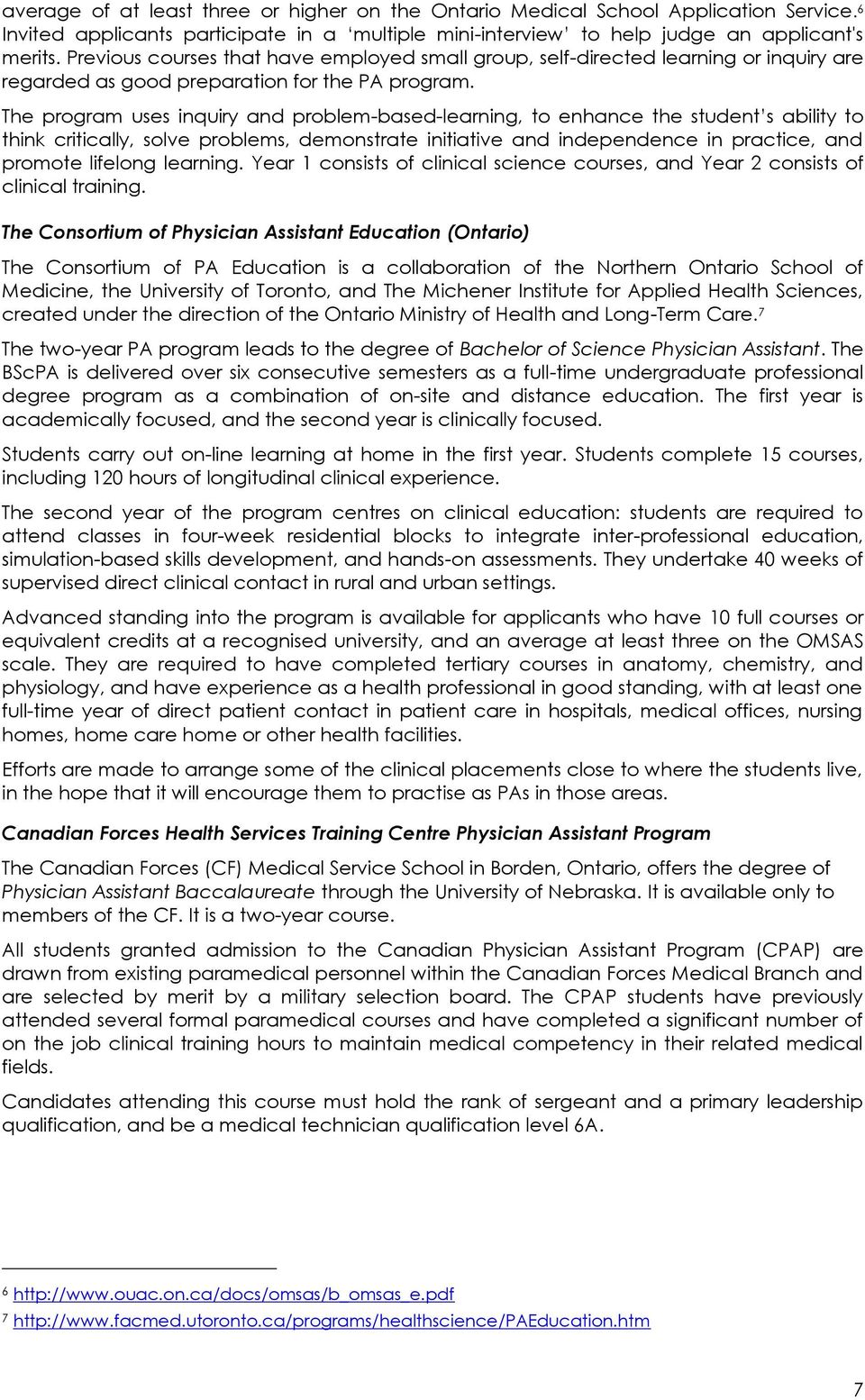
13 The first year (Phase 1) comprises 52 weeks of didactic training in these clinical areas: 8 patient assessments disorders due to physical agents pharmacological therapy minor surgical procedures emergency cardiac management emergency trauma management health protection services diagnostic investigations communicable diseases emergency dental care head, ears, ENT complaints respiratory complaints gastrointestinal complaints mental health disorders/problems neurological complaints musculoskeletal complaints genitourinary and male reproductive complaints obstetrical/gynaecological complaints cardiovascular disorders dermatological disorders endocrine disorders immunological and haematological disorders paediatric patients geriatric patients administration The second year (Phase 2) is 49 weeks of clinical rotations offered in civilian medical centres: general surgery/urology or anaesthesia obstetrics and gynaecology orthopaedics/sport medicine internal medicine ENT psychiatry paediatrics geriatrics emergency medicine family practice trauma a clinical elective The Training Centre also offers a PA Maintenance of Clinical Skills Program (MCSP) with a twofold aim: one, to confirm and consolidate the knowledge and skills acquired during the PA Course; and two, to allow the PA to maintain an acceptable level of knowledge and skills for mentored and independent clinical duty that cannot be maintained by the scope of clinical practice available within the CF. 9 University of Manitoba Physician Assistant Education Program The Manitoba program offers a Master of Physician Assistant Studies degree. It is open to graduates of a four year bachelor's degree, preferably in a health sciences field, from a college recognised by the university, with a minimum grade point average of three in the last two full years of study. Undergraduate courses in anatomy, physiology and biochemistry are required if they were not already taken in the first degree. Courses in microbiology and psychology are considered assets. Applicants should have had 2000 hours of direct patient contact direct involvement in treatment or care planning and delivery for patients in hospital, medical offices, nursing homes, home care or other care facility. Admitted students must be on the educational register of the College of Physicians and Surgeons of Manitoba as a prequalification PA student for the duration of the program. Year 1 comprises these didactic courses: 10 Semester 1: pharmacology physiology and pathophysiology human anatomy genetics biochemistry research and clinical practice patient assessment professional studies (informatics, ethics, culture) (
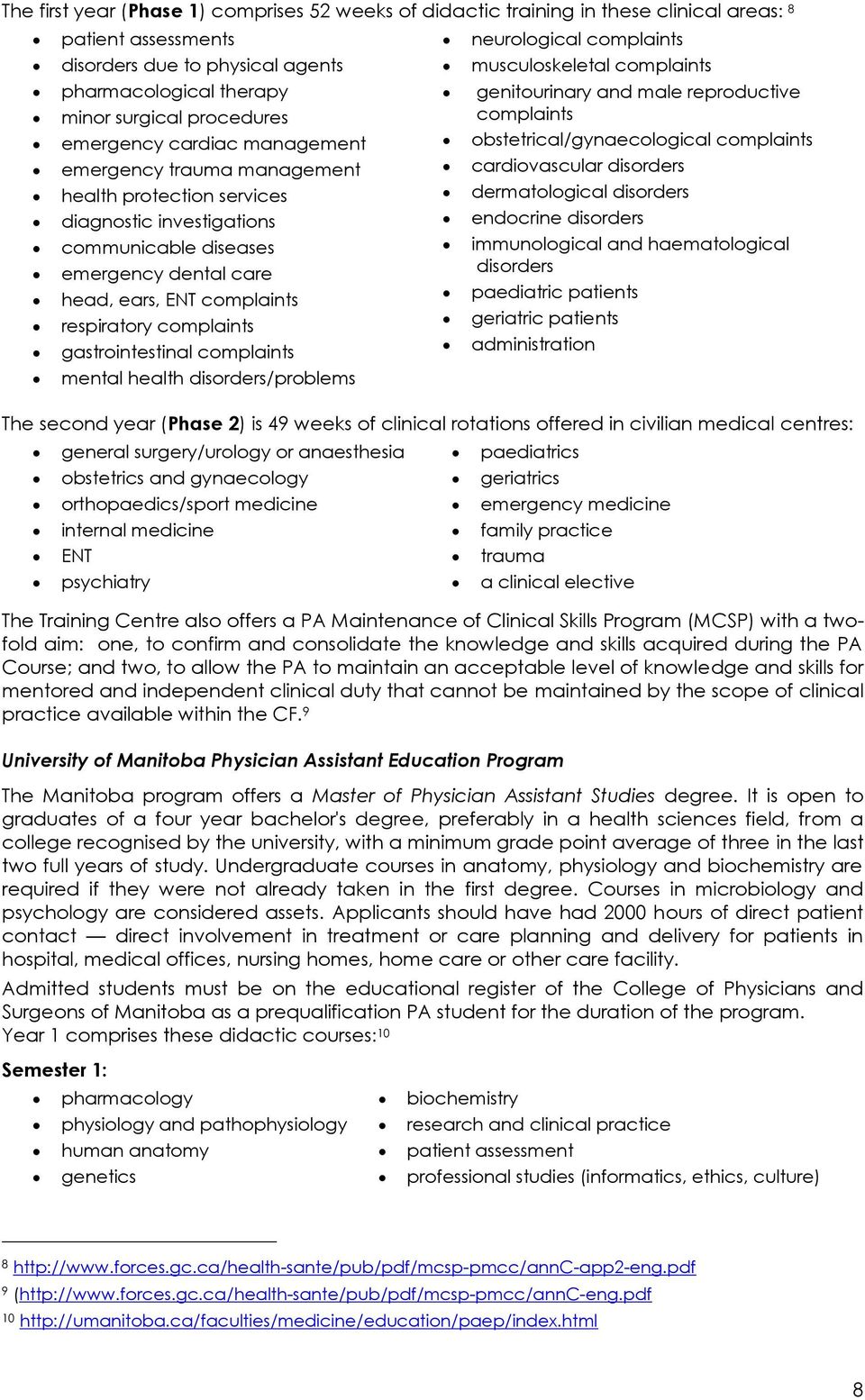
14 Semester 2 pharmacology physiology and pathophysiology obstetrics & gynaecology Semester 3: diagnostic imaging patient assessment microbiology principles of surgery patient assessment principles of psychiatry adult medicine adult medicine paediatrics emergency / critical care Year 2 comprises these clinical rotations: Clinical rotations family medicine clinical internal medicine clinical surgery orthopaedic & sports medicine clinical paediatrics clinical psychiatry community health clinical emergency medicine clinical obstetrics & gynaecology clinical anaesthesia clinical electives PA education programs in Australia and New Zealand Only one PA education program has begun in Australia, though others are planned. The two-year master s program at the University of Queensland (UQ) began in It was developed jointly by PA academics from the US and the UQ School of Medicine, first as a response to perceived shortages of medical clinicians in underserved populations in rural and remote communities, and secondly as an attempt to trial innovative, medical role changes in the Australian health workforce. However, the course was closed to new enrolments in mid The first cohort of students graduated in July 2011 and the final cohort is likely to graduate in December Detail of the program structure and sequence of courses and curricula content and assessment design, including clinical rotations and their management were as follows: University of Queensland PA Program The UQ Physician Assistant Studies program was an initiative of the then Executive Dean of the Faculty of Health Sciences, Professor Peter Brooks (Brooks and Ellis 2006; Australian Doctor 2008). A US academic, Karen E. Mulitalo (MPAS, PA-C) was recruited as Program Director in She was formerly an assistant professor at the University of Texas PA program in Dallas, and chair of the US Physician Assistant Education Association Committee on Ethnic and Cultural Diversity. The PA program began in mid 2009, and offered a master s degree (MPhysAsstSt) with two semesters of didactic courses (taken part-time, largely as online distance study) followed by two semesters of full time study in eight clinical rotations. The academic weighting of the program was equivalent to 18 months fulltime study and the UQ standard weighting for a master s program. An eight unit graduate certificate was also offered for two purposes. A few applicants without an undergraduate degree but with at least five years experience as defence medics or paramedics were admitted to the graduate certificate but not to the master s degree. On successfully completing the graduate certificate, students were permitted to transfer to the master s with full credit for the coursework they had completed. These courses were the same as those undertaken by students in the master s. The graduate certificate also provided an early exit point for students unable to complete their master s program. 9
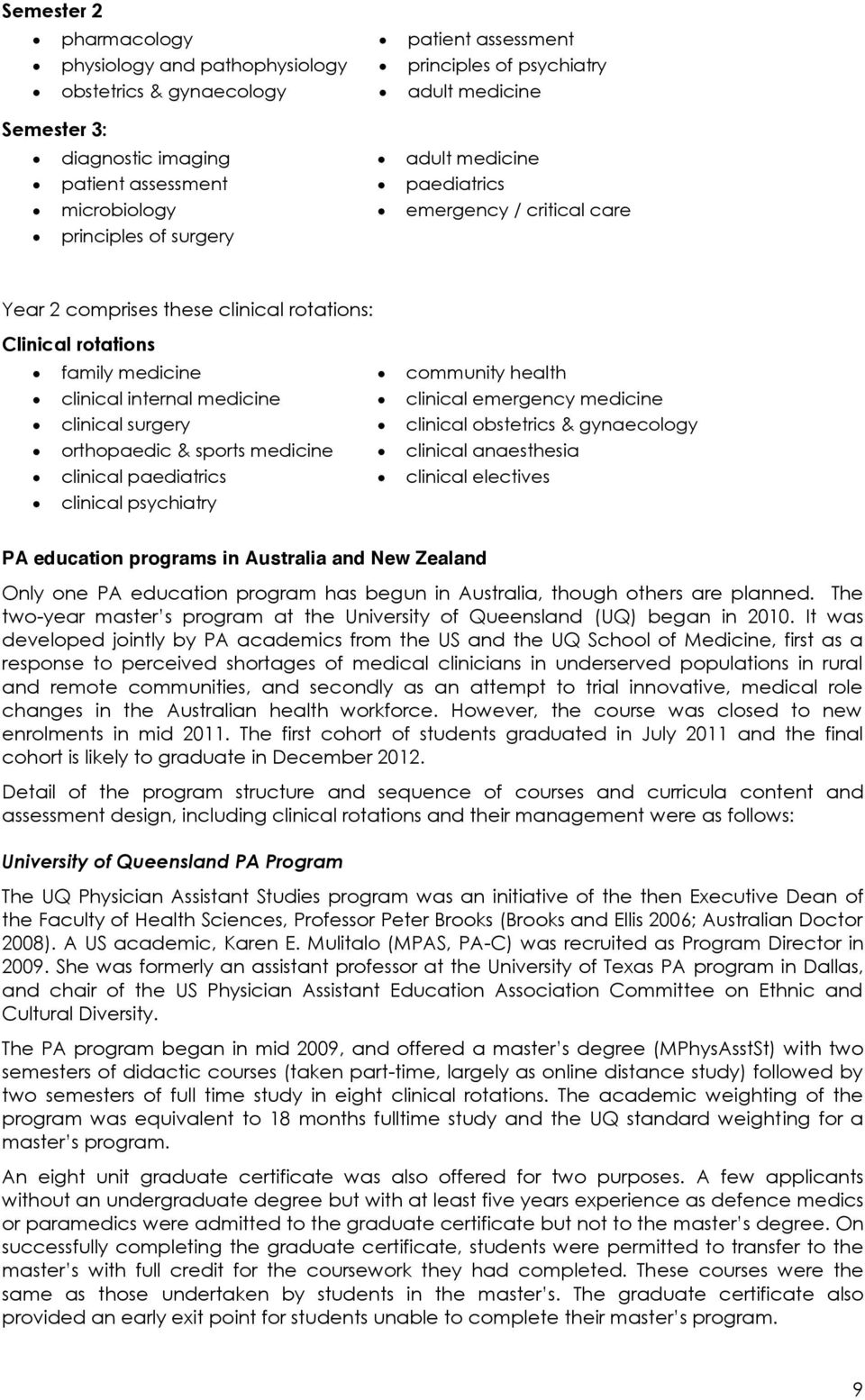
15 Minimum requirements for admission included an approved bachelor s degree in biological sciences, health sciences or a related clinical field, with a grade point average of four and at least 12 months recent clinical experience appropriate to the program. Most applicants were interviewed before they were accepted to the program. The program was not available to international students. Indicative annual fees in 2010 were $13,120, compared to the indicative annual fee for the graduate medical program of $8,859. The published program description stated: A Physician Assistant (PA) is a midlevel health care practitioner working under the delegated authority of a medical practitioner. At the core of the physician assistant profession is a team approach to patient care. With this approach a PA is able to provide continuity of care, increase provider accessibility and improve quality of life for both patients and practitioners to better meet the long-term needs of the community. While this degree may be accredited by an official industry accreditation body in Australia, completion of the degree may not result in graduates receiving automatic accreditation. (University of Queensland 2010) The program structure and course content were adapted from US PA education programs strongly influenced by the Duke University model. Part A comprised courses in principles of primary care medicine, clinical skills, and professional issues for physician assistants. Part B comprised clinical rotations in general practice, internal medicine, aged care, surgical and emergency department, and two elective rotations. Students were provided with a hierarchy of learning objectives in a lengthy handbook for each course. The program has been described as intensive and of the forty students initially enrolled seven have not or may not complete their master s degree. Of the first cohort of UQ students, eleven graduated in July 2011, and five others are at various stages of completion. Of the second cohort, fifteen should graduate in July 2012 and two others should complete by the end of The student cohort all had previous clinical experience, averaging 13 years, in disciplines including physiotherapy, pharmacy, nursing, naturopathy, defence medics, and emergency services paramedics. Their average age was over 40, and about half came from rural areas with an intention to work there. Positive reports of the effectiveness of the students clinical placement during their rotation year have also been recorded. (Sweet 2011) An official statement said key factors in closing the program included the resignation of the Program Director and the difficulty in recruiting a replacement within this field, the significant uncertainty about the future of a physician assistant workforce in Australia, and the associated financial risk (Mallon 2011). Professor David Wilkinson, Head of the School of Medicine, confirmed UQ s commitment to health workforce development and reform through other sources (Sweet 2011.) Planned PA programs in Australia and New Zealand A proposed PA bachelor s degree program will begin at James Cook University in Cairns in early The Universities of Auckland in New Zealand 12 and Edith Cowan University in Perth 13 are also actively planning the development of PA programs and are awaiting the outcome of this HWA review as part of their planning process. The University of Adelaide is also considering the potential for such a program ( HVyZS1zdHVkZW50cyUyRmNvdXJzZS12aWV3LnBocCUzRmlkJTNEMDAwMDAwMjY2MiUyNmFjdGlvbiUzRG92ZXJ2aWV 3JTI2bG9jYXRpb24lM0R0b3BsZXZlbCZhbGw9MQ%3D%3D
16 PA training in the UK In 2006, the UK National Health Service (NHS) established a Competence and Curriculum Framework Steering Group to develop a competence and curriculum framework for the emerging role of the physician assistant, building on work already begun by medical colleges, and informed by a public consultation process (NHS 2006; Hooker et al 2010, 175). The stated purpose of the competence framework was to set out the core competences the PA was expected to be able to demonstrate across all their clinical practice; the range of procedural skills in which the PA must have demonstrated competence; and the core clinical conditions and the level of responsibility the PA was expected to take for diagnosis and management. The purpose of the curriculum framework was to make a transparent and agreed professional standard explicit and to set out the criteria which any initial training program for PAs must meet, in order to ensure that such a professional standard can be achieved. The major recommendations of the steering group report were: qualified and registered PAs would have access to the same prescribing formulary as that of their supervising physician a period of internship of 12 months was required for the smooth transition between trainee and regulated professional a single national assessment for the profession should be in place before entry onto the statutory register, to establish parameters of competence and build public confidence regular compulsory periodic assessment of knowledge through testing should ensure the underpinning principles of demonstrating public safety and maintaining generalist function. The passing of the test every five years would be a condition of continuing use of the protected title compulsory periodic assessment would be funded by test fees paid by the individual the validation and accreditation of PA programs of education would be carried out in accordance with the requirements and standards of the approved regulator the regulator would accredit courses that lead to entry on the statutory register and the ability to practise in the UK using the protected title the working title of Physician Assistant was considered the most appropriate. The NHS now lists PA positions on its careers website. The entry requirement to one of the available training programs is a science-oriented first degree, but health care staff who have a first level qualification in nursing, physiotherapy or as a paramedic may also apply to universities providing the education to become a PA. Training has been developed by a small number of higher education institutions, including the University of Hertfordshire, the University of Birmingham, Wolverhampton University, St George s Medical School at the University of London, and at the University of Aberdeen. The three later programs are currently enrolling PA students. The NHS website says PAs must meet a nationally approved standard of training and practice. This is a requirement of the Competence and Curriculum Framework for Physician Assistants. However, this is not yet a registered profession and, while national moves towards protected registration are under way, successful completion cannot be guaranteed. 15 The British Medical Association s Glossary of allied health care professionals says the role of physician assistant is relatively new in the UK NHS. The National Practitioner Program has developed a project to train and introduce nine physician assistant roles into the NHS, provisionally designated as: advanced critical care practitioners anaesthesia practitioners
17 assistant critical care practitioners assistant theatre practitioners endoscopy technicians medical care practitioners operating department practitioners perioperative specialist practitioners surgical care practitioners. For the purposes of this initiative, the training required for these roles varies from an 18-month level 3 National Vocational Qualifications training program, to a year s training for experienced health care workers, or a degree or postgraduate diploma, depending on the nature of the role (BMA 2009). 16 Meanwhile, especially in Scotland, the NHS recruited US trained PAs to meet the shortage of doctors until a local training program was established. PAs were hired for two years by four health boards (Grampian, Lanarkshire, Tayside and Lothian) to work in GP surgeries, accident and emergency units and other hospital departments (Buchan et al 2007; Times Online 2010). A PA training program has now begun at the University of Aberdeen. 17 PA training in The Netherlands In the Netherlands, the first class of PA students entered the Academy of Health care in Utrecht in Following the success of this program, the University of Arnhem/Nijmegen started a PA program in The Arnhem-Nijmegen model program comprised a competency-based curriculum applying scientific and evidence-based knowledge in a self-sufficient manner; and a didactic curriculum developing medical reasoning through problem-based learning, case studies and clinical skill labs. The skill labs have four components: a cognitive component what is needed to understand how an action must be performed a motor component practising how to perform the right action at the right time a psychological-social component understanding the importance of the stress, pain, and discomfort that the application of clinical procedures brings about in real life and how to deal pain, distress in the patient, or even a bad outcome a dexterity component the students ability to be adaptable, careful, fast, flexible, coordinated, and accurate. Each student works weekly with a medical mentor to define the role of the PA. The faculty is drawn from practising doctors and the graduate health science faculty. A medical education specialist supervises the faculty and helps develop educational modules, learning objectives, and recommended literature (Harbert et al 2004). Three more programs were established in 2005 in Diemen, Rotterdam, and Groningen. There is also now a PA educational program at the University of Leiden (Spenkelink-Schut et al 2008). A bachelor's degree is required before becoming a PA student, together with at least two years of health care experience. The course of study is in ten 10-week blocks of time: six weeks of each block working in the chosen specialty, and then four weeks in another facet of medicine. Only one day a week is spent in the classroom: students do most of the didactic curriculum at home and are tested in the classroom in periodic tests that must be passed before moving to the next block. On successfully finishing the third year, they graduate with a master's degree. PA students are paid a salary while studying, covered partly by the government and partly by the physician mentor (Olsen 2006) care/glossallied.jsp
18 From the outset, these programs were accredited by the Accreditation Organisation of Netherlands and Flanders (NVAO), and funded by the Ministry of Health, Welfare and Sport and the Ministry of Education, Culture and Science. A new initial accreditation system came into operation on 1 January 2011 focussed on the quality of individual training programs. In 2004 the graduate PAs founded a professional Academy, the Nederlandse Associatie Physician Assistants (NAPA). The mission of the NAPA is to promote quality, accessible health care, and promote the professional and personal development of PAs. 18 The NAPA accredits physician assistants able to show that they have concluded a widely orientated PA training and are active as physician assistants. The requirements to be allowed to use the Master Physician Assistant title are completion of an NVAO accredited education program, registration in the certification registry of NAPA Physician Assistants, and meeting the requirements as defined in the NAPA quality register. NAPA drew up a professional profile of the PA in anticipation of legislation in 2009 to formalise the PA s legal framework. A study group on quality and education also drew up a professional code reflecting the common standards and codes of conduct applying to the PA. In developing the code, NAPA worked closely with the Royal Netherlands Society for Medical Science. NAPA also maintains a Quality Assurance Register. 19 PA training in Germany PAs are not yet a registered profession in most parts of Germany, but are permitted to practise under delegation from a medical doctor. Three year PA training programs leading to the BSc degree are available in Berlin, Rheine, and Karlsruhe. Most PA students start their training with a background of health care experience. The new Karlsruhe Duale Hochschule Baden-Wurttemberg (DHBW) program is a response to the demand for an increased supply of qualified health care personnel in the health reform bill enacted in October There is a growing need for PAs to fill the large shortfall of doctors in city hospitals, and PAs are expected to be employed in hospital settings in their chosen specialties. There is also a shortage of the traditional family doctors, and in future PAs could fill this gap in primary care. Unlike PAs, other ancillary roles such as paramedics, surgical technical assistants, and medical technical assistants are not yet authorised under federal legislation. The province of Baden-Württemberg registers PAs through the German Association of Physician Assistants, which is currently also responsible for the registration of internationally qualified physician assistants. 21 PA training in South Africa South Africa s Clinical Associate Program began in Four years later, in January 2008, the first group of 23 students enrolled at Walter Sisulu University in Umthatha in the Eastern Cape. In the same year, the Health Professions Council of South Africa (HPCSA) endorsed the introduction of Clinical Associates by establishing a register of mid-level health workers in medicine. The Medical and Dental Board of the HPCSA subsequently developed guidelines to assist other training institutions that may be interested in training clinical associates. The national program started when the Department of Health s Strategy on Health Human Resources recommended that a mid-level medical worker program be developed by various health professional groups, in order to facilitate implementation of a primary health care package across South Africa. The program also sought to address the shortage of
19 doctors, particularly in rural areas. Its introduction attracted both criticism and support from the medical profession (van Niekerk 2006; Couper 2006; Hugo & Mfenyana 2006). The aim of the program is to develop a new group of health care workers with the necessary knowledge, attitudes and psychomotor skills to be able to work in a hospital environment, assisting the doctor and other health care staff in doing procedures and assessing patients mainly in casualty and emergency wards, but also in other wards and theatre. The role is described as similar to the physician assistant in the US. It is intended that they will work in smaller hospitals to improve patient care especially in rural and disadvantaged communities. The clinical associate's scope of practice has been defined by the context, and by the requirements of district hospitals, with particular focus on emergency care, skilled clinical procedures, and inpatient care. Medical services that clinical associates provide include, but are not limited to, obtaining patient histories and performing physical examinations; ordering or performing diagnostic and therapeutic procedures; interpreting findings and formulating a diagnosis for common and emergency conditions; developing and implementing a treatment plan; monitoring the effectiveness of therapeutic interventions; assisting at surgery; offering counselling and education to meet patient needs; and making appropriate referrals. Educational programs at the Universities of Witwatersrand, Limpopo and Pretoria began in January 2009 with 79 students. In December 2010, the first Walter Sisulu University cohort of 23 students was awarded the Bachelor of Clinical Medical Practice (BCMP). Their studies used a problem-based learning curriculum, while the students spent much of their time working in the health system, with communities, in hospitals and clinics to obtain first-hand clinical experience (Ngalika 2011). Witwatersrand s Rural Health Unit, in association with the national Department of Health and South Rand Hospital in Gauteng or Lehurutshe Hospital in North West Province, offers a three year Bachelor of Clinical Medical Practice (BCMP) program leading to the qualification of clinical associate that can be registered with the HPCSA. The curriculum develops a sound knowledge of the medical and clinical sciences so as to understand conditions and management strategies. Students are expected to have detailed knowledge of the biopsychosocial and clinical sciences in the performance of procedures (Witwatersrand 2011). The qualified clinical associate will be expected to assist with the assessment and management of patients in casualty or ward situations, for children and adults, for all conditions likely to occur in a district hospital take responsibility for performing routine procedures in district hospital wards, casualty and the outpatient departments under supervision form an essential part of the health care team in rural districts (AIHA 2011). 14

20 Accreditation, licensing and competencies Accreditation of PA training in the US In the 1960s, a range of formally and informally trained health care workers, variously called midlevel providers, assistant medical officers, or physician s assistants emerged in the US. The development was welcomed as a response to a shortage of doctors, and especially the need for new kinds of primary care workers. Training programs for these roles began in the mid-1960s at Duke University, the University of Washington, and the University of Colorado. By 1968 the American Association of Physician Assistants (AAPA) was founded and began publication of a journal, and an American Registry of Physician s Assistants was founded in However, up to this point there was no formal agreement or uniformity to define the competence or scope of practice of these workers. The newly established Institute of Medicine in the US National Academy of Science suggested a pattern of classification of PAs based on their capacity to make independent judgments or to work in a clinical specialty. The Institute s work encouraged the medical establishment to move towards supporting accreditation of PA training programs. The leaders of the Duke University program had asked the AMA to draw up educational guidelines for PAs, and in 1971 the AMA s Council on Medical Education, with the support of a number of medical colleges and societies, approved a set of educational essentials for accrediting PA training programs (Ballweg 2008). These accreditation standards were revised in 1978, 1985, 1990, 1997, 2000, and 2005, and endorsed by the American Academy of Family Physicians, American Academy of Paediatrics, American Academy of Physician assistants, American College of Physicians, American College of Surgeons, the AMA, and the Physician Assistant Education Association (PAEA) (Hooker et al 2010, 587). Processing of accreditation applications began in 1972, and in following years was performed by a Joint Committee of the AMA s Committee on Allied Health Education and Accreditation (CAHEA), later renamed the Accreditation Review Committee (ARC). In 2000, the ARC became an independent entity, and changed its name to the Accreditation Review Commission on Education for the Physician Assistant (ARC-PA) (Ballweg 2008). The ARC-PA is recognised by the US Council for Higher Education Accreditation (CHEA). Accreditation is a voluntary process. It involves a comprehensive review against the agreed standards, based on information supplied in the application, a self-study report, the report of a site visit evaluation team, and the program s previous history (Hooker et al 2010, 588). The ARC-PA website describes its purpose as follows: 22 The ARC-PA encourages excellence in PA education through its accreditation process by establishing and maintaining standards of quality for educational programs. It awards accreditation to programs through a peer review process that includes documentation and periodic site visit evaluation to substantiate compliance with the Accreditation Standards for Physician Assistant Education. The accreditation process is designed to encourage sound educational practices and innovation by programs and to stimulate continuous self-study and improvement. Certification of PAs in the US In parallel with accreditation of training courses, the AMA s House of Delegates asked the Council of Health Manpower to help develop a national certification program for PAs. It was concerned that the new professional role should develop in an orderly fashion, under medical guidance, and be measured by high standards (Ballweg 2008a). In 1972 the National Board of Medical Examiners and the AMA convened representatives from fourteen organisations, including the AAPA and PAEA, to discuss establishing an independent

21 certifying authority for the PA profession, and to ensure the quality of individual graduates. Three years later, the National Commission on Certification of Physician Assistants (NCCPA) was formed to perform that role. The NCCPA is the nationally recognised certifying body for physician assistants in the US. Its goal is to assure the public that certified PAs meet professional standards of knowledge and clinical skills. All US states and territories rely on NCCPA certification criteria for initial licensure or regulation of PAs. To attain certification, PAs must graduate from an accredited program and pass the Physician Assistant National Certifying Exam (PANCE), a multiple-choice test with 360 questions that assess basic medical and surgical knowledge. After passing PANCE, PAs become NCCPA-certified, which entitles them to use the PA-C designation until their first cycle expires (about two years). To maintain certification and retain the right to use the PA-C designation, they must document 100 continuing medical education (CME) hours every two years, and pass a recertification exam in the fifth or sixth year of a six-year cycle. 23 Both the certification and recertification examinations were computerized in 1999, allowing greater access and availability for new graduates and practicing PAs. The certification examination is now administered throughout the year in three separate windows of availability. Recertification became a focus of controversy among many PAs who were concerned that a primary care exam potentially discriminated against specialty PAs. Supporters of the exam argued that the PA s role was primary care even in specialty practice. After some years of controversy, an alternative recertification which did not require a proctored exam was approved in 1991, but was discontinued in 2010 for consistency with other health professional groups (Ballweg 2008b). The recertification exam is given twice each year. The NCCPA board examination was originally open to three groups seeking certification: formally trained PAs graduated from an ARC approved program; nurse practitioners provided that they had graduated from a family or paediatric nurse practitioner program at an accredited medical or nursing school; and informally trained PAs, provided they had worked for four recent years in a primary care setting. However, since 1986 only graduates of ARC-PA accredited PA programs have been eligible to sit the NCCPA examination. NCCPA has recently reinforced the integrity of the certification process, including random CME audits, logging PAs CME duties, requiring new graduates to become certified within six years or six attempts at PANCE, and a more comprehensive disciplinary policy, including establishment of a Code of Conduct for certified and certifying PAs. 24 The NCCPA Foundation promotes and supports the PA profession through research and educational projects. Foundation activities have included a PA Ethics Project with the PAEA, a Best Practice Project on relationships between PAs and their supervising physicians, and a research grants program (Ballweg 2008b). All US states have now enacted laws or regulations recognising PAs. They are licensed in 43 states and the District of Columbia, certified in four states, and registered in three states. In place of delegations contained in medical practice acts, many states have separate PA practice acts, and set up separate advisory PA licensing boards composed of practicing PAs and practicing doctors who work with PAs (Golcar et al 2008). Competency development in the US Competencies for the PA profession were jointly developed by the NCCPA, ARC-PA, AAPA, and the PAEA, based in part on the competencies for medical residents of the Accreditation Council for Graduation Medical Education (ACGME). The competencies were approved by all four organizations in They cover the six areas of medical knowledge, interpersonal
22 and communication skills, patient care, professionalism, practice-based learning and improvement, and systems-based practice, and each standard is accompanied by a list of specific competencies the PA is expected to have: Medical knowledge: Medical knowledge includes an understanding of pathophysiology, patient presentation, differential diagnosis, patient management, surgical principles, health promotion and disease prevention. PAs must demonstrate core knowledge about established and evolving biomedical and clinical sciences and the application of this knowledge to patient care in their area of practice. In addition, physician assistants are expected to demonstrate an investigatory and analytic thinking approach to clinical situations. Interpersonal and communication skills: Interpersonal and communication skills encompass verbal, nonverbal and written exchange of information. PAs must demonstrate interpersonal and communication skills that result in effective information exchange with patients, their patients families, physicians, professional associates, and the health care system. Patient care: Patient care includes age-appropriate assessment, evaluation and management. PAs must demonstrate care that is effective, patient-centered, timely, efficient and equitable for the treatment of health problems and the promotion of wellness. Professionalism: Professionalism is the expression of positive values and ideals as care is delivered. Foremost, it involves prioritizing the interests of those being served above one s own. PAs must know their professional and personal limitations. Professionalism also requires that PAs practice without impairment from substance abuse, cognitive deficiency or mental illness. PAs must demonstrate a high level of responsibility, ethical practice, sensitivity to a diverse patient population and adherence to legal and regulatory requirements. Practice-based learning and improvement: Practice-based learning and improvement includes the processes through which clinicians engage in critical analysis of their own practice experience, medical literature and other information resources for the purpose of self-improvement. PAs must be able to assess, evaluate and improve their patient care practices. Systems-based practice: Systems-based practice encompasses the societal, organizational and economic environments in which health care is delivered. PAs must demonstrate an awareness of and responsiveness to the larger system of health care to provide patient care that is of optimal value. PAs should work to improve the larger health care system of which their practices are a part. 25 The full list of specific NCCPA competency standards may be found in Appendix B. A project funded by the NCCPA Foundation in 2009 studied if the competencies were being incorporated into PA education, whether there were any obstacles to doing so, and how the competencies were being used to assess students. Most programs had successfully incorporated the competencies into their curricula, or were in the process of doing so. The most frequent obstacles were lack of time, and difficulty identifying methods of assessment. The two most common methods were multiple-choice tests and the clinical preceptor s evaluation of the student (Essary & Stoehr 2009). Accreditation of PA education in Canada In May 2003, the Canadian Medical Association s Board of Directors approved an application from the then Canadian Academy of Physician Assistants to include PA as a designated health science profession in the CMA conjoint accreditation process. In June 2004 the CMA accredited the PA program delivered by the Canadian Forces Medical Services School (Doig 2009)
23 The medical profession s general support for the PA profession has been reflected in these motions passed at CMA s General Council: 2007: The Canadian Medical Association will work with provincial/territorial medical associations and affiliates to develop a plan to enable the further expansion and integration of physician assistants into civilian health care in Canada. 2008: The Canadian Medical Association will work with the Canadian Association of Physician Assistants and appropriate stakeholders to develop a national certification and licensing process for physician assistants that ensures competency and portability across Canada. The CMA has demonstrated its commitment to integrating PAs into the health care system by making its accreditation program available to all Canadian PA training programs. The accreditation process measures a program s success in meeting the national competency profile (CMA 2010). The CMA s conjoint accreditation process states five general requirements: specified competencies, support of student, training resources, integrated learning, and continuous quality improvement. To initiate accreditation, the training program submits a self-assessment report of its compliance with the requirements. A survey team of 3-5 relevant professionals validates the program s assessment, first on the basis of the documentation, and then, if required, by a site visit. Accreditation status is accorded for specified periods of time and is subject to review and appeal (CMA 2008). Certification of PAs in Canada On successful completion of an accredited PA education program, graduates are eligible to sit the national certification examinations provided by the Physician Assistants Certification Council (PACC). The PACC is an independent council of the Canadian Association of Physician Assistants (CAPA), and administers and maintains the PA certification process. Successful completion of the exam confers the designation Canadian Certified Physician Assistant. Canadian certified PAs are required to complete 250 CME hours in a 5-year cycle, with no more than 100 hours logged for credit in any one year. As PAs are trained as generalists, much of their specialty-specific training occurs on the job and in subsequent CME sessions. CAPA has been working with the Royal College of Physicians and Surgeons of Canada (RCPSC) and the College of Family Physicians of Canada (CFPC) to facilitate alignment of CME programs for MDs and PAs (CMA 2010). Competency development in Canada For the purposes of the competency requirement, an initial occupational competency profile was established in In 2009, CAPA developed a new national competency profile in accordance with the CanMEDS framework, based on National Occupational Competency Profile 2006, the Ontario Physician Assistant Competency Profile, and the four principles of the CFPC. It defines the core competencies that a generalist PA should possess on graduation (CAPA 2009; CMA 2010). With the support of the RCPSC and the CFPC, CAPA created The Scope of Practice and National Competency Profile as a resource for PAs, supervising physicians, educators, legislators and other health professionals. CAPA adopted RCPSC s CanMEDS framework, which describes practitioner competencies in seven thematic roles of medical expert, communicator, collaborator, manager, health advocate, scholar and professional. The extensive National Competency Profile for Physician Assistants cover these seven areas, in each case offering a detailed definition and description of the role and its specific elements; and key and enabling competencies. The key competencies are these: Medical expert: PAs are able to function effectively as a physician extender, integrating all of the CanMEDS Roles (as adapted for the PA) to provide optimal, ethical and patient- 18
24 centred medical care; apply clinical knowledge, appropriate to patient care; perform a complete and appropriate assessment of a patient and formulate a clinical treatment plan; implement effective management plans that include preventive and therapeutic interventions; demonstrate appropriate procedural skills, both diagnostic and therapeutic; and seek appropriate consultation from the supervising physician and other health professionals. Communicator: PAs are able to develop rapport, trust and ethical therapeutic relationships with patients, families and caregivers; accurately elicit and synthesize relevant information and perspectives of patients, families, caregivers and other health care professionals; accurately convey relevant information and explanations to patients, families and other health care professionals; develop an understanding of patient problems and plans with the supervising physician, patients, families and other health care professionals to develop a shared plan of care; and convey accurate oral, written and/or electronic information about a medical encounter. Collaborator: PAs are able to work within the PA-Physician relationship; participate effectively and appropriately in an inter-professional health care team; and work effectively with other professionals to prevent, negotiate and resolve inter-professional conflict. Manager PAs are able to participate in activities that contribute to the effectiveness of their health care organizations and systems; effectively prioritize and execute tasks in collaboration with colleagues; and utilize finite health care resources appropriately. Health advocate: PAs are able to respond to individual patient health needs and issues as part of patient care; and identify the determinants of health for the populations that they serve. Scholar: PAs are able to maintain and enhance professional activities through continual learning; critically evaluate information and its sources and apply this appropriately to practice decisions; and facilitate the learning of patients, families, and other health care professionals. Professional: PAs are able to demonstrate a commitment to their patients, profession and society through ethical practice; demonstrate a commitment to their scope of practice and the unique PA-physician relationship; and demonstrate a commitment to Physician Assistant health and sustainable practice (CAPA 2009). 19
25 The scope of practice of the Physician Assistant The role of the Physician Assistant first evolved in the 1960s in the United States as response to shortages of medical services in underserved communities, and as a solution to the redeployment of military personnel who had been employed as corpsmen in the Vietnam War. These returning military medics possessed extensive medical experience in emergency and trauma systems, and were familiar with the new medical technology that had been deployed in the military hospitals (Ballweg 2009). The US federal government actively supported the creation the PA role to make use of the corpsmen s skills to address issues of rural and remote health access, disparity of care in underserved populations, continuity of patient care, physician burnout, and the expense of specialist fees (Ballweg 2009). Initially, the role consisted of helping provide basic medical services to patients under the supervision of a licensed physician. They were legally required to work with the physician. Today, their role has evolved to encompass a range of comprehensive medical responsibilities, and together with the physician, they are considered to make up the day to day working dyad in virtually all primary care practices (Bodenheimer 2007, Anderson 2009). PAs are trained to perform many of the uncomplicated core primary care medical tasks that a physician would otherwise perform (Bergeron 1999). However, it is up to the supervising physician to decide on what level of responsibility the PA will exercise, and this will be based on their level of experience, skill level and the type of working relationship they have with the physician (Ballweg 2009). Institutions where they practise and are employed have the right to limit the scope of the PA s activities. The scope of practice is in accordance with State by State legislative requirements in the US (Roth-Kauffman 2006). There are different levels of supervision: prospective where the physician and PA decide the scope of the PA role before the working relationship begins; concurrent where the role evolves continuously with the physician providing supervision and support simultaneously, either by being available side by side for regular consultation, or via phone, telemedicine or distant supervision; and retrospective where patient quality measures are reviewed at the end of each shift (Ballweg 2009; Danielsen et al 2011). This review of literature on the scope of practice outlines the responsibilities of the PA in both the primary care sector and the hospital setting. It examines their role in specialist medical settings such as emergency care and surgery, and in delivering medical services to underserviced rural and remote areas and other areas of need. The scope of responsibilities of the PA is compared with that of the Advanced Nurse practitioner. It examines the role of the PA in the US, Canada, and the UK. It also reviews evidence of value and efficiency of the role in various medical and geographical settings, almost exclusively drawn from the US, as the role has not yet been established long enough in other countries for a comparable body of research to accumulate. The scope of practice of the PA in the primary care setting Primary care is very often the first point of entry for patients to the health care system. Primary care is designed to meet the health care needs of patients with any undiagnosed symptom or health concern (Ballweg et al 2008). Appropriately trained and skilled clinicians provide Initial and continuing care in collaboration with other health professionals, and make referrals to specialists as appropriate. Early PA training programs aimed to prepare PAs for roles in the primary care sector. Hooker & Cawley (2003) estimated that in the early years 43 per cent of PAs worked in primary care areas of family medicine, general internal medicine, and general paediatrics, but that figure has been decreasing since 1974 as a result of the emergence of roles for PAs in subspecialty practice and surgical assisting (Larson & Hart 2007). 20
26 The 2008 AAPA Physician Assistant Census Report (n=25,187) found 26.2 per cent of PAs worked in family medicine; 25.4 per cent in surgery, with orthopaedics and cardiovascular specialties most common; 4.2 per cent in paediatrics; and 15.6 per cent in internal medicine with cardiology, oncology and gastroenterology specialties most common (Hooker et al 2010: 82). This following chart illustrates the enhancements to the PA role in primary care settings: Educational Roles Care in the Community Chronic Care Management Acute Care Management Family Planning Health Management and Wellness Research Disease Prevention Inform patients of treatment options and potential side effects Family Planning Sexual Health Immunisation Child Wellness Care Nursing Home Rounds Rehabilitation Link patients with community services and resources Diabetes Hypertension Osteoarthritis Dementia Heart Failure Select Gastric and Endocrine Conditions Suturing Treating Pneumonia Fractures, minor injuries and cast removal Acute cardiac symptoms This cycle illustrates the role of the PA in their clinical interaction with patients: Take Patient Histories Educate Patients on wellness and disease prevention Perform Physical Examinations Monitor treatment plans and effectiveness of therapeutic interventions Formulate a working diagnosis Presctribe medications Order diagnostis tests or refer to specialist Tailor treatment plans, Order and interpret x- rays Source: Ballweg et al 2008a 21
27 In 2004, the National Commission on Certification of Physician Assistants (NCCPA) asked PAs about the tasks and skills required in the primary care setting. The skills they regarded as most pertinent to their practice were: ability to identify pertinent physical findings knowledge of signs and symptoms recognising conditions that constituted emergencies performing physical examinations conducting a patient interview associating current complaints with history skill in physical examination directed to specific conditions knowledge of physical examination techniques effective communication. (Hooker et al 2010). A study by Roblin et al (2004) showed that in the arenas of adult medicine and paediatrics, patients were significantly more likely to be satisfied with practitioner interaction on visits when attended by a PA or a nurse practitioner than visits attended by a physician. PAs are viewed as providing high quality care in primary care practices. They are seen as a cost effective component in allowing practices to remain financially viable, with reimbursements from Medicaid driving practices to examine PA employment as a both a cost saving and revenue producing option (Ballweg et al 2008a). The scope of practice of the PA in specialist settings Whilst primary care remains the largest single sub specialty of PAs, the number of PAs moving into specialty roles such as internal medicine and surgery has increased, with over half of American PAs working in these areas in 2000 (Larson & Hart 2007). Roth-Kauffman (2006) stated that PAs now work in 61 specialty fields of practice. These include: Paediatrics Neonatology Obstetrics Orthopaedics Gynaecology Oncology Surgery Cardiovascular Surgery Surgical Subspecialties Genetics PAs in the hospital setting PAs possess a wide range of clinical skills and are trained to be physician-extenders. This makes them ideally suited to hospital practice, and their skills are widely used in emergency medicine, intensive care units, labour and delivery units, infection control and surgical units (Hooker et al 2010). Economic constraints and a reducing supply of postgraduate medicine trainees serve to create an ongoing demand for PA services in inpatient settings in the US. In data from the AAPA s 2008 census, 44per cent of PAs had some inpatient responsibility (AAPA 2008). An older national study of 116 teaching hospitals in the US found that, of the 178 departments using PAs to perform resident duties, 42per cent practised in surgery, 25per cent in primary care, and 21per cent in medical specialties. PAs were also more likely than nurse practitioners to work in surgery and emergency departments (Riportella-Muller et al 1995). In the hospital environment, PAs tend to practise in mainly specialty and sub-specialty areas such as neonatology, surgery, intensive care and other specialties (Mathur et al 2005). They have been shown to be effective in assuming those responsibilities normally assigned to residents and house officers (Duffy 2003 in Hooker et al 2010). Typically their duties would encompass the standard tasks for a house officer. However, if the PA s experience and training warrants it, the hospital credentials committee can approve an extension of those duties. Examples include duties associated with bone marrow aspiration, thoracentesis, lumbar 22
28 puncture, coronary angiography, joint injections, liver biopsies, invasive radiological procedures and other technical procedures (Hooker et al 2010). The basic job description of a house staff physician assistant is to: review patient records to determine health status take patient history perform physical examinations identify normal /abnormal findings on histories, physicals, laboratory studies perform developmental screening on children carry out physician s orders for diagnostic procedures, treatments and medication transcribe orders to patient chart (to be reviewed by physician) collect specimens for blood counts and laboratory procedures assist in surgery provide pre-operative and post-operative surgical care screen patients to determine need for medical attention perform other duties as delegated by physician and approved by Credentials Committee (Hooker et al 2010). The role of the PA in the Emergency Department A meta-analysis of 66 studies on the role of PAs in Emergency Departments by Doan et al (2010) found that 65 per cent to 68 per cent of US academic medical centre hospitals used PAs in their Emergency Departments. Their scope of practice ranged from being solo providers of care in small rural hospitals to providing patient care at a level one trauma centre, practising in triage units, fast track units and performing administrative duties (Doan et al 2011). One recent development has been to implement a Patient Navigator Role where the PA liaises between the ED and the referring primary care physician, follows up investigative tests, attends bed allocation meetings, and forms an integral part of a patient transition team involved with the care of the patient while in the ED (Schneider et al 2001). PAs working in emergency departments have usually received specific training in emergency medicine and in more recent years have been trained in the use of bedside ultrasonography for focused examination, and sonography for trauma cases (Doan et al 2011). The quality of care provided by PAs has been found to be comparable with that of physicians and senior residents (Doan et al 2011). Studies have reported that PAs are able to deal with 53-62per cent of ED cases. PAs are able to deal with the majority of cases at a lower cost than physicians (Cawley et al 1983). A study of the use of PAs in the Emergency Departments of hospitals in Washington and Oregon found that PAs were effective in improving the timeliness of care to patients, with wait times and lengths of stay reduced (Abbott et al 2010). Comparison between the scope of practice of the PA and the nurse practitioner The roles of PAs and NPs are strongly aligned at academic, clinical and individual levels in that they are both able to provide mid-level health access in primary care and hospital settings. Both require a similar level of education, and both conduct physical exams, treat a variety of disorders, order and interpret some medical tests, and prescribe a predetermined range of medication. However, the extent of this overlap is not straightforward, and there are a number of clear differences between the roles (Ballweg et al 2008). The primary difference is that NPs operate independently and autonomously in an advance nursing specialty, while PAs operate under the supervision of a doctor, and their scope of practice is determined by mutually agreed guidelines between the doctor and the PA (Buppert 2006). 23
29 Nurse practitioners (NPs) are mid-level health providers. They are all registered nurses who have been educated and authorised to function autonomously and collaboratively in an advanced and extended clinical role. The role builds upon the standards for advanced practitioner nurses, and is the highest-level practicing role within the nursing profession. Nurse practitioners define themselves as working within the nursing model of care how a patient is affected by their illness, the nursing care the patient needs, and how this care is provided within a holistic nursing assessment of the person (Hooker 2006). Physician Assistants are a delegated extension of medical practice arrangements already in existence, strengthened by formal training and local clinical governance (ACRRM 2011). The American Association of Physician Assistants (AAPA) guidelines state that PAs should adopt a manner and style of treatment consistent with their supervising physician (Buppert 2006).The role operates under the direction and supervision of doctors, and works within a medical model of care medical history, physical examination, and diagnostic tests as the basis for the identifying and treating a specific illness. In contrast to advanced nursing status for entry to NP candidature, PA trainees come from a variety of allied health backgrounds, including nursing, pharmacy, paramedics (both military and civilian), health workers and physiotherapists. PAs can also incorporate a surgical component in their training that is not traditionally available to the NP (Ballweg 2010). PA practice in US military service Battlefield medics and naval surgeon s assistants have a long history. Increasingly sophisticated clinical practice has significantly increased their scope of practice in managing trauma in conflict zones. Standing military forces provide health services to personnel, and sometimes to their dependents, on bases outside of conflict zones. Military health services employ health professionals from the range of professions found in civilian health services. Advanced practice by military medics led directly to the creation of the PA role, first within the US military and then in the civilian health system. Qualified PAs began serving the US Navy, Army and Air Force in 1971 and the Coast Guard, in 1975 (Hooker et al 2008). The Air Force was the first to commission PAs as officers in 1978, and the Navy in 1992 (Chitwood 2008). In the 1970s, only male medics, many of them Vietnam Veterans, were chosen for advanced training programs. Male veterans were seen as better equipped to deal with clinical needs in combat and highly adverse circumstances (Hooker et al 2010; BLS ). Female military PAs are more common today: the ratio of female to male is close to 1 to 5 (Hooker et al 2008). Although the majority of military PAs still started as medics, the US Army and Air Force have recently begun recruiting civilian trained PAs as a result of a critical workforce shortage (Scott 2007; Chitwood 2008). Only non-commissioned and commissioned officers of uniformed services are eligible to apply for training as a Military PA, which now occurs under one single, two year program, the Inter-Service PA Program (IPAP) (Hooker et al 2008; Liebich 2007). The program was introduced in 1996, and is run by the US Army Academy of Health Sciences in San Antonio, Texas (Salyer 2008, Hooker et al 2008). It is designed to build on previous education and to develop additional clinical problem solving skills (US Army Med 2009). The IPAP is the largest PA training program in the US, educating up to 200 students a year in phase 1 and 200 in phase two (Chitwood 2008).On completion, trainees in all branches of the military are awarded a Master of Physician Assistant Studies degree through the University of Nebraska Medical Centre, and are commissioned as second lieutenant. They are required to commit to a four year return of obligation and 10 years in rank to retirement as a commissioned officer (Liebich 2007). Military PAs may also receive specialist training in emergency medicine. The postgraduate Army Emergency Medicine program was introduced in 1991 and expanded in 2006 from a 12 month to an 18 month program. Trainees receive a Doctor of Science in Physician Studies 24
30 in emergency medicine from the Baylor University in Waco, Texas. The Emergency Medicine PA in the military requires more advanced skills than the equivalent civilian qualification, since the role requires saving lives on the battlefield or where s trauma occurs, and may not always involve the presence of a supervisor (Salyer 2008). The scope of practice of military PAs covers a number of areas and specialities: 270 Air force PAs serve on active duty, 30 in the Air Force Reserve, and 24 in the Air National Guard, mainly in family practice, primary care clinics and combat operational roles, and some specialise in orthopaedics, head and neck surgery, emergency, medicine, bone marrow transplants and cardiac perfusion (Hooker et al 2008). Army PAs typically serve as medical specialist corps officers n army combat or combat support battalions in the US, Alaska, Hawaii and overseas (USAREC 2009). 610 serve on active duty, 180 in the Army Reserve and 350 in the National Guard, mainly primary care and in operational forces; others work in manoeuvre units in Korea and surgical or hospital units in Iraq or Afghanistan, specialise in occupational and aviation medicine, orthopaedic surgery, emergency, cardiac perfusion, or oversee advance trauma teams alongside a sergeant medic and junior medics in the field (O'Hearn 1991; Herrera & Gendron 19948) 235 PAs serve in the Navy Medical corps and Marine Corps on active duty, and 44 on Reserve. They mainly work in on-shore medical centres and stations, and some have surgical roles in Iraq and Afghanistan. Coast Guard PAs serve on ice breakers 42 are active on duty, and 18 on reserve, and in addition there are 24 contract civilian PAs. Most work on overseas or duty stations (Hooker et al 2008) The war-time Military PA role can also include routine and resuscitative unit-level medical care, evacuation of sick, wounded, and injured personnel from forward combat locations, performing or supervising training unit personnel in first aid, sanitation, medical evacuation procedures, injury and psychiatric prevention procedures, triage and treatment of sick, wounded or injured persons, and referral of patients (Chitwood 2009). Similar to the civilian PA role, Military PAs can manage about 80per cent of the patients with disease or injury that the leading physician sees. On average, the PA will see about 25 patients a day, reducing waiting time and pressure on the physician (Chitwood 2009). The Veterans Health Administration (VHA) System in the US employs the largest number of PAs, providing care to over 6 million discharged veterans (Budzi et al 2010; Oliver 2007). In 2010, there were 1878 PAs working in 153 VHA medical centres and more than 900 employed in community based outpatient clinics. Demand is expected to increase by 30per cent over the next decade (Woodmansee & Hooker 2010). The VHA PAs work across medical services including surgery, mental health and other services and care is mostly provided to the elderly with significant chronic disease. The care is usually inpatient and specialist oriented. About 31per cent of the VHA PAs had previously served in the military. (Woodmansee & Hooker 2010). The role of the physician assistant in Canada PAs have been employed in the Canadian military for nearly three decades, but have assumed a role in civilian life only in the last 10 years, Manitoba was the first state to formalise the role legally in Currently there are over 250 PAs in Canada, and this number is growing owing to shortages in delivery of health care, and a lean doctor to patient ratio (Hague 2007; Jones & Hooker 2011). As in the US, a PA is a clinician who is academically qualified to provide medical services to patients in a wide variety of health care settings. They operate under the supervision of a physician, and their scope of practice is determined through observation and negotiation with the physician. They are employed mostly in the family medicine and emergency medicine sectors, owing to the decreasing number of medical graduates choosing to become generalist specialists or family medicine practitioners (Hague 2007). 25
31 Comparably to the role of the PA in the US, their duties include collecting patient histories, ordering appropriate diagnostic tests, performing physical examinations, ordering and interpreting laboratory and imaging results, reaching assessments and prescribing appropriate treatment plans. In the hospital setting, PAs are normally international medical graduates who are considered to be resident ready and are employed as PAs in specialist settings or in tertiary hospitals, providing medical care that would normally be provided by a houseman or intern (Hague, 2005). In surgical care, PAs are used to perform assistant roles in order to maximize the surgeon s time to perform more complex procedures (Jones & Hooker 2011). The recent introduction of the PA role in Canada has afforded the medical system the opportunity to employ PAs in innovative ways. For instance, a trial in orthopaedics employed PAs to process arthroplasty patients. This resulted in the doubling of surgical replacements of joints per annum without the employment of any additional surgeons (Jones & Hooker 2011). In Ontario, PAs are employed in a wide variety of health care settings including community health centres, family practice teams, surgery services, endocrine and diabetes specialty clinics, rehabilitation centres and emergency departments. They have been found effective in improving patient flow in EDs in one study of hospitals in Ontario (Jones & Hooker 2011). PAs in the Canadian Forces PAs were first introduced into the Canadian Forces (CF) in 1984, though the CF also made use of assistants in the care for sick and injured soldiers and sailors in World War II. At this time they were known as biomedical assistants or medical technicians (Hooker et al 2003). PAs were introduced to extend the role of physicians and provide primary and emergency health care to the Forces, since it had not been feasible to provide day to day medical support for deployments on board ships or in dispersed locations. Military hospitals were closed down in the 1990s, and inpatient care was contracted out to civilian hospitals. This created challenges to the continuing training and accreditation of CF PAs over the next decade. Many CF PAs also retired to the civilian sector, but their specific skills as a PA were not transferable since there was no equivalent civilian role (Jung 2011). The CF have suffered a critical shortage of PAs in recent years, with a total 130 uniformed PAs and 946 other medical personnel (physicians, nurses and medical technicians) supporting personnel on active duty (Hooker et al 2003). To address the resulting challenges to, training and accreditation, CF PAs are now required to undergo clinical internships at civilian hospitals and receive the same accreditation as civilian PAs under the Canadian Medical Association (CMA). An equivalent accreditation for the civilian and military PAs was intended to address the lost skills and intellectual capital of CF PAs reaching retirement (Jung 2011). The CF Medical Service School in Borden, Ontario was the first program to achieve CMA accreditation in Graduates receive training in advanced trauma management, public health sanitation, crisis management, occupational and general medicine (Hooker et al 2003). In 2008, the program was upgraded to include obstetrics, paediatrics and geriatrics. To be considered for entry, applicants must have an undergraduate degree and appropriate work experience (Liebich 2007). Graduates are eligible to sit the PA certification exam under the Physician Assistant Certification Council. They receive a bachelor s degree through the University of Nebraska (Jung CF PAs typically receive a broader range of experience and training than US military PAs, since they do most of their clinical training in civilian medical centres (Liebich 2007). They also often have an extensive year medical background as medical technicians where they were continuously exposed to more patients and greater responsibilities, including a range of traditional physician skills and roles such as diagnosing, managing, prescribing, interpreting lab results, imaging assessment and formulating treatment plans (Hooker et al 2003). 26
32 CF PAs mainly work on ships or submarines at sea, with Army units in Afghanistan, or peace keeping forces in other countries as independent duty medical personnel (Liebich 2007). The scope of practice of CF PAs includes: urgent care of uniformed personnel of up to patients a day beginning with screening and management of common illness, for example upper respiratory infections, muscle sprains, abdominal pains, and medication requests undertaking procedures, such as incision, drainage of abscesses, checking status of injuries and follow up of referrals performing physical examinations overseeing the administration and human resource management of the medical unit personnel for example clinical non-commissioned staff education for junior medical technicians preparation and readiness of equipment and personnel in the unit (Hooker et al 2003). The role of the physician assistant in the UK In 2000, the NHS Plan emphasised the importance of developing new roles for health care delivery to fill the gap in medical staffing numbers, particularly in the realm of primary care. In 2003, the first UK based PA program was launched, providing training for PAs at Master s level and based on the American model (Begg et al 2008). A pilot trial in UK hospitals and primary care settings had proved very successful: the introduction of the PA role resulted in improved health access for patients, reduced waiting times, reduced stress levels in general practice as a result of shared workloads, increases in continuity of care for patients, and increased patient lists (Parle et al 2006). In 2005, the Department of Health, together with the Royal College of Physicians and the Royal College of General Practitioners, issued a competence and compliance framework for PA programs which said that a PA was: A new health care professional who, while not a doctor, works to the medical model, with the attitudes, skills, and knowledge base to deliver holistic care and treatment within the general medical and/or general practice team under defined levels of supervision. A December 2010 survey of the PA profession in the UK identified 71 people who were qualified to practice as PAs in the UK and 94 PA students. Practising PAs were employed in 19 different medical and surgical specialties with those graduating before 2009 more likely to work in general practice (Ritsema & Paterson 2011). PAs in the UK are supervised by a doctor, and their activity depends on prior experience, sub-specialisation, the practice they work in, and the negotiated scope of practice agreed with their supervising doctor. In primary practice, PAs have been perceived to expand the capacity of primary care, and have demonstrated strong interpersonal skills, successfully integrated into practice health delivery teams, and improved levels of documentation on patient notes. They have also demonstrated an expansion of care by following up on results for investigative tests such as PAP smears and tests for sexually transmitted diseases, and offering subsequent counselling and education services (Parle et al 2006; Begg et al 2008). PAs deal with a similar but less complex case mix than the GPs. PAs are not legally permitted to prescribe medicines, and all prescriptions must be signed off by the doctor; but since this regulation results in unnecessary delays, it is hoped that this legislation will be amended (National Health Service UK 2006). In a study of US-trained PAs working in general practises in the UK, PAs performed 16.5 consultations per day, compared with 17 for the GPs (Woodin et al 2005; Parle et al 2006). In emergency departments, PAs have been employed to mitigate shortages in trainee doctors after their hours were reduced following the European Working Time Directive. In one study, they saw 8per cent of all attendees, 12-14per cent of ambulance patients, and a 27
33 similar proportion of non urgent and urgent cases as senior house officers and registrars (Woodin et al 2005). Evidence of value and efficiency of the PA role A number of studies have documented the value and efficiency of PAs in the health care setting in the US, Canada, and the UK (Miller et al 1998; Hooker 2002; Thourani & Miller 2003; Laurant et al 2010). In the emergency department, the introduction of PAs has resulted in marked improvements in outcome measures, including reductions in transfer times to the operating room (down 43per cent), intensive care unit (down 51per cent) and hospital units (down 20per cent) (Miller et al 1998). In the general medical arena, physician feedback indicates PAs allow them to rapidly fill gaps in their health care delivery system, and respond to health care demands efficiently and promptly. Patient feedback indicates that PAs are perceived to be real people with time to communicate with them and hear their stories, in contrast to the physicians themselves, who seem overworked (Ballweg 2009). Bergeron s 1999 study of the effectiveness of the PA role in small rural hospitals found that the benefits PAs offered included a reduction in recruitment costs, an increase in hospital revenues, an increase in the breadth of medical services offered, a reduction in the need for additional physicians, a willingness to work for comparatively lower salaries than physicians (their starting salary was about half that of a physician), reduced operating costs and increased access to primary care for patients (Bergeron et al 1999). In all medical settings, Hooker (2006) also says PAs are more cost effective than physicians, able to see a comparable number of patients at a lower salary. Physicians in Bergeron s study (1999) stated that some of the disadvantages of using PAs in a small rural hospital environment included an increase in competition for patients, the cost of their time supervising PAs, and patients reluctance to see a PA rather than a physician. They also expressed concern about the quality of care provided by a PA and whether a PA might exceed their scope of practice, resulting in harm to patients and possible malpractice suits. However, of the 31 rural hospitals surveyed in Bergeron s study, only two PAs had ever been found to have exceeded their authorised scope of practice. Revision of clinical roles: a systematic review - UK Quest for Quality and Improved Performance (QQUIP) was a five-year research initiative of the UK Health Foundation that provided independent reports on a wide range of data about the quality of health care. The Quality Enhancing Interventions component of the QQUIP initiative provides a series of structured evidence-based reviews of the effectiveness of a wide range of interventions designed to improve quality. Among the organisational interventions that focus on improving managerial, professional and institutional behaviours QQUIP has undertaken a review of systematic reviews, controlled trials and controlled observational studies on the revision of professional roles that is, all interventions that involve changing the distribution of tasks or responsibilities between medical professionals and non-medical professionals such as nurses, physician assistants, pharmacists and allied health care professionals (The Heath Foundation 2010). Laurant et al (2010) conducted a meta-analysis of a series of earlier studies on role revision, and concluded that non-physician clinicians play an increasingly prominent role in providing clinical care, and the expectation is that such revision of roles will improve health care effectiveness and efficiency. They argue that ideally role revision should be governed by research-based evidence of how skills may best be distributed among different professionals (non-physician clinicians and physicians) in order to optimise the cost-effectiveness of health service delivery, and to improve the quality of patient care. However, their review found that the evidence for role revision is generally not robust and has lagged behind service developments. Laurant suggests there are two different approaches to role revision. 28
34 The first is to deploy non-physician clinicians as supplements for physicians. Nonphysician clinicians working in this way provide additional services that are intended to complement or extend those provided by physicians. The aim is generally to improve the quality of care and extend the range of services available to patients. The second approach is to deploy non-physician clinicians as substitutes for physicians. Non-physician clinicians working in this way provide the same services as physicians in order to reduce physician workload, increase service capacity and/ or reduce costs. Gains in service efficiency may be achieved if physicians give up providing the services that are transferred to non-physicians, and instead invest their time in activities only physicians can perform. The findings suggested that access to health care services and productivity of services both increased. Furthermore, physician assistants reduced the workload of physicians. Despite these positive findings, one original study showed that in general PAs adhered less often to guideline recommendations than physicians working alone. There was some evidence that PAs gained similar clinical outcomes to physicians, but one study found PAs were less likely to achieve targeted outcomes, possibly from non-adherence to guidelines. Patients seemed very satisfied with care provided by PAs. Two reviews concluded that the involvement of PAs in patient care resulted in cost savings (Laurant et al 2010, 46-47). Laurant and colleagues concluded that, regardless of the health care setting and type of role revision, PAs provide the same quality of care and establish similar outcomes to physicians. However, they recommend more rigorous research before drawing firm conclusions: There is remarkably little evidence regarding the impact of physician assistants on quality of care and outcomes. The available evidence is largely based on nonexperimental studies and narrative analysis of the data. We recommend more rigorous research in this area. Remuneration United States Forbes Magazine reported in June 2011 that while PAs did not earn as much as doctors, their mid-career median pay was US$109,000, and that employment opportunities were expected to grow by 39per cent from the 2008 numbers by 2018, according to the Bureau of Labor Statistics. 26 The AAPA prepares an annual salaries report using data from the US Bureau of Labor Statistics and f the AAPA Annual Census. The salary profiles by region and employment are available for a charge from the AAPA website. 27. Australia PA trials in Australia used different remuneration scales. In the Queensland trial the Nurses and Midwives (Queensland Health) Certified Agreement (EB7) 2009 was used. 28 Nurse Grade 7 nurse practitioner candidate $95,294(a registered nurse employed in a designated position established by the District and enrolled in an accredited university program leading to endorsement as a nurse practitioner) Nurse Grade 8 nurse practitioner $105,255 (a registered nurse appointed to that position and endorsed to practise as a nurse practitioner by the Queensland Nursing Council. A nurse practitioner is educated to function autonomously and collaboratively in an advanced
35 and expanded (or extended) clinical role. The role includes assessment and management of clients using nursing knowledge and skills and may include, but is not limited to the direct referral of clients to other health care professionals; prescribing medications; and ordering diagnostic investigations) In the South Australian Pilot, individual contracts were negotiated with the US trained PAs. The salary packaging that includes compulsory superannuation proved difficult to manage for short term contracts for international staff (Ho & Maddern 2011). 30
36 Physician Assistants in rural, remote and Indigenous settings The chief sources of research and opinion on the roles of Physician Assistants in rural, remote or Indigenous settings are from the US. There are some constraints in comparing rural and remote areas of the US with the Australian context. The US concept of rural and remote has little resemblance to Australian geography and demography. Meltzer (2008) defines the US notion of rural as follows: For many, the word rural often paints a picture of open farmlands, untouched forests, rolling hills, and a sparsely populated, rustic environment. Although many rural people do live in such surroundings, other rural residents live in areas just adjacent to urban areas and their sense of being rural comes as much from their lifestyle as from the actual environment... each rural community is distinct, and each US region has distinct characteristics that help define its rurality. For example, small towns in rural New England are very different in character from the open plains and communities of Montana or Wyoming; these characteristics reflect the economic, ethnic, and social differences unique to each area. The closest US parallels to remote Australia are probably to be found in Alaska and American Indian territories in Arizona and New Mexico. Nevertheless, as Stock (2011b) commented recently: PAs have contributed positively to health care delivery in the US for over 40 years. Regardless of differences and similarities between Australian and US health systems, there is over 40 years of data which is hugely supportive of the PA concept. This section will therefore examine the literature on PAs in rural, remote, and Indigenous settings in North America the benefits, preparation, recruitment, retention, and deployment, required skills, levels of acceptance, and Indigenous efforts - and then review the much smaller body of Australian publications on the same range of issues. Background to PA use in rural and remote locations The Physician Assistant role was developed partially for its potential benefits to rural and remote communities (Ballweg et al 2008), and PAs, along with Nurse practitioners (NPs), have been credited with providing a partial solution to primary health care shortages in rural medically underserved, areas of the US (Baldwin et al 1998). They are seen as able to replace doctors in areas of doctor shortage (Cawley & Hooker 2003). There is higher uptake of PA and NP roles in non-metropolitan locations (Everett et al 2009), and particularly in the most remote areas. For example, Alaska has the highest number of PAs per capita in the US (Ballweg 2009): Alaska has many small villages and towns that are too small for a hospital making them unappealing for many doctors, and therefore a PA may be a better option in these settlements (Ballweg 2009). Supplementary support to generalist physicians in underserved areas, particularly rural areas remains an important goal in the US. Though there have been variations in the number of PAs practising in these areas over time, more than 20per cent of all PAs still work in rural areas, in contrast to an estimated 13per cent of doctors (O'Connor & Hooker 2007). A cross-sectional analysis of primary care physicians serving underserved populations in two US states found that the proportion of PAs practising in rural and Health Professions Shortage areas was the highest among the health professions, and the greatest proportion working in vulnerable population areas (Grumbach et al 2003). Krein s study of northern US states found that more than 50per cent of rural hospitals used PAs (Krein 1997). In a 2009 survey, over 15 per cent of PAs described themselves as working in non-metro settings a drop from 19 per cent in 2003 and over 8 per cent worked in places where the population was under 20,000, 1.7 per cent worked in communities of less than 2500 (AAPA 2003, 2009). US rural health clinics, defined as any outpatient medical centre located in a nonmetropolitan area, must by law be staffed by PAs, NPs or Certified Nurse-Midwives (CNMs) for at least half the time they are open, in order to get certification and qualify for Medicare /Medicaid reimbursements (Hooker et al 2010). 31
37 Characteristics of US patients who are more likely to use PAs include people from rural locations, people who do not have health insurance, women, younger age groups, those with lower extroversion scores, and people who think they have little access to services (Everett et al 2009; Staton et al 2007). Data from the National Ambulatory Medical Care Survey also showed that use of a PA was more common among the poor and uninsured (Hooker et al 2010). Patients use of PAs has also been associated with chiropractor users, and with a decreased likelihood of having had a complete health exam or a mammogram (Everett et al 2009). The benefits of using rural and remote PAs There is a large body of US literature outlining the multiple benefits of the PA role. As PAs may be trained in a wide range of disciplines and work in a variety of settings without eroding quality of care (Everett et al 2009; O'Connor & Hooker 2007), they are regarded as having the potential to fill many gaps in health service delivery. The extension of care, particularly primary care, to more people and more services is a key reason for the employment of PAs (and NPs) in rural hospitals, where they provide much needed assistance to stretched physicians (Krein 1997) Studies show that the use of PAs in the US decreases waiting times for appointments, increases time spent with patients, and increases total patient volume (Bergeron 2008; Burgess 2003; Krein 1997). PAs combined with physicians lead to more efficient primary care than physicians alone (Bergeron 2008). In the US, PAs in rural areas report performing a much wide range of medical and administrative tasks than their urban counterparts (Larson et al 1999). PAs may be supervised remotely the supervising physician does not have to be physically present. Most US states require only that the supervising physician be contactable by telephone or electronically, (Hooker et al 2010, 417-8), allowing PAs to practise as sole practitioners with remote supervision in the rural context. Preparation for PAs in rural and remote USA Preparing PAs for practice in rural and remote areas requires a specific educational and training approach, as is also recommended for other rural and remote practitioners. Rural retention might improve if PAs received additional training in emergency medicine, and also education in the benefits of community involvement and adaptation to local culture (Henry & Hooker 2007) A US study examining the factors that made PA training programs successful in encouraging future work in medically underserved areas (including rural areas) identified several factors to be considered in PA program development. Locating training in the area was one such factor: 31 per cent of the training programs were offered in an underserved area, with opportunities for some or most of training to occur there. Some programs had decentralized or community-based faculty positions to support local training activities, and others developed strategies for community-based recruitment of students, coupled with training in or near their home communities. Programs in rural states which had a strong rural focus had cohesive strategies that linked rural faculty role models on and off campus, provided most training in rural sites, emphasised rural issues in classes, and included cultural issues as a theme in the curriculum (Fowkes et al 1994). Fowkes et al (1994) said that programs with a strong commitment to underserved communities had several distinctive features: a mission statement reflecting this commitment substantive changes in recruitment procedures, curriculum, or educational structure and process to support this commitment community-orientated, with strong links between education and service better data on graduates, and focussed recruitment/admission strategies to encourage the intake of rural students 32
38 a requirement for training to occur in under-served areas. Barriers to training were primarily financial training costs and the associated loss of employment income or benefits. For rural students particularly, inadequate academic preparation was identified as a barrier, as was distance. Recruitment and retention to the training program was aided by part-time or extended curriculum options. Other strategies included financial aid, extra academic support, use of ethnic minority program graduates to recruit and mentor students, housing assistance, outreach, minority staff and lecturers, counselling support, clinical sites in students' home communities, and child-care assistance (Fowkes et al 1994). Recruitment, selection and deployment in the US PAs who have been educated or trained in rural and remote settings are more likely to remain in those locations, and display greater stability in remaining in rural practice (Ballweg et al 2008; Fowkes et al 1994; Henry & Hooker 2007; Hooker et al 2010; Larson & Hart 2007). Consequently it is suggested that rural training might be an appropriate criterion for selection of trainees (Ballweg 2009). An active deployment strategy can be beneficial with PAs in a way that is not as easy to achieve with doctors. Some US training institutions are very directive about where they send their students for rotations, in the expectation that they should stay in those settings. Students enter these programs knowing they will be actively directed in ways that meet social need (Ballweg 2009). One reason PAs are regarded as particularly suited to rural practice in the US is that they seem more willing than doctors to relocate to these areas. Physicians have been shown to be difficult to recruit in rural areas (Bergeron 2008; Krein 1997). Bergeron suggests that PAs have fewer expectations, than most doctors about salary and benefits, as well as about community cultural activities. In the US, rural hospitals reported measurable financial benefits in recruiting PAs (and NPs). PAs are considered more cost-effective and economical for rural areas. The lower salaries of PAs compared to physicians are beneficial for struggling remote clinics and hospitals (Ballweg et al 2008; Bergeron 2008; Burgess 2003; Krein 1997; O'Connor & Hooker 2007). Demand for PAs has increased as communities find it more difficult and more costly to recruit physicians (Krein 1997). Financial advantages include reduced recruitment costs, increased revenues, reduced operating costs, increased patient volume, reduced staffing needs and costs of staffing clinic emergency rooms etc. Staff at hospitals with PAs and advanced practice nurses (APNs) felt that these in combination with physicians delivered more efficient primary care than physicians alone (Bergeron 2008). Retention of PAs in US rural and remote areas There is some evidence of a recent trend in the US for PAs to move to major medical centres, which are happy to take advantage of the versatility and cost savings the professions offer. This is attributed to a failure of US health policy to recognise the value of PA and NP services in providing solutions to workforce shortages in rural areas (Bowman 2007). The barriers to retention of PAs in rural and remote areas are similar to those for other members of the health workforce, such as professional isolation and lack of opportunity for career progression or professional development, lower salaries and longer working hours for family members, and the frustrations of having limited work resources (Henry et al 2011). A review of the literature (Henry et al 2011) found that professional factors which encourage retention included a high degree of practice autonomy, a broad scope of practice, and liberal prescriptive authority. More personal factors were also identified, including the desire for a small-town community lifestyle, a good relationship with the supervising physician, and the confidence to practise medicine without the constant presence of a physician (Lindsay 2007; Muus et al 1998; Bergeron 2008; Henry & Hooker 2007; Henry et al 2011; Pan et al 1996). 33
39 While there is a significantly higher level of satisfaction among rural PAs than among their urban counterparts (Hooker et al 2010), this does not seem to have had the expected impact on retaining PAs in rural areas. A study by Larson et al (1999) found that those who began their careers in rural locations were more likely to leave them after four years of practice, a shorter period than among urban PAs. This was balanced to some extent by the movement of 10per cent of PAs who started in urban locations and who then relocated to rural practice. Several studies have sought to identify barriers to practice which may also have affected retention of rural PAs. They included restrictive practice laws, lack of prescribing and dispensing privileges, low salaries, lack of adequate reimbursement for services, lack of physician acceptance, lack of hospital privileges, institutional restrictions, professional infighting between PAs and NPs, lack of community knowledge about the practitioners, and a lack of ethnic minority practitioners owing to academic entrance requirements to training programs (Fowkes et al 1994). One study suggested that autonomy and freedom for PAs were the most important factors in their retention, but other influential factors were the feeling that they had a key role in the community and were held in high esteem, the experience of being treated like a doctor, and the perception that they were doing well for their patients (Henry & Hooker 2008). Skills for rural and remote PAs The services PAs provide in rural areas of the US are the subject of several studies (Henry et al 2011; Hooker et al 2010; Bergeron 2008; Dehn & Hooker 1999; Krein 1997; Asprey 2006). Common activities include (but are not confined to): evaluating and referring patients covering an emergency room ordering laboratory and radiology tests and radiographs prescribing and dispensing medication performing venipuncture and administering injections cervical screening smears teaching breast self-examinations patient education visiting nursing home patients. Further activities are identified in Henry (2001); Henry et al (2011); O'Connor & Hooker (2007); and Asprey (2006). Many of the clinical skills performed most frequently are specific to women s health (Asprey 2006). The most common type of practice for rural and remote PAs is primary care (Henry et al 2011), covering family practice, paediatrics and women s health. PAs are located in private practices with GPs, or in rural and remote locations with a supervising doctor, who may be supervising remotely. Other settings have included prison services, walk-in clinics, hospital outpatients and occupational health (Hooker 2004; Mittman et al 2002; Lin et al 2002, Cooper et al 1998, Linz et al 2003). They also work in various areas in hospital and specialist settings (O'Connor & Hooker 2007). Most PAs in the US see themselves as generalists (Ballweg 2009; Bergeron 2008). Where there has been an apparent increase in interest in subspecialisation, this has been countered by placing emphasis in programs on the primary care mission by selecting older, experienced students whose career goals were clear, clarifying those goals during the admissions process (that is, students' understanding of the role or their ties to rural or underserved populations), and identifying training sites that supported these goals (Fowkes et al 1994). Rural PAs tend to have a larger scope of practice than their urban counterparts, with the presumption that such a broad range of skills and procedures is necessary considering the 34
40 extensive health needs of underserved rural populations (Henry et al 2011). One study found that rural PAs spent more clinical time with patients, saw more patients on a daily basis, and were the principal provider for more patients, than their urban counterparts (Martin 2001). Prescriptive authority is frequently mentioned in the literature, and is particularly important for rural practice where supervising physicians will be limited and difficult to access (Henry et al 2011).There is evidence that a lack of prescriptive authority impedes PAs service in rural areas (Burgess 2003). One study found that authority was often lower when the supervising physician was older, perhaps owing to their lack of familiarity with the newer role (Chumlber et al 2001). Studies have found that PAs in rural areas write fewer prescriptions, especially for noncontrolled substances, than other health care providers (NPs write more) (Hooker & Cipher 2005), but there was a tendency for PAs to prescribe more controlled substances than doctors (Cipher et al 2006). A survey of PAs in rural Iowa in the US found 16 per cent of them did not believe their training program had prepared them with the necessary skills to enter a rural practice (Asprey 2006). A range of non-clinical skills that rural PAs might benefit from, whether in solo practice or working with others, are identified as business knowledge, dealing with emergencies, computer skills, and awareness of the legal liability involved in autonomous decision making (Ballweg et al 2008). The legally qualified Chair of a PA training program in Pennsylvania has published a comprehensive business practice and legal guide for PAs, pointing out that current state and federal law governing business regulation, legal liability, risk, and malpractice apply to PAs in much the same way they apply to other medical practitioners (Roth-Kauffman 2006). Acceptance In small rural and remote communities, limited health services make it very important that health workers fit in. Whether PAs are accepted by both their fellow practitioners and the communities they serve are critical questions. Burgess (2003) found a high level of acceptance of the PA role among rural physicians, but physicians in solo practices were less receptive than those in group settings. Reception of PAs was not significantly affected by the size of a community, or whether PAs practised in areas with a shortage of health care personnel or medically underserved areas (Isberner 2003). According to Burgess, both GPs and specialists in rural practice believed PAs had the skills and knowledge to provide primary health care, they represented an economic advantage, and they freed up physicians to attend patients requiring a high level of care, and PAs could be preferred by patients as the providers of choice. While over 40 per cent of doctors surveyed would consider hiring a PA if they were looking for an additional provider, a higher percentage opted for a NP (Burgess 2003). The Henry, Hooker and Yates literature review (2011) lists the incentives and constraints physicians in rural practice associate with employing a PA: Disincentives: a potential increase in liability; perception of time and effort required to supervise and delegate; perception of patient opposition; increased competition for patients; decreased quality of care; confusion between providers and their delegated roles; loss of continuity of care. Incentives: a positive contribution to quality of care; positive contribution to patient education; freeing up time for physicians/relieving workload; cost effectiveness; increased patient volume; reduced patient wait time; increased patient satisfaction. Earlier literature identified in the review indicated mixed feelings among physicians, as well as confusion about the ambiguity of the PA s role and their capability as providers (Burgess 2003). Over time, there appears to have been a shift in attitudes towards greater acceptance of PAs, and that this can be facilitated by ensuring there is education for physicians about what PA are (Bergeson 1997). 35
41 Physicians employing PAs, or having had some experience with them, were more positive about them (Isberner 2003), though a disincentive, even among physicians receptive to PAs, was that there was some opposition from patients (Isberner 2003; Burgess 2003). Most physicians accept the new roles once competence has been proven, but patients have a higher expectation of the new role, requiring that practitioners be geographically nearer, cost less, and be more readily available than they expected of existing specialists. Communicating the role of PAs to the community was therefore important to acceptance, and could make or break a placement (Bergeron 2008). Henry et al (2011) surmised that many rural community members were unaware of the PAs capabilities or role, or could not distinguish between the PA and the physician (Baldwin et al 1998; Bergeron 2008; Henry & Hooker 2007, 2008). O Connor and Hooker s literature review (2007) found that patient acceptance of PAs had been well demonstrated. There were perhaps heightened concerns in rural and remote areas about the need for community acceptance of medical practitioners. Baldwin s 1998 study found that community acceptance of PAs (and NPs) in a rural/remote community depended not only on satisfaction with care, but also factors such as friendliness and the willingness to enter into community life (Baldwin et al 1998). Higher levels of patient acceptance have been linked to familiarity and exposure, and higher satisfaction has been linked to PAs living in the community and participating in community life (Henry & Hooker 2007; Nelson et al 1974; Larson et al 1999; Legler et al 2003). Henry et al (2011) identified some evidence of a link between socio-demographic issues and PA acceptance. A patient s degree of education and experience with PAs correlated with acceptance, and it has appeared that female residents are more comfortable with PAs. Regardless of their satisfaction with a PA, patients continue to prefer to maintain a relationship with their doctor (Henry & Hooker 2007, 2008), and particularly if it is difficult to access a specialist (Baldwin et al 1998). There is a suggestion that satisfaction increases over time, and therefore perhaps there is an issue of adapting to change and pre-existing expectations and culture, rather than a tangible difference in quality of care or extra need. It is thought that clear role delineation may help (Henry & Hooker 2008). There has been some opposition from physicians in the US to PAs. Their concerns include PAs exceeding their scope of practice, quality of care issues, the burden on physicians of extra supervision responsibilities, competition for patients, and liability (Bergeron 2008; Isberner 2003). There has been concern that PAs, particularly in more rural areas, could be tempted to exceed their scope of practice to avoid having to advise patients to make a longer trip to go and see a physician (Bergeron 2008). An earlier study of PA training sites for underserved populations in the US raised concerns about resourcing, competition with other programs, and staff in underserved areas being too busy to supervise students appropriately (Fowkes et al 1994). In some cases, systems may need to change to reflect the scope of practice and skills of a PA. For instance, at one Alaskan site, even though the PAs were successfully trained in the colorectal cancer screening method best suited to their skills and abilities, the facility where they practised was committed to other established methods which were beyond the scope and skill set of the PAs (Redwood et al 2009). PAs in Indigenous communities in the US Higher proportions of people from minority groups become PAs in the US (at least 17per cent of PA students are from minority groups) compared with other sections of the medical workforce. This includes a small number of PAs from Indigenous communities (Morton-Rias &Hammond 2008). PA programs focused on recruiting minority candidates for PA training have been a feature of the US system for many years. Programs to train American Indians and Alaskan natives were established at Indian Health Service hospitals in Phoenix, Arizona and Gallup, New 36
42 Mexico (and Drew University, Howard University, and Harlem Hospital had initiatives to train African Americans for inner city practice). Federal funding guidelines encouraged other training programs to seek recruitment and training of minority PAs. Since 1987, 20per cent of all PAs have been from minorities, but it remains an area of need (Ballweg 2008b, 19-20). Some Indigenous health workers from Alaska have enrolled in the MEDEX PA program (Ballweg 2007; Ballweg 2009; Hummel 1994; Redwood et al 2009). The Community Health Aide Program (CHAP) employs local Indigenous peoples as primary care non-physician providers in extremely remote tribal Alaskan communities. These workers often become trained as PAs later in their career, and tuition payment for PA training is a factor in their retention in remote communities (Landon et al 2004). There is some evidence that Alaskan PAs with a limited academic history before entering training are more likely to move into primary rural care, and that this is particularly the case for Alaskan natives returning to work in rural areas (Henry et al 2011). In Washington State, 100per cent of the Native-Alaskan PAs returned to Alaska after completing their training: 91per cent of them worked as PAs in clinics predominantly serving Native communities, compared to 78per cent of the non-natives who returned, only 15per cent of whom worked in predominantly native communities (Hummel 1994). Redwood et al (2009) examined an innovative colorectal screening program for Native Alaskans, which developed and ran a training program for Alaskan native people to become PAs and NPs able to provide this screening. The training program was considered successful, but there were ongoing difficulties for both trainees and facilities to maintain commitment to the program. In some places, systems would have to change to reflect the scope of practice and skills of a PA. The prospect of Indigenous PAs in Canada In Canada it is the view of the Assembly of First Nations, that a two year PA program, one of which can be completed in their community, is an obtainable goal for Aboriginal people (Hague 2005). At McMaster University in Hamilton, Ontario, in order to address specific barriers and challenges that disadvantage some First Nations, Inuit and Métis learners programs in health science have instituted an Aboriginal applicant process to create parity among applicants with an equitable admission process. Programs that have implemented these processes include the undergraduate medical program, and occupational therapy and physical therapy programs. McMaster now intends to apply the Aboriginal applicant process to its new Physician Assistant program, Canada's first civilian PA program at the undergraduate level. 29 Applicants to be considered under the Aboriginal application process must be from First Nations as recognised in the Constitution Act 1982), have a letter of recommendation from their First Nation, Band Council, Tribal Council, Treaty, community or organisational affiliation, and must meet the same minimum academic criteria for admissions as set out for the general pool of candidates. Australia In the Australian context rural and remote, Indigenous, the military and besieged urban acute care institutions have been identified as ideal practice locations for PAs (Jolly 2008), owing to the delegated nature of the role, its flexibility, and potential breadth in the scope of practice which can be tailored to fit the needs of a rural practice (Forde & O'Connor 2009). The outcomes of the pilot project held in Queensland, which included deployment of PAs in rural and remote locations, reflected these expectations (Urbis 2010)
43 Gaps in Australian remote and rural health care There is extensive literature on the gaps in the rural and remote health workforce (DoHA 2008). In 2009, nearly a third of Australians lived outside major cities, with 5.4per cent of this population being Indigenous Australians (as opposed to 1.4per cent living in major cities). 69per cent of Indigenous people in Australia live outside major cities. The share of the health workforce outside urban areas is estimated to be 23per cent of medical specialists, 27per cent of general practitioners, and 34per cent of nurses (Murray & Wronski 2006; ABS 2010; AIHW 2001) The issue of access to health care in rural areas has two main parts: the ability for patients physically to get to a source of care (physical distance from service, weather conditions, poor public transport and roads), and the availability of services (what health services are available). Demographic and social change in the existing workforce will continue to exacerbate these issues. The ageing health workforce, particularly in rural and remote areas, along with a new generation less willing to accept the same conditions as their predecessors (Forde & O'Connor 2009), means that the situation is likely to worsen. Key health and health service issues in rural and remote Australia include: health outcomes for people living outside of urban centres are consistently worse than for their city counterparts, and continue to worsen with degree of remoteness (AIHW 2003) challenges for health workers are also increased; they include longer working hours, professional isolation, longer periods on-call and high levels of stress (Productivity Commission 2005: AIHW 2010b) there is an uneven distribution of the health workforce in rural and remote locations and limited access to many services (DoHA 2008) demand on health services is likely to increase due to the ageing population (Ballweg et al 2008) and influxes of workers in rural and remote areas (for mining, for instance) (Productivity Commission 2011; Petrovka et al 2009) poorer health outcomes for Aboriginal and Torres Strait Islander people, the majority of whom live outside major cities (AIHW 2010a; AIHW 2011). In rural and remote settings, it is not uncommon for health care workers, such as nurses, Aboriginal health workers, and therapists to extend their clinical roles to meet community needs. The informality of these arrangements and the ambiguity about where responsibilities lie can leave workers legally exposed (Murray & Wronski 2006). It is not an appropriate solution to fill gaps in service. Support for PAs in rural and remote Australia There is much support for the appointment of PAs in rural and remote Australia (Murray & Wronski 2006). Australian College of Rural and Remote Medicine (ACRRM) has proposed as a priority the policy of expanding and stabilising primary, emergency and specialist medical services to remote, rural and regional communities through introduction of PA models (ACRRM 2011). Several years ago, Dr Ian Cameron, head of the NSW Rural Doctors Network, argued that there was a role in rural Australia for non-doctor clinicians, including PAs (Cameron 2005). At a more recent conference of the Rural Doctors Network, he outlined many cost-effective contributions PAs could make to rural and Indigenous practice. PAs could extend patient care by doing some of what the doctor would usually do, and provide a wider range of services. They were trained in history taking, patient examination, ordering investigations, limited prescribing, minor procedures, counselling and preventive health. Many would also have a role in practice management. Although they extended services, they did not increase costs. US studies of PAs over 30 years, he said, showed that the quality of care had not been eroded, patient 38
44 acceptance was well documented, there were cost savings, and there had been no increase in liability claims (Cameron 2009). As with other health workers, the rural pipeline, which involves recruiting students from rural backgrounds, delivering training in the regions, having a rural curriculum providing repeated rural exposures, and building regionally based postgraduate training pathways is likely to have a positive impact on retention (Murray & Wronski 2006). In providing support for stretched doctors and other health workers, the addition of PAs may also improve the retention of other health care professionals. PA assistance may lessen professional isolation for doctors, and could potentially delay the retirement of overburdened rural doctors, as well as increasing the chance that younger rural doctors will feel more able to remain in roles (Forde & O'Connor 2009). Evaluation of the Queensland pilot found that PAs reduced workload pressures for other health workers, including doctors average working hours and overtime levels (Urbis 2010). Forde & O'Connor (2009) argue that the introduction of the PA role will provide a new pathway for existing, non-physician health workers to progress in their careers while remaining in the rural and remote health system for example, those with physical jobs such as physiotherapists or paramedics, who might otherwise be lost to the system (Urbis 2010). There is evidence that the lack of career paths is a factor which reduces the appeal of a career in rural and remote areas, and the development of such new roles may be a partial solution, along with better inter-professional links and development of other opportunities. Forde & O'Connor (2009) also believe PAs could play a role in supporting International Medical Graduates (IMGs) who are placed in rural and remote locations. These doctors often need particular support with adapting to and understanding new cultures and systems, which an experienced PA would be able to assist with. Cameron also suggested that giving IMGs without general registration the status of physician assistants would ensure they had the necessary support from trained GPs that would allow them to obtain fellowship of one of the GP colleges (Cameron 2009; Smith & Yong 2008). Benefits of rural and remote PAs Many of the benefits found in the US literature are reflected in the Australian literature, and in particular descriptions of the Queensland pilot program. The Queensland PA pilot program (Queensland Health 2009) included sites in Mount Isa and Cooktown, and provided some perspective on how these roles might operate in other rural and remote locations. The pilot found support among practitioners for the deployment of PAs in the rural and remote workforce. Key identified roles for PAs were (Urbis 2010): working in a team of two where there was previously a sole nurse collegial support, time off, reduce fatigue, take over chronic patients working with a sole medical practitioner share on-call, reduce locums, reduce isolation working in remote hospital/health clinic reduce need for RFDS/fly-in-fly-out doctors, improved chronic disease management working with IMGs collegial and professional support as they acclimatise provide continuity of care freeing the doctor to contribute more to medical teaching and training (potentially leading to more training positions). Although there are no specific data on the extent to which PAs increased the equity of the health system, the outcomes of the Queensland pilot suggest that PAs improved the system s capacity system to provide more equitable care by allowing patients in remote communities access to a medical practitioner, since the presence of a PA meant additional clinic times were available. 24 per cent of patients surveyed at Cooktown, and 27 per cent of those at Mount Isa found the care they received was a lot better than the care they usually received (Urbis 2010). 39
45 The flexibility of the PA role is specifically beneficial for rural and remote practices, where the needs may be variable, and the available health services and skills, infrastructure and resources will likely be limited. As the role is delegated there is considerable potential in the ability to adapt the scope of practice to fit the specific needs of the practice (Forde & O'Connor 2009; Urbis 2010). PAs in the Queensland pilot were described as highly adaptable and effective across the pilot sites a highly specialised tertiary clinic, a remote GP clinic, and a rural hospital in emergency, out-patient and in-patient environments (Urbis 2010). As we have seen, US practice requires only that the supervising doctor be contactable by telephone or electronically, allowing PAs to practice as sole medical providers. In the Queensland pilot, PAs were deployed at Wujal Wujal, 70kms from Cooktown, with remote supervision (Urbis 2010).This will become a general option in Australia only after a PA has had sufficient experience and undertaken appropriate professional development to attain the skills and responsibility to practise with remote supervision - for example in a satellite clinic, making house calls, or undertaking remote community outreach (Forde & O'Connor 2009). As technological improvement and the ehealth movement continues in rural and remote Australia, remote supervision will become more practical. The Queensland pilot identified the importance of technological infrastructure to facilitate communication between PAs (teleconferences, web-links), especially since it is a new role, and early adopters will be relatively inexperienced (Urbis 2010). Proponents of the PA concept in Australia believe that PAs will be of considerable benefit to the existing cadre of rural GPs, and expect that future cohorts of GPs will benefit from the same advantages as their US counterparts when highly trained PAs are introduced into the rural and remote workforce (Forde & O'Connor 2009). They will also work in hospital and specialist settings (O'Connor & Hooker 2007). The Australian College of Rural and Remote Medicine (ACRRM) considers that PAs supporting specialists in rural and remote areas would also allow stabilisation and extension of specialist services. The PA could take on routine assessment, aspects of pre- and post-procedural care and provide follow-up and outreach, freeing up the specialist to deal with more complex cases (ACRRM 2011). It is argued that alleviating pressure on doctors not only frees up more time to deal with more complex patients, but also allows them to devote more time to clinical teaching and supervision of medical students and trainees (Forde & O'Connor 2009). This outcome was noted in the evaluation of the Queensland pilot (Urbis 2010), The arrival of a PA would not only mean an additional pair of hands and the skills the PA has learned, but would also contribute the diverse skills built up in his or her pre-pa career (Forde & O'Connor 2009). Recruitment and selection Preparing PAs for practice in rural and remote areas will require a specific educational and training approach, much as is recommended for other rural and remote practitioners. It is suggested that rural PAs would benefit from additional training in emergency medicine, the benefits of community involvement, and adaptation to the local culture (Henry & Hooker 2007). James Cook University s PA program emphasises recruitment of applicants from rural, remote and Indigenous communities, just as its medical school does (Forde & Branwell 2011). Edith Cowan University s PA program, which expects its first intake in 2012, is planning its student placements in new areas of WA, with the aim of improving access to health care for rural communities (Sim 2011). The recent closure of the PA training program at the University of Queensland disappointed advocates of PA training, who regarded it as a win for sectional professional interests over rural and remote communities in particular (Pashen 2011; Brooks 2011). 40
46 There has been some suggestion that the PA role in rural and remote communities in particular could encourage more local males into the health system, those who for various reasons cannot become doctors, and do not want to be nurses (Urbis 2010). Acceptance The introduction of a medical role unfamiliar to Australian health care inevitably evoked levels of resistance and criticism that have now almost disappeared from the American system. The Australian Medical Association (AMA) and the Australian Medical Students Association (AMSA) both raised concerns about the impact training PAs would have on already stretched physical and human resources for education, leading reduced training opportunities and quality for medical students. Scarce resources should instead be focussed on creating programs that encourage young doctors to work in rural and remote locations (AMSA 2007; Smith 2008). Concerns about the effect PAs could have on the supervision of new doctors were also raised by some informants to the Queensland pilot evaluation. However, as the pilot progressed and participants had direct experience of the value of PAs to their setting, these concerns diminished (Urbis 2010). A prominent Northern Territory GP, who was not opposed to the underlying principle of training PAs, nevertheless feared that inappropriate application could "wipe out all doctors". He said it might turn government s attention to the new health worker model rather than addressing the issues that prevent GPs from working in rural and remote areas (Ferguson 2005). Some nurses expressed concerns to the Queensland evaluation about the potential impact of PAs on the recently established NP role and other advanced nursing roles, particularly the Rural and Isolated Practice Registered Nurse (RIPRN) (Urbis 2010). There are commonalities between the PA role and NP and ANP roles in the rural and remote context in particular. It is argued in response that the roles will not compete, as the PA will be working directly under a doctor s supervision (O'Connor & Hooker 2007). In the US, the roles are regarded as complementary, not least because one is autonomous and the other is delegated (ACRRM 2011). Another concern has been the possible impact on already scarce resources - the need for additional nursing staff to balance the additional medical input of the PA, the need for more nurses generally, and fear that employing PAs would be at the expense of more nurses or doctors (Urbis 2010). The claim that PAs are part of the solution to the rural medical workforce crisis in Australia has been questioned on the ground that there is no guarantee that PAs will want to stay and practice in rural and remote areas, since once trained they will be free to take posts in metropolitan hospitals if they wish (Bonning 2008). In response to these concerns, proponents of the new role say the delegated nature of the role means PAs will not necessarily require direct supervision, and they will not need extra training from the doctor. They adduce the evidence from US that PAs have actually enhanced clinical training opportunities by alleviating pressure from doctors, freeing up their time to teach (ACRRM 2011; Forde & O'Connor 2009; Stock 2011a). Edith Cowan University, which plans to introduce a PA program, believes the present number of PAs in Australia is too small to intrude on clinical placements, and PA placements are planned in new areas of WA and will not compete in any way for medical student placements (Sim 2011). The Queensland pilot showed that, after some initial teething problems, doctors and nurses in rural and remote locations worked well with the PAs. The majority of staff surveyed felt that the PA role would integrate well in the Australian health system broadly (65per cent), and in the rural and remote context specifically (71per cent). Over the course of the pilot, confidence in this integration seemed to increase: initially 34per cent believed the role would integrate very well, rising to 60per cent by the end (Urbis 2010). For example, a GP in Innisfail, 41
47 North Queensland, who had a student PA on clinical placement, found the presence useful rather than any kind of burden, noting that the student, a paramedic with 13 years experience, was able to take on a range of responsibilities, and was warmly received by patients (Sweet 2011). Experience in Indigenous communities There is limited literature on the potential impact of the PA role on Australia s Indigenous population, though the PA model was first investigated in Australia in the hope of augmenting Indigenous health care in WA (Sim 2011). The rural health system, Cameron has argued, needs a workforce to provide for Aboriginal people, and a workforce which includes Aboriginal people. The role of PA would not only extend the Indigenous services available, but could provide careers for Aboriginal people as PAs, including opportunities for existing Aboriginal and Torres Strait Islander health workers (Cameron 2009; Forde & O'Connor 2009). Even though large numbers of Indigenous people attend health services in the Mount Isa and Cooktown areas, very few Aboriginal or Torres Strait Islander patients completed the survey during the Queensland pilot evaluation. While the community, including elders, were consulted, there was not enough time in the course of the pilot to establish an understanding in the local Aboriginal and Torres Strait Islander population about what a PA could do (Urbis 2010). Nevertheless, a perceived outcome of the Queensland pilot was that the PA role would bolster the existing health workforce serving the Aboriginal and Torres Strait Islander population, and PAs would thus increase equity of care for Aboriginal and Torres Strait Islander patients who are presently less able to access services (Urbis 2010). Some advocates believe that, the PA role will also provide career opportunities for Aboriginal and Torres Strait Islander health workers (Cameron 2009; Forde & O'Connor 2009). 42
48 PA pilot programs and their evaluation According to Hooker et al (2007) the countries that have introduced PAs into their health care systems in some form are Australia, New Zealand, England, Scotland, Canada, The Netherlands, Ghana, Ireland, Kenya, Nicaragua, South Africa, Thailand and Taiwan. Most of these countries face similar health workforce challenges a growing and ageing population needing increasing chronic and complex care, and a decreasing supply of the health care professionals needed to supply that care, particularly in rural areas. They have trialled the PA role as a partial solution to these needs. Many of these countries have modelled the PA health worker role on the US model. Other countries (for example, The Netherlands) have adapted their own interpretation of the role (Spenkelink-Schut 2008). Most PA trials to date are pilots that have used US-trained PAs imported to rehearse the role of a PA in local health care systems. Countries where US-trained PAs have been imported to trial include New Zealand, England, Scotland and some Canadian provinces, and also Australia (one in South Australia and the other in Queensland). These trials potentially represent significant changes to health services and their staff. Evaluative components are therefore embedded in these Australian trials. The review of these pilots will consider the set-up of the trials and the evaluation design and findings, taking account of the issue of attribution and contribution in assessing the results. In the context of a complex health care system, contribution analysis is highly relevant, as it examines considers other influencing factors in assessing the contribution of the PA trials (see Mayne 2000). Introduction of PAs into particular health care settings is not a standardised intervention, and the findings need to attend to the character and influence of the contexts in which the trails have occurred. South Australian physician assistant trial The first trial of PAs in Australia began in 2008, initiated by the South Australian Department of Health. The trial employed four US-trained PAs in three urban teaching hospitals: two PAs in the Department of Surgery at Queen Elizabeth Hospital (TQEH) one PA in the Department of Anaesthesia at Royal Adelaide Hospital (RAH) and one PA in the Paediatric Outpatients Clinic at Flinders Medical Centre (FMC). These placements were identified as areas of clinical need. Each PA was introduced for one year, and strategically placed to display the range of PA contributions. Evaluation of the trial was conducted by an independent consultant, Healthcare Management Advisors (HMA). Pilot objectives, identified by HMA to guide evaluation of the implementation and outcomes of the trial, were adopted by SA Health (HMA 2010). What organisational features facilitated or inhibited effective implementation of the PA role? What was the contributory value of the PA role? This was assessed in terms of health service impact, clinical outcomes, patient impact, and workforce impact. What is the fit and applicability of the PA role within SA Health? What is required to support transferability and sustainability of the PA role? Implementation Guidance and supporting structures, required for successful management of change efforts (Sutton & Kahn 1986), were implemented in the SA trial. Governance and facilitation of the trial was the responsibility of the SA Health Physician Assistant Steering Committee comprised of various health workforce stakeholders. Even though governance frameworks were established, the Steering Committee had to delay the beginning of the trial by 6 months because of unforseen issues of implementation, largely around limited understanding of the 43
49 role of the PA in an Australian context (HMA 2010). They included creating employment contracts that specified remuneration. At the Queen Elizabeth site, it took 13 months to establish a policy that allowed the introduction of PAs (Ho 2011). Recruitment difficulties also meant that one PA was engaged only one week before the end of the evaluation period, so that this PA s contribution was not assessed. The HMA evaluation recommended that greater planning needed to be applied to ensure smoother transitions (HMA 2010). Scope of practice was a major hindrance throughout the trial. Part of the Steering Committee s responsibility was to develop standards for the recruitment and management of the PAs, while SA Health managed legislative matters concerning prescribing rights, radiological investigations and pathology, as guided by the standards document; but these bodies had difficulty obtaining authority for the PAs to prescribe medications and order radiology tests (Ho et al 2010; Ho & Maddern 2011). While the scope of practice emerged over the course of the trial so as to ensure a safe work environment, the difficulty in obtaining authority meant that the PAs could not carry out all the tasks for which they were certified in the US system. At one of the sites, it took three months from when the PAs began before they could use their full prescribing licence (Ho & Maddern 2011), but they were still barred from prescribing Schedule 8 drugs (such as post-operative pain management medications). Over the course of the trial, PAs were permitted to order pathology tests without delay, but were limited in some other clinical practice rights available in their US roles. These factors posed inefficiencies in patient care and limited the PAs opportunity to demonstrate the range of their abilities. As a result, prescribing and radiology licensing appears to be an important barrier to overcome in implementing the PA role (HMA 2010). Contributory value HMA s evaluation reports that the three PAs made a positive contribution to health service delivery, clinical outcomes, patient impact, and workforce impact. While the evaluation method included a range of data types and collection strategies at multiple time points, there were some limitations in the capacity of the quantitative data to assess the PAs contribution. The quantitative data used to inform these outcomes varied according to the specific role of the PA at each site: the trial sites were charged with the task of identifying productivity indicators (clinical activity, outcomes, patient waiting-times, and throughput data), and then gathering information on the selected indicators. This ad hoc method of collecting data restricted the potential for comparisons across the sites where PAs were deployed, and diminished the strength of conclusions made about PAs in health service impact, clinical outcomes, patient impact, and workforce impact. The findings were largely descriptive rather than inferential in nature, and did not assess other contextual influences. Caution must be exercised in attributing positive results to the PAs activities alone (HMA 2010). Nevertheless, across the three sites, HMA observed the following over the course of the trial. 1. Health service impact: waiting lists decreased (At TQEH additional clinics were established) increases in patient throughput. 2. Clinical outcomes: PAs identified medical conditions requiring further intervention PA involvement in audit processes identified compromised patient care which resulted in amended protocols FMC did not collect data. 3. Patient impact: patients considered the PA to be a part of the medical team patients were either satisfied or very satisfied with care provided patients believe the PA had enhanced patient care. 44
50 4. Workforce impact: no negative impacts on junior medical staff training opportunities, but training opportunities were in fact increased, for example freeing up registrars time by guiding interns on the wards, and training new staff in the use of protocols nursing staff concerned about impacts on career opportunities, believing PA roles could be performed nurse practitioners with the appropriate training resources and time, and PAs potentially competed for work currently undertaken by specialist nurses positive impacts on supervisor job satisfaction. Trial participants thought there were likely improvements in cost-effectiveness owing to the PA role, but this was not assessed. The length of the trial may have affected the ability of the pilot to demonstrate the usefulness of the PAs. In particular, it may not have been long enough to allow for the impact of the positions to become evident. Anecdotal evidence also suggests that some staff at the RAH were unsure of the PA roles and responsibilities months into the trial, a factor that may have impeded the efficiency of service delivery (HMA 2010). A longer trial may have been required to demonstrate greater value of PA contributions to SA Health services. It is difficult to ascertain whether improvements observed from the trial were due to the unique skill set of the PA, the simple presence of additional staff members, or other factors. Since the design of the trial ensured that the PAs were placed in areas of clinical need not covered by other staff, the fact that the PAs made contributions to improvements may or may not have been due to their specific expertise. Similar ancillary health professionals were not available for a trial where the value, contribution and cost-benefit of the PA compared to other professions could be assessed. Fit and applicability of the PA role The PAs themselves, in describing their experiences in the SA trial, said they were positive and optimistic for the future of the PA role in Australia. Three of the four PAs involved in the trial were invited to extend their stay in Australia, a development which demonstrates interest in the role (Pesicka 2010). Even though it is asserted that nurses practise nursing, and PAs practice medicine (Urbis 2010), the HMA evaluation found that informants agreed the PA role could be performed by another professional such as a nurse or a junior doctor. A cost-benefit analysis was not done to explore whether this would be a financially viable option, nor were examinations made into the interest of nurses or junior doctors in undertaking PA-type positions. Qualitative data also indicated that the PAs had no detrimental effect on the training requirements of junior doctors and interns, and that in fact their training opportunities were enhanced. Transferability and Sustainability of the PA Role in SA Health Characteristics of the PA role considered transferable across the SA health system included: non-rotating position broad-based training background in the medical model and ability to communicate across all staff levels (HMA 2010). However, as the trial consisted of four PAs across three urban hospitals, transferring findings to rural and remote areas or private hospitals remained uncertain. The data collection methods used during the SA trial also limit the potential for the findings to be generalised across the workforce. 45
51 Queensland physician assistant trial In Queensland, a 12-month pilot was established in 2009 to assess the effectiveness of five UStrained and qualified PAs distributed across four sites in Queensland, including rural and remote areas, and both primary and secondary care settings: one in the Interventional Cardiology Unit of Princess Alexandra Hospital in Brisbane two at the Cooktown Multi-Purpose Health Service one in the emergency department of the Mt Isa Hospital and one at a GP clinic and local hospital at Normanton. PAs were recruited for their demonstrated experience and resilience in dealing with new situations. They were remunerated based on a salary equivalent to that of a nurse practitioner (Urbis 2010; Dennis Pashen personal communication). An independent consultancy, Urbis, was contracted by Queensland Health to provide an assessment of the PA pilot. The final evaluation focussed on four key areas, assessed using a number of methods: the value of PAs contribution to the capacity of the health care team to address patient needs legislative facilitative or inhibitory factors surrounding implementation and effectiveness of the role the fit of the PA role within Queensland Health and sustainability requirements beyond the pilot. The evaluation framework to assess the trial was grounded in program logic theory. Within this framework, the methods used included a review of relevant literature and documentation, fieldwork at three sites, interviews and focus groups, surveys, and analysis of service activity and scope of practice. Pre- and post-assessment surveys were distributed to examine changes in attitudes across various group of staff effected by the PA role or had interacted with the PAs. After the PAs and other team members had established a working routine, patient surveys were conducted (Urbis 2010). There were delays in setting up the Queensland trial: recruitment was made difficult by budgetary constraints; there were barriers to implementation similar to those experienced in the SA trial; and substantive claims could not be made owing to the small sample size. Accordingly, the Urbis evaluation report states: Pilot findings should be read as indicating the need for further research and demonstration of the PA role within Queensland Health (Urbis 2010). The evaluation therefore focussed on telling the story of how the PAs were engaged with new teams and the health environment, and on increasing understanding of the strategic and potential value of the PA role in Queensland Health. Difficulties in gaining access to statistical data including waiting times, length of stay and throughput inhibited the review s ability to provide evidence of the contribution of the PA role to the evaluation sites and to the wider health system. High turnover of staff in clinical sites throughout the trial also limited the quality of the data collected, since some of those who completed the pre-pilot assessments did not complete post-pilot assessments. Despite the limited availability of objective sources of data to support increased productivity claims, findings from the evaluation suggest that, at all the sites where PAs were deployed, a range of staff members considered that they had contributed to improving the functioning of service delivery. Specifically, the PAs were measured against six domains of quality identified by the US Committee on Health Care Quality: safe, effective, patient-centred, timely, efficient, and equitable care (Institute of Medicine 2001). Most of the findings reported in these six domains were based on qualitative data. 46
52 Table 1 Queensland Trial findings measured against Domains of Quality Domain 1. Safety Avoiding injuries to patients from the care that is intended to help them. Findings Pre to post staff survey responses for PA quality of care (61per cent- 80per cent) and safety of care (53per cent-70per cent) increased significantly This finding is similar to those reported in NHS England and Scotland trials. 2. Effective ( effective findings were based on qualitative data) Providing services based on scientific knowledge to all who could benefit and refraining from providing services to those not likely to benefit (avoiding underuse and overuse, respectively). 2.1 Team Capacity PAs had a positive impact on service delivery (increased throughput) across trial sites. 2.2 Continuity The PA position was referred to as a go-between for the nurses and doctors where PAs possess the ability to respond to nurses queries about medical charts rather than asking the case doctor. 2.3 Task Delegation The presence of PAs enabled doctors to redistribute tasks to those most clinically able. It was noted this potentially enabled doctors to give attention to junior doctor/intern training requirements 2.4 Flexibility Those involved in the trials noted that an additional health worker (regardless of title) contributed to service capacity. Concerns were raised about the potential for PAs to replace nurses and doctors, rather than expand on the health care team. One doctor suggested the potential of the PA role to act as a retention strategy, especially in rural locations. 3. Patient-centeredness Providing care that is respectful of and responsive to individual patient preferences, needs, and values and ensuring that patient values guide all clinical decisions. 3.1 Patient engagement 91per cent of patients surveyed were very satisfied with PA patient care and would be definitely willing to see a PA on a subsequent visit. Patients response rate was not recorded, therefore only patients who were satisfied with PA service may have completed the survey. Patients responses indicate that PAs had a heightened sense of patient care in terms of quality of information, courtesy, clarity of explanations, listening skills, and respected cultural and/or religious needs. 4. Timely Reducing waits and sometimes harmful delays for both those who receive and those who give care. 5. Efficient Avoiding waste, including waste of equipment, supplies, ideas and energy. At Cooktown, patient waiting times decreased according to anecdotal reports. At PAH movement through the clinical process was purportedly faster. At Mt Isa, attendance data revealed reduction in category 5 presentations to emergency from February 2009 to February PAs considered limited scope of practice (i.e., seeking out a doctor to co-sign prescriptions and Centrelink forms and to conduct the consent process) as a detriment to their ability to contribute to the efficiency of the health care system. Cost-efficiency was not assessed. Equity of service was not assessed. Nevertheless, the evaluation report states: Increasing services to Aboriginal and Torres Strait Islander patients, who are traditionally less able to access services, and in rural and remote locations, may also be said to have increased the equity of health care delivery (Urbis 2010 : 39). In terms of organisational integration, some data showed an increase from 32 per cent to 50 per cent in the proportion of staff who felt that the PA role complemented the health care system and existing positions. Nurses and doctors said the benefits of the pilot outweighed 47
53 the drawbacks to the system, but junior doctors and nurse practitioners in particular were concerned that there should be continued commitment to the existing health workforce. Doctors Interviewed at the end of the pilot thought the role had potential to relieve medical workforce pressures through task delegation under supervision. Supervising doctors said some adjustments might be needed if the full benefit of US-trained PAs was to eventuate. Early in the pilot, PAs needed to become familiar with differing scopes of practice and patterns of work between Australia and the US, and with different medication names, doses and laboratory values. Later, supervisors emphasised the need for a regulatory framework, and said that PAs were restricted in practice by not having a Medicare provider and prescriber number an obstacle also noted in the SA trial. The trial provided some limited evidence that the introduction of PAs might help address that part of Queensland Health s Strategic Plan that sought to attract and retain skilled professionals, especially for specialist services and in rural and remote areas (Urbis, 2010) Subjective evidence suggested that rural doctors considered PAs a vital addition to the health care system. One Cooktown doctor said: They have made a significant difference and, to be honest, the thought of working a weekend without them is overwhelming. It has been so helpful having them around we are all lamenting their departure. A recently graduated PA indicated willingness to practise in a rural location: My dream job would be rural;; a family practice with general surgery options (Sweet 2011). The Queensland Aboriginal and Islander Health Council has been scoping the potential benefits of having PAs in their communities (Sweet 2011). In lieu of quantifiable data, anecdotal evidence suggests PAs integrated well with Aboriginal and Torres Strait Islander communities. However, few Indigenous patients completed patient surveys, even though the trial took place in areas with large Aboriginal and Torres Strait Islander populations (Mt Isa and Cooktown). Although the Queensland trial elicited some promising findings that deserve further attention, proponents who took part in the pilot are frustrated that its findings have not led to action to implement the PA role (Sweet 2011). New Zealand Physician Assistant Trial A 12 month trial with two US trained PAs in general surgery was undertaken by the Counties Manukau District Health Board (CMDHB) in New Zealand. The trial began in September 2010 under the governance of two steering committees, and is funded by Health Workforce New Zealand (HWNZ). The trial was completed in September It was intended to determine (1) whether the role was relevant, accepted and of value within the New Zealand workforce, and (2) whether efficiencies in service delivery were achievable by using PAs without compromising quality and safety of service. HWNZ commissioned a formative evaluation of the trial in 2010 (Oliver 2010, unpublished), and in 2011 appointed Siggins Miller to make a summative evaluation of the implementation and impact of the PA trial. The purposes of the summative evaluation are: to determine the overall impact of the PA positions in the CMDHB environment, including both positive and negative effects and any unforeseen costs and benefits to determine the productivity benefits or costs of using PAs in the roles adopted in this trial to identify processes that either facilitated or hindered the successful integration of the roles into the workforce to identify how processes around the trialling of the position from CMDHB, the Northern Region DHB group, HWNZ and the Ministry of Health could be improved to provide the best possible information from future trials to suggest how the trialling of PA positions could be progressed in future. 48
54 The evaluation strategy uses descriptive methods to answer questions about program implementation and outputs, and a quasi-experimental design for questions about program outcomes. Contribution analysis will help interpret whether the results can be attributed to the PA role, or to other activities and influencing factors. The evaluation is currently under way, and comments cannot yet be made about its findings. It is anticipated that these results will become available in December NHS in England physician assistant trial In the UK, the Department of Health has conducted a PA trial in a variety of settings, across two phases. Phase 1 took place in 2003: two general practices in an underserviced urban area employed US-trained PAs on a trial basis. They were appointed for a fixed-term contract of two years and provided a salary of 39,500 (approximately A$61,460) plus relocation costs. In Phase 2 in 2004, a further twelve PAs were employed. They were deployed in general practices, accident and emergency departments, and GP referral centres. As the PAs were distributed across primary and secondary care settings, the range and complexity of their tasks differed (Woodin et al 2005). Health Services Management Centre (HSMC) was commissioned by the Department of Health to independently evaluate the effectiveness of these trials. Their evaluation was based on Pawson and Tilley s 1997 framework in which differential outcomes are explained in terms of the interplay of the mechanism (in this case the PA) with the context in which it is applied (Woodin et al 2005). A benefit of this method is that it allows inferences to be made about the relative effectiveness of PAs in the British context. The research questions of interest were: What are the potential benefits and drawbacks (to patients, professionals and the NHS) of introducing the role of PA into health care provision? What impact does the introduction of the PA role have on service quality and service improvement? What factors improve and impede the integration of PAs with other professional groups, in particular doctors and nurses? To what extent does the introduction of the role of PA re-define professional boundaries and produce new lines of accountability? Does the introduction of the role of PA result in a re-profiling of work between doctors, nurses and PAs? What issues does the experience of introducing the PA role raise in respect of the commissioning of programs to train PAs in England, and for regulation? To inform conclusions on these questions, a range of quantitative data was collected describing the scope of PA practice, and qualitative data which sought views to inform interpretation of the quantitative data (Woodin et al 2005). After initial difficulties with introducing US-trained PAs into the British system, the PAs had a positive impact on delivery of better patient-centred health care in the underserviced areas. It was found that the PAs reduced the workload of other members of the general practice teams where they worked. The introduction of PAs led to improved service delivery in increased patient throughput and reduced waiting times. Non-PA employees reported increased job satisfaction, as well as reduced workloads (Parle et al 2006). Supervisory relationship arrangements worked well, and patients appeared satisfied with consulting arrangements. Indeed, the main reported concern of patients was that they were required to wait after consultation for prescriptions to be written by a doctor, as PAs did not have prescribing rights, a factor which impeded the integration of the PA in the trial. The British trial examined the cost-effectiveness of the PA role. There was some variation between sites owing to factors such as longer consultation times taken by PAs compared to 49
55 doctors. Over all, this was balanced by an increase in the capacity of areas of medical practitioner shortage to service the needs of their patients (Woodin et al 2005). Even though the evaluation elicited positive results, response to the trial was reserved. The British Medical Association (BMA) accepted that there was potential for PAs to ease workload pressure on doctors, but stressed that patients must consistently be made aware that PAs were not doctors (Jolly 2008). Further, the BMA voiced concerns about the possible future impacts on doctors and doctors-in-training, namely that medical students and doctors-in-training would have to compete for the same education and training opportunities as PAs (Jolly 2008). Despite these concerns, some general practitioners recruited PAs to work in their practices independently of the pilot schemes. Drennan et al (2011) recently conducted a study of these employers by examining their motivations and the factors that sustained PA employment. This qualitative study showed that GP employers viewed PAs as a positive addition to the practice, particularly for meeting patient demand within a practice s finances. However, GPs acknowledged that there was a need to develop stronger governance and regulatory frameworks for this emerging profession (Drennan et al (2011). NHS Scottish physician assistant trial A NHS Scotland pilot of PAs ran from November 2006 to October Fifteen US trained PAs worked in Scotland at some period during those 24 months in Grampian, Lanarkshire, Lothian and Tayside in a variety of settings: primary care; out of hours clinic; emergency medicine; intermediate care; orthopedics; and an acute receiving unit. Pilot settings were not based on areas of clinical need. The tasks these PAs undertook and the challenges they faced were diverse. Over the course of the trial, the PAs functioned in various ways as part of medical teams. Some were used as additional team members; others were a new way of providing a service. This approach was adopted in order to obtain wide-ranging observations of the potential applicability of PAs. The main aim of the evaluation was to assess the impact and contribution made by the PAs to delivering effective health care in Scotland. While the main objective was summative, the aims of evaluation were also formative. A case study approach was used, similar to the Australian trials where descriptive findings predominated. Quantitative data were collected, but these data were not the main target. Information was gathered longitudinally, which allowed limited inferences to be made about the value of the PA role over time. To assess aspects of the PAs impact, information was gathered from the diverse perspectives of the PAs themselves, patients, senior managers, and partnership forum representatives. The dispersal of the PAs across settings enabled discussion about the PA in varying health care settings (Farmer et al 2009). Some facets of the trial and the evaluation design had the potential to influence the findings features that were not dissimilar to the limitations faced by other pilots. First, while quantitative data was collected about work activity, this information was not used to assess productivity, but was used to annotate the dynamics of the work of teams. It was argued that the small sample size was not suitable to allow meaningful interpretations. Different quantitative data collection methods meant it was difficult to make comparisons of productivity across settings and roles (Farmer et al 2009). For example, comparative health activity data were collected by various methods from other health professionals at each of the trial settings, but were not collected at the intermediate care site. Secondly, retaining PAs over the course of the assessment period was difficult, and as a result some PAs came and went during the trial. This affected the consistency of the data gathered. Finally, the PAs in the Scottish trial were not able to work to the full scope and level of practice they would have exercised in the US. Again, inability to prescribe was the main hindrance, an external factor that may have influenced the effectiveness of the trial. For 50
56 example, the PAs who were deployed to the out of hours clinic could not make home visits, owing to this restriction on a major aspect of the PA role. The evaluation report examined cultural differences between the US and Scotland as an external factor that may have influenced the effectiveness of the PA in the Scottish system. These included differences in the PA-supervisor relationship, allocation and delegation of tasks, different treatments, and work strictly to evidence-based guidelines. Communication was suggested as a change management strategy, to be used in adapting imported personnel from different cultures and systems. Nevertheless, patterns emerged across the trials about PA skills and attitudes regardless of context. Characteristics identified as valuable were critical thinking, diagnostic skills, training in a medical approach, communication skills, and confidence in dealing with uncertainty. The salary of the PA towards the end of the trial was evaluated to be 29,091 to 38,353 (approximately A$ toa$ (Farmer et al 2009). Canadian physician assistant trials The first Canadian institution to recognise the potential place of PAs was the Canadian Forces (CF) in the 1980s. However, it was not until the mid 2000s that provinces in Canada developed a similar model (Jones & Hooker 2011). At present, the primary PA-trialling and practice provinces are Manitoba and Ontario (Hooker et al 2007). Various other regions and provinces Nova Scotia, New Brunswick, Alberta, and British Columbia have undertaken review and analysis on whether the PA model should be a part of the provincial medical systems (Jones & Hooker 2011). The Ontario project capitalised on the US and British experience in developing its competency profiles and scope of practice statements. An alliance of interested parties oversees the project and an extensive evaluation project assesses the outcomes of care and satisfaction of all participants (that is, patients, doctors, nurses, and the PAs). Other countries have experienced difficulties with inception of PAs into their health care systems. Ontario circumvented such challenges through these factors identified by Frossard et al (2008): strong partnerships and collaborative relationships support from other health professions and experts developing PA competencies government backing of the a new workforce position and establishment of a steering committee in order to alleviate apprehensions by health professionals about the implementation of a new role within the Ontario workforce. The consequential pilot was divided into two phases. The first phase focussed on the demonstration of PAs, nurse practitioners and acute care nurses in the emergency departments of six hospitals. The Health Force Ontario website reports that the trial showed positive influence on health care delivery including decreases in waiting times ( In the second phase, 50 PAs were or will be dispersed across various multidisciplinary health care teams in the province, in hospitals, primary care, diabetes, and long-term care. The main trial now taking place in Canada is the Health Force Ontario pilot project. The project is a multi-faceted initiative aimed at transforming Ontario s health care system (Jones & Hooker 2011; Jolly 2008). The initiative was focussed not only on PAs; the aim was also to increase the placement of nurse practitioners, and prepare a trial conversion of some international medical graduates to PAs (Jones & Hooker 2011). After consultation with stakeholders, selection of six demonstration hospital sites, and development of competency profiles and scope of practice statements, a two-phase pilot project began in PAs for the project were retired graduates of the Canadian Forces Physician Assistant education 51
57 program, US- trained PAs, and International Medical Graduates who passed a competencybased assessment and integration process ( Health Force Ontario recently extended its demonstration projects to March 31, 2012, to maintain a stable PA workforce while a long-term policy and funding framework for PAs is developed. Financial support between CA$46,000 and CA$92,000 annually will help eligible employers provide opportunities for PA graduates for two years. A one-time only supervisory support of $10,000 is available to supervising physicians. An additional CA $10,000 is offered as an incentive for PAs who accept positions in underserviced regions. About 80 PAs are currently employed in Ontario as a result of this initiative, and about 45 PA students are expected to graduate annually. When the demonstration project ends, a comprehensive evaluation will help inform decisions about the continuing role of PAs in Ontario ( careproviders/pages/paprojecthistoryandtimelines.aspx). The Netherlands International emergence of the PA role has largely focussed on reproducing the US model of education and clinical practice. The Netherlands has embarked on a different model to implement the PA role. The reasons for developing the role in The Netherlands health system are similar to other international motivations, but in this case, implementation was more anticipatory ( The Netherlands is the only country that does not fall short of the World Health Organization s recommended doctor to population ratio (Ho 2011; Jolly 2008). This created opportunities for wide consultation on the inception of the Dutch PA curriculum. Effective lobbying of the medical profession and educationalists, as well as political and financial support facilitated emergence of the PA profession in The Netherlands (Verboon 2005). While PAs have been in practice in The Netherlands since 2001 (PAs were first introduced into secondary care settings in 2001 and primary care in 2004), very limited evaluation has been conducted of the role s effectiveness, based on the PAs who are graduates of the Dutch Program. One evaluation of PAs in The Netherlands was a pilot study of 12 Urology PAs who worked in different hospitals. The evaluation s objectives differed somewhat from the pilots trialled in Australia, New Zealand, UK and Canada, and asked what critical professional activities required relevant competencies, and how supervisors could know when to entrust such activities to a trainee (Spenkelink-Schut et al 2008). Another evaluation was a case-study conducted in 2003 on a single general practitioner in a partly disadvantaged urban area, who (owing to local recruitment difficulties) used the skills of a US-trained PA (Simkens et al 2009). The effects were studied using a quantitative preand post- design. The Dutch-speaking PA and the GP arrived at mutually agreeable scope of practice, patient caseload, job responsibilities and supervision arrangements although prescribing medicine was a legal barrier. The study found that the PA may have improved access to GP care - that is, the total number of contacts per 1000 patients increased over the course of the study. The range of the PA s clinical activities was comparable to that of the GPs, confined to less acute cases. 52
58 Concluding comments on PA pilots Trials conducted to date involving US-trained PAs appear to have been focussed on assessing the concept of the PA role. Evidence demonstrating the efficiencies and effectiveness of the position in each health care system is very limited. Objectives adopted by various evaluations sought to assess both formative and summative components of the trials, but limitations of the trials and the evaluation designs fall short of answering research questions robustly, particularly conclusions about productivity and cost effectiveness. Small sample sizes mean that it has been impossible to produce findings able to be generalised. The available supportive results are largely descriptive, and centre on engagement of PAs, and on informants understanding of the strategic and potential value of PAs. The importation of US-trained PAs into local health care systems needs to be viewed in light of real and potential operational differences between the host country s health care system and the American system. The skills and experience of the US-trained PAs was highlighted in the Australian trials (Urbis 2010; HMA 2010). In fact, PAs in the Queensland trial experienced marked differences between Australian and US health systems in the PAs efficiency in delivering patient care. The PAs believed they could have been more efficient if not for systemic drivers that impeded their performance, such as the number of consulting rooms available, insufficient nurses or administrative assistants, and rostering (Urbis 2010). From the trials described above, few conclusions can be drawn to inform training programs for locally trained PAs and students, or their competency, supervision, specialisation, integration into medical teams, and value in rural, remote and Indigenous areas. 53
59 References Abbott PD, Schepp KG, Zierler BK, Ward D (2010). The Use of Nurse practitioners and Physician Assistants in Washington and Oregon emergency departments: a descriptive study of current practice. Advanced Emergency Nursing 32(4): Accreditation Review Commission on Education for the Physician Assistant (ARC-PA) AIHW (2003). Rural, regional and remote health: a study on mortality (summary of findings). AIHW cat. no. PHE 49. (Rural Health Series no. 3) Canberra: AIHW AIHW (2010a) Australia s Health 2010 Cat. no. AUS 122. Canberra: AIHW AIHW (2010b) Medical labour force Bulletin no. 82. Cat. no. AUS 131. Canberra: AIHW AIHW (2011). The health and welfare of Australia's Aboriginal and Torres Strait Islander people: an overview Cat. no. IHW 42. Canberra: AIHW. American Academy of Physician Assistants (AAPA) (2007). Information about PAs and the PA profession. American Academy of Physician Assistants (AAPA), American College of Physicians (ACP) (2010) Internists and physician assistants: team-based primary care A policy monograph American Academy of Physician Assistants AAPA (2003) Physician Assistant Census National Report: American Academy of Physician Assistants AAPA (2009) Physician Assistant Census National Report: : 2009 AAPA Physician Assistant Census National Report AMSA: Physician Assistant Courses May Compromise Medical Education Standards Australia. Anderson A, Proudfoot JG, Harris M (2009). Medical assistants: a primary care solution? Australian Family Physician 38(8): Asprey DP (2006) Clinical skills utilized by physician assistants in rural primary care settings. Journal of Physician Assistant Education 17(2): Australian Bureau of Statistics (2006). Population Distribution, Aboriginal and Torres Strait Islander Australians 2006 Australian Bureau of Statistics (2010). Regional Population Growth, Australia , cat. no Australian College of Rural and Remote Medicine (ACRRM) (2011). The Physician Assistant model: a College position Discussion Paper Brisbane: Australian College of Rural and Remote Medicine Australian GovernmentDepartment of Health and Ageing (DoHA) (2008a). Report on the Audit of Health Workforce in Rural and Regional Australia res-ruraud-1~work-res-ruraud-1- Australian Institute of Health and Welfare (AIHW) (2009). Nursing and Midwifery Labour Force Survey National health labour force series no 43, Cat no. HWL 44. Canberra: AIHW Australian Institute of Health and Welfare. (2001). Health and community services labour force National Health Labour Force Series number 27. ABS Cat No Australian Society of Physician Assistants (2011).Code of Practice for Physician Assistant Practitioners in Australia. cent20memberper cent20codeper cent20ofper cent20conduct.pdf 54
60 Baldwin KA, Sisk RJ, Watts P, McCubbin J, Brockschmidt B, Marion LN (1998) Acceptance of nurse practitioners and physician assistants in meeting the perceived needs of rural communities. Public Health Nursing 15(6): Ballweg R (2007). Are you remotely interested in Physician Assistants? PowerPoint presentation) to the 007 Mount Isa Remote Health Conference. Ballweg R, Sullivan EM, Brown D, Vetrosky D (2008a). Physician assistant: A guide to clinical practice Philadelphia: Saunders/Elsevier Ballweg R (2008b). History of the Profession and Current Trends. Ch 1 in Ballweg et al (2008a) Ballweg R (2009). New professions new solutions. Paper presented at the Rural Health: the place to be Proceedings of the 10th National Rural Health Conference. Cairns Qld May 2009 Retrieved from Begg PAP, M. Ross NM, Parle JV (2008). Physician Assistant Education in the United Kingdom: The First Five Years. Journal of Physician Assistant Education 19(3): Bergeron J, Neuman K, Kinsey J (1999). Do advanced practice nurses and physician assistants benefit small rural hospitals? Journal of Rural Health 15(2): Bergeron J (2008). Rural Health Research: Do Advanced Practice Nurses and Physician Assistants Benefit Small Rural Hospitals? (Journal of Rural Health 15(2): Bodenheimer T (2007). Building teams in primary care: Lessons learned from 15 case studies. California Health care Foundation. Bonning M (2007). Task substitution threatens patient safety and student training: AMSA responds to UQ plans to introduce physicians assistant course. Bonning M (2008). Australian Medical Students' Association: Physician Assistants Not the Answer for Rural Health. Medical News Today British Medical Association (BMA) (2009) Glossary of allied health care professionals care/glossalliedjsp) Brooks P (2011). Australia needs physician assistants. So why aren t we getting them? The Croakey blog Buchan J, O'May F Ball J (2007) New Role New Country: introducing US physician assistants to Scotland Human Resources for Health 5: 13 Budzi D, Lurie S et al (2010). Veterans' perceptions of care by nurse practitioners physician assistants and physicians: a comparison from satisfaction surveys. Journal of the American Academy of Nurse practitioners 22(3): Buppert C (2006). PAs and NPs: What's the difference? Journal of Nurse practitioners 2(6): Burgess SE (2003). Rural and urban physicians' perceptions regarding the role and practice of the nurse practitioner physician assistant and certified nurse midwife. Journal of Rural Health 19: Cameron I (2005) Middle Level Clinicians A Role in Rural Australia? ABC News online Cameron I (2009). Who do I want to work with? (Powerpoint). RDWA Conference. cent3aper cent2fper cent2fwww.ruraldoc.com.auper cent2fxinhaper cent2fpluginsper cent2fextendedfilemanagerper cent2fdemo_imagesper cent2fconferenceper cent2f2009per cent2520wilpenaper cent2520poundsper cent2520presentationsper cent2fpreper cent2520iper cent2520cameronper cent2520rdwaper cent2520confper cent2520wilpenaper cent ppt&ei=_frctshiey75mawhga0h&usg=afqjcnhnjrf_rihuklnxhml70fqes5uxjg&si g2=5oqxjktfztmmkrqrrsydiw 55
61 Canadian Association of Physician Assistants (CAPA) (2009). Scope of Practice and National Competency Profile cent20ofper cent20practiceper cent20andper cent20nationalper cent20competencyper cent20profile/ncp_en_sept2009.pdf Canadian Medical Association (CMA) (2008). CMA Conjoint Accreditation Services Canadian Medical Association (CMA) (2010). Physician assistant toolkit: a resource for Canadian physicians ants/pa-toolkit_en.pdf Cawley JF & Hooker RS (2003). Physician assistants: does the US experience have anything to offer other countries? Journal of health services research & policy 8(2): Cawley JF, Ott JE, DeAtley CA (1983). The future for physician assistants. Annals of Internal Medicine 98(6): Cawley JF, Ott JE, DeAtley CA (1983). The future for physician assistants. Annals of Internal Medicine 98(6): Chitwood J (2008). Military physician assistants Physician Assistant: A Guide to Clinical Practice. Chapter 50 in Ballweg et al (2008a), Cipher DJ, Hooker RS et al (2006a). Prescribing trends by nurse practitioners and physician assistants in the United States Journal of the American Academy of Nurse practitioners 18: Cipher DJ, Hooker RS et al (2006b). Are older patients satisfied with physician assistants and nurse practitioners? JAAPA - Journal of the American Academy of Physician Assistants 19: Couper I D (2007). Mid-level workers: High-level bungling? South African Medical Journal 97(3): 146 Danielsen R, Ballweg R, Vorvick L, Sefcik D (2011). Preceptor's handbook for supervising physician assistants. Burlington MA Jones and Bartlett Publishers Dehn RW (2007). Patient attitudes toward physician assistants' JAAPA Dehn RW (2010a). Physician assistants in hospital-based specialty practice JAAPA 23(7): 42 Dehn RW (2010b). Physician assistants (PAs) in Australia. JAAPA 23(10): Doan Q, Sabhaney V, Kissoon N, Sheps S, Singer J (2011). A systematic review: The role and impact of the physician assistant in the emergency department. Emergency Medicine Australasia 23(1): 7-1 Drennan V, Levenson R, Halter M, Tye C (2011). Physician assistants in English general practice: a qualitative study of employers' viewpoints. Journal of Health Services Research & Policy 16(2): 75 Duale Hochschule Baden-Württemberg Kahlsruhe (2011). Physician Assistant - Arztassistent (BSc). Essary AC, Stoehr J (2009). Incorporation of the Competencies for the Physician Assistant Profession into Physician Assistant Education. Physician Assistant Education 20(1):6-14 Everett CM, Schumacher JR, Wright A, Smith MA (2009). Physician assistants and nurse practitioners as a usual source of care. Journal of Rural Health 25(4): Farmer J, Currie M et al (2009), Evaluation of physician assistants to NHS Scotland: Final report. UHI Millennium Institute Ferguson H (2005). Sharing the load. Australian Doctor 8-Sep-2005 Forde A & Pashen D (2009). Physician Assistants in the Military: Australian Implications. Journal of Military and Veterans Health 17(4):
62 Forde A & O'Connor T (2009). Augmenting the rural health workforce with physician assistants. Paper presented at the 10th National Rural Health Conference. Townsville: James Cook University FordeA, Barnwell S (2011). Why James Cook University is starting a Physician Assistant program Croakey blog, March 2011 Fowkes VK, Gamel NN, Wilson SR, Garcia RD (1994). Effectiveness of educational strategies preparing physician assistants nurse practitioners and certified nurse-midwives for underserved areas Public Health Reports 109(5): Freedman M, Jilson D et al (1986). Comparison of complication rates in first trimester abortions performed by physician assistants and physicians. American Journal of Public Health 76(5): Frossard LA, Hooker RS, O'Connor T, Brooks P, Robinson L (2008). Evaluation framework of physician assistants: instruments outcomes and limitations. Medical Journal of Australia 188(4): Goldgar C, Crouse D, Pedersen DM (2008). Credentialing: Accreditation Certification Licensing and Privileging. Chapter 4 in Ballweg et al (2008): Goldman M, Occhiuto J et al (2004). Physician assistants as provider of surgically induced abortion services. American Journal of Public Health 94(8): Grumbach K, Hart LG, Mertz E, Coffman J, Palazzo L (2003). Who is caring for the underserved? A comparison of primary care physicians and nonphysician clinician in California and Washington. Annals of Family Medicine 1(2): Hague B (2005). The utilization of physician assistants in Canada: An environmental scan. Ottawa: Health Canada Harbert K, PhD, van den Brink G, Smith R, van Bergen B (2004). Best Practice Approach to the Development of an International Physician Assistant Program: The University of Arnhem- Nijmegen Model. Perspective on Physician Assistant Education 15(2): Health care Management Advisors (HMA) (2010). Evaluation of Physician Assistants in SA Hospitals Final Evaluation Report. Adelaide South Australia Department of Health HealthForceOntario (2011). Ontario's Physician Assistant Initiative rio/ontariophysicianassistantinitiative.aspx Henry LR & Hooker RS (2007). Retention of physician assistants in rural health clinics. The Journal of rural health 23: Henry LR & Hooker RS (2008). Autonomous physician assistants in remote locations: perspectives from the communities they serve. Journal of Physician Assistant Education 19(1): Henry LR, Hooker RS, Yates KL (2011) The Role of Physician Assistants in Rural Health Care: A Systematic Review of the Literature. Journal of Rural Health 27(2): Hing E, Hooker RS, Ashman JJ (2011). Primary health care in community health centers and comparisons with office-based practice. Journal of Community Health 36(3): Ho PB & Maddern GJ (2011). Physician assistants: employing a new health provider in the South Australian health system. Medical Journal of Australia 194(5): Ho PB, Pesicka DR, Schafer A, Maddern GJ (2010). Physician assistants: Trialling a new surgical health professional in Australia. ANZ Journal of Surgery 80(6): Hooker R S, Cawley JF et al (2011). Predictive modeling physician assistant supply: Public Health Reports 54(6) Hooker RS & Cawley JF (2003). Physician Assistants in American Medicine. St Louis: Churchill Livingstone Hooker RS & Cipher DJ (2005) Physician assistant and nurse practitioner prescribing: Journal of Rural Health 21(4):
63 Hooker RS & Everett C (2011). The contributions of physician assistants in primary care systems. Health and Social Care in the Community 19(5): eprint Hooker RS (2004). Physician assistants in occupational medicine: how do they compare to occupational physicians? Occupational Medicine 54: Hooker RS (2006). Physician assistants and nurse practitioners: the United States experience Medical Journal of Australia 185(1): 4-7 Hooker RS Cawley JF Asprey DP (2010) Physician Assistants: Policy and Practice (3 rd ed) Philadelphia: Davis Hooker RS, MacDonald K et al (2003). Physician assistants in the Canadian Forces. Military Medicine 168(11): Hugo J & Mfenyana K (2007). To the Editor. South African Medical Journal, 97(3) Hummel, J Cortte R, Ballweg R, Larson E (1994) Physician Assistant training for Native Alaskan community health aides: the MEDEX Northwest experience. Alaska Medicine. 36(4): Isberner F, Lloyd L, Simon B, Craven J (2003). Utilization of physician assistants: Incentives and constraints for Rural Physicians. Perspective on Physician Assistant Education 14(2): Jolly R (2008). Health Workforce: A Case for Physician Assistants? Canberra: Department of Parliamentary Services, Parliament of Australia Jones IW, Hooker RS (2011). Physician assistants in Canada. Update on health policy initiatives. Canadian Family Physician. 57(3): e83 e88 Jones PE (2007). Physician assistant education in the United States. Academic Medicine 82(9): Jones PE (2008). Doctor and physician assistant distribution in rural and remote Texas counties. Australian Journal of Rural Health 16(6): Jung HW (2011). The birth of physician assistants in Canada. Canadian Family Physician 57(3): 275 Kamath F, Baldwin K et al (2011).The increased financial burden of further proposed orthopaedic resident work-hour reductions. Journal of Bone & Joint Surgery American 93(7): e31-e31 Kocher R, Sahni NR (2011). Rethinking Health Care Labor. New England Journal of Medicine 365(5): Krein SL (1997). The employment and use of nurse practitioners and physician assistants by rural hospitals. Journal of Rural Health 13(1): Landon B, Loudon J, Selle M, Doucette S (2004) Factors influencing the retention and attrition of community health aides/practitioners in Alaska. Journal of Rural Health 20 (3): Larson EH, Hart GL, Hummel J (1994). Rural physician assistants: a survey of graduates of MEDEX northwest Public Health Reports 109(2) Larson EH, Hart LG (2007). Growth and change in the physician assistant workforce in the United States Journal of Allied Health 36(3): Larson EH, Hart LG et al (2001). National estimates of physician assistant productivity.journal of Allied Health 30(3): Laurant M, Harmsen M et al (2009). The Impact of Nonphysician Clinicians: Do They Improve the Quality and Cost-Effectiveness of Health Care Services? Medical Care Research and Review 66(6): 36S-89S Laurant M, Harmsen M, Faber M, Wollersheim H, Sibbald B, Grol R (2010). Revision of professional roles and quality improvement: a review of the evidence. London: The Health Foundation 58
64 Legler CF, Cawley JF, Fenn WH (2007). Physician assistants: education practice and global interest. Medical Teaching 29(1): e22-25 Liang M (2011). 26th Annual Report on Physician Assistant Education Programs (preliminary data ). Liebich G (2007). Physician Assistants: Utilisation in the United States and Internationally An Update. Brisbane: Centre for Military and Veterans Health Lindsay S (2005). Feminization of the Physician Assistant Profession. Women & Health 41(4): Mathur M, Rampersad A, Howard K, Goldman GM (2005).Physician assistants as physician extenders in the pediatric intensive care unit setting-a 5-year experience. Pediatric Critical Care Medicine 6(1):14-9 Mikhail J, Millerz W et al (2009) Midlevel practitioner role evolution in an American College of Surgeons-verified trauma surgery service: the 23-year experience at Hurley Medical Center. Journal of Trauma Nursing 16(1): Miller W, Riehl E, Napier M, Barber K, Dabideen H (1998). Use of physician assistants as surgery/trauma house staff at an American College of Surgeons-verified Level II trauma center. Journal of Trauma 44(2): Mittman DE, Cawley JF, Fenn WH (2002). Physician assistants in the United States. British Medical Journal 325: Morton-Rias D & Hammond J (2008). Education. Chapter 3 in Ballweg et al (2008a) Murray RB & Wronski I (2006). When the tide goes out: health workforce in rural remote and Indigenous communities. Medical Journal of Australia 185(1): National Commission on Certification of Physician Assistants (NCCPA) National Commission on Certification of Physician Assistants (NCCPA). Competencies for the Physician Assistant Profession National Health Service UK (NHS) (nd) NHS Careers National Health Service UK (NHS) National Practitioner Programme (2006). The Competence and Curriculum Framework for the Physician Assistant. London: Department of Health nce/dh_ Nederlandse Associatie Physician Assistants (NAPA). Ngalika O (2011). First Clinical Associates in the country graduate at WSU. O'Connor TM (2005). Physician assistants for Queensland Health: A discussion paper. Townsville: School of Public Health, James Cook University O'Connor TM, Hooker RS (2007). Extending rural and remote medicine with a new type of health worker: physician assistants The Australian Journal of Rural Health 15(6): Ohman-Strickland P, Orzano A et al (2008). Quality of diabetes care in family medicine practices: influence of nurse-practitioners and physician s assistants. Annals of Family Medicine 6(1): Olsen ME (2006). PAs in the Netherlands, Advance for NPs & PAs. Posted June Netherlands.aspx Pan S, Geller J M, Muus KJ et al (1996). Predicting the degree of rurality of Physician Assistant practice location. Journal of Health care Management 41(1): F0CE0794DB1E297/1?accountid=
65 Parle J V, Ross N M et al (2006). The medical care practitioner: developing a physician assistant equivalent for the United Kingdom. Medical Journal of Australia 185(1): Parle JV and Begg PAP (2009). Physician assistants UK universities are on the case. BMJ 339: b4520 Pashen D, Brooks P (2011a) Reaction to University of Queensland s closure of physician assistant program: what a shame for rural health. Croakey Blog 12 May 2011 Pesicka DR (2009). PAs in Australia: A new international stage. JAAPA/Journal of the American Academy of Physician Assistants Pesicka DR (2010). South Australia: One year later. Journal of the American Academy of Physician Assistants 23(1): 2 pages Petrovka V, Lockie S, Rolfe J, Ivanova G (2009) Mining Developments and Social Impacts on Communities: Bowen Basin Case Studies. Rural Society 19(13): Productivity Commission (2005) Australia's Health Workforce (Research Report). Canberra Productivity Commission (2011). Caring for Older Australians. Draft Inquiry Report, Canberra Queensland Health (2009). Physician's Assistant Pilot Program in Queensland. > Queensland Health (2010). Clinical workforce planning and development physician assistants panel discussion. Brisbane: Queensland Health Redwood D, Joseph DA, Christensen C, Provost E, Peterson VL, Espey D et al (2009) Development of a flexible sigmoidoscopy training program for rural nurse practitioners and physician assistants to increase colorectal cancer screening among Alaska native people. Journal of Health Care for the Poor & Underserved 20(4): Riportella-Muller R, Libby D, Kindigenous D (1995). The substitution of physician assistants and nurse practitioners for physician residents in teaching hospitals. Health Affairs (Millwood) 14(2): Roblin DW, Becker ER, Adams KE, Howard DH, Roberts MH (2004). Patient satisfaction with primary care: Does type of practitioner matter? Medical Care 42(6), Roblin DW, Howard DH et al (2004) Use of Midlevel Practitioners to Achieve Labor Cost Savings in the Primary Care Practice of an MCO Health Services Research 39(3): Ross N & Parle JV (2008). Physician assistants: A UK perspective on clinical need education and regulation. Clinical Teacher 5(1): Roth-Kauffman M (2006). Physician assistant's business practice and legal guide. Sudbury MA & London: Jones and Bartlett Rural Doctors Association of Queensland (2008). Outback Medicine - It's Hot! Paper presented at the RDAQ 19th Annual Conference, 6-8 June 2008 Salyer S W & P Knott (2008). A clinical doctorate in emergency medicine for physician assistants: postgraduate education Journal of Physician Assistant Education 19(3): Schneider S, Zwemer F, Doniger A, Dick R, Czapranski T, Davis E (2001). A decade of emergency departmentovercrowding. Academic Emergency Medicine 8: Schneider SM, Gardner AF et al (2010). The future of emergency medicine. Academic Emergency Medicine 17(9): Scott D (2007). Army recruits 43 civilian PAs for active service. AAPA News 28(2): 4 Sim M (2011). Evidence shows that physician assistants could help improve access to health care. Croakey Blog. 30 March 2011 Simkens ABM, van Baar E et al (2009). The physician assistant in general practice in The Netherlands. Journal of Physician Assistant Education 20(1): Smith P &Yong W (2008). IMGs should adopt physician assistants' role. Australian Doctor: 5-5 Smith P (2008). Physician assistant threat to training. Australian Doctor:
66 Smith P (2008). Physician assistant threat to training: report of a debate at AMA National Conference, 30 May-1 June Australian Doctor 6/2008 Smith P, Yong W (2008). IMGs should adopt physician assistants' role. Australian Doctor 5: 5 Spenkelink-Schut G, ten Cate OTJ, Kort HSM (2008). Training the Physician Assistant in the Netherlands. Journal of Physician Assistant Education 19(4): Staton FS, Bhosle MJ, Camacho FT, Feldman SR, Balkrishnan R (2007). How PAs improve access to care for the underserved. Journal of the American Academy of Physician Assistants 20(6): 32 Stock B (2011a). So what are the arguments against physician assistants? Croakey Blog 4 April 2011 Stock B (2011b). It s time to make physician assistants part of the Australian health workforce. Croakey Blog! May 2011 Sweet M (2008). Australia to try US-style physician assistants. BMJ (Clinical research ed) 337 Sweet M (2008). Side by side Can Physician Assistants help rural doctors? Australian Rural Doctor (April 2008): 8-14 Sweet M (2009) Nurse practitioners Vs Physician assistants: how do they differ? Croakey blog Sweet M (2011a) Reaction to University of Queensland s closure of physician assistant program: what a shame for rural health The Croakey Blog 12 May 2011 Sweet M (2011b) Waiting in the wings. Australian Rural Doctor: 6-12 Sweet M (2011c) We re about to get our first crop of physician assistants But what s holding them back? Croakey blog, The ABC of physician assistants (2008) Australian Doctor 3-3 Thourani VH & Miller JI (2003). Physicians assistants in cardiothoracic surgery: A 30-year experience in a university center. Bonita Springs FL: Thoracic Surgical Association Times Online (2006) NHS hires a-. super-nurses University of Queensland (2010). Master of Physician Assistant Studies (MPhysAsstSt). University of the Witwatersrand (2011). Clinical Associates - Bachelor of Clinical Medical Practice _degree_programmehtml Urbis (2010). Evaluation of Queensland Physician Assistants pilot - final report. Brisbane: Urbis Pty Ltd van den Berg N, Meinke C, Matzke M, Heymann R, Flessa S, Hoffmann W (2010). Delegation of GP-home visits to qualified practice assistants: assessment of economic effects in an ambulatory health care centre. BMC Health Services Research 10: 155 van Everdinck I, den Hollander E et al (2006). Physician assistants: Leiden university medical center The Netherlands. American Academy of Physician Assistants Annual PA Conference San Francisco van Niekerk J P dv (2006). Mid-level workers: high-level bungling? South African Medical Journal 96(12): Verboon EM (2005). The development of physician assistant education in The Netherlands. Perspective on Physician Assistant Education 16: Woodin J, McLeod H, McManus R, Jelphs K (2005). Evaluation of US-trained physician assistants working in the NHS in England. The introduction of US-trained physician assistants to primary care and accident and emergency departments in Sandwell and Birmingham. Final reportuniversity of Birmingham. : Health Services Management Centre Woodmansee D J & Hooker RS (2010). Physician assistants working in the Department of Veterans Affairs. Journal of the American Academy of Physician Assistants 23(11):
67 APPENDIX A: Search strategy The methodology for the literature search has used three sets of sources: peer reviewed journal literature using a range of bibliographic databases published monographs and textbooks through library catalogues, and documents published electronically on the Internet using Google and Google Scholar. These forms of literature increasingly overlap, but search strategies need to be tailored the specific indexing tools available. The peer reviewed medical literature is indexed by Medline, in various formulations with PubMed the most accessible. The subject index for Medline, Medical Subject Headings (MeSH) uses the term "Physician Assistants" for relevant literature published since 1995 when this term was introduced. Previously the term "Physician s Assistant" was used in Medline indexing from 1971 to A detailed list of available subheading and free text synonyms is provided below. The MeSH term "Physician Assistants" is also used in the Cumulative Index of Nursing and Allied Health Literature (CINAHL), in the Cochrane Library and in the Australasian Medical Index (AMI). The CINAHL database is the single best resource for its field with the advantage of indexing reports, conference papers and book chapters. These forms of literature are not indexed by Medline, the premier health sciences database, which exclusively indexes peer reviewed journals. The Cochrane Library contains a number of databases, the largest of which is the Cochrane Central Register of Controlled Trials. AMI indexes Australian and New Zealand health journals not indexed by Medline. PsycINFO has excellent coverage of the education and health literatures where they intersect with the broader organisational and educational psychology literature. This database and various journal publisher collections of electronic journals were searched with truncated free text phrases. A conscious choice was made not to search other databases such as the, EMBASE and ERIC because of the likelihood of duplicate search results from those we have searched. Search results were captured in Endnote; duplicates were removed and abstracts scanned to confirm relevance. Highly relevant papers were retrieved in full text and the references of these papers hand searched to identify further relevant papers for retrieval. Citations patterns were noted and supplementary searches were undertaken for highly cited authors and key journal titles. The database Scopus was used to locate prospective citation trails for key papers. The Endnote software program and this program was been used to generate the references and bibliography for this report. An Endnote library file has been provided to Health Workforce Australia to accompany this report. Searching within Medline using the MeSH term Physician Assistants identified 4444 items in August 2011 of which 1300 were published after the year items were identified in CINHAL of which 2/3 overlapped with the Medline results. In the Cochrane Library s Cochrane Central Register of Controlled Trials 32 items were located and 4 items in the Economic Evaluation database. In the Australasian Medical Index 23 items were identified. Searching in PsycINFO found 253 items. There was considerable duplication of records and the total potential pool of records was approximately 5000 items. Search strategies for edited monographs and textbooks involved searches of library catalogues of two universities with substantial health sciences education programs. These searches yielded a number of useful edited monographs and reference textbooks for clinical educators. Retrieved textbooks identified some new material, mainly key pre 2000 studies, and confirmed the relevance of results from the bibliographical database searches describe above. Further searching of the Internet identified professional association and government publications and research working papers and other forms of grey literature. These 62
68 resources were scanned to identify relevance. Most literature was descriptive rather than evaluative, though the PA professional association websites where particularly valuable for current material. The limitations of Internet searching are obvious when unfiltered results from Google using the term "Physician Assistants" generated about 3,520,000 results and even with Google Scholar using the same search phrase generated about 27,000 items. These tools were mainly used to validation search results from other sources and to identify key organization relevant to the health workforce role of PAs. The journal literature covered a diverse array of relevant topics though strongly flavoured by the key structural and financial attributes of the US health system. Based on an analysis of identified items captured in the literature search, the key issues were identified and a shell for the literature review was developed to ensure that the key themes emerging from the literature were captured. These themes focused around the overlapping issues of the evolving scope of clinical practice for PAs, the professional certification for these roles and the accreditation of educational programs that prepare them for practices. Two settings for clinical practice received sufficient attention in the literature for them to be addressed separately. These were rural and Indigenous health care and in the military. Medical Subject Headings (MeSH) indexing of the Physician Assistant literature. Physician Assistants Persons academically trained, licensed, or credentialed to provide medical care under the supervision of a physician. The concept does not include nurses, but does include orthopaedic assistants, surgeon's assistants, and assistants to other specialists. Year of Entry: 1995; was PHYSICIANS' ASSISTANTS Search Note: use PHYSICIAN ASSISTANTS to search PHYSICIANS' ASSISTANTS Previous Indexing: Health Manpower ( ); Physicians ( ) Available subheadings used with this MeSH term: classification economics education ethics history legislation and jurisprudence manpower organization and administration psychology standards statistics and numerical data supply and distribution trends utilization Used the MeSH term Physician Assistants for: Assistant, Physician Assistants, Physician Physician Assistant Physicians' Assistants Assistant, Physicians' Assistants, Physicians' Physician's Assistants Physicians Assistants Physicians' Assistant Physicians' Extenders Extender, Physicians' Extenders, Physicians' Physician Extenders Physician's Extenders Physicians' Extender Doctor's Assistants Assistant, Doctor's Assistants, Doctor's Doctor Assistants Doctor's Assistant Medex Anaesthesia Assistants Anaesthesia Assistant Assistant, Anaesthesia Assistants, Anaesthesia Feldshers Feldsher There are two subordinate MeSH terms to Physician Assistants in the MeSH hierarchy: Ophthalmic Assistants and Paediatric Assistants 63
69 Appendix B: Competencies for the physician assistant profession Preamble In 2003, the National Commission on Certification of Physician Assistants (NCCPA) initiated an effort to define PA competencies in response to similar efforts being conducted within other health care professions and growing demand for accountability and assessment in clinical practice. The following year, representatives from three other national PA organizations, each bringing a unique perspective and valuable insights, joined NCCPA in that effort. Those organizations were the Accreditation Review Commission for Education of the Physician Assistant (ARC-PA), the body that accredits PA educational programs; the Association of Physician Assistant Programs (APAP), the membership association for PA educators and program directors; and the American Academy of Physician Assistants (AAPA), the only national membership association representing all PAs. The resultant document, Competencies for the Physician Assistant Profession, is a foundation from which each of those four organisations, other physician assistant organisations and individual physician assistants themselves can chart a course for advancing the competencies of the PA profession. Introduction The purpose of this document is to communicate to the PA profession and the public a set of competencies that all physician assistants regardless of specialty or setting are expected to acquire and maintain throughout their careers. This document serves as a map for the individual PA, the physician-pa team and organisations that are committed to promoting the development and maintenance of these professional competencies among physician assistants. The clinical role of PAs includes primary and specialty care in medical and surgical practice settings. Professional competencies 1 for physician assistants include the effective and appropriate application of medical knowledge, interpersonal and communication skills, patient care, professionalism, practice-based learning and improvement, systems-based practice, as well as an unwavering commitment to continual learning, professional growth and the physician-pa team, for the benefit of patients and the larger community being served. These competencies are demonstrated within the scope of practice, whether medical or surgical, for each individual physician assistant as that scope is defined by the supervising physician and appropriate to the practice setting. 1 In 1999, the Accreditation Council for Graduation Medical Education (ACGME) endorsed a list of general competencies for medical residents. NCCPA s Eligibility Committee, with substantial input from representatives of AAPA, APAP and ARC-PA, has modified the ACGME s list for physician assistant practice, drawing from several other resources, including the work of Drs. Epstein and Hundert;; research conducted by AAPA s EVP/CEO, Dr. Steve Crane;; and NCCPA s own examination content blueprint. 64
70 PHYSICIAN ASSISTANT COMPETENCIES Version 3.5 (3/22/05) The PA profession defines the specific knowledge, skills, and attitudes required and provides educational experiences as needed in order for physician assistants to acquire and demonstrate these competencies. MEDICAL KNOWLEDGE Medical knowledge includes an understanding of pathophysiology, patient presentation, differential diagnosis, patient management, surgical principles, health promotion and disease prevention. Physician assistants must demonstrate core knowledge about established and evolving biomedical and clinical sciences and the application of this knowledge to patient care in their area of practice. In addition, physician assistants are expected to demonstrate an investigatory and analytic thinking approach to clinical situations. Physician assistants are expected to: understand etiologies, risk factors, underlying pathologic process, and epidemiology for medical conditions identify signs and symptoms of medical conditions select and interpret appropriate diagnostic or lab studies manage general medical and surgical conditions to include understanding the indications, contraindications, side effects, interactions and adverse reactions of pharmacologic agents and other relevant treatment modalities identify the appropriate site of care for presenting conditions, including identifying emergent cases and those requiring referral or admission identify appropriate interventions for prevention of conditions identify the appropriate methods to detect conditions in an asymptomatic individual differentiate between the normal and the abnormal in anatomic, physiological, laboratory findings and other diagnostic data appropriately use history and physical findings and diagnostic studies to formulate a differential diagnosis provide appropriate care to patients with chronic conditions. INTERPERSONAL and COMMUNICATION SKILLS Interpersonal and communication skills encompass verbal, nonverbal and written exchange of information. Physician assistants must demonstrate interpersonal and communication skills that result in effective information exchange with patients, their patients families, physicians, professional associates, and the health care system. Physician assistants are expected to: create and sustain a therapeutic and ethically sound relationship with patients use effective listening, nonverbal, explanatory, questioning, and writing skills to elicit and provide information appropriately adapt communication style and messages to the context of the individual patient interaction work effectively with physicians and other health care professionals as a member or leader of a health care team or other professional group apply an understanding of human behaviour demonstrate emotional resilience and stability, adaptability, flexibility and tolerance of ambiguity and anxiety accurately and adequately document and record information regarding the care process for medical, legal, quality and financial purposes. PATIENT CARE Patient care includes age-appropriate assessment, evaluation and management. Physician assistants must demonstrate care that is effective, patient-centred, timely, efficient and 65
71 equitable for the treatment of health problems and the promotion of wellness. Physician assistants are expected to: work effectively with physicians and other health care professionals to provide patient-centred care demonstrate caring and respectful behaviours when interacting with patients and their families gather essential and accurate information about their patients make informed decisions about diagnostic and therapeutic interventions based on patient information and preferences, up-to-date scientific evidence, and clinical judgment develop and carry out patient management plans counsel and educate patients and their families competently perform medical and surgical procedures considered essential in the area of practice provide health care services and education aimed at preventing health problems or maintaining health. PROFESSIONALISM Professionalism is the expression of positive values and ideals as care is delivered. Foremost, it involves prioritizing the interests of those being served above one s own. Physician assistants must know their professional and personal limitations. Professionalism also requires that PAs practice without impairment from substance abuse, cognitive deficiency or mental illness. Physician assistants must demonstrate a high level of responsibility, ethical practice, sensitivity to a diverse patient population and adherence to legal and regulatory requirements. Physician assistants are expected to demonstrate: understanding of legal and regulatory requirements, as well as the appropriate role of the physician assistant professional relationships with physician supervisors and other health care providers respect, compassion, and integrity responsiveness to the needs of patients and society accountability to patients, society, and the profession commitment to excellence and on-going professional development commitment to ethical principles pertaining to provision or withholding of clinical care, confidentiality of patient information, informed consent, and business practices sensitivity and responsiveness to patients culture, age, gender, and disabilities self-reflection, critical curiosity and initiative. PRACTICE-BASED LEARNING AND IMPROVEMENT Practice-based learning and improvement includes the processes through which clinicians engage in critical analysis of their own practice experience, medical literature and other information resources for the purpose of self-improvement. Physician assistants must be able to assess, evaluate and improve their patient care practices. Physician assistants are expected to: analyse practice experience and perform practice-based improvement activities using a systematic methodology in concert with other members of the health care delivery team locate, appraise, and integrate evidence from scientific studies related to their patients health problems obtain and apply information about their own population of patients and the larger population from which their patients are drawn apply knowledge of study designs and statistical methods to the appraisal of clinical studies and other information on diagnostic and therapeutic effectiveness 66
72 apply information technology to manage information, access on-line medical information, and support their own education facilitate the learning of students and/or other health care professionals recognise and appropriately address gender, cultural, cognitive, emotional and other biases; gaps in medical knowledge; and physical limitations in themselves and others. SYSTEMS-BASED PRACTICE Systems-based practice encompasses the societal, organisational and economic environments in which health care is delivered. Physician assistants must demonstrate an awareness of and responsiveness to the larger system of health care to provide patient care that is of optimal value. PAs should work to improve the larger health care system of which their practices are a part. Physician assistants are expected to: use information technology to support patient care decisions and patient education effectively interact with different types of medical practice and delivery systems understand the funding sources and payment systems that provide coverage for patient care practice cost-effective health care and resource allocation that does not compromise quality of care advocate for quality patient care and assist patients in dealing with system complexities partner with supervising physicians, health care managers and other health care providers to assess, coordinate, and improve the delivery of health care and patient outcomes accept responsibility for promoting a safe environment for patient care and recognizing and correcting systems-based factors that negatively impact patient care apply medical information and clinical data systems to provide more effective, efficient patient care use the systems responsible for the appropriate payment of services. Source: National Commission on Certification of Physician Assistants cent20ofper cent20paper cent20competenciesper cent203.5per cent20forper cent20publication.pdf 67
73 Appendix C: Global interest in the PA role Source: Physician Assistant Education Association for a more detailed poster 68
Position Statement on Physician Assistants
 Position Statement on Physician Assistants Team-based models of medical care that are characterised by responsiveness to local needs, mutual reliance and flexibility have always been a part of rural and
Physician Assistant Studies
 Physician Assistant Studies Physician Assistant Phone: (540) 568-8171 Website: http://www.jmu.edu/heathsci/paweb Interim Academic Unit Head Dr. Paula Maxwell Graduate Program Director Mr. James Hammond,
Clinical Training Profile: Nursing. March 2014. HWA Clinical Training Profile: Nursing
 Clinical Training Profile: Nursing March 2014 1 Health Workforce Australia. This work is copyright. It may be reproduced in whole or part for study or training purposes. Subject to an acknowledgement of
The Physician Assistant (PA): A historical perspective & Utilizing PAs in the HealthCare Setting
 The Physician Assistant (PA): A historical perspective & Utilizing PAs in the HealthCare Setting Randy L. Orsborn, MPAS, PA-C, CLS Physician Assistant Knox Community Hospital Mount Vernon, Ohio Objectives
Physician Assistant Program
 Physician Assistant Program Today s Session Overview of Physician Assistant (PA) Profession PA as a Future Career Path Admissions Requirements OHSU PA Program Q&A Opportunity Overview of the Profession
Medicine, Nursing and Health Sciences. Postgraduate Degrees. School of Nursing and Midwifery. www.med.monash.edu/nursing
 Medicine, Nursing and Health Sciences Postgraduate Degrees School of Nursing and Midwifery Monash University is ranked in the top 100 of World universities and is the only Australian member of the prestigious
Considering Adding a NP or PA to the Practice?
 Considering Adding a NP or PA to the Practice? Stuart B Black MD, FAAN TNS Medical Economics Chair With the implementation of the Affordable Care Act compounded by the recent multiple changes medicine,
STUDY AT ONE OF THE WORLD S BEST UNIVERSITIES
 STUDY AT ONE OF THE WORLD S BEST UNIVERSITIES WHY AT UOW Psychology at UOW connects you with people, programs and technology to enhance your learning experience. 1. RECOGNISED AUSTRALIA-WIDE When peak
WINGATE UNIVERSITY. Harris Department of Physician Assistant Studies
 WINGATE UNIVERSITY Harris Department of Physician Assistant Studies WINGATE UNIVERSITY Harris Department of Physician Assistant Studies Inaugural class admitted 2008; graduated 2010 Accredited by ARC-PA
Physician Assistant Nurse Practitioner. Pre-Health Advising Misty Huacuja-LaPointe Abby Voss Nicole Labrecque
 Physician Assistant Nurse Practitioner Pre-Health Advising Misty Huacuja-LaPointe Abby Voss Nicole Labrecque Explore many careers in healthcare ExploreHEALTHCareers Occupational Outlook Handbook Google
Special Regulations for Examinations Leading to the Degrees of Bachelor of Medicine and Bachelor of Surgery at University College London
 Special Regulations for Examinations Leading to the Degrees of Bachelor of Medicine and Bachelor of Surgery at University College London Including Candidates Following the MBPhD Programme (With effect
Physician Assistant Program Master of Medical Science (MMS)
 Twenty-four months to a top medical career Physician assistant (PA) is one of the fastest-growing health careers. The Department of Labor projects a 39% increase in physician assistant jobs through 2018.
TREND WHITE PAPER LOCUM TENENS NURSE PRACTITIONERS AND PHYSICIAN ASSISTANTS: A GROWING ROLE IN A CHANGING WORKFORCE
 TREND WHITE PAPER LOCUM TENENS NURSE PRACTITIONERS AND PHYSICIAN ASSISTANTS: A GROWING ROLE IN A CHANGING WORKFORCE The Leader in Locum Tenens Staffing INTRODUCTION Today s Mobile Healthcare Work Force
Lessons for Primary Care Workforce Development: Growing the PA Profession Around the World
 Lessons for Primary Care Workforce Development: Growing the PA Profession Around the World Ruth Ballweg MPA, PA-C Professor and Senior Advisor February 2015 Learning objectives At the end of this activity
The potential role of Physician Assistants in the Australian context
 The potential role of Physician Assistants in the Australian context Volume 1: Final Report November 2011 Prepared for HWA by Siggins Miller Consultants Professor Mel Miller, Professor Ian Siggins, Professor
ONTARIO NURSES ASSOCIATION
 ONTARIO NURSES ASSOCIATION Submission to Consultations on Regulation of Physician Assistants (PAs) under the Regulated Health Professions Act, 1991 Health Professions Regulatory Advisory Council (HPRAC)
Policy Document Physicians Assistants Policy
 Policy Document Physicians Assistants Policy Background The Australian Medical Students Association (AMSA) is the peak representative body for medical students in Australia. AMSA is focused on ensuring
What is a NURSE PRACTITIONER? Mark P. Christiansen, PhD, PA-C. Program Director FNP/PA Program UC Davis Medical Center Sacramento, CA
 What is a PHYSICIAN ASSISTANT? NURSE PRACTITIONER? Mark P. Christiansen, PhD, PA-C Program Director FNP/PA Program UC Davis Medical Center Sacramento, CA 1 Physician assistants are: Highly trained healthcare
The MBBS/BSc programme of study is an integrated programme extending over 6 years.
 Regulations for the award of the Degrees of MBBS/BSc 1 General Information 1.1 The degrees of Bachelor of Medicine, Bachelor of Surgery and Bachelor of Science in Medical Sciences will be awarded to any
DEPARTMENT OF PHYSICAL THERAPY VISION International leadership in education and research in Physical Therapy and Rehabilitation Science.
 DEPARTMENT OF PHYSICAL THERAPY VISION International leadership in education and research in Physical Therapy and Rehabilitation Science. DEPARTMENT OF PHYSICAL THERAPY MISSION To educate future and current
it s all about Choices S H R P School of Health Related Professions Physician Assistant Program
 D E P A R T M E N T O F P R I M A R Y C A R E it s all Choices about S H R P School of Health Related Professions Physician Assistant Program P H Y S I C I A N A S S I S T A N T Choices Students who choose
American Psychological Association D esignation Criteria for Education and
 American Psychological Association D esignation Criteria for Education and Training Programs in Preparation for Prescriptive Authority Approved by APA Council of Representatives, 2009 Criterion P: Program
Medical Educational Requirements
 20-10-1. Definitions As used in Sections 20-10-1 through 20-10-3, inclusive: (a) "Accredited hospital" means a hospital accredited by the Joint Commission on Accreditation of Hospitals. (b) "Department"
nursing, midwifery, allied health, & psychology NURSING, MIDWIFERY, ALLIED HEALTH & PSYCHOLOGY
 NURSING, MIDWIFERY, ALLIED HEALTH & PSYCHOLOGY www.scu.edu.au/healthscience CRICOS Provider Nos: NSW 01241G, WA 02621K, QLD 03135E nursing, midwifery, allied health, & psychology Psychological Science
Selection of Future Medical Practice: Using the Australian Medical Schools Outcomes Database to inform national workforce planning
 Selection of Future Medical Practice: Using the Australian Medical Schools Outcomes Database to inform national workforce planning Author: David A Kandiah Date: 19 October 2012 I do not have an affiliation
ONTARIO MEDICAL ASSOCIATION STATEMENT ON PHYSICIANS WORKING WITH PHYSICIAN ASSISTANTS
 ONTARIO MEDICAL ASSOCIATION STATEMENT ON PHYSICIANS WORKING WITH PHYSICIAN ASSISTANTS Ontario Medical Association February 2009 The contents of this publication may be reproduced in whole or in part provided
PHYSICIAN ASSISTANT STUDIES
 Springfield College Graduate Program in PHYSICIAN ASSISTANT STUDIES This is where you belong. I chose Springfield College for my graduate studies based on the great reputation the program has and how confident
Clinical Governance for Nurse Practitioners in Queensland
 Office of the Chief Nursing Officer Clinical Governance for Nurse Practitioners in Queensland A guide Clinical Governance for Nurse Practitioners in Queensland: A guide Queensland Health Office of the
MEDEX Northwest Physician Assistant Program (A Division of the Department of Medical Education and Biomedical Informatics, School of Medicine)
 MEDEX Northwest Physician Assistant Program (A Division of the Department of Medical Education and Biomedical Informatics, School of Medicine) UW Diversity Appraisal Program Mission and Purpose MEDEX Northwest,
The University of Queensland School of Medicine Ochsner Clinical School
 The University of Queensland School of Medicine Ochsner Clinical School UQ School of Medicine, Brisbane A New Global Medical Education Paradigm The University of Queensland School of Medicine Ochsner Clinical
Bachelor of Science in Health Sciences
 University of Alaska Anchorage 1 Bachelor of Science in The Department of takes a multi-disciplinary approach to preparing students for careers in the areas of health education and health promotion, public
How To Become A Physician Assistant
 PRE PHYSICIAN ASSISTANT: ACADEMIC AND CAREER INFORMATION Health Professions Advising Office (HPAO) Jensen Student Access to Science (SAS) and Mathematics Center Location: Hall of Science Building Room
Post Graduate/APRN Certificate Programs
 POST-GRADUATE CERTIFICATE Post Graduate/APRN Certificate Programs Purpose This distance education program is designed for the experienced registered nurse who has earned a master s or doctoral degree in
Preface STANDARDS FOR NURSING EDUCATION. POST-REGISTRATION: Advanced/Specialist Diploma, Degree and Master Degree (Nursing)
 Preface The Nurses and Midwives Act (Chapter 209) [May 2000] empowers Singapore Nursing Board (SNB) to make regulations for matters relating to the accreditation of educational programmes in nursing and
Physician Assistants
 Physician Assistants INTRODUCTIONS Colleen Schierholtz, BS Director of Admissions, OHSU PA Program Jess Pethtel, BS Admissions Assistant, OHSU PA Program Goals for Today s Session Info on Physician Assistant
University Degree Courses in Homeopathy examples. Second Edition December 2007
 University Degree Courses in Homeopathy examples Second Edition December 2007 University Degree Courses in Homeopathy examples University degree courses in homeopathy examples, December 2007 Page 2 of
How To Get A Health Care Degree
 work degrees Graduate Diploma in Clinical Research Methods This course equips clinicians and public health professionals with skills in clinical research methodology associated with epidemiology. Students
College of Nursing. College Prospectus
 College of Nursing University of Dammam College of Nursing 2015-2016 College of Nursing Phone: 013 3331592 / 013 3331587 / 013 3331593 / 013-3331602 Fax: 013-3330235 Email:[email protected] Contents 1.
BACHELOR OF VETERINARY BIOLOGY / DOCTOR OF VETERINARY
 BACHELOR OF VETERINARY BIOLOGY / DOCTOR OF VETERINARY MEDICINE i VETERINARY SCIENCE MESSAGE FROM THE DEAN As a high achiever, you can realise your dreams of contributing to a noble and rewarding mission:
Sue M. Nyberg, MHS, PA-C Chair and Associate Professor Wichita State University Department of Physician Assistant
 Sue M. Nyberg, MHS, PA-C Chair and Associate Professor Wichita State University Department of Physician Assistant First PA students enrolled at Duke University in 1967 Response to shortage and uneven distribution
Dental Hygiene Education
 Dental Hygiene Education Curricula, Program, Enrollment and Graduate Information October 21, 2014 Next Table of Contents What is a Dental Hygienist.. Dental Hygiene Education... Preparation and Admission
Physician Assistants. Virginia L. Valentin, MCMS, PA-C Past president of Kentucky Academy of Physician Assistants
 Physician Assistants Virginia L. Valentin, MCMS, PA-C Past president of Kentucky Academy of Physician Assistants Objectives At the end of this session the primary care physician should be able to: 1. Summarize
International Council of Nurses
 International Council of Nurses Advanced Practice Nursing International Trends in Regulation and Scope of Practice May, 2013 Jean Barry, ICN Consultant Nursing and Health Policy ICN - Advancing nursing
New Health Science Courses
 New Health Science Courses The University of Western Sydney is introducing a new set of flexible health science courses in 2010. The new approach responds to the demand for healthcare professionals, especially
Education programme standards for the registered nurse scope of practice
 Education programme standards for the registered nurse scope of practice July 2010 2 Introduction Under the Health Practitioners Competence Assurance Act 2003 ( the Act ) the Nursing Council of New Zealand
Master of Physician Assistant Studies Program. Frequently Asked Questions
 When does the MPAS program start? Master of Physician Assistant Studies Program Frequently Asked Questions A new MPAS cohort begins in Graduate Term II. This is typically the week before or after Thanksgiving.
http://www.bls.gov/oco/ocos014.htm Medical and Health Services Managers
 http://www.bls.gov/oco/ocos014.htm Medical and Health Services Managers * Nature of the Work * Training, Other Qualifications, and Advancement * Employment * Job Outlook * Projections Data * Earnings *
LPN/LVN to RN. The Changing Job Market. Becoming a Registered Nurse (RN) A Call for Higher Credentials
 Becoming a Registered Nurse (RN) As an LPN/LVN, are you prepared to take the next step in your nursing career by becoming an RN? As industry demand for RNs continues to climb, there has never been a better
Duke University (Durham, NC) University of Iowa (Iowa City, IA) Emory University (Atlanta, Georgia) George Washington University (Washington, DC)
 Saddleback College Duke University (Durham, NC) University of Iowa (Iowa City, IA) Emory University (Atlanta, Georgia) George Washington University (Washington, DC) Oregon Health and Sciences University
Physician Assistant Studies Program
 Presenter: Lisa Mika Chan, PA-C, MPAS Director of Clinical Education Clinical Associate Professor [email protected] What is a Certified Physician Assistant (PA-C)? A key member of a physician-led healthcare
Government response to the review of teacher education and school induction
 Government response to the review of teacher education and school induction Government response to the review of teacher education and school induction In February 2010, the Queensland Government released
PAPER 1 THE SCHOOL COUNSELLING WORKFORCE IN NSW GOVERNMENT SCHOOLS
 PAPER 1 THE SCHOOL COUNSELLING WORKFORCE IN NSW GOVERNMENT SCHOOLS Introduction This paper describes the current school counselling service within the Department of Education and Communities (the Department)
RN-MS Program. Purpose. Admission Requirements. State Requirements for Online/Distance Education. Degree Requirements
 RN-MS PROGRAM RN-MS Program Purpose This accelerated program is designed for the experienced, practicing registered nurse who plans to continue nursing studies through the master's level and does not hold
PRE-PHYSICIAN ASSISTANT
 PRE-PHYSICIAN ASSISTANT College of Liberal Arts and s Advising Center 387 Cramer Hall, (503) 725-3822, [email protected] PTLAND STATE UNIVERSITY Physician assistants (PA s) are health care professionals
Nurse Practitioner Frequently Asked Questions
 HEALTH SERVICES Nurse Practitioner Frequently Asked Questions The Frequently Asked Questions (FAQs) have been designed to increase awareness and understanding of the Nurse Practitioner role within the
Health Human Resources Action Plan
 December 2005 Message from the Minister and Deputy Minister of Health Angus MacIsaac, Minister Cheryl Doiron, Deputy Minister In Nova Scotia, we are fortunate to have more than 30,000 dedicated and talented
The Future of Physician Assistants in Rural Canada
 The Future of Physician Assistants in Rural Canada Jack Buchanan, MPAS, CCPA, CAPA Pacific Chapter President Presentation Objectives The role of the Physician Assistant (PAs) and how they can benefit rural
Degree Level Expectations for Graduates Receiving the Doctor of Medicine, M.D. Faculty of Medicine University of Toronto
 Degree Level Expectations for Graduates Receiving the Doctor of Medicine, M.D. Faculty of Medicine University of Toronto 1 Introduction The University of Toronto, Undergraduate Medical Education Program
The Bologna Process implications for UK and Irish medical schools
 The Bologna Process implications for UK and Irish medical schools Professor Allan Cumming University of Edinburgh Leader, Tuning Project for Medicine Professor Fons Plaschaert University of Nimigjen Coordinator,
Programme Specification 1
 Programme Specification 1 1. Programmes: Programme Title UCAS GU Code Code BN Degree / BN Degree with Honours B700 M33B700 2.1 SCQF Level: 10 2.2 Credits: 460 3. Awarding Institution: University of Glasgow
community health continuing professional education flexible undergraduate and postgraduate courses
 community health continuing professional education flexible undergraduate and postgraduate courses Continuing Professional Education The continuing professional education (CPE) division of the School of
PRIMARY HEALTH CARE TRAVEL MEDICINE GENERAL PRACTICE
 POSTGRADUATE QUALIFICATIONS IN PRIMARY HEALTH CARE TRAVEL MEDICINE GENERAL PRACTICE PROSPECTUS 2013 1 INTRODUCTION Welcome to interdisciplinary postgraduate education for primary health care professionals.
REGIONAL GUIDELINES FOR ASSESSMENT AND RECOGNITION OF MEDICAL SCHOOLS
 REGIONAL GUIDELINES FOR ASSESSMENT AND RECOGNITION OF MEDICAL SCHOOLS INTRODUCTION: The guidelines were developed by Medical Regulatory Boards and Councils following a directive by the 3 rd EAC Sectoral
REGULATION 5.1 HIGHER DOCTORATES, THE DOCTORAL DEGREE (RESEARCH), THE DOCTORAL DEGREE (PROFESSIONAL) AND THE MASTERS DEGREE (RESEARCH)
 REGULATION 5.1 HIGHER DOCTORATES, THE DOCTORAL DEGREE (RESEARCH), THE DOCTORAL DEGREE (PROFESSIONAL) AND THE MASTERS DEGREE (RESEARCH) PART A GENERAL PART B HIGHER DOCTORATES PART B THE SCHEDULE PART C
ESSENTIAL DUTIES AND RESPONSIBILITIES. Program Duties and Responsibilities:
 An Invitation to Apply: Simmons College School of Nursing and Health Sciences: Department of Nursing Director of the Doctor of Nursing Practice (DNP) Program THE SEARCH Simmons College School of Nursing
COURSE REGULATIONS SCHOOL OF HEALTH SCIENCES BACHELOR OF HEALTH AND PHYSICAL EDUCATION (SECONDARY)
 COURSE REGULATIONS SCHOOL OF HEALTH SCIENCES BACHELOR OF HEALTH AND PHYSICAL EDUCATION (SECONDARY) BHPE (Sec) COURSE CODE: 3288 BACHELOR OF HEALTH AND PHYSICAL EDUCATION (SECONDARY) (Honours) BHPE(Sec)(Hons)
Customers first Ideas into action Unleash potential Be courageous Empower people
 Role Description Job ad reference: RK6B204896 Hospital and Health Service: Role title: Allied Health Senior (Clinical Intake Officer) Status: Permanent Part Time (38 hrs p.f.) Unit: Child Development Services
Bachelor of Health Sciences
 Medicine, Nursing and Health Sciences Bachelor of Health Sciences Bachelor of Emergency Health and Paramedic Practice Bachelor of Human Services Bachelor of Public Health Science Bachelor of Radiation
Programme name Advanced Practice in Health and Social Care (Advanced Nurse Practitioner- Neonatal/Child/Adult)
 PROGRAMME SPECIFICATION KEY FACTS Programme name Advanced Practice in Health and Social Care (Advanced Nurse Practitioner- Neonatal/Child/Adult) Award MSc School School of Health Sciences Department Division
Purpose. Admission Requirements NURSING EDUCATION STUDENT LEARNING OUTCOMES RESIDENCY REQUIREMENTS. Clinical Requirements
 NURSING EDUCATION Purpose This program is designed for professional nurses who have earned a Master s or Doctoral Degree in Nursing and seek further education in advanced nursing practice. Concentrations
FIVE REASONS TO STUDY PSYCHOLOGY AT UOW
 CONNECT: WELCOME Psychology, as an academic discipline, is the study of the human mind and behavior. We study both the why and how of human behavior. We try to understand how the human mind gives rise
Proposal for a. Post-Graduate Certificate in Rehabilitation Counseling. Department of Special Education and Rehabilitation Counseling
 Proposal for a Post-Graduate Certificate in Rehabilitation Counseling Department of Special Education and Rehabilitation Counseling Introduction The College of Education proposes a graduate certificate
Registered nurse professional practice in Queensland. Guidance for practitioners, employers and consumers
 Registered nurse professional practice in Queensland Guidance for practitioners, employers and consumers December 2013 Registered nurse professional practice in Queensland Published by the State of Queensland
Health services management education in South Australia
 Health services management education in South Australia CHRIS SELBY SMITH Chris Selby Smith is Professor, Department of Business Management, Faculty of Business and Economics at Monash University. ABSTRACT
Specialty Practice Master of Nursing Science (MSN) Programs 2014-2015
 Specialty Practice Master of Nursing Science (MSN) Programs 2014-2015 Updated June 6, 2014 1 P a g e Table of Contents General Information... 3 Program Objectives...3 MSN Curriculum Overview...3 Clinical
Pathways to Professional Careers
 Pathways to Professional Careers Table of Contents ACCOUNTANT...5... 5 Alberta Post-Secondary Institutions... 5 ARCHITECHT...6... 6 Alberta Post-Secondary Institutions... 6 CHIROPRACTOR...7... 7 Post-Secondary
Accreditation standards for training providers
 PREVOCATIONAL MEDICAL TRAINING FOR DOCTORS IN NEW ZEALAND Accreditation standards for training providers Introduction Prevocational medical training (the intern training programme) spans the two years
Commission on Accreditation of Allied Health Education Programs
 Standards and Guidelines for the Accreditation of Educational Programs in Surgical Technology Essentials/Standards initially adopted in l972; revised in 1991, 2000, 2002, and 2004 by the: American College
Bachelor of Health Sciences
 Bachelor of Health Sciences Detailed Course Requirements The 2016 Monash University Handbook will be available from October 2015. This document contains interim 2016 course requirements information. Description
Moi University Academic Calendar 2012/2015 (ISO 9001:2008 Certified)
 Moi University Academic Calendar 2012/2015 (ISO 9001:2008 Certified) 388 School of Nursing SCHOOL OF NURSING Contact: Dean, School of Nursing College of Health Sciences, Moi University P.O. Box 4606 30100,
Bachelor of Bachelor of Education (Honours)
 Bachelor of Bachelor of Education (Honours) Detailed Course Requirements The 2016 Monash University Handbook will be available from October 2015. This document contains interim 2016 course requirements
Master of Physician Assistant Studies Course Descriptions for Year I
 FALL TERM COURSES: Master of Physician Assistant Studies Course Descriptions for Year I PHAC 7230 Fundamentals in Pharmacology for Health Care I Credit Hrs: 3 This course will build on foundational knowledge
Guidelines for the Presentation of the Australian Higher Education Graduation Statement
 Guidelines for the Presentation of the Australian Higher Education Graduation Statement November 2013 Introduction The Australian Higher Education Graduation Statement (AHEGS) is the Australian equivalent
REGULATION 5.1 HIGHER DOCTORATES, THE DEGREE OF DOCTOR OF PHILOSOPHY, PROFESSIONAL DOCTORATES AND MASTERS DEGREES BY RESEARCH
 REGULATION 5.1 HIGHER DOCTORATES, THE DEGREE OF DOCTOR OF PHILOSOPHY, PROFESSIONAL DOCTORATES AND MASTERS DEGREES BY RESEARCH PART A GENERAL PART B HIGHER DOCTORATES PART B THE SCHEDULE PART C THE DEGREE
INTRODUCTION TO THE MASTER OF PHYSICIAN ASSISTANT STUDIES CLINICAL YEAR
 It is our Mission at The University of Manitoba Master of Physician Assistant Studies to educate outstanding Physician Assistant clinicians as generalist medical providers in service to our communities
Master of Clinical Psychology (Program 7601- coursework) Doctor of Philosophy (Clinical Psychology) (Program 9064 research)
 Graduate Programs in Clinical Psychology Master of Clinical Psychology (Program 7601- coursework) Doctor of Philosophy (Clinical Psychology) (Program 9064 research) In 2015, the Research School of Psychology
Manual for accreditation of dietetic education programs
 Manual for accreditation of dietetic education programs Version 1.3 (October 2015) Dietitians Association of Australia ABN 34 008 521 480 Acknowledgements The publication of this manual is the result of
Physician Assistant Program
 Master of Science (M.Sc.), http://chp.cmich.edu/pa Degree Requirements for PA Students First Year - Summer (15 hours) HSC 630 - Regional Human Anatomy 5(3-4) PHA 624 - Issues in Practice 2(2-0) PHA 633
A Regulatory Framework for Nurse Practitioners in British Columbia
 2855 Arbutus Street Vancouver, BC V6J 3Y8 Tel 604.736.7331 1.800.565.6505 www.crnbc.ca A Regulatory Framework for Nurse Practitioners in British Columbia In 2000, the Ministry of Health (the Ministry)
Medical School 2014-2016 Catalog Addendum
 Medical School 2014-2016 Catalog Addendum MEDICAL SCHOOL 2014-2016 CATALOG ADDENDUM BOOKLET INDEX OF CHANGES Tuition and Fees Effective Fall 2015 MD Program, Page 18 MS Program, Page 38 MD Academic Organization
Department of Health Sciences
 Department of Health Sciences Unless indicated to the contrary the Period of Registration, Entry Requirements, Curriculum, Assessment and Qualifications for Programmes are as follows: Period of Registration:
MSBS/Physician Assistant Studies Degree Requirements
 MSBS/ PHYSICIAN ASSISTANT STUDIES DEGREE REQUIREMENTS P hysician Assistants (PAs) are health professionals, prepared to practice medicine with physician supervision. Within the physician/pa relationship,
Nurse Practitioner Student Learning Outcomes
 ADULT-GERONTOLOGY PRIMARY CARE NURSE PRACTITIONER Nurse Practitioner Student Learning Outcomes Students in the Nurse Practitioner Program at Wilkes University will: 1. Synthesize theoretical, scientific,
Pre-Physician Assistant Frequently Asked Questions
 Pre-Physician Assistant Frequently Asked Questions 1. Is 5 years long enough to become a PA? The actual Physician Assistant Studies (PAS) courses do not begin until level 4 (Year 4), and the PAS classes
Health Authority Abu Dhabi
 Health Authority Abu Dhabi Document Title: HAAD Standard for Exemption from HAAD Examination for Licensure for Specified categories of Healthcare Professions Document Ref. Number: HAAD/ EELC/SD/1.1 Version