
Child Care Basics. Contents. Introduction... i. Module 1: Valuing Each Child and Family Module 2: Child Growth and Development...
|
|
|
- Ursula Hoover
- 10 years ago
- Views:
Transcription
1
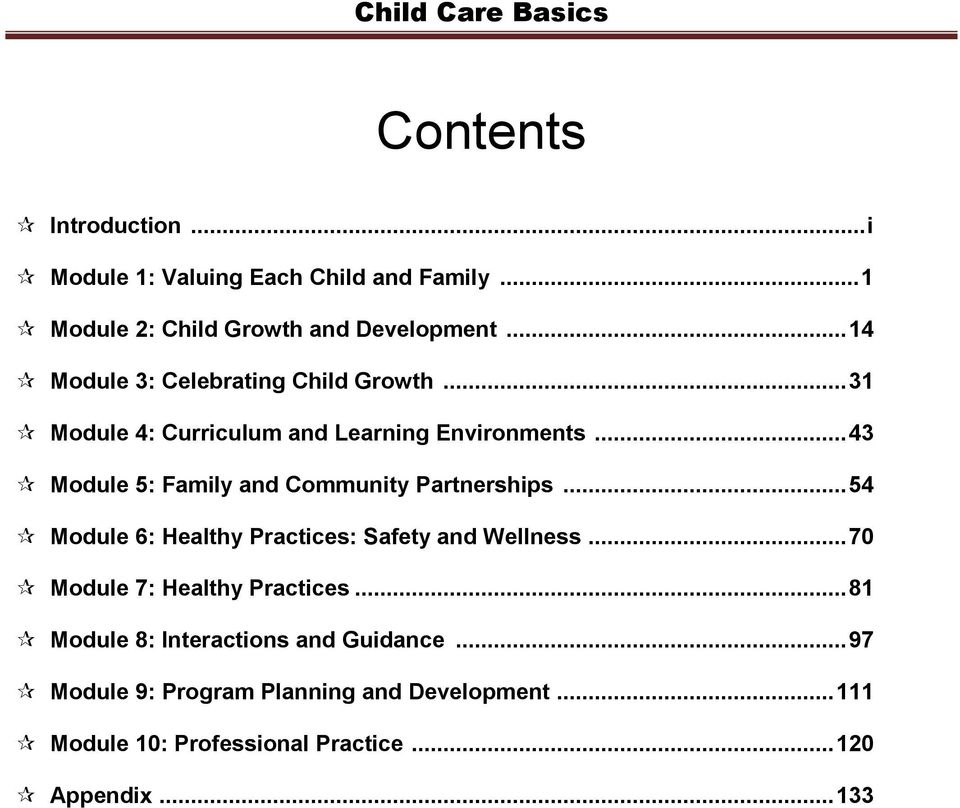
2 Contents Introduction... i Module 1: Valuing Each Child and Family... 1 Module 2: Child Growth and Development Module 3: Celebrating Child Growth Module 4: Curriculum and Learning Environments Module 5: Family and Community Partnerships Module 6: Healthy Practices: Safety and Wellness Module 7: Healthy Practices Module 8: Interactions and Guidance Module 9: Program Planning and Development Module 10: Professional Practice Appendix
3 INTRODUCTION What is my role in caring for young children? This curriculum guide is a tool for instructors and trainers to assist pre-service care providers and teachers in answering that question. Washington State requires all licensed Lead Teachers to successfully complete either the Basics in Child Care STARS course or earn 12 credits in Early Childhood Education (ECE). The intent of the law is to assure families that the licensed professionals caring for their children are knowledgeable of child development, resourceful in planning activities, skilled in guiding behavior, and able to maintain healthy environments. This Child Care Basics 30 hour/3 credit course serves as an introduction for professionals in meeting the licensing requirement for lead teachers. The course is organized as 10 modules; each is expected to take three hours to facilitate. The Washington State Core Competencies for Early Care and Education Professionals (Washington State Department of Early Learning [DEL], 2010) is the foundation for the three student outcomes found in each module (labeled as Outcomes A, B and C). Interactive learning activities, video clips, discussion questions, and additional resources provide instructors with a variety of options for teaching. There is a choice of two textbooks: Child Care Center Licensing Guidebook (2 nd ed., DEL, 2006), OR the Washington State Family Home Child Care Licensing Guide (2 nd ed., DEL, 2013). The modules are designed so that the needs of both center staff and family home child care providers will be met through this course. A Power Point presentation is provided to offer visual support for training delivery. The slides offer visuals or key points to accompany the curriculum content with text from the curriculum written in the instructor notes. Do not read verbatim from the trainer notes. The notes support your delivery of the content. Some activities in the curriculum are optional and the PPT slides can be arranged or deleted to accompany the format selected. Some trainers offer the course as a hybrid, with 15 hours of face to face time and 15 hours of out of class reading and assignments. A sample training plan for hybrid deliver is included. The students are expected to read pages from the texts and complete some activities or handouts prior to attending the next class. This Child Care Basics curriculum reflects values articulated in state and national standards for the Early Learning Profession. The Code of Ethical Conduct and Statement of Commitment (NAEYC May 2011) provides the following statement on core values: Standards of ethical behavior in early childhood care and education are based on commitment to the following core values that are deeply rooted in the history of the field of early childhood care and education. We have made a commitment to: i

4 Appreciate childhood as a unique and valuable stage of the human life cycle. Base our work on knowledge of how children develop and learn. Appreciate and support the bond between the child and family. Recognize that children are best understood and supported in the context of family, culture, community, and society. (The term culture includes ethnicity, racial identity, economic level, family structure, language, and religious and political beliefs, which profoundly influence each child s development and relationship to the world.) Respect the dignity, worth, and uniqueness of each individual (child, family member, and colleague). Respect diversity in children, families, and colleagues. Recognize that children and adults achieve their full potential in the context of relationships that are based on trust and respect. This curriculum guide references The Washington State Core Competencies for Early Care and Education Professionals in an effort to describe the basic foundations of best practice: Children need a supportive and nurturing environment in which to grow, learn and develop. Caregivers and teachers recognize that children are first educated by the family. In doing so, caregivers and teachers develop strong relationships with families and support their strengths. Cultural diversity including all ethnic, linguistic and socio-economic backgrounds impacts areas of practice in early care and education. Professionals recognize that each family is unique in its structure, values, beliefs, traditions and interactions. Professionals respect each family s worth and appreciate the richness of diversity that each family brings to the early care and education setting. Professional development requires self-reflection on practices to identify strengths, recognize areas for future growth, and incorporate new leaning experiences. Reflection heightens awareness of one s own performance and leads to person change and growth. Finally, the Washington State Early Learning and Development Guidelines: Birth through 3 rd Grade (2012 WA State Department of Early Learning. Olympia, WA: Del) is a resource utilized throughout this curriculum guide. Go to for information on how this document was created to reflect all of Washington s children and those who love, care for and educate them. The Guidelines authors offer the trainers and instructors the following guidance: Every child in Washington has diverse strengths rooted in his or her family s unique culture, heritage, language, beliefs, and circumstances. Early learning that supports the full participation of every child builds on these strengths by fostering a sense of belonging and supporting positive social relationships. ii

5 In an effort to meet the standards described above, assessment tools are offered in each module. These assessments are directly related to the desired student outcomes and directly linked to the states core competencies. Each educational setting will dictate unique requirements for recording assessment results. It is expected that every individual completing the Child Care Basics course will have documented evidence of having met stated outcomes. See the Competencies Documentation Rubric in the Appendix for an instructor s template for keeping track of students progress. A template certificate for documenting completion of the Child Care Basics course is also included. It is hoped that this introductory course will inspire and motivate developing professionals to seek more opportunities to improve skills and increase knowledge through continuing education. Creation of the Child Care Basics Curriculum Guide was the result of the combined efforts of Early Learning professionals from across the state of Washington and draws from the larger community of Early Childhood Education. Special thanks go to: Department of Early Learning The Lead Authors and Reviewers from the college system o Darcie Donegan, Whatcom Community College Modules o Gayle Dilling, Olympic College Modules o Shelley Macy, Northwest Indian College Module o Christine Moon, South Puget Sound Community College - Module o Ardene Niemer, Renton Technical Institute Modules o Glenda Orgill, Yakima Valley Community College Modules o Victoria Mackenzie, Olympic College Online course creator o Mary Garguile, Olympic College Quality Matters reviewer, online course o Dorothy Watson, Whatcom Community College Editor Debra Hasbrook M.Ed. -- Creation of the Child Care Basics Power Point presentation Child Care Aware of Olympic Peninsula/Child Care Action Council hybrid format This course was updated by Department of Early Learning in This curriculum guide is dedicated to all of the infants, toddlers, and children nurtured, cared for, and taught in centers and in homes throughout Washington State. May they be supported by skilled, loving, knowledgeable adults keeping them safe and enriching their lives. ~ Sally Holloway, Project Director Whatcom Community College iii
Lissanna M Follari. L. Follari CV 1
 Lissanna M Follari L. Follari CV 1 361 Stoney Brook Rd New London, NH 03257 [email protected] 603-748-2492 Collaborative Partner Flexible Creative Thinker Passionate Student-Centered Educator Relationship
B.A. in Education Specialization: Early Childhood Education (P-3) Student Handbook
 B.A. in Education Specialization: Early Childhood Education (P-3) Student Handbook Rowan University College of Education Teacher Education Department 1 Table of Contents Program Description 3 ECED Program
WASHINGTON. ECE Training Institutions - alphabetized by city GRAYS HARBOR COLLEGE 1620 EP SMITH DRIVE ABERDEEN, WA 98520 509-538-4018 ECE PROGRAM
 WASHINGTON ECE Training Institutions - alphabetized by city GRAYS HARBOR COLLEGE 1620 EP SMITH DRIVE ABERDEEN, WA 98520 509-538-4018 MARK REISMAN GRAYS HARBOR COLLEGE GREEN RIVER COMMUNITY COLLEGE 12401
Early Childhood: Observation & Assessment
 OA UP3 Syllabus http://www.virtualeduc.com/html_syllabus/oa/oa_up3_syllabus.htm Page 1 of 6 Early Childhood: Observation & Assessment Instructor Name: Dr. Marrea Winnega Facilitator Name: Darcie Donegan,
Pennsylvania Core Knowledge Competencies for Early Childhood & School-Age Professionals
 Pennsylvania Core Knowledge Competencies for Early Childhood & School-Age Professionals Office of Child Development and Early Learning Pennsylvania Department of Education and Department of Public Welfare
PROFESSIONAL DEVELOPMENT OPPORTUNITIES FOR STAFF
 PROFESSIONAL DEVELOPMENT OPPORTUNITIES FOR STAFF HEAD START LEADERSHIP CONFERENCE Sally Holloway Whatcom Community College Sally Holloway Whatcom Community College Early Childhood Education Project Director
Early Childhood Education / Course Outcomes
 Early Childhood Education / Course Outcomes Development in Early Childhood CCED102 1. To understand the stages of development from pre- natal to 7/8 years of age in order to have appropriate and reasonable
BOK Course Title Course Description Access to Children
 ECE Online Courses Course Number BOK Course Title Course Description Access to Children 18CI1001 TI Educational Technology This course encompasses effectively analyzing, designing, Must videotape a developing,
naeyc Code of Ethical Conduct Supplement for Early Childhood Adult Educators Adopted Spring 2004 Purpose of the Supplement Adopted Spring 2004
 NAEYC, NAECTE, & ACCESS Position Statement 1 naeyc Code of Ethical Conduct Supplement for Early Childhood Adult Educators A Joint Position Statement of the National Association for the Education of Young
How To Teach Early Childhood: Observation & Assessment
 University of Wisconsin-Platteville Office of Continuing Education Course Syllabus Early Childhood: Observation & Assessment Number: Semester: Credits/Contact Hours: 4530E All 3 Undergraduate Credits /
The Pyramid Model provides guidance for early childhood special education and early intervention personnel, early educators, families, and other
 The Pyramid Model provides guidance for early childhood special education and early intervention personnel, early educators, families, and other professionals on the evidencebased practices for promoting
Master of Science in Early Childhood Education Singapore, 2005 2006
 Master of Science in Early Childhood Education Singapore, 2005 2006 Offered by RTRC Asia in Collaboration with Wheelock College s Center for International Education, Leadership, and Innovation Background
Washington State Community and Technical Colleges. Pathways for Future Educators
 Washington State Community and Technical Colleges Pathways for Future Educators 2012 1 2 About This Guide Do you enjoy working with people? Are you searching for a career that will help you make a difference
The Early Childhood Portfolio Requirement For the Early Childhood Education Major at Granite State College
 The Early Childhood Portfolio Requirement For the Early Childhood Education Major at Granite State College This Portfolio requirement applies to the B.S. in ECE without Teacher Certification. This program
STUDENT LEARNING ASSESSMENT OVERVIEW EARLY CHILDHOOD EDUCATION
 STUDENT LEARNING ASSESSMENT OVERVIEW EARLY CHILDHOOD EDUCATION What early childhood professionals know and can do significantly influence children s development, learning, and success in school. Since
Science of Early Child Development
 Science of Early Child Development What is the Science of Early Child Development (SECD)? SECD is an online teaching and learning tool that presents groundbreaking research related to ECD in an accessible,
CHD 12023T COURSE OUTLINE. Prerequisites: None. Course Description:
 23T Lecture Revised: Fall 2015 CHD 12023T 23TIntroduction to Early Childhood COURSE OUTLINE Prerequisites: None Course Description: This course introduces early childhood development through activities
CAS 464/464-L: Advanced Practicum in Early Childhood
 CAS 464/464-L: Advanced Practicum in Early Childhood Meetings Class: Tuesdays 7:00 9:00 PM Lab/Fieldwork: To be arranged Professor: Phone: 714-278-2930 Office Hours: Monday 2:00-3:00 PM & Tuesday 6:00-7:00
Yavapai \ College Early Childhood Education
 Yavapai \ College The department strives to deepen students understanding of young children, families and the teaching learning process. The early childhood profession provides care and education for children
EARLY CHILDHOOD EDUCATION AS A CAREER Program Information: Mike Kelly, (360) 538-4013 [email protected]
 EARLY CHILDHOOD EDUCATION AS A CAREER Program Information: Mike Kelly, (360) 538-4013 [email protected] For more information about our graduation rates, the median debt of students who completed the program,
ECED 105 Introduction to Early Childhood Education Winter 2015 Tuesdays 1-3:50
 ECED 105 Introduction to Early Childhood Education Winter 2015 Tuesdays 1-3:50 Instructor: Gayle Dilling Voicemail: 475-7289 Office: SBCDC #103 email: [email protected] Office hours: Mondays 10-12,
Tracy Michelle Smith-Michnowicz 11 Spring Lane, West Hartford, CT 06107 860 214-2575 [email protected]
 Tracy Michelle Smith-Michnowicz 11 Spring Lane, West Hartford, CT 06107 860 214-2575 [email protected] Education University of Connecticut Graduate Certificate in Adult Learning Anticipated Date
Elementary MEd I. The Relationship of the Program with the Unit s Conceptual Framework
 Elementary MEd I. The Relationship of the Program with the Unit s Conceptual Framework Shaping Tomorrow: Ideas to Action The Early Elementary Education program for prospective elementary education candidates
Bachelor of Arts in Early Childhood Degree Offerings through the 2010-2012 Catalog*
 Bachelor of Arts in Early Childhood Degree Offerings through the 2010- Catalog* Catalog Number Class Name Course Description Semester Credits Prerequisites Semesters Offered Mode of Delivery EC 210 INTRODUCTION
Pre-Kindergarten Associate Standards
 Pre-Kindergarten Associate 2008 Ohio/CEC-DEC/NAEYC Ohio Core Body of Knowledge and Competencies Program Standards The Associate License, valid for five years, shall be issued to an individual who holds
College of Charleston EDEE 363 002 Introduction to Early Childhood Education 3 Credit Hours Spring 2010
 College of Charleston EDEE 363 002 Introduction to Early Childhood Education 3 Credit Hours Spring 2010 Meeting Time and Place: Thursdays, 8:00-10:45 Education Center, Room #215 Professor: Dr. Virginia
120 UCC CATALOG 2014-15
 EARLY CHILDHOOD EDUCATION Pat h WaY s c e rt i F i c at e: infa n t / t o d d L e r 20 credits CAREER DESCRIPTION The State of Oregon requires individuals working in a licensed child care facility to have
Standards for Certification in Early Childhood Education [26.110-26.270]
![Standards for Certification in Early Childhood Education [26.110-26.270]](/thumbs/24/3436110.jpg "Standards for Certification in Early Childhood Education [26.110-26.270]") I.B. SPECIFIC TEACHING FIELDS Standards for Certification in Early Childhood Education [26.110-26.270] STANDARD 1 Curriculum The competent early childhood teacher understands and demonstrates the central
I.B. SPECIFIC TEACHING FIELDS Standards for Certification in Early Childhood Education [26.110-26.270] STANDARD 1 Curriculum The competent early childhood teacher understands and demonstrates the central
FINAL EVALUATION FORM. Graduate Certificate of Education PPA5106 Early Childhood Studies
 Graduate Certificate Teacher Name: Centre/School: University Supervisor: Year Level Taught: FINAL EVALUATION FORM Graduate Certificate of Education PPA5106 Early Childhood Studies Please indicate whether
MADE BY: COLLEGE OF EARLY CHILDHOOD EDUCATORS
 SUBMISSION OF THE COLLEGE OF EARLY CHILDHOOD EDUCATORS REGARDING THE EARLY LEARNING ADVISOR'S ADVICE TO THE PREMIER ON FULL-DAY LEARNING FOR FOUR AND FIVE YEAR OLDS MADE BY: COLLEGE OF EARLY CHILDHOOD
Leads pedagogical practice. Promotes professional learning
 Leading teaching and learning 1 Creates a student centred learning environment 4 Builds capacity Developing self and others Leading teaching and learning 2 Leads pedagogical practice Developing self and
Program Administrator Definition and Competencies
 I. Program Administrator Definition The program administrator is the individual responsible for planning, implementing, and evaluating a child care, preschool or kindergarten program. The role of the administrator
Master of Science in Early Childhood Education Singapore, 2004 2005
 Master of Science in Early Childhood Education Singapore, 2004 2005 Sponsored by Wheelock College s Center for International Education, Leadership, and Innovation and RTRC Asia in Singapore Background
How Our Early Childhood Products. help strengthen
 How Our Early Childhood Products help strengthen Program Quality & School Readiness With these high-quality, research-based books and assessment tools from Brookes Publishing, you ll strengthen the quality
CLINICAL EXPERIENCE A: EARLY CHILDHOOD EDUCATION ECE 319 FALL 2011 Instructor Annette Searfoss
 CLINICAL EXPERIENCE A: EARLY CHILDHOOD EDUCATION ECE 319 FALL 2011 Instructor Annette Searfoss Office RCC 113, 661-1870 Home:717-377-6215 Office Hours Tuesdays and Thursdays 10:00-11:00 am and by appointment
Special Programs. Professional Development Catalog for Child Care Professionals
 Early Childhood Endorsement Program (ECEP) Virginia Professional Development Registry Information School-Age Child Care Endorsement Program Medication Administration Training (MAT) Program 7 Early Childhood
Child Care COURSE CATALOG. In-person and online courses available
 Child Care COURSE CATALOG In-person and online courses available MSDE Licensed Child Care Professional & MSDE Licensed Child Care Directors Continuing Education Program Description: Baltimore City Community
Summary of NAEYC Standards/Elements
 Summary of NAEYC Standards/Elements STANDARD 1. PROMOTING CHILD DEVELOPMENT AND LEARNING Candidates prepared in early childhood degree programs are grounded in a child development knowledge base. They
How To Get Credit For Prior Learning/Work Experience In Early Childhood Education
 Handbook For Credit for Prior Learning/Work Experience Early Childhood Education Associate Degree Approved April 12, 2012 Table of Contents Page number Explanation of the process 3-4 Am I a Good Candidate
Early Childhood Education
 Early Childhood Education Portfolio Guidelines College of Education University of Nevada, Reno Program Coordinator & Advisor: Melissa M. Burnham, Ph.D. (775) 784-7012; [email protected]; WRB 3031 P a g
Child Development Associate (CDA) Credential and Process
 Facts about the 1 Child Development Associate (CDA) Credential and Process What Is a CDA? CDA stands for Child Development Associate. This is a person who has successfully completed the CDA assessment
Guide to the National Quality Standard
 3 Guide to the National Quality Standard September 2013 Amendments to the Education and Care Services National Regulations affecting the National Quality Framework Resource Kit Amendments to the Education
When You Were A Child
 Purpose: When You Were A Child Module: IV Topic: Culture, Family and Providers - and/or - Harmonizing Cultural Diversity Type: Mixer; Reflection and Discussion Group Size: Small Groups Time: 20-45 minutes
NUNAVUT. EDUCATION CAREERS Early Childhood Education PROGRAM REPORT. 171 Early Childhood Education DIPLOMA
 NUNAVUT EDUCATION CAREERS Early Childhood Education PROGRAM REPORT 171 Early Childhood Education DIPLOMA Start Term: No Specified Start Date End Term: No Specified End Date Program Status: Approved Action
Early Childhood Educators of British Columbia. Code of ETHICS E C E B C. early childhood educators of BC
 Early Childhood Educators of British Columbia Code of ETHICS E C E B C early childhood educators of BC Early Childhood Educators of British Columbia (ECEBC) wishes to gratefully acknowledge the Child Care
More about me. Tech Training Through Tech Play:
 Tech Training Through Tech Play: Hands-On Strategies to Supporting Parents and Educators Appropriately Use Tech Tools with Young Children Amanda Armstrong, M.S. TEC Center at Erikson Institute @AArmstrong_CD
Early Childhood. Education
 Early Childhood Page 1 Education Program Assessment System effective August 26, 2013 Revised January 7, 2014 I. Greetings to Students Welcome to the Early Childhood Education teacher preparation program
Matrix Showing Match between NCATE Curriculum Guidelines for Early Childhood Education and CEOE Competencies. CEOE Subarea Competency III III
 Certification Examinations for Oklahoma Educators (CEOE) Framework Development Correlation Table The Framework Development Correlation Table provides information about possible alignment of some of the
Bachelor of Professional Studies Major in Professional Studies Concentration: Child Development and Family Studies
 Students Name: UUID#: Description of Program Bachelor of Professional Studies Major in Professional Studies Concentration: Child Development and Family Studies (formerly Child Development) 218 Brister
Targeted Needs Training. Training Topics. Training Techniques
 Infant/Toddler Professional Caregiver Certificate (I/T 121) A formal online training series of six separate modules providing an opportunity to build Infant/Toddler training hours and earn a professional
Beauvoir, The National Cathedral Elementary School Head of School Washington D.C.
 Beauvoir, The National Cathedral Elementary School Head of School Washington D.C. INTRODUCTION Beauvoir, The National Cathedral Elementary School, was founded in 1933 and serves nearly 400 students, beginning
How To Improve Your Head Start Program
 How Our Early Childhood Products Help Strengthen Program Quality and School Readiness Social-Emotional Assessment/ Evaluation Measure RESEARCH EDITION With these high-quality, research-based books and
Preparing Early Childhood Professionals
 Preparing Early Childhood Professionals NAEYC s Standards for Programs Marilou Hyson, Editor NAEYC s Standards for Initial Licensure, Advanced, and Associate Degree Programs Also includes standards material
Early Childhood Endorsement Program
 Virginia Department of Social Services Early Childhood Endorsement Program A Professional Development Opportunity 11/2014 Virginia Department of Social Services Early Childhood Endorsement Program (ECEP)
o Ivy Tech ECED 100 Introduction to Early Childhood Education ECED 101 Health, Safety and Nutrition ECED 103 Curriculum in Early Childhood Classroom
 Indiana Department of Education Academic Course Framework EARLY CHILDHOOD EDUCATION I Early Childhood Education I prepares students for employment in early childhood education and related careers that
Human Services Cluster
 Page 1 of 6 Human Services Cluster T57321 Interpersonal Relationships (5364) 1 semesters, 1 credit per semester Approximate cost per semester: $16.21 This course addresses essential knowledge and skills
About Early Education
 Code of Ethics About Early Education Early Education is the leading independent national charity supporting families and the professional development of practitioners working in the maintained, private,
Child Care COURSE CATALOG. In-person and online courses available
 Child Care COURSE CATALOG In-person and online courses available MSDE Licensed Child Care Professional & MSDE Licensed Child Care Directors Continuing Education Program Description: Baltimore City Community
Adoption in Washington State
 Adoption in Washington State A Lifelong Developmental Journey DSHS 22-1096(X) (Rev. 1/05) Adoption A Lifelong Developmental Journey Adoption is the permanent, legal transfer of all parental rights from
Online Child Care Programs
 Child Care Teacher Requirements: Child Growth and Development (45 hours) Communication Skills for Child Care Professionals (9 hours) Including all Children and the ADA (3 Hours) Breastfeeding Support (3
Davis Applied Technology College Curriculum Development Policy and Procedures Training Division
 Davis Applied Technology College Curriculum Development Policy and Procedures Training Division Board Approval: 24 April 2008 1. Purpose 1.1. Curriculum development at the Davis Applied Technology College
The Family Services Manager s Handbook
 The Family Services Manager s Handbook A Head Start Training Guide from Training & Technical Assistance Services Western Kentucky University Table of Contents Family Services in Head Start... 1 The Head
FRANCES COLMAN MAYER
 FRANCES COLMAN MAYER 1650 El Cerrito Court San Luis Obispo, Calif. 93401 (805) 544-5843 ===================================================================== QUALIFICATIONS Masters Degree in Early Childhood
Los Angeles Mission College Spring 2016 Child Development 23 Practicum in Child Development II Tuesday s 6:50pm-8:55pm Section # 3189
 Los Angeles Mission College Spring 2016 Child Development 23 Practicum in Child Development II Tuesday s 6:50pm-8:55pm Section # 3189 Instructor: Ms. Patricia Rodriguez [email protected] 818-364-7670
Principal has shared the school vision and goals with the staff. A process for developing a school vision and goals is not evident.
 Ohio Principal Evaluation System Ohio Principal Performance Rating Rubric Principal Performance Rubric The Principal Performance Rating Rubric is intended to be scored holistically. This means that evaluators
Literacy Education. Master of Science in Education: Program Overview. Program Highlights
 Master of Science in Education: Literacy Education Program Overview The Ralph C. Wilson, Jr., School of Education offers a Master of Science in Literacy Education. The Literacy Education programs lead
Early Childhood Education: Introduction to Early Childhood Education
 Course Description This course provides an introduction to the historical, theoretical, and developmental foundations for educating young children, with an emphasis on creating inclusive environments and
16 KAR 2:040. Interdisciplinary early childhood education, birth to primary.
 16 KAR 2:040. Interdisciplinary early childhood education, birth to primary. 1 RELATES TO: KRS 157.3175, 161.020, 161.030 STATUTORY AUTHORITY: KRS 161.028, 161.030 NECESSITY, FUNCTION, AND CONFORMITY:
Transition to Teaching Survey Mean Scores by Item and by Performance Area
 Spring 2014 Transition Teaching Survey Mean Scores by and by Performance Area N=42 (36% return rate) Part A: Mark a response 1 4 indicate your agreement with each statement. If you do not have enough information
CCEI Online College Credit Eligible CDA Certificate Family Child Care Program Syllabus
 CCEI Online College Credit Eligible CDA Certificate Family Child Care Program Syllabus Settings: Family Care Program Code: 1103-CDA Program Length: 151 Hours IACET CEU Value: 15.1 CEUs Program Start Date:
EARLY CHILDHOOD EDUCATION (AS) Associate Degree, Certificate of Achievement & Department Certificate Programs (formerly Child Development)
 A Course of Study for EARLY CHILDHOOD EDUCATION (AS) Associate Degree, Certificate of Achievement & Department Certificate Programs (formerly Child Development) Early Childhood Education majors will be
PORTLAND STATE UNIVERSITY GRADUATE SCHOOL OF EDUCATION Preparing professionals to meet our diverse community s lifelong educational needs
 PORTLAND STATE UNIVERSITY GRADUATE SCHOOL OF EDUCATION Preparing professionals to meet our diverse community s lifelong educational needs Diversity & Inclusiveness to work in diverse settings to promote
PERFORMANCE EXPECTATION 1: Vision, Mission, and Goals
 PERFORMANCE EXPECTATION 1: Vision, Mission, and Goals PERFORMANCE EXPECTATION 1: Vision, Mission, and Goals Education leaders ensure the achievement of all students by guiding the development and implementation
How To Teach Authentic Learning
 Alignment of Standard I: Teachers Demonstrate Leadership A. Teachers lead in their classrooms. Take responsibility for all students learning Week 1: Multimedia Book: Authentic Learning in the Digital Age
Welcome to the Infant/Toddler Mental Health Graduate Certificate Program at Portland State University
 Welcome to the Infant/Toddler Mental Health Graduate Certificate Program at Portland State University We are Voices for Babies! We are dedicated to increasing the capacity of professionals in different
13. Competency/Outcome: Students will learn to serve as an advocate on behalf of young children and their families. (ESPB Standard 50037.8.
 Recommended Course Title: Introduction to Early Childhood Education Recommended Course Number: 210/310 1. Competency/Outcome: Students will compare and contrast the major existing theories that influence
TABLE OF CONTENTS. Core Standards... 1. Diversity... 2. Technology... 3. Standards for Birth through Kindergarten Teachers... 4
 TABLE OF CONTENTS Standards Section Standards for All Teachers Core Standards... 1 Diversity... 2 Technology... 3 Standards for Birth through Kindergarten Teachers... 4 Standards for Elementary Teachers...
*Performance Expectations, Elements and Indicators
 C o m m o n C o r e o f L e a d i n g : Connecticut School Leadership Standards *Performance Expectations, Elements and Indicators *For further information, visit: http://www.sde.ct.gov/sde/cwp/view.asp?a=2641&q=333900
Section Two: Ohio Standards for the Teaching Profession
 12 Section Two: Ohio Standards for the Teaching Profession 1 Teachers understand student learning and development and respect the diversity of the students they teach. Teachers display knowledge of how
Adopting a child is a life-long commitment
 ADOPTION Adopting a child Adopting a child is a life-long commitment nur ture Adoption benefits children and families To experience healthy development, and create a sense of their own self-worth, children
Pre-Primary Education ( PPE11 )
 FACULTY OF EDUCATION Bachelor s Degree Programmes Pre-Primary Education ( PPE11 ) EDUC180 INTRODUCTION TO EDUCATION This course aims to help students understand the general law of the human education system.
The School Leadership Collaborative Intern and Administrative Mentor Guide
 Gonzaga University School of Education The School Leadership Collaborative Intern and Administrative Mentor Guide Principal Certification Program Administrator Certification Department of Educational Leadership
Master of Education School Counseling Degree Program
 Advanced Certificate Portfolio Guidelines Master of Education School Counseling Degree Program Revised Spring 2008 Southeastern Oklahoma State University Durant, Oklahoma 1 TABLE OF CONTENTS Introduction...page
Course Information Booklet
 Course Information Booklet CHC50113 Diploma of Early Childhood Education and Care NSW Family Day Care Association CHC 50113 Diploma of Early Childhood Education and Care Course Information Revision date
EDUC 660. Organization and Administration of School Counseling Programs
 EDUC 0 Organization and Administration of School Counseling Programs *Note: All content provided in the professor s notes, course chart and course syllabus are based on the professor s opinion and may
Center for Early Childhood Education Teacher Preparation Program
 Center for Early Childhood Education Teacher Preparation Program STUDENT MANUAL 2015 1 2 Center for Early Childhood Education Mission Statement We are a community of reflective learners children, families,