
European Vacancy Monitor Issue no.7 / December 2012
|
|
|
- Mabel Spencer
- 10 years ago
- Views:
Transcription
1 1 The is published quarterly by DG Employment, Social Affairs & Inclusion of the European Commission. This is a publication within the Europe 2020 flagship initiative An Agenda for New Skills and Jobs feeding into the European Skills Panorama. It will be further refined taking into account stakeholders feedback. Neither the European Commission nor any person acting on behalf of the Commission may be held responsible for the use that may be made of the information contained in this publication. Comments on the content are gratefully received and should be sent to: DG EMPL C.4 European Commission B-1049 Bruxelles/Brussels [email protected] INSIDE I. INTRODUCTION 2 II. III. IV. SHORT TERM TRENDS IN RECRUITMENT DEMAND 3 OCCUPATIONAL DEMAND AND RECRUITMENT PATTERNS 10 RELATIONSHIP BETWEEN RECRUITMENT DEMAND AND SUPPLY 14 V. EDUCATION AND SKILLS 16 VI. VII. SPECIAL: JOB OPPORTUNITIES FOR OLDER JOBSEEKERS 17 TOP GROWTH OCCUPATIONS PER COUNTRY 22 Further Information European Job Mobility Bulletin EU Employment and Social Situation Quarterly Review Employment Package HIGHLIGHTS FIRST QUARTER OF 2012 Development of labour demand: Reversal in recruitment development in the first quarter of The period of recovery in recruitment demand since the beginning of 2010 lasted relatively briefly, up to the last quarter of The first quarter of 2012 was characterized by substantial negative developments in terms of both job vacancies (-7%, 20 countries with available data) and job-finders (-4%), confirming the deteriorating economic and employment situation in the EU. The number of job vacancies even declined in countries which up until then had recovered well from the crisis such as Austria, Germany and the Netherlands, although the impact is not yet visible in the number of job-finders. Recruitment demand reverted before pre-crisis levels were reached. Romania and Greece were affected most compared to the first quarter of Development in PES and temporary work agencies: Increasing PES vacancies, decreasing temporary work agency vacancies. There were fewer job vacancies notified to temporary work agencies for each month up to August 2012 compared to the same month in 2011 (5 countries). However in the first quarter of 2012 more vacancies were notified to the PES compared to the same quarter of 2011 (+9%, 18 countries with available data). These PES developments do not reflect changes in the total labour market but partly changes in capacity or regulations. Occupational demand: The reversal affected craftsmen, operators and elementary occupations most. Between the first quarters of 2008 and 2011 the number of job-finders decreased most strongly for craft and related trades workers and operators and assemblers. In the year following the number of job-finders continued to decrease strongly in these cyclically sensitive occupations, as well as in the numerically large group of elementary occupations. Growth occupations were far fewer. The strongest continued growth was observed for nursing and midwifery associate professionals. Tightness of the labour market: Recruitment demand reversion was accompanied by rising unemployment rates. Not only did recruitment demand reverse, but in addition the unemployment rate increased from 9.9% in the first quarter of 2011 to 10.7% in the first quarter of Both contributed to an increase of the EU27 ratio of unemployed to job-finders from 2.4 to 2.8, indicating more difficult labour market conditions for jobseekers. The highest increases in the ratio were in Romania, Slovakia, Portugal, Greece and Spain. Special: Job opportunities for older workers Older workers are less likely to find jobs, gender differences at all ages. In 2011, only 6% of all job-finders were aged years, compared to 14% of the employed and 10% of the unemployed. This partly reflects that older workers are more likely to have settled in jobs and thus less likely to change jobs. However, the difference between job-finders and unemployed may also reflect some reluctance from employers to recruit and invest in training of those approaching retirement. The jobs found by older workers tend to be more concentrated in elementary and medium skilled occupations than those found by younger workers. Significant gender disparities exist in the types of jobs found by older workers, although similar disparities exist for younger job-finders.
2 2 I. INTRODUCTION As part of its Europe 2020 flagship initiative An Agenda for New Skills and Jobs, in 2010 the European Commission (EC) launched the Monitoring Labour Market Developments in Europe project. The objective of this project is to increase labour market transparency for all stakeholders who need information about recent developments on the demand side of the labour market, such as decision-makers in the fields of education and employment, public and private employment services (including EURES advisers), education and training providers, career guidance services, and policy and labour market analysts. The is a component of the European Commission s endeavour to develop a labour market monitoring system focusing on changes in the demand for skills, showing where the new job starts are. The results from an analysis of recruitment demand are not necessarily identical with those from an analysis of employment. The changing demand for labour may impact on employment trends in a variety of ways. An increase in vacancies will be reflected in an increase in employment where new job creation outstrips job losses (i.e. expansion demand). However, many job openings arise because of the need to replace workers who have left the labour force because of retirement, emigration or for other reasons. However, the single biggest generator of vacancies is workers changing their jobs, either voluntarily or because their employment contract has come to an end. The (EVM) The key sources of information for the EVM include European and national sources: - Labour Force Survey (data of job-finders for 27 countries) including breakdowns by sector, occupation, educational level and educational field, as well as the relationship of unemployed to job-finders (to measure the tightness of the labour market), - Job Vacancy Statistics (JVS) (vacancy data for 20 countries) including by sector, - PES data for job vacancy inflow and registered unemployed (18 countries), including by occupation - Data from Temporary work agencies (TWA) (for selected countries) and Eurociett, the European Confederation of Private Employment Agencies. EVM provides regular updates on developments in the following aspects of labour demand: Numbers of job vacancies and of job-finders (quarterly) Inflow of newly registered vacancies with PES Recruitment demand in TWAs (quarterly) Occupational demand (quarterly) Relationship between recruitment demand and supply (quarterly) Job vacancies by economic sector (annually) Educational requirements educational level and educational field (annually) Hard-to-fill ( bottleneck ) vacancies (annually) The European Job Mobility Bulletin (EJMB) The main sources of data analysis for the European Job Mobility Bulletin are Job vacancies uploaded by national PES to the European Job Mobility portal (EURES portal), The EURES database including a breakdown by sectors, occupations and skills. The European Vacancy and Recruitment Report (EVRR) This biennial report is based upon the data analysis for the (EVM) and further national labour market information and studies. In addition to the topics presented in the EVM, the report focuses on the identification of top-growth occupations with most recent recruits and of top bottleneck occupations in Europe for which employers experience difficulties in filling vacancies. It also provides an analysis of the development of market shares of recruitment agencies, in particular of PES and of temporary work agencies. The analysis of demand for occupations is based upon the International Standard Classification of Occupations (ISCO- 08 for job-finders and ISCO-88 for PES data). To allow for international comparisons where necessary, some PES data on occupations were harmonised with ISCO. The analysis of demand by educational level and field is based on the International Standard Classification of Education (ISCED). This issue, EVM No. 7, focuses on an analysis of changes in labour demand in the first quarter of 2012 comparing it to the first quarter of It also captures trends in job vacancies over longer periods, most notably since Inspired by the European Year of Active Aging and Intergenerational Solidarity, a special section is devoted to job opportunities for older jobseekers (aged 55-64).
3 3 II. SHORT TERM TRENDS IN RECRUITMENT DEMAND The first quarter of 2012 marked a significant reversal in almost all indicators of recruitment demand as compared to the same quarter in 2011 and reflected weakening economic development. The previously marginal decline in the number of job-finders accelerated and the development in the number of job vacancies became negative. In addition, temporary work agencies saw fewer jobs posted with them. The majority of countries saw a decline in the inflow of job vacancies registered in PES. The aggregate PES vacancy inflow nevertheless increased, owing partly to organisational changes such as improved ICT systems or increased capacity. Overall these developments suggest a reinforced downward trend in recruitment demand in the first quarter of After a modest recovery in labour demand, decline at the start of 2012 After recovery and positive growth in 2010 and 2011, key indicators of labour demand in the EU declined again in the first quarter of 2012 following weakening economic growth. The year-on-year growth in the number of job-finders compared to the same quarter in the year before was positive for the first time in the second quarter of After that, the growth lessened and turned negative in the first quarter of The year-on-year growth in the number of job vacancies peaked in the fourth quarter of 2010 thanks to developments in the private sector, and also turned negative in the first quarter of In the first quarter of 2012 the growth rate of the number of job vacancies in the EU, compared to the same quarter in the year before, turned negative (-6%) for the first time since 2009 (Chart 1). For the 16 countries for which consistent data are available, this followed a visible slowdown in the figures for 2011 in terms of year-on-year growth. 1 In fact, the number of job vacancies in the EU16 began to decrease when levels were still quite below pre-crisis levels, with the result that in the first quarter of 2012 there were 27% fewer vacancies than in the same period in 2008 (Chart 2). However, within the overall job vacancy figures, the public and private sectors fared differently. In the public sector, the decline in job vacancies had already started in the last quarter of 2011 compared to the same quarter in 2010 (-4%), thereby halting an upward trend over the first three quarters of Nevertheless, the recent fall in private sector job vacancies was much more pronounced, dropping from a positive growth to a fall of around 7% in the first quarter of This fall was nearly twice that of job vacancies in the public sector (-4% as in the last quarter of 2011). Displaying similar overall trends to the total number of job vacancies, the year-on-year growth of job-finders for the EU27 also was positive in all of 2010 and 2011, but turned negative in the first quarter of 2012 (-4%). This reinforced the trend in the third and fourth quarters of 2011 when a marginal decline had already set in. Taking a longer term perspective reveals that a recovery in recruitment demand to pre-crisis levels remains some way off and the number of job-finders in the first quarter of 2012 was significantly less (down by 21%) compared to the same quarter of These largely negative recruitment developments in the EU are a result of the disappointing economic and unemployment situation evident since the third quarter of Economic growth has effectively stalled, with only a 0.1% increase between the first quarters of 2011 and 2012 and this had affected the demand for labour. As a result, the number without work increased, with the EU27 unemployment rate reaching 10.7% in the first quarter of 2012, up from 9.9% in the same quarter of In addition, positive signs of recovery were difficult to see. For example, the European Sentiment Indicator (ESI) 3 showed that overall expectations of businesses and consumers in the EU decreased in the final quarter of Far fewer job vacancies compared to 2008 (before the crisis) in most countries Overall the number of job vacancies (16 EU countries) in the first quarter of 2012 had significantly contracted compared to the first quarter of Between the first quarters of 2008 and 2012, the number of job vacancies decreased most in several newer Member States (the Czech Republic, Cyprus, Latvia, Lithuania, and Romania) as well as in Greece (Chart 2), by over 60%. Slovakia and Estonia saw a substantial reduction (in the 40-60% range) together with the Netherlands. Smaller declines were noted for Portugal, Bulgaria, Slovakia and the UK. This suggests that recruitment demand in the newer Member States responds more strongly to the deteriorating economic conditions. One explanation for this could be the relatively high share of the manufacturing 1 See also EVM6 (, issue 6); ec.europa.eu/social/main.jsp?catid=955&langid=en for the development up to the third quarter of See European Commission, Monthly Labour Market Factsheet, July See European Commission, business and consumer survey results, September 2012.
4 4 Chart 1: Year-on-year changes in the number of job-finders and in the number of job vacancies (total, private and public sector) Percentages, 2009Q1-2012Q1 (compared to 2008Q1-2011Q1) 50% 40% 30% 20% 10% 0% -10% -20% -30% Total job-finders Total job vacancies Private sector job vacancies Public sector job vacancies -40% -50% Q1 Q2 Q3 Q4 Q1 Q2 Q3 Q4 Q1 Q2 Q3 Q4 Q Source: Eurostat, Job Vacancy Statistics (16 countries) based on surveys of employers held by national statistical offices; own calculations. Countries included in the EU16 total: Bulgaria, Cyprus, Czech Republic, Estonia, Germany, Greece, Latvia, Lithuania, Luxembourg, Netherlands, Portugal, Romania, Slovakia, Slovenia, Sweden, UK. A job vacancy is defined as a paid post that is newly created, unoccupied, or about to become vacant. Here the public sector is defined as the total of four NACE sectors: 1. public administration, 2. education, 3. human health and social work and 4. arts and other services. Due to data limitations, the private sector is here defined as the rest of the economy exclusive agriculture. Agriculture is not in the total either. Values of 2012Q1 (in thousands): Total job vacancies: 1,748; Private sector: 1,395; Public sector: 353; Total job-finders: 9,126. Chart 2: Change in the stock of job vacancies by country since 2008Q1 Percentages, 2012Q1 compared to 2008Q1, absolute numbers of 2012Q1 Sweden Germany Luxembourg Portugal 1 EU16 Bulgaria Slovenia United Kingdom Slovakia Netherlands Estonia Lithuania Greece Czech Republic Romania Latvia Cyprus -100% -80% Stock of job vacancies (2012Q1) -60% -40% -20% 0% 20% 40% Change in the stock of job vacancies (%) 77, ,200 2,800 13,100 1,747,500 17,100 5, ,000 15, ,800 6,900 9,700 21,800 35,200 24,600 3,300 2,100 Source: Eurostat, Job Vacancy Statistics (16 countries) based on surveys of employers held by national statistical offices; own calculations. A job vacancy is defined as a paid post that is newly created, unoccupied, or about to become vacant. Agriculture is excluded. 1 Public administration job vacancies in Portugal are not included. Compared to chart 3, Spain is excluded because for Spain consistent data are available from 2010 only; Austria, Finland and Hungary are excluded due to lack of data for 2008Q1. See annex A3 for methodological notes. sector in these countries, which tends to be more sensitive to the business cycle than the services sector. Only two of the 16 Member States (Sweden and Germany) showed some recovery or improvement in their stocks of job vacancies compared to the pre-crisis level in the first quarter of 2008 (Chart 2). This reflects some economic growth in both countries. Sweden is the only country that has declared a substantial increase with 37% more job vacancies available in the first quarter of 2012 than in the same period 2008 (Chart 2). In Germany the number of job vacancies was back at the levels of the first quarter of 2008, although they reached precrisis levels for the first time in the first quarter of 2011.
5 5 Chart 3: Change in the stock of job vacancies by country since 2011Q1 Percentages, 2012Q1 compared to 2011Q1, absolute numbers of 2012Q1 Finland Portugal 1 Estonia Sweden Latvia Czech Republic Slovenia Bulgaria Luxembourg Slovakia Lithuania United Kingdom Romania EU20 Germany Austria Netherlands Hungary Denmark 2 Spain Cyprus -55% Stock of job vacancies (2012Q1) 71,400 13,100 6,900 77,000 3,300 35,200 5,900 17,100 2,800 15,000 9, ,000 24,600 2,022, ,200 72, ,800 26,900 17, ,000 2,100-30% -20% -10% 0% 10% 20% 30% Change in the stock of job vacancies (%) Source: Eurostat, Job Vacancy Statistics (20 countries) based on surveys of employers held by national statistical offices; own calculations. A job vacancy is defined as a paid post that is newly created, unoccupied, or about to become vacant. Agriculture is excluded. 1 Public administration job vacancies in Portugal are not included. 2 Exclusive public sector. Weakening development of job vacancies uneven between Member States Recent developments in the stock of job vacancies for the EU20 countries covered by the JVS show mixed fortunes. While overall they fell, this was only the case in eleven of the 20, the remainder recording increases of various sizes. Furthermore, there was no clear pattern in the types of countries affected, with older and newer Member States appearing alongside each other, though the largest countries tended to have experienced falls in their stocks of job vacancies. Between the first quarters of 2011 and 2012, there was an aggregate 7% decline in the stock of job vacancies for the 20 EU countries with available JVS data over that period (Chart 3). The overall reversal in the development of the number of job vacancies at EU20 level is driven by recent declines in countries with large labour markets such as Spain (-28%), UK (-4%) and Germany (-8%). The reversal in Germany illustrates that even countries with lower unemployment rates share the impact of the weakening economy on recruitment demand. The same applies to a number of neighbouring countries that also have low unemployment rates such as Austria and the Netherlands (both -13%) and Denmark (-21%, excluding the public sector). Despite the reduction at the EU20 level, half of the Member States where data is available experienced an increase in the number job vacancies in the first quarter of 2012 com- pared to the first quarter of The most significant gains were found in the north of Europe, with Estonia, Finland, Latvia, and Sweden all showing a gain of above 14% in the stock of job vacancies, and in Finland it was over 20%. This is consistent with the recently observed upward trend in GDP growth for this country group, ranging from +2.3% in the first quarter of 2012 in Finland to +5.5% in Latvia. Cyprus experienced the strongest reduction in job vacancies of -55%, and some other newer Member States also saw fewer job vacancies in the first quarter of 2012 compared to These were Lithuania (-3%), Romania (-7%) and Hungary (-14%). However the Czech Republic (+10%), Bulgaria and Slovenia (both +9%) and Slovakia (+2%) showed a modest increase in the number of vacancies. Thus, although the newer Member States were hit hardest between 2008 and 2011, they were differently affected at the start of 2012, and this was also the case when the crisis started in 2008/2009 (see also EVRR 2012). Strikingly, Portugal saw its number of job vacancies increase between 2011 and 2012 by 20%, as opposed to the fall in neighbouring Spain (-28%), with an increase in job vacancies for administrative services making the difference for Portugal. The overall conclusion is that although the development of job vacancies at EU level reversed in the first quarter of 2012, even within the different regions of Europe, developments differed between countries.

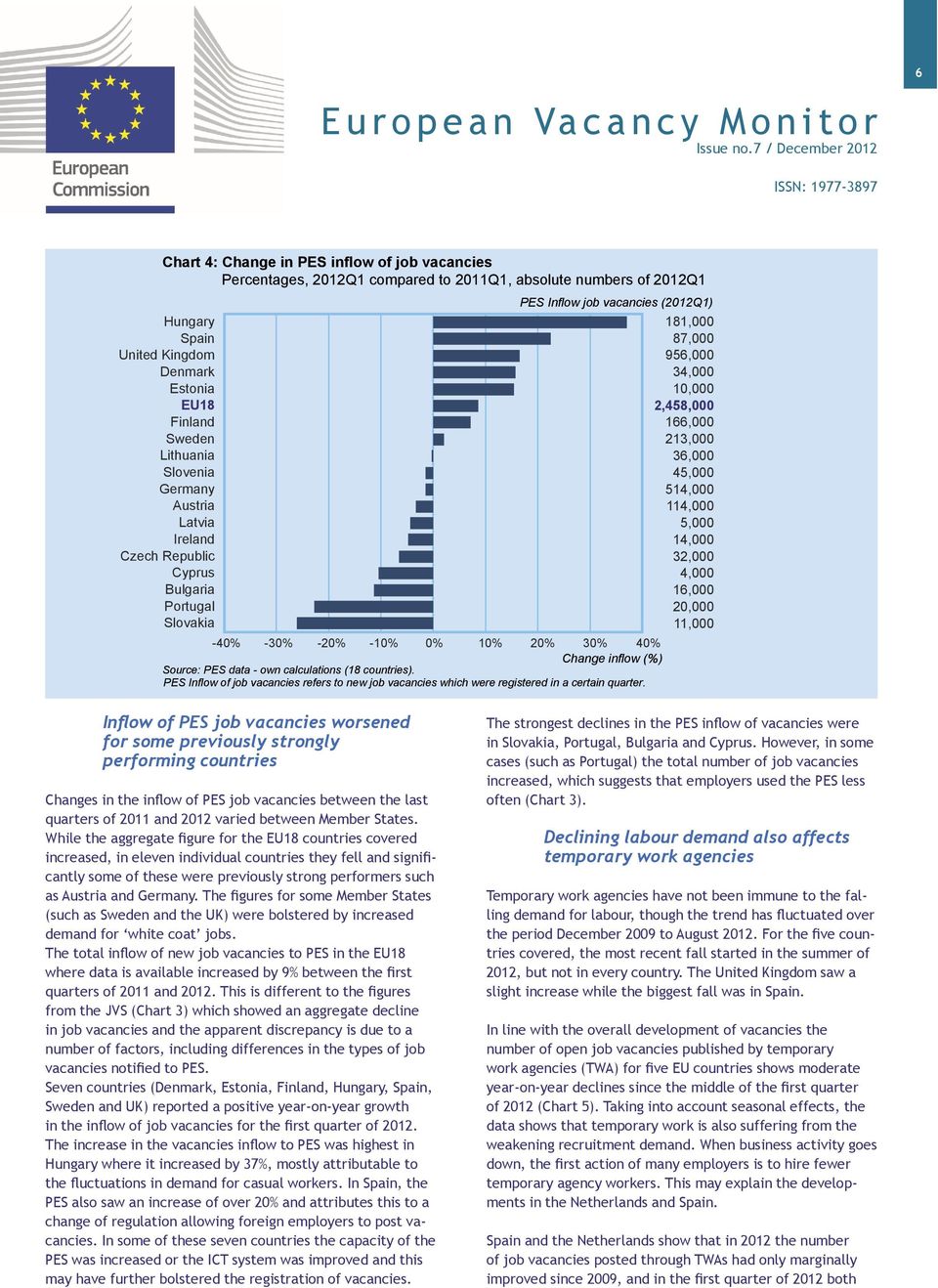
6 6 Chart 4: Change in PES inflow of job vacancies Percentages, 2012Q1 compared to 2011Q1, absolute numbers of 2012Q1 Hungary Spain United Kingdom Denmark Estonia EU18 Finland Sweden Lithuania Slovenia Germany Austria Latvia Ireland Czech Republic Cyprus Bulgaria Portugal Slovakia PES Inflow job vacancies (2012Q1) 181,000 87, ,000 34,000 10,000 2,458, , ,000 36,000 45, , ,000 5,000 14,000 32,000 4,000 16,000 20,000 11,000-40% -30% -20% -10% 0% 10% 20% 30% 40% Change inflow (%) Source: PES data - own calculations (18 countries). PES Inflow of job vacancies refers to new job vacancies which were registered in a certain quarter. Inflow of PES job vacancies worsened for some previously strongly performing countries Changes in the inflow of PES job vacancies between the last quarters of 2011 and 2012 varied between Member States. While the aggregate figure for the EU18 countries covered increased, in eleven individual countries they fell and significantly some of these were previously strong performers such as Austria and Germany. The figures for some Member States (such as Sweden and the UK) were bolstered by increased demand for white coat jobs. The total inflow of new job vacancies to PES in the EU18 where data is available increased by 9% between the first quarters of 2011 and This is different to the figures from the JVS (Chart 3) which showed an aggregate decline in job vacancies and the apparent discrepancy is due to a number of factors, including differences in the types of job vacancies notified to PES. Seven countries (Denmark, Estonia, Finland, Hungary, Spain, Sweden and UK) reported a positive year-on-year growth in the inflow of job vacancies for the first quarter of The increase in the vacancies inflow to PES was highest in Hungary where it increased by 37%, mostly attributable to the fluctuations in demand for casual workers. In Spain, the PES also saw an increase of over 20% and attributes this to a change of regulation allowing foreign employers to post vacancies. In some of these seven countries the capacity of the PES was increased or the ICT system was improved and this may have further bolstered the registration of vacancies. The strongest declines in the PES inflow of vacancies were in Slovakia, Portugal, Bulgaria and Cyprus. However, in some cases (such as Portugal) the total number of job vacancies increased, which suggests that employers used the PES less often (Chart 3). Declining labour demand also affects temporary work agencies Temporary work agencies have not been immune to the falling demand for labour, though the trend has fluctuated over the period December 2009 to August For the five countries covered, the most recent fall started in the summer of 2012, but not in every country. The United Kingdom saw a slight increase while the biggest fall was in Spain. In line with the overall development of vacancies the number of open job vacancies published by temporary work agencies (TWA) for five EU countries shows moderate year-on-year declines since the middle of the first quarter of 2012 (Chart 5). Taking into account seasonal effects, the data shows that temporary work is also suffering from the weakening recruitment demand. When business activity goes down, the first action of many employers is to hire fewer temporary agency workers. This may explain the developments in the Netherlands and Spain. Spain and the Netherlands show that in 2012 the number of job vacancies posted through TWAs had only marginally improved since 2009, and in the first quarter of 2012 both
7 7 Chart 5: Development of job vacancies in temporary work agencies (Randstad) Index, December August 2012, December 2009 = Germany 200 France EU5 150 United Kingdom Netherlands 100 Spain 50 Dec-09 Jan-10 Feb-10 Mar-10 Apr-10 May-10 Jun-10 Jul-10 Aug-10 Sep-10 Oct-10 Nov-10 Dec-10 Jan-11 Feb-11 Mar-11 Apr-11 May-11 Jun-11 Jul-11 Aug-11 Sep-11 Oct-11 Nov-11 Dec-11 Jan-12 Feb-12 Mar-12 Apr-12 May-12 Jun-12 Jul-12 Aug Source: Randstad (5 countries) Numbers are based on the number of open job vacancies published by the subsidiaries of the Randstad Group on the internet. Randstad only publishes job vacancies that cannot be filled directly from the available pool of candidates. The figures are based on daily measurements of the number of open job vacancies. countries showed a year-on-year decline compared to For these two countries, the reduction in TWA vacancies corresponds to strong declines in the overall number of job vacancies between the first quarters of 2011 and The UK has seen a systematic drop in temporary job vacancies throughout 2011 and 2012, with a minor positive trend in However, the level of TWA vacancies in the UK is still below that for France and Germany registered an increase in the number of TWA vacancies between March 2011 and March For Germany, combining the evidence of decreasing unemployment rates and total numbers of vacancies, this suggests that German employers kept recruiting workers, but adopted a more cautious approach by using more flexible contracts. Similar development may have also taken place in France, though a lack of data on overall job vacancies prevents confirmation of this. It is clear that in the Netherlands and Spain, many employers already employ temporary agency workers and reductions in their use are consistent with the lower business activity. In contrast, the developments in France and Germany indicate that temporary agency work is likely to continue to expand. Temporary agency workers tend to have a younger age profile 4, and given their contract status, may not fit easily with the extensive system of apprenticeships in these two countries. Weakened labour demand shown in recruitment activity between 2008 and 2012 Looking at the longer term development of recruitment since the first quarter of 2008 and before the full effects of the financial crisis, recovery was weak and partial at best (Chart 6). Compared to this period, the number of job-finders in the EU27 decreased by more than 20% in the first quarter of In fact, this is the second lowest level throughout the entire period, and is only marginally better than the lowest point in the first quarter of Thus, the number of hirings confirms the very partial recovery seen in the number of job vacancies (Chart 1), and both indicators show that the effects of the crisis on recruitment demand are still being felt. The weakened demand for labour over the period 2008 to 2012 is observed in all but four Member States and differences between countries relate by and large to the uneven economic recovery throughout the EU since the crisis. Looking at the contractual arrangements, the pattern observed for temporary work agencies is confirmed by 4 CIETT (2011), Economic Report: The agency work industry around the world, docs/stats/ciett_economic_report_2011.pdf

8 8 Chart 6: Change in the number of job-finders Percentages, 2012Q1 compared to 2008Q1, absolute numbers of 2012Q1 Job-finders (2012Q1) Luxembourg 95% 8,000 Estonia Austria Germany* Hungary Sweden Malta Cyprus Czech Republic Portugal Netherlands* France Finland Belgium EU27 Latvia Italy Denmark Poland Slovenia United Kingdom Slovakia Lithuania Spain Bulgaria Greece Ireland Romania 36, ,000 1,741, , ,000 6,000 15, , , ,000 1,513, , ,000 9,126,000 52, , , ,000 36,000 1,070,000 43,000 46, ,000 90,000 40,000 66,000 94,000-60% -50% -40% -30% -20% -10% 0% 10% 20% 30% Change inflow (%) Source: LFS data - own calculations (27 countries). Job-finders are employees who are employed in a reference week and have started their job at most three months earlier. * For NL+DE no figures are presented because the number of LFS non-responses in data on the job tenure, which is necessary to identify the job-finders, is very high and it compromises the calculation of the year-on-year percentage change. temporary jobs in general. The EVRR (2012) shows the use of temporary contracts increased from This suggests a typically cautious recruitment approach by employers during a recovery period. It is therefore revealing that in the first quarter of 2012, the year-on-year change in temporary job-finders saw a decrease of 6%, compared to a relatively stable number of permanent job-finders. As most employers tend to reduce their layer of flexible workers first, this confirms the other signals that a new downturn in recruitment was imminent at the start of Changes in the number of job-finders since the first quarter of 2008 for individual countries (Chart 6) show that almost all Member States were unable to restore their pre-crisis numbers of job-finders. The exceptions are Estonia and Luxembourg, two smaller countries where developments of individual employers can have a greater impact on the overall picture. Some of the largest losses of job-finders since 2008 were found in the three of the five PIIGS countries, Greece and Ireland (both -45%) and Spain (-40%). In Italy and Portugal, however, the decline in the number of hirings was close to the EU average, despite similar economic development experiences for these (and all PIIGS) countries. However, the biggest fall in job-finders between the first quarters of 2008 and 2012 was in Romania (-51%), partly due to an extremely high number of job-finders in the first quarter of Large losses were also recorded in some other newer Member States. Two Member States known for their flexible labour markets, Denmark and the UK, both experienced falls in numbers of job-finders (-28% and -31% respectively). Since 2008 both also had sharper declines in their number of employees than the EU, confirming greater exposure to the business cycle. A comparison of the results for job-finders (Chart 6) and job vacancies (Chart 2) is hampered by the unavailability of data on numbers of job vacancies for some countries. Nevertheless, both sources confirm the better recovery of recruitment in Sweden, Portugal and Luxembourg, while Romania and Bulgaria suffered the biggest falls in both indicators. In Estonia the number of job-finders increased significantly, but also suffered a substantial reduction in job vacancies since the first quarter of While in a recovering labour market the number of job vacancies tends to increase, it takes time to recruit the right workers into new vacancies. In a declining labour market the number of job vacancies tends to go down but some workers are still recruited into old vacancies. However other factors may also be involved, such as increasing job turnover or vacancies being filled at
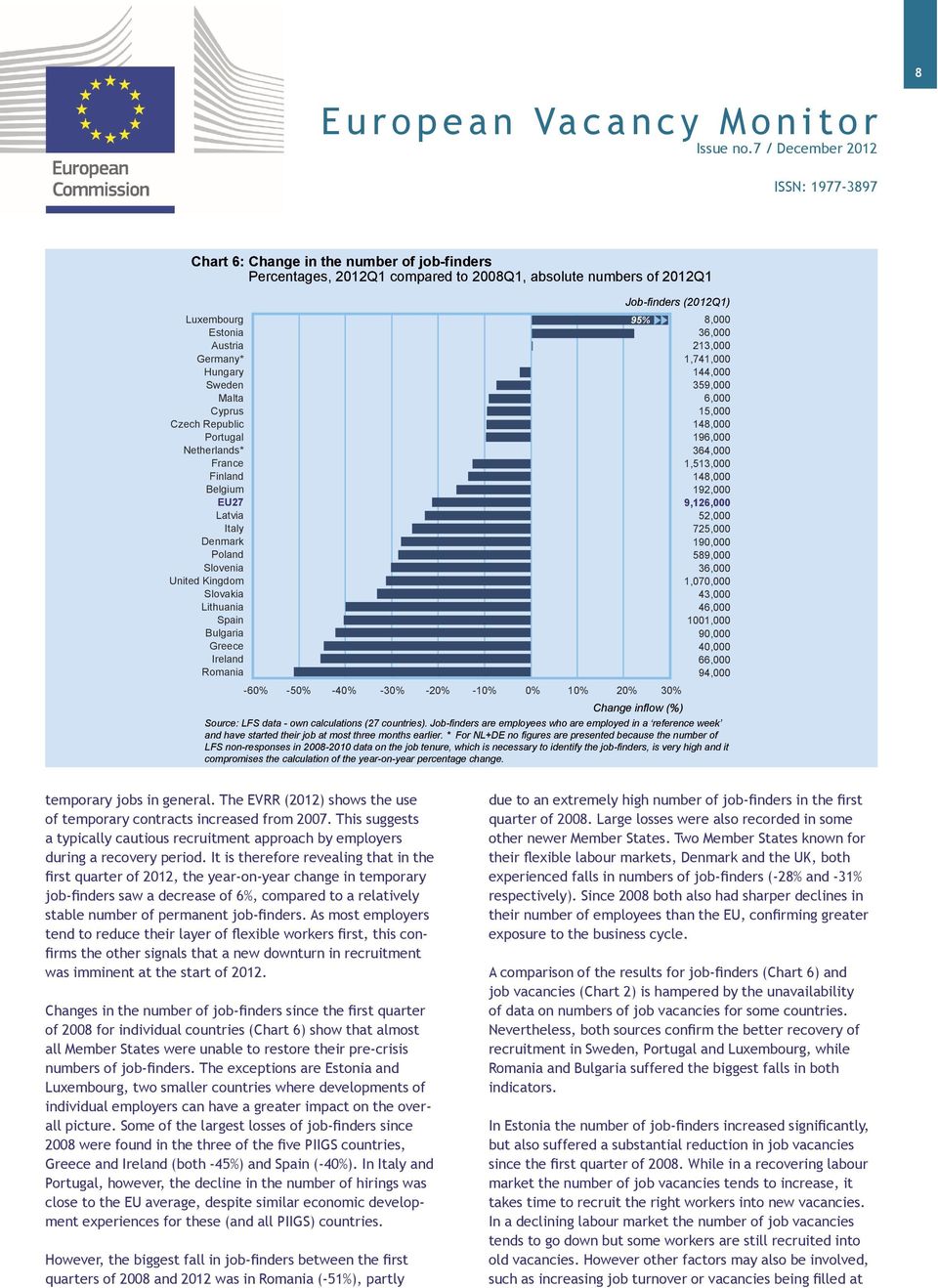
9 9 shorter notice. Similar trends were experienced by Cyprus and the Czech Republic, though at much milder levels. Reversal in development of recruitment demand before full recovery Looking at the short-term changes, recruitment fell in all but six Member States between the first quarters of 2011 and A comparison with the longer term developments since 2008 discussed above shows that recruitment development reversed before having fully recovered. In some countries the falls were particularly large and affected a mix of older and newer Member States and across different geographical regions. Furthermore, increases were relatively small in the six affected countries. Of the six Member States with a higher number of job-finders over the reference period, Hungary and Cyprus showed the most significant growth of 13% and 5% respectively. Among the other four countries any increase was more modest with Poland at 4%, the UK at 2%, and Austria and France both at 1%. The increase in hirings in five of these countries was accompanied by a fall in the number of job vacancies over the period (Poland was the exception). 5 As observed earlier, in a declining labour market the number of job vacancies falls while workers may still be recruited into old vacancies. But the increase in hirings also suggests that vacancies were filled more quickly, which would have the effect of boosting hirings temporarily. Moreover, the number of part-time jobs increased in most of these countries between the first quarters of 2011 and 2012 according to the Labour Force Survey. This was particularly so in the UK (with 25,000 more part-time jobs) but also in France, Hungary and Poland. It suggests that even in countries with increased hiring activity, the impact on full-time employment equivalents is limited because of the increase in part-time working, some of which will be done by those wanting to work full-time but are prevented from doing so by a lack of full-time jobs. 5 Note that for France job-finders cannot be compared with job vacancies on which data are lacking for France. Chart 7: Change in the number of job-finders Percentages, 2012Q1 compared to 2011Q1, absolute numbers of 2012Q1 Job-finders (2012Q1) Hungary Cyprus Poland United Kingdom France Austria Germany Estonia Lithuania EU27 Denmark Sweden Belgium Netherlands Bulgaria Finland Ireland Italy Czech Republic Slovenia Portugal Spain Malta Latvia Luxembourg Slovakia Greece Romania 144,000 15, ,000 1,070,000 1,513, ,000 1,741,000 36,000 46,000 9,126, , , , ,000 90, ,000 66, , ,000 36, ,000 1,001,000 6,000 52,000 8,000 43,000 40,000 94,000-40% -30% -20% -10% 0% 10% 20% 30% Change in the number of job-finders (%) Source: EU LFS data - own calculations (27 countries). Job-finders are employees who are employed in a 'reference week' and have started their job at most three months earlier.

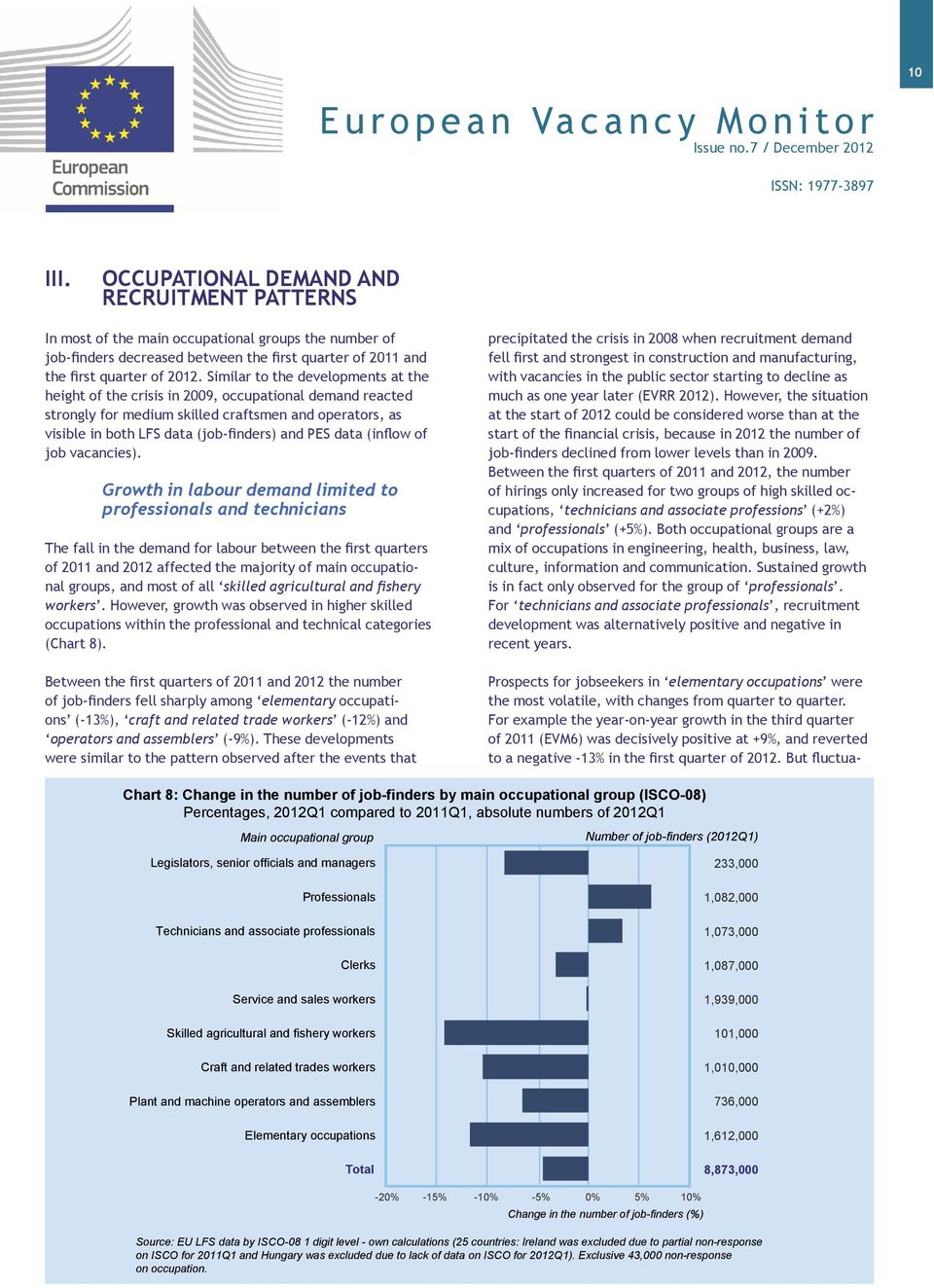
10 10 III. OCCUPATIONAL DEMAND AND RECRUITMENT PATTERNS In most of the main occupational groups the number of job-finders decreased between the first quarter of 2011 and the first quarter of Similar to the developments at the height of the crisis in 2009, occupational demand reacted strongly for medium skilled craftsmen and operators, as visible in both LFS data (job-finders) and PES data (inflow of job vacancies). Growth in labour demand limited to professionals and technicians The fall in the demand for labour between the first quarters of 2011 and 2012 affected the majority of main occupational groups, and most of all skilled agricultural and fishery workers. However, growth was observed in higher skilled occupations within the professional and technical categories (Chart 8). Between the first quarters of 2011 and 2012 the number of job-finders fell sharply among elementary occupations (-13%), craft and related trade workers (-12%) and operators and assemblers (-9%). These developments were similar to the pattern observed after the events that precipitated the crisis in 2008 when recruitment demand fell first and strongest in construction and manufacturing, with vacancies in the public sector starting to decline as much as one year later (EVRR 2012). However, the situation at the start of 2012 could be considered worse than at the start of the financial crisis, because in 2012 the number of job-finders declined from lower levels than in Between the first quarters of 2011 and 2012, the number of hirings only increased for two groups of high skilled occupations, technicians and associate professions (+2%) and professionals (+5%). Both occupational groups are a mix of occupations in engineering, health, business, law, culture, information and communication. Sustained growth is in fact only observed for the group of professionals. For technicians and associate professionals, recruitment development was alternatively positive and negative in recent years. Prospects for jobseekers in elementary occupations were the most volatile, with changes from quarter to quarter. For example the year-on-year growth in the third quarter of 2011 (EVM6) was decisively positive at +9%, and reverted to a negative -13% in the first quarter of But fluctua- Chart 8: Change in the number of job-finders by main occupational group (ISCO-08) Percentages, 2012Q1 compared to 2011Q1, absolute numbers of 2012Q1 Main occupational group Legislators, senior officials and managers Professionals Technicians and associate professionals Clerks Service and sales workers Skilled agricultural and fishery workers Craft and related trades workers Plant and machine operators and assemblers Elementary occupations Total Number of job-finders (2012Q1) 233,000 1,082,000 1,073,000 1,087,000 1,939, ,000 1,010, ,000 1,612,000 8,873,000-20% -15% -10% -5% 0% 5% 10% Change in the number of job-finders (%) Source: EU LFS data by ISCO-08 1 digit level - own calculations (25 countries: Ireland was excluded due to partial non-response on ISCO for 2011Q1 and Hungary was excluded due to lack of data on ISCO for 2012Q1). Exclusive 43,000 non-response on occupation.
11 11 Occupation Shop salespersons Domestic, hotel and office cleaners and helpers* Waiters and bartenders Personal care workers in health services Building frame and related trade workers Agricultural, forestry and fishery labourers Transport and storage labourers* Manufacturing labourers* Other clerical support workers Child care workers and teachers aides Client information workers Heavy truck and bus drivers Physical and engineering science technicians Material-recording and transport clerks General office clerks Mining and construction labourers* Sales and purchasing agents and brokers Food preperation assistants Cashiers and ticket clerks Building finishers and related trades workers Other elementary workers* Protective services workers Nursing and midwifery associate professionals Cooks Administrative and specialised secretaries -40% Chart 9: Top 25 number of job-finders by occupation (ISCO-08) Percentages, 2012Q1 compared to 2011Q1, absolute numbers of 2012Q1-30% -20% -10% 0% 10% 20% Number of jobfinders (x1,000) % Change (%) Source: EU LFS data by ISCO-08 3 digit level - own calculations (25 countries: Ireland was excluded due to partial non-response on ISCO for 2011Q1 and Hungary was excluded due to lack of data on ISCO for 2012Q1). Job-finders are employees who are employed in a reference week and have started their job at most three months earlier.* Elementary occupations. Absolute change (x1,000) tions are also observed for the groups of legislators, senior officials and managers (from +9% to -9%) and clerks (from +11% to -4%). Country-specific occupational data (not shown in Charts) show that three large countries were key drivers behind the EU development: Germany, Spain and France. Germany registered an increase of 32% in job-finders in the professionals group and 14% in technicians and associate professionals but a decline of 17% in the elementary occupations group. Spanish job-finders dropped by 17%, with a 25% fall in craft and related trades workers and a 16% fall in elementary occupations. France fared somewhere in between Germany and Spain, with an increase for technicians and associate professionals and a decline for elementary occupations and craft and related trades workers. Ranking among the 25 most demanded occupations remains stable The most demanded occupations are defined as those with the highest number of job-finders (Chart 9). The figures for the first quarter of 2012 show that their order has not changed significantly compared to previous EVM issues, and there remains a clear prevalence of low- to intermediate skilled jobs. This prevalence generally reflects a high job turnover, in particular for shop salespersons who are increasingly often temporarily employed by large retailers, which have gained ground on smaller shops (EVRR 2012). Looking at the growth rates among the top 25 occupations, demand was muted for most between the first quarters of 2011 and There were significant falls in low skilled occupations such as mining and construction labourers and manufacturing labourers, though some intermediate skills were also affected. However, among the few that did grow were two of the three occupations with higher qualification requirements in the top 25, namely nursing and midwifery associate professionals (+25 %, being listed among the top 25 for the first time) and physical and engineering science technicians (+5%). In principle this is positive sign, since high skilled jobs in health care and engineering were identified in the EVRR (2012) as bottlenecks for which employers experience difficulty recruiting workers. The same cannot be said for high skilled jobs in ICT, sales and finance for which the EVRR (2012) also identified bottlenecks. The hiring of sales and purchasing agents and brokers even declined by more than 10%. For ICT and finance it is important to have the right specialisations, but also to have relevant experience. The right specialisation is also important for engineering, though this differs for each country (e.g. mechatronics in Germany, food processing in Ireland, construction in Denmark). In health care, shortages were so widespread that workers with a wide range of health care qualifications are needed.

12 12 Chart 10: Change in PES inflow of job vacancies in the EU by main occupational group (ISCO-88) Percentages, 2012Q1 compared to 2011Q1, absolute numbers of 2012Q1 Main occupational group Legislators, senior officials and managers Professionals Technicians and associate professionals Clerks Service and sales workers Skilled agricultural and fishery workers Craft and related trades workers Plant and machine operators and assemblers Elementary occupations Total PES inflow job vacancies 85, , , , ,000 56, , , ,000 2,458,000-10% 0% 10% 20% 30% 40% Change inflow (%) Source: PES by ISCO-88 1 digit level - own calculations (18 countries). Countries included: Austria, Bulgaria, Cyprus, Czech Republic, Germany, Denmark, Estonia, Spain, Finland, Hungary, Ireland, Lithuania, Latvia, Portugal, Sweden, Slovenia, Slovakia and the United Kingdom. PES inflow of job vacancies refers to new vacancies which have been registered in a certain quarter. Another occupation where the number of job-finders increased substantially is administrative and specialised secretaries (+14% between the first quarters of 2012 and 2011) this finding warrants further monitoring. The increasing numbers of hirings for material-recording and transport clerks (+10%), and heavy truck and bus drivers (+6%) suggest that in the first quarter of 2012, the transport sector was not immediately affected by the generally negative developments, in contrast to 2009 when transport was among the first affected sectors (EVRR 2012). Apart from the high skilled occupation of sales representatives, the number of job-finders among the top 25 most demanded occupations also declined by some 30% for manufacturing labourers and mining and construction labourers, again confirming the decline in recruitment demand in the manufacturing and construction sectors. Inflow of job vacancies to PES showed growth in all but two occupational groups As noted before, job vacancies notified to the PES were the exception to the general decline in the labour market. In line with the overall increase in PES vacancy inflow, seven of nine major occupational groups showed positive growth between the first quarters of 2011 and 2012 across the 18 countries covered. Only for clerks and for craft and related trades workers the vacancy inflow fell. There were increases in job vacancies at all skills levels, and significantly for the occupations with the biggest numerical inflows such as service and sales workers and elementary occupations, though both figures were affected by developments in particular Member States, above all in Hungary and the UK. 6 The increasing demand for professionals on the total labour market is confirmed by vacancy trends in PES (up by 19%). The PES vacancy inflow also increased for legislators, senior officials and managers (+16%) and the higher demand for these two occupations is consistent with previously observed trends (see, for example, EVM 6). Presumably this development results from the fact that [ ] in times of crisis even the best of workers may get laid off and seek work through the PES where they have to register as unemployed. (EVRR 2012). Therefore, employers may notify their vacancies to PES more often in a time of crisis and in particular for high skilled workers because they perceive that the quality of the available supply is likely to have improved. 6 Over the reference period, Hungary recorded an extra 45,000 PES job vacancies in elementary occupations (the casual workers referred to earlier) which accounted for all the increase of the EU18 in aggregate. Similarly in the UK notifications of job vacancies in service and sales workers increased by 83,000.

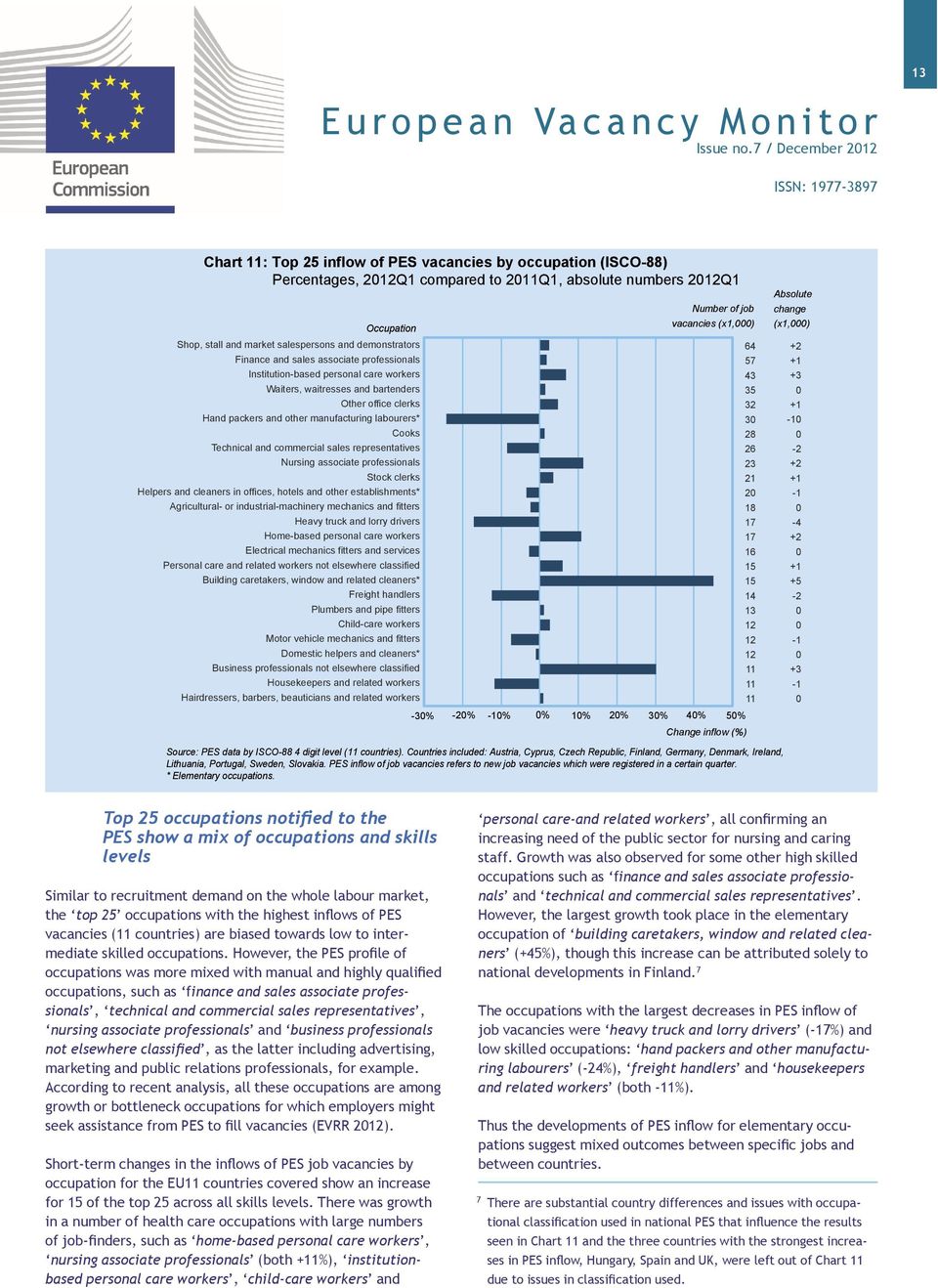
13 13 Chart 11: Top 25 inflow of PES vacancies by occupation (ISCO-88) Percentages, 2012Q1 compared to 2011Q1, absolute numbers 2012Q1 Number of job Occupation vacancies (x1,000) Shop, stall and market salespersons and demonstrators 64 Finance and sales associate professionals 57 Institution-based personal care workers 43 Waiters, waitresses and bartenders 35 Other office clerks 32 Hand packers and other manufacturing labourers* 30 Cooks 28 Technical and commercial sales representatives 26 Nursing associate professionals 23 Stock clerks 21 Helpers and cleaners in offices, hotels and other establishments* 20 Agricultural- or industrial-machinery mechanics and fitters 18 Heavy truck and lorry drivers 17 Home-based personal care workers 17 Electrical mechanics fitters and services 16 Personal care and related workers not elsewhere classified 15 Building caretakers, window and related cleaners* 15 Freight handlers 14 Plumbers and pipe fitters 13 Child-care workers 12 Motor vehicle mechanics and fitters 12 Domestic helpers and cleaners* 12 Business professionals not elsewhere classified 11 Housekeepers and related workers 11 Hairdressers, barbers, beauticians and related workers 11-30% -20% -10% 0% 10% 20% 30% 40% 50% Change inflow (%) Absolute change (x1,000) Source: PES data by ISCO-88 4 digit level (11 countries). Countries included: Austria, Cyprus, Czech Republic, Finland, Germany, Denmark, Ireland, Lithuania, Portugal, Sweden, Slovakia. PES inflow of job vacancies refers to new job vacancies which were registered in a certain quarter. * Elementary occupations. Top 25 occupations notified to the PES show a mix of occupations and skills levels Similar to recruitment demand on the whole labour market, the top 25 occupations with the highest inflows of PES vacancies (11 countries) are biased towards low to intermediate skilled occupations. However, the PES profile of occupations was more mixed with manual and highly qualified occupations, such as finance and sales associate professionals, technical and commercial sales representatives, nursing associate professionals and business professionals not elsewhere classified, as the latter including advertising, marketing and public relations professionals, for example. According to recent analysis, all these occupations are among growth or bottleneck occupations for which employers might seek assistance from PES to fill vacancies (EVRR 2012). Short-term changes in the inflows of PES job vacancies by occupation for the EU11 countries covered show an increase for 15 of the top 25 across all skills levels. There was growth in a number of health care occupations with large numbers of job-finders, such as home-based personal care workers, nursing associate professionals (both +11%), institutionbased personal care workers, child-care workers and personal care-and related workers, all confirming an increasing need of the public sector for nursing and caring staff. Growth was also observed for some other high skilled occupations such as finance and sales associate professionals and technical and commercial sales representatives. However, the largest growth took place in the elementary occupation of building caretakers, window and related cleaners (+45%), though this increase can be attributed solely to national developments in Finland. 7 The occupations with the largest decreases in PES inflow of job vacancies were heavy truck and lorry drivers (-17%) and low skilled occupations: hand packers and other manufacturing labourers (-24%), freight handlers and housekeepers and related workers (both -11%). Thus the developments of PES inflow for elementary occupations suggest mixed outcomes between specific jobs and between countries. 7 There are substantial country differences and issues with occupational classification used in national PES that influence the results seen in Chart 11 and the three countries with the strongest increases in PES inflow, Hungary, Spain and UK, were left out of Chart 11 due to issues in classification used.
14 14 IV. RELATIONSHIP BETWEEN RECRUITMENT DEMAND AND SUPPLY Fewer job-finders per unemployed but variation among Member States Using the ratio of the stock of unemployed to the number of job-finders, it is evident there were fewer job opportunities per unemployed in the EU27 overall, though this masks variations among the Member States. Between the first quarters of 2011 and 2012, the ratio of the stock of unemployed to the number of job-finders increased from 2.4 to 2.8 at EU-level (Chart 12). Competition for jobs is currently higher than at the previous peak of the recession in the first quarter of 2010 when the ratio was 2.7 (EVRR 2012). The recovery in the ratio was short-lived, starting in the third quarter of 2010 and ending in the third quarter of 2011, suggesting that the overall EU labour market situation is unlikely to improve quickly, though there will be variation between Member States. This increase is consistent with the overall EU27 rise in unemployment, which increased from 9.9% in the first quarter of 2011 to 10.7% in the first quarter of 2012, alongside the 4% decline in the number of jobfinders over the same period. Most Member States saw deterioration in their unemployed per job-finder ratios between the first quarters of 2011 and 2012 (Chart 12), though with significant differences. Increases were highest in a number of South European countries (Portugal, Greece and Spain), as well as in Romania and Slovakia, where the ratios increased by at least one percentage point in each case. Against the general EU27 trend, in four of the countries (Lithuania, Hungary, Estonia and Germany), the ratio decreased while in another four (Finland, Denmark, Sweden and Chart 12: Ratio stock of unemployed (LFS) to number of job-finders (LFS) Ratios, 2012Q1 and 2011Q1 Absolute numbers of stock unemployed and number of job-finders 2012Q1 Country Greece* Slovakia Romania Spain Lithuania Bulgaria Ireland Portugal Italy Hungary Cyprus Latvia Poland EU27 Czech Republic Slovenia United Kingdom Estonia France Malta Belgium Luxembourg Germany Finland Netherlands Denmark Sweden Austria Q1 2011Q Stock of unemployed / Number of job-finders Stock unemployed Number of job-finders (x1,000) (x1,000) 1, ,634 1, , , ,269 9, ,553 1, ,819 1, ,481 1, Source: EU LFS data - own calculations (27 countries). Stock of unemployed: unadjusted, age Job-finders were employees in a reference week and had been employed for a maximum of three months. The ILO definition of unemployment is used. * Rising ratio in Greece: from 14 in 2011Q1 to 28 unemployed per job-finder in 2012Q1.
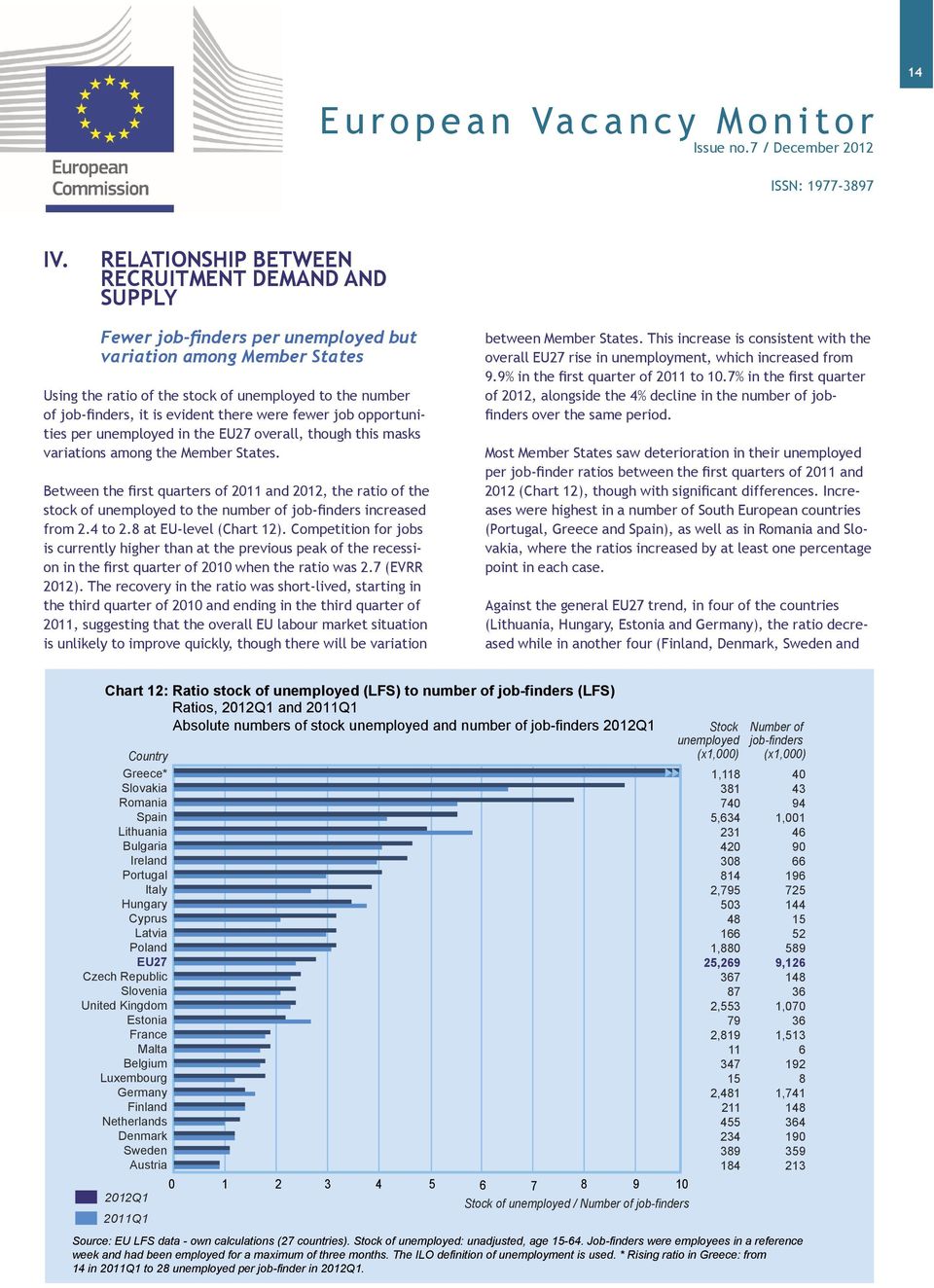
15 15 Austria) there was no change in the ratios. In Lithuania, Estonia and Germany the small reduction in the ratio may be largely explained by the improvement in unemployment, in Hungary the improved ratio was more due to the increase in the number of job-finders. However, while within countries changes of the ratio reflect changes in labour market tightness, between countries differences are also affected by structural differences such as in the degree of job turnover which also have an impact on the ratios. The absolute number of unemployed increased between the first quarters of 2011 and 2012 (by 9%) while the number of job-finders decreased (by 4%) and this divergence confirms that in times of economic difficulty, increasing job losses contribute more to higher unemployment rates than to decreasing job opportunities. This means that recruitment activity can still be strong and so underlines the value of providing support to jobseekers, even though job search may be prolonged. Increased PES unemployment and fewer job vacancies affected all major occupational groups The unemployed in all main occupational groups saw their labour market prospects deteriorate between the first quarters of 2011 and 2012, according to the aggregate PES data covering 12 Member States. Those requiring low and intermediate skills were most affected, though higher level skills were not immune to the change. In most of the 12 Member States, the ratio of PES registered unemployed to the PES inflow of job vacancies increased, as the inflow of vacancies could not compensate for growth in the unemployed (Chart 13, see also Chart 4). On average for the 12 countries, there were around 16 registered unemployed for each newly notified job vacancy at the end of the first quarter of 2012, compared to 10 in the first quarter of Chart 13: Stock of unemployed PES / inflow job vacancies PES by main occupational group (ISCO-88) Ratios, 2012Q1 and 2011Q1 Main occupational group Legislators, senior officials and managers Professionals Technicians and associate professionals Clerks Service and sales workers Skilled agricultural and fishery workers Craft and related trades workers Plant and machine operators and assemblers Elementary occupations 2012Q1 2011Q1 EU Stock of unemployed (PES) / Inflow job vacancies (PES) Source: PES by ISCO-88 1 digit level - own calculations (12 countries). Countries included: Austria, Cyprus, Germany, Estonia, Spain, Hungary, Lithuania, Latvia, Portugal, Sweden, Slovenia, Slovakia.

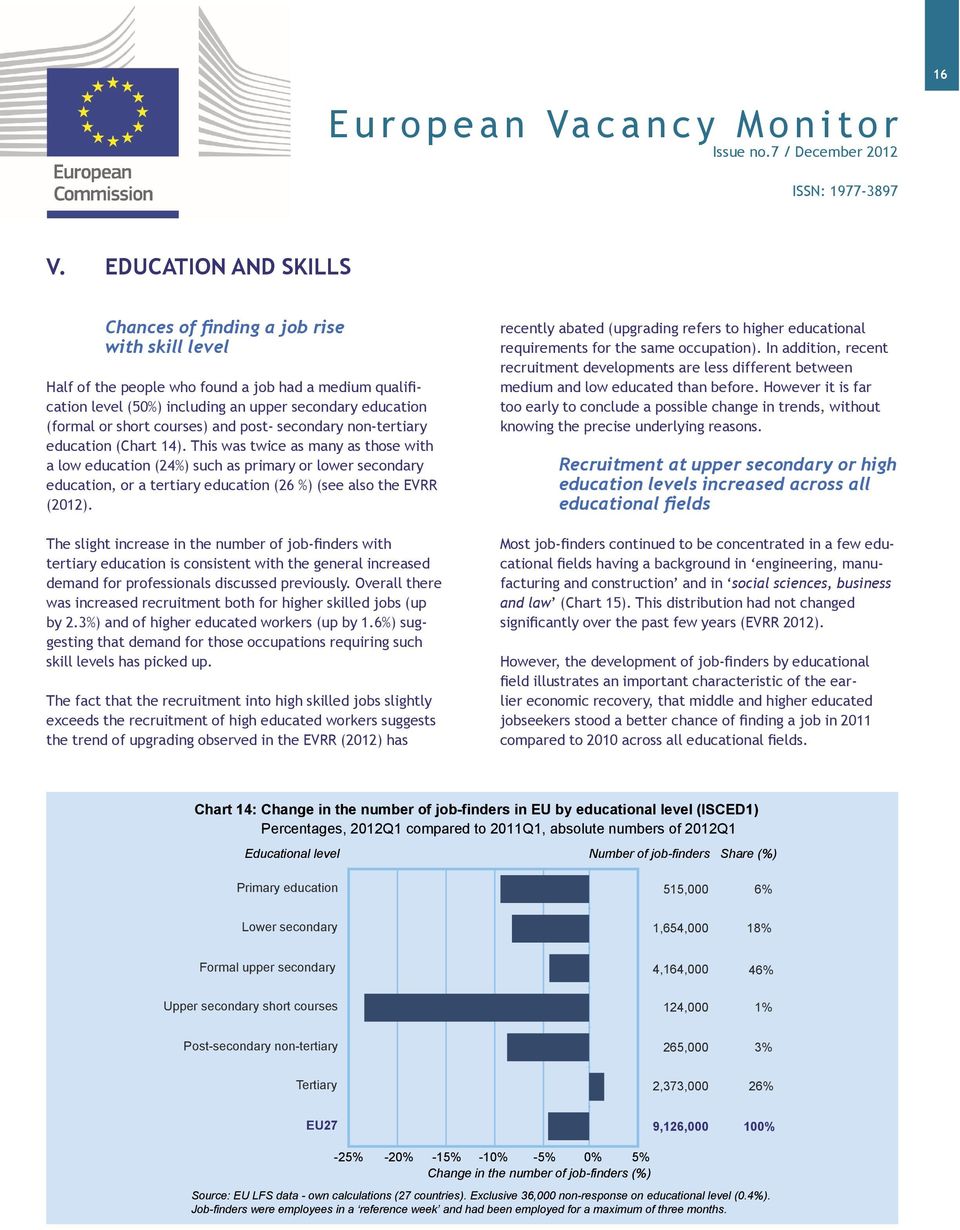
16 16 V. EDUCATION AND SKILLS Chances of finding a job rise with skill level Half of the people who found a job had a medium qualification level (50%) including an upper secondary education (formal or short courses) and post- secondary non-tertiary education (Chart 14). This was twice as many as those with a low education (24%) such as primary or lower secondary education, or a tertiary education (26 %) (see also the EVRR (2012). The slight increase in the number of job-finders with tertiary education is consistent with the general increased demand for professionals discussed previously. Overall there was increased recruitment both for higher skilled jobs (up by 2.3%) and of higher educated workers (up by 1.6%) suggesting that demand for those occupations requiring such skill levels has picked up. The fact that the recruitment into high skilled jobs slightly exceeds the recruitment of high educated workers suggests the trend of upgrading observed in the EVRR (2012) has recently abated (upgrading refers to higher educational requirements for the same occupation). In addition, recent recruitment developments are less different between medium and low educated than before. However it is far too early to conclude a possible change in trends, without knowing the precise underlying reasons. Recruitment at upper secondary or high education levels increased across all educational fields Most job-finders continued to be concentrated in a few educational fields having a background in engineering, manufacturing and construction and in social sciences, business and law (Chart 15). This distribution had not changed significantly over the past few years (EVRR 2012). However, the development of job-finders by educational field illustrates an important characteristic of the earlier economic recovery, that middle and higher educated jobseekers stood a better chance of finding a job in 2011 compared to 2010 across all educational fields. Chart 14: Change in the number of job-finders in EU by educational level (ISCED1) Percentages, 2012Q1 compared to 2011Q1, absolute numbers of 2012Q1 Educational level Primary education Number of job-finders 515,000 Share (%) 6% Lower secondary 1,654,000 18% Formal upper secondary 4,164,000 46% Upper secondary short courses 124,000 1% Post-secondary non-tertiary 265,000 3% Tertiary 2,373,000 26% EU27 9,126, % -25% -20% -15% -10% -5% 0% 5% Change in the number of job-finders (%) Source: EU LFS data - own calculations (27 countries). Exclusive 36,000 non-response on educational level (0.4%). Job-finders were employees in a reference week and had been employed for a maximum of three months.
17 17 Educational field Engineering, manufacturing and construction Teacher training and education science Chart 15: Educational field of job-finders with upper secondary education and higher Absolute numbers, 2011 and 2010 Social sciences, business and law General programs Services Health and welfare Humanities, languages and arts Science mathematics and computing Agriculture and veterinary Job-finders (x 1,000) Source: Eurostat: LFS (27 countries). Educational field: ISCED. Data on educational field is only available for job-finders with upper secondary education and higher. VI: SPECIAL: JOB OPPORTUNITIES FOR OLDER JOBSEEKERS Older workers taking an increased share of employment The year2012 was designated the European Year for Active Ageing and Solidarity between Generations and this special section focuses on labour market developments for those aged Demographic change is increasing the importance of this group in the labour market and helps compensate for the fall in younger age groups. Older workers should be treated equally with other age groups and this includes access to job opportunities. Older workers represent a relatively small but nevertheless increasing proportion of the working population. In the EU27, the last decade has seen the overall employment rate of this age group increase significantly from 37.7% in 2001 to 47.4% in Although the employment rate of older workers remains well below the employment rate of around 62% for all ages, its increase has contributed to older workers accounting for 13.8 per cent of the employed population, up from 10.1 per cent in 2002 (Table A-1). Recent findings on the employment patterns of older workers reveal that, in contrast to the age group (see EVM5 January 2012), they have been only mildly affected by the on-going economic crisis (Eurofound ). For example, during the period , the overall employment rate for the group aged increased by 1.7 percentage points between 2000 and 2011, while their unemployment rate fell over the same period from 7.6% to 6.8%. Also, their inactivity rate decreased by 1.2 percentage points in 2011 compared to the previous year. However, older workers still formed a relatively small proportion of those recruited in 2011, at 5.9% of the total. In contrast younger workers aged between 18 and 29 accounted for 48% of all job-finders (see also EVM5, January 2012). Some of this difference is likely to be due to higher rates of job turnover among younger people as length of service (job tenure) tends to increase with age. However the share of older workers among job-finders is also less than the share among unemployed workers (10%). This Eurofound (2012); Employment trends and policies for older workers in the recession, available at: europa.eu/pubdocs/2012/35/en/1/ef1235en.pdf.

18 18 Table A-1: Employed population aged by age group Age Group Source: Eurostat, LFS. Chart A1: Job-finders aged by main occupational group Absolute numbers and in percentages of job-finders aged per main occupational group (ISCO1, 2011) Main occupational group Legislators, senior officials and managers Professionals Technicians and associate professionals Absolute number ,400 52,100 48,400 Percentage % 5% 5% Clerks Service and sales workers Skilled agricultural and fishery workers Craft and related trades workers Plant and machine operators and assemblers Elementary occupations 0 20,000 40,000 60,000 80, , , ,000 42,300 99,200 11,500 76,600 58, ,800 Source: EU-LFS data by ISCO-08, Job-finders are employees who are employed in a reference week and had been employed for at most three months in their job. The total number of job-finders aged 55-64, including in armed forces, is 532,100 (5.9% of all job-finders). 4% 5% 11% 8% 8% 8% Chart A2: Employees aged by main occupational group Absolute numbers and in percentages of employees aged per main occupation (ISCO1, 2011) Main occupational group Legislators, senior officials and managers Professionals Technicians and associate professionals Clerks Service and sales workers Skilled agricultural and fishery workers Craft and related trades workers Absolute number 2011 (x1,000) 1,496 4,542 3,927 2,803 3, ,551 Percentage % 14% 13% 13% 11% 13% 12% Plant and machine operators and assemblers Elementary occupations ,000 1,500 2,000 2,500 3,000 3,500 Source: EU-LFS data by ISCO-08, The total number of employees aged 55-64, including in armed forces, is 23,760,000 (13% of all employees). 4,000 4,500 5,000 Number of employees (x1,000) 1,958 2,813 13% 15%

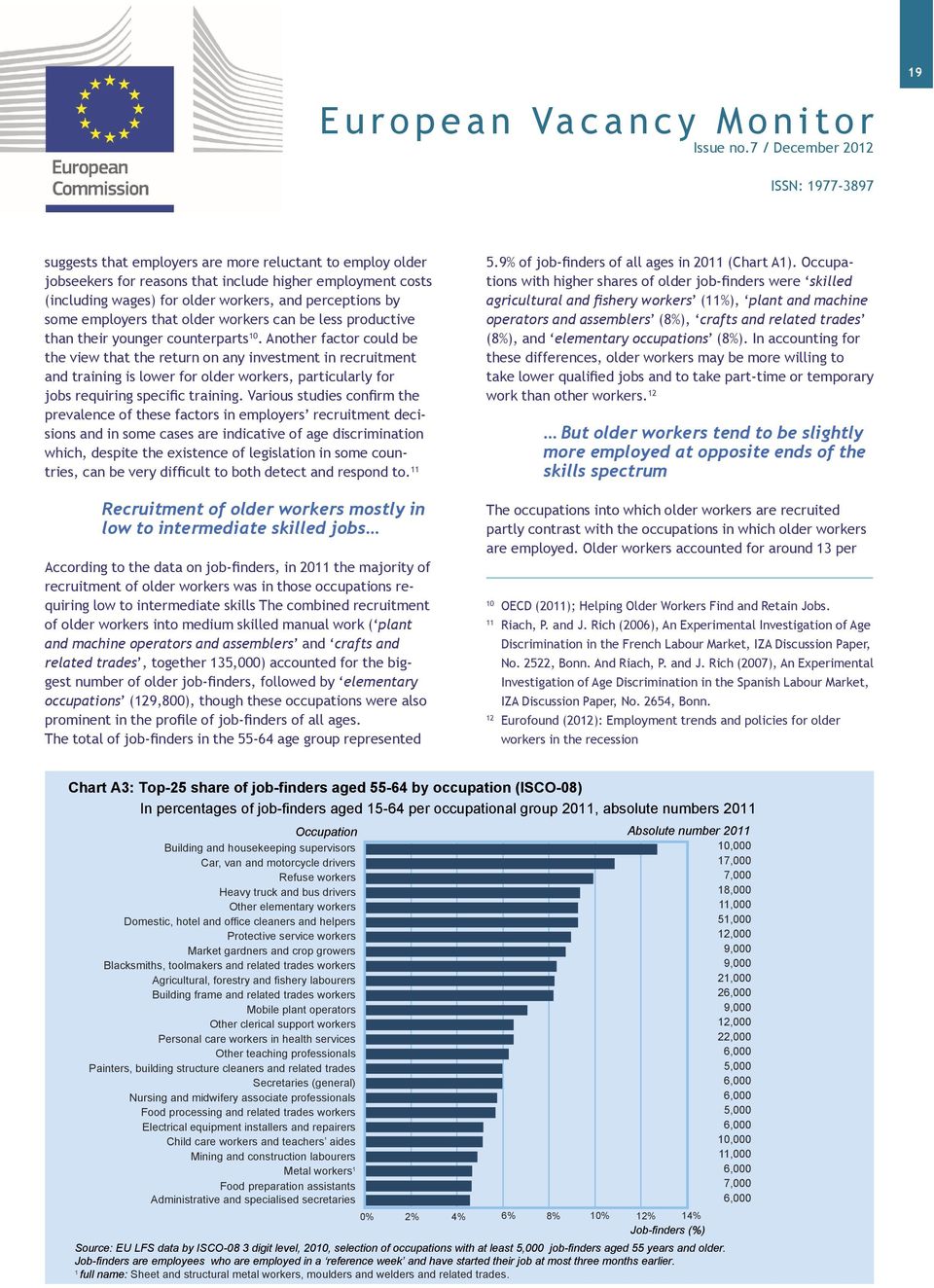
19 19 suggests that employers are more reluctant to employ older jobseekers for reasons that include higher employment costs (including wages) for older workers, and perceptions by some employers that older workers can be less productive than their younger counterparts 10. Another factor could be the view that the return on any investment in recruitment and training is lower for older workers, particularly for jobs requiring specific training. Various studies confirm the prevalence of these factors in employers recruitment decisions and in some cases are indicative of age discrimination which, despite the existence of legislation in some countries, can be very difficult to both detect and respond to. 11 Recruitment of older workers mostly in low to intermediate skilled jobs According to the data on job-finders, in 2011 the majority of recruitment of older workers was in those occupations requiring low to intermediate skills The combined recruitment of older workers into medium skilled manual work ( plant and machine operators and assemblers and crafts and related trades, together 135,000) accounted for the biggest number of older job-finders, followed by elementary occupations (129,800), though these occupations were also prominent in the profile of job-finders of all ages. The total of job-finders in the age group represented 5.9% of job-finders of all ages in 2011 (Chart A1). Occupations with higher shares of older job-finders were skilled agricultural and fishery workers (11%), plant and machine operators and assemblers (8%), crafts and related trades (8%), and elementary occupations (8%). In accounting for these differences, older workers may be more willing to take lower qualified jobs and to take part-time or temporary work than other workers. 12 But older workers tend to be slightly more employed at opposite ends of the skills spectrum The occupations into which older workers are recruited partly contrast with the occupations in which older workers are employed. Older workers accounted for around 13 per 10 OECD (2011); Helping Older Workers Find and Retain Jobs. 11 Riach, P. and J. Rich (2006), An Experimental Investigation of Age Discrimination in the French Labour Market, IZA Discussion Paper, No. 2522, Bonn. And Riach, P. and J. Rich (2007), An Experimental Investigation of Age Discrimination in the Spanish Labour Market, IZA Discussion Paper, No. 2654, Bonn. 12 Eurofound (2012): Employment trends and policies for older workers in the recession Chart A3: Top-25 share of job-finders aged by occupation (ISCO-08) In percentages of job-finders aged per occupational group 2011, absolute numbers 2011 Occupation Absolute number 2011 Building and housekeeping supervisors 10,000 Car, van and motorcycle drivers 17,000 Refuse workers 7,000 Heavy truck and bus drivers 18,000 Other elementary workers 11,000 Domestic, hotel and office cleaners and helpers 51,000 Protective service workers 12,000 Market gardners and crop growers 9,000 Blacksmiths, toolmakers and related trades workers 9,000 Agricultural, forestry and fishery labourers 21,000 Building frame and related trades workers 26,000 Mobile plant operators 9,000 Other clerical support workers 12,000 Personal care workers in health services 22,000 Other teaching professionals 6,000 Painters, building structure cleaners and related trades 5,000 Secretaries (general) 6,000 Nursing and midwifery associate professionals 6,000 Food processing and related trades workers 5,000 Electrical equipment installers and repairers 6,000 Child care workers and teachers aides 10,000 Mining and construction labourers 11,000 Metal workers 1 6,000 Food preparation assistants 7,000 Administrative and specialised secretaries 6,000 0% 2% 4% 6% 8% 10% 12% 14% Job-finders (%) Source: EU LFS data by ISCO-08 3 digit level, 2010, selection of occupations with at least 5,000 job-finders aged 55 years and older. Job-finders are employees who are employed in a reference week and have started their job at most three months earlier. 1 full name: Sheet and structural metal workers, moulders and welders and related trades.
20 20 Chart A4: Top-25 number of job-finders aged by occupation (ISCO-08) Absolute numbers, 2011 Occupation Domestic, hotel and office cleaners and helpers Building frame and related trades workers Shop salespersons Personal care workers in health services Agricultural, forestry and fishery labourers Heavy truck and bus drivers Car, van and motorcycle drivers Protective service workers Other clerical support workers Manufacturing labourers Mining and construction labourers Other elementary workers Building and housekeeping supervisors Child care workers and teachers aides Market gardners and crop growers Mobile plant operators Blacksmiths, toolmakers and related trades workers Transport and storage labourers Waiters and bartenders Refuse workers Sales and purchasing agents and brokers Food preparation assistants Client information workers Building finishers and related trades workers General office clerks Absolute number ,000 26,000 22,000 22,000 21,000 18,000 16,000 12,000 12,000 11,000 11,000 11,000 10,000 10,000 9,000 9,000 9,000 8,000 8,000 7,000 7,000 7,000 7,000 6,000 6, Job-finders (x 1,000) Source: EU LFS data by ISCO-08 3 digit level, 2011, own calculations. Job-finders are employees who are employed in a reference week and have started their job at most three months earlier. Chart A5: Top-10 number of job-finders aged by occupation and gender (ISCO-08) Absolute numbers, 2011 Absolute number 2011 Occupation Men (55-65) Women (55-65) Occupation Absolute number ,000 Building frame and related trades workers Domestic, hotel and office cleaners and helpers 44,000 17,000 Heavy truck and bus drivers Personal care workers in health services 19,000 15,000 Car, van and motorcycle drivers Shop salespersons 17,000 15,000 Agricultural, forestry and fishery labourers Child care workers and teachers aides 9,000 11,000 Protective services workers Other clerical support workers 8,000 11,000 Mining and construction labourers Agricultural, forestry and fishery labourers 7,000 9,000 Mobile plant operators Client information workers 6,000 9,000 Blacksmiths, toolmakers and related trades workers Nursing and midwifery associate professionals 6,000 8,000 Building and housekeeping supervisors Manufacturing labourers 5,000 7,000 Domestic, hotel and office cleaners and helpers Food preparation assistants 5, Job-finders (x1,000) Source: EU LFS data by ISCO-08 3 digit level, 2011, selection of occupations with at least 5,000 job-finders aged 55 years and older. Job-finders are employees who are employed in a reference week and have started their job at most three months earlier.
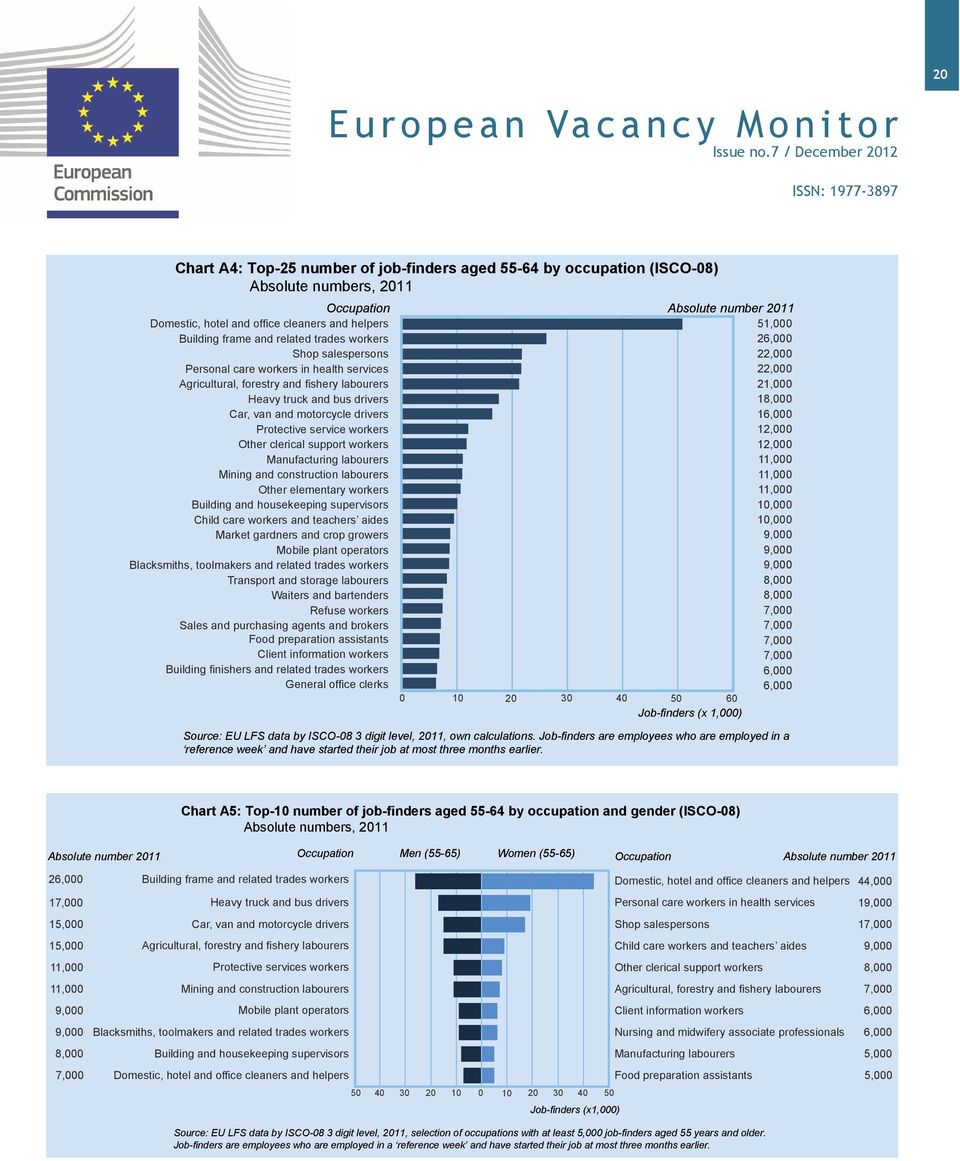
21 21 cent of all employees (of all ages) in 2011 but their shares of the total jobs were highest at opposite ends of the skills spectrum. Their share is highest among legislators, senior officials and managers and among professionals and also in elementary occupations. This occupational distribution of employees by age tends to confirm that older workers are more likely to be in jobs that require experience that often comes with working in a job long enough to acquire the necessary skills. The acquisition of skills is unlikely to take until the age of 55, but skills mastered at an earlier age are generally maintained or enhanced as long as the worker stays in employment. In addition, older workers in employment might, as insiders, benefit from promotion opportunities. In particular, the share of older workers among managers in employment (16%, Chart A2) is above average, while it is only average (6%) for jobfinders (Chart A1). For new jobs older workers with medium supervising and driving skills are highly in demand In line with the structure of recruitment by main occupational groups in 2011, the top 25 occupations with the highest shares of older workers among all job-finders were mostly in jobs requiring low to intermediate skills (Chart A3). Eleven out of the top 25 belong to the broadly defined categories of workers (8 occupations), labourers (2 occupations) and operators (1 occupation). The highest share of older job-finders was in building and housekeeping supervisors (13%), followed by car, van and motorcycle drivers (11%), along with some elementary occupations. still willing to consider older applicants for these posts. Strong gender segregation among the occupations of older job-finders The gender gap in the employment rates of older workers has narrowed significantly over the last decade. In 2010 the employment rate for women was 38.8% and 54.6% for men, compared to 27.4% and 46.9% in 2000, a narrowing of the gap from 19.5 to 15.8 percentage points. Although the gender gap in employment rates remains high, it is likely to narrow over time as the higher employment rates of today s younger women are largely maintained as they get older. Data for 2011 shows there were substantial gender differences in the total number of job-finders, as well as in their occupational patterns and educational requirements (Chart A5). In total around 230,000 women aged 55 or older found a job in 2011, compared to around 300,000 for men. Examined further, the top 10 number of job-finders aged shows a traditional gender mix with men recruited for manual work in construction, transport, manufacturing and industry, while older women tend to find jobs in elementary or skilled services, cleaning and caring occupations. Furthermore, while older male workers tend to predominantly find jobs in intermediate and some low skilled occupations, moderate numbers of older women find higher skilled jobs particularly related to the health professions. Only two occupations requiring higher level skills had a relatively high share of older job-finders: other teaching professionals and nursing and midwifery associate professionals, both with a share of 6% of all job-finders in these occupations. The tendency for older job-finders to be in lower skilled occupations is confirmed by comparing the absolute number of job-finders. It shows an even more pronounced bias towards lower skilled jobs. In 2011 the highest numbers of older job-finders were in the categories of domestic, hotel and office cleaners and helpers and building frame and related trades workers which together accounted for over one in three of all job-finders (Chart A4). It is striking that many recruitment opportunities are in jobs that are often considered physically demanding such as manufacturing labourers, mining and construction labourers, market gardeners and crop growers and transport and storage labourers. This suggests that employers are
22 22 VII TOP GROWTH OCCUPATIONS PER COUNTRY VII.1. Top 25 growth occupations, per country (LFS job-finders, 2011Q1-2012Q1), absolute growth and absolute numbers of 2012Q1 How to read the table The top 25 is based on the 3-digit ISCO-08 classification of occupations. The top 25 is determined by the absolute growth of the number of job-finders. The occupations are presented with absolute growth between the first quarters of 2011 and 2012 and the total number of job-finders in the first quarter of For example the for the first occupation at EU25 level means that the number of job-finders has increased from 94,000 in the first quarter of 2011 to 118,000 in the first quarter of 2012, which is an increase of +24,000. If the occupation is presented without numbers, this means that all numbers are too small for presentation.. = number too small for presentation * = number with limited reliability EU25 Austria Belgium Bulgaria 1. Nursing and midwifery associate professionals (+24000;118000) 2. Mining, manufacturing and construction supervisors (+21000;56000) 3. University and higher education teachers (+20000;51000) 4. Material-recording and transport clerks (+15000;152000) 5. Heavy truck and bus drivers (+14000;163000) 6. Engineering professionals (excluding electro-technology) (+14000;102000) 7. Administrative and specialised secretaries (+13000;118000) 8. Medical doctors (+13000;64000) 9. Nursing and midwifery professionals (+13000;50000) 10. Sports and fitness workers (+13000;67000) 11. Shop salespersons (+13000;637000) 12. Artistic, cultural and culinary associate professionals (+12000;51000) 13. Protective services workers (+10000;119000) 14. Architects, planners, surveyors and designers (+10000;46000) 15. Primary school and early childhood teachers (+9000;89000) 16. Sales, marketing and public relations professionals (+9000;82000) 17. Building and housekeeping supervisors (+9000;78000) 18. Physical and engineering science technicians (+8000;155000) 19. Other clerical support workers (+8000;175000) 20. Other sales workers (+6000;101000) 21. Vocational education teachers (+5000;24000) 22. Other personal services workers (+5000;32000) 23. Business services agents (+4000;86000) 24. Keyboard operators (+4000;20000) 25. Other health professionals (+4000;50000) 1. General office clerks (+;7000*) 2. Waiters and bartenders (+;15000) 3. Sales and purchasing agents and brokers 4. Administration professionals 5. Child care workers and teachers aides 6. Building finishers and related trades workers 7. Medical doctors 8. Information and communications technology operations and user support technicians 9. Machinery mechanics and repairers 10. Architects, planners, surveyors and designers 11. Administrative and specialised secretaries (+.;6000*) 12. Car, van and motorcycle drivers 13. University and higher education teachers 14. Authors, journalists and linguists 15. Heavy truck and bus drivers 16. Other health professionals 17. Numerical clerks 18. Finance professionals 19. Legal, social and religious associate professionals 20. Sports and fitness workers (+.;4000*) 21. Nursing and midwifery associate professionals 22. Electrical equipment installers and repairers 23. Material-recording and transport clerks 24. Artistic, cultural and culinary associate professionals 25. Cooks (+.;6000*) 1. Sales and purchasing agents and brokers (+4000*;.) 2. Engineering professionals (excluding electro-technology) (+3000*;.) 3. Transport and storage labourers (+3000*;.) 4. Child care workers and teachers aides (+.;3000*) 5. Building frame and related trades workers (+.;6000) 6. Domestic, hotel and office cleaners and helpers (+.;13000) 7. Cashiers and ticket clerks 8. Software and applications developers and analysts (+.;3000*) 9. Numerical clerks 10. Personal care workers in health services 11. Creative and performing artists 12. Protective services workers 13. Wood treaters, cabinet-makers and related trades workers 14. Shop salespersons (+.;17000) 15. Hairdressers, beauticians and related workers 16. University and higher education teachers 17. Primary school and early childhood teachers (+.;3000*) 18. Other health professionals 19. Business services and administration managers 20. General office clerks (+.;3000*) 21. Other elementary workers (+.;3000*) 22. Information and communications technology operations and user support technicians 23. Life science technicians and related associate professionals 24. Nursing and midwifery associate professionals 25. Client information workers (+.;5000) 1. Protective services workers (+5000*;.) 2. Waiters and bartenders 3. Wood processing and papermaking plant operators 4. Manufacturing labourers 5. Shop salespersons (+.;6000*) 6. Machinery mechanics and repairers 7. Transport and storage labourers 8. Medical doctors 9. Building finishers and related trades workers 10. Keyboard operators 11. General office clerks 12. Vehicle, window, laundry and other hand cleaning workers 13. Metal processing and finishing plant operators 14. Child care workers and teachers aides 15. Food preparation assistants 16. Refuse workers 17. Sales and purchasing agents and brokers 18. Assemblers 19. Material-recording and transport clerks 20. Other elementary workers 21. Other health professionals 22. Garment and related trades workers 23. Animal producers 24. Business services and administration managers 25. Sports and fitness workers
23 23 Cyprus Czech Republic Germany Denmark Estonia Spain 1. Cashiers and ticket clerks 2. General office clerks 3. Waiters and bartenders (+.;1000*) 4. Building finishers and related trades workers 5. Cooks 6. Shop salespersons (+.;1000*) 7. Car, van and motorcycle drivers 8. Tellers, money collectors and related clerks 9. Other personal services workers 10. Nursing and midwifery professionals 11. Other elementary workers 12. Mining and construction labourers (+.;1000*) 13. Secondary education teachers 14. Software and applications developers and analysts 15. Primary school and early childhood teachers 16. Administrative and specialised secretaries 17. Financial and mathematical associate professionals 18. Sheet and structural metal workers, moulders and welders, and related workers 19. Other health professionals 20. Hotel and restaurant managers 21. Secretaries (general) 1. Protective services workers (+3000*;3000*) 2. Cashiers and ticket clerks (+3000*;1000*) 3. Primary school and early childhood teachers (+2000*;.) 4. Material-recording and transport clerks (+1000*;1000*) 5. Manufacturing, mining, construction, and distribution managers (+1000*;.) 6. Tellers, money collectors and related clerks (+1000*;.) 7. Building frame and related trades workers (+1000*;3000*) 8. Social and religious professionals (+1000*;.) 9. Nursing and midwifery professionals (+1000*;.) 10. Medical and pharmaceutical technicians (+1000*;.) 11. Personal care workers in health services (+1000*;1000*) 12. Other elementary workers (+.;1000*) 13. Other clerical support workers (+.;2000*) 14. Building finishers and related trades workers (+.;1000*) 15. Other health professionals 16. Sheet and structural metal workers, moulders and welders, and related workers (+.;1000*) 17. Sales and purchasing agents and brokers (+.;3000*) 18. Garment and related trades workers (+.;1000*) 19. Financial and mathematical associate professionals (+.;2000*) 20. Finance professionals 21. Software and applications developers and analysts 22. Mining and construction labourers (+.;1000*) 23. Other teaching professionals (+.;2000*) 24. Authors, journalists and linguists 25. Other sales workers (+.;2000*) 1. Heavy truck and bus drivers (+24000;36000) 2. Mining, manufacturing and construction supervisors (+20000;22000) 3. University and higher education teachers (+.;26000) 4. Engineering professionals (excluding electro-technology) (+.;35000) 5. Nursing and midwifery associate professionals (+.;72000) 6. Administrative and specialised secretaries (+.;33000) 7. Social and religious professionals (+.;24000) 8. Waiters and bartenders (+.;59000) 9. Domestic, hotel and office cleaners and helpers (+.;91000) 10. Food preparation assistants (+.;32000) 11. Business services agents (+.;26000) 12. Other personal services workers 13. Shop salespersons (+.;125000) 14. Building and housekeeping supervisors (+.;44000) 15. Architects, planners, surveyors and designers 16. Medical doctors (+.;20000) 17. Vocational education teachers 18. Other health associate professionals (+.;26000) 19. Keyboard operators 20. Sales, marketing and public relations professionals 21. Material-recording and transport clerks (+.;51000) 22. Physical and engineering science technicians (+.;34000) 23. Building frame and related trades workers (+.;23000) 24. Sales, marketing and development managers 25. Electronics and telecommunications installers and repairers 1. Primary school and early childhood teachers (+.;5000*) 2. Sports and fitness workers 3. Cooks 4. Blacksmiths, toolmakers and related trades workers 5. Waiters and bartenders 6. Nursing and midwifery professionals 7. Car, van and motorcycle drivers 8. Other teaching professionals 9. Agricultural, forestry and fishery labourers 10. Material-recording and transport clerks 11. Physical and engineering science technicians 12. Domestic, hotel and office cleaners and helpers (+.;6000*) 13. Social and religious professionals 14. Protective services workers 15. Other sales workers (+.;4000*) 16. Sales, marketing and public relations professionals 17. Financial and mathematical associate professionals 18. Vocational education teachers 19. University and higher education teachers 20. Other stationary plant and machine operators 21. Creative and performing artists 22. Administrative and specialised secretaries 23. Life science professionals 24. Other health professionals 25. Electrical equipment installers and repairers 1. Software and applications developers and analysts 2. Material-recording and transport clerks 3. Heavy truck and bus drivers 4. Machinery mechanics and repairers 5. Metal processing and finishing plant operators 6. Wood treaters, cabinet-makers and related trades workers 7. Nursing and midwifery associate professionals 8. Sheet and structural metal workers, moulders and welders, and related workers 9. Manufacturing labourers 10. Cooks 11. Cashiers and ticket clerks 12. Waiters and bartenders 13. Protective services workers 14. Food and related products machine operators 15. Legal professionals 16. Food processing and related trades workers 17. Electro-technology engineers 18. Domestic, hotel and office cleaners and helpers 19. Mobile plant operators 20. Child care workers and teachers aides 1. Shop salespersons (+9000;58000) 2. Heavy truck and bus drivers (+4000*;15000) 3. Sales, marketing and public relations professionals (+3000*;.) 4. Protective services workers (+3000*;12000) 5. Sports and fitness workers (+3000*;8000) 6. Physical and engineering science technicians (+.;10000) 7. Vocational education teachers 8. Other sales workers (+.;5000) 9. Vehicle, window, laundry and other hand cleaning workers 10. Engineering professionals (excluding electro-technology) (+.;6000) 11. Administration professionals (+.;4000*) 12. Architects, planners, surveyors and designers (+.;4000*) 13. Fishery workers, hunters and trappers 14. Machinery mechanics and repairers (+.;8000) 15. Electro-technology engineers (+.;3000*) 16. Garment and related trades workers 17. Finance professionals 18. Mining, manufacturing and construction supervisors (+.;3000*) 19. Other teaching professionals (+.;15000) 20. Other elementary workers (+.;4000*) 21. Information and communications technology operations and user support technicians (+.;6000) 22. Medical and pharmaceutical technicians (+.;5000*) 23. Other stationary plant and machine operators (+.;3000*) 24. Manufacturing, mining, construction, and distribution managers 25. Other craft and related workers
24 24 Finland France Greece Italy Lituania Luxembourg Latvia 1. Secretaries (general) (+.;2000*) 2. Other teaching professionals 3. Personal care workers in health services (+.;11000) 4. Legal, social and religious associate professionals (+.;3000*) 5. Other health associate professionals 6. Client information workers 7. Food preparation assistants (+.;2000*) 8. Manufacturing labourers 9. Engineering professionals (excluding electro-technology) 10. Car, van and motorcycle drivers 11. Financial and mathematical associate professionals 12. Administrative and specialised secretaries 13. Food and related products machine operators 14. Other services managers 15. Assemblers 16. Cooks 17. Vocational education teachers 18. Other elementary workers 19. University and higher education teachers 20. Mining, manufacturing and construction supervisors 21. Protective services workers 22. Street and related service workers 23. Electronics and telecommunications installers and repairers 24. Other craft and related workers 25. Blacksmiths, toolmakers and related trades workers 1. Administrative and specialised secretaries (+13000*;21000) 2. Physical and engineering science technicians (+12000*;41000) 3. Domestic, hotel and office cleaners and helpers (+12000*;92000) 4. Other clerical support workers (+9000*;47000) 5. Material-recording and transport clerks (+7000*;22000) 6. Other health professionals 7. Shop salespersons (+.;68000) 8. Child care workers and teachers aides (+.;43000) 9. Building frame and related trades workers (+.;32000) 10. Protective services workers (+.;10000*) 11. Software and applications developers and analysts (+.;8000*) 12. Business services agents (+.;8000*) 13. Financial and mathematical associate professionals (+.;8000*) 14. Sports and fitness workers (+.;18000*) 15. Waiters and bartenders (+.;34000) 16. Metal processing and finishing plant operators 17. Assemblers (+.;19000*) 18. Information and communications technology operations and user support technicians (+.;8000*) 19. Engineering professionals (excluding electro-technology) (+.;12000*) 20. Sales, marketing and development managers (+.;11000*) 21. Creative and performing artists (+.;12000*) 22. Building and housekeeping supervisors 23. Electro-technology engineers 24. Refuse workers 25. Printing trades workers 1. Protective services workers (+.;) 2. General office clerks (+.;) 3. Mobile plant operators (+.;) 4. Food and related products machine operators (+.;) 5. Other clerical support workers (+.;) 6. Primary school and early childhood teachers (+.;) 7. University and higher education teachers (+.;) 8. Numerical clerks (+.;) 9. Other elementary workers (+.;) 10. Manufacturing labourers (+.;) 11. Shop salespersons (+.;3000*) 12. Other sales workers (+.;) 13. Sales and purchasing agents and brokers (+.;) 14. Life science professionals (+.;) 15. Nursing and midwifery professionals (+.;) 16. Social and religious professionals (+.;) 1. Building frame and related trades workers (+7000*;30900) 2. Painters, building structure cleaners and related trades workers (+6000*;.) 3. Cashiers and ticket clerks (+5000*;6400*) 4. Garment and related trades workers (+5000*;.) 5. Armed forces occupations, other ranks (+4000*;.) 6. Nursing and midwifery associate professionals (+4000*;5600*) 7. Material-recording and transport clerks (+4000*;14300) 8. Mobile plant operators (+.;3700*) 9. Building finishers and related trades workers (+.;8800) 10. Blacksmiths, toolmakers and related trades workers (+.;8300) 11. Transport and storage labourers (+.;14400) 12. Sales, marketing and public relations professionals 13. Other sales workers (+.;7400*) 14. Waiters and bartenders (+.;36200) 15. Textile, fur and leather products machine operators (+.;4300*) 16. Administration professionals 17. University and higher education teachers 18. Authors, journalists and linguists 19. Telecommunications and broadcasting technicians 20. Legal, social and religious associate professionals 21. Librarians, archivists and curators 22. Tellers, money collectors and related clerks (+.;6900*) 23. Sports and fitness workers 24. Other teaching professionals 25. Software and applications developers and analysts 1. Shop salespersons 2. Sales, marketing and public relations professionals 3. Car, van and motorcycle drivers 4. Agricultural, forestry and fishery labourers 5. Food processing and related trades workers 6. Finance professionals 7. Domestic, hotel and office cleaners and helpers 8. Waiters and bartenders 9. Painters, building structure cleaners and related trades workers 10. Manufacturing labourers 11. Sales and purchasing agents and brokers 12. Mining and construction labourers 13. Electrical equipment installers and repairers 14. Mobile plant operators 15. Other teaching professionals 16. Building and housekeeping supervisors 17. Other elementary workers 18. Other health professionals 19. Cooks 20. Forestry and related workers 21. Building frame and related trades workers 22. Legal professionals 23. Blacksmiths, toolmakers and related trades workers 24. Primary school and early childhood teachers 25. Machinery mechanics and repairers 1. Sales and purchasing agents and brokers 2. Administrative and specialised secretaries 3. Numerical clerks 4. Domestic, hotel and office cleaners and helpers 5. Market gardeners and crop growers 6. Legal professionals 7. Finance professionals 8. Legal, social and religious associate professionals 9. Sales, marketing and public relations professionals 10. Secondary education teachers 11. Electro-technology engineers 12. Other elementary workers 13. Secretaries (general) 14. Protective services workers 15. Car, van and motorcycle drivers 16. Client information workers 17. Artistic, cultural and culinary associate professionals 1. Business services and administration managers 2. Financial and mathematical associate professionals 3. Child care workers and teachers aides 4. Other elementary workers 5. Electrical equipment installers and repairers 6. Mobile plant operators 7. Domestic, hotel and office cleaners and helpers 8. Skilled agricultural, forestry and fishery workers 9. Protective services workers 10. Personal care workers in health services 11. Other sales workers 12. Building frame and related trades workers 13. Wood processing and papermaking plant operators 14. Administration professionals 15. Numerical clerks 16. Garment and related trades workers 17. Other clerical support workers 18. Engineering professionals (excluding electro-technology) 19. Locomotive engine drivers and related workers 20. Travel attendants, conductors and guides 21. Life science technicians and related associate professionals 22. Social and religious professionals 23. Blacksmiths, toolmakers and related trades workers
25 25 Malta The Netherlands Poland Portugal Romania Sweden Slovenia 1. Waiters and bartenders 2. Physical and engineering science technicians 3. Child care workers and teachers aides 4. Other elementary workers 5. General office clerks 6. Mining and construction labourers 7. Cashiers and ticket clerks 8. Machinery mechanics and repairers 9. Domestic, hotel and office cleaners and helpers 1. Cashiers and ticket clerks (+.;9000*) 2. Medical doctors 3. Other stationary plant and machine operators 4. Database and network professionals 5. University and higher education teachers 6. Food preparation assistants 7. Legal professionals 8. Architects, planners, surveyors and designers 9. Garment and related trades workers 10. Numerical clerks 11. Physical and engineering science technicians 12. Domestic, hotel and office cleaners and helpers (+.;14000) 13. Sales, marketing and development managers 14. Administrative and specialised secretaries 15. Vocational education teachers 16. Information and communications technology professionals 17. Nursing and midwifery associate professionals 18. Food processing and related trades workers 19. Food and related products machine operators 20. Mining, manufacturing and construction supervisors 21. Keyboard operators 22. Cooks 23. Medical and pharmaceutical technicians 24. Secretaries (general) 25. Sales and purchasing agents and brokers 1. Domestic, hotel and office cleaners and helpers (+11000*;14000*) 2. Shop salespersons (+6000*;55000) 3. Sales, marketing and public relations professionals (+6000*;8000*) 4. Cooks (+6000*;.) 5. Child care workers and teachers aides (+5000*;.) 6. Car, van and motorcycle drivers (+5000*;.) 7. Other elementary workers 8. Artistic, cultural and culinary associate professionals 9. Medical doctors 10. Other teaching professionals 11. Manufacturing labourers (+.;22000) 12. Numerical clerks (+.;6000*) 13. Building and housekeeping supervisors 14. Protective services workers (+.;16000*) 15. Refuse workers 16. Personal care workers in health services 17. Textile, fur and leather products machine operators 18. Nursing and midwifery professionals 19. Secretaries (general) 20. Locomotive engine drivers and related workers 21. Authors, journalists and linguists 22. Primary school and early childhood teachers 23. Other clerical support workers 24. Material-recording and transport clerks (+.;12000*) 25. Sales, marketing and development managers 1. Shop salespersons (+.;15000) 2. Market gardeners and crop growers 3. Child care workers and teachers aides 4. Cooks 5. Secretaries (general) 6. Mining and construction labourers 7. Blacksmiths, toolmakers and related trades workers 8. Other sales workers 9. Electrical equipment installers and repairers 10. Sheet and structural metal workers, moulders and welders, and related workers 11. Food processing and related trades workers 12. Wood treaters, cabinet-makers and related trades workers 13. Creative and performing artists 14. Painters, building structure cleaners and related trades workers 15. Personal care workers in health services 16. Material-recording and transport clerks 17. Fishery workers, hunters and trappers 18. Primary school and early childhood teachers 19. Medical doctors 20. Vehicle, window, laundry and other hand cleaning workers 21. Software and applications developers and analysts 22. Physical and engineering science technicians 23. Administrative and specialised secretaries 24. Hairdressers, beauticians and related workers 25. Architects, planners, surveyors and designers 1. Agricultural, forestry and fishery labourers 2. Heavy truck and bus drivers 3. Shop salespersons 4. Nursing and midwifery professionals 5. Painters, building structure cleaners and related trades workers 6. Blacksmiths, toolmakers and related trades workers 7. Market gardeners and crop growers 8. Forestry and related workers 9. Wood treaters, cabinet-makers and related trades workers 10. Mixed crop and animal producers 11. Textile, fur and leather products machine operators 12. Medical and pharmaceutical technicians 13. Food processing and related trades workers 14. Ship and aircraft controllers and technicians 15. Information and communications technology operations and user support technicians 16. Refuse workers 17. Hairdressers, beauticians and related workers 18. Financial and mathematical associate professionals 19. Business services and administration managers 20. Other personal services workers 21. Other health associate professionals 1. Animal producers (+.;7000) 2. Waiters and bartenders (+.;5000*) 3. Sports and fitness workers (+.;20000) 4. Shop salespersons (+.;5000) 5. Nursing and midwifery professionals 6. Social and religious professionals 7. Market gardeners and crop growers 8. Secondary education teachers 9. Legal professionals 10. Database and network professionals 11. Regulatory government associate professionals 12. Electro-technology engineers (+.;4000*) 13. Administration professionals (+.;13000) 14. Primary school and early childhood teachers 15. Legal, social and religious associate professionals (+.;3000*) 16. Business services agents (+.;5000*) 17. Cooks 18. Business services and administration managers 19. Professional services managers 20. Artistic, cultural and culinary associate professionals 21. Mining, manufacturing and construction supervisors (+.;4000*) 22. Other elementary workers 23. Travel attendants, conductors and guides 24. Creative and performing artists (+.;5000) 25. Physical and engineering science technicians 1. Wood treaters, cabinet-makers and related trades workers 2. Cooks 3. Market gardeners and crop growers 4. Social and religious professionals 5. Legal professionals 6. Personal care workers in health services 7. Sales, marketing and public relations professionals 8. Food processing and related trades workers 9. University and higher education teachers 10. Building frame and related trades workers 11. Building finishers and related trades workers 12. Other elementary workers 13. Material-recording and transport clerks 14. Creative and performing artists 15. Other health professionals 16. Architects, planners, surveyors and designers 17. Administrative and specialised secretaries 18. Waiters and bartenders (+.;2000*) 19. Cashiers and ticket clerks 20. Secretaries (general) (+.;2000*) 21. Painters, building structure cleaners and related trades workers 22. Other stationary plant and machine operators 23. Primary school and early childhood teachers 24. Authors, journalists and linguists 25. Life science professionals
26 26 Slovakia United Kingdom 1. General office clerks 2. Assemblers 3. Nursing and midwifery associate professionals 4. Electrical equipment installers and repairers 5. Cashiers and ticket clerks 6. Process control technicians 7. Secretaries (general) 8. Transport and storage labourers 9. Tellers, money collectors and related clerks 10. Business services agents 11. Waiters and bartenders 12. Building frame and related trades workers 13. Social and religious professionals 14. Other teaching professionals 15. Artistic, cultural and culinary associate professionals 16. University and higher education teachers 17. Agricultural, forestry and fishery labourers 18. Blacksmiths, toolmakers and related trades workers 19. Keyboard operators 20. Textile, fur and leather products machine operators 1. Numerical clerks (+14000;30000) 2. Other elementary workers (+13000;34000) 3. Nursing and midwifery professionals (+.;18000) 4. Artistic, cultural and culinary associate professionals (+.;16000) 5. Other clerical support workers (+.;42000) 6. Personal care workers in health services (+.;61000) 7. Other sales workers (+.;17000) 8. Car, van and motorcycle drivers (+.;17000) 9. Manufacturing, mining, construction, and distribution managers (+.;13000) 10. Agricultural, forestry and fishery labourers (+.;.) 11. Electrical equipment installers and repairers (+.;.) 12. Other services managers (+.;.) 13. Engineering professionals (excluding electro-technology) (+.;13000) 14. Regulatory government associate professionals (+.;.) 15. Professional services managers (+.;.) 16. Cooks (+.;.) 17. Travel attendants, conductors and guides (+.;.) 18. Material-recording and transport clerks (+.;.) 19. Architects, planners, surveyors and designers (+.;.) 20. Secondary education teachers (+.;[12000]) 21. Wood treaters, cabinet-makers and related trades workers (+.;.) 22. Administrative and specialised secretaries (+.;.) 23. Building and housekeeping supervisors (+.;.) 24. Medical doctors (+.;.) 25. Other personal services workers (+.;.) VII.2. Top 5 new registered job vacancies of PES, per country (inflow 2012Q1), ISCO-88 4 digit level Country, occupation PES Inflow of job vacancies in 2012Q1 EU11 Shop, stall and market salespersons and demonstrators 51,293 Institution-based personal care workers 42,424 Waiters, waitresses and bartenders 31,884 Other office clerks 31,826 Hand packers and other manufacturing labourers 29,811 Austria Shop, stall and market salespersons and demonstrators 8,383 Housekeepers and related workers 8,038 Waiters, waitresses and bartenders 7,213 Freight handlers 5,676 Hand packers and other manufacturing labourers 5,020 Cyprus Farm-hands and labourers 787 Cooks 428 Waiters, waitresses and bartenders 266 Domestic helpers and cleaners 208 Helpers and cleaners in offices, hotels and other establishments 201 Czech Republic Technical and commercial sales representatives 1607 Shop, stall and market salespersons and demonstrators 1236 Welders and flame cutters 1047 Heavy truck and lorry drivers 974 Cooks 970
27 27 Denmark Door-to-door and telephone salespersons 2,586 Institution-based personal care workers 2,196 Helpers and cleaners in offices, hotels and other establishments 1,800 Philologists, translators and interpreters 1,778 Shop, stall and market salespersons and demonstrators 1,515 Finland Finance and sales associate professionals 28,137 Building caretakers, window and related cleaners 14,775 Shop, stall and market salespersons and demonstrators 12,797 Field crop and vegetable growers 7,752 Housekeeping and restaurant services workers 6,413 Germany Finance and sales associate professionals not elsewhere classified 27,230 Other office clerks 24,568 Hand packers and other manufacturing labourers 24,552 Shop, stall and market salespersons and demonstrators 17,683 Stock clerks 17,257 Ireland Technical and commercial sales representatives 1,556 Personal care and related workers not elsewhere classified 807 Cooks 707 Institution-based personal care workers 707 Waiters, waitresses and bartenders 704 Lithuania Assembling labourers 3,895 Shop, stall and market salespersons and demonstrators 2,867 Heavy truck and lorry drivers 2,079 Freight handlers 1,626 Business professionals not elsewhere classified 1,424 Portugal Manufacturing labourers 1,488 Sewers, embroiderers and related workers 1,170 Cooks 1,103 Crop and animal producers 988 Shop, stall and market salespersons and demonstrators 942 Slovakia Heavy truck and lorry drivers 463 Waiters, waitresses and bartenders 448 Fashion and other models 437 Cooks 427 Construction and maintenance labourers: roads, dams and similar constructions 356 Sweden Institution-based personal care workers 24,885 Shop, stall and market salespersons and demonstrators 18,472 Home-based personal care workers 15,260 Technical and commercial sales representatives 13,095 Stall and market sales persons 8,831
28 28 VII.3. Top 5 job vacancies in Europe (by EURES) 1) Finance and sales associate professionals The UK Germany France 2) Shop salespersons and demonstrators The UK Germany Belgium 3) Housekeeping and restaurant services workers Germany Austria France 4) Personal care and related workers fitters The UK Germany France 5) Modern health associate professionals The UK Germany Belgium 45,200 Vacancies* 28,400 Vacancies 3,700 Vacancies 41,900 Vacancies* 11,400 Vacancies 4,000 Vacancies 14,300 Vacancies 10,580 Vacancies 3,900 Vacancies 22,500 Vacancies* 12,900 Vacancies 1,770 Vacancies 23,800 Vacancies* 10,900 Vacancies 2,100 Vacancies Based on figures of the EURES Job Mobility portal on 1 November For more information, see the European Job Mobility Bulletin No.7. * Figures for the UK tend to be high due to specifics of trans-coding ANNEX A1 REFERENCES Eurofound (2012); Employment trends and policies for older workers in the recession, available at: European Commission, business and consumer survey results, September 2012 European Commission, EU Employment and Social Situation Quarterly Review, September 2012, ec.europa.eu/social/blobservlet?docid=8933&langid=en European Commission, EU Employment and Social Situation, Quarterly Review, September 2012, ec.europa.eu/social/blobservlet?docid=8933&langid=en European Commission, Monthly Labour Market Fact Sheet July 2012 EVM6 (, issue 6); Minas, R. (2009): Activation in Integrated Services? Bridging employment and social services in European countries, aspen.fss.uu.nl/conference2009/docs/renateminas.doc OECD (2011); Helping Older Workers Find and Retain Jobs. Riach, P. and J. Rich (2006), An Experimental Investigation of Age Discrimination in the French Labour Market, IZA Discussion Paper, No. 2522, Bonn. Riach, P. and J. Rich (2007), An Experimental Investigation of Age Discrimination in the Spanish Labour Market, IZA Discussion Paper, No. 2654, Bonn.
29 29 ANNEX A2: ABBREVIATIONS Country abbreviations AT Austria IT Italy BE Belgium LV Latvia BG Bulgaria LT Lithuania CY Cyprus LU Luxembourg CZ Czech Republic MT Malta DK Denmark NL The Netherlands EE Estonia NO Norway ES Spain PL Poland FI Finland PT Portugal FR France RO Romania DE Germany SK Slovakia GR Greece SI Slovenia HU Hungary SE Sweden IE Ireland UK United Kingdom Other abbreviations EJMB European Job Mobility Bulletin EVM EURES EURopean Employment Services ISCED International Standard Classification of Education (1, 2 = primary, lower secondary, 3, 4 = upper, post-secondary, 5 and 6 = tertiary education) ISCO International Standard Classification of Occupations NACE Classification of Economic Activities in the European Community JVS Job Vacancy Statistics (EUROSTAT) LFS Labour Force Survey (EUROSTAT) PES Public Employment Services Q1 First quarter of the year TAW Temporary Agency Work(er) TWA Temporary Work Agency ANNEX A3: DEFINITIONS AND CONCEPTS Educational field (LFS, Eurostat) Data on job-finders by educational field are provided by Eurostat based on the Labour Force Survey (LFS). Contrary to data by educational level, data by educational field are not available on a quarterly base, but on an annual base only. Also, data by educational field are only available for those with medium or upper educational levels: formal upper secondary education or higher. The classification of educational field is based on an international standard. This standard is the two-digit ISCED-97 classification to which Eurostat adds a third digit level for a more flexible system. The LFS data by educational field are generally presented at the one-digit ISCED-97 aggregate level. Only for science, mathematics and computing, and military and defence, the LFS data are presented at a more detailed level. GDP (National accounts, Eurostat) Gross Domestic Product (GDP) in volumes, not seasonally adjusted. Measured in millions of euro, chain-linked volumes, reference year 2005 (at 2005 exchange rates). Source: Eurostat. Job vacancies (JVS, Eurostat) The official definition of a job vacancy is included in Article 2 of Regulation (EC) No 453/2008 and is used by EUROSTAT: A job vacancy shall mean a paid post that is newly created, unoccupied, or about to become vacant: a) for which the employer is taking active steps and is prepared to take further steps to find a suitable candidate from outside the enterprise concerned, and b) which the employer intends to fill either immediately or within a specific period of time. A vacant post that is only open to internal candidates is not treated as a job vacancy. The stock of job vacancies is the number of job vacancies measured at a certain point in time. Job-finders (LFS, Eurostat) Job-finders are employees who are employed in a reference week of that quarter and have started their job in a month, or, at most, three months earlier than the month of the reference week. The calculation of job-finders is based on the tenure variable in the quarterly Eurostat Labour Force Survey. Job-finders exclude the self-employed since a job vacancy is defined as a vacant post for an employee (see definition above). The number of job-finders is used as a reliable proxy indicator of the number of hirings and has the following strength: Job-finder data are flow data that cover all who found a job over a three-months period, while the Eurostat job vacancy data (JVS) only covers the number of vacancies available at a point of time. As a result job-finder data tend to be significantly higher. Besides, job-finder data are available for all EU27 countries. Newly registered job vacancies (national PES) The number of newly registered job vacancies (the inflow) is the sum of new job vacancies registered by the PES in a certain period of time and it is a flow figure rather than a point in time estimate (stock). Inflow is used because for the PES,
30 30 comparisons of stocks would suffer from differences in national policies for closing registered vacancies. For example, the stock will be higher if vacancies are closed after six months compared to one month. The inflow of registered job vacancies depends not only on the demand for labour, but also on the extent to which employers involve the PES in filling job vacancies. Stock, inflow and outflow (concepts) A stock number is a statistical term measuring a variable at a certain moment in time. For example, the number of job vacancies available in Germany at 1 January A flow number is measured in a period of time. For example, the inflow is the number of new vacancies in the first six months of January. If the stock and flow move in opposite directions, this usually indicates a change in the duration. For example if the stock of job vacancies increases and the number of job-finders decreases, this indicates that it takes longer on average to fill vacancies, other things being equal. Unemployed to job-finders ratio (LFS, Eurostat) The relationship between the total number of unemployed and the total number of job-finders is used as an indicator of the degree of tightness of the labour market. In this case the number of job-finders is used as a proxy for the number of filled vacancies. A relation of the stock or the inflow of job vacancies to unemployment would be theoretically preferable, as this ratio would also include vacancies that are not filled. However, no data on the inflow is available at all, and data on the number of job vacancies is not available for all EU27 countries. Methodological notes on the job vacancy statistics (JVS) of Eurostat Data on the stock of job vacancies are collected by the national statistical offices in almost all EU countries. In some countries they are collected by the Ministry of Labour. Most countries collect the data by means of surveys, except Luxembourg, the Czech Republic and Slovenia which collect the data by means of administrative data. Also, the sampling unit is the enterprise in most countries, but the local unit in nine countries: Denmark, France, Finland, Germany, Spain, the Netherlands, Poland, Portugal and Sweden. In those nine countries, enterprises are not approached at the corporate level, but a sample of local branches is approached to fill in the survey. These differences need to be born in mind when comparing stocks of vacancies between countries. Another major difference between countries is that in some countries data are not collected for certain sectors or small companies. No data are collected for the agriculture sector in ten countries: Austria, Cyprus, Denmark, Spain, France, Greece, Ireland, Italy, Portugal and UK. For the other countries, the number of agriculture vacancies comprises 1% of all vacancies or less in most West European countries, 2% in Germany and between 2% and 3% in new Member States. Agriculture is excluded from the analysis for international comparability and because the impact of agriculture on the total level is small. For the public administration, data on job vacancies are not collected in five countries: Denmark, France, Greece, Italy, Poland. In Denmark and Italy and data for the public sector including education and healthcare are not collected at all. Portugal collects data on public administration vacancies since 2012Q1, so for public administration in Portugal no historical comparison is yet possible. Because no total numbers of vacancies are published at all for France, Italy and Poland, these three countries are excluded. To represent vacancy developments as fully as possible, Chart 1 presents all available data inclusive the whole public sector (NACE O to S) where possible, exclusive the whole public sector for Denmark and exclusive public administration only for Portugal (and Greece). In Spain, vacancy data for the public administration started to be collected in 2010Q1 creating a break in the series. For this reason, Spain is excluded from any analysis of JVS data preceding 2010Q1. For small enterprises, defined as having less than 10 employees, no job vacancy data are collected in France, Italy and Malta. France only collects it on an annual basis. For this reason, these three countries are left out of the analysis. But the most important note is that differences between countries may originate from differences in sampling units (corporate versus local) or sources used (administrative versus survey). KE-EV EN-N
European Vacancy Monitor
 ISSN: 1977-3897 European Vacancy Monitor Issue No. 11 / November 2013 The European Vacancy Monitor is published quarterly by DG Employment, Social Affairs & Inclusion of the European Commission. This is
European Vacancy Monitor
 The European Vacancy Monitor is published quarterly by DG Employment, Social Affairs & Inclusion of the European Commission. This is a new publication within the Europe 2020 flagship initiative An Agenda
EUROPEAN JOB MOBILITY BULLETIN
 EUROPEAN JOB MOBILITY BULLETIN ISSUE NO.8 / FEBRUARY 2013 ISSN 1977-3889 TOP 5 JOBS IN EUROPE* 1) Finance and sales associate professionals 47,460 posts 27,570 posts 3,560 posts 2) Personal care and related
European Vacancy and Recruitment Report 2014. Social Europe
 European Vacancy and Recruitment Report 2014 Social Europe This publication is the sole responsibility of the author(s). The contents of this publication do not necessarily reflect the position or opinion
EUF STATISTICS. 31 December 2013
 . ESTIMATES OF EU TURNOVER VOLUMES. Turnover volumes by product, allocation and notification (Estimates of EU s, Millions of ) Estimate of the EU % on Turnover Significance of the sample on total turnover
European Vacancy and Recruitment Report 2012. Social Europe
 European Vacancy and Recruitment Report 2012 Social Europe This publication is the sole responsibility of the author(s). The contents of this publication do not necessarily refl ect the position or opinion
Statistical Data on Women Entrepreneurs in Europe
 Statistical Data on Women Entrepreneurs in Europe September 2014 Enterprise and Industry EUROPEAN COMMISSION Directorate-General for Enterprise and Industry Directorate D SMEs and Entrepreneurship Unit
EUROPEAN AREA OF SKILLS AND QUALIFICATIONS
 EUROPEAN AREA OF SKILLS AND QUALIFICATIONS REPORT Fieldwork: April - May 2014 Publication: June 2014 This survey has been requested by the European Commission, Directorate-General for Education and Culture
EUROPE 2020 TARGET: TERTIARY EDUCATION ATTAINMENT
 EUROPE 2020 TARGET: TERTIARY EDUCATION ATTAINMENT Low tertiary or equivalent education attainment levels create skills bottlenecks in knowledgeintensive economic sectors and hamper productivity, innovation
EUROPE 2020 TARGET: EARLY LEAVERS FROM EDUCATION AND TRAINING
 EUROPE 2020 TARGET: EARLY LEAVERS FROM EDUCATION AND TRAINING By 2020, the share of early leavers from education and training (aged 18-24) should be less than 10% Early school leaving 1 is an obstacle
193/2014-15 December 2014. Hourly labour costs in the EU28 Member States, 2012 (in )
 193/2014-15 December 2014 Labour Cost Survey 2012 in the EU28 Labour costs highest in the financial and insurance sector Three times higher than in the accommodation and food sector In 2012, average hourly
INNOBAROMETER 2015 - THE INNOVATION TRENDS AT EU ENTERPRISES
 Eurobarometer INNOBAROMETER 2015 - THE INNOVATION TRENDS AT EU ENTERPRISES REPORT Fieldwork: February 2015 Publication: September 2015 This survey has been requested by the European Commission, Directorate-General
Monitoring the social impact of the crisis: public perceptions in the European Union (wave 6) REPORT
 Eurobarometer Monitoring the social impact of the crisis: public perceptions in the European Union (wave 6) REPORT Fieldwork: December 2011 Publication: April 2012 This survey has been requested by Directorate-General
REPORT FROM THE COMMISSION TO THE EUROPEAN PARLIAMENT AND THE COUNCIL
 EUROPEAN COMMISSION Brussels, 25.9.2014 COM(2014) 592 final REPORT FROM THE COMMISSION TO THE EUROPEAN PARLIAMENT AND THE COUNCIL on the implementation in the period from 4 December 2011 until 31 December
Regional characteristics of foreignborn people living in the United Kingdom
 Regional characteristics of foreignborn people living in the United Kingdom By Alice Reid and Caroline Miller, Office for National Statistics Abstract This article examines the characteristics of foreign-born
First estimate for 2014 Euro area international trade in goods surplus 194.8 bn 24.2 bn surplus for EU28
 30/2015-16 February 2015 First estimate for 2014 Euro area international trade in goods surplus 194.8 bn 24.2 bn surplus for EU28 The first estimate for the euro area 1 (EA18) trade in goods balance with
COMMISSION STAFF WORKING DOCUMENT. Situation of young people in the EU. Accompanying the document
 EUROPEAN COMMISSION Brussels, 15.9.2015 SWD(2015) 169 final PART 2/6 COMMISSION STAFF WORKING DOCUMENT Situation of young people in the EU Accompanying the document Communication from the Commission to
Registered Actively Seeking Work May 2015
 Registered Actively Seeking Work May 2 Statistics Unit: www.gov.je/statistics Summary On 31 May 2: on a seasonally adjusted 1 basis, the total number of people registered as actively seeking work (ASW)
How To Calculate Tax Burden In European Union
 The Tax Burden of Typical Workers in the EU 28 2015 James Rogers Cécile Philippe Institut Économique Molinari, Paris Bruxelles TABLE OF CONTENTS Abstract 2 Background 2 Main Results 3 On average, a respite
SURVEY ON THE TRAINING OF GENERAL CARE NURSES IN THE EUROPEAN UNION. The current minimum training requirements for general care nurses
 SURVEY ON THE TRAINING OF GENERAL CARE NURSES IN THE EUROPEAN UNION This survey serves as a background document for the discussion of the Commission's legislative proposal to modernize the minimum requirements
INNOVATION IN THE PUBLIC SECTOR: ITS PERCEPTION IN AND IMPACT ON BUSINESS
 Flash Eurobarometer INNOVATION IN THE PUBLIC SECTOR: ITS PERCEPTION IN AND IMPACT ON BUSINESS REPORT Fieldwork: February-March 22 Publication: June 22 This survey has been requested by the European Commission,
Value of production of agricultural products and foodstuffs, wines, aromatised wines and spirits protected by a geographical indication (GI)
 Value of production of agricultural products and foodstuffs, wines, aromatised wines and spirits protected by a geographical indication (GI) TENDER N AGRI 2011 EVAL 04 Leaflet October 2012 The information
RETAIL FINANCIAL SERVICES
 Special Eurobarometer 373 RETAIL FINANCIAL SERVICES REPORT Fieldwork: September 211 Publication: April 212 This survey has been requested by the European Commission, Directorate-General Internal Market
Pan-European opinion poll on occupational safety and health
 PRESS KIT Pan-European opinion poll on occupational safety and health Results across 36 European countries Press kit Conducted by Ipsos MORI Social Research Institute at the request of the European Agency
User language preferences online. Analytical report
 Flash Eurobarometer 313 The Gallup Organization Flash Eurobarometer European Commission User language preferences online Analytical report Fieldwork: January 2011 Publication: May 2011 This survey was
RETAIL FINANCIAL SERVICES
 Special Eurobarometer 373 RETAIL FINANCIAL SERVICES REPORT Fieldwork: September 211 Publication: March 212 This survey has been requested by Directorate-General Internal Market and Services and co-ordinated
99/2015-9 June 2015. EU28, euro area and United States GDP growth rates % change over the previous quarter
 2005Q1 2005Q2 2005Q3 2005Q4 2006Q1 2006Q2 2006Q3 2006Q4 2007Q1 2007Q2 2007Q3 2007Q4 2008Q1 2008Q2 2008Q3 2008Q4 2009Q1 2009Q2 2009Q3 2009Q4 2010Q1 2010Q2 2010Q3 2010Q4 2011Q1 2011Q2 2011Q3 2011Q4 2012Q1
How To Understand Factoring
 EIF Project "Jeremie" General Report on Factoring 1 Market analysis on Factoring in EU 25+2 prepared by International Factors Group (IFG) for European Investment Fund (EIF) project JEREMIE Preliminary
Minimum Wage Protection Current German and European Debates
 Årskonferanse i Fafo Østforum Fire år etter EU-utvidelsen: Status og framtidsperspektiver Oslo, 3 June 2008 Minimum Wage Protection Current German and European Debates Thorsten Schulten Wirtschafts- und
Size and Development of the Shadow Economy of 31 European and 5 other OECD Countries from 2003 to 2015: Different Developments
 January 20, 2015 ShadEcEurope31_January2015.doc Size and Development of the Shadow Economy of 31 European and 5 other OECD Countries from 2003 to 2015: Different Developments by Friedrich Schneider *)
13 th Economic Trends Survey of the Architects Council of Europe
 13 th Economic Trends Survey 13 th Economic Trends Survey of the Architects Council of Europe 13 th Economic Trends Survey Breakdown of responses COUNTRY ANSWERS France 1464 Belgium 399 Spain 365 Italy
The Tax Burden of Typical Workers in the EU 28 2014 Edition. James Rogers & Cécile Philippe May 2014. (Cover page) Data provided by
 (Cover page) The Tax Burden of Typical Workers in the EU 28 2014 Edition NEW DIRECTION Page 1 of 17 James Rogers & Cécile Philippe May 2014 New Direction aims to help shift the EU onto a different course
The Architectural Profession in Europe
 The Architectural Profession in Europe - A Sector Study Commissioned by the Architects Council of Europe PART ONE F I N A L 18 December 2008 Mirza & Nacey F I N A L The Architectural Profession in Europe
187/2014-5 December 2014. EU28, euro area and United States GDP growth rates % change over the previous quarter
 187/2014-5 December 2014 This News Release has been revised following an error in the data for Gross Fixed Capital Formation. This affects both the growth of GFCF and its contribution to GDP growth. All
Adult Education Survey 2006, European comparison
 Education 2009 Adult Education Survey 2006, European comparison Adults in the Nordic countries actively participate in education and training Persons aged 25 to 64 who live in the Nordic countries (Finland,
Computing our Future Computer programming and coding in schools in Europe. Anja Balanskat, Senior Manager European Schoolnet
 Computing our Future Computer programming and coding in schools in Europe Anja Balanskat, Senior Manager European Schoolnet ABOUT THE SURVEY What do Ministries currently think about the topic? Curricula
Impact of the recession
 Regional Trends 43 21/11 Impact of the recession By Cecilia Campos, Alistair Dent, Robert Fry and Alice Reid, Office for National Statistics Abstract This report looks at the impact that the most recent
Labour Force Survey 2014 Almost 10 million part-time workers in the EU would have preferred to work more Two-thirds were women
 75/2015-27 April 2015 Labour Force Survey 2014 Almost 10 million part-time workers in the EU would have preferred to work more Two-thirds were women Among the 44.1 million persons in the European Union
The education system and lifelong learning in Finland. October 2015 Petri Haltia
 The education system and lifelong learning in Finland October 2015 Petri Haltia FINLAND Population: year 2012: 5,421,827 density: 16/km 2 Area: total 338,424 km 2 water 10 % GDP (nominal) 2011 estimate:
NERI Quarterly Economic Facts Summer 2012. 4 Distribution of Income and Wealth
 4 Distribution of Income and Wealth 53 54 Indicator 4.1 Income per capita in the EU Indicator defined National income (GDP) in per capita (per head of population) terms expressed in Euro and adjusted for
HOW COMPANIES INFLUENCE OUR SOCIETY: CITIZENS VIEW
 Flash Eurobarometer HOW COMPANIES INFLUENCE OUR SOCIETY: CITIZENS VIEW REPORT Fieldwork: October-November 2012 Publication: April 2013 This survey has been requested by the European Commission, Directorate-General
COMMUNICATION FROM THE COMMISSION
 EUROPEAN COMMISSION Brussels, 17.9.2014 C(2014) 6767 final COMMUNICATION FROM THE COMMISSION Updating of data used to calculate lump sum and penalty payments to be proposed by the Commission to the Court
CEE HOUSEHOLDS - NAVIGATING TROUBLED WATERS
 CEE HOUSEHOLDS - NAVIGATING TROUBLED WATERS Federico Ghizzoni Head of CEE Banking Division and Poland s Markets Division Deputy CEO and Management Board Member for CEE-Bank Austria Debora Revoltella Head
1. Perception of the Bancruptcy System... 2. 2. Perception of In-court Reorganisation... 4
 Bankruptcy Systems and In-court Reorganisation of Firms, 2010 Content: 1. Perception of the Bancruptcy System... 2 2. Perception of In-court Reorganisation... 4 3. Perception of Creditor Committees, Fast
BUSINESS-TO-BUSINESS ALTERNATIVE DISPUTE RESOLUTION IN THE EU
 Flash Eurobarometer BUSINESS-TO-BUSINESS ALTERNATIVE DISPUTE RESOLUTION IN THE EU REPORT Fieldwork: March-April 22 Publication: November 22 This survey has been requested by Directorate-General for Justice
Your first EURES job. 2012-2013 Making it easier to move and work to recruit young people in Europe. Guide
 Your first EURES job 2012-2013 Making it easier to move and work to recruit young people in Europe Guide Table of contents 1. INTRODUCTION... 3 2. OBJECTIVES... 4 3. STRUCTURE...5 4. IMPLEMENTATION...
Taxation trends in the European Union EU27 tax ratio fell to 39.3% of GDP in 2008 Steady decline in top corporate income tax rate since 2000
 DG TAXUD 95/2010-28 June 2010 Taxation trends in the European Union EU27 tax ratio fell to 39.3% of GDP in 2008 Steady decline in top corporate income tax rate since 2000 The overall tax-to-gdp ratio 1
Consultation on the future of European Insolvency Law
 Consultation on the future of European Insolvency Law The Commission has put the revision of the Insolvency Regulation in its Work Programme for 2012. The revision is one of the measures in the field of
Introduction. Fields marked with * are mandatory.
 Questionnaires on introducing the European Professional Card for nurses, doctors, pharmacists, physiotherapists, engineers, mountain guides and estate agents(to competent authorities and other interested
EXECUTIVE SUMMARY. Measuring money laundering at continental level: The first steps towards a European ambition. January 2011 EUROPEAN COMMISSION
 MONEY LAUNDERING IN EUROPE Measuring money laundering at continental level: The first steps towards a European ambition EXECUTIVE SUMMARY January 2011 EUROPEAN COMMISSION DG HOME AFFAIRS FIGHT AGAINST
NEW PASSENGER CAR REGISTRATIONS BY ALTERNATIVE FUEL TYPE IN THE EUROPEAN UNION 1 Quarter 4 2015
 NEW PASSENGER CAR REGISTRATIONS BY ALTERNATIVE FUEL TYPE IN THE Quarter 4 2015 Alternative fuel vehicle (AFV) registrations: +20.0% in 2015; +21.1% in Q4 In the fourth quarter of 2015, total alternative
Young Italians difficulties in finding work threaten to undermine investment in education.
 Education at a Glance: OECD Indicators is the authoritative source for accurate and relevant information on the state of education around the world. It provides data on the structure, finances, and performance
A European Unemployment Insurance Scheme
 A European Unemployment Insurance Scheme Necessary? Desirable? Optimal? Grégory Claeys, Research Fellow, Bruegel Zsolt Darvas, Senior Fellow, Bruegel Guntram Wolff, Director, Bruegel July, 2014 Key messages
The structure of the European education systems 2012/13: schematic diagrams
 What is Eurydice The Eurydice Network provides information on and analyses of European education systems and policies. It consists of 38 national units based in all 34 countries participating in the EU's
The energy industry and energy price issues in Slovakia during recent years 1
 The energy industry and energy price issues in Slovakia during recent years 1 Ing. Mikulá Cár, PhD. National Bank of Slovakia The energy industry and energy prices are becoming a subject of political decisions
SMEs access to finance survey 2014
 EUROPEAN COMMISSION MEMO Brussels, 12 November 2014 SMEs access to finance survey 2014 This memo outlines the results of a survey undertaken by the European Commission to provide policy makers with evidence
Alcohol Consumption in Ireland 1986-2006 A Report for the Health Service Executive
 Alcohol Consumption in Ireland 1986-2006 A Report for the Health Service Executive Prepared by Dr. Ann Hope This report should be referenced: Hope, A. (2007). Alcohol consumption in Ireland 1986-2006.
and monetary developments
 economic developments box 8 unemployment developments in the euro area The situation in euro area s has worsened significantly since the start of the economic and financial crisis in 28. After reaching
The structure of the European education systems. schematic diagrams. Eurydice Highlights. Education and Training
 What is Eurydice The Eurydice Network provides information on and analyses of European education systems and policies. It consists of 40 national units based in all 36 countries participating in the EU's
Tourism trends in Europe and in Mediterranean Partner Countries, 2000-2006
 Industry, trade and services Author: Ulrich SPÖREL, Volker TÄUBE Statistics in focus 95/28 Tourism trends in Europe and in Mediterranean Partner Countries, 2-26 Tourism is a growth industry in Europe and
THE ROLE OF PUBLIC SUPPORT IN THE COMMERCIALISATION OF INNOVATIONS
 Flash Eurobarometer THE ROLE OF PUBLIC SUPPORT IN THE COMMERCIALISATION OF INNOVATIONS REPORT Fieldwork: January February 2014 Publication: May 2014 This survey has been requested by the European Commission,
RETAILERS ATTITUDES TOWARDS CROSS- BORDER TRADE AND CONSUMER PROTECTION
 Eurobarometer RETAILERS ATTITUDES TOWARDS CROSS- BORDER TRADE AND CONSUMER PROTECTION REPORT Fieldwork: September - October 2012 Publication: June 2013 This survey has been requested by the European Commission,
The coverage rate of social benefits. Research note 9/2013
 Research note 9/2013 SOCIAL SITUATION OBSERVATORY INCOME DISTRIBUTION AND LIVING CONDITIONS APPLICA (BE), EUROPEAN CENTRE FOR THE EUROPEAN CENTRE FOR SOCIAL WELFARE POLICY AND RESEARCH (AT), ISER UNIVERSITY
The Community Innovation Survey 2010 (CIS 2010)
 The Community Innovation Survey 2010 (CIS 2010) THE HARMONISED SURVEY QUESTIONNAIRE The Community Innovation Survey 2010 FINAL VERSION July 9, 2010 This survey collects information on your enterprise s
The Tax Burden of Typical Workers in the EU 27
 The Tax Burden of Typical Workers in the EU 27 James Rogers Cécile Philippe Institut Économique Molinari, Paris-Bruxelles TABLE OF CONTENTS Objective of the Study 2 Study Interest 2 Main Results 3 Definitions
4 Distribution of Income, Earnings and Wealth
 4 Distribution of Income, Earnings and Wealth Indicator 4.1 Indicator 4.2a Indicator 4.2b Indicator 4.3a Indicator 4.3b Indicator 4.4 Indicator 4.5a Indicator 4.5b Indicator 4.6 Indicator 4.7 Income per
NECs. Q2. Are any of the employees of your NEC coordinating other European innitiatives (e.g. Youth Action, Euroguidance, LLP, EURES, etc.)?
 NECs Survey Questionnaire for the National Europass Centres Q2. Are any of the employees of your NEC coordinating other European innitiatives (e.g. Youth Action, Euroguidance, LLP, EURES, etc.)? Frequency
The Tax Burden of Typical Workers in the EU 27 2013 Edition
 (Cover page) The Tax Burden of Typical Workers in the EU 27 2013 Edition James Rogers & Cécile Philippe May 2013 Data provided by NEW DIRECTION Page 1 of 16 The Tax Burden of Typical Workers in the EU
EUROPEAN YOUTH: PARTICIPATION IN DEMOCRATIC LIFE
 Flash Eurobarometer EUROPEAN YOUTH: PARTICIPATION IN DEMOCRATIC LIFE REPORT Fieldwork: April 2013 Publication: May 2013 This survey has been requested by the European Commission, Directorate-General for
Equity Release Schemes in the European Union
 Reifner Clerc-Renaud Perez-Carillo Tiffe Knobloch Equity Release Schemes in the European Union institut fur finanzdienstleistungen e.v. Contents PREFACE I EXECUTIVE SUMMARY V TABLES XXIX FIGURES XXX 1.
The AGENCY WORK INDUSTRY. around the WORLD. Economic Report. 2013 Edition (based on figures available in 2011) 2013 Economic Report / Ciett / 1
 The AGENCY WORK INDUSTRY around the WORLD Economic Report 2013 Edition (based on figures available in 2011) 2013 Economic Report / Ciett / 1 Ciett Tour & Taxis building Avenue du Port 86c - Box 302 B 1000
Research Briefing. The Best and the Brightest EU students at UK universities and as highly skilled graduate workers in the UK
 Research Briefing The Best and the Brightest EU students at UK universities and as highly skilled graduate workers in the UK Academic performance and labour market outcomes of EU domiciled students in
168/2014-4 November 2014. At risk of poverty or social exclusion 2 rate in the EU28, 2008-2013 (% of total population)
 168/2014-4 November 2014 At risk of poverty or social exclusion in the EU28 More than 120 million persons at risk of poverty or social exclusion in 2013 Almost 1 out of every 4 persons in the EU in this
Attitudes towards vocational education and training
 Special Eurobarometer 369 European Commission Attitudes towards vocational education and training REPORT Special Eurobarometer 369 / Wave TNS opinion & social Fieldwork: June Publication: September This
BULGARIA. Digital Transformation of Small and Medium Enterprises in. DELab UW Country Report April 2016. delab.uw.edu.pl [email protected].
 Digital Transformation of Small and Medium Enterprises in DELab UW Country Report April 2016 delab.uw.edu.pl [email protected] DELAB raport B5 Bulgaria.indd 1 01/04/16 15:13 Authors: dr hab. Katarzyna Śledziewska
EUROPE 2020 TARGETS: RESEARCH AND DEVELOPMENT
 EUROPE 2020 TARGETS: RESEARCH AND DEVELOPMENT Research, development and innovation are key policy components of the EU strategy for economic growth: Europe 2020. By fostering market take-up of new, innovative
The Helsinki Communiqué
 The Helsinki Communiqué on Enhanced European Cooperation in Vocational Education and Training Communiqué of the European Ministers of Vocational Education and Training 1, the European Social partners 2
Family benefits Information about health insurance country. Udbetaling Danmark Kongens Vænge 8 3400 Hillerød. A. Personal data
 Mail to Udbetaling Danmark Kongens Vænge 8 3400 Hillerød Family benefits Information about health insurance country A. Personal data Name Danish civil registration (CPR) number Address Telephone number
Survey on the access to finance of enterprises (SAFE) Analytical Report 2014
 Survey on the access to finance of enterprises (SAFE) Analytical Report 2014 Written by Sophie Doove, Petra Gibcus, Ton Kwaak, Lia Smit, Tommy Span November 2014 LEGAL NOTICE This document has been prepared
Conditions for entitlement to disability benefits, 2013
 Austria Belgium Bulgaria Croatia Cyprus Reduction in capacity for work of 50%. Reduction of capacity for work of at least 66%. 50% reduction in working capacity/degree of disability. More than 50% reduction
WOMEN IN DECISION-MAKING POSITIONS
 Special Eurobarometer 376 WOMEN IN DECISION-MAKING POSITIONS REPORT Fieldwork: September 2011 Publication: March 2012 This survey has been requested by Directorate-General Justice and co-ordinated by Directorate-
Special Eurobarometer 397 CORRUPTION REPORT
 Special Eurobarometer 397 CORRUPTION REPORT Fieldwork: February - March 213 Publication: February 214 This survey has been requested by the European Commission, Directorate-General for Home Affairs and
Electricity and natural gas price statistics 1
 Electricity and natural gas price statistics 1 Source: Statistics Explained (http://epp.eurostat.ec.europa.eu/statistics_explained/) - 21/11/2011-09:11:44 Electricity and natural gas price statistics Data
Bottleneck Vacancies in Hungary
 Bottleneck Vacancies in Hungary Skilled and elementary occupations affected Bottleneck vacancies occur both within skilled and elementary occupations, such as retail sellers, stone masons, cooks, truck-drivers
CASH BENEFITS IN RESPECT OF SICKNESS AND MATERNITY SUBJECT TO EU COORDINATION
 CASH BENEFITS IN RESPECT OF SICKNESS AND MATERNITY SUBJECT TO EU COORDINATION Z a k ł a d U b e z p i e c z e ń S p o ł e c z n y c h The scope and purpose of benefits coordination The EU coordination
Analysis of the EU fruit and vegetables sector
 26 September 2014 Analysis of the EU fruit and vegetables sector EU and to Russia (2011-2013) Recent market s and measures taken to address market disruptions following the Russian import ban EU and to
FEDERATION EUROPEENNE DE LA MANUTENTION Product Group. industrial trucks. A brief guide for identification of noncompliant. - Exhaust Emission -
 FEDERATION EUROPEENNE DE LA MANUTENTION Product Group Industrial Trucks FEM A brief guide for identification of noncompliant industrial trucks 11.2010 (E) - Exhaust Emission - I n d e x 1 Introduction...
PUBLIC ATTITUDES TOWARDS ROBOTS
 Special Eurobarometer 382 PUBLIC ATTITUDES TOWARDS ROBOTS REPORT Fieldwork: February - March 2012 Publication: September 2012 This survey has been requested by Directorate-General for Information Society
EUROPEAN SEMESTER THEMATIC FICHE ACCESS TO FINANCE
 EUROPEAN SEMESTER THEMATIC FICHE ACCESS TO FINANCE Access to finance is key to business development. Investment and innovation are not possible without adequate financing. A difficulty in getting finance
Belgium (Fr.) Australia. Austria. England. Belgium (Fl.) United States 2. Finland 2. Norway 2. Belgium (Fr.) Australia. Austria Norway 2, 4.
 How Much Are Teachers Paid? Indicator The statutory salaries of teachers with at least 15 years of experience average USD 38 914 at the primary level, USD 41 701 at the lower level and USD 43 711 at the
72/2015-21 April 2015
 72/2015-21 April 2015 Provision of deficit and debt data for 2014 - first notification Euro area and EU28 government deficit at 2.4% and 2.9% of GDP respectively Government debt at 91.9% and 86.8% In 2014,