
The structure of the European education systems 2012/13: schematic diagrams
|
|
|
- Bertha Joseph
- 10 years ago
- Views:
Transcription
1 What is Eurydice The Eurydice Network provides information on and analyses of European education systems and policies. It consists of 38 national units based in all 34 countries participating in the EU's Lifelong Learning programme and is coordinated and managed by the EU Education, Audiovisual and Culture Executive Agency in Brussels, which drafts its publications and databases. The structure of the European education systems 2012/13: schematic diagrams The online version of the leaflet The structure of the European education systems 2012/13: schematic diagrams can be found at: eurydice/facts_and_figures_en.php#d iagrams Printed copies of the leaflet are available upon request at: These diagrams represent the structure of mainstream education from preprimary to tertiary level for the 2012/13 academic year. Thirty-nine education systems are included covering all 34 countries of the Eurydice Network: the 27 EU Member States, the EFTA countries (Iceland, Liechtenstein, Norway and Switzerland) as well as the candidate countries (Croatia, Serbia and Turkey). Contact Wim Vansteenkiste, Communication and Publications: December 2012 Eurydice
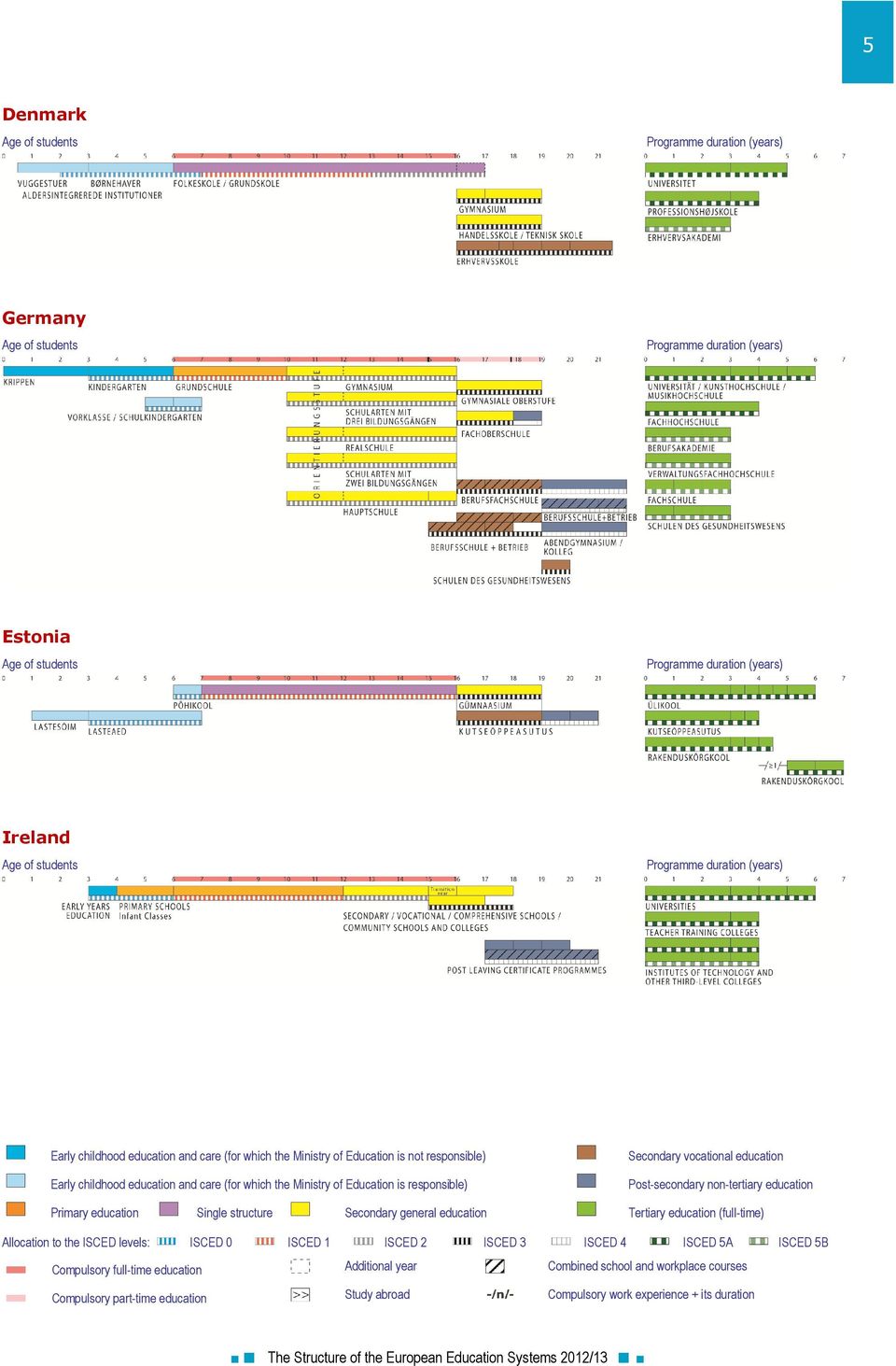
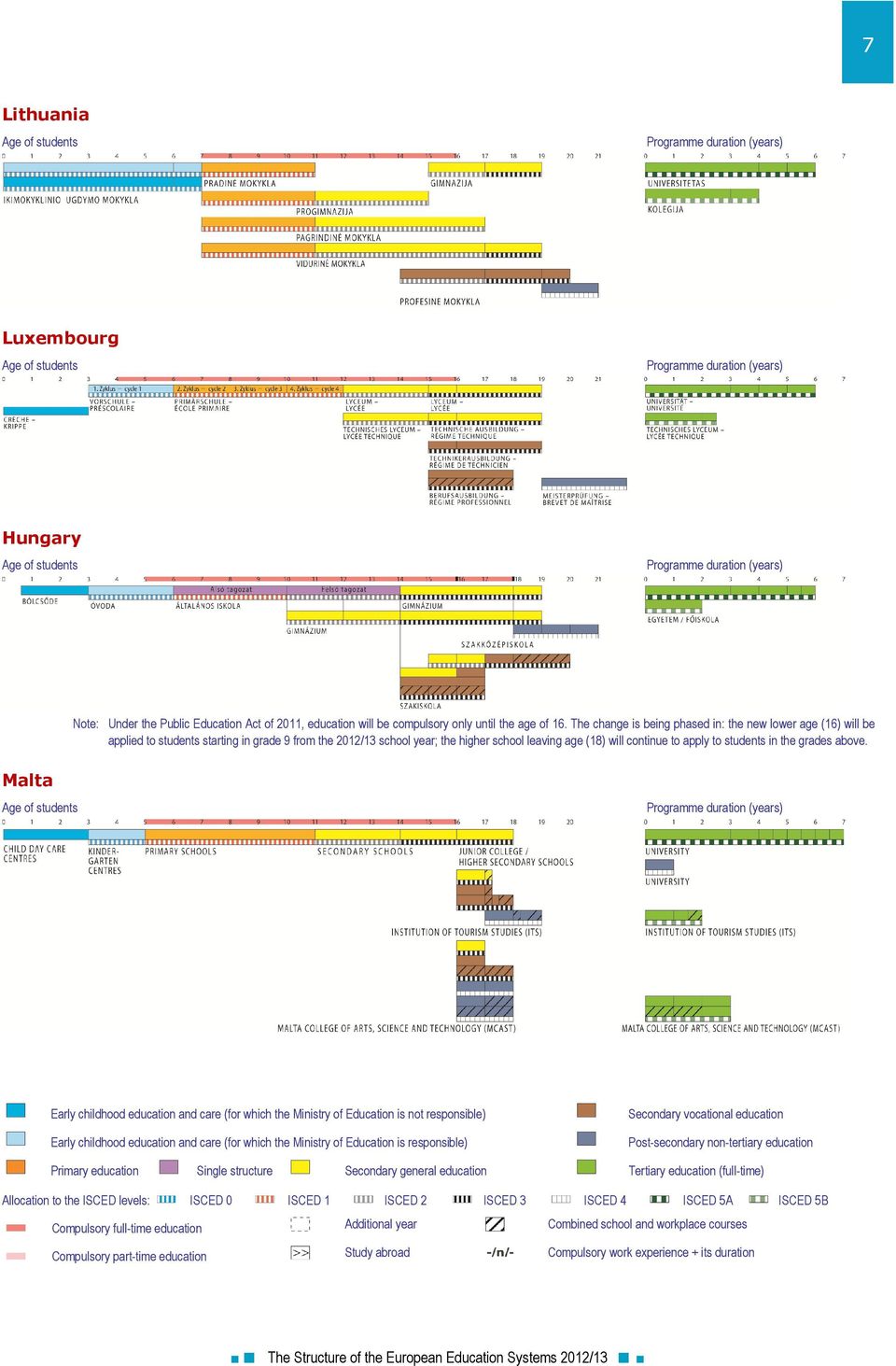
2 2 Guide to reading the diagrams These explanatory notes are intended to help readers explore the full potential of the information provided in the diagrams. The key explains the meaning of the symbols and colours used, and these notes provide the additional information necessary to allow readers to understand and correctly interpret the content of the diagrams. Structure of the national educational programmes and ISCED levels The diagrams show the mainstream educational programmes considered to be the most representative in each country. This encompasses early childhood education provided in publicly subsidised and accredited centre-based settings for children from the youngest age. Primary and secondary education programmes follow and these largely comprise the period of compulsory education in all countries. Finally, the diagrams show post-secondary nontertiary programmes as well as the main programmes offered at tertiary level. The main bar of the diagrams shows each national educational system; different colours represent the different levels and types of education. The small vertical lines within the levels represent the division into cycles or key stages for primary and secondary education, as well as the duration of qualifying programmes in post-secondary and tertiary education. Separate provision outside mainstream education for children and young people with special educational needs is not included. At tertiary level, doctoral studies as well as the specialised studies for the regulated professions such as medicine and architecture are excluded. A second thin bar with coloured stripes indicates the corresponding levels of education as defined by the 1997 International Standard Classification of Education (ISCED). This classification is used for collecting statistical data for international comparisons. Terms For the vast majority of countries, the term relating to the type of institution is shown on the diagram. However, the type of education or programme is considered to be more important in some countries, and so these terms are given where appropriate. All terms are provided in the official national language(s) of the country. Early childhood education and care (for which the Ministry of Education is not responsible) Early childhood education and care (for which the Ministry of Education is responsible) Primary education Single structure Secondary general education Secondary vocational education Post-secondary non-tertiary education Tertiary education (full-time) Allocation to the ISCED levels ISCED 0 ISCED 2 ISCED 4 ISCED 5A ISCED 1 ISCED 3 ISCED 5B Compulsory full-time education Compulsory part-time education Combined school and workplace courses Additional year Study abroad Compulsory work experience + its duration Please see definitions of the ISCED levels at the end of this document and programme duration The age of students scale starts on the left side of the diagram and shows the age of pupils and students when they start each level of education from preprimary onwards (ISCED levels 1 to 4). These ages are notional and give an indication of the official age at which children might begin early childhood education and care or compulsory education.

3 3 However, situations such as early or late entry, year repetition or other interruptions to schooling are not taken into account. More detailed recent information on ages and levels of education is available in the report Key Data on Education in Europe 2012: participation in preprimary and primary education (Figure C2) and lower secondary education to tertiary education (Figures C3, C8 and C10). Lifelong learning programmes are gaining more and more importance across Europe and adults are given opportunities to retake courses they have previously left or to undertake further educational qualifications. These courses are covered in the diagrams by educational programmes such as those providing competence-based qualifications or bridging courses that allow access to tertiary education. Usually these are classified as ISCED level 4, i.e. post-secondary non-tertiary education. As students might enrol in tertiary education programmes or in post-secondary education at different ages in some countries, a programme duration scale for these levels of education is provided on the right side of the diagram. Moreover, as students can also take different amounts of time to complete the programmes, for instance, where students undertake part-time studies whilst also working, the scale refers to the standard number of years allowed for completing studies at different stages on a full-time basis. The duration of part-time studies or individualised study patterns are not shown. Connections between programmes The diagrams also show the points at which students may transfer to a different type of school or education, either within a level or on completion of a level or programme. These transition points are shown by the vertical lines linking to the programmes. However, as the number of possible transition routes increases in some countries as students progress through the system, the pathways from secondary/postsecondary education to tertiary education programmes are not represented on the diagram. Therefore, the conditions of entry to tertiary education, even in the case of automatic progression, are not shown. Compulsory education: organisational models The diagrams reveal three main models of organisation within compulsory education in European countries: Single structure education. Education is provided in a continuous way from the beginning to the end of compulsory schooling, with no transition between primary and lower secondary education, and with general education provided in common for all pupils. Common core curriculum provision. After completion of primary education (ISCED 1), all students follow the same common core curriculum at lower secondary level (ISCED 2). Differentiated lower secondary education. After primary education, either at the beginning or some time during lower secondary education, students are enrolled in distinct educational pathways or specific types of schooling. Main models of primary and lower secondary education (ISCED 1-2) in Europe, 2012/13 Differentiated branches/streams (ISCED 2) Common core curriculum (ISCED 2) Single structure (ISCED1+ISCED2) Source: Eurydice. In the Czech Republic, Latvia, Hungary and Slovakia, compulsory education is organised in a single structure up to ages 14 to 16. However, from ages 10 to 13, students in these countries can, at certain stages in their school career, enrol in separate establishments providing both lower and upper secondary education.

4 4 Schematic diagrams: Structure of the European education systems 2012/13 Belgium French Community Belgium German-speaking Community Belgium Flemish Community Bulgaria Czech Republic
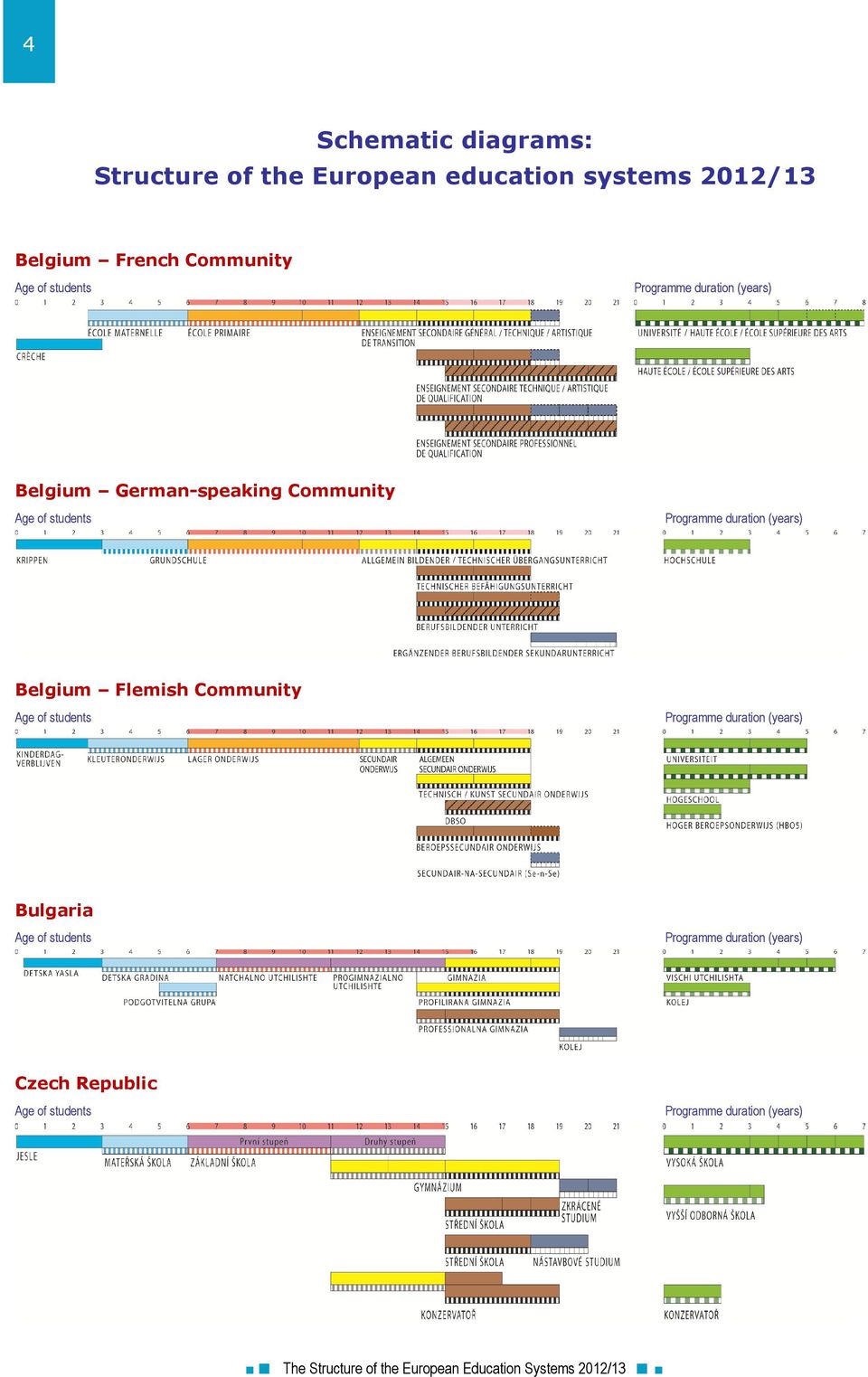
5 5 Denmark Germany Estonia Ireland Early childhood education and care (for which the Ministry of Education is not responsible) Early childhood education and care (for which the Ministry of Education is responsible) Secondary vocational education Post-secondary non-tertiary education Primary education Single structure Secondary general education Tertiary education (full-time) Allocation to the ISCED levels: ISCED 0 ISCED 1 ISCED 2 ISCED 3 ISCED 4 ISCED 5A ISCED 5B Compulsory full-time education Additional year Combined school and workplace courses Compulsory part-time education Study abroad Compulsory work experience + its duration
6 6 Greece Spain France Italy Cyprus Latvia

7 7 Lithuania Luxembourg Hungary Note: Under the Public Education Act of 2011, education will be compulsory only until the age of 16. The change is being phased in: the new lower age (16) will be applied to students starting in grade 9 from the 2012/13 school year; the higher school leaving age (18) will continue to apply to students in the grades above. Malta Early childhood education and care (for which the Ministry of Education is not responsible) Early childhood education and care (for which the Ministry of Education is responsible) Secondary vocational education Post-secondary non-tertiary education Primary education Single structure Secondary general education Tertiary education (full-time) Allocation to the ISCED levels: ISCED 0 ISCED 1 ISCED 2 ISCED 3 ISCED 4 ISCED 5A ISCED 5B Compulsory full-time education Additional year Combined school and workplace courses Compulsory part-time education Study abroad Compulsory work experience + its duration
8 8 The Netherlands Austria Note: Hauptschule is to be phased-out in the 2014/15 school year Poland Portugal Note: Cursos tecnológicos are no longer provided to new students. However, students enrolled in the 11th and 12th grades are still able to complete the courses

9 9 Romania Slovenia Note: 2012/13 is a transition year. (1) System being phased out for the students enrolled from the 9th grade of secondary education upwards. (2) New system being phased in whereby pupils aged 6 enter the preparatory year of primary education. Slovakia Finland Sweden Early childhood education and care (for which the Ministry of Education is not responsible) Early childhood education and care (for which the Ministry of Education is responsible) Secondary vocational education Post-secondary non-tertiary education Primary education Single structure Secondary general education Tertiary education (full-time) Allocation to the ISCED levels: ISCED 0 ISCED 1 ISCED 2 ISCED 3 ISCED 4 ISCED 5A ISCED 5B Compulsory full-time education Additional year Combined school and workplace courses Compulsory part-time education Study abroad Compulsory work experience + its duration

10 10 United Kingdom England United Kingdom Wales United Kingdom Northern Ireland United Kingdom Scotland Croatia Iceland Serbia
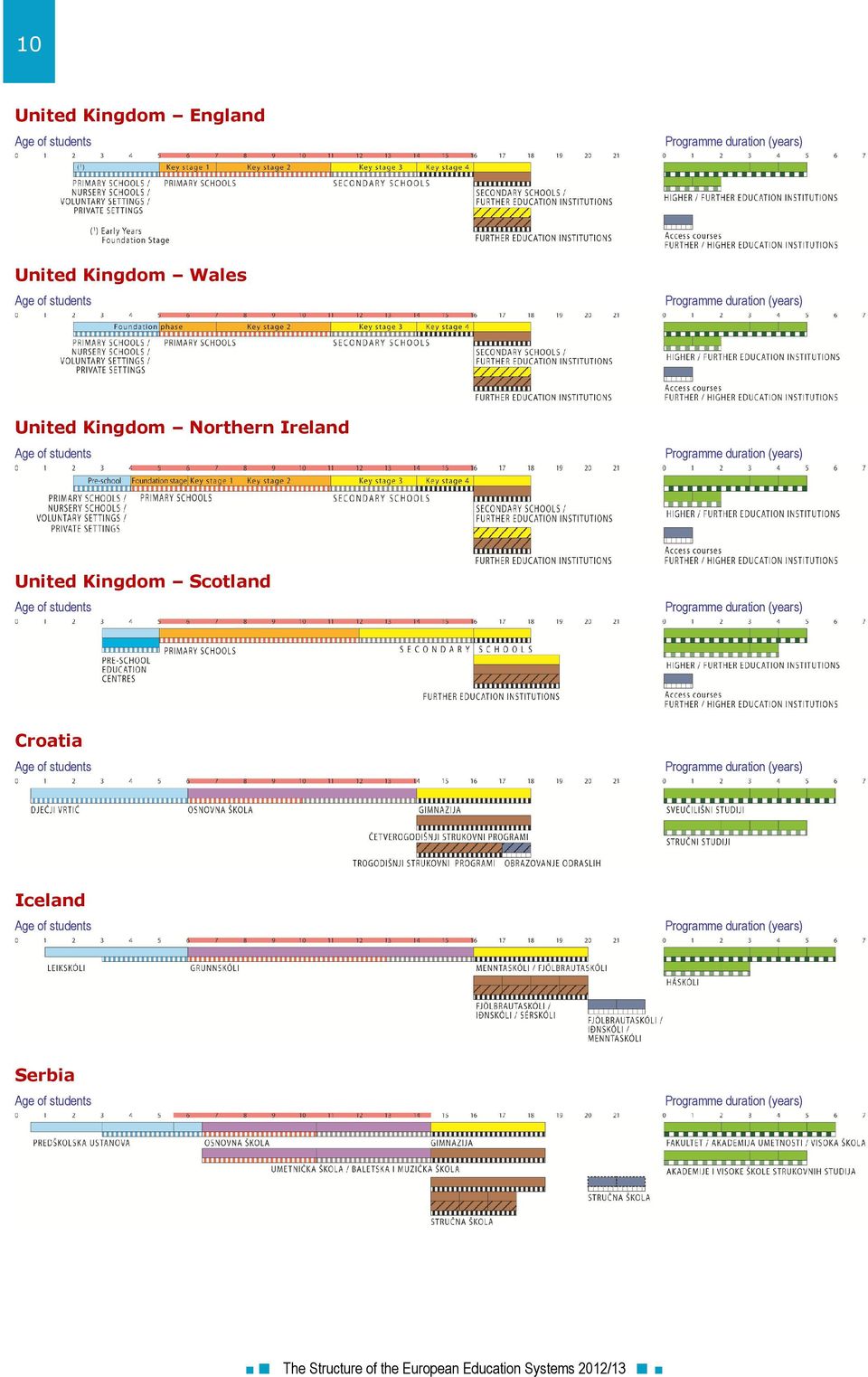
11 11 Turkey Liechtenstein Most students follow their sutdies in Switzerland. Norway Switzerland Early childhood education and care (for which the Ministry of Education is not responsible) Early childhood education and care (for which the Ministry of Education is responsible) Secondary vocational education Post-secondary non-tertiary education Primary education Single structure Secondary general education Tertiary education (full-time) Allocation to the ISCED levels: ISCED 0 ISCED 1 ISCED 2 ISCED 3 ISCED 4 ISCED 5A ISCED 5B Compulsory full-time education Additional year Combined school and workplace courses Compulsory part-time education Study abroad Compulsory work experience + its duration
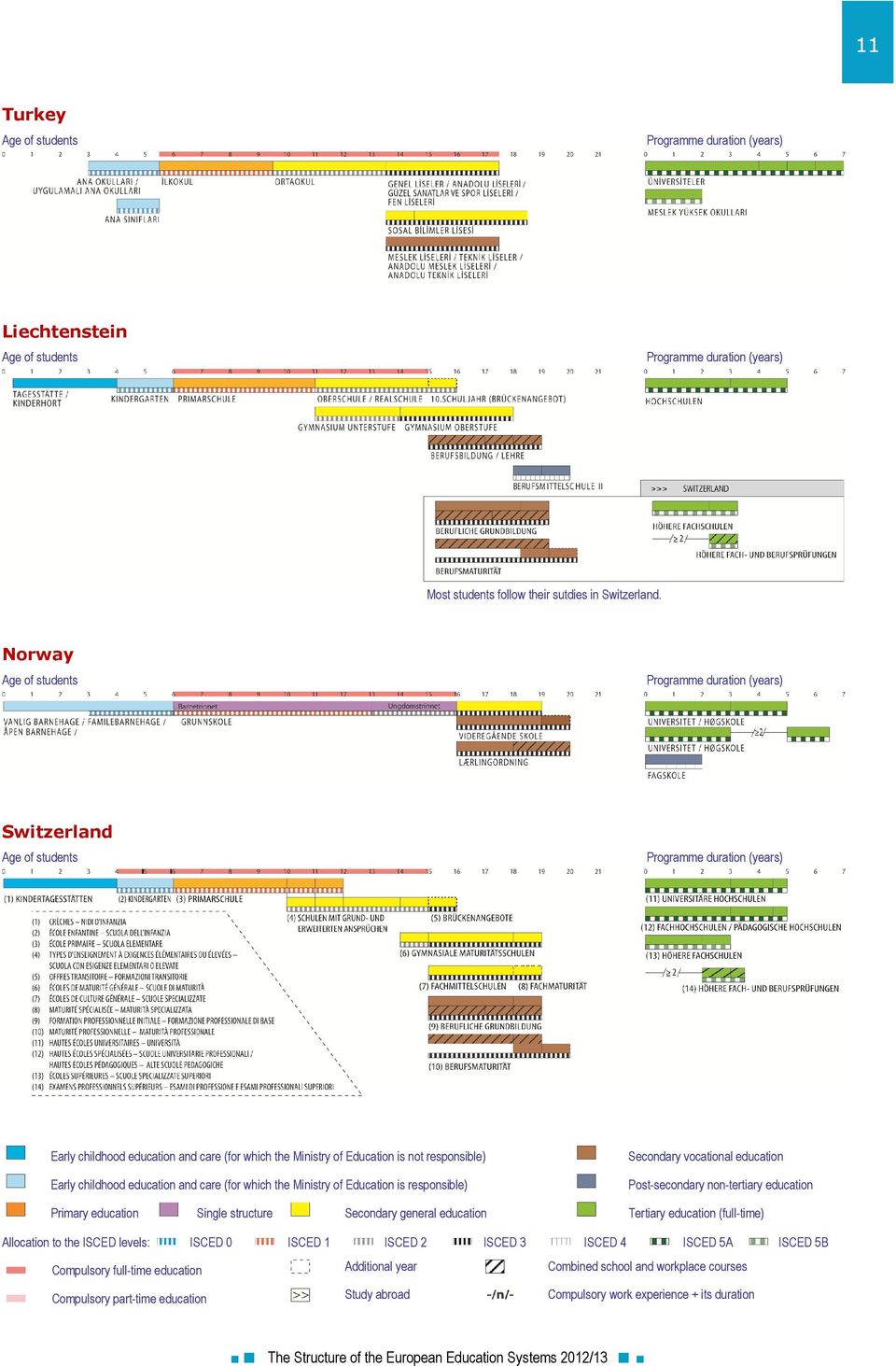
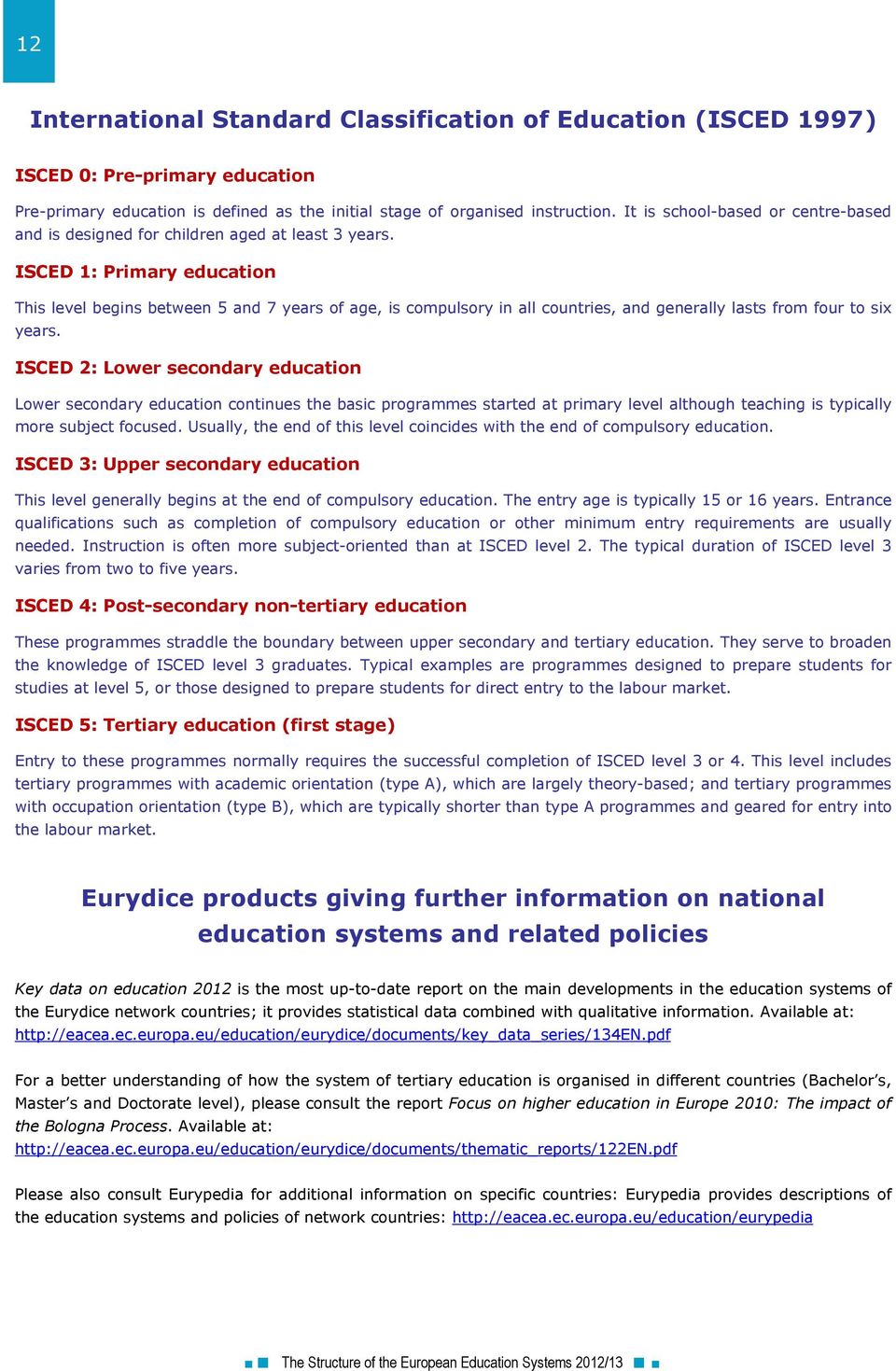
12 12 International Standard Classification of Education (ISCED 1997) ISCED 0: Pre-primary education Pre-primary education is defined as the initial stage of organised instruction. It is school-based or centre-based and is designed for children aged at least 3 years. ISCED 1: Primary education This level begins between 5 and 7 years of age, is compulsory in all countries, and generally lasts from four to six years. ISCED 2: Lower secondary education Lower secondary education continues the basic programmes started at primary level although teaching is typically more subject focused. Usually, the end of this level coincides with the end of compulsory education. ISCED 3: Upper secondary education This level generally begins at the end of compulsory education. The entry age is typically 15 or 16 years. Entrance qualifications such as completion of compulsory education or other minimum entry requirements are usually needed. Instruction is often more subject-oriented than at ISCED level 2. The typical duration of ISCED level 3 varies from two to five years. ISCED 4: Post-secondary non-tertiary education These programmes straddle the boundary between upper secondary and tertiary education. They serve to broaden the knowledge of ISCED level 3 graduates. Typical examples are programmes designed to prepare students for studies at level 5, or those designed to prepare students for direct entry to the labour market. ISCED 5: Tertiary education (first stage) Entry to these programmes normally requires the successful completion of ISCED level 3 or 4. This level includes tertiary programmes with academic orientation (type A), which are largely theory-based; and tertiary programmes with occupation orientation (type B), which are typically shorter than type A programmes and geared for entry into the labour market. Eurydice products giving further information on national education systems and related policies Key data on education 2012 is the most up-to-date report on the main developments in the education systems of the Eurydice network countries; it provides statistical data combined with qualitative information. Available at: For a better understanding of how the system of tertiary education is organised in different countries (Bachelor s, Master s and Doctorate level), please consult the report Focus on higher education in Europe 2010: The impact of the Bologna Process. Available at: Please also consult Eurypedia for additional information on specific countries: Eurypedia provides descriptions of the education systems and policies of network countries:
The structure of the European education systems. schematic diagrams. Eurydice Highlights. Education and Training
 What is Eurydice The Eurydice Network provides information on and analyses of European education systems and policies. It consists of 40 national units based in all 36 countries participating in the EU's
The Structure of the European Education Systems 2014/15:
 The Structure of the European Education Systems 2014/15: Schematic Diagrams November 2014 Eurydice Facts and Figures Education and Training at is Eurydice The Eurydice Network provides information on and
The Structure of the European Education Systems 2015/16
 The Structure of the European Education Systems 2015/16 Schematic Diagrams Eurydice Facts and Figures Education and Training The Structure of the European Education Systems 2015/16 Schematic Diagrams
ERASMUS+ MASTER LOANS
 Ref. Ares(2015)660570-17/02/2015 ERASMUS+ MASTER LOANS Erasmus+ Master Loan: opening up access to more affordable lending for cross-border studies The Erasmus+ programme makes it possible for students
ERASMUS+ MASTER LOANS
 ERASMUS+ MASTER LOANS Erasmus+ Master Loan: opening up access to more affordable lending for cross-border studies The Erasmus+ programme makes it possible for students who want to take a full Masters level
1. Perception of the Bancruptcy System... 2. 2. Perception of In-court Reorganisation... 4
 Bankruptcy Systems and In-court Reorganisation of Firms, 2010 Content: 1. Perception of the Bancruptcy System... 2 2. Perception of In-court Reorganisation... 4 3. Perception of Creditor Committees, Fast
Teachers. and School Heads. European Commission
 Teachers and School Heads Salaries and Allowances in Europe, 2009/10 European Commission Teachers' and School Heads' Salaries and Allowances in Europe, 2009/10 CONTENTS Overview 3 Part I: Cross country
ERASMUS+ MASTER LOANS
 ERASMUS+ MASTER LOANS Erasmus+ Master Loan: opening up access to more affordable lending for cross-border studies The Erasmus+ programme makes it possible for students who want to take a full Master's-level
Key Data on Teachers and School Leaders in Europe
 Key Data on Teachers and School Leaders in Europe 2013 Edition Eurydice Report Education and Training This document is published by the Education, Audiovisual and Culture Executive Agency (EACEA, Eurydice
Computing our Future Computer programming and coding in schools in Europe. Anja Balanskat, Senior Manager European Schoolnet
 Computing our Future Computer programming and coding in schools in Europe Anja Balanskat, Senior Manager European Schoolnet ABOUT THE SURVEY What do Ministries currently think about the topic? Curricula
Labour Force Survey 2014 Almost 10 million part-time workers in the EU would have preferred to work more Two-thirds were women
 75/2015-27 April 2015 Labour Force Survey 2014 Almost 10 million part-time workers in the EU would have preferred to work more Two-thirds were women Among the 44.1 million persons in the European Union
Overseas degree equivalency: methodology
 This document was produced by UK NARIC for the National College for Teaching and Leadership (NCTL) 1. Introduction The current allocation of bursaries for postgraduate teacher training places in England
Key Data on. Early Childhood. Education. and Care. in Europe. Eurydice and Eurostat Report. 2014 Edition. Education and Training
 Key Data on Early Childhood Education and Care Eurydice and Eurostat Report in Europe 2014 Edition Education and Training Key Data on Early Childhood Education and Care in Europe 2014 Edition Eurydice
How To Calculate Tertiary Type A Graduation Rate
 Indicator How Many Students Finish Tertiary Education? Based on current patterns of graduation, it is estimated that an average of 46% of today s women and 31% of today s men in OECD countries will complete
The education system and lifelong learning in Finland. October 2015 Petri Haltia
 The education system and lifelong learning in Finland October 2015 Petri Haltia FINLAND Population: year 2012: 5,421,827 density: 16/km 2 Area: total 338,424 km 2 water 10 % GDP (nominal) 2011 estimate:
13 th Economic Trends Survey of the Architects Council of Europe
 13 th Economic Trends Survey 13 th Economic Trends Survey of the Architects Council of Europe 13 th Economic Trends Survey Breakdown of responses COUNTRY ANSWERS France 1464 Belgium 399 Spain 365 Italy
Key Data on Teachers and School Leaders in Europe
 Key Data on Teachers and School Leaders in Europe 2013 Edition Eurydice Report Education and Training This document is published by the Education, Audiovisual and Culture Executive Agency (EACEA, Eurydice
Education at a Glance. Update of Employment and Educational Attainment Indicators
 Education at a Glance Interim Report: Update of Employment and Educational Attainment Indicators Education at a Glance Interim Report: Update of Employment and Educational Attainment Indicators January
Encouraging Quality in Early Childhood Education and Care (ECEC)
 Encouraging Quality in Early Childhood Education and Care (ECEC) INTERNATIONAL COMPARISON: JOB TITLES, QUALIFICATIONS AND REQUIREMENTS Findings Job titles and qualifications Five job types are commonly
Planned Healthcare in Europe for Lothian residents
 Planned Healthcare in Europe for Lothian residents Introduction This leaflet explains what funding you may be entitled to if you normally live in Lothian (Edinburgh, West Lothian, Midlothian and East Lothian
Education and training in Denmark Facts and Key Figures
 Education and training in Denmark Facts and Key Figures Education and training in Denmark The Danish education and training system is composed of two parallel systems: the mainstream education and training
Energy prices in the EU Household electricity prices in the EU rose by 2.9% in 2014 Gas prices up by 2.0% in the EU
 92/2015-27 May 2015 Energy prices in the EU Household electricity prices in the EU rose by 2.9% in 2014 Gas prices up by 2.0% in the EU In the European Union (EU), household electricity prices 1 rose by
TPI: Traffic Psychology International on a common European curriculum for postgraduate education in traffic psychology
 TPI: Traffic Psychology International on a common European curriculum for postgraduate education in traffic psychology Sucha, M.*, Sramkova, L.** DeVol, D.* * TPI - Traffic Psychology International **
Adult Education and Training
 Adult Education and Training Widening Access to Learning Opportunities in Europe Eurydice Report Education and Training Adult Education and Training in Europe: Widening Access to Learning Opportunities
Health and welfare Humanities and arts Social sciences, bussiness and law. Ireland. Portugal. Denmark. Spain. New Zealand. Argentina 1.
 Indicator to Which fields of education are students attracted? Women represent the majority of students and graduates in almost all OECD countries and largely dominate in the fields of education, health
Teachers and School Heads Salaries and Allowances in Europe, 2011/12. Eurydice Report. Education and Culture
 Teachers and School Heads Salaries and Allowances in Europe, 2011/12 Eurydice Report Education and Culture Eurydice Report Teachers' and School Heads' Salaries and Allowances in Europe, 2011/12 CONTENTS
41 T Korea, Rep. 52.3. 42 T Netherlands 51.4. 43 T Japan 51.1. 44 E Bulgaria 51.1. 45 T Argentina 50.8. 46 T Czech Republic 50.4. 47 T Greece 50.
 Overall Results Climate Change Performance Index 2012 Table 1 Rank Country Score** Partial Score Tendency Trend Level Policy 1* Rank Country Score** Partial Score Tendency Trend Level Policy 21 - Egypt***
COMMUNICATION FROM THE COMMISSION
 EUROPEAN COMMISSION Brussels, 17.9.2014 C(2014) 6767 final COMMUNICATION FROM THE COMMISSION Updating of data used to calculate lump sum and penalty payments to be proposed by the Commission to the Court
CCBE LAWYERS STATISTICS 2015 Total n of women lawyer members of the Bar Austria 31/12/2014 5.940 1.210 80
 Austria 31/12/2014 5.940 1.210 80 Belgium (OBFG) 01/12/2014 7.756 Pas de statistiques par sexe Belgium (OVB) 01/12/2014 10.418 (5.907 male s + 24 on B-list; 4.472 s + 15 on B-list). 4.472 s + 15 on B-list
SURVEY ON THE TRAINING OF GENERAL CARE NURSES IN THE EUROPEAN UNION. The current minimum training requirements for general care nurses
 SURVEY ON THE TRAINING OF GENERAL CARE NURSES IN THE EUROPEAN UNION This survey serves as a background document for the discussion of the Commission's legislative proposal to modernize the minimum requirements
Waste. Copenhagen, 3 rd September 2014. Almut Reichel Project Manager Sustainable consumption and production & waste, European Environment Agency
 Waste Copenhagen, 3 rd September 2014 Almut Reichel Project Manager Sustainable consumption and production & waste, European Environment Agency Waste and material resources MAWP Strategic Area 1.9 Objective
168/2014-4 November 2014. At risk of poverty or social exclusion 2 rate in the EU28, 2008-2013 (% of total population)
 168/2014-4 November 2014 At risk of poverty or social exclusion in the EU28 More than 120 million persons at risk of poverty or social exclusion in 2013 Almost 1 out of every 4 persons in the EU in this
The Community Innovation Survey 2010 (CIS 2010)
 The Community Innovation Survey 2010 (CIS 2010) THE HARMONISED SURVEY QUESTIONNAIRE The Community Innovation Survey 2010 FINAL VERSION July 9, 2010 This survey collects information on your enterprise s
Keeping European Consumers safe Rapid Alert System for dangerous non-food products 2014
 Keeping European Consumers safe Rapid Alert System for dangerous non-food products 2014 COMPLETE STATISTICS Justice and Consumers Directorate-General for Justice and Consumers Directorate Consumers Unit
Key Data on Education in Europe 2012
 Key Data on Education in Europe 2012 EURYDICE Key Data on Education in Europe 2012 This document is published by the Education, Audiovisual and Culture Executive Agency (EACEA P9 Eurydice). Available
Funding and network opportunities for cluster internationalization
 BSR Innovation Express: Cluster- to- Cluster Conference Funding and network opportunities for cluster internationalization Jens Peter Vittrup Special Adviser Email: [email protected] Why international R&I cooperation?
Size and Development of the Shadow Economy of 31 European and 5 other OECD Countries from 2003 to 2015: Different Developments
 January 20, 2015 ShadEcEurope31_January2015.doc Size and Development of the Shadow Economy of 31 European and 5 other OECD Countries from 2003 to 2015: Different Developments by Friedrich Schneider *)
International Hints and Tips
 International Hints and Tips Content Q: What is the cut off time for processing International payments? A: International payments must be submitted and fully approved within the cut off time indicated
C O N T E X T. to Promote all Forms of Giftedness at School. in Europe. Working Document. June 2006 E U RYD I C E
 E U RYD I C E Directorate-General for Education and Culture Specific C h aeducational p t e r A : Measures to Promote all Forms of Giftedness at School C O N T E X T in Europe Working Document June 2006
NEW PASSENGER CAR REGISTRATIONS BY ALTERNATIVE FUEL TYPE IN THE EUROPEAN UNION 1 Quarter 4 2015
 NEW PASSENGER CAR REGISTRATIONS BY ALTERNATIVE FUEL TYPE IN THE Quarter 4 2015 Alternative fuel vehicle (AFV) registrations: +20.0% in 2015; +21.1% in Q4 In the fourth quarter of 2015, total alternative
Erasmus+ International Cooperation
 International Cooperation Work together with European higher education institutions ? The EU's programme to support education, training youth & sport Funding for programmes, projects & scholarships Fosters
The Helsinki Communiqué
 The Helsinki Communiqué on Enhanced European Cooperation in Vocational Education and Training Communiqué of the European Ministers of Vocational Education and Training 1, the European Social partners 2
193/2014-15 December 2014. Hourly labour costs in the EU28 Member States, 2012 (in )
 193/2014-15 December 2014 Labour Cost Survey 2012 in the EU28 Labour costs highest in the financial and insurance sector Three times higher than in the accommodation and food sector In 2012, average hourly
EURYDICE. Key Data on Education in Europe 2012
 EURYDICE Key Data on Education in Europe 2012 This document is published by the Education, Audiovisual and Culture Executive Agency (EACEA P9 Eurydice). Available in English (Key Data on Education in Europe
Term 1 Assignment AP European History
 Term 1 Assignment AP European History To Incoming Sophomores Enrolled in AP European History for the 2015-2016 Year: This course is probably different than any you have completed thus far in your educational
ERASMUS FOR YOUNG ENTREPRENEURS : A NEW EXCHANGE PROGRAMME
 PRESS DOSSIER INDEX PRESS DOSSIER...1 INDEX...2 ERASMUS FOR YOUNG ENTREPRENEURS : A NEW EXCHANGE PROGRAMME...3 WHO CAN PARTICIPATE?...5 WHAT BENEFITS AND FOR WHOM?...6 HOW DOES IT WORK? STRUCTURE AND IMPLEMENTATION...7
Teachers' and School Heads' Salaries and Allowances in Europe 2014/15
 1 Teachers' and School Heads' Salaries and Allowances in Europe 2014/15 This document is published by the Education, Audiovisual and Culture Executive Agency (EACEA, Education and Youth Policy Analysis).
Health care in Scotland for UK passport holders living abroad
 Health care in Scotland for UK passport holders living abroad If you have a UK passport and you live abroad, this factsheet tells you how you can get health care from the NHS when you are in Scotland.
Statistical Data on Women Entrepreneurs in Europe
 Statistical Data on Women Entrepreneurs in Europe September 2014 Enterprise and Industry EUROPEAN COMMISSION Directorate-General for Enterprise and Industry Directorate D SMEs and Entrepreneurship Unit
2 nd ENAEE Conference, Leuven, 16.-17. September 2013 European Master of Advanced Industrial Management in the EHEA
 Platzhalter für Bild, Bild auf Titelfolie hinter das Logo einsetzen 2 nd ENAEE Conference, Leuven, 16.-17. September 2013 European Master of Advanced Industrial Management in the EHEA Preparing Engineers
EUROPEAN AREA OF SKILLS AND QUALIFICATIONS
 EUROPEAN AREA OF SKILLS AND QUALIFICATIONS REPORT Fieldwork: April - May 2014 Publication: June 2014 This survey has been requested by the European Commission, Directorate-General for Education and Culture
Postgraduate Nursing Education in Europe and the Bologna Process
 FINE, October 2006, Paris Postgraduate Nursing Education in Europe and the Bologna Process Dr Alice Kiger Centre for Advanced Studies in Nursing Plan of the presentation 1. Drivers and other influencing
B Financial and Human Resources
 Chapter B Financial and Human Resources Invested In Education Education at a Glance OECD 2011 203 chapter B Classification of al expenditure Educational expenditure in this chapter is classified through
Topic 1: The learning and school environment in primary and secondary education
 FRANCE This note on France focuses on three major topics covered in the present edition of Education at a Glance, which particularly concern France. These topics are: the learning and school environment
How To Promote Physical Education In Schools
 Physical Education and at Sport School in Europe Eurydice Report Education and Training Physical Education and Sport at School in Europe Eurydice Report Education and Training This document is published
187/2014-5 December 2014. EU28, euro area and United States GDP growth rates % change over the previous quarter
 187/2014-5 December 2014 This News Release has been revised following an error in the data for Gross Fixed Capital Formation. This affects both the growth of GFCF and its contribution to GDP growth. All
Application Form: Receptionist / PA to the Senior Leadership Team
 Application Form: Receptionist / PA to the Senior Leadership Team This application form is written in BLACK ink. Please answer the questions in dark blue and return electronically to Lesley Starkes, Finance
NECs. Q2. Are any of the employees of your NEC coordinating other European innitiatives (e.g. Youth Action, Euroguidance, LLP, EURES, etc.)?
 NECs Survey Questionnaire for the National Europass Centres Q2. Are any of the employees of your NEC coordinating other European innitiatives (e.g. Youth Action, Euroguidance, LLP, EURES, etc.)? Frequency
Erasmus Mundus Master in Membrane Engineering EM 3 E Third Call for Applications
 Erasmus Mundus Master in Membrane Engineering EM 3 E Third Call for Applications Master edition 2013-2015 Erasmus Mundus is a cooperation and mobility programme in the field of higher education, promoted
Family benefits Information about health insurance country. Udbetaling Danmark Kongens Vænge 8 3400 Hillerød. A. Personal data
 Mail to Udbetaling Danmark Kongens Vænge 8 3400 Hillerød Family benefits Information about health insurance country A. Personal data Name Danish civil registration (CPR) number Address Telephone number
99/2015-9 June 2015. EU28, euro area and United States GDP growth rates % change over the previous quarter
 2005Q1 2005Q2 2005Q3 2005Q4 2006Q1 2006Q2 2006Q3 2006Q4 2007Q1 2007Q2 2007Q3 2007Q4 2008Q1 2008Q2 2008Q3 2008Q4 2009Q1 2009Q2 2009Q3 2009Q4 2010Q1 2010Q2 2010Q3 2010Q4 2011Q1 2011Q2 2011Q3 2011Q4 2012Q1
Information for applicants, employers and supervisors. Periods of adaptation
 Information for applicants, employers and supervisors Periods of adaptation Contents Introduction 1 Section one: Information for applicants, employers and supervisors 4 Section two: Guidance for applicants
THE ORGANISATION AND FINANCING OF HEALTH CARE SYSTEM IN LATVIA
 THE ORGANISATION AND FINANCING OF HEALTH CARE SYSTEM IN LATVIA Eriks Mikitis Ministry of Health of the Republic of Latvia Department of Health Care Director General facts, financial resources Ministry
Assuring Quality in Education
 Assuring Quality in Education Eurydice Report Policies and Approaches to School Evaluation in Europe Education u and Training a Assuring Quality in Education: Policies and Approaches to School Evaluation
EUROPE 2020 TARGET: TERTIARY EDUCATION ATTAINMENT
 EUROPE 2020 TARGET: TERTIARY EDUCATION ATTAINMENT Low tertiary or equivalent education attainment levels create skills bottlenecks in knowledgeintensive economic sectors and hamper productivity, innovation
Physical Education. Sport. School in Europe
 Physical Education and at Sport School in Europe Eurydice Report Education and Training Physical Education and Sport at School in Europe Eurydice Report Education and Training This document is published
This document is a preview generated by EVS
 CEN WORKSHOP CWA 16926-7 August 2015 AGREEMENT ICS 35.240.40; 35.240.15; 35.200 English version Extensions for Financial Services (XFS) interface specification Release 3.30 - Part 7: Check Reader/Scanner
The European Entrepreneur Exchange Programme
 The European Entrepreneur Exchange Programme Users Guide 2 Contents 1.0 Introduction... 5 2.0 Objectives... 6 3.0 Structure... 7 3.1 Basic elements... 7 3.2 Four phases... 8 4.0 Implementation... 9 4.1
Assuring Quality in Education
 Assuring Quality in Education Eurydice Report Policies and Approaches to School Evaluation in Europe Education and Training Assuring Quality in Education: Policies and Approaches to School Evaluation
EXECUTIVE SUMMARY. Measuring money laundering at continental level: The first steps towards a European ambition. January 2011 EUROPEAN COMMISSION
 MONEY LAUNDERING IN EUROPE Measuring money laundering at continental level: The first steps towards a European ambition EXECUTIVE SUMMARY January 2011 EUROPEAN COMMISSION DG HOME AFFAIRS FIGHT AGAINST
Need to send money abroad securely?
 International Payments Need to send money abroad securely? Trust us to get it there. Sending money abroad with Lloyds TSB. It s easy and secure. As a Lloyds TSB customer, if you need to send money overseas,
Information on insurance tax and fire protection tax for EU/EEA insurers
 Information on insurance tax and fire protection tax for EU/EEA insurers I. General This leaflet is intended for all insurers and authorised agents located in the EU/EEA area who are established outside
COMMISSION STAFF WORKING DOCUMENT. Situation of young people in the EU. Accompanying the document
 EUROPEAN COMMISSION Brussels, 15.9.2015 SWD(2015) 169 final PART 2/6 COMMISSION STAFF WORKING DOCUMENT Situation of young people in the EU Accompanying the document Communication from the Commission to
Teachers' and School Heads' Salaries and Allowances in Europe, 2013/14
 1 Teachers' and School Heads' Salaries and Allowances in Europe, 2013/14 CONTENTS Table of Figures 3 Codes 4 Overview 5 Part I: Comparative Analysis 6 Part II: National Data Sheets 29 Part III: Definitions
International Call Services
 International Call Services Affordable rates for business calls. Wherever you are in the world. We ve got plenty to say when it comes to staying in touch when you re overseas. We have agreements with 443
in Scotland for holidaymakers from overseas
 in Scotland for holidaymakers from overseas In Scotland, most health care is provided by the National Health Service (NHS). If you are coming to Scotland on holiday or to visit friends or relatives, you
Tackling Early Leaving
 Tackling Early Leaving from Education and Training in Europe Strategies, Policies and Measures Eurydice and Cedefop Report Education and Training Tackling Early Leaving from Education and Training in
Higher education institutions as places to integrate individual lifelong learning strategies
 Higher education institutions as places to integrate individual lifelong learning strategies Andrzej Krasniewski Warsaw University of Technology Bologna Expert QUALIFICATIONS FRAMEWORKS AS INSTRUMENTS
Conditions for entitlement to disability benefits, 2013
 Austria Belgium Bulgaria Croatia Cyprus Reduction in capacity for work of 50%. Reduction of capacity for work of at least 66%. 50% reduction in working capacity/degree of disability. More than 50% reduction
Tackling Early Leaving
 Tackling Early Leaving from Education and Training in Europe Strategies, Policies and Measures Eurydice and Cedefop Report Education and Training Tackling Early Leaving from Education and Training in
How Many Students Finish Secondary Education?
 Indicator How Many Students Finish Secondary Education? Based on current patterns of graduation, it is estimated that an average of 82% of today s young people in OECD countries will complete upper secondary
PORTABILITY OF SOCIAL SECURITY AND HEALTH CARE BENEFITS IN ITALY
 PORTABILITY OF SOCIAL SECURITY AND HEALTH CARE BENEFITS IN ITALY Johanna Avato Human Development Network Social Protection and Labor The World Bank Background study March 2008 The Italian Social Security
About us. As our customer you will be able to take advantage of the following benefits: One Provider. Flexible Billing. Our Portal.
 About us At RoamingExpert we specialise in mobile roaming tariffs which are tailored to the specific needs of the yachting industry. Our unique offering generates significant savings when compared to standard
ENTERING THE EU BORDERS & VISAS THE SCHENGEN AREA OF FREE MOVEMENT. EU Schengen States. Non-Schengen EU States. Non-EU Schengen States.
 ENTERING THE EU BORDERS & VISAS THE SCHENGEN AREA OF FREE MOVEMENT An area without internal borders where EU citizens and non-eu nationals may move freely EU Schengen States Non-Schengen EU States IS Azores
National Student Fee and Support Systems
 National Student Fee and Support Systems in European Higher Education 2015/16 Eurydice Facts and Figures Education and Training National Student Fee and Support Systems in European Higher Education 2015/16
Education at a Glance. OECD Indicators. Annex: UOE Data Collection Sources
 Education at a Glance OECD Indicators Annex: UOE Data Collection Sources UOE DATA COLLECTION National Sources 2013 UNESCO/OECD/EUROSTAT (UOE) data collection on education statistics. Australia: The Commonwealth
The Guardianship Service
 The Guardianship Service How can they help you? When you arrive in Belgium Are you under the age of 18 and have you arrived in Belgium without your father or mother? You are searching for support and accommodation
ICELAND ICELAND ICELAND. spotlight on VET. Education and training in figures. spotlight on VET 2012/13
 Education and training in figures Learners in upper secondary education enrolled in vocational and general % of all students in upper secondary education, 11 VOCATIONAL GERAL 1 Further information 23.9
How many students study abroad and where do they go?
 From: Education at a Glance 2012 Highlights Access the complete publication at: http://dx.doi.org/10.1787/eag_highlights-2012-en How many students study abroad and where do they go? Please cite this chapter
Students: undergraduate and graduate students who are currently enrolled in universities
 DUO-Korea: 1. General Description CAUTION: If any application falls under the following 3 cases, the application is disqualified and will not be considered for selection. If such case is found after the