
Study Unit 6. Managing Current Assets
|
|
|
- Christine Hill
- 10 years ago
- Views:
Transcription
1 Study Unit 6 Managing Current Assets

2 SU- 6.1 Working Capital What is working capital and types of capital policies What all is included in working capital? Net working capital = What is used to acquire working capital? What is the objective of having working capital? Capital policies include: Conservative = minimize risk = < current ratio & acid test ratio So if you did not conserve current assets what would you do with them? Aggressive = Permanent and Temporary Working Capital Permanent financed with long-term debt Why?

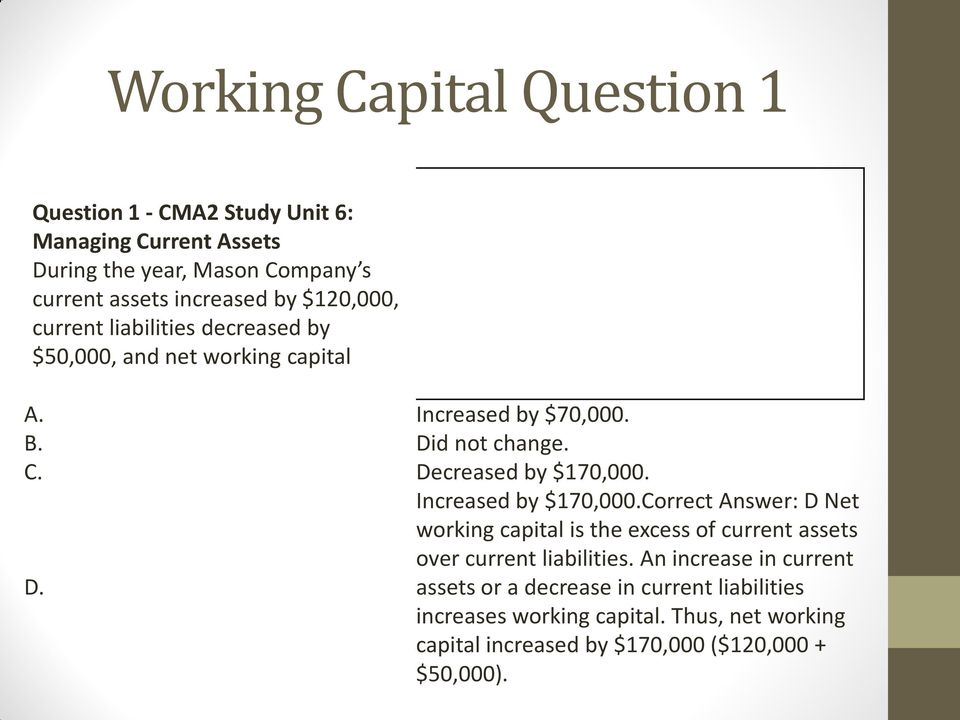
3 Working Capital Question 1 Question 1 - CMA2 Study Unit 6: Managing Current Assets During the year, Mason Company s current assets increased by $120,000, current liabilities decreased by $50,000, and net working capital A. Increased by $70,000. B. Did not change. C. Decreased by $170,000. Increased by $170,000.Correct Answer: D Net working capital is the excess of current assets over current liabilities. An increase in current D. assets or a decrease in current liabilities increases working capital. Thus, net working capital increased by $170,000 ($120,000 + $50,000).
4 Working Capital Answer 1 Correct Answer: D Net working capital is the excess of current assets over current liabilities. An increase in current assets or a decrease in current liabilities increases working capital. Thus, net working capital increased by $170,000 ($120,000 + $50,000). Incorrect Answers: A: Both the increase in current assets and the decrease in current liabilities increase working capital. B: Net working capital did change. C: Net working capital increased.
5 Working Capital Question 2 Question 2 - CMA2 Study Unit 6: Managing Current Assets Mason Company s board of directors has determined 4 options to increase working capital next year. Option 1 is to increase current assets by $120 and decrease current liabilities by $50. Option 2 is to increase current assets by $180 and increase current liabilities by $30. Option 3 is to decrease current assets by $140 and increase current liabilities by $20. Option 4 is to decrease current assets by $100 and decrease current liabilities by $75. Which option should Mason choose to maximize net working capital? A. Option 1. B. Option 2. C. Option 3. D. Option 4.

6 Working Capital Answer 2 Net working capital is the excess of current assets over current liabilities. An increase in current assets or a decrease in current liabilities will increase net working capital. Option 1 maximizes Mason Company s net working capital, increasing it by $170 ($120 + $50). Incorrect Answers: B: Option 2 increases net working capital by $150. C: Option 3 decreases net working capital by $160. D: Option 4 decreases net working capital by $25.
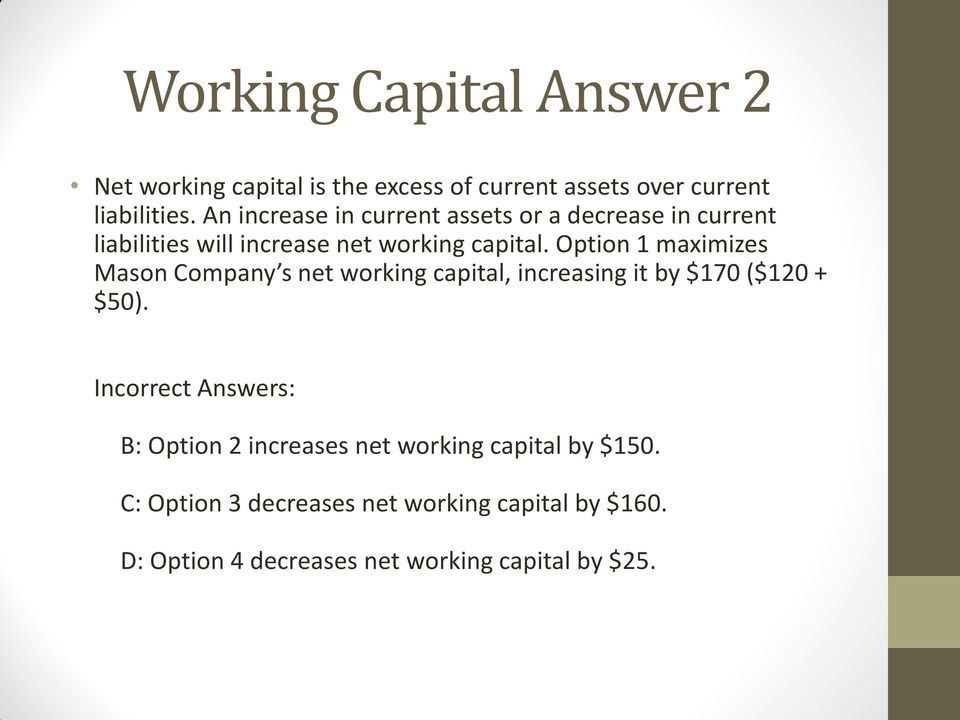
7 Working Capital Question 3 Question 3 - CMA2 Study Unit 6: Managing Current Assets Starrs Company has current assets of $400,000 and current liabilities of $300,000. Starrs could increase its net working capital by the A. B. C. D. Prepayment of $50,000 of next year s rent. Refinancing of $50,000 of short-term debt with long-term debt. Acquisition of land valued at $50,000 through the issuance of common stock. Purchase of $50,000 of trading securities for cash.
8 Working Capital Answer 3 Correct Answer: B Net working capital is defined as the excess of current assets over current liabilities. Refinancing short-term debt with long-term debt decreases current liabilities with no effect on current assets, resulting in an increase in working capital. Incorrect Answers: A: A prepayment of expenses does not change current assets or current liabilities. Cash decreases by the same amount that prepaid rent increases. C: The acquisition of land (a noncurrent asset) for common stock (an equity interest) does not affect either current assets or current liabilities. D: The purchase of trading securities does not affect total current assets. Cash is replaced by trading securities, another current asset.

9 Working Capital Question 4 Question 4 - CMA2 Study Unit 6: Managing Current Assets If a firm increases its cash balance by issuing additional shares of common stock, net working capital A. Remains unchanged and the current ratio remains unchanged. B. Increases and the current ratio remains unchanged. C. Increases and the current ratio decreases. D. Increases and the current ratio increases.

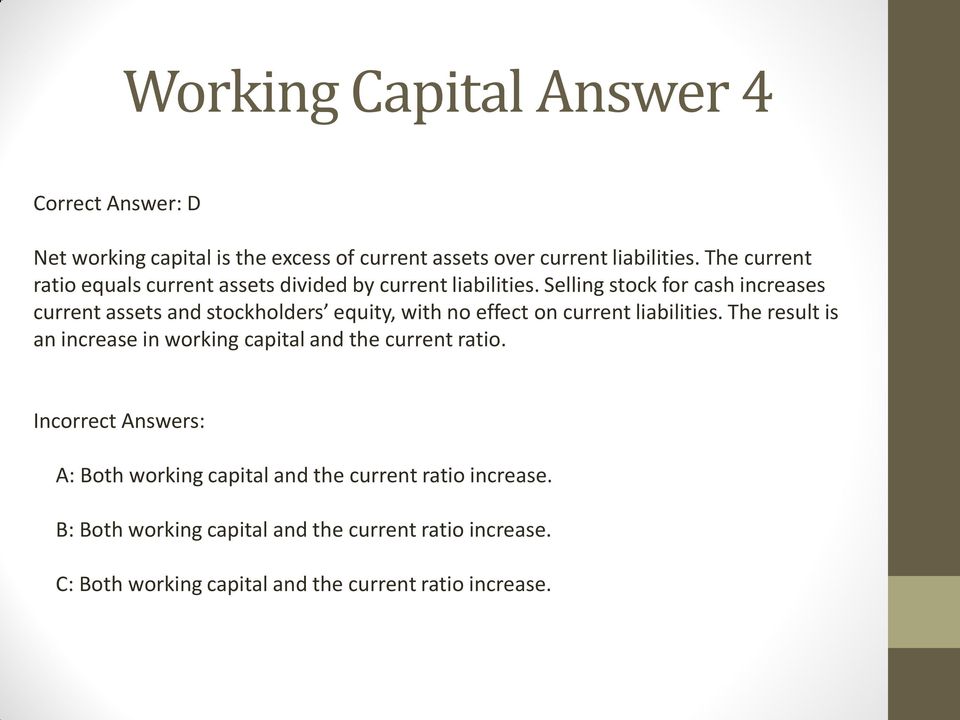
10 Working Capital Answer 4 Correct Answer: D Net working capital is the excess of current assets over current liabilities. The current ratio equals current assets divided by current liabilities. Selling stock for cash increases current assets and stockholders equity, with no effect on current liabilities. The result is an increase in working capital and the current ratio. Incorrect Answers: A: Both working capital and the current ratio increase. B: Both working capital and the current ratio increase. C: Both working capital and the current ratio increase.
11 SU 6.2 Cash Management Read Gleim Success Tip on page 218 Managing the cash levels Motives What is the firms optimal cash? EOQ As applied to cash Forecasting future cash flows (see examples on page 219, very typical test questions!) Methods to Speed up cash flows (see example 1 & 2 page 220) Slow down cash flows

12 Cash Management Question 1 Question 1 - CMA2 Study Unit 6: Managing Current Assets The economic order quantity (EOQ) formula can be adapted in order for a firm to determine the optimal split between cash and marketable securities. The EOQ model assumes all of the following except that A. The cost of a transaction is independent of the dollar amount of the transaction. Interest rates are constant over the short B. run. There is an opportunity cost associated C. with holding cash, beginning with the first dollar. D. Cash flow requirements are random.
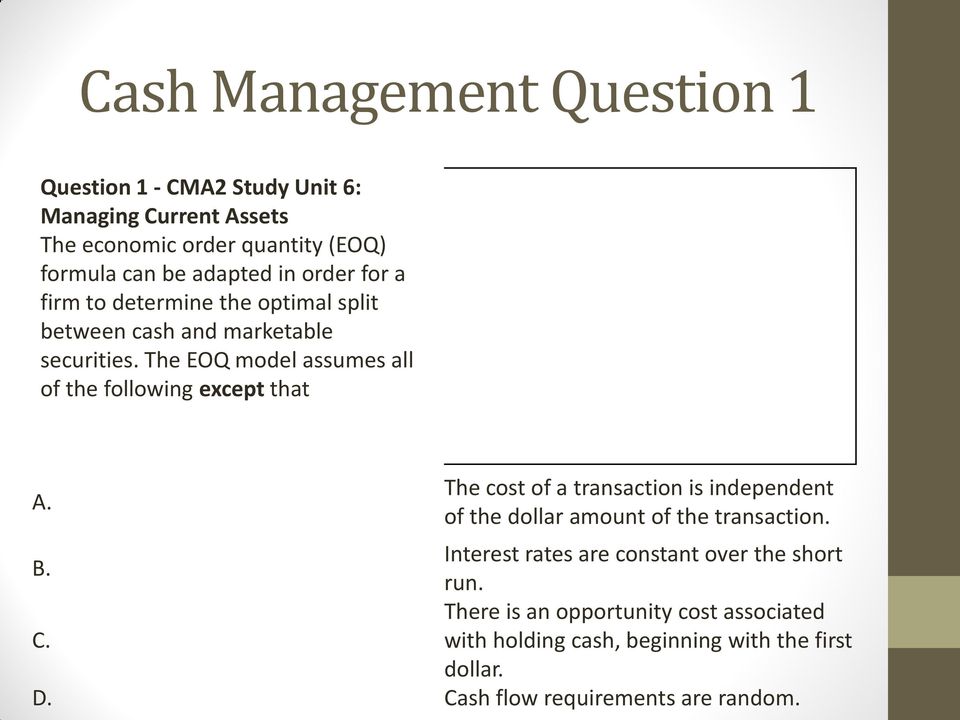
13 Cash Management Answer 1 Correct Answer: D The EOQ formula is a deterministic model that requires a known demand for inventory or, in this case, the amount of cash needed. Thus, the cash flow requirements cannot be random. The model also assumes a given carrying (interest) cost and a flat transaction cost for converting marketable securities to cash, regardless of the amount withdrawn. Incorrect Answers: A: Use of the EOQ model assumes that the cost of a transaction is independent of the dollar amount of the transaction. B: Use of the EOQ model assumes that interest rates are constant over the short run. C: Use of the EOQ model assumes that there is an opportunity cost associated with holding cash, beginning with the first dollar.

14 Cash Management Question 2 Question 2 - CMA2 Study Unit 6: Managing Current Assets What is the benefit for a firm with daily cash receipts of $15,000 to be able to speed up collections by 2 days, assuming an 8% annual return on short-term investments and no cost to the company to speed up collections? A. $2,400 daily benefit. B. $2,400 annual benefit. C. $15,000 annual benefit. D. $30,000 annual benefit.
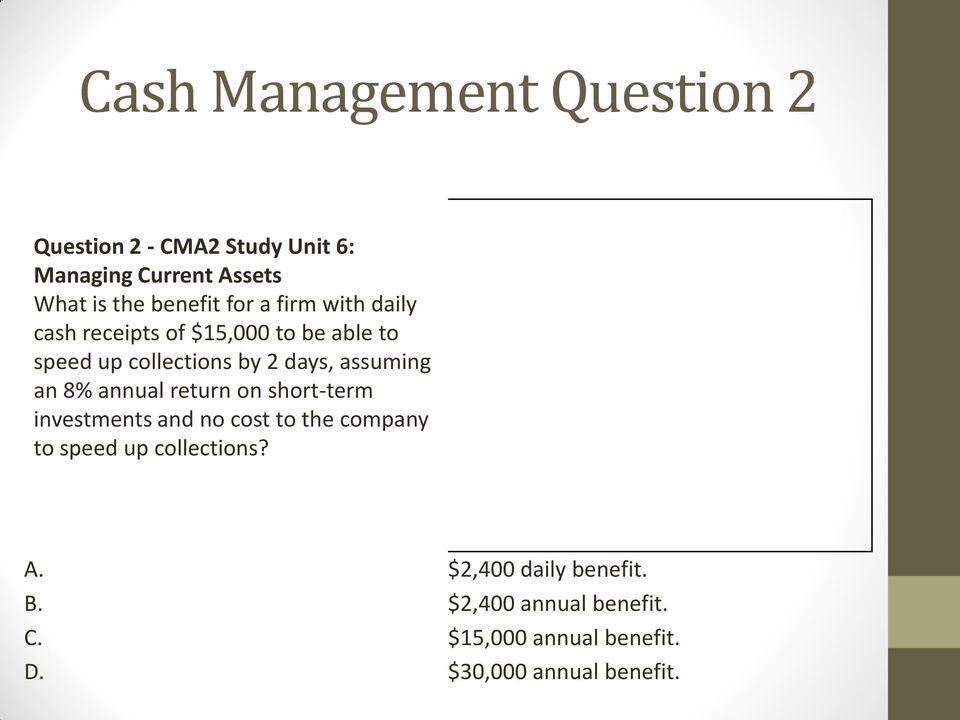
15 Cash Management Answer 2 Correct Answer: B Speeding up collections by 2 days will raise the firm s average cash balance by $30,000. At 8% interest, the benefit will be $2,400 annually [($15,000 2 days).08]. Incorrect Answers: A: This figure is the annual, not the daily, benefit. C: This figure is the amount of daily cash receipts. D: This figure is the reduction in receivables.
![At 8% interest, the benefit will be $2,400 annually [($15,000 2 days).08].](/docs-images/45/7745989/images/page_15.jpg "Incorrect Answers: A: This figure is the annual, not the daily, benefit.")
16 Cash Management Question 3 Question 3 - CMA2 Study Unit 6: Managing Current Assets DLF is a retail mail order firm that currently uses a central collection system that requires all checks to be sent to its Boston headquarters. An average of 6 days is required for mailed checks to be received, 3 days for DLF to process them, and 2 days for the checks to clear through its bank. A proposed lockbox system would reduce the mailing and processing time to 2 days and the check clearing time to 1 day. DLF has an average daily collection of $150,000. If DLF adopts the lockbox system, its average cash balance will increase by A. $1,200,000 B. $750,000 C. $600,000 D. $450,000
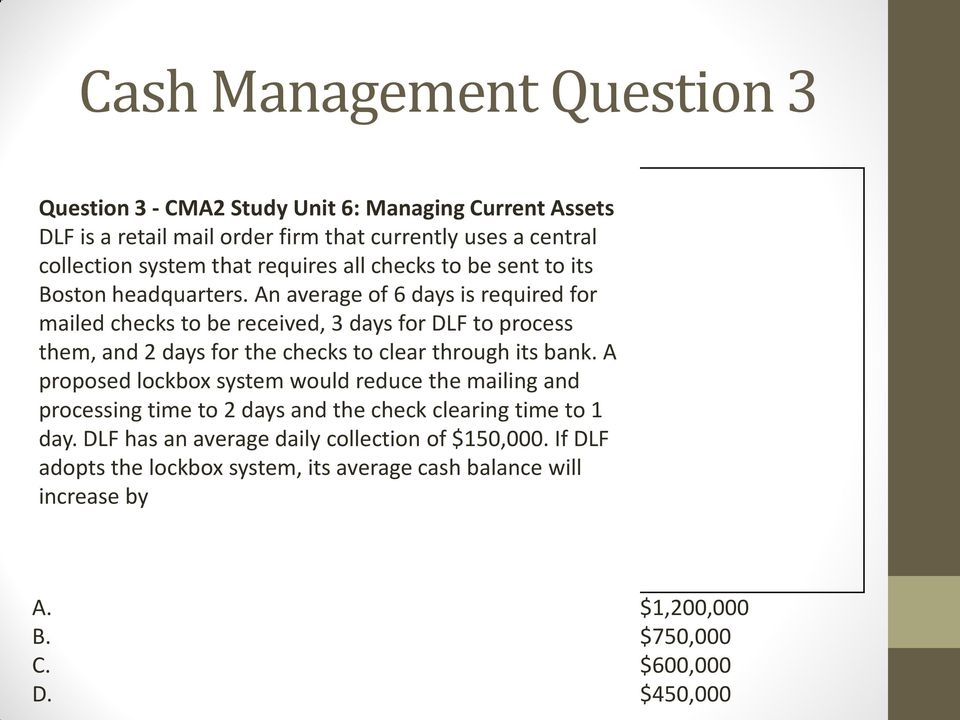
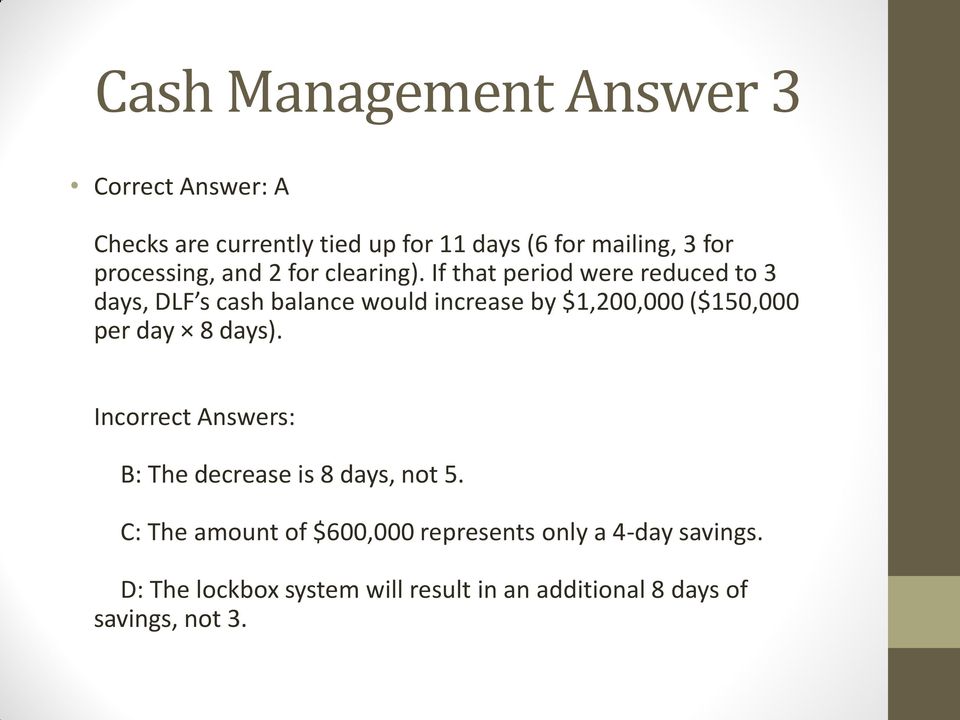
17 Cash Management Answer 3 Correct Answer: A Checks are currently tied up for 11 days (6 for mailing, 3 for processing, and 2 for clearing). If that period were reduced to 3 days, DLF s cash balance would increase by $1,200,000 ($150,000 per day 8 days). Incorrect Answers: B: The decrease is 8 days, not 5. C: The amount of $600,000 represents only a 4-day savings. D: The lockbox system will result in an additional 8 days of savings, not 3.
18 Cash Management Question 4 Question 4 - CMA2 Study Unit 6: Managing Current Assets A firm has daily cash receipts of $300,000. A commercial bank has offered to reduce the collection time by 2 days. The bank requires a monthly fee of $3,000 for providing this service. If the money market rates will average 11% during the year, the annual pretax income (loss) from using the service is A. $(30,000) B. $30,000 C. $66,000 D. $63,000

19 Cash Management Answer 4 Correct Answer: B The additional annual income (loss) from using the bank s proposed service is the excess (deficit) of interest earned on the early deposits over (under) the cost of the service. If the plan is adopted, the firm s average cash balance will increase by $600,000 ($300,000 2 days). Benefit (loss) = Interest earned Cost = ($600,000 11%) ($3, months) = $66,000 $36,000 = $30,000 Incorrect Answers: A: This figure results from subtracting the interest earned from the cost. C: This figure results from failing to subtract the $36,000 cost of the service. D: This figure results from subtracting the service charge for only a single month.

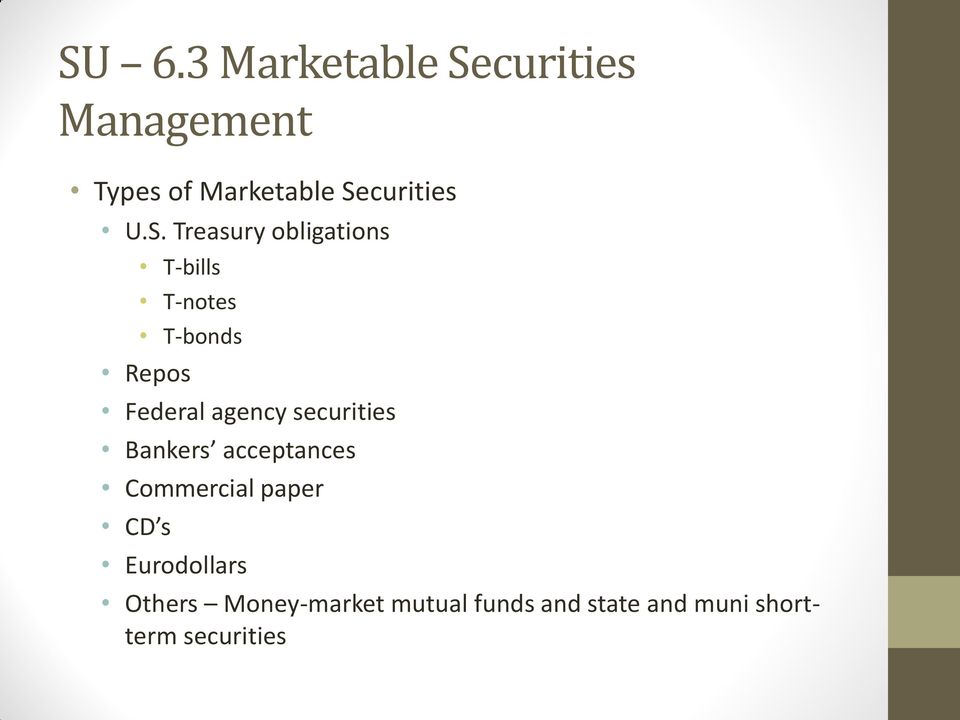
20 SU 6.3 Marketable Securities Management Types of Marketable Securities U.S. Treasury obligations T-bills T-notes T-bonds Repos Federal agency securities Bankers acceptances Commercial paper CD s Eurodollars Others Money-market mutual funds and state and muni shortterm securities
21 SU 6.4 Receivable Management Overview A firm must balance default risk and sales maximization Basic Receivable Formulas Average collection period (see example on page 224) Accounts Rec. days vs. dollars (see page 224) Assessing impact of a credit term change (see example page 225)
22 Receivable Management Question 1 Question 1 - CMA2 Study Unit 6: Managing Current Assets A change in credit policy has caused an increase in sales, an increase in discounts taken, a reduction in the investment in accounts receivable, and a reduction in the number of doubtful accounts. Based upon this information, we know that A. Net profit has increased. B. The average collection period has decreased. C. Gross profit has declined. D. The size of the discount offered has decreased.
23 D: The discount may have been increased, which has led to quicker payments. Receivable Management Answer 1 An increase in discounts taken accompanied by declines in receivables balances and doubtful accounts all indicate that collections on the increased sales have been accelerated. Accordingly, the average collection period must have declined. The average collection period is a ratio calculated by dividing the number of days in a year (365) by the receivable turnover. Thus, the higher the turnover, the shorter the average collection period. The turnover increases when either sales (the numerator) increase or receivables (the denominator) decrease. Accomplishing both higher sales and a lower receivables increases the turnover and results in a shorter collection period. Incorrect Answers: A: No statement can be made with respect to profits without knowing costs. C: No statement can be made with respect to profits without knowing costs.
24 Receivable Management Question 2 - CMA2 Study Unit 6: Managing Current Assets A change in credit policy has caused an increase in sales, an increase in discounts taken, a decrease in the amount of bad debts, and a decrease in the investment in accounts receivable. Based upon this information, the company s Question 2 A. Average collection period has decreased. B. Percentage discount offered has decreased. C. Accounts receivable turnover has decreased. D. Working capital has increased.
25 Receivable Management Correct Answer: A Answer 2 An increase in discounts taken accompanied by declines in receivables balances and doubtful accounts all indicate that collections on the increased sales have been accelerated. Accordingly, the average collection period must have declined. The average collection period is a ratio calculated by dividing the number of days in a year (365) by the receivable turnover. Thus, the higher the turnover, the shorter the average collection period. The turnover increases when either sales (the numerator) increase, or receivables (the denominator) decrease. Accomplishing both higher sales and a lower receivables increases the turnover and results in a shorter collection period. Incorrect Answers: B: A decrease in the percentage discount offered provides no incentive for early payment. C: Accounts receivable turnover (sales average receivables) has increased. D: No information is given relative to working capital elements other than receivables. Both receivables and cash are elements of working capital, so an acceleration of customer payments will have no effect on working capital.
26 Receivable Management Question 3 - CMA2 Study Unit 6: Managing Current Assets Clauson, Inc., grants credit terms of 1/15, net 30 and projects gross sales for next year of $2,000,000. The credit manager estimates that 40% of their customers pay on the discount date, 40% on the net due date, and 20% pay 15 days after the net due date. Assuming uniform sales and a 360-day year, what is the projected days sales outstanding (rounded to the nearest whole day)? Question 3 A. 20 days. B. 24 days. C. 27 days. D. 30 days.
27 Receivable Management Correct Answer: C Answer 3 The days sales outstanding can be determined by weighting the collection period for each group of receivables by its collection percentage. Hence, the projected days sales outstanding equal 27 days [(15 days 40%) + (30 days 40%) + (45 days 20%)]. Incorrect Answers: A: Average receivables are outstanding for much more than 20 days. B: Twenty-four days assumes 40% of receivables are collected after 15 days and 60% after 30 days. D: More receivables are collected on the 15th day than on the 45th day; thus, the average must be less than 30 days.
28 Receivable Management Question 4 - CMA2 Study Unit 6: Managing Current Assets A firm averages $4,000 in sales per day and is paid, on an average, within 30 days of the sale. After they receive their invoice, 55% of the customers pay by check, while the remaining 45% pay by credit card. Approximately how much would the company show in accounts receivable on its balance sheet on any given date? Question 4 A. $4,000 B. $48,000 C. $54,000 D. $120,000
29 Receivable Management Correct Answer: D Answer 4 The average balance of receivables is $120,000 ($4, days). Whether customers pay by credit card or check, collection requires 30 days. Incorrect Answers: A: The amount of $4,000 is only 1 day s sales. B: Invoices are outstanding for 30 days, not 12 days. C: The amount of $54,000 is based on the 45% of collections via credit card.
30 SU 6.5 Inventory Management Overview Inventory costs Inventory Replenishment Models (see example on page 228)
31 SU 6.6 Short-term Financing Sources Spontaneous Forms of Financing Cost of not taking a discount (see example page 230) Short-term bank loans Simple interest loans Effective Interest Rate on a Loan Discounted Loans Continued
32 SU 6.6 Short-term Financing Loans with Compensating Balances Lines of Credit with Commitment Fees Market-Based Instruments Secured Financing Factoring Receivables Maturity Matching
33 Questions
9. Short-Term Liquidity Analysis. Operating Cash Conversion Cycle
 9. Short-Term Liquidity Analysis. Operating Cash Conversion Cycle 9.1 Current Assets and 9.1.1 Cash A firm should maintain as little cash as possible, because cash is a nonproductive asset. It earns no
Understanding Financial Management: A Practical Guide Guideline Answers to the Concept Check Questions
 Understanding Financial Management: A Practical Guide Guideline Answers to the Concept Check Questions Chapter 6 Working Capital Management Concept Check 6.1 1. What is the meaning of the terms working
CAPITULO 13 CAPITAL DE TRABAJO Y ADMINISTRACIÓN DE ACTIVOS CIRCULANTES EJERCIOS Y PROBLEMAS DE REPASO
 CAPITULO 13 CAPITAL DE TRABAJO Y ADMINISTRACIÓN DE ACTIVOS CIRCULANTES EJERCIOS Y PROBLEMAS DE REPASO Ejercicios 1. A firm has an average age of inventory of 90 days, an average collection period of 40
Lecture 13 Working Capital Management and Credit Issues
 Lecture 13 - Working Capital Management Gross working capital: Net working capital: BASIC DEFINITIONS Total current assets. Net operating working capital (NOWC): Operating CA Operating CL = Current assets
CHAPTER 16 Current Asset Management and Financing
 Copyright 2008 by the Foundation of the American College of Healthcare Executives 6/13/07 Version 16-1 CHAPTER 16 Current Asset Management and Financing Investment and financing policies Cash and marketable
Financial Statements and Ratios: Notes
 Financial Statements and Ratios: Notes 1. Uses of the income statement for evaluation Investors use the income statement to help judge their return on investment and creditors (lenders) use it to help
CHAPTER 21. Working Capital Management
 CHAPTER 21 Working Capital Management 1 Topics in Chapter Alternative working capital policies Cash, inventory, and A/R management Accounts payable management Short-term financing policies Bank debt and
Cash in bank checking account $22,500 U.S. treasury bills 5,000 Cash on hand 1,350 Undeposited customer checks 1,840 Total $30,690 Requirement 2
 Chapter 7 Solutions EXERCISES Exercise 7 2 Cash and cash equivalents includes: Cash in bank checking account $22,500 U.S. treasury bills 5,000 Cash on hand 1,350 Undeposited customer checks 1,840 Total
The Nature, Elements and Importance of Working Capital
 C. WORKING CAPITAL MANAGEMENT 1. The nature, elements and importance of working capital 2. Management of inventories, accounts receivable, accounts payable and cash 3. Determining working capital needs
Consolidated Interim Earnings Report
 Consolidated Interim Earnings Report For the Six Months Ended 30th September, 2003 23th Octorber, 2003 Hitachi Capital Corporation These financial statements were prepared for the interim earnings release
Chapter. Working capital
 Chapter 10 Working capital 1 10.1 Working capital Working capital is the capital available for conducting the day-to-day operations of the business and consists of current assets and current liabilities.
Paper F9. Financial Management. Fundamentals Pilot Paper Skills module. The Association of Chartered Certified Accountants
 Fundamentals Pilot Paper Skills module Financial Management Time allowed Reading and planning: Writing: 15 minutes 3 hours ALL FOUR questions are compulsory and MUST be attempted. Do NOT open this paper
Course 4: Managing Cash Flow
 Excellence in Financial Management Course 4: Managing Cash Flow Prepared by: Matt H. Evans, CPA, CMA, CFM This course provides an introduction to cash flow management. This course is recommended for 2
Chapter 18 Working Capital Management
 Chapter 18 Working Capital Management Slide Contents Learning Objectives Principles Used in This Chapter 1. Working Capital Management and the Risk- Return Tradeoff 2. Working Capital Policy 3. Operating
Chapter 18 Working Capital Management
 Chapter 18 Working Capital Management Slide Contents Learning Objectives Principles Used in This Chapter 1. Working Capital Management and the Risk-Return Tradeoff 2. Working Capital Policy 3. Operating
7 Management of Working Capital
 7 Management of Working Capital BASIC CONCEPTS AND FORMULAE 1. Working Capital Management Working Capital Management involves managing the balance between firm s shortterm assets and its short-term liabilities.
! "#$ %&!& "& ' - 3+4 &*!&-.,,5///2!(.//+ & $!- )!* & % +, -).//0)& 7+00///2 *&&.4 &*!&- 7.00///2 )!*.//+ 8 -!% %& "#$ ) &!&.
 ! "#!""#$%$#$#$"& $'"()*+,$-).,/ 012! "#$ %&!& "& '!(&)!*&%+,-).//0 -#$#3-4' &,'1$1# $!-!(.//0)& +01+///2 *&& - 3+4 &*!&-.,,5///2!(.//+ &!(!-6%(!(.//.$(!(.//0)& 01,///2 //+2% &*!&- 5,0///2 //32%!(.//+
ICAP GROUP S.A. FINANCIAL RATIOS EXPLANATION
 ICAP GROUP S.A. FINANCIAL RATIOS EXPLANATION OCTOBER 2006 Table of Contents 1. INTRODUCTION... 3 2. FINANCIAL RATIOS FOR COMPANIES (INDUSTRY - COMMERCE - SERVICES) 4 2.1 Profitability Ratios...4 2.2 Viability
SANYO TRADING COMPANY LIMITED. Financial Statements
 Financial Statements Year Ended September 30, 2014 English translation from original Japanese-language documents Balance Sheets As of September 30, 2014 ASSETS Current Assets Cash and deposits US$ 18,509,007
中 原 大 學 95 學 年 度 轉 學 考 招 生 入 學 考 試
 中 原 大 學 95 學 年 度 轉 學 考 招 生 入 學 考 試 7 月 12 日 14:00~15:30 商 學 群 組 二 年 級 科 目 : 會 計 學 ( 共 七 頁 第 一 頁 ) 可 使 用 計 算 機, 惟 僅 限 不 具 可 程 式 及 多 重 記 憶 者 一 MULTIPLE CHOICE QUESTIONS: (50%) 誠 實 是 我 們 珍 視 的 美 德, 我 們 喜
It is concerned with decisions relating to current assets and current liabilities
 It is concerned with decisions relating to current assets and current liabilities Best Buy Co, NA s largest consumer electronics retailer, has performed extremely well over the past decade. Its stock sold
BACKGROUND KNOWLEDGE for Teachers and Students
 Pathway: Business, Marketing, and Computer Education Lesson: BMM C6 4: Financial Statements and Reports Common Core State Standards for Mathematics: N.Q.2 Domain: Quantities Cluster: Reason quantitatively
Ricoh Company, Ltd. INTERIM REPORT (Non consolidated. Half year ended September 30, 2000)
 Ricoh Company, Ltd. INTERIM REPORT (Non consolidated. Half year ended September 30, 2000) *Date of approval for the financial results for the half year ended September 30, 2000, at the Board of Directors'
Consolidated Balance Sheets
 Consolidated Balance Sheets March 31 2015 2014 2015 Assets: Current assets Cash and cash equivalents 726,888 604,571 $ 6,057,400 Marketable securities 19,033 16,635 158,608 Notes and accounts receivable:
GBA 521 Midterm Review Dr. Markelevich
 GBA 521 Midterm Review Dr. Markelevich Multiple Choice (3 points for each question) Identify the letter of the choice that best completes the statement or answers the question. Wynn Corp. Wynn Corp. reported
Notes. CIMA Paper P1. Performance Operations
 Chapter 5 extract from our ExPress notes for use with the current video. A full set of P1 ExPress notes can be downloaded free of charge at www.. CIMA Paper P1 Performance Operations For exams in 2011
Understanding Financial Statements. For Your Business
 Understanding Financial Statements For Your Business Disclaimer The information provided is for informational purposes only, does not constitute legal advice or create an attorney-client relationship,
RAPID REVIEW Chapter Content
 RAPID REVIEW BASIC ACCOUNTING EQUATION (Chapter 2) INVENTORY (Chapters 5 and 6) Basic Equation Assets Owner s Equity Expanded Owner s Owner s Assets Equation = Liabilities Capital Drawing Revenues Debit
Consolidated Balance Sheets March 31, 2001 and 2000
 Financial Statements SEIKAGAKU CORPORATION AND CONSOLIDATED SUBSIDIARIES Consolidated Balance Sheets March 31, 2001 and 2000 Assets Current assets: Cash and cash equivalents... Short-term investments (Note
Consolidated Financial Statements
 Consolidated Financial Statements For the year ended February 20, 2016 Nitori Holdings Co., Ltd. Consolidated Balance Sheet Nitori Holdings Co., Ltd. and consolidated subsidiaries As at February 20, 2016
How To Calculate Financial Leverage Ratio
 What Do Short-Term Liquidity Ratios Measure? What Is Working Capital? HOCK international - 2004 1 HOCK international - 2004 2 How Is the Current Ratio Calculated? How Is the Quick Ratio Calculated? HOCK
Discussion Board Articles Ratio Analysis
 Excellence in Financial Management Discussion Board Articles Ratio Analysis Written by: Matt H. Evans, CPA, CMA, CFM All articles can be viewed on the internet at www.exinfm.com/board Ratio Analysis Cash
Financial Ratios and Quality Indicators
 Financial Ratios and Quality Indicators From U.S. Small Business Administration Online Women's Business Center If you monitor the ratios on a regular basis you'll gain insight into how effectively you
FINANCIAL ACCOUNTING TOPIC: FINANCIAL ANALYSIS
 SYLLABUS Compulsory part Basic ratio analysis 1. State the general functions of accounting ratios. 2. Calculate and interpret the following ratios: a. working capital/current ratio, quick/liquid/acid test
Income Measurement and Profitability Analysis
 PROFITABILITY ANALYSIS The following financial statements for Spencer Company will be used to demonstrate the calculation of the various ratios in profitability analysis. Spencer Company Comparative Balance
Accounting Skills Assessment Practice Exam Page 1 of 10
 NAU ACCOUNTING SKILLS ASSESSMENT PRACTICE EXAM & KEY 1. A company received cash and issued common stock. What was the effect on the accounting equation? Assets Liabilities Stockholders Equity A. + NE +
TOPIC LEARNING OBJECTIVE
 Topic Mapping 1 Transaction Analysis Understand the effect of various types of transactions on the accounting equation, accounting journal and accounting ledger. Concepts and Skills Accounting Equation
Chapter Review Problems
 Chapter Review Problems Unit 17.1 Income statements 1. When revenues exceed expenses, is the result (a) net income or (b) net loss? (a) net income 2. Do income statements reflect profits of a business
Liquidity analysis: Length of cash cycle
 2. Liquidity analysis: Length of cash cycle Operating cycle of a merchandising firm: number of days it takes to sell inventory + number of days until the resulting receivables are converted to cash Acquisition
Ratios and interpretation
 Unit Ratios and interpretation As we learnt in our earlier studies, accounting information is used to answer two key questions about a business: Is it making a profit? Are its assets sufficient to meet
MCQ on Financial Management
 MCQ on Financial Management 1. "Shareholder wealth" in a firm is represented by: a) the number of people employed in the firm. b) the book value of the firm's assets less the book value of its liabilities
Study Guide - Final Exam Accounting I
 Study Guide - Final Exam Accounting I True/False Indicate whether the sentence or statement is true or false. 1. Entries in a sales journal affect account balances in both the accounts receivable ledger
How To Calculate A Trial Balance For A Company
 THE BASIC MODEL The accounting information system is designed to collect and organize data into information that is useful for stakeholders. The Accounting Equation The basic accounting equation is what
Accounting 303 Exam 3, Chapters 7-9 Fall 2011 Section Row
 Accounting 303 Name Exam 3, Chapters 7-9 Fall 2011 Section Row I. Multiple Choice Questions. (2 points each, 34 points in total) Read each question carefully and indicate your answer by circling the letter
140 SU 3: Profitability Analysis and Analytical Issues
 140 SU 3: Profitability Analysis and Analytical Issues QUESTIONS 3.1 Profitability Ratios Questions 1 and 2 are based on the following information. The financial statements for Dividendosaurus, Inc., for
STATEMENT OF CASH FLOWS AND WORKING CAPITAL ANALYSIS
 C H A P T E R 1 0 STATEMENT OF CASH FLOWS AND WORKING CAPITAL ANALYSIS I N T R O D U C T I O N Historically, profit-oriented businesses have used the accrual basis of accounting in which the income statement,
Summary of Financial Report for the FY ending March 2015 (Non-Consolidated)
 Summary of Financial Report for the FY ending March 2015 (Non-Consolidated) April 30, 2015 Listed Company Name: Japan Tissue Engineering Co., Ltd. Listed Securities Exchange: JQ Stock Code: 7774 URL http://www.jpte.co.jp
Financial Reporting & Analysis Chapter 17 Solutions Statement of Cash Flows Exercises
 Financial Reporting & Analysis Chapter 17 Solutions Statement of Cash Flows Exercises Exercises E17-1. Determining cash flows from operations Using the indirect method, cash flow from operations is computed
Construction Economics & Finance. Module 6. Lecture-1
 Construction Economics & Finance Module 6 Lecture-1 Financial management: Financial management involves planning, allocation and control of financial resources of a company. Financial management is essential
EMERSON AND SUBSIDIARIES CONSOLIDATED OPERATING RESULTS (AMOUNTS IN MILLIONS EXCEPT PER SHARE, UNAUDITED)
 CONSOLIDATED OPERATING RESULTS (AMOUNTS IN MILLIONS EXCEPT PER SHARE, UNAUDITED) TABLE 1 Quarter Ended March 31, Percent Change Net Sales $ 5,854 $ 5,919 1% Costs and expenses: Cost of sales 3,548 3,583
ABOUT FINANCIAL RATIO ANALYSIS
 ABOUT FINANCIAL RATIO ANALYSIS Over the years, a great many financial analysis techniques have developed. They illustrate the relationship between values drawn from the balance sheet and income statement
Chapter Financial Forecasting
 Chapter Financial Forecasting PPT 4-2 Chapter 4 - Outline What is Financial Forecasting? 3 Financial Statements for Forecasting Constructing Pro Forma Statements Basis for Sales Projections Steps in a
How To Grade Your Business
 ReportCard TheSmallBusiness Is your business making the grade? This number-crunching study guide has the answer. MasterCard Solutions For Small Business MasterCard Solutions for Small Business encompasses
FINANCIAL MANAGEMENT
 100 Arbor Drive, Suite 108 Christiansburg, VA 24073 Voice: 540-381-9333 FAX: 540-381-8319 www.becpas.com Providing Professional Business Advisory & Consulting Services Douglas L. Johnston, II [email protected]
KYODO PRINTING CO., LTD. and Consolidated Subsidiaries
 KYODO PRINTING CO., LTD. and Consolidated Subsidiaries Interim Consolidated Financial Statements (Unaudited) for the, Interim Consolidated Balance Sheets, as compared with March 31, (Unaudited) ASSETS,
For our curriculum in Grade 12 we are going to use ratios to analyse the information available in the Income statement and the Balance sheet.
 SUBJECT: ACCOUNTING GRADE 12 CHAPTER: COMPANIES LESSON: ANALYSIS AND INTERPRETATION-RATIOS LESSON OVERVIEW (KNOWLEDGE AREAS) LESSON 1. Introduction 2. Analysing of financial statements and its purpose
WORKING CAPITAL MANAGEMENT
 WORKING CAPITAL MANAGEMENT What is Working Capital Working capital management is the set of activities that are required to run day to day operations of the business to ensure that cash is adequate to
Return on Equity has three ratio components. The three ratios that make up Return on Equity are:
 Evaluating Financial Performance Chapter 1 Return on Equity Why Use Ratios? It has been said that you must measure what you expect to manage and accomplish. Without measurement, you have no reference to
Glossary and Formulas
 A-B Accounts Payable Includes, but is not limited to, Trade Accounts Payable and Trade Acceptances, that is, amounts owed to vendors for goods and services purchased from outside suppliers and due within
Final Examination Semester 2 / Year 2012
 Southern College Kolej Selatan 南 方 学 院 Final Examination Semester 2 / Year 2012 COURSE : BUSINESS FINANCE COURSE CODE : FINE2003 TIME : 2 1/2 HOURS DEPARTMENT : ACCOUNTING & FINANCE LECTURER : NG PEK LENG
Gold Run Snowmobile. Adjusting Entries and Closing Entries For The Quarter Ended December 31. Final Project Evaluation. 5 th Edition.
 Gold Run Snowmobile 5 th Edition Adjusting Entries and Closing Entries For The Quarter Ended December 31 and the Final Project Evaluation Page 1 ADJUSTING ENTRIES FOR THE QUARTER Using a copy of the December
Trade Date The date of the previous trading day. Recent Price is the closing price taken from this day.
 Definition of Terms Price & Volume Share Related Institutional Holding Ratios Definitions for items in the Price & Volume section Recent Price The closing price on the previous trading day. Trade Date
CHAPTER 8 WHEN REVENUE IS RECOGNIZED RECOGNIZED HOW REVENUE IS REVENUE CYCLE: SALES, RECEIVABLES, AND CASH
 CHAPTER 8 REVENUE CYCLE: SALES, RECEIVABLES, AND CASH 1 WHEN REVENUE IS RECOGNIZED Revenue should be recognized when two criteria are met: The promised work has been substantially completed Cash, or a
PROFESSOR S NAME ACC 255 FALL 2011 COVER SHEET FOR COMPREHENSIVE PROBLEM 2 (CHAPTERS 2, 5-8)
 COMPREHENSIVE PROBLEM 2 (CHAPTERS 2, 5-8) Page 137 NAME ANSWER KEY PROFESSOR S NAME SECTION SCORE ACC 255 FALL 2011 COVER SHEET FOR COMPREHENSIVE PROBLEM 2 (CHAPTERS 2, 5-8) INSTRUCTIONS: COMPLETE ALL
FINANCIAL ANALYSIS CS. Sample Reports. version 2008.x.x
 FINANCIAL ANALYSIS CS Sample Reports version 2008.x.x TL 19887 (10/14/2008) Copyright Information Text copyright 2004-2008 by Thomson Reuters/Tax & Accounting. All rights reserved. Video display images
Accounting, Finance & Banking. Business uses accounting: Who uses accounting data? The Basics
 Accounting, Finance & Banking The Basics Copyright 1997 by Donald Jenner All Rights Reserved Based on material developed by Harcourt Brace & Co. and Katherine Conway 1 Business uses accounting: Financing:
i T-bill (dy) = $10,000 - $9,765 360 = 6.768% $10,000 125
 Answers to Chapter 5 Questions 1. First, money market instruments are generally sold in large denominations (often in units of $1 million to $10 million). Most money market participants want or need to
1. A set of procedures for controlling cash payments by preparing and approving vouchers before payments are made is known as a voucher system.
 Accounting II True/False Indicate whether the sentence or statement is true or false. 1. A set of procedures for controlling cash payments by preparing and approving vouchers before payments are made is
Course 1: Evaluating Financial Performance
 Excellence in Financial Management Course 1: Evaluating Financial Performance Prepared by: Matt H. Evans, CPA, CMA, CFM This course provides a basic understanding of how to use ratio analysis for evaluating
HARMONIC DRIVE SYSTEMS INC. AND CONSOLIDATED SUBSIDIARIES CONSOLIDATED FINANCIAL STATEMENTS MARCH 31, 2013
 HARMONIC DRIVE SYSTEMS INC. AND CONSOLIDATED SUBSIDIARIES CONSOLIDATED FINANCIAL STATEMENTS MARCH 31, 2013 HARMONIC DRIVE SYSTEMS INC. AND CONSOLIDATED SUBSIDIARIES CONSOLIDATED BALANCE SHEETS ASSETS
Chapter 14. Working Capital Policy
 Chapter 14 Working Capital Policy 1 Learning Outcomes Chapter 14 Discuss why working capital is needed and how working capital accounts are related. Describe the cash conversion cycle and how it can be
The Statement of Cash Flows
 CHAPTER The Statement of Cash Flows OBJECTIVES After careful study of this chapter, you will be able to: 1. Define operating, investing, and financing activities. 2. Know the categories of inflows and
ACCOUNT DEBIT CREDIT Accounts receivable 10,000 Sales 10,000 To record the sale of merchandise to Sophie Company
 CURRENT RECEIVABLES Receivables are the amount owed to the organization by its customers and/or others. Current receivables will be collected within one year or the current operating cycle which ever is
FINANCIAL STATEMENTS AND RATIO ANALYSIS
 In following we will be demonstrating the use of ratios to help examine the health of a firm. Ratios allow managers evaluate to a firm's financial statements in order to point out the strengths and weaknesses
SUMITOMO DENSETSU CO., LTD. AND SUBSIDIARIES. Consolidated Financial Statements
 SUMITOMO DENSETSU CO., LTD. AND SUBSIDIARIES Consolidated Financial Statements Report of Independent Public Accountants To the Board of Directors of Sumitomo Densetsu Co., Ltd. : We have audited the consolidated
2-8. Identify whether each of the following items increases or decreases cash flow:
 Problems 2-8. Identify whether each of the following items increases or decreases cash flow: Increase in accounts receivable Increase in notes payable Depreciation expense Increase in investments Decrease
SAMPLE CONSTRUCTION FINANCIAL STATEMENT
 SAMPLE CONSTRUCTION FINANCIAL STATEMENT Construction Contacts: Tim Klimchock, CPA, CCIFP Manager, AEC Industry Group M. Scott Hursh, CPA, CCIFP Principal, AEC Industry Group 1.800.745.8233 Web Site: www.stambaugh-ness.com
Chapter 14. 1 Copyright 2012 Pearson Education, Inc. Publishing as Prentice Hall.
 Chapter 14 1 Identify the purposes of the statement of cash flows Distinguish among operating, investing, and financing cash flows Prepare the statement of cash flows by the indirect method Identify noncash
Chapter 9 Solutions to Problems
 Chapter 9 Solutions to Problems 1. a. Cash and cash equivalents are cash in hand and in banks, plus money market securities with maturities of 90 days or less. Accounts receivable are claims on customers
EQUINIX, INC. CONDENSED CONSOLIDATED STATEMENTS OF OPERATIONS - GAAP PRESENTATION (in thousands, except per share data) (unaudited)
 CONDENSED CONSOLIDATED STATEMENTS OF OPERATIONS - GAAP PRESENTATION (in thousands, except per share data) Recurring revenues $ 314,727 $ 282,117 $ 216,517 $ 834,080 $ 610,384 Non-recurring revenues 15,620
In this chapter, we build on the basic knowledge of how businesses
 03-Seidman.qxd 5/15/04 11:52 AM Page 41 3 An Introduction to Business Financial Statements In this chapter, we build on the basic knowledge of how businesses are financed by looking at how firms organize
Performance Review for Electricity Now
 Performance Review for Electricity Now For the period ending 03/31/2008 Provided By Mark Dashkewytch 780-963-5783 Report prepared for: Electricity Now Industry: 23821 - Electrical Contractors Revenue:
Report Description. Business Counts. Top 10 States (by Business Counts) Page 1 of 16
 5-Year County-Level Financial Profile Industry Report Architectural Services (SIC Code: 8712) in Prince George County, Maryland Sales Range: $500,000 - $999,999 Date: 11/07/08 Report Description This 5-Year
ACCOUNTING 105 CONCEPTS REVIEW
 ACCOUNTING 105 CONCEPTS REVIEW A note from the tutors: This handout is designed to help you review important information as you study for your cumulative final exam. While it does cover many important
SOLUTIONS TO END-OF-CHAPTER PROBLEMS. Chapter 17
 SOLUTIONS TO END-OF-CHAPTER PROBLEMS Chapter 17 3 360 17-1 Nominal cost of trade credit 97 30-15 0.0309 24 0.7423 74.23%. Effective cost of trade credit (1.0309) 24-1.0 1.0772 107.72%. 17-2 Effective cost
Gleim / Flesher CMA Review 15th Edition, 1st Printing Part 2 Updates Available December 2010
 Page 1 of 3 Gleim / Flesher CMA Review 15th Edition, 1st Printing Part 2 Updates Available December 2010 NOTE: Text that should be deleted from the outline is displayed as struck through with a red background.
1. Planning - Establishing organizational goals and deciding how to accomplish them
 1 : Understanding the Management Process Basic Management Functions 1. Planning - Establishing organizational goals and deciding how to accomplish them SWOT analysis - The identification and evaluation
國 立 體 育 大 學 100 學 年 度 學 士 班 轉 學 考 試 試 題 休 閒 產 業 經 營 學 系 二 年 級 會 計 學 ( 本 試 題 共 8 頁 )
 國 立 體 育 大 學 100 學 年 度 學 士 班 轉 學 考 試 試 題 休 閒 產 業 經 營 學 系 二 年 級 會 計 學 ( 本 試 題 共 8 頁 ) 注 意 : 1. 答 案 一 律 寫 在 答 案 卷 上, 否 則 不 予 計 分 2. 請 核 對 試 卷 准 考 證 號 碼 與 座 位 號 碼 三 者 是 否 相 符 3. 試 卷 彌 封 處 不 得 汚 損 破 壞 4. 行
Consolidated Financial Results for Fiscal Year 2013 (April 1, 2013 March 31, 2014)
 Consolidated Financial Results for Fiscal Year 2013 (April 1, 2013 March 31, 2014) 28/4/2014 Name of registrant: ShinMaywa Industries, Ltd. Stock Exchange Listed: Tokyo Code number: 7224 (URL: http://www.shinmaywa.co.jp
Often stock is split to lower the price per share so it is more accessible to investors. The stock split is not taxable.
 Reading: Chapter 8 Chapter 8. Stock: Introduction 1. Rights of stockholders 2. Cash dividends 3. Stock dividends 4. The stock split 5. Stock repurchases and liquidations 6. Preferred stock 7. Analysis
Trading Profit and Loss Account
 Trading Profit and Loss Account Trading Account The trading account shows the income from sales and the direct costs of making those sales. It includes the balance of stocks at the start and end of the
Current Assets. Current Liabilities. Quick Assets or Liquid Assets. Current Liabilities. 1. Liquidity Ratios 1 Current Ratio Formula.
 1. Liquidity Ratios 1 Current Ratio Current Assets Current Liabilities This ratio shows short-term financial soundness of the business. Higher ratio means better capacity to meet its current obligation.
Chapter 13 Financial Statements and Closing Procedures
 Chapter 13 - Financial Statements and Closing Procedures Chapter 13 Financial Statements and Closing Procedures TEACHING OBJECTIVES 13-1) Prepare a classified income statement from the worksheet. 13-2)
Cash Flow Analysis Modified UCA Cash Flow Format
 Cash Flow Analysis Modified UCA Cash Flow Format Dr. Charles W. Mulford Invesco Chair and Professor of Accounting Scheller College of Business Georgia Institute of Technology Atlanta, GA 30332-0520 (404)
University of Rio Grande Fall 2010
 University of Rio Grande Fall 2010 Financial Management (Fin 20403) Practice Questions for Midterm 1 Answers the questions. (Or Identify the letter of the choice that best completes the statement if there
Guide to Financial Ratios Analysis A Step by Step Guide to Balance Sheet and Profit and Loss Statement Analysis
 Guide to Financial Ratios Analysis A Step by Step Guide to Balance Sheet and Profit and Loss Statement Analysis By BizMove Management Training Institute Other free books by BizMove that may interest you:
How To Understand The Financial Philosophy Of A Firm
 1. is concerned with the acquisition, financing, and management of assets with some overall goal in mind. A. Financial management B. Profit maximization C. Agency theory D. Social responsibility 2. Jensen