
SECURITY ASPECTS IN MOBILE AD HOC NETWORK (MANETS)
|
|
|
- Luke Daniels
- 10 years ago
- Views:
Transcription
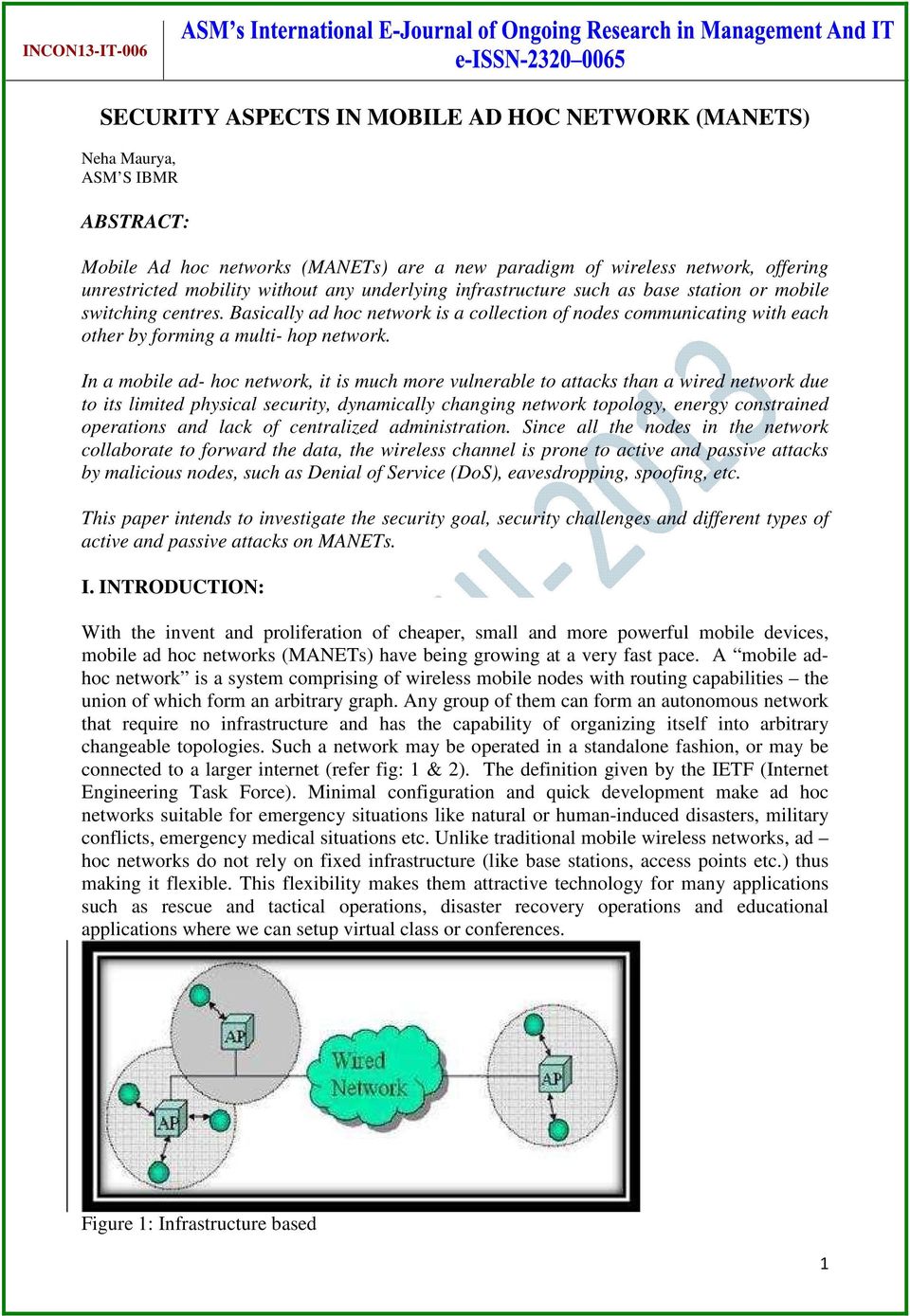
1 SECURITY ASPECTS IN MOBILE AD HOC NETWORK (MANETS) Neha Maurya, ASM S IBMR ABSTRACT: Mobile Ad hoc networks (MANETs) are a new paradigm of wireless network, offering unrestricted mobility without any underlying infrastructure such as base station or mobile switching centres. Basically ad hoc network is a collection of nodes communicating with each other by forming a multi- hop network. In a mobile ad- hoc network, it is much more vulnerable to attacks than a wired network due to its limited physical security, dynamically changing network topology, energy constrained operations and lack of centralized administration. Since all the nodes in the network collaborate to forward the data, the wireless channel is prone to active and passive attacks by malicious nodes, such as Denial of Service (DoS), eavesdropping, spoofing, etc. This paper intends to investigate the security goal, security challenges and different types of active and passive attacks on MANETs. I. INTRODUCTION: With the invent and proliferation of cheaper, small and more powerful mobile devices, mobile ad hoc networks (MANETs) have being growing at a very fast pace. A mobile adhoc network is a system comprising of wireless mobile nodes with routing capabilities the union of which form an arbitrary graph. Any group of them can form an autonomous network that require no infrastructure and has the capability of organizing itself into arbitrary changeable topologies. Such a network may be operated in a standalone fashion, or may be connected to a larger internet (refer fig: 1 & 2). The definition given by the IETF (Internet Engineering Task Force). Minimal configuration and quick development make ad hoc networks suitable for emergency situations like natural or human-induced disasters, military conflicts, emergency medical situations etc. Unlike traditional mobile wireless networks, ad hoc networks do not rely on fixed infrastructure (like base stations, access points etc.) thus making it flexible. This flexibility makes them attractive technology for many applications such as rescue and tactical operations, disaster recovery operations and educational applications where we can setup virtual class or conferences. Figure 1: Infrastructure based 1
2 The following are the advantages of MANETs: They provide access to information and services regardless of geographic position. These networks can be set up at any place and time These networks work without any pre-existing infrastructure. Figure 2: Infrastructure less Security has become a primary concern in order to provide protect communication between nodes in a potentially hostile environment. In a mobile ad hoc network, it is much more vulnerable to attacks than a wired network due to its limited physical security, volatile network topologies, power- constrained operations, and lack of centralized monitoring and management point. II. APPLICATTIONS OF MANETs: With the increase of portable devices as well as progress in wireless communication, ad hoc networking is gaining importance with the increasing number of widespread applications. II. A] MANET Applications Military: Ad hoc networking would allow the military to take advantage of commonplace network technology to maintain an information network between the soldiers, vehicles, and military information head quarter. Consider a scenario as in fig 3, is deployed over a battlefield. The ad hoc network formed by the air vehicle in the sky can provide a backbone for land based platforms to communicate when they are out of direct range or when obstacles prevent direct communication. The adhoc network therefore extends down to the land based forces and allows communication across the battlefield. Voice and video, as well as sensing and data applications can be supported. 2

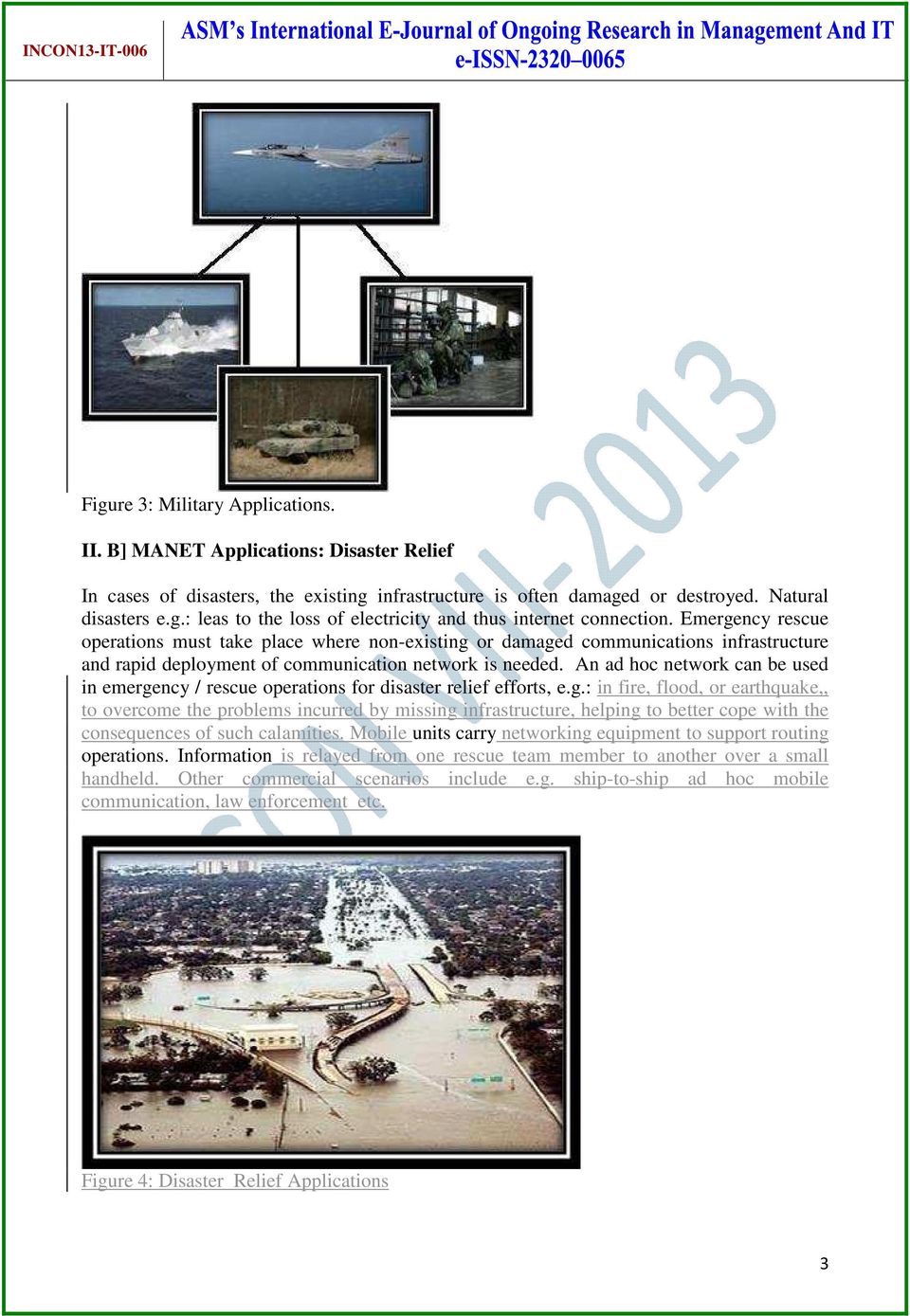
3 Figure 3: Military Applications. II. B] MANET Applications: Disaster Relief In cases of disasters, the existing infrastructure is often damaged or destroyed. Natural disasters e.g.: leas to the loss of electricity and thus internet connection. Emergency rescue operations must take place where non-existing or damaged communications infrastructure and rapid deployment of communication network is needed. An ad hoc network can be used in emergency / rescue operations for disaster relief efforts, e.g.: in fire, flood, or earthquake,, to overcome the problems incurred by missing infrastructure, helping to better cope with the consequences of such calamities. Mobile units carry networking equipment to support routing operations. Information is relayed from one rescue team member to another over a small handheld. Other commercial scenarios include e.g. ship-to-ship ad hoc mobile communication, law enforcement etc. Figure 4: Disaster Relief Applications 3
4 3. CHALLENGES IN SECURING THE MANETs: MANETs are much more vulnerable to attack than wired network. This is because of following reasons: 3.1 Absence of Infrastructure Ad hoc networks operate independently of any infrastructure, which makes inapplicable any classical solutions based on certification authorities and on line servers. 3.2 Limited physical security Mobile wireless networks are generally more prone to physical security threats than a fixed- cable nets. The increased possibility of eavesdropping, spoofing, and denial-ofservice attacks should be carefully considered. Existing link security techniques are often applied within wireless networks to reduce security threat. 3.3 Restricted power Supply Due to mobility of nodes in the ad hoc network, nodes will rely on battery as their power supply method, the problem that may be caused by restricted power supply is denial-of-service attacks and selfish manner. 3.4 Dynamically changing network topology Nodes are free to move arbitrarily. The network topology may change randomly and have no restriction on their distance from other nodes. As a result of this random movement, the whole topology is changing in an unpredictable manner, which in turn gives rise to both directional as well as unidirectional links between the nodes[5]. Figure 5: changing network topology 3.5 Lack of Centralized monitoring Absence of any centralized monitoring makes the detection of attacks a very difficult problem because it is not easy to monitor the traffic in a highly and large scale ad hoc network. It is rather common in the ad hoc network that benign failures such as transmission impairments and packet dropping. 4. SECURITY GOALS IN ADHOC NETWORKS The goals of security mechanism of MANETs are similar to that of other networks. Security is a great issue in network especially in MANETs where security attacks can affect the nodes limited resources and consume them or waste the time before rote chain broke. Security is a vectored term of multi systems, procedures and functions that works together to reach certain level of security attributes[6]. 4

5 Figure 6: Types of Security Goals 4.1 Availability The main goal of availability is to node will be available to its users when expected, i.e. survivability of network services despite denial of service attack. For example, on the physical and media access control layers, an adversary could employ jamming to interfere with communication on physical channel while on network layer it could disrupt the routing protocol and continuity of services of the network. Again, in higher levels, an adversary could bring down high-level services such as key management service, authentication service. 4.2 Confidentiality The goal of confidentiality is to keeping information secret from unauthorized user or nodes. In other words, ensures payload data and header information is never disclosed to unauthorized nodes. The standard approach for keeping information confidential is to encrypt the data with a secret key that only intended receiver s posses, hence achieving confidentiality. 4.3 Integrity The goal of integrity is to guarantee the message being transmitted is never corrupted. Integrity guarantees the identity of the messages when they are transmitted. Integrity can be compromised mainly in two ways. Malicious altering: A message can be removed, replayed or revised by an adversary with malicious goal. Accidental altering:-, if the message is lost or its content is changed due to some benign failures, which may be transmission errors in communication or hardware errors such as hard disk failure. 5

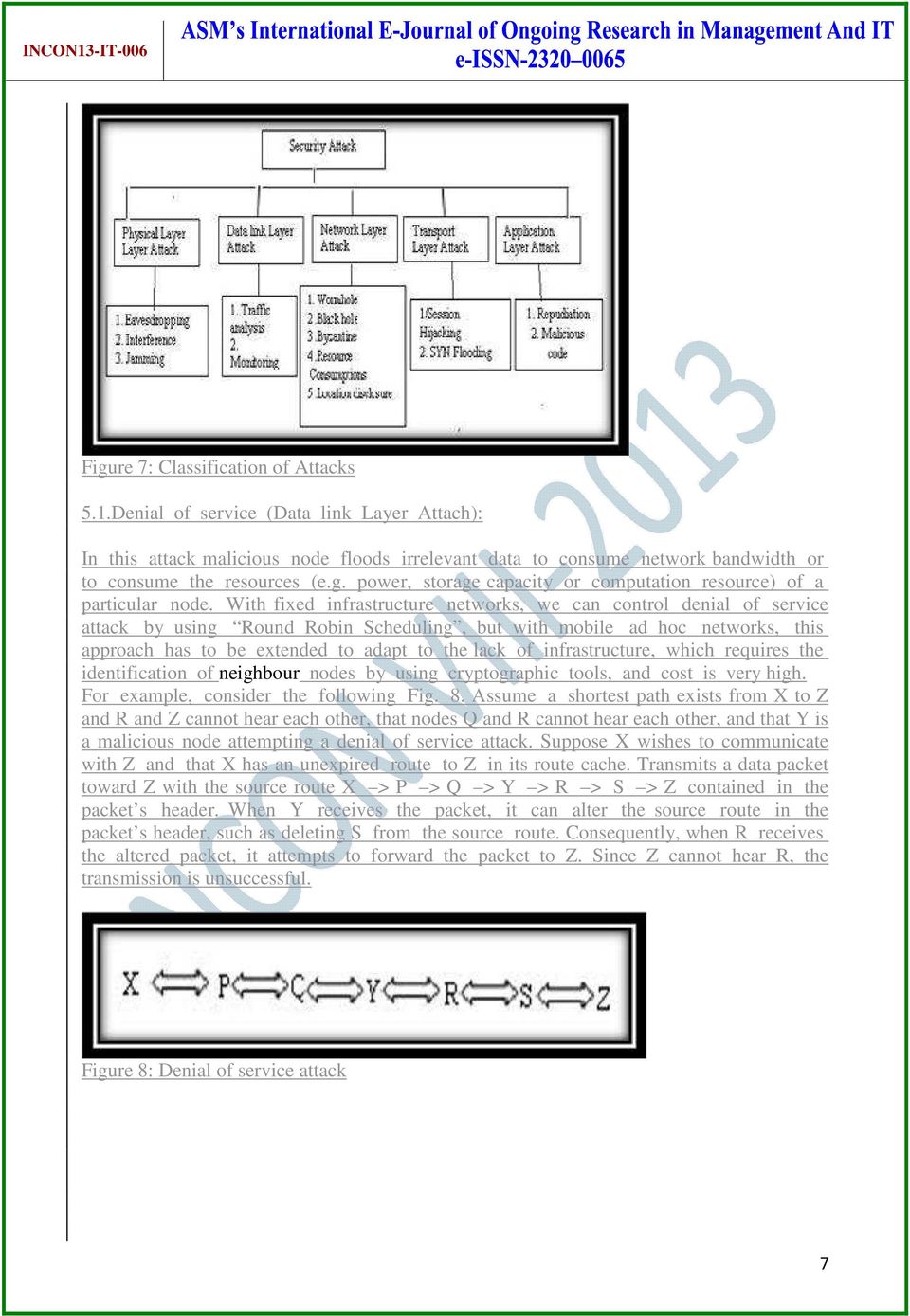
6 4.4 Authentication The goal of authentication is too able to identify a node with which it is communicating and to prevent impersonation. In infrastructure-based wireless network, it is possible to implement a central authority at a point such as base station or access point. But in MANETs, no central administration so it is difficult to authenticate an entity. 4.5 Non repudiation The main goal of non repudiation is sender of a message cannot deny having sent the message. This is useful when for detection and isolation of compromised nodes. When node P receives an erroneous message from Q, non repudiation allows P to access Q using this message and to convince other nodes that Q is compromised. 4.6 Authorization Authorization is a process in which an entity is issued a credential, which specifies the privileges and permissions it has and cannot be falsified, by the certificate authority. Authorization is generally used to assign different access rights to different level of users. 5.SECURITY ATTACKS ON MANET Malicious and selfish nodes are the ones that fabricate attacks against physical, data link, network, and application-layer functionality[fig-7]. Current routing protocols are exposed to two types of attacks 1.Active attacks In a active attack, information is inserted to the network and thus the network operation or some nodes may be harmed. Through which the misbehaving node has to bear some energy costs in order to perform some harmful operation, and Nodes that perform active attacks with the aim of damaging other nodes by causing network outage are considered to be malicious. 2.Passive attacks In a passive attack, a malicious node either ignores operations supposed to be accomplished by it. That mainly consists of lack of cooperation with the purpose of energy saving Nodes that perform passive attacks with the aim of saving battery life for their own communications are considered to be selfish. Selfish nodes can severely degrade network performances and eventually partition the network. 6

7 Figure 7: Classification of Attacks 5.1.Denial of service (Data link Attach): In this attack malicious node floods irrelevant data to consume network bandwidth or to consume the resources (e.g. power, storage capacity or computation resource) of a particular node. With fixed infrastructure networks, we can control denial of service attack by using Round Robin Scheduling, but with mobile ad hoc networks, this approach has to be extended to adapt to the lack of infrastructure, which requires the identification of neighbour nodes by using cryptographic tools, and cost is very high. For example, consider the following Fig. 8. Assume a shortest path exists from X to Z and R and Z cannot hear each other, that nodes Q and R cannot hear each other, and that Y is a malicious node attempting a denial of service attack. Suppose X wishes to communicate with Z and that X has an unexpired route to Z in its route cache. Transmits a data packet toward Z with the source route X > P > Q > Y > R > S > Z contained in the packet s header. When Y receives the packet, it can alter the source route in the packet s header, such as deleting S from the source route. Consequently, when R receives the altered packet, it attempts to forward the packet to Z. Since Z cannot hear R, the transmission is unsuccessful. Figure 8: Denial of service attack 7
8 5.2.Tunneling /Wormhole(Network layer attack): Tunnelling attack is also called wormhole attack. In a tunnelling attack, an attacker receives packets at one point in the network, tunnels them to another point in the network, and then replays them into the network from that point. It is called tunnelling attack because the colluding malicious nodes are linked through a private network connection which is invisible at higher layers [Fig-9]. Figure 9: Wormhole Attack 5.3.Sybil attack : Malicious nodes in a network may not only impersonate one node, they could assume the identity of several nodes, by doing so undermining(destroy) the redundancy(repeating) of many routing protocols. This attack is called the Sybil attack. Sybil attack tries to degrade the integrity of data, security and resource utilization that the distributed algorithm attempts to achieve. Sybil attack can be performed for storage, routing mechanism, air resource allocation and misbehaviour detection. Basically, any peer-topeer network (especially wireless adhoc networks) is vulnerable to Sybil attack. Figure 10: Sybil Attack 8
![It is called tunnelling attack because the colluding malicious nodes are linked through a private network connection which is invisible at higher layers [Fig-9]. Figure 9: Wormhole Attack 5.3.](/docs-images/43/7624039/images/page_8.jpg "Sybil attack : Malicious nodes in a network may not only impersonate one node, they could assume the identity of several nodes, by doing so undermining(destroy) the redundancy(repeating) of many")
9 Table : Security Solutions for MANETs. Attacks Solution Application Repudiation, data corruption Detecting and preventing virus, worms, malicious codes and application abuses by use of Firewalls, Transport Network Data Link Physical 6. CONCLUSION Session hijacking, SYN Flooding Routing protocol attacks (e.g. DSR, AODV etc.),wormhole, blackhole, Byzantine, flooding, resource consumption, location disclosure attacks IDS. Authentication and securing endto-end or point-to-point communication use of public cryptography(ssl, TLS, PCT) etc. Protecting the ad hoc routing and forwarding protocols Traffic analysis, monitoring, disruption MAC (802.11), WEP weakness etc. security support. Eavesdropping, Jamming, Interceptions. Protecting the wireless MAC protocol and providing link layer Preventing signal jamming denialof-service attacks by using Spread Spectrum Mechanism. Importance of MANET cannot be denied as the world of computing is getting portable and compact. Mobile ad hoc Network have the ability to setup networks on the fly in a harsh environment where it may not possible to deploy a traditional network infrastructure. Security is not a single layer issue but a multilayered issue. Due to mobility and open media nature, the mobile ad hoc networks are much more prone to all kinds of security risks, such as information disclosure, intrusion, or even denial of service. As a result, the security needs in the mobile ad hoc networks are much higher than those in the traditional wires networks. It requires a multi fence security solution that provides complete security spanning over the entire protocol stack. The Security research area is still open as many of the provided solutions are designed keeping a limited size scenario and limited kind of attacks and vulnerabilities. MANET are the future networks. because they are practically versatile,easy to use, inexpensive and can instantly updates and reconfigures itself. In this paper we have highlighted the some typical vulnerability which are caused by characteristics of mobile ad hoc networks such as dynamic topology, limited resources (e.g. bandwidth, power), lack of central management s points. And finally we discussed active and passive security attacks on each layer and their solutions. 9

Security Aspects in Mobile Ad Hoc Network (MANETs): Technical Review
 Security Aspects in Mobile Ad Hoc Network (MANETs): Technical Review Monika M.Tech Student Department of CSE The Technological Institute of Textile & Science Bhiwani, Haryana Mukesh Kumar Assisstant Professor
INTERNATIONAL JOURNAL OF PURE AND APPLIED RESEARCH IN ENGINEERING AND TECHNOLOGY
 INTERNATIONAL JOURNAL OF PURE AND APPLIED RESEARCH IN ENGINEERING AND TECHNOLOGY A PATH FOR HORIZING YOUR INNOVATIVE WORK AN OVERVIEW OF MOBILE ADHOC NETWORK: INTRUSION DETECTION, TYPES OF ATTACKS AND
How To Write A Transport Layer Protocol For Wireless Networks
 Chapter 9: Transport Layer and Security Protocols for Ad Hoc Wireless Networks Introduction Issues Design Goals Classifications TCP Over Ad Hoc Wireless Networks Other Transport Layer Protocols Security
Security in Ad Hoc Network
 Security in Ad Hoc Network Bingwen He Joakim Hägglund Qing Gu Abstract Security in wireless network is becoming more and more important while the using of mobile equipments such as cellular phones or laptops
CHAPTER 1 INTRODUCTION
 21 CHAPTER 1 INTRODUCTION 1.1 PREAMBLE Wireless ad-hoc network is an autonomous system of wireless nodes connected by wireless links. Wireless ad-hoc network provides a communication over the shared wireless
Security and Privacy Issues in Wireless Ad Hoc, Mesh, and Sensor Networks
 Advance in Electronic and Electric Engineering. ISSN 2231-1297, Volume 4, Number 4 (2014), pp. 381-388 Research India Publications http://www.ripublication.com/aeee.htm Security and Privacy Issues in Wireless
SECURE DATA TRANSMISSION USING INDISCRIMINATE DATA PATHS FOR STAGNANT DESTINATION IN MANET
 SECURE DATA TRANSMISSION USING INDISCRIMINATE DATA PATHS FOR STAGNANT DESTINATION IN MANET MR. ARVIND P. PANDE 1, PROF. UTTAM A. PATIL 2, PROF. B.S PATIL 3 Dept. Of Electronics Textile and Engineering
Introduction to Wireless Sensor Network Security
 Smartening the Environment using Wireless Sensor Networks in a Developing Country Introduction to Wireless Sensor Network Security Presented By Al-Sakib Khan Pathan Department of Computer Science and Engineering
SECURITY ISSUES: THE BIG CHALLENGE IN MANET
 Available Online at www.ijcsmc.com International Journal of Computer Science and Mobile Computing A Monthly Journal of Computer Science and Information Technology IJCSMC, Vol. 3, Issue. 3, March 2014,
All vulnerabilities that exist in conventional wired networks apply and likely easier Theft, tampering of devices
 Wireless Security All vulnerabilities that exist in conventional wired networks apply and likely easier Theft, tampering of devices Portability Tamper-proof devices? Intrusion and interception of poorly
Preventing DDOS attack in Mobile Ad-hoc Network using a Secure Intrusion Detection System
 Preventing DDOS attack in Mobile Ad-hoc Network using a Secure Intrusion Detection System Shams Fathima M.Tech,Department of Computer Science Kakatiya Institute of Technology & Science, Warangal,India
Tema 5.- Seguridad. Problemas Soluciones
 Tema 5.- Seguridad Problemas Soluciones Wireless medium is easy to snoop on Routing security vulnerabilities Due to ad hoc connectivity and mobility, it is hard to guarantee access to any particular node
Security Threats in Mobile Ad Hoc Networks
 Security Threats in Mobile Ad Hoc Networks Hande Bakiler, Aysel Şafak Department of Electrical & Electronics Engineering Baskent University Ankara, Turkey [email protected], [email protected]
Wireless Sensor Networks Chapter 14: Security in WSNs
 Wireless Sensor Networks Chapter 14: Security in WSNs António Grilo Courtesy: see reading list Goals of this chapter To give an understanding of the security vulnerabilities of Wireless Sensor Networks
MOBILE AD HOC NETWORKS UNDER WORMHOLE ATTACK: A SIMULATION STUDY
 MOBILE AD HOC NETWORKS UNDER WORMHOLE ATTACK: A SIMULATION STUDY Nadher M. A. Al_Safwani, Suhaidi Hassan, and Mohammed M. Kadhum Universiti Utara Malaysia, Malaysia, {suhaidi, khadum}@uum.edu.my, [email protected]
Denial of Service in Sensor Networks
 Denial of Service in Sensor Networks Authors : From: Anthony D. Wood John A. Stankovic University of Virginia Presented by: Luba Sakharuk Agenda for the DOS in Sensor Networks Abstract Theory and Application
7 Network Security. 7.1 Introduction 7.2 Improving the Security 7.3 Internet Security Framework. 7.5 Absolute Security?
 7 Network Security 7.1 Introduction 7.2 Improving the Security 7.3 Internet Security Framework 7.4 Firewalls 7.5 Absolute Security? 7.1 Introduction Security of Communications data transport e.g. risk
Wireless Sensor Network Security. Seth A. Hellbusch CMPE 257
 Wireless Sensor Network Security Seth A. Hellbusch CMPE 257 Wireless Sensor Networks (WSN) 2 The main characteristics of a WSN include: Power consumption constrains for nodes using batteries or energy
1. Computer Security: An Introduction. Definitions Security threats and analysis Types of security controls Security services
 1. Computer Security: An Introduction Definitions Security threats and analysis Types of security controls Security services Mar 2012 ICS413 network security 1 1.1 Definitions A computer security system
Security Issues in Mobile Ad Hoc Networks - A Survey
 Security Issues in Mobile Ad Hoc Networks - A Survey Wenjia Li and Anupam Joshi Department of Computer Science and Electrical Engineering University of Maryland, Baltimore County Abstract In this paper,
Vulnerabilities of Intrusion Detection Systems in Mobile Ad-hoc Networks - The routing problem
 Vulnerabilities of Intrusion Detection Systems in Mobile Ad-hoc Networks - The routing problem Ernesto Jiménez Caballero Helsinki University of Technology [email protected] Abstract intrusion detection
Security Requirements for Wireless Networks and their Satisfaction in IEEE 802.11b and Bluetooth
 Security Requirements for Wireless Networks and their Satisfaction in IEEE 802.11b and Bluetooth Henrich C. Poehls Master s Thesis M.Sc. in Information Security Information Security Group Royal Holloway,
Mobile Security Wireless Mesh Network Security. Sascha Alexander Jopen
 Mobile Security Wireless Mesh Network Security Sascha Alexander Jopen Overview Introduction Wireless Ad-hoc Networks Wireless Mesh Networks Security in Wireless Networks Attacks on Wireless Mesh Networks
Robust Security Solution to Countermeasure of Malicious Nodes for the Security of MANET
 Robust Security Solution to Countermeasure of Malicious Nodes for the Security of MANET Kritika Sharma M.tech(CSE) Doon Valley Insttitute of Enggineering & Technology, Karnal Parikshit Singla Assistant
Security for Ad Hoc Networks. Hang Zhao
 Security for Ad Hoc Networks Hang Zhao 1 Ad Hoc Networks Ad hoc -- a Latin phrase which means "for this [purpose]". An autonomous system of mobile hosts connected by wireless links, often called Mobile
International Journal of Advanced Research in Computer Science and Software Engineering
 Volume 3, Issue 1, January 2013 ISSN: 2277 128X International Journal of Advanced Research in Computer Science and Software Engineering Research Paper Available online at: www.ijarcsse.com Analysis of
Security and Scalability of MANET Routing Protocols in Homogeneous & Heterogeneous Networks
 Security and Scalability of MANET Routing Protocols in Homogeneous & Heterogeneous Networks T.V.P. Sundararajan 1, Karthik 2, A. Shanmugam 3 1. Assistant Professor, Bannari Amman Institute Of Technology,
12/3/08. Security in Wireless LANs and Mobile Networks. Wireless Magnifies Exposure Vulnerability. Mobility Makes it Difficult to Establish Trust
 Security in Wireless LANs and Mobile Networks Wireless Magnifies Exposure Vulnerability Information going across the wireless link is exposed to anyone within radio range RF may extend beyond a room or
COSC 472 Network Security
 COSC 472 Network Security Instructor: Dr. Enyue (Annie) Lu Office hours: http://faculty.salisbury.edu/~ealu/schedule.htm Office room: HS114 Email: [email protected] Course information: http://faculty.salisbury.edu/~ealu/cosc472/cosc472.html
EFS: Enhanced FACES Protocol for Secure Routing In MANET
 EFS: Enhanced FACES Protocol for Secure Routing In MANET Geethu Bastian Department of Information Technology Rajagiri School of Engineering & Technology, Rajagiri Valley P O Kochi-39, India [email protected]
Overview of Network Security The need for network security Desirable security properties Common vulnerabilities Security policy designs
 Overview of Network Security The need for network security Desirable security properties Common vulnerabilities Security policy designs Why Network Security? Keep the bad guys out. (1) Closed networks
A Secure Intrusion detection system against DDOS attack in Wireless Mobile Ad-hoc Network Abstract
 A Secure Intrusion detection system against DDOS attack in Wireless Mobile Ad-hoc Network Abstract Wireless Mobile ad-hoc network (MANET) is an emerging technology and have great strength to be applied
Performance Evaluation of AODV, OLSR Routing Protocol in VOIP Over Ad Hoc
 (International Journal of Computer Science & Management Studies) Vol. 17, Issue 01 Performance Evaluation of AODV, OLSR Routing Protocol in VOIP Over Ad Hoc Dr. Khalid Hamid Bilal Khartoum, Sudan [email protected]
Review of Prevention techniques for Denial of Service Attacks in Wireless Sensor Network
 Review of Prevention techniques for Denial of Service s in Wireless Sensor Network Manojkumar L Mahajan MTech. student, Acropolis Technical Campus, Indore (MP), India Dushyant Verma Assistant Professor,
Security Issues with Integrated Smart Buildings
 Security Issues with Integrated Smart Buildings Jim Sinopoli, Managing Principal Smart Buildings, LLC The building automation industry is now at a point where we have legitimate and reasonable concern
Analysis of Denial-of-Service attacks on Wireless Sensor Networks Using Simulation
 Analysis of Denial-of-Service attacks on Wireless Sensor Networks Using Simulation 1 Doddapaneni.krishna Chaitanya, 2 Ghosh.Arindam Middlesex University Abstract Evaluation of Wireless Sensor Networks
HANDBOOK 8 NETWORK SECURITY Version 1.0
 Australian Communications-Electronic Security Instruction 33 (ACSI 33) Point of Contact: Customer Services Team Phone: 02 6265 0197 Email: [email protected] HANDBOOK 8 NETWORK SECURITY Version 1.0 Objectives
Securing MANET Using Diffie Hellman Digital Signature Scheme
 Securing MANET Using Diffie Hellman Digital Signature Scheme Karamvir Singh 1, Harmanjot Singh 2 1 Research Scholar, ECE Department, Punjabi University, Patiala, Punjab, India 1 [email protected] 2
Firewalls, Tunnels, and Network Intrusion Detection. Firewalls
 Firewalls, Tunnels, and Network Intrusion Detection 1 Firewalls A firewall is an integrated collection of security measures designed to prevent unauthorized electronic access to a networked computer system.
An Implementation of Secure Wireless Network for Avoiding Black hole Attack
 An Implementation of Secure Wireless Network for Avoiding Black hole Attack Neelima Gupta Research Scholar, Department of Computer Science and Engineering Jagadguru Dattaray College of Technology Indore,
Authentication and Security in IP based Multi Hop Networks
 7TH WWRF MEETING IN EINDHOVEN, THE NETHERLANDS 3RD - 4TH DECEMBER 2002 1 Authentication and Security in IP based Multi Hop Networks Frank Fitzek, Andreas Köpsel, Patrick Seeling Abstract Network security
A Review of Secure Ad-hoc Routing
 www..org 30 A Review of Secure Ad-hoc Routing Tannu Arora 1, Deepika Arora 2 1 Computer Science, M.D.U/GIET, Sonipat, Haryana, India [email protected] 2 Computer Science, C.D.L.U, Sirsa, Haryana, India
Firewalls, Tunnels, and Network Intrusion Detection
 Firewalls, Tunnels, and Network Intrusion Detection 1 Part 1: Firewall as a Technique to create a virtual security wall separating your organization from the wild west of the public internet 2 1 Firewalls
Chap. 1: Introduction
 Chap. 1: Introduction Introduction Services, Mechanisms, and Attacks The OSI Security Architecture Cryptography 1 1 Introduction Computer Security the generic name for the collection of tools designed
Trust Establishment in Mobile Ad Hoc Networks: Key Management
 258 Trust Establishment in Mobile Ad Hoc Networks: Key Management Dawoud D.S. 1, Richard L. Gordon 2, Ashraph Suliman 1 and Kasmir Raja S.V. 3 1 National University of Rwanda 2 University of KwaZulu Natal
Lecture Objectives. Lecture 8 Mobile Networks: Security in Wireless LANs and Mobile Networks. Agenda. References
 Lecture Objectives Wireless Networks and Mobile Systems Lecture 8 Mobile Networks: Security in Wireless LANs and Mobile Networks Introduce security vulnerabilities and defenses Describe security functions
COMPARATIVE ANALYSIS OF ON -DEMAND MOBILE AD-HOC NETWORK
 www.ijecs.in International Journal Of Engineering And Computer Science ISSN:2319-7242 Volume 2 Issue 5 May, 2013 Page No. 1680-1684 COMPARATIVE ANALYSIS OF ON -DEMAND MOBILE AD-HOC NETWORK ABSTRACT: Mr.Upendra
Lecture 2.1 : The Distributed Bellman-Ford Algorithm. Lecture 2.2 : The Destination Sequenced Distance Vector (DSDV) protocol
 Lecture 2 : The DSDV Protocol Lecture 2.1 : The Distributed Bellman-Ford Algorithm Lecture 2.2 : The Destination Sequenced Distance Vector (DSDV) protocol The Routing Problem S S D D The routing problem
Research Projects in the Mobile Computing and Networking (MCN) Lab
 Research Projects in the Mobile Computing and Networking (MCN) Lab Guohong Cao Department of Computer Science and Engineering The Pennsylvania State University http://www.cse.psu.edu/~gcao Mobile Computing
[email protected] [email protected]
 S. Sumathy 1 and B.Upendra Kumar 2 1 School of Computing Sciences, VIT University, Vellore-632 014, Tamilnadu, India [email protected] 2 School of Computing Sciences, VIT University, Vellore-632 014,
Comparison of Various Passive Distributed Denial of Service Attack in Mobile Adhoc Networks
 Comparison of Various Passive Distributed Denial of Service in Mobile Adhoc Networks YOGESH CHABA #, YUDHVIR SINGH, PRABHA RANI Department of Computer Science & Engineering GJ University of Science & Technology,
Industrial Communication. Securing Industrial Wireless
 Industrial Communication Whitepaper Securing Industrial Wireless Contents Introduction... 3 Wireless Applications... 4 Potential Threats... 5 Denial of Service... 5 Eavesdropping... 5 Rogue Access Point...
Ariadne A Secure On-Demand Routing Protocol for Ad-Hoc Networks
 Ariadne A Secure On-Demand Routing Protocol for Ad-Hoc Networks Authors: Yih-Chun Hu, Adrian Perrig, David B Johnson Presenter: Sameer Korrapati Date: 4/21/2003 Overview of presentation Introduction :
2. From a control perspective, the PRIMARY objective of classifying information assets is to:
 MIS5206 Week 13 Your Name Date 1. When conducting a penetration test of an organization's internal network, which of the following approaches would BEST enable the conductor of the test to remain undetected
Defense in Cyber Space Beating Cyber Threats that Target Mesh Networks
 Beating Cyber Threats that Target Mesh Networks Trent Nelson, Cyber Security Assessment Lead, Idaho National Laboratory Jeff Becker, Global Wireless Business Director, Honeywell Process Solutions Table
WIRELESS SECURITY. Information Security in Systems & Networks Public Development Program. Sanjay Goel University at Albany, SUNY Fall 2006
 WIRELESS SECURITY Information Security in Systems & Networks Public Development Program Sanjay Goel University at Albany, SUNY Fall 2006 1 Wireless LAN Security Learning Objectives Students should be able
Modified AODV protocol for prevention of Denial of service attacks in wireless Ad hoc networks
 Modified AODV protocol for prevention of Denial of service attacks in wireless Ad hoc networks B. MALARKODI, B. VENKATARAMANI AND X.T. PRADEEP Department of Electronics and Communication Engineering National
BSc (Hons.) Computer Science with Network Security. Examinations for 2011/2012 - Semester 2
 BSc (Hons.) Computer Science with Network Security BCNS/09/FT Examinations for 2011/2012 - Semester 2 MODULE: WIRELESS NETWORK SECURITY MODULE CODE: SECU 3105 Duration: 2 Hours 15 Minutes Reading time:
Overview. Summary of Key Findings. Tech Note PCI Wireless Guideline
 Overview The following note covers information published in the PCI-DSS Wireless Guideline in July of 2009 by the PCI Wireless Special Interest Group Implementation Team and addresses version 1.2 of the
III. Our Proposal ASOP ROUTING ALGORITHM. A.Position Management
 Secured On-Demand Position Based Private Routing Protocol for Ad-Hoc Networks Ramya.R, Shobana.K, Thangam.V.S [email protected], k [email protected],[email protected] Department of Computer Science,
Wireless Security with Cyberoam
 White paper Cyberoam UTM Wireless Security with Cyberoam Robust, Fault-tolerant security is a must for companies sporting wireless networks. Cyberoam UTM strengthens the existing Wireless Security Architecture
Basics of Internet Security
 Basics of Internet Security Premraj Jeyaprakash About Technowave, Inc. Technowave is a strategic and technical consulting group focused on bringing processes and technology into line with organizational
A Catechistic Method for Traffic Pattern Discovery in MANET
 A Catechistic Method for Traffic Pattern Discovery in MANET R. Saranya 1, R. Santhosh 2 1 PG Scholar, Computer Science and Engineering, Karpagam University, Coimbatore. 2 Assistant Professor, Computer
Anomaly Intrusion Detection System in Wireless Sensor Networks: Security Threats and Existing Approaches
 Anomaly Intrusion Detection System in Wireless Sensor Networks: Security Threats and Existing Approaches Md. Safiqul Islam *1, Syed AshiqurRahman *2 Department of Computer Science and Engineering Daffodil
Humayun Bakht School of Computing and Mathematical Sciences Liverpool John Moores University Email:[email protected]
 Applications of mobile ad-hoc networks my article applications of mobile ad-hoc networks at http://www.computingunplugged.com/issues/issue2004 09/00001371001.html Humayun Bakht School of Computing and
Secure Routing in Wireless Sensor Networks
 Secure Routing in Wireless Sensor Networks Introduction to Wireless Sensor Networks Ida Siahaan / Leonardo Fernandes DIT Ida Siahaan / Leonardo Fernandes (DIT) Secure Routing in Wireless Sensor Networks
Wireless Security Overview. Ann Geyer Partner, Tunitas Group Chair, Mobile Healthcare Alliance 209-754-9130 [email protected]
 Wireless Security Overview Ann Geyer Partner, Tunitas Group Chair, Mobile Healthcare Alliance 209-754-9130 [email protected] Ground Setting Three Basics Availability Authenticity Confidentiality Challenge
Notes on Network Security - Introduction
 Notes on Network Security - Introduction Security comes in all shapes and sizes, ranging from problems with software on a computer, to the integrity of messages and emails being sent on the Internet. Network
UTMB INFORMATION RESOURCES PRACTICE STANDARD
 IR Security Glossary Introduction Purpose Applicability Sensitive Digital Data Management Privacy Implications This abbreviated list provides explanations for typically used Information Resources (IR)
SY0-201. system so that an unauthorized individual can take over an authorized session, or to disrupt service to authorized users.
 system so that an unauthorized individual can take over an authorized session, or to disrupt service to authorized users. From a high-level standpoint, attacks on computer systems and networks can be grouped
Network Security 網 路 安 全. Lecture 1 February 20, 2012 洪 國 寶
 Network Security 網 路 安 全 Lecture 1 February 20, 2012 洪 國 寶 1 Outline Course information Motivation Introduction to security Basic network concepts Network security models Outline of the course 2 Course
Draft ITU-T Recommendation X.805 (Formerly X.css), Security architecture for systems providing end-to-end communications
 Draft ITU-T Recommendation X.805 (Formerly X.css), architecture for systems providing end-to-end communications Summary This Recommendation defines the general security-related architectural elements that
Introduction to Security
 2 Introduction to Security : IT Security Sirindhorn International Institute of Technology Thammasat University Prepared by Steven Gordon on 25 October 2013 its335y13s2l01, Steve/Courses/2013/s2/its335/lectures/intro.tex,
Fundamentals of Network Security - Theory and Practice-
 Fundamentals of Network Security - Theory and Practice- Program: Day 1... 1 1. General Security Concepts... 1 2. Identifying Potential Risks... 1 Day 2... 2 3. Infrastructure and Connectivity... 2 4. Monitoring
CS5008: Internet Computing
 CS5008: Internet Computing Lecture 22: Internet Security A. O Riordan, 2009, latest revision 2015 Internet Security When a computer connects to the Internet and begins communicating with others, it is
SCADA System Security. ECE 478 Network Security Oregon State University March 7, 2005
 SCADA System Security ECE 478 Network Security Oregon State University March 7, 2005 David Goeke Hai Nguyen Abstract Modern public infrastructure systems
ensure prompt restart of critical applications and business activities in a timely manner following an emergency or disaster
 Security Standards Symantec shall maintain administrative, technical, and physical safeguards for the Symantec Network designed to (i) protect the security and integrity of the Symantec Network, and (ii)
SECURE SIGNATURE BASED CEDAR ROUTING IN MOBILE ADHOC NETWORKS
 SECURE SIGNATURE BASED CEDAR ROUTING IN MOBILE ADHOC NETWORKS Ayesha Tabassum 1 1 Assistant Professor, Department of Computer Science and Engineering, DCET, Osmania University, Telangana, India Abstract
Securing SIP Trunks APPLICATION NOTE. www.sipera.com
 APPLICATION NOTE Securing SIP Trunks SIP Trunks are offered by Internet Telephony Service Providers (ITSPs) to connect an enterprise s IP PBX to the traditional Public Switched Telephone Network (PSTN)
SECURE DATA TRANSMISSION USING MOBILE AD-HOC NETWORK
 SECURE DATA TRANSMISSION USING MOBILE AD-HOC NETWORK (S.SARANYA,MCA-II YEAR, IFET College of Engineering.) ABSTRACT: A mobile ad hoc network (MANET), sometimes called a mobile mesh network, is a self-configuring
Thwarting Selective Insider Jamming Attacks in Wireless Network by Delaying Real Time Packet Classification
 Thwarting Selective Insider Jamming Attacks in Wireless Network by Delaying Real Time Packet Classification LEKSHMI.M.R Department of Computer Science and Engineering, KCG College of Technology Chennai,
Study of Different Types of Attacks on Multicast in Mobile Ad Hoc Networks
 Study of Different Types of Attacks on Multicast in Mobile Ad Hoc Networks Hoang Lan Nguyen and Uyen Trang Nguyen Department of Computer Science and Engineering, York University 47 Keele Street, Toronto,
Chapter 6: Fundamental Cloud Security
 Chapter 6: Fundamental Cloud Security Nora Almezeini MIS Department, CBA, KSU From Cloud Computing by Thomas Erl, Zaigham Mahmood, and Ricardo Puttini(ISBN: 0133387526) Copyright 2013 Arcitura Education,
A Review of Anomaly Detection Techniques in Network Intrusion Detection System
 A Review of Anomaly Detection Techniques in Network Intrusion Detection System Dr.D.V.S.S.Subrahmanyam Professor, Dept. of CSE, Sreyas Institute of Engineering & Technology, Hyderabad, India ABSTRACT:In
Djenouri Djamel & Nadjib Badache
 Djenouri Djamel & Nadjib Badache LSI-TR0504 February 2004 A Survey on Security Issues in Mobile Ad hoc Networks Djamel DJENOURI, Nadjib BADACHE : Basic Software Laboratory, CERIST Center of Research, Algiers,
Securing VoIP Networks using graded Protection Levels
 Securing VoIP Networks using graded Protection Levels Andreas C. Schmidt Bundesamt für Sicherheit in der Informationstechnik, Godesberger Allee 185-189, D-53175 Bonn [email protected] Abstract
Content Teaching Academy at James Madison University
 Content Teaching Academy at James Madison University 1 2 The Battle Field: Computers, LANs & Internetworks 3 Definitions Computer Security - generic name for the collection of tools designed to protect
NETWORK ACCESS CONTROL AND CLOUD SECURITY. Tran Song Dat Phuc SeoulTech 2015
 NETWORK ACCESS CONTROL AND CLOUD SECURITY Tran Song Dat Phuc SeoulTech 2015 Table of Contents Network Access Control (NAC) Network Access Enforcement Methods Extensible Authentication Protocol IEEE 802.1X
Fast and Secure Data Transmission by Using Hybrid Protocols in Mobile Ad Hoc Network
 Middle-East Journal of Scientific Research 15 (9): 1290-1294, 2013 ISSN 1990-9233 IDOSI Publications, 2013 DOI: 10.5829/idosi.mejsr.2013.15.9.11514 Fast and Secure Data Transmission by Using Hybrid Protocols
Technical Brief. Wireless Intrusion Protection
 Technical Brief Wireless Intrusion Protection Introduction One layer of the multi-layer wireless security solution provided by Aruba Wireless Networks is the ability to lock the air using wireless intrusion
Secure Unicast Position-based Routing Protocols for Ad-Hoc Networks
 Acta Polytechnica Hungarica Vol. 8, No. 6, 2011 Secure Unicast Position-based Routing Protocols for Ad-Hoc Networks Liana Khamis Qabajeh, Miss Laiha Mat Kiah Faculty of Computer Science and Information