
Vulnerabilities of Intrusion Detection Systems in Mobile Ad-hoc Networks - The routing problem
|
|
|
- Adela Scott
- 9 years ago
- Views:
Transcription
1 Vulnerabilities of Intrusion Detection Systems in Mobile Ad-hoc Networks - The routing problem Ernesto Jiménez Caballero Helsinki University of Technology [email protected] Abstract intrusion detection systems is one of the most active fields of research in Mobile Ad-hoc Network s (MANET) field. This systems are usually focused on detecting problems with the routing systems to prevent DoS and Man-in-the-middle and, despite of the amount of papers written which try to solve, many of them are just theoretical and have only been proved in simulations. In addition, most of them have common deficiencies. This paper reviews attacks against MANETs routing systems performed by intruders, some systems proposed to detect them, and their deficiencies. KEYWORDS: MANET, Routing, intrusion detection systems, Deficiencies 1 Introduction A wireless ad-hoc network is a group of devices which are connected without a fixed infrastructure such as access points or base stations. This lack of infrastructure supposes the devices in the routing system, creating multi-hop wireless paths linking nodes with those which are out of their wireless range. This kind of networks without fixed infrastructure and high mobility are ideal for places such as battlefield, and for establishing communications after natural disasters. However, in these environments network security becomes critical. For this reason several research studies have been focused in ad-hoc security, which include intrusion prevention and intrusion detection systems. The prevention should prevent unauthorized access to the network; however, this is not always possible, and this risk enforces the implementation of a second line of defense: intrusion detection. Traditional intrusion detection systems (IDS) in wired networks analyze the behavior of the elements in the network trying to identify anomalies produced by intruders and, once identified, start a response against the intruders. These detection systems are usually placed in those elements with more confluent traffic such as routers, gateways, and switches. Unfortunately, in ad-hoc networks, those elements are not uses, and it is not possible to guess which nodes will route more traffic from its neighbors and install IDS systems only in those nodes. This is the reason justifying the proposal from Zhang [9] of a distributed intrusion detection system where every host in the network investigates possible misbehaves of their neighbors. One of the most important things to secure in the adhoc networks is the routing system. Attacks against this part of the network system can conclude in Denial-ofservice (DoS) or man-in-the-middle. Because of this, several researches done in this field have focused on those routing systems and how to detect misbehavior from the nodes and differentiate if the misbehavior is produced by an intruder or, in the other hand, if is the normal misbehave in mobile wireless networks (e.g. lack of signal, routing tables not updated). However, most of the studies have some important deficiencies in their systems ignoring some attacks that can be performed by an intruder without being detected by their systems. Our goal with this article is to review the possible attacks against the routing system, some of the IDSs proposed and their deficiencies. 2 Background 2.1 Routing systems in ad-hoc Routing systems can be classified into three different groups: proactive, reactive, and hybrid systems. In proactive systems the nodes broadcast information about their routing tables periodically, every node stores the different routes to reach each node from the network. By contrast, in reactive systems nodes requests their neighbors to find a route only when it has a package to send. Finally, hybrid systems combine both techniques in the same system. Several protocols for routing in ad-hoc networks have been presented. However, these systems usually implement no safeguards trusting in those safeguards
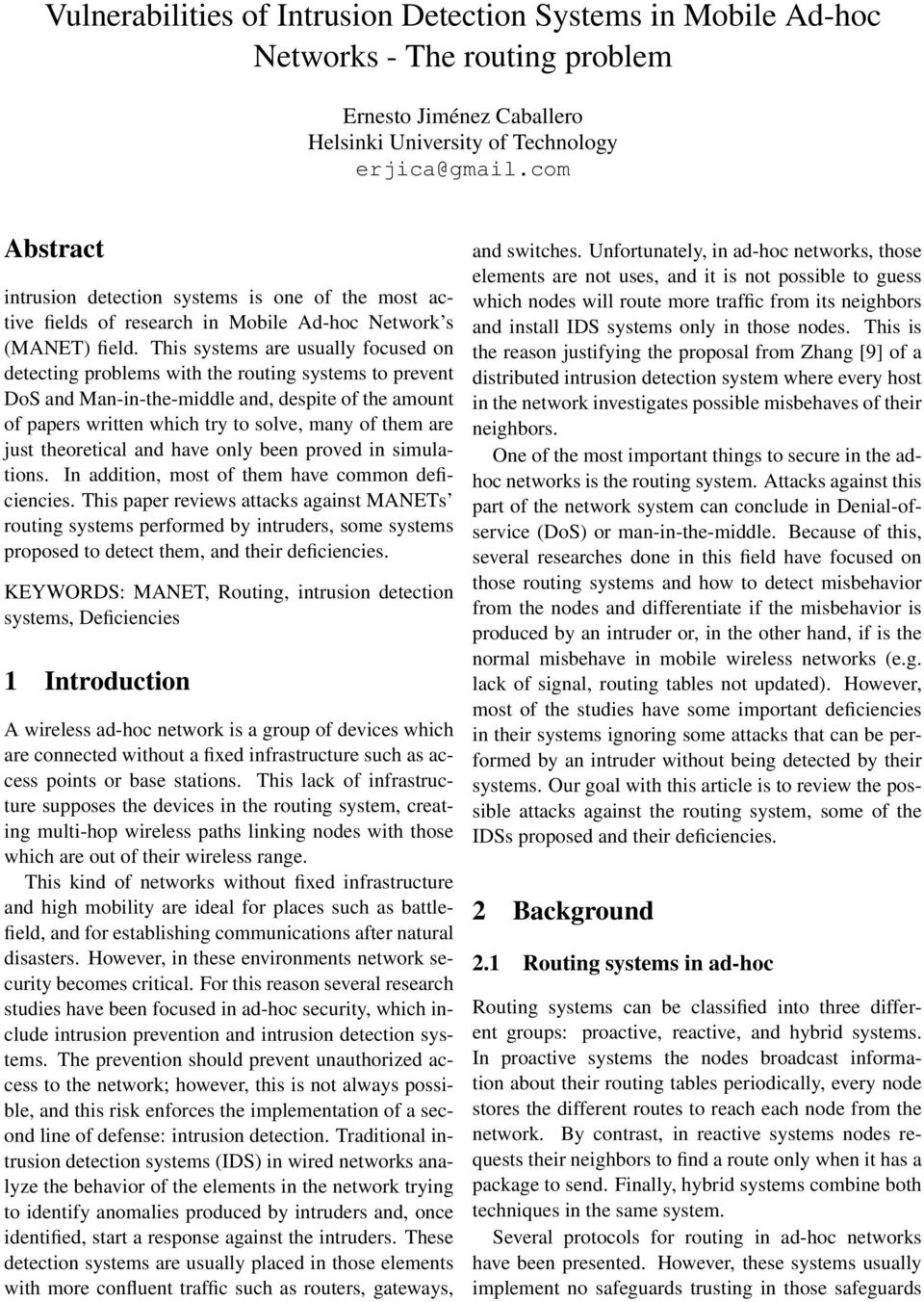
2 added in upper layers. This lack of security might be acceptable thinking in intrusion prevention, but, when we start thinking in intrusion detection we must assume that security in upper layers is not enough. Furthermore, when an attacker reaches a MANET with an insecure routing system he gains might gain control over all the networks and perform several attacks against the nodes. Figure 1: MANET example 2.2 Attacks against routing system In this section we will review some common attacks performed by intruders altering the routing tables from the legitimate nodes. This type of attacks are common because, as we said in the previous section, most of the routing systems are insecure and once the attacker reaches the network, he can alter the routes to have more control on the other nodes. Figure 1 shows three legitimate nodes (A, B, and C) connected in an ad-hoc network and an intruder node Z which will perform the attacks. This figure will be used to illustrate the different attacks bellow explained. Black Hole Routers [2][3][4] [5][1]: This is a Denial of Service attack, where the malicious node (Z) listens when a legitimate node (A) requests a route to reach another node (C). When Z node has this information claims to be the shortest path to reach C, as result of that, A sends its packages to Z expecting to reach C, but Z does not forward the packages to C. Its consequences can go from having one node disconnected from the rest of the network (A is the only node under suffering the attack), to all the nodes in the network relaying on the malicious node and being totally disconnected to each other. Grey Hole Routers [7]: This attack is an small variation from the Black Hole router attack. In opposition to the Black Hole routers, Grey Hole routers do not drop all the packages. With this half-dropping the intruder tries to hide the attack by not denying all the network services. This attack is harder to identify because this reduction of network capabilities could be produced by the normal instability from wireless connections. Resource exhaustion [2][7]: When Z has reached the network and has access to the routing system he can flood the network with routing messages. These messages vary according to the system, if it is a proactive system the attacker would send the broadcast messages. In the other hand, if the system is reactive, he would send requests to reach other nodes. No matter the system, the main idea in this attack is to reduce as much as possible the network capabilities making the nodes work with the routing system. The consequences are not only for the network capabilities, if the nodes update constantly their routing tables they would spend CPU cycles and waste more battery. Man-in-the-middle: In MANETs an intruder can attack de routing system to perform a man-in-themiddle attack. While in wired networks you can do ARP poisoning (claiming to be a different node in order to redirect all his traffic through yourself), in MANETs the intruder can claim to be the shortest path to all the node and get all the traffic from his neighbors (like in the Black Hole attack). 3 intrusion detection systems As a consequence from the lack of security of routing system, This section briefly describes four intrusion detection systems for wireless ad-hoc networks. These systems have been chosen because of their focus on detecting intruders attacking the routing system. Watchdog [6]: The main idea from this IDS is that, because the node listened its neighbor claiming to be the shortest path, he also can listen how the node routes his information. For doing this the node sends its packages to the node who claimed to be the shortest path to its target node, once the node sends the package he switches into promiscuous mode in order to listen the transmissions from his neighbors and check if his router forwards the packages. With the information about the behav-

3 ior from its neighbor the node can deduce if they could be Black or Grey Hole routers. Pathrater [6]: In Pathrater system each node uses the information from systems such as Watchdog to rate its neighbors. These rates establish the trustability of each node according to its behavior and allow the node to choose in which nodes can he trust and which ones he has to ignore. Routeguard [2]: This system combines Watchdog and Pathrater to classify each neighbor node as: Fresh, Member, Unstable, Suspect, or Malicious. The class of each node depends on the ratings obtained from the watchdog according to its behavior. Furthermore, each class or tag implies a different trust level which goes from trusted (Member), which allows the node to participate in the network, to completely untrusted (Malicious), which gets banned from the network. Hop-by-hop signing [8]: This system proposed a secure routing system which would allow intrusion detection. The paper reviews different public key management protocols for MANETs. This public key infrastructure provides every node public key encryption and signatures. According the structure presented in Fig. 1, A could send signed packages to C through B, and C could verify that the package came from A. Finally, watchdog technique is presented as a solution to prevent denialof-service attacks such ash Black and Grey Hole routers. However, this system is thought for short paths (one or two hops as maximum). Patwardhan secure routing and intrusion detection system [7]: This paper presented a proof of concept where they implemented a secure routing protocol using public key encryption, intrusion detection, and a reaction system. The system implements a secured routing protocol adding public key signatures to verify the ownership of the messages. By addition, it has an intrusion detection system where each node monitors its neighbors in promiscuous mode listening their routing activity. When a node claiming to be a router, is detected misbehaving, the detection system marks the node as malicious node and the reaction system isolates the node from the ad-hoc network. 4 Deficiencies in proposed systems The intrusion detection systems described in Section 3 had good results in simulations. These type of scenarios can help to test the overhead of the protocols and its effectiveness. However, this effectiveness is always evaluated according to the initial assumptions from the researchers and they might neglect some important points. In this section we will expose some of these unconsidered points. 4.1 Public key overhead Some complex IDS architectures (such as Hop-by-hop signing [8] and Patwardhan secure routing [7]) require public-key encryption operations in each node. This improves the security from the systems adding all the advantages from the public key cryptography. However, public-key cryptography implies a higher overhead for each operation because of its efficiency. This higher overhead for the operations facilitates Resource Exhaustion attacks. A network wit a routing system secured with public key encryption would be more vulnerable to a Resource Exhaustion attack. A malicious node might flood the network, nodes would spend more resources per package because of the cyphering operations and this would help the denial-ofservice attack. 4.2 Node impersonation intrusion detection systems (such as Routeguard [2] and Patwardhan IDS [7]) include reaction systems which pretend to isolate malicious nodes from the rest of the Ad-Hoc network. These reaction systems require higher security for preventing node impersonation. As we explained in Section 3, Routeguard gathers information about routing behavior from the nodes, this information is used to detect malicious nodes and react isolating them from the rest of the network. However, if the routing system is not secure and cannot verify the identity from the node, a malicious node could impersonate a legitimate node and misbehave when routing packages, this misbehavior would conclude with the system isolating the legitimate node. 4.3 Directional antennas All the reviewed intrusion detection systems assume that every node transmits with an omnidirectional antenna. This assumption is the base for the Watchdog system. Furthermore, as shown in Section 3, many IDSs use Watchdog technic for detecting intrusions. Fig. 2 illustrates a wireless ad-hoc network with an intruder Z aiming with a directional antenna to a legitimate node. When aiming a node, the malicious node can override the Watchdog detection system and perform a Black Hole attack.
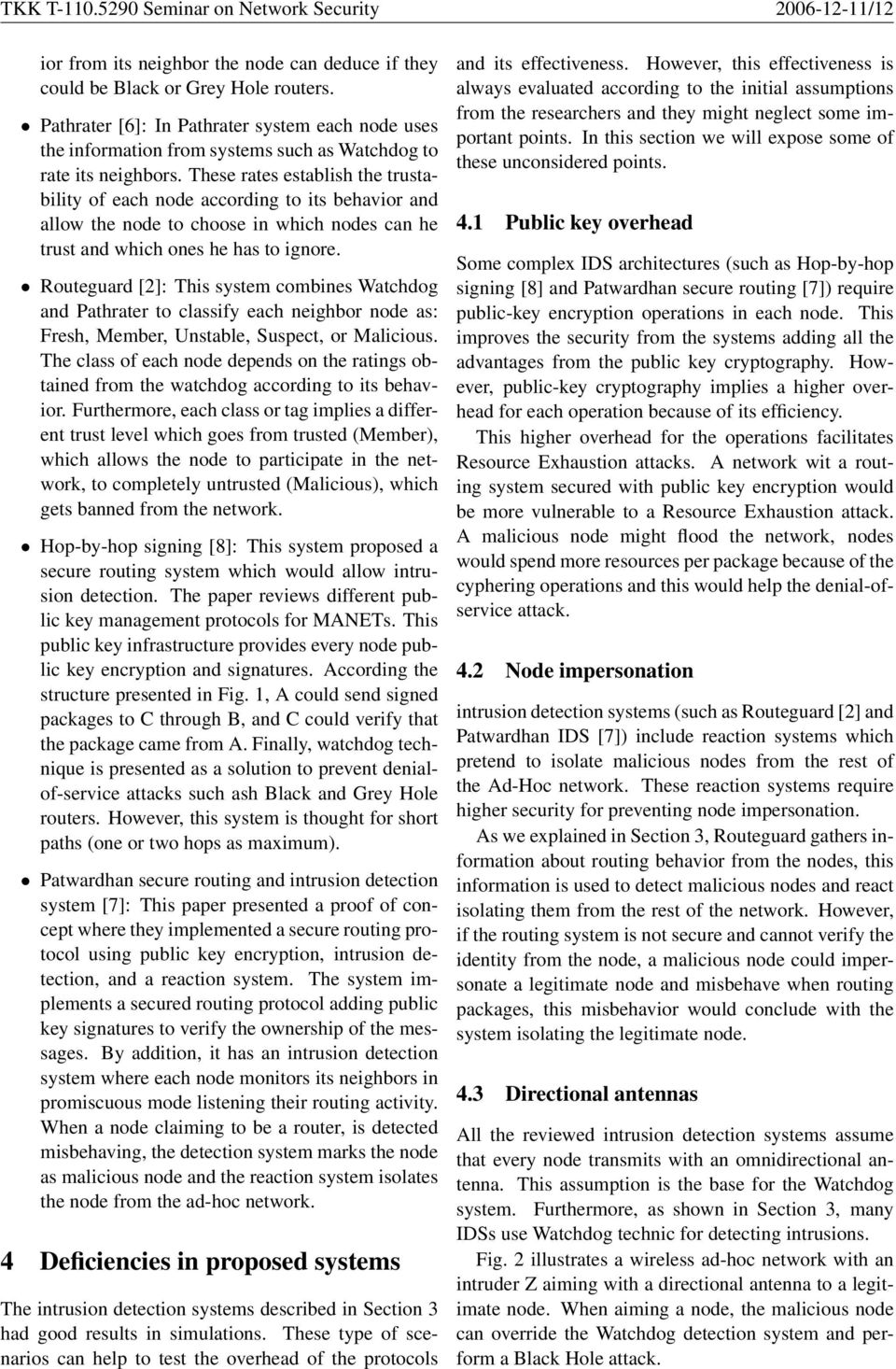
4 Paper from Zhang [8] mentioned in its discussions that Hop-by-hop signing detection system was unable to detect Black Hole routers, and the paper illustrated briefly a proposal for solving this issue. This proposal introduces a third node in promiscuous mode listening the routing communication between its neighbors in order to detect a Black Hole router attack from a malicious node. Nevertheless, the proposal is mentioned to be unsuitable because the malicious node should be in the range of the third node. However, as we showed in Fig. 2, directional antennas can easily prevent the detection. Section 3 has been implemented in a real ad-hoc network with mobile devices. These proves of concept are usually helpful for testing efficiency and vulnerabilities. References [1] S. Cheung and K. Levitt. Protecting routing infrastructures from denial of service using cooperative intrusion detection. Proceedings of the 1997 workshop on New security paradigms, pages , [2] A. Hasswa, M. Zulkernine, and H. Hassanein. Routeguard: an intrusion detection and response system for mobile ad hoc networks. Wireless And Mobile Computing, Networking And Communications, 2005.(WiMob 2005), IEEE International Conference on, 3, [3] Y. Hu, A. Perrig, and D. Johnson. Ariadne: A Secure On-Demand Routing Protocol for Ad Hoc Networks. Wireless Networks, 11(1):21 38, Figure 2: Intruder with a directional antenna 5 Conclusion Routing system is the most vulnerable point from mobile ad-hoc networks. This vulnerability implies a risk of denial-of-service attacks against certain nodes, or even the whole network, is high. Furthermore, this risk is not acceptable in those scenarios which are more susceptible to implement mobile ad-hoc networks such as those exposed in the introduction: battlefield, and establishing communications after natural disasters. And, as we mentioned in the introduction, security, and specially availability, is critical in those scenarios. This paper briefly described some common deficiencies found in the intrusion detection systems we have reviewed. Further research is needed for improving actual intrusion detection systems for MANETs, and that research should consider the deficiencies presented in Section 4 which were neglected in previous research. Finally, would be interesting to have more development and implementation tasks for this routing protocols and IDSs. Only one of the systems presented in [4] Y. Huang, W. Fan, W. Lee, and P. Yu. Cross- Feature Analysis for Detecting Ad-Hoc Routing Anomalies. Proceedings of the 23rd International Conference on Distributed Computing Systems, [5] C. Karlof and D. Wagner. Secure routing in wireless sensor networks: attacks and countermeasures. Sensor Network Protocols and Applications, Proceedings of the First IEEE IEEE International Workshop on, pages , [6] S. Marti, T. Giuli, K. Lai, and M. Baker. Mitigating routing misbehavior in mobile ad hoc networks. Proceedings of the 6th annual international conference on Mobile computing and networking, pages , [7] A. Patwardhan, J. Parker, A. Joshi, M. Iorga, and T. Karygiannis. Secure Routing and Intrusion Detection in Ad Hoc Networks. Third IEEE International Conference on Pervasive Computing and Communications, Kauaii Island, Hawaii, March, pages 8 12, [8] W. Zhang, R. Rao, G. Cao, and G. Kesidis. Secure routing in ad hoc networks and a related intrusion detection problem. Military Communications Conference, MILCOM IEEE, 2, 2003.

5 [9] Y. Zhang and W. Lee. Intrusion detection in wireless ad-hoc networks. Proceedings of the 6th annual international conference on Mobile computing and networking, pages , 2000.

CHAPTER 1 INTRODUCTION
 21 CHAPTER 1 INTRODUCTION 1.1 PREAMBLE Wireless ad-hoc network is an autonomous system of wireless nodes connected by wireless links. Wireless ad-hoc network provides a communication over the shared wireless
Security in Ad Hoc Network
 Security in Ad Hoc Network Bingwen He Joakim Hägglund Qing Gu Abstract Security in wireless network is becoming more and more important while the using of mobile equipments such as cellular phones or laptops
INTERNATIONAL JOURNAL OF PURE AND APPLIED RESEARCH IN ENGINEERING AND TECHNOLOGY
 INTERNATIONAL JOURNAL OF PURE AND APPLIED RESEARCH IN ENGINEERING AND TECHNOLOGY A PATH FOR HORIZING YOUR INNOVATIVE WORK AN OVERVIEW OF MOBILE ADHOC NETWORK: INTRUSION DETECTION, TYPES OF ATTACKS AND
Routing Protocols Security in Ah Hoc Networks
 Routing Protocols Security in Ah Hoc Networks Ebrahim Mohammed Louis Dargin Oakland University School of Computer Science and Engineering CSE 681 Information Security [email protected] [email protected]
Intrusion Detection for Mobile Ad Hoc Networks
 Intrusion Detection for Mobile Ad Hoc Networks Tom Chen SMU, Dept of Electrical Engineering [email protected] http://www.engr.smu.edu/~tchen TC/Rockwell/5-20-04 SMU Engineering p. 1 Outline Security problems
Security for Ad Hoc Networks. Hang Zhao
 Security for Ad Hoc Networks Hang Zhao 1 Ad Hoc Networks Ad hoc -- a Latin phrase which means "for this [purpose]". An autonomous system of mobile hosts connected by wireless links, often called Mobile
Preventing Resource Exhaustion Attacks in Ad Hoc Networks
 Preventing Resource Exhaustion Attacks in Ad Hoc Networks Masao Tanabe and Masaki Aida NTT Information Sharing Platform Laboratories, NTT Corporation, 3-9-11, Midori-cho, Musashino-shi, Tokyo 180-8585
A NOVEL OVERLAY IDS FOR WIRELESS SENSOR NETWORKS
 A NOVEL OVERLAY IDS FOR WIRELESS SENSOR NETWORKS Sumanta Saha, Md. Safiqul Islam, Md. Sakhawat Hossen School of Information and Communication Technology The Royal Institute of Technology (KTH) Stockholm,
Anomaly Intrusion Detection System in Wireless Sensor Networks: Security Threats and Existing Approaches
 Anomaly Intrusion Detection System in Wireless Sensor Networks: Security Threats and Existing Approaches Md. Safiqul Islam *1, Syed AshiqurRahman *2 Department of Computer Science and Engineering Daffodil
Survey on IDS for Addressing Security Issues of MANETS
 SSRG International Journal of Computer Science and Engineering (SSRG-IJCSE) volume1 issue8 October 2014 Survey on IDS for Addressing Security Issues of MANETS Agna Jose E. 1 Manu M.R. 2 1 Computer science
Technology Longowal, Punjab, India
 An Intrusion Detection System Against Multiple Blackhole Attacks In Ad-Hoc Networks Using Wireless Antnet Sunny Chanday 1, Rajeev Kumar 2, Dilip Kumar 3 1 M.Tech student, Department of Computer Science
A Survey of MANET Intrusion Detection & Prevention Approaches for Network Layer Attacks
 1 A Survey of MANET Intrusion Detection & Prevention Approaches for Network Layer Attacks Adnan Nadeem member IEEE and Michael P. Howarth Abstract In the last decade, mobile ad hoc networks (MANETs) have
Security and Privacy Issues in Wireless Ad Hoc, Mesh, and Sensor Networks
 Advance in Electronic and Electric Engineering. ISSN 2231-1297, Volume 4, Number 4 (2014), pp. 381-388 Research India Publications http://www.ripublication.com/aeee.htm Security and Privacy Issues in Wireless
Signature based Intrusion Detection for Wireless Ad-Hoc Networks: A Comparative study of various routing protocols
 Signature based Intrusion Detection for Wireless Ad-Hoc Networks: A Comparative study of various routing protocols Farooq Anjum Applied Research Telcordia. Tech Inc. Morristown NJ 796 [email protected]
Securing MANET Using Diffie Hellman Digital Signature Scheme
 Securing MANET Using Diffie Hellman Digital Signature Scheme Karamvir Singh 1, Harmanjot Singh 2 1 Research Scholar, ECE Department, Punjabi University, Patiala, Punjab, India 1 [email protected] 2
Mobile Security Wireless Mesh Network Security. Sascha Alexander Jopen
 Mobile Security Wireless Mesh Network Security Sascha Alexander Jopen Overview Introduction Wireless Ad-hoc Networks Wireless Mesh Networks Security in Wireless Networks Attacks on Wireless Mesh Networks
Wireless Sensor Networks Chapter 14: Security in WSNs
 Wireless Sensor Networks Chapter 14: Security in WSNs António Grilo Courtesy: see reading list Goals of this chapter To give an understanding of the security vulnerabilities of Wireless Sensor Networks
Preventing DDOS attack in Mobile Ad-hoc Network using a Secure Intrusion Detection System
 Preventing DDOS attack in Mobile Ad-hoc Network using a Secure Intrusion Detection System Shams Fathima M.Tech,Department of Computer Science Kakatiya Institute of Technology & Science, Warangal,India
Ariadne A Secure On-Demand Routing Protocol for Ad-Hoc Networks
 Ariadne A Secure On-Demand Routing Protocol for Ad-Hoc Networks Authors: Yih-Chun Hu, Adrian Perrig, David B Johnson Presenter: Sameer Korrapati Date: 4/21/2003 Overview of presentation Introduction :
Robust Routing in Wireless Ad Hoc Networks
 Robust Routing in Wireless Ad Hoc Networks Seungjoon Lee, Bohyung Han, Minho Shin {slee, bhhan, mhshin}@cs.umd.edu Computer Science Department University of Maryland College Park, MD 2742 USA Abstract
EFS: Enhanced FACES Protocol for Secure Routing In MANET
 EFS: Enhanced FACES Protocol for Secure Routing In MANET Geethu Bastian Department of Information Technology Rajagiri School of Engineering & Technology, Rajagiri Valley P O Kochi-39, India [email protected]
Modified AODV protocol for prevention of Denial of service attacks in wireless Ad hoc networks
 Modified AODV protocol for prevention of Denial of service attacks in wireless Ad hoc networks B. MALARKODI, B. VENKATARAMANI AND X.T. PRADEEP Department of Electronics and Communication Engineering National
SECURITY ASPECTS IN MOBILE AD HOC NETWORK (MANETS)
 SECURITY ASPECTS IN MOBILE AD HOC NETWORK (MANETS) Neha Maurya, ASM S IBMR ABSTRACT: Mobile Ad hoc networks (MANETs) are a new paradigm of wireless network, offering unrestricted mobility without any underlying
mlab: A Mobile Ad Hoc Network Test Bed
 mlab: A Mobile Ad Hoc Network Test Bed A. Karygiannis and E. Antonakakis National Institute of Standards and Technology {karygiannis, manos}@nist.gov Abstract Over the last few years, research in the area
SECURE DATA TRANSMISSION USING INDISCRIMINATE DATA PATHS FOR STAGNANT DESTINATION IN MANET
 SECURE DATA TRANSMISSION USING INDISCRIMINATE DATA PATHS FOR STAGNANT DESTINATION IN MANET MR. ARVIND P. PANDE 1, PROF. UTTAM A. PATIL 2, PROF. B.S PATIL 3 Dept. Of Electronics Textile and Engineering
Ashok Kumar Gonela MTech Department of CSE Miracle Educational Group Of Institutions Bhogapuram.
 Protection of Vulnerable Virtual machines from being compromised as zombies during DDoS attacks using a multi-phase distributed vulnerability detection & counter-attack framework Ashok Kumar Gonela MTech
Security Issues in Mobile Ad Hoc Networks - A Survey
 Security Issues in Mobile Ad Hoc Networks - A Survey Wenjia Li and Anupam Joshi Department of Computer Science and Electrical Engineering University of Maryland, Baltimore County Abstract In this paper,
How To Write A Transport Layer Protocol For Wireless Networks
 Chapter 9: Transport Layer and Security Protocols for Ad Hoc Wireless Networks Introduction Issues Design Goals Classifications TCP Over Ad Hoc Wireless Networks Other Transport Layer Protocols Security
Study of Different Types of Attacks on Multicast in Mobile Ad Hoc Networks
 Study of Different Types of Attacks on Multicast in Mobile Ad Hoc Networks Hoang Lan Nguyen and Uyen Trang Nguyen Department of Computer Science and Engineering, York University 47 Keele Street, Toronto,
Link Layer and Network Layer Security for Wireless Networks
 White Paper Link Layer and Network Layer Security for Wireless Networks Abstract Wireless networking presents a significant security challenge. There is an ongoing debate about where to address this challenge:
An Implementation of Secure Wireless Network for Avoiding Black hole Attack
 An Implementation of Secure Wireless Network for Avoiding Black hole Attack Neelima Gupta Research Scholar, Department of Computer Science and Engineering Jagadguru Dattaray College of Technology Indore,
Security Threats in Mobile Ad Hoc Networks
 Security Threats in Mobile Ad Hoc Networks Hande Bakiler, Aysel Şafak Department of Electrical & Electronics Engineering Baskent University Ankara, Turkey [email protected], [email protected]
Intrusion Detection of Sinkhole Attacks in Wireless Sensor Networks
 Intrusion Detection of Sinkhole Attacks in Wireless Sensor Networks Ioannis Krontiris, Tassos Dimitriou, Thanassis Giannetsos, and Marios Mpasoukos Athens Information Technology, P.O.Box 68, 19.5 km Markopoulo
Secure Routing in Wireless Sensor Networks
 Secure Routing in Wireless Sensor Networks Introduction to Wireless Sensor Networks Ida Siahaan / Leonardo Fernandes DIT Ida Siahaan / Leonardo Fernandes (DIT) Secure Routing in Wireless Sensor Networks
International Journal of Advanced Research in Computer Science and Software Engineering
 Volume 3, Issue 1, January 2013 ISSN: 2277 128X International Journal of Advanced Research in Computer Science and Software Engineering Research Paper Available online at: www.ijarcsse.com Analysis of
Wireless Sensor Network Security. Seth A. Hellbusch CMPE 257
 Wireless Sensor Network Security Seth A. Hellbusch CMPE 257 Wireless Sensor Networks (WSN) 2 The main characteristics of a WSN include: Power consumption constrains for nodes using batteries or energy
STUDY OF IMPLEMENTATION OF INTRUSION DETECTION SYSTEM (IDS) VIA DIFFERENT APPROACHS
 STUDY OF IMPLEMENTATION OF INTRUSION DETECTION SYSTEM (IDS) VIA DIFFERENT APPROACHS SACHIN MALVIYA Student, Department of Information Technology, Medicaps Institute of Science & Technology, INDORE (M.P.)
A Dynamic Reputation Management System for Mobile Ad Hoc Networks
 A Dynamic Reputation Management System for Mobile Ad Hoc Networks Eric Chiejina School of Computer Science University of Hertfordshire Hatfield, UK [email protected] Hannan Xiao School of Computer
Security Scheme for Distributed DoS in Mobile Ad Hoc Networks
 Security Scheme for Distributed DoS in Mobile Ad Hoc Networks Sugata Sanyal 1, Ajith Abraham 2, Dhaval Gada 3, Rajat Gogri 3, Punit Rathod 3, Zalak Dedhia 3 and Nirali Mody 3 1 School of Technology and
Robust Security Solution to Countermeasure of Malicious Nodes for the Security of MANET
 Robust Security Solution to Countermeasure of Malicious Nodes for the Security of MANET Kritika Sharma M.tech(CSE) Doon Valley Insttitute of Enggineering & Technology, Karnal Parikshit Singla Assistant
SECURITY ISSUES: THE BIG CHALLENGE IN MANET
 Available Online at www.ijcsmc.com International Journal of Computer Science and Mobile Computing A Monthly Journal of Computer Science and Information Technology IJCSMC, Vol. 3, Issue. 3, March 2014,
ENHANCED GREEN FIREWALL FOR EFFICIENT DETECTION AND PREVENTION OF MOBILE INTRUDER USING GREYLISTING METHOD
 ENHANCED GREEN FIREWALL FOR EFFICIENT DETECTION AND PREVENTION OF MOBILE INTRUDER USING GREYLISTING METHOD G.Pradeep Kumar 1, R.Chakkaravarthy 2, S.Arun kishorre 3, L.S.Sathiyamurthy 4 1- Assistant Professor,
AN EFFICIENT STRATEGY OF AGGREGATE SECURE DATA TRANSMISSION
 INTERNATIONAL JOURNAL OF REVIEWS ON RECENT ELECTRONICS AND COMPUTER SCIENCE AN EFFICIENT STRATEGY OF AGGREGATE SECURE DATA TRANSMISSION K.Anusha 1, K.Sudha 2 1 M.Tech Student, Dept of CSE, Aurora's Technological
Securing Ad hoc Routing Protocols
 Securing Ad hoc Routing Protocols Frank Kargl Stefan Schlott Andreas Klenk Alfred Geiss Michael Weber Department of Media Informatics, University of Ulm, Germany Email: [email protected]
A REVIEW: MOBILE AD-HOC NETWORK PROTOCOLS AND SECURITY ISSUES
 A REVIEW: MOBILE AD-HOC NETWORK PROTOCOLS AND SECURITY ISSUES Ankit Mehto, Hitesh Gupta Department of Computer Science & Engineering, PIT, Bhopal, India ABSTRACT The instant growth of communication takes
A Comparison Study of Qos Using Different Routing Algorithms In Mobile Ad Hoc Networks
 A Comparison Study of Qos Using Different Routing Algorithms In Mobile Ad Hoc Networks T.Chandrasekhar 1, J.S.Chakravarthi 2, K.Sravya 3 Professor, Dept. of Electronics and Communication Engg., GIET Engg.
Vampire Attack Detecting and Preventing in Wireless Sensor Network
 International Journal of Emerging Engineering Research and Technology Volume 2, Issue 4, July 2014, PP 306-310 ISSN 2349-4395 (Print) & ISSN 2349-4409 (Online) Vampire Attack Detecting and Preventing in
Content Distribution Networks (CDN)
 229 Content Distribution Networks (CDNs) A content distribution network can be viewed as a global web replication. main idea: each replica is located in a different geographic area, rather then in the
Denial of Service in Sensor Networks
 Denial of Service in Sensor Networks Authors : From: Anthony D. Wood John A. Stankovic University of Virginia Presented by: Luba Sakharuk Agenda for the DOS in Sensor Networks Abstract Theory and Application
CHAPTER 6 SECURE PACKET TRANSMISSION IN WIRELESS SENSOR NETWORKS USING DYNAMIC ROUTING TECHNIQUES
 CHAPTER 6 SECURE PACKET TRANSMISSION IN WIRELESS SENSOR NETWORKS USING DYNAMIC ROUTING TECHNIQUES 6.1 Introduction The process of dispersive routing provides the required distribution of packets rather
MOBILE AD HOC NETWORKS UNDER WORMHOLE ATTACK: A SIMULATION STUDY
 MOBILE AD HOC NETWORKS UNDER WORMHOLE ATTACK: A SIMULATION STUDY Nadher M. A. Al_Safwani, Suhaidi Hassan, and Mohammed M. Kadhum Universiti Utara Malaysia, Malaysia, {suhaidi, khadum}@uum.edu.my, [email protected]
[email protected] [email protected]
 S. Sumathy 1 and B.Upendra Kumar 2 1 School of Computing Sciences, VIT University, Vellore-632 014, Tamilnadu, India [email protected] 2 School of Computing Sciences, VIT University, Vellore-632 014,
SY0-201. system so that an unauthorized individual can take over an authorized session, or to disrupt service to authorized users.
 system so that an unauthorized individual can take over an authorized session, or to disrupt service to authorized users. From a high-level standpoint, attacks on computer systems and networks can be grouped
Behavior Analysis of TCP Traffic in Mobile Ad Hoc Network using Reactive Routing Protocols
 Behavior Analysis of TCP Traffic in Mobile Ad Hoc Network using Reactive Routing Protocols Purvi N. Ramanuj Department of Computer Engineering L.D. College of Engineering Ahmedabad Hiteishi M. Diwanji
Performance Analysis of Observation Based Cooperation Enforcement in Ad Hoc Networks
 www.ijcsi.org 79 Performance Analysis of Observation Based Cooperation Enforcement in Ad Hoc Networks Abeer Ghandar 1, Eman Shabaan 2 and Zaky Fayed 3 1 Computer Systems Department, Faculty of Computer
A Catechistic Method for Traffic Pattern Discovery in MANET
 A Catechistic Method for Traffic Pattern Discovery in MANET R. Saranya 1, R. Santhosh 2 1 PG Scholar, Computer Science and Engineering, Karpagam University, Coimbatore. 2 Assistant Professor, Computer
Second-generation (GenII) honeypots
 Second-generation (GenII) honeypots Bojan Zdrnja CompSci 725, University of Auckland, Oct 2004. [email protected] Abstract Honeypots are security resources which trap malicious activities, so they
ROUTE MECHANISMS FOR WIRELESS ADHOC NETWORKS: -CLASSIFICATIONS AND COMPARISON ANALYSIS
 International Journal of Science, Environment and Technology, Vol. 1, No 2, 2012, 72-79 ROUTE MECHANISMS FOR WIRELESS ADHOC NETWORKS: -CLASSIFICATIONS AND COMPARISON ANALYSIS Ramesh Kait 1, R. K. Chauhan
A Security Architecture for. Wireless Sensor Networks Environmental
 Contemporary Engineering Sciences, Vol. 7, 2014, no. 15, 737-742 HIKARI Ltd, www.m-hikari.com http://dx.doi.org/10.12988/ces.2014.4683 A Security Architecture for Wireless Sensor Networks Environmental
Link Layer and Network Layer Security for Wireless Networks
 Link Layer and Network Layer Security for Wireless Networks Interlink Networks, Inc. May 15, 2003 1 LINK LAYER AND NETWORK LAYER SECURITY FOR WIRELESS NETWORKS... 3 Abstract... 3 1. INTRODUCTION... 3 2.
Performance Evaluation of AODV, OLSR Routing Protocol in VOIP Over Ad Hoc
 (International Journal of Computer Science & Management Studies) Vol. 17, Issue 01 Performance Evaluation of AODV, OLSR Routing Protocol in VOIP Over Ad Hoc Dr. Khalid Hamid Bilal Khartoum, Sudan [email protected]
Comparison of Various Passive Distributed Denial of Service Attack in Mobile Adhoc Networks
 Comparison of Various Passive Distributed Denial of Service in Mobile Adhoc Networks YOGESH CHABA #, YUDHVIR SINGH, PRABHA RANI Department of Computer Science & Engineering GJ University of Science & Technology,
Lecture Objectives. Lecture 8 Mobile Networks: Security in Wireless LANs and Mobile Networks. Agenda. References
 Lecture Objectives Wireless Networks and Mobile Systems Lecture 8 Mobile Networks: Security in Wireless LANs and Mobile Networks Introduce security vulnerabilities and defenses Describe security functions
Security Technology White Paper
 Security Technology White Paper Issue 01 Date 2012-10-30 HUAWEI TECHNOLOGIES CO., LTD. 2012. All rights reserved. No part of this document may be reproduced or transmitted in any form or by any means without
Djenouri Djamel & Nadjib Badache
 Djenouri Djamel & Nadjib Badache LSI-TR0504 February 2004 A Survey on Security Issues in Mobile Ad hoc Networks Djamel DJENOURI, Nadjib BADACHE : Basic Software Laboratory, CERIST Center of Research, Algiers,
Lab VI Capturing and monitoring the network traffic
 Lab VI Capturing and monitoring the network traffic 1. Goals To gain general knowledge about the network analyzers and to understand their utility To learn how to use network traffic analyzer tools (Wireshark)
12/3/08. Security in Wireless LANs and Mobile Networks. Wireless Magnifies Exposure Vulnerability. Mobility Makes it Difficult to Establish Trust
 Security in Wireless LANs and Mobile Networks Wireless Magnifies Exposure Vulnerability Information going across the wireless link is exposed to anyone within radio range RF may extend beyond a room or
Security+ Guide to Network Security Fundamentals, Fourth Edition. Chapter 6 Network Security
 Security+ Guide to Network Security Fundamentals, Fourth Edition Chapter 6 Network Security Objectives List the different types of network security devices and explain how they can be used Define network
Review of Prevention techniques for Denial of Service Attacks in Wireless Sensor Network
 Review of Prevention techniques for Denial of Service s in Wireless Sensor Network Manojkumar L Mahajan MTech. student, Acropolis Technical Campus, Indore (MP), India Dushyant Verma Assistant Professor,
Lecture 2.1 : The Distributed Bellman-Ford Algorithm. Lecture 2.2 : The Destination Sequenced Distance Vector (DSDV) protocol
 Lecture 2 : The DSDV Protocol Lecture 2.1 : The Distributed Bellman-Ford Algorithm Lecture 2.2 : The Destination Sequenced Distance Vector (DSDV) protocol The Routing Problem S S D D The routing problem
A Secure Intrusion detection system against DDOS attack in Wireless Mobile Ad-hoc Network Abstract
 A Secure Intrusion detection system against DDOS attack in Wireless Mobile Ad-hoc Network Abstract Wireless Mobile ad-hoc network (MANET) is an emerging technology and have great strength to be applied
CS5008: Internet Computing
 CS5008: Internet Computing Lecture 22: Internet Security A. O Riordan, 2009, latest revision 2015 Internet Security When a computer connects to the Internet and begins communicating with others, it is
Overview of Network Security The need for network security Desirable security properties Common vulnerabilities Security policy designs
 Overview of Network Security The need for network security Desirable security properties Common vulnerabilities Security policy designs Why Network Security? Keep the bad guys out. (1) Closed networks
Recommended 802.11 Wireless Local Area Network Architecture
 NATIONAL SECURITY AGENCY Ft. George G. Meade, MD I332-008R-2005 Dated: 23 September 2005 Network Hardware Analysis and Evaluation Division Systems and Network Attack Center Recommended 802.11 Wireless
On the Resilient Overlay Topology Formation in Multi-hop Wireless Networks
 On the Resilient Overlay Topology Formation in Multi-hop Wireless Networks Fei Xing and Wenye Wang Department of Electrical and Computer Engineering North Carolina State University, Raleigh, NC 27695,
All vulnerabilities that exist in conventional wired networks apply and likely easier Theft, tampering of devices
 Wireless Security All vulnerabilities that exist in conventional wired networks apply and likely easier Theft, tampering of devices Portability Tamper-proof devices? Intrusion and interception of poorly
DETECTING AND PREVENTING THE PACKET FOR TRACE BACK DDOS ATTACK IN MOBILE AD-HOC NETWORK
 DETECTING AND PREVENTING THE PACKET FOR TRACE BACK DDOS ATTACK IN MOBILE AD-HOC NETWORK M.Yasodha 1, S.Umarani 2, D.Sharmila 3 1 PG Scholar, Maharaja Engineering College, Avinashi, India. 2 Assistant Professor,
III. Our Proposal ASOP ROUTING ALGORITHM. A.Position Management
 Secured On-Demand Position Based Private Routing Protocol for Ad-Hoc Networks Ramya.R, Shobana.K, Thangam.V.S [email protected], k [email protected],[email protected] Department of Computer Science,
DoS Attack and Its Countermeasure in Energy-Constrained Wireless Networks
 DoS Attack and Its Countermeasure in Energy-Constrained Wireless Networks Sunho Lim (Ph.D., Assistant Professor) T 2 WISTOR: TTU Wireless Mobile Networking Laboratory Dept. of Computer Science Texas Tech
Intrusion Detection in Wireless Ad Hoc Networks
 Intrusion Detection in Wireless Ad Hoc Networks Banshilal Patidar, Pinaki A.Ghosh Department of Computer Science and Engineering Bansal Institute of Science and Technology Bhopal (M.P.). India [email protected]
Security protocols for ad-hoc wireless networks Raghava Karanam, Gautam Sreeram Pendum, Narendra Nath Vattikuti
 Security protocols for ad-hoc wireless networks Raghava Karanam, Gautam Sreeram Pendum, Narendra Nath Vattikuti Project Introduction/Motivation With the emergence of the integrated circuits, the wireless
Fast and Secure Data Transmission by Using Hybrid Protocols in Mobile Ad Hoc Network
 Middle-East Journal of Scientific Research 15 (9): 1290-1294, 2013 ISSN 1990-9233 IDOSI Publications, 2013 DOI: 10.5829/idosi.mejsr.2013.15.9.11514 Fast and Secure Data Transmission by Using Hybrid Protocols
A Review of Secure Ad-hoc Routing
 www..org 30 A Review of Secure Ad-hoc Routing Tannu Arora 1, Deepika Arora 2 1 Computer Science, M.D.U/GIET, Sonipat, Haryana, India [email protected] 2 Computer Science, C.D.L.U, Sirsa, Haryana, India
Wireless Security: Secure and Public Networks Kory Kirk
 Wireless Security: Secure and Public Networks Kory Kirk Villanova University Computer Science [email protected] www.korykirk.com/ Abstract Due to the increasing amount of wireless access points that
Industrial Network Security for SCADA, Automation, Process Control and PLC Systems. Contents. 1 An Introduction to Industrial Network Security 1
 Industrial Network Security for SCADA, Automation, Process Control and PLC Systems Contents 1 An Introduction to Industrial Network Security 1 1.1 Course overview 1 1.2 The evolution of networking 1 1.3
CS 665: Computer System Security. Network Security. Usage environment. Sources of vulnerabilities. Information Assurance Module
 CS 665: Computer System Security Network Security Bojan Cukic Lane Department of Computer Science and Electrical Engineering West Virginia University 1 Usage environment Anonymity Automation, minimal human
SIMULATION STUDY OF BLACKHOLE ATTACK IN THE MOBILE AD HOC NETWORKS
 Journal of Engineering Science and Technology Vol. 4, No. 2 (2009) 243-250 School of Engineering, Taylor s University College SIMULATION STUDY OF BLACKHOLE ATTACK IN THE MOBILE AD HOC NETWORKS SHEENU SHARMA
Cisco Network Foundation Protection Overview
 Cisco Network Foundation Protection Overview June 2005 1 Security is about the ability to control the risk incurred from an interconnected global network. Cisco NFP provides the tools, technologies, and
DENIAL OF SERVICE IN WIRELESS SENSOR NETWORKS: ISSUES AND CHALLENGES
 In: Advances in Communications and Media Research ISBN 978-1-60876-576-8 Editor: Anthony V. Stavros, pp. 2010 Nova Science Publishers, Inc. Chapter 3 DENIAL OF SERVICE IN WIRELESS SENSOR NETWORKS: ISSUES