
Shaping the Identity of the International Business School
|
|
|
- Delphia Lucas
- 10 years ago
- Views:
Transcription
1 Shaping the Identity of the International Business School -Accreditation as the Road to Success? Author: Monica Palmqvist Supervisor: Nils Wåhlin Student Umeå School of Business Spring semester 2009 Master thesis, one-year, 15 hp
2

3 ABSTRACT Internationalization is an important strategic issue for survival for most business schools of today. Following this, various international accreditation bodies have in recent years been very successful in promoting accreditation as a means of gaining status and prove high quality. These business school accreditation schemes clearly state their targets against top quality international schools and programs. Internationalization of the business school operations can thus be stated to be of vital importance for schools aiming for one or more of these accreditations. The intention of this study is to turn the issue around and explore to which extent, and with what kind of impact, the accreditation processes in turn have on the area of internationalization within the business school organization. The theoretical framework consists of three main areas: The Business School Environment, Strategy as Practice and Institutional Theory. The first part aims to reach an understanding for the environment and situation that business schools of today are facing. It also highlights major challenges for the future. In the second part, Strategy as Practice research theories are used to gain understanding for strategy behaviour and strategy creation within pluralistic organizations, such as the higher education institution. The third part deals with issues on Quality Frameworks with the aim to reach understanding for the impact such processes can have on the organization. Sensemaking Theory is further used to illustrate the rational behind decision making of business school leaders and the concluding part connects theories on quality frameworks to Identity Creation, linking together identity with culture and image. The research approach for this qualitative study is the abductive one and the empirical data is collected through a number of semi-structured interviews with business school representatives at various levels working in the area of international relations. Main findings are presented within the framework of a time structured (past, present, future) model connected to the study s five objectives: The development of internationalization within the school; the view on internationalization among organizational members; the characteristics of decision making and implementation processes; the main impact factors of accreditation and the expectations of major future challenges. The results indicate that although accreditation has shown to have had a substantial impact on the success of business school operations in an international perspective, it is to a much lesser extent a concrete tool for change and improvement within the area of internationalization as such. Accreditation has shown to be strongly connected to previous development and view on internationalization within the organizations. Also, a strong belief in, and commitment to, internationalization among influential organizational members has proved to be vital for the accreditation processes. Furthermore, a number of unique characteristics connected to the identities of the organizations studied showed to have notable impact on the success of the schools international operations, so also the accreditation processes. This includes organizational culture and tradition; working methods; dissemination of information; strong social connections; knowledge, dedication and commitment by individuals and management s ability to provide organizational members with trust, respect, autonomy and encouragement. Key words: Accreditation, Business School, Identity, Institutionalization, Internationalization, Sensemaking, Strategy as Practice, Quality Frameworks.
4

5 ACKNOWLEDGEMENTS Having finalized this thesis project, I would like to take the opportunity to show my gratitude to a number of persons who have helped and supported me through the process: The USBE Management Team: -For providing me with the opportunity of performing this project within the framework of my regular duties. It has been much appreciated. The Per and Eivor Wikström Foundation: -For providing me with a scholarship making it possible to do interviews in France. Nils Wåhlin: -For invaluable input on academic issues and for your positive attitude, constantly encouraging me in times of doubt. Bibbi, Carina, Gisela, Harriet and Lennart: -For covering for me with your competence and knowledge when I was not around. Catherine Lions: -For valuable input to the research problem. Erik, Amanda and Johan: -For love and patience. Lakrits and Semla (cats): -For charitable breaks. Maggan (last but not least): -For advice and encouragement, indomitable strength and fighting spirit. A research project is a trifle when it comes to life in general.
6

7 TABLE OF CONTENTS 1. INTRODUCTION Background of the Study Research Question Objectives of the Study Demarcations and Perspective Model Introduction THEORETICAL METHODOLOGY Research Philosophy Research Approach Research Strategy Choice of Theories and Secondary Data Collection Research Process Model THEORETICAL FRAMEWORK The Business School Environment Internationalization of Business School Education Challenges ahead Summary Accreditation and Ranking Schemes Business School Accreditation Schemes Business School Rankings Strategy as Practice Defining Strategy as Practice The Framework of Strategy as Practice Research Pluralistic Organizations and Multiple Strategies Strategizing Behaviour and the Strategizing Matrix Summary Institutional Theory Defining Institutional Theory Quality Frameworks Sensemaking Organizational Identity Summary Model Development PRACTICAL METHODOLOGY Strategy for Presentation and Analysis of Data Research Sample Schools Respondents Interviews The Interview Guide Conduction of Interviews Processing the data... 54

8 5. EMPIRICAL FINDINGS Internationalization Development of Internationalization View on Internationalization Organizing International Activities Accreditation Decision Making and Implementation Impact of Accreditation Facing the Future Expectations and Challenges Summary of Empirical Findings ANALYSIS AND DISCUSSION Environmental Issues and School Characteristics Internationalization Development of Internationalization View on Internationalization Organizing International Activities Accreditation Strategic Decision and Implementation Impact of Accreditation Making Sense of the Accreditation Identity Creation through Accreditation Facing the Future Expectations and Challenges CONCLUSIONS Conclusions Implications of the study Future Research QUALITY CRITERIA Credibility Transferability Dependability Confirmability LIST OF REFERENCES Secondary sources Primary sources APPENDICES APPENDIX 1 The EQUIS Framework APPENDIX 2 EQUIS Standards & Criteria for Internationalization APPENDIX 3 Business School Ranking Schemes APPENDIX 4 Letter to the Respondents APPENDIX 5 Interview Guide APPENDIX 6 Business Schools and Respondents APPENDIX 7 Mission Statement: University of Mannheim Business School APPENDIX 8 Mission Statement: Grenoble Ecole de Management

9 LIST OF FIGURES Figure 1.1 Introductory Model... 5 Figure 2.1 Four Paradigms for the Analysis of Social Theory... 8 Figure 2.2 Induction and Deduction Figure 2.3 The Hermeneutical Circle Figure 3.1 The Key Forces Driving Management Education Figure 3.3 A Conceptual Framework for Analyzing Strategy as Practice Figure 3.4 The Strategizing Matrix Figure 3.5 The Organizational Identity Dynamics Model Figure 3.6 Developed Model Figure 4.1 Four Ontological/Epistemological Standpoints Figure 6.1 Applying Strategizing Behaviour to the Strategizing Matrix Figure 6.2 Applying Accreditation to the Organizational Identity Dynamics Model Figure 6.3 Applying Business School results to the Key Driving Forces Model Figure 7.1 Concluding Model LIST OF TABLES Table 2.1 Summary of Theoretical Methodological Standpoints Table 3.1 Summary of the Conceptual Framework for Analyzing Strategy as Practice Table 4.1 Overview of Interviews Table 5.1 Summary of Empirical Findings Table 6.1 Analysis and Discussion Chapter Framework Table 6.2 Summary of the Conceptual Framework for Analysing Strategy as Practice Table 6.3 Competition as the Key Driving Force Table 6.4 Globalization as the Key Driving Force Table 6.5 Technology as the Key Driving Force Table 6.6 Identity as the Key Driving Force LIST OF ABBREVIATIONS AACSB AMBA CCR GEM EFMD EQUIS UMBS (not official) Association to Advance Collegiate Schools of Business Association of MBAs Corporate and Community Relations Grenoble Ecole de Management European Foundation for Management Development European Quality Insurance System University of Mannheim Business School

10

11 Introduction 1. INTRODUCTION 1.1 Background of the Study Internationalization has come to be an important strategic issue for business schools in the last decade. In fact, it should not be associated with too much risk to say that most business schools of today would define themselves as international. The question is rather whether a business school not defining itself as international would be considered a serious business education provider in today s global world. Already 20 years ago, the need for internationalizing the business school was discussed by Aggarwal (Aggarwal 1989), who saw the global dimension becoming an important aspect of business education. This need was, in his opinion, based on the fact that the product and financial markets in the US had globalized due to rapid advances in the technology of information processing and transmission at the time, and that the US economy had become less dominant with the growing economies in Europe and Asia. Thus, as business students needed to understand the global dimension of business in order to be able to work not only internationally or for multinational companies but also within their own country, business schools had to response to that need (Aggarwal 1989). In 2003, 2 million university students, or 2% of all students in the world, were studying outside their home country. Although not knowing the proportion of business students among these, we can assume that it was quite large. We can also assume that the 2 million in 2003 have been increasing substantially in the last five years. The author/s of this special Economics report on higher education (Economist 2005) means that the attractiveness of higher education institutions increases in proportion to these institutions tailoring their offerings to foreign students. Furthermore; the more students transfer between countries, the more the institutions count the choices of the students rather than acting on the wishes shown by national authorities. This results in two big trends continuously feeding each other; internationalization and competition (Economist 2005). Almost 20 years after Aggarwal, Starkey and Tempest, in discussing the evolving role of the business school, state that Internationalisation has been the latest holy grail/cash cow in the business school portfolio (Starkey and Tempest 2008). They envisage a future in which only the elite schools will continue to prosper while the majority of other business education providers will not survive unless they are innovative and find their own niche. Starkey and Tempest further mean that European business schools in particular need to develop a distinctive identity in order to successfully compete with their US counterparts (Starkey and Tempest 2008). In recent years, along with internationalization having become such an important tool for business schools to survive in the increasingly fierce competition, international accreditation bodies have had large success in promoting accreditation as a means of gaining status and prove high quality. Stating that this accreditation trend is one way for business schools to seek to develop such a distinctive identity as asked for by Starkey and Tempest, can hardly be considered a wild guess. EQUIS (The European Quality Improvement System), an international system of quality assessment for business schools, was created in 1997 by the EFMD (European Foundation for Management Development) with active support of a number or European top schools. The creation of EQUIS was based on the perceived need to develop an accreditation system targeted at business schools trying to make an international impact (Urgel 2007). 1
12 Introduction In the same period of time, the AACSB (Association to Advance Collegiate Schools of Business), having provided national accreditation for business schools in the US for almost 80 years, and the AMBA (Association for MBAs), having accredited MBA programs in the UK for almost 30 years, both decided to go international. While EQUIS already from the beginning clearly stated its target against top-quality international business schools, AACSB underwent a major revision in order to match its criteria to non-american educational systems, thus also stating their new target against schools wishing to compete on the global market (Urgel 2007, Trapnell 2007). By 2006, 22% of schools accredited by EQUIS were non-european, 16% of schools accredited by AACSB were non-north American (out of which 6% European) and 77% of AMBA accredited MBA programs were outside of the UK (out of which 30% non-european). In the last three years these numbers have further increased and today EQUIS, AACSB and AMBA are the three most regarded business school accreditations on the international arena (Urgel 2007). From the above we can conclude that internationalization has shown to be of vital importance for business schools aiming for accreditation. Since these accreditation systems are, in nature, of international character this does not come as a surprise. But what about the other way around; what impact does accreditation have on internationalization? Do business schools get even more international going through accreditation processes? Do business school employees change their way of working with international issues due to the accreditation processes? Do they look differently on internationalization of their school and its operations with the experience of the accreditation? Having worked in a Swedish business school (receiving the EQUIS accreditation for the first time in 2006) with international relations for several years, I have come to find this approach quite interesting. I believe that it has not gained very much attention, nor from researchers or business school representatives. The reason for this may simply be that the relationship between internationalization and accreditation is somehow viewed as a one way relationship; one that is more or less taken for granted: A high level of internationalization of business school operations is seen as necessary in order to reach the goal of accreditation. A school succeeding to gain an internationally recognized accreditation label has proven to be highly international end of story. I have, to quite a large extent, found research published on different aspects on internationalization in the higher education context; internationalization of higher education institutions in general and internationalization from the business school perspective in particular. I have also found a number of scientific- as well as viewpoint articles on business school accreditation schemes and the impact those can have on business schools in terms of, for instance; visibility, reputation and development of operations in general. I have however not found previous research that, in particular, addresses the specific relationship between accreditation and internationalization. When given the opportunity to write this thesis, the choice was therefore not very difficult. 1.2 Research Question Based on the above background, my research question has been defined as follows: To which extent is accreditation a tool for change and continuous improvement within the area of international relations in the business school? - What is the impact on the organization? 2

13 Introduction 1.3 Objectives of the Study To be able to analyze how a specific strategic decision (accreditation) has impacted on a certain area of business school operations (international relations), it is important to know something about the historic background and development of the area in question (internationalization). In short; knowing how far the school has reached in its internationalization process at the time of deciding to apply for accreditation. Thus, the first objective of this study is: 1. To describe the development of internationalization within the business school. In order to be able to draw reliable conclusions, it is important to gain understanding for the perceived meaning and value of the subject of study. This should be of specific importance when studying an area such as internationalization, which may have different meaning in different environments and for different people. This leads to the second objective of the study: 2. To describe how internationalization is viewed by organizational members. Having gained understanding for the area of study in question, the main objectives of the study can be defined: 3. To analyze the decision making and implementation processes for accreditation. 4. To gain understanding for the impact of accreditation for the business school as a whole and its international operations in specific. Finally, baring in mind the rapidly changing environment facing business schools of today, we cannot exclude one last objective: 5. To define future challenges to be faced by business schools wishing to stay competitive on the international arena. 1.4 Demarcations and Perspective This study is based on information gathered from two European business schools. Its findings can thus not be generalized across business schools worldwide or across the European business school community as a whole. The perspective of the empirical study is seen through the eyes of people working within international relations in the respective organizations. The results are therefore not necessarily applicable to other areas of operations within the business school. Finally, although people working at various levels within the area of international relations have been part of the study, my intention has not been to make comparisons between the organizational members at different levels but rather between the organizations as a whole. 3

14 Introduction 1.5 Model Introduction This study will be illustrated through the model presented on the next page. The timeline (past, present, future) provides a basis for illustrating the objectives as described above: First, we look back on internationalization within the organizations in general, followed by studying the accreditation process in specific (past). We then turn to look at the impact of accreditation for the organization of today (present) and finally, we try to predict what will happen in the next few years (future). The model will be further developed and presented again by concluding chapter 3, where the theoretical framework presented will be applied to the model. Finally, the model will be illustrating the conclusions of the study in chapter 7. 4

15 PAST P R E S E N T FUTURE INTERNATIONALIZATION WITHIN THE BUSINESS SCHOOL Development of Internationalization View on Internationalization Objective 1 Objective 2 ACCREDITATION Strategic Decision & Implementation Impact of Accreditation Organizing International Activities Objective 3 Objective 4 FACING THE FUTURE Expectations & Challenges Objective 5 Figure 1.1 Introductory Model (author s model) 5

16 Theoretical Methodology 2. THEORETICAL METHODOLOGY 2.1 Research Philosophy According to Remenyi et al., philosophical research questions are regarded as those questions that help setting the framework in which the research will be conducted. Research methodology is the procedural framework within which we conduct our research (Remenyi et al. 1998:24-28). In this chapter I will try to describe important aspects of different theoretical methodology choices and define my own study within this framework. Epistemology Epistemology concerns the question of what constitutes acceptable knowledge in a certain discipline, or in other terms; what our grounds of knowledge are (Bryman and Bell 2007:16, Saunders, Lewis and Thornhill 2007: , Remenyi et al. 1998:103). A central issue in this context is the question of whether social sciences can be studied in the same way as natural sciences. The position affirming this possibility is strongly associated with an epistemological position known as positivism (Bryman and Bell 2007:16). Positivism is typically connected to the following assumptions: - Credible data can only be produced by phenomena that can be observed (Saunders et al. 2007:103). - The end product of research is aimed to be law-like generalizations similar to those that are produced by natural scientists (Remenyi et al. 1998:32). - The purpose of theory is to generate hypothesis that can be tested. (Bryman and Bell 2007:16). - The research is conducted in a value-free, or objective, way. (Bryman and Bell 2007:16, Saunders et al. 2007:103). The assumption is that the researcher neither is affected by nor effects the subject of the research but is completely independent (Remenyi et al. 1998:33). But can the social world of business and management which is so complex and constantly changing, be studied in the positivistic way, rendering law-like generalizations? No, argue many, this is not possible. Sympathising with that view makes the research philosophy nearer to the interpretive way of doing research. (Saunders et al. 2007:106). Interpretivism is typically connected to the following assumptions: - The study of the social world is requiring a research procedure that reflects the distinctiveness of humans as against the natural order (Bryman and Bell 2007:17). It emphasizes the difference between conducting research among people rather than objects (such as computers, cars etc.) (Saunders et al. 2007:107). - Whilst the main ingredient in the positivistic approach to social science research is the explanation of human behaviour, the main ingredient in the interpretivistic approach is the understanding of human behaviour (Bryman and Bell 2007:18). - Phenomenology is known as one of the main intellectual traditions that have been responsible for the anti-positivist tradition. This particular philosophy is concerned with the question of how people make sense of their environment (Bryman and Bell 2007:18). Since I find this way of describing interpretivism specifically interesting for my study, I will go into it a little bit further with the help of Remenyi et al: 6

17 Theoretical Methodology Phenomenology is sometimes called the non-positivistic approach, being the appropriate strategy for research into people and organizations. Questions like Why do so many people hate their jobs? or Why are some corporate cultures highly centralized while others have high degrees of autonomy? are difficult to answer with the positivistic approach. Remenyi et al. argues that even though more traditional natural scientists still sometimes regard the use of phenomenology as non-science, this view is generally declining. It is increasingly accepted among business and management scholars that phenomenology is better suited to the type of research where the central issue is about people and their behaviour (Remenyi et al. 1998:94-95). My study is concerned with people and their behaviour. It aims to understand how people s ways of looking at things (internationalization and accreditation), their actions and interactions affect the organization. The epistemology of my study is therefore in its nature interpretivistic and I choose to consider myself a phenomenologist in the way I approach the research problem. Ontology While epistemology is concerned with what constitutes acceptable knowledge in a specific field of study, ontology is concerned with the nature of reality, or the nature of social entities (Saunders et al. 2007:108, Bryman and Bell 2007:22). Remenyi et al. choose to define ontology as the answer to the question Whether the object of investigation is the product of consciousness (nominalism) or whether it exists independently (realism) (Remenyi et al. 1998:103). These two different ontological variations are often described in the terms of objectivism and subjectivism (also referred to as constructionism ): The objectivism position implies that social entities confront us as external facts that we cannot reach nor have any influence on. This can be exemplified in terms of an organization or their inhabitants themselves. If we view an organization as a tangible object or organizational members as an objective entity and decide to adopt an objectivist stance, we tend to view the organization as having a reality that is external to the individuals who work there. People have job descriptions and do the job that they are appointed to do. They follow standardized procedures and they learn and apply the organizational values and mission statements. Not doing this, they face the risk of reprimands or even loosing their job (Bryman and Bell 2007:22, Saunders et al. 2007:108). The subjectivist (or constructionist) view is that social phenomena and the meaning of these are continually being accomplished by social actors. Social phenomena are not only produced through social interaction but are also in a constant state of revision (Saunders et al. 2007, Bryman and Bell 2007). Remenyi et al. explains this, in relation to the phenomenology background to research, that the researcher has to look beyond the details of the situation to understand the reality or perhaps a reality working behind them (Remenyi et al. 1998:35). This view follows from the interpretivist position stating that it is necessary to explore the subjective meanings motivating the actions of people, in order for the researcher to understand why they act the way they do. It is quite possible that different individuals may interpret the same situation in different ways. This is the consequence of the fact that people have different views on the world we live in and constructionism views reality as socially constructed (Saunders et al. 2007: ). Based on the above, already having stated my study as interpretivistic with the aim of studying how people actually affect their own organization (the organization being viewed as affected by its members rather than existing independently of them), my ontological position is the subjectivist (constructionist) one. 7
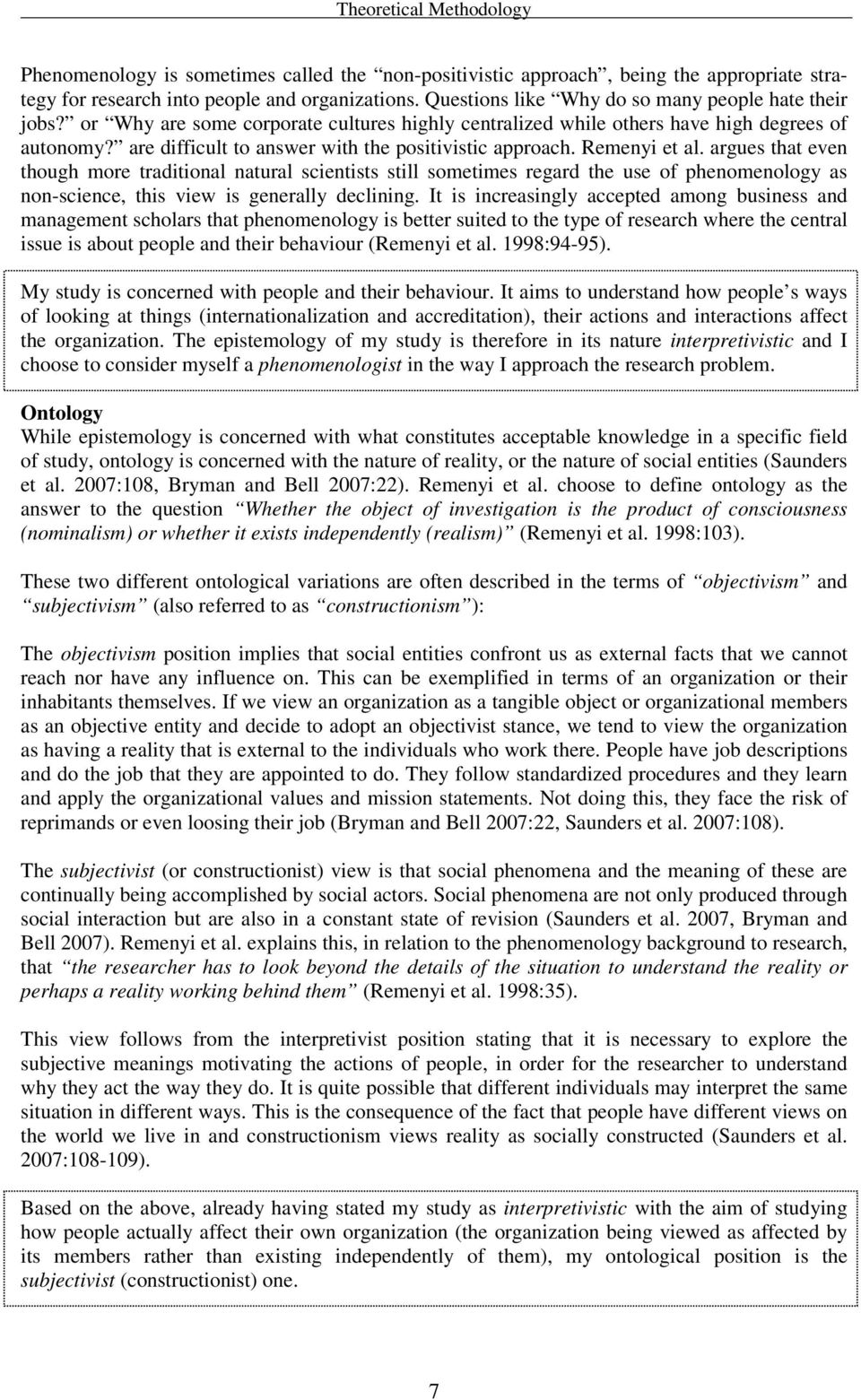
18 Theoretical Methodology Research Paradigm In order to draw the section of research philosophy together and framing business research into the epistemology and ontology discussion, four competing research paradigms are suggested by Burrell and Morgan (1979) (Saunders et al. 2007: , Bryman and Bell 2007:25). According to Saunders et al. these paradigms are very useful not only for summarizing the epistemologies and ontologies but also for offering a categorization which can be of specific use in management and business research in order to generate fresh insights into real-live issues and problems (Saunders et al. 2007:112). The four paradigms are presented in the figure below: Radical change Radical humanist Radical structuralist Subjectivist Objectivist Interpretative Functionalist Regulation Figure 2.1 Four Paradigms for the Analysis of Social Theory (Saunders et al. 2007:112) Objectivist and Subjectivist stances relates to the discussion on ontology above, where the objectivist dimension states that there is an external viewpoint from which the organization can be viewed and the subjectivist dimension states that an organization is a socially constructed product that can be understood only from the viewpoint of individuals who are directly involved in its activities (Bryman and Bell 2007:25). Radical change relates to making judgements about the way organizations ought to be and to suggest changes in order to achieve this while the regulatory perspective is less judgemental and critical. It rather seeks to describe what is going on in organizations and make suggestions on how to improve within the current framework of the way things are done (Bryman and Bell 2007:26, Saunders et al. 2007:112). In plotting the assumptions of researchers along the two axes in the figure above, we are provided with a framework that can identify four possible paradigmatic positions for studying organizations (Saunders et al. 2007:113, Bryman and Bell 2007:26): Functionalist: The most common framework for the study on organizations. It is based on problem-solving and is concerned to provide practical solutions to practical problems, leading to a rational explanation of a particular problem, often with the development of a set of recommendations. Interpretative: The philosophical position to which this paradigm refers (which has been described above as phenomenology ), is the way we humans try to make sense of the world around us. The major concern for the researcher working within this paradigm is 8
19 Theoretical Methodology not to achieve change but to understand and explain what is going on in organizational life. Radical Humanist: This view sees the organization as a social arrangement from which individuals need to be emancipated and adopts a critical perspective on organizational life. The radical humanist researcher is guided by the need for change. Radical Structuralist: Views an organization as a product of power relationships, resulting in conflict. The approach of the research is to achieve fundamental change based on an analysis of those kinds of organizational phenomena. The suggestion is that each paradigm results in the generation of quite different types of organizational analysis, seeking to address specific problems in different ways. Some researchers have argued that there can be no synthesis between paradigms while others state that the boundaries are not as clear as Burell and Morgan suggested (Bryman and Bell 2007:26). I will not go into this discussion but rather argue that each researcher has to find his/her own statements of purpose in terms of research philosophy, approaches and strategies, with or without the help of these paradigms. For my study, I find the paradigm framework quite useful. Plotting my assumptions along the axes, results in a clear placement of my research at the bottom left side of the figure: interpretative: The subjectivist stance has been argued for earlier and on the other axis, between radical change and regulation, my study has a regulatory perspective since it is not aiming to make judgements or suggest changes but to describe and understand what is going on in the organizations studied. 2.2 Research Approach Every research project involves the use of theory. If that theory is made explicit or not already in the starting phase raises an important question concerning the design of the project: The question is whether the research should use the inductive or deductive approach (Saunders et al. 2007:117). This can be explained as being two possible ways of establishing what is true or false and to draw conclusions: induction and deduction. Induction is based on empirical evidence whilst deduction is based on logic. Through induction, we make empirical observations first and then draw conclusions based on these observations. Through deduction, we do logical reasoning and draw conclusions out of this, which results in hypothesis that we later on test through empirical observation (Ghauri and Grønhaug 2002:13). Induction is, easily put, about building a theory while deduction is about testing a theory that has already been built. What about studies like mine, where theory and empirical observations are emerging side by side? Is that a bad way to proceed with research? Fortunately not! It would be very difficult to keep rigid divisions between deduction and induction. According to Saunders et al. (2007:119), it is not only perfectly possible to combine the two within the same piece of research; it is actually often advantageous to do that. Bryman and Bell (2007) means that it is useful to think of the relationship between theory and research in terms of inductive and deductive strategies but that they are possibly better thought of as tendencies rather than hard-and-fast distinctions. Ghauri and Gronhaug explain the process in the following words: In the process of research, methods begin with ideas and facts which lead us to propositions, theories and predictions. New theories and predictions lead us to new ideas and facts, and a new cycle begins, leading us to new theories. (Ghauri and Grønhaug 2002:14) 9

20 Theoretical Methodology Alvesson and Sköldberg use the term Abduction for a method which, according to the authors, is the one in reality used for many case based studies. It basically means that one separate case is interpreted from a hypothetical overall pattern which, if correct, explains the case in question. The interpretation should then be certified through new observations (cases). The authors highlight that although abduction has features in common with both induction and deduction, it is not a simple mixture of the two as it adds new and specific features. The main difference from the other two methods is the inclusion of understanding : While induction is based on empirical observations and deduction on theory, abduction is likewise (like induction) based on empirical observations, however does not reject theoretical pre-positions (like deduction). From this follows that the analysis of the empirical data very well can be combined with studies of already existing theories found - for the discovery of patterns that provides understanding. The research process becomes an alternation between theories and empirical observations being continuously reinterpreted in the light of each other (Alvesson and Sköldberg 2008:55-56). The above discussion on different research approaches can be illustrated in the following figure: Laws and theories INDUCTION DEDUCTION ABDUCTION Facts acquired through observation Explanations and predictions Alternation Observation/Theory Understanding Figure 2.2 Induction and Deduction (Ghauri and Grønhaug 2002:14) in combination with Abduction (Alvesson and Sköldberg (2008:55) My main intention with this study has been to observe facts through empirical investigation in order to create understanding within a certain area of business school operations and thereby be able to formulate propositions (induction). At the same time, I have also used already existing theories in order to be able to explain and gain understanding for the subject of study (deduction). Based on the fact that there has been clear interactions between data and theory (emerging together by adding existing theories and empirical data side by side throughout the research process for enhanced understanding), my study should be defined as abductive. 10

21 Theoretical Methodology 2.3 Research Strategy The division between quantitative and qualitative research strategies is often discussed and highlighted among researchers at all levels. It seems even to be so that we tend to speak of qualitative researchers and quantitative researchers as if they had completely different views on how to conduct proper research. According to Bryman and Bell, the distinction between qualitative and quantitative represents a useful means of classifying different methods in business research. This distinction could seem to be not much more than the fact that quantitative research deals with measurement and qualitative research does not. However, even as this is typically the case, many writers suggest that the differences are deeper than that. Quantitative and qualitative research actually differs with respect to the connection between theory and data (induction/deduction), epistemological and ontological foundations (Bryman and Bell 2007:28). In Johansson Lindfors opinion, it is often is quite unclear what people actually mean when talking about quantitative and qualitative research. She means that people who speak about qualitative strategies mainly refer to the inductive approach; case studies and subjective collection and/or analysis methods, while quantitative strategy is connected to the deductive approach; broad empirical studies and quantitative methods of analysis (Johansson Lindfors 1993:72). She further states that (as opposite to Bryman and Bell) since qualitative or quantitative collection of data can actually be used independently of the research philosophy and approach, it is not very meaningful to speak of qualitative and quantitative research and in this distinction include every aspect of the research methodology. Instead, one should use the distinction when defining methods for the collection and analysis of data (Johansson Lindfors 1993:72). Based on the definition of Johansson Lindfors, I have chosen the qualitative strategy in performing case studies, with subjectively collected information through semi-structured interviews (see chapter 5) and subjective methods of analysis aiming to understand rather than confirming a hypothesis. The table below provides a summary of the methodological positioning of my study: Epistemological orientation Positivism: -The natural science model Interpretivism/Phenomenology: -The non positivistic approach Ontological orientation Objectivism: -Social entities defined as external facts Subjectivism (Constructionism): -Social entities depending on social actors Research paradigm Radical Structuralist Radical Humanist Functionalist Interpretative Research approach Deductive: -Testing of theory Abductive: - Alternation data/theory Inductive: -Generation of theory Research Strategy Quantitative: -Deductive data collection and analysis Qualitative: -Inductive data collection and analysis Table 2.1 Summary of Theoretical Methodological Standpoints 11
22 Theoretical Methodology 2.4 Choice of Theories and Secondary Data Collection The search for adequate theories for a research project is, according to Johansson Lindfors (1993:87), two-folded: Firstly, it is about defining the framework; what areas of research to include (the choice of theories). Secondly, it is about the actual search and selection of literature and other sources, including the ability to decide when to stop searching (the data collection). Regarding choice of theories: Defining the framework of the literature search has typically an intimate connection with the formulation of the research problem. It is, according to Johansson Lindfors, important not to make the frame too narrow, especially when it comes to areas such as business administration and management that are, by definition, interdisciplinary (Johansson Lindfors 1993:87). For my literature review, the major concern has rather been the opposite. I have been able to define many different areas of research that could be applicable in connection to my research problem. During the process this approach has sometimes felt too broad or even a bit overwhelming. The main areas I have covered in my literature review are Internationalization, Accreditation, Strategy as Practice and Institutional Theory. From a rather broad perspective, my intention has been to narrow down the theories making them suitable for analyzing the empirical data. I am convinced that, based on my broad theoretical approach, other theories and models could also have been chosen for the purpose of my study. Regarding secondary data collection: Johansson Lindfors (1993:88) presents three criteria that are important to take into consideration when deciding which theories to use: the origin, the empirical base and timeliness. I have chosen to use these definitions in attempting to take a critical stance towards my use of secondary sources. The origin concerns the use of first or second hand sources in presenting theories. First hand sources should always be used, since when using second hand sources there is a risk of major misunderstandings when referring to the original author s standpoints (Johansson Lindfors 1993:88-89). I have, to my knowledge, mainly used first hand sources. Obvious exceptions are citations where the original author has been cited in the work by other authors. Since citations are the exact wording of the original author, the risk of interpreting wrong must be considered close to nonexisting (provided the citation is correct). The major part of the sources used are scientific articles collected through databases provided by the Umeå University library, such as EBSCO Business Source Premier and Web of Science SSCI. I have also, but to a lesser extent, referred to books which have been found through the library database ALBUM. Many of the sources used have also been found through references in other articles or books and some through recommendations from my supervisor. The empirical base concerns whether the author (that is being referred to) has observed the empirical findings him-/herself (primary source) or if his/her reasoning is based on the experiences of other authors (secondary source). Whether this is of major importance or not is highly connected to the research question and the research philosophy. Therefore only primary or both primary and secondary sources can be used (Johansson Lindfors 1993:89). 12
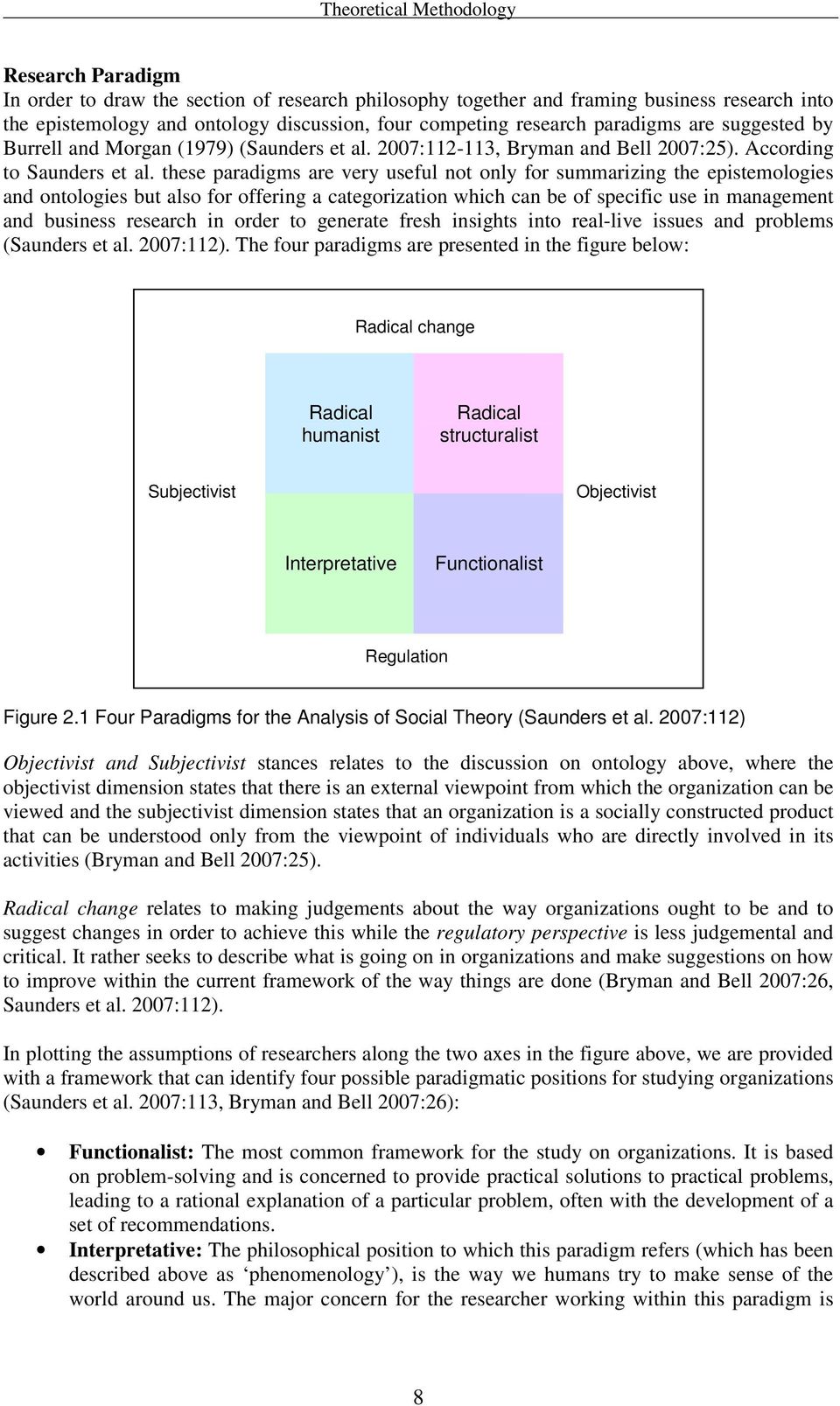
23 Theoretical Methodology In practice, both primary and secondary sources are often used, so also in my study. For the main theories however, I have chosen to refer to scientific research based on empirical material collected by the author/s of the article or the book referred to. By doing this, in combination with only selecting peer-reviewed articles for the use of main theories and models in my work, my intention has been to be as reliable and trustworthy as possible in the use of theories. Timeliness refers to how new or old the works referred to are. The main principle is that the researcher should be updated on the latest research and findings within the area, although this does not mean that an older research is less valuable (Johansson Lindfors 1993:89-90). The sources I have used are generally quite recent. Most are published later than 2005, with the exception of those being used as a means of looking back in history or presenting basic definitions made by often cited authors. As the debate and discussions around internationalization and business school accreditations started only a few years ago (at least in Europe), I neither saw any reason nor possibility to search for earlier publications on these topics. In the Strategy as Practice area, being a rather young area of strategy research, the theories presented are obviously quite recently developed. On the other hand, the number of researchers involved in this area, including publications available, is far less than in other areas of strategy research. I realize that the fact that I in large part refer to one specific author in this subject area (Jarzabkowski), can be considered a weakness. On the other hand, since she, and other of her colleagues referred to, are the most cited authors in the area, I believe that I have managed to collect much of the most valuable input on the subject. In regards to knowing when to stop searching for new theoretical input, this has, in accordance to the standpoint by Johansson Lindfors (1993:88) been quite difficult. My theory definition process has been going on more or less from the start to the end of the research process, meaning that I have been reading additional scientific articles and considering new theoretical input up until the phase of analysing the empirical data. 2.5 Research Process Model My research process as a whole can be illustrated by the hermeneutical circle below: The whole picture Understanding Pre-understanding The different parts Figure 2.3. The Hermeneutical Circle. Author s model derived from Alvesson and Sköldberg. (Alvesson and Sköldberg 2008:193, 200) 13
24 Theoretical Methodology Alvesson and Sköldberg (2008:193) states that in hermeneutic research 1 one of the main themes has always been that the meaning of one part can only be understood if put in connection with the whole picture and the other way around; the whole picture can only be understood through the parts of which it is constructed. In accordance to my ontological standpoint described earlier, I believe that an organization cannot be studied independently of its organizational members. In order to understand how the accreditation process has impacted on the internationalization process of the business school as a whole ( the whole picture ), I wished to study the behaviour, thoughts and opinions of people inside the organization ( the different parts ). On the other hand, I also believe that it is impossible to make reliable conclusions based solely on people s behaviour or thoughts ( the different parts ), without taking into account the organizational environment ( the whole picture ), such as the school s national/regional setting and internationalization background as well as its core mission, values and activities. The other part of the circle deals with the assumption that in order to understand something, you need a certain amount of pre-understanding. At the same time; pre-understanding, if to be developed, requires new understanding. Understanding must continuously be referred back to existing pre-understanding, and pre-understanding must be fertilized through new understanding (Alvesson and Sköldberg 2008:211). My pre-understanding for the area of study was mainly based on working experience in the startup-phase, whereas my understanding grew by reading scientific articles and literature, which in turn changed and improved my pre-understanding. The collection of empirical data was also, especially since it was made quite early in the process (see chapter 5), strongly influenced by my pre-understanding gained from work experience. Conducting the interviews gave me new insights and ideas for the theoretical framework and thus provided a higher level of understanding, which in turn contributed to better pre-understanding for conducting the remaining part of the research process. 1 Hermeneutic research is associated with qualitative methods and is expressing the same values as other terms for non-positivistic research, such as interpretivism or phenomenology described earlier. 14
25 Theoretical Framework 3. THEORETICAL FRAMEWORK 3.1 The Business School Environment In this first section of the theoretical framework, I will discuss the environment and situation that business schools of today are facing, with emphasis on internationalization. I will then try to define any major challenges for business schools in the future through the eyes of different researchers Internationalization of Business School Education It is quite interesting to look back on what was predicted as important issues and obstacles for internationalizing the business school described 20 years ago and compare to the current situation. One of few who made such predictions was Aggarwal (Aggarwal 1989), who highlighted issues such as: Bringing international aspects into the curriculum. Emphasizing foreign language skills. Promoting international experience among the students in terms of internships and study possibilities abroad. Allowing foreign students to enter the classes. Aggarwal also discussed problems and obstacles expected in the internationalization process, such as: The assumption that very few students were likely to want, or have the possibility to, work abroad soon after graduation. The need for faculty development in order to internationalize the curriculum. The need for recognition for the internationalization process within the framework of the institution s funding, tenure, promotion policies and hiring of staff. The need for support and resources among faculty and administrators. If we look at today s situation in the mirror of what Aggarwal tried to foresee, we can state that business schools in general have succeeded quite well. The number of courses and programs with an international dimension is huge; the offering of exchange study opportunities and internship programs gives most business students the possibility of spending part of their studies abroad; language courses are often incorporated in the study programs and/or exchanges and we have a large number of international students following English taught courses and study programs. What about the problems and obstacles expected according to Aggarwal? Regarding the wishes and possibilities for students to work abroad soon after graduation, this may very well be depending on nationality. Within Europe however, we can probably agree on the fact that it is far from impossible, or even unusual, that our graduates get their first employment abroad. Hiring faculty from abroad, whether for full time employment or guest periods, is something that many business schools has incorporated into their hiring policies and, in most cases, there is an International Office (or specifically appointed staff working with international relations issues) with administrative resources to handle the daily operations and strategic plans for the internationalization process of the school. Surely, many of the issues described by Aggarwal are still to be considered as problems or obstacles within business school organizations of today (see for example Ghemawat, 2008). 15
26 Theoretical Framework However, it should be fair to say that business schools in general has accomplished a lot in terms of internationalization during the last two decades and are now facing further challenges. More recent authors analyze the global situation of today s business schools in more complex terms and broader aspects (Hay 2008, Ghemawat 2008, Howard 2007, Thomas 2007, Krell 2007, Starkey and Tempest 2008) where internationalization is not seen as an isolated task for the school to accomplish but rather something that has to be integrated in all aspects of operations. The environment of the business school has rapidly changed in the last years, with new demands on management education, global competition, new stakeholders etc. From this emerges the need to re-define the purpose of the business school (Starkey and Tempest 2008, Hay 2008). Hay, who defines business schools as one of the great educational success stories of the last century, perhaps the great story (Hay 2008), means that, despite their success, it is now time to question the purpose of the business school. He refers to a comment made by Joel Podolny, former dean of the Yale School of Management who, at the 2007 annual EFMD 2 meeting for Deans and Directors, claimed that although the management profession has changed significantly, management education has remained the same (Hay 2008). Thomas is touching on the same problem, believing that business schools are currently facing an image and identity crisis, having been subject to many critical reviews about their status as academic and professional schools. The main reasons for this he means, is on one hand that they are seen as having lost touch with the business world, and on the other of doing irrelevant research (Thomas 2007). Also Starkey and Tempest have a similar view in questioning the purpose of the business school and its role in management education by describing the view from the business perspective being different than the one from the academics perspective: Business seeing business schools as providers of services (research, consultancy, teaching) to business while academics seeing themselves as producers of knowledge of business rather than for business (Starkey and Tempest 2008) Challenges ahead With the assumption that most business schools of today are, although on different levels and at different stages, per definition international : What are the driving forces for this need to redefine the purposes of the business school? What are the new purposes and main challenges facing business schools in the future? Thomas uses a PEST 3 (Political, Economic, Social, Technology) framework in order to define the business school environment and then highlights a number of Key Forces and Drivers that influences the evolution of management education in the future (Thomas 2007). His key conclusions from the PEST analysis (in many aspects associated with the UK situation in specific, but to be applicable in European countries in general) include critical issues such as: Reduction of governmental/public funding for higher education institutions, forcing business schools to balance quality in education against cost efficiency. (Political) 2 EFMD European Foundation for Management Development, see A more recent concept replacing the PEST framework is the PESTEL (Political, Economic, Social, Technological, Environmental, Legal) framework; providing a tool for an extended analysis of environmental influences on organizations - leading to possible success or failure of particular strategies. See for example Johnson et al. 2009:25-27). 16
27 Theoretical Framework Standardisation of Business Schools in Europe through the Bologna Accord 4 and greater competition. (Political) Regulatory pressures for achieving accreditations (EFMD, AACSB, AMBA) 5 and teaching/research quality (Quality Assurance Agencies) (Political) The growth of the global economy and multinational student diversity in parallel with the rapid development of business schools of high quality in Europe as well as in Asia. (Economic) Increased competition from private business schools/corporate universities, university alliance programs, faculty doing private consultancy and other forms of non-traditional competition such as distance learning programs offered by non-campus institutions. (Economic) Change in social values regarding ethical issues, corporate social responsibility and sustainable development. (Social) Change in demography, such as expected age and lifestyle changing employment patters and enhancing the demand for life long learning along with new cultural and ethnic influences. (Social) More demanding and knowledgeable students along with new learning technologies (such as e-learning and internet education, blended learning), requiring increasing flexibility in the business school s delivery of education. (Technology) A greater focus on the entrepreneur and entrepreneurship as legitimate areas of study as small businesses has become increasingly important for economic growth.1 (Not defined within the PEST analysis but described as equally important as the above factors.) The Key Driving Forces highlighted, based on the PEST-analysis of the environment summarized above, are illustrated in the following figure: Demography Competition Key Driving Forces Technology (ICT) Globalization Entrepreneurship Figure 3.1 The Key Forces Driving Management Education (simplified from Thomas 2007:12) Also Hay reflects on the business schools expansion to new continents such as Asia and India and the need this creates for a better shared understanding of the business school purpose in a global perspective. Like Thomas indicates in the PEST-analysis, Hay highlights the fact that the 4 The Bologna Accord, more often referred to as the Bologna Declaration: Among other things that Bologna brought, which mostly referred to, is the division of European higher education in a first (bachelor), second (master) and third (doctoral) cycle. For more information on history, background and implications, please visit the European Commission website for Education and Training: or the Umeå University website: 5 See
28 Theoretical Framework consumers of business education, whether being students, executives or corporate clients, have become increasingly knowledgeable in terms of knowing about different alternatives, nationally and/or internationally, and concerned about value for money. The expectations of Alumni are also changing, with the need for continuous renewal of knowledge as seen as critical to maintaining personal employability (Hay 2008). 6 Putting it simple according to Hay, the purpose of the business school is to create value. For succeeding in the future, he means, the key is to make value creation central to what business schools do. Hay distinguishes between three types of value: Academic value Personal value Public or Social value Academic value is to be created through research. According to Hay, there are different kinds of value creation made through research. One kind of value is created primarily through moving the boundaries of academic knowledge and understanding. Another kind of value is created by research that has a more immediate impact on business. One example is the globalization of the business school operations and research on leadership that fits this description. Hay means that the challenge lies within the balance between these two features when doing research: The choice between being rigorous or relevant, scientific or descriptive, single or inter-disciplinary. Referring to other authors in the area (such as Porras 1998) he means that a move towards greater pluralism; to a world in which academic and practitioner-oriented work is equally valued, by doing research that is both rigorous and relevant, anchored in theory but also oriented in praxis, is needed (Hay 2008). Personal value is created through teaching. That is teaching for different groups of individuals such as students, executives and alumni. Hay refers to research made by London Business School in 2003, presenting interviews with a large number of senior executives worldwide where three elements of global business capabilities where identified; Knowledge, Skills and Attributes : Knowledge being basic and typically accumulated early in the management career, acquisition of skills (for example communication skills and decision making skills) being typically acquired during the middle career period and acquisition of leadership attributes being essential later on in the career. He also mentions personal value in terms of enhancement of earning power for business school graduates and highlights that it is actually not only for current students that a business school creates personal value. The importance of maintaining one s personal employability in today s world, characterised by plural and more fluid careers, require the business schools to provide valuable life-long learning opportunities (Hay 2008). Social value is the third element that creates purpose for the business school according to Hay and this includes: Academic research in areas being equally relevant for practitioners in the non-profit sector as for the business sector (such as entrepreneurship, marketing and organizational behaviour); Teaching in terms of producing well trained graduates who can make a significant individual contribution to society; More active engagement by business schools in their own community; and the growing interest paid to corporate social responsibility in the business world. Hay means that this attitude change is a new important challenge for the business schools (Hay 2008). Hay summarizes by saying that the challenge ahead for each and every business school is to be clear about how to articulate their value creation along those three dimensions. He argues 6 This is often referred to as Life Long Learning in the European context. 18
29 Theoretical Framework however, that in order to be successful a school must operate successfully in all three, although in different ways for different schools. Turning back to Thomas and his suggestions of main issues and challenges facing business schools in the future (Thomas 2007) with Hay s, we can make an attempt to incorporate those within Hay s three dimensions presented above; Academic value, Personal value and Social value. Thomas presents the following main issues and challenges: Broadening the role of research in combining rigour and relevance (academic value) Balancing research and pedagogy (academic and personal value) Enhancing technology (academic and personal value) Linking entrepreneurship to business education (social value) Balancing public and private management skills (social value) Building and managing alliances with other schools (touches on all three dimensions of value) Fundraising (touches on all three dimensions of value) Building international perspectives and understanding cultural differences (touches on all three dimensions of value) Defining the role and meaning of management education (clarifying the purpose of the school and how it creates value, which is the core issue according to Hay) 19
30 Theoretical Framework Summary SUMMARY 3.1 THE BUSINESS SCHOOL ENVIRONMENT Internationalization is not something that has come up on the strategic agenda of business schools recently; it has been there for quite some time. We can see that already 20 years ago, many of the international issues that business schools have dealt with in recent years were predicted. Looking back in the mirror, we conclude that business schools have succeeded well; the development of internationally oriented activities has been rather impressive. The global situation of today s business schools are described in more complex terms and broader aspects where internationalization is no longer seen as an isolated task but rather something that has to be integrated in all aspects of operations. The purpose of the business school of today is indeed debated, business schools in general having been subject to criticism in regards of their status in academic and professional terms. A number of Key Forces driving the Management Education environment is presented: o Demographic Changes o Competition o Globalization o Entrepreneurship o Technology enhancement Value Creation is introduced as a key for succeeding in the future, with a distinction between three types of values: o Academic value (research) o Personal value (teaching) o Public or Social value (contribution to the community) 20
31 Theoretical Framework 3.2 Accreditation and Ranking Schemes How do we measure internationalization? Or rather; how do we measure the success of it? This is an impossible question to answer of course, as it surely depends on whom you ask and in which environment this person belongs. Among the most widely used ways of measuring a business school s internationalization process however, are the templates and guidelines from various accreditation bodies and ranking systems. The aim of this chapter is to introduce to the reader the most common business school accreditation schemes of today, which are also those held by the two schools involved in this study. Ranking systems for higher education institutions has practically not been used at all in the Nordic countries but many predict them to be introduced and of increased importance as they have been in other parts of Europe and the rest of the world for many years. This study is not focused on rankings but since the schools studied also take rankings into consideration and I refer to research in the area further on, I will also mention the most known business school rankings below Business School Accreditation Schemes For business education, there are three major accreditation schemes; EQUIS, AACSB and AMBA. I will touch on all of them since the school s in this study are affected by all three but will go into the international aspects of the EQUIS accreditation system in particular as this is European based and being the accreditation that is most common, and aimed for, among European schools EQUIS 7 EQUIS The European Quality Improvement System was developed in the early 90 s and is run by EFMD The European Foundation for Management Development. Apart from running a number of accreditation schemes (EQUIS, EPAS, CEL and CLIP), EFMD provide its members with different services, such as annual meetings and conferences for different management categories, advisory services and networking opportunities. EQUIS claims to be the leading international system of Quality Assessment, Quality Improvement, and Accreditation of Higher Education Institutions in management and business administration ( The EQUIS accreditation scheme has specially been designed with focus on meeting international standards of quality in all activities in the business school and the fundamental objective is presented as to raise the quality of management education worldwide ( According to EFMD, EQUIS does not promote one best model for a business school; neither does it look for standardisation. Its approach to the assessment of quality is rather rooted in the respect for the diversity of both institutions and cultural contexts. It is meant to facilitate setting of standards, benchmarking, mutual learning and also the dissemination of cross border good practice. High level of quality is considered important but even more important is the principle of continuous improvement. Also, strong connections with the business world are considered as much a requirement as a strong research potential. Especially emphasised in the description of what institutions must demonstrate in order to receive the accreditation is a high degree of internationalisation. Based on the fact that companies recruit worldwide today, students choose to get their education outside their home countries and business 7 The information is collected from the official EFMD website: as of January 19,
32 Theoretical Framework schools build alliances across borders, institutions are chosen on the basis of being able to deliver high quality education in international management. A model of the EQUIS standards, a description of the application process and of the different areas of business school operations under investigation can be found in appendix 1. The standard for internationalisation is, according to the EQUIS Standards and Criteria document, described as follows: The school should have a clearly articulated strategy and policies for internationalisation. It should demonstrate its commitment to educating and preparing students and participants for management in an international environment. This should be underpinned by active collaboration with international partner institutions in fields such as student exchanges, joint programmes, research activity and corporate connections. The school should be able to attract students and faculty from other countries. It should carry out research of international relevance and scope. (EQUIS Standards and Criteria: Included in EQUIS Standards and Criteria, Chapter 9; a more detailed description of the Assessment Criteria and Key Indicators for internationalisation is provided. These can be found in appendix 2. EQUIS can be granted unconditionally for five years or conditionally for three years (with annual progress reports required). As of November 2008, 115 schools across 33 countries were accredited ( AACSB 9 AACSB International The Association to Advance Collegiate Schools of Business was founded as early as 1916 and began with accreditation in For more than 80 years, AACSB Accreditation was strictly US focused but in 2003 it revised its standards in order to make them applicable to all business programs globally. AACSB International accredits undergraduate and graduate programs in business administration and accounting and claims to be the hallmark of excellence in management education, representing the highest standard of achievement for business schools worldwide. The accreditation process for AACSB resemble the EQUIS process with a large number of steps to go through including Eligibility Application, Self-Evaluation Report, Peer Review visit and Awarding Body Decision. AACSB also provides guidelines on the process and requirements for the accreditation. As of December 2008, 560 institutions held the accreditation, out of which 99 outside of the US AMBA 10 AMBA The Association for MBAs was established in 1967 and is an international impartial authority on postgraduate business education. It has a large difference in comparison to EQUIS and AACSB in that it accredits specific postgraduate programs and not entire institutions. AMBA accredits schools offering Master of Business Administration (MBA), Doctor of Business Administration (DBA) and Masters in Business and Management (MBM). According to the AMBAs website, their accreditation has an international focus and the criteria are applicable for business schools all around the world. The focus of the association is said to be 8 The number has risen to 118 schools in 34 countries as of June 2 nd, The information is collected from the official AACSB website: as of January 19, The information is collected from the official AMBA website: ( as of January 19,
33 Theoretical Framework that programmes should be of highest quality and with relevance to the dynamic business world, reflecting changing trends and innovation in postgraduate management education. In addition to accreditation, the organization offers consultancy and development services for business education institutions. As of December 2008, programmes at 153 business schools in 69 countries were accredited The Triple Crown Schools having achieved all three of the above described accreditations; EQUIS, AACSB and AMBA, are often referred to as having the triple crown. Both schools included in this study have this triple accreditation (out of 36 schools in the world) 11 and the respondents sometimes refer to AACSB and AMBA in comparison to EQUIS. This is the reason to why I wanted to include shorter descriptions of AACSB and AMBA in this section, even though EQUIS remains the main focus Business School Rankings As mentioned above, I will not go into detail on business school rankings; methodology, usage, perceived prestige etc, but I find it important to mention them in this context since they in some cases are referred to by the respondents and has had, together with the accreditation schemes, an impact on business school operations. The ranking schemes that are most commonly referred to within the business school community are the following (random order): Financial Times Business School Rankings Business Week Business School Rankings Wall Street Journal MBA Rankings Eduniversal Business School Ranking Academic Ranking of World Universities A brief description of each one of these, including websites for further information, can be found in appendix As of June 2009 according to information provided at the GEM website: news-aacsb-re-accreditation-2.aspx 23
34 Theoretical Framework 3.3 Strategy as Practice Strategy as Practice is a quite recently developed field of research that I have found to be very suitable for my research problem. The reason for this is that it particularly focuses on how strategy is created through people and their actions: Internationalization of business school operations is created through people within the organization, their beliefs and actions. The strategic decision to apply for, and go through with, an accreditation process is performed by the same people Defining Strategy as Practice The rather fast recent growth of the field of Strategy as Practice research can, according to commonly cited authors such as Jarzabkowski and Whittington, be explained through the fact that in most academic articles on strategy; the actors and their activities have been rather absent (Jarzabkowski and Whittington 2008a). In another recent article (Jarzabkowski and Whittington 2008b), the same authors compare the definition of strategy from the traditional research perspective; as something an organization has, with the definition of strategy according to the Strategy as Practice perspective; as something people do. Already in 2003, Johnson et al. used the same explanation when defining the need for traditional macro-strategizing to be replaced with micro-strategizing (Johnson, Melin and Whittington 2003). Strategy has historically they mean, tended to be explained in terms of the outcomes of what is going on in organizations. Micro-strategy on the other hand, is concerned with the activities which constitutes those outcomes. In other words: The detailed processes and practices which constitute the day-to-day activities of organizational life and which relate to strategic outcomes (Johnson et al. 2003:3) Jarzabkowski and Whittington mean that the essential distinctiveness of Strategy as Practice is lying in its decentring of the organization. The performance of the organization in itself is not the major concern for Strategy as Practice researchers. The major concern is rather connected with the doing and performance of people at various levels in the organization having an impact on strategy creation (Jarzabkowski and Whittington 2008b). Others (Jarzabkowski, Balogun and Seidl 2007) explain the Strategy as Practice view in terms of humanizing the management and organization research, moving it from the macro level of firms and markets, with little evidence of human action, to the micro-level, which constitutes the action and interactions of the individuals who practice strategy. This way of looking at strategy and strategizing is often also referred to as the activity based view of strategizing (Jarzabkowski 2005, Jarzabkowski et al. 2007, Johnson et al. 2003). What this means is that, instead of looking at organizations as whole, one should focus on the activities of individuals, groups and networks of people that are crucial to the practices and key processes of the organization. The value of this approach is that it goes inside organizations, their strategies and processes in order to investigate what is actually done and who is doing it (Johnson et al. 2003). To use the framework of Jarzabkowski, (Jarzabkowski 2005), in summary she defines the activity based view on Strategy as Practice by : Viewing strategy as a broad organizational activity. Realizing that strategy involves a large number of people at all levels of the organization. Taking into account what managers and others in the organization are doing. 24
35 Theoretical Framework This activity based view on defining strategy leads to the question of how to conduct Strategy as Practice research. More or less the same view on Strategy as Practice research has been described by previously cited authors above The Framework of Strategy as Practice Research The research agenda for Strategy as Practice has three main perspectives, or three different angles from which to focus the study: Praxis, Practices and Practitioners (Jarzabkowski et al. 2007, Whittington 2007, Jarzabkowski and Whittington 2008a, Jarzabkowski and Whittington 2008b). Strategy Praxis refers to the work that comprises strategy the flow of situated activities that are strategically consequential for the direction and survival of the group or organization (such as meeting, talking, planning, presenting, decision making). In other words: Focusing on what people are doing that creates strategy in connection to what is going on in the society around them. Strategy Practices refers to the routines and norms of strategy work the symbolic, material and social tools through which strategy work is done (such as budget systems, flipcharts, power points, use of language, know-how, software). In other words: Focusing on behavioural resources used in routinized ways that enables people to interact in order to accomplish collective activity. Strategy Practitioners refers to the people who do the work of strategy top and middle managers such as described in traditional strategy research but also other internal (such as lower level employees) as well as external (such as consultants, policy makers, media, business schools) actors are important strategic actors to the organization. As lower-level employees typically lack a formal strategic role, practice research focuses on the social, linguistic, interpretative and personal knowledge bases through which these actors can shape strategy. Even though their actions and influence on strategy may not be intended at the firm level, they can be just as significant for the survival of the organization (Jarzabkowski et al. 2007). Practitioners are first and foremost to be seen as individuals, having their own purposes, ways of behaving, thinking, acting and emoting regardless of which organization they belong to (Whittington 2007). In other words: Focusing on the skilled and knowledgeable actors inside and outside of the organization. 25
36 Theoretical Framework These three lenses through which strategy can be studied according to the Strategy as Practice perspective are illustrated in the model below: STRATEGIZING Praxis The work that comprises strategy Practices The routines and norms of strategy work B A C Practitioners The people who do the work of strategy Figure 3.1 A Conceptual Framework for Analyzing Strategy as Practice (model simplified from Jarzabkowski et al. 2007:11) Research that is focused in the A-section of the figure, having the practitioner and practices in foreground, is more likely to develop micro-level explanations, whilst studies having their focus in B or C, are more likely to explain strategy as a wider activity in developing explanations of why and how certain types of activity are consequential for shaping strategy (Jarzabkowski et al. 2007). My study has its main focus on the people working in a certain area of a specific type of organization (international relations within the business school); what they actually do, how they cooperate, how they perceive things and what their thoughts are. I am not focusing on the practices used in the work they do. The intention of this perspective is to see how the impact on people s acting and behaviour shapes strategy, regardless of the use of certain tools, and therefore the focus is in the C-section of the figure; the nexus between Praxis and Practitioners. I thereby hope to be able to understand strategy behaviour in a wider sense, applicable not only to the organizations in question but to some extent also to business schools in general. Whittington uses the term Sociological Eye to add to the explanation of the nature of Strategy as Practice research described above (Whittington 2007). He means that Strategy as Practice treats strategy as any other practice in society and takes examples such as journalism, law, war and marriage. Strategy is simply something that people do, with stuff, in societies (Whittington 2007) and it is therefore possible to study it from many different angles. Main characteristics of this sociological eye are: sensitivity to connections and relationships, alertness to problems of social character and recognition of social embeddedness (Whittington 2007). Whittington further means that the sociological eye has another specific characteristic; the sense of irony, or as he also puts it: An appetite to uncover the neglected, the unexpected and the unintended (Whittington 2007:1577). 26
37 Theoretical Framework Based on this Sociological Eye input, Whittington wishes to add one more P to the three described in the recent work by him and Jarzabkowski among others above; Profession. The reason for introducing this lens is to underline the importance of strategy as being this specialized institutional field in itself, like medicine or law, involving many different actors, such as managers, consulting firms, business schools, business media, professional societies, academic journals etc. The joint endeavour of these actors is to be recognized as somehow strategic (Whittington 2007). In addition to looking at, and define, Strategy as Practice research through the lenses described above, Whittington presents five touchstones for research in allegiance to the sociological eye (Whittington 2007): Search for connections and relationships: The sociological eye helps researchers not to treat people only as individuals or events as unique for the specific circumstance, but bring in the fact that people have generic characteristics. This highlights connections across organizations. Recognize embeddedness: The sociological eye stresses the fact that activity (what people actually do) is deeply embedded in the context of the organization to which they belong. It is about looking at the bigger picture of society in order to understand the miniaturist portrait. Pursue irony: The sociological eye tries to find the significant things that might be hidden in the neglected. Things that might be taken for granted or being apparently trivial might not be as innocent as they appear; tools like PowerPoints and Flipcharts used in different ways by practitioners for instance, may shape strategy in rather unexpected ways. Problematize performance: The sociological eye has a characteristic that is concerned to reveal and address social problems. Strategy might even be a problem for society in itself in two ways: - In today s society, the speed of knowledge diffusion is extremely fast, and strategy consultants are eager to be first by promoting new big ideas. Therefore new and barely tested ideas of strategy practices can spread widely before their consequences are fully understood. - In a similar way, strategy practices, originally intended for a specific type of organization, can be introduced in new domains, such as the public sector for example, having transformative effects for employment relations, organizational power, consumer services etc. far beyond what anybody could expect. Respect continuities: At the same time as research on strategy often stresses creativity, novelty and discontinuity, strategy does involve lots of recursivity, so even mind-numbing routine. Therefore, the comprehensive researcher will respect also continuity across time and contexts in shaping strategy. Whittington concludes his presentation of the five touchstones by highlighting that he is not intending to present them as being hard-and-fast rules for research within the area. He means that research projects will vary in the degree to which they can fulfil to meet all of these guidelines but that there is great importance for practice researchers to acknowledge the potential of them and adhere to at least some. 27
38 Theoretical Framework So, when using the model above, defined by Jarzabkowski et al., let us not neglect Whittington s fourth P; Profession as a potential additional angle of studying strategy within the framework of Strategy as Practice. The framework of Strategy as Practice research can be summarized in the table below: Main Perspectives Praxis Practices Practitioners Profession Characteristics Situated, socially accomplished flows of activity that has an impact on the direction and survival of the organization. Tools and resources used in a routine way by practitioners in the creation of strategy work. Internal and external actors who shape the construction of practice through who they are, how they act and what resources they have available. Strategy being an institutional field in itself and the Sociological Eye used as an additional lens for studying strategy creation. Table 3.1 Summary of the Conceptual Framework for Analysing Strategy as Practice (author s table) As mentioned earlier, my study will not focus directly on practices, which leave Praxis and Practitioners from the previous model and adding the Profession perspective (the sociological eye) Pluralistic Organizations and Multiple Strategies The organization in question for my study is the business school. As we all know, business schools, or higher education institutions in general, has to balance many different tasks (education, research, corporate and community relations etc.) and stakeholder interests (students, academic and administrative staff, the corporate world, society, legal frameworks etc.). What about strategy then; is it not quite obvious that this kind of organization must have different strategies for different purposes? Is it not also quite obvious that all these strategies needed might not always be easy to combine with one another? Jarzabkowski and Fenton explain strategizing in pluralistic organizations by drawing upon the relationship between strategizing and organizing (Jarzabkowski and Fenton 2006). They mean that looking at the interdependence between these two can highlight gaps in current understandings of the complexity faced by many organizations of today taking, among others, the university as an example. Jarzabkowski and Fenton make the following definitions of the main themes in their article (Jarzabkowski and Fenton 2006): Pluralistic Contexts o Contexts that are shaped by divergent goals of different groups, inside and outside the organization. Organizing o The internal creation and use of structural practices and coordination processes in order to enact the identity, culture and interests of the organization. Strategizing o Those practices and processes that involve planning, resource allocation, monitoring and control through which strategy is created. 28
39 Theoretical Framework The university can be defined as a pluralistic organisation with multiple strategies due to a number of different reasons: - It involves different cultures (administrative, managerial, professional) and also subcultures and identities within these groupings, which can create tension in between. These tensions become even clearer in an environment such as the university; where the different groups have their own professionally-based identities which are very knowledge intensive (Jarzabkowski and Fenton 2006). - Universities pursue several streams of activity that is goal-directed. These multiple activities are not necessarily compatible and probably in the interest of some actors more than others. It is a large challenge for top managers to manage the relationship between the different streams of activities and have them co-exist (Jarzabkowski 2005). - Universities (and business schools in particular, authors comment) nowadays has to compete for more commercially oriented performance at the same time as maintaining its professional roles in society and ensure quality in public services. The boundaries as also redrawn constantly, with new requirements and performance measures to obtain, challenging the university to adopt quickly (Jarzabkowski and Fenton 2006). According to Jarzabkowski and Fenton, there are three modes of associations between strategizing and organizing (Jarzabkowski and Fenton 2006): Interdependent associations: This is the ideal state where organizing and strategizing reinforces each other mutually. Practices are tailored to the demands of different strategic goals and, at the same time, they recognize the interests and identities of different groups. Destructive associations: This is extreme pluralism in both domains. Multiple strategic objectives are not aligned with each other and different groups have different opinions that are incompatible. Then the organization is pulled in too many directions and cannot resolve the multiple demands placed upon it. Imbalanced mode: This is another form of pluralism, occurring when strategic objectives are blocked by practices used in the organization. Internal demands compete with external demands which results in an increased number of interests and goals mutually exclusive. To conclude, some principles that arise from the discussion of managing multiple strategies in pluralistic organizations (Jarzabkowski and Fenton 2006): Pluralistic organizations must continuously adjust to the change of internal and external demands. Striving toward interdependence between strategizing and organizing by addressing daily occurring small imbalances and make mutual adjustments on an ongoing basis is important. Having a frequent dialogue between management and lower level employees is necessary in order to continuously take different interests and goals into consideration. 29
40 Theoretical Framework And some key points addressed specifically towards the university as a pluralistic organization (Jarzabkowski 2005): Universities have multiple strategic activities that must co-exist. o Maximizing common value for example, may conflict with the belief academics have about their profession and the purposes of the institution. One activity is core. o The core activity can be defined according to its association with the professional identity of the organization (for example research or teaching ). Preserving this identity is important to the community. o The core activity is inertial, which means that since it is so embedded within the history and culture of the organization, it is very persistent and difficult to change. Professionals in the organization associate strongly with it and might therefore not regard it as a managerial concern, but rather a professional one. Other activities need to establish a relationship with the core activity. o Any strategy that is perceived to be threatening the core activity will face professional resistance in the organization. o Patterns of activity within the organization are shaped by their relationship with each other, in particular with the core activity. o Commercial activity is typically the activity that creates most tension in regards to the core activity Strategizing Behaviour and the Strategizing Matrix In the sections above, I have described various researchers theories on what Strategy as Practice is and that strategy is shaped through people, managers and others, in their doings. I have also defined the business school as a pluralistic organization and shown what this may implicate in terms of the interdependence between strategizing and organizing. But what is concretely happening in strategy creation? What are people actually doing and can the same or different kinds of strategies be created through different ways of doing things? And what about the pluralistic organizations, with multiple goals and strategies that must co-exist; do they have specific strategizing behaviours? Jarzabkowski has brought up this issue in a couple of her more extensive works (Jarzabkowski 2005, Jarzabkowski 2008) and I would like to summarize her conclusions in order to provide a framework for analyzing people s behaviour in my study further on. Jarzabkowski s book Strategy as Practice an activity based approach (Jarzabkowski 2005) is based on a study on strategy as practice in three UK universities over a seven-year period, where she has focused on five strategic issues; Identity, Research, Teaching, Commercial Activity and Size and Scope. The book presents a strategizing framework developed from the empirical material, also dealing with the situation of multiple strategies. In a later work, building on the same empirical study, she comes back with further analysis on the same patterns on strategic behaviour but from a different perspective (on structuration theory) (Jarzabkowski 2008). I will not go into the study of Jarzabkowski in itself, rather than arguing that the framework established in her research based on studies within the university context explaining different types of strategizing behaviour, should be an interesting base for analyzing strategic behaviour in the business school. 30
41 Theoretical Framework According to Jarzabkowski, strategizing involves different combinations of structural and interpretative legitimacy upon activity (Jarzabkowski 2005): Structural legitimacy means that strategy is embedded within practices that are of routine character. Strategy will persist without active managerial attention. Problems can occur if the practices used become disconnected from the goals of the activity over time. The strategy can tend to persist even if it is no longer efficient for reaching the goals of the organization. Interpretative legitimacy means that actions that support legitimized activity will be accepted while those actions that are not will not be accepted. It enables management to construct frameworks of common meaning, affirming the relevance of goals. But; interpretative legitimacy is not durable, as divergence of interests among organizational members tends to change meaning (which activities they perceive as legitimate) over time, and therefore demands high managerial attention. A matrix of four strategizing types based on high and low combinations of structural and interpretative legitimacy is developed. These strategizing types, or patterns, are labelled Preactive, Procedural, Interactive and Interpretative (Jarzabkowski 2005). In the more recent work (Jarzabkowski 2008), she uses the same characteristics, but leaves the first one out (pre-active strategizing) and characterize them instead as Three Strategizing Behaviours. The summary presented below is made through an integration of these two works. Pre-active Strategizing: - Used for localized activities that may be relevant to particular groups within the organization, activities that has neither structural nor interpretative legitimacy. - Typical of emerging bottom-up activities that are pursued at the periphery without having been endorsed as a strategy at the organizational level. - Can also be top manager endorsed strategy that is at such an early state of development that it has not been promoted widely in the organization. - Activity that starts up by pre-active strategizing must move into another strategizing type later on in order to generate legitimacy enough to become an organizational strategy. Procedural Strategizing: - Used to establish high structural legitimacy for the activity by embedding it in formal administrative practices and procedures of the organization (such as budgets, performance indicators, operating plans and administrative systems); procedures that can be repeated annually and are remote from interaction with members of the organization. - Typical with activities that have a long organizational history, where the legitimacy for it can be taken for granted. - Useful for non-threatening activities that can be easily embedded in administrative practices and control. - Particular useful for activities that can be clearly measured and where rewards can be aligned with the core activity. - Risk for inertia over time, if the activity loses interpretative legitimacy (still exists though it has lost common meaning). Interactive Strategizing: - Used to establish high interpretative legitimacy for an activity, through face-to-face interaction with organizational members; in order to persuade and convince them about the need for desired actions. - Typical with new activities that are becoming mainstream strategy. 31
42 Theoretical Framework - Valuable also for changing an existing strategy that has become too much embedded in formal practices and needs to be reframed and realigned with the goals of the organization. - Useful in defining a new activity as supportive for the core activity, which will give the new activity increased interpretative legitimacy. - Useful also for potentially threatening non-core activities, in order to minimize the perceptions of threat to the core activity. - Interactive strategizing in itself is not sufficient; it helps to create a framework of meanings that enable the activity to move on to another strategizing type, in order to attain persistence through structural legitimacy. Integrative Strategizing: - Involves in establishing both high structural and high interpretative legitimacy for an activity; through simultaneously interacting with organizational members and modifying administrative procedures. - Can be defined as a combination of procedural and interactive strategizing. - To be used for ongoing renewal and realization of existing activities, with iterative links between face-to-face interaction and formal administrative practices. - Lessens the dominance of the core activity and the inherent resistance this has to other activities. - Lessens also the tensions between management and lower level employees about the different professional and managerial interests that multiple activities are faced with. The Strategizing Matrix is illustrated in the figure below: High Interpretative Legitimacy Interactive Strategizing High use of face-to-face interaction Pre-active Strategizing Insufficient shared practices Integrative Strategizing Iterative links between high face-to-face interaction and high administrative practices Procedural Strategizing High use of formal administrative practices Low Low Structural Legitimacy High Figure 3.4 The Strategizing Matrix (Jarzabkowski 2005:161) 32
43 Theoretical Framework Summary SUMMARY 3.3 STRATEGY AS PRACTICE Strategy as Practice research offers a different approach than traditional strategy research as it defines strategy as something people do, rather than something an organizational has. This way of looking at strategy and strategizing is referred to as the Activity Based View, which goes inside organizations, their strategies and processes, in order to investigate what is actually done and who is doing it. According to the Strategy as Practice research agenda, strategy can be analyzed from different angles or perspectives, referred to as the Framework of Strategy as Practice Research : o Praxis o Practices o Practitioners o Profession Universities are defined as Pluralistic Organizations having to deal with Multiple Strategies that has to be taken into account simultaneously. In this university context, three modes of associations between strategizing and organizing are presented: o Interdependent associations o Destructive associations o Imbalanced mode One activity is typically core and other activities need to establish a relationship with the core activity. Strategizing Behaviour involves different combinations of structural and interpretative legitimacy: o Structural legitimacy can be explained as strategy embedded with practices of routine character. o Interpretative legitimacy means that only actions supporting legitimized activity will be accepted within the organization. The Strategizing Matrix define four strategizing types based on high and low combinations of structural and interpretative legitimacy: o Pre-active Strategizing o Procedural Strategizing o Interactive Strategizing o Integrative Strategizing 33
44 Theoretical Framework 3.4 Institutional Theory This part of the theoretical framework consists of three approaches aiming to function as tools for understanding the impact of accreditation on the business school and its international operations; The Role of Quality Frameworks, Sensemaking and Organizational Identity. Although the two latter approaches may not naturally seem to fall under the definition of Institutional Theory but rather being research areas of their own, I have found them to be well suited for developing the institutional perspective when it comes to Quality Frameworks: -The chosen theory on Sensemaking aims to enhance our understanding for the impact of quality frameworks in terms of providing a tool to analyze the rational behind the decision to go for accreditation and how people within the organization reacts to this decision. -The chosen theory on Organizational Identity connects to the Sensemaking perspective and aims to enhance our understanding for the impact of quality frameworks in terms of providing a tool to analyze the relationship between accreditation and organizational identity Defining Institutional Theory Contemporary institutional theory can be said to have started with work by Meyer and Rowan published in 1977 (Meyer and Rowan 1977). It is considered to have had a large impact on the academic although little impact on the world of practice (Jenkins and Ambrosini 2002). Their key point is that the model of the manager as an autonomous actor is not validated by empirical observation. The reason for this is that all organizations are embedded in an institutional as well as a task environment. Thereby, managers are constrained by socially derived norms and expectations that contain assumptions about how the organizational world is and what conduct is appropriate (Meyer and Rowan 1977). In strategic management literature, two core assumptions are common: First; the external and internal environment of an organization is an objective reality that can be examined and analysed. Second; managers behave in a rational analytic way to make sense of the world they are in (the organization and its environment) (Jenkins and Ambrosini 2002). Institutional Theory on the other hand, is not based on these assumptions but on the concept of social construction. Instead, the assumption is that the external and internal environment of an organization is one that is subjectively understood or perceived by people within the organization. These people are influenced by social norms and expectations, and the way they behave is a result of this perception (Jenkins and Ambrosini 2002). Already here, we can notice the connection between the Strategy as Practice research area and Institutional theory the focus on people in the organization and their behaviour. Some basic principles of institutional theory (Jenkins and Ambrosini 2002): Organizations are not autonomous but set within a social web of norms and expectations that constrain and shape the choices of managers. Different external agencies (such as the state, professional institutes and other stakeholders) transmit social prescriptions to organizations about appropriate managerial conduct. Organizations increase their legitimacy by conforming to those kinds of social prescriptions by securing approval and support. Conforming to social prescriptions may not be as efficient in terms of economic measures of performance as attending to the task environment (markets for example), but it may improve chances of long-term survival. 34
45 Theoretical Framework Similar organizations experience similar social expectations and therefore conform to the same prescriptions. The result of this is that they adopt similar strategies. This process is called isomorphism. The last point brings us to the issue that I find of interest for my study in particular. Are there isomorphic processes involved in business schools adopting strategies for internationalization and accreditation? If so, how does it show and what are the consequences? Are they getting more and more similar? Let us therefore move on to some research done on the role of quality frameworks in the business school context Quality Frameworks By defining business schools as an institutional field, inhabited by social actors who negotiate with each other to establish the significance of the rules, it is possible to analyse the factors that influence adoption of quality frameworks. (Bell and Taylor 2005:239) In the higher education context, quality frameworks are reflecting the institutionalisation of myths about quality and universities are under an increasing pressure to adhere to these myths. (Bell and Taylor 2005) Bell and Taylor have made a study on a number of accredited (EQUIS, AACSB, AMBA) UK business schools with the intention of exploring the role of quality frameworks and the citation above comes from their publication on the results of the study. I choose to adopt their definition of business schools as an institutional field in itself as I find it logical and relevant for my own study (which also includes accredited European business schools). There are a number of different quality framework systems that has, or can have, an impact on the business school operations. Today, we have a large number of accreditation schemes and procedures, generic or specialist focused, set up by national authorities for institutions and programmes (such as the National Agency for Higher Education/Högskoleverket accrediting Swedish higher education institutions and NOKUT, the Norwegian public accreditation scheme accrediting all undergraduate and graduate study programs in Norway) as well as a growing number of private schemes (such as EQUIS, AACSB and AMBA) (Stensaker and Harvey 2006). In addition to the accreditation schemes, the business school community has shown an intensely growing interest and concern for rankings (Wedlin 2007, McKee, Mills and Weatherbee 2005). Ranking lists for business schools and MBA programs in particular, has become standard features in media coverage of management education (such as Financial, Times, Wall Street Journal and Business Week rankings). The most prestigious one is perhaps the Financial Times Ranking of the top MBAs and executive education programs in the world, which now also include Top European Business Schools and Top Masters in Management Programmes (author s comment). In my study, the main focus is on accreditation rather than rankings. The main reason for this is that business school rankings has not yet been a major issue in Sweden or any of the Nordic countries. In the more wide European context though, international rankings and accreditation systems developed side by side during the late 1990 s and the two systems provided legitimacy to each other (Wedlin 2007). Also, as both these measures of quality can be compared in terms of their roles for business schools of today, and the fact that studies on business school rankings are equally interesting for analyzing the accreditation processes, I also refer to studies on rankings. 35
46 Theoretical Framework The Role of Quality Frameworks A number of different researchers have published results from empirical studies on the issue of what role accreditations and rankings have for business schools. I will summarize these under a few main themes below: 1. Competition As described in the first chapter on the Business School Environment, the higher education field is subject to more market like pressures than ever before. Business Schools in particular has to compete internationally for students as well as for faculty and resources (McKee et al. 2005, Wedlin 2007). In Wedlin s study, one respondent states that rankings are an important mean in order to be established as an international business school. In fact, when the Financial Times published its first ranking of European Business Schools in 1998, it was meant as a way to strengthen the European identity in response to the globalization and expansion of management education (Wedlin 2007). In Canada, the AACSB appears to be something of a requirement, helping schools to remain competitive and use the accreditation as a competitive advantage. It is even so that it has been seen more and more as an expectation on the part of students, especially international students. On the national market, accreditation is seen as a way of positioning the school in a more favourable light than regional competitors. As said by one dean in the study of McKee et al.: Long time survival in the national and international market require this initiative. (McKee et al. 2005:296) When it comes to recruiting students and faculty in specific, even though the impact seems not to be discussed in detail in any of the publications I have found on the issue of quality frameworks, it should be more or less obvious that accreditations and rankings are a major tool for attracting high level students and faculty. It is about strengthening the visibility of the school in a highly competitive environment. As Wedlin puts it: rankings are important for constructing reputations and visibility, and are part of image building and branding of business schools and their products (Wedlin 2007:35). 2. Legitimacy According to Suchman; legitimacy is a generalized perception or assumption that the actions of an entity are desirable, proper, or appropriate within some socially constructed system of norms, values, beliefs and definitions (Suchman 1995:574). Suchman means that AACSB has made great success in developing and maintain its legitimacy in the US and abroad, through strategically managing its relationships with business school deans and effectively using broad communications in cultivating perceptions of organizational legitimacy on the international arena (Suchman 1995). In her research on defining rankings as providers of a template for business schools, Wedlin keeps coming back to the question of what a good and true business school in the international field is (Wedlin 2007). She finds a number of values or features in defining this template: Customer approach to education (for students and alumni but also corporations and client firms), Internationality (measures of international perspectives, use of languages, international and exchange programs etc.), Employability (such as employment opportunities and career progression after graduation) and Academic excellence (such as measures of research publications and PhD ratings of faculty). She also found out that the participation in rankings in itself provide legitimacy and recognition in the field. In struggling for status and reputation, participation in rankings is an efficient way to reach such goals. 36
47 Theoretical Framework 3. Identity Wedlin s study published in 2007 focuses on how the rankings are codifying and shaping a template on which business schools form their identity within the field (Wedlin 2007). Bell and Taylor touches on the same thing in their study from 2005 on how quality frameworks (i.e. accreditation systems) shape business school organizations (Bell and Taylor 2005). A ranking template, Wedlin means, holds generalized and abstract values and norms for conduct which is used by business schools to provide identification within an international field. She further suggests that these organizational templates specifies measures of comparison and competition within the specific group, and thereby promote role models for imitation and change (Wedlin 2007). In the business school field, where there are so many diverse and many times also competing values and expectations to take into account, these role models help in creating belongingness. The results of her study also showed that all three business schools that were part of the study, claimed belongingness to an international business school field, despite the fact that they had large differences in terms of profiles, positions, identities and activities. Her results showed in particular that rankings filled two important functions in the creation of recognition of a business school; to show that the school has elite status and international focus. One respondent (a dean) used the comparison that no football team could claim to be among the best in Europe without proving it through participation in the Champions League and World Cup. He meant that playing in the international arena for a business school and showing this through rankings is the same thing (Wedlin 2007). Bell and Taylor argues that, as prestigious and influential business schools adopt quality frameworks (receive accreditation labels, author s comment), this becomes something that stakeholders expect from a school that wishes to claim to be on a certain level. Imitating those who are considered superior is a way of dealing with uncertainty and enhancing legitimacy by badging creating a similar identity. It is also a way of making comparisons to others; either upward in striving to equal a superior organization, or downward in striving to excel an inferior organization. In their study, Bell and Taylor states that simply by counting the number of times references were made to other business schools (which were very frequent, especially for the academics) one can state that comparisons to others, and claims to be in the same league, is very important in creating the business school identity (Bell and Taylor 2005). While Wedlin declared that there is no proof that a study of only three schools are the appropriate role model for the whole field, she means that these examples although indicate that the rankings have defined a clear group of top European Business Schools that are used as benchmarks for a wide set of business schools with both different positions and different characteristics: high ranked as well as lower-ranked schools, university based, academic as well as business oriented schools, and international as well as regional, or more locally oriented schools (Wedlin 2007:35). 4. Cooperation In their study on AACSB in the Canadian context, Mc Kee et. al found that there is a perception among business school leaders that international cooperation and recognition is getting much easier with the accreditation (McKee et al. 2005). Wedlin touches upon the fact that one of the risks connected to not being ranked is the loss of association and links with top business schools (Wedlin 2007). 37
48 Theoretical Framework I have not found any other discussions on the theme of cooperation with other institutions and/or stakeholders (such as the corporate community) in regards of the role of quality frameworks, but having the belief myself of this to be a major consideration among business school representatives, I wanted to include the theme Potential Risks in using Quality Frameworks Are there only benefits involved in the increased use of, and references to accreditation and ranking systems? Could one maybe expect that business schools get more and more alike due to these processes? And if so, what are the effects? What about the need for revising your strategic plans; can quality frameworks have a negative aspect on that? As done in the previous section, I will summarize the main arguments I have found on the topic. A. Expense and Time Commitment In the McKee et al. study on AACSB Accreditation, most of the deans commented on the fact that accreditation require heavy time commitment as well as high expenses (McKee et al. 2005). I haven t found much more input on this issue, but (based on my own experiences) truly believe that this is something not to be forgotten when discussing participation in these kinds of processes. B. Homogenizing Business School Education In the higher education context, Bell and Taylor means that quality frameworks reflect the institutionalisation of a series of myths about quality that universities are under increasing pressure to adhere to (Bell and Taylor 2005:243). Once a field is established, institutionalization gives tendencies towards homogeneity; that organizations become more similar over time. As soon as influential and prestigious schools adapt to quality frameworks, the mimetic and normative processes of isomorphism are set in motion; mimetic as schools copy each other in strive for legitimacy and normative as the badge becomes an aspect of expectation from stakeholders in defining what a good school is. They also mean that as long as the term of quality is focused on the concept of elitism and masculinity (as concluded in their study), the isomorphic pressures to pursue multiple quality frameworks (such as the triple crown with EQUIS, AACSB and AMBA) will remain (Bell and Taylor 2005). Furthermore Bell and Taylor argue that business school accreditation systems have another particular problem, which is the fact that they are regulated and funded largely by business schools themselves. They mean that these accreditations are defined from an ideology of a small number of schools, one that other schools are required to follow (Bell and Taylor 2005). Not all agree completely on this. Despite of the isomorphic pressure that rankings create, Wedlin concludes that her study has shown that the templates for rankings do leave significant room for differences in terms of business school identities and organizational practices (Wedlin 2007). Also Proitz et al. concludes (in their study of EQUIS Peer Review reports) not only that institutional diversity and identity can be maintained but it can actually be strengthened as a result of the EQUIS procedure (Proitz, Stensaker and Harvey 2004:745). C. Discouraging Innovation and Differentiation Julian and Ofori-Dankwa have, in their quite provocative way of assessing the utility of accreditation processes in relation to strategic decision making in business schools, come up with a number of arguments to why accreditation is not a good thing (Julian and Ofori-Dankwa 2006). They mean that as the business school environment is becoming more and more turbulent and competitive, current accreditation standards will increase the risk of poor decision making, since it is based on traditional strategic control processes. Instead, business schools should, to a greater 38
49 Theoretical Framework extent, need to rely on real-time data and the decision making should be more intuitive and innovative. The interaction and competition with the external environment should also shift they mean, and not be exclusively focused on accreditation considerations (Julian and Ofori-Dankwa 2006). Julian and Ofori-Dankwa also highlight the danger connected to the tendency for accreditation standards to be the same for both elite and non elite schools (Julian and Ofori-Dankwa 2006). This problem is also mentioned by McKee noting that small business schools can have a disadvantage being required to adapt to standards that are developed for much bigger schools (McKee et al. 2005). A similar kind of problem mentioned is the fact that different kinds of business schools (such as professional versus academic, research or teaching oriented, independent or included in the university structure), are measured according to the same standards (Wedlin 2007, McKee et al. 2005). D. Decreased Future Value of Accreditation? There have been many discussions in regards to how many schools that can actually gain the different kinds of accreditations. AACSB has accredited about 1/3 rd (450) of the American Schools since the start in 1919 and 560 schools in total as of December 2008 ( in comparison to EQUIS, having accredited 115 schools in 33 countries as of November 2008 ( Obviously, in both cases, there is concern about the future value of the accreditations as more and more schools receive them. In Canada, according to McKee et al., AACSB will be likely to lose some of its value and no longer serve as a differentiating factor between schools (McKee et al. 2005). In the study of Bell and Taylor, concern was shared by academics and administrators as to whether the status of having the badge would be eroded with an increasing number of accredited institutions. It seems as if the judgements of the value of accreditation is subject to change depending on what people believe in terms of how many schools that will gain it and whether accreditation is defined as being something exclusive for elite schools, or if it is meant to be more of a proof of being an international school of some standing (Bell and Taylor 2005) Sensemaking Why the large interest and perceived importance of business school accreditations and rankings in Europe during the last years? Are there specific reasons for that? What is it that makes business school leaders of today so focused on these issues? And is it just as important to lower level employees? Sensemaking is a research field of its own that can be (and has been) applied in many different ways. In my study however, I will use it in close connection to the theories on institutionalization of business schools described. My intent is to use some basic definitions of Sensemaking as an attempt to help analyzing the rational behind the decisions of going for accreditation and how this decision is interpreted in the organization Defining Sensemaking Different authors has defined sensemaking in various ways throughout the years (see Weick, 1995, ch. 1). Weick s book on Sensemaking in Organizations and the framework he sets up there; defining how the sensemaking process shapes organizational structure and behaviour, seems to have had quite a large impact on the research area (in terms of number of citations) and here I will use the term in it s most basic definition. 39
50 Theoretical Framework According to Weick, the way people make sense of things is by seeing a world on which they have already imposed their beliefs. To talk about sensemaking he means, is to talk about reality as something that is an ongoing accomplishment, taking form when people look back and make sense of the situations they have found themselves in, or the creations they have made. The approach that Weick has is thus retrospective, explaining how people make sense after the fact and that when new events occur; people rely on past experience to make sense of what is currently happening (Weick 1995). Building on this, Mills et al. puts it this way: Sensemaking is an individual and ongoing process that relies on past experiences that have shaped our identity, which we use as cues to give plausibility to current events. Sensemaking is also influenced by our contact with others and the context in which the sensemaking takes place. (Mills, Weatherbee and Colwell 2006:495). Regarding sensemaking in organizations in specific, Weick means that the goal of organizations, if you look at them as sensemaking systems, is to create and identify events that recur to stabilize and make the events more predictable; an event should resemble something that have happened before. What is unique about organizational sensemaking he argues, is the fact that there is an ongoing pressure to develop generic subjectivity in order to create controlling structures in which people can substitute for one another (Weick 1995). Generic subjectivity is developed through processes of arguing, expecting, committing and manipulating, which in turn produce arguments, expectations and justifications that people can relate and act in accordance to. They can feel reassured that their organizational world makes sense and that things are in control (Weick 1995). Balogun and Johnson have published a couple of articles based on a study of middle managers and how their sensemaking processes affects the organization. That is, how middle managers make sense of top-down initiatives in organizational changes (Balogun and Johnson 2005) and how they make sense of a shift from a hierarchical to a decentralized organization (Balogun and Johnson 2004). The level of generic subjectivity, according to Balogun and Johnson, can be defined as the level of constructed, taken-for-granted reality, and in terms of stability this takes many different forms; such as scripts, routines, action patterns and shared understanding. When individuals face change however and their expectations differ from their experiences, it gets more difficult for them to make sense of what is happening. They then start to act in a more conscious mode of sensemaking, breaking down the generic subjectivity in order to make sense of what is happening around them (Balogun and Johnson 2005). According to Balogun and Johnson, sensemaking is primarily a conversational and narrative process that involves conversational and social practices that occurs through verbal or non-verbal means. Change, they mean, comes about through shifts in conversation and language used; recipient processes of interaction that are key during periods of change (Balogun and Johnson 2005) Sensemaking and Quality Frameworks In their study on accreditations and rankings in Canadian business schools (in specific the AACSB accreditation and the Maclean rankings, mostly referred to in North America, author s comment), Helms Mills et al. uses the framework of Weick s sensemaking in order to try to understand why these kinds of decisions are made and why they seem to be more appealing at 40
51 Theoretical Framework specific points in time. They use sensemaking theory in order to explain how certain meanings and status become associated with rankings and accreditations. Helms Mills et al. combine this framework with ethnostatistics, which is a way of studying the social production and use of statistics (Mills et al. 2006). This is something that I will not touch upon in my study and will therefore not go further into that. What Helms Mills et al. draw from their study is that the educational choices of thousands of students, the economic viability of business schools, and the academic careers of faculty are now deeply tied into the identity construction and sensemaking of university administrators, parents, and students who struggle to make sense of recent statistical data (Mills et al. 2006:511). Their conclusions based on sensemaking in the business schools studied can be summarized as follows (Mills et al. 2006): Ambiguity and uncertainty: The rising interest in rankings and accreditations can be traced to these two factors, they mean. The changes in the environment, with new competitors and less governmental funding, has forced institutions to re-think their doings, respond to new constraints in the environment and look to see what other institutions are doing. In sensemaking terms, they can see how growing demands on competition have forced business schools to find new identities that set them apart from others and give credibility to their actions. This is the reason for so many schools to seek accreditation at the time being and the same goes with rankings. Business schools are just as concerned about their placement in various rankings as they are about accreditation, even if the rankings are not measuring educational content and standards as accreditations do. How to make use of results: Helms Mills et al. show in their study that different schools choose to use the statistics and outcomes of the ranking and accreditations processes to produce different meaning by extracting certain, chosen cues. The authors go through numerous examples of how methodology and statistical choices in rankings has been proven to be biased, misleading or even false, leading to the conclusion that a comparison between institutions in a certain segment (such as research output for example) may not be useful at all. But still, institutions that have reached high rankings in that specific segment tend to use the result to their own advantage, for instance in marketing campaigns. How to use rhetoric: The rhetoric used represents the retrospective sensemaking that institutions use to differentiate themselves from others. AACSB as an organization is presented as an example in itself. In its attempt to globalize, AACSB changed its name from the American Association of Collegiate Schools of Business to AACSB International. A number of examples are given on the business school level, for instance to show how sensemaking is used to construct identity by drawing on the cues of some kind of uniqueness, like being the only school in a specific area with a certain accreditation. It is all a question of distinguishing oneself from others by constructing a particular kind of identity, and this becomes the primary force behind the sensemaking activities. Schools that have been accredited by AACSB for example, are eager to show that they belong to an organization with rigorous entry requirements and are reinforced in their beliefs that the decision to pursue accreditation was right. Institutions not doing as well as predicted on the other hand, for example 41
52 Theoretical Framework loosing standings in rankings, still tend to use rhetoric turning the result of the ranking to their own advantage Organizational Identity The headline of this thesis is Shaping the Identity of the International Business School Accreditation as the Road to Success? and the question of identity has been recurrent in this chapter. Quality frameworks, accreditations in particular, obviously seem to be very connected to creating, or maintaining, the identity of the business school. What is organizational identity then, and how does it emerge? An organization s identity is the aspect of culturally embedded sense-making that is [organizationally] self-focused (Fior et al in Hatch and Schulz 2002:996) an organization s identity is closely tied to its culture because identity provides a set of skills and a way of using and evaluating those skills that produce characteristic ways of doing things (Dutton and Dukerich 1991 in Hatch and Schulz 2002:997) As in the case of Sensemaking described above, I would like to highlight the fact that Organizational Identity is an extensive field of research of its own. In this study I have chosen to use a particular theoretical aspect of the field, provided by Hatch and Schulz (2002), with the aim to connect the specific issue of accreditation to business school identity. According to Hatch and Schultz, identity can be defined internally as well as externally. Internal identity is the way that people within the organization define the organizational identity, whilst external identity is the way that the organizational identity is viewed from the outside (stakeholders). They further argue that organizations form their identities in relation to culture and image. Organizational identities however, are never wholly cultural nor wholly imaginative, but constituted by a dynamic set of processes that interrelate these two (Hatch and Schultz 2002). The model below shows the relationship between stakeholder images and cultural understandings by linking together identity with culture and image in four processes: 3. Identity expresses cultural understandings 1. Identity mirrors the images of others Culture Identity Image 2. Reflecting embeds identity in culture 4. Expressed identity leaves impressions on others Figure 3.5 The Organizational Identity Dynamics Model (Hatch and Schultz 2002:991) 42
53 Theoretical Framework 1. Mirroring is the process by which identity is mirrored in the images of stakeholders. For instance: If organizational members see themselves more or less positively than they believe that others see them, the discrepancy will motivate them either to change their image (for example through some kind of action) or their identity (to align with what others think). 2. Reflecting is the process by which identity is embedded in cultural understandings. Organizational members not only develop their identity in relation to what they hear others say about them, but in relation to whom they perceive they are as well. Once organizational images are mirrored in identity, organizational members will interpret them in relation to existing organizational self-definitions embedded in the organizational culture. 3. Expressing is the process by which culture is getting known through identity claims. The construction of identity refers to the organization s culture. Organizational members express their identity by reflecting who they are and what they stand for based on the cultural heritage of the organization. 4. Impressing is the process by which identity expressions leave impressions on stakeholders. Organizational identity is deliberately projected to others for example by advertising, press conferences, the creation and use of logos, facilities or dress codes. Images however, are not projected only through official communication channels by management: Organizational members at all levels transmit images of the organizational identity, also unintentional, through things like behaviour, appearance and attitudes. The author s show that it is the interplay of all four processes together that construct organizational identity as an ongoing conversation or dance between organizational culture and organizational images (Hatch and Schultz 2002). The model helps to understand how organizational identity is created, maintained and changed, as it shows that, at any moment, identity is the result of the conversation between organizational (cultural) self-expressions and mirrored stakeholder images. Then; whatever claimed by organizational members or stakeholders about the identity of the organization will immediately be taken up by the processes of impressing and reflecting. These, in turn, creating further mirroring and expressing processes. What if these identity dynamics are disrupted; what happens and how does it affect the organization? Hatch and Schultz believes that as long as organizational identity dynamics are balanced between the influences of culture and image, the organizational is healthy in terms of integration of interests and activities of all relevant actors, internal as well as external. This is not always the case though. Sometimes organizations can lose track of what is important to their external stakeholders and sometimes they can loose track of themselves (Hatch and Schultz 2002). Organizational Narcissism: Organizations can become so engaged in reflections about who they are and what they stand for when striving for visibility and recognition that they pay too little attention to how external stakeholders view them and what interest they have in the organization. They solely act according to assumptions based in their culture. Organizational narcissism is, according to the authors, rarely a static condition. It might occur for periods based on temporary imbalances between image and culture and will be corrected (by the organization start paying attention to what the outside world thinks) or else contribute to complete failure. 43
54 Theoretical Framework Hyper-Adaptation: It can also go the other way around; that organizations may pay so much attention to market research and external images that they lose sense of who they really are. Cultural heritage is replaced by eagerness to always adapt to the market (such as shifting consumer preferences) which in turn makes it impossible for organizational members to reflect upon their identity. Loss of culture is considered dysfunctional, as it seems reasonable to question whether it is possible for organizations to remain engaging and reliable to their stakeholders in the long run without taking advantage of the substance of their culture. 44
55 Theoretical Framework Summary SUMMARY 3.4 INSTITUTIONAL THEORY The main assumption that characterizes Institutional Theory is that the external and internal environment of an organization is subjectively understood and perceived by people within the organization. One of the basic principles is defined by the process of isomorphism which means that similar organizations tend to adopt similar strategies. Quality Framework Systems (such as accreditations and rankings) have been found to have various kinds of impact on business schools. Their roles are summarized under the following themes: o Competition o Legitimacy o Identity Creation o Cooperation Potential risks in using Quality Frameworks are summarized under the following themes: o Expense and Time Commitment o Homogenizing Business School Education o Discouraging Innovation and Differentiation o Decreased Future Value of Accreditation Sensemaking is introduced as a means of helping to understand the rational behind the decision to go for accreditation. Previous research on Sensemaking and Quality Frameworks has shown: o Ambiguity and Uncertainty can explain the reason behind the decision to go for accreditation/participate in rankings. o Business Schools make use of the results in different ways, for their own o advantage. Rhetorics are used to differentiate the schools form other schools, creating a particular kind of identity. Identity Issues obviously having an important role in quality frameworks and the sensemaking involved raises the interest for understanding the construction of organizational identity. o o The Organizational Identity Dynamics Model is presented as an interplay of four processes: Mirroring Reflecting Expressing Impressing In addition; two scenarios of disrupted identity dynamics are illustrated: Organizational Narcissism Hyper-Adaptation 45
56 3.5 Model Development Applying our theoretical framework to the model presented in the first chapter results in the following model development: PAST P R E S E N T FUTURE INTERNATIONALIZATION WITHIN THE BUSINESS SCHOOL Development of Internationalization View on Internationalization ACCREDITATION Theoretical Framework: 3.1 THE BUSINESS SCHOOL ENVIRONMENT Internationalization of Business School Education Organizing International Activities Strategic Decision & Implementation Impact of Accreditation FACING THE FUTURE Theoretical Framework: 3.3 STRATEGY AS PRACTICE The framework of SAP Theoretical Framework: 3.3 STRATEGY AS PRACTICE Pluralistic Organizations and Multiple Strategies Strategizing Behaviour and the Strategizing Matrix Theoretical Framework: 3.4 INSTITUTIONAL THEORY The Roles and Risks of Quality Frameworks Sensemaking Identity Creation Expectations & Challenges Theoretical Framework: 3.1 THE BUSINESS SCHOOL ENVIRONMENT Challenges Ahead Figure 3.6 Developed Model (author s model) 46
57 Practical Methodology 4. PRACTICAL METHODOLOGY 4.1 Strategy for Presentation and Analysis of Data Based on the research philosophy, approach and strategy presented in chapter 2, what type of qualitative study suits the research problem best? As described earlier, my intention is to understand and describe how people s behaviour impact on a certain area of the organization. I am not aiming to make generalizations or to come up with any kind of definite truth. The strategy for presenting the empirical data collected is strongly connected to epistemology and ontology considerations according to Nylén (2005). She means that the choice on how to present the data must initially be based on the answers to two important questions (Nylén 2005: 63-67): 1. The nature of social reality. Does the empirical data mirror an independent social reality or does the empirical material (the text) represent the true and only reality itself? As discussed in regards to ontological considerations in chapter 2, I believe that there is a reality to find and understand behind the surface of what one can see from the outside and therefore state that the collected data is just giving a glimpse of the reality that is behind it. 2. Whose voice is going to be the main speaker in the presentation of empirical data? Is it the voices of the actors studied that should be dominant or is it the voice of the researcher that is most important? Even though my own voice as a researcher no doubt will be heard one way or the other, whether consciously or not, in the presentation of the data (especially since I in some aspects study my own reality in terms of working environment and people dealing with similar working tasks as myself), this is not the aim. The intention is to not have my own opinions and experiences interfering in the presentation of the interviews. The combination of these two questions can be presented in the following figure. I have marked the position of my study in accordance to the argumentation above: THE ACTOR S VOICE DATA MIRRORS AN INDEPENDENT SOCIAL REALITY A B D C DATA = REALITY THE RESEARCHER S VOICE Figure 4.1 Four Ontological/Epistomological Standpoints (Nylén 2005:67) 47
58 Practical Methodology Nylén further associates each one of the positions in the figure (A, B, C, D) with different strategies for presentation: A - the cohesive case study, B the autobiographical story, C the fragmentary puzzle and D the unique conversation (Nylén 2005:70-78). Having defined my position in the figure above, I will not go further into the descriptions of all strategies but rather argue why I find the strategy suggested in A the cohesive study, suits the purposes of my study. The cohesive case study is aiming at presenting data built on a logical structure. The case, which can be an organization, a person or group of persons or an event that is supposed to present a full and clear picture of the reality studied ( empirical closeness ). The researcher should therefore be as impersonal as possible. The ambition with the presentation of empirical data is to convey to the reader thorough knowledge about the case studied through diligently used citations. The data is also supposed to be relatively structured; a structure that is aimed to prepare for the analysis and to make the interpretations of the researcher trustworthy (Nylén 2005:70-72). The presentation of my empirical data (interviews) will be conducted in accordance with the guidelines for the cohesive case study. I believe this strategy suits my purposes well since my two cases consist of small units within an organization and I have made few but rather broad interviews. I hope to be able to present an extensive and clear picture of this specific area of the business school operations and the data presented is structured in a way so that the reader should easily be able to connect to the theoretical framework and analysis. The thing that does not completely fit my study into this strategy is the fact that I cannot be sure to be completely objective and impersonal in presenting the data, being personally involved in the area of study. Nylén however notes that there can be some minor digressions from the principles presented, for example in that the cohesive study be used also for presentations with a somewhat stronger researcher voice (with the strategy slightly reaching also into the B-square of the figure). 4.2 Research Sample In a quantitative study sampling is often made randomly in order to be able to perform statistical generalisations. This is often referred to as probability sampling. With the qualitative approach we are not aiming for generalizations but rather for generating transferable knowledge. Our sampling is then made through a strategic choice, meaning that we consciously choose who we want to participate in our investigation. This is referred to as a non-probability sampling. Such a sample is not representative, and is thus impossible to use for making valid inferences about a population as a whole. (Johannessen and Tufte 2003:84, Ghauri and Grønhaug 2002:113, Holme, Solvang and Nilsson 1997:183, Bryman and Bell 2007:197) A number of non-probability sampling can be exemplified: Convenience sampling: The researcher selects units which he/she by some reason finds convenient; it is a question of accessibility. (Ghauri and Grønhaug 2002:113, Bryman and Bell 2007:197) Snowball sampling: The researcher makes initial contact with people who are relevant to the research topic and uses these to establish contacts with others. This is a form of convenience sampling but has received a lot of attention in previous years and is therefore distinguished. (Bryman and Bell 2007:200) Judgement sampling: The researcher tries to get a sample that is representative of the population (Ghauri and Grønhaug 2002:113). 48
59 Practical Methodology Quota sampling: The researcher makes sure that certain subgroups of units are represented in equal proportions as in the population as a whole, such as for example small firms, intermediate firms and large firms (Ghauri and Grønhaug 2002:113, Bryman and Bell 2007:201). My sampling can be defined as convenience sampling, with the form of snowball sampling included (see point 4 below). There were a number of reasons for me to choose the selected schools: 1. Current travel plans: I was already booked in with a delegation from Umeå University to conduct a visit to Germany and the University of Würzburg in particular, but with the possibility to visit other partner universities during the same week. I thereby recognized the opportunity to choose a German school for my thesis project. 2. Financial reasons: The flight and accommodation costs for the group travelling to Germany were covered by the International Office at Umeå University. Thus, the added cost to visit Mannheim was limited to train tickets and a hotel night. The reason for choosing a French school was also in large parts financial. I had received a scholarship from the Wikström Foundation 12 a couple of years ago to visit partner universities in France, one that I had not had the opportunity to take use of. With an updated application to the foundation, I was allowed to use my scholarship until the end of 2008 which provided me a great opportunity to combine partner university visits with interviews. 3. Work related reasons: Mannheim Business School has for many years been an active and appreciated USBE exchange partner and our student exchange activities have been working well. No one from USBE having visited the school yet made a good reason to go there, combining the visit with conducting interviews. Grenoble Ecole de Management is a new partner and was therefore of high priority for a visit. 4. Accessibility: Of course, I could not make my choice related to the three reasons above only. I also needed to make sure that I had access in terms of a positive attitude within the school for letting me (after all, being a colleague and competitor at the same time) come to them for my research project and finding suitable persons to interview who were available and could take the time. I made an initial contact with a couple of persons at each school whom I knew or had been in contact with before. These persons helped me in finding suitable colleagues to interview, based on me providing them with a letter of intent to be sent to potential candidates. (See appendix 4.) 12 The Per and Eivor Wikström Foundation supports USBE contacts with French speaking environments, providing scholarships for academics, students and administrative staff. For more information: 49
60 Practical Methodology Schools The basic requirements for the selection of schools, based on my research problem, were the following: 1. The schools should be highly recognized within their own countries and have a good international reputation. -In order to try to define the impact of accreditation to the overall success of the international business school, I saw the need to study schools that were officially considered successful by its stakeholders, nationally as well as internationally. 2. The schools should hold the EQUIS accreditation since a significant number of years back (having experienced also the re-accreditation process). -It would simply not be very wise to try to make conclusions on the long-term impact of accreditation by studying schools having been accredited recently. 3. The schools should hold at least one additional international accreditation (i.e. AACSB and/or AMBA) -With my intent to study schools perceived by the outside world as successful international business schools, I did not feel the EQUIS accreditation alone to be satisfactory (with the large number of schools holding it as of today). In order to set the organizations of study clearly apart from others (placing them among the ones with a strong reputation of being top schools ), I decided to choose schools with at least two accreditations. 4. The schools should represent different national environments and educational systems. -In order to be able to make interesting comparisons between the organizations, I found it of great importance to study schools in different national settings. 5. The schools chosen should represent different organizational settings (independent business school and university business school). -Schools operating in different organizational settings, such as being part of a larger institution or not, have very different rules, regulations and financial resources to deal with. I could see a clear added value in comparing the German university setting with the French Grande Ecole system. Getting access to one German and one French business school with the triple accreditation was, from my viewpoint, an excellent opportunity. The schools studied both fulfil all of the criteria above. My intention was to include also a third school, adding the Nordic perspective; a Finnish business school with double accreditation. Also in this case, I could have applied for funds for travelling and accommodation costs (through the Nordplus Programme 13 ). This was however not possible due to time constraints. 13 Nordplus is a Nordic Counsil of Minister s Programme, supporting student-, teacher- and staff exchanges within higher education institutions in the Nordic countries. For further information, please visit: 50
61 Practical Methodology Respondents The basic requirements for the selection of respondents, based on the purposes of my study, were the following: 1. At least one respondent at each school should hold a management position connected to international relations. -Gaining input from someone responsible for the area of internationalization was necessary in order to fulfil the various purposes of the study. 2. At least one respondent at each school should be working operationally within the area of international relations. -Gaining input also from someone with experience from the practical work and with a different perspective from the manager s was necessary in order to gain knowledge about the implementation of the accreditation process. 3. The respondents should have a number of years of working experience within the organization studied (a wish rather than a strict requirement). - In order to gain a thorough understanding for the accreditation process as such, I wanted to talk to people who had been experiencing the process themselves, and also having knowledge and insights in regards to other people s (within the organization) experiences and opinions. 4. The respondents should have a fluency in the English language. - By practical reasons (I do not speak German and my French is very basic) and in order to make the most of the time set aside for the interviews, fluent communication in English was necessary. Also, I believe that the better people can express themselves in the language used, the more accurately they will also express their feelings and beliefs. The table below provides an overview of the interviews conducted: Respondent School Position Years in the organization/in current position Yvonne Paulus Ingo Bayer Mark Thomas Gael Fouillard Adeline Martos Mannheim Business School Mannheim Business School Grenoble Ecole de Management Grenoble Ecole de Management Greonble Ecole de Management Assistant to the Dean of International Relations Managing Director of the Business School Director of International Affairs Business Development Manager/Director of Executive Education Exchange Program Coordinator Nationality/ Personal International Experience 8/5 German/Background as a student assistant at the International Office 20/12 German/Previously held the position of Assistant to the Dean of International Relations 1/1 Many years of experience from French Business Schools working with GEM. British/Having lived and worked in France for 17 years. 10/1 French/Study Exchange in Canada at MSc level. Background as a Graduate Assistant in the International Rel. Office 12/8 French & Spanish/ Several years of studies in the UK. Date Oct 15, 2008 Oct 16, 2008 Nov 18, 2008 Nov 18, 2008 Nov 19, 2008 Interview time 150 minutes 45 minutes 90 minutes 90 minutes 60 minutes Table 4.1 Overview of Interviews 51
62 Practical Methodology 4.3 Interviews Interviews are often characterized as structured, semi-structured or unstructured (or in depth). Other common typologies are standardized versus non-standardized and quantitative versus qualitative. (Saunders, Lewis and Thornhill 2007:312, Svensson and Starrin 1996:53, Ghauri and Grønhaug 2002:100, 101, Bryman and Bell 2007:473-75) In the structured interview, a standard format is used and categories of response are fixed leading to systematic sampling and loading procedures in combination with quantitative measures and statistical methods (Ghauri and Grønhaug 2002:100). The structured interview is also, based on these characteristics, referred to as standardized and/or quantitative (Saunders et al. 2007:312). The unstructured or in-depth interview is very informal in that it is used to explore a general area deeply where the respondent is given almost full liberty to discuss opinions, reactions and behaviour on a certain issue (Saunders et al. 2007:312, Ghauri and Grønhaug 2002:101). There may even be just a single question asked which the respondent is allowed to answer freely and the interviewer only responds to points that seem worthy to follow up (Bryman and Bell 2007:474). In the semi-structured interview the researcher have a list of questions and topics to be covered, but these may vary from interview to interview. These topics and questions are often referred to as an interview guide (see 5.3.1). Normally, a semi-structured interview is auto-recorded but it can also be note-taken. (Saunders et al. 2007:312, Bryman and Bell 2007:474-84) Both unstructured and semi-structured interviews are non-standardized and also referred to as qualitative research interviews. These kinds of interviews are based on the adoption that the researcher cannot know from the beginning exactly which questions will be important. It thus requires from the interviewer that he/she is able to develop, adjust and follow up on things that come up along the way that may be of interest for the main purpose of the study. (Svensson and Starrin 1996:56) The interviews conducted for my research are typically semi-structured. This choice came naturally as I wished to cover certain topics but still let the respondents quite freely tell their story. I wanted to make sure not to control the interview in a way that the respondents did not have the opportunity to tell things that they felt important, even though this was not asked for in particular. Still, I wanted a certain kind of standardization in order to be able to compare and analyze the respondents views on the different topics. I believe that for this part of the study, being an insider was an advantage. Knowing quite a lot around the topics and the organizational environment of the respondents, I was able to understand their answers thoroughly and ask follow-up questions of a kind that I would not have been able to do with less pre-understanding. This is also brought up by Bell and Taylor in their study on business school accreditations, discussing the fact that it is increasingly common for business school academics to study academic institutions. They point to a number of advantages in being an insider, such as a greater pre-understanding of the settings explored (history, key events, who to turn to for information etc.) saving time and reducing stress in the research process. They also mean that even though there may be implications for power relationships between the interviewer and the respondents (the interviewer representing a rival business school within a highly competitive environment), we simply have to relate our research engagement to our lives and careers (Bell and Taylor 2005). 52
63 Practical Methodology The Interview Guide As described above, standardized questionnaires are not used in conducting qualitative interviews. The reason for this is that we do not want the interviewer to control the interview too much but make sure that what we get is the real view of the respondents. However, the researcher has his/her own view on which factors are important and these are usually written down in a manual or guide (Holme et al. 1997:101). The guide is used to make sure that all important topics will be covered but questions may not follow exactly as they are outlined and questions that are not included in the guide may be asked if the interviewer picks up on something new of interest (Bryman and Bell 2007:482). My interview guide was prepared quite early in the research process. The reason for this was the fact that I wanted to take the opportunity to conduct interviews during an already planned business trip (see 5.2). Based on my, at the time being, preliminary research question and prior knowledge, I put together the guide after defining the major topics to cover. Even though my knowledge increased after the first interviews (in Germany) and by putting together the theoretical framework for the study (after the interviews in Germany), the guide was practically not changed for my interviews in France one month later. The reason for this was that I found it not to miss out on any major factors nor being too broad in scope. The questions shown in the guide (see appendix 5) were not asked in the exact order in which they are presented, neither were all questions in the guide asked in reality. I started with main questions within each area and the respondents could freely answer around the topic. Follow-up questions were asked to clarify and make sure that no important issues were missed around the specific topic. Often, the respondents turned over to other topics in the guide by themselves and my concern was then to make sure that we had not missed out on any important issues by the end of the interview Conduction of Interviews A lot is written on how to conduct a qualitative interview in the best way possible; whether interviewing is more or less an art form that some people are born to be good at or if it is simply a technical skill that can be taught in the same way as repairing a car or preparing a meal (Svensson and Starrin 1996:59). I believe that the truth lies in between these two extremes. Surely one can get better and better through practicing and the use of techniques, but I also believe that it is a question of personality: If the interviewer is able to create a situation where the respondent feels comfortable and the discussion flows smoothly, I think this has a significant impact on the quality of the empirical material collected. My interviews were all audio-recorded after asking the respondents for permission. According to Svensson and Starrin (1996:60) there are two major demands for good interviewing technique. Firstly; it should not disturb the process. That is; to disturb the respondents will and effort to tell. Secondly; it has to be of such character to promote a good and effective interaction, helping the respondent to tell in an appropriate way. In trying to evaluate and criticise my own role as an interviewer, I would (when listening through the records) say that in some cases, even though being very much aware or this risk, I interfered too soon with clarifying questions or comments when the respondents took a quiet moment to think about what to say next. I can see this as one of the negative aspects with being an insider ; that my prior knowledge (and most certainly lack of experience as well) sometimes made me propose conclusions or bring in examples from my own experience. On the other hand, I felt 53
64 Practical Methodology that this also helped in creating a friendly atmosphere with common understanding which made the discussions more interesting. I perceived all respondents as very straight forward and honest in their answers. They showed great interest in the topics and were very willing to tell their story, even in terms of evaluating and sometimes criticizing their own organization. Most of them told me that they were used to the interview situation and they were not disturbed or bothered by the recording equipment. Even though we were in some cases interrupted, I did not feel any stress or wish to end the discussions from any of the respondents; it was rather the other way around as three out of five interviews exceeded the time plan. In a couple of cases though, I felt that I would have preferred to be able to continue beyond the decided time frame in order to follow up on some issues or include further questions, but this was not possible due to other planned meetings on my (and/or their) schedule Processing the data As mentioned earlier, the interviews were recorded. They were also transcribed. There are a number of advantages in doing so (the following derived from Bryman and Bell 2007:489): We cannot remember everything people say. When recording, we can listen repeatedly afterwards. If we only take notes we may use intuitive glosses that we place on what people say. Other researchers can use our data (secondary analysis). Recordings help to counter any accusations of the analysis to be biased or influenced by the researcher s own values. The data can be reused in the light of new theoretical ideas or analytic strategies. The main disadvantage with recording is that the recording equipment can have a negative impact on the respondents in that they may feel uncomfortable. The main disadvantage with transcribing is that it is very time consuming and quickly results in a large pile of paper (Bryman and Bell 2007:489). For me, recording was an absolute must due to the aspects above and the nature of my research problem. It would have been impossible to create the same atmosphere and joint discussions if I had taken notes only. It would also have been impossible to discover other things than the exact answer to the questions posed if I would not have been able to re-listen to the interviews. The transcriptions of the interviews were not made right away, as would have been to prefer. The reason for this was the fact that the interviews were conducted during business trips that included other tasks and meetings. I simply did not have the time to transcribe the interviews during my travels. The same day of the interview I made a short note on how I perceived the person and the interview situation. All interviews were then subscribed within a week after returning home. Since I found the respondents to repeat themselves quite a lot, and also in order not to consume unnecessary time in writing down every word, hesitation and silent moment; the subscriptions are a mixture of direct citations and extensive summaries of what was said. This also helped to somewhat reduce the large number of pages written. The fact that English, except for one case, was not the native language of the respondents (resulting in them recurrently wanting to clarify their sayings in alternative ways) was another reason for summarizing. 54
65 Empirical Findings 5. EMPIRICAL FINDINGS The empirical material is presented in accordance to the structure in the interview guide. The analysis and discussion in the next chapter follows the same structure, connected to the theoretical framework and presented model. In order to facilitate comparisons between the two organizations, input from both schools is presented one theme at a time. A presentation of the framework of the organizations studied, including a description of the national environment in which they operate, an overview of the schools and their offerings and a presentation of the respondents, can be found in appendix Internationalization Development of Internationalization University of Mannheim Business School 14 (Fakultät für Betriebswirtschaftslehre) The internationalization process started in the beginning of the 80 s. The university management realized that since they were so close to the big and comprehensive University of Heidelberg they had to do something unique; get another focus than the classical university. Already in the 80 s, the university had 30 partner universities while others had around two, Yvonne points out. The head of the central international office at the university at that time was a business person himself, especially interested in connections with business schools. Therefore, many of the original contacts and agreements made for the business school was because of him. The business school in particular saw the value and importance of internationalization very early. In the beginning of the 90 s there was a person for the first time in the Dean s office appointed especially for dealing with international relations. In the beginning it was a 25 % job, then 50 % and in the end 100 % as Assistant to the Dean of International Affairs. At the time being, they are three full time employees in the office. Yvonne s predecessor was in the lucky position to have a dean to work with, as one of the professors; Martin Scharter, became the first dean of the school. He was one of the few we ever had who was actually more dedicated to the dean s job than to the professor s job (Yvonne) Enjoying the manager job he also wanted the school to take care of their international relations. Although the International Office had lots of general knowledge, he meant that only they could know which business schools were the best to cooperate with. He also travelled, often together with Ingo (who then had Yvonne s position), coming back with exchange agreements or participating in AACSB conferences. One of the first things he wanted to accomplish was the AACSB accreditation. 14 The official name of the school is University of Mannheim School of Business Administration / Universität Mannheim Fakultät für Betriebswirtschaftslehre : However; as all information material available (website, brochures etc.) refer to the school as the University of Mannheim Business School, this is the name used throughout this thesis. 55
66 Empirical Findings In the development of internationalization of the school, Ingo defines two main steps: 1. Accreditation 2. Make it compulsory for all bachelor students to go abroad. He thinks that the view on internationalization within the whole school definitely changed when the direction decided to go for AACSB accreditation in Through this decision, everyone was forced to think about this major task and the view on internationalization changed in the whole school. Yvonne describes the development of internationalization of the business school in the following words: To put it short, really, internationalization, in my opinion, started in 2001/2002 and since then we really worked following a plan. A plan that was for a long time not written down, just in my head, in Martin s head, in Ingo s head; in those people s heads who were interested in it, but constantly working very hard on it. When Yvonne started in the office, they did not have any plans or strategies written down, not even a database. She had to start from the beginning in trying to gather the information from different places in order to get a complete overview of what they were doing. She practically worked every night until late during the first months, without any extra salary. But in the end, she got the appreciation and respect from the whole faculty and this is one of the main reasons to why she has so much influence now. I think that is more important actually for the satisfaction of your job than more money. I mean, I can t get more money because it is all set by the ministry. It is only the general raise and every two years because I get older (Yvonne) But still, she cannot but find it a bit unfair that she earns the same money as someone who has just started, with all her experience and all that she has done for the school. But it is kind of a decision to take; for or against academia. You never become rich, but you will always stay flexible. Also, very few times she has met someone working in the area of international relations (she has met people from almost all of their 140 exchange partners) who has not seemed to enjoy their job. This international component, I think you get kind of addicted to it. (Yvonne) Grenoble Ecole de Management The school has its 25th anniversary in 2009 and is thus quite young. From its creation, it states to have had strong roots in its local environment and openness to the world. The school logo; the dolphin, is important to the organizational members in representing intelligence, language and continuity. By being a genial, friendly, dependable, loyal and social animal which develops strong links with its peers and seek to perform at its best, the dolphin was chosen as a logo. Another reason for choosing the dolphin is that it historically represents the region; the Dauphiné (dauphin=dolphin). 15 In order to be able to understand the development of internationalization at the school, both Mark and Gael means that you need to know a bit about the town of Grenoble first. 15 This and more information on the dolphin logo can be found at: 56
67 Empirical Findings Grenoble, which is stuck close to the mountains, has become an incredible important town in terms of international companies and in terms of high tech companies as well. To give you an idea: There are 500 foreign companies in Grenoble, 130 which are American, including HP and Xerox that has a research centre here. (Mark) So the Grenoble market itself has been the Silicon Valley of France. But with a very strong international orientation. (Mark) When you don t know Grenoble, you don t think about that, but it s actually a very, very international city. So, because of that environment, we had to be international. We could not just offer a French program for students graduating from a French business school, working for French companies And in the world today, I mean, it s the same everywhere; you have to be international. (Gael) The school was set up around the importance of internationalization and technology with the aim to develop skills that companies in the region needed; international development and technology management. This kind of knowledge Mark means, implies a different kind of training: If you are trained in the industry field, you might need to be trained once. If you are trained in the technology field, you might need to be trained every year or every two years because the technology is constantly changing. Gael means that it is just that thing that makes the school different from other business schools in France; that it is so strongly related to the business environment in Grenoble. This was from the beginning stated in the mission and it clearly shows in their programs, in their brochures and so on. Also, this was the requirement of the Chamber of Commerce 16 when the school was created in So, the school was very international to begin with and in addition; the current director of the school was one of the first people to be employed as head of international affairs. He had a background working in international companies and put a lot of effort in getting the school known outside of France. In the beginning it was however a struggle to get international partnerships and start international cooperation. In 1998 when Gael arrived, they had already a lot of partnerships, a lot of students going abroad and international programs taught in English such as the MIB. For the executive education, the short programs for international clients started in This means that already after 10 years, they had come a long way in being international, clearly showing that this was an important part of the strategy. and it just kept increasing because if you look at the important changes, accreditation was obviously one way of showing that the school was clearly committed to internationalization and to international standards in terms of quality. (Gael) One of the last steps for the school (two or three years ago) was making international exchange compulsory in the French study program. All students have to go abroad for either a semester of studies or an internship. This is one of the reasons for the school having more outgoing than incoming exchange students but not the only one: French students, and typically business 16 Most business schools in France belong to the Chamber of Commerce which therefore has a strong influence on the operations and mission statements of the schools. This influence was even stronger in 1984 when the school was created. 57
68 Empirical Findings students, like to go abroad. They know also that these kinds of opportunities are available when choosing to study at a business school View on Internationalization University of Mannheim Business School Yvonne says that she is always very critical about saying that they are truly international but they are on the best way to get there. She thinks that for a school wanting to be international it is very important that there are many international activities. That point is completely fulfilled as they have now 140 partner schools and with all these partners they have some kind of active exchange; of students and sometimes of PhD s and MBA s. She would like to see them offering more programs in English. They are currently working on a full English track on the Master s program, which she thinks is an important step to take. Knowing however; that in comparison to other German schools, and even in the European perspective, they are already very international. But being international is not only about students: Where we could be more active is probably in terms of international research. We have some departments who are really good in that already, publish in the A-journals and stuff like that but we also have departments/some chairs where the professors so far are mostly active in Germany, or maybe let s say in Europe but most of the time Germany. It also has to do something maybe with their field, because if you do German tax law you know During the last 10 years, Yvonne thinks that everyone in the school has realized that if you want to be the best and stay the best, you have to internationalize. Even if you only claim to stay the best in Germany; if you don t do it the others will go ahead of you and you will loose your national status. Also, as many older professors retire and the number of younger faculty increases; people that enjoy the international activities, arranges things abroad for the PhD students etc., the commitment gets stronger. The young people even come to Mannheim because of the international aspect. The positive aspects of internationalization described by Yvonne and Ingo can be summarized as follows: Increased number of incoming exchange students rendering the possibility to send more students out which is very good for the German students. Attracting more guest professors. Attracting good international students. Being more seen outside of Germany. Keeping the best German students who wish to study in English. Preparing German students for a career abroad, with the possibility for them to study in English. The problematic (or negative) aspects of internationalization described can be summarized as follows: Keeping your national identity. Not everything with the new bachelor and master system within Bologna is good as it somehow forces the German system to change quite a lot. There is a need to be careful not to over-exaggerate; often students come to Germany 58
69 Empirical Findings for studies just because it is different and German. It is simply not always easy to stay German and be international at the same time. Getting people to understand the importance of doing things in English. German is traditionally a scientific language understood and used by many nationalities. Some people think that is enough The official commitment from the professors is always there, everyone thinks it s great with the good rankings and international focus but then they still don t want to teach in English. Sometimes you also just have to tell it to them: It doesn t help if you all say we ll do it but in the end nobody does it. In the meantime, I must say that I am self confident enough to just tell them right away what I think. (Yvonne) Thanks to the joint commitment and good communication in the dean s office, they manage to make people understand the importance of teaching in English. Student attitudes have dramatically changed with the new system. Studying is something that mature people do and a Diplom student from the past was very selfresponsible, while the Bachelor student of today is not. They believe that the school takes care of everything, reminding them of everything, should solve every problem. (Probably because their programmes are much more defined today, in terms of when to go abroad, what courses to include etc.) Today, students are simply more like school kids, expecting the dean s office to do everything for them. German students loose some of their national identity if they do everything in English. They will thereby also partly loose their capability to work in the national market, such as in many of the numerous mid-sized companies in Germany. If we only educate our students in English, which I always want us to do; they don t fit into that system anymore. But on the other hand, this system is one of the main pillars of the German economy, so I sometimes think that we also have to be careful that we do not hurt our own system because it is not US based and it is not English. (Yvonne) Yvonne says that she however never officially agrees with the professors on these negative aspects of internationalization because if she would, their reluctance to change would be bigger and things would never change, which they have to: I am always the black sheep, she says with a smile, the old auntie from the international office who always writes messages saying that people has to do this and that because of this and this Yvonne is happy with this position in her professional life, especially since she can talk to Ingo and her other closest colleagues about everything. They always stick together when talking to the professors. Grenoble Ecole de Management The fact that you are an international school is very important. It brings diversity and diversity brings better decision making because you get ideas from the outside and that is good. Diversity as well in classrooms bring better classrooms because you get better feedback from students if you are talking about case studies. Chinese students, Japanese students, Indian students; they all bring in their different experiences so you can learn more about it. In terms of preparing students 59
70 Empirical Findings for the world of commerce today, I think the OECD figures say that in 1990, 20% of the trade was cross border. Today it is about 30%. (Mark) Mark means that because of the increasing cross border trade today, it is impossible to survive or work at a high level in a business position without having intercultural skills, management skills and linguistic skills. Obviously, internationalization is therefore important to the professors but it is important to administrative staff as well because it brings diversity. Also, there is a certain prestige in the international aspect, which means that even people who aren t directly involved in international relations are still happy to be part of an international school; a school that has this kind of diversity. This diversity has also brought the accreditations which in turn brings more prestige for everyone in the school. The fact that the former director of international relations is now the dean of the school makes a difference as well. He has done the job and knows the importance of it. He is also in the AACSB board and very much involved in EFMD and various international projects. The aspect of diversity is the one referred to by all respondents in different ways. This and other positive aspects of internationalization described can be summarized as follows: Internationalization brings diversity and that diversity has brought accreditation and more prestige. International is the playground where we re most comfortable and where we grew in ranking, in reputation the quickest, I think. (Gael) Breaking barriers at the national level: The French system has a lot of tradition and is very conservative. Therefore, breaking the rankings and getting up is very difficult. Students go to the school where there parents were or where their friends tell them to go. All the top schools are in Paris because the headquarters are there, traditionally they have been there longer etc. and this establishment is very hard to break. For Grenoble, one of the youngest business schools in France, one way of breaking through the establishment was the focus on the niche market in Technology Management. But internationalization brought us a lot of reputation and success that we can then turn into the national market, achieving different goals in the national market. (Gael) One example is that French companies often have systems where they recruit interns only from certain schools, such as in Paris for instance. These companies don t bother to take interns from other schools, no matter how good or well suited for the internship the applicants are. However, the same students who are rejected from one school (Grenoble for example) can get into the same company through their subsidiaries in other countries because French students are on high demand there; the exact same students that are rejected in France. Teaching diverse student groups is harder to manage. It is easier to manage a group of 40 homogenous French students with the same background, references, way of thinking and reacting. But: With a diverse group where students have diverse ideas, the results are better. Recognition abroad. Being a school with a strong international focus, offering many programs in English for international students and a large number of cooperation agreements with partners around the world, makes the school recognized on the global arena. 60
71 Empirical Findings Sharing values with the students and contribute to their personal growth. Adeline believes that one of the most important things is to be able to share their values with the incoming students. She knows that they have good programs as they work a lot on that, which is also proved by the accreditations. For the outgoing students, with the construction of the program including a compulsory semester abroad, the international experience becomes an important part of their identity and it is nice to be able to help the students make this experience the best possible (by discussing their personal objectives, finding suitable choices etc.) And it s true you know, it s not just a commercial or marketing attitude. I believe in what I do here and to share that with the students. (Adeline) The most interesting part of the job Adeline means, is to meet the French students when they come back. They become a different person, and knowing that you somehow are part of that person s development is rewarding. The problematic (or negative) aspects of internationalization described can be summarized as follows: Teaching in English: I haven t met a single school in the world that did not have a problem with the professors teaching in English, Mark says. The school is always in the look out people who can teach in English but as there are a lot of British people living in France and American people living around Grenoble, they manage quite well. Increased cost: It s obvious that the cost increases, especially since there is an opportunity cost, such as flight tickets and hotel nights. Of course, that money could have been used somewhere else. If that is negative, I am not sure, because if you took it away you d have no students (Mark) International students are more time consuming. The reason for this is not that they are worse but because they don t have the same references. French students do not ask questions on practical matters, such as how to find a doctor, how to find accommodation, which restaurant is the best etc. International students ask them and they need answers and reassurance to feel more comfortable in the situation of being far away from home, not having a complete command of the language etc. The tolerance level in terms of number of international students in one group is something they work with, trying to balance it in a way so there is no groups within a group. French students will tolerate international students up to a certain level and more than 10% of one ethnic group means breaking that level. Chinese students for example, who bring a very strong culture in, have a lot of difficulties in adapting to the culture they are in if they are too many together in the same group. This has made the school more careful in regards to how many students to admit from each country and they also make sure to split students into different groups. Also, as the school has offices in many different countries now, they are covering different areas and get a more even number of applications. The offices abroad are run by Alumni, which is a huge advantage as prospective applicants can talk to one of there countrymen who has gone through this experience already and can inform them about all they need to know from their own cultural perspective. 61
72 Empirical Findings The lack of tolerance among students is typically concerned with how to work: Typically students would tell you that they can t work with other students. Then we say well that s fine, now get on with it. They all have different ways of working. French people are very good at working really hard at the last minute. (Mark) This is typically French, Mark means. Both German and Scandinavian students come and see him because they do not want to work the last night; they want to prepare the work well ahead. These are very, very cultural things and that is something they have to work on. It s harder. Adeline touches on the same difficulty: It s very funny because when you speak with them, they are always very willing to meet with foreign students, they want to improve their English, they want to welcome foreign students but once they have these foreign students in the classroom, well I guess it s easier to stay with ones friends. It might be one of the most difficult things we have to It s the same with foreign students; when they come they are willing to meet with French students but once they are here, what do they do? They will stay with international students In order to make it work better, they organize international events every year, trying to mix everybody to make them know each other better. Adapting to different national systems, whether for exchange or other activities, creates practical challenges (equivalence of credits, time schedules etc.) which is something that Gael sees not as a problem but definitely a challenge Organizing International Activities In this section, I will present the respondents views and reflections on the organization of international activities and the working environment. Their stories on these issues were however closely connected to the issues in the next section, describing the processes of decision making and implementation, which made them difficult to separate from each other. The reader may therefore find that some issues will be touched on under both themes. University of Mannheim Business School The Office for International Relations at the business school is part of the Dean s Office. Three people are working full time with the administration of international relations; Yvonne, who has the main responsibility for exchange agreements and all activities run by the office and one colleague each who are responsible for in- and outgoing exchange. They also have a Student Service Reception run by the students open every morning. Further, they have the support from the international office at the university level dealing with the overarching activities for student exchange. Ingo Bayer is their manager and the associate dean is ultimately responsible for international relations. The main problem in the office of international relations is lack of time and recourses. For example: If they are asked by the associate dean or a professor to establish a number of double degree agreements, it is hard to have them understand the amount of work required making only one of those agreements work (negotiation, travels, course comparisons, schedules, credit transfer etc.). Then Ingo comes to rescue: 62
73 Empirical Findings Look behind Yvonne s shoulder one morning and look at the mail and then you will not discuss this anymore. (Yvonne) Some people have a hard time understanding what Yvonne is actually doing since two other persons are working with incoming and outgoing students. What else could there be? Yvonne then just has to laugh and ask them to think about 80 partners in Europe, 80 agreements to handle, 80 discussions on what to do in the future, every day loads of questions to answer, students who constantly needs signatures, personal support letters etc. Since it is so difficult to prioritize among all important tasks, Yvonne often sits in the office until 8 o clock in the evening. Ingo does his best with the restricted amounts of funds available in the system in arguing for funding for an additional person in the international relations office. Very soon, they will probably be four people. Within the office of international relations, they are very autonomous despite the rigid system as a whole. They have their own budget and are completely free to make their own decisions on what to do, where to travel, what conferences to participate in etc. Sometimes they split up, participating in different events. Yvonne joins the dean or associate dean for EFMD and AACSB conferences especially, as her competence is needed there. She however sometimes feels that she does not have the time to join when asked by one of the deans. She cannot tell them this straight out but then she gets help from Ingo, who explains to them that she cannot go. Yvonne has reached the position that everyone in the school knows that she is in charge of international relations and all the professors know her in person. This is not very common in the German system, as usually those doing the administrative work are not as visible for the professors as she is. They all know that if the associate dean sends a letter or so, that it s probably coming from my desk In Germany, the professors are still quite conservative and in every aspect at the top of the hierarchy which has to be understood and respected. Professors wants to discuss things with other professors and it is therefore very important to have the associate dean as an intermediary. When Yvonne and her colleagues come up with suggestions or ideas, the official or phone call to the professors comes from the associate dean. The professors get back to the associate dean (or even sometimes directly to Yvonne, as they are fully aware of the fact that the idea originally came from her desk) who then gets back to Yvonne. On some occasions it has happened that Yvonne has even been invited to a board meeting, as the professors realized they would not come far in the discussion without her. This is to be considered very rare as normally only a person in Ingo s position gets the opportunity to join board meetings. Regarding how they work in practice in the office, the following issues came up: The importance of daily meetings: In the Office of International Relations they have one meeting every week and several chats every day. They are cooperating all the time and knowing what the others are doing. In the Dean s office, the whole team has a half hour coffee break every morning. It was Ingo who started this tradition when he came to the office in They often talk about private things but these meetings have also generated a lot of good ideas, it is very creative. It is not considered easy to every morning join the meeting; it is time consuming and everyone always has so much to do. No one has to excuse themselves for not coming but it is an unspoken 63
74 Empirical Findings rule that you should be there if you are in the office not having another meeting or so. They all find it to be worth it; the regular personal contacts and the possibility to bring up any kind of issues for discussion is much valued. It is stressful enough sometimes to work with the professors, or sometimes also with the students, so it is really important that at least we, at the dean s office, stick together. (Yvonne) Yvonne thinks that if they would stop interacting or exchanging information on a regular basis or asking for advice or support from each other, the school would have a problem. She compares with a friend working at another school in the same position, saying that she learns about things far too late even if a colleague who has the information might sit in the room next door. The importance of strong social connections between staff members: In the university system Ingo explains, not many official possibilities to reward staff members are available (such as wage raise). Therefore, other incentives must be used, such as listening and giving people the freedom to realize their ideas. The socializing component in their team is considered extremely important and most colleagues are also real friends ( friend in the German sense is not to equate with the US meaning, it stands for a much deeper connection, Ingo wishes to highlight). There are very strong connections and strong links here and this really helped at work also, because everybody really works together and not for their own career. (Ingo) When they hire someone new in the office, they find it of outmost importance that the person hired fits into the team. It is very important for example that you understand that system, that maybe much of your work is not really appreciated because those who normally would appreciate it, they do not even notice that you did it. (Yvonne) This is just something that you have to accept, Yvonne means; that someone else takes credit for what you do: I think that it is important that those people who do this job accept that they won t be in the middle of things. In the middle of things, always the professors will be. And that we are there to support it and that we can reach a lot, but we will never officially be the head of it. The unspoken law never to create open conflict: There is an unspoken law in the school to never take discussions to a state of risking personal injuries. This is one of the most important tasks of the dean, which they find different from other schools: The dean here is very important for the social atmosphere and social life in the school, so he has to see when a conflict is coming up between colleagues and he has to try to fix it. (Ingo) They know that this has made them very strong because they can compare with other German schools where PhDs from Mannheim are now professors and they say that this is one of the major strengths of Mannheim. So we don t spend a lot of time to discuss and to fight each other about resources or things like that, but to work together and to go in one direction. (Ingo) 64
75 Empirical Findings Everyone in the school knows that this is an asset they have to defend with all their possibilities, and even if the professors often have different opinions, they all do their best to avoid conflict and instead find solutions everybody can live with. The importance and benefits of a united faculty: The unspoken law never to create conflict results in a very united faculty. It has always been very important for the business school to demonstrate their strong position within the university and the fact that they are very united, unlike many other faculties: They keep fighting each other more or less. Ingo thinks that this is an advantage for their school, since it is really difficult to copy by others. It has had a long tradition and is not easy to develop. Grenoble Ecole de Management Internationalization is an integral part of the school, so I think it is not something that you say: Well, we set up a program and then we put a bit of international to that. It is part of what we do. (Mark) Talking about the organization and coordination of international activities within the school is a little bit complicated, Mark explains. The reason is that the school is actually a group of four schools (described in 5.1.2), including the doctoral school 17 and the degree of internationalization differs in between: Information Systems is a small cohort where there is not a great deal of internationalization going on because that is not needed; it is a very local community. The Doctoral School is very international. They have a program in China and are setting up another one in the US. They also have a bridge program integrated into the AACSB which helps people who has a doctoral degree in another subject area to go into the management side. The Graduate School (GGSB) is 100% international with its Master in International Business and MBA programs. Less than 10% of the students are French and they recruit from more than 90 countries around the world. They also deliver programs abroad, such as in London, Moscow, Malta and Singapore. They have all together 8 campuses delivering MBA and Master s programs. The traditional French program (ESC) has some internationalization but that is not considered to be enough, something that will change in What they have had until now is student and faculty exchanges but next year they are putting in more English tracks and a tri-lingual program. The number of incoming faculty is planned to double in the next couple of years (from 70 to 140) and they have a special budget for that. They also aim to increase the number of outgoing faculty and, according to EQUIS guidelines, do more international research. In the office dealing with international mobility, eight people in total are working: Mark, Adeline and three full time assistants comprise the regular staff. In addition they have two people who are funded by scholarships from the region and one student who come a day a week to help out with different tasks. 17 In 5.1.2, Grenoble Ecole de Management is described as comprised of 3 schools, not 4 as stated by Mark. The reason for this is that the PhD education is not mentioned in official information material as a school of its own. 65
76 Empirical Findings Mark however wants to underline that this is not a proper way to describe the organization for international activities in the school since it is only a tiny part of what they do. There is so much going on at different levels so it would be fairer to say that almost everyone in the school, to some extent, works with internationalization: I think that sometimes, to an extent, it would be easier to say how many people that are not working with internationalization. I mean even the people working downstairs in the cafeteria they have to have a bilingual menu. They have to be able to speak English, because a lot of the students that come along, they don t speak French. And there are some days where I speak little or no French because people come in and they just talk to me in English. I had a conversation this morning, with somebody in the ESC program and she said: You gave a presentation to the French students today. Why did you speak in French? And I just said: Yeah, you re right, I shouldn t have. From her point of view, Adeline describes the work with organizing and coordinating international activities quite time consuming as there are continuously new projects coming up on the agenda: I think that we have many things to do and not enough resources. There are always new projects in the international area I guess and we are working right now in this very big project to increase our offerings in English courses. And you know, it s a new project, you know it s important for your department and you have to do that but ok, it s one other project among the amount of projects that you are already working in She means that since you know it s important and that it has to be done by a certain time; you just have to do it. Right now, apart from the project of increasing course offerings in English they are working on getting more international faculty and more double degrees, things that takes a lot of time and resources. I think that the international field is interesting. You have many things to do and you have many projects and every day you can have one new program that comes. And you take it, you take it, you take it, but you don t have the time to do everything. For me it sometimes is a big frustration to say Ok, that s very interesting, but I can t take it. I am trying to improve myself in that. Adeline finds prioritizing difficult because everything is considered important: It is even not a question of priority because if it is important you have to do that. She does not feel that she can choose between different tasks but has to do everything and therefore works a lot from home as well: When it s time to tell my daughter to go to sleep at 8.30, then I work until ten or eleven every night. But I need these two extra hours, because if not you know, just to answer the s and come here and say I ve done that. She does not write down extra hours for this, it is just something that she does for her personal well being. Nor Mark or anyone else would ask her to do like this but she has done if for years and has become used to working like this. Even with the two or three extra hours everything I still not done, she explains. She believes that this is partly a personal thing and partly and organizational thing: Here in this school, I think that is how we work. We are speaking of the international field and I think that in all the schools and different departments, people work a lot. It s very typical for this 66
77 Empirical Findings school, I think We stay, and we are very dedicated. I think that s because we are not well paid but we love what we do. For a director, that s worth a lot. Mark explains that he believes in giving people responsibility and trust. He knows that his colleagues do a good job and would never distrust them when telling him that they need to travel for partner visits, attending conferences etc. I think that when you give people the responsibility, they actually do it. They actually become far more responsible than if you say do this and do that. And you see people answering mails at five in the morning, you see them answering at 10 o clock in the night; they re at home doing it. They feel responsible and that is part of the pleasure. Adeline explains that they are quite autonomous in the office of international relations and can decide within the group on most matters, including travels: We have our own budget. Of course, as a zone manager, I can decide that I need to go to Mexico for example. And then I will just ask Mark if it s ok with him and then I can go. So it s very comfortable. They have been to the NAFSA conference 18 for many years and will go again. They also work with a French organization called Campus France that promotes French education abroad. They have a list of all the conferences and exhibitions that Campus France is attending and together decide where to participate. Going to the AACSB, EFMD and other big annual international conferences is more part of Mark s job. Mark truly believes in this way of working, having experience from other organizations: You go around and you talk to people in other schools and I have seen places where the atmosphere is horrible and I don t want to go there. I ve seen very good schools where I know what is going on internally, it s just awful. I couldn t be working in those conditions. 5.2 Accreditation Decision Making and Implementation This presentation is not focused only on decision making and implementation of the decision to go for accreditation but also decision making in general terms. The reason for this is two-folded: Decision making and implementation processes were touched on in general terms by the respondents just as much (if not more) as the focus on accreditation in particular. Also, I believe that analyzing the accreditation process and its impact on the organization cannot, and should not, be done isolated from knowledge about decision making in general in the organizations studied. University of Mannheim Business School As mentioned earlier, both EQUIS and AACSB accreditations were received in 1999 for the first time and the next re-accreditation processes are both due in (the school has achieved to receive two unconditional five year accreditations for EQUIS and one 10 year accreditation for AACSB). 18 A large North-American conference on International Education where many European institutions participate in order to meet with international partners from all over the world and attending lectures/seminars: 19 The outcome of these re-accreditation processes are expected to be presented in the fall of
78 Empirical Findings Ingo means that the dean s office, back in 1998, pushed the school to go forward with it and when the process was in motion, nobody could stop it. That was really the way we did it, he says. The idea to go for AACSB (they were the 4 th school in Europe to do this) was made by Ingo and Yvonne s pre-predecessor who had heard about it. They said to the dean that they should do this and he convinced the other professors who liked the idea and so they had the commitment. Loosing is something that nobody wants to do in the school, so there was a dedication to go for it. Not all agreed though, some said that there had been a strange decision made by the dean s office but in the end when Ingo invited everyone to participate in the peer review visit telling about their department and their programs, they were all there. The group pressure is very important in Mannheim, which is seen as a big advantage. The school has always been considered the best faculty for business studies in Germany and no professor has ever wanted to risk this position. As Yvonne puts it: So, what we ever since had here was that huge kind of pressure to stay the best, because nobody wants to suddenly hear from someone that we are not the best one anymore. According to Yvonne, Ingo always says that the advantage of the school is that professors, maybe even thought all colleagues do not like each other, in the end, if they sit at one table and know that they are dealing with an important decision for the development of the school, they always find a solution. An example of another business school in Germany is described, one that has a huge faculty with a really good reputation but a serious problem: People fight so long amongst each other (about a double degree, over Bologna, if to do 3 or 4 years bachelors etc.) that in the end, others were quicker. In Mannheim, the good thing is that the group pressure is there, that you have to work hard because nobody wants to hear that someone else had an A-journal hit. Yvonne also feels this in meetings; in the end there is always an agreement and a solution. This has ever since been an advantage and was so also in the accreditation process. Even though the group pressure is very dominant, decision making is not always an easy thing. One of the major reasons for this is the departmental structure of the school with the professors heading their own sections in a very autonomous way. Professors think somehow that since they are professors (especially since they are accepted in Mannheim and therefore being very self confident) managing their own department, they can always do things their own way. Therefore, in respect to international issues, it is sometimes difficult for them to realize that maybe it is better to listen to what Yvonne is saying and not involve themselves too much. She means that professors, who for example become directors starting to work with international relations, think it is so easy; that it is just to contact the schools you wish to work with and then it s all set. They do not fully understand the impact of finding the right partners, in terms of program offerings but also in terms of status. Harvard, would you like to do a double degree with us, a Master in Management? (Yvonne) It would simply not work, they would just laugh, Yvonne means. Working hard for a number of years, with a lot of dedication and not being afraid to speak out, Yvonne has reached the kind of position where she is asked for advice. The dean now knows that the level of her knowledge in the area is much better than his own. With Ingo in the same position before her, it was the same thing. But it is not easy to get to that point, she means, which she is also explaining to her colleagues in the office as they do not have the same respect from the professors as she does. 68
79 Empirical Findings In Mannheim you don t come with any status as an administrator, you have to kind of deserve it (Yvonne). Normally only full professors can join board meetings the convent, and Yvonne thinks that it is probably quite unusual that even a person in Ingo s position (Manager of the Dean s office) is invited to join. But even so that they get to join the board meetings for shorter moments sometimes, this is not how it normally works. The way that they actually have a very large impact on decision making in the Dean s office is another: The system works in a very hierarchical way: When it comes to international issues, Yvonne is the one who prepares all the argumentation and the paperwork when decisions need to be taken. What then happens in practice is that Yvonne prepares the associate dean (who is responsible for international affairs) and Ingo prepares the dean. This is the way it works and you have to accept that way of doing it. Someone who would want to change the system would not have a chance, Yvonne means: I think that s one of the secrets in Mannheim that is maybe a specific Mannheim thing and it comes from that ever since we have been a leading school and it is a huge pressure. It s nothing that you feel every day, people are quite relaxed and stuff like this but in the end nobody wants to loose that standing and you are always the haunted one. Yvonne thinks that one of the success factors of the school is that each party in practice adds what they know best. The professors always have to make the official decisions but when prepared in a smart way, the right decisions are made thanks to the knowledge and competence of others. With the respect that Yvonne has won over the years, the professors, when planning new study programs for example, let her come in with views and knowledge from her standpoint (whether about exchange slots, teaching language or course requirements) and there is a negotiation which makes everybody involved happy in the end. The same goes with incoming applications from people who want to come and teach. At first, the full time professsor who takes the decision might say no because the person has not published enough in the right journals. Then Yvonne can come in and argue that maybe they should re-consider because this person is actually coming from a very good partner school, or he/she might be offering just the course their students are eager to get. Yvonne thinks that those people in the school who are dealing more with the dean s office have a much better understanding for their problems. When the professors get in contact with the dean or the associate dean, Yvonne and her colleagues have much better access to have an impact on the decision since they are in such close cooperation with the deans and the deans trust their opinions. This is a very good way of doing things, Yvonne states; that they are part of the planning processes from the very beginning. Although she could never call all the professors herself, she can have an impact on one professor (the associate dean who knows and trust her), who then calls another professor so that it all comes the right way even though the argumentation in fact comes from Yvonne all along. It is really about not having to get credit for your own ideas, but being happy with the fact that they do come true. This system of achieving impact on decision making is also made possible thanks to the daily morning meetings in the Dean s office (described in 5.2.3) where they get to know everything that happens. 69
80 Empirical Findings Grenoble Ecole de Management The school first applied for EQUIS in 1998 but failed the first time. The accreditation was achieved in They received it again in 2005 and for the third time in The ASCSB and AMBA accreditations were both achieved in Even with the triple accreditation, the school is only ranked number six in the country. There are currently eight or nine schools in France that holds the triple crown. Gael explains the decision to go for accreditation in the following way: It was probably for national competition reasons. Not only, but that was probably a strong drive in the decision. I guess that other schools had the accreditations and they thought that Hey, we re not the first one to get it but other schools, top 2 or 3, has some of them, or all of them and it s gonna be the next battle for us to compete with them and if we don t get it... There was a debate about going for accreditation or not in meetings where people were questioning the amount of efforts, time and investment into the accreditation processes. The response from the management team to those who were doubtful was: Ok, if you wanna keep running the programs, and especially the French one, and be among the top 6 or 7 schools in France, there s no way you can get out of it. They did simply not see any alternative but to go through the accreditation processes due to the fact that prospective students are comparing schools based on accreditations. Internationalization, with all the different kinds of student offerings abroad (internships, exchanges, double degree programs etc.) has had a huge impact on the choices of French students and since accreditation is so closely linked to internationalization, it was the next natural step to take. When choosing accreditation, it was not obvious and they had to convince some people that we really needed it. Now, like I said, it s no more a question, also because we saw the gains and the advantages. (Gael) Managing to have people believe in the need for accreditations was however not an easy thing to go through with, Adeline explains. For some departments it was very hard because they had to rethink all their processes to be able to reach the changes needed. But even though it was a hard time for everyone in the school, it was worth it. Also, the re-accreditation was much easier since they could use the observations from the first time and knew what they had to improve. Once you have started with one accreditation Adeline means, the people in the organization know what you have done and that it was worth it. This means that it gets easier to convince everybody to go for another accreditation. When applying for AACSB, they could benefit from the work that they had done with EQUIS: With EQUIS we worked a lot for the programs and went through all the processes for the academic parts of the programs. So it helped a lot for the AACSB, because it was done. It was the same with AMBA, it helped, even if it is more focused on the MBA level. (Adeline) The school has a team that deals with the accreditations and they are very much part of the international relations team. When people come and say that they want to start up different kinds 20 The school thus received an unconditional five year accreditation the first time and a conditional three year accreditation the second time. The current accreditation (received in 2008) is once again a five year accreditation. 70
81 Empirical Findings of projects, they are always sent to this team in order to ensure that what they want to do matches with the accreditation requirements. They are sort of guardians of the prestige of the school, if you like. And that s very important. (Mark) Adeline thinks that the dedication that people in the school has for their jobs (described in 5.2.2) was an important aspect also in the accreditation process. She remembers that the peer review team was amazed and surprised by this; that the link between everyone they met in the school was that they all were very dedicated to their job and believed in what they were doing. The reason for having so dedicated organizational members seems to be there for different reasons, traced back in time: Thierry Grange, he said that his strategy was to make Grenoble a school in which people wanted to work. That s it. And that is interesting, because the basic philosophy of this school is when we do things, we do them with modesty. Do it quietly but do it and then just say that we ve done this. We ve beat some of our local competitors to the triple accreditation through this. (Mark) The whole idea Mark means, is to make people autonomous and responsible for their activities, not having anyone looking over one s shoulder: I went to Thierry one day when I was new and said: I ve got this problem, you are my boss and we can do this or this. And he said: Well, you know what we are going to do? And I said: No and he said: You re gonna look at it, you re gonna decide and then you come back and tell me what you ve decided. And when you ve done that I will support you because that will be the right decision. According to Gael, not coming up with new ideas, not trying is much worse than failing. Knowing that you are allowed to fail, that you are supposed to learn from failing and that you are supported during this process makes people try new things. This is the way of creating success, he means. Also Mark puts this in direct connection to the school s achievements: I think that giving people that autonomy and giving them the right to try and fail, I think that is part of the success of this school. Gael means that this is something that has been there from the start. Their current dean, Thierry Grange, was one of the founders of the school and being an innovator himself he has always driven the path of change and innovation. Now second generations of managers are encouraged to do the same. I think that this really has nothing to do with accreditation. I think that the step they took to go for accreditation when we were still one of the youngest schools in France, it was not obvious; it was not easy to get it. The first time it took more time than we thought to get AACSB. Deciding to go for one after another, the three accreditations, it was a big step to take. (Gael) Gael also explains that they did not only go for the accreditations, they also went for a strong participation in accreditation bodies, especially AACSB. Their dean is the European representative of the board of the AACSB and they have participated in dozens of AACSB conferences. They have even hosted two of them in Grenoble. 71
82 Empirical Findings So we ve done a lot of work to have a good relationship with AACSB and not only go for the accreditation like yes, we have the medal and that s it. (Gael) Both Mark and Gael think that this special thing in the school; letting people get on with things, they have their dean to thank for: The first time I met him, I didn t actually work for Grenoble. I remember listening to Thierry Grange talk, and he didn t talk about himself which is amazing for a boss in a business school. He was not saying I did this and thanks to me ; he was talking about other people and making everybody laugh. (Mark) It s about giving people room, it s about allowing them to make mistakes. And when you make a mistake, he will say Oh, well it was good that you tried, you made an awful mistake but you tried. Next time you ll try it and it will definitely work. (Mark) Mark tries to adopt this view with his staff members, but he finds it a bit difficult If you want me to be very honest with you, I come from a very different culture, so I have to work on that. Maybe not when it comes to making mistakes, but in terms of deadlines and delays I am a little bit more British Since he hasn t been in the school for long, he does not want to take credit for anything but he has a clear view on what he thinks about the school and the accomplishments that has been made: I was a great admirer of this school before I came here. I was a great admirer of what they ve done, and it s incredible what they ve done. I am not responsible for any of it, I have been here only a year, but to watch what the school has achieved in those 24 years is just incredible. But it is about giving people room and allowing them to develop. People stay here a long time which is interesting as well. That s revealing. People get internal promotions. That s revealing as well. One; they want to stay and two; we want to keep them Impact of Accreditation A number of changes have occurred in the organization and working environment at the business schools as a result of the accreditation(s). It was not easy for the respondents to separate the changes and impact of the internationalization process in general with the accreditation in specific, as they are very much tied together in their view. This is also a reason for any similarities between the earlier description in regards to internationalization and the input on accreditation below. University of Mannheim Business School The competition is over. We were the first one that had one, two and three, and there is no more accreditation that really counts. This is how Ingo describes the national competition in Germany and the impact of the recently received AMBA accreditation, being the first and so far only German business school with the triple crown. What they have to do now is basically to keep their position and the accreditation processes has really pushed forward the whole faculty in the internationalization process. Yvonne explains how they saw the accreditation as a necessity, but it was not like that they changed the way they were doing things just because of the accreditation. She has the experience 72
83 Empirical Findings from colleagues in other schools that they much more often talk about the objectives that they got from the accreditation committee and try to fulfil that. Also the Americans, who aim for EQUIS, start do exchanges just because EQUIS say that this is important. She gets really upset with this, meaning that this is something that you have to either really support or leave it. In Mannheim, it is part of the beliefs of the school. It is all about people who are personally committed to the school and its activities. They look at the accreditation as a very important thing and this also affects the way they look at current and potential international partners. They would probably not enter into a new cooperation without at least the announcement of the partner school going for accreditation, either EQUIS or AACSB. In Europe, in addition they also strive to work only with the best schools in each country. These rules cannot apply for all countries however. In Asia they cannot look at accreditation as there are very few who has it. Instead, they go for the best in the country. In the US on the other hand, it is clear that they cannot reach the top schools so they have another strategy there. In practice, they have a strategy for every continent. When it comes to already existing partnerships, they would not cancel agreements that they have had for a long time. The positive aspects of accreditation described can be summarized as follows: Accreditation has fostered the possibility to get new, very good exchange partners. In the US specifically but also in other countries. The recruitment of MBA students, especially from the US, has been easier with the accreditation since for them (keen on going to one of the best schools in Europe) accreditation is a proof of high quality and standing. Yvonne means that accreditation has made her job much easier. She knows from the person who had her job before that AACSB helped and once they got EQUIS, it became even easier. North America has only been interested in AACSB so far but for Europe and also Asia, EQUIS is important. To be able to say that you are the only school in Germany with both accreditations is a huge advantage. People from abroad know Mannheim in a way they did not do before. Only 4-5 years ago, people they met at international conferences for example had never heard of Mannheim and they had always to bring slides to give a presentation. This has completely changed with the accreditation; now they are well known internationally. As Yvonne puts it: That was the most important thing for the school, that we obviously got more internationally recognized. Professors give more feedback to students as this was something required by the accreditation (AACSB in particular). They get feedback before they fail in order to let them know what is required for a passing grade. If somebody then fails after receiving feedback several times, then nobody will say anything about it. Exchange students get a second chance. This is something that Yvonne and her colleagues have managed to do in the last years. The argumentation is that an exchange student comes from a different system, staying for a semester or two and is not going to be awarded a Mannheim degree. Therefore they are often offered to hand in an essay or so instead of the exam, in order to at least bring back a passing grade and continue their studies at home. 73
84 Empirical Findings Exchange students get support from Mannheim PhD students. Yvonne s office has also managed to convince the professors to have one of their PhD students to be responsible for advising international students in their subject area for academic matters. Again, Yvonne refers to herself as the black sheep, putting extra workload on the departments; their chairs (professors) and PhD students. She is the one hold responsible and also the one who needs to explain the new task for each and everyone. Ingo did a good job explaining to me that you have to learn that not everybody can like you if you want to be successful. However, she means that it is a good thing that all PhD students nowadays have studied abroad themselves and with this experience it is hard for them to claim that the task is not valuable or necessary. The problematic (or negative) aspects of accreditation described can be summarized as follows: The requirements of the accreditation are seen as very US focused, which makes it difficult since the German system is so different. This is obvious for AACSB but also for EQUIS. The respondents both bring up this issue with different examples: o Teaching: In the German tradition, the university should not deliver teaching as a high school but the students should be given the freedom and also the obligation to take responsibility for their own studies. The accreditation requires more control over the students; that they should be totally dependent on the university and the teachers, which is not in accordance with the German system. It could not be so wrong what we are doing, Ingo says and describes how German students with average grades very often come back from exchanges in the US with top grades, whilst American students coming to Mannheim have problems in organizing themselves and difficulties in passing the courses. As the students are expected to have the ability to organize themselves when they get out in the corporate world, the university has to teach and require this of them, Ingo concludes. o Grading: The American and ECTS grading systems require a certain number of students in every course to receive the highest grade. In the German system, students have to deserve the highest grade. If nobody in the class has reached the goals for an A, then nobody gets an A. This is not always easy to defend in front of a peer review group: You claim you are the best German business school and you claim that you have the best students. Then why did nobody get an A on this Finance exam? (Ingo) Going through with successful accreditation while keeping your national identity touches on the above. The trick, Ingo means, is to keep your identity and still match the criteria of accreditation. He finds it to be a good thing that they have been forced to move in some areas but that some of it is not so good. However, he thinks that a lot of the criteria make sense and that there is still room enough room to do things your own way. You simply have to be creative. EQUIS is not so much known outside of Europe (i.e. in the US). There is a problem that the two accreditations (EQUIS and AACSB) are becoming more and more similar, while they instead should make sure to maintain their different focuses, Ingo means. 74
85 Empirical Findings There were also a number of aspects described that the accreditation has not had any major impact on: The German students do not come for the accreditation in specific; they come for the name and reputation of the school, something that has not changed with the accreditations. It is a huge advantage having a degree from Mannheim on the national market. The studies are really tough, but this is one of the key points of success: If there is an applicant from Mannheim and an applicant from somewhere else, the Mannheim one has almost won before they have even met him. (Yvonne) In the corporate world in Germany, accreditation is known by some companies but not in general. Having been known as the number one business school in Germany also before, the accreditations has not improved their standing nationally. It is not the individual work of the researcher that creates the market value, Ingo means; the market value is always connected to the school. For a professor in Mannheim, the opportunity to get private money for consultancy research projects is much higher than for any other German school. The corporate world does not care about the academic side; they want something they can use: Mannheim is very known for that professors can tell them something they can really use. (Ingo) This has not changed since before the accreditation and has nothing to do with this. It is the historic and general view on Mannheim Business School from the viewpoint of the German corporate world. Grenoble Ecole de Management When you are in this international area, when you go abroad and say that you have the triple accreditation, all the doors are open. So it s very easy. It s easy now to try to reach the top universities. (Adeline) Adeline feels that the hard work involved in receiving the accreditations were really worth while just because of the fact that the job got easier. Once you are accredited, the recommendation of EQUIS is to only sign up with accredited institutions, she means. Gael does not see it as compulsory to work only with accredited schools but means that it depends on the country. There are countries where they cannot look for accreditations since these are not common for cultural reasons. In those countries (like India and China) they look for rankings instead. Also, they have many projects where they work with different schools in different countries because there is a specific fit and interest in the project: EQUIS is not necessarily the best way to identify the right partner. (Gael) Gael says that they are not comfortable with cancelling old agreements since when they were signed; the partner was on the same or a higher level and has helped them in developing throughout the years. This is specifically true for the US, where they have a lot of agreements with smaller schools, something that is not always easy to explain to students or others. It is not until now they have started to look through their agreements, but they will only cancel those that don t work Gael and Adeline means: We have tried to do a kind of segmentation of our partnerships, but we do not really like to do that because in some countries it s just very different. The Scandinavian countries work very 75
86 Empirical Findings different from the Spanish ones, you know so it s very difficult to say ok, we will not work anymore with this kind of university because it is not accredited. Really, we do not want to do that. We try to reduce, but we reduce with those that we don t have an active partnership with; no exchange mobility, not students, faculty, research (Adeline) Mark s view may be a bit tougher on the partners: The school has gone ahead very quickly and has been very loyal to a lot of partnerships. Unfortunately some of those partners have not developed as quickly as this school. We re getting pressure now from the accreditation bodies who say: Well, you have to start looking at your partnerships to see which are the good ones and which are not and that s what I have done this year. (Mark) Mark however also reflects on the fact that this is not an easy process as you get to know people and you get attached to them, which makes it difficult to cancel some agreements. Also, having many years of experience from non-accredited schools, he knows what it is like to be fighting for partnerships and is therefore very happy to be in Grenoble now. The positive aspects of accreditation described can be summarized as follows: Accreditation has allowed French business schools to drive through changes that they would otherwise have had great problems of putting through, or at least would have met a great deal of resistance for had they not had the carrot of the accreditation process. Marks takes the example of professors, that by nature are good, intelligent, autonomous, independent thinking people and because of this are very difficult to control or persuade to do things that they don t agree on (such as handing in syllabus in time, offering courses in English etc.). I think that has helped us a great deal. It has allowed us to some extent to say if we don t do this, we don t get the accreditation. So it s kind of blaming accreditation that it has to be done. So that has helped a lot; because you ve got specific dates and deadlines and if we don t get it for that date, it s not just that you re causing me a problem, you are putting the entire school s reputation, the students so it makes it a bigger responsibility. I think EQUIS probably more than AACSB has helped us in this. EQUIS because what it is, it is very international and set up by lots of European schools so that made a difference. AACSB being an American establishment, being very American and has internationalized itself basically to follow EQUIS. (Mark) Having the triple accreditation as one of the first schools in France has clearly put Grenoble in the top league nationally. All the schools that are higher ranked has over 100 years of existence. So, from being not existing to be in the top league, Grenoble is the only school in France that has managed this. The accreditations have been a very important tool in this process of changes and fast progress, and in gaining improvement in quality. Probably, this is a guess, probably the school would be less than half the size that it is today without accreditation. I can t prove that scientifically but I think that is a fairly good guess because I can compare with other schools. (Mark) Accreditation is very important for the recruitment of students. Especially French students, but also Chinese and others are very knowledgeable in regards to how to compare business schools and one of the first things they look for is accreditation. The 76
87 Empirical Findings students are much more aware of this than Adeline thought, which she thinks is a good thing. Also, as students from some counties (India for example) assume that French people do not speak English; the accreditation proves the opposite: Cause if I say: No, everybody speaks English, nobody believes you but when we show the accreditation they say well, ok, fine. (Mark) Mark means that they would never have got the accreditation without the internationalization process and they would never have been able to recruit all those international students without the accreditation. In regards to the French students, since the French business school market is very competitive but also quite homogenous; all business schools provide the same kind of programs, accreditation is an important way of differentiate. French schools look for accreditation to differentiate. Before that, internationalization was one way, offering double degrees these kinds of things And of course, we are all watching each other and we know pretty much what others are doing. I think that this is also one typical thing about the French market; we ve been competing a lot on this and including the internationalization. So you will see a lot of schools with triple accreditations and a lot of schools with a lot of partnerships. (Gael) Since the French students do competitive tests to enter business schools, by being on the top list together with several Parisian schools Grenoble can equally attract the students with the best test results. A consequence of this is also the impact the students have on the school in return: The students are very ambitious and very demanding. But it s interesting that they know what they want. It helps you to improve. (Adeline) Accreditation is very important for partnerships. It is much easier going abroad talking to partner schools having the accreditations, because that in itself proves the level of the school, so accreditation function as a reassurance. Gael explains that ten years ago, when they were at conferences, people would say Grenoble yeah, the Olympics and now they go: Yeah, I know your school. This really open doors, he means. Mark means that once having got the accreditation, it would be economic suicide to lose it. It would be worse than not having it in the first place. He tells about the last peer review, how stressed people were although they knew about all the progress made in the school, knowing that they should make it. They were still worried since the thought of failure was terrifying Even go from five to three years would be a big slap in the face. (Mark) Mark means that their competitors would surely use that information and interpret it in some way. Accreditation has helped to bring more focus to what they are doing. Sometimes, maybe because of this innovation background, we go all over the place and sometimes, EQUIS maybe more than the AACSB, brings us back to mission; what should we be doing, strategic focus, why do you do this And it s actually interesting to have 77
88 Empirical Findings this outside look on our activities and a detailed look on everything we re doing. And from peers, who can give you suggestions, ideas, recommendations (Gael) They are not taking all advice they get Gael explains, and maybe not as soon as they get them. With time however, many of the recommendations have been implemented or served at least as basis for thinking and questioning what they are doing. If the peers say something he means, it s probably something right about it and even if they cannot, or do not want to, implement it as suggested, they may find other ways to go around it and solve the problem identified. Accreditation as a necessity for competitiveness at the national level. It is not only the fact that they can recruit good students with the accreditations. Also the national media doing rankings in France now all look for accreditations, it is the first column. Not having them means that you automatically get further down the lists. There have been some debates about should we go for accreditation, do we need AACSB, do we need EQUIS. Now, there s no more debate. It s a fact, you have to have them. Or at least one of them, but in France I can t imagine not renewing and not keeping the accreditations for the school so it s a kind of a race and you either choose to play with these rules or you don t. And you can choose not to go for that. I mean, not every school has to be top five and has to compete. Some decide that they provide a good program, they re happy with being ranked in the 2 nd tier and they have other objectives. (Gael) Apart from the initially described problem concerned with the fact that on one side, accreditation requires the school to sign up new agreements with accredited schools only and on the other side that this is not applicable in all countries of the world, the respondents did not come up with any problematic aspects of accreditation at all. In trying to lead them into some typical negative aspects, I found them to turn the issue around into something positive instead. One example is Gael s answer to a direct question asking whether there is not a risk of business schools getting more and more alike due to accreditation standards: It is also one of the objectives for schools to be able to compete with each other on a common ground. If you think about how we get students from India, China and other countries, it s because they know the accreditation and the accreditation is one of the only things they really trust and believe in. And if you want to get those students, if you want to go international; in a way you have to standardize. But it s not just standardization because you use the standards and the EQUIS recommendations in different ways. As I said earlier, internationalization was a way for us to compete on the national arena as well, to reinforce our position. So, we still have very specific programs for French students and we still have very different ways of seeing and facing the international cooperation. So, there is some kind of standardization but I think it was necessary and a request from the schools to be able to compare and to get an idea of what this program is worth. He is thus not worried about it, since it is a way to compete and compare and has been a request from the schools themselves. 78
89 Empirical Findings There was however a couple of aspects brought up where the respondents felt that the accreditation had not have any major impact: French companies in general are not very much aware of the accreditations: The accreditation, I think, is less of an advantage when you talk to companies. We still have some work to do, and the accreditation bodies, to reinforce the perceived value of accreditations in companies. (Gael) Gael means that it depends on who you are talking to in the companies. A campus manager in charge of relations with business schools would know because all the schools will have told him but most others would not know anything about EQUIS or AACSB. They still have a lot of work to do in terms of educating the corporate world in how they value quality and what indicators for quality they use. Adeline means that since the students are so much more aware of the importance of accreditations than the companies are, they (as alumni) will be an important link for improving the awareness in the corporate world. The way professors view their own institution: Professors in general tend to be quite critical of their own institutions and that s got nothing to do with Grenoble, that s world wide. If you talk to anybody that works for an accrediting body, they re amazed of how much a professor can criticize his own institution to auditors But I guess that if you are an experienced auditor, you re used to that anyway. And again, that comes down to the intelligent, autonomous, free-thinking professors. (Mark) Mark also says that researchers in France in general would tell you what research laboratory they work for and not what university they belong to. In Grenoble however, he thinks that people do say that they are from Grenoble Ecole de Management, simply because people know about the school both within and outside of France, thanks to the internationalization and accreditations. He and his colleagues however, are definitely very proud of being part of the school. 79
90 Empirical Findings 5.3 Facing the Future Expectations and Challenges University of Mannheim Business School I think that the most important thing would be that we go on with internationalization, without kind of moving the German profile so to speak. And I think it will be important to establish a really good international track for those who can t speak any German. My dream would be that we would have not only one bachelor s program in business but several ones. (Yvonne) Yvonne believes that in Germany, like maybe Sweden and Norway, they will have to realize that with Bologna; more things might change than we thought at first. For instance, if students go to the corporate world after their Bachelor s degree, we don t know if they ever come back. What about the Master s degrees then? Good business guys who have worked for a couple of years do not want to do a Master s, they want an MBA. It could happen to us that we have to re-think our whole portfolio, because maybe it doesn t work anymore. (Yvonne) Those are things that people thinks differently about Yvonne means but hopes that they will still have both bachelor s, master s and MBA s in the future. She thinks that it will be increasingly important to look very closely at what is happening on the market if you wish to stay ahead of others: To see what kind of need Bologna creates in the long run, what companies will need etc. At the time being, German companies do not know so much about the new system but maybe soon they will know and accept it. If they then recruit bachelor degree students who can make a lot of money, why would anyone go for a master? Another challenge that will come up in a couple of years is that when the school has reached a certain level of internationalization, it will also be important to know when and how to stop the process. When we reach that level, it will be really interesting to see what happens then actually. Will we then even reconsider to have more tracks in German or (Yvonne) In the five year perspective, Ingo thinks that their business school will be in trouble if they don t manage to get a good balance between their regular, PhD and MBA programs. Their PhD program is quite new and will hopefully continue to progress as it is at the moment. He also hopes that the political framework will be developing in the right direction. Yvonne looks at it in the following way: You can t really say what will be in five years but I hope that I will see the school with three or four double degrees on Master s level because I think that this is really a good thing for the students. Maybe, if students will go directly to the corporate world after the bachelor s level, it will also be a good idea to offer double degrees on bachelor s level, because if they never come back you should maybe support the best percent with a double degree on Bachelor s level That is really a lot of work, so during the next five, six years I will not get bored probably, if I stay! 80
91 Empirical Findings Grenoble Ecole de Management Mark is expecting changes in the French higher education system as a whole due to the impact the Shanghai Jiao Tong ranking 21 is starting to have in France. Until now he means, the French universities, according to the government, are all considered uniform; the same programs, the same level of teaching, the same prestige. All in accordance to the French spirit of Liberté, Egalité, Fraternité Now, of course everybody knows that s a lie. Until the Shanghai Jiao Tong was brought out everyone was saying: Ok, there are rankings, but these rankings are an Anglo-Saxon conspiracy. It s easy, the English and American, of course they don t like the French Suddenly Shanghai, they come out with this ranking system but the Chinese don t like the Americans more than the French do, or they don t dislike them anymore than the French do and suddenly the universities were very, very poorly placed. The French ministry of higher education has, as a result of the Shanghai Jiao Tong ranking (as it groups together the best universities based on Nobel Prize winners), now decided to start a pilot project grouping together higher education institutions of different kinds (universities, business schools, engineering schools etc.) in the same region to form a joint organization in terms of research production. This way they can publish under the same name (such as Grenoble Campus ) but stay their own entities. There are six groupings chosen for this project and Grenoble is the first. Mark believes that being one of the chosen pioneers will make a big difference for the school. Research is something that is expected to be continuously important for the school in the future. Also, Mark thinks that they will continue to be a bit schizophrenic about it since they will want to do research but at the same time they will also want to do applied research in order to stay close to the companies. He thinks that this issue will never be completely solved. Teaching is expected to be more blended; it will be adapted more to the way students are working, like online teaching. Also, it is expected to change in terms of what to expect from the students: The French system is adapting more of a Northern European Culture and an American culture in that traditionally you d give the students 35 hours of class a week and see how much they absorb We re gradually adapting to a system where you ask for a little bit more of critical analysis, and you ask for the students to get more involved. But that means taking away hours from professors and our professors don t like that. (Mark) Continue the projects on internationalizing the programs will be a trend for the future years, Adeline thinks. As the French language has become less popular among foreign students, it is very important to adapt to that if you want to be an international school. Also, as all faculty members now are convinced about the importance of having the programs in English, it will be an easier process, she believes. I guess that it s one of the chances of the school that we have young professors also coming and that they are convinced that internationalization is very important as they have been abroad themselves on exchange, for their research projects. So that s very important, it s a change of mentality (Adeline) 21 See appendix 2. 81
92 Empirical Findings Student expectations are changing and the school has to adapt to that. They will have to offer more exotic destinations for the exchanges. Changes are however seen as a natural ingredient of the school: The thing that we are in a department that is growing very fast is very interesting because it s very part of the life of the school. The image of the school is this dynamic dolphin so it s important for us to keep growing, but to keep growing still with new and international projects in all the fields. (Adeline) Increased competition from Asia is certainly to expect, according to Gail: I think there will be more and more competition from Asia, that s what we all expect. It might take a few more years, because especially in China there is still not so many schools who can propose programs in English with high quality and so there is still a gap. Will the Chinese even come and physically establish themselves in Europe? Honestly, in ten years I have no idea but why not? I mean, ten years ago we just started a program in English here and today we have programs in Iran, Moscow and China so why should not the Chinese and Indians do the same? They might be busy with training their own people which is a challenge that will keep them busy for a while, but I think that the fact that they are in touch with companies, international companies in their countries and that they are working with them there, they could also compete with us and our programs. Regarding the impact of accreditations and rankings in the future: Accreditation will stay important. Rankings will still be very, very important. (Mark) What about the future value of accreditation as more and more schools receive them? Well, proportionally it always decreases every time you add one more name mathematically. Because you re one out of thirty, then you re one out of forty, then you re one out of fifty. (Mark) According to Mark, the positioning of EFMD is that only the best schools in the world will be accredited, end of story, while AACSB goes a bit larger. In any way, the penalty of taking the accreditation is huge, he means: It s a prisoner s dilemma really, once you ve got it, you can t let it go. Gael reflects a bit differently on the future value of accreditation, meaning that it depends on how it will be done by the accreditation bodies: I am not sure of how that will impact the value of the accreditation. I mean, there are two ways of doing this: You either set standards and say: Ok, these are the standards that you must reach to be part of the club. And then it s not really a club, it s just a label of quality and quality insurance. If you got that perspective, there s no reason why not 50 or 80% of the schools in the world could get the accreditation. I mean, it s up to them to work and to reach the levels that are set. But if you reach the standards, then you should get the accreditation. The other way is that it s a club and it s the best schools. If you adopt that perspective, then you can limit the numbers and say: Ok, if you have EQUIS you are part of the 10% or 5% top schools and this is a way of selecting [ ]. But my understanding is that so far, it s more a 82
93 Empirical Findings standards. Of course you can change the standards, you can increase the standards, you can select according to new standards, I mean they can change and make it more difficult for newcomers to join the club. But I don t think that it should be restrictive. Gael means that AACSB did change the standards when entering the European market. They simply had to, since they were very US centric. EQUIS so far has refused to change the standards in order to allow schools in Asia to get the accreditation and he wonders how long they can keep up with this as it means that it is virtually impossible even for the top schools in China and India to join. The reasons for this, he explains, are cultural aspects, doing things differently and not being very international in their scope. The main strategic question for the school will be to focus more, Gael thinks. He thinks there is little room for global schools; global in the sense of being able to operate everywhere: I think we should really focus on what we ve built now and deepen our relationships and activities, rather than expanding and taking opportunities to go to new countries and segments. I think that s my main concern right now for the next five years. Trying to build on what have been done and to focus more. One of the most important challenges connected to the above Gael says, is to coordinate all the activities that they have around the world and keep track of them within the scope of a strategy. Business schools have addressed this challenge in different ways: One way is to have a centralized international office to where everything has to be reported, validated and agreed. Another way to deal with it is to say that international is everywhere and that there is no reason or way to centralize all the information because everything is simply international. It s like companies who say they are international, or they are global. International companies have international activities and go in some countries and at some stage it become impossible to be centralized, and so you give more autonomy to all of your subsidiaries and you become a global company. And there is a work of keeping the unity and the corporate culture everywhere, in all different entities, but you re becoming global. I think that s the same at our level. Today, I think we have passed the state where we are international, because everybody has international activities in all areas. I think we re moving towards becoming more of a global operation. That doesn t mean that we are everywhere in the world but we have programs in many countries, we have exchanges in many countries and that s more of a global international culture that we try to have within the organization. 83
94 Empirical Findings 5.5 Summary of Empirical Findings A summary of main findings within each area is illustrated in the table below: University of Mannheim Business School Grenoble Ecole de Management Internationalization Development of Internationalization Internationalization View on Internationalization - The internationalization process started at the university in the early 80 s. Due to regional competition by a big comprehensive university, something unique had to be done The business school in particular saw very early the value of internationalization. In 10 years, from the early 90 s, the Office of International Affairs grew from 25%-300% Internationalization is considered to be truly started in 2001/02; as a concrete plan has since been followed The head of the central international office was a business person, starting business school co-operations. - The first dean of the school saw the importance of choosing the school s own co-operations and took over the administration from the university level Major change in the view of internationalization within the whole school through the decision to go for AACSB accreditation in Two main steps described in the development of internationalization of the school: 1. Accreditation 2. Compulsory study abroad period - School not considered truly international yet, but on the best way to get there. More programs in English and international research needed During last 10 years, everyone in the school has realized that if they want to stay the best, internationalization is needed. With younger faculty, the commitment gets stronger Positive aspects of internationalization: Increased Student Exchange Attracting Guest Professors Attracting good International Students Visibility Abroad -The development of internationalization is closely connected to the characteristics of the city, being an important town in terms of international and high tech companies After 10 years (early 90 s), lots of international partnerships were established and programs taught in English were offered The school was built from the needs of the region; skills in technology management and international development. The international focus was there from the very start The current dean (also being one of the founders of the school) was appointed head of international affairs, having a background in international companies Accreditations did not change the view on internationalization, rather being one way of clearly showing the school s commitment to internationalization and international quality standards Two important steps described as evidence of internationalization being an important part of the school s strategy: 1. Accreditation 2. Making international exchange compulsory (study or internship) - School considered truly international from the start Internationalization is considered the playground where the school is most comfortable. It is a natural part of the schools identity. - Current dean being the former director of international relations has meant a lot Positive aspects of internationalization: Brings Diversity for everyone involved and at all levels Breaking National Barriers Diverse Student Groups brings better results Recognition Abroad 84
95 Empirical Findings Internationalization Organizing International Activities Keeping the best German Students Preparing German Students for Careers Abroad Problematic aspects of internationalization: Keeping National Identity Getting people to understand the importance of doing things in English Changed Student Attitudes German Students loosing National Identity. - The Dean s Office consists of the dean, the assistant dean (responsible for international relations), the Managing Director (managing international relations), three people in the Office of International Relations and five people working with other things. - The Office of International Relations works with incoming and outgoing exchange and international cooperation. They will soon be four people thanks to argumentation for additional funding within the university system. - In addition, study advising is provided by the Student Service Reception run by students Lack of time and resources is considered a main problem in the office for international relations Since it is difficult to prioritize among all important tasks, working late in the evenings is common in the Office of International Relations Despite the rigid university system, the work in the Office of International Relations is performed very autonomously The German system is very conservative with the professors in the top of the hierarchy. The importance of having the associate dean as an intermediary between the Office of International Relations and the professors is vital. - Yvonne is known and respected as being in charge of international relations. - The work in practice is very much based on the following: 1. The importance of daily meetings 2. The importance of strong social connections. 3. The unspoken law never to create conflict. 4. The importance and benefits of a united faculty. Sharing Values with Students Problematic aspects of internationalization: Teaching in English Increased Cost International Students are time consuming Lack of tolerance between student groups Adapting to different national systems. - The school is a group of several different schools and the degree of internationalization strongly differs with the Graduate School as 100% international, followed by the doctoral school, the French ESC and the Information Systems with no internationalization being a local community. - In the Office of International Mobility, eight people in total are working, including the Director of International Affairs, two externally funded staff members and a student assistant. -The Director states that the above is not a proper way of describing the organization for international activities as everyone in the school, to some extent, work with internationalization Lack of time and resources is considered a main problem in the office of international mobility Prioritizing between all tasks and new projects continuously coming up is difficult, since everything is considered important. Working late evenings from home is rather a rule than an exception according to one respondent The Office of International Mobility is quite autonomous and they decide within the group on most matters. They have their own budget People working in the international field at different levels and at different departments are generally considered to be working a lot and being very dedicated. - Giving people in responsibility and trust is considered highly important. This is seen as a major reason for organizational members to be committed to their work and enjoying what they do. It has also been seen to create a positive atmosphere in the school as a whole. 85
96 Empirical Findings Accreditation Decision Making and Implementation Decision making and implementation in general: - The group pressure has created the willingness among staff members to always find a solution and common agreement to any problem or difficulty; for the benefit and development of the school as a whole. - Even with this group pressure, decision making on international issues is not always easy due to the departmental structure with the professors being very autonomous. -Professors may not always have enough knowledge in order to make the right decisions. They should therefore often do better in listening more to the administrators than involve themselves too much. - Hard work and lots of dedication and courage has made Yvonne reach a position where she is trusted by the professors and asked for advice. The dean trusts her and knows that her knowledge in the area is much better than his own. - Getting to that point is not easy in the strictly hierarchical system and it takes a lot to gain respect and status as an administrator. None of Yvonne s colleagues has yet reached that position. - The secret to why the Dean s Office has such a large impact on decision making in the school is the way they manage to provide their knowledge to the decision makers without interfering with the hierarchic system: 1. Yvonne prepares the associate dean with the arguments and the paperwork needed. 2. Ingo prepares the dean. 3. The deans bring up the argumentation at the board meetings. - Ingo, and sometimes also Yvonne, are at times invited to join board meetings, which is extremely rare in the German system. - Yvonne is invited to come in with her views and knowledge when new study programs are planned and when people apply to come as guest teachers. - Having this kind of impact and being part of the planning processes from the very beginning, is considered very important for the development of international issues at the school. - There are two vital things that are seen to make this way of decision making function successfully: 1. Not having to get credit for your own ideas but simply being happy with the fact that they do come true. 2. Daily morning meetings where Yvonne and her colleagues get to know everything that happens. Decision making and implementation in general: - Stated reasons for the overall success of the school in connection to making decisions and how to work: 1. Doing things with modesty, quietly accomplishing and then tell. This is one way of having beaten local competitors (through the triple accreditation). 2. Making people autonomous and responsible. Giving them room, allowing them to make their own decisions, get on with things, try new things and, last but no least important, to fail and make mistakes. - In the school, not trying is considered much worse than failing. People are allowed to make mistakes, they are expected to learn from failing and they are supported throughout the process. -Internal promotions are also important. - This way of working has been connected to the school s identity from the start through the current dean (one of the founders), being an innovator himself and having driven the path of change and innovation in the school. Second generations managers are now encouraged to do the same. - The dedication that people in the school has for their job is seen to be closely linked to the dean s devotion to make Grenoble a school in which people wanted to work. - What the school has achieved in 24 years is considered very much connected to the above. - This is also seen to be the reason for people to stay for a long time and for the management wanting to keep them. 86
97 Empirical Findings The decision to go for accreditation: - In 1998, the Dean s Office pushed the school to go forward with the accreditation processes. - The idea (for AACSB, which was quite unknown in Europe at the time) was raised by committed individuals who convinced the professors. - EQUIS followed as a natural step (achieved in the same year) Implementation of the accreditation process: - The group pressure being very important is seen as a big advantage. The school has always been considered the best in Germany and nobody ever wants to risk that position. Nobody wants to lose. This was the basic reason for the dedication into the accreditation process. - Individuals (professors) that were initially not convinced changed their minds when invited to participate and presenting their departments and programs. The decision to go for accreditation: - In 1998, the decision to go for accreditation (EQUIS) was made primarily for national competition reasons. - Accreditation being so closely linked to internationalization, it was the next natural step to take. - Not going through the process was simply no alternative if the school wanted to stay among the top in the country and recruit good national students Implementation of the accreditation process: - Managing to have people believe in the need for accreditation was not easy. It required some departments to re-think all their processses in order to reach the changes required. - There was a debate with organizational members questioning the amount of efforts, time and investment to the process. - The dedication that people working in the school have for their jobs was clearly beneficial for the accreditation processes. Accreditation Impact of Accreditation - The triple : Being first in the country means that national competition is over and this position has only to be kept Accreditation as a necessity for competitiveness at the international level but not as a means to change doings/international operations. - The accreditations having pushed forward the whole faculty in the internationalization process The view on international partners: New partnerships only with accredited (or close to become) or top ranked schools (in their respective country). Old partnerships not to be cancelled if working well. - The school did not only go for the accreditations, but for strong links and participation with the accreditation bodies as well. - After the first accreditation process, it is no more a question in the organization since everyone has seen the advantages and finding the work done worth while. This also made the following accreditation processes easier. - All decision making made in the school in regards to new programs/projects etc. has to be coordinated with the accreditation team, closely related to the international relations team. - The triple : A door opener for international cooperation Accreditations a necessity for competitiveness at the national level The view on international partners: New partnerships only with accredited or top ranked schools (in their respective country) or for a specific match of interest/project. Old partnerships to be cancelled if not active or schools not having developed. 87
98 Empirical Findings Facing the Future Future Expectations and Challenges - Positive aspects of accreditation: Possibility to get very good new exchange partners. Made the job easier. International recognition. Easier recruitment of (US) MBA students. Pedagogical improvements: 1. Professors giving students feedback. 2. Alternative examination forms for exchange students 3. PhD students supporting exchange students academically Problematic aspects of accreditation: Accreditation requirements seen as US focused, not matching the German system (such as in teaching and grading). Keeping the national identity while going through with successful accreditation. EQUIS and AACSB becoming more similar Aspects not affected by accreditation: The connections with the national corporate world. National standing (nr. 1). National student recruitment. The value of the degree on the national labour market. The possibility of getting private funds for consultancy research. - Important to go on with internationalization without loosing the German profile. - More international research will be needed. - A need to realize that Bologna may bring other kinds of changes than first expected, forcing the school to re-thing their whole educational portfolio. - Increased importance to look closely on what is happening on the market, in order to stay ahead of others; adapting to what companies and students will need in the long run. - Important to establish a full English track at the Bachelor s level. - An intention to create double degrees at Master s, but also on Bachelor s level. - Managing a good balance between programs at different levels (regular BSc and MSc, MBA and PhD). - A hope for the political framework to develop in an advantageous way for the school and university. - Positive aspects of accreditation: Important for international partnerships. Made the job easier. International recognition. The importance for student recruitment (nationally and internationally). Having helped drive through changes and improve quality. Put the school in the top league nationally. An important means of national differentiation. Helping to bring more focus to the school s operations Problematic aspects of accreditation: No problematic aspects identified. Standardization viewed as a necessity to some extent (for international comparison and cooperation) but EQUIS recommendations used in different ways keeps national and institutional identity Aspects not affected by accreditation: The connections with the national corporate world. The way professors view their own institution (in a critical way). - Changes in the French higher educational system as a whole are expected to have a large impact on the business school, due to the Shanghai Jiao Tong ranking. - As a result of the above, French higher education institutions in the same region will be grouped together forming joint organizations for research output. - Accreditation is expected to stay important. Rankings are expected to be very important. - Research is expected to be continuously important for the school in the future, although always with a schizophrenic touch in the choice between academic and applied research. - The teaching system is expected to be more blended and adapted to students way of working (like online-teaching) - The teaching is expected to be (more and more) adapted to a Northern European and American culture. - Increased competition from Asia is expected in a number of years. 88
99 Empirical Findings - Knowing when and how to stop the internationalization process. -Continuing projects on internationalizing programs is expected to be a trend. - Offering more programs in English is expected to be an easier process than before as faculty members are now convinced about the importance. - Student expectations are expected to change and more exotic destinations of exchange will have to be offered. - To keep growing is considered to be a natural ingredient of the school also in the future, having the dynamic dolphin as its symbol. - Still; one main strategic question will be to focus more and build on what has been accomplished rather than expanding even more globally. Table 5.1 Summary of Empirical Findings 89
100 Analysis and Discussion 6. ANALYSIS AND DISCUSSION The purpose of the analysis of the empirical data collected through the interviews and presented in the previous chapter can be summarized as follows: 1. To make comparisons between the two organizations studied, defining major differences as well as connections in between. 2. To use the theoretical framework presented in chapter 3 as a set of tools, or a pair of glasses through which understanding within each one of the areas presented in chapter 5; Empirical Findings, can be reached. The table below gives a description of the aim/character of each section of the chapter along with its connection to the objectives of the study, the theoretical framework and the empirical findings presented earlier: Connected to: Section Character Objective Theoretical Framework 6.1 Environmental Issues and School Characteristics Development of Internationalization View on Internationalization Organizing International Activities Strategic Decision and Implementation Impact of Accreditation Comparative (background description) Empirical Findings - - Appendix 6 Business Schools and Respondents Comparative Internationalization of Business School Education Comparative Internationalization of Business School Education Analysis and understanding Analysis and understanding Analysis and understanding The Framework of Strategy as Practice Research Pluralistic Organizations and Multiple Strategies Strategizing Behaviour and the Strategizing Matrix Quality Frameworks Making Sense of the Accreditation Analysis and understanding Sensemaking Identity Creation Analysis and through Accreditation understanding Identity Creation 6.4 Facing the Future Comparative Challenges Ahead Development of Internationalization View on Internationalization Organizing International Activities Decision Making and Implementation Impact of Accreditation Merge of the above Merge of the above Expectations and Challenges Table 6.1 Analysis and Discussion - Chapter Framework 90
101 Analysis and Discussion 6.1 Environmental Issues and School Characteristics I will initiate this chapter by comparing the schools studied and their respective environment (based on empirical findings presented mainly in appendix 6) by highlighting major differences and similarities. The reason for including such a comparison is that I have found differences and similarities connected to the environment, history and development of the schools of importance for providing a deeper understanding for the following main sections on internationalization and accreditation issues. Both schools are situated in areas characterized by innovative business and global companies. Science and technology are, in both cases, an important aspect of the region and the schools are in close connection to companies in terms of performing applied research intended to be of direct use for the business world. The link to the corporate world seems however to be stronger at Grenoble Ecole de Management 22 and the reason for this statement is two-folded: First, the strong link is based on the French business school system as such, with traditionally close connection to companies and the importance of teaching business practices throughout the educational programs. Numerous guest professorships, internships, case studies etc., aims to prepare business students in more practical terms for the business world. Secondly, in Grenoble, the connection to companies may very well be even stronger than in other French business schools, based on the fact that the school was built on the needs of the businesses in the region. The educational systems in both countries have gone through major changes in accordance to the Bologna process, where traditional degrees have (or are currently) been replaced by the 3+2 bachelor/master system. This change seems to have had a larger direct impact on the University of Mannheim Business School 23, an impact that has not been seen as entirely positive (see 5.1.2). In regards to the quality of students graduating from the schools, the different national systems provide quality assurance in quite different ways. In Mannheim, students who cannot cope with the demands and requirements are sorted out by not being allowed to continue their studies. In Grenoble, admittance to the school is based on national tests where only students with top results can be admitted to the most prestigious schools. If to generalize, I would state that the German system has been known for hosting initially very large student groups, with demanding educational programs later on leading to the survival of the strongest. The French business school system on the other had, has been characterized by the conviction that once you get in, graduation is guaranteed. After talking to school representatives, I am quite convinced that even though these differences do remain in the educational systems, the generalizations made are no longer completely true. Accreditation has for example brought to UMBS the requirement of feedback from professors to students, giving them a second chance and at GEM, the strive for offering high quality programs has continuously increased student requirements, leading to students not coping to drop out also there. Having touched on similarities as well as differences in connection to environmental issues above, we can easily define similarities but, which is maybe more interesting, also a notable number of differences when looking closer at the characteristics of the schools. 22 GEM will further on be used as an abbreviation for Grenoble Ecole de Management. 23 UMBS will further on be used as an abbreviation for University of Mannheim Business School. 91
102 Analysis and Discussion The schools are both among the top ranked in their respective country, with the triple accreditation. They both host around regular students (although UMBS being part of a university hosting students in total). Unlike most other schools in Germany and France, both schools recruit nationally rather than regionally based on their excellent reputation. They have both reached a high level of internationalization in terms of student and faculty exchanges and offer a large number of study programs at different levels. GEM however, has reached further in terms of number of programs offered in English for different student categories at all levels and also in having operations in a large number of countries around the world. A major difference between the schools is the age and the organizational setting. UMBS has ever since 1907 been part of a traditional German university system with a strong research focus while GEM, founded as late as 1984, is being an independent school built from the needs of the corporations in the region and thus not primarily research based. From this follows also the fact that UMBS belongs to a strictly hierarchical university system with strongly autonomous professors heading their own sections, while the French business schools in general, with Grenoble as no exception, are known for not having a strong autonomy within different sections (as opposite to the French universities). 6.2 Internationalization In this section, I intend to compare my empirical findings with the views of various authors presented in 3.1.1; Internationalization of Business School Education Development of Internationalization As discussed in 3.1.1, business schools have generally succeeded quite well in comparison to what Aggarwal predicted in the late 80 s. These both schools are obviously no exception, early on having brought international aspects to the curriculum, establishing a large number of international partnerships offering exchange opportunities and welcoming international students within the framework of exchange and as well as regular study programs. As for the obstacles foreseen, we can note that one has definitely not been proven right; the assumption that students will not be interested in working abroad after graduation. On the other hand, there is a fear (in the German case) that the continuously raising focus on internationalizing study programs creates a risk of loosing national identity, which in turn can be expected to have a negative impact on the recruitment of German students to traditional German companies (see ). Other foreseen obstacles by Aggarwal are indeed shown to be brought up as problematic issues within the internationalization process of the schools, such as the need to develop the faculty in order for them to be able to teach in English, the need for extra support and resources within the administration due to the fact that international students are more time consuming and the need for recognition of the internationalization process within the framework of the institution s funding and promotion policies (the latter in the university context). I haven t met a single school in the world that did not have a problem with the professors teaching in English (Mark) Sometimes you also just have to tell it to them: It doesn t help if you all say we ll do it but in the end nobody does it. (Yvonne regarding the difficulty in having the professors to teach in English) 92
103 Analysis and Discussion For GEM, internationalization was one of the components on which the school was established 25 years ago, based on the needs of the region and closely connected to the characteristics of the city. In addition, one of the founders of the school (the current dean) was appointed head of international affairs, having a background working in international companies. His impact from the very beginning has no doubt been of major importance for the international development of the school. Internationalization is an integral part of the school, so I think it is not something that you say: Well, we set up a program and then we put a bit of international to that. It is part of what we do. (Mark) Also in Mannheim specific persons seem to have had an important role in initiating the development of internationalization. The process starting on the central university level in the 80 s, based on the need for differentiation (in order to compete with a larger university nearby), leading to international business school cooperations as the head of the international office was a business person. Also, the first dean of the school seeing the importance of taking over international relations from the central administration of the university, thereby stating the importance of internationalization for the school. One major difference when trying to define which factors that have had most impact on the development of internationalization is the accreditation in itself. In Mannheim, the decision to go for AACSB was seen to have a major impact on how internationalization was viewed within the school in general. In Grenoble, accreditation was not seen to have changed the view of internationalization but rather being a means of proving the school s commitment that was already there. Both schools describe the two most important steps in the development of internationalization as accreditation and compulsory international exchange, however with a slight difference not to neglect: UMBS describes these two steps as having developed internationalization within the school whilst GEM describes them as showing evidence of the fact that internationalization was an important part of the school s strategy. These differences in the way of looking at the development of internationalization are, according to my point of view, grounded in the history of the respective schools where UMBS has worked hard to get to where they stand today whilst GEM more or less was born with internationalization as a natural part of the school s identity View on Internationalization It is no doubt that, as stated by various authors in 3.1.1, internationalization is now seen by the schools as much more than an isolated task to accomplish. It is rather something that has to be integrated in all aspects of the school s operations. And again, GEM being there already, based on the school s identity. I think that sometimes, to an extent, it would be easier to say how many people that are not working with internationalization. (Mark reflecting on the organization for international activities.) GEM representatives see internationalization, as Gael put it, as being the playground where we re most comfortable. It was simply there in people s mind from the start. There is however, with the image of the dynamic dolphin as the school s trademark (see 5.2.1), always seen to be room for change and improvement, so also on the international arena. 93
104 Analysis and Discussion UMBS on the other hand is still struggling to become truly international but is on the best way to get there as stated by Yvonne. In order for the school to become truly international, there are still considered to be things left to achieve and it is during the last 10 years only that everyone in the school has started to realize that internationalization is a must if they are to stay the best. Bringing up a large number of positive aspects of internationalization was not difficult for any of the respondents. Although not the exact same issues were brought up by both schools, the positive aspects mentioned were in both cases connected to national as well as international improvement factors: Attracting the best students in the country as well as attracting good international students and guest professors, increased visibility and recognition abroad as well as within the country. Internationalization brought us a lot of reputation and success that we can then turn into the national market, achieving different goals in the national market. (Gael) In the case of GEM, diversity was brought up several times as a positive aspect of internationalization. Despite the obvious problems and cultural differences involved in hosting a large number of international students and staff, the school representatives only described the positive side; diversity developing people by the sharing of experiences and values - bringing better results for all parties involved. In terms of negative aspects of internationalization, GEM representatives did not want to bring up any negative aspects but rather wished to define them as challenges. To conclude the discussions in and 6.2.2: The comparison between the schools in terms of how internationalization has developed and how it is viewed by the respondents has shown that in Mannheim, due to history and tradition, the internationalization process has become successful and viewed in a positive way within the school thanks to hard work by a number of devoted people; people who have been able to convince professors and other staff members about the necessity of internationalizing the school in order to stay the best in the country. GEM, a young French business school that quickly has reached a top position in the country alongside old traditional Parisian schools, has had internationalization as one of its trademarks from the very beginning. It is quite obvious that also here, devoted people have made a large impact but still; the struggle seems to be lacking. Internationalization has always been a natural ingredient in the schools operations, in line with the atmosphere of the city and the corporations in the region. 94
105 Analysis and Discussion Organizing International Activities In this section, I will use the conceptual framework of Strategy as Practice presented in as a tool for analyzing the activities, behaviour and thoughts of the people involved in the work of international relations within the schools. The framework of Strategy as Practice was summarized in the following model, defining a number of lenses through which strategy can be studied: 24 Main Perspectives Praxis Practices Practitioners Profession Characteristics Situated, socially accomplished flows of activity that has an impact on the direction and survival of the organization. Tools and resources used in a routine way by practitioners in the creation of strategy work. Internal and external actors who shape the construction of practice through who they are, how they act and what resources they have available. Strategy being an institutional field in itself and the Sociological Eye used as an additional lens for studying strategy creation. Table 6.2 Summary of the Conceptual Framework for Analyzing Strategy as Practice (author s table presented in 3.3.2) These lenses can help us understand the work of organizing international activities within the respective school and in what ways people s behaviour and doings create strategic outcome. Strategy Praxis What are people actually doing that creates strategy? Both schools have a specific office dealing with international issues. At UMBS, three people are working in the Office of International Relations but are being a part of a larger group; the Dean s Office. At GEM, the Office of International Mobility consists of more people and the work is organized differently. One of the main reasons for the differences in the offices is the fact that UMBS is part of a university (with a centralized administration for international activities), thus dealing more with academic matters and less with practical matters while the GEM office is responsible for all matters concerning international mobility within the school. In both offices, each person has well defined areas of responsibility, dealing for example with either in- or outgoing students (as for UMBS) or with certain geographic areas (such as for GEM). They are all continuously performing activities that are strategically consequential for the direction and survival of the school, such as: Dealing with all aspects of in- and outgoing student exchanges. Without these activities functioning well, international students would most likely choose the schools to a lesser extent - internationalization strategies would suffer. Dealing with international cooperation in a successful way. Without the participation in international conferences, visits to partner universities and daily communication with international colleagues, the schools would probably lose some of their strategically important partnerships - internationalization strategies would suffer. 24 As described in 3.3.2, I have chosen not to touch on Practices in this study. 95
106 Analysis and Discussion Meeting each other, and the management, for daily discussions (in the case of UMBS in specific) has shown to be an important activity creating better understanding and more appropriate and up to date decision making. Without the meetings the work would most likely be less efficient. Strategy Practitioners How do the actors in the organization contribute to strategy creation with their skills and knowledge? Obviously, in both cases, certain persons at the management level have, with their commitment and experience, contributed substantially to internationalization being an important strategic objective: For UMBS, the former head of the central international relations office creating business school agreements early on; the first dean of the business school realizing the importance of handling international relations within the school itself; the current associate dean functioning as an important intermediary between the office of international relations and the official decision makers (the professors) and finally; the current managing director of the school (Ingo Bayer) having spent half his life at UMBS, constantly pushing and promoting international activities and, during many years in his current position and strongly supporting his fellow colleagues within the administration. For GEM, the current dean, with a background in international companies, was one of the founders of the school and also the first head of international affairs. He has obviously brought a lot of strength and inspiration to most aspects of the internalization of the school. Without his influence, the international dimension would probably not have been as notable as it is today, although the school would still be a very international school based on its background. I have also found that the people doing the actual work within the offices of international relations, in both schools, are truly important strategy creators: They are taking a large amount of responsibility for their tasks and the development of internationalization within the schools. It is even not a question of priority because if it is important you have to do that. (Adeline on all new projects.) They all know that if the associate dean sends a letter or so, that it s probably coming from my desk (Yvonne on how to make things happen) They are working late hours in order to have the work done based on the fact that it is difficult to prioritize between all tasks that are equally important. When it s time to tell my daughter to go to sleep at 8.30, then I work until ten or eleven every night. But I need these two extra hours, because if not [ ] (Adeline) Look behind Yvonne s shoulder one morning and look at the mail and then you will not discuss this anymore. (Yvonne on the fact that Ingo helps explaining to others about the amount of work.) 96
107 Analysis and Discussion They are working very autonomously. We have our own budget. Of course, as a zone manager, I can decide that I need to go to Mexico for example. And then I will just ask Mark if it s ok with him and then I can go. So it s very comfortable. (Adeline) In the case of UMBS, it is noticeable that they have managed to build up a strong autonomy in the office despite the hierarchical university system they are part of. They are extremely knowledgeable and have many years of experience. These people, in cooperation with management, have made internationalization an important and successful aspect of the school s strategies. Without the work and dedication of specific persons, I am quite convinced that things would have been different. Profession How can we use the Sociological Eye in order to enhance our understanding for strategy creation within the organizations? As said by Whittington in presenting his five touchstones for research in allegiance to the Sociological Eye, one single research project cannot fulfil to meet all, but the potential of them should be acknowledged in order for the researcher to adhere to at least some. Following the results of my empirical study, I have chosen to connect to three of the touchstones: The search for connections and relationships: The fact that people working with international relations in the business school context have some generic characteristics has often come to my mind when meeting people at conferences and other types of meetings abroad. Through my interviews I have found that this seems to be a common opinion. People in this area, independent of which organization they belong to, seem to be enjoying their work a lot; there seems to be a special dedication to what they are doing. This can be illustrated by the comments below: This international component, I think you get kind of addicted to it. (Yvonne) We are speaking of the international field and I think that in all the schools and different departments, people work a lot. [ ] We stay, and we are very dedicated. (Adeline) Few would disagree with the claim that people being very dedicated to their work and working a lot certainly has an impact on the strategies and performance of an organization. Another common characteristic which may very well be connected to the above, and also may not come as a surprise, is that most people working in the area of international relations either are non-nationals of the country in which they are working or have had their own international experience prior to starting the job. Among the respondents in the organizations studied at least four has international experience, two of these being citizens of other countries. I also know (by previous personal experience and through chats with colleagues to the respondents) that this is in fact true for most others working in this area within the schools. For me, it is quite obvious that a mixture of cultures within an organization has an impact on the understanding of international differences, internal as well as external communication and sensitivity for other people s different opinions - thereby also strategic behaviour. I would state that if 97
108 Analysis and Discussion people working in international relations within the organizations studied were all nationals with minor international experience and knowledge of only two languages (mother tongue and English), the work would have been performed differently and other strategies would have been created. The recognition of embeddedness: In the case of GEM, we repeatedly come back to the fact that the school was built on the need of the society around it, i.e. high tech companies, innovation and internationalization. This should be a typical example of the fact that activity within an organization is deeply embedded in the context to which it belongs. As both Mark and Gael pointed out; you have to know about Grenoble in order to understand the development of internationalization in the school. In the case of UMBS, also embedded in a very dynamic and innovative region but maybe even more significant; in a very conservative educational system not originally supportive of international development, another interesting aspect can be found in connection to the Sociological Eye ; the pursuing of irony. The pursuing of irony: At UMBS, the work in practice within the Dean s office was explained to be based on a number of more or less unique things, daily meetings being the first. The next was the importance of strong social connections; having fun together, being there for each other during leisure time and, as a result, so also supporting each other at work. There are very strong connections and strong links here and this really helped at work also, because everybody really works together and not for their own career. (Ingo) It is stressful enough sometimes to work with the professors, or sometimes also with the students, so it is really important that at least we, at the dean s office, stick together. (Yvonne) This, I believe, is one of those things that could easily be neglected as quite trivial; what does it have to do with strategy creation? On the contrary, I argue that strong social connections has a large impact on the work that is being done, how people cooperate and the way they help and cover for each other. I believe that in the case of UMBS, with the strong hierarchies and conservative system, this has been of vital importance for the development of international activities as well as for personal survival in the organization. There is also another issue I have discovered to be of vital importance for strategy creation in this type of organization, something that might not be noticed by an outside viewer: I think that it is important that those people who do this job accept that they won t be in the middle of things. In the middle of things, always the professors will be. And that we are there to support it and that we can reach a lot, but we will never officially be the head of it. (Yvonne when describing what kind of person they are looking for when to hire someone new to the office.) In other terms: Knowing that you are the one doing the job that leads to the creation of new strategies but someone else (i.e. the professors) always gets the credit. It is about the ability to be happy simply with the fact that your ideas come true. I believe that this ability is strongly connected to the above; the importance of strong social connections. People can only cope with working this way when having close colleagues and managers knowing what they have actually accomplished and giving them respect and feedback for the work done even so silently. 98
109 Analysis and Discussion 6.3 Accreditation Starting an accreditation process is a very clear and distinct strategic decision within the business school, a decision that has an impact on every single person in the organization one way or another. My belief was therefore to be able to analyze the decision making and implementation processes for accreditation rather isolated from other such processes. However (as described in 5.3.1), finding that these kinds of processes were very much described in general terms for international issues, with accreditation being an additional step, I will discuss internationalization in general and accreditation in particular in parallel below Strategic Decision and Implementation The Business School as a Pluralistic Organization According to previous research (presented in 3.3.3), universities were defined as pluralistic organizations with multiple strategies. For similar reasons, with the input gained from the organizations studied, I state that the same definition goes for business schools: The business schools involve different interest groups (administrative staff, management, professors, external stakeholders etc.) of which all have a lot of professional knowledge but quite different identities, cultures and opinions. This clearly creates tension between different activities and goals. A large amount of different activities goes on in the business schools studied (teaching, research, executive education, student- and teacher exchanges, offshore activities, corporate and community cooperation etc.), all of which have their own goals and need for resources and attention. Even if we limit ourselves to look only at activities with an international dimension, handled by the international offices, these would clearly not be possible to perform simultaneously with all parties involved satisfied. In order to keep their position and stay competitive, the business schools have had to compete for students (and staff). This has included getting into more commercialized markets (such as for the MBA Program for UMBS and the various programme offerings abroad for GEM). This also includes the need for more close cooperation with the corporate world in terms of, for example, applied research. At the same time, the need to continue and develop regular research is extremely important for academic reasons. In the French case, this constant dilemma was illustrated by the word schizophrenic (Mark). Let us now look at the presented key points addressed specifically towards the university as a pluralistic organization and see if these can be taken into consideration also when looking at the business schools studied: Multiple strategic activities must co-exist: As already mentioned above, a large number various strategic activities are performed in the schools and international offices. It is obvious that all of these activities have to fit and function together, within the framework of existing human and financial resources. If not, some of them will fail. One example is the German need for simultaneously internationalizing the education and produce graduates for the national market: If we only educate our students in English [ ], they don t fit into that system anymore. But on the other hand, this system is the main pillars of the German economy [ ]. (Yvonne) 99
110 Analysis and Discussion In Grenoble, one obvious example is the described need for more focus which has to be combined with the school s identity to be constantly growing and innovating: I think we should really focus on what we ve built now and deepen our relationships and activities, rather than expanding and taking opportunities to go to new countries and segments. [ ] (Gael) [ ] The image of the school is this dynamic dolphin so it s important for us to keep growing, but to keep growing still with new and international projects in all the fields. (Adeline) One activity is core : At UMBS, with a long history as a very research focused institution having gained a large number of research awards, holding many research institutes etc., the core activity is research. In the case of GEM, based on the fact that the school was built from the needs of the corporations in the region, the core activity is teaching with a focus on Technology Management. This is quite obvious in the case of GEM but French business schools in general are not historically research focused (as opposite to French universities) but very student focused, with the aim to offer their graduates value for money; an education that leads to a good job. Research is therefore often done in the form of applied research aiming to identify best practices in business. Other activities need to establish a relationship with the core activity: The activities that we are focusing on in this study are concerned with international issues in general and accreditation in specific. According to the theory presented, these activities should thus need to establish a relationship with the core activity in order to be successful. This leads us to the following questions: How have the processes of internationalization and accreditation gone along with the strong research identity in Mannheim, with the very autonomous professors at the top of the hierarchy, running their own fully staffed sections? How have the processes of internationalization and accreditation been aligned with the strong teaching identity in Grenoble, with focus on innovation, internationalization and closeness to the corporate community? I will attempt to answer these questions with the help of Jarzabkowski s theories on strategizing behaviour described in Strategizing Behaviour in the Business School In this section, I will analyze strategizing behaviour connected to international issues in general and, foremost, to accreditation in specific by discussing the amount of structural versus interpretative legitimacy upon activities. I will thereby attempt to define whether one, several, or none of the four strategizing types defined in the Strategizing Matrix can be used to illustrate strategizing behaviour within the organizations studied. University of Mannheim Business School Strategizing behaviour in general: The decision making and implementation process at UMBS is seen to be very characteristic for the school itself rather than mirroring other German institutions. An internal system, where argumentation and paperwork are prepared by the administrators, then provided to the persons in charge of the office and finally brought up by the deans to the professors in the board meetings, is 100
111 Analysis and Discussion established in order for the administration to gain substantial impact on decision making despite the system being very hierarchical as such. This internal decision making system is built on trust and respect for specific individuals and their professional knowledge and it functions thanks to hard work, courage and dedication by these individuals. As Yvonne expressed it: In Mannheim you don t come with any status as an administrator, you have to kind of deserve it. Without the respect from the professors (knowing how things work in reality and where ideas originally come from even if never spoken out officially), the Deans Office would no doubt have less impact on decision making and their experience and knowledge would be more neglected. One example of this kind of impact gained from the respect of Yvonne s work is that she is listened to when explaining the importance of bringing in guest teachers (whom might not have published in the right journals and thus not officially being good enough in accordance to the research focused quality criteria in the school) based on alternative quality criteria (the fact that he/she comes from a good partner school or offer something unique asked for by students). Another one is that Yvonne is allowed to bring in her views and knowledge connected to international aspects in the planning phase of new study programs. There are two important factors for this decision making process to work. One is that everyone involved in the administration accepts that decisions are made in a very hierarchical way and that this cannot be changed. It is a question of being smart ; having everyone to add what they know best. In the end, the decisions are always made by the professors but the professors will make the right decisions thanks to the knowledge and competence of others. The other one is, again, the morning meetings in the Dean s Office for daily dissemination of information. When it comes to implementation of decisions made, the thing that is brought up most frequently by the respondents is the group pressure. People working in the school are proud to be doing so and nobody wants to lose in position or respect. This results in the pressure to always do best and stay best. I think that s one of the secrets in Mannheim that is maybe a specific Mannheim thing and it comes from that ever since we have been a leading school and it is a huge pressure. It s nothing that you feel every day, people are quite relaxed and stuff like this but in the end nobody wants to loose that standing and you are always the haunted one. (Yvonne) Out of this pressure comes the unspoken law never to create conflict, being described as one of the most important responsibilities of the dean and something that is unique for the school. The dean here is very important for the social atmosphere and social life in the school, so he has to see when a conflict is coming up between colleagues and he has to try to fix it. (Ingo) So we don t spend a lot of time to discuss and to fight each other about resources or things like that, but to work together and to go in one direction. (Ingo) This way of working; striving for agreement and finding solutions that everybody involved can live with, was explained to have a long tradition in the school and having created a very united faculty. It is quite clear that things like this, grounded in the minds of people from the beginning, is difficult to copy by others and thus can be a unique advantage. 101
112 Analysis and Discussion The way that decision making and implementation works at UMBS has come to be characterrized by high structural legitimacy - the strategy has been embedded within daily administrative practices; it is simply the way that things are done, combined with high interpretative legitimacy - there is a high level of interaction between organizational members at different levels in order to reach common understanding based on a common goal; to stay the best. This combination of structural and interpretative legitimacy results in the definition of Integrative Strategizing. It is quite clear that this combination of procedural and interactive strategizing performed in Mannheim helps lessen the tensions between management (i.e. the professors) and lower level employees (i.e. the administrators within the office of international relations) in regards to various interests (as stated by Jarzabkowski). One can however not neglect to reflect on what would happen if people in the office, having reached the level of respect described above, were to leave or change positions and be replaced by new employees. The strategizing behaviour would most likely be changed to another type, at least for a period of time. Strategizing behaviour in connection to accreditation: The idea to go for the first accreditation process (AACSB) was brought up by people working within the office of international relations. When having the dean convinced about the benefits, he turned to other professors who initially liked the idea. The idea was however not liked by all, some saying that there was a strange decision made by the Dean s Office. Those who were not in favour of the decision however changed their minds at a later stage when having the possibility to engage in the process and having the opportunity to present their departments and programs to the peer review team. The main argumentation and motivation for starting the process, and the reason for commitment by staff members was clear: To keep the position as the best business school in Germany, a position that had been held ever since the beginning. People in the school are ready to work hard in order to stay best and accreditation was considered inevitable in order to make sure that this would be the case also in the future. As put by Yvonne: So, what we ever since had here was that huge kind of pressure to stay the best, because nobody wants to suddenly hear from someone that we are not the best one anymore. The way that the decision making and implementation connected to accreditation was made can, in the first phase, be characterized by low structural legitimacy - the idea was brought up by a small number of individuals and required active managerial attention in order to be promoted in, and accepted by, the organization as a whole, combined with low interpretative legitimacy - accreditation was not naturally seen to support legitimized activity (i.e. research focused activities within the different sections) and therefore not rendering immediate acceptance among faculty members. In the second phase, there was a shift towards higher interpretative legitimacy management using face-to-face interaction in order to create a framework of common meaning for organizational members; affirming accreditation as an important step for the school to take in order to reach the common goal of remaining the best business faculty in the country. Thereby also convincing organizational members that accreditation was not being a threat to the core activity (research) but rather supporting it through the quality label gained. We can conclude that this strategizing behaviour, from being defined as Pre-active strategizing in the beginning, later on shifted towards Interactive strategizing. The statement of 102
113 Analysis and Discussion Jarzabkowski saying that pre-active strategizing needs to move into another strategizing type later on in order to generate legitimacy enough to become an organizational strategy, is thus proven correct in this case. Grenoble Ecole de Management Strategizing behaviour in general: The main issue connected to decision making in the office of international mobility (as for decision making in general within the school), which was brought up by all respondents one way or the other, was a policy created by the current dean of the school: To make people autonomous; with responsibility for their activities and the right to fail. I think that giving people that autonomy and giving them the right to try and fail, I think that is part of the success of this school. (Gael) It s about giving people room, it s about allowing them to make mistakes. And when you make a mistake, he will say Oh, well it was good that you tried, you made an awful mistake but you tried. Next time you ll try it and it will definitely work. (Mark) Constantly encouraging people to try, to let them know that failing is seen as a way of development and to give them internal promotions seems to be one of the major success factors of the school. It goes in line with the school s identity connected to technology management; constant innovation and renewal of ideas. It also connects to the major strategy the dean was said to have when founding the school. In Mark s words: To make Grenoble a school in which people wanted to work. That s it. The strategy has obviously worked. After 25 years, the dedication people working within international relations were described to have for their jobs was quite clear: [ ] It s very typical for this school, I think We stay, and we are very dedicated. I think that s because we are not well paid but we love what we do. For a director, that s worth a lot. (Adeline) The strategies for decision making and implementation of decisions at GEM are obviously very different from those described above for UMBS; as far from hierarchical structures and heavy research traditions we can come. The way that decision making and implementation works in Grenoble is characterized by high structural legitimacy - the strategy of giving people autonomy in decision making and action is since long embedded within the identity of the organization. This is not being perceived as any threat to, but rather in line with the core activity (innovation in teaching and cooperation with the surrounding business world). The high structural legitimacy is here combined with a rather low interpretative legitimacy - organizational members are supported to constantly come up with new ideas and take action in accordance, without the need for these ideas and actions to be in line any with traditional beliefs on how things should be done or based on what has been proven successful before. This combination of structural and interpretative legitimacy results in the definition of Procedural Strategizing, a strategizing type defined by Jarzabkowski to be typically associated with activities having a long organizational history, where the legitimacy for it can be taken for granted. This is no doubt proven to be correct in the case of GEM. 103
114 Analysis and Discussion Strategizing behaviour in connection to accreditation: The idea to go for accreditation was raised by the management team and described to be based mainly on national competition reasons. Management did not see any alternative but going through the processes since many French schools already had done it and accreditation has a huge impact on the choices of French students. Also, since accreditation was considered to be so closely linked to internationalization, which is part of the identity of the school, it was a natural step to take. Two of the respondents described that it was not easy to convince people about the need for accreditation. Many saw the amount of work required and the need for changes, not believing it was worth the effort. When choosing accreditation, it was not obvious and they had to convince some people that we really needed it. (Gael) Afterwards, when people saw the effects of the first accreditation (EQUIS), it was much easier for management to convince them about the benefits of going for additional accreditations (AACSB, AMBA and EQUIS again), despite the fact that these were big steps to take involving a lot of work. The decision to not only go for the accreditation but also for a strong participation in accreditation bodies, through hosting and participating in conferences etc., also seems to have had an impact on the commitment among organizational members. The way that the decision making and implementation process connected to accreditation was made can, the first time, be characterized by low structural legitimacy - the idea was not immediately accepted by all organizational members and required active managerial attention in order to reach acceptance, combined with low interpretative legitimacy - accreditation was not naturally seen to support legitimized activity (in this case the way educational programs and teaching processes were structured) and therefore not rendering immediate acceptance among faculty members. After the first accreditation process, there was a clear shift towards higher interpretative legitimacy - the framework of common meaning was established through the evidence of the benefits of the first process, as well as higher structural legitimacy - accreditation aspects were integrated into the routines and processes of the various activities within the school, such as necessary organizational changes having been dealt with and a team dealing with accreditation issues being available for consultation in new projects. They are sort of guardians of the prestige of the school, if you like. And that s very important. (Mark) In the case of GEM, we can conclude that the strategizing behaviour, from being initially defined as Pre-active strategizing as in the UMBS case, moved into another strategizing type later on. In this case though, the new strategizing type would be defined as Integrative Strategizing; the combination of the procedural and interactive strategizing types being, according to Jarzabkowski, typically used for ongoing renewal and realization of existing activities. Accreditation in the GEM case is definitely to be considered such an activity after having gone through the first process; combining face-to-face interaction between staff members with integrating the accreditation requirements and processes within the schools regular administrative procedures. 104
115 Analysis and Discussion Framing defined strategizing behaviour within the Strategizing Matrix The discussions above can be summarized by applying the defined combinations of structural versus interpretative legitimacy to the strategizing matrix: High Interactive Strategizing Integrative Strategizing Interpretative Legitimacy High use of face-to-face interaction UMBS Pre-active Strategizing Insufficient shared practices Iterative links between high face-to-face interaction and high administrative practices GEM Procedural Strategizing High use of formal administrative practices Low Low Structural Legitimacy High UMBS Decision making and strategy implementation in general terms: Integrative UMBS Decision making and strategy implementation in the case of accreditation: Pre-active Interactive GEM Decision making and strategy implementation in general terms: Procedural GEM Decision making and implementation in the case of accreditation: Pre-active Integrative Figure 6.1 Applying Strategizing Behaviour to the Strategizing Matrix (derived from Jarzabkowski 2005, pp.161, 164) Impact of Accreditation The Role of Accreditation In section the roles of Quality Frameworks in the form of accreditation and ranking schemes were defined in accordance to previous research within the area. These various impact factors were summarized under four themes; Competition, Legitimacy, Identity and Cooperation. Are the theories presented in line with what was found as positive aspects of accreditation by the business school respondents, or are there other aspects that are perceived important? Competition: Competing successfully on the national market was one of the most important roles of accreditation in both schools. For UMBS with the goal to stay the best, for GEM to be able to compete with the top schools in Paris and attract the best French students. 105
116 Analysis and Discussion The competition is over. We were the first one that had one, two and three, and there is no more accreditation that really counts. (Ingo) [ ] Hey, we re not the first one to get it but other schools, top 2 or 3, has some of them, or all of them and it s gonna be the next battle for us to compete with them and if we don t get it... (Gael) In line with what Wedlin s study on rankings showed, accreditations was also proven to have a large impact when it comes to competition on the international arena. With the accreditation label/s both schools, however GEM to a larger extent (with the large number of program offerings for international students both in Grenoble and abroad) experienced that it became easier to recruit good, knowledgeable international students and to compete for cooperation with highly ranked business schools around the world. As expressed by Adeline, it was a door opener for international cooperation. Legitimacy: Accreditation(s) has definitely provided increased legitimacy to the schools studied. Just as Wedlin s study showed rankings to be providers of a template for what a good and true business school in the international field should be, we can confirm that the same goes for accreditations. Holding the accreditations, and especially the triple, definitely provide high recognition in the field of business education all by itself. Accreditation has also brought increased legitimacy in connection to the specific features earlier defined by Wedlin: Customer Approach : Students (especially in the GEM case but also in the UMBS case when it comes to international students) have shown to be influenced by accreditations to a large extent. Internationality : Exchange and MBA programs along with all other forms of course/ program offerings in English and various types of international academic cooperation. To be more seen and recognized abroad was brought up by respondents from both schools as one of the most important things brought by accreditation. Employability : To a lesser extent up until now (with the corporate world not being much aware of accreditations and their importance) but with the increased knowledge about accreditation that Alumni s are expected to bring into the corporate world, accreditations will most likely have a larger impact on employability in the future. Academic excellence : With the accreditation processes comes the need for faculty to prove academic excellence by identifying measures of research publications, numbers of PhD and professors among staff etc. Accreditation thus brings improved legitimacy in academic terms as it is perceived to prove a good academic standing. An additional feature that the schools in my study have both used to boost the perceived importance of accreditations is the active participation in accreditation bodies, such as board representation and hosting of conferences. So we ve done a lot of work to have a good relationship with AACSB and not only go for the accreditation like yes, we have the medal and that s it. (Gael) Identity: Accreditation has no doubt contributed to the creation of a specific identity of the schools studied; the identity of being among the best international business schools in the world. Very few 106
117 Analysis and Discussion schools in the world could claim that they are at the top, and not be laughed at, without the proof of accreditations. 25 The accreditations seem to function as role models in the business school field, helping to create belongingness. Also, in accordance to the conclusion made by Wedlin in her study of rankings, this belongingness is claimed by both schools despite their large differences in terms of educational systems, organizations, core activities and identities. The accreditation labels are simply perceived as a proof of high status and international focus, regardless of national or organizational setting. [ ] accreditation was obviously one way of showing that the school was clearly committed to internationalization and to international standards in terms of quality. (Gael) We can also draw a parallel to the study by Bell and Taylor in noting that comparing to others, either upward or in striving to be equal is common among business school representatives. There were numerous occasions during the interviews where the respondents (especially the academics) made references to other schools, claiming to do things better. They keep fighting each other more or less. (Ingo about competing schools not having a united faculty.) You go around and you talk to people in other schools and I have seen places where the atmosphere is horrible and I don t want to go there. I ve seen very good schools where I know what is going on internally, it s just awful. I couldn t be working in those conditions. (Mark regarding the autonomous working environment at GEM, with experience from competing schools.) I will come back to identity issues, in the form of identity creation, in Cooperation: Accreditation has, for both schools, lead to a new way of viewing potential and (to various extent) current academic partners. Accreditation, along with the conviction that the schools have increased their quality in all aspects of operations, has brought the decision to start up new partnerships with accredited (or top ranked in countries where accreditation is not common) schools only. The school has gone ahead very quickly and has been very loyal to a lot of partnerships. Unfortunately some of those partners have not developed as quickly as this school. We re getting pressure now from the accreditation bodies who say: Well, you have to start looking at your partnerships to see which are the good ones and which are not [ ] (Mark) The perception that was found by Mc Kee et. al among business school leaders in Canada; that cooperation is getting much easier with accreditation was found also here. Respondents from both schools stated that accreditation had made the job much easier, especially in terms of the possibility to start new cooperations. When you are in this international area, when you go abroad and say that you have the triple accreditation, all the doors are open. So it s very easy. It s easy now to try to reach the top universities. (Adeline) 25 Harvard Business School is one example. 107
118 Analysis and Discussion Other: A major thing that was not brought up to attention by previous researchers in the field, but highlighted in both organizations studied, was the impact of the accreditation on internal organizational issues, such as working methods and organizational development. In Mannheim the fact was stressed that, unlike many other schools, they did not change the way they worked with international issues due to the accreditation. Internationalization was already very important. On the other hand, the accreditations did push forward the faculty as a whole in the internationalization process, which enabled concrete changes within the academic sections, for example in the forms of pedagogical improvements, increased flexibility for international students and PhD students supporting exchange students. In the French setting, accreditation is believed to have been an important tool for driving through necessary changes, especially on the international arena. Without the carrot, or the threat, of the accreditation process, academics were expected to be more reluctant to change. Accreditation also helped the school to develop their strategies and bring more focus to their activities through having peers looking at the organization from the outside. This was obviously something of specific value for GEM, having this strong identity of constant need for change and innovation Potential Risks in the use of Accreditation In accordance to the above section on the roles of accreditation and ranking schemes, potential risks involved in the increased use of these types of quality frameworks were presented under four themes in 3.4.2: Expense and Time Commitment, Homogenizing Business School Education, Discouraging Innovation and Differentiation and Decreased Future Value of Accreditation. Are those theories in line with what was brought up as problematic aspects of accreditation by the respondents or were other aspects lifted or perceived differently? Expense and Time Commitment: The issue of increased expenses was brought up by the respondents when asked to define any negative aspects of internationalization but it was never touched upon when asked to define any negative aspects of accreditation. I find this a bit surprising, knowing that the accreditation processes are highly expensive. The issue of time commitment was brought up in different ways by the respondents, yet never defined as negative or problematic but more as a reflection on the fact that the accreditation processes did require a lot of work. The perceived effects however being so beneficial that it was no doubt worth the effort. Homogenizing Business School Education: Schools start to imitate each other as soon as the prestigious and influential ones adapt to quality frameworks and these badges becomes an aspect of expectation from stakeholders in defining a good school. This was stated by Bell and Taylor and should, if proven true, result in business schools becoming more and more similar over time. At UMBS, this is clearly seen as one problematic aspect of the accreditation process. The accreditation requirements are not considered to match the German system very well; having to some extent forced the school to take action towards becoming more Anglo-Saxon. One sees a direct risk in this fact leading to the loss of national identity. You claim you are the best German business school and you claim that you have the best students. Then why did nobody get an A on this Finance exam? (Ingo exemplifying the difficulty in explaining the German grading system to the peer review team.) 108
119 Analysis and Discussion Still, the UMBS representatives find that there is room enough to do things your own way within the framework of the accreditation criteria; that it is simply a question of being creative within the set frames. At GEM the view is different. It seems as if the French educational system has been more compatible with the accreditation standards. I believe that this, at least partly, can be explained by the fact that French schools traditionally have been carrying out teaching in a more controlled way; with less autonomous students and more contact hours than in the case of the German system. In the French school, teaching has traditionally been focused around lectures and very much connected to the real world rather than to academic literature. I also believe that for GEM in specific, with internationalization there from the start as a natural aspect of the schools operations, the accreditation processes has required less concrete changes. A certain amount of standardization is seen as a positive thing according to GEM representatives. It is seen as a necessity in order for students to be able to compare schools and programs and in order for schools in different parts of the world to compete on common grounds. Further, the opinion is that there is still always room for doing things in different ways within the framework of the EQUIS recommendations and criteria. [ ]... if you want to get those students, if you want to go international; in a way you have to standardize. But it s not just standardization because you use the standards and the EQUIS recommendations in different ways [ ] we still have very specific programs for French students and we still have very different ways of seeing and facing the international cooperation. (Gael) We can thereby conclude that the results of the studies of Wedlin and Proitz et. al. are confirmed also in this study. The respondents are not, although having somewhat different experiences and views on the issue, worried about homogenization of business school but find that the accreditation criteria leave enough room for differentiation in identities and practices. Something that has not been discussed by previous authors but brought up as an interesting aspect by a UMBS representative, was the opinion that the accreditation schemes (EQUIS and AACSB) have become more and more similar over time (despite their originally different foci). Maybe this is not very surprising if we think about the fact that AACSB is now expanding more and more into Europe. From this comes a need to adapt their criteria to fit other educational settings than the North American. Discouraging Innovation and Differentiation: This issue quite closely connects to the above concluding that the schools do not fear homogenization. None of the respondents gave any indication of believing that accreditation could have a negative impact on the possibility of innovative decision making required by a constantly changing environment. On the contrary (in the case of GEM) accreditation was seen as a means to bring in external viewers, helping the organization to sort of calm down and bring more focus to their doings. Sometimes, maybe because of this innovation background, we go all over the place and sometimes, EQUIS maybe more than the AACSB, brings us back to mission; what should we be doing, strategic focus, why do you do this (Gael) Decreased Future Value of Accreditation: The respondents at GEM openly discussed this issue, presenting different scenarios and opinions in regards to whether the number of institutions that can receive the accreditations should be 109
120 Analysis and Discussion limited or not. The main fear is quite clearly not that the value may decrease due to too many institutions receiving accreditation, but rather the thought of loosing it. It s a prisoner s dilemma really, once you ve got it, you can t let it go. (Mark) In the case of UMBS, this fear of loosing accreditation was not brought up at all, nor was the fear of the accreditation loosing value. I believe that this can be understood by the fact that the market value of the school in the national setting (the recruitment of students and staff, academic recognition etc.) was not affected at all by the accreditation in itself; UMBS having always been the best. The school representatives were so confident of this number one identity that they simply did not consider the risk of loosing the accreditation. Other: I find it rather interesting to conclude that there were, like the one just mentioned, a number of issues that were not seen to be affected at all by accreditation, either in one case or in both. The national gains of accreditation in the German case seemed very much limited to making sure to keep the number one position. Other than that, accreditation was very much connected to the development of internationalization and being acknowledged abroad. In France on the other hand, the gains of accreditation were just as much, if not more, of national character. One factor that seems to be in common independently of national setting is the impact on the corporate world. At the time being, accreditation is simply not very much known outside the academic world and therefore not taken into consideration by the corporate community Making Sense of the Accreditation Connecting the discussions on strategizing behaviour (in relation to accreditation in specific) in to the perceived impact factors of accreditation described in 6.3.2, we can attempt to use Sensemaking Theory (described in 3.4.3) in order to further understand the rational behind the decision to go for accreditation. The initial doubt among organizational members when faced with the management decision to go through the accreditation process can definitely be explained with the help of sensemaking theory. People working in the business school organization do seem to feel safe and comfortable in performing new activities but only as long as those activities remind them of something that has been done before. With accreditation, being something new and different; requiring people to change their doings and adding new tasks in combination with not being able to see the concrete benefits of doing this (based on their previous experiences), it is not surprising that the implementation of such a decision cannot reach immediate consensus. What Weick described as unique for Organizational Sensemaking was the need to develop generic subjectivity through processes of arguing, expecting, committing and manipulating in order to create meaning for people; to give them something they can relate to and reassure them that things are in control. I believe that the shift from pre-active strategizing to another strategizing type, described above for both organizations studied, can just as accurately be explained through the process of developing generic subjectivity. When individuals in these organizations (particularly those not directly involved in the administration of international activities, such as professors and teaching staff) were faced with the decision to go for accreditation, they did not have any previous experience to guide them in what to expect from such a decision. This in turn created resistance. 110
121 Analysis and Discussion However, when being invited to discussions, involvement and participation, they started to see the benefits also for themselves and their work. A shared understanding was reached and they could make sense of what was happening. This can be described as an example of the recipient processes of interaction that are considered to be key during periods of change (according to Balogun and Johnson, see ). If we turn to the direct connection between Sensemaking and Quality Frameworks (described through the study of Helms and Mills in ), it should be interesting to compare the Canadian business school setting with the European. Can the same type of sensemaking variables be used in order to explain why business schools in Europe are so keen on gaining accreditations at this point in time? The answer is, which may not come as a surprise; yes. We have earlier concluded that business school stakeholders, especially students having so many choices today when it comes to the decision on where to study business, find accreditation to be an important guiding tool (with the exception of German students coming to Mannheim). In this case, accreditation definitely makes sense for business school managers. The growing competition among business schools on the national as well as international arena was a major reason for both schools studied to find a way to be set apart from their competitors and take a leading position. This was accomplished by gaining not only one, but three accreditations. With this background for the strategic decision making to go for accreditation, it does neither come as a surprise that the schools indeed do make use of the results (i.e. the triple accreditation) to their own advantage. Through different advertising channels (such as websites, brochures, newspaper adds, business cards, conference posters etc.), the accreditation labels are shown. Also, by claiming to be the best through the proof of these accreditations, they use the argumentation in order to connect to other schools claiming to be best by the same reasons. Furthermore, in order to construct that particular kind of identity and belongingness among the top, the schools take direct participation in accreditation bodies. By doing so they underline that they belong to, and have direct influence on, these important organizations. This acting reinforces the schools conviction that accreditation is the right path to follow. An example of the use of rhetoric is that both schools have official names for the international market which are not directly translated from their original names ( Universität Mannheim Fakultät für Betriebswirtschaftslehre and Ecole Supérieure de Commerce de Grenoble ). It is however notable that GEM use a French name, as opposite to many other French business schools having changed their names into the English language in recent years Identity Creation through Accreditation Does accreditation have an impact on organizational identity within business schools? Can the accreditation process lead to disrupted identity dynamics, such as in the forms of organizational narcissism or hyper-adaptation? Let us look at the four processes defined in (figure 3.5); the Organizational Identity Dynamics Model : Mirroring, Reflecting, Expressing and Impressing, connecting these to the accreditation processes in the organizations studied. Grenoble Ecole de Management The process of mirroring is very much connected to the decision to go for accreditation at GEM. It was a decision to go for a changed image. GEM management must have believed the organi- 111
122 Analysis and Discussion zation to be good enough to pass the test. At the same time they realized that their stakeholders would not be seeing this quality (identity) of the school unless proved by accreditation. This action (accreditation) was thus needed in order to make sure to align their own identity of being a business school in the top league, with what outside stakeholders perceived the school to be. This new image of becoming an accredited school was then interpreted by organizational members in relation to existing organizational self-definitions embedded in the culture; who they perceived to be. Through the sensemaking process described above, the new image was matched with existing culture (through shared understanding of the benefits of accreditation) which can be defined by the reflecting process. Finally, this identity (to be in the top league) once proven by accreditation and reflected in the culture of the organization by its members, become expressed by the organization through planned activities (such as advertising, use of logos, official statements etc.) as well as changed behaviour (organizational members, whether deliberately or not, showing a changed attitude and behaviour by, for instance, feeling proud) leaving impression on stakeholders. I argue that stakeholder images and organizational culture linked together have, at least partly, created a change in organizational identity through accreditation at GEM. The new identity was however compatible with organizational (cultural) beliefs, securing no risk of disrupted identity dynamics. University of Mannheim Business School In the case of UMBS, the mirroring process was not very significant in connection to the decision to go for accreditation since there was not perceived to be any discrepancy between how organizational members saw themselves (as number one) and how main stakeholders perceived them. The driving force behind the decision to go for the accreditation can rather be defined to have started as an expressing process. Based on the cultural heritage of the organization (the group pressure of staying the best), accreditation was used a means to underline this identity claim of being number one. The impressing process followed by this was, however existing (one must after all believe that the triple accreditation has left impression on the school s stakeholders, so also on the national arena), not shown to be as significant as in the French case. As in the case of GEM, the reflecting process came to action when organizational members started to interpret the accreditation in relation to the self-definitions that were already embedded in the organizational culture. I believe that accreditation had a lesser effect on the identity of UMBS than in the case of GEM. In an international perspective however, this conversation between organizational (cultural) self-expressions and mirrored stakeholder images has definitely had an impact on the organizational identity. 112
123 Analysis and Discussion In the figure below, significant examples of the various processes described above have been applied to the Organizational Identity Dynamics Model presented in Expressing: The need for underlining an identity claim deeply grounded in the organizational culture (group pressure to stay the best) ACCREDITATION (UMBS) Mirroring: Discrepancy between organizational members and stakeholders perception of the school s quality and prestige, leading to a need for changed image ACCREDITATION (GEM) Culture Identity Image Reflecting: The accreditation process being interpreted by organizational members through the eyes of existing organizational/cultural beliefs ( who we are ) ACCEPTANCE (both) Impressing: Stakeholders changed perception of the schools through expressed identity claims by organizational members ACCREDITATION CREATING EXTERNAL PRESTIGUE (both). Figure 6.2 Applying accreditation to the Organizational Identity Dynamics Model (Case illustration developed from Hatch and Schultz 2002:991) Disrupted Identity Dynamics? I believe that the question of accreditation very well can result in Organizational Narcissism as well as Hyper-Adaptation. Let us take the example of UMBS. If we assume that the school, based on the conviction that they have always been the best and therefore always will be perceived so by their stakeholders, had decided not to go for accreditation. After a number of years they may have lost their position on the national market as their competitors gained the accreditations labels one by one. The organization would have been so engaged in reflections about who they were that they did not see the need for proving it to the outside world through accreditation. This scenario could be defined as a case of organizational narcissism. The other way around, accreditation being perceived as such an important way for business schools to prove legitimacy today, there may very well be organizations that believe this to be the only way to go, not realizing that it means too much loss of their own culture. They should simply do better in not to compete on the international arena but rather stay locally and do what they do best. This could be defined as a case of hyper-adaptation. There was however no signs of disrupted identity dynamics in the organizations studied. 113
124 Analysis and Discussion 6.4. Facing the Future Expectations and Challenges In this last section of the analysis, I will connect back to the first part of the theoretical framework described in 3.1.2; Challenges ahead. What is expected by the business school representatives in terms of challenges for the future? What type of change is seen to be needed for survival? In other words: What are the driving forces for change and which factors are believed to create future value? I will discuss the respondents views on Future Expectations and Challenges in application to the Key Driving Forces Model and three types of Value Creation described in The key driving forces highlighted by the respondents applied to the Key Driving Forces Model creates the following result: Expected change in Educational System (GEM) and Political Framework (UMBS) Accreditation and Rankings expected to stay important (GEM) Companies and students expected to change their needs in the long run. (UMBS) Bologna expected to create further changes (UMBS) Competition Globalization Internationalization expected to stay important (BOTH) Research expected to be of continued importance (GEM) Key Driving Forces Teaching expected to adapt to a Northern European/ North American culture (GEM) Increased competition from Asia expected (GEM) Demography Technology Identity Changed student requests for international exchange expected (GEM) Entrepreneurship The need for the teaching system to change in accordance to students way of working (GEM) The importance of keeping national/ institutional identity. (BOTH) Figure 6.3 Applying Business School Results to the Key Driving Forces Model (Case illustration developed from Thomas 2007:12) As indicated in the figure, there were no future expectations or challenges mentioned by the respondents that could be directly connected to Demography or Entrepreneurship. Whether we can draw any general conclusions on this for business schools in general or even for people working with international issues in business schools is difficult to say. It is however interesting to notice as these factors have been brought up as highly important by previous researchers. In the above figure, I have added one key driving force to Thomas model presented in 3.1.1: Identity. Respondents from both schools raised issues connected to different aspects of identity as key driving forces for future action and reflection within the organizations (see table below). Connecting the driving forces above to the theories on Value Creation described in 3.1.2, gives us a picture of how the schools intend to create value in the future and also which dimensions of value creation they perceive as most important. In the table below, I have chosen to replace the 114
125 Analysis and Discussion value terms Academic, Personal and Social used by Hay with Research, Teaching and CCR 26, believing that these terms provide a clearer understanding of what kind of value is being indicated. The arrows indicate whether more than one type of value creation is involved. Competition as the Key Driving Force: Key Driving Force Expected change in the Educational System due to the Shanghai Jiao Tung Ranking. (GEM) Hope for a change in the political framework. (UMBS) Accreditation and Rankings expected to stay important. (GEM) Companies and students expected to change their needs in the long run. (UMBS) Research expected to be of continued importance. (GEM) Table 6.3 Value Creation: Research Regional joint organizations for research will be established. Would make it easier to start up and fund new programs. Continued focus on keeping accreditations and high rankings. Managing a good balance between programs at different levels; BSc/MSc, MBA, PhD Continued investment in academic and applied research ( schizophrenia in between) Competition as the Key Driving Force Globalization as the Key Driving Force: Value Creation: Teaching Would make it easier to start up and fund new programs. Continued focus on keeping accreditations and high rankings. Managing a good balance between programs at different levels; BSc/MSc, MBA, PhD Look closely on the market and adapt in order to stay ahead of others. Value Creation: CCR Look closely on the market and adapt in order to stay ahead of others. Continued investment in academic and applied research ( schizophrenia in between) Key Driving Force Value Creation: Research Value Creation: Teaching Bologna expected to create Prepare to re-think the further changes. (UMBS) educational portfolio. Increased competition Prepare to start competing from Asia expected in a with Asian institutions number of years. (GEM) offering programs for European students (in Asia or Europe). Internationalization More international Continued internationalization expected to stay important. research cooperation to be of programs. (Both) (BOTH) established in order to become truly international. More programs in English. (UMBS) (Both) Establishment of Double Degrees. (UMBS) Changed student requests Work on the offerings of for international exchange more exotic destinations. expected. (GEM) (GEM) Teaching expected to adapt Change in teaching to a Northern system; less contact hours Europe/North American and more of critical culture. (GEM) analysis. Table 6.4 Globalization as the Key Driving Force Value Creation: CCR Prepare to re-think the educational portfolio. 26 CCR Corporate and Community Relations, referring to contribution to the society. 115
126 Analysis and Discussion Technology as the Key Driving Force: Key Driving Force The need for the teaching system to change in accordance to students way of working. (GEM) Table 6.5 Value Creation: Research Technology as the Key Driving Force Identity as the Key Driving Force: Key Driving Force Value Creation: Research The importance of keeping Manage to go on with national identity. (UMBS) internationalization without loosing the German profile Then: To know when and how to stop the internationalization process. The importance of keeping To keep growing, institutional identity. symbolized by the (GEM) dynamic dolphin And, simultaneously: To know when to stop expanding globally and build on current accomplishments. Table 6.6 Identity as the Key Driving Force Value Creation: Teaching Change to a more blended teaching system, included online-teaching. Value Creation: Teaching Manage to go on with internationalization without loosing the German profile Then: To know when and how to stop the internationalization process. To keep growing, symbolized by the dynamic dolphin And, simultaneously: To know when to stop expanding globally and build on current accomplishments. Value Creation: CCR Value Creation: CCR Manage to go on with internationalization without loosing the German profile Then: To know when and how to stop the internationalization process To keep growing, symbolized by the dynamic dolphin And, simultaneously: To know when to stop expanding globally and build on current accomplishments. To conclude, we can see that the main driving forces for change brought up by the respondents were connected to Competition and Globalization. This can partly be explained by the fact that the respondents are all working within the area of internationalization, thus being focused on such issues. However, I do believe that it still quite clearly illustrates the agenda for the European business school of today. In order to survive and, as in the case of these two schools, stay at the very top, it is of vital importance to be able to compete successfully on the international arena. If we turn to look at the types of value creation connected to each theme of driving forces, we can see that when it comes to driving forces connected to Competition, these are all (except in one case) touching on value creation in the form of Research in combination with one or both of the other two types of values. This indicates that in able to be competitive, the schools realize the need to operate successfully in all three dimensions, as was stated by Hay. When it comes to Globalization as the key driving force, this is typically connected to issues on value creation in the form of Teaching or more concretely; values related to students and programs. This may be explained by the fact that internationalization, so far, has been much more connected to undergraduate and graduate level education than it has to postgraduate education/ research and corporate/community relations. The reason for driving forces connected to Technology not to be mentioned to a larger extent, I believe can simply be explained by the fact that the schools have already come quite far when it comes to ICT 27 and therefore have already incorporated this as a natural part in their educational programs. 27 Information and Communication Technologies 116
127 Analysis and Discussion The added theme of Identity as a key driving force touches on all three dimensions of value. It is therefore an important issue for the schools to deal with. In the German case, keeping national identity (while continuing to internationalize) is perceived important for student recruitment as well as for the cooperation with nearby corporations and for securing a continued high position in the national research league. In the French case, with the strong institutional identity of constant innovation and internationalization, it is a challenge within all three dimensions of value to slow down the growing pace and start focusing more. 117
128 Conclusions 7. CONCLUSIONS This chapter will summarize the study in presenting main conclusions connected to each one of the objectives described in the first chapter. The conclusions will be illustrated through the model presented earlier (concluding chapter 1 and 3), having been further developed. Based on these conclusions, the research question will be addressed. Finally, I will discuss implications the study may have and provide suggestions for further research. 7.1 Conclusions Though having made comparisons between the two organizations throughout this thesis, focusing on differences as well as similarities, our conclusions will focus on issues that, although in different ways, have proved to be apparent in both organizations. This approach does (as mentioned in section 1.4) not provide us with the right to make generalizations for European business schools in general. It however shows that a large number of issues are indeed common; uniting two, from many perspectives, very different business schools. Let us turn back to the objectives of this study and connect those to the finalized model describing our conclusions. Objective 1: To describe the development of internationalization within the business school. Objective 2: To describe how internationalization is viewed by organizational members. Objective 3: To analyze the decision making and implementation processes for accreditation. Objective 4: To gain understanding for the impact of accreditation for the business school as a whole and its international operations in specific. Objective 5: To define future challenges to be faced by business schools wishing to stay competitive on the international arena. Main findings in the schools studied indicate a number of factors, presented in the following model, to be characterizing the Successful International Business School : 118
129 PAST P R E S E N T FUTURE Objective 1 Objective 2 INTERNATIONALIZATION WITHIN THE BUSINESS SCHOOL Main characteristics of the development of internationalization are: The view on internationalization is characterized by/ dependent on: Objective 3 Decision making and implementation is characterized by/dependent on: Objective 4 ACCREDITATION Main impact factors of accreditation are: Objective 5 FACING THE FUTURE Major future expectations and challenges are: 1. Early start to the internationalization process. 2. Rapid development of international activities. 3. Individuals in management positions having had important impact. 4. Problems acknowledged but not perceived as hindering. 5. Accreditation and compulsory student exchange perceived as most important steps. 1. The history, tradition and identity of the institution. 2. The impact of specific organizational members. 3. Seen as something that has to be integrated in all aspects of operations. 4. Seen as a necessity for survival nationally and/or internationally. 1. Management and administrative staff being equally important strategy creators. 2. The dedication and knowledge of organizational members at different levels. 3. The ability to provide individuals with trust, respect, autonomy and encouragement. 4. The tradition and identity of the institution. 5. The importance of dissemination of information and strong social connections. 6. The ability to connect accreditation to organizational identity and beliefs; creating common understanding and commitment. 1. Stronger competitive position; nationally and/or internationally. 2. Increased legitimacy. 3. Creating an identity of being in the top league. 4. Making international cooperation easier. 5. Enabling and pushing organizational change and development. 1. Changes in Educational System/Political Framework. 2. Internationalization, accreditation and rankings of continued importance. 3. Changed stakeholder needs. 4. Increased competition from Asia. 5. Keeping national/institutional identity. Figure 7.1 Concluding Model 119
130 Conclusions Let us now turn back to the research question: To which extent is accreditation a tool for change and continuous improvement within the area of international relations in the business school? - What is the impact on the organization? To some extent accreditation has indeed shown to be a tool for continuous improvement in the area of international relations within the business schools studied. But: Maybe not as much as could have been expected and maybe not in ways first expected. Accreditation has shown to be strongly connected to the previous development and view of internationalization within the schools, rather than being an indispensable tool for change in itself. A well developed internationalization and strong belief for the importance of it among influential organizational members, has proved to be vital for the accreditation process. The major impact in terms of change and improvement was not shown to be most apparent in the area of international relations represented by the international offices (where activities and organization did not change to any great extent due to accreditation) but rather in other areas of business school operations, such as among academic staff and within academic sections. If we look at the direct impact on the international relations area represented by the international offices, we can conclude that the most important impact of accreditation has occurred in terms of making international cooperation easier by increased international visibility. Without accreditation, a top position on the international arena seems to be very difficult to reach. We can thus conclude that accreditation has shown to be one road to success in shaping the identity of the International Business School. 7.2 Implications of the study While previous studies on internationalization and/or accreditation (i.e. quality frameworks) within in the business school context has focused mainly on the implications of one thing or the other, or in combination with other aspects of business school/university operations in a wider sense, no previous studies has, to my knowledge, been directly concerned with the direct relationship between the two. Based on the results of this study and the conclusions summarized in the model above, a couple of theoretical contributions can be identified: First; the results increase the understanding for the role of internationalization within the continuously changing business school environment of today, and in relation to the accreditation process in particular. A close relationship between internationalization and accreditation is indicated. Second; the study increases the understanding for the impact of individual organizational members to such processes and emphasizes the importance of understanding the organizational setting and social context in which those individuals operate. Third; the study contributes to the understanding of change processes in general, indicating that such processes must, in order to be successful, be integrated within the existing organizational identity and the beliefs of organizational members. The practical implications of the study can be primarily related to the last two objectives; to gain understanding for the impact of accreditation and to define future challenges. For business school managers of today, facing the decision of whether to invest in an accreditation process or not and 120
131 Conclusions considering whether the organization is adequately prepared for the challenge, it should be of value to know what impact others have perceived accreditation to have had. Furthermore, for business schools aiming to compete successfully on the international arena in the future, gaining input on expected future challenges from other schools, with more status and experience achieved, should also be of interest. Another thing that business school representatives could learn from this study is the importance of not to get carried away and slavishly follow the criteria and requirements set up by accreditation bodies or ranking schemes but always keep in mind the organizational identity. Losing track of what is perceived important by organizational members and stakeholders may have undesirable consequences. 7.3 Future Research Accreditation has, according to the results of this study, proved to be one road to success for the international business school in Europe. Also, both the respondents and previous research on the issue show that accreditation is, overall, seen as a positive thing for business schools of today, helping them to develop and reach success on the international arena. One can however not fail to wonder what will happen in the future. Will the importance of the accreditation labels be as vital as they are today? Depending on the strategy of the accreditation bodies; whether to place a limit on the number of schools allowed to apply for accreditation or not, the scenario may differ in a number of years: If there will be no limit, the number of accredited institutions may grow at more or less the same pace as during the previous years. How will this affect the value of the accreditation in the future? Will the benefits of the accreditations be valuable enough to pay for the huge amount of work and funds needed to go through the processes? Furthermore, even though it seems as most parties agree on accreditation as something that, despite the fact that schools have to obey to the same criteria, do leave space for diversity; will it lead to more and more standardization of business school operations in the long run? What consequences could follow from this? If there will be a limit set (whether of number of schools in each country or overall); how will schools that do find themselves reaching up to the standards set in the accreditation schemes but did not apply (or reach the appropriate level) in time find ways to prove the equal quality of their educational offerings? From this study, we have seen that although accreditation has proven to be an important factor for quality improvement, it has not been the solution to all problems and issues the institutions have had to deal with. The studied institutions had problems before, they face problems today and they will do so also in the future. Accreditation is obviously one way to deal with problem solving but surely not the solution to all kinds of problems and for all types of business school organizations. A study focused on such issues could be interesting. Another interesting viewpoint which (from my knowledge) has not been covered by previous research is that of schools deciding not to apply for accreditation. What are the main reasons for this decision? What role does internationalization have are those schools less international? Also, schools that do apply but fail; what are the main reasons for failure according to, for example, Peer Review Reports? In this study I have focused on the connection between internationalization and accreditation. Just as interesting, I believe, would be to focus on other parts of the organization and the affect that accreditation has on these. For instance: What impact will accreditation have on the corporate 121
132 Conclusions world in a longer perspective? Will it affect the willingness of companies to cooperate with business schools? Will it affect the employability of business school graduates? Finally, I would like draw attention to the accreditation and ranking systems as such. Are we sure the variables measured are the correct ones to measure what they are supposed to measure quality in business school operations? Also; are the measurements used sustainable in the long run or will they have to be of subject of change in order to adapt to a continuously and rapidly changing business school environment? 122
133 Quality Criteria 8. QUALITY CRITERIA In this concluding chapter I will discuss the quality and trustworthiness of my study and the findings derived from it, based on a number of quality criteria. In quantitative research validity and reliability are important criteria in assessing the quality of research. Validity refers to the question whether we are measuring what we intend to measure while reliability refers to the way in which the data collection is performed, or in other words; to ensure that the same result occurs if the measurement is repeated. It is quite obvious that this quantitative interpretation of reliability cannot be used for qualitative research. We can hardly experience the exact same circumstances and pose our questions in an identical way to persons who are in the exact same mood - a second time. Instead, reliability always has to be judged in the light of each specific occasion. If validity criteria originally used for quantitative research can or should be used for evaluating qualitative research has however been much debated and among those who find the criteria relevant, there are various ways of interpreting them (Bryman and Bell 2007:410, Svensson and Starrin 1996:209-16, Johansson Lindfors 1993:161-62, Ghauri and Grønhaug 2002:139-40). The quality criteria through which this study will be evaluated is presented in accordance to a compilation by Bryman and Bell (Bryman and Bell 2007:411) in the terms of credibility (also often referred to as internal validity ), transferability (also often referred to as external validity or generalization ), dependability (a parallel to the reliability term used in quantitative research) and confirmability (also often referred to as objectivity ). 8.1 Credibility The credibility criterion is concerned with authenticity; ensuring that the research is carried out in accordance to good practice and renders a true picture of the phenomena studied. One way of ensuring credibility is to have the research findings confirmed with the representatives of the entity studied in order to make sure that the researcher has made correct understandings. This is often done by using respondent validation, a process in which the researcher provides the respondents with an account of what he or she has said during an interview. (Bryman and Bell 2007:411, Svensson and Starrin 1996:217, 220) None of the respondents in my study requested to take part of the interview transcriptions and I decided to not ask them to do so at a later stage. There were several reasons for this decision: First, I did not find it absolutely necessary as the interviews were recorded and transcribed. Secondly, knowing about the respondents heavy workload at the time, I did not wish to add another task to their table. My own time constraint was a third contributing factor. I am aware of the fact that not using respondent validation in this study can be viewed as a weakness. I however believe that, based on how the data was processed and analyzed (as presented in chapter 4), the trustworthiness of the study and the results derived from it should be considered satisfactory. 123
134 Quality Criteria 8.2 Transferability Since qualitative research is typically concerned with studying a limited group of individuals sharing certain values or characteristics and belonging to the same environment, a relevant question to pose is whether the results can be transferred to other environments. (Bryman and Bell 2007:413, Svensson and Starrin 1996:217, Ghauri and Grønhaug 2002:140, Johansson Lindfors 1993:162). According to Johansson Lindfors, the researcher must assess to what extent his/her results can be generalized on a rational basis. For example, one should ask oneself what similarities can be found in between the sample studied and the population to which the results are intended to be transferred (Johansson Lindfors 1993:162). I find it rational to believe, based on the similar conditions facing business schools, that more general results derived from this study (such as the perceived impact of accreditation and expected future challenges) can very well be transferred to other European business schools while more specific results dependent on national/organizational settings (such as decision making processes and view on internationalization) cannot be directly applied to business schools in general. This lack of direct transferability however, does not mean that the study cannot contribute to a broader understanding of decision making processes in business schools or maybe even other types of organizations with an international dimension. 8.3 Dependability Instead of referring to reliability in qualitative research, Guba and Lincoln (in Bryman and Bell 2007:414) argue that researchers should adopt an auditing approach in order to be trustworthy. By this they mean that all records of the research process should be kept in an accessible manner for peers to be able to audit throughout the course of the research process. This should be done in order to establish how far proper procedures are followed. The audit approach has been associated with some problems, particularly due to the extremely large sets of data associated with business and management research, thus being very demanding for the auditors (Bryman and Bell 2007:414). In the case of a smaller research project, such as the writing of a master s thesis, I believe that the role of the supervisor at least partly can be comparable to that of an auditor. He or she is taking part of the research process from the very beginning and is able to assess the procedures through discussions and by taking part of written material. This fact should enhance the trustworthiness of this study. 124
135 Quality Criteria 8.4 Confirmability Confirmability, or objectivity, is concerned with the question to what extent others could reproduce the study and come up with similar results. Even though stated that complete objectivity is impossible in business and management research, the researcher should be able to show that he/she has acted in good faith; not allowing personal values or previous theories to affect the conduct of the research and its findings (Svensson and Starrin 1996:217, Bryman and Bell 2007:414). This is, in the case of my study, the most difficult quality criteria to meet. It is no doubt so that I cannot consider myself to have been an objective viewer, having been studying similar organizations as my own and having been interviewing people doing similar work as myself. This fact has clearly brought disadvantages as well as advantages as discussed previously (in chapter 5). Not being able to ensure that my personal experiences and values have not affected the conduct and results of this study, I can however state to have acted in good faith; having been fully aware of and responding to this situation. 125
136 List of References LIST OF REFERENCES Secondary sources Scientific Articles: Aggarwal, R. (1989) Strategies for Internationalizing the Business School: Educating for the Global Economy. JOURNAL OF MARKETING EDUCATION, Vol. 11, No. 3, pp Balogun, J. & G. Johnson (2004) Organizational restructuring and middle manager sensemaking. ACADEMY OF MANAGEMENT JOURNAL, Vol. 47, No. 4, pp Balogun, J. & G. Johnson (2005) From intended strategies to unintended outcomes: The impact of change recipient sensemaking. ORGANIZATION STUDIES, Vol. 26, No. 11, pp Bell, E. & S. Taylor (2005) Joining the club: the ideology of quality and business school badging. STUDIES IN HIGHER EDUCATION, Vol. 30, No. 3, pp Economist (2005) Free degrees to fly. ECONOMIST, Vol. 374, No. 8415, pp Ghemawat, P. (2008) The globalization of business education: through the lens of semiglobalization. JOURNAL OF MANAGEMENT DEVELOPMENT, Vol. 27, No. 4, pp Hatch, M. & M. Schultz (2002) The dynamics of organizational identity. HUMAN RELATIONS, 55, No. 8, pp Hay, M. (2008) Business Schools: a new sense of purpose. JOURNAL OF INTERNATIONAL DEVELOPMENT, Vol. 27, No. 4, pp Howard, T. (2007) An analysis of the environment and competitive dynamics of management education. JOURNAL OF MANAGEMENT DEVELOPMENT. Vol. 26, No. 1, pp Jarzabkowski, P. (2008) Shaping strategy as a structuration process. ACADEMY OF MANAGEMENT JOURNAL, Vol. 51, No. 4, pp Jarzabkowski, P., J. Balogun & D. Seidl (2007) Strategizing: The challenges of a practice perspective. HUMAN RELATIONS, Vol. 60, No. 1, pp Jarzabkowski, P. & E. Fenton (2006) Strategizing and organizing in pluralistic contexts. LONG RANGE PLANNING, Vol. 39, No. 6, pp Jarzabkowski, P. & R. Whittington (2008a) A Strategy as Practice Approach to Strategy Research and Education. JOURNAL OF MANAGEMENT INQUIRY, Vol. 17, No. 4, pp Jarzabkowski, P. & R. Whittington (2008b) Hard to disagree, mostly. STRATEGIC ORGANIZATION, Vol. 6, No. 1, pp
137 List of References Johnson, G., L. Melin & R. Whittington (2003) Micro strategy and strategizing: Towards an activity-based view - Guest Editors' Introduction. JOURNAL OF MANAGEMENT STUDIES, Vol. 40, pp. pp Julian, S. & J. Ofori-Dankwa (2006) Is accreditation good for the strategic decision making of traditional business schools? ACADEMY OF MANAGEMENT LEARNING & EDUCATION, Vol. 5, No. 2, pp Krell, E. (2007) The business of business schools is changing and Hankamer is adapting, competing and excelling. BAYLOR BUSINESS REVIEW, Vol. 25, pp. 4-8 McKee, M., A. J. Mills & T. Weatherbee (2005) Institutional Field of Dreams: Exploring the AACSB and the New Legitimacy of Canadian Business Schools. CANADIAN JOURNAL OF ADMINISTRATIVE SCIENCES, Vol. 22, pp Meyer, J. & B. Rowan (1977) Institutionalized organizations: Formal structure as myth and ceremony. AMERICAN JOURNAL OF SOCIOLOGY, Vol. 83, No 2, pp Mills, J., T. Weatherbee & S. Colwell (2006) Ethnostatistics and sensemaking - Making sense of university and business school accreditation and rankings. ORGANIZATIONAL RESEARCH METHODS, Vol. 9, No. 4, pp Proitz, T. S., B. Stensaker & L. Harvey (2004) Accreditation, standards and diversity: an analysis of EQUIS accreditation reports. ASSESS,EMT & EVALUATION IN HIGHER EDUCATION, Vol. 29, No. 6, pp Starkey, K. & S. Tempest (2008) A clear sense of purpose? The evolving role of the business school. JOURNAL OF MANAGEMENT DEVELOPMENT, Vol. 27, No. 4, pp Stensaker, B. & L. Harvey (2006) Old Wine in New Bottles? A Comparison of Public and Private Accreditation Schemes in Higher Education. HIGHER EDUCATION POLICY, Vol. 19, pp Suchman, M. C. (1995) Managing legitimacy: Strategic and institutional approaches. ACADEMY OF MANAGEMENT REVIEW, Vol. 20, No. 3, pp Thomas, H. (2007) An analysis of the environment and competitive dynamics of management education. JOURNAL OF MANAGEMENT DEVELOPMENT, Vol. 26, No. 1, pp Trapnell, J. E. (2007) AACSB International accreditation; The value proposition and a look to the future. JOURNAL OF MANAGEMENT DEVELOPMENT, Vol. 26, No. 1, pp Urgel, J. (2007) EQUIS accreditation: value and benefits for international business schools. JOURNAL OF MANAGEMENT DEVELOPMENT, Vol. 26, No. 1, pp Wedlin, L. (2007) The role of rankings in codifying a business school template: classifications, diffusion and mediated isomorphism in organizational fields. EUROPEAN MANAGEMENT REVIEW. Vol. 4, pp Whittington, R. (2007) Strategy Practice and Strategy Process: Family differences and the sociological eye. ORGANIZATION STUDIES, Vol. 28, No. 10, pp
138 List of References Books: Alvesson, M. & K. Sköldberg Tolkning och Reflektion: vetanskapsfilosofi och kvalitativ metod. Lund. Bryman, A. & E. Bell Business Research Methods. Oxford. Ghauri, P. N. & K. Grønhaug Research methods in business studies. Harlow. Holme, I. M., B. K. Solvang & B. Nilsson Forskningsmetodik: om kvalitativa och kvantitativa studier. Lund. Jarzabkowski, P Strategy as Practice: an activity based approach. London. Jenkins, M. & V. Ambrosini Strategic management: a multi-perspective approach. Basingstoke: Palgrave. Johannessen, A. & P. A. Tufte Introduktion till samhällsvetenskaplig metod. Malmö. Johansson Lindfors, M-B Att utveckla kunskap: om metodologiska och andra vägval vid samhällsvetenskaplig kunskapsbildning. Lund. Johnson, G, K Scholes & R Whittington Fundamentals of Strategy. Harlow. Nylén, U Att presentera kvalitativa data. Malmö. Remenyi, D., B. Williams, A. Money & E. Swartz Doing research in business and management: an introduction to process and method. London. Saunders, M., P. Lewis & A. Thornhill Research methods for business students. Harlow. Svensson, P.-G. & B. Starrin Kvalitativa studier i teori och praktik. Lund. Weick, K. E Sensemaking in Organizations. Thousand Oaks, California. Brochures: JoanneumFachochschule Being International - More Complex than you would Imagine. In Project funded by the European Commission, ed. M. I. Ltd. Grenoble Ecole de Management: Information Brochures/Folders University of Mannheim Business School: Information Brochures/Folders 128
139 List of References Websites: Academic Ranking of World Universities: ASCSB International - The Association to Advance Collegiate Schools of Business: Association of MBAs: Business Week - Business School Rankings: EDUNIVERSAL: EFMD - European Foundation for Management Development: Financial Times - Business Education: Grenoble Ecole de Management: Nordplus Framework Programme: University of Mannheim Business School: Wall Street Journal MBA Rankings: Primary sources Bayer, I., University of Mannheim Business School, personal interview, October 16, 2008 Fouillard, G., Grenoble Ecole de Management, personal interview, November 18, 2008 Martos, A., Grenoble Ecole de Management, personal interview, November 19, 2008 Paulus, Y., University of Mannheim Business School, personal interview, October 15, 2008 Thomas, M., Grenoble Ecole de Management, personal interview, November 18,
140 130
141 Appendices APPENDICES APPENDIX 1 The EQUIS Framework The model and information below is retrieved from the EFMD website ( "The EQUIS Brochure" on May 24, The EQUIS standards can be described in relation to the framework below: CORPORATE CONNECTIONS STUDENTS EXECUTIVE EDUCATION PERSONAL DEVELOPMENT PROGRAMMES CONTEXT, GOVERNANCE & STRAGEGY RESOURCES & ADMINISTRATION CONTRIBUTION TO COMMUNITY FACULTY RESEARCH & DEVELOPMENT INTERNATIONALISATION Schools applying for accreditation go through a process which is expected to last between 1-5 years and includes the following steps: 1. Application 2. Briefing Visit 3. Eligibility 4. Self-Assessment 5. Peer Review 6. Decision on Accreditation 7. Follow up & Continuous Improvement The structure of the Self-Assessment Report is set and the chapters illustrate the different areas of business school activities that are under investigation : Chapter 1: Mission, Governance and Strategy Chapter 2: Programmes Chapter 3: Students Chapter 4: Faculty Chapter 5: Research and Development Chapter 6: Executive Education Chapter 7: Contribution to the Community Chapter 8: Resources and Administration Chapter 9: Internationalisation Chapter 10: Corporate Connections. 131
142 Appendices APPENDIX 2 EQUIS Standards & Criteria for Internationalization The text below is copied from the EFMD website ( on EQUIS Standards and Criteria, version January The EQUIS Standard The School should have a clearly articulated strategy and policies for internationalisation. It should demonstrate its commitment to educating and preparing students and participants for management in an international environment. This should be underpinned by active collaboration with international partner institutions in fields such as student exchanges, joint programmes, research activity and corporate connections. The School should be able to attract students and faculty from other countries. It should carry out research of international relevance and scope. Introduction Alongside corporate connections, the international dimension of a School is one of the overarching dimensions in the EQUIS framework. This chapter requires the School to synthesise the international aspects that are presented in each part of the framework. It is important to explain the School s strategy and policies as regards internationalisation, as well as the processes and resources available for the implementation of the strategy. EQUIS has been designed as an international accreditation system, recognising schools and university faculties that are more than just good standard national institutions. It is expected that they will have qualities that make them credible in a wider international market. This supposes that they can attract students and faculty from other countries, deliver programmes up to internationally accepted standards, effectively prepare their graduates for international management and maintain academic and corporate links outside their home country. In all cases, it is expected that schools can demonstrate a sufficient degree of internationalisation as measured through a broad series of indicators that are listed at the end of this section. In assessing this crucial area, it is important to make a certain number of distinctions. EQUIS recognises that internationalisation can take many forms and that the degree of internationalisation will vary considerably across a broad spectrum of activities. It is not expected that all schools will resemble those few institutions that act independently of any particular national culture and that have a student and faculty mix in which no one nationality dominates. Most schools have their roots in the mainstream of their national system of higher education. The challenge for them is to introduce a culture of internationalisation into their own national culture, without repudiating the latter. A second point is that schools pursue very different strategic objectives in the area of internationalisation. In some cases, the aim is to position the School s programmes in the international market rather than the national market. In most cases, this has only been a feasible objective in the case of the MBA and other postgraduate programmes. In the emerging post-bologna market in Europe, there is now also room for preexperience Master s programmes aimed at the international mobility market. Programmes of this type have to be specifically designed for an international group of students and require a very different marketing effort. In the case of schools in non English-speaking countries, this often means that the programmes have to be offered in English. In all cases, a different faculty profile will be required and the administrative staff must be able to adapt to the intercultural challenge. For many, even most schools, the main objective in its Bachelor s and pre-experience 132
143 Appendices Master s programmes is to ensure that the knowledge and skills imparted by their programmes are in line with the realities of management in an internationally interdependent world. Programme content must be designed from this perspective. Giving home students international exposure is usually achieved by study abroad opportunities and by internationalising the classroom through the influx of visiting exchange students. However, the programmes are positioned to recruit students primarily on the national market, in which the degree of internationalisation can be a competitive advantage. The threshold requirement for EQUIS accreditation is that the School must offer programmes that provide an internationally oriented education with sufficient outreach beyond its own borders. Some schools pursue quite different strategic objectives by setting up offshore operations. These may be in the form of wholly owned satellite campuses on which the School offers its degree programmes, joint ventures with an international partner to offer its degrees, or franchising of the degrees to an independent provider. The objective may in some cases be primarily commercial, but these operations can also play a strategic role in internationalising the School by opening up new markets in strategic regions and by giving faculty the opportunity to teach and to manage projects in distant places. However, schools should be aware that there are risks in this type of international development. On the one hand, it is very hard to maintain quality standards at a distance and the School may jeopardise its image in the long run. Furthermore, these activities can distract the School and its faculty from developing its core operations in its home base. It is expected that the School s academic staff will have an overall profile that qualifies it to operate adequately in the international arena. This is not measured only by the nationality mix of the faculty, but also by the international experience of the faculty members, by their intercultural and linguistic skills, and by their demonstrated ability to teach international audiences. The faculty s ability to engage in meaningful research with an international impact will also be significant. Furthermore, the School should be able to maintain links with the corporate world beyond the frontiers of its home environment. These can take many forms, including student recruitment channels, research partnerships, internship destinations, executive education provision, sources of funding, etc. 133
144 Appendices The Assessment Criteria Describe the School s international strategy and policies. Summarise the evidence that the international dimension is reflected in the School s mission, governance, strategy and current operations. o How does the School integrate the international dimension within the normal structures and processes governing the activities of the School? o What are the key processes used to manage the School s international policy and relationships? o What are the resources specifically allocated to the management of the School s international activities? o Does the School have an adequately staffed international office? o How is the School positioned on the international market? How competitive are its programmes outside its home market? Describe the current level of internationalisation as reflected in the profile of the faculty and the student body. o To what extent has the School internationalised the classroom on its home campus as measured by the intercultural mix of students and the international perspective in its programmes? Summarise the School s international activities outside its home country (exchange students abroad, faculty mobility, joint programmes, offshore operations, etc). Describe the School s network of international academic relations. o Which of these can be considered high quality strategic partnerships? o How are international alliances and partnerships established? What are the criteria for the selection of organisations targeted for special relationships? Describe the School s links to the international corporate world. o Does the School in engage in executive education with clients outside its home country? o To what extent are its graduates recruited by international companies to work outside the School s home country? List key relationships with international organisations. o How does the School use membership of international organisations to support its own quality improvement processes? What commitment is given by Deans and Directors to involvement with international associations? Provide a short summary describing the international dimension in the School s research and development activity. As appropriate, cross-reference to Chapter 5 on Research. Evaluate the key changes in the international operation of the School that have occurred in the past 5 years. 134
145 Appendices Key Indicators a) Internationalisation of the student body Evidence of this can include: - The recruitment of students from other countries. - The existence of exchange programmes to provide a two-way flow of students. - A concern for intercultural exchange in the classroom. - The provision of internships or project work across borders. - The international placement of graduates. - The language ability of graduates. b) Internationalisation of the faculty Evidence of this can include: - The recruitment of non-nationals to the faculty. - The international experience of faculty. - The ability of faculty to teach in English. - The foreign language skills of faculty. - The involvement of visiting professors. - The opportunities for faculty to serve as visiting professors abroad. - The involvement of faculty in international networks. - Participation in international conferences. - Research and publication of an international nature. c) Internationalisation of programmes Evidence of this can include: - Teaching which focuses on the European and global business environments. - Courses taught in English in non English speaking countries. - An international perspective in all the main functional areas. - Courses jointly designed and taught with partner Schools abroad. - Internships and study abroad as an integral part of programmes. - International case studies and learning materials. 135
146 Appendices APPENDIX 3 Business School Ranking Schemes Financial Times Business School Rankings: On a yearly basis, FT.com publish ranking lists of the best management programmes available ( The rankings are made in five categories: MBA Ranking (a top list of 100 global MBA Programs) Executive Education Ranking (open enrolment and customized executive education programmes) Masters in Management Ranking (a top list of 50 global masters in management programmes) Executive MBA Ranking (a top list of 95 EMBA programmes) European Business School Rankings (a meta ranking list of top 65 schools based on their results in the above FT rankings of the year). Business Week Business School Rankings: The Business Week rankings are published every March on the Business Week website ( These rankings are quite US focused and the categories are the following: Full time MBA (divided in US- and non US-programmes) Part time MBA (divided in Africa/Asia/Canada/Europe/South America and different USregions) Executive MBA (divided as Part time MBA) Executive Education (includes part time MBA, Executive MBA and Executive Education Programmes, divided as Full time MBA) Distance Learning (no division) Undergraduate Business Schools (US-regions only) Eduniversal Business School Ranking: Eduniversal is an organization which through its consultants and an independent international scientific committee annually evaluates academic institutions with business education and claims to select the 1000 best business schools on earth. The selected schools are granted with 1-5 Palms and representatives from the ranked institutions are invited to a World Convention each fall. ( Eduniversal can be defined as a selection list rather than a ranking list and the chosen 1000 schools are presented country wise divided in the following categories: Universal Business Schools (considered to have major international influence) Top Business Schools (known internationally) Excellent Business Schools (nationally strong and/or having continental links) Good Business Schools (with regional influence) Local References (with great local influence) These divisions (within each country) are based on recommendation rates (voting that business school deans can participate in on the website). 136
147 Appendices Wall Street Journal MBA Rankings: The rankings are published once a year and are based on how recruiters rate the schools divided in three geographical parts ( National Ranking (US; schools that are said to enjoy a national reputation and tending to draw recruiters from large national and multinational firms paying high starting salaries, top 1-19) Regional Ranking (US; schools tending to draw many recruiters from the local region, top 1-55) International Ranking (top 1-25) Academic Ranking of World Universities: The Shanghai Jiao Tung University Center for World Class Universities annually produces a ranking list of the world s universities, very much based on academic performance in terms of Nobel Prize winners and research output ( The list is divided according to the following: World rank (1-97 one by one, then in groups; , , , , ) Regional Rank (divided in North and Latin America, Asia Pacific and Europe, with top 100 universities in each region, ranked one by one and then in groups further down the list) National Rank (one by one and in groups further down the list) Even though this is not a business school ranking, the reason that I include it in my presentation is that the Academic Ranking of World Universities is gaining world wide reputation and is often referred to within the community of business schools belonging to a university. It is of course easy to understand that it makes a big difference for a business school whether it is part of a highly ranked university or not. 137
148 Appendices APPENDIX 4 Letter to the Respondents Umeå, Sweden, XX Dear X, My name is Monica Palmqvist and I have been working with International Relations at Umeå School of Business since My main responsibilities have been connected to exchange agreements and student exchange activities. During these years, I have realized that Internationalization is not something that is perfectly clear and easily defined in the business school environment. Neither is the question on how to organize your international activities or prioritize in between multiple tasks and activities. The fact that we are facing an ever increasing competition on the global market of management education certainly does not make strategizing and day-to-day work easier to handle. When I received the opportunity to work part time on my regular tasks and part time on a Master s thesis project during the fall semester 2008, I decided to put my thoughts into action and focus my study on some of the issues that had occupied my mind during the last years. I very much realize the potential problems involved in the double identity that I take on, being a colleague and a researcher at the same time. The task is not easy of course, but my intention with doing a qualitative study on the subject is to gain a broader understanding of different aspects of internationalization in the business school environment, clearly taking into account and explain my role as a researcher and the pre-understanding involved in the study. I hope that this fact can also add value and depth to the results. I am certain that your school will make a most valuable contribution to my project and therefore thank you warmly for your willingness to participate. I wish to interview a couple of persons at your school dealing with daily operations in the area of international relations. During the interview we will discuss internationalization from different perspectives and the topics will involve the following: Briefly catching up with history of internationalization at the school. The meaning and value of internationalization. The organization and coordination of the school s international activities. The working environment and day-to-day activities within the area of international relations. The impact of accreditation (primarily EQUIS). Thoughts about the future facing the school. 138
149 Appendices Of course, in addition to the interviews, I will be very happy to receive any written material that you would like to provide. For any questions regarding the topics or anything else, please do not hesitate to contact me by phone ( ) or ([email protected]). Thank you for participating! With kind regards, Monica Palmqvist 139
150 Appendices APPENDIX 5 Interview Guide What is your name and position? How long have you been working in this position? Would you like to say something about your background? 1. Development of Internationalization Can you describe, according to your knowledge and memory, when and how the internationalization process began at your school? What was the reason/s for this process to start? By whom (if any) were the actions initiated? When did your school receive the EQUIS accreditation? o Other accreditations? 2. View on Internationalization By what means do you define your school being an international business school? Is it important is it to be international? o If so, why is it important? Do you feel that being international is important for the school as whole, including all members of the organization? o If not, can you explain further? What are the main purposes of internationalization? What are, according to your opinion, the most positive things connected to internationalizing the school and its activities? o Have you experienced any negative aspects? If you and/or your colleagues would have been asked the same question before the accreditation process started, do you think that your answers would have been different? o If so, in what ways? Do you think that the perceived meaning and value of internationalisation has changed in the minds of the people in the organisation as a whole? o If so, how does it show? 3. Organization and Coordination of International Activities What are the main international activities within the school? How are these activities organized? Is it possible to define these areas in accordance to their importance for the international aspect of the school? o If you look at the school as a whole, what has historically been the main purpose/activity? How many people are working in the area of international relations? How are the tasks and responsibilities divided between the staff members in the office? How are international relations/activities represented at the management level of the school? If you look back on these issues to before the start of the accreditation process, has any main changes occurred in the organization and coordination of international activities? o If so, can you describe them? 4. Working environment (coordinators only) Can you briefly describe what kind of tasks you and your colleagues are dealing with? 140
151 Appendices How do you feel about your job? (General question, followed by the below depending on the response). o Do you feel that you have the time and resources to do a good job, based on your areas of responsibility? o Do you so feel pressure in your daily work? If so, what are the main reasons for this pressure? o Do you have a clear idea on how to prioritize between different tasks and why you would prioritize in a certain way? How would you generally describe the way you work in the office? o Do you cooperate on a daily bases with people working outside the international relations office? (Within or outside the business school/university.) If so; to what extent, with whom and in which ways? To what extent do you and your colleagues decide on: o Your daily tasks and how to organize your work? o What activities to participate in (meetings, travels, conferences etc.)? o The structure and implementation of activities in the office? o Goals, budgets, strategies? How often do you meet with and in what ways do you/your office cooperate with: o The director/manager for international relations? o The top management of the school? If you look back on these issues to before the start of the accreditation process, has any main changes occurred in the working environment? o If so, can you describe them? o How has these changes been decided on and implemented? 5. Accreditation - Strategic Decision and Implementation Is accreditation important? o If so, why is it important? o Do you think that this is the opinion within the organisation as a whole? If not; why? How did the decision to participate in the accreditation process come up? Did you/your colleagues agree on the decision to go for it? Who were involved in the decision making? o If you and/or your colleagues were directly involved in the decision making process, can you describe how? o If you and/or your colleagues were not directly involved in the decision making process, in what way/s were you informed about the decision? Who were involved in the actual accreditation process? o If you/your colleagues were involved, how did you take part in the process? (Input to Self Assessment Report, participation in the Peer Review visit etc.) 141
152 Appendices 6. Accreditation - Impact What are the most positive outcomes of the accreditation? Have you experienced any negative outcomes? o If so, can you describe these? What, according to your knowledge and opinion, has the accreditation(s) meant for: o The school (and, if applicable, university) as a whole? o The International Relations activities at the school in particular? o The cooperation with other schools/universities, corporate/community, other stakeholders? (Nationally and/or internationally.) o Prospective and current students? (National and/or International) How do you view other schools and cooperation possibilities in the light of accreditations? o Is accreditation important for new partnerships? As more and more schools receive the accreditation(s); do you think this will affect the value of being accredited in the future? 7. Facing the future Expectations and Challenges How do you look upon the future for your school as a whole and the international relations activities in specific? o Do you have any specific fears or hopes? o What do you think will be the main challenges within the next: 5 years? 10 years (or a longer perspective)? 142
153 Appendices APPENDIX 6 Business Schools and Respondents This appendix aims to present a framework of the organizations studied by describing the environment in which they are operating, giving an overview of the schools and their offerings and providing a presentation of the respondents. A table with summarizing comparisons can be found on page 146. National Environment and Educational System Mannheim 28 Mannheim, with it s inhabitants is located in the South-West part of Germany and forms, together with Heidelberg and Ludwigshafen, the Rhein Neckclar-Triangle, also called the European Metropolitan Region where more than one million people live and work. The region is characterized by innovative business, science and high quality living. A large number of global companies are situated in the area. The German railway system is very effective and travelling to Mannheim within Germany (and from neighbour countries) is easy. Frankfurt main airport is reached in 30 minutes by train and Mannheim is thus easy accessible also internationally. The German university system is traditionally built around integrated one-tier programs. In social science studies the degree is called Diplom. The studies usually last 4-5 years and are divided in two stages. The first (around 2 years) focuses on broad orientations and foundations of the field(s) of study. An intermediate examination called Diplom-Vorprüfung is the prerequisite to enter the second phase; advanced studies and specializations. 29 In parallel to the traditional educational system, first/second degree (two-tier) programs have been introduced in the last few years. First degree programs (3-4 years) lead to Bakkalaureus/Bachelor degrees (B.A., B.Sc.) and second degree programs lead to Magister/Master degrees (M.A., M.Sc.). Doctoral studies can be reached by a Diplom or Magister/Master degree. Traditionally, there is no selection into the German higher education system (all students fulfilling the prerequisites can enter) but students who do not pass their courses are not allowed to continue to the next level. Therefore, the number of students entering the programs is usually high but since many drops out, the classes get smaller the higher the level (author s comment). Grenoble 30 Grenoble is nestled in the heart of the French Alps. The city has a bit more than inhabitants who are said to be characterized as young, active, international and highly skilled. The student population counts for more than and the number of researchers for more than Grenoble is known as the French Silicon Valley and is considered a major European center for design and manufacturing of tomorrow s technologies. The high tech technology is concentrated around information and communication technologies, digital electronics and biomedical/bio-tech activities. The number of foreign companies in the region counts over The information on Mannheim is collected through the respondents and the school s website: 29 The Diplom-Vorprüfung is not a degree in itself, only a prerequisite for entering studies on higher levels. 30 The information on Grenoble is, where no other references stated, collected through information material (brochures and fact sheets) and the school s website: 143
154 Appendices (employing people) and in specific, there are many American companies operating in and around Grenoble (118 companies with employees). Apart from the large number of sport facilities and ski resorts nearby, Grenoble is also known for its many cultural attractions, such as concert halls, theatres, cinemas and museums. The city is reached in three hours from Paris by high-speed train and in around one hour by plane from most major European cities. The closest larger city is Lyon. The French university system has traditionally included three levels of training, where the first level was a two-year generalist programme (DEUG). The second level was also a two-year program, with students getting a licence after the first year and a maîtrise after the second. The third level was a one year master or a doctoral programme. Following the Bologna reform, this structure is replaced by a licence (3 years) followed by a master (2 years) and a doctorate (3 years) (JoanneumFachochschule 2008). Les Grandes Ecoles such as the Ecoles Superieure de Commerce (ESC); the French business schools, has traditionally been admitting students after the first university level; i.e. two years of general studies ( les classes préparatoire ). Admission to the grandes ecoles is based on a competitive examination which is very selective. This means that students with the best results have the opportunity to choose the most prestigious schools. The grandes ecoles offer licence (after one year, equal to a bachelor), master (after three years) and doctoral degrees (after six years). Some schools also offer five year programmes (master) after the baccalaureat (completion of secondary education) (JoanneumFachochschule 2008). Overview of Schools University of Mannheim Business School The University of Mannheim, a state-owned university founded in 1907, is located in the Mannheimer Schloss (castle) in the centre of Mannheim. The university is focused on Social Sciences and has approximately students studying in five different schools (law & economics, business, arts, mathematics and information systems, social sciences). The business school has around students out of which 19 % are international, 40 full time professors, 30 lecturers from the corporate world, five guest professors each semester and 130 doctoral teaching assistants (doctoral students). It is organized in seven different areas: Banking, Finance and Insurance, Accounting and Taxation, Management, Operations, Economic and Business Education and Marketing and Information Systems. These sections are chaired by one full professor each, who has two associate professors, several PhD students, one or two secretaries and student assistants. The sections are very autonomous. The school (as well as the university as a whole) is historically very research focused. It has received a large number of research awards of different kinds and holds eight research institutes. The number one strategic partner for research is the French business school ESSEC with whom UMBS has established a fund for joint research. The school offers the following educational programs: Bachelor in Business Administration (BSc.), Bachelor in Management Information Systems (BSc, in planning phase), Bachelor in Business Education (BSc, in planning phase), several Master of Science Programmes (MSc, starting in 2009), two MBA Programmes (European and Executive) and Inhouse Programmes for companies. The MBA, Executive and Company Programmes are offered by a separate entity; 144
155 Appendices Mannheim Business School (MBS), a non-profit organization which is closely linked to the University of Mannheim Business School in terms of staffing and organizational issues. The reason for starting MBS was the fact that it is not possible, according to German legislation, to establish a competitive MBA program within the framework of the state university (in regards to tuition fees, external funding, the possibility to attract high quality international faculty etc.). MBS has around 180 students, out of which 55 % are international. The University of Mannheim Business School has always been national recruiting unlike most other German business schools which traditionally are very much locally/regionally recruiting. Students choose Mannheim because of the good reputation of the school and because the region Baden-Württemberg has good financial means and provides good living and working opportunities. The school has international academic cooperation with 140 business schools around the world and close to 300 student exchanges (in- and outgoing) takes place every year. The number of courses taught in English has increased in the last years, which has helped balancing the student exchanges through an increased number of incoming students. The school also has an extensive number of faculty exchanges and guest professorships. The University of Mannheim Business School is ranked number one in Germany and is currently the only German business school holding the triple crown accreditation; AACSB, EQUIS and AMBA. The mission statement of the school can be found in appendix 7. Grenoble Ecole de Management Grenoble Ecole de Management is a French Grande Ecole which was founded in It comprises 3 schools: Ecole de Supérieure de Commerce de Grenoble (ESC Grenoble), Grenoble Graduate School of Business (GGSB) and Ecole de Management des Systèmes d Information (EMSI), together offering around 30 national and international educational programs from the undergraduate to the doctoral level. These programs are offered in Grenoble and some also in off site campuses around the world (China, Georgia, Iran, Moldavia, Morocco, Russia, Singapore, Switzerland, UK and US). ESC Grenoble delivers the ESC Program (Master of Science in Management), Mastères Spécialisés (Specialized Masters), MSc in Purchasing and Logistics, degree-granting executive education programs and programs through the IFC; an institute for commercial training. GGSB is the international school offering the MBA (full time and part time), the MIB (Master in International Business), a postgraduate diploma in Applied Research for Business and three undergraduate programs: Bachelor in International Business (BIB), Certificate in International Business and Certificate in Business Studies (CIB/CBS; one semester introductory programs with French language and culture courses, requiring two prior years of university studies). Also EMSI offer several programs at different levels. The number of students at Grenoble Ecole de Management is around 4 500, out of which are on-campus students and are distance learning students. The number of Alumni is
156 Appendices The school has 650 core and adjunct teaching staff, including 150 professors and 500 guest lecturers. The teaching staff is divided in five departments: Management and Behavior, Management of Technology, Marketing and Purchasing, Accounting-Law-Finance and Modern Languages and Foreign Cultures business professionals take part in the school s development in various ways. The core area is considered to be Technology Management and traditionally the school has been very close to companies. The idea of students coming to a French business school, paying a lot more than when they go to a university, is that it is an investment that gives them a good job. Therefore strong links with companies are needed. That is also a reason for the school to do lots of applied research in cooperation with companies. Over 100 faculty members carry out research aiming to identify best practices in business and producing results to be directly applied in the business world. The school has international academic cooperation of various kinds with more than 150 institutions around the world and welcomes around 200 exchange students every year from one of nearly 100 student exchange partners. Incoming exchange students can choose from a large number of course- and program offerings in English as well as in French, including double degree possibilities. The number of outgoing exchange students from Grenoble are more than 200 each year. Grenoble Ecole de Management holds the triple crown accreditation: AACSB, EQUIS and AMBA. Unlike Mannheim, they are not the only school in the country; there are a number of French business schools having all three accreditations. The school is highly ranked in the country right behind the top Paris schools. The mission statement of the school can be found in appendix 8. Respondents University of Mannheim Business School Yvonne Paulus, Assistant to the Dean of International Relations Yvonne is from the region and has an M.A. degree in Linguistics from the University of Mannheim. She is currently doing her PhD thesis, in Linguistics also but very connected to Management and internationalization in the business school environment. She says that she has often been questioned for this in her current job, dealing with all operations in the international office of the business school. How could she do this with her background that is not in business administration? It took time and many nights of hard work in the beginning but now she is well known and respected within the school for what she is doing. She has proved her capability and has had great support from her current boss (Ingo Bauer), who has been dealing with these issues himself and fully understand the value, meaning and hard work it involves. Yvonne started her job in Before that, she was working as a student assistant in the International Office on central level and that is why she got the job in the business school; they were searching for someone who could take care of the international relations. She started to work part time in the office before her graduation and was actually hired for the EQUIS project, which she did together with a colleague. During that process, she was asked to stay longer and become Assistant to the Dean of International Relations. 146
157 Appendices Yvonne s title does not really match her job, she says. Actually, she is the person running the whole office of international relations, with the main responsibility for all the activities. She works in very close connection to Ingo Bauer, who supports her activities and decisions. This is very important in the rigid German system, as she is officially not the person who can take the big decisions. Having the PhD will make things easier. Then she will know that she has a safe position in the university and will get a salary that she can live well on for the rest of her life. The PhD title is something that you are more or less supposed to strive for, working in the German university setting. People who intend to develop themselves and make a career in international relations without a PhD are usually questioned, even if it starts to get more accepted being more and more common. Ingo Bayer, Managing Director of the Business School Ingo is also from the region, graduated from the Mannheim University Business School and has done his PhD here. He has had his current position since Before that, he was working as the Assistant to the Dean of International Relations. Ingo is currently managing the Dean s Office where eight people with different tasks are working (three in international relations, two with accreditations and one each with marketing, IT, financial issues and admission). I spent more than half my life here, actually. It is definitely a good place to be. The reason for the description of Ingo being short is due to the fact that we had less time for the interview and quickly had to move on to the main questions. Grenoble Ecole de Management Mark Thomas, Director of International Affairs Mark is from the UK but has lived many years in France. He is originally an Economist and has studied in the UK. After having worked in the Banking sector for three years, he came to France 17 years ago and has been working in various systems of education at the Grande Ecole level since. He has been teaching, been the head of a language department, the director of studies in a private business school and the head of international relations in another. He has been in Grenoble for 13 months. Before coming to Grenoble he was living in Lyon. He knew a lot about ESC Grenoble since they were part of the same French network of schools. He was also the president of the international commission for that school, so he knew both Marjolaine and Adeline (International Coordinators) before as they worked together on things. Knowing about the school and the good reputation Grenoble has in the region, he was delighted with the chance to move. Gael Fouillard, Business Development Manager and Director of Executive Education Gael has been working in the school since 1998 and in the current position for one year. He started out as a graduate assistant in the international department. At the beginning, right after coming back from an exchange program in Canada, he was working part time helping with small activities and administrative stuff. Gael s first degree was in Politics at the University of Grenoble. After finishing this degree he was looking for an international degree and did the Master in International Business at ESC Grenoble. At that time he was still working part time as a graduate assistant for the school. He left the school for a couple of years and worked for a French company. He then had the advantage to come back, working for the director of international affairs as a project manager and on executive education. He had that position for six years and when the former director of international affairs left and Mark Thomas came in, Gael was appointed to the management of the team that he was working with. 147
158 Appendices Adeline Martos, Exchange Program Coordinator Adeline was born in Grenoble and studied at the University of Grenoble. She then went to study in London for a few years, came back and started to work in the school in Her first position was administrating scholarships. In 2000 she wanted to change; do something else and practice her English and Spanish. So she was offered to come to the Office of International Affairs. First (nearly eight years ago), she was alone with only one assistant. Now they have a director and four persons working in the office, so it is an important department right now. Adeline s parents are Spanish so it was important for her to have a link with Spain. That s why she is in charge of all partnerships in Spain and Latin America. She and her colleagues have divided the world in different parts and are fully responsible of their own areas, including development of the partnerships. Apart from this, they have specific responsibilities, which explain their different titles. Adeline is in charge of the administration of the exchange programs; all the outgoing and incoming students and the development of her partnerships. She has one assistant who is in charge of the incoming students to the ESC Programme, one who is in charge of the incoming students within the English taught programs and one who is in charge of all outgoing students. The others are more dealing with the daily tasks and administration (application forms etc.) while Adeline is in charge of the coordination of it all and the development of the department. She also works with Mark on the development of overall strategies. Finally, she is dealing with the Socrates reporting which is a heavy but very important part of the job. Summarizing Comparison: University of Mannheim Business School Grenoble Ecole de Management National Environment/ Educational System - Situated in the European Metropolitan Region, characterized by innovative business, science and high quality living Large number of global companies Traditionally integrated one-tier programs (4-5y), being partly replaced by two-tier programs (3-4y+2y) in accordance to Bologna National student recruitment traditionally based on eligibility rather than competition Students not living up to requirements are not allowed to continue their studies. - Situated in the French Silicon Valley, characterized by high tech technology and innovation Large number of global companies Traditional system of three levels of study (2y+2y+1y), replaced by a 2-tier structure (3y+2y) in accordance to Bologna The Grande Ecole System based on strongly selective student recruitment through competitive examination Students admitted are expected to pass and graduate. 148
159 Appendices School Characteristics - Part of a state own university founded in School founded in 1969 from the department of economic and social sciences Historically strong focus on research students ( university in total) Offer a large number of programs on all levels: Undergraduate, Graduate, Doctoral, Executive Education Mannheim Business School ( MBS ) forms a separate entity for the MBA Programme Operations in France (joint program, MBA level) and Australia (research cooperation) Organized in 7 strongly autonomous sections chaired by one full professor Hierarchies strong and highly important National recruitment unlike most other German business schools international partners/300 student exchanges per year. Large number of faculty exchanges and guest professors National ranking: Accreditations: EQUIS, AACSB, AMBA. - Part of the Grande Ecole System belonging to the French Chamber of Commerce. School founded in Close connection to the corporate world students Offer a very large number of programs on all levels: Undergraduate, (Post) Graduate, Doctoral, Executive Comprises 3 schools; ESC, GGSB, EMSI Operations in a large number of countries around the world (programs and offices) Teaching staff divided in 5 departments, not strongly autonomous Hierarchies not particularly strong in Business Schools (much less than in universities) National recruitment unlike most regional French business schools international partners/200+ student exchanges per year. Large number of faculty exchanges and guest lecturers National ranking: Accreditations: EQUIS, AACSB, AMBA. Respondents Yvonne Paulus, Assistant to the Dean of International Relations: - Background as a Student Assistant in the central international office and then working with the EQUIS project. - Current position since Dealing with all operations in the International Relations Office. - Nationality: German Ingo Bayer, Managing Director of the Business School (Dean's Office): - MSc and PhD from UMBS, spent his whole career in the school. - Previously worked as the Assistant to the Dean of International Relations. - Current position since Nationality: German Mark Thomas, Director of International Affairs: - Background in the UK banking sector. - Been working in the French Business school system 17 years. - Current position for 13 months. - Nationality: British/French Gael Fouillard, Business Development Manager and Director of Executive Education: - Background as a graduate assistant in the international department. - Working position in the school since Current position since one year. - Nationality: French Adeline Martos, Exchange Program Coordinator: - Study background in Grenoble and London. - Started to work in the school in Current position since Nationality: French/Spanish 149
160 Appendices APPENDIX 7 Mission Statement: University of Mannheim Business School The text below is copied from the University of Mannheim Business School website ( May 14, Mission Statement of the Business School Mission Looking back at 100 years of research and education in business administration, the Business School of the University of Mannheim has the following aims: Vision To produce excellent research which will have the highest possible impact on the educational and practical activities of our Business School. As a research and teaching institution with an established reputation in the academic community and in the corporate world, we strive to attract the most highly qualified faculty: We target faculty members who provide innovative knowledge that is highly relevant to the business world, and who disseminate this knowledge through top-tier scientific and professional journals. To give the most talented students the benefit of our up-to-date research-based expertise within the Bachelor s, Master s, MBA, and PhD degree programs. Our goal is to enhance their personal skills and to familiarize them with critical thinking and social responsibility. To provide students with excellent professional skills by cooperating closely with corporate partners and by exposing them to a dynamic and intercultural business environment. With the following strategic goals, the Business School of the University of Mannheim demonstrates its readiness to fulfill its mission and further develop the School. 1. We will create an exceptional faculty which advances distinguished research projects and unites the theoretical and practical aspects of business administration. As an advanced research institution, we are dedicated to promoting exceptional theoretical, empirical, and applied research projects. By providing the best possible support for doctoral and post-doctoral students, we strive to educate quality scholars who are prepared to achieve academic success. Our aim is to continuously improve our research environment in order to recruit and retain the most qualified junior scientists. We are committed to serving the academic community by promoting participation in national and international research in the form of conferences, workshops, and research visits. Our goal is to enhance academic research cooperation as well as to network with renowned partner institutions on a national and international level, thus strengthening the School s research profile. We intend to extend the program offered by our Center for Doctoral Studies in Business to recruit more individuals with the potential for achieving excellence in research. As different backgrounds, viewpoints and ideas are crucial for a fruitful academic environment, our objective is to increase the number of international students. While doing this, we are committed to keeping our high selection standards in mind. 2. We aim to be a breeding ground for successful leaders. We seek quality students in accordance with our mission. Our School will work on improving and extending its intellectually challenging programs to produce highly qualified graduates. We are constantly working on our admission policy so we can match students with our profile for desirable candidates. We continually improve on the education we provide for our students. We not only offer them core business courses; we also familiarize them with social responsibility. In this respect, we also seek to support the various student initiatives and create an environment which allows students to enhance their personal skills. More than ever before, our School aims to prepare its students for business tasks in an international environment. The following aspects are crucial in achieving this: o Creating new international partnerships and developing existing ones while restructuring and thoroughly internationalizing the curriculum. Establishing a more enriching international learning environment for the national and international student body. o 3. We want to achieve academic excellence and managerial relevance through interaction with the corporate world. To ensure the success of the Business School of the University of Mannheim, it is crucial to provide our students with up-to-date knowledge which is vital for their managerial careers, and to put them in close contact with the corporate world. We will make a greater effort to sensitize students to innovation and entrepreneurship by exposing them to the professional world in the form of knowledge transfer: from a faculty with managerial expertise, managers delivering speeches, workshops and seminars, as well as student projects in companies. Our existing strong relationships with the corporate world will not only be strengthened but also extended to include further cooperation with national and international companies. 150
161 Appendices APPENDIX 8 Mission Statement: Grenoble Ecole de Management The text below is copied from the Grenoble Ecole de Management website ( May 14, Mission The mission of our institution is to be among the leading European Schools of Management, serving the corporate world through excellence in pedagogical innovation and applied research. Through continuous improvement of intellectual contributions within its academic and professional programs, our institution seeks to promote business practices through expertise in management of technology and intercultural management. Through international development, our institution aims to provide our students with a multicultural educational experience, to offer our faculty opportunities for professional exchange and to fulfil our corporate partners recruitment needs, locally and internationally. Through this mission, Grenoble Ecole de Management strives to provide: its students with quality educational programs embracing Management of Technology and Intercultural Management and firmly grounded in the realities of the business world and its best practices; its partner companies with high-potential graduates and a wide range of valuable resources and expertise in applied research and continuing executive education; business executives with numerous solutions to update and broaden their knowledge and increase their employment value, thanks to qualifying programs or the academic recognition of their previous work experience; members of faculty with a host of opportunities to exchange with the academic and corporate worlds on a national and international level. 151
*Heinemann, London, 1979
 Burrell and Morgan s Sociological Paradigms and Organizational Analysis * *Heinemann, London, 1979 Main 4 debates in Sociology Is reality given or is it a product of the mind? Must one experience something
The effects of organizational structure and rules on banks risk management
 The effects of organizational structure and rules on banks risk management - A comparative case study of three major banks in Sweden Authors: Supervisor: Andreas Lindè Erik Wallgren Per Nilsson Student
Business Ethics, Corporate Social Responsibility and Sustainability in management master programs
 Business Ethics, Corporate Social Responsibility and Sustainability in management master programs A qualitative study on the EQUIS-accredited business schools in four Nordic countries Authors: Supervisor:
New Product Development Process Goes Global: A qualitative study of rethinking traditional concepts
 New Product Development Process Goes Global: A qualitative study of rethinking traditional concepts Authors: Cristian Darasteanu Maria Moskalenko Supervisor: Per Nilsson Student Umeå School of Business
Exploring the directions and methods of business development. A comparative multiple-case study on Ikea and Vodafone
 Exploring the directions and methods of business development A comparative multiple-case study on Ikea and Vodafone Michal Štefan Aalborg University Master thesis for MSc. in International Business Economics
2 The Research Philosophy
 2 The Research Philosophy This chapter will give you information on: the relevance of philosophical issues in business research; the key concepts and positions of the philosophy of science; the logics
Job Design from an Alternative Perspective
 Job Design from an Alternative Perspective Paula W. Potter Western Kentucky University Abstract The purpose of this paper is to explore a theoretical aspect of job design in a way that departs from the
UNIVERSITY OF BELGRADE FACULTY OF PHILOSOPHY. Part two: INFORMATION ON DEGREE PROGRAMS
 Part two: INFORMATION ON DEGREE PROGRAMS Part two: Information on Degree Programs Philosophy Bachelor s Degree Philosophy Master s Degree Philosophy Doctoral Degree Sociology Bachelor s Degree Sociology
The Implementation of Reverse Mortgage in Sweden
 The Implementation of Reverse Mortgage in Sweden - A Financial Institution Perspective Authors: Supervisor: Jacob Bergman Viktor Setterqvist Catherine Lions Student Umeå School of Business and Economics
Master of Science in Management
 Programme Syllabus for Master of Science in Management 120 higher education credits Second Cycle Established by the Faculty Board of the School of Business, Economics and Law, University of Gothenburg,
REGULATIONS AND CURRICULUM FOR THE MASTER S PROGRAMME IN INFORMATION ARCHITECTURE FACULTY OF HUMANITIES AALBORG UNIVERSITY
 REGULATIONS AND CURRICULUM FOR THE MASTER S PROGRAMME IN INFORMATION ARCHITECTURE FACULTY OF HUMANITIES AALBORG UNIVERSITY SEPTEMBER 2015 Indhold PART 1... 4 PRELIMINARY REGULATIONS... 4 Section 1 Legal
DOCTOR OF BUSINESS ADMINISTRATION POLICY
 DOCTOR OF BUSINESS ADMINISTRATION POLICY Section 1 Purpose and Content (1) This document outlines the specific course requirements of the Doctor of Business Administration (DBA) at the University of Western
Professionsbachelor i Innovation og Entrepreneurship Bachelor of Innovation and Entrepreneurship
 Bachelor of Innovation and Entrepreneurship 2012-2014 Professionsbachelor i Innovation og Entrepreneurship Bachelor of Innovation and Entrepreneurship August 2012 Bachelor of Innovation and Entrepreneurship
Investigating a Psychological Perspective of Reverse Mortgage
 Investigating a Psychological Perspective of Reverse Mortgage - How is Reverse Mortgage Perceived by Potential Borrowers in Sweden? Authors: Kerstin Chavez Andersson Josefina Sandström Supervisor: Catherine
Programme description for PhD Programme in Educational Sciences for Teacher Education (180 ECTS credits) at Oslo and Akershus University College of
 Programme description for PhD Programme in Educational Sciences for Teacher Education (180 ECTS credits) at Oslo and Akershus University College of Applied Sciences Approved by the Oslo and Akershus University
Models and factors used for production location decisions: a review and categorizing framework
 School of Innovation, Design and Engineering Models and factors used for production location decisions: a review and categorizing framework KPP231 Master Thesis Work, Innovative Production 30 credits,
School of Advanced Studies Doctor Of Education In Educational Leadership With A Specialization In Educational Technology. EDD/ET 003 Requirements
 School of Advanced Studies Doctor Of Education In Educational Leadership With A Specialization In Educational Technology The mission of the Doctor of Education in Educational Leadership degree program
Doctor of Education - Higher Education
 1 Doctor of Education - Higher Education The University of Liverpool s Doctor of Education - Higher Education (EdD) is a professional doctoral programme focused on the latest practice, research, and leadership
School of Advanced Studies Doctor Of Management In Organizational Leadership/information Systems And Technology. DM/IST 004 Requirements
 School of Advanced Studies Doctor Of Management In Organizational Leadership/information Systems And Technology The mission of the Information Systems and Technology specialization of the Doctor of Management
Long-Term (Six-Year) Action (Strategic) Plan for Development of LEPL Ivane Javakhishvili Tbilisi State University (2011-2017)
 Appendix 1 Long-Term (Six-Year) Action (Strategic) Plan for Development of LEPL Ivane Javakhishvili Tbilisi State University (2011-2017) The University Worthy Member of the World Scientific Educational
Indiana Statewide Transfer General Education Core
 Indiana Statewide Transfer General Education Core Preamble In 2012 the Indiana legislature enacted Senate Enrolled Act 182, thereby establishing the requirements for a Statewide Transfer General Education
School of Advanced Studies Doctor Of Management In Organizational Leadership. DM 004 Requirements
 School of Advanced Studies Doctor Of Management In Organizational Leadership The mission of the Doctor of Management in Organizational Leadership degree program is to develop the critical and creative
STUDENT THESIS PROPOSAL GUIDELINES
 STUDENT THESIS PROPOSAL GUIDELINES Thesis Proposal Students must work closely with their advisor to develop the proposal. Proposal Form The research proposal is expected to be completed during the normal
Study program International Communication (120 ЕCTS)
 Study program International Communication (120 ЕCTS) Faculty Cycle Languages, Cultures and Communications Postgraduate ECTS 120 Offered in Skopje Description of the program The International Communication
Doctoral Programs. the globally networked management school
 Doctoral Programs the globally networked management school Accreditation Accreditation is the review of the quality of higher education institutions and programs. Why is accreditation important? It is
Master of Science in Management
 Programme Syllabus for Master of Science in Management 120 higher education credits Second Cycle Established by the Faculty Board of the School of Business, Economics and Law, University of Gothenburg,
Tracking down European Markets
 Tracking down European Markets Tracking Performance of ETFs and Mutual Index Funds Authors: Supervisor: Andrii Antonov Tobias Schirra Catherine Lions Student Umeå School of Business and Economics Spring
School of Advanced Studies Doctor Of Health Administration. DHA 003 Requirements
 School of Advanced Studies Doctor Of Health Administration The mission of the Doctor of Health Administration degree program is to develop healthcare leaders by educating them in the areas of active inquiry,
Methodology in Social Psychology. Logics of inquiry
 Methodology in Social Psychology Logics of inquiry How to carry out scientific research given our understanding of the nature of knowledge. Philosophy of Science clarifies why experimental, scientific
Curriculum for Business Economics and Information Technology
 Curriculum for Business Economics and Information Technology Copenhagen School of Design and Technology August 2012 1 General regulations for all institutions providing the programme Curriculum Applicable
Procurement optimisation based on balanced scorecard.
 A-PDF Merger DEMO : Purchase from www.a-pdf.com to remove the watermark Procurement optimisation based on balanced scorecard. Implementation guidelines for pharmaceutical industry Master Thesis International
BS Environmental Science (2013-2014)
 BS Environmental Science (2013-2014) Program Information Point of Contact Brian M. Morgan ([email protected]) Support for University and College Missions Marshall University is a multi-campus public
Standard 2: The program shall have an explicit philosophical statement and clearly defined knowledge base.
 Council for Standards in Human Service Education National Standards MASTER S DEGREE IN HUMAN SERVICES http://www.cshse.org 2013 (2010, 2009) I. GENERALPROGRAM CHARACTERISTICS A. Institutional Requirements
Programme Curriculum for Master Programme in Entrepreneurship
 Programme Curriculum for Master Programme in Entrepreneurship 1. Identification Name of programme Master Programme in Entrepreneurship Scope of programme 60 ECTS Level Master level Programme code Decision
Rudy Hirschheim. E.J. Ourso College of Business Louisiana State University. [email protected] http://projects.bus.lsu.edu/faculty/rudy
 Philosophy of Science and Research Methods in IS Rudy Hirschheim E.J. Ourso College of Business Louisiana State University [email protected] http://projects.bus.lsu.edu/faculty/rudy Philosophy of Science Timeline
Curriculum Development for Doctoral Studies in Education
 Curriculum Development for Doctoral Studies in Education Irine BAKHTADZE * Abstract Profound changes in high education which started in 1996 in Georgia have to be continued. We have to explore potentially
CHAPTER THREE: METHODOLOGY. 3.1. Introduction. emerging markets can successfully organize activities related to event marketing.
 Event Marketing in IMC 44 CHAPTER THREE: METHODOLOGY 3.1. Introduction The overall purpose of this project was to demonstrate how companies operating in emerging markets can successfully organize activities
Developing Research & Communication Skills
 Developing Research & Communication Skills Guidelines for Information Literacy in the Curriculum Executive Summary This handbook provides colleges and universities with suggestions for how they might develop
Programme Specification
 Programme Specification Where appropriate outcome statements have be referenced to the appropriate Benchmarking Statement (BS) 1 Awarding Institution Queen Margaret University 2 Teaching Institution Queen
Analysing Qualitative Data
 Analysing Qualitative Data Workshop Professor Debra Myhill Philosophical Assumptions It is important to think about the philosophical assumptions that underpin the interpretation of all data. Your ontological
Click Like for Thailand. Exploring Social Media s Potential in Raising Nation Brand Awareness
 Click Like for Thailand. Exploring Social Media s Potential in Raising Nation Brand Awareness - With a Study Case on Tourism Authority of Thailand - Master Thesis Master of Arts in Corporate Communication
Applied Interpretation: A Review of Interpretive Description by Sally Thorne
 The Qualitative Report Volume 15 Number 6 November 2010 1624-1628 http://www.nova.edu/ssss/qr/qr15-6/stgeorge.pdf Applied Interpretation: A Review of Interpretive Description by Sally Thorne Sally St.
2013 Review of the MS in Sport Management
 KNPE/M.S. Sport Management Assessment 1 2013 Review of the MS in Sport Management PROGRAM DESCRIPTION The Master of Science in Sport Management degree is designed to prepare students for a management career
Marketing-Ethics in Swedish Universities
 Marketing-Ethics in Swedish Universities - Perceived importance and implementation of ethics in marketing courses Authors: Supervisor: Albin Hortell Daniel Hellgren Bo Lemar Student Umeå School of Business
Department of Political Science. College of Social Science. Undergraduate Bachelor s Degree in Political Science
 Student Outcomes Assessment Plan (SOAP) I. Mission Statement Department of Political Science College of Social Science Undergraduate Bachelor s Degree in Political Science The Department of Political Science
Table of Contents. Excutive Summary
 Presented by: 1 Table of Contents Excutive Summary I. Introduction II. Methodology III. Results of the Graduate Impact Survey IV. Implications and Outlook V. Literature 2 Executive Summary The Graduate
Goals & Objectives for Student Learning
 Mission The principal educational purpose of the psychology department is to provide an excellent basic education for undergraduates in the theory, methodology, and core content areas of contemporary psychology.
Using the SERVQUAL Model to assess Service Quality and Customer Satisfaction.
 Using the SERVQUAL Model to assess Service Quality and Customer Satisfaction. An Empirical study of grocery stores in Umea. Authors: Supervisor: Chingang Nde Daniel Lukong Paul Berinyuy Sofia Isberg Student
THE DEPARTMENT OF SOCIAL AND BEHAVIORAL SCIENCES POLITICAL SCIENCE PROGRAM HANDBOOK
 THE DEPARTMENT OF SOCIAL AND BEHAVIORAL SCIENCES POLITICAL SCIENCE PROGRAM HANDBOOK MAY 2015 Political Science Objectives 1. To study the structure and functions of government. 2. To understand political
Shifting qualifications in journalism education in Europe and Russia
 Shifting qualifications in journalism education in Europe and Russia Nico Drok 1 Introduction Teaching journalism is not easy. And it probably never has been. Over the years there have been numerous and
 UPC International Relations Plan 2003-2006 Servei de Comunicació Institucional de la UPC, 2003 (7077) Contents Introduction Teaching Subsection 1: The European Higher Education Area Subsection 2: The internationalisation
The aim of this paper is to study the scope of business education and development strategies for its expansion in Kazakhstan.
 Business education in Kazakhstan is flourishing before our eyes, the formation of this new market sector involves thousands of people and hundreds of organizations across the country. Almost every manager
The MBA has long been the degree of choice
 Master MBA Marketing of Business Specialisation Administration The MBA has long been the degree of choice for the business professional and senior manager in all fields and industries. Our MBA with a Specialisation
Honours programme in Philosophy
 Honours programme in Philosophy Honours Programme in Philosophy The Honours Programme in Philosophy offers students a broad and in-depth introduction to the main areas of Western philosophy and the philosophy
Deploying Professionally Qualified Faculty: An Interpretation of AACSB Standards An AACSB White Paper issued by:
 Deploying Professionally Qualified Faculty: An Interpretation of AACSB Standards An AACSB White Paper issued by: AACSB Accreditation Coordinating Committee AACSB Accreditation Quality Committee January
- Inside Team Denmark s Sports Psychology support
 The Sport Psychology Professional Model - Inside Team Denmark s Sports Psychology support The sports psychology profession in Denmark has been characterized by a diversity of approaches and has acted as
MODIFIED TRAINING PROGRAMME FOR TRAINERS AND TEACHERS OF OCCUPATIONAL THERAPY IN TAJIKISTAN
 MODIFIED TRAINING PROGRAMME FOR TRAINERS AND TEACHERS OF OCCUPATIONAL THERAPY IN TAJIKISTAN These materials have been prepared within the framework of the project Technical Assistance to the Sector Policy
TEAC Quality Principles for Educational Leadership
 TEAC Quality Principles for Educational Leadership Faculty members seeking TEAC accreditation for their programs in educational leadership must affirm that their goal is to prepare competent, caring, and
Grounded Theory. 1 Introduction... 1. 2 Applications of grounded theory... 1. 3 Outline of the design... 2
 Grounded Theory Contents 1 Introduction... 1 2 Applications of grounded theory... 1 3 Outline of the design... 2 4 Strengths and weaknesses of grounded theory... 6 5 References... 6 1 Introduction This
Highlights from Service-Learning in California's Teacher Education Programs: A White Paper
 University of Nebraska Omaha DigitalCommons@UNO Service Learning, General Service Learning 2-2000 Highlights from Service-Learning in California's Teacher Education Programs: A White Paper Andrew Furco
Introduction. Michael Grenfell and Frédéric Lebaron
 Michael Grenfell and Frédéric Lebaron Introduction Interest in the work of the French social theorist, Pierre Bourdieu, has continued to grow since his untimely death in 2002. At this time, Bourdieu had
How To Write A Business Continuity Plan
 J Ö N K Ö P I N G I N T E R N A T I O N A L B U S I N E S S S C H O O L JÖNKÖPING UNIVERSITY The need for a developed Business Continuity Plan Paper within Bachelor Thesis in Informatics Author: Peter
Guidelines for Doctoral Programs in Business and Management
 Guidelines for Doctoral Programs in Business and Management Version EIASM EDAMBA, September 15 th, 2015 Background to this document The EIASM and EDAMBA have long standing traditions and experiences with
APPLIED SOCIOLOGY, CLINICAL SOCIOLOGY, PUBLIC SOCIOLOGY AND SOCIOLOGICAL PRACTICE PROGRAMS AT THE DOCTORAL LEVEL STANDARDS
 APPLIED SOCIOLOGY, CLINICAL SOCIOLOGY, PUBLIC SOCIOLOGY AND SOCIOLOGICAL PRACTICE PROGRAMS AT THE DOCTORAL LEVEL STANDARDS Box Q University of Tampa 401 West Kennedy Boulevard Tampa Florida 33606-1490
Dependence of Strategic Management in Account Receivable collections
 Dependence of Strategic Management in Account Receivable collections Authors: Emma Wallvik & Emmelie Viklund Supervisor: Jean C. Mutiganda Umeå School of Business and Economics Spring Semester 2014 Bachelor
Programme Study Plan
 Faculty of Economic Sciences, Communication and IT Programme Study Plan Master Programme in Global Media Studies Programme Code: Programme Title: Programme Approval SAGMS Master Programme in Global Media
The Importance of Consumerism in Business Schools
 The Importance of Consumerism in Business Schools A Comparative Study of Spain and Sweden Authors: Supervisor: Blanca Boix Iñigo Lizarza Nils Wåhlin Student Umeå School of Business and Economics Spring
Program Personnel Standards Approval Form. Disciplrne: Nursing. ','J1* )lplll. RTP Committeehair Date i
 Program Personnel Standards Approval Form Disciplrne: Nursing ','J1* )lplll RTP Committeehair Date i Introduction Relationship of Discipline Standards to CSU Channel Islands Program Standards To understand
Compass Interdisciplinary Virtual Conference 19-30 Oct 2009
 Compass Interdisciplinary Virtual Conference 19-30 Oct 2009 10 Things New Scholars should do to get published Duane Wegener Professor of Social Psychology, Purdue University Hello, I hope you re having
M.S. IN BUSINESS: REAL ESTATE & URBAN LAND ECONOMICS PROPOSED NEW NAMED OPTION: GLOBAL REAL ESTATE
 M.S. IN BUSINESS: REAL ESTATE & URBAN LAND ECONOMICS PROPOSED NEW NAMED OPTION: GLOBAL REAL ESTATE This proposal addresses adding a named option to the major Business: Real Estate and Urban Land Economics
Here are brief explanations of some of the terms that you will find in these pages and in the
 AACSB (THE INTERNATIONAL ASSOCIATION FOR MANAGEMENT EDUCATION)...2 ABS (ASSOCIATION OF BUSINESS SCHOOLS)...2 ACCREDITATION...2 ACBSP (ASSOCIATION OF COLLEGIATE BUSINESS SCHOOLS AND PROGRAMS)...3 AMBA (ASSOCIATION
NASPAA Accreditation. Policy Briefs. Crystal Calarusse
 NASPAA Accreditation Policy Briefs Crystal Calarusse What are the Characteristics of NASPAA Accreditation? Crystal Calarusse 1 April 2015 The Commission on Peer Review and Accreditation (COPRA) of the
EQUAL MBA GUIDELINES
 www.qualitylink.eu European Quality Link International Association of Quality Assessment and Accreditation Agencies EQUAL MBA GUIDELINES PREAMBLE The European Quality Link (EQUAL) is the international
Appendix 2: Intended learning outcomes of the Bachelor IBA
 Appendix 2: Intended learning outcomes of the Bachelor IBA Intended international & intercultural learning outcomes are presented in bold. Content related aspects Have knowledge of business administrative
Understanding research philosophies and approaches
 4 Understanding research philosophies and approaches LEARNING OUTCOMES By the end of this chapter you should: define the key terms epistemology, ontology and axiology and explain their relevance to business
Plan of action Internationalisation
 Plan of action Internationalisation Internationalisation affects all of NHH s core activities and many aspects of internationalisation are integrated into various other plans of action (research, communications,
2 Computer Science and Information Systems Research Projects
 2 Computer Science and Information Systems Research Projects This book outlines a general process for carrying out thesis projects, and it embraces the following components as fundamentally important:
National Standards. Council for Standards in Human Service Education. http://www.cshse.org 2013 (2010, 1980, 2005, 2009)
 Council for Standards in Human Service Education National Standards ASSOCIATE DEGREE IN HUMAN SERVICES http://www.cshse.org 2013 (2010, 1980, 2005, 2009) I. GENERAL PROGRAM CHARACTERISTICS A. Institutional
The University of Louisville College of Business Dean
 The University of Louisville College of Business Dean The University of Louisville (UofL) announces the search for Dean of the College of Business. The successful candidate will succeed retiring Dean Dr.
REQUIREMENTS FOR THE MASTER THESIS IN INNOVATION AND TECHNOLOGY MANAGEMENT PROGRAM
 APPROVED BY Protocol No. 18-02-2016 Of 18 February 2016 of the Studies Commission meeting REQUIREMENTS FOR THE MASTER THESIS IN INNOVATION AND TECHNOLOGY MANAGEMENT PROGRAM Vilnius 2016-2017 1 P a g e
Self-Initiated Expatriates - Disloyal Adventurers or Misunderstood Heroes?
 Self-Initiated Expatriates - Disloyal Adventurers or Misunderstood Heroes? Authors: Supervisor: Johan Lidström Jenni Laiho Jan Bodin Student Umeå School of Business and Economics Spring semester 2014 Degree
The MBA has long been the degree of choice
 Master MBA Finance of Business & Accounting Administration Specialisation The MBA has long been the degree of choice for the business professional and senior manager in all fields and industries. Our MBA
REFLECTING ON EXPERIENCES OF THE TEACHER INDUCTION SCHEME
 REFLECTING ON EXPERIENCES OF THE TEACHER INDUCTION SCHEME September 2005 Myra A Pearson, Depute Registrar (Education) Dr Dean Robson, Professional Officer First Published 2005 The General Teaching Council
GRADUATE PROGRAM REVIEW POLICY. Texas Southern University
 GRADUATE PROGRAM REVIEW POLICY Texas Southern University The Purposes of Graduate Program Review Graduate program review at Texas Southern University exists to ensure that programs are functioning at the
Managing Currency Risk Exposure
 Managing Currency Risk Exposure A case study of Svenska Cellulosa AB Authors: David Lindström, Erik Säterborg Supervisor: Christer Peterson Umeå School of business Spring Semester 2009 Bachelor thesis
Introduction to quantitative research
 8725 AR.qxd 25/08/2010 16:36 Page 1 1 Introduction to quantitative research 1.1. What is quantitative research? Research methods in education (and the other social sciences) are often divided into two
ACM Courses. Management and Organization Department. Ramon V. del Rosario College of Business. De La Salle University.
 ACM Courses Management and Organization Department Ramon V. del Rosario College of Business De La Salle University 2011 ACM-P003-4 Page 0 1.0 COURSE OVERVIEW 1.1 Human Resources Management. The heart of
Developing your Graduate Attributes: MA in Marketing
 Developing your Graduate Attributes: MA in Marketing The MA in Marketing involves studying theory and practice. The programme is distinctive in that it adopts a critical marketing and management studies
Using Case Studies in Research
 Biographical Note Professor Jennifer Rowley can be contacted at the School of Management and Social Sciences, Edge Hill College of Higher Education, Ormskirk, Lancashire, England L39 4QP. by Jennifer Rowley
Master of Arts in Higher Education (both concentrations)
 Higher Education Dickinson Hall, Room 419 (501) 569-3267 Master of Arts and Doctor of Education The Master of Arts in Higher Education is designed for those individuals who are interested in entering or
Interview studies. 1 Introduction... 1. 2 Applications of interview study designs... 2. 3 Outline of the design... 3
 Interview studies Contents 1 Introduction... 1 2 Applications of interview study designs... 2 3 Outline of the design... 3 4 Strengths and weaknesses of interview study designs... 6 5 References... 7 1
Appendix A. Educational Policy and Accreditation Standards
 Appendix A Educational Policy and Accreditation Standards A new Educational Policy and Accreditation Standards has been approved by the CSWE Board of Directors in April 2008. Preamble Social work practice
Revision. AS Sociology. Sociological Methods. The relationship between Positivism, Interpretivism and sociological research methods.
 AS Sociology Revision Sociological The relationship between Positivism, Interpretivism and sociological research methods. Chris. Livesey 2006: www.sociology.org.uk Methodology Positivism Positivism means