
University of Vermont
|
|
|
- Domenic Lester
- 10 years ago
- Views:
Transcription
1 University of Vermont Department of Physical Plant Burlington, Vermont WATER INTRUSION GUIDELINES In accordance with: IIRC S500 IIRC S520 EPA Document 402-K REVISED AND DISTRIBUTED BY: THE UNIVERSITY OF VERMONT DEPARTMENT OF PHYSICAL PLANT TRAINING AND COMPLIANCE OFFICE April, 2011
2 I. Program Description The purpose of this document is to provide guidance for UVM Staff and Faculty as well as response procedures for Training and Compliance (TCO) personnel to water intrusion events inside buildings. Although an expedient response is critical, taking short cuts can have undesirable consequences such as mold growth, mold discolored surfaces, and odor problems. Molds and fungi may cause allergic reactions in susceptible individuals as well as other potential health problems. This document provides a practical approach to handling water damage. These guidelines for addressing water intrusion issues are general and do not cover all possible situations. TCO should be consulted whenever there is a question that cannot be answered by these guidelines. II. Categories of Waters Defined Category 1 - Clean water from a sink overflow, broken water or steam line, or rainwater infiltration. This represents the lowest health risk to building occupants and clean-up crews. Building materials and furnishings damaged have the best potential for being salvaged. There is a 24 to 48 hour window of time for the response to damage. After this period of time, the amount of microbial growth begins to lower the water quality to that of category 2. Category 2 - Storm drain backups, treated cooling water, some surface water, fire suppression systems, and discharges from equipment. Water in this category is in a large range between absolutely clean and absolutely contaminated. This water has a significant degree of contamination due to its source, from microbial growth, or from contamination after the initial release. Because of the additional contaminant in the water, materials damaged are much more difficult to salvage. Category 3 - Highly contaminated water from sewers, drainage backups, and some surface water. This water will likely contain infectious viruses, bacteria, and parasites. It has the likelihood of causing disease or infection from direct or even indirect contact. This water may also contain toxic and allergenic materials. III. Scope Water intrusion events may impact various building construction materials such as, but not limited to, flooring materials, framing network, wallboard, insulation, and ceiling components. For prompt corrective action of any water intrusion a work order to the Physical Plant needs to be submitted. Confirm with TCO that materials are negative for asbestos before disturbance. Please note that up to 24 sqft of wet materials, 10 sqft of moldy materials and approximately 5 gallons of water all can be handled by Physical Plant Zone Maintenance. If quantities exceed these amounts contact TCO through Service Operations Support. Types of Water Intrusion Problems: Roof Leaks, Pipe Breaks and Condensation: Water intrusion of this type usually results in water damaged ceiling tiles and damaged drywall. The first step in addressing the issue is to determine the source of the water problem. Water damaged ceiling tiles need to be replaced as soon as possible and never painted over to cover up water stains. Damaged tiles should not be left in place due to the high probability for mold growth. The wet or moldy tile should be removed and placed in a sealed bag to prevent the distribution of any spores. If greater than 10 sqft. of moldy ceiling tiles are involved, TCO should be contacted to assess the situation prior to initiating removal. Water damaged drywall will have to be assessed and possibly replaced. Wet carpet, if it has been wet for less than 48 hours, is wet due to category 1 water and if it can be completely dried as rapidly as possible, can usually be saved but this decision is made on a case by case basis.
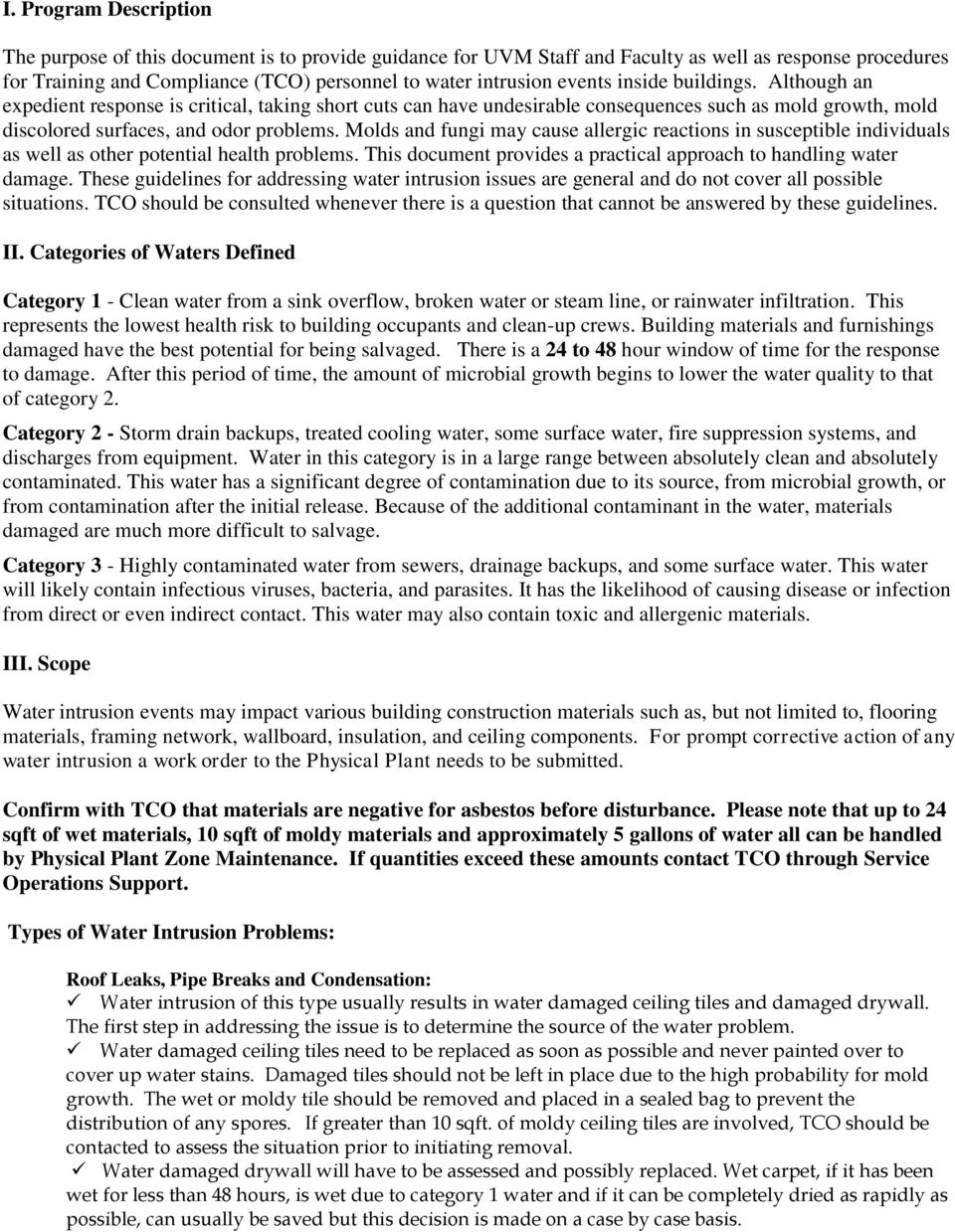
3 Sewer Line Back-ups: Areas affected should have restricted access until the problem is addressed and the area cleaned. Once it is determined the problem has been corrected; clean-up of the affected area(s) can begin. Any porous item that has come into contact with sewage tainted water is considered contaminated and must be discarded. This includes carpet, drywall and ceiling tiles as well as other items such as books and paper products. Non-porous items can usually be cleaned and sanitized. Moisture Intrusion through the Building Envelope: This problem will typically occur along exterior facing walls when some aspect of the wall s structural make-up has failed. Water will migrate through the wall over time from the exterior to the interior surface where paint damage will often result. Water trapped behind the paint film, wallpaper or items attached to the wall can lead to mold growth. These must be individually assessed so that a satisfactory corrective action can be formulated. IV. Response and Communication by Training and Compliance Staff 1. Gather Information: Survey the structure including pre-existing damage. Perform a moisture inspection and map the migration. Develop a preliminary determination. Confirm zone manager or supervisor is notified to fix or isolate problem as soon as possible. Eliminate the primary moisture source. 2. Determine extent of moisture and migration. Document extent of water migration within the structure, systems, and contents. (Photos as necessary). Inspect rooms adjoining wet areas. Use of Moisture Metering equipment Use thermal imaging devices to show flow patterns in hard to reach places Notify all applicable building contacts as needed. 3. Initiate cleanup/restoration. Remove surface water Establish a dry standard and a drying goal Based on availability of equipment and resources along with size and nature of the intrusion, TCO will whenever possible handle category 1 events. Service contractors should be used for any large area intrusions, category 2 and 3 releases, and as determined by the TCO staff. Ensure all TCO and/or contractors electrical equipment is supplied power through a GFI. Relocation of furnishings or other items in an effort to preserve unaffected or salvageable property. Confirm Risk Management is notified for all losses over $ Project Monitoring Drying equipment (fans and dehumidifiers) should be inspected once every 24 hours. Use moisture metering equipment to track and monitor progress. Results to be included in log. When performing restorative drying the moisture content of certain materials should be reduced to acceptable levels as shown below: Material / Component Moisture % Drywall 12% or less Hardwood Flooring 7-10 % Framing Lumber %
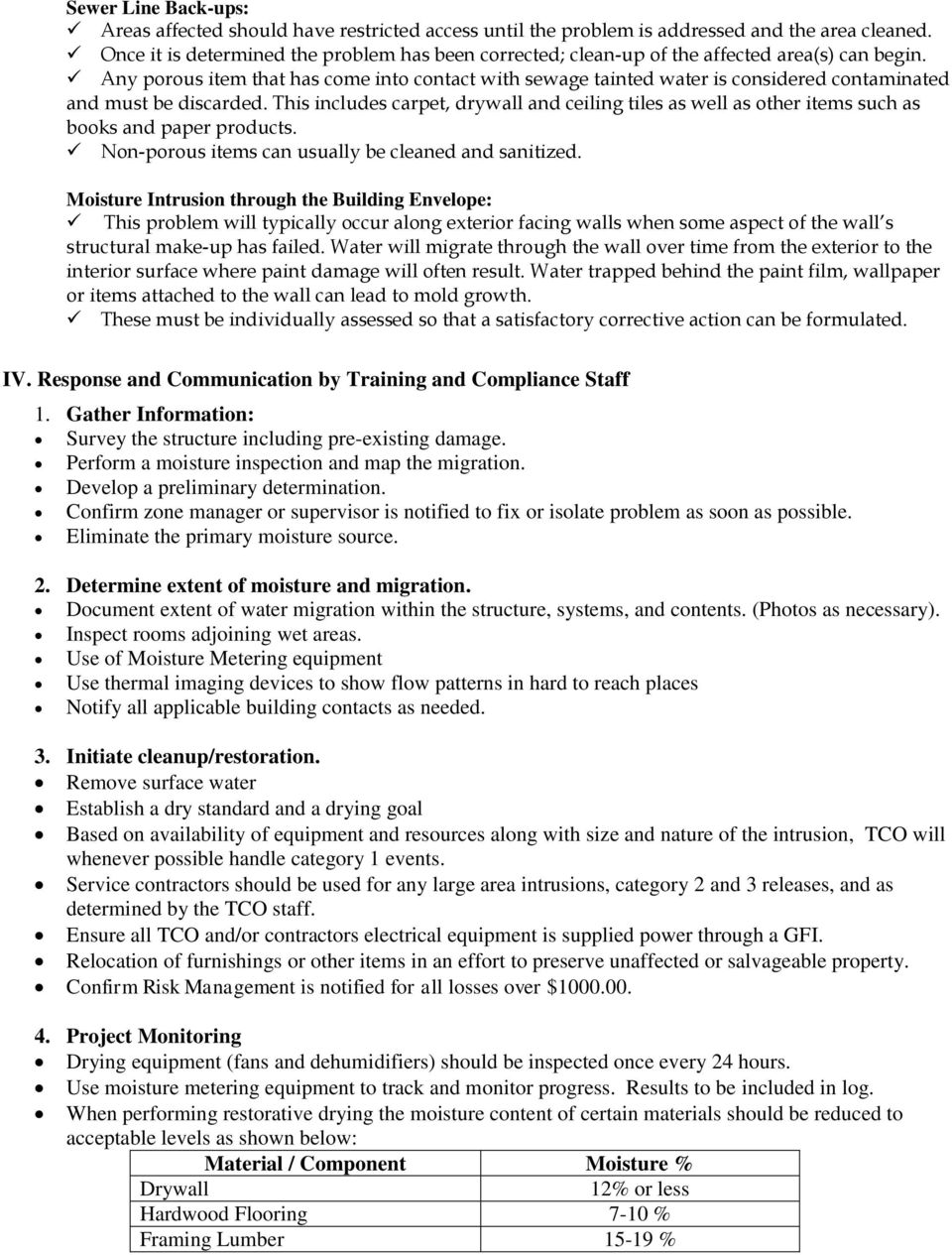
4 Table 1: Water Damage - Cleanup and Mold Prevention Guidelines for Response to Clean Water Damage within Hours to Prevent Mold Growth* Water-Damaged Material Actions Books and papers For non-valuable items, discard books and papers. Photocopy valuable/important items, discard originals. Freeze (in frost-free freezer or meat locker) or freeze-dry. Carpet and backing - dry within hours Remove water with water extraction vacuum. Reduce ambient humidity levels with dehumidifier. Accelerate drying process with fans. Replace if contaminated with Category 3 water. Ceiling tiles Discard and replace. (Confirm Negativity for Asbestos) Cellulose insulation Discard and replace. Concrete or cinder block surfaces Fiberglass insulation Discard and replace. Hard surface, porous flooring (Linoleum, ceramic tile, vinyl) Non-porous, hard surfaces (Plastics, metals) Remove water with water extraction vacuum. Accelerate drying process with dehumidifiers, fans, and/or heaters. Vacuum or damp wipe with water and mild detergent and allow to dry; scrub if necessary. Check to make sure under flooring is dry; dry under flooring if necessary. Vacuum or damp wipe with water and mild detergent and allow drying; scrubbing if necessary. Upholstered furniture Remove water with water extraction vacuum. Accelerate drying process with dehumidifiers, fans, and/or heaters. May be difficult to completely dry within 48 hours. If the piece is valuable, may wish to consult a restoration/water damage professional who specializes in furniture. Wallboard (Drywall and gypsum board) May be dried in place if there is no obvious swelling and the seams are intact. If not, remove, discard, and replace. Ventilate the wall cavity, if possible. Replace is unable to dry within 48 hours (Confirm Negativity for Asbestos) Replace if contaminated with Category 3 Water. (Confirm Negativity for Asbestos) Window drapes Follow laundering or cleaning instructions recommended by the manufacturer. Wood surfaces Remove moisture immediately and use dehumidifiers, gentle heat, and fans for drying. (Use caution when applying heat to hardwood floors.) Treated or finished wood surfaces may be cleaned with mild detergent and clean water and allowed to dry. Wet paneling should be pried away from wall for drying. * If mold growth has occurred or materials have been wet for more than 48 hours, consult Table 2 guidelines. Even if materials are dried within 48 hours, mold growth may have occurred. Items may be tested by professionals if there is doubt. Note that mold growth will not always occur after 48 hours; this is only a guideline. These guidelines are for damage caused by clean water. If you know or suspect that the water source is contaminated with sewage, or chemical or biological pollutants, then Personal Protective Equipment and containment are required by OSHA. An experienced professional should be consulted if you and/or your remediators do not have expertise remediating in contaminated water situations. Do not use fans before determining that the water is clean or sanitary. If a particular item(s) has high monetary or sentimental value, you may wish to consult a restoration/water damage specialist.
5

MOLD REMEDIATION KEY STEPS
 MOLD REMEDIATION KEY STEPS The EPA has developed the following guidelines for mold remediation managers. These guidelines are generally helpful, but we believe an expert in the industry should be consulted
NORMI Professional Guidance for DIY Projects
 NORMI Professional Guidance for DIY Projects In general, a well-trained and experienced indoor mold remediation professional (CMR) should be consulted when performing remediation. You may find a NORMI
APPENDIX B. EPA s Investigating, Evaluating, and Remediating Moisture and Mold Problems (see EPA website for complete details)
 APPENDIX B. EPA s Investigating, Evaluating, and Remediating Moisture and Mold Problems (see EPA website for complete details) Table 1: Water Damage - Cleanup and Mold Prevention Table 1 presents strategies
Mold Response and Remediation Plan
 1.0 Policy Statement The University of New Haven has developed a mold response and remediation plan in accordance with best practices set forth by the Environmental Protection Agency (EPA), Occupational
MOLD RESPONSE AND REMEDIATION PLAN
 MOLD RESPONSE AND REMEDIATION PLAN Prepared By: Triumvirate Environmental Developed: April 2011 Last Revised: March 2015 Program Approval Associate Vice President of Public Safety & Administrative Services
CENTER FOR ENVIRONMENTAL HEALTH Emergency Response/Indoor Air Quality Program
 CENTER FOR ENVIRONMENTAL HEALTH Emergency Response/Indoor Air Quality Program Guidance Concerning Remediation and Prevention of Mold Growth and Water Damage in Public Schools/Buildings to Maintain Air
University of Nevada, Reno Facilities Services Department STANDARD OPERATING PROCEDURE. Facilities Maintenance Services
 University of Nevada, Reno Facilities Services Department STANDARD OPERATING PROCEDURE Facilities Maintenance Services Indoor Flood Cleanup and Mold Prevention DATE: 6/24/15 REVISED: PURPOSE This University
Mold and Mildew Mold and mildew can be detected by sight, smell and touch.
 Mold and Mildew Mold and mildew can be detected by sight, smell and touch. Molds are usually black (not unlike the molds that grow in showers and between grout), green or tan in color, but can be in various
BUREAU OF ENVIRONMENTAL HEALTH Emergency Response/Indoor Air Quality Program
 BUREAU OF ENVIRONMENTAL HEALTH Emergency Response/Indoor Air Quality Program Use of Moisture Measuring Devices in Evaluating Water Damage in Buildings July 2007 The evaluation of mold colonization of building
INDOOR WATER INTRUSION (INDOOR WATER LINE BREAKS) Region 8 Sustainability & Environmental Management System
 1.0 Purpose & Scope The purpose of this procedure is to provide a standardized approach to handle the unwanted entry of water, known as water incursions or intrusions into an indoor environment. This procedure
Indoor Flood Cleanup and Mold Remediation Standard Operating Procedure (SOP)
 Indoor Flood Cleanup and Mold Remediation Standard Operating Procedure (SOP) 1.0 Purpose The purpose of this SOP is to outline proper methods for cleanup and disposal following an indoor water release
UNIVERSITY OF TOLEDO
 UNIVERSITY OF TOLEDO SUBJECT: MOLD PREVENTION AND REMEDIATION Procedure No: HM-08-035 PROCEDURE STATEMENT All indoor areas on campus are expected to present no immediate threat to the health and well-being
Queen's University Environmental Health & Safety. 1.0 Introduction
 1 Introduction The were developed by the Department of Environmental Health & Safety in accordance with the University s Policy Statement on Health and Safety and to ensure compliance with the Ontario
Mold Management Plan Operations & Maintenance
 Document #: SAFETY_015 Revision Date: October 4, 2010 Mold Management Plan Operations & Maintenance Developed by: Environmental Health & Safety Approved by: Associate VP of Facilities & Campus Services
Wellesley College Mold Management Program March 2009
 Mold Management Program March 2009 Table of Contents Page I. Policy...2 II. Objectives....2 III. Roles and Responsibilities... 2 IV. Operational Controls Standard Operating Procedures.. 3 A. Addressing
Mold Prevention and Remediation Program
 Mold Prevention and Remediation Program TABLE OF CONTENTS INTRODUCTION... 3 Objective... 3 Applicability... 3 Responsibilities... 3 Program Enforcement... 5 HAZARD ASSESSMENT... 6 Visual Inspection...
STANDARD OPERATING PROCEDURES FOR MOLD REMEDIATION
 West Virginia University Environmental Health and Safety STANDARD OPERATING PROCEDURES FOR MOLD REMEDIATION Origination Date August 2013. Contents Purpose:... 2 Job Scope... 2 Definitions... 2 Roles/Responsibilities:...
COMPLIANCE WITH THIS PUBLICATION IS MANDATORY. There are no releasability restrictions on this publication.
 BY ORDER OF THE COMMANDER 66TH AIR BASE WING 66 AIR BASE WING INSTRUCTION 48-102 20 MAY 2009 Aerospace Medicine INDOOR AIR QUALITY (IAQ) PROGRAM COMPLIANCE WITH THIS PUBLICATION IS MANDATORY ACCESSIBILITY:
Old Dominion University Mold Management Plan
 OFFICE OF ENVIRONMENTAL HEALTH AND SAFETY 5255 Hampton Blvd. Spong Hall, suite 2501 Norfolk, Virginia 23529 Phone: (757) 683-4495 Fax: (757) 683-6025 Occupational Safety & Health Environmental Health Laboratory
Water Incursion Standard Operating Procedure
 Water Incursion Standard Operating Procedure Purpose: To provide a standardized procedure in the event of water incursion into any Penn State University facility. References: A Brief Guide to Mold, Moisture
IUB Water Damage Restoration Guideline
 IUB Water Damage Restoration Guideline Purpose The IUB Water Damage Restoration guideline was developed to ensure that all water intrusions are handled in a professional manner which includes the latest
The National Institutes of Heath
 The National Institutes of Heath Moisture and Mold Remediation Standard Operating Procedures August 2014 Technical Assistance Branch Division of Occupational Health and Safety, ORS I. Overview Introduction
Managing Water Infiltration into Buildings. Water Damage Check List
 Managing Water Infiltration into Buildings A Systematized Approach for Remediating Water Problems in Buildings due to Floods, Roof Leaks, Potable Water Leaks, Sewage Backup, Steam Leaks and Groundwater
CITY OF LOS ANGELES GUIDELINES FOR ASSESSMENT AND REMEDIATION OF MOLD
 CITY OF LOS ANGELES GUIDELINES FOR ASSESSMENT AND REMEDIATION OF MOLD The information contained within this manual has been compiled from the following reference sources: The Environmental Protection Agency
Responding to Building Water Damage. Types of Water Damage. Why is Water Damage Such a Concern?
 Responding to Building Water Damage When water damage occurs in a building an immediate response saves time and money, and protects health. Delays or incomplete responses increase both the scope and severity
How To Prevent And Manage A Flood And Mold
 Flood Response and Mold Prevention Program Prepared by the Berea College Department of Environmental Health and Safety Revised May 2010 Contents I. Introduction II. III. IV. Flood and Mold Hazards Roles
Managing Water Infiltration Into Buildings
 Managing Water Infiltration Into Buildings A systemized approach for remediating water problems in buildings due to floods, roof leaks, potable water leaks, sewage backup, steam leaks and groundwater infiltration.
ASSESS THE CLEANLINESS OF THE WATER
 310 E. Foothill Blvd., Suite 200 Arcadia, CA 91006 Ph: 626.441.7050 Fax: 626.441.0016 WATER INTRUSION RESPONSE PROCEDURE FOR MAINTENANCE & OPERATIONS CUSTODIANS/PLUMBERS PURPOSE/DISCUSSION There has been
Response to Water Intrusion and Mold/Microbial Growth
 I. Rationale Sufficient scientific evidence exists to conclude that there is an association between the presence of mold or other agents found in damp indoor environments and various health symptoms. Health
Cleaning Up After a Clean-Water Flood
 Cleaning Up After a Clean-Water Flood BENEFITS Insurance Claims Administration TEMPORALITIES RISK MANAGEMENT No matter if your basement is full of water from a storm or because a pipe broke, you need to
Mold Basics. Why is mold growing in my home?
 Mold Basics The key to mold control is moisture control. If mold is a problem in your home, you should clean up the mold promptly and fix the water problem. It is important to dry water-damaged areas and
Guidelines for Cleaning Staff on Managing Mould Growth in State Buildings
 Guidelines for Cleaning Staff on Managing Mould Growth in State Buildings Prepared by the State Claims Agency 2 Index 1. Background 2. What are moulds? 3. What are the possible health effects? 4. How do
Excerpts from EPA s Mold Remediation in Schools and Commercial Buildings
 www.epa.gov/mold/mold_remediation.html Compiled by SUNY Office for Capital Facilities, May 2014 Page 1 Compiled by SUNY Office for Capital Facilities, May 2014 Page 2 Compiled by SUNY Office for Capital
Got Mold? Frequently Asked Questions About Mold
 Office of Environmental Health & Safety Got Mold? Frequently Asked Questions About Mold What are molds? With more than 100,000 species in the world, it is no wonder molds can be found everywhere. Neither
WATER DAMAGE INVESTIGATION. Massachusetts Gaming Commission 101 Federal Street Boston, Massachusetts
 WATER DAMAGE INVESTIGATION Massachusetts Gaming Commission 101 Federal Street Boston, Massachusetts Prepared by: Massachusetts Department of Public Health Bureau of Environmental Health Indoor Air Quality
DESERT RESEARCH INSTITUTE MOLD ASSESSMENT AND REMEDIATEION PROCEDURE
 1.0 Introduction DESERT RESEARCH INSTITUTE This Desert Research Institute (DRI) Mold Assessment and Remediation Procedure was established to assure that consistent and uniform information is provided to
City of Philadelphia Mold Remediation, Water Damage and Use of Biocides
 City of Philadelphia Mold Remediation, Water Damage and Use of s This document provides direction for remediation of building materials in City facilities with potential, visible or laboratory verified
Mold Questions and Answers Questions and Answers on Stachybotrys chartarum and other molds
 Questions and Answers on Stachybotrys chartarum and other molds Questions and Answers 1. I heard about "toxic molds" that grow in homes and other buildings. Should I be concerned about a serious health
Clean Water: Supply side potable water, not wastewater. Gray Water/Sewage: Wastewater originating from a drain (sink, toilet, urinal).
 Procedures for Emergency Responses to Flooding and Building Water Intrusion PURPOSE: To establish uniform, sanitary, and systematic procedures for responding to flooding and water intrusion emergencies.
Water should be removed as soon as possible once the safety of the structure has been verified.
 FACT SHEET Posted October 18 2005 Check List for Infection Control Concerns when Reopening Healthcare Facilities Closed due to Extensive Water and Wind Damage Prior to opening a healthcare facility that
An Informational Pamphlet. 416 South East Street Lebanon, OH 45036
 An Informational Pamphlet 416 South East Street Lebanon, OH 45036 What is Mold? Mold is a type of fungus that is present in our natural environment. Mold spores, which are tiny microscopic seeds, can
Mold Remediation in Schools and Commercial Buildings
 EPA 402-K-01-001 September 2008 www.epa.gov/mold Mold Remediation in Schools and Commercial Buildings Indoor Air Quality (IAQ) Acknowledgements This document was prepared by the Indoor Environments Division
Preventing Long-Term Damage from Water Infiltration/Flooding in School Buildings
 Preventing Long-Term Damage from Water Infiltration/Flooding in School Buildings A systematized approach for remediating water problems in buildings because of floods, roof leaks, potable water leaks,
Guidelines for Mold Remediation (Removal)
 Guidelines for Mold Remediation (Removal) Indoor mold growth, water damage, or musty odors should be addressed quickly. Removing mold growth and correcting the underlying cause of water accumulation can
MOLD REMEDIATION Kathleen Parrott, Ph.D. Professor of Housing, Virginia Tech
 MOLD REMEDIATION Kathleen Parrott, Ph.D. Professor of Housing, Virginia Tech Virginia Cooperative Extension has three publications to help you deal with mold in your home: Mold Basics: What is mold? How
Army Facilities Management Information Document on Mold Remediation Issues
 Army Facilities Management Information Document on Mold Remediation Issues TG 277 FEBRUARY 2002 NOTICE This publication is essential and current. An administrative review has been performed by the proponent
KEY ELEMENTS IN PREVENTING AND MITIGATING MOLD CLAIMS
 KEY ELEMENTS IN PREVENTING AND MITIGATING MOLD CLAIMS By Jerome E. Spear, CSP, CIH Effective January 1, 2005, consultants who prepare mold management plans for buildings located in Texas must be licensed
Please note that this document presents recommendations on mold remediation. EPA does not regulate mold or mold spores in indoor air.
 Mold Remediation in Schools and Commercial Buildings Acknowledgements This document was prepared by the Indoor Environments Division (IED) of the U.S. Environmental Protection Agency. IED would like to
WATER DAMAGE INVESTIGATION. Massachusetts Department of Public Utilities 1 South Station Boston, Massachusetts
 WATER DAMAGE INVESTIGATION Massachusetts Department of Public Utilities 1 South Station Boston, Massachusetts Prepared by: Massachusetts Department of Public Health Bureau of Environmental Health Indoor
MOISTURE MANAGEMENT DURING THE CONSTRUCTION PROCESS
 MOISTURE MANAGEMENT DURING THE CONSTRUCTION PROCESS Ed Light 1,*, James Bailey 1, and Roger Gay 1 1 Building Dynamics, LLC, Ashton, MD (USA) *Corresponding email: [email protected] Published
Part 2: Drying Out Your Home
 Part 2: Drying Out Your Home Now you're ready to begin drying out your home and establishing your plan for rebuilding. The information contained in this section will help you to dry out and decontaminate
MOLD REMEDIATION PROCEDURES
 Page: 1 of 5 1.0 PROGRAM OBJECTIVE The purpose of this procedure is to define the responsibilities, methods, procedures and training required to safely and effectively remove or clean mold-contaminated
Mould Mould A Basic Guide
 Mould A Basic Guide Summary Mould is a fact of life. Moulds will grow practically everywhere people live and work. Mould is recognized as an occupational hazard for indoor workers as well as outdoor workers
PROPERTY INSPECTION OR ASSESSMENT OF DAMAGES
 PROPERTY INSPECTION OR ASSESSMENT OF DAMAGES ADDRESS: 123 MAIN ST MIAMI, FL CLIENT: BUYER ID No: 2014193 DATE: 5/13/2014 INSPECTION OR ASSESSMENT BY: GAIA CONSTRUCTION INC. CGC 1516136 FLORIDA HI-2792
Procedures for Gray or Black Water Remediation from Flooding Contamination in Buildings
 LOSS CONTROL REFERENCE NOTE : from Liberty Mutual Insurance Procedures for Gray or Black Water Remediation from Flooding Contamination in Buildings HIGHLIGHTS: Gray water or black water from flooding may
Restoring your Property: How to be prepared for Rapid Response to Flood Damage
 Restoring your Property: How to be prepared for Rapid Response to Flood Damage After a flood, the restoration process can be long and complex, particularly for large commercial properties. Failure to apply
Building and Grounds Maintenance Checklist
 Building and Grounds Maintenance Checklist Name: School: Room or Area: Date Completed: Signature: Instructions 1. Read the IAQ Backgrounder and the Background Information for this checklist. 2. Keep the
Restoring Peace of Mind.
 Contact Information Emergency Water Service Introduction Property Checklist Understanding Water Damage Understanding the Drying Process Frequently Asked Questions Restoring Peace of Mind. Safety Tips IMPORTANT
WATER DAMAGE, MOLD* GROWTH AND IAQ
 WATER DAMAGE, MOLD* GROWTH AND IAQ *Mold and Mildew are fungi What conditions may pose a problem & why What to do My name is: Jacquelyn Brown Environmental Protection Program Specialist (Health & Safety
March 2007. Get The Mold Out: Mold Clean-Up Guidance for Residences. Introduction
 March 2007 Connecticut Department of Public Health Environmental Health Section Environmental & Occupational Health Assessment Program 410 Capitol Avenue MS # 11EOH, PO Box 340308 Hartford, CT 06134-0308
Mold In Your Home and at Work
 Mold In Your Home and at Work Forsyth County Office of Environmental Assistance and Protection What is mold? Mold is a term used to describe a type of fungus that can be found all year round both indoors
Mold. Clean Up, Removal, Safety Concerns
 Mold & Clean Up, Removal, Safety Concerns What is Mold? What are the Symptoms? Should I be concerned? What is Toxic Mold? Molds are fungi that can be found both indoors and outdoors. It s not know how
Now that Your Building Experienced Water Damage What Must You and Your Water Damage Restoration Contractor Agree On?
 w that Your Building Experienced Water Damage What Must You and Your Water Damage Restoration Contractor Agree On? By Completing a Building and Occupant Survey Hopefully Your Questions will be Answered
Moulds. Workplace Guidelines for Recognition, Assessment, and Control. Occupational Health and Safety Council of Ontario
 Moulds Workplace Guidelines for Recognition, Assessment, and Control Occupational Health and Safety Council of Ontario 1 Moulds More and more workplaces are involved in investigating or removing mould
WATER INFILTRATION INTO BUILDINGS: Part 1: Mold in Buildings General Information
 WATER INFILTRATION INTO BUILDINGS: Part 1: Mold in Buildings General Information Part 2: Guidelines for Managing Water Infiltration into Buildings Roles & Responsibilities Part 3: Guidelines for Facilities
MOLD FAQs. 1. What is mold and where does it live? 2. How can mold affect my health?
 MOLD FAQs 1. What is mold and where does it live? Molds are microscopic fungi that are part of the natural environment. They can grow almost anywhere (inside and out), but live especially in the soil outside.
Commonwealth of Kentucky Cabinet for Health and Family Services Department for Public Health Division of Public Health Protection and Safety
 June 2, 2004 Commonwealth of Kentucky Cabinet for Health and Family Services Department for Public Health Division of Public Health Protection and Safety 275 East Main Street HS1EB Frankfort, KY 40621
Mold Investigation Summary Report
 Gold Health and Safety Consulting, Inc. 4001 Inglewood Ave., Suite 101-292, Redondo Beach, CA 90278 (310) 219-1955 (310) 219-1934 - Fax SUBJECT PROPERTY LOCATED AT: 4405 Tomorrowland Ave., Disneyland,
How To Clean Mold From A House
 Mold & Mildew Cleaning Up Your Flood-Damaged Home FEMA 606/July 2007 The Problem With Mold Mildew and molds are fungi - simple microscopic organisms that thrive anywhere there is a moist environment. Molds
WATER DAMAGE/MOLD INVESTIGATION. Massachusetts Department of Developmental Services 68 North Main Street Carver, Massachusetts
 WATER DAMAGE/MOLD INVESTIGATION Massachusetts Department of Developmental Services 68 North Main Street Carver, Massachusetts Prepared by: Massachusetts Department of Public Health Bureau of Environmental
WHEN IT RAINS, IT POURS WATER DAMAGE RESTORATION
 WHEN IT RAINS, IT POURS WATER DAMAGE RESTORATION SUMMARY Damage to a facility from water can come in many forms. From a sprinkler malfunction to a hurricane, water damage can damage and destroy a building
United States Environmental Protection Agency. A Brief Guide to. Mold, Moisture, Indoor Air Quality (IAQ)
 United States Environmental Protection Agency A Brief Guide to Mold, Moisture, and Your Home Indoor Air Quality (IAQ) EPA 402-K-02-003 (Reprinted 09/2010) This Guide provides information and guidance for
Remediation of Mold and Bacteria from Clean, Gray and Black Water Contamination in Buildings
 LOSS CONTROL REFERENCE NOTE : from Liberty Mutual Insurance Remediation of Mold and Bacteria from Clean, Gray and Black Water Contamination in Buildings HIGHLIGHTS: Provides guidelines for remediating
Sewage Back-Ups: Information for Residents
 Sewage Back-Ups: Information for Residents Background: Severe rainstorms, floods, and even spring thaws can put a strain on sanitary sewers and septic systems. Large volumes of storm water and ground water
WATER DAMAGE RECOVERY G U I D E
 WATER DAMAGE RECOVERY GUIDE YOU CAN TRUST T TEAM RAPID 14 TH YEAR IN BUSINESS 5 YEAR WARRANTY! CERTIFIED TECHNICIANS INSURANCE COMPANY RECOMMENDED A + RATING PAYMENT PLANS! Thank You for choosing Team
WATER DAMAGE INVESTIGATION. Massachusetts Department of Children and Families 33 East Merrimack Street Lowell, Massachusetts
 WATER DAMAGE INVESTIGATION Massachusetts Department of Children and Families 33 East Merrimack Street Lowell, Massachusetts Prepared by: Massachusetts Department of Public Health Bureau of Environmental
MEMORANDUM. General: Foundation:
 MEMORANDUM State of Alaska Department of Transportation and Public Facilities Central Region - Division of Construction and Operations Public Facilities Branch TO: Jennifer Murrel DATE: August 19, 2010
A Guide to Water Damage Restoration MISSION STATEMENT THE DOME COMMITMENT
 A Guide to Water Damage Restoration MISSION STATEMENT THE DOME COMMITMENT Our mission is to deliver the highest quality disaster restoration, remediation/abatement and general contracting services in a
Mold Remediation in Occupied Homes
 building science.com 2008 Building Science Press All rights of reproduction in any form reserved. Mold Remediation in Occupied Homes Research Report - 0210 January-2002 Joseph Lstiburek, Terry Brennan
Help Yourself to a Healthy Home Mold and Moisture
 Help Yourself to a Healthy Home Mold and Moisture SHOULD YOU BE CONCERNED? Mold produces spores, tiny specks you can t see and that float through the air. When you breathe in mold spores, they get into
Industrial Hygiene/ Preventive Medicine Mold Assessment Guide
 Industrial Hygiene/ Preventive Medicine Mold Assessment Guide TG 278 February 2002 NOTICE This publication is essential and current. An administrative review has been performed by the proponent office
Stachybotrys chartarum a mold that may be found in water-damaged homes
 Stachybotrys chartarum a mold that may be found in water-damaged homes November 2000 Environmental Health Investigations Branch California Department of Health Services Stachybotrys chartarum ecology Stachybotrys
HOW TO RESPOND WHEN DISASTER STRIKES.. FIRE POWER OUTAGE WATER DAMAGE ( TO ADD TEMPORARY WATER INTERRUPTION)
 HOW TO RESPOND WHEN DISASTER STRIKES.. FIRE POWER OUTAGE WATER DAMAGE ( TO ADD TEMPORARY WATER INTERRUPTION) FIRE Determining the extent of fire and smoke damage is very difficult. Look for the following
Mold, Mildew, Fungi What s the Difference? Mold: The Good, the Bad and the Ugly
 CEILING SYSTEMS Mold is receiving more attention within the construction industry than ever before. One reason is that it is becoming an increasingly visible subject in the media. Another is an increased
IAQ - indoor ventilation Air contaminants Molds Requirements for growth Health effects Mold prevention - moisture EH&S mold checks & removal
 Indoor Air Quality & Mold Class Spring 2012 Building Monitors Meeting Presentation Agenda IAQ - indoor ventilation Air contaminants Molds Requirements for growth Health effects Mold prevention - moisture
Moisture Management. Infection Prevention and Corporate Safety. Contents. Posttest... 12
 Moisture Management Infection Prevention and Corporate Safety This self-directed learning module contains information you are expected to know to protect yourself, our patients, and our guests. Target
Molds and mildew are fungi that grow
 Appendix C: Moisture, Mold and Mildew Molds and mildew are fungi that grow on the surfaces of objects, within pores, and in deteriorated materials. They can cause discoloration and odor problems, deteriorate
Water Damage Restoration Program December 1, 2015
 Water Damage Restoration Program December 1, 2015 1. INTRODUCTION 1.1. Purpose Indiana University Environmental Health and Safety (IUEHS) has developed this Program to ensure that all water intrusions
1-800-980-8003. Government Commercial Residential. CA License #959870 NV License #0077068
 1-800-980-8003 Government Commercial Residential CA License #959870 NV License #0077068 Company representative:......... With over 13 years of disaster management experience and more than 10,000 completed