
MOLD REMEDIATION KEY STEPS
|
|
|
- Elaine Baker
- 10 years ago
- Views:
Transcription
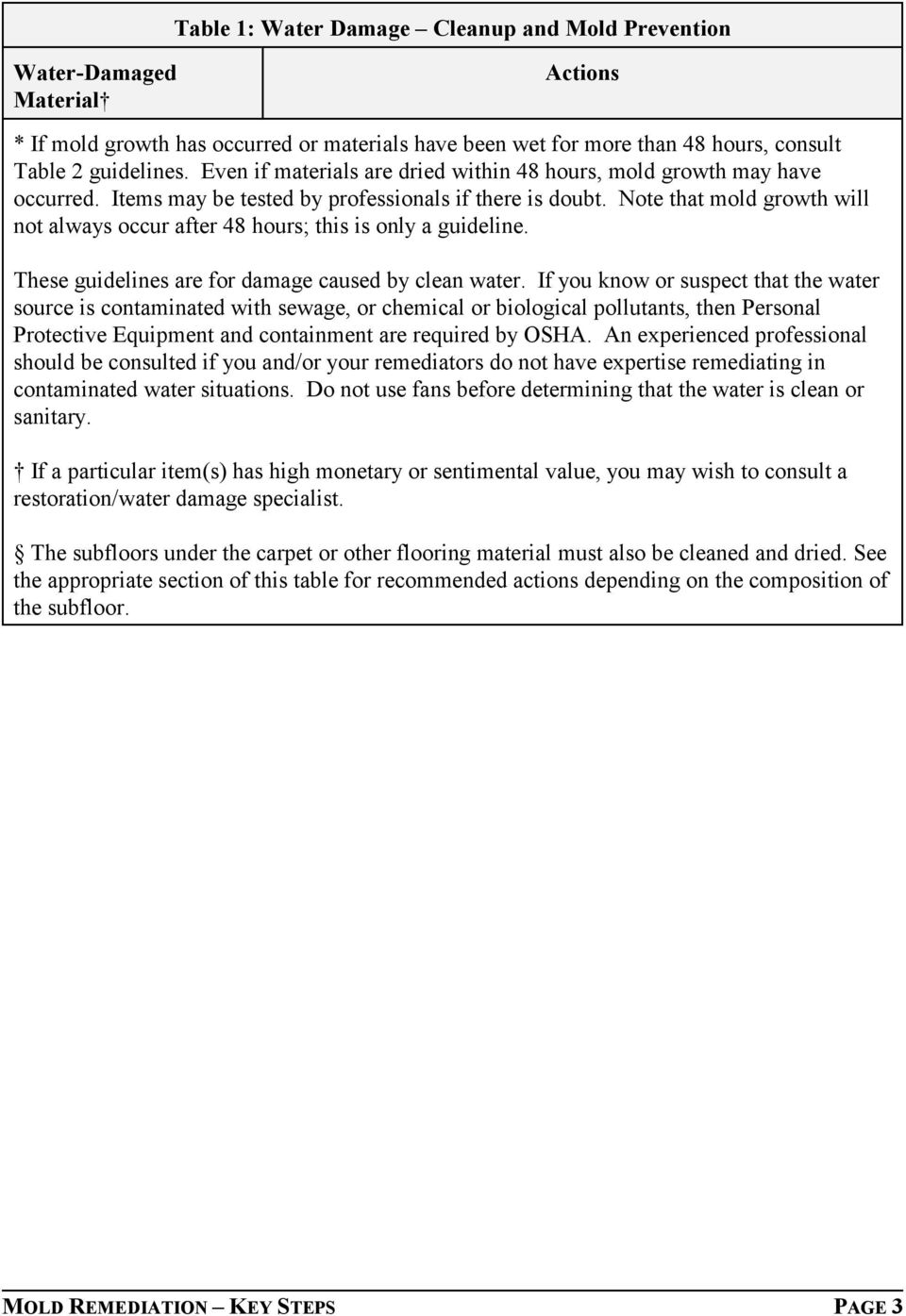
1 MOLD REMEDIATION KEY STEPS The EPA has developed the following guidelines for mold remediation managers. These guidelines are generally helpful, but we believe an expert in the industry should be consulted and a more specific response plan for adjusters be created.! Consult health professional as appropriate throughout process;! Select remediation professional;! Assess size of mold problem and note type of mold-damaged materials;! Communicate with building occupants throughout process as appropriate to situation;! Identify source or cause of water or moisture problem;! Plan remediation, adapt guidelines to fit situation, see Table 1 & Table 2;! Remediate;! Fix water or moisture problem;! Clean and dry moldy materials; see Table 2;! Discard moldy items that can't be cleaned;! Dry non-moldy items within 48 hours; see Table 1;! Check for return of moisture and mold problem;! Schedule inspection TABLE 1: Water Damage Cleanup and Mold Prevention (6) This table presents strategies to respond to water damage within hours. These guidelines are designed to help avoid the need for remediation of mold growth by taking quick action before growth starts. If mold growth is found on the materials listed in Table 1, refer to Table 2 for guidance on remediation. Table 1: Water Damage Cleanup and Mold Prevention Water-Damaged Material Books and papers Carpet and backing dry within hours Ceiling tiles Cellulose insulation Concrete or cinder block surfaces Actions For non-valuable items, discard books and papers Photocopy valuable/important items, discard originals Freeze (in frost-free freezer or meat locker) or freeze-dry Remove water with water extraction vacuum Reduce ambient humidity levels with dehumidifier Accelerate drying process with fans Discard and replace Discard and replace Remove water with water extraction vacuum Accelerate drying process with dehumidifies, fans and/or heaters MOLD REMEDIATION KEY STEPS PAGE 1

2 Table 1: Water Damage Cleanup and Mold Prevention Water-Damaged Material Actions Fiberglass insulation floorings (Linoleum, surfaces (Plastics, metals) Upholstered furniture Wallboard (Drywall and Window drapes Wood surfaces Discard and replace Vacuum or damp wipe with water and mild detergent and allow to dry; scrub if necessary Check to make sure underflooring is dry; dry underflooring if necessary Vacuum or damp wipe with water and mild detergent and allow to dry; scrub if necessary Remove water with water extraction vacuum Accelerate drying process with dehumidifiers, fans, and/or heaters May be difficult to completely dry within 48 hours. If the piece is valuable, you may wish to consult a restoration/water damage professional who specializes in furniture May be dried in place if there is no obvious swelling and the seams are intact. If not, remove, discard, and replace Ventilate the wall cavity, if possible Follow laundering or cleaning instructions recommended by the manufacturer Remove moisture immediately and use dehumidifiers, gentle heat, and fans for drying. (Use caution when applying heat to hardwood floors.) Treated or finished wood surfaces may be cleaned with mild detergent and clean water and allowed to dry Wet paneling should be pried away from wall for drying MOLD REMEDIATION KEY STEPS PAGE 2

3 Table 1: Water Damage Cleanup and Mold Prevention Water-Damaged Material Actions * If mold growth has occurred or materials have been wet for more than 48 hours, consult Table 2 guidelines. Even if materials are dried within 48 hours, mold growth may have occurred. Items may be tested by professionals if there is doubt. Note that mold growth will not always occur after 48 hours; this is only a guideline. These guidelines are for damage caused by clean water. If you know or suspect that the water source is contaminated with sewage, or chemical or biological pollutants, then Personal Protective Equipment and containment are required by OSHA. An experienced professional should be consulted if you and/or your remediators do not have expertise remediating in contaminated water situations. Do not use fans before determining that the water is clean or sanitary. If a particular item(s) has high monetary or sentimental value, you may wish to consult a restoration/water damage specialist. The subfloors under the carpet or other flooring material must also be cleaned and dried. See the appropriate section of this table for recommended actions depending on the composition of the subfloor. MOLD REMEDIATION KEY STEPS PAGE 3
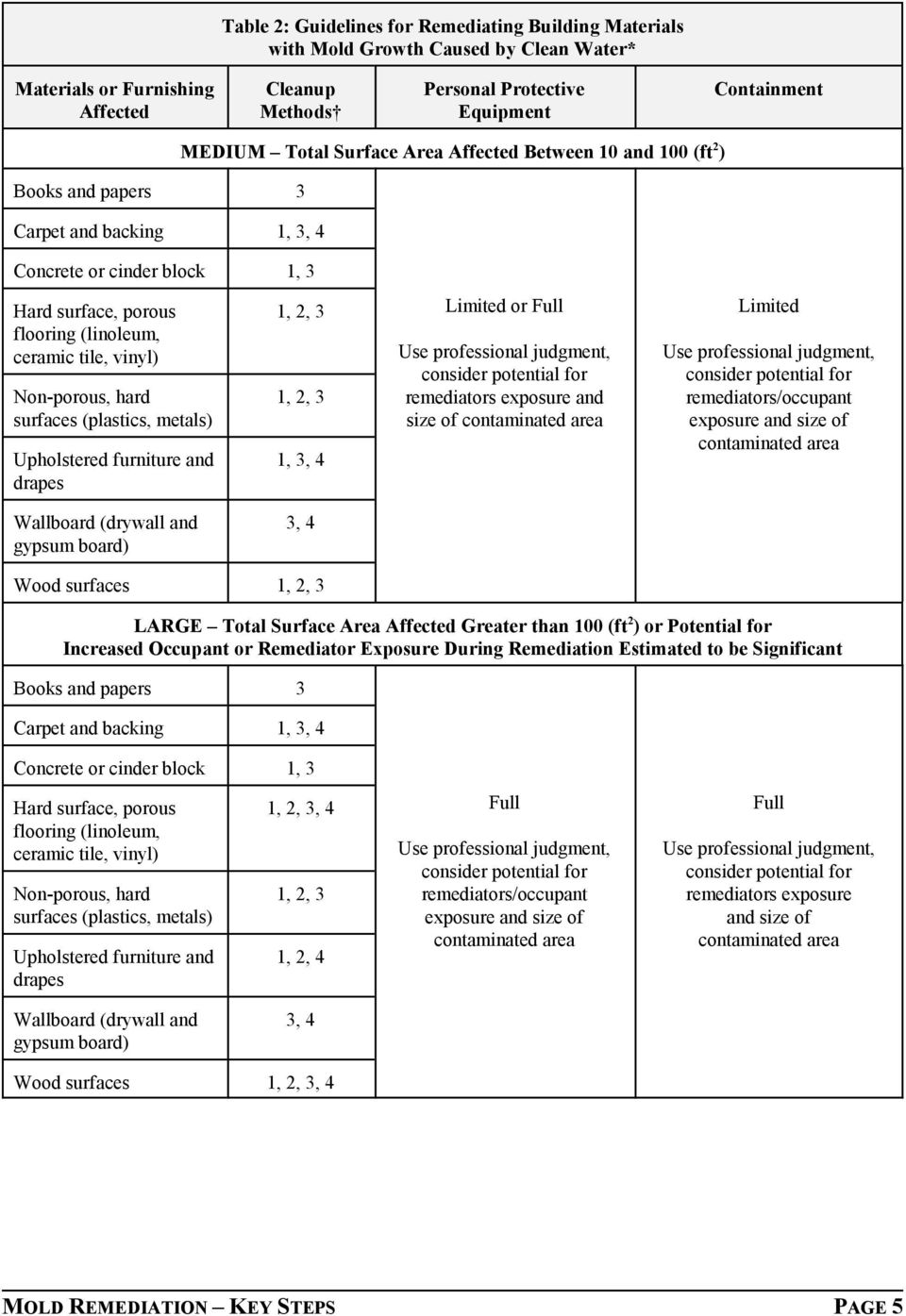
4 TABLE 2: Mold Remediation Guidelines (7) This table presents remediation guidelines for building materials that have or are likely to have mold growth. The guidelines in Table 2 are designed to protect the health of occupants and cleanup personnel during remediation. These guidelines are based on the area and type of material affected by water damage and/or mold growth. In cases in which a particularly toxic mold species has been identified or is suspected, when extensive hidden mold is expected (such as behind vinyl wallpaper or in the HVAC system), when the chances of the mold becoming airborne are estimated to be high, or sensitive individuals (e.g., those with severe allergies or asthma) are present, a more cautious or conservative approach to remediation is indicated. Always make sure to protect remediators and building occupants from exposure to mold. Table 2: Guidelines for Remediating Building Materials with Mold Growth Caused by Clean Water* Materials or Furnishing Affected Cleanup Methods Personal Protective Equipment SMALL Total Surface Area Affected Less Than 10 square feet (ft 2 ) Books and papers 3 Carpet and backing 1.3 Concrete or cinder block 1.3 flooring (linoleum, Minimum None required surfaces (plastics, metals) N-95 respirator, gloves, and goggles Upholstered furniture and drapes 1, 3 Wallboard (drywall and 3 Wood surfaces MOLD REMEDIATION KEY STEPS PAGE 4

5 Table 2: Guidelines for Remediating Building Materials with Mold Growth Caused by Clean Water* Materials or Furnishing Affected Cleanup Methods Personal Protective Equipment Books and papers 3 Carpet and backing 1, 3, 4 MEDIUM Total Surface Area Affected Between 10 and 100 (ft 2 ) Concrete or cinder block 1, 3 flooring (linoleum, surfaces (plastics, metals) Upholstered furniture and drapes 1, 3, 4 Limited or Full remediators exposure and size of contaminated area Limited remediators/occupant exposure and size of contaminated area Wallboard (drywall and 3, 4 Wood surfaces LARGE Total Surface Area Affected Greater than 100 (ft 2 ) or Potential for Increased Occupant or Remediator Exposure During Remediation Estimated to be Significant Books and papers 3 Carpet and backing 1, 3, 4 Concrete or cinder block 1, 3 flooring (linoleum, surfaces (plastics, metals) Upholstered furniture and drapes, 4 1, 2, 4 Full remediators/occupant exposure and size of contaminated area Full remediators exposure and size of contaminated area Wallboard (drywall and 3, 4 Wood surfaces, 4 MOLD REMEDIATION KEY STEPS PAGE 5
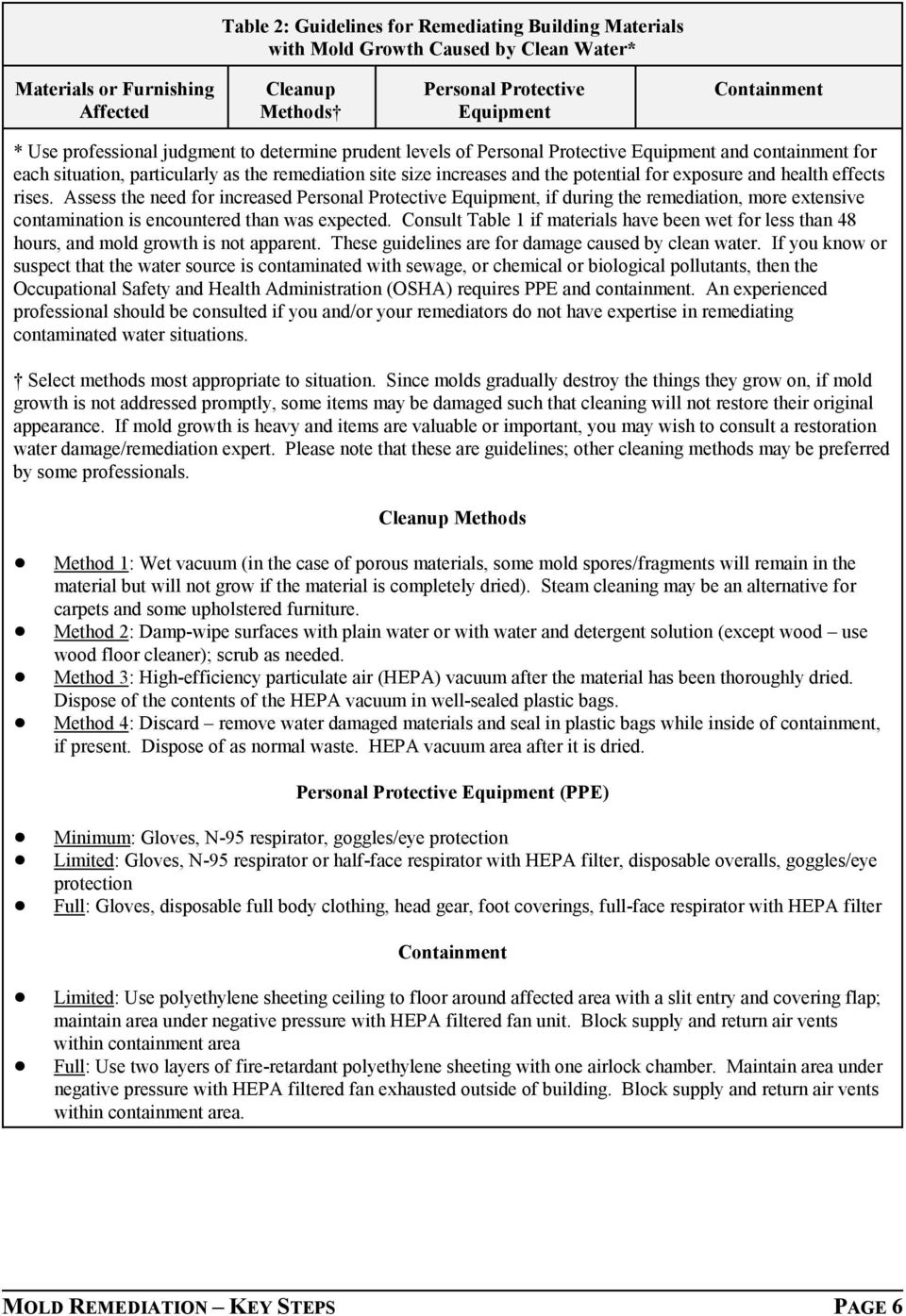
6 Table 2: Guidelines for Remediating Building Materials with Mold Growth Caused by Clean Water* Materials or Furnishing Affected Cleanup Methods Personal Protective Equipment * Use professional judgment to determine prudent levels of Personal Protective Equipment and containment for each situation, particularly as the remediation site size increases and the potential for exposure and health effects rises. Assess the need for increased Personal Protective Equipment, if during the remediation, more extensive contamination is encountered than was expected. Consult Table 1 if materials have been wet for less than 48 hours, and mold growth is not apparent. These guidelines are for damage caused by clean water. If you know or suspect that the water source is contaminated with sewage, or chemical or biological pollutants, then the Occupational Safety and Health Administration (OSHA) requires PPE and containment. An experienced professional should be consulted if you and/or your remediators do not have expertise in remediating contaminated water situations. Select methods most appropriate to situation. Since molds gradually destroy the things they grow on, if mold growth is not addressed promptly, some items may be damaged such that cleaning will not restore their original appearance. If mold growth is heavy and items are valuable or important, you may wish to consult a restoration water damage/remediation expert. Please note that these are guidelines; other cleaning methods may be preferred by some professionals. Cleanup Methods! Method 1: Wet vacuum (in the case of porous materials, some mold spores/fragments will remain in the material but will not grow if the material is completely dried). Steam cleaning may be an alternative for carpets and some upholstered furniture.! Method 2: Damp-wipe surfaces with plain water or with water and detergent solution (except wood use wood floor cleaner); scrub as needed.! Method 3: High-efficiency particulate air (HEPA) vacuum after the material has been thoroughly dried. Dispose of the contents of the HEPA vacuum in well-sealed plastic bags.! Method 4: Discard remove water damaged materials and seal in plastic bags while inside of containment, if present. Dispose of as normal waste. HEPA vacuum area after it is dried. Personal Protective Equipment (PPE)! Minimum: Gloves, N-95 respirator, goggles/eye protection! Limited: Gloves, N-95 respirator or half-face respirator with HEPA filter, disposable overalls, goggles/eye protection! Full: Gloves, disposable full body clothing, head gear, foot coverings, full-face respirator with HEPA filter! Limited: Use polyethylene sheeting ceiling to floor around affected area with a slit entry and covering flap; maintain area under negative pressure with HEPA filtered fan unit. Block supply and return air vents within containment area! Full: Use two layers of fire-retardant polyethylene sheeting with one airlock chamber. Maintain area under negative pressure with HEPA filtered fan exhausted outside of building. Block supply and return air vents within containment area. MOLD REMEDIATION KEY STEPS PAGE 6
7 PLAN THE REMEDIATION BEFORE STARTING THE WORK Questions to Consider Before Remediating! Are there existing moisture problems in the building?! Have building materials been wet more than 48 hours? (See Table 2 and text)! Are there hidden sources of water or is the humidity too high (high enough to cause condensation?)! Are building occupants reporting musty or moldy odors?! Are building occupants reporting health problems?! Are building materials or furnishings visibly damaged?! Has maintenance been delayed or the maintenance plan been altered?! Has the building been recently modeled or has building use changed?! Is consultation with medical or health professionals indicated? MOLD REMEDIATION KEY STEPS PAGE 7

APPENDIX B. EPA s Investigating, Evaluating, and Remediating Moisture and Mold Problems (see EPA website for complete details)
 APPENDIX B. EPA s Investigating, Evaluating, and Remediating Moisture and Mold Problems (see EPA website for complete details) Table 1: Water Damage - Cleanup and Mold Prevention Table 1 presents strategies
NORMI Professional Guidance for DIY Projects
 NORMI Professional Guidance for DIY Projects In general, a well-trained and experienced indoor mold remediation professional (CMR) should be consulted when performing remediation. You may find a NORMI
Mold and Mildew Mold and mildew can be detected by sight, smell and touch.
 Mold and Mildew Mold and mildew can be detected by sight, smell and touch. Molds are usually black (not unlike the molds that grow in showers and between grout), green or tan in color, but can be in various
Mold Response and Remediation Plan
 1.0 Policy Statement The University of New Haven has developed a mold response and remediation plan in accordance with best practices set forth by the Environmental Protection Agency (EPA), Occupational
Excerpts from EPA s Mold Remediation in Schools and Commercial Buildings
 www.epa.gov/mold/mold_remediation.html Compiled by SUNY Office for Capital Facilities, May 2014 Page 1 Compiled by SUNY Office for Capital Facilities, May 2014 Page 2 Compiled by SUNY Office for Capital
MOLD RESPONSE AND REMEDIATION PLAN
 MOLD RESPONSE AND REMEDIATION PLAN Prepared By: Triumvirate Environmental Developed: April 2011 Last Revised: March 2015 Program Approval Associate Vice President of Public Safety & Administrative Services
Indoor Flood Cleanup and Mold Remediation Standard Operating Procedure (SOP)
 Indoor Flood Cleanup and Mold Remediation Standard Operating Procedure (SOP) 1.0 Purpose The purpose of this SOP is to outline proper methods for cleanup and disposal following an indoor water release
INDOOR WATER INTRUSION (INDOOR WATER LINE BREAKS) Region 8 Sustainability & Environmental Management System
 1.0 Purpose & Scope The purpose of this procedure is to provide a standardized approach to handle the unwanted entry of water, known as water incursions or intrusions into an indoor environment. This procedure
University of Vermont
 University of Vermont Department of Physical Plant Burlington, Vermont WATER INTRUSION GUIDELINES In accordance with: IIRC S500 IIRC S520 EPA Document 402-K-01-001 REVISED AND DISTRIBUTED BY: THE UNIVERSITY
Queen's University Environmental Health & Safety. 1.0 Introduction
 1 Introduction The were developed by the Department of Environmental Health & Safety in accordance with the University s Policy Statement on Health and Safety and to ensure compliance with the Ontario
CENTER FOR ENVIRONMENTAL HEALTH Emergency Response/Indoor Air Quality Program
 CENTER FOR ENVIRONMENTAL HEALTH Emergency Response/Indoor Air Quality Program Guidance Concerning Remediation and Prevention of Mold Growth and Water Damage in Public Schools/Buildings to Maintain Air
University of Nevada, Reno Facilities Services Department STANDARD OPERATING PROCEDURE. Facilities Maintenance Services
 University of Nevada, Reno Facilities Services Department STANDARD OPERATING PROCEDURE Facilities Maintenance Services Indoor Flood Cleanup and Mold Prevention DATE: 6/24/15 REVISED: PURPOSE This University
Mold Management Plan Operations & Maintenance
 Document #: SAFETY_015 Revision Date: October 4, 2010 Mold Management Plan Operations & Maintenance Developed by: Environmental Health & Safety Approved by: Associate VP of Facilities & Campus Services
UNIVERSITY OF TOLEDO
 UNIVERSITY OF TOLEDO SUBJECT: MOLD PREVENTION AND REMEDIATION Procedure No: HM-08-035 PROCEDURE STATEMENT All indoor areas on campus are expected to present no immediate threat to the health and well-being
Mold Prevention and Remediation Program
 Mold Prevention and Remediation Program TABLE OF CONTENTS INTRODUCTION... 3 Objective... 3 Applicability... 3 Responsibilities... 3 Program Enforcement... 5 HAZARD ASSESSMENT... 6 Visual Inspection...
BUREAU OF ENVIRONMENTAL HEALTH Emergency Response/Indoor Air Quality Program
 BUREAU OF ENVIRONMENTAL HEALTH Emergency Response/Indoor Air Quality Program Use of Moisture Measuring Devices in Evaluating Water Damage in Buildings July 2007 The evaluation of mold colonization of building
STANDARD OPERATING PROCEDURES FOR MOLD REMEDIATION
 West Virginia University Environmental Health and Safety STANDARD OPERATING PROCEDURES FOR MOLD REMEDIATION Origination Date August 2013. Contents Purpose:... 2 Job Scope... 2 Definitions... 2 Roles/Responsibilities:...
Army Facilities Management Information Document on Mold Remediation Issues
 Army Facilities Management Information Document on Mold Remediation Issues TG 277 FEBRUARY 2002 NOTICE This publication is essential and current. An administrative review has been performed by the proponent
CITY OF LOS ANGELES GUIDELINES FOR ASSESSMENT AND REMEDIATION OF MOLD
 CITY OF LOS ANGELES GUIDELINES FOR ASSESSMENT AND REMEDIATION OF MOLD The information contained within this manual has been compiled from the following reference sources: The Environmental Protection Agency
Mold Remediation in Schools and Commercial Buildings
 EPA 402-K-01-001 September 2008 www.epa.gov/mold Mold Remediation in Schools and Commercial Buildings Indoor Air Quality (IAQ) Acknowledgements This document was prepared by the Indoor Environments Division
City of Philadelphia Mold Remediation, Water Damage and Use of Biocides
 City of Philadelphia Mold Remediation, Water Damage and Use of s This document provides direction for remediation of building materials in City facilities with potential, visible or laboratory verified
Please note that this document presents recommendations on mold remediation. EPA does not regulate mold or mold spores in indoor air.
 Mold Remediation in Schools and Commercial Buildings Acknowledgements This document was prepared by the Indoor Environments Division (IED) of the U.S. Environmental Protection Agency. IED would like to
Guidelines for Mold Remediation (Removal)
 Guidelines for Mold Remediation (Removal) Indoor mold growth, water damage, or musty odors should be addressed quickly. Removing mold growth and correcting the underlying cause of water accumulation can
Industrial Hygiene/ Preventive Medicine Mold Assessment Guide
 Industrial Hygiene/ Preventive Medicine Mold Assessment Guide TG 278 February 2002 NOTICE This publication is essential and current. An administrative review has been performed by the proponent office
Wellesley College Mold Management Program March 2009
 Mold Management Program March 2009 Table of Contents Page I. Policy...2 II. Objectives....2 III. Roles and Responsibilities... 2 IV. Operational Controls Standard Operating Procedures.. 3 A. Addressing
COMPLIANCE WITH THIS PUBLICATION IS MANDATORY. There are no releasability restrictions on this publication.
 BY ORDER OF THE COMMANDER 66TH AIR BASE WING 66 AIR BASE WING INSTRUCTION 48-102 20 MAY 2009 Aerospace Medicine INDOOR AIR QUALITY (IAQ) PROGRAM COMPLIANCE WITH THIS PUBLICATION IS MANDATORY ACCESSIBILITY:
DESERT RESEARCH INSTITUTE MOLD ASSESSMENT AND REMEDIATEION PROCEDURE
 1.0 Introduction DESERT RESEARCH INSTITUTE This Desert Research Institute (DRI) Mold Assessment and Remediation Procedure was established to assure that consistent and uniform information is provided to
Moulds. Workplace Guidelines for Recognition, Assessment, and Control. Occupational Health and Safety Council of Ontario
 Moulds Workplace Guidelines for Recognition, Assessment, and Control Occupational Health and Safety Council of Ontario 1 Moulds More and more workplaces are involved in investigating or removing mould
MOLDS & REMEDIATION TIPS
 MOLDS & REMEDIATION TIPS Table of Contents Introduction... 3 Prevention... 4 Investigating, Evaluating & Remediating Moisture and Mold Problems... 4 Contents... 4 Cleanup Methods... 4 Personal Protective
MOLD REMEDIATION Kathleen Parrott, Ph.D. Professor of Housing, Virginia Tech
 MOLD REMEDIATION Kathleen Parrott, Ph.D. Professor of Housing, Virginia Tech Virginia Cooperative Extension has three publications to help you deal with mold in your home: Mold Basics: What is mold? How
WATER DAMAGE, MOLD* GROWTH AND IAQ
 WATER DAMAGE, MOLD* GROWTH AND IAQ *Mold and Mildew are fungi What conditions may pose a problem & why What to do My name is: Jacquelyn Brown Environmental Protection Program Specialist (Health & Safety
Old Dominion University Mold Management Plan
 OFFICE OF ENVIRONMENTAL HEALTH AND SAFETY 5255 Hampton Blvd. Spong Hall, suite 2501 Norfolk, Virginia 23529 Phone: (757) 683-4495 Fax: (757) 683-6025 Occupational Safety & Health Environmental Health Laboratory
The National Institutes of Heath
 The National Institutes of Heath Moisture and Mold Remediation Standard Operating Procedures August 2014 Technical Assistance Branch Division of Occupational Health and Safety, ORS I. Overview Introduction
Guidelines for Cleaning Staff on Managing Mould Growth in State Buildings
 Guidelines for Cleaning Staff on Managing Mould Growth in State Buildings Prepared by the State Claims Agency 2 Index 1. Background 2. What are moulds? 3. What are the possible health effects? 4. How do
Mold Basics. Why is mold growing in my home?
 Mold Basics The key to mold control is moisture control. If mold is a problem in your home, you should clean up the mold promptly and fix the water problem. It is important to dry water-damaged areas and
An Informational Pamphlet. 416 South East Street Lebanon, OH 45036
 An Informational Pamphlet 416 South East Street Lebanon, OH 45036 What is Mold? Mold is a type of fungus that is present in our natural environment. Mold spores, which are tiny microscopic seeds, can
Recent Floods in the U.S. QUESTION: WHY ARE WE HERE?
 Recovery From Floods: Basic Principles and Practices for Mold Control and Structural Remediation Lynne Sehulster, PhD, M(ASCP) Health Scientist CDC Division of Healthcare Quality Promotion Hosted by Jim
Water Incursion Standard Operating Procedure
 Water Incursion Standard Operating Procedure Purpose: To provide a standardized procedure in the event of water incursion into any Penn State University facility. References: A Brief Guide to Mold, Moisture
ASSESS THE CLEANLINESS OF THE WATER
 310 E. Foothill Blvd., Suite 200 Arcadia, CA 91006 Ph: 626.441.7050 Fax: 626.441.0016 WATER INTRUSION RESPONSE PROCEDURE FOR MAINTENANCE & OPERATIONS CUSTODIANS/PLUMBERS PURPOSE/DISCUSSION There has been
FACILITIES ENVIRONMENTAL TECHNICAL UNIT SPECIAL CONSTRUCTION WATER INTRUSION AND MOLD REMEDIATION PROCEDURE
 Los Angeles Unified School District Facilities Services Division FACILITIES ENVIRONMENTAL TECHNICAL UNIT SPECIAL CONSTRUCTION WATER INTRUSION AND MOLD REMEDIATION PROCEDURE FACILITIES ENVIRONMENTAL TECHNICAL
Commonwealth of Kentucky Cabinet for Health and Family Services Department for Public Health Division of Public Health Protection and Safety
 June 2, 2004 Commonwealth of Kentucky Cabinet for Health and Family Services Department for Public Health Division of Public Health Protection and Safety 275 East Main Street HS1EB Frankfort, KY 40621
Got Mold? Frequently Asked Questions About Mold
 Office of Environmental Health & Safety Got Mold? Frequently Asked Questions About Mold What are molds? With more than 100,000 species in the world, it is no wonder molds can be found everywhere. Neither
WATER DAMAGE INVESTIGATION. Massachusetts Gaming Commission 101 Federal Street Boston, Massachusetts
 WATER DAMAGE INVESTIGATION Massachusetts Gaming Commission 101 Federal Street Boston, Massachusetts Prepared by: Massachusetts Department of Public Health Bureau of Environmental Health Indoor Air Quality
Mould Mould A Basic Guide
 Mould A Basic Guide Summary Mould is a fact of life. Moulds will grow practically everywhere people live and work. Mould is recognized as an occupational hazard for indoor workers as well as outdoor workers
MOLD REMEDIATION PROCEDURES
 Page: 1 of 5 1.0 PROGRAM OBJECTIVE The purpose of this procedure is to define the responsibilities, methods, procedures and training required to safely and effectively remove or clean mold-contaminated
Managing Water Infiltration into Buildings. Water Damage Check List
 Managing Water Infiltration into Buildings A Systematized Approach for Remediating Water Problems in Buildings due to Floods, Roof Leaks, Potable Water Leaks, Sewage Backup, Steam Leaks and Groundwater
FOR INDUSTRIAL USE ONLY. Active Ingredient: Chlorothalonil (tetrachloroisophthalonitrile)...40.4% Other Ingredients...59.6% Total Ingredients..100.
 PRECAUTIONARY STATEMENTS HAZARDS TO HUMANS AND DOMESTIC ANIMALS CAUTION Harmful if inhaled. Harmful if swallowed or absorbed through the skin. Causes moderate eye irritation. Avoid contact with skin, eyes
Mold In Your Home and at Work
 Mold In Your Home and at Work Forsyth County Office of Environmental Assistance and Protection What is mold? Mold is a term used to describe a type of fungus that can be found all year round both indoors
MOLD FAQs. 1. What is mold and where does it live? 2. How can mold affect my health?
 MOLD FAQs 1. What is mold and where does it live? Molds are microscopic fungi that are part of the natural environment. They can grow almost anywhere (inside and out), but live especially in the soil outside.
Mold. Clean Up, Removal, Safety Concerns
 Mold & Clean Up, Removal, Safety Concerns What is Mold? What are the Symptoms? Should I be concerned? What is Toxic Mold? Molds are fungi that can be found both indoors and outdoors. It s not know how
Cleaning Up After a Clean-Water Flood
 Cleaning Up After a Clean-Water Flood BENEFITS Insurance Claims Administration TEMPORALITIES RISK MANAGEMENT No matter if your basement is full of water from a storm or because a pipe broke, you need to
WATER DAMAGE INVESTIGATION. Massachusetts Department of Public Utilities 1 South Station Boston, Massachusetts
 WATER DAMAGE INVESTIGATION Massachusetts Department of Public Utilities 1 South Station Boston, Massachusetts Prepared by: Massachusetts Department of Public Health Bureau of Environmental Health Indoor
March 2007. Get The Mold Out: Mold Clean-Up Guidance for Residences. Introduction
 March 2007 Connecticut Department of Public Health Environmental Health Section Environmental & Occupational Health Assessment Program 410 Capitol Avenue MS # 11EOH, PO Box 340308 Hartford, CT 06134-0308
Mold Questions and Answers Questions and Answers on Stachybotrys chartarum and other molds
 Questions and Answers on Stachybotrys chartarum and other molds Questions and Answers 1. I heard about "toxic molds" that grow in homes and other buildings. Should I be concerned about a serious health
Stachybotrys chartarum a mold that may be found in water-damaged homes
 Stachybotrys chartarum a mold that may be found in water-damaged homes November 2000 Environmental Health Investigations Branch California Department of Health Services Stachybotrys chartarum ecology Stachybotrys
United States Environmental Protection Agency. A Brief Guide to. Mold, Moisture, Indoor Air Quality (IAQ)
 United States Environmental Protection Agency A Brief Guide to Mold, Moisture, and Your Home Indoor Air Quality (IAQ) EPA 402-K-02-003 (Reprinted 09/2010) This Guide provides information and guidance for
Managing Water Infiltration Into Buildings
 Managing Water Infiltration Into Buildings A systemized approach for remediating water problems in buildings due to floods, roof leaks, potable water leaks, sewage backup, steam leaks and groundwater infiltration.
WATER INFILTRATION INTO BUILDINGS: Part 1: Mold in Buildings General Information
 WATER INFILTRATION INTO BUILDINGS: Part 1: Mold in Buildings General Information Part 2: Guidelines for Managing Water Infiltration into Buildings Roles & Responsibilities Part 3: Guidelines for Facilities
Response to Water Intrusion and Mold/Microbial Growth
 I. Rationale Sufficient scientific evidence exists to conclude that there is an association between the presence of mold or other agents found in damp indoor environments and various health symptoms. Health
ASBESTOS SCIENCE TECHNOLOGIES, INC.
 ASBESTOS SCIENCE TECHNOLOGIES, INC. P.O. Box 505 Bangor, CA 95914 Phone (530) 518-0934 Email - [email protected] Report for Lincoln Elementary School 1582 Lincoln Road Yuba City, Ca. 95993 Mold Report
Help Yourself to a Healthy Home Mold and Moisture
 Help Yourself to a Healthy Home Mold and Moisture SHOULD YOU BE CONCERNED? Mold produces spores, tiny specks you can t see and that float through the air. When you breathe in mold spores, they get into
Mold Remediation in Occupied Homes
 building science.com 2008 Building Science Press All rights of reproduction in any form reserved. Mold Remediation in Occupied Homes Research Report - 0210 January-2002 Joseph Lstiburek, Terry Brennan
Remediation of Mold and Bacteria from Clean, Gray and Black Water Contamination in Buildings
 LOSS CONTROL REFERENCE NOTE : from Liberty Mutual Insurance Remediation of Mold and Bacteria from Clean, Gray and Black Water Contamination in Buildings HIGHLIGHTS: Provides guidelines for remediating
Preventing Long-Term Damage from Water Infiltration/Flooding in School Buildings
 Preventing Long-Term Damage from Water Infiltration/Flooding in School Buildings A systematized approach for remediating water problems in buildings because of floods, roof leaks, potable water leaks,
Procedures for Gray or Black Water Remediation from Flooding Contamination in Buildings
 LOSS CONTROL REFERENCE NOTE : from Liberty Mutual Insurance Procedures for Gray or Black Water Remediation from Flooding Contamination in Buildings HIGHLIGHTS: Gray water or black water from flooding may
Get The Mold Out: Mold Clean-Up Guidance for Residences. Introduction
 Connec cut Department of Public Health Environmental & Occupa onal Health Assessment Program Environmental Health Sec on 410 Capitol Avenue, MS # 11EOH, PO Box 340308 Har ord, CT 06134-0308 Telephone:
Clean Water: Supply side potable water, not wastewater. Gray Water/Sewage: Wastewater originating from a drain (sink, toilet, urinal).
 Procedures for Emergency Responses to Flooding and Building Water Intrusion PURPOSE: To establish uniform, sanitary, and systematic procedures for responding to flooding and water intrusion emergencies.
Steps for Cleaning Mold
 Michigan Department of Community Health Steps for Cleaning Mold Before getting started, get to know MOLD: Mend There are many places you can find mold in your home. However, mold always needs a damp or
Water should be removed as soon as possible once the safety of the structure has been verified.
 FACT SHEET Posted October 18 2005 Check List for Infection Control Concerns when Reopening Healthcare Facilities Closed due to Extensive Water and Wind Damage Prior to opening a healthcare facility that
Moisture Management. Infection Prevention and Corporate Safety. Contents. Posttest... 12
 Moisture Management Infection Prevention and Corporate Safety This self-directed learning module contains information you are expected to know to protect yourself, our patients, and our guests. Target
Asbestos in the Workplace: A Guide to Removal of Friable Asbestos Containing Material
 Asbestos in the Workplace: A Guide to Removal of Friable Asbestos Containing Material Revised November 21, 2013 Application Code of Practice Where asbestos is present or believed to be present in a workplace
Mold Investigation Summary Report
 Gold Health and Safety Consulting, Inc. 4001 Inglewood Ave., Suite 101-292, Redondo Beach, CA 90278 (310) 219-1955 (310) 219-1934 - Fax SUBJECT PROPERTY LOCATED AT: 4405 Tomorrowland Ave., Disneyland,
Nick s Inspection Services
 Nick s Inspection Services 909 Shorthorn Grain Valley Mo. 64029 Phone: 816-355-0368 Cell: 816-225-5783 Email: [email protected] Building Inspection Report and Protocol Inspection Date: 08-20-14
Mold in My Home: What Do I Do?
 Mold in My Home: What Do I Do? This packet is meant to provide basic information to people who have experienced water damage to their home and resulting mold concerns. It describes health concerns related
Part 2: Drying Out Your Home
 Part 2: Drying Out Your Home Now you're ready to begin drying out your home and establishing your plan for rebuilding. The information contained in this section will help you to dry out and decontaminate
There s Mold In My House! What Do I Do?
 City of West Sacramento Community Development Department 1110 West Capitol Avenue, West Sacramento CA 95691 PLACE STAMP HERE This document is best used in conjunction with the CDPH handout, Mold in My
IUB Water Damage Restoration Guideline
 IUB Water Damage Restoration Guideline Purpose The IUB Water Damage Restoration guideline was developed to ensure that all water intrusions are handled in a professional manner which includes the latest
WATER DAMAGE/MOLD INVESTIGATION. Massachusetts Department of Developmental Services 68 North Main Street Carver, Massachusetts
 WATER DAMAGE/MOLD INVESTIGATION Massachusetts Department of Developmental Services 68 North Main Street Carver, Massachusetts Prepared by: Massachusetts Department of Public Health Bureau of Environmental
MOLD INSPECTION CHECKLIST
 MOLD INSPECTION CHECKLIST Inside Cabinets Any place that is dark, and where moisture can accumulate, is a potential breeding ground for mold. Beneath Drywall When mold grows within wall cavities (which
WATER DAMAGE/MOLD INVESTIGATION. Massachusetts Department of Transitional Assistance 160 W. Rodney French Blvd New Bedford, Massachusetts
 WATER DAMAGE/MOLD INVESTIGATION Massachusetts Department of Transitional Assistance 160 W. Rodney French Blvd New Bedford, Massachusetts Prepared by: Massachusetts Department of Public Health Bureau of
How To Clean Mold From A House
 Mold & Mildew Cleaning Up Your Flood-Damaged Home FEMA 606/July 2007 The Problem With Mold Mildew and molds are fungi - simple microscopic organisms that thrive anywhere there is a moist environment. Molds
ARKANSAS GUIDELINES FOR MOLD ABATEMENT CONTRACTORS
 ARKANSAS GUIDELINES FOR MOLD ABATEMENT CONTRACTORS I. INTRODUCTION On April 10, 2009, the Governor of the State of Arkansas signed into law Public Act No. 1467, An Act to License Mold Investigators; To
What to do when bad things happen to good homes.
 What to do when bad things happen to good homes. There are many different species of mold, but all molds share some common characteristics. Molds and mold spores are naturally present in the outdoor environment
Controlling Condensation On CWP Insulation BY ED LIGHT, MEMBER ASHRAE; JAMES BAILEY, P.E., MEMBER ASHRAE; AND ROGER GAY
 This article was published in ASHRAE Journal, Decemeber 2014. Copyright 2014 ASHRAE. Posted at www.ashrae.org. This article may not be copied and/or distributed electronically or in paper form without
Restoring your Property: How to be prepared for Rapid Response to Flood Damage
 Restoring your Property: How to be prepared for Rapid Response to Flood Damage After a flood, the restoration process can be long and complex, particularly for large commercial properties. Failure to apply
How To Perform A Mold And Indoor Air Quality Assessment
 TRIANGLE Environmental Science and Engineering Inc. P.O. Box 1026 Rolla, MO 65402 Mold and Indoor Air Quality Assessment Of MARK TWAIN NATIONAL FOREST Roby Ranger Station Roby, MO MARCH 20 2015 Prepared
KEY ELEMENTS IN PREVENTING AND MITIGATING MOLD CLAIMS
 KEY ELEMENTS IN PREVENTING AND MITIGATING MOLD CLAIMS By Jerome E. Spear, CSP, CIH Effective January 1, 2005, consultants who prepare mold management plans for buildings located in Texas must be licensed
Responding to Building Water Damage. Types of Water Damage. Why is Water Damage Such a Concern?
 Responding to Building Water Damage When water damage occurs in a building an immediate response saves time and money, and protects health. Delays or incomplete responses increase both the scope and severity