
Degree and Certificate Programs
|
|
|
- Phyllis Watson
- 10 years ago
- Views:
Transcription
1 Degree and Certificate Programs Degree and Certificate Programs List 52 Associate in Arts Degree 55 Associate in Science Degree 68 College Credit Technical Certificate 71 Degree and Certificate Program Descriptions and Curricula Business 73 Computer Sciences and Information Technology 93 Engineering, Architecture, Construction 103 Industry 115 Automotive and Transportation 133 Health Care 143 Public Safety and Public Service 177 Education, Child Care and Social Services 185 Personal Services 191 Creative Arts and Communications 195 Culinary Arts, Hospitality, Travel

2 Degree and Certificate Programs FLIDA COMMUNITY COLLEGE AT JACKSONVILLE University Transfer Program: Associate in Arts Degree The Associate in Arts degree program is for those whose ultimate goal is to achieve a bachelor's or higher degree from a university. Also known as the university transfer degree, the A.A. curriculum is comparable to the freshman and sophomore years at a university. The majority of courses in this program are general education such as English, math, humanities, science and social studies. The remaining courses are selected based on the student's intended major and are meant to satisfy prerequisite requirements for that major. Following are some popular majors which A.A. students may choose. This list is not a complete list of possibilities. See a counselor or advisor for other areas of interest. Accounting Advertising Anthropology Architecture Art/Art Education Business Administration Chemistry Computer Science and Information Systems Criminal Justice Drama/Theatre Arts Economics Education Engineering English/Literature Foreign Languages Forestry Geography Health Education/Recreation History International Studies Marine Science Mass Communications/Journalism Mathematics/Statistics Music/Music Education Natural Sciences Philosophy Physical Education Physics Political Science Psychology Public Administration Religion Social Sciences Sociology Speech Communication Theatre Foundation Courses for Advanced Degrees: Dentistry Law Medicine Optometry Pharmacy Veterinary Medicine Career Preparation: Associate in Science Degree or Technical Certificate The Associate in Science degree programs are for those who desire a college-level general education as well as specific career preparation in a certain occupation. These programs are designed to prepare students for entry-level work immediately after completion. They are not intended for students who plan to pursue a bachelor's degree. The majority of courses in the A.S. programs are directly related to the student's career choice. The remaining courses are general education, such as English, math, humanities, and social or behavioral sciences. The Technical Certificate programs are also designed to prepare students for entry-level work after completion. Unlike the A.S., these programs are usually one year in length and do not include general education courses except for those directly related to the student's career choice. Career Preparation: Vocational Certificate Programs The Vocational Certificate programs are for those who want to prepare for a skilled occupation quickly, without having to take college-credit courses. Program lengths vary from a few weeks or months to nearly two years, depending on how much training is required for the specific occupation. Florida Community College at Jacksonville is accredited by the Commission on Colleges of the Southern Association of Colleges and Schools to award the associate degree. A.S. Degree, Technical Certificate and Vocational Certificate Programs Business Page 73 Associate in Science and Technical Programs Accounting Business Administration and Management Financial Services (Banking) Insurance Management Legal Assisting Marketing Management Office Management (Executive Support) Office Systems Specialist* Real Estate Management Vocational Certificate Programs Credit Union Services and Marketing Customer Assistance Floral Design and Marketing (refer to Creative Arts and Communications list) International Marketing Life Insurance Marketing Office Supervision (Administrative Assistant) Teller Operations 52

3 Computer Sciences and Information Technology Page 93 Associate in Science and Technical Programs Business Data Processing* Computer Engineering Computer Information Systems Analysis (Computer Network Technology) Computer Information Systems Analysis (Integrated Systems Specialist) Computer Programming and Applications Vocational Certificate Programs Computer Electronics Network Support Services Engineering, Architecture, Construction Page 103 Associate in Science Programs Architectural Design and Construction Biomedical Equipment Engineering Building Construction Civil Engineering Computer Engineering (refer to Computer Sciences list) Drafting and Design Technology (CADD) Electronics Engineering Interior Design Vocational Certificate Programs Carpentry Commercial Heating and Air Conditioning Electricity Plumbing Industry Page 115 Associate in Science Programs Aviation Administration Graphic Arts Technology Maritime Military Management Naval Nuclear Power Operations Professional Pilot Pulp and Paper Vocational Certificate Programs Electrical and Instrumentation Technology Environmental Services (Janitorial Services) Industrial Electricity Machining Printing and Graphic Arts Wastewater Treatment Technologies Water Treatment Technologies Welding Automotive and Transportation Page 133 Associate in Science Programs Automotive Service Management Dealer-Specific Automotive Technology (GM-ASEP) Vocational Certificate Programs Automotive Collision Repair and Refinishing Automotive Machine Shop Automotive Service Gasoline Engine Service Heavy Duty Truck and Bus Mechanics Marine Service Tractor and Trailer Body Repair and Refinishing Health Care Page 143 Associate in Science and Technical Programs Dental Hygiene Diagnostic Medical Sonography Dietetic Technician Emergency Medical Services (EMS) Emergency Medical Technician (EMT)* Health Information Management Histologic Technology Medical Laboratory Nursing R.N. Nursing R.N. (Bridge Option for Licensed Practical Nurses) Paramedic* Physical Therapy Assistant Radiography Radiography (Baptist Medical Center/ St. Vincent's Medical Center Option) Radiography (Mayo Clinic Option) Respiratory Care Vocational Certificate Programs Dental Assisting Dietetic Management and Supervision Medical Assisting Medical Record Transcribing Medical Secretarial Patient Care Technician Practical Nursing Surgical Technology Public Safety and Public Service Page 177 Associate in Science and Technical Programs Criminal Justice Criminal Justice (Academy Track) Emergency Medical Services (EMS) (refer to Health Care list) Emergency Medical Technician (EMT)* (refer to Health Care list) Fire Science Paramedic* (refer to Health Care list) Vocational Certificate Programs Correctional Officer Fire Fighting Law Enforcement DEGREE AND CERTIFICATE PROGRAMS 53
4 Education, Child Care and Social Services Page 185 Associate in Science and Technical Programs Child Care Center Management Child Development Early Intervention* Human Services Human Services (Public Assistance Specialist) Vocational Certificate Programs Early Childhood Education Personal Services Page 191 Vocational Certificate Programs Barbering Cosmetology Nails Specialist Creative Arts and Communications Page 195 Associate in Science Programs Graphic Design Multimedia Technologies (available Spring 2000) Sign Language Interpretation Theatre and Entertainment Technology Vocational Certificate Programs Floral Design and Marketing Culinary Arts, Hospitality and Travel Page 201 Associate in Science Programs Culinary Management Hospitality Management (Hotel/Motel/Tourism) Restaurant Management Vocational Certificate Programs Food Management, Production and Services (Supervised Food Service Worker) Travel Agency Operations *Technical Certificate program FLIDA COMMUNITY COLLEGE AT JACKSONVILLE 54

5 The Associate in Arts Degree Admission Applicants seeking admission to the associate in arts (A.A.) program must have earned a high school diploma or GED. If applicants graduated on or after Aug. 1, 1987, they must have earned four credits in English and three credits each in mathematics, social studies and science. University Parallel The College offers a two-year program leading to the associate in arts (A.A.) degree. Usually referred to as the university parallel or transfer program, it is designed for students who plan to complete their first two years of college work at Florida Community College at Jacksonville and then transfer as juniors to four-year institutions of their choice. The specific programs of study of a given major should be worked out individually between students and the counselor soon after they enroll at FCCJ. Earned credits in a university parallel study are transferable to four-year institutions and applicable toward a bachelor s degree. The associate in arts degree programs of study for business administration, elementary education, psychology, computer and information science, electrical engineering and biology are listed on pages In planning a program at FCCJ, students should be certain to meet the General Education Requirements for the associate in arts degree and complete a program of at least 60 semester hours comprising courses counting toward the associate in arts degree as designated by a (Y) symbol in the course descriptions. Courses in this catalog without the (Y) symbol will not count toward the associate in arts degree. Also, the associate in arts degree cannot include more than four one-semester hour courses from music, speech and drama activity courses as described under condition (1) on page 60. Within these 60 semester hours, students should be certain to fulfill the pre-major course requirements for the major which they intend to take at the university they plan to attend. Students transferring to a private four-year institution from Florida Community College at Jacksonville are advised to write the registrar of that university for information concerning special course requirements that should be met while attending Florida Community College at Jacksonville. These requirements vary from university to university; thus, specific programs of study for a given major at a given university should be worked out individually by students and an adviser or counselor soon after they enroll at the College. To maximize transferability, students are advised to choose a major as early as possible while at FCCJ. Students transferring with the associate in arts degree are guaranteed the transferability of credits earned toward that degree and junior-level standing by the state articulation agreement. Students transferring prior to receipt of the A.A. degree are not assured of junior-level standing, and the transferability of credits earned will be determined by the receiving institution. Also, students transferring prior to receipt of the A.A. degree may not receive acceptance of credits earned in courses with less than a C grade. The counselors in the office of student affairs on each campus have counseling manuals provided by each state university in Florida and most private colleges and universities in Florida, which list courses to be taken at the community college for each undergraduate major the university offers. Using these manuals, as well as catalogs from the universities, the counselor or adviser will work out a program of study at FCCJ for students. Colleges and universities may have different admission and program requirements. Selecting a major and transfer institution early is important. Some institutions have limited access programs which require students to meet specific admission requirements before being considered for admission into selected programs. Students have the responsibility for making contact with a counselor or adviser in the office of student affairs to work out their program of study at FCCJ. Graduation Requirements In order to be awarded the associate in arts degree, students must have met the following requirements. 1. Earned a cumulative grade point average of 2.0 (C) at FCCJ in courses which comprise the associate in arts degree program. 2. Earned an all-college cumulative grade point average of 2.0 (C) in courses, including transferred credits, which comprise the associate in arts degree program. 3. Earned a grade of at least a C in each course used to satisfy the General Education Requirements areas I communication, II mathematics, III humanities and V social environment, category A. 4. Completed at least 25 percent of credit semester hours required for the degree at FCCJ. 5. Completed 60 semester hours of college credit work as follows. a. General Education Requirements (36 semester hours) set forth on pages 56 through 60 of this catalog (the instructional dean may, when appropriate, approve a course not listed under the General Education Requirements of the associate in arts degree to count towards that requirement) and b. major prerequisites (24 semester hours) set forth on page 59 of this catalog 6. Completed requirements of the Gordon Rule (State Board of Education 6A-10.30) as outlined in the Gordon Rule section in this catalog. 7. Completed requirements of the College-Level Academic Skills Test (CLAST), a college-level communication and computation skills test DEGREE AND CERTIFICATE PROGRAMS 55

6 FLIDA COMMUNITY COLLEGE AT JACKSONVILLE required by the state (refer to Testing Services section for details), including satisfactory scores as specified by the State Board of Education and the FCCJ District Board of Trustees. Note: Students are cautioned to pay particular attention to the following statements. 1. Graduation dates will be the date at the end of the college term in which students complete the academic requirements for the degree or certificate for which they are an applicant. (The removal of an incomplete grade does not affect students graduation date, since the grade change is effective as of the end of the term in which the incomplete grade was assigned rather than the term in which the incomplete work was made up.) 2. If students expect to complete the coursework under the terms of the catalog in effect during the term of their first registration, they must graduate within five years or they will automatically be reassigned to the catalog in effect during their fifth year. Accordingly, students who enter under this catalog (1999/2000) must graduate by the end of the Summer Term 2004, or they will automatically be reassigned to the 2003/2004 catalog requirements. Changes to requirements as mandated by law or by rule of the FCCJ District Board of Trustees may supersede this provision. 3. Refer to the conditions on page 60 of this catalog concerning acceptable credits to meet degree requirements. 4. Some of the courses listed in the options for the General Education Requirements are intended for students majoring or specializing in the discipline. Students are advised to review the course descriptions. 5. Many courses in this catalog have prerequisite requirements and/or prerequisite courses listed in the course descriptions. Students are advised to be guided by these requirements. 6. Degree-seeking students whose native language is not English and who fall below a designated cutoff score on the English as a second language (ESL) entry placement test, will be required to take ESL courses prior to registering for other college credit classes. Students from cultures whose language of instruction may have been in English, but the native language is other than English, also come under the ESL test and course guidelines. The level of these courses will be determined by the entry placement scores. Individual exceptions will be determined by the ESL program manager. Degree-seeking students identified as non-native speakers must take an ESL placement test prior to taking the College s standard course placement test. Students who place into ESL, as determined by the test, must complete ESL/ENS courses before registering for other college credit classes. Non-degree-seeking college credit students who plan to take English, reading or courses where these are critical requisite skills must also meet these requirements. Exceptions to these requirements can be made by the ESL program manager or designee. Student Warning When students repeat a course at FCCJ, only the last grade earned is calculated in their cumulative grade point average (GPA). However, students with an excessive number of W or NP grades and students who repeat courses to improve their GPA jeopardize their admission to some programs in the Florida State University System (SUS) institutions or other institutions. General Education Requirements Purpose and Goals of General Education General education is a curriculum designed to present students with concepts needed to understand self, culture and their relationship to the rest of the world. The general education curriculum provides students with the opportunity to develop skills necessary for understanding and communicating such concepts and prepares students to participate responsibly in the activities of a complex world. A generally educated person: 1. can read, write, speak and listen effectively. 2. can acquire, use and evaluate information. 3. can comprehend displays of quantitative information. 4. can solve both computational and non-computational problems. 5. can use computers in communication and problem solving. 6. can organize concepts into orderly systems. 7. comprehends the stages of human development and recognizes the contributions made by humans of each stage. 8. rationally chooses and pursues personal goals. 9. continuously develops an integrated system of social and ethical values that considers the welfare of others. 10. knows what constitutes and contributes to mental, physical and social well-being. 11. engages in life-long learning. 12. recognizes one s own creative potentials. 13. is aware of the dynamics within the family and the role the family plays in society. 14. is aware of the workings and interrelations of personal, business and governmental economies. 15. is aware of political, social and religious systems and their effect upon societies. 16. is aware of the historical development of the arts and sciences of Western and non-western societies. 17. is aware of technology as it impacts society. 18. understands and is sensitive to the interdependency of elements of the physical and biological environments. 56
7 19. is aware of the relationship of science and technology and how they affect the natural environment. Distribution Requirements The general education core for the associate in arts degree consists of 36 semester hours of coursework. The courses were chosen by the faculty to assist the student s accomplishment of the purpose and goals of general education and to develop skills, attitudes and understanding in these broad discipline areas. Communication Mathematics Humanities Natural Environment Social Environment I. Communication (minimum of 9 semester hours) The communication courses are intended to enable students to achieve the basic competencies, as defined by the state of Florida, necessary for speaking, listening, reading and writing in an organized and critical manner at the college level. The ability to communicate at the level of a college educated person is a basic requirement for degree-seeking students. These courses are designed to help students improve skills measured by the Florida College Level Academic Skills Test (CLAST). Standardized entry assessment tests are used to determine course placement. A. Six semester hours from the following: ENC 1101 English Composition I ENC 1102 English Composition II B. Three semester hours from any of the following: I 2000 Oral Interpretation SPC 2015 Introduction to Oral Communication SPC 2062 Speech Communication for Business and the Professions SPC 2600 Fundamentals of Speech Communication II. Mathematics (minimum of 6 credit hours) The mathematics courses offered are designed to meet the needs of students who are planning to extend their knowledge in mathematics and science as well as those who are planning to seek advanced education in the humanities, social environment or business. The ability to compute at the level of a college educated person is a basic requirement for degreeseeking students. These courses are intended to enable students to achieve the skills measured by the Florida College Level Academic Skills Test (CLAST). Standardized entry assessment tests are used to determine course placement when students enroll at FCCJ. Any two of the following: MAC 1105 College Algebra MAC 1140 Precalculus Algebra MAC 1114 College Trigonometry MAC 2233 MAC 2311 MAC 2312 MAC 2313 MAP 2302 MAS 2103 MGF 1106 MGF 1107 STA 2023 Calculus for Business and Social Sciences Calculus With Analytic Geometry I Calculus With Analytic Geometry II Calculus With Analytic Geometry III Differential Equations Elementary Linear Algebra Mathematics for Liberal Arts I Mathematics for Liberal Arts II Elementary Statistics III. Humanities (minimum of 6 semester hours) (All six semester hours may be taken from category A or three semester hours from category A and three semester hours from category B.) The humanities courses form a core of interrelated studies designed to help individuals make informed aesthetic and ethical judgments about creative contributions of diverse world cultures and to assure reading and writing competencies essential for an educated person in an increasingly specialized society. The courses are intended to provide individuals a contact with a breadth of ideas beyond the narrow confines of specialized training. A. Six semester hours from the following courses will satisfy humanities requirements. The courses are broad in nature, enabling individuals to explore connections and relationships among various humanities disciplines and to provide a general overview for other humanities courses listed in category B. HUM 2021 Humanities Forum HUM 2211 Humanities: The Foundations HUM 2236 Humanities: Mainstreams of Cultures, 15th to 20th Century HUM 2251 Humanities: 20th Century Cultural Perspectives HUM 2410 Humanities of Asia HUM 2450 Humanities in the Americas B. Three semester hours from the foregoing category A and three semester hours from any of the following courses in this category which provide individuals contact with more specific topics of study in the humanities. However, like courses in category A, these are broader rather than narrow in scope. AML 2012 American Literature: Colonial Times to 1900 AML 2022 American Literature: 1900 to Present ARH 1000 Art Appreciation ARH 2050 Art History I ARH 2051 Art History II ENL 2012 English Literature to 1750 ENL 2022 English Literature Since 1750 FIL 1000 The Movies as Art HUM 2472 Intercultural Explorations *LIT 2000 Introduction to Literature LIT 2100 Great Ideas in World Literature MUH 2110 Survey of Music History MUL 1010 Music Appreciation DEGREE AND CERTIFICATE PROGRAMS 57
8 FLIDA COMMUNITY COLLEGE AT JACKSONVILLE PHI 2010 Introduction to Philosophy REL 2000 Introduction to Religion REL 2300 World Religions THE 2000 Theatre Appreciation *This is a Gordon Rule course and has a writing requirement of 6,000 words. IV. Natural Environment (minimum of 6 to 7 semester hours) The natural environment courses are intended to provide a basic knowledge of biological and physical sciences by offering students the opportunity to become acquainted with the basic concepts, language and problem-solving skills necessary to scientific inquiry. The courses provide a fundamental basis for the developing relationship between the natural environment and the other academic disciplines necessary for universal understanding and survival. A. Choose one of the following pairs of courses: BSC 2085C Human Anatomy and Physiology I and BSC 2086C Human Anatomy and Physiology II BSC 2010C Principles of Biology I and BSC 2011C Principles of Biology II BSC 2010C Principles of Biology I and BSC 2023C Human Biology BOT 1010C Botany and ZOO 1010C General Zoology CHM 2045C General Chemistry and Qualitative Analysis I and CHM 2046C General Chemistry and Qualitative Analysis II PHY 2048C Physics I With Calculus and PHY 2049C Physics II With Calculus PHY 2053C General Physics I and PHY 2054C General Physics II B. Choose one 3 or 4 credit course from the biological sciences and one 3 or 4 credit course from the physical sciences. (One of the courses must have a laboratory credit associated with it. These courses are designated with a C or an L following the course number.) Biological Sciences: BSC 1005 Life in Its Biological Environment BSC 1005L Biology Laboratory BSC 2085C Human Anatomy and Physiology I BSC 2086C Human Anatomy and Physiology II BOT 1010C Botany BSC 2010C Principles of Biology I BSC 2011C Principles of Biology II *ISC 1001 Fundamentals of Natural Science MCB 2013C Microbiology PCB 2033 General Ecology ZOO 1010C General Zoology Physical Sciences: AST 1002 Introduction to Astronomy AST 1002L Astronomy Laboratory (to be taken with or following AST 1002) CHM 1020 Chemistry for Liberal Arts CHM 1025C Introduction to General Chemistry CHM 1032C Principles of General Chemistry CHM 2045C General Chemistry and Qualitative Analysis I CHM 2046C General Chemistry and Qualitative Analysis II GEO 2370 Conservation of Resources GLY 1001 Earth and Space Science GLY 1001L Earth and Space Science Laboratory (to be taken with or following GLY 1001) GLY 1010 Physical Geology GLY 1010L Physical Geology Laboratory (to be taken with or following GLY 1010) *ISC 1001 Fundamentals of Natural Science MET 1010 Meteorology MET 1010L Meteorology Laboratory PHY 1020C Physics for Liberal Arts with Laboratory PHY 2048C Physics I With Calculus PHY 2049C Physics II With Calculus PHY 2053C General Physics I PHY 2054C General Physics II PSC 1341 Physical Science *May fulfill requirement in either area but not both. V. Social Environment (minimum of 6 semester hours) The social environment courses lead to an understanding and appreciation of our cultural heritage, whether ancient or modern, eastern or western, humanistic or technological. These courses of study seek to appreciate the values of civilization in its many parts. The courses in social environment enable students to develop their creative and analytical powers and encourage flexible thinking necessary to live in a world of continuing change. A. Three semester hours from any of the following: AMH 2010 United States History to 1865 AMH 2020 United States History From 1865 to the Present EUH 1000 Western Civilization Through 1589 EUH 1001 Western Civilization From 1589 to Present ISS 1120 Origins of American Society (Economic, Political and Internal Institutions) POS 2041 American Federal Government B. Three semester hours from any of the following: AMH 2070 History of Florida AMH 2092 African-American History and Culture (From African Origins Through Reconstruction) 58

9 AMH 2093 ANT 2410 CPO 2002 DEP 2004 DEP 2401 ECO 2013 GEA 1000 LAH 2000 POS 2112 PSY 1012 SOP 1002 SYG 2000 SYG 2430 WST 2010 African-American History and Culture (From World War I to the Present) Cultural Anthropology Introduction to Comparative Government Human Growth and Development Adult Psychology Principles of Economics I World Geography History of the Americas State and Local Government General Psychology Human Relations Introductory Sociology Marriage and Family Introduction to Women s Studies VI. Additional Hours (0 to 3 semester hours) Students may be required to take one to three additional semester hours of personal development or cultural diversity courses in these categories to bring their General Education Requirements up to 36 hours. College Preparatory Reading students who are not exempt from the reading portion of CLAST must take REA A. Communications AML 2600 Introduction to African-American Literature (3 credits) CRW 2000 Introduction to Imaginative Writing (3 credits) ENC 2103 CLAST Review: Reading, Essay and English Language Skills (1 credit) ENC 2105 CLAST Review: English Language Skills and Essay (1 credit) ENC 2301 Advanced Writing (3 credits) LIT 2000 Introduction to Literature (3 credits) LIT 2370 The Bible as Literature (3 credits) LIT 2380 Introduction to Women in Literature (3 credits) LIT 2930 Special Topics in Literature: An Introduction to Multicultural Literature (2 credits) MMC 1000 Introduction to Mass Communications (3 credits) REA 1105 College Reading/Critical Analysis (2 credits) (Required of some students. See above.) REA 2125 CLAST Review: Reading Skills (1 credit) REA 2205 Reading for Speed and Comprehension (3 credits) B. Mathematics CGS 1003 CGS 1060 CGS 1100 Introduction to Using Microcomputers (2 credits) Introductory Computer Concepts (3 credits) Microcomputer Applications for Business and Economics (4 credits) CGS 1570 CGS 2555 MGF 2204 Microcomputer Application Software (3 credits) Introduction to the Internet (4 credits) Topics in Finite Mathematics (1 credit) C. Natural Science HLP 1081 Health Analysis and Improvements (2 credits) D. Humanities ART 1001C ART 1201C ART 1300C ARH 2004 FRE 2200 GER 2200 HUM 2410 HUM 2472 PHI 2600 REL 2300 RUS 2200 SPN 2200 TPP 2110 Studio Art for Beginners and Non-Majors(3 credits) Design I (3 credits) Drawing I (3 credits) Introduction to Non-Western Art (3 credits) Intermediate French I (3 credits) Intermediate German I (3 credits) Humanities of Asia (3 credits) Intercultural Explorations (3 credits) Moral and Political Philosophy (3 credits) World Religions (3 credits) Intermediate Russian I (3 credits) Intermediate Spanish I (3 credits) Acting I (3 credits) E. Social Science AMH 2092 African-American History and Culture (From African Origins through Reconstruction) (3 credits) AMH 2093 African-American History and Culture (From World War I to the Present) (3 credits) ANT 2410 Cultural Anthropology (3 credits) FAD 1230 Family Dynamics (3 credits) GEO 2420 Cultural Geography (3 credits) HUN 1201 Human Nutrition (3 credits) LAH 2000 History of the Americas (3 credits) SLS 1201 Personal Development (3 credits) SOP 1502 Dynamics of Behavior (3 credits) WST 2010 Introduction to Women s Studies (3 credits) Total hours required from Areas I-VI 36 semester hours Major Prerequisites The additional semester hours (maximum of 24) required (beyond the General Education Requirements for the associate in arts degree) may be selected from courses listed in the College catalog with a (Y) designator. These courses should be part of a program designed for a major to transfer to an upper-level college/university. Students are advised to see a counselor for guidance in the selection of these courses. In addition to addressing the field of study of an intended major at the upper-level university, students are encouraged to include in these courses from the general areas noted below. DEGREE AND CERTIFICATE PROGRAMS 59
10 FLIDA COMMUNITY COLLEGE AT JACKSONVILLE Foreign Language Students who plan to transfer to a Florida public university should complete a minimum of eight semester hours in a foreign language at FCCJ or have completed two high school credits. Courses are offered in Chinese (CHI 1120 and CHI 1121), French (FRE 1120 and FRE 1121), Spanish (SPN 1120 and SPN 1121), German (GER 1120 and GER 1121) and Russian (RUS 1120 and RUS 1121) that fulfill this eight semester hours requirement. Total for major prerequisites Total for the associate in arts degree 24 semester hours 60 semester hours Conditions: 1. Not more than four of the 24 semester hours in the following music, speech and drama activity courses may be applied toward the associate in arts degree: MUO 1001, MUN 1130, MUN 1280, MUN 1340, MUN 1380, MUN 1410, MUN 1450, MUN 1710, MUN 1711, MUNA 1310, MUNB 1310, SPC 2594, THE Gordon Rule Writing and Mathematics Requirements (State Board of Education Rule 6A Gordon Rule) The state of Florida requires that all students pursuing an associate in arts degree complete coursework that includes a specified amount of writing (24,000 words) and mathematics. Writing: Florida Community College at Jacksonville has distributed the writing requirement throughout its general education core as follows: 12,000 words shall be completed in the two English composition courses from section A of communications, ENC 1101 English Composition I and ENC 1102 English Composition II; 3,000 words in one oral communications course from section B of communications; 7,000 words in two humanities courses (either two courses from section A or one course from section A and one course from section B); and 2,000 words in social sciences (any one course from section A). In all writing courses, a grade of C or better is required to meet the A.A. degree requirements. Mathematics: Students must complete six semester hours of mathematics coursework at the level of college algebra or higher. For the purposes of this rule, a grade of C or higher shall be considered successful completion. College Level Academic Skills Test College-Level Academic Skills Test (CLAST) is a statewide test of college-level communications and mathematics skills developed by the State of Florida. The CLAST is designed to test the communications and mathematics skills that are judged by state university and community college faculty to be generally representative of the sophomore level of achievement. The test is required, for those students who are not eligible for CLAST exemptions, by Florida statutes and rules of the State Board of Education. The CLAST is administered three times per year to community college students who: 1. plan to complete the associate in arts degree or 2. plan to complete the associate in science degree and transfer to Florida public universities. The CLAST requirement also applies to students transferring to community colleges from private colleges in Florida and from out-of-state colleges. The following guidelines apply to those students who are required to take CLAST: Students who do not achieve satisfactory scores on the CLAST will not be awarded the associate in arts degree. Students who have passed three of the four CLAST subtests may (at university discretion) enroll in a state university for up to 36 semester credits in upper division before being required to pass the fourth subtest. Students seeking to participate in intercollegiate athletics at senior institutions may be required to have graduated to be eligible to participate. Questions regarding athletic eligibility may be directed to the director of athletics and physical education. Students failing any portion of CLAST will be prohibited from subsequent CLAST registration without documented proof of remediation. All remediation procedures must begin with the appropriate campus CLAST resource specialist. To obtain additional information about the CLAST resource specialists and retesting requirements and procedures, contact the CLAST coordinator s office or the assessment services office. Current passing scores on the CLAST are as follows: essay 6, English language 295, reading 295 and mathematics 295. Effective with the October 1995 CLAST, students are eligible to register for the CLAST provided the following criteria have been met: 1. At least 18 semester hours of college level coursework have been completed satisfactorily, and 2. The CLAST-related General Education Requirements have been completed successfully with a grade of C or better. (For the communications portion: ENC 1101, ENC 1102, and if required, REA 1105; for mathematics: 6 hours of mathematics as stated in the college catalog under General Education Requirements for A.A. Degree. ) Exceptions to this policy must be approved by an instructional dean. Students have the option of taking the complete CLAST or splitting the test into two separate sessions: one for the communications portion (essay, English language and reading) and one for the mathematics portion. Coursework requirements for split testing (communications and mathematics) must adhere to the criteria outlined in 1 and 2 above. 60

11 Students who have completed the General Education Requirements in communications and/or mathematics but want additional preparation for the CLAST should take ENC 2105 CLAST Review: English Language Skills and Essay, ENC 2103 CLAST Review: Reading, Essay and English Language Skills, REA 2125 CLAST Review: Reading, and/or MGF 2204 Topics in Finite Mathematics. Provisions have been made for the College to consider waiver requests from students who have attempted and failed any portion of the CLAST at least four times. Students with a disability may request assistance to complete the CLAST. Assistance is obtained through the disabled student specialist on any campus. For any portion of the CLAST in which the disability interferes with the performance on the test even with assistance, students may contact any disabled student specialist for waiver request forms and procedures. All requests must be accompanied with appropriate documentation. Additional information on CLAST is available in the CLAST coordinator s office, the campus registration office and the assessment services office. Eligibility for CLAST Alternative Exemption In accordance with Florida statutes dealing with the college-level communications and computation skills examination (CLAST), students who meet certain conditions, as explained below, may be exempt from having to pass CLAST in order to fulfill their associate in arts (A.A.) degree requirements. Students who meet any of the following alternatives may be exempt from the communications portions of CLAST (essay, English language skills and reading) to fulfill A.A. degree requirements: 1. A score of 500 or above on the verbal section of the Scholastic Aptitude Test (SAT-I) 2. A score of 21 or above in English on the Enhanced American College Testing Program (ACT) and a score of 22 or above in reading on the Enhanced American College Testing Program (ACT) 3. A 3.0 grade point average for two English composition courses, ENC 1101 and ENC 1102 Students who meet any of the following alternatives may be exempt from the mathematics portion of CLAST to fulfill A.A. degree requirements: 1. A score of 500 or above on the quantitative section of the Scholastic Aptitude Test (SAT-I) 2. A score of 21 or above in mathematics on the Enhanced American College Testing Program (ACT) 3. A 3.0 grade point average for any two mathematics courses from the General Education Requirements for mathematics (Note: MAT 0025 and MAT 1033 cannot be used to determine this average.) Students who meet any of the alternatives listed above for both the communications and mathematics portions of the CLAST may be exempt from having to take any portion of CLAST to fulfill A.A. degree requirements. Students will need to supply any documentation not already on file with FCCJ to verify these conditions. These alternative exemptions for CLAST apply to both first-time takers as well as retakers of CLAST. Students who feel they meet any of the alternatives specified above must apply for CLAST exemption by contacting one of the campus counseling/ advising centers for student affairs. The skills on the next page are measured by CLAST. DEGREE AND CERTIFICATE PROGRAMS 61

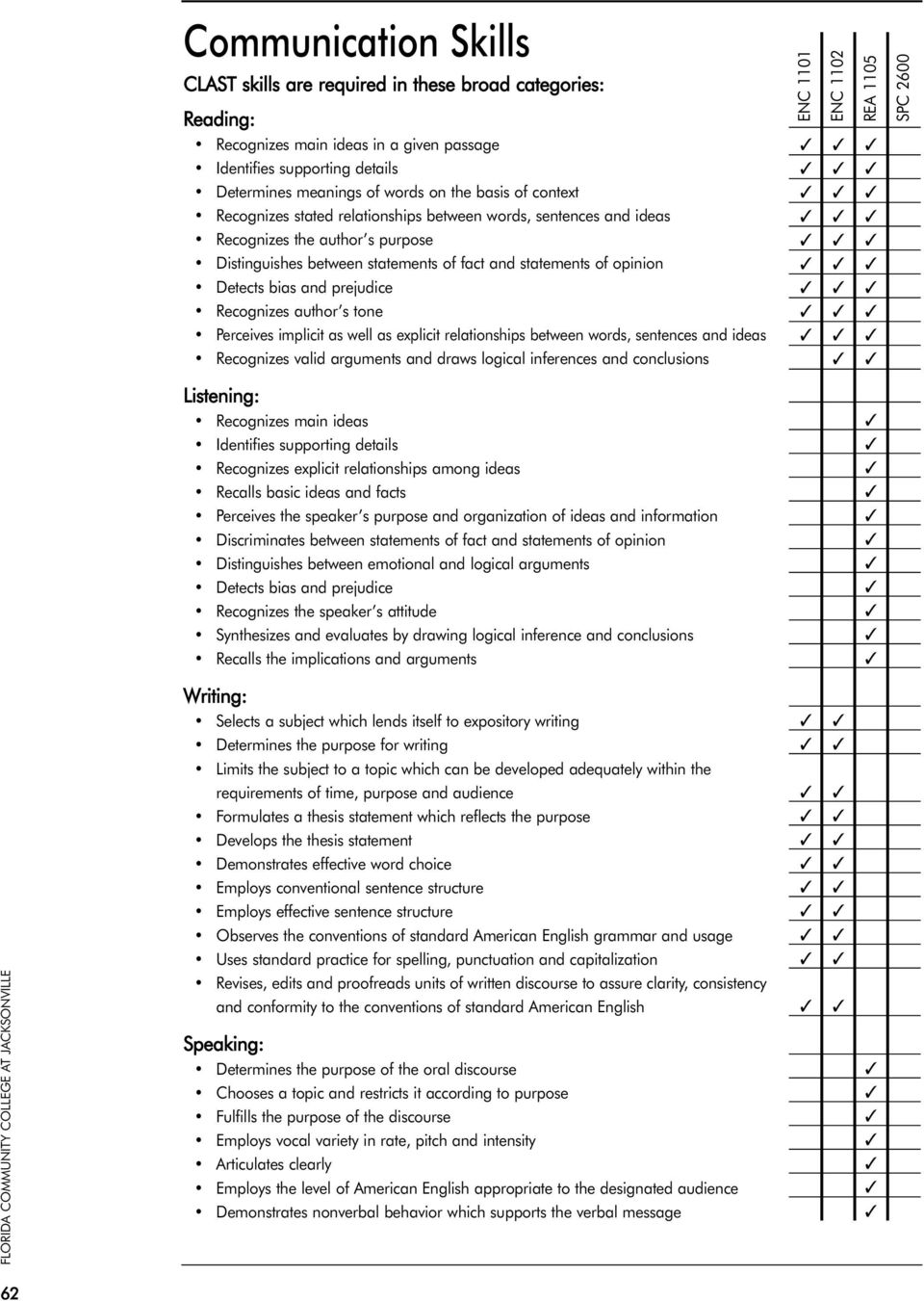
12 Communication Skills CLAST skills are required in these broad categories: Reading: Recognizes main ideas in a given passage Identifies supporting details Determines meanings of words on the basis of context Recognizes stated relationships between words, sentences and ideas Recognizes the author s purpose Distinguishes between statements of fact and statements of opinion Detects bias and prejudice Recognizes author s tone Perceives implicit as well as explicit relationships between words, sentences and ideas Recognizes valid arguments and draws logical inferences and conclusions Listening: Recognizes main ideas Identifies supporting details Recognizes explicit relationships among ideas Recalls basic ideas and facts Perceives the speaker s purpose and organization of ideas and information Discriminates between statements of fact and statements of opinion Distinguishes between emotional and logical arguments Detects bias and prejudice Recognizes the speaker s attitude Synthesizes and evaluates by drawing logical inference and conclusions Recalls the implications and arguments ENC 1101 ENC 1102 REA 1105 SPC 2600 FLIDA COMMUNITY COLLEGE AT JACKSONVILLE Writing: Selects a subject which lends itself to expository writing Determines the purpose for writing Limits the subject to a topic which can be developed adequately within the requirements of time, purpose and audience Formulates a thesis statement which reflects the purpose Develops the thesis statement Demonstrates effective word choice Employs conventional sentence structure Employs effective sentence structure Observes the conventions of standard American English grammar and usage Uses standard practice for spelling, punctuation and capitalization Revises, edits and proofreads units of written discourse to assure clarity, consistency and conformity to the conventions of standard American English Speaking: Determines the purpose of the oral discourse Chooses a topic and restricts it according to purpose Fulfills the purpose of the discourse Employs vocal variety in rate, pitch and intensity Articulates clearly Employs the level of American English appropriate to the designated audience Demonstrates nonverbal behavior which supports the verbal message 62
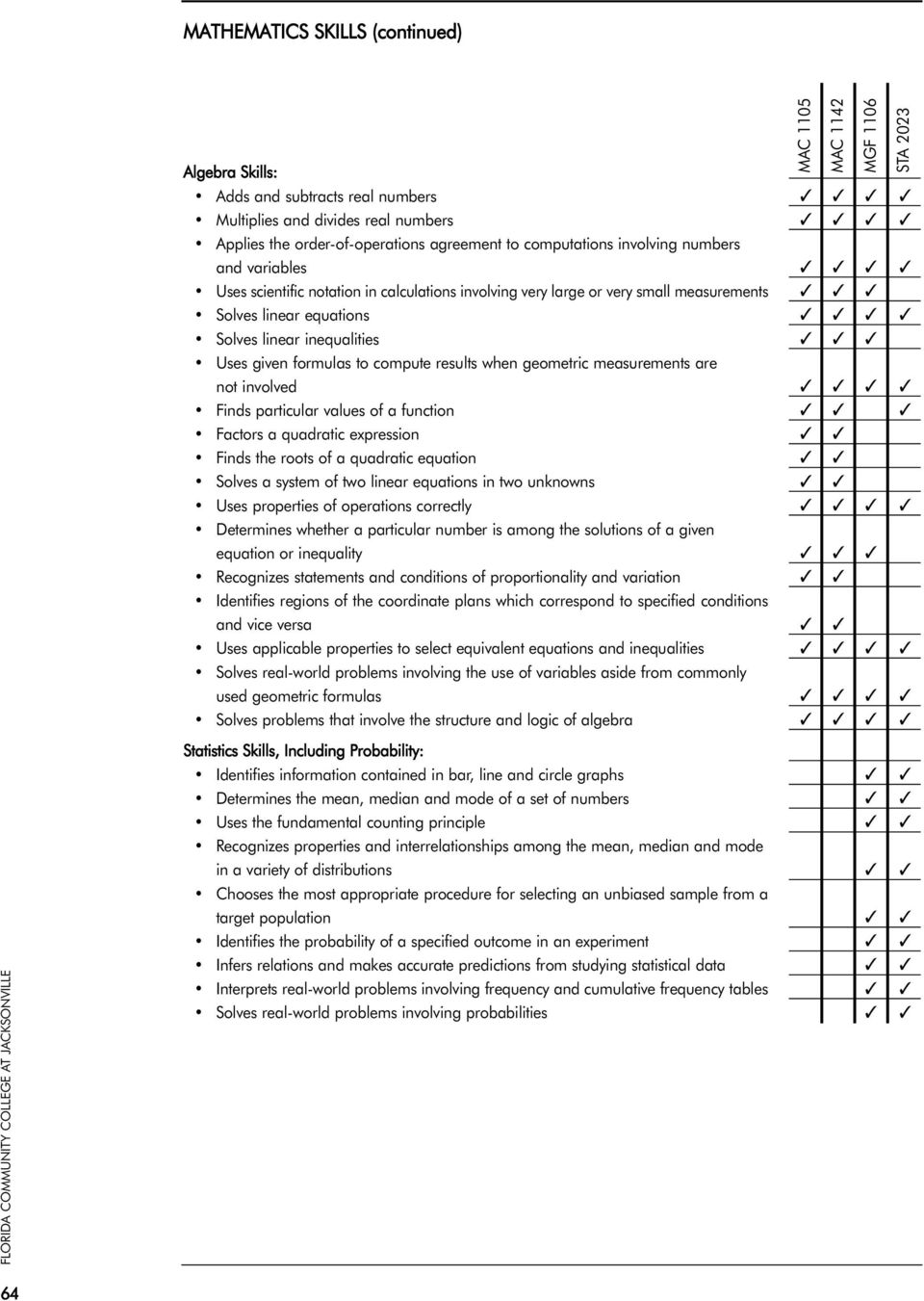
13 Computational Skills CLAST mathematics examination items and score reports are provided in these broad categories: Mathematics Skills: Arithmetic Skills: Adds and subtracts rational numbers Multiplies and divides rational numbers Adds and subtracts rational numbers in decimal Multiplies and divides rational numbers in decimal form Calculates percent increase and percent decrease Solves the sentence a% of b is c, where values for two of the variables are given Recognizes the meaning of exponents Recognizes the role of the base number in determining place value in the base-ten numeration system Identifies equivalent forms of positive rational numbers involving decimals, percents and fractions Determines the order relation between real numbers Identifies a reasonable estimate of a sum, average or product of numbers Infers relations between numbers in general by examining particular number pairs Solves real-world problems which do not require the use of variables and which do not involve percent Solves real-world problems which do not require the use of variables and which do require the use of percent Solves problems that involve the structure and logic of arithmetic Geometry and Measurement Skills: Rounds measurements to the nearest given unit of the measuring device used Calculates distances Calculates areas Calculates volumes Identifies relationships between angle measures Classifies simple plane figures by recognizing their properties Recognizes similar triangles and their properties Identifies appropriate units of measurement for geometric objects Infers formulas for measuring geometric figures Selects applicable formulas for computing measures of geometric figures Solves real-world problems involving perimeters, areas, volumes of geometric figures Solves real-world problems involving the Pythagorean property MAC 1105 MAC 1140 MGF 1106 STA 2023 Logical Reasoning: Deduces facts of set inclusion or set non-inclusion from a diagram Identifies statements equivalent to the negations of simple and compound statements Determines equivalence or nonequivalence of statements Draws logical conclusions from data Recognizes that an argument may not be valid even though its conclusion is true Recognizes valid reasoning patterns as illustrated by valid arguments in everyday language Selects applicable rules for transforming statements without affecting their meaning Draws logical conclusions when facts warrant them DEGREE AND CERTIFICATE PROGRAMS 63

14 MATHEMATICS SKILLS (continued) Algebra Skills: Adds and subtracts real numbers Multiplies and divides real numbers Applies the order-of-operations agreement to computations involving numbers and variables Uses scientific notation in calculations involving very large or very small measurements Solves linear equations Solves linear inequalities Uses given formulas to compute results when geometric measurements are not involved Finds particular values of a function Factors a quadratic expression Finds the roots of a quadratic equation Solves a system of two linear equations in two unknowns Uses properties of operations correctly Determines whether a particular number is among the solutions of a given equation or inequality Recognizes statements and conditions of proportionality and variation Identifies regions of the coordinate plans which correspond to specified conditions and vice versa Uses applicable properties to select equivalent equations and inequalities Solves real-world problems involving the use of variables aside from commonly used geometric formulas Solves problems that involve the structure and logic of algebra MAC 1105 MAC 1142 MGF 1106 STA 2023 Statistics Skills, Including Probability: FLIDA COMMUNITY COLLEGE AT JACKSONVILLE Identifies information contained in bar, line and circle graphs Determines the mean, median and mode of a set of numbers Uses the fundamental counting principle Recognizes properties and interrelationships among the mean, median and mode in a variety of distributions Chooses the most appropriate procedure for selecting an unbiased sample from a target population Identifies the probability of a specified outcome in an experiment Infers relations and makes accurate predictions from studying statistical data Interprets real-world problems involving frequency and cumulative frequency tables Solves real-world problems involving probabilities 64
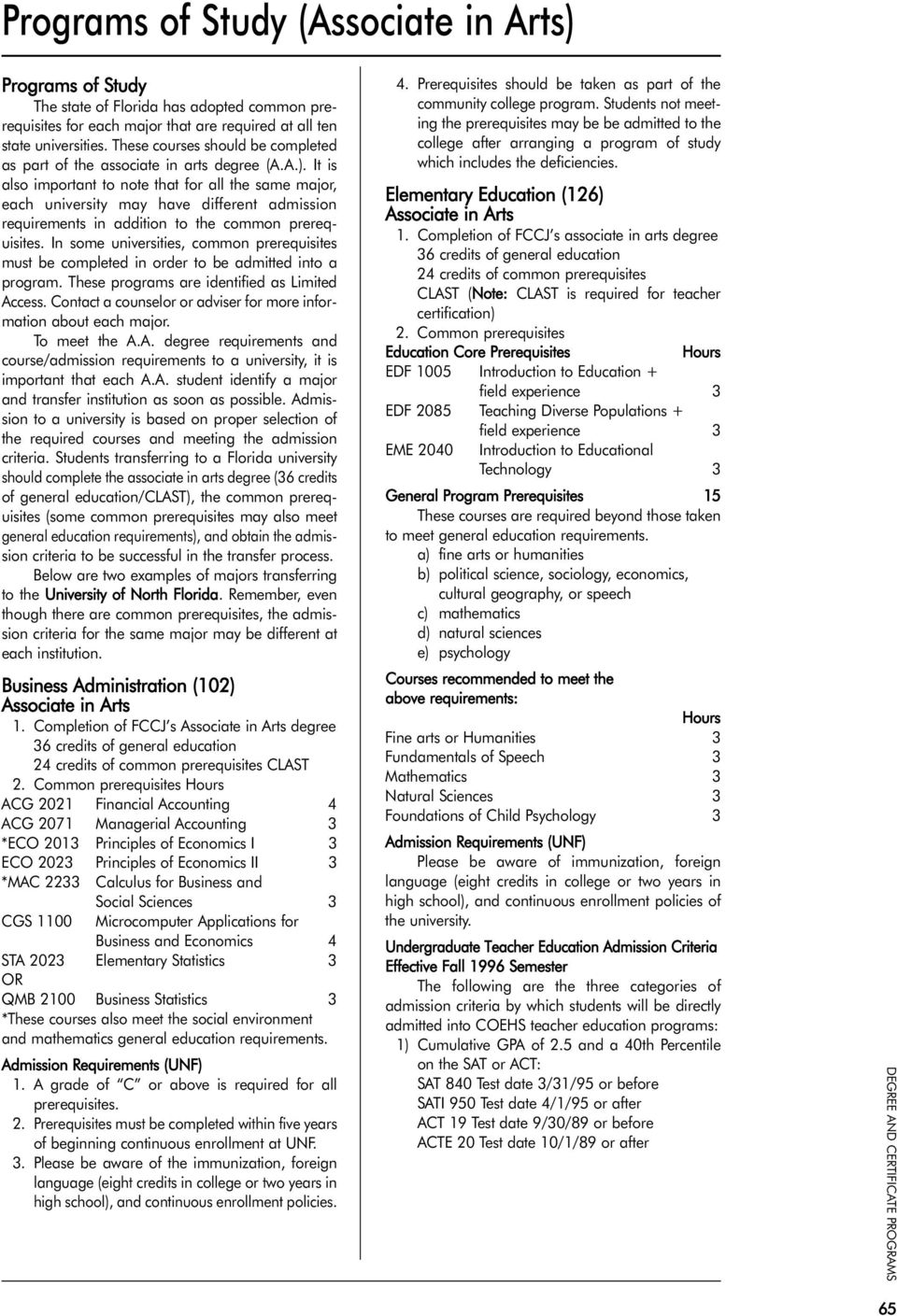
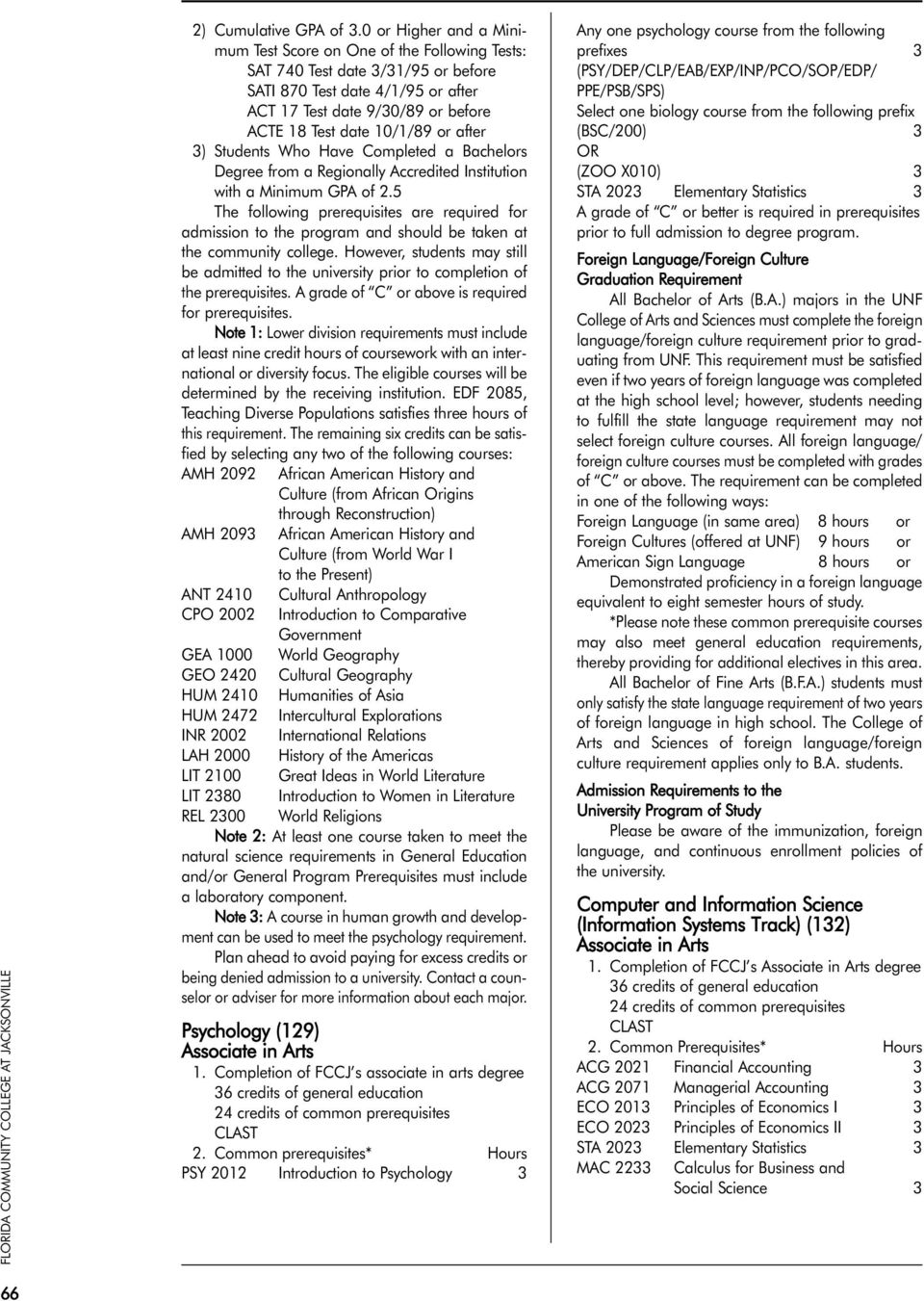
15 Programs of Study (Associate in Arts) Programs of Study The state of Florida has adopted common prerequisites for each major that are required at all ten state universities. These courses should be completed as part of the associate in arts degree (A.A.). It is also important to note that for all the same major, each university may have different admission requirements in addition to the common prerequisites. In some universities, common prerequisites must be completed in order to be admitted into a program. These programs are identified as Limited Access. Contact a counselor or adviser for more information about each major. To meet the A.A. degree requirements and course/admission requirements to a university, it is important that each A.A. student identify a major and transfer institution as soon as possible. Admission to a university is based on proper selection of the required courses and meeting the admission criteria. Students transferring to a Florida university should complete the associate in arts degree (36 credits of general education/clast), the common prerequisites (some common prerequisites may also meet general education requirements), and obtain the admission criteria to be successful in the transfer process. Below are two examples of majors transferring to the University of North Florida. Remember, even though there are common prerequisites, the admission criteria for the same major may be different at each institution. Business Administration (102) Associate in Arts 1. Completion of FCCJ s Associate in Arts degree 36 credits of general education 24 credits of common prerequisites CLAST 2. Common prerequisites Hours ACG 2021 Financial Accounting 4 ACG 2071 Managerial Accounting 3 *ECO 2013 Principles of Economics I 3 ECO 2023 Principles of Economics II 3 *MAC 2233 Calculus for Business and CGS 1100 Social Sciences 3 Microcomputer Applications for Business and Economics 4 STA 2023 Elementary Statistics 3 QMB 2100 Business Statistics 3 *These courses also meet the social environment and mathematics general education requirements. Admission Requirements (UNF) 1. A grade of C or above is required for all prerequisites. 2. Prerequisites must be completed within five years of beginning continuous enrollment at UNF. 3. Please be aware of the immunization, foreign language (eight credits in college or two years in high school), and continuous enrollment policies. 4. Prerequisites should be taken as part of the community college program. Students not meeting the prerequisites may be be admitted to the college after arranging a program of study which includes the deficiencies. Elementary Education (126) Associate in Arts 1. Completion of FCCJ s associate in arts degree 36 credits of general education 24 credits of common prerequisites CLAST (Note: CLAST is required for teacher certification) 2. Common prerequisites Education Core Prerequisites Hours EDF 1005 Introduction to Education + field experience 3 EDF 2085 Teaching Diverse Populations + field experience 3 EME 2040 Introduction to Educational Technology 3 General Program Prerequisites 15 These courses are required beyond those taken to meet general education requirements. a) fine arts or humanities b) political science, sociology, economics, cultural geography, or speech c) mathematics d) natural sciences e) psychology Courses recommended to meet the above requirements: Hours Fine arts or Humanities 3 Fundamentals of Speech 3 Mathematics 3 Natural Sciences 3 Foundations of Child Psychology 3 Admission Requirements (UNF) Please be aware of immunization, foreign language (eight credits in college or two years in high school), and continuous enrollment policies of the university. Undergraduate Teacher Education Admission Criteria Effective Fall 1996 Semester The following are the three categories of admission criteria by which students will be directly admitted into COEHS teacher education programs: 1) Cumulative GPA of 2.5 and a 40th Percentile on the SAT or ACT: SAT 840 Test date 3/31/95 or before SATI 950 Test date 4/1/95 or after ACT 19 Test date 9/30/89 or before ACTE 20 Test date 10/1/89 or after DEGREE AND CERTIFICATE PROGRAMS 65
16 FLIDA COMMUNITY COLLEGE AT JACKSONVILLE 2) Cumulative GPA of 3.0 or Higher and a Minimum Test Score on One of the Following Tests: SAT 740 Test date 3/31/95 or before SATI 870 Test date 4/1/95 or after ACT 17 Test date 9/30/89 or before ACTE 18 Test date 10/1/89 or after 3) Students Who Have Completed a Bachelors Degree from a Regionally Accredited Institution with a Minimum GPA of 2.5 The following prerequisites are required for admission to the program and should be taken at the community college. However, students may still be admitted to the university prior to completion of the prerequisites. A grade of C or above is required for prerequisites. Note 1: Lower division requirements must include at least nine credit hours of coursework with an international or diversity focus. The eligible courses will be determined by the receiving institution. EDF 2085, Teaching Diverse Populations satisfies three hours of this requirement. The remaining six credits can be satisfied by selecting any two of the following courses: AMH 2092 African American History and Culture (from African Origins through Reconstruction) AMH 2093 African American History and Culture (from World War I to the Present) ANT 2410 Cultural Anthropology CPO 2002 Introduction to Comparative Government GEA 1000 World Geography GEO 2420 Cultural Geography HUM 2410 Humanities of Asia HUM 2472 Intercultural Explorations INR 2002 International Relations LAH 2000 History of the Americas LIT 2100 Great Ideas in World Literature LIT 2380 Introduction to Women in Literature REL 2300 World Religions Note 2: At least one course taken to meet the natural science requirements in General Education and/or General Program Prerequisites must include a laboratory component. Note 3: A course in human growth and development can be used to meet the psychology requirement. Plan ahead to avoid paying for excess credits or being denied admission to a university. Contact a counselor or adviser for more information about each major. Psychology (129) Associate in Arts 1. Completion of FCCJ s associate in arts degree 36 credits of general education 24 credits of common prerequisites CLAST 2. Common prerequisites* Hours PSY 2012 Introduction to Psychology 3 Any one psychology course from the following prefixes 3 (PSY/DEP/CLP/EAB/EXP/INP/PCO/SOP/EDP/ PPE/PSB/SPS) Select one biology course from the following prefix (BSC/200) 3 (ZOO X010) 3 STA 2023 Elementary Statistics 3 A grade of C or better is required in prerequisites prior to full admission to degree program. Foreign Language/Foreign Culture Graduation Requirement All Bachelor of Arts (B.A.) majors in the UNF College of Arts and Sciences must complete the foreign language/foreign culture requirement prior to graduating from UNF. This requirement must be satisfied even if two years of foreign language was completed at the high school level; however, students needing to fulfill the state language requirement may not select foreign culture courses. All foreign language/ foreign culture courses must be completed with grades of C or above. The requirement can be completed in one of the following ways: Foreign Language (in same area) 8 hours or Foreign Cultures (offered at UNF) 9 hours or American Sign Language 8 hours or Demonstrated proficiency in a foreign language equivalent to eight semester hours of study. *Please note these common prerequisite courses may also meet general education requirements, thereby providing for additional electives in this area. All Bachelor of Fine Arts (B.F.A.) students must only satisfy the state language requirement of two years of foreign language in high school. The College of Arts and Sciences of foreign language/foreign culture requirement applies only to B.A. students. Admission Requirements to the University Program of Study Please be aware of the immunization, foreign language, and continuous enrollment policies of the university. Computer and Information Science (Information Systems Track) (132) Associate in Arts 1. Completion of FCCJ s Associate in Arts degree 36 credits of general education 24 credits of common prerequisites CLAST 2. Common Prerequisites* Hours ACG 2021 Financial Accounting 3 ACG 2071 Managerial Accounting 3 ECO 2013 Principles of Economics I 3 ECO 2023 Principles of Economics II 3 STA 2023 Elementary Statistics 3 MAC 2233 Calculus for Business and Social Science 3 66
17 CGS 1570 Microcomputer Applications 3 COP 2120 COBOL Programming 3 COP 2121 Advanced COBOL Programming 3 A grade of C or better is required for prerequisites. *Please note these common prerequisite courses may also meet general education requirements, thereby providing additional electives in this area. Admission Requirements to the University Program of Study Please be aware of the immunization, foreign language, and continuous enrollment policies of the university. Electrical Engineering (130) Associate in Arts 1. Completion of FCCJ s Associate in Arts degree 36 credits of general education 24 credits of common prerequisites CLAST 2. Common Prerequisites* Hours CHM 2045C General Chemistry and Qualitative Analysis I 4 COP 2200 FTRAN Programming 3 COP 2221 Introduction to C Programming 4 MAC 2311 Calculus with Analytic Geometry I 4 MAC 2312 Calculus with Analytic Geometry II 4 MAC 2313 Calculus with Analytic Geometry III 4 MAP 2302 Differential Equations 3 PHY 2048C Physics I with Calculus 4 PHY 2049C Physics II with Calculus 4 SPC 2600 Fundamentals of Speech Communications 3 *Please note these common prerequisite courses may also meet general education requirements, thereby providing for additional electives in this area. Final acceptance to the Electrical Engineering Program requires an overall 2.5 GPA along with specific 2.5 GPA in both Calculus and Physics/ Calculus sequences. Admission Requirements to the University Program of Study Please be aware of the immunization, foreign language, and continuous enrollment policies of the university. Biology (131) Associate in Arts 1. Completion of FCCJ s Associate in Arts degree 36 credits of general education 24 credits of common prerequisites CLAST 2. Common Prerequisites* Hours BSC 2010C Principles of Biology I 4 BSC 2011C Principles of Biology II 4 CHM 2045C General Chemistry and Qualitative Analysis I 4 CHM 2046C General Chemistry and Qualitative Analysis II 4 CHM 2210C Organic Chemistry I 4 CHM 2211C Organic Chemistry II 4 MAC 2311 Calculus with Analytic Geometry I 4 MAC 2312 Calculus with Analytic Geometry II 4 *Please note these common prerequisite courses may also meet general education requirements, thereby providing for additional electives in this area. A grade of C or better is required as prerequisite prior to full admission to degree program. Foreign Language/Foreign Culture Graduation Requirement B.S. students in the UNF College of Arts and Sciences must only satisfy the state language requirement of two years of foreign language in high school. Eight hours of college level language courses will be needed if two years of high school language was not completed. The UNF College of Arts and Sciences foreign language/foreign culture requirement only applies to B.A. students. Admission Requirements to the University Program of Study Please be aware of the immunization, foreign language, and continuous enrollment policies of the university. DEGREE AND CERTIFICATE PROGRAMS 67

18 The Associate in Science Degree FLIDA COMMUNITY COLLEGE AT JACKSONVILLE Preparation for a Career Florida Community College at Jacksonville offers a comprehensive series of business, health, engineering and industrial related, fashion marketing, interior design, distributive, public service and other programs designed to fulfill the career education needs of the community s citizens and employers. The career and technical education programs are designed to prepare students who, at the completion of a program of study listed in this section of the catalog, are planning to enter a chosen career at the semi professional level. The program may also transfer to a senior institution offering the bachelor degree in a related field of study based on completion of additional requirements as set forth in the section on university transfer requirements page 70 and/or on specific program articulation agreements with state universities. Advisory committees help Florida Community College at Jacksonville create programs and courses to prepare today s youth and adults for the world of work. The advisory committees are made up of civicminded representatives of business, industry, government, health agencies, public service and labor. Individuals who seek to pursue a career at the technician or at the para-professional level may enroll in a two-year college credit program leading to the associate in science (A.S.) degree. For those individuals desiring to spend less than two years in preparation, college credit technical certificate programs are available in several areas. The program manager or program chairperson with the approval of the dean of instruction may prescribe deficiency courses which are necessary for successful completion of the associate in science degree. If students are veterans, a copy of the recommendation must be submitted to the FCCJ Veterans Affairs Office for certification completion. The program manager or program chairperson with the approval of the dean of instruction may approve another elective or professional course not listed as an approved elective in the associate in science degree curriculum which will apply toward associate in science degree completion. If students are veterans, it is necessary that such course substitution be submitted to the Veterans Affairs Office for certification completion. A record of the approval will be maintained in their file. Program Location Not all of the career and technical education A.S. degree programs are available at each of the College s four campuses. However, the General Education Requirements and many of the elective, professional and other required courses are available at all campuses as well as at selected offcampus centers and sites. Graduation Requirements In order to be awarded the associate in science degree, students must have met the following requirements: 1. earned a Florida Community College at Jacksonville cumulative grade point average of 2.0 (C) at FCCJ on all courses attempted, 2. earned an all-college cumulative grade point average of 2.0 (C) on all courses attempted, including transferred credits, 3. completed at least 25 percent of credit semester hours of the required program at FCCJ, and 4. completed the General Education Requirements and required courses as set forth in the College catalog or as approved by the assistant dean of instruction. (The health education programs of study may require a C grade or better in professional courses.) A minimum of 60 semester hours is required for this degree, of which at least 15 semester hours must be General Education Requirements. Note: Students are cautioned to pay particular attention to the following statements. 1. Graduation dates will be the date at the end of the college term in which the students complete the academic requirements for the degree or certificate for which students are applicants. (The removal of an incomplete grade does not affect students graduation dates, since the grade change is effective as of the end of the term in which the incomplete grade was assigned rather than the term in which the incomplete work was made up.) 2. Students who expect to complete the coursework under the terms of the catalog in effect during the term of their first registration must graduate within four years after the year of first registration in a college credit program. A total of five years is allowed. Accordingly, students who enter under this catalog must graduate by the end of the Summer Term 2004, or they will be expected to meet the requirements of subsequent years. Changes to requirements as may be mandated by law or by rule of the FCCJ District Board of Trustees may supersede this provision. 3. Not more than 24 semester hours of credit earned in courses offered via television may be applied towards the associate in science degree. 4. The General Education Requirements may be taken on any FCCJ campus or center. 5. Many courses in this catalog have prerequisite and/or corequisite courses which are listed in the course descriptions. Students are advised to be guided by these requirements. 6. Students who place into college preparatory courses are required to complete designated college preparatory courses with a grade of C or better regardless of program of study. 68
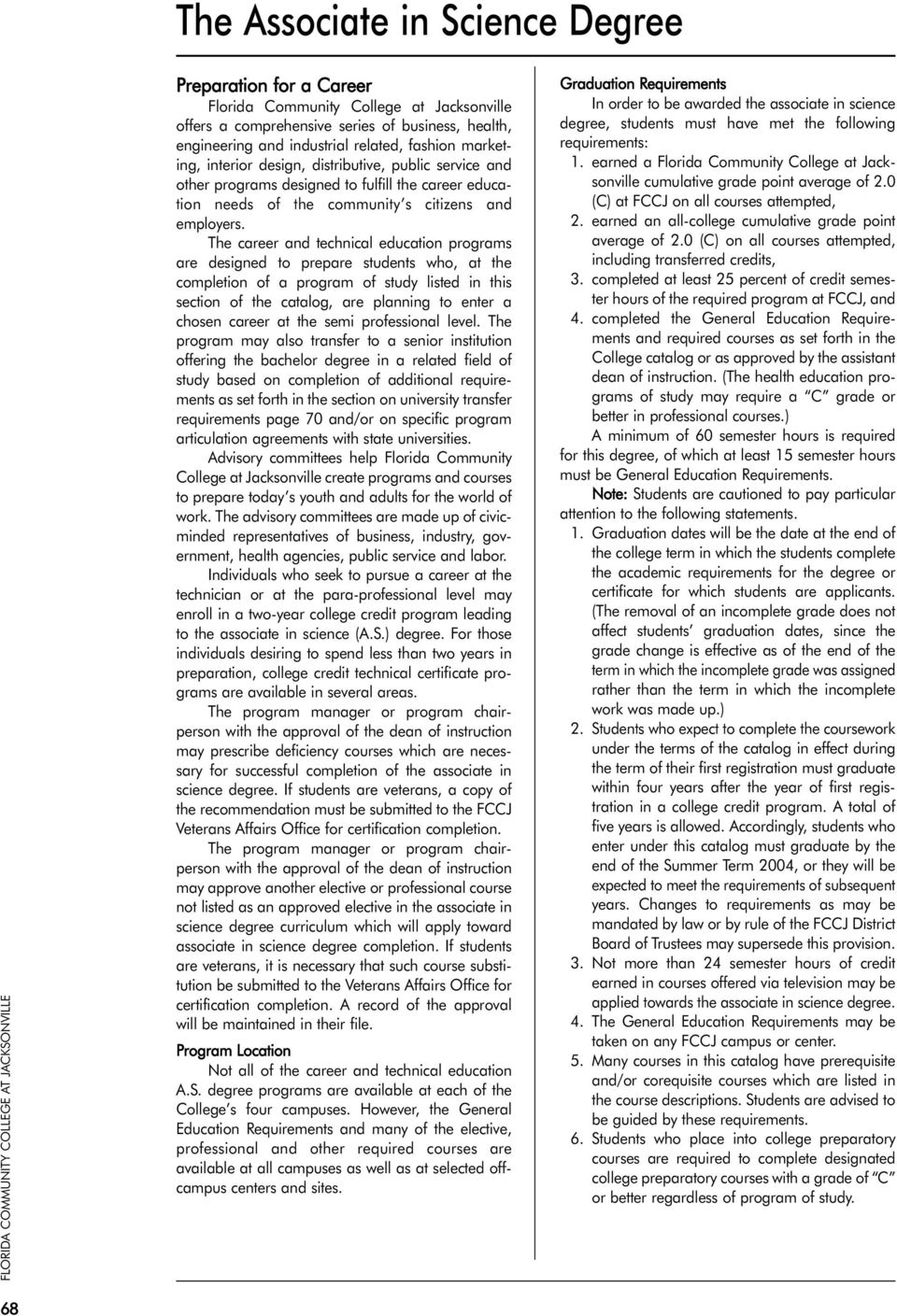
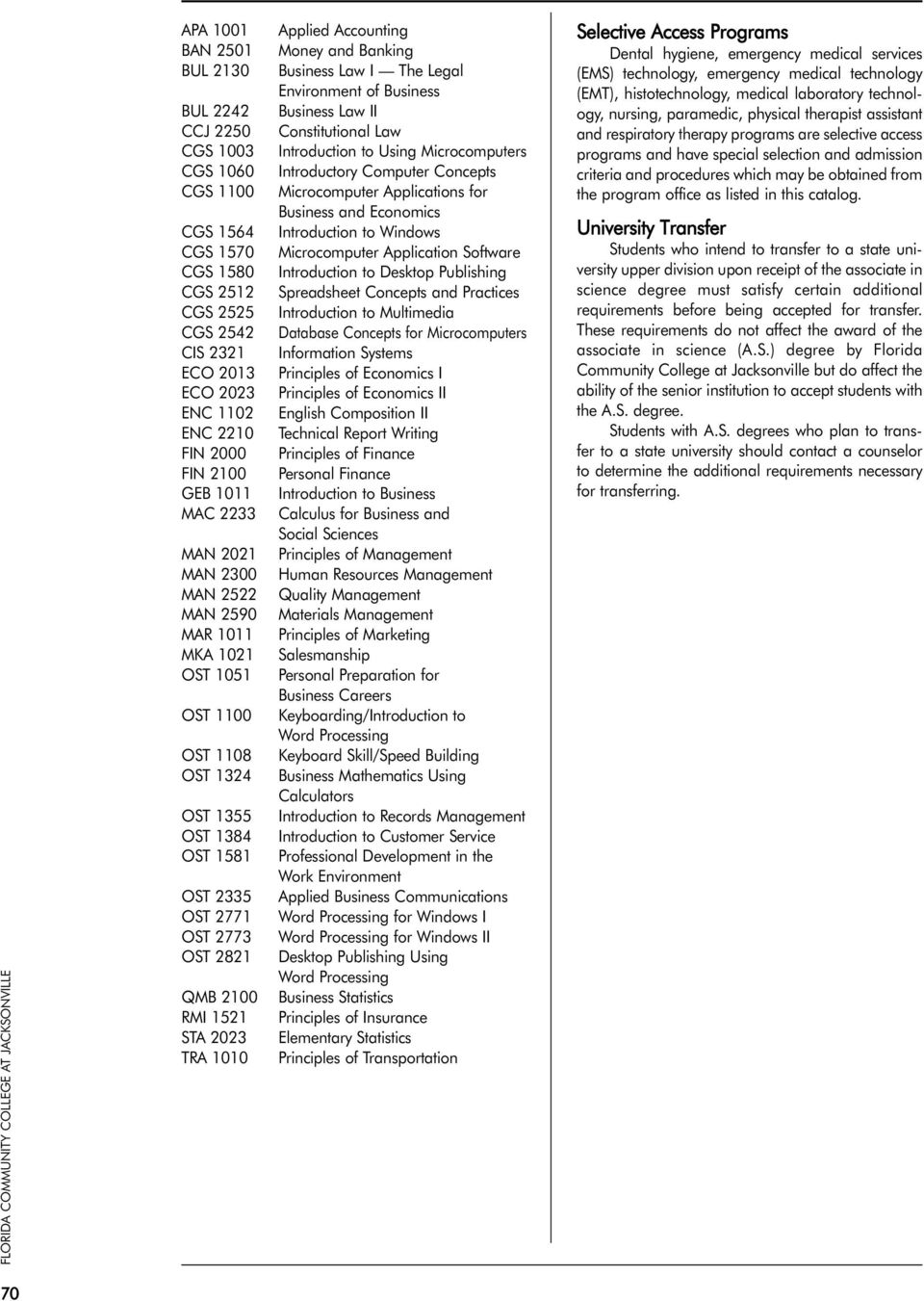
19 7. Degree-seeking students whose native language is not English, who fall below a designated cutoff score on the English as a second language (ESL) entry placement test, will be required to take ESL courses prior to registering for other college credit classes. The level of these courses will be determined by the entry placement scores. Individual exceptions will be determined by the ESL program manager. Degree-seeking students identified as non-native speakers must take an English as a second language (ESL) placement test prior to taking the College s standard course placement test. Students who place into ESL, as determined by the test, must complete ESL courses before registering for other college credit classes. Non-degree seeking college credit students who plan to take English or reading courses must also meet these requirements. Exceptions to these requirements can be made by the ESL pro gram manager or designee. General Education Requirements 1. A minimum of 15 semester hours of general education is required for all associate in science degree programs of study. 2. The following subject areas shall be included in each program in the manner specified: I. Communication Three semester hours ENC 1101 English Composition I II. Social and Behavioral Sciences Three semester hours Area A DEP 2004 Human Growth and Development DEP 2401 Adult Psychology PSY 1012 General Psychology SOP 1002 Human Relations SOP 1502 Dynamics of Behavior SYG 2000 Introductory Sociology SYG 2010 Social Problems Area B AMH 2010 United States History to 1865 ISS 1120 Origins of American Society (Economic, Political and International Institutions) POS 2041 American Federal Government III. Mathematics Three semester hours MAT 1033 Intermediate Algebra MGF 1106 Mathematics for Liberal Arts I MAC 1105 College Algebra MAC 1140 Precalculus Algebra MAC 1114 College Trigonometry MAC 2233 Calculus for Business and Social Sciences MAC 2311 Calculus With Analytic Geometry I IV. Humanities Three semester hours HUM 2021 Humanities Forum HUM 2211 Humanities: The Foundations HUM 2236 Humanities: Mainstreams of Cultures, 15th to 20th Century HUM 2251 HUM 2410 HUM 2450 HUM 2472 Humanities: 20th Century Cultural Perspectives Humanities of Asia Humanities in the Americas Intercultural Explorations V. General Education Elective Three semester hours Area A Computer Sciences: CGS 1060 Introductory Computer Concepts CGS 1570 Microcomputer Application Software Area B Communication: ENC 1102 English Composition II ENC 2210 Technical Report Writing OST 2335 Applied Business Communications SPC 2600 Fundamentals of Speech Communication Area C Biological Sciences: BSC 1005 Life in Its Biological Environment BSC 2085C Human Anatomy and Physiology I BOT 1010C Botany BSC 2010C Principles of Biology I PCB 2033 General Ecology Area D Physical Sciences: AST 1002 Introduction to Astronomy CHM 1020 Chemistry for Liberal Arts CHM 1025C Introduction to General Chemistry CHM 1032C Principles of General Chemistry CHM 2045C General Chemistry and Qualitative Analysis I GLY 1001 Earth and Space Science GLY 1010 Physical Geology ISC 1001 Fundamentals of Natural Science MET 1010 Meteorology PHY 2048C Physics I With Calculus PHY 2053C General Physics I PSC 1341 Physical Science VI. Specialization and Related Contextual Course/ Competencies (minimum of 45 semester credits) consisting of specialization courses/competencies which may include technical knowledge (theory), technical skills (lab) and/or advanced and professional courses A minimum of 60 semester hours is required for the associate in science degree. Most programs require more. Lists of additional courses required are set forth in individual associate in science degree programs. The total credit hours listed for each individual program are minimum hours required for program completion. General Electives for Associate in Science Degree Program The following is a list of general electives which are applicable to a number of programs. ACG 2021 Financial Accounting ADV 2000 Advertising DEGREE AND CERTIFICATE PROGRAMS 69

20 FLIDA COMMUNITY COLLEGE AT JACKSONVILLE APA 1001 BAN 2501 BUL 2130 BUL 2242 CCJ 2250 CGS 1003 CGS 1060 CGS 1100 CGS 1564 CGS 1570 CGS 1580 CGS 2512 CGS 2525 CGS 2542 CIS 2321 ECO 2013 ECO 2023 ENC 1102 ENC 2210 FIN 2000 FIN 2100 GEB 1011 MAC 2233 MAN 2021 MAN 2300 MAN 2522 MAN 2590 MAR 1011 MKA 1021 OST 1051 OST 1100 OST 1108 OST 1324 OST 1355 OST 1384 OST 1581 OST 2335 OST 2771 OST 2773 OST 2821 QMB 2100 RMI 1521 STA 2023 TRA 1010 Applied Accounting Money and Banking Business Law I The Legal Environment of Business Business Law II Constitutional Law Introduction to Using Microcomputers Introductory Computer Concepts Microcomputer Applications for Business and Economics Introduction to Windows Microcomputer Application Software Introduction to Desktop Publishing Spreadsheet Concepts and Practices Introduction to Multimedia Database Concepts for Microcomputers Information Systems Principles of Economics I Principles of Economics II English Composition II Technical Report Writing Principles of Finance Personal Finance Introduction to Business Calculus for Business and Social Sciences Principles of Management Human Resources Management Quality Management Materials Management Principles of Marketing Salesmanship Personal Preparation for Business Careers Keyboarding/Introduction to Word Processing Keyboard Skill/Speed Building Business Mathematics Using Calculators Introduction to Records Management Introduction to Customer Service Professional Development in the Work Environment Applied Business Communications Word Processing for Windows I Word Processing for Windows II Desktop Publishing Using Word Processing Business Statistics Principles of Insurance Elementary Statistics Principles of Transportation Selective Access Programs Dental hygiene, emergency medical services (EMS) technology, emergency medical technology (EMT), histotechnology, medical laboratory technology, nursing, paramedic, physical therapist assistant and respiratory therapy programs are selective access programs and have special selection and admission criteria and procedures which may be obtained from the program office as listed in this catalog. University Transfer Students who intend to transfer to a state university upper division upon receipt of the associate in science degree must satisfy certain additional requirements before being accepted for transfer. These requirements do not affect the award of the associate in science (A.S.) degree by Florida Community College at Jacksonville but do affect the ability of the senior institution to accept students with the A.S. degree. Students with A.S. degrees who plan to transfer to a state university should contact a counselor to determine the additional requirements necessary for transferring. 70
21 College Credit Technical Certificate Preparation for Specialized Employment Florida Community College at Jacksonville provides a number of educational programs of less than two years duration for which technical certificates are awarded upon satisfactory program completion. In some cases, the technical certificate can be an intermediate step toward the associate in science degree in the particular area of study. Students can then build upon that technical certificate to accomplish the A.S. degree. Graduation Requirements In order to be awarded a college credit technical certificate, students must have met the following requirements. 1. Earned a grade point average of 2.0 (C) on all courses attempted at FCCJ. 2. Completed the required courses as set forth in the College catalog or as approved by the assistant dean of the area. 3. Students who place into college preparatory courses are required to complete designated college preparatory courses with a grade of C or better regardless of program of study. 4. Completed at least one-fourth of the total hours required for a certificate in residence at FCCJ Before students may graduate, they must have fulfilled all financial obligations to the College. Note: Students are cautioned to pay particular attention to the following statements. 1. Graduation dates will be the date at the end of the College term in which students complete the academic requirements for the degree or certificate for which they are applicants. (The removal of an incomplete grade does not affect students graduation dates, since the grade change is effective at the end of the term in which the incomplete grade was assigned rather than the term in which the incomplete work was made up.) 2. Students who expect to complete the coursework under the terms of the catalog in effect during the term of their first registration must graduate within four years after the year of first registration in a college credit program. Accordingly, students who enter under this catalog must graduate by the end of the Summer Term 2004, or they will be expected to meet the requirements of subsequent years. Changes to requirements as may be mandated by law or by rule of the FCCJ District Board of Trustees may supersede this provision. DEGREE AND CERTIFICATE PROGRAMS 71
22 72
23 Business Associate in Science and Technical Certificate Programs Accounting 74 Business Administration and Management 75 Financial Services (Banking) 76 Insurance Management 77 Legal Assisting 78 Marketing Management 80 Office Management (Executive Support) 81 Office Systems Specialist 83 Real Estate Management 85 Vocational Certificate Programs Credit Union Services and Marketing 86 Customer Assistance 87 International Marketing 88 Life Insurance Marketing 89 Office Supervision (Administrative Assistant) 90 Teller Operations 91 73
24 Accounting Technology (2201) Associate in Science The accounting technology program is primarily designed for those students who intend to seek immediate employment in some area of accounting. The program is also intended for, and most beneficial to, those individuals who are presently using accounting and/or accounting information in their employment. The aim of the A.S. accounting technology program is to prepare students for positions in industry; federal, state and local government; and public accounting. The professional certified public accountant candidate should follow the associate in arts degree for the business administration program of studies. The accounting technology program is based upon the development of a thorough knowledge of accounting principles and theory, and then seeks to develop the students ability to apply this knowledge to problem situations. An intensive study of accounting and related business subjects is combined with general education courses to provide a well-balanced program. The department chairperson, with the approval of the instructional dean, may require additional courses or make substitutions required to meet the needs of students. Note: This associate in science degree program is intended primarily for students who desire to complete an associate s degree and become employed rather than pursue a bachelor s degree. Students who decide to pursue university transfer study must meet certain course and test requirements. For details refer to university transfer requirements on page 46 of the catalog. Professional Core Courses ACG 2021 Financial Accounting 4 ECO 2013 Principles of Economics I 3 GEB 1011 Introduction to Business 3 OST 2335 Applied Business Communications 3 QMB 2100 Business Statistics 3 ACG 2100 Intermediate Accounting I 3 ACG 2110 Intermediate Accounting II 3 ACG 2071 Managerial Accounting 3 TAX 2000 Individual Taxes 3 Credit Hours 28 Professional Electives Credit Hours 21 (Select from the following.) **General Electives Total Credit Hours 64 *Refer to A.S. degree General Education Requirements. **Refer to A.S. degree General Electives. Initial Advising Courses During their beginning semesters at the College, students should complete the following unless test scores indicate that college preparatory studies courses may be needed. ***ACG 2021 Financial Accounting *Social and Behavioral Sciences Area A ENC 1101 English Composition I GEB 1011 Introduction to Business FLIDA COMMUNITY COLLEGE AT JACKSONVILLE Credits General Education ENC 1101 English Composition I 3 *Social and Behavioral Sciences Area A 3 MAC 1105 College Algebra 3 *Humanities 3 *General Education Elective Area A 3 Credit Hours 15 74
25 Business Administration and Management (2213) Associate in Science The two-year business administration and management program is designed to prepare students for advancement in the business profession. The emphasis of the course selections is on business courses with five General Education Requirements. It is important to note that this program is not intended to be a substitute for the four-year business administration program. The program manager or department chairperson, with the approval of the instructional dean, may require additional courses or make substitutions required to meet the needs of students. Note: This associate in science degree program is intended primarily for students who desire to complete an associate s degree and become employed rather than pursue a bachelor s degree. Students who decide to pursue university transfer study must meet certain course and test requirements. For details refer to university transfer requirements on page 46 of the catalog. Professional Electives Credit Hours 18 (Select from the following.) **General Electives Total Credit Hours 64 *Refer to A.S. degree General Education Requirements. **Refer to A.S. degree General Electives. Initial Advising Courses During their beginning semesters at the College, students should complete the following unless test scores indicate that college preparatory studies courses may be needed. *General Education Elective Area A ENC 1101 English Composition I FIN 2000 Principles of Finance GEB 1011 Introduction to Business Credits General Education ENC 1101 English Composition I 3 *Social and Behavioral Sciences Area A 3 MAC 1105 College Algebra 3 *Humanities 3 *General Education Elective Area A 3 Credit Hours 15 Professional Core Courses ACG 2021 Financial Accounting 4 GEB 1011 Introduction to Business 3 QMB 2100 Business Statistics 3 ECO 2013 Principles of Economics I 3 OST 2335 Applied Business Communications 3 BUL 2130 Business Law I The Legal Environment of Business 3 MAN 2021 Principles of Management 3 MAR 1011 Principles of Marketing 3 BUL 2242 Business Law II 3 FIN 2000 Principles of Finance 3 Credit Hours 31 DEGREE AND CERTIFICATE PROGRAMS 75
26 Financial Services (Banking) (2228) FLIDA COMMUNITY COLLEGE AT JACKSONVILLE Associate in Science The two-year program in financial services (banking) is structured to provide students with both the general and specialized skills and competencies needed to embark upon a profitable and rewarding banking career. Jacksonville is a hub of financial activity, and financial institutions such as banks are looking for qualified and motivated degree students to enter their training programs. Opportunities in financial services are especially good because of the variety of departments, such as business development, public relations, installment credit, international trade development, commercial services, loans and securities. The program is designed to serve students who are interested in the financial services industry. Besides providing college credit, the completed banking courses may count toward the American Institute of Banking (AIB) certificate programs. Such an arrangement must be approved by the local AIB chapter. The program manager, with the approval of the instructional dean, may require additional courses or make substitutions required to meet the needs of students. Note: Students are expected to have keyboarding skills. Tests are available to those students who wish to determine their keyboarding skill level. Twenty-five words per minute is considered to be basic level of keyboarding proficiency. OST 1100 Keyboarding/Introduction to Word Processing is recommended to students who need to acquire keyboarding skills. Note: This associate in science degree program is intended primarily for students who desire to complete an associate s degree and become employed rather than pursue a bachelor s degree. Students who desire to pursue a university transfer study must meet certain course and test requirements. For details refer to university transfer requirements on page 46 of the catalog. Initial Advising Courses During their beginning semesters at the College, students should complete the following unless test scores indicate that college preparatory studies courses may be needed. BAN 1004 Principles of Bank Operation ENC 1101 English Composition I FIN 2000 Principles of Finance OST 1384 Introduction to Customer Service *Mathematics Credits General Education ENC 1101 English Composition I 3 *Social and Behavioral Sciences 3 *Mathematics 3 *Humanities 3 CGS 1060 Introductory Computer Concepts 3 CGS 1570 Microcomputer Application Software Credit Hours 15 Professional Core Courses ACG 2021 Financial Accounting 4 ECO 2013 Principles of Economics I 3 BAN 2501 Money and Banking 3 BAN 1004 Principles of Bank Operation 3 FIN 2000 Principles of Finance 3 BUL 2130 Business Law I The Legal Environment of Business 3 OST 1100 Keyboarding/Introduction to Word Processing 3 OST 1384 Introduction to Customer Service 3 OST 1581 Professional Development in the Work Environment 3 OST 2335 Applied Business Communications 3 MAN 2522 Quality Management 3 BAN 2240 Consumer Lending 3 Credit Hours 37 Professional Electives Credit Hours 12 (Select one from the following.) CGS 1100 Microcomputer Applications for Business and Economics CGS 2512 Spreadsheet Concepts and Practices CGS 2525 Introduction to Multimedia CGS 2542 Database Concepts for Microcomputers AND (Select two from the following.) ACG 2071 Managerial Accounting APA 1001 Applied Accounting GEB 1011 Introduction to Business INR 2002 International Relations OST 1324 Business Mathematics Using Calculators OST 1355 Introduction to Information and Records Management OST 1949 Cooperative Education Work Experience I MAN 2021 Principles of Management MAN 2800 Small Business Management MAR 1011 Principles of Marketing MKA 1021 Salesmanship Total Credit Hours 64 *Refer to A.S. degree General Education Requirements. 76
27 Insurance Management (2216) Associate In Science The insurance management program s objective is to provide students with the necessary coursework that can lead to profitable and rewarding careers in the insurance industry life, health, property and casualty. Emphasis is placed on job preparation for affiliation with insurance agencies and home office operations. Jacksonville, the Insurance Capital of the South, offers great opportunity to qualified associate in science degree insurance graduates. Courses are made available to those individuals already employed for career advancement opportunities. These include Chartered Life Underwriters (CLU), Accredited Advisor in Insurance (AAI) and Insurance Institute of America (IIA). Courses leading to licensing requirements for property and casualty general agents, customer representatives and adjusters are also available. The program manager may require additional courses or make substitutions required to meet the needs of students. Note: This associate in science degree program is intended primarily for students who desire to complete an associate s degree and become employed rather than pursue a bachelor s degree. Students who desire to pursue university transfer study must meet certain course and test requirements. For details refer to university transfer requirements on page 46 of the catalog. Initial Advising Courses During their beginning semesters at the College, students should complete the following unless test scores indicate that college preparatory studies courses may be needed. ENC 1101 English Composition I FIN 2000 Principles of Finance RMI 1521 Principles of Insurance (INS-21) *Mathematics ***General Elective **RMI 1631 Principles of Liability and Claim Adjusting 3 APA 1001 Applied Accounting 3 ACG 2021 Financial Accounting (4 cr.) BUL 2130 Business Law I The Legal Environment of Business 3 FIN 2000 Principles of Finance 3 ECO 2013 Principles of Economics I 3 Credit Hours 27 Professional Electives Credit Hours 19 (Select from the following.) ***General Electives RMI 1134 Retirement Plans: Basic Features and Defined Contribution Approaches RMI 1522 Personal Insurance (INS-22) RMI 1523 Commercial Insurance (INS-23) RMI 2524 Essentials of Risk Management (ARM 54) RMI 2525 Essentials of Risk Control (ARM 55) RMI 2526 Essentials of Risk Financing (ARM 56) RMI 2535 Principles of Insurance Production (AAI 81) RMI 2536 Multi-Lines Insurance Production (AAI 82) RMI 2537 Agency Operations and Sales Management (AAI 83) Total Credit Hours 61 *Refer to A.S. degree General Education Requirements. **The two property courses (RMI 1613 and 1615) AND the two casualty courses (RMI 1612 and 1631) must be taken concurrently. ***Refer to A.S. degree General Electives. Credits General Education ENC 1101 English Composition I 3 *Social and Behavioral Sciences Area A 3 *Mathematics 3 *Humanities 3 *General Education Elective Area A 3 Credit Hours 15 Professional Core Courses RMI 1521 Principles of Insurance (INS-21) 3 **RMI 1612 Principles of Casualty Insurance and Surety Bonding 3 **RMI 1613 Principles of Property Insurance 3 **RMI 1615 Principles of Property Insurance Adjusting 3 DEGREE AND CERTIFICATE PROGRAMS 77
28 Legal Assisting (2299) FLIDA COMMUNITY COLLEGE AT JACKSONVILLE Associate in Science The legal assisting program is for students who wish to seek employment in the legal or criminal justice field as paraprofessionals or for legal secretaries presently employed who wish to assume paraprofessional duties in their field. FCCJ s program is structured to meet the needs of the legal profession in the state of Florida, as developed in response to a survey of local attorneys which showed a great need for trained paraprofessional specialists in the field. Courses are taught by practicing attorneys or other professionals skilled in their field. An advisory committee composed of attorneys and other professionals meets periodically to make suggestions and recommendations for the entire program. Note: While legal assistants are not permitted by law to give legal advice, they do work under the direct supervision of attorneys, performing specifically delegated duties necessary in the effective delivery of legal services to the client. Note: Students desiring to enter the legal assisting program must have a personal interview with the legal assistant coordinator prior to enrollment. Note: The program culminates in a professional internship (PLA 1949 Cooperative Education Work Experience). All other professional core courses must be completed prior to enrollment in the internship. In this course, students will work not less than 120 hours in a law or law-related office. In addition, students will meet weekly to share work experiences and receive final preparation for paraprofessional practice. Note: This associate in science degree program is intended primarily for students who desire to complete an associate s degree and become employed rather than pursue a bachelor s degree. Students who decide to pursue university transfer study must meet certain course and test requirements. For details refer to university transfer requirements on page 46 of the catalog. Initial Advising Courses During their beginning semesters at the College, students should complete the following unless test scores indicate that college preparatory studies courses may be needed. ENC 1101 English Composition I PLA 1003 Introduction to Legal Assisting BUL 2130 Business Law I The Legal Environment of Business CGS 1570 Microcomputer Applications Credits General Education ENC 1101 English Composition I 3 *Social and Behavioral Sciences Area A 3 *Mathematics 3 *Humanities 3 SPC 2600 Fundamentals of Speech Communication 3 Credit Hours 15 Professional Core Courses General Education Elective from Social and Behavioral Sciences 3 BUL 2130 Business Law I The Legal Environment of Business 3 CGS 1570 Microcomputer Applications 3 ****OST 2335 Applied Business Communications 3 PLA 1003 Introduction to Legal Assisting 3 PLA 1104 Legal Research and Writing I 3 PLA 2114 Legal Research and Writing II 3 PLA 2763 Law Office Procedures 3 PLA 2203 Litigation 3 PLA 2803 Family Law 3 PLA 2273 Tort Law 3 PLA 1080 Legal Interviewing and Communicating 3 **PLA 1949 Cooperative Education Work Experience I 3 Credit Hours 39 Professional Electives Credit Hours 10 (Select from the following.) ***ACG 2021 Financial Accounting ***CCJ 2250 Constitutional Law ***PLA 2433 Business Organizations BSC 2085C Human Anatomy and Physiology I BSC 2086C Human Anatomy and Physiology II ***BUL 2242 Business Law II CGS 1060 Introductory Computer Concepts CGS 1580 Introduction to Desktop Publishing CGS 2470 Computer Aided Drafting and Design CGS 2512 Spreadsheet Concepts and Practices CGS 2525 Introduction to Multimedia CGS 2542 Database Concepts for Microcomputers CIS 2401 User Support and Software Evaluation HSC 1531 Medical Terminology MAN 2800 Small Business Management OST 1581 Professional Development in the Work Environment OST 2771 Word Processing for Windows I OST 2773 Word Processing for Windows II PLA 2880 Constitutional Law PLA 1931 Selected Topics in Legal Assisting PLA 1932 Selected Topics in Legal Assisting ***PLA 1303 Criminal Law and Procedure for Legal Assistants ***PLA 1423 Contract Law ***PLA 2236 Alternative Dispute Resolution ***PLA 2263 Evidence for the Legal Assistant ***REE 2430 Real Estate Law ***PLA 2465 Debtor/Creditor Law 78
29 ***PLA 2484 Administrative Law ***PLA 2603 Wills, Trusts and Estates ***PLA 2793 Technology in the Law Office ***PLA 2949 Cooperative Education Work Experience II RMI 1522 Personal Insurance (INS-22) RMI 1523 Commercial Insurance (INS-23) RMI 1612 Principles of Casualty Insurance and Surety Bonding RMI 1613 Principles of Property Insurance Total Credit Hours 64 *Refer to A.S. degree General Education Requirements. **An approved elective may be substituted for this course if students have verifiable, related work experience of not less than 12 consecutive months. ***Students are required to select a minimum of six credit hours from these courses. ****ENC 1102 may be substituted with the permission of the Legal Assisting Program Director. DEGREE AND CERTIFICATE PROGRAMS 79
30 Marketing Management (2250) FLIDA COMMUNITY COLLEGE AT JACKSONVILLE Associate in Science The marketing management program provides students with a background that will assist in preparation for a career in the areas of sales management, sales promotion, advertising and market research, retailing, fashion marketing, and fashion promotion. Career opportunities in these fields exist in private industry, government and various professions. The curriculum includes the study of activities necessary to place goods and services in the hands of household consumers and industrial users. The classroom experiences provide a broad understanding of the marketing process, as well as specialized knowledge in the various areas of marketing. The department chairperson, with the approval of the instructional dean, may require additional courses or make substitutions required to meet the needs of students. Note: This associate in science degree program is intended primarily for students who desire to complete an associate s degree and become employed rather than pursue a bachelor s degree. Students who decide to pursue university transfer study must meet certain course and test requirements. For details refer to university transfer requirements on page 46 of the catalog. Initial Advising Courses During their beginning semesters at the College, students should complete the following unless test scores indicate that college preparatory studies courses may be needed. ADV 2000 Advertising CTE 2851 Sales Promotion (for Retail Management, Fashion Marketing, Fashion Promotion Specialties) ENC 1101 English Composition I GEB 1011 Introduction to Business MAR 1011 Principles of Marketing CTE 1812 Retail Merchandising (for Retail Management, Fashion Marketing & Fashion Promotion Specialties) Credits General Education ENC 1101 English Composition I 3 *Social and Behavioral Sciences 3 *Mathematics 3 *Humanities 3 *General Education Elective Area A 3 Credit Hours 15 Professional Core Courses ECO 2013 Principles of Economics I 3 ACG 2021 Financial Accounting 4 GEB 1011 Introduction to Business 3 MAN 2021 Principles of Management 3 Credit Hours 13 and one of the following technical specialties: Marketing (2250) MAR 1011 Principles of Marketing 3 QMB 2100 Business Statistics 3 OST 2335 Applied Business Communications 3 ADV 2000 Advertising 3 MKA 1021 Salesmanship 3 **General Electives 21 Credit Hours 36 Retail Management (225A) CTE 1812 Retail Merchandising 3 CTE 2851 Sales Promotion 3 CTE 2852 Product Presentation 3 CTE 1856 Retail Salesmanship 3 CTE 2891 Marketing Career Development 2 CTE 2880 Marketing Internship 7 CTE 1827 Retail Buying 3 CTE 1821 Merchandising Mathematics 3 CTE 1854 Product Technology 3 **General Electives 6 Credit Hours 36 Fashion Marketing (225B) CTE 1812 Retail Merchandising 3 CTE 2851 Sales Promotion 3 CTE 2852 Product Presentation 3 CTE 1856 Retail Salesmanship 3 CTE 2891 Marketing Career Development 2 CTE 2880 Marketing Internship 7 CTE 1827 Retail Buying 3 CTE 1821 Merchandising Mathematics 3 CTE 1401 Basic Textiles 3 CTE 1840 Merchandising Information 3 ***CTE 2853 Fashion Show Production 3 ***CTE 2955 Fashion Marketing Field Study Tours 3 ***CTE 2200 Wardrobe Styling 3 Credit Hours 36 Fashion Promotion (225C) CTE 1812 Retail Merchandising 3 CTE 2851 Sales Promotion 3 CTE 2852 Product Presentation 3 CTE 2880 Marketing Internship 7 CTE 2891 Marketing Career Development 2 CTE 1731 Fashion Illustration 3 CTE 2200 Wardrobe Styling 3 CTE 2853 Fashion Show Production 3 PGY 2401C Photography I 3 SPC 2600 Fundamentals of Speech 3 CTE 1856 Retail Salesmanship 3 Credit Hours 36 Total Credit Hours 64 *Refer to A.S. degree General Education Requirements. **Refer to A.S. degree General Electives. ***Choose one of these courses. 80
31 Office Management Technology (2265) (Executive Support) Associate in Science A goal of this degree program is to allow maximum flexibility for students in designing a program that will fulfill their career objectives. The general education and professional core requirements provide a solid foundation of courses fundamental to any direction that students might choose. Possible career paths might include a proficiency in high technology areas such as information processing, desktop publishing or networking in the automated office in positions such as executive assistants, office coordinators or office managers. To achieve the 64 credit hour requirement for the associate in science in office management technology degree, students must complete 15 credit hours in the specified general education courses and 38 credit hours in the professional core courses. The remaining credit hours will be chosen from the list of professional electives. All credits earned in the technical certificate program may be applied to the office management technology degree program. It is advisable that all students in this program complete at least one of the technical certificate specialties before enrolling in additional professional elective courses. Note: This associate in science degree program is intended primarily for students who desire to complete an associate s degree and become employed rather than pursue a bachelor s degree. Students who decide to pursue university transfer study must meet certain course and test requirements. For details refer to university transfer requirements on page 46 of the catalog. Initial Advising Courses During their beginning semesters at the College, students should complete the following unless test scores indicate that college preparatory studies courses may be needed. ENC 1101 English Composition I OST 1100 Keyboarding/Introduction to Word Processing OST 1601 Fundamentals of Business Communications OST 1324 Business Mathematics Using Calculators CGS 1570 Microcomputer Applications CGS 1060 Introductory Computer Concepts CGS 1100 Microcomputer Applications for Business and Economics Credits General Education ENC 1101 English Composition I 3 SOP 1002 Human Relations 3 SOP 1502 Dynamics of Behavior *Humanities 3 CGS 1570 Microcomputer Applications 3 CGS 1060 Introductory Computer Concepts CGS 1100 Microcomputer Applications for Business and Economics (4 cr.) *Mathematics 3 Credit Hours 15 Professional Core Courses CGS 2512 Spreadsheet Concepts and Practices 3 OST 1100 Keyboarding/Introduction to Word Processing 3 OST 1108 Keyboard Skill/Speed Building 3 OST 1324 Business Mathematics Using Calculators 3 OST 1384 Introduction to Customer Service 3 OST 1581 Professional Development in the Work Environment 3 OST 1601 Fundamentals of Business Communications 3 OST 2335 Applied Business Communications 3 OST 2402 Administrative Support Systems and Procedures 3 OST 2501 Office Systems Management 3 OST 2771 Word Processing for Windows I 4 OST 2773 Word Processing for Windows II 4 Credit Hours 38 Professional Electives Credit Hours 11 (Select from the following.) ACG 2021 Financial Accounting APA 1001 Applied Accounting BAN 2240 Consumer Lending CDA 2500 Introduction to Data Communications CDA 1522 Computer Networks CET 2173 Microcomputer Systems Troubleshooting CET 2186 Computer Peripherals and Interfacing CGS 1550 Local Area Network (LAN) Administration with Windows NT Server CGS 1551 Local Area Network (LAN) Administration with Netware CGS 1580 Introduction to Desktop Publishing CGS 2525 Introduction to Multimedia CGS 2542 Database Concepts for Microcomputers CIS 2321 Information Systems CIS 2401 User Support and Software Evaluation COP 1000 Introduction to Programming and Algorithm Design COP 2612 Microcomputer Operating Systems Concepts HSC 1531 Medical Terminology OST 1051 Personal Preparation for Business Careers OST 1145 Data Entry Applications OST 1273 Effective Notetaking DEGREE AND CERTIFICATE PROGRAMS 81
32 OST 1355 Introduction to Information and Records Management OST 1464 Computers in the Medical Office OST 1621 Legal Transcription OST 2821 Desktop Publishing Using Word Processing CGS 1564 Introduction to Windows OST 1949 Cooperative Education Work Experience I OST 2602 Machine Transcription OST 2930 Selected Topics in Office Systems Technology PLA 2763 Law Office Procedures **General Electives Total Credit Hours 64 *Refer to A.S. degree General Education Requirements. **Refer to A.S. degree General Electives. FLIDA COMMUNITY COLLEGE AT JACKSONVILLE 82
33 Office Systems Specialist (6357, , 6377,6379, 6380, 6386, 6387, 6389 and 6390) Technical Certificate The technical certificate program in office systems specialist is designed to prepare students to enter the job market with professional training in areas such as word processing, computer applications, office procedures, customer relations and human relations. Students may choose from a comprehensive list of specialties which includes clerical, financial services, data entry, insurance, desktop publishing, word processing, information processing, medical, legal and records management. The professional core is the foundation for all specialty certificates. The professional core courses prepare students for entry-level jobs in a wide variety of work settings. The specialties are designed to build upon the core and apply to more specific work environments. Note: Successful completion of a specialty qualifies students for technical certificates in that specialty. Students may receive multiple specialties as they qualify. After students complete a technical certificate, credits may be applied to the associate in science degree in office management technology (executive support). Professional Core Courses OST 1100 Keyboarding/Introduction to Word Processing 3 OST 1324 Business Mathematics Using Calculators 3 OST 1581 Professional Development in the Work Environment 3 OST 1601 Fundamentals of Business Communications 3 Credit Hours 12 and one of the following technical specialties: Data Entry Specialty (6375) (Students completing this specialty would be qualified for positions such as CRT operator or data entry keyer.) OST 1145 Data Entry Applications 3 OST 1108 Keyboard Skill/Speed Building 3 Total Credit Hours 18 Desktop Publishing Specialty (6376) (Students completing this specialty would be qualified for positions such as administrative assistant, word processing specialist or publications specialist.) OST 2335 Applied Business Communications 3 OST 2771 Word Processing for Windows I 4 OST 2773 Word Processing for Windows II CGS 1580 Introduction to Desktop Publishing 3 OST 2821 Desktop Publishing Using Word Processing CGS 1570 Microcomputer Applications 3 CGS 1060 Introductory Computer Concepts CGS 1100 Microcomputer Applications for Business and Economics (4 cr.) OST 2402 Administrative Support Systems and Procedures 3 Total Credit Hours 28 File Management Specialty (6357) (Students completing this specialty would be qualified for positions such as records clerk, records technician, records center clerk, forms clerk, or micrographics clerk) CGS 1570 Microcomputer Applications 3 CGS 1060 Introductory Computer Concepts CGS 1100 Microcomputer Applications for Business and Economics (4 cr.) OST 1355 Introduction to Information and Records Management 2 Total Credit Hours 17 Financial Services Specialty (6377) (Students completing this specialty would be qualified for positions such as customer service representative or financial services associate.) OST 2335 Applied Business Communication 3 OST 1384 Introduction to Customer Service 3 BAN 2240 Consumer Lending 3 *OST 1949 Cooperative Education Work Experience I 3 GEB 1011 Introduction to Business 3 Note: Students in this certificate program should enroll in OST 2335 instead of OST Total Credit Hours 27 Insurance Specialty (6379) (Students completing this specialty would be qualified for positions such as insurance clerk or receptionist.) OST 2335 Applied Business Communications 3 CGS 1570 Microcomputer Applications 3 OST 1384 Introduction to Customer Service 3 RMI 1521 Principles of Insurance 3 Total Credit Hours 24 DEGREE AND CERTIFICATE PROGRAMS 83
34 FLIDA COMMUNITY COLLEGE AT JACKSONVILLE Information Processing Specialty (6380) (Students completing this specialty would be qualified for positions such as office systems trainee or electronic office technician.) OST 2335 Applied Business Communications 3 CGS 1570 Microcomputer Applications 3 CGS 2512 Spreadsheet Concepts and Practices 3 CGS 1580 Introduction to Desktop Publishing 3 OST 2821 Desktop Publishing Using Word Processing CGS 2542 Database Concepts for Microcomputers 3 Total Credit Hours 27 Legal Specialty (6386) (Students completing this specialty would be qualified for positions such as legal receptionist or administrative assistant.) OST 2335 Applied Business Communications 3 OST 1621 Legal Transcription 3 OST 2402 Administrative Support Systems and Procedures 3 CGS 1570 Microcomputer Applications 3 OST 2771 Word Processing for Windows I 4 OST 2773 Word Processing for Windows II 4 PLA 2763 Law Office Procedures 3 Total Credit Hours 35 Medical Office Support Specialty (6387) (Students completing this specialty would be qualified for positions such as medical receptionist or medical secretary.) OST 2335 Applied Business Communications 3 OST 1108 Keyboard Skill/Speed Building 3 OST 1384 Introduction to Customer Service 3 OST 1464 Computers in the Medical Office 3 HSC 1531 Medical Terminology 3 Total Credit Hours 27 Public Relations Specialty (6389) (Students completing this specialty would be qualified for positions such as administrative assistant.) OST 2771 Word Processing for Windows I 4 CGS 1580 Introduction to Desktop Publishing 3 OST 2821 Desktop Publishing Using Word Processing CGS 2525 Introduction to Multimedia 3 ADV 2000 Advertising 3 OST 2402 Administrative Support Systems and Procedures 3 Total Credit Hours 28 Word Processing Specialty (6390) (Students completing this specialty would be qualified for positions such as word/information processor, secretary or administrative assistant.) CGS 1570 Microcomputer Applications 3 OST 2335 Applied Business Communications 3 OST 2771 Word Processing for Windows I 4 OST 2773 Word Processing for Windows II 4 OST 2402 Administrative Support Systems and Procedures 3 OST 1108 Keyboard Skill/Speed Building 3 Total Credit Hours 32 *Students may not enroll in this course until professional core and all other courses in their specialty have been completed. Enrollment is limited. Another course can be substituted for this with consent of program adviser. 84
35 Real Estate Management (2230) Associate in Science This A.S. degree program is designed to provide students with a meaningful background in real estate. Pre-licensing requirements established by the Florida Real Estate Commission for licensed salespersons are incorporated into the program. Through a variety of course offerings, students are presented an opportunity to specialize in other areas of real estate, including management. The department chairperson with the approval of the instructional dean, may require additional courses or make substitutions required to meet the needs of students. Note: This associate in science degree program is intended primarily for students who desire to complete an associate s degree and become employed rather than pursue a bachelor s degree. Students who desire to pursue a university transfer study must meet certain course and test requirements. For details refer to university transfer requirements on page 46 of the catalog. Professional Electives Credit Hours 24 (Select from the following.) CGS 1100 Microcomputer Applications for Business and Economics REE 2430 Real Estate Law MKA 1021 Salesmanship **General Electives Total Credit Hours 64 *Refer to A.S. degree General Education Requirements. **Refer to A.S. degree General Electives. Initial Advising Courses During their beginning semesters at the College, students should complete the following unless test scores indicate that college preparatory studies courses may be needed. ECO 2013 Principles of Economics ENC 1101 English Composition I REE 1040 Real Estate Principles and Practices *Mathematics FIN 2000 Principles of Finance Credits General Education ENC 1101 English Composition I 3 *Social and Behavioral Sciences 3 *Mathematics 3 *Humanities 3 CGS 1570 Microcomputer Applications 3 Credit Hours 15 Professional Core Courses REE 1040 Real Estate Principles and Practices 4 GEB 1011 Introduction to Business 3 REE 2500 Real Estate Management 3 APA 1001 Applied Accounting 3 BUL 2130 Business Law I The Legal Environment of Business 3 FIN 2000 Principles of Finance 3 MAN 2021 Principles of Management 3 ECO 2013 Principles of Economics I 3 Credit Hours 25 DEGREE AND CERTIFICATE PROGRAMS 85
36 Credit Union Services and Marketing (5709) Vocational Certificate Program The object of this program is to prepare students for a career in the multi-skilled credit union field. This is a limited access program designed for students already employed in Credit Unions who are seeking to enhance their skills. After successfully completing the entire 300 contact hour program students will be awarded a postsecondary training certificate. This program is offered at Kent Campus during evening hours. For information call Special Note: STUDENTS MUST BE A CREDIT UNION EMPLOYEE TO ENTER THIS PROGRAM. Others may be admitted if space is available. Professional Courses *VPI 0100 Reading Skills *VPI 0200 Mathematical Skills *VPI 0300 Language Skills Contact Hours BRC 0300 Fundamentals of Member Services/Credit Union 25 BRC 0301 Foundation and Structure of Credit Unions 25 BRC 0323 Consumer Lending/Credit Union 25 BRC 0341 Financial Counseling/Credit Union 25 BRC 0342 Human Behavior/Credit Union 25 BRC 0356 Basic Business Mathematics/ Credit Union 25 BRC 0311 Credit Union Accounting 25 BRC 0321 Collection Techniques/ Credit Union 25 BRC 0324 Mortgage Lending 25 BRC 0325 Advanced Mortgage Lending 25 BRC 0353 Credit Union Marketing 25 BRC 0355 Effective Writing/Credit Union 25 Total Contact Hours 300 *Students who have satisfactory test scores are not required to take these courses. FLIDA COMMUNITY COLLEGE AT JACKSONVILLE 86
37 Customer Assistance (5619) Vocational Certificate Program The program prepares students for employment in customer care service positions. The content includes the development of interpersonal, communications, conflict resolution, leadership, decision-making, problem-solving, supervisory, and employability skills; diversity awareness; telephone techniques; and technical applications in the customer care environment. Students in this program should be advised by the instructor or the program manager before enrolling in courses. For information call Contact Hours Professional Courses *VPI 0100 Basic Reading Skills *VPI 0200 Basic Mathematical Skills *VPI 0300 Basic Language Skills OTA 0900 Business Systems and Technology I 150 OTA 0901 Business Systems and Technology II 150 MKA 0040 Customer Assistance I 150 MKA 0047 Customer Assistance II 150 Total Contact Hours 600 *Students who have satisfactory test scores are not required to take these courses. DEGREE AND CERTIFICATE PROGRAMS 87
38 Academy of International Marketing (5650) Vocational Certificate Program The purpose of this program is to prepare students for entry-level employment in the transportation industry as traffic clerks, traffic rate clerks, and import/export agents, or to provide supplemental training for persons previously or currently employed in these occupations. Contact Hours Professional Courses *VPI 0100 Basic Reading Skills *VPI 0200 Basic Mathematical Skills *VPI 0300 Basic Language Skills MKA 0003 Marketing Essentials 150 MKA 0243 International Marketing I 150 MKA 0248 International Marketing II 150 MKA 0249 International Marketing III 150 Total Contact Hours 600 *Students who have satisfactory test scores are not required to take these courses. FLIDA COMMUNITY COLLEGE AT JACKSONVILLE 88
39 Life Insurance Marketing (5726) Vocational Certificate Program This program is to prepare students to take the Life, Health, Annuities and variable annuities Agent s Qualification State License Examination. The program consists of 40 hours of classroom instruction in life insurance, health insurance and annuities taught over a four-day period (usually Friday through Monday) twice a month. For information call Contact Hours Professional Courses RMI 0641 Life Insurance Marketing 40 Total Contact Hours 40 DEGREE AND CERTIFICATE PROGRAMS 89
40 Office Supervision (Administrative Assistant) (5653) Vocational Technical Program This program is designed to prepare students for employment as file clerks, general office clerks, secretaries and administrative assistants. This program also provides supplemental training for persons previously or currently employed in any of these occupations. The program focuses on broad, transferable skills and stresses understanding and demonstration of the following elements of the office support services industry: planning, management, finance, technical and production skills, underlying principles of technology, labor issues, community issues, and health, safety, and environmental issues. Professional Courses *VPI 0100 Reading Skills *VPI 0200 Mathematical Skills *VPI 0300 Language Skills Contact Hours OTA 0900 Business Systems and Technology I 150 OTA 0901 Business Systems and Technology II 150 OTA 0902 Administrative Office Technology I 150 OTA 0903 Business Software Applications I 150 OTA 0907 Administrative Office Technology II 150 OTA 0908 Administrative Office Technology III 150 OTA 0909 Business Software Applications II 150 Total Contact Hours 1,050 *Students who have satisfactory test scores are not required to take these courses. FLIDA COMMUNITY COLLEGE AT JACKSONVILLE 90
41 Teller Operations (5765) Vocational Certificate Program This program is designed to quickly prepare individuals to function at the job entry-level efficiently as a teller. Full-time or part-time employment is generally available for well-trained and competent tellers. Professional Courses *VPI 0100 Reading Skills *VPI 0200 Mathematical Skills *VPI 0300 Language Skills Contact Hours BRC 0100 Teller 150 Total Contact Hours 150 *Students who have satisfactory test scores are not required to take these courses. DEGREE AND CERTIFICATE PROGRAMS 91
42 92
43 Computer Sciences and Information Technology Associate in Science and Technical Certificate Programs Business Data Processing 94 Computer Engineering Technology 95 Computer Information Systems Analysis (Computer Network Technology) 96 Computer Information Systems Analysis (Integrated Systems Specialist) 97 Computer Programming and Applications 98 Vocational Certificate Programs Computer Electronics Technology 100 Network Support Services
44 Business Data Processing (6392) Technical Certificate The technical certificate in business data processing is an abbreviated program recommended for those students with previous college level coursework and/or business experience. It is a one-year course of study for those who wish to be gainfully employed as programmer trainees or programmer analyst trainees. Students may enter the program in any term. However, summer course offerings are not as plentiful as fall and spring. Part-time students may take twice as long to finish the required coursework for graduation, depending on the course load carried each term. Most of the courses are also offered in the evenings for convenience of students who work during the day. Special Notes Based on placement test results, students may be required to take additional courses in the areas of reading, writing and mathematics. Special Note: Students are expected to have keyboarding skills. Twenty-five words per minute is considered to be a basic level of keyboarding proficiency. OST 1100 Keyboarding/Introduction to Word Processing is recommended to students who need to acquire keyboarding skills. FLIDA COMMUNITY COLLEGE AT JACKSONVILLE Credits Professional Courses CGS 1060 Introductory Computer Concepts 3 COP 1000 Introduction to Programming and Algorithm Design 3 GEB 1011 Introduction to Business 3 ENC 1101 English Composition I 3 OST 1601 Fundamentals of Business Communications OST 2335 Applied Business Communications 3 COP 2120 COBOL Programming 3 COT 1000 Data Processing Mathematics 3 APA 1001 Applied Accounting 3 ACG 2021 Financial Accounting (4 cr.) CIS 2321 Information Systems 3 COP 2540 Data Management and Job Control Language 3 A course with a COP prefix 3 *General Elective 3 Credit Hours 36 Total Credit Hours 36 *Refer to A.S. degree General Electives. 94
45 Computer Engineering Technology (2273) Associate in Science The computer engineering technology program is designed to prepare students for computer related entry-level positions. These technically trained individuals are prepared to assist engineers or scientists or take positions as engineering technicians, technical managers or technical sales representatives. Examples of responsibilities might include: prototyping and testing circuits and systems, configuring, installing and diagnosing computer systems. Note: This associate in science degree program is intended primarily for students who desire to complete an associate s degree and become employed rather than pursue a bachelor s degree. Students who decide to pursue university transfer study must meet certain course and test requirements. For details refer to university transfer requirements on page 46 of the catalog. MAC 2253 Calculus for Engineering Technology 3 CET 1461 Computer Applications in Engineering 3 ETI 2781 Industrial Supervision 3 Credit Hours 50 Professional Electives Credit Hours 3 (Select from the following.) COP 1000 Introduction to Programming and Algorithm Design COP 2200 FTRAN Programming COP 2220 C Programming Total Credit Hours 68 *Refer to A.S. degree General Education Requirements. **Students may substitute PHY 2053C General Physics I. Initial Advising Courses During their beginning semesters at the College, students should complete the following unless test scores indicate that college preparatory studies courses may be needed. EET 1035 Fundamentals of DC/AC Electricity ETD 1100 Engineering Drawing MAC 1105 College Algebra MAC 1140 Precalculus Algebra CET 1461 Computer Applications in Engineering Credits General Education ENC 1101 English Composition I 3 SOP 1002 Human Relations 3 MAC 1105 College Algebra 3 MAC 1140 Precalculus Algebra (4 cr.) *Humanities 3 ENC 2210 Technical Report Writing 3 Credit Hours 15 Professional Core Courses EET 1035 Fundamentals of DC/AC Electricity 3 ETD 1100 Engineering Drawing 3 EET 1144 Solid-State Devices 3 CET 1114 Digital Fundamentals 3 MAC 1114 College Trigonometry 3 EET 1037 DC/AC Network Analysis 3 EET 2147 Solid-State Circuit Analysis 3 CET 2123 Microprocessor Fundamentals 3 ETI 1700 Occupational Safety 3 CET 2173 Microcomputer Systems Troubleshooting 3 EST 2112 Electrical-Electronic Control Systems 3 **ETG 2502 Engineering Mechanics 3 CDA 1522 Computer Networks 3 CET 2941 Computer Maintenance Practicum 2 DEGREE AND CERTIFICATE PROGRAMS 95
46 Computer Information Systems Analysis (Computer Network Technology) (226B) Associate in Science The computer network technology specialization degree provides the necessary coursework to enable graduates to administer and manage computer networks. Emphasis will be placed on administering, troubleshooting, connecting, planning and maintaining computer networks. The program prepares graduates for roles of network administrators in the corporate environment. This program of study provides a foundation for persons preparing for various certification examinations in networking. Note: This associate in science degree program is intended primarily for students who desire to complete an associate s degree and become employed rather than pursue a bachelor s degree. Students who decide to pursue university transfer study must meet certain course and test requirements. For details refer to university transfer requirements on page 46 of the catalog. Initial Advising Courses During their beginning semesters at the College, students should complete the following unless test scores indicate that college preparatory studies courses may be needed. ENC 1101 English Composition I *Mathematics CGS 1560 Introduction to DOS CGS 1060 Introductory Computer Concepts CGS 1570 Microcomputer Applications CGS 1100 Microcomputer Applications for Business and Economics CGS 1560 Introduction to DOS 1 CDA 1522 Computer Networks 3 CDA 2500 Introduction to Data Communications 3 CGS 2555 Introduction to the Internet 4 CGS 1566 Workstation Administration 4 CET 2186 Computer Peripherals and Interfacing 3 CEN 1300 Microsoft Systems Administration 4 CEN 1503 Novel Systems Administration 4 COP 1342 UNIX Systems Administration 4 CDA 2524 Advanced Computer Networks 4 CEN 2304 Microsoft Advanced Systems Administration 4 CDA 2525 Advanced Local Area Network Administration 4 Credit Hours 41 Professional Electives Credit Hours 7 (Select from the following.) CDA 1949 Cooperative Education Work Experience I CEN 2302 TCP/IP Administration CEN 2303 Database Systems Administration CEN Systems Administration CEN 2307 Internet Site Administration CDA 2527 Network Analysis and Design CET 2496 Network Service and Troubleshooting Total Credit Hours 63 *Refer to A.S. degree General Education Requirements. FLIDA COMMUNITY COLLEGE AT JACKSONVILLE Credits General Education ENC 1101 English Composition I 3 *Social and Behavioral Sciences Area A 3 *Mathematics 3 *Humanities 3 OST 2335 Applied Business Communications 3 ENC 1102 English Composition II SPC 2600 Fundamentals of Speech Communication Credit Hours 15 Professional Core Courses CGS 1060 Introductory Computer Concepts 3 CGS 1570 Microcomputer Applications CGS 1100 Microcomputer Applications for Business and Economics (4 cr.) 96
47 Computer Information Systems Analysis (Integrated Systems Specialist) (2268) Associate in Science The integrated systems specialist program is designed to be as people oriented as it is machine oriented. Students will be trained to be problem solvers in the areas of microcomputer systems and micro/mainframe integrated systems. Communication and interpersonal skills will be emphasized throughout the curriculum. These skills will be developed through traditional classroom instruction and through less traditional modes such as role playing, internships and seminars. Students graduating from this program should be qualified to fill entry-level jobs in any size company. Common job titles for which this degree prepares students include: product specialist, microcomputer specialist, network manager, problem desk worker, and microcomputer and networking analyst. Note: This associate in science degree program is intended primarily for students who desire to complete an associate s degree and become employed rather than pursue a bachelor s degree. Students who decide to pursue university transfer study must meet certain course and test requirements. For details refer to university transfer requirements on page 46 of the catalog. Initial Advising Courses During their beginning semesters at the College, students should complete the following unless test scores indicate that college preparatory studies courses may be needed. ENC 1101 English Composition I *Mathematics CGS 1060 Introductory Computer Concepts COP 1000 Introduction to Programming and Algorithm Design Credits General Education ENC 1101 English Composition I 3 SOP 1002 Human Relations 3 *Mathematics 3 *Humanities 3 OST 2335 Applied Business Communications 3 ENC 1102 English Composition II SPC 2600 Fundamentals of Speech Communication Credit Hours 15 Professional Core Courses CGS 1060 Introductory Computer Concepts 3 COP 1000 Introduction to Programming and Algorithm Design 3 CGS 2542 Database Concepts for Microcomputers 3 COP 2612 Microcomputer Operating Systems Concepts 3 CIS 2321 Information Systems 3 CET 2186 Computer Peripherals and Interfacing 3 CGS 1570 Microcomputer Applications 3 CDA 2500 Introduction to Data Communications 3 CDA 1522 Computer Networks 3 CIS 1949 Cooperative Education Work Experience I 3 CIS 2401 User Support and Software Evaluation 3 Credit Hours 33 Professional Electives Credit Hours 15 CDA 2524 Advanced Computer Networks CDA 2525 Advanced Local Area Network Administration CDA 2527 Network Analysis and Design CEN 1300 Microsoft Systems Administration CEN 1503 Novell Systems Administration CET 2496 Network Service and Troubleshooting CGS 1550 Local Area Network (LAN) Administration with Windows NT Server CGS 1551 Local Area Network (LAN) Administration with Netware CGS 1580 Introduction to Desktop Publishing CGS 2512 Spreadsheet Concepts and Practices CGS 2525 Introduction to Multimedia CGS 2555 Introduction to the Internet COP 2332 Introduction to Windows Programming Using Visual Basic COP 2333 Advanced Windows Programming Using Visual Basic COP 2701 Database Design and Programming for Microcomputers COP 2702 Modern Database Management with Oracle GRA 2740 Producing Multimedia **OST 2771 Word Processing for Windows I ***General Electives Total Credit Hours 63 *Refer to A.S. degree General Education Requirements. **Students must have keyboarding skills. (See course prerequisite.) ***A minimum of three hours must be selected from the A.S. degree General Electives. DEGREE AND CERTIFICATE PROGRAMS 97
48 Computer Programming and Applications (2205, 2266 and 226C) FLIDA COMMUNITY COLLEGE AT JACKSONVILLE Associate in Science The computer programming and applications program is intended primarily for students who desire to complete an associate s degree and become employed rather than pursue the bachelor s degree. The associate in science degree is a two-year course of study to prepare students for a variety of positions in computer and information systems. Common job titles for which this degree prepares students include: programmer trainee, junior programmer, programmer-analyst trainee and control analyst. This is a SOCNAV Network program. Refer to SOCNAV description on page 6. Students may enter the program in any term. However, summer course offerings are not as plentiful as fall and spring. Part-time students may take twice as long to finish the required coursework for graduation, depending on the course load carried each term. Most of the courses are also offered in the evenings for convenience of students who work during the day. Special Notes Based on placement test results, students may be required to take additional courses in the areas of reading, writing and mathematics. Students are expected to have keyboarding skills. Twenty-five words per minute is considered to be a basic level of keyboarding proficiency. OST 1100 Keyboarding/Introduction to Word Processing is recommended to students who need to acquire keyboarding skills. Note: This associate in science degree program is intended primarily for students who desire to complete an associate s degree and become employed rather than pursue a bachelor s degree. Students who decide to pursue university transfer study must meet certain course and test requirements. For details refer to university transfer requirements on page 46 of the catalog. Initial Advising Courses During their beginning semesters at the College, students should complete the following unless test scores indicate that college preparatory studies courses may be needed. CGS 1060 Introductory Computer Concepts COP 1000 Introduction to Programming and Algorithm Design ENC 1101 English Composition I GEB 1011 Introduction to Business Credits General Education ENC 1101 English Composition I 3 *Social and Behavioral Sciences Area A 3 *Mathematics 3 *Humanities 3 OST 2335 Applied Business Communications 3 ENC 1102 English Composition II Credit Hours 15 (2205, 2266 and 226C) Professional Core Courses CGS 1060 Introductory Computer Concepts 3 COP 1000 Introduction to Programming and Algorithm Design 3 GEB 1011 Introduction to Business 3 COT 1000 Data Processing Mathematics 3 APA 1001 Applied Accounting 3 ACG 2021 Financial Accounting (4 cr.) MAN 2021 Principles of Management 3 CIS 2321 Information Systems 3 Credit Hours 21 Mainframe Computer Specialty (2205) COP 2120 COBOL Programming 3 COP 2200 FTRAN Programming 3 COP 2220 C Programming COP 2121 Advanced COBOL Programming COP 2540 Data Management and Job Control Language 3 CIS 2300 Command-Level CICS Programming 3 CDA 2500 Introduction to Data Communications 3 Credit Hours 15 Midrange Computer Specialty (2266) Note: This specialty emphasizes the IBM AS/400. CGS 1062 Introduction to Midrange Computer Systems 3 COP 2160 RPG Programming AS/400 3 COP 2162 Advanced RPG Programming AS/400 3 CIS 2410 Midrange Operations and Management 3 CDA 1522 Computer Networks 3 COP 2700 Database Concepts and Design AS/400 3 Credit Hours 18 Microcomputer Specialty (226C) COP 2220 Introduction to C Programming 3 COP 2332 Introduction to Windows Programming Using Visual Basic 4 COP 2701 Database Design and Programming for Microcomputers 4 CDA 2500 Introduction to Data Communications 3 98
49 COP 2334 Object Oriented Programming With C++ 3 COP 2800 Object Oriented Programming With Java (4 cr.) COP 2333 Advanced Windows Programming Using Visual Basic (4 cr.) Credit Hours (2266) Professional Electives Credit Hours 9 (Select from the following.) A minimum of three hours from CDA, CGS, CIS or COP prefix courses. **General Electives For a list of courses, see the general electives for associate in science degree program on page 69. (2205) Professional Electives Credit Hours 12 (Select from the following with advisement from the faculty adviser.) A minimum of six hours from CDA, CGS, CIS or COP prefix courses. **General Electives For a list of courses, see the general electives for associate in science degree program on page 69. (226C) Professional Electives Credit Hours 9 (Select from the following with advisement from the faculty adviser.) A minimum of six hours from CDA, CGS, CIS or COP prefix courses. **General Electives For a list of courses, see the general electives for associate in science degree program on page 69. Total Credit Hours 63 *Refer to A.S. degree General Education Requirements. **Refer to A.S. degree General Electives. DEGREE AND CERTIFICATE PROGRAMS 99
50 Computer Electronics Technology (5623) Vocational Certificate Program A SELECTIVE ADMISSION PROGRAM The computer electronics technology program is designed to prepare individuals for employment in the computer and network support field. These individuals will be trained to install, configure, troubleshoot and repair computer systems and local area networks. The training includes preparation for various industry certifications as well as on-the-job internship. Students enrolled in this program may be required to enroll in basic skills training depending on their scores on the Test of Adult Basic Education (TABE). Note: Admission to this program is limited and based on meeting certain criteria. For information call Professional Courses *VPI 0100 Reading Skills *VPI 0200 Mathematical Skills *VPI 0300 Language Skills Contact Hours FLIDA COMMUNITY COLLEGE AT JACKSONVILLE EEV 0850 Operating Systems I 75 EEV 0852 Operating Environments 75 EEV 0851 Operating Systems II 75 EEV 0853 Installing and Troubleshooting Software 75 EEV 0854 Customer Support and Business Practices 75 SLS 0341 Employability Skills and Communication 75 EEV 0031 DC/AC Fundamentals 120 EEV 0821 Basic Soldering 30 EEV 0531 Computer Architectures 75 EEV 0856 Memory and Batch Files 75 EEV 0857 Storage Devices 75 EEV 0858 Input/Output Devices 75 EEV 0859 Printers and Peripherals 75 EEV 0860 Introduction to Networking 75 EEV 0861 Network Administration 75 EEV 0862 Network Installation 75 EEV 0815 Digital Fundamentals 120 EEV 0816 Microprocessor Fundamentals I 75 EEV 0863 Network Software Installation 75 EEV 0864 Network Troubleshooting 75 EEV 0865 Network Printers 50 EEV 0930B Postsecondary Internship 55 Total Contact Hours 1,650 *Students who have satisfactory test scores are not required to take these courses. 100
51 Network Support Services (5670) Vocational Certificate Program A SELECTIVE ADMISSION PROGRAM This program is designed to teach networking and internetworking skills and certifications to people with knowledge or experience in the computer repair field. Application Network support services is a selective admission program. Applicants must have a high school diploma or GED diploma. An application for admission to the program must include the following: 1. A high school completion transcript or copy of GED test scores. 2. Scores of the required pre-entrance test (TABE). For TABE information call Documented one year full-time experience in computer repair or A+ Certification. Professional Courses *VPI 0100 Reading Skills *VPI 0200 Mathematical Skills *VPI 0300 Language Skills Contact Hours EEV 0581 Network Operating Systems 75 EEV 0580 Introduction to Networking 75 EEV 0583 Network Installation 75 EEV 0570 Cisco I 75 EEV 0571 Cisco II 75 EEV 0582 Network Software Installation and Troubleshooting 50 EEV 0940 Internship I 25 EEV 0572 Cisco III 75 EEV 0574 Microsoft Network Administration 75 CET 0555 Novell Network Administration 75 EEV 0941 Internship II 50 EEV 0585 Customer Support 25 EEV 0584 Network Troubleshooting 30 EEV 0573 Cisco IV 75 EEV 0942 Internship III 45 Total Contact Hours 900 *Students who have satisfactory test scores are not required to take these courses. DEGREE AND CERTIFICATE PROGRAMS 101
52 102
53 Engineering, Architecture, Construction Associate in Science Programs Architectural Design and Construction Technology 104 Biomedical Equipment Engineering Technology 105 Building Construction Technology 106 Civil Engineering Technology 107 Drafting and Design Technology (CADD) 108 Electronics Engineering Technology 109 Interior Design 110 Vocational Certificate Programs Carpentry 111 Commercial Heating and Air Conditioning Technology 112 Electricity (Construction) 113 Plumbing Technology
54 Architectural Design and Construction Technology (2202) Associate in Science The architectural design and construction technology program is designed to prepare students for entry-level positions as architectural drafters or assistants. Typical places of employment are architectural or engineering firms and construction contractors. Note: This associate in science degree program is intended primarily for students who desire to complete an associate s degree and become employed rather than pursue a bachelor s degree. Students who decide to pursue university transfer study must meet certain course and test requirements. For details refer to university transfer requirements on page 46 of the catalog. ETI 1700 Occupational Safety 3 ETD 2542 Structural Drafting 3 ETC 2220 Soils and Foundations 3 MAC 2253 Calculus for Engineering Technology 3 Credit Hours 51 Total Credit Hours 66 *Refer to A.S. degree General Education Requirements. Initial Advising Courses During their beginning semesters at the College, students should complete the following unless test scores indicate that college preparatory studies courses may be needed. BCN 1001 Introduction to Building Construction ETI 1420 Engineering Materials and Processes ENC 1101 English Composition I ETD 1100 Engineering Drawing MAC 1105 College Algebra MAC 1140 Precalculus Algebra Credits General Education ENC 1101 English Composition I 3 SOP 1002 Human Relations 3 MAC 1105 College Algebra 3 MAC 1140 Precalculus Algebra (4 cr.) *Humanities 3 ENC 2210 Technical Report Writing 3 Credit Hours 15 FLIDA COMMUNITY COLLEGE AT JACKSONVILLE Professional Core Courses ETD 1100 Engineering Drawing 3 BCN 1001 Introduction to Building Construction 3 ETI 1420 Engineering Materials and Processes 3 CGS 2470 Computer Aided Drafting and Design 3 MAC 1114 College Trigonometry 3 EET 1035 Fundamentals of DC/AC Electricity 3 ETC 2450 Concrete 3 TAR 2120 Architectural Drafting 3 SUR 1101 Surveying 3 BCN 2614 Planning and Estimating 3 ETD 2538 CAD-Architectural 3 ETG 2502 Engineering Mechanics 3 ETG 2530 Testing and Strength of Materials 3 104
55 Biomedical Equipment Engineering Technology (2271) Associate in Science The biomedical equipment engineering technology program is designed to prepare students for entry-level positions related to biomedical equipment. These technically trained individuals are prepared to assist engineers or scientists or take positions as biomedical equipment technicians or technical sales representatives. Hospitals, equipment manufacturers and service contractors are typical places of employment. Note: This associate in science degree program is intended primarily for students who desire to complete an associate s degree and become employed rather than pursue a bachelor s degree. Students who decide to pursue university transfer study must meet certain course and test requirements. For details refer to university transfer requirements on page 46 of the catalog. **ETG 2502 Engineering Mechanics 3 CHM 1032C Principles of General Chemistry 4 EST 2438 Biomedical Instrumentation II 3 EET 2940 Biomedical Practicum 4 Credit Hours 53 Total Credit Hours 68 *Refer to A.S. degree General Education Requirements. **Students may substitute PHY 2053C General Physics I. Initial Advising Courses During their beginning semesters at the College, students should complete the following unless test scores indicate that college preparatory studies courses may be needed. BSC 2085C Human Anatomy and Physiology I EET 1035 Fundamentals of DC/AC Electricity ENC 1101 English Composition I MAC 1105 College Algebra MAC 1140 Precalculus Algebra Credits General Education ENC 1101 English Composition I 3 *Social and Behavioral Sciences Area A 3 MAC 1105 College Algebra 3 MAC 1140 Precalculus Algebra (4 cr.) *Humanities 3 BSC 2085C Human Anatomy and Physiology I 3 Credit Hours 15 Professional Core Courses EET 1035 Fundamentals of DC/AC Electricity 3 CET 1461 Computer Applications in Engineering 3 MAC 1114 College Trigonometry 3 EET 1037 DC/AC Network Analysis 3 EET 1144 Solid-State Devices 3 CET 1114 Digital Fundamentals 3 MAC 2253 Calculus for Engineering Technology 3 EET 2147 Solid-State Circuit Analysis 3 EST 2112 Electrical-Electronic Control Systems 3 EST 1412 Biomedical Technology and Techniques 3 EST 2436 Biomedical Instrumentation I 3 CET 2123 Microprocessor Fundamentals 3 ENC 2210 Technical Report Writing 3 DEGREE AND CERTIFICATE PROGRAMS 105
56 Building Construction Technology (2234) Associate in Science The building construction technology program is designed to prepare students for entry-level positions in either residential or commercial construction. These technically trained individuals are prepared to assist architects, professional engineers, and contractors in planning, supervising or inspecting the erection of buildings. Other opportunities for employment would include cost estimating and technical sales of construction materials and equipment. Note: This associate in science degree program is intended primarily for students who desire to complete an associate s degree and become employed rather than pursue a bachelor s degree. Students who decide to pursue university transfer study must meet certain course and test requirements. For details refer to university transfer requirements on page 46 of the catalog. ETG 2502 Engineering Mechanics 3 ETG 2530 Testing and Strength of Materials 3 ETC 2220 Soils and Foundations 3 Credit Hours 43 Professional Electives Credit Hours 6 (Select from the following.) ACG 2071 Managerial Accounting BCT 1113 Blueprint Reading CGS 2470 Computer Aided Drafting and Design ENC 1102 English Composition II ETD 2542 Structural Drafting MAC 1140 Precalculus Algebra SOP 1502 Dynamics of Behavior TAR 2120 Architectural Drafting Total Credit Hours 64 *Refer to A.S. degree General Education Requirements. Initial Advising Courses During their beginning semesters at the College, students should complete the following unless test scores indicate that college preparatory studies courses may be needed. ETD 1100 Engineering Drawing ETI 1420 Engineering Materials and Processes MAC 1105 College Algebra MAC 1140 Precalculus Algebra ENC 1101 English Composition I Credits General Education ENC 1101 English Composition I 3 MAC 1105 College Algebra 3 MAC 1140 Precalculus Algebra (4 cr.) ENC 2210 Technical Report Writing 3 *Social and Behavioral Sciences Area A 3 *Humanities 3 Credit Hours 15 FLIDA COMMUNITY COLLEGE AT JACKSONVILLE Professional Core Courses BCN 1001 Introduction to Building Construction 3 ETD 1100 Engineering Drawing 3 ETI 1420 Engineering Materials and Processes 3 ACG 2021 Financial Accounting 4 MAC 1114 College Trigonometry 3 EET 1035 Fundamentals of DC/AC Electricity 3 ETC 2450 Concrete 3 ETI 1700 Occupational Safety 3 SUR 1101 Surveying 3 BCN 2614 Planning and Estimating 3 ETI 2781 Industrial Supervision 3 106
57 Civil Engineering Technology (2204) Associate in Science The civil engineering technology program is designed to prepare students for entry-level positions as engineering technicians in civil engineering related activities. Some of the areas of employment for graduates of this program are: land development, construction, surveying, highways, drafting and municipal engineering. Note: This associate in science degree program is intended primarily for students who desire to complete an associate s degree and become employed rather than pursue a bachelor s degree. Students who decide to pursue university transfer study must meet certain course and test requirements. For details refer to university transfer requirements on page 46 of the catalog. ETC 2220 Soils and Foundations 3 ETG 2530 Testing and Strength of Materials 3 ETD 2548 CAD-Civil 3 Credit Hours 48 Total Credit Hours 63 *Refer to A.S. degree General Education Requirements. Initial Advising Courses During their beginning semesters at the College, students should complete the following unless test scores indicate that college preparatory studies courses may be needed. ENC 1101 English Composition I ETD 1100 Engineering Drawing ETI 1420 Engineering Materials and Processes MAC 1105 College Algebra MAC 1140 Precalculus Algebra Credits General Education ENC 1101 English Composition I 3 ENC 2210 Technical Report Writing 3 SOP 1002 Human Relations 3 MAC 1105 College Algebra 3 MAC 1140 Precalculus Algebra (4 cr.) *Humanities 3 Credit Hours 15 Professional Core Courses ETD 1100 Engineering Drawing 3 ETI 1420 Engineering Materials and Processes 3 CGS 2470 Computer Aided Drafting and Design 3 MAC 1114 College Trigonometry 3 ETC 2450 Concrete 3 BCN 2614 Planning and Estimating 3 SUR 1101 Surveying 3 ETI 1700 Occupational Safety 3 ETG 2502 Engineering Mechanics 3 ETM 2310 Fluid Mechanics 3 ETI 2781 Industrial Supervision 3 ETD 2542 Structural Drafting 3 ETC 2500 Highway Drafting and Route Design 3 DEGREE AND CERTIFICATE PROGRAMS 107
58 Drafting and Design Technology (CADD) (2206) Associate in Science The drafting and design technology program is designed to prepare students for entry-level positions as drafters. These technically trained individuals are prepared to detail the designs of engineers and architects or to assist in various other functions associated with engineering and construction. Emphasis in this program is on the use of computer-aided drafting and design technology and its applications. Note: This associate in science degree program is intended primarily for students who desire to complete an associate s degree and become employed rather than pursue a bachelor s degree. Students who decide to pursue university transfer study must meet certain course and test requirements. For details refer to university transfer requirements on page 46 of the catalog. ETD 2536 CAD-Mechanical Electrical 3 ETD 2548 CAD-Civil 3 BCT 1113 Blueprint Reading 2 Credit Hours 47 Total Credit Hours 62 *Refer to A.S. degree General Education Requirements. Initial Advising Courses During their beginning semesters at the College, students should complete the following unless test scores indicate that college preparatory studies courses may be needed. BCN 1001 Introduction to Building Construction ENC 1101 English Composition I ETD 1100 Engineering Drawing ETI 1420 Engineering Materials and Processes MAC 1105 College Algebra MAC 1140 Precalculus Algebra Credits General Education ENC 1101 English Composition I 3 ENC 2210 Technical Report Writing 3 MAC 1105 College Algebra 3 MAC 1140 Precalculus Algebra (4 cr.) *Humanities 3 SOP 1002 Human Relations 3 Credit Hours 15 FLIDA COMMUNITY COLLEGE AT JACKSONVILLE Professional Core Courses BCN 1001 Introduction to Building Construction 3 ETD 1100 Engineering Drawing 3 ETI 1420 Engineering Materials and Processes 3 CGS 2470 Computer Aided Drafting and Design 3 MAC 1114 College Trigonometry 3 EET 1035 Fundamentals of DC/AC Electricity 3 TAR 2120 Architectural Drafting 3 ETD 2350 CAD-Advanced 3 ETI 1700 Occupational Safety 3 ETD 2538 CAD-Architectural 3 ETG 2502 Engineering Mechanics 3 ETI 2781 Industrial Supervision 3 ETD 2542 Structural Drafting 3 108
59 Electronics Engineering Technology (2274) Associate in Science The electronics engineering technology program is designed to prepare students for electronics related entry-level positions. These technically trained individuals are prepared to assist engineers or scientists or take positions as engineering technicians, technical managers or technical sales representatives. Some examples of industries offering employment opportunities are: computer and office equipment, biomedical equipment, telecommunications equipment and industrial control equipment. Note: This associate in science degree program is intended primarily for students who desire to complete an associate s degree and become employed rather than pursue a bachelor s degree. Students who decide to pursue university transfer study must meet certain course and test requirements. For details refer to university transfer requirements on page 46 of the catalog. Initial Advising Courses During their beginning semesters at the College, students should complete the following unless test scores indicate that college preparatory studies courses may be needed. EET 1035 Fundamentals of DC/AC Electricity ETD 1100 Engineering Drawing MAC 1105 College Algebra MAC 1140 Precalculus Algebra CET 1461 Computer Applications in Engineering EST 2112 Electrical-Electronic Control Systems 3 **ETG 2502 Engineering Mechanics 3 ETI 1700 Occupational Safety 3 EET 2324 Communications Electronics 3 Credit Hours 45 Professional Electives Credit Hours 8 (Select from the following.) CET 2173 Microcomputer Systems Troubleshooting CGS 2470 Computer Aided Drafting and Design COP 2200 FTRAN Programming COP 2220 C Programming ENC 1102 English Composition II EST 2603 Robotics ETM 2310 Fluid Mechanics MAC 1140 Precalculus Algebra PHY 1020C Physics for Liberal Arts PHY 2053C General Physics I PHY 2054C General Physics II SOP 1502 Dynamics of Behavior Total Credit Hours 68 *Refer to A.S. degree General Education Requirements. **Students may substitute PHY 2053C General Physics I. Credits General Education ENC 1101 English Composition I 3 MAC 1105 College Algebra 3 MAC 1140 Precalculus Algebra (4 cr.) ENC 2210 Technical Report Writing 3 *Humanities 3 SOP 1002 Human Relations 3 Credit Hours 15 Professional Core Courses EET 1035 Fundamentals of DC/AC Electricity 3 ETD 1100 Engineering Drawing 3 CET 1461 Computer Applications in Engineering 3 EET 1144 Solid-State Devices 3 CET 1114 Digital Fundamentals 3 ETI 2781 Industrial Supervision 3 MAC 1114 College Trigonometry 3 EET 1037 DC/AC Network Analysis 3 CET 2123 Microprocessor Fundamentals 3 EET 2147 Solid-State Circuit Analysis 3 MAC 2253 Calculus for Engineering Technology 3 DEGREE AND CERTIFICATE PROGRAMS 109
60 Interior Design Technology (2289) FLIDA COMMUNITY COLLEGE AT JACKSONVILLE Associate in Science The interior design technology program includes a combination of theory, laboratory and community experiences for the development of competencies in all phases of interior design technology. Concepts of the program include characteristics and performance of textiles; selection; arrangement of furniture and accessories; art principles; decorating and design skills; space planning; materials and sources; graphic presentation and architectural design, history of interiors and business management techniques. The associate in science degree program will also include safety, consumer and economic education; communication, computation and human relations skills; and instruction related to rules, regulations and legislation. Graduates may secure entry-level positions with architectural firms, interior design studios or with related businesses specializing in interior furnishings. Types of employment include interior designer, design assistant, sales representatives, interior decorator, salesperson and space planner. The State of Florida requires the minimum of an associate in science degree and an additional four years of work experience before one can apply for state licensing. It is essential that students contact an academic adviser for course information. Not all design courses are offered every term, and there are many prerequisites. Design packets are available to aid in advising. Note: This associate in science degree program is intended primarily for students who desire to complete an associate s degree and become employed rather than pursue a bachelor s degree. Students who decide to pursue university transfer study must meet certain course and test requirements. For details refer to university transfer requirements on page 46 of the catalog. An articulation agreement with Florida State University has been established. Note: The following are offered by the applied design and marketing department and may be taken for non-college credit: HEC 0110 Home Accessories Construction and HEC 0084 Drapery Construction. Initial Advising Courses During their beginning semesters at the College, students should complete the following unless test scores indicate that college preparatory studies courses may be needed. IND 1020 Principles of Interior Design IND 1100 History of Interiors I IND 1420 Materials and Sources CTE 1401 Basic Textiles IND 2301 Perspective Renderings Housing IND 1935 Building and Barrier Free Codes Credits General Education ENC 1101 English Composition I 3 *Social and Behavioral Sciences Area A 3 *Mathematics 3 *Humanities 3 *General Education Elective Area A or B 3 Credit Hours 15 Professional Core Courses IND 1020 Principles of Interior Design 3 CTE 1401 Basic Textiles 3 CGS 2470 Computer Aided Drafting and Design 3 IND 1935 Building and Barrier Free Codes 2 IND 2222 Commercial Interiors 3 IND 1100 History of Interiors I 3 IND 2301 Perspective Renderings Housing 3 IND 1606 Functions and Psychology of Space 3 IND 1130 History of Interiors II 3 IND 1420 Materials and Sources 3 IND 2310 Graphic Presentation Techniques 3 TAR 2120 Architectural Drafting 3 IND 2224 Residential and Commercial Design 3 IND 2502 Marketing Techniques for the Interior Designer 3 IND 2945 Interior Design Internship and Seminar 5 Credit Hours 46 Professional Electives Credit Hours 9 (Select from the following.) IND 2155 Fundamentals of Restoration and Preservation IND 2150 Why Preservation? IND 2160 Architectural Style H 1808 Exterior and Interior Landscaping IND 2433 Lighting Design BCN 1001 Introduction to Building Construction ETD 2538 CAD-Architectural CTE 2862 Store Planning and Design IND 2410 Specialized Design: Kitchen Planning IND 2931 Inter-relationship of Design With Environments Total Credit Hours 70 *Refer to A.S. degree General Education Requirements. 110
61 Carpentry (5618) Vocational Certificate Program This program is designed to prepare students for job entry into the carpentry trade. Instruction in this trade area includes but is not limited to hand and power tools, safety, site preparation, foundation formwork, floor and wall framing, roof framing and exterior trim. Job opportunities are available in new construction, repair and remodeling industries. This program provides exit points for those who wish to specialize in a specific area. Students must complete courses required for each individual exit point. Students enrolled in this program may be required to enroll in basic skills training. This will be determined by their scores on the entry-level test. Students in this program should be advised by the instructor or the program manager before enrolling in courses. For information call Professional Courses *VPI 0100 Reading Skills *VPI 0200 Mathematical Skills *VPI 0300 Language Skills Contact Hours BCV 0930 Postsecondary Internship (optional) BCV 0020 Tools and Pre-Construction Skills 150 BCV 0103 Wood Products, Substitutes, Lumber and Building Materials 150 BCV 0170 Interior Trim 150 BCV 0173 Exterior Trim and Hardware 150 BCV 0046 Leveling Instruments, Site Preparation and Layout 150 BCV 0139 Foundation Formwork/Wall and Floor Framing 150 BCV 0140 Roof Framing I 150 BCV 0141 Roof Framing II and Timber Construction 150 Total Contact Hours 1200 *Students who have satisfactory test scores are not required to take these courses. DEGREE AND CERTIFICATE PROGRAMS 111
62 Commercial Heating and Air Conditioning Technology (5604) Vocational Certificate Program This program is designed for entry-level job training in the air conditioning, refrigeration and heating fields. Instruction includes the scientific operations and principles of the common types of equipment and the technical skills that are needed to maintain and repair mechanical and electrical systems. The proper use of shop manuals, manufacturers manuals and related technical literature is stressed. Employment opportunities are available in the new construction and repair industry and maintenance work in apartment complexes and commercial buildings. This program provides exit points for those who wish to specialize in a specific area. Students must complete courses required for each individual exit point. Students enrolled in this program may be required to enroll in basic skills training. This will be determined by their scores on the entry-level test. Students in this program should be advised by the instructor or the program manager before enrolling in courses. For information call Professional Courses *VPI 0100 Reading Skills *VPI 0200 Mathematical Skills *VPI 0300 Language Skills Contact Hours ACR 0930 Postsecondary Internship (Optional) FLIDA COMMUNITY COLLEGE AT JACKSONVILLE ACR 0001 Air Conditioning and Refrigeration Theory I 125 ACR 0100 Basic Electricity and Schematics 125 ACR 0002 Air Conditioning and Refrigeration Theory II 125 ACR 0621 Applied Heating I 125 ACR 0001L Air Conditioning and Refrigeration Lab I 125 ACR 0002L Air Conditioning and Refrigeration Lab II 125 ACR 0622 Heating Lab 125 ACR 0102 Applied Electricity and Schematics 125 ACR 0576 Commercial Load Calculations 116 ACR 0575 Commercial Piping 117 ACR 0578 Advanced Refrigeration Controls 117 ACR 0577 Advanced HVAC Controls Total Contact Hours 1,350 *Students who have satisfactory test scores are not required to take these courses. 112
63 Electricity (Construction) (5632) Vocational Certificate Program This program of study provides the necessary entry-level skills to become an experienced electrical worker in residential and commercial electricity and is designed for an ultimate goal of journeyman/ master electrician. Topics covered by the eight individual courses include, but are not limited to the following: 1) DC/AC theory the basis for all phases of the electrical trade; 2) proper selection and use of both power and hand tools associated with the electrical trade; 3) blueprint; 4) an in-depth study of the National Electrical Code (NEC) as it pertains to residential, commercial, and industrial installations; 5) residential and commercial wiring techniques for both new and remodeling installations; 6) and electrical maintenance procedures for most equipment and systems. Approximately percent of training experience will be through hands-on situations in the lab and through actual construction projects created by the college with the emphasis placed on safety in the lab and on the project site. Basic entry-level skills in math, reading, language must be attained in order to complete this program. Students wishing to enter this program of study should be advised by the instructor or program manager prior to enrollment in these courses. For information call or Professional Courses *VPI 0100 Reading Skills *VPI 0200 Mathematical Skills *VPI 0300 Language Skills Contact Hours BCV 0600 DC Theory 150 BCV 0601 AC Theory 150 BCV 0629 Residential Wiring I 150 BCV 0660 Commercial Wiring I 150 BCV 0631 NEC Review 150 BCV 0630 Residential Wiring II 150 BCV 0661 Commercial Wiring II 150 BCV 0662 Electrical Maintenance 150 Total Contact Hours 1,200 *Students who have satisfactory test scores are not required to take these courses. DEGREE AND CERTIFICATE PROGRAMS 113
64 Plumbing Technology (5654) Vocational Certificate Program This program is designed to prepare students for entry into the plumbing trade. Work in this area includes but is not limited to new construction, repair, remodel and service of initial installations or existing systems of piping and fixtures. Safety and proper work habits are stressed throughout this program. This program provides exit points for those who wish to specialize in a specific area. Students must complete courses required for each individual exit point. Students enrolled in this program may be required to enroll in basic skills training. This will be determined by their scores on the entry-level test. Students in this program should be advised by the instructor or the program manager before enrolling in courses. For information call Professional Courses *VPI 0100 Reading Skills *VPI 0200 Mathematical Skills *VPI 0300 Language Skills Contact Hours BCV 0930 Postsecondary Internship (optional) **BCV 0510 Introduction to Pipe Trades 120 BCV 0500 Introduction to Plumbing 120 BCV 0504 Plans, Blueprints and Isometrics 120 BCV 0523 Fixtures, Valves and Faucets 120 BCV 0571 Drain, Waste and Venting 120 BCV 0570 Water Supply/Potable Water 120 BCV 0580 Storm Drains, Interceptors 120 BCV 0451 Repairs 120 Total Contact Hours 960 *Students who have satisfactory test scores are not required to take these courses. **Students with previous work experience may not be required to take these courses. See program for information. FLIDA COMMUNITY COLLEGE AT JACKSONVILLE 114
65 Industry Associate in Science Programs Aviation Administration 116 Graphic Arts Technology 117 Industrial Management Technology Maritime 118 Military Management 119 Naval Nuclear Power Operations 120 Pulp and Paper 121 Professional Pilot 123 Vocational Certificate Programs Electrical and Instrumentation Technology 124 Environmental (Janitorial) Services 125 Industrial Electricity 126 Machining 127 Printing and Graphic Arts 128 Wastewater Treatment Technologies 129 Water Treatment Technologies 130 Welding
66 Aviation Administration (2253) Associate in Science The aviation administration program provides students with the entry-level knowledge and skills required to prepare for aviation careers in civilian aviation as aviation business managers, in government aviation as Federal Aviation Administration (FAA) air traffic controllers or managers, or in military aviation as commissioned officers and pilots (e.g. Navy NAVCAD program). Note: This associate in science degree program is intended primarily for students who desire to complete an associate s degree and become employed rather than pursue a bachelor s degree. Students who decide to pursue university transfer study must meet certain course and test requirements. For details refer to university transfer requirements on page 46 of the catalog. Initial Advising Courses During their beginning semesters at the College, students should complete the following unless test scores indicate that college preparatory studies courses may be needed. ASC 1010 History of Air Transportation/ National Airspace System ENC 1101 English Composition I *Social and Behavioral Sciences Area A MAC 1105 College Algebra ***MAT 1033 Intermediate Algebra ATT 1100 Private Pilot Ground School Professional Electives Credit Hours 24 (Select from the following.) ATF 1000 Basic Flight I ATF 1100 Basic Flight II ATT 1110 Commercial Pilot Ground School ATT 1120 Instrument Rating Ground School MAN 2522 Quality Management ENC 2210 Technical Report Writing TRA 1031 Transportation Management and Theory SOP 1002 Human Relations CGS 1060 Introductory Computer Concepts TRA 1010 Principles of Transportation ASC 2110 Advanced Air Navigation **General Electives Total Credit Hours 64 *Refer to A.S. degree General Education Requirements. **Refer to A.S. degree General Electives. ***Students considering university transfer should not select MAT Credits General Education ENC 1101 English Composition I 3 *Social and Behavioral Sciences Area A 3 MAC 1105 College Algebra 3 ***MAT 1033 Intermediate Algebra (4 cr.) *Humanities 3 ENC 1102 English Composition II 3 Credit Hours 15 FLIDA COMMUNITY COLLEGE AT JACKSONVILLE Professional Core Courses ASC 1010 History of Air Transportation/ National Airspace System 3 ASC 1210 Aviation Weather 3 ASC 1310 Federal Air Regulations/Legislation 3 ATT 1100 Private Pilot Ground School 3 MAN 2300 Human Resources Management 3 ATT 1810 Environment of the Air Traffic Controller 3 AVM 2941 Facility Internship/Flight Safety 4 GEB 1011 Introduction to Business 3 Credit Hours
67 Graphic Arts Technology (2240) (Printing) Associate in Science The two-year program in graphic arts technology is designed to provide students with a working knowledge of each of six major areas of the printing industry and develop occupational skills in the areas or processes in which students demonstrate aptitude and interest. Lecture courses and hands-on laboratory experience will be provided for training in hand and machine composition and form make-up, letter press operation and form lockup, cold typesetting and paste-up, camera operation and film processing, negative stripping and offset platemaking, and offset press operation and related bindery functions. The program director, with the approval of the instructional dean, may require additional courses or make substitutions required to meet the needs of students. Note: This associate in science degree program is intended primarily for students who desire to complete an associate s degree and become employed rather than pursue a bachelor s degree. Students who decide to pursue university transfer study must meet certain course and test requirements. For details refer to university transfer requirements on page 46 of the catalog. Initial Advising Courses During their beginning semesters at the College, students should complete the following unless test scores indicate that college preparatory studies courses may be needed. ENC 1101 English Composition I Any four GRA courses GRA 2571 Camera Operation and Film Processing GRA 2573 Advanced Camera Operation and Film Processing GRA 2601 Negative Stripping and Offset Platemaking GRA 2602 Advanced Negative Stripping and Offset Platemaking GRA 2635 Offset Press Operation GRA 2638 Advanced Offset Press Operation Credit Hours 39 Professional Electives Credit Hours 10 GRA 1530 Typography: History and Terminology GRA 1531 Typography and Design I GRA 1543 Principles of Graphic Design GRA 1544 Graphic Design I GRA 1545 Graphic Design II GRA 1546 Graphic Design III GRA 1801 Computer Illustration and Design GRA 1800 Introduction to Computer Graphics GRA 1821 Desktop Publishing for Graphic Design GRA 2508 Color Theory GRA 2577 Electronic Imaging I GRA 2578 Electronic Imaging II GRA 2905 Directed Independent Study for Graphic Arts **General Electives Note: A three credit typing course is preferred. Total Credit Hours 64 *Refer to A.S. degree General Education Requirements. **Refer to A.S. degree General Electives. Credits General Education ENC 1101 English Composition I 3 *Social and Behavioral Sciences Area A 3 *Mathematics 3 *Humanities 3 *General Education Elective Area A 3 Credit Hours 15 Professional Core Courses GRA 1500 Theory of Printing Processes 5 GRA 1502 Printing Processes-Laboratory 4 GRA 1540 Layout and Design 3 GRA 1800 Introduction to Computer Graphics 3 GRA 1503 Theory of Lithographic Processes 5 GRA 1504 Lithographic Processes Laboratory 4 GRA 1821 Desktop Publishing and Graphic Design 3 GRA 2945 Practicum 6 AND GRA 1801 Computer Illustration and Design 3 GRA 2577 Electronic Imaging I 3 DEGREE AND CERTIFICATE PROGRAMS 117
68 Industrial Management Technology (Maritime) (227M) Associate in Science This program is designed to prepare individuals for entry-level supervisory positions in the maritime industry. It is a combination of the technical, management and general education courses needed to be a well-rounded supervisor. Also included is a cooperative work experience which is arranged through Atlantic Marine Inc./Atlantic Dry Dock. Note: This associate in science degree program is intended primarily for students who desire to complete an associate s degree and become employed rather than pursue a bachelor s degree. Students who decide to pursue university transfer study must meet certain course and test requirements. For details refer to university transfer requirements on page 46 of the catalog. Initial Advising Courses During their beginning semesters at the College, students should complete the following unless test scores indicate that college preparatory studies courses may be needed. ENC 1101 English Composition I *Mathematics GEB 1011 Introduction to Business OST 1581 Professional Development in the Work Environment Credits General Education ENC 1101 English Composition I 3 *Mathematics 3 SOP 1002 Human Relations 3 HUM 2251 Humanities: 20th Century Cultural Perspectives 3 *General Education Elective 3 Credit Hours 15 MAN 2522 Quality Management 3 BUL 2130 Business Law I The Legal Environment of Business 3 Credit Hours 36 Professional Electives Credit Hours 9 (Select from the following.) ETI 1949 Cooperative Education Work Experience I ETD 2536 CAD Mechanical Electrical ETD 2548 CAD Civil BCT 1113 Blueprint Reading ECO 2013 Principles of Economics I ENC 1102 English Composition II LIN 2670 English Grammar: Usage and Mechanics MAC 1105 College Algebra MAN 2590 Materials Management OST 1601 Fundamentals of Business Communications OST 2335 Applied Business Communications CHM 1025C Introduction to General Chemistry CHM 1032C Principles of General Chemistry PHI 1103 Practical Logic: A Course in Critical and Creative Thinking REA 2205 Reading for Speed and Comprehension SOP 1502 Dynamics of Behavior BCN 2614 Planning and Estimating Total Credit Hours 60 *Refer to A.S. degree General Education Requirements. FLIDA COMMUNITY COLLEGE AT JACKSONVILLE Professional Core Courses GEB 1011 Introduction to Business 3 ETI 1700 Occupational Safety 3 OST 1581 Professional Development in the Work Environment 3 ETD 1100 Engineering Drawing 3 CGS 1570 Microcomputer Applications 3 CGS 2542 Database Concepts for Microcomputers 3 MAN 2021 Principles of Management 3 MAN 2300 Human Resources Management 3 ETI 2781 Industrial Supervision 3 CGS 2470 Computer Aided Drafting and Design 3 118
69 Industrial Management Technology (Military) (2278) Associate in Science The industrial management technology (military) program is designed to provide opportunities for those with military service experience and training to apply those competencies to obtain college credit towards an associate in science degree. Applicable credits will be awarded after an evaluation of the DD-295, following the recommendations of the American Council on Education Guide (ACE Guide). Note: This associate in science degree program is intended primarily for students who desire to complete an associate s degree and become employed rather than pursue a bachelor s degree. Students who decide to pursue university transfer study must meet certain course and test requirements. For details refer to university transfer requirements on page 46 of the catalog. Professional Electives Credit Hours 24 (Select from the following.) **General Elective ***Military Service Credits (ACE Guide) Total Credit Hours 60 *Refer to A.S. degree General Education Requirements. **Refer to A.S. degree General Electives. ***Credits awarded by evaluation of DD-295 using ACE Guide recommendations. Initial Advising Courses During their beginning semesters at the College, students should complete the following unless test scores indicate that college preparatory studies courses may be needed. ENC 1101 English Composition I *Mathematics GEB 1011 Introduction to Business CGS 1060 Introductory Computer Concepts Credits General Education ENC 1101 English Composition I 3 *Social and Behavioral Sciences 3 *Mathematics 3 *Humanities 3 *General Education Elective 3 Credit Hours 15 Professional Core Courses MAN 2021 Principles of Management 3 MAN 2300 Human Resources Management 3 GEB 1011 Introduction to Business 3 ECO 2013 Principles of Economics I 3 BUL 2130 Business Law I The Legal Environment of Business 3 CGS 1060 Introductory Computer Concepts 3 CGS 1570 Microcomputer Applications 3 Credit Hours 21 DEGREE AND CERTIFICATE PROGRAMS 119
70 Industrial Management Technology (Naval Nuclear Power Operations) (227H) Associate in Science This is a limited access program and is intended for military personnel who either have been or will be trained at the Naval Nuclear Power School. Civilians who wish to enter this program should make prior contact with the Navy concerning enlistment and further training and should plan to complete the program no later than their 25th birthday. Military personnel who have completed training at the Naval Nuclear Power School may receive college credit toward this degree by submitting appropriate documentation to the Registrar and the Program Manager for Engineering Technologies. All persons wishing to enter this program must schedule an orientation session with the program advisor prior to admission. Note: This associate in science degree program is intended primarily for students who desire to complete an associate s degree and become employed rather than pursue a bachelor s degree. Students who decide to pursue university transfer study must meet certain course and test requirements. For details refer to university transfer requirements on page 46 of the catalog. GEB 1011 Introduction to Business 3 ETM 2310 Fluid Mechanics 3 **Credits granted for Naval Nuclear Power School 8 Credit Hours 45 Total Credit Hours 60 *Refer to A.S. degree General Education Requirements. **Credits granted for completion at the Naval Nuclear Power School in Charleston SC. Initial Advising Courses During their beginning semesters at the College, students should complete the following unless test scores indicate that college preparatory studies courses may be needed. ENC 1101 English Composition I MAC 1105 College Algebra CGS 1060 Introductory Computer Concepts GEB 1011 Introduction to Business Credits General Education ENC 1101 English Composition I 3 MAC 1105 College Algebra 3 *Humanities 3 SOP 1002 Human Relations 3 CGS 1060 Introductory Computer Concepts 3 Credit Hours 15 FLIDA COMMUNITY COLLEGE AT JACKSONVILLE Professional Core Courses MAC 1114 College Trigonometry 3 MAC 1140 Precalculus Algebra 4 ETI 2781 Industrial Supervision 3 PHY 2053C General Physics I 4 PHY 2054C General Physics II 4 EET 1035 Fundamentals of DC/AC Electricity 3 EET 1144 Solid State Devices 3 CET 1114 Digital Fundamentals 3 CHM 1025C Introduction to General Chemistry 4 120
71 Industrial Management Technology (Pulp and Paper) (227T) Associate in Science This program is designed to prepare students for entry-level positions in the pulp and paper industry. It does not provide the skills for a particular position, but is general in nature and accommodates many of the technical positions at the entrylevel. Although employment cannot be guaranteed, the participating companies have agreed to seek their new hires from among those who have completed this degree program. Note: To obtain a certificate of completion for the pulp and paper core courses, students must successfully complete all college preparatory courses that they test into plus the 30 semester hours of courses that are designated below with the double asterisk. It will be students responsibilities to notify the program adviser when these requirements have been met. Note: This associate in science degree program is intended primarily for students who desire to complete an associate s degree and become employed rather than pursue a bachelor s degree. Students who decide to pursue university transfer study must meet certain course and test requirements. For details refer to university transfer requirements on page 46 of the catalog. Initial Advising Courses During their beginning semesters at the College, students should complete the following unless test scores indicate that college preparatory studies courses may be needed. ENC 1101 English Composition I MAC 1105 College Algebra MAT 1033 Intermediate Algebra ETI 1491 Pulping I ETI 1700 Occupational Safety Credits General Education ENC 1101 English Composition I 3 MAC 1105 College Algebra 3 MAT 1033 Intermediate Algebra (4 cr.) SOP 1002 Human Relations 3 *Humanities 3 **CGS 1060 Introductory Computer Concepts 3 CGS 1570 Microcomputer Applications Credit Hours 15 Professional Core Courses **CHM 1020 Chemistry for Liberal Arts 3 CHM 1025C Introduction to General Chemistry (4 cr.) **ETI 1491 Pulping I 3 **ETI 1492 Pulping II 3 **ETI 1493 Pulping III 3 **ETI 1494 Pulping IV 3 **OST 1581 Professional Development in the Work Environment 3 **ETI 1700 Occupational Safety 3 **GEB 1011 Introduction to Business 3 **ETI 1400 Introduction to Mechanical Systems and Electricity 3 SPC 2600 Fundamentals of Speech Communication 3 MAN 2021 Principles of Management 3 Credit Hours 33 Professional Electives Credit Hours 12 (Select from the following.) ACG 2021 Financial Accounting ACG 2071 Managerial Accounting BCN 2614 Planning and Estimating BCT 1113 Blueprint Reading BUL 2130 Business Law I - The Legal Environment of Business CGS 1570 Microcomputer Applications CGS 2512 Spreadsheet Concepts and Practices CGS 2525 Introduction to Multimedia ECO 2013 Principles of Economics I EET 1035 Fundamentals of DC/AC Electricity ENC 1102 English Composition II ENC 2210 Technical Report Writing EST 2112 Electrical-Electronic Control Systems ETI 1420 Engineering Materials and Processes ETI 1949 Cooperative Education Work Experience I ETI 2781 Industrial Supervision FIN 2100 Personal Finance LIN 2670 English Grammar: Usage and Mechanics MAC 1114 College Trigonometry MAN 2300 Human Resources Management MAN 2522 Quality Management MAN 2590 Materials Management MAR 1011 Principles of Marketing OST 1601 Fundamentals of Business Communications OST 2335 Applied Business Communications PHI 1103 Practical Logic: A Course in Critical and Creative Thinking PHY 1020C Physics for Liberal Arts DEGREE AND CERTIFICATE PROGRAMS 121
72 REA 2205 Reading for Speed and Comprehension SLS 1201 Personal Development Total Credit Hours 60 *Refer to A.S. degree General Education Requirements. **To obtain a certificate of completion for the pulp and paper core courses, students must successfully complete all college preparatory courses that they test into plus the 30 semester hours of courses that are designated with the double asterisk. It will be students responsibilities to notify the program adviser when these requirements have been met. FLIDA COMMUNITY COLLEGE AT JACKSONVILLE 122
73 Professional Pilot Technology (2258) Associate in Science The professional pilot technology program provides students with the knowledge, skills and Federal Aviation Administration (FAA) certificates required to begin a civilian aviation career as an FAA Certified Flight Instructor and Commercial Pilot. This program, which includes flight training through a local FAA approved flight school, is intended for students who desire to complete an associate s degree and begin an aviation career. In completing the program, students will have earned the following FAA certificates and ratings: commercial pilot, airplane single and multi-engine land, instrument, flight instructor, airplane and instrument, ground instructor, advanced and instrument. In addition, the airline transport pilot and flight engineer basic and turbojet FAA written tests may be completed as electives. The flight training costs to complete this program may approach or exceed $25,000 over the planned two-year period. Exact costs will be determined by students aptitudes, study habits and time devoted to the program. Note: This associate in science degree program is intended primarily for students who desire to complete an associate s degree and become employed rather than pursue a bachelor s degree. Students who decide to pursue university transfer study must meet certain course and test requirements. For details refer to university transfer requirements on page 46 of the catalog. Initial Advising Courses During their beginning semesters at the College, students should complete the following unless test scores indicate that college preparatory studies courses may be needed. ENC 1101 English Composition I *Social and Behavioral Sciences Area A or B MAC 1105 College Algebra MAC 1140 Precalculus Algebra *Humanities ATT 1100 Private Pilot Ground School Professional Core Courses ASC 1210 Aviation Weather 3 CGS 1060 Introductory Computer Concepts 3 ATT 1100 Private Pilot Ground School 3 ATT 1110 Commercial Pilot Ground School 3 ATT 1120 Instrument Rating Ground School 4 ATF 1104 Primary Flight 4 ATF 2400 Commercial Flight 5 ATF 2530 Advanced Flight 2 ASC 1310 Federal Air Regulations/Legislation 3 ASC 2110 Advanced Air Navigation 3 ATF 2200 Instrument Flight 4 Credit Hours 37 Professional Electives Credit Hours 12 ATT 2150 Airline Transport Pilot Ground School AVM 2941 Facility Internship/Flight Safety ENC 1102 English Composition II MET 1010 Meteorology FIN 2100 Personal Finance SOP 1002 Human Relations BSC 1005 Life in Its Biological Environment SPC 2600 Fundamentals of Speech Communication ATT 1810 Environment of the Air Traffic Controller ASC 1010 History of Air Transportation/ National Airspace System **General Electives Total Credit Hours 64 *Refer to A.S. degree General Education Requirements. **Refer to A.S. degree General Electives. Credits General Education ENC 1101 English Composition I 3 *Social and Behavioral Sciences Area A or B 3 MAC 1105 College Algebra 3 MAC 1140 Precalculus Algebra (4 cr.) *Humanities 3 ENC 2210 Technical Report Writing 3 Credit Hours 15 DEGREE AND CERTIFICATE PROGRAMS 123
74 Electrical and Instrumentation Technology (5628) Vocational Certificate Program This program is designed to provide students with the skills necessary to test, calibrate and troubleshoot and process measurement and control instrumentation as well as electrical control systems and equipment as an instrumentation technician. Each of the 13 courses are supported by two well equipped instrumentation laboratories containing a rich compliment of today s modern measurement and control devices. In each course the student will have the opportunity for hands-on with these devices and as the student progresses, will carry out lab projects designed to interface with actual process applications set up in an applications laboratory. Approximately 50 percent of the training offered will be hands-on with an emphasis placed on safety in all of the training environments, classroom and laboratories. Program topics include: DC & AC theory, industrial electronics, motors and controls, introduction to PLCs, fundamentals of measurement and control devices and applications of control systems such as programmable logic controllers (PLC s). Included will be the structure and interfacing of the measurement and control devices to operator control stations through the Programmable Logic Controller control systems. The design and linkage of process graphics for Human Machine Interfaces (HMI s) which allow for the operation of the process or system in a control room environment or at a remote location. The real time data logging of process data for economical analysis to control operating cost through the optimization of the controls and instrumentation maintenance. Basic entry skills level in math, reading, and language must be attained prior to program completion. Students wishing to enter this program should be advised by the instructor or program manager prior to enrollment in these courses. For information call or EEV 0624 Process Instrumentation for Measurement and Control 150 EEV 0625 Instrumentation Systems using Programmable Logic Controllers 150 EEV 0626 Instrumentation System Graphics 150 EEV 0565 Instrumentation Systems Troubleshooting 100 EEV 0444 Documentation for Instrumentation 50 Total Contact Hours 1,800 *Students who have satisfactory test scores are not required to take these courses. FLIDA COMMUNITY COLLEGE AT JACKSONVILLE Professional Courses *VPI 0100 Reading Skills *VPI 0200 Mathematical Skills *VPI 0300 Language Skills Contact Hours BCV 0600 DC Theory 150 BCV 0601 AC Theory 150 BCV 0663 Motors and Controls 150 BCV 0664 Industrial Wiring 150 EER 0471 Industrial Electronics 150 EEV 0332 Introduction to Programmable Logic Controllers 150 EEV 0441 Programmable Logic Controller Programming 150 EEV 0623 Basics of Instrumentation
75 Environmental Services (5724) Vocational Certificate Program The purpose of this program is to prepare students for employment as environmental service providers or technicians for residential homes and institutions (hotels/motels, hospitals, nursing homes, campus buildings, and office buildings) or for advanced training in the environmental services industry. This program also provides supplemental training for persons previously or currently employed in the environmental services industry. This program focuses on broad, transferable skills, stresses the understanding of all aspects of the environmental services industry, and demonstrates such elements of the industry as planning, management, finance, technical and production skills, underlying principles of technology, labor issues, community issues, and health, safety and environmental issues. This program is a planned sequence of instruction consisting of two occupational completion points. The recommended sequence allows students to complete specified portions of the program for employment or to remain for advanced training. Students who complete the applicable competencies at either occupational completion point may either continue with the training program or become an occupational completer. Professional Courses *VPI 0100 Reading Skills *VPI 0200 Mathematical Skills *VPI 0300 Language Skills Contact Hours HEV 0551 Commercial/Institutional Housekeeping/Janitorial Services 150 HEV 0552 Housekeeping/Janitorial Services Supervision 150 Total Contact Hours 300 *Students who have satisfactory test scores are not required to take these courses. DEGREE AND CERTIFICATE PROGRAMS 125
76 Industrial Electricity (Pending District Board of Trustees approval) This program is designed to provide the student with the necessary skills to perform the duties of an industrial electrician in most industrial environments. Topics covered in the eight individual courses include, but are not limited to the following: 1) DC and AC Theory; 2) Industrial electronic components, principles of operation, applications, troubleshooting, and maintenance; 3) industrial wiring techniques, power distribution components, NEC requirements for motors; switch-gear; 4) AC & DC motors, maintenance, construction; 5) industrial motor controls, relay logic, 2 and 3 wire, forward and reversing, timing, sequencing, symbology, ladder diagrams, magnetic starters, control relays, and virtually all other control functions; 6) programmable logic controllers (PLCs) principle of operation, digital applications, ladder diagrams, symbology, basic programming concepts and diffferences in manufacturers; 7) PLC programming techniques/applications, troubleshooting, I/O distinction, and advanced programming features. Approximately percent of the training is hands-on utilizing actual industrial equipment and situations emphasizing electrical safety in all of the training environments, classrooms, and labs. Students wishing to enter this program of study should be advised by the instructor or program manager prior to enrollment in these courses. For information call or Professional Courses *VPI 0100 Reading Skills *VPI 0200 Mathematical Skills *VPI 0300 Language Skills Contact Hours FLIDA COMMUNITY COLLEGE AT JACKSONVILLE #BCV 0600 Electricity I DC Theory 150 #BCV 0601 Electricity II AC Theory 150 BCV 0664 Industrial Wiring 120 BCV 0663 Motors and Controls 120 BCV 0471 Industrial Electronic Technology 120 BCV 0332 Introduction to PLCs 120 EEV 0441 PLC Programming 120 Total Contact Hours 900 *Students who have satisfactory test scores are not required to take these courses. #These courses are core courses for all electrical programs of study. 126
77 Machining (5639) Vocational Certificate Program This program is designed to prepare students for entry-level employment in the machinist trade. Work in this trade area includes but is not limited to lathe setup and operation, blueprint reading, drill press setup and operations, shaper work, uses and care of precision and non-precision measuring tools, setup and operations on vertical milling, and grinding. Students enrolled in this program may be required to enroll in basic skills training. This will be determined by their scores on the entry-level test. Students in this program should be advised by the instructor or the program manager before enrolling in courses. For information call Professional Courses *VPI 0100 Reading Skills *VPI 0200 Mathematical Skills *VPI 0300 Language Skills Contact Hours PMT 0201 Blueprint Reading 150 PMT 0218 Basic Tools and Drill Press 150 PMT 0205 Measuring Tools 150 PMT 0226 Surface Grinders 150 PMT 0213 Lathe I.150 PMT 0214 Milling Machine I 150 PMT 0206 Machine Operator 150 PMT 0233 Lathe II 150 PMT 0234 Milling Machine II 150 PMT 0250 Basic Numerical Control 150 PMT 0243 Lathe III 150 PMT 0235 Milling Machine III 150 Total Contact Hours 1,800 *Students who have satisfactory test scores are not required to take these courses. DEGREE AND CERTIFICATE PROGRAMS 127
78 Printing and Graphic Arts (5620) Vocational Certificate Program This program is designed to provide students with the knowledge and skills sufficient for entry into the work force of the printing industry. Graduates are expected to have a comprehensive understanding of and skills in several subspecialties even though they may actually perform only one specialty. This program of study addresses both of those needs. Students are given theoretical knowledge of all of the industry as well as hands-on training in all subspecialties such as presswork. Then, when a determination is made based on any handicaps or other factors, students are given intensification in any area so desired. Students enrolled in this program may be required to enroll in basic skills training. This will be determined by their scores on the entry-level test. Students should be advised by the instructor or program director before enrolling in courses. For information call Professional Courses *VPI 0100 Reading Skills *VPI 0200 Mathematical Skills *VPI 0300 Language Skills Contact Hours GRA 0452 Graphic Arts Lab I 150 GRA 0453 Graphic Arts Lab II 150 GRA 0454 Graphic Arts Lab III 150 GRA 0451 Camera Operation and Film Processing 150 GRA 0473 Negative Stripping and Platemaking 150 GRA 0443 Printing Design and Planning I 120 GRA 0444 Printing Design and Planning II 120 GRA 0445 Printing Design and Planning III 210 GRA 0474 Offset Press Operation I 150 GRA 0475 Offset Press Operation II 150 GRA 0476 Offset Press Operation III 150 GRA 0477 Bindery Operations 150 Total Contact Hours 1,800 *Students who have satisfactory test scores are not required to take these courses. FLIDA COMMUNITY COLLEGE AT JACKSONVILLE 128
79 Wastewater Treatment Technologies (5717) Vocational Certificate Program This program is designed to prepare students for employment as wastewater treatment plant Operators. The program is offered at four levels to prepare individuals for the D, C, B, and A levels of Wastewater Treatment Facility Operator Certification. For information call Professional Courses *VPI 0100 Reading Skills *VPI 0200 Mathematical Skills *VPI 0300 Language Skills Contact Hours EVS 0110 Introduction to Water and Wastewater Technologies 40 EVS 0333 Wastewater Treatment Plant Operation C 115 EVS 0343 Wastewater Treatment Plant Operation B 130 EVS 0353 Water/Wastewater Treatment Plant Operation A 120 Total Contact Hours 405 *Students who have satisfactory test scores are not required to take these courses. DEGREE AND CERTIFICATE PROGRAMS 129
80 Water Treatment Technologies (5719) Vocational Certificate Program This program is designed to prepare students for employment as water treatment plant Operators. The program is offered at four levels to prepare individuals for the D, C, B, and A levels of Water Treatment Facility Operator Certification. For information call Professional Courses *VPI 0100 Reading Skills *VPI 0200 Mathematical Skills *VPI 0300 Language Skills Contact Hours EVS 0110 Introduction to Water and Wastewater Technologies 40 EVS 0133 Water Treatment Plant Operation C 115 EVS 0143 Water Treatment Plant Operation B 130 EVS 0353 Water/Wastewater Treatment Plant Operation A 120 Total Contact Hours 405 *Students who have satisfactory test scores are not required to take these courses. FLIDA COMMUNITY COLLEGE AT JACKSONVILLE 130
81 Applied Welding Technologies (5679) Vocational Certificate Program Upon successful completion of this program, students will be able to acquire entry-level job employment as welders in the metal trades including fabrication, installation and repair within the following industries: shipyards, paper mills, power plants, construction, fabrication shops and repair shops. Safety and good work habits are stressed throughout this program. This program provides exit points for those who wish to specialize in a specific area. Students must complete courses required for each individual exit point. Students enrolled in this program may be required to enroll in basic skills training. This will be determined by their scores on the entry-level test. Students in this program should be advised by the instructor or the program manager before enrolling in courses. For information call Professional Courses *VPI 0100 Reading Skills *VPI 0200 Mathematical Skills *VPI 0300 Language Skills Contact Hours PMT 0930 Postsecondary Internship (optional) PMT 0102 Introduction to Welding 125 PMT 0106 Basic Arc Welding 125 PMT 0122 Intermediate Shielded Metal Arc Welding 125 PMT 0124 Advanced Welding 125 PMT 0134 Gas Metal Arc Welding 125 PMT 0135 Gas Tungsten Arc Non-Ferrous Metals 88 PMT 0145 Flux Core Welding 100 PMT 0141 Gas Tungsten Arc Ferrous Metals 87 PMT 0166 Shielded Metal Arc Pipe 135 PMT 0171 Gas Tungsten Arc Pipe and Tubing 135 Total Contact Hours 1,170 *Students who have satisfactory test scores are not required to take these courses. DEGREE AND CERTIFICATE PROGRAMS 131
82 132
83 Automotive and Transportation Associate in Science Programs Automotive Service Management 134 Dealer-Specific Automotive Technology (GM-ASEP) 135 Vocational Certificate Programs Automotive Collision Repair and Refinishing 136 Automotive Machine Shop 137 Automotive Service Technology 138 Gasoline Engine Service 139 Heavy Duty Truck and Bus Mechanics (Diesel Technology) 140 Marine Service Technology 141 Tractor and Trailer Body Repair and Refinishing
84 Automotive Service Management Technology (2236) Associate in Science The two-year automotive service management technology program is designed to prepare students for employment as automotive/light truck technicians at area dealerships, independent garages or other automotive repair facilities. Instruction is provided in the diagnosis, repair and service of engines, fuel and emission systems, brakes, drive trains, steering and suspension systems, transmissions, electrical systems, electronic engine controls and automotive computer control systems. The program also includes instruction in safe and efficient work practices, trouble-shooting skills and service and maintenance of automobiles. Students will also be instructed in techniques to develop the people skills essential for job success. Classroom instruction and shop experiences will be the primary delivery systems. The program manager may require additional courses or make substitutions required to meet the needs of students. Note: This associate in science degree program is intended primarily for students who desire to complete an associate s degree and become employed rather than pursue a bachelor s degree. Students who decide to pursue university transfer study must meet certain course and test requirements. For details refer to university transfer requirements on page 46 of the catalog. AER 1410 Brake Systems 4 BSC 2010C Physics for Liberal Arts 3 AER 1231 Manual Drive Trains and Axles 4 AER 2520 Engine Performance I 4 AER 1132 Automatic Transmissions and Transaxles I 4 AER 2522 Engine Performance II 4 AND Advanced Courses AER 2251 Automatic Transmissions II 4 AER 2311 Electrical Systems II 4 AER 2523 Advanced Engine Performance 4 Credit Hours 53 Total Credit Hours 68 *Refer to A.S. degree General Education Requirements. **Refer to A.S. degree General Electives. Initial Advising Courses During their beginning semesters at the College, students should complete the following unless test scores indicate that college preparatory studies courses may be needed. AER 1100 Engines AER 1310 Electrical Systems I ENC 1101 English Composition I *Social and Behavioral Sciences A FLIDA COMMUNITY COLLEGE AT JACKSONVILLE Credits General Education ENC 1101 English Composition I 3 *Social and Behavioral Sciences Area A 3 *Mathematics 3 *Humanities 3 CGS 1060 Introductory Computer Concepts 3 Credit Hours 15 Professional Core Courses AER 1007 Introduction to Automotive Technology 2 AER 1100 Engines 4 AER 1310 Electrical Systems I 4 AER 1610 Air Conditioning and Heating 4 AER 1450 Steering and Suspension 4 134
85 Dealer Specific Automotive Technology (GM-ASEP) (223A) Associate in Science The two-year dealer specific automotive technology program is designed to prepare students for employment. The program manager may require additional courses or make substitutions required to meet the needs of students. Note: This associate in science degree program is intended primarily for students who desire to complete an associate s degree and become employed rather than pursue a bachelor s degree. Students who decide to pursue university transfer study must meet certain course and test requirements. For details refer to university transfer requirements on page 46 of the catalog. Initial Advising Courses During their beginning semesters at the College, students should complete the following unless test scores indicate that college preparatory studies courses may be needed. ENC 1101 English Composition I *Social and Behavioral Sciences A AER 1995 Automotive Internship V 1 AER 1996 Automotive Internship VI 1 AER 1132 Automatic Transmissions and Transaxles I 4 Credit Hours 59 Total Credit Hours 74 *Refer to A.S. degree General Education Requirements. Credits General Education ENC 1101 English Composition I 3 SOP 1002 Human Relations 3 *Mathematics 3 *Humanities 3 CGS 1060 Introductory Computer Concepts 3 Credit Hours 15 Professional Core Courses AER 1007 Introduction to Automotive Technology 2 AER 1100 Engines 4 AER 1310 Electrical Systems I 4 AER 1610 Air Conditioning and Heating 4 AER 1450 Steering and Suspension 4 AER 1410 Brake Systems 4 BSC 2010C Physics for Liberal Arts 3 AER 1231 Manual Drive Trains and Axles 4 AER 2520 Engine Performance I 4 AER 2522 Engine Performance II 4 AER 2251 Automatic Transmissions II 4 AER 2311 Electrical Systems II 4 AER 2523 Advanced Engine Performance 4 AER 1991 Automotive Internship I 1 AER 1992 Automotive Internship II 1 AER 1993 Automotive Internship III 1 AER 1994 Automotive Internship IV 1 DEGREE AND CERTIFICATE PROGRAMS 135
86 Automotive Collision Repair and Refinishing (5606) Vocational Certificate Program This program is designed to prepare students for entry into the automotive body and paint trade. Work in this trade area includes basic training for placement as a helper in automobile paint and body shops, dealerships and garages. Students enrolled in this program may be required to enroll in basic skills training. This will be determined by their scores on the Test of Adult Basic Education (TABE). Students in this program should be advised by the instructor or the program manager before enrolling in courses. For information call Professional Courses *VPI 0100 Reading Skills *VPI 0200 Mathematical Skills *VPI 0300 Language Skills Contact Hours ARR 0930 Postsecondary Internship (Optional) ARR 0610 Detailer 125 ARR 0411 Basic Automotive Painting 125 ARR 0291 Basic Automotive Body Repair 125 ARR 0271 Basic Automotive Glass 125 ARR 0020 Estimator 100 ARR 0351 Frame Straightening 150 ARR 0412 Advanced Automotive Painting 108 ARR 0180 Custom Painting 108 ARR 0100 Trim and Tinting 109 ARR 0292 Advanced Automotive Body Repair and Panel Replacement 108 ARR 0111 Automotive Welding 108 ARR 0273 Advanced Automotive Glass and Sheet Metal 109 Total Contact Hours 1,400 *Students who have satisfactory test scores are not required to take these courses. FLIDA COMMUNITY COLLEGE AT JACKSONVILLE 136
87 Automotive Machine Shop (5608) Vocational Certificate Program This program is designed to provide students with entry-level job training in the automotive machinist field. Instruction includes but is not limited to use of precision and non-precision tools, cleaning engine parts, identifying and repairing cracks, grinding, honing, disassembling and assembling of engines. Safety and good work habits are stressed throughout this program. Employment opportunities may be found in automotive machine shops, dealerships and garages. Students enrolled in this program may be required to enroll in basic skills training. This will be determined by their scores on the Test of Adult Basic Education (TABE). Students in this program should be advised by the instructor or the program manager before enrolling in courses. For information call Professional Courses *VPI 0100 Reading Skills *VPI 0200 Mathematical Skills *VPI 0300 Language Skills Contact Hours PMT 0401 Basic Engine Parts and Disassembly 120 PMT 0402 Precision and Non-Precision Tools for the Automotive Trade 120 PMT 0405 Cleaning Engine Parts 120 PMT 0412 Head and Block Reconditioning Tech 100 PMT 0413 Crank Shaft and Rod Reconditioning Tech 100 PMT 0411 Automotive Reconditioning Machines I 133 PMT 0421 Automotive Reconditioning Machines II 133 PMT 0431 Automotive Reconditioning Machines III 134 Total Contact Hours 960 *Students who have satisfactory test scores are not required to take these courses. DEGREE AND CERTIFICATE PROGRAMS 137
88 Automotive Service Technology (5609) Vocational Certificate Programs The purpose of this program is to prepare students for entry-level employment as automotive/ light truck mechanics at area dealerships, independent garages or other automotive repair facilities. The program also can provide supplemental training for individuals previously or currently employed in these occupations. Instruction includes diagnosis and repair of engines, fuel, electrical, cooling and brake systems, drive train and suspension systems, and manual and automatic transmissions. The program also includes instruction in safe and efficient work practices, troubleshooting skills, service and maintenance of automobiles including both domestic and imports. Both classroom instruction and shop experiences are provided. This program provides exit points for those who wish to specialize in a specific area. Students must complete courses required for each individual exit point. Students enrolled in this program may be required to enroll in basic skills training. This will be determined by their scores on the Test of Adult Basic Education (TABE). Students in this program should be advised by the instructor or the program manager before enrolling in courses. For information call Contact Hours Professional Courses *VPI 0100 Reading Skills *VPI 0200 Mathematical Skills *VPI 0300 Language Skills AER 0930 Postsecondary Internship (Optional) FLIDA COMMUNITY COLLEGE AT JACKSONVILLE AER 0001 Introduction to Automotive Technology 135 AER 0005 Basic Automotive Concepts I 142 AER 0006 Basic Automotive Concepts II 143 AER 0300 Electrical Systems I 117 AER 0590 Engines 135 AER 0414 Brake Systems 135 AER 0452 Steering and Suspension Systems 135 AER 0170 Air Conditioning and Heating Systems 135 AER 0230 Manual Drive Trains and Axles 135 AER 0254 Automatic Transmissions and Transaxles I 92 AER 0255 Automatic Transmissions and Transaxles II 93 AER 0301 Electrical Systems II 118 AER 0501 Engine Performance I 142 AER 0502 Engine Performance II 143 Total Contact Hours 1800 *Students who have satisfactory test scores are not required to take these courses. 138
89 Gasoline Engine Service Technology (5633) Vocational Certificate Program This program is designed to prepare students for job entry as small engine technicians. Students learn tune-up, repair and troubleshooting of outdoor power equipment including edgers, lawnmowers, rider mowers, chain saws and trimmers. Students will be trained in the use of manufacturer s manuals and procedures, parts identification, shop practices and customer service. Students enrolled in this program may be required to enroll in basic skills training. This will be determined by their scores on the Test of Adult Basic Education (TABE). Students in this program should be advised by the instructor or the program manager before enrolling in courses. This program is offered at the Geis Marine and Industrial Technology Center (see page vii) during day and evening hours. For information call Professional Courses *VPI 0100 Reading Skills *VPI 0200 Mathematical Skills *VPI 0300 Language Skills Contact Hours SER 0930 Postsecondary Internship (optional) SER 0151 Product Familiarization 100 SER 0400 Parts Inventory and Control 100 SER 0105 Fuel System Repair 100 SER 0211 Drive System Repair 100 SER 0101 Construction of Small Engines 150 SER 0103 Four-Cycle Engine Rebuilding 125 SER 0100 Two-Cycle Engine Rebuilding 125 SER 0600 Electrical System Rebuilding 100 SER 0601 Fuel System Rebuilding 100 SER 0602 Drive System Rebuilding 100 SER 0700 OPEI (Outdoor Power Equipment Institute) Certification 100 Total Contact Hours 1,200 *Students who have satisfactory test scores are not required to take these courses. DEGREE AND CERTIFICATE PROGRAMS 139
90 Heavy Duty Truck and Bus Mechanics (Diesel Technology) (5616) Vocational Certificate Program The Heavy Duty Truck and Bus Technician program is designed to provide the training and skills required for entry-level employment as a diesel truck technician. Courses covering advanced topics and specialized training areas make them also suitable for the currently employed technician to upgrade their skills. The program is structured to meet the needs of the numerous trucking and diesel equipment companies located in the Jacksonville area. A combination of classroom instruction and hands-on shop experience enables the student to perform the diagnostic and repair procedures with understanding and confidence. Equipment and tools are furnished for the student while they are enrolled in the program. Students may attend either day or evening classes (to accommodate the student s work schedule). After successfully completing the program, students are qualified to take the ASE certification examination. Instruction includes diagnosis and repair of diesel engines (fuel, lubricating, cooling, and electrical/electronic systems) and associated truck/ bus systems (brakes, drive train, steering, suspension, air conditioning and hydraulic systems). The student learns troubleshooting skills, shop practices and the service and maintenance of heavy duty trucks and busses to industry standards. Students in this program may be required to enroll in basic skills training. This will be determined by their scores on the Test of Adult Basic Education (TABE). The program is offered at the Geis Marine and Industrial Technology Center (see page vii). Students wishing to enter this program should be advised by the instructor or program manager prior to enrollment in these courses. For information call DIM 0401 Diesel Hydraulics 120 DIM 0610 Diesel Heating and Air Conditioning 120 DIM 0500 Diesel Steering and Suspension 120 DIM 0215 Diesel Drive Train I 120 DIM 0216 Diesel Drive Train II 120 Total Contact Hours 1,680 *Students who have satisfactory test scores are not required to take these courses. Professional Courses *VPI 0100 Reading Skills *VPI 0200 Mathematical Skills *VPI 0300 Language Skills Contact Hours FLIDA COMMUNITY COLLEGE AT JACKSONVILLE DIM 0001 Introduction to Diesel Engines 120 DIM 0151 Maintenance and Troubleshooting I 120 DIM 0102 Diesel Systems Repair and Overhaul 120 DIM 0302 Diesel Electrical and Basic Electronics 120 DIM 0303 Diesel Electronic Systems and Controls 120 DIM 0152 Maintenance and Troubleshooting II 120 DIM 0541 Diesel Equipment Preventative Maintenance I 120 DIM 0510 Diesel Brakes (Mechanical/Hydraulic) 120 DIM 0511 Diesel Air Brake Systems
91 Marine Service Technology (5640) Vocational Certificate Program This program provides students with entry-level skills for employment as marine engine technicians. Students will learn to diagnose and repair outboard, inboard and stern drive engines and related marine equipment (including personal watercraft). The course content will include the following: service, repair and overhaul of four-stroke and two-stroke engines and outboard motors; and service and repair of boating accessories. Course content will also include electrical systems, fuel systems, power transfer systems, ignition systems, cooling systems, lubrication systems, drive systems and boat and trailer rigging. Training is provided in various employability skills. An optional internship program is available to assist students in obtaining job experience. Students enrolled in this program may be required to enroll in basic skills training. This will be determined by their scores on the Test of Adult Basic Education (TABE). Students in this program should be advised by the instructor or the program director before enrolling in courses. This program is offered at the Geis Marine and Industrial Technology Center during day and evening hours. For information call or Professional Courses *VPI 0100 Reading Skills *VPI 0200 Mathematical Skills *VPI 0300 Language Skills Contact Hours MTE 0060 Boat and Motor Rigging 150 MTE 0014 Trailer Rigging and Repair 150 MTE 0013 Service Writer/Parts Technician 100 MTE 0131 Outboard Marine Engine Ignition and Electrical Systems 125 MTE 0181 Outboard Marine Fuel and Cooling 125 MTE 0132 Outboard Marine Engine Overhaul 125 MTE 0221 Outboard Marine Engine Gearing 125 MTE 0223 Stern Drive/Vertical Drive Units 150 MTE 0054 Four-Stroke Marine Engine Overhaul 150 MTE 0001 Diesel Engine Service and Repair 150 Total Contact Hours 1,350 *Students who have satisfactory test scores are not required to take these courses. DEGREE AND CERTIFICATE PROGRAMS 141
92 Tractor and Trailer Body Repair and Refinishing (5655) Vocational Certificate Program A portion of this program is being offered in response to local industry need for technicians to service and repair refrigeration equipment associated with the shipment of refrigerated containerized cargo through the port of Jacksonville. A strong emphasis is placed on actual shop work in container refrigeration service and repair. Instruction is provided in the use of tools and equipment, servicing procedures, electrical controls, system evaluation, diagnosis and troubleshooting. Courses include a combination of classroom and laboratory experience. For information call Professional Courses *VPI 0100 Reading Skills *VPI 0200 Mathematical Skills *VPI 0300 Language Skills Contact Hours AER 0930 Postsecondary Internship (optional) ACR 0781 Container Refrigeration Fundamentals 120 ACR 0783 Applied Electricity for Container Refrigeration 120 Total Contact Hours 240 Other occupational completion points are being developed. Contact program director for more information. Total contact hours will be 840. *Students who have satisfactory test scores are not required to take these courses. FLIDA COMMUNITY COLLEGE AT JACKSONVILLE 142
93 Health Care Associate in Science and Technical Certificate Programs Dental Hygiene 144 Diagnostic Medical Sonography 145 Dietetic Technician 146 Emergency Medical Services (EMS) 148 Emergency Medical Technician (EMT) 150 Health Information Management 151 Histologic Technology 153 Medical Laboratory Technology 155 Nursing R.N. 156 Nursing R.N. (Bridge Option for Licensed Practical Nurses) 158 Paramedic 160 Physical Therapy Assistant 161 Radiography 163 Radiography (Baptist Medical Center/ St. Vincent s Medical Center Option) 164 Radiography (Mayo Clinic Option) 165 Respiratory Care 166 Vocational Certificate Programs Dental Assisting 168 Dietetic Management and Supervision 169 Medical Assisting 170 Medical Record Transcribing 171 Medical Secretarial 172 Patient Care Technician 173 Practical Nursing 174 Surgical Technology
94 Dental Hygiene (2233) FLIDA COMMUNITY COLLEGE AT JACKSONVILLE Associate in Science MISSION STATEMENT: Creating competent, ethical, confident entry-level healthcare practitioners committed to professional development through lifelong learning in a positive, non-discriminatory and supportive learning environment. THE CAREER: Dental hygienists are licensed preventive oral health professionals who provide educational, clinical and therapeutic services. They support total health through the promotion of optimal dental health. A dental hygienist clinician works with the licensed dentist and other dental auxiliaries as a member of an oral health care team. A dental hygienist must obtain a license by completing both a written and a clinical examination before practicing. THE PROGRAM: This limited access associate degree program in dental hygiene requires a minimum of two years of college education. The program is accredited by the American Dental Association Commission on Dental Accreditation. Because the dental hygiene program includes dental and basic science courses, high school preparation should include biology and chemistry. In addition, the program includes courses in liberal arts (such as English and social psychology), basic sciences (such as anatomy, microbiology and pathology) and clinical sciences (such as dental hygiene, dental radiology and dental materials). Students are strongly advised to take the basic sciences before applying for the program. PREREQUISITES: Four courses should be completed prior to submitting an application to the program: ENC 1101 English Composition I CHM 1032C Principles of General Chemistry BSC 2085C Human Anatomy and Physiology I BSC 2086C Human Anatomy and Physiology II APPLICATION PROCEDURE: Dental hygiene is a selective access program and continuance in the program is limited and based upon academic performance and other criteria. 1. completion of FCCJ admission application 2. completion of dental hygiene program application 3. completion of Health Occupations Test (HOT) 4. forwarding of official college transcripts Initial Advising Courses During their beginning semesters at the College, students should complete the following unless test scores indicate that college preparatory studies courses may be needed. **BSC 2085C Human Anatomy and Physiology I **BSC 2086C Human Anatomy and Physiology II **CHM 1032C Principles of General Chemistry ENC 1101 English Composition I MAC 1105 College Algebra MAT 1033 Intermediate Algebra Credits General Education ENC 1101 English Composition I 3 MAC 1105 College Algebra 3 MAT 1033 Intermediate Algebra (4 cr.) *Humanities 3 SOP 1002 Human Relations 3 **BSC 2085C Human Anatomy and Physiology I 3 Credit Hours 15 Professional Core Courses **BSC 2086C Human Anatomy and Physiology II 3 **CHM 1032C Principles of General Chemistry 4 **MCB 2013C Microbiology 4 HUN 1201 Human Nutrition 3 Dental Hygiene Courses **DEH 1800C Clinical Dental Hygiene I 6 **DEH 1802C Clinical Dental Hygiene II 7 **DES 2050 Pharmacology and Oral Medicine 2 **DES 2042 Oral Pathology 2 **DEH 2507C Dental Hygienists Expanded Duties 2 **DEH 2602 Periodontics 2 **DEH 2701 Community Dentistry 3 **DEH 2804C Clinical Dental Hygiene III 7 **DEH 2806C Clinical Dental Hygiene IV 8 **DES 1220C Dental Radiology 3 **DES 1100C Dental Materials and Laboratory 2 **DES 1021C Dental Anatomy 3 **DEH 1001C Introduction to Clinical Procedures 3 **DEH 1002C Dental Hygiene Instrumentation 4 **DEH 1720 Preventive Dentistry 2 **DEH 2820 Dental Emergencies and the Medically Compromised Patient 2 **DES 1030 Oral Histology and Embryology 1 Credit Hours 73 Total Credit Hours 88 *Refer to A.S. degree General Education Requirements. **Minimum grade of C is required in all dental hygiene and in all science courses. NOTE: Prior to contact with patients or patient specimens, students must furnish proof of childhood immunizations and Hepatitis B immunization. Contact program chairperson for additional information. Note: Record of Conviction of a Crime. The Florida State Board of Dentistry, in accordance with the rules and regulations of the Florida Division of Medical Quality Assurance, will determine a dental hygiene student s eligibility for licensure when there is an arrest/conviction record. Students should contact the dental program chairperson prior to applying to the dental program. 144
95 Diagnostic Medical Sonography Technology (2293) Associate in Science This program is designed to benefit students who have acquired (or plan to acquire) a certificate in medical sonography. The courses offered in this program will not train students in sonography but will allow them to earn the A.S. degree in diagnostic medical sonography technology. Initial Advising Courses During their beginning semesters at the College, students should complete the following unless test scores indicate that college preparatory studies courses may be needed. ENC 1101 English Composition I *Social and Behavioral Sciences *Mathematics *Humanities BSC 2085C Human Anatomy and Physiology I Credits General Education ENC 1101 English Composition I 3 *Social and Behavioral Sciences 3 *Mathematics 3 *Humanities 3 BSC 2085C Human Anatomy and Physiology I 3 Credit Hours 15 Professional Core Courses BSC 2086C Human Anatomy and Physiology II 3 SPC 2600 Fundamentals of Speech Communication 3 ENC 1102 English Composition II 3 CGS 1570 Microcomputer Applications 3 OST 1581 Professional Development in Work Environment 3 SOP 1002 Human Relations 3 MCB 2013C Microbiology 4 CHM 1032C Principles of General Chemistry 4 Credits Granted for Sonography Certificate 30 Credit Hours 56 Professional Electives Credit Hours 1 OST 1051 Personal Preparation for Business Careers OST 1273 Effective Notetaking CGS 1564 Introduction to Windows SLS 1931 Selected Topics in Student Life Skills Total Credit Hours 72 *Refer to A.S. degree General Education Requirements. DEGREE AND CERTIFICATE PROGRAMS 145
96 Dietetic Technician (2260 and 226A) FLIDA COMMUNITY COLLEGE AT JACKSONVILLE Associate in Science Mission: The Institute of the South for Hospitality and Culinary Arts is dedicated to the meaningful learning and excellent teaching that enables our students to achieve their full potential in the hospitality, dietetics and food service industries. Our long term goal is to empower students to become leading partners in a dynamic prosperous community. The dietetic technician program prepares students to function at the generalist level of dietetic care under the supervision of a registered dietitian. Typical duties include supervision of employees, menu planning, patient interviewing, diet instruction for routine modification, employee training, food purchasing and supervision of food production. The dietetic technician is an integral part of the health care team in an occupation offering both personal and financial rewards. Upon completion of the dietetic technician program, students may apply for membership in the American Dietetic Association. Graduates of this American Dietetic Association approved program meet licensure requirements under Public Law 59A Successful completion of the program qualifies graduates to take the national registration examination administered through the Commission of Dietetic Registration. Passing of this examination certifies candidates as Dietetic Technicians, Registered (D.T.R.). A culinary/dietetics option is available for students desiring multi-disciplinary training. This option will enable graduates to use culinary arts, nutrition and food service management skills in a variety of traditional and non-traditional job settings. Successful completion of this program qualifies graduates to take the national registration examination. The program manager, with the approval of the dean of instruction, may require additional courses or make substitutions required to meet the needs of students. Students enrolled in the food production courses are required to purchase a basic knife set and an approved chef s uniform and black non-skid shoes. Textbooks are required for a majority of courses. Students must supply their own health and professional liability insurance coverage while enrolled in the program. The companies, who provide internship sites, require students to have health and professional liability insurance coverage while on their premises. Not all core courses are offered every term. There is a specified order in which some courses must be completed. The recommended sequence is available in a student handout. See the program adviser for specific provisions. Note: This associate in science degree program is intended primarily for students who desire to complete an associate s degree and become employed rather than pursue a bachelor s degree. Students who decide to pursue university transfer study must meet certain course and test requirements. For details refer to university transfer requirements on page 46 of the catalog. For further information on this program contact: Program Manager, Institute of the South for Hospitality and Culinary Arts, North Campus, Room D-316, Initial Advising Courses After enrolling at FCCJ and completing general testing and counseling, students must meet with the dietetic professor or program manager to initiate The Steps For Successful Completion of Core Courses. 1. Placement test scores shall meet minimum requirements for entrance into college-level English and mathematics courses, or the proper remediation courses must be taken. Students cannot enroll in further dietetic technician core courses until remedial courses are completed. 2. First semester students must complete core courses HUN 1201 and FSS 1202 with a C or higher. If presently enrolled in these courses, mid-term grades will be used and continuation in the program will be conditional upon completion of courses with C or higher. 3. Students must follow the dietetic technician program course sequence. Many core courses offered in sequence meet only once a year. By November 1, students will submit a completed application for successful continuation in the program courses to the Institute for the South office. During their beginning semesters at the College, students should complete the following unless test scores indicate that college preparatory studies courses may be needed. A grade of C or higher must be earned in all core courses in order to continue in the program. ENC 1101 English Composition I FOS 1201 Sanitation and Safety Management FSS 1202 Food Production I HUN 1201 Human Nutrition *Mathematics Credits General Education ENC 1101 English Composition I 3 *Social and Behavioral Sciences Area A 3 PSY 1012 General Psychology *Mathematics 3 *Humanities 3 CGS 1060 Introductory Computer Concepts 3 CGS 1570 Microcomputer Applications Credit Hours
97 Professional Core Courses DIE 1204 Clinical Nutrition, Phase I 3 DIE 1201 Clinical Nutrition, Phase II 3 DIE 2120 Supervision and Personnel Management for Dietetics 3 DIE 2270 Clinical Nutrition, Practicum I Lab/Clinical 3 DIE 2271 Clinical Nutrition, Practicum II Lab/Clinical 3 EDF 1005 Introduction to Education 3 HUN 1201 Human Nutrition 3 FSS 1202 Food Production I 3 FSS 1221 Food Production II 3 SPC 2600 Fundamentals of Speech Communication 3 BSC 2010C Principles of Biology I 4 Credit Hours 34 (2260) Dietetic Technician Credit Hours 15 Professional Electives (Select five of the following courses.) FOS 1201 Sanitation and Safety Management FSS 1120 Management of Food and Beverage Purchasing HSC 1531 Medical Terminology HUN 1003 Weight Management Through Nutrition and Fitness HUN 1410 Pediatric Nutrition HUN 1471 Geriatric Nutrition SLS 1101 Dynamics of Student Success Total Credit Hours 64 (226A) Culinary Management/ Credit Hours 15 Dietetic Technician Option Professional Electives (All of the following.) FSS 2942 Culinary Management Internship I 3 FSS 1240 American Regional Foods 3 FSS 1120 Management of Food and Beverage Purchasing 3 HFT 1265 Restaurant Management 3 FOS 1201 Sanitation and Safety Management 3 Total Credit Hours 64 *Refer to A.S. degree General Education Requirements. DEGREE AND CERTIFICATE PROGRAMS 147
98 Emergency Medical Services (EMS) (2251) FLIDA COMMUNITY COLLEGE AT JACKSONVILLE Associate in Science MISSION STATEMENT: Creating competent, ethical, confident entry-level health-care practitioners committed to professional development through life-long learning in a positive, nondiscriminatory and supportive learning environment. THE CAREER: An emergency medical services system consists of many different components. Paramedic is the advanced level for work in the EMS field. Paramedics provide advanced life support and transportation for the sick and injured. Attainment of the EMS degree may help the graduate in career advancement opportunities. THE PROGRAM: This limited access A.S. degree program in EMS is accredited by the Commission on Accreditation of Allied Health Education Programs and is a combination of general education and EMS courses. Graduates of the program are prepared to function as entry-level paramedics. Upon completion of the program, graduates are awarded an associate in science degree in EMS and are eligible to apply to sit for the Florida state board exam to qualify for certification as a paramedic in the state of Florida. The EMS field requires specific physical capabilities, please contact any disabled student services office if you have specific questions. Emergency medical services (EMS) technology courses must be taken in sequence with the designated prerequisite and corequisite courses. A grade point average of 2.0 must be earned in each professional core course, BSC 2085C and BSC 2086C and Human Anatomy and Physiology I and II. PREREQUISITES: Prior to being admitted to the program an applicant must complete: EMS 1059 First Responders: Emergency Care Training EMS 1119 Fundamentals of Emergency Medical Care EMS 1401 Fundamentals of Emergency Medical Care Clinical Experience BSC 2085C Human Anatomy and Physiology I BSC 2086C Human Anatomy and Physiology II APPLICATION PROCEDURE: EMS is a selective access program and continuance in the program is limited and based upon academic performance and other criteria. A brochure outlining costs, requirements, deadlines and procedures is available from the EMS department, North Campus. Minimum requirements that must be met for consideration for acceptance to the EMS program are as follows. 1. All applicants for admission to this program must be at least 18 years of age. 2. Students must have earned a high school diploma or GED diploma. 3. Incomplete or late applications will not be considered. (Contact the EMS office for application deadline.) 4. Applicants must document all eligibility requirements: (a) FCCJ student number and classification as degree-seeking (Note: EMT and paramedic are technical certificate programs and require degree-seeking status.) (b) Notarized character statement (c) Florida EMT certification or board eligible (Applicants must pass the first exam they are eligible for or they will be dropped from the program.) (d) Current HCP-BLS card (e) Satisfactory scores on all portions of admission test or successful completion of required prep courses (f) Proof of PIP car insurance (g) Copy of drivers license (h) Original photograph (i) Completion of BSC 2085C Human Anatomy and Physiology I and BSC 2086C Human Anatomy and Physiology II with a grade of C or better 5. CPTS will have to be taken by those students not having a grade for EMT. Applicants will be ranked according to the quality points earned in EMT, and BSC 2085C and BSC 2086C Human Anatomy and Physiology I and II. (Quality points are calculated by multiplying the credit hour value of the class by the grade factor, A=4, B=3, C=2.) Students who do not have grades for EMT will receive quality points based on their CPTS score. These CPTS scores will not replace placement results that were determined by other testing options. 6. Applicants who document recent work experience as EMTs (minimum six months full-time at time of application) will receive three points per year up to a maximum of nine points. This will be the applicant s responsibility to provide this documentation. 7. The top 24 ranked students will be notified by mail of their acceptance into the program and will be notified of the special registration requirements of the program. Those accepted who fail to register and pay for their classes at the designated time will forfeit acceptance into the class. In case of forfeiture, the next highest ranked student will be notified of acceptance. Note: This associate in science degree program is intended primarily for students who desire to complete an associate s degree and become employed rather than pursue a bachelor s degree. Students who decide to pursue university transfer study must meet certain course and test requirements. For details refer to university transfer requirements on page 46 of the catalog. Note: Non-degree seeking students may refer to the paramedic technical certificate program on page 160 of the catalog. 148
99 Initial Advising Courses During their beginning semesters at the College, students should complete the following unless test scores indicate that college preparatory studies courses may be needed. BSC 2085C Human Anatomy and Physiology I ENC 1101 English Composition I PSY 1012 General Psychology *Humanities Credits General Education ENC 1101 English Composition I 3 PSY 1012 General Psychology 3 **MAC 1105 College Algebra 3 **MAT 1033 Intermediate Algebra (4 cr.) *Humanities 3 ****BSC 2085C Human Anatomy and Physiology I 3 Credit Hours 15 (Select one from the following.) **General Electives Total Credit Hours 73 *Refer to A.S. degree General Education Requirements. **Students considering university transfer should not select MAT ***Students who have successfully completed the health care core may substitute the core for EMS ****BSC 2010C and BSC 2023C may be substituted for BSC 2085C and BSC 2086C. NOTE: Prior to contact with patients or patient specimens, students must furnish proof of childhood immunizations. Hepatitis B vaccination is strongly recommended. Health insurance must be maintained throughout clinical training. Contact program chairperson for additional information. Professional Core Courses ***EMS 1059 First Responders: Emergency Care Training 2 ****BSC 2086C Human Anatomy and Physiology II 3 EMS 1119 Fundamentals of Emergency Medical Care 6 EMS 1401 Fundamentals of Emergency Medical Care Clinical Experience 3 EMS 2271 EMT-Paramedic Phase I 6 EMS 2271L EMT-Paramedic Phase I Lab/Clinical 6 EMS 2272 EMT-Paramedic Phase II 6 EMS 2272L EMT-Paramedic Phase II Lab/Clinical 6 EMS 2273 EMT-Paramedic Phase III 4 EMS 2273L EMT-Paramedic Phase III Lab/Clinical 8 Credit Hours 50 Professional Electives Credit Hours 8 (Select from the following.) CGS 1570 Microcomputer Applications CGS 1100 Microcomputer Applications for Business and Economics EMS 2761 Emergency Medical Services Education EMS 2311 Management of Emergency Medical Services AND DEGREE AND CERTIFICATE PROGRAMS 149
100 Emergency Medical Technician (EMT) (6394) FLIDA COMMUNITY COLLEGE AT JACKSONVILLE Technical Certificate MISSION STATEMENT: Creating competent, ethical, confident entry-level health-care practitioners committed to professional development through life-long learning in a positive, non-discriminatory and supportive learning environment. THE CAREER: An emergency medical services system consists of many different components. Emergency medical technician is the basic entry-level for work in the EMS field. EMTs provide basic life support and transportation for the sick and injured. THE PROGRAM: This limited access program prepares graduates to function as entry-level emergency medical technicians. Upon completion of the program, graduates are awarded a technical certificate and are eligible to apply to sit for the Florida state board exam to qualify for certification as an EMT in the state of Florida. PREREQUISITES: Prior to being admitted to the program an applicant must complete: EMS 1059 First Responders: Emergency Care Training APPLICATION PROCEDURE: 1. All applicants for admission to this program must be at least 18 years of age. 2. Students must have earned a high school diploma or GED diploma. 3. Incomplete or late applications will not be considered. (Contact EMT office for application deadlines.) 4. Applicants must document all eligibility requirements: (a) FCCJ student number and classification as degree-seeking (Note: EMT and paramedic programs are technical certificate programs and require degree-seeking status.) (b) Notarized character statement (c) First Responder or acceptable medical experience (d) Current HCP-BLS card (e) Satisfactory scores on admission test and successful completion of any required prep courses (students will not be considered for admission before they have completed all required reading and English prep courses; students admitted before completing mathematics prep courses must enroll in, and successfully complete, mathematics along with EMT.) (f) Proof of PIP car insurance (g) Copy of drivers license (h) Original photograph 5. CPTS will be required of all EMS program applicants for admission purposes. Applicants will be ranked according to their CPTS scores (CPTS scores used: reading, English, elementary algebra). These CPTS scores will not replace placement results that were determined by other testing options. Students who are placed in prep classes may retake the CPTS one time, after the completion of all required prep courses. Request for retest forms are available in the EMS office. 6. Applicants will be separated into day and night classes by their designated choice. The top 24 ranked students in each class will be notified by mail of their acceptance into the program and will be notified of the special registration requirements for the program. Those accepted who fail to register and pay for their classes at the designated time will forfeit acceptance into the class. In case of forfeiture, the next highest ranked student will be notified of acceptance. Note: A physical examination will be required upon acceptance to the program. Credits Professional Courses *EMS 1059 First Responders: Emergency Care Training 2 EMS 1119 Fundamentals of Emergency Medical Care 6 EMS 1401 Fundamentals of Emergency Medical Care Clinical Experience 3 Credit Hours 11 Total Credit Hours 11 *Students who have successfully completed the health care core may substitute the core for EMS NOTE: Prior to contact with patients or patient specimens, students must furnish proof of childhood immunizations. Hepatitis B vaccination is strongly recommended. Health insurance must be maintained throughout clinical training. Contact program chairperson for additional information. 150
101 Health Information Management (2277) Associate in Science MISSION STATEMENT: Creating competent, ethical, confident entry-level health-care practitioners committed to professional development through life-long learning in a positive, non-discriminatory and supportive learning environment. THE CAREER: Health information management represents a continuum of practice concerned with health related information and the management of systems to collect, store, process, retrieve, analyze, disseminate and communicate information related to the research, planning, provision, financing and evaluation of health care services. Graduates of this program are known as health information technicians. Entry-level health information technicians may be employed in a variety of settings, and they may assume a variety of job titles depending upon their education, work experience and place of employment. Some of the common job titles include: coder, supervisor and medical record technician. Opportunities for practice include physician s office settings, long-term care facilities, home healthcare agencies, ambulatory settings, federal healthcare agencies, behavioral healthcare organizations, insurance companies and acute care hospitals. For additional information about the health information management profession, call or write: American Health Information Management Association 919 N. Michigan Avenue, Suite 1400 Chicago, IL (312) THE PROGRAM: The health information management program is a combination of general education and professional courses including lecture, laboratory and clinical education components. Graduates of the program are prepared to function as entry-level practitioners. Upon successful completion of the program, graduates are awarded an associate in science degree. Graduates are then eligible to take the national examination in order to become an accredited record technician. The health information management program is accredited by the Commission on Accreditation of Allied Health Education Programs (CAAHEP) in conjunction with the Council on Accreditation of AHIMA. Admission to this program is limited and is based on completion of specific prerequisite courses (see application procedure below) with a grade of C or better. One class of 20 is admitted each fall term. Applications to the program must be received by June 15 each year. Students may find it difficult to work during the professional phase of the program due to clinical demands. Students may not take the responsibility of qualified staff. However, after demonstrating proficiency, students may be permitted to undertake certain defined activities with appropriate supervision and direction. Students may be employed in the field of study outside regular educational hours paid and subject to standard employer policies. APPLICATION PROCEDURE: 1. Applicants must have a valid FCCJ student number 2. They must complete, with a C or higher BSC 2085C, BSC 2086C, **MAC 1105 or **MAT 1033 and ENC Applicants must have CPTS scores 4. They must turn in completed program application by the deadline Students will be ranked on the quality points earned in the four courses listed in number two above. Students who verify work experience in health information management will earn two points per year, up to a maximum of six points. In the event of a tie, the college placement test scores (English, reading and elementary algebra) will be used as a tie-breaker. The top 20 ranked students will be notified by mail of acceptance. Those not responding to the letter will be replaced by students on the waiting list. A physical examination will be required upon acceptance to the program. Note: This associate in science degree program is intended primarily for students who desire to complete an associate s degree and become employed rather than pursue a bachelor s degree. Students who decide to pursue university transfer study must meet certain course and test requirements. For details refer to university transfer requirements on page 46 of the catalog. Initial Advising Courses During their beginning semesters at the College, students should complete the following unless test scores indicate that college preparatory studies courses may be needed. BSC 2085C Human Anatomy and Physiology I BSC 2086C Human Anatomy and Physiology II OST 1581 Professional Development in the Work Environment ENC 1101 English Composition I HSC 1531 Medical Terminology **MAC 1105 College Algebra **MAT 1033 Intermediate Algebra Credits General Education ENC 1101 English Composition I 3 SOP 1002 Human Relations 3 SOP 1502 Dynamics of Behavior *Humanities 3 DEGREE AND CERTIFICATE PROGRAMS 151
102 CGS 1060 Introductory Computer Concepts 3 **MAC 1105 College Algebra 3 **MAT 1033 Intermediate Algebra (4 cr.) Credit Hours 15 Professional Core Courses HSC 1531 Medical Terminology 3 MAN 2021 Principles of Management 3 OST 1581 Professional Development in the Work Environment 3 OST 2335 Applied Business Communications 3 MRE 1000 Health Information Management I 4 MRE 1430 Concepts of Disease 3 MRE 1800 Health Information Practicum I 2 MRE 1202 ICD-9-CM Coding Principles and Laboratory 4 MRE 2201 Health Information Management II 3 MRE 2203 CPT-4 Coding and Reimbursement Issues 4 MRE 2640 Health Law 3 MRE 2304 Health Information Management III 3 MRE 2810 Health Information Practicum II 2 MRE 2820 Health Information Practicum III 3 BSC 2085C Human Anatomy and Physiology I 3 BSC 2086C Human Anatomy and Physiology II 3 CGS 1570 Microcomputer Applications 3 Credit Hours 52 Total Credit Hours 67 *Refer to A.S. degree General Education Requirements. **Students considering university transfer should not select MAT FLIDA COMMUNITY COLLEGE AT JACKSONVILLE 152
103 Histologic Technology (2262) Associate in Science MISSION STATEMENT: Creating competent, ethical, confident entry-level health-care practitioners committed to professional development through life-long learning in a positive, non-discriminatory and supportive learning environment. THE CAREER: Histologic technology professionals develop skills that reach into a variety of fields. Most commonly, these highly skilled individuals will be used in hospitals or private pathology laboratories, playing an integral role in preparing tissue specimens for the microscopic diagnosis of disease. Additionally, histology, the science of demonstrating a multitude of cellular characteristics, will be found utilized in medical, pharmaceutical and industrial research settings. The field of histologic technology is rapidly advancing, as more and more sophisticated diagnostic tools are being developed. For additional information about a rewarding career as a histologic technician or technologist, write: National Society for Histotechnology 5900 Princess Garden Parkway, Suite 805 Lanham, Maryland THE PROGRAM: This limited access program, accredited by the National Accrediting Agency for Clinical Laboratory Sciences (NAACLS) at 8410 West Bryn Mawr Avenue, Suite 670, Chicago, Illinois , enables the graduate to sit for the State of Florida, Board of Clinical Laboratory Personnel licensure examination and the ASCP Histologic Technician examination. Students are evaluated for acceptance into the program based on academic criteria (completion of prerequisite courses) and interview. Selected histologic technology courses are formatted for Web-based delivery; therefore, computer skills with Internet access is a program requirement. Students may find it difficult to work during the practicum phase of the education (last two semesters) due to the number of required contact hours per week. Students will be expected to perform in a professional manner during the campus and practicum phases and must have excellent coordination skills. Students must earn a grade of C or better in the histologic technology courses and complete all campus-based courses with a grade point average of 2.0 or better before entering the practicum phase of their education. Placement in the clinical practicum is on a space available basis; a GPA ranked waiting list will determine placement should space become limited for reasons beyond the control of the program. APPLICATION PROCEDURE: 1. Complete 12 credits of college credit coursework applicable to the A.S. histologic technology degree, to include ENC 1101, MAC 1105, and either BSC 2010C or BSC 2085C. 2. Submit completed application form to the HT program. 3. Complete required interview process with the HT education coordinator and program director. Note: A physical examination will be required upon acceptance to the program. Note: This associate in science degree program is intended primarily for students who desire to complete an associate s degree and become employed rather than pursue a bachelor s degree. Students who decide to pursue university transfer study must meet certain course and test requirements. For details refer to university transfer requirements on page 46 of the catalog. Initial Advising Courses During their beginning semesters at the College, students should complete the following unless test scores indicate that college preparatory studies courses may be needed. ENC 1101 English Composition I HSC 1531 Medical Terminology MAC 1105 College Algebra CHM 1025C Introduction to General Chemistry BSC 2010C Principles of Biology I Credits General Education ENC 1101 English Composition I 3 *Social and Behavioral Sciences Area A 3 MAC 1105 College Algebra 3 *Humanities 3 BSC 2085C Human Anatomy and Physiology I 3 Credit Hours 15 Professional Core Courses CHM 1025C Introduction to General Chemistry 4 HSC 1531 Medical Terminology 3 CHM 2045C General Chemistry and Qualitative Analysis I 4 BSC 2010C Principles of Biology I 4 MCB 2013C Microbiology 4 BSC 2086C Human Anatomy and Physiology II 3 MLT 2190C Histology 4 MLT 2191 Histotechniques I 4 MLT 2840L Histotechnology Practicum I 6 MLT 2192 Histotechniques II 4 MLT 2841L Histotechnology Practicum II 8 MLT 2193C Histopathology 3 CHM 2046C General Chemistry and Qualitative Analysis II 4 MLT 2191L Histotechniques I Lab 1 MLT 2192L Histotechniques II Lab 1 MLT 2194 Histotechniques III 3 MLT 2194L Histotechniques III Lab 1 Credit Hours 61 Total Credit Hours 76 DEGREE AND CERTIFICATE PROGRAMS 153
104 *Refer to A.S. degree General Education Requirements. NOTE: Prior to contact with patients or patient specimens, students must furnish proof of childhood immunizations and Hepatitis B immunization. Contact program chairperson for additional information. FLIDA COMMUNITY COLLEGE AT JACKSONVILLE 154
105 Medical Laboratory Technology (2220) Associate in Science MISSION STATEMENT: Creating competent, ethical, confident entry-level healthcare practitioners committed to professional development through lifelong learning in a positive, non-discriminatory and supportive learning environment. THE CAREER: Medical laboratory professionals have unlimited choices of practice settings: hospitals, reference laboratories, clinics, business and industry. Areas of scientific exploration open to students are the immune system, cell marker technology and cancer research. In the clinical area, drug testing, therapeutic drug monitoring and biogenetics are a few of the specialties with openings. For a qualified laboratory professional, the possibilities are as limitless as the imagination. For additional information about a rewarding career as a medical laboratory technician, write: Board of Registry American Society of Clinical Pathologists P.O. Box Chicago, IL THE PROGRAM: This limited access program, accredited by the National Accrediting Agency for Clinical Laboratory Sciences (NAACLS) at 8410 West Bryn Mawr Avenue, Suite 670, Chicago, Illinois , enables graduates to sit for the State of Florida, Board of Clinical Laboratory Personnel licensure examination and the ASCP Medical Laboratory Technician examination. One class of 20 is admitted each fall and spring term. Students may find it difficult to work during the professional phase of the program due to clinical demands. Students will be expected to perform in a professional manner during the campus and clinical phases and must have excellent coordination skills. Students must earn a grade of C or better in the medical laboratory courses and complete all campus-based courses with a grade point average of 2.0 or better before entering the clinical phase of their education. Placement in the clinical practicum phase of the program is on a space available basis; a GPA-ranked waiting list will determine placement should space become limited for reasons beyond the control of the program. MLT 1022C Introduction to Health Technology must be completed or in progress prior to submitting an application to the program. Note: This associate in science degree program is intended primarily for students who desire to complete an associate s degree and become employed rather than pursue a bachelor s degree. Students who decide to pursue university transfer study must meet certain course and test requirements. For details refer to university transfer requirements on page 46 of the catalog. APPLICATION PROCEDURE: 1. Enroll in MLT 1022C Introduction to Health Technology. 2. Complete the California Achievement Test (CAT). 3. Complete the program application. 4. Submit recommendation from MLT 1022C instructor. Note: A physical examination will be required upon acceptance to the program. Initial Advising Courses During their beginning semesters at the College, students should complete the following unless test scores indicate that college preparatory studies courses may be needed. MLT 1022C Introduction to Health Technology ENC 1101 English Composition I MAC 1105 College Algebra BSC 2085C Human Anatomy and Physiology I **CHM 1025C Introduction to General Chemistry Credits General Education ENC 1101 English Composition I 3 *Social and Behavioral Sciences Area A 3 MAC 1105 College Algebra 3 *Humanities 3 BSC 2085C Human Anatomy and Physiology I 3 Credit Hours 15 Professional Core Courses ***CGS 1060 Introductory Computer Concepts 3 MLT 1022C Introduction to Health Technology 3 **CHM 1025C Introduction to General Chemistry 4 **CHM 2045C General Chemistry and Qualitative Analysis I 4 MCB 2013C Microbiology 4 MLT 1300C Hematology 4 MLT 1330C Hemostasis 2 MLT 1405C Medical Microbiology 4 MLT 1440C Parasitology/Mycology 2 MLT 2610C Clinical Chemistry 3 MLT 2230C Clinical Microscopy 2 MLT 2500C Clinical Immunology 4 MLT 2525C Immunohematology 3 MLT 2150C Clinical Correlations 2 MLT 2800L Clinical Practicum I 8 MLT 2801L Clinical Practicum II 9 Credit Hours 61 Total Credit Hours 76 *Refer to A.S. degree General Education Requirements. **Students who qualify may substitute CHM 2045C and CHM 2046C. ***Students may substitute HSC 1531 Medical Terminology if approved by the program chair. NOTE: Prior to contact with patients or patient specimens, students must furnish proof of childhood immunizations and Hepatitis B immunization. Contact program manager for additional information. DEGREE AND CERTIFICATE PROGRAMS 155
106 Nursing R.N. (2227) FLIDA COMMUNITY COLLEGE AT JACKSONVILLE Associate in Science MISSION STATEMENT: Creating competent, ethical, confident entry-level healthcare practitioners committed to professional development through lifelong learning in a positive, non-discriminatory and supportive learning environment. THE CAREER: The registered nurse is a member of the healthcare team who offers direct patient care, supervision of other members of the team, and teaching in collaboration with other members of the team. Successful completion of this program allows the individual to apply to write the National Council Licensure Examination (NCLEX) to qualify for licensure as a registered nurse. THE PROGRAM: The program is accredited by the National League for Nursing Accrediting Commission (NLNAC), 61 Broadway, New York, New York, ( ) ( The associate in science degree nursing program is a combination of general education and professional courses including lecture, laboratory and clinical education components. Graduates of the program are prepared to function as entry-level practitioners and are qualified to take the NCLEX to become licensed as a registered nurse (RN). Admission to the program is limited and is based on academic performance and other criteria. The following four courses must be completed before submitting an application to this program. BSC 2085C Anatomy and Physiology I BSC 2086C Anatomy and Physiology II MCB 2013C Microbiology MAT 1033 Intermediate Algebra (or a higher level of mathematics) All general education courses must be completed before the last term of the nursing program. A grade point average of at least 2.0 must be maintained. APPLICATION PROCEDURE: To be considered as a qualified applicant, individuals must: 1. Be accepted for admission to Florida Community College at Jacksonville, be currently enrolled or a former student of FCCJ (with an FCCJ student number). 2. Be at least 17 years of age and have earned a high school diploma or GED diploma. 3. Have completed, by the application deadline for the term for which they are applying for continuance, a college or high school course in chemistry (minimum of one credit) with a grade of C or better. (When using high school chemistry, an official copy of the high school transcript must be submitted with the application.) 4. Have completed a minimum of 13 credit hours of prerequisites prior to the application deadline. The specific prerequisites to admission are Anatomy and Physiology I and II (BSC 2085C and BSC 2086C), mathematics and Microbiology (MCB 2013C). A grade of C or better must be achieved in science courses. A GPA of 2.0 must be maintained. 5. Have submitted current Psychological Services Bureau Revised Nursing Aptitude Exam (PSB- NAT) scores by the application deadline for the term for which he/she is applying for admission to the nursing program. 6. Provide evidence of current CPR certification (eight hour course adult, child and infant). Note: A physical examination will be required upon acceptance to the program. Initial Advising Courses During their beginning semesters at the College, students should complete the following unless test scores indicate that college preparatory studies courses may be needed. One year of high school chemistry or any college CHM BSC 2085C Human Anatomy and Physiology I BSC 2086C Human Anatomy and Physiology II ENC 1101 English Composition I SYG 2000 Introductory Sociology Credits General Education **BSC 2085C Human Anatomy and Physiology I 3 ENC 1101 English Composition I 3 PSY 1012 General Psychology 3 MAC 1105 College Algebra 3 ***MAT 1033 Intermediate Algebra (4 cr.) *Humanities 3 Credit Hours 15 Professional Core Courses **BSC 2086C Human Anatomy and Physiology II 3 **MCB 2013C Microbiology 4 SYG 2000 Introductory Sociology 3 DEP 2004 Human Growth and Development 3 Nursing Courses Note: Nursing is a limited access program. Students may not enroll in the following courses unless selected for continuance based on the selection criteria and available seats. NUR 1021C Nursing Process I Fundamentals of Nursing 10 NUR 1212C Nursing Process II Medical Surgical Nursing Care of the Adult Client I 10 NUR 2420C Nursing Process IIIA Nursing Care of the Child Bearing Family 6 NUR 2313C Nursing Process IIIB Care of Children 6 156
107 NUR 2730C Nursing Process IVA Medical- Surgical Nursing Care of the Adult Client II 9 NUR 2520C Nursing Process IVB Psychiatric Nursing 3 Credit Hours 57 Total Credit Hours 72 *Refer to A.S. degree General Education Requirements. **A minimum grade of C required in science courses. ***Students considering university transfer should not select MAT RECD OF CONVICTION OF A CRIME The Florida State Board of Nursing, in accordance with the rules and regulations of the Nurse Practice Act, will determine a nursing program graduate s eligibility for licensure when there is an arrest/conviction record. Convicted felons who have not had their civil rights restored are not eligible to take the National Council Licensure Examination. Students should contact the nursing department for information regarding Florida State Board of Nursing regulations. Note: A criminal history record check may be performed prior to clinical rotations. Note: It is recommended that students have a conference with a counselor or the nursing adviser prior to applying to the nursing program. Note: This associate in science degree program is intended primarily for students who desire to complete an associate s degree and become employed rather than pursue a bachelor s degree. DEGREE AND CERTIFICATE PROGRAMS 157
108 Nursing R.N. (Bridge Option For Licensed Practical Nurses) (2261) FLIDA COMMUNITY COLLEGE AT JACKSONVILLE Associate in Science MISSION STATEMENT: Creating competent, ethical, confident entry-level healthcare practitioners committed to professional development through lifelong learning in a positive, non-discriminatory and supportive learning environment. THE CAREER: The registered nurse is a member of the healthcare team who offers direct patient care, supervision of other members of the team and teaching in collaboration with other members of the team. Successful completion of this program allows the individual to apply to write the National Council Licensure Examination (NCLEX) to qualify for licensure as a registered nurse. THE PROGRAM: This program is accredited by the National League for Nursing Accrediting Commission (NLNAC), 61 Broadway, New York, New York, 10006, ( ) ( The program is a combination of general education and professional courses including lecture, laboratory and clinical education components. Graduates of the program are prepared to function as entry-level practitioners and are qualified to take the NCLEX to become licensed as a registered nurse (RN). Admission to the program is limited and is based on academic performance and other criteria. This track is limited to employed practical nurses with a current Florida license who have worked the equivalent of at least six months within the last two years (960 hours) as an LPN. All required general education courses except sociology or humanities must be completed before submitting an application to this program. BSC 2085C Anatomy and Physiology I BSC 2086C Anatomy and Physiology II MCB 2013C Microbiology MAC 1105 College Algebra (or a higher level of mathematics) ENC 1101 English Composition I PSY 1012 General Psychology DEP 2004 Human Growth and Development SYG 2000 Introductory Sociology Humanities (any HUM course listed in A.S. general education requirements) The remaining courses must be taken concurrently with nursing courses. A grade point average of at least 2.0 must be maintained. APPLICATION PROCEDURE: To be considered as a qualified applicant, individuals must be eligible for continuance in FCCJ s associate in science degree nursing program. 1. Be accepted for admission to Florida Community College at Jacksonville, be currently enrolled or a former student of FCCJ (with an FCCJ student number). 2. Be at least 17 years of age and have earned a high school diploma or GED diploma. 3. Have completed, by the application deadline for the term for which they are applying for continuance, a college or high school course in chemistry (minimum of one credit) with a grade of C or better. (When using high school chemistry, an official copy of the high school transcript must be submitted with the application.) 4. Have completed all required general education courses except sociology or humanities prior to the application deadline. 5. Have submitted current Psychological Services Bureau Revised Nursing Aptitude Exam (PSB-NAT) scores by the application deadline for the term for which he/she is applying for admission to the nursing program. 6. Provide evidence of current CPR certification (eight hour course adult, child, and infant). 7. Provide evidence of licensure in the state of Florida as a Licensed Practical Nurse who has worked the equivalent of six months within the last two years as an LPN. Note: A physical examination will be required upon acceptance to the program. Initial Advising Courses During their beginning semesters at the College, students should complete the following unless test scores indicate that college preparatory studies courses may be needed. One year of high school chemistry or any college CHM BSC 2085C Human Anatomy and Physiology I DEP 2004 Human Growth and Development ENC 1101 English Composition I MCB 2013C Microbiology PSY 1012 General Psychology Credits General Education **BSC 2085C Human Anatomy and Physiology I 3 ENC 1101 English Composition I 3 PSY 1012 General Psychology 3 MAC 1105 College Algebra 3 ***MAT 1033 Intermediate Algebra (4 cr.) *Humanities 3 Credit Hours 15 Professional Core Courses Science Courses **BSC 2086C Human Anatomy and Physiology II 3 **MCB 2013C Microbiology 4 DEP 2004 Human Growth and Development 3 SYG 2000 Introductory Sociology 3 158
109 Nursing Courses Note: Nursing is a limited access program. Students may not enroll in the following courses unless selected for continuance based on the selection criteria and available seats. Advanced Placement Credit 14 NUR 1000C Transitional Nursing Process I 9 NUR 1703C Transitional Nursing Process II 9 NUR 2730C Nursing Process IVA Medical- Surgical Nursing Care of the Adult Client II 9 NUR 2520C Nursing Process IVB Psychiatric Nursing 3 Credit Hours 57 Total Credit Hours 72 *Refer to A.S. degree General Education Requirements. **A minimum grade of C is required in science courses. ***Students considering university transfer should not select MAT RECD OF CONVICTION OF A CRIME The Florida State Board of Nursing, in accordance with the rules and regulations of the Nurse Practice Act, will determine a nursing program graduate s eligibility for licensure when there is an arrest/conviction record. Convicted felons who have not had their civil rights restored are not eligible to take the National Council Licensure Examination. Students should contact the nursing department for information regarding Florida State Board of Nursing regulations. Note: A criminal history record check will be performed prior to clinical rotations. Note: It is recommended that students have a conference with the nursing adviser prior to applying to the nursing program. Note: This associate in science degree program is intended primarily for students who desire to complete an associate s degree and become employed rather than pursue a bachelor s degree. DEGREE AND CERTIFICATE PROGRAMS 159
110 Paramedic (6393) Technical Certificate MISSION STATEMENT: Creating competent, ethical, confident entry-level healthcare practitioners committed to professional development through lifelong learning in a positive, non-discriminatory and supportive learning environment. THE CAREER: An emergency medical services system consists of many different components. Paramedic is the advanced level for work in the EMS field. Paramedics provide advanced life support and transportation for the sick and injured. THE PROGRAM: This limited access program is accredited by the Commission on Accreditation of Allied Health Education Programs. Graduates of the program are prepared to function as entry-level paramedics. Upon completion of the program, graduates are awarded a technical certificate and are eligible to apply to sit for the Florida state board examination to qualify for certification as a paramedic in the state of Florida. Graduates of the one-year technical certificate program may elect to continue for the associate in science degree in emergency medical services (EMS) technology. PREREQUISITES: Prior to being admitted to the program an applicant must complete: EMS 1059 First Responders: Emergency Care Training EMS 1119 Fundamentals of Emergency Medical Care EMS 1401 Fundamentals of Emergency Medical Care Clinical Experience BSC 2085C Human Anatomy and Physiology I BSC 2086C Human Anatomy and Physiology II (h) Original photograph (i) Completion of BSC 2085C Human Anatomy and Physiology I and BSC 2086C Human Anatomy and Physiology II with a grade of C or better 5. CPTS will have to be taken by those students not having grades for EMT. Applicants will be ranked according to the quality points earned in EMT, and BSC 2085C and BSC 2086C Human Anatomy and Physiology I and II. (Quality points are calculated by multiplying the credit hour value of the class by the grade factor, A=4, B=3, C=2.) Students who do not have grades for EMT will receive quality points based on their CPTS score. These CPTS scores will not replace placement results that were determined by other testing options. 6. Applicants who document recent work experience as EMTs (minimum six months full-time at time of application) will receive three points per year up to a maximum of nine points. This will be the applicants responsibility to provide this documentation. 7. The top 24 ranked students will be notified by mail of their acceptance into the program and will be notified of the special registration requirements of the program. Those accepted who fail to register and pay for their classes at the designated time will forfeit acceptance into the class. In case of forfeiture, the next highest ranked student will be notified of acceptance. Note: A physical examination will be required upon acceptance to the program. FLIDA COMMUNITY COLLEGE AT JACKSONVILLE APPLICATION PROCEDURE: 1. All applicants for admission to this program must be at least 18 years of age. 2. Students must have earned a high school diploma or GED diploma. 3. Incomplete or late applications will not be considered. (Call the EMS office for application deadlines.) 4. Applicants must document all eligibility requirements. (a) FCCJ Student number and classification as degree-seeking (note: EMT and paramedic programs are technical certificate programs and require degree-seeking status) (b) Notarized character statement (c) Florida EMT certification or board eligible (applicants must pass the first exam they are eligible for or they will be dropped from the program) (d) Current HCP-BLS card (e) Satisfactory scores on all portions of admission test or successful completion of required prep courses (f) Proof of PIP car insurance (g) Copy of drivers license Credits Professional Courses *BSC 2085C Human Anatomy and Physiology I 3 *BSC 2086C Human Anatomy and Physiology II 3 EMS 2271 EMT-Paramedic Phase I 6 EMS 2271L EMT-Paramedic Phase I Lab/Clinical 6 EMS 2272 EMT-Paramedic Phase II 6 EMS 2272L EMT-Paramedic Phase II Lab/Clinical 6 EMS 2273 EMT-Paramedic Phase III 4 EMS 2273L EMT-Paramedic Phase III Lab/Clinical 8 Total Credit Hours 42 *Note: BSC 2010C and BSC 2023C may be substituted for BSC 2085C and BSC 2086C. NOTE: Prior to contact with patients or patient specimens, students must furnish proof of childhood immunizations. Hepatitis B vaccination is strongly recommended. Health insurance must be maintained throughout clinical training. Contact program chairperson for additional information. 160
111 Physical Therapist Assistant (222A) Associate in Science MISSION STATEMENT: Creating competent, ethical, confident entry-level healthcare practitioners committed to professional development through lifelong learning in a positive, non-discriminatory and supportive learning environment. THE CAREER: The physical therapist assistant (PTA) is a skilled technical healthcare provider who works under the supervision and direction of a physical therapist (PT) in the assessment, treatment and prevention of physical disability resulting from injury, disease, pain, birth defects and other healthrelated conditions. The PTA, working as a member of the rehabilitation team, assists in implementing the treatment program according to the plan of care developed by the PT. Typical duties of the PTA include training patients in exercise, ambulation and activities of daily living; conducting treatment using specialized equipment; administering therapeutic physical agents such as heat, cold and electrical stimulation; assisting in the performance of tests; and observing and reporting patient responses and changes in condition to the PT. The Dictionary of Occupational Titles rates the strength demands of a PTA at the medium level. This translates into lifting or exerting a force of 20 to 50 pounds occasionally, 10 to 25 pounds frequently, and 10 pounds or less constantly. Interested students can learn more about the profession of physical therapy and the role of the PTA by contacting the professional association. American Physical Therapy Association 111 N. Fairfax Street Alexandria, Virginia Telephone: THE PROGRAM: The PTA program is a combination of general education and professional courses including lecture, laboratory and clinical education components. Graduates of the program are prepared to function as entry-level practitioners. Upon completion of the program, graduates are awarded an associate in science degree. Graduates are then eligible to apply to sit for a state administered national examination in order to qualify for licensure to practice as PTAs. Admission to this program is limited and is based on academic performance and other criteria. Florida Community College at Jacksonville is seeking accreditation by the Commission on Accreditation in Physical Therapy Education (CAPTE). The PTA program was granted candidate for accreditation status by the CAPTE on April 6, Candidate for Accreditation is not accreditation nor does it assure eventual accreditation. Candidate for accreditation is a status of affiliation with the CAPTE which indicates that the program is progressing toward accreditation. A decision by the CAPTE regarding accreditation of FCCJ s PTA program is expected to be made during their 1999 fall meeting which will take place in late October or early November APPLICATION PROCEDURE: The PTA program is a selective access program. Admission to the professional phase of the program is limited and based upon academic performance and other criteria. An information/application packet outlining requirements, procedures, deadlines, costs and other pertinent information is available from the PTA department, North Campus. Minimum requirements that must be met for consideration for admission to the professional phase of the PTA program are as follows: 1. Applicants must be accepted for admission to Florida Community College at Jacksonville (FCCJ) or be currently enrolled at FCCJ. Acceptance to FCCJ does not guarantee admission to the professional phase of the PTA program. 2. Applicants must submit a completed application for the professional phase of the program to the PTA department. Incomplete and late applications will not be considered. Contact the PTA department for information/ application packets and deadlines. 3. Applicants must have completed the following courses with a minimum grade of C and minimum combined grade point average of 2.5 no later than the end of the fall term prior to the professional phase: *MAC 1105 College Algebra **PHY 1020C Physics for the Liberal Arts +**BSC 2085C Human Anatomy and Physiology I +**BSC 2086C Human Anatomy and Physiology II 4. Applicants must have completed the following courses with a passing grade no later than the end of the spring term prior to beginning the professional phase: ENC 1101 English Composition I HSC 1531 Medical Terminology DEP 2004 Human Growth and Development ***Humanities 5. Applicants must complete the Revised PSB - Health Occupations Aptitude Examination. Contact the Kent Campus Testing and Assessment Center for scheduling information. 6. Applicants must submit documented evidence verifying completion of a minimum of 40 hours of observation, volunteer service and/or work experience in physical therapy departments. This must be obtained in a minimum of two distinct practice settings with no less than 16 hours in each setting. Verification forms can be obtained from the PTA department. 7. Applicants must submit evidence of current cardiopulmonary resuscitation certification. The certification must be a two person, adult-infant/ child course. The American Heart Association s Basic Life Support for Healthcare Providers, the American Red Cross CPR for the Professional Rescuer and FCCJ s HEC 0300 Basic Life DEGREE AND CERTIFICATE PROGRAMS 161
112 FLIDA COMMUNITY COLLEGE AT JACKSONVILLE Support fulfill this requirement. Students must keep their certification current through the expected date of graduation. 8. Applicants must have a copy of their official college transcript(s), including pre-professional coursework, sent directly from the college or university to the PTA program. Students not currently enrolled in FCCJ and/or who are transferring college credit courses are required to have a second copy of their official transcript(s) sent directly from the college or university to the registrar s office at FCCJ. Students who have submitted completed applications to the PTA department by the deadline will be ranked according to a point scale based on grade point average in BSC 2085C, BSC 2086C, MAC 1105 and PHY 1020C, scores on the Revised PSB Health Occupations Aptitude Examination and accumulated hours of observation, volunteer service and/or work experience in physical therapy departments. The 24 highest ranked students will be accepted into the professional phase of the PTA program and notified of their acceptance by mail. A ranked alternate list will be established. In the event of forfeiture, the next highest ranked student will be notified of acceptance. Refer to the PTA department information/application packet for a complete description of the point system on which ranking is based. Note: This associate in science degree program is intended primarily for students who desire to complete an associate s degree and become employed rather than pursue a bachelor s degree. Students who decide to pursue university transfer study must meet certain course and test requirements. For details refer to university transfer requirements on page 46 of the catalog. Initial Advising Courses During their beginning semesters at the College students should complete the following unless test scores indicate that college preparatory courses may be needed. ENC 1101 English Composition I DEP 2004 Human Growth and Development I *MAC 1105 College Algebra +**BSC 2085C Human Anatomy and Physiology I HSC 1531 Medical Terminology **PHY 1020C Physics for Liberal Arts +**BSC 2086C Human Anatomy and Physiology II ***Humanities Credits General Education ENC 1101 English Composition I 3 DEP 2004 Human Growth and Development 3 *MAC 1105 College Algebra 3 +**BSC 2085C Human Anatomy and Physiology I 3 ***Humanities 3 Credit hours 15 Professional Core Courses HSC 1531 Medical Terminology 3 **PHY 1020C Physics for Liberal Arts 3 +**BSC 2086C Human Anatomy and Physiology II 3 Physical Therapist Assistant Courses Note: The PTA program is a limited access program. Students may not enroll in the following courses unless accepted into the professional phase of the program based on the selection criteria and available seats. A minimum grade of C must be earned in each of the following courses in order to continue in the professional phase. A minimum overall GPA of 2.0 must be maintained throughout enrollment in the professional phase of the program. PHT 1000C Introduction to Physical Therapy 2 PHT 1120C Functional Anatomy and Kinesiology 6 PHT 1200C Basic Patient Care 6 PHT 1212C Physical Therapy Principles and Procedures 4 PHT 2220C Therapeutic Exercise in Physical Therapy 5 PHT 2252C Orthopedic Disabilities and Treatment 3 PHT 2801L Physical Therapy Clinical Practice I 4 PHT 2301C Disabilities and Therapeutic Procedures 2 PHT 2253C Neurological Disabilities and Treatment 4 PHT 2931 Trends in Physical Therapy 2 PHT 2810L Physical Therapy Clinical Practice II 6 PHT 2820L Physical Therapy Clinical Practice III 6 Credit Hours 59 Total Credit Hours 74 *Students who qualify may substitute a higher level mathematics course. **A minimum grade of C is required in math and science courses. ***Refer to A.S. degree General Education Requirements. Students may elect to take this course during the first spring or summer term of the professional phase. However, it is highly recommended that it be completed prior to beginning the professional phase. +If these courses have been completed more than five years prior to enrollment in the professional phase, a competency examination with a specified minimum passing grade of seventy percent will be required. NOTE: FOLLOWING ADMISSION TO THE PROFES- SIONAL PHASE A STANDARD PHYSICAL EXAMI- NATION WILL BE REQUIRED. 162
113 Radiography (2254) Associate in Science MISSION STATEMENT: Creating competent, ethical, confident entry-level healthcare practitioners committed to professional development through lifelong learning in a positive, non-discriminatory and supportive learning environment. THE CAREER: Graduates of non-college credit educational programs often find an A.S. degree is helpful in addition to their professional credentials, particularly when interested in pursuing a career in management, education or sales. THE PROGRAM: This program is designed for students who have completed approved radiography educational programs and are currently on the American Registry of Radiologic Technologists (ARRT). This program will not prepare students to be radiographers. APPLICATION PROCEDURE: To apply to the program, students must: 1. Have a valid FCCJ student number. 2. Satisfactorily complete all college preparatory courses needed. 3. Furnish proof of completion of a radiographic technology program, and proof of attainment of the ARRT credential. 4. Via student affairs, ensure they are degreeseeking and majoring in radiography (254). Note: This associate in science degree program is intended primarily for students who desire to complete an associate s degree and become employed rather than pursue a bachelor s degree. Students who decide to pursue university transfer study must meet certain course and test requirements. For details refer to university transfer requirements on page 46 of the catalog. Professional Core Courses BSC 2086C Human Anatomy and Physiology II 3 RTE 2202 Radiologic Management and Education 3 RTE 2587 Advanced Development in Radiologic Technology 3 Credits granted for ARRT Registry 50 Credit Hours 59 Professional Electives Credit Hours 3 (Select from the following.) PHY 1020C Physics for Liberal Arts CHM 1020 Chemistry for Liberal Arts HSC 1531 Medical Terminology RTE 1111 Patient Care for Radiologic Technologists MCB 2013C Microbiology Total Credit Hours 77 *Refer to A.S. degree General Education Requirements. Initial Advising Courses During their beginning semesters at the College, students should complete the following unless test scores indicate that college preparatory studies courses may be needed. BSC 2085C Human Anatomy and Physiology I ENC 1101 English Composition I RTE 2202 Radiologic Management and Education *Social and Behavioral Sciences Credits General Education ENC 1101 English Composition I 3 *Social and Behavioral Sciences 3 *Mathematics 3 *Humanities 3 BSC 2085C Human Anatomy and Physiology I 3 Credit Hours 15 DEGREE AND CERTIFICATE PROGRAMS 163
114 Radiography (Baptist Medical Center/ St. Vincent s Medical Center Option) (221J) Associate in Science The purpose of this program is to offer initial education in the field of radiography. Completion of this program prepares graduates to take the American Registry for Radiologic Technologists. This program is limited access, a separate application is required. Specific information on program admission requirements and costs can be obtained from the coordinator for radiography, North Campus. Note: This associate in science degree program is intended primarily for students who desire to complete an associate s degree and become employed rather than pursue a bachelor s degree. Students who decide to pursue university transfer study must meet certain course and test requirements. For details refer to university transfer requirements on page 46 of the catalog. RTE 2209 Medical/Legal Aspects of Radiology 2 RTE 2308 Radiation Safety and Protection 3 RTE 2385 Radiation Biology 3 RTE 2587 Advanced Developments in Radiologic Technology 3 RTE 2782 Radiographic Pathology 3 Credit Hours 62 Total Credit Hours 77 *Refer to A.S. degree General Education Requirements. Initial Advising Courses During their beginning semesters at the College, students should complete the following unless test scores indicate that college preparatory studies courses may be needed. BSC 2085C Human Anatomy and Physiology I ENC 1101 English Composition I *Social and Behavioral Sciences Credits General Education ENC 1101 English Composition I 3 *Social and Behavioral Sciences 3 *Mathematics 3 *Humanities 3 BSC 2085C Human Anatomy and Physiology I 3 Credit Hours 15 FLIDA COMMUNITY COLLEGE AT JACKSONVILLE Professional Core Courses BSC 2086C Human Anatomy and Physiology II 3 HSC 1531 Medical Terminology 3 RTE 1000 Introduction to Radiologic Technology 3 RTE 1111 Patient Care for Radiologic Technologists 3 RTE 1418C Radiographic Technique I 3 RTE 1457C Radiographic Technique II 3 RTE 1473 Radiographic Technology Quality Assurance 1 RTE 1503C Radiographic Procedures I 3 RTE 1513C Radiographic Procedures II 3 RTE 1613 Radiologic Physics I 4 RTE 1623 Radiologic Physics II 3 RTE 1804L Radiographic Clinic I 3 RTE 1814L Radiographic Clinic II 3 RTE 1824L Radiographic Clinic III 3 RTE 1834L Radiographic Clinic IV 3 RTE 1844L Radiographic Clinic V 1 RTE 2061 Radiologic Seminar 3 164
115 Radiography (Mayo Clinic Option) (2292) Associate in Science MISSION STATEMENT: Creating competent, ethical, confident entry-level healthcare practitioners committed to professional development through lifelong learning in a positive, non-discriminatory and supportive learning environment. THE CAREER: Graduates of this A.S. degree are prepared to work in radiography positions in hospitals, clinics and physician s offices. THE PROGRAM: This program is jointly sponsored by FCCJ and the Mayo Clinic. Admission is granted through the Mayo Clinic, and the educational experience is divided between Jacksonville and Rochester, Minn. Successful completion of this program will require students to live in Rochester for approximately 15 months. Graduates of this program may sit for the American Registry of Radiologic Technologists (ARRT) examination. Three students are admitted each fall term. Professional Core Courses BSC 2086C Human Anatomy and Physiology II 3 HSC 1531 Medical Terminology 3 CGS 1060 Introductory Computer Concepts 3 RTE 1111 Patient Care for Radiologic Technologists 3 PHY 1020C Physics for Liberal Arts 3 Credits granted for completion of Mayo program 47 Credit Hours 62 Total Credit Hours 77 *Refer to A.S. degree General Education Requirements. APPLICATION PROCEDURE: To apply to the program, students must: 1. Have a valid student number issued by FCCJ. 2. Satisfactorily complete all college preparatory courses needed. 3. Have completed an application from Mayo Clinic prior to the established deadline (usually early spring). 4. Via student affairs, ensure they are degreeseeking and majoring in radiography-mayo Clinic option (292) Note: This associate in science degree program is intended primarily for students who desire to complete an associate s degree and become employed rather than pursue a bachelor s degree. Students who decide to pursue university transfer study must meet certain course and test requirements. For details refer to university transfer requirements on page 46 of the catalog. Initial Advising Courses During their beginning semesters at the College, students should complete the following unless test scores indicate that college preparatory studies courses may be needed. ENC 1101 English Composition I SOP 1002 Human Relations *Mathematics *Humanities BSC 2085C Human Anatomy and Physiology I Credits General Education ENC 1101 English Composition I 3 SOP 1002 Human Relations 3 *Mathematics 3 *Humanities 3 BSC 2085C Human Anatomy and Physiology I 3 Credit Hours 15 DEGREE AND CERTIFICATE PROGRAMS 165
116 Respiratory Care (2244) FLIDA COMMUNITY COLLEGE AT JACKSONVILLE Associate in Science MISSION STATEMENT: Creating competent, ethical, confident entry-level healthcare practitioners committed to professional development through lifelong learning in a positive, non-discriminatory and supportive learning environment. THE CAREER: The respiratory care profession is one of the fastest growing allied health specialties. It is involved with the treatment, diagnosis and rehabilitation of patients with diseases of the heart and lungs. Graduates of the FCCJ respiratory care program are eligible to take the nationally recognized Certified Respiratory Therapist (CRT) examination immediately after graduation. After successful completion of the CRT examination, they are eligible to take the Registered Respiratory Therapist (RRT) advanced level examinations. This credential offers the therapist excellent employment opportunities as well as a competitive salary. For additional information on the profession, contact: American Association for Respiratory Care, Ables Lane, Dallas, Texas THE PROGRAM: This limited access program, fully accredited by the Committee on Accreditation of Respiratory Care, enables graduates to sit for both professional examinations. One class of 25 is admitted each fall term. The professional phase of the education makes employment difficult, due to clinical demands. Students will be expected to lift up to 30 pounds frequently, be mobile and have sufficient motor abilities to provide safe care. The following seven courses should be completed, or nearing completion, prior to submitting an application to the program: ENC 1101 English Composition I MAC 1105 College Algebra BSC 2085C Human Anatomy and Physiology I BSC 2086C Human Anatomy and Physiology II *Sociology **Humanities *One year of high school chemistry or any college CHM course A brochure outlining costs, requirements, deadlines, and procedures is available from the respiratory care/allied health department on North Campus. APPLICATION PROCEDURE: Minimum requirements that must be met for consideration for acceptance to the respiratory care program are: 1. Students must have earned a high school diploma or GED diploma. 2. Incomplete or late applications will not be considered. (contact the RC office for application deadline) 3. Applicants must document all eligibility requirements: (a) FCCJ student number and classification as degree-seeking (b) current HCP-BLS card (c) current HOT scores (d) completion of prerequisite courses with a grade or C or better 4. Students will be ranked according to the quality points. (contact the RC office for additional information) 5. The top 25 ranked students will be notified by mail of their acceptance into the program. Orientation and registration information will also be provided. Those who fail to contact our office upon notification of acceptance will forfeit their placement in the program. In case of forfeiture, the next highest ranked student will be notified of acceptance. Note: A physical examination will be required upon acceptance to the program. Note: This associate in science degree program is intended primarily for students who desire to complete an associate s degree and become employed rather than pursue a bachelor s degree. Students who decide to pursue university transfer study must meet certain course and test requirements. For details refer to university transfer requirements on page 46 of the catalog. Initial Advising Courses During their beginning semesters at the College, students should complete the following unless test scores indicate that college preparatory studies courses may be needed. BSC 2085C Human Anatomy and Physiology I BSC 2086C Human Anatomy and Physiology II MAC 1105 College Algebra ENC 1101 English Composition I Credits General Education ENC 1101 English Composition I 3 *Social and Behavioral Sciences 3 MAC 1105 College Algebra 3 *Humanities 3 BSC 2085C Human Anatomy and Physiology I 3 Credit Hours 15 Professional Core Courses BSC 2086C Human Anatomy and Physiology II 3 RET 1024 Fundamentals of Respiratory Therapy 4 RET 1276 Physical Assessment Skills 2 RET 1485 Cardiopulmonary Anatomy and Physiology 4 RET 1008 Pharmacology for the Respiratory Therapist 2 RET 2350 Advanced Pharmacology 2 RET 1824 Clinical I 2 RET 1450 Diagnostic Monitoring 3 RET 2265 Advanced Monitoring and Therapeutic Techniques 2 RET 2272L Clinical II 4 166
117 RET 2484 Pulmonary Pathology 4 RET 2264 Ventilatory Techniques 3 RET 2832 Clinical III 12 RET 2833 Clinical IV 10 RET 2714 Neo Natal/Pediatric Respiratory Care 2 RET 2520 Community Health 2 Credit Hours 61 Total Credit Hours 76 *Refer to A.S. degree General Education Requirements. NOTE: Prior to contact with patients or patient specimens, students must furnish proof of childhood immunizations and Hepatitis B immunization. Contact program chairperson for additional information. DEGREE AND CERTIFICATE PROGRAMS 167
118 Dental Assisting (5649) Vocational Certificate Program THE CAREER: Dental assistants are versatile members of the dental health team who work alongside the dentist. In many states, dental assistants are assigned patient care responsibilities beyond the duties traditionally performed by the dental auxiliary. THE PROGRAM: This program provides students with the theoretical, practical and clinical skills including dental basic sciences, dental radiographic techniques, dental materials, sterilization and disease control, chairside assisting, office management, dental specialties and expanded duties. The dental assisting program has been approved by the Florida Board of Dentistry to offer certification in expanded duties and dental radiology. One class is admitted each August. APPLICATION PROCEDURE: Submit the following: 1. official high school transcript/ged scores, 2. completion of the Test of Adult Basic Education (TABE) with a minimum of a 10.0 score in reading, mathematics and language, and 3. completion of application form for dental assisting program. Professional Courses *VPI 0100 Reading Skills *VPI 0200 Mathematical Skills *VPI 0300 Language Skills Contact Hours FLIDA COMMUNITY COLLEGE AT JACKSONVILLE DES 0204 Radiology I 80 DEA 0022 Introduction to Microbiology 32 DEA 0746 Pharmacology and Dental Office Emergencies 32 DES 0103 Dental Materials 64 DES 0020 Dental and Head/Neck Anatomy 48 DEA 0021 Preclinical Procedures 112 DEA 0001 Clinical Practice I 48 HCP 0605 Health Careers Core 90 DEA 0211 Radiology II 64 DES 0044 Oral Pathology 32 DEA 0301 Dental Nutrition 16 DEA 0311 Dental Health Education 32 DEA 0801 Expanded Duties 80 DEA 0201 Practice Management 32 DES 0400 Anatomy/Physiology for Dental Assistants 32 **DEA 0029 Clinical Practice II 136 DEA 0805 Clinical Practice III 300 Total Contact Hours 1,230 *Students who have satisfactory test scores are not required to take these courses. **A current Basic Life Support (CPR) certificate (eight hour course) must be completed prior to registering for DEA
119 Dietetic Management and Supervision (5741) Vocational Certificate Program Mission: The Institute of the South for Hospitality and Culinary Arts is dedicated to the meaningful learning and excellent teaching that enables our students to achieve their full potential in the hospitality, dietetics and food service industries. Our long term goal is to empower students to become leading partners in a dynamic prosperous community. The dietetic management and supervision program includes a minimum of 300 clock hours in the classroom/laboratory and 150 clock hours in supervised clinical experience under the supervision of a registered dietitian. Typical duties of a dietary manager include: 1. understanding and addressing the clientele s everyday nutritional needs, 2. hiring, motivating, training and supervising of subordinates, 3. balancing menu variety and appeal with planned cost/profit objectives, 4. consulting with a registered dietitian for specialized nutrition expertise, and 5. purchasing foods, goods, equipment and services. This program is for persons who have documented experiences in a health care facility in dietary production. A letter from their employer must be submitted stating that they are being considered for first level supervisory positions. Completers of this Dietary Managers Association approved program may apply for membership in the Dietary Managers Association and are eligible to take the certifying examination of the DMA. Passing of the certification examination qualifies the candidate as a certified dietary manager. For information call or Professional Courses *VPI 0100 Reading Skills *VPI 0200 Mathematical Skills *VPI 0300 Language Skills Contact Hours HUN 0200 Human Nutrition 45 FSS 0202 Food Production I 120 HFT 0180 Supervision and Personnel Management 45 FSS 0941 Clinical Nutrition I 150 FOS 0201 Sanitation and Safety Management 45 FSS 0101 Management of Food and Beverage Purchasing 45 Total Contact Hours 450 *Students who have satisfactory test scores are not required to take these courses. DEGREE AND CERTIFICATE PROGRAMS 169
120 Medical Assisting (5648) Vocational Certificate Program A SELECTIVE ADMISSION PROGRAM The object of this program is to prepare students for a career in the multi-skilled field of medical assisting, which includes instruction in the performance of administrative and clinical skills. The program is designed to prepare students to assist in all aspects of medical practice under the supervision of a physician, assist with client care management and execute administrative and clinical procedures, communicate effectively, adhere to ethical and legal standards of medical practice, and recognize and respond to client needs. Clinical experiences will be provided in physicians offices, ambulatory care centers, clinics, hospitals and hospital out-patient clinics. Application Applicants must be at least 17 years of age and have earned a high school diploma or GED diploma. Medical assisting is a selective access program. The program admits students once a year in the fall term. An application for admission to the program must include the following: 1. an application to the medical assisting program, 2. a high school completion transcript or copy of General Education Development (GED) scores, 3. scores for the required pre-entrance test (A level-tabe), (test is scheduled through the North Campus student affairs office, ), and 4. the ability to type 25 words per minute or familiarity with the computer keyboard. For information call Professional Courses *VPI 0100 Reading Skills *VPI 0200 Mathematical Skills *VPI 0300 Language Skills Contact Hours MEA 0005 Medical Assisting I 494 MEA 0006 Medical Assisting II 806 Total Contact Hours 1,300 *Students who have satisfactory test scores are not required to take these courses. FLIDA COMMUNITY COLLEGE AT JACKSONVILLE 170
121 Medical Record Transcribing (5661) Vocational Certificate Program This program is designed to prepare students for careers in medical transcribing. The program s content includes but is not limited to medical terminology, anatomy for medical transcriptionists, grammar and punctuation, health care delivery systems, health information services, ethical and legal responsibilities, safety/security procedures, word processing with transcription skills, and employability skills. Reinforcement of basic skills in English, science and computer keyboarding is included. Aptitude and interest assessments will be given at the start of the program. Prior to admittance, the state mandated Test of Adult Basic Education (TABE) will be administered. To be eligible for admittance applicants must score the following: reading 10.0, mathematics 9.0 and language Applicants must also take a keyboarding skills test and receive a score of at least 45 words per minute. For information call Note: Students whose test scores are below the state standards for basic skills will be required to coenroll in the appropriate VPI courses and their first course in this program. Students must obtain satisfactory test scores before enrolling in the second course in this program. Professional Courses *VPI 0100 Reading Skills *VPI 0200 Mathematical Skills *VPI 0300 Language Skills Contact Hours MRE 0930 Postsecondary Internship (optional) HCP 0605 Health Careers Core 90 MRE 0030 Medical Transcription I 310 MRE 0031 Medical Transcription II 400 MRE 0034 Medical Transcription III 400 Total Contact Hours 1,200 *Students who have satisfactory test scores are not required to take these courses. DEGREE AND CERTIFICATE PROGRAMS 171
122 Medical Secretarial (5617) Vocational Certificate Program This program offers a broad foundation of knowledge and skills expanding the traditional role of the medical secretary. The content includes the use of technology to develop communication skills, higher level thinking skills, decision-making skills, medical terminology, the performance of office procedures specific to the medical environment, transcription of medical documents from machine dictation, the production of quality work in an efficient manner using advanced features of business software applications, research of job opportunities, and the production of high quality employment portfolios and job-seeking documents. The program focuses on broad, transferable skills and stresses understanding and demonstration of the following elements of the medical secretarial industry; planning, management, finance, technical and production skills, underlying principles of technology, labor issues, community issues, and health, safety, and environmental issues. PURPOSE: This program is designed to prepare students for employment as file clerks, general office clerks, secretaries, and medical secretaries and to provide supplemental training for persons previously or currently employed in any of these occupations. Professional Courses *VPI 0100 Reading Skills *VPI 0200 Mathematical Skills *VPI 0300 Language Skills Contact Hours OTA 0900 Business Systems and Technology I 150 OTA 0901 Business Systems and Technology II 150 OTA 0902 Administrative Office Technology I 150 OTA 0903 Business Software Applications I 150 OTA 0904 Medical Office Technology I 150 OTA 0905 Medical Office Technology II 150 OTA 0906 Medical Office Technology III 150 Total Contact Hours 1,050 *Students who have satisfactory test scores are not required to take these courses. FLIDA COMMUNITY COLLEGE AT JACKSONVILLE 172
123 Patient Care Technician (5707) Vocational Certificate Program The patient care technician program is a cluster of planned, sequenced instruction designed to prepare a cross-trained, unlicensed health care worker. With multiple exit points, the program consists of the following components: health careers core, nursing assistant, home health aide, patient care assistant, electrocardiograph aide, phlebotomist, allied health assistant, and patient care technician. Students are prepared to function as advanced patient care givers under the supervision of the registered nurse. The health careers core is a prerequisite for all other components of this program. Following the core, each component must be completed sequentially, through the patient care assistant course. The electrocardiograph, phlebotomist and allied health assistant courses can be taken in any sequence. All courses must be completed in order to enroll in the patient care technician course. This program expands the traditional role of the nursing assistant, providing a broad foundation of knowledge and skills to be applied to the care of the patients in hospitals, nursing homes, and in their homes. For information call Professional Courses *VPI 0100 Reading Skills *VPI 0200 Mathematical Skills *VPI 0300 Language Skills Contact Hours **HCP 0605 Health Careers Core 90 HCP 0102C Nursing Assistant 75 HCP 0312 Home Health Aide B HCP 0311 Home Health Aide A 50 HCP 0400 Patient Care Assistant 75 HCP 0401 Electrocardiograph Aide 75 HCP 0402 Phlebotomy 75 HCP 0760 Allied Health Assistant 100 ***HCP 0790 Patient Care Technician 60 Total Contact Hours 600 *Students who have satisfactory test scores are not required to take these courses. **HCP 0605, Health Careers Core must be taken before entering any of the modules. ***All courses must be completed prior to enrolling in this course. DEGREE AND CERTIFICATE PROGRAMS 173
124 Practical Nursing (5657) Vocational Certificate Program A SELECTIVE ADMISSION PROGRAM This program is designed to prepare individuals for employment in beginning positions providing direct care to clients in hospitals, nursing homes, private homes and other health care facilities under the supervision of a registered nurse or physician. Upon successful completion of the program graduates are eligible to take the National Council Licensure Examination to qualify for licensure to practice as Licensed Practical Nurses. Application Practical nursing is a selective access program. The program admits students in the fall and spring terms. Applicants must be at least 17 years of age and have earned a high school diploma or GED diploma. An application for admission to the program must include the following: 1. an application to the practical nursing program, 2. a high school completion transcript or copy of GED test scores, 3. scores of the required pre-entrance test (A level- TABE), and 4. a current Basic Life Support (CPR) certificate (eight hour course). Admission to this program is limited and is based on academic performance and other criteria. For information call Professional Courses *VPI 0100 Reading Skills *VPI 0200 Mathematical Skills *VPI 0300 Language Skills Contact Hours PRN 0930 Practical Nursing I 483 PRN 0931 Practical Nursing II 416 PRN 0932 Practical Nursing III 451 Total Contact Hours 1,350 *Students who have satisfactory test scores are not required to take these courses. FLIDA COMMUNITY COLLEGE AT JACKSONVILLE 174
125 Surgical Technology (5667) Vocational Certificate Program A SELECTIVE ADMISSION PROGRAM The object of this program is to prepare students for a career as members of the surgical team in the operating room under the direct supervision of professional nurses and surgeons. The instruction includes a combination of classroom work and clinical experience in the operating room, recovery room and delivery room which prepares students to assist surgeons, anesthesiologists and nurses with client care and related services. Upon successful completion of the program, students are qualified to take a National Certifying Examination to become a Certified Surgical Technologist (CST). Particular emphasis is placed upon the skills involved in scrubbing and circulating during surgical procedures, and in the preparation and maintenance of sterilized and unsterilized supplies. Application Surgical technology is a selective access program. The program admits students once a year in the fall term. Admission to this program is limited and is based on academic performance and other criteria. Applicants must be at least 17 years of age and have earned a high school diploma or GED diploma. An application for admission to the program must include the following: 1. an application to the surgical technology program, 2. a high school completion transcript or copy of GED test scores, and 3. scores for the required pre-entrance test (A level-tabe). For information call Professional Courses *VPI 0100 Reading Skills *VPI 0200 Mathematical Skills *VPI 0300 Language Skills Contact Hours STS 0810 Surgical Technology I 542 STS 0820 Surgical Technology II 758 Total Contact Hours 1,300 *Students who have satisfactory test scores are not required to take these courses. DEGREE AND CERTIFICATE PROGRAMS 175
126 176
127 Public Safety and Public Service Associate in Science and Technical Certificate Programs Criminal Justice 178 Criminal Justice (Academy Track) 179 Fire Science Technology 180 Vocational Certificate Programs Correctional Officer 182 Fire Fighting 183 Law Enforcement
128 Criminal Justice Technology (2239) Associate in Science The criminal justice technology program is under the guidance of an advisory committee composed of community leaders and administrators from local criminal justice agencies. This assures that students will receive modern, up-to-date instruction that is relevant to current practices in the field. Corrections and general education courses are offered on a day and evening interchangeable basis. The program director may require additional courses or make substitutions required to meet the needs of students. Note: This associate in science degree program is intended primarily for students who desire to complete an associate s degree and become employed rather than pursue a bachelor s degree. Students who decide to pursue university transfer study must meet certain course and test requirements. For details refer to university transfer requirements on page 46 of the catalog. Professional Electives Credit Hours 12 (Select from the following.) CCJ 1300 Introduction to Corrections CCJ 2250 Constitutional Law CCJ 2330 Probation, Pardon and Parole CCJ 2340 Treatment Techniques and Practices CCJ 2360 Advanced and Contemporary Issues in Corrections CCJ 2667 Victimology CCJ 2930 Special Topics/Seminars Criminology CCJ 2933 Special Topics Corrections CJD 2310 Police Supervision CJT 2100 Fundamentals of Criminal Investigation CJT 2801 Introduction to Private Security *A.S. General Education Course(s) **General Electives Total Credit Hours 64 *Refer to A.S. degree General Education Requirements. **Refer to A.S. degree General Electives. Initial Advising Courses During their beginning semesters at the College, students should complete the following unless test scores indicate that college preparatory studies courses may be needed. CCJ 1010 Introduction to Criminology CCJ 1020 Introduction to Criminal Justice ENC 1101 English Composition I *Social and Behavioral Sciences *General Education Elective from Area A, B, C or D Credits General Education ENC 1101 English Composition I 3 *Social and Behavioral Sciences 3 *Mathematics 3 *Humanities 3 *General Education Elective 3 Credit Hours 15 FLIDA COMMUNITY COLLEGE AT JACKSONVILLE Professional Core Courses CCJ 1010 Introduction to Criminology 3 CCJ 1020 Introduction to Criminal Justice 3 CCJ 1030 Man, Crime and Society 3 CCJ 1220 Criminal Law, Evidence and Procedure 3 CCJ 1400 Police Administration 3 CCJ 1300 Introduction to Corrections 3 CCJ 2488 Ethics in Criminal Justice 3 CCJ 2230 Criminal Evidence and Procedure 3 CCJ 2500 Juvenile Delinquency 3 CGS 1060 Introductory Computer Concepts 3 *Social and Behavioral Sciences 3 *Natural Science With Lab 4 Credit Hours
129 Criminal Justice Technology (Academy Track) (2295) Associate in Science This program is designed for students who seek an associate in science degree and officer certification. This will prepare students for employment in the criminal justice field upon graduation. Graduates of this program will simultaneously complete requirements for their degree and the criminal justice standards and training commission basic recruit training. The graduates will then be eligible to sit for the state s certification examination for law enforcement officer. This program is restrictive as to who can enter and certain prerequisites exist, as they currently do for academy entry. Contact the director of the public services program concerning admission to the program. Note: This associate in science degree program is intended primarily for students who desire to complete an associate s degree and become employed rather than pursue a bachelor s degree. Students who decide to pursue university transfer study must meet certain course and test requirements. For details refer to university transfer requirements on page 46 of the catalog. Credits granted for completing the certificate academy track program 19 Credit Hours 49 Total Credit Hours 64 *Refer to A.S. degree General Education Requirements. Initial Advising Courses During their beginning semesters at the College, students should complete the following unless test scores indicate that college preparatory studies courses may be needed. ENC 1101 English Composition I CCJ 1010 Introduction to Criminology CGS 1060 Introductory Computer Concepts SYG 2000 Introductory Sociology Credits General Education ENC 1101 English Composition I 3 *Mathematics 3 *Humanities 3 PSY 1012 General Psychology 3 SPC 2600 Fundamentals of Speech Communication 3 Credit Hours 15 Professional Core Courses SYG 2000 Introductory Sociology 3 CGS 1060 Introductory Computer Concepts 3 CCJ 1010 Introduction to Criminology 3 ENC 1102 English Composition II 3 CCJ 1030 Man, Crime and Society 3 CCJ 2500 Juvenile Delinquency 3 BSC 1005 Life in Its Biological Environment 3 DEP 2401 Adult Psychology 3 CCJ 1400 Police Administration 3 CCJ 2488 Ethics in Criminal Justice 3 DEGREE AND CERTIFICATE PROGRAMS 179
130 Fire Science Technology (2211) FLIDA COMMUNITY COLLEGE AT JACKSONVILLE Associate in Science The fire science technology program is designed to provide training for individuals who desire to enter the fire service, who seek employment in industrial fire protection, insurance companies or with fire protection equipment companies, or to upgrade the professional status and intellectual competence of those currently employed in fire service. The program is under the guidance of an advisory committee composed of community leaders and administrators from local fire departments. This assures that students will receive modern, up-to-date instruction that is relevant to current practices in the field. Fire science and general education courses are offered on a primary night and alternate night or day basis. The program director may require additional courses or make substitutions required to meet the needs of students. Note: This associate in science degree program is intended primarily for students who desire to complete an associate s degree and become employed rather than pursue a bachelor s degree. Students who decide to pursue university transfer study must meet certain course and test requirements. For details refer to university transfer requirements on page 46 of the catalog. Initial Advising Courses During their beginning semesters at the College, students should complete the following unless test scores indicate that college preparatory studies courses may be needed. ENC 1101 English Composition I FFP 1000 Introduction to Fire Protection FFP 1100 Fire Service Organization *Social and Behavioral Sciences *General Education Elective Credits General Education ENC 1101 English Composition I 3 *Social and Behavioral Sciences 3 *Mathematics 3 *Humanities 3 ENC 2210 Technical Report Writing 3 Credit Hours 15 Fire Services Management (22110) FFP 1000 Introduction to Fire Protection 3 FFP 1100 Fire Service Organization 3 FFP 1110 Fire Company Supervision and Management 3 FFP 1315 Fire Codes and Standards 3 FFP 2150 Fire Service Instructor 3 FFP 2400 Fire Fighting Tactics and Strategy 3 FFP 2500 Hazardous Materials I 3 FFP 2501 Hazardous Materials II 3 CGS 1060 Introductory Computer Concepts 3 *Social and Behavioral Sciences 3 *General Education Elective Area B, C or D 3 Credit Hours 33 Fire Safety Inspector (221I) FFP 1000 Introduction to Fire Protection 3 FFP 1200 Fundamentals of Fire Prevention 3 FFP 1315 Fire Codes and Standards 3 FFP 1620 Private Fire Protection Systems 3 FFP 2300 Fire Codes and Building Construction 3 FFP 2326 Blueprints Reading and Plans 3 FFP 2500 Hazardous Materials I 3 FFP 2501 Hazardous Materials II 3 CGS 1060 Introductory Computer Concepts 3 *Social and Behavioral Sciences 3 *General Education Elective Area B, C or D 3 Credit Hours 33 Fire Company Officer I (221F) FFP 1000 Introduction to Fire Protection 3 FFP 1110 Fire Company Supervision and Management 3 FFP 1200 Fundamentals of Fire Prevention 3 FFP 1620 Private Fire Protection Systems 3 FFP 2150 Fire Service Instructor 3 FFP 2400 Fire Fighting Tactics and Strategy 3 FFP 2500 Hazardous Materials I 3 FFP 2501 Hazardous Materials II 3 CGS 1060 Introductory Computer Concepts 3 *Social and Behavioral Sciences 3 *General Education Elective Area B, C or D 3 Credit Hours 33 Hazardous Material Technician (221H) FFP 2500 Hazardous Materials I 3 FFP 2502 Introduction to Hazardous Materials/Waste Management 3 FFP 2515 Introduction to Environmental Law and Policies 3 FFP 2520 Sampling and Monitoring of Hazardous Conditions 3 FFP 2522 OSHA Hazardous Waste Operation and Emergency Response 3 FFP 2523 Hazard Site Analysis 3 FFP 2524 Transportation of Hazardous Materials 3 FFP 2526 Oil Pollution Prevention and Response 3 CGS 1060 Introductory Computer Concepts 3 *Social and Behavioral Sciences 3 *General Education Elective Area B, C or D 3 Credit Hours 33 Professional Electives Credit Hours 12 (Select from the following.) FFP 1315 Fire Codes and Standards FFP 1620 Private Fire Protection Systems FFP 2210 Fire Investigation FFP 2326 Blueprints Reading and Plans FFP 2501 Hazardous Materials II 180
131 FFP 2600 Fire Fighting Equipment and Apparatus FFP 2150 Fire Service Instructor EMS 2271 EMT-Paramedic Phase I EMS 1119 Fundamentals of Emergency Medical Care *General Education **General Electives Total Credit Hours 60 *Refer to A.S. degree General Education Requirements. **Refer to A.S. degree General Electives. DEGREE AND CERTIFICATE PROGRAMS 181
132 Correctional Officer (5710) Vocational Certificate Program This program is designed specifically for entrylevel job training for correctional officers to give students a basic understanding of the duties and responsibilities of the line correctional officer. In addition, it is designed to give the students an overview of the other related fields within the criminal justice system. Specific areas in which students will receive instruction include operational procedures, legal aspects of corrections, supervisory practices and related technical skills. Note: Basic skills may be required. Note: Some of the correctional officer courses offered are restricted to individuals sponsored by law enforcement agencies, while others are FCCJsponsored and require students to take and pass the following: TABE test at 10.0 level, driving history, physical agility testing, drug screening, health physical, medical examination, polygraph, background investigations and oral interview. Students must also be 19 years of age, have a valid drivers license, be an American citizen and be sponsored by an agency or FCCJ. Note: At the discretion of the director of the Public Services Program a waiver of prerequisites for this course may be obtained at the request of an agency or based upon the classes needed of an out-of-state officer entering into the Florida certification program. Professional Courses *VPI 0100 Reading Skills *VPI 0200 Mathematical Skills *VPI 0300 Language Skills Contact Hours FLIDA COMMUNITY COLLEGE AT JACKSONVILLE CJD 0254 Medical First Responder 48 CJD 0704 Criminal Justice Defensive Tactics 106 CJD 0705 Criminal Justice Weapons 64 CJD 0770 Criminal Justice Legal I/ Correctional Officer 46 CJD 0771 Criminal Justice Legal II/ Correctional Officer 22 CJD 0772 Criminal Justice Communications/Correctional Officer 42 CJD 0773 Criminal Justice Interpersonal Skills I/Correctional Officer 62 CJD 0741 Emergency Preparedness 26 CJD 0750 Interpersonal Skills II 50 CJD 0752 Correctional Operations 64 Total Contact Hours 530 *Students who have satisfactory test scores are not required to take these courses. 182
133 Fire Fighting (5720) Vocational Certificate Program This program is designed to prepare students for certification and initial employment as firefighters in the state of Florida. Successful program completion will qualify students to take the state minimum standards written, oral and practical examination as administered by the Bureau of Fire Standards and Training. Application 1. Applicants must have medical examinations on form FST Applicants must submit fingerprint cards for proof of good moral character. 3. Applicants must have an earned high school diploma or GED diploma. 4. Physical ability test will be required upon admission. The above documents shall be submitted to the Florida State Fire College no later than 10 days after class starts. Students are responsible for submitting these documents and all expenses that may be incurred. Note: Students entering this program may be required to enroll in basic skills training. This will be determined by their scores on the state mandated Test of Adult Basic Education (TABE). Professional Courses *VPI 0100 Reading Skills *VPI 0200 Mathematical Skills *VPI 0300 Language Skills Contact Hours FFP 0005 Volunteer Fire Fighter 160 FFP 0006 Fire Fighter 290 Total Contact Hours 450 *Students who have satisfactory test scores are not required to take these courses. DEGREE AND CERTIFICATE PROGRAMS 183
134 Law Enforcement (5791) Vocational Certificate Program This program is designed specifically to provide job training to give students the basic knowledge and understanding required to satisfactorily perform the duties and responsibilities of the police patrol person. Specific areas of instruction include constitutional and criminal law, criminal evidence, court organization and procedures, patrol procedures, criminal investigation, police community relations, traffic control, juvenile procedures, civil disorders, first aid, defensive tactics and firearms training. PREREQUISITE: Some of the courses offered are restricted to individuals sponsored by law enforcement agencies, while others are FCCJ-sponsored and require students to take and pass the following: score at least a 12.0 in reading, language and mathematics on the state mandated Test of Adult Basic Education (TABE), driving history, drug screening, medical examination, polygraph, background investigations, agility testing and oral interview. Students also must be at least 19 years of age, have a valid drivers license, be an American citizen, meet the minimum requirements of a correctional officer or law enforcement officer and be sponsored by an agency or FCCJ. Note: Upon successful completion of the law enforcement basic recruitment training students may receive up to 19 hours of college credit depending upon the program of study the student is enrolled in. For program #295 a student may receive 19 hours of CCJ electives, if a student is enrolled in program 239 they may receive as follows: CCJ 1020 Introduction to Criminal Justice (3 hours), CCJ 1220 Criminal Law, Evidence and Procedure (3 hours) and CCJ electives (6 hours). Note: At the discretion of the Director of the Public Services program, a waiver of prerequisites for this course may be obtained at the request of an agency or based upon the classes needed of an outof-state officer entering into the Florida certification program. For information call CJD 0731 Law Enforcement Patrol 64 CJD 0732 Law Enforcement Traffic 46 CJD 0734 Law Enforcement Investigations 64 Total Contact Hours 672 *Students who have satisfactory test scores are not required to take these courses. FLIDA COMMUNITY COLLEGE AT JACKSONVILLE Professional Courses *VPI 0100 Reading Skills *VPI 0200 Mathematical Skills *VPI 0300 Language Skills Contact Hours CJD 0254 Medical First Responder 48 CJD 0704 Criminal Justice Defensive Tactics 106 CJD 0705 Criminal Justice Weapons 64 CJD 0760 Criminal Justice Legal I 46 CJD 0761 Criminal Justice Legal II 48 CJD 0762 Criminal Justice Communications 56 CJD 0763 Interpersonal Skills I 66 CJD 0723 Vehicle Operations 32 CJD 0730 Law Enforcement Legal III
135 Education, Child Care and Social Services Associate in Science and Technical Certificate Programs Child Care Center Management 186 Child Development Early Intervention 187 Human Services 188 Human Services (Public Assistance Specialist) 189 Vocational Certificate Programs Early Childhood Education
136 Child Care Center Management (2203) Associate in Science The child care center management program is designed to prepare students for careers working with young children in child care centers and family child day care homes. Individuals entering this program should be in good physical and mental health. Career opportunities exist in both private industry and government units as child care center managers, lead teachers, teachers, assistant teachers, teacher s aides and/or related positions. Effective Jan. 1, 1993 graduates of the Duval County School District secondary child care assisting and child care supervision programs and graduates of the St. Augustine Technical Center child care assisting and supervision programs may be eligible for some transfer credits. The department chairperson, with the approval of the instructional dean, may require additional courses or make substitutions required to meet the needs of students. Note: This associate in science degree program is intended primarily for students who desire to complete an associate s degree and become employed rather than pursue a bachelor s degree. Students who decide to pursue university transfer study must meet certain course and test requirements. For details refer to university transfer requirements on page 46 of the catalog. EEC 1202 Program Development in Early Childhood Education 3 CHD 1110 Infant and Toddler Care I (Development) CHD 2120 Infant and Toddler Care II (Education) EDG 2940 Observing and Recording Child Behavior 6 EDG 2941 Supervised Student Participation 6 DEP 2004 Human Growth and Development 3 DEP 2102 Child Psychology 3 CGS 1570 Microcomputer Applications 3 Credit Hours 36 Professional Electives Credit Hours 12 (Select from the following.) MUL 1010 Music Appreciation SPC 2600 Fundamentals of Speech Communication GLY 1001 Earth and Space Science **General Electives Total Credit Hours 63 *Refer to A.S. degree General Education Requirements. **Refer to A.S. degree General Electives. Initial Advising Courses During their beginning semesters at the College, students should complete the following unless test scores indicate that college preparatory studies courses may be needed. CHD 1220 Child Growth and Development I EEC 1001 Introduction to Early Childhood Education ENC 1101 English Composition I PSY 1012 General Psychology *Mathematics FLIDA COMMUNITY COLLEGE AT JACKSONVILLE Credits General Education ENC 1101 English Composition I 3 PSY 1012 General Psychology 3 *Mathematics 3 *Humanities 3 *General Education Elective 3 Credit Hours 15 Professional Core Courses CHD 1220 Child Growth and Development I 3 EEC 1001 Introduction to Early Childhood Education 3 CHD 1710 Child Growth and Development II 3 EEC 1200 Overview of Early Childhood Curriculum 3 186
137 Child Development Early Intervention (6313) Technical Certificate The purpose of this program is to prepare students for employment as child development center teachers, early intervention associates, child development center curriculum coordinators, infant/toddler teachers, preschool teachers, providers of care in school age programs, providers of care for children with disabling conditions, family day care providers, home visitors, child development center managers, or to provide supplementary training for persons previously or currently employed in these occupations. For more information contact Credits Professional Courses CHD 1220 Child Growth and Development I 3 CHD 1380 Curriculum for Young Children I 3 CHD 1381 Curriculum for Young Children II 3 CHD 1382 Curriculum for Young Children III 3 CHD 1710 Child Growth and Development II 3 CHD 1949 Cooperative Education Work Experience I 3 CHD 2949 Cooperative Education Work Experience II 3 DEP 2004 Human Growth and Development 3 OST 1581 Professional Development in the Work Environment 3 SLS 1101 Dynamics of Student Success 3 SLS 1201 Personal Development 3 Total Credit Hours 33 DEGREE AND CERTIFICATE PROGRAMS 187
138 Human Services (2291) Associate in Science MISSION STATEMENT: Creating competent, ethical, confident entry-level healthcare practitioners committed to professional development through lifelong learning in a positive, non-discriminatory and supportive learning environment. THE CAREER: Graduates of this A.S. degree program are eligible to apply for entry-level positions in the addictions treatment field. Typical job titles include program assistant, mental health technician and counselor-in-training. THE PROGRAM: This program is designed to meet the didactic requirement for admission to the CAAP-1 exam, however, admittance to the exam also requires the applicant to document approximately 3,000 hours of applicable job experience. For specifics concerning the CAAP-1 exam, please contact the Certification Board for Addictions Professionals of Florida, 1715 South Gadsden Street, Tallahassee, Florida, The program admits students each fall term. Admission is limited because of clinical placement concerns. All courses prefixed with HUS are offered at night on the Kent Campus. APPLICATION PROCEDURE: To apply to the program, students must: 1. Have a valid student number issued by FCCJ 2. Satisfactorily complete all college preparatory courses needed 3. Complete a program application (obtained from the Health Services Office, ) prior to July Complete the California Achievement Test 5. Complete, with a minimum grade of C, PSY 1012, SYG 2000 and ENC Via student affairs, ensure they are degreeseeking and majoring in program of Human Services (2291) Professional Core Courses ENC 1102 English Composition II 3 SYG 2000 Introductory Sociology 3 SYG 2010 Social Problems 3 SYG 2430 Marriage and Family 3 DEP 2004 Human Growth and Development 3 DEP 2102 Child Psychology 3 DEP 2302 Adolescent Psychology 3 DEP 2401 Adult Psychology 3 HUS 1345 Introduction to Alcohol and Other Drug Addictions 3 HUS 1500 Legal and Ethical Aspects of Alcohol and Other Drug Services 4 HUS 2520 Theoretical Aspects of Human Behavior and Addiction Counseling 4 HUS 2682 Addiction Counseling: Core Functions I 4 HUS 2683 Addiction Counseling: Counseling Theories Core Functions II 4 HUS 2502 Special Issues in Addictions 4 Credit Hours 47 Professional Electives Credit Hours 3 CGS 1060 Introductory Computer Concepts CCJ 1030 Man, Crime and Society Total Credit Hours 65 *Refer to A.S. degree General Education Requirements. **Students considering university transfer should not select MAT FLIDA COMMUNITY COLLEGE AT JACKSONVILLE Initial Advising Courses During their beginning semesters at the College, students should complete the following unless test scores indicate that college preparatory studies courses may be needed. ENC 1101 English Composition I PSY 1012 General Psychology BSC 1005 Life in Its Biological Environment SYG 2000 Introductory Sociology Credits General Education ENC 1101 English Composition I 3 PSY 1012 General Psychology 3 MAC 1105 College Algebra 3 **MAT 1033 Intermediate Algebra (4 cr.) *Humanities 3 BSC 1005 Life in Its Biological Environment 3 Credit Hours
139 Human Services (Public Assistance Specialist) (221C) Associate in Science The human services (public assistance specialist) program is designed to prepare students for occupations in organizations that provide public assistance (aide for dependent children, food stamps, etc.). The curriculum includes instruction in sociology, psychology, business and use of computers. Note: This associate in science degree program is intended primarily for students who desire to complete an associate s degree and become employed rather than pursue a bachelor s degree. Students who decide to pursue university transfer study must meet certain course and test requirements. For details refer to university transfer requirements on page 46 of the catalog. Professional Electives Credit Hours 11 (Select from the following.) DEP 2102 Child Psychology DEP 2302 Adolescent Psychology ENC 1102 English Composition II MAN 2300 Human Resources Management OST 1355 Introduction to Information and Records Management SYG 2430 Marriage and Family Total Credit Hours 65 *Refer to A.S. degree General Education Requirements. Initial Advising Courses During their beginning semesters at the College, students should complete the following unless test scores indicate that college preparatory studies courses may be needed. ENC 1101 English Composition I PSY 1012 General Psychology SYG 2000 Introductory Sociology OST 1100 Keyboarding/Introduction to Word Processing Credits General Education ENC 1101 English Composition I 3 PSY 1012 General Psychology 3 MAC 1105 College Algebra 3 *Humanities 3 BSC 1005 Life in Its Biological Environment 3 Credit Hours 15 Professional Core Courses SYG 2000 Introductory Sociology 3 SYG 2010 Social Problems 3 DEP 2401 Adult Psychology 3 OST 1100 Keyboarding/Introduction to Word Processing 3 CGS 1570 Microcomputer Applications 3 FIN 2100 Personal Finance 3 MAN 2021 Principles of Management 3 OST 1581 Professional Development in the Work Environment 3 DEP 2004 Human Growth and Development 3 SOP 1502 Dynamics of Behavior 3 SOP 1002 Human Relations 3 GEB 1011 Introduction to Business 3 OST 2335 Applied Business Communications 3 Credit Hours 39 DEGREE AND CERTIFICATE PROGRAMS 189
140 Early Childhood Education (5795) Vocational Certificate Program This program is designed to prepare students for entry-level employment as child care teachers in private, public and family day centers. Students must complete the early childhood education core plus one-hundred and fifty hours of specializations to obtain a child development equivalency. Students entering this program may be required to enroll in basic skills training. This will be determined by their scores on the state mandated Test of Adult Basic Education (TABE). Prospective students should be advised by a counselor prior to enrollment. This program is offered during the day, night and weekends at North Campus. For information call Professional Courses *VPI 0100 Reading Skills *VPI 0200 Mathematical Skills *VPI 0300 Language Skills Contact Hours HEV 0101 Child Care Worker I 20 HEV 0102 Child Care Worker II 10 Total Contact Hours 30 Other occupational completion points are being developed. Contact program director for more information. Total contact hours will be 600. *Students who have satisfactory test scores are not required to take these courses. FLIDA COMMUNITY COLLEGE AT JACKSONVILLE 190
141 Personal Services Vocational Certificate Programs Barbering 192 Cosmetology 193 Nails Specialist
142 Barbering (5622) Vocational Certificate Program A SELECTIVE ADMISSION PROGRAM The purpose of this program is to prepare individuals for employment as barber-stylists or to provide supplemental training to individuals previously or currently employed in the barbering profession. Instruction is designed to qualify students for successful completion of the Florida Barber License written and practical examinations. Program content includes but is not limited to the development of communication, leadership, human relations and employability skills, safe and efficient work practices, demonstrated technical and manipulative skills, a knowledge of chemistry, physiology, anatomy and bacteriology as related to barbering, and Florida Barber laws, rules and regulations. The barbering program at FCCJ is a three semester certificate program consisting of 1,200 contact hours, requiring daily attendance. Instruction includes classroom theory and laboratory practice. Following the successful completion of a minimum of 1,200 program hours, students are qualified to take the Florida Barber Licensure Examination for employment in this field. This program is at North Campus. For information call Professional Courses *VPI 0100 Reading Skills *VPI 0200 Mathematics Skills *VPI 0300 Language Skills Contact Hours COS 0500 Barber-Styling I 120 COS 0510 Barber-Styling II 120 COS 0520 Barber-Styling III 120 COS 0530 Barber-Styling IV 120 COS 0540 Barber-Styling V 120 COS 0550 Barber-Styling VI 120 COS 0551 Barber-Styling VII 120 COS 0552 Barber-Styling VIII 120 COS 0590 Professional Barber-Styling I 120 COS 0591 Professional Barber-Styling II 120 COS 0931 Selected Topics in Barbering (optional) Total Contact Hours 1,200 *Students who have satisfactory test scores are not required to take these courses. FLIDA COMMUNITY COLLEGE AT JACKSONVILLE Application This is a selective access program that admits students in the fall, spring, and summer terms. To be eligible for this program students must score at ninth grade levels or above in reading, mathematics, and language on the state mandated Test of Adult Basic Education (TABE). Students scoring below these levels will be required to take the appropriate basic skills classes to assist in meeting these minimum levels. Applicants for the school of cosmetology and barbering are evaluated for admission on a ranking scale of Position on the scale is determined by the Test of Adult Basic Education (TABE) score. The TABE test must be taken prior to applying for either the cosmetology, barbering or nail specialist program. The official score is submitted with the application for admission. While not required for admission, credit will be given for related work experience and completion of high school or the General Education Development (GED) Test as follows:.25 points per full year up to four years for work experience and.5 points for high school diploma and.25 points for completion of the GED. Related work experience must be documented by former employer(s) on company letterhead stating term of employment and job duties. Official transcripts and GED scores, when applicable, must also be provided at the time of application. 192
143 Cosmetology (5624) Vocational Certificate Program A SELECTIVE ADMISSION PROGRAM Cosmetology at Florida Community College at Jacksonville is a certificate program. The 1,200 contact hours includes classroom theory and laboratory practice, requiring daily attendance. Students may choose to attend part-time Monday through Thursday evenings. After successfully completing a minimum of 1,200 program hours, students are qualified to take the cosmetology examination given by the Florida State Board of Cosmetology. Licensing and certification for immediate employment in the field is obtained by passing this examination. Cosmetology is a lucrative, challenging and exciting career for individuals who are ambitious. FCCJ offers the staff, facilities and curriculum to assist students in developing the skills necessary to achieve success in the field. Students entering this program may be required to enroll in basic skills training. This will be determined by the student s score on the state mandated Tests of Adult Basic Education (TABE). Prospective students must be advised by a counselor or a cosmetology professor prior to enrollment. This program is offered at North Campus during day and evening hours. For information call Professional Courses *VPI 0100 Reading Skills *VPI 0200 Mathematical Skills *VPI 0300 Language Skills Contact Hours COS 0080 Cosmetology I 120 COS 0081 Cosmetology II 120 COS 0082 Cosmetology III 120 COS 0083 Cosmetology IV 120 COS 0084 Cosmetology V 120 COS 0085 Cosmetology VI 120 COS 0086 Cosmetology VII 120 COS 0087 Cosmetology VIII 120 COS 0088 Cosmetology IX 120 COS 0089 Cosmetology X 120 COS 0930 Selected Topics in Cosmetology (optional) Total Contact Hours 1,200 *Students who have satisfactory test scores are not required to take these courses. Application This is a selective access program that admits students in the fall, spring and summer terms. To be eligible for this program students must score at ninth grade or higher levels in reading, mathematics and language on the state mandated Test of Adult Basic Education (TABE). Students scoring below these levels will be required to take the appropriate basic skills classes to assist in meeting these minimum levels. Applicants for the School of Cosmetology and Barbering are evaluated for admission on a ranking scale of Position on the scale is determined by the Test of Adult Basic Education (TABE) score. The TABE must be taken prior to applying for either the cosmetology, barbering or nail specialist program. The official score is submitted with the application for admission. While not required for admission, credit will be given for related work experience and completion of high school or the General Educational Development (GED) Test as follows:.25 points per full year up to four years for work experience,.5 points for high school diploma and.25 points for completion of the GED. Related work experience must be documented by former employer(s) on company letterhead stating term of employment and job duties. Official transcripts and GED scores, when applicable, must also be provided at the time of application. DEGREE AND CERTIFICATE PROGRAMS 193
144 Nails Specialty (5702) Vocational Certificate Program A SELECTIVE ADMISSION PROGRAM This program is for those students seeking certification in manicuring/pedicuring and nail extension. A certificate of completion enables students to qualify for state licensure in this specialty area. The 240-contact hour specialty program which includes classroom theory and laboratory practice, requires daily attendance. This program is offered during the evening hours. Classes are scheduled Monday through Thursday, 5:30 to 9:30 p.m. at North Campus. For information call Admission This is a selective access program that admits students in the fall, spring and summer terms. To be eligible for this program students must score at ninth grade levels or higher in reading, mathematics and language on the state mandated Test of Adult Basic Education (TABE). Students scoring below these levels will be required to take the appropriate basic skills classes to assist in meeting these minimum levels. Applicants for the school of cosmetology and barbering are evaluated for admission on a ranking scale of Position on the scale is determined by the Test of Adult Basic Education (TABE) score. The TABE must be taken prior to applying for either the cosmetology, barbering or nail specialist program. The official score is submitted with the application for admission. While not required for admission, credit will be given for related work experience and completion of high school or the General Educational Development (GED) Test as follows:.25 points per full year up to four years for work experience,.5 points for high school diploma and.25 points for completion of the GED. Related work experience must be documented by former employer(s) on company letterhead stating term of employment and job duties. Official transcripts and GED scores, when applicable, must also be provided at the time of application. FLIDA COMMUNITY COLLEGE AT JACKSONVILLE Professional Courses *VPI 0100 Reading Skills *VPI 0200 Mathematical Skills *VPI 0300 Language Skills Contact Hours CSP 0010 Cosmetology Specialist Nails 240 Total Contact Hours 240 *Students who have satisfactory test scores are not required to take these courses. 194
145 Creative Arts and Communications Associate in Science Programs Graphic Design 196 Multimedia Technologies 197 Sign Language Interpretation 198 Theatre and Entertainment Technology 199 Vocational Certificate Programs Floral Design and Marketing
146 Graphic Design Technology (2267) Associate in Science The graphic design technology program prepares students for employment in the graphic design and visual communication profession. A broad based program in both theory and practice provides students with a foundation in the elements and principles of graphic design, the practical and conceptual application of typography, and the necessary computer skills for producing art and illustration. The program includes career orientation, instruction in professional practice, human relations, and verbal and written communication for the graphic designer. Prospective students should be advised by a graphic design professor to ensure proper sequence. Graduates may find employment in a design or advertising agency, corporation, or be self-employed. Note: This associate in science degree program is intended primarily for students who desire to complete an associate s degree and become employed rather than pursue a bachelor s degree. Students who decide to pursue university transfer study must meet certain course and test requirements. For details refer to university transfer requirements on page 46 of the catalog. Initial Advising Courses During their beginning semesters at the College, students should complete the following unless test scores indicate that college preparatory studies courses may be needed. ENC 1101 English Composition I ART 1300C Drawing I GRA 1800 Introduction to Computer Graphics GRA 1543 Principles of Graphic Design SPC 2600 Fundamentals of Speech Communication OST 2335 Applied Business Communications GRA 1543 Principles of Graphic Design 3 GRA 1544 Graphic Design I 3 GRA 1545 Graphic Design II 3 GRA 1546 Graphic Design III 3 GRA 1801 Computer Illustration and Design 3 GRA 1800 Introduction to Computer Graphics 3 GRA 1821 Desktop Publishing for Graphic Design 3 GRA 2508 Color Theory 3 GRA 2577 Electronic Imaging I 3 GRA 2945 Practicum 6 Credit Hours 46 Professional Electives Credit Hours 3 **General Elective CGS 1060 Introductory Computer Concepts CGS 2525 Introduction to Multimedia CTE 1731 Fashion Illustration GEB 1011 Introduction to Business GRA 1500 Theory of Printing Processes GRA 1503 Theory of Lithographic Processes GRA 2578 Electronic Imaging II GRA 2740 Producing Multimedia GRA 2841 Web Page Design for the Internet MAR 1011 Principles of Marketing OST 1581 Professional Development in the Work Environment OST 1100 Keyboarding/Introduction to Word Processing PGY 2401C Photography I Total Credit Hours 64 *Refer to A.S. degree General Education Requirements. **Refer to A.S. degree General Electives. FLIDA COMMUNITY COLLEGE AT JACKSONVILLE Credits General Education ENC 1101 English Composition I 3 *Social and Behavioral Sciences Area A 3 *Mathematics 3 *Humanities 3 SPC 2600 Fundamentals of Speech Communication 3 OST 2335 Applied Business Communications Credit Hours 15 Professional Core Courses ART 1300C Drawing I 3 GRA 1530 Typography: History and Terminology 3 GRA 1531 Typography and Design I 3 GRA 1502 Printing Processes Laboratory 4 GRA 1504 Lithographic Processes-Laboratory 196
147 Multimedia Technologies Associate in Science The growth of the media production and entertainment industry in Florida has increased the demand for experienced multimedia production professionals in private industry, public service and education. The multimedia technologies program, which is now under development, will provide a unique, interdisciplinary program in which students will learn to integrate graphics, sound, video, animation, text, and still images in preparation for jobs and careers in media-related industries. This associate in science degree program is expected to be fully implemented in January 2000 (pending approval by the College s District Board of Trustees). The curriculum for this program will consist of the general education core for associate in science degrees and an exciting series of professional core courses in the areas of: Mass communications Graphic design Multimedia production Writing for electronic media Photography Recording techniques Audio/Video production and post-production Students interested in this program can begin now. Please contact an academic advisor for additional information and educational planning. DEGREE AND CERTIFICATE PROGRAMS 197
148 Sign Language Interpretation (221A) Associate in Science This program prepares students for employment as interpreters for the deaf, and provides supplemental training for persons previously or currently employed in occupations such as nursing education and human services agencies, etc. Students learn vocabulary and linguistic principles of the language and the process for interpreting into both English and American Sign Language (ASL). Students will also study the ethical and professional considerations of working in this field. Finally, cognitive information is presented which deals with aspects of deaf culture and the phenomenon of deafness itself. For information call Note: This associate in science degree program is intended primarily for students who desire to complete an associate s degree and become employed rather than pursue a bachelor s degree. Students who decide to pursue university transfer study must meet certain course and test requirements. For details refer to university transfer requirements on page 46 of the catalog. EHD 1407 Interactive Interpreting II 4 EHD 1942 Interpreting Internship 4 Credit Hours 43 Professional Electives Credit Hours 6 (Select from the following.) **EHD 1404 Interactive Transliterating **EHD 1930 Special Topics in Interpreting **EHD 1945 Evaluation Preparation **EHD 1402 Issues of Educational Interpreting Total Credit Hours 64 *Refer to A.S. degree General Education Requirements. **Students interested in an educational interpreting specialty should take EHD 1402 Issues of Educational Interpreting (6 credit hours) in place of EHD 1404, 1930 and Initial Advising Courses During their beginning semesters at the College, students should complete the following unless test scores indicate that college preparatory studies courses may be needed. EHD 1000 Orientation to Deafness ENC 1101 English Composition I SPA 1332 American Sign Language I SPC 2600 Fundamentals of Speech Communication Credits General Education ENC 1101 English Composition I 3 SPC 2600 Fundamentals of Speech Communication 3 *Humanities 3 *Mathematics 3 *Social and Behavioral Sciences Area A 3 Credit Hours 15 FLIDA COMMUNITY COLLEGE AT JACKSONVILLE Professional Core Courses ENC 1102 English Composition II 3 CGS 1060 Introductory Computer Concepts 3 EHD 1000 Orientation to Deafness 3 SPA 1332 American Sign Language I 3 SPA 1380 American Sign Language II 3 SPA 1334 Structure of American Sign Language 3 SPA 1331 Fingerspelling 2 SPA 1382 American Sign Language III 3 EHD 1400 Introduction to Interpreting 4 EHD 1406 Interactive Interpreting I 6 EHD 1941 Interpreting Practicum 2 198
149 Theatre and Entertainment Technology (221B) Associate in Science The theatre and entertainment technology program develops the knowledge and skills necessary for students to embark on careers as professional stage hands, stage carpenters, stage electricians or wardrobe/costume assistants. Emphasis in this specialized program is on production. Many hours are required in the operation of the theatre plant, and the construction of scenery and costumes for theatrical events. Students will be actively involved in the production of numerous music, dance and theatre events in the Nathan H. Wilson Center for the Arts on South Campus. This program comprises basic theatre technology, general education and advanced specialized technical courses. Hands-on learning takes place in both a classroom setting and in live production situations to provide students with the principles and practices required for employment in the rapidly expanding and high-tech entertainment industry. Upon completion of this program, students may apply to take the examination for membership into the International Alliance of Theatrical Stage Employees (IATSE), the professional union representing backstage personnel. Note: This associate in science degree program is intended primarily for students who desire to complete an associate s degree and become employed rather than pursue a bachelor s degree. Students who desire to pursue university transfer study must meet certain course and test requirements. For details refer to university requirements on page 46 of the catalog. Initial Advising Courses During their beginning semesters at the College, students should complete the following unless test scores indicate that college preparatory studies courses may be needed. ENC 1101 English Composition I *Mathematics TPA 1000 Introduction to Theatre Design TPA 1210 Stagecraft I TPA 2212 Sound for the Stage 3 TPA 2600 Stage Management 3 TPA 1290 Technical Theatre Lab I 1 TPA 1291 Technical Theatre Lab II 1 TPA 2292 Technical Theatre Lab III 1 TPA 2293 Technical Theatre Lab IV 1 TPA 2083 Technical Design Individual Problems 3 Credit Hours 28 Professional Electives Credit Hours 21 (Select from the following.) (A minimum of 12 credit hours from list A) LIST A THE 2262 Costume History and Design I THE 2263 Costume History and Design II TPA 1060 Scene Design TPA 2077 Scene Painting TPA 2221 Advanced Stage Lighting TPA 1248 Stage Make-up TPA 2230 Costume Techniques TPP 2110 Acting I TPP 2310 Beginning Directing LIST B ARH 2050 Art History I ARH 2051 Art History II ART 1006C Artists Tools and Equipment ART 1201C Design I ART 1300C Drawing I CGS 2470 Computer Aided Drafting and Design EMS 1059 First Responders: Emergency Care Training ETD 1100 Engineering Drawing PHY 1020C Physics for Liberal Arts RTV 2000 Introduction to Broadcasting RTV 2200 An Introduction to Television Production Total Credit Hours 64 *Refer to A.S. degree General Education Requirements. Credits General Education ENC 1101 English Composition I 3 *Social and Behavioral Sciences 3 *Mathematics 3 *Humanities 3 *General Education Elective 3 Credit Hours 15 Professional Core Courses TPA 1000 Introduction to Theatre Design 3 TPA 1210 Stagecraft I 3 TPA 1211 Stagecraft II 3 TPA 1220 Introduction to Stage Lighting 3 TPA 1273 Stage Properties 3 DEGREE AND CERTIFICATE PROGRAMS 199
150 Floral Design and Marketing (5605) Vocational Certificate Programs This program is designed to prepare students for employment in the floral industry. The content includes, but is not limited to, planning and preparing floral designs, selling, buying, transporting, storing, advertising, and displaying floral goods and flower shop management. Each of the six courses are supported by a well equipped lab containing modern technology such as an underwater floral cutter, electric floral stem stripper, and floral refrigerators. As students progress, they will carry out lab projects designed to simulate the real world situations of most flower shops. Opportunities for working in local flower shops will also be offered to those who would like this option. Approximately 70 percent of the training will be hands on with an emphasis placed on developing job skills necessary for working independently in the field with little supervision. This program is a planned sequence of instruction consisting of occupational completion points. The recommended sequence allows students to complete specified portions of the program for employment or to remain for advanced training. Students who finish each class may continue with the training program or terminate as an occupational completer. Students entering this program may be required to enroll in basic skills training. This will be determined by their scores on the state mandated Test of Adult Basic Education (TABE). Prospective students should be advised by a floral design professor prior to enrolling. This program is offered at Kent Campus during the day and evening. For information call Professional Courses *VPI 0100 Reading Skills *VPI 0200 Mathematical Skills *VPI 0300 Language Skills Contact Hours FLIDA COMMUNITY COLLEGE AT JACKSONVILLE H 0054 Floral Design and Marketing I 150 H 0055 Floral Design and Marketing II 150 H 0056 Floral Design and Marketing III 150 H 0057 Floral Design and Marketing IV 150 H 0058 Floral Design and Marketing V 150 H 0059 Floral Design and Marketing VI 150 Total Contact Hours 900 *Students who have satisfactory test scores are not required to take these courses. 200
151 Culinary Arts, Hospitality and Travel Associate in Science Programs Culinary Management 202 Hospitality Management (Hotel/Motel/Tourism) 204 Restaurant Management 205 Vocational Certificate Programs Food Management, Production and Services (Supervised Food Service Worker) 207 Travel Agency Operations
152 Culinary Management (2259) FLIDA COMMUNITY COLLEGE AT JACKSONVILLE Associate in Science Mission: The Institute of the South for Hospitality and Culinary Arts is dedicated to the meaningful learning and excellent teaching that enables our students to achieve their full potential in the hospitality, dietetics and food service industries. Our long term goal is to empower students to become leading partners in a dynamic prosperous community. This competency-based culinary management program is designed to prepare students for employment in production line and supervisory positions in the culinary arts industry as station chefs, sous chefs, second or first cooks, or lead cooks. The long range goal is to provide students with occupational preparation in becoming chefs in restaurants, hotels, clubs and large industrial kitchens. Competencies are developed by students through theory, laboratory, retail restaurant experience in the College-operated food facilities and internships in local restaurant and hotel kitchens. Prospective students must be advised by a Culinary Arts Professor immediately upon enrolling at FCCJ and before the first semester classes are selected, to ensure proper sequence. Students will also be advised by a counselor for general academic and financial direction. The program manager, with the approval of the academic dean, may require additional courses or make substitutions to meet the individual student needs. This program is offered at North Campus during the day and evening. A culinary/dietetics option is available for students desiring multi-disciplinary training. This option will enable graduates to use culinary arts, nutrition and food service management skills in a variety of traditional and non-traditional job settings. Successful completion of this program qualifies graduates to take the national registration examination of the American Dietetic Association. Please see the dietetic technician program. The culinary management program is offered at Naval Air Station Jacksonville and Naval Station Mayport to navy mess specialists. This program is arranged to fit into the navy mess specialist schedule. It is open to other navy personnel and dependents. For more program information at the naval bases, call Students enrolled in food production courses are required to purchase a knife set, and approved chef s uniform and black non-skid shoes. Textbooks are required for a majority of the courses. Students must supply their own health insurance coverage while enrolled in the program. The companies who provide internships require students to have insurance coverage while on their premises. Not all core courses are offered every term. There is a specified order in which many courses must be completed. The recommended sequence is available in a student handout. For further information on this program contact: Program Manager, Institute of the South for Hospitality and Culinary Arts, North Campus, Room D-316, Note: This associate in science degree program is intended primarily for students who desire to complete an associate s degree and become employed rather than pursue a bachelor s degree. Students who decide to pursue university transfer study must meet certain course and test requirements. For details refer to university transfer requirements on page 46 of the catalog. Initial Advising Courses During their beginning semesters at the College, students should complete the following unless test scores indicate that college preparatory studies courses may be needed. FSS 1202 Food Production I FOS 1201 Sanitation and Safety Management CGS 1060 Introductory Computer Concepts CGS 1570 Microcomputer Applications HFT 1265 Restaurant Management *Mathematics Credits General Education ENC 1101 English Composition I 3 *Social and Behavioral Sciences Area A 3 *Mathematics 3 *Humanities 3 CGS 1060 Introductory Computer Concepts 3 CGS 1570 Microcomputer Applications Credit Hours 15 Professional Core Courses HFT 1000 Introduction to Hospitality Management 3 FSS 1246 Baking 3 FSS 1202 Food Production I 3 FSS 1221 Food Production II 3 FSS 2300 Supervision and Personnel Management 3 FSS 1120 Management of Food and Beverage Purchasing 3 HFT 1265 Restaurant Management 3 FSS 2942 Culinary Management Internship I 3 FSS 2943 Culinary Management Internship II 3 FOS 1201 Sanitation and Safety Management 3 HUN 1203 Culinary Nutrition 3 FSS 1240 American Regional Foods 3 FSS 1242 International Foods 3 FSS 1100 Menu and Marketing Management 3 FSS 1248 Garde-Manger 3 FSS 2284 Catering and Buffet Management 3 Credit Hours
153 Professional Electives Credit Hours 1 (Select from the following.) SLS 1931 Selected Topics in Student Life Skills FSS 1200 Culinary Terminology and Procedures Total Credit Hours 64 *Refer to A.S. degree General Education Requirements. DEGREE AND CERTIFICATE PROGRAMS 203
154 Hospitality Management (2214) FLIDA COMMUNITY COLLEGE AT JACKSONVILLE Associate in Science Mission: The Institute of the South for Hospitality and Culinary Arts is dedicated to the meaningful learning and excellent teaching that enables our students to achieve their full potential in the hospitality, dietetics and food service industries. Our long term goal is to empower students to become leading partners in a dynamic prosperous community. The hospitality management program is designed to provide career-oriented students with basic hospitality management principles and training for supervisory/management positions in the hotel, motel, lodging and tourism industry. The program provides students with a foundation for building a rewarding career in a dynamic, growing industry. The hospitality industry is the second largest and fastest growing business in Florida. Associate in science degree students with an educational background in this business are in demand. Educational coursework includes emphasis on communication, management, human relations and leadership skills. Through the internship program hospitality management students gain college credit and valuable, profitable work experience. Immediately upon enrolling and before selecting first semester courses prospective students must be advised by the hospitality management professor to ensure proper course sequencing. They will be advised by a College counselor for general academic and financial direction. The program manager, with the approval of the dean of instruction may require additional courses or make substitutions to meet the needs of the students. This program is offered at North Campus during the day and evening. Students enrolled in food production courses are required to purchase a knife set and an approved chef s uniform and black non-skid shoes. Students enrolled in dining room courses will be required to purchase dining room uniforms. Textbooks are required for a majority of the courses. Students must supply their own health insurance coverage while enrolled in the program. Companies who provide internship sites require students to have insurance coverage while on their premises. Not all courses are offered every term. There is a specific order in which many courses must be completed. The recommended sequence is available in a student handout. For further information on this program contact: Program Manager, Institute of the South for Hospitality and Culinary Arts, North Campus, Room D- 304, Note: This associate in science degree program is intended primarily for students who desire to complete an associate s degree and become employed rather than pursue a bachelor s degree. Students who decide to pursue university transfer study must meet certain course and test requirements. For details refer to university transfer requirements on page 46 of the catalog. Initial Advising Courses During their beginning semesters at the College, students should complete the following unless test scores indicate that college preparatory courses may be needed. HFT 1000 Introduction to Hospitality Management HFT 1250 The Management of Hotel/ Motel Operations CGS 1060 Introductory Computer Concepts CGS 1570 Microcomputer Applications *Mathematics Credits General Education ENC 1101 English Composition I 3 *Social and Behavioral Sciences Area A 3 *Mathematics 3 *Humanities 3 CGS 1060 Introductory Computer Concepts 3 CGS 1570 Microcomputer Applications Credit Hours 15 Professional Core Courses HFT 1000 Introduction to Hospitality Management 3 FSS 2300 Supervision and Personnel Management 3 FSS 1120 Management of Food and Beverage Purchasing 3 FSS 1202 Food Production I 3 FSS 1221 Food Production II 3 HFT 1265 Restaurant Management 3 HFT 1503 Marketing and Sales Management 3 HFT 2941 Hospitality Internship I 3 HFT 2942 Hospitality Internship II 3 HFT 1410 Front Office Management Hotel/Motel 3 HFT 1250 The Management of Hotel/ Motel Operations 3 HFT 1300 Hotel/Motel Housekeeping Management 3 HFT 1600 Hospitality Law 3 HFT 2750 Convention Operations Management 3 Credit Hours 42 Professional Electives Credit Hours 7 (Select from the following.) HFT 2700 Tourism HFT 1434 Club Operations Management FSS 2284 Catering and Buffet Management SLS 1931 Selected Topics in Student Life Skills Total Credit Hours 64 *Refer to A.S. degree General Education Requirements. 204
155 Restaurant Management (2212) Associate in Science Mission: The Institute of the South for Hospitality and Culinary Arts is dedicated to the meaningful learning and excellent teaching that enables our students to achieve their full potential in the hospitality, dietetics and food service industries. Our long term goal is to empower students to become leading partners in a dynamic prosperous community. The restaurant management program is designed to provide career oriented students with the basic restaurant management principles and training for supervisory management positions in restaurants, hotels, clubs, resorts, cafeterias, extended care facilities, fast food operations and hospitals. The program is focused to provide students with a foundation for building a rewarding career in a dynamic growing industry that serves people. The hospitality/restaurant industry is the second largest and fastest growing business in Florida. Associate in science degree students with an educational background and proven experience in the restaurant businesses are in demand. Educational courses include emphasis on communication, management, human relations and leadership skills. Competencies are acquired though theory, laboratory and on-site restaurant management practice. Through the internship program restaurant students gain invaluable on-the-job experience in local restaurants, hotels, clubs or cafeterias. Prospective students must be advised by a college counselor for general academic and financial direction. They must be advised by the restaurant management professor immediately upon enrolling at FCCJ and before the first semester classes are selected to ensure proper course sequence. The program manager, with the approval of the dean, may require additional courses or substitutions to meet individual student needs. This program is offered at North Campus during the day or evening. Students enrolled in the food production courses are required to purchase a knife set, an approved chef s uniform, and black non-skid shoes. Students enrolled in dining room courses will be required to purchase a dining room uniform. Textbooks are required for a majority of the courses. Students must supply their own health insurance coverage while enrolled in the program. Companies who provide internship sites require students to have their own insurance coverage while on company premises. Not all courses are offered every term. There is a specific order in which many courses must be completed. The recommended sequence is available in a student handout. For further information on the program contact: Program Manager, Institute of the South for Hospitality and Culinary Arts, North Campus, Room D- 316, Note: This associate in science degree program is intended primarily for students who desire to complete an associate s degree and become employed rather than pursue a bachelor s degree. Students who desire to pursue university transfer study must meet certain course and test requirements. For details refer to university transfer requirements on page 46 of the catalog. Initial Advising Courses During their beginning semesters at the College, students should complete the following unless test scores indicate that college preparatory studies courses may be needed. FOS 1201 Sanitation and Safety Management HFT 1000 Introduction to Hospitality Management CGS 1060 Introductory Computer Concepts CGS 1570 Microcomputer Applications *Mathematics Credits General Education ENC 1101 English Composition I 3 *Social and Behavioral Sciences Area A 3 *Mathematics 3 *Humanities 3 CGS 1060 Introductory Computer Concepts 3 CGS 1570 Microcomputer Applications Credit Hours 15 Professional Core Courses HFT 1000 Introduction to Hospitality Management 3 FSS 2300 Supervision and Personnel Management 3 FSS 1120 Management of Food and Beverage Purchasing 3 FSS 1202 Food Production I 3 FSS 1240 American Regional Foods 3 HFT 1265 Restaurant Management 3 HFT 1503 Marketing and Sales Management 3 HFT 1600 Hospitality Law 3 HFT 2941 Hospitality Internship I 3 HFT 2942 Hospitality Internship II 3 FOS 1201 Sanitation and Safety Management 3 HUN 1203 Culinary Nutrition 3 FSS 1221 Food Production II 3 FSS 1100 Menu and Marketing Management 3 Credit Hours 42 DEGREE AND CERTIFICATE PROGRAMS 205
156 Restaurant Management Continued Professional Electives Credit Hours 7 (Select from the following.) FSS 2501 Food and Beverage Control Management 3 HFT 2750 Convention Operation Management 3 HFT 1434 Club Operations Management 3 APA 1001 Applied Accounting 3 FSS 2284 Catering and Buffet Management 3 FSS 1248 Garde-Manger 3 SLS 1931 Selected Topics in Student Life Skills 1 Total Credit Hours 64 *Refer to A.S. degree General Education Requirements. FLIDA COMMUNITY COLLEGE AT JACKSONVILLE 206
157 Food Management, Production and Services (5740) Vocational Certificate Program The program is a cluster consisting of the food and beverage preparation, kitchen and dining room helper and baker and cook s assistant instruction. The program is designed to provide multiple completion points and prepares students for employment as food and beverage preparers, kitchen and dining room helpers or baker and cook s assistants. The first completion point is food and beverage preparer, followed by a kitchen and dining room helper and, finally, the baker and cook s assistant component. Students learn sanitation and safety, proper receiving and storage of goods, care of facilities and equipment as well as responsibilities and skills in the dining room service area. Students will be provided instruction in the preparation of salads and dressings, soups and sauces, starches and entrees, baked goods and desserts. Students may continue education for an associate in science degree in restaurant or culinary management. Students enrolled in this program may be required to enroll in basic skills training. This will be determined by their scores on the state mandated Test of Adult Basic Education (TABE). Prospective students should be advised by a counselor or program chairperson prior to enrolling. This program is offered at Kent Campus. For information call Professional Courses *VPI 0100 Reading Skills *VPI 0200 Mathematical Skills *VPI 0300 Language Skills Contact Hours FSS 0252 Food Preparation Worker I 150 FSS 0253 Food Preparation Worker II 150 FSS 0254 Food Preparation Worker III 150 FSS 0255 Food Preparation Worker IV 150 FSS 0256 Food Preparation Worker V 150 FSS 0257 Food Service and Restaurant Manager I 150 FSS 0258 Food Service and Restaurant Manager II 150 Total Contact Hours 1,050 *Students who have satisfactory test scores are not required to take these courses. DEGREE AND CERTIFICATE PROGRAMS 207
158 Travel Agency Operations (Travel Agent) (5701) Vocational Certificate Program Mission: The Institute of the South for Hospitality and Culinary Arts is dedicated to the meaningful learning and excellent teaching that enables our students to achieve their full potential in the hospitality, dietetics and food service industries. Our long term goal is to empower students to become leading partners in a dynamic prosperous community. This 450-hour program is designed to prepare students for entry-level employment in the growing and exciting travel/tourism industry. Students will gain experience on an IBM PC simulated system in how to make reservations for flights, hotels, tours and cruises. The course will cover essential topics such as travel agency office operations, tour sales, ticketing, geography and accounting. For information call Students must complete all six courses to receive a certificate. Professional Courses *VPI 0100 Reading Skills *VPI 0200 Mathematical Skills *VPI 0300 Language Skills Contact Hours HMV 0033 Destination Geography 45 HMV 0502 Sales and Customer Service 45 HMV 0700 Travel Career Development 90 HMV 0730 Computer Reservations Training 90 HMV 0944 Travel/Tourism Internship I 90 HMV 0945 Travel/Tourism Internship II 90 Total Contact Hours 450 *Students who have satisfactory test scores are not required to take these courses. FLIDA COMMUNITY COLLEGE AT JACKSONVILLE 208
Associate in Science Degree and Associate in Applied Science Degree Requirements
 Page 2 of 6 PHCC is authorized to award the Associate in Science (AS) degree, Associate in Applied Science (AAS) degree, College Credit Certificates in career/technical fields upon satisfactory completion
General Education at Broward College
 General Education at Broward College The General Education program is an integral part of the learning experience at Broward College. It provides broad knowledge as well as intellectual and personal development,
ASSOCIATE IN ARTS ST. JOHNS RIVER STATE COLLEGE
 ASSOCIATE IN ARTS The Associate in Arts is the legally recognized transfer degree for the Florida College System and is specifically designed for a student who wishes to transfer into the State University
College/University Transfer Programs
 Tidewater Community College 0-5 Catalog Transfer Education College/University Transfer Programs associate Degree Specialization Certificate Liberal Arts page Business Administration page Engineering* page
Broward College has established eight competencies that form the foundation of the learning outcomes in our courses. These competencies are:
 General Education at Broward College Philosophy of General Education General Education is an integral part of the learning experience at Broward College. It is designed to provide a broad foundation of
Florida Southwestern State College
 Florida Southwestern State College (Formerly Edison State College) Credit Listing Credit Listing The Credit Listing is designed to be a resource to identify potential transfer credit and associated course
State College of Florida
 State College of Florida Manatee-Sarasota Credit Listing Credit Listing The Credit Listing is designed to be a resource to identify potential transfer credit and associated course equivalents from completed
The General Education Program
 1 The General Education Program Mission Rooted in the tradition of liberal arts education, FGCU s General Education Program provides students with opportunities to cultivate the intellectual curiosity,
UNIVERSITY OF MISSOURI ST. LOUIS & ST. LOUIS COMMUNITY COLLEGE TRANSFER GUIDE
 UNIVERSITY OF MISSOURI ST. LOUIS & ST. LOUIS COMMUNITY COLLEGE TRANSFER GUIDE This Guide is intended for the use of prospective transfer students to the University of Missouri St. Louis (UMSL) who plan
Academic Programs ASSOCIATE IN ARTS DEGREE...56 ASSOCIATE IN SCIENCE...60 ASSOCIATE IN APPLIED SCIENCE...68
 ACADEMIC PROGRAMS 55 Academic Programs ASSOCIATE IN ARTS DEGREE...56 ASSOCIATE IN SCIENCE...60 ASSOCIATE IN APPLIED SCIENCE...68 NFCC Student JENNIFER BOHANNON Early Childhood Education Business Owner
Tallahassee Community College - Credit by Examination Chart
 Advanced Placement (AP) Exam AP Score of 3 AP Score of 4 AP Score of 5 Art History 3 hours of ARH elective credit ARH2050 & ARH2051 (6 credits) ARH2050 & ARH2051 (6 credits) Biology BSC1005 & BSC1005 (4
Section 4 GRADUATION AND DEGREE REqUIREMENTS
 Section 4 GRADUATION and DEGREE Requirements 42 Catalog Rights marin.edu Catalog Rights The catalog sets forth graduation requirements for achieving an associate degree, and these requirements may change
I Don t Know a Thing about Going to College! Your Army Education Guide on College
 I Don t Know a Thing about Going to College! Your Army Education Guide on College THINGS TO KNOW AND ASK ABOUT Keep it simple You may want to complete a Bachelors degree in something, but you are here
Approved Electives. Approved Humanities Transfer Electives. Educational Information. Minimum Requirements for Associate Degrees in the VCCS
 Educational Information General Education Minimum Requirements for Associate Degrees in the VCCS AA AS AA&S AAA/AAS Communication (a) 6 6 6 3 Humanities / Fine Arts 6 6 6 3 Foreign Language 6 0 0 0 (Intermediate
College of Central Florida
 College of Central Florida Credit Listing Credit Listing The Credit Listing is designed to be a resource to identify potential transfer credit and associated course equivalents from completed course work
Baccalaureate Transfer Program
 Baccalaureate Transfer Program Credit Hour Requirements for Associate in Arts Degree AA Credit Group Hours Group I Communications 9 Group II Humanities and Fine Arts 9 Group III Mathematics 3-6 Group IV
ASSOCIATE IN ARTS DEGREE
 Associate in Arts Degree Capstone Course Requirements Gordon Rule Requirements University Transfer Program ASSOCIATE IN ARTS DEGREE A S S O C I A T E I N A R T S D E G R E E 91 The Associate in Arts Degree
chapter 7 General Education 57
 chapter 7 General Education 57 Chapter 7 General Education 58 2015 2016 Prince George s Community College Catalog All Prince George s Community College degree recipients have satisfied the requirements
ENTRY TESTING AND PLACEMENT, DEVELOPMENTAL COURSES, AND MANDATORY COURSES
 ENTRY TESTING AND PLACEMENT, DEVELOPMENTAL COURSES, AND MANDATORY COURSES Entry Testing and Placement Valencia wants you to be successful in accomplishing your educational goals. To evaluate your level
Template for CAA students earning an AAS degree or no dgree who are interested in Psychology at WINSTON-SALEM STATE UNIVERSITY
 Template for CAA students earning an AAS degree or no dgree who are interested in Psychology at WINSTON-SALEM STATE UNIVERSITY Any course identified in the CAA agreement will generally count towards the
Graduation Requirements. CLAS-College Level Academic Skills Requirement. Excess Hours Advisory Statement
 HILLSBOROUGH COMMUNITY COLLEGE CATALOG 2010-2011 www.hccfl.edu 44 The Associate Degree Hillsborough Community College offers associate in arts (AA), associate in science (AS), and associate in applied
PALM BEACH STATE COURSES MOST FREQUENTLY TAKEN FOR DUAL ENROLLMENT
 PBSC COURSE ID (TEST SCORES ARE THE MINIMUM REQUIRED) ELECTIVES: ANT2000 Anthropology CCJ1020 Admin. of Criminal Justice CJJ2002 Juvenile Delinquency CGS1100 Microcomputer Applications COP1002 Intro. to
Template for CAA students earning an AAS degree or no degree who are interested in Elementary Education at WINSTON-SALEM STATE UNIVERSITY
 Template for CAA students earning an AAS degree or no degree who are interested in Elementary Education at WINSTON-SALEM STATE UNIVERSITY Any course identified in the CAA agreement will generally count
Associate of Arts and Science Degree Worksheet 2011-2012 Academic Year
 Associate of Arts and Science Degree Worksheet 2011-2012 Academic Year Student Name: Placement Test Results (if applicable): MATH - ENGLISH - If you have any questions about degree requirements, please
Associate of Arts and Sciences Degree in Business Administration
 Associate of Arts and Sciences Degree in Business Administration AREA: Business Administration DEGREE: Associate of Arts and Sciences Degree LENGTH: Four semesters (two- year) program PURPOSE: There is
Associate of Applied Science Degrees. Associate of Arts & Sciences Degrees. Administration of Justice. Business Administration
 Associate of Arts & Sciences Degrees Business Administration General Studies Specialization: African-American Studies Specialization: Appalachian Studies Specialization: Criminal Justice Specialization:
College Transfer Two-Year Degree Programs
 College Transfer Two-Year Degree Programs Fairfax Community College http://www.lfcc.edu 55 Associate of Arts and Sciences Degree in Business Administration AREA: Business Administration PURPOSE: There
University of Illinois at Chicago Transfer Requirements Guide
 University of Illinois at Chicago Transfer Requirements Guide The Transfer Requirements Guide lists the courses at Harold Washington College that meet the general education requirements of the UIC College
2015-2016 Articulation Manual
 2015-2016 Articulation Manual Ringling College of Art and Design For more information please visit: www.ringling.edu Mission Ringling College of Art and Design recognizes that artists and designers play
DEGREE PROGRAMS. Associate in Arts Degree Programs. Differences between Associate in Arts and Associate in Science Degrees
 DEGREE PROGRAMS Associate in Arts Degree Programs Associate in Science Degree Programs Associate in Applied Science Degree Programs College Credit Certificate Programs The University Center DEGREE PROGRAMS
BACHELOR OF SCIENCE IN NURSING (B.S.N.) DEGREE
 BACHELOR OF SCIENCE IN NURSING (B.S.N.) DEGREE The Bachelor of Science in Nursing degree is approved by the Florida Board of Nursing and is nationally accredited by the Commission of Collegiate Nursing
Associate of Applied Science Degrees
 Associate of Arts & Sciences Degrees Business Administration General Studies Specialization: Human Services Specialization: Recreation, Parks, & Leisure Studies Specialization: Visual Arts Specialization:
COLLEGE OF NURSING UNIVERSITY OF SOUTH FLORIDA - 2009/2010 UNDERGRADUATE CATALOG
 COLLEGE OF NURSING Undergraduate Nursing Program General Information The program is accredited by the National League for Nursing Accrediting Commission, 61 Broadway, New York, NY 10006, (212) 363-555
Sample College Course Selection for AA Degree Seeking-Students
 Sample College Course Selection for AA Degree Seeking-Students General Education Electives Other AA Graduation Requirement Areas Categories (number of categories available vary per Area) Total A B C D
Carteret Community College - General College Catalog 2008-2010
 Art Education (Pre-Major) (A1010A) Associate in Arts Degree Work Title Class Lab Experience Credit I. General Education (44 Semester Hours) Required Courses (9 Semester Hours ) ENG 111 Expository Writing
Business Administration
 Business Administration Award: Associate of Arts & Sciences Length: 4 Semesters Purpose: The curriculum is designed for the student who plans to complete a baccalaureate degree program. The transfer institution
Second Associate Degree Certificate of Achievement Certificate of Training Graduation Requirements 1. Competency Requirements a. Reading and Writing
 APPENDIX B: MPC's Associates in Arts & Science, Certificate of Achievement, Certificate of Training, and IGETC & CSU general education program requirements as published in the College Catalog & sample
Miami Dade College. Part 1: California College of the Arts First Year Studio Curriculum. Miami Dade College. Visual Studies Course Equivalents
 Part 1: California College of the Arts First Year Studio Curriculum CORES-100: Drawing 1 CORES-104: 2-D Visual Dynamics CORES-108: 3-D Visual Dynamics CORES-112: 4-D Visual Dynamics Note to Part 1: Miami
WINSTON-SALEM STATE UNIVERSITY
 Template for NC Community College CAA students earning an AAS degree who are intersted in a RN-BSN Degree at WINSTON-SALEM STATE UNIVERSITY The Associate Degree in Nursing (ADN) is an applied degree thus
COLLEGE OF NURSING UNIVERSITY OF SOUTH FLORIDA - 2010/2011 UNDERGRADUATE CATALOG. Undergraduate Nursing Program
 COLLEGE OF NURSING Undergraduate Nursing Program General Information The program is accredited by the Commission on Collegiate Nursing Education, One DuPont Circle, NW Suite 530, Washington, DC, 20036,
Programs of Study GENERAL FORESTRY
 Programs of Study 53 FOOD AND NUTRITION CHM 104 Introduction to Inorganic Chemistry...4 CHM 105 Introduction to Organic Chemistry...4 History, Social, and Behavioral Sciences... 3-6 take no more than six
Tennessee Board of Regents. Proposal for the Establishment of a Lower Division General Education Core
 Tennessee Board of Regents Proposal for the Establishment of a Lower Division General Education Core Created by: The Ad Hoc Committee charged to Establish a Lower Division General Education Core Curriculum
Program Planning Guide University Transfer, Associate in Arts (A10100)
 Program Planning Guide University Transfer, Associate in Arts (A10100) The Associate in Arts degree allows students to earn a minimum of 60 semester hours of credit (SHC) of college transfer courses in
Hillsborough Community College
 Hillsborough Community College Credit Listing Credit Listing The Credit Listing is designed to be a resource to identify potential transfer credit and associated course equivalents from completed course
BIOLOGY MAJOR (2015-2016)
 FLORIDA ATLANTIC UNIVERSITY INTELLECTUAL FOUNDATION PROGRAM 2015 2016 All courses are three (3) credits unless otherwise indicated. Course selections should be made in consultation with an academic advisor.
CHEMISTRY MAJOR (2015-2016)
 FLORIDA ATLANTIC UNIVERSITY INTELLECTUAL FOUNDATION PROGRAM 2015 2016 All courses are three (3) credits unless otherwise indicated. Course selections should be made in consultation with an academic advisor.
Template for CAA students earning an AA degree who are intersted in a Business Administration at WINSTON-SALEM STATE UNIVERSITY
 Template for CAA students earning an AA degree who are intersted in a Business Administration at WINSTON-SALEM STATE UNIVERSITY Any course identified in the CAA agreement will generally count towards the
COMPREHENSIVE ARTICULATION AGREEMENT
 COMPREHENSIVE ARTICULATION AGREEMENT Transfer Course Equivalency List North Carolina Community College System and Peace College All courses approved to satisfy the North Carolina Community College Comprehensive
Associate in Science Degree: Business Administration
 76 BUSINESS ADMINISTRATION I ASSOCIATE IN SCIENCE DEGREE Associate in Science Degree: Business Administration Program Code 2025, 2026 or 2027 60 Credit Hours General Education Core Requirements...15 Credit
TRANSFER GUIDE. SPRINGFIELD COLLEGE and BENEDICTINE UNIVERSITY 2009-2010 Catalog 2009-2010 Catalog
 TRANSFER GUIDE SPRINGFIELD COLLEGE and BENEDICTINE UNIVERSITY 2009-2010 Catalog 2009-2010 Catalog Core Requirements** for Transfer students with 20+ transferable hours: Core Categories Hours Suggestions
Visual Arts, Humanities and Theatre
 Visual Arts, Humanities and Theatre Bachelor of Arts in Fine Arts Bachelor of Science in Fine Arts Bachelor of Science in Art Education Requirements for a Minor Minor in Fine Arts (for Non-Art Majors)Bachelor
HILLSBOROUGH COMMUNITY COLLEGE ACADEMIC ADVISING GUIDE ASSOCIATE IN ARTS GUIDE 2012/2013 (EMPHASIS IN LIBERAL ARTS - AA.LA)
 HILLSBOROUGH COMMUNITY COLLEGE ACADEMIC ADVISING GUIDE ASSOCIATE IN ARTS GUIDE 2012/2013 (EMPHASIS IN LIBERAL ARTS - AA.LA) An Associate in Arts is awarded upon completion of 60 college-level credits with
ASSOCIATE IN GENERAL EDUCATION DEGREE OPTION (A10300)
 ASSOCIATE IN GENERAL EDUCATION DEGREE OPTION (A10300) DEVELOPMENTAL REQUIREMENTS: COURSE CHECKLIST DRE 096 DMA 010 DRE 097 DMA 020 DRE 098 DMA 030 Student Name: DRE 099/ENG 111 DMA 040 DMA 050 DMA 060
Graduation Requirements
 Graduation Requirements PROGRAMS OF INSTRUCTION The Lone Star College System offers courses and programs to suit the needs of individual students. In keeping with the mission of a community college, the
COLLEGE/UNIVERSITY TRANSFER. Associate In Arts Degree Fine Arts Liberal Arts
 TRANSFER COLLEGE/UNIVERSITY TRANSFER Associate In Arts Degree Fine Arts Liberal Arts Associate In Science Degree Business Administration Engineering General Studies General Studies: Special Education/
GRADUATION AND DEGREE REQUIREMENTS
 GRADUATION AND DEGREE REQUIREMENTS GENERAL REQUIREMENTS FOR GRADUATION Upon successful completion of an approved plan of study and provided the following requirements have been fulfilled, the student will
ACADEMICS. Academic Programs and Graduation Requirements Page 117-144. Academic Programs of Study.. Page 118-128
 ACADEMICS Academic Programs and Graduation Requirements Page 117-144 Academic Programs of Study.. Page 118-128 College Preparatory Program.. Page 129-130 English as a Second Language Program.. Page 131
Morningside College Northeast Iowa Community College 2014-2015 Transfer Guide
 Morningside College Northeast Iowa Community College 2014-2015 Transfer Guide The transfer guide is designed to help NICC students who wish to transfer to Morningside College identify NICC courses that
Associate Degree. 46 Associate Degree Graduation Requirements
 associate degree graduation requirements 46 Associate Degree Graduation Requirements Associate Degree Graduation Requirements City College of San Francisco is dedicated to the principle that the highest
Credit Programs and Awards
 Credit Programs and Awards The college offers programs of instruction designed to meet a variety of educational and vocational needs of students. Students who wish to earn a baccalaureate degree may complete
BA-BS in Elementary Education 2015-16 USFSM Catalog *Example* Curriculum Progression Ladder Year 1
 BA-BS in Elementary Education 2015-16 USFSM Catalog *Example* Curriculum Progression Ladder Year 1 Freshman Semester 1 (13 credit hours) ENC 1101 Composition I (3) GR (Communication General Education)
College Transfer Programs of Study
 College Transfer Programs of Study College Transfer (Associate in Arts, Associate in Science and Associate in Fine Arts) The Associate in Arts (AA), Associate in Science (AS), and Associate in Fine Arts
Associate of Arts Degree to BFA in Art: Studio Art
 Associate of Arts Degree to BFA in Art: Studio Art St. Charles Community College students who plan to transfer to Truman State University with the Associate of Arts degree are strongly encouraged to prepare
Academic Programs. Degrees and Certificates East Arkansas Community College offers the following degrees and certificates:
 Academic Programs General Education Statement of Philosophy General education courses at East Arkansas Community College enhance academic skills, reasoning capability and general knowledge required for
ASSOCIATE IN ARTS DEGREE GENERAL EDUCATION 2010-2011
 ASSOCIATE IN ARTS DEGREE GENERAL EDUCATION 2010-2011 Revised 2.23.11 Graduation from Santa Monica College with the Associate in Arts degree is granted upon successful completion of a program of study of
ACCOUNTING ACCOUNTING, BUSINESS AND LEGAL STUDIES DEPARTMENT Associate in Applied Science (A.A.S.) Degree
 ACCOUNTING ACCOUNTING, BUSINESS AND LEGAL STUDIES DEPARTMENT Associate in Applied Science (A.A.S.) Degree Accounting is one of the most rapidly expanding fields in today s economy. Since it is service
Rule 6A-10.024 Effective December 2014 Page 1
 ARTICULATION COORDINATING COMMITTEE CREDIT-BY-EXAM EQUIVALENCIES Initially Adopted November 14, 2001 Section 1007.27(2), Florida Statutes, requires the Articulation Coordinating Committee (ACC) to establish
Transfer Degree Options. WVC Degree Requirements
 28 www.wvc.edu The Wenatchee Valley College Abilities Outcomes: Through the course of pursuing degrees and certificates from WVC, successful students will be able to: Think critically (analyze, synthesize,
ASSOCIATE OF ARTS (A.A.) DEGREE
 ASSOCIATE OF ARTS ASSOCIATE OF ARTS 61 The Associate of Arts Degree is equivalent to the first two years of a bachelor s degree program and is offered for those students planning to transfer to a four-year
Curriculum Handbook. 7. General Education Requirements
 Curriculum Handbook 7. General Education Requirements Overview This section outlines the standards for courses proposed to meet General Education Requirements for: Napa Valley College General Education
General Education at Broward College. Associate in Arts Degree Sample Course Selection, The Gordon Rule, Transfer Guarantees
 Academic Programs of Study General Education at Broward College Associate in Arts Degree Sample Course Selection, The Gordon Rule, Transfer Guarantees Associate in Science Degree Associate in Applied Science
SYRACUSE UNIVERSITY and MIAMI DADE COLLEGE
 SYRACUSE UNIVERSITY and MIAMI DADE COLLEGE Introduction This articulation agreement is developed as a tool for advisement to assist in the transferability of comparable coursework from Miami Dade College
Associate of Applied Science
 Johnson County Community College 2015-2016 1 Associate of Applied Science The associate of applied science degree from JCCC is designed with an emphasis in a specific career program. requires completion
ASSOCIATE IN SCIENCE DEGREES (A.S.)
 60 ASSOCIATE IN SCIENCE DEGREE ASSOCIATE IN SCIENCE DEGREES (A.S.) The Associate in Science degree program is designed to allow the student to immediately pursue a career in the degree area or, in limited
Intercultural Communication* (Also meets Cultural Diversity Requirement) Total Hours 9
 Johnson County Community College 2015-2016 1 Associate of Arts The associate of arts degree from JCCC: is designed for students who plan to transfer to another college or university to earn a bachelors
Distance Learning Classes--Associate Degree Programs Last Updated 11/09/07
 Distance Learning Classes--Associate Degree Programs Last Updated 11/09/07 X = Currently Offered bold = In Development or already Implemented D = In Development *=Suggested for Online Dev. (Option for
2399: Miscellaneous Education 401,993 1.4% 0.3% 2400: General Engineering 735,038 3.0% 1.2% 2401: Aerospace Engineering 122,317 3.5% 0.
 Total Degree Field % Who Are One-Percenters Share of All One-Percenters 1100: General Agriculture 164,511 2.3% 0.2% 1101: Agriculture Production and Management 109,130 1.9% 0.1% 1102: Agricultural Economics
Online Associate of Arts and Science Degree Worksheet
 Online Associate of Arts and Science Degree Worksheet Use this worksheet as an advising tool to keep track of your progress through the associates degree program. Have this document available when talking
ACADEMICS. Bachelor Degree Programs of Study. Page 145-156. Bachelor of Applied Science. Page 146-149. Supervision and Management..
 ACADEMICS Bachelor Degree Programs of Study. Page 145-156 Bachelor of Applied Science. Page 146-149 Supervision and Management.. Page 147 Bachelor Programs Technology Management Page 148 Information Technology...
General Education Electives
 General Education Electives Following is a list of approved general education electives in the areas of humanities/fine arts, mathematics, personal wellness, science, and social/behavioral sciences. Prior
Associate of Arts Degree to BS in Accounting
 Associate of Arts Degree to BS in Accounting St. Charles Community College students who plan to transfer to Truman State University with the Associate of Arts degree are strongly encouraged to prepare
4 YEAR FLIGHT PLAN: Bachelor of Business Administration - Accounting
 4 YEAR FLIGHT PLAN: Bachelor of Business Administration - Accounting FAU is committed to your success as a student. One way we define student success is efficient and effective progression through your
Northwest Florida State College
 Northwest Florida State College Credit Listing Credit Listing The Credit Listing is designed to be a resource to identify potential transfer credit and associated course equivalents from completed course
Books Available Fall 2015
 Books Available Fall 2015 Center for Women and Men Loan Library Books may be borrowed starting Friday August 21st Attention Students: Many of our books are older editions. Please check with instructor