
8-bit Microcontroller with 8K Bytes In-System Programmable Flash. AT89LP52 - Preliminary
|
|
|
- Marshall Hancock
- 10 years ago
- Views:
Transcription
1 Features 8-bit Microcontroller Compatible with 8051 Products Enhanced 8051 Architecture Single Clock Cycle per Byte Fetch 12 Clock per Machine Cycle Compatibility Mode Up to 20 MIPS Throughput at 20 MHz Clock Frequency Fully Static Operation: 0 Hz to 20 MHz On-chip 2-cycle Hardware Multiplier 256 x 8 Internal RAM External Data/Program Memory Interface Dual Data Pointers 4-level Interrupt Priority Nonvolatile Program and Data Memory 8K Bytes of In-System Programmable (ISP) Flash Program Memory 256 Bytes of Flash Data Memory 256-byte User Signature Array Endurance: 10,000 Write/Erase Cycles Serial Interface for Program Downloading 64-byte Fast Page Programming Mode 3-level Program Memory Lock for Software Security In-Application Programming of Program Memory Peripheral Features Three 16-bit Timer/Counters with Clock Out Modes Enhanced UART Automatic Address Recognition Framing Error Detection SPI and TWI Emulation Modes Programmable Watchdog Timer with Software Reset and Prescaler Special Microcontroller Features Brown-out Detection and Power-on Reset with Power-off Flag Selectable Polarity External Reset Pin Low Power Idle and Power-down Modes Interrupt Recovery from Power-down Mode Internal MHz Auxiliary Oscillator I/O and Packages Up to 36 Programmable I/O Lines Green (Pb/Halide-free) Packages 40-lead PDIP 44-lead TQFP/PLCC 44-pad VQFN/MLF Configurable Port Modes (per 8-bit port) Quasi-bidirectional (80C51 Style) Input-only (Tristate) Push-pull CMOS Output Open-drain Operating Conditions 2.7V to 5.5V V CC Voltage Range -40 C to 85 C Temperature Range 0 to V 5.5V 0 to V 5.5V 8-bit Microcontroller with 8K Bytes In-System Programmable Flash AT89LP52 - Preliminary

2 1. Pin Configurations lead PDIP (T2) P1.0 (T2 EX) P1.1 P1.2 P1.3 P1.4 (MOSI) P1.5 (MISO) P1.6 (SCK) P1.7 RST (RXD) P3.0 (TXD) P3.1 (INT0) P3.2 (INT1) P3.3 (T0) P3.4 (T1) P3.5 (WR) P3.6 (RD) P3.7 (XTAL2) P4.1 (XTAL1) P4.0 GND VCC P0.0 (AD0) P0.1 (AD1) P0.2 (AD2) P0.3 (AD3) P0.4 (AD4) P0.5 (AD5) P0.6 (AD6) P0.7 (AD7) POL P4.2 (ALE) P4.3 (PSEN) P2.7 (A15) P2.6 (A14) P2.5 (A13) P2.4 (A12) P2.3 (A11) P2.2 (A10) P2.1 (A9) P2.0 (A8) lead TQFP (MOSI) P1.5 (MISO) P1.6 (SCK) P1.7 RST (RXD) P3.0 *NC (TXD) P3.1 (INT0) P3.2 (INT1) P3.3 (T0) P3.4 (T1) P P0.4 (AD4) P0.5 (AD5) P0.6 (AD6) P0.7 (AD7) POL *NC P4.4 (ALE) P4.5 (PSEN) P2.7 (A15) P2.6 (A14) P2.5 (A13) (WR) P3.6 (RD) P3.7 (XTAL2) P4.7 (XTAL1) P4.6 GND *NC (A8) P2.0 (A9) P2.1 (A10) P2.2 (A11) P2.3 (A12) P P1.4 P1.3 P1.2 P1.1 (T2 EX) P1.0 (T2) *NC VCC P0.0 (AD0) P0.1 (AD1) P0.2 (AD2) P0.3 (AD3) 2 AT89LP52 - Preliminary

3 AT89LP52 - Preliminary lead PLCC (MOSI) P1.5 (MISO) P1.6 (SCK) P1.7 RST (RXD) P3.0 *NC (TXD) P3.1 (INT0) P3.2 (INT1) P3.3 (T0) P3.4 (T1) P P0.4 (AD4) P0.5 (AD5) P0.6 (AD6) P0.7 (AD7) POL *NC P4.4 (ALE) P4.5 (PSEN) P2.7 (A15) P2.6 (A14) P2.5 (A13) pad VQFN/QFN/MLF P1.4 P1.3 P1.2 P1.1/T2EX P1.0/T2 *NC VDD P0.0/AD0 P0.1/AD1 P0.2/AD2 P0.3/AD3 (WR) P3.6 (RD) P3.7 (XTAL2) P4.7 (XTAL1) P4.6 GND *NC (A8) P2.0 (A9) P2.1 (A10) P2.2 (A11) P2.3 (A12) P2.4 P1.4 P1.3 P1.2 P1.1 (T2 EX) P1.0 (T2) *NC VCC P0.0 (AD0) P0.1 (AD1) P0.2 (AD2) P0.3 (AD3) MOSI/P1.5 MISO/P1.6 SCK/P1.7 RST RXD/P3.0 *NC TXD/P3.1 INT0/P3.2 INT1/P3.3 T0/P3.4 T1/P P0.4/AD4 P0.5/AD5 P0.6/AD6 P0.7/AD7 POL *NC P4.4/ALE P4.5/PSEN P2.7/A15 P2.6/A14 P2.5/A13 NOTE: Bottom pad should be soldered to ground WR/P3.6 RD/P3.7 XTAL2/P4.7 XTAL1/P4.6 GND *NC A8/P2.0 A9/P2.1 A10/P2.2 A11/P2.3 A12/P2.4 3

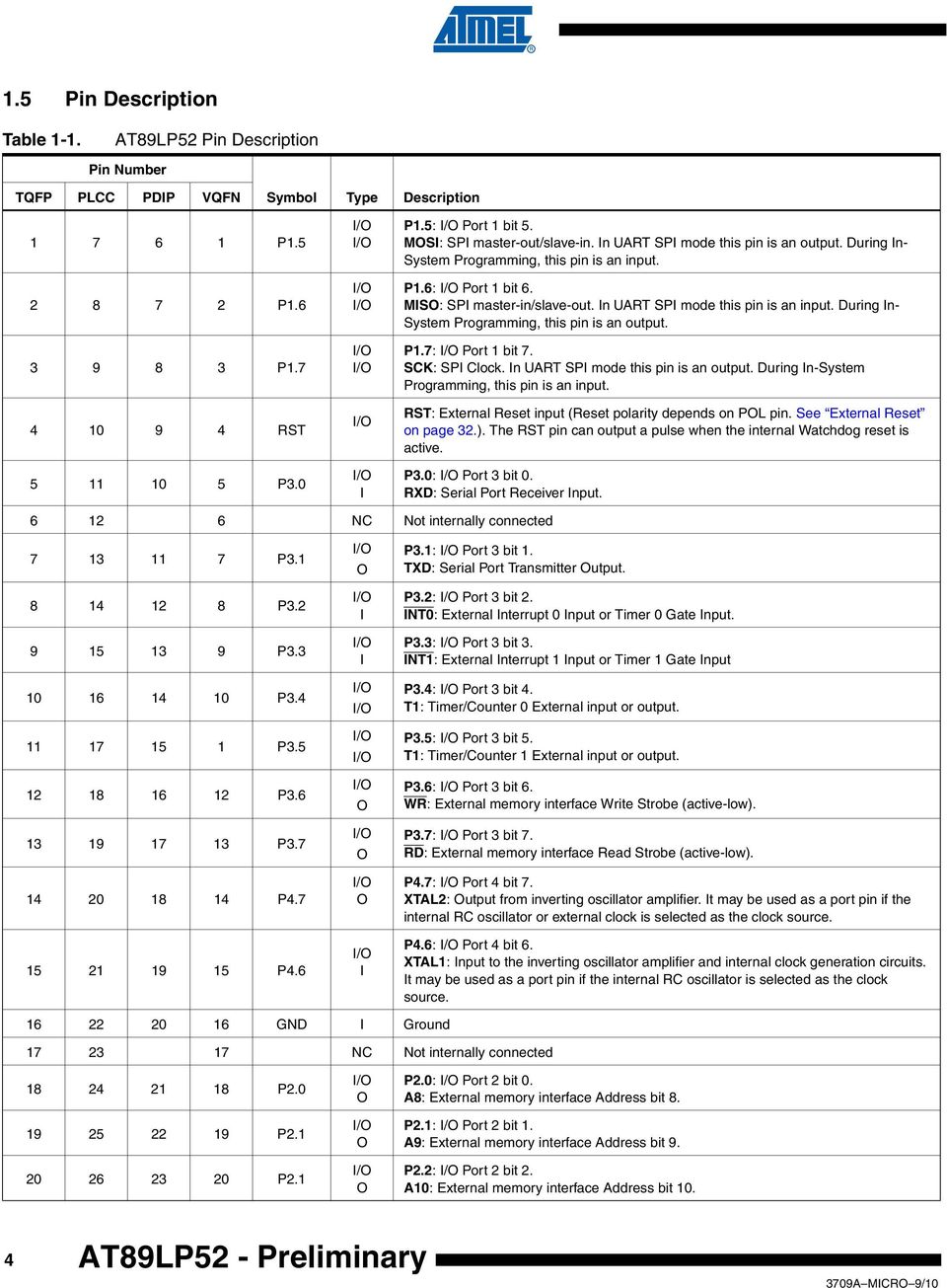
4 1.5 Pin Description Table 1-1. AT89LP52 Pin Description Pin Number TQFP PLCC PDIP VQFN Symbol Type Description P P P RST P3.0 I/O I/O I/O I/O I/O I/O I/O I/O I P1.5: I/O Port 1 bit 5. MOSI: SPI master-out/slave-in. In UART SPI mode this pin is an output. During In- System Programming, this pin is an input. P1.6: I/O Port 1 bit 6. MISO: SPI master-in/slave-out. In UART SPI mode this pin is an input. During In- System Programming, this pin is an output. P1.7: I/O Port 1 bit 7. SCK: SPI Clock. In UART SPI mode this pin is an output. During In-System Programming, this pin is an input. RST: External Reset input (Reset polarity depends on POL pin. See External Reset on page 32.). The RST pin can output a pulse when the internal Watchdog reset is active. P3.0: I/O Port 3 bit 0. RXD: Serial Port Receiver Input NC Not internally connected P P P P P P P P P4.6 I/O O I/O I I/O I I/O I/O I/O I/O I/O O I/O O I/O O I/O I P3.1: I/O Port 3 bit 1. TXD: Serial Port Transmitter Output. P3.2: I/O Port 3 bit 2. INT0: External Interrupt 0 Input or Timer 0 Gate Input. P3.3: I/O Port 3 bit 3. INT1: External Interrupt 1 Input or Timer 1 Gate Input P3.4: I/O Port 3 bit 4. T1: Timer/Counter 0 External input or output. P3.5: I/O Port 3 bit 5. T1: Timer/Counter 1 External input or output. P3.6: I/O Port 3 bit 6. WR: External memory interface Write Strobe (active-low). P3.7: I/O Port 3 bit 7. RD: External memory interface Read Strobe (active-low). P4.7: I/O Port 4 bit 7. XTAL2: Output from inverting oscillator amplifier. It may be used as a port pin if the internal RC oscillator or external clock is selected as the clock source. P4.6: I/O Port 4 bit 6. XTAL1: Input to the inverting oscillator amplifier and internal clock generation circuits. It may be used as a port pin if the internal RC oscillator is selected as the clock source GND I Ground NC Not internally connected P P P2.1 I/O O I/O O I/O O P2.0: I/O Port 2 bit 0. A8: External memory interface Address bit 8. P2.1: I/O Port 2 bit 1. A9: External memory interface Address bit 9. P2.2: I/O Port 2 bit 2. A10: External memory interface Address bit AT89LP52 - Preliminary
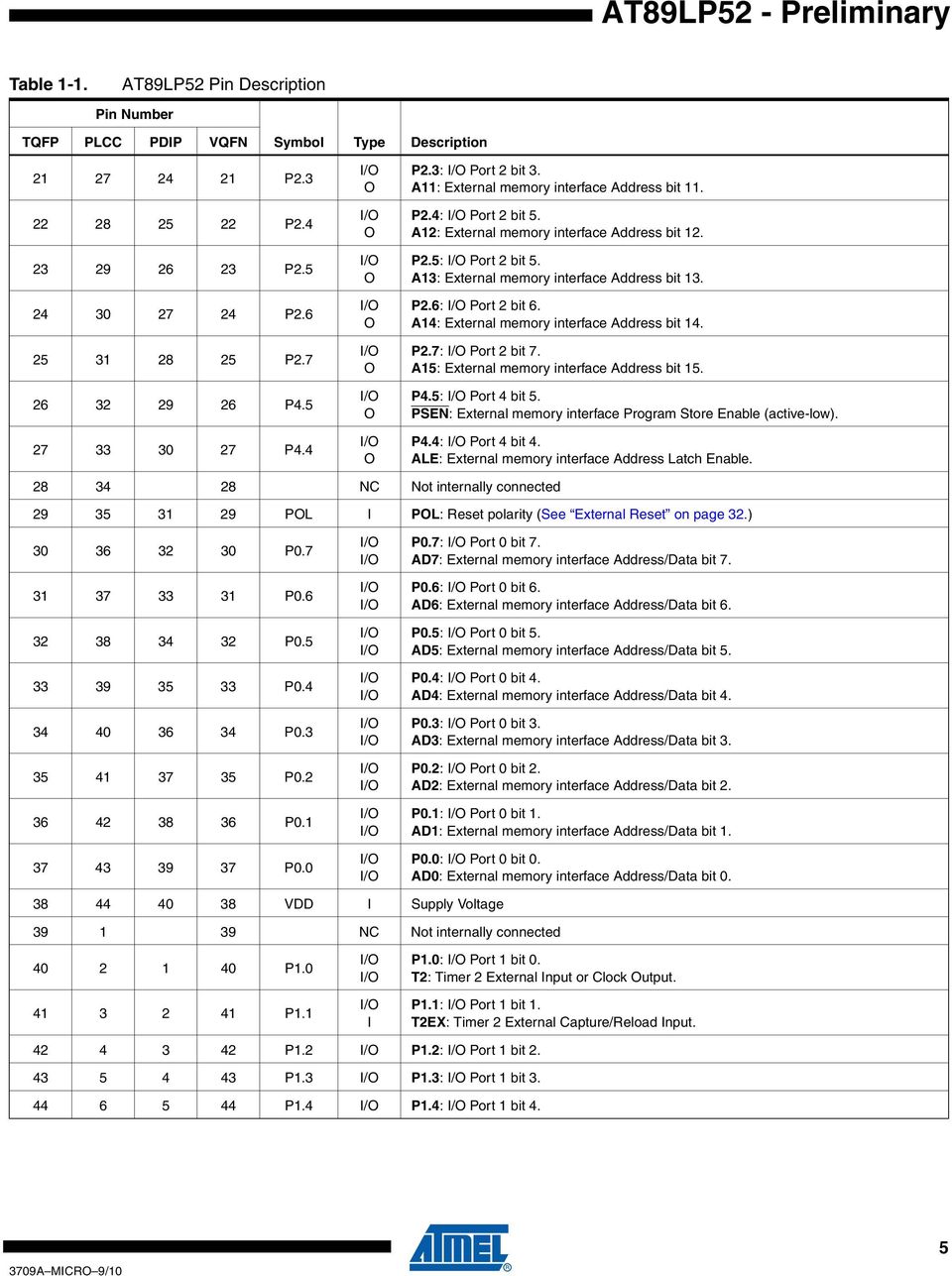
5 AT89LP52 - Preliminary Table 1-1. AT89LP52 Pin Description Pin Number TQFP PLCC PDIP VQFN Symbol Type Description P P P P P P P4.4 I/O O I/O O I/O O I/O O I/O O I/O O I/O O P2.3: I/O Port 2 bit 3. A11: External memory interface Address bit 11. P2.4: I/O Port 2 bit 5. A12: External memory interface Address bit 12. P2.5: I/O Port 2 bit 5. A13: External memory interface Address bit 13. P2.6: I/O Port 2 bit 6. A14: External memory interface Address bit 14. P2.7: I/O Port 2 bit 7. A15: External memory interface Address bit 15. P4.5: I/O Port 4 bit 5. PSEN: External memory interface Program Store Enable (active-low). P4.4: I/O Port 4 bit 4. ALE: External memory interface Address Latch Enable NC Not internally connected POL I POL: Reset polarity (See External Reset on page 32.) P P P P P P P P0.0 I/O I/O I/O I/O I/O I/O I/O I/O I/O I/O I/O I/O I/O I/O I/O I/O P0.7: I/O Port 0 bit 7. AD7: External memory interface Address/Data bit 7. P0.6: I/O Port 0 bit 6. AD6: External memory interface Address/Data bit 6. P0.5: I/O Port 0 bit 5. AD5: External memory interface Address/Data bit 5. P0.4: I/O Port 0 bit 4. AD4: External memory interface Address/Data bit 4. P0.3: I/O Port 0 bit 3. AD3: External memory interface Address/Data bit 3. P0.2: I/O Port 0 bit 2. AD2: External memory interface Address/Data bit 2. P0.1: I/O Port 0 bit 1. AD1: External memory interface Address/Data bit 1. P0.0: I/O Port 0 bit 0. AD0: External memory interface Address/Data bit VDD I Supply Voltage NC Not internally connected P P1.1 I/O I/O I/O I P1.0: I/O Port 1 bit 0. T2: Timer 2 External Input or Clock Output. P1.1: I/O Port 1 bit 1. T2EX: Timer 2 External Capture/Reload Input P1.2 I/O P1.2: I/O Port 1 bit P1.3 I/O P1.3: I/O Port 1 bit P1.4 I/O P1.4: I/O Port 1 bit 4. 5
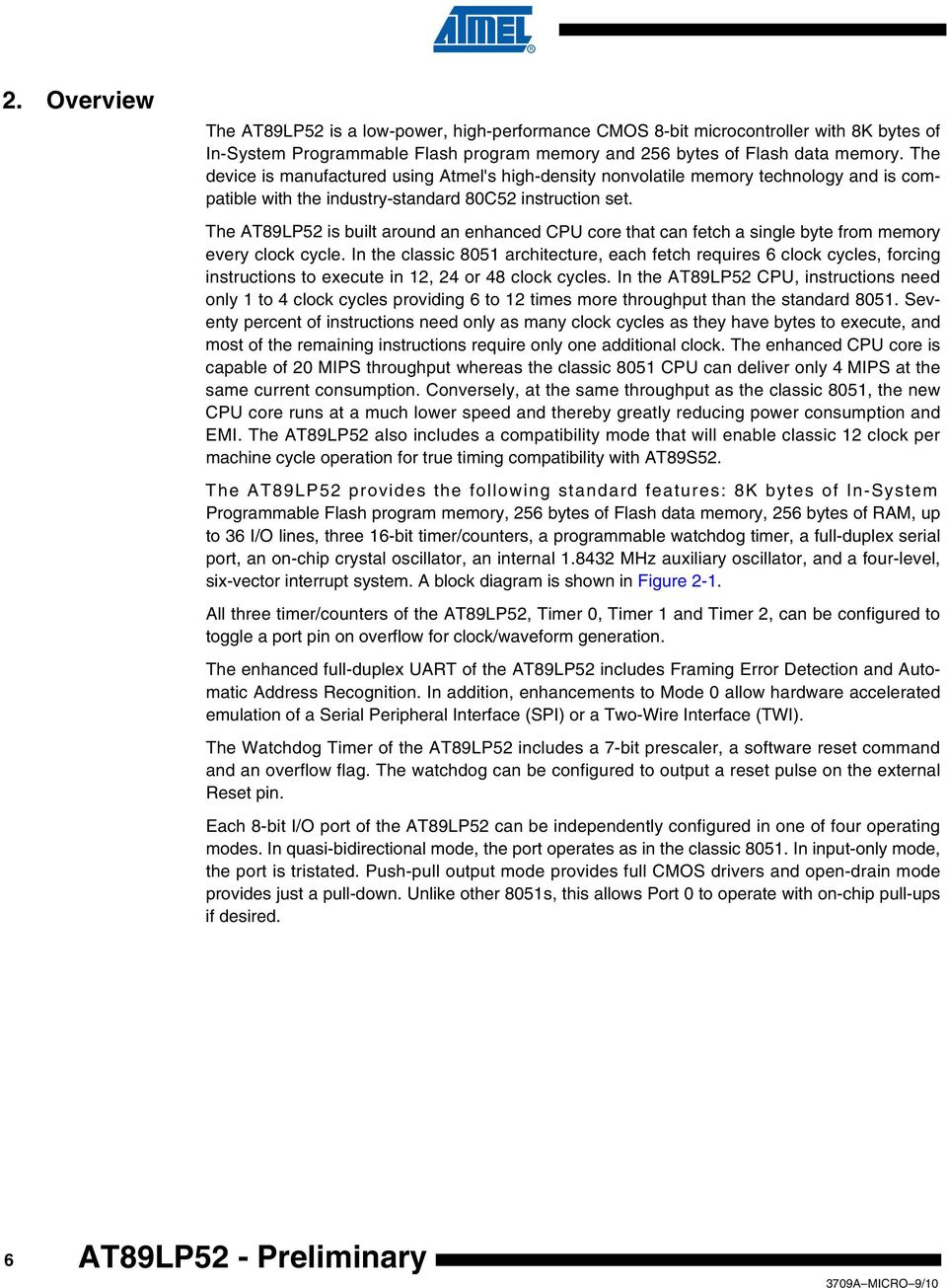
6 2. Overview The AT89LP52 is a low-power, high-performance CMOS 8-bit microcontroller with 8K bytes of In-System Programmable Flash program memory and 256 bytes of Flash data memory. The device is manufactured using Atmel's high-density nonvolatile memory technology and is compatible with the industry-standard 80C52 instruction set. The AT89LP52 is built around an enhanced CPU core that can fetch a single byte from memory every clock cycle. In the classic 8051 architecture, each fetch requires 6 clock cycles, forcing instructions to execute in 12, 24 or 48 clock cycles. In the AT89LP52 CPU, instructions need only 1 to 4 clock cycles providing 6 to 12 times more throughput than the standard Seventy percent of instructions need only as many clock cycles as they have bytes to execute, and most of the remaining instructions require only one additional clock. The enhanced CPU core is capable of 20 MIPS throughput whereas the classic 8051 CPU can deliver only 4 MIPS at the same current consumption. Conversely, at the same throughput as the classic 8051, the new CPU core runs at a much lower speed and thereby greatly reducing power consumption and EMI. The AT89LP52 also includes a compatibility mode that will enable classic 12 clock per machine cycle operation for true timing compatibility with AT89S52. The AT89LP52 provides the following standard features: 8K bytes of In-System Programmable Flash program memory, 256 bytes of Flash data memory, 256 bytes of RAM, up to 36 I/O lines, three 16-bit timer/counters, a programmable watchdog timer, a full-duplex serial port, an on-chip crystal oscillator, an internal MHz auxiliary oscillator, and a four-level, six-vector interrupt system. A block diagram is shown in Figure 2-1. All three timer/counters of the AT89LP52, Timer 0, Timer 1 and Timer 2, can be configured to toggle a port pin on overflow for clock/waveform generation. The enhanced full-duplex UART of the AT89LP52 includes Framing Error Detection and Automatic Address Recognition. In addition, enhancements to Mode 0 allow hardware accelerated emulation of a Serial Peripheral Interface (SPI) or a Two-Wire Interface (TWI). The Watchdog Timer of the AT89LP52 includes a 7-bit prescaler, a software reset command and an overflow flag. The watchdog can be configured to output a reset pulse on the external Reset pin. Each 8-bit I/O port of the AT89LP52 can be independently configured in one of four operating modes. In quasi-bidirectional mode, the port operates as in the classic In input-only mode, the port is tristated. Push-pull output mode provides full CMOS drivers and open-drain mode provides just a pull-down. Unlike other 8051s, this allows Port 0 to operate with on-chip pull-ups if desired. 6 AT89LP52 - Preliminary
7 AT89LP52 - Preliminary 2.1 Block Diagram Figure 2-1. AT89LP52 Block Diagram 8K Bytes Flash Code 256 Bytes Flash Data 256 Bytes RAM XRAM Interface 8051 Single Cycle CPU with 12-cycle Compatibility Port 0 Configurable I/O UART Port 1 Configurable I/O 16-bit Timer 0 16-bit Timer 1 Port 2 Configurable I/O 16-bit Timer 2 Port 3 Configurable I/O Watchdog Timer Port 4 Configurable I/O POR BOD Crystal or Resonator Configurable Oscillator RC Auxiliary Oscillator 2.2 Comparison to AT89S52 The AT89LP52 is part of a family of devices with enhanced features that are fully binary compatible with the 8051 instruction set. The AT89LP52 has two modes of operations, Compatibility mode and Fast mode. In Compatibility mode the instruction timing, peripheral behavior, SFR addresses, bit assignments and pin functions are identical to Atmel's existing AT89S52 product. Additional enhancements are transparent to the user and can be used if desired. Fast mode allows greater performance, but with some differences in behavior. The major enhancements from the AT89S52 are outlined in the following paragraphs and may be useful to users migrating to the AT89LP52 from older devices. A summary of the differences between Compatibility and Fast modes is given in Table 2-1 on page 9. See also the Application note Migrating from At89S52 to AT89LP Instruction Execution In Compatibility mode the AT89LP52 CPU uses the six-state machine cycle of the standard 8051 where instruction bytes are fetched every three system clock cycles. Execution times in this mode are identical to AT89S52. For greater performance the user can enable Fast mode by 7

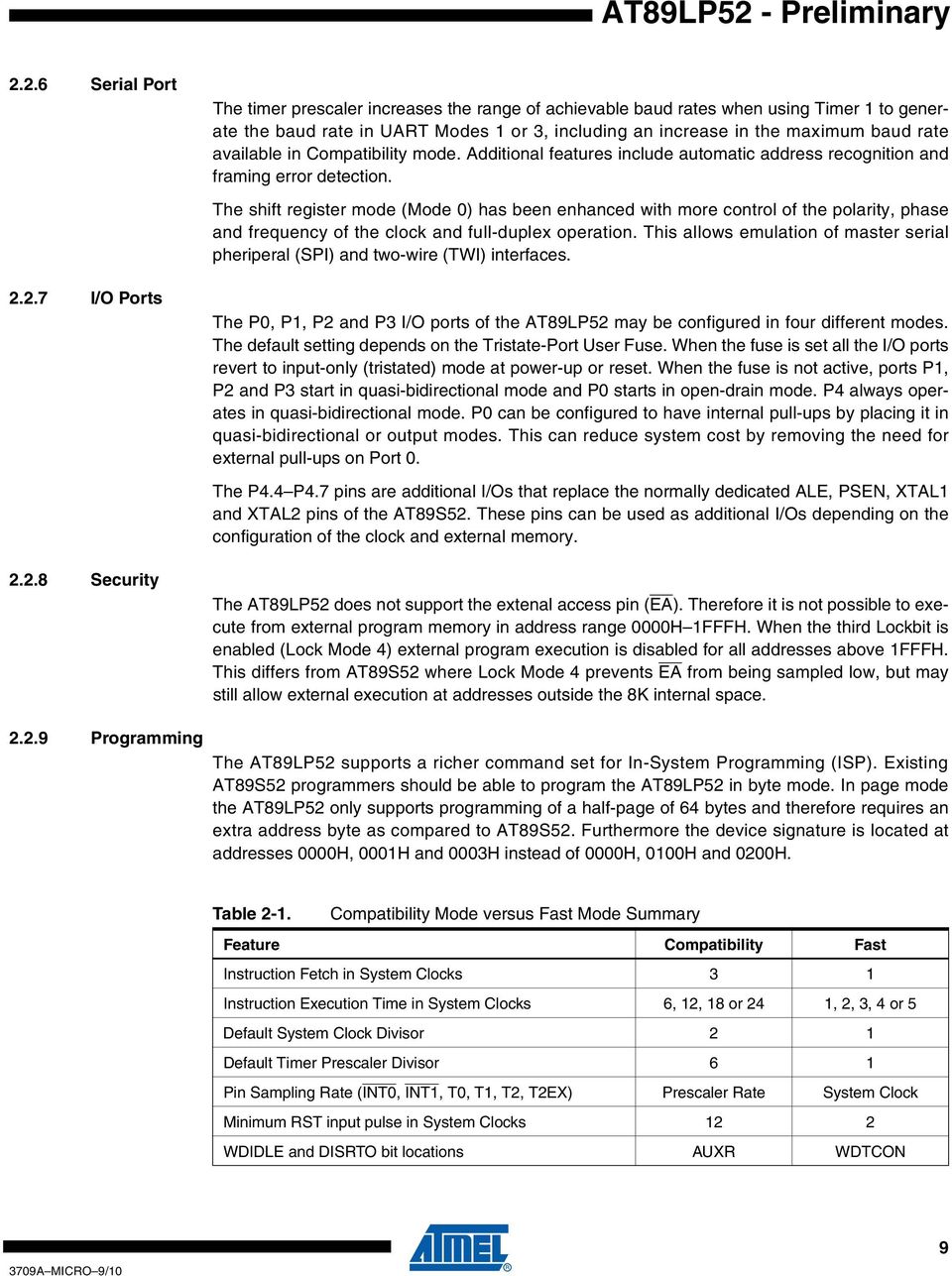
8 2.2.2 System Clock disabling the Compatibility fuse. In Fast mode the CPU fetches one code byte from memory every clock cycle instead of every three clock cycles. This greatly increases the throughput of the CPU. Each standard instruction executes in only 1 to 4 clock cycles. See Instruction Set Summary on page 75 for more details. Any software delay loops or instruction-based timing operations may need to be retuned to achieve the desired results in Fast mode. By default in Compatibility mode the system clock frequency is divided by 2 from the externally supplied XTAL1 frequency for compatibility with standard 8051s (12 clocks per machine cycle). The System Clock Divider can scale the system clock versus the oscillator source (See Section 6.4 on page 30). The divide-by-2 can be disabled to operate in X2 mode (6 clocks per machine cycle) or the clock may be further divided to reduce the operating frequency. In Fast mode the clock divider defaults to divide by 1. The system clock source is selectable between the crystal oscillator, an externally driven clock and an internal MHz auxiliary oscillator Reset The RST pin of the AT89LP52 has selectable polarity using the POL pin (formerly EA). When POL is high the RST pin is active high with a pull-down resistor and when POL is low the RST pin is active low with a pull-up resistor. For existing AT89S52 sockets where EA is tied to VDD, replacing AT89S52 with AT89LP52 will maintain the active high reset. Note that forcing external execution by tying EA low is not supported. The AT89LP52 includes an on-chip Power-On Reset and Brown-out Detector circuit that ensures that the device is reset from system power up. In most cases a RC startup circuit is not required on the RST pin, reducing system cost, and the RST pin may be left unconnected if a board-level reset is not present Timer/Counters A common prescaler is available to divide the time base for Timer 0, Timer 1, Timer 2 and the WDT. The TPS 3-0 bits in the CLKREG SFR control the prescaler (Table 6-2 on page 30). In Compatibility mode TPS 3-0 defaults to 0101B, which causes the timers to count once every machine cycle. The counting rate can be adjusted linearly from the system clock rate to 1/16 of the system clock rate by changing TPS 3-0. In Fast mode TPS 3-0 defaults to 0000B, or the system clock rate. TPS does not affect Timer 2 in Clock Out or Baud Generator modes. In Compatibility mode the sampling of the external Timer/Counter pins: T0, T1, T2 and T2EX; and the external interrupt pins, INT0 and INT1, is also controlled by the prescaler. In Fast mode these pins are always sampled at the system clock rate. Both Timer 0 and Timer 1 can toggle their respective counter pins, T0 and T1, when they overflow by setting the output enable bits in TCONB. The Watchdog Timer includes a 7-bit prescaler for longer timeout periods than the AT89S52. Note that in Fast Mode the WDIDLE and DISRTO bits are located in WDTCON and not in AUXR Interrupt Handling With the addition of the IPH register, the AT89LP52 provides four levels of interrupt priority for greater flexibility in handling multiple interrupts. Also, Fast mode allows for faster interrupt response due to the shorter instruction execution times. 8 AT89LP52 - Preliminary

9 AT89LP52 - Preliminary Serial Port I/O Ports Security The timer prescaler increases the range of achievable baud rates when using Timer 1 to generate the baud rate in UART Modes 1 or 3, including an increase in the maximum baud rate available in Compatibility mode. Additional features include automatic address recognition and framing error detection. The shift register mode (Mode 0) has been enhanced with more control of the polarity, phase and frequency of the clock and full-duplex operation. This allows emulation of master serial pheriperal (SPI) and two-wire (TWI) interfaces. The P0, P1, P2 and P3 I/O ports of the AT89LP52 may be configured in four different modes. The default setting depends on the Tristate-Port User Fuse. When the fuse is set all the I/O ports revert to input-only (tristated) mode at power-up or reset. When the fuse is not active, ports P1, P2 and P3 start in quasi-bidirectional mode and P0 starts in open-drain mode. P4 always operates in quasi-bidirectional mode. P0 can be configured to have internal pull-ups by placing it in quasi-bidirectional or output modes. This can reduce system cost by removing the need for external pull-ups on Port 0. The P4.4 P4.7 pins are additional I/Os that replace the normally dedicated ALE, PSEN, XTAL1 and XTAL2 pins of the AT89S52. These pins can be used as additional I/Os depending on the configuration of the clock and external memory. The AT89LP52 does not support the extenal access pin (EA). Therefore it is not possible to execute from external program memory in address range 0000H 1FFFH. When the third Lockbit is enabled (Lock Mode 4) external program execution is disabled for all addresses above 1FFFH. This differs from AT89S52 where Lock Mode 4 prevents EA from being sampled low, but may still allow external execution at addresses outside the 8K internal space Programming The AT89LP52 supports a richer command set for In-System Programming (ISP). Existing AT89S52 programmers should be able to program the AT89LP52 in byte mode. In page mode the AT89LP52 only supports programming of a half-page of 64 bytes and therefore requires an extra address byte as compared to AT89S52. Furthermore the device signature is located at addresses 0000H, 0001H and 0003H instead of 0000H, 0100H and 0200H. Table 2-1. Compatibility Mode versus Fast Mode Summary Feature Compatibility Fast Instruction Fetch in System Clocks 3 1 Instruction Execution Time in System Clocks 6, 12, 18 or 24 1, 2, 3, 4 or 5 Default System Clock Divisor 2 1 Default Timer Prescaler Divisor 6 1 Pin Sampling Rate (INT0, INT1, T0, T1, T2, T2EX) Prescaler Rate System Clock Minimum RST input pulse in System Clocks 12 2 WDIDLE and DISRTO bit locations AUXR WDTCON 9
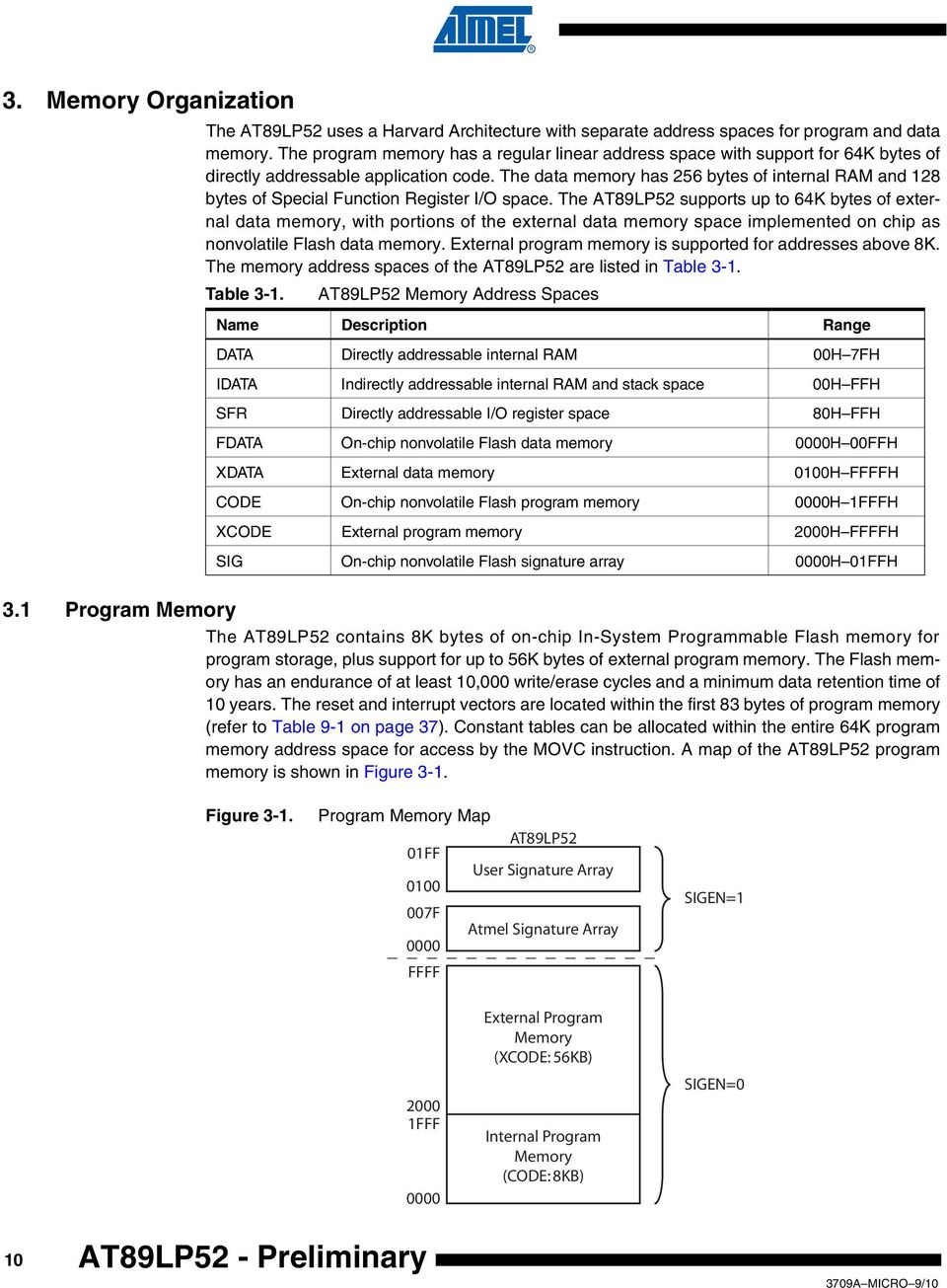
10 3. Memory Organization The AT89LP52 uses a Harvard Architecture with separate address spaces for program and data memory. The program memory has a regular linear address space with support for 64K bytes of directly addressable application code. The data memory has 256 bytes of internal RAM and 128 bytes of Special Function Register I/O space. The AT89LP52 supports up to 64K bytes of external data memory, with portions of the external data memory space implemented on chip as nonvolatile Flash data memory. External program memory is supported for addresses above 8K. The memory address spaces of the AT89LP52 are listed in Table 3-1. Table 3-1. AT89LP52 Memory Address Spaces Name Description Range DATA Directly addressable internal RAM 00H 7FH IDATA Indirectly addressable internal RAM and stack space 00H FFH SFR Directly addressable I/O register space 80H FFH FDATA On-chip nonvolatile Flash data memory 0000H 00FFH XDATA External data memory 0100H FFFFH CODE On-chip nonvolatile Flash program memory 0000H 1FFFH XCODE External program memory 2000H FFFFH SIG On-chip nonvolatile Flash signature array 0000H 01FFH 3.1 Program Memory The AT89LP52 contains 8K bytes of on-chip In-System Programmable Flash memory for program storage, plus support for up to 56K bytes of external program memory. The Flash memory has an endurance of at least 10,000 write/erase cycles and a minimum data retention time of 10 years. The reset and interrupt vectors are located within the first 83 bytes of program memory (refer to Table 9-1 on page 37). Constant tables can be allocated within the entire 64K program memory address space for access by the MOVC instruction. A map of the AT89LP52 program memory is shown in Figure 3-1. Figure 3-1. Program Memory Map AT89LP52 01FF User Signature Array F Atmel Signature Array 0000 FFFF SIGEN= FFF 0000 External Program Memory (XCODE: 56KB) Internal Program Memory (CODE: 8KB) SIGEN=0 10 AT89LP52 - Preliminary
11 AT89LP52 - Preliminary External Program Memory Interface The AT89LP52 uses the standard 8051 external program memory interface with the upper address on Port 2, the lower address and data in/out multiplexed on Port 0, and the ALE and PSEN strobes. Program memory addresses are always 16-bits wide, even though the actual amount of program memory used may be less than 64K byes. External program execution sacrifices two full 8-bit ports, P0 and P2, to the function of addressing the program memory. Figure 3-2 shows a hardware configuration for accessing up to 64K bytes of external ROM using a 16-bit linear address. Port 0 serves as a multiplexed address/data bus to the ROM. The Address Latch Enable strobe (ALE) is used to latch the lower address byte into an external register so that Port 0 can be freed for data input/output. Port 2 provides the upper address byte throughout the operation. PSEN strobes the external memory. Figure 3-3 shows the timing of the external program memory interface. ALE is emitted at a constant rate of 1/3 of the system clock with a 1/3 duty cycle. PSEN is emitted at a similar rate, but with 50% duty cycle. The new address changes in the middle of the ALE pulse for latching on the falling edge and is tristated at the falling edge of PSEN. The instruction data is sampled from P0 and latched internally during the high phase of the clock prior to the rising edge of PSEN. This timing applies to both Compatibility and Fast modes. In Compatibility mode there is no difference in instruction timing between internal and external execution. Figure 3-2. Executing from External Program Memory AT89LP EXTERNAL PROGRAM MEMORY P1 P0 INSTR. ALE LATCH ADDR P3 P2 PSEN OE Figure 3-3. External Program Memory Fetches CLK ALE PSEN P0 DATA SAMPLED PCL OUT FLOAT DATA SAMPLED PCL OUT DATA SAMPLED PCL OUT P2 PCH OUT PCH OUT PCH OUT 11

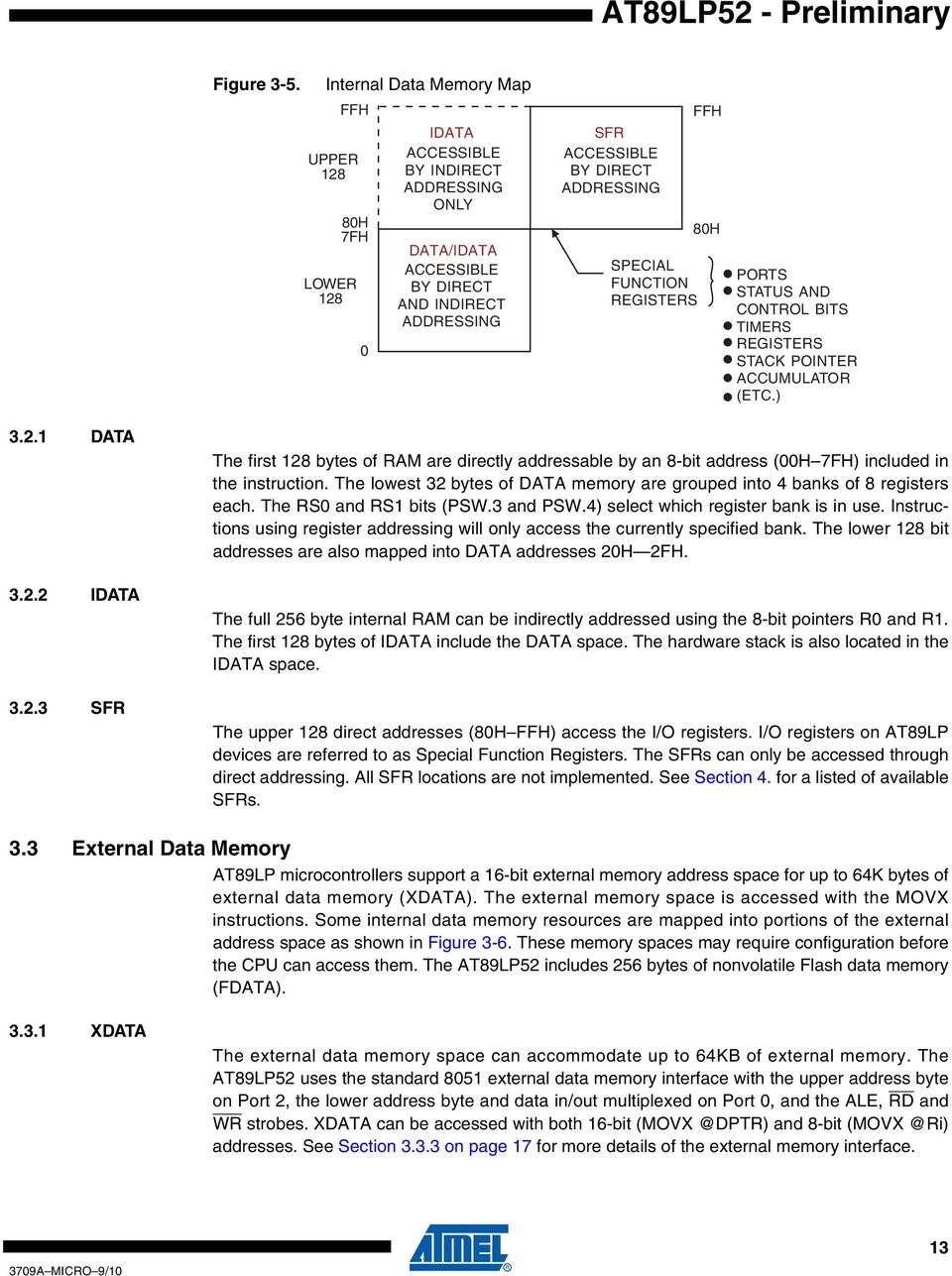
12 In order for Fast mode to fetch externally, two wait states must be inserted for every clock cycle, increasing the instruction execution time by a factor of 3. However, due to other optimizations, external Fast mode instructions may still be 1/4 to 1/2 faster than their Compatibility mode equivalents. Note that if ALE is allowed to toggle in Fast mode, there is a possibility that when the CPU jumps from internal to external execution a short pulse may occur on ALE as shown in Figure 3-4. The setup time from the address to the falling edge of ALE remains the same. However, this behavior can be avoided by setting the DISALE bit prior to any jump above the 8K border. Figure 3-4. Internal/External Program Memory Boundary (Fast Mode) CLK ALE DISALE=0 SHORT PULSE ALE DISALE=1 INTERNAL EXECUTION EXTERNAL EXECUTION PSEN P0 P0 SFR OUT PCL OUT FLOAT DATA SAMPLED PCL OUT P2 P2 SFR OUT PCH OUT PCH OUT SIG In addition to the 64K code space, the AT89LP52 also supports a 256-byte User Signature Array and a 128-byte Atmel Signature Array that are accessible by the CPU. The Atmel Signature Array is initialized with the Device ID in the factory. The User Signature Array is available for user identification codes or constant parameter data. Data stored in the signature array is not secure. Security bits will disable writes to the array; however, reads by an external device programmer are always allowed. In order to read from the signature arrays, the SIGEN bit (AUXR1.3) must be set (See Table 5-3 on page 27). While SIGEN is one, MOVC A,@A+DPTR will access the signature arrays. The User Signature Array is mapped from addresses 0100h to 01FFh and the Atmel Signature Array is mapped from addresses 0000h to 007Fh. SIGEN must be cleared before using MOVC to access the code memory. The User Signature Array may also be modified by the In-Application Programming interface. When IAP = 1 and SIGEN = 1, instructions will access the array (See Section 3.4 on page 22). 3.2 Internal Data Memory The AT89LP52 contains 256 bytes of general SRAM data memory plus 128 bytes of I/O memory mapped into a single 8-bit address space. Access to the internal data memory does not require any configuration. The internal data memory has three address spaces: DATA, IDATA and SFR; as shown in Figure 3-5. Some portions of external data memory are also implemented internally. See External Data Memory below for more information. 12 AT89LP52 - Preliminary

13 AT89LP52 - Preliminary Figure 3-5. Internal Data Memory Map FFH UPPER H 7FH LOWER IDATA ACCESSIBLE BY INDIRECT ADDRESSING ONLY DATA/IDATA ACCESSIBLE BY DIRECT AND INDIRECT ADDRESSING SFR ACCESSIBLE BY DIRECT ADDRESSING SPECIAL FUNCTION REGISTERS FFH 80H PORTS STATUS AND CONTROL BITS TIMERS REGISTERS STACK POINTER ACCUMULATOR (ETC.) DATA IDATA SFR The first 128 bytes of RAM are directly addressable by an 8-bit address (00H 7FH) included in the instruction. The lowest 32 bytes of DATA memory are grouped into 4 banks of 8 registers each. The RS0 and RS1 bits (PSW.3 and PSW.4) select which register bank is in use. Instructions using register addressing will only access the currently specified bank. The lower 128 bit addresses are also mapped into DATA addresses 20H 2FH. The full 256 byte internal RAM can be indirectly addressed using the 8-bit pointers R0 and R1. The first 128 bytes of IDATA include the DATA space. The hardware stack is also located in the IDATA space. The upper 128 direct addresses (80H FFH) access the I/O registers. I/O registers on AT89LP devices are referred to as Special Function Registers. The SFRs can only be accessed through direct addressing. All SFR locations are not implemented. See Section 4. for a listed of available SFRs. 3.3 External Data Memory AT89LP microcontrollers support a 16-bit external memory address space for up to 64K bytes of external data memory (XDATA). The external memory space is accessed with the MOVX instructions. Some internal data memory resources are mapped into portions of the external address space as shown in Figure 3-6. These memory spaces may require configuration before the CPU can access them. The AT89LP52 includes 256 bytes of nonvolatile Flash data memory (FDATA) XDATA The external data memory space can accommodate up to 64KB of external memory. The AT89LP52 uses the standard 8051 external data memory interface with the upper address byte on Port 2, the lower address byte and data in/out multiplexed on Port 0, and the ALE, RD and WR strobes. XDATA can be accessed with both 16-bit and 8-bit addresses. See Section on page 17 for more details of the external memory interface. 13
14 Some internal data memory spaces are mapped into portions of the XDATA address space. In this case the lower address ranges will access internal resources instead of external memory. Addresses above the range implemented internally will default to XDATA. The AT89LP52 supports up to 63.75K or 56K bytes of external memory when using the internally mapped memories. Setting the EXRAM bit (AUXR.1) to one will force all MOVX instructions to access the entire 64KB XDATA regardless of their address (See AUXR Auxiliary Control Register on page 19). Figure 3-6. FFFF External Data Memory Map FFFF FFFF External Data (XDATA: 56KB) External Data (XDATA: 64KB) External Data (XDATA: 63.75KB) FFF 0000 EXRAM = 1 or DMEN = 0 IAP = FF Flash Data (FDATA: 256) EXRAM = 0 DMEN = 1 IAP = 0 Flash Program (CODE: 8KB) EXRAM = 0 DMEN = x IAP = FDATA The Flash Data Memory is a portion of the external memory space implemented as an internal nonvolatile data memory. Flash Data Memory is enabled by setting the DMEN bit (MEMCON.3) to one. When IAP = 0 and DMEN = 1, the Flash Data Memory is mapped into the FDATA space, at the bottom of the external memory address space, from 0000H to 00FFH. (See Figure 3-6). MOVX instructions to this address range will access the internal nonvolatile memory. FDATA is not accessible while DMEN = 0. FDATA can be accessed only by 16-bit addresses. instructions to the FDATA address range will access external memory. Addresses above the FDATA range are mapped to XDATA Write Protocol The FDATA address space accesses an internal nonvolatile data memory. This address space can be read just like EDATA by issuing a MOVX A,@DPTR; however, writes to FDATA require a more complex protocol and take several milliseconds to complete. For internal execution the AT89LP52 uses an idle-while-write architecture where the CPU is placed in an idle state while the write occurs. When the write completes, the CPU will continue executing with the instruction after the instruction that started the write. All 14 AT89LP52 - Preliminary

15 AT89LP52 - Preliminary peripherals will continue to function during the write cycle; however, interrupts will not be serviced until the write completes. For external execution the AT89LP52 uses an execute-while-write architecture where the CPU continues to operate while the write occurs. The software should poll the state of the BUSY flag to determine when the write completes. Interrupts must be disabled during the write sequence as the CPU will not be able to vector to the internal interrupt table and care should be taken that the application does not jump to an internal address until the write completes. To enable write access to the nonvolatile data memory, the MWEN bit (MEMCON.4) must be set to one. When MWEN = 1 and DMEN = 1, may be used to write to FDATA. FDATA uses flash memory with a page-based programming model. Flash data memory differs from traditional EEPROM data memory in the method of writing data. EEPROM generally can update a single byte with any value. Flash memory splits programming into write and erase operations. A Flash write can only program zeroes, i.e change ones into zeroes ( 1 0 ). Any ones in the write data are ignored. A Flash erase sets an entire page of data to ones so that all bytes become FFH. Therefore after an erase, each byte in the page can only be written once with any possible value. Bytes can be overwritten without an erase as long as only ones are changed into zeroes. However, if even a single bit needs updating from zero to one ( 0 1 ); then the contents of the page must first be saved, the entire page must be erased and the zero bits in all bytes (old and new data combined) must be written. Avoiding unnecessary page erases greatly improves the endurance of the memory.. The AT89LP52 includes 2 data pages of 128 bytes each. One or more bytes in a page may be written at one time. The AT89LP52 includes a temporary page buffer of 64 bytes, or half of a page. Because the page buffer is 64 bytes long, the maximum number of bytes written at one time is 64. Therefore, two write cycles are required to fill the entire 128-byte page, one for the low half page (00H 3FH) and one for the high half page (40H 7FH) as shown in Figure 3-7. Figure 3-7. Page Programming Structure 00 3F Page Buffer Data Memory Low Half Page High Half Page 00 3F 40 7F The LDPG bit (MEMCON.5) allows multiple data bytes to be loaded to the temporary page buffer. While LDPG = 1, instructions will load data to the page buffer, but will not start a write sequence. Note that a previously loaded byte must not be reloaded prior to the write sequence. To write the half page into the memory, LDPG must first be cleared and then a with the final data byte is issued. The address of the final MOVX determines which half page will be written. If a instruction is issued while LDPG = 0 without loading any previous bytes, only a single byte will be written. The page buffer is reset after each write operation. Figures 3-8 and Figure 3-9 on page 16 show the difference between byte writes and page writes. 15

16 Figure 3-8. FDATA Byte Write DMEN MWEN LDPG IDLE MOVX t WC t WC Figure 3-9. FDATA Page Write DMEN MWEN LDPG IDLE t WC MOVX The auto-erase bit AERS (MEMCON.6) can be set to one to perform a page erase automatically at the beginning of any write sequence. The page erase will erase the entire page, i.e. both the low and high half pages. However, the write operation paired with the auto-erase can only program one of the half pages. A second write cycle without auto-erase is required to update the other half page. Frequently just a few bytes within a page must be updated while maintaining the state of the other bytes. There are two options for handling this situation that allow the Flash Data memory to emulate a traditional EEPROM memory. The simplest method is to copy the entire page into a buffer allocated in RAM, modify the desired byte locations in the RAM buffer, and then load and write back first the low half page (with auto-erase) and then the high half page to the Flash memory. This option requires that at least one page size of RAM is available as a temporary buffer. The second option is to store only one half page in RAM. The unmodified bytes of the other page are loaded directly into the Flash memory s temporary load buffer before loading the updated values of the modified bytes. For example, if just the low half page needs modification, the user must first store the high half page to RAM, followed by reading and loading the unaffected bytes of the low half page into the page buffer. Then the modified bytes of the low half page are stored to the page buffer before starting the auto-erase sequence. The stored value of the high half page must be written without auto-erase after the programming of the low half page completes. This method reduces the amount of RAM required; however, more software overhead is needed because the read-and-load-back routine must skip those bytes in the page that need to be updated in order to prevent those locations in the buffer from being loaded with the previous data, as this will block the new data from being loaded correctly. A write sequence will not occur if the Brown-out Detector is active. If a write currently in progress is interrupted by the BOD due to a low voltage condition, the ERR flag will be set. 16 AT89LP52 - Preliminary

17 AT89LP52 - Preliminary Table 3-2. Symbol IAP AERS LDPG MWEN DMEN ERR BUSY WRTINH MEMCON = 96H Not Bit Addressable MEMCON Memory Control Register Reset Value = XXXB IAP AERS LDPG MWEN DMEN ERR BUSY WRTINH Bit Function In-Application Programming Enable. When IAP = 1 and the IAP Fuse is enabled, programming of the CODE/SIG space is enabled and instructions will access CODE/SIG instead of EDATA or FDATA. Clear IAP to disable programming of CODE/SIG and allow access to EDATA and FDATA. Auto-Erase Enable. Set to perform an auto-erase of a Flash memory page (CODE, SIG or FDATA) during the next write sequence. Clear to perform write without erase. Load Page Enable. Set to this bit to load multiple bytes to the temporary page buffer. Byte locations may not be loaded more than once before a write. LDPG must be cleared before writing. Memory Write Enable. Set to enable programming of a nonvolatile memory location (CODE, SIG or FDATA). Clear to disable programming of all nonvolatile memories. Data Memory Enable. Set to enable nonvolatile data memory and map it into the FDATA space. Clear to disable nonvolatile data memory. Error Flag. Set by hardware if an error occurred during the last programming sequence due to a brownout condition (low voltage on VDD). Must be cleared by software. Busy Flag. Write Inhibit Flag. Cleared by hardware when the voltage on VDD has fallen below the minimum programming voltage. Set by hardware when the voltage on VDD is above the minimum programming voltage External Data Memory Interface The AT89LP52 uses the standard 8051 external data memory interface with the upper address on Port 2, the lower address and data in/out multiplexed on Port 0, and the ALE, RD and WR strobes. The interface may be used in two different configurations depending on which type of MOVX instruction is used to access XDATA. Figure 3-10 shows a hardware configuration for accessing up to 64K bytes of external RAM using a 16-bit linear address. Port 0 serves as a multiplexed address/data bus to the RAM. The Address Latch Enable strobe (ALE) is used to latch the lower address byte into an external register so that Port 0 can be freed for data input/output. Port 2 provides the upper address byte throughout the operation. The instructions use Linear Address mode. 17
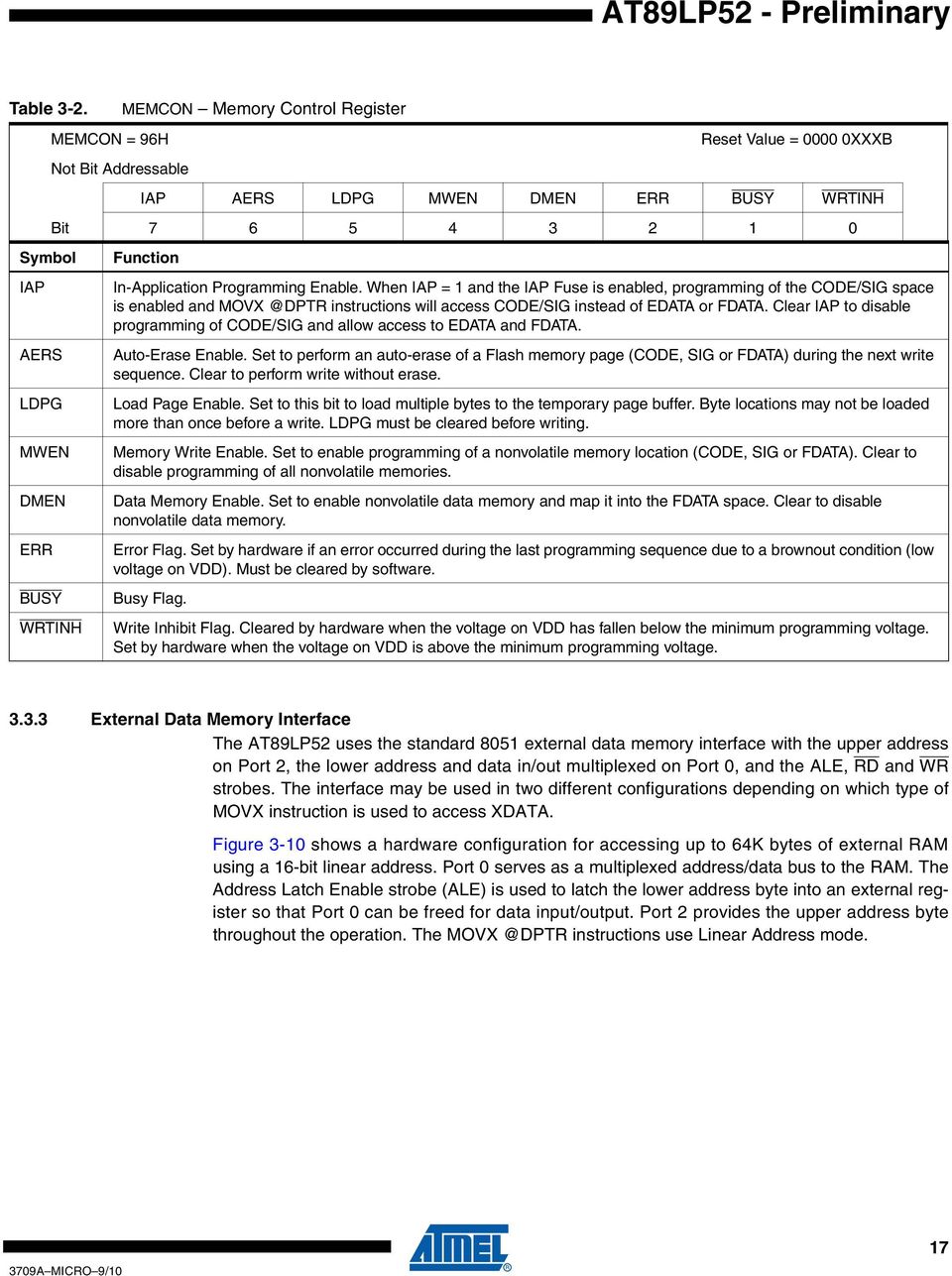
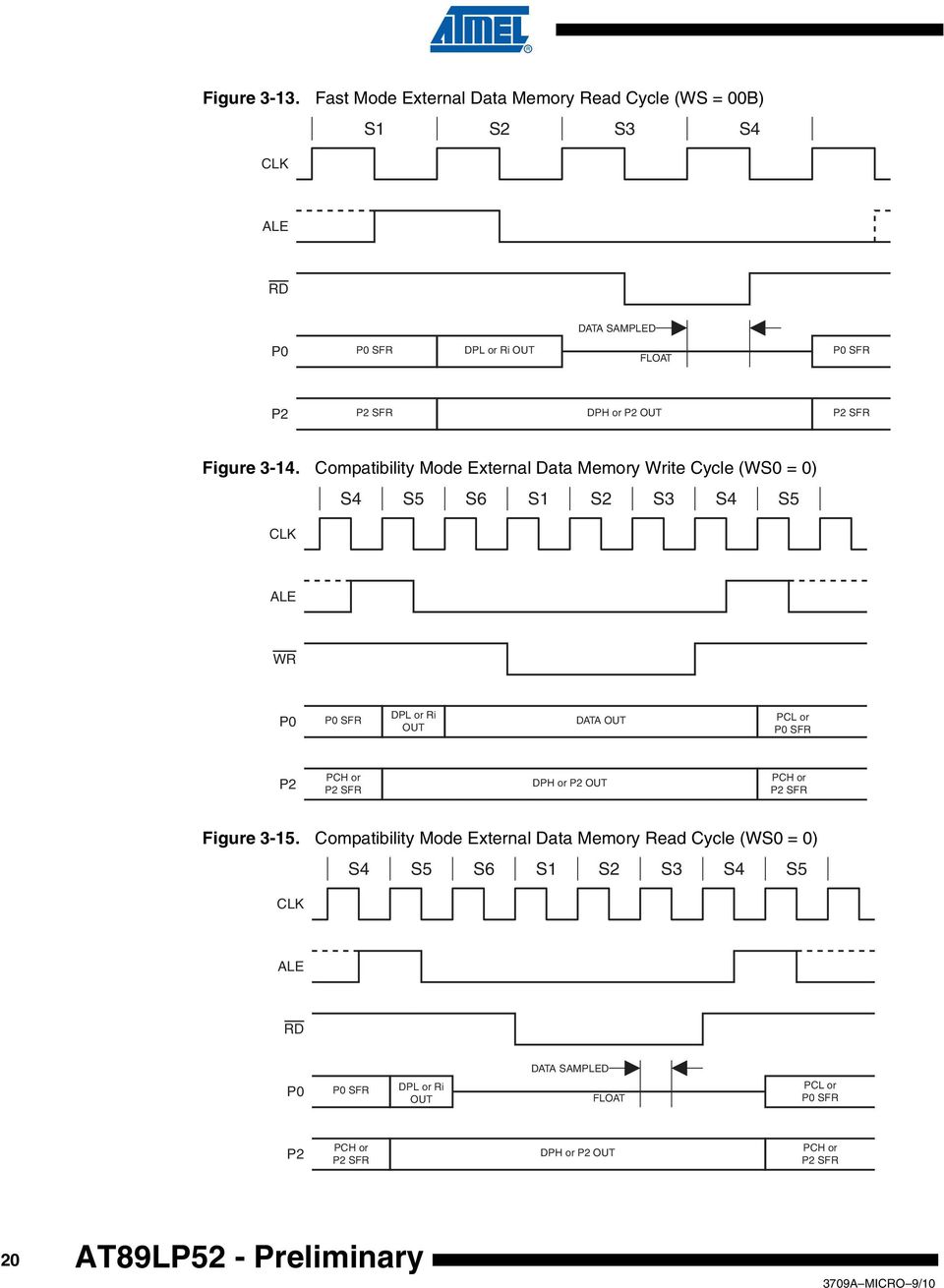
18 Figure External Data Memory 16-bit Linear Address Mode P1 AT89LP P0 EXTERNAL DATA MEMORY DATA ALE LATCH ADDR RD P3 WR P2 WE OE Figure 3-11 shows a hardware configuration for accessing 256-byte blocks of external RAM using an 8-bit paged address. Port 0 serves as a multiplexed address/data bus to the RAM. The ALE strobe is used to latch the address byte into an external register so that Port 0 can be freed for data input/output. The Port 2 I/O lines (or other ports) can provide control lines to page the memory; however, this operation is not handled automatically by hardware. The software application must change the Port 2 register when appropriate to access different pages. The instructions use Paged Address mode. Figure External Data Memory 8-bit Paged Address Mode P1 AT89LP P0 EXTERNAL DATA MEMORY DATA ALE LATCH ADDR RD P3 WR P2 I/O PAGE BITS WE OE Note that prior to using the external memory interface, WR (P3.6) and RD (P3.7) must be configured as outputs. See Section 10.1 Port Configuration on page 40. P0 and P2 are configured automatically to push-pull output mode when outputting address or data and P0 is automatically tristated when inputting data regardless of the port configuration. The Port 0 configuration will determine the idle state of Port 0 when not accessing the external memory. Figure 3-12 and Figure 3-13 show examples of external data memory write and read cycles, respectively. The address on P0 and P2 is stable at the falling edge of ALE. The idle state of ALE is controlled by DISALE (AUXR.0). When DISALE = 0 the ALE toggles at a constant rate when not accessing external memory. When DISALE = 1 the ALE is weakly pulled high. DISALE must be one in order to use P4.4 as a general-purpose I/O. The WS bits in AUXR can extended the RD and WR strobes by 1, 2 or 3 cycles as shown in Figures 3-16, 3-17 and If a longer strobe is required, the application can scale the system clock with the clock divider to meet the requirements (See Section 6.4 on page 30). 18 AT89LP52 - Preliminary

19 AT89LP52 - Preliminary Table 3-3. AUXR Auxiliary Control Register AUXR = 8EH Reset Value = xxx0 0000B Not Bit Addressable WDIDLE (1) DISRTO (1) WS1 (2) WS0 EXRAM DISALE Bit Symbol WDIDLE DISRTO WS[1-0] Function WDT Disable during Idle (1). When WDIDLE = 0 the WDT continues to count in Idle mode. When WDIDLE = 1 the WDT halts counting in Idle mode. Disable Reset Output (1). When DISTRO = 0 the reset pin is driven to the same level as POL when the WDT resets. When DISRTO = 1 the reset pin is input only. Wait State Select. Determines the number of wait states inserted into external memory accesses. WS1 (2) WS0 Wait States RD / WR Strobe Width ALE to RD / WR Setup x t CYC (Fast); 3 x t CYC (Compatibility) 1 x t CYC (Fast); 1.5 x t CYC (Compatibility) x t CYC (Fast); 15 x t CYC (Compatibility) 1 x t CYC (Fast); 1.5 x t CYC (Compatibility) x t CYC (Fast) 2 x t CYC (Fast) x t CYC (Fast) 2 x t CYC (Fast) EXRAM DISALE External RAM Enable. When EXRAM = 0, MOVX instructions can access the internally mapped portions of the address space. Accesses to addresses above internally mapped memory will access external memory. Set EXRAM = 1 to bypass the internal memory and map the entire address space to external memory. ALE Disable. When DISALE = 0 the ALE pulse is active at 1/3 of the system clock frequency in Compatibility mode and 1/2 of the system clock frequency in Fast mode. When DISALES = 1 the ALE is inactive (high) unless an external memory access occurs. DISALE must be set to use P4.4 as a general I/O. Notes: 1. AUXR.4 and AUXR.3 function as WDIDLE and DISRTO only in Compatibility mode. In Fast mode these bits are located in WDTCON. 2. WS1 is only available in Fast mode. WS1 is forced to 0 in Compatibility mode. Figure Fast Mode External Data Memory Write Cycle (WS =00B) S1 S2 S3 S4 CLK ALE WR P0 P0 SFR DPL or Ri OUT DATA OUT P0 SFR P2 P2 SFR DPH or P2 OUT P2 SFR 19

20 Figure Fast Mode External Data Memory Read Cycle (WS =00B) S1 S2 S3 S4 CLK ALE RD DATA SAMPLED P0 P0 SFR DPL or Ri OUT FLOAT P0 SFR P2 P2 SFR DPH or P2 OUT P2 SFR Figure Compatibility Mode External Data Memory Write Cycle (WS0 =0) S4 S5 S6 S1 S2 S3 S4 S5 CLK ALE WR P0 P0 SFR DPL or Ri OUT DATA OUT PCL or P0 SFR P2 PCH or P2 SFR DPH or P2 OUT PCH or P2 SFR Figure Compatibility Mode External Data Memory Read Cycle (WS0 =0) CLK S4 S5 S6 S1 S2 S3 S4 S5 ALE RD DATA SAMPLED P0 P0 SFR DPL or Ri OUT FLOAT PCL or P0 SFR P2 PCH or P2 SFR DPH or P2 OUT PCH or P2 SFR 20 AT89LP52 - Preliminary
21 AT89LP52 - Preliminary Figure MOVX with One Wait State (WS =01B) S1 S2 S3 W1 S4 CLK ALE P2 P2 SFR DPH or P2 OUT P2 SFR WR P0 P0 SFR DPL OUT DATA OUT P0 SFR RD P0 P0 SFR DPL OUT FLOAT P0 SFR Figure MOVX with Two Wait States (WS =10B) S1 S2 S3 W1 W2 S4 CLK ALE P2 P2 SFR DPH or P2 OUT P2 SFR WR P0 P0 SFR DPL OUT DATA OUT P0 SFR RD P0 P0 SFR DPL OUT FLOAT P0 SFR Figure MOVX with Three Wait States (WS =11B) S1 S2 S3 W1 W2 W3 CLK S4 ALE P2 P2 SFR DPH or P2 OUT P2 SFR WR P0 P0 SFR DPL OUT DATA OUT P0 SFR RD P0 P0 SFR DPL OUT FLOAT P0 SFR 21
22 3.4 In-Application Programming (IAP) The AT89LP52 supports In-Application Programming (IAP), allowing the program memory to be modified during execution. IAP can be used to modify the user application on the fly or to use program memory for nonvolatile data storage. The same page structure write protocol for FDATA also applies to IAP (See Section Write Protocol on page 14). The CPU is always placed in idle while modifying the program memory. When the write completes, the CPU will continue executing with the instruction after the instruction that started the write. To enable access to the program memory, the IAP bit (MEMCON.7) must be set to one and the IAP User Fuse must be enabled. The IAP User Fuse can disable all IAP operations. When this fuse is disabled, the IAP bit will be forced to 0. While IAP is enabled, all instructions will access the CODE space instead of EDATA/FDATA/XDATA. IAP also allows reprogramming of the User Signature Array when SIGEN = 1. The IAP access settings are summarized in Table 3-4. Table 3-4. IAP Access Settings IAP SIGEN DMEN XDATA (0000 FFFFH) CODE (0000 FFFFH) FDATA ( FFH) XDATA (0100 FFFFH) CODE (0000 FFFFH) XDATA (0000 FFFFH) SIG ( FFH) X 1 1 X FDATA ( FFH) XDATA (0100 FFFFH) CODE (0000 1FFFH) XDATA (2000 FFFFH) SIG ( FFH) XDATA (2000 FFFFH) SIG ( FFH) CODE (0000 FFFFH) SIG ( FFH) Note: When In-Application programming is not required, it is recommended that the IAP User Fuse be disabled. 22 AT89LP52 - Preliminary
23 AT89LP52 - Preliminary 4. Special Function Registers A map of the on-chip memory area called the Special Function Register (SFR) space is shown in Table 4-1. Note that not all of the addresses are occupied, and unoccupied addresses may not be implemented on the chip. Read accesses to these addresses will in general return random data, and write accesses will have an indeterminate effect. User software should not write to these unlisted locations, since they may be used in future products to invoke new features. Table 4-1. AT89LP52 SFR Map and Reset Values 8 9 A B C D E F 0F8H 0F0H 0E8H 0E0H 0D8H B ACC FFH 0F7H 0EFH 0E7H 0DFH 0D0H 0C8H 0C0H 0B8H 0B0H 0A8H 0A0H 98H 90H 88H 80H PSW T2CON P IP xx P IE 0x P SCON P TCON P T2MOD RCAP2L RCAP2H TL TH Notes: 1. All SFRs in the left-most column are bit-addressable. 2. Reset value is B when Tristate-Port Fuse is enabled and B when disabled. 3. Reset value is B when Compatibility mode is enabled and B when disabled. 0D7H 0CFH PMOD (2) 0C7H SADEN SADDR SBUF xxxx xxxx TCONB 000x xxxx TMOD SP AUXR x0 TL DP0L TL DP0H TH DP1L TH DP1H WDTRST (write-only) MEMCON xx AUXR IPH xx WDTCON xx0 0BFH 0B7H 0AFH 0A7H 9FH 97H CLKREG (3) 8FH PCON 000x H 23
24 5. Enhanced CPU The AT89LP52 uses an enhanced 8051 CPU that runs at 6 to 12 times the speed of standard 8051 devices (or 3 to 6 times the speed of X devices). The increase in performance is due to two factors. First, the CPU fetches one instruction byte from the code memory every clock cycle. Second, the CPU uses a simple two-stage pipeline to fetch and execute instructions in parallel. This basic pipelining concept allows the CPU to obtain up to 1 MIPS per MHz. The AT89LP52 also has a Compatibility mode that preserves the 12-clock machine cycle of standard 8051s like the AT89S Fast Mode Fast (Single-Cycle) mode must be enabled by clearing the Compatibility User Fuse. (See User Configuration Fuses on page 86.) In this mode one instruction byte is fetched every system clock cycle. The 8051 instruction set allows for instructions of variable length from 1 to 3 bytes. In a single-clock-per-byte-fetch system this means each instruction takes at least as many clocks as it has bytes to execute. The majority of instructions in the AT89LP52 follow this rule: the instruction execution time in system clock cycles equals the number of bytes per instruction, with a few exceptions. Branches and Calls require an additional cycle to compute the target address and some other complex instructions require multiple cycles. See Instruction Set Summary on page 75. for more detailed information on individual instructions. Example of Fast mode instructions are shown in Figure 5-1. Note that Fast mode instructions take three times as long to execute if they are fetched from external program memory. Figure 5-1. Instruction Execution Sequences in Fast Mode CLK READ NEXT OPCODE S1 (A) 1-byte, 1-cycle instruction, e.g. INC A READ OPERAND READ NEXT OPCODE S1 S2 (B) 2-byte, 2-cycle instruction, e.g. ADD A, #data READ NEXT OPCODE S1 S2 (C) 1-byte, 2-cycle instruction, e.g. INC DPTR READ NEXT OPCODE S1 S2 S3 S4 ADDR DATA ACCESS EXTERNAL MEMORY (D) MOVX (1-byte, 4-cycle) 24 AT89LP52 - Preliminary
25 AT89LP52 - Preliminary 5.2 Compatibility Mode Compatibility (12-Clock) mode is enabled by default from the factory or by setting the Compatibility User Fuse. In Compatibility mode instruction bytes are fetched every three system clock cycles and the CPU operates with 6-state machine cycles and a divide-by-2 system clock for 12 oscillator periods per machine cycle. Standard instructions execute in1, 2 or 4 machine cycles. Instruction timing in this mode is compatible with standard 8051s such as the AT89S52. Compatibility mode can be used to preserve the execution profiles of legacy applications. For a summary of differences between Fast and Compatibility modes see Table 2-1 on page 9. Examples of Compatibility mode instructions are shown in Figure 5-2. Figure 5-2. Instruction Execution Sequences in Compatibility Mode S1 S2 S3 S4 S5 S6 S1 S2 S3 S4 S5 S6 S1 CLK ALE READ OPCODE READ NEXT OPCODE (DISCARD) READ NEXT OPCODE AGAIN S1 S2 S3 S4 S5 S6 (A) 1-byte, 1-cycle instruction, e.g., INC A READ OPCODE READ 2ND BYTE READ NEXT OPCODE S1 S2 S3 S4 S5 S6 (B) 2-byte, 1-cycle instruction, e.g., ADD A, #data READ OPCODE READ NEXT OPCODE (DISCARD) READ NEXT OPCODE AGAIN S1 S2 S3 S4 S5 S6 S1 S2 S3 S4 S5 S6 (C) 1-byte, 2-cycle instruction, e.g., INC DPTR READ OPCODE (MOVX) READ NEXT OPCODE (DISCARD) NO FETCH NO ALE NO READ NEXT FETCH OPCODE AGAIN S1 S2 S3 S4 S5 S6 S1 S2 S3 S4 S5 S6 (D) MOVX (1-byte, 2-cycle) ADDR DATA ACCESS EXTERNAL MEMORY 5.3 Enhanced Dual Data Pointers The AT89LP52 provides two 16-bit data pointers: DPTR0 formed by the register pair DPOL and DPOH (82H an 83H), and DPTR1 formed by the register pair DP1L and DP1H (84H and 85H). The data pointers are used by several instructions to access the program or data memories. The Data Pointer Configuration Register (AUXR1) controls operation of the dual data pointers (Table 5-3 on page 27). The DPS bit in AUXR1 selects which data pointer is currently referenced by instructions including the DPTR operand. Each data pointer may be accessed at its respective SFR addresses regardless of the DPS value. The AT89LP52 provides two methods for fast context switching of the data pointers: 25
26 Bit 2 of AUXR1 is hard-wired as a logic 0. The DPS bit may be toggled (to switch data pointers) simply by incrementing the AUXR1 register, without altering other bits in the register unintentionally. This is the preferred method when only a single data pointer will be used at one time. EX: INC AUXR1 ; Toggle DPS In some cases, both data pointers must be used simultaneously. To prevent frequent toggling of DPS, the AT89LP52 supports a prefix notation for selecting the opposite data pointer per instruction. All DPTR instructions, with the exception of when prefixed with an 0A5H opcode will use the inverse value of DPS (DPS) to select the data pointer. Some assemblers may support this operation by using the /DPTR operand. For example, the following code performs a block copy within EDATA: MOV AUXR1, #00H ; DPS = 0 MOV DPTR, #SRC ; load source address to dptr0 MOV /DPTR, #DST ; load destination address to dptr1 MOV R7, #BLKSIZE ; number of bytes to copy COPY: MOVX ; read source (dptr0) INC DPTR ; next src (dptr0+1) A ; write destination (dptr1) INC /DPTR ; next dst (dptr1+1) DJNZ R7, COPY For assemblers that do not support this notation, the 0A5H prefix must be declared in-line: EX: DB 0A5H INC DPTR ; equivalent to INC /DPTR A summary of data pointer instructions with fast context switching is listed intable 5-1. Table 5-1. Data Pointer Instructions Operation Instruction DPS = 0 DPS = 1 MOV DPTR, #data16 MOV DPTR0, #data16 MOV DPTR1, #data16 MOV /DPTR, #data16 MOV DPTR1, #data16 MOV DPTR0, #data16 INC DPTR INC DPTR0 INC DPTR1 INC /DPTR INC DPTR1 INC DPTR0 MOVC A,@A+DPTR MOVC A,@A+DPTR0 MOVC A,@A+DPTR1 MOVC A,@A+/DPTR MOVC A,@A+DPTR1 MOVC A,@A+DPTR0 MOVX A,@DPTR MOVX A,@DPTR0 MOVX A,@DPTR1 MOVX A,@/DPTR MOVX A,@DPTR1 MOVX A,@DPTR0 A A A A A A Data Pointer Update The Dual Data Pointers on the AT89LP52 include two features that control how the data pointers are updated. The data pointer decrement bits, DPD1 and DPD0 in AUXR1, configure the INC DPTR instruction to act as DEC DPTR. The resulting operation will depend on DPS as shown in Table 5-2. These bits also control the direction of auto-updates during MOVC and MOVX. 26 AT89LP52 - Preliminary
27 AT89LP52 - Preliminary Table 5-2. Data Pointer Decrement Behavior DPD1 DPD0 Equivalent Operation for INC DPTR and INC /DPTR DPS = 0 DPS = 1 INC DPTR INC /DPTR INC DPTR INC /DPTR 0 0 INC DPTR0 INC DPTR1 INC DPTR1 INC DPTR0 0 1 DEC DPTR0 INC DPTR1 INC DPTR1 DEC DPTR0 1 0 INC DPTR0 DEC DPTR1 DEC DPTR1 INC DPTR0 1 1 DEC DPTR0 DEC DPTR1 DEC DPTR1 DEC DPTR0 Table 5-3. AUXR1 Data Pointer Configuration Register AUXR1 = A2H Reset Value = X0B Not Bit Addressable DPU1 DPU0 DPD1 DPD0 SIGEN 0 DPS Bit Symbol DPU1 DPU0 DPD1 DPD0 SIGEN DPS Function Data Pointer 1 Update. When set, and instructions that use DPTR1 will also update DPTR1 based on DPD1. If DPD1 = 0 the operation is post-increment and if DPD1 = 1 the operation is post-decrement. When DPU1 = 0, DPTR1 is not updated. Data Pointer 0 Update. When set, and instructions that use DPTR0 will also update DPTR0 based on DPD0. If DPD0 = 0 the operation is post-increment and if DPD0 = 1 the operation is post-decrement. When DPU0 = 0, DPTR0 is not updated. Data Pointer 1 Decrement. When set, INC DPTR instructions targeted to DPTR1 will decrement DPTR1. When cleared, INC DPTR instructions will increment DPTR1. DPD1 also determines the direction of auto-update for DPTR1 when DPU1 = 1. Data Pointer 0 Decrement. When set, INC DPTR instructions targeted to DPTR0 will decrement DPTR0. When cleared, INC DPTR instructions will increment DPTR0. DPD0 also determines the direction of auto-update for DPTR0 when DPU0 = 1. Signature Enable. When SIGEN = 1 all instructions and all IAP accesses will target the signature array memory. When SIGEN = 0, all MOVC and IAP accesses target CODE memory. Data Pointer Select. DPS selects the active data pointer for instructions that reference DPTR. When DPS = 0, DPTR will target DPTR0 and /DPTR will target DPTR1. When DPS = 1, DPTR will target DPTR1 and /DPTR will target DPTR0. The data pointer update bits, DPU1 and DPU0, allow and instructions to update the selected data pointer automatically in a post-increment or post-decrement fashion. The direction of update depends on the DPD1 and DPD0 bits as shown in Table 5-4. These bits can be used to make block copy routines more efficient. Table 5-4. Data Pointer Auto-Update DPD1 DPD0 Update Operation for MOVX and MOVC (DPU1 = 1 & DPU0 = 1) DPS = 0 DPS = 1 DPTR /DPTR DPTR /DPTR 0 0 DPTR0++ DPTR1++ DPTR1++ DPTR DPTR0-- DPTR1++ DPTR1++ DPTR DPTR0++ DPTR1-- DPTR1-- DPTR DPTR0-- DPTR1-- DPTR1-- DPTR0-- 27
28 6. System Clock The system clock is generated directly from one of three selectable clock sources. The three sources are the on-chip crystal oscillator, external clock source, and internal RC oscillator. A diagram of the clock subsystem is shown in Figure 6-1. The on-chip crystal oscillator may also be configured for low or high power operation. The clock source is selected by the Clock Source User Fuses as shown in Table 6-1. See User Configuration Fuses on page 86. By default, in Fast mode no internal clock division is used to generate the CPU clock from the system clock. In Compatibility mode the default is to divide the oscillator output by two. The system clock divider may be used to prescale the system clock with other values. The choice of clock source also affects the start-up time after a POR, BOD or Power-down event (See Reset on page 31 or Power-down Mode on page 34) Figure 6-1. Clock Subsystem Diagram CLOCK FUSES XTAL1 INTERNAL MHz OSC CLK IRC CLK EXT CLK XTAL BIT CLOCK DIVIDER CLKosc CLKosc/2 CLKosc/4 CLKosc/8 CLKosc/16 CLKosc/32 XTAL2 CDV TPS BIT PRESCALER Timer 0 Timer 1 Timer 2 Watchdog SYSTEM CLOCK (CLK SYS ) Table 6-1. Clock Source Fuse 1 Clock Source Settings Clock Source Fuse 0 Selected Clock Source 1 1 High Power Crystal Oscillator (f > 12 MHz) 1 0 Low Power Crystal Oscillator (f 12 MHz) 0 1 External Clock on XTAL1 0 0 Internal MHz Auxiliary Oscillator 6.1 Crystal Oscillator When enabled, the internal inverting oscillator amplifier is connected between XTAL1 and XTAL2 for connection to an external quartz crystal or ceramic resonator. The oscillator may operate in either high-power or low-power mode. Low-speed mode is intended for crystals of 12 MHz or less and consumes less power than the higher speed mode. The configuration as shown in Figure 6-2 applies for both high and low power oscillators. Note that in some cases, external capacitors C1 and C2 may NOT be required due to the on-chip capacitance of the XTAL1 and XTAL2 inputs (approximately 10 pf each). When using the crystal oscillator, P4.6 and P4.7 will have their inputs and outputs disabled. Also, XTAL2 in crystal oscillator mode should not be used to directly drive a board-level clock without a buffer. 28 AT89LP52 - Preliminary
29 AT89LP52 - Preliminary An optional 5 MΩ on-chip resistor can be connected between XTAL1 and GND. This resistor can improve the startup characteristics of the oscillator especially at higher frequencies. The resistor can be enabled/disabled with the R1 User Fuse (See User Configuration Fuses on page 86.) Figure 6-2. Crystal Oscillator Connections C2 ~10 pf C1 ~10 pf R1 ~5 MΩ Note: 1. C1, C2 = 5 pf ± 5pF for Crystals = 5 pf ± 5pF for Ceramic Resonators 6.2 External Clock Source The external clock option disables the oscillator amplifier and allows XTAL1 to be driven directly by an external clock source as shown in Figure 6-3. XTAL2 may be left unconnected, used as general purpose I/O P4.7, or configured to output a divided version of the system clock. Figure 6-3. External Clock Drive Configuration NC GPIO XT AL2 (P4.7) EXTERNAL OSCILLA T OR SIGNAL XT AL1 (P4.6) GND 6.3 Internal RC Oscillator The AT89LP52 has an Internal Auxiliary oscillator tuned to MHz ±2.0%. When enabled as the clock source, XTAL1 and XTAL2 may be used as P4.6 and P4.7 respectively. 29
30 6.4 System Clock Divider The CDV 2-0 bits in CLKREG allow the system clock to be divided down from the selected clock source by powers of 2. The clock divider provides users with a greater frequency range when using the Internal Oscillator. For example, to achieve a khz system frequency when using the RC oscillator, CDV 2-0 should be set to 011B for divide-by-8 operation. The divider can also be used to reduce power consumption by decreasing the operational frequency during non-critical periods. The resulting system frequency is given by the following equation: f SYS = f OSC 2 CDV Table 6-2. where f OSC is the frequency of the selected clock source. The clock divider will prescale the clock for the CPU and all peripherals. The value of CDV may be changed at any time without interrupting normal execution. Changes to CDV are synchronized such that the system clock will not pass through intermediate frequencies. When CDV is updated, the new frequency will take affect within a maximum period of 32 x t OSC. In Compatibility mode the divider defaults to divide-by-2 and and in Fast mode it defaults to no division. CLKREG Clock Control Register CLKREG = 8FH Reset Value = 0?0? 00?0B Not Bit Addressable TPS3 TPS2 TPS1 TPS0 CDV2 CDV1 CDV0 Bit Symbol TPS[3-0] CDV[2-0] Function Timer Prescaler. The Timer Prescaler selects the time base for Timer 0, Timer 1, Timer 2 and the Watchdog Timer. The prescaler is implemented as a 4-bit binary down counter. When the counter reaches zero it is reloaded with the value stored in the TPS bits to give a division ratio between 1 and 16. By default the timers will count every clock cycle in Fast mode (TPS = 0000B) and every six cycles in Compatibility mode (TPS = 0101B). System Clock Division. Determines the frequency of the system clock relative to the oscillator clock source. CDIV2 CDIV1 CDIV0 System Clock Frequency f OSC / f OSC / f OSC / f OSC / f OSC / f OSC / Reserved Reserved Note: The reset value of CLKREG is B in Fast mode and B in Compatibility mode. 30 AT89LP52 - Preliminary
31 AT89LP52 - Preliminary 7. Reset During reset, all I/O Registers are set to their initial values, the port pins are set to their default mode, and the program starts execution from the Reset Vector, 0000H. The AT89LP52 has five sources of reset: power-on reset, brown-out reset, external reset, watchdog reset, and software reset. 7.1 Power-on Reset A Power-on Reset (POR) is generated by an on-chip detection circuit. The detection level V POR is nominally 1.4V. The POR is activated whenever V DD is below the detection level. The POR circuit can be used to trigger the start-up reset or to detect a major supply voltage failure. The POR circuit ensures that the device is reset from power-on. A power-on sequence is shown in Figure 7-1. When V DD reaches the Power-on Reset threshold voltage V POR, an initialization sequence lasting t POR is started. When the initialization sequence completes, the start-up timer determines how long the device is kept in POR after V DD rise. The start-up timer does not begin counting until after V DD reaches the Brown-out Detector (BOD) threshold voltage V BOD. The POR signal is activated again, without any delay, when V DD falls below the POR threshold level. A Power-on Reset (i.e. a cold reset) will set the POF flag in PCON. The internally generated reset can be extended beyond the power-on period by holding the RST pin active longer than the time-out. Figure 7-1. Power-on Reset Sequence V BOD V DD Time-out V POR t POR t SUT POL RST (POL Tied to VCC) (RST Tied to GND) Internal Reset RST (RST Controlled Externally) V IL Internal Reset t RHD Note: t POR is approximately 143 µs ± 5%. The start-up timer delay is user-configurable with the Start-up Time User Fuses and depends on the clock source (Table 7-1). The Start-Up Time fuses also control the length of the start-up time after a Brown-out Reset or when waking up from Power-down during internally timed mode. The start-up delay should be selected to provide enough settling time for V DD and the selected clock source. The device operating environment (supply voltage, frequency, temperature, etc.) must meet the minimum system requirements before the device exits reset and starts normal operation. The RST pin may be held active externally until these conditions are met. 31
32 Table 7-1. Start-up Timer Settings SUT Fuse 1 SUT Fuse 0 Clock Source t SUT (± 5%) µs Internal RC/External Clock 16 Crystal Oscillator 1024 Internal RC/External Clock 512 Crystal Oscillator 2048 Internal RC/External Clock 1024 Crystal Oscillator 4096 Internal RC/External Clock 4096 Crystal Oscillator Brown-out Reset The AT89LP52 has an on-chip Brown-out Detection (BOD) circuit for monitoring the V DD level during operation by comparing it to a fixed trigger level. The trigger level V BOD for the BOD is nominally 2.0V. The purpose of the BOD is to ensure that if V DD fails or dips while executing at speed, the system will gracefully enter reset without the possibility of errors induced by incorrect execution. A BOD sequence is shown in Figure 7-2. When V DD decreases to a value below the trigger level V BOD, the internal reset is immediately activated. When V DD increases above the trigger level plus about 200 mv of hysteresis, the start-up timer releases the internal reset after the specified time-out period has expired (Table 7-1). Figure 7-2. V DD Time-out Internal Reset Brown-out Detector Reset V POR V BOD t SUT The AT89LP52 allows for a wide V DD operating range. The on-chip BOD may not be sufficient to prevent incorrect execution if V BOD is lower than the minimum required V DD range, such as when a 5.0V supply is coupled with high frequency operation. In such cases an external Brown-out Reset circuit connected to the RST pin may be required. 7.3 External Reset The RST pin of the AT89LP52 can function as either an active-low reset input or as an activehigh reset input. The polarity of the RST pin is selectable using the POL pin (formerly EA). When POL is high the RST pin is active high with an on-chip pull-down resistor tied to GND. When POL is low the RST pin is active low with an on-chip pull-up resistor tied to V DD. The RST pin structure is shown in Figure 7-3. In Compatibility mode the reset pin is sampled every six clock cycles and must be held active for at least twelve clock cycles to trigger the internal reset. In Fast mode the reset pin is sampled every clock cycle and must be held active for at least two clock cycles to trigger the internal reset. 32 AT89LP52 - Preliminary
33 AT89LP52 - Preliminary The AT89LP52 includes an on-chip Power-On Reset and Brown-out Detector circuit that ensures that the device is reset from system power up. In most cases a RC startup circuit is not required on the RST pin, reducing system cost, and the RST pin may be left unconnected if a board-level reset is not present. Note: RST also serves as the In-System Programming (ISP) enable. ISP is enabled when the external reset pin is held active. When ISP is disabled by fuse, ISP may only be entered by pulling RST active during power-up. If this behavior is necessary, it is recommended to use an active-low reset so that ISP can be entered by shorting RST to GND at power-up. Figure 7-3. Reset Pin Structure V CC POL = 1 V CC POL = 0 DISRTO WDT Reset Internal Reset RST Internal Reset DISRTO RST WDT Reset 7.4 Watchdog Reset When the Watchdog times out, it will generate a reset pulse lasting 49 clock cycles. By default this pulse is also output on the RST pin. To disable the RST output the DISRTO bit in AUXR (Compatibility mode) or WDTCON (Fast mode) must be set to one. Watchdog reset will set the WDTOVF flag in WDTCON. To prevent a Watchdog reset, the watchdog reset sequence 1EH/E1H must be written to WDTRST before the Watchdog times out. See Programmable Watchdog Timer on page 73. for details on the operation of the Watchdog. 7.5 Software Reset The CPU may generate a 49-clock cycle reset pulse by writing the software reset sequence 5AH/A5H to the WDRST register. A software reset will set the SWRST bit in WDTCON. See Software Reset on page 73 for more information on software reset. Writing any sequences other than 5AH/A5H or 1EH/E1H to WDTRST will generate an immediate reset and set both WDTOVF and SWRST to flag an error. Software reset will also drive the RST pin active unless DISRTO is set. 8. Power Saving Modes The AT89LP52 supports two different power-reducing modes: Idle and Power-down. These modes are accessed through the PCON register. Additional steps may be required to achieve the lowest possible power consumption while using these modes. 8.1 Idle Mode Setting the IDL bit in PCON enters idle mode. Idle mode halts the internal CPU clock. The CPU state is preserved in its entirety, including the RAM, stack pointer, program counter, program status word, and accumulator. The Port pins hold the logic states they had at the time that Idle was activated. Idle mode leaves the peripherals running in order to allow them to wake up the 33
34 CPU when an interrupt is generated. The timer and UART peripherals continue to function during Idle. If these functions are not needed during idle, they should be explicitly disabled by clearing the appropriate control bits in their respective SFRs. The watchdog may be selectively enabled or disabled during Idle by setting/clearing the WDIDLE bit. The Brown-out Detector is always active during Idle. Any enabled interrupt source or reset may terminate Idle mode. When exiting Idle mode with an interrupt, the interrupt will immediately be serviced, and following RETI the next instruction to be executed will be the one following the instruction that put the device into Idle. The power consumption during Idle mode can be further reduced by prescaling down the system clock using the System Clock Divider (Section 6.4 on page 30). Be aware that the clock divider will affect all peripheral functions and baud rates may need to be adjusted to maintain their rate with the new clock frequency.. Table 8-1. Symbol PCON = 87H Not Bit Addressable PCON Power Control Register Reset Value = 000X 0000B SMOD1 SMOD0 PWDEX POF GF1 GF0 PD IDL Bit Function SMOD1 Double Baud Rate bit. Doubles the baud rate of the UART in Modes 1, 2, or 3. SMOD0 PWDEX POF GF1, GF0 PD IDL Frame Error Select. When SMOD0 = 1, SCON.7 is SM0. When SMOD0 = 1, SCON.7 is FE. Note that FE will be set after a frame error regardless of the state of SMOD0. Power-down Exit Mode. When PWDEX = 0, wake up from Power-down is externally controlled. When PWDEX = 1, wake up from Power-down is internally timed. Power Off Flag. POF is set to 1 during power up (i.e. cold reset). It can be set or reset under software control and is not affected by RST or BOD (i.e. warm resets). General-purpose Flags Power-down bit. Setting this bit activates power-down operation. The PD bit is cleared automatically by hardware when waking up from power-down. Idle Mode bit. Setting this bit activates Idle mode operation. The IDL bit is cleared automatically by hardware when waking up from idle 8.2 Power-down Mode Setting the Power-down (PD) bit in PCON enters Power-down mode. Power-down mode stops the oscillator, disables the BOD and powers down the Flash memory in order to minimize power consumption. Only the power-on circuitry will continue to draw power during Power-down. During Power-down, the power supply voltage may be reduced to the RAM keep-alive voltage. The RAM contents will be retained, but the SFR contents are not guaranteed once V DD has been reduced. Power-down may be exited by external reset, power-on reset, or certain enabled interrupts. 34 AT89LP52 - Preliminary
35 AT89LP52 - Preliminary Interrupt Recovery from Power-down Two external interrupt sources may be configured to terminate Power-down mode: external interrupts INT0 (P3.2) and INT1 (P3.3). To wake up by external interrupt INT0 or INT1, that interrupt must be enabled by setting EX0 or EX1 in IE and must be configured for level-sensitive operation by clearing IT0 or IT1. When terminating Power-down by an interrupt, two different wake-up modes are available. When PWDEX in PCON is one, the wake-up period is internally timed as shown in Figure 8-1. At the falling edge on the interrupt pin, Power-down is exited, the oscillator is restarted, and an internal timer begins counting. The internal clock will not be allowed to propagate to the CPU until after the timer has timed out. After the time-out period the interrupt service routine will begin. The time-out period is controlled by the Start-up Timer Fuses (see Table 7-1 on page 32). The interrupt pin need not remain low for the entire time-out period. Figure 8-1. Interrupt Recovery from Power-down (PWDEX = 1) PWD XTAL1 INT1 Internal Clock t SUT When PWDEX = 0, the wake-up period is controlled externally by the interrupt. Again, at the falling edge on the interrupt pin, power-down is exited and the oscillator is restarted. However, the internal clock will not propagate until the rising edge of the interrupt pin as shown in Figure 8-2. The interrupt pin should be held low long enough for the selected clock source to stabilize. After the rising edge on the pin the interrupt service routine will be executed. Figure 8-2. Interrupt Recovery from Power-down (PWDEX = 0) PWD XTAL1 INT1 Internal Clock Reset Recovery from Power-down The wake-up from Power-down through an external reset is similar to the interrupt with PWDEX = 1. At the rising edge of RST, Power-down is exited, the oscillator is restarted, and an internal timer begins counting as shown in Figure 8-3. The internal clock will not be allowed to propagate to the CPU until after the timer has timed out. The time-out period is controlled by the Start-up Timer Fuses. (See Table 7-1 on page 32). If RST returns low before the time-out, a two clock cycle internal reset is generated when the internal clock restarts. Otherwise, the device will remain in reset until RST is brought low. 35
36 Figure 8-3. Reset Recovery from Power-down (POL = 1) PWD XTAL1 RST Internal Clock Internal Reset t SUT 8.3 Reducing Power Consumption Several possibilities need consideration when trying to reduce the power consumption in an 8051-based system. Generally, Idle or Power-down mode should be used as often as possible. All unneeded functions should be disabled. The System Clock Divider can scale down the operating frequency during periods of low demand. The ALE output can be disabled by setting DISALE in AUXR, thereby also reducing EMI. 9. Interrupts The AT89LP52 provides 6 interrupt sources: two external interrupts, three timer interrupts, and a serial port interrupt. These interrupts and the system reset each have a separate program vector at the start of the program memory space. Each interrupt source can be individually enabled or disabled by setting or clearing a bit in the interrupt enable register IE. The IE register also contains a global disable bit, EA, which disables all interrupts. Each interrupt source can be individually programmed to one of four priority levels by setting or clearing bits in the interrupt priority registers IP and IPH. IP holds the low order priority bits and IPH holds the high priority bits for each interrupt. An interrupt service routine in progress can be interrupted by a higher priority interrupt, but not by another interrupt of the same or lower priority. The highest priority interrupt cannot be interrupted by any other interrupt source. If two requests of different priority levels are pending at the end of an instruction, the request of higher priority level is serviced. If requests of the same priority level are pending at the end of an instruction, an internal polling sequence determines which request is serviced. The polling sequence is based on the vector address; an interrupt with a lower vector address has higher priority than an interrupt with a higher vector address. Note that the polling sequence is only used to resolve pending requests of the same priority level. The External Interrupts INT0 and INT1 can each be either level-activated or edge-activated, depending on bits IT0 and IT1 in Register TCON. The flags that actually generate these interrupts are the IE0 and IE1 bits in TCON. When the service routine is vectored to, hardware clears the flag that generated an external interrupt only if the interrupt was edge-activated. If the interrupt was level activated, then the external requesting source (rather than the on-chip hardware) controls the request flag. The Timer 0 and Timer 1 Interrupts are generated by TF0 and TF1, which are set by a rollover in their respective Timer/Counter registers (except for Timer 0 in Mode 3). When a timer interrupt is generated, the on-chip hardware clears the flag that generated it when the service routine is 36 AT89LP52 - Preliminary
37 AT89LP52 - Preliminary vectored to. The Timer 2 Interrupt is generated by a logic OR of bits TF2 and EXF2 in register T2CON. Neither of these flags is cleared by hardware when the CPU vectors to the service routine. The service routine normally must determine whether TF2 or EXF2 generated the interrupt and that bit must be cleared by software. The Serial Port Interrupt is generated by the logic OR of RI and TI in SCON. Neither of these flags is cleared by hardware when the CPU vectors to the service routine. The service routine normally must determine whether RI or TI generated the interrupt and that bit must be cleared by software. All of the bits that generate interrupts can be set or cleared by software, with the same result as though they had been set or cleared by hardware. That is, interrupts can be generated and pending interrupts can be canceled in software. Table 9-1. Interrupt Vector Addresses Interrupt Source Vector Address System Reset RST or POR or BOD 0000H External Interrupt 0 IE0 0003H Timer 0 Overflow TF0 000BH External Interrupt 1 IE1 0013H Timer 1 Overflow TF1 001BH Serial Port Interrupt RI or TI 0023H Timer 2 Interrupt TF2 or EXF2 002BH 9.1 Interrupt Response Time The interrupt flags may be set by their hardware in any clock cycle. The interrupt controller polls the flags in the last clock cycle of the instruction in progress. If one of the flags was set in the preceding cycle, the polling cycle will find it and the interrupt system will generate an LCALL to the appropriate service routine as the next instruction, provided that the interrupt is not blocked by any of the following conditions: an interrupt of equal or higher priority level is already in progress; the instruction in progress is RETI or any write to the IE, IP or IPH registers; the CPU is currently forced into idle by an IAP or FDATA write. Each of these conditions will block the generation of the LCALL to the interrupt service routine. The second condition ensures that if the instruction in progress is RETI or any access to IE, IP or IPH, then at least one more instruction will be executed before any interrupt is vectored to. The polling cycle is repeated at the last cycle of each instruction, and the values polled are the values that were present at the previous clock cycle. If an active interrupt flag is not being serviced because of one of the above conditions and is no longer active when the blocking condition is removed, the denied interrupt will not be serviced. In other words, the fact that the interrupt flag was once active but not serviced is not remembered. Every polling cycle is new. If a request is active and conditions are met for it to be acknowledged, a hardware subroutine call to the requested service routine will be the next instruction executed. The call itself takes four cycles. Thus, a minimum of five complete clock cycles elapsed between activation of an interrupt request and the beginning of execution of the first instruction of the service routine. A longer response time results if the request is blocked by one of the previously listed conditions. If an interrupt of equal or higher priority level is already in progress, the additional wait time depends on the nature of the other interrupt's service routine. If the instruction in progress is not in its final clock cycle, the additional wait time cannot be more than 4 cycles, since the longest 37
38 instruction is 5 cycles long. If the instruction in progress is RETI, the additional wait time cannot be more than 9 cycles (a maximum of 4 more cycles to complete the instruction in progress, plus a maximum of 5 cycles to complete the next instruction). Thus, in a single-interrupt system, the response time is always more than 5 clock cycles and less than 14 clock cycles. See Figure 9-1 and Figure 9-2. Figure 9-1. Minimum Interrupt Response Time (Fast Mode) Clock Cycles 1 5 INT0 IE0 Ack. Instruction Cur. Instr. LCALL 1st ISR Instr. Figure 9-2. Maximum Interrupt Response Time (Fast Mode) Clock Cycles INT0 IE0 Ack. Instruction RETI A LCALL 1st ISR Instr. Figure 9-3. Minimum Interrupt Response Time (Compatibility Mode) Clock Cycles 1 14 INT0 Ack. IE0 Instruction LCALL ISR Figure 9-4. Maximum Interrupt Response Time (Compatibility Mode) Clock Cycles INT0 IE0 Ack. Instruction RETI MUL AB LCALL ISR 38 AT89LP52 - Preliminary
39 AT89LP52 - Preliminary Table 9-2. IE Interrupt Enable Register IE = A8H Reset Value = B Bit Addressable EA ET2 ES ET1 EX1 ET0 EX0 Bit Symbol EA ET2 ES ET1 EX1 ET0 EX0 Function Global enable/disable. All interrupts are disabled when EA = 0. When EA = 1, each interrupt source is enabled/disabled by setting /clearing its own enable bit. Timer 2 Interrupt Enable Serial Port Interrupt Enable Timer 1 Interrupt Enable External Interrupt 1 Enable Timer 0 Interrupt Enable External Interrupt 0 Enable Table 9-3. IP Interrupt Priority Register IP = B8H Reset Value = B Bit Addressable PT2 PS PT1 PX1 PT0 PX0 Bit Symbol PT2 PS PT1 PX1 PT0 PX0 Function Timer 2 Interrupt Priority Low Serial Port Interrupt Priority Low Timer 1 Interrupt Priority Low External Interrupt 1 Priority Low Timer 0 Interrupt Priority Low External Interrupt 0 Priority Low Table 9-4. IPH Interrupt Priority High Register IPH = B7H Reset Value = B Not Bit Addressable PT2H PSH PT1H PX1H PT0H PX0H Bit Symbol PT2H PSH PT1H PX1H PT0H PX0H Function Timer 2 Interrupt Priority High Serial Port Interrupt Priority High Timer 1 Interrupt Priority High External Interrupt 1 Priority High Timer 0 Interrupt Priority High External Interrupt 0 Priority High 39
40 10. I/O Ports The AT89LP52 can be configured for between 32 and 36 I/O pins. The exact number of I/O pins available depends on the clock, external memory and package type as shown in Table Table I/O Pin Configurations Clock Source External Program Access External Data Access External Crystal or Resonator External Clock Internal RC Oscillator Yes (PSEN+ALE+P0+P2) No Yes (PSEN+ALE+P0+P2) No Yes (PSEN+ALE+P0+P2) No Number of I/O Pins Yes (RD+WR) 14 No 16 Yes (ALE+RD+WR+P0) 31 No 34 Yes (RD+WR) 15 No 17 Yes (ALE+RD+WR+P0) 32 No 35 Yes (RD+WR) 16 No 18 Yes (ALE+RD+WR+P0) 33 No Port Configuration Each 8-bit port on the AT89LP52 may be configured in one of four modes: quasi-bidirectional (standard 8051 port outputs), push-pull output, open-drain output, or input-only. Port modes may be assigned in software on a port-by-port basis as shown in Table 10-2 using the PMOD register listed in Table The Tristate-Port User Fuse determines the default state of the port pins. When the fuse is enabled, all port pins default to input-only mode after reset. When the fuse is disabled, all port pins on P1, P2 and P3 default to quasi-bidirectional mode after reset and are weakly pulled high. P0 is set to Open-drain mode. P4 always operates in quasi-bidirectional mode. Each port pin also has a Schmitt-triggered input for improved input noise rejection. During Power-down all the Schmitt-triggered inputs are disabled with the exception of P3.2 (INT0), P3.3 (INT1), RST, P4.6 (XTAL1) and P4.7 (XTAL2). Therefore, P3.2, P3.3, P4.6 and P4.7 should not be left floating during Power-down.. Table Configuration Modes for Port x PxM0 PxM1 Port Mode 0 0 Quasi-bidirectional 0 1 Push-pull Output 1 0 Input Only (High Impedance) 1 1 Open-Drain Output 40 AT89LP52 - Preliminary
41 AT89LP52 - Preliminary. Table PMOD Port Mode Register PMOD = C1H Reset Value = B Not Bit Addressable P3M1 P3M0 P2M1 P2M0 P1M1 P1M0 P0M1 P0M0 Bit Symbol P3M 1-0 P2M 1-0 P1M 1-0 P0M 1-0 Function Port 3 Configuration Mode Port 2 Configuration Mode Port 1 Configuration Mode Port 0 Configuration Mode Quasi-bidirectional Output Port pins in quasi-bidirectional output mode function similar to standard 8051 port pins. A Quasibidirectional port can be used both as an input and output without the need to reconfigure the port. This is possible because when the port outputs a logic high, it is weakly driven, allowing an external device to pull the pin low. When the pin is driven low, it is driven strongly and able to sink a large current. There are three pull-up transistors in the quasi-bidirectional output that serve different purposes. One of these pull-ups, called the very weak pull-up, is turned on whenever the port latch for the pin contains a logic 1. This very weak pull-up sources a very small current that will pull the pin high if it is left floating. When the pin is pulled low externally this pull-up will always source some current. A second pull-up, called the weak pull-up, is turned on when the port latch for the pin contains a logic 1 and the pin itself is also at a logic 1 level. This pull-up provides the primary source current for a quasi-bidirectional pin that is outputting a 1. If this pin is pulled low by an external device, this weak pull-up turns off, and only the very weak pull-up remains on. In order to pull the pin low under these conditions, the external device has to sink enough current to overpower the weak pull-up and pull the port pin below its input threshold voltage. The third pull-up is referred to as the strong pull-up. This pull-up is used to speed up low-tohigh transitions on a quasi-bidirectional port pin when the port latch changes from a logic 0 to a logic 1. When this occurs, the strong pull-up turns on for one CPU clock, quickly pulling the port pin high. The quasi-bidirectional port configuration is shown in Figure Input-only Mode The input only port configuration is shown in Figure The output drivers are tristated. The input includes a Schmitt-triggered input for improved input noise rejection. The input circuitry of P3.2, P3.3, P4.6 and P4.7 is not disabled during Power-down (see Figure 10-3) and therefore these pins should not be left floating during Power-down when configured in this mode. Input-only mode can reduce power consumption for low-level inputs over quasi-bidirectional mode because the very weak pull-up is turned off and only very small leakage current in the sub microamp range is present. 41
42 Figure Quasi-bidirectional Output V CC V CC V CC 1 Clo c k Del a y (D Flip-Flop) Strong V e r y W ea k W ea k P o r t Pin F rom P o r t Register Input Data PWD Figure Input Only Input Data P o r t Pin PWD Figure Input Circuit for P3.2, P3.3, P4.6 and P4.7 Input Data Port Pin Open-drain Output The open-drain output configuration turns off all pull-ups and only drives the pull-down transistor of the port pin when the port latch contains a logic 0. To be used as a logic output, a port configured in this manner must have an external pull-up, typically a resistor tied to V DD. The pulldown for this mode is the same as for the quasi-bidirectional mode. The open-drain port configuration is shown in Figure The input circuitry of P3.2, P3.3, P4.6 and P4.7 is not disabled during Power-down (see Figure 10-3) and therefore these pins should not be left floating during Power-down when configured in this mode. Figure Open-Drain Output P o r t Pin F rom P o r t Register Input Data PWD 42 AT89LP52 - Preliminary
43 AT89LP52 - Preliminary Push-pull Output The push-pull output configuration has the same pull-down structure as both the open-drain and the quasi-bidirectional output modes, but provides a continuous strong pull-up when the port latch contains a logic 1. The push-pull mode may be used when more source current is needed from a port output. The push-pull port configuration is shown in Figure Figure Push-pull Output V CC P o r t Pin F rom P o r t Register Input Data PWD 10.2 Port Read-Modify-Write A read from a port will read either the state of the pins or the state of the port register depending on which instruction is used. Simple read instructions will always access the port pins directly. Read-modify-write instructions, which read a value, possibly modify it, and then write it back, will always access the port register. This includes bit write instructions such as CLR or SETB as they actually read the entire port, modify a single bit, then write the data back to the entire port. See Table 10-4 for a complete list of Read-Modify-Write instruction which may access the ports. Table Port Read-Modify-Write Instructions Mnemonic Instruction Example ANL Logical AND ANL P1, A ORL Logical OR ORL P1, A XRL Logical EX-OR XRL P1, A JBC Jump if bit set and clear bit JBC P3.0, LABEL CPL Complement bit CPL P3.1 INC Increment INC P1 DEC Decrement DEC P3 DJNZ Decrement and jump if not zero DJNZ P3, LABEL MOV PX.Y, C Move carry to bit Y of Port X MOV P1.0, C CLR PX.Y Clear bit Y of Port X CLR P1.1 SETB PX.Y Set bit Y of Port X SETB P3.2 43
44 10.3 Port Alternate Functions Most general-purpose digital I/O pins of the AT89LP52 share functionality with the various I/Os needed for the peripheral units. Table 10-6 lists the alternate functions of the port pins. Alternate functions are connected to the pins in a logic AND fashion. In order to enable the alternate function on a port pin, that pin must have a 1 in its corresponding port register bit, otherwise the input/output will always be 0. However, alternate functions may be temporarily forced to 0 by clearing the associated port bit, provided that the pin is not in input-only mode. Furthermore, each pin must be configured for the correct input/output mode as required by its peripheral before it may be used as such. Table 10-5 shows how to configure a generic pin for use with an alternate function. If two or more port pins on the same 8-bit require difference directions, the port must be configured for bidirectional operation. Table Table Port Pin Pin Function Configurations for Port x Pin y PxM0 PxM1 Px.y I/O Mode bidirectional (internal pull-up) output 1 0 X input bidirectional (external pull-up) Port Pin Alternate Functions Configuration Bits PxM0 PxM1 Alternate Function Notes P0.0 P0.7 N/A AD0 AD7 Address and data on Port 0 are automatically configured as output or input regardless of P0M0 and P0M1. P1.0 P1M0 P1M1 T2 T2 Clock out toggles P1.0 directly P1.1 P1M0 P1M1 T2EX P1.5 P1M0 P1M1 MOSI P1.6 P1M0 P1M1 MISO P1.7 P1M0 P1M1 SCK P2.0 P2.7 N/A A8 A15 Address on Port 2 is automatically configured as output regardless of P2M0 and P2M1. P3.0 P3M0 P3M1 RXD P3.1 P3M0 P3M1 TXD P3.2 P3M0 P3M1 INT0 P3.3 P3M0 P3M1 INT1 P3.4 P3M0 P3M1 T0 T0 Clock out toggles P3.4 directly P3.5 P3M0 P3M1 T1 T1 Clock out toggles P3.5 directly P3.6 P3M0 P3M1 WR P3.7 P3M0 P3M1 RD 44 AT89LP52 - Preliminary
45 AT89LP52 - Preliminary 11. Timer 0 and Timer 1 The AT89LP52 has two 16-bit Timer/Counters, Timer 0 and Timer 1, with the following features: Two independent 16-bit timer/counters with 8-bit reload registers UART baud rate generation using Timer 1 Output pin toggle on timer overflow Split timer mode allows for three separate timers (2 8-bit, 1 16-bit) Gated modes allow timers to run/halt based on an external input Timer 0 and Timer 1 have similar modes of operation. As timers, the timer registers normally increase every clock cycle. Thus, the registers count clock cycles. The timer rate can be prescaled by a value between 1 and 16 using the Timer Prescaler (see Table 6-2 on page 30). Both Timers share the same prescaler. In Compatibility mode CDV defaults to 2, so a clock cycle consists of two oscillator periods,and the prescaler defaults to 6 making the count rate equal to 1/12 of the oscillator frequency. By default in Fast mode CDV = 0 and TPS =0 so the count rate is equal to the oscillator frequency. As counters, the timer registers are incremented in response to a 1-to-0 transition at the corresponding input pins, T0 or T1. In Fast mode the external input is sampled every clock cycle. When the samples show a high in one cycle and a low in the next cycle, the count is incremented. The new count value appears in the register during the cycle following the one in which the transition was detected. Since 2 clock cycles are required to recognize a 1-to-0 transition, the maximum count rate is 1/2 of the system frequency. There are no restrictions on the duty cycle of the input signal, but it should be held for at least one full clock cycle to ensure that a given level is sampled at least once before it changes. In Compatibility mode the counter input sampling is controlled by the prescaler. Since TPS defaults to 6 in this mode, the pins are sampled every six system clocks. Therefore the input signal should be held for at least six clock cycles to ensure that a given level is sampled at least once before it changes. Furthermore, the Timer or Counter functions for Timer 0 and Timer 1 have four operating modes: 13-bit timer, 16-bit timer, 8-bit auto-reload timer, and split timer. The control bits C/T in the Special Function Register TMOD select the Timer or Counter function. The bit pairs (M1, M0) in TMOD select the operating modes. Table Timer 0/1 Register Summary Name Address Purpose Bit-Addressable TCON 88H Control Y TMOD 89H Mode N TL0 8AH Timer 0 low-byte N TL1 8BH Timer 1 low-byte N TH0 8CH Timer 0 high-byte N TH1 8DH Timer 1 high-byte N TCONB 91H Mode N 45
46 11.1 Mode 0 13-bit Timer/Counter Both Timers in Mode 0 are 8-bit Counters with a divide-by-32 prescaler. Figure 11-1 shows the Mode 0 operation as it applies to Timer 1. As the count rolls over from all 1 s to all 0 s, it sets the Timer interrupt flag TF1. The counter input is enabled to the Timer when TR1 = 1 and either GATE1 = 0 or INT1 =1. Setting GATE1 = 1 allows the Timer to be controlled by external input INT1, to facilitate pulse width measurements. TR1 is a control bit in the Special Function Register TCON. GATE1 is in TMOD. The 13-bit register consists of all 8 bits of TH1 and the lower 5 bits of TL1. The upper 3 bits of TL1 are indeterminate and should be ignored. Setting the run flag (TR1) does not clear the registers. Mode 0: Time-out Period = ( TPS + 1) System Frequency Figure Timer/Counter 1 Mode 0: 13-bit Counter OSC CDV T1 Pin TPS C/T = 0 C/T = 1 Control TL1 (5 Bits) TH1 (8 Bits) TF1 Interrupt TR1 GATE1 INT1 Pin Mode 0 operation is the same for Timer 0 as for Timer 1, except that TR0, TF0, GATE0 and INT0 replace the corresponding Timer 1 signals in Figure There are two different C/T bits, one for Timer 1 (TMOD.6) and one for Timer 0 (TMOD.2) Mode 1 16-bit Timer/Counter In Mode 1 the Timers are configured for 16-bit operation. The Timer register is run with all 16 bits and the clock is applied to the combined high and low timer registers (TH1/TL1). As clock pulses are received, the timer counts up: 0000H, 0001H, 0002H, etc. An overflow occurs on the FFFFH-to-0000H transition, upon which the overflow flag bit in TCON is set. See Figure Mode 1 operation is the same for Timer/Counter 0. Mode 1: Time-out Period = ( TPS + 1) System Frequency Figure Timer/Counter 1 Mode 1: 16-bit Counter OSC CDV T1 Pin TPS C/T = 0 C/T =1 Control TL1 (8 Bits) TH1 (8 Bits) TF1 Inter r up t TR1 GATE1 INT1 Pin 46 AT89LP52 - Preliminary
47 AT89LP52 - Preliminary 11.3 Mode 2 8-bit Auto-Reload Timer/Counter Mode 2 configures the Timer register as an 8-bit Counter (TL1) with automatic reload, as shown in Figure Overflow from TL1 not only sets TF1, but also reloads TL1 with the contents of TH1, which is preset by software. The reload leaves TH1 unchanged. Mode 2 operation is the same for Timer/Counter 0. Mode 2: Time-out Period ( 256 TH0) = ( TPS + 1) System Frequency Figure Timer/Counter 1 Mode 2: 8-bit Auto-Reload OSC CDV TPS C/T = 0 TL1 (8 Bits) TF1 Inter r up t T1 Pin TR1 C/T = 1 Control Reload GATE1 TH1 (8 Bits) INT0 Pin 11.4 Mode 3 8-bit Split Timer Timer 1 in Mode 3 simply holds its count. The effect is the same as setting TR1 = 0. Timer 0 in Mode 3 establishes TL0 and TH0 as two separate counters. The logic for Mode 3 on Timer 0 is shown in Figure TL0 uses the Timer 0 control bits: C/T, GATE0, TR0, INT0, and TF0. TH0 is locked into a timer function (counting clock cycles) and takes over the use of TR1 and TF1 from Timer 1. Thus, TH0 now controls the Timer 1 interrupt. While Timer 0 is in Mode 3, Timer 1 will still obey its settings in TMOD but cannot generate an interrupt. Mode 3 is for applications requiring an extra 8-bit timer or counter. With Timer 0 in Mode 3, the AT89LP52 can appear to have four Timer/Counters. When Timer 0 is in Mode 3, Timer 1 can be turned on and off by switching it out of and into its own Mode 3. In this case, Timer 1 can still be used by the serial port as a baud rate generator or in any application not requiring an interrupt. Figure Timer/Counter 0 Mode 3: Two 8-bit Counters OSC CDV T0 Pin TPS C/T = 0 C/T =1 Control (8 Bits) Inter r up t GATE0 INT0 Pin OSC CDV TPS (8 Bits) Inter r up t Control 47
48 . Table TCON Timer/Counter Control Register TCON = 88H Reset Value = B Bit Addressable TF1 TR1 TF0 TR0 IE1 IT1 IE0 IT0 Bit Symbol TF1 TR1 TF0 TR0 IE1 IT1 IE0 IT0 Function Timer 1 overflow flag. Set by hardware on Timer/Counter overflow. Cleared by hardware when the processor vectors to interrupt routine. Timer 1 run control bit. Set/cleared by software to turn Timer/Counter on/off. Timer 0 overflow flag. Set by hardware on Timer/Counter overflow. Cleared by hardware when the processor vectors to interrupt routine. Timer 0 run control bit. Set/cleared by software to turn Timer/Counter on/off. Interrupt 1 edge flag. Set by hardware when external interrupt edge detected. Cleared when interrupt processed. Interrupt 1 type control bit. Set/cleared by software to specify falling edge/low level triggered external interrupts. Interrupt 0 edge flag. Set by hardware when external interrupt edge detected. Cleared when interrupt processed. Interrupt 0 type control bit. Set/cleared by software to specify falling edge/low level triggered external interrupts. Table TCONB Timer/Counter Control Register B TCONB = 91H Reset Value = B Not Bit Addressable T1OE T0OE SPEN Bit Symbol T1OE T0OE Function Timer 1 Output Enable. Configures Timer 1 to toggle T1 (P3.5) upon overflow. Timer 0 Output Enable. Configures Timer 0 to toggle T0 (P3.4) upon overflow. SPEN Enables SPI mode for UART mode Clock Output (Pin Toggle Mode) On the AT89LP52, Timer 0 and Timer 1 may be independently configured to toggle their respective counter pins, T0 and T1, on overflow by setting the T0OE or T1OE bits in TCONB. The C/Tx bits must be set to 0 when in toggle mode and the T0 (P3.4) and T1 (P3.5) pins must be configured in an output mode. The Timer Overflow Flags and Interrupts will continue to function while in toggle mode and Timer 1 may still generate the baud rate for the UART. The timer GATE function also works in toggle mode, allowing the output to be halted by an external input. Toggle mode can be used with Timer Mode 2 to output a 50% duty cycle clock with 8-bit programmable frequency. Tx is toggled at every Timer x overflow with the pulse width determined by the value of THx. An example waveform is given in Figure The following formula gives the output frequency for Timer 0 in Mode 2. System Frequency 1 Mode 2: f out = ( 256 TH0) TPS AT89LP52 - Preliminary
49 AT89LP52 - Preliminary Figure Timer 0/1 Toggle Mode 2 Waveform FFh THx Tx Table TMOD Timer/Counter Mode Control Register TMOD Address = 089H Reset Value = B Not Bit Addressable GATE1 C/T1 T1M1 T1M0 GATE0 C/T0 T0M0 T0M1 Bit Symbol GATE1 C/T1 T1M1 T1M0 GATE0 C/T0 T0M1 T0M0 Function Timer 1 Gating Control. When set, Timer/Counter 1 is enabled only while INT1 pin is high and TR1 control pin is set. When cleared, Timer 1 is enabled whenever TR1 control bit is set. Timer or Counter Selector 1. Cleared for Timer operation (input from internal system clock). Set for Counter operation (input from T1 input pin). C/T1 must be zero when using Timer 1 in Clock Out mode. Timer 1 Operating Mode Mode T1M1 T1M0 Operation bit Timer Mode. 8-bit Timer/Counter TH1 with TL1 as 5-bit prescaler bit Timer Mode. TH1 and TL1 are cascaded to form a 16-bit Timer/Counter Timer/Counter 1 is stopped 8-bit Auto Reload Mode. TH1 holds a value which is reloaded into 8-bit Timer/Counter TL1 each time it overflows. Timer 0 Gating Control. When set, Timer/Counter 0 is enabled only while INT0 pin is high and TR0 control pin is set. When cleared, Timer 0 is enabled whenever TR0 control bit is set. Timer or Counter Selector 0. Cleared for Timer operation (input from internal system clock). Set for Counter operation (input from T0 input pin). C/T0 must be zero when using Timer 0 in Clock Out mode. Timer 0 Operating Mode Mode T0M1 T0M0 Operation bit Timer Mode. 8-bit Timer/Counter TH0 with TL0 as 5-bit prescaler bit Timer Mode. TH0 and TL0 are cascaded to form a 16-bit Timer/Counter bit Auto Reload Mode. TH0 holds a value which is reloaded into 8-bit Timer/Counter TL0 each time it overflows. Split Timer Mode. TL0 is an 8-bit Timer/Counter controlled by the standard Timer 0 control bits. TH0 is an 8-bit timer only controlled by Timer 1 control bits. 49
50 12. Timer 2 The AT89LP52 includes a 16-bit Timer/Counter 2 with the following features: 16-bit timer/counter with one 16-bit reload/capture register One external reload/capture input Up/Down counting mode with external direction control UART baud rate generation Output-pin toggle on timer overflow Dual slope symmetric operating modes Timer 2 is a 16-bit Timer/Counter that can operate as either a timer or an event counter. The type of operation is selected by bit C/T2 in the SFR T2CON. Timer 2 has three operating modes: capture, auto-reload (up or down counting), and baud rate generator. The modes are selected by bits in T2CON and T2MOD, as shown in Table Timer 2 also serves as the time base for the Compare/Capture Array (See Section 13. External Interrupts on page 56). Timer 2 consists of two 8-bit registers, TH2 and TL2. In the Timer function, the register is incremented every clock cycle. Since a clock cycle consists of one oscillator period, the count rate is equal to the oscillator frequency. The timer rate can be prescaled by a value between 1 and 16 using the Timer Prescaler (see Table 6-2 on page 30). In the Counter function, the register is incremented in response to a 1-to-0 transition at its corresponding external input pin, T2. In this function, the external input is sampled every clock cycle. When the samples show a high in one cycle and a low in the next cycle, the count is incremented. The new count value appears in the register during the cycle following the one in which the transition was detected. Since two clock cycles are required to recognize a 1-to-0 transition, the maximum count rate is 1/2 of the oscillator frequency. To ensure that a given level is sampled at least once before it changes, the level should be held for at least one full clock cycle. Table Timer 2 Operating Modes RCLK + TCLK CP/RL2 DCEN T2OE TR2 MODE bit Auto-reload bit Auto-reload Up-Down 0 1 X bit Capture 1 X X X 1 Baud Rate Generator X X X 1 1 Frequency Generator X X X X 0 (Off) The following definitions for Timer 2 are used in the subsequent paragraphs: Table Symbol MIN MAX BOTTOM Timer 2 Definitions Definition 0000H FFFFH 16-bit value of {RCAP2H,RCAP2L} 50 AT89LP52 - Preliminary
51 AT89LP52 - Preliminary 12.1 Timer 2 Registers Control and status bits for Timer 2 are contained in registers T2CON (see Table 12-3) and T2MOD (see Table 12-4). The register pair {TH2, TL2} at addresses 0CDH and 0CCH are the 16-bit timer register for Timer 2. The register pair {RCAP2H, RCAP2L} at addresses 0CBH and 0CAH are the 16-bit Capture/Reload register for Timer 2 in capture and auto-reload modes. Table T2CON Address = 0C8H Bit Addressable T2CON Timer/Counter 2 Control Register Reset Value = B TF2 EXF2 RCLK TCLK EXEN2 TR2 C/T2 CP/RL2 Bit Symbol TF2 EXF2 RCLK TCLK EXEN2 TR2 C/T2 CP/RL2 Function Timer 2 overflow flag set by a Timer 2 overflow and must be cleared by software. TF2 will not be set when either RCLK = 1 or TCLK = 1. Timer 2 external flag set when either a capture or reload is caused by a negative transition on T2EX and EXEN2 = 1. When Timer 2 interrupt is enabled, EXF2 = 1 will cause the CPU to vector to the Timer 2 interrupt routine. EXF2 must be cleared by software. EXF2 does not cause an interrupt in up/down counter mode (DCEN = 1) or dual-slope mode. Receive clock enable. When set, causes the serial port to use Timer 2 overflow pulses for its receive clock in serial port Modes 1 and 3. RCLK = 0 causes Timer 1 overflows to be used for the receive clock. Transmit clock enable. When set, causes the serial port to use Timer 2 overflow pulses for its transmit clock in serial port Modes 1 and 3. TCLK = 0 causes Timer 1 overflows to be used for the transmit clock. Timer 2 external enable. When set, allows a capture or reload to occur as a result of a negative transition on T2EX if Timer 2 is not being used to clock the serial port. EXEN2 = 0 causes Timer 2 to ignore events at T2EX. Start/Stop control for Timer 2. TR2 = 1 starts the timer. Timer or counter select for Timer 2. C/T2 = 0 for timer function. C/T2 = 1 for external event counter (falling edge triggered). Capture/Reload select. CP/RL2 = 1 causes captures to occur on negative transitions at T2EX if EXEN2 = 1. CP/RL2 = 0 causes automatic reloads to occur when Timer 2 overflows or negative transitions occur at T2EX when EXEN2 = 1. When either RCLK or TCLK = 1, this bit is ignored and the timer is forced to auto-reload on Timer 2 overflow. Table T2MOD Timer 2 Mode Control Register T2MOD Address = 0C9H Reset Value = B Not Bit Addressable T2OE DCEN Bit Symbol T2OE DCEN Function Timer 2 Output Enable. When T2OE = 1 and C/T2 = 0, the T2 pin will toggle after every Timer 2 overflow. Timer 2 Down Count Enable. When Timer 2 operates in Auto-Reload mode and EXEN2 = 1, setting DCEN = 1 will cause Timer 2 to count up or down depending on the state of T2EX. 51
52 12.2 Capture Mode In the Capture mode, Timer 2 is a fixed 16-bit timer or counter that counts up from MIN to MAX. An overflow from MAX to MIN sets bit TF2 in T2CON. If EXEN2 = 1, a 1-to-0 transition at external input T2EX also causes the current value in TH2 and TL2 to be captured into RCAP2H and RCAP2L, respectively. In addition, the transition at T2EX causes bit EXF2 in T2CON to be set. The EXF2 and TF2 bits can generate an interrupt. Capture mode is illustrated in Figure The Timer 2 overflow rate in Capture mode is given by the following equation: Capture Mode: Time-out Period = ( TPS + 1) System Frequency Figure Timer 2 Diagram: Capture Mode OSC CDV TPS C/T2 = 0 C/T2 = 1 TR2 TL2 TH2 TF2 O VERFLO W T2 PI N CAPTURE TRANSITION DETECT OR RCAP2L RCAP2H TIMER 2 INTERR UPT T2EX PI N EXF2 EXEN Auto-Reload Mode Timer 2 can be programmed to count up or down when configured in its 16-bit auto-reload mode. This feature is invoked by the DCEN (Down Counter Enable) bit located in the SFR T2MOD (see Table 12-4). Upon reset, the DCEN bit is set to 0 so that timer 2 will default to count up. When DCEN is set, Timer 2 can count up or down, depending on the value of the T2EX pin. A summary of the Auto-Reload behaviors is listed in Table Table Summary of Auto-Reload Modes DCEN T2EX Direction Behavior 0 X Up BOTTOM MAX reload to BOTTOM 1 0 Down MAX BOTTOM underflow to MAX 1 1 Up BOTTOM MAX overflow to BOTTOM Up Counter Figure 12-2 shows Timer 2 automatically counting up when DCEN = 0. In this mode Timer 2 counts up to MAX and then sets the TF2 bit upon overflow. The overflow also causes the timer registers to be reloaded with BOTTOM, the 16-bit value in RCAP2H and RCAP2L. If EXEN2 = 1, a 16-bit reload can be triggered either by an overflow or by a 1-to-0 transition at external input T2EX. This transition also sets the EXF2 bit. Both the TF2 and EXF2 bits can generate an interrupt. The Timer 2 overflow rate for this mode is given in the following equation: Auto-Reload Mode: { RCAP2H, RCAP2L} Time-out Period = ( TPS + 1) DCEN = 0 System Frequency 52 AT89LP52 - Preliminary
53 AT89LP52 - Preliminary Figure Timer 2 Diagram: Auto-Reload Mode (DCEN = 0) OSC CDV TPS TL2 TH2 Figure Timer 2 Waveform: Auto-Reload Mode (DCEN = 0) MAX TF2 Set BOTTOM MIN Up or Down Counter Setting DCEN = 1 enables Timer 2 to count up or down, as shown in Figure In this mode, the T2EX pin controls the direction of the count (if EXEN2 = 1). A logic 1 at T2EX makes Timer 2 count up. When T2CM 1-0 = 00B, the timer will overflow at MAX and set the TF2 bit. This overflow also causes BOTTOM, the 16-bit value in RCAP2H and RCAP2L, to be reloaded into the timer registers, TH2 and TL2, respectively. A logic 0 at T2EX makes Timer 2 count down. The timer underflows when TH2 and TL2 equal BOTTOM, the 16-bit value stored in RCAP2H and RCAP2L. The underflow sets the TF2 bit and causes MAX to be reloaded into the timer registers. The EXF2 bit toggles whenever Timer 2 overflows or underflows and can be used as a 17th bit of resolution. In this operating mode, EXF2 does not flag an interrupt. The behavior of Timer 2 when DCEN is enabled is shown in Figure Figure Timer 2 Waveform: Auto-Reload Mode (DCEN = 1) MAX TF2 Set BOTTOM MIN T2EX EXF2 53
54 Figure Timer 2 Diagram: Auto-Reload Mode (DCEN = 1) TPS The timer overflow/underflow rate for up-down counting mode is the same as for up counting mode, provided that the count direction does not change. Changes to the count direction may result in longer or shorter periods between time-outs Baud Rate Generator Timer 2 is selected as the baud rate generator by setting TCLK and/or RCLK in T2CON (Table 12-3). Note that the baud rates for transmit and receive can be different if Timer 2 is used for the receiver or transmitter and Timer 1 is used for the other function. Setting RCLK and/or TCLK puts Timer 2 into its baud rate generator mode, as shown in Figure The baud rate generator mode is similar to the auto-reload mode, in that a rollover in TH2 causes the Timer 2 registers to be reloaded with the 16-bit value in registers RCAP2H and RCAP2L, which are preset by software. The baud rates in UART Modes 1 and 3 are determined by Timer 2 s overflow rate according to the following equation. Modes 1 and 3 Baud Rates = Timer 2 Overflow Rate The Timer can be configured for either timer or counter operation. In most applications, it is configured for timer operation (CP/T2 = 0). The baud rate formulas are given below. Modes 1, 3 = System Frequency Baud Rate 16 ( TPS + 1) [ ( RCAP2H,RCAP2L) ] where (RCAP2H, RCAP2L) is the content of RCAP2H and RCAP2L taken as a 16-bit unsigned integer. Timer 2 as a baud rate generator is shown in Figure This figure is valid only if RCLK or TCLK = 1 in T2CON. Note that a rollover in TH2 does not set TF2 and will not generate an interrupt. Note too, that if EXEN2 is set, a 1-to-0 transition in T2EX will set EXF2 but will not cause a reload from (RCAP2H, RCAP2L) to (TH2, TL2). Thus when Timer 2 is in use as a baud rate generator, T2EX can be used as an extra external interrupt. Also note that the Baud Rate and Frequency Generator modes may be used simultaneously. 54 AT89LP52 - Preliminary
55 AT89LP52 - Preliminary Figure Timer 2 in Baud Rate Generator Mode TIMER 1 OVERFLOW 2 "0" "1" OSC T2 PI N CDV TRANSITION DETECT OR C/T2 = 0 C/T2 = 1 TR2 EXEN2 TL2 RCAP2L TH2 RCAP2H "1" "1" "0" "0" SMOD1 RCLK 16 TCLK 16 Rx CLOCK Tx CLOCK T2EX PI N EXF2 TIMER 2 INTERR UPT 12.5 Frequency Generator (Programmable Clock Out) Timer 2 can generate a 50% duty cycle clock on T2 (P1.0), as shown in Figure 13.. This pin, besides being a regular I/O pin, has two alternate functions. It can be programmed to input the external clock for Timer/Counter 2 or to toggle its output at every timer overflow. To configure the Timer/Counter 2 as a clock generator, bit C/T2 (T2CON.1) must be cleared and bit T2OE (T2MOD.1) must be set. Bit TR2 (T2CON.2) starts and stops the timer. The clock-out frequency depends on the system frequency and the reload value of Timer 2 capture registers (RCAP2H, RCAP2L), as shown in the following equation. Clock Out Frequency = System Frequency 2 [ ( RCAP2H,RCAP2L) ] In the frequency generator mode, Timer 2 roll-overs will not generate an interrupt. This behavior is similar to when Timer 2 is used as a baud-rate generator. It is possible to use Timer 2 as a baud-rate generator and a clock generator simultaneously. Note, however, that the baud-rate and clock-out frequencies cannot be determined independently from one another since they both use RCAP2H and RCAP2L. Figure Timer 2 in Clock-out Mode OSC CDV TL2 TH2 TR2 C/T2 RCAP2L RCAP2H T2OE T2 PIN 2 T2EX PIN EXF2 TIMER 2 INTERRUPT TRANSITION DETECTOR EXEN2 55
56 13. External Interrupts 14. Serial Interface (UART) The INT0 (P3.2) and INT1 (P3.3) pins of the AT89LP52 may be used as external interrupt sources. The external interrupts can be programmed to be level-activated or transition-activated by setting or clearing bit IT1 or IT0 in Register TCON. If ITx = 0, external interrupt x is triggered by a detected low at the INTx pin. If ITx = 1, external interrupt x is edge-triggered. In this mode if successive samples of the INTx pin show a high in one cycle and a low in the next cycle, interrupt request flag IEx in TCON is set. Flag bit IEx then requests the interrupt. Since the external interrupt pins are sampled once each clock cycle, an input high or low should hold for at least 2 system periods to ensure sampling. If the external interrupt is transition-activated, the external source has to hold the request pin high for at least two clock cycles, and then hold it low for at least two clock cycles to ensure that the transition is seen so that interrupt request flag IEx will be set. IEx will be automatically cleared by the CPU when the service routine is called if generated in edge-triggered mode. If the external interrupt is level-activated, the external source has to hold the request active until the requested interrupt is actually generated. Then the external source must deactivate the request before the interrupt service routine is completed, or else another interrupt will be generated. Both INT0 and INT1 may wake up the device from the Power-down state. The serial interface on the AT89LP52 implements a Universal Asynchronous Receiver/Transmitter (UART). The UART has the following features: Full-duplex Operation 8 or 9 Data Bits Framing Error Detection Multiprocessor Communication Mode with Automatic Address Recognition Baud Rate Generator Using Timer 1 or Timer 2 Interrupt on Receive Buffer Full or Transmission Complete Synchronous SPI or TWI Master Emulation The serial interface is full-duplex, which means it can transmit and receive simultaneously. It is also receive-buffered, which means it can begin receiving a second byte before a previously received byte has been read from the receive register. (However, if the first byte still has not been read when reception of the second byte is complete, one of the bytes will be lost.) The serial port receive and transmit registers are both accessed at the Special Function Register SBUF. Writing to SBUF loads the transmit register, and reading SBUF accesses a physically separate receive register. The serial port can operate in the following four modes. Mode 0: Serial data enters and exits through RXD. TXD outputs the shift clock. Eight data bits are transmitted/received, with the LSB first. The baud rate is programmable to 1/6 or 1/3 the system frequency in Compatibility mode, 1/4 or 1/2 the system frequency in Fast mode, or variable based on Time 1. Mode 1: 10 bits are transmitted (through TXD) or received (through RXD): a start bit (0), 8 data bits (LSB first), and a stop bit (1). On receive, the stop bit goes into RB8 in the Special Function Register SCON. The baud rate is variable based on Timer 1 or Timer 2. Mode 2: 11 bits are transmitted (through TXD) or received (through RXD): a start bit (0), 8 data bits (LSB first), a programmable 9th data bit, and a stop bit (1). On transmit, the 9th data bit (TB8 in SCON) can be assigned the value of 0 or 1. For example, the parity bit (P, in the PSW) can be moved into TB8. On receive, the 9th data bit goes into RB8 in the 56 AT89LP52 - Preliminary
57 AT89LP52 - Preliminary Special Function Register SCON, while the stop bit is ignored. The baud rate is programmable to either 1/16 or 1/32 the system frequency. Mode 3: 11 bits are transmitted (through TXD) or received (through RXD): a start bit (0), 8 data bits (LSB first), a programmable 9th data bit, and a stop bit (1). In fact, Mode 3 is the same as Mode 2 in all respects except the baud rate, which is variable based on Timer 1 or Timer 2 in Mode 3. In all four modes, transmission is initiated by any instruction that uses SBUF as a destination register. Reception is initiated in Mode 0 by the condition RI = 0 and REN = 1. Reception is initiated in the other modes by the incoming start bit if REN = 1. Table SCON Serial Port Control Register SCON Address = 98H Reset Value = B Bit Addressable SM0/FE SM1 SM2 REN TB8 RB8 T1 RI Bit (SMOD0 = 0/1) (1) Symbol FE SM0 Function Framing error bit. This bit is set by the receiver when an invalid stop bit is detected. The FE bit is not cleared by valid frames and must be cleared by software. The SMOD0 bit must be set to enable access to the FE bit. FE will be set regardless of the state of SMOD0. Serial Port Mode Bit 0, (SMOD0 must = 0 to access bit SM0) Serial Port Mode Bit 1 SM0 SM1 Mode Description Baud Rate (Compat.) (2) Baud Rate (Fast) (2) SM shift register f SYS /3 or f SYS /6 or Timer 1 f SYS /2 or f SYS /4 or Timer bit UART variable (Timer 1 or Timer 2) variable (Timer 1 or Timer 2) bit UART f SYS /32 or f SYS /16 f SYS /32 or f SYS / bit UART variable (Timer 1 or Timer 2) variable (Timer 1 or Timer 2) SM2 REN TB8 RB8 TI Enables the Automatic Address Recognition feature in Modes 2 or 3. If SM2 = 1 then Rl will not be set unless the received 9th data bit (RB8) is 1, indicating an address, and the received byte is a Given or Broadcast Address. In Mode 1, if SM2 = 1 then Rl will not be activated unless a valid stop bit was received, and the received byte is a Given or Broadcast Address. In Mode 0, SM2 determines the idle state of the shift clock such that the clock is the inverse of SM2, i.e. when SM2 = 0 the clock idles high and when SM2 = 1 the clock idles low. Enables serial reception. Set by software to enable reception. Clear by software to disable reception. The 9th data bit that will be transmitted in Modes 2 and 3. Set or clear by software as desired. In Mode 0, setting TB8 enables Timer 1 as the shift clock generator. In Modes 2 and 3, the 9th data bit that was received. In Mode 1, if SM2 = 0, RB8 is the stop bit that was received. In Mode 0, RB8 is not used. Transmit interrupt flag. Set by hardware at the end of the 8th bit time in Mode 0, or at the beginning of the stop bit in the other modes, in any serial transmission. Must be cleared by software. RI Receive interrupt flag. Set by hardware at the end of the 8th bit time in Mode 0, or halfway through the stop bit time in the other modes, in any serial reception (except see SM2). Must be cleared by software. Notes: 1. SMOD0 is located at PCON f SYS = system frequency. The baud rate depends on SMOD1 (PCON.7). 57
58 14.1 Multiprocessor Communications Modes 2 and 3 have a special provision for multiprocessor communications. In these modes, 9data bits are received, followed by a stop bit. The 9th bit goes into RB8. Then comes a stop bit. The port can be programmed such that when the stop bit is received, the serial port interrupt is activated only if RB8 = 1. This feature is enabled by setting bit SM2 in SCON. The following example shows how to use the serial interrupt for multiprocessor communications. When the master processor must transmit a block of data to one of several slaves, it first sends out an address byte that identifies the target slave. An address byte differs from a data byte in that the 9th bit is 1 in an address byte and 0 in a data byte. With SM2 = 1, no slave is interrupted by a data byte. An address byte, however, interrupts all slaves. Each slave can examine the received byte and see if it is being addressed. The addressed slave clears its SM2 bit and prepares to receive the data bytes that follows. The slaves that are not addressed set their SM2 bits and ignore the data bytes. See Automatic Address Recognition on page 60. The SM2 bit can be used to check the validity of the stop bit in Mode 1. In a Mode 1 reception, if SM2 = 1, the receive interrupt is not activated unless a valid stop bit is received Baud Rates The baud rate in Mode 0 depends on the value of the SMOD1 bit in Special Function Register PCON.7. If SMOD1 = 0 (the value on reset) and TB8 =0, the baud rate is 1/4 of the system frequency in Fast mode. If SMOD1 = 1 and TB8 = 0, the baud rate is 1/2 of the system frequency, as shown in the following equation: Mode 0 Baud Rate 2 SMOD1 = System Frequency TB8 = 0 4 :In Compatibility mode the baud rate is 1/6 of the system frequency, scaling to 1/3 when SMOD1 = 1. Mode 0 Baud Rate 2 SMOD1 = System Frequency TB8 = 0 6 The baud rate in Mode 2 also depends on the value of the SMOD1 bit. If SMOD1 = 0, the baud rate is 1/32 of the system frequency. If SMOD1 = 1, the baud rate is 1/16 of the system frequency, as shown in the following equation: Mode 2 Baud Rate = 2 SMOD System Frequency Using Timer 1 to Generate Baud Rates Setting TB8 = 1 in Mode 0 enables Timer 1 as the baud rate generator. When Timer 1 is the baud rate generator for Mode 0, the baud rates are determined by the Timer 1 overflow rate and the value of SMOD1 according to the following equation: Mode 0 Baud Rate 2 SMOD1 = (Timer 1 Overflow Rate) TB8 = AT89LP52 - Preliminary
59 AT89LP52 - Preliminary The Timer 1 overflow rate normally determines the baud rates in Modes 1 and 3. When Timer 1 is the baud rate generator, the baud rates are determined by the Timer 1 overflow rate and the value of SMOD1 according to the following equation: Modes 1, 3 = Baud Rate 2 SMOD (Timer 1 Overflow Rate) 32 The Timer 1 interrupt should be disabled in this application. The Timer itself can be configured for either timer or counter operation in any of its 3 running modes. In the most typical applications, it is configured for timer operation in auto-reload mode (high nibble of TMOD = 0010B). In this case, the baud rate is given by the following formula: Modes 1, 3 Baud Rate = 2 SMOD System Frequency [ 256 ( TH1) ] TPS + 1 Table 14-2 lists commonly used baud rates and how they can be obtained from Timer 1. Table Commonly Used Baud Rates Generated by Timer 1 Timer 1 Baud Rate f OSC (MHz) CDV SMOD1 C/T Mode TPS Reload Value Mode 0 Max: 6 MHz X X 0 X Mode 2 Max: 750K X X 0 X Modes 1, 3 Max: 750K F4H 19.2K DCH 9.6K DCH 4.8K B8H 2.4K H 1.2K FEE0H F55CH F2AFH F2AFH 19.2K FDH 9.6K FDH 4.8K FAH 2.4K F4H 1.2K E8H DH H FEEBH Using Timer 2 to Generate Baud Rates Timer 2 is selected as the baud rate generator by setting TCLK and/or RCLK in T2CON. Under these conditions, the baud rates for transmit and receive can be simultaneously different by using Timer 1 for transmit and Timer 2 for receive, or vice versa. The baud rate generator mode 59
60 is similar to the auto-reload mode, in that a rollover causes the Timer 2 registers to be reloaded with the 16-bit value in registers RCAP2H and RCAP2L, which are preset by software. In this case, the baud rates in Modes 1 and 3 are determined by Timer 2 s overflow rate according to the following equation: Modes 1 and 3 1 = Baud Rate 16 System Frequency [ ( RCAP2H,RCAP2L) ] Table 14-3 lists commonly used baud rates and how they can be obtained from Timer 2. Table Commonly Used Baud Rates Generated by Timer 2 Timer 2 Baud Rate f OSC (MHz) CDV CP/RL2 C/T2 TCLK or RCLK Reload Value Max: 750K FFFFH 19.2K FFDCH 9.6K FFB8H 4.8K FF70H 2.4K FEE0H 1.2K FDC0H EAB8H F2AFH E55EH 19.2K FFEEH 9.6K FFDCH 4.8K FFB8H 2.4K FF70H 1.2K FEE0H F55CH F2AFH 14.3 Framing Error Detection In addition to all of its usual modes, the UART can perform framing error detection by looking for missing stop bits, and automatic address recognition. When used for framing error detect, the UART looks for missing stop bits in the communication. A missing bit will set the FE bit in the SCON register. The FE bit shares the SCON.7 bit with SM0 and the function of SCON.7 is determined by PCON.6 (SMOD0). If SMOD0 is set then SCON.7 functions as FE. SCON.7 functions as SM0 when SMOD0 is cleared. When used as FE, SCON.7 can only be cleared by software. The FE bit will be set by a framing error regardless of the state of SMOD Automatic Address Recognition Automatic Address Recognition is a feature which allows the UART to recognize certain addresses in the serial bit stream by using hardware to make the comparisons. This feature saves a great deal of software overhead by eliminating the need for the software to examine every serial address which passes by the serial port. This feature is enabled by setting the SM2 bit in SCON for Modes 1, 2 or 3. In the 9-bit UART modes, Mode 2 and Mode 3, the Receive 60 AT89LP52 - Preliminary
61 AT89LP52 - Preliminary Interrupt flag (RI) will be automatically set when the received byte contains either the Given address or the Broadcast address. The 9-bit mode requires that the 9th information bit be a 1 to indicate that the received information is an address and not data. In Mode 1 (8-bit) the RI flag will be set if SM2 is enabled and the information received has a valid stop bit following the 8th address bits and the information is either a Given or Broadcast address. Automatic Address Recognition is not available during Mode 0. Using the Automatic Address Recognition feature allows a master to selectively communicate with one or more slaves by invoking the given slave address or addresses. All of the slaves may be contacted by using the Broadcast address. Two special Function Registers are used to define the slave s address, SADDR, and the address mask, SADEN. SADEN is used to define which bits in the SADDR are to be used and which bits are don t care. The SADEN mask can be logically ANDed with the SADDR to create the Given address which the master will use for addressing each of the slaves. Use of the Given address allows multiple slaves to be recognized while excluding others. The following examples show the versatility of this scheme: Slave 0 SADDR = SADEN = Given = X0 Slave 1 SADDR = SADEN = Given = X In the previous example, SADDR is the same and the SADEN data is used to differentiate between the two slaves. Slave 0 requires a 0 in bit 0 and it ignores bit 1. Slave 1 requires a 0 in bit 1 and bit 0 is ignored. A unique address for slave 0 would be since slave 1 requires a 0 in bit 1. A unique address for slave 1 would be since a 1 in bit 0 will exclude slave 0. Both slaves can be selected at the same time by an address which has bit 0 = 0 (for slave 0) and bit 1 = 0 (for slave 1). Thus, both could be addressed with In a more complex system, the following could be used to select slaves 1 and 2 while excluding slave 0: Slave 0 SADDR = SADEN = Given = XX0 Slave 1 SADDR = SADEN = Given = X0X Slave 2 SADDR = SADEN = Given = XX In the above example, the differentiation among the 3 slaves is in the lower 3 address bits. Slave 0 requires that bit 0 = 0 and it can be uniquely addressed by Slave 1 requires that bit 1 = 0 and it can be uniquely addressed by 1110 and Slave 2 requires that bit 2 = 0 and its unique address is To select Slaves 0 and 1 and exclude Slave 2, use address , since it is necessary to make bit 2 = 1 to exclude slave 2. 61
62 The Broadcast Address for each slave is created by taking the logic OR of SADDR and SADEN. Zeros in this result are trended as don t cares. In most cases, interpreting the don t cares as ones, the broadcast address will be FF hexadecimal. Upon reset SADDR (SFR address 0A9H) and SADEN (SFR address 0B9H) are loaded with 0 s. This produces a given address of all don t cares as well as a Broadcast address of all don t cares. This effectively disables the Automatic Addressing mode and allows the microcontroller to use standard 80C51-type UART drivers which do not make use of this feature More About Mode 0 In Mode 0, the UART is configured as either a two wire half-duplex or three wire full-duplex synchronous serial interface. In two-wire mode serial data enters and exits through RXD and TXD outputs the shift clock. In three-wire mode serial data enters through MISO, exits through MOSI and SCK outputs the shift clock. Eight data bits are transmitted/received, with the LSB first. Figure 14-3 and Figure 14-5 on page 67 show simplified functional diagrams of the serial port in Mode 0 and associated timing. The baud rate is programmable to 1/2 or 1/4 the system frequency by setting/clearing the SMOD1 bit in Fast mode, or 1/3 or 1/6 the system frequency in Compatibility mode. However, changing SMOD1 has an effect on the relationship between the clock and data as described below. The baud rate can also be generated by Timer 1 by setting TB8. Table 14-4 lists the baud rate options for Mode 0. Table Mode 0 Baud Rates TB8 SMOD1 Baud Rate (Fast) Baud Rate (Compatibility) 0 0 f SYS /4 f SYS /6 0 1 f SYS /2 f SYS /3 1 0 (Timer 1 Overflow) / 4 (Timer 1 Overflow) / (Timer 1 Overflow) / 2 (Timer 1 Overflow) / Two-Wire (Half-Duplex) Mode Transmission is initiated by any instruction that uses SBUF as a destination register. The write to SBUF signal also loads a 1 into the 9th position of the transmit shift register and tells the TX Control Block to begin a transmission. The internal timing is such that one full bit slot may elapse between write to SBUF and activation of SEND. SEND transfers the output of the shift register to the alternate output function line of P3.0, and also transfers Shift Clock to the alternate output function line of P3.1. As data bits shift out to the right, 0 s come in from the left. When the MSB of the data byte is at the output position of the shift register, the 1 that was initially loaded into the 9th position is just to the left of the MSB, and all positions to the left of that contain 0 s. This condition flags the TX Control block to do one last shift, then deactivate SEND and set TI. Reception is initiated by the condition REN = 1 and RI = 0. At the next clock cycle, the RX Control unit writes the bits B to the receive shift register and activates RECEIVE in the next clock phase. RECEIVE enables Shift Clock to the alternate output function line of P3.1. As data bits come in from the right, 1 s shift out to the left. When the 0 that was initially loaded into the right-most position arrives at the left-most position in the shift register, it flags the RX Control block to do one last shift and load SBUF. Then RECEIVE is cleared and RI is set. The relationship between the shift clock and data is determined by the combination of the SM2 and SMOD1 bits as listed in Table 14-5 and shown in Figure. The SM2 bit determines the idle 62 AT89LP52 - Preliminary
63 AT89LP52 - Preliminary state of the clock when not currently transmitting/receiving. The SMOD1 bit determines if the output data is stable for both edges of the clock, or just one. Table Mode 0 Clock and Data Modes SM2 SMOD1 Clock Idle Data Changes Data Sampled 0 0 High While clock is high Positive edge of clock 0 1 High Negative edge of clock Positive edge of clock 1 0 Low While clock is low Negative edge of clock 1 1 Low Negative edge of clock Positive edge of clock In Two-Wire configuration Mode 0 may be used as a hardware accelerator for software emulation of serial interfaces such as a half-duplex Serial Peripheral Interface (SPI) master in mode (0,0) or (1,1) or a Two-Wire Interface (TWI) in master mode. An example of Mode 0 emulating a TWI master device is shown in Figure In this example, the start, stop, and acknowledge are handled in software while the byte transmission is done in hardware. Falling/rising edges on TXD are created by setting/clearing SM2. Rising/falling edges on RXD are forced by setting/clearing the P3.0 register bit. SM2 and P3.0 must be 1 while the byte is being transferred. Figure Mode 0 Waveforms (Two-Wire) SMOD1 = 0 TXD SM2 = 0 RXD (TX) RXD (RX) SMOD1 = 1 TXD SM2 = 0 RXD (TX) RXD (RX) SMOD1 = 0 TXD SM2 = 1 RXD (TX) RXD (RX) SMOD1 = 1 TXD SM2 = 1 RXD (TX) RXD (RX)
64 Figure UART Mode 0 TWI Emulation (SMOD1 = 1) (SCL) TXD (SDA) RXD ACK SM2 P3.0 Write to SBUF Sample ACK TI 64 AT89LP52 - Preliminary
65 AT89LP52 - Preliminary Figure Serial Port Mode 0 (Two-Wire) TIMER 1 O VERF L O W f sys 1 INTERNAL B U S 1 0 TB8 2 2 SMOD1 0 1 SM2 SEND SHIFT WRITE T O S B U F INTERNAL B U S RXD ( D A T A OUT ) TXD (SHIFT CLOCK) TI WRITE T O SCON (CLEAR RI ) RI RECEIVE SHIFT RXD ( D A T A IN ) TXD (SHIFT CLOCK) 65
66 Mode 0 transfers data LSB first whereas SPI or TWI are generally MSB first. Emulation of these interfaces may require bit reversal of the transferred data bytes. The following code example reverses the bits in the accumulator: EX: MOV R7, #8 REVRS: RLC A ; C << msb (ACC) XCH A, R6 RRC A ; msb (ACC) >> B XCH A, R6 DJNZ R7, REVRS Three-Wire (Full-Duplex) Mode Three-Wire Mode is similar to Two-Wire except that the shift data input and data output are separated for full-duplex operation. Three-Wire Mode is enabled by setting the SPEN bit in TCONB. Transmission is initiated by any instruction that uses SBUF as a destination register. The write to SBUF signal also loads a 1 into the 9th position of the transmit shift register and tells the TX Control Block to begin a transmission. The internal timing is such that one full bit slot may elapse between write to SBUF and activation of SEND. SEND transfers the output of the shift register to the alternate output function line of P1.5, and also transfers Shift Clock to the alternate output function line of P1.7. As data bits shift out to the right, 0 s come in from the left. When the MSB of the data byte is at the output position of the shift register, the 1 that was initially loaded into the 9th position is just to the left of the MSB, and all positions to the left of that contain 0 s. This condition flags the TX Control block to do one last shift, then deactivate SEND and set TI. Reception occurs simultaneously with transmission if REN = 1. Data is input from P1.6. When REN = 1 any write to SBUF causes the RX Control unit to write the bits B to the receive shift register and activates RECEIVE in the next clock phase. As data bits come in from the right, 1 s shift out to the left. When the 0 that was initially loaded into the right-most position arrives at the left-most position in the shift register, it flags the RX Control block to do one last shift and load SBUF. Then RECEIVE is cleared and RI is set. When REN = 0, the receiver is not enabled. When a transmission occurs, SBUF will not be updated and RI will not be set even though serial data is received on P1.6. The relationship between the shift clock and data is identical to Two-Wire mode as listed in Table 14-5 and shown in Figure. Three-Wire mode uses different I/Os from Two-Wire mode and can be connected to SPI slave devices as shownin Figure It is possible to time share the UART hardware between SPI devices connected on P1 and UART devices on P3 with the caveat that any asynchronous receptions on the RXD pin will be ignored while the UART is in Mode 0. Figure SPI Connections for UART Mode 0 Master Slave MSB LSB MSB LSB MISO MISO 8-Bit Shift Register 8-Bit Shift Register MOSI MOSI AT89LP52 GPIO SS Clock Generator SCK SCK 66 AT89LP52 - Preliminary
67 AT89LP52 - Preliminary Figure Serial Port Mode 0 (Three-Wire) TIMER 1 O VERF L O W f sys 1 INTERNAL BUS TB MOSI P1.5 ALT OUTPUT FUNCTION SMOD1 TI SERIAL PORT INTERRUPT SM2 SCK P1.7 ALT OUTPUT FUNCTION MISO P1.6 ALT OUTPUT FUNCTION INTERNAL B U S WRITE T O S B U F SEND SHIFT MOSI (DATA OUT) SCK (SHIFT CLOCK) MISO (DATA IN) TI RI 67
68 14.6 More About Mode 1 Ten bits are transmitted (through TXD), or received (through RXD): a start bit (0), 8 data bits (LSB first), and a stop bit (1). On receive, the stop bit goes into RB8 in SCON. In the AT89LP52, the baud rate is determined either by the Timer 1 overflow rate, the TImer 2 overflow rate, or both. In this case one timer is for transmit and the other is for receive. Figure 14-6 shows a simplified functional diagram of the serial port in Mode 1 and associated timings for transmit and receive. Transmission is initiated by any instruction that uses SBUF as a destination register. The write to SBUF signal also loads a 1 into the 9th bit position of the transmit shift register and flags the TX Control unit that a transmission is requested. Transmission actually commences at S1P1 of the machine cycle following the next rollover in the divide-by-16 counter. Thus, the bit times are synchronized to the divide-by-16 counter, not to the write to SBUF signal. The transmission begins when SEND is activated, which puts the start bit at TXD. One bit time later, DATA is activated, which enables the output bit of the transmit shift register to TXD. The first shift pulse occurs one bit time after that. As data bits shift out to the right, 0 s are clocked in from the left. When the MSB of the data byte is at the output position of the shift register, the 1 that was initially loaded into the 9th position is just to the left of the MSB, and all positions to the left of that contain 0 s. This condition flags the TX Control unit to do one last shift, then deactivate SEND and set TI. This occurs at the tenth divide-by-16 rollover after write to SBUF. Reception is initiated by a 1-to-0 transition detected at RXD. For this purpose, RXD is sampled at a rate of 16 times the established baud rate. When a transition is detected, the divide-by-16 counter is immediately reset, and 1FFH is written into the input shift register. Resetting the divide-by-16 counter aligns its roll-overs with the boundaries of the incoming bit times. The 16 states of the counter divide each bit time into 16ths. At the 7th, 8th, and 9th counter states of each bit time, the bit detector samples the value of RXD. The value accepted is the value that was seen in at least 2 of the 3 samples. This is done to reject noise. In order to reject false bits, if the value accepted during the first bit time is not 0, the receive circuits are reset and the unit continues looking for another 1-to-0 transition. If the start bit is valid, it is shifted into the input shift register, and reception of the rest of the frame proceeds. As data bits come in from the right, 1 s shift out to the left. When the start bit arrives at the leftmost position in the shift register, (which is a 9-bit register in Mode 1), it flags the RX Control block to do one last shift, load SBUF and RB8, and set RI. The signal to load SBUF and RB8 and to set RI is generated if, and only if, the following conditions are met at the time the final shift pulse is generated. RI = 0 and Either SM2 = 0, or the received stop bit = 1 If either of these two conditions is not met, the received frame is irretrievably lost. If both conditions are met, the stop bit goes into RB8, the 8 data bits go into SBUF, and RI is activated. At this time, whether or not the above conditions are met, the unit continues looking for a 1-to-0 transition in RXD. 68 AT89LP52 - Preliminary
69 AT89LP52 - Preliminary Figure Serial Port Mode 1 TIMER 1 OVERFLOW TIMER 2 OVERFLOW 1 INTERNAL BUS WRITE TO SBUF S D Q CL SBUF TXD SMOD1 ZERO DETECTOR TCLK START SHIFT DATA TX CONTROL RX CLOCK TI SEND RCLK 0 1 SERIAL PORT INTERRUPT 16 SAMPLE 1-TO-0 TRANSITION DETECTOR RX CLOCK RI START RX CONTROL LOAD SBUF SHIFT 1FFH RXD BIT DETECTOR LOAD SBUF INPUT SHIFT REG. (9 BITS) SHIFT SBUF READ SBUF TX CLOCK WRITE TO SBUF DATA SHIFT TXD TI SEND START BIT RX CLOCK INTERNAL BUS D0 D1 D2 D3 D4 D5 D6 D7 16 RESET STOP BIT TRANSMIT RECEIVE RXD START BIT BIT DETECTOR SAMPLE TIMES SHIFT D0 D1 D2 D3 D4 D5 D6 D7 STOP BIT RI 69
70 14.7 More About Modes 2 and 3 Eleven bits are transmitted (through TXD), or received (through RXD): a start bit (0), 8 data bits (LSB first), a programmable 9th data bit, and a stop bit (1). On transmit, the 9th data bit (TB8) can be assigned the value of 0 or 1. On receive, the 9th data bit goes into RB8 in SCON. The baud rate is programmable to either 1/16 or 1/32 of the oscillator frequency in Mode 2. Mode 3 may have a variable baud rate generated from either Timer 1 or Timer 2, depending on the state of RCLK and TCLK. Figures 14-7 and 14-8 show a functional diagram of the serial port in Modes 2 and 3. The receive portion is exactly the same as in Mode 1. The transmit portion differs from Mode 1 only in the 9th bit of the transmit shift register. Transmission is initiated by any instruction that uses SBUF as a destination register. The write to SBUF signal also loads TB8 into the 9th bit position of the transmit shift register and flags the TX Control unit that a transmission is requested. Transmission commences at S1P1 of the machine cycle following the next rollover in the divide-by-16 counter. Thus, the bit times are synchronized to the divide-by-16 counter, not to the write to SBUF signal. The transmission begins when SEND is activated, which puts the start bit at TXD. One bit time later, DATA is activated, which enables the output bit of the transmit shift register to TXD. The first shift pulse occurs one bit time after that. The first shift clocks a 1 (the stop bit) into the 9th bit position of the shift register. Thereafter, only 0 s are clocked in. Thus, as data bits shift out to the right, 0 s are clocked in from the left. When TB8 is at the output position of the shift register, then the stop bit is just to the left of TB8, and all positions to the left of that contain 0 s. This condition flags the TX Control unit to do one last shift, then deactivate SEND and set TI. This occurs at the 11th divide-by-16 rollover after write to SBUF. Reception is initiated by a 1-to-0 transition detected at RXD. For this purpose, RXD is sampled at a rate of 16 times the established baud rate. When a transition is detected, the divide-by-16 counter is immediately reset, and 1FFH is written to the input shift register. At the 7th, 8th and 9th counter states of each bit time, the bit detector samples the value of RXD. The value accepted is the value that was seen in at least 2 of the 3 samples. If the value accepted during the first bit time is not 0, the receive circuits are reset and the unit continues looking for another 1-to-0 transition. If the start bit proves valid, it is shifted into the input shift register, and reception of the rest of the frame proceeds. As data bits come in from the right, 1 s shift out to the left. When the start bit arrives at the leftmost position in the shift register (which in Modes 2 and 3 is a 9-bit register), it flags the RX Control block to do one last shift, load SBUF and RB8, and set RI. The signal to load SBUF and RB8 and to set RI is generated if, and only if, the following conditions are met at the time the final shift pulse is generated: RI = 0, and Either SM2 = 0 or the received 9th data bit = 1 If either of these conditions is not met, the received frame is irretrievably lost, and RI is not set. If both conditions are met, the received 9th data bit goes into RB8, and the first 8 data bits go into SBUF. One bit time later, whether the above conditions were met or not, the unit continues looking for a 1-to-0 transition at the RXD input. Note that the value of the received stop bit is irrelevant to SBUF, RB8, or RI. 70 AT89LP52 - Preliminary
71 AT89LP52 - Preliminary Figure Serial Port Mode 2 INTERNAL BUS CPU CLOCK SMOD1 1 SMOD1 0 INTERNAL BUS 71
72 Figure Serial Port Mode 3 TIMER 1 OVERFLOW TIMER 2 OVERFLOW TB8 INTERNAL BUS WRITE TO SBUF S D Q CL SBUF TXD SMOD1 ZERO DETECTOR TCLK START STOP BIT SHIFT DATA TX CONTROL RX CLOCK TI SEND RCLK 0 1 SERIAL PORT INTERRUPT 16 SAMPLE 1-TO-0 TRANSITION DETECTOR RX CLOCK RI START RX CONTROL LOAD SBUF SHIFT 1FFH RXD BIT DETECTOR LOAD SBUF INPUT SHIFT REG. (9 BITS) SHIFT SBUF READ SBUF TX CLOCK WRITE TO SBUF SEND DATA SHIFT TXD TI START BIT STOP BIT GEN INTERNAL BUS D0 D1 D2 D3 D4 D5 D6 D7 TB8 STOP BIT TRANSMIT RX CLOCK 16 RESET RECEIVE RXD START BIT BIT DETECTOR SAMPLE TIMES SHIFT D0 D1 D2 D3 D4 D5 D6 D7 RB8 STOP BIT RI 72 AT89LP52 - Preliminary
73 AT89LP52 - Preliminary 15. Programmable Watchdog Timer The programmable Watchdog Timer (WDT) protects the system from incorrect execution by triggering a system reset when it times out after the software has failed to feed the timer prior to the timer overflow. By Default the WDT counts CPU clock cycles. The prescaler bits, PS0, PS1 and PS2 in SFR WDTCON are used to set the period of the Watchdog Timer from 16K to 2048K clock cycles. The Timer Prescaler can also be used to lengthen the time-out period (see Table 6-2 on page 30) The WDT is disabled by Reset and during Power-down mode. When the WDT times out without being serviced, an internal RST pulse is generated to reset the CPU. See Table 15-1 for the available WDT period selections. Table Watchdog Timer Time-out Period Selection WDT Prescaler Bits PS2 PS1 PS0 Note: 1. The WDT time-out period is dependent on the system clock frequency. The Watchdog Timer consists of a 14-bit timer with 7-bit programmable prescaler. Writing the sequence 1EH/E1H to the WDTRST register enables the timer. When the WDT is enabled, the WDTEN bit in WDTCON will be set to 1. To prevent the WDT from generating a reset when if overflows, the watchdog feed sequence must be written to WDTRST before the end of the timeout period. To feed the watchdog, two write instructions must be sequentially executed successfully. Between the two write instructions, SFR reads are allowed, but writes are not allowed. The instructions should move 1EH to the WDTRST register and then 1EH to the WDTRST register. An incorrect feed or enable sequence will cause an immediate watchdog reset. The program sequence to feed or enable the watchdog timer is as follows: MOV WDTRST, #01Eh MOV WDTRST, #0E1h Period (1) (Clock Cycles) K K K K K K K K 2 ( PS + 14 ) Time-out Period = ( TPS + 1) System Frequency 15.1 Software Reset A Software Reset of the AT89LP52 is accomplished by writing the software reset sequence 5AH/A5H to the WDTRST SFR. The WDT does not need to be enabled to generate the software reset. A normal software reset will set the SWRST flag in WDTCON. However, if at any time an incorrect sequence is written to WDTRST (i.e. anything other than 1EH/E1H or 5AH/A5H), a software reset will immediately be generated and both the SWRST and WDTOVF flags will be set. In this manner an intentional software reset may be distinguished from a software error-generated reset. The program sequence to generate a software reset is as follows: 73
74 MOV WDTRST, #05Ah MOV WDTRST, #0A5h Table WDTCON Watchdog Control Register WDTCON Address = A7H Not Bit Addressable Reset Value = XX0B PS2 PS1 PS0 WDIDLE (1) DISRTO (1) SWRST WDTOVF WDTEN Bit Symbol PS2 PS1 PS0 WDIDLE DISRTO SWRST WDTOVF WDTEN Function Prescaler bits for the watchdog timer (WDT). When all three bits are cleared to 0, the watchdog timer has a nominal period of 16K clock cycles. When all three bits are set to 1, the nominal period is 2048K clock cycles. WDT Disable during Idle (1). When WDIDLE = 0 the WDT continues to count in Idle mode. When WDIDLE = 1 the WDT halts counting in Idle mode. Disable Reset Output (1). When DISTRO = 0 the reset pin is driven to the same level as POL when the WDT resets. When DISRTO = 1 the reset pin is input only. Software Reset Flag. Set when a software reset is generated by writing the sequence 5AH/A5H to WDTRST. Also set when an incorrect sequence is written to WDTRST. Must be cleared by software. Watchdog Overflow Flag. Set when a WDT rest is generated by the WDT timer overflow. Also set when an incorrect sequence is written to WDTRST. Must be cleared by software. Watchdog Enable Flag. This bit is READ-ONLY and reflects the status of the WDT (whether it is running or not). The WDT is disabled after any reset and must be re-enabled by writing 1EH/E1H to WDTRST Note: 1. WDTCON.4 and WDTCON.3 function as WDIDLE and DISRTO only in Fast mode. In Compatibility mode these bits are in AUXR. (See Table 3-3 on page 19) Table WDTRST Watchdog Reset Register WDTCON Address = A6H Not Bit Addressable (Write-Only) Bit The WDT is enabled by writing the sequence 1EH/E1H to the WDTRST SFR. The current status may be checked by reading the WDTEN bit in WDTCON. To prevent the WDT from resetting the device, the same sequence 1EH/E1H must be written to WDTRST before the time-out interval expires. A software reset is generated by writing the sequence 5AH/A5H to WDTRST. 74 AT89LP52 - Preliminary
75 AT89LP52 - Preliminary 16. Instruction Set Summary The AT89LP52 is fully binary compatible with the 8051 instruction set. In Compatibility mode the AT89LP52 has identical execution time with AT89S52 and other standard 8051s. The difference between the AT89LP52 in Fast mode and the standard 8051 is the number of cycles required to execute an instruction. Fast mode instructions may take 1 to 5 clock cycles to complete. The execution times of most instructions may be computed using Table Note that for the purposes of this table, a clock cycle is one period of the output of the system clock divider. For Fast mode the divider defaults to 1, so the clock cycle equals the oscillator period. For Compatibility mode the divider defaults to 2, so the clock cycle is twice the oscillator period, or conversely the clock count is half the number of oscillator periods. Table Instruction Execution Times and Exceptions (1) Generic Instruction Types Most arithmetic, logical, bit and transfer instructions Fast Mode Cycle Count Formula # bytes Branches and Calls # bytes + 1 Single Byte Indirect (i.e. ADD etc.) 2 RET, RETI 4 MOVC 3 MOVX 4 (3) MUL 2 DIV 4 INC DPTR 2 Clock Cycles Arithmetic Bytes Compatibility Fast Hex Code ADD A, Rn F ADD A, direct ADD ADD A, #data ADDC A, Rn F ADDC A, direct ADDC ADDC A, #data SUBB A, Rn F SUBB A, direct SUBB SUBB A, #data INC Rn F INC direct INC A DEC Rn F DEC direct
76 Table Instruction Execution Times and Exceptions (1) (Continued) DEC A INC DPTR A3 INC /DPTR (2) A5 A3 MUL AB A4 DIV AB DA A D4 Clock Cycles Logical Bytes Compatibility Fast Hex Code CLR A E4 CPL A F4 ANL A, Rn F ANL A, direct ANL ANL A, #data ANL direct, A ANL direct, #data ORL A, Rn F ORL A, direct ORL ORL A, #data ORL direct, A ORL direct, #data XRL A, Rn F XRL A, direct XRL XRL A, #data XRL direct, A XRL direct, #data RL A RLC A RR A RRC A SWAP A C4 Clock Cycles Data Transfer Bytes Compatibility Fast Hex Code MOV A, Rn E8-EF MOV A, direct E5 MOV E6-E7 76 AT89LP52 - Preliminary
77 AT89LP52 - Preliminary Table Instruction Execution Times and Exceptions (1) (Continued) MOV A, #data MOV Rn, A F8-FF MOV Rn, direct A8-AF MOV Rn, #data F MOV direct, A F5 MOV direct, Rn F MOV direct, direct MOV MOV direct, #data A F6-F7 direct A6-A7 #data MOV DPTR, #data MOV /DPTR, #data16 (2) 4 4 A5 90 MOVC MOVC (2) 2 4 A5 93 MOVC MOVX E2-E3 MOVX 1 12 (3) 4 (3) E0 MOVX (2) 2 18 (3) 5 (3) A5 E0 A F2-F3 A 1 12 (3) 4 (3) F0 A (2) 2 18 (3) 5 (3) A5 F0 PUSH direct C0 POP direct D0 XCH A, Rn C8-CF XCH A, direct C5 XCH C6-C7 XCHD D6-D7 Clock Cycles Bit Operations Bytes Compatibility Fast Hex Code CLR C C3 CLR bit C2 SETB C D3 SETB bit D2 CPL C B3 CPL bit B2 ANL C, bit ANL C, bit B0 77
78 Table Instruction Execution Times and Exceptions (1) (Continued) ORL C, bit ORL C, /bit A0 MOV C, bit A2 MOV bit, C Clock Cycles Branching Bytes Compatibility Fast Hex Code JC rel JNC rel JB bit, rel JNB bit, rel JBC bit, rel JZ rel JNZ rel SJMP rel ACALL addr ,31,51,71,91, B1,D1,F1 LCALL addr RET RETI AJMP addr ,21,41,61,81, A1,C1,E1 LJMP addr (2) A5 73 CJNE A, direct, rel B5 CJNE A, #data, rel B4 CJNE Rn, #data, rel B8-BF #data, rel B6-B7 CJNE rel (2) A5 B6 CJNE rel (2) A5 B7 DJNZ Rn, rel D8-DF DJNZ direct, rel D5 NOP Notes: 1. A clock cycle is one period of the output of the system clock divider. For Fast mode the divider defaults to 1, so the clock cycle equals the oscillator period. For Compatibility mode the divider defaults to 2, so the clock cycle is twice the oscillator period, or conversely the clock count is half the number of oscillator periods. 2. This escaped instruction is an extension to the instruction set. 3. This is the minimum time for MOVX with no wait states. In Compatibility mode an additional 24 clocks are added for the wait state. In Fast mode, 1 clock is added for each wait state (0 3). 78 AT89LP52 - Preliminary
79 AT89LP52 - Preliminary 17. Programming the Flash Memory The Atmel AT89LP52 microcontroller features 8K bytes of on-chip In-System Programmable Flash program memory and 256bytes of nonvolatile Flash data memory. In-System Programming allows programming and reprogramming of the microcontroller positioned inside the end system. Using a simple 3-wire SPI interface, the programmer communicates serially with the AT89LP52 microcontroller, reprogramming all nonvolatile memories on the chip. In-System Programming eliminates the need for physical removal of the chips from the system. This will save time and money, both during development in the lab, and when updating the software or parameters in the field. The programming interface of the AT89LP52 includes the following features: Three-wire serial SPI Programming Interface or 11-pin Parallel Interface Selectable Polarity Reset Entry into Programming User Signature Array Flexible Page Programming Row Erase Capability Page Write with Auto-Erase Commands Programming Status Register For more detailed information on In-System Programming, refer to the Application Note entitled AT89LP In-System Programming Specification Physical Interface The AT89LP52 provides a standard programming command set with two physical interfaces: a bit-serial and a byte-parallel interface. Normal Flash programming utilizes the Serial Peripheral Interface (SPI) pins of an AT89LP52 microcontroller. The SPI is a full-duplex synchronous serial interface consisting of three wires: Serial Clock (SCK), Master-In/Slave-out (MISO), and Masterout/Slave-in (MOSI)). When programming an AT89LP52 device, the programmer always operates as the SPI master, and the target system always operates as the SPI slave. To enter or remain in Programming mode the device s reset line (RST) must be held active. With the addition of VDD and GND, an AT89LP52 microcontroller can be programmed with a minimum of seven connections as shown in Figure Figure In-System Programming Device Connections AT89LP52 Serial Clock Serial Out Serial In P1.7/SCK P1.6/MISO P1.5/MOSI VDD POL RST GND or VDD RST GND 79
80 The Parallel interface is a special mode of the serial interface, i.e. the serial interface is used to enable the parallel interface. After enabling the interface serially over P1.7/SCK and P1.5/MOSI, P1.5 is reconfigured as an active-low output enable (OE) for data on Port 0. When OE =1, command, address and write data bytes are input on Port 0 and sampled at the rising edge of SCK. When OE =0, read data bytes are output on Port 0 and should be sampled on the falling edge of SCK. The P1.7/SCK and RST pins continue to function in the same manner. With the addition of VDD and GND, the parallel interface requires a minimum of fourteen connections as shown in Figure Note that a connection to P1.6/MISO is not required for using the parallel interface. Figure Parallel Programming Device Connections AT89LP52 Clock P1.7/SCK RST RST VDD OE P1.5/MOSI GND or VDD POL P Data In/Out GND The Programming Interface is the only means of externally programming the AT89LP52 microcontroller. The Interface can be used to program the device both in-system and in a standalone serial programmer. The Interface does not require any clock other than SCK and is not limited by the system clock frequency. During Programming the system clock source of the target device can operate normally. When designing a system where In-System Programming will be used, the following observations must be considered for correct operation: The ISP interface uses the SPI clock mode 0 (CPOL = 0, CPHA = 0) exclusively with a maximum frequency of 5 MHz. The AT89LP52 will enter programming mode only when its reset line (RST) is active. To simplify this operation, it is recommended that the target reset can be controlled by the In- System programmer. To avoid problems, the In-System programmer should be able to keep the entire target system reset for the duration of the programming cycle. The target system should never attempt to drive the three SPI lines while reset is active. The ISP Enable Fuse must be set to allow programming during any reset period. If the ISP Fuse is disabled, ISP may only be entered at POR. To enter programming the RST pin must be driven active prior to the end of Power-On Reset (POR). After POR has completed the device will remain in ISP mode until RST is brought inactive. Once the initial ISP session has ended, the power to the target device must be cycled OFF and ON to enter another session. Note that if this method is required, an active-low reset polarity is recommended. For standalone programmers, an active-low reset polarity is recommended (POL = 0). RST may then be tied directly to GND to ensure correct entry into Programming mode regardless of the device settings. 80 AT89LP52 - Preliminary
81 AT89LP52 - Preliminary 17.2 Memory Organization The AT89LP52 offers 8K bytes of In-System Programmable (ISP) nonvolatile Flash code memory and 256 bytes of nonvolatile Flash data memory. In addition, the device contains a 256-byte User Signature Array and a 128-byte read-only Atmel Signature Array. The memory organization is shown in Table 17-1 and Figure The memory is divided into pages of 128 bytes each. A single read or write command may only access half a page (64 bytes) in the memory; however, write with auto-erase commands will erase an entire 128-byte page even though they can only write one half page. Each memory type resides in its own address space and is accessed by commands specific to that memory. However, all memory types share the same page size. User configuration fuses are mapped as a row in the memory, with each byte representing one fuse. From a programming standpoint, fuses are treated the same as normal code bytes except they are not affected by Chip Erase. Fuses can be enabled at any time by writing 00h to the appropriate locations in the fuse row. However, to disable a fuse, i.e. set it to FFh, the entire fuse row must be erased and then reprogrammed. The programmer should read the state of all the fuses into a temporary location, modify those fuses which need to be disabled, then issue a Fuse Write with Auto-Erase command using the temporary data. Lock bits are treated in a similar manner to fuses except they may only be erased (unlocked) by Chip Erase. Table AT89LP52 Memory Organization Memory Capacity Page Size # Pages Address Range CODE 8192 bytes 128 bytes H 1FFFH DATA 256 bytes 128 bytes H 00FFH User Signature 256 bytes 128 bytes H 00FFH Atmel Signature 128 bytes 128 bytes H 007FH Figure AT89LP52 Memory Organization 00 3F Page Buffer User Fuse Row User Signature Array Atmel Signature Array Data Memory Page 0 Low Page 1 Low Page 0 Low Page 0 Low Page 1 Low Page 0 Low Page 1 High Page 0 High Page 0 High Page 1 High Page 0 High Page 63 Low Page 62 Low Page 63 High Page 62 High 1FFF Code Memory Page 1 Low Page 0 Low 00 3F Page 1 High Page 1 High F 81
82 17.3 Command Format Programming commands consist of an opcode byte, two address bytes, and zero or more data bytes. Figure 17-4 on page 82 shows a simplified flow chart of a command sequence. A sample command packet is shown in Figure 17-5 on page 83. The SS pin defines the packet frame. SS must be brought low before the first byte in a command is sent and brought back high after the final byte in the command has been sent. The command is not complete until SS returns high. Command bytes are issued serially on MOSI. Data output bytes are received serially on MISO. Packets of variable length are supported by returning SS high when the final required byte has been transmitted. In some cases command bytes have a don t care value. Don t care bytes in the middle of a packet must be transmitted. Don t care bytes at the end of a packet may be ignored. Page oriented instructions always include a full 16-bit address. The higher order bits select the page and the lower order bits select the byte within that page. The AT89LP52 allocates 6 bits for byte address, 1 bit for low/high half page selection and 9 bits for page address. The half page to be accessed is always fixed by the page address and half select as transmitted. The byte address specifies the starting address for the first data byte. After each data byte has been transmitted, the byte address is incremented to point to the next data byte. This allows a page command to linearly sweep the bytes within a page. If the byte address is incremented past the last byte in the half page, the byte address will roll over to the first byte in the same half page. While loading bytes into the page buffer, overwriting previously loaded bytes will result in data corruption. For a summary of available commands, see Table 17-2 on page 84. Figure Command Sequence Flow Chart Input Opcode Input Address High Byte Input Address Low Byte Input/Output Data Address +1 Byte Mode or Count == 64 no yes 82 AT89LP52 - Preliminary
83 AT89LP52 - Preliminary Figure SCK ISP Command Packet (Serial Byte) MOSI Opcode Address High Address Low Data In MISO X X X Data Out Figure SCK ISP Command Packet (Serial Page) MOSI MISO Opcode Address High Address Low Data In 0 X X X Data Out Data In Data Out 63 Figure SCK OE ISP Command Packet (Parallel Byte) WRITE P0 Opcode Address High Address Low Data In OE READ P0 Opcode Address High Address Low Data Out Figure SCK OE ISP Command Packet (Parallel Page) WRITE P0 Opcode Address High Address Low Data In 0 Data In 63 READ OE P0 Opcode Address High Address Low Data Out 0 Out 62 Data Out 63 83
84 Table Programming Command Summary Command Opcode Addr High Addr Low Data 0 Data 1 63 Program Enable (1) xxxx xxxx xxxx xxxx ( ) (2) Parallel Enable (3) xxxx xxxx xxxx xxxx Chip Erase x xxxx xxxx xxxx xxxx xxxx Read Status xxxx xxxx xxxx xxxx Status Out Write Code Byte a aaaa asbb bbbb Data In Read Code Byte a aaaa asbb bbbb Data Out Write Code Page a aaaa as Byte 0 Bytes 1 63 Write Code Page with Auto-Erase a aaaa as Byte 0 Bytes 1 63 Read Code Page a aaaa as Byte 0 Bytes 1 63 Write Data Byte xxxx xxxx asbb bbbb Data In Read Data Byte xxxx xxxx asbb bbbb Data Out Write Data Page xxxx xxxx as Byte 0 Bytes 1 63 Write Data Page with Auto-Erase xxxx xxxx as Byte 0 Bytes 1 63 Read Data Page xxxx xxxx as Byte 0 Bytes 1 63 Write User Fuse (5) xxxx xxxx 00bb bbbb Fuse In (4) Read User Fuse (5) xxxx xxxx 00bb bbbb Fuse Out (4) Write User Fuses (5) xxxx xxxx Fuse 0 (4) Bytes 1 63 Write User Fuses with Auto-Erase (5) xxxx xxxx Fuse 0 (4) Fuses 1 63 (4) Read User Fuses (5) xxxx xxxx Fuse 0 (4) Fuses 1 63 (4) Write Lock Mode (6) BB xxxx xxxx xxxx xxxx Read Lock Mode (6) xxxx xxxx xxxx xxxx xxxl LLxx Write Lock Bit (6) xxxx xxxx 00bb bbbb Data In (4) Write Lock Bits (6) xxxx xxxx Byte 0 (4) Bytes 1 63 (4) Read Lock Bits (6) xxxx xxxx Byte 0 (4) Bytes 1 63 (4) Write User Signature Byte xxxx xxxx asbb bbbb Data In Read User Signature Byte xxxx xxxx asbb bbbb Data Out Write User Signature Page xxxx xxxx as Byte 0 Byte 1 63 Write User Signature Page with Auto-Erase xxxx xxxx as Byte 0 Byte 1 63 Read User Signature Page xxxx xxxx as Byte 0 Byte 1 63 Read Atmel Signature Byte (7) xxxx xxxx 0sbb bbbb Data Out Read Atmel Signature Page (7) xxxx xxxx 0s Byte 0 Byte 1 63 Notes: 1. Program Enable must be the first command issued after entering into programming mode B is returned on MISO when Program Enable was successful. 3. Parallel Enable switches the interface from serial to parallel format until RST goes inactive. 4. Each byte address selects one fuse or lock bit. Data bytes must be 00h or FFh. 5. See Table 17-5 on page 86 for Fuse definitions. 6. See Table 17-4 on page 86 for Lock Bit definitions. 84 AT89LP52 - Preliminary
85 AT89LP52 - Preliminary 7. Atmel Signature Bytes: Address: 0000H 0001H 0002H AT89LP52: 1EH H FFH 8. Symbol Key: a: Page Address Bit s: Half Page Select Bit b: Byte Address Bit x: Don t Care Bit 17.4 Status Register The current state of the memory may be accessed by reading the status register. The status register is shown in Table Table Status Register LOAD SUCCESS WRTINH BUSY Bit Symbol LOAD SUCCESS WRTINH BUSY Function Load flag. Cleared low by the load page buffer command and set high by the next memory write. This flag signals that the page buffer was previously loaded with data by the load page buffer command. Success flag. Cleared low at the start of a programming cycle and will only be set high if the programming cycle completes without interruption from the brownout detector. Write Inhibit flag. Cleared low by the brownout detector (BOD) whenever programming is inhibited due to V DD falling below the minimum required programming voltage. If a BOD episode occurs during programming, the SUCCESS flag will remain low after the cycle is complete. Busy flag. Cleared low whenever the memory is busy programming or if write is currently inhibited DATA Polling The AT89LP52 implements DATA polling to indicate the end of a programming cycle. While the device is busy, any attempted read of the last byte written will return the data byte with the MSB complemented. Once the programming cycle has completed, the true value will be accessible. During Erase the data is assumed to be FFH and DATA polling will return 7FH. When writing multiple bytes in a page, the DATA value will be the last data byte loaded before programming begins, not the written byte with the highest physical address within the page Flash Security The AT89LP52 provides three Lock Bits for Flash Code and Data Memory security. Lock bits can be left unprogrammed (FFh) or programmed (00h) to obtain the protection levels listed in Table Lock bits can only be erased (set to FFh) by Chip Erase. Lock bit mode 2 disables programming of all memory spaces, including the User Signature Array and User Configuration Fuses. User fuses must be programmed before enabling Lock bit mode 2 or 3. Lock bit mode 3 implements mode 2 and also blocks reads from the code and data memories; however, reads of the User Signature Array, Atmel Signature Array, and User Configuration Fuses are still allowed. 85
86 Table The Lock Bits will not disable FDATA or IAP programming initiated by the application software. Lock Bit Protection Modes Program Lock Bits (by address) Mode 00h 01h 02h Protection Mode 1 FFh FFh FFh No program lock features 2 00h FFh FFh Further programming of the Flash is disabled 3 00h 00h FFh Further programming of the Flash is disabled and verify (read) is also disabled 4 00h 00h 00h Further programming of the Flash is disabled and verify (read) is also disabled; External execution above 8K is disabled 17.7 User Configuration Fuses The AT89LP52 includes 10 user fuses for configuration of the device. Each fuse is accessed at a separate address in the User Fuse Row as listed in Table Fuses are cleared by programming 00h to their locations. Programming FFh to a fuse location will cause that fuse to maintain its previous state. To set a fuse (set to FFh) the fuse row must be erased and then reprogrammed using the Fuse Write with Auto-erase command. The default state for all fuses is FFh. Table User Configuration Fuse Definitions Address Fuse Name Description Selects source for the system clock: CS1 CS0 Selected Source 00 01h Clock Source CS[0:1] (2) FFh FFh High Speed Crystal Oscillator (XTAL) FFh 00h Low Speed Crystal Oscillator (XTAL) 00h FFh External Clock on XTAL1 (XCLK) 00h 00h Internal Auxiliary Oscillator (IRC) Selects time-out delay for the POR/BOD/PWD wake-up period: SUT1 SUT0 Selected Time-out 02 03h Start-up Time SUT[0:1] 00h 00h 1 ms (XTAL); 16 µs (XCLK/IRC) 00h FFh 2 ms (XTAL); 512 µs (XCLK/IRC) FFh 00h 4 ms (XTAL); 1 ms (XCLK/IRC) FFh FFh 16 ms (XTAL); 4 ms (XCLK/IRC) FFh: CPU functions in 12-clock Compatibility mode 04h Compatibility Mode 00h: CPU functions is single-cycle Fast mode 05h ISP Enable (3) FFh: In-System Programming Enabled 00h: In-System Programming Disabled (Enabled at POR only) 06H 07H 08H 09H User Signature Programming Tristate Ports In-Application Programming R1 Enable FFh: Programming of User Signature Disabled 00h: Programming of User Signature Enabled FFh: I/O Ports start in input-only mode (tristated) after reset 00h: I/O Ports start in quasi-bidirectional mode after reset FFh: In-Application Programming Disabled 00h: In-Application Programming Enabled FFh: 5 MΩ resistor on XTAL1 Disabled 00h: 5 MΩ resistor on XTAL1 Enabled 86 AT89LP52 - Preliminary
87 AT89LP52 - Preliminary Notes: 1. The default state for all fuses is FFh. 2. Changes to these fuses will only take effect after a device POR. 3. Changes to these fuses will only take effect after the ISP session terminates by bringing RST inactive User Signature The User Signature Array contains 256 bytes of non-volatile memory in two 128-byte pages. The User Signature is available for serial numbers, firmware revision information, date codes or other user parameters. The User Signature Array may only be written by an external device when the User Signature Programming Fuse is enabled. When the fuse is enabled, Chip Erase will also erase the first page of the array. When the fuse is disabled, the array is not affected by write or erase commands. Programming of the Signature Array can also be disabled by the Lock Bits. However, reading the signature is always allowed and the array should not be used to store security sensitive information. The User Signature Array may be modified during execution through the In-Application Programming interface, regardless of the state of the User Signature Programming fuse or Lock Bits, provided that the IAP Fuse is enabled. Note that the address of the User Signature Array, as seen by the IAP interface, equals the User Signature address plus 256 (0100H 01FFH instead of 0000H 00FFH) Programming Interface Timing This section details general system timing sequences and constraints for entering or exiting In- System Programming as well as parameters related to the Serial Peripheral Interface during ISP. The general timing parameters for the following waveform figures are listed in section Timing Parameters on page Power-up Sequence Execute this sequence to enter programming mode immediately after power-up. In the RST pin is disabled or if the ISP Fuse is disabled, this is the only method to enter programming (see External Reset on page 32). 1. Apply power between VDD and GND pins. RST should remain low. 2. Wait at least t PWRUP. and drive RST high if active-high otherwise keep low. 3. Wait at least t SUT for the internal Power-on Reset to complete. The value of t SUT will depend on the current settings of the device. 4. Start programming session. Figure Serial Programming Power-up Sequence V DD RST t PWRUP RST t POR + t SUT SCK MISO MOSI HIGH Z HIGH Z 87
88 Power-down Sequence Execute this sequence to power-down the device after programming. 1. Drive SCK low. 2. Wait at least t SSD and Tristate MOSI. 3. Wait at least t RHZ and drive RST low. 4. Wait at least t SSZ and tristate SCK. 5. Wait no more than t PWRDN and power off VDD. Figure Serial Programming Power-down Sequence V DD t PWRDN RST SCK t SSD t RHZ t SSZ MISO HIGH Z MOSI HIGH Z ISP Start Sequence Execute this sequence to exit CPU execution mode and enter ISP mode when the device has passed Power-On Reset and is already operational. 1. Drive RST high. 2. Wait t RLZ + t STL. 3. Drive SCK low. 4. Start programming session. Figure In-System Programming (ISP) Start Sequence V DD XTAL1 RST t STL t RLZ t ZSS tsse SCK MISO MOSI HIGH Z HIGH Z ISP Exit Sequence Execute this sequence to exit ISP mode and resume CPU execution mode. 1. Drive SCK low. 1. Wait at least t SSD. 2. Tristate MOSI. 88 AT89LP52 - Preliminary
89 AT89LP52 - Preliminary 3. Wait at least t RHZ and bring RST low. 4. Wait t SSZ and tristate SCK. Figure In-System Programming (ISP) Exit Sequence V DD XTAL1 RST SCK t SSD t RHZ t SSZ MISO MOSI HIGH Z HIGH Z Note: The waveforms on this page are not to scale Serial Peripheral Interface The Serial Peripheral Interface (SPI) is a byte-oriented full-duplex synchronous serial communication channel. During In-System Programming, the programmer always acts as the SPI master and the target device always acts as the SPI slave. The target device receives serial data on MOSI and outputs serial data on MISO. The Programming Interface implements a standard SPI Port with a fixed data order and For In-System Programming, bytes are transferred MSB first as shown in Figure The SCK phase and polarity follow SPI clock mode 0 (CPOL = 0, CPHA = 0) where bits are sampled on the rising edge of SCK and output on the falling edge of SCK. For more detailed timing information see Figure Figure ISP Byte Sequence SCK MOSI MISO Data Sampled 89
90 Figure Serial Programming Interface Timing RST tsse t SCK t SR t SF t SSD SCK t SHSL t SLSH t SOV t SOH t SOX MISO t SIS t SIH MOSI Figure Parallel Programming Interface Timing RST tsse t SCK t SR t SF t SSD SCK t SHSL t SLSH OE t PIS t PIH t POE t POV t POH t POX P0 90 AT89LP52 - Preliminary
91 AT89LP52 - Preliminary Timing Parameters The timing parameters for Figure 17-9, Figure 17-10, Figure 17-11, Figure 17-12, Figure and Figure are shown in Table. Table Programming Interface Timing Parameters Symbol Parameter Min Max Units t CLCL System Clock Cycle Time 0 60 ns t PWRUP Power On to SS High Time 10 µs t POR Power-on Reset Time 100 µs t PWRDN SS Tristate to Power Off 1 µs t RLZ RST Low to I/O Tristate t CLCL 2 t CLCL ns t STL RST Low Settling Time 100 ns t RHZ RST High to SS Tristate 0 2 t CLCL ns t SCK Serial Clock Cycle Time 200 (1) ns t SHSL Clock High Time 75 ns t SLSH Clock Low Time 50 ns t SR Rise Time 25 ns t SF Fall Time 25 ns t SIS Serial Input Setup Time 10 ns t SIH Serial Input Hold Time 10 ns t SOH Serial Output Hold Time 10 ns t SOV Serial Output Valid Time 35 ns t PIS Parallel Input Setup Time 10 ns t PIH Parallel Input Hold Time 10 ns t POH Parallel Output Hold Time 10 ns t POV Parallel Output Valid Time 35 ns t SOE Serial Output Enable Time 10 ns t SOX Serial Output Disable Time 25 ns t POE Parallel Output Enable Time 10 ns t POX Parallel Output Disable Time 25 ns t SSE RST Active Lead Time t SLSH ns t SSD RST Inactive Lag Time t SLSH ns t ZSS SCK Setup to SS Low 25 ns t SSZ SCK Hold after SS High 25 ns t WR Write Cycle Time 2.5 ms t AWR Write Cycle with Auto-Erase Time 5 ms t ERS Chip Erase Cycle Time 7.5 ms Note: 1. t SCK is independent of t CLCL. 91
92 18. Electrical Characteristics 18.1 Absolute Maximum Ratings* Operating Temperature C to +85 C Storage Temperature C to +150 C Voltage on Any Pin with Respect to Ground V to +5.5V Maximum Operating Voltage V DC Output Current ma *NOTICE: Stresses beyond those listed under Absolute Maximum Ratings may cause permanent damage to the device. This is a stress rating only and functional operation of the device at these or any other conditions beyond those indicated in the operational sections of this specification is not implied. Exposure to absolute maximum rating conditions for extended periods may affect device reliability DC Characteristics T A = -40 C to 85 C, V DD = 2.7V to 5.5V (unless otherwise noted) Symbol Parameter Condition Min Max Units V IL Input Low-voltage V DD V V IH Input High-voltage 0.2 V DD V DD V V OL Output Low-voltage (1) I OL = 10 ma, V DD = 2.7V, T A = 85 C 0.5 V V OH V OH1 Output High-voltage With Weak Pull-ups Enabled Output High-voltage With Strong Pull-ups Enabled I OH = -80 µa, V DD = 3V ± 10% 2.4 V I OH = -30 µa 0.75 V DD V I OH = -12 µa 0.9 V DD V I OH = -10 ma, T A = 85 C I OH = -5 ma, T A = 85 C 0.9 V DD 0.75 V DD I IL Logic 0 Input Current V IN = 0.45V -50 µa I TL Logic 1 to 0 Transition Current V IN = 2V, V DD = 5V ± 10% -750 µa I LI Input Leakage Current 0 < V IN < V DD ±10 µa R RST Reset Pull-up Resistor kω C IO Pin Capacitance Test Freq. = 1 MHz, T A = 25 C 10 pf I CC Power Supply Current (Fast Mode) Power Supply Current (Compatibility Mode) Active Mode, 12 MHz, V DD = 5.5V 7 ma Idle Mode, 12 MHz, V DD = 5.5V 3 ma Active Mode, 12 MHz, V DD = 5.5V 5 ma Idle Mode, 12 MHz, V DD = 5.5V 3 ma Power-down Mode (2) V DD = 5.5V 5 µa V DD = 3V 2 µa Notes: 1. Under steady state (non-transient) conditions, I OL must be externally limited as follows: Maximum I OL per port pin: 10 ma Maximum total I OL for all output pins: 15 ma If I OL exceeds the test condition, V OL may exceed the related specification. Pins are not guaranteed to sink current greater than the listed test conditions. 2. Minimum V DD for Power-down is 2V. 3. All characteristics contained in this datasheet are based on simulation and characterization of other microcontrollers manufactured in the same process technology. These values are preliminary values representing design targets, and will be updated after characterization of actual silicon. 92 AT89LP52 - Preliminary
93 AT89LP52 - Preliminary 18.3 Typical Characteristics The following charts show typical behavior. These figures are not tested during manufacturing. All current consumption measurements are performed with all I/O pins configured as quasi-bidirectional (with internal pull-ups). A square wave generator with rail-to-rail output is used as an external clock source for consumption versus frequency measurements Supply Current (Internal Oscillator) Figure Icc (ma) Active Supply Current vs. Vcc ( MHz Internal Oscillator) Active Supply Current vs. Vcc MHz Internal Oscillator Compatibility Mode 85C -40C 25C 0.50 Icc (ma) Vcc (V) Fast Mode 85C -40C 25C Vcc (V) 93
94 Figure Icc (ma) Idle Supply Current vs. Vcc ( MHz Internal Oscillator) Idle Supply Current vs. Vcc MHz Internal Oscillator Compatibility Mode 85C -40C 25C Icc (ma) Vcc (V) Fast Mode 85C -40C 25C Vcc (V) Note: All characteristics contained in this datasheet are based on simulation and characterization of other microcontrollers manufactured in the same process technology. These values are preliminary values representing design targets, and will be updated after characterization of actual silicon. 94 AT89LP52 - Preliminary
95 AT89LP52 - Preliminary Supply Current (External Clock) Figure Icc (ma) Active Supply Current vs. Frequency Active Supply Current vs. Frequency External Clock Source Compatibility Mode 5.5V 5.0V 4.5V 3.6V 3.0V 2.4V Icc (ma) Icc (ma) Frequency (MHz) Fast Mode Frequency (MHz) MIPS 5.5V 5.0V 4.5V 3.6V 3.0V 2.4V 5V Compat. 3V Compat. 5V Fast 3V Fast 95
96 Figure Icc (ma) Idle Supply Current vs. Frequency Idle Supply Current vs. Frequency External Clock Source Compatibility Mode 5.5V 5.0V 4.5V 3.6V 3.0V 2.4V Frequency (MHz) 6 5 Fast Mode 5.5V 5.0V Icc (ma) V 3.6V 3.0V 2.4V Frequency (MHz) 18.4 Clock Characteristics The values shown in this table are valid for T A = -40 C to 85 C and V DD = 2.7 to 5.5V, unless otherwise noted. Figure External Clock Drive Waveform 96 AT89LP52 - Preliminary
97 AT89LP52 - Preliminary Table External Clock Parameters V DD = 2.7V to 5.5V V DD = 4.5V to 5.5V Symbol Parameter Min Max Min Max Units 1/t CLCL Oscillator Frequency (1) MHz t CLCL Clock Period ns t CHCX External Clock High Time 12 ns t CLCX External Clock Low Time 12 ns t CLCH External Clock Rise Time 5 ns t CHCL External Clock Fall Time 5 ns Note: 1. No wait state (single-cycle) fetch speed for Fast Mode Table Clock Characteristics Symbol Parameter Condition Min Max Units f XTAL f RC Crystal Oscillator Frequency Internal Oscillator Frequency Low Power Oscillator 0 12 MHz High Power Oscillator 0 24 MHz T A = 25 C; V DD = 5.0V MHz V DD = 2.7 to 5.5V MHz 18.5 Reset Characteristics The values shown in this table are valid for T A = -40 C to 85 C and V DD = 2.7 to 5.5V, unless otherwise noted. Table Reset Characteristics Symbol Parameter Condition Min Max Units R RST Reset Pull-up Resistor kω V POR Power-On Reset Threshold V V BOD Brown-Out Detector Threshold V V BH Brown-Out Detector Hysteresis mv t POR Power-On Reset Delay µs t WDTRST Watchdog Reset Pulse Width 49t CLCL ns 97
98 18.6 External Memory Characteristics The values shown in this table are valid for T A = -40 C to 85 C and V DD = 2.7 to 5.5V, unless otherwise noted. Under operating conditions, load capacitance for Port 0, ALE and PSEN = 100 pf; load capacitance for all other outputs = 80 pf. Parameters refer to Figure 18-6, Figure 18-7 and Figure Table External Program and Data Memory Characteristics Compatibility Mode (1) Fast Mode (1) Symbol Parameter Min Max Min Max Units 1/t CLCL Oscillator Frequency MHz t LHLL ALE Pulse Width t CLCL - d t CLCL - d (4) ns t AVLL Address Valid to ALE Low 0.5t CLCL - d (2) 0.5t CLCL - d (2) ns t LLAX Address Hold after ALE Low 0.5t CLCL - d (3) 0.5t CLCL - d (3) ns t LLIV ALE Low to Valid Instruction In 2t CLCL - d 2t CLCL - d ns t LLPL ALE Low to PSEN Low 0.5t CLCL - d (2) 0.5t CLCL - d (2) ns t PLPH PSEN Pulse WIdth 1.5t CLCL - d (2) 1.5t CLCL - d (2) ns t PLIV PSEN Low to Valid Instruction In 1.5t CLCL - d (2) 1.5t CLCL - d (2) ns t PXIX Input Instruction Hold after PSEN 0 0 ns t PXIZ Input Instruction Float after PSEN 0.5t CLCL - d (2) 0.5t CLCL - d (2) ns t PXAV PSEN to Address Valid 0.5t CLCL - d (2) 0.5t CLCL - d (2) ns t AVIV Address to Valid Instruction In 2.5t CLCL - d (2) 2.5t CLCL - d (2) ns t PLAZ PSEN Low to Address Float ns t RLRH RD Pulse Width (5) 3t CLCL - d t CLCL - d ns t WLWH WR Pulse Width (5) 3t CLCL - d t CLCL - d ns t RLDV RD Low to Valid Data In 2.5t CLCL - d t CLCL - d ns t RHDX Data Hold after RD 0 0 ns t RHDZ Data Float after RD t CLCL - d t CLCL - d ns t LLDV ALE Low to Valid Data In 4t CLCL - d 2t CLCL - d ns t AVDV Address to Valid Data In 4.5t CLCL - d (2) 2.5t CLCL - d (2) ns t LLWL ALE Low to RD or WR Low 1.5t CLCL - d 1.5t CLCL + d t CLCL - d t CLCL + d ns t AVWL Address to RD or WR Low 2t CLCL - d (2) 1.5t CLCL - d (2) ns t QVWX Data Valid to WR Transition 1t CLCL - d (2) 0.5t CLCL - d (2) ns t QVWH Data Valid to WR High 4t CLCL - d (2) 1.5t CLCL - d (2) ns t WHQX Data Hold after WR 1t CLCL - d (3) 0.5t CLCL - d (3) ns t RLAZ RD Low to Address Float -1t CLCL + d (2) -0.5t CLCL + d (2) ns t WHAX Address Hold after RD or WR High 1t CLCL - d (3) 0.5t CLCL - d (3) ns t WHLH RD or WR High to ALE High 0.5t CLCL - d 0.5t CLCL + d t CLCL - d ns Notes: 1. Compatibility Mode timing for MOVX also applies to Fast Mode during exeternal execution of MOVX. 2. This assumes 50% clock duty cycle. The half period depends on the clock high value t CHCX (high duty cycle). 3. This assumes 50% clock duty cycle. The half period depends on the clock low value t CLCX (low duty cycle). 4. In some cases parameter t LHLL may have a minimum of 0.5t CLCL during Fast mode external execution with DISALE = The strobe pulse width may be lengthened by 1, 2 or 3 additional t CLCL using wait states. 98 AT89LP52 - Preliminary
99 AT89LP52 - Preliminary Figure External Program Memory Read Cycle t LHLL ALE t PLPH PSEN t AVLL t LLPL t LLIV t PLIV t LLAX t PLAZ t PXIZ t PXAV t PXIX PORT 0 A0 - A7 INSTR IN A0 - A7 t AVIV PORT 2 A8 - A15 A8 - A15 Figure External Data Memory Read Cycle ALE t LHLL t LLDV t WHLH t LLWL t RLRH RD t RLAZ t RLDV t RHDZ t AVLL t LLAX t RHDX PORT 0 A0 - A7 DATA IN t AVWL t AVDV t WHAX PORT 2 P2 A8 - A15 FROM DPH OR P2.0 - P2.7 P2 Figure External Data Memory Write Cycle t LHLL ALE t LLWL t WLWH t WHLH WR t QVWX t WHQX t AVLL t LLAX PORT 0 A0 - A7 DATA OUT t QVWH t AVWL t WHAX PORT 2 P2 A8 - A15 FROM DPH OR P2.0 - P2.7 P2 99
100 18.7 Serial Port Timing: Shift Register Mode The values in this table are valid for V DD = 2.7V to 5.5V and Load Capacitance = 80 pf. Symbol Parameter SMOD1 = 0 SMOD1 = 1 Min Max Min Max t XLXL Serial Port Clock Cycle Time 4t CLCL -15 2t CLCL -15 µs t QVXH Output Data Setup to Clock Rising Edge 3t CLCL -15 t CLCL -15 ns t XHQX Output Data Hold after Clock Rising Edge t CLCL -15 t CLCL -15 ns t XHDX Input Data Hold after Clock Rising Edge 0 0 ns t XHDV Input Data Valid to Clock Rising Edge ns Units Figure Shift Register Mode Timing Waveform SMOD1 = 0 Clock Write to SBUF Output Data Clear RI Input Data Valid Valid Valid Valid Valid Valid Valid Valid SMOD1 = 1 Clock Write to SBUF Output Data Clear RI Input Data Valid Valid Valid Valid Valid Valid Valid Valid 18.8 Test Conditions AC Testing Input/Output Waveform (1) Note: 1. AC Inputs during testing are driven at V DD - 0.5V for a logic 1 and 0.45V for a logic 0. Timing measurements are made at V IH min. for a logic 1 and V IL max. for a logic AT89LP52 - Preliminary
101 AT89LP52 - Preliminary Float Waveform (1) Note: 1. For timing purposes, a port pin is no longer floating when a 100 mv change from load voltage occurs. A port pin begins to float when 100 mv change from the loaded V OH /V OL level occurs I CC Test Condition, Active Mode, All Other Pins are Disconnected V DD I CC V DD RST V DD GND (NC) CLOCK SIGNAL POL X T AL 2 X T AL 1 GND I CC Test Condition, Idle Mode, All Other Pins are Disconnected V DD I CC V DD RST V DD GND (NC) CLOCK SIGNAL POL X T AL 2 X T AL 1 GND Clock Signal Waveform for I CC Tests in Active and Idle Modes, t CLCH = t CHCL = 5 ns V CC - 0.5V 0.45V 0.7 V CC 0.2 V CC - 0.1V t CHCL t CHCX t CHCX t CLCH t CLCL 101
102 I CC Test Condition, Power-down Mode, All Other Pins are Disconnected, V DD = 2V to 5.5V V DD V DD I CC RST V DD GND (NC) POL XTAL2 XTAL1 GND 102 AT89LP52 - Preliminary
103 AT89LP52 - Preliminary 19. Ordering Information 19.1 Green Package Option (Pb/Halide-free) Speed (MHz) V to 5.5V Power Supply Ordering Code Package Operation Range AT89LP52-20AU AT89LP52-20PU AT89LP52-20JU AT89LP52-20MU 44A 40P6 44J 44M1 Industrial (-40 C to 85 C) Package Types 44A 40P6 44J 44M1 44-lead, Thin Plastic Quad Flat Package (TQFP) 40-lead, Wide, Plastic Dual Inline Package (PDIP) 44-lead, Plastic J-leaded Chip Carrier (PLCC) 44-pad, 7 x 7 x 1.0 mm Body, Plastic Very Thin Quad Flat No Lead Package (VQFN/MLF) 103
104 20. Packaging Information A TQFP PIN 1 PIN 1 IDENTIFIER B e E1 E D1 D C 0 ~7 L A1 A2 A COMMON DIMENSIONS (Unit of Measure = mm) Notes: 1. This package conforms to JEDEC reference MS-026, Variation ACB. 2. Dimensions D1 and E1 do not include mold protrusion. Allowable protrusion is 0.25 mm per side. Dimensions D1 and E1 are maximum plastic body size dimensions including mold mismatch. 3. Lead coplanarity is 0.10 mm maximum. SYMBOL MIN NOM MAX NOTE A 1.20 A A D D Note 2 E E Note 2 B C L e 0.80 TYP 10/5/2001 R 2325 Orchard Parkway San Jose, CA TITLE 44A, 44-lead, 10 x 10 mm Body Size, 1.0 mm Body Thickness, 0.8 mm Lead Pitch, Thin Profile Plastic Quad Flat Package (TQFP) DRAWING NO. 44A REV. B 104 AT89LP52 - Preliminary
105 AT89LP52 - Preliminary P6 PDIP D PIN 1 E1 A SEATING PLANE L e B1 B A1 Notes: C E eb 0º ~ 15º REF 1. This package conforms to JEDEC reference MS-011, Variation AC. 2. Dimensions D and E1 do not include mold Flash or Protrusion. Mold Flash or Protrusion shall not exceed 0.25 mm (0.010"). COMMON DIMENSIONS (Unit of Measure = mm) SYMBOL MIN NOM MAX NOTE A A D Note 2 E E Note 2 B B L C eb e TYP 09/28/01 R 2325 Orchard Parkway San Jose, CA TITLE 40P6, 40-lead (0.600"/15.24 mm Wide) Plastic Dual Inline Package (PDIP) DRAWING NO. 40P6 REV. B 105
106 J PLCC 1.14(0.045) X 45 PIN NO. 1 IDENTIFIER 1.14(0.045) X (0.0125) 0.191(0.0075) B E1 E B1 D2/E2 e D1 D A A2 A1 0.51(0.020)MAX 45 MAX (3X) COMMON DIMENSIONS (Unit of Measure = mm) Notes: 1. This package conforms to JEDEC reference MS-018, Variation AC. 2. Dimensions D1 and E1 do not include mold protrusion. Allowable protrusion is.010"(0.254 mm) per side. Dimension D1 and E1 include mold mismatch and are measured at the extreme material condition at the upper or lower parting line. 3. Lead coplanarity is 0.004" (0.102 mm) maximum. SYMBOL MIN NOM MAX NOTE A A A D D Note 2 E E Note 2 D2/E B B e TYP 10/04/01 R 2325 Orchard Parkway San Jose, CA TITLE 44J, 44-lead, Plastic J-leaded Chip Carrier (PLCC) DRAWING NO. 44J REV. B 106 AT89LP52 - Preliminary
107 AT89LP52 - Preliminary M1 VQFN/MLF D Marked Pin# 1 ID E SEATING PLANE TOP VIEW A1 A3 K A L D2 Pin #1 Corner SIDE VIEW K E2 b e BOTTOM VIEW Note: JEDEC Standard MO-220, Fig. 1 (SAW Singulation) VKKD Option A Option B Option C Pin #1 Triangle Pin #1 Chamfer (C 0.30) Pin #1 Notch (0.20 R) COMMON DIMENSIONS (Unit of Measure = mm) SYMBOL MIN NOM MAX NOTE A A A REF b D D E E e 0.50 BSC L K /26/08 Package Drawing Contact: [email protected] TITLE 44M1, 44-pad, 7 x 7 x 1.0 mm Body, Lead Pitch 0.50 mm, 5.20 mm Exposed Pad, Thermally Enhanced Plastic Very Thin Quad Flat No Lead Package (VQFN) GPC ZWS DRAWING NO. 44M1 REV. H 107
108 21. Revision History Revision No. History Revision A Sept Initial Release 108 AT89LP52 - Preliminary
109 AT89LP52 - Preliminary Table of Contents Features Pin Configurations lead PDIP lead TQFP lead PLCC pad VQFN/QFN/MLF Pin Description Overview Block Diagram Comparison to AT89S Memory Organization Program Memory Internal Data Memory External Data Memory In-Application Programming (IAP) Special Function Registers Enhanced CPU Fast Mode Compatibility Mode Enhanced Dual Data Pointers System Clock Crystal Oscillator External Clock Source Internal RC Oscillator System Clock Divider Reset Power-on Reset Brown-out Reset External Reset Watchdog Reset Software Reset...33 i
110 Table of Contents (Continued) 8 Power Saving Modes Idle Mode Power-down Mode Reducing Power Consumption Interrupts Interrupt Response Time I/O Ports Port Configuration Port Read-Modify-Write Port Alternate Functions Timer 0 and Timer Mode 0 13-bit Timer/Counter Mode 1 16-bit Timer/Counter Mode 2 8-bit Auto-Reload Timer/Counter Mode 3 8-bit Split Timer Clock Output (Pin Toggle Mode) Timer Timer 2 Registers Capture Mode Auto-Reload Mode Baud Rate Generator Frequency Generator (Programmable Clock Out) External Interrupts Serial Interface (UART) Multiprocessor Communications Baud Rates Framing Error Detection Automatic Address Recognition More About Mode More About Mode More About Modes 2 and ii AT89LP52 - Preliminary
111 AT89LP52 - Preliminary Table of Contents (Continued) 15 Programmable Watchdog Timer Software Reset Instruction Set Summary Programming the Flash Memory Physical Interface Memory Organization Command Format Status Register DATA Polling Flash Security User Configuration Fuses User Signature Programming Interface Timing Electrical Characteristics Absolute Maximum Ratings* DC Characteristics Typical Characteristics Clock Characteristics Reset Characteristics External Memory Characteristics Serial Port Timing: Shift Register Mode Test Conditions Ordering Information Green Package Option (Pb/Halide-free) Packaging Information A TQFP P6 PDIP J PLCC M1 VQFN/MLF Revision History Table of Contents (Continued)i iii
112 iv AT89LP52 - Preliminary
113 Headquarters International Atmel Corporation 2325 Orchard Parkway San Jose, CA USA Tel: 1(408) Fax: 1(408) Atmel Asia Unit 1-5 & 16, 19/F BEA Tower, Millennium City Kwun Tong Road Kwun Tong, Kowloon Hong Kong Tel: (852) Fax: (852) Atmel Europe Le Krebs 8, Rue Jean-Pierre Timbaud BP Saint-Quentin-en- Yvelines Cedex France Tel: (33) Fax: (33) Atmel Japan 9F, Tonetsu Shinkawa Bldg Shinkawa Chuo-ku, Tokyo Japan Tel: (81) Fax: (81) Product Contact Web Site Technical Support [email protected] Sales Contact Literature Requests Disclaimer: The information in this document is provided in connection with Atmel products. No license, express or implied, by estoppel or otherwise, to any intellectual property right is granted by this document or in connection with the sale of Atmel products. EXCEPT AS SET FORTH IN ATMEL S TERMS AND CONDI- TIONS OF SALE LOCATED ON ATMEL S WEB SITE, ATMEL ASSUMES NO LIABILITY WHATSOEVER AND DISCLAIMS ANY EXPRESS, IMPLIED OR STATUTORY WARRANTY RELATING TO ITS PRODUCTS INCLUDING, BUT NOT LIMITED TO, THE IMPLIED WARRANTY OF MERCHANTABILITY, FITNESS FOR A PARTICULAR PURPOSE, OR NON-INFRINGEMENT. IN NO EVENT SHALL ATMEL BE LIABLE FOR ANY DIRECT, INDIRECT, CONSEQUENTIAL, PUNITIVE, SPECIAL OR INCIDEN- TAL DAMAGES (INCLUDING, WITHOUT LIMITATION, DAMAGES FOR LOSS OF PROFITS, BUSINESS INTERRUPTION, OR LOSS OF INFORMATION) ARISING OUT OF THE USE OR INABILITY TO USE THIS DOCUMENT, EVEN IF ATMEL HAS BEEN ADVISED OF THE POSSIBILITY OF SUCH DAMAGES. Atmel makes no representations or warranties with respect to the accuracy or completeness of the contents of this document and reserves the right to make changes to specifications and product descriptions at any time without notice. Atmel does not make any commitment to update the information contained herein. Unless specifically provided otherwise, Atmel products are not suitable for, and shall not be used in, automotive applications. Atmel s products are not intended, authorized, or warranted for use as components in applications intended to support or sustain life Atmel Corporation. All rights reserved. Atmel, Atmel logo and combinations thereof, and others are registered trademarks or trademarks of Atmel Corporation or its subsidiaries. Other terms and product names may be trademarks of others.
8-bit Flash Microcontroller with 64K bytes Program Memory AT89LP51RD2 AT89LP51ED2 AT89LP51ID2
 Features 8-bit Microcontroller Compatible with 8051 Products Enhanced 8051 Architecture Single Clock Cycle per Byte Fetch 12 Clock per Machine Cycle Compatibility Mode Up to 20 MIPS Throughput at 20 MHz
8-Bit Flash Microcontroller for Smart Cards. AT89SCXXXXA Summary. Features. Description. Complete datasheet available under NDA
 Features Compatible with MCS-51 products On-chip Flash Program Memory Endurance: 1,000 Write/Erase Cycles On-chip EEPROM Data Memory Endurance: 100,000 Write/Erase Cycles 512 x 8-bit RAM ISO 7816 I/O Port
Flash Microcontroller. Memory Organization. Memory Organization
 The information presented in this chapter is collected from the Microcontroller Architectural Overview, AT89C51, AT89LV51, AT89C52, AT89LV52, AT89C2051, and AT89C1051 data sheets of this book. The material
8051 hardware summary
 8051 hardware summary 8051 block diagram 8051 pinouts + 5V ports port 0 port 1 port 2 port 3 : dual-purpose (general-purpose, external memory address and data) : dedicated (interfacing to external devices)
AT89LP Flash Data Memory. Application Note. AT89LP Flash Data Memory API. 1. Introduction. 2. Theory of Operation. 2.1 Flash Memory Operation
 AT89LP Flash Data Memory API 1. Introduction Many embedded systems rely on nonvolatile parameters that are preserved across reset or power-loss events. In some systems this static information is used to
AT89C1051. 8-Bit Microcontroller with 1 Kbyte Flash. Features. Description. Pin Configuration
 AT89C1051 Features Compatible with MCS-51 Products 1 Kbyte of Reprogrammable Flash Memory Endurance: 1,000 Write/Erase Cycles 2.7 V to 6 V Operating Range Fully Static Operation: 0 Hz to 24 MHz Two-Level
8-bit Microcontroller with 12K Bytes Flash and 2K Bytes EEPROM AT89S8253
 Features Compatible with MCS -51 Products 12K Bytes of In-System Programmable (ISP) Flash Program Memory SPI Serial Interface for Program Downloading Endurance: 10,000 Write/Erase Cycles 2K Bytes EEPROM
8-bit Microcontroller with 2/4-Kbyte Flash AT89LP2052 AT89LP4052
 Features Compatible with MCS 51 Products 20 MIPS Throughput at 20 MHz Clock Frequency and 2.4V, 85 C Operating Conditions Single Clock Cycle per Byte Fetch 2/4K Bytes of In-System Programmable (ISP) Flash
Flash Microcontroller. Architectural Overview. Features. Block Diagram. Figure 1. Block Diagram of the AT89C core
 Features 8-Bit CPU Optimized for Control Applications Extensive Boolean Processing Capabilities (Single-Bit Logic) On-Chip Flash Program Memory On-Chip Data RAM Bidirectional and Individually Addressable
Microcomputer Components SAB 80515/SAB 80C515 8-Bit Single-Chip Microcontroller Family
 Microcomputer Components SAB 80515/SAB 80C515 8-Bit Single-Chip Microcontroller Family User's Manual 08.95 SAB 80515 / SAB 80C515 Family Revision History: 8.95 Previous Releases: 12.90/10.92 Page Subjects
8-bit Microcontroller with 8K Bytes In-System Programmable Flash AT89S52
 Features Compatible with MCS -51 Products 8K Bytes of In-System Programmable (ISP) Flash Memory Endurance: 10,000 Write/Erase Cycles 4.0V to 5.5V Operating Range Fully Static Operation: 0 Hz to 33 MHz
DS87C520/DS83C520 EPROM/ROM High-Speed Micro
 www.maxim-ic.com PRELIMINARY EPROM/ROM High-Speed Micro FEATURES 80C52-compatible - 8051 pin and instruction set compatible - Four 8-bit I/O ports - Three 16-bit timer/counters - 256 bytes scratchpad RAM
Single 2.5V - 3.6V or 2.7V - 3.6V supply Atmel RapidS serial interface: 66MHz maximum clock frequency. SPI compatible modes 0 and 3
 32Mb, 2.5V or 2.7V Atmel ataflash ATASHEET Features Single 2.5V - 3.6V or 2.7V - 3.6V supply Atmel RapidS serial interface: 66MHz maximum clock frequency SPI compatible modes 0 and 3 User configurable
8-Bit Microcontroller with 8K Bytes Flash AT89S8252. Features. Description
 查 询 89S8252 供 应 商 Features Compatible with MCS-51 Products 8K Bytes of In-System Reprogrammable Downloadable Flash Memory SPI Serial Interface for Program Downloading Endurance: 1,000 Write/Erase Cycles
W25Q80, W25Q16, W25Q32 8M-BIT, 16M-BIT AND 32M-BIT SERIAL FLASH MEMORY WITH DUAL AND QUAD SPI
 8M-BIT, 16M-BIT AND 32M-BIT SERIAL FLASH MEMORY WITH DUAL AND QUAD SPI - 1 - Preliminary - Revision B Table of Contents 1. GENERAL DESCRIPTION... 5 2. FEATURES... 5 3. PIN CONFIGURATION SOIC 208-MIL...
MICROPROCESSOR. Exclusive for IACE Students www.iace.co.in iacehyd.blogspot.in Ph: 9700077455/422 Page 1
 MICROPROCESSOR A microprocessor incorporates the functions of a computer s central processing unit (CPU) on a single Integrated (IC), or at most a few integrated circuit. It is a multipurpose, programmable
The Programming Interface
 : In-System Programming Features Program any AVR MCU In-System Reprogram both data Flash and parameter EEPROM memories Eliminate sockets Simple -wire SPI programming interface Introduction In-System programming
8051 Serial Port. Crystal TXD. I/O Device RXD. Embedded Systems 1 5-1 8051 Peripherals
 8051 Serial Port The 8051 contains a UART Universal Asynchronous Receiver Transmitter The serial port is full-duplex It can transmit and receive simultaneously 2 Port 3 pins are used to provide the serial
Serial Communications
 Serial Communications 1 Serial Communication Introduction Serial communication buses Asynchronous and synchronous communication UART block diagram UART clock requirements Programming the UARTs Operation
8-bit Microcontroller with 8K Bytes In-System Programmable Flash AT89S52. Features. Description
 Features Compatible with MCS-51 Products 8K Bytes of In-System Programmable (ISP) Flash Memory Endurance: 1000 Write/Erase Cycles 4.0V to 5.5V Operating Range Fully Static Operation: 0 Hz to 33 MHz Three-level
Hardware and Software Requirements
 C Compiler Real-Time OS Simulator Training Evaluation Boards Installing and Using the Keil Monitor-51 Application Note 152 May 31, 2000, Munich, Germany by Keil Support, Keil Elektronik GmbH [email protected]
Allows the user to protect against inadvertent write operations. Device select and address bytes are Acknowledged Data Bytes are not Acknowledged
 Write Protect CAT24WCxxx I 2 C Serial EEPROMs. Allows the user to protect against inadvertent write operations. WP = V CC : Write Protected Device select and address bytes are Acknowledged Data Bytes are
DS87C530/DS83C530. EPROM/ROM Micro with Real Time Clock PRELIMINARY FEATURES PACKAGE OUTLINE DALLAS DS87C530 DS83C530 DALLAS DS87C530 DS83C530
 PRELIMINARY DS87C530/DS83C530 EPROM/ROM Micro with Real Time Clock FEATURES 80C52 Compatible 8051 Instruction set compatible Four 8 bit I/O ports Three 16 bit timer/counters 256 bytes scratchpad RAM PACKAGE
TDA8029. 1. General description. 2. Features and benefits. Low power single card reader
 Rev. 3.3 19 July 2016 Product data sheet 1. General description The is a complete one chip, low cost, low power, robust smart card reader. Its different power reduction modes and its wide supply voltage
8031AH 8051AH 8032AH 8052AH NMOS SINGLE-CHIP 8-BIT MICROCONTROLLERS
 8031AH 8051AH 8032AH 8052AH MCS 51 NMOS SINGLE-CHIP 8-BIT MICROCONTROLLERS Automotive High Performance HMOS Process Internal Timers Event Counters 2-Level Interrupt Priority Structure 32 I O Lines (Four
8-bit Microcontroller with 2K/4K Bytes Flash AT89S2051 AT89S4051
 Features Compatible with MCS 51 Products 2K/4K Bytes of In-System Programmable (ISP) Flash Program Memory Serial Interface for Program Downloading Endurance: 10,000 Write/Erase Cycles 2.7V to 5.5V Operating
8-bit Microcontroller with 8K Bytes Flash AT89S8252
 Features Compatible with MCS-51 Products 8K Bytes of In-System Reprogrammable Downloadable Flash Memory SPI Serial Interface for Program Downloading Endurance: 1,000 Write/Erase Cycles 2K Bytes EEPROM
Technical Note. Micron NAND Flash Controller via Xilinx Spartan -3 FPGA. Overview. TN-29-06: NAND Flash Controller on Spartan-3 Overview
 Technical Note TN-29-06: NAND Flash Controller on Spartan-3 Overview Micron NAND Flash Controller via Xilinx Spartan -3 FPGA Overview As mobile product capabilities continue to expand, so does the demand
Cellphone Based Device Control With Voice Acknowledgement
 Cellphone Based Device Control With Voice Acknowledgement Avigyan Datta Gupta 1, Sayan Samanta 2, Avishek Acharjee 3 1,2 Future Institute of Engineering and Management, Kolkata-700150 3 Techno India, Kolkata-700150
DEPARTMENT OF COMPUTER SCIENCE & ENGINEERING Question Bank Subject Name: EC6504 - Microprocessor & Microcontroller Year/Sem : II/IV
 DEPARTMENT OF COMPUTER SCIENCE & ENGINEERING Question Bank Subject Name: EC6504 - Microprocessor & Microcontroller Year/Sem : II/IV UNIT I THE 8086 MICROPROCESSOR 1. What is the purpose of segment registers
Advanced Microcontrollers Grzegorz Budzyń Lecture. 3: Electrical parameters of microcontrollers 8051 family
 Advanced Microcontrollers Grzegorz Budzyń Lecture 3: Electrical parameters of microcontrollers 8051 family Plan Electrical parameters of microcontrollers 8051 core(8-bit) Main features 8051 based microcontrollers
8-bit Microcontroller with 8K Bytes In-System Programmable Flash AT89S52. Features. Description
 Features Compatible with MCS-51 Products 8K Bytes of In-System Programmable (ISP) Flash Memory Endurance: 1000 Write/Erase Cycles 4.0V to 5.5V Operating Range Fully Static Operation: 0 Hz to 33 MHz Three-level
8-bit Microcontroller with 2K Bytes Flash AT89C2051
 Features Compatible with MCS -51Products 2K Bytes of Reprogrammable Flash Memory Endurance: 10,000 Write/Erase Cycles 2.7V to 6V Operating Range Fully Static Operation: 0 Hz to 24 MHz Two-level Program
ET-BASE AVR ATmega64/128
 ET-BASE AVR ATmega64/128 ET-BASE AVR ATmega64/128 which is a Board Microcontroller AVR family from ATMEL uses MCU No.ATmega64 and ATmega128 64PIN. Board ET-BASE AVR ATmega64/128 uses MCU s resources on
Microtronics technologies Mobile: 99707 90092
 For more Project details visit: http://www.projectsof8051.com/rfid-based-attendance-management-system/ Code Project Title 1500 RFid Based Attendance System Synopsis for RFid Based Attendance System 1.
DS1821 Programmable Digital Thermostat and Thermometer
 ma www.maxim-ic.com FEATURES Requires no external components Unique 1-Wire interface requires only one port pin for communication Operates over a -55 C to +125 C (67 F to +257 F) temperature range Functions
TURBO PROGRAMMER USB, MMC, SIM DEVELOPMENT KIT
 TURBO PROGRAMMER USB, MMC, SIM DEVELOPMENT KIT HARDWARE GUIDE This document is part of Turbo Programmer documentation. For Developer Documentation, Applications and Examples, see http:/// PRELIMINARY (C)
Microcontroller Based Home Automation System With Security
 Microcontroller Based Home Automation System With Security Inderpreet Kaur (Asstt. Prof.) Rayat and Bahra Institute of Engineering and Bio-technology, Mohali, India Email: [email protected] Abstract
8XC51FX CHMOS SINGLE-CHIP 8-BIT MICROCONTROLLERS
 CHMOS SINGLE-CHIP 8-BIT MICROCONTROLLERS Commercial Express 87C51FA 83C51FA 80C51FA 87C51FB 83C51FB 87C51FC 83C51FC See Table 1 for Proliferation Options High Performance CHMOS EPROM ROM CPU 12 24 33 MHz
1 Gbit, 2 Gbit, 4 Gbit, 3 V SLC NAND Flash For Embedded
 1 Gbit, 2 Gbit, 4 Gbit, 3 V SLC NAND Flash For Embedded Distinctive Characteristics Density 1 Gbit / 2 Gbit / 4 Gbit Architecture Input / Output Bus Width: 8-bits / 16-bits Page Size: x8 = 2112 (2048 +
Keil C51 Cross Compiler
 Keil C51 Cross Compiler ANSI C Compiler Generates fast compact code for the 8051 and it s derivatives Advantages of C over Assembler Do not need to know the microcontroller instruction set Register allocation
80C51/87C51/80C52/87C52 80C51 8-bit microcontroller family 4 K/8 K OTP/ROM low voltage (2.7 V 5.5 V), low power, high speed (33 MHz), 128/256 B RAM
 INTEGRATED CIRCUITS low power, high speed (33 MHz), 28/256 B RAM Replaces datasheet 80C5/87C5/80C3 of 2000 Jan 20 2000 Aug 07 DESCRIPTION The Philips is a high-performance static 80C5 design fabricated
PACKAGE OUTLINE DALLAS DS2434 DS2434 GND. PR 35 PACKAGE See Mech. Drawings Section
 PRELIMINARY DS2434 Battery Identification Chip FEATURES Provides unique ID number to battery packs PACKAGE OUTLINE Eliminates thermistors by sensing battery temperature on chip DALLAS DS2434 1 2 3 256
ARM Thumb Microcontrollers. Application Note. Software ISO 7816 I/O Line Implementation. Features. Introduction
 Software ISO 7816 I/O Line Implementation Features ISO 7816-3 compliant (direct convention) Byte reception and transmission with parity check Retransmission on error detection Automatic reception at the
M25P05-A. 512-Kbit, serial flash memory, 50 MHz SPI bus interface. Features
 512-Kbit, serial flash memory, 50 MHz SPI bus interface Features 512 Kbits of flash memory Page program (up to 256 bytes) in 1.4 ms (typical) Sector erase (256 Kbits) in 0.65 s (typical) Bulk erase (512
MACHINE ARCHITECTURE & LANGUAGE
 in the name of God the compassionate, the merciful notes on MACHINE ARCHITECTURE & LANGUAGE compiled by Jumong Chap. 9 Microprocessor Fundamentals A system designer should consider a microprocessor-based
PART B QUESTIONS AND ANSWERS UNIT I
 PART B QUESTIONS AND ANSWERS UNIT I 1. Explain the architecture of 8085 microprocessor? Logic pin out of 8085 microprocessor Address bus: unidirectional bus, used as high order bus Data bus: bi-directional
Hello, and welcome to this presentation of the STM32L4 reset and clock controller.
 Hello, and welcome to this presentation of the STM32L4 reset and clock controller. 1 The STM32L4 reset and clock controller manages system and peripheral clocks. STM32L4 devices embed three internal oscillators,
8741A UNIVERSAL PERIPHERAL INTERFACE 8-BIT MICROCOMPUTER
 UNIVERSAL PERIPHERAL INTERFACE 8-BIT MICROCOMPUTER 8-Bit CPU plus ROM RAM I O Timer and Clock in a Single Package One 8-Bit Status and Two Data Registers for Asynchronous Slave-to- Master Interface DMA
8-bit Microcontroller with 4K Bytes In-System Programmable Flash AT89S51
 Features Compatible with MCS -51 Products 4K Bytes of In-System Programmable (ISP) Flash Memory Endurance: 10,000 Write/Erase Cycles 4.0V to 5.5V Operating Range Fully Static Operation: 0 Hz to 33 MHz
DS1621 Digital Thermometer and Thermostat
 Digital Thermometer and Thermostat www.dalsemi.com FEATURES Temperature measurements require no external components Measures temperatures from 55 C to +125 C in 0.5 C increments. Fahrenheit equivalent
MICROPROCESSOR AND MICROCOMPUTER BASICS
 Introduction MICROPROCESSOR AND MICROCOMPUTER BASICS At present there are many types and sizes of computers available. These computers are designed and constructed based on digital and Integrated Circuit
DP8570A DP8570A Timer Clock Peripheral (TCP)
 DP8570A DP8570A Timer Clock Peripheral (TCP) Literature Number: SNAS557 DP8570A Timer Clock Peripheral (TCP) General Description The DP8570A is intended for use in microprocessor based systems where information
DS1621 Digital Thermometer and Thermostat
 www.maxim-ic.com FEATURES Temperature measurements require no external components Measures temperatures from -55 C to +125 C in 0.5 C increments. Fahrenheit equivalent is -67 F to 257 F in 0.9 F increments
Block 3 Size 0 KB 0 KB 16KB 32KB. Start Address N/A N/A F4000H F0000H. Start Address FA000H F8000H F8000H F8000H. Block 2 Size 8KB 16KB 16KB 16KB
 APPLICATION NOTE M16C/26 1.0 Abstract The following article describes using a synchronous serial port and the FoUSB (Flash-over-USB ) Programmer application to program the user flash memory of the M16C/26
DS1721 2-Wire Digital Thermometer and Thermostat
 www.dalsemi.com FEATURES Temperature measurements require no external components with ±1 C accuracy Measures temperatures from -55 C to +125 C; Fahrenheit equivalent is -67 F to +257 F Temperature resolution
8-bit Microcontroller with 20K Bytes Flash AT89C55WD
 Features Compatible with MCS -51 Products 20K Bytes of Reprogrammable Flash Memory Endurance: 10,000 Write/Erase Cycles 4V to 5.5V Operating Range Fully Static Operation: 0 Hz to 33 MHz Three-level Program
DS1307ZN. 64 x 8 Serial Real-Time Clock
 DS137 64 x 8 Serial Real-Time Clock www.maxim-ic.com FEATURES Real-time clock (RTC) counts seconds, minutes, hours, date of the month, month, day of the week, and year with leap-year compensation valid
150127-Microprocessor & Assembly Language
 Chapter 3 Z80 Microprocessor Architecture The Z 80 is one of the most talented 8 bit microprocessors, and many microprocessor-based systems are designed around the Z80. The Z80 microprocessor needs an
Real-Time Clock. * Real-Time Computing, edited by Duncan A. Mellichamp, Van Nostrand Reinhold
 REAL-TIME CLOCK Real-Time Clock The device is not a clock! It does not tell time! It has nothing to do with actual or real-time! The Real-Time Clock is no more than an interval timer connected to the computer
DS18B20 Programmable Resolution 1-Wire Digital Thermometer
 www.dalsemi.com FEATURES Unique 1-Wire interface requires only one port pin for communication Multidrop capability simplifies distributed temperature sensing applications Requires no external components
STK500... User Guide
 STK500... User Guide Table of Contents Section 1 Introduction... 1-1 1.1 Starter Kit Features...1-1 1.2 Device Support...1-2 Section 2 Getting Started... 2-1 2.1 Unpacking the System...2-1 2.2 System
Chapter 13. PIC Family Microcontroller
 Chapter 13 PIC Family Microcontroller Lesson 01 PIC Characteristics and Examples PIC microcontroller characteristics Power-on reset Brown out reset Simplified instruction set High speed execution Up to
================================================================
 ==== ==== ================================================================ DR 6502 AER 201S Engineering Design 6502 Execution Simulator ================================================================
RF CONTROLLED VEHICLE ROBOT WITH METAL DETECTOR
 RF CONTROLLED VEHICLE ROBOT WITH METAL DETECTOR PAGE NO. 1. ABSTRACT 10 2. INTRODUCTION TO EMBEDDED SYSTEMS 13 3. BLOCK DIAGRAM OF PROJECT 4. HARDWARE REQUIREMENTS 4.1 VOLTAGE REGULATOR 4.2 MICROCONTROLLER
8-bit Microcontroller with 2K Bytes In-System Programmable Flash. ATtiny2313/V. Preliminary
 Features Utilizes the AVR RISC Architecture AVR High-performance and Low-power RISC Architecture 120 Powerful Instructions Most Single Clock Cycle Execution 32 x 8 General Purpose Working Registers Fully
HT1632C 32 8 &24 16 LED Driver
 328 &216 LED Driver Features Operating voltage: 2.V~5.5V Multiple LED display 32 ROW /8 COM and 2 ROW & 16 COM Integrated display RAM select 32 ROW & 8 COM for 6 display RAM, or select 2 ROW & 16 COM for
Develop a Dallas 1-Wire Master Using the Z8F1680 Series of MCUs
 Develop a Dallas 1-Wire Master Using the Z8F1680 Series of MCUs AN033101-0412 Abstract This describes how to interface the Dallas 1-Wire bus with Zilog s Z8F1680 Series of MCUs as master devices. The Z8F0880,
8-bit RISC Microcontroller. Application Note. AVR910: In-System Programming
 AVR910: In-System Programming Features Complete In-System Programming Solution for AVR Microcontrollers Covers All AVR Microcontrollers with In-System Programming Support Reprogram Both Data Flash and
8-bit Microcontroller with 1K Bytes In-System Programmable Flash. ATtiny13V ATtiny13
 Features High Performance, Low Power AVR 8-Bit Microcontroller Advanced RISC Architecture 120 Powerful Instructions Most Single Clock Cycle Execution 32 x 8 General Purpose Working Registers Fully Static
8-bit Microcontroller with 16K Bytes In-System Programmable Flash. ATmega162 ATmega162V. Features
 查 询 ATMEGA162 供 应 商 Features High-performance, Low-power AVR 8-bit Microcontroller Advanced RISC Architecture 131 Powerful Instructions Most Single-clock Cycle Execution 32 x 8 General Purpose Working
CAT28C64B F R E E. 64K-Bit CMOS PARALLEL EEPROM L E A D FEATURES DESCRIPTION BLOCK DIAGRAM
 64K-Bit CMOS PARALLEL EEPROM FEATURES Fast read access times: 90/120/150ns Low power CMOS dissipation: Active: 25 ma max. Standby: 100 µa max. Simple write operation: On-chip address and data latches Self-timed
8051 MICROCONTROLLER COURSE
 8051 MICROCONTROLLER COURSE Objective: 1. Familiarization with different types of Microcontroller 2. To know 8051 microcontroller in detail 3. Programming and Interfacing 8051 microcontroller Prerequisites:
UMBC. ISA is the oldest of all these and today s computers still have a ISA bus interface. in form of an ISA slot (connection) on the main board.
 Bus Interfaces Different types of buses: ISA (Industry Standard Architecture) EISA (Extended ISA) VESA (Video Electronics Standards Association, VL Bus) PCI (Periheral Component Interconnect) USB (Universal
Freescale Semiconductor, Inc. Product Brief Integrated Portable System Processor DragonBall ΤΜ
 nc. Order this document by MC68328/D Microprocessor and Memory Technologies Group MC68328 MC68328V Product Brief Integrated Portable System Processor DragonBall ΤΜ As the portable consumer market grows
C8051F020 Utilization in an Embedded Digital Design Project Course. Daren R. Wilcox Southern Polytechnic State University Marietta, Georgia
 C8051F020 Utilization in an Embedded Digital Design Project Course Daren R. Wilcox Southern Polytechnic State University Marietta, Georgia Abstract In this paper, the utilization of the C8051F020 in an
Module 2. Embedded Processors and Memory. Version 2 EE IIT, Kharagpur 1
 Module 2 Embedded Processors and Memory Version 2 EE IIT, Kharagpur 1 Lesson 5 Memory-I Version 2 EE IIT, Kharagpur 2 Instructional Objectives After going through this lesson the student would Pre-Requisite
Atmel Norway 2005. XMEGA Introduction
 Atmel Norway 005 XMEGA Introduction XMEGA XMEGA targets Leadership on Peripheral Performance Leadership in Low Power Consumption Extending AVR market reach XMEGA AVR family 44-100 pin packages 16K 51K
8-bit Flash Microcontroller AT89C51RD2 AT89C51ED2
 Features 80C52 Compatible 8051 Instruction Compatible Six 8-bit I/O Ports (64 Pins or 68 Pins Versions) Four 8-bit I/O Ports (44 Pins Version) Three 16-bit Timer/Counters 256 Bytes Scratch Pad RAM 9 Interrupt
PIN ASSIGNMENT. www.dalsemi.com 64-PIN QFP
 www.dalsemi.com PRELIMINARY Dual CAN High-Speed Microprocessor FEATURES 80C52 compatible 8051 instruction-set compatible Four 8-bit I/O ports Three 16-bit timer/counters 256 bytes scratchpad RAM High-Speed
CoE3DJ4 Digital Systems Design. Chapter 4: Timer operation
 CoE3DJ4 Digital Systems Design Chapter 4: Timer operation Timer There are two 16-bit timers each with four modes of operation Timers are used for (a) interval timing, (b) event counting or (c) baud rate
Introducing AVR Dragon
 Introducing AVR Dragon ' Front Side Back Side With the AVR Dragon, Atmel has set a new standard for low cost development tools. AVR Dragon supports all programming modes for the Atmel AVR device family.
FlashFlex MCU SST89E516RD2 / SST89E516RD SST89V516RD2 / SST89V516RD
 The SST89E516RDx and SST89V516RDx are members of the FlashFlex family of 8-bit microcontroller products designed and manufactured with SST s patented and proprietary SuperFlash CMOS semiconductor process
1-Mbit (128K 8) Quad SPI nvsram with Real Time Clock
 CY4VPS -Mbit (28K 8) Quad SPI nvsram with Real Time Clock Features Density Mbit (28K 8) Bandwidth 8-MHz high-speed interface Read and write at 54 Mbps Serial Peripheral Interface Clock polarity and phase
AN141 SMBUS COMMUNICATION FOR SMALL FORM FACTOR DEVICE FAMILIES. 1. Introduction. 2. Overview of the SMBus Specification. 2.1.
 SMBUS COMMUNICATION FOR SMALL FORM FACTOR DEVICE FAMILIES 1. Introduction C8051F3xx and C8051F41x devices are equipped with an SMBus serial I/O peripheral that is compliant with both the System Management
DS1220Y 16k Nonvolatile SRAM
 Not Recommended for New Design DS122Y 16k Nonvolatile SRAM www.maxim-ic.com FEATURES years minimum data retention in the absence of external power Data is automatically protected during power loss Directly
A DIY Hardware Packet Sniffer
 A DIY Hardware Packet Sniffer Affordable Penetration Testing for the Individual Veronica Swanson: University of California, Irvine CyberSecurity for the Next Generation North American Round, New York 15
A N. O N Output/Input-output connection
 Memory Types Two basic types: ROM: Read-only memory RAM: Read-Write memory Four commonly used memories: ROM Flash, EEPROM Static RAM (SRAM) Dynamic RAM (DRAM), SDRAM, RAMBUS, DDR RAM Generic pin configuration:
8-bit Microcontroller with 16K/ 32K Bytes Flash AT89C51RB2 AT89C51RC2
 Features 80C52 Compatible 8051 Pin and Instruction Compatible Four 8-bit I/O Ports Three 16-bit Timer/Counters 256 Bytes Scratch Pad RAM 9 Interrupt Sources with 4 Priority Levels Dual Data Pointer Variable
PDIP (T2) P1.0 (T2 EX) P1.1 VCC P0.0 (AD0) P0.1 (AD1) P0.2 (AD2) P0.3 (AD3) P1.2 P1.3 P1.4
 Features Compatible with MCS-51 Products 8K Bytes of In-System Reprogrammable Flash Memory Endurance: 1,000 Write/Erase Cycles Fully Static Operation: 0 Hz to 24 MHz Three-level Program Memory Lock 256
NORITAKE ITRON VFD MODULES GU126x64D-K610A4
 126 x 64 High Brightness Dot Graphic Display Single 5V DC Supply 3 ASCII Fonts ( 5 x 5, 5 x 7, 10 x 14 ) Asynchronous, SPI & Parallel interfaces Wide Temperature 40 to +85 C The module includes the VFD
Section 7. Oscillator
 HIGHLIGHTS Section 7. This section of the manual contains the following topics: 7 7.1 Introduction... 7-2 7.2 CPU Clocking...7-4 7.3 Configuration Registers... 7-5 7.4 Special Function Registers... 7-8
Automated Intelligent Power Saving System and Security System
 Advance in Electronic and Electric Engineering. ISSN 2231-1297, Volume 3, Number 9 (2013), pp. 1167-1176 Research India Publications http://www.ripublication.com/aeee.htm Automated Intelligent Power Saving
T89C5115 AT89C5115. Low Pin Count 8-bit Microcontroller with A/D Converter and 16 KBytes Flash Memory
 Features 80C51 Core Architecture 256 Bytes of On-chip RAM 256 Bytes of On-chip XRAM 16K Bytes of On-chip Flash Memory Data Retention: 10 Years at 85 C Erase/Write Cycle: 100K 2K Bytes of On-chip Flash
Interfacing Analog to Digital Data Converters
 Converters In most of the cases, the PIO 8255 is used for interfacing the analog to digital converters with microprocessor. We have already studied 8255 interfacing with 8086 as an I/O port, in previous
8-bit Microcontroller with 2K Bytes Flash. ATtiny26 ATtiny26L
 Features High-performance, Low-power AVR 8-bit Microcontroller RISC Architecture 118 Powerful Instructions Most Single Clock Cycle Execution 32 x 8 General Purpose Working Registers Fully Static Operation
INTEGRATED CIRCUITS DATA SHEET. P83C562; P80C562 8-bit microcontroller. 1997 Apr 16. Product specification File under Integrated Circuits, IC20
 INTEGRATED CIRCUITS DATA SHEET File under Integrated Circuits, IC20 1997 Apr 16 CONTENTS 1 FEATURES 2 GENERAL DESCRIPTION 3 ORDERING INFORMATION 4 BLOCK DIAGRAM 5 FUNCTIONAL DIAGRAM 6 PINNING INFORMATION
USB2.0 <=> I2C V4.4. Konverter Kabel und Box mit Galvanischetrennung
 USB2.0 I2C V4.4 Konverter Kabel und Box mit Galvanischetrennung USB 2.0 I2C Konverter Kabel V4.4 (Prod. Nr. #210) USB Modul: Nach USB Spezifikation 2.0 & 1.1 Unterstützt automatisch "handshake
8254 PROGRAMMABLE INTERVAL TIMER
 PROGRAMMABLE INTERVAL TIMER Y Y Y Compatible with All Intel and Most Other Microprocessors Handles Inputs from DC to 10 MHz 8 MHz 8254 10 MHz 8254-2 Status Read-Back Command Y Y Y Y Y Six Programmable
OTi. Ours Technology Inc. OTi-6828 FLASH DISK CONTROLLER. Description. Features
 Description The flash disk controller (OTi_6828) is a disk controller used to make a linear flash device array look likes a normal disk, hiding the flash related problems with erasing. The OTi_6828 is