
Guide to Cost Reporting for the School Based Services Direct Service Claiming Program
|
|
|
- Denis Watkins
- 10 years ago
- Views:
Transcription
1 Guide to Cost Reporting for the School Based Services Direct Service Claiming Program Arizona Health Care Cost Containment System Page
2 Contents 1. Introduction Reimbursable Activities in the AZ School Based Services Direct Service Claiming Program A. Approved DSC Services and Service Provider Types Overview of the Random Moment Time Study (RMTS) Process A. Direct Service Cost Pool (Providers of Direct Medical Services & MAC Services) 9 3B. Administrative Service Providers Only Cost Pool (Providers of MAC Services Only) C. School Based Health Aides D. Random Moment Time Study (RMTS) Process Quarterly Financial Submissions A. LEA Payroll Information by Position B. Importing and Exporting Data into the System C. Next Steps D. Documentation Requirements E. If You Need Help Quarterly and Annual Data Submission including the DSC Medicaid Cost Report A. General and Statistical Information B. Transportation Payroll Information C. Other Specialized Transportation Costs D. Depreciation Expenses for Specialized Transportation Equipment E. Salary and Benefits Data Summary Report F. Certifying the DSC Cost Report G. Certification of Public Expenditures for the Annual Cost Report H. Submitting the Cost Report I. Desk Review Process J. Documentation Requirements K. If You Need Help Page 2
3 1. Introduction Effective with the school year (i.e., July 1, 2011, through June 30, 2012), Arizona will be implementing an annual cost-based settlement and reconciliation process for its Medicaid Direct Service Claiming (DSC) Program delivered by Arizona Local Education Agencies (LEAs). This process ensures that LEAs are reimbursed by Medicaid for all Medicaid-allowable costs associated with the delivery of medically necessary services to Medicaid-eligible Special Education students. Any Arizona LEA may participate in the DSC Program. LEA participation in this program is voluntary. If school districts wish to participate in the MAC program they are required to also participate in the Direct Service claiming program. School districts cannot participate solely in MAC. Each LEA is required to: be enrolled as an Arizona Medicaid provider, complete a participation agreement with the state approved Third Party Administrator (TPA), participate in the Random Moment Time Study (RMTS) process, and submit an annual Cost Report. The Arizona Health Care Cost Containment System (AHCCCS) oversees the administration of the Arizona Medicaid Administrative Claiming for Education (MAC) and DSC Programs administered by the state approved TPA. 2. Reimbursable Activities in the AZ School Based Services Direct Service Claiming Program Direct Medicaid reimbursement for certain medical services provided by LEAs is based on a cost based methodology. Medicaid Services are services that are medically necessary and provided to Medicaid recipients by LEAs in accordance with an Individualized Education Program (IEP) under the Individuals with Disabilities Education Act (IDEA). These services include: Audiology Services Behavioral Health Services Nursing Services Personal Care Services Occupational Therapy Services Physical Therapy Services Speech Therapy Services Specialized Transportation Services To be reimbursable through the Arizona Medicaid Program: the need for the service(s) must be documented in the student s IEP; the services must meet the criteria in the approved Medicaid State Plan; the services must be delivered in accordance with the IEP; the services must be provided by an approved provider type; the provider must participate in the RMTS process; the services must be properly documented; and the student must be eligible for Medicaid services. The LEA must also have submitted interim claims throughout the year for each individual service for those costs to be reimbursed. 2A. Approved DSC Services and Service Provider Types The AHCCCS approved DSC services and service provider types are defined in the AHCCCS Medical Policy Manual (AMPM), Chapter 700. The following section contains the description of each approved DSC service and service provider type in section 720 of the AMPM. Page 3

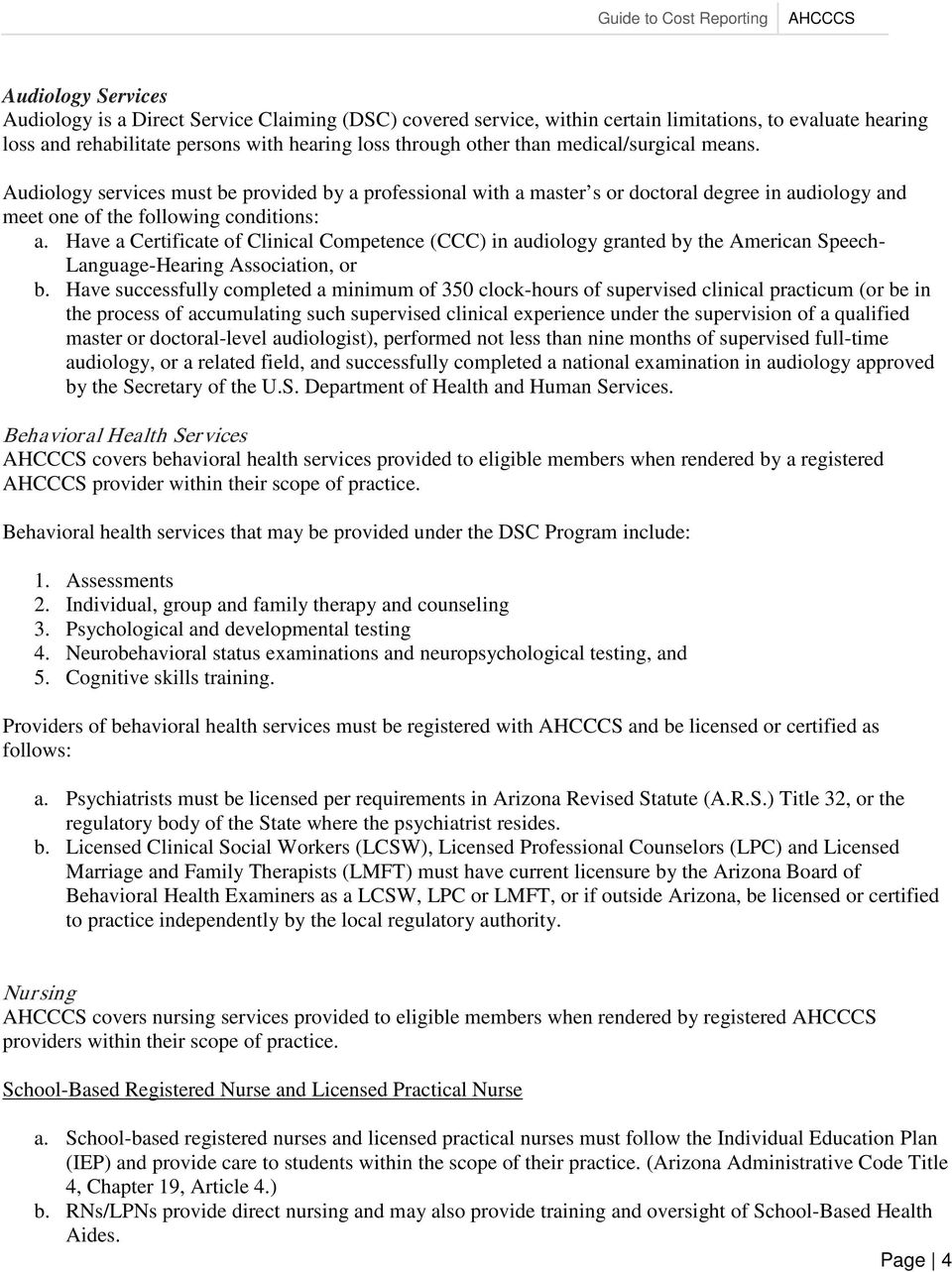
4 Audiology Services Audiology is a Direct Service Claiming (DSC) covered service, within certain limitations, to evaluate hearing loss and rehabilitate persons with hearing loss through other than medical/surgical means. Audiology services must be provided by a professional with a master s or doctoral degree in audiology and meet one of the following conditions: a. Have a Certificate of Clinical Competence (CCC) in audiology granted by the American Speech- Language-Hearing Association, or b. Have successfully completed a minimum of 350 clock-hours of supervised clinical practicum (or be in the process of accumulating such supervised clinical experience under the supervision of a qualified master or doctoral-level audiologist), performed not less than nine months of supervised full-time audiology, or a related field, and successfully completed a national examination in audiology approved by the Secretary of the U.S. Department of Health and Human Services. Behavioral Health Services AHCCCS covers behavioral health services provided to eligible members when rendered by a registered AHCCCS provider within their scope of practice. Behavioral health services that may be provided under the DSC Program include: 1. Assessments 2. Individual, group and family therapy and counseling 3. Psychological and developmental testing 4. Neurobehavioral status examinations and neuropsychological testing, and 5. Cognitive skills training. Providers of behavioral health services must be registered with AHCCCS and be licensed or certified as follows: a. Psychiatrists must be licensed per requirements in Arizona Revised Statute (A.R.S.) Title 32, or the regulatory body of the State where the psychiatrist resides. b. Licensed Clinical Social Workers (LCSW), Licensed Professional Counselors (LPC) and Licensed Marriage and Family Therapists (LMFT) must have current licensure by the Arizona Board of Behavioral Health Examiners as a LCSW, LPC or LMFT, or if outside Arizona, be licensed or certified to practice independently by the local regulatory authority. Nursing AHCCCS covers nursing services provided to eligible members when rendered by registered AHCCCS providers within their scope of practice. School-Based Registered Nurse and Licensed Practical Nurse a. School-based registered nurses and licensed practical nurses must follow the Individual Education Plan (IEP) and provide care to students within the scope of their practice. (Arizona Administrative Code Title 4, Chapter 19, Article 4.) b. RNs/LPNs provide direct nursing and may also provide training and oversight of School-Based Health Aides. Page 4
5 Personal Care Services Health Aides may receive reimbursement for their time spent providing Activities of Daily Living (ADL) that have been properly documented/identified as a specific medical need for the student by a qualified medical provider as part of the Individual Education Program (IEP) and supporting medical record. Examples of ADLs include but are not limited to: Eating/Feeding, Dressing, Toileting, Transfers, Positioning, Mobility, Grooming, and Use of Assistive Devices. School-Based Health Aides are specially trained and approved by the schools in general care. School-Based Health Aides must follow the IEP for each student. They are supervised by a nurse or other appropriate licensed personnel employed by, or contracted with, the LEA. Training received by the Health Aide(s) related to the specific needs of the student should be documented by the LEA. School-Based Health Aides must have current certification in first aid and cardiopulmonary resuscitation (CPR). Certification in first aid and CPR must meet the following standards: a. Training in first aid and CPR must be provided or sponsored by a nationally recognized organization (e.g., American Heart Association, American Red Cross, etc.), using an established training curriculum. b. Training sessions must be in person, in order for the participant to return demonstrate learned skills such as mouth to mouth resuscitation and chest compressions. Web-based training without the benefit of onsite return demonstration of skills is not acceptable. c. Certificates of completion of first aid and CPR training must be provided to the LEA and to AHCCCS upon requesting provider registration as an AHCCCS provider. Occupational Therapy (OT), Physical Therapy (PT), Speech Therapy (ST) Occupational, physical and speech therapy services are covered under the DSC Program when provided to DSC enrolled AHCCCS members by a registered AHCCCS provider within their scope of practice. Therapy services that may be provided under the DSC Program include: Physical Therapy and Occupational Therapy a. Therapy evaluations and re-evaluations b. Therapeutic procedures, exercises and activities to develop strength, endurance, range of motion and/or flexibility, and to improve functional performance. Services may be provided on an individual or group basis. c. Neuromuscular re-education to develop, improve or maintain movement, balance, coordination, kinesthetic sense, posture, and proprioception d. Gait training and stair climbing e. Massage necessary to effect change or improve function (e.g., effleurage, pertrissage or tapotement) f. Manual therapy techniques (e.g., mobilization/manipulation) g. Orthotics fitting and training for upper or lower extremities h. Prosthetic training, for upper or lower extremities Page 5

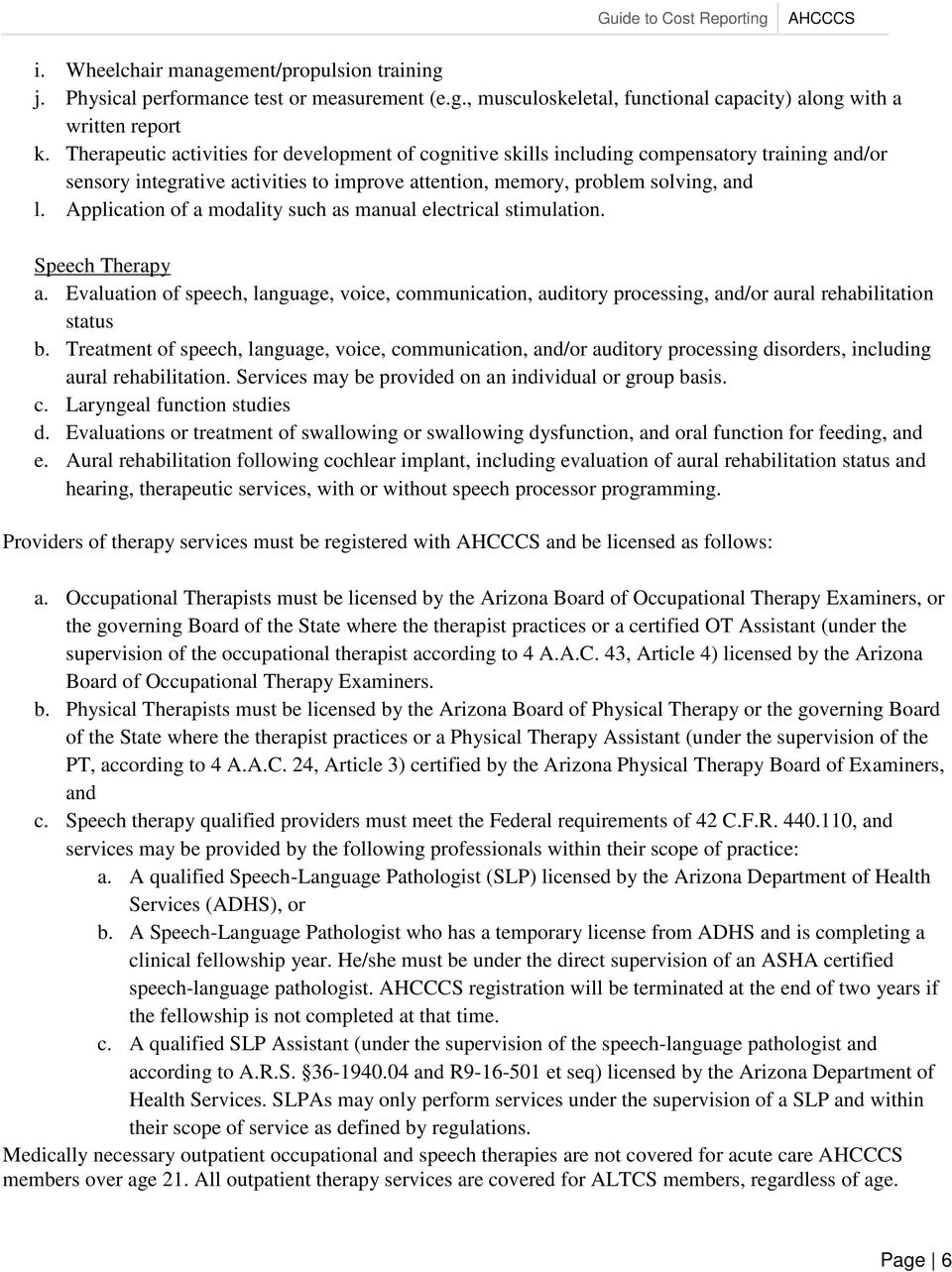
6 i. Wheelchair management/propulsion training j. Physical performance test or measurement (e.g., musculoskeletal, functional capacity) along with a written report k. Therapeutic activities for development of cognitive skills including compensatory training and/or sensory integrative activities to improve attention, memory, problem solving, and l. Application of a modality such as manual electrical stimulation. Speech Therapy a. Evaluation of speech, language, voice, communication, auditory processing, and/or aural rehabilitation status b. Treatment of speech, language, voice, communication, and/or auditory processing disorders, including aural rehabilitation. Services may be provided on an individual or group basis. c. Laryngeal function studies d. Evaluations or treatment of swallowing or swallowing dysfunction, and oral function for feeding, and e. Aural rehabilitation following cochlear implant, including evaluation of aural rehabilitation status and hearing, therapeutic services, with or without speech processor programming. Providers of therapy services must be registered with AHCCCS and be licensed as follows: a. Occupational Therapists must be licensed by the Arizona Board of Occupational Therapy Examiners, or the governing Board of the State where the therapist practices or a certified OT Assistant (under the supervision of the occupational therapist according to 4 A.A.C. 43, Article 4) licensed by the Arizona Board of Occupational Therapy Examiners. b. Physical Therapists must be licensed by the Arizona Board of Physical Therapy or the governing Board of the State where the therapist practices or a Physical Therapy Assistant (under the supervision of the PT, according to 4 A.A.C. 24, Article 3) certified by the Arizona Physical Therapy Board of Examiners, and c. Speech therapy qualified providers must meet the Federal requirements of 42 C.F.R , and services may be provided by the following professionals within their scope of practice: a. A qualified Speech-Language Pathologist (SLP) licensed by the Arizona Department of Health Services (ADHS), or b. A Speech-Language Pathologist who has a temporary license from ADHS and is completing a clinical fellowship year. He/she must be under the direct supervision of an ASHA certified speech-language pathologist. AHCCCS registration will be terminated at the end of two years if the fellowship is not completed at that time. c. A qualified SLP Assistant (under the supervision of the speech-language pathologist and according to A.R.S and R et seq) licensed by the Arizona Department of Health Services. SLPAs may only perform services under the supervision of a SLP and within their scope of service as defined by regulations. Medically necessary outpatient occupational and speech therapies are not covered for acute care AHCCCS members over age 21. All outpatient therapy services are covered for ALTCS members, regardless of age. Page 6
7 Specialized Transportation AHCCCS covers school-based transportation services provided to eligible members when clearly identified in the IEP and rendered by a registered AHCCCS transportation provider for medically necessary transportation to and from school when one of the criteria from number 1 and one of the criteria from number 2 below are met. 1. The member requires transportation in an adapted vehicle (i.e., special needs school bus that is designed to transport disabled passengers and is constructed with a special-service entrance) OR The member could otherwise be transported in a regular school bus, but due to behavioral problems must be transported separately from other non-individuals with Disabilities Education Act (IDEA) eligible children 2. The member receives a DSC reimbursable service at school that same day, OR The member receives a reimbursable service (as identified in the Individual Education Plan) that is provided at an approved alternative setting that same day. Transportation Provider Registration and Documentation The LEAs must register as transportation providers with AHCCCS, and in doing so, must: 1. Submit proof of insurance 2. Maintain on file: a. Copies of the driver s license for each transportation provider and the LEA s proof of insurance b. A trip log, which contains: (a) The student s name (b) Date the student was transported (c) Mileage transported from point of origin to destination, not to include additional mileage related to multiple pickups; and (d) Driver s initials verifying that student was provided transportation. 3. The member s transportation services are reimbursed at an all-inclusive rate. The rate includes reimbursement for any School-Based Health Attendant(s) required to be present during the transportation. 4. Transportation services will not be covered when: a. The member is transported on a regular school bus with non-idea eligible students who are attending the school b. The member does not receive a DSC reimbursable service during the school day c. The member is transported from the school and back for a medical service that is not paid for by the school under IDEA d. Transportation services are for educational purposes only. e. Transportation is provided in an adapted vehicle with specialized equipment or supervision, but the child s medical condition does not require the specialized services, or f. Transportation is provided by a parent, relative or friend. Page 7

8 3. Overview of the Random Moment Time Study (RMTS) Process The Random Moment Time Study (RMTS) process is a federally approved technique of polling a statistically valid sampling of randomly selected moments (one moment = one minute) that are assigned to randomly selected participants. The RMTS method measures the work effort of the entire group of participants involved in the Medicaid DSC and MAC Programs by sampling and analyzing the work efforts of a randomly selected cross-section of the group. The time study determines the percentage of time that direct medical services staff spend on direct medical services, general and administrative time, and all other activities to account for 100 percent of time, thus assuring that there is no duplicate claiming. The RMTS is broken into three mutually exclusive cost pools of providers, based on the type of services provided: Direct Service Cost Pool, Administrative Personnel Cost Pool, and School Based Health Aide Cost Pool. The three pools are mutually exclusive, i.e., no staff can be included in more than one pool. The pools include both LEA employees and contracted staff. The Direct Service Cost Pool includes all staff who are expected to provide direct services and may deliver MAC activities during the time study period (i.e.-audiologists, Psychiatrists, etc.). Only qualified providers in the approved Arizona State Plan can be included in Direct Service pools. The Administrative Personnel Cost Pool includes staff (i.e.-audiology Assistants, Dietitians, Interpreters, etc.) that are expected to provide MAC activities during the time study period and do not meet the licensure requirements to or do not provide any direct medical service. The School Based Health Aide Cost Pool includes all School Based Health Aides that provide Activities of Daily Living (ADL) activities during the time study period. This category will include School Based Health Aides whose primary function is to provide services aligned with Activities of Daily Living (ADL). Personal care providers were separated from the other direct service providers as their training, background, and role in the district is significantly different from traditional direct service providers. In order to ensure that the most accurate time study results are captured for these two groups of service providers, it was determined that two separate cost pools would be most appropriate. 3A. Direct Service Cost Pool (Providers of Direct Medical Services & MAC Services) Audiologists Certified Occupational Therapy Assistants School Health Aides Speech Language Pathologists Speech Language Pathology Assistants Licensed Marriage and Family Therapists Licensed Practical Nurses LPN Licensed Professional Counselors LPC Occupational Therapists Physical Therapists Physical Therapy Assistants Page 8

9 Psychiatrists Registered Nurses RN Social Workers 3B. Administrative Service Providers Only Cost Pool (Providers of MAC Services Only) Administrators for Exceptional Student Education Audiology Assistants Augmentative Specialists Bilingual Specialists Dietitians Interpreter Liaisons for Exceptional Student Education Non DSC Speech Language Pathologists Non DSC Speech Language Pathology Assistants Guidance Counselors Program and Staffing Specialists Psychologists Special Education Teachers Student Services Personnel 3C. School Based Health Aides School-Based Health Aides (primary functions are aligned with Activities of Daily Living (ADL)) 3D. Random Moment Time Study (RMTS) Process The sampling period is defined as the three-month period comprising each quarter of the School Calendar Year. The quarterly RMTS will be utilized for both the Direct Service and MAC program. The following are defined as: Quarter 1 = July 1 September 30 Quarter 2 = October 1 December 31 Quarter 3 = January 1 March 31 Quarter 4 = April 1 June 30 There are three quarterly time studies: October 1-December 31, January 1 December 31, and April 1 June 30. Each LEA submits its RMTS staff pool list prior to the time study period. Training is provided to LEA coordinators on the time study process. The time study sample is pulled and each participant responds to his/her Page 9

10 sampled moment. Staff rosters will not be modified once the sample has been generated and the quarter has started with the exception of replacement positions. The Arizona RMTS process is a web-based system within which sampled participants respond in narrative form to a few simple questions. They include: 1. Who were you with? 2. What were you doing? 3. Describe why you were doing this activity. 4. Is the service you provided listed on the child s IEP? Centralized coders then assign the appropriate time study code to the narrative response. At the end of the time study period, the percentages by activity code are calculated. The RMTS process results in an annual direct medical services time study percentage. All valid moments completed and returned will be included in the calculation of the RMTS results. The direct medical services costs reported on the annual DSC Medicaid Cost Report are allocated to the Medicaid Program based on the applicable direct medical services time study percentage and the applicable Medicaid IEP Ratio for the LEA. Payroll costs can only be reported on the Quarterly Financial Submission for staff listed on the LEA time study staff pool lists or for staff that replaced an individual listed on the LEA time study staff pool lists as the staff pool lists are position specific rather than person specific. The quarterly payroll costs are transferred to the annual DSC Medicaid Cost Report for the cost reconciliation and cost settlement. The IEP MER will be calculated based on the total Medicaid Special Education students with an IEP-prescribed reimbursable related service divided by the total Special Education students with an IEP-prescribed reimbursable related service. Additional details regarding the RMTS process can be found in the AHCCCS RMTS Implementation Guide. Page 10

11 4. Quarterly Financial Submissions The following schedule highlights the Quarterly Financial Submission for The submissions for subsequent years will follow a similar schedule and all participating LEAs will be informed of the schedule at the start of the fiscal year. Cost Report Period Submission Due Date July 1, 2011 to September 30, 2011 November 14, 2011 October 1, 2011 to December 31, 2011 February 14, 2012 January 1, 2012 to March 31, 2012 May 15, 2012 April 1, 2012 to June 30, 2012 August 14, 2012 Each Quarterly Financial Submission includes the reporting of payroll information (i.e., paid hours, salaries, payroll taxes, and employee benefits for employees and paid hours and contracted staff costs for contractors) for staff listed on the RMTS staff pool lists for the reporting period To complete a quarterly submission you must submit the Quarterly Payroll Information Page, which includes the payroll information for each employee included on the RMTS roster. 4A. LEA Payroll Information by Position As stated previously, this page is pre-populated with the name and RMTS job category of each staff person (employee and contracted staff) on the LEA RMTS staff pool lists. The provider can enter the requested payroll information directly into the web-based system or download (export) an Excel spreadsheet, enter the requested payroll information, and upload (import) into the web-based system. This page includes the following data elements, which are discussed in detail below: Last Name First Name (RMTS) Job Category Cost Pool Staff Employment Status District Job Title District Employee ID Paid Hours (Employees and Contractors) (Optional) Salaries (Employees) Employee Benefits, such as health insurance, life insurance, retirement, other employee insurance, and other employee benefits (Employees) Purchased Professional Services (PPS) Costs (Contractor Costs) Compensation Federal Revenues In order to comply with CMS provisions, costs must be reported using the accrual basis accounting methodology. The LEA must maintain supporting documentation for all information reported on the Quarterly Financial Submissions and the annual Medicaid Cost Report. Page 11

12 OMB Circular A-87 is a requirement for cost reporting, and therefore cost reporting by providers should be consistent with OMB Circular A-87 and with generally accepted accounting principles (GAAP), which are those principles approved by the American Institute of Certified Public Accountants (AICPA). Direct costing must be used unless otherwise stated in these instructions. Direct costing means that costs incurred for the benefit of, or directly attributable to, a specific service must be charged directly to that particular service. Costs related to each direct medical service or the MAC Program must be direct costs. Employee payroll taxes and benefits/insurance costs must be directly associated to the individual employee and cannot be allocated. Reported costs in this section should be formatted with two decimal places and not rounded to the nearest whole dollar. If reporting paid hours, number should be formatted with two decimal places and not rounded to the nearest whole hour. Last Name This field is pre-populated from information transferred from the RMTS process. The provider needs to verify the accuracy of the pre-populated information, noting any necessary revisions in the LEA cost report supporting documentation file. First Name This field is pre-populated from information transferred from the RMTS process. The provider needs to verify the accuracy of the pre-populated information, noting any necessary revisions in the LEA cost report supporting documentation file. (RMTS) Job Category This field is pre-populated from information transferred from the RMTS process. While the provider needs to verify the accuracy of the pre-populated information, changes cannot be made to this field by the provider. If the LEA coordinator thinks there is an error in the Job Category field, the LEA coordinator should contact the PCG AZ RMTS/MAC Team to compare the information in the system with the staff pool lists submitted by the LEA coordinator. Staff Employment Status This is a required field. The provider will need to enter the Staff Employment Status (Full Time, Part Time, or Contractor) of the individual from a drop down menu or verify the accuracy of any pre-populated information transferred from the RMTS process, making any necessary revisions. The definitions for full-time and parttime staff are according to each LEA s procedures and processes and each LEA should maintain those definitions in its cost report documentation file. For example, some LEAs consider an aide that works 30 hours per week to be a full-time employee and that is acceptable. The information reported in this field sets system edits. For example, if Contractor is reported, then the only payroll information that can be reported would be Paid Hours, Contracted Staff Costs, and, if applicable, Compensation Expenditures Paid with Federal Funds. If retirement benefits were reported, a system edit would be triggered for the provider to make the necessary revisions since retirement costs can only be reported for employees (i.e., Full Time or Part Time staff). Page 12
13 District Job Title This is an optional field. As such, it is acceptable to be left blank. However, it is recommended that the LEA coordinator enter the participant s District job title. If the District Job Title is pre-populated from the RMTS process, the LEA needs to verify the accuracy of the pre-populated information, making any necessary revisions. District Employee ID This is an optional field. As such, it is acceptable to be left blank. This field is for the use of the LEA to assist in identifying staff since there may be more than one staff person with the same name. This field can be used to easily reconcile costs to the LEA s financial system and Chart of Accounts. Do not enter Social Security Numbers in this field. Paid Hours (Optional) This is an optional field. Paid hours are requested so that the system can generate benchmarks. These system edits include hourly compensation calculations that will help to verify the reported payroll costs are indeed for a quarter rather than for a full year. This field should be a reflection of the number of paid hours applicable to the payroll costs reported for each staff person. This can also be a reasonable estimate if data is not readily available and does not have to be exact. Remember to include all paid hours, including paid hours associated with payroll costs reported, including summer school, coaching and other extracurricular activities. The provider should report the total hours that the individual worked during the reporting period. If the staff person is full time (usually meaning 7.5 or 8.0 paid hours per day), then the number of work days in the quarter should be multiplied by the number of hours per day to arrive at the amount reported in this field. The number of days is the number of teacher paid days and not the number of student days. Paid hours include hours for paid time off (e.g., sick leave or vacation). Example: John Doe is a full-time physical therapist with an employment contract for 7.5 hours per day for 180 days during the school year. During the Fall 2011 semester (i.e., July 1, 2011, through January 25, 2012), there were 95 work days. Thus, the amount reported in the Paid Hours field for John Doe would be (7.5 X 95). Paid Hours for a part-time employee are calculated in the same manner if the person is scheduled to work the same number of hours per day. However, if the part-time employee is paid hourly, the number of paid hours for the reporting period would be reported. Paid Hours for contractors are merely the number of hours during the reporting period for which the contractor was paid to provide services. If the contractor bills by sessions rather than actual time (hours), the provider will need to contact the contractor to obtain the contractor s average time per session in order to report the required paid hours. Salaries This is a required field, meaning that any individual whose Staff Employment Status is Full Time or Part Time is required to have a value in this field. Of course, an individual whose Staff Employment Status is Contractor would not have any amount reported in this field. The amount reported in this field is the total gross earnings for the individual as paid by the LEA for the reporting period, including regular wages and extra pay, as well as any amounts paid for paid time off (e.g., sick or annual leave), overtime, bonuses, longevity, stipends, cash bonuses, and/or cash incentives. Salaries are Page 13
14 those payments from which payroll taxes are (or should be) deducted. Do not include any reimbursements for expenses such as mileage or other travel reimbursements. In the Arizona Department of Education Chart of Accounts, all employee salaries are listed under 6100 Personal Services Salaries. Benefits Benefits include employer-paid health/medical, life, disability, or dental insurance premiums, as well as employer-paid child day care for children of employees paid as employee benefits on behalf of your staff, retirement contributions, and worker s compensation costs. Report the expended amounts paid by the LEA which are directly associated with each staff member by type of employee benefit. In the Arizona Department of Education Chart of Accounts, all employee benefits are listed under 6200 Personal Services Employee Benefits. The following employee benefits can be captured in accordance with the ADE chart of accounts: 6210 Employee Insurance- Amounts for the employer s share of any insurance plans, such as life, health, dental, and accident insurance Social Security Contributions- Employer s share of amounts paid by the district for social security. (Although object codes 6221 and 6222 are optional, districts must maintain adequate records to separately identify Social Security and Medicare.) 6221 Social Security- OASDI 6222 Medicare-Hospital Insurance 6230 State Retirement System Contributions- Employer s share of amounts paid by the district for retirement and long-term disability contributions to the Arizona State Retirement. (Although object codes 6231 and 6232 are optional, districts must maintain adequate records to separately identify State Retirement and Long-Term Disability.) 6231 State Retirement 6232 Long-Term Disability 6240 Tuition Reimbursement- Amounts reimbursed by the school district to any employee qualifying for tuition reimbursement on the basis of school district policy Unemployment Insurance- Amounts paid by the district to provide unemployment insurance for its employees. These charges may be distributed to functions in accordance with the salary budget or may be charged to function Workers Compensation- Amounts paid by the district to provide workers compensation insurance for its employees. These charges may be distributed to functions in accordance with the salary budget or may be charged to function Page 14
15 6270 Health Benefits- Amounts paid by the district to provide health benefits, other than insurance, for its current or former employees Other Employee Benefits- Employee benefits other than those classified above, including fringe benefits such as automobile allowances, housing or related supplements, moving expenses, and paid parking. Districts may establish sub codes for various accrued amounts. Purchased Professional Services (PPS) Costs: Any individual whose Staff Employment Status is Contractor is required to have a value in this field. An individual whose Staff Employment Status is Full Time would not have any amount reported in this field. Report compensation paid for all services contracted by the LEA for an individual who delivered any school based health services to Medicaid and/or non-medicaid recipients during the quarter. It is possible that a staff person could be both Part Time and Contractor, with one set of duties as an employee and a different set of duties as a contractor. Be prepared to respond during the desk review and/or audit processes as to why a person is listed twice, once as Part Time and once as Contractor. Compensation Federal Revenues: If any of the reported payroll costs for the staff person was paid with federal funds (e.g., IDEA federal payments, Title 1 payments, or ARRA payments), then the amount paid with federal funds should be entered in this field. Please be sure that the amount reported in this field does not exceed the total payroll costs reported for the individual since the system will subtract the amount reported in this field from the total payroll costs to result in the amount paid with state/local funds. Please see Table 1 as an exhibit of an example of LEA Payroll Information by Position. Page 15
16 Table - 1 July to September - LEA Payroll Information By Position Page SYSTEM GENERATED Last Name Doe1 First Name Job Category Cost Pool DSC Speech Language John DSC Speech Language John USER INPUT Staff Employment Status Pathologists Direct Service Cost Pool Full Time Purchased Professional Services (PPS) Costs Compensation Federal Revenues SYSTEM GENERATED Gross Compensation Expenditures Net Compensation Expenditures District Job Title District Employee ID Paid Hours Salaries Benefits DSC Speech Language Pathologists $25, $3, $10, $28, $18, DSC Speech Language Pathologists $11, $2, $13, $13, Doe2 Pathologists Direct Service Cost Pool Part Time Doe3 John Social Workers Direct Service Cost Pool Part Time Social Workers $14, $3, $17, $17, Doe4 John Social Workers Direct Service Cost Pool Contractor Social Workers $2, $2, $2, Doe5 John Occupational Therapists Direct Service Cost Pool Full Time Occupational Therapists $21, $2, $23, $23, Doe6 John Occupational Therapists Direct Service Cost Pool Full Time Occupational Therapists $20, $4, $24, $24, Doe7 John Occupational Therapists Direct Service Cost Pool Full Time Occupational Therapists $24, $31, $55, $55, Doe8 John Physical Therapists Direct Service Cost Pool Full Time Physical Therapists $23, $4, $28, $28, Doe9 John Physical Therapists Direct Service Cost Pool Part Time Physical Therapists $12, $2, $2, $15, $12, Doe10 John Physical Therapists Direct Service Cost Pool Part Time Physical Therapists $14, $3, $17, $17, Doe11 John Physical Therapists Direct Service Cost Pool Contractor Physical Therapists $1, $1, $1, Doe12 John Physical Therapists Direct Service Cost Pool Full Time Physical Therapists $20, $4, $24, $24, Page 17

17 4B. Importing and Exporting Data into the System To expedite the data submission process, the LEA coordinator can organize its data in a spreadsheet using an application such as Microsoft Excel, and then the LEA can upload its information in a comma separated values (CSV) file. At the bottom of various pages, including the Direct Medical and Administrative Services Salary and Benefits Data by Position Page, there are import/export buttons. The first step will be to export the template from the system by clicking Export. The user will be prompted to click another Export button in order to export the file as a CSV file, which is the only available option. The system will then ask the user to Open or Save the file. It is suggested that you save the file to your desktop so that you can find it easily for upload. Once you have saved the template file, please open it in a spreadsheet application, such as Microsoft Excel (below). You can now enter in the paid hours, salaries/benefits, contracted staff costs, and/or compensation from federal funds into the spreadsheet. Please do not format any of the cells to currency or as a date. For all currency, please enter decimals only without currency symbols or commas. Once you are finished editing the template, save your file in the exact same format as the exported file (CSV file). Once saved, you will return to the page for which you are importing the data and click Browse. You will choose the CSV file that you just updated and saved on your desktop. You will notice that the path to the file then displays in the field to the left of the Browse button. Click Import. If the system detects no errors in your data, it will upload it to the system immediately. If there are errors, you will see them circled in red on the top of the page. You will need to correct all of these errors before the system will allow you to upload any data. Please see below for common import/export issues. Troubleshooting: Common Import/Export Issues Here are some suggestions to avoid common problems that users experience when importing information into the system. 1. The file must be uploaded as a CSV file, the same sort of file format that it was saved as originally. Microsoft Excel will often ask you to save the file as a XLS or XLSX. Do not save it as anything other than a CSV file. Page 18

18 2. The cells should not be formatted. Information that is formatted as Currency or Date will not upload into the system correctly. General formatting is preferable. For all currency please enter in decimals only without currency symbols or commas. 3. If the data is sorted, make sure that all users are still in line with the same Row ID they had upon exporting the template, which is found in the first column of the spreadsheet. 4. Do not enter information in any column that did not have a column header when you exported the template. If the LEA coordinator is receiving an error that the application cannot find Column ##, then you need to delete those specified columns. For example, if you get the error, cannot find Column 19, count out the columns from left to right the 19 th column will be column S in Excel. Delete that column and attempt to upload your data again. 5. Functions can be used to calculate your data, but before importing the CSV file into the system you will want to turn all functions into values. This is accomplished by selecting the entire worksheet (ctrl + a), copying the worksheet (ctrl + c), and finally pasting the worksheet as values which can be found under Edit>Paste Special (Excel 2003 ) or Home>Paste>Paste Values (Excel 2007 ). 6. CSV files do not allow for multiple spreadsheets in a single workbook. If you are working in multiple spreadsheets in order to calculate values, those spreadsheets will be deleted once you save the file as a CSV. 4C. Next Steps As stated previously, once the information has been entered or uploaded into the system, the cost-reporting system analyzes the reported information and reviews it for common errors. The errors currently flagged include: Quarterly Salaries and/or Professional Purchased Service Costs Exceed $25,000 (in a quarter), Employee s total payroll taxes and employee benefits exceed 50% of their reported salaries, Compensation Federal Revenues Exceeds Total Reported Payroll Costs, and Salary and Benefits Reported with Professional Purchased Services (PPS) Costs. If one of these common errors is identified, the provider either must make necessary revisions to eliminate the audit/edit or provide a written explanation as to why the reported information is accurate. Explanations are reviewed by PCG and additional follow up is conducted with the LEA when necessary. A record of all exceptions and comments are saved for compliance. Once the edits/reviews have been resolved or explained, the web-based system generates the cost report from the reported information. The provider then certifies the data and electronically submits the cost report. 4D. Documentation Requirements Providers must maintain records that are accurate and sufficiently detailed to substantiate the legal, financial, and statistical information reported on the cost report. These records must demonstrate the necessity, reasonableness, and relationship of the costs (e.g., personnel, supplies, and services) to the provision of services. These records include, but are not limited to, all accounting ledgers, journals, invoices, purchase orders, vouchers, canceled checks, timecards, payrolls, organizational charts, functional job descriptions, work papers used in the preparation of the financial data, trial balances, and cost allocation spreadsheets. As noted in the AMPM, the provider is required to maintain cost report work papers for a minimum period of seven years or until the completion of any audit, whichever is longer following the end of each period. 4E. If You Need Help LEAs can contact PCG for assistance in completing or submitting the Quarterly Financial Submissions. Contact information is posted to the Dashboard of the system. Page 19

19 5. Quarterly and Annual Data Submission including the DSC Medicaid Cost Report After the end of the school year, the information reported in the Quarterly Financial Submissions allowable for the DSC Program is transferred to the annual DSC Medicaid Cost Report. The provider must log into the webbased system on an annual basis to enter information other than payroll costs for DSC direct medical services staff, with such information including allocation statistics, direct medical services supplies and other material costs. The pages that need to be completed in MCRCS once per year are: Page Name General and Statistical Information Transportation Payroll Information Other Specialized Transportation Costs Depreciation expenses for Transportation Equipment The Medicaid Cost Report is due on or before December 1. 5A. General and Statistical Information This page collects information needed by the system to calculate allocation percentages to apply to specific cost items toward the determination of Medicaid-allowable costs. Unrestricted Indirect Cost Rate This percentage has been pre-populated from information provided by the Arizona Department of Education (ADE), which serves as the cognizant agency responsible for approving LEA indirect cost rates for the United States Department of Education. This percentage is applied by the system to net direct costs (total costs less amount paid with federal funds) toward calculating the amount of allowable indirect costs. If the LEA does not have an unrestricted indirect cost rate calculated by ADE, the LEA has no Medicaidallowable indirect costs for the Medicaid Cost Report. While the provider needs to verify the accuracy of the pre-populated information, changes cannot be made to this field by the provider. If the pre-populated information is incorrect, please contact PCG for assistance. The application of this percentage is clearly shown on the Cost Summary page of the DSC Medicaid Cost Report. Table - 2 Description: Value Unrestricted Indirect Cost Rate : 7.00% Direct Medical Services Percentage These percentages have been pre-populated from the quarterly RMTS process with one percentage applicable to costs associated with the Direct Medical Service, School Based Health Aides, and Administrative Personnel Cost Pool staff. This percentage is applied by the system to direct medical services costs as the first allocation method in calculating the amount of allowable direct medical services costs. The application of these percentages is clearly shown on the Cost Summary page. Page 20

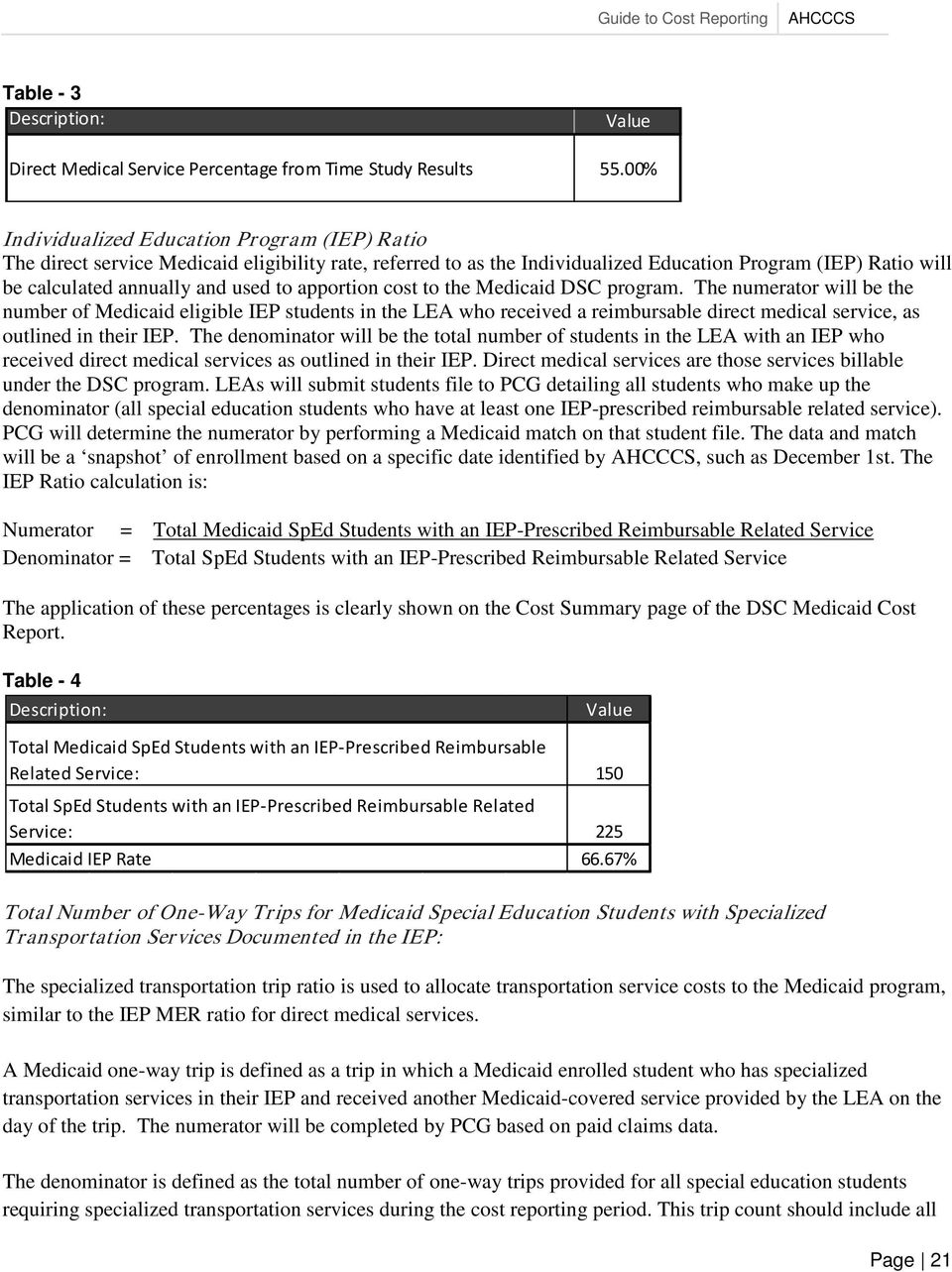
20 Table - 3 Description: Value Direct Medical Service Percentage from Time Study Results 55.00% Individualized Education Program (IEP) Ratio The direct service Medicaid eligibility rate, referred to as the Individualized Education Program (IEP) Ratio will be calculated annually and used to apportion cost to the Medicaid DSC program. The numerator will be the number of Medicaid eligible IEP students in the LEA who received a reimbursable direct medical service, as outlined in their IEP. The denominator will be the total number of students in the LEA with an IEP who received direct medical services as outlined in their IEP. Direct medical services are those services billable under the DSC program. LEAs will submit students file to PCG detailing all students who make up the denominator (all special education students who have at least one IEP-prescribed reimbursable related service). PCG will determine the numerator by performing a Medicaid match on that student file. The data and match will be a snapshot of enrollment based on a specific date identified by AHCCCS, such as December 1st. The IEP Ratio calculation is: Numerator = Total Medicaid SpEd Students with an IEP-Prescribed Reimbursable Related Service Denominator = Total SpEd Students with an IEP-Prescribed Reimbursable Related Service The application of these percentages is clearly shown on the Cost Summary page of the DSC Medicaid Cost Report. Table - 4 Description: Total Medicaid SpEd Students with an IEP-Prescribed Reimbursable Related Service: Total SpEd Students with an IEP-Prescribed Reimbursable Related Service: Medicaid IEP Rate Value % Total Number of One-Way Trips for Medicaid Special Education Students with Specialized Transportation Services Documented in the IEP: The specialized transportation trip ratio is used to allocate transportation service costs to the Medicaid program, similar to the IEP MER ratio for direct medical services. A Medicaid one-way trip is defined as a trip in which a Medicaid enrolled student who has specialized transportation services in their IEP and received another Medicaid-covered service provided by the LEA on the day of the trip. The numerator will be completed by PCG based on paid claims data. The denominator is defined as the total number of one-way trips provided for all special education students requiring specialized transportation services during the cost reporting period. This trip count should include all Page 21
21 trips for students riding specialized vehicles regardless of if a medical service was provided on the same day to ensure to proper cost allocation. Special education students riding on busses transporting general education students should not be included in this denominator. Numerator = Total Number of One-Way Trips for Medicaid SpEd Students with Specialized Transportation Services Documented in the IEP Denominator = Total Number of One-Way Trips for SpEd Students with Specialized Transportation Services Documented in the IEP Table - 5 Description: Value Total Number of One-Way Trips for Medicaid SpEd Students with 24 Specialized Transportation Services Documented in the IEP Total Number of One-Way Trips for SpEd Students with Specialized Transportation Services Documented in the IEP Specialized Transportation Trip Ratio 22.43% 107 LEA is to report the total number of one-way trips (denominator) for Medicaid-eligible special education students during the cost-reporting period, per above definition. During the desk review process, this amount will be compared to the number of one-way trips paid by Medicaid during the cost-reporting period. Total Number of Specialized Vehicles Used for Special Education Transportation Purposes: Report the total number of specialized vehicles used to provide medical transportation services to special education students in accordance with their IEPs. Total Number of Vehicles Used for Transportation Purposes: Report the total number of vehicles owned or operated by the LEA. Whenever possible, the LEA must report specialized transportation costs when they are discretely captured and maintained by the LEA within their accounting structure. In instances where costs cannot be identified as specialized transportation costs, then these costs can be reported as general transportation costs but the appropriate ratio will be applied to apportion costs to specialized transportation services. The ratio that will be used to apportion general transportation costs is outlined below. A specialized vehicle is defined as a special needs school bus that is designed to transport disabled passengers and is constructed with a special-service entrance. Numerator = Total Number of Vehicles Used for Special Education Transportation Purposes Denominator = Total Number of Vehicles Used for Transportation Purposes Page 22
22 Table - 6 Description: Total Number of Vehicles Used for Special Education Transportation Purposes: Value 4 Total Number of Vehicles Used for Transportation Purposes: 13 Specialized Transportation Vehicle Rate 30.77% Page 23
23 5B. Transportation Payroll Information This page is for reporting payroll information for specialized transportation services staff, i.e., drivers, mechanics, and mechanic assistants (employee and professional purchased services). OMB Circular A-87 is a requirement for cost reporting, and therefore cost reporting by providers should be consistent with OMB Circular A-87 and with generally accepted accounting principles (GAAP), which are those principles approved by the American Institute of Certified Public Accountants (AICPA). The only costs that can be submitted are direct costs. These are costs incurred for the benefit of, or directly attributable to, a specific service. Employee payroll taxes and benefits/insurance costs must be direct costs attributed to the individual employee and cannot be allocated. Reported costs and hours should be formatted with two decimal places and not rounded to the nearest whole dollar and hour, respectively. USER INPUT Last Name: Enter the participant s last name. First Name: Enter the participant s first name. Job Category: Enter the participant s Job Category and each LEA will have to identify whether the individual provides services to general provision of transportation services vs. specialized. Staff Employment Status Enter the participant s employments status: full time, part time, or contractor. Paid Hours (Optional) This field should be populated with the total hours that they employee worked for the quarter. If the employee is full time, then the employee s weekly hours should be divided by 5 work days to get their average hours per day. This number is multiplied by the number of days worked in the quarter to calculate the number of Hours worked. This is an optional field. Salaries All participants except contractors are required to have a value in this field. These should be the gross earnings summed for the applicable employees as paid by the LEA. The amount reported in this field is the total gross earnings for the individual as paid by the LEA, including regular wages plus any amounts paid for paid time off (e.g., sick or annual leave), overtime, bonuses, longevity, stipends, cash bonuses, and/or cash incentives. Salaries are those payments from which payroll taxes are (or should be) deducted. Do not include any reimbursements for expenses such as mileage or other travel reimbursements. Page 24
24 Benefits: Benefits include employer-paid health/medical, life, disability, or dental insurance premiums, as well as employer-paid child day care for children of employees paid as employee benefits on behalf of your staff, retirement contributions, and worker s compensation costs. Report the expended amounts paid by the LEA which are directly associated with each staff member by type of employee benefit. Please refer to section 4A for how the benefits tie to the chart of accounts. Compensation Federal Revenues: If any of the employee s compensation was paid for by using federal revenues, then it should be entered here. This should be in addition to what is put into Employee Salaries, any benefits columns, or Purchased Professional Services. SYSTEM GENERATED DATA Gross Compensation Expenditures: This is a calculation that is a sum of the Salaries, Retirement, Social Security, Life Insurance, Health Insurance, Other Employee Insurance, Other Employee Benefits, and Contracted Staff Costs. Net Compensation Expenditures: This is a calculation that is the Gross Compensation Expenditures minus Compensation Federal Revenues. Table 7 USER INPUT SYSTEM GENERATED Last Name First Name Job Category USER INPUT Staff Employment Status District Job Title 5C. Other Specialized Transportation Costs District Employee ID Paid Hours Salaries Benefits Compensation Federal Revenues SYSTEM GENERATED Gross Compensation Expenditures Other Specialized Transportation Services Page This page collects non-payroll costs for specialized transportation services other than depreciation expense. Data will be needed for non-personnel specialized transportation services costs incurred in support of direct medical services. Net Compensation Expenditures Doe1 John Bus Driver (General Transportation) Full Time Bus Driver $13, $5, $10, $18, $8, Doe2 John Bus Driver (General Transportation) Part Time Bus Driver $9, $5, $14, $14, Doe3 John Bus Driver (General Transportation) Part Time Bus Driver $85, $5, $90, $90, Doe4 John Mechanic (General Transportation) Contractor Mechanic I $16, $5, $21, $21, USER INPUT Lease/Rental Report the lease/rental costs of specialized transportation equipment. If a vehicle lease includes both specialized transportation equipment and non-specialized transportation equipment, report them as General Transportation Costs and the cost will be allocated to the Special Education program based upon the vehicle ratio entered in the General and Statistical Information page. Page 25
25 Insurance Report the cost for insurance premiums for specialized transportation vehicles. Costs should be reported with amounts accrued for premiums, modifiers, and surcharges and net of any refunds and discounts actually received or settlements paid during the same cost reporting. If these costs cannot be directly associated to specialized transportation equipment costs, report them as General Transportation Costs and the cost will be allocated to the Special Education program based upon the vehicle ratio entered in the General and Statistical Information page. Maintenance and Repairs Report repairs and maintenance include those regular maintenance costs, such as tune-ups, oil changes, cleaning, licenses, inspections, and replacement of parts due to normal wear and tear (such as tires, brakes, shocks, and exhaust components) for specialized transportation vehicles. Report maintenance supplies related to specialized transportation vehicles. Major vehicle repairs (such as engine and transmission overhaul and replacement) costing $5,000 or more must be depreciated and reported as "Depreciation Specialized Transportation Equipment." If these costs cannot be direct costs only for specialized transportation vehicles, report them as General Transportation Costs and the cost will be allocated to the Special Education program based upon the vehicle ratio entered in the General and Statistical Information page. Fuel and Oil Report gasoline, diesel, and other fuel and oil costs for specialized transportation vehicles. If these costs cannot be directly associated only to specialized transportation vehicles, report them as General Transportation Costs and the cost will be allocated to the Special Education program based upon the vehicle ratio entered in the General and Statistical Information page. Major Purchases under $5,000 Report items that were bought specifically for specialized transportation services in support of direct medical services. These are items that are not included on the Depreciation Expenses for Specialized Transportation Equipment Page because they are all under the minimum cost of $5,000. Contract - Transportation Services Report costs of contracted specialized transportation services. If these costs cannot be directly associated only to specialized transportation services, report them as General Transportation Costs and the cost will be allocated to the Special Education program based upon the specialized vehicle ratio entered in the General and Statistical Information page. Contract - Transportation Equipment Report costs of contracted specialized transportation services equipment. If these costs cannot be directly associated only to specialized transportation services equipment, report them as General Transportation Costs and the cost will be allocated to the Special Education program based upon the specialized vehicle ratio entered in the General and Statistical Information page. See below for example of Other Transportation Costs: Page 26
26 Table 8 SYSTEM GENERATED USER INPUT SYSTEM GENERATED Description Service Type Gross Costs Total Amount of Federal Funding Total Other Specialized Transportation Costs Net of Federal Funding Lease/Rental Transportation Services (General Trans) $0.00 Insurance Transportation Services (General Trans) $0.00 Maintenance and Repairs Transportation Services (General Trans) $0.00 Fuel and Oil Transportation Services (General Trans) $0.00 Major Purchases under $5000 Transportation Services (General Trans) $0.00 Contract - Transportation Services Transportation Services (General Trans) $0.00 Contract - Transportation Equipment Transportation Services (General Trans) $0.00 Total Transportation Services (General Trans) $0.00 $0.00 $0.00 SYSTEM GENERATED USER INPUT SYSTEM GENERATED Description Service Type Gross Costs Total Amount of Federal Funding Total Other Specialized Transportation Costs Net of Federal Funding Lease/Rental Transportation Services (only Specialized Trans) $0.00 Insurance Transportation Services (only Specialized Trans) $0.00 Maintenance and Repairs Transportation Services (only Specialized Trans) $0.00 Fuel and Oil Transportation Services (only Specialized Trans) $1, $1, Major Purchases under $5000 Transportation Services (only Specialized Trans) $0.00 Contract - Transportation Services Transportation Services (only Specialized Trans) $0.00 Contract - Transportation Equipment Transportation Services (only Specialized Trans) $0.00 Total Transportation Services (only Specialized Trans) $1, $0.00 $1, D. Depreciation Expenses for Specialized Transportation Equipment This page will record depreciation of transportation equipment that is used to provide Medicaid reimbursable services. This equipment should be included on the LEAs fixed asset ledger. Depreciation is the periodic reduction of the value of an asset over its useful life or the recovery of the asset's cost over the useful life of the asset. (Please note this is not market value.) Allowable depreciation expense for direct medical services includes only pure straight-line depreciation. No accelerated or additional first-year depreciation is allowable. Any single item purchased during the costreporting period costing less than $5,000 must be expensed and reported accordingly. Page 27
27 Required detail must be provided for each depreciable asset and each depreciable asset must be assigned its correct estimated useful life. User Input USER INPUT Asset Type: This list is populated with groups of the most common Asset Types, please select an Asset Type the most closely categorizes the Transportation Equipment in question. This list is populated with groups of the most common Asset Types, please select an Asset Type the most closely categorizes the Medical Service Equipment in question. If you have a piece of equipment that falls under a type that is not listed, please enter it in the bottom line of the table. Do not combine items under generic descriptions such as "various", additions" or "equipment". Do not combine items by year purchased (e.g., "2008 computers"). Be specific in providing the description of each depreciable item. Service Type: Each LEA will have to identify whether the asset is related to general provision of transportation services vs. specialized. Month/Year Placed in Service: This is the first date that the Medical Service Equipment could have been used. This is not to be confused with the date of purchase. Years of Useful Life: This is a number that is used as set by the state accounting guidelines. If you have an asset that does not fit into a listed established state guidelines, enter the equipment into the bottom row of the table. Required detail must be provided for each depreciable asset (e.g., specialized transportation vehicle or equipment) and each depreciable asset must be assigned a correct estimated useful life. Minimum useful lives must be consistent with "Estimated Useful Lives of Depreciable Hospital Assets", published by the American Hospital Association (AHA) (Item Number ). Copies of this publication may be obtained by contacting American Hospital Publishing, Inc., Phone: , Mailing Address: AHPI, Books Division, 737 North Michigan Avenue, Chicago, IL Please note that this cost report should not include administrative equipment expense Cost: This is the original purchase price for this transportation asset. This number should be the full amount paid for the equipment regardless of the source of funding. Federal Revenue: This is the amount of Federal funding that was used toward the purchase of this equipment. SYSTEM GENERATED DATA Prior Period Accumulated Depreciation: This is the amount that the equipment has depreciated since the date of purchase. This is calculated by dividing the Purchase Price Amount minus the Federal Funding Amount by the Useful Life of Asset divided by 365, which gives you the average depreciation of the equipment per day for the useful life of the asset. That number Page 28
28 is then multiplied by the number of days the piece of equipment has been in service, which is the Date Placed in Service subtracted from the Last Day of the Fiscal Year (Data Page). Depreciation for Reporting Period: This is the amount that the equipment has depreciated during the current year. This can be calculated by dividing the Purchase Price Amount minus the Federal Funding Amount by the Useful Life of Asset. The allowable amount of depreciation will be less if, during the reporting period, the asset became fully depreciated or the asset was placed into or taken out of service. Fully depreciated means that the total accumulated depreciation for the asset is equivalent to the depreciation basis. For cost-reporting purposes, the provider is to claim a full month of depreciation for the month the asset was placed into service, no matter what day of the month it occurred. Conversely, the provider is not to claim depreciation for the month the asset was taken out of service, no matter what day of the month it occurred. For example, if you purchased a depreciable item in December, you would claim six months of depreciation on your cost report for that item (July through December). If you sold an item in March, you would claim nine months of depreciation for that item (July through March). Table 9 USER INPUT Asset Type Buses Buses System Generated Service Type Month/Year Placed in Service Years of Useful Life Cost Federal Revenue Prior Period Accumulated Depreciation Depreciation for Reporting Period Transportation Services (General Trans) 07/01/11 5 $5, $1, $1, Transportation Services (General Trans) 07/01/11 5 $1, $ $ $ E. Salary and Benefits Data Summary Report This page summarizes the direct medical services payroll information previously reported in the Quarterly Financial Submission report by job category and employment status, e.g., total number of full-time speech language pathologists. Payroll information includes Paid Hours, Employee Salaries, Employee Benefits, Payroll Taxes, Contracted Compensation, and Compensation Expenditures Paid with Federal Funds. Salary and Benefits Data Summary Report This page will automatically calculate and generate results based upon the information either uploaded or data entered in each quarter s financial submission. This page summarizes the four quarters of direct medical services payroll information previously reported by job category and employment status, e.g., total number of full-time speech language pathologists. SYSTEM GENERATED DATA Job Category: This field is pulled from the Quarterly Payroll Information Page. Page 29
29 Employee Hours, Purchased Professional Services Hours: These are calculated by taking the sum from each provider category from the Quarterly Payroll Information Page. Gross Salaries: This is the total sum of Salaries for each provider category listed on the Quarterly Payroll Information Page. Employee Benefits: This is the sum of Benefits for each provider category listed on the Quarterly Payroll Information Page. Gross Compensation Expenditures: This is the sum of Gross Salaries and Employee Benefits for each provider category listed on this page, the Quarterly Payroll Information Page. Purchased Professional Services Costs: This is the total sum of Contracted Staff Costs for each provider category listed on the Quarterly Payroll Information Page. Average Hourly Wage: This calculation is Total Salaries & Benefits + Purchased Professional Service Costs / (Employee Hours + Purchased Professional Services Hours) all from the Quarterly Payroll Information Page. Total Salary and Benefits Federal Funds: This is the total sum of Compensation Expenditures Paid with Federal Funds for each provider category listed on the Quarterly Payroll Information Page. Total Costs Net of Federal Funds: This is calculated by subtracting Compensation Expenditures Paid with Federal Funds from Quarterly Payroll Information Page. Table 11 on the following page illustrates the LEA Payroll Information Summary Page in the DSC Cost Report. Table 10 Page 30
30 Year Totals SYSTEM GENERATED Provider Category Paid Hours Total Salaries & Benefits Purchased Professional Services (PPS) Costs Gross Compensation Expenditures Average Hourly Salary Compensation Federal Revenues Net Compensation Expenditures Counseling Services 1552 $68, $10, $78, $50.58 $0.00 $78, Occupational Therapy 7960 $414, $0.00 $414, $52.04 $0.00 $414, Physical Therapy 8108 $345, $6, $351, $43.33 $10, $341, Speech Language 3540 $171, $0.00 $171, $48.31 $40, $131, Totals: $999, $16, $1,015, $47.97 $50, $965, July to September SYSTEM GENERATED Provider Category Paid Hours Total Salaries & Benefits Purchased Professional Services (PPS) Costs Gross Compensation Expenditures Average Hourly Salary Compensation Federal Revenues Net Compensation Expenditures Counseling Services 388 $17, $2, $19, $50.58 $0.00 $19, Occupational Therapy 1990 $103, $0.00 $103, $52.04 $0.00 $103, Physical Therapy 2027 $86, $1, $87, $43.33 $2, $85, Speech Language 885 $42, $0.00 $42, $48.31 $10, $32, Totals: 5290 $249, $4, $253, $47.97 $12, $241, October to December SYSTEM GENERATED Provider Category Paid Hours Total Salaries & Benefits Purchased Professional Services (PPS) Costs Gross Compensation Expenditures Average Hourly Salary Compensation Federal Revenues Net Compensation Expenditures Counseling Services 388 $17, $2, $19, $50.58 $0.00 $19, Occupational Therapy 1990 $103, $0.00 $103, $52.04 $0.00 $103, Physical Therapy 2027 $86, $1, $87, $43.33 $2, $85, Speech Language 885 $42, $0.00 $42, $48.31 $10, $32, Totals: 5290 $249, $4, $253, $47.97 $12, $241, January to March Provider Category SYSTEM GENERATED Paid Hours Total Salaries & Benefits Purchased Professional Services (PPS) Costs Gross Compensation Expenditures Average Hourly Salary Compensation Federal Revenues Net Compensation Expenditures Counseling Services 388 $17, $2, $19, $50.58 $0.00 $19, Occupational Therapy 1990 $103, $0.00 $103, $52.04 $0.00 $103, Physical Therapy 2027 $86, $1, $87, $43.33 $2, $85, Speech Language 885 $42, $0.00 $42, $48.31 $10, $32, Totals: 5290 $249, $4, $253, $47.97 $12, $241, April to June Total Salaries & Benefits Purchased Professional Services (PPS) Costs Gross Compensation Expenditures Average Hourly Salary Compensation Federal Revenues Net Compensation Expenditures Provider Category Paid Hours SYSTEM GENERATED Counseling Services 388 $17, $2, $19, $50.58 $0.00 $19, Occupational Therapy 1990 $103, $0.00 $103, $52.04 $0.00 $103, Physical Therapy 2027 $86, $1, $87, $43.33 $2, $85, Speech Language 885 $42, $0.00 $42, $48.31 $10, $32, Totals: 5290 $249, $4, $253, $47.97 $12, $241, Page 31
31 5F. Certifying the DSC Cost Report Once the information has been reported, the system reviews the information for common errors. Examples of common errors include reporting paid hours and no salaries or contracted compensation, reporting disproportional benefit-to-salary ratios, inclusion of materials and supplies with our corresponding payroll. If one of these common errors is identified, the provider either must make necessary revisions or provide a written explanation as to why the reported information is accurate. Once the edits/reviews have been resolved or explained, the web-based system generates the cost report from the reported information. The provider then certifies the data and electronically submits the cost report. The system summarizes the cost information by service and applies the applicable allocation percentage(s) (i.e., Direct Medical Services Time Study Percentage and IEP Ratio) to result in the total Medicaid-allowable costs per service, both federal and state shares. The system combines the Medicaid-allowable costs per service resulting in the total Medicaid-allowable costs for direct medical services and transportation services. Claims Verification and Submission This page compiles all of the cost information from the Quarterly and Annual Submissions into a final summary page, calculating the LEA s costs by service for the DSC program for the cost reporting period. SYSTEM GENERATED DATA Service Type: This is a list of each service category reimbursable in DSC Program. Job Category: This is a list of each job category reimbursable in DSC Program. Employee Salary and Benefits and PPS Payments: This is the sum total of the Gross Compensation columns for all job categories within the specified DSC service category. Federal Funds & Other Reductions: This is the sum total of all reported federal funds and other reductions applicable to Direct Medical Services payroll information and Direct Medical Materials and Supplies. Net Direct Costs: The value is calculated by subtracting Federal Funds & Other Reductions from the sum of Employee Salary and Benefits. Application of Direct Medical Percentage: This value is the product of Net Direct Costs multiplied by the Direct Medical Service Percentage from Time Study Results found on the General and Statistical Information Page. Indirect Costs: This value is calculated by multiplying Application of Direct Medical Percentage by the LEA s specific Unrestricted Indirect Cost Rate from the General and Statistical Information Page. Page 32
32 Net Direct Costs plus Indirect Costs: This value is the sum of Net Direct Costs plus Indirect Costs. Application of IEP Ratio: This value is the product of the amount from the Net Direct Costs plus Indirect Costs multiplied by the Medicaid IEP Ratio found on the General and Statistical Information Page. Medicaid-Allowable Costs: This value is the result of the Application of IEP Ratio, capturing the total Medicaid-allowable costs per service, both state and federal shares. The following table illustrates the DSC Cost Summary Report. Table 11 DIRECT MEDICAL SERVICES Calculation Employee Salary, Benefits, and PPS Payments Federal Funds & Net Direct Costs Other (less reductions Reductions & Federal Funds) Net Direct Costs plus Application of Direct Indirect Costs Medical Percentage Application of Medicaid Allowable IEP Ratio Costs Job Category Indirect Costs Counseling Services $78, $0.00 $78, $5, $83, $46, % $30, Occupational Therapy $414, $0.00 $414, $28, $443, $243, % $162, Physical Therapy $351, $10, $341, $23, $365, $200, % $133, Speech Language $171, $40, $131, $9, $140, $77, % $51, Totals $1,015, $50, $965, $67, $1,032, $567, % $378, MEDICAL TRANSPORTATION SERVICES Calculation Employee Salary & Benefits Federal Funds & Net Direct Costs (less Other reductions & Federal Net Direct Costs plus Reductions Funds) Indirect Costs Indirect Costs Application of Vehicle Ratio Application of Trip Ratio Medicaid Allowable Costs Job Category Other Costs Total Transportation Services (Only Specialized Trans) $0.00 $1, $0.00 $1, $2, $3, N/A 22.43% $ Total Transportation Services (General Trans) $143, $1, $10, $134, $2, $137, % 22.43% $9, Totals: $10, Medicaid Allowable Costs GRAND TOTALS $388, G. Certification of Public Expenditures for the Annual Cost Report Following the completion of the annual cost report and prior to submission, the LEA will be required to certify the public expenditures used for matching purposes to draw down federal funds related to the Medicaid Direct Service Program in accordance with 42 CFR A brief description of the instructions and the processes to complete the certification of public expenditures (CPE) form is outlined below. The CPE form will be made available to providers within the web based cost reporting template. Provider Identification Information The first section of the CPE form includes the Provider Identification Information. The required fields in this section include LEA Name, LEA Address, National Provider Identification (NPI), and Medicaid Provider Number. For the annual CPE submission, these fields will be pre-populated and will not require additional entry by the LEA. LEA Name: LEA Address: (Street or P.O. Box, city, state, 5-digit zip) National Provider Identification (NPI): Medicaid Provider Number: Page 33
33 Reporting Period For the annual cost settlement, the Reporting Period will be pre-populated on the CPE form based on the claim period the LEA is certifying for DSC Cost Settlement purposes. HEREBY CERTIFY that for the reporting period: From: To: Section I For the annual CPE submission, Section I of the CPE form will contain pre-populated information based upon the expenditures reported by the LEAs. This will include Total Expenditures and Total Medicaid Expenditures. Total Medicaid Expenditures The Total Medicaid Expenditures are calculated based on the statewide time study results and the Medicaid IEP ratio for each LEA. The Total Expenditures are aggregated for all direct medical service providers in the Direct Service and School Based Health Aide cost pool for the LEA for DSC cost settlement purposes. The statewide direct medical service time study results are applied to the Total Expenditures by service type. The resulting amounts are then reduced by the LEA s Medicaid IEP Ratio to calculate the Medicaid expenditures by service type. Transportation costs are aggregated and then discounted by the trip ratio and if appropriate the vehicle ratio. The sum of these expenditures represents the Total Medicaid Expenditures for the LEA. The Total Medicaid Expenditures is the amount of state and local expenditures that must be certified in order to draw down federal funds reimbursable under the Medicaid DSC program. Certification Statement by Officer of the Provider This section of the form must be reviewed and completed by the LEA s designated signer to officially certify the public expenditures identified in the section above that were used to match the federal funds under the Medicaid program. The LEA must include the following information in this section: Signature of Signer Title of Signer Date Printed/Typed Name of Signer Address of Signer Contact Phone Number Fax Number Address It is important to note that the only acceptable signers of this form are the LEA s CEO, CFO, or Superintendent. A form signed by a representative of the LEA other than one of these representatives will be rejected and will require the LEA to re-submit the document. 5H. Submitting the Cost Report The annual Cost Report is submitted by clicking on the certify button, which electronically submits the report to PCG. You then need to print out the Certification of Public Expenditures form, have it signed by an appropriate LEA official, and mail or fax to PCG at the address included on the form. Once the Certification of Public Expenditures form has been received by PCG, the annual Cost Report is considered completed and ready for the desk review/audit, cost reconciliation, and cost settlement processes. Page 34
34 5I. Desk Review Process The annual reports will be desk reviewed by PCG. LEAs may be requested to answer desk review questions and/or provide copies of documentation to support the information reported on the annual Medicaid Cost Report. 5J. Documentation Requirements Providers must maintain records that are accurate and sufficiently detailed to substantiate the legal, financial, and statistical information reported on the cost report. These records must demonstrate the necessity, reasonableness, and relationship of the costs (e.g., personnel, supplies, and services) to the provision of services. These records include, but are not limited to, all accounting ledgers, journals, invoices, purchase orders, vouchers, canceled checks, timecards, payrolls, transportation logs, organizational charts, functional job descriptions, work papers used in the preparation of the cost report, trial balances, and cost allocation spreadsheets. As noted in the AMPM, the LEA is required to maintain cost report work papers for a minimum period of seven years or until the completion of any audit, whichever is longer following the end of each cost-reporting period. During the reconciliation and cost settlement processes, the desk reviewed Medicaid-allowable costs for the LEA s DSC Program will be compared to the LEA s interim Medicaid payments for DSC services delivered during the reporting period. If the provider s federal-share costs exceed the provider s interim Medicaid payments, the provider will receive the difference in a lump sum payment. If the provider s costs are less the provider s interim payments, the provider is required to repay the difference either with a lump sum recoupment payment or through deductions from future payments. Those excess payments will be sent back to CMS. 5K. If You Need Help Please contact PCG for assistance in completing or submitting the Arizona DSC Medicaid Cost Report. Contact information is posted to the Dashboard of the web-based system. Page 35
CHAPTER 700 SCHOOL-BASED CLAIMING PROGRAM/DIRECT SERVICE CLAIMING 700 CHAPTER OVERVIEW... 700-1 710 MEDICAL AND FINANCIAL RECORDS...
 700 CHAPTER OVERVIEW... 700-1 GENERAL REQUIREMENTS 700-1 REFERENCES. 700-3 710... 710-1 720 COVERED SERVICES... 720-1 A. AUDIOLOGY... 720-1 B. BEHAVIORAL HEALTH SERVICES... 720-2 BEHAVIORAL HEALTH PROVIDERS...
School Based Health Services: Medicaid Cost Report and Cost Settlement Training FY 2014-2015
 School Based Health Services: Medicaid Cost Report and Cost Settlement Training FY 2014-2015 State of West Virginia Department of Health and Human Services Bureau of Medical Services November 2015 Agenda
School Based Access Program (SBAP) Medicaid Cost Reporting and Cost Settlement Training for FY 2014-2015
 School Based Access Program (SBAP) Medicaid Cost Reporting and Cost Settlement Training for FY 2014-2015 Commonwealth of Pennsylvania Department of Human Services Department of Education October - December
Arizona Medicaid School Based Claiming
 Arizona Medicaid School Based Claiming Regional Information Session September 2013 www.pcgeducation.com Agenda Direct Service Claiming Annual Cost Settlement.. 3-45 Random Moment Time Study... 46-50 Direct
Services which exceed the limitations as listed in the policies and procedures manual must be approved prior to service delivery.
 Attachment 3.1-A Page 1i 4.b. EPSDT Related Rehabilitative Services Community Based (continued) Speech-Language Pathology Services Speech-language evaluation of auditory processing, expressive and receptive
SHARS Billing Guidelines (Effective 9/1/06)
 Updated December 1, 2007 SHARS Billing Guidelines (Effective 9/1/06) Psychological Services - Assessment Services Procedure Code: 96101 Psychological testing (includes psychodiagnostic assessment of personality,
Florida Medicaid. Medicaid Certified School Match Program Coverage and Limitations Handbook. Agency for Health Care Administration
 Florida Medicaid Medicaid Certified School Match Program Coverage and Limitations Handbook Agency for Health Care Administration This page is intentionally blank. This page is intentionally blank. UPDATE
MEDICAID REIMBURSEMENT GUIDELINES FOR. PARTICIPATING LOCAL EDUCATION AGENCIES (LEAs)
 MEDICAID REIMBURSEMENT GUIDELINES FOR PARTICIPATING LOCAL EDUCATION AGENCIES (LEAs) I. General Overview The District of Columbia s Medicaid program allows for Medicaid reimbursement for medically necessary
Medicaid School Based Services
 Medicaid School Based Services An Educator s Guide to Fee for Service and Administrative Outreach Programs Newaygo County Regional Educational Service Agency Newaygo County Regional Educational Agency
How To Bill For Physical Therapy
 Procedure Codes for Occupational & Physical Therapy Practitioners BILLING CPT DEFINITION HOW ABBREV. CODE BILLED P 97001 Physical Therapy Evaluation Event B 97002 Physical Therapy Re-evaluation Event O
Early Intervention Service Procedure Codes, Limits and Rates
 BABIES INFORMATION AND BILLING SYSTEM Early Intervention Service Procedure Codes, Limits and Rates Georgia Department of Public Health Office of Maternal and Child Health Children and Youth with Special
SCHOOL HEALTH SERVICES PROGRAM PROGRAM MANUAL
 SCHOOL HEALTH SERVICES PROGRAM PROGRAM MANUAL Section 2 Covered Services The School Health Services Program is a joint effort between the Colorado Department of Education and Department of Health Care
SCHOOL-BASED HEALTH SERVICES (SBHS) MEDICAID COST CALCULATION INSTRUCTIONS. Instructions for Completion of the Individual Disciplines
 SCHOOL-BASED HEALTH SERVICES (SBHS) MEDICAID COST CALCULATION INSTRUCTIONS The Oregon Health Authority (OHA) SBHS excel worksheet for developing your annual Medicaid cost calculations includes a tab for
STATE OF NEW JERSEY SCHOOL BASED MEDICAID REIMBURSEMENT PROGRAMS PROVIDER HANDBOOK
 STATE OF NEW JERSEY SCHOOL BASED MEDICAID REIMBURSEMENT PROGRAMS PROVIDER HANDBOOK School Year 2014-2015 TABLE OF CONTENTS Introduction 1 CHAPTER 1: MEDICAID OVERVIEW.. 2 CHAPTER 2: SEMI OVERVIEW.. 5 CHAPTER
Contents. Staff Involved with ARMAC Time Study 11. Time Study and Reimbursement Methodology 12. Monitoring 15. Attachment I 18.
 Arkansas Medicaid Administrative Claiming (ARMAC) Resource Guide FFaal lll 2000066 Arrkkaann ss aa ss Deeppaarrt ttmeennt o f EEdduuccaat ttiionn, io,, SSppeecci iial a ll EEdduuccaat ttiionn io Unni iitt
North Carolina Medicaid Administrative Claiming (MAC) Program for School-Based Services
 North Carolina Medicaid Administrative Claiming (MAC) Program for School-Based Services Financial and Business Services Summer Conference Training Research Triangle Park, North Carolina July 25, 2013 Overview
School-based Medicaid Claiming: IEP and MAC
 School-based Medicaid Claiming: IEP and MAC ICASE February 2012 Indiana Department of Education School-based Medicaid contacts: Tracy Brunner, School-based Medicaid Specialist Office of Special Education
Commonwealth of Kentucky School District Medicaid SBHS Cost Report August 2013
 Commonwealth of Kentucky School District Medicaid SBHS Cost Report August 2013 Agenda 1 Fairbanks Introduction 2 Medicaid Program 3 Kentucky Medicaid School Based Program 4 Program Enhancements- SBHS Cost
Always Allowed Allowed, but special requirements Never allowed or additional information required
 Allowable Costs for IDEA 611 & 619 Grants Symbol Key: Always, but special requirements Never allowed or additional information required ADAPTED PHYSICAL EDUCATION: Salary and fringe The salary and fringe
Local Entitlement Allowable Costs Manual Rev. 04/15/15
 Key P=allowable with prior approval from Maine DOE EDGAR=Education Department General Administrative Regulations IDEA=Individuals with Disabilities Education Act Local Entitlement Allowable Costs Manual
Preschool/School Supportive Health Services Program (SSHSP)
 SSHSP providers must use this select list of Current Procedural Terminology () codes to bill Medicaid for SSHSP services. This handout contains codes for the following SSHSP services that can be billed
AUDIT SUMMARY ONLINE TECHNICAL MANUAL
 2014-2015 STATE OF NEW JERSEY DEPARTMENT OF EDUCATION DIVISION OF ADMINISTRATION &FINANCE OFFICE OF SCHOOL FINANCE AUDIT SUMMARY ONLINE TECHNICAL MANUAL TABLE OF CONTENTS PURPOSE.. 3 SUBMISSION DATES..
Physical Medicine & Rehabilitation: Maximum Combined Frequency per Day Policy
 REIMBURSEMENT POLICY Policy Number Physical Medicine & Rehabilitation: Maximum Combined Frequency per Day Policy 2015R0101B Annual Approval Date 7/8/2015 Approved By Payment Policy Oversight Committee
Indiana Department of Child Services (DCS)
 Indiana Department of Child Services (DCS) Child Placing Agency (CPA) 2015 Cost Report Instructions Published: February 16, 2015 Table of Contents INTRODUCTION... 4 CPA COST REPORT OVERVIEW... 4 COST REPORTING...
Q: Is there an age limit on students who can be billed under the Program? A: Yes. The children billed must be under age 21.
 Frequently Asked Questions for the New Massachusetts School Based Medicaid Claiming Program (Developed by MSB based on guidance in the new provider agreement) Q: Do School Districts in Massachusetts have
IDAPA 2/18/2015. School Based Medicaid Related Services. 16.03.09 School Based Medicaid 24.23.01 - SLP 24.06.01 OT 24.13.01 PT
 School Based Medicaid Related Services Presenters: Shannon Dunstan, Department of Education Frede Trenkle, Department of Health and Welfare What will be presented: Implementation of School Based Medicaid
Billings Public Schools FREQUENTLY ASKED QUESTIONS:
 Billings Public Schools FREQUENTLY ASKED QUESTIONS: EMPLOYEE COMPENSATION 1. What categories of employees does the District hire, and how are they organized? Three different collective bargaining associations
Instructions for the Automated Administrative Budget Sponsors of Day Care Homes and Sponsors of Unaffiliated Centers
 CHILD CARE FOOD PROGRAM (CCFP) Instructions for the Automated Administrative Budget Sponsors of Day Care Homes and Sponsors of Unaffiliated Centers The automated administrative budget is available on the
Washtenaw Intermediate School District. Medicaid Quality Assurance Plan
 Washtenaw Intermediate School District Medicaid Quality Assurance Plan This plan has been developed by the WISD School Based Service Program (SBS) to meet the requirements of the Michigan Department of
Third-Party Funding. Background
 Third-Party Funding Background Minnesota Statutes, section 125A.21, Subd. 2, requires school districts to seek reimbursement from insurers and similar third-parties for the cost of services provided by
AZ RMTS Participant s Guide
 AZ RMTS Participant s Guide Revised 07/2013 Page 1 TABLE OF CONTENTS Introduction.. Page 3 Participant Screens A. E-Mail Notifications..... Page 4 B. Accessing Your On-Line RMTS Form..... Page 5 C. Program
Medicaid in Education
 Medicaid in Education Ben Appling Georgia Department of Community Health August 28, 2014 0 Mission The Georgia Department of Community Health We will provide Georgians with access to affordable, quality
EPSDT HEALTH AND IDEA RELATED SERVICES
 EPSDT HEALTH AND IDEA RELATED SERVICES Chapter Twenty of the Medicaid Services Manual Issued March 01, 2013 Claims/authorizations for dates of service on or after October 1, 2015 must use the applicable
School-Based Services Department of Public Health and Human Services. Rena Steyaert Program Officer
 School-Based Services Department of Public Health and Human Services Rena Steyaert Program Officer A View of Medicaid in Schools Schools have been able to provide and obtain reimbursement from Medicaid
NEW HAMPSHIRE CODE OF ADMINISTRATIVE RULES. PART He-M 1301 MEDICAL ASSISTANCE SERVICES PROVIDED BY EDUCATION AGENCIES
 CHAPTER He-M 1300 SPECIALIZED SERVICES PART He-M 1301 MEDICAL ASSISTANCE SERVICES PROVIDED BY EDUCATION AGENCIES Statutory Authority: RSA 186-C:27; I-II He-M 1301.01 Purpose. The purpose of these rules
School Based Medicaid Claiming Program Snapshot
 Occupational Therapy IEP; prescribed by a physician Registered by the American Occupational Therapy Association (now the NBCOT for certification purposes); or a graduate of a program in occupational therapy
School Based Health Services Medicaid Policy Manual MODULE 6 OCCUPATIONAL AND PHYSICAL THERAPY SERVICES
 School Based Health Services Medicaid Policy Manual MODULE 6 OCCUPATIONAL AND PHYSICAL THERAPY SERVICES BACKGROUND Administrative Requirements SCHOOL BASED HEALTH SERVICES ARE REGULATED BY THE CENTERS
A Guide to Submitting Invoices for Related Services
 A Guide to Submitting Invoices for Related Services and SETSS via the Vendor Portal Updated 3/2013 Table of Contents Chapter 1 Overview Pages 1 6 Chapter 2 Vendor Portal Registration Pages 7 9 Chapters
Documentation of salaries and wages is often necessary to support
 Documentation of salaries and wages is often necessary to support charges to specific funding sources (resources), instructional settings (goals), and activities (functions). Some level of formalized time
CHAPTER 600 PROVIDER QUALIFICATIONS AND PROVIDER REQUIREMENTS 600 CHAPTER OVERVIEW... 600-1 610 AHCCCS PROVIDER QUALIFICATIONS...
 600 CHAPTER OVERVIEW... 600-1 REFERENCES... 600-2 610 AHCCCS PROVIDER QUALIFICATIONS... 610-1 EXHIBIT 610-1 AHCCCS PROVIDER TYPES 620 AHCCCS FFS MINIMUM NETWORK REQUIREMENTS... 620-1 630 MEDICAL RECORD
State of Alabama. School Based Medicaid Claiming Overview
 State of Alabama School Based Medicaid Claiming Overview What is Medicaid? Medicaid was created on July 30, 1965, through Title XIX of the Social Security Act Medicaid provides health coverage or nursing
School-Based Services. ARCHIVAL USE ONLY Refer to the Online Handbook for current policy
 School-Based Services DIVISION OF HEALTH CARE FINANCING WISCONSIN MEDICAID AND BADGERCARE PROVIDER SERVICES 6406 BRIDGE ROAD MADISON WI 53784 Jim Doyle Governor Telephone: 800-947-9627 Helene Nelson State
Review of Texas Medicaid Acute Care Therapy Programs. Prepared by: Strategic Decision Support Health and Human Services Commission
 Review of Acute Care Therapy Programs Prepared by: Strategic Decision Support Health and Human Services Commission February 25, 2015 TABLE OF CONTENTS TABLE OF CONTENTS. i INTRODUCTION, BACKGROUND, & SUMMARY
Speech-Language Pathology (SLP)
 Speech-Language Pathology (SLP) Services Chapter.1 Enrollment..................................................................... -2.2 Benefits, Limitations, and Authorization Requirements...........................
School Supportive Health Services Program Preschool Supportive Health Services Program. Questions and Answers Issued December 13, 2010
 School Supportive Health Services Program Preschool Supportive Health Services Program Questions and Answers Issued December 13, 2010 Note: The response to Question #53 was revised March 4, 2011 Note:
ATTACHMENT 3 REQUIREMENTS FOR PROFESSIONAL AND ASSOCIATE LEVEL EARLY INTERVENTION CREDENTIALING AND ENROLLMENT TO BILL
 ATTACHMENT 3 REQUIREMENTS FOR PROFESSIONAL AND ASSOCIATE LEVEL EARLY INTERVENTION CREDENTIALING AND ENROLLMENT TO BILL Please monitor the EI website at www.dhs.state.il.us/ei for changes to Credentialing
Occupational Therapy
 Occupational Therapy I. Policy University Health Alliance (UHA) will reimburse for occupational therapy when it is determined to be medically necessary and when it meets the medical criteria guidelines
SPECIAL EDUCATION AND RELATED SERVICES
 i SPECIAL EDUCATION AND RELATED SERVICES Updated May 2008 i It is the policy of the South Dakota Department of Education, Office of Educational Services and Supports to provide services to all persons
SAMPLE LETTER OF EMPLOYMENT
 SAMPLE LETTER OF EMPLOYMENT Dear : On behalf of the Medical Center I am pleased to welcome you as a Physician Assistant for our Medical Clinic. This letter contains details about your starting salary and
SALARY SURVEY INSTRUCTIONS
 FY 2014 BHA/CSA Annual Salary Survey, Cost Report, and Financial Status Report To comply with regulations, you must send us three types of information: 1) a completed FY 2014 salary survey, 2) a 2014 cost
Physical Therapy/Occupational Therapy Utilization Management Program FAQs November 2015
 Physical Therapy/Occupational Therapy Utilization Management Program FAQs November 2015 Background: Effective November 1, 2015, Anthem Blue Cross and Blue Shield (Anthem) implemented a physical therapy
NEW YORK STATE MEDICAID PROGRAM REHABILITATION SERVICES POLICY GUIDELINES
 NEW YORK STATE MEDICAID PROGRAM REHABILITATION SERVICES POLICY GUIDELINES Version 2015-1 Page 1 of 11 Table of Contents SECTION I REQUIREMENTS FOR PARTICIPATION IN MEDICAID 3 QUALIFIED PRACTITIONERS. 3
Contingency Fund Guidelines for Extraordinary Special Education Program Expenses 2015-2016. September 30, 2015
 Contingency Fund Guidelines for Extraordinary Special Education Program Expenses 2015-2016 September 30, 2015 REGULATORY AUTHORITY: The Secretary of Education under P.S. 25-2509.8 was given the authority
Physical Therapy. Physical Therapy Payment Policy Policy number M.RTH.02.120301 effective 10/01/2015. Page 1
 Physical Therapy I. Policy University Health Alliance (UHA) will reimburse for physical therapy when it is determined to be medically necessary and when it meets the medical criteria guidelines (subject
Florida Medicaid THERAPY SERVICES COVERAGE AND LIMITATIONS HANDBOOK
 Florida Medicaid THERAPY SERVICES COVERAGE AND LIMITATIONS HANDBOOK Agency for Health Care Administration August 2013 How to Use the Update Log UPDATE LOG THERAPY SERVICES COVERAGE AND LIMITATIONS HANDBOOK
Payco, Inc. Evolution and Employee Portal. Payco Services, Inc.., 2013. 1 Home
 Payco, Inc. Evolution and Employee Portal Payco Services, Inc.., 2013 1 Table of Contents Payco Services, Inc.., 2013 Table of Contents Installing Evolution... 4 Commonly Used Buttons... 5 Employee Information...
INDIANA TITLE IV-E COST REPORT INSTRUCTIONS
 INDIANA TITLE IV-E COST REPORT INSTRUCTIONS FOR: LICENSED CHILD PLACING AGENCY (LCPA) 2010 LCPA Cost Report V10-2010 TABLE OF CONTENTS I. INTRODUCTION 4 II. LCPA COST REPORT OVERVIEW 4 A. COST REPORTING
Center for Health Information and Analysis Adult Foster Care Cost Report Directions Provider Fiscal Year 2014
 Center for Health Information and Analysis Directions Provider Fiscal Year 2014 The Center for Health Information and Analysis ( the Center or CHIA ) will use the adult foster care (AFC) cost report to
Physical and Occupational Therapy Services Program Rulebook
 Health Services Office of Medical Assistance Programs Physical and Occupational Therapy Services Program Rulebook Includes: 1) Table of Contents 2) Current Update Information (changes since last update)
ILLINOIS GUIDE FOR SCHOOL-BASED HEALTH SERVICES ADMINISTRATIVE CLAIMING
 Illinois Department of Healthcare and Family Services ILLINOIS GUIDE FOR SCHOOL-BASED HEALTH SERVICES ADMINISTRATIVE CLAIMING For Local Education Agencies Participating in the Medicaid School-Based Health
Procedure code billed is not approved for the therapy/pathology assistant.
 ATTENTION: Provider Business Office Managers and Medicaid Billers Billing for Services of a Physical Therapy, Occupational Therapy or Speech-Language Pathology Assistant Effective on and after August 7,
Provider Qualifications
 Provider Qualifications The following establishes general qualifications for providers by type of service. Additional qualifications may need to be met depending on the program and related funding source
Occupational Therapy
 Occupational Therapy Policy Number: Original Effective Date: MM.09.003 07/15/2003 Line(s) of Business: Current Effective Date: HMO; PPO; EUTF; HSTA; QUEST; Federal Plan 87 02/01/2012 Line(s) of Business
Supportive Housing Program (SHP) Self-Monitoring Tools
 Supportive Housing Program (SHP) Self-Monitoring Tools U.S. Department of Housing and Urban Development Office of Community Planning and Development Table of Contents INTRODUCTION...1 TOOL 1 MEASURING
School-Based Health Services Program Rulebook
 Division of Medical Assistance Programs School-Based Health Services Program Rulebook Division 133 Includes: 1) Table of Contents 2) Current Update Information (changes since last update) 3) Other Provider
Questions & Answers: Medicaid covered IEP Speech Therapy Services Updated 5 7 2010
 The Indiana Department of Education has received questions and requests for additional information concerning the Medicaid speech therapy coverage policy clarification shared with Special Education Directors
Schools Survey Report: Trends in Educational Audiology 2010 2014
 Schools Survey Report: Trends in Educational Audiology 2010 2014 Gail Brook, Surveys and Analysis American Speech Language Hearing Association October 30, 2014 Contents Introduction 2 Survey Report Highlights
The Center for Health Information and Analysis. Adult Day Health Cost Report Directions
 The Center for Health Information and Analysis Adult Day Health Cost Report Directions On behalf of the Executive Office of Health and Human Services (EOHHS), t he Center for Health Information and Analysis
SPECIAL EDUCATION PERSONNEL REIMBURSEMENT INSTRUCTIONS
 SPECIAL EDUCATION PERSONNEL REIMBURSEMENT INSTRUCTIONS --- 2014-15 School Year --- This is a compilation of procedures and instructions, supported by statute to assist local education agencies in claiming
CHAPTER 30. MEDICAL PROVIDERS-FEE FOR SERVICE SUBCHAPTER 5. INDIVIDUAL PROVIDERS AND SPECIALTIES PART 103
 CHAPTER 30. MEDICAL PROVIDERS-FEE FOR SERVICE SUBCHAPTER 5. INDIVIDUAL PROVIDERS AND SPECIALTIES PART 103. QUALIFIED SCHOOLS AS PROVIDERS OF HEALTH RELATED SERVICES 317:30-5-1023. Coverage by category
Timed Therapeutic Procedures
 Timed Therapeutic Procedures Policy Number: 10.01.526 Last Review: 4/2015 Origination: 4/2009 Next Review: 4/2016 Policy Documentation to support the reporting of timed procedure codes is required. The
MONTANA TECH EMPLOYEE BENEFITS
 MONTANA TECH EMPLOYEE BENEFITS The following is a summary explanation of the payroll deductions and fringe benefits provided to eligible employees of Montana Tech. A. REQUIRED DEDUCTIONS 1. F.I.C.A. (SOCIAL
Physical Therapy MM.09.005 07/15/2003
 Physical Therapy Policy Number: Original Effective Date: MM.09.005 07/15/2003 Line(s) of Business: Current Effective Date: HMO; PPO; EUTF; HSTA; QUEST; Federal Plan 87 09/28/2012 Line(s) of Business Excluded:
Early and Periodic Screening, Diagnosis, and Treatment (EPSDT) Current Approved State Plan Language
 Early and Periodic Screening, Diagnosis, and Treatment (EPSDT) Current Approved State Plan Language Limitations on Attachment 3.1-A Page 9 Type of Service Covered for Medi-Cal eligibles under 21 years
Speech-Language Pathology (SLP)
 Speech-Langu Pathology (SLP) Services Chapter.1 Enrollment..................................................................... -2.2 Benefits, Limitations, and Authorization Requirements...........................
EXECUTIVE SUMMARY BACKGROUND
 EXECUTIVE SUMMARY BACKGROUND Title XIX of the Social Security Act (the Act) established the Medicaid program to pay for the medical assistance costs of certain individuals and families with limited incomes
UNION COUNTY Workforce Development Board
 UNION COUNTY Workforce Development Board Cost Allocation Plan PY 2015 DRAFT Antonio Rivera, MSW, Director 10 Elizabethtown Plaza, 4 th FL. Elizabeth, New Jersey 07207 This page was inten-onally le1 blank.
Glendelia M. Zavala, Ed. D. SHARS Program Supervisor Educator Performance and Student Affairs
 Glendelia M. Zavala, Ed. D. SHARS Program Supervisor Educator Performance and Student Affairs General a. Documentation does not support service rendered b. Documentation does not include billable time.
SBHC Pro-Forma Financial Statement Instruction Manual
 SBHC Pro-Forma Financial Statement Instruction Manual Overview The pro-forma financial statement is an integral component of any business plan. It represents a projection of revenue and expenses (or cash