
School-Based Services. ARCHIVAL USE ONLY Refer to the Online Handbook for current policy
|
|
|
- Avice Griffin
- 10 years ago
- Views:
Transcription
1 School-Based Services

2 DIVISION OF HEALTH CARE FINANCING WISCONSIN MEDICAID AND BADGERCARE PROVIDER SERVICES 6406 BRIDGE ROAD MADISON WI Jim Doyle Governor Telephone: Helene Nelson State of Wisconsin dhfs.wisconsin.gov/medicaid Secretary Department of Health and Family Services dhfs.wisconsin.gov/badgercare DATE: February 23, 2005 M E M O R A N D U M TO: FROM: SUBJECT: Wisconsin Medicaid-Certified School-Based Services Providers and HMOs and Other Managed Care Organizations Mark B. Moody, Administrator Division of Health Care Financing Wisconsin Medicaid School-Based Services Handbook The Division of Health Care Financing (DHCF) is pleased to provide you with a copy of the new Wisconsin Medicaid School-Based Services Handbook. The handbook articulates current Medicaid policies found in the Wisconsin Administrative Code, HFS , as they apply to the school-based services (SBS) benefit. The handbook incorporates all current Wisconsin Medicaid policies related to school-based services in a single reference source. The handbook replaces Part X, the School-Based Services Handbook, and the following service-specific Wisconsin Medicaid and BadgerCare Updates: December 2004 Update ( ), Licensing Requirements for School-Based Services Providers. October 2003 Update ( ), Requirements for school-based services documentation standards. August 2003 Update ( ), Effective dates for claims submission changes as a result of HIPAA for school-based services. June 2003 Update ( ), Changes to local codes and paper claims for school-based services as a result of HIPAA. April 2003 Update ( ), Signature requirements for school-based services providers. April 2003 Update ( ), Covered nursing services provided under the school-based services benefit. August 2002 Update ( ), Teachers time covered only for medically related services. May 2002 Update ( ), Specialized medical vehicle and school-based transportation services coverage clarification. December 2001 Update ( ), Clarification of reimbursement for school-based services transportation. July 2001 Update ( ), New reimbursement method and documentation requirements for school-based services transportation. November 2000 Update ( ), Change in occupational therapy prescription requirements. September 2000 Update ( ), New information for school-based services providers. August 1999 Update (99-36), Therapy services clinical documentation and record-keeping requirements. Wisconsin.gov

3 April 1999 Update (99-18), Change in prescription requirements for billing Medicaid. March 1998 Update (98-13), SBS transportation services. March 1998 Update (98-12), Changes to the SBS insurance liability requirement. January 1998 Update (97-26, Revised), SBS billing information. September 1997 Update (97-25), School-based services (SBS) parental consent. The handbook does not replace the All-Provider Handbook, all-provider Updates, the Wisconsin Administrative Code, or Wisconsin Statutes. Subsequent changes to SBS policies will be published first in Updates and later in School-Based Services Handbook revisions. Additional Copies of Publications All Updates and the School-Based Services Handbook can be downloaded from the Medicaid Web site at dhfs.wisconsin.gov/medicaid/. The DHCF would like to thank the Department of Public Instruction and representatives from Milwaukee Public Schools, CESA 5 and CESA 12 for reviewing this handbook.

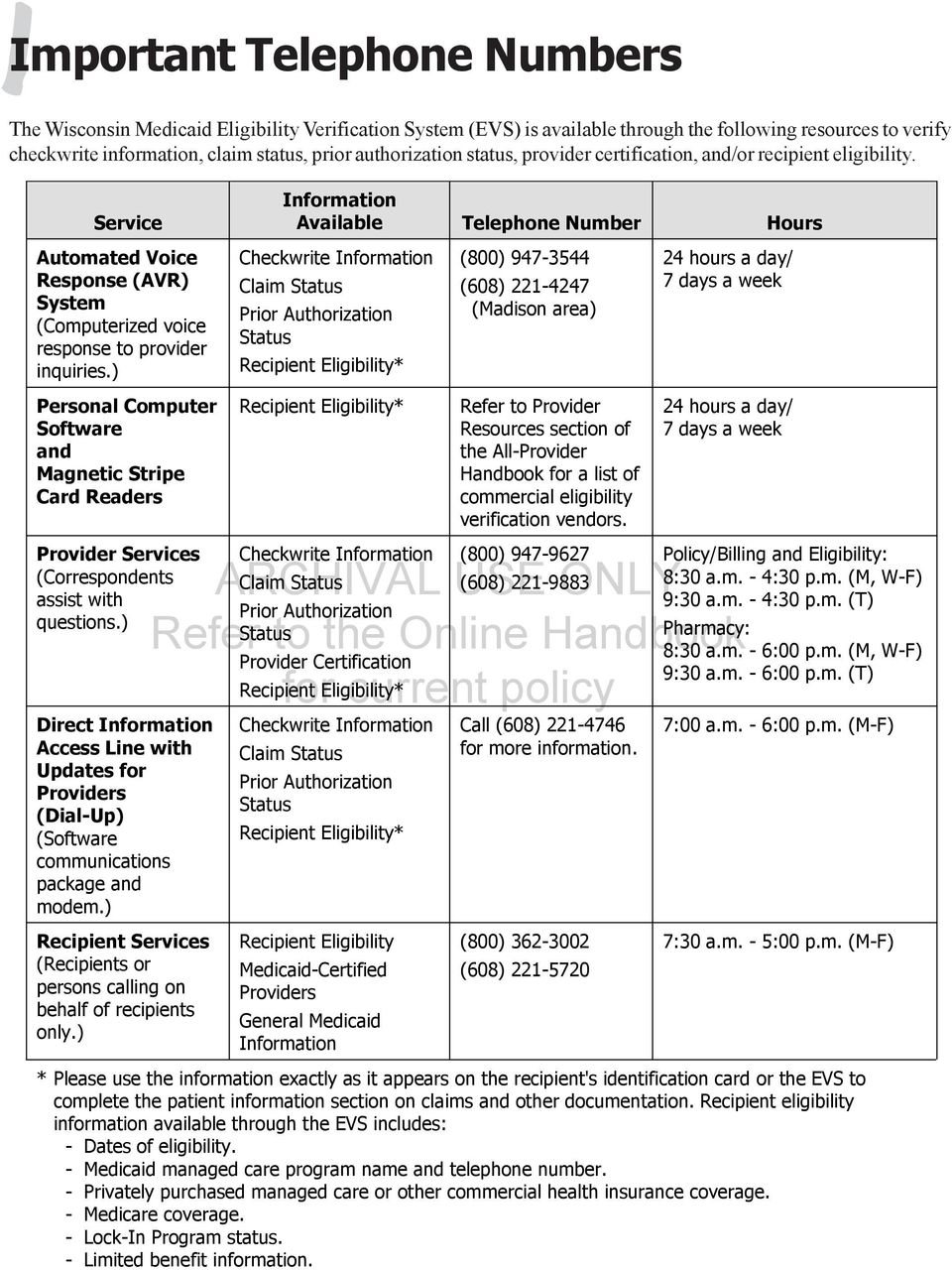
4 Important Telephone Numbers The Wisconsin Medicaid Eligibility Verification System (EVS) is available through the following resources to verify checkwrite information, claim status, prior authorization status, provider certification, and/or recipient eligibility. Service Automated Voice Response (AVR) System (Computerized voice response to provider inquiries.) Personal Computer Software and Magnetic Stripe Card Readers Provider Services (Correspondents assist with questions.) Direct Information Access Line with Updates for Providers (Dial-Up) (Software communications package and modem.) Recipient Services (Recipients or persons calling on behalf of recipients only.) Information Available Telephone Number Hours Checkwrite Information Claim Status Prior Authorization Status Recipient Eligibility* Recipient Eligibility* Checkwrite Information (800) (608) (Madison area) Refer to Provider Resources section of the All-Provider Handbook for a list of commercial eligibility verification vendors. (800) hours a day/ 7 days a week 24 hours a day/ 7 days a week ARCHIVAL Claim Status USE (608) ONLY Prior Authorization Refer Status Pharmacy: to the Online Handbook Provider Certification Recipient for Eligibility* current policy Checkwrite Information Claim Status Prior Authorization Status Recipient Eligibility* Recipient Eligibility Medicaid-Certified Providers General Medicaid Information Call (608) for more information. (800) (608) Policy/Billing and Eligibility: 8:30 a.m. - 4:30 p.m. (M, W-F) 9:30 a.m. - 4:30 p.m. (T) 8:30 a.m. - 6:00 p.m. (M, W-F) 9:30 a.m. - 6:00 p.m. (T) 7:00 a.m. - 6:00 p.m. (M-F) 7:30 a.m. - 5:00 p.m. (M-F) * Please use the information exactly as it appears on the recipient's identification card or the EVS to complete the patient information section on claims and other documentation. Recipient eligibility information available through the EVS includes: - Dates of eligibility. - Medicaid managed care program name and telephone number. - Privately purchased managed care or other commercial health insurance coverage. - Medicare coverage. - Lock-In Program status. - Limited benefit information.
5 Table of Contents Preface... 7 Provider Information... 9 What is the School-Based Services Benefit?... 9 Provider Eligibility and Certification... 9 Certification Process... 9 Individual Provider Licensing Requirements... 9 Duplicate Provider Types...10 Nonduplicate Provider Types...10 Provider Authority to Subcontract...10 Communication with Non-School-Based-Services Providers...10 Managed Care Providers...11 Special Managed Care Programs...11 Medicaid Fee-for-Service Providers...12 Providers Not Certified Under Medicaid...12 Recipient Information...13 Recipient Eligibility...13 Wisconsin Medicaid s Eligibility Verification System...13 Volume Eligibility Copayment...13 Parental Consent...13 Consent to Provide Medical Services...13 Consent to Request Reimbursement from Wisconsin Medicaid...13 Consent to Bill Commercial Insurance...13 Covered Services...15 Covered School-Based Services...15 Medical Necessity Face-to-Face Time...15 Non-Face-to-Face Time...16 Cotreatment...16 Individualized Education Program Information...16 Treatment Goals and Care Plan...16 Measurable Outcome Oriented Goals...16 Speech and Language Pathology, Audiology, and Hearing Services...16 Covered Services...16 Provider Qualifications...17 Speech-Language Pathologists PHC 1423

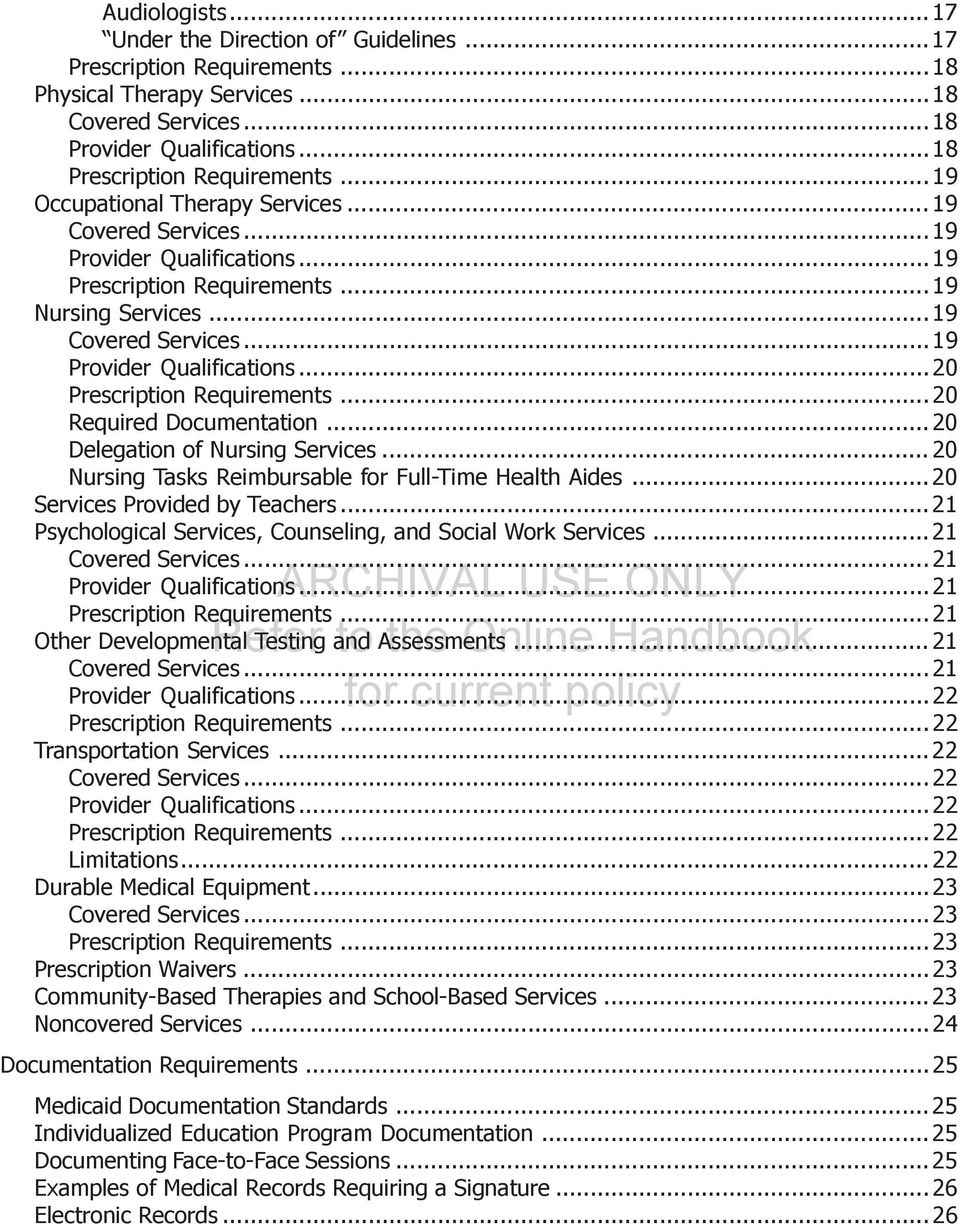
6 Audiologists...17 Under the Direction of Guidelines...17 Prescription Requirements...18 Physical Therapy Services...18 Covered Services...18 Provider Qualifications...18 Prescription Requirements...19 Occupational Therapy Services Covered Services...19 Provider Qualifications...19 Prescription Requirements...19 Nursing Services...19 Covered Services...19 Provider Qualifications...20 Prescription Requirements...20 Required Documentation...20 Delegation of Nursing Services Nursing Tasks Reimbursable for Full-Time Health Aides...20 Services Provided by Teachers...21 Psychological Services, Counseling, and Social Work Services...21 Covered Services...21 Provider Qualifications...21 Prescription Requirements...21 Other Developmental Testing and Assessments Covered Services...21 Provider Qualifications...22 Prescription Requirements...22 Transportation Services...22 Covered Services...22 Provider Qualifications...22 Prescription Requirements...22 Limitations Durable Medical Equipment...23 Covered Services...23 Prescription Requirements...23 Prescription Waivers...23 Community-Based Therapies and School-Based Services...23 Noncovered Services...24 Documentation Requirements...25 Medicaid Documentation Standards...25 Individualized Education Program Documentation...25 Documenting Face-to-Face Sessions...25 Examples of Medical Records Requiring a Signature...26 Electronic Records...26
7 Electronic Signature Standards Charting Medical Records Electronically General Provider Requirements...27 Documentation of Nursing Services Units...27 Time Method...27 Task Method...27 Nursing Services Documentation Requirements Nursing Standards of Practice for Documentation...28 Documentation of Transportation Services Units...28 Transportation Services Documentation Requirements...29 Documentation of Other School-Based Services Units...29 Coordination of Benefits Commercial Health Insurance Liability Requirement...31 Refusal of Parental Consent...31 When the Commercial Insurance Liability Requirement Does Not Apply Exclusionary Clauses...31 When Commercial Insurance Liability Requirement Does Apply...32 Assume the Insurance Liability Amount...32 Seek Payment from the Child s Commercial Health Insurance...32 Do Not Seek Payment from Wisconsin Medicaid for Any Services...32 Using Billing Services, Billing Agents, or Private Independent Consultants...33 Providers Using a Billing Service or Billing Agent...33 Providers Contracting with Private Independent Consultants...33 Responsibility for Claims...33 Claims Submission...35 Electronic Claims Submission...35 Paper Claims Submission...35 Where to Send Paper Claims...35 Claims Submission Deadline...35 Reimbursement...37 Certification of Expenditures...37 Wisconsin Medicaid Requirements Submitting Forms...37 Federally Funded Providers...38 Appendix Certification of Public Expenditures (for photocopying) School-Based Services Matching Expenditures Completion Instructions (for photocopying) School-Based Services Matching Expenditures (for photocopying) Sample Memorandum of Understanding Between HMO and Medicaid-Certified School District, CESA, CCDEB, or Charter School for the School-Based Services Benefit Letter of Consent to Request Reimbursement from Wisconsin Medicaid... 51

8 6. Department of Public Instruction and Department of Regulation and Licensing Prescription Requirements for Providing School-Based Services in the School Setting Request for a Waiver to Wisconsin Medicaid Prescription Requirements Under the School-Based Services Benefit (for photocopying) Wisconsin Medicaid School-Based Services Fact Sheet CMS 1500 Claim Form Completion Instructions Sample CMS 1500 Claim Form for School-Based Services Modifiers for School-Based Services Procedure Codes for School-Based Services Conversion Chart for Wisconsin Medicaid Nursing Services Reimbursement Sample Optional School-Based Services Activity Log Nursing/Therapy Medical Services (time method) Sample Optional School-Based Services Activity Log Medication Administration (time method) Sample Optional School-Based Services Activity Log Nursing/Therapy Medical Services (task method) Sample Optional School-Based Services Activity Log Medication Administration (task method) Optional School-Based Services Activity Log Nursing/Therapy Medical Services (for photocopying) Optional School-Based Services Activity Log Medication Administration (for photocopying) Examples of School-Based Transportation Services Units Centers for Medicare and Medicaid Services School-Based Services Covered Transportation Policy...85 Glossary of Common Terms...87 Index...91

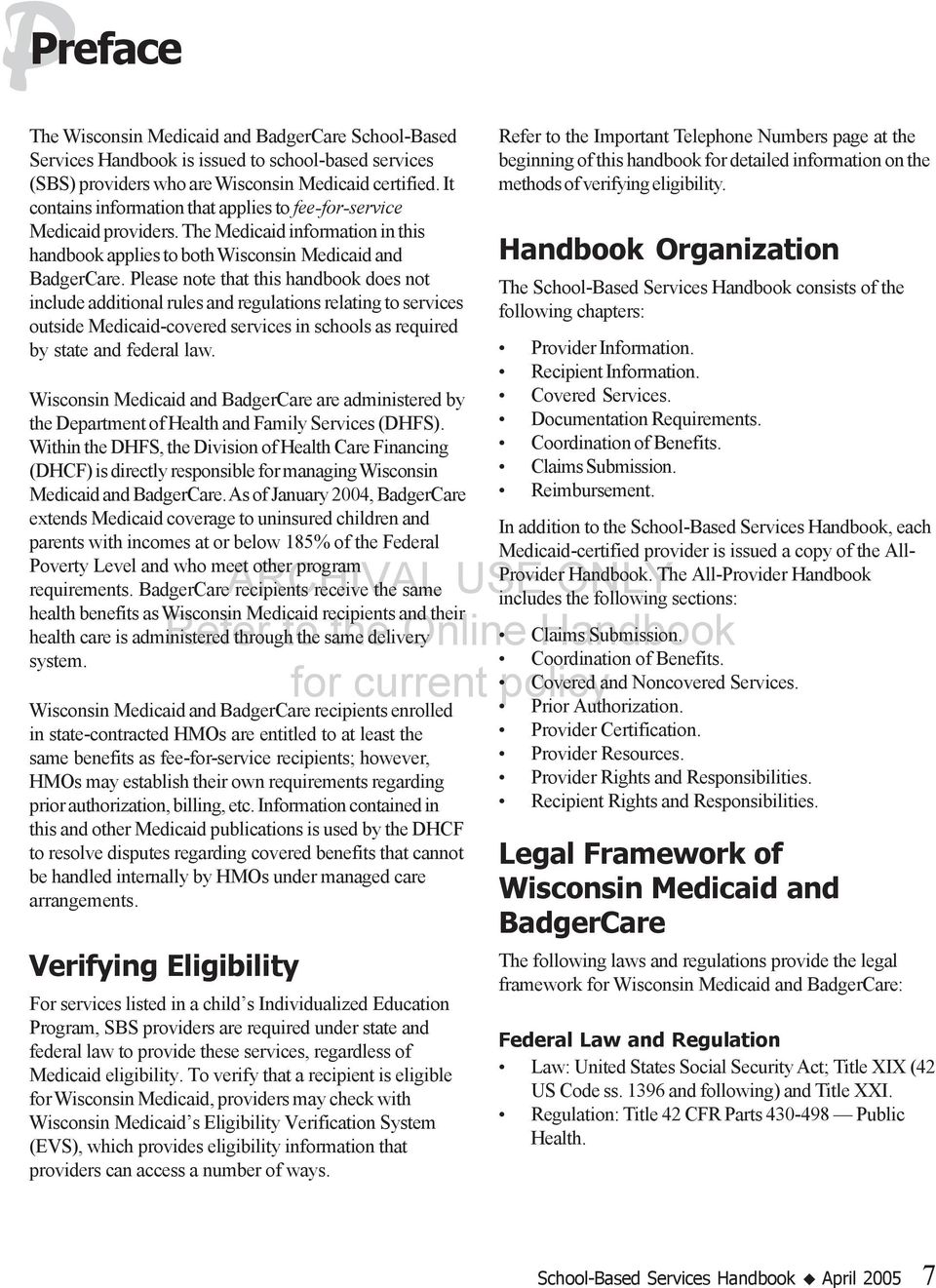
9 Preface The Wisconsin Medicaid and BadgerCare School-Based Services Handbook is issued to school-based services (SBS) providers who are Wisconsin Medicaid certified. It contains information that applies to fee-for-service Medicaid providers. The Medicaid information in this handbook applies to both Wisconsin Medicaid and BadgerCare. Please note that this handbook does not include additional rules and regulations relating to services outside Medicaid-covered services in schools as required by state and federal law. Wisconsin Medicaid and BadgerCare are administered by the Department of Health and Family Services (DHFS). Within the DHFS, the Division of Health Care Financing (DHCF) is directly responsible for managing Wisconsin Medicaid and BadgerCare. As of January 2004, BadgerCare extends Medicaid coverage to uninsured children and parents with incomes at or below 185% of the Federal Poverty Level and who meet other program includes the following sections: Refer to the Online Claims Handbook Submission. Coordination of Benefits. requirements. BadgerCare recipients receive the same health benefits as Wisconsin Medicaid recipients and their health care is administered through the same delivery system. Wisconsin Medicaid and BadgerCare recipients enrolled in state-contracted HMOs are entitled to at least the same benefits as fee-for-service recipients; however, HMOs may establish their own requirements regarding prior authorization, billing, etc. Information contained in this and other Medicaid publications is used by the DHCF to resolve disputes regarding covered benefits that cannot be handled internally by HMOs under managed care arrangements. Verifying Eligibility For services listed in a child s Individualized Education Program, SBS providers are required under state and federal law to provide these services, regardless of Medicaid eligibility. To verify that a recipient is eligible for Wisconsin Medicaid, providers may check with Wisconsin Medicaid s Eligibility Verification System (EVS), which provides eligibility information that providers can access a number of ways. Refer to the Important Telephone Numbers page at the beginning of this handbook for detailed information on the methods of verifying eligibility. Handbook Organization The School-Based Services Handbook consists of the following chapters: Provider Information. Recipient Information. Covered Services. Documentation Requirements. Coordination of Benefits. Claims Submission. Reimbursement. In addition to the School-Based Services Handbook, each Medicaid-certified provider is issued a copy of the All- Provider Handbook. The All-Provider Handbook Covered and Noncovered Services. Prior Authorization. Provider Certification. Provider Resources. Provider Rights and Responsibilities. Recipient Rights and Responsibilities. Legal Framework of Wisconsin Medicaid and BadgerCare The following laws and regulations provide the legal framework for Wisconsin Medicaid and BadgerCare: Federal Law and Regulation Law: United States Social Security Act; Title XIX (42 US Code ss and following) and Title XXI. Regulation: Title 42 CFR Parts Public Health. School-Based Services Handbook April
10 Wisconsin Law and Regulation Law: Wisconsin Statutes: Sections and Regulation: Wisconsin Administrative Code, Chapters HFS Handbooks and Wisconsin Medicaid and BadgerCare Updates further interpret and implement these laws and regulations. Handbooks and Updates, maximum allowable fee schedules, helpful telephone numbers and addresses, and much more information about Wisconsin Medicaid and BadgerCare are available at the following Web sites: dhfs.wisconsin.gov/medicaid/ dhfs.wisconsin.gov/badgercare/ Medicaid Fiscal Agent The DHFS contracts with a fiscal agent, which is currently EDS. 8 Wisconsin Medicaid and BadgerCare April 2005

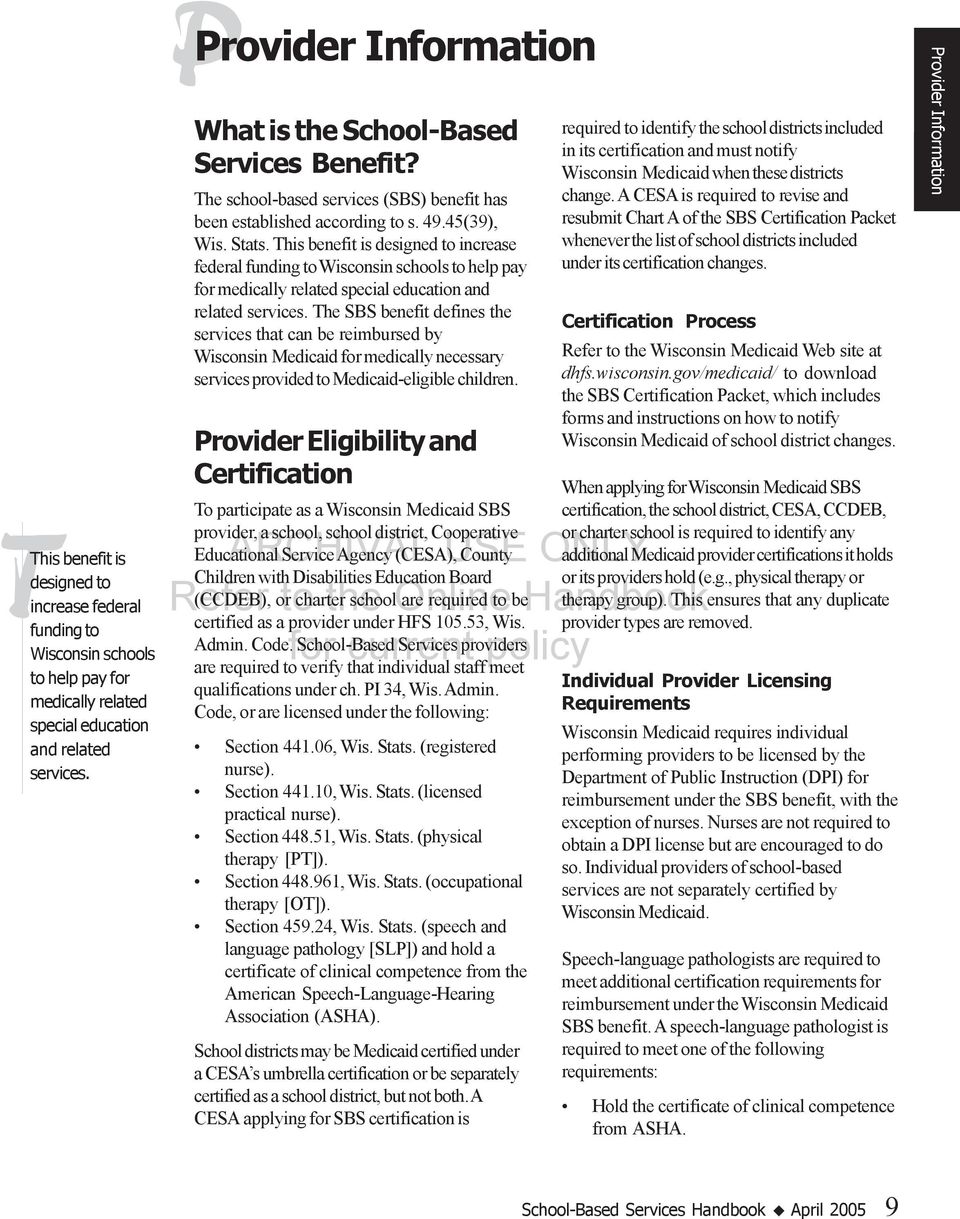
11 This benefit is designed to increase federal funding to Wisconsin schools to help pay for medically related special education and related services. P Provider Information What is the School-Based Services Benefit? The school-based services (SBS) benefit has been established according to s (39), Wis. Stats. This benefit is designed to increase federal funding to Wisconsin schools to help pay for medically related special education and related services. The SBS benefit defines the services that can be reimbursed by Wisconsin Medicaid for medically necessary services provided to Medicaid-eligible children. Provider Eligibility and Certification To participate as a Wisconsin Medicaid SBS provider, a school, school district, Cooperative Educational ARCHIVAL Service Agency (CESA), USE County ONLY Children with Disabilities Education Board Refer (CCDEB), or to charter the school Online are required to behandbook certified as a provider under HFS , Wis. Admin. Code. for School-Based current Services providers policy are required to verify that individual staff meet qualifications under ch. PI 34, Wis. Admin. Code, or are licensed under the following: Section , Wis. Stats. (registered nurse). Section , Wis. Stats. (licensed practical nurse). Section , Wis. Stats. (physical therapy [PT]). Section , Wis. Stats. (occupational therapy [OT]). Section , Wis. Stats. (speech and language pathology [SLP]) and hold a certificate of clinical competence from the American Speech-Language-Hearing Association (ASHA). School districts may be Medicaid certified under a CESA s umbrella certification or be separately certified as a school district, but not both. A CESA applying for SBS certification is required to identify the school districts included in its certification and must notify Wisconsin Medicaid when these districts change. A CESA is required to revise and resubmit Chart A of the SBS Certification Packet whenever the list of school districts included under its certification changes. Certification Process Refer to the Wisconsin Medicaid Web site at dhfs.wisconsin.gov/medicaid/ to download the SBS Certification Packet, which includes forms and instructions on how to notify Wisconsin Medicaid of school district changes. When applying for Wisconsin Medicaid SBS certification, the school district, CESA, CCDEB, or charter school is required to identify any additional Medicaid provider certifications it holds or its providers hold (e.g., physical therapy or therapy group). This ensures that any duplicate provider types are removed. Individual Provider Licensing Requirements Wisconsin Medicaid requires individual performing providers to be licensed by the Department of Public Instruction (DPI) for reimbursement under the SBS benefit, with the exception of nurses. Nurses are not required to obtain a DPI license but are encouraged to do so. Individual providers of school-based services are not separately certified by Wisconsin Medicaid. Speech-language pathologists are required to meet additional certification requirements for reimbursement under the Wisconsin Medicaid SBS benefit. A speech-language pathologist is required to meet one of the following requirements: Hold the certificate of clinical competence from ASHA. Provider Information School-Based Services Handbook April
12 Provider Information Has completed the educational requirements for the ASHA certificate, has completed or is acquiring the supervised work experience necessary for the ASHA certificate, and has passed the PRAXIS exam in SLP. Because the DPI licenses individual providers in Wisconsin schools only, out-of-state schools are ineligible to apply for Wisconsin Medicaid SBS certification. Duplicate Provider Types According to s (39), Wis. Stats., SBS providers are required to submit claims for covered Individualized Education Plan (IEP) services under the school district or CESA s SBS certification and not under another Medicaid provider number. School-Based Services provider certification encompasses, and therefore duplicates, all of the following Wisconsin Medicaid provider certifications: Physical therapy group and individual PT providers and PT assistants. Occupational therapy group and individual OT providers and OT assistants. Speech and hearing clinics. Audiology group and audiologists. Therapy group. Speech and language pathology/therapy group and speech pathologists. Rehabilitation agencies. Transportation. Nurse practitioner group and individual nurse practitioners. Nurse group and individual nurses. The SBS provider (i.e., the school) cannot have duplicate certification numbers. Wisconsin Medicaid removes these duplicate certifications when providers apply for SBS certification. Individual providers performing services that are in the IEP in the school may be individually certified by Wisconsin Medicaid; however, the services must be billed by the CESA or school district under the SBS benefit. An individual therapist or clinic cannot submit claims individually for services provided that are included in the student s IEP. Nonduplicate Provider Types School-Based Services providers may be Medicaid certified for other services, provided these services are not covered under the SBS benefit (e.g., HealthCheck screening and prenatal care coordination). Provider Authority to Subcontract School-Based Services providers may subcontract with agencies or individuals that are not Medicaid certified to provide services. The SBS provider is responsible for assuring that subcontracted agencies or individuals meet all SBS Medicaid requirements. For example, ARCHIVAL for the SBS provider USE to obtain ONLY reimbursement for services provided by a contracted occupational therapist in the community, the therapist is required to be licensed by the DPI, which is an SBS Wisconsin Medicaid requirement. School-Based Services provided by agencies or individuals subcontracted by SBS providers must submit claims to Wisconsin Medicaid under the SBS benefit, listing the SBS provider as the billing provider (not the subcontracted agency or individual). Communication with Non-School-Based- Services Providers When a child receives Medicaid services from both SBS and non-sbs providers, these providers are required to communicate with each other to: Avoid duplication of services. Ensure service coordination. Facilitate continuity of care. School-Based Services providers may subcontract with agencies or individuals that are not Medicaid certified to provide services. 10 Wisconsin Medicaid and BadgerCare April 2005

13 School-Based Services providers are required to communicate at least annually with all HMOs and document this in the child s record. Communication between providers is a twostep process in which SBS providers are required to: 1. Determine if a child receives medical services outside the school from other providers. 2. Contact these providers and inform them, on at least an annual basis, of services provided by the SBS provider. School-Based Services providers are required to attempt to find out if children are receiving medical services from providers outside the school. For example, some schools send mass mailings to all parents in an effort to obtain this information. Providers may also request this information from parents in IEP meetings, parent/teacher conferences, and/or telephone conversations. If the parent(s) refuses to provide the information or does not respond, the SBS provider is required to document this in the child s record. When ARCHIVAL an SBS provider obtains information USE ONLY about a child receiving services from providers Refer to Online Handbook outside the school and the child s parents provide consent to contact these providers, the SBS provider is required for to current attempt to inform these policy providers of services delivered in the school. If the provider(s) outside the school does not respond after several good faith attempts, the SBS provider has fulfilled its obligations and needs to document this in the child s record. Managed Care Providers To ensure communication between providers, Wisconsin Medicaid requires that all SBS providers and Medicaid HMOs that share a service area sign a joint Memorandum of Understanding (MOU). Additionally, SBS providers and special managed care program providers in Milwaukee county are also required to sign a joint MOU. An MOU is a document that sets standards, policies, and procedures to help coordinate services. Wisconsin Medicaid facilitates the development of MOU between SBS providers and Medicaid HMOs by making a list of certified SBS providers available to HMOs on a quarterly basis. A separate MOU must be signed with each HMO that moves into the SBS provider s area. School-Based Services providers and managed care providers are required to sign an MOU only once and are required to comply with it as long as they remain a certified provider. School-Based Services providers are required to communicate at least annually with all HMOs and document this in the child s record. Refer to Appendix 4 of this handbook for a sample MOU. Special Managed Care Programs In the future, Wisconsin Medicaid expects to expand the special managed care programs currently offered in Milwaukee county, and also introduce special managed care programs in Dane county. At that time, SBS providers and special managed care program providers in these service areas will be required to sign a joint MOU. Information explaining the expansion and introduction of special managed care programs in Milwaukee and Dane counties will be published in future Wisconsin Medicaid and BadgerCare Updates. For a list of Medicaid HMOs and special managed care programs by county, refer to the Managed Care section of the Medicaid Web site at dhfs.wisconsin.gov/medicaid/. Provider Information School-Based Services Handbook April

14 Provider Information Medicaid Fee-for-Service Providers Although MOU are not required with Medicaid fee-for-service providers in the community, when a child receives services from both an SBS provider and a Medicaid fee-for-service provider of the same discipline, the SBS provider is required to: Contact these providers and inform them, on at least an annual basis, of services provided by the SBS provider. Cooperate with Medicaid fee-for-service providers of the same discipline who request copies of the child s IEP or components of the IEP. Fee-for-service providers include, but are not limited to, clinics, rehabilitation agencies, local health departments, community mental health agencies, tribal health agencies, home care agencies, therapists, therapy groups, and durable medical equipment providers. Providers Not Certified Under Medicaid Memoranda of Understanding are not required with providers not certified by Wisconsin Medicaid. However, if a child receives services from both an SBS provider and providers of the same discipline not certified under Wisconsin Medicaid, the SBS provider is required to contact these providers and inform them, on at least an annual basis, of services provided by the SBS provider. Fee-for-service providers include, but are not limited to, clinics, rehabilitation agencies, local health departments, community mental health agencies, tribal health agencies, home care agencies, therapists, therapy groups, and durable medical equipment providers. 12 Wisconsin Medicaid and BadgerCare April 2005

15 Recipient Information Recipient Eligibility Parental Consent Wisconsin Medicaid encourages schools to inform parents that the SBS provider will submit claims to Wisconsin Medicaid for services provided to their child(ren). Wisconsin Medicaid s Eligibility Verification System School-Based Services (SBS) providers are required by the state and federal law to provide the services listed in a child s Individualized Education Program (IEP), regardless of Medicaid eligibility. Children must be under age 21 or they must turn 21 years of age during the school term in which services are performed. To verify that a recipient is eligible for Wisconsin Medicaid, providers may check with Wisconsin Medicaid s Eligibility Verification System (EVS), which provides eligibility information that providers can access a number of ways. Refer ARCHIVAL to the Important Telephone Numbers USE ONLY page at the beginning of this handbook for information on methods for verifying eligibility. Refer to the Provider Resources section of the All-Provider Handbook for detailed information on accessing the EVS and eligibility for Wisconsin Medicaid. Volume Eligibility Another method the SBS provider may use to verify eligibility is the Medicaid Volume Eligibility System. This system enables SBS providers to make a large number of Wisconsin Medicaid recipient eligibility inquiries. This service is provided at no charge to providers. To place a volume eligibility inquiry, contact Division of Health Care Financing Electronic Data Interchange Department at (608) The Volume Eligibility System is available to SBS providers only. Copayment Copayments are not permitted for schoolbased services. Consent to Provide Medical Services As required under federal and state education laws, SBS providers are required to obtain parental permission to provide the special education and related services defined in a child s IEP. Refer to the Covered Services chapter of this handbook for further information about the IEP. Consent to Request Reimbursement from Wisconsin Medicaid A separate parental consent in addition to that required to provide the child medical services is not required for SBS providers to submit claims to Wisconsin Medicaid. However, if a parent withdraws consent in writing, the SBS provider cannot submit claims to Wisconsin Medicaid. This policy is based on a U.S. Department of Education decision, in which the department reviewed Wisconsin Medicaid s eligibility application form and concluded that parents give consent to request reimbursement from Wisconsin Medicaid when they sign this application form. Wisconsin Medicaid encourages schools to inform parents that the SBS provider will submit claims to Wisconsin Medicaid for services provided to their child(ren). Refer to Appendix 5 of this handbook for a sample Letter of Consent to Request Reimbursement from Wisconsin Medicaid. Schools may photocopy this sample letter onto the school letterhead and fill in the necessary details for each individual child. Schools also have the option to develop their own letter of consent. Consent to Bill Commercial Insurance Under the federal education law, parental consent must be obtained to bill commercial health insurance for school-based services. Recipient Information School-Based Services Handbook April
16 Recipient Information 14 Wisconsin Medicaid and BadgerCare April 2005

17 Covered Services Providers may submit claims only for face-to-face time for schoolbased services, except DME, where providers may request reimbursement for the equipment itself. Through the school-based services (SBS) benefit, Medicaid-certified SBS providers may request reimbursement from Wisconsin Medicaid for medically necessary covered school-based services provided to Medicaideligible children. Covered School-Based Services School-Based Services must be identified in the child s Individualized Education Program (IEP) and certain requirements must be met. Covered services include: Developmental testing and assessments when resulting in a created or revised IEP. Durable medical equipment (DME). Nursing. Occupational therapy (OT). Refer Physical to therapy the (PT). Online Handbook Psychological services, counseling, and social work. Speech and language pathology (SLP), audiology, and hearing. Transportation. Providers are required to document all face-toface time for school-based services. Providers may submit claims only for face-to-face time for school-based services, except DME, where providers may request reimbursement for the equipment itself. Consultation, monitoring, and coordination are not separately reimbursable by Wisconsin Medicaid. Payment for these services is included in the reimbursement rate for the face-to-face services listed above. Refer to Appendices 11 and 12 of this handbook for Medicaid-allowable SBS modifiers and procedure codes. Medical Necessity All Medicaid-covered services must be medically necessary, as defined in HFS (96m), Wis. Admin. Code. A schoolbased service is considered medically necessary when the service: 1. Identifies, treats, manages, or addresses a medical problem, or a mental, emotional, or physical disability. 2. Is identified in the child s IEP. 3. Is necessary for a child to benefit from special education. 4. Is prescribed by a physician when required. Refer to the service-specific information in this chapter for prescription requirements. Face-to-Face Time Providers are required to document and may submit claims only for face-to-face encounter time with the child for all school-based services. Wisconsin Medicaid covers only face-to-face time spent with the child for all school-based services. Face-to-face time is the time any SBS personnel, both teachers and medical professionals, spend with the child present in the course of providing a service. This includes: Time to obtain and update a history with the child present. Direct observation of the child. Individualized Education Program team testing and assessment only for the time when the SBS health professional is in direct contact with the child. Delivery of the IEP therapy, psychological counseling, social work, or nursing services. Individualized Education Program meetings only for the time when the child is present at the meeting. Covered Services School-Based Services Handbook April

18 Covered Services Non-Face-to-Face Time Wisconsin Medicaid does not pay separately for any non-face-to-face time; payment for non-face-to-face time is included in the reimbursement rates for face-to-face services. Non-face-to-face time includes the time that providers spend in preparation and follow-up without the child present, including: Reviewing and scoring records and tests. Writing reports. Communication and consultation (without the child present) related to the IEP team or IEP service with other professionals, staff, and parents. Meeting with parents regarding the IEP (without the child present). Cotreatment Wisconsin Medicaid recognizes that OT, PT, and SLP providers each provide a unique approach to the recipient s treatment. Cotreatment (the simultaneous treatment by two providers of different therapy disciplines during the same time period) may be provided only in circumstances where it is medically necessary to optimize the recipient s rehabilitation. When cotreatment occurs, providers are required to document in the child s record why individual treatment from a single therapist does not provide maximum benefit to the recipient and why two different therapies that treat simultaneously are required. Individualized Education Program Information The Wisconsin Medicaid SBS benefit only covers services that are listed in the IEP. Each public school child who receives school-based services must have an IEP. An IEP is a written plan for a child that is developed, reviewed, and revised in accordance with s , Wis. Stats. The IEP identifies the special education and related services for the child. Treatment Goals and Care Plan For Wisconsin Medicaid coverage of schoolbased services, there must be a care plan (such as the Department of Public Instruction s [DPI s] Individualized Healthcare Plan [IHP]) that identifies treatment goals that are measurable and outcome-oriented. When the treatment goals identified in the IEP meet these conditions, the IEP is considered the care plan. Otherwise, providers are required to develop a separate care plan that contains measurable and outcome-oriented goals. Measurable Outcome-Oriented Goals The child s IEP contains annual goals, including short term objectives or benchmarks that are measurable. For example, a child may have a short-term goal of stepping over objects on the floor without any loss of balance in four out of ARCHIVAL five trials with USE the ultimate annual ONLY goal of walking through crowded corridors without any Refer to the falls. The Online short-term goal Handbook is measurable in that the child gains skills in walking safely when for current confronted by obstacles policy 80 percent of the time. The annual goal is outcome oriented and measurable in that the number of falls can be tabulated. Speech and Language Pathology, Audiology, and Hearing Services Covered Services Speech and language pathology, audiology, and hearing services are covered for children with speech, language, or hearing disorders that adversely affect the child s functioning. The following services are covered if identified in the child s IEP: Evaluation and re-evaluation to determine the child s need for SLP audiology, and/or hearing services (if the service results in the development or revision of an IEP); The Wisconsin Medicaid SBS benefit only covers services that are listed in the IEP. 16 Wisconsin Medicaid and BadgerCare April 2005

19 The Centers for Medicare and Medicaid Services require certain guidelines to be met for federal reimbursement of services that are provided under the direction of a qualified speechlanguage pathologist or audiologist. recommendations for a course of treatment; and providing direct treatment interventions. Individual therapy/treatment or group therapy/treatment in groups of two to seven children. Medical equipment identified in the IEP intended for only one child for use at school and home. Refer to the Durable Medical Equipment section of this chapter for the qualifications necessary to obtain DME under the SBS benefit. Provider Qualifications Medicaid-covered SLP, audiology, and hearing services are performed by or under the direction of a speech-language pathologist or audiologist who meets Medicaid s specific licensing and certification requirements. Each school district and Cooperative Educational Service Agency (CESA) is responsible ARCHIVAL for documenting the qualifications USE ONLY of all of the speech-language pathologists and Refer audiologists to who provide the services Online for them. Handbook They are also responsible for documenting the provision of services for provided current under the policy direction of a speech-language pathologist or audiologist. Speech-Language Pathologists A speech-language pathologist providing school-based services is required to be DPI licensed and meet one of the following certification conditions: The speech-language pathologist holds the certificate of clinical competence from the American Speech-Language-Hearing Association (ASHA). The speech-language pathologist has completed the educational requirements and work experience necessary for the ASHA certificate and has passed the PRAXIS exam in SLP. The speech-language pathologist has completed the educational requirements for the ASHA certificate, has passed the PRAXIS exam in SLP, and is acquiring supervised work experience to qualify for the certificate. The speech-language pathologist provided the services under the direction of a speech-language pathologist who holds ASHA certification or who meets ASHA certification. Audiologists An audiologist providing school-based services is required to be DPI licensed and meet one of the following certification conditions: The audiologist holds a license from Wisconsin Department of Regulation and Licensing (DR&L). The audiologist holds the certificate of clinical competence from ASHA. The audiologist: Has completed the educational requirements necessary for the ASHA certificate and; Has successfully completed a minimum of 350 clock-hours of supervised clinical practicum (or is in the process of accumulating that supervised clinical experience under the supervision of a qualified Master s or doctoral-level audiologist) and; Has performed at least nine months of full-time audiology services under the supervision of a qualified Master s or doctoral-level audiologist after obtaining a Master s or doctoral degree in audiology or a related field and; Has passed the PRAXIS Exam in audiology. The audiologist provided the service under the direction of an audiologist who holds ASHA certification or who meets ASHA certification requirements. Under the Direction of Guidelines The Centers for Medicare and Medicaid Services (CMS) require certain guidelines to be met for federal reimbursement of services that are provided under the direction of a qualified speech-language pathologist or audiologist. To ensure funding, Wisconsin Covered Services School-Based Services Handbook April

20 Covered Services Medicaid requires school districts and CESAs to comply with the federal guidelines. School-Based Services provided under the direction or supervision of a speech-language pathologist or audiologist must meet the following requirements: A supervising speech-language pathologist or audiologist must meet the qualifications listed in the Provider Qualifications section of this chapter. The supervising speech-language pathologist or audiologist must see each recipient at the beginning of and periodically during treatment, be familiar with the treatment plan, have continued involvement in the care provided, and review the need for continued services throughout treatment. The supervising speech-language pathologist or audiologist must assume professional responsibility for the services provided under his or her direction. The supervising speech-language pathologist or audiologist must ensure that the individual working under his or her direction can contact him or her as necessary during the course of treatment. A supervising speech-language pathologist or audiologist may not supervise more service providers than is reasonable, ethical, and in keeping with professional practice in order to permit the supervising speech-language pathologist or audiologist to adequately fulfill his or her supervisory obligations and to ensure quality care. The entity employing the supervisory speech-language pathologist or audiologist is responsible for ensuring that these standards are met. The employing entity is responsible for ensuring that appropriate documentation is maintained to prove that the above requirements were met. The employing entity is also responsible for ensuring that there is appropriate documentation of services provided by the supervising speech-language pathologist or audiologist and by the individuals working under the direction of the supervising speechlanguage pathologist or audiologist. Prescription Requirements Speech and language pathology, audiology, and hearing services require a physician s prescription annually or the SBS provider is required to have a Request for a Waiver to Wisconsin Medicaid Prescription Requirements Under the School-Based Services Benefit form, HCF 1134, on file with Wisconsin Medicaid. Refer to Appendix 7 of this handbook for a copy of the form. Physical Therapy Services Covered Services Physical therapy services are covered when they identify, treat, rehabilitate, restore, improve, or compensate for medical problems. The following services are covered if they are identified in the child s IEP: Refer to the Evaluation Online and re-evaluation Handbook to determine the child s need for PT (if the service for current results in the development policy or revision of an IEP), recommendations for a course of treatment, and providing direct treatment interventions. Individual therapy/treatment or group therapy/treatment in groups of two to seven children. Medical equipment identified in the IEP intended for only one child for use at school and home. Provider Qualifications Medicaid-covered PT services are performed by or under the direction of a licensed DPI physical therapist. Licensed PT providers may only delegate to physical therapy assistants (PTAs) those portions of a child s therapy that are consistent with the PTA s education, training, and experience. Licensed PT providers are required to have direct, face-to-face contact Medicaid-covered PT services are performed by or under the direction of a licensed DPI physical therapist. 18 Wisconsin Medicaid and BadgerCare April 2005
21 Nursing services must be appropriate for the child s medical needs and specifically identified in the child s IEP. with PTAs on the premises at least every 14 days. Prescription Requirements Physical therapy services require a physician s prescription annually. However, if the SBS provider has a Request for a Waiver to Wisconsin Medicaid Prescription Requirements Under the School-Based Services Benefit form on file with Wisconsin Medicaid, a prescription is only required under limited circumstances as required by the DR&L. Refer to Appendix 7 of this handbook for a copy of the form. Occupational Therapy Services Covered Services Occupational therapy services are covered when they identify, treat, rehabilitate, restore, improve, or compensate for medical problems that interfere with age-appropriate functional Refer performance. to The the following Online services are Handbook covered if they are identified in the child s IEP: Evaluation and re-evaluation to determine the child s need for OT (if the service results in the development or revision of an IEP), recommendations for a course of treatment, and providing direct treatment interventions. Individual therapy/treatment or group therapy/treatment in groups of two to seven children. Medical equipment identified in the IEP intended for only one child for use at school and home. Licensed OT providers may only delegate to certified occupational therapy assistants (OTAs) those portions of a child s therapy that are consistent with the OTA s education, training, and experience. Licensed OT providers are required to have direct, face-toface contact with OTAs on the premises at least every 14 days. Prescription Requirements Occupational therapy services require a minimum of one physician s prescription annually or the SBS provider is required to have a Request for a Waiver to Wisconsin Medicaid Prescription Requirements Under the School- Based Services Benefit form on file with Wisconsin Medicaid. Refer to Appendix 7 of this handbook for a copy of the form. Nursing Services Covered Services Nursing services must be appropriate for the child s medical needs and specifically identified in the child s IEP. Covered nursing services under the SBS benefit are described in s. HFS , Wis. Admin. Code. Services include, but are not limited to: Evaluation and management services, including screens and referrals for health needs. Treatment. Medication management. All time that a nurse spends conducting activities with the child that are included in the child s IEP may be submitted to Wisconsin Medicaid for reimbursement. Covered Services Provider Qualifications Medicaid-covered OT services are performed by or under the direction of a licensed DPI occupational therapist. Like all school-based services, nursing services identified in the IEP must have outcome-based goals. The goals must be detailed in either the IEP if there are student goals or in the IHP if there are nursing goals. Goals for medication management must be identified as well (e.g., seizure medication to prevent and/or treat seizures). School-Based Services Handbook April
22 Covered Services The child s IEP must identify each specific nursing service (e.g., medication management, suctioning, dressing changes, nebulization treatment, G-tube feeding). The IHP should identify the personnel, by name, who will perform the services. Durable medical equipment related to nursing services are not covered school-based services. Consult with a DME provider to determine whether equipment will be covered under the Medicaid DME benefit. Provider Qualifications Medicaid-covered nursing services are performed by a registered nurse (RN), licensed practical nurse (LPN), or are delegated under nursing protocols, according to ch. N 6, Wis. Admin. Code. Prescription Requirements Services are required to be prescribed at least annually by a physician. Medication management is required to be prescribed annually by a licensed practitioner as defined in s (1)(e), Wis. Stats. Required Documentation Providers may use one of two methods, time or task, when documenting and submitting claims for covered nursing services. Refer to the Documentation Requirements section of this handbook for documentation requirements for both methods. Delegation of Nursing Services Under the Standards of Practice for Registered Nurses and Licensed Practical Nurses, ch. N 6, Wis. Admin. Code, only RNs may delegate nursing services to an LPN or individual without a medical license. The RN who delegates these services is required to follow nursing protocols pursuant to ch. N 6, Wis. Admin. Code, including training, evaluation, and supervision. An exception to the rules of nursing delegation in schools is medication administration. Wisconsin law allows school staff without a medical license to administer medication provided all protocols of s and , Wis. Stats., are followed. An RN is required to develop medication administration policies and procedures and train staff in medication administration. Formal nursing delegation is not uniformly required but the determination of need to do so must be made by an RN. However, because Wisconsin Medicaid can only reimburse providers for medical services, under the SBS benefit Wisconsin Medicaid only covers medication administration by unlicensed school staff when it is a delegated nursing act by the RN and is documented as such. Nursing Tasks Reimbursable for Full-Time Health Aides A school or a prescribing physician may ARCHIVAL determine it necessary USE for a ONLY child to have a full-time aide. However, Wisconsin Medicaid Refer to the will not Online reimburse for all the Handbook aide s time. Wisconsin Medicaid will reimburse SBS providers only for the times associated with performing specific covered nursing tasks (e.g., G-tube feeding, suctioning, medication management) identified in the IEP. Time spent on educational tasks or on monitoring the child is not covered and will not be reimbursed even though a full-time aide may be required. Educational tasks include, but are not limited to, vocabulary development, reinforcement of classroom instruction, and rote learning skills (e.g., counting, name printing, coin labeling). Examples of monitoring include, but are not limited to, having an aide present in case the child has a seizure or behavior outburst. Only time spent performing face-to-face covered nursing tasks identified in the IEP can be reimbursed. Medicaid-covered nursing services are performed by a registered nurse (RN), licensed practical nurse (LPN), or are delegated under nursing protocols, according to ch. N 6, Wis. Admin. Code. 20 Wisconsin Medicaid and BadgerCare April 2005
23 School-based testing and assessment services performed by therapists, psychologists, social workers, counselors, and/or nurses are included in the covered school-based services for their respective professional areas and should be billed accordingly. Services Provided by Teachers As stated in s. 1905(a) of the Social Security Act, Wisconsin Medicaid can reimburse providers only for medical services. Therefore, under the SBS benefit, Wisconsin Medicaid can reimburse SBS providers only for the following types of services performed by special education teachers, diagnostic teachers, or DPI-licensed teachers: Individualized Education Program meetings. Wisconsin Medicaid covers IEP meetings during which Medicaid-covered school-based services are discussed when the child is present. Delegated nursing acts. Although s , Wis. Stats., allows school staff to dispense medication without it being a delegated nursing act, Wisconsin Medicaid only covers a medically related service provided by a teacher (or other school personnel) when ARCHIVAL it is a delegated nursing USE act by the ONLY school nurse and documented as such. Psychological Services, Counseling, and Social Work Services Covered Services Psychological services, counseling, and social work services include diagnostic or active treatments intended to reasonably improve the child s physical or mental condition. The following services are covered if they are identified in the child s IEP: Diagnostic testing and evaluation that assesses cognitive, emotional, and social functioning and self-concept. Therapy and treatment that plans, manages, and provides a program of psychological services, counseling, or social work services to children with psychological or behavioral problems. Crisis intervention. Treatment, psychological counseling, and social work services to individuals or groups of two to 10 individuals. Provider Qualifications Psychological services, counseling, and social work services must be performed by a licensed DPI school psychologist, school counselor, or social worker. Prescription Requirements Psychological services, counseling, and social work services must be prescribed annually by a physician or licensed Ph.D. psychologist, or the SBS provider is required to have a Request for a Waiver to Wisconsin Medicaid Prescription Requirements Under the School- Based Services Benefit form on file with Wisconsin Medicaid. Refer to Appendix 7 of this handbook for a copy of the form. Other Developmental Testing and Assessments Covered Services Wisconsin Medicaid covers other developmental testing, assessments, and consultations when resulting in a new or revised IEP. These services must be performed face-to-face with the child by a licensed health professional. Staff providing these services must be DPI-licensed. Covered school-based developmental and testing services include evaluations, tests, and related activities performed to determine if motor, speech, language, or psychological problems exist, or to detect developmental lags in the determination of eligibility under the Individuals with Disabilities Education Act (IDEA). School-based testing and assessment services performed by therapists, psychologists, social workers, counselors, and/or nurses are included in the covered school-based services for their respective professional areas and should be billed accordingly. Covered Services School-Based Services Handbook April
24 Covered Services Provider Qualifications Other developmental testing, assessments, and consultation services must be performed by a licensed physician or psychiatrist, director of special education and/or pupil services, special education teacher, diagnostic teacher, or other certified school staff. Wisconsin Medicaid only covers this testing and assessment for teachers when it results in a new or revised IEP. All providers are required to be DPI licensed. Prescription Requirements A prescription is not required for other developmental testing assessments. However, providers are expected to fully document the rationale for all testing procedures in the child s record. Providers will be notified by Wisconsin Medicaid if prescription requirements for other developmental testing and assessments change. Transportation Services Covered Services Wisconsin Medicaid covers school-based transportation services based on criteria set by the CMS. Refer to Appendix 21 of this handbook for a summary of CMS-covered transportation policy. School-Based Services providers may submit claims for specialized medical transportation that a child would not otherwise receive in the course of attending school. The specialized medical transportation, which must be listed in the child s IEP, may include, but is not limited to, the following: A specialized medical vehicle (SMV) (equipped with a ramp or lift) where the child requires a ramp or lift. Transportation in any vehicle where an aide is required to assist the child. A specially adapted bus for a child with a disability who is not able to ride a standard school bus. A vehicle routed to an area that does not have school bus transportation that the child requires because of a disability. Wisconsin Medicaid reimburses SBS providers for transportation only on days when a child is receiving a covered school-based service (other than transportation) in the following situations: Transportation to and from school when a child receives a covered school-based service at school. Transportation to and from an off-site location to receive a covered school-based service provided the child is in school that day. In this case, transportation between school and home is not covered. Refer to the Documentation Requirements section and Appendix 20 of this handbook for instructions and examples of how to document claims for reimbursement. Provider Qualifications Medicaid-covered specialized medical transportation services must be performed by a ARCHIVAL school or school-contracted USE ONLY transportation provider. Prescription Requirements A prescription is not required for school-based specialized medical transportation services. Limitations Individualized Education Programs must include only specialized medical transportation services that a child would not otherwise receive in the course of attending school. For example, a child with special education needs under IDEA, who rides the standard school bus to school with children without disabilities, should not have transportation listed in his or her IEP, and the cost of that bus ride must not be billed to Wisconsin Medicaid as a school-based service. When specialized medical transportation services are included in the child s IEP, providers may seek reimbursement only under the SBS benefit. Claims for school-based transportation services, as described in the IEP, cannot be submitted to Wisconsin Medicaid by SMV providers or billed to a county by county common carrier providers. Medicaid-covered specialized medical transportation services must be performed by a school or schoolcontracted transportation provider. 22 Wisconsin Medicaid and BadgerCare April 2005
25 School-Based Services providers have the option to submit a Request for a Waiver to Wisconsin Medicaid Prescription Requirements Under the School- Based Services Benefit form to Wisconsin Medicaid. Durable Medical Equipment Covered Services Durable medical equipment is a covered schoolbased service when: The need for the equipment is identified in the child s IEP. Only one child uses the equipment. The child uses the equipment at school and at home (the child owns the equipment, not the SBS provider). The equipment is not covered under Wisconsin Medicaid s DME benefit. Wisconsin Medicaid reimburses for DME related to SLP, audiology and hearing services, PT, and OT when the equipment meets these criteria. Wisconsin Medicaid does not reimburse for DME related to nursing services under the SBS benefit. Contact Wisconsin Medicaid or a Medicaidcertified DME supplier to determine if the Refer Medicaid DME to benefit the covers Online a particular item. Handbook Prescription Requirements A prescription is not required for DME when it is provided as a school-based service. Providers will be notified by Wisconsin Medicaid if prescription requirements for DME change. Prescription Waivers School-Based Services providers have the option to submit a Request for a Waiver to Wisconsin Medicaid Prescription Requirements Under the School-Based Services Benefit form to Wisconsin Medicaid. This form waives some Medicaid prescription requirements. The waiver covers the following school-based services provided to all Medicaid-eligible children at the school: Speech and language pathology, audiology, and hearing services. Physical therapy services. Occupational therapy services. Psychological services, counseling, and social work services. One prescription waiver request is sufficient for all applicable services. Refer to Appendix 7 of this handbook for a copy of the form. Submit forms to Wisconsin Medicaid at the following address: Wisconsin Medicaid Provider Maintenance 6406 Bridge Rd Madison WI Refer to Appendix 6 of this handbook to compare Medicaid prescription requirements for specific service categories with and without a prescription waiver. School-based transportation services do not require a prescription. Community-Based Therapies and School- Based Services In addition to covering school-based services, Wisconsin Medicaid reimburses communitybased therapists separately for Medicaid services not provided under the SBS benefit that are not in the recipient s IEP. To determine medical necessity, Wisconsin Medicaid requires community-based therapy providers to obtain prior authorization (PA) for services that could also be reimbursed under the SBS benefit. The medical necessity of school-based services is reviewed in the IEP process, whereas medical necessity is reviewed in the PA process for community therapists. When adjudicating PA requests for communitybased therapies, Wisconsin Medicaid considers the medical necessity of services and other criteria including, but not limited to, whether the service is appropriate, cost-effective, and nonduplicative of other services. As part of the PA process, community therapists submit the child s IEP with their request to provide services. Covered Services School-Based Services Handbook April
26 Covered Services Medicaid consultants review the IEP in addition to all other required material and records to determine if the child is already receiving services that meet the child s therapy needs. The IEP is not the only material considered when determining medical necessity. Wisconsin Medicaid s professional consultants do not base approval or denial of PA requests on whether the school pursues reimbursement through the SBS benefit. The consultants do not review the SBS claims information. Therefore, whether an SBS provider seeks reimbursement for school-based services does not influence whether a community therapy PA request is approved or denied. Refer to the Wisconsin Medicaid School- Based Services Fact Sheet in Appendix 8 of this handbook, which may be used to inform parents about the relationship between community therapies and school-based services. Noncovered Services The following services are not covered under the SBS benefit, in accordance with HFS (3), Wis. Admin. Code: Art, music, and recreational therapies. Diapering. Durable medical equipment covered under HFS , Wis. Admin. Code. General classroom instruction and programming. For example, developmental guidance in the classroom. General research and evaluation of the effectiveness of school programs. Kindergarten or other routine screening provided free of charge unless resulting in an IEP referral. Note: HealthCheck screens are reimbursable to Medicaid HealthCheck providers but are not reimbursable under the SBS benefit. Nonmedical feeding that is not tube feeding or part of a medical program, such as a behavior management program. Program coordination of gifted and talented students or student assistance programs. Services, including school health program services, which are not in the child s IEP. Services performed by providers who are not certified for school-based services. Services that are strictly educational, vocational, or pre-vocational in nature or without a defined medical component. For example, vocabulary development, ARCHIVAL specialized USE (adaptive) physical ONLY education classes, rote learning skills (e.g., counting, Refer to the name Online printing, and coin Handbook labeling). Staff development and in-services to school staff and parents. In addition, the following are also not covered under the SBS benefit: Any non-face-to-face activities (i.e., the child is not present). Any services listed under s. 504 of the Rehabilitation Act of 1973, unless specifically listed in the child s IEP. Medicaid consultants review the IEP in addition to all other required material and records to determine if the child is already receiving services that meet the child s therapy needs. 24 Wisconsin Medicaid and BadgerCare April 2005
27 Documentation Requirements Wisconsin Medicaid requires SBS providers to include Individualized Education Program (IEP) information in each child s record. Medicaid Documentation Standards Documentation must be kept in each recipient s record, as required under HFS (9), Wis. Admin. Code. Refer to the Provider Rights and Responsibilities section of the All-Provider Handbook for general information on preparing and maintaining records. School-Based Services (SBS) providers are required to follow Wisconsin Medicaid s coverage policies and documentation standards when submitting claims for services provided under the SBS benefit. Failure to do so may result in a federal government audit. Individualized Education Refer Program to Documentation the Online Handbook Wisconsin Medicaid for requires current SBS providers policy to include Individualized Education Program (IEP) information in each child s record. All services for the child must be listed in the IEP to be reimbursed by Wisconsin Medicaid. This information must be kept for at least five years, regardless of other requirements set by the Department of Public Instruction. The IEP information must include the following: Documentation used to develop an IEP (e.g., IEP Team reports or tests). The annual IEP revision that documents any changes in the IEP or related services. A description of durable medical equipment (DME), if applicable. (Include the item name, model number or a description, and the invoice, receipt, or cost.) Documenting Face-to- Face Sessions In addition to the previously listed items, each child s file must include a signed record documenting each face-to-face session with a provider. Documentation (either electronic or handwritten medical records) must be kept for at least five years and include the following information: School s name. Student s name (including first and last name). Student s birth date. The prescription for the service, when required. Category of service provided (e.g., speech and language pathology). Date(s) of service (DOS). Several dates or sessions may be included on one record if they are for the same category of service. Time, quantity, or miles provided. (Units are documented when submitting claims.) Whether service was provided in a group or individual setting. Services that are listed in the IEP. Documentation that the child was present at IEP meetings for the meeting to be covered by Wisconsin Medicaid. Attendance records verifying the child was in school on the DOS. Brief description of the specific service provided. Here are a few examples that include the level of detail Wisconsin Medicaid requires: Activities of daily living, such as buttoning skills. Range of motion (ROM), such as elbow or wrist ROM. Medication management, Tegretol, 200 mg (oral). Student s progress or response to each service delivered (required for nursing services and recommended for all other services). (Progress or response is not Documentation School-Based Services Handbook April
28 Documentation required for transportation or routine transferring.) Monthly progress and response notes are required for all other school-based services. Documentation of contacts with fee-forservice providers at least annually (e.g., an SBS speech-language pathologist and a community speech-language pathologist discuss the progress of a student with whom they each work). Documentation of contacts with non- Medicaid providers at least annually. Examples of non-medicaid providers include a physician or nurse practitioner in private practice who is not Medicaid certified. Documentation of contacts with statecontracted HMOs at least annually. (Memorandums of Understanding between SBS providers and state-contracted HMOs in their service areas are required.) Name and signature of individual who performed service(s). Commercial health insurance information (for therapy services only). If a child has commercial health insurance, this includes documentation of billing commercial health insurance or decreasing the units billed to Wisconsin Medicaid. Documentation of local matching and certified public expenditures. This documentation must be submitted to Wisconsin Medicaid annually. Refer to the Provider Rights and Responsibilities section of the All-Provider Handbook for information about standard record keeping requirements. Wisconsin Medicaid does not require a particular format for data collection. Examples of Medical Records Requiring a Signature The following is an example list of medical records that require the performer s signature, as outlined in Wisconsin Administrative Code, Wisconsin Medicaid and BadgerCare Updates, and Wisconsin Medicaid handbooks. Examples include, but are not limited to: Care plans. Physician s orders or prescriptions. Physician s verbal orders when reduced to writing. Progress notes. Therapy plans. Written protocols. All documentation of Medicaid-covered services provided to or for a recipient. Examples include, but are not limited to: Assessments. Case notes. Daily documentation. Encounter notes. Flow sheets. Medication sheets. Service provision notes. ARCHIVAL Electronic USE Records ONLY Electronic Signature Standards Schools that maintain patient records by computer rather than hard copy may use electronic signatures. However, such entries must be properly authenticated and dated. Authentication must include signatures, written initials, or computer-secure entry by a unique identifier of a primary author who has reviewed and approved the entry. The school is required to have safeguards to prevent unauthorized access to the records and a process for reconstruction of the records upon request from Wisconsin Medicaid, its fiscal agents, auditors, or other authorized personnel or in the event of a system breakdown. Signatures must be applied when the medical records are charted electronically. Schools that maintain patient records by computer rather than hard copy may use electronic signatures. 26 Wisconsin Medicaid and BadgerCare April 2005
29 Providers may develop their own activity logs; however, they must include all the requested information in the optional activity logs. Charting Medical Records Electronically General Provider Requirements Charting medical records electronically is subject to the same requirements as paper documentation. In addition, the following requirements apply: Providers are required to have a paper or electronic back-up system for charting medical records electronically. This could include having files saved on disk or CD in case of computer failure. For audits conducted by the Division of Health Care Financing or the federal government, providers are required to produce paper copies of electronic records. Providers are required to have safeguards to prevent unauthorized access to the records. Documentation of Nursing Services ARCHIVAL Units USE ONLY Refer Wisconsin Medicaid to the recommends Online SBS Handbook providers use the following optional activity logs provided to document for current SBS nursing activities: policy Optional School-Based Services Activity Log Nursing/Therapy Medical Services (refer to Appendix 18 of this handbook). Optional School-Based Services Activity Log Medication Administration (refer to Appendix 19 of this handbook). The use of these two forms is voluntary. Providers may develop their own activity logs; however, they must include all the requested information in the optional activity logs. Providers may use one of the following two methods when documenting activities and submitting claims for covered school-based nursing services: Time method. Task method. Providers may not use a combination of the time and task methods on the same activity log. Time Method There are two different ways to document activities using the time method. Descriptions of both ways are as follows: The provider of services can document the specific times of the day associated with the tasks (e.g., 8:04 a.m. - 8:34 a.m. G- tube feeding). The provider of services can record the number of minutes it took to provide the tasks (e.g., transfer onto toilet 3 times = 30 minutes total). Providers may only use one of these types of time method documentation on an activity log. The provider of services should reflect the total time of Medicaid-reimbursable services for both medication administration and nursing services rendered on their billing sheets. Refer to Appendices 14 and 15 of this handbook for examples of the two types of time method documentation on the Optional School-Based Services Activity Log Nursing/Therapy Medical Services and the Optional School-Based Services Activity Log Medication Administration. Task Method The provider of services may choose to use the task method, which is based on the number of times tasks were performed. For this method, the provider of services is required to do the following: Document the number of times each nursing task is provided for each child on a specific day. Multiply the number of times a specific task was performed by the unit found on the conversion chart in Appendix 13 of this handbook (e.g., G-tube feeding = 2.0 units per task). Document the total units, identifying the DOS. Refer to Appendices 16 and 17 of this handbook for examples of task method documentation on the Optional School-Based Services Activity Log Nursing/Therapy Documentation School-Based Services Handbook April
30 Documentation Medical Services and the Optional School- Based Services Activity Log Medication Administration. If a nursing service is performed but is not listed on the conversion chart (e.g., epi-pen auto injection), report the actual time and convert to units using the standard record keeping and billing method (15 minutes = 1.0 unit). If a new task becomes a recurring task and average times need to be established, write to: Medicaid SBS Policy Analyst Division of Health Care Financing PO Box 309 Madison WI Nursing Services Documentation Requirements Providers are required to document in writing and keep on file the date on which they began using a new method or any time thereafter when methods are changed. Providers are then required to use the same method, whether time or task, for all Medicaid-eligible children. Documentation of nursing services must include the results or outcomes of services (i.e., whether or not the services were effective, the response, and the method used if the initial method did not work). Documentation of results are required for all nursing services with the exception of successful transfers. Nursing Standards of Practice for Documentation Nurses are required to comply with nursing clinical practice standards for documentation, even though this is not a specific additional Medicaid requirement. These documentation standards must be met whether the SBS provider is using the time or the task method to meet Medicaid s documentation requirements. Under nursing clinical practice standards, clinical/visit notes give a clear, comprehensive picture of the recipient s continual status, the care being provided, and the response to that care. The nurse is required to be specific about times in his or her charting, especially the exact time of sudden changes in the recipient s condition (e.g., seizure), significant events (e.g., a fall), and nursing actions that include medication administration and other treatments (e.g., tube feedings). Documentation of Transportation Services Units Providers may submit claims for SBS transportation to Wisconsin Medicaid using a daily base rate with procedure code T2003 for covered school-based transportation services. The first 20 miles of the trip are included in the daily base rate. The daily base rate is equal to ARCHIVAL one unit. USE ONLY Refer to the For transportation Online services Handbook of more than 20 miles, SBS providers may submit claims using for current procedure code A0425 policy in addition to procedure code T2003. Providers may bill the first 20 miles using the base rate procedure code T2003 and then bill the remaining miles of the trip using procedure code A0425, with each additional mile equal to one unit. For those services of more than 20 miles, providers are required to indicate the pickup and drop-off locations and total miles in the child s record. Providers may also choose to bill only the base rate code for children whose mileage exceeds 20 miles. Note: If the total number of miles is not documented in a child s record, a provider may only use procedure code T2003. Refer to Appendix 20 for examples demonstrating the use of the school-based transportation services procedure codes. Providers may submit claims for SBS transportation to Wisconsin Medicaid using a daily base rate with procedure code T2003 for covered schoolbased transportation services. 28 Wisconsin Medicaid and BadgerCare April 2005
31 It is critical that providers verify that a recipient received a schoolbased service on a particular day before billing for transportation services for that day. Transportation Services Documentation Requirements Providers are required to include all of the following information in the record of each child who receives school-based transportation services: The child s first and last name and date of birth. The general service category (transportation). The DOS that school-based transportation services were provided. Documented verification that the child was in school and received a school-based service other than transportation on the date the transportation was provided. Note: It is critical that providers verify that a recipient received a school-based service on a particular day before billing for transportation services for that day. The ARCHIVAL total number of miles, only USE when ONLY seeking reimbursement for more than the Refer 20-mile to daily base the rate for Online that day (the Handbook provider will need to use procedure code A0425 in addition to T2003 for claims). The pick-up and drop-off locations, only when seeking reimbursement for more than the 20-mile daily base rate for that day. If the locations are home or school, these can be described in general terms, such as home to school or school to home. If the school-based service is at a place other than the school, a more specific description including the name of the facility and street address is required. This information may be included in the trip log. Documentation of Other School-Based Services Units School-Based Services providers should use the following general guidelines to determine service units for covered school-based services: One piece of equipment equals one unit for DME services. Fifteen minutes of face-to-face time with the recipient equals one unit for the following services: Audiology and hearing services. Counseling services. Individualized Education Plan assessment. Individuals with Disabilities Education Act assessment. Occupational and physical therapy services. Psychological services. Social work services. Speech and language pathology, audiology, and hearing services. Documentation School-Based Services Handbook April
32 Documentation 30 Wisconsin Medicaid and BadgerCare April 2005
33 C Coordination of Benefits Under the SBS benefit, Wisconsin Medicaid requires providers to seek payment from the commercial insurer only for physical therapy (PT) and occupational therapy (OT) services before billing Wisconsin Medicaid if a child has commercial health insurance. Commercial Health Insurance Liability Requirement Wisconsin Medicaid is usually the payer of last resort for any Medicaid-covered service. This means that Wisconsin Medicaid requires Medicaid providers to seek payment from a recipient s commercial or other health insurance before seeking payment from Wisconsin Medicaid (42 CFR s [c]). However, school-based services (SBS) providers may also assume the insurance liability amount (the amount that providers are required to bill commercial health insurance before requesting reimbursement from Wisconsin Medicaid). Instead of seeking payment from the child s commercial health insurance, SBS providers may ARCHIVAL absorb these costs themselves. USE ONLY Under the SBS benefit, Wisconsin Medicaid requires providers to seek payment from the commercial insurer only for physical therapy (PT) and occupational therapy (OT) services before billing Wisconsin Medicaid if a child has commercial health insurance. Providers are required to obtain parental consent to bill a child s commercial health insurance. Refusal of Parental Consent If parents refuse consent to bill commercial health insurance, providers may assume liability for the services as described in this section. When the Commercial Insurance Liability Requirement Does Not Apply Wisconsin Medicaid s insurance liability requirement does not apply for the following school-based services: Durable medical equipment. Development, revision, review, and annual evaluation/re-evaluation of the Individualized Education Plan (IEP). Nursing services. Other developmental testing and assessments. Psychological services, counseling, and social work services. Speech and language pathology, audiology, and hearing services. Transportation services. When the insurance liability requirement does not apply, SBS providers are not required to bill commercial health insurance. Instead, they may seek reimbursement directly from Wisconsin Medicaid without first seeking payment from the child s commercial health insurance, if any. If providers obtain parental consent, they may bill the child s commercial health insurance for the previously mentioned school-based services that the insurance liability requirement does not apply to, but Wisconsin Medicaid does not require them to do so. Exclusionary Clauses The Medicaid insurance liability requirement never applies to any school-based service if a child s commercial health insurance policy excludes all school medical services from coverage (also known as an exclusionary clause ). Contact the child s family or the commercial health insurance company to determine if this clause exists. If the commercial health insurance policy contains an exclusionary clause, providers are required to submit claims for all school-based services directly to Wisconsin Medicaid, then document in the child s record that the child s commercial health insurance has an exclusionary clause for school medical services. Coordination of Benefits School-Based Services Handbook April
34 Coordination of Benefits When Commercial Insurance Liability Requirement Does Apply The Medicaid insurance liability requirement applies for the following school-based services: Occupational therapy group or individual. Physical therapy group or individual. School-Based Services providers are required to choose one of the following three options when the Medicaid insurance liability applies: 1. Assume the insurance liability amount. 2. Seek payment from the child s commercial health insurance. 3. Do not seek reimbursement from Wisconsin Medicaid for these services. Assume the Insurance Liability Amount Under this option, providers do not contact or bill a child s commercial health insurance. This is achieved by not submitting claims to Wisconsin Medicaid for one unit of OT (group or individual) and/or one unit of PT (group or individual) for each calendar month. Providers should use the following procedures when assuming the insurance liability amount: 1. Do not submit claims to Wisconsin Medicaid for the first occurring unit of OT (group or individual) or PT (group or individual) during the calendar month. Submit claims for the remaining OT and/or PT to Wisconsin Medicaid following the claim instructions. When choosing this option, do not enter an other insurance indicator on the claim form. 2. Providers are required to document in the child s record the date(s) of service on which the unit of OT and/or PT was provided for which the SBS provider is assuming the cost of the insurance liability. 3. Providers should retain documentation indicating that they covered the standard monthly insurance liability unit amount for OT and/or PT from a nonfederal source of funds, instead of billing the child s health insurance. Seek Payment from the Child s Commercial Health Insurance Instead of assuming the cost of the child s commercial health insurance liability, providers may seek payment from the child s commercial health insurance before seeking payment from Wisconsin Medicaid. Under education law, providers are required to obtain parental permission to bill the child s commercial health insurance for school-based services. Federal education regulations allow parents of a child with an IEP receiving school-based ARCHIVAL services to refuse USE consent to ONLY bill their commercial health insurance if it results in a Refer to the cost to Online the family under the Handbook Individuals with Disabilities Education Act. Cost to the family for current includes any of the following: policy Reaching the lifetime limit on a policy. An increase in premiums, copayments, or deductibles. Other negative consequences. Providers may submit a claim to Wisconsin Medicaid for remaining units not paid by commercial health insurance. Do Not Seek Payment from Wisconsin Medicaid for Any Services For children with commercial health insurance covering OT and PT in a school setting, SBS providers may choose to not seek payment from Wisconsin Medicaid for these services. For children with commercial health insurance covering OT and PT in a school setting, SBS providers may choose to not seek payment from Wisconsin Medicaid for these services. 32 Wisconsin Medicaid and BadgerCare April 2005
35 A billing service or agent cannot base payments from SBS providers on a commission basis, in which reimbursement to the billing service or agent is dependent on reimbursement from Wisconsin Medicaid. Using Billing Services, Billing Agents, or Private Independent Consultants Providers Using a Billing Service or Billing Agent Providers may either submit claims to Wisconsin Medicaid directly or use a billing service or agent to prepare and submit SBS claims. A billing service or agent cannot base payments from SBS providers on a commission basis, in which reimbursement to the billing service or agent is dependent on reimbursement from Wisconsin Medicaid. The billing service or agent may not be paid a percentage of the reimbursement received from Wisconsin Medicaid. Providers may pay the billing service or agent an hourly rate or a flat fee per week or month. Providers Contracting with Private Independent Consultants Providers may use private consultants to provide additional for services current other than ongoing policy Medicaid claims submissions. Typically, other consultant services are up-front, short-term activities usually starting when a provider initially plans for or begins a new program. Private consultant activities other than claims submission include nonroutine efforts to clarify the amount and availability of Medicaid reimbursement for school-based services such as: Discussions with the SBS provider about additional services that might be claimed. Legal and other research regarding Medicaid covered services. Negotiation with state and federal officials regarding expanded coverage. Providers may pay for these consultant services (services other than Medicaid claims submission) based on a percentage of the reimbursement collected from Wisconsin Medicaid, provided the consultant payment (if using the same consultant for billing) is billed and recorded separately from payment for claim preparation and submission services. Responsibility for Claims School-Based Services providers are responsible for the accuracy, adherence to Medicaid policy, truthfulness, and completeness of all claims submitted, whether prepared and submitted by the provider or by a billing agency. In addition, private independent consultants are not the final authority on Wisconsin Medicaid policy. Coordination of Benefits School-Based Services Handbook April
36 Coordination of Benefits 34 Wisconsin Medicaid and BadgerCare April 2005
37 School-Based Services (SBS) providers are encouraged to submit claims electronically. Claims Submission All claims, whether electronic or paper, are subject to the same Medicaid policy and legal requirements. Electronic Claims Submission School-Based Services providers are encouraged to submit claims electronically. Electronic claims submission: Reduces processing time. Eliminates manual handling of claims. Reduces both billing and processing errors. The Division of Health Care Financing (DHCF) offers electronic billing software at no cost to providers. To obtain the software, known as Provider Electronic Solutions (PES), providers ARCHIVAL should call the DHCF Electronic USE ONLY Data Interchange (EDI) Department at (608) Refer , to the Online or Handbook request the software from the Medicaid Web site at dhfs.wisconsin.gov/medicaid/. For further information about PES software, refer to the EDI section of the Medicaid Web site. Where to Send Paper Claims Providers may mail completed CMS 1500 paper claim forms for reimbursement to the following address: Wisconsin Medicaid Claims and Adjustments 6406 Bridge Rd Madison WI Claims Submission Deadline Wisconsin Medicaid must receive properly completed claims within 365 days from the date the service was provided. This policy applies to initial claims submissions, resubmissions, and adjustment requests, with rare exceptions. Exceptions to the 365-day claims submission deadline and requirements for submission to Timely Filing can be found in the Claims Submission section of the All-Provider Handbook. Paper Claims Submission Providers submitting paper claims are required to use the CMS 1500 claim form (dated 12/90). Refer to Appendix 9 of this handbook for CMS 1500 claim form completion instructions and Appendix 10 of this handbook for a completed sample claim form. Wisconsin Medicaid denies claims for schoolbased services submitted on any paper claim form other than the CMS 1500 claim form. Wisconsin Medicaid does not provide the CMS 1500 claim form. It may be obtained from any vendor that sells federal forms. Claims Submission School-Based Services Handbook April
38 Claims Submission 36 Wisconsin Medicaid and BadgerCare April 2005
39 If an adequate amount of expenditures are not certified on the Certification of Public Expenditures form and School-Based Services Matching Expenditures form, Wisconsin Medicaid will recover payments received for this period. Reimbursement Wisconsin Medicaid currently reimburses school-based services (SBS) providers 60 percent of federal funding for school-based services and allowable administrative costs. The remaining 40 percent of federal funding is deposited in the State General Fund because of the state s contribution to special education in public schools. Statewide rates are set by the Department of Health and Family Services for all covered school-based services. Federal matching rates are published in Wisconsin Medicaid and BadgerCare Updates and on the Wisconsin Medicaid Web site at dhfs.wisconsin.gov/medicaid/. Certification of Expenditures Refer To qualify for to the full the amount Online of federal Handbook Medicaid matching funds provided by the state, SBS providers are required to certify sufficient certified expenditures. This demonstrates that a school district or Cooperative Educational Service Agency s (CESA) expenditures and costs are at least equal to the full Medicaid reimbursement included in federal and nonfederal funds. If an adequate amount of expenditures are not certified on the Certification of Public Expenditures form, HCF 1003, and School- Based Services Matching Expenditures form, HCF 1004, Wisconsin Medicaid will recover payments received for this period. The Wisconsin Medicaid fee schedule for schoolbased services contains the contracted rate and is published in Updates. Wisconsin Medicaid will send Certification of Public Expenditures forms to participating school districts and CESAs to be completed and returned annually. Wisconsin Medicaid Requirements Since the inception of the Wisconsin Medicaid benefit for school-based services, Wisconsin law has required that all expenditures for school medical services be incurred by the SBS provider, in order for the provider to receive a portion of the federal Medicaid match. Under HFS (4), Wis. Admin. Code, Wisconsin Medicaid requires that participating providers submit evidence annually that program requirements for incurring SBS expenses have been met. School-Based Services providers are required to certify an accounting of the total expenditures for Medicaid-covered services provided to Medicaid-eligible children. The Certification of Public Expenditures form must indicate that the total local expenditures for school-based services were at least equivalent to the sum of the total number of services billed times the contracted rate for each service during the fiscal year. Submitting Forms School-Based Services expenditures must be identified on the Certification of Public Expenditures form and the School-Based Services Matching Expenditures form. Providers are required to complete these forms annually and submit them to Wisconsin Medicaid. The Certification of Public Expenditures form can be found in Appendix 1 of this handbook. The School-Based Services Matching Expenditures Completion Instructions and form may be found in Appendices 2 and 3 of this handbook. Reimbursement School-Based Services Handbook April
40 Reimbursement The forms must be signed by an authorized representative of the SBS provider and must include the Medicaid provider number. The forms may be submitted by fax to (608) , to the attention of the SBS Policy Analyst, or by mail to the following address: SBS Policy Analyst/Certification of Public Expenditures Division of Health Care Financing PO Box 309 Madison WI The Centers for Medicare and Medicaid Services require that these forms be submitted to the Department of Health Care Financing. Under federal requirements, provider documentation verifying the amount of certified expenditures must be maintained by the SBS provider for at least five years. Federally Funded Providers Providers whose positions are partially federally funded may request reimbursement from Wisconsin Medicaid for school-based services. However, these providers may only submit claims to Wisconsin Medicaid for the portion of their services that are locally funded. For example, a provider whose position is 50 percent federally funded may submit claims for only 50 percent of his or her services to Wisconsin Medicaid. Wisconsin Medicaid requires providers to keep appropriate documentation on file to substantiate these claims. Wisconsin Medicaid does not reimburse for services performed by providers whose positions are entirely funded by federal dollars. 38 Wisconsin Medicaid and BadgerCare April 2005
41 Appendix Appendix School-Based Services Handbook April
42 Appendix 40 Wisconsin Medicaid and BadgerCare April 2005
43 Appendix 1 Certification of Public Expenditures (for photocopying) Appendix (A copy of the Certification of Public Expenditures is located on the following page.) School-Based Services Handbook April
44 DEPARTMENT OF HEALTH AND FAMILY SERVICES STATE OF WISCONSIN Division of Health Care Financing Chapter 49.45(39)(b), Wis. Stats. HCF 1003 (Rev. 12/04) WISCONSIN MEDICAID CERTIFICATION OF PUBLIC EXPENDITURES Wisconsin Medicaid requires certain information to enable Medicaid to authorize and pay for medical services provided to eligible recipients. The Certification of Public Expenditures form provides Wisconsin Medicaid with certification of expenditures by school districts and Cooperative Educational Service Agencies (CESAs) for Medicaid-covered services. This form will be retained as part of the fiscal documentation for Wisconsin Medicaid. The Certification of Public Expenditures is used by Wisconsin Medicaid and is a mandatory form. Failure to submit this form by the due date certifying an adequate amount of expenditures may result in the recoupment of Medicaid payments. Providers may submit the signed Certification of Public Expenditures by fax to (608) to the attention of the school-based services (SBS) Policy Analyst or by mail to the following address: SBS Policy Analyst/Certification of Public Expenditures Division of Health Care Financing PO Box 309 Madison WI For the purposes of this form, Medicaid-covered school-based services include the services identified in HFS , Wis. Admin. Code, and outlined in the School-Based Services Handbook. SECTION I PROVIDER INFORMATION Report Period Wisconsin Medicaid Provider Identification Number Name and Address Provider Wisconsin Medicaid records indicate that during the report period, Wisconsin Medicaid reimbursed this provider a total of $ in federal Medicaid funds, for the Medicaid-covered school-based services. SECTION II CERTIFICATION This is to certify that: I am authorized to review, sign, and submit this form on behalf of this school district. This provider expended at least $ in public funds for Medicaid-covered school-based services, provided to Wisconsin Medicaid recipients during the report period. Further, These public funds are not obligated to match other federal funds for any federal program. These public funds are not federal funds, unless they are federal funds that are authorized by federal law to be used to match other federal funds. Records documenting these public expenditures are on file and are available for review. I have reviewed the foregoing and certify that the information reported is true and correct to the best of my knowledge and belief. SECTION III SIGNATURE SIGNATURE Authorized Representative Date Signed Name Authorized Representative (print) Telephone Number Authorized Representative Title Authorized Representative Address Authorized Representative
45 Appendix 2 School-Based Services Matching Expenditures Completion Instructions (for photocopying) Appendix (A copy of the School-Based Services Matching Expenditures Completion Instructions is located on the following pages.) School-Based Services Handbook April
46 Appendix (This page was intentionally left blank.) 44 Wisconsin Medicaid and BadgerCare April 2005
47 DEPARTMENT OF HEALTH AND FAMILY SERVICES Division of Health Care Financing HCF 1004A (Rev. 12/04) STATE OF WISCONSIN WISCONSIN MEDICAID SCHOOL-BASED SERVICES MATCHING EXPENDITURES COMPLETION INSTRUCTIONS Wisconsin Medicaid requires certain information to enable Medicaid to authorize and pay for medical services provided to eligible recipients. The information on the School-Based Services Matching Expenditures form is mandatory. The use of this form is voluntary and providers may develop their own form to certify expenditures as long as it includes all the information on this form and looks exactly like this form. Providers may submit the completed School-Based Services Matching Expenditures form by fax to (608) to the attention of the school-based services (SBS) Policy Analyst or by mail to the following address: SBS Policy Analyst/Certification of Public Expenditures Division of Health Care Financing PO Box 309 Madison WI SECTION I SCHOOL DISTRICT OR COOPERATIVE EDUCATIONAL SERVICES AGENCY INFORMATION Provide the name and Medicaid provider identification number of the school district or Cooperative Educational Services Agency (CESA) that provided the school-based services. The report period should be based on the state fiscal year that runs from July 1 st through June 30 th of the appropriate years. SECTION II DIRECT AND INDIRECT EXPENDITURES FOR SERVICES PROVIDED TO ALL RECIPIENTS Element 1 Direct Expenditures Provide the direct expenses incurred in providing each type of service (columns A through G) to all recipients during the reporting period consistent with the guidelines in the federal Office of Management and Budget (OMB) Circular A-21. Direct expenses are expenditures that can be identified specifically for with each current service provided. policy Direct expenses include expenses for employee salary and fringe benefits, allocated supervisory and administrative salary and fringe benefits, equipment, materials, supplies, allocated support services, physical space, and depreciation. Other types of expenses that can be directly attributed or allocated to each provided service may also be included. Element 2 Reimbursement Received In each column, provide the amount of federal reimbursement received for each type of service during the reporting period. Element 3 Direct Expend. Not Reimbursed In each column, subtract the reimbursement amounts in Element 2 from the total direct expenditure amounts in Element 1. This amount indicates the direct expenditures incurred for providing the services that have not been reimbursed. Element 4 Indirect Allocation Percent In each column, enter the unrestricted indirect cost percentage calculated using the Department of Public Instruction (DPI) local education agency (LEA) indirect rate worksheet. Attach a copy of the worksheet or indirect rate letter from the DPI. Element 5 Indirect Expenditures In each column, multiply the direct expenditures not reimbursed in Element 3 by the unrestricted indirect allocation percentage in Element 4. This amount indicates the indirect expenditures incurred for providing the services. Element 6 Total Direct and Indirect Expend. In each column, add the direct expenditures not reimbursed in Element 3 to the indirect expenditures in Element 5. This amount indicates the total of the direct expenditures not reimbursed and the indirect expenditures for providing the services.
48 SCHOOL-BASED SERVICES MATCHING EXPENDITURES COMPLETION INSTRUCTIONS Page 2 of 2 HCF 1004A (Rev.12/04) SECTION III ALLOCATION OF DIRECT AND INDIRECT EXPENDITURES FOR SERVICES PROVIDED TO WISCONSIN MEDICAID RECIPIENTS Element 7 Units Provided to All Students In each column, provide the number of units of service provided to all students for each type of service during the reporting period. The units of service are as follows: Columns A through E each unit of service is 15 minutes. Column F each unit of service is up to 20 miles (the transportation base rate). Column G each unit of service is one piece of equipment. Optional Allocation Basis Although it is preferable that the allocation of expenditures to Wisconsin Medicaid be made on the basis of units of service, if this information is not available for all students, the allocation ratio can be based on population. In this case, provide one of the following: The number of Wisconsin Medicaid recipients receiving each service compared to the number of all students receiving each service. In each column, provide the number of all students who received each type of service during the reporting period. The number of Wisconsin Medicaid recipients receiving all services compared to the number of all students receiving all services. In each column, provide the number of all students who received all services during the reporting period. Element 8 Units Prov. to Medicaid Recipients In each column, report the number of units of service provided to Wisconsin Medicaid recipients for each type of service during the reporting period. The units of service are as follows: Columns A through E each unit of service is 15 minutes. Column F each unit of service is up to 20 miles (the transportation base rate). Column G each unit of service is one piece of equipment. Optional Allocation Basis Although it is preferable that the allocation of expenditures be made on the basis of units of service, if this information is not available for all students, the allocation ratio can be based on population. In this case, provide one of the following: The number of Wisconsin Medicaid ARCHIVAL recipients receiving each USE service compared ONLY to the number of all students receiving each service. In each column, provide the number of Wisconsin Medicaid recipients who received each type of service during the reporting period. The number of Wisconsin Refer Medicaid recipients to the receiving Online all services compared Handbook to the number of all students receiving all services. In each column, provide the number of Wisconsin Medicaid recipients who received all services during the reporting period. Element 9 Medicaid Allocation Percent In each column, divide the number of units provided to Wisconsin Medicaid recipients (or the number of Wisconsin Medicaid recipients receiving each service) on Line 8 by the number of units provided to all students (or the number of all students receiving each service.) The percentage should be rounded to at least two decimal points (i.e., percent or.1125.) Element 10 Allocated Expenditures In each column, multiply the total direct and indirect expenditures in Element 6 by the Medicaid allocation percentage in Element 9. This amount indicates the direct and indirect expenditures that can be allocated to Wisconsin Medicaid. Element 11 TOTAL Columns A through G Add the expenditures in Columns A through G in Element 10. This amount indicates the total amount of Medicaid expenditures that will be certified on the Certification of Public Expenditures form, HCF SECTION IV CALCULATION OF REQUIRED DISTRICT MATCH Element 12 Match Percent In each column, provide the required district match percentage for the reporting period. Element 13 TOTAL In each column, multiply the allocated expenditures in Element 10 with the required district match percentage in Element 12. This total indicates the amount of expenditures available to match federal Medicaid funding for each type of school-based service provided. Element 14 TOTAL Columns A through G Add the expenditures in columns A through G in Element 13. This total indicates the amount of expenditures that are available to match federal Medicaid funding. This amount is for the school district or CESA s information only.
49 Appendix 3 School-Based Services Matching Expenditures (for photocopying) Appendix (A copy of the School-Based Services Matching Expenditures is located on the following page.) School-Based Services Handbook April
50 DEPARTMENT OF HEALTH AND FAMILY SERVICES STATE OF WISCONSIN Division of Health Care Financing HCF 1004 (Rev. 12/04) WISCONSIN MEDICAID SCHOOL-BASED SERVICES MATCHING EXPENDITURES SECTION I SCHOOL DISTRICT OR COOPERATIVE EDUCATIONAL SERVICES AGENCY INFORMATION Name School District or Cooperative Educational Service Agency Medicaid Provider Number Report Period Start Date Report Period End Date Name Preparer Date Prepared SECTION II DIRECT AND INDIRECT EXPENDITURES FOR SERVICES PROVIDED TO ALL RECIPIENTS COLUMN A COLUMN B COLUMN C SPEECH THERAPY OCCUPATIONAL THERAPY PHYSICAL THERAPY COLUMN D PSYCH. COUNSEL. SOCIAL WORK COLUMN E NURSING COLUMN F TRANSPORTATION COLUMN G DURABLE MEDICAL EQUIP. 1. Direct Expenditures $ $ $ $ $ $ $ 2. Reimbursement Received $ $ $ $ $ $ $ 3. Direct Expend. Not Reimbursed $ $ $ $ $ $ $ 4. Indirect Allocation Percent % % % % % % % 5. Indirect Expenditures $ $ $ $ $ $ $ 6. Total Direct and Indirect Expend. $ $ $ $ $ $ $ SECTION III ALLOCATION OF DIRECT AND INDIRECT EXPENDITURES FOR SERVICES PROVIDED TO WISCONSIN MEDICAID RECIPIENTS COLUMN A COLUMN B COLUMN C COLUMN D COLUMN E COLUMN F COLUMN G 7. Units Provided to All Students 8. Units Prov. to Medicaid Recipients 9. Medicaid Allocation Percent % % % % % % % 10. Allocated Expenditures $ $ $ $ $ $ $ 11. TOTAL Columns A G (Enter this amount on the Certification of Public Expenditures form [HCF 1003]) $ SECTION IV CALCULATION OF REQUIRED DISTRICT MATCH COLUMN A COLUMN B COLUMN C COLUMN D COLUMN E COLUMN F COLUMN G 12. Match Percent % % % % % % % 13. TOTAL $ $ $ $ $ $ $ 14. TOTAL Columns A G (Expenditures available for matching federal Medicaid funding) $ For Office Use Only Name Provider Report Period
51 Appendix 4 Sample Memorandum of Understanding Between HMO and Medicaid-Certified School District, CESA, CCDEB, or Charter School for the School-Based Services Benefit Appendix (The Sample Memorandum of Understanding Between HMO and Medicaid-Certified School District, CESA, Refer CCDEB, to or the Charter Online School for Handbook the School-Based Services Benefit is located on the following page.) School-Based Services Handbook April
52 SAMPLE MEMORANDUM OF UNDERSTANDING BETWEEN HMO AND MEDICAID-CERTIFIED SCHOOL DISTRICT, CESA, CCDEB, OR CHARTER SCHOOL FOR THE SCHOOL-BASED SERVICES BENEFIT School-Based Services (SBS) is a benefit paid fee-for-service by Wisconsin Medicaid for all school-enrolled recipients, including those enrolled in HMOs. The SBS provider is responsible for services listed in a child s Individualized Education Program (IEP), which includes occupational, physical, and speech therapies, nursing services, mental health services, and testing services when provided by the SBS provider. HMOs are responsible for providing and managing medically necessary services outside school settings. However, there are some situations in which schools cannot provide services, such as after school hours, during school vacations, and during the summer. Therefore, avoidance of duplication of services and promotion of continuity of care for Medicaid and BadgerCare HMO recipients requires cooperation, coordination, and communication between the HMO and the SBS provider. The HMO and the SBS provider agree to facilitate effective communication between agencies, to work to resolve interagency coordination and communication problems, and to inform staff from both the HMO and the SBS provider about the policies and procedures for this cooperation, coordination, and communication. Recognizing that these clients-in-common could receive duplicate services and could suffer with problems in continuity of care (e.g., when the school year ends in the middle of a series of treatments), the HMO and the SBS provider agree to cooperate in communicating information about the provision of services and in coordinating care. This agreement becomes effective on the date the SBS provider is certified by Wisconsin Medicaid or on the date when both the HMO and the SBS provider have signed the agreement, whichever is later. It may be terminated in writing with two weeks notice by either signer. The SBS provider may be a school district, Cooperative Educational Service Agency (CESA), County Children with Disabilities Education Board (CCDEB), charter school, the Wisconsin School for the Deaf, or the Wisconsin School for the Visually Handicapped. HMO Contract for (Year) Name HMO Title Authorized HMO Representative Telephone Number Authorized HMO Representative SIGNATURE Authorized HMO Representative Date Signed Name SBS Provider (school) Title Authorized SBS Provider Representative Telephone Number Authorized SBS Provider Representative SIGNATURE Authorized SBS Provider Representative Date Signed
53 Appendix 5 Letter of Consent to Request Reimbursement from Wisconsin Medicaid (Optional) Appendix (The Letter of Consent to Request Reimbursement from Wisconsin Medicaid is located on the following page.) School-Based Services Handbook April
54 Dear Parents: Through the Medicaid school-based services (SBS) benefit, school district may submit claims to Wisconsin Medicaid for covered services provided to Medicaid-eligible children enrolled in special education programs. These services include: nursing services, physical therapy, occupational therapy, or speech and language pathology services, specialized medical vehicle transportation, durable medical equipment, psychological services, counseling, social work services, and developmental testing and assessment. The program is intended to increase federal funding for special education services provided in Wisconsin schools. Please complete and return one copy of this form in the self-addressed envelope that is included so that the school district may obtain Wisconsin Medicaid eligibility information and, if appropriate, file claims with Wisconsin Medicaid for reimbursement of services provided to your child. Keep the second copy for your files. If you have questions, please contact me at:. Sincerely, (name and title of school district contact person) I, the undersigned, hereby request and authorize school district to release to Wisconsin Medicaid the following information: Official student academic/administrative records (identifying information, grade level completed, grades, class rank, attendance records, and group aptitude and achievement test results). Medical and/or related health records. Psychological evaluations and related reports. Appropriate agency reports. Individualized Education Program. Other (specify). CONSENTING FOR THE SCHOOL DISTRICT TO BILL FOR WISCONSIN MEDICAID SCHOOL-BASED SERVICES I understand that: My consent to release this information is voluntary. My approval will not result in denial or limitation of community-based services provided outside the school. My refusal to consent will not result in denial or limitation of services for my child. This permission is valid for one year from the date signed. A copy of this form is as effective as the original. Child s Name Date of Birth Parent s Signature Date Signed Please return this signed form to the school no later than.
55 Appendix 6 Department of Public Instruction and Department of Regulation and Licensing Prescription Requirements for Providing School-Based Services in the School Setting Service Speech and language pathology, audiology, and hearing services Occupational therapy Physical therapy Nursing services Psychological counseling and social work services Other developmental testing and assessments Transportation Durable medical equipment (DME) Current School-Based Services Prescription Requirements 1 Annual prescription by a physician. Annual prescription by a physician. Annual prescription by a physician. Annual prescription by a physician or a health care professional with prescribing authority. Annual prescription by a physician or licensed Ph.D. psychologist. Waiver School-Based Services Prescription Requirements 2,3 No prescription requirements. No prescription requirements. Prescription only required under limited circumstances as required by the DR&L. Annual prescription by a physician or a health care professional with prescribing authority. ARCHIVAL USE No prescription ONLY requirements. No prescription No prescription requirements. for current requirements. policy No prescription requirements. No prescription requirements. No prescription requirements. No prescription requirements. Other Key School- Based Services Requirements Services must be identified in the child s Individualized Education Program (IEP). Services must be identified in the child s IEP. Services must be identified in the child s IEP. Services must be identified in the child s IEP. Services must be identified in the child s IEP. The activities must result in the development or revision of an IEP. Transportation must be included in the IEP and provided on the same day that the child receives another Medicaid-covered school-based service. The equipment must: Be medically necessary. Be child specific. Be identified in the IEP. Belong to the child to use at school and at home. Not be covered under the Wisconsin Medicaid DME benefit. Appendix 1 Based on Department of Regulation and Licensing (DR&L) requirements. If DR&L prescription requirements change for schools, Wisconsin Medicaid automatically adopts those new requirements. 2 The waiver requirements are based on the Department of Public Instruction (DPI) requirements. If DPI prescription requirements change for schools, Wisconsin Medicaid automatically adopts those new requirements. 3 School-Based Services (SBS) providers choosing the waiver option must ensure that the services billed under the SBS benefit meet the necessary requirements for school-based services and are covered services under the SBS benefit. School-Based Services Handbook April
56 Appendix 54 Wisconsin Medicaid and BadgerCare April 2005
57 Appendix 7 Request for a Waiver to Wisconsin Medicaid Prescription Requirements Under the School-Based Services Benefit (for photocopying) Appendix (A copy of the Request for a Waiver to Wisconsin Medicaid Prescription Requirements Under the School-Based Services Benefit is located on the following page.) School-Based Services Handbook April
58 DEPARTMENT OF HEALTH AND FAMILY SERVICES Division of Health Care Financing HCF 1134 (Rev. 12/04) STATE OF WISCONSIN HFS , Wis. Admin. Code WISCONSIN MEDICAID REQUEST FOR A WAIVER TO WISCONSIN MEDICAID PRESCRIPTION REQUIREMENTS UNDER THE SCHOOL-BASED SERVICES BENEFIT Name School-Based Services (SBS) Provider Wisconsin Medicaid Provider Number The SBS provider named above requests a waiver under HFS , Wis. Admin. Code, for the requirement for obtaining prescriptions under the SBS benefit, following HFS (2) and (1) and (2), Wis. Admin. Code, for the following services (check all that apply): Speech and language pathology, audiology, and hearing services. Physical therapy services. Occupational therapy services. Psychological services, counseling, and social work services. Under this waiver, the SBS provider is required to do all of the following: Continue to meet the Department of Public Instruction and Department of Regulation and Licensing standards for prescriptions for services provided to children in the school setting under the SBS benefit. Notify the child s HMO, physician, physician specialist, physician assistant, or nurse practitioner regarding the services the child obtains under the SBS benefit at least annually. This activity must be documented in the child s record. Document communication with other Medicaid providers at least annually when a child receives similar services from other Medicaid providers. The communication must be documented in the child s record and copies of the child s Individualized Education Program must be supplied to other providers when requested. Coordinate care with managed care organizations through Memorandums of Understanding as currently required under the SBS benefit. Name SBS Provider Authorized Representative (Type or Print) SIGNATURE SBS Provider Authorized Representative Date Signed The SBS provider requests this waiver from the Wisconsin Division of Health Care Financing for services provided on and after the following date until this requirement is eliminated through a Wisconsin Administrative Code change. Effective Date of Waiver Request
59 Appendix 8 Wisconsin Medicaid School-Based Services Fact Sheet Appendix (The Wisconsin Medicaid School-Based Services Fact Sheet is located on the following page.) School-Based Services Handbook April
60 DIVISION OF HEALTH CARE FINANCING WISCONSIN MEDICAID AND BADGERCARE RECIPIENT SERVICES 6406 BRIDGE ROAD MADISON WI Jim Doyle Telephone: Governor TTY: Helene Nelson State of Wisconsin FAX: dhfs.wisconsin.gov/medicaid Secretary Department of Health and Family Services dhfs.wisconsin.gov/badgercare WISCONSIN MEDICAID SCHOOL-BASED SERVICES FACT SHEET The Wisconsin Medicaid school-based services (SBS) benefit is a way for school districts and Cooperative Educational Service Agencies (CESAs) to receive more federal funds to help pay for medically related special education and associated services. Obtaining reimbursement from Wisconsin Medicaid for these services helps your school district receive more money for your school s budget. In 2004, Wisconsin schools received approximately $20.1 million from Wisconsin Medicaid for school-based services. Under the SBS benefit: School districts, CESAs, County Children with Disabilities Education Boards, and charter schools can seek reimbursement from Wisconsin Medicaid for school-based services, such as ARCHIVAL speech and language therapy, USE occupational ONLY therapy, and nursing services, if the services are included in the child s Individualized Education Program (IEP). Whether or not your child s school district seeks Wisconsin Medicaid reimbursement for school-based services does not influence approval or denial of prior authorization (PA) requests for community (non-school-based services) therapies. Parents should note that Wisconsin Medicaid medical consultants who review PA requests for community therapies: Do not review SBS claims data. Approve community therapy based on medical necessity and not on financial limitations. Review each child s IEP and any other information regarding therapies received at the school, in the home, or elsewhere when community (non-school-based services) services are requested, regardless of whether or not the school seeks SBS reimbursement. Consultants must review the services your child is currently receiving so that Wisconsin Medicaid does not reimburse for unnecessary services. Wisconsin Medicaid requires schools and other health care providers to work together to ensure that your child receives coordinated services. PHC 1148 (12/04) Wisconsin.gov
61 Appendix 9 CMS 1500 Claim Form Completion Instructions Use the following claim form completion instructions, not the claim form s printed descriptions, to avoid denial or inaccurate Medicaid claim payment. Complete all required elements as appropriate. Do not include attachments unless instructed to do so. Wisconsin Medicaid recipients receive a Medicaid identification card upon being determined eligible for Wisconsin Medicaid. Always verify a recipient s eligibility before providing nonemergency services by using the Eligibility Verification System (EVS) to determine if there are any limitations on covered services and to obtain the correct spelling of the recipient s name. Refer to the Provider Resources section of the All-Provider Handbook or the Medicaid Web site at dhfs.wisconsin.gov/medicaid/ for more information about the EVS. Element 1 Program Block/Claim Sort Indicator Enter claim sort indicator M in the Medicaid check box for the service billed. Appendix Element 1a Insured s I.D. Number Enter the recipient s 10-digit Medicaid identification number. Do not enter any other numbers or letters. Use the Medicaid identification card or EVS to obtain the correct identification number. Element 2 Patient s Name Enter the recipient s last name, first name, and middle initial. Use the EVS to obtain the correct spelling of the recipient s name. If the name or spelling Refer of the name to on the Medicaid Online identification Handbook card the EVS do not match, use the spelling from the EVS. Element 3 Patient s Birth Date, Patient s Sex Enter the recipient s birth date in MM/DD/YY format (e.g., February 3, 1995, would be 02/03/95) or in MM/DD/YYYY format (e.g., February 3, 1995, would be 02/03/1995). Specify if male or female by placing an X in the appropriate box. Element 4 Insured s Name (not required) Element 5 Patient s Address (not required) Element 6 Patient Relationship to Insured (not required) Element 7 Insured s Address (not required) Element 8 Patient Status (not required) Element 9 Other Insured s Name Commercial health insurance must be billed prior to submitting claims to Wisconsin Medicaid, unless the service does not require commercial health insurance billing as determined by Wisconsin Medicaid. Refer to the Coordination of Benefits section of this handbook for more information. If the EVS indicates that the recipient has dental ( DEN ) insurance only or has no commercial health insurance, leave Element 9 blank. School-Based Services Handbook April
62 Appendix 9 (Continued) If the EVS indicates that the recipient has Wausau Health Protection Plan ( HPP ), BlueCross & BlueShield ( BLU ), Wisconsin Physicians Service ( WPS ), TriCare ( CHA ), or some other ( OTH ) commercial health insurance, and the service requires other insurance billing according to the Coordination of Benefits section of the All-Provider Handbook, then one of the following three other insurance (OI) explanation codes must be indicated in the first box of Element 9. The description is not required, nor is the policyholder, plan name, group number, etc. (Elements 9a, 9b, 9c, and 9d are not required.) Appendix Note: Code OI-P OI-D OI-Y Description PAID by commercial health insurance. In Element 29 of this claim form, indicate the amount paid by commercial health insurance to the provider or to the insured. DENIED by commercial health insurance or commercial HMO following submission of a correct and complete claim, or payment was applied towards the coinsurance and deductible. Do not use this code unless the claim was actually billed to the commercial health insurer. YES, the recipient has commercial health insurance or commercial HMO coverage, but it was not billed for reasons including, but not limited to: The recipient denied coverage or will not cooperate. The provider knows the service in question is not covered by the carrier. The recipient s commercial health insurance failed to respond to initial and follow-up claims. Benefits are not assignable or cannot get assignment. Benefits are exhausted. The provider may not use OI-D or OI-Y if the recipient is covered by a commercial HMO and the HMO denied payment because an otherwise covered service was not rendered by a designated provider. Services covered by a commercial Refer HMO are to not the reimbursable Online by Wisconsin Handbook Medicaid except for the copayment and deductible amounts. Providers who receive a capitation payment from the commercial HMO may not bill Wisconsin Medicaid for services that are included in the capitation payment. Element 10 Is Patient s Condition Related to (not required) Element 11 Insured s Policy, Group, or FECA Number (not required) Elements 12 and 13 Authorized Person s Signature (not required) Element 14 Date of Current Illness, Injury, or Pregnancy (not required) Element 15 If Patient Has Had Same or Similar Illness (not required) Element 16 Dates Patient Unable to Work in Current Occupation (not required) Elements 17 and 17a Name and I.D. Number of Referring Physician or Other Source (not required) Element 18 Hospitalization Dates Related to Current Services (not required) Element 19 Reserved for Local Use (not required) Element 20 Outside Lab? (not required) 60 Wisconsin Medicaid and BadgerCare April 2005
63 Appendix 9 (Continued) Element 21 Diagnosis or Nature of Illness or Injury Enter International Classification of Diseases, Ninth Revision, Clinical Modification (ICD-9-CM) diagnosis code Element 22 Medicaid Resubmission (not required) Element 23 Prior Authorization Number (not required) Element 24A Date(s) of Service Enter the month, day, and year for each procedure using the following guidelines: When billing for one date of service (DOS), enter the date in MM/DD/YY or MM/DD/YYYY format in the From field. When billing for two, three, or four DOS on the same detail line, enter the first DOS in MM/DD/YY or MM/DD/ YYYY format in the From field, and enter the subsequent DOS in the To field by listing only the date(s) of the month (e.g., DD, DD/DD, or DD/DD/DD). For example, for DOS on December 1, 8, 15, and 22, 2003, indicate 12/ 01/03 or 12/01/2003 in the From field and indicate 08/15/22 in the To field. It is allowable to enter up to four DOS per line if: All DOS are in the same calendar month. All services are billed using the same procedure code and modifier, if applicable. The same diagnosis is applicable ARCHIVAL for each procedure. USE ONLY The charge for all procedures is identical. (Enter the total charge per detail line in Element 24F.) The number of services Refer performed to on each the DOS Online is identical. Handbook All procedures have the same family planning indicator, if applicable. Element 24B Place of Service Enter place of service (POS) code 03 (school) for each service listed. This is the only allowable POS code for school-based services (SBS). Appendix Element 24C Type of Service (not required) Element 24D Procedures, Services, or Supplies Enter the single most appropriate five-character Current Procedural Terminology (CPT) code or Healthcare Common Procedure Coding System (HCPCS) code. Wisconsin Medicaid denies claims received without an appropriate CPT or HCPCS procedure code. Refer to Appendix 12 of this handbook for a complete list of procedure codes. Modifiers Enter the appropriate modifier(s) in the Modifier column of Element 24D. Use a comma(s) to separate more than one modifier. Refer to Appendix 11 of this handbook for a list of valid modifiers. Element 24E Diagnosis Code Enter the number (1, 2, 3, or 4) that corresponds to the appropriate ICD-9-CM diagnosis code listed in Element 21. Element 24F $ Charges Enter the total charge for each line item. For example, multiply the rate by the number of SBS units for each line. School-Based Services Handbook April
64 Appendix 9 (Continued) Element 24G Days or Units Enter the appropriate number of units for each line item. Always use a decimal (e.g., 2.0 units). Refer to Appendices 13 and 20 of this handbook for units of services. Element 24H EPSDT/Family Planning (not required) Element 24I EMG (not required) Element 24J COB (not required) Appendix Element 24K Reserved for Local Use (not required) Element 25 Federal Tax I.D. Number (not required) Element 26 Patient s Account No. (not required) Optional Providers may enter up to 20 characters of the recipient s internal office account number. This number will appear on the Remittance and Status Report and/or the 835 Health Care Claim Payment/Advice electronic transaction. Element 27 Accept Assignment (not required) Element 28 Total Charge Enter the total charges for this claim. Element 29 Amount Paid Enter the actual amount paid by commercial health insurance. (If the dollar amount indicated in Element 29 is greater than zero, OI-P must be indicated in Element 9.) If the commercial insurance denied the claim, enter 000. Do not enter Medicare-paid amounts in this field. Element 30 Balance Due Enter the balance due as determined by subtracting the amount paid in Element 29 from the amount in Element 28. Element 31 Signature of Physician or Supplier The provider or the authorized representative must sign in Element 31. The month, day, and year the form is signed must also be entered in MM/DD/YY or MM/DD/YYYY format. Note: The signature may be a computer-printed or typed name and date or a signature stamp with the date. Element 32 Name and Address of Facility Where Services Were Rendered (not required) Element 33 Physician s, Supplier s Billing Name, Address, ZIP Code, and Phone # Enter the name of the provider (exactly as indicated on the provider s notification of certification letter) submitting the claim and the complete mailing address. The minimum requirement is the provider s name, city, state, and ZIP code. At the bottom of Element 33, enter the billing provider s eight-digit Medicaid provider number. 62 Wisconsin Medicaid and BadgerCare April 2005
65 Appendix 10 Sample CMS 1500 Claim Form for School-Based Services M Recipient, Ima A. MM DD YYYY X Appendix TM GP 1 XX XX TM 1 XX XX JED XX XX 0 00 XX XX MM/DD/YYYY I.M. Billing 1 W. Williams Anytown, WI School-Based Services Handbook April
66 Appendix 64 Wisconsin Medicaid and BadgerCare April 2005
67 Appendix 11 Modifiers for School-Based Services The following table lists the nationally recognized modifiers that providers are required to use when submitting claims for school-based services. Modifiers are used to identify Individualized Education Programs (IEP) and/or the type of service that was performed. Modifier Description TM GO GP UA U1 U2 U3 U4 U5 U6 U7 U8 U9 Individualized Education Program (IEP) Services delivered under an outpatient occupational therapy plan of care Services delivered under an outpatient physical therapy plan of care M-team assessment and IEP, other staff M-team assessment and IEP, psychological service Individual IEP, psychological service Group IEP, psychological service M-team assessment and IEP counseling service Individual IEP, counseling service Group IEP, counseling service Refer M-team to assessment the and Online IEP, social work Handbook service Individual IEP, social work service Group IEP, social work service Appendix School-Based Services Handbook April
68 Appendix 66 Wisconsin Medicaid and BadgerCare April 2005
69 Appendix 12 Procedure Codes for School-Based Services The following table lists the Current Procedural Terminology and Healthcare Common Procedure Coding System procedure codes that providers are to use when submitting claims for school-based services. Providers will need to include the appropriate modifier(s) for each procedure code as indicated in the table. If more than one modifier is listed, providers will be required to include all modifiers listed when submitting a claim, or the claim detail line may be denied. Refer to Appendix 11 of this handbook for modifier descriptions. Procedure Code Procedure Code Description Speech and Language Pathology, Audiology, and Hearing Services Evaluation of speech, language, voice, communication, auditory processing, TM and/or aural rehabilitation status Treatment of speech, language, voice, communication, and/or auditory TM processing disorder (includes aural rehabilitation); individual group, two or more individuals TM Occupational Therapy Services Occupational therapy evaluation TM Therapeutic procedure, one or more areas, each 15 minutes; therapeutic exercises to develop strength and endurance, range of motion and TM GO flexibility Therapeutic procedure(s), ARCHIVAL group (2 or more USE individuals) ONLY TM GO Physical Therapy Services Physical therapy evaluation (per 15 min) TM Therapeutic procedure, one or more areas, each 15 minutes; therapeutic exercises to develop strength and endurance, range of motion and flexibility Therapeutic procedure(s), group (2 or more individuals) TM GP Psychological Services T1024 Evaluation and treatment by an integrated, specialty team contracted to U1 provide coordinated care to multiple or severely handicapped children, per encounter (Short description: team evaluation & management) T1024 Evaluation and treatment by an integrated, specialty team contracted to U2 provide coordinated care to multiple or severely handicapped children, per encounter (Short description: team evaluation & management) T1024 Evaluation and treatment by an integrated, specialty team contracted to U3 provide coordinated care to multiple or severely handicapped children, per encounter (Short description: team evaluation & management) Counseling Services T1024 Evaluation and treatment by an integrated, specialty team contracted to U4 provide coordinated care to multiple or severely handicapped children, per encounter (Short description: team evaluation & management) T1024 Evaluation and treatment by an integrated, specialty team contracted to U5 provide coordinated care to multiple or severely handicapped children, per encounter (Short description: team evaluation & management) T1024 Evaluation and treatment by an integrated, specialty team contracted to provide coordinated care to multiple or severely handicapped children, per encounter (Short description: team evaluation & management) U6 Required Modifier(s) TM GP School-Based Services Handbook April Appendix
70 Appendix Procedure Code Social Work Services T1024 T1024 T1024 Nursing Services Procedure Code Description Evaluation and treatment by an integrated, specialty team contracted to provide coordinated care to multiple or severely handicapped children, per encounter (Short description: team evaluation & management) Evaluation and treatment by an integrated, specialty team contracted to provide coordinated care to multiple or severely handicapped children, per encounter (Short description: team evaluation & management) Evaluation and treatment by an integrated, specialty team contracted to provide coordinated care to multiple or severely handicapped children, per encounter (Short description: team evaluation & management) T1001 Nursing assessment/evaluation TM T1002 RN* services, up to 15 minutes TM T1003 LPN**/LVN*** services, up to 15 minutes TM Required Modifier(s) Team Assessment and Individualized Education Program Plan Development by Other School Staff T1024 Evaluation and treatment by an integrated, specialty team contracted to provide coordinated care to multiple or severely handicapped children, per encounter (Short description: team evaluation & management) Durable Medical Equipment E1399 Durable medical equipment, miscellaneous TM Special Transportation Services T2003 Non-emergency transportation; encounter/trip TM A0425 Ground mileage, per statue mile TM * RN Registered nurse. ** LPN Licensed practical nurse. *** LVN Licensed vocational nurse. U7 U8 U9 UA 68 Wisconsin Medicaid and BadgerCare April 2005
71 Appendix 13 Conversion Chart for Wisconsin Medicaid Nursing Services Reimbursement The following table lists the units for various services nurses provide. Individualized Education Program (IEP) Nursing Services: Care and Treatment Medications G-tube medication Oral medication Injectable medication Eye drops Intravenous medications Topical medications Rectal medications Other Nursing Tasks G-tube feeding Venting G-tube Intermittent catheterization Standardized Average Nursing Service Units Billable to Wisconsin Medicaid 1.0 unit per medication 0.5 units per medication 1.0 unit per medication 0.5 units per medication 2.0 units per task 0.5 units per task 1.0 unit per task Standardized Average Nursing Service Units Billable to Wisconsin Medicaid 2.0 units per task 0.5 units per task 2.0 units per task Tracheotomy care 2.0 units per task Ostomy care 1.0 unit per task Hand-held nebulization 0.5 units per task Aerosol machine nebulization 2.0 units per task Blood glucose Suctioning 1.0 unit per task 1.0 unit per task Continuous oxygen (i.e., time for filling tank) 0.5 units per task Dressing changes 1.0 unit per task Chest physiotherapy 2.0 units per task Vital signs 1.0 unit per task Vital signs assessment * 1.0 unit per task Registered nurse acute problem assessment * 2.0 units per task Pro re nata (PRN) oxygen 0.5 units per task Appendix Nursing Services: Face-to-face and IEP Team Assessment and Plan Development Face-to-face and IEP Team Assessment and Plan Development Initial IEP team assessment * Re-evaluation for IEP team * Nursing development testing and assessment * IEP plan development/iep team-related activities * Standardized Average Nursing Service Units Billable to Wisconsin Medicaid 12 units per task 8 units per task 4 units per task 4 units per task *These tasks can only be performed by a qualified nurse and cannot be delegated. School-Based Services Handbook April
72 Appendix 70 Wisconsin Medicaid and BadgerCare April 2005
73 Appendix 14 Sample Optional School-Based Services Activity Log Nursing/Therapy Medical Services (time method) Appendix (A sample Optional School-Based Services Activity Log Nursing/Therapy Medical Services [time method] is located on the following page.) School-Based Services Handbook April
74 Appendix 72 Wisconsin Medicaid and BadgerCare April 2005 DEPARTMENT OF HEALTH AND FAMILY SERVICES Division of Health Care Financing HCF 1198 (Rev. 12/04) Name Student (Last, First, MI) Student, Ima G. Date of Service (MM/DD/YY) General Service Category Unit of Service (Time or Units) 10/12/04 nursing 10 a.m. - 10:15 a.m. (15 minutes) 10/14/04 nursing 3 times, 5 minutes each (15 minutes) Times between 11 a.m. and 3 p.m. 10/14/04 nursing 3 times, 5 minutes each (15 minutes) Times between 11 a.m. and 3 p.m. WISCONSIN MEDICAID OPTIONAL SCHOOL-BASED SERVICES ACTIVITY LOG NURSING / THERAPY MEDICAL SERVICES Name School Wisconsin Elementary Group or Individual Describe Specific Services Performed Student's Response/ Progress STATE OF WISCONSIN Method Used (Circle One) Time Task Initials or Signature* (Of Person Who Performed Service) Individual Post-seizure observation Alert and oriented x3 Ima Provider Individual Transferring onto toilet N/A Ima Provider Individual Transferring off of toilet N/A Ima Provider *Initials Key Signatures Corresponding Staff Date Signed (MM/DD/YY) Therapy services only: A. Does the recipient have insurance? Yes No (If yes, go to B. If no, stop.) B. Is there an insurance exclusionary clause for all school-based services? Yes No (If yes, insurance liability does not apply. If no or do not know, go to C.) C. Check the option selected: Option 1: School assuming insurance liability. (Subtract the first occurring unit of occupational therapy [OT] [group or individual] and/or physical therapy [PT] [group or individual] during the calendar month from the monthly claim for services. Bill the remaining services to Wisconsin Medicaid. Do not indicate an "other insurance" disclaimer code in Element 9 of the CMS 1500 claim form.) Option 2: School seeking insurance payment for OT (group or individual) and/or PT (group or individual). Schools must have parental permission for this option. Option 3: School not seeking Medicaid payment for OT (group or individual) and/or PT (group or individual).
75 Appendix 15 Sample Optional School-Based Services Activity Log Medication Administration (time method) Appendix (A sample Optional School-Based Services Activity Log Medication Administration [time method] is located on the following page.) School-Based Services Handbook April
76 Appendix 74 Wisconsin Medicaid and BadgerCare April 2005 DEPARTMENT OF HEALTH AND FAMILY SERVICES Division of Health Care Financing HCF 1199 (Rev. 12/04) Name Student (Last, First, MI) Student, Ima G. Date of Service (MM/DD/YY) Medication Name and Dose 10/12/04 Sustacal, 250 ml., four times a day followed by a 50 cc H 2 0 flush 10/13/04 Sustacal, 250 ml., followed by a 50 cc H 2 0 flush WISCONSIN MEDICAID OPTIONAL SCHOOL-BASED SERVICES ACTIVITY LOG MEDICATION ADMINISTRATION Route G-tube feeding G-tube feeding Time Administered (Time or Units) 8 a.m. - 8:30 a.m. (30 minutes) 2 times, 30 minutes each (60 minutes) 11 a.m. - 11:30 a.m. and 2 p.m. - 2:30 p.m. Name School Wisconsin Elementary Took Medication Without Difficulty? (Yes or No) Yes Yes Notes (All Exceptions Must Be Noted) N/A N/A STATE OF WISCONSIN Method Used (Circle One) Time Task Initials or Signature* (Of Person Who Administered Medication) I.N. I.N. *Initials Key Signatures Corresponding Staff Date Signed (MM/DD/YY) I.N. Ima Nurse 10/14/03 Under Standards of Practice for Registered Nurses, ch. N 6.03, Wis. Admin. Code, only registered nurses (RNs) may delegate services to medically unlicensed individuals. For delegated nursing services under the school-based services benefit, the RN responsible for delegating the services must agree to the delegation of the service and is responsible for supervision of the delegatee.
77 Appendix 16 Sample Optional School-Based Services Activity Log Nursing/Therapy Medical Services (task method) Appendix (A sample Optional School-Based Services Activity Log Nursing/Therapy Medical Services [task method] is located on the following page.) School-Based Services Handbook April
78 Appendix 76 Wisconsin Medicaid and BadgerCare April 2005 DEPARTMENT OF HEALTH AND FAMILY SERVICES Division of Health Care Financing HCF 1198 (Rev. 12/04) Name Student (Last, First, MI) Student, Ima G. Date of Service (MM/DD/YY) General Service Category Unit of Service (Time or Units) 10/12/04 nursing 3 times, 9 a.m., 12 p.m., and 3 p.m. (1.5 units) WISCONSIN MEDICAID OPTIONAL SCHOOL-BASED SERVICES ACTIVITY LOG NURSING / THERAPY MEDICAL SERVICES Name School Wisconsin Elementary Group or Individual Describe Specific Services Performed Student's Response/ Progress Individual Eye drops instilled Excessive redness STATE OF WISCONSIN Method Used (Circle One) Time Task Initials or Signature* (Of Person Who Performed Service) Ima Provider *Initials Key Signatures Corresponding Staff Date Signed (MM/DD/YY) Therapy services only: A. Does the recipient have insurance? Yes No (If yes, go to B. If no, stop.) B. Is there an insurance exclusionary clause for all school-based services? Yes No (If yes, insurance liability does not apply. If no or do not know, go to C.) C. Check the option selected: Option 1: School assuming insurance liability. (Subtract the first occurring unit of occupational therapy [OT] [group or individual] and/or physical therapy [PT] [group or individual] during the calendar month from the monthly claim for services. Bill the remaining services to Wisconsin Medicaid. Do not indicate an "other insurance" disclaimer code in Element 9 of the CMS 1500 claim form.) Option 2: School seeking insurance payment for OT (group or individual) and/or PT (group or individual). Schools must have parental permission for this option. Option 3: School not seeking Medicaid payment for OT (group or individual) and/or PT (group or individual).
79 Appendix 17 Sample Optional School-Based Services Activity Log Medication Administration (task method) Appendix (A sample Optional School-Based Services Activity Log Medication Administration [task method] is located on the following page.) School-Based Services Handbook April
80 Appendix 78 Wisconsin Medicaid and BadgerCare April 2005 DEPARTMENT OF HEALTH AND FAMILY SERVICES Division of Health Care Financing HCF 1199 (Rev. 12/04) Name Student (Last, First, MI) Student, Ima G. Date of Service (MM/DD/YY) Medication Name and Dose WISCONSIN MEDICAID OPTIONAL SCHOOL-BASED SERVICES ACTIVITY LOG MEDICATION ADMINISTRATION Route Time Administered (Time or Units) 10/12/04 Tegretol, 100 mg Oral 8 a.m. and 2 p.m., 2 times (2 x.5 units = 1 unit) 10/13/04 Tegretol, 100 mg Oral 12 p.m. and 4 p.m., 2 times (2 x.5 units = 1 unit) Name School Wisconsin Elementary Took Medication Without Difficulty? (Yes or No) No Notes (All Exceptions Must Be Noted) Difficulty swallowing, swallowed after several attempts both times. Yes N/A STATE OF WISCONSIN Method Used (Circle One) Time Task Initials or Signature* (Of Person Who Administered Medication) I.N. I.N. *Initials Key Signatures Corresponding Staff Date Signed (MM/DD/YY) I.N. Ima Nurse 10/14/04 Under Standards of Practice for Registered Nurses, ch. N 6.03, Wis. Admin. Code, only registered nurses (RNs) may delegate services to medically unlicensed individuals. For delegated nursing services under the school-based services benefit, the RN responsible for delegating the services must agree to the delegation of the service and is responsible for supervision of the delegatee.
81 Appendix 18 Optional School-Based Services Activity Log Nursing/Therapy Medical Services (for photocopying) Appendix (A copy of the Optional School-Based Services Activity Log Nursing/Therapy Medical Services is located on the following page.) School-Based Services Handbook April
82 DEPARTMENT OF HEALTH AND FAMILY SERVICES Division of Health Care Financing HCF 1198 (Rev. 12/04) WISCONSIN MEDICAID OPTIONAL SCHOOL-BASED SERVICES ACTIVITY LOG NURSING / THERAPY MEDICAL SERVICES STATE OF WISCONSIN Name Student (Last, First, MI) Name School Method Used (Circle One) Time Task Date of Service (MM/DD/YY) General Service Category Unit of Service (Time or Units) Group or Individual Describe Specific Services Performed Student's Response/ Progress Initials or Signature* (Of Person Who Performed Service) *Initials Key Signatures Corresponding Staff Date Signed (MM/DD/YY) Therapy services only: A. Does the recipient have insurance? Yes No (If yes, go to B. If no, stop.) B. Is there an insurance exclusionary clause for all school-based services? Yes No (If yes, insurance liability does not apply. If no or do not know, go to C.) C. Check the option selected: Option 1: School assuming insurance liability. (Subtract the first occurring unit of occupational therapy [OT] [group or individual] and/or physical therapy [PT] [group or individual] during the calendar month from the monthly claim for services. Bill the remaining services to Wisconsin Medicaid. Do not indicate an "other insurance" disclaimer code in Element 9 of the CMS 1500 claim form.) Option 2: School seeking insurance payment for OT (group or individual) and/or PT (group or individual). Schools must have parental permission for this option. Option 3: School not seeking Medicaid payment for OT (group or individual) and/or PT (group or individual).
83 Appendix 19 Optional School-Based Services Activity Log Medication Administration (for photocopying) Appendix (A copy of the Optional School-Based Services Activity Log Medication Administration is located on the following page.) School-Based Services Handbook April
84 DEPARTMENT OF HEALTH AND FAMILY SERVICES Division of Health Care Financing HCF 1199 (Rev. 12/04) WISCONSIN MEDICAID OPTIONAL SCHOOL-BASED SERVICES ACTIVITY LOG MEDICATION ADMINISTRATION STATE OF WISCONSIN Name Student (Last, First, MI) Name School Method Used (Circle One) Time Task Date of Service (MM/DD/YY) Medication Name and Dose Route Time Administered (Time or Units) Took Medication Without Difficulty? (Yes or No) Notes (All Exceptions Must Be Noted) Initials or Signature* (Of Person Who Administered Medication) *Initials Key Signatures Corresponding Staff Date Signed (MM/DD/YY) Under Standards of Practice for Registered Nurses, ch. N 6.03, Wis. Admin. Code, only registered nurses (RNs) may delegate services to medically unlicensed individuals. For delegated nursing services under the school-based services benefit, the RN responsible for delegating the services must agree to the delegation of the service and is responsible for supervision of the delegatee.
85 Appendix 20 Examples of School-Based Transportation Services Units The following examples illustrate how providers can bill for various transportation services trip lengths. Child A Trip Over 20 Miles: Example Includes Travel to Non-School-Based Service Site 1 A school-based service other than transportation is provided at the hospital. The bus travels to school and picks up Child A. The bus transports Child A five miles from school to the hospital. 2 The bus transports Child A 18 miles from the hospital to home. The total miles for Child A s trip is 23 miles. This is more than the daily base rate of 20 miles; therefore, the provider may use the following procedure codes: Procedure code T2003 daily base rate (1 unit). Procedure code A0425 three miles over the daily base rate (3 units). Note: In this example, the provider can only be reimbursed for transportation from the school to the hospital and for the trip from the hospital to home. The provider cannot be reimbursed for transportation from home to school because no Medicaid-covered school-based service was provided at the school. Appendix Bus Barn School Refer (Do not include to miles the to or from Online bus barn.) Handbook 1 School to Hospital = 5 miles Medicaid Child A s Home CHILD A TOTAL TRIP = 23 MILES Hospital 2 Hospital to Child A s Home = 18 miles School-Based Services Handbook April
86 Child B Trip Over 20 Miles 1 A school-based service other than transportation is provided at school. The bus travels to pick up Child B at home and transports Child B 12 miles to school. 2 The bus transports Child B 12 miles from school to home. The total miles for Child B s trip is 24 miles. This is more than the daily base rate of 20 miles; therefore, the provider may use the following procedure codes: Procedure code T2003 daily base rate (1 unit). Procedure code A0425 four miles over the daily base rate (4 units). Appendix Bus Barn (Do not include miles to or from bus barn.) Medicaid Child B s Home 2 School to Child B s Home = 12 miles CHILD B TOTAL TRIP = 24 MILES School 1 Child B s Home to School = 12 miles Child C Trip Under 20 Miles 1 A school-based service other than transportation is provided at school. The bus travels to pick up Child C at home and transports Child C six miles to school. 2 The bus transports Child C six miles from school to home. The total miles for Child C s trip is 12 miles. This is less than the daily base rate of 20 miles; therefore, the provider may use procedure code T2003 daily base rate (1 unit). Bus Barn (Do not include miles to or from bus barn.) Medicaid Child C s Home 2 School to Child C s Home = 6 miles School CHILD C TOTAL TRIP = 12 MILES 1 Child C s Home to School = 6 miles 84 Wisconsin Medicaid and BadgerCare April 2005
87 Appendix 21 Centers for Medicare and Medicaid Services School-Based Services Covered Transportation Policy In August 2001, the Centers for Medicare and Medicaid Services approved Wisconsin Medicaid s State Plan regarding covered school-based services (SBS) transportation policy. The following is Medicaid s SBS State Plan language: Transportation Policy Transportation to school and from school A child s transportation to and from a school certified as an SBS provider is a covered service only if all the following conditions are met: The child receives a covered school-based service identified in the child s Individualized Education Plan (IEP) at the school on the day the transportation is provided. The SBS provider is financially responsible for providing the transportation. The child s medical need for the particular type of transportation is identified in the child s IEP. One of the following: The vehicle is equipped with and the child requires a ramp or lift. An aide is present and the child requires the aide s assistance in the vehicle. The child has behavioral problems that do not require the assistance of an aide but that preclude the child from riding on a standard school bus. Off-site transportation A child s transportation to and from a site other than the child s home school is a covered service only if all the following conditions are met: The child receives a covered school-based service identified in the child s IEP at the site on the day the transportation is provided. The SBS provider is financially responsible for providing the transportation. One of the following: Transportation is from the school to an off-site provider and back to school or home. Transportation is between home and a special school. A special school is a school that requires that a child have a disability in order to be enrolled, including, but not limited to, the Wisconsin School for the Deaf or the Wisconsin School for the Visually Handicapped, as defined in ch. PI 12, Wis. Admin. Code. Appendix School-Based Services Handbook April
88 Appendix 86 Wisconsin Medicaid and BadgerCare April 2005
89 Glossary of Common Terms Adjustment A modified or changed claim that was originally allowed, at least in part, by Wisconsin Medicaid. Allowed status A Medicaid or Medicare claim that has at least one service that is reimbursable. BadgerCare BadgerCare extends Medicaid coverage through a Medicaid expansion under Titles XIX and XXI to uninsured children and parents with incomes at or below 185% of the Federal Poverty Level and who meet other program requirements. The goal of BadgerCare is to fill the gap between Medicaid and private insurance without supplanting or crowding out private insurance. BadgerCare benefits are identical to the benefits and services covered by Wisconsin Medicaid, and recipients health care is administered through the same delivery system. CCDEB County Children with Disabilities Education Board. A branch of county government providing instructional and therapeutic services to students with disabilities. Five counties in Wisconsin operate a CCDEB: Brown, Camulet, Marathon, Racine, and Walworth. CESA Cooperative Educational Service Agency. The unit serving as a connection between the state and school districts within its borders. There are 12 CESAs in Wisconsin. Cooperative Educational Service Agencies coordinate and provide educational programs and services as requested by the school district. Charter School A public, nonsectarian school created through a contract or charter between the operators and the sponsoring school board or other chartering authority. The Wisconsin charter school law gives charter schools freedom from most state rules and regulations in exchange for greater accountability for results. CMS Centers for Medicare and Medicaid Services. An agency housed within the U.S. Department of Health and Human Services (HHS), CMS administers Medicare, Medicaid, related quality assurance programs, and other programs. CPT Current Procedural Terminology. A listing of descriptive terms and codes for reporting medical, surgical, therapeutic, and diagnostic procedures. These codes are developed, updated, and published annually by the American Medical Association and adopted for billing purposes by the Centers for Medicare and Medicaid Services (CMS) and Wisconsin Medicaid. Crossover claim A Medicare-allowed claim for a dual-entitlee sent to Wisconsin Medicaid for possible additional payment of the Medicare coinsurance and deductible. DHCF Division of Health Care Financing. The DHCF administers Wisconsin Medicaid for the Department of Health and Family Services (DHFS) under statutory provisions, administrative rules, and the state s Medicaid plan. The state s Medicaid plan is a comprehensive description of the state s Medicaid program that provides the Centers for Medicare and Medicaid Services (CMS) and the U.S. Department of Health and Human Services (HHS), assurances that the program is administered in conformity with federal law and CMS policy. DHFS Wisconsin Department of Health and Family Services. The DHFS administers Wisconsin Medicaid. Its primary mission is to foster healthy, self-reliant individuals and families by promoting independence and community responsibility; strengthening families; encouraging healthy behaviors; protecting vulnerable children, adults, and families; preventing individual and social problems; and providing services of value to taxpayers. Glossary School-Based Services Handbook April
90 Glossary DMS Disposable medical supplies. Disposable medical supplies are medically necessary items that have a very limited life expectancy and are consumable, expendable, disposable, or nondurable. All prescribed DMS must: Be necessary and reasonable for treating a recipient s illness, injury, or disability. Be suitable for the recipient s residence. Be useful to a recipient who is ill, injured, or disabled. Serve a primary medical purpose. DPI Department of Public Instruction. The state agency that oversees education for Wisconsin. The DPI is dedicated to children and learning and to providing guidance and information to parents, teachers, and administrators alike. Dual-entitlee A recipient who is eligible for both Medicaid and Medicare, either Medicare Part A, Part B, or both. DME Durable medical equipment. Durable medical equipment are medically necessary devices that can withstand repeated use. All prescribed DME must: Be necessary and reasonable for treating a recipient s illness, injury, or disability. Be suitable for the recipient s residence. Be useful to a recipient who is ill, injured, or disabled. Serve a primary medical purpose. EVS Eligibility Verification System. The EVS allows providers to verify recipient eligibility prior to providing services. Providers may access recipient eligibility information through the following methods: Wisconsin Medicaid s Automated Voice Response (AVR) system. Commercial magnetic stripe card readers. Commercial personal computer software and Internet access. Wisconsin Medicaid s Provider Services (telephone correspondents). Wisconsin Medicaid s Direct Information Access Line with Updates for Providers (Dial-Up). Fee-for-service The traditional health care payment system under which physicians and other providers receive a payment for each unit of service provided rather than a capitation payment for each recipient. Fiscal agent The Department of Health and Family Services (DHFS) contracts with Electronic Data Systems (EDS) to provide health claims processing services for Wisconsin Medicaid, including provider certification, claims payment, provider services, and recipient services. The fiscal agent also issues identification cards to recipients, publishes information for providers and recipients, and maintains the Wisconsin Medicaid Web site. ECS Electronic Claims Submission. Claims transmitted via the telephone line and fed directly into Wisconsin Medicaid s claims processing subsystem. EOB Explanation of Benefits. Appears on the providers Remittance and Status (R/S) Reports and informs Medicaid providers of the status of or action taken on their claims. HCPCS Healthcare Common Procedure Coding System. A listing of services, procedures, and supplies offered by physicians and other providers. HCPCS includes Current Procedural Terminology (CPT) codes, national alphanumeric codes, and local alphanumeric codes. The national codes are developed by the Centers for Medicare and Medicaid Services (CMS) to supplement CPT codes. HealthCheck A program that provides Medicaid-eligible children under age 21 with regular health screenings. 88 Wisconsin Medicaid and BadgerCare April 2005
91 HHS Department of Health and Human Services. The United States government s principal agency for protecting the health of all Americans and providing essential human services, especially for those who are least able to help themselves. The HHS includes more than 300 programs, covering a wide spectrum of activities, including overseeing Medicare and Medicaid; medical and social science research; preventing outbreak of infectious disease; assuring food and drug safety; and providing financial assistance for low-income families. ICD-9-CM International Classification of Diseases, Ninth Revision, Clinical Modification. Nomenclature for medical diagnoses required for billing. Available through the American Hospital Association. IDEA Individuals with Disabilities Education Act. Federal law that guarantees all children with disabilities access to a free and appropriate public education and the related services and support needed to achieve that education. IEP Individualized Education Program. An IEP is a written plan for a child that is developed, reviewed, and revised in accordance with s , Wis. Stats. The IEP guides the delivery of special education support and services for the child. Maximum allowable fee schedule A listing of all procedure codes allowed by Wisconsin Medicaid for a provider type and Wisconsin Medicaid s maximum allowable fee for each procedure code. Medicaid Medicaid is a joint federal/state program established in 1965 under Title XIX of the Social Security Act to pay for medical services for people with disabilities, people 65 years and older, children and their caretakers, and pregnant women who meet the program s financial requirements. The purpose of Medicaid is to provide reimbursement for and assure the availability of appropriate medical care to persons who meet the criteria for Medicaid. Medicaid is also known as the Medical Assistance Program, Title XIX, or T19. Medically necessary According to HFS (96m), Wis. Admin. Code, a Medicaid service that is: a) Required to prevent, identify or treat a recipient s illness, injury or disability; and b) Meets the following standards: 1. Is consistent with the recipient s symptoms or with prevention, diagnosis or treatment of the recipient s illness, injury or disability; 2. Is provided consistent with standards of acceptable quality of care applicable to type of service, the type of provider and the setting in which the service is provided; 3. Is appropriate with regard to generally accepted standards of medical practice; 4. Is not medically contraindicated with regard to the recipient s diagnoses, the recipient s symptoms or other medically necessary services being provided to the recipient; 5. Is of proven medical value or usefulness and, consistent with s. HFS , is not experimental in nature; 6. Is not duplicative with respect to other services being provided to the recipient; 7. Is not solely for the convenience of the recipient, the recipient s family or a provider; 8. With respect to prior authorization of a service and to other prospective coverage determinations made by the department, is cost effective compared to an alternative medically necessary service which is reasonably accessible to the recipient; and 9. Is the most appropriate supply or level of service that can safely and effectively be provided to the recipient. PA Prior authorization. The written authorization issued by the Department of Health and Family Services (DHFS) to a provider prior to the provision of a service. Glossary School-Based Services Handbook April
92 POS Place of service. A two-digit code which identifies the place where the service was performed. R/S Report Remittance and Status Report. A statement generated by the Medicaid fiscal agent to inform providers regarding the processing of their claims. SBS benefit School-Based Services benefit. The SBS benefit has been established by Wisconsin Medicaid according to s (39), Wis. Stats. This benefit is designed to increase federal funding to Wisconsin schools to help pay for medically related special education and associated services. The SBS benefit defines the services that can be reimbursed by Wisconsin Medicaid for medically necessary services provided to Medicaid-eligible children. Glossary SMV Specialized medical vehicle. Specialized medical vehicle providers provide transportation for recipients with a documented physical or mental disability that prevents them from traveling safely in a common carrier or private motor vehicle to Medicaid-covered services. 90 Wisconsin Medicaid and BadgerCare April 2005
93 Index Certification of Expenditures, 37 Claims electronic submission, 35 paper submission, 35 provider responsibility for, 33 submission deadline, 35 Parental Consent to bill commercial insurance, 13 to provide medical services, 13 to request reimbursement from Wisconsin Medicaid, 13 Prescription Waivers, 23 Commercial Health Insurance, 31 Copayment, 13 Cotreatment, 16 Delegated Nursing Acts, 20, 21 Documentation Medicaid standards, 25 of electronic records, 26 of nursing services, 27 of other school-based services, 29 of transportation services, 28 Eligibility Verification System, 13 Face-to-Face Time definition of, 15, 16 documentation of, 25 Individualized Education Program as a care plan, 16 documentation, 25 information about, 16 Medically Necessary Services, 15 Memorandum of Understanding, 11 Nursing Services, 19 Provider Communication with managed care providers, 11 with Medicaid fee-for-service providers, 12 with providers not certified under Medicaid, 12 Providers authority to subcontract, 10 certification, 9 eligibility, 9 federally funded, 38 using a billing service or billing agent, 33 using a private independent consultant, 33 Reimbursement, 37 School-Based Services benefit, 9 community-based therapies and, 23 covered services, 15 durable medical equipment, 23 noncovered services, 24 nursing services, 19 occupational therapy services, 19 other developmental testing and assessments, 21 physical therapy services, 18 psychological services, counseling, and social work services, 21 services provided by teachers, 21 speech-language pathology, audiology, and hearing services, 16 transportation services, 22 Index Volume Eligibility, 13 School-Based Services Handbook April
Prenatal Care Coordination Services. ARCHIVAL USE ONLY Refer to the Online Handbook for current policy
 Prenatal Care Coordination Services T Table of Contents Preface... 3 General Information... 5 Definition of the Prenatal Care Coordination Benefit... 5 Prenatal Care Coordination Goal... 5 Scope of Service...
Mental Health and Substance Abuse Services. General Information. ARCHIVAL USE ONLY Refer to the Online Handbook for current policy
 Mental Health and Substance Abuse General Information DIVISION OF HEALTH CARE FINANCING WISCONSIN MEDICAID AND BADGERCARE PROVIDER SERVICES 6406 BRIDGE ROAD MADISON WI 53784 Jim Doyle Governor Telephone:
Case Management Services. General Information. ARCHIVAL USE ONLY Refer to the Online Handbook for current policy
 Case Management Services General Information Important Telephone Numbers The Wisconsin Medicaid Eligibility Verification System (EVS) is available through the following resources to verify checkwrite information,
Physical Therapy, Occupational Therapy, and Speech and Language Pathology Services. ARCHIVAL USE ONLY Refer to the Online Handbook for current policy
 Physical Therapy, Occupational Therapy, and Speech and Language Pathology Services Contacting Wisconsin Medicaid Web Site dhfs.wisconsin.gov/ The Web site contains information for providers and recipients
Guide to Determining Presumptive Eligibility for Pregnant Women. ARCHIVAL USE ONLY Refer to the Online Handbook for current policy
 Guide to Determining Presumptive Eligibility for Pregnant Women Contacting Wisconsin Medicaid Web Site dhfs.wisconsin.gov/ The Web site contains information for providers and recipients about the following:
Home Health Services. ARCHIVAL USE ONLY Refer to the Online Handbook for current policy
 Home Health Services DIVISION OF HEALTH CARE FINANCING WISCONSIN MEDICAID AND BADGERCARE PROVIDER SERVICES 6406 BRIDGE ROAD MADISON WI 53784 Jim Doyle Governor Telephone: 800-947-9627 Helene Nelson State
School Based Medicaid Claiming Program Snapshot
 Occupational Therapy IEP; prescribed by a physician Registered by the American Occupational Therapy Association (now the NBCOT for certification purposes); or a graduate of a program in occupational therapy
Florida Medicaid. Medicaid Certified School Match Program Coverage and Limitations Handbook. Agency for Health Care Administration
 Florida Medicaid Medicaid Certified School Match Program Coverage and Limitations Handbook Agency for Health Care Administration This page is intentionally blank. This page is intentionally blank. UPDATE
Outpatient Substance Abuse Treatment Services
 January 2007! No. 2007-08 To: AODA Counselors County Substance Abuse Coordinators Mental Health/ Substance Abuse Clinics Outpatient Hospital Providers Physician Clinics Physicians Psychologists HMOs and
SCHOOL HEALTH SERVICES PROGRAM PROGRAM MANUAL
 SCHOOL HEALTH SERVICES PROGRAM PROGRAM MANUAL Section 2 Covered Services The School Health Services Program is a joint effort between the Colorado Department of Education and Department of Health Care
School-Based Health Services Program Rulebook
 Division of Medical Assistance Programs School-Based Health Services Program Rulebook Division 133 Includes: 1) Table of Contents 2) Current Update Information (changes since last update) 3) Other Provider
MEDICAID REIMBURSEMENT GUIDELINES FOR. PARTICIPATING LOCAL EDUCATION AGENCIES (LEAs)
 MEDICAID REIMBURSEMENT GUIDELINES FOR PARTICIPATING LOCAL EDUCATION AGENCIES (LEAs) I. General Overview The District of Columbia s Medicaid program allows for Medicaid reimbursement for medically necessary
Mental Health and Substance Abuse Services Under BadgerCare Plus
 Update January 2008 No. 2008-05 BadgerCare Plus Information for Providers To: Advanced Practice Nurse Prescribers with Psychiatric Specialty, AODA Counselors, Community Support Programs, Comprehensive
May 2006. American Speech-Language-Hearing Association 1. 2006 Focused Initiative on Health Care Reimbursement. Last updated February 2009.
 Summary of the Department of Health and Human Services Office of Inspector General's (OIG) Findings of the Delivery of Medicaid Speech- Language Pathology Services in the Schools 1 May 2006 Lack of documentation
CHAPTER 700 SCHOOL-BASED CLAIMING PROGRAM/DIRECT SERVICE CLAIMING 700 CHAPTER OVERVIEW... 700-1 710 MEDICAL AND FINANCIAL RECORDS...
 700 CHAPTER OVERVIEW... 700-1 GENERAL REQUIREMENTS 700-1 REFERENCES. 700-3 710... 710-1 720 COVERED SERVICES... 720-1 A. AUDIOLOGY... 720-1 B. BEHAVIORAL HEALTH SERVICES... 720-2 BEHAVIORAL HEALTH PROVIDERS...
Overview of the Florida Medicaid Therapy Services Coverage and Limitations Handbook
 Overview of the Florida Medicaid Therapy Services Coverage and Limitations Handbook 2 Introduction Medicaid reimburses for physical therapy (PT), occupational therapy (OT), respiratory therapy (RT), and
Changes for Master s-level Psychotherapists
 Update December 2010 No. 2010-114 Affected Programs: BadgerCare Plus Standard Plan, BadgerCare Plus Benchmark Plan, Medicaid To: Advanced Practice Nurse Prescribers, HealthCheck Other Services Providers,
STATE OF NEW JERSEY SCHOOL BASED MEDICAID REIMBURSEMENT PROGRAMS PROVIDER HANDBOOK
 STATE OF NEW JERSEY SCHOOL BASED MEDICAID REIMBURSEMENT PROGRAMS PROVIDER HANDBOOK School Year 2014-2015 TABLE OF CONTENTS Introduction 1 CHAPTER 1: MEDICAID OVERVIEW.. 2 CHAPTER 2: SEMI OVERVIEW.. 5 CHAPTER
NEW HAMPSHIRE CODE OF ADMINISTRATIVE RULES. PART He-M 1301 MEDICAL ASSISTANCE SERVICES PROVIDED BY EDUCATION AGENCIES
 CHAPTER He-M 1300 SPECIALIZED SERVICES PART He-M 1301 MEDICAL ASSISTANCE SERVICES PROVIDED BY EDUCATION AGENCIES Statutory Authority: RSA 186-C:27; I-II He-M 1301.01 Purpose. The purpose of these rules
HealthCheck Other Services In-Home Mental Health and Substance Abuse Treatment Services for Children
 January 2007! No. 2007-10 To: Outpatient Mental Health Clinics Psychotherapists HMOs and Other Managed Care Programs HealthCheck Other Services In-Home Mental Health and Substance Abuse Treatment Services
Services which exceed the limitations as listed in the policies and procedures manual must be approved prior to service delivery.
 Attachment 3.1-A Page 1i 4.b. EPSDT Related Rehabilitative Services Community Based (continued) Speech-Language Pathology Services Speech-language evaluation of auditory processing, expressive and receptive
ARCHIVAL USE ONLY Refer to the Online Handbook for current policy
 Mental Health and Substance Abuse Services Substance Abuse Day Treatment DIVISION OF HEALTH CARE FINANCING WISCONSIN MEDICAID AND BADGERCARE PROVIDER SERVICES 6406 BRIDGE ROAD MADISON WI 53784 Jim Doyle
410-127-0020 Definitions... 1. 410-127-0040 Coverage... 5. 410-127-0050 Client Copayments... 6. 410-127-0060 Reimbursement and Limitations...
 Home Health Services Administrative Rulebook Division of Medical Assistance Programs Policy and Planning Section Table of Contents Chapter 410, Division 127 Effective January 1, 2014 410-127-0020 Definitions...
Handbook for Local Education Agencies. Chapter U-200 Policy and Procedures Fee-for-Service Medical Services
 Handbook for Local Education Agencies Chapter U-200 Policy and Procedures Fee-for-Service Medical Services Illinois Department of Healthcare and Family Services February 2014 Chapter U-200 Handbook Fee-for-Service
IDAPA 2/18/2015. School Based Medicaid Related Services. 16.03.09 School Based Medicaid 24.23.01 - SLP 24.06.01 OT 24.13.01 PT
 School Based Medicaid Related Services Presenters: Shannon Dunstan, Department of Education Frede Trenkle, Department of Health and Welfare What will be presented: Implementation of School Based Medicaid
Physical Therapists and Occupational Therapists. An Overview
 Physical Therapists and Occupational Therapists An Overview Federal regulations permit and encourage school systems to recover costs from public health insurance (Medicaid) for services identified in a
SHARS Billing Guidelines (Effective 9/1/06)
 Updated December 1, 2007 SHARS Billing Guidelines (Effective 9/1/06) Psychological Services - Assessment Services Procedure Code: 96101 Psychological testing (includes psychodiagnostic assessment of personality,
Ambulance Policy. November 2007! No. 2007-75. Clarification of Wisconsin Medicaid Policy. Documentation Requirements
 November 2007! No. 2007-75 To: Ambulance Providers HMOs and Other Managed Care Programs Ambulance Policy This Wisconsin Medicaid and BadgerCare Update clarifies existing policies and announces new Wisconsin
PROVIDER MANUAL Rehabilitative Therapy Services
 KANSAS MEDICAL ASSISTANCE PROGRAM PROVIDER MANUAL Rehabilitative Therapy Services Physical Therapy Occupational Therapy Speech/Language Pathology PART II REHABILITATIVE THERAPY PROVIDER MANUAL Introduction
A Step-by-Step Guide to Accessing Services and Supplies through the HealthCheck Other Services (HCOS) Component of Medicaid
 A Step-by-Step Guide to Accessing Services and Supplies through the HealthCheck Other Services (HCOS) Component of Medicaid I. Setting Up a HealthCheck Screen/Exam (Note: Screen and Exam are synonymous
Florida Medicaid HOME HEALTH SERVICES COVERAGE AND LIMITATIONS HANDBOOK
 Florida Medicaid HOME HEALTH SERVICES COVERAGE AND LIMITATIONS HANDBOOK Agency for Health Care Administration October 2014 UPDATE LOG HOME HEALTH SERVICES COVERAGE AND LIMITATIONS HANDBOOK How to Use the
Update January 2008. BadgerCare Plus Information for Providers. BadgerCare Plus Overview. Definition of the New Benefit. No.
 Update January 2008 No. 2008-04 BadgerCare Plus Information for Providers To: All Providers, HMOs and Other Managed Care Programs Mental Health and Substance Abuse Screening, Preventive Mental Health Counseling,
Insurance Tips. Obtaining Services
 Insurance Tips The information below is designed to provide an overview of how to obtain insurance coverage for speech-language pathology (speech therapy) and audiology services. The American Speech-Language-Hearing
School Supportive Health Services Program Preschool Supportive Health Services Program. Questions and Answers Issued December 13, 2010
 School Supportive Health Services Program Preschool Supportive Health Services Program Questions and Answers Issued December 13, 2010 Note: The response to Question #53 was revised March 4, 2011 Note:
PROTOCOLS FOR SPEECH THERAPY PROVIDERS
 PROTOCOLS FOR SPEECH THERAPY PROVIDERS Type of Services Provided Services provided by Speech Therapy (or Speech Pathology) providers are covered for Santa Barbara Health Initiative (SBHI), San Luis Obispo
Early and Periodic Screening, Diagnosis, and Treatment (EPSDT) Current Approved State Plan Language
 Early and Periodic Screening, Diagnosis, and Treatment (EPSDT) Current Approved State Plan Language Limitations on Attachment 3.1-A Page 9 Type of Service Covered for Medi-Cal eligibles under 21 years
Q: Is there an age limit on students who can be billed under the Program? A: Yes. The children billed must be under age 21.
 Frequently Asked Questions for the New Massachusetts School Based Medicaid Claiming Program (Developed by MSB based on guidance in the new provider agreement) Q: Do School Districts in Massachusetts have
Medicaid Certified School Match Program Frequently Asked Questions
 Medicaid Certified School Match Program Frequently Asked Questions 1. Medicaid defines small group therapy sessions to include at least two students. I understand that if the group session has three to
Florida Medicaid THERAPY SERVICES COVERAGE AND LIMITATIONS HANDBOOK
 Florida Medicaid THERAPY SERVICES COVERAGE AND LIMITATIONS HANDBOOK Agency for Health Care Administration August 2013 How to Use the Update Log UPDATE LOG THERAPY SERVICES COVERAGE AND LIMITATIONS HANDBOOK
Arkansas Medicaid Health Care Providers - Occupational, Physical, Speech Therapy Services
 Arkansas Department of Human Services Division of Medical Services Donaghey Plaza South P.O. Box 1437 Little Rock, Arkansas 72203-1437 Internet Website: www.medicaid.state.ar.us Telephone (501) 682-8292
Crisis Intervention Services
 July 2006! No. 2006-55 To: Crisis Intervention Providers HMOs and Other Managed Care Programs Crisis Intervention Services This Wisconsin Medicaid and BadgerCare Update consolidates all of the information
EPSDT HEALTH AND IDEA RELATED SERVICES
 EPSDT HEALTH AND IDEA RELATED SERVICES Chapter Twenty of the Medicaid Services Manual Issued March 01, 2013 Claims/authorizations for dates of service on or after October 1, 2015 must use the applicable
Laboratory and Radiology
 Physician Services Laboratory and Radiology Contacting Wisconsin Medicaid Web Site dhfs.wisconsin.gov/ The Web site contains information for providers and recipients about the following: Program requirements.
HIPAA contingency plan: options for billing services and providers who will not be ready to submit HIPAA-compliant electronic claims
 September 2003! No. 2003-146 PHC 1143 To: Billing Services and Providers HMOs and Other Managed Care Programs The information in this Wisconsin Medicaid and BadgerCare Update also applies to providers
Questions & Answers: Medicaid covered IEP Speech Therapy Services Updated 5 7 2010
 The Indiana Department of Education has received questions and requests for additional information concerning the Medicaid speech therapy coverage policy clarification shared with Special Education Directors
Third-Party Funding. Background
 Third-Party Funding Background Minnesota Statutes, section 125A.21, Subd. 2, requires school districts to seek reimbursement from insurers and similar third-parties for the cost of services provided by
Handbook for Providers of Therapy Services
 Handbook for Providers of Therapy Services Chapter J-200 Policy and Procedures For Therapy Services Illinois Department of Healthcare and Family Services CHAPTER J-200 THERAPY SERVICES TABLE OF CONTENTS
Handbook for Home Health Agencies
 Handbook for Home Health Agencies Chapter R-200 Policy and Procedures For Home Health Agencies Illinois Department of Public Aid CHAPTER R-200 Home Health Agency Services TABLE OF CONTENTS FOREWORD R-200
Medicaid School Based Services
 Medicaid School Based Services An Educator s Guide to Fee for Service and Administrative Outreach Programs Newaygo County Regional Educational Service Agency Newaygo County Regional Educational Agency
How To Enroll In The Cson Services Program
 34Speech-Langu Pathology (SLP) Services Chapter 34 34.1 Enrollment..................................................................... 34-2 34.2 Benefits, Limitations, and Authorization Requirements...........................
Administrative Guide
 Community Plan KanCare Program Physician, Health Care Professional, Facility and Ancillary Provider Administrative Guide Doc#: PCA15026_20150129 UHCCommunityPlan.com Welcome to UnitedHealthcare This administrative
Physical Medicine and Rehabilitation
 Physical Medicine and Rehabilitation Chapter.1 Enrollment..................................................................... -2.2 Benefits, Limitations, and Authorization Requirements...........................
New Substance Abuse Screening and Intervention Benefit Covered by BadgerCare Plus and Medicaid
 Update December 2009 No. 2009-96 Affected Programs: BadgerCare Plus, Medicaid To: All Providers, HMOs and Other Managed Care Programs New Substance Abuse Screening and Intervention Benefit Covered by BadgerCare
Medicaid In Public Schools (MIPS)
 Early Intervention Medicaid In Public Schools (MIPS) Procedures Manual Prepared by: Nebraska Department of Education Department of Health & Human Services Revised March 2014 Introduction The purpose of
Changes to local codes and paper claims for child care coordination services as a result of HIPAA
 June 2003! No. 2003-40 PHC 1972 To: Prenatal Care Coordination Providers HMOs and Other Managed Care Programs Changes to local codes and paper claims for child care coordination services as a result of
Clarification of Medicaid Coverage of Services to Children with Autism
 DEPARTMENT OF HEALTH & HUMAN SERVICES Centers for Medicare & Medicaid Services 7500 Security Boulevard, Mail Stop S2-26-12 Baltimore, Maryland 21244-1850 CMCS Informational Bulletin DATE: July 7, 2014
1. Clarification regarding whether an admission order must be completed before any therapy evaluations are initiated.
 Follow-up information from the November 12 provider training call I. Admission Orders 1. Clarification regarding whether an admission order must be completed before any therapy evaluations are initiated.
Arkansas Department of Health and Human Services Division of Medical Services P.O. Box 1437, Slot S-295 Little Rock, AR 72203-1437
 Arkansas Department of Health and Human Services Division of Medical Services P.O. Box 1437, Slot S-295 Little Rock, AR 72203-1437 Fax: 501-682-2480 TDD: 501-682-6789 & 1-877-708-8191 Internet Website:
Frequently Asked Questions
 Frequently Asked Questions 1. What are billable services? Billable services are identified in the Medicaid Certified School Match Handbook. Each chapter discusses what is permissible for billing according
Florida Medicaid. Nursing Facility Services Coverage Policy
 Florida Medicaid Agency for Health Care Administration May 2016 Table of Contents Florida Medicaid 1.0 Introduction... 1 1.1 Description... 1 1.2 Legal Authority... 1 1.3 Definitions... 1 2.0 Eligible
CHAPTER 30. MEDICAL PROVIDERS-FEE FOR SERVICE SUBCHAPTER 5. INDIVIDUAL PROVIDERS AND SPECIALTIES PART 103
 CHAPTER 30. MEDICAL PROVIDERS-FEE FOR SERVICE SUBCHAPTER 5. INDIVIDUAL PROVIDERS AND SPECIALTIES PART 103. QUALIFIED SCHOOLS AS PROVIDERS OF HEALTH RELATED SERVICES 317:30-5-1023. Coverage by category
EPSDT SCHOOL-BASED SERVICES: AN OVERVIEW FOR PROVIDERS. Oklahoma Health Care Authority Revised May 2004
 EPSDT SCHOOL-BASED SERVICES: AN OVERVIEW FOR PROVIDERS Oklahoma Health Care Authority Purpose of Manual This manual is intended as a reference document for schools that are enrolled as Medicaid providers.
Handbook for Home Health Agencies. Chapter R-200 Policy and Procedures For Home Health Agencies
 Handbook for Home Health Agencies Chapter R-200 Policy and Procedures For Home Health Agencies Illinois Department of Healthcare and Family Services Issued February 2011 Chapter R-200 Home Health Agency
Yes, per qualifications outlined in the SEMI Provider Handbook, Practitioners must
 FAQ s #1. Are clinical fellowship year (CFY) practitioners (service providers who are in the process of earning their Certificate of Clinical Competence (CCC) required to work under the direction? Yes,
Positions Statements Related to Occupational Therapy Issued by the Occupational Therapists Affiliated Credentialing Board
 STATE OF WISCONSIN Mail to: Department of Safety and Professional Services PO Box 8935 1400 E Washington Ave. Madison WI 53708-8935 Madison WI 53703 Email: [email protected] Web: http://dsps.wi.gov Governor
POLICY 4060 MEDICAID REIMBURSEMENT FOR HEALTH-RELATED SERVICES. I. Policy Statement
 BOARD OF EDUCATION POLICY 4060 MEDICAID REIMBURSEMENT FOR HEALTH-RELATED SERVICES Effective: July 1, 2009 I. Policy Statement The Board of Education recognizes its responsibilities to provide services
State Operations Manual Appendix E - Guidance to Surveyors: Outpatient Physical Therapy or Speech Pathology Services
 State Operations Manual Appendix E - Guidance to Surveyors: Outpatient Physical Therapy or Speech Pathology Services Transmittals for Appendix E INDEX 485.703 Definitions (Rev. 119, 07-25-14) 485.707 Condition
Pharm acy. Covered Services and Reimbursement
 Pharm acy Covered Services and Reimbursement Pharmacy Quick-Reference Page Pharmacy Point-of-Sale (POS) Correspondents For questions regarding Medicaid policies and billing, please call: (800) 947-9627
Understanding Compliance Issues Manual RELATED SERVICES (February 2014)
 Understanding Compliance Issues Manual RELATED SERVICES (February 2014) What the law says: Related services means transportation and such developmental, corrective, and other supportive services as are
Wisconsin Long-Term Care Insurance Partnership Program WI Medicaid Training PART I
 Wisconsin Long-Term Care Insurance Partnership Program WI Medicaid Training PART I Introduction to the WI Long- Term Care Insurance Partnership Program and The Wisconsin Medicaid Program: An Overview The
outpatient physical therapy speech pathology survey report
 outpatient physical therapy speech pathology survey report 42 CFR 485.703 Definitions (a) Clinic. A facility that is established primarily to furnish outpatient physician services and that meets the following
Speech-Language Pathology (SLP)
 Speech-Langu Pathology (SLP) Services Chapter.1 Enrollment..................................................................... -2.2 Benefits, Limitations, and Authorization Requirements...........................
4. Program Regulations
 Table of Contents iv 437.401: Introduction... 4-1 437.402: Definitions... 4-1 437.403: Eligible Members... 4-2 437.404: Provider Eligibility... 4-3 437.405: Out-of-State Hospice Services... 4-3 437.406:
Reimbursement and Billing Information
 Reimbursement and Billing Information Department of Behavioral Health and Developmental Services 1220 Bank Street Richmond, Virginia 23219 www.infantva.org Who can bill for early intervention services?
Table of Contents. Respiratory, Developmental,
 Provider Handbook Rehab and Restorative Services Table of Contents 1. Section Modifications... 1 2. Rehab, and Restorative Services... 2 2.1. General Policy... 2 2.2. Independent Occupational Therapists
Infant & Toddler Connections of Virginia DRAFT Provider Qualifications 1 Table
 Infant & Toddler Connections of Virginia DRAFT Provider Qualifications 1 Table Audiologist Master s degree plus state licensure Specialist Associate Assistant Screening Audiology, Certified Therapeutic
MEDICAID AND SCHOOL HEALTH: A TECHNICAL ASSISTANCE GUIDE. August 1997
 MEDICAID AND SCHOOL HEALTH: A TECHNICAL ASSISTANCE GUIDE August 1997 This guide contains specific technical information on the Medicaid requirements associated with seeking payment for coverable services
Medicaid Coverage & Prior Authorization for Applied Behavior Analysis Services
 Medicaid Coverage & Prior Authorization for Applied Behavior Analysis Services Bureau of Medicaid Services October 2012 Developed by: Yolanda Sacipa 1 Learning Objectives Provide guidance about Florida