
MoneyAndStuff.info Budgeting Lesson Plan
|
|
|
- Augustus Bond
- 10 years ago
- Views:
Transcription
1 AndStuff.info Budgeting Lesson Plan Grade Level: 3 5 Time Duration: 1 hour/class period Overview & Purpose: This activity is designed to help students develop the attitudes and skills needed to achieve personal financial success. They will learn the implications of sound financial decision making and how to create and manage a budget that includes a savings component. Ohio Education Standards Addressed: 1. Estimate, compute and solve problems involving real numbers, including ratio, proportion and percent, and explain solutions. 2. Write and solve real world, multi step problems involving money, and verify reasonableness of solutions. 3. Locate and interpret mathematical information accurately, and communicate ideas, processes and solutions in a complete and easily understood manner. Objectives: (Skills and information that will be learned.) Information: Activities and Procedures: Teacher Guide Students will: 1. Identify expenses and sources of income (e.g. earnings, gifts). 2. Develop a budget that has spending, savings, and charitable goals. 3. Describe decision making steps that lead to meeting and distinguishing between financial needs and wants. Needs are the very basic things that people must have to survive. Wants are the things that make life more interesting and fun. In other words, you could live without them if you had to. For example, you need food to eat, but you want to eat out with your friends rather than at home. You need a place to live, but you want a TV in your room. You need some clothes to wear, but you want those designer jeans. A budget is a savings plan or a record of actual and estimated income and expenses over a set period of time. Estimated income is money that you anticipate earning or receiving for chore completion or special occasions. Budgets contain financial goals. Some goals are short term or long term while others can be intermediate goals. Examples of Savings Goals: Short term Saving $10 by the 16 th of next month to buy grandma a birthday gift. Intermediate term Save $3 a week for the next three months to buy a new video game. Long term Save $4 per week for the next six months to buy a new bike. 1. Have students determine the monthly total of their allowance. 2. Ask students to add their birthday money and other money totals together to get their spending total before making a savings deposit. 3. Examine the savings component and discuss the importance of saving for future goals and activities. Have students subtract their savings total from the subtotal above to learn the amount of money they have to spend during the activity. Students should Vocabulary: 1. Budget 2. Income 3. Expenses 4. Goal Materials Needed: 1. Budget Activity Sheets labeled A thru F. 2. Monthly Budget for Kids worksheet.
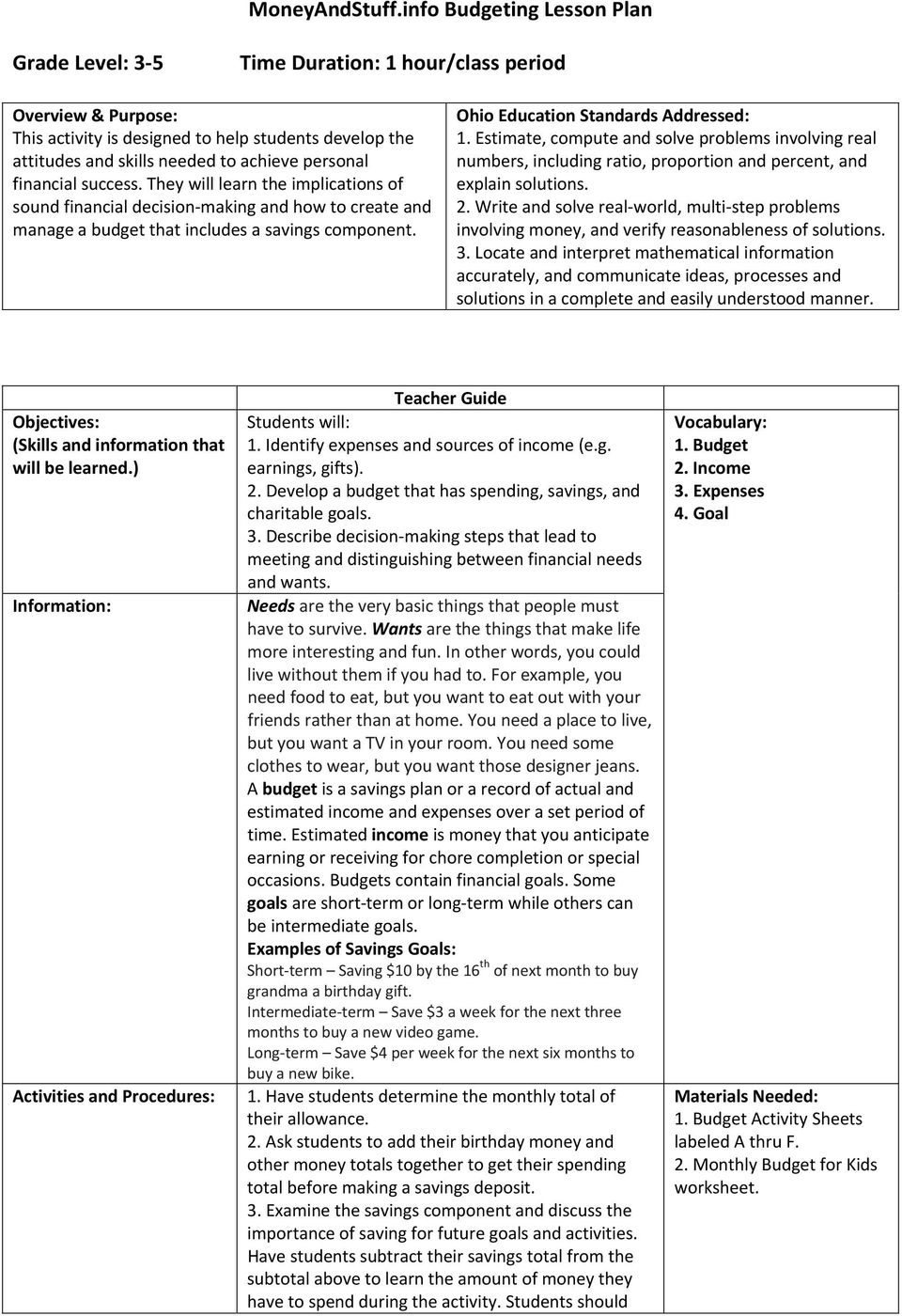
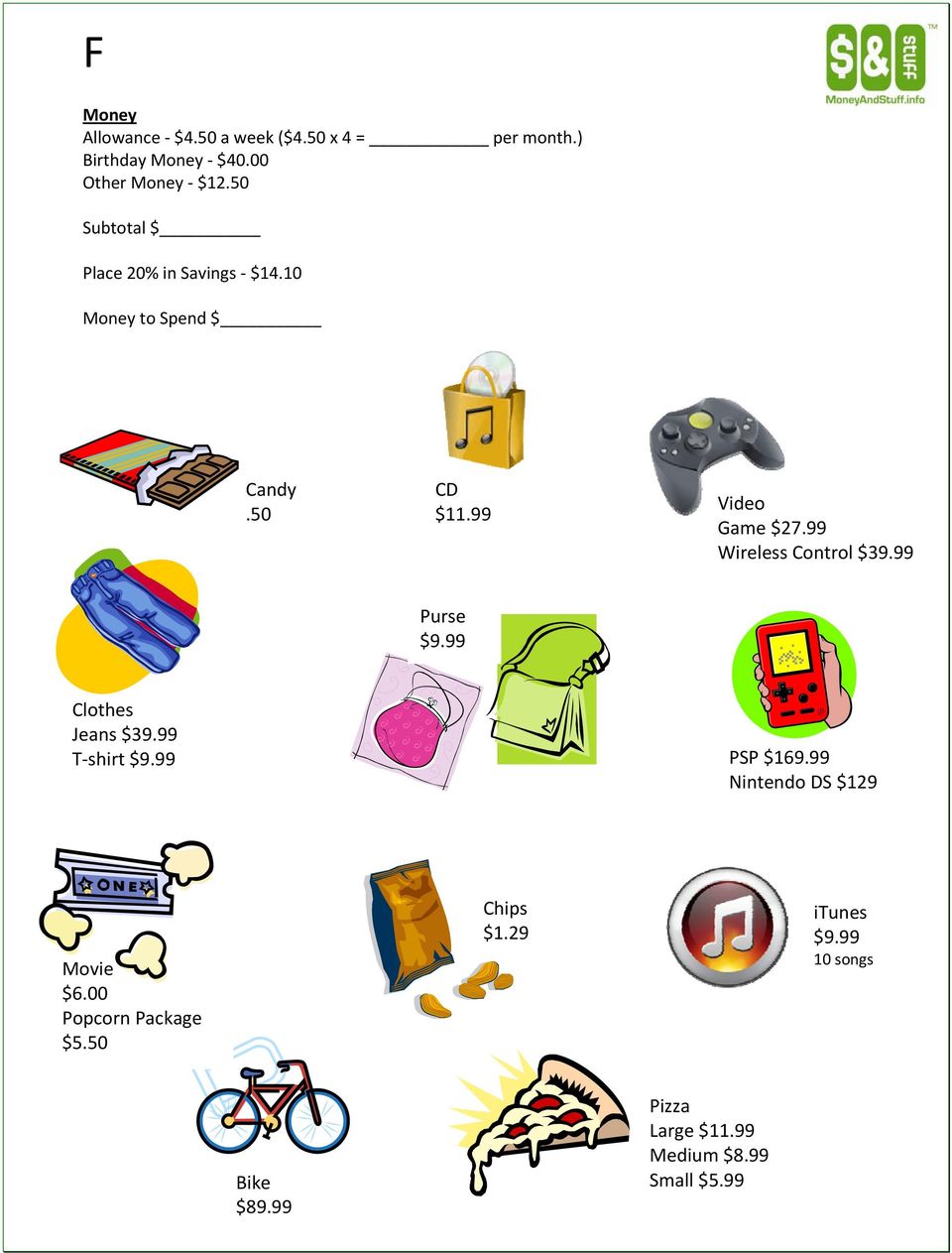
2 put the final dollar amount on the to Spend line. 5. Based upon their needs and wants, students should circle items on the handout and total up the dollar amount spent. They cannot spend more than the dollar amount discussed above. 6. With a partner(s) or the entire class, have students share the following: amount of money they had to spend, how they made their spending choices, and the dollar amount that they had left (if any). 7. Explain to students that the remaining spending money they have would rollover to the next month and be listed as other money, if they were to repeat the activity again. Conclusion: Activity Variations: Reiterate the importance of planning for the future, i.e. savings, and the ability to effectively manage money, i.e. budget. Ask students to determine how much money they would have in savings in 6 months, 12 months, and 18 months. Homework Option One Distribute the Monthly Budget for Kids worksheet and ask students to complete it based upon their own allowance and gifts. Homework Option Two Have students write a paragraph about making a charitable donation to an organization of their choice. They should review their budget and determine a dollar amount that they would like to donate. Students should explain how they determined the dollar amount to donate and the organization they wish to support. 1. Have students work in groups, A thru F, to make spending decisions and write up their answers to the questions in step six above. Afterwards, each group should present their information to the entire class. 2. Have students work independently on their spending decisions and share their choices with their classmates that have the same budgeting activity sheet. 3. Select one of the budgeting activity sheets labeled A thru F and complete the activity as a group. Extra Credit: Have students turn their budget into a graph, such as pie chart and bar graph that illustrates the following: monthly allowance, savings goal, spending allowance, and a charitable contribution. Students can use the information on the budgeting activity sheets or their personal allowance amounts to complete the graph. Find more personal finance and money lessons at

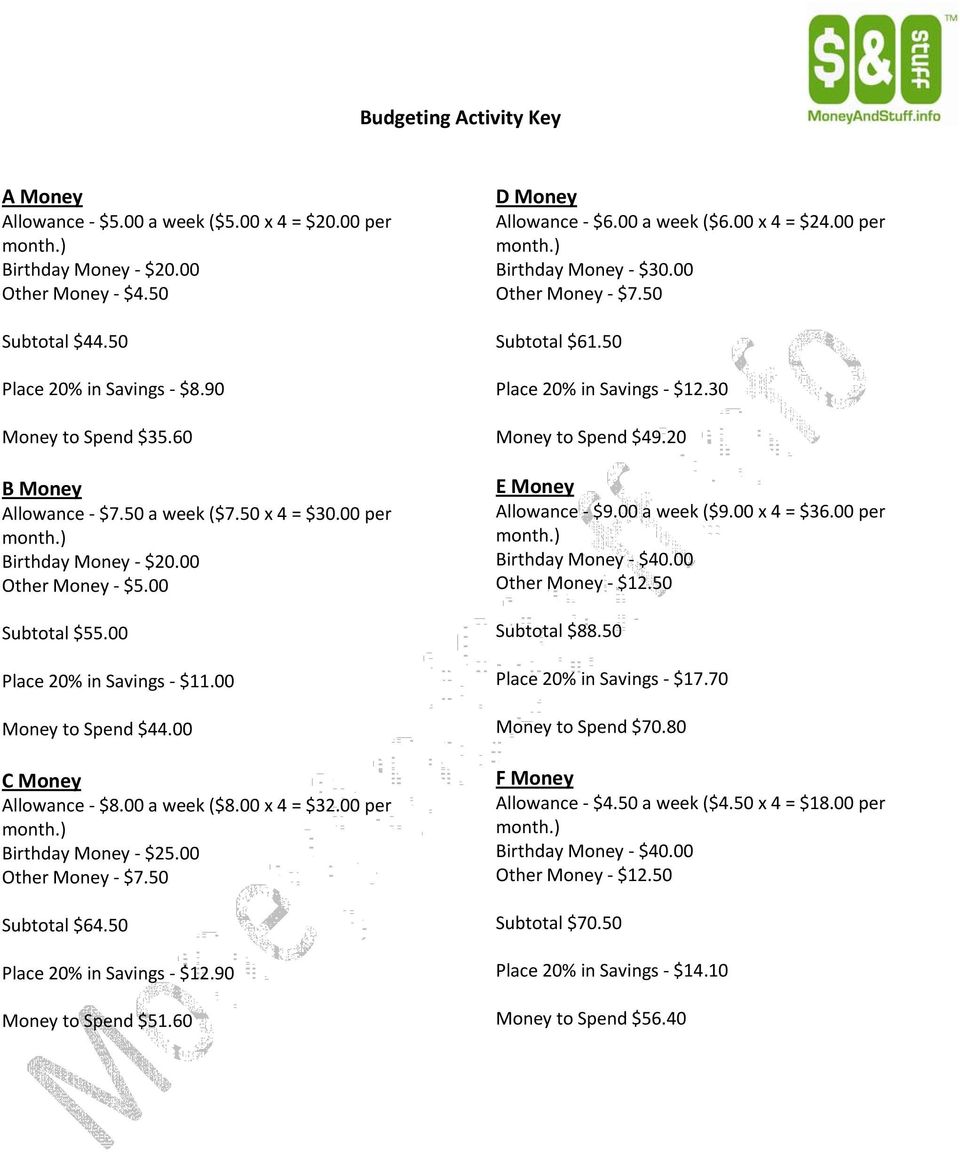
3 Budgeting Activity Key A Allowance $5.00 a week ($5.00 x 4 = $20.00 per Birthday $20.00 Other $4 Subtotal $44 Place 20% in Savings $8.90 to Spend $35.60 B Allowance $7 a week ($7 x 4 = $30.00 per Birthday $20.00 Other $5.00 Subtotal $55.00 Place 20% in Savings $11.00 to Spend $44.00 C Allowance $8.00 a week ($8.00 x 4 = $32.00 per Birthday $25.00 Other $7 Subtotal $64 Place 20% in Savings $12.90 to Spend $51.60 D Allowance a week ( x 4 = $24.00 per Birthday $30.00 Other $7 Subtotal $61 Place 20% in Savings $12.30 to Spend $49.20 E Allowance $9.00 a week ($9.00 x 4 = $36.00 per Birthday $40.00 Other $12 Subtotal $88 Place 20% in Savings $17.70 to Spend $70.80 F Allowance $4 a week ($4 x 4 = $18.00 per Birthday $40.00 Other $12 Subtotal $70 Place 20% in Savings $14.10 to Spend $56.40
4 A Allowance $5.00 a week ($5.00 x 4 = per Birthday $20.00 Other $4 Place 20% in Savings $8.90 T shirt Large

5 B Allowance $7 a week ($7 x 4 = per Birthday $20.00 Other $5.00 Place 20% in Savings $11.00 T shirt Large

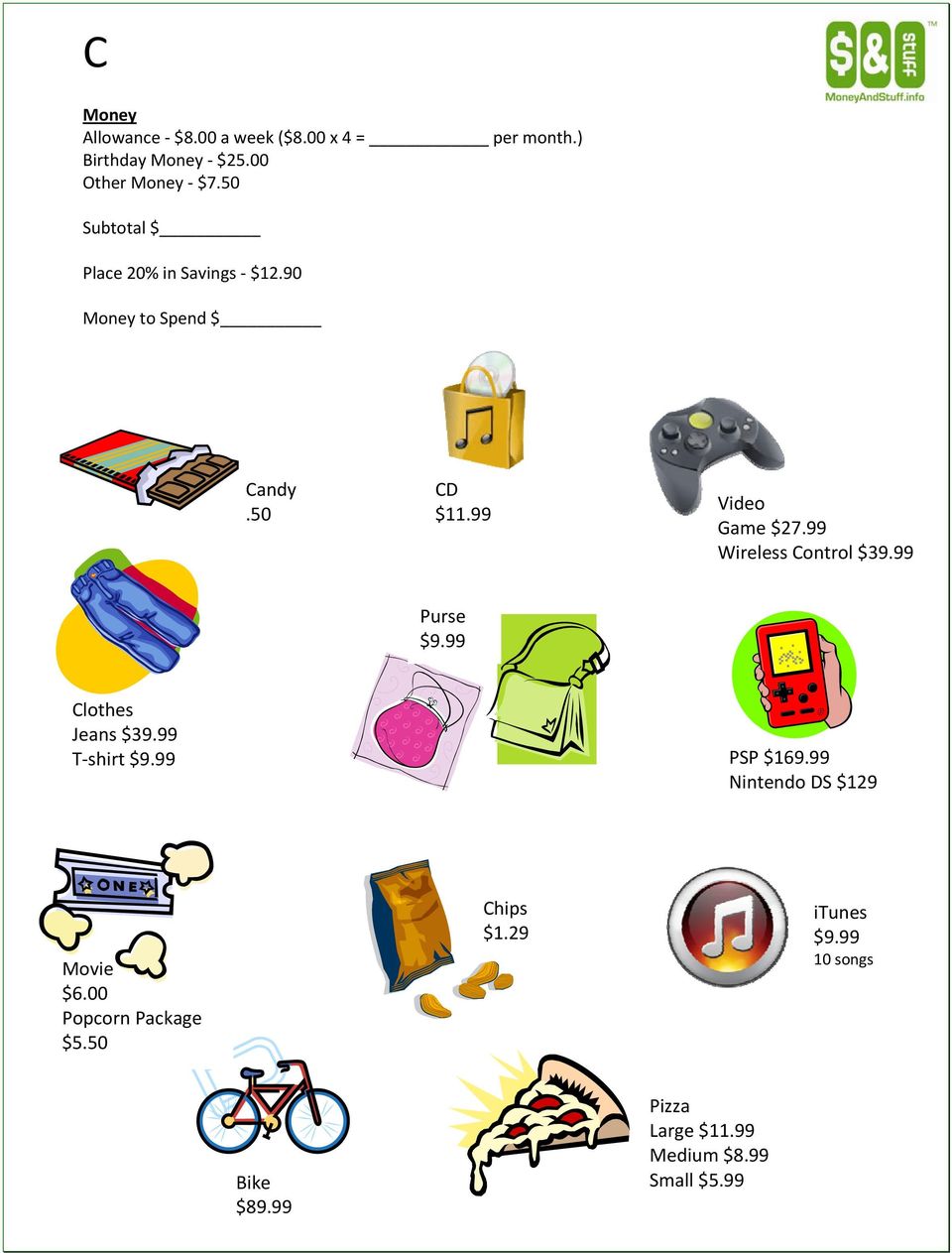
6 C Allowance $8.00 a week ($8.00 x 4 = per Birthday $25.00 Other $7 Place 20% in Savings $12.90 T shirt Large
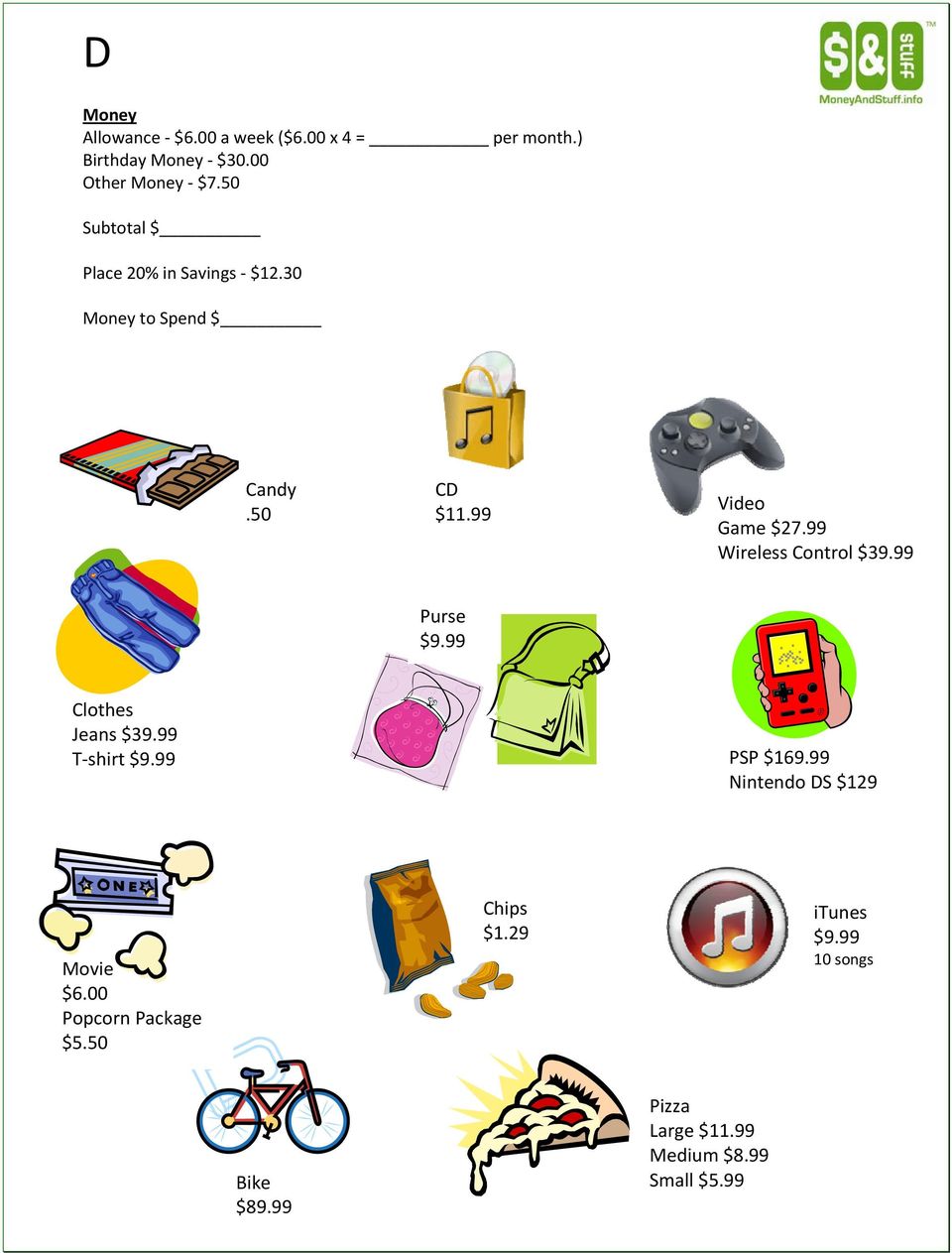
7 D Allowance a week ( x 4 = per Birthday $30.00 Other $7 Place 20% in Savings $12.30 T shirt Large
8 E Allowance $9.00 a week ($9.00 x 4 = per Birthday $40.00 Other $12 Place 20% in Savings $17.70 T shirt Large

9 F Allowance $4 a week ($4 x 4 = per Birthday $40.00 Other $12 Place 20% in Savings $14.10 T shirt Large
My Media LESSON PLAN UNIT 2. Essential Question What are your personal media habits, and how much time do you spend with different forms of media?
 LESSON PLAN My Media UNIT 2 Essential Question What are your personal media habits, and how much time do you spend with different forms of media? Lesson Overview Students review their media habits and
Preparing your students for FETCH!
 Preparing your students for FETCH! Thank you for registering your classroom to participate in The Ohio CPA Foundation s FETCH! program. Listed below are several things you can do in advance to prepare
Bunny Money. Lesson Author. Standards and Benchmarks (see page 15) Lesson Description. Grade Level. Concepts. Objectives
 FEDERAL RESERVE BANKS OF ST. LOUIS, PHILADELPHIA, AND KANSAS CITY ECONOMIC EDUCATION By Rosemary Wells / ISBN: 978-0-14-056750-2 Lesson Author Michele Wulff, Federal Reserve Bank of Kansas City Standards
Look Inside For: 30 Family Handouts (one for each student)
 Part 2 of 2 Grades 5 6 Look Inside For: 30 Family Handouts (one for each student) 3 Bonus Activities How to use these materials: 1. Distribute these Bonus Activities to your students: Bonus Activity 1:
Unit on Checking. Activity Points Possible Points Received Pre- test 10
 Unit on Checking CHECKLIST Listed below are the activities that will be graded in each area and the amount of points each activity is worth. There is also a grading scale at the bottom of the page, which
How to Make a Million Bucks! EPISODE # 406
 How to Make a Million Bucks! EPISODE # 406 LESSON LEVEL Grades 6-8 KEY TOPICS Compound interest Money management Saving LEARNING OBJECTIVES 1. Learn how compound interest works. 2. Recognize the importance
School. Lesson plan. Topic. Aims. Age group. Level. Time. Materials. School, school objects, rules, subjects, rooms and uniforms
 School Lesson plan Topic School, school objects, rules, subjects, rooms and uniforms Aims To practise (depending on stages chosen): vocabulary: words connected to school, school objects, rules, subjects,
Saving and Investing. Grade Five. Overview. Lesson Objectives. Materials List. Content Standards
 Grade Five Saving and Investing Overview Students share several chapters from the book The Young Investor: Projects and Activities for Making Your Money Grow, by Katherine R. Bateman, to learn about saving
Financial Maths - Life Skills. Budgeting UNIT. CfE Level 3 - Lesson Plan
 TeeJay Publishers Financial Maths - Life Skills Budgeting UNIT MNU 3.09b CfE Level 3 - Lesson Plan Produced for TeeJay Publishers by Pamela Fraser, Financial Education Training Officer, Dumfries & Galloway.
Discovering Math: Using and Collecting Data Teacher s Guide
 Teacher s Guide Grade Level: 3-5 Curriculum Focus: Mathematics Lesson Duration: Four class periods Program Description Discovering Math: Using and Collecting Data From data points and determining spread
TIME MANAGEMENT ACTIVITY (LED BY GEAR UP MENTORS)
 (LED BY GEAR UP MENTORS) Purpose: Students will practice time management skills that are essential to college readiness. Grades: 6-10 WWW.GEARUP4LA.NET @GEARUP4LA TOPIC SCRIPT/ DIRECTIONS MATERIALS 1 copy
Grade Level: Grade 3-5. Duration: 60+ minutes. Economic Concepts: Consumption, Money Management
 Managing Your Money: Planning Your Budget by Barbara Brooks Simons (Millmark Education Corporation, Bethesda, Maryland) 2009. ISBN-13: 978-1- 4334-0655-3 Literature Annotation Financial literacy is discussed
Lesson 3: Constructing Circle Graphs. Selected Content Standards. Translating Content Standards into Instruction
 Lesson 3: Constructing Circle Graphs Selected Content Standards Benchmarks Addressed: D-1-M Systematically collecting, organizing, describing, and displaying data in charts, tables, plots, graphs, and/or
Their Minds. Financial Literacy for Children
 Their Minds Financial Literacy for Children The Smarter Texas Program is made possible in part by the Council for Economic Education through funding from the United States Department Education Office of
Financial Institutions - All the Same? EPISODE # 204
 Financial Institutions - All the Same? EPISODE # 204 LESSON LEVEL Grades 9-12 KEY TOPICS Entrepreneurship Financial institutions Financial markets Financial accounts LEARNING OBJECTIVES 1. Distinguish
This unit is designed to take place over 7-10, 45 minute class periods. Students should have working knowledge of the following skills:
 Title: How Will I Survive? Brief Overview: Middle school students need practical application to experience the ups and downs of finance that plays an integral part of our adult lives. Students will use
3Budgeting: Keeping Track of Your Money
 This sample chapter is for review purposes only. Copyright The Goodheart-Willcox Co., Inc. All rights reserved. 3Budgeting: Keeping Track of Your Money Chapter 3 Budgeting: Keeping Track of Your Money
What s in the Books? Episode # 507
 What s in the Books? Episode # 507 LESSON LEVEL Grades 6-8 Key topics Bookkeeping & Accounting Income & Expenses Profit & Loss Entrepreneurs & Stories The Bikery Kelly Matt Wells Magic Matt Amber s Amazing
Welcome to Marketeach! Here is the sample lesson plan that you requested be sent to you. The next page is a summary of the entire set of lesson plans.
 Dear Educator, Welcome to! Here is the sample lesson plan that you requested be sent to you. The next page is a summary of the entire set of lesson plans. We at created this program to allow teachers to
STOP PLEASE DO NOT TURN THE PAGE UNTIL INSTRUCTED TO DO SO. Student Questionnaire. Grade 4
 STOP PLEASE DO NOT TURN THE PAGE UNTIL INSTRUCTED TO DO SO. Student Questionnaire Grade National Center for Education Statistics Institute of Education Sciences U.S. Department of Education 1990 K St.,
LESSON 8 -- HOW DOES YOUR FAMILY SAVE??MONEY?
 LESSON 8 -- HOW DOES YOUR FAMILY SAVE??MONEY? LESSON DESCRIPTION AND BACKGROUND This lesson uses the Better Money Habits video Easy Ways to Save on Everyday Expenses (www.bettermoneyhabits.com) to discuss
Lesson Description. Texas Essential Knowledge and Skills (Target standards) Skills (Prerequisite standards) National Standards (Supporting standards)
 Lesson Description This lesson builds on Grade 7, Lesson 1. Students will calculate net income and categorize expenses to create a budget. Percentages for each category will be calculated and analyzed.
Cash and Credit EPISODE # 109
 Cash and Credit EPISODE # 109 LESSON LEVEL Grades 4-6 KEY TOPICS Entrepreneurship Cash/Currency Credit cards Debit cards LEARNING OBJECTIVES 1. Become familiar with different methods of paying for purchases.
Lesson 2: Savings and Financial Institution Knowledge Making the Most of Your Money
 Lesson 2: Savings and Financial Institution Knowledge Making the Most of Your Money All the materials and information included in this presentation is provided for educational and illustrative purposes
What s Up With The Stock Market? EPISODE # 404
 What s Up With The Stock Market? EPISODE # 404 LESSON LEVEL Grades 6-8 KEY TOPICS Stock market Investing Stock research LEARNING OBJECTIVES 1. Understand what stocks are. 2. Identify investment strategies.
Kindergarten Social Studies Unit 10 Exemplar Lesson 01: How Families Meet Their Basic Needs
 Kindergarten Unit 10 Exemplar Lesson 01: How Families Meet Their Basic Needs This lesson is one approach to teaching the State Standards associated with this unit. Districts are encouraged to customize
How Do You Manage Money? Lesson 3a: How Do People Make Good Spending Decisions?
 How Do You Manage Money? Lesson 3a: How Do People Make Good Spending Decisions? Adopted from lesson plans created by Jennifer Raeder for the San Francisco Unified School District s Kindergarten to College
Rock, Brock, and the Savings Shock by Sheila Bair (Albert Whitman & Company, Morton Grove, Illinois 2006) ISBN 978-0-8075-7094-4
 Rock, Brock, and the Savings Shock by Sheila Bair (Albert Whitman & Company, Morton Grove, Illinois 2006) ISBN 978-0-8075-7094-4 Literature Annotation Gramps teaches his twin grandsons the value of saving
Plan a Vacation. Lesson M3
 Lesson M3 page 1 of 2 Math TEKS Objectives 111.22 Plan a Vacation 6b.1 (A) apply mathematics to problems arising in everyday life, society, and the workplace 6b.1 (B) use a problem-solving model that incorporates
Savings & Checking. { http://youth.macu.com }
 Savings & Checking { http://youth.macu.com } Mountain America Credit Union knows that it s never too early to start learning critical money management skills. That s why we ve put this information together
THEME THREE: APPLY FINANCIAL PLANNING AND BUDGETING MECHANISMS. LESSON TITLE: Theme 3, Lesson 2: Money Magic
 THEME THREE: APPLY FINANCIAL PLANNING AND BUDGETING MECHANISMS LESSON TITLE: Theme 3, Lesson 2: Money Magic Lesson Description: This lesson helps students compare and contrast saving and investing alternatives
Unit 4: Taxes. Read this unit including websites. You may want to take your own notes.
 Taxes Read Chapter 4 in the text. Read Chapter 7 of The Financial Checkup. Read this unit including websites. You may want to take your own notes. Are taxes your favorite topic? They are not the favorite
What to Do With a Windfall Episode # 511
 What to Do With a Windfall Episode # 511 LESSON LEVEL Grades 6-8 Key topics Decision Making Investing Personal Financial Plan Entrepreneurs & Stories LA Sparks WNBA Basketball Candace Layla West Dance
Saving and Investing
 Teacher's Guide $ Lesson Three Saving and Investing 07/13 saving and investing websites websites for saving and investing The internet is probably the most extensive and dynamic source of information in
Understanding Checks and Checking Accounts
 financial literacy Understanding Checks and Checking Accounts Aim To raise students awareness of the cost-cutting benefits of using checking accounts to pay bills and cash paychecks. Objectives At the
Graphs of Proportional Relationships
 Graphs of Proportional Relationships Student Probe Susan runs three laps at the track in 12 minutes. A graph of this proportional relationship is shown below. Explain the meaning of points A (0,0), B (1,),
Creating Graphs. Learning Objective-To create graphs that show data.
 Creating Graphs Summary- Key Words- Students will be able to identify graphs, components of graphs, interpret graphs, and construct various types of graphs. Pictograph Bar Graph Circle Graph Background
LESSON 7 Don t Be A Square by Michael Torres
 CONCEPT AREA GRADE LEVEL Measurement 5-6 TIME ALLOTMENT Two 60-minute sessions LESSON OVERVIEW LESSON ACTIVITIES OVERVIEW LEARNING OBJECTIVES STANDARDS (TEKS) Students will learn the relationship between
CHECKING ACCOUNTS and ATM TRANSACTIONS
 Grades 6-8 Lesson 1 CHECKING ACCOUNTS and ATM TRANSACTIONS Key concepts: Checking accounts, ATMs, debit cards, credit cards, bank fees and regulation, safeguarding personal information Summary: This lesson
Graphs of Proportional Relationships
 Graphs of Proportional Relationships Student Probe Susan runs three laps at the track in 12 minutes. A graph of this proportional relationship is shown below. Explain the meaning of points A (0,0), B (1,4),
Using Your Credit - Crazy or Compelling? EPISODE # 115
 Using Your Credit - Crazy or Compelling? EPISODE # 115 LESSON LEVEL Grades 4-6 KEY TOPICS Entrepreneurship Credit Interest LEARNING OBJECTIVES 1. Learn about borrowing money. 2. Understand your credit
Factoring Quadratic Trinomials
 Factoring Quadratic Trinomials Student Probe Factor x x 3 10. Answer: x 5 x Lesson Description This lesson uses the area model of multiplication to factor quadratic trinomials. Part 1 of the lesson consists
Lesson Title/Description:
 Lesson Title/Description: Planning for Surprises Time Allotted for this Lesson: 55 minutes Goals (i.e. Oregon financial literacy standards): HS.45 Explain how to prepare a budget that allows for living
Lesson 8: So How Much Are You Really Paying for That Loan?
 All About Credit Lesson 8: So How Much Are You Really Paying for That Loan? Standards and Benchmarks (see page C-46) Lesson Description Students learn what a payday loan is and the high cost involved in
BEAN BUDGET: A budgeting exercise
 BEAN BUDGET: A budgeting exercise Objective: Help students think about how to make budgeting choices and how to determine spending priorities. Time: 0 minutes Materials: Bean Budget Handout (2-page) Cut
Students will devise a savings plan for college.
 Lesson Description Students will analyze data to determine the relationship between level of educational attainment and weekly earnings and the relationship between level of educational attainment and
MATHEMATICAL LITERACY LESSON PLANS
 MATHEMATICAL LITERACY LESSON PLANS GRADE 11. LESSON PLAN 1. Lesson Plan: Personal finance Number f Activities : 3 Duration : +/- 13H30 Week : 1-3 Date: Context : Personal finance management, Business context.
Why should I have a bank account and how do I use one?
 Take it to the Bank! 2 Money Matters The BIG Idea Why should I have a bank account and how do I use one? AGENDA Approx. 45 minutes I. Warm Up: Why a Bank? (5 minutes) II. Checking Accounts: Putting Your
Lesson 4: Your Budget Plan
 KaChing! Lesson 4: Your Budget Plan Standards and Benchmarks (see page B-41) Lesson Description Students work in pairs to participate in a Track Star game that illustrates positive and negative spending
How To Factor Quadratic Trinomials
 Factoring Quadratic Trinomials Student Probe Factor Answer: Lesson Description This lesson uses the area model of multiplication to factor quadratic trinomials Part 1 of the lesson consists of circle puzzles
Ohio State Benchmarks Social Studies Economics: Personal Finance Family & Consumer Science - Personal Financial Literacy
 Ohio State Benchmarks Social Studies Economics: Personal Finance Family & Consumer Science - Personal Financial Literacy Correlation to Virtual Business - Personal Finance Course Concepts Virtual Business
How To Teach Your Students To Be Respectful
 E-RATE TOOLKIT Show Respect Online LESSON PLAN Essential Question: How can I make sure my emails are clear and respectful? Learning Overview and Objectives Overview: Students explore the similarities and
Part Three: How Does the Government Decide how much Tax to Levy?
 Part Three: How Does the Government Decide how much Tax to Levy? Purpose and Curricular Connections Property taxes pay for important services, such as schools. In this part, students learn about what the
Multiplying Integers. Lesson Plan
 Lesson Plan Video: 12 minutes Lesson: 38 minutes Pre-viewing :00 Warm up: Write 5 + 5 + 5 + 5 = on the board. Ask students for the answer. Then write 5 x 4 = on the board. Ask the students for the answer.
FIDDLIN WITH FRACTIONS
 FIDDLIN WITH FRACTIONS Special Area: Connections (Fourth and Fifth Grade) Written by: (Dawn Ramos, Joan Johnson, Mindy Wilshusen, St. Mary s School) Length of Unit: (6 Lessons) I. ABSTRACT The purpose
Starting Your Own Business
 Grade Five Starting Your Own Business Overview Students listen to several chapters from The Toothpaste Millionaire, by Jean Merrill, to learn about starting a business and earning a profit. They complete
TEACHING UNIT. Budgeting, Planning, and Goal-Setting Importance of Planning Grade 6 Mathematics Language Arts
 TEACHING UNIT General Topic: Unit Title: Grade Level: Recommended Curriculum Area: Other Relevant Curriculum Area(s): Budgeting, Planning, and Goal-Setting Importance of Planning Grade 6 Mathematics Language
What s Up With The Stock Market? EPISODE # 404
 What s Up With The Stock Market? EPISODE # 404 LESSON LEVEL Grades 9-12 KEY TOPICS Stock market Investing Stock research LEARNING OBJECTIVES 1. Understand what stocks are. 2. Identify investment strategies.
The purpose of this unit plan is to help students research and share information about Renewable
 Page 1 of 6 Renewable Sources of Energy: A Research and Building Unit Plan Brief description The purpose of this unit plan is to help students research and share information about Renewable Sources of
Title of Lesson: Twilight Reconciling Edward Cullen s Bank Statement. Grade Level(s): 9th 12th Grades
 Title of Lesson: Twilight Reconciling Edward Cullen s Bank Statement Grade Level(s): 9th 12th Grades Materials Needed: Lesson Plan information sheet, worksheet, and quiz, pencils, & calculators Lesson
PLANNING A BUDGET. Income, needs vs. wants, budgets, simple interest, savings accounts, paying yourself first
 Grades 6-8 Lesson 3 PLANNING A BUDGET Key concepts: Income, needs vs. wants, budgets, simple interest, savings accounts, paying yourself first Summary: This lesson reviews trade-offs and priorities in
1Planning Your Financial Future: It Begins Here
 This sample chapter is for review purposes only. Copyright The Goodheart-Willcox Co., Inc. All rights reserved. 1Planning Your Financial Future: It Begins Here Terms Financial plan Financial goals Needs
Fact Sheet 4: Getting Your Paycheck: Direct Deposit, Check or Payroll Card http://paycheck.kcfed.org
 Federal Reserve Bank of Kansas City Fact Sheet 4: Getting Your Paycheck: Direct Deposit, Check or Payroll Card http://paycheck.kcfed.org Objectives for Fact Sheet 4 Describe the different ways to receive
lesson three budgeting your money teacher s guide
 lesson three budgeting your money teacher s guide budgeting your money lesson outline lesson 3 overview I m all out of money, and I won t get paid again until the end of next week! This is a common dilemma
Preparing a budget template and presenting financial graphs using Excel
 Preparing a budget template and presenting financial graphs using Excel KLA: STAGE: UNIT: Topic: HSIE Stage 5 Commerce Personal Finance Budgeting, loans and insurance Outcomes: 5.1 Applies consumer, financial,
Differentiated plans for Years 5 & 6. Fractions, decimals, percentages & ratios
 Differentiated plans for Years 5 & 6 Fractions, decimals, percentages & ratios Ian Lowe, MAV Professional Officer, 2006 IF YOU USE ANY OF THIS PLEASE PROVIDE FEEDBACK TO IAN AT [email protected] THIS
Previous Letterland at Tweetsie Railroad Motivation and reward Letterland at Tweetsie Curriculum Guides
 Previous Letterland at Tweetsie Railroad Each May since 2007, children from all over North Carolina (and Texas and Georgia) have come to Letterland at Tweetsie Railroad, where we have transformed our theme
Kids and Money: A Guide for Parents
 Kids and Money: A Guide for Parents Kids and Money: A Guide for Parents As a parent, you have a lot to share with your kids about earning, saving, spending and managing money responsibly. You play an important
Discovering Math: Data and Graphs Teacher s Guide
 Teacher s Guide Grade Level: K 2 Curriculum Focus: Mathematics Lesson Duration: Two class periods Program Description Discovering Math: Data and Graphs From simple graphs to sampling to determining what
Borrowing & Saving: Week 1
 The Minnesota Literacy Council created this curriculum with funding from the MN Department of Education. We invite you to adapt it for your own classrooms. Intermediate Level (CASAS reading scores of 201-220)
Teens Version. Instructor guide. 2003, 2013 Wells Fargo Bank, N.A. All rights reserved. Member FDIC. ECG-714394 VERSION 5.1
 Teens Version. Instructor guide. 2003, 2013 Wells Fargo Bank, N.A. All rights reserved. Member FDIC. ECG-714394 VERSION 5.1 Hands on Banking Instructor s Guide. Teens Version (Grades 6 8). Table of Contents.
Lesson Description. Texas Essential Knowledge and Skills (Target standards) Texas Essential Knowledge and Skills (Prerequisite standards)
 Lesson Description In this lesson students first offer what they know about taxes. They then jigsaw an article on taxes written by a fellow fifth grader. Groups present the information that they feel is
TeachInG UnIT. Grade Level: Grade 6 Recommended Curriculum Area: Mathematics Other Relevant Curriculum Area(s): Language Arts
 BUILDING FUTURES IN ONTARIO TeachInG UnIT General Topic: Budgeting, Planning, and Goal-Setting Unit Title: Importance of Planning Grade Level: Grade 6 Recommended Curriculum Area: Mathematics Other Relevant
Business Studies, Grades 9/10, Information and Communication Technology in Business, BTT1O/BTT2O
 FINANCIAL LITERACY Overview Students develop an understanding of concepts and skills related to financial literacy as they learn to use productivity software to record and communicate spending decisions
Game or bike? Movie or shoes? Chocolate sundae with extra rainbow sprinkles on top?
 Game or bike? Movie or shoes? Chocolate sundae with extra rainbow sprinkles on top? One of the best things about having your own money is that you get to decide how to spend it. Whether you get a weekly
Money, Money, Money. Lesson Plan
 208 Lesson Plan Objectives: 1. Participants will be able to create a usable spending plan. 2. Participants will be able to identify resources, other than money, that they have. 3. Participants will be
Understanding Income and Expenses EPISODE # 123
 Understanding Income and Expenses EPISODE # 123 LESSON LEVEL Grades 4-6 KEY TOPICS Entrepreneurship Income and expenses Cash flow LEARNING OBJECTIVES 1. Understand what your income and expenses are. 2.
This document contains Chapter 2: Statistics, Data Analysis, and Probability strand from the 2008 California High School Exit Examination (CAHSEE):
 This document contains Chapter 2:, Data Analysis, and strand from the 28 California High School Exit Examination (CAHSEE): Mathematics Study Guide published by the California Department of Education. The
Shopping: Week 1 of 2
 The Minnesota Literacy Council created this curriculum with funding from the MN Department of Education. We invite you to adapt it for your own classrooms. Beginning Level (CASAS reading scores of 181-200)
Lab 11: Budgeting with Excel
 Lab 11: Budgeting with Excel This lab exercise will have you track credit card bills over a period of three months. You will determine those months in which a budget was met for various categories. You
Debt: The Good, The Bad, & The Ugly EPISODE # 402
 Debt: The Good, The Bad, & The Ugly EPISODE # 402 LESSON LEVEL Grades 6-8 KEY TOPICS Debt management Budgets Compound interest LEARNING OBJECTIVES 1. Understand different types of debt. 2. Learn how budgets
Lesson Description. Texas Essential Knowledge and Skills (Target standards) National Standards (Supporting standards)
 Lesson Description The students will share their base knowledge of payment options through a sorting activity. Students will brainstorm with groups to discuss the differences between debit and credit cards.
Similar Triangles Grade Seven
 Ohio Standards Connection Geometry and Spatial Sense Benchmark E Use proportions to express relationships among corresponding parts of similar figures. Indicator 1 Use proportional reasoning to describe
Lesson Plan: US Canada Trade Relations (with an Emphasis on Georgia)
 Lesson Plan: US Canada Trade Relations (with an Emphasis on Georgia) Submitted by: Hope Bentley (Bay Creek Middle School - Grayson, GA) Date: August 1, 2012 Description: This lesson will inform students
Using Ratios to Taste the Rainbow. Lesson Plan
 Using Ratios to Taste the Rainbow Lesson Plan Cube Fellow: Amber DeMore Teacher Mentor: Kelly Griggs Goal: At the end of the activity, the students will know that the actual ratio of colored skittles is
Lesson Description. Concepts. Objectives. Content Standards. Time Required. KaChing! Lesson 4: Your Budget Plan
 Lesson Description Students work in pairs to participate in a Track Star game that illustrates positive and negative spending behaviors. Each pair of students analyzes the Track Star results, identifies
Religion Gets Largest Share of Charity in US
 Religion Gets Largest Share of Charity in US VOA Special English (voaspecialenglish.com) is Voice of America's daily news and information service for English learners. Read the story and then do the activities
Lesson Description. Texas Essential Knowledge and Skills (Target standards) Skills (Prerequisite standards) National Standards (Supporting standards)
 Lesson Description Students will investigate a grocery receipt and learn that some items are nontaxable and some are taxable. The students will calculate the sales tax and total amount owed on two receipts,
Solving Systems of Linear Equations Substitutions
 Solving Systems of Linear Equations Substitutions Outcome (lesson objective) Students will accurately solve a system of equations algebraically using substitution. Student/Class Goal Students thinking
THE HISTORY OF BANKING AND SAVING
 Grades 2-3 Lesson 2 THE HISTORY OF BANKING AND SAVING Key concepts: Bank accounts, savings, reasons to save Summary: This lesson introduces the history of banks and bank accounts, especially savings accounts.
Academic Support Services Supplemental Learning Materials - Math
 Academic Support Services Supplemental Learning Materials - Math Algebra and trigonometry Basic math Calculator help Charts and graphs Coordinate planes Decimals Exponents General math sites Graphing Integers
Setting Your Financial Goals
 Lesson 1: Setting Your Financial Goals Lesson Overview: This lesson will help students to understand why it is important to set financial goals as well as to develop a plan to achieve those goals by saving
YOUR FINANCIAL FUTURE. LEVEL Three
 YOUR FINANCIAL FUTURE LEVEL Three YOUR FINANCIAL FUTURE LEVEL THREE Steve Mariotti NEELAM PATEL Network for Teaching Entrepreneurship Your Financial Future Written by Steve Mariotti and Neelam Patel of
What is a Bank? Episode # 508
 What is a Bank? Episode # 508 LESSON LEVEL Grades 6-8 Key topics Banking Credit & Debt Saving & Investing Entrepreneurs & Stories Ballroom dancers Polina & Nathan City Slips Katie & Susie Night Terrors