
SUMMARY OF BORROWER INTAKE FORM DATA COLLECTED for the STUDENT LOAN BORROWER COUNSELING PROGRAM
|
|
|
- Virginia Wilkinson
- 10 years ago
- Views:
Transcription
1 SUMMARY OF BORROWER INTAKE FORM DATA COLLECTED for the STUDENT LOAN BORROWER COUNSELING PROGRAM Prepared by the For the Center for Excellence in Financial Counseling LEADERSHIP COUNCIL SEMI-ANNUAL MEETING OCTOBER 21, 2014

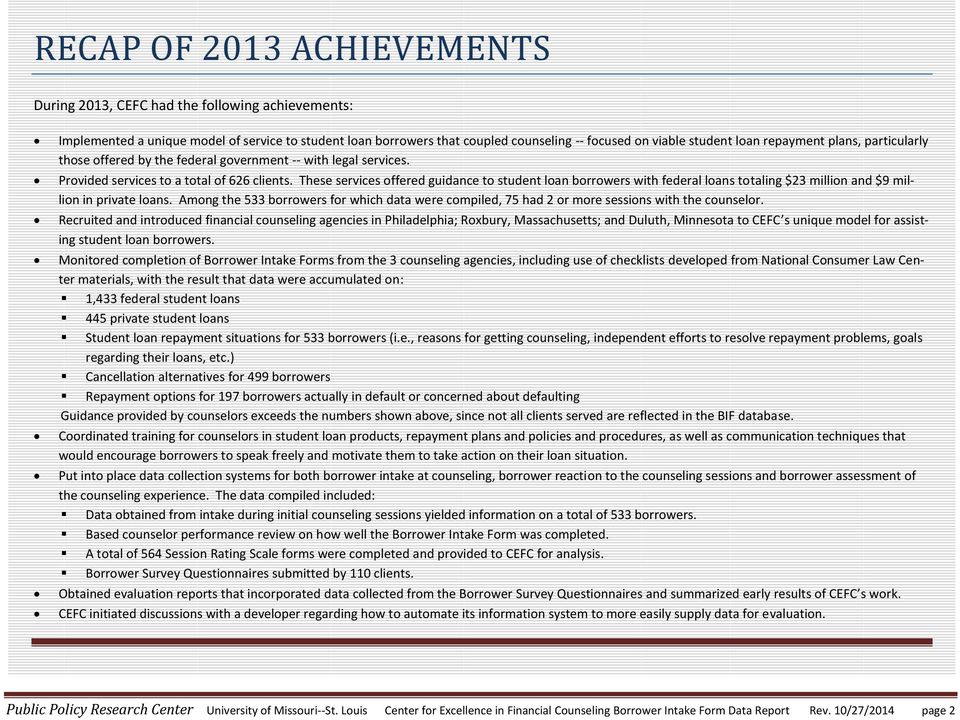
2 RECAP OF 2013 ACHIEVEMENTS During 2013, CEFC had the following achievements: Implemented a unique model of service to student loan borrowers that coupled counseling -- focused on viable student loan repayment plans, particularly those offered by the federal government -- with legal services. Provided services to a total of 626 clients. These services offered guidance to student loan borrowers with federal loans totaling $23 million and $9 million in private loans. Among the 533 borrowers for which data were compiled, 75 had 2 or more sessions with the counselor. Recruited and introduced financial counseling agencies in Philadelphia; Roxbury, Massachusetts; and Duluth, Minnesota to CEFC s unique model for assisting student loan borrowers. Monitored completion of Borrower Intake Forms from the 3 counseling agencies, including use of checklists developed from National Consumer Law Center materials, with the result that data were accumulated on: 1,433 federal student loans 445 private student loans Student loan repayment situations for 533 borrowers (i.e., reasons for getting counseling, independent efforts to resolve repayment problems, goals regarding their loans, etc.) Cancellation alternatives for 499 borrowers Repayment options for 197 borrowers actually in default or concerned about defaulting Guidance provided by counselors exceeds the numbers shown above, since not all clients served are reflected in the BIF database. Coordinated training for counselors in student loan products, repayment plans and policies and procedures, as well as communication techniques that would encourage borrowers to speak freely and motivate them to take action on their loan situation. Put into place data collection systems for both borrower intake at counseling, borrower reaction to the counseling sessions and borrower assessment of the counseling experience. The data compiled included: Data obtained from intake during initial counseling sessions yielded information on a total of 533 borrowers. Based counselor performance review on how well the Borrower Intake Form was completed. A total of 564 Session Rating Scale forms were completed and provided to CEFC for analysis. Borrower Survey Questionnaires submitted by 110 clients. Obtained evaluation reports that incorporated data collected from the Borrower Survey Questionnaires and summarized early results of CEFC s work. CEFC initiated discussions with a developer regarding how to automate its information system to more easily supply data for evaluation. Public Policy Research Center University of Missouri--St. Louis Center for Excellence in Financial Counseling Borrower Intake Form Data Report Rev. 10/27/2014 page 2
3 INTRODUCTION This report presents the results of data analyses of demographic and performance indicators adopted by the Center for Excellence in Financial Counseling (CEFC) during its first year of service. These data were collected from borrowers during client intake with agency counselors from March 1 through December 31, CEFC s primary data collection instrument is referred to as the Borrower Intake Form. To CEFC s credit, leadership and staff have given significant attention to determining performance measures, with a recognition of the value of data to evaluation and other mechanisms for documenting program success. Information quality has received ongoing consideration, as has program fidelity a necessary component of multi-site initiatives. The challenges of coordinating implementation, along with data collection, at multiple sites have been evident, however. Not surprisingly, there has been an influence on record-keeping. CEFC was fortunate to have someone in one of the counseling agencies who could develop a user interface suitable for data entry. Also available was a set of preliminary indicators developed by the National Consumer Law Center. While this gave CEFC an auspicious beginning, two issues emerged that carried forward into INTEGRATION OF CEFC s DATA NEEDS INTO EXISTING SYSTEMS: The agencies that CEFC chose to work with are all well-established organizations. Larger, more established agencies such as Clarifi and Lutheran Social Services Financial Counseling have their own management information systems. Systems already in use may lack flexibility to incorporate new indicators without a developer s assistance, or the additional data collection may increase workload for staff. What CEFC found in the first year of service is that the agencies it recruited exercised their own discretion in how they completed the Borrower Intake Form, in order to accommodate existing systems within their organization. As a result, some of the data files submitted were incomplete or simply couldn t be used. For example, while CEFC agencies served a total of 626 borrowers in 2013, data records are available for a smaller sample of 533. DATA FORMAT: The data submitted by counseling agencies outside the Borrower Intake Form tended to be in a format (pdf or Word files) less suitable for statistical analysis. As discussed at previous Leadership Council meetings, the Borrower Intake Form itself was just that: a form. The lack of data tables for data storage impeded in-depth analysis. Although the information system is still under development, this major impediment to use of the Borrower Intake Form data was successfully resolved so that 2013 and 2014 records are now much more accessible. Public Policy Research Center University of Missouri--St. Louis Center for Excellence in Financial Counseling Borrower Intake Form Data Report Rev. 10/27/2014 page 3

4 Borrowers are encouraged to schedule additional appointments with their counselors. A review of counseling agency data records indicates that 75 (14 percent) of the 533 borrowers for which Borrower Intake Form data are available obtained further counseling through additional sessions. As the chart shows, the majority of these clients attended 2 sessions, although some borrowers remained involved with the counselor over 3 or 4 sessions. In a few cases, counselors had as many as 5 or 6 contacts with borrowers. One important aspect of subsequent counseling sessions is the opportunity it gives the counselor to learn how the borrower has followed up on action plan tasks and adjust their recommendations, based on improvements in the borrower s situation. SERVICE DELIVERY PROCESSES: REPEATED SESSIONS Borrowers with Recorded Repeat Counseling Sessions Compared to Frequency of Sessions for All Borrowers 2 sessions 3 sessions 4 or more sessions BORROWERS WITH RECORDED FOLLOW-UP SESSIONS (Total = 75) 1 session 2 sessions 3 sessions 4 or more sessions ALL BORROWERS, BY RECORDED SESSION FREQUENCY (Total = 533) Public Policy Research Center University of Missouri--St. Louis Center for Excellence in Financial Counseling Borrower Intake Form Data Report Rev. 10/27/2014 page 4

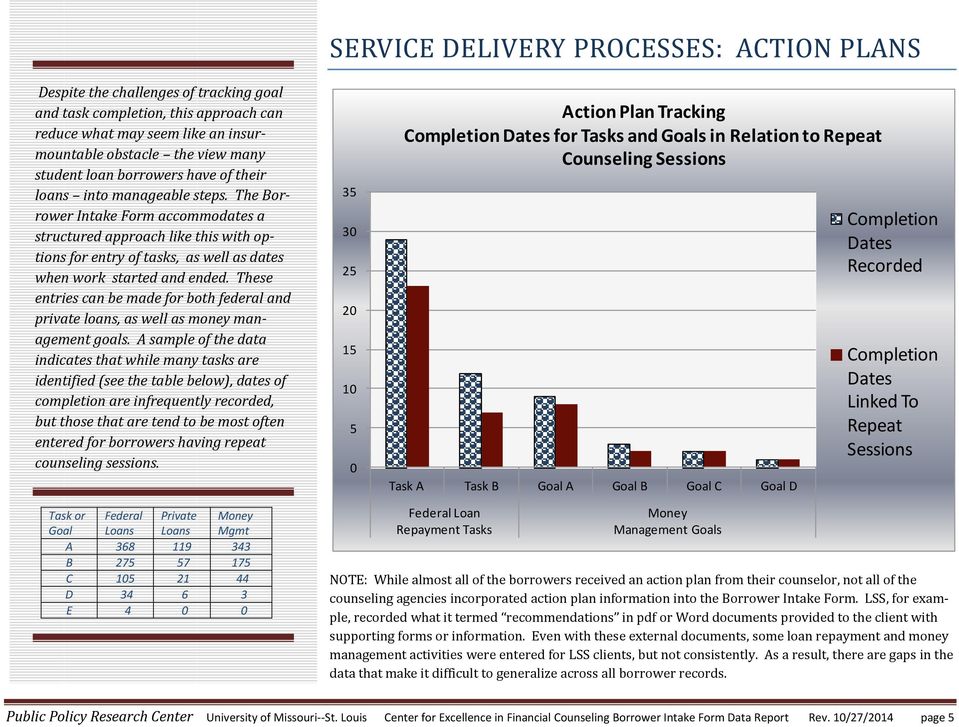
5 SERVICE DELIVERY PROCESSES: ACTION PLANS Despite the challenges of tracking goal and task completion, this approach can reduce what may seem like an insurmountable obstacle the view many student loan borrowers have of their loans into manageable steps. The Borrower Intake Form accommodates a structured approach like this with options for entry of tasks, as well as dates when work started and ended. These entries can be made for both federal and private loans, as well as money management goals. A sample of the data indicates that while many tasks are identified (see the table below), dates of completion are infrequently recorded, but those that are tend to be most often entered for borrowers having repeat counseling sessions Action Plan Tracking Completion Dates for Tasks and Goals in Relation to Repeat Counseling Sessions Task A Task B Goal A Goal B Goal C Goal D Completion Dates Recorded Completion Dates Linked To Repeat Sessions Task or Goal Federal Loans Private Loans Money Mgmt A B C D E Federal Loan Repayment Tasks Money Management Goals NOTE: While almost all of the borrowers received an action plan from their counselor, not all of the counseling agencies incorporated action plan information into the Borrower Intake Form. LSS, for example, recorded what it termed recommendations in pdf or Word documents provided to the client with supporting forms or information. Even with these external documents, some loan repayment and money management activities were entered for LSS clients, but not consistently. As a result, there are gaps in the data that make it difficult to generalize across all borrower records. Public Policy Research Center University of Missouri--St. Louis Center for Excellence in Financial Counseling Borrower Intake Form Data Report Rev. 10/27/2014 page 5
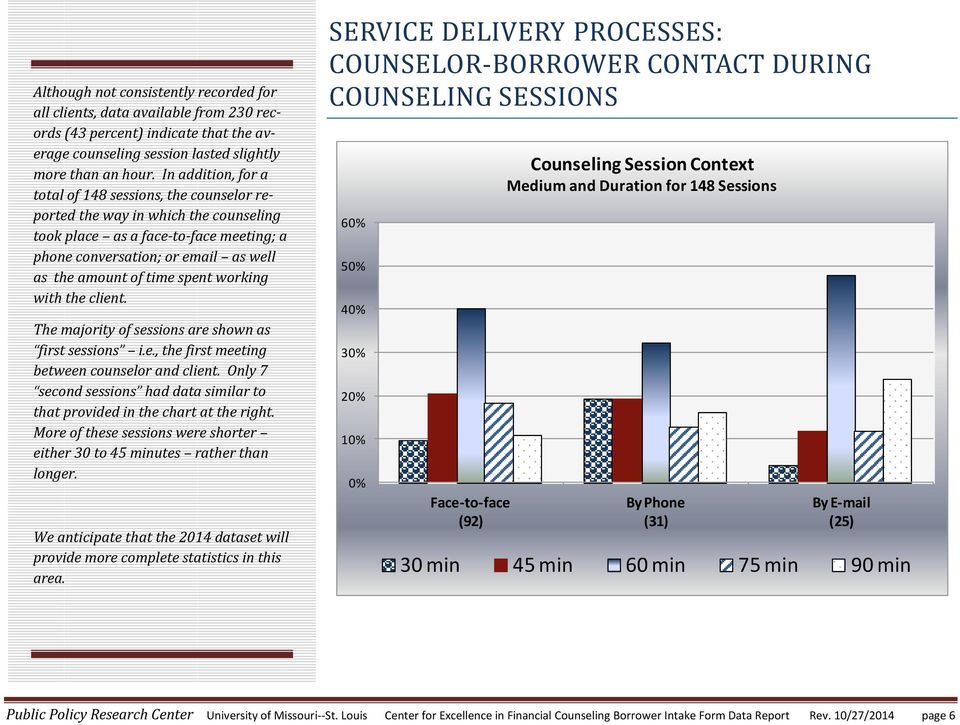
6 Although not consistently recorded for all clients, data available from 230 records (43 percent) indicate that the average counseling session lasted slightly more than an hour. In addition, for a total of 148 sessions, the counselor reported the way in which the counseling took place as a face-to-face meeting; a phone conversation; or as well as the amount of time spent working with the client. The majority of sessions are shown as first sessions i.e., the first meeting between counselor and client. Only 7 second sessions had data similar to that provided in the chart at the right. More of these sessions were shorter either 30 to 45 minutes rather than longer. We anticipate that the 2014 dataset will provide more complete statistics in this area. SERVICE DELIVERY PROCESSES: COUNSELOR-BORROWER CONTACT DURING COUNSELING SESSIONS Face-to-face (92) Counseling Session Context Medium and Duration for 148 Sessions By Phone (31) By (25) 30 min 45 min 60 min 75 min 90 min Public Policy Research Center University of Missouri--St. Louis Center for Excellence in Financial Counseling Borrower Intake Form Data Report Rev. 10/27/2014 page 6
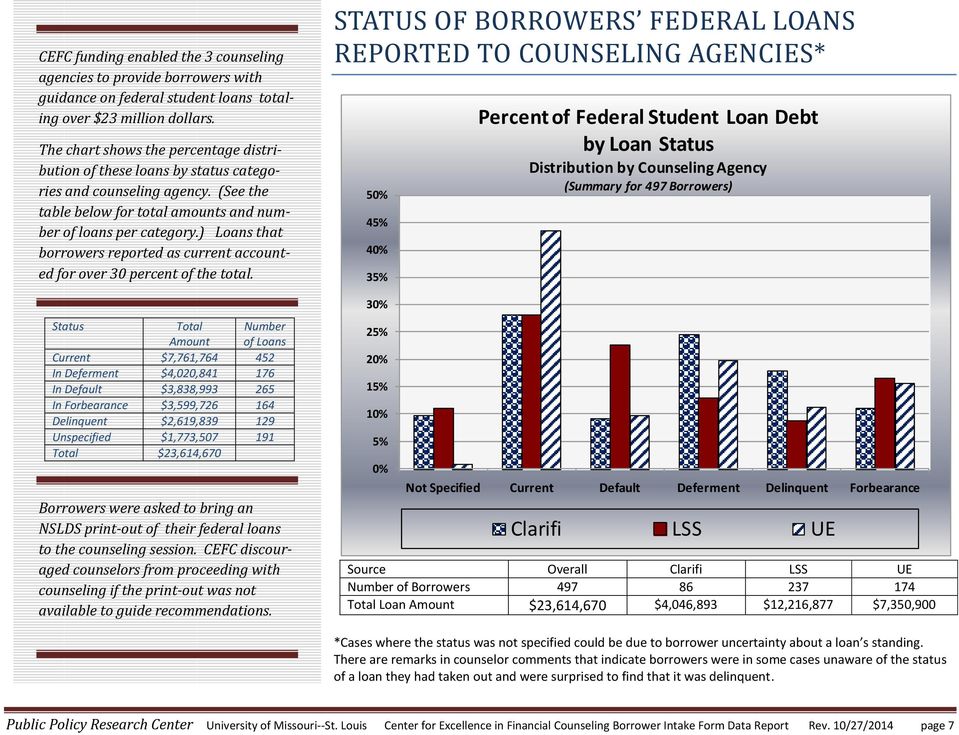
7 CEFC funding enabled the 3 counseling agencies to provide borrowers with guidance on federal student loans totaling over $23 million dollars. The chart shows the percentage distribution of these loans by status categories and counseling agency. (See the table below for total amounts and number of loans per category.) Loans that borrowers reported as current accounted for over 30 percent of the total. Status Total Amount Number of Loans Current $7,761, In Deferment $4,020, In Default $3,838, In Forbearance $3,599, Delinquent $2,619, Unspecified $1,773, Total $23,614,670 Borrowers were asked to bring an NSLDS print-out of their federal loans to the counseling session. CEFC discouraged counselors from proceeding with counseling if the print-out was not available to guide recommendations. STATUS OF BORROWERS FEDERAL LOANS REPORTED TO COUNSELING AGENCIES* 5 45% 4 35% 3 25% 15% 1 5% Percent of Federal Student Loan Debt by Loan Status Distribution by Counseling Agency (Summary for 497 Borrowers) Not Specified Current Default Deferment Delinquent Forbearance Clarifi LSS UE Source Overall Clarifi LSS UE Number of Borrowers Total Loan Amount $23,614,670 $4,046,893 $12,216,877 $7,350,900 *Cases where the status was not specified could be due to borrower uncertainty about a loan s standing. There are remarks in counselor comments that indicate borrowers were in some cases unaware of the status of a loan they had taken out and were surprised to find that it was delinquent. Public Policy Research Center University of Missouri--St. Louis Center for Excellence in Financial Counseling Borrower Intake Form Data Report Rev. 10/27/2014 page 7
8 Balances for 1,377 federal student loans produced an average indebtedness for those counseled in the range of $47,500. FEDERAL LOAN INDEBTEDNESS FOR BORROWERS SERVED As the chart to the right illustrates, the size of loan balances covers a wide range. Despite amounts for some that were over $100,000, the majority of borrowers had total debt that was less than $50,000. This varied slightly depending on the agency providing services. Grouping Average per Borrower Lutheran Social Services $51,548 Clarifi $47,057 Urban Edge $42,247 All Borrowers $47,514 35% 3 25% 15% 1 Percent of Borrowers by Total Federal Debt Levels Comparison Categories for 3 Counseling Agencies UE: 174 Clients; LSS: 237 Clients; Clarifi: 86 Clients These figures are higher than averages reported in recent years for college graduates. This may be explained by the fact that CEFC counseling agencies serve borrowers regardless of the types of schools attended or the extent of education obtained. In reports on student loan debt, for example, the figures for for-profit schools tend to be much higher.* 5% Over $200,000 $101,000 to $200,000 $51,000 to $100,000 $26,000 to $50,000 $11,000 to $25,000 LSS UE Clarifi $10,000 or less * Higher amounts are acknowledged by Pew Research: Accessed September 19, Public Policy Research Center University of Missouri--St. Louis Center for Excellence in Financial Counseling Borrower Intake Form Data Report Rev. 10/27/2014 page 8

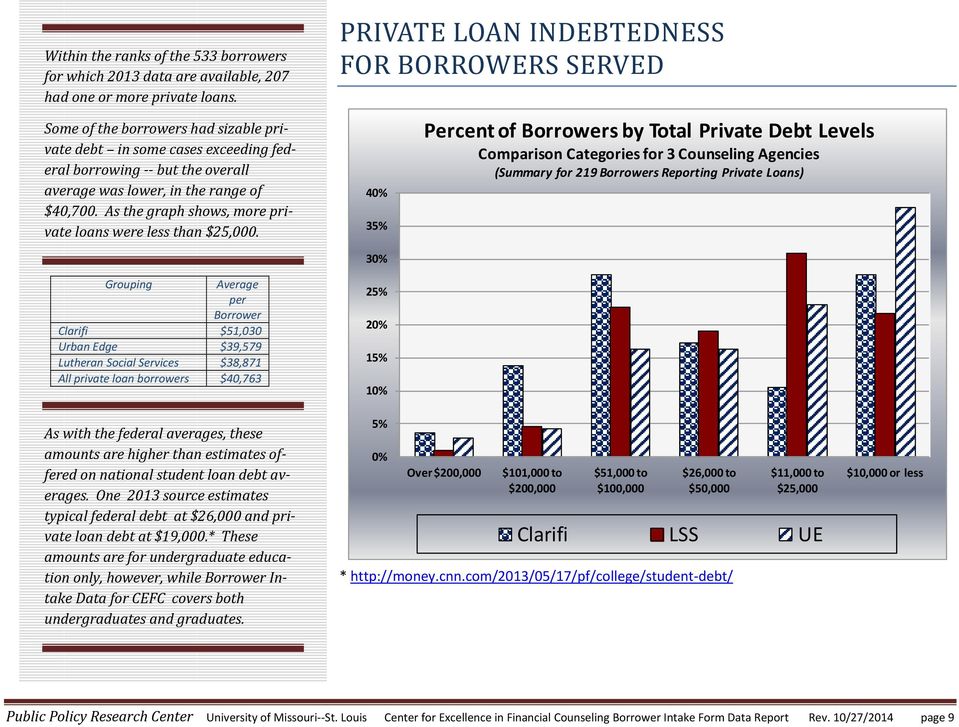
9 Within the ranks of the 533 borrowers for which 2013 data are available, 207 had one or more private loans. Some of the borrowers had sizable private debt in some cases exceeding federal borrowing -- but the overall average was lower, in the range of $40,700. As the graph shows, more private loans were less than $25,000. PRIVATE LOAN INDEBTEDNESS FOR BORROWERS SERVED 4 35% Percent of Borrowers by Total Private Debt Levels Comparison Categories for 3 Counseling Agencies (Summary for 219 Borrowers Reporting Private Loans) 3 Grouping Average per Borrower Clarifi $51,030 Urban Edge $39,579 Lutheran Social Services $38,871 All private loan borrowers $40,763 As with the federal averages, these amounts are higher than estimates offered on national student loan debt averages. One 2013 source estimates typical federal debt at $26,000 and private loan debt at $19,000.* These amounts are for undergraduate education only, however, while Borrower Intake Data for CEFC covers both undergraduates and graduates. 25% 15% 1 5% Over $200,000 $101,000 to $200,000 $51,000 to $100,000 $26,000 to $50,000 $11,000 to $25,000 Clarifi LSS UE * $10,000 or less Public Policy Research Center University of Missouri--St. Louis Center for Excellence in Financial Counseling Borrower Intake Form Data Report Rev. 10/27/2014 page 9
10 The data shown in the chart illustrate how counseling agency clients may have been affected by the varying levels of expense for enrollment at different types of institutions. Based on these data, it seems that CEFC clients have relied more heavily on traditional educational institutions ( 4-year non-profit ) than on forprofits, as well as on federal as opposed to private loans. For-profit schools tend to lead to higher level borrowing (as the table below shows). Regardless of the type of institution, borrowers opted most frequently for federal loans. Based on average dollar amounts, those who found it necessary to arrange private loans tended to take on somewhat higher debt. School Type Average Federal Loan Average Private Loan 4-year non-profit $41,043 $37,589 4-year for-profit $39,117 $82,206 2-year non-profit $13,303 $17,812 2-year for profit $18,960 $23,162 FEDERAL AND PRIVATE LOAN INDEBTEDNESS DIFFERENT SCHOOL TYPES* $9,000,000 $8,000,000 $7,000,000 $6,000,000 $5,000,000 $4,000,000 $3,000,000 $2,000,000 $1,000,000 $0 Total Amount of Federal and Private Funds Borrowed by Type of School Attended and Program Completion Data on 414 Borrowers and 767 Federal or Private Loans Federal Private Federal Private Federal Private Federal Private 4 year Non-profit 4 year For-profit 2 year Non-profit 2-year For-profit 71 Program Completed Program Not Completed Number of Borrowers *Only a percentage of borrowers were able to provide the amounts for loans that pertain to a particular school. These data are more difficult to retrieve, since the NSLDS reports amounts for loan contracts, not specific institutions. Public Policy Research Center University of Missouri--St. Louis Center for Excellence in Financial Counseling Borrower Intake Form Data Report Rev. 10/27/2014 page 10

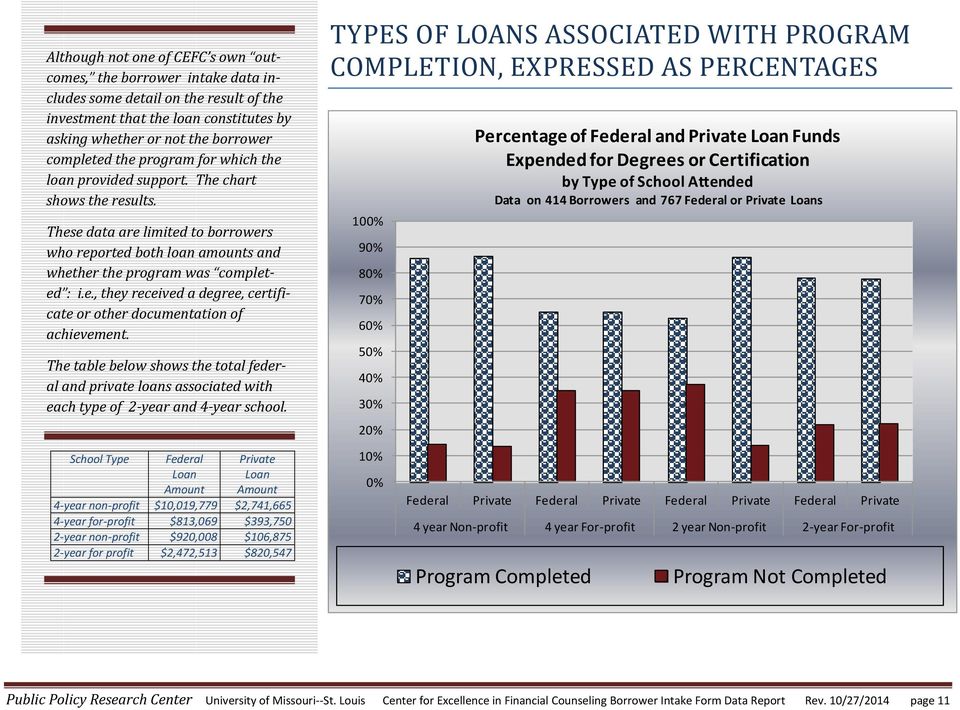
11 Although not one of CEFC s own outcomes, the borrower intake data includes some detail on the result of the investment that the loan constitutes by asking whether or not the borrower completed the program for which the loan provided support. The chart shows the results. These data are limited to borrowers who reported both loan amounts and whether the program was completed : i.e., they received a degree, certificate or other documentation of achievement. The table below shows the total federal and private loans associated with each type of 2-year and 4-year school. TYPES OF LOANS ASSOCIATED WITH PROGRAM COMPLETION, EXPRESSED AS PERCENTAGES Percentage of Federal and Private Loan Funds Expended for Degrees or Certification by Type of School Attended Data on 414 Borrowers and 767 Federal or Private Loans School Type Federal Loan Amount Private Loan Amount 4-year non-profit $10,019,779 $2,741,665 4-year for-profit $813,069 $393,750 2-year non-profit $920,008 $106,875 2-year for profit $2,472,513 $820,547 1 Federal Private Federal Private Federal Private Federal Private 4 year Non-profit 4 year For-profit 2 year Non-profit 2-year For-profit Program Completed Program Not Completed Public Policy Research Center University of Missouri--St. Louis Center for Excellence in Financial Counseling Borrower Intake Form Data Report Rev. 10/27/2014 page 11
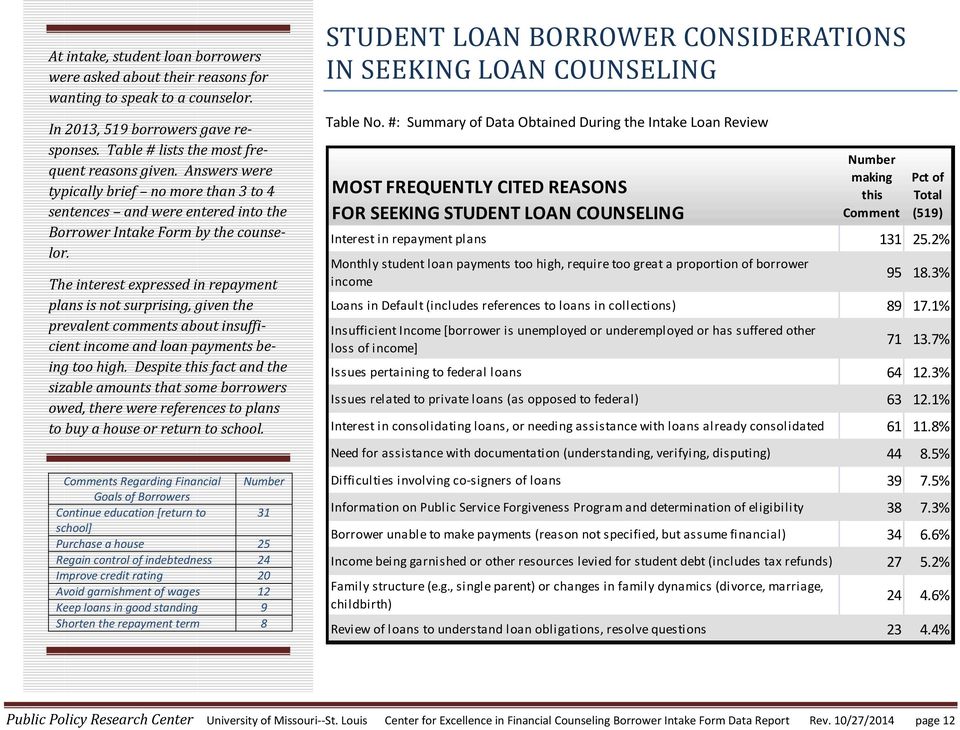
12 At intake, student loan borrowers were asked about their reasons for wanting to speak to a counselor. In 2013, 519 borrowers gave responses. Table # lists the most frequent reasons given. Answers were typically brief no more than 3 to 4 sentences and were entered into the Borrower Intake Form by the counselor. The interest expressed in repayment plans is not surprising, given the prevalent comments about insufficient income and loan payments being too high. Despite this fact and the sizable amounts that some borrowers owed, there were references to plans to buy a house or return to school. Comments Regarding Financial Number Goals of Borrowers Continue education [return to 31 school] Purchase a house 25 Regain control of indebtedness 24 Improve credit rating 20 Avoid garnishment of wages 12 Keep loans in good standing 9 Shorten the repayment term 8 STUDENT LOAN BORROWER CONSIDERATIONS IN SEEKING LOAN COUNSELING Table No. #: Summary of Data Obtained During the Intake Loan Review MOST FREQUENTLY CITED REASONS FOR SEEKING STUDENT LOAN COUNSELING Number making this Comment Pct of Total (519) Interest in repayment plans % Monthly student loan payments too high, require too great a proportion of borrower income % Loans in Default (includes references to loans in collections) % Insufficient Income [borrower is unemployed or underemployed or has suffered other loss of income] % Issues pertaining to federal loans % Issues related to private loans (as opposed to federal) % Interest in consolidating loans, or needing assistance with loans already consolidated % Need for assistance with documentation (understanding, verifying, disputing) % Difficulties involving co-signers of loans % Information on Public Service Forgiveness Program and determination of eligibility % Borrower unable to make payments (reason not specified, but assume financial) % Income being garnished or other resources levied for student debt (includes tax refunds) % Family structure (e.g., single parent) or changes in family dynamics (divorce, marriage, childbirth) % Review of loans to understand loan obligations, resolve questions % Public Policy Research Center University of Missouri--St. Louis Center for Excellence in Financial Counseling Borrower Intake Form Data Report Rev. 10/27/2014 page 12
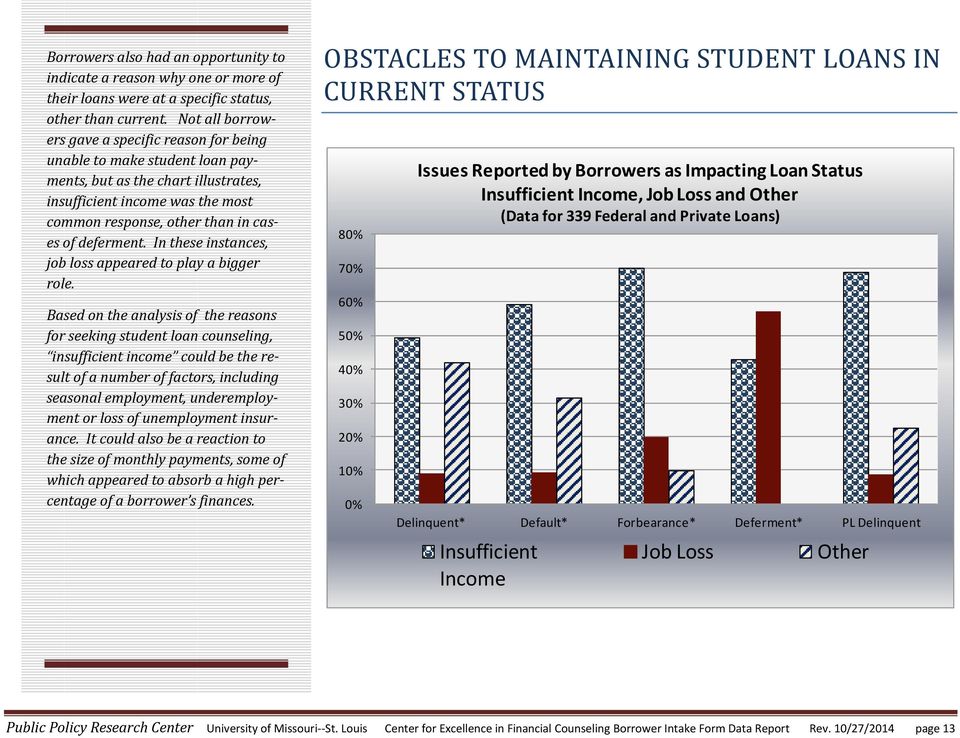
13 Borrowers also had an opportunity to indicate a reason why one or more of their loans were at a specific status, other than current. Not all borrowers gave a specific reason for being unable to make student loan payments, but as the chart illustrates, insufficient income was the most common response, other than in cases of deferment. In these instances, job loss appeared to play a bigger role. 6 Based on the analysis of the reasons for seeking student loan counseling, 5 insufficient income could be the result of a number of factors, including 4 seasonal employment, underemployment or loss of unemployment insur- 3 ance. It could also be a reaction to the size of monthly payments, some of 1 which appeared to absorb a high percentage of a borrower s finances. OBSTACLES TO MAINTAINING STUDENT LOANS IN CURRENT STATUS 8 7 Issues Reported by Borrowers as Impacting Loan Status Insufficient Income, Job Loss and Other (Data for 339 Federal and Private Loans) Delinquent* Default* Forbearance* Deferment* PL Delinquent Insufficient Income Job Loss Other Public Policy Research Center University of Missouri--St. Louis Center for Excellence in Financial Counseling Borrower Intake Form Data Report Rev. 10/27/2014 page 13
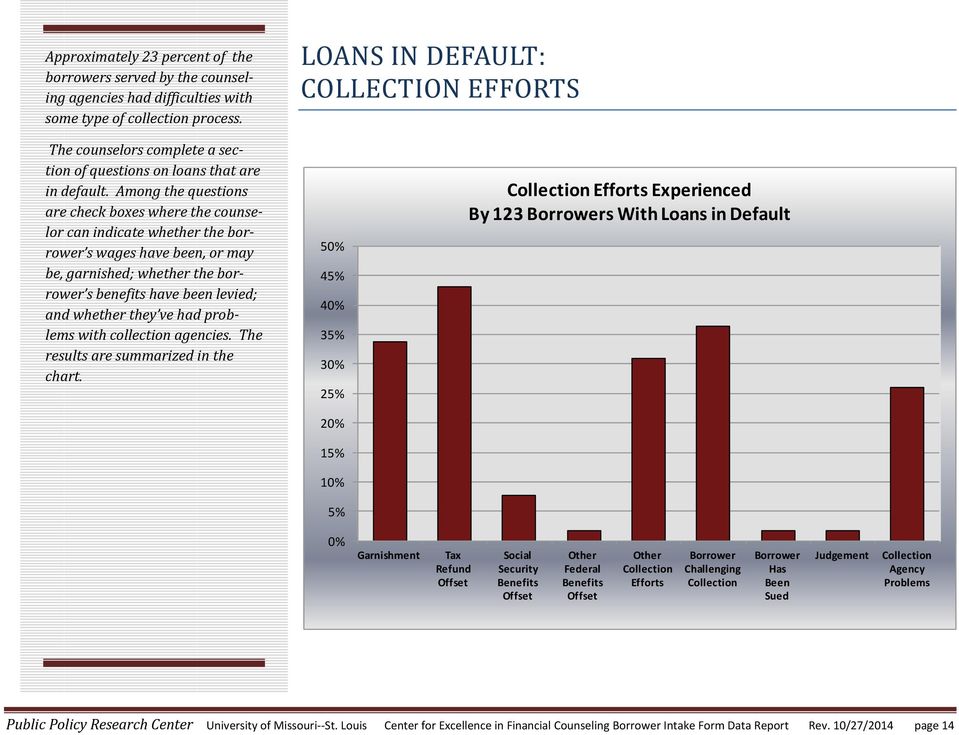
14 Approximately 23 percent of the borrowers served by the counseling agencies had difficulties with some type of collection process. LOANS IN DEFAULT: COLLECTION EFFORTS The counselors complete a section of questions on loans that are in default. Among the questions are check boxes where the counselor can indicate whether the borrower s wages have been, or may be, garnished; whether the borrower s benefits have been levied; and whether they ve had problems with collection agencies. The results are summarized in the chart. 5 45% 4 35% 3 25% 15% 1 5% Collection Efforts Experienced By 123 Borrowers With Loans in Default Garnishment Tax Refund Offset Social Security Benefits Offset Other Federal Benefits Offset Other Collection Efforts Borrower Challenging Collection Borrower Has Been Sued Judgement Collection Agency Problems Public Policy Research Center University of Missouri--St. Louis Center for Excellence in Financial Counseling Borrower Intake Form Data Report Rev. 10/27/2014 page 14
15 GENDER: Of 533 borrowers served, 373 (70 percent) were women and 129 were male. An additional 31 did not have a gender designation recorded in the Borrower Intake Form. SIZE OF HOUSEHOLD: Among the borrowers served, over 500 provided information on both the size of their households and the number of children in their family. For those reporting both gender and household size, 30 percent were living alone. NUMBER OF CHILDREN: Of 514 clients receiving services, nearly 60 percent (or 58.8%), had no children. Not surprisingly, given the prevalence of single mothers as compared to single fathers in the general population, male borrowers were less likely than female borrowers to indicate they had children. BORROWER DEMOGRAPHICS Comparison of Household Size by Gender of Borrower One Two Three Four Five Six or more Female Male Number of Children in Borrower Families As Compared by Gender of Borrower Zero One Two Three Four or More Female Male Public Policy Research Center University of Missouri--St. Louis Center for Excellence in Financial Counseling Borrower Intake Form Data Report Rev. 10/27/2014 page 15

16 BORROWER DEMOGRAPHICS: SOCIO-ECONOMIC AGE OF BORROWERS SEEKING COUNSELING: The majority of clients (61 percent) were from 20 to 40 years of age. An additional 20 percent were in the 40 to 49 age range. It s noteworthy that there were also older borrowers in the senior citizen range. CEFC has noted that counselors have provided services to parents who co-signed on student loans. The records on private loans have 139 entries for co-signers. The distribution by relationship to the borrower is also shown. Parents overwhelmingly account for the majority of co-signers. Out of the 139 listed, 40 (29 percent) were the counseling agencies clients. 35% 3 25% 15% 1 5% 35% 3 25% 15% 1 5% Borrowers by Age Category Data for 496 Clients 20 to to to to to and over Co-signers on Private Loans Reported for 139 Records Mother Father Parents Grandparents Child or Spouse Sibling/ Aunt/ Uncle Multiple family members Friend Other Unsure Public Policy Research Center University of Missouri--St. Louis Center for Excellence in Financial Counseling Borrower Intake Form Data Report Rev. 10/27/2014 page 16

17 BORROWER DEMOGRAPHICS: SOCIO-ECONOMIC At TOTAL intake counselors INCOME: Data questioned indicates clients that about 49 (roughly routine 10 income percent) of of 3 the types: individuals monthly providing before-tax information income; income on the from amount other and sources; sources and of any their support monthly from gross public income assistanceceived some portion of their finan- recial support from public MONTHLY GROSS INCOME: The assistance. chart illustrates the prevalence of lower income brackets, with the majority receiving between $2,000 and $3,000. TOTAL INCOME: The overall picture does not change significantly when all sources of income are added together, although the percentage of clients with resources over the $7,000 mark more than doubles. SOURCES OF OTHER INCOME: Spousal or partner income was the main supplement to borrower resources. Fewer borrowers had access to other income streams, such as a second job. Where retirement income was cited, it could refer to co-signers. 3 25% 15% 1 5% 45% 4 35% 3 25% 15% 1 5% Equal to or less than $1,000 Spouse, Partner Monthly Gross Income and Total Income, All Sources Percentage per Category for 434 Borrowers $1,001 to $2,000 $2,001 to $3,000 Gross income $3,001 to $4,000 $4,001 to $5,000 $5,001 to $6,000 $6,001 to $7,000 Total Income from All Sources SOURCES OF OTHER BORROWER INCOME Reported by a Total of 127 Clients in addition to monthly gross income Property (rental) Retirement income Disability, SS, other benefits Second job, other empl. Unemployment Alimony, child support Over $7,000 Other Public Policy Research Center University of Missouri--St. Louis Center for Excellence in Financial Counseling Borrower Intake Form Data Report Rev. 10/27/2014 page 17

18 The Borrower Intake Form requests data on indicators included in the chart at the right. BORROWER DEMOGRAPHICS: SOCIO-ECONOMIC VETERANS: The limited number of veterans seeking counseling may be due to other alternatives available to them through the Veterans Administration. 1 Statistics on Groups Identified Among Borrowers Served Data from 533 Clients; Number Responding Shown in Parentheses EMPLOYMENT: Over 80 percent of the 531 clients who gave information on employment reported having a job. Fewer indicated their FTE, but of those that did, the majority (also 80 percent) had full-time work, while 20 percent described it as part-time. EMPLOYMENT IN A CHOSEN FIELD: A smaller number responded to questions about being employed in the field of their major, but of those that did, over half had found this type of employment. PUBLIC ASSISTANCE: While the percentage was not high, 72 of agency clients reported drawing on some type of public assistance. The average monthly support was $450, with $1,200 being the high and $16 being the low end of the range Veteran? (474) Employed in Education Major Field? (432) Yes Currently Employed? (531) Employed Full-time? (422) No Receiving Public Assistance? (494) Public Policy Research Center University of Missouri--St. Louis Center for Excellence in Financial Counseling Borrower Intake Form Data Report Rev. 10/27/2014 page 18

19 CONCLUSION With the assistance of its counseling agencies, CEFC has compiled a rich source of information on student loan borrowers. Although the data obtained from the Borrower Intake Form has its limitations, it has provided useful background on a large sample of the clients served. It has also shown the impressive level of achievement to which CEFC can lay claim in its first year of service. Public Policy Research Center University of Missouri--St. Louis Center for Excellence in Financial Counseling Borrower Intake Form Data Report Rev. 10/27/2014 page 19

Student loan terms to know
 Definition of words related to federal student loans and the Nelnet payment process. Accrue The act of interest accumulating on the borrower s principle balance. Aggregate Loan Limit The maximum total
Income-Driven Repayment Plans: Frequently Asked Questions
 Income-Driven Repayment Plans: Frequently Asked Questions Contents Introduction...1 General Information...2 Eligible Borrowers...6 Eligible Loans...9 Monthly Payment Amount... 12 Repayment Period & Loan
EXIT COUNSELING GUIDE FOR BORROWERS OF DIRECT LOANS AND FEDERAL FAMILY EDUCATION PROGRAM LOANS
 EXIT COUNSELING GUIDE FOR BORROWERS OF DIRECT LOANS AND FEDERAL FAMILY EDUCATION PROGRAM LOANS U.S. Department of Education Arne Duncan Secretary Federal Student Aid James W. Runcie Chief Operating Officer
Federal Direct Stafford Loan Request Form for 2015-16
 Federal Direct Stafford Loan Request Form for 2015-16 Name: G#: Address: City: State: ZIP: Phone: Email: Stafford Loan Requirements and Acknowledgements We strongly recommend that you borrow loans conservatively
Alumni Award Recipients are students who are children or grandchildren of Ottawa University graduates.
 Financial Assistance at The College The College has a program of scholarships and grants. This is gift aid that does not have to be repaid. Institutional aid is awarded in a nondiscriminatory fashion,
Exit Counseling Guide for Direct Loan Borrowers
 You borrowed Direct Subsidized Loans and/or Direct Unsubsidized Loans to help you finance your education. Repaying these loans is a serious responsibility. This guide explains some of the most important
2015-2016 Application for Financial Aid New York Medical College School of Basic Medical Sciences
 2015-2016 Application for Financial Aid New York Medical College School of Basic Medical Sciences New York Medical College, Office of Student Financial Planning, Room 125 C 40 Sunshine Cottage Road, Administration
Private Loan Guide. Apply for free, federal and state financial aid programs:
 Private Loan Guide Private loan basics Private student loans are non-federal loans. You should only borrow private loans to fund your education as a last resort. Do all of the following before you consider
Entrance Counseling Guide for Direct Loan Borrowers
 You are borrowing Direct Subsidized Loans and/or Direct Unsubsidized Loans to help you finance your education. Repaying these loans is a serious responsibility. This guide explains some of the most important
The question of whether student debt levels are excessive
 College on Credit: How Borrowers Perceive Their Education Debt By Sandy Baum and Marie O Malley Sandy Baum is professor of economics at Skidmore College in Skidmore, PA. Marie O Malley is vice president
EXIT COUNSELING GUIDE FOR BORROWERS OF DIRECT LOANS AND FEDERAL FAMILY EDUCATION PROGRAM LOANS
 EXIT COUNSELING GUIDE FOR BORROWERS OF DIRECT LOANS AND FEDERAL FAMILY EDUCATION PROGRAM LOANS U.S. Department of Education Arne Duncan Secretary Federal Student Aid James W. Runcie Chief Operating Officer
SPECIAL SECTION: Indebtedness
 SPECIAL SECTION: Indebtedness Introduction Student indebtedness is a topic of great import for universities, public policy officials, and of course, doctoral students and their families. This special section
William D. Ford Federal Direct Loan Program Direct PLUS Loan Borrower s Rights and Responsibilities Statement
 Important Notice: This Borrower s Rights and Responsibilities Statement provides additional information about the terms and conditions of the loans you receive under the accompanying Federal Direct PLUS
William D. Ford Federal Direct Loan Program Direct Subsidized Loan and Direct Unsubsidized Loan Borrower s Rights and Responsibilities Statement
 Important Notice: This Borrower s Rights and Responsibilities Statement provides additional information about the terms and conditions of the loans you receive under the accompanying Master Promissory
William D. Ford Federal Direct Loan Program Direct Subsidized Loan and Direct Unsubsidized Loan Borrower s Rights and Responsibilities Statement
 Important Notice: This Borrower s Rights and Responsibilities Statement provides additional information about the terms and conditions of the loans you receive under the accompanying Master Promissory
STUDENT LOAN REPAYMENT
 STUDENT LOAN REPAYMENT Chase College of Law Financial Aid Presentation April 14 th, 2011 TOPICS TO BE COVERED General Repayment Information Loan consolidation Repayment Plans Public service loan forgiveness
How To Resolve A Defaulted Loan
 Default Issues in Detail Since most of your current students will be eligible for inschool deferment if they re attending at least half-time, you are most likely to be involved in default issues with students
William D. Ford Federal Direct Loan Program Direct Subsidized Loan and Direct Unsubsidized Loan Borrower s Rights and Responsibilities Statement
 Important Notice: This Borrower s Rights and Responsibilities Statement provides additional information about the terms and conditions of the loans you receive under the accompanying Master Promissory
Characteristics of College Students Who Graduate with No Debt
 Student Aid Policy Analysis Characteristics of College Students Who Graduate EXECUTIVE SUMMARY Mark Kantrowitz Publisher of Fastweb.com and FinAid.org August 24, 2011 About two fifths of undergraduate
Student Loans Terms To Know
 Student Loans Terms To Know Borrower The borrower in most cases is the student. The loan is made in the borrower s name and he/she is responsible for paying back the loan(s) including principal plus any
Financial Aid Information
 Financial Aid Information Schools recognize that in many instances individuals and their families are not able to meet the entire cost of education. Therefore, the Financial Aid Office will assist students
Repaying Your Student Loan. Florida Coastal School of Law
 Repaying Your Student Loan Florida Coastal School of Law Workshop Objectives At the end of the workshop you will understand: What options are available during repayment What education-related tax incentives
Student Consumer Information 2015-2016
 Student Consumer Information 2015-2016 Introduction The following is a compilation of Student Consumer Information regarding institutional information and financial assistance. This Student Consumer Information
Training Module 5: Student Loan Consolidation Program
 2013 Training Module 5: Student Loan Consolidation Program KC Credit Services 2016 Swift Ave., No. Kansas City, MO 64116816-421-8001 Page1 Table of Contents I. Introduction II. Federal Student Loan Consolidation
William D. Ford Federal Direct Loan Program Direct PLUS Loans Borrower s Rights and Responsibilities Statement
 William D. Ford Federal Direct Loan Program Direct PLUS Loans Borrower s Rights and Responsibilities Statement Important Notice: This Borrower s Rights and Responsibilities Statement provides additional
Name Last First M.I. Marital Status Single Married Divorced Separated. Will your spouse be a student during the 2015-16 academic year?
 INTERNATIONAL STUDENT FINANCIAL AID APPLICATION FILING DEADLINE: MARCH 1, 2015 PLEASE LIST ALL AMOUNTS IN US DOLLARS SECTION 1: STUDENT GENERAL INFORMATION Name Last First M.I. LSAC # Marital Status Single
Household Debt and Credit: Student Debt
 Household Debt and Credit: Student Debt February 28, 2013 Donghoon Lee The views presented here are those of the author and do not necessarily reflect those of the Federal Reserve Bank of New York, or
What is a Federal Direct PLUS Loan?
 What is a Federal Direct PLUS Loan? This is one of the low-interest loans that make up the William D. Ford Federal Direct Loan Program (also known as Direct Loans ). The Direct Loan Program enables students
ENTRANCE COUNSELING GUIDE
 ENTRANCE COUNSELING GUIDE For Direct Loan Borrowers ENTRANCE COUNSELING GUIDE For Direct Loan Borrowers CONTENTS TYPES OF DIRECT LOANS Direct Subsidized Loans, Direct Unsubsidized Loans, Direct PLUS Loans,
Federal Supplemental Education Opportunity Grant Work Study Federal Work Study (may not be available at all school locations) Loans
 Financial Aid Information Schools recognize that in many instances individuals and their families are not able to meet the entire cost of education. Therefore, the Financial Aid Office will assist students
Financial Aid Information
 Financial Aid Information Schools recognize that in many instances individuals and their families are not able to meet the entire cost of education. Therefore, the Financial Aid Office will assist students
Repayment of Your Student Loan Debt
 Repayment of Your Student Loan Debt your dream, your plan, your future Florida Department of Education (FDOE) Office of Student Financial Assistance (OSFA) Repayment of Your Student Loan Debt Table of
Income-Based Repayment Program Questions and Answers (Q&As)
 Prepared by Federal Student Aid U.S. Department of Education February 7, 2011 The questions and answers (Q&As) that follow provide information about the Income-Based Repayment (IBR) Plan that is available
FINANCIAL ASSISTANCE INFORMATION
 FINANCIAL ASSISTANCE INFORMATION CODE OF CONDUCT An institutional financial aid professional is expected to always maintain exemplary standards of professional conduct in all aspects of carrying out his
Direct loan Information. Federal Direct Student Loans A simple and flexible way to finance your education. Welcome!
 Direct loan Information Federal Direct Student Loans A simple and flexible way to finance your education. Welcome! Beginning Spring Semester 2012, Ogeechee Technical College will be participating in the
Financial Aid. Standard IX
 Standard IX Financial Aid Mission, goals and objectives The Financial Aid Office administers the student financial aid programs according to federal, state, and institutional regulations and provides monetary
How To Get Out Of A Subgratame Loan With A Credit Card
 Income Based Repayment Questions and Answers (Q&A) Prepared by Federal Student Aid U.S. Department of Education January 5, 2010 The Questions & Answers (Q&As) that follow provide information about the
Teacher Education Assistance for College and Higher Education Grant (TEACH Grant)
 Teacher Education Assistance for College and Higher Education Grant (TEACH Grant) Exit Counseling Guide December 18, 2008 1 Overview What is the TEACH Grant Program? The U.S. Department of Education s
FINANCIAL AID CONSUMER INFORMATION GUIDE 2015-2016 Award Year Revised 09/01/2015
 FINANCIAL AID CONSUMER INFORMATION GUIDE 2015-2016 Award Year Revised 09/01/2015 You are responsible for reading this award guide. This information is essential to read and understand the terms and conditions
REPAYING YOUR FEDERAL FAMILY EDUCATION LOAN
 What s Inside: REPAYING YOUR FEDERAL FAMILY EDUCATION LOAN Getting Started Understanding My Statement Repayment Plans Standard Income Sensitive Graduated Extended Income-Based Repayment (IBR) PLUS Interest
STUDENT LOAN INFORMATION (Please Print)
 STUDENT LOAN INFORMATION (Please Print) NAME (LAST) (MI) (FIRST) STUDENT ID PERSONAL INFORMATION Social Security #: Local Address: City, State, Zip: Permanent Address: City, State, Zip: Home Phone #: Work
Online Survey of Employees Without Workplace Retirement Plans
 Online Survey of Employees Without Workplace Retirement Plans Report of Findings Conducted for: State of California October 2015 Prepared by Greenwald & Associates 2015 1 Table of Contents Methodology
CHAPTER2 BORROWER ELIGIBILITY ISSUES:
 Borrower Eligibility for Stafford and PLUS loans To receive a Stafford Loan, a student borrower must meet the basic eligibility requirements for FSA funds (citizenship, Selective Service registration if
Student Loans Bankruptcy and Student Loans: NUTS & BOLTS The Options (pressing your plea Prov 6:1-5) Federal loan
 Student Loans Bankruptcy and Student Loans: Must prove undue hardship Must initiate an adversary hearing, a separate lawsuit within the bankruptcy where the undue hardship is illustrated. Most can t afford
Income-Based (IBR) / Pay As You Earn / Income-Contingent (ICR) Repayment Plan Request OMB No. 1845-0102 Form Approved
 IBR/PAYE/ICR SECTION 1: BORROWER IDENTIFICATION Please enter or correct the following information. Check this box if any of your information has changed. SSN - - Name Address City, State, Zip Code Telephone
EXIT COUNSELING GUIDE
 EXIT COUNSELING GUIDE For Federal Student Loan Borrowers Contents Intro 1 Exit Counseling Federal Student Loan Programs Getting Started 1 Types of Federal Student Loans Loan Terminology Repaying Your
Consumer Credit Counseling. Knowing Your Options A Briefing for Individuals Contemplating Bankruptcy
 Consumer Credit Counseling Knowing Your Options A Briefing for Individuals Contemplating Bankruptcy Part 1 Overview You are contemplating bankruptcy and probably have a number of questions. Is bankruptcy
EXIT COUNSELING GUIDE FOR BORROWERS OF DIRECT LOANS AND FEDERAL FAMILY EDUCATION PROGRAM LOANS
 EXIT COUNSELING GUIDE FOR BORROWERS OF DIRECT LOANS AND FEDERAL FAMILY EDUCATION PROGRAM LOANS U.S. Department of Education Arne Duncan Secretary Federal Student Aid James W. Runcie Chief Operating Officer
Steps to a Home Retention Solution. Required Document Checklist Please verify that you have submitted the following items by checking the box:
 Steps to a Home Retention Solution Follow these easy steps! 1. Call BCL of Texas and discuss your homeownership situation 2. Have Counselor explain the guidelines, check list, eligibility, and requirements
fyi Federal loans: The smart way to borrow
 Federal loans: The smart way to borrow If you don t receive enough free money to pay for college and you aren t able to cover your costs with savings or other resources, consider federal student loans.
STUDENT LOAN EXIT COUNSELING AND REPAYMENT. Sam Krow-Lucal, Student Loan Coordinator, Stanford Financial Aid Office
 STUDENT LOAN EXIT COUNSELING AND REPAYMENT Sam Krow-Lucal, Student Loan Coordinator, Stanford Financial Aid Office Presentation Overview Loan Repayment Terminology Federal Loan Repayment Plans Federal
Borrower Response Package Directions Mortgage Assistance Request Form Follows
 Borrower Response Package Directions Mortgage Assistance Request Form Follows If you are experiencing a temporary or long-term hardship and need help, you must complete and submit this form along with
FINANCIAL ASSISTANCE APPLICATION: COVER LETTER
 FINANCIAL ASSISTANCE APPLICATION: COVER LETTER Thank you for choosing Children s of Alabama to provide for the healthcare needs of your child. Please find attached the forms you must complete in order
WHAT BANKRUPTCY CAN T DO
 A decision to file for bankruptcy should only be made after determining that bankruptcy is the best way to deal with your financial problems. This brochure cannot explain every aspect of the bankruptcy
ENTRANCE COUNSELING GUIDE
 ENTRANCE COUNSELING GUIDE For Direct Loan Borrowers Contents Direct Loan Types 1 Borrow Wisely 2 Borrow Direct Subsidized Loans and Direct Unsubsidized Loans First 2 You Must Repay Your Loans 3 Use of
Managing Your Student Loans During Turbulent Times
 Managing Your Student Loans During Turbulent Times You Will Learn: The different types of student loans How to get detailed information on your existing student loans Repayment options In today s workplace,
Student Loans A comprehensive look at student aid and the various repayment options
 Student Loans A comprehensive look at student aid and the various repayment options How Much Does College Cost? According to the Bureau of Labor Statistics and the US Department of Labor, the average cost
Assisting Student Loan Borrowers Distress and Disputes
 Assisting Student Loan Borrowers Distress and Disputes Joanna K. Darcus, Esq. Homeownership & Consumer Rights Unit 1424 Chestnut Street, Philadelphia, PA 19102 [email protected] 1 Analyzing a Case 1
Office of Financial Aid, 400 Huntington Ave., Boston, MA 02115 Tel: 617.373.4620
 Office of Financial Aid, 400 Huntington Ave., Boston, MA 02115 Tel: 617.373.4620 2016 LOAN DEFERRAL/FORGIVENESS PROGRAM APPLICATION First Round Deadline November 14, 2015 Second Round Deadline May 31,
What are the HHF program eligibility criteria?
 FREQUENTLY ASKED QUESTIONS What is the Hardest Hit Fund Program (HHF)? What are the HHF program eligibility criteria? What property types are eligible for HHF assistance? I or my spouse is in the U.S.
Texas Student Loan Repayment Assistance Program
 Texas Student Loan Repayment Assistance Program Administered by: Program Guidelines The Texas Student Loan Repayment Assistance Program (SLRAP) is currently funded by the State Bar of Texas and administered
Credit Reports. published by AAA Fair Credit Foundation
 Credit Reports published by AAA Fair Credit Foundation Credit Reports 1. What is a Credit Report?..........................................................2 2. What Your Credit Report Reveals About You...................................4
StudentChoice. Student loans are an integral part of financing a college education. Educate yourself, and borrow wisely.
 StudentChoice Student loans are an integral part of financing a college education. Educate yourself, and borrow wisely. 2 2 What are my student loan options? Federal Student Loans A federal student loan
How to Understand your Student Loans
 How to Understand your Student Loans How do my student loans work? (edited from Bill Pratt s Extra Credit: The 7 Things Every College Student Needs to Know about Credit, Debt, & Ca$h) 1. Borrow all federal
FAMILY ASSETS FOR INDEPENDENCE IN MINNESOTA (FAIM) FAIM New Participant Application Form AGENCY USE ONLY : Agency Name:
 FAMILY ASSETS FOR INDEPENDENCE IN MINNESOTA (FAIM) AGENCY USE ONLY : FAIM New Participant Application Form Revised 05/23/14 Agency Name: Bank Account Number of 1 st Deposit Asset Grant First Name MI Last
Pre-Purchase Counseling Application
 Pre-Purchase Counseling Application Guidance on purchasing a home and qualifying for downpayment assistance Pre-purchase counseling helps prepare the first-time homebuyer for the home purchase process