
ILLINOIS STATE BOARD OF EDUCATION. Illinois Content-Area Standards
|
|
|
- Ashlie Walsh
- 10 years ago
- Views:
Transcription
1 ILLINOIS STATE BOARD OF EDUCATION Draft Illinois Content-Area Standards for School Counselor School Nurse School Psychologist School Social Worker Director of Special Education Division of Professional Preparation January 2001

2 Illinois School Service Personnel Draft Content-Area Standards Table of Contents School Counselor Content-Area Standards... 1 School Nurse Content-Area Standards School Psychologist Content-Area Standards School Social Worker Content-Area Standards Director of Special Education Content-Area Standards Appendix: Panel Member List... 63

3 SCHOOL COUNSELOR CONTENT-AREA STANDARDS Preface The charge to the School Counselor Standards Panel was to: 1. Recommend professional standards for school counselors by articulating precise knowledge and performance indicators of the professional school counselor; and 2. Recommend a certification process for school counselors. Certification Process It is the recommendation of the Standards Panel that persons wishing to earn an Illinois School Service Personnel Certificate with endorsement in School Counseling may obtain this certification in any of the following ways: A. Traditional Certification (Same as before) 1. Complete a Master s Degree in School Counseling from a state accredited program in school counseling that meets the Illinois State Standards. 2. Pass the ISBE Examination for School Counseling and meet all requirements for certification. 3. Possess or be eligible for an initial or standard teaching certificate. B. Transfer from another state Certification (New) 1. Person has been certified and worked fulltime as a school counselor in another state for a minimum of two years. 2. Completed a Master s degree in School Counseling that meets standards from their state. 3. Passes the ISBE Examination for School Counseling and meets all requirements for certification. 4. This person may be exempt from having a teacher s certificate. C. Alternative School Counselor Certification (Non-teacher Certified) (New) 1. Complete a Master s Degree in School Counseling from a state accredited program in school counseling that meets the Illinois State Standards. 2. If the Master s degree that was completed is NOT in school counseling, then complete those classes that are required in a current school counseling program at that institution. 3. Complete coursework that would meet standards in the following additional areas: (Completion of these additional standards would be determined by the training institution.) Adolescent and/or child development Rationale: Professional teachers have been trained in the areas of adolescent and child development as a part of their teaching program. If a person is going to work as a counselor in a school setting, knowledge about the development of children and adolescents is imperative. Classroom management Rationale: The school counselor will participate in the classroom in a variety of ways including observations, team teaching, and teaching. Therefore, in order to be sure trainees are comfortable working in the classroom and can maintain some sense of order trainees need to have knowledge of classroom management skills and classroom teaching experience. This might include a pre-service teacher preparation class and additional opportunities to show competence during the internship experience. School climate Rationale: Because counselors pursuing a school counselor certificate under this option do not have experience in a school setting, the panel believes trainees need to have time to understand and be acclimated to the school climate. Under this rubric, trainees need to observe a school classroom; understand the world of the classroom teacher; understand the relationship between teachers, administrators, parents, and students; review learning standards; understand curriculum development, student testing and achievement; and appreciate the policies and procedures common to the school as an institution. Illinois Content-Area Standards School Counselor 1
4 Recommendations regarding School Counseling 1. The Name of the Endorsement on the School Service Personnel Certificate should be changed to School Counselor. Currently, the endorsement area for school counselors reads Guidance. This term is outdated. As the field of counseling, and more specifically school counseling, has evolved to become more of a developmentally based program, the school counselor professional does far more than just guidance. The term guidance actually emerged in the 1920 s and gave focus to occupational selection and placement of students. In the late 1980 s, the result of a national survey by Hoyt (1989) indicated that leaders preferred to be called school counselor and not guidance counselor. In 1997, the American School Counselor Association emphasized a more integrated role for the school counselor in the educational system. ASCA (1997) defined school counseling in the following quote: Counseling is a process of helping people by assisting them in making decisions and changing behavior. School counselors work with all students, school staff, families, and members of the community as an integral part of the education program. School counseling programs promote school success through a focus on academic achievement, prevention and intervention activities, advocacy, and social/emotional and career development. (p. 8, in Dahir and Campbell, 1997). Based on this research as well as the professional identity of the panel members, the standards committee recommends unanimously that the term school counselor be used on written certifications, references, and definitions. 2. Practicum and Internship Experiences The School Counseling Panel recommends that the practicum and internship experiences consist of closely supervised on-campus and/or field-based activities. These activities should demonstrate the trainee s mastery of the professional knowledge and skills consistent with all the standards. In accordance with the National Accreditation Standards as recommended by CACREP, the panel recommends in a vote of 12 yes and 3 no, that the practicum experience continue as it currently exists, consisting of 100 clock hours, with a minimum of 40 direct service hours with clients. The panel further recommends that the internship consist of two half-time or one full-time internship of a minimum of 600 clock hours with at least 240 hours of direct student contact. An intern supervisor who is a certified school counselor with at least two years of experience should direct the internship. 3. The School Counseling Program should follow the National Standards for School Counseling Programs. The Panel believes that the standards for school counselors must reflect the best practices at the National level. Currently 10 of the 14 school counseling accredited programs in the state follow National accreditation through CACREP (Counseling and Counseling Related Educational Programs). These programs follow the CACEP structure regarding training standards. The CACREP requirements as well as the Illinois Student Service Provider Standards and National Standards for School Counseling Programs were all used in the development of this document. Adherence to these standards enables programs to meet CACREP approval by following these standards. Adherence to these standards will also enable school counselors to prepare to become Nationally Certified Counselors, Nationally Certified School Counselors, or Licensed Professional Counselors in the State. 4. The School Service Personnel Certification for School Counselors should include the K-12 levels. This recommendation is consistent with the current practice which allows counselors to be in settings that are elementary, middle, high school or any combination thereof based on their certification status. 5. Paid Internships Currently, school counselors may not practice for pay as a school counselor until they have completed the entire Master s degree. This is because they must complete the Master s in Counseling before going through the certification process. However, other professional student services professionals are able to move into paid positions in a school setting as a part of their internship program. Illinois Content-Area Standards School Counselor 2
5 It is the recommendation of the panel that school counselors should be allowed to complete their internships in settings that provide a salary. Trainees could be hired as school counselor interns on a limited, one-year provisional certification with approval of their training program. If they do not complete their degree within that year, they would not be allowed to continue in the work setting. This recommendation would be a benefit for both the school counselor trainee and for school districts that are in need of a trained counselor. Trainees would need to be recommended by their training institution for this provisional status. All interns in this paid internship would be supervised by a certified school counselor with at least two years of experience as a counselor. 6. Recommendation for School Counselors at Every Level: Elementary, Middle and Secondary Schools The focus of a developmental school counseling program is to impart specific skills and learning opportunities to all students through academic, career, and personal/social development experiences in a proactive and preventive manner. Given the current societal climate of school violence and the changes in expectations and values coupled with the challenges of meeting the Illinois Learning Standards and Benchmarks, a comprehensive school counseling program plays a critical, integral role in helping all students achieve success. In 1982, Borders and Drury s research demonstrated two important conclusions: 1) school counseling interventions (and preventative measures) substantially impact student academic and personal development and 2) specific interventions such as individual and small group counseling, classroom guidance and consultation activities seem to contribute directly to student success in the classroom. If students are to overcome the emotional, physical, social and economic barriers that inhibit academic success in Illinois and achieve the standards and benchmarks set before them, they must receive the services of a credentialed or certified school counselor who delivers a school counseling program that is comprehensive and developmental in nature. This program cannot begin at grade 7 or grade 9 when a large part of the students growth/development has already taken place. The school counseling program is a curriculum integrated into the overall educational program in grades K-12, not an ancillary piece. Therefore, recognizing the vital role a comprehensive school counseling program plays in students successful achievement of the Illinois Learning Goals, standards and benchmarks, it is this committee s recommendation that ISBE seek legislative action to mandate school counselors in all schools, including the elementary, middle and secondary levels. 7. The recommended student to school counselor ratio should be 250:1. Rationale Regarding Counselor Load In order to accomplish a comprehensive developmental counseling program, the schools need to have a sufficient number of counselors. According to the American School Counselor Association: Professional school counselors are responsible for developing comprehensive school counseling programs that promote and enhance student learning. By providing prevention and intervention services within a comprehensive program, school counselors focus their skills, time, and energies on direct services to students, staff, and families. In the delivery of direct services, the American School Counselor Association (ASCA) recommends that professional school counselors spend at least 70% of their time in direct services to students. The ASCA considers a realistic counselor to student ratio for effective program delivery to be a maximum of 1:250. Illinois currently has a student to counselor ratio of 800:1, which is 47 th out of the 50 states. The fact is that many elementary schools in Illinois do not have counselors and that in many schools counselors have unrealistic student loads of 500 or more. These proposed standards, if they are to be successfully implemented, require a commitment of sufficient counselor staffing in Illinois schools. 8. Advanced Certificate-Master School Counselor The State of Illinois honors a teacher who has received national certification through the NBPTS as a Master Teacher. The panel recommends that school counselors who have obtained National Certification as a Counselor (NCC) and National Certification School Counselor (NCSC) be approved as Master Counselors. In order to be qualified for this status, school counselors must have a Master s degree, meet National training standards, pass a comprehensive examination on Counseling (NCE), have been a Illinois Content-Area Standards School Counselor 3

6 school counselor for two years full-time, and receive excellent recommendations from supervisors about their performance. In order to maintain the Master Level Certificate, school counselors would be required to maintain their national certifications. A Master School Counselor should be awarded compensation equal to a Master Teacher in the State of Illinois. 9. Certificate Renewal and Professional Development School Counselors are committed to the importance of lifelong learning. Training programs have encouraged trainees to attend local workshops, state conferences and national conferences to remain current on pertinent issues. Those professional counselors who do obtain national certification or state licensure are required to complete professional development continuing education hours. For state licensure, counselors must complete 30 clock hours every two years in order to renew their license. For national certification, counselors must complete 100 hours every five years. Documentation in both areas is necessary. It is recommended that school counselors be required to obtain a minimum of 100 clock hours of continuing education from approved presentations every five years in order to be recertified. This would be in keeping with national standards and require state licensed counselors to increase their continuing education 25 hours over the five year period. Illinois Content-Area Standards School Counselor 4

7 SCHOOL COUNSELOR CONTENT-AREA STANDARDS Organization The School Counselor Specialization Standards (23) are organized into six thematic categories below. These are: I. Developmental School Counseling Domains II. III. IV. Components of a Comprehensive Service Delivery System Program Planning, Assessment and Evaluation Foundations of School Counseling V. Professional Preparation, Development and Diversity VI. Fieldwork Experience and Supervision A brief description of each of the categories is provided. Within each category school counselor standards are presented, followed by the knowledge and performance competencies necessary to meet the standard. Overview of the Six Themes and Twenty-three School Counselor Specialization Standards I. DEVELOPMENTAL SCHOOL COUNSELING DOMAINS STANDARD 1 - Academic Development Domain The competent school counselor understands the learning process and the academic environment and develops programs and interventions that promote achievement of all students. STANDARD 2 - Career Development Domain The competent school counselor is knowledgeable about the world of work, career theories and related life processes and develops programs and interventions to promote the career development of all students. STANDARD 3 - Personal/Social Development Domain The competent school counselor understands the developmental needs of the school age population and develops programs and interventions that promote optimum personal and social development. Illinois Content-Area Standards School Counselor 5

8 II. COMPONENTS OF A COMPREHENSIVE SERVICE DELIVERY SYSTEM STANDARD 4 - Classroom Instruction and Counseling Curriculum The competent school counselor understands instructional planning and designs developmental counseling curriculum based upon knowledge of the student, the community and the overall educational program. STANDARD 5 - Responsive Service - Crisis Intervention The competent school counselor understands and implements appropriate responses to crises, and utilizes a variety of intervention strategies for students, families, and communities facing emergency situations. STANDARD 6 - Responsive Service - Individual Counseling The competent school counselor understands and utilizes a variety of individual counseling strategies and provides appropriate referral services. STANDARD 7 - Responsive Service - Group Counseling The competent school counselor understands and implements principles of group work in the school setting. STANDARD 8 - Individual Student Planning The competent school counselor understands and uses a variety of strategies to encourage students development of academic, personal/social, and career competencies. STANDARD 9 - Consultation The competent school counselor understands various consultation models and maintains collaborative relationships within and outside the school community. STANDARD 10 - Systems Support The competent school counselor understands the overall educational system, acts as a facilitator of change, and engages in planning and management tasks needed to support the comprehensive developmental school counseling program. Illinois Content-Area Standards School Counselor 6

9 III. PROGRAM PLANNING, ASSESSMENT AND EVALUATION STANDARD 11 - Program Development The competent school counselor understands and utilizes organizational and management tools needed to implement an effective developmental program. STANDARD 12 - Prevention Education and Training The competent school counselor is aware of and implements prevention education programs. STANDARD 13 - Assessment The competent school counselor understands basic concepts, technology, and implications of various assessment and evaluative instruments. STANDARD 14 - Research and Program Evaluation The competent school counselor understands the importance of and engages in research in program evaluation. IV. FOUNDATIONS OF SCHOOL COUNSELING STANDARD 15 - Professional Orientation and Identity The competent school counselor understands and actively participates in the profession. STANDARD 16 - History of School Counseling and Current Trends The competent school counselor understands the history and current trends and issues of the profession and includes this knowledge when establishing comprehensive developmental counseling programs. STANDARD 17 - Human Growth and Development The competent school counselor understands the individual diversity of human growth, development, and learning, and provides experiences that promote the physical, intellectual, social, and emotional development of the student. Illinois Content-Area Standards School Counselor 7
10 STANDARD 18 - Overview of State and National Standards and Best Practices in School Counseling The competent school counselor knows the National Standards for School Counseling Programs and the Illinois Best Practices and Procedures for School Counseling (published by ISBE) and applies these in developing their role and function in establishing school counseling programs. V. PROFESSIONAL PREPARATION, DEVELOPMENT AND DIVERSITY STANDARD 19 - The Helping Relationship The competent school counselor possesses knowledge and skills necessary to establish appropriate helping relationships as a professional school counselor in a school setting. STANDARD 20 - Social and Cultural Diversity The competent school counselor possesses the knowledge and skills to appropriately address issues of diversity, cultural difference and change. STANDARD 21 - Ethical Concerns and Legal Matters The competent school counselor is aware of current legal issues and the ethical guidelines of the profession and acts accordingly. VI. FIELDWORK EXPERIENCE AND SUPERVISION STANDARD 22 - Practicum The competent school counselor develops basic counseling skills, under qualified supervision, with a school-aged population. STANDARD 23 - Internship The competent school counselor completes an internship that provides the opportunity to perform, under qualified supervision, a variety of counseling activities that a professional school counselor is expected to perform. Illinois Content-Area Standards School Counselor 8

11 I. DEVELOPMENTAL SCHOOL COUNSELING DOMAINS Theme Rationale: The National Standards for School Counseling Programs (Campbell & Dahir, 1997) requires a comprehensive approach in order to increase student learning and achievement by promoting student development in three domains: academic development, career development, and personal/social development. School counselors need to be familiar with the Best Practices model of the state as well as other developmental models that include identified student competencies, activities that assist students to attain these competencies, and evaluation criteria that measure student outcomes. STANDARD 1 - Academic Development Domain The competent school counselor understands the learning process and the academic environment and develops programs and interventions that promote achievement of all students. Knowledge indicators: The competent school counselor 1A. Understands the National Standards related to the academic development of students across all grade levels. 1B. Understands the concepts, principles, and strategies that enable students to achieve and be academically successful. 1C. Understands the relationship of academic performance to the world of work, family life, and community service. 1D. Provides positive direction for academic program planning and for implementing academic support systems. Performance indicators: The competent school counselor 1E. Implements strategies and activities that enhance academic development. 1F. Provides students across grade levels with academic assistance to overcome barriers to academic growth and achievement. 1G. Works collaboratively with all school personnel and parents to insure student academic achievement. 1H Initiates interventions that maximize learning, identifies learning styles, teaches study skills, enhances test-taking skills, and motivates students to learn and achieve. STANDARD 2 - Career Development Domain The competent school counselor is knowledgeable about the world of work, career theories and related life processes and develops programs and interventions to promote the career development of all students. Knowledge indicators: The competent school counselor 2A. Understands the National Standards related to the career and vocational development of students across all grade levels. 2B. Understands career development theories and decision-making models applicable for grade levels. 2C. Applies education-to-career principles and student outcomes to the career program. 2D. Understands career development program planning, organization, implementation, administration, and evaluation. 2E. Understands the world of work, labor market information and job trends. 2F. Understands the phases of career development: awareness, exploration, orientation, and preparation and how they are applied across grade levels. 2G. Understands career and educational planning, placement, and follow-up. Illinois Content-Area Standards School Counselor 9

12 2H. Understands the use of technology in career planning. 2I. Understands career counseling processes, techniques, resources, and tools, including those applicable to specific populations. Performance indicators: The competent school counselor 2J. Integrates career and counseling theories into a comprehensive approach of career counseling. 2K. Enhances student self-awareness through individual appraisal, appropriate career information, course selection alternatives, and career exploration activities. 2L. Assists students to identify and understand their abilities, interests, problem-solving abilities, aptitudes, and goal setting strategies. 2M. Develops program and consults with parents with respect to their child s career development. 2N. Provides career development consultation and resources to teachers for infusing career development activities into the curriculum. 2O. Collaborates with community business and industry representatives to promote work-based learning opportunities and support. 2P. Helps students develop skills to locate, evaluate, and interpret career information. 2Q. Guides students in the use of career resources such as occupational and labor market information, visual and printed media, computer-based career systems, electronic systems, and the use of the internet. 2R. Administers and interprets assessment tools such as interest inventories, aptitude batteries, personality inventories and self-assessment tools to help students with educational and career decisions. 2S. Assists students with work-based opportunities such as job-shadowing and internships. STANDARD 3 - Personal/Social Development Domain The competent school counselor understands the developmental needs of the school age population and develops programs and interventions that promote optimum personal and social development. Knowledge Indicators: The competent school counselor 3A. Understands the National Standards related to the personal/social development of students across all grade levels. 3B. Understands the concepts and strategies that lead to attitudes, knowledge, and interpersonal skills that help students understand and respect themselves and others. 3C. Understands programs that promote school safety and violence prevention. 3D. Understands strategies to help students make decisions, set goals and develop resiliency. 3E. Understands the skills necessary for developing effective communication skills that promote cooperation, understanding, and interest in others. 3F. Understands the processes of conflict resolution and anger management. 3G. Understands methods that help students appreciate differences between people and promotes tolerance. Performance Indicators: The competent school counselor 3H. Enables students to acquire knowledge of their personal strengths, assets, personal values, beliefs, and attitudes. 3I. Fosters self-esteem and personal dignity so students develop positive attitudes toward themselves as unique and worthy individuals. 3J. Helps students identify and express feelings. 3K. Assists students to set healthy personal boundaries understand and assert their rights of privacy. 3L. Helps students understand and apply the need for self-control and anger management. 3M. Teaches ways for students to get along with peers, parents, and authority figures. 3N. Assists students with maintaining healthy family relationships, including teaching the dynamics of family interaction. Illinois Content-Area Standards School Counselor 10
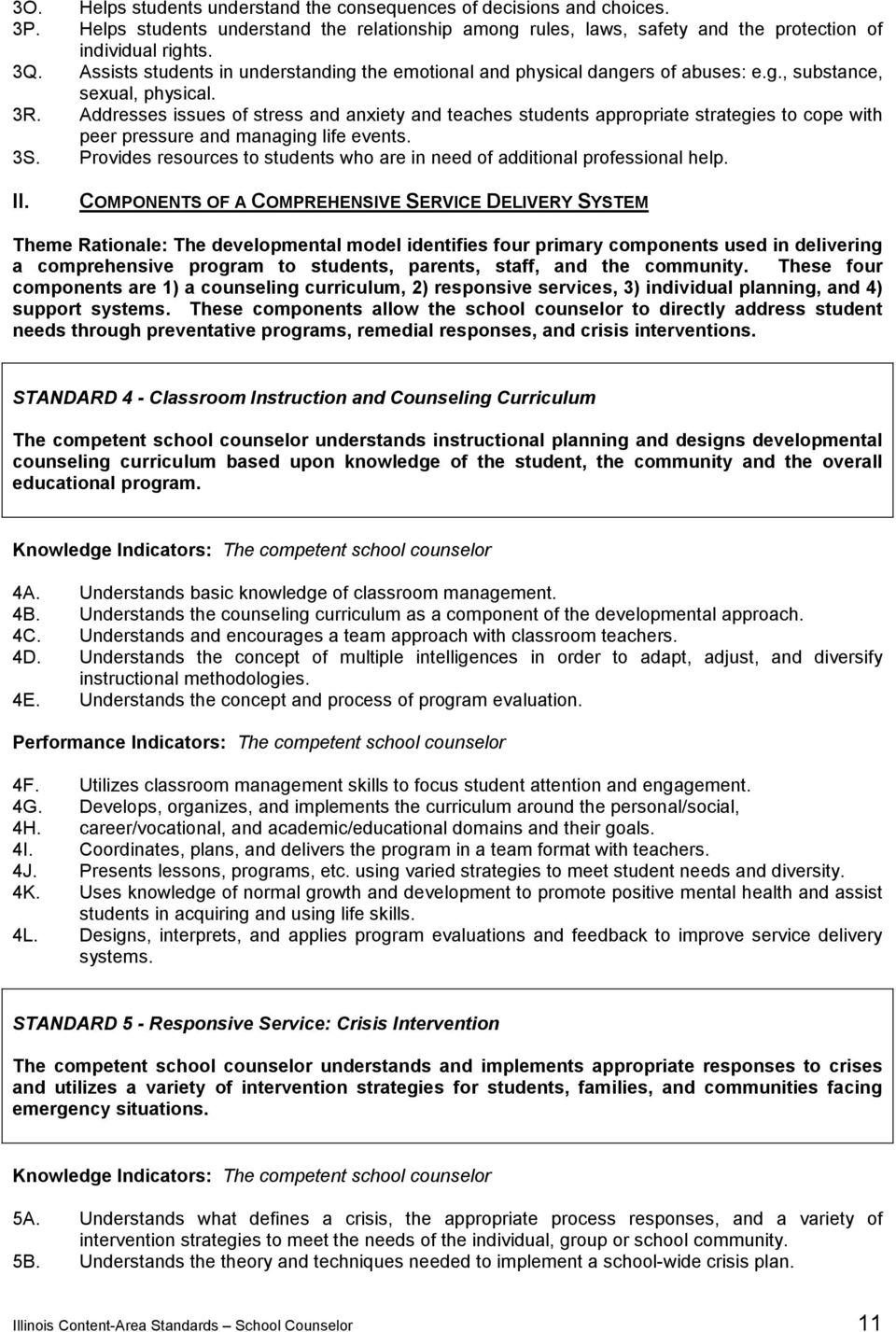
13 3O. Helps students understand the consequences of decisions and choices. 3P. Helps students understand the relationship among rules, laws, safety and the protection of individual rights. 3Q. Assists students in understanding the emotional and physical dangers of abuses: e.g., substance, sexual, physical. 3R. Addresses issues of stress and anxiety and teaches students appropriate strategies to cope with peer pressure and managing life events. 3S. Provides resources to students who are in need of additional professional help. II. COMPONENTS OF A COMPREHENSIVE SERVICE DELIVERY SYSTEM Theme Rationale: The developmental model identifies four primary components used in delivering a comprehensive program to students, parents, staff, and the community. These four components are 1) a counseling curriculum, 2) responsive services, 3) individual planning, and 4) support systems. These components allow the school counselor to directly address student needs through preventative programs, remedial responses, and crisis interventions. STANDARD 4 - Classroom Instruction and Counseling Curriculum The competent school counselor understands instructional planning and designs developmental counseling curriculum based upon knowledge of the student, the community and the overall educational program. Knowledge Indicators: The competent school counselor 4A. Understands basic knowledge of classroom management. 4B. Understands the counseling curriculum as a component of the developmental approach. 4C. Understands and encourages a team approach with classroom teachers. 4D. Understands the concept of multiple intelligences in order to adapt, adjust, and diversify instructional methodologies. 4E. Understands the concept and process of program evaluation. Performance Indicators: The competent school counselor 4F. Utilizes classroom management skills to focus student attention and engagement. 4G. Develops, organizes, and implements the curriculum around the personal/social, 4H. career/vocational, and academic/educational domains and their goals. 4I. Coordinates, plans, and delivers the program in a team format with teachers. 4J. Presents lessons, programs, etc. using varied strategies to meet student needs and diversity. 4K. Uses knowledge of normal growth and development to promote positive mental health and assist students in acquiring and using life skills. 4L. Designs, interprets, and applies program evaluations and feedback to improve service delivery systems. STANDARD 5 - Responsive Service: Crisis Intervention The competent school counselor understands and implements appropriate responses to crises and utilizes a variety of intervention strategies for students, families, and communities facing emergency situations. Knowledge Indicators: The competent school counselor 5A. Understands what defines a crisis, the appropriate process responses, and a variety of intervention strategies to meet the needs of the individual, group or school community. 5B. Understands the theory and techniques needed to implement a school-wide crisis plan. Illinois Content-Area Standards School Counselor 11
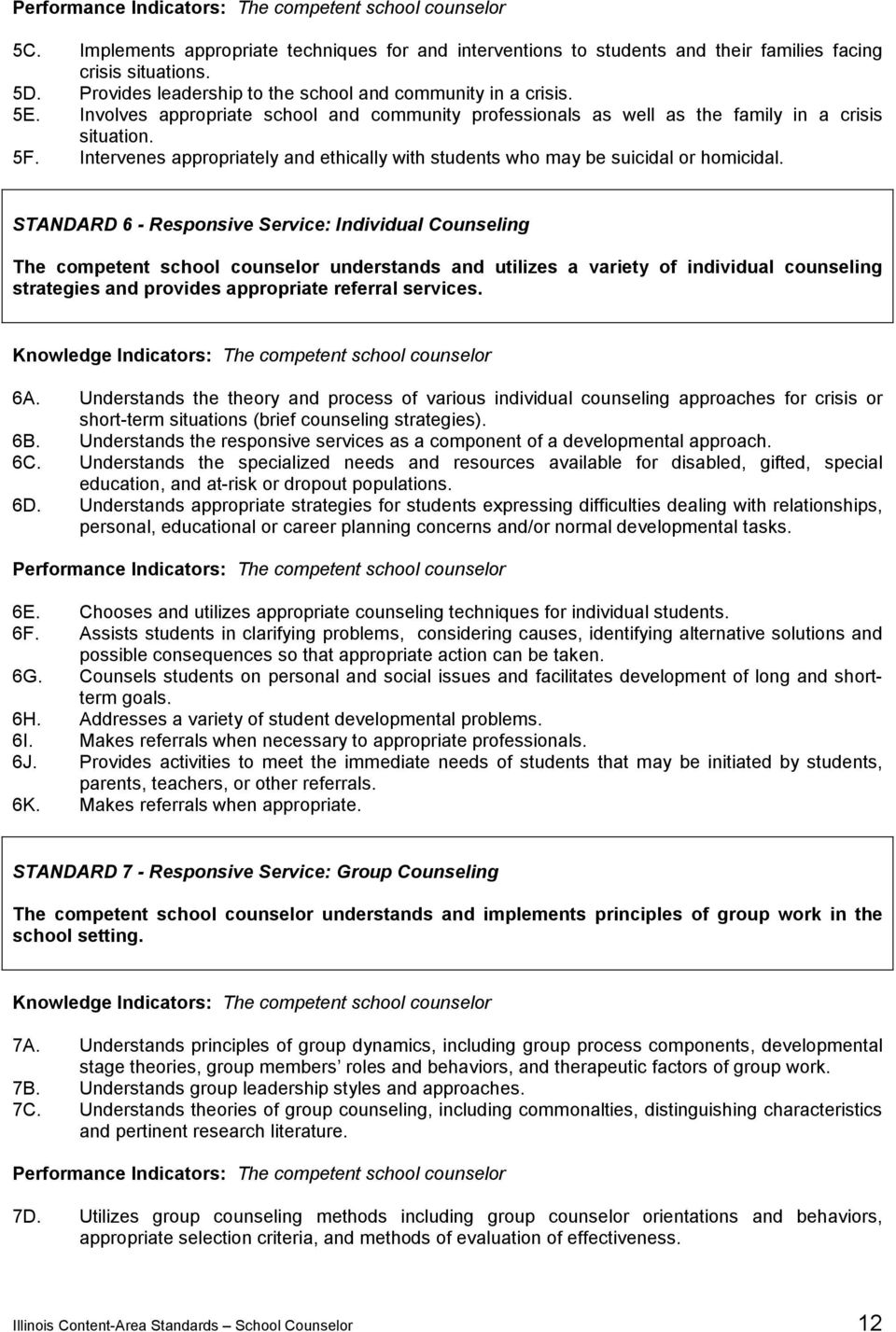
14 Performance Indicators: The competent school counselor 5C. Implements appropriate techniques for and interventions to students and their families facing crisis situations. 5D. Provides leadership to the school and community in a crisis. 5E. Involves appropriate school and community professionals as well as the family in a crisis situation. 5F. Intervenes appropriately and ethically with students who may be suicidal or homicidal. STANDARD 6 - Responsive Service: Individual Counseling The competent school counselor understands and utilizes a variety of individual counseling strategies and provides appropriate referral services. Knowledge Indicators: The competent school counselor 6A. Understands the theory and process of various individual counseling approaches for crisis or short-term situations (brief counseling strategies). 6B. Understands the responsive services as a component of a developmental approach. 6C. Understands the specialized needs and resources available for disabled, gifted, special education, and at-risk or dropout populations. 6D. Understands appropriate strategies for students expressing difficulties dealing with relationships, personal, educational or career planning concerns and/or normal developmental tasks. Performance Indicators: The competent school counselor 6E. Chooses and utilizes appropriate counseling techniques for individual students. 6F. Assists students in clarifying problems, considering causes, identifying alternative solutions and possible consequences so that appropriate action can be taken. 6G. Counsels students on personal and social issues and facilitates development of long and shortterm goals. 6H. Addresses a variety of student developmental problems. 6I. Makes referrals when necessary to appropriate professionals. 6J. Provides activities to meet the immediate needs of students that may be initiated by students, parents, teachers, or other referrals. 6K. Makes referrals when appropriate. STANDARD 7 - Responsive Service: Group Counseling The competent school counselor understands and implements principles of group work in the school setting. Knowledge Indicators: The competent school counselor 7A. Understands principles of group dynamics, including group process components, developmental stage theories, group members roles and behaviors, and therapeutic factors of group work. 7B. Understands group leadership styles and approaches. 7C. Understands theories of group counseling, including commonalties, distinguishing characteristics and pertinent research literature. Performance Indicators: The competent school counselor 7D. Utilizes group counseling methods including group counselor orientations and behaviors, appropriate selection criteria, and methods of evaluation of effectiveness. Illinois Content-Area Standards School Counselor 12
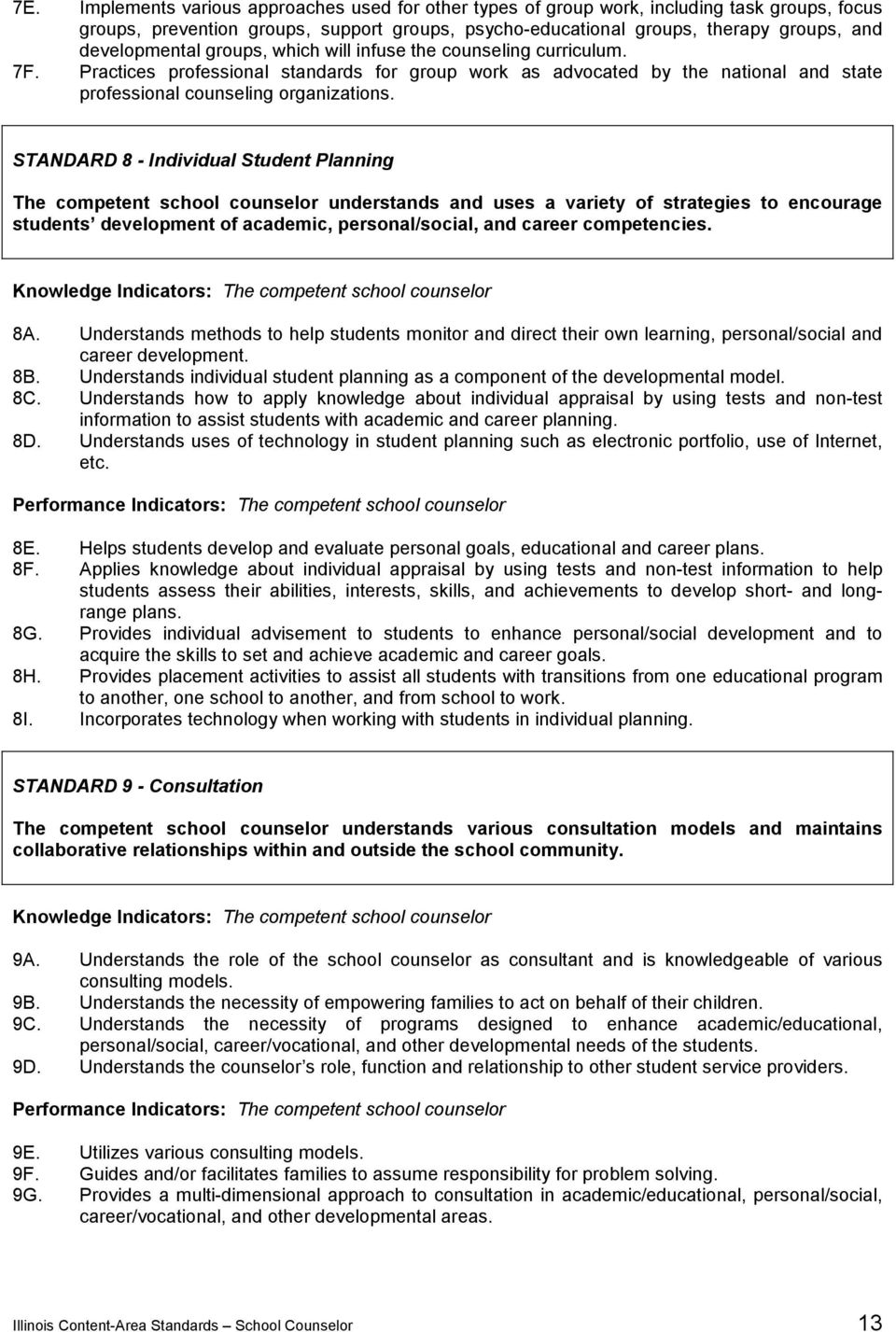
15 7E. Implements various approaches used for other types of group work, including task groups, focus groups, prevention groups, support groups, psycho-educational groups, therapy groups, and developmental groups, which will infuse the counseling curriculum. 7F. Practices professional standards for group work as advocated by the national and state professional counseling organizations. STANDARD 8 - Individual Student Planning The competent school counselor understands and uses a variety of strategies to encourage students development of academic, personal/social, and career competencies. Knowledge Indicators: The competent school counselor 8A. Understands methods to help students monitor and direct their own learning, personal/social and career development. 8B. Understands individual student planning as a component of the developmental model. 8C. Understands how to apply knowledge about individual appraisal by using tests and non-test information to assist students with academic and career planning. 8D. Understands uses of technology in student planning such as electronic portfolio, use of Internet, etc. Performance Indicators: The competent school counselor 8E. Helps students develop and evaluate personal goals, educational and career plans. 8F. Applies knowledge about individual appraisal by using tests and non-test information to help students assess their abilities, interests, skills, and achievements to develop short- and longrange plans. 8G. Provides individual advisement to students to enhance personal/social development and to acquire the skills to set and achieve academic and career goals. 8H. Provides placement activities to assist all students with transitions from one educational program to another, one school to another, and from school to work. 8I. Incorporates technology when working with students in individual planning. STANDARD 9 - Consultation The competent school counselor understands various consultation models and maintains collaborative relationships within and outside the school community. Knowledge Indicators: The competent school counselor 9A. Understands the role of the school counselor as consultant and is knowledgeable of various consulting models. 9B. Understands the necessity of empowering families to act on behalf of their children. 9C. Understands the necessity of programs designed to enhance academic/educational, personal/social, career/vocational, and other developmental needs of the students. 9D. Understands the counselor s role, function and relationship to other student service providers. Performance Indicators: The competent school counselor 9E. Utilizes various consulting models. 9F. Guides and/or facilitates families to assume responsibility for problem solving. 9G. Provides a multi-dimensional approach to consultation in academic/educational, personal/social, career/vocational, and other developmental areas. Illinois Content-Area Standards School Counselor 13
16 9H. Participates in multi-disciplinary team meetings and demonstrates the ability to make appropriate referrals to outside agencies and other student service providers within the school system. 9I. Consults with parents, teachers, student services staff, other educators, and community agencies regarding strategies to help students. STANDARD 10 - Systems Support The competent school counselor understands the overall educational system, acts as a facilitator of change, and engages in planning and management tasks needed to support the comprehensive developmental school counseling program. Knowledge Indicators: The competent school counselor 10A. Understands systems support as a component in the developmental approach. 10B. Understands program development that is comprehensive and educational. 10C. Understands the commitment to life-long learning. Performance Indicators: The competent school counselor 10D. Provides activities that establish, maintain, and enhance the developmental school counseling program as well as other educational programs. 10E. Demonstrates a commitment to life-long learning. 10F. Develops and implements activities to orient staff and community to the counseling program through regular efforts to enhance and maintain staff and community relations. 10G. Serves on departmental curriculum committees, school improvement committees, or advisory boards and assists in developing curricula that meet student developmental needs. 10H. Engages in planning and management tasks needed to support activities of the comprehensive school counseling program. 10I. Participates in the school counselor academy and continuous professional development. III. PROGRAM PLANNING, ASSESSMENT AND EVALUATION Theme Rationale: School counselors will develop the organizational and management tools needed to implement an effective developmental program. Standards should guide the school counselor in designing, implementing and evaluating the school counseling program. STANDARD 11 - Program Development The competent school counselor understands and utilizes organizational and management tools needed to implement an effective developmental program. Knowledge Indicators: The competent school counselor 11A. Understands data gathered from groups and individuals as they relate to student outcomes and learning standards. 11B. Understands the need for and the process of planning, developing, and implementing a comprehensive school counseling program. 11C. Understands the need for developing school counseling programs based on the needs of students and the school to become an effective learning community. 11D. Understands the comprehensive developmental school counseling concept. 11E. Understands the necessity for goals and objectives in a school counseling program. 11F. Understands competency levels as related to student achievement. 11G. Understands the importance of planning and time management within a comprehensive developmental school counseling program. Illinois Content-Area Standards School Counselor 14

17 Performance Indicators: The competent school counselor 11H. Uses available resources in implementing a comprehensive counseling program, including budget, funding, and staff resources. 11I. Uses needs assessment data in planning the counseling program. 11J. Uses data from multiple sources, including surveys, interviews, focus groups, and needs assessments to enhance student outcomes. 11K. Designs, implements, monitors, and evaluates a comprehensive developmental school counseling program with an awareness of the various systems impacting students, parents, and school faculty and staff. 11L. Implements and evaluates specific strategies designed to meet program goals, competencies, and objectives. 11M. Identifies student achievement competencies and implements activities and processes to assist students in achieving these competencies. 11N. Prepares a counseling calendar reflecting appropriate time commitments and priorities within a comprehensive developmental school counseling program. STANDARD 12 - Prevention Education and Training The competent school counselor is aware of and implements prevention education programs. Knowledge Indicators: The competent school counselor 12A. Is aware of student and school problems that could limit or diminish the capacity of students to learn and achieve at their highest levels. 12B. Is knowledgeable of prevention measures to overcome or resolve problems or barriers to learning. Performance Indicators: The competent school counselor 12C. Identifies early signs and predictors of learning problems. 12D. Is able to organize and present prevention programs for students, staff, parents, and community members as appropriate. STANDARD 13 - Assessment The competent school counselor understands basic concepts of, technology for, and implications of various assessment and evaluative instruments. Knowledge Indicators: The competent school counselor 13A. Understands the purposes and meaning of assessment from multiple perspectives: historical, sociological, and educational. 13B. Understands the basic concepts of standardized and non-standardized testing and other assessment techniques. 13D. Understands the use of technology in assessment. 13E. Understands the statistical concepts, including scales of measurement, measures of central tendency, indices or variability, shapes and types of distributions, and correlation. 13F. Understands reliability (theory of measurement error, models of reliability, and the use of reliability information) and validity (evidence of validity, types of validity), and the relationship between reliability and validity. 13G. Understands the implications of age, gender, sexual orientation, ethnicity, language, disability, culture, spirituality, and other factors related to assessment and evaluation. Illinois Content-Area Standards School Counselor 15

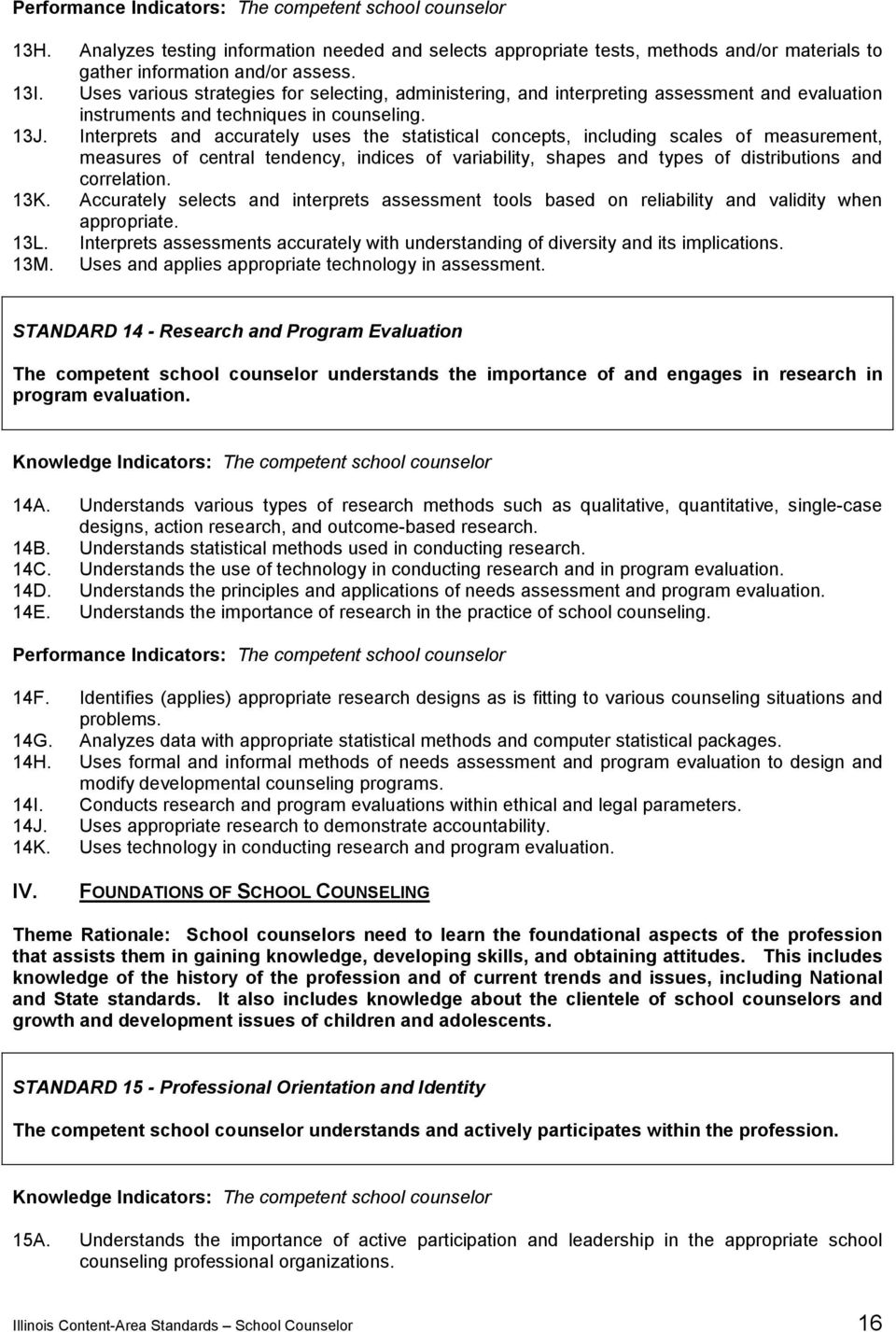
18 Performance Indicators: The competent school counselor 13H. Analyzes testing information needed and selects appropriate tests, methods and/or materials to gather information and/or assess. 13I. Uses various strategies for selecting, administering, and interpreting assessment and evaluation instruments and techniques in counseling. 13J. Interprets and accurately uses the statistical concepts, including scales of measurement, measures of central tendency, indices of variability, shapes and types of distributions and correlation. 13K. Accurately selects and interprets assessment tools based on reliability and validity when appropriate. 13L. Interprets assessments accurately with understanding of diversity and its implications. 13M. Uses and applies appropriate technology in assessment. STANDARD 14 - Research and Program Evaluation The competent school counselor understands the importance of and engages in research in program evaluation. Knowledge Indicators: The competent school counselor 14A. Understands various types of research methods such as qualitative, quantitative, single-case designs, action research, and outcome-based research. 14B. Understands statistical methods used in conducting research. 14C. Understands the use of technology in conducting research and in program evaluation. 14D. Understands the principles and applications of needs assessment and program evaluation. 14E. Understands the importance of research in the practice of school counseling. Performance Indicators: The competent school counselor 14F. Identifies (applies) appropriate research designs as is fitting to various counseling situations and problems. 14G. Analyzes data with appropriate statistical methods and computer statistical packages. 14H. Uses formal and informal methods of needs assessment and program evaluation to design and modify developmental counseling programs. 14I. Conducts research and program evaluations within ethical and legal parameters. 14J. Uses appropriate research to demonstrate accountability. 14K. Uses technology in conducting research and program evaluation. IV. FOUNDATIONS OF SCHOOL COUNSELING Theme Rationale: School counselors need to learn the foundational aspects of the profession that assists them in gaining knowledge, developing skills, and obtaining attitudes. This includes knowledge of the history of the profession and of current trends and issues, including National and State standards. It also includes knowledge about the clientele of school counselors and growth and development issues of children and adolescents. STANDARD 15 - Professional Orientation and Identity The competent school counselor understands and actively participates within the profession. Knowledge Indicators: The competent school counselor 15A. Understands the importance of active participation and leadership in the appropriate school counseling professional organizations. Illinois Content-Area Standards School Counselor 16
19 15B. Understands community, environmental, and institutional barriers that impede and/or enhance student academic success and overall development. 15C. Understands the unique characteristics of the school setting environment and K-12 curriculum. Performance Indicators: The competent school counselor 15D. Joins and takes an active part in appropriate local, state, and national school counseling professional organizations. 15E. Uses community resources to enhance academic and social/emotional growth, plans appropriate interventions within the scope of the limits of the community, and advocates for programmatic efforts to eliminate barriers to student success. 15F. Designs and implements a developmental counseling curriculum which provides all students at all grade levels with knowledge and assistance in acquiring and using life skills. STANDARD 16 - History of School Counseling and Current Trends The competent school counselor understands the history and current trends and issues of the profession and includes this knowledge when establishing comprehensive developmental counseling programs. Knowledge Indicators: The competent school counselor 16A. Understands history, philosophy, and current trends and issues in school counseling. 16B. Understands the counselor s roles, functions and relationships with other student service providers. 16C. Understands technology and computer applications in counseling. Performance Indicators: The competent school counselor 16D. Addresses current trends and issues daily in the school. 16E. Incorporates current trends into the developmental curriculum. 16F. Participates in multidisciplinary team meetings and works collaboratively with other student service providers. 16G. Uses technology and computer applications directly with students. STANDARD 17 - Human Growth and Development The competent school counselor understands the individual diversity of human growth, development, and learning, and provides experiences that promote the physical, intellectual, social, and emotional development of the student. Knowledge Indicators: The competent school counselor 17A. Understands theories of individual and family development and transitions across the life span. 17B. Understands that students physical, social, emotional, ethical, and cognitive development influences learning. 17C. Understands theories of learning, personality development, child and adolescent development, and the range of individual variation. 17D. Understands how students construct knowledge, acquire skills and develop habits of mind. 17E. Understands that differences in approaches to learning and performance interact with development. 17F. Understands the developmental stages of children and adolescents as they relate to counseling approaches and appropriate interventions. Illinois Content-Area Standards School Counselor 17
20 17G. Understands human behaviors including developmental crises, disability, addictive behavior, psychopathology, situational and environment factors as they affect both normal and abnormal behavior. 17H. Understands the characteristics and effects of the cultural and environmental milieu of the child and the family, including cultural and linguistic diversity, socioeconomic level, abuse/neglect, and substance abuse. 17I. Understands the role of drug therapy as it impacts student behavior. 17J. Understands the characteristics of normal, delayed, and disorders communication/interaction patterns and their impact on learning. Performance Indicators: The competent school counselor 17K. Uses theories of learning, personality and human development to plan activities and experiences that respond to student s individual and group needs at the appropriate level of development. 17L. Analyzes individual and group performance in order to design interventions that meet learners current needs in the cognitive, social, emotional, ethical, and physical domains at the appropriate grade level. 17M. Plans interventions relevant to students developmental levels. 17N. Utilizes strategies for facilitating optimum student development over the life-span. 17O. Recognizes the differential characteristics of individuals with exceptionalities, including levels of severity and multiple exceptionalities and the effects they may have on individuals. 17P. Implements interventions relevant to students developmental levels. 17Q. Recognizes the effect that addictive behavior, psychopathology, situational and environmental factors have on both normal and abnormal behavior. 17R. Recognizes the effects of cultural and environmental factors as they impact students performance. 17S. Recognizes that medications can have affect on the educational, cognitive, physical, social, and emotional behaviors of individuals. STANDARD 18 - Overview of State and National Standards and Best Practices in School Counseling The competent school counselor knows the National Standards for School Counseling Programs and the Illinois Best Practices and Procedures for School Counseling (published by ISBE) and applies these in developing his or her role and function in establishing school counseling programs. Knowledge indicators: The competent school counselor 18A. Understands the requirements of professional credentialing, certification and licensure. 18B. Understands the unique characteristics of school counseling as a profession as defined by the Illinois School Code, Section a and b. 18C. Understands the national standards for school counseling. 18D. Understands the principles and constructs of the Best practices Manual for school counselors endorsed by the Illinois State Board of Education. Performance Indicators: The competent school counselor 18E. Maintains a certificate/license as mandated by a local/and or national certification board. 18F. Designs school counseling services to include the thirteen functions listed in the school code as appropriate to the setting and student grade levels. 18G. Manages time to include individual student planning, responsive services, system support and developmental counseling curriculum activities. 18H. Participates in professional development and keeps current on state and national initiatives. 18I. Applies the Illinois State Board of Education Best Practices to the school counselor s role and function in the school. Illinois Content-Area Standards School Counselor 18
21 V. PROFESSIONAL PREPARATION, DEVELOPMENT, AND DIVERSITY Theme Rationale: School counselors need to possess knowledge and skills related to functioning as a professional counselor. Standards in this theme include the ability to process information effectively as a helper, and address issues of diversity, cultural differences, and change. Finally, school counselors must be aware of current legal issues and ethical guidelines of the profession, and thereby practice in a professional manner. STANDARD 19 - The Helping Relationship The competent school counselor possesses knowledge and skills necessary to establish appropriate helping relationships as a professional school counselor in a school setting. Knowledge Indicators: The competent school counselor 19A. Understands various counseling theories, including traditional models, multicultural models, brief approaches, and systems and family theories as appropriate to school counseling. 19B. Understands how individual student characteristics, including age, gender, ethnic differences, race, culture, learning abilities and styles, and value dimensions, impact the helping process. 19C. Understands the limitations of his or her ability and training and is aware of referral resources. 19D. Understands the counseling process and is aware of various skills, methods, and behaviors used in both prevention and intervention. 19E. Understands the skills necessary to build a therapeutic and trusting relationship with a client. 19F. Understands how to develop long- and short-term intervention plans consistent with curriculum, learner diversity, and learning theory. Performance Indicators: The competent school counselor 19G. Uses established counseling theory in the counseling process and applies these to the developmental needs of the client. 19H. Is flexible in adapting counseling technique to client diversity. 19I. Makes appropriate referrals. 19J. Demonstrates skills in developing therapeutic relationships, goal setting, intervention strategies, and evaluation of counseling outcomes with clients. 19K. Demonstrates appropriate skills in working with parents. 19L. Uses developmental and counseling theories to design and implement comprehensive and developmental programs. 19M. Creates long-term and short-term intervention plans. 19N. Applies appropriate diagnoses and case conceptualization skills to clients. STANDARD 20 - Social and Cultural Diversity The competent school counselor possesses the knowledge and skills to appropriately address issues of diversity, cultural difference and change. Knowledge Indicators: The competent school counselor 20A. Is aware and sensitive of his or her own multicultural/diversity background. 20B. Is aware of how his or her own multicultural/diversity background and experiences influence his or her attitudes, values and biases about psychological processes. 20C. Is knowledgeable about various diverse groups with which she or he may work. 20D. Understands how race, culture, ethnicity, sexual orientation, physical and mental characteristics, and other areas of diversity affect personality formation, vocational choice, manifestation of difficulties and strengths in academic, career, and personal/social development. Illinois Content-Area Standards School Counselor 19
22 20E. Understands how gender affects personality formation, academic choice, vocational choice, manifestations of difficulties and strengths in academic, career, and personal/social development. 20F. Understands the impact of sexual harassment on students personal, social, emotional, and academic development. Performance Indicators: The competent school counselor 20G. Incorporates a multicultural/diversity approach that is equitable and fair for all students. 20H. Adopts intervention skills appropriate to the specific diverse needs of the student. 20I. Develops programs for students to enhance their diversities and meet special needs as appropriate. 20J. Incorporates a gender equitable and culturally sensitive approach in dealing with students, families, staff, and the community. 20K. Utilizes appropriate non-traditional strategies in career and academic counseling. 20L. Adopts appropriate methods to intervene when students use inappropriate language or behaviors relating to issues of social and cultural diversity. 20M. Teaches how oppression, racism, discrimination, intolerance, and stereotyping may affect students personally and their work. STANDARD 21 - Ethical Concerns and Legal Matters The competent school counselor is aware of current legal issues and ethical guidelines of the profession and acts accordingly. Knowledge Indicators: The competent school counselor 21A. Understands the ethical standards of the American Counseling Association and the American School Counselor Association. 21B. Understands legal standards that apply to the counseling process. 21C. Understands the school counselor s responsibility to know and comply with federal, state, and local legislation, regulations, and policies. 21D. Understands that in the event conflict arises among competing expectations, the school counselor shall be guided by the ACA/ASCA code of ethics. Performance Indicators: The competent school counselor 21E. Demonstrates commitment to the values and ethics of the school counseling profession. 21F. Adheres to ACA and ASCA professional standards and codes of ethics as a guide to ethical decision making. 21G. Maintains adequate safeguards for the privacy and confidentiality of information. 21H. Informs students of their ethical rights and the limitations of the counseling relationship and of confidentiality. 21I. Follows state and federal laws such as mandatory reporting, duty to warn, family educational rights and privacy act, informed consent, mental health code, etc. V. Fieldwork Experience and Supervision Theme Rationale: To develop competency in the multidimensional roles of the school counselor, candidates must have the opportunity to demonstrate knowledge and skills with school-aged populations in an actual school setting. School settings should be utilizing a comprehensive, developmental approach in their school counseling program. These settings may include school programs that are kindergarten through 12. While working in these settings, all school counselors-in-training must have direct, professional, clinical supervision. Illinois Content-Area Standards School Counselor 20
23 STANDARD 22 - Practicum The competent school counselor develops basic counseling skills, under qualified supervision, with a school-based population. Knowledge Indicators: The competent school counselor 22A. Understands counseling practice through interaction with individuals and groups. Performance Indicators: The competent school counselor 22B. Demonstrates the ability to develop individual and group counseling relationships with a schoolaged population. 22C. Demonstrates the basic skills in the helping relationships (Standard 19), individual counseling (Standard 6) and group counseling (Standard 7). STANDARD 23 - Internship The competent school counselor completes an internship that provides the opportunity to perform, under qualified supervision, a variety of counseling activities that a professional school counselor is expected to perform. Knowledge Indicators: The competent school counselor 23A. Understands the requirements of a supervised, clinical, field-based internship in a school setting focusing on the duties of a school counselor. 23B. Understands the comprehensive developmental school counseling model. Performance Indicators: The competent school counselor 23C. Participates in an internship, under qualified supervision, which must involve direct services (including individual and group work) to students, parents, teachers and other parties interested in the welfare of students. 23D. Demonstrates completely the variety of activities a regularly employed school counselor would be expected to perform. 23E. Participates in a comprehensive developmental school counseling approach which integrates the basic components of: counseling curriculum; individual planning; responsive services; system support; consultation; and program planning, assessment, and evaluation (Standards 4 through 14). SCHOOL COUNSELOR STANDARDS RESOURCES These standards are built upon several key resources. Among these are the following: 2001 Standards of the Council for Accreditation of Counseling and Related Educational Programs (CACREP); Developmental Counseling Model for Illinois Schools, Illinois Counseling Association; School Counseling Specialization Draft Standards, California Commission on Teacher Credentialing; Sharing the Vision: The National Standards for School Counseling Programs, The American School Counselor Association; Draft Illinois Professional Student Service Provider Standards. Illinois Content-Area Standards School Counselor 21
24 SCHOOL NURSE CONTENT-AREA STANDARDS PREAMBLE We believe that the certificated school nurse is the only health professional resource available in the school setting who is prepared in both education and health specialties, and is thereby able to administer a coordinated school health program. We believe that the duties of the school nurse require teaching and the exercise of instructional judgment and educational evaluation of pupils, which are an inherent part of the comprehensive health and educational services for every child. (Nursing and Advanced Practice Nursing Act) We believe that any school nurse practicing in a school setting and responsible for the overall health program should be a registered nurse with a bachelors degree, should be appropriately prepared through an Illinois State Board of Education approved certification program, and should hold a School Service Personnel Certificate with the School Nurse endorsement. We believe that the delivery of school health services to children in Illinois is most appropriately provided by the certificated school nurse and that every school-aged child in Illinois has a right to access the services of a certificated school nurse. The following national and Illinois standards, and legislation were used to develop the Illinois School Nurse Content-Area Standards: The draft Illinois Professional School Service Providers Standards National Association of School Nurses, Inc. Standards of Professional School Nursing Practice (1998) Illinois Association of School Nurses Position Paper on Professional School Nursing (1998) Nursing and Advanced Practice Nursing Act (2000) Illinois Learning Standards (K-12 students) Illinois Content-Area Standards School Nurse 22
25 STANDARD 1 Content Knowledge The competent school nurse understands and practices within a framework of professional nursing and education to provide a coordinated school health program that encourages all students to achieve their optimal potential. Knowledge Indicators: The competent school nurse 1A. Understands professional nursing is the foundation for clinical decision making through assessment, diagnosis, outcome identification, planning, implementation, and evaluation, as it applies to all students in a holistic and ethical manner. 1B. Understands the concepts of health promotion and disease prevention when addressing the health care needs of all students and others in the school community. 1C. Understands the intent of local, state, and federal rules and regulations, their application to the exceptional learner and their potential impact on the school community. 1D. Understands the significance of practicing within the legal boundaries of professional school nursing. 1E. Understands various technology-based productivity tools and their application to school nursing practice. 1F. Understands the concepts of the Illinois Learning Standards when providing coordinated school health services that integrate principles of health and education. 1G. Understands the principles of public health as they apply to the school population. Performance Indicators: The competent school nurse 1H. Acquires and continues to maintain current knowledge and competency in school nursing practice in a holistic and ethical manner. 1I. Collects accurate data in a systematic, organized, and ongoing manner. 1J. Analyzes and prioritizes data, utilizes scientific principles, and applies professional judgment in determining an appropriate nursing diagnosis. 1K. Identifies expected outcomes derived from nursing diagnoses and develops an individualized plan of care that specifies interventions to attain expected outcomes. 1L. Implements interventions identified in the plan of care and evaluates progress toward attainment of outcomes in a systematic, continuous, and criterion-based manner. 1M. Demonstrates skills in assessment and appropriate nursing interventions and seeks available resources when addressing acute and chronic health care needs of individuals in the school community. 1N. Acts as liaison between the home, school, and community to enhance the health and wellness of all individuals. 1O. Acts as a resource integrating health teaching, health promotion, and disease prevention principles in the school community. 1P. Participates in the development and evaluation of health curricula, health instructional materials, and other health education activities. 1Q. Implements public health mandates, and participates in environmental safety and health activities, which promotes self-care and safety. 1R. Participates as a member of the multidisciplinary team in the identification, evaluation, and placement of students into special education programs and incorporates components of the individual health care plan into the Individualized Educational Plan and Section 504 Plan when indicated. 1S. Recommends modifications of the school program for students who require accommodations due to health needs. 1T. Practices within the legal boundaries inherent in the nursing license and evaluates school nursing practice in relation to professional practices, standards, regulations, and policies. 1U. Assigns and/or delegates tasks as defined in the state nurse practice act. 1V. Maintains confidentiality within legal, regulatory, and ethical parameters of health and education. Illinois Content-Area Standards School Nurse 23
26 1W. Utilizes available technology, as appropriate to the work setting, assuring that the information stored in the system is maintained in a confidential manner. 1X. Applies the components of the Illinois Learning Standards when implementing a coordinated school health program. STANDARD 2 Human Development and Learning The competent school nurse understands human growth and development and provides a continuum of care and learning experiences for the general and special education populations that support the cognitive, social, emotional, and physical well being of all students. Knowledge Indicators: The competent school nurse 2A. Understands the characteristics of normal, delayed, and disordered patterns of human development and their impact on learning. 2B. Understands the principles of brain development and the interrelationship with physical, emotional, social and intellectual growth across the life span. 2C. Understands the effects of biological, psychosocial, economic, environmental, and technological conditions that influence human growth and development and their impact on learning. 2D. Understands the complex interactions of medications on the educational, cognitive, physical, social, and emotional behaviors of all students. 2E. Recognizes how environment, culture, linguistic diversity, socioeconomic level, abuse/neglect, violence, and substance use affect growth and development. Performance Indicators: The competent school nurse 2F. Applies knowledge of human growth and development and developmental differences when providing health assessment, direct physical care, health teaching, and guidance to all students. 2G. Provides formal and informal instruction based on the Illinois Learning Standards and best practices. 2H. Recommends appropriate accommodations for individual students with learning differences or needs, based on their level of development. 2I. Assists all students to develop appropriate skills based on age and developmental level that will help them advocate for themselves and become knowledgeable health care consumers. 2J. Demonstrates awareness of health issues and their impact in different school-aged populations: preschool, primary, middle grade, young and older teens. STANDARD 3 Diversity The competent school nurse understands how students, families, and communities differ in their perspectives and approaches to health care and learning, and creates opportunities that are adapted to diverse learners. Knowledge Indicators: The competent school nurse 3A. Understands how health practices and learning are influenced by developmental/cognitive ability, individual strengths and needs, prior learning, life experiences, gender, culture, family, community values, racial and ethnic diversity, literacy, language, and socio-economic status. 3B. Understands and is sensitive to cultural, racial, gender, and ethnic diversity. 3C. Understands ways in which similar behaviors may have different meanings in different cultures and that some similar behaviors exist among cultures 3D. Understands the impact of gender bias and sex-role stereotyping. 3E. Recognizes that a student s basic human needs must be met for effective learning. 3F. Understands the areas of exceptionality in learning as defined in the federal and state statues. Illinois Content-Area Standards School Nurse 24
27 Performance Indicators: The competent school nurse 3G. Demonstrates sensitivity to differences in students from diverse ethnic, social, cultural, family compositions, and religious backgrounds. 3H. Delivers care in a nonjudgmental and nondiscriminatory manner that is sensitive to and respectful of student and family diversity. 3I. Facilitates learning in which individual differences and cultural diversity are respected. 3J. Designs assessments and intervention strategies appropriate to students gender, culture, stage of development, learning styles, strengths, and needs. 3K. Makes referrals for additional services or resources to assist students with diverse needs that have an impact on learning. 3L. Develops an individualized plan of care appropriate to developmental/cognitive ability, individual strengths and needs, prior learning, life experiences, gender, culture, family, community values, racial and ethnic diversity, literacy, and language. STANDARD 4 Assessment and Evaluation The competent school nurse understands various formal and informal assessment and evaluation components of the nursing process to support the continual development, optimal health, and learning potential of all students. Knowledge Indicators: The competent school nurse 4A. Understands the significance of the critical relationship between health and learning. 4B. Understands the role of assessment in evaluating how students learn; what they know and are able to do; and experiences that support their optimal growth and development. 4C. Understands the multidisciplinary components of a student case study evaluation in determining special education eligibility and implementation of health related services. 4D. Understands the application of assessment and evaluation results in the development of individual student program modifications. 4E. Understands the role of assessment, planning, implementation, and evaluation in a coordinated health program. 4F. Recognizes and supports the rights of students/parents/guardians in regard to assessment and evaluation. Performance Indicators: The competent school nurse 4G. Collects, prioritizes, and documents health data from students, families, staff, and service agencies in a systematic, organized, and ongoing manner. 4H. Uses health assessment and evaluation results to support appropriate provision of educational and school health services. 4I. Recommends modifications of the school program for students who require accommodations due to health needs. 4J. Utilizes appropriate assessment and evaluation strategies to enhance health promotion, disease prevention, and safety. 4K. Apprises the student/parent/guardian of their rights in regard to assessment and evaluation. STANDARD 5 Planning and Intervention The competent school nurse uses the planning and intervention components of the nursing process to develop and plan for a coordinated school health program that meets the needs of students, families, staff, and community. Knowledge Indicators: The competent school nurse 5A. Understands the principles of planning and intervention when implementing a coordinated school health program. Illinois Content-Area Standards School Nurse 25
28 5B. Recognizes that a plan includes measurable goals and objectives as applicable to individual student health and learning needs. 5C. Understands that plans and interventions are educationally relevant, developmentally appropriate and sensitive to the social, cultural and linguistic background of the child, family and staff. 5D. Understands the development of plans and interventions that comply with local, state and federal laws and regulations. 5E. Understands the need for collaboration with students, family, staff, and community in the development of a plan. 5F. Understands the application of current standards of school nursing practice to planning and intervention. 5G. Understands how to access and utilize information relative to student health and learning issues. 5H. Understands how to prioritize when developing a plan and implementing interventions that provide for continuity of care and optimal learning. 5I. Understands the legal implications of timely documentation pertaining to planned interventions and evaluations. 5J. Understands how to develop and implement disease prevention, health promotion, and screening programs. 5K. Understands the development and implementation of health related curricula. 5L. Understands the importance of integrating technology in appropriate aspects of health services. Performance Indicators: The competent school nurse 5M. Collaborates and establishes a plan and interventions, which correlate with the expectations of student goals based on health and learning needs. 5N. Develops student-focused plans with measurable goals and objectives. 5O. Develops educationally relevant and developmentally appropriate plans and interventions that are sensitive to the social, cultural and linguistic background of the child, family and staff. 5P. Collaborates in the development of plans and interventions that comply with local, state, and federal law and regulations. 5Q. Applies current standards of school nursing practice when developing plans and interventions that integrate technology into school health services. 5R. Utilizes multiple sources of information when prioritizing and developing plans and interventions that provide for continuity of care and optimal learning. 5S. Develops and implements disease prevention, health promotion, and screening programs based on individual, school, and community needs. 5T. Documents plans and interventions in a retrievable format. 5U. Collaborates in the development and implementation of health related curricula that address the issues and needs of students, family, staff, and community. STANDARD 6 Service Delivery The competent school nurse understands and uses various intervention strategies in the development of a coordinated school health program that assists students, families, staff, and community to achieve optimal levels of wellness and learning. Knowledge Indicators: The competent school nurse 6A. Understands the assessment process in the delivery of school health services in a coordinated school health program. 6B. Understands classroom methods of instruction based on current learning standards and theory appropriate to student developmental levels and diversity. 6C. Understands the principles of individual and group health counseling and teaching. 6D. Understands the design, development, and evaluation of health education curricula and other instructional materials. 6E. Understands the role and responsibility of a health resource professional to students, staff, families, and community. 6F. Understands the application of holistic health principles. Illinois Content-Area Standards School Nurse 26
29 6G. Understands developmentally appropriate self-care. 6H. Understands the implications of independent professional nursing judgment in the delivery of school health services. 6I. Understands the legal and ethical basis for policies and guidelines that address medication management, specialized care, and confidentiality. 6J. Understands the importance of seeking and maintaining current knowledge and understanding of mandated health examination, immunization, and screening requirements. Performance Indicators: The competent school nurse 6K. Evaluates the delivery of school health services in a coordinated school health program. 6L. Provides classroom health instruction based on current learning standards and theory, appropriate to student developmental levels and diversity. 6M. Provides individual and group health counseling and teaching that incorporate individual strengths, offer maximum opportunity to make informed health choices, and promote student participation in health care decisions and learning. 6N. Participates in the design and development of health education curricula, instructional materials, and other health education activities. 6O. Promotes self-care through education of students, families, and staff by providing health information and resource materials. 6P. Applies holistic health principles. 6Q. Applies current professional standards of nursing practice and uses independent nursing judgment when delivering school health services. 6R. Contributes to the development of health-related policies and procedures that comply with the Illinois Nursing and Advanced Practice Nursing Act, the School Code of Illinois, and other regulations. 6S. Implements health related polices and procedures. 6T. Administers medications and performs specialized procedures in compliance with state and district policy guidelines. STANDARD 7 Learning Environment The competent school nurse understands and uses principles of health promotion and disease prevention to promote a safe and healthy learning environment. Knowledge Indicators: The competent school nurse 7A. Understands principles of health promotion and disease and injury prevention. 7B. Understands how to conduct school health assessments to identify current health issues and the need for programs. 7C. Understands how to develop and implement health programs that support a safe and healthy learning environment. 7D. Understands how to collaborate with school community, Board of Education, health authorities, and community health agencies to develop and implement health policies and procedures based on current standards of practice, which support a safe and healthy learning environment. 7E. Understands how to evaluate interventions and appropriately communicate findings. 7F. Understands the responsibilities of orienting, training, documenting competency, supervising, and evaluating tasks delegated to health assistants, aides, and unlicensed assistive personnel as appropriate to the school setting. 7G. Understands how to adapt technology for school health services. 7H. Understands how environmental health concepts affect school health and safety. 7I. Understands how individual actions impact the environment. Performance Indicators: The competent school nurse 7J. Incorporates principles of health promotion and disease prevention. 7K. Conducts school health assessments to identify current health issues and the need for programs. Illinois Content-Area Standards School Nurse 27
30 7L. Develops and implements health programs based on current professional standards of practice in nursing and health care, current trends, sources of funding, school policies, and local, state, and federal laws/regulations. 7M. Develops and implements health policies and procedures in collaboration with the school community, Board of Education, and health authorities, and community health agencies. 7N. Evaluates ongoing health and safety issues for outcomes of quality care, and appropriately communicates findings. 7O. Orients, trains, and supervises the performance of tasks delegated to health assistants and unlicensed assistive personnel as appropriate to the school setting. 7P. Incorporates and utilizes technology for school health services. 7Q. Incorporates principles of environmental health into the provision of school health services. 7R. Teaches the consequences of individual actions as they relate to the environment. STANDARD 8 Communication The competent school nurse understands and uses effective communication and technology to foster active inquiry, collaboration, and partnerships that address the health, safety, and learning needs of all students. Knowledge Indicators: The competent school nurse 8A. Understands language development, communication techniques, and the role of communication in learning. 8B. Understands the value, ethics, and dynamics of communication. 8C. Understands written, verbal, nonverbal, and visual communication processes. 8D. Understands technology-based productivity tools and their application to school nursing practice. 8E. Understands the impact of diversity on effective communication. 8F. Understands the professional and legal implications of confidentiality and personal privacy, including FERPA. 8G. Understands how the development of professional networking enhances the health and learning of school-age populations. Performance Indicators: The competent school nurse 8H. Promotes and models positive, effective communication. 8I. Uses various communication methods and tools to enrich learning opportunities. 8J. Utilizes various strategies to communicate effectively in a diverse school community. 8K. Utilizes available technology to enhance communication. 8L. Promotes and models ethical practices for confidential and private communication. 8M. Interprets and articulates health-related information and its potential impact on student learning within the school and the community. 8N. Promotes informational linkages within the health care community. STANDARD 9 Collaborative Relationships The competent school nurse understands and develops collaborative relationships with colleagues, families, and the community to support student learning and well being. Knowledge Indicators: The competent school nurse 9A. Understands schools as organizations within the context of the larger community. 9B. Understands the dynamics of interdisciplinary collaboration that enhances health and learning. 9C. Understands how diversity influences collaboration with families and the school community. 9D. Recognizes the need for cooperative action in order to implement an effective, coordinated school health program. Illinois Content-Area Standards School Nurse 28
31 9E. Understands how partnerships among schools and families, businesses, community groups, government agencies, and higher education, maximize the use of resources and promote health and learning. Performance Indicators: The competent school nurse 9F. Initiates contact with and acts as a liaison among the home, school, community health agencies, community organizations, and private medical sector to enhance the health and wellness of the school community. 9G. Collaborates with the student, family, staff, and community in the development of goals, time lines, and decisions related to health care, service delivery, and healthy lifestyles. 9H. Considers cultural factors when partnering with families and the school community to facilitate student health and learning. 9I. Participates in collaborative decision making and problem solving with other professionals to promote student success. STANDARD 10 Professional Conduct and Ethics The competent school nurse understands school nursing as a professional specialty and maintains standards of professional conduct and ethics. Knowledge Indicators: The competent school nurse 10A. Understands that the school nurse is the only health professional in the school setting who is prepared in both education and nursing. 10B. Understands how federal/state/local laws and regulations govern school health practice. 10C. Understands the school nurse s position within the school organization. 10D. Understands current health and educational policies and guidelines. 10E. Understands the professional code of conduct and ethical practice guidelines embodied in professional nursing associations standards and the Illinois Nursing and Advanced Nursing Practice Act. Performance Indicators: The competent school nurse 10F. Maintains professional credentials and participates in regular relevant continuing education. 10G. Practices within the regulatory parameters of health and education. 10H. Practices within the organizational structure of the school system. 10I. Practices within current health and educational policies and guidelines. 10J. Practices within the code of professional conduct, ethics, and follows current health and education directives. 10K. Delivers care that promotes and preserves student and family autonomy, dignity, cultural differences, and rights. STANDARD 11 Reflection and Professional Growth The competent school nurse is a reflective practitioner who actively seeks opportunities to grow professionally. Knowledge Indicators: The competent school nurse 11A. Understands that lifelong learning is an integral part of professional growth. 11B. Understands that the process of continuous quality improvement is necessary to advance school health services. 11C. Understands current areas of research and resources that are available for professional development. 11D. Understands and participates in self-assessment, critical thinking, and problem solving. Illinois Content-Area Standards School Nurse 29
32 11E. Understands the importance of acquiring and maintaining the skills to practice in the specialty area of school nursing. 11F. Understands that professional growth is evaluated in relation to school nurse practice standards, relevant statutes, guidelines, policies, and research. Performance Indicators: The competent school nurse 11G. Participates in regular professional dialogue and continuous learning to support personal development as a lifelong learner and health educator. 11H. Uses observation, data collection, pedagogical knowledge, and research as sources for active reflection, evaluation, and revision of practice. 11I. Consults with and utilizes the expertise of others as resources for problem solving, for generating new ideas, and seeking and giving feedback. 11J. Self assesses and plans for continuing professional development. 11K. Analyzes, evaluates, and reflects on effectiveness of interventions in relation to outcomes. 11L. Participates as a member of professional nursing and educational organizations. STANDARD 12 Leadership and Advocacy The competent school nurse is a member of the educational team, a leader and facilitator of change, and an advocate for students, the school, and community. Knowledge Indicators: The competent school nurse 12A. Understands the importance of school nurse leadership and advocacy roles. 12B. Understands the changing parameters of the professional school nurse s scope of practice. 12C. Recognizes the impact of social, economic, and political issues and the legislative process on the nature and provision of health services to students and the community. 12D. Understands effective models, programs, and services available in the school/community environment. 12E. Understands the components of resource management of the school health services. 12F. Understands the process of referral and follow-up in the provision of health and educational services. 12G. Understands the impact of cultural diversity and family dynamics on student learning. 12H. Understands the need to support student self-advocacy. Performance Indicators: The competent school nurse 12I. Empowers the school community to effectively use health and wellness resources to make informed decisions. 12J. Serves as mentor and role model for students, families, and peers. 12K. Increases public awareness of school nurses role and positive impact on student success. 12L. Develops and implements a plan for professional leadership. 12M. Promotes school nursing as a professional nursing specialty. 12N. Uses research and best practice guidelines to develop appropriate problem-solving strategies. 12O. Participates in policy making on local, state, and federal levels that impact the school community. 12P. Identifies areas of health needs and utilizes appropriate consultation, resources, and services. 12Q. Participates in resource management of the school health services. 12R. Advocates for the school health community. 12S. Makes appropriate and timely referrals including provisions for continuity of care and follow up. 12T. Provides services that acknowledge cultural diversity and family dynamics. 12U. Extends services to students that build on individual strengths, provide opportunities for positive life-style choices, and encourage planning and direction for their own health care. Illinois Content-Area Standards School Nurse 30
33 Glossary Acute Health Conditions: Those conditions that may be severe or serious but are usually of short duration; e.g., migraine headache, sore throat, etc. American with Disabilities Act (504): Employment discrimination against qualified individuals with disabilities is prohibited. This includes applicants for employment and employees. The law states: An individual is considered to have a disability if she/he has a physical or mental impairment that substantially limits one or more major life activities: seeing, hearing, speaking, walking, breathing, performing manual tasks, learning, caring for oneself, and working. Chronic Health Conditions: Any condition or illness lasting a long time and recurring often. There is no cure involved but there is an attempt to relieve symptoms through treatment and medication and to assist the individual to reach his/her maximum potential and remain symptom-free as long as possible. Examples include: diabetes, asthma and seizure disorder. Coordinated School Health Program: Seeks to help schools achieve their goals and enhance student well-being and achievement, clarifies the importance of the school s involvement, and describes ways to strengthen and coordinate a school and community s education and health resources for the benefit of children and their families. The following are the eight components that make up a coordinated school health program: a. School health services; b. School nutrition services; c. School counseling, psychological, and social services; d. Healthy school environment; e. School-site health promotion staff; f. Family and community involvement in school health; g. Comprehensive health education; h. Physical education. Disability: A physical or mental impairment that substantially limits an individual in some major life activity such as walking, talking, breathing, or working and renders the individual vulnerable to many types of health problems. FERPA The Family Rights and Educational Privacy Act: As related to school, only those professionals personally involved in the student s care who have a need to know should be allowed routine access to student health information. Nursing Process: A clinical decision-making method that involves assessing, diagnosing, planning, implementing, and evaluating client care. The process utilizes systematic, observational, and problemsolving techniques. Steps of the Nursing Process: a. Assessment The systematic collection and use of data to assist in identifying needs, questions to be addressed, or abilities and available resources. Assessment of client problems results in formulating a nursing diagnosis. b. Nursing Diagnosis Independent clinical nursing judgments about individual, family, or community responses to actual or potential health problems/life processes. The diagnoses may be actual (the problem is present), potential (the problem may occur), or possible (the problem may be present). c. Planning The planning phase includes analyzing the health problems identified in the nursing diagnosis and establishing priorities among them, establishing goals and objectives, and identifying intervention activities that will accomplish the objectives or expected outcomes. Illinois Content-Area Standards School Nurse 31
34 d. Implementation The work/activities aimed at fulfilling the goals/objectives/expected outcomes for optimal health. It is the enactment of the nursing care plan toward the behaviors described in the proposed client outcome. e. Evaluation The appraisal of the effects/changes experienced by the client. It is initiated during the planning phase. Plan of Care: A program of actions, designed by the nurse to meet expected outcomes/objectives. It serves as a means of communication regarding the specific problems of the client and the prescribed interventions for directing and evaluating the care given. Prevention: A defensive posture or set of actions that ward off specific illness conditions or their sequel that threaten the quality of life or longevity. The three phases include: (1) primary - the process of providing protection to prevent disease, (2) secondary - organized programs of direct screening, early case finding and intervention, specific screening programs (i.e., blood pressure screening, sickle cell screening, breast self-examination), (3) tertiary starts with recovery from illness and includes medication administration, rehabilitation and follow-up. Unlicensed Assistive Personnel (UAP): An unlicensed individual who is trained to function in an assistive role for the licensed registered nurse in the provision of patient/client care activities as delegated by the nurse. The term includes, but is not limited to, health aides, clerks and assistants. Illinois Content-Area Standards School Nurse 32
35 SCHOOL PSYCHOLOGIST CONTENT-AREA STANDARDS Preface The charge to the School Psychologist Standards Panel was to: 1. Recommend professional standards that will clearly indicate what school psychologists are expected to know and be able to do; and 2. Recommend a certification process that aligns school psychologists with the current teacher certification process. Successful education of children in public schools requires a collaborative effort among school personnel, parents/guardians and the community. All personnel employed by local school districts are an integral part of the educational process of children and should have specific training that prepares them to work in school environments. As Illinois addresses the complex needs of today s pupils, there is an increased emphasis on comprehensive service delivery in our schools. It is critical for school psychologists to have a solid foundation in a core knowledge base of psychology, education, and professional school psychology so that they are able to use theory and context to form comprehensive conceptualizations of, and responses to, the challenges and opportunities that confront pupils, families, and schools. The assurance of adequate preparation and regulation for the responsibilities of all personnel in public schools should be an integral part of the Illinois State Board of Education (ISBE) certification process. The goal of the standards discussed within this document is to ensure the appropriateness of the professional preparation of school psychologists working in school systems in Illinois. Because the field of school psychology is ever changing and education is a life-long process, the standards that were developed represent academic content areas, or domains, in which school psychologists, at the conclusion of their preservice training, would be expected to demonstrate entry-level competency. As described in this document, competency requires knowledge and performance skills, as represented by the knowledge and performance indicators. However, entry-level school psychologists will not be expected to demonstrate mastery of all of the knowledge and performance indicators. The knowledge and performance indicators were developed to be examples of program skills, not prescriptive of the skills. The standards are not mutually exclusive and should be fully integrated into the curricula, practica, and internships of school psychology training programs. National Standards The Panel felt that the professional development of school psychologists in Illinois must reflect the best thinking of the nation s educators. Therefore, standards for Illinois initial and standard certification were aligned with the standards developed by the National Association of School Psychologists (NASP). Currently, there are eight state-approved school psychologist training programs in Illinois. All eight of these programs have NASP approval. With this in mind, the Panel adopted the structure of the NASP training standards, aligning them with the proposed Illinois Student Service Provider Standards. By using NASP standards, Illinois school psychologist programs will be well equipped to obtain NCATE approval. Illinois school psychologists will also be well positioned for becoming Nationally Certified School Psychologists (NCSP). The NCSP credential represents a national certification process created and monitored by NASP (see Standards for the Credentialing of School Psychologists, NASP, 2000 and Continuing Professional Development Program, NASP, 1996). In addition, the Panel used other national documents in the creation of the proposed standards (see References). Internship and Practicum Experience The School Psychologist Standards Panel recommends continuing the requirement of a sequence of closely supervised on-campus or field-based activities designed to develop and evaluate a trainee s mastery of distinct professional skills consistent with program and/or course goals. These practice activities may be completed as part of separate courses focusing on distinct skills or as part of a more Illinois Content-Area Standards School Psychologist 33
36 extensive experience that covers a range of skills. In addition to the practica field experiences, the Panel recommends continuing the current requirement of a full-school-year length internship, which includes at least 1,200 clock hours under the direction of a certified school psychologist who serves as intern supervisor. Course requirements In order to remain aligned with NCATE/NASP requirements, state-approved school psychology training programs in Illinois should continue to require a minimum of three years of full-time study, or the equivalent, at the graduate level. The program shall include at least 60 graduate semester hours or the equivalent, at least 54 hours of which are exclusive of credit for the supervised internship experience. Certification Requirements The School Psychologist Standards Panel supports the concept of school psychologist certification and continuing professional development requirements paralleling the teacher certification and continuing professional development requirements. The School Psychologist Standards Panel understands that the final recommendations regarding certification and professional development are to be made at a later date. However, the School Psychologist Standards Panel recommends that the following issues be considered by this future panel: Currently certified school psychologists will maintain their certification at the Standard Certification level. Any newly certified school psychologist in Illinois must! have graduated from a state-approved School Psychologist Program in Illinois, or! be a Nationally Certified School Psychologist, or! if certified as a school psychologist in another state, submit to a transcript review by an Illinois state-approved School Psychologist Program. The program would provide a recommendation regarding certification to the ISBE Certification Board. Applicants would have an opportunity to remove any deficiencies, such as course work or internship hours, to qualify for certification in Illinois. Age Range Covered by the School Service Personnel Certificate with the School Psychologist Endorsement IDEA provides support for children from birth to 21; however, the current School Psychologist endorsement covers the age range from three to 21. Research has shown that it is critical to provide interventions during the birth-to-three age range for students with disabilities in order to enhance future learning. Well-trained, qualified school psychologists are essential members of the learning team. Currently, school psychology training programs in Illinois prepare school psychologists to work with the birth to 21 population. It is imperative that appropriately trained individuals work with the young children with disabilities in Illinois. Additionally, children with disabilities deserve to receive services from appropriately trained individuals from birth. It is for these reasons that the Panel recommends that the School Psychologist endorsement cover the age range from birth to 21. Domains of School Psychologist Training and Practice School psychologist candidates demonstrate entry-level competency in each of the following domains [standards] for professional practice. Competency requires both knowledge and skills [performance]. School Psychologist programs should ensure that candidates have a foundation in the knowledge base for psychology and education, including theories, models, empirical findings, and techniques in each domain. School Psychologist programs ensure that candidates demonstrate the professional skills necessary to deliver effective services that result in positive outcomes in each domain. The domains are not mutually exclusive, and should be fully integrated into graduate level curricula, practica, and internships (National Association of School Psychologists Standards for Training and Field Placement Programs in School Psychology, 2000). At the conclusion of their preservice training, school psychologists would be expected to demonstrate entry-level competency in each of the following domains of school psychology training and practice. Competency requires knowledge as well as skills. However, it is not expected that entry-level school psychologists will have demonstrated mastery of all of the Performance indicators. A number of the Performance indicators would be expected to be performed successfully by a school psychologist with more years of experience. Illinois Content-Area Standards School Psychologist 34
37 Ethics School psychologists are expected to adhere to the Principals for Professional Ethics (National Association of School Psychologists, 2000) at all times. Because of this professional expectation, a separate Ethics Standard was not developed. However, knowledge and performance indicators that address ethical issues were included throughout the document. STANDARD 1: Data-Based Decision Making and Accountability The competent school psychologist understands that data-based decision making permeates every aspect of professional practice and has knowledge of a variety of models and methods of assessment that yield information useful in understanding problems, identifying strengths and needs, and measuring progress and accomplishments. The competent School Psychologist uses such models and methods as part of a systematic process to collect data and other information, translate assessment results into empirically based decisions about service delivery, and evaluate the outcomes of services. STANDARD 2: Consultation and Collaboration The competent school psychologist has knowledge of behavioral, mental health, collaborative, and other consultation models and methods of applications to particular situations. The competent school Psychologist collaborates effectively with others in planning and decision making processes at the individual, group, and systems level. STANDARD 3: Learning and Instruction The competent school psychologist has knowledge of human learning processes and of direct/indirect services, including instructional interventions and consultation, applicable to the development of cognitive and academic skills. The competent school psychologist, in collaboration with others, develops appropriate cognitive and academic goals for students with different abilities, disabilities, strengths, and needs; implements interventions to achieve those goals; and evaluates the effectiveness of the implemented interventions. STANDARD 4: Socialization and Development of Life Skills The competent school psychologist has knowledge of human developmental processes and of direct/indirect services, including consultation, behavioral assessment/intervention, and counseling applicable to the development of academic, behavioral, affective, adaptive, social, and career goals. The competent school psychologist, in collaboration with others, develops appropriate behavioral, affective, adaptive, social, and career goals for students of varying abilities, disabilities, strengths and needs; implements interventions to achieve those goals; and evaluates the effectiveness of interventions. STANDARD 5: Student Diversity in Development And Learning The competent school Psychologist understands individual differences, abilities, and disabilities and the potential influence of biological, social, cultural, ethnic, experiential, socioeconomic, gender-related and linguistic factors in development, learning, and communication skills. The competent school psychologist demonstrates sensitivity and other skills needed to work with individuals of diverse characteristics and to implement strategies selected and/or adapted based on individual characteristics, strengths, and needs. Illinois Content-Area Standards School Psychologist 35
38 STANDARD 6: School and Systems Organization, Policy Development, and Climate The competent school psychologist has knowledge of schools and other settings as systems, and works with individuals and groups to facilitate policies and practices that create and maintain safe, caring, and supportive learning environments for children and others. STANDARD 7: Prevention, Crisis Intervention, and Mental Health The competent school psychologist has knowledge of human development and psychopathology and associated biological, cultural, and social influences on human behavior. The competent school psychologist provides or contributes to prevention and intervention programs that promote the mental health and physical well being of students. STANDARD 8: Home/School/Community Collaborations The competent school psychologist has knowledge of diverse family systems (e.g., single parent, foster parents, bi-racial parents, sexual orientation of parents), and understands influences on student development, learning, and behavior. Further, the competent school psychologist has knowledge of methods to involve families in education and service delivery. The competent school psychologist works effectively with families, educators, and others in the community to promote and provide comprehensive services to children and families. STANDARD 9: Research and Program Evaluation The competent school psychologist has knowledge of research, statistics, and evaluation methods; evaluates research; translates research into practice; and understands research design and statistics in sufficient depth to plan and conduct investigations and program evaluations leading to the improvement of services. STANDARD 10: School Psychology Practice and Development The competent school psychologist has knowledge of the history and foundations of the profession; of various service models and methods of culture, language, ethnicity, race, and gender; of public policy development applicable to services to children and families; and of ethical, professional, and legal standards. The competent school psychologist practices in ways that are consistent with applicable standards, is involved in the profession, and has the knowledge and skills needed to acquire career-long professional development. STANDARD 11: Technology Standards The competent school psychologist has knowledge of relevant information sources and technology, and accesses, evaluates, and uses information sources and technology in ways that safeguard or enhance the quality of services. These Standards were aligned with the National Association of School Psychologists Standards for the Credentialing of School Psychologists and the Draft Illinois Professional Student Service Provider Standards. Illinois Content-Area Standards School Psychologist 36
39 REFERENCES Illinois State Board of Education (2000). Continuing Professional Development Purposes and Credits. Springfield, IL: Author. Illinois State Board of Education (1997). Draft Illinois Professional Student Service Provider Standards. Springfield, IL: Author. Illinois State Board of Education (1997). Manual for School Psychology Internship Programs. Springfield, IL: Author. National Association of School Psychologists (1996). Continuing Professional Development Program. Bethesda, MD: Author. National Association of School Psychologists (2000). Guidelines for the Provision of School Psychological Services. Bethesda, MD: Author. National Association of School Psychologists (2000). Principles for Professional Ethics. Bethesda, MD: Author. National Association of School Psychologists (1997). School Psychology, A Blueprint for Training and Practice II. Bethesda, MD: Author. National Association of School Psychologists (2000). Standards for the Credentialing of School Psychologists. Bethesda, MD: Author. National Association of School Psychologists (2000). Standards for Training and Field Placement Programs in School Psychology. Bethesda, MD: Author. Illinois Content-Area Standards School Psychologist 37
40 SCHOOL PSYCHOLOGIST CONTENT-AREA STANDARDS STANDARD 1 Data-Based Decision Making and Accountability The competent school psychologist understands that data-based decision making permeates every aspect of professional practice and has knowledge of a variety of models and methods of assessment that yield information useful in understanding problems, identifying strengths and needs, and measuring progress and accomplishments. The competent School Psychologist uses such models and methods as part of a systematic process to collect data and other information, translate assessment results into empirically based decisions about service delivery, and evaluate the outcomes of services. Knowledge Indicators: The competent school psychologist 1A. Understands effective, data-based decision making and problem solving processes. 1B. Understands the purposes, characteristics, strengths, and limitations of formal and informal models and methods of assessment (e.g., interviewing techniques, norm-referenced, curriculumbased, authentic, portfolio, criterion-referenced, functional assessment, behavioral observation) for the purposes of data collection. 1C. Understands child development, learning theory, and diversity as well as their relationship to data-based decision making. 1D. Understands psychometric theory, test development, and research as applied to data-based decision making. 1E. Understands nondiscriminatory evaluation procedures. 1F. Understands the process of linking assessment results with the development of interventions. 1G. Understands the importance of linking system-wide assessment data with district curricular decisions. 1H. Understands the importance of considering cultural, linguistic, and other experiential factors when interpreting and using data. 1I. Understands the importance of collecting data across environments. 1J. Understands how to modify intervention plans based on data. 1K. Understands the use of technology in data-based decision making. 1L. Understands the use of data in evaluating intervention integrity. 1M. Understands the importance of program/system evaluation models and their relationship to the modification of interventions. 1N. Understands the use of data in determining the areas of exceptionality as defined in the federal and state statutes (e.g., Section 504 of the Rehabilitation Act, Individuals with Disabilities Act (IDEA), Americans with Disabilities Act (ADA) and the Illinois Administrative Code). 1O. Understands parents /guardians and students rights regarding assessment and evaluation. 1P. Understands the principles and importance of professional accountability for confidentiality and record keeping. Performance Indicators: The competent school psychologist 1Q. Applies child development theory, learning theory, diversity requirements, and knowledge of curriculum to data-based decision making. 1R. Collects assessment results and other data to identify student-learning needs, establish goals, align and modify curriculum and instruction, and design intervention strategies. 1S. Uses data to evaluate outcomes of services and to facilitate accountability. 1T. Uses environmental data (e.g., data from home, school, community) to plan interventions. 1U. Applies psychometric theory to the evaluation of assessment materials and techniques. 1V. Applies knowledge of research findings and methodology to the evaluation of curricula and other instructional materials. 1W. Uses nondiscriminatory evaluation procedures. Illinois Content-Area Standards School Psychologist 38
41 1X. Analyzes group performance to design interventions that meet learners' needs. 1Y. Uses technology to monitor programs and to assist in the assessment of individual, group, and system-wide interventions. 1Z. Uses technology to administer, score, and interpret psychological assessment techniques in a professionally appropriate and ethical manner. 1AA. Prepares clearly written reports that address referral questions appropriately, reflect the data accurately, and provide guidance for interventions. 1BB. Articulates assessment findings in a manner that is understandable for the intended audience. 1CC. Uses data to identify factors that influence learning and behavior at the classroom, building, and system level. 1DD. Assists school personnel and other agency administrators with the interpretation of data to evaluate classroom, building, and system level programs. 1EE. Follows legal, regulatory, and ethical parameters in data-based decision making and record keeping. STANDARD 2 Consultation and Collaboration The competent school psychologist has knowledge of behavioral, mental health, collaborative, and other consultation models and their applications to particular situations. The competent School Psychologist collaborates effectively with others in planning and decision-making processes at the individual, group, and systemic level. Knowledge Indicators: The competent school psychologist 2A. Understands behavioral, mental health, collaborative, and other consultation approaches and their application to particular situations. 2B. Understands the dynamics of communication skills applicable to collaboration and consultation in professional practice. 2C. Understands the importance of interpersonal skills in the consultation process. 2D. Understands schools as organizations within the larger community context. 2E. Understands skills necessary to facilitate communication with students. 2F. Understands skills necessary to facilitate communication among teams of school personnel, families, community professionals, and others. 2G. Understands the important features of collaboration with individuals of diverse cultures, values, and experiences. 2H. Understands technological tools for accessing, managing, and disseminating information to enhance the consultation process. Performance Indicators: The competent school psychologist 2I. Applies knowledge of consultation and collaboration skills. 2J. Uses knowledge and skills in consultation and collaboration to promote change at the individual, classroom, building, district, and/or other agency levels. 2K. Uses consultation and collaboration to facilitate the development of positive school climate. 2L. Initiates collaboration to enhance student learning. 2M. Participates in collaborative decision-making and problem solving with other professionals to achieve student success. 2N. Facilitates a collaborative relationship between general and special education to promote student learning and well being. 2O. Provides consultation to promote understanding and effective use of resources and services. 2P. Demonstrates positive interpersonal skills and shows patience in difficult situations through use of active listening, conflict resolution and group facilitation skills. 2Q. Uses effective collaboration skills with individuals of diverse cultural, racial, and ethnic backgrounds. 2R. Communicates clearly with diverse audiences (e.g., parents, teachers, school boards, policy makers, community leaders, colleagues). 2S. Promotes and models ethical practices of confidential communication with others. Illinois Content-Area Standards School Psychologist 39
42 2T. Uses a variety of communication modes (e.g., written, verbal, nonverbal, visual, technological) to communicate effectively with a diverse constituency. 2U. Uses technological resources to access, manage, and disseminate information to enhance the consultation process. STANDARD 3 Learning and Instruction The competent school psychologist has knowledge of human learning processes and of direct/indirect services, including instructional interventions and consultation, applicable to the development of cognitive and academic skills. The competent school psychologist, in collaboration with others, develops appropriate cognitive and academic goals for students with different abilities, disabilities, strengths, and needs; implements interventions to achieve those goals; and evaluates the effectiveness of the implemented interventions. Knowledge Indicators: The competent school psychologist 3A. Understands theories of cognitive development, learning, and teaching and their application to the development of instructional strategies. 3B. Understands how students' conceptual frameworks can influence learning. 3C. Understands how students acquire knowledge and skills. 3D. Understands that students' cognitive, physical, social, emotional, and moral development influence learning. 3E. Understands individual differences in approaches to learning and performance. 3F. Understands language development, communication styles, and the role of communication in learning. 3G. Understands the process of second language acquisition and strategies to support student learning. 3H. Understands the unique instructional needs of students with diverse abilities. 3I. Understands the impact of gender, race, culture, disability, and environment on learning. 3J. Understands formal and informal assessment techniques to evaluate student learning. 3K. Understands intervention strategies that promote students' critical thinking, problem solving, and performance skills. 3L. Understands the importance of continuing education in the areas of learning and instruction. 3M. Understands the importance of alignment of student learning with current learner standards and objectives as defined by the State of Illinois. 3N. Understands factors that influence motivation and engagement in student learning. Performance Indicators: The competent school psychologist 3O. Works effectively with school personnel to promote supportive learning environments. 3P. Assists school personnel in developing cognitive and academic goals for all students. 3Q. Supports schools efforts to use evaluation techniques that measure cognitive and academic progress of all students. 3R. Uses formal and informal assessment techniques to evaluate the performance and progress of all students. 3S. Uses assessment results to identify student-learning needs, develop instructional strategies, and contribute to eligibility and placement recommendations. 3T. Participates in the development and implementation of instructional strategies and interventions to promote learning in students at different stages of development and from diverse backgrounds. 3U. Develops intervention plans consistent with curriculum, learner diversity, and learning theory. 3V. Considers instructional methods and materials, student interests, and career needs when planning interventions. 3W. Uses intervention strategies and resources that encourage students development of critical thinking, problem solving, and performance skills. 3X. Monitors and adjusts interventions in response to feedback. 3Y. Identifies and uses community resources to enhance student learning and to provide opportunities for students to explore career alternatives. Illinois Content-Area Standards School Psychologist 40
43 3Z. Accesses current information and research regarding advances in curriculum and instruction and shares this information and research with others. 3AA. Helps students to develop and evaluate effective learning techniques (e.g., study skills, selfmonitoring, planning/organization, time management) that enable them to become more efficient learners. 3BB. Collaborates with school personnel to develop appropriate academic goals and interventions for all students who do not meet academic standards/expectations as established by the State of Illinois or by local districts. STANDARD 4 Socialization and Development of Life Skills The competent school psychologist has knowledge of human developmental processes and of direct/indirect services, including consultation, behavioral assessment/ intervention, and counseling, applicable to the development of academic, behavioral, affective, adaptive, social, and career goals. The competent school psychologist, in collaboration with others, develops appropriate behavioral, affective, adaptive, social, and career goals for students of varying abilities, disabilities, strengths and needs; implements interventions to achieve those goals; and evaluates the effectiveness of interventions. Knowledge Indicators: The competent school psychologist 4A. Understands the developmental processes involved in the behavioral, social, affective, and adaptive domains. 4B. Understands career goals and planning as part of the developmental process. 4C. Understands the principles of behavior change within the behavioral, social, affective and adaptive domains. 4D. Understands the unique socialization and life skills of all students. 4E. Understands direct/indirect intervention strategies appropriate for students from diverse backgrounds and experiences. 4F. Understands consultation, behavior management, and counseling strategies as they apply to the enhancement of student behavior. 4G. Understands multiple approaches to classroom management. 4H. Understands how to use assessment information to address students behavioral, affective, adaptive, social, academic, and career needs. 4I. Understands that medications may affect the academic, cognitive, physical, social, and emotional behavior of students. 4J. Understands how language, communication, and behavior affect socialization. 4K. Understands the characteristics and effects of culture and environment on students and families. Performance Indicators: The competent school psychologist 4L. Applies the principles of behavior change through the provision of consultation, behavioral assessment and intervention, and counseling services to enhance student behavior. 4M. Analyzes individual and group performance and designs developmentally appropriate interventions that meet students needs in the cognitive, social, emotional, adaptive, and physical domains. 4N. Develops methodologies to assist teachers and families in teaching pro-social behavior to students. 4O. Applies the principles of generalization and transfer of training to the development of interventions. 4P. Provides leadership in creating environments for students that promote respect and dignity, foster the expression of pro-social behavior, and reduce alienation. 4Q. Assists teachers, families, and others in helping students become responsible for their own behavior. 4R. Assists parents and other caregivers with the development and implementation of behavior change programs in the home in order to facilitate the learning and development of their children. 4S. Identifies factors that lead to successful interventions. Illinois Content-Area Standards School Psychologist 41
44 4T. Facilitates the implementation of strategies that result in optimal instructional environments, and maximizes students academic learning time. 4U. Develops classroom management interventions. 4V. Develops intervention programs to facilitate successful transitions of students from one environment to another (e.g., program to program, early childhood to school, school to work). 4W. Links assessment information to the development of strategies that address individual student s academic, behavioral, affective, adaptive, social, and career goals. STANDARD 5 Student Diversity in Development and Learning The competent school psychologist understands individual differences, abilities, and disabilities and the potential influence of biological, social, cultural, ethnic, experiential, socioeconomic, gender-related and linguistic factors in development, learning, and communication skills. The competent school psychologist demonstrates sensitivity and other skills needed to work with individuals of diverse characteristics and to implement strategies selected and/or adapted based on individual characteristics, strengths, and needs. Knowledge Indicators: The competent school psychologist 5A. Understands his/her own cultural perspectives and biases and the impact of these biases on interactions with others. 5B. Understands cultural, racial, ethnic, gender, and linguistic diversity. 5C. Understands the impact of familial, sociocultural, and political contexts on interpersonal relationships. 5D. Understands diverse family systems and how they affect students development, learning and communication skills. 5E. Understands how individual experiences, talents, disabilities, gender, prior learning, language, culture, family, religion, and community values influence students learning. 5F. Understands that similar behaviors may have different meanings in different cultures. 5G. Understands cultural differences in approaches to learning and performance. 5H. Understands the process of second language acquisition and its impact on student learning. 5I. Understands the impact of bias and stereotyping in the educational environment. 5J. Understands the implications of State and Federal legislation; Rules and Regulations (e.g., Illinois State Code, Office of Civil Rights, Title IX, IDEA, ADA, etc); and case law on educational programming for all students. 5K. Understands the importance of professional practices that are consistent with ethical standards when dealing with students from diverse cultures and backgrounds. 5L. Understands the characteristics and educational needs of students with disabilities. 5M. Understands the characteristics and educational needs of gifted, creative, and talented students. Performance Indicators: The competent school psychologist 5N. Recognizes the subtle racial, class, gender, cultural, and other biases and the ways in which these biases influence decision-making, instruction, behavior, and long-term outcomes for students. 5O. Demonstrates sensitivity and other skills needed to work with families, students, and staff with diverse characteristics. 5P. Demonstrates respect for cultural diversity. 5Q. Promotes practices that help students and families of all backgrounds feel welcome and appreciated in the school and community. 5R. Assists with acknowledging, supporting, and integrating the activities and talents of all students into instructional programs and other settings. 5S. Facilitates learning communities in which individual differences are respected. 5T. Practices gender equity and nonsex role stereotyping. 5U. Develops strategies to promote an understanding of the role of cultural barriers on educational outcomes. 5V. Uses strategies to mediate cross-cultural conflicts and to teach interpersonal skills. Illinois Content-Area Standards School Psychologist 42
45 5W. Integrates students cultural, racial, and ethnic diversity to enrich educational experiences. 5X. Recognizes that experiential and linguistic differences can result in learning difficulties and apparent disabilities for students. 5Y. Assists schools in identifying what is needed for students to succeed in educational environments. 5Z. Incorporates information about students, families, cultures, and communities in assessments, interventions, and evaluations of progress. 5AA. Designs assessments and intervention strategies appropriate to each student s gender, culture, stage of development, learning style, exceptionality, strengths and needs. 5BB. Considers students abilities in their primary and secondary languages and the effects of second language learning when designing assessments and planning interventions. 5CC. Develops academic and social/behavioral interventions that reflect knowledge and understanding of students and families culture, background, and individual learning characteristics. 5DD. Identifies when and how to access and/or make referrals for additional services or resources to assist students with diverse learning needs. 5EE. Participates in professional continuing education to minimize biases and to enhance training and expertise. STANDARD 6 School and Systems Organization, Policy Development, and Climate The competent school psychologist has knowledge of schools and other settings as systems, and works with individuals and groups to facilitate policies and practices that create and maintain safe, caring, and supportive learning environments for children and others. Knowledge Indicators: The competent school psychologist 6A. Understands the organization and operation of school systems. 6B. Understands effective principles of systems theory (e.g., organization development, etc.). 6C. Understands the importance of and the need for involvement in policy development. 6D. Understands the importance of policies and policy development processes in school systems and agencies. 6E. Understands the impact of school and public policy on schools, communities, and ecosystems. 6F. Understands the factors that contribute to safe, caring and supportive learning environments. Performance Indicators: The competent school psychologist 6G. Assists schools and other agencies in designing, implementing and evaluating policies and procedures that provide beneficial services for students and their families. 6H. Contributes to the development of practices that provide beneficial programs and services for students and their family. 6I. Promotes learning, prevention, and intervention by helping to create climates that foster mutual respect and caring for all students and their families/guardians. 6J. Participates in system-wide decision-making that promotes effective services for students and their families/guardians. 6K. Supports the development of systems change plans. 6L. Assists in the development and evaluation of policies, procedures, and practices to ensure that all schools are safe. STANDARD 7 Prevention, Crisis Intervention, and Mental Health The competent school psychologist has knowledge of human development and psychopathology and associated biological, cultural, and social influences on human behavior. The competent school psychologist provides, or contributes to, prevention and intervention programs that promote the mental health and physical well being of students. Knowledge Indicators: The competent school psychologist 7A. Understands the influence of child and adolescent development on behavior. Illinois Content-Area Standards School Psychologist 43
46 7B. Understands the influence of child psychopathology on behavior. 7C. Understands biological influences on behavior. 7D. Understands human diversity, cultural, and social influences on behavior. 7E. Understands the influences of societal stressors on behavior. 7F. Understands crises in schools and communities and how they affect student behavior. 7G. Understands effective prevention strategies. 7H. Understands crisis intervention strategies. 7I. Understands health issues influencing children and adolescents (e.g., diet, eating disorders, teenage pregnancy, AIDS prevention, and stress management). 7J. Understands resources to address a wide variety of behavioral, learning, and mental and physical health problems. 7K. Understands how to access and make appropriate referrals for services provided by the district, community, and state resources. 7L. Understands how to integrate technology into prevention, crisis intervention, and mental health programs. 7M. Understands the role of diversity in the development and implementation of prevention, crisis intervention, and mental health programs. 7N. Understands how individuals and groups influence one another and how they function in society. 7O. Understands how to help students to work cooperatively and productively. 7P. Understands factors that influence motivation and engagement and how to help students become self-motivated. 7Q. Understands that medications can affect the educational, cognitive, physical, social, and emotional behavior of individuals. 7R. Understands the appropriate use of confidentiality in prevention, crisis intervention, and mental health services. Performance Indicators: The competent school psychologist 7S. Identifies and recognizes behaviors that are precursors to academic, behavioral, and personal difficulties (e.g., conduct disorders, internalizing disorders, drug and alcohol abuse). 7T. Develops, implements, and evaluates programs based on recognition of the precursors that lead to children s learning and behavioral problems. 7U. Collaborates with school personnel, parents/guardians, and members of the community, in the aftermath of crises (e.g., death, natural disasters, bombs or bomb threats, violence, and sexual harassment). 7V. Participates in the development and implementation of health programs for students, adolescents, and families/guardians. 7W. Promotes mental health in the schools and other agencies. 7X. Addresses, through prevention programs, diverse health issues (e.g., diet, eating disorders, teenage pregnancy, AIDS prevention, and stress management). 7Y. Collaborates with other health care professionals to promote behaviors that lead to good health. 7Z. Facilitates environmental changes that support health and adjustment. 7AA. Uses resources to address a wide variety of cognitive, social-emotional, and physical problems. 7BB. Empowers students, their families/guardians, educators, and others to gain access to and effectively use school and community resources. 7CC. Integrates technology into prevention, crisis intervention, and mental health programs. 7DD. Facilitates learning communities that allow and encourage students to assume responsibility, participate in decision-making, and work independently and collaboratively in purposeful learning activities. 7EE. Analyzes educational environments to develop strategies that encourage motivation and engagement in productive work through mutual respect and cooperation. 7FF. Works with families/guardians and school personnel to organize and manage time, materials, and physical space to optimize productivity and educational success. 7GG. Works effectively within the school and community to create/enhance supportive learning environments. 7HH. Analyzes individual and group performance in order to design interventions that are consistent with the learner s cognitive, social, emotional, and physical developmental levels and with relevant ethical principles/practices. Illinois Content-Area Standards School Psychologist 44
47 STANDARD 8 Home/School/Community Collaborations The competent school psychologist has knowledge of diverse family systems (e.g., single parent, foster parents, bi-racial parents, sexual orientation of parents), and understands influences on student development, learning, and behavior. Further, the competent school psychologist has knowledge of methods to involve families in education and service delivery. The competent school psychologist works effectively with families, educators, and others in the community to promote and provide comprehensive services to children and families. Knowledge Indicators: The competent school psychologist 8A. Understands how diverse family systems affect a student s cognitive, motivational, social and academic functioning. 8B. Understands the importance of family involvement in education. 8C. Understands methods to promote collaboration and partnerships between families/guardians and educators that improve outcomes for students. 8D. Understands the implications of cultural diversity on family, home, school, and community collaborations. 8E. Has knowledge of school and community resources and agencies available to students and families/guardians. Performance Indicators: The competent school psychologist 8F. Designs, implements, monitors, and evaluates programs that promote school, family, and/or community partnerships and enhance academic and behavioral outcomes for students. 8G. Assists parents/guardians in becoming comfortable, active and effective participants in school conferences and activities. 8H. Facilitates collaboration between schools and parents/guardians in designing school curricula and interventions for all students. 8I. Educates school and community members regarding the importance of family involvement in school governance. 8J. Identifies resources and creates linkages between schools, families/guardians, and community agencies. 8K. Coordinates services when programming for children involves multiple agencies. STANDARD 9 Research and Program Evaluation The competent school psychologist has knowledge of research, statistics, and evaluation methods; evaluates research; translates research into practice; and understands research design and statistics in sufficient depth to plan and conduct investigations and program evaluations leading to the improvement of services. Knowledge Indicators: The competent school psychologist 9A. Understands research design including single subject design and quantitative and qualitative research techniques. 9B. Understands the concepts of internal and external validity of research designs and methods. 9C. Understands research and statistics in order to evaluate published research. 9D. Understands action research designs in order to conduct research studies. 9E. Understands program and systems-level evaluation models and techniques. 9F. Understands statistical procedures and data analysis methods to answer research questions. 9G. Understands measurement principles and psychometric standards and methods when selecting and using assessment techniques and published tests in program or systems-level evaluation. Illinois Content-Area Standards School Psychologist 45
48 9H. Understands findings from intervention research when designing educational, mental health, or treatment programs for children. 9I. Understands technological methods and applications for research and evaluation (e.g., statistical and behavior monitoring software programs). Performance Indicators: The competent school psychologist 9J. Applies research design and data analysis techniques when conducting and evaluating research. 9K. Applies knowledge of research, statistics, and evaluation techniques when conducting program accountability activities. 9L. Evaluates psychometric properties when selecting assessment methods. 9M. Applies knowledge of professional literature and research findings to all aspects of professional practice including service delivery improvements. 9N. Applies knowledge of intervention research in designing psycho-educational and mental health programs for children. 9O. Applies knowledge and skills in statistics and measurement to assist school or agency personnel with interpretation and application of school and/or district data. 9P. Provides information about relevant research findings to school personnel, parents, and the public. 9Q. Uses appropriate technology to monitor programs. STANDARD 10 School Psychology Practice and Development The competent school psychologist has knowledge of the history and foundations of the profession; of various service models and methods of culture, language, ethnicity, race, and gender; of public policy development applicable to services to children and families; and of ethical, professional, and legal standards. The competent school psychologist practices in ways that are consistent with applicable standards, is involved in the profession, and has the knowledge and skills needed to acquire career-long professional development. Knowledge Indicators: The competent school psychologist 10A. Understands professional, ethical and legal standards in order to enhance the quality of services and to protect the rights of all parties. 10B. Understands the standards, models, methods, and practices of the profession. 10C. Understands the history and foundations of school psychology. 10D. Understands relevant aspects of related areas in psychology and education (e.g., developmental psychology, cross-cultural psychology, mental health/health, bilingual education, and special education). 10E. Understands how the practice of school psychology affects students and families from diverse backgrounds. 10F. Understands the importance of collaborating with other professionals in the school community. 10G. Understands the processes and procedures for public policy development. 10H. Understands the importance of continued professional development. 10I. Understands the obligations, procedures, and applications of being a mandated reporter. 10J. Understands the importance of active involvement and participation in professional organizations (e.g., Illinois School Psychologists Association, National Association of School Psychologists, Council for Exceptional Children). 10K. Understands the full range of school psychological services. Performance Indicators: The competent school psychologist 10L. Practices in full accordance with the NASP Principles for Professional Ethics. 10M. Provides school psychological services consistent with prevailing legal, ethical, and professional standards (e.g., NASP Guidelines for the Provision of School Psychological Services). 10N. Assists in the promotion of due process guidelines in all decisions affecting students. 10O. Maintains accepted standards in assessment, consultation, intervention, and general professional practice. Illinois Content-Area Standards School Psychologist 46
49 10P. Complies with legal requirements for professional practice. 10Q. Protects and advocates for the rights and welfare of children and families. 10R. Supports public policies and practices that enhance learning and performance of children in schools and other settings. 10S. Participates in personal continuing professional development. 10T. Assists in the preparation of continuing professional development to enhance provision of services to students and parents. 10U. Maintains useful and accurate records and communicates information responsibly to families/guardians, students, colleagues, and community members as appropriate. STANDARD 11 Technology Standards The competent school psychologist has knowledge of relevant information sources and technology and accesses, evaluates, and uses information sources and technology in ways that safeguard or enhance the quality of services. Knowledge Indicators: The competent school psychologist 11A. Understands social, ethical, and human issues related to computing and technology. 11B. Understands the impact of technology on the dissemination of information. 11C. Understands how to review, evaluate, and use technology for educational purposes. 11D. Understands the impact of technological advances on professional practice. 11E. Understands the need to use technology in a manner that safeguards or enhances the quality of services. 11F. Has knowledge about assistive technology and other technological resources for children. 11G. Understands methods and standards for using information technology. 11H. Understands methods to access information sources. 11I. Understands the need for sensitivity to student diversity when using technology. 11J. Understands how to use technology in evaluating and maintaining professional accountability. 11K. Understands the ethical issues and social implications of using technology. 11L. Understands the strengths and limitations of professional computer software (e.g., test scoring, interpretive and psychological report writing programs, behavior analysis programs). Performance Indicators: The competent school psychologist 11M. Practices ethical, legal, and socially responsible behavior when using technology and computer software. 11N. Adheres to copyright laws and guidelines in the access and use of information from various technologies. 11O. Uses technology (e.g., CD/DVD ROM, the World Wide Web, , interactive video, distance learning) to acquire information, current research findings, and continuing professional development. 11P. Uses current technology resources when designing, implementing, and evaluating instructional programs or interventions for children. 11Q. Uses technology-based productivity tools (e.g., word processing, data base, spread sheets, test scoring programs) to function more effectively and efficiently. 11R. Uses appropriate terminology related to computers and technology in written and oral communications. 11S. Uses multimedia resources to support and deliver oral presentations. 11T. Demonstrates awareness of resources for adaptive/assistive devices for students with special needs. 11U. Uses technology in communicating, collaborating, conducting research, evaluating programs, and maintaining professional accountability. Illinois Content-Area Standards School Psychologist 47
50 11V. Maintains useful and accurate records and communicates information responsibly to families/guardians, students, colleagues, and community as appropriate. 11W. Supports policies and practices that provide equal access to technology resources for students regardless of race, ethnicity, gender, religion, or socioeconomic status. These Standards were aligned with the National Association of School Psychologists Standards for the Credentialing of School Psychologists and the Draft Illinois Professional Student Service Provider Standards. Illinois Content-Area Standards School Psychologist 48
51 SCHOOL SOCIAL WORKER CONTENT-AREA STANDARDS Preamble School social workers are employed in the field of education for the purpose of supporting children who may benefit from attention to their social/emotional functioning to become effective learners. The school social worker is a vital part of the educational team, working with others to make school a more successful experience for all students. Graduate level education in school social work enables the school social worker to understand and interpret the influences of the school, home, and community on students. The school social worker integrates a developmental and ecological approach to practice. STANDARD 1 - Content The school social worker understands the central concepts, tools of inquiry, and theories of social work and utilizes these constructs to facilitate the educational success of students as well as to support and enhance the learning environment of the local educational agency (LEA). Knowledge Indicators: The competent school social worker 1A. Has attained a masters degree in social work with a specialization in school social work. 1B. Understands theories of normal and exceptional development of early childhood, middle childhood, adolescence, and early adulthood and their application to all students. 1C. Understands the person-in-environment context of social work. 1D. Understands the effects of biological, family, social, health, and cultural factors on human development and social functioning. 1E. Understands characteristics and implications for education of children with academic and/or behavioral challenges. 1F. Understands systems theories as they relate to classrooms, schools, families, and community. 1G. Understands methods of advocacy on behalf of individuals, families, and school systems. 1H. Understands methods of practice, including counseling, crisis intervention, case work, and individual, group, and family therapies. 1I. Understands and develops skills in advocacy, case management, consultation, classroom groups, and community organization. 1J. Understands the application of social learning theories to identify and develop broad-based prevention and intervention programs. Performance Indicators: The competent school social worker 1K Uses empathy in interpersonal relationships. 1L. Uses diverse interview techniques and written communication with all persons within the student's system. 1M. Gathers and interprets appropriate information to document and assess environmental, emotional, cultural, socioeconomic, educational, biological, medical, psycho-social and legal factors that affect children's learning. 1N. Selects and applies the most appropriate methods of intervention to enhance students' educational experience. 1O. Demonstrates effective leadership of and participation in interdisciplinary teams. Illinois Content-Area Standards School Social Worker 49
52 STANDARD 2 - Service Delivery The school social worker utilizes a variety of intervention strategies that support and enhance the student's educational and emotional development. Knowledge Indicators: The competent school social worker 2A. Understands methods of individual, group, family, and crisis counseling. 2B. Understands methods of social work service delivery. 2C. Understands and develops skills in advocacy, case management, community organization, consultation and in-service. 2D. Understands the application of social learning theories to identify and develop broad-based prevention and interventions. 2E. Understands the interdisciplinary approach to service delivery within the educational environment. 2F. Understands how to integrate content knowledge for service delivery. Performance Indicators: The competent school social worker 2G. Develops and implements prevention and intervention plans that enable children to benefit from their educational experiences. 2H. Provides individual, group, and/or family counseling and other services to enhance success in the educational process. 2I. Provides crisis intervention counseling and other services to the school community. 2J. Provides consultation to teachers, administrators, parents and community agencies. 2K. Develops and provides training and educational programs in the school and community. 2L. Conducts diagnostic assessments and participates in eligibility conferences, student educational planning conferences and parent conferences. 2M. Initiates referrals and linkages to community agencies and maintains follow-up services on behalf of identified students. 2N. Mobilizes the resources of the school and community to meet the needs of children and their families. STANDARD 3 - Planning The school social worker designs services based upon knowledge of the educational setting, as well as information about the students, families, and community. Knowledge Indicators: The competent school social worker 3A. Understands learning theory and human development as it applies to the content and curriculum of educational planning and intervention. 3B. Understands the process of needs assessment, referral and resource development. 3C. Understands how to develop long and short term intervention plans consistent with curriculum, students' diversity and strengths, life experiences and social/emotional factors. 3D. Understands environmental factors when planning interventions to create an effective bridge between students' experiences and goals. 3E. Understands how to integrate and use technology for assessments, interventions, and information management. Performance Indicators: The competent school social worker 3F. Assists in establishing expectations for student learning consistent with student's strengths and educational systems goals. 3G. Conducts needs assessments to plan for service delivery. 3H. Assists students in creating long and short term plans to meet expectations for learning. 3I. Creates and adapts learning opportunities and materials to provide effective interventions. Illinois Content-Area Standards School Social Worker 50
53 3J. Plans interventions which integrate students' life experiences and future career goals. 3K. Maintains relevant data to assist in planning, management and evaluation of school social work. 3L. Collects, analyzes and interprets data to evaluate and modify interventions when necessary. 3M. Supports approaches to learning that address individual student needs. 3N. Integrates and uses technology for assessments, interventions, and information management. STANDARD 4 - Assessment and Evaluation The school social worker understands various formal and informal assessment and evaluation strategies and uses them to support the development of all students. Knowledge Indicators: The competent school social worker 4A. Understands strength-based assessments and practices that support growth and development. 4B. Understands various types of research, measurement theory and concepts of validity, reliability, bias, scoring and interpretation of results. 4C. Understands multiple assessment techniques, such as observation, structured/clinical interview, and standardized assessments, their purposes, characteristics and limitations. 4D. Understands how to conduct formal and informal assessment of adaptive behavior, self-esteem, social skills, attitudes, behavior, interests, and emotional health. 4E. Understands the use of assessment as a means to evaluate the student's emotional health and social functioning including: the child s physical, cognitive and emotional development; family history and factors that influence the child s overall functioning; the child s behavior and attitude in different settings; patterns of interpersonal relationships in all spheres of the child s environment; patterns of achievement and adjustment at critical points in the child s growth and development; adaptive behavior and cultural factors that may influence learning. 4F. Understands the Social Developmental Study with its focus on the student's functioning within the educational environment. 4G. Is familiar with the components of the case study evaluation. 4H. Understands the relationship between assessment, eligibility, and placement decisions, including the development of the IEP. 4I. Understands parent/guardian and student rights regarding assessment and evaluation. 4J. Is familiar with the diagnostic tools used by other professionals in the school. 4K. Understands the use of assessment and evaluation results to develop student interventions. Performance Indicators: The competent school social worker 4L. Appropriately uses a variety of non-discriminatory formal and informal tools and techniques, including observation, interview and standardized instruments to evaluate the understanding, progress, and performance of students in the school environment. 4M. Uses assessment results to identify student learning needs and to assist in aligning and modifying instruction and designing intervention strategies. 4N. Uses assessment and evaluation results to make appropriate interventions, including recommendations for eligibility and placement. 4O. Involves students in self-assessment activities to help them become aware of their strengths and needs and to establish goals. 4P. Presents assessment results in an easily understandable manner. 4Q. Documents assessment and evaluation results. 4R. Collaborates with parents/guardians and other professionals regarding the assessment process. 4S. Informs parents/guardians of their rights and the rights of students regarding assessment. 4T. Uses a variety of non-discriminatory formal and informal tools and techniques to help determine the efficacy of intervention and programs. Illinois Content-Area Standards School Social Worker 51
54 STANDARD 5 - Consultation and Collaborative Relationships The school social worker develops consultative and collaborative relationships with colleagues, parents, and the community to support student learning and well being. Knowledge Indicators: The competent school social worker 5A. Understands the principles, practices and processes of individual and organizational consultation. 5B. Understands the collaborative process with parents, school personnel, community-based organizations, and agencies to enhance the student s educational functioning. 5C. Understands the school s role within the larger community context. 5D. Understands the variations in beliefs, traditions, and values across cultures and their effect on interactions among group members. 5E. Understands the importance of audience and purpose when selecting ways to communicate ideas. 5F. Understands how formal and informal political implications affect communication. 5G. Understands language development, communication techniques, and the role of communication in the learning environment. Performance Indicators: The competent school social worker 5H. Initiates, develops and implements consultative relationships. 5I. Models and promotes ethical practices for confidential communication. 5J. Collaborates with colleagues, parents/guardians, and community personnel about student needs. 5K. Encourages relationships among colleagues to promote a positive learning environment. 5L. Participates in collaborative decision making and problem solving to promote student success. 5M. Facilitates a collaborative relationship between general and special education systems to promote a unified system of education. 5N. Models and promotes effective communication among group members, or between groups. 5O. Uses a variety of effective communication modes with diverse target groups. STANDARD 6 - Advocacy and Facilitation The school social worker advocates and facilitates change that effectively responds to the needs of students, families, and school systems. Knowledge Indicators: The competent school social worker 6A. Understands the role of advocacy and facilitation at all systems levels. 6B. Is familiar with available resources for students and families within the school and community. 6C. Understands when and how to make referrals for programs and services at the district, community, and state level. 6D. Understands the need to improve access to services/resources. Performance Indicators: The competent school social worker 6E. Works to empower children, their families, educators, and others to gain access to and effectively use school and community resources. 6F. Identifies areas of need and accesses or creates resources and services. 6G. Makes referrals to community and school resources. 6H. Advocates for students with other members of the educational community to enhance students' functioning in the learning environment. 6I. Supports students' transitions across environments. 6J. Uses research and technologies to help students, families, school, and community to access resources. Illinois Content-Area Standards School Social Worker 52
55 STANDARD 7 - Learning Community The school social worker encourages effective social interaction, active engagement in learning, and self-motivation to create a positive learning community. Knowledge Indicators: The competent school social worker 7A. Understands principles of and strategies for effective behavior and social management within the school environment. 7B. Understands small and large group dynamics. 7C. Understands how peoples attitudes within the educational environment influence behavior of individuals. 7D. Understands how to help students work cooperatively and productively. 7E. Understands the importance of parent participation in fostering positive student development. 7F. Understands mediation and conflict-resolution strategies. 7G. Understands effective interventions within a group or classroom. 7H. Understands principles of and strategies for organizational functioning. 7I. Understands how to work with administrators and other school personnel to make changes within the school environment. 7J. Understands how service learning and volunteerism promote the development of personal and social responsibility. Performance Indicators: The competent school social worker 7K. Encourages the development of a learning community where students assume responsibility, participate in decision-making, and work independently as well as collaboratively in learning activities. 7L. Analyzes educational environments and works effectively to create/enhance a supportive learning climate. 7M. Develops strategies to encourage motivation and engagement through mutual respect and cooperation. 7N. Develops conflict resolution programs within the school environment. 7O. Develops needs assessments and works as a change agent to create identified services. 7P. Collaborates with community agencies in school-linked service learning projects or other programs. 7Q. Promotes the effective utilization of school social work services. 7R. Promotes understanding of factors that affect the educational environment and facilitates systems improvement. 7S. Designs, implements and evaluates programs that enhance a student s social participation in school, family and community. 7T. Promotes active parent participation within the educational environment. 7U. Collaborates with community agencies to increase access to services/resources. STANDARD 8 - Diversity The school social worker understands the broad range of backgrounds and experiences that shape students approaches to learning and helps create opportunities adapted to diverse populations of learners. Knowledge Indicators: The competent school social worker 8A. Understands how students' learning is influenced by culture, family, community values, individual experiences, talents, gender, sexual orientation, language and prior learning 8B. Understands and identifies differences in approaches to learning and performance, including different learning styles, performance modes, and variations of perception. Illinois Content-Area Standards School Social Worker 53
56 8C. Understands and respects the impact of cultural, racial, ethnic, socioeconomic, and gender diversity and sexual orientation in the educational environment. 8D. Understands the issues of second language acquisition, the immigrant experience, and the need to develop strategies to support students and families. 8E. Understands ways in which similar behaviors may have different meanings to people in different cultures. 8F. Understands the areas of exceptionality in learning as defined in the federal and state statutes (i.e. Section 504 of the Rehabilitation Act, Individuals with Disabilities Education Act [IDEA], Americans with Disabilities Act [ADA] and the Illinois Administrative Code). Performance Indicators: The competent school social worker 8G. Facilitates a learning community in which individual differences are respected 8H. Practices gender equity and nonsex-role stereotyping. 8I. Provides services that promote multi-cultural sensitivity. 8J. Develops strategies to decrease negative effects of cultural barriers on education. 8K. Utilizes students' diversity to enrich the educational experiences of all students. 8L. Interprets information about student's families, cultures, and communities in assessments, interventions, and evaluations of student progress. 8M. Utilizes appropriate assessment tools and intervention strategies that reflect diverse student needs. 8N. Designs intervention strategies appropriate to student s culture, gender, sexual orientation, developmental stage, learning styles, strengths and needs. 8O. Makes referrals for additional services or resources to assist students with diverse learning needs. STANDARD 9 - Professional Conduct and Ethics The school social worker understands education and social work as professions, maintains standards of professional conduct and ethics, and provides leadership to improve student learning and well being. Knowledge Indicators: The competent school social worker 9A. Understands the professional code of conduct and ethical practice guidelines embodied in professional social work association standards. 9B. Understands federal and state laws and regulations as they pertain to ethical practice. 9C. Understands the legal and ethical principles of confidentiality as they relate to school social work practice. 9D. Understands the organization and operation of school systems. 9E. Understands school policies and procedures. 9F. Understands legal issues in education with special emphasis on: persons with disabilities; child welfare, mental health, confidentiality; children and adolescent rights and current trends. 9G. Understands the importance of active participation and leadership in professional education and social work organizations. Performance Indicators: The competent school social worker 9H. Follows codes of professional conduct and ethics. 9I. Maintains current knowledge of and abides by federal and state laws and regulations with emphasis on persons with disabilities, child welfare, mental health, confidentiality, and children/adolescent rights. 9J. Participates in district activities such as policy design, curriculum implementation, staff development, parent/guardian, and student organizations. 9K. Abides by current legal directives, school policies, and procedures. 9L. Promotes the rights of students. 9M. Models and promotes ethical practices for confidential communication. Illinois Content-Area Standards School Social Worker 54
57 STANDARD 10 - Professional Development The school social worker actively seeks opportunities to grow professionally. Knowledge Indicators: The competent school social worker 10A. Understands the importance of taking responsibility for self-evaluation as a competent and ethical practitioner. 10B. Understands the impact of personal strengths and needs on service delivery. 10C. Understands methods of inquiry and frameworks for self-assessment and self-improvement. 10D. Understands how to use supervision, consultation, collaboration and continuing education to identify areas for on-going professional development. 10E. Understands how to interpret and utilize research to evaluate and guide professional interventions. 10F. Understands the use of empirically-based practice resources available for intervention and program development. 10G. Understands the requirements for certification and renewal. Performance Indicators: The competent school social worker 10H. Uses continuing education, research, professional literature, observations and experiences to enhance professional growth and to guide evaluation of professional practice. 10I. Maintains an awareness of personal attitudes, perspectives, strengths, and needs as they relate to professional practice. 10J. Uses self-assessment and performance evaluations to identify areas for professional growth. 10K. Actively seeks consultation to improve professional practice. 10L. Recognizes the limits and boundaries of the professional role. 10M. Demonstrates a capacity and willingness to assume the roles of learner and facilitator/educator in maintaining a broad knowledge base for professional development. 10N. Participates in professional activities and organizations that promote and enhance school social work practice. 10O. Assumes responsibilities for enhancing practice through various professional development activities. These standards are aligned with the Draft Illinois Student Service Provider Standards, with consideration given to NASW Standards for School Social Work Services and the NASW Code of Ethics. Illinois Content-Area Standards School Social Worker 55
58 DIRECTOR OF SPECIAL EDUCATION CONTENT-AREA STANDARDS Recommendations and Standards The Director of Special Education Content-Area Standards Panel recommends the following: The Special Education Director's credential be an approval process based on the applicant's successful completion of an Administrative Certificate with Superintendent endorsement and at least one of the following Standard Certificates: 1) Standard Special (K-12) Certificate in Special Education, 2) School Service Personnel Certificate with School Psychologist endorsement; or 3) School Service Personnel Certificate with School Social Work endorsement. The Special Education Directors' approval be granted to the individual who satisfies the above requirements. The Special Education Directors' approval be recognized statewide. STANDARD 1 Facilitating a Vision of Educational Excellence The competent director of special education is an educational leader who promotes the success of all students by facilitating the development, articulation, implementation, and stewardship of a vision of educational excellence that is shared and supported by the school community. Knowledge Indicators: The competent director of special education 1A. Knows and understands differing population needs in a pluralistic society. 1B. Knows and understands theories and methodologies of teaching and learning, including the adaptation and modification of curriculum to meet the needs of all learners. 1C. Knows and understands the principles of developing, implementing, and evaluating long-term plans. 1D. Knows and understands theories of and research on organizational and educational leadership. 1E. Knows and understands information sources, data collection, and data analysis strategies. 1F. Knows and understands appropriate channels and media for communicating plans, ideas, and goals to the board of education, staff, parents, students, and the community. 1G. Knows and understands effective consensus-building and negotiation skills. 1H. Knows and understands the historical, moral, philosophical, and political traditions of education, including those that provide the basis for special education practice. 1I. Knows and understands systems and theories of educational assessment and evaluation. 1J. Knows and understands human and financial resources needed to implement and support the realization of the organization vision, mission, and goals. Performance Indicators: The competent director of special education 1K. Facilitates and engages in activities that promote the success of all students in the least restrictive environment by understanding, responding to, and influencing the larger political, social, economic, legal, and cultural context. 1L. Facilitates and engages in activities that promote appropriate educational standards and excellence for all students and staff. 1M. Facilitates and engages in activities that support a nurturing and high-performing culture and climate through the use of symbols, ceremonies, stories, and similar activities reflecting the diversity of the school community. Illinois Content-Area Standards Director of Special Education 56
59 1N. Facilitates and engages in activities that collaboratively develop vision and goals among teachers, support staff, students, administrators, board members, families, and community members. 1O. Facilitates and engages in activities that articulate and model core beliefs of the organization and effectively communicates and takes actions to achieve organizational vision, mission, and goals. 1P. Facilitates and engages in activities that form and implement educational programs, policies, plans, and actions to realize organizational vision, mission, and goals. 1Q. Facilitates and engages in activities that form and implement vision, mission, and goals that shape purpose and direction for individuals and groups. 1R. Facilitates and engages in activities that affect the collection, organization, and analyses of a variety of information, including student performance data, to assess progress toward organizational vision, mission, and goals. 1S. Facilitates and engages in activities that develop an implementation plan in which objectives and strategies to achieve the organizational vision, mission, and goals are clearly articulated and linked to student learning. 1T. Facilitates and engages in activities that identify, clarify, and address barriers to achieving the vision, mission, and goals. 1U. Facilitates and engages in activities that obtain and organize financial, human, and material resources to realize the organizational vision, mission, and goals. 1V. Facilitates and engages in activities that monitor, evaluate, and revise the organizational vision, mission, goals, and implementation plans regularly. STANDARD 2 Learning Environment and Instructional Program The competent director of special education is an educational leader who promotes the success of all students by advocating and nurturing a constantly improving learning environment and an instructional program based upon educationally sound principles of curriculum development and modifications, learning and teaching theory, and professional development. Knowledge Indicators: The competent director of special education 2A. Knows and understands the principles of human growth and development, ranges of individual variation, and their application to the school environment and instructional program. 2B. Knows and understands the concept of school climate as it applies to student and staff performance. 2C. Knows and understands the educational change process. 2D. Knows and understands a variety of educational research methodologies and their comparable strengths and weaknesses. 2E. Knows and understands cognition, learning theories, and interventions and their relationship to instruction. 2F. Knows and understands technology applications for administrators, staff, and students to enhance the learning and instructional program. 2G. Knows and understands a variety of methods for assessing and evaluating student performance. 2H. Knows and understands professional development models and adult learning theory. 2I. Understands effects of the cultural and environmental milieu of the child and the family, including cultural and linguistic diversity, socioeconomic level, abuse/neglect, and substance abuse on behavior and learning. 2J. Has knowledge of techniques for modifying instructional methods, curricular materials, technology, and the learning environment to meet students' needs including techniques that are developmentally appropriate. Illinois Content-Area Standards Director of Special Education 57
60 Performance Indicators: The competent director of special education 2K. Facilitates and engages in activities that develop a climate that is supportive of continuous improvement of the instructional program for all students. 2L. Facilitates and engages in activities that systematically design and implement procedures and instruments for evaluating the instructional program. 2M. Facilitates and engages in activities that systematically support staff development to enhance the learning environment and the instructional program. 2N. Facilitates and engages in activities that use best practices and sound educational research to promote improved instructional techniques, intervention strategies, and specialized curricular materials. 2O. Facilitates and engages in activities that promote reflective practices among administrators, teachers, and staff. 2P. Facilitates and engages in activities that promote an environment that encourages creativity and innovation. 2Q. Facilitates and engages in activities that provide a climate in which treatment of all individuals with respect, dignity, and fairness is valued. 2R. Facilitates and engages in activities that promote the appropriate use of technology to enhance student learning and professional growth. 2S. Facilitates and engages in activities that promote high expectations for self, staff, and students. 2T. Facilitates and engages in activities that deal with the ambiguity and uncertainty that accompanies the change process. 2U. Facilitates and engages in activities that systematically conduct, act upon, and report assessment of individual student educational performance and evaluation of the instructional program. 2V. Facilitates and engages in activities that connect educational standards to specialized instructional services. 2W. Facilitates and engages in activities that promote collaboration of staff and outside agencies in providing services to students and families. 2X. Facilitates and engages in activities that foster lifelong learning. STANDARD 3 Knowledge of Laws, Regulations, and Professional Ethics The competent director of special education has a thorough knowledge of federal and state statutes affecting the education of students with disabilities. Knowledge Indicators: The competent director of special education 3A. Knows and understands current legal, regulatory, and ethical issues affecting education. 3B. Knows and understands the legal rights and responsibilities of students, staff, and parents/guardians. 3C. Knows and understands federal and state education laws and regulations. 3D. Knows and understands the legal aspects of school administration. 3E. Knows and understands the system of public school governance in Illinois. 3F. Knows and understands the responsibilities and functions of school committees and boards. 3G. Knows and understands procedures for formulating and implementing board policies and operating procedures. 3H. Knows and understands the moral and ethical responsibilities of schools and members of the school community. 3I. Knows and understands how to establish and implement policies that promote ethical behavior and high professional standards through collaboration with stakeholders. 3J. Knows and understands how Illinois and U.S. Constitutions, organizational policies, and laws (statutory, common, and case) regulate the behavior of students, staff, and administrators in the schools. 3K. Knows and understands the role of public education in developing and renewing a democratic society and an economically productive nation. 3L. Knows and understands models and strategies of change and conflict resolution as applied to schools. Illinois Content-Area Standards Director of Special Education 58
61 Performance Indicators: The competent director of special education 3M. Facilitates and engages in activities that ensure an ongoing dialogue with and among representatives of diverse community groups. 3N. Facilitates and engages in activities that lead the school community to operate within the framework of policies, laws, and regulations enacted by local, state, and federal authorities and professional ethical standards. 3O. Facilitates and engages in activities that foster a board/superintendent working relationship that promotes and actualizes organizational vision, missions, and goals. 3P. Facilitates and engages in activities that shape public policy to provide quality education for students. 3Q. Facilitates and engages in activities that provide clear distinctions between board policies and operating procedures. 3R. Facilitates and engages in activities that base decisions on the legal, moral, and ethical implications of policy options and political strategies. 3S. Facilitates and engages in activities that create a collaborative relationship with staff to implement policies to promote behavior and professional practices consistent with high ethical standards. STANDARD 4 Identification of Students and Provision of Services The competent director of special education has a thorough knowledge of identification procedures, service delivery models, and assistive technology for students with disabilities. Knowledge Indicators: The competent director of special education 4A. Knows and understands effective strategies to identify children (birth through 21) who may have disabilities. 4B. Knows and understands effective intervention strategies and processes that are prerequisite to a referral case study evaluation. 4C. Knows and understands the case study evaluation process including the determination of eligibility for special education services. 4D. Knows and understands the continuum of programs and array of services available to students with disabilities. 4E. Knows and understands the process of developing Individual Education Plans (IEP). 4F. Knows and understands parental and student rights regarding evaluation, eligibility, services, and discipline. 4G. Knows and understands the array of assistive technology options to facilitate access of students with disabilities to the least restrictive environment. 4H. Knows and understands lawful and appropriate strategies for the discipline of students with disabilities. Performance Indicators: The competent director of special education 4I. Facilitates and engages in activities that promote public awareness, sound screening practices, and early identification of students with disabilities. 4J. Facilitates and engages in activities that provide staff development in the use of effective intervention strategies in instructional staff. 4K. Facilitates and engages in activities that ensure all essential components of a case study evaluation have been utilized when determining eligibility for special education services. 4L. Facilitates and engages in activities that promote a free appropriate public education in the least restrictive environment. 4M. Facilitates and engages in activities that promote programs and related services for children based upon a thorough understanding of individual differences. 4N. Facilitates and engages in activities that ensure the legal components of an Individual Education Plan are incorporated into a plan of services for individual students. 4O. Facilitates in activities that ensure the Individual Education Plans are linked to State Learning Standards. Illinois Content-Area Standards Director of Special Education 59
62 4.P Facilitates and engages in activities that evaluate a student success in participation in the general educational curriculum. 4Q. Facilitates and engages in activities that ensure that parental and student rights regarding evaluation, eligibility, services, and discipline are disseminated and understood. 4R. Facilitates and engages in activities that ensure that parental and student rights regarding evaluation, eligibility, services, and discipline are implemented. 4S. Facilitates and engages in activities that promote the use of assistive technology for students with disabilities and the identification of resources for assistive devices. 4T. Facilitates and engages in activities to ensure that the lawful and appropriate strategies for discipline of students with disabilities are applied. STANDARD 5 Special Education Finance The competent director of special education has a thorough knowledge of school finance procedures, understands special education funding, and demonstrates the ability to develop and manage a budget. Knowledge Indicators: The competent director of special education 5A. Knows and understands general school finance and budget development procedures. 5B. Knows and understands various federal, state, and local funding sources. 5C. Knows and understands developing and managing special education budgets. 5D. Knows and understands practices, policies, and procedures for operating and maintaining the organization's facilities, equipment, and services. Performance Indicators: The competent director of special education 5E. Facilitates and engages in activities that result in the development and management of the organization's special education budgets, which incorporate the principles of general school finance procedures. 5F. Facilitates and engages in activities that result in federal, state, and local grant monies. 5G. Facilitates and engages in activities that obtain maximum reimbursement from all sources. 5H. Facilitates and engages in activities to effectively manage the organization's facilities, equipment, and services. STANDARD 6 Management The competent director of special education is an educational leader who promotes the success of all students by ensuring management of the organization, operations, and resources for a safe, efficient, effective and least restrictive learning environment. Knowledge Indicators: The competent director of special education 6A. Knows and understands a variety of practices and models for the management of an organizational system. 6B. Knows and understands principles of human resource management and development to maximize the effectiveness of all constituents of the organization. 6C. Knows and understands practices, policies, and procedures for operating and maintaining the organization s facilities, equipment, and auxiliary services. 6D. Knows and understands principles of financial planning and management for efficient fiscal operation in support of the organization s vision, mission, and goals. 6E. Knows and understands organization operational policies and procedures that enhance student learning. Illinois Content-Area Standards Director of Special Education 60
63 6F. Knows and understands practices and procedures to ensure safe and secure schools for students, parents, staff, and community members. 6G. Knows and understands practices and procedures to ensure that organization management functions are supported by current technologies. Performance Indicators: The competent director of special education 6H. Facilitates and engages in activities that use core organizational processes (including planning, communication, decision making, problem solving, and information management) for operational effectiveness and organizational development. 6I. Facilitates and engages in activities that empower all constituents (e.g., staff/students/parents) of the organization as leaders to support change efforts through the use of delegation, collaboration, and collegial strategies. 6J. Facilitates and engages in activities that employ supervisory and performance appraisal techniques to enhance and develop the knowledge and skill base of instructional and noninstructional staff. 6K. Facilitates and engages in activities that support and facilitate professional development activities for all constituents of the organization, focusing on the improvement of teaching and learning outcomes. 6L. Facilitates and engages in activities that use core human resource processes (including recruitment, selection, induction, and negotiation) to support an effective learning environment. 6M. Facilitates and engages in activities that ensure the physical plant is accessible, well maintained, functional, secure, and conducive to the support of the full range of the organization s curricular and extracurricular programs. 6N. Facilitates and engages in activities that provide efficient delivery of core auxiliary services (including health and nutrition, pupil transportation, risk management, and school security). 6O. Facilitates and engages in activities that identify financial and material assets and resources and acquire them for subsequent allocation according to organizational goal priorities. 6P. Facilitates and engages in activities that maximize fiscal resources through core financial management processes (including planning, budgeting, procurement, accounting, and monitoring). 6Q. Facilitates and engages in activities that create operational plans and procedures in support of organizational vision, mission, and goals. 6R. Facilitates and engages in activities that use organizational monitoring systems to ensure policy implementation. 6S. Facilitates and engages in activities that use management techniques to define roles, assign functions, and delegate accountability relative to achieving goals. 6T. Facilitates and engages in activities that operate school plant, equipment, and support systems securely, safely, efficiently, and effectively. 6U. Facilitates and engages in activities that maintain secure, safe, clean, and esthetically pleasing school environments that foster student learning. 6V. Facilitates and engages in activities that identify management functions that can be improved using technology. 6W. Facilitates and engages in activities that provide ongoing training and review to ensure the productive and efficient use of technology in organizational management. STANDARD 7 Collaboration with Families and Communities The competent director of special education is an educational leader who promotes the success of all students by collaborating with families and community members, responding to diverse community interests and needs, and mobilizing community resources. Knowledge Indicators: The competent director of special education 7A. Knows and understands the multiple stakeholders groups that comprise the school community, which includes, but is not limited to, parents, religious groups, business and industry, service organizations, local and county government, students, other taxpayers, and employees of organizations within the community. Illinois Content-Area Standards Director of Special Education 61
64 7B. Knows and understands the conditions and dynamics of the racial, ethnic, linguistic, religious, and socio-economic diversity of the community. 7C. Knows and understands community resources that provide services that support the vision, mission, and goals of the school organization. 7D. Knows and understands school-community relations and marketing strategies and processes. 7E. Knows and understands emerging issues and trends that potentially impact the school community and the mission of the school. 7F. Knows and understands successful models of partnerships between the organization and families, businesses, community groups, government agencies, and higher education. 7G. Knows and understands the political nature of schools and how the political system operates. Performance Indicators: The competent director of special education 7H. Facilitates and engages in activities that clearly articulate the organizational vision, mission, and goals to multiple stakeholders. 7I. Facilitates and engages in activities that use political structures and skills to build community support for organizational priorities. 7J. Facilitates and engages in activities that provide effective communication with individuals and organizations throughout the community. 7K. Facilitates and engages in activities that inform the organization's decision making by collecting and organizing a variety of formal and informal information from multiple stakeholders. 7L. Facilitates and engages in activities that provide communications from the organization that are written and spoken clearly and forcefully. 7M. Facilitates and engages in activities that demonstrate formal and informal listening skills. 7N. Facilitates and engages in activities that demonstrate group leadership skills. 7O. Facilitates and engages in activities that identify and consider various political interests within the community environment in organization decision making. 7P. Facilitates and engages in activities that educate the community about school funding and referenda. 7Q. Facilitates and engages in activities that mediate conflict between the organization and various stakeholders. 7R. Facilitates and engages in activities that involve the school organization and community in school improvement efforts. 7S. Facilitates and engages in activities that demonstrate the ability to build consensus. 7T. Facilitates and engages in activities that foster educational partnerships with a variety of persons and organizations to promote delivery of educational opportunities. These standards are aligned with the Interstate School Leaders Licensure Consortium (ISLLC) Standards, the (draft) Illinois School Superintendent Content-Area Standards, the (draft) Illinois Common Core Standards for All Special Education Teachers, and the Standards for Special Education Administrators. Illinois Content-Area Standards Director of Special Education 62
65 Appendix llinois State Board of Education Content-Area Standards Advisory Panels ADMINISTRATORS Long, Michael J. Division Administrator Professional Preparation Llano, Frank J. Deputy Superintendent Professional Preparation Development and Certification PANEL MEMBERS SCHOOL COUNSELOR (GUIDANCE) Davison Aviles, Robert Bradley University, Peoria Bush, Doug Belleville Township High School East, Belleville Guerra, Richard Lewis University, Romeoville Henry McCarty, Linda City of Chicago School District #299, Chicago Hodges, Phyllis Chicago Public Schools McCabe, Maria Meadowbrook School, Northbrook McDaneld, Marla Salem High School, Salem Pistorio, Charles Northeastern Illinois University, Chicago Rawlins, Melanie Western Illinois University, Macomb Sanner, Pamela City of Chicago School District #299, Chicago Septeowski, Dale Concordia University, River Forest Tollerud, Toni Convenor Northern Illinois University, DeKalb Vega, Charlene City of Chicago School District #299, Chicago Yates, Anna Marie Elk Grove High School, Elk Grove Village SCHOOL NURSE Abens, Diana Barrington High School, Barrington Barnes, Ginger Hillsboro School District # 3, Hillsboro Carter, Jo Millikin University, Decatur Chelette, Ann Decatur School District #61, Decatur Ellens, Irene Foster Park School, Chicago Faist, Anne Mascoutah CUSD # 19, Mascoutah Feigen, Judy Convenor National-Louis University, Wheeling Garcia, Myrna City of Chicago School District #299, Chicago Gray, Judith ECHO Joint Agreement MacArthur B-8 Division South Holland Javid, Victoria Rockford School District 205, Rockford Kolton, Joyce Vernon Hills High School, Vernon Hills Meyer, Jeanne Highland CUSD #5, Highland Miller, Laura Peoria District #150, Peoria Powell Pelt, Phyllis University of Illinois Chicago, Chicago Pietens, Linda Rosette Middle School, DeKalb Sanders, Lanise Phillips High School, Chicago Stone, Betty Grigsby Middle School, Granite City Swanson, Joanne New Trier High School, Winnetka Winters, Margaret Illinois Association of School Nurses, Brighton SCHOOL PSYCHOLOGIST Atlas, Howard Waukegan Public Schools, Waukegan Brown, Ruth Hilliard Illinois State Board of Education, Chicago Clark, Robert Convenor National-Louis University, Evanston Haack, Randall Schaumburg School District 54, Elk Grove Harley, Richard City of Chicago School District #299, Chicago Shelton, Cathy Clinton High School, Clinton Stanciak, Lois Alan B. Shepard High School, Palos Heights Jobe, Mary Ann Southern Illinois University, Edwardsville Johnson, Julie Hill Middle School, Naperville Havey, Mike Eastern Illinois University, Charleston Krohn, Emily J. Southern Illinois University, Edwardsville 63
66 Moose, Karen Graham School, Springfield Rosales Pasko, Julieta Illinois School Psychologist Association City of Chicago School District #299, Chicago Scott, Nancy Loyola University Chicago Swerdlik, Mark Illinois State University, Normal Sykes, Karen City of Chicago School District #299, Chicago Trout, Debbie Antioch Elementary & Warren Twp. High School, Waukegan Wise, Paula Western Illinois University, Macomb SCHOOL SOCIAL WORKER Ahlman, Chris Aurora University, Aurora Altshuler, Sandy University of Illinois at Urbana Champaign Dillard, Stephanie Tri County Special Educa tion District, Murphysboro Fedota, Joan Clearmont School, Elk Grove Village Fisher, Randy Manheim Middle School, Melrose Park Friedman, Dayle SEDOL, Gages Lake Johnson, Annette Department of Specialized Services, Chicago Martin, Susan Chicago Merriman, Ria Convenor Prairie Elementary School, Urbana Portillo, Ed Rockford Public Schools, Rockford Yeck, Susan Eastern Illinois Area Special Education Cooperative, Mattoon SPECIAL EDUCATION DIRECTOR Bechtoldt, Jana Cahokia Area Joint Agreement, Cahokia Burman, Laurel Special Program Initiatives, Chicago Butler-Hayes, Rose City of Chicago School District #299, Chicago Carstens, Jim Tri-County Special Education Association, Bloomington Conley, Cheryl North DuPage Special Education Cooperative, Roselle Dagley, Myron Waukegan Community Unit District #60, Waukegan Hall, Carl Macon Piatt Special Education District, Decatur Harmston, Anne Northwest Special Education Cooperative, Freeport Holt, Joseph E. Special Education District #801, Benton Ireland, Susan Convenor Eisenhower Cooperative, Worth Kinert, Martin Special Education District of McHenry County, Woodstock Lenoff, Elliott Kendall County Special Education Cooperative, Yorkville Nelson, Linda JAMP, Olmsted Appendix Peterson, David W. Superintendent, Northern Suburban Special Education District, Highland Park Rench, Kevin D. Kaskaskia Special Education District # 801, Centralia Sweat, Gary South Eastern Special Education Program, St. Marie Wilken, Brigitte M. Lee County Special Education Association, Dixon Williams, Yvonne Special Education Officer City of Chicago School District #299, Chicago Wilson, John Special Education Association of Peoria County, Bartonville Winter-Clark, Jane Winnebago County Special Education Cooperative, Rockton Zelten, Thomas WOUSED, Norris City 64
Standards for the School Counselor [23.110]
![Standards for the School Counselor [23.110]](/thumbs/25/6617639.jpg "Standards for the School Counselor [23.110]") II. STANDARDS FOR THE SCHOOL SERVICE PERSONNEL CERTIFICATE Standards for the School Counselor [23.110] STANDARD 1 - Academic Development Domain The competent school counselor understands the learning process
II. STANDARDS FOR THE SCHOOL SERVICE PERSONNEL CERTIFICATE Standards for the School Counselor [23.110] STANDARD 1 - Academic Development Domain The competent school counselor understands the learning process
PRINTED NAME WESTERN ILLINOIS UNIVERSITY - DEPARTMENT OF COUNSELOR EDUCATION - CN 597 INTERNSHIP SCHOOL COUNSELING STUDENTS ONLY TO STUDENTS:
 WESTERN ILLINOIS UNIVERSITY - DEPARTMENT OF COUNSELOR EDUCATION - CN 597 INTERNSHIP SCHOOL COUNSELING STUDENTS ONLY TO STUDENTS: Students are responsible for the completion of all activities on this form.
1. PROFESSIONAL SCHOOL COUNSELOR IDENTITY:
 Utah State University Professional School Counselor Education Program Learning Objectives (Adapted from the Standards for Utah School Counselor Education Programs and the Council for Accreditation of Counseling
UTAH STATE UNIVERSITY. Professional School Guidance Counselor Education Program Mapping
 UTAH STATE UNIVERSITY Professional School Guidance Counselor Education Program Mapping Course Key: PSY 6130 Evidence-Based Practice: School Intervention PSY 6240 Comprehensive School Counseling Programs
STANDARDS FOR GUIDANCE COUNSELING PROGRAMS
 STANDARDS FOR GUIDANCE COUNSELING PROGRAMS These standards were approved January 2005 by the Kentucky Education Professional Standards Board. The Kentucky Standards for Guidance Counselor Programs are
PROGRAM OBJECTIVES. To acquire a theoretical knowledge base from which individual counseling styles can be derived.
 PROGRAM OBJECTIVES The Counseling and Educational Psychology Department (CEPY) offers Masters Degrees in School Counseling (SC), Mental Health Counseling (MHC), and Human Services with an emphasis in Student
Standards for School Counseling
 Standards for School Counseling Page 1 Standards for School Counseling WAC Standards... 1 CACREP Standards... 7 Conceptual Framework Standards... 12 WAC Standards The items below indicate the candidate
Counselor Education Program Mission and Objectives
 Counselor Education Program Mission and Objectives Our Mission The LSU Counselor Education program prepares students to function as professional counselors in a variety of human service settings such as
STUDY GUIDE. Illinois Certification Testing System. School Counselor (181) Illinois State Board of Education
 Illinois Certification Testing System STUDY GUIDE School Counselor (181) Illinois State Board of Education IL-SG-FLD181-02 An Equal Opportunity/Affirmative Action Employer Printed by the Authority of the
Appendix B: Part 100 and School Counseling Programs
 Appendix B: Part 100 and School Counseling Programs As per the New York State Education Department, listed in Part 100 of the Commissioner s Regulations, school counseling/guidance programs are defined
UNATEGO CENTRAL SCHOOL DISTRICT COMPREHENSIVE SCHOOL COUNSELING PROGRAM GRADES K-12
 UNATEGO CENTRAL SCHOOL DISTRICT COMPREHENSIVE SCHOOL COUNSELING PROGRAM GRADES K-12 1 FORWARD This Comprehensive School Counseling Program acts as a manual for counselors, administrators and school board
GRESHAM-BARLOW SCHOOL DISTRICT K-12 GUIDANCE AND COUNSELING PROGRAM OVERVIEW
 GRESHAM-BARLOW SCHOOL DISTRICT K-12 GUIDANCE AND COUNSELING PROGRAM OVERVIEW Developed 2005 1 Comprehensive Guidance and Counseling Framework Mission The mission of the Comprehensive Guidance and Counseling
RUBRICS FOR SCHOOL COUNSELING STANDARDS
 RUBRICS FOR SCHOOL COUNSELING STANDARDS SOE STANDARD 1 Disciplinary Foundations Disciplinary foundations: demonstrates interpretive, normative, critical understanding of educational phenomenon through
Hood River County School District K-12 Guidance and Counseling Program Overview
 Hood River County School District K-12 Guidance and Counseling Program Overview Serving the Students of Hood River County 1 June 2015 Comprehensive Guidance and Counseling Framework Mission The Guidance
The residency school counselor program does not prepare candidates to design, deliver, and
 STANDARD V: KNOWLEDGE AND SKILLS SCHOOL COUNSELORS -Building on the mission to prepare educators who demonstrate a positive impact on student learning based on the Improvement of Student Achievement act
Effective after October 1, 2013
 MICHIGAN TEST FOR TEACHER CERTIFICATION (MTTC) TEST OBJECTIVES Subarea Range of Objectives Approximate Test Weighting I. Student Diversity and Assessment 001 002 29% II. Comprehensive School Counseling
ASCA National Standards. Developed by: American School Counselor Association
 ASCA National Standards Developed by: American School Counselor Association Guidance and counseling program content standards and student competencies. 7.1. Academic development. The content standards
Tulsa Public Schools District Secondary School Counseling Program
 Tulsa Public Schools District Secondary School Counseling Program Excellence and High Expectations with a Commitment to All Tulsa School Counseling Program A school counseling program is comprehensive
ASCA Correlations for Roads to Success Grades 7-8
 ASCA Correlations for Roads to Success Grades 7-8 Roads to Success Curriculum Correlation with ASCA Career Development Standards Discover how the Roads to Success curriculum meets the career development
Reynolds School District K 12 GUIDANCE AND COUNSELING PROGRAM OVERVIEW
 Reynolds School District K 12 GUIDANCE AND COUNSELING PROGRAM OVERVIEW Developed 2006 MISSION STATEMENT The mission of the Reynolds School District School Counseling and Guidance Program is to provide
USU Professional School Guidance Counselor Education Program PRACTICUM STUDENT EVALUATION
 USU Professional School Guidance Counselor Education Program PRACTICUM STUDENT EVALUATION Student Information Name A# Practicum Site Supervisor Review Period Start date: End date: Date School District
The Wisconsin Comprehensive School Counseling Model Student Content Standards. Student Content Standards
 The Wisconsin Comprehensive School Counseling Model Student Content Standards The Wisconsin Comprehensive School Counseling Model builds the content of developmental school counseling programs around nine
CURRICULAR STANDARDS CURRICULAR EXPERIENCES EVALUATION METHODS FOUNDATIONS OF SCHOOL COUNSELING
 STANDARDS FOR SCHOOL COUNSELING PROGRAMS Courses are designated that meet each of the standards. The course objectives found within each of the syllabi indicate standards being met. CURRICULAR STANDARDS
DoDEA Manual 2946.2, January 2006 SCHOOL COUNSELING SERVICES
 SCHOOL COUNSELING SERVICES 1 TABLE OF CONTENTS Page FOREWORD 2 TABLE OF CONTENTS 3 FIGURES 3 CHAPTER 1 OVERVIEW OF COMPETENCY BASED COUNSELING PROGRAM 4 C1.1. INTRODUCTION 4 C1.2. PROGRAM OVERVIEW 5 CHAPTER
Tulsa Public Schools District School Counseling Program Elementary
 Tulsa Public Schools District School Counseling Program Elementary Revised 2013 Excellence and High Expectations with a Commitment to All Tulsa School Counseling Program A school counseling program is
Standards for the School Social Worker [23.140]
![Standards for the School Social Worker [23.140]](/thumbs/40/21507228.jpg "Standards for the School Social Worker [23.140]") Standards for the School Social Worker [23.140] STANDARD 1 - Content The competent school social worker understands the theories and skills needed to provide individual, group, and family counseling; crisis
Standards for the School Social Worker [23.140] STANDARD 1 - Content The competent school social worker understands the theories and skills needed to provide individual, group, and family counseling; crisis
247 Main Street Newfield, NY 14867. District Comprehensive Counseling & Guidance Program
 247 Main Street Newfield, NY 14867 District Comprehensive Counseling & Guidance Program Dr. Cheryl Thomas, Superintendent Mrs. Vicki Volpicelli, Elementary Principal Mrs. Cathy Griggs, Middle School Principal
Allgood Elementary Guidance and Counseling Services Franchis Cook, School Counselor NCSC, NCC, LPC
 Allgood Elementary Guidance and Counseling Services Franchis Cook, School Counselor NCSC, NCC, LPC Why Elementary School Counselors? Elementary school years set the tone for developing the knowledge, attitudes
SCHOOL COUNSELING PROGRAM Counseling and Human Services Department University of Scranton
 SCHOOL COUNSELING PROGRAM Counseling and Human Services Department University of Scranton Julie A. Cerrito, Ph.D., NCC, NCSC Kevin Wilkerson, Ph.D., NCC, ACS Co-Director, School Counseling Program Co-Director,
How To Learn To Be A Counselor
 Counselor Education Courses (COUNSED) COUNSED 690 Workshop 1-3 u COUNSED 691 COUNSED 696 Special Studies 1-3 u COUNSED 718 Principles Of Counseling 3 u Principles of the roles and functions of professional
The University of Toledo Department of Counselor Education and School Psychology
 The University of Toledo Department of Counselor Education and School Psychology Spring 2008 N=12 Summary of Program Graduates Evaluations Dear Students and Graduates, this portion of the survey is strictly
CACREP STANDARDS: CLINICAL MENTAL HEALTH COUNSELING Students who are preparing to work as clinical mental health counselors will demonstrate the
 CACREP STANDARDS: CLINICAL MENTAL HEALTH COUNSELING Students who are preparing to work as clinical mental health counselors will demonstrate the professional knowledge, skills, and practices necessary
Counselor Education Courses (COUNSED)
 Counselor Education Courses (COUNSED) COUNSED 690 Workshop 1-3 u COUNSED 691 Travel Study 1-3 u COUNSED 696 Special Studies 1-3 u COUNSED 712 Foundations of Clinical Mental Health Counseling 3 u This course
Montana School Counseling Program
 Montana School Counseling Program Montana School Counselor Association 2004 www.mtschoolcounselor.org Foreword In June 2001, The Montana Board of Public Education published a revision of the Accreditation
Standards for the School Nurse [23.120]
![Standards for the School Nurse [23.120]](/thumbs/25/4559478.jpg "Standards for the School Nurse [23.120]") Standards for the School Nurse [23.120] STANDARD 1 Content Knowledge The certificated school nurse understands and practices within a framework of professional nursing and education to provide a coordinated
Standards for the School Nurse [23.120] STANDARD 1 Content Knowledge The certificated school nurse understands and practices within a framework of professional nursing and education to provide a coordinated
ASCA National Standards for Students
 ASCA National Standards for Students ONE VISION ONE VOICE Citation Guide When citing from this publication, use the following reference: American School Counselor Association (2004). ASCA National Standards
Competencies for School Counselor, Grades K-12 FIRST TIME STANDARD LICENSURE
 In addition to the Arkansas Teaching Standards, School Counselors in grades K-12 shall demonstrate knowledge and competencies in the following areas: 1. Knowledge CACREP: A1, A2, A3, A4, A5, A6, A7, C1,
Competencies for School Guidance and Counselor, Grades K-12 ADD-ON LICENSURE
 In addition to the Arkansas Teaching Standards, School Counselors in grades K-12 shall demonstrate knowledge and competencies in the following areas: 1. Knowledge CACREP: A1, A2, A3, A4, A5, A6, A7, C1,
The ASCA National Model A National Vision
 A National Vision The ASCA National Model establishes a vision of excellence for comprehensive school counseling that is aligned with high standards and high expectations, focused on success for all students
Education Standards For Education Programs Providing Post Master s Art Therapy Master s Degrees Effective Date: January 1, 2008
 Education Standards For Education Programs Providing Post Master s Art Therapy Master s Degrees Effective Date: January 1, 2008 MISSION STATEMENT The, Inc. (AATA) is an organization of professionals dedicated
To help improve the educational experience and general wellbeing of those students who are unable to profit from the existing school program.
 LOCATOR: 3.01 TITLE: School Psychologist QUALIFICATIONS: 1. Valid Connecticut certification with endorsement as psychologist. 2. Such alternatives to the above qualifications as the Board may find appropriate
Ohio Standards for School Counselors
 Adopted by state board of education of ohio October, Ohio Standards for School Counselors Ohio Standards for School Counselors ii Contents Section I: Overview of the Ohio Standards for School Counselors...
SCCS Student Support Services & Guidance Plan
 SCCS Student Support Services & Guidance Plan SCCS Student Support Service Staff Mr. Mark Johnson Mrs. Tanya Thompson Mrs. Lindsay Osborne Mrs. Jane Manning Elementary School Counselor Grades k-6 Jr/Sr
Education and Counseling (M.A.Ed.)
 III: Influencing Literacy Instruction and Leadership RDG 5320 Diversity and Multicultural Education RDG 5330 Leadership in Reading RDG 5610 Diagnosis, Assessment, Instruction, and Practicum in Reading
M.A. in School Counseling / 2015 2016
 M.A. in School Counseling / 2015 2016 Course of Study for the Master of Arts in School Counseling Initial License (Pre K 8 or 5 12) Candidates for the degree of Master of Arts in School Counseling are
SMHC Course Descriptions
 Applied Psychology- Human Development Division 3700 Walnut Street Philadelphia, PA 19104-6216 Tel 215.898.4610 Fax 215.573.2115 www.gse.upenn.edu/aphd SMHC Course Descriptions The mission of the School
COMPREHENSIVE GUIDANCE PROGRAM
 COMPREHENSIVE GUIDANCE PROGRAM Nevada R-5 s Comprehensive Guidance Program (CGP) is an integral part of our district s total educational program. It is developmental by design and includes sequential activities
SCHOOL COUNSELOR. Position Summary
 SCHOOL COUNSELOR Position Summary Through comprehensive school counseling programs of developmental, preventive, remedial, and responsive services, School Counselors address academic development, career
Counseling Student Handbook
 Counseling Student Handbook Auburn Montgomery School of Education Department of Counselor, Leadership and Special Education September 16, 2014 TABLE OF CONTENTS Area Description... 3 Master of Education
Illinois Licensure Testing System
 Illinois Licensure Testing System FIELD 182: SCHOOL NURSE February 2004 Subarea Range of Objectives I. Foundations of Knowledge 01 04 II. The Coordinated School Health Program 05 09 III. Professional Roles
PORTLAND STATE UNIVERSITY GRADUATE SCHOOL OF EDUCATION Preparing professionals to meet our diverse community s lifelong educational needs
 PORTLAND STATE UNIVERSITY GRADUATE SCHOOL OF EDUCATION Preparing professionals to meet our diverse community s lifelong educational needs Diversity & Inclusiveness to work in diverse settings to promote
DEPARTMENT OF EDUCATION SCHOOL PSYCHOLOGY PROGRAM
 DEPARTMENT OF EDUCATION SCHOOL PSYCHOLOGY PROGRAM PRACTICUM 2015-2016 The Practicum To the Student: This handbook is intended to address some initial questions you may have regarding field placements.
The Role of the Professional School Counselor
 The Role of the Professional School Counselor The professional school counselor is a certified/licensed educator trained in school counseling with unique qualifications and skills to address all students
THE ROLE OF THE SCHOOL COUNSELOR
 THE ROLE OF THE SCHOOL COUNSELOR Code No.: PS 201 The Need for School Counseling As students develop from childhood through adolescence, they face unique sets of challenges. Mastery of these academic,
Northeast K-12 Comprehensive Guidance and Counseling Program
 Northeast K-12 Comprehensive Guidance and Counseling Program Foundation Philosophy The foundation of the Northeast School counseling program is developmental and preventative in design for all students.
CSL 502 Legal, Ethical, and Professional Issues. CSL 503 Human Relations Methods and Skills
 CSL 501 Evaluation and Assessment This course is designed to provide students with an understanding of individual, couple, family, group and environmental/community approaches to assessment and evaluation.
SCHOOL SOCIAL WORKER EVALUATION SAMPLE EVIDENCES
 As School Social Workers, we often do not fit into typical district forms for employment or evaluation. As a result, teacher evaluation forms are often used to evaluate school social workers. The following
CONTACT: Michael Hodges [email protected] (252) 462-2858. POSITION: School Social Worker
 POSITION: REPORTS TO: Assistant Superintendent for Student Services CONTACT: Michael Hodges [email protected] (252) 462-2858 SALARY GRADE: State Salary Schedule commensurate with degree, certification
SECTION II MISSOURI COMPREHENSIVE GUIDANCE AND COUNSELING PROGRAM: AN OVERVIEW
 SECTION II MISSOURI COMPREHENSIVE GUIDANCE AND COUNSELING PROGRAM: AN OVERVIEW The Missouri Comprehensive Guidance and Counseling Program (MCGCP) consists of three major elements: content, an organizational
School Psychology Program Goals, Objectives, & Competencies
 RUTGERS SCHOOL PSYCHOLOGY PROGRAM PRACTICUM HANDBOOK Introduction School Psychology is a general practice and health service provider specialty of professional psychology that is concerned with the science
School Counseling Resource Guide
 School Counseling Resource Guide For Parents, Staff, and Students Monica Jones School Counselor Burgin Elementary 1 INDEX Why elementary school counselors?.. 3 Counselors Referrals.... 4 About School Counselors..
GUIDANCE. Rocky River City School District. Globally Competitive Exceptional Opportunites Caring Environment Successful Students
 GUIDANCE K 12 Rocky River City School District Globally Competitive Exceptional Opportunites Caring Environment Successful Students DISTRICT GUIDANCE PROGRAM PHILOSOPHY Our philosophy is to be pro-active,
1 REVISOR 8710.6400. (2) basic diagnostic classifications and referral mechanisms of the helping
 1 REVISOR 8710.6400 8710.6400 SCHOOL COUNSELOR. Subpart 1. Scope of practice. A school counselor is authorized to provide to kindergarten through grade 12 students school counseling services that focus
How To Help Your School Program Succeed
 Newberg Public Schools K-12 Guidance and Counseling Program Revised 11/30/11 NEWBERG PUBLIC SCHOOLS Comprehensive Guidance and Counseling Framework Comprehensive developmental school guidance and counseling
The California Standards for the School Counseling Profession
 The California Standards for the School Counseling Profession Copyright 2009 by the California Association of School Counselors, Inc. All rights reserved. P.O. Box 1647, Duarte, CA 91009 (909) 815 5222,
Rise Indiana School Counselor Rubric
 Rise Indiana School Counselor Rubric 1 Domain 1: Academic Achievement 1.1 The School Counselor Utilizes Data To Monitor Student Achievement And Works Collaboratively With Stakeholders To Enhance Student
National Standards. Council for Standards in Human Service Education. http://www.cshse.org 2013 (2010, 1980, 2005, 2009)
 Council for Standards in Human Service Education National Standards ASSOCIATE DEGREE IN HUMAN SERVICES http://www.cshse.org 2013 (2010, 1980, 2005, 2009) I. GENERAL PROGRAM CHARACTERISTICS A. Institutional
Portfolio Guide. Program: M. S. in Counseling : Elementary and Secondary School Counseling Options MoStep / Conceptual Framework
 Portfolio Guide Program: M. S. in Counseling : Elementary and Secondary School Counseling Options MoStep / Quality Indicators Performance Indicators Artifact and Course 1.4.1.1 Human Growth and Development:
Eugene School District 4J Professional School Counselor Rubric
 Eugene School District 4J Professional School Counselor Rubric Using leadership, collaboration and advocacy, the Professional School Counselor plans, delivers, manages and promotes a comprehensive guidance
Counselor Education CAREER COUNSELING, CLINICAL MENTAL HEALTH COUNSELING, AND SCHOOL COUNSELING
 Counselor Education CAREER COUNSELING, CLINICAL MENTAL HEALTH COUNSELING, AND SCHOOL COUNSELING Dr. Peggy Whiting, Coordinator Counselor Education Program Program Telephone: (919) 530-6182 Fax: (919) 530-5328
SECTION I THE LEARNING ENVIRONMENT: STRUCTURE AND EVALUATION
 INTRODUCTION When a program applies for CACREP accreditation, it is evidence of an attitude and philosophy that program excellence is a fundamental goal. Accreditation entails assessing a program s quality
(i) The program shall prepare candidates who are familiar with the historical foundations of gifted and talented education;
 Effective May 15, 2014 505-3-.90 GIFTED IN-FIELD EDUCATION ENDORSEMENT PROGRAM (1) Purpose. This rule states field-specific content standards for approving endorsement programs that prepare individuals
Minnesota School Counselor Association. Acknowledgements
 Minnesota School Counselor Association Acknowledgements The Minnesota School Counselor Evaluation Tool was developed on the premise that all school personnel should be evaluated on standards relevant to
Rubric for Evaluating Colorado s Specialized Service Professionals: School Psychologists Definition of an Effective School Psychologist
 Rubric for Evaluating Colorado s Specialized Service Professionals: School Psychologists Definition of an Effective School Psychologist Effective school psychologists are vital members of the education
SCHOOL COUNSELING MISSION STATEMENT
 SCHOOL COUNSELING MISSION STATEMENT The mission of the counselors at Dexter High School is to provide high quality, comprehensive school counseling services to all students. Our program, as guided by the
Master of Arts, Counseling Psychology Course Descriptions
 Master of Arts, Counseling Psychology Course Descriptions Advanced Theories of Counseling & Intervention (3 credits) This course addresses the theoretical approaches used in counseling, therapy and intervention.
Vision, Mission, and Process
 The Counselor Education and School Psychology Department regularly and systematically evaluates its programs for the purposes of ensuring student success, alignment with licensure and certification standards,
2015-16 Rubric for Evaluating Colorado s Specialized Service Professionals: School Psychologists
 2015-16 Rubric for Evaluating Colorado s Specialized Service Professionals: School Psychologists Definition of an Effective School Psychologist Effective school psychologists are vital members of the education
2015-16 Rubric for Evaluating Colorado s Specialized Service Professionals: School Counselors
 2015-16 Rubric for Evaluating Colorado s Specialized Service Professionals: School Counselors Definition of an Effective School Counselor Effective school counselors are vital members of the education
eportfolio Guide Missouri State University
 School Counselor eportfolio Guide Missouri State University Updated February 2014 Missouri State Portfolio Guide MoSPE & Conceptual Framework Standards QUALITY INDICATORS MoSPE 1: Content Knowledge Aligned
School Guidance and Counseling Services, Elementary, Middle, and High School
 School Guidance and Counseling Services, Elementary, Middle, and High School This regulation implements School Board Policy 651, School Guidance and Counseling Services, Elementary, Middle, and High School,
ROYALTON HARTLAND CENTRAL SCHOOL DISTRICT K 12 COMPREHENSIVE SCHOOL COUNSELING PROGRAM
 ROYALTON HARTLAND CENTRAL SCHOOL DISTRICT K 12 COMPREHENSIVE SCHOOL COUNSELING PROGRAM GUIDANCE PLAN ROYALTON HARTLAND CENTRAL SCHOOL DISTRICT MISSION STATEMENT The Mission of the Royalton Hartland Central
VIRGINIA DEPARTMENT OF EDUCATION PROGRAM STATUS MATRIX 2007 SCHOOL COUNSELOR PREK-12 8VAC 20-542-560
 1 VIRGINIA DEPARTMENT OF EDUCATION PROGRAM STATUS MATRIX 2007 SCHOOL COUNSELOR PREK-12 8VAC 20-542-560 INSTITUTION: James Madison University Endorsement Competencies Courses and Experiences* The school
Job Description of the School Psychologist Reports To: Supervises: Purpose:
 Reports To: Supervises: Purpose: Job Description of the School Psychologist Superintendent, Level II or Level III School Psychologists, Director, or Associate or Assistant Superintendent May supervise
SECTION II. The Texas Comprehensive, Developmental Guidance and Counseling Program Model
 SECTION II The Texas Comprehensive, Developmental Guidance and Counseling Program Model Figure 2 Four Components of a Comprehensive, Developmental School Guidance and Counseling Program Guidance Curriculum
051 School Counselor. Effective after October 1, 2013 MI-SG-FLD051-01
 051 School Counselor Effective after October 1, 2013 MI-SG-FLD051-01 TABLE OF CONTENTS PART 1: General Information About the MTTC Program and Test Preparation OVERVIEW OF THE TESTING PROGRAM... 1-1 Contact
Online CMHC Program Course Descriptions
 Online CMHC Program Course Descriptions Students must meet with their advisor prior to registering for courses. If a student wishes to take a course outside the suggested schedule of study, they must first
Courses in College of Education SPECIAL EDUCATION COURSES (480, 489)
 Courses in College of Education SPECIAL EDUCATION COURSES (480, 489) The expectations for graduate level Special Education enrollment is consistent with UW-Whitewater s guidelines and requires additional
Cliffside Park School District
 Cliffside Park School District ELEMENTARY GUIDANCE PROGRAM GRADES PRE-KINDERGARTEN THROUGH SIX Revised 2012 COMPONENTS OF THE CLIFFSIDE PARK ELEMENTARY GUIDANCE PROGRAM I. Introduction II. Statement of
Practicum Educational Contract Addendum for MSW Students Pursuing School Social Work Certification Academic Year:
 Practicum Educational Contract Addendum for MSW Students Pursuing School Social Work Certification Academic Year: Student: Student UW Email: Practicum Agency: Practicum Instructor: Practicum Instructor
PLEASANTS COUNTY BOARD OF EDUCATION 1 of 6
 PLEASANTS COUNTY SCHOOLS Comprehensive Developmental Guidance and Counseling Policy 7.2.4 West Virginia Board of Education (hereinafter WVBE) Policy 2315 sets forth the Comprehensive School Counseling
Section Five: Instructional Programs 510R SCHOOL COUNSELING (REGULATIONS)
 510R SCHOOL COUNSELING (REGULATIONS) ROLE DESCRIPTION SCHOOL COUNSELOR 1. Major Responsibility: To assist the school with the implementation of counselling services. 2. Reporting Relationship: The counsellor
Rubric for Evaluating Colorado s Specialized Service Professionals: School Nurses
 Rubric for Evaluating Colorado s Specialized Service Professionals: School Nurses Definition of an Effective School Nurse Effective school nurses are vital members of the education team. They are properly
Outcomes Data School Psychology EdS Program
 Outcomes Data School Psychology EdS Program Programs goals and their associated objectives of the program were designed to be consistent with our philosophy and the 2010 approved National Association of