
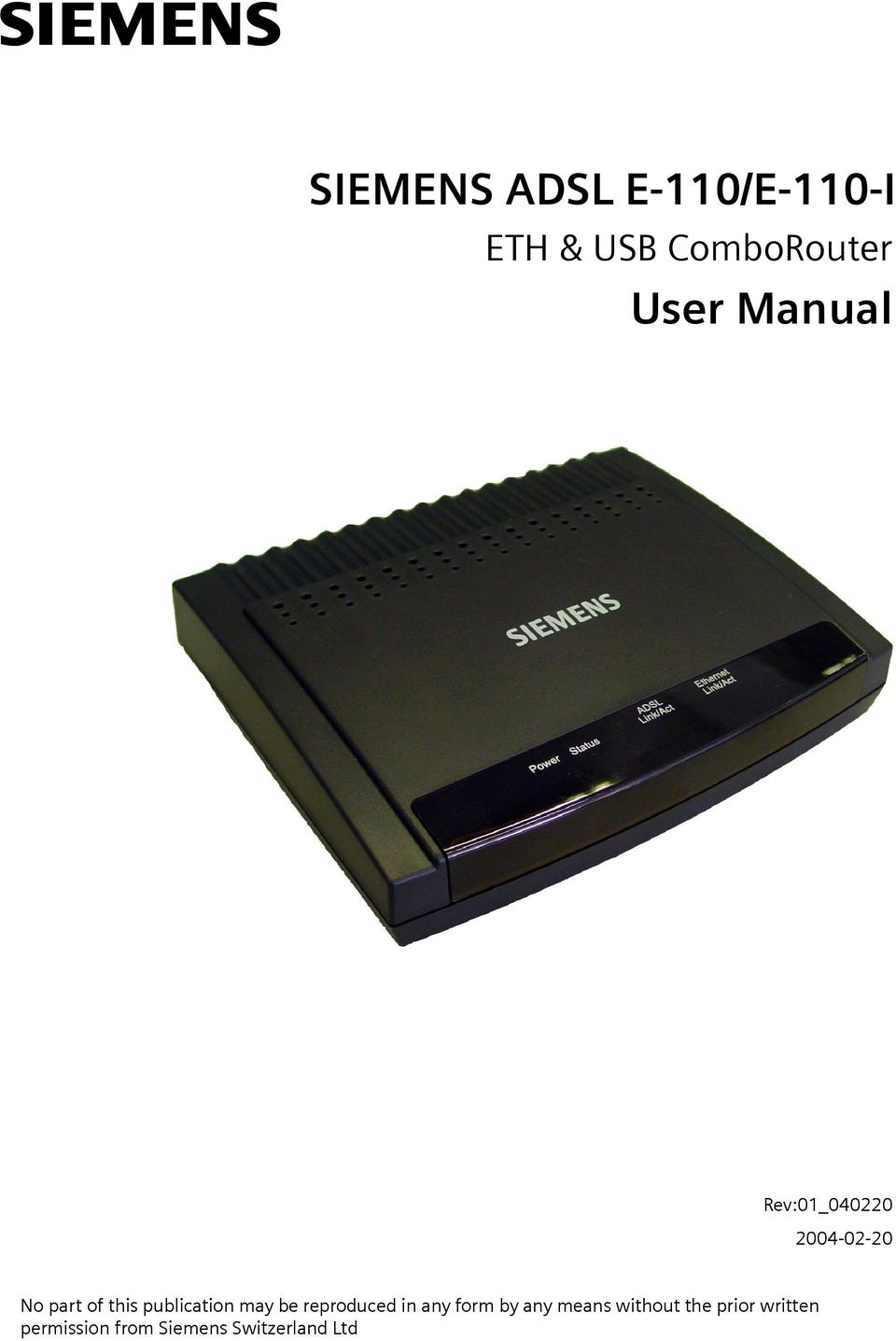
SIEMENS ADSL E-110/E-110-I. User Manual. ETH & USB ComboRouter. Rev:01_
|
|
|
- Daniela Phillips
- 10 years ago
- Views:
Transcription
1 SIEMENS ADSL E-110/E-110-I ETH & USB ComboRouter User Manual Rev:01_ No part of this publication may be reproduced in any form by any means without the prior written permission from Siemens Switzerland Ltd
2 SIEMENS ADSL E-110_E-110-I user manual Safety Notes For Installation Use only the type of power source indicated on the marking labels. Use only the power adapter supplied with the product. Do not overload wall outlet or extension cables as this may increase the risk of electric shock or fire. If the power cable is frayed, replace it with a new one. Proper ventilation is necessary to prevent the product overheating. Do not block or cover the slots and openings on the device, which are intended for ventilation and proper operation. It is recommended to mount the product with a stack. Do not place the product near any source of heat or expose it to direct sunshine. Do not expose the product to moisture. Never spill any liquid on the product. Do not attempt to connect with any computer accessory or electronic product without instructions from qualified service personnel. This may result in risk of electronic shock or fire. Do not place this product on an unstable stand or table. For Using Power off and unplug this product from the wall outlet when it is not in use or before cleaning. Pay attention to the temperature of the power adapter. The temperature might be high. After powering off the product, power on the product at least 15 seconds later. Do not block the ventilating openings of this product. When the product is expected to be not in use for a period of time, unplug the power cable of the product to prevent it from the damage of storm or sudden increases in rating. For Service Do not attempt to disassemble or open covers of this unit by yourself. Nor should you attempt to service the product yourself, which may void the user s authority to operate it. Contact qualified service personnel under the following conditions: If the power cable or plug is damaged or frayed. If liquid has been spilled into the product. If the product has been exposed to rain or water. If the product does not operate normally when the operating instructions are followed. If the product has been dropped or the cabinet has been damaged. If the product exhibits a distinct change in performance. Warning This equipment must be installed and operated in accordance with provided instructions. This device complies with Part 15 of the FCC Rules. Operation is subject to the following two conditions: (1) this device may not cause harmful interference, and (2) this device must accept any interference received, including interference that may cause undesired operation. Caution Any changes or modifications not expressly approved by the party responsible for compliance could void the authority to operate equipment. ii Rev:01_040220

3 Contents Content Safety Notes... i Safety Notes... ii For Installation... ii For Using... ii For Service... ii Warning... ii Caution... ii Content... iii Before You Use... 1 Features... 1 System Requirements... 2 Unpacking... 2 Chapter 1: Overview... 3 Physical Outlook... 3 Physical Outlook... 3 Front Panel... 3 Rear PanelRear Panel... 4 Chapter 2: Installation... 5 Choosing a place for the ADSL Router... 5 Connecting the ADSL Router... 5 Analog (PSTN) installation... 5 ISDN installation... 6 USB driver installation... 7 Install the USB driver... 7 Uninstall the USB driver... 8 Chapter 3: Configuration... 9 Step 1: Configure TCP/IP on Client PC... 9 For Windows For Windows 98 and Windows 98 SE For Windows ME For Windows NT For Windows For Windows XP For Macintosh OS 8.6 and 9.x For Macintosh OS 10.x Renew IP Address on Client PC For Windows 98 and Windows 98 SE For Windows ME For Windows NT For Windows For Windows XP Step 2: Quick Configuration via Web browser Internet Access Rev:01_ iii

4 SIEMENS ADSL E-110_E-110-I user manual Advanced Configuration via Web browser Main Menu...34 Commonly Used Buttons and Icons Viewing Basic System Information Quick Configuration Committing Changes to Permanent Storage Rebooting the device using Configuration Manager Sub-Menus Chapter 4: Advanced Configuration Configuring IP Routes DHCP Configuration Configuring DHCP Server Configuring DHCP Relay NAT Configuration Viewing Your NAT Configuration Viewing NAT Rules and Rule Statistics Viewing Current NAT Translations Adding NAT Rules RIP Configuration Configuring the RIP Viewing RIP Statistics Firewall, IP Filters and Blocked Protocols Firewall Configuration IP Filter Configuration To Block Specific Protocols Administration Tasks Changing the System Date and Time User Configuration Image Upgrade View System Alarms Diagnostics Port Settings View DSL Parameters Chapter 5: Connection Modes Bridge Mode Part 1: Configuring the ADSL Router Part 2: Check your connection status Part 3: Configuring the PC PPP Connection Mode Part 1: Configuring the ADSL Router Part 2: Check your connection status Part 3: Configuring the PC Router Connection Mode Part 1: Configuring the ADSL Router Part 2: Check your connection status Part 3: Configuring the PC Chapter 6: Troubleshooting Chapter 7: Glossary iv Rev:01_040220

5 Contents Appendix: Specification Software Hardware Rev:01_ v

6

7 Before You Use Before You Use The SIEMENS ADSL E-110/E-110-I is an Asymmetric Digital Subscriber Line (ADSL) Router. With the asymmetric technology, this device runs over standard copper phone lines. In addition, ADSL allows you to have both voice and data services in use simultaneously all over one phone line. The SIEMENS ADSL E-110/E-110-I is designed to offer cost-effective high-speed services for home or office users. It provides a downstream rate of up to 8 Mbps and upstream rate of up to 1 Mbps for ADSL connection, even offers auto-negotiation capability for different flavors (ANSI T1.413 Issue 2, G.lite, G.dmt for Annex A, G.dmt for Annex B or G.hs) according to central office DSLAM s settings (Digital Subscriber Line Access Multiplexer). Also the feature-rich routing functions are seamlessly integrated to ADSL service for existing corporate or home users. Now users can enjoy various bandwidth-consuming applications via the SANTIS ADSL Router. Features ADSL Compliance ANSI T1.413 Issue 2 ITU G Annex A (G.lite) ITU G Annex A (G.dmt) ITU G Annex B (G.dmt) ITU G (G.hs) ATM Features Compliant to ATM Forum UNI 3.1 / 4.0 Permanent Virtual Circuits (PVCs) Support up to 8 AAL5 Virtual Circuit Channels (VCCs) for UBR, CBR and GFR service classes Provides ATM layer functionality Provides adaptation layer (AAL5) functionality Performs the traffic shaping and scheduling per ATM port Supports PPP encapsulation over ATM (PPPoA) and PPP over Ethernet (PPPoE) ADSL-aware CAC Support for F5 AIS, RDI and loopback cells Bridging Features Up to 1000 hosts Supports transparent bridging as specified in IEEE 802.1D Transparent Bridging Supports bridged PDU encapsulation (RFC 2684) MAC-level filter to accept/deny packets based on rules applicable at the MAC level Routing Features Network Address Translation (NAT) IP filtering and raw filtering Dynamic IP address allocation is supported through DHSP and IPCP Point-to-point Protocol (PPP): PPPoA, PPPoE, PAP or CHAP for user authentication, Routing information Protocol (RIP) v1 and v2 Security Features PAP (RFC1334), CHAP (RFC1994) for PPP session Firewall support IP packets filtering based on IP address/port number/protocol type and TCP code field flags Intrusion Detection provides protection from a number of attacks (such as SYN/FIN/RST Flood, Smurf, WinNuke, Echo Scan, Xmas Tree Scan, etc) Rev:01_

8 SIEMENS ADSL E-110_E-110-I user manual Configuration and Management DSL Forum TR37-compliant auto configuration SNMPv1 over DSL or Ethernet for access to the MIB-II (router only) CLI (Command Line Interface) via serial interface or Telnet over Ethernet or DSL Web-based Graphical User Interface (GUI) enabling end-user device configuration via Web browser Update of boot image configuration data over TFTP/FTP System Requirements For using this, you have to make sure you have the following that installed on the clients: Operating System must be Windows 95/98/98 SE/ME/NT/2000/XP or Macintosh 8.6/9.x/10.x 10/100 Base-T NIC 10/100 Base-T (UTP) network cable Unpacking Check the contents of the package against the pack contents checklist below. If any of the items is missing, then contact the dealer from whom the equipment was purchased. ADSL Router Power Adapter RJ-11 ADSL Line Cable RJ-45 Ethernet Cable CDROM with Quick Start Guide / User Manual 2 Rev:01_040220

9 Chapter 1: Overview Chapter 1: Overview Physical Outlook Physical Outlook Front Panel The following illustration shows the front panel of the ADSL Router: LED Indicators (Front Panel System Messages) The ADSL Router is equipped with orange LEDs on the front panel as described in the table below (from left to right): LED Status Description Power On Off Unit is powered on. Unit is powered off. Status Blinking Flashes to indicate that the device software is operational. ADSL Link/Act Ethernet Link/Act USB Link/Act Short Blinking OFF Irregular Blinking On Off Irregular Blinking On Off Irregular Blinking The Router Modem is in training ADSL link is established Indicates ADSL traffic Ethernet link is established No Ethernet link Indicates Ethernet traffic USB link is established No USB link Indicates USB traffic Rev:01_

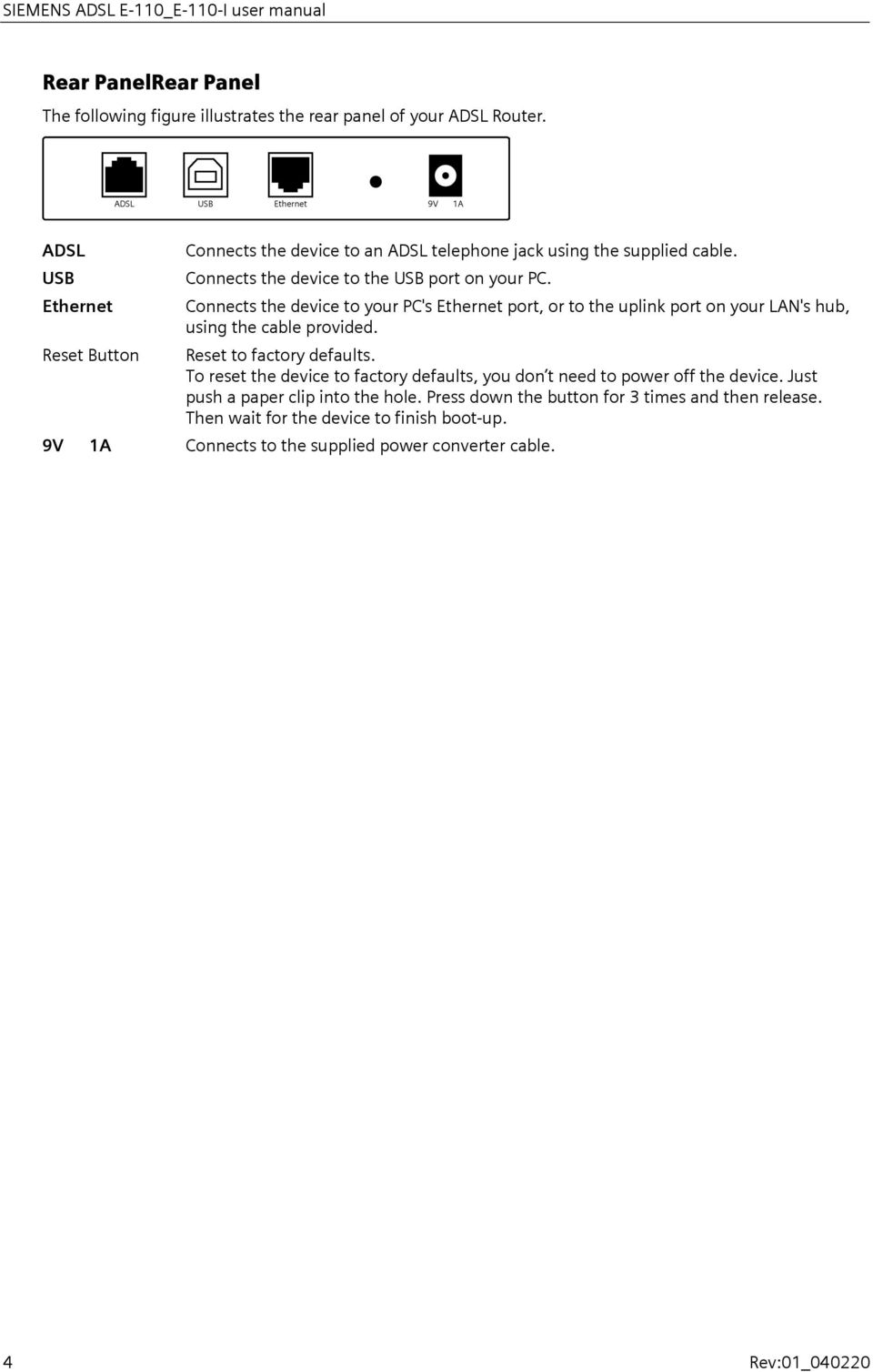
10 SIEMENS ADSL E-110_E-110-I user manual Rear PanelRear Panel The following figure illustrates the rear panel of your ADSL Router. ADSL USB Ethernet Reset Button Connects the device to an ADSL telephone jack using the supplied cable. Connects the device to the USB port on your PC. Connects the device to your PC's Ethernet port, or to the uplink port on your LAN's hub, using the cable provided. Reset to factory defaults. To reset the device to factory defaults, you don t need to power off the device. Just push a paper clip into the hole. Press down the button for 3 times and then release. Then wait for the device to finish boot-up. 9V 1A Connects to the supplied power converter cable. 4 Rev:01_040220
11 Chapter 2: Installation Chapter 2: Installation Choosing a place for the ADSL Router 1. Place the ADSL Router close to ADSL wall outlet and power outlet for the cable to reach it easily. 2. Avoid placing the device in places where people may walk on the cables. Also keep it away from direct sunshine or heat sources. 3. Place the device on a flat and stable stand. Connecting the ADSL Router Follow the steps below to connect the related devices. Note: For ADSL standard, a PSTN Microfilter or an ISDN Splitter is necessary on subscriber s premise to keep the telephone and ADSL signals separated, giving them the capability to provide simultaneous Internet access and telephone service on the same line. Analog (PSTN) installation If your telephone service is analog (SIEMENS ADSL E-110), proceed as follows to install your Hardware: Remove the end of the phone line from your phone connector and plug it into the LINE plug of the PSTN Microfilter. Use another phone line to connect your phone and Microfilter. Plug this phone line into the PHONE plug of the ADSL Microfilter, and plug the other end of the line onto your phone. Y-Line Filters 1. Unplug the device s cable from the phone jack. 2. Plug the Y-Line Filter into the phone jack. 3. Plug the phone cable (or other device cable) into the PHONE jack of your Y-Line Filter. 4. Plug the ADSL cable into the ADSL jack of your Y-Line Filter Rev:01_

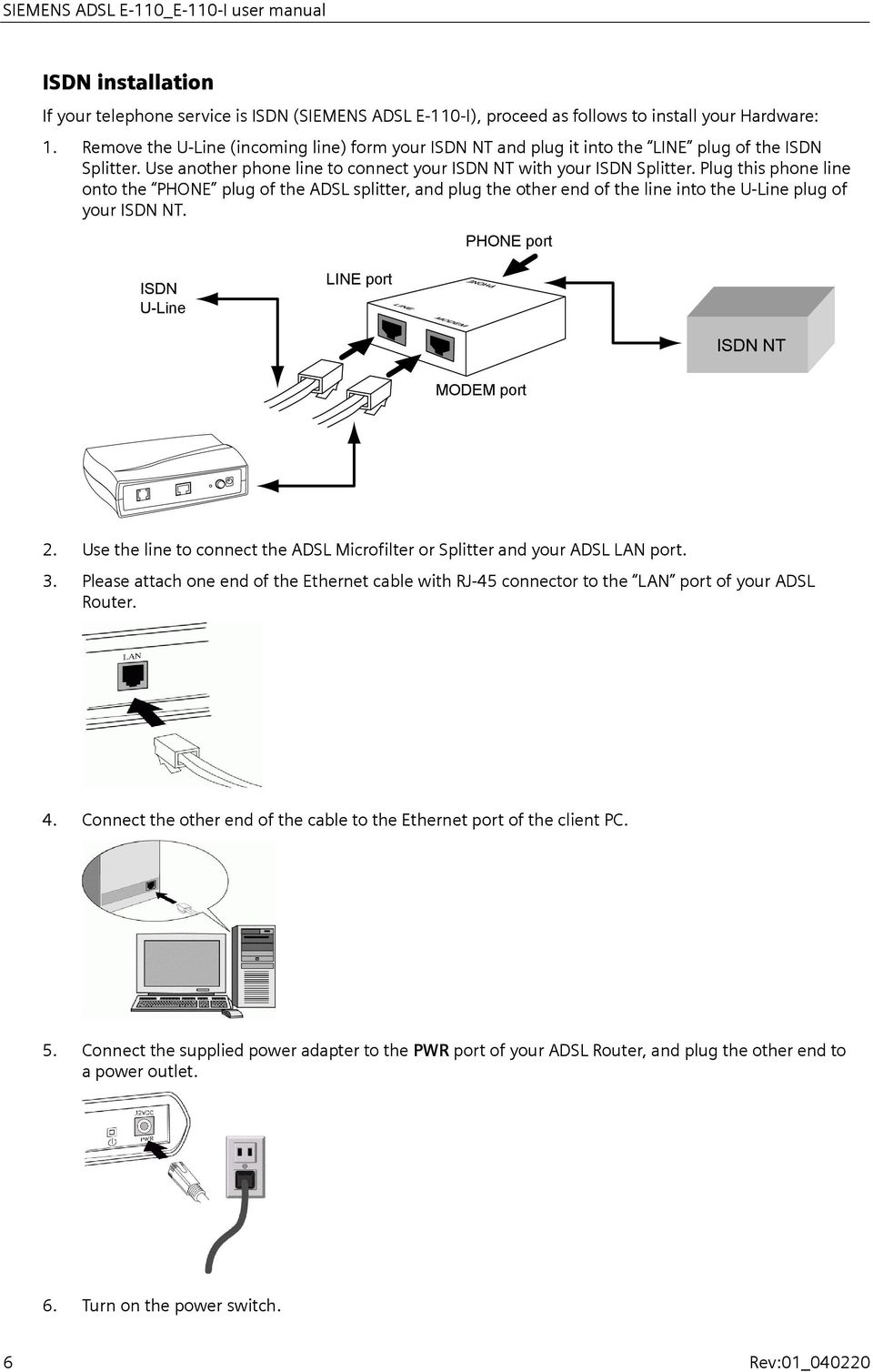
12 SIEMENS ADSL E-110_E-110-I user manual ISDN installation If your telephone service is ISDN (SIEMENS ADSL E-110-I), proceed as follows to install your Hardware: 1. Remove the U-Line (incoming line) form your ISDN NT and plug it into the LINE plug of the ISDN Splitter. Use another phone line to connect your ISDN NT with your ISDN Splitter. Plug this phone line onto the PHONE plug of the ADSL splitter, and plug the other end of the line into the U-Line plug of your ISDN NT. PHONE port ISDN U-Line LINE port ISDN NT MODEM port 2. Use the line to connect the ADSL Microfilter or Splitter and your ADSL LAN port. 3. Please attach one end of the Ethernet cable with RJ-45 connector to the LAN port of your ADSL Router. 4. Connect the other end of the cable to the Ethernet port of the client PC. 5. Connect the supplied power adapter to the PWR port of your ADSL Router, and plug the other end to a power outlet. 6. Turn on the power switch. 6 Rev:01_040220

13 Chapter 2: Installation USB driver installation Install the USB driver Note: The USB driver is only working on the following operating systems (OS): Windows 98, Windows 98SE, Windows ME, Windows 2000 and Windows XP If your Router is NOT equipped with an Ethernet interface you have to install first the USB driver in order to be able to configure your ADSL Router. For the driver installation proceed as follows: Note: Windows 98 users need the Windows 98 CD-ROM to complete the installation. 1a. With your computer off, connect the USB cable to the USB port on your computer (plug it in a separate USB port on the PC preferably without using a hub). 1b. Do NOT connect your ADSL router to your computer now. 2. Turn on your computer. 3. Insert the Siemens installation CD-ROM in your CD-ROM drive. 4. The installation procedure will start automatically and the following window appears: Note: In case the setup wizard does not start automatically, open a Run window via Start Run and enter the path D:\setup.exe, where D represents the drive letter of the CD-ROM drive. 5. Click on Next. The software will be installed after which the following window appears: 6. Connect the USB cable to your ADSL router. The driver will be installed automatically. Note for Windows 98 users: If prompted, you need to insert the Windows 98 CD-ROM in your CD-ROM drive to complete the installation. Rev:01_


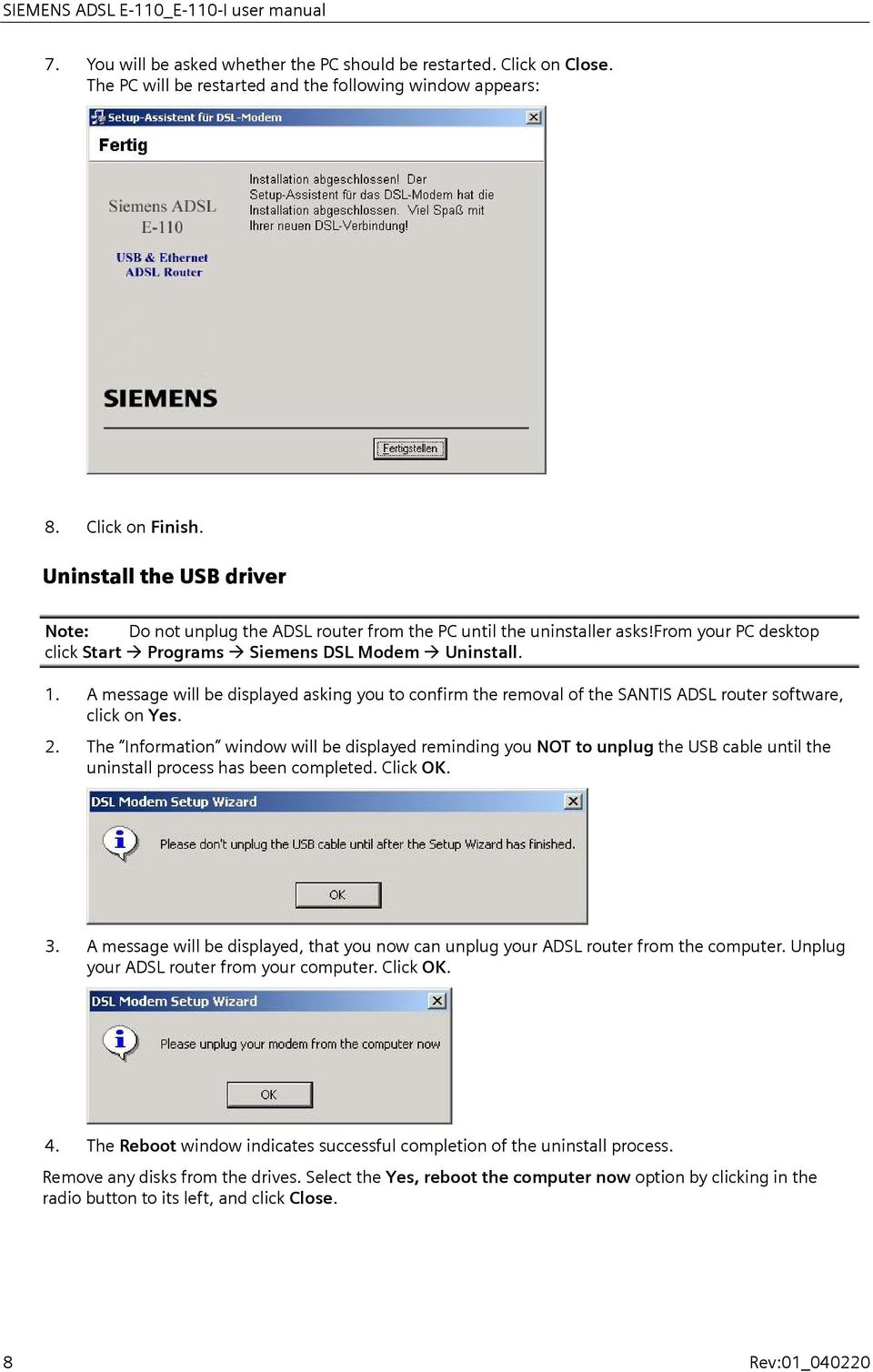
14 SIEMENS ADSL E-110_E-110-I user manual 7. You will be asked whether the PC should be restarted. Click on Close. The PC will be restarted and the following window appears: 8. Click on Finish. Uninstall the USB driver Note: Do not unplug the ADSL router from the PC until the uninstaller asks!from your PC desktop click Start Programs Siemens DSL Modem Uninstall. 1. A message will be displayed asking you to confirm the removal of the SANTIS ADSL router software, click on Yes. 2. The Information window will be displayed reminding you NOT to unplug the USB cable until the uninstall process has been completed. Click OK. 3. A message will be displayed, that you now can unplug your ADSL router from the computer. Unplug your ADSL router from your computer. Click OK. 4. The Reboot window indicates successful completion of the uninstall process. Remove any disks from the drives. Select the Yes, reboot the computer now option by clicking in the radio button to its left, and click Close. 8 Rev:01_040220
15 Chapter 3: Configuration Chapter 3: Configuration In order to access the Internet through the router, you must check the TCP/IP settings before configuring the router. Step 1: Configure TCP/IP on Client PC To access the ADSL Router via Ethernet, the host computer must meet the following requirements: With Ethernet network interface. Must have TCP/IP protocol installed. Set client PC with obtain an IP address automatically. With a Web browser installed: Internet Explorer 5.x or later. The ADSL Router is configured with the default IP address of and subnet mask of As the DHCP server is Enabled by default, the DHCP clients should be able to access the ADSL Router. Or you could assign an IP address to the host PC first for initial configuration. You also can manage the ADSL Router through a Web browser-based manager: ADSL ROUTER CONTROL PANEL. The ADSL Router manager uses the HTTP protocol via a Web browser to allow you to set up and manage the device. To configure the device via Web browser, at least one properly configured PC must be connected to the network (either connected directly or through an external hub/switch to the LAN port of the device). If TCP/IP is not already installed, follow the steps below for installation. For Windows 95 Note: Windows 95 users need the Windows 95 installation CD-ROM to complete the installation! 1. Click on the Start menu, point to Settings and click on Control Panel. Rev:01_
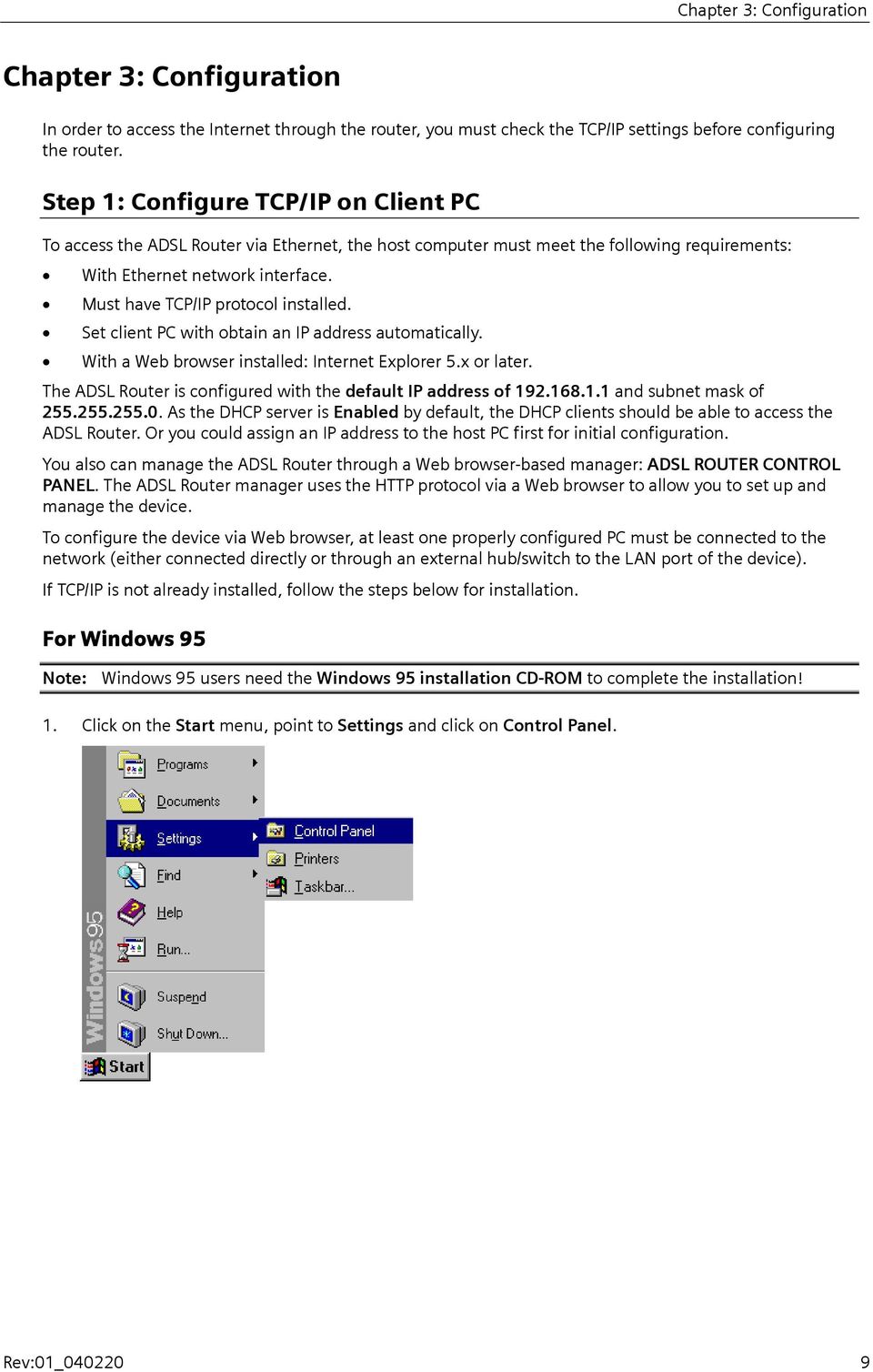
16 SIEMENS ADSL E-110_E-110-I user manual 2. Double-click the Network icon. 3. The Network window appears. On the Configuration tab, check out the list of installed network components. Option 1: If you have no TCP/IP protocol, click [Add]. Option 2: If you have TCP/IP protocol, go to Step Highlight Protocol and click [Add]. 10 Rev:01_040220

17 Chapter 3: Configuration 5. On the left side of the windows, highlight Microsoft and then select TCP/IP on the right side. Then click [OK]. 6. When returning to Network window, highlight TCP/IP protocol for your NIC and click [Properties]. 7. On IP Address tab, select Obtain an IP address automatically. Then click [OK]. Rev:01_
![right side. Then click [OK]. 6.](/docs-images/41/668922/images/page_17.jpg "When returning to Network window, highlight TCP/IP protocol for your NIC and click")
18 SIEMENS ADSL E-110_E-110-I user manual 8. When returning to Network window, click [OK]. 9. Windows may ask you for the original Windows installation disk or additional files. Insert the Windows 95 installation CD-ROM and click [OK]. 10. Supply the requested files by pointing to the correct location, e.g. D:\Win95, where D represents the letter of your CD-ROM drive. 11. Wait for Windows copying files. 12. When prompted with System Settings Change dialog box, click [Yes] to restart your computer. 12 Rev:01_040220
![Insert the Windows 95 installation CD-ROM and click [OK]. 10. Supply the requested files by pointing to the correct location, e.](/docs-images/41/668922/images/page_18.jpg "g. D:\Win95, where D represents the letter of your CD-ROM drive. 11. Wait for Windows copying files. 12.")
19 Chapter 3: Configuration For Windows 98 and Windows 98 SE Note: Windows 98 and 98 SE users need the Windows 98 / Windows 98 SE installation CD-ROM to complete the installation! 1. Click on the Start menu, point to Settings and click on Control Panel. 2. Double-click the Network icon. Rev:01_

20 SIEMENS ADSL E-110_E-110-I user manual 3. The Network window appears. On the Configuration tab, check out the list of installed network components. Option 1: If you have no TCP/IP protocol, click [Add]. Option 2: If you have TCP/IP protocol, go to Step 6. Your network interface card. Check out if TCP/IP for your NIC is installed or not. 4. Highlight Protocol and click [Add]. 5. On the left side of the windows, highlight Microsoft and then select TCP/IP on the right side. Then click [OK]. 14 Rev:01_040220
![Option 1: If you have no TCP/IP protocol, click [Add]. Option 2: If you have TCP/IP protocol, go to Step 6.](/docs-images/41/668922/images/page_20.jpg "Your network interface card. Check out if TCP/IP for your NIC is installed or not. 4. Highlight Protocol and click [Add]. 5.")
21 Chapter 3: Configuration 6. When returning to Network window, highlight TCP/IP protocol for your NIC and click [Properties]. 7. On IP Address tab, select Obtain an IP address automatically. Then click [OK]. 8. When returning to Network window, click [OK]. Rev:01_
22 SIEMENS ADSL E-110_E-110-I user manual 9. Windows may ask you for the original Windows installation disk or additional files. Insert the Windows 95 installation CD-ROM and click [OK]. 10. Supply the requested files by pointing to the correct location, e.g. D:\Win95, where D represents the letter of your CD-ROM drive. 11. Wait for Windows copying files. 12. When prompted with System Settings Change dialog box, click [Yes] to restart your computer. 16 Rev:01_040220
23 Chapter 3: Configuration For Windows ME 1. Click on the Start menu, point to Settings and click on Control Panel. 2. Double-click the Network icon. 3. The Network window appears. On the Configuration tab, check out the list of installed network components. Option 1: If you have no TCP/IP protocol, click [Add]. Option 2: If you have TCP/IP protocol, go to Step Highlight Protocol and click [Add]. 5. On the left side of the windows, highlight Microsoft and then select TCP/IP on the right side. Then click [OK]. 6. While returning to Network window, highlight TCP/IP protocol for your NIC and click [Properties]. 7. On the IP Address tab, select Obtain an IP address automatically. Then click [OK]. 8. While returning to the Network window, click [OK]. 9. Wait for Windows copying files. 10. When prompted with the System Settings Change dialog box, click [Yes] to restart your computer. Rev:01_
24 SIEMENS ADSL E-110_E-110-I user manual For Windows NT Note: Windows NT users need the Windows NT installation CD-ROM to complete the installation! 1. Click Start, point to Settings and then click Control Panel. 2. Double-click the Network icon. 3. The Network window appears. On the Protocols tab, check out the list of installed network components. Option 1: If you have no TCP/IP Protocol, click [Add]. Option 2: If you have TCP/IP Protocol installed, go to Step Rev:01_040220
25 Chapter 3: Configuration 4. Highlight TCP/IP Protocol and click [OK]. 5. Click [Yes] to use DHCP. 6. Insert the Windows NT CD into your CD-ROM drive and type the location of the CD. Then click [Continue]. 7. Returning to the Network window, you will find the TCP/IP Protocol among the list. Click on [Close]. 8. When prompted with Network Settings Change dialog box, click [Yes] to restart your computer. Rev:01_
26 SIEMENS ADSL E-110_E-110-I user manual 9. Right click on the Network Neighborhood icon on the desktop and select Properties. 10. In the Protocol tab select TCP/IP Protocol and click on [Properties]. 11. Select Obtain an IP address from a DHCP server. Then click [OK]. 12. When prompted with Microsoft TCP/IP dialog window, click [Yes]. 20 Rev:01_040220
27 Chapter 3: Configuration 13. When returning to Network window, click [OK]. Rev:01_
28 SIEMENS ADSL E-110_E-110-I user manual For Windows From the Start menu, point to Settings and then click Network and Dial-up Connections. 2. Right-click the Local Area Connection icon and then click Properties. 3. On the General tab, check out the list of installed network components. Option 1: If you have no TCP/IP Protocol, click [Install]. Option 2: If you have TCP/IP Protocol, go to Step Rev:01_040220
29 Chapter 3: Configuration 4. Highlight Protocol and then click [Add]. 5. Click Internet Protocol(TCP/IP) and then click [OK]. 6. When returning to Local Area Connection Properties window, highlight Internet Protocol (TCP/IP) and then click [Properties]. Rev:01_
30 SIEMENS ADSL E-110_E-110-I user manual 7. Under the General tab, select Obtain an IP address automatically. Then click [OK]. 8. When prompted to restart your computer, reboot it to enable the settings. 24 Rev:01_040220
31 Chapter 3: Configuration For Windows XP 1. From the Start menu, point to Control Panel and then click Network and Internet Connections. 2. Click Network Connection and then click Properties. 3. On the General tab, check out the list of installed network components. Option 1: If you have no TCP/IP Protocol, click [Install]. Option 2: If you have TCP/IP Protocol, go to Step Highlight Protocol and then click [Add]. 5. Click Internet Protocol(TCP/IP) and then click [OK]. 6. On the Local Area Connection Properties window, highlight Internet Protocol (TCP/IP) and then click [Properties]. 7. Under the General tab, enable Obtain an IP address automatically. Then click [OK]. 8. When prompted to restart your computer, reboot it to enable the settings. Rev:01_

32 SIEMENS ADSL E-110_E-110-I user manual For Macintosh OS 8.6 and 9.x 1. From the Apple Menu, point to Control Panels and then click TCP/IP. 2. From the Connect via pull-down menu select Ethernet built-in. From the Configure pull-down menu select Using DHCP Server. Close the TCP/IP window and click on [Save]. 26 Rev:01_040220
33 Chapter 3: Configuration For Macintosh OS 10.x 1. From the Apple Menu, select System Preferences 2. Click on Network. 3. From the Show pull-down menu select Built-in-Ethernet. On the TCP/IP tab, select Using DHCP from the Configure pull-down menu. Rev:01_
34 SIEMENS ADSL E-110_E-110-I user manual 4. On the PPPoE tab, and make sure that the Connect using PPPoE check box is NOT activated. Click Apply Now. 5. Close the Network window. 28 Rev:01_040220
35 Chapter 3: Configuration Renew IP Address on Client PC There is a chance that your PC does not renew its IP address after the ADSL Router is on line and the PC cannot access the Internet. Please follow the procedures below to renew PC s IP address. Note: This feature is only available for the following operating systems: Windows 98/98 SE/ME/2000/XP! For Windows 98 and Windows 98 SE 1. Select Run from the Start menu. 2. Type winipcfg in the dialog box and the click [OK]. 3. When the figure below appears, click [Release] and then [Renew] to get an IP address. Rev:01_
36 SIEMENS ADSL E-110_E-110-I user manual For Windows ME 1. Select Run from the Start menu. 2. Type winipcfg in the dialog box and the click [OK]. 3. When the figure below appears, click [Release] and then [Renew] to get an IP address. For Windows NT 1. Select Run from the Start menu. 2. Type cmd in the dialog box and the click [OK]. 3. Type ipconfig at prompt. Then you will see the IP information from DHCP server. 4. If you want to get a new IP address, type ipconfig /release to release the previous IP address and then type ipconfig /renew to get a new one. 30 Rev:01_040220
37 Chapter 3: Configuration For Windows From the Start menu, point to Programs > Accessories and then click Command Prompt. 2. Type ipconfig at prompt. Then you will see the IP information from DHCP server. 3. If you want to get a new IP address, type ipconfig /release to release the previous IP address and then type ipconfig /renew to get a new one. For Windows XP 1. From the Start menu, point to Programs > Accessories and then click Command Prompt. 2. Type ipconfig at prompt. Then you will see the IP information from DHCP server. 3. If you want to get a new IP address, type ipconfig/ release to release the previous IP address and then type ipconfig/ renew to get a new one. Rev:01_
38 SIEMENS ADSL E-110_E-110-I user manual Step 2: Quick Configuration via Web browser Your ADSL Router includes a Web-based Configuration Manager, which enables you to configure the device settings to meet the needs of your network. Once your host PC is properly configured, please proceed as follows: Start your Web browser and type in the address field of your browser. Press <Enter>. After connecting to the device, the Entry Page will be displayed. Internet Access 1. For Username enter the username (replace Guest) and for Password the password (replace *****) of your Internet Service Provider. 2. Click [Connect and Save]. 3. Username and password will automatically be saved and the status of the Internet connection will be prompted. 32 Rev:01_040220
39 Chapter 3: Configuration Advanced Configuration via Web browser Note: Please follow carefully the instructions in the whole chapter in order to be sure that your PC and your ADSL Router are working properly. For advanced configuration click to Advanced Configuration. You will be prompted to enter username and password. By default, the username is admin and the password is admin. If you login successfully, the main page of the ADSL ROUTER CONTROL PANEL appears. From now on the ADSL Router acts as a Web server sending HTML pages/forms on your request. You can fill in these pages/forms and apply them to the ADSL Router. Rev:01_
40 SIEMENS ADSL E-110_E-110-I user manual Main Menu Configuration Manager tasks are grouped info categories which can be accessed by clicking the main menu on the left. Each menu displays the available tasks in sub-menus. The specific configuration options are displayed by clicking on these menus. The same sub-menu may appear in more than one menu, when appropriate. Menu Home Lan Wan Bridge Routing Services Admin Description Allows you to display the basic system information and to access the Quick Configuration Displays software names and various settings for the device interfaces that communicate directly with your network. Includes the sub-menus of LAN Config, DHCP Mode, DHCP Server and DHCP Relay Displays software names and various settings for the device interfaces that communicate with your ISP via DSL. Although there is only one physical DSL port, multiple software-defined interfaces may be configured to use it. Includes the sub-menus of DSL, ATM VC, PPP, EOA and IPOA Displays software names and various settings for the device to operate as a bridge. Bridges are devices that enable two or more networks to communicate as if they are two segments of the same physical LAN. Includes the sub-menus of Bridging, LAN Config, DSL, ATM VC and RFC 1483 Interface(EoA) Displays software names and various settings for the device to operate as a router. Routers use a higher-level protocol to determine how to pass data. Includes the sub-menus of IP Route, IP Addr, LAN Config, DSL, ATM VC, PPP, EOA and IPOA Displays services that ADSL Router performs to help you manage your network. Includes the sub-menus of NAT, RIP, FireWall, IP Filter, DNS and Blocked Protocols Displays administration tasks that ADSL Router performs to help you manage your device. Includes the sub-menus of User Config, Commit & Reboot, Local Image Upgrade, Alarm, Diagnostics and Port Settings Commonly Used Buttons and Icons Button Function Stores in temporary system memory any changes you have made on the current page. Redisplays the current page with updated statistics. When accumulated statistics are displaying, this button resets the statistics to their initial values. Launches the online help for the current topic in a separate browser window. Help is available from any main topic page. Delete an entry. Modify an entry. View details for an entry. 34 Rev:01_040220
41 Chapter 3: Configuration Viewing Basic System Information The System View page displays when you first access the program. The System View table provides a snapshot of your system configuration. You can click on the table headings that are highlighted in orange lettering to display a more details on those settings or the configuration page for that feature. Refer to the appropriate chapters in this document for more information. Rev:01_
42 SIEMENS ADSL E-110_E-110-I user manual Quick Configuration The Quick Configuration displays the settings you are most likely to need to change when you first set up your ADSL Router. Work with your ISP to determine the values or settings you need to change. Select Home > Quick Configuration. The Quick Configuration page displays. The Quick Configuration page contains the following fields: Field ATM Interface Operation Mode Encapsulation Description Select the ATM interface you want to use (usually atm-0) Enables or disables the device s Internet and routing function. When set to Disabled, the device cannot be used to provide Internet connectivity for your network. Determines the type of data link used to communicate with your ISP. VPI / VCI Enter the VPI/VCI values given by your ISP, e.g. 0 / 35 Bridge IGMP Enables or disables bridging between the device and your ISP. Enables or disables the Internet Group Management Protocol, which some ISPs use to perform remote configuration of your device. IP Address Enter the IP address given by your ISP, e.g Subnet Mask Enter the associated subnet mask given by your ISP, e.g Default Route Gateway IP Address Username / Password When enabled, it specifies that the IP address entered above will be used as the default route for your LAN. Specifies the IP address that identifies the ISP server through which your Internet connection will be routed. Enter the IP Address given by your ISP, e.g Enter the username and password you use to log in to your ISP. Note: This is not the same as the username and password you used to log in to Configuration Manager. 36 Rev:01_040220
43 Chapter 3: Configuration Field Use DNS Primary DNS Server / Secondary DNS Server Description Enable Enter the Primary and Secondary DNS server addresses provided by your ISP Committing Changes to Permanent Storage Whenever you change system settings, the changes are initially placed in temporary storage (called random access memory or RAM). Your changes are made effective when you submit them, but will be lost if the device is reset or turned off. Follow these steps to commit changes to permanent storage. 1. Select Admin > Commit & Reboot. The Commit & Reboot page displays. 2. Click [Save]. (Disregard the selection in the Reboot Mode drop-down list; it does not affect the commit process.) The changes are saved to permanent storage. When committing your changes, note that: If you change the LAN IP address information, you must commit the changes and then reboot the system to activate them. All other changes are activated when you commit them (no reboot is needed). Rebooting the device using Configuration Manager If, after rebooting the device, you find that it does not operate properly with the new configuration, you can reboot using options that reactivate a previous configuration or the manufacturer s default configuration. You can select from the following options when rebooting: Setting Reboot From Default Configuration Reboot From Backup Configuration Reboot From Last Configuration Description Reboots the device to default settings provided by your ISP or the manufacturer. Choosing this option erases any custom settings. Reboots the device using settings stored in backup memory. These are the settings that were in effect before you committed new settings in the current session. Reboots the device using the current settings in permanent memory, including any changes you just committed. Rev:01_
44 SIEMENS ADSL E-110_E-110-I user manual Sub-Menus For advanced mode, the following sub-menus are available: Lan Wan LAN Config DHCP Mode DHCP Server DHCP Relay DSL ATM VC PPP EOA IPOA Bridge Bridging LAN Config DSL ATM VC RFC 1483 Interface (EoA) Routing IP Route IP Addr LAN Config DSL ATM VC Sets LAN configuration, which determines you the device is defined in the network. Sets and configures the Dynamic Host Configuration Protocol mode for the device. With DHCP, IP addresses for your LAN are administrated and distributed as needed by this device or an ISP device. Lists the IP address pools available to computer on your LAN. The device distributes numbers in the pool to devices on your network as they request Internet access (refer to Configuring DHCP Server ). Lists each interface on the device that relays data from your ISP. As a DHCP relay agent, when a computer request Internet access, the device requests an IP address from your ISP, and then relays the addresses back to the computer (refer to Configuring DHCP Relay ). Displays configuration parameters and performance statistics for the ADSL Router s DSL line (refer to View DSL Parameters ). Configures and displays an ATM virtual circuit (VC). The VC properties define the path that the ADSL Router uses to communicate with your ISP over the ATM network. Configures and displays Point to Point Protocol (PPP) interfaces. The PPP protocol is commonly used between ISPs and their customers to identify and control various communication properties (refer to PPP Connection Mode ). Configures and displays RFC1483/Ethernet over ATM (EoA) interfaces. The EoA protocol is commonly used to carry data between LANs that use the Ethernet protocol and WANs that use the ATM protocol. Configures and displays IP over ATM (IPoA) interfaces. An IPoA interface can be used to exchange IP packets over ATM network, without using an underlying EoA connection (refer to Router Connection Mode ). Configures and displays Bridging information (refer also to Bridge Mode ). Sets LAN configuration, which determines you the device is defined in the network. Displays configuration parameters and performance statistics for the ADSL Router s DSL line (refer to View DSL Parameters ). Configures and displays an ATM virtual circuit (VC). The VC properties define the path that the ADSL Router uses to communicate with your ISP over the ATM network. Configures and displays RFC1483/Ethernet over ATM (EoA) interfaces. The EoA protocol is commonly used to carry data between LANs that use the Ethernet protocol and WANs that use the ATM protocol. Lists IP addresses of Internet destinations commonly accessed by your network. When a computer requests to send data to a listed destination, the device uses the Next Hop to identify the first Internet router it should contact to route the data most efficiently (refer to Configuring IP Routes ). Displays all IP addresses associated with ports on your device, including the LAN (Ethernet) port and the WAN (DSL). Sets LAN configuration, which determines you the device is defined in the network. Displays configuration parameters and performance statistics for the ADSL Router s DSL line (refer to View DSL Parameters ). Configures and displays an ATM virtual circuit (VC). The VC properties define the path that the ADSL Router uses to communicate with your ISP over the ATM network. 38 Rev:01_040220
45 Chapter 3: Configuration PPP EOA IPOA Services NAT RIP FireWall IP Filter DNS Configures and displays Point to Point Protocol (PPP) interfaces. The PPP protocol is commonly used between ISPs and their customers to identify and control various communication properties. Configures and displays RFC1483/Ethernet over ATM (EoA) interfaces. The EoA protocol is commonly used to carry data between LANs that use the Ethernet protocol and WANs that use the ATM protocol. Configures and displays IP over ATM (IPoA) interfaces. An IPoA interface can be used to exchange IP packets over ATM network, without using an underlying EoA connection. Configures Network Address Translation (NAT), a security protocol in which the device translates the IP addresses of your LAN computers to new addresses before sending data out on the Internet (refer to NAT Configuration ). Lists any interfaces on your device that use Routing Information Protocol (RIP) and the version of the protocol used. Routers on your LAN communicate with one another using the RIP (refer to RIP Configuration ). Configures the firewall function, enabling you to protect the system against denial of services (DoS) attacks and other types of malicious accesses to your LAN (refer to Firewall Configuration ). Configures IP filters enabling you to create rules that control the forwarding of incoming and outgoing data between your LAN and the Internet and within your LAN (refer to IP Filter Configuration ). Configures Domain Name Service (DNS) server IP Addresses. DNS servers map the user-friendly domain names that users type into their Web browsers to the equivalent numerical IP addresses that are used for Internet routing. Blocked Protocols Blocks/unblocks the protocols running access the system. This enables you to prevent the ADSL Router from passing any data that uses a particular protocol (refer to To Block Specific Protocols ). Admin User Config Displays user information and changes your password (refer to User Configuration ). Commit & Reboot Commits changes to system memory and reboots your system with different configurations (refer to Committing Changes to Permanent Storage ). Local Image Upgrade Alarm Diagnostics Port Settings Uploads a new image to the system. Your ISP may provide you with an upgrade to the software running on your ADSL Router. All system software is contained in a single file, called an image (refer to Image Upgrade ). Displays information about alarms that occur in the system. Alarms, also called traps, are caused by a variety of system events, including connection attempts, resets and configuration changes (refer to View System Alarms ). Executes a series of test of your system software and hardware connections (refer to Diagnostics ). Modifies various port settings access the system (refer to Port Settings ). Rev:01_
46 SIEMENS ADSL E-110_E-110-I user manual Chapter 4: Advanced Configuration Configuring IP Routes Most users do not need to define IP routes. You may need to define routes if: Your network setup includes two or more networks or subnets. You connect to two or more ISP services. You connect to a remote corporate LAN. To display the routing table and add an IP route (if necessary), proceed as follows: 1. To view the routing table, select Routing > IP Route. The IP Route Table page displays. The IP Route Table includes routes that were predefined on the device, routes you may have added, and routes that the device has identified automatically through communication with other devices. The routing table should reflect a default gateway, which directs outbound Internet traffic to your ISP. This default gateway is shown in the row containing destination address If you need to add an IP route, click [Add]. The IP Route - Add page displays. 3. Specify the destination, network mask and gateway or next hop for this route. To create a route that defines the default gateway for your LAN, enter in both the Destination and Netmask fields. Enter your ISP s IP address in the Gateway/NextHop field. You cannot specify the interface name, route type or route origin. These parameters are used only for routes that are identified automatically as the device communicates with other routing devices. For routes you create, the routing table displays system default values in these fields. 4. Click [Apply]. A confirmation page displays to indicate that the route has been added successfully. 5. Click [Close] to return to the IP Route Table page. It will now display the new route. 6. Select Admin > Commit & Reboot and click [Save] to save your changes to permanent storage. 40 Rev:01_040220
47 Chapter 4: Advanced Configuration DHCP Configuration You can configure your network and ADSL Router to use the Dynamic Host Configuration Protocol (DHCP). The device can be configured as a DHCP server, DHCP relay agent, or, in some cases, a DHCP client. DHCP server - It will maintain the pool of addresses and distribute them to your LAN computers. If the pool of addresses includes private IP addresses, you must also configure the Network Address Translation service, so that the private addresses can be translated to your public IP address on the Internet. Both DHCP server and NAT are enabled in the default configuration. DHCP relay agent - If your ISP performs the DCHP server function for your network, then you can configure the device as a DHCP relay agent. When the ADSL Router receives a request for Internet access from a computer on your network, it contacts your ISP for the necessary IP information, and then relays the assigned information back to the computer. DCHP client - If you have another PC or device on your network that is already performing the DHCP server function, then you can configure the LAN port on the ADSL Router to be a DHCP client of that server. Configuring DHCP Server Part 1. Creating IP address pools 1. Select Lan > DHCP Server. The DHCP Server Configuration page displays. Each pool you create displays in a row on the table on this page. You can create up to eight pools. In this example, one pool has been created for the LAN interface. Additional pools may be needed when the device is configured with multiple LAN interfaces. Rev:01_
48 SIEMENS ADSL E-110_E-110-I user manual 2. To add an IP address pool, click [Add]. The DHCP Server Pool - Add page displays. Field Start / End IP Addresses Mac Address (optional) Netmask Domain Name (optional) Gateway Address DNS Address (optional) SDSN...SWINS Address (optional) Description Specify the lowest and highest addresses in the pool. Allows you to assign a specific IP address to a specific computer, identified by this MAC address. If this is the case, you must have specified the same IP address in both the Start/End IP Address fields. Specifies the associated subnet mask of the IP address in this range. The domain name to be used by DHCP clients. The address of the default gateway. Typically, it is the device s LAN port IP address. The IP address of the DNS Server. Its typically located with your ISP. The IP addresses of devices that perform various services for DHCP clients. 3. Click [Apply]. A confirmation page displays to indicate that the pool has been added successfully. 4. Click [Close] to return to the DHCP Server Configuration page. Part 2. Enabling DHCP Server Mode 1. Select Lan > DHCP Mode. 2. From the DHCP Mode drop-down list, select DHCP Server and then click [Apply]. A page gives a receipt for the changes. 3. Select Admin > Commit & Reboot and click [Save] to save your changes to permanent storage. 42 Rev:01_040220
49 Chapter 4: Advanced Configuration Part 3. Configuring your PCs as DHCP clients For each computer that you want to configure to receive IP information automatically, configure the TCP/IP properties to Obtain an IP address automatically (the actual text may vary depending on your operating system). Modifying Address Pools 1. Select Lan > DHCP Server. 2. On the DHCP Server Configuration page select for the entry to modify. The DHCP Server Pool - Modify page displays: When modifying an address pool, you are only allowed to: Change the domain name associated with the pool. Exclude IP addresses within its range from distribution. To excluded an IP address, enter it in the fields provided and click [Add]. If you want to change other attributes, you must delete the pool and create a new one. 3. After entering your changes, click [Apply]. A confirmation page displays to indicate that the pool has been modified successfully. 4. Click [Close] to return to the DHCP Server Configuration page. 5. Select Admin > Commit & Reboot and click [Save] to save your changes to permanent storage. Viewing Current DHCP Address Assignments To view a table of all current IP address assignments, select Lan > DHCP Server and click [Address Table]. The DHCP Server Address Table is as below. Rev:01_
50 SIEMENS ADSL E-110_E-110-I user manual Configuring DHCP Relay Part 1. Defining the DHCP relay interface(s) 1. Select Lan > DHCP Relay. The DHCP Relay Configuration page displays. This page provides a text box for entering the IP address of your ISP s DHCP server and a table that lists the interfaces on your ADSL Router that can relay DHCP information. 2. Type the IP address of your ISP s DHCP server in the fields provided. If you do not have this number, it is not essential to enter it here. Requests for IP information from your LAN will be passed to the default gateway, which should route the request appropriately. 3. If the interface named eth-0 is not already displaying, select it from the drop-down list and click [Add]. 4. Click [Apply]. A page gives a receipt for your changes.. Part 2. Enabling DHCP relay mode 1. Select Lan > DHCP Mode. 2. From the DHCP Mode drop-down list, select DHCP Relay and then click [Apply]. A page gives a receipt for the changes. 3. Select Admin > Commit & Reboot and click [Save] to save your changes to permanent storage. Part 3. Configuring your PCs as DHCP clients For each computer that you want to configure to receive IP information automatically, configure the TCP/IP properties to Obtain an IP address automatically (the actual text may vary depending on your operating system). 44 Rev:01_040220
51 Chapter 4: Advanced Configuration NAT Configuration This section provides an overview of Network Address Translation (NAT) and instructions for modifying the default configuration on your device. By default, NAT is enabled, with an network address port translation (napt) rule configured to perform the following translation: These private IP addresses: are translated to: Your ISP-assigned public IP address This default NAT setup assumes that, on each LAN computer, you configured TCP/IP properties as follows: You enables them to receive their IP addresses automatically (that is, to use a DHCP server) or You assigned static IP addresses to your PCs in the range through If your computers are not configured in one of these ways, you can either change the IP addresses on your computers to match the NAT setup or delete this NAT rule and add a new one that matches the addresses you assigned to your computers. Viewing Your NAT Configuration 1. To view your NAT settings, select Services > NAT. The NAT Configuration page displays. Rev:01_
52 SIEMENS ADSL E-110_E-110-I user manual The NAT Global Information table contains the following fields: Field TCP Idle Timeout(sec) TCP Close Wait(sec) TCP Def Timeout(sec) UDP Timeout(sec) ICMP Timeout(sec) GRE Timeout(sec) Default Nat Age(sec) NAPT Port Start/End Description For a NAT translation session on data that uses the TCP protocol, the translation will no longer be performed if no matching data packets are received after the specified time has elapsed. For a NAT translation on data using the TCP protocol, after a communication session has been closed, the translation will no longer be performed if no matching data packets are received after the specified time has elapsed. For a NAT translation session on data that uses the TCP protocol, the translation will no longer be performed if no matching data packets are received after the specified time has elapsed. Same as TCP Idle Timeout, but for UDP packets. Same as TCP Idle Timeout, but for ICMP packets. Same as TCP Idle Timeout, but for GRE packets. For all other NAT translation sessions, the number of seconds after which a translation session will no longer be valid. When an napt rule is defined, the source ports will be translated to sequential numbers in this range. 2. If you change any values, click [Apply]. A page gives a receipt for the changes. 3. Select Admin > Commit & Reboot and click [Save] to save your changes to permanent storage. 46 Rev:01_040220
53 Chapter 4: Advanced Configuration On the NAT Configuration page you can click [Global Stats] to view accumulated data on how many NAT rules have been invoked and how much data has been translated. A page similar to the one below displays. Rev:01_
54 SIEMENS ADSL E-110_E-110-I user manual Viewing NAT Rules and Rule Statistics To view the NAT Rules currently defined on your system, select Services > NAT. From the NAT Options drop-down list select NAT Rule Entry. The NAT Rule Configuration page displays. To view data on how often a specific NAT rule has been used, click [Stats]. A page similar to the one below displays: The statistics show how many times this rule has been invoked and how many currently active sessions are using this rule. Viewing Current NAT Translations To view a list of NAT translations that have recently been performed and which remain in effect (for any of the defined rules), select Services > NAT. From the NAT Options drop-down list select NAT Translations. The NAT Translations page displays. For each current NAT translation session, the table contains the following fields: Field Trans Index Rule ID Interface Protocol Description The sequential number assigned to the IP session used by this NAT translation session. The ID of the NAT rule invoked. The device interface on which the NAT rule was invoked (from the rule definition). The IP protocol used by the data packets that are undergoing translations (from the rule definition) Example: TCP, UDP, ICMP. 48 Rev:01_040220
55 Chapter 4: Advanced Configuration Field ALG Type NAT Direction Entry Age Description The Application Level Gateway (ALG), if any, that was used to enable this NAT translation (ALGs are special settings that certain applications require in order to work while NAT is enabled). The direction (incoming or outgoing) of the translation (from the port definition). The elapsed time, in seconds, of the NAT translation session. Adding NAT Rules This section explains how to create rules for the various NAT flavors. In general, follow this instructions to add a rule: 1. Select Services > NAT. From the NAT Options drop-down list select NAT Rule Entry and click [Add]. 2. From the Rule Flavor drop-down list, select the rule flavor needed. The corresponding page displays (see sections below) 3. In the Rule ID field assign a number to the rule. The Rule ID determines the order in which rules are invoked (the lowest numbered rule is invoked first, and so on). In some cases, two or more rules may be defined to act on the same set of IP addresses. Once a data packet matches a rule, the data is acted upon according to that rule and is not subjected to higher-numbered rules. 4. From the IF Name drop-down list, select the interface on the ADSL Router to which this rule applies. Typically, NAT rules apply to communication between your LAN and the Internet. Because the device uses the WAN interface (named ppp-0 or eoa-0) to connect your LAN to your ISP, it is the usual IF Name selection. 5. Proceed as described below for the corresponding rule. 6. When you have completed entering all information, click [Apply]. A page displays to confirm the change. 7. Click [Close] to return to the NAT Configuration page. The new rule should display in the NAT Rule table. 8. On the NAT Configuration page, ensure that the Enable radio button is turned on. 9. On the NAT Configuration page, click [Apply]. A page displays to confirm your changes. 10. Select Admin > Commit & Reboot and click [Save] to save your changes to permanent storage. The napt rule: Translating between private and public IP addresses The NAT flavor napt was used in your default configuration. The napt flavor translates all LAN-side private source IP addresses to a single public IP address. It also translates the source port numbers to port numbers that are defined on the NAT Global Configuration page. 1. On the NAT Rule - Add page, select NAPT from the Rule Flavor drop-down list (if necessary). Rev:01_
56 SIEMENS ADSL E-110_E-110-I user manual 2. Define the rule ID and select the interface. 3. In the Local Address From/To fields, type the starting and ending IP addresses, respectively, of the range of private address you want to be translated. Or, type the same address in both fields to specify a single value. If all LAN addresses should be translated, specify and respectively. If you use non-sequential private addresses, you can create an additional napt rule for each separate range of addresses. 4. Complete as described for general procedure (steps 6 to 10). The rdr rule: Allowing external access to a LAN computer You can create an rdr rule to make a computer on your LAN, such as a Web or FTP server, available to Internet users without requiring you to obtain a public IP address for that computer. The computer s private IP address is translated to your public IP address in all incoming and outgoing data packets. Note: Without an rdr rule (or bimap rule), the ADSL Router blocks attempts by external computers to access your LAN computers. 1. On the NAT Rule - Add page, select RDR from the Rule Flavor drop-down list. 2. Define the rule ID and select the interface. 3. From the Protocol drop-down list, select a protocol to which this rule applies, or choose ANY if the rule applies to all data. 4. In the Local Address From/To fields, type the same private IP address, or the lowest and highest addresses in a range: If you type the same IP address in both fields, incoming traffic that matches the criteria of this rule will be redirected to that IP address. If you type a range of addresses, incoming traffic will be redirected to any available computer in that range. This option would typically be used for load balancing, whereby traffic is distributed among several redundant servers. 5. In the Global Address From/To fields, type the public IP address assigned to you by your ISP. If you have multiple WAN interfaces, in both fields type the IP address of the interface to which this rule applies. This rule will not be enforced for data that arrives on WAN interfaces not specified here. If you have multiple WAN interfaces and want the rule to be enforced on a range of them, type the starting and ending IP addresses of the range. 6. In the Destination Port From/To fields, enter the port ID (or a range) if incoming traffic destined for these port types should be redirected to the local port number specified in step Rev:01_040220
57 Chapter 4: Advanced Configuration 7. If the publicly accessible LAN computer uses a non-standard port number for the type of traffic it receives, type the non-standard port number in the Local Port field. 8. Complete as described for general procedure (steps 6 to 10). The basic rule: Performing 1:1 translations The basic flavor translates the private (LAN-side) IP address to a public (WAN-side) address, like napt rules. However, unlike napt rules, basic rules do not also translate the port numbers in the packet header; they are passed through untranslated. Therefore, the basic rule does not provide the same level of security as the napt rule. 1. On the NAT Rule - Add page, select BASIC from the Rule Flavor drop-down list. 2. Define the rule ID and select the interface. 3. From the Protocol drop-down list, select a protocol to which this rule applies, or choose ANY if the rule applies to all data. 4. In the Local Address From/To fields, type the starting and ending IP addresses that identify the range of private address you want to be translated. Or, type the same address in both fields. If you specify a range, each address will be translated in sequence to a corresponding address in a range of global addresses (which you specify in step 5). 5. In the Global Address From/To fields, type the starting and ending address that identify the pool of public IP addresses to which to translate your private addresses. Or, type the same address in both fields (if you also specified a single address in step 4). 6. Complete as described for general procedure (steps 6 to 10). The filter rule: Configuring a basic rule with additional criteria Like the basic flavor, the filter flavor translates public and private IP addresses on a one-to-one basis. The filter flavor extends the capability of the basic rule. You can use the filter rule if you want an address translation to occur only when your LAN computers initiate access to specific destinations. The destinations can be identified by their IP addresses, server type (such as FTP or Web server), or both. Rev:01_
58 SIEMENS ADSL E-110_E-110-I user manual 1. On the NAT Rule - Add page, select FILTER from the Rule Flavor drop-down list. 2. Define the rule ID and select the interface. 3. From the Protocol drop-down list, select a protocol to which this rule applies, or choose ANY if the rule applies to all data. 4. In the Local Address From/To fields, type the starting and ending IP addresses that identify the range of private address you want to be translated. Or, type the same address in both fields. If you specify a range, each address will be translated in sequence to a corresponding address in a range of global addresses (which you specify in step 5). 5. In the Global Address From/To fields, type the starting and ending address that identify the range of public IP addresses to translate your private addresses to. Or, type the same address in both fields (if you also specified a single address in step 4). 6. In the Destination Address From/To fields specify a destination address (or range), in the Destination Port From/To fields a destination port (or range), or both. You can specify a single value by entering that value in both fields. a. Specify a destination address (or range) if you want this rule to apply only to outbound traffic to the address (or range). If you enter only the network ID portion of the destination address, then the rule will apply to outbound traffic to all computers on network. b. Specify a destination ports (or range) if you want this rule to apply to any outbound traffic to the types of servers identified by that port number. c. Specify both a destination address (or range) and a destination port (or range) if you want this translation rule to apply to accesses to the specified server type at the specified location. 7. Complete as described for general procedure (steps 6 to 10). The bimap rule: Performing two-way translations Unlike the other NAT flavors, the bimap flavor performs address translations in both the outgoing and incoming directions. In the incoming direction, when the specified interface receives a packet destined to your public IP address, this address is translated to the private IP address of a computer on your LAN. In the outgoing direction, the private source IP address in a data packet is translated to the LAN s public IP address. 52 Rev:01_040220
59 Chapter 4: Advanced Configuration Bimap rules can be used to provide external access to a LAN device. They do not provide the same level of security as rdr rules, because rdr rules also reroute incoming packets based on the port ID. Bimap rules do not account for the port number, and therefore allow external access regardless of the destination port type specified in the incoming packet. 1. On the NAT Rule - Add page, select BIMAP from the Rule Flavor drop-down list. 2. Define the rule ID and select the interface. 3. In the Local Address field, type the private IP address of the computer to which you are granting external access. 4. In the Global Address field, type the address that you want to serve as the publicly known address for the LAN computer. 5. Complete as described for general procedure (steps 6 to 10). The pass rule: Allowing specific addresses to pass through untranslated You can create a pass rule to allow a range of IP addresses to remain untranslated when another rule would otherwise do so. 1. On the NAT Rule - Add page, select PASS from the Rule Flavor drop-down list. 2. Define the rule ID and select the interface. The pass rule must be assigned a rule ID that is a lower number than the ID assigned to the rule it is intended to pass. In you want a specific IP address or range of addresses to not be subject to an existing rule, say rule ID #5, then you can create a pass rule with ID #1 through In the Local Address From/To fields, type the lowest and highest IP addresses that define the range of private address you want to be passed without translation. If you want the pass rule to act on only one address, type that address in both fields. 4. Complete as described for general procedure (steps 6 to 10). Rev:01_
60 SIEMENS ADSL E-110_E-110-I user manual RIP Configuration Your ADSL Router can be configured to communicate with other routing devices to determine the best path for sending data to its intended destination. This chapter describes how to configure your ADSL Router to use one of these, called the Routing Information Protocol (RIP). Most small home or office networks do not need to use RIP. You may want to configure RIP if any of the following circumstances apply to your network: Your network includes an additional router or RIP-enabled PC. The ADSL Router and the router will need to communicate via RIP to share their routing tables. Your network connects via the ADSL line to a remote network, such as a corporate network. In order for your LAN to learn the routes used within your corporate network, they should both be configured with RIP. Your ISP requests that you run RIP for communication with devices on their network. Configuring the RIP 1. Select to Services > RIP. The RIP Configuration page displays. 2. If necessary, change the Age and Update Time. These are global settings for all interfaces that use RIP. Age is the amount of time in seconds that the device s RIP table will retain each route that it learns from adjacent computers. Update Time specifies how frequently the ADSL Router will send out its routing table its neighbors. 3. In the IF Name column, select the interface on which you want to enable RIP. For communication with RIP-enabled devices on your LAN, select eth-0 or the name of the appropriate virtual Ethernet interface. For communication with your ISP or a remote LAN, select the corresponding PPP, EoA or other WAN interface. 4. Enter a metric value (hop count) for the interface. You can enter any integer from 1 to Select a Send Mode and a Receive Mode. The Send Mode setting indicates the RIP version this interface will use when it sends its route information to other devices. The Receive Mode setting indicates the RIP version(s) in which information must be passed to the ADSL Router in order for it to be accepted into its routing table. RIP version 1 is the original RIP protocol. Select RIP1 if you have devices that communicate with this interface that understand RIP version 1 only. RIP version 2 is the preferred selection because it supports classless IP addresses (which are used to create subnets) and other features. Select RIP2 if all other routing devices on the autonomous network support this version of the protocol. 54 Rev:01_040220
61 Chapter 4: Advanced Configuration 6. Click [Add]. The new RIP entry will display in the table. 7. Click the Enable radio button to enable the RIP feature. 8. When you are finished defining RIP interfaces, click [Apply]. A page gives a receipt for the changes. 9. Select Admin > Commit & Reboot and click [Save] to save your changes to permanent storage. Viewing RIP Statistics 1. Select to Services > RIP. The RIP Configuration page displays. 2. To view the RIP statistics, click [Global Stats]. Rev:01_
62 SIEMENS ADSL E-110_E-110-I user manual Firewall, IP Filters and Blocked Protocols Firewall Configuration Configuration Manager provides built-in firewall functions, enabling you to protect the system against denial of service (DoS) attacks and other types of malicious accesses to your LAN. You can also specify how to monitor attempted attacks, and who should be automatically notified. 1. Select Services > FireWall. The FireWall Configuration page displays. 2. Configure any of the following settings: Field Blacklist Status Blacklist Period(min) Attack Protection DOS Protection Description If you want the device to maintain and use a blacklist, click Enable. Click Disable if you do not want to maintain a list. Specifies the number of minutes that a computer's IP address will remain on the blacklist. Click Enable to use the built-in firewall protections that prevent the following common types of attacks: IP Spoofing: Sending packets over the WAN interface using an internal LAN IP address as the source address. Tear Drop: Sending packets that contain overlapping fragments. Smurf and Fraggle: Sending packets that use the WAN or LAN IP broadcast address as the source address. Land Attack: Sending packets that use the same address as the source and destination address. Ping of Death: Illegal IP packet length. Click Enable to use the following denial of service protections: SYN DoS ICMP DoS Per-host DoS protection 56 Rev:01_040220
63 Chapter 4: Advanced Configuration Field Max Half open TCP Conn. Max ICMP Conn. Max Single Host Conn. Log Destination ID of Admin 1/2/3 Description Sets the percentage of concurrent IP sessions that can be in the half-open state. In ordinary TCP communication, packets are in the half-open state only briefly as a connection is being initiated; the state changes to active when packets are being exchanged, or closed when the exchange is complete. TCP connections in the half-open state can use up the available IP sessions. If the percentage is exceeded, then the half-open sessions will be closed and replaced with new sessions as they are initiated. Sets the percentage of concurrent IP sessions that can be used for ICMP messages. If the percentage is exceeded, then older ICMP IP sessions will be replaced by new sessions as the are initiated. Sets the percentage of concurrent IP session that can originate from a single computer. This percentage should take into account the number of hosts on the LAN. Specifies how attempted violations of the firewall settings will be tracked. Records of such events can be sent via Ethernet to be handled by a system utility Ethernet to (Trace) or can ed to specified administrators. Specifies the addresses of the administrators who should receive notices of any attempted firewall violations. Type the addresses in standard Internet address format, e.g., [email protected]. The message will contain the time of the violation, the source address of the computer responsible for the violation, the destination IP address, the protocol being used, the source and destination ports, and the number violations occurring the previous 30 minutes. If the ICMP protocol were being used, then instead of the source and destination ports, the will report the ICMP code and type. 3. Click [Apply]. A page gives a receipt for the changes. 4. Select Admin > Commit & Reboot and click [Save] to save your changes to permanent storage. Rev:01_
64 SIEMENS ADSL E-110_E-110-I user manual IP Filter Configuration The IP filter feature enables you to create rules that control the forwarding of incoming and outgoing data between your LAN and the Internet. This chapter explains how to create IP filter rules. Viewing Your IP Filter Configuration Select Services > IP Filter. The IP Filter Configuration page displays. Configuring IP Filter Global Settings The IP Filter Configuration page enables you to configure several global IP Filter settings, and displays a table showing all existing IP Filter rules. The global settings that you can configure are: Security Level: When High is selected, only those rules that are assigned a security value of High will be in effect. The same is true for the Medium and Low settings. When None is selected, IP Filtering is disabled. Private/Public/DMZ Default Action: This setting specifies a default action to be taken (Accept or Deny) on private, public, or DMZ-type device interfaces when they receive packets that do not match any of the filtering rules. Private Typically, the global setting for private interfaces is Accept, so that LAN computers have access to the ADSL Router s Internet connection. Public The interface connects to the Internet. e.g., PPP, EoA, and IPoA interfaces. Typically, the global setting for public interfaces is Deny, so that all accesses to your LAN initiated from external computers are denied (discarded at the public interface), except for those allowed by a specific IP Filter rule. DMZ Refers to computers that are available for both public and in-network accesses (such as a company's public Web server). Packets received on a DMZ interface - a whether from a LAN or external source - are subject to a set of protections that is in between public and private interfaces. The global setting for DMZ-type interfaces may be set to Deny so that all attempts to access these servers are denied by default; the administrator may then configure IP Filter rules to allow accesses of certain types. 58 Rev:01_040220
65 Chapter 4: Advanced Configuration Creating IP Filter Rules 1. On the IP Filter Configuration page click [Add]. The IP Filter Rule - Add page displays. 2. Enter or select data for each field that applies to your rule: Field Rule ID Action Direction Interface In Interface Description Rules are processed from lowest to highest on each data packet, until a match is found. It is recommended that you assign rule IDs in multiples of 5 or 10 (e.g., 10, 20, 30) so that you leave enough room between them for inserting a new rule if necessary. The action can be Accept (forward to destination) or Deny (discard the packet). Incoming refers to packets coming from the LAN, and Outgoing refers to packets going to the Internet. The interface on which the rule will take effect. The interface from which packets must have been forwarded to the interface specified in the previous selection. This option is valid only for the outgoing direction. Rev:01_
66 SIEMENS ADSL E-110_E-110-I user manual Field Log Option Security Level Blacklist Status Log Tag Start/End Time Src IP Address Dest IP Address Protocol Apply Stateful Inspectation Source Port Description When Enabled is selected, a log entry will be created on the system each time this rule is invoked. The security level that must be enabled globally for this rule to take affect. A rule will be active only if its security level is the same as the globally configured setting (shown on the main IP Filter page). For example, if the rule is set to Medium and the global firewall level is set to medium, then the rule will be active; but if the global firewall level is set to high or low, then the rule will be inactive. Specifies whether or not a violation of this rule will result in the offending computer's IP address being added to the Blacklist, which blocks the router from forwarding packets from that source for a specified period of time. A description of up to 16 characters to be recorded in the log in the event that a packet violates this rule. Be sure to set the Log Option to Enable if you configure a Log Tag. The time range during which this rule is to be in effect, specified in military units. IP address criteria for the source computer(s) from which the packet originates. Use the following expression to specify IP: any: any source IP address. lt: less than lteq: less than or equal to. gt: greater than eq: equal to neq: not equal to range: within the specified range, inclusive. out of range: outside the specified range. self: the IP address of the router interface on which this rule takes effect. IP address rule criteria for the destination computer(s) (i.e., the IP address of the computer to which the packet is being sent). In addition to the options described for the Src IP Address field, the following option is available: bcast: Specifies that the rule will be invoked for any packets sent to the broadcast address for the receiving interface. (The broadcast address is used to send packets to all hosts on the LAN or subnet connected to the specified interface.) When you select this option, you do not need to specify the address, so the address fields are dimmed. The basic IP protocol criteria that must be met for rule to be invoked. Using the options in the drop-down list, you can specify that packets must contain the selected protocol (eq), that they must not contain the specified protocol (neq), or that the rule can be invoked regardless of the protocol (any). TCP, UDP, and ICMP are commonly IP protocols; others can be identified by number from 0 to 255, as defined by IANA. If this option is enabled, then stateful filtering is performed and the rule is also applied in the other direction on the given interface during an IP session. Port number criteria for the computer(s) from which the packet originates. This field will be dimmed (unavailable for entry) if you have not specified a protocol criteria. See the description of Src IP Address for the selection options. 60 Rev:01_040220
67 Chapter 4: Advanced Configuration Field Dest Port TCP Flag ICMP Type ICMP Code IP Frag Pkt IP Option Pkt Packet Size TOD Rule Status Description Port number criteria for the destination computer(s) (i.e., the port number of the type of computer to which the packet is being sent). This field will be dimmed (unavailable for entry) unless you have selected TCP or UDP as the protocol. See the description of Src IP Address for the selection options. Specifies whether the rule should apply only to TCP packets that contain the synchronous (SYN) flag, only to those that contain the non-synchronous (NOT-SYN) flag, or to all TCP packets (All). This field will be dimmed (unavailable for entry) unless you selected TCP as the Protocol. Specifies whether the value in the type field in ICMP packet headers will be used as a criteria. The code value can be any decimal value from 0 to 255. You can specify that the value must equal (eq) or not equal (neq) the specified value, or you can select any to enable the rule to be invoked on all ICMP packets. This field will be dimmed (unavailable for entry) unless you specify ICMP as the Protocol. Specifies whether the value in the code field in ICMP packet headers will be used as a criteria. The code value can be any decimal value from 0 to 255. You can specify that the value must equal (eq) or not equal (neq) the specified value, or you can select any to enable the rule to be invoked on all ICMP packets. This field will be dimmed (unavailable for entry) unless you specify ICMP as the Protocol. Determines how the rule applies to IP packets that contain fragments. You can choose from the following options: Yes: The rule will be applied only to packets that contain fragments. No: The rule will be applied only to packets that do not contain fragments. Ignore: (Default) The rule will be applied to packets whether or not they contain fragments, assuming that they match the other criteria. Determines whether the rule should apply to IP packets that have options specified in their packet headers. Yes: The rule will be applied only to packets that contain header options. No: The rule will be applied only to packets that do not contain header options. Ignore: (Default) The rule will be applied to packets whether or not they contain header options, assuming that they match the other criteria. Specifies that the IP Filter rule will take affect only on packets whose size in bytes matches this criteria. (lt = less than, gt = greater than, lteq = less than or equal to, etc.) The Time of Day Rule Status determines how the Start Time/End Time settings are used. Enable: (Default) The rule is in effect for the specified time period. Disable: The rule is not in effect for the specified time period, but is effective at all other times. 3. When you are done selecting criteria, ensure that Enable is selected and then click [Apply]. If the security level of the rule matches the globally configured setting, a green ball in the Oper. Status column for that rule, indicating that the rule is now in effect. A red ball will display when the rule is disabled or if its security level is different than the globally configured level. 4. Ensure that the Security Level and Private/Public/DMZ Default Action settings on the IP Filter Configuration page are configured as needed, then click [Apply]. A page gives a receipt for the changes. 5. Select Admin > Commit & Reboot and click [Save] to save your changes to permanent storage. Rev:01_
68 SIEMENS ADSL E-110_E-110-I user manual IP filter rule examples Example 1. Blocking a specific computer on your LAN from using accessing Web servers on the Internet: 1. Add a new rule for outgoing packets on the ppp-0 interface from any incoming interface (this would include the eth-0, for example). 2. Specify a source IP address of the computer you want to block. 3. Specify Protocol eq TCP and enable the Apply Stateful Inspectation setting. 4. Specify Dest Port eq 80, which is the well-known port number for Web servers. 5. Enable the rule by clicking the radio button at the top of the page. 6. Click [Apply] to create the rule. 7. On the IP Filter Configuration page, set the Security Level to the same level you chose for the rule, and set both the Private Default Action and the Public Default Action to Accept. 8. Click [Apply]. Example 2. Blocking Telnet accesses to the device: 1. Add a new rule for packets incoming on the ppp-0 interface. 2. Specify Protocol eq TCP 3. Specify Dest Port eq 23, the well-known port number used for the Telnet protocol. 4. Enable the rule by clicking the radio button at the top of the page. 5. Click [Apply]. to create the rule. 62 Rev:01_040220
69 Chapter 4: Advanced Configuration The figure below shows how this rule could be configured: Viewing IP Filter Statistics 1. Select Services > IP Filter. The IP Filter Configuration page displays. 2. To view statistics on how many packets were accepted or denied for a rule, click [Stats] in the row corresponding to the rule: Rev:01_
70 SIEMENS ADSL E-110_E-110-I user manual Managing Current IP Filter Sessions 1. Select Services > IP Filter. The IP Filter Configuration page displays. 2. To view all current IP sessions, click [Session]. The IP Filters Session page displays. It displays the following fields: Field Session Index Time to expire Protocol I/F IP Address Port In/Out Rule Index In/Out Action Description To Block Specific Protocols The ID assigned by the system to the IP session (all sessions, whether or not they are affected by an IP filter rule, are assigned a session index). The number of seconds in which the connection will automatically expire The underlying IP protocol used on the connection, such as TCP, UDP, IGMP, etc.) The interface on which the IP Filter rule is effective The IP addresses involved in the communication. The first one shown is the initiator of the communication. The hardware addresses of the ports involved in the communication The number of the IP Filter rule that is applies to this session (assigned when the rule was created) The action (accept, deny, or unknown), being taken on data coming into or going out on the interface. This action is specified in the rule definition. 1. To block specific protocols running across the system, select Services > Blocked Protocols. 2. Check the protocol type you want to block 3. Click [Apply]. 4. Select Admin > Commit & Reboot and click [Save] to save your changes to permanent storage. To unblock the specific protocol, uncheck the protocol and repeat the submit and commit task. 64 Rev:01_040220
71 Chapter 4: Advanced Configuration Administration Tasks Changing the System Date and Time The device keeps a record of the current date and time, which it uses to calculate and report various performance data. 1. Select Home. The System View page displays. 2. Click [Modify] to change the date and time as required. 3. Click [Apply]. A page displays to confirm the change. 4. Click [Close] to return to the System View page. 5. Select Admin > Commit & Reboot and click [Save] to save your changes to permanent storage. User Configuration Changing Your Login Password The first time you log into the Configuration Manager, you use the default user ID and password (admin and admin). To change the password: 1. Select Admin > User Config. The User Configuration page displays. 2. Select for the entry to modify. The User Config - Modify page displays. 3. Type your current password in the Old Password text box. 4. Type the new password in the New Password text box and again in the Confirm New text box. The password can be up to eight ASCII characters long and is case sensitive. 5. Click [Apply]. A page displays to confirm the change. 6. Click [Close] to return to the User Configuration page. 7. Select Admin > Commit & Reboot and click [Save] to save your changes to permanent storage. Rev:01_
72 SIEMENS ADSL E-110_E-110-I user manual Adding a New User 1. Select Admin > User Config. The User Configuration page displays. 2. Click [Add]. The User Config - Add page displays. 3. Enter a new username in the User ID text box. It can be up to 128 characters and is case-sensitive. 4. Select the desired Privilege. 5. Type the password in the Password text box and again in the Confirm New text box. The password can be up to eight ASCII characters long and is case sensitive. 6. Click [Apply]. A page displays to confirm the change. 7. Click [Close] to return to the User Configuration page. 8. Select Admin > Commit & Reboot and click [Save] to save your changes to permanent storage. Image Upgrade This feature allows you to upgrade the device to new firmware. After upgrading, your customized configuration will still exist and not reset to the factory defaults. To perform upgrade task, download required firmware file to your host PC and follow the steps below: 1. Select Admin > Local Image Upgrade. 2. Click [Browse] to locate the firmware file. 3. Click the [Upload] button to start upgrade and then wait for the system to complete upgrade. Note: Do not interrupt the upgrade process otherwise it might cause damage to your router. 66 Rev:01_040220
73 Chapter 4: Advanced Configuration View System Alarms 1. To display the Alarm page, select Admin > Alarm. Each row in the table displays the time and date that an alarm occurred, the type of alarm, and a brief statement indicating its cause. 2. You can click on the Refresh Rate drop-down list to select a recurring time interval after which the page will redisplay with new data. Diagnostics 1. To perform diagnostics on specific ATM VC, select Admin > Diagnostics. 2. From the WAN Interface drop-down list, select the interface on which you want to execute diagnostics. Note that only the interfaces defined in the system will appear on the drop-down list. 3. Click [Start Test]. The diagnostic result will displayed on this page. Rev:01_
74 SIEMENS ADSL E-110_E-110-I user manual Port Settings The router s HTTP service (Web Configuration Utility), Telnet service and FTP service are accessible using the standard port number 80, 23 and 21 respectively. It is possible that you want to designate a publicly accessible HTTP, Telnet or FTP server on your LAN side and you want to shift the router s HTTP/Telnet/FTP service to use non-standard port number. 1. Select Admin > Port Settings. 2. Modify the HTTP/Telnet/FTP Port settings 3. Click [Apply]. 4. Select Admin > Commit & Reboot and click [Save] to save your changes to permanent storage. 68 Rev:01_040220
75 Chapter 4: Advanced Configuration View DSL Parameters 1. To view configuration parameters and performance statistics for the ADSL Router s DSL line, select WAN > DSL Status. The DSL Status page displays. The DSL Status page displays current information on the DSL line performance. The page refreshes about every 10 seconds (Refresh Rate). 2. You can click [DSL Param] to display data about the configuration of the DSL line, as shown below. Click [Close] to return to the DSL Status page. Rev:01_
76 SIEMENS ADSL E-110_E-110-I user manual 3. From the DSL Status page, you can click [Stats] to display DSL line performance statistics: The DSL Statistics page reports error data relating to the last 15 minute interval, the current day, and the previous day. At the bottom of the page, the Detailed Interval Statistic table displays links you can click on to display detailed data for each 15 minute interval in the past 24 hours. For example, when you click on 1-4, data displays for the 15-minute such intervals that make up the previous 4 hours (there are 16 of these) shows one such page. 70 Rev:01_040220
77 Chapter 5: Connection Mode Chapter 5: Connection Modes The ADSL Router is delivered pre-configured from the factory in Router Mode. This chapter presents some deployment examples for your reference. Each mode includes its general configure procedures. For more detailed information about Web configuration, refer to chapters 3 and 4. Bridge Mode PPP Connection Mode Router Mode For making sure that you can connect the ADSL to your computer well and get into Internet successfully, please make sure the following first. 1. Make sure you have installed a network interface card onto your computer. 2. Make sure the connection between the ADSL and your computer is OK. 3. Check to see the TCP/IP protocol and set the IP address as Obtain an IP address automatically (See chapter 3) When you are sure all above is Ok, you can open the Browser and type in and start to do the Web configuration with different connection modes. This chapter is going to introduce the function of each connection mode and tell you the basic configuring steps that you have to do. If you did not follow the configuring steps for using these connection modes, you might get some connection problems and cannot connect to Internet well. Bridge Mode In this example, the ADSL Router acts as a bridge which bridging PC IP address from LAN to WAN. PC IP address can be a static public address that is pre-assigned by ISP or a dynamic public address that is assigned by ISP DHCP server, or can be got from PPPoE software. Therefore, it does not require a public IP address. It only has a default private IP address ( ) for management purpose. Note: Before changing your bridge configuration, check with your ISP to determine the type of connection they use to exchange data with their customer s DSL modems. Part 1: Configuring the ADSL Router 1. Creating an ATM VCC interface 1. Select Bridge > ATM VC. 2. On the ATM VC Configuration page click [Add] to add a new ATM VCC interface. Rev:01_
78 SIEMENS ADSL E-110_E-110-I user manual 3. Enter the provided fields as below. Field Description VC Interface Select a VCC interface from the available interfaces, e.g. aal5-1. VPI / VCI Enter the VPI/VCI values given by your ISP, e.g. 0 / 33. Mux Type Select LLC or VC as required by your ISP. Max Proto per AAL5 Keep the default After entering the fields above, click [Apply]. 5. When confirmation page appears, click [Close]. 6. You will return to the ATM VC Configuration page and see the newly added ATM VC entry. 2. Creating an EoA interface. 1. Select Bridge > RFC1483 Interface (EoA). 2. On the ATM(EoA) Config page click [Add] to add a new EoA interface. 3. Enter the provided fields as below: Field EOA Interface Interface Sec Type Lower Interface Conf. IP Address / Netmask Use DHCP Default Route Gateway IP Address Description Select an EoA interface from the available interfaces, e.g. eoa-1. Select Public. Select the ATM VCC interface you created, e.g. aal / To use the device as a bridge, you don t need to set the IP address and subnet mask. Just keep the default. Select Disable Select Disable 4. After entering the fields above, click [Apply]. Leave it empty. You don t need to set the gateway. 72 Rev:01_040220
79 Chapter 5: Connection Mode 5. When confirmation page appears, click [Close]. 6. You will return to the ATM(EoA) Config page and see the newly added EoA entry. 3. Enable Bridging function. 1. Select Bridge > Bridging to display the Bridge Configuration page. 2. Select eth-0 from the list and click [Add]. 3. Select the EoA interface to be used (e.g. eoa-0) from the drop-down list, and then click [Add]. 4. Make sure Enable is selected for Bridging. 5. Click [Apply]. A page gives a receipt for the changes. 4. LAN configuration. 1. Select Bridge > LAN Config. 2. Don t modify the settings; just keep the default shown as the figure below: Rev:01_
80 SIEMENS ADSL E-110_E-110-I user manual 5. Commit your changes. Select Admin > Commit & Reboot and click [Save] to save your changes to permanent storage. Part 2: Check your connection status. Select Home. On the System View page, the WAN Interfaces item should display the interface you created to communicate with your ISP. A green ball in the Status field indicates a successful connection. Part 3: Configuring the PC. Option 1: Your PC use the IP given by your ISP. If this is the case, configure your PC to use the static IP given by your ISP, for example: IP address: Subnet mask: Default gateway: Note: With the configuration above, your PC should be able to access the Internet now but will lose the local connection to the device s LAN port. If you want to configure the ADSL Router via the Web browser again, you should re-configure the PC to x to be in the same subnet of the device s LAN port. Option 2: Your client use PPPoE software to connect to your ISP. Just keep your PC s setting as a DHCP client and execute the PPPoE software to make the connection. PPP Connection Mode In this deployment environment, the PPPoE/PPPoA session is between the ADSL WAN interface and BRAS. The ADSL Router gets a public IP address from BRAS when connecting to DSLAM. The multiple client PCs will get private IP address from the DHCP server enabled on private LAN. The enabled NAT mechanism will translate the IP information for clients to access the Internet. Part 1: Configuring the ADSL Router 1. Creating an ATM VCC interface. 1. Select Wan > ATM VC. 2. On the ATM VC Configuration page click [Add] to add a new ATM VCC interface. 74 Rev:01_040220
81 Chapter 5: Connection Mode 3. Enter the provided fields as below: Field Description VC Interface Select a VCC interface from the available interfaces, e.g. aal5-0. VPI / VCI Enter the VPI/VCI values given by your ISP, e.g. 0 / 35. Mux Type For PPPoE select LLC, for PPPoA select VC. Max Proto per AAL5 Keep the default After entering the fields above, click [Apply]. 5. When confirmation page appears, click [Close]. 6. You will return to the ATM VC Configuration page and see the newly added ATM VC entry. 2. Creating a PPP interface. 1. Select Wab > PPP. 2. On the PPP Configuration page click [Add] to add a new PPP interface. 3. Enter the provided fields as below: Field Description PPP Interface Select a PPP interface from the available interfaces, e.g. ppp-1. ATM VC Select the ATM VC you created, e.g. aal5-0. Interface Sec Type Select Public Rev:01_
82 SIEMENS ADSL E-110_E-110-I user manual Field Status Protocol Service Name Use DHCP Use DNS Default Route Security Protocol Login Name Password Description Select Start or StartOnData. Start - To establish connection whenever you turn on the ADSL Router. StartOnData - To establish connection whenever the device gets request to connect to the Internet, such as when you open browser requesting for Web pages. Select PPPoA or PPPoE as required by your ISP. For PPPoA, no need to set up. For PPPoE, enter the Service Name if this is required by your ISP. Otherwise leave it blank. Select Disable unless your ISP instructs you to enable this service. Select Enable Select Enable Select PAP or CHAP as required by your ISP. Enter the login name given by your ISP. Enter the password given by your ISP. 4. After entering the fields above, click [Apply]. 5. When confirmation page appears, click [Close]. 6. You will return to the PPP Configuration page and see the newly added PPP entry. The Oper. Status Link Up indicates the link is currently up. Part 2: Check your connection status. Select Home. On the System View page, the WAN Interfaces item should display the interface you created to communicate with your ISP. A green ball in the Status field indicates a successful connection. Part 3: Configuring the PC. Keep your PC s setting as a DHCP client. No further configuration is required. 76 Rev:01_040220
83 Chapter 5: Connection Mode Router Connection Mode In this deployment environment, we make up a private IP network of NAT function is enabled (on ADSL Router or use another NAT box connected to hub) to support multiple clients to access the Router and some public servers (WWW, FTP). If you apply for multiple IP addresses from your ISP, you can assign these public IP addresses to the ADSL Router and public server, e.g., Web or FTP server. Typically the first IP is network address, the second is used as router IP address and the last one is subnet broadcasting. Other remaining IP addresses can be assigned to PCs on the LAN. This section describes both RFC1577 and 1483 Bridge connection methods. Part 1: Configuring the ADSL Router 1. Creating an ATM VCC interface. 1. Select Wan > ATM VC. 2. On the ATM VC Configuration page click [Add] to add a new ATM VCC interface. 3. Enter the provided fields as below: Field Description VC Interface Select a VCC interface from the available interfaces, e.g. aal5-2. VPI / VCI Enter the VPI/VCI values given by your ISP, e.g. 0 / 34. Mux Type Select LLC or VC as required by your ISP. Max Proto per AAL5 Keep the default After entering the fields above, click [Apply]. 5. When confirmation page appears, click [Close]. 6. You will return to the ATM VC Configuration page and see the newly added ATM VC entry. Rev:01_
84 SIEMENS ADSL E-110_E-110-I user manual 2. Creating a IPoA interface. 1. Select Wan > IPOA. 2. On the IOoA Configuration page click [Add] to add a new IPoA interface. 3. Enter the provided fields as below: Field Description IPoA Interface Select an IPoA interface from the available interfaces, e.g. ipoa-0. Conf. IP Address Enter the IP address given by your ISP, e.g Interface Sec Type Select Public Netmask Enter the IP address given by your ISP, e.g RFC 1577 For IPoA select Yes, for 1483 bridge select No Use DHCP Select Disable Default Route Select Enable Gateway IP Address Enter the IP address given by your ISP, e.g After entering the fields above, click [Apply]. 5. When confirmation page appears, click [Close]. 6. You will return to the IpoA Configuration page and see the newly added IPoA entry. Part 2: Check your connection status. Select Home. On the System View page, the WAN Interfaces item should display the interface you created to communicate with your ISP. A green ball in the Status field indicates a successful connection. Part 3: Configuring the PC. Keep your PC s setting as a DHCP client. No further configuration is required. 78 Rev:01_040220
85 Chapter 6: Troubleshooting Chapter 6: Troubleshooting This appendix suggests solutions for problems you may encounter in installing or using your ADSL Router, and provides instructions for using several IP utilities to diagnose problems. Contact Customer Support if these suggestions do not resolve the problem. Problem LEDs Power LED does not illuminate after product is turned on. LINK WAN LED does not illuminate after phone cable is attached. LINK LAN LED does not illuminate after Ethernet cable is attached. DIAG LED stays illuminated after turning the device on. Internet Access PC cannot access Internet PCs cannot display Web pages on the Internet. Configuration Manager Program You forgot/lost your Configuration Manager username or password. Troubleshooting Suggestion Verify that you are using the power cable provided with the device and that it is securely connected to the ADSL Router and a wall socket/power strip. Verify that a standard telephone cable is securely connected to the ADSL port and your wall phone jack. Wait 30 seconds to allow the device to negotiate a connection with your ISP. Verify that the Ethernet cable is securely connected to your LAN hub or PC and to the ADSL Router. Make sure the PC and/or hub is turned on. Verify that you are using correct cable. The DIAG LED should turn off after about seconds. If it does not, turn off the ADSL Router, wait 10 seconds, and then turn it back on. Use the ping utility to check whether your PC can communicate with the ADSL Router s LAN IP address (by default ). If it cannot, check the Ethernet cabling. If you statically assigned a private IP address to the computer, (not a registered public address), verify the following: Check that the gateway IP address on the computer is your public IP address. If it is not, correct the address or configure the PC to receive IP information automatically. Verify with your ISP that the DNS server specified for the PC is valid. Correct the address or configure the PC to receive this information automatically. Verify that a NAT rule has been defined on the ADSL Router to translate the private address to your public IP address. Verify that the DNS server specified on the PCs is correct for your ISP. You can use the ping utility to test connectivity with your ISP s DNS server. You can reset the device to the default configuration by pressing the Reset button for 3 times on the back panel of the device (using a pointed object such as a paper clip). Then, type the default username and password admin/admin. WARNING: Resetting the device removes any custom settings and returns all settings to their default values. Rev:01_
86 SIEMENS ADSL E-110_E-110-I user manual Problem Cannot access the Configuration Manager program from your browser. Changes to Configuration Manager are not being retained. Upgrading Troubleshooting Suggestion Use the ping utility to check whether your PC can communicate with the ADSL Router s LAN IP address (by default ). If it cannot, check the Ethernet cabling. Verify that you are using Internet Explorer v5.0 or later, or Netscape Navigator v4.7 or later. Support for Javascript must be enabled in your browser. Support for Java may also be required. Verify that the PC s IP address is defined as being on the same subnet as the IP address assigned to the LAN port on the ADSL Router. Be sure to use the Commit function (Admin > Commit & Reboot) after any changes. Error Message Possible cause Action invalid checksum invalid hardcode unknown flags type internal isfs error / internal flashfs error The firmware file to be used is damaged or the file format is wrong. The firmware file is not compatible with the model of your ADSL Router. Make sure that your firmware file format is valid or get a new firmware file. Download a compatible firmware from the Web. The firmware version is not compatible. Download a compatible firmware from the Web. System error occurs. It may cause by the lack of memory. Reboot your ADSL Router and perform the upgrade task again. invalid file format The firmware file format is invalid. Check the file format is correct, otherwise download a firmware file with correct format. get an error message The TFTP server responses with error message. Make sure the file name you enter is correct. Otherwise the TFTP server may response with the error message File not found. transfer time out The transfer session is interrupted. a. Make sure the TFTP server is on the same subnet with the ADSL Router. firmware update in process no remote server IP can t allocate update buffer The upgrade is already in process The IP address of the TFTP server is not specified It may cause by the lack of memory. b. Make sure you the IP address of the TFTP server you specify is correct and that your TFTP server is started. c. If error still occurs, reboot your ADSL Router and perform the upgrade task again. Do not turn off your ADSL Router otherwise you will cause damage to the device Specify the IP address of the TFTP server is not specified. Reboot your ADSL Router and perform the upgrade task again. 80 Rev:01_040220
87 Chapter 7: Glossary Chapter 7: Glossary ARP (Address Resolution Protocol ) ARP is a TCP/IP protocol for mapping an IP address to a physical machine address that is recognized in the local network, such as an Ethernet address. A host wishing to obtain a physical address broadcasts an ARP request onto the TCP/IP network. The host on the network that has the IP address in the request then replies with its physical hardware address. Inverse ARP (In-ARP), on the other hand, is used by a host to discover its IP address. In this case, the host broadcasts its physical address and a RARP server replies with the host's IP address. DHCP (Dynamic Host Configuration Protocol) When operates as a DHCP server, the ADSL Router assign IP addresses to the client PCs on the LAN. The client PCs leases these Private IP addresses for a user-defined amount of time. After the lease time expires, the private IP address is made available for assigning to other network devices. The DHCP IP address can be a single, fixed public IP address, an ISP assigned public IP address, or a private IP address. If you enable DHCP server on a private IP address, a public IP address will have to be assigned to the NAT IP address, and NAT has to be enabled so that the DHCP IP address can be translated into a public IP address. By this, the client PCs are able to access the Internet. LAN (Local Area Network) & WAN (Wide Area Network) A LAN is a computer network limited to the immediate area, usually the same building or floor of a building. A WAN, on the other hand, is an outside connection to another network or the Internet. The Ethernet side of the ADSL Router is called the LAN port. It is a twisted-pair Ethernet 10Base-T interface. A hub can be connected to the LAN port. More than one computers, such as server or printer, can be connected through this hub to the ADSL Router and composes a LAN. The DSL port of the ADSL Router composes the WAN interface, which supports PPP or RFC 1483 connecting to another remote DSL device. NAT (Network Address Translation) IP Address NAT is an Internet standard that translates a private IP within one network to a public IP address, either a static or dynamic one. NAT provides a type of firewall by hiding internal IP addresses. It also enables a company to use more internal IP addresses. If the IP addresses given by your ISP are not enough for each PC on the LAN and the ADSL Router, you need to use NAT. With NAT, you make up a private IP network for the LAN and assign an IP address from that network to each PC. One of some public addresses is configured and mapped to a private workstation address when accesses are made through the gateway to a public network. For example, the ADSL Router is assigned with the public IP address of With NAT enabled, it creates a Virtual LAN. Each PC on the Virtual LAN is assigned with a private IP address with default value of to These PCs are not accessible by the outside word but they can communicate with the outside world through the public IP Private IP Address Private IP addresses are also LAN IP addresses, but are considered illegal IP addresses to the Internet. They are private to an enterprise while still permitting full network layer connectivity between all hosts inside an enterprise as well as all public hosts of different enterprises. The ADSL Router uses private IP addresses by assigning them to the LAN that cannot be directly accessed by the Internet or remote server. To access the Internet, private network should have an agent to translate the private IP address to public IP address. Public IP Address Public IP addresses are LAN IP addresses that can be considered legal for the Internet, because they can be recognized and accessed by any device on the other side of the DSL connection. In most cases they are allocated by your ISP. If you are given a range of fixed IP addresses, then one can be assigned to the router and the others to network devices on the LAN, such as computer workstations, ftp servers, and Web servers. Rev:01_
88 SIEMENS ADSL E-110_E-110-I user manual PVC (Permanent Virtual Circuit) A PVC is a logical point-to-point circuit between customer sites. PVCs are low-delay circuits because routing decisions do not need to be made along the way. Permanent means that the circuit is preprogrammed by the carrier as a path through the network. It does not need to be set up or torn down for each session. RIP (Routing Information Protocol) RIP is a routing protocol that uses the distance-vector routing algorithms to calculate least-hops routes to a destination. It is used on the Internet and is common in the NetWare environment. It exchanges routing information with other routers. It includes V1, V2 and V1&V2, which controls the sending and receiving of RIP packets over Ethernet. UDP (User Datagram Protocol) UDP is a connectionless transport service that dispenses with the reliability services provided by TCP. UDP gives applications a direct interface with IP and the ability to address a particular application process running on a host via a port number without setting up a connection session. Virtual Server You can designate virtual servers, e.g., a FTP, Web, telnet or mail server, on your local network and make them accessible to the outside world. A virtual server means that it is not a dedicated server -- that is, the entire computer is not dedicated to running on the public network but in the private network. VPI (Virtual Path Identifier) & VCI (Virtual Channel Identifier) A VPI is a 8-bit field while VCI is a 16-bit field in the ATM cell header. A VPI identifies a link formed by a virtual path and a VCI identifies a channel within a virtual path. In this way, the cells belonging to the same connection can be distinguished. A unique and separate VPI/VCI identifier is assigned in advance to indicate which type of cell is following, unassigned cells, physical layer OAM cells, metasignalling channel or a generic broadcast signaling channel. Your ISP should supply you with the values. 82 Rev:01_040220
89 Appendix: Specification Appendix: Specification Software ADSL Compliance ANSI T1.413 Issue 2 ITU G Annex A (G.lite) ITU G Annex A (G.dmt) ITU G Annex B (G.dmt) ITU G (G.hs) ATM Features Compliant to ATM Forum UNI 3.1 / 4.0 Permanent Virtual Circuits (PVCs) Support up to 8 AAL5 Virtual Circuit Channels (VCCs) for UBR, CBR and GFR service classes Provides ATM layer functionality Provides adaptation layer (AAL5) functionality Performs the traffic shaping and scheduling per ATM port Supports PPP encapsulation over ATM (PPPoA) and PPP over Ethernet (PPPoE) ADSL-aware CAC Support for F5 AIS, RDI and loopback cells Bridging Features Up to 1000 hosts Supports transparent bridging as specified in IEEE 802.1D Transparent Bridging Supports bridged PDU encapsulation (RFC 2684) MAC-level filter to accept/deny packets based on rules applicable at the MAC level Routing Features Network Address Translation (NAT) IP filtering and raw filtering Dynamic IP address allocation is supported through DHSP and IPCP Point-to-point Protocol (PPP): PPPoA, PPPoE, PAP or CHAP for user authentication, Routing information Protocol (RIP) v1 and v2 Security Features PAP (RFC1334), CHAP (RFC1994) for PPP session Firewall support IP packets filtering based on IP address/port number/protocol type and TCP code field flags Intrusion Detection provides protection from a number of attacks (such as SYN/FIN/RST Flood, Smurf, WinNuke, Echo Scan, Xmas Tree Scan, etc) Configuration and Management DSL Forum TR37-compliant auto configuration SNMPv1 over DSL or Ethernet for access to the MIB-II (router only) CLI (Command Line Interface) via serial interface or Telnet over Ethernet or DSL Web-based Graphical User Interface (GUI) enabling end-user device configuration via Web browser Update of boot image configuration data over TFTP/FTP Rev:01_
90 SIEMENS ADSL E-110_E-110-I user manual Hardware Interface One RJ-11 port for ADSL connection One RJ-45 port for 10/100 Base-T auto-sensing Ethernet connection One hidden reset button for restoring to factory default settings Regulatory Approvals and Compliance EMI/Immunity: FCC part 15 and part 68 Class B approval Safety: UL, CE Power Requirement and Operation Environment Requirement Power Adaptor: Input 230 VAC, 50 Hz, 70 ma; Output 9V, 1000 ma Ambient Temperature: 0 to 45 C (32 to 113 F) Relative Humidity: 20% to 90% (non-condensing) Physical Dimensions: 140mm(L) x 111mm(W) x 28mm(H) Weight: 380g 84 Rev:01_040220
ADSL Modem. HM210dp/di. User Guide
 ADSL Modem HM210dp/di User Guide ADSL Modem HM210dp/di. User Guide Copyright Ericsson AB 2003 All Rights Reserved Disclaimer The contents of this document are subject to revision without notice due to
Prestige 660R-6x Read Me First
 Prestige 660R-6x Read Me First Prestige Rear Panel Connections DSL PORT CONNECTION Connect the DSL port on the Prestige to the wall jack using the included DSL cable (telephone wire). Connect the micro
Prestige 623R-T. Quick Start Guide. ADSL Dual-link Router. Version 3.40
 Prestige 623R-T ADSL Dual-link Router Quick Start Guide Version 3.40 February 2004 Introducing the Prestige The Prestige 623R-T ADSL Dual-link Router is the ideal all-in-one device for small networks connecting
Chapter 3 Connecting the Router to the Internet
 Chapter 3 Connecting the Router to the Internet This chapter describes how to set up the router on your Local Area Network (LAN) and connect to the Internet. It describes how to configure your DG834GT
ADSL MODEM. User Manual V1.0
 ADSL MODEM User Manual V1.0 CONTENTS 1.OVERVIEW... 3 1.1 ABOUT ADSL... 3 1.2 ABOUT ADSL2/2+... 3 1.3 FEATURES... 3 2 SPECIFICATION... 4 2.1 INTERFACE INTRODUCTION... 4 2.1.1 INDICATOR AND INTERFACE...
Prestige 650R-31/33 Read Me First
 Prestige 650R-31/33 Read Me First Prestige Rear Panel Connections PORT DSL CONSOLE LAN 10/100M POWER Connect to a telephone jack using a telephone wire. CONNECTION Connect to a serial port (COM port) on
DSL-504T ADSL Router User s Guide
 DSL-504T ADSL Router User s Guide March 2005 651SL504T045 i FCC Warning This equipment has been tested and found to comply with the limits for a Class A digital device, pursuant to Part 15 of the FCC Rules.
DSL-502T ADSL Router User s Guide
 DSL-502T ADSL Router User s Guide (December 2004) 651SL502T045 FCC Warning This equipment has been tested and found to comply with the limits for a Class A digital device, pursuant to Part 15 of the FCC
DSL-2600U. User Manual V 1.0
 DSL-2600U User Manual V 1.0 CONTENTS 1. OVERVIEW...3 1.1 ABOUT ADSL...3 1.2 ABOUT ADSL2/2+...3 1.3 FEATURES...3 2 SPECIFICATION...4 2.1 INDICATOR AND INTERFACE...4 2.2 HARDWARE CONNECTION...4 2.3 LED STATUS
Prestige 202H Plus. Quick Start Guide. ISDN Internet Access Router. Version 3.40 12/2004
 Prestige 202H Plus ISDN Internet Access Router Quick Start Guide Version 3.40 12/2004 Table of Contents 1 Introducing the Prestige...3 2 Hardware Installation...4 2.1 Rear Panel...4 2.2 The Front Panel
Chapter 2 Preparing Your Network
 Chapter 2 Preparing Your Network This document describes how to prepare your network to connect to the Internet through a router and how to verify the readiness of your broadband Internet service from
Broadband ADSL2+ Modem DM111PSPv2
 Broadband ADSL2+ Modem DM111PSPv2 User Manual 350 East Plumeria Drive San Jose, CA 95134 USA August 2011 202-10913-01 v1.0 2011 NETGEAR, Inc. All rights reserved No part of this publication may be reproduced,
1. Hardware Installation
 4 Port 10/100M Internet Broadband Router with USB Printer server Quick Installation Guide #4824904AXZZ0 1. Hardware Installation A. System Requirement Before you getting started, make sure that you meet
C2-010/C2-010-I ADSL2+ Router
 s C2-010/C2-010-I ADSL2+ Router User s Manual Rev: 1.3 2005/1210 No part of this publication may be reproduced in any form by any means without the prior written permission. Other trademarks or brand names
Broadband Router ALL1294B
 Broadband Router ALL1294B Broadband Internet Access 4-Port Switching Hub User's Guide Table of Contents CHAPTER 1 INTRODUCTION... 1 Broadband Router Features... 1 Package Contents... 3 Physical Details...
DSL-584T ADSL2+ Router User Guide
 DSL-584T ADSL2+ Router User Guide January 2006 ESL584TEU.A1G FCC Warning This device complies with part 15 of the FCC Rules. Operation is subject to the following two conditions: (1) This device may not
USB/Ethernet DSL Modem Model #: GT701 User Manual
 USB/Ethernet DSL Modem Model #: GT701 User Manual Solutions for the Digital Life Table of Contents 1 Introduction 1 Package Contents 1 Minimum System Requirements 2 Features 2 Getting to Know the Modem
TW100-BRV204 VPN Firewall Router
 TW100-BRV204 VPN Firewall Router Cable/DSL Internet Access 4-Port Switching Hub User's Guide Table of Contents CHAPTER 1 INTRODUCTION... 1 TW100-BRV204 Features... 1 Package Contents... 3 Physical Details...
How To Set Up An Andsl Modem Router For Internet Access
 ADSL Modem Router Setup Manual NETGEAR, Inc. 4500 Great America Parkway Santa Clara, CA 95054 USA 208-10026-01 2006-2 2006 by NETGEAR, Inc. All rights reserved. Trademarks NETGEAR is a trademark of Netgear,
LevelOne. User Manual. FBR-1430 VPN Broadband Router, 1W 4L V1.0
 LevelOne FBR-1430 VPN Broadband Router, 1W 4L User Manual V1.0 Table of Contents CHAPTER 1 INTRODUCTION... 1 VPN BROADBAND ROUTER FEATURES... 1 Internet Access Features... 1 Advanced Internet Functions...
3.5 EXTERNAL NETWORK HDD. User s Manual
 3.5 EXTERNAL NETWORK HDD User s Manual Table of Content Before You Use Key Features H/W Installation Illustration of Product LED Definition NETWORK HDD Assembly Setup the Network HDD Home Disk Utility
RedRapid X WIRELESS MODEM ROUTER. Quick Installation Guide (DN-7060)
 RedRapid X WIRELESS MODEM ROUTER Quick Installation Guide (DN-7060) 1. Product Introduction Congratulations on purchasing this Wireless N ADSL2/2+ Router. This router is a cost-effective ADSL2+ router,
Quick Installation Guide DSL-2750U/NRU. 3G/ADSL/Ethernet Router with Wi-Fi and Built-in Switch
 DSL-2750U/NRU 3G/ADSL/Ethernet Router with Wi-Fi and Built-in Switch BEFORE YOU BEGIN Delivery Package Router DSL-2750U/NRU Power adapter RJ-11 telephone cable Straight-through Ethernet cable (CAT 5E)
Chapter 1 Connecting Your Router to the Internet
 Chapter 1 Connecting Your Router to the Internet This chapter describes how to configure your DG834N RangeMax TM NEXT Wireless ADSL2+ Modem Router Internet connection.when you perform the initial configuration
BiPAC 7404V series. VoIP/(802.11g) ADSL2+ (VPN) Firewall Router. Quick Start Guide
 BiPAC 7404V series VoIP/(802.11g) ADSL2+ (VPN) Firewall Router Quick Start Guide VoIP/(802.11g) ADSL2+ (VPN) Firewall Router For more detailed instructions on configuring and using the Billion VoIP/(802.11g)
Broadband Router ESG-103. User s Guide
 Broadband Router ESG-103 User s Guide FCC Warning This equipment has been tested and found to comply with the limits for Class A & Class B digital device, pursuant to Part 15 of the FCC rules. These limits
TW100-BRF114 Firewall Router. User's Guide. Cable/DSL Internet Access. 4-Port Switching Hub
 TW100-BRF114 Firewall Router Cable/DSL Internet Access 4-Port Switching Hub User's Guide Table of Contents CHAPTER 1 INTRODUCTION...1 TW100-BRF114 Features...1 Package Contents...3 Physical Details...
NETCOMM GATEWAY TM SERIES ADSL2+ Modem Routers
 NETCOMM GATEWAY TM SERIES ADSL2+ Modem Routers USER GUIDE Table of Contents Preface... 4 NB6 Series Package Contents... 5 Before You Use... 7 Subscription for ADSL Service... 7 Chapter 1: Overview... 9
Prestige 792H. G.SHDSL 4-port Security Gateway. Compact Guide Version 3.40(BZ.0) March 2004
 G.SHDSL 4-port Security Gateway Compact Guide Version 3.40(BZ.0) March 2004 Table of Contents 1 Introducing the Prestige... 3 1.1 Certifications... 3 2 Hardware... 4 2.1 Rear Panel Connections... 4 2.2
D-Link DSL-320B User Manual 2
 Table of Contents Table of Contents TABLE OF CONTENTS...2 PACKAGE CONTENTS...3 SYSTEM REQUIREMENTS...3 FEATURES...4 HARDWARE OVERVIEW...5 Connections...5 LEDs...6 INSTALLATION...7 BEFORE YOU BEGIN...7
P-660R-TxC Series. ADSL2+ Access Router. Quick Start Guide
 P-660R-TxC Series ADSL2+ Access Router Quick Start Guide Version 3.40 Edition 1 2/2006 Overview The P-660R-TxC ADSL2+ access router is the ideal device for small networks connecting to the Internet via
DSL Modem. User Manual. Solutions for the Digital Life. Model #: GT701D. Ver 1.0
 DSL Modem Model #: GT701D User Manual Ver 1.0 Solutions for the Digital Life Table of Contents 1 Introduction 1 Minimum System Requirements 1 Features 2 Getting to Know the Modem 3 2 Performing a Quick
UTStarcom UT-300R2U. ADSL Modem. UTStarcom, Inc. USER GUIDE. Release: 1.0. Doc. Code:
 UTStarcom UT-300R2U ADSL Modem USER GUIDE Release: 1.0 Doc. Code: UTStarcom, Inc. Copyright 2005 UTStarcom, Inc. All rights reserved. No part of this documentation may be reproduced in any form or by any
Table of Contents. D-Link DSL-2520U User Manual 1
 Table of Contents D-Link DSL-2520U User Manual 1 Table of Contents PACKAGE CONTENTS... 3 SYSTEM REQUIREMENTS... 3 FEATURES... 4 HARDWARE OVERVIEW... 5 Connections... 5 LEDs... 6 INSTALLATION... 7 BEFORE
BROADBAND INTERNET ROUTER USER S MANUAL. Version 1.0. - Page 1 of 13 -
 Version 1.0 - Page 1 of 13 - 10/100M Broadband Router GETTING TO KNOW 2 3 4 1 5 7 6 - Page 2 of 13 - LED Indicator S/N Indicator Function 1 Power LED (Green) LED lights up steadily indicate that the power
TD-8810 External ADSL2+ Router
 External ADSL2+ Router Rev: 1.1.2 1910010007 COPYRIGHT & TRADEMARKS Specifications are subject to change without notice. is a registered trademark of TP-LINK TECHNOLOGIES CO., LTD. Other brands and product
Prestige 324. Prestige 324. Intelligent Broadband Sharing Gateway. Version 3.60 January 2003 Quick Start Guide
 Prestige 324 Intelligent Broadband Sharing Gateway Version 3.60 January 2003 Quick Start Guide 1 Introducing the Prestige The Prestige is a broadband sharing gateway with a built-in four-port 10/100 Mbps
Load Balancer LB-2. User s Guide
 Load Balancer LB-2 User s Guide TABLE OF CONTENTS 1: INTRODUCTION...1 Internet Features...1 Other Features...3 Package Contents...4 Physical Details...4 2: BASIC SETUP...8 Overview...8 Procedure...8 3:
ADSL Modem/Router. with USB and 10/100M LAN Port. User s Manual
 ADSL Modem/Router with USB and 10/100M LAN Port User s Manual Table of Content CHAPTER 1... 1 INTRODUCTION... 1 1.1 An Overview of the ADSL Modem/Router... 1 1.2 Package Contents... 2 1.3 The ADSL Modem/Router
DSL-G604T Wireless ADSL Router
 This product can be set up using any current web browser, i.e., Internet Explorer 6 or Netscape Navigator 6.2.3. DSL-G604T Wireless ADSL Router Before You Begin 1. If you purchased this Router to share
Copyright. Trademarks
 4 Ports ADSL2/2+ Router User Manual FOR ANNEX A/B Copyright The contents of this publication may not be reproduced in any part or as a whole, stored, transcribed in an information retrieval system, translated
ITU G.992.3 Annex A (G.dmt.bis) ITU G.992.4 Annex A (G.lite.bis) Maximum Rate: 12 Mbps for downstream and 1.5 Mbps for upstream
 Arion B3100-4G 802.11b/g Wireless ADSL/ADSL2/ADSL2+ Router Your NGN CPE Solution Provider Arion B3100-4G Wireless ADSL2+ Router is a DSL broadband access device which allows ADSL connectivity while providing
ADSL2+ Service Gateway
 ADSL2+ Service Gateway HM410dp User Guide ADSL2+ Service Gateway HM410dp. User Guide Copyright Ericsson AB - 2004 All Rights Reserved Disclaimer No part of this document may be reproduced in any form without
Preface. Manual Revisions. Trademarks
 Preface D-Link reserves the right to revise this publication and to make changes in the content hereof without obligation to notify any person or organization of such revisions or changes. Manual Revisions
ADSL Modem. User Guide AM200 (EU/LA) Model No. WIRED
 WIRED User Guide Model No. AM200 (EU/LA) Copyright and Trademarks Specifications are subject to change without notice. Linksys is a registered trademark or trademark of Cisco Systems, Inc. and/or its affiliates
Prestige 314 Read Me First
 Prestige 314 Read Me First Console WAN 10M PORT Prestige Rear Panel Connections CONNECTION Use an RS-232 console cable. Use the cable that came with your broadband modem. LAN 10/100M Port Number COMPUTER
BROADBAND FIREWALL ROUTER WITH 1-USB + 1-PARALLEL PRINT SERVER PORT
 BROADBAND FIREWALL ROUTER WITH 1-USB + 1-PARALLEL PRINT SERVER PORT USER S MANUAL V1.0 Trademarks Windows 95/98/Me and Windows NT/2000/XP are registered trademarks of Microsoft Corporation. All other brands
BR-6104K / BR-6104KP Fast Ethernet Broadband Router User s Manual
 BR-6104K / BR-6104KP Fast Ethernet Broadband Router User s Manual 1 Introduction... 4 Features... 4 Minimum Requirements... 4 Package Content... 4 Note... 4 Get to know the Broadband Router... 4 Back Panel...
Connecting the DG-102S VoIP Gateway to your network
 Contents of Package: DG-102S VoIP Station Gateway Power adapter CD-ROM, including User s Manual Quick Install Guide Requirements: RS-232 Console Cable Two RJ-45 CAT-5 Straight-Through Cables For more information
Front LEDs... 2 Rear Ports... 3 BASIC INSTALLATION... 4 Connecting Your Router... 5 Network Configuration... 6
 0 P a g e Table of contents Front LEDs... 2 Rear Ports... 3 BASIC INSTALLATION... 4 Connecting Your Router... 5 Network Configuration... 6 Gateway Configuration... 11 Accessing your gateway... 11 Displaying
INSTALLATION... 6 DIAGNOSTICS...
 Table of Contents Table of Contents PACKAGE CONTENTS... 2 QUALITY OF SERVICE... 41 SYSTEM REQUIREMENTS... 2 Queue Config... 41 FEATURES... 3 QoS Classification... 42 HARDWARE OVERVIEW... 4 ROUTING... 43
High Speed Internet DSL Modem GT701C. User s Manual
 High Speed Internet DSL Modem GT701C User s Manual Table of Contents 1 Introduction 1 Minimum System Requirements 1 Features 2 Getting to Know the Modem 3 2 Performing a Quick Setup 7 Accessing Quick Setup
Internet Access to a DVR365
 Configuration Details : Internet Access to DVR365 Page : 1 Internet Access to a DVR365 These instructions will show you how to connect your DVR365 to the internet via an ADSL broadband modem/router. The
TD-8610/TD-8610B External ADSL2+ MODEM
 TD-8610/TD-8610B External ADSL2+ MODEM Rev: 1.0.2 1910010011 COPYRIGHT & TRADEMARKS Specifications are subject to change without notice. is a registered trademark of TP-LINK TECHNOLOGIES CO., LTD. Other
Firewall VPN Router. Quick Installation Guide M73-APO09-380
 Firewall VPN Router Quick Installation Guide M73-APO09-380 Firewall VPN Router Overview The Firewall VPN Router provides three 10/100Mbit Ethernet network interface ports which are the Internal/LAN, External/WAN,
Multi-Homing Dual WAN Firewall Router
 Multi-Homing Dual WAN Firewall Router Quick Installation Guide M73-APO09-400 Multi-Homing Dual WAN Firewall Router Overview The Multi-Homing Dual WAN Firewall Router provides three 10/100Mbit Ethernet
Frontier DSL SelfConnect Guide
 Frontier DSL SelfConnect Guide Frontier DSL Self-Installation Guide Table of Contents Getting Started...2 Customer and Computer Requirements...2...3 STEP 1: Install Microfilters...3 STEP 2: Install Your
DSL-520T ADSL Router User Guide
 DSL-520T ADSL Router User Guide May 2006 ESL520TEU.A1G Table Of Contents BEFORE YOU START...1 Installation Overview...1 Setup Wizard...1 Packing List...1 Installation Notes...2 INTRODUCTION...5 Router
DSL-380T ADSL Modem User Guide
 DSL-380T ADSL Modem User Guide January 2006 ESL380TEU.A1G FCC Warning This device complies with part 15 of the FCC Rules. Operation is subject to the following two conditions: (1) This device may not cause
Wireless Router Setup Manual
 Wireless Router Setup Manual NETGEAR, Inc. 4500 Great America Parkway Santa Clara, CA 95054 USA 208-10082-02 2006-04 2006 by NETGEAR, Inc. All rights reserved. Trademarks NETGEAR is a trademark of Netgear,
Quick Installation Guide DSL-2750U. 3G/ADSL/Ethernet Router with Wi-Fi and Built-in Switch
 DSL-2750U 3G/ADSL/Ethernet Router with Wi-Fi and Built-in Switch BEFORE YOU BEGIN Delivery Package Router DSL-2750U Power adapter DC 12V/1A RJ-11 telephone cable Ethernet cable (CAT 5E) Splitter (brochure).
CPEi 800/825 Series. User Manual. * Please see the Introduction Section
 CPEi 800/825 Series User Manual * Please see the Introduction Section Contents Introduction...iii Chapter 1: CPEi 800/825 User Guide Overview... 1-1 Powerful Features in a Single Unit... 1-2 Front of the
P-660R-T1/T3 v2 Quick Start Guide
 P-660R-T1/T3 v2 ADSL2+ Access Router Quick Start Guide Version 3.40 Edition 1 12/2006 0 Overview P-660R-T1/T3 v2 Quick Start Guide This Quick Start Guide shows you how to: 1 Connect the Hardware 2 Set
DVG-2101SP VoIP Telephone Adapter
 This product can be set up using any current web browser, i.e., Internet Explorer 6 or Netscape Navigator 6.2.3. DVG-2101SP VoIP Telephone Adapter Before You Begin 1. If you purchased this VoIP Telephone
DSL-360T ADSL Modem User s Manual
 DSL-360T ADSL Modem User s Manual (January 2004) 651D360T.015 DSL-360T DSL Modem User s Guide CE Mark Warning This is a Class B product. In a domestic environment, this product may cause radio interference
Broadband Phone Gateway BPG510 Technical Users Guide
 Broadband Phone Gateway BPG510 Technical Users Guide (Firmware version 0.14.1 and later) Revision 1.0 2006, 8x8 Inc. Table of Contents About your Broadband Phone Gateway (BPG510)... 4 Opening the BPG510's
Chapter 15: Advanced Networks
 Chapter 15: Advanced Networks IT Essentials: PC Hardware and Software v4.0 1 Determine a Network Topology A site survey is a physical inspection of the building that will help determine a basic logical
DSL-2500U. D-Link. User Manual. ADSL2/2+ Ethernet Router. RECYCLABLE 2006/08/30 Ver. 1.00. Building Networks for People
 D-Link DSL-2500U ADSL2/2+ Ethernet Router User Manual Building Networks for People RECYCLABLE 2006/08/30 Ver. 1.00 Table of Contents GENERAL INFORMATION... 3 Package Contents... 3 Important Safety Instructions...
Broadband Router User s Manual
 Broadband Router User s Manual Table of Contents Chapter 1 Introduction...4 1.1 The Broadband Router......4 1.2 Physical Features of Broadband Router...4 1.3 Non-Physical Features of Broadband Router..
Table of Contents. D-Link DSL-2500U User Manual 1
 Table of Contents D-Link DSL-2500U User Manual 1 Table of Contents PACKAGE CONTENTS...3 SYSTEM REQUIREMENTS...3 FEATURES...4 HARDWARE OVERVIEW...6 Connections...6 LEDs...7 INSTALLATION...8 BEFORE YOU BEGIN...8
Prestige 324 Quick Start Guide. Prestige 324. Intelligent Broadband Sharing Gateway. Version V3.61(JF.0) May 2004 Quick Start Guide
 Prestige 324 Intelligent Broadband Sharing Gateway Version V3.61(JF.0) May 2004 Quick Start Guide 1 1 Introducing the Prestige The Prestige is a broadband sharing gateway with a built-in four-port 10/100
Load Balancing Router. User s Guide
 Load Balancing Router User s Guide TABLE OF CONTENTS 1: INTRODUCTION... 1 Internet Features... 1 Other Features... 3 Package Contents... 4 Physical Details... 4 2: BASIC SETUP... 8 Overview... 8 Procedure...
Building Networks For People. DIR-100 Ethernet Broadband Router User Manual
 Building Networks For People DIR-100 Ethernet Broadband Router User Manual CONTENTS About This User s Guide... iii Before You Start... iii Installation Notes... iv Installation Information... v INTRODUCTION...1
Table of Contents. D-Link DSL-2640U User Manual 1
 Table of Contents D-Link DSL-2640U User Manual 1 Table of Contents PACKAGE CONTENTS... 4 SYSTEM REQUIREMENTS... 4 FEATURES... 5 HARDWARE OVERVIEW... 7 Connections... 7 LEDs... 8 INSTALLATION... 9 BEFORE
1. Panel Descriptions... 1. 2. Connecting the 4 Ports VoIP ADSL Router... 3. 3. Setting up the TCP/IP in Windows... 5
 Contents 1. Panel Descriptions... 1 2. Connecting the 4 Ports VoIP ADSL Router... 3 3. Setting up the TCP/IP in Windows... 5 Windows ME/98... 5 Windows 2000... 6 Windows XP... 7 4. Setting up the 4 Ports
Please use only wired network connections to configure the Router.
 Note Please use only wired network connections to configure the Router. Power down all of your network devices, including your computer(s) and the Modem Router. If you currently use a modem, disconnect
2 Setting Up the Hardware for a Wired Ethernet Network... 13. 3 Setting Up the Software for an Ethernet Network... 21
 Contents 1 Networking Basics............................................... 1 Selecting a network connection........................................ 2 Wired Ethernet network...........................................
TL-PS310U Single USB 2.0 Port MFP and Storage Server
 TL-PS310U Single USB 2.0 Port MFP and Storage Server Rev: 2.0.0 1910010313 Contents Chapter 1 Introduction... 1 1.1 Product Overview...1 1.2 Network Management...1 1.3 Components and Features...1 1.4 Hardware
47611 GT4. Internet Gateway. Broadband Internet Access. 4-Port Switch. User's Manual
 47611 GT4 Internet Gateway Broadband Internet Access 4-Port Switch User's Manual Table of Contents CHAPTER 1 INTRODUCTION... 1 Internet GatewayFeatures... 1 Package Contents... 3 Physical Details... 4
GHz 2.4 802.11g. Wireless-G. User Guide. ADSL Gateway with 2 Phone Ports WIRELESS WAG54GP2. Model No.
 GHz 2.4 802.11g WIRELESS Wireless-G ADSL Gateway with 2 Phone Ports User Guide Model No. WAG54GP2 Copyright and Trademarks Specifications are subject to change without notice. Linksys is a registered trademark
STATIC IP SET UP GUIDE VERIZON 7500 WIRELESS ROUTER/MODEM
 STATIC IP SET UP GUIDE VERIZON 7500 WIRELESS ROUTER/MODEM Verizon High Speed Internet for Business Verizon High Speed Internet for Business SETTING UP YOUR NEW STATIC IP CONNECTION AND IP ADDRESS(ES) This
HM220d ADSL Modem User Guide
 HM220d ADSL Modem User Guide HM220d ADSL Modem User Guide Ericsson Mobile Communications AB 2000 All rights reserved Copyright This manual is published by Ericsson Mobile Communications AB, without any
Internet Telephony PBX system IPX-1980
 Internet Telephony PBX system IPX-1980 Quick Installation Guide Table of Contents 1. Package Contents... 3 2. Hardware Installation... 4 2.1 Safety Instruction... 4 2.2 Front panel... 4 2.3 LED & Button
Connecting to the Internet. LAN Hardware Requirements. Computer Requirements. LAN Configuration Requirements
 Connecting to the Internet LAN Hardware Requirements Computer Requirements LAN Configuration Requirements Installation Performed by Time Warner Cable Technician Connecting via Ethernet Connecting via USB
TL-R402M Cable/DSL Router
 Cable/DSL Router Rev: 3.0.2 1910010053 COPYRIGHT & TRADEMARKS Specifications are subject to change without notice. is a registered trademark of TP-LINK TECHNOLOGIES CO., LTD. Other brands and product names
DSL-G604T Install Guides
 Internet connection with NAT...2 Internet connection with No NAT, IP Un-number...6 Port Forwarding...12 Filtering & Firewall Setup...20 Access Control... 21 DMZ Setup... 26 Allow Incoming Ping... 27 How
your Gateway Windows network installationguide 802.11b wireless series Router model WBR-100 Configuring Installing
 your Gateway Windows network installationguide 802.11b wireless series Router model WBR-100 Installing Configuring Contents 1 Introduction...................................................... 1 Features...........................................................
Multifunctional Broadband Router User Guide. Copyright Statement
 Copyright Statement is the registered trademark of Shenzhen Tenda Technology Co., Ltd. Other trademark or trade name mentioned herein are the trademark or registered trademark of above company. Copyright
Belkin Wireless Cable/DSL Gateway Router
 Belkin Wireless Cable/DSL Gateway Router User Manual F5D6230-3 Table of Contents Introduction................................................ 1-3 Knowing your Belkin Router....................................
Copyright. Trademarks
 Copyright The contents of this publication may not be reproduced in any part or as a whole, stored, transcribed in an information retrieval system, translated into any language, or transmitted in any form
Table of Contents. D-Link DSL-2730U User Manual 1
 Table of Contents D-Link DSL-2730U User Manual 1 Table of Contents PACKAGE CONTENTS... 4 SYSTEM REQUIREMENTS... 4 FEATURES... 5 HARDWARE OVERVIEW... 7 Connections... 7 LEDs... 8 INSTALLATION... 9 BEFORE
Technical Reference / User Guide
 / User Guide Copyright Copyright 2006 OPEN Networks Pty Ltd. All rights reserved. The content of this manual is subject to change without notice. The information and messages contained herein are proprietary
Azatel Communications Inc. 2-Port Multi-Protocol VOIP Gateway Device Administrator Guide
 Azatel Communications Inc. 2-Port Multi-Protocol VOIP Gateway Device Administrator Guide Version 1.5.6 Administrator Guide Azatel VOIP Gateway Copyright Notice All rights reserved, Azatel Communications
ZyWALL 5. Internet Security Appliance. Quick Start Guide Version 3.62 (XD.0) May 2004
 ZyWALL 5 Internet Security Appliance Quick Start Guide Version 3.62 (XD.0) May 2004 Introducing the ZyWALL The ZyWALL 5 is the ideal secure gateway for all data passing between the Internet and the LAN.
How to Configure a DIR-120 Broadband Router
 CONTENTS About This User s Guide...iv Before You Start...iv Installation Notes...v Installation Information...vi INTRODUCTION... 1 Router Description and Operation...1 Front Panel...3 Rear Panel...4 CONNECTING
DSL Self-install Kit Instructions. SpeedStream 5360
 DSL Self-install Kit Instructions SpeedStream 5360 Cover and installation notes Page 1 1. Verify your system requirements Page 2 2. Verify the contents of your DSL Self-Install kit Page 2 3. Install filters