
Module 4 Food behaviour and nutrition Module code: PHFS04N
|
|
|
- Martina Marsh
- 10 years ago
- Views:
Transcription
1 Module 4 Food behaviour and nutrition Module code: PHFS04N DRAFT DOCUMENT Project leader: Programme coordinator & Curriculum coordinator First authors: Critical reader: Educational consultants: Language editor: Layout artist: A Barlow-Zambodla FM Ferreira Food and Nutrition team Nutritionist C Randell E Whitlock Not done yet Not done yet University of South Africa 2010

2 This draft study guide, PHFS04N for Food Behaviour and Nutrition, was reworked to incorporate some lessons learned from the pilot of the Programme for Household Food Security in agreement between the South African Institute Distance Education and the University of South Africa. This work is licensed under the Creative Commons Attribution Share Alike License. This means you are free: to Share to copy, distribute and transmit the work to Remix to adapt the work Under the following conditions: Attribution You must attribute the work in the manner specified by the author or licensor (but not in any way that suggests that they endorse you or your use of the work). Share Alike If you alter, transform, or build upon this work, you may distribute the resulting work only under the same or similar license to this one. This study guide is a draft for a pilot run of the Programme for Housheold Food Secuirty in agreement with SAIDE and UNISA study ii

3 Acknowledgement This project for training household food security facilitators was initiated by the South African Institute for Distance Education (Saide) using funding from the WK Kellogg Foundation. The funding was used to help facilitate the design, development and implementation of a programme aimed at further upgrading the skills of rural and peri-urban community development workers and volunteers. Saide partnered with the College of Agriculture and Environmental Sciences of the University of South Africa to develop a 6 module short learning programme worth 72 credits. This Study Guide for the Module PHFS04N Food Behaviour and Nutrition is the fourth of the six modules initially piloted with groups of volunteers linked to non-governmental organizations (NGOs) and community development workers (CDWs) working for the department of local government in the Eastern Cape. The Eastern Cape NGO Coalition (ECNGOC) is an umbrella non-profit organization for over 400 non-governmental, community and faith based organizations (NGO s, CBO s and FBOs) in the Eastern Cape region. The ECNGOC supported the intervention through advocacy and helping to link organizations with the project thus enabling the recruitment of practicing volunteers and community development workers who needed training in facilitating Household Food Security. During 2009 organizations such as Student Partnership Worldwide (SPW), Transkei Land Services Organization (TRALSO) as well the Directorate for Social Responsibility in the Anglican Diocese of Grahamstown had students on the pilot programme. Other organizations as well as the provincial department of Local Government (in the Eastern Cape) and the Mbashe Local Municipality came on board during The project is managed by a Project leader from Saide, Dr Alice Barlow-Zambodla, and has a designated Programme Coordinator, Mrs Fransa M Ferreira from the CAES, Unisa. Six writing teams participated in the initial curriculum development and design process together with other stakeholders. Their names are listed on the front page of each Study Guide. The Programme in Household Food Security is an approved UNISA Short Learning Programme that serves to promote community engagement with UNISA by linking curriculum and tuition, research and community service with the delivery of higher education. This is in line with the UNISA vision: The African University in service of humanity. iii

4 Main references used We acknowledge the use of the following publications in the development of this study guide. Savage-King, F. and Burgess, A Nutrition in Developing Countries. 2 nd Edition. Oxford University Press: London. Other sources Callens, K. Seiffert, B. and Sontheimer, S "Conducting a PRA Training and Modifying PRA Tools to Your Needs. An Example from a Participatory Household Food Security and Nutrition Project in Ethiopia." Carter, I Building the capacity of local groups: A PILLARS Guide. Tearfund, Teddington, UK Food and Agriculture Organisation Rural households and resources: A guide for extension workers. Socio-economic and gender analysis programme. Rome, FAO. Food and Agriculture Organisation Protecting and promoting good nutrition in crisis and recovery: Resource guide. Rome, FAO. Food and Agriculture Organisation Guidelines for measuring household and individual dietary diversity. Rome, FAO. iv

5 Table of Contents Introduction to the module... viii Purpose of the module... x How Module 4 fits into the programme...ix Programme map.... x Module 4 learning outcomes...xi What is in the units?...xii The learning and teaching approaches in this programme...xiii Fin What is in your study pack?... xv ding your way in the study guide.... xv How to work with the learning materials and assessment tasks....xv Module 4 map...x UNIT 1: Challenges for food and nutrition security Introduction... 1 Specific and learning outcomes... 2 Key concepts Protecting household food security, nutrition and livelihoods The building blocks for household food security, nutrition and livelihoods The right to food Linking food security and nutrition to livelihoods Threats to food security and nutritional health of households Threats to food security impact negatively on dietary intake Threats to adequate maternal and child care feeding practices Threats to adequate health, water, sanitation and shelter protection Interaction between inadequate dietary intake and infection The food nutrients needed for adequate food intake Carbohydrates and their importance Proteins and their importance Fats and their importance Vitamins and their importance v

6 1.3.5 Minerals and their importance Water and its importance Nutritional health versus being malnourished Over-nutrition Under-nutrition Micronutrient deficiencies Healthy environment, food safety and hygiene The importance of a healthy environment Food and water safety for healthy households Food contamination and food spoilage Food safety and personal hygiene Water safety and health Concluding remarks UNIT 2: Nutrition of the vulnerable during the lifecycle Introduction Learning outcomes Key concepts What is good nutrition during pregnancy? What extra nutrients does a pregnant mother need? What is good child nutrition? Infant/baby Nutrition Growth Monitoring of children Caring for the sick child Nutrition of school aged children Who is targeted by the NSNP and where does the funding come from? What factors contribute to hunger in school children? How does the SA NSNP work? School food gardens Nutrition for the Elderly vi

7 2.4.1 What and how should the elderly eat? Elderly women and indigenous knowledge Social support systems for elderly people What is good nutrition for people living with HIV/AIDS? The HIV/AIDS and nutrition cycle HIV/AIDS and food and water hygiene Baby feeding and HIV: the dilemma What is the role of home-based care givers?...99 Concluding remarks UNIT 3: Food Behaviour change for diet diversity.101 Introduction Learning outcomes Key concepts Why do we eat what we eat? What factors affect what people eat? Natural and physical environment Socio-cultural factors Individual factors Eating a variety of food Food based dietary guidelines Why divide food into food groups? The Food-based Dietary Guidelines for a healthy diet What is dietary diversity The food groups used for planning and assessing diet diversity Dietary diversity and the nutritional quality of the diet Planning meals using a variety of foods Number of meals Meal Composition Food Combinations Food preparation and food practices How people develop or change food behaviours vii

8 Concluding remarks TAKE ACTION 4.1 How to approach portfolio activities The portfolio activities for module Portfolio activity 4.1 Understanding the terms and concepts relating to malnutrition Portfolio activity 4.2 Developing a Malnutrition Problem Tree Portfolio activity 4.3 Assessing diet diversity and food variety Portfolio activity 4.4 Household food security and nutrition seasonal activity calendar Portfolio activity 4.5 Household food security action plan viii

9 Introduction to the module Congratulations on choosing to take a leadership role by engaging in community development, as only a few feel called to facilitate the improvement of lives in their community. Credo Mutwa, an internationally acclaimed cultural historian, spiritual leader and author, uses the following Zulu instruction to learner healers. It has particular relevance for community development facilitators. Learn from the hornbill, the bird of unconquerable hope no matter how bad the drought, no matter how desperate the famine, the hornbill always holds its head high, its beak pointed toward a better tomorrow. Never be like a crow whose ugly beak points earthwards in pessimism be ever like a hornbill my child. This inspiring thought encourages you to remain optimistic when carrying out your important work with households in rural and urban communities across the country. We commend you on your decision to improve your knowledge, skills and attitudes in the important field of Household Food Security. As you work through this module you will gain a much better understanding of the concepts that are relevant to the field of food security. The key words and concepts in each unit are used throughout the programme. The module has been designed to assist you to help support people in your community to find their own solutions and gain access to the range of services provided by government. As a household food security facilitator you are in a unique position: you can communicate to households how government services work and give feedback to government structures on your community s needs and resources. The central theme in this fourth module is about working together with households to assess their own knowledge and learn about basic nutrition principles and food based guidelines. You will help them assess their own sanitary hygiene, dietary habits and practices (both cultural and behavioural) in order to later determine how they can improve their food and nutritional security. Before you can take action you have to know what challenges ix

10 households face in relation to food and nutrition security as well as what their nutritional needs are during different phases of their lifecycle. You will also need to learn about the various care practices required to ensure that household caregivers are able to provide nutritious meals. The most important aspect of your role as facilitator is to assist the households to learn about and gather accurate information about their food security and nutrition situation, help them to analyze the information, and support them in their efforts to take action to achieve sustainable food and nutrition security. Purpose of the module This module requires you to learn to facilitate the use of acceptable food and nutrition behavior practices that lead to improved food and nutrition security In Module 4 you are revising the important concepts from Module 1 such as food security, food insecurity, nutrition security and livelihood security. We add nutrition for the vulnerable, food behaviour, food choices, dietary patterns and diet diversity, as well as the role played by different stakeholders involved in food security. Together with the households you will gain knowledge on these issues and help the households themselves to gather information about their nutrition related problems, vulnerability, risks and malnutrition. You will together with them analyse the causes of these problems on different levels, from the macro to the micro level. The most important set of skills you will learn is how to work with households as a facilitator. You will walk alongside them on this journey, listening and learning from them. You will then help them to find their own solutions to problems and to take action. Another important skill you will acquire is how to report on the community situation regarding their situations with regards to hunger, lack of sufficient food, malnutrition, food vulnerability and related issues and request assistance for intervention from the relevant authorities. How Module 4 fits into the programme Each module is an important part of the Household Food Security Programme. The modules for the programme are: Module 1 PHFS01K Introduction to household food security Module 2 PHFS02L Introduction to methods of working with households Module 3 PHFS03M Sustainable natural resources use Module 4 PHFS04N Food behaviour and nutrition Module 5 PHFS05P Optimising household food production Module 6 PHFS06Q Food resources management The modules are linked and what you learn in one module will also help you in another. x

11 Programme map The diagram below is a programme map that provides you with an overall picture of the programme. It shows you the main purpose of the programme and the focus of each of the six modules. The first two modules are part of your orientation to the field of food security and the methods you will use when working with households. Modules 3 6 require you to work with the households in each of four key areas of household food security. Programme in household food security xi

12 Module 4 map The module map below gives you an overall picture of Module 4. Module 4 learning outcomes The table below shows the topics of the three units in Module 4 and gives you a good idea of what you are expected to know and do. The assessment in this module is closely linked to the outcomes. It includes two assignments, workbook activities and portfolio activities. You will find detailed information about the assessment activities in the General Tutorial Letter. Unit Learning Outcomes Assessment 1. Challenges for food and nutrition security Determine household nutrition knowledge, food habits, cultural and behavioural practices. Assignment 1 (10%) 2. Nutrition of the vulnerable in the nutrition lifecycle Together with the household, assess member household practices, nutritional care, health and sanitation practices, environment and hygiene. Assignment 2 (20%) Encourage the use of local health and social services provided within a team approach. xii

13 3. Food behaviour and diet diversity Apply food-based dietary guidelines based on basic nutrition principles to assist households to improve diet quality and prevent nutrition deficiency. Optimize the use of available food for meal planning and preparation and the application of food safety principles. Portfolio activities (60%) Workbook (10%) Selected activities from all units What is in the units? All three units are linked and provide a good introduction to the field of food and nutrition security. The emphasis is on helping you to understand food security concepts and see them within an overall food security framework. When you have completed Module 4 you should be able to link vulnerability of households to food security on a micro level, and on a macro level and identify stakeholders for support and services to households. Unit 1 Challenges for food and nutrition security Unit 1 starts off with an explanation of what is meant by food security and food insecurity. You are introduced to the concepts of vulnerability, risks and shocks in the context of food security, namely food access, food availability, food utilization and food stability. These dimensions are an important part of the food security model working with vulnerable and poor households in adverse conditions. This model provides a comprehensive picture of food security and shows how different threats challenge household food and nutrition security on different levels. Unit 2 Nutrition of the vulnerable in the nutrition lifecycle Unit 2 examines how food security is linked to nutrition of people in different stages of the life cycle and the income resources needed for living. Concepts such as malnutrition, hunger, vulnerability and poverty are explained in regard to child nutrition, school nutrition, the elderly and people living with HIV AIDS. Unit 3 Food behavior and diet diversity xiii

14 Unit 3 looks at food choices, the diet and changing the dietary patterns that constitute the food behavior of people and the factors having an influence on this food behavior. The development of the South African Food Based Dietary Guidelines and their use for buying, growing and planning healthy foods for meals are discussed as it highlights "eating a variety of Food". The measurement of dietary diversity scoring and its use are explained. The diverse food groups are linked to assessing for an adequate nutritional diet. The accessibility of the foods is referred to in the context of rediscovering African Foods and keeping a household garden. Different activities that can be used to help change food behaviour are given as tasks to help in communicating nutritional health messages. Portfolio activities The section at the back of Module 4 called Take Action gives you detailed information about the portfolio activities for this module. Start your Module 4 learning journey by identifying the portfolio activities as this helps you to plan them as linked and not separate activities. The learning and teaching approaches in this programme There are three main learning approaches and methods used in this programme these are: the Triple A Approach, individual and group learning from learning resources and facilitated group learning. The Triple A Approach What we do flows from the plans we make. These plans are based on information we have at the time and how we understand that information. As we start implementing our plans we learn more and can improve our plans and actions. In all the modules in this programme we use a reflective approach known as the Triple A Approach, that is illustrated below. Figure 1.2 The Triple A Approach (Adapted from FAO, 2005) The Triple A is a well-known community development method in which ongoing planning xiv

15 and re-planning happens. We gather information (assess), think about it and use it to come up with plans (analyze). We then implement those plans (act), as we continue gathering new information. The Triple A Approach engages you in an ongoing cyclical process of assessing, analyzing and acting based on the new information which you have learnt. How is the Triple A Approach implemented in this module? Unit 1 provides information on the key concepts of the vulnerability, risks and food insecurity threats to poor households using the food security systems model (assess). Unit 2 provides insights into the importance of household food security and nutritional care and how they link to different life cycle stages of the household. (analyze) Unit 3 focuses food choices and food behaviour for meal planning using the Food Based Dietary Guidelines. It also looks at how to measure diet diversity for planning diverse diets and also measuring diet diversity in interventions to change food behavior. (act) In the portfolio activities that are linked to the three units you apply knowledge and skills that enable you to work with households to improve their food security situation. Learning from learning resources For most students learning from resources such as study guides may be a new experience. The study guides have been designed specifically to guide you in your learning journey. You can call your study guides your portable teachers as you can take them with you wherever you go and learn from them when it suits you. Get used to engaging with the study guides daily. If you experience difficulties understanding something then, ask questions at the next group session. Form a study group with interested other students in the programme that live close to you. Research has shown that small study groups can be particularly helpful in the learning process and the support of others can keep you motivated to achieve success. Learning in facilitated group sessions Trained facilitators have been appointed to run regular structured group sessions. The main purpose of the group sessions is to give you an opportunity to explore food security issues in some depth, to clarify issues that you are unsure of, to reflect on your actions with the households and the contextual challenges, and to give you opportunities to practice practical skills. Come to the group sessions well prepared. Ask questions, raise issues, and contribute to the discussions. What is in your study pack? Check your study pack for this module. It should contain the following: xv

16 This study guide A module workbook Portfolio worksheets A tutorial letter 101(TUT 101) with your assignments and information about when you should submit them During the year you will receive additional tutorial letters that give you general feedback on the assignments submitted. Finding your way in the study guide Please note that extracts from articles and important food security reports are shown in shaded blocks How to work with the materials and assessment tasks Here is a suggestion for working through the programme: 1. Work through each unit in sequence. For each unit do the following: a. Start by making sure you fully understand the different concepts associated with the unit. b. Complete the activities for the unit in both your study guide and workbook. c. Complete the portfolio task linked to each unit. For example when you complete unit 1 of this module you should then complete Portfolio task 1.1: Understanding the terms and concepts of malnutrition. 2. Complete the assignments. You will find it easy to do them after having had some practical experience doing the portfolio tasks and engaging with the content in your study guide. xvi

THE XVI GLOBAL CHILD NUTRITION FORUM ON SCHOOL FEEDING COMMUNIQUÉ
 THE XVI GLOBAL CHILD NUTRITION FORUM ON SCHOOL FEEDING COMMUNIQUÉ Post 2015 Agenda: Role of Nutrition in Sustainable School Feeding Programmes linked to Local Agriculture South Africa from 29 September
How to Design and Update School Feeding Programs
 CHAPTER 7 How to Design and Update School Feeding Programs Previous chapters highlight the need to improve the design of new school feeding programs and to revisit existing programs with a view toward
Medical Management Plan Togo
 Medical Management Plan Togo OVERVIEW Company Mission Our mission is to encourage young people to volunteer for worthwhile work in developing countries. We expect that doing this kind of voluntary work
$ Post92015$Global$Thematic$Consultation$on$Food$and$Nutrition$Security$ Submitted$by$the$NCD$Alliance$ January$2013$
 $ Post92015$Global$Thematic$Consultation$on$Food$and$Nutrition$Security$ Submitted$by$the$NCD$Alliance$ January$2013$ The NCD Alliance (NCDA) was founded by four international NGO federations representing
How To Treat Malnutrition
 Friedensreich Hundertwasser, 738 Grass for those who cry, 1975, 2013 NAMIDA AG, Glarus/Switzerland Healthy people depend on healthy food systems Sustainable Food Systems for Food Security and Nutrition
Country Group Road Map LESOTHO - Draft
 CAADP Nutrition Capacity Development Workshop SOUTHERN AFRICA, 9 th September 13 th September 2013 Gaborone, Botswana Country Group Road Map LESOTHO - Draft Content A. Objective of the group work... 3
7. ASSESSING EXISTING INFORMATION SYSTEMS AND INFORMATION NEEDS: INFORMATION GAP ANALYSIS
 7. ASSESSING EXISTING INFORMATION 6. COMMUNITY SYSTEMS AND LEVEL INFORMATION MONITORING NEEDS: OF THE INFORMATION RIGHT TO ADEQUATE GAP ANALYSIS FOOD 7. ASSESSING EXISTING INFORMATION SYSTEMS AND INFORMATION
Description of contents of
 Description of contents of training program Competencies, modules, objectives & contents CABIS-IDA project Trnava 30.10.2011 2 Description of contents of training program Competencies, modules, objectives
HOUSING AND LAND RIGHTS NETWORK H a b i t a t I n t e r n a t i o n a l C o a l i t i o n
 HOUSING AND LAND RIGHTS NETWORK H a b i t a t I n t e r n a t i o n a l C o a l i t i o n National Habitat III Parallel-reporting Tool Evaluation of Habitat II Implementation Following the commitments
Second International Conference on Nutrition. Rome, 19-21 November 2014. Conference Outcome Document: Rome Declaration on Nutrition
 October 2014 ICN2 2014/2 Second International Conference on Nutrition Rome, 19-21 November 2014 Conference Outcome Document: Rome Declaration on Nutrition Welcoming the participation of Heads of State
The INEE Minimum Standards Linkages to the Sphere Minimum Standards
 The INEE Minimum Standards Linkages to the Sphere Minimum Standards Coordination and collaboration between education and other humanitarian sectors is essential to ensure an effective response that addresses
FOCUSING RESOURCES ON EFFECTIVE SCHOOL HEALTH:
 FOCUSING RESOURCES ON EFFECTIVE SCHOOL HEALTH: a FRESH Start to Enhancing the Quality and Equity of Education. World Education Forum 2000, Final Report To achieve our goal of Education For All, we the
HLPE report on Nutrition and Food Systems
 HLPE report on Nutrition and Food Systems e-consultation on an Issues Note proposed by the HLPE Steering Committee From 9 December 2015 to 15 February 2016 Short Summary by the HLPE Secretariat 1 There
(i) The program shall prepare candidates who are familiar with the historical foundations of gifted and talented education;
 Effective May 15, 2014 505-3-.90 GIFTED IN-FIELD EDUCATION ENDORSEMENT PROGRAM (1) Purpose. This rule states field-specific content standards for approving endorsement programs that prepare individuals
Child and Maternal Nutrition in Bangladesh
 Child and Maternal Nutrition in Bangladesh KEY STATISTICS Nutrition % of the population Malnutrition, in children (birth to 59 months) Wasting (weight-for-height) 17.4 2 Stunting (height-for-age) 43.2
Improving nutrition through agriculture
 Improving nutrition through agriculture Good nutrition for increased productivity, reduced poverty and better lives Improving the livelihoods of the rural poor is at the heart of IFAD s work, and maximizing
Terms of Reference (TOR) for Consulting Services on "Food Consumption and Nutrition Survey of Nepal" Contract ID No.
 Terms of Reference (TOR) for Consulting Services on "Food Consumption and Nutrition Survey of Nepal" 1. Background Contract ID No. MOAD/CS/QCBS-01 Food Consumption Survey provides data on nutrient intake
PART 4: TRAINING RESOURCE LIST
 MODULE 9 Food security assessment and the link with nutrition PART 4: TRAINING RESOURCE LIST The training resource list is part four of four parts contained in this module. It provides a comprehensive
VCE Health and Human Development 2014 2017
 VCE Health and Human Development 2014 2017 Written examination End of year Examination specifications Overall conditions The examination will be sat at a time and date to be set annually by the Victorian
Second International Conference on Nutrition. Rome, 19-21 November 2014. Conference Outcome Document: Framework for Action
 October 2014 ICN2 2014/3 Corr.1 Second International Conference on Nutrition Rome, 19-21 November 2014 Conference Outcome Document: Framework for Action FROM COMMITMENTS TO ACTION Background 1. There has
Poultry Production and Marketing Project. Kitui County. Terms of Reference. For. An End of Project Evaluation
 Poultry Production and Marketing Project Kitui County Terms of Reference For An End of Project Evaluation Funded by: Implemented by: About Farm Africa Farm Africa is an international NGO whose goal is
TST Issues Brief: Food Security and Nutrition 1
 TST Issues Brief: Food Security and Nutrition 1 I. Stocktaking Food security and nutrition are essential dimensions of sustainable development. Inadequate food security and nutrition take an enormous toll
BACHELOR OF SCIENCE (COMMUNITY RESOURCE MANAGEMENT)
 BACHELOR OF SCIENCE (COMMUNITY RESOURCE MANAGEMENT) COURSE DESCRIPTIONS: 100 LEVEL HCR 100 Community Resource Management Basic concepts and principles of community resource management. Overview of various
Monitoring, Evaluation, Accountability and Learning (MEAL) Advisor, CARING Project. Bauchi, Supervising Gombe and Taraba states
 TITLE: REPORTS TO: LOCATION: Monitoring, Evaluation, Accountability and Learning (MEAL) Advisor, CARING Project Project Manager CARING Bauchi, Supervising Gombe and Taraba states DURATION: July 1 st 2016
Recognizing that women smallholder farmers constitute the majority of food producers, but remain vulnerable and require targeted support;
 DECLARATION OF THE HIGH-LEVEL MEETING Toward African Renaissance: Renewed Partnership for a Unified Approach to End Hunger in Africa by 2025 under the Framework the Comprehensive Africa Agriculture Development
Master of Science. Public Health Nutrition
 Department of Clinical Sciences and Nutrition Master of Science in Public Health Nutrition Full-Time and Part-Time Taught Modular Masters Programme Module Descriptor Outlines 1 Short Module Descriptors
2014-2017. UNICEF/NYHQ2012-1868/Noorani
 UNICEF STRATEGIC PLAN 2014-2017 UNICEF/NYHQ2012-1868/Noorani UNICEF s Strategic Plan 2014-2017 is a road map for the realization of the rights of every child. The equity strategy, emphasizing the most
Research to improve the use and conservation of agricultural biodiversity for smallholder farmers
 Research to improve the use and conservation of agricultural biodiversity for smallholder farmers Agricultural biodiversity the variability of crops and their wild relatives, trees, animals, arthropods,
Food and Nutrition Security
 Food and Nutrition Security UNSCN Meeting of the Minds Nutrition impact of food systems 25 28 March 2013 Presented by: Dr Marzella Wüstefeld Evolution of underlying concepts Food Security Evolved over
SECTOR ASSESMENT (SUMMARY): EDUCATION 1
 Country Partnership Strategy: Viet Nam, 2012 2015 SECTOR ASSESMENT (SUMMARY): EDUCATION 1 Sector Road Map 1. Sector Performance, Problems, and Opportunities 1. Country context. In Viet Nam, education is
Enhancing food security through the empowerment of schools
 Enhancing food security through the empowerment of schools Credit: UNICEF/FAO A United Nations Trust Fund for Human Security (UNTFHS) funded project implemented by UNICEF and FAO in the Bullilima, Mangwe,
Free training courses
 Free training courses delivered by the Health Improvement Team feel well be well Health is everyone s business...here s how to make it yours westlothianchcp.org.uk The Health Improvement Team The Health
Baseline Nutrition and Food Security Survey
 Baseline Nutrition and Food Security Survey -2012 Ministria e Shëndetësisë Ministry of Health Ministria e Bujqësisë, Ushqimit dhe Mbrojtjes së Konsumatorit 100 Vjet Shtet Shqiptar Baseline Nutrition and
cambodia Maternal, Newborn AND Child Health and Nutrition
 cambodia Maternal, Newborn AND Child Health and Nutrition situation Between 2000 and 2010, Cambodia has made significant progress in improving the health of its children. The infant mortality rate has
Medical Management Plan Philippines
 Medical Management Plan Philippines OVERVIEW Company Mission Our mission is to encourage young people to volunteer for worthwhile work in developing countries. We expect that doing this kind of voluntary
School feeding Programmes in Kenya
 School feeding Programmes in Kenya Presented by Dr. Wilson Songa Agriculture Secretary Ministry of Agriculture Kenya Leveraging Agriculture for improved nutrition & health International conference: New
Music Business Lecturers Oxford, UK Seeking Part-time and casual appointments
 Music Business Lecturers Oxford, UK Seeking Part-time and casual appointments SAE Institute is a leading global provider of education for creative media industries with a current network of over 50 Colleges
WaterPartners International Project Funding Proposal: Gulomekeda and Ganta-afeshum, Ethiopia
 WaterPartners International Project Funding Proposal: Gulomekeda and Ganta-afeshum, Ethiopia Project Summary: Location: Eastern Region of the Tigray Regional State Number of Individual Beneficiaries: 1,720
Curriculum Bachelor s Degree Programme in Global Nutrition and Health
 Curriculum Bachelor s Degree Programme in Global Nutrition and Health Metropolitan University College and VIA University College August 2011 1 Structure and content of the programme... 4 Teaching and learning
Skills for Youth Employment
 Skills for Youth Employment Published on UNESCO (https://en.unesco.org) Home > Call for Proposals - 8th UNESCO Youth Forum > Webform results > Submission #43245 I. INFORMATION ON THE IMPLEMENTING ORGANIZATION
Impact of the Financial and Economic Crisis on Nutrition Policy and Programme Responses Brian Thompson, Senior Nutrition Officer
 NUTRITION AND CONSUMER PROTECTION DIVISION Impact of the Financial and Economic Crisis on Nutrition Policy and Programme Responses Brian Thompson, Senior Nutrition Officer Summary Increases in the cost
PART 4: TRAINING RESOURCE LIST
 MODULE 7 Measuring malnutrition: Population assessment PART 4: The training resource list is the fourth of four parts contained in this module. It provides a comprehensive list of reference material relevant
TOR - Consultancy Announcement Final Evaluation of the Cash assistance and recovery support project (CARSP)
 TOR - Consultancy Announcement Final Evaluation of the Cash assistance and recovery support project (CARSP) Organization Project Position type Adeso African Development Solutions and ACTED - Agency for
ASEAN INTEGRATED FOOD SECURITY (AIFS) FRAMEWORK AND STRATEGIC PLAN OF ACTION ON FOOD SECURITY IN THE ASEAN REGION (SPA-FS) 2009-2013
 ASEAN INTEGRATED FOOD SECURITY (AIFS) FRAMEWORK AND STRATEGIC PLAN OF ACTION ON FOOD SECURITY IN THE ASEAN REGION (SPA-FS) 2009-2013 BACKGROUND The sharp increase in international food prices in 2007/2008
Islamic Republic of Afghanistan, Post Disaster Need Assessment (PDNA) Training Manual
 Islamic Republic of Afghanistan, Ministry of Rural Rehabilitation and Development (MRRD) Ministry of Rural Rehabilitation & Development Post Disaster Need Assessment (PDNA) Training Manual Social Protection
South Africa Early Childhood Care and Education (ECCE) programmes
 IBE/2006/EFA/GMR/CP/78 Country profile prepared for the Education for All Global Monitoring Report 2007 Strong Foundations: Early Childhood Care and Education South Africa Early Childhood Care and Education
Since achieving independence from Great Britain in 1963, Kenya has worked to improve its healthcare system.
 Medical Management Plan Kenya OVERVIEW Company Mission Our mission is to encourage young people to volunteer for worthwhile work in developing countries. We expect that doing this kind of voluntary work
WOMEN AND FOOD SECURITY: ROLES, CONSTRAINTS, AND MISSED OPPORTUNITIES
 WOMEN AND FOOD SECURITY: ROLES, CONSTRAINTS, AND MISSED OPPORTUNITIES Lynn R. Brown World Bank, Washington, DC, USA Keywords: Poverty alleviation, nutrition, labor, land tenure, marriage, inheritance,
Approach: Household and Livelihoods Security (HLS) - CARE
 Approach: Household and Livelihoods Security (HLS) - CARE To provide a multi-dimensional view of and peoples goals to identify programming priorities. All Mostly development and stable situations. Primary
Annex 3 Tanzania Commission for AIDS TACAIDS. M&E Database User Manual
 Annex 3 Tanzania Commission for AIDS TACAIDS M&E Database User Manual Version 1.02 29 November 2005 M&E Database Table of Contents INTRODUCTION...2 1. THE DATABASE SYSTEM...2 1.1 APPROACH TO THE DEVELOPMENT...2
COMMITTEE ON WORLD FOOD SECURITY
 frai July 2015 CFS 2015/42/4 E COMMITTEE ON WORLD FOOD SECURITY Forty-second Session "Making a Difference in Food Security and Nutrition" Rome, Italy, 12-15 October 2015 FRAMEWORK FOR ACTION FOR FOOD SECURITY
PUBLIC HEALTH AND NUTRITION SECTOR OVERVIEW AND STRATEGIC APPROACH
 PUBLIC HEALTH AND NUTRITION SECTOR OVERVIEW AND STRATEGIC APPROACH Niger Cassandra Nelson/Mercy Corps An Overview The current state of global health presents a unique challenge. While there are many advances
FEED THE FUTURE LEARNING AGENDA
 FEED THE FUTURE LEARNING AGENDA OBJECTIVE OF THE LEARNING AGENDA USAID s Bureau of Food Security will develop Feed the Future s (FTF) Learning Agenda, which includes key evaluation questions related to
1. TITLE OF THE PROJECT: Early Child Development Education (ECDE) FOR 2400 POOREST CHILDREN in Bangladesh.
 1. TITLE OF THE PROJECT: Early Child Development Education (ECDE) FOR 2400 POOREST CHILDREN in Bangladesh. 2. Background of the project: EAKOK is a non governmental organization, mainly works for the economical
Hunger and Poverty: Definitions and Distinctions
 Hunger and Poverty: Definitions and Distinctions The Hunger Project 5 Union Square West New York, NY 10003 www.thp.org Hunger and poverty are powerful but familiar terms. Everyone knows what they mean,
ZIMBABWE PROGRAMME PLAN 2013
 BABWE PROGRAMME PLAN 2013 BABWE PROGRAMME PLAN 2013 1. Introduction Zimbabwe has continued to stabilise with the economy showing growth of 8% in 2011 although indications are that growth is slowing in
MULTIDISCIPLINARY TRAINING PROGRAMME ON GLOBAL NUTRITION POLICY FOR SUSTAINABLE DEVELOPMENT
 MULTIDISCIPLINARY TRAINING PROGRAMME ON GLOBAL NUTRITION POLICY FOR SUSTAINABLE DEVELOPMENT Latin American Society of Nutrition (SLAN), World Health Organization (WHO)/ Pan American Health Organization
The National Development Plan 2030: Implications for Project Managers. 16 September 2013 Dr. Bridgette Gasa
 The National Development Plan 2030: Implications for Project Managers 16 September 2013 Dr. Bridgette Gasa NATIONAL DEVELOPMENT PLAN 2030 Our future - make it work Implications of the NDP for Project Managers
Milan Urban Food Policy Pact
 Milan Urban Food Policy Pact 15 October 2015 Acknowledging that cities which host over half the world s population have a strategic role to play in developing sustainable food systems and promoting healthy
District Disaster Risk Management Planning
 District Disaster Risk Management Planning GUIDELINES JULY 2007 National Disaster Management Authority 1. Introduction Notifications for establishment of the District Disaster Management Authorities (DDMAs)
VACANCY ANNOUNCEMENT: EVIDENCE, LEARNING & ACCOUNTABILITY COORDINATOR NO.VA/NPCA/16/05
 VACANCY ANNOUNCEMENT: EVIDENCE, LEARNING & ACCOUNTABILITY COORDINATOR NO.VA/NPCA/16/05 The African Union (AU), established as a unique Pan African continental body, is charged with spearheading Africa
POPULATION 38,610,097 MILLION
 OVERVIEW OF Kenya Overview of Kenya YEAR OF 1963 INDEPENDENCE POPULATION 38,610,097 MILLION Languages English, Kiswahili and 42 ethnic languages Under-five Mortality Rate: 85 per 1,000 live births. Kenya
Early Childhood Education- Distance Prior Learning Assessment Recognition (PLAR) - Comprehensive. Course Descriptions 2012 Program
 School of Academics, Applied Arts and Tourism Early Childhood Education- Distance Prior Learning Assessment Recognition (PLAR) - Comprehensive Course Descriptions 2012 Program EE1290 Positive Behaviour
Web Annex 6: Output indicators and targets 2016-17
 CL 153/3 Web Annex 6 1 Web Annex 6: Output indicators and targets 2016-17 SO1: Contribute to the eradication of hunger, food insecurity and malnutrition 1.1 Member countries and their 1.1.1 Improving capacities
Positive Deviance/Hearth Consultant s Guide. Guidance for the Effective Use of Consultants to Start up PD/Hearth Initiatives.
 Positive Deviance/Hearth Consultant s Guide Guidance for the Effective Use of Consultants to Start up PD/Hearth Initiatives. The Child Survival Collaborations and Resource Group Nutrition Working Group
STRATEGIC IMPACT EVALUATION FUND (SIEF)
 IMPACT EVALUATION CLUSTER NOTE: EARLY CHILDHOOD NUTRITION, HEALTH AND DEVELOPMENT I. Background. The early childhood period is a time of rapid growth and development across four domains: physical, cognitive,
##$#%&'()%**+,-&%$*'#..)(%)/0%1)
 Executive Board Second Regular Session Rome, 9 13 November 2009 E! " ##$#%&'()%**+,-&%$*'#..)(%)/0%1) 2%)!3*$4)4*%4&(%)4$#$# Distribution: GENERAL 28 September 2009 ORIGINAL: ENGLISH This document is printed
Lausanne Olvitt, Heila Sisitka and Ingrid Schudel 67. Introduction
 137 Rhodes University, South Africa Using the Earth Charter as a thinking tool and a talking point: Reflections on environmental education courses Lausanne Olvitt, Heila Sisitka and Ingrid Schudel 67 Introduction
Home Economics CURRENT SECONDARY 1 TO 3 SECONDARY. Personal, Social and Humanities Education Key Learning Area Social Studies
 Home Economics Introduction 1. Home Economics is one of the subjects in the Technology Education Key Learning Area (TE KLA) at junior secondary level. It comprises major areas of study on food, clothing,
Fighting Hunger Worldwide. WFP India: Improving Child Nutrition Through Rice Fortification In Gajapati
 Fighting Hunger Worldwide WFP India: Improving Child Nutrition Through Rice Fortification In Gajapati February 2014 Malnutrition in India A National Concern One in three of the world s malnourished children
Nutrition Promotion. Present Status, Activities and Interventions. 1. Control of Protein Energy Malnutrition (PEM)
 Nutrition Promotion The National Nutrition Centre (NNC) of the Department of Health has implemented Nutrition program area under National Health Plan covers two broad areas namely: Nutrition and Household
Food Security in Times of Change
 Arctic Health Research Network Yukon Food Security in Times of Change A Policy Brief on Food Security for Northern Canada Food Security in Times of Change 2 Authors: Jody Butler Walker, Norma Kassi and
***************************************************************************
 UNICEF Cambodia TERMS OF REFERENCE FOR CONSULTANT Joint Programme for Children, Food Security and Nutrition in Cambodia, Provincial Programme Coordinator Requesting Section: Child Survival ***************************************************************************
Income is the most common measure
 Income Goal A healthy standard of living for all Income is the most common measure of socioeconomic status, and a strong predictor of the health of an individual or community. When assessing the health
Youth and children Understanding the needs of our youth and children today, for a brighter tomorrow
 HSRC ANNUAL REPORT 2009/2010 / Social science that makes a difference Youth and children Understanding the needs of our youth and children today, for a brighter tomorrow HSRC studies on children focus
Introducing the farm business school
 Introducing the farm business school A training package A unique opportunity to engage farmers in developing capacity for running profitable market-oriented farm businesses One-day orientation programme
TERMS of REFERENCE (ToR)
 TERMS of REFERENCE (ToR) Project Name: Building Disaster Resilient Communities in Cambodia ActionAid (Cambodia) - DRR Program OVERALL PURPOSE OF THE CONSULTANCY Undertake an independent research study
IFAD s purpose. Where we work 1. How we work
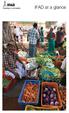 IFAD at a glance IFAD s purpose The goal of the International Fund for Agricultural Development (IFAD) is to enable poor rural people to improve their food and nutrition security, increase their incomes
The Concept of Food and Nutrition Security 1. BACKGROUND PAPER No. I. Food and Nutrition Security Assessment Instruments and Intervention Strategies
 International Training Course Food and Nutrition Security Assessment Instruments and Intervention Strategies BACKGROUND PAPER No. I Lioba Weingärtner The Concept of Food and Nutrition Security 1 1 This
Distance learning program for agricultural education in Southern Africa. Mungule Chikoye, Krishna Alluri, Richard Siaciwena, and Rainer Zachmann *
 Distance learning program for agricultural education in Southern Africa Mungule Chikoye, Krishna Alluri, Richard Siaciwena, and Rainer Zachmann * Abstract The Commonwealth of Learning (COL) in collaboration
Household Food Consumption: looking beyond the score
 Household Food Consumption: looking beyond the score ICDAM 17.5.2012 Session B-6 Measuring Dietary Diversity Presented by Kathryn Ogden, World Food Programme (WFP) Based on abstract by Astrid Mathiassen,
Health Promotion, Prevention, Medical care, Rehabilitation under the CBR Matrix heading of "Health
 Health Promotion, Prevention, Medical care, Rehabilitation under the CBR Matrix heading of "Health Dr Deepthi N Shanbhag Assistant Professor Department of Community Health St. John s Medical College Bangalore
CHANGES IN FAMILY HEALTH AND EDUCATION. The Effects Of Funding Women s Community Organizations In Senegal
 CHANGES IN FAMILY HEALTH AND EDUCATION The Effects Of Funding Women s Community Organizations In Senegal CHANGES IN FAMILY HEALTH AND EDUCATION The Effects Of Funding Women s Community Organizations In
Jordan Early Childhood Care and Education (ECCE) programmes
 IBE/2006/EFA/GMR/CP/40 Country profile prepared for the Education for All Global Monitoring Report 2007 Strong Foundations: Early Childhood Care and Education Jordan Early Childhood Care and Education
Care for children infected and those affected by HIV/AIDS. A training manual for CommunityHealth workers
 Care for children infected and those affected by HIV/AIDS A training manual for CommunityHealth workers Published by Save the Children UK P.O. Box 1124 Kampala Uganda Tel: +256 41 258815/344796 Fax: +256
Ministry of Gender and Family Promotion. Mainstreaming Gender into Water, Sanitation and Hygiene (WASH) Programs
 Ministry of Gender and Family Promotion Mainstreaming Gender into Water, Sanitation and Hygiene (WASH) Programs A Training Manual For Water Professionals Kigali, Rwanda January 2007 Copyright of this document
MEKELLE. ፼፼፼፼ ፼፼፼፼ ፼፼፼፼፼ ፼፼፼፼ Bright Africa Youth Association
 MEKELLE ፼፼፼፼ ፼፼፼፼ ፼፼፼፼፼ ፼፼፼፼ Bright Africa Youth Association 251-03-44-405787 Email:[email protected], [email protected] Mobile: 251-914-730055, 1765 [email protected] 251-914-733239 [email protected]
Welcome to Nutrition Education at Oregon Food Bank!
 Welcome to Nutrition Education at Oregon Food Bank! Thanks for your interest in volunteering to share your strength with families in need. You have a great opportunity to engage members of your community
SOUTHEAST MISSOURI STATE UNIVERSITY COURSE SYLLABUS. Title of Course: Child Health, Safety and Nutrition New: Fall 2000
 SOUTHEAST MISSOURI STATE UNIVERSITY COURSE SYLLABUS Department of: Human Environmental Studies Course No.: CF124 Title of Course: Child Health, Safety and Nutrition New: Fall 2000 I. Catalog Description
What is Monetization? U.S. International Food Aid Programs
 What is Monetization? Food aid may be distributed directly to target populations or may be sold and the proceeds used to support program-related costs and developmental activities, such as training, technology
DEPARTMENT OF AGRICULTURE, FORESTRY AND FISHERIES DEPARTEMENT VAN LANDBOU, BOSBOU EN VISSERYE
 24 No. 37915 GOVERNMENT GAZETTE, 22 AUGUST 2014 DEPARTMENT OF AGRICULTURE, FORESTRY AND FISHERIES DEPARTEMENT VAN LANDBOU, BOSBOU EN VISSERYE No. 637 22 August 2014 THE NATIONAL POLICY ON FOOD AND NUTRITION