
Annual Report of ING Bank Śląski S.A. Capital Group
|
|
|
- Susanna Matthews
- 10 years ago
- Views:
Transcription
1 Annual Report of ING Bank Śląski S.A. Capital Group for the year 2008

2 Table of Contents Table of Contents... 2 Chair s Statement... 5 Chief Executive s Review... 7 Brief Characteristics of ING Bank Śląski S.A I. MACROECONOMIC BACKGROUND IN Major Economic Trends Monetary policy Banking sector Capital market Macroeconomic factors that will have influence on the development of the banking sector in II. STRATEGY OF ING BANK ŚLĄSKI S.A Mission and Vision of ING Bank Śląski S.A Main Strategic Objectives III. MAIN ACHIEVEMENTS OF THE CAPITAL GROUP OF ING BANK ŚLĄSKI S.A. IN Growth of the Client Base Expansion in Deposit and Lending Markets The Impact of Financial Markets Disturbances on the Bank Result Execution of Projects Crucial for the Stable Organization s Growth IV. OPERATIONS OF ING BANK ŚLĄSKI IN Retail Banking Product Offer and Changes Introduced Deposit Activity Lending Bank Cards Wholesale Banking Offer Scope and Changes Introduced Deposit and Settlement Activity Lending Money and Equity Markets V. BUSINESS OPERATIONS OF ING BANK ŚLĄSKI S.A. CAPITAL GROUP COMPANIES Structure of ING Bank Śląski S.A. Capital Group ING Securities S.A ING Bank Hipoteczny S.A. (former Śląski Bank Hipoteczny S.A.) Centrum Banku Śląskiego Sp. z o.o. w likwidacji (in liquidation) ING Powszechne Towarzystwo Emerytalne S.A (former ING Nationale-Nederlanden Polska Powszechne Towarzystwo Emerytalne) ING BSK Development Sp. z o.o Solver Sp. z o.o VI. MANAGEMENT OF KEY RISKS Credit Risk Credit Policy Credit Process and Assessment of Credit Risk

3 Credit Portfolio Quality and Provisioning Market Risk Management General Information VaR limits in Liquidity risk management Replicating Portfolios New Transfer Pricing System (New TPS) Capital Adequacy Operational Risk and Compliance VII. CORPORATE GOVERNANCE RULES Supervisory Board s Report on Operations of the Capital Group of ING Bank Śląski S.A. in Observance of Best Practices of the Corporate Governance Changes in the Statutory Authorities of the Bank Remuneration of the Members of Management Board and Supervisory Board of ING Bank Śląski S.A Auditor VIII. INVESTOR INFORMATION Price of ING Bank Śląski S.A. Shares Shareholding Structure of ING Bank Śląski S.A Ratings IX. ORGANISATION AND INFRASTRUCTURE DEVELOPMENT AT CAPITAL GROUP OF ING BANK ŚLĄSKI S.A. IN Information Technology Operations Development of Electronic Distribution Channels Development of the Network of Bank Outlets X. ING BANK ŚLĄSKI S.A. IN THE SOCIETY ING Children Foundation Employees in Voluntary Service ING Polish Art Foundation XI. HUMAN RESOURCES MANAGEMENT Headcount Payroll policy Recruitment and Selection Employee Training and Development Work Conditions XII. AWARDS AND DISTINCTIONS XIII. FINANCIAL STANDING OF CAPITAL GROUP OF ING BANK ŚLĄSKI S.A. IN Balance-Sheet Structure Assets Liabilities Income Statement Gross and Net Profit Interest Result Non-interest Income Operating Expenses Impairment Charges and Provisions
4 Share of Individual Business Lines in Creation of Financial Result Key Efficiency Ratios XIV. STATEMENTS OF MANAGEMENT BOARD OF ING BANK ŚLĄSKI S.A Truthfulness and Accuracy of Statements Selection of Entity Authorised to Audit Financial Statements Additional Information Agreements Concluded Number and value of writs of execution

5 Chair s Statement Ladies and Gentlemen, Undoubtedly, 2008 will go down in the history as a period of the greatest worldwide economic turmoil for dozens of years. Economic disturbances that already took place in 2007 in the Alt-A mortgages market in USA spread to other areas of the financial market, resulting, among others, in financial problems of many powerful institutions and massive selling off and a drop in asset valuation in the majority of capital markets. Deteriorating financial standing of many renown global players caused a general increase of uncertainty and contributed to disturbances in the inter-bank market operations and a liquidity decrease of banking systems. Despite an immense scale of intervention of world superpowers, these processes also impacted the real economy leading to the collapse of many industry branches and eventually to a threat of a major recession in leading global economies. Results of these negative phenomena were also noticeable especially in 2H 2008 for a more and more open Polish economy. Throughout 2008, the Supervisory Board within the authority granted thereto - analysed indepth all facets of the operations of ING Bank Śląski S.A. and co-operated with the Bank s Management Board on taking strategic decisions for the development of the Company. In the highly unfavourable macroeconomic environment, including a great volatility on financial markets, the Capital Group of ING Bank Śląski S.A. closed 2008 with the net profit of PLN million versus PLN million a year earlier. Hardly predictable phenomena that occurred at the end of the year in the market of treasury debt securities had a significant influence on the final result of the capital group of the Bank. A price drop of long-term euro-bonds issued by the State Treasury resulted in a negative result on valuation of these securities of the capital group of ING Bank Śląski S.A. Moreover, the Bank s result over the last months has been impacted by consequences of the downward valuation of FX option transactions concluded with clients due to an increased credit risk resulting from these contracts. In 2008, ING Bank Śląski S.A. complied with all norms of safe and prudent operation both due to sufficient capitals and properly diversified operations. As at the end of December 2008, the solvency ratio for the capital group of the Bank stood at 10.4%. The Bank was also one of the financial institutions whose liquidity ratio was high and its operations were only to a small extent dependent upon the more and more expensive inter-bank market. At the same time the ratio of loans-to-deposits at the level of 51% revealed a significant potential for further lending growth. It should be emphasised that in the situation of unprecedented competition for acquiring clients funds, ING Bank Śląski S.A. increased its deposit base. As at the end of 2008, a total value of deposits in the accounts of the capital group of the Bank amounted to PLN 46.3 billion, or was up by almost 8% from the year earlier. As a result of the harmonious lending growth both for corporate and retail clients, as at the end of December 2008, credit receivables of the capital group of the Bank totalled PLN 23.6 billion, or up by 41% from the year earlier. FX mortgage loans amounted to slightly more 5
6 than 5% of the total credit exposure of the capital group of the Bank, which reduced its risk exposure due to weakening of the Polish currency. Under its long-term strategy, ING Bank Śląski S.A. focused in 2008 on execution of its key projects. Completion of subsequent implementation stages of a new branch IT system and an advanced stage of providing branches with self-service zones, further optimisation of lending processes as well as of the improvement of operational area effectiveness deserve special attention. The expected economic slowdown (which may cause material decrease in clients capacity to timely pay credit liabilities), further slump and high volatility on financial markets make it necessary to establish a capital buffer of a proper size, which will ensure full security and stability of operations of ING Bank Śląski S.A. in In the situation of a slower growth of the Polish economy, only a Bank strong in capital terms will be able to safely invest clients savings on the credit market. That is why the Supervisory Board accedes to the motion of the Bank Management Board to earmark total 2008 profit for increase of the Company s capitals. I would like to assure all Shareholders that it is the right decision that should pay off in the long run. The coming quarters will be a difficult period for the Polish banking sector. At its first meeting in 2009, the Supervisory Board approved the Plan of ING Bank Śląski S.A. for The Plan takes into account worse development outlook for the Polish economy and determines specific actions mitigating its effects with regard to cost cutting and changes in the credit policy, among others. Finally, Ladies and Gentlemen, I would like to thank everyone who contributed to the result generated by ING Bank Śląski S.A. in I also hope, that a fruitful co-operation of all of us, employees and Bank authorities, both in searching and implementing optimal solutions corresponding to the current difficult market situation, will guarantee a strong position of ING Bank Śląski S.A. in the Polish banking system. Yours sincerely, Anna Fornalczyk Chair of the Supervisory Board 6
7 Chief Executive s Review Dear Shareholders, In 2008, the capital group of ING Bank Śląski S.A. generated the net profit of PLN million, or down by 29% versus 2007, which was a very good year for the Polish banking sector. The final result of the capital group of ING Bank Śląski S.A. in 2008 was impacted by consequences of unprecedented disturbances and high volatility in financial markets, inclusive of liquidity limitations of some markets and material fluctuations of exchange and interest rates. The scale of impact of these phenomena on the final financial result of the capital group of ING Bank Śląski S.A. was also related to the balance sheet structure held for many years now. The great majority of assets of the capital group of the Bank consist in different types of financial instruments, inclusive of low-risk treasury debt securities. At the end of 2008, the price of long-term T-Eurobonds held by the Bank dropped in the unstable market characterised by poor liquidity. The downward valuation of these securities adversely affected financial results of the capital group of the Bank in the entire We could not avoid the risk resulting from increase of the value of business entities' liabilities to the Bank due to options which took place towards the end of 2008 and resulted from a significant weakening of the Polish currency. Presenting the results of ING Bank Śląski S.A. in 2008, I would like to highlight good results generated in the scope of increasing clients base and commercial activity expansion, i.e. with regard to acquiring deposits and lending growth. ING Bank Śląski S.A. was a worthy competitor with regard to acquiring spare funds of clients and increased its deposit base. As at the end of December 2008, the overall value of funds in deposit accounts at ING Bank Śląski S.A. totalled PLN 46.3 billion, i.e. was higher by PLN 3.3 billion than in the previous year. The Bank managed above all to defend the funds deposited in household accounts against competition attacks. Throughout 2008, our share in funding the Polish economy needs also increased. As at the end of 2008, the credit exposure of the capital group of ING Bank Śląski S.A. totalled PLN 23.6 billion and was by PLN 6.9 billion higher than a year earlier. As in the previous years, we placed emphasis on mitigating the credit risk. Acting both in the interest of clients and of the Bank, we withdrew, among others, from granting CHF mortgage loans and we changed the credit policy with regard to industries characterised by a higher risk level. These actions together with the improved credit risk management procedures made it possible to maintain a very good quality of our credit portfolio. The share of impaired loans in the entire credit receivables portfolio of the capital group of the Bank towards clients was 1.4%. A diversified credit portfolio, a very low impaired loans portfolio in relation to the total exposure and a material capital base decided about the high security level of operations. In December 2008, the solvency ratio of the capital group of ING Bank Śląski S.A. totalled 10.4%. Also the Bank s liquidity ratio was high, which increased our resistance to further potential disturbances in financial markets. 7
8 In our operations throughout 2008 in the increasingly demanding environment, we kept thinking about the future, further development of the institution and execution of our longterm strategy. In order to ensure a proper potential for further development, we significantly increased availability of our services for clients. We opened for our clients 34 new franchise outlets and provided 204 branches with self-service zones open 24h. We extended functionality of our internet banking systems and launched a modern internet account Direct Account. Our endeavours aiming at improvement of the service quality and increase of the attractiveness of our products and services were appreciated by the market. In December 2008, the number of the Bank s individual clients was 2.4 million, an increase by 313 thousand compared with the previous year. A base of several million loyal clients ensuring stable shares in primary banking services markets constitutes our core asset in the context of current economic challenges. We also remembered in 2008 about the compliance with the corporate governance rules, based on such values as: honesty, openness, respect and common sense. These values, as well as corporate conduct compliant with best practices, are decisive in terms of a proper image and strong brand of our Bank. In 2009, we will be operating in a very difficult environment. Development of the Polish economy will be significantly slower than in the previous years, which will translate into a smaller growth of demand for many basic banking services and a lower credit capacity of clients. The complex market situation will require from us a large discipline in Bank management in such areas as: risk, capital and cost management. In the situation of limited development possibilities, we mainly have to focus on costs optimising actions. Therefore, in 2009 we will not be investing in the development of franchise outlets, there will be no salary rise and we will reduce expenditures on marketing operations, training sessions and business trips. We will also have to adjust headcount to the potential of particular markets, which will involve relocation of some employees within the Bank and no new recruitment. I am deeply convinced that the determination in execution of the adopted action plan will help us go through this difficult period and become an even stronger company, focused on long-term performance and more effective. Finally, I would like to express my appreciation to employees without whose knowledge, abilities and involvement it would be impossible to effectively execute the development strategy of ING Bank Śląski S.A. I would also like to thank the Supervisory Board for cooperation. Their great care for our Company s interest reflected among others in great involvement in Bank s matters and diligent supervision over effective management serves well the security and stability of development of ING Bank Śląski S.A. Yours sincerely, Brunon Bartkiewicz CEO 8

9 Brief Characteristics of ING Bank Śląski S.A. ING Bank Śląski S.A. is one of the largest universal banks in Poland that has been present on the Polish market since The Bank operates in the area of retail banking, wholesale banking, on the money market and on the capital markets. ING Bank Śląski was number four on the Polish market by total assets. As at the end of December 2008, the balance-sheet total of the Bank capital group amounted to PLN 69,610.5 million, or 6.7% of the Polish banking sector s assets. As at the end of December 2008, ING Bank Śląski S.A. provided service to more than 2.42 million individual clients, 179,000 small businesses and 13,000 large companies. The Bank had a nationwide network of 439 bank outlets, equipped with 360 self-service zones operating 24 h. The clients of ING Bank Śląski S.A. are guaranteed free access to a network of 683 ING ATMs as well as Euronet ATMs. The Bank provides the clients with banking services via the state-of-the-art electronic banking systems, such as: the Internet banking systems (ING BankOnLine, ING BusinessOnLine), a phone banking system (HaloŚląski) and a text messaging system. As at the end of 2008, the capital group of ING Bank Śląski S.A. had near 8,600 employees. ING Bank Śląski S.A. is a member of ING Group, a global financial institution specialising in banking, insurance and portfolio investments. ING Bank N.V. is the strategic investor of ING Bank Śląski S.A., holding a 75% stake in the Bank s equity. PLN billion Market value of ING Bank Śląski PLN bn % Net profit of ING Bank Śląski capital PLN million group Balance sheet of ING Bank Śląski capital group Market value Net profit P/BV ROE Balance sheet Share in the sector % %

10 ING Bank Śląski S.A. Abbreviated Information Concerning the Financial Results of Capital Group for the Years IAS Polish Accounting Standards Result on core activity in PLN million 1 2, , , , , , , ,669.9 Total costs in PLN million 2 1, , , , , , ,077.0 Risk costs in PLN million Gross profit in PLN million Income tax in PLN million Net profit attributable to the Company s equity holders in PLN million Total balance sheet in PLN million 69,610 52,011 48,476 42,127 35,473 35,432 28,917 26,941 Liabilities to customers in PLN million 47,067 44,502 38,561 32,824 27,638 27,638 20,835 20,060 Loans and advances to customers in 25,743 16,379 12,868 9,903 10,408 10,408 12,335 12,914 PLN million Off-balance sheet liabilities in PLN 292, , , , , , , ,985 million Equity 3 in PLN million 3,777 3,208 3,164 2,999 2,762 2,770 2,678 2,576 Solvency ratio in % Gross profit/total costs in % Net profit/total assets (ROA) in % Net profit/equity (ROE) in % Cost/Income ratio (C/I) in % Earnings per 1 share in PLN Dividend per 1 share in PLN Including net profit of entities recognized on equity basis. For result on banking activity 2 Operating costs with amortization/depreciation. 3 Own equity attributable to equity holders of the parent minus net profit for the current year. 4 Management Board recommendation. 10

11 I. MACROECONOMIC BACKGROUND IN 2008 Major Economic Trends In the course of 2008 the Polish economy developed in the shadow of the crisis on the global financial markets. Those phenomena had some impact on its overall condition, which became fully visible in the last months of the year. Gross Domestic Product In 2008, Gross Domestic Product in Poland went up by 4.8% against 6.7% the year before. However, the GDP growth rate was weakening quarter by quarter and decreased from 6.0% in 1Q to 2.9% 5 in 4Q. Also the structure of economic growth factors has changed consumption has become the key driver of development. Following the increase of salaries in the corporate sector (particularly in the first half of the year), revaluation of disability and old age allowances, decline of the unemployment rate and dynamic growth of households credit debt, it was first of all individual consumption that increased significantly. In 2008 it was 5.4% higher than a year earlier. Shrinking economic activity worldwide, including main trading partners of Poland limited our export potential, worsened the spirits of Polish companies and reduced their willingness to take investment decisions. The dynamics of gross expenditures on fixed assets went down from 17.6% in 2007 to 7.9% in The negative balance of foreign trade transactions also deepened. In 2008 the EUR export rate was 12.2% higher than a year earlier. At the same time the import rate grew by 14.1% (related mainly to the constantly increasing domestic demand). Labour market and level of salaries In 2H 2008 the labour market started to feel the effects of falling economic growth rate. The dynamics of the employment rate growth was going down gradually and at the end of December 2008 the employment rate in the corporate sector was 4.8% higher as compared with December Following the period of constant decrease of unemployment rate (its lowest level of 8.8% - was reported in October 2008), the number of people without a job increased again. In December 2008, the unemployed represented 9.5% of the professionally active population, against 11.2% at the end of December As a result of considerable growth of salaries reported mainly in the first months of the year, the average monthly salary in the corporate sector in 2008 was 10.1% higher than last year. The dynamics of average salaries outdid like in 2007 the growth rate of work efficiency. In March 2008, the revaluation of disability and old age allowances was carried out. As a consequence, the real value of an average disability and old age allowance went up as well. 5 According to the estimates of the Chief Economist of ING Bank Śląski. 11
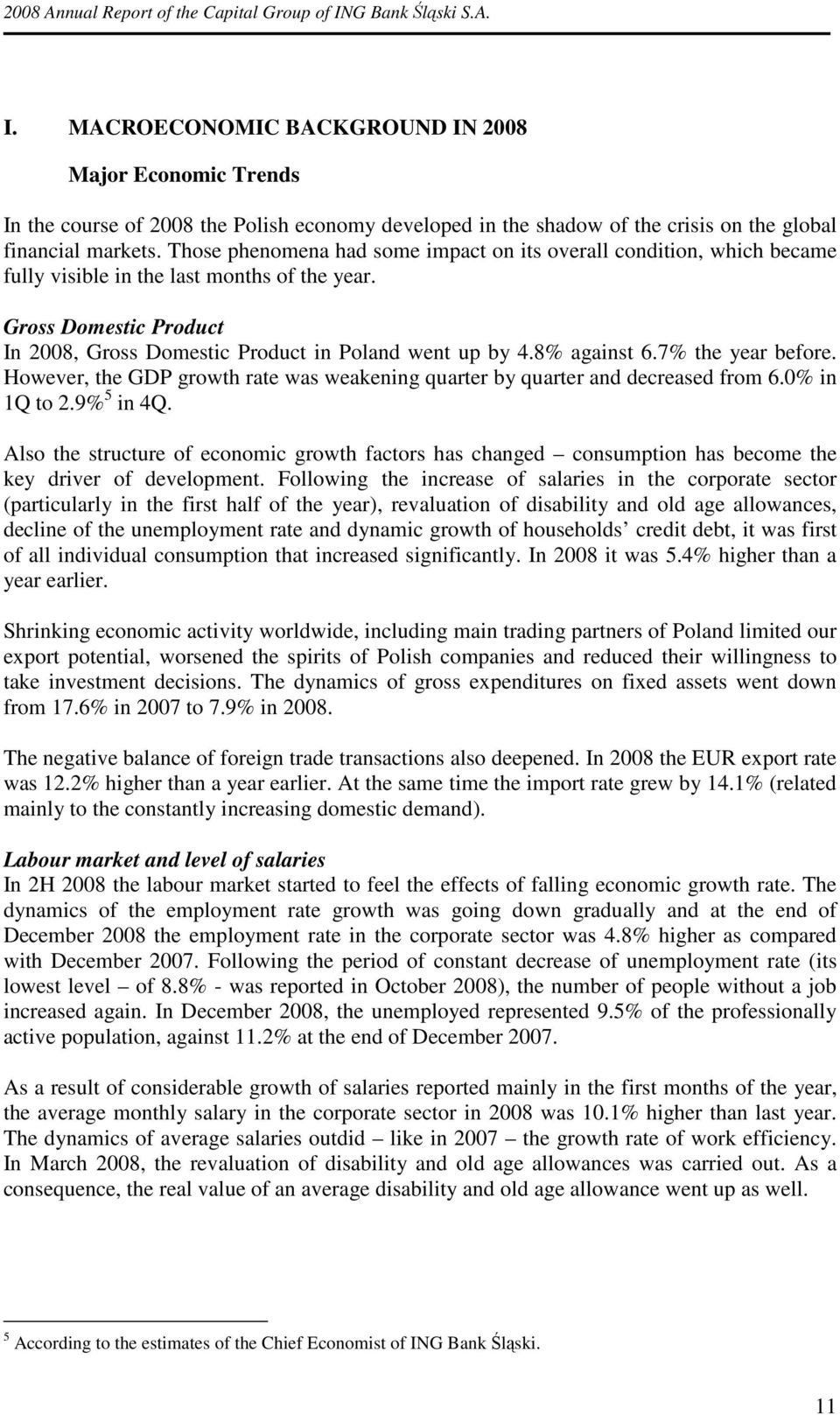
12 Inflation The increase of prices above the target assumed by the Monetary Policy Council was one of the elementary problems of the Polish economy. The annual inflation rate reached its maximum in July and August at 4.8%. In subsequent months the inflation rate dropped. That was a result of falling prices of raw materials, low dynamics of food prices as well as smaller inflation-related expectations due to the economic slowdown. As a consequence of that trend, in December 2008, the prices were 3.3% higher than a year earlier. FX market 1H 2008 brought further strengthening of PLN against main currencies. It resulted above all from the continuously fast growth rate of the Polish economy and disparity of interest rates between Poland and primary financial markets. The PLN appreciation trend was broken at the beginning of August. The period of decline and significant volatility of PLN exchange rate against other currencies has begun since then. The PLN depreciation resulted mainly from the continuing aversion to risk on the markets of emerging economies (many investors still believe that Poland is one of them). EUR 4,5 4,3 4,1 3,9 3,7 3,5 3,3 3,1 Dec-07 Jan-08 Feb-08 PLN quotations in 2008 Mar-08 Apr-08 May-08 Jun-08 Jul-08 Aug-08 Sep-08 Oct-08 Nov-08 Dec-08 EUR USD USD 3,3 3,1 2,9 2,7 2,5 2,3 2,1 1,9 Finally, throughout the entire 2008 PLN lost 16.5% against EUR and 21.6% against USD. The year was finished particularly unfavourably for the CHF loan holders. In the course of the year that currency strengthened against PLN by 29.6%. State budget The economic slowdown, which was observed in 2H 2008, diminished the income of the State Budget. In 2008, the budget income was lower than planned, which forced the government to limit expenditures in some spheres of public life at the end of the year. As a consequence, the budget deficit made up PLN 24.5 billion and represented approx. 91% of the amount planned for Stability and Development Plan In November, the Polish government announced the Stability and Development Plan prepared mainly to support the investment demand. As part of that Plan the limit of sureties and guarantees of the State Treasury was raised for the SME sector and the regulations were simplified with the aim of more efficient use of the EU funds. The government will mainly foster projects in the area of telecommunications and computer science, research and development activity and renewable power sources. It is estimated that as a result of the Plan implementation the economy will be directly or indirectly supplied with the amount exceeding PLN 80 billion. Monetary policy In 1H 2008, the Monetary Policy Council (RPP) maintained the policy conducted in 2007, which involved the monetary tightening and the four-fold increase of interest rates, i.e. in 12

13 January, February, March and June. All in all, during the first six months of 2008 the interest rates increased by 100 bp. In the second half of the year, the threat of a stronger economic slowdown, a more difficult access of companies to loans due to the liquidity problems at banks and easing of the payroll and inflation policy made the Council moderate the monetary policy. In November RPP decreased interest rates by 0.25 p.p., whereas in December under the influence of data proving the drop of the economic growth rate they fell by another 0.75 p.p. At the end of 2008, the NBP rates reached the following levels: reference rate 5.00%, bill rediscount rate 5.25%, lombard rate 6.50%, deposit rate 3.50%. Inflation and official interest rates As RPP stated in the Information after its December meeting, the probability that the inflation rate would remain below the inflation target in the medium term was higher than the probability that the inflation will exceed the target. The interest rate reductions made by RPP and the expected continuation of monetary policy easing led to a drop of rates on the domestic monetary market. Also the profitability of debt securities fell considerably. The decisions of the Monetary Policy Council in terms of monetary policy easing followed the steps taken by the leading central banks (including FED and EBC). In 2H 2008 they made drastic reductions of base interest rates, as they decided that threats for the economic growth have become much stronger than the threats for the stability of prices. On parallel with the steps taken by RPP, both the government and the Central Bank have taken some actions aimed at maintaining stability of the financial sector. These were for example: The National Bank of Poland passed the Trust Package to improve the efficiency of operations on the inter-bank market, to guarantee its liquidity in particular. The Central Bank broadened the scope of the monetary policy instruments, e.g. by: introducing FX SWAP transactions, introducing open-market feeding transactions in the form of repo transactions with the maturity period up to 3 months. The operating system of the lombard loan was also modified. The Polish government joined the agreements within the European Union on increasing the minimal deposit guarantee level to EUR 50 thousand. The government announced its standing concerning Poland joining the Euro zone. It was declared that 2011 should be the year of meeting the criteria and positive decision of the European Commission regarding the entrance of Poland to the Euro zone. It means that PLN could be replaced by the common currency in It should be clearly pointed out that two aspects may prove problematic: fulfilling the Maastricht criteria and sufficient support in the Sejm for amendments to the constitution (indispensable to introduce Euro in Poland). in % Reference rate Inflation (Y/Y) 13

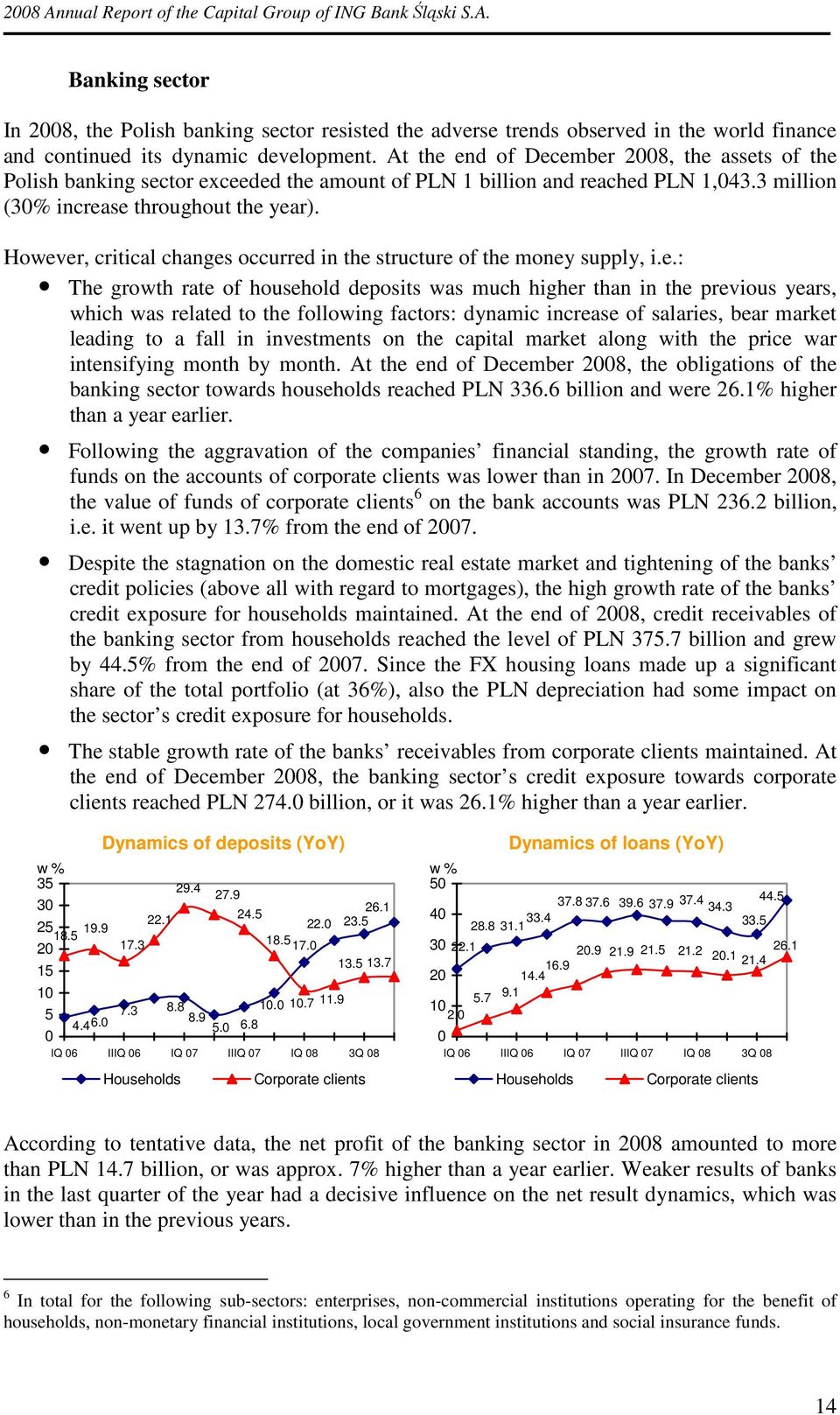
14 Banking sector In 2008, the Polish banking sector resisted the adverse trends observed in the world finance and continued its dynamic development. At the end of December 2008, the assets of the Polish banking sector exceeded the amount of PLN 1 billion and reached PLN 1,043.3 million (30% increase throughout the year). However, critical changes occurred in the structure of the money supply, i.e.: The growth rate of household deposits was much higher than in the previous years, which was related to the following factors: dynamic increase of salaries, bear market leading to a fall in investments on the capital market along with the price war intensifying month by month. At the end of December 2008, the obligations of the banking sector towards households reached PLN billion and were 26.1% higher than a year earlier. Following the aggravation of the companies financial standing, the growth rate of funds on the accounts of corporate clients was lower than in In December 2008, the value of funds of corporate clients 6 on the bank accounts was PLN billion, i.e. it went up by 13.7% from the end of Despite the stagnation on the domestic real estate market and tightening of the banks credit policies (above all with regard to mortgages), the high growth rate of the banks credit exposure for households maintained. At the end of 2008, credit receivables of the banking sector from households reached the level of PLN billion and grew by 44.5% from the end of Since the FX housing loans made up a significant share of the total portfolio (at 36%), also the PLN depreciation had some impact on the sector s credit exposure for households. The stable growth rate of the banks receivables from corporate clients maintained. At the end of December 2008, the banking sector s credit exposure towards corporate clients reached PLN billion, or it was 26.1% higher than a year earlier. w % Dynamics of deposits (YoY) IQ 06 IIIQ 06 IQ 07 IIIQ 07 IQ 08 3Q 08 Households Corporate clients w % Dynamics of loans (YoY) IQ 06 IIIQ 06 IQ 07 IIIQ 07 IQ 08 3Q 08 Households Corporate clients According to tentative data, the net profit of the banking sector in 2008 amounted to more than PLN 14.7 billion, or was approx. 7% higher than a year earlier. Weaker results of banks in the last quarter of the year had a decisive influence on the net result dynamics, which was lower than in the previous years. 6 In total for the following sub-sectors: enterprises, non-commercial institutions operating for the benefit of households, non-monetary financial institutions, local government institutions and social insurance funds. 14
15 The main source of profits with banks in 2008 was the income increase. Mainly the interest income was growing, as well as the income on FX positions (due to spreads on the FX loans and profits made on the FX operations). On the other hand, the commission income and income on the financial markets operations were under the pressure of unfavourable economic situation on the capital markets (including the market of investment funds, FX options and the market of debt securities). Material increase of the scale of operations translated in to the growing costs of operations of the banking sector. The main reason of the cost increase was the growth of the main cost element, i.e. personnel costs. They were going up both following the headcount increase, as well as due to the general increase of salaries in the national economy, which also forced a rise of salaries at banks. The buildings maintenance and leasing costs as well as other costs (e.g. related to the start-up of operations by new banks and branches of credit institutions) also grew in the entire sector. The dynamic growth of the scale of lending was the main reason for the decrease of the share of non-performing loans in the entire credit portfolio of the banking sector. In December 2008 the share of non-performing loans in the entire credit portfolio for the non-financial sector went down to the level of 4.4% (against 5.4% in December 2007). The increase of the overall credit exposure of the entire banking sector resulted at the same time in significantly higher than in the previous year risk costs in banks P&L accounts. P&L accounts included also provisions established for receivables from companies that incurred losses on FX option transactions. A large number of companies both in order to hedge their foreign contracts against the foreign exchange risk and for speculative purposes - concluded purchase transactions of FX options assuming that zloty would further strengthen. At the end of the year zloty went, however, in the opposite direction, causing losses of entrepreneurs in the estimated amount above PLN 15 billion. Deterioration of the financial situation of some strategic investors of Polish financial institutions triggered exposure of their daughter companies despite their good financial standing to negative effects of the decreased trust to their parent companies. It had negative effects on liquidity of the domestic inter-bank market and resulted in difficulties of some banks to hedge positions against the market risk due to lowering of credit limits and limited turnover on the derivatives market. As a consequence of the lower trust between bank money acquisition costs went up, and so did competition on the domestic market for deposits of nonfinancial entities. According to the data of the National Bank of Poland, average interest rate of new PLN contracts concluded with households increased from 4.2% in December 2007 to 6.5% in December There were also important changes in 2008 in the legal environment. The fundamental changes include: Taking over by the Polish Financial Supervision Authority (KNF) of supervision duties over the banking sector, which in the opinion of legislators should improve functioning of the supervision over the entire financial market in Poland. Implementation of Basel II as of the beginning of the year resulting in an increase of capital needs and decrease of banks solvency ratios (mainly due to the necessity of taking into account additional requirement with regard to operational risk). Introduction in mid-year of the obligation to monitor and report liquidity norms binding upon banks. 15

16 The banking supervision also reacted to threats that occurred on the financial market, i.e.: Modified S Recommendation concerning best practices with regard to credit exposures collaterised with mortgage consisting in, among others, regulating the issue of informing clients about the influence of FX spreads on the level of loan instalments. Introduced, among others a daily duty of reporting the scope of operations with the dominant entity in relation to the difficult financial situation of some strategic investors of Polish banks. Obliged banks to verify the investment policy (inclusive of the credit policy) and review liquidity contingency plans. The tendencies started already in 2005 with regard to the increase of headcount and of the number of bank outlets did not change. In 2008, banks opened over 1,200 new branches and the headcount at banking institutions increased by approx thousand people. In 2H 2008, as a result of the unfavourable economic situation, some banks reduced their plans concerning expansion of distribution channels. Capital market In 2008 the Polish capital market was highly influenced by developments on foreign markets where poor macroeconomic data and deteriorating situation of the banking sector in USA and Western Europe caused main world indexes drop to the lowest levels for many years now. The negative sentiment of foreign investors who withdrew from markets of developing countries as well as internal factors such as: relatively small scope of the Polish stock market making it more exposed to developments in its environment and operations of investment funds selling shares in order to acquire cash for clients withdrawing money from the funds, also contributed to the index drops at the Warsaw Stock Exchange. Throughout the entire 2008, the main stock index WIG decreased by 51.1%, while the index of the largest companies lost 48.2%. From the sector perspective, the worst investment of 2008 turned out to be shares of developers (sub-index drop by 73.1%) and companies operating in the food industry (drop by 59.2%). On the other hand, losses of the investors holding shares of telecommunications companies were the lowest (12.8%). At the end of December 2008, the value of domestic companies listed on the Warsaw Stock Exchange totalled PLN billion, i.e. it was lower by 47.6% when compared to December The unfavourable economic situation on the stock exchange resulted also in the smaller scale of IPOs than over the last year. 33 new companies appeared on the primary trading floor, while there were 81 IPOs in the previous year. Throughout 2008, during the trading session the shares at PLN billion changed their holder, i.e. 31% less than in the previous year. On the other hand, the market of forward contracts grew. In 2008 the total volume of trading in all derivatives amounted to 12.6 million items, i.e. was by 27% higher than in the last year. In times of the bear market worldwide, the Warsaw Stock Exchange took the lead in the region of Central and Eastern Europe both in terms of capitalisation, trading value and number of IPOs. The improvement of the Warsaw Stock Exchange position in global rankings 16
17 was possible, among others, due to some modifications of regulations, procedures and systems, such as: Introduction as of 1 January 2008 of the new Best Practices of Companies Listed on the Warsaw Stock Exchange. Changes in segmentation of the regulated market basing on capitalisation of listed companies, such as e.g. introduction of Alerts (companies holding penny shares, whose price is characterised by large volatility and companies in bankruptcy). Implementation in order to improve the turnover of companies shares Liquidity Support Programme. Extension of the scope of co-operation with foreign markets was very unfavourable both for the market of investment funds and pension funds. The decline of stock indexes and withdrawal of savings by clients resulted in material decrease of the value of assets of investment funds. It is estimated that throughout 2008 clients withdrew almost PLN 30 billion from investment funds. In December 2008, net assets of investment funds totalled PLN 73.7 billion and were 45% lower than at the end of Funds of shares whose assets decreased by almost 59% suffered the most. Neither was it a favourable period for individuals managing stable growth funds (assets drop by 55%) and mixed funds (by 54%). On the other hand, real estate funds (assets value up by 55%) and debt securities funds (up by 45%) holding a relatively low share in the overall assets value were leaders with regard to the net assets growth dynamics. In spite of the unfavourable economic situation, new investment companies appeared on the market in The Polish Financial Supervision Authority consented to operation of six new investment funds companies. According to the announced strategies, new companies will be mainly establishing closed-end funds for the most affluent clients. Due to the record sum transferred by the Social Insurance Institution (ZUS) to pension funds (in the amount of approx. PLN 20 billion), the value of assets of pension funds dropped throughout 2008 by approx. 1.4%, while the value of an accounting unit dropped by 14.2%. Macroeconomic factors that will have influence on the development of the banking sector in 2009 In the nearest quarters, there will be a material slowdown in the Polish economy. According to forecasts developed at ING Bank Śląski S.A., the growth rate (even though still positive) will be the slowest in the first half of At the same time, the second half of the year should bring a slight economic revival and in the entire 2009, GDP will be probably 1.6% higher than in the previous year. The main reason for economic growth will be the increase of individual consumption. There is still a risk however that positive effects of the lowering of taxes and increase of disability and old age allowances will be levelled by negative effects of the fall in employment and salary dynamics and a more difficult access to loans. Investment outlays are expected to fall, mainly as a result of stricter conditions of granting loans by the banks, lower interest in Polish products abroad and pessimistic forecasts concerning economic growth. A decline in activity in the private sector maybe partly balanced by the predicted increase in outlays from public funds. 17
18 Worse economic situation in conjunction with cheaper raw materials will clearly translate into the price growth rate. According to forecasts, the inflation in mid-year will be close to 2.5%, which is the Monetary Policy Council target, while in the entire 2009 will be at the level of 2.1%. It is expected, that due to the significant weakening of the economic activity growth the monetary policy will be eased materially. The ING base scenario assumes lowering of interest rates by 250 bp. throughout the entire According to forecasts, in the first months of the year, Polish currency will keep depreciating. Only in the second half of the year the position of Polish zloty may slightly improve as a result of the first signals on growth stabilisation. Weaker zloty will be a factor balancing the economy and will enable re-improvement of competitiveness of entire sectors of the Polish economy on global markets. It is expected that together with the export slowdown (as a result of the expected economic activity decrease of major trading partners of Poland), the import rate will also decrease (among others, due to the smaller scope of import-requiring investments and co-operative import). Moreover, a large inflow of EU funds should have a positive influence on keeping the external balance. The forecasted low growth of economic activity will translate into lower State Budget income growth and lead to higher budget imbalance. According to the Bank s forecasts, the budget deficit will slightly exceed the reference value established in the Maastricht Treaty (i.e. the level of 3%). Unfavourable economic situation will probably last on the stock exchange. In the opinion of analysts, growth of indexes on the Warsaw Stock Exchange may be expected only with better forecasts for the global economy USA economy in particular. Aversion to risk as well as unwillingness to invest in developing markets should then decrease. The situation in the macroeconomic environment will have negative impact on the banking sector situation, both in terms of its growth dynamics and generated financial results. Lower market growth potential, lasting pressure on the margin, lack of potential for income growth from capital markets, limited possibilities of reducing cost of operation and bigger risk costs will probably result in the drop in net results of the banking sector. In the situation of a deepening economic and financial crisis, there may be the following threats for development of banks operating in Poland: Drop in the Gross Domestic Product, accompanied by with material deterioration of the financial standing of companies and significant unemployment increase and salary decrease. It will result in severe deterioration of quality of the banks credit portfolios. Material drop in real estate prices, causing the drop in the value of mortgage loans collaterals. Further strong depreciation of zloty resulting in the increase of clients obligations due to FX mortgage loans. Drop in trust to banks causing massive withdrawal of clients funds from bank accounts. 18

19 Polish economy in F GDP growth (%) Budget deficit (% GDP) Money supply M3 (in PLN billion) Growth of sold production of industry (%) Average annual inflation (CPI) (%) Unemployment rate (%) PLN/USD exchange rate (end of year) PLN/EUR exchange rate (end of year) WIBOR 3M (end of year)

20 II. STRATEGY OF ING BANK ŚLĄSKI S.A. Mission and Vision of ING Bank Śląski S.A. The mission of ING Bank Śląski S.A. is to assist clients in managing their financial future. Two elements are crucial for the operation of an institution, namely assistance in satisfying financial needs and focus on the future. It means that the Bank must establish long-lasting relations with clients by presenting them with a product offer fulfilling the expectations of individual segments (both from the perspective of functionality and price) and developing a multi-channel distribution system. Main Strategic Objectives The main strategic objective of ING Bank Śląski S.A. is sustainable growth for improvement and maintenance of the leading position in the Polish banking sector by harmonious development of the core business areas, such as retail banking, wholesale banking and financial markets. A considerable growth of the scale of operations of ING Bank Śląski S.A. represents also an important factor for the stable growth of the company s value and assuring that the shareholders will gain higher-than-average return on investment in a longer run. The shareholders expectations will be fulfilled whereas the strategic balance must be maintained at all times, namely the needs of other stakeholdeders (clients and employees) must be also taken into consideration in the Bank s business operations. In realisation of the main strategic objectives, ING Bank Śląski S.A. adheres to the following rules: We are available for and understandable to the client. We openly inform clients about the risk associated with the purchase of a given product and make sure that the clients are aware of that. At the same time, we provide them with access to the Bank in line with their preferences via the multi-channel distribution system which is developed on an on-going basis. We make and keep promises. All terms and conditions are known to the client when the offer has been submitted, and services are provided in a fair manner, understandable to the client, without hidden charges and with full functionality for which no additional costs are charged. We constantly improve processes, simplify procedures and implement technological solutions which will serve the purpose of achieving the top client service level. We respect out clients. We do not put the clients at the risk of unnecessary costs and do not propose products they do not need. Instead of making short-term gains, we prefer establishing long-lasting relations with our clients based on mutual benefits. Another factor of key importance for the accomplishment of strategic objectives of ING Bank Śląski S.A. is the risk management. Co-operation of risk management and business lines assures lower costs of financing and helps to reach strategic decisions. A moderate risk appetite demonstrated by the Bank in the recent years creates comfortable conditions for further growth of lending in the current complex market situation. 20
21 The Bank makes its best endeavours to be perceived as a fair and caring employer. It attaches a great importance to building a corporate culture, based on fairness, respect and openness. It is crucial for the development of an institution that employees identify themselves with the Bank s values, mission, strategic objectives, and know their role in realisation of those objectives. Faced with the economic downturn and crisis in financial markets, ING Bank Śląski S.A. maintained the core assumptions of the business strategy at the same time verifying instruments for its realisation. In the conditions of limited growth, the Bank assumes among others concentration of fund and resources on implementation of key projects for the stable and long-term growth. At the same time, the Bank does not plan to abandon any of the pending large infrastructural projects, but the funds allocated to the project will be smaller, thus the completion dates will be postponed. Retail Banking In spite of the economic downturn, the strategic directions of the retail banking at ING Bank Śląski S.A. will not change. In 2009, the Bank will mainly focus on acquisition of new clients, increase of the number of current accounts and increase of the total value of clients savings. The Bank will strive for maintaining the current share in the lending market and address its lending offer mostly to the existing clients. In 2009, the Bank will continue the projects in progress in 2008, such as: Building The most internet-wise retail bank. The Bank plans further improvements in the transactional area, expansion of e-commerce, increasing the number of clients using the Internet banking system. Development of Self-Banking zones. After the time of dynamic growth of those zones in terms of quantity, the Bank will focus on making them more available, improving the reliability of systems and devices installed therein. Further improvements of the process of handling credit applications. It is planned to expand the application for assessment of credit applications (SOWK). The branch system: Front-End. The application s functionality will be expanded in order to enhance the client service process. Network of franchise branches. Those will be equipped with applications and tools used before in the proprietary branch network in order to streamline the process of sales of lending products. Restructuring of the Private Banking segment s services. It will focus on establishing a dedicated business line, creating a team of dedicated relationship managers and developing the product offer. Wholesale Banking and Financial Markets As regards the segment of mid-sized and large corporates, ING Bank Śląski S.A. will focus on acquisition of new clients and strengthening its position in the deposit market. Conservative risk management will impact the scale of lending for the clients from those segments. The Bank will finance the operations of companies taking into account the client s risk profile and the Bank s margin. In the year 2009, the Bank will continue the following projects: Deposit strategies. Those provide for creating the image of ING Bank Śląski S.A. as a deposit bank for wholesale clients, among others owing to the innovative and 21
22 comprehensive offer and competitive prices. Realisation of those strategies also aims at reducing the labour consumption of the processing of deposit transactions, among others by increasing the share of deposits set up via the Internet. Corporate Lending. The aim of the project is to completely rebuild the lending process, including its simplification and automation. It will allow to achieve higher effectiveness and shorten the service process. A new model for operating service of wholesale clients (Easy OPS 2009). Providing the documentation in the electronic form should improve the effectiveness of processes and the client service quality. Restructuring of the wholesale network (pilot). It will result in creating a new branch standard (both functional and visual) in order to provide better service and strengthen the Bank s image. A new approach to sales in the wholesale network (Working Capital Management). The key assumption of the project is to abandon traditional sale and replace it with consulting services and to offer tailor-made solutions to suit the client s need in regard to the comprehensive capital management. As regards the strategic clients, ING Bank Śląski S.A. will put a great emphasis on establishing closer relation with the current clients by offering them products with high added value such as: consolidation structures, sophisticated electronic banking channels. For the clients from that segment, the Bank also plans to increase lending in a selective manner. The main actions supporting the realisation of the Bank s objectives in the strategic client market will focus on expanding the clearing products offer (implementation of X-border Cash Balancing and modification of foreign trade finance products) and modernisation of the IT systems used by the Financial Markets Division. ING Bank Śląski S.A. will also initiate actions aimed at enhancing the work effectiveness and efficiency. The Bank will not hire new people, thus transfers of employees between various units are planned. No funds from the 2009 budget will be allocated on pay-raises and the bonus funds were reduced. The bonus level will depend, to a greater extent, on the financial result and effects of the cost optimisation process. Apart from reduced budgets of most projects, the savings will also cover training, consulting and foreign business travels. In view of the dynamic developments on the macroeconomic scene, ING Bank Śląski S.A. will adapt on an ongoing basis its action plan to the changing market situation. 22
23 III. MAIN ACHIEVEMENTS OF THE CAPITAL GROUP OF ING BANK ŚLĄSKI S.A. IN 2008 Growth of the Client Base Over the year 2008, ING Bank Śląski S.A. acquired a record number of new clients. At the end of December 2008, the Bank s services were used by: 2,423.6 thousand individual clients, an increase by 313 thousand from the end of 2007, thousand Small Business clients, an increase by 33.1 thousand over the year, and 12,976 wholesale clients versus 12,309 a year earlier (increase by 667 entities). A multimillion base of loyal clients represents a great advantage for maintaining a stable growth of the Bank, especially in times of the economic downturn. Expansion in Deposit and Lending Markets Apart from the extensive client base, another strong point of ING Bank Śląski S.A. is also the volume of funds deposited in bank accounts. A solid deposit base became especially important in 2008 when serious disturbances affected the interbank market and the price of interbank-market money went up. At the end of December 2008, the total value of deposits amassed by the capital group of ING Bank Śląski S.A. was PLN 46,273.0 million, an increase by PLN 3,320.6 million (7.7%) from the end of It accounted for 8.0% of the total value of funds deposited in the banking sector (8.9% at the end of 2007) 7. Over the year 2008, the basic component of the Bank capital group s deposit base, i.e. deposits of households was growing at the fastest rate. In December 2008, those amounted to PLN 27,945.7 million compared with PLN 25,392.6 million at the end of 2007 (an increase by 10.1%). The value of deposits of institutional clients rose over the year by 4.4% and in December 2008 reached the level of PLN 18,327.3 million. ING Bank Śląski S.A. sells to clients via its distribution channels the investment fund units and structured products. In December 2008, the value of monies invested by clients in investment funds was PLN 2,609 million, a decrease by 65% over the year. A portion of the funds withdrawn from investment funds was transferred by client to structured deposits whose value over the year rose by 132%, to the level of PLN 1,890 million. 7 Charts on page 24 illustrate the shares of ING Bank Śląski S.A capital group in core markets (%). 23
24 Bank Household deposits of the capital group of ING Bank Śląski (PLN billion) ING Bank Śląski - group Market XII 2005 VI XII 2006 VI XII 2007 VI XII 2008 Market Bank Wholesale deposits of the capital group of ING Bank Śląski (PLN billion) ING Bank Śląski - group Market XII 2005 VI XII 2006 VI XII 2007 VI XII 2008 Market Table. Structure of client deposits of the capital group of ING Bank Śląski S.A Households 27, , , , ,101.0 Corporates 11, , , , ,076.2 Financial entities (other than 4, , , , ,037.3 banks) Central and local state 2, , , , ,195.1 administration Total 46, , , , ,409.6 At the end of December 2008, the total value of gross credit receivables of the capital group of ING Bank Śląski S.A. from clients was PLN 23,624.9 million versus PLN 16,773.4 million as at the end of 2007 (an increase by 40.8%). Thus, the Bank capital group held a 3.7% share in credit receivables of the entire banking sector (compared to 3.6% at the end of 2007). Bank Household loans of the capital group of ING Bank Śląski (PLN billion) 7 ING Bank Śląski - group Market XII 2005 VI XII 2006 VI XII 2007 VI XII Rynek Bank Wholesale loans of the capital group of ING Bank Śląski (PLN billion) 7 ING Bank Śląski - group Market XII 2005 VI XII 2006 VI XII 2007 VI XII 2008 Rynek Over the year 2008, the credit exposure of the Bank capital group was dynamically growing, both in the case of retail and wholesale clients. In December 2008, the value of loans for households was PLN 7,439.4 million, an increase by PLN 2,501.5 million (50.7%) from a year earlier. More than 70% of that sum was generated by mortgages. Credit receivables from institutional clients 8 amounted to PLN 16,185.5 million, an increase by PLN 4,350.0 million (36.8%) from the end of In total for the following sub-sectors: enterprises, non-commercial institutions for households, non-monetary financial institutions, local government institutions and social insurance funds. Excluding other receivables. 24
25 Table. Structure of gross client loans of the ING Bank Śląski S.A. capital group Households 7, , , , ,385.3 Corporates 12, , , , ,614.5 Financial entities (other than 2, , , banks) Central and local state administration Total 23, , , , ,915.3 The Impact of Financial Markets Disturbances on the Bank Result In the year 2008, net profit of the ING Bank Śląski S.A capital group was PLN million, a decrease by 29.4% from a year earlier. The most important factors affecting the financial result of the Bank capital group in 2008 included: Growth of the net interest result. Following the dynamic growth of the key balance sheet figures, a bigger share of loans in the structure of assets, the interest result was PLN 1,152.0 million, an increase by 9.9% from a year earlier. Stabilisation of net commission income. In the year 2008, the income amounted to PLN million, representing a level similar to the last year s. It resulted from lower income generated by sales of investment fund units and bigger income relating to accounts, bank cards and sales of structured products. Decrease of other net income. It totalled PLN 86.0 million (versus PLN million in 2007) and included PLN 25.3 million worth of income generated by the sales of MasterCard Incorporated shares, negative result of valuation of some financial assets (mostly long-term Eurobonds issued by the State Treasury and FX option deals transacted with clients). Total negative impact of financial markets disturbances on the group s income amounted to approx. PLN 489 million. Increase of operating costs. These totalled PLN 1,499.0 million and were higher by 7.9% compared to the previous year. The increase resulted mainly from the increase of personnel-related costs, buildings lease and maintenance costs and costs for implementation of new projects. Higher risk costs charges. In 2008 the balance of impairment charges was negative and amounted to PLN 65.6 million (against positive balance of PLN million in 2007). This amount includes provisions for receivables from companies due to matured options (in the amount of PLN 71.6 million). Sale of loss loan portfolio, which was moved to off-balance sheet records, had a positive impact on the level of risk costs (PLN 47.7 million income). Results achieved in 2008 by the capital group of ING Bank Śląski S.A. returned the following efficiency ratios: Return On Equity (ROE) decreased from 18.9% in 2007 to 12.3% in Cost/ Income ratio increased from 67.0% to 70.5%. 25
26 Execution of Projects Crucial for the Stable Organization s Growth In 2008 ING Bank Śląski S.A. continued operations aimed at creating an institution which, regardless of macroeconomic conditions, would maintain strong and valuable relations with its clients. Among such operations, the following projects deserve particular attention: New Front-End application. The new Branch-related system of the Bank contributes to increase of customer service quality by simplifying the processes of new client acquisition, sales and customer service and leads to decrease of operating risk. In 2008 further stages of the project were completed which meant implementation of, among others, new solutions for electronic banking, credit cards and partner s outlets. The target is to cover all sales and customer service processes and all channels of distribution by this application. Network of partners outlets. In 2008 the Bank s channels of distribution increased by another 34 outlets of the new type (based mainly on franchise). Self-Banking. The goal of the project is to set up self-service zones in currently existing branches. There, the clients could single-handedly deposit and withdraw cash (using equipment installed in the zones), make money transfers through ING BankOnline, connect with HaloŚląski service or with our Call Center 24 hours a day. In 2008 the Bank opened 204 self-service zones, and as of December the zones were in 251 Bank s own branches out of the total number of 330. The most Internet-wise retail bank. In the beginning of 2008 the Bank introduced Konto Direct account to its offer which, together with new solutions in internet banking systems, should improve the Bank s position in sales of personal accounts accessed via Internet. In December, the clients were offered Direct Open Savings Account. Chip cards. The Bank started issuing chip cards in the end of 2007 by issuing chip debit cards on a mass scale. In 2008, credit and prepaid cards were migrated to chip cards. This process was connected with modification of the card offer and implementation of new solutions for card manufacturing and servicing. New Internet banking system ING BussinessOnLine. The Bank started broad-scale migration of wholesale clients using old electronic and internet banking systems to new application. Strategic Clients Loan Service was transferred to ICBS central banking system. Thanks to the new application we achieved improvement in efficiency of processes and new functionalities which enable, among others, implementation of new loan products. 26
27 IV. OPERATIONS OF ING BANK ŚLĄSKI IN 2008 Retail Banking Product Offer and Changes Introduced Our experience of 2008 proves that in times of financial markets turmoil, individual clients prefer simpler and more transparent products which are at the same time exposed to smaller risk. They are also more willing to use services of institutions with strong brands which use mainly clients deposits to finance new loans. The offer of ING Bank Śląski S.A. meets these requirements. The Bank offers its individual clients current accounts, deposit accounts, loan products, bank cards (debit, credit, and prepaid cards), as well as products and services of other ING Group entities such as: investment funds, insurance products, leasing, brokerage services. The key role in maintaining long-term relationships between the Bank and its clients is played by: Konto z Lwem (Lion Account), OKO open savings accounts and mortgage loans. When it comes to improvement of deposit and settlement offer for individual clients the main event in 2008 was offering the Internet account Konto Direct. The account offers no fees for account maintenance, free of charge debit cards, large network of free of charge ATMs and security of the funds deposited in the account that can only be guaranteed by a big, stable bank. The goal of this account, together with new solutions implemented in internet banking systems, is to build the image of ING Bank Śląski S.A. as an internet bank. In December the Bank added to its offer OKO Direct account. ING Bank Śląski S.A. responded to the clients needs to locate their funds in deposits which are secure and offer attractive interest rates and offered, in August 2008, 3-month PLN deposits with 8% annual interest rate to holders of OKO. The deposits were called Ekstra Premia 1. Then, to keep the savings located in this deposit, the Bank introduced further deposits Ekstra Premia (numbered 2, 3, and 4). To satisfy clients who expected higher return on investment and who accepted slightly higher risk (in comparison to traditional deposits) ING Bank Śląski S.A. offered structured products such as Inwestycyjna Lokata Terminowa (Investment Term Deposit) and Inwestycyjna Lokata Ubezpieczeniowa (Investment Insurance Deposit). The new product of 2008 in this scope was Inwestycyjny Plan Ubezpieczeniowy (Investment Insurance Scheme). This is a 3-year investment-and-insurance program requiring one-off deposit. The program offers life insurance and a possibility of attractive return. It was prepared by ING Tuś and was offered only to clients of ING Bank Śląski S.A. When it comes to lending, the Bank continued pre-scoring 9 actions on a wide scale which was offered to a selected group of clients. Procedures followed under pre-scoring actions enable to produce and sign the loan agreement and disburse the funds during a single visit by the client at the Bank branch. In 2008 the Bank modified the pre-scoring offer, i.e. increased the maximum amount of loan extended under pre-scoring action and prolonged the loan tenor. 9 Prescoring consists in carrying out a full assessment of loan capacity and verification of a client, as well as establishing a global loan limit and product limits before the offer is sent to the client. 27
28 In the area of mortgage loans due to recurring significant growth of clients interest in loans denominated in CHF in mid April ING Bank Śląski S.A. introduced to its offer loans indexed to CHF. A complete change of conditions at the end of 2008 (including depreciation of PLN, problems with purchasing CHF in the market) resulted in the withdrawal of these loans from the Bank s offer in December As part of its retail activity, ING Bank Śląski S.A. provides service for small businesses 10. The main products of ING Bank Śląski S.A. offered to the small businesses segment include: Konto z Lwem (Lion Account) and Konto Direct for small businesses, OKO open savings account for small businesses, term deposits, loan products (such as credit lines for small businesses offered as part of the current account or cash loan for small businesses which combines the features of an investment loan and working capital loan) and credit cards. In 2008, ING Bank Śląski S.A. made the following changes in the offer for small businesses: introduced Konto Direct internet account for small businesses. The features of this account are similar to Konto Direct account offered to individual clients, modified the loan offer, i.e. increased limit of unsecured exposures and enabled consolidation of loans received from other banks by housing communities, carried out another pre-scoring campaign, under which the Bank offered credit cards, credit lines and cash loans for small businesses. ING Bank Śląski S.A. supported the sale of products which are crucial for execution of business goals by carrying out large scale marketing campaigns. The main activities under that scope included: The campaign that accompanied the introduction of Konto Direct account to the market, which used the phrase Taki duŝy a taki internetowy (really big and really Internet-wise), the goal of which was to create an image of ING as an Internet bank. Comprehensive loyalty program bankujesz-kupujesz (banking-and-buying). The range of the program is wide, the program enables its members to buy products of program partners at competitive prices. Campaign supporting the 3-month deposit Ekstra Premia. During this campaign, Bank employees drew the clients attention to the advantages of saving through structured products. Deposit Activity As of 31 December 2008, the household deposits at ING Bank Śląski S.A. totalled PLN 32,327.8 million against PLN 33,725.6 million as of December Banking deposits formed their major part. They reached the level of PLN 27,828.8 million, which is an increase by 9.6% against the end of December At the end of 2008, household deposits accumulated at the Bank represented 8.2% of the total household deposits in the banking sector (vs. 9.4% in December 2007). 10 According to rules applicable at the Bank, the small businesses segment includes natural persons conducting economic activity, partnerships and capital companies and non-profit entities, whose annual net sales or annual budget do not exceed EUR 800,
29 Value of household deposits (PLN million) TFI ING assets and structured products Other deposits OKO 8,333 4,499 Number of current accounts (thousand) Number of Konto Direct accounts Number of traditional current accounts ,238 6,851 12,300 5,695 5,853 15,422 6,323 8,994 19,070 18,835 1, , , , Households deposit their excess funds in ING Bank Śląski S.A. mainly in Open Savings Accounts (OKO). As of the end of 2008 the total worth of household funds deposited in OKO accounts was PLN 18,835.1 million, a decrease by PLN million (1.2%) from December However, following the launch of the Ekstra Premia deposit with an attractive interest rate the sum of term deposits increased from 3,718.8 million as of December 2007 to 5,314.5 million as of the end of 2008 (increase by 42.9%). The range of clearing services for retail clients was also extended. As of the end of 2008, ING Bank Śląski S.A. maintained 1,302.2 thousand current accounts which means that the Bank acquired a record number of new personal account holders of thousand net. Among holders of personal accounts at ING Bank Śląski S.A. there were thousand holders of Konto Direct accounts. Small businesses maintained current accounts including 27.6 thousand of Konto Direct accounts. To provide the clients with a wide array of savings products, ING Bank Śląski S.A. also distributes units of investment funds (mainly ING TFI) and structured products via its distribution channels. Due to the continuing downturn in the stock exchange, as of the end of 2008, net assets of ING TFI acquired via intermediation of ING Bank Śląski S.A. decreased to the level of PLN 2,609 million (compared to PLN 7,517 million as of the end of 2007). A large part of funds withdrawn from investment funds was invested in structured products which are very popular among clients (including Inwestycyjne Lokaty Ubezpieczeniowe (Investment Insurance Deposits) and Inwestycyjny Program Ubezpieczeniowy (Investment Insurance Scheme)). As of the end of December 2008 their worth reached PLN 1,890 million against PLN 816 million as of the end of Lending As of end of December 2008 household credit receivables of ING Bank Śląski S.A. totalled PLN 7,383.1 million. In 2008, the Bank s credit exposure towards households went up by PLN 2,511.5 million, or 51.6%. The Bank s share in household credit receivables increased to 2.0% (compared to 1.9% in December 2007). 29
30 Loans of households (PLN million) 37.8% 51.6% Sales Mortgage loans (PLN million) Credit receivables 4,488 3, % 3,528 4,872 7, ,430 1,723 2,554 2, Mortgage loans played a major role in invigorating the Bank s lending to households. Throughout the year 2008, the Bank extended PLN 2,908 million worth of mortgages (vs. PLN 1,723 million a year earlier). Mortgage loans indexed to CHF offered from April through December were very popular among clients. The total value of agreements for such loans was PLN 1,232.1 million. As of the end of 2008, the Bank s credit receivables due to mortgage loans totalled PLN 4,488.0 million against PLN 2,554.2 million as at the end of 2007 (increase by 75.7%). The Bank s exposure towards small businesses also rose considerably. As of the end of 2008, those receivables totalled PLN 1,170 million, up by 44.3% as compared with the end of Bank Cards ING Bank Śląski S.A. is one of the main issuers of bank cards in Poland, offering a wide array of bank cards addressed to both individual clients and small businesses. At the end of 2007 as one of the first banks in Poland ING Bank Śląski S.A. launched issuing chip cards on a mass scale. First, Bank s debit chip cards were introduced to the market. In 2008 the Bank completed the EMV project for credit and prepaid cards. Cards issued by ING Bank Śląski S.A. fall under the category of hybrid cards, i.e. in addition to the magnetic stripe they are also equipped with a chip. Migration of cards towards new technologies was related to the process of rearrangement of the Bank s offer and introducing changes in the procedures and card servicing. Under these actions, the Bank carried out, among others, upgrade of charge cards to credit cards and added new functionalities to certain types of cards, i.e. enabled cash-back transactions and making cash deposits at Cash Deposit Machines using prepaid Maestro cards. Until the end of December 2008 ING Bank Śląski S.A. issued 1,835.0 thousand payment cards to retail clients (which is an increase by 15.5% in comparison with end of 2007). Almost half of the cards were chip cards thousand cards were credit cards (increase by 6.5% in comparison with the end of 2007). 30
31 Wholesale Banking Offer Scope and Changes Introduced The product offer, meaning its scope, adjustment to the clients preferences and quality, represents one of the key factors decisive for the selection of a given bank by wholesale clients. Thus, ING Bank Śląski S.A. strives to hold products of the highest market standards in its offer. The Bank offers a wide scope of deposit products addressed to wholesale clients, like for instance: current accounts in PLN, USD and EUR, consolidated account, savings products, standard PLN deposits, and non-standard deposits in PLN, EUR, USD, as well as deposit products of investment nature. The Bank s deposit offer is accompanied by a wide range of the settlement services, inclusive of Mass Payment Identification System (SIMP), cash collection, direct debit, Business to Business Direct Debit (GOBI). Settlement products offered based on the state-of-the-art solutions allow for the effective management of payments, by which they contribute to the increase of efficacy of corporate finances management. In 2008, ING Bank Śląski S.A. continued the work aimed at improvement of the offer and streamlining of processes in the area enjoying still growing interest of the clients, namely in the area of cash management related services. The outcome of the said works was, among others: Accomplishment of the project of implementation of the new internet banking system for the wholesale clients - ING BusinessOnLine. The Bank improved the functionality of the new application by adding: Direct Debit and GOBI, service of Trade Finance products, European bank transfer and service of the loans. Furthermore, the works aimed at development of the scope of co-operation of the new application with the financial and accounting systems were started up. ING BusinessOnLine is one of the most state-of-the-art internet systems available on the Polish market. It is characterised with: full security of the executed orders, flexibility in configuration of the rights and tailoring to individual corporate needs thanks to the access to almost all products offered by the Bank. Implementation of the new solutions to the liquidity products, such as: SIMP, SIMP Deposit and Direct Debit. The Bank s credit offer for wholesale clients includes, but is not limited to: loan in current account, working capital loan, investment loan, indexed loan, loan for funding export receivables insured with KUKE S.A., preferential loans subsidised by the Agency for Restructuring and Modernisation of Agriculture (ARiMR), and loans for funding enterprises related to the EU structural funds. The offer of traditional loans is supplemented by other forms of funding of business activity, such as: leasing, factoring and financing of commercial real properties. In 2008, the major changes in the offer of ING Bank Śląski S.A. as regards funding the activity of the wholesale clients referred most of all to: Implementation of the Fast Track for granting loans. Fast Track is based on automatically set limits for the selected standardised credit products, which allows the Bank to simplify and shorten the entire process of granting the loan. In 2008, 31
32 transactional limits were set for the existing clients, and additional limits were computed that provided the possibility of automatic renewal of the products granted under Fast Track. Implementation of new product assumptions for the guarantee line, and offering 1Y to 5Y loans secured with the FX promissory note, or in the form of the indexed loans. Modification of the procedures - to adjust them to the binding legal regulations related to the loans offered in co-operation with the Bank Gospodarstwa Krajowego (as regards loans with a thermal modernization bonus), with subsidies from ARiMR and for funding receivables insured with the Export Credit Insurance Corporation Joint Stock Company (KUKE S.A.) Furthermore, the Bank prepared new solutions for the loans extended under the Umbrella Facility Agreement that is a master agreement concluded by the parent company with a business unit of the ING Group in the Netherlands or Belgium, under which the limit is allocated onto the daughter companies operating in the countries where ING Group is present. The Bank co-operated also with many institutions as regards working out a special credit offer for the Polish companies. For instance: The Bank participated in the works of the task force at the Polish Bank Association on the recommendation regarding the collaboration among the banks and local and regional funds operating on the Polish market. ING Bank Śląski S.A., as one of few banks, participated on request of BGK in the works aimed at the development of the model principles of the operation of the said funds. Within the Polish Bank Association, the Bank took part in the works targeted to adjust the principles of granting investment and disaster loans, as well as loan warranties - to the EU regulations, and to adjust the principles of granting preferential loans and loans for the purchase of agricultural land with the subsidies from ARiMR. In the second half of 2008, the Bank collected and appraised the applications for the subsidies submitted both to the domestic as well as regional Operational Programmes. At the domestic level, the applications were submitted by the entrepreneurs executing highly technical projects related to environment protection that included elements of industrial researches. Whereas, the applications submitted by small business and mid-sized companies accepted under the regional Operational Programmes referred most of all to the highly innovative projects. Educational and promotional activity of ING Bank Śląski S.A. was a very important form of activity performed under the service of the EU programmes. Throughout the entire 2008, the Bank carried out intensive promotion of the programmes, both by holding individual meetings with businessmen, and under a cycle of meetings called Breakfast with the EU. Deposit and Settlement Activity As at 31 December 2008, the total deposits of the Bank s institutional clients 11 amounted to PLN 18,551.7 million (PLN 17,812.2 million in December 2007). It is estimated that as at the end of 2008, ING Bank Śląski S.A. had 7.7% share in the institutional clients deposit market (compared to 8.3% as at the end of 2007). 11 The figure includes the Bank s payables towards: enterprises, non-commercial enterprises acting for the benefit of households, non-monetary financial institutions, state and local authority institutions, social security institutions. 32
33 Number of wholesale clients Strategic Clients (capital groups) Mid-corporates and mid-sized companies Deposits of institutional clients (in PLN million) 18,552 17,812 15, ,276 11,815 11,671 11, One of the basic factors contributing to the increase of the value of wholesale deposits in ING Bank Śląski S.A. was the increase of the client base. In 2008, the number of companies using the services offered by the Bank grew by 667 entities. Within the group of the newly acquired clients, there was preponderance of the mid-sized companies. Highly attractive deposit and settlement offer of ING Bank Śląski S.A. led to the 13 percent increase of the number of current accounts of the wholesale clients. We also observed a growing interest of the wholesale clients in electronic distribution channels and modern settlement systems. To wit: In December 2008, approximately 3,500 clients used the new internet banking system ING BusinessOnLine. In Q4 2008, 24% of all corporate transfers were made via that system. The number of installations of the Mass Payments Identification Systems addressed to the companies co-operating with numerous buyers (such as insurance companies, power companies, mobile operators) grew from 311 as at 2007 to 354 in December Lending As at the end of December 2008, the credit receivables of ING Bank Śląski S.A. from institutional clients 12 totalled PLN 15,807.1 million compared to PLN 11,665.5 million in December 2007 (increase by 35.5%). As at 2008, the Bank had a 6.2% share in the institutional credit market (compared to 5.6% as at the end of 2007). In 2008, the Bank increased its credit exposure to all segments of the wholesale clients. Special dynamics characterised Bank s lending for the strategic clients segment (increase by 38.1% throughout the year). The above may serve as a proof of high professionalism of activities, and state-of-the-art solutions offered by the Bank. The agreement concluded by ING Bank Śląski S.A. with Lotos S.A. Group for funding the 10+ Programme was deemed the Oil Deal of the Year 2008 by a prestigious magazine Project Finance International. It was emphasised that only a few deals concluded in Europe in 2008 required such a degree of innovativeness and so many contractual clauses. The deal was granted also a Petrochemical Deal of the Year award by Project Finance Magazine. 12 The figure includes Bank s receivables from: enterprises, non-commercial enterprises acting for the benefit of households, non-monetary financial institutions, state and local authority institutions, social security institutions 33
34 Loans of institutional clients (in PLN million) 15,807 Assets backed funding - agreements worth: (in PLN million) 11, Factoring 7,423 9, Leasing Funding of commercial real properties As the outcome of the widely carried out activities aimed at promoting the EU aid programmes, the credit exposure of ING Bank Śląski S.A. related to the service of the said programmes increased greatly. As at the end of December 2008, the total value of granted loans and issued credit commitments for EU loans totalled PLN 2,301.8 million (PLN 1,290.4 million as at the end of 2007). In a ranking prepared by Gazeta Prawna, ING Bank Śląski S.A. was on the fifth position in terms of the value of EU loans for businessmen granted in In 2008, ING Bank Śląski S.A. co-operated much closer with other companies of ING Group in the assets backed financing area, namely in the sale of leasing, factoring services and commercial real properties funding. In 2008, the funds disbursed under the agreements regarding assets backed funding concluded in co-operation with other ING Group entities totalled PLN 1,503 million, up by 98% from a year earlier. Especially, value of agreements on the commercial real property funding and leasing services grew (by 135% and 96%, respectively). Money and Equity Markets In 2008, ING Bank Śląski S.A. significantly increased the scale of its operations on the financial markets, both as regards activities carried out for the benefit of the Bank s clients as well as proprietary one. However, the year-end figure of the Bank on the said activity was impacted by a drastic shift of economic conditions on the international markets. A significant increase of the scale of operations of ING Bank Śląski S.A. with its clients including the sale of financial markets products was possible only thanks to sustaining a high quality of the services provided, as well as product offer attractive as compared to the peer group, inclusive of exotic and barrier options. Following the market requirements, in 2008 the Bank introduced new currencies to the FX rate table, like: BGN, RON and ZAR. At the end of 2008, the Bank s clients could make deals in 19 foreign currencies. 13 Source: Gazeta Prawna no.29 of 11 February
35 As part of the client service model improvement plan, the Bank carried out the works to modernise IT systems, and a pilot was started of the ING Trade internet platform for making FX deals, opening negotiated deposits, and concluding FX term transactions. Moreover, certain actions were taken to activate the REPO market development in Poland, and to mark the Bank s presence on the European markets under the Bank s proprietary activity. Simultaneously, the Bank continued the execution of the plan started in 2007 the plan of the credit risk mitigation related to the Bank s proprietary activities by signing Credit Support Annex to ISDA with major partners on the interbank market. In 2008, ING Bank Śląski S.A. maintained its strong market position in arranging and service of the issue and sale of debt securities, by participating as an Organizer or Co-Organizer in the biggest market programmes, like: Volkswagen Bank S.A. and Volkswagen Leasing Sp z o.o. The Bank acted as Programme Organizer and Agent for Documentation, and since August 2008, the Bank has acted as Agent and Dealer in the debt instruments issue programme of Volkswagen Bank S.A. and Volkswagen Leasing Sp z o.o., of the total value of PLN 3 billion. Debt instruments are underwritten by Volkswagen Financial Services AG. EFG Eurobank Ergasias S.A. (trade name: POLBANK). The Bank acted as Programme Organizer and since March 2008, the Bank has acted as a Dealer in the bonds issue programme for EFG Eurobank Ergasias S.A. of the total value of PLN 2 billion. Santander Consumer Bank S.A. The Bank has acted as Programme Organizer and since December 2008, the Bank has acted as a Dealer in the debt instruments issue programme of Santander Consumer Bank S.A. of the total value of PLN 2 billion. Debt instruments are underwritten by Santander Consumer Finance. Toyota Bank S.A. and Toyota Leasing Sp z o.o. Since December 2008, the Bank has acted as a Dealer in the debt instruments issue programme of Toyota Bank S.A. and Toyota Leasing Sp z o.o., of the total value of PLN 1 billion. Debt instruments are underwritten by Toyota Motor Finance (Netherlands) B.V. ING Bank Hipoteczny S.A. The Bank acted as Programme Organizer and since March 2008, the Bank has acted as a Dealer in the ING Bank Hipoteczny S.A. mortgage bonds issue programme of the total value of PLN 300 million. TESCO Polska Sp z o.o. Since December 2008, the Bank has acted as a Dealer in the TESCO Polska Sp z o.o. bonds issue programme, of the total value of PLN 750 million. The bonds are underwritten by Tesco Plc. Municipality of Ruda Śląska. As part of co-operation with the municipal sector, the Bank underwrote the issue of bonds of the municipality of Ruda Śląska in December 2008 for the amount of PLN 46.5 million. In 2008, ING Bank Śląski S.A. supported 44 debt securities issuers for whom it issued debt securities of the total value of PLN 5,868 million (inclusive of short-term bonds in the amount of PLN 2,629 million and medium-term bonds in the amount of PLN 3,239 million). In December 2008, the Bank was the market player number two with regard to short-term bonds with a market share of 20.3% and player number three on the market of medium-term bonds (share of 18.4%). Between November 2007 and October 2008 among 17 banks applying for the function of the 2009 Money Market Dealer ING Bank Śląski S.A was classified in the first position in terms of the Dealer Activity Index. The Bank also held the status of the Treasury Securities 35
36 Dealer (TSD) in In the competition of the Ministry of Finance for TSD for 2009, which was carried out from the beginning of October 2007 till the end of September 2008, the Bank took sixth place, which was the basis for granting it the TSD status for the consecutive year. Financial Markets income (PLN million) Structure of income from FM operations of wholesale clients (%) Proprietary trading Client trading Derivatives and structured products Investment FX transactions In 2008, the income of the Financial Markets Division totalled PLN million against PLN million a year earlier. Approximately 88% of income from the Bank s operations on financial markets was generated by the client operations. In 2008, it totalled PLN million, up by 50.8% from a year earlier. The main part of income was generated from FX transactions. For example, in 2008 the share of FX transactions in the overall FM income from wholesale client operations totalled 63.9% against 66.0% in Despite lower valuation incurred at the end of 2008 on FX option transactions, the share of income from sophisticated derivatives and structured products increased from 22.5% in 2007 to 27.4% in
37 V. BUSINESS OPERATIONS OF ING BANK ŚLĄSKI S.A. CAPITAL GROUP COMPANIES Structure of ING Bank Śląski S.A. Capital Group In 2008, the composition of ING Bank Śląski S.A. capital group did not change and as at 31 December 2008 the group was formed apart from the dominant entity by the following companies: ING Securities S.A., ING Bank Hipoteczny S.A. (former Śląski Bank Hipoteczny S.A.), ING BSK Development Sp. z o.o., ING Powszechne Towarzystwo Emerytalne S.A., Solver Sp. z o.o., Centrum Banku Śląskiego Sp. z o.o w likwidacji (in liquidation). As a part of actions aiming at the structure optimisation of the capital group of ING Bank Śląski S.A. and as a result of the Bank s modified attitude to management of real estate held, a decision was taken at the end of 2008 to dissolve the company ING BSK Development Sp. z o.o. and put it into liquidation as of 1 January 2009 as well as to withhold as of 1 January 2009 liquidation of the company Centrum Banku Śląskiego Sp. z o.o. w likwidacji (in liquidation). ING Bank Śląski S.A. capital group consists of entities that operate in various segments of the financial market or in its infrastructural zone. As a dominant entity, ING Bank Śląski S.A. takes key decisions pertaining to both the operations and financial matters of the entities forming the group, by performing control functions in the supervisory authorities of those companies. Capital links with companies are strengthened with the trade relationships. The capital group members hold current accounts, and also deposit their surplus funds in term deposits at ING Bank Śląski S.A. The Bank also credits business of some companies (e.g. ING Bank Hipoteczny S.A.). The transactions of ING Bank Śląski S.A. with subsidiaries are performed on an arms length basis. ING Securities S.A. ING Securities S.A. is one of the largest brokerage houses in Poland. In 2008, it held the following shares in transactions of the Warsaw Stock Exchange: equity market % (number one), forwards market 5.3% (number five). The Brokerage House of ING Bank Śląski S.A. handles investors operations, both on the Warsaw Stock Exchange and on the largest world financial markets, including but not limited to New York, Chicago, London, Paris and Frankfurt. The offer covers all capital market products available for individual investors in Poland, notably: brokerage in stock exchange transactions, OTC and in foreign markets, investment loans, securities lending, analytical 14 Cash market. 37
38 service, investment recommendations, asset management, and sales of participation units of investment funds. As at the end of December 2008, ING Securities S.A. maintained 32,800 investment accounts, including 14,400 Internet ones. In 2008, in order to maintain a high quality level of customer service the Brokerage House introduced the following changes to the product offer and distribution channels: Modified loans offered in co-operation with ING Bank Śląski S.A. - for the purchase of securities. Implemented new principles of investment in derivatives, inclusive of introducing interest rate of deposit in the derivatives account and lowered the level of the required deposit for forward transactions. Concluded the agreement with Saxo Bank for co-operation with regard to customer service on foreign markets (inclusive of FOREX) and started implementation of this service. Acquired further three brokers providing agency services with regard to performing some broker operations for an investment company (6 agents in total). Improved the information website by adding additional functions inclusive the presentation of financial results of companies, new tables with quotations, attractive programme for technical analysis (Notowania 3Max), PAP announcements and chat with analysts. Expanded the analytical service by introducing a new product Companies of the day [Spółki dnia]. Implemented a new version of the new internet system for the service of clients and made SMS messages available in this application. Joined the programme of ING Bank Śląski S.A. Bankujesz-kupujesz. As far as the capital accumulation is concerned, the company offers a wide array of services, including: underwriting in the public- or non-public market, maintaining the deposit of nonpublic companies, acting as the Issue Sponsor, as well as comprehensive financial and legal advisory services connected with the capital accumulation. A difficult situation on the stock exchange had an impact on the scale of operations of ING Securities S.A. with regard to capital accumulation from the market. In 2008, ING Securities S.A. completed the following projects and transactions: public offerings: secondary public offering of shares of Kornel Holding company (of the value of PLN 195 million), IPO on WSE of Marvipol S.A. company; public calls: end of the tender offer for 100% shares of Praterm S.A. company (transaction value of approx. PLN 500 million), organisation of the squeeze out of Praterm S.A. shares announced by Dalia Polska S.A., a subsidiary of Veolia International, 38
39 organisation of the tender offer for 66% of shares of Kruk S.A. company announced by Vistula S.A. (transaction value of approx. PLN 300 million), conducting public tender offers for shares of ZEG S.A. and PTR S.A. companies In 2008, ING Securities S.A. won the second place in the ranking developed by Gazeta Prawna and an interactive agency Artegence for the best website of brokerage houses, mainly due to its educational value and ergonomic navigation. Also the Analysis Team of the Brokerage House was highly appreciated, which was confirmed by the first place of the Team managed by Andrzej Knigawka in the ranking of Institutional Investor. In 2008, ING Securities S.A. generated net profit of PLN 30.8 million compared with PLN 64.7 million a year earlier. ING Bank Hipoteczny S.A. (former Śląski Bank Hipoteczny S.A.) ING Bank Hipoteczny S.A. is the Centre of Excellence in Commercial Property Funding for other entities of ING Group in Poland. In 2007, ING Bank Hipoteczny S.A. reviewed its strategy of operation, whereunder at present the company focuses on refinancing existing projects instead of providing loans for housing developers, which was preferred under the previous approach. The market situation at the end of 2008 made ING BH S.A. decide to completely cease financing of developer operations. In 2008, in order to increase the value of the credit portfolio ING Bank Hipoteczny S.A. mainly: Continued co-operation with ING Bank Śląski S.A. under consortia in which it acted as an agent of the Bank. Extended the scope of co-operation with the leading entities on the commercial property market. Started co-operation with other banks that in its opinion deal in a professional manner with property funding, which will enable it in the future to participate in large projects in the area of commercial property funding. In 2008, ING Bank Hipoteczny S.A. signed loan agreements for the total amount of PLN 1,075.6 million. Most of these loans were granted in consortium with ING Bank Śląski S.A. On 23 January 2009, ING Bank Śląski S.A. took up shares from the new share issue of ING Bank Hipoteczny S.A. for the total amount of PLN 25 million. The capital injection to ING BH S.A. was a part of execution of the strategy of building by ING BH the portfolio of commercial property financed by ING Group in Poland. Funds from the new share issue will be earmarked for further lending expansion. In 2008, ING Bank Hipoteczny S.A. generated net profit of PLN 3.3 million (compared to the loss at the level of PLN 0.5 million in 2007). 39
40 Centrum Banku Śląskiego Sp. z o.o. w likwidacji (in liquidation) Centrum Banku Śląskiego Spółka z o.o. was the owner of buildings in Katowice, at ul. Sokolska 34 and at ul. Chorzowska 50. It dealt with the lease of space in the said buildings. On 31 October 2007, the company with the business name Centrum Banku Śląskiego Sp. z o.o. and its liabilities were acquired by ING Bank Śląski S.A. From that day on, the company ceased its statutory operations. By the decision of the Extraordinary General Shareholders Meeting, as of 1 December 2007 the company s liquidation procedure was opened. It was expected to be closed in 3Q In relation to the change of approach of ING Bank Śląski S.A. to management of real estate held, on 23 December 2008 at the Extraordinary General Shareholders Meeting of Centrum Banku Śląskiego Sp. z o.o. a resolution on further existence of the company and suspension of its liquidation as of 1 January 2009 was adopted. In 2008, net profit of Centrum Banku Śląskiego Sp. z o.o. totalled PLN 2.7 million (versus PLN 7.6 million a year earlier). ING Powszechne Towarzystwo Emerytalne S.A (former ING Nationale- Nederlanden Polska Powszechne Towarzystwo Emerytalne) As of 4 April 2008, the brand of ING Nationale-Nederlanden was shortened to ING. This change was a result of the global brand standardisation and applies to the entire ING Group worldwide. As a result of this decision, both the name of the open pension fund belonging to ING Group as well as the name of the company managing this fund were shortened, i.e.: ING Nationale-Nederlanden Polska Otwarty Fundusz Emerytalny to ING Otwarty Fundusz Emerytalny and ING Nationale-Nederlanden Polska Powszechne Towarzystwo Emerytalne S.A. to ING Powszechne Towarzystwo Emerytalne S.A. Other data of both companies remained unchanged and the concluded agreements and all regulations concerning cooperation with clients remain in force. ING Otwarty Fundusz Emerytalny is the second largest pension fund in Poland, both in terms of the number of members and value of net assets. Over 2008, which was a difficult year for funds, ING OFE strengthened its position and in December it had the following market share: Net assets of PLN 33.1 billion, or 23.9% of the total the value of assets of open pension funds operating in Poland (compared with 23.5% as at the end of 2007). 2,787,700 members, or 20.2% of all members of pension funds (compared with 19.7% as at the end of 2007). ING OFE was able to constantly improve its position on the market mainly thanks to the high quality of service and fully-fledged distribution channels. Potential and existing clients of the Fund are provided service by approximately 2,000 Insurance-Financial Representatives and at a few hundred outlets of ING Towarzystwo Ubezpieczeń na śycie and ING Bank Śląski S.A. Clients can contact the Fund over the phone (helpline, text messages and WAP) and the Internet as well. 40
41 The situation on financial markets had major influence on investment results of open pension funds in The unit value for all funds decreased by 14%. ING OFE had a similar return rate. When selecting a pension fund, clients should mainly take into account a long-term investment horizon and stability of generated results. ING Polska OFE retained its very good position in breakdowns concerning long investment periods. The calculation made at the beginning of January 2009 by Analizy Online web portal suggests that in the period between the end of August 1999 and December 2008 a pensioner would accumulate the largest capital in the account at ING OFE. The Fund also won the first place in breakdowns of Gazeta Prawna and Rzeczpospolita daily concerning long investment periods effectiveness and stability of generated results. In its income statement for the year 2008, ING Bank Śląski S.A. recognised its share in the profits of ING PTE S.A in the amount of PLN 48.2 million (compared to PLN 43.6 million in 2007). ING BSK Development Sp. z o.o. Pursuant to the Charter, ING BSK Development Sp. z o.o. deals with business and management consulting, proprietary lease and intermediation in real property trading as well as management of real property. On 23 December 2008, a resolution on the company s dissolution and putting it into liquidation as of 1 January 2009 was adopted at the Extraordinary General Shareholders Meeting of ING BSK Development Sp. z o.o. In 2008, ING BSK Development Sp. z o.o. recorded a negative net result of PLN 50,000 (in 2007 it was positive at the level of PLN 13,000). Solver Sp. z o.o. Organisation of recreation for the Bank s employees and their families in the retreat centres in Krynica, Wisła and Głębinów forms the core business of Solver Sp. z o.o. In 2008, net result of Solver Sp. z o.o. was PLN 34,000; whereas in the previous year it was PLN 41,
42 VI. MANAGEMENT OF KEY RISKS Credit Risk Credit Policy ING Bank Śląski S.A. accumulates and keeps in its portfolio credit exposures representing a stable source of income and ensuring the safety of Bank s deposits and equity. In 2008, ING Bank Śląski S.A. modified its overall credit policy in order to improve the credit process, its control measures as well as the decision-taking process. The main modifications covered: Changes in credit decision-taking powers, namely: Introduction of the system for approving credit transactions at lower levels of credit powers by two signatures. It means that the credit decision is taken by two persons having credit powers at a relevant level, and each of the decision-makers is personally responsible for the quality of decisions taken. As a result of the abovementioned modifications, the only credit committee at the Bank is the Bank Credit Committee. Identification of sectors which, in the opinion of the Bank, may generate higher risk as a result of deteriorating macro-economic situation and review of the Bank s credit portfolio in the abovementioned sectors. More stringent requirements as to the level of employees credit powers for sectors which, in the opinion of the Bank, generate higher risk. Validation of the rating model used to date for mid-sized and large companies in order to improve its prediction capability. Launching the environmental and social risk policy with the aim of mitigating the Bank s reputational risk. Modification of procedures for monitoring of credit exposures to improve the process of control of pastdue payments. Credit Process and Assessment of Credit Risk The risk management and measurement process, in force at ING Bank Śląski S.A. assures an effective identification and classification of the credit risk and adequate measurements of credit exposures, considering a relevant level of revaluation charges. In 2008, the Bank modified the credit process both with the aim of improving its effectiveness and in response to the complex macro-economic situation. Those efforts result, among others, in: Developing and implementing automated procedures for the credit process Fast Track. Upon deterioration of the macro-economic environment in Q4/2008, the sectors exposed to the biggest risk, in the Bank s opinion, were excluded from the Fast Track. Further harmonisation of the Bank s policies and procedures with the requirements set in Resolution No. 1/2007 of the Polish Financial Supervision Authority (as amended), namely: final implementation of procedures resulting from the collateral policy, 42
43 introduction of New Credit Documentation at the Bank, providing better legal reliability of the credit files owing to a considerably greater use of standard templates of credit agreements. In the area of property finance: introduction of updated procedures in the event of specialist financing of commercial property, including the revision of property financing policy, revision of the procedure for syndicated loans granted by the Bank together with ING Bank Hipoteczny, implementation of the rating model for commercial property financing. As regards the credit risk of the retail portfolio, some system modifications were made in the credit processes with the aim of optimising costs and the time of taking credit decisions, and a comprehensive review of the currently used risk assessment methods for individual products and segments. In December 2008, following the market developments the Bank decided that CHF-indexed mortgages, granted since April 2008, should no longer be originated. Credit Portfolio Quality and Provisioning At the end of December 2008, the total value of credit exposure of the capital group of ING Bank Śląski S.A. was PLN 34,035.0 million 15. Over the year 2008, the quality of the Bank capital group s credit portfolio was continually improving. At the end of December 2008, the value of impaired loans remained at the level of PLN million compared with PLN million a year earlier. Thus, the share of the impaired loans portfolio in the overall credit portfolio of the capital group went down from 1.6% in December 2007 to 1.4% at the end of December Table. Loans and receivables portfolio classified according to impaired/unimpaired (PLN million) Loans and receivables (gross) 34, , impaired unimpaired 33, ,618.2 Impairment losses related to impaired portfolio related to unimpaired portfolio Loans and receivables (net) 33, ,562.8 Yet another year in a row the quality of the credit portfolio of ING Bank Śląski S.A. capital group was much better than the average in the banking sector. The quality of the credit portfolio of the Bank capital group was affected in a positive sense apart from improving the effectiveness of processes relating to the management of the credit risk and better financial standing of borrowers also by the successful restructuring of the old portfolio of bad loans. 15 Including loans and receivables to other banks. 43
44 In June 2008, ING Bank Śląski S.A. sold non-performing debts owed by entities from the wholesale sector as well as small and medium-sized enterprises of the total value of PLN 1,056.8 million for PLN 47.7 million. This was mostly the old portfolio of bad loans which were fully provisioned and transferred to off-balance-sheet books. At the end of December 2008, the capital group of ING Bank Śląski S.A. held provisions for the credit portfolio of PLN million. This amount included PLN 71.6 million worth of provisions for matured option transactions. The coverage of the impaired portfolio with provisions was 79.3% compared to 91.7% in The ratio of provisioning of the impaired portfolio fell in December 2008, mostly as a result of the completed securitisation transaction and change in the structure of the impaired portfolio (greater share of a portfolio exposed to lower risk). Market Risk Management General Information Market risk is defined in ING Bank Śląski S.A. as a potential loss due to unfavourable changes in market prices (e.g. yields, FX rates, equity prices, etc.) and/or market parameters (e.g. volatility of market prices and the correlation between moves in market prices) and/or customer behaviour (e.g. early loan repayments). The main goal of market risk management in ING Bank Śląski S.A. is to ensure that the Bank s exposure to market risk is understood, properly managed, and where applicable within approved limits. Market risk management in the Bank also covers the Product Control function which assures correctness of Financial Markets products valuation and P&L reporting. Market risk management process within ING Bank Śląski S.A. covers the identification, measurement, monitoring, and reporting of risk, both within the Bank itself and also in its subsidiaries. Independent from the Bank units generating market risk Market Risk Management Department provides FM Management, Management Board and ALCO Committee members with market risk updates. An important consultative role in the market risk management process is performed by the Bank s majority shareholder ING Bank N.V. ING Bank Śląski S.A. maintains an intention-based book structure which drives many processes, including the management of market risk. The book structure reflects the kind of market risk expected and acceptable within specified parts of the Bank and areas where market risk should be internally transferred/hedged within the Bank. Specifically, books are categorized based on intention as: Trading. These are Financial Markets books (FX, FX Options and Interest Rate Trading) and ING Securities books equity market-making and arbitrage activities (reported under FM structure). These positions are taken in expectation of short-term financial gain from market movements or arbitrage activities. Banking. They include commercial deposits and loans. The risk of these books is transferred to the Financial Markets via internal transactions. This category includes FM Banking books i.e.: Liquidity Management & Funding and ALM book where primary responsibility is the liquidity and interest rate management of the positions of Commercial (non-fm books). 44
45 Value at Risk (VaR) is the main methodology used to calculate market risk in FM books, both Trading and Banking. It is also used for periodic check of market risk in Commercial (non- FM books). The VaR ratio gives the potential loss that is expected not to be exceeded assuming certain confidence (probability) level. The Bank calculates VaR separately for individual interest rate, FX and FX options portfolios. As VaR does not present a full picture of market risk under extreme conditions event risk (stress testing) calculation is performed too. Earnings at Risk (EAR) concept is used in market risk management for the (parts of) banking book positions which are accrual-accounted. Calculations cover a 1-year time horizon and provide the possible changes in accrual results given shock changes of +/-1% and +/- 2%. Two approaches are used: a basic approach for positions comprised of term transactions and/or small volumes of demand positions and an advanced approach for material volumes of demand positions (at present: the Bank s PLN demand deposit base and its internal investment into FM banking books). The positions in Commercial Banking books are also subject to measurements of non-linear interest rate risk. Specifically, the Bank measures optionality risk (the potential losses on these positions given early-withdrawal of deposits and/or early re-payment of loans) and basis risk (the potential losses on these positions arising from non-standard rate-setting mechanisms). VaR limits in 2008 In the second half of 2008 the excess of VaR limit for FX options has been reported. The excess resulted from very difficult situation on the market. Due to financial crisis we observed unusual movements of spot rates and implied volatilities. As a result, spot volatilities and volatilities of volatilities increased extending VaR area covered by the risk model. Moreover, the liquidity on the market was extremely limited the number of potential counterparties decreased and the spreads became huge. Financial Markets had very limited possibilities to hedge the portfolio. The portfolio consisted in majority of the barriers which are very sensitive to changed market conditions. There were limit reallocations done within trading areas (from FX spot and IR Trading) in order to increase VaR limit for FX Options while keeping the total allowed risk exposure at the same level. This together with FM actions to mitigate risk resulted in liquidating the excesses at the end of Some single excess of the FX spot VaR limit has been reported too. Financial Markets took substantial position in EUR which in a highly volatile market resulted in tiny VaR limit excess. The position was immediately reduced and the excess liquidated. Finally in 4Q 2008 we reported ALM VaR limit excess which had a technical nature - resulted from inconsistency in VaR calculation with real ALM profile. ALM takes internally deposits from areas beyond Financial Markets and invests the money primarily into Polish Treasury papers. This is why both sides of ALM's balance sheet are valued in FO system using the same bond curve. At the same time in the risk measurement standard default different curves allocation was used to different products e.g. bond curve for bonds and swap for deposits. This problem was solved by the end of the year. Liquidity risk management Liquidity risk management is understood by ING Bank Śląski S.A. as keeping liquidity positions in such a way that the cash obligations of the Bank may always be met by cash on 45
46 hand, inflows from maturing transactions and/or from the liquidation of marketable assets. The process of liquidity management covers: Development and analysis of control reports, liquidity ratios and monitoring of liquidity limits. Preparation of liquidity procedures/policies. Harmonization of contingency planning in regard to liquidity with the changes in the Bank s organisational structure and the changes in definition of warning signals. In 2008, the Liquidity and Funding Policy of ING Bank Śląski was revised. The policy among others took into account: New liquidity risk regulations from Polish Financial Supervision Authority (new regulation from March 2007 regarding the liquidity risk came into effect in January 2008 but only from June 2008 banks were obliged to keep all liquidity measures above formal limits). Internal Audit recommendation regarding the liquidity risk management process improvement. ING Bank N.V. liquidity regulations. One of the most important aspects of the liquidity risk management process in the Bank is contingency funding plan which provides guidance as regards identifying a liquidity crisis and, in case such identification is made, as regards the actions to be taken to survive the crisis. At the end of 2008 in light of difficult liquidity situation on the market and global financial crisis the Liquidity Crisis Team was indeed established in the Bank to define the additional measurement of liquidity profile, its daily monitoring and decide about necessary actions to be taken. In the second half of 2008 liquidity premia have been observed in the Polish financial markets. This led to a decision of reflecting the premia in pricing for proper balance sheet management reasons. Sound implementation is only possible in New TPS. Since New TPS will not be available soon, some intermediate solution has been already developed. Further discussions and actions regarding liquidity premia implementation will be taken at the beginning of Replicating Portfolios We are referring here to the internal investment of PLN demand funds, which are quite a sizeable balance sheet position. In 2008, The Replicating Portfolio Policy has been reviewed and re-defined so that the primary goal i.e. hedge of long-term interest rate result is maintained but within additional constraints connected to the effect of these investments on the Bank s solvency and liquidity. It resulted in more flexible/dynamic investment rules that are extremely useful in volatile market environment. New Transfer Pricing System (New TPS) A project aimed at introducing a new Transfer Pricing System at the Bank was continued in New TPS is built in line with defined functional requirements - most importantly: perfect pass-through of non-fm interest rate and liquidity positions to FM. Final implementation of the new TPS is expected in 3Q
47 Capital Adequacy After implementation of Basel II at the beginning of 2008 the Bank s solvency has gotten much tighter. A variety of actions were undertaken, under the supervision of the Management Board, to: reduce solvency requirements (for example, introduction of advanced models for credit risk), ensure that everything is in place if urgent action (for example, issuance of subordinated debt) is needed, reduce volatility of solvency base (changes in the mtm value of asset for sale securities are taken into account in the regulatory capital base). Also in 2008 ING Bank Śląski S.A. Regulatory Capital Adequacy Management Policy has been updated. In addition to aforementioned elements the policy also took into account a revision of the levels of capital adequacy we consider to be safe/un-safe and makes the management more forward-looking (takes into account forecasts of capital requirements vs. capital base). At the end of December 2008 the capital adequacy ratio of ING Bank Śląski S.A capital group was 10.4%. Operational Risk and Compliance The Bank manages operational risk based on the Polish Banking Law Act, Recommendation M of the National Bank of Poland based on the directives of the Basle Committee, Resolution No. 383/2008 of the Polish Financial Supervision Authority and ING Group standards. Operational risk is understood in ING Bank Śląski S.A. as the risk of suffering direct or indirect material loss or loss of reputation resulting from inadequate or failing internal processes, people or technical systems or external events. This definition also covers the litigation risk. The Bank has in place the Operational Risk Management Policy. The Policy principles recognise the operational risk management as an integrated area of the banking activity, regulated by standards, pursued in order to reduce the risk level and mitigate potential losses by relevant control mechanisms and an adequate level of capital. The Policy implementation serves the purpose of improving the security of the Bank and its clients, reducing costs and improving operational efficiency. The Bank s Operational Risk Management Policy is updated on an ongoing basis, as required. In 2008, the Bank extended its activity in the area of operational risk management, namely: adjusted the scopes of operational risk management processes to COSO standards (i.e. standards of the control model accepted by a large group of experts), adopted the maturity model in the area of the operational risk management, which will allow for improving and developing techniques of identification, assessment and monitoring of operational risks, extended activity to include tests of control points effectiveness, 47
48 extended the risk self-assessment in a process basis to include the analysis of key processes (value chain) and risk profile presentation, implemented integrated risk assessment (operational, compliance and legal risks). 48
49 VII. CORPORATE GOVERNANCE RULES Supervisory Board s Report on Operations of the Capital Group of ING Bank Śląski S.A. in 2008 In 2008, the capital group of ING Bank Śląski S.A. operated in a difficult environment characterised in particular by a deepening slump in capital markets, high volatility on the FX market, decrease in mutual trust and a drop in liquidity of inter-bank markets as well as unprecedented competition for clients deposits. In this complex environment in 2008, the capital group of ING Bank Śląski S.A. earned net profit of PLN million versus PLN million in Its level was affected by the following factors: Income increase. In 2008 it was PLN 2,127.7 million compared with PLN 2,072.9 million a year earlier. It was generated in the context of interest income increase, stabilisation of commission income and decrease of other income. The total negative impact of financial markets turmoil on capital group income (inclusive of the decrease of valuation of debt securities and FX option transactions concluded with clients) amounted to PLN 489 million. Cost discipline maintenance. Operational costs of the capital group totalled PLN 1,499.0 million (increase by 7.9% compared with 2007). Higher personnel costs compared to the previous year had a decisive influence on this cost growth. Adverse impact of risk costs on the result. In 2008, the balance of provisions for assets impairment was negative and totalled PLN 65.6 million versus a positive balance in the amount of PLN million declared in the profit and loss account in At the same time, the Bank established risk provisions in the amount of PLN 71.6 million in relation to deterioration of financial standing of clients operating on the derivatives market. In the opinion of the Supervisory Board, the positive phenomena observed in the operations pursued by ING Bank Śląski S.A. in 2008, include, first of all, the following: High growth of lending. In December 2008, credit receivables of the capital group of the Bank amounted to PLN 23.6 billion, up by some PLN 6.9 billion (or 40.8%) throughout the year. This result helped increase the Bank s share in financing the Polish economy. Good quality of the amounts due from clients. The share of impaired loans in the entire portfolio was 1.4% and for another year running it was among the lowest among the largest banks operating in Poland. Increase in the value of deposits. Despite significant competition growth for spare funds of clients in December 2008, the value of funds deposited in the accounts of the capital group of ING Bank Śląski S.A. totalled PLN 46.3 billion, i.e. it increased by PLN 3.3 billion versus the end of Further infrastructure expansion. Successful completion of first stages of implementation of the new Front-End application, creation of the network of partnership outlets, considerable progress of the process of providing branches with self-service zones and further optimisation of the operational area deserve special attention. These changes either enhanced the operational efficiency of the organisation 49
50 or improved the availability of services of ING Bank Śląski S.A., strengthening its competitive position. The Supervisory Board within the operations of the Audit Committee continuously supervises management processes for individual types of risk at the Bank. The results of this supervision enable us to declare that in 2008 ING Bank Śląski S.A. fulfilled all the requirements of safe operation and capital adequacy, and in particular: Pursued prudent lending policy while credit processes and procedures were compliant with supervisory requirements and top market standards. Throughout 2008, the Bank adjusted its credit policy to the economic situation and tightened procedures with regard to industries generating higher risk level. In December 2008, the solvency ratio of the capital group of the Bank was 10.4%. Possesses procedures and systems in the area of market and operational risk management fulfilling the highest market standards. In the last quarter of 2008, the Bank exceeded some established limits with regard to VAR for FX options and FX spot transactions. Due to undertaken actions, at the end of 2008 the level of individual market risk categories was again within the limits binding for the Bank. In the context of turmoil on financial markets, good liquidity position of the Bank is particularly worthy of note. Possesses efficient internal audit system which is an important element of the process of compliance with corporate governance rules. In the context of economic growth slowdown, which will limit development capacities of the Polish banking sector and result in the increase of the credit risk level, the Supervisory Board draws attention to challenges ING Bank Śląski S.A. will have to face in the coming months, such as: Necessity of effective cost management. Explicit actions with regard to costs optimisation should be one of the basic methods of counteracting limited possibilities of the Bank income growth. Need of prudent capital management. Diversified lending, adjusted to actual capital resources should allow absorbing potential consequences of quality deterioration of the credit portfolio. In the opinion of the Supervisory Board, effective execution of plans with regard to risk and cost management together with such Bank s chief assets as several million of clients, large deposit base and good liquidity position, will enable ING Bank Śląski S.A. to safely operate in the coming, difficult for the banking sector, year. Observance of Best Practices of the Corporate Governance As of the beginning of 2008, there are new regulations in force with regard to corporate governance, adopted on 4 July 2007 by Resolution No. 12/1170 of the Stock Exchange Council and included in Best Practices for WSE listed companies. Pursuant to 29.3 of the WSE By-law, if a particular corporate governance principle is not continuously applied or is incidentally breached, the issuer is obliged to publish the report comprising information on what rule was breached or what rule was not applied, what the 50
51 circumstances and reasons for not applying the rule were and how the issuer plans to remove potential effects of not applying a particular rule and what steps it plans to take in order to mitigate the risk of not applying rules of corporate governance in the future. On 2 January 2008, ING Bank Śląski S.A. published the report on applying corporate governance rules, where it stated that the Bank and its authorities are willing to comply with corporate governance rules set forth in Best Practices for WSE listed companies, except for the Rule IV.8. concerning the change of certified auditor. In view of the need to consolidate financial under the applicable EU regulations and the related unified approach of ING Group to the principles of the auditor change, the Management Board and the Supervisory Board of the Bank resolved to declare nonapplication of the rule concerning the change of a certified auditor in the wording adopted by Best Practices for WSE listed companies 16. In April 2008, ING Group adopted the Policy of ING Group concerning independence of external auditors (ING Group Policy on External Auditors Independence). It determines, among others, principles of rotation of external auditors. Under those principles, upon the lapse of the maximum period of five years, during which audit services were performed for ING Group, the leading (or co-ordinating) audit partner and the partner performing the audit will be replaced by other auditors and will be subject to a five-year exclusion period. Pursuant to 29.5 of the WSE By-law and the Resolution No. 1013/2007 of the WSE Management Board dated 11 December 2007, ING Bank Śląski S.A. developed a Report on Application of Corporate Governance Rules at ING Bank Śląski S.A. in It is an integral part of the Consolidated Annual Report of the Capital Group of ING Bank Śląski S.A. for ING Bank Śląski S.A. as a member of ING Group, listed on the Stock Exchange in New York was included in the internal control process, regulated by the Sarbanes-Oxley Act, Section 404 (SOX 404). Under this Act, companies listed on American stock exchanges are obliged to submit together with the financial statements, declarations concerning diligence of reporting and existence of proper internal control mechanisms, as well as the assessment of effectiveness of their operations at the end of the last accounting year of the company. Changes in the Statutory Authorities of the Bank On 24 April 2008, the General Shareholders Meeting of ING Bank Śląski S.A. acknowledged the resignation of Mr Marc van der Ploeg and Mr Ignace van Waesberghe from their capacity at the Supervisory Board of ING Bank Śląski S.A. At the same time, Mr Nicolaas Cornelis Jue and Mr Tom Kliphuis were appointed to the Supervisory Board. As of the day of the General Shareholders Meeting approving the Company s results for 2007, the Supervisory Board of ING Bank Śląski S.A. comprised the following Members: Ms Anna Fornalczyk Chair, Independent Member, Mr Cornelis Leenaars Deputy Chair, Mr Wojciech Popiołek Secretary, Independent Member, 16 The rule states: The General Shareholders Meeting or the Supervisory Board should make sure that the entity authorised to audit financial statements is changed at least once in seven accounting years. 51
52 Mr Ralph Hamers Mr Jerzy Hausner Mr Nicolaas Cornelis Jue Mr Tom Kliphuis Mr Mirosław Kośmider Member, Member, Independent Member, Member, Member, Member, Independent Member. Throughout 2008 there were also the following changes in composition of the Management Board of ING Bank Śląski S.A.: At the meeting of the Supervisory Board of the Bank on 15 May 2008, Ms Maria Elisabeth van Elst tendered her resignation as Vice-President of the Management Board of the Bank, effective as of 31 May 2008, due to moving to another position in ING Group. At the same meeting, the Supervisory Board appointed Ms Justyna Kesler to the position of the Vice-President of the Management Board as of 1 June At the Supervisory Board meeting held on 12 June 2008, Mr Benjamin van de Vrie tendered his resignation as Vice-President of the Management Board of the Bank, effective as of 30 June 2008, due to moving to another position in ING Group. At the same meeting, the Supervisory Board appointed as of 1 July 2008 Ms Małgorzata Kołakowska and Mr Michał Bolesławski to the positions of Vice-Presidents of the Management Board of ING Bank Śląski S.A. Newly appointed Bank Management Board Members have been for many years professionally related with ING Bank Śląski S.A. While holding various responsible functions in the organisation, they familiarised themselves in-depth with the specificity of operations and challenges related to its development: Mr Michał Bolesławski has been working almost from the beginning of his professional career at ING Group. He started working for ING Group in September 2000 as a Project Manager in the Training Section of ING Nationale-Nederlanden Polska S.A. Then, he was employed in September 2001 at ING Bank N.V. Warsaw Branch as a Project Manager/Manager s Assistant for Poland. Upon the merger of the Branch of ING Bank with Bank Śląski S.A. in October 2001, he started working at the Strategic Clients Service Department of ING Bank Śląski S.A. as a Business Manager. Subsequently, between April 2003 and the end of 2005, he worked at the Corporate Clients Service Department as a Deputy Director and Director of the Department. As of the beginning of 2006, until his appointment to the position of the Management Board Member, Mr Michał Bolesławski held the function of the Bank Executive Director in the Wholesale Banking Division and was in charge of the corporate clients area. Ms Justyna Kesler started working for ING Group in 1991 in NMB Bank 17 as a Chief Accountant. Upon the establishment of ING Bank N.V. Warsaw Branch in 1992, she held there the following positions in turn: Manager of Accounting and Control Section/Banking Controller, Operations Manager, Operations Department Deputy Director, Chief Operations Deputy Director and Chief Operations Director. When the Branch of ING Bank merged with Bank Śląski S.A., she was appointed to the position of FM Operations and Strategic Clients Department Director. In August 2004, Ms Justyna Kesler was promoted to the position of the Bank Executive Director in charge 17 ING was established in 1991 by merger of Nationale-Nederlanden and NMB Postbank Group. 52
53 of the Operations Division. She remained in that capacity until her appointment to the position of the Bank Management Board Member. Ms Małgorzata Kołakowska started her professional career at ING Bank N.V. Warsaw Branch in August She held there the following positions: Officer, Senior Officer, Team Head. Subsequently, from June 1996 to May 2001 she was the CFO at McDonalds s Polska. She returned to the financial sector in May 2001 continuing her career at the European Bank of Reconstruction and Development as the Director for Poland and Baltic Countries. Ms Małgorzata Kołakowska returned to ING Group in October 2006 as the Bank Executive Director at ING Bank Śląski S.A. in the Wholesale Banking Division, where she was in charge of the strategic clients area. She remained in that capacity until her appointment to the position of the Bank Management Board Member. As at the end of 2008, the Management Board of ING Bank Śląski S.A. was composed of the following Members: Mr Brunon Bartkiewicz Chief Executive Officer in charge of units that report directly to the Management Board of the Bank, including: Personnel Policy Department; Internal Audit Department; Legal Department and Press Office, Mr Mirosław Boda Vice-President in charge of the Finance Division, Strategy and Controlling Division, Mr Michał Bolesławski Vice-President in charge of the Corporate Sales Network Division, Ms Justyna Kesler Vice-President in charge of the Operations Division, Services Division and IT Division, Ms Małgorzata Kołakowska Vice-President in charge of the Strategic Clients Division and Treasury and Financial Markets Division, Mr Oscar Swan Vice-President in charge of the Credit Risk Management Division and Market Risk Management Division, Mr Michał Szczurek Vice-President in charge of the Retail Banking Division. On 28 January 2009, the Supervisory Board of the Bank was informed by Mr Michał Szczurek about his resignation from the function of the Vice-President of the Management Board of ING Bank Śląski S.A. as of 16 March The resignation was related to his moving to the structures of ING Group Retail Banking in Asia. Remuneration of the Members of Management Board and Supervisory Board of ING Bank Śląski S.A. In 2008, the total amount of remuneration (understood as the value of salaries, bonuses, cash benefits, in-kind benefits or any other benefits) paid by ING Bank Śląski S.A. to the Management Board Members amounted to PLN 12,835,500. The total amount of remuneration and bonuses paid out or due for 2008 given here is the gross amount of 53
54 remuneration paid out or due and payable for the period from January to December 2008 and the 2007 bonus, which was paid out in 2008 to the total amount of PLN 3,205,000. Table. Remuneration of Members of the Management Board of ING Bank Śląski S.A. in 2008 (PLN thousand) Forename and Period from - to Salaries and Benefits Total surname bonuses Brunon Bartkiewicz , ,061.0 Mirosław Boda , ,700.4 Michał Bolesławski Ian Clyne In the Management Board until Bonus paid for 2007 Maria Elisabeth van Elst ,346.1 Justyna Kesler Małgorzata Kołakowska Oscar Swan , ,303.4 Michał Szczurek , ,008.1 Benjamin van de Vrie ,373.7 Total 10, , ,835.5 In 2008, the total amount of remuneration (defined as above) paid by ING Bank Śląski S.A. to the Supervisory Board Members totalled PLN 546,400. Members being representatives of the strategic investor do not receive any remuneration for acting in the capacity of the Bank Supervisory Board Members. Table. Remuneration of Members of the Supervisory Board of ING Bank Śląski S.A. in 2008 (PLN thousand) Forename and Period from - to Salaries and Benefits Total surname bonuses Anna Fornalczyk , ,0 Jerzy Hausner , ,4 Mirosław Kośmider , ,0 Wojciech Popiołek , ,0 Total 546, ,4 Auditor Between 1990 and 2007, financial statements of ING Bank Śląski S.A. were audited by KPMG Audyt Sp. z o.o. KPMG also audited financial statements of the Bank s strategic shareholder ING Bank N.V. On 30 November 2007, the Supervisory Board of ING Bank Śląski S.A. adopted a resolution, whereunder as of the beginning of 2008, Ernst & Young with its registered office in Warsaw, at Rondo ONZ 1 (entered into the list kept by the National Chamber of Certified Auditors under the number 130) shall be the entity authorised to audit financial statements for the period of the subsequent three years. ING Bank Śląski S.A. has not previously used the services of Ernst & Young Audit Spółka z o.o. 54
55 Commencing from 2008, Ernest & Young is also sole external auditor of consolidated reports of ING Group. Table. Net auditor s fee in 2008 Accounting year ended 31 December 2008 Fee for the audit with regard to consolidated report EUR 307,000 + reimbursement of documented direct expenses (max 5%) Fee for related services PLN 136,700 55
56 VIII. INVESTOR INFORMATION Price of ING Bank Śląski S.A. Shares In 2008, the price of ING Bank Śląski S.A. shares on the Warsaw Stock Exchange was similar to the prices of other bank companies. Despite good financial results of the Polish banking sector, WIG-Banks sub-index went down by 44.8% in Decrease of the market value of the banks resulted mostly from the change of the investors attitude to the financial sector, growing aversion to investment risk on the world markets, and anxiety about the future financial results of the banking sector. Throughout 2008, trading in the shares of ING Bank Śląski S.A. totalled PLN 1,645 million, which was 13.1% of the Bank s stock exchange value as at the year-end. During 2008, the price of the Bank s shares at session closing was within the range from PLN (price of 27 October) up to PLN (at the first session in on 2 January). On 31 December 2008, the price of the share of ING Bank Śląski S.A. amounted to PLN 430.0, lower by 40.7% than on the last day of 2007 quoting. The market value of the Bank was PLN 5.6 billion, which was reflected in the following ratios: P/BV of 1.3 and P/E of in % Change of the ING Bank Śląski share price in 2008 (28 December 2007=100.0%) 100 Dec Jan- 08 Feb- 08 Mar- 08 Apr- 08 May- 08 Jun- 08 Jul- 08 Aug- 08 Sep- 08 Oct- 08 Nov- 08 Dec WIG-Banking ING Bank Śląski WIG Shareholding Structure of ING Bank Śląski S.A. The share capital of ING Bank Śląski S.A. amounts to PLN 130,100,000 and is sub-divided into 13,010,000 ordinary shares of the face value of PLN 10 each. There are no limitations as to transferring ownership right and exercising right to vote on account of shares held. The Bank s shares do not grant special control powers towards the issuer either. 56
57 Throughout 2008, the shareholding structure of ING Bank Śląski S.A. was not subject to any significant change and was as presented in the table below: Name of Shareholder Number of shares and votes at GSM Share in equity and total votes at GSM Number of shares and votes at GSM Share in equity and total votes at GSM 31 December December ING Bank N.V. 9,757, % 9,757, % Commercial Union OFE BPH CU WBK 884, % 696, % Other 2,367, % 2,555, % Total 13,010, % 13,010, % ING Bank N.V. is the strategic investor of ING Bank Śląski S.A. ING Bank N.V. is a member of ING Group, a global financial institution, offering banking, insurance and asset management to clients in more than 50 countries. In terms of market value, ING is among the top twenty financial institutions in the world. ING Group has been present on the Polish market since ING business representation operating in Poland is besides the Benelux countries and USA the biggest and widest. Apart from banking operations, ING Group is also active in Poland on other core markets of the financial services including, but not limited to: insurance, investment funds, as well as leasing and factoring services. As at the report publication date, ING Bank Śląski S.A. did not have any information on agreements whereby there could be changes in proportion of the shares held by the existing shareholders in the future. Ratings ING Bank Śląski S.A. co-operates with the following rating agencies: Fitch Ratings and Moody's Investors Service. The Fitch Ratings agency issues ratings for the Bank under the agreement, whereas Moody s Investors Service makes the Bank s assessment based only on the information available to the public. On 5 June 2008, Fitch Ratings Ltd. agency informed the Bank Management Board about sustaining the rating awarded in 2007 for ING Bank Śląski S.A. Then, on 28 October 2008, the Bank Management Board was notified about the change of the long-term rating outlook for ING Group from Stable to Negative. The Agency justified it with the deteriorating macroeconomic and market conditions, and their potential impact on the results of the Group, which in turn was reflected in rating outlook for ING Bank N.V. being the dominant entity of the Bank, and by reference - the rating outlook for ING Bank Śląski S.A. from Stable to Negative. Shortly after the end of 2008, on 28 January 2009, Fitch agency lowered long-term rating for ING Bank Śląski S.A. from AA- to A+, and granted Stable outlook for that rating. At the same time, short-term rating for ING Bank Śląski S.A. was lowered from F1+ to F1. Like before, lowering of the rating for ING Bank Śląski S.A. resulted from the change of rating for the dominant shareholder of the Bank, ING Bank N.V. As per the release date hereof, the rating for ING Bank Śląski S.A. was as follows: 57
58 Fitch Ratings Ltd. Long-term liabilities A+ Outlook for sustaining the above rating Stable Short-term liabilities F1 Individual rating C Support rating 1 In 2008, Moody s agency sustained their rating for ING Bank Śląski S.A. at the unchanged level. On 28 January 2009, Moody s Investors Service Ltd agency lowered rating for ING Bank Śląski S.A. for long-term deposits in home currency from A1 to A2. Other ratings were sustained. The above change was connected with the verification of rating for ING Bank N.V. Moody s Investors Service Ltd. Long-term deposits in foreign currencies A2 Long-term deposits in home currency A2 Short-term deposits P-1 Financial strength of the Bank D+ Long-term and short-term deposits rating outlook Stable 58
59 IX. ORGANISATION AND INFRASTRUCTURE DEVELOPMENT AT CAPITAL GROUP OF ING BANK ŚLĄSKI S.A. IN 2008 Information Technology 2008 was for ING Bank Śląski S.A. a year of intense IT work. Our priority, together with continuing the projects supporting the strategy of the Bank s development, was the improvement of the IT services quality defined most of all as wider availability of the systems, more mature processes, assuring guaranteed service level as regards services being the subject of agreements concluded with the buyers, and professionalism of activities. IT Division participated in the implementation of the following projects supporting the business objectives and pro-effectiveness actions: The Front-End project. The new system for the branches is of the CRM (Customer Relationship Management) type. Optimising the process of the client service, the tool allows also for the improvement of the quality of service, and lowering of the operational risk. In 2008, subsequent modules of the system were implemented (such as, service of deposits and structured products, debit cards). In September, Front-End application was implemented also in the franchise branches. Reconstruction of the Call Centre. In 2008, a new system supporting the client service was selected and its implementation was started, a new seat was rendered for operational use, and a new additional service was started, namely access via Skype communicator. Implementation of the applications supporting credit processes. The Bank added a functionality for the service of mortgages to the System for Processing Credit Applications (SOWK). Integrating functionalities available earlier in a few separate systems into a single application shortened the time needed for handling of the credit applications, decreased the risk of errors, and should also contribute to the decrease of the unit process costs. Implementation of the changes to the applications servicing wholesale clients, inclusive of the transfer of the service of the strategic clients loans to ICBS (central banking system). Thanks to the above innovations, process effectiveness increased and new functionalities were achieved allowing, for instance, implementation of the new credit products. Implementation of new systems and applications for the service of FM products. Among others, (pilot) ING Trade system was rendered available for the clients, application of the Front-End type was improved, and new solutions were implemented in Back-Office. ING Bank Śląski S.A. aims at ensuring the highest quality of the IT service provided for its outlets. The IT Division being a provider of IT services for the Bank s internal clients holds a catalogue of services for the provision of which it concluded Service Level Agreement with receivers. SLA defines a guaranteed level of the quality of provided services, responsibilities and expectations of both parties. 59
60 In 2008, ING Bank Śląski S.A. prepared and started implementation of the complex programme of improving the quality of the IT services. The motto of the programme was EASIER IT. It was built around three priorities: increase of the level of the IT processes maturity, increase of engagement and competencies of the employees, and implementation of innovative technologies. From the point of view of the business users, implementation of the first stage of the Identity Management project, that is implementation of the system for identity management and for the management of the access rights to the IT systems was an important event. Intensive works to improve the IT quality that have been carried out for a few years showed noticeable results. Availability of the IT systems covered with the Service Level Agreement increased from 89% in Q to 97% in Q Operations In 2008, ING Bank Śląski S.A. also carried out projects in the operations area. The most important ones include: Projects related to the implementation and service of chip cards. Under these projects, the Bank first carried out migration of the basic types of cards (i.e. debit, credit and pre-paid) onto the EMV technology, and then introduced new solutions as regards production, personalisation and card service (for instance with the use of outsourcing). Project of cash handling process optimisation in the branch network. Tender for cash handing, transport and protection of money values was finalized. Projects connected with mass print-outs, and archiving of documents. They referred, for instance, to standardisation of the mass print-outs, and implementation of the application managing the archiving process in the Bank. Project of increasing the functionalities of deposit machines and ATMs. A new communication protocol and principles of ATMs availability monitoring were implemented. Works related to the FX payments area in connection with acceding to SEPA system. Under that project, among others, a new more effective system for payments handling will be implemented. As regards the functioning of the Operational Division itself, the Bank made also changes to allow people, technology and processes co-operate and to make it possible to achieve the assumed targets. Among the most important projects executed to this end are: Easy OPS aimed at centralisation of the back-office activities in the wholesale clients segment, and implementation of the uniform method of the effectiveness of the work performed, and planning of actions (implementation of the LeanPack application). The changes implemented both in IT and Operations area resulted in the increase of the automated transactions in the total number of transactions in ING Bank Śląski S.A. up to 92.2% in December 2008 (90.6% in January 2008). 60
61 Development of Electronic Distribution Channels In 2008, ING Bank Śląski S.A. continued works to extend functionalities of the electronic distribution channels. Most of all, the Bank: Carried out a thorough modernisation of the ING BankOnLine application, being the internet banking system addressed to retail clients. The Bank added new functionalities to the system (such as: making use of the services of foreign mobile phones operators for the needs of authorisation, rendering the possibility of ordering the purchase of the participation units of any investment fund). ING BankOnLine is an important link of the Most Internet programme, under which the Bank offered a new account - Direct Account - at the beginning of the year. Based on internet banking, the You Bank You Buy programme was implemented. Under this unique on the Polish market loyalty programme, among others, a sales platform integrated with the e- payments system was implemented, as well as on-line score system and conformable solutions regarding payments in Internet shops. Accomplished the project of implementation of the Internet banking system ING BusinessOnLine for wholesale banking clients. At present, under one client-friendly application, practically all available products and services are offered. Simultaneously, migration of the users of the applications offered so far to the new Internet banking system was started. As at the end of December 2008, the electronic banking systems of ING Bank Śląski S.A. was used by 1,167,100 users, more by 51.3% than as at the end of The number of HaloŚląski telephone banking system users also increased by 55.0% from December Numer of clients: ING BankOnLine, ING OnLine, MultiCash 1,167, ,384 HaloŚląski 617, ,297 SMS 387, ,745 In December 2008, 7.9 million transactions were made via electronic banking systems, compared to 5.8 million last year (more by 36.2%). As at the end of December 2008, ING Bank Śląski S.A. had a network of 683 ATMs, whereas a year before ATMs. Development of the Network of Bank Outlets In 2008, ING Bank Śląski S.A. continued the execution of the franchise branches network construction programme under which the Bank started 34 new branches of that type. Eight of them was opened in locations where the Bank had no branches at all so far. Sales and service capacities of the branch of the new type are almost identical as the capacities of traditional retail branches. Besides a wide range of products of ING Bank Śląski S.A., such branches offer also products of other Members of the ING Group, including ING TFI S.A. and selected products of ING Towarzystwo Ubezpieczeń na śycie. Thanks to the application of the self-service machines in such branches, cash is eliminated from the Client Bank Employee relation. The branch of the new type, besides transactional part, has also the 61
62 sales part, where you can find among others information outlet, AMs workstations, meeting room. To guarantee better availability of Bank products and services, and to streamline the costs, in 2008 ING Bank Śląski S.A. started up subsequent self- banking zones in the Bank s branches. This project is based on the concept of the creation of the self- banking zones open 24/7 in the existing branches. There, the clients may make cash payments and withdrawals on their own, transfer funds via ING BankOnLine, get connected with HaloŚląski service or talk to the Call Centre consultant. Self-service zones are addressed to individual clients, small business, and wholesale clients. In 2008, the Bank rendered 204 self-banking zones available in the branches to the clients, and in December 2008, the Bank had 251 such zones As at 31 December 2008, ING Bank Śląski S.A. carried out its operational activities via its 439 branches, of which 109 were the franchise branches. Bank s branches are deployed all over the country, with the biggest concentration due to the Bank s history in the Silesian province. Within 30 retail branches, BP Centres dedicated for the service of upscale clients operated. For the clients with assets worth at least PLN 1 million, the Bank started also Private Banking Investment Centre in Warsaw. Mid-sized companies and MID corporates were served by the Bank via 27 wholesale branches and 11 Wholesale Banking Centres. Whereas, the biggest wholesale clients were served by the Strategic Clients Department and its 2 agencies (in Katowice and Gdańsk). 62
63 X. ING BANK ŚLĄSKI S.A. IN THE SOCIETY ING Children Foundation The ING Children Foundation has several years of experience in bringing help to those who need it. It was established on the foundations of Bank Śląski Foundation started up in Thanks to the knowledge and commitment of those related to the Foundation and employeevolunteers the Foundation has already helped several thousand children all over Poland. The mission of ING Children Foundation is to educate, and thus provide equal opportunities, to children from areas of poverty, and suffering from chronic illnesses, to promote entrepreneurship among young people as well as to provide assistance to young people from poor families in gaining access to university education. The Foundation is versatile in its actions. It implements educational projects, helps children with chronic illnesses, provides financial support to schools which educate children and youths with particular needs. Moreover, it organizes employee volunteering activities as part of ING Volunteer program. ING Children Foundation cooperates with other foundations and organizations, whose mission and statutory goals are pursuant to ING strategy of social activities. One of such organizations is Fundacja MłodzieŜowej Przedsiębiorczości (Junior Achievement Young Enterprise). The main programs run by ING Children Foundation include: English with ING. The program is designed for children and is run at youth clubs. In 2008, another four youth clubs joined the seven clubs already participating in the program located in Gdańsk, Wrocław, Kaliski and Zabrze-Biskupice. ING Internet youth clubs. This is a joint initiative of all ING companies in Poland, whereunder free internet clubs are opened for children from areas of poverty. In 2008, Internet clubs were opened in Bielsko Biała, Opole, Poznań, Zabrze-Biskupice, Koszalin, Świętochłowice-Chropaczów and Piekary Śląskie. Moreover, two miniclubs were made available to children and youths (in Bytom and Ruda Śląska). In total, by the end of 2008 the Foundation renovated and equipped 10 Internet youth clubs. Rehabilitation and holiday stays. The program consists in organizing educational and holiday trips for children of various ages, development and disability levels. In 2008, more than 220 children from seven childcare and educational centers stayed in the Regle holiday centre in Wisła. In the company of the lion. ING Children Foundation is the only corporate foundation running a library therapy program. The fourth edition of the program launched at the end of October So far, over 25,000 copies of the book Lucjan, the Lion One of its Kind were handed out to children with illnesses. Following the success of the book, in 2008 another book was published within the program, i.e. Alien by Roksana Jędrzejowska-Wróbel. The book is targeted at families of autistic children. It shows a history of a family to which an autistic child is born. This is aimed to help the readers accept difficult situations, seek support in specialists therapy and show that love and respect to everyone are the most important values in life. The preparation of 63
64 the book took almost two years. A team of experienced therapists from Synapsis Foundation was invited to cooperate on the book and they added real-life occurrences to its contents. Illustrations, resembling children s drawings, were painted by Joanna Jung. Rehabilitation and holiday stays. In 2008, nine two-week long rehabilitation and holiday stays were organized mainly for children from schools located in poverty areas in the countryside or in urban areas with high unemployment ratio. Moreover, two ten-day workshops were organized for children with hearing impairment and autistic children. In total, approximately 530 persons (children, teachers and caretakers) participated in the stay. In addition, the Foundation organized three additional stays in Krynica for small patients from oncology wards in Zabrze, Chorzów and Kraków. 40 persons participated in each stay (children with siblings and parents). Help extended to Healthcare units and Orphanages. Following the tradition of the previous years, the Foundation supported specialist children s clinics and social welfare units. The Foundation continued cooperation with twelve orphanages all over Poland which was initiated by ING Financial Services. These include orphanages in KoŜuchów, Otwock, Michałowice, Radom, Kielce, Stalowa Wola, Wysoka, Kościerzyna, Bychawa, Wrocław, Płock and Katowice. Employees in Voluntary Service ING Bank Śląski S.A. promotes social activity among its employees and clients as well. Each of the programs implemented by ING Children Foundation creates opportunities for cooperation and commitment by employees. There is an employee voluntary program run in cooperation with the Polish Voluntary Service Centre Association. Since 2007, thanks to a relevant amendment to the Labor Bylaw, each employee of ING Bank Śląski S.A. can devote 8 hours of his/ her annual working time to voluntary service. Beginners are supported by the Bank in selecting the form of helping others that would match their individual skills. As of the end of 2008 the group of active ING volunteers included almost 700 persons. In 2008, orange volunteers took part in 40 voluntary actions, including 14 actions being implementations of the winning projects in the 1st edition of Good Idea contest for the best voluntary actions. The remaining projects were employees initiatives which answered the needs of local environments in which they live or work. They were usually group activities and consisted in renovation of rooms in schools, youth clubs and orphanages, construction of playgrounds, organizing competitions and Olympic Games for children and banking-related workshops. Some actions consisted in organizing meetings at children s oncology wards, organization of Children s Day or blood donation campaigns. In Christmas time volunteers organized eight actions the purpose of which was to prepare Christmas presents for children from orphanages and youth clubs. Almost 1,000 children received Christmas presents thanks to these campaigns. In addition, as part of ING Employees for Children program the Bank s employees provide financial support to children in care of the ING Children Foundation by making monthly symbolic donations for the Foundation. The amount is specified by the employee and is 64
65 deducted from the salary. Under this action, the Foundation received almost PLN 100,000 support. In 2007 the ING Children Foundation received the status of a public benefit organization. In 2008 the Bank s employees paid into its account the amount of PLN 69,000 by giving 1% of their tax to a public benefit organization. It has become a tradition at the Bank to organize internal auctions and sales for charity. Almost PLN 10,000 were collected in such actions. Since 2002 employees of ING Group in Poland take part in honorary blood donation programs. In the ninth blood donation program in January more than 30 employees of ING Bank Śląski S.A. in Katowice donated blood. Voluntary activities are also supported by Singers the band formed by ING employees in The band prepared a stage adaptation of the book Lucjan, the Lion One of its Kind. The show was starred only by Bank s employees and was prepared in cooperation with professionals from Musical Academy in Katowice and Children s Theater Teatr dzieci Zagłębia in Będzin. This event was the first of its kind prepared within the corporation. In 2008, employees of ING Bank Śląski S.A. for the third time participated in the Entrepreneurship Day organized by Fundacja MłodzieŜowej Przedsiębiorczości (Junior Achievement Young Enterprise). The Bank was visited by 80 students of junior high schools and high schools who consider career in a financial institution. ING Children Foundation was awarded St. Brother Albert s Medal for its activity in It is the first foundation honored by the Chapter of this Medal. Primarily, educational projects, as well as rehabilitation and holiday stays for those in care of schools for children with special educational needs were appreciated. Moreover, seven employees of ING Bank Śląski S.A. (including three in 2008) were awarded the tile of Personality of the Month, which is awarded by the Polish Voluntary Service Centre Association on a monthly basis. ING Polish Art Foundation ING Bank Śląski S.A. is an active member of the ING Polish Art Foundation. The main target of the Foundation s activities is to promote the Polish contemporary art, especially by young artists. The Foundation collects the works of art that represent various trends of the contemporary art and different artistic techniques (painting, drawing, graphics or photography), abstract and figurative art. In Spring 2008, a series of exhibitions was organized during which selected works from the Foundation s collection were presented in several places in Poland. It gave the opportunity to see the best works of such Polish artists as Edward Dwurnik, Zofia Kulik and Wilhelm Sasnal. 65
66 XI. HUMAN RESOURCES MANAGEMENT Headcount As of 31 December 2008 the capital group of ING Bank Śląski S.A. employed 8,577 people. In 2008, the number of people employed in the companies that form the Bank s group grew by 503. In December 2008, the number of ING Bank Śląski S.A. employees increased to 8,339 people, up by 495 people (or 6.3%) against December Table. Headcount Structure at ING Bank Śląski S.A persons % persons % Retail banking 4, , Wholesale banking and financial markets Operations/IT/Services 1, , Risk/Organisation/Finance/HR issues Total 8, , In 2007, the changes in the Bank s headcount structure consisted mainly in the following: Drop in the share of Operations/IT/Services employees in the total number of employees due to further automation and centralization of the operational area. Increase of importance of the Risk/Organization/Finance/HR issues area in the headcount structure due to increase of work scale (in particular in the mortgage loan market), and also as a result of changes in procedures and processes related to risk management. Payroll policy In 2008, ING Bank Śląski S.A. pursued the payroll policy which focuses on offering coherent, fair and competitive salaries to employees. These assumptions were pursued, among other things, by providing job descriptions and their grading, monitoring changes that happen in the job and payroll market, setting salary tables based on the market data on salary levels. The Bank s payroll policy also assumes offering at least such salaries as proposed by most banks as well as presenting one of the best offers on the labor market for higher position ranks. Such approach should contribute to execution of the Bank s business targets and rational use of the personnel costs budget due to better possibilities of employee recruitment, motivation and retention. As of 1 April 2008, new increased base salary tables were instituted in ING Bank Śląski S.A. and the salary rise process was conducted. The individual salary rise was conditioned by the annual employee appraisal outcome and by the position of the current salary in new salary scheme. In 2008, changes in the incentive system were also introduced. Their goal was to put more pressure on processes effectiveness and tighter connection between bonuses for employees and the results and quality of business processes in which they take part. 66
67 Recruitment and Selection In 2008, pressure was increased on promoting internal recruitment as one of the methods of the Bank s employees professional development. For that purpose, we prepared and implemented rules of internal recruitment which unify the method of employees transfer between units. Also, works on improvement of communication system for the purpose of changing position within the organization were in progress. Employee Training and Development ING Bank Śląski S.A. is of the opinion that the employee s professional development constitutes one of the basic factors in building the institution s competitive edge. Therefore, as in previous years, also in 2008, the Bank assigned substantial outlays for to the development of managerial staff as well as basic operational staff to improve their qualifications that are used for efficient establishment of relations with clients, improvement of quality of the services offered as well as improvement of sales skills. In 2008, the main directions of trainings at ING Bank Śląski S.A. were as follows: Employees competencies. Based on results of Annual Interview, a catalogue of Competency Trainings was prepared and made available. This catalogue includes proposed trainings provided by external training units. The following skills were subject of the trainings: public speaking, negotiations, communication strategy and teamwork. Managerial Trainings. They covered such modules as: Recruitment and Selection (until May 2008 the entire executive staff had been trained), Conducting Assessment Interviews, Team Building, and Motivation and Leadership. In 2008, ING Group implemented a global training program on Compliance for the entire executive staff. These trainings also commenced in ING Bank Śląski S.A. New employees. A one-day training for all new Bank employees was implemented. Retail Division Employees. In 2008, trainings covered mainly: trainings for new employees, authorizing employees to act as agents of the Bank and enabling them sale of structured products, and use of new Front End application. In total, 8,900 employees took part in 30 various trainings. Trainings for Employees of Corporate Division and Financial Markets Division, run by Corporate Banking Training Center. The Center prepared 32 in-place training programs in the following scopes: improvement of competencies, sales skills development, risk management and new products. The novelty of 2008 was the training program Master of Corporate Lending, i.e. integrated series of trainings designed for employees working in risk and sales areas. Successful completion of four stages, each more difficult than the previous, granted the certificate of Master of Corporate Lending. In total, 2,905 employees took part in trainings organized by Corporate Banking Training Center. Language Courses. In 2008, almost 700 Bank employees took part in in-company language courses. A separate type of trainings in ING Bank Śląski S.A. are trainings conducted in the e-learning formula. In 2008, 21 new trainings were made available through the e-learning platform and 18 trainings were updated. The main topics of e-learning trainings covered: products and 67
68 applications for retail network, security and operating risk. In 2008, employees participated in 38,100 man-days of training courses. In 2008 we continued the ING BS Management Program initiated in Spring 2007, which is designed for employees with the highest potential who may occupy crucial positions in the Bank in future. Planned development actions were implemented for employees covered by the program, some of its participants were promoted, and then recruitment of new Program members was carried out. In 2008, ING Bank Śląski S.A. prepared a plan of employees trainings co-financed by European Social Fund. The project was one of the few which were approved in the contest Human Capital Operating Program organized by Polish Agency for Enterprise Development. Approximately 1,000 employees will be invited to participate in the Project which starts at the beginning of Work Conditions The goal of ING as an employer is permanent growth of employees satisfaction from work. In June 2008, all ING Bank Śląski S.A. employees received a questionnaire concerning Winning Performance Culture. In this questionnaire employees could express their opinions on such topics as: methods of change management, recognition, communication, trainings, and career development opportunities. The results were compared with results for 2007 and we could assess if the chosen direction of changes concerning conditions of work is adequate and returns desired results. Conclusions drawn from results of the survey constituted a basis for changes in personnel policy and establishing priority tasks in building corporate culture. By promoting ING Bank Śląski S.A. as an open, advanced, socially responsible and sensitive organization which actively fights against discrimination, we continued actions initiated in 2007 aiming at increase in the number of people with disabilities employed at the Bank. Under these actions we popularized knowledge on professional skills of people with disabilities. 68
69 XII. AWARDS AND DISTINCTIONS In 2008, ING Bank Śląski S.A. received numerous awards and distinctions. The awards and distinctions which the Bank received for the attractiveness of its product offer and for the quality of customer service are of particular value. They include: TOP RATED rating, a distinction for custody services awarded by a prestigious American sector quarterly Global Custodian, Builder s Laurels, a distinction in the category of Financial Products and Services for the Construction Industry awarded to banks, Third place in the Friendly Bank ranking by Newsweek, First place in the competition The most beautiful Polish card 2008 for My ING Card with a shot from Cathedral by Tomek Bagiński. Maturity and advanced level of IT applications and electronic banking systems used at the Bank were confirmed by the following awards: First place in the category of Transaction Systems in the competition for The best IT Project in financial institutions 2007 organized by Gazeta Bankowa. The jurors recognized the new Branch application (Front End). Award in the category of Project of the year 2007 for Bankujesz-kupujesz (Bankingand-buying) in the competition Ambassador of Electronic Economy, Partner of the Year and Project of the Year organized by the Polish Bank Association. The title of the Best Polish banking portal in the ranking by Marketing & More. Being among the three finalists in the competition IT Leader in the category of Finance and Banking. The market also highly appraised the efficiency of marketing actions run by ING Bank Śląski S.A., in particular promoting the image of the organization. The Bank won, for instance: 2007 Leopards a bankers award for the most admired creation of a banking Brand. In survey carried out by Pentor Research International, the Bank was recognized primarily for good advertising, aggressive promotion of the brand, brand recognition and wide offer of products. Silver EFFIE 2008 in the category of Financial Services, for the OKO Open Savings Account campaign and bronze EFFIE 2008 in the category of long-term campaigns, for the mortgage loan campaign. Second place in the category of Finances in the ranking of the strongest brands organized by the editorial team of Rzeczpospolita daily. Striving for financial clarity and transparency is among the primary principles observed by ING Bank Śląski S.A. in running the business. The fact that this principle is efficiently implemented at the Bank is demonstrated by: Third place in the Stock-listed Company of the Year ranking published by Puls Biznesu. The Bank won the first place in the category of Investor Relations. Moreover, the competencies of the Management Board were highly evaluated. 69
70 Distinction for the best annual report in competition The Best Annual Report 2007 organized by Accountancy and Taxes Institute. ING Bank Śląski S.A. is also a prizewinner in the competition Environment Friendly Company organized by European Forum for Environmental Responsibility. The competition was under honorary patronage of the Minister of the Environment. 70
71 XIII. FINANCIAL STANDING OF CAPITAL GROUP OF ING BANK ŚLĄSKI S.A. IN 2008 Balance-Sheet Structure As of 31 December 2008, the net balance sheet total of the capital group of ING Bank Śląski S.A. amounted to PLN 69,610.5 million, up by PLN 17,599.6 million, or 33.8%, from the previous year. The balance sheet total of the group and the structure of assets and liabilities have been determined by the operations of ING Bank Śląski S.A. As of the end of 2008, the balance sheet total of ING Bank Śląski S.A. amounted to PLN 69,535.9 million compared to PLN 51,826.4 million a year earlier (up by 34.2%). Assets The structure of assets of the capital group of ING Bank Śląski S.A. as of 31 December 2008 was significantly different from the structure as of December 2007, notably: The amount due from clients totalled PLN 25,742.8 million which constituted 37.0% of all assets of the capital group. In 2008, ING Bank Śląski S.A. benefited from the changes introduced to IAS 39 and changed classification of PLN 1,982.6 million worth of debt securities into amounts due from. The debt securities were previously in the available-for-sale portfolio. The amounts due from clients, loans and cash loans extended to clients amounted to net PLN 23,624.9 million compared with PLN 16,773.4 million as at the end of The share of investment financial assets in total assets of the group increased. As of the end of December 2008, they amounted to PLN 18,050.9 million as compared to PLN 9,388.3 million in the previous year. Their share in total assets was 25.9% and 18.1%, respectively. Under this item the value of debt instruments kept until maturity increased, and in the group of assets available for sale the value of debt instruments of positions hedged in the fair value hedge accounting increased. Assets structure of ING Bank Śląski capital group (%) The value of financial assets carried at fair value through profit or loss (i.e. assets to be introduced into financial turnover in a short time) amounted to PLN 15,128.6 million against PLN 7,907.6 million a year earlier. Their share in the balance sheet total amounted to 21.7%, an increase by 6.5 p.p. from a year earlier. The share of amounts due from banks dropped significantly. As of the end of December 2008, they amounted to PLN 7,787.2 million against PLN 15,183.7 million as of the end of the previous year. Their shares in assets totalled 11.2% and 29.2%, respectively. As of the end of December 2008, the value of cash at hand and with the Central Bank totalled PLN 1,369.8 million against PLN 1,841.7 million as of the end of Their shares in the balance sheet total were 2.0% and 3.5%, respectively Other Financial assets at f air v alue Inv estment f inancial assets Amounts due f rom banks Amounts due f rom clients Cash at hand and f unds at NBP 71
72 Liabilities The funds deposited with the Bank by clients were the dominant source of funding for the operations of ING Bank Śląski S.A. capital group. They went up from PLN 44,501.8 million as of the end of December 2007 to PLN 47,066.9 million as at the end of In December 2008, they represented 67.6% of the group s liabilities, down by 18.0 p.p. from a year earlier. As of the end of December 2008, the group s liabilities towards other banks amounted to PLN 6,060.9 million against PLN 1,810.2 million as of the end of December The funds acquired from monetary financial institutions accounted for 8.7% of the liabilities value, while in December 2007 their share was 3.5%. As of the end of 2008 the group had liabilities to the Central Bank. Total liabilities of the capital group resulting from lombard loan and repo transactions amounted to PLN 5,932.1 million which represented 8.5% of total liabilities. Liabilities structure of ING Bank Śląski capital group (%) Amounts due to clients Amounts due to banks Financial liabilities at f air v alue Amounts due to NBP Equity Other liabilities The value of financial liabilities carried at fair value through profit or loss, the main part of which was formed by derivatives, amounted to PLN 5,146.7 million. They constituted 7.4% share in group s liabilities against 2.3% as at the end of December The share of equity in liabilities of the Group of ING Bank Śląski S.A. dropped from 7.4% in December 2007 to 6.1% as of the end of December Income Statement Gross and Net Profit In 2008, the gross financial profit of the capital group of ING Bank Śląski S.A. was PLN million versus PLN million in Net profit totalled PLN million as compared with PLN million a year earlier (down by 29.4%) The main factors influencing the financial results of the capital group of ING Bank Śląski S.A. in 2008 were as follows 18 : Increase in income on operations to PLN 2,217.7 million against PLN 2,072.9 million in The group recorded an increase in interest result and a significant decrease of the remaining net income (mainly as a result of negative revaluation of debt securities and FX option contracts concluded with clients). Increase of operating costs by 7.9% mainly due to higher staff costs (growth in the number of the Net profit of ING Bank Śląski capital group (PLN million) ING Bank Śląski Adjustments Companies 18 The characteristics discussed in this document apply to analytical income statement. The category result on core operations includes the result on core operations plus the share in net profits of entities recognised on equity basis. Other operating costs were added to the costs of operations. 72
73 sales network employees and salary indexation), buildings lease and maintenance costs and increased outlays for execution of projects. Increase of risk costs. In 2008 the balance of impairment provisions was negative and amounted to PLN 65.6 million against a positive balance of impairment provisions amounting to PLN million in In 2008 the result before risk costs for the capital group of the Bank amounted to PLN million, down by 8.1% from a year earlier. Gross result of ING Bank Śląski S.A. Group in 2008 (PLN million) Income on core operations by category (PLN million) , , Total income OperationalRisk costs 2008 costs Interest insome Result on commission Other Table. Basic Values of Consolidated Income Statement analytical (PLN million) Interest Result 1, ,047.9 Result on Commission Other Income on Operations 2, ,072.9 Operating Costs -1, ,389.1 Result before Risk Costs Impairment Losses and Provisions Gross Financial Result Income Tax Net Result of Minority Shareholders Net Financial Result Interest Result In 2008, net interest income generated by the capital group of ING Bank Śląski S.A. amounted to PLN 1,152.0 million versus PLN 1,047.9 million a year earlier (increase by 9.9%). This increase was the result of: growth in the scale of operations, both in lending and deposit activity, favourable change in the balance-sheet structure owing to a higher share of loans in assets. In 2008, the capital group of the Bank earned the interest margin of 2.00% against 2.18% a year earlier. Its amount resulted, first of all, from: the sustained low share of loans in assets, in comparison to other banks, the pricing policy applied during the recent years by the Bank, providing for attractive interest rates, 73
74 the escalation of price war for clients deposits, which translates into increase of deposit interest rates in the entire market. Non-interest Income Income from fees and commissions constituted the major part of non-interest income. In 2008, it totalled PLN million compared to PLN million a year earlier (down by 1.0%). The capital group of ING Bank Śląski S.A. recorded a significant increase of income from sale, as an agent, of financial products and subscriptions for structured deposits (by 902%), transactional margin on currency exchange operations (by 41.1%) and commission on card operations (by 29.5%). The income from commission on distribution of participation units and broker commissions was significantly lower than in 2007 (by 53.8% and 39.6%, respectively). Commission income of ING Bank Śląski group (PLN million) In 2008, other income of the capital group of ING Bank Śląski S.A. amounted to PLN 86.0 million, down by 31.9% from The following factors influenced this amount: Drop of fair value of Eurobonds issued by the State Treasury by PLN million as a result of current situation in the financial market. Negative measurement of bonds issued by the State Treasury and other financial instruments as a result of unfavourable changes in parameters applied for measurement and a significant decrease of market liquidity to the amount of PLN 70 million. Appraisal of FX options contracts transacted with clients negative adjustment amounting to PLN million. Establishing a provision for outstanding FX transactions with Lehman Brothers in the amount of PLN 33.3 million. Sale of Mastercard Incorporated shares, which resulted in income in the amount of PLN 25.3 million Other Commission on sale of FM products Brokers Inv estment f unds Foreign Exchange Loans Cards Accounts Operating Expenses In 2008, the overheads 19 of the ING Bank Śląski S.A. capital group amounted to PLN 1,499.0 million against PLN 1,389.1 million in 2007 which is an increase by 7.9%. Total costs of the Bank s capital group went up, in major part due to the expanded scale of operations. Market expansion resulted in an increase of the main element of costs, that is the staff costs. Following the increase of headcount and salary indexation, the staff costs in 2008 totalled PLN million, up by 11.7% from a year earlier. Operating costs by categories (PLN million) 533,9 154,8 700,4 582,7 133,8 782, Staff costs Amortization/ depreciation Other 19 Operating expenses plus other costs. 74
75 As a result of actions aimed at optimization of the operations area, amortization/ depreciation charges in 2008 totalled PLN million, down by 13.6% from The remaining costs amounted to PLN million against PLN million a year earlier. In comparison to 2007 the main increase occurred in costs of projects run in the Bank and buildings lease and maintenance costs. In November 2008, the Court for Competition and Consumer Protection confirmed that the Bank does not employ practices aimed at limiting competition in the area of commissions on transactions made with the use of payment cards. Therefore, ING Bank Śląski S.A. released the provision established in 2006 for the decision by UOKiK (Office for Competition and Customer Protection) in the amount of PLN 14.1 million. Impairment Charges and Provisions In 2008, the risk costs recognized in the income statement of the capital group of ING Bank Śląski S.A. were negative and amounted to PLN 65.6 million. They were influenced by the following factors: Increase of risk costs of current operation, including risk related to deteriorating financial conditions of clients operating in the derivatives market (in the amount of PLN 71.6 million). Growth of the credit portfolio and change in parameters of models used for risk assessment purposes. Good results achieved in restructuring of the old portfolio of bad loans (including sale of portfolio previously moved to off-balance sheet records, which yielded income in the amount of PLN 47.7 million). Share of Individual Business Lines in Creation of Financial Result The situation in the market had a negative impact on 2008 financial results of all business lines operating under ING Bank Śląski S.A. capital group. In 2008, the Retail Banking Division generated PLN million of gross profit against PLN million last year (down by 16.4%). The following factors had a positive impact on the Division s income: increase of income from sales of FM products (by 130.5%), increase of income from lending activities (by 26.0%) and from deposit activities (by 4.0%) as well as sale of MasterCard shares. The decrease of the Division s gross financial result was influenced by: significantly lower income from sale of investment funds as compared to 2007 (by 46.5%), increase of Division s operating costs (by 8.2%) and higher risk costs (in 2008 these were negative and amounted to PLN 10.2 million as compared to a positive balance of provisions in the amount of PLN 40.0 million). The share of the Retail Banking Division in the gross result of the capital group was 54.2%. Gross result by business lines (PLN million) 57,0 361,2 273,8 Gross result of Wholesale Banking Division amounted to PLN million versus PLN million last year. The division recorded an increase of income from core operations income from lending activities increased by 13.7%, income from deposits increased by 12.0%. Income 364,6 305,0 4,3 4,1-20, Unallocated amounts Wholesale banking Retail banking Proprietary operations 75
76 from sales of FM was also higher by 14.2%. The operating costs incurred by the division were higher than last year (by 7.3%) and risk costs were higher as well (in the amount of PLN million as compared to a positive PLN 63.2 million in 2007). In 2008, the share of Wholesale Banking Division in the gross result of the group was 48.6%. In 2008, the result of proprietary operations of the Bank s capital group was negative and amounted to PLN 20.1 million (against positive PLN 57.0 million in 2007). Negative appraisal of debt instruments and losses due to FX derivative contracts concluded with clients had a negative impact on the above amount. The influence of these factors on the result of the capital group has been presented on page 74 of the report. Key Efficiency Ratios In 2008, the capital group of ING Bank Śląski S.A. recorded lower basic efficiency ratios than in Table. Basic Efficiency Ratios (%) Profitability ratio C/I ratio ROA ROE Interest margin ratio Solvency ratio Profitability ratio gross profit to total costs. Cost to Income ratio (C/I) total overhead costs to the result on banking activity in analytic terms. Return on assets (ROA) net profit per shareholders of the dominant entity to mean total assets. Return on equity (ROE) relation between the net profit per shareholders of the dominant entity to mean equities. Interest margin ratio relation between the net interest income and average yield assets of the Bank 20 (including receivables from financial and non-financial entities, fixed and floating yield securities and participation units). Solvency ratio net equity and funds to off-balance sheet assets and liabilities including risk weights. 20 Net interest income increased by the income on internal deposit swaps. Average assets are calculated based on the data from three periods: , , , and
77 XIV. STATEMENTS OF MANAGEMENT BOARD OF ING BANK ŚLĄSKI S.A Truthfulness and Accuracy of Statements To the best knowledge of the Management Board of the Bank, the annual financial data for 2008 and the comparable data presented in the annual consolidated financial statements of the capital group of ING Bank Śląski S.A. were prepared, in all material aspects, in accordance with the effective accounting principles and present fairly, accurately and transparently all the information on the property and financial standing of the Bank s capital group and its financial result. The annual report of the Management Board being part of this document is a true presentation of the development, achievements and standing (including a description of key risks) of the Bank s capital group in Selection of Entity Authorised to Audit Financial Statements The entity authorised to audit the financial statements who audited the annual financial statements of the Bank s capital group was selected according to the effective laws and Bank s regulations. The entity and the certified auditors fulfilled the conditions required to make an impartial and independent report on their audit, as required by the applicable Polish laws. Additional Information Agreements Concluded The Bank Management Board declare that ING Bank Śląski S.A. does not have: significant cash loans agreements, sureties or guarantees not concerning operating activity, contractual obligations due to issued debt securities or financial instruments. Number and value of writs of execution To secure against the lending-related risk, the Bank accepts various personal and tangible collaterals; e.g. bank guarantee, surety under the civil law, blank promissory note, draft guarantee, transfer of debt claims, mortgage of pledge register, ordinary pledge, repossession for collateral, transfer of a specific amount to the Bank s account and freezing of funds in the bank account. As of 31 December 2008, the number of writs of execution filed by the Bank in the case of loans for business purposes was 60 and covered total debt of PLN million. At the end of 2007 those figures were respectively: 250 writs of execution totalling PLN million. A considerable decrease in the number and value of writs of execution filed by the Bank resulted from selling a portion of bad loans portfolio as part of the securitisation process. As regards retail clients, in the year 2008 the Bank filed 557 banking writs of execution totalling PLN 6,008,600, and 2,818 claims totalling PLN 31,800,
78 Signatures of the Management Board Members of ING Bank Śląski S.A.: Brunon Bartkiewicz President (signed on the Polish original) Mirosław Boda Vice-President (signed on the Polish original) Michał Bolesławski Vice-President (signed on the Polish original) Justyna Kesler Vice-President (signed on the Polish original) Małgorzata Kołakowska Vice-President (signed on the Polish original) Oscar Edward Swan Vice-President (signed on the Polish original) Michał Szczurek Vice-President (signed on the Polish original) Feb. 25,
INTERIM FINANCIAL STATEMENTS OF THE POWSZECHNA KASA OSZCZĘDNOŚCI BANK POLSKI SA GROUP FOR THE FIRST QUARTER OF 2009
 PKO BANK POLSKI SPÓŁKA AKCYJNA INTERIM FINANCIAL STATEMENTS OF THE POWSZECHNA KASA OSZCZĘDNOŚCI BANK POLSKI SA GROUP FOR THE FIRST QUARTER OF 2009 Prepared in accordance with International Financial Reporting
Report of the Management Board on Operations of the ING Bank Śląski S.A. Capital Group in 2010
 20 Report of the Management Board on Operations of the ING Bank Śląski S.A. Capital Group in 20 Table of Contents Table of Contents...2 CHAIR S STATEMENT...4 CHIEF EXECUTIVE S REVIEW...6 BRIEF CHARACTERISTICS
Fewer net errors and omissions, that is a new format of the balance of payments
 Fewer net errors and omissions, that is a new format of the balance of payments The size of net errors and omissions in the balance of payments decreased from 4.4% to 2.3% of GDP. This resulted from data
Subject: Preliminary consolidated financial statements of the Capital Group of Bank Handlowy w Warszawie S.A. for the 2014
 Warsaw, February 12, 2015 Subject: Preliminary consolidated financial statements of the Capital Group of Bank Handlowy w Warszawie S.A. for the 2014 Legal basis: Art. 5 section 1 item 25) of the Ordinance
Bank BPH Group Financial Report. 3 quarters
 Bank BPH Group Financial Report 3 quarters SELECTED FINANCIAL DATA 3 quarters in accruals (current year) from 01.01. to 30.09. PLN'000 3 quarters in accruals (previous year) from 01.01. to 30.09. 3 quarters
Bank of Ghana Monetary Policy Report. Financial Stability Report
 BANK OF GHANA E S T. 1 9 5 7 Bank of Ghana Monetary Policy Report Financial Stability Report Volume 5: No.1/2013 February 2013 5.0 Introduction Conditions in global financial markets have improved significantly
Good year. Bank Zachodni WBK Group performance for 2009. Warszawa, 2 nd March 2010
 Good year Bank Zachodni WBK Group performance for 2009 Warszawa, 2 nd March 2010 Disclaimer This presentation as regards the forward looking statements is exclusively informational in nature and cannot
GDP growth slowdown, labour market revival
 Three quarters of 2007: Growth momentum sustained in all business lines BZWBK Group performance for 3Q 2007 November 2007 GDP growth slowdown, labour market revival Quarterly economic indicators, %YoY
Management Board Report on Operations of ING Bank Śląski S.A. in 2012
 Management Board Report on Operations of ING Bank Śląski S.A. in 2012 Table of contents CHAIR S STATEMENT... 4 PRESIDENT S REVIEW... 5 I. MACROECONOMIC SITUATION OF THE POLISH BANKING SECTOR GROWTH IN
The PKO Bank Polski SA Group Directors Report for the first half of 2014 TABLE OF CONTENTS
 The PKO Bank Polski SA Group Directors Report for the first half of 2014 TABLE OF CONTENTS Report publication date: 1 September 2014 1. SELECTED FINANCIAL DATA...3 2. EXTERNAL ENVIRONMENT AFFECTING THE
! "#$#% &' )*+,-##.! / 01 2,+!-3#$+*$
 ! "#$#% &' ()*+,-##. )*+,-##.! / 01 ''' 01 2,+!-3#$+*$ TABLE OF CONTENTS I. Summary of the Bank s activity in 2005...3 A. Introduction... 3 B. Key factors that affected the Bank s financial performance
Board of Executives Report on Fortis Bank Polska S.A. Activity in 2006
 Board of Executives Report on Fortis Bank Polska S.A. Activity in 2006 Fortis Bank Polska SA Head Office Postępu Street, 15 02-676 Warszawa Poland Telephone +48 (22) 566 90 00 Faks +48 (22) 566 90 10 [email protected]
Second Quarter Results 2014 Investor presentation
 Second Quarter Results 2014 Investor presentation Second Fourth Quarter and Results 2015 Full Year Results 2014 Press conference Christian Investor Clausen, presentation President and Group CEO Christian
Chart 9.1 Non-performing loans ratio and structure of non-performing loans (right) 25% 80 06/08 03/11 03/09 12/07 12/08 06/09 09/09 12/09 09/08 06/11
 Financial Stability Report 21 H1 9. MONITORING BANKING SECTOR RISKS 9.1 CREDIT RISK (88) Loan portfolio quality improved and banks were more active in writingoff the loss loans from their balance sheets.
Introduction to mbank Group The most successful organic growth story in Poland
 Introduction to mbank Group The most successful organic growth story in Poland August 2015 mbank Group in a snapshot General description Key financial data (PLN M) Set up in 1986, mbank (originally BRE
Report of the PKO Bank Polski SA Group for the third quarter of 2014. /B/2013 Zarządu
 nr /B/2013 Zarządu Report of the PKO Bank Polski SA Group for the third quarter of 2014 Report publication date: 06 November 2014 SELECTED CONSOLIDATED FINANCIAL DATA PLN thousand from 01.01.2014 from
SBERBANK GROUP S IFRS RESULTS. March 2015
 SBERBANK GROUP S IFRS RESULTS 2014 March 2015 SUMMARY OF PERFORMANCE FOR 2014 STATEMENT OF PROFIT OR LOSS Net profit reached RUB 290.3bn (or RUB 13.45 per ordinary share), compared to RUB 362.0bn (or RUB
Commerzbank: Strategy successful net profit of over 1 billion euros and dividend
 IR release 12 February 2016 Commerzbank: Strategy successful net profit of over 1 billion euros and dividend Operating profit in 2015 more than doubled to EUR 1,909 m (2014: EUR 689 m) Operating profit
Consolidated Results Presentation Second quarter, 2015
 Consolidated Results Presentation Second quarter, 2015 Índice general KEY QUARTERLY HIGHLIGHTS MOST SIGNIFICANT FIGURES RESULTS BUSINESS BRANCHES AND EMPLOYEES RISK MANAGEMENT LIQUIDITY CAPITAL PERSPECTIVES
BANK PEKAO S.A. GENERAL PICTURE
 BANK PEKAO S.A. GENERAL PICTURE Disclaimer This presentation (the Presentation ) has been prepared by Bank Polska Kasa Opieki Spółka Akcyjna ( Bank ) for the clients, shareholders and financial analysts.
ALIOR BANK S.A. Results presentation 1H 2013. Sustainable development in challenging environment
 ALIOR BANK S.A. Results presentation 1H 2013 Sustainable development in challenging environment August 8th, 2013 Q2 2013 HIGHLIGHTS Without one-off insurance periodization Q2 net result 105 M PLN (+14
Measuring performance Update to Insurance Key Performance Indicators
 Measuring performance Update to Insurance Key Performance Indicators John Hele Member of Executive Board and CFO of ING Group Madrid 19 September 2008 www.ing.com Agenda Performance Indicators: Background
ISBANK EARNINGS PRESENTATION 2016 Q1
 ISBANK EARNINGS PRESENTATION 2016 Q1 2016 Q1 Recent Developments in the Economy Binler Global Outlook Main Indicators of Turkey US EA Moderate expansion in the US economy Solid labor market data Still
Annual Report 2007 COMMERCIAL FINANCE WWW.INGCOMFIN.PL
 2007 Annual Report 2007 COMMERCIAL FINANCE WWW.INGCOMFIN.PL It is with pleasure that I present to you the Annual Report of 2007 which describes the activity of ING Commercial Finance Polska S.A. Last year
THE POTENTIAL MACROECONOMIC EFFECT OF DEBT CEILING BRINKMANSHIP
 OCTOBER 2013 THE POTENTIAL MACROECONOMIC EFFECT OF DEBT CEILING BRINKMANSHIP Introduction The United States has never defaulted on its obligations, and the U. S. dollar and Treasury securities are at the
Sberbank Group s IFRS Results for 6 Months 2013. August 2013
 Sberbank Group s IFRS Results for 6 Months 2013 August 2013 Summary of 6 Months 2013 performance: Income Statement Net profit reached RUB 174.5 bn (or RUB 7.95 per ordinary share), a 0.5% decrease on RUB
REPORT OF THE SUPERVISORY BOARD ON OPERATION IN 2013 AND ORIENTATION FOR 2014
 JSC BANK FOR FOREIGN TRADE OF VIET NAM Address: 198 Tran Quang Khai St, Ha No Business Registration No. 0100112437 (8 th revision dated 1 st August, 2013) SOCIALIST REPUBLIC OF VIETNAM Independence - Freedom
We also assign a D- bank financial strength rating (BFSR) to the bank. The rationale for this rating mirrors that for the BCA.
 Moody s Investors Service Ltd CREDIT OPINION MORTGAGE AND LAND BANK OF LATVIA Summary Rating Rationale In accordance with Moody s rating methodology for government-related issuers (GRIs), we assign A2/Prime-1
Management Board Report of the Alior Bank S.A. Group for the first half of 2015
 Management Board Report of the Alior Bank S.A. Group for the first half of 2015 Contents I. Summary of Alior Bank s operations in the first half of 2015... 4 Major events and business initiatives executed
mr. M.G.F.M.V. Janssen Secretary to the Managing Board T: +31 20 557 52 30 I: www.kasbank.com
 Date: 27 August 2015 For information: mr. M.G.F.M.V. Janssen Secretary to the Managing Board T: +31 20 557 52 30 I: www.kasbank.com Growth of 20% in net result, excluding non-recurring items, to EUR 8.3
How To Understand The Turkish Economy
 BRSA Bank Only Macro Outlook Q1 GDP growth at 3.2%, mostly backed by net exports. Budget deficit was TRY 6.7 billion in H1 12, one third of Latest GDP figure is supportive of the soft landing the government
! "# $%$& '( )*+,- $$.# / 01 2,+#-3$%+*%
 ! "# $%$& '( )*+,- $$. )*+,- $$.# / 01 ((( 01 2,+#-3$%+*% TABLE OF CONTENTS I. Summary of the Bank s activity in THE FIRST HALF-YEAR 2005...3 A. Introduction... 3 B. Key factors that affected the Bank
Commerzbank: Operating profit improved after nine months of 2015 to EUR 1.5 bn CET 1 ratio increased to 10.8%
 IR release 2 November 2015 Commerzbank: Operating profit improved after nine months of 2015 to EUR 1.5 bn CET 1 ratio increased to 10.8% Operating profit in Group in third quarter at EUR 429 m (Q3 2014:
Annual Consolidated Financial Statements of the ING Bank Śląski S.A. Group
 Annual Consolidated Financial Statements of the ING Bank Śląski S.A. Group for the year 2008 Table of contents Annual consolidated financial statements of the ING Bank Śląski S.A. Group Consolidated profit
GUIDELINES for the Single State Monetary Policy in 2016 and for 2017 and 2018. Moscow
 GUIDELINES for the Single State Monetary Policy in 2016 and for 2017 and 2018 Moscow Approved by the Bank of Russia Board of Directors on 10 November 2015 THE CENTRAL BANK OF THE RUSSIAN FEDERATION, 2015
2 nd Quarter, 2012 Results ANALYST MEETING, 27 JULY, 2012
 2 nd Quarter, 2012 Results ANALYST MEETING, 27 JULY, 2012 Agenda Page 1. Review of Result 2Q12 3-19 2. Future Positioning 21-25 3. 2012 Targets 27 IMPORTANT DISCLAIMER: Information contained in this document
RISK FACTORS AND RISK MANAGEMENT
 Bangkok Bank Public Company Limited 044 RISK FACTORS AND RISK MANAGEMENT Bangkok Bank recognizes that effective risk management is fundamental to good banking practice. Accordingly, the Bank has established
PRESS RELEASE. Loyal customers grew by 1.2 million, to 13.8 million, and digitally active customers by 2.5 million, to 16.6 million.
 2015 RESULTS Banco Santander delivers on its targets and earns EUR 5.966 million (+3%), with strong underlying performance of 13% based on increasing customer satisfaction and loyalty PRESS RELEASE In
CorpBanca Announces First Quarter 2011 Financial Results and Conference Call on Tuesday, May 17, 2011
 CorpBanca Announces First Quarter 2011 Financial Results and Conference Call on Tuesday, May 17, 2011 Santiago, Chile, CORPBANCA (NYSE: BCA), a Chilean financial institution offering a wide variety of
Chart I.1. Difference between Primary Surplus (PS) and Bond Yield Spreads in Selected EU 1 Countries
 LIST OF CHARTS Chart I.1. Difference between Primary Surplus (PS) and Bond Yield Spreads in Selected EU 1 Countries Chart I.2. Gross Debt Stock and Budget Deficits of Selected Countries as of 2010 1 Chart
FACTORS AFFECTING THE LOAN SUPPLY OF BANKS
 FACTORS AFFECTING THE LOAN SUPPLY OF BANKS Funding resources The liabilities of banks operating in Estonia mainly consist of non-financial sector deposits, which totalled almost 11 billion euros as at
THE PKO BANK POLSKI SA GROUP DIRECTORS REPORT FOR THE YEAR 2009
 PKO BANK POLSKI SPÓŁKA AKCYJNA THE PKO BANK POLSKI SA GROUP DIRECTORS REPORT FOR THE YEAR 2009 WARSAW, MARCH 2010 TABLE OF CONTENTS: 1. INTRODUCTION 4 1.1 General information 4 1.2 Key financial indicators
ING Bank N.V. Certificates Programme
 FOURTH SUPPLEMENT DATED 9 MAY 2014 UNDER THE CERTIFICATES PROGRAMME ING Bank N.V. (Incorporated in The Netherlands with its statutory seat in Amsterdam) Certificates Programme This Supplement (the Supplement
The Public Finance Sector DEBT MANAGEMENT STRATEGY. In the years 2006-2008
 The Public Finance Sector DEBT MANAGEMENT STRATEGY In the years 2006-2008 Ministry of Finance Warsaw, September 2005 The Public Finance Sector DEBT MANAGEMENT STRATEGY in the years 2006-08 I. INTRODUCTION
> Erste Bank Croatia Building a retail bank with 15% market share and a meaningful contributor to group profits
 > Erste Bank Croatia Building a retail bank with 15% market share and a meaningful contributor to group profits > 2 nd Capital Markets Day > Budapest > Sava Dalbokov, Member of the EBCR Managing Board
Rating Methodology for Domestic Life Insurance Companies
 Rating Methodology for Domestic Life Insurance Companies Introduction ICRA Lanka s Claim Paying Ability Ratings (CPRs) are opinions on the ability of life insurance companies to pay claims and policyholder
Ahlers AG, Herford. ISIN DE0005009708 and DE0005009732 INTERIM REPORT
 Ahlers AG, Herford ISIN DE0005009708 and DE0005009732 I N T E R I M R E P O R T for the first six months of the 2006/07 financial year (December 1, 2006 to May 31, 2007) BUSINESS DEVELOPMENT IN THE FIRST
Management s Discussion and Analysis
 Management s Discussion and Analysis of Financial Conditions and Results of Operations For the quarter and six months ended June 30, 2012 All figures in US dollars This Interim Management s Discussion
Financial Overview INCOME STATEMENT ANALYSIS
 In the first half of 2006, China s economy experienced steady and swift growth as evidenced by a 10.9% surge in GDP. In order to prevent the economy from getting overheated and to curb excess credit extension,
O KEY GROUP ANNOUNCES AUDITED FINANCIAL RESULTS FOR 2014
 Press Release 19 March 2015 O KEY GROUP ANNOUNCES AUDITED FINANCIAL RESULTS FOR 2014 O KEY Group S.A (LSE: OKEY), a leading food retailer in Russia, today released audited consolidated financial results
CONSOLIDATED RESULTS AS AT 30 JUNE 2012
 CONSOLIDATED RESULTS AS AT 30 JUNE 2012 THE IMPLEMENTATION OF THE PROJECT TO SIMPLIFY THE GROUP CORPORATE STRUCTURE CONTINUES, WITH POSITIVE EFFECTS ON CAPITAL AND SYNERGIES FURTHER IMPROVEMENT IN THE
MACROECONOMIC OVERVIEW
 MACROECONOMIC OVERVIEW MAY 20 Koç Holding CONTENTS Global Economy... 3 Global Financial Markets... 3 Global Economic Growth Forecasts... 3 Turkey Macroeconomic Indicators... Economic Growth... Industrial
Draft of resolutions of the Ordinary General Meeting of 24 June 2014
 Attachment to the Report No 12/2014 Draft of resolutions Draft Resolution to Item 2 of the Agenda held on 24 June 2014 Resolution No 1/2014 concerning election of Chairman the Ordinary General Meeting
An outlook on the Spanish economy Official Monetary and Financial Institutions Forum (OMFIF), London
 09.02.2016 An outlook on the Spanish economy Official Monetary and Financial Institutions Forum (OMFIF), London Luis M. Linde Governor I would like to thank OMFIF and Mr. David Marsh for the invitation
METRO GROUP increases sales 2012 in a challenging consumer environment
 METRO GROUP increases sales in a challenging consumer environment Sales rose by 1.2% to 66.7 billion (adjusted for portfolio measures: +2.3%); EBIT before special items reached around 2.0 billion Operating
This document is a translation of a document originally issued in Polish. The only binding version is the original Polish version.
 PKO BANK POLSKI SPÓŁKA AKCYJNA PKO BANK POLSKI SA DIRECTORS REPORT FOR THE YEAR 2011 TABLE OF CONTENTS: 1. INTRODUCTION 4 1.1 PKO BANK POLSKI SA HISTORICAL BACKGROUND 4 1.2 PKO BANK POLSKI SA IN YEARS
The ING Foundation for Polish Arts
 ING COMMERCIAL FINANCE POLAND ANNUAL REPORT 2011 The ING Foundation for Polish Arts All images presented in Annual Report belong to The ING Foundation for Polish Arts. The ING Foundation for Polish Arts
State budget borrowing requirements financing plan and its background
 Public Debt Department State budget borrowing requirements financing plan and its background September 2014 THE MOST IMPORTANT INFORMATION Monthly issuance calendar... 2 MoF comment... 8 Rating agencies
Board of Executives Report on the Business Activity of BNP Paribas Bank Polska SA Group in the First Half of 2011
 Board of Executives Report on the Business Activity of BNP Paribas Bank Polska SA Group in the First Half of 2011 BNP Paribas Bank Polska SA with its registered office in Warsaw at ul. Suwak 3, registered
Banco Santander Chile: Solid results in 2Q14. Sound outlook for 2015
 0 Banco Santander : Solid results in 2Q14. Sound outlook for 2015 August 2014 Important information 1 Banco Santander caution that this presentation contains forward looking statements within the meaning
Pohjola Group. 31 March 2008
 Pohjola Group 31 March 2008 Group business structure Strategy Interim report 31 March 2008 Pohjola Group Banking and Investment Services Non-life Insurance Acquisition synergies Prospects for 2008 Dividend
RESTRUCTURING STUDY. International 2012. Sovereign debt crisis Effects on financing and the real economy
 RESTRUCTURING STUDY International 2012 Sovereign debt crisis Effects on financing and the real economy Düsseldorf, September 2012 2 Contents Page A. Goal and methodology 4 B. Summary in brief 7 C. Key
Revenues before loan loss provisions almost stable at EUR 2.3 bn despite seasonal effects
 Press release For business desks 7 November 2013 Commerzbank: operating profit of EUR 103 m in third quarter Revenues before loan loss provisions almost stable at EUR 2.3 bn despite seasonal effects Annual
BALANCE SHEET AND INCOME STATEMENT
 BANCOLOMBIA S.A. (NYSE: CIB; BVC: BCOLOMBIA, PFBCOLOM) REPORTS CONSOLIDATED NET INCOME OF COP 1,879 BILLION FOR 2014, AN INCREASE OF 24% COMPARED TO 2013. Operating income increased 23.8% during 2014 and
Latvia during the global economic and financial crisis
 Latvia during the global economic and financial crisis Second Japan Baltic Seminar 1 December 2009, Tokyo 1 Different experience behind, challenges ahead 15 10 5 Transition -56% in 1991-1993 GDP 1991-2012
Mitsubishi Electric Announces Consolidated Financial Results for the First 9 Months and Third Quarter of Fiscal 2016
 MITSUBISHI ELECTRIC CORPORATION PUBLIC RELATIONS DIVISION 7-3, Marunouchi 2-chome, Chiyoda-ku, Tokyo, 100-8310 Japan FOR IMMEDIATE RELEASE No. 2989 Investor Relations Inquiries Investor Relations Group
Economic Commentaries
 n Economic Commentaries Sweden has had a substantial surplus on its current account, and thereby also a corresponding financial surplus, for a long time. Nevertheless, Sweden's international wealth has
Interim Financial Report 2015
 Interim Financial Report 2015 ABN AMRO Bank N.V. Notes to the reader Introduction This is the Interim Financial Report for the year 2015 of ABN AMRO Bank N.V. (ABN AMRO Bank). ABN AMRO Bank N.V. is a wholly
Resolution No. 391/2008 of the Polish Financial Supervision Authority. of 17 December 2008
 Resolution No. 391/2008 of the Polish Financial Supervision Authority of 17 December 2008 on issue of Recommendation S (II) concerning good practices related to mortgage-secured credit exposures Pursuant
The EMU and the debt crisis
 The EMU and the debt crisis MONETARY POLICY REPORT FEBRUARY 212 43 The debt crisis in Europe is not only of concern to the individual debt-ridden countries; it has also developed into a crisis for the
PRESS RELEASE. RESULTS 2014 Santander grows business in all markets and makes a profit of EUR 5.816 billion in 2014
 RESULTS 2014 Santander grows business in all markets and makes a profit of EUR 5.816 billion in 2014 In 2014, Santander continued to support its clients, growing loans by 5%. We did it with a sustained
PRESS RELEASE. Ana Botín: Santander is well positioned to face the challenges. We will lead change GENERAL SHAREHOLDERS MEETING
 PRESS RELEASE GENERAL SHAREHOLDERS MEETING Ana Botín: Santander is well positioned to face the challenges. We will lead change Banco Santander has room for growth within our customer base and in our ten
Basel III: The Net Stable Funding Ratio
 POSITION PAPER Our reference: 2014/00010 1 (10) 11/04/2014 Basel Committee on Banking Supervision Consultative Document Basel III: The Net Stable Funding Ratio Key suggestions to the current NSFR proposal
TCS Group Holding PLC Announces 1Q 2015 IFRS Results
 TCS Group Holding PLC Announces 1Q 2015 IFRS Results Moscow, Russia 8 June 2015. TCS Group Holding PLC (TCS LI) (the Group ), Russia's leading provider of online retail financial services, including Tinkoff
Press Release Corporate News Vienna, 18 March 2015
 Press Release Corporate News Vienna, 18 March 2015 IMMOFINANZ with stable operating performance in the first three quarters, Net profit reduced New share buyback program resolved KEY FIGURES (in MEUR)