
Reducing the Impact of Energy Costs on Business
|
|
|
- Bertram Doyle
- 10 years ago
- Views:
Transcription
1 Reducing the Impact of Energy Costs on Business Your road map to targeting energy efficiencies in a dynamic business environment December 2010 / White Paper by Brandi McManus, Solutions VP, Strategic Communications and Melissa O Mara, Solutions VP, Green Buildings Solutions Make the most of your energy SM

2 Summary I. Executive Summary... 3 II. Energy and the Corner Office... 4 The cost of business as usual... 4 Seizing the opportunity: Energy efficiency as a manageable investment... 5 Financial benefits and more... 5 III. How Energy Management Programs Capture the Opportunity... 7 Energy efficiency as a managed process... 7 A focus on proactive measures... 7 A holistic approach... 8 IV. Case Studies of Energy Savings... 9 V. Conclusion...11

3 I. Executive Summary Rising energy costs are a critical concern for executives, yet few companies have begun serious energy efficiency programs. The major reason for this oversight is that executives often view their facilities and energy use as a sunk cost, instead of an investment. By leveraging energy and facilities as investments, companies can gain control of energy use and achieve high rates of return in the form of energy savings. The internal rate of return (IRR) on these projects can be sizeable. In fact, they can be even greater than other corporate investments. When considering the cost of capital, the modified internal rate of return (MIRR) can be as high as 29 percent. Companies are also eligible for rebates from utility and government programs. Benefits from this investment approach include double digit energy reductions, as well as improved building performance, worker productivity, and environmental responsibility. Effective energy management programs can help companies realize the benefits of energy efficiency with minimal risk and a large potential payback. A proven process, combined with a holistic view of facilities and ongoing proactive measures, gives companies the ability to invest in energy efficiency with a predictable rate of return. A comprehensive energy management program addresses all energy consumption in a facility, from the building envelope to the internal controls and systems, including lighting, heating, air conditioning, electricity, and water. A measurable, verifiable energy management program allows executives to make informed decisions about their facilities and energy use. The result converts sunk energy costs into competitive agile assets. Effective energy management programs help companies realize the benefits of energy efficiency with minimal risk and a large payback. Reducing the Impact of Energy Costs on Business 3

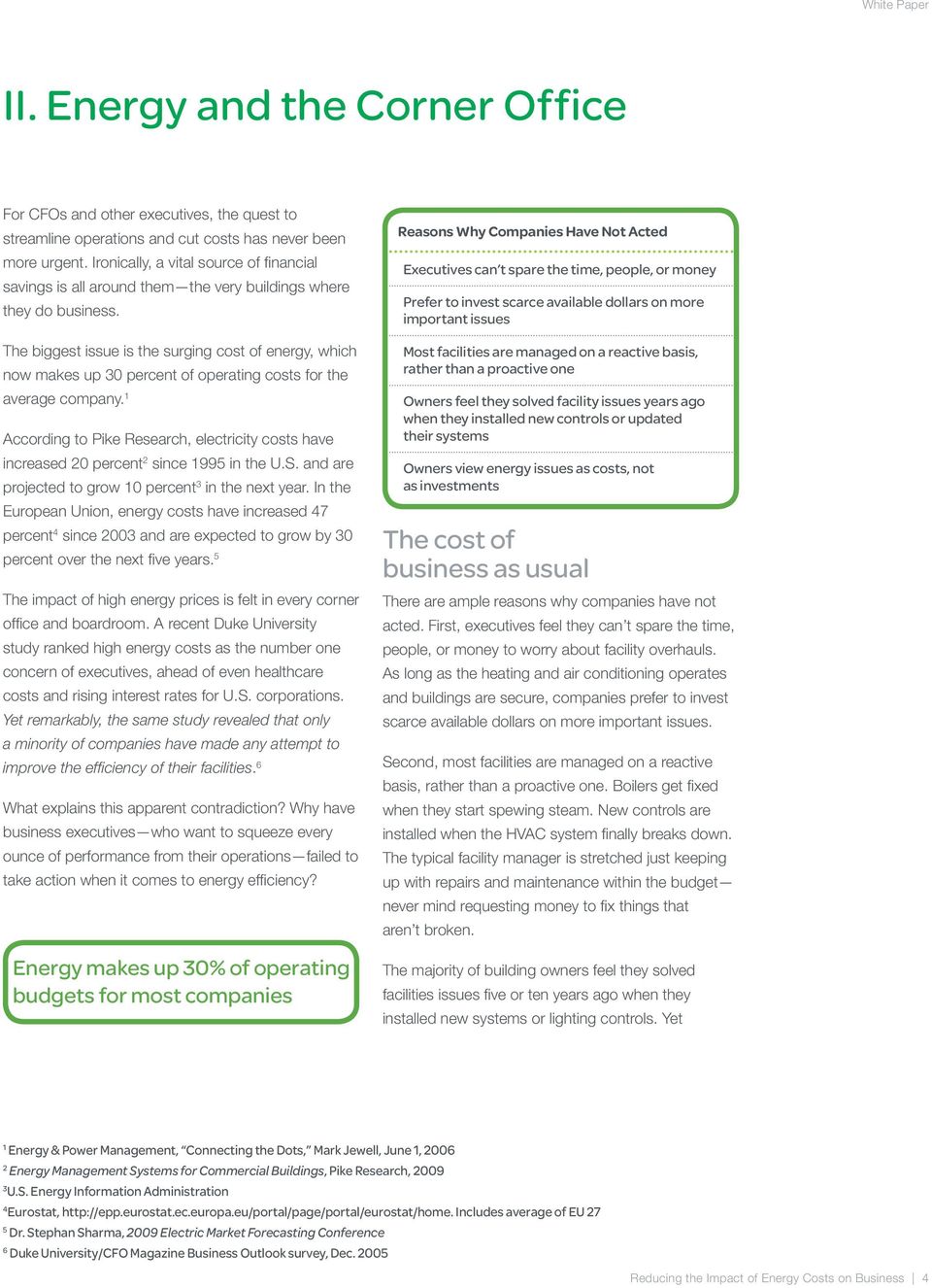
4 II. Energy and the Corner Office For CFOs and other executives, the quest to streamline operations and cut costs has never been more urgent. Ironically, a vital source of financial savings is all around them the very buildings where they do business. The biggest issue is the surging cost of energy, which now makes up 30 percent of operating costs for the average company. 1 According to Pike Research, electricity costs have increased 20 percent 2 since 1995 in the U.S. and are projected to grow 10 percent 3 in the next year. In the European Union, energy costs have increased 47 percent 4 since 2003 and are expected to grow by 30 percent over the next five years. 5 The impact of high energy prices is felt in every corner office and boardroom. A recent Duke University study ranked high energy costs as the number one concern of executives, ahead of even healthcare costs and rising interest rates for U.S. corporations. Yet remarkably, the same study revealed that only a minority of companies have made any attempt to improve the efficiency of their facilities. 6 What explains this apparent contradiction? Why have business executives who want to squeeze every ounce of performance from their operations failed to take action when it comes to energy efficiency? Energy makes up 30% of operating budgets for most companies Reasons Why Companies Have Not Acted Executives can t spare the time, people, or money Prefer to invest scarce available dollars on more important issues Most facilities are managed on a reactive basis, rather than a proactive one Owners feel they solved facility issues years ago when they installed new controls or updated their systems Owners view energy issues as costs, not as investments The cost of business as usual There are ample reasons why companies have not acted. First, executives feel they can t spare the time, people, or money to worry about facility overhauls. As long as the heating and air conditioning operates and buildings are secure, companies prefer to invest scarce available dollars on more important issues. Second, most facilities are managed on a reactive basis, rather than a proactive one. Boilers get fixed when they start spewing steam. New controls are installed when the HVAC system finally breaks down. The typical facility manager is stretched just keeping up with repairs and maintenance within the budget never mind requesting money to fix things that aren t broken. The majority of building owners feel they solved facilities issues five or ten years ago when they installed new systems or lighting controls. Yet 1 Energy & Power Management, Connecting the Dots, Mark Jewell, June 1, Energy Management Systems for Commercial Buildings, Pike Research, U.S. Energy Information Administration 4 Eurostat, Includes average of EU 27 5 Dr. Stephan Sharma, 2009 Electric Market Forecasting Conference 6 Duke University/CFO Magazine Business Outlook survey, Dec Reducing the Impact of Energy Costs on Business 4
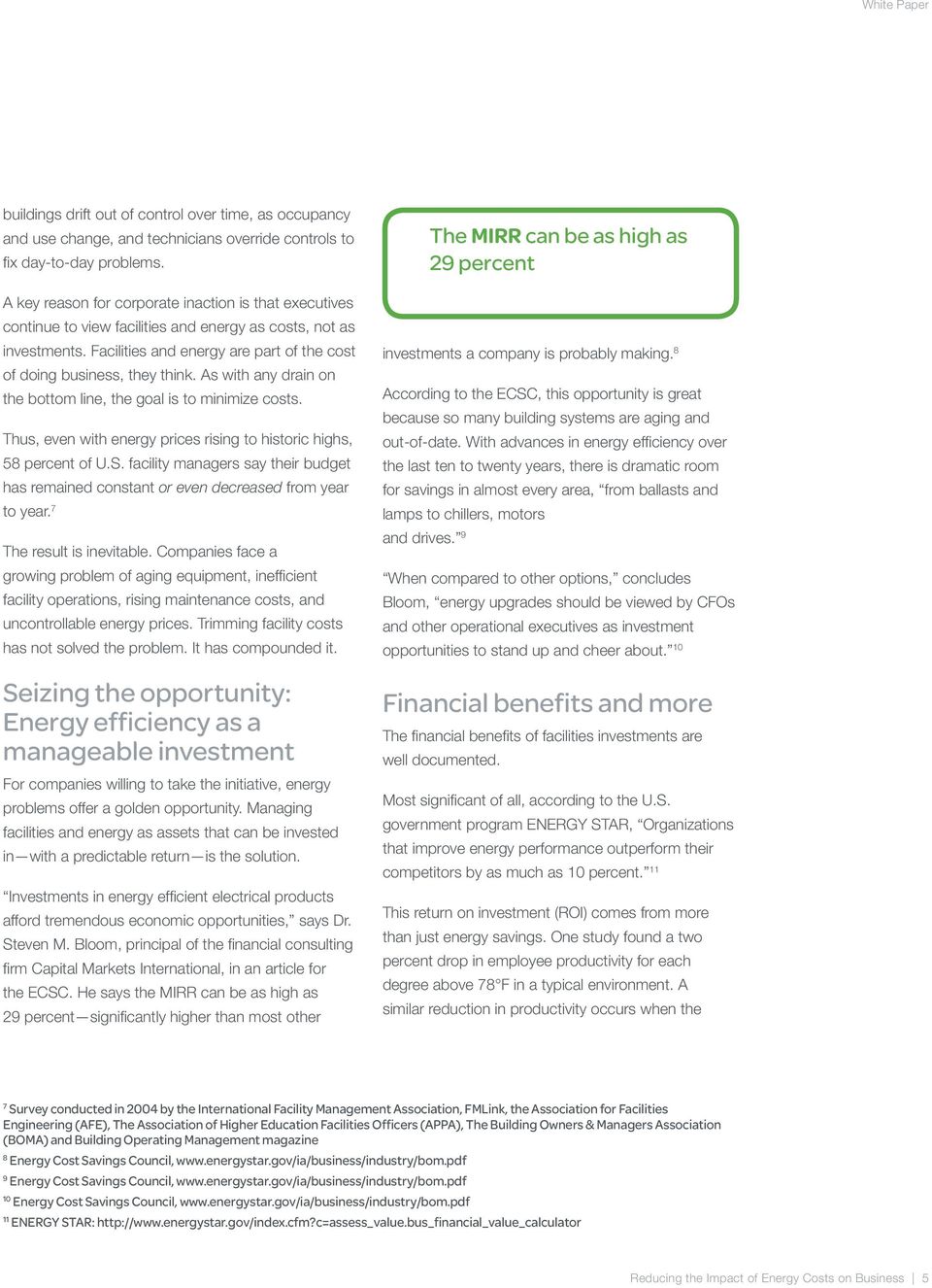
5 buildings drift out of control over time, as occupancy and use change, and technicians override controls to fix day-to-day problems. A key reason for corporate inaction is that executives continue to view facilities and energy as costs, not as investments. Facilities and energy are part of the cost of doing business, they think. As with any drain on the bottom line, the goal is to minimize costs. Thus, even with energy prices rising to historic highs, 58 percent of U.S. facility managers say their budget has remained constant or even decreased from year to year. 7 The result is inevitable. Companies face a growing problem of aging equipment, inefficient facility operations, rising maintenance costs, and uncontrollable energy prices. Trimming facility costs has not solved the problem. It has compounded it. Seizing the opportunity: Energy efficiency as a manageable investment For companies willing to take the initiative, energy problems offer a golden opportunity. Managing facilities and energy as assets that can be invested in with a predictable return is the solution. Investments in energy efficient electrical products afford tremendous economic opportunities, says Dr. Steven M. Bloom, principal of the financial consulting firm Capital Markets International, in an article for the ECSC. He says the MIRR can be as high as 29 percent significantly higher than most other The MIRR can be as high as 29 percent investments a company is probably making. 8 According to the ECSC, this opportunity is great because so many building systems are aging and out-of-date. With advances in energy efficiency over the last ten to twenty years, there is dramatic room for savings in almost every area, from ballasts and lamps to chillers, motors and drives. 9 When compared to other options, concludes Bloom, energy upgrades should be viewed by CFOs and other operational executives as investment opportunities to stand up and cheer about. 10 Financial benefits and more The financial benefits of facilities investments are well documented. Most significant of all, according to the U.S. government program ENERGY STAR, Organizations that improve energy performance outperform their competitors by as much as 10 percent. 11 This return on investment (ROI) comes from more than just energy savings. One study found a two percent drop in employee productivity for each degree above 78 F in a typical environment. A similar reduction in productivity occurs when the 7 Survey conducted in 2004 by the International Facility Management Association, FMLink, the Association for Facilities Engineering (AFE), The Association of Higher Education Facilities Officers (APPA), The Building Owners & Managers Association (BOMA) and Building Operating Management magazine 8 Energy Cost Savings Council, 9 Energy Cost Savings Council, 10 Energy Cost Savings Council, 11 ENERGY STAR: Reducing the Impact of Energy Costs on Business 5
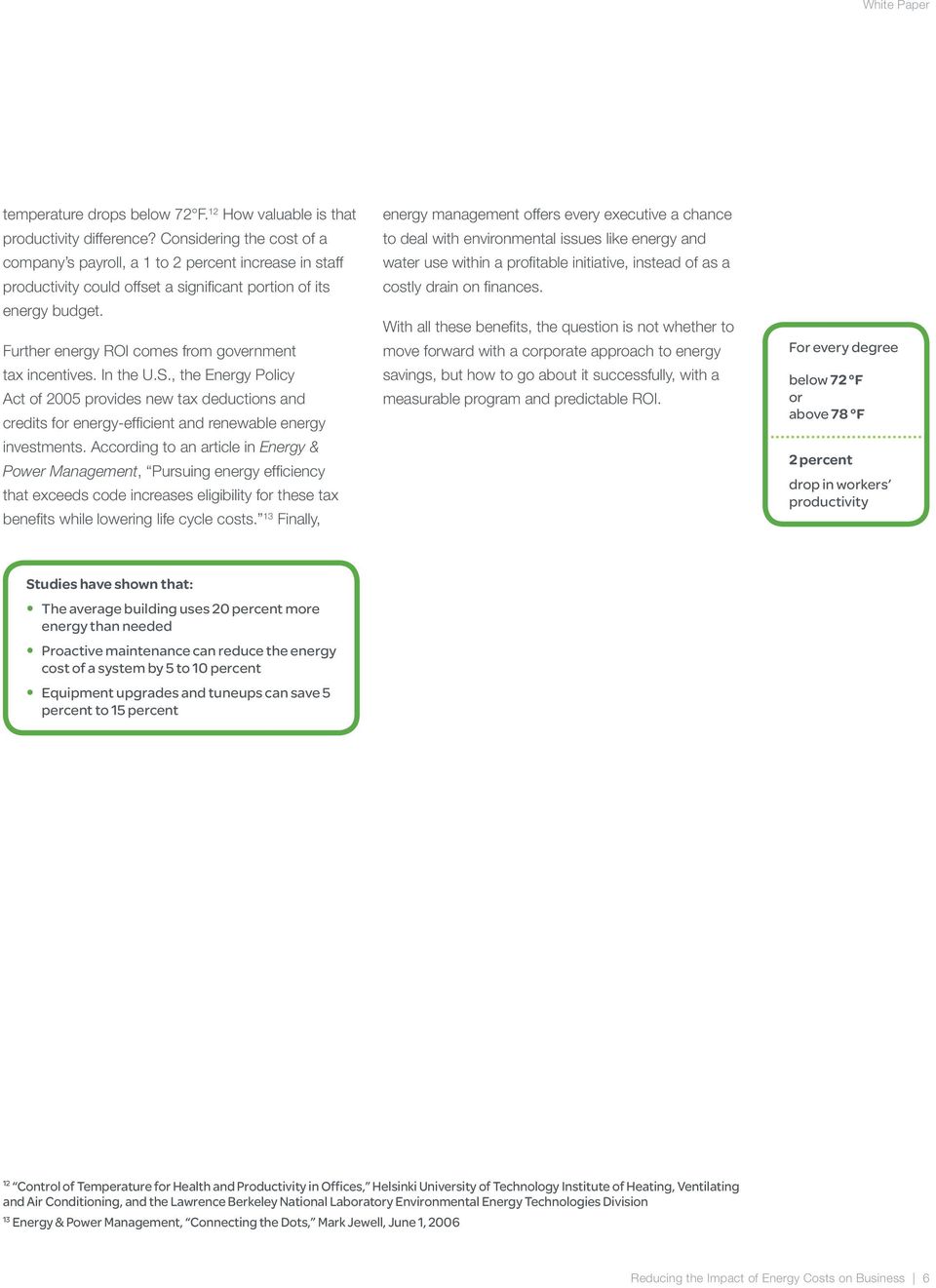
6 temperature drops below 72 F. 12 How valuable is that productivity difference? Considering the cost of a company s payroll, a 1 to 2 percent increase in staff productivity could offset a significant portion of its energy budget. Further energy ROI comes from government tax incentives. In the U.S., the Energy Policy Act of 2005 provides new tax deductions and credits for energy-efficient and renewable energy investments. According to an article in Energy & Power Management, Pursuing energy efficiency that exceeds code increases eligibility for these tax benefits while lowering life cycle costs. 13 Finally, energy management offers every executive a chance to deal with environmental issues like energy and water use within a profitable initiative, instead of as a costly drain on finances. With all these benefits, the question is not whether to move forward with a corporate approach to energy savings, but how to go about it successfully, with a measurable program and predictable ROI. For every degree below 72 F or above 78 F 2 percent drop in workers productivity Studies have shown that: The average building uses 20 percent more energy than needed Proactive maintenance can reduce the energy cost of a system by 5 to 10 percent Equipment upgrades and tuneups can save 5 percent to 15 percent 12 Control of Temperature for Health and Productivity in Offices, Helsinki University of Technology Institute of Heating, Ventilating and Air Conditioning, and the Lawrence Berkeley National Laboratory Environmental Energy Technologies Division 13 Energy & Power Management, Connecting the Dots, Mark Jewell, June 1, 2006 Reducing the Impact of Energy Costs on Business 6
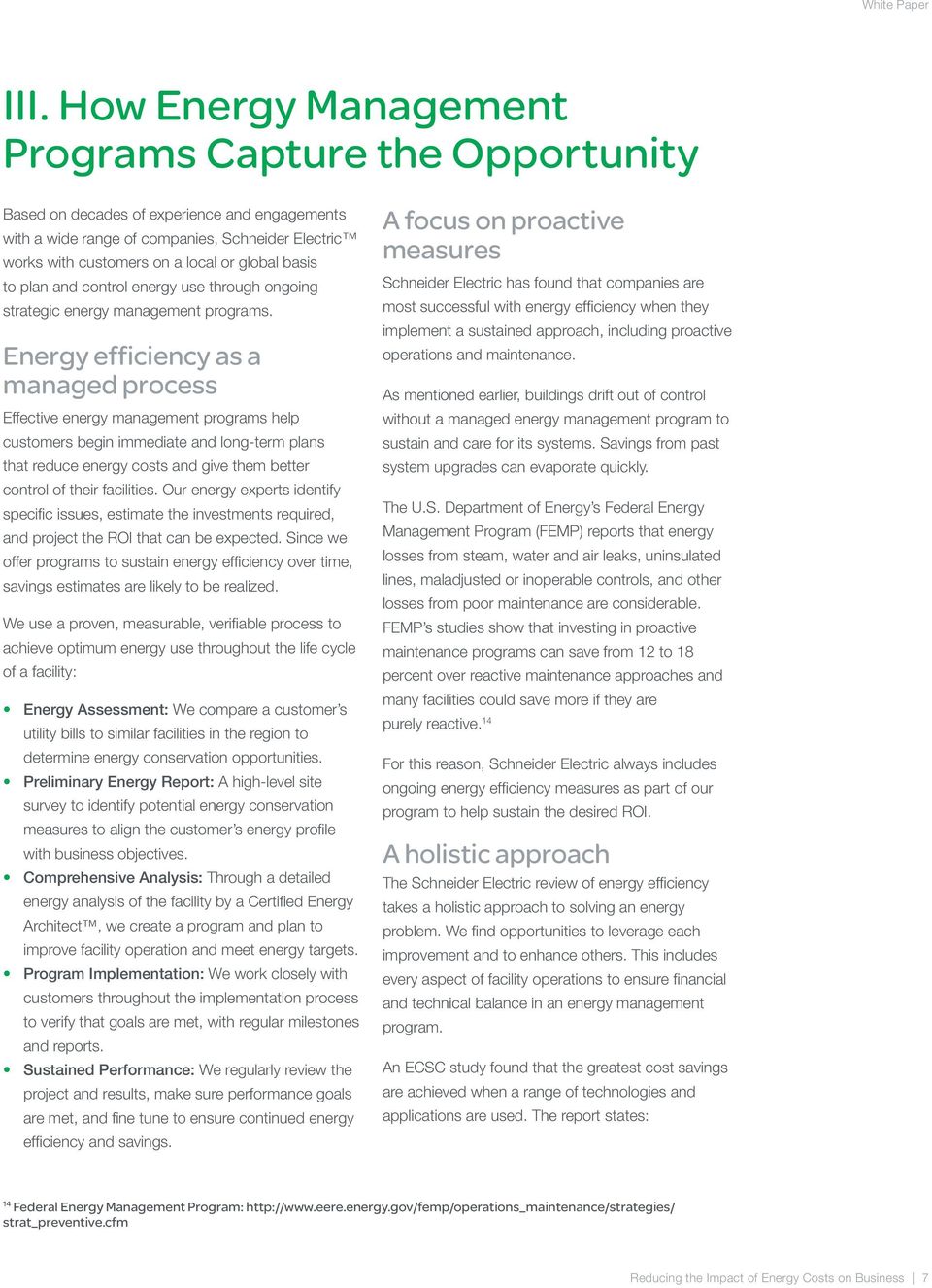
7 III. How Energy Management Programs Capture the Opportunity Based on decades of experience and engagements with a wide range of companies, Schneider Electric works with customers on a local or global basis to plan and control energy use through ongoing strategic energy management programs. Energy efficiency as a managed process Effective energy management programs help customers begin immediate and long-term plans that reduce energy costs and give them better control of their facilities. Our energy experts identify specific issues, estimate the investments required, and project the ROI that can be expected. Since we offer programs to sustain energy efficiency over time, savings estimates are likely to be realized. We use a proven, measurable, verifiable process to achieve optimum energy use throughout the life cycle of a facility: Energy Assessment: We compare a customer s utility bills to similar facilities in the region to determine energy conservation opportunities. Preliminary Energy Report: A high-level site survey to identify potential energy conservation measures to align the customer s energy profile with business objectives. Comprehensive Analysis: Through a detailed energy analysis of the facility by a Certified Energy Architect, we create a program and plan to improve facility operation and meet energy targets. Program Implementation: We work closely with customers throughout the implementation process to verify that goals are met, with regular milestones and reports. Sustained Performance: We regularly review the project and results, make sure performance goals are met, and fine tune to ensure continued energy efficiency and savings. A focus on proactive measures Schneider Electric has found that companies are most successful with energy efficiency when they implement a sustained approach, including proactive operations and maintenance. As mentioned earlier, buildings drift out of control without a managed energy management program to sustain and care for its systems. Savings from past system upgrades can evaporate quickly. The U.S. Department of Energy s Federal Energy Management Program (FEMP) reports that energy losses from steam, water and air leaks, uninsulated lines, maladjusted or inoperable controls, and other losses from poor maintenance are considerable. FEMP s studies show that investing in proactive maintenance programs can save from 12 to 18 percent over reactive maintenance approaches and many facilities could save more if they are purely reactive. 14 For this reason, Schneider Electric always includes ongoing energy efficiency measures as part of our program to help sustain the desired ROI. A holistic approach The Schneider Electric review of energy efficiency takes a holistic approach to solving an energy problem. We find opportunities to leverage each improvement and to enhance others. This includes every aspect of facility operations to ensure financial and technical balance in an energy management program. An ECSC study found that the greatest cost savings are achieved when a range of technologies and applications are used. The report states: 14 Federal Energy Management Program: strat_preventive.cfm Reducing the Impact of Energy Costs on Business 7
8 In a sense, it works like compound interest. Each technology that is upgraded provides energy savings on its own. But it also provides a base on which other energy savings can grow. 15 The reverse is also true. Projects that are undertaken as one-off upgrades may look good on paper, but don t deliver expected returns. Using a holistic approach avoids the adverse impact of a less than stellar ROI. A simple example of this is a retrofit of lighting that can appear to save 50 kilowatts per hour on paper. In the real world, when the weather is cold, the loss of heat, once provided by the inefficient lighting, must be made up by the heating system, thus eroding the expected savings. Here s What We Look At: Building Controls Simple control adjustments can produce rapid energy savings. Are your building controls optimized for performance? Are lights and other systems running at the correct settings and at the right times? We look at optimizing controls first, rather than replacing them, through software changes or tuneups, Sometimes a simple adjustment in controls can improve efficiency significantly. Mechanical How do HVAC systems use energy throughout the building? Can the performance of chill water, distribution, and steam systems be improved? Do air handlers and sequencers need upgrading or adjusting? Are outdated motors wasting energy? Replacing an old motor with a newer, high efficiency motor can improve energy efficiency by 90 percent. Electrical How is electricity used and how efficient is the total system from lighting and controls to office equipment, refrigeration, and kitchens? Since facilities use electricity in many ways, there are usually opportunities for savings. Envelope How does your building envelope perform and how does it affect other energy systems? Could simple improvements to insulation yield significant savings? Water Water, like energy, is a resource that can be conserved to save money. Are cooling towers losing too much water to evaporation? Are you paying for sewage charges that could be avoided with metering? Can water heating be planned and managed to reduce costs, based on actual usage times and areas? 15 Energy Cost Savings Council: Reducing the Impact of Energy Costs on Business 8

9 IV. Case Studies of Energy Savings Case Study 1 For the owner of various manufacturing buildings and distribution facilities across the U.K., rising energy prices and old, inefficient equipment were factors in enlisting Schneider Electric for an energy solution. Solution Working with this customer to find appropriate solutions, the Schneider Electric team introduced the latest building management system (BMS) and data logging capabilities and replaced old technology. Gains As a result, the customer gained intelligent control over its energy-related equipment and now collects energy consumption data to continue evaluating the progress of this project. After funding this initiative, the customer produced a 35 percent savings in electrical consumption and a 25 percent cost savings. In addition, the customer was recognized in its industry and has received awards for these efforts. Case Study 2 Struggling with high energy costs, aging HVAC and lighting equipment, and little control of its equipment, a U.S.-based industrial manufacturer needed to cut those costs while aligning its HVAC controls with its business objectives. Solution Outdated lighting equipment and HVAC roof top units were replaced. Schneider Electric also implemented network-based HVAC controls to serve production times and schedules. This manufacturer is now able to track its energy consumption through ongoing monitoring and reporting capabilities. Gains As required, the BMS is aligned with the company s goals. This energy management system has attained an annual savings of $241,000 with a payback of three years. The company and its building are positioned for continued efficiencies and financial success with a sustainable energy management solution in place. Reducing the Impact of Energy Costs on Business 9

10 Case Study 3 Although their structure was new, the owners of a London, U.K.- based tourist destination also sought ways to make their building more energy efficient while reducing environmental impacts and energy costs. Solution A Schneider Electric energy expert monitored building performance and controls as well as emissions and consumption. From that data, an energy management program was approved. Gains This initiative surpassed its goal: Within the first 18 months, the company reported savings of more than 55,000. Electrical consumption was reduced by 9 percent and gas consumption fell by 15 percent. The long term savings realized by the customer will help enable the implementation of more energy savings. Because it is operating more efficiently, the building s equipment is earmarked for a longer life span saving the owner substantial maintenance costs. Case Study 4 A London, U.K.-based retailer with 500 retail units sought to decrease utility costs while improving environmental conditions and plant efficiency. Schneider Electric used data analysis, benchmarking, and the compilation of a pre-visit report to create a best practice strategy for this retailer. Solution The Schneider Electric team then performed a one-day site visit to conduct an energy survey and identify energy saving opportunities. Schneider Electric followed up by implementing the recommended strategies. It also created a report outlining payback. Continued savings are ensured through post-visit energy performance tracking. Gains After investing 131,000, this customer has achieved an annual savings of 750,000 and increased its plant life expectancy through reduced loading. Reducing the Impact of Energy Costs on Business 10

11 V. Conclusion Viewing facilities and energy use as investments rather than costs allows companies to achieve high rates of return from energy savings while lowering life cycle costs. Studies have shown that successful companies manage their energy in this asset-focused way. It also enables companies to promote their environmental stewardship and enhance worker productivity. Schneider Electric draws on worldwide resources and experience to examine every phase of energy use, helping companies take control of their energy investments with a program of immediate savings and sustained energy efficiency. The initial steps of this holistic approach are low cost and low risk. In the long term, proactive energy savings can easily reach double digits. The result is that Schneider Electric empowers executives to manage their company s energy consumption and achieve true competitive advantage. Reducing the Impact of Energy Costs on Business 11

12 Schneider Electric One High Street, North Andover, MA USA Telephone: Fax: Schneider Electric. All Rights Reserved. Schneider Electric and Make the most of your energy are trademarks owned by Schneider Electric Industries SAS or its affiliated companies. All other trademarks are the property of their respective owners. WP-REDUCEIMPACTOFENERGY-US.BU.N.EN CC December 2010 sm

Reducing the Impact of Energy Costs on Business
 TAC EnergyEdge Reducing the Impact of Energy Costs on Business Your roadmap to targeting energy efficiencies in a dynamic business environment Table of Contents I. Executive Summary 2 II. Energy and the
Building Analytics Improve the efficiency, occupant comfort, and financial well-being of your building.
 Building Analytics Improve the efficiency, occupant comfort, and financial well-being of your building. Make the most of your energy SM Building confidence knowing the why behind your facility s operations
HVAC System Optimization
 UNITED TECHNOLOGIES CARRIER CORPORATION HVAC System Optimization MAXIMIZING PERFORMANCE, ENERGY SAVINGS & COMFORT Revitalize Your Building s System Sometime between the initial purchase and the need to
EnerSmart Programs. enercase. Performance Contracting. contracting. Tired of. chasing capital for infrastructure upgrades?
 EnerSmart Programs enercase Tired of contracting chasing capital for infrastructure upgrades? enercase Summary Summary Hamilton Health Sciences is implementing one of the largest energy saving retrofit
A Four-Step Path. to a Comprehensive Energy Management Action Plan. Make the most of your energy SM
 A Four-Step Path to a Comprehensive Energy Management Action Plan By Keith Stager Industrial Buildings Market Segment Manager -and- Cassie Quaintance, MAS, CEM, LEED AP Energy Market Segment Manager Schneider
Communicating the Value of Energy Efficiency Projects to Financial Decision Makers in Not-For-Profit Markets
 Communicating the Value of Energy Efficiency Projects to Financial Decision Makers in Not-For-Profit Markets By: W. Brewster Earle President, Comfort Systems USA Energy Services & John P. Hennessey President,
Using Performance Contracting and Incentives to Accelerate Energy Efficiency Projects
 White Paper Using Performance Contracting and Incentives to Accelerate Energy Efficiency Projects Andre E. Davis Director of Structured Finance, Global Energy Solutions, Americas Johnson Controls, Inc.
CHAPTER 8 HVAC (Heating, Ventilation, and Air-Conditioning)
 CHAPTER 8 HVAC (Heating, Ventilation, and Air-Conditioning) Objectives Survey current HVAC system(s), operating procedures, and maintenance schedule. Analyze results of energy audit for HVAC system(s)
Innovative Funding Options for Energy Efficiency Initiatives
 Innovative Funding Options for Energy Efficiency Initiatives A Constellation Whitepaper January 2013 Innovative Funding Options For Energy Efficiency Initiatives Greg Fox, Director of Business Development
Printing and Publishing Energy Savings Guide
 Printing and Publishing Energy Savings Guide Oregon printing and publishing plants face challenges of rising operating costs, environmental and other regulations, outdated equipment and customer demand
PARTNERING. in Energy. Solutions A PROGRAM TO PROMOTE BUSINESS ENERGY EFFICIENCY
 PARTNERING in Energy Solutions A PROGRAM TO PROMOTE BUSINESS ENERGY EFFICIENCY Partnering in Energy Solutions Business Customers 3 Austin Utilities An Energy PARTNER for our Customers How can you be more
Strategies and Incentives for Retrofitting Commercial Buildings to Reduce Energy Consumption
 Strategies and Incentives for Retrofitting Commercial Buildings to Reduce Energy Consumption Cory Vanderpool Executive Director, GreenLink Alliance GreenLink Conservation Alliance Non-profit trade association
Using Energy Wisely for a Better Future. Nicor Gas Energy Efficiency Program
 Using Energy Wisely for a Better Future Nicor Gas Energy Efficiency Program Why Natural Gas Efficiency? If the energy efficiency of commercial and industrial buildings improved by just 10 percent: Customers
PARTNERING. in Energy. Solutions A PROGRAM TO PROMOTE BUSINESS ENERGY EFFICIENCY
 PARTNERING in Energy Solutions A PROGRAM TO PROMOTE BUSINESS ENERGY EFFICIENCY Partnering in Energy Solutions Business Customers 3 Owatonna Public Utilities An Energy PARTNER for our Customers How can
PENNSYLVANIA GREEN ENERGY LOAN FUND
 PENNSYLVANIA GREEN ENERGY LOAN FUND Procedures Manual for Quantifying Energy Savings A. Introduction A building project applying for a GELF energy loan must demonstrate that it will result in a 25% reduction
HVAC Costs. Reducing Building. Building owners are caught between two powerful forces the need to lower energy costs. By Stephen J.
 Reducing Building HVAC Costs of site rec By Stephen J. Pargeter Building owners are caught between two powerful forces the need to lower energy costs and the need to meet or exceed outdoor air ventilation
How to Reduce Energy Costs in Your Commercial Building
 How to Reduce Energy Costs in Your Commercial Building Mark Steinmetz, Energy Advisor, GDS Associates, Inc., an ActOnEnergy Partner Mary Bentsen, Education and Training Coordinator SAIC, an Ameren Illinois
Real-Time Demand Side Energy Management
 Real-Time Demand Side Energy Management Annelize Victor Sr. Business Consultant Aspen Technology, Inc. Houston, TX Michael Brodkorb Business Development Manager Aspen Technology España, S.A. Barcelona,
HEATING, VENTILATION & AIR CONDITIONING
 HEATING, VENTILATION & AIR CONDITIONING as part of the Energy Efficiency Information Grants Program Heating and cooling can account for approximately 23 % of energy use in pubs and hotels 1. Reducing heating
TOWER RENEWAL CASE STUDY
 TOWER RENEWAL CASE STUDY Energy Monitoring and Management: A Case Study of Brentwood Towers, Toronto Executive Summary Through good management, and new technologies, O Shanter Development has achieved
Conservation Demand Management Plan London Health Sciences Centre Made for Ontario Regulation 397/11 Green Energy Act, 2009
 Conservation Demand Management Plan London Health Sciences Centre Made for Ontario Regulation 397/11 Green Energy Act, 2009 The Green Energy Act - Regulation 397 The Conservation Demand Management (CDM)
Energy Efficiency Operations & Maintenance Plan August 25, 2010
 Energy Efficiency Operations & Maintenance Plan August 25, 2010 Table of Contents Introduction... 3 Repair, Maintain and Operate Existing Equipment Efficiently... 3 Citywide Requirements Contract... 4
Energy Audits. Who needs one? Why it is needed? So many choices. Which one is right for my home? My business? My community?
 Webinar Set Up All lines are muted If you have a question you can type it into the Question/Chat box in your Go to Webinar tool bar Webinar is being recorded Energy Audits Who needs one? Why it is needed?
Consumers Energy Business Solutions. Commercial and Industrial Energy Efficiency Program April 18, 2013
 1 Consumers Energy Business Solutions Commercial and Industrial Energy Efficiency Program April 18, 2013 Ralph Huston Energy Advisor Consumers Energy Business Solutions 3965 Okemos Rd. Ste. A-1 Okemos,
ENERGY AUDITS AND RETRO- COMMISSIONING Local Law 87
 ENERGY AUDITS AND RETRO- COMMISSIONING Local Law 87 Overview Although energy-efficiency retrofits generally result in major cost and energy savings, many buildings are not participating in the audits that
Energy Benchmarking Report for Lakeside Middle School. Millville, NJ
 Energy Benchmarking Report for Lakeside Middle School Millville, NJ (for the period: June 1, 2008 through May 31, 2009) Prepared by: Background & Findings: The New Jersey Clean Energy Program (NJCEP) developed
Case Studies in Existing Building Audits
 Case Studies in Existing Building Audits Erica Brabon Steven Winter Associates, Inc. 307 7 th Ave., NY, NY [email protected] Who we are Steven Winter Associates, Inc. (SWA) is a 37 yearold architecture
DATA CENTER DESIGN OVERVIEW
 DATA CENTER DESIGN OVERVIEW Presented by Horst Pfendt Critical Facilities Round Table 7 th QUARTERLY MEETING December 17, 2004 DATA CENTER DESIGN OVERVIEW INTRODUCTION In the next couple of hours I will
Energy Efficiency Workshops For Commercial Customers
 Energy Efficiency Workshops For Commercial Customers Takeaways Energy is a business issue Energy improvements are an investment Save energy because you can Enjoy the next hour- this really isn t work!
Industrial Green Building Retrofit 101 Opportunities and Challenges. Light Industrial Green Building Retrofits. Why Green Retrofit?
 Industrial Green Building 101 Opportunities and Challenges Joanne Sawatzky Senior Project Manager, Light House Sustainability at Work Re-visioning a Sustainable False Creek Flats Light Industrial Green
Commercial Building Energy Initiative Tenant Business Case
 Commercial Building Energy Initiative Tenant Business Case April 2010 An initiative of the Greater Toronto CivicAction Alliance The business case for GTA tenants Why to invest in energy efficiency programs
Corporate Energy Conservation & Demand Management Plan (CECDMP) 2014-2019
 Corporate Energy Conservation & Demand Management Plan (CECDMP) 2014-2019 Table of Contents Our Commitment to Energy Conservation...1 1.0 Introduction...2 2.0 Energy Supply in Ontario...3 2.1 Energy Supply
STRATEGIC ENERGY MANAGEMENT PLAN. MICs Group of Health Services. 2014 to 2019. Anson General Hospital Bingham Memorial Hospital Lady Minto Hospital
 STRATEGIC ENERGY MANAGEMENT PLAN MICs Group of Health Services 2014 to 2019 Anson General Hospital Bingham Memorial Hospital Lady Minto Hospital MICs Group of Health Services STRATEGIC ENERGY MANAGEMENT
Small Guide to BIG Savings: Energy Efficiency for your Small Business. Julia Sander Leidos Engineering, LLC
 Small Guide to BIG Savings: Energy Efficiency for your Small Business Julia Sander Leidos Engineering, LLC TWO KEY MESSAGES 1. Every dollar saved is a profit of one dollar to your business» If you save
Agenda. Part I: Introduction to OptimumHVAC. Part II: Initial Energy Savings Analysis for MCO Main Terminal. Part III: Case Studies & Conclusion
 OptimumHVAC Prepared for the: GOAA Energy Conservation & Environmental Initiatives Forum April 27, 2010 Jamie Wiecks Enterprise Account Manager Optimum Energy Mike Dillard Vice President, Business Development
Managing Energy Consumption for Optimal Productivity and Higher Profitability. Rockwell Automation solutions for energy management
 Managing Energy Consumption for Optimal Productivity and Higher Profitability Rockwell Automation solutions for energy management Experience the Transformation Transform your production. How will you adapt
Energy Efficiency: Integrated Design and HVAC Systems HEALTHCARE - TOP 5 GREEN BUILDING STRATEGIES
 EPA Publication 909-F-07-001 What? Energy use in healthcare facilities is higher than nearly all other building types. With rising energy costs and climate change concerns energy efficiency is financially
Georgian Bay General Hospital Strategic Energy Management Plan 2014
 Georgian Bay General Hospital Strategic Energy Management Plan 2014 TABLE OF CONTENTS TABLE OF CONTENTS... 2 INTRODUCTION... 3 ENERGY MANAGEMENT VISION... 4 GUIDING PRINCIPLES FOR STRATEGIC ENERGY MANAGEMENT...
Southern California Edison Multifamily Energy Efficiency Programs LBWD's H2O for HOAs Forum
 Southern California Edison Multifamily Energy Efficiency Programs LBWD's H2O for HOAs Forum October 22, 2014 Multifamily Market Segment Multifamily Properties are one of California s largest segments which
Building Energy Management: Using Data as a Tool
 Building Energy Management: Using Data as a Tool Issue Brief Melissa Donnelly Program Analyst, Institute for Building Efficiency, Johnson Controls October 2012 1 http://www.energystar. gov/index.cfm?c=comm_
Predictive Maintenance Strategy for Building Operations: A Better Approach
 Predictive Maintenance Strategy for Building Operations: A Better Approach by Robert Hemmerdinger Executive summary Maintenance costs account for almost as large a percentage of a facility s operating
Design Guide. Retrofitting Options For HVAC Systems In Live Performance Venues
 Design Guide Retrofitting Options For HVAC Systems In Live Performance Venues Heating, ventilation and air conditioning (HVAC) systems are major energy consumers in live performance venues. For this reason,
ELECTRICAL ENERGY REDUCTION IN REFRIGERATION AND AIR CONDITIONING Ken Landymore, Director of Operations, Smartcool Systems Inc.
 ELECTRICAL ENERGY REDUCTION IN REFRIGERATION AND AIR CONDITIONING Ken Landymore, Director of Operations, Smartcool Systems Inc. 1. INTRODUCTION In the coming decades, actions to limit greenhouse gas emissions
Modeling and Simulation of HVAC Faulty Operations and Performance Degradation due to Maintenance Issues
 LBNL-6129E ERNEST ORLANDO LAWRENCE BERKELEY NATIONAL LABORATORY Modeling and Simulation of HVAC Faulty Operations and Performance Degradation due to Maintenance Issues Liping Wang, Tianzhen Hong Environmental
Training for Building Technicians: Energy Efficiency & Sustainability (BEST) Program. Seminar Outline & Sample BEST Exam Questions
 Training for Building Technicians: Energy Efficiency & Sustainability (BEST) Program Seminar Outline & Sample BEST Exam Questions Buildings in the United State consume a significant amount of energy. According
AEP Ohio Business Incentives for Energy Efficiency. Topics. Why Energy Efficiency? 11/24/2014. Economic Development 101 November 21, 2014
 AEP Ohio Business Incentives for Energy Efficiency Economic Development 101 November 21, 2014 Topics Why Energy Efficiency Prescriptive Custom New Construction Express (Small Business) Self Direct Retocommisioning
Energy Saving Opportunities for Businesses. Presented by Anna Selgert, Outreach Representative
 Energy Saving Opportunities for Businesses Presented by Anna Selgert, Outreach Representative Where Energy Efficiency Started... Part of Illinois energy legislation passed in 2007 Utility companies required
THE WEST NIPISSING GENERAL HOSPITAL STRATEGIC ENERGY MANAGEMENT PLAN 2014
 THE WEST NIPISSING GENERAL HOSPITAL STRATEGIC ENERGY MANAGEMENT PLAN 2014 TABLE OF CONTENTS Executive Summary... 3 Introduction... 4 Energy Management Vision... 6 Guiding Principles for Strategic Energy
Case Study: Opportunities to Improve Energy Efficiency in Three Federal Data Centers
 Case Study: Opportunities to Improve Energy Efficiency in Three Federal Data Centers Prepared for the U.S. Department of Energy s Federal Energy Management Program Prepared By Lawrence Berkeley National
FIRE DETECTION BUILDING AUTOMATION CAPITAL PROJECTS HVAC SERVICES SECURITY SYSTEMS PROJECT MANAGEMENT. www.msssolutions.
 HVAC SERVICES BUILDING AUTOMATION FIRE DETECTION SECURITY SYSTEMS CAPITAL PROJECTS 877-372-4344 PROJECT MANAGEMENT HVAC SERVICES Superior Technical Staffing Unrivaled Customer Service Industry-wide Reputation
Increasing Energ y Efficiency In Data Centers
 The following article was published in ASHRAE Journal, December 2007. Copyright 2007 American Society of Heating, Refrigerating and Air- Conditioning Engineers, Inc. It is presented for educational purposes
Energy Conservation. City of Fort Worth Business Smart Program
 City of Fort Worth Business Smart Program Energy Conservation Conserving energy in your organization s daily operations is an important step towards saving money, but also reducing the need for the generation
ENERGY EFFICIENCY ENERGY EFFICIENCY: Saving Dollars While Clearing the Air
 : Saving Dollars While Clearing the Air After labor and food, energy is the largest controllable cost in a restaurant s operation. And energy is a great place to start in becoming a green restaurant because
Your partner of choice for integrated energy solutions
 E.ON Connecting Energies Your partner of choice for integrated energy solutions Would you like to reduce your company s energy costs? Do you have ambitious environmental objectives? Are you concerned about
Reducing Data Center Loads for a Large-Scale, Net Zero Office Building
 rsed Energy Efficiency & Renewable Energy FEDERAL ENERGY MANAGEMENT PROGRAM Reducing Data Center Loads for a Large-Scale, Net Zero Office Building Energy Efficiency & Renewable Energy Executive summary
How To Save Money On Energy
 Business Programs and Services At our Delray location, we had an immediate 23 percent drop in lighting kilowatt-hour usage. That has a significant impact on our energy bills. Ken Infante, AutoNation, Inc.
Pilot Program Description: Building EMIS
 Pilot Program Description: Introduction Over time building systems do not operate as efficiently as they once did, using more energy than they should in order to satisfy occupant comfort and lighting requirements.
1. What percent of a commercial business s energy usage comes from their HVAC system? A. 13% B. 23% C. 33% D. 43% E. 53%
 1 1. What percent of a commercial business s energy usage comes from their HVAC system? A. 13% B. 23% C. 33% D. 43% E. 53% 2. How much money do commercial facilities spend per square foot on energy costs
Impact of Control System Technologies on Industrial Energy Savings
 Impact of Control System Technologies on Industrial Energy Savings Priyam Parikh Industrial Assessment Center Texas A&M University Bryan P. Rasmussen Industrial Assessment Center Texas A&M University http://farolconsulting.com/?page_id=110
Zen Internet Case Study
 Zen Internet Case Study About Zen Internet Zen Internet is an independent Internet Service Provider (ISP) that offers a full range of data, voice, and hosting services to businesses and residential users
ENERGY SAVING STUDY IN A HOTEL HVAC SYSTEM
 ENERGY SAVING STUDY IN A HOTEL HVAC SYSTEM J.S. Hu, Philip C.W. Kwong, and Christopher Y.H. Chao Department of Mechanical Engineering, The Hong Kong University of Science and Technology Clear Water Bay,
Ener.co & Viridian Energy & Env. Using Data Loggers to Improve Chilled Water Plant Efficiency. Randy Mead, C.E.M, CMVP
 Ener.co & Viridian Energy & Env. Using Data Loggers to Improve Chilled Water Plant Efficiency Randy Mead, C.E.M, CMVP Introduction Chilled water plant efficiency refers to the total electrical energy it
Energy Performance Benchmarking Report For:
 Energy Performance Benchmarking Report For: Example NJ Office Building 100 Efficient Way Secaucus, New Jersey 07094 Prepared by: TRC Energy Services, NJCEP C&I Marketing Manager Report Generated May 20,
Energy Efficiency Opportunities in Federal High Performance Computing Data Centers
 Energy Efficiency Opportunities in Federal High Performance Computing Data Centers Prepared for the U.S. Department of Energy Federal Energy Management Program By Lawrence Berkeley National Laboratory
BEST PRACTICE GUIDE TO MAXIMIZE ROI OF ENERGY MANAGEMENT SYSTEMS. Bob Zak SVP, Facility Solutions Ecova
 BEST PRACTICE GUIDE TO MAXIMIZE ROI OF ENERGY MANAGEMENT SYSTEMS Bob Zak SVP, Facility Solutions Ecova April 2013 BEST PRACTICE GUIDE TO MAXIMIZE ROI OF ENERGY MANAGEMENT SYSTEMS Once your organization