
Procedure guide. For a smoother operation
|
|
|
- Calvin Porter
- 10 years ago
- Views:
Transcription
1 Procedure guide For a smoother operation
2

3 Welcome This procedure guide forms part of your Agreement with Barclaycard and replaces all previous editions of the procedure guide with immediate effect. These procedures must be followed so that your business can enjoy the full benefit of accepting payment by cards, including prompt payment to your bank account. Your procedure guide should be kept in a safe place, easily accessible to your employees, but out of reach of your customers. Speed, efficiency and security are essential to credit and debit card acceptance today. To help you and your staff gain the maximum benefit from processing with us, your procedure guide contains all the information you need for your business to accept payments by card, whether by a PDQ terminal owned by Barclaycard and leased to you, or by your own terminals. Change of business type You will need to notify us if you significantly change the type of goods or services that your original Merchant Agreement applies to (for example if you start trading on the internet or if you start accepting mail or telephone order transactions and you previously advised us that you only accept face-to-face transactions in your retail outlet) or if you change the nature of your business (for example from a partnership to a limited company) or if you change the actual name of your business. Telephone contacts You will be advised in various sections of this guide to contact one or more departments. There s a full list of the telephone numbers in Section 6. Barclaycard outlet number For ease when you contact Barclaycard, please have your Merchant number ready. You can keep a record of it here:

4 Contents Things you need to know before you accept card payments 1 Card recognition Visa credit cards New Visa card design MasterCard Alternative MasterCard New V PAY card Visa debit Visa Electron Solo Maestro JCB Holograms Ultraviolet motifs Additional card recognition Visa credit card and MasterCard Visa debit card Visa Electron UK Maestro and Solo Maestro JCB Visa and Visa Electron mini cards with mini dove design hologram Commercial cards Fighting fraud Preventing and detecting fraudulent card-present transactions Counterfeit cards New card designs for Visa and MasterCard Holograms Ultraviolet motifs Card chip-read/swipe failure UK Maestro and Solo cards Maestro cards (issued outside the UK) Visa Electron cards Returning wanted or recovered cards Reward scheme Cheque guarantee Fraud prevention advice Preventing and detecting fraudulent card-not-present transactions Velocity checking and fraud screening Card Security Code and Address Verification Service Authentication or 3D Secure Card scheme requirements Payment Card Industry Data Security Standard (PCI DSS) Maestro mandate compulsory changes to the way you accept Maestro card payment If you fail to comply with PCI DSS or the Maestro mandate Protecting cardholder information Thermal paper Storing your records Accepting card payments 2 Card-present transactions Installation Insurance Care of your bank-owned PDQ terminal(s) Using your own or third party-supplied terminal Using your point of sale terminal Contactless transactions What is a contactless transaction? Accepting contactless card payments Manual entry for card-present transactions Fallback paper voucher processing Making a transaction when the customer is present Authorisation and Code 10 calls Definition of Authorisation Referrals Automated Authorisation System Code 10 calls for card-present transactions Card-not-present transactions (terminal or epdq e-terminal) Definition of card-not-present Advertising Processing card-not-present orders Pre-authorisation Visa authorisation rules for MOTO and internet MasterCard authorisation rules for MOTO and internet Recurring transaction What about chargebacks? Telephone orders Barclaycard Hotel Tracker Internet transactions E-commerce Options epdq Requirements for merchants not using the epdq HPP Internet Payment Service Providers (PSPs) Modulus 10 Check Website information Transaction receipts
5 General procedures and banking 3 Everyday procedures Banking procedures Sales and refund vouchers Completing your Merchant Voucher Summary (MVS) Posting vouchers Monthly statements Understanding your monthly statement What you will receive Queries Merchant invoice/statement Transaction payment advice Periodic settlement Service charge detail advice Exceptional procedures Can I pass charges to my customer? Minimum charging Split sales Double charges Alteration of amounts Exchanges Chargebacks and retrieval requests 4 Retrieval requests Why chargebacks occur Responding to retrieval requests and chargeback letters Faxlink service To help reduce the risk of chargebacks Timescales for chargebacks Disputed transactions Sample retrieval letter internet transactions Sample retrieval letter telephone and mail order transactions Additional rules for the Visa Vehicle Rental Reservation Service Lodging and accommodation 6 Taking advance reservations Tips on taking telephone reservations Taking reservations by fax or mail Taking reservations over the internet Extra tips for verifying genuine customers Taking advanced lodging deposits Your cancellation policy Guest arrivals/check-in No show Pre-authorisation Departures/check-out Express/priority check-out service Extended stays Disputed transactions Replying to requests for information and notification of chargebacks No show charges Express/priority check-out charges Additional charges Contact numbers 7 Glossary 8 Vehicle rental reservation service 5 Vehicle rental companies Tips on taking telephone reservations Taking reservations by fax or mail Taking reservations over the internet Extra tips for verifying genuine customers Your cancellation policy No show Vehicle collection Estimated Authorisation Estimated Authorisation useful tips Estimated Authorisation end of hire Handling Pre-authorisation Pre-authorisation end of hire Accident or collision Procedure for transacting delayed charges Accepting split sales Your refund policy Extended hire

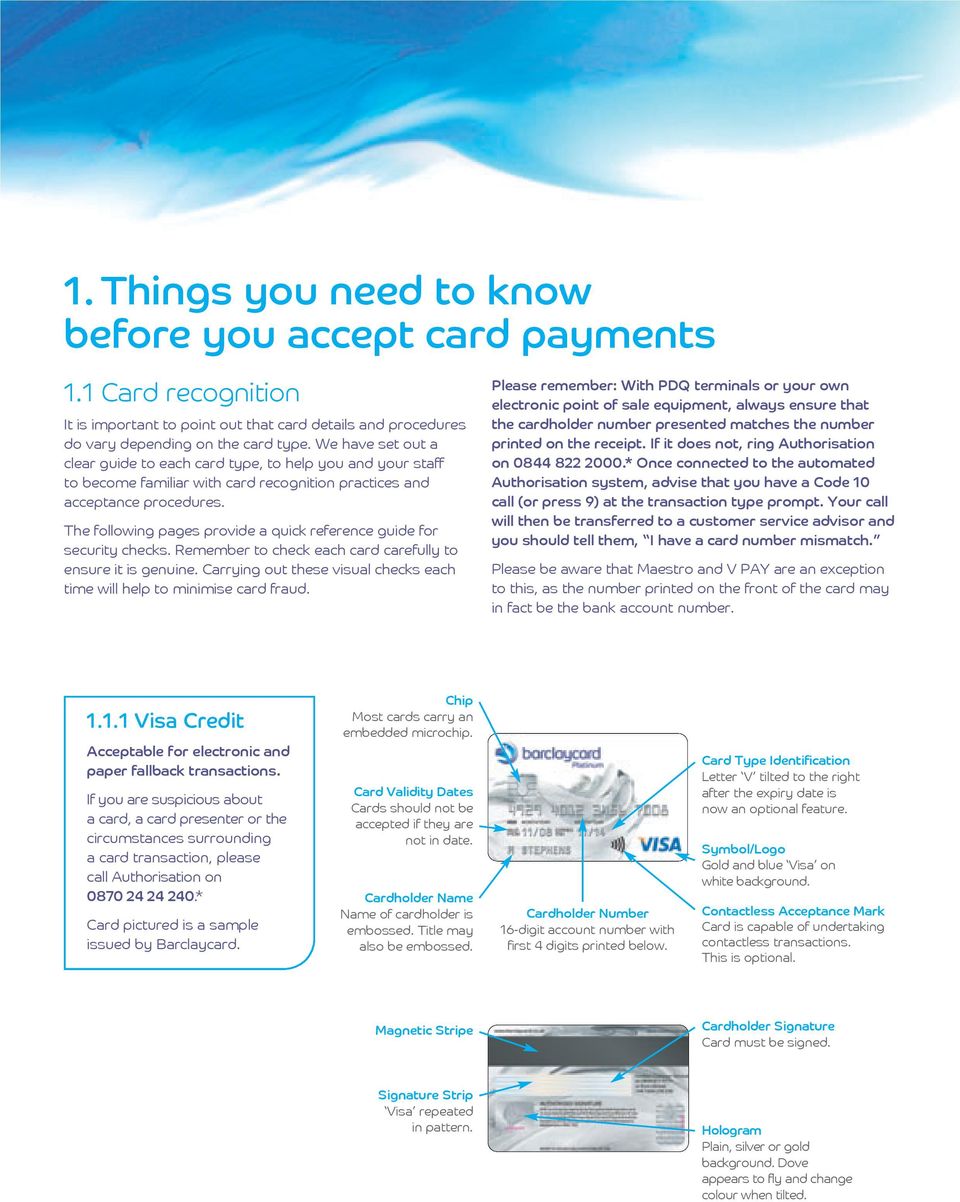
6 1. Things you need to know before you accept card payments 1.1 Card recognition It is important to point out that card details and procedures do vary depending on the card type. We have set out a clear guide to each card type, to help you and your staff to become familiar with card recognition practices and acceptance procedures. The following pages provide a quick reference guide for security checks. Remember to check each card carefully to ensure it is genuine. Carrying out these visual checks each time will help to minimise card fraud. Please remember: With PDQ terminals or your own electronic point of sale equipment, always ensure that the cardholder number presented matches the number printed on the receipt. If it does not, ring Authorisation on * Once connected to the automated Authorisation system, advise that you have a Code 10 call (or press 9) at the transaction type prompt. Your call will then be transferred to a customer service advisor and you should tell them, I have a card number mismatch. Please be aware that Maestro and V PAY are an exception to this, as the number printed on the front of the card may in fact be the bank account number Visa Credit Acceptable for electronic and paper fallback transactions. If you are suspicious about a card, a card presenter or the circumstances surrounding a card transaction, please call Authorisation on * Card pictured is a sample issued by Barclaycard. Chip Most cards carry an embedded microchip. Card Validity Dates Cards should not be accepted if they are not in date. Cardholder Name Name of cardholder is embossed. Title may also be embossed. Cardholder Number 16-digit account number with first 4 digits printed below. Card Type Identification Letter V tilted to the right after the expiry date is now an optional feature. Symbol/Logo Gold and blue Visa on white background. Contactless Acceptance Mark Card is capable of undertaking contactless transactions. This is optional. Magnetic Stripe Cardholder Signature Card must be signed. Signature Strip Visa repeated in pattern. Hologram Plain, silver or gold background. Dove appears to fly and change colour when tilted.
7 1.1.2 New Visa card design Acceptable for electronic and paper fallback transactions. If you are suspicious about a card, a card presenter or the circumstances surrounding a card transaction, please call Authorisation on * Some cards may contain Visa holographic magnetic stripe (a single dove or a series of doves in flight) and some will contain the traditional magnetic stripe. Signature Panel Design can be customised. Optional Chip Printed first 4 digits of account number. BANK IDENTIFICATION AREA CVV2 Can also be found within the signature panel. Expiry date. Cards shown for visual purposes only not actual cards. Embossed or printed account number. Visa Brand Mark Cardholder name or identifier. V UV Element In addition, newer cards will carry a hologram of a single dove on the front or a mini hologram on the reverse. New Visa card design variations. The new Visa card designs allow issuers to display the card information in a variety of ways (see below).

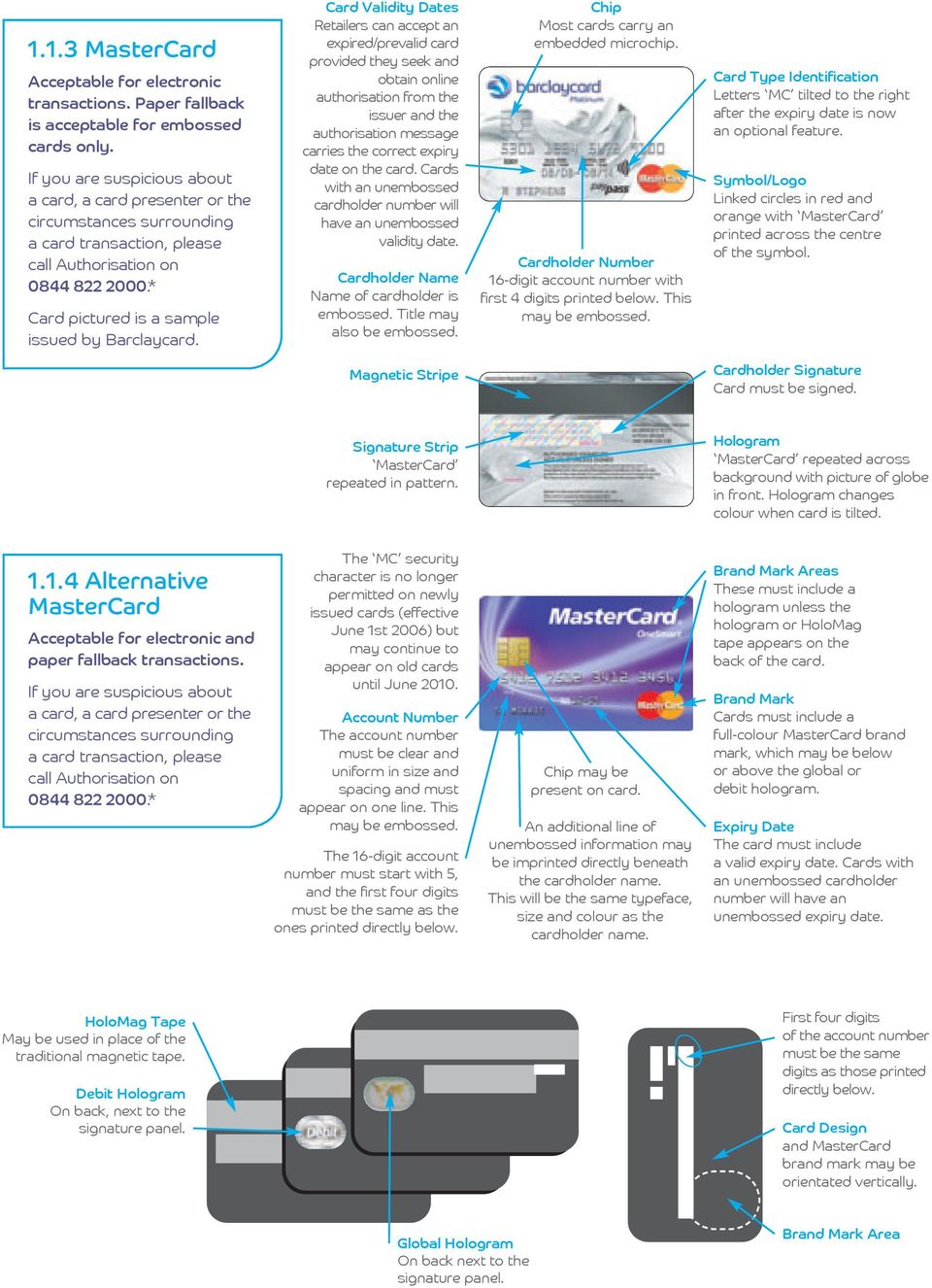
8 1.1.3 MasterCard Acceptable for electronic transactions. Paper fallback is acceptable for embossed cards only. If you are suspicious about a card, a card presenter or the circumstances surrounding a card transaction, please call Authorisation on * Card pictured is a sample issued by Barclaycard. Card Validity Dates Retailers can accept an expired/prevalid card provided they seek and obtain online authorisation from the issuer and the authorisation message carries the correct expiry date on the card. Cards with an unembossed cardholder number will have an unembossed validity date. Cardholder Name Name of cardholder is embossed. Title may also be embossed. Chip Most cards carry an embedded microchip. Cardholder Number 16-digit account number with first 4 digits printed below. This may be embossed. Card Type Identification Letters MC tilted to the right after the expiry date is now an optional feature. Symbol/Logo Linked circles in red and orange with MasterCard printed across the centre of the symbol. Magnetic Stripe Cardholder Signature Card must be signed. Signature Strip MasterCard repeated in pattern. Hologram MasterCard repeated across background with picture of globe in front. Hologram changes colour when card is tilted Alternative MasterCard Acceptable for electronic and paper fallback transactions. If you are suspicious about a card, a card presenter or the circumstances surrounding a card transaction, please call Authorisation on * The MC security character is no longer permitted on newly issued cards (effective June 1st 2006) but may continue to appear on old cards until June Account Number The account number must be clear and uniform in size and spacing and must appear on one line. This may be embossed. The 16-digit account number must start with 5, and the first four digits must be the same as the ones printed directly below. Chip may be present on card. An additional line of unembossed information may be imprinted directly beneath the cardholder name. This will be the same typeface, size and colour as the cardholder name. Brand Mark Areas These must include a hologram unless the hologram or HoloMag tape appears on the back of the card. Brand Mark Cards must include a full-colour MasterCard brand mark, which may be below or above the global or debit hologram. Expiry Date The card must include a valid expiry date. Cards with an unembossed cardholder number will have an unembossed expiry date. HoloMag Tape May be used in place of the traditional magnetic tape. Debit Hologram On back, next to the signature panel. First four digits of the account number must be the same digits as those printed directly below. Card Design and MasterCard brand mark may be orientated vertically. Global Hologram On back next to the signature panel. Brand Mark Area
9 New MasterCard unembossed card design variations. The new MasterCard designs allow issuers to display the card information in a variety of ways New V PAY card V PAY is a new European chip only card acceptable for electronic transactions. If you are suspicious about a card, a card presenter or the circumstances surrounding a card transaction, please call Authorisation on * Cards shown for visual purposes only not actual cards. Chip A chip must appear on the front of the card. Ultraviolet V element When placed under an ultraviolet light, a V printed in ultraviolet ink will be visible over the V PAY logo. Magnetic Stripe Use of the Visa holographic magnetic stripe with doves in flight is optional. You may see this magnetic stripe or a traditional one on a V PAY card. V PAY logo The V PAY logo appears on the front of the card. Alternative logo placement options and vertical orientation of the card and logo are possible. Unembossed Card Unlike other Visa cards, the cardholder name, account number and expiry date may be printed on either the front or back of the card, not embossed Visa Debit Acceptable for electronic and paper fallback transactions. If you are suspicious about a card, a card presenter or the circumstances surrounding a card transaction, please call Authorisation on * Cards shown for visual purposes only not actual cards. Chip Most cards carry an embedded microchip. Cardholder Number 16-digit account number with first 4 digits of the account number printed below. Cardholder Name Name of cardholder is embossed. Title may also be embossed. Magnetic Stripe Signature Strip The reverse of some Visa debit cards may look similar or identical to the reverse of a Visa credit card. Visa Brand Mark This could be displayed top right or top left as well. Card Validity Dates Cards should not be accepted if they are not in date. Cardholder Signature Card must be signed. CVV2 Mark Some card issuers may include an optional link logo and/or a cheque guarantee hologram.
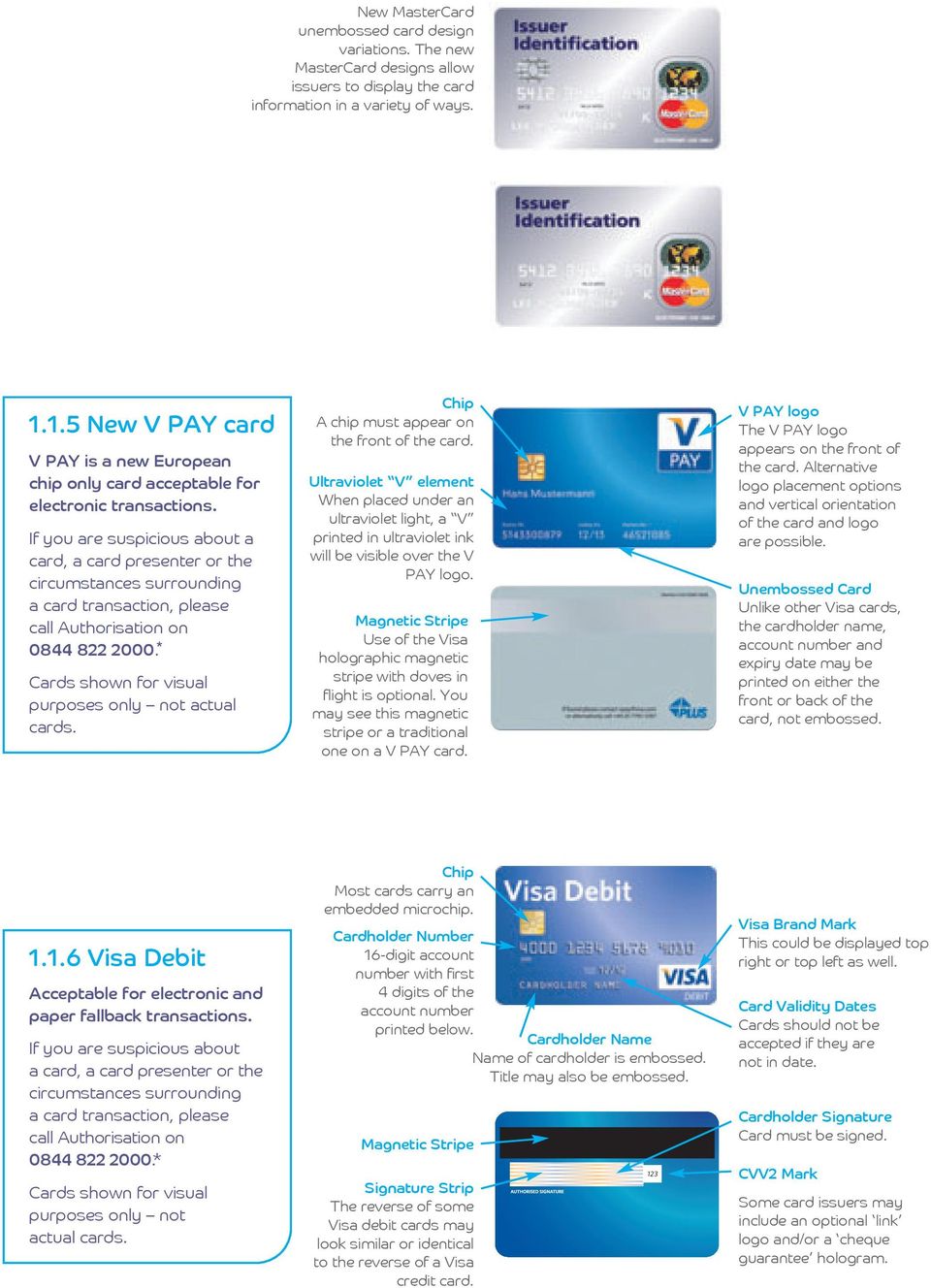
10 1.1.7 Visa Electron Acceptable for electronic transactions only. Please remember: The full card number, cardholder name and valid from date may not appear on the front of all cards. The three-digit Card Security Code, which can be found on the signature panel, will only be present if the full card number appears on the front of the card. Cards shown for visual purposes only not actual cards. Cardholder Number 16-digit account number with first 4 digits of the account number printed below. Full account number may not appear on all cards. Cardholder Name Printed or embossed, shows front or back. Title may also show. Cardholder name may not appear on all cards. Magnetic Stripe Signature Strip The reverse of some Visa debit cards may look similar or identical to the reverse of a Visa credit card. Card Validity Dates Cards should not be accepted if they are not in date. Card Type Identification Electronic use only may appear on some cards. Hologram Dove appears to fly and change colour when card is tilted (optional). May appear on front or back of the card. Symbol/Logo Visa logo and the word Electron. Cardholder Signature Card must be signed. CVV2 Mark In addition, card could carry a hologram on the reverse Solo Acceptable for electronic transactions only. Cards shown for visual purposes only not actual cards. Chip Card may carry a chip. Cardholder Name Name of cardholder is embossed. Card Identification Issue number: this will not appear on all cards. Card Validity Dates Cards should not be accepted if they are not in date. Symbol/Logo Solo logo on either front or back. Hologram Most cards carry a hologram. Magnetic Stripe Cardholder Signature Card must be signed Maestro Acceptable for electronic transactions only. Chip Some cards carry an embedded microchip. Symbol/Logo Blue and red interlocking circles with Maestro printed across centre of symbol in white. Cards shown for visual purposes only not actual cards. Cardholder Number May not appear on all cards. Cards may have a digit account number printed or embossed. This may be the bank account number not the card number. Cardholder Name The cardholder s name may not always appear on the card. Hologram May not appear on all cards. Card Validity Dates Cards should not be accepted if they are not in date. The expiry date may not appear on the card, however, if it does, the card should not be accepted if it has expired.

11 Magnetic Stripe This will include the Maestro card account number which will be printed on the transaction receipt. This may differ from the embossed card number on the front of the card. Cardholder Signature Card must be signed. Signature Strip May have the word Maestro repeated in pattern JCB Acceptable for both electronic and paper fallback transactions. Cards shown for visual purposes only not actual cards. Cardholder Number Embossed 15 or 16-digit number, with first 4 digits printed above or below. Card Validity Dates Cards should not be accepted if they are not in date. Symbol/Logo JCB logo appears in right-hand corner. Hologram A sun, moon and JCB characters appear when card is tilted. Cardholder Name Name of cardholder is embossed. Title may also be embossed. Card Type Identification JCB embossed after expiry date. A gold card will show JCB G. Magnetic Stripe Cardholder Signature Card must be signed Holograms Check that the hologram moves as you tilt the card back and forth. Many counterfeit cards use poor reproductions and even with a quick glance you can spot a fake. Holograms will contain the following designs: Visa a flying dove MasterCard a globe which will change colour JCB a globe and rising sun UK Maestro own logo Visa Electron a flying dove Cheque Guarantee own logo Solo own logo. Visa flying dove optional for Visa Electron JCB MasterCard UK Maestro Solo Cheque Guarantee See Section Holograms for more details.

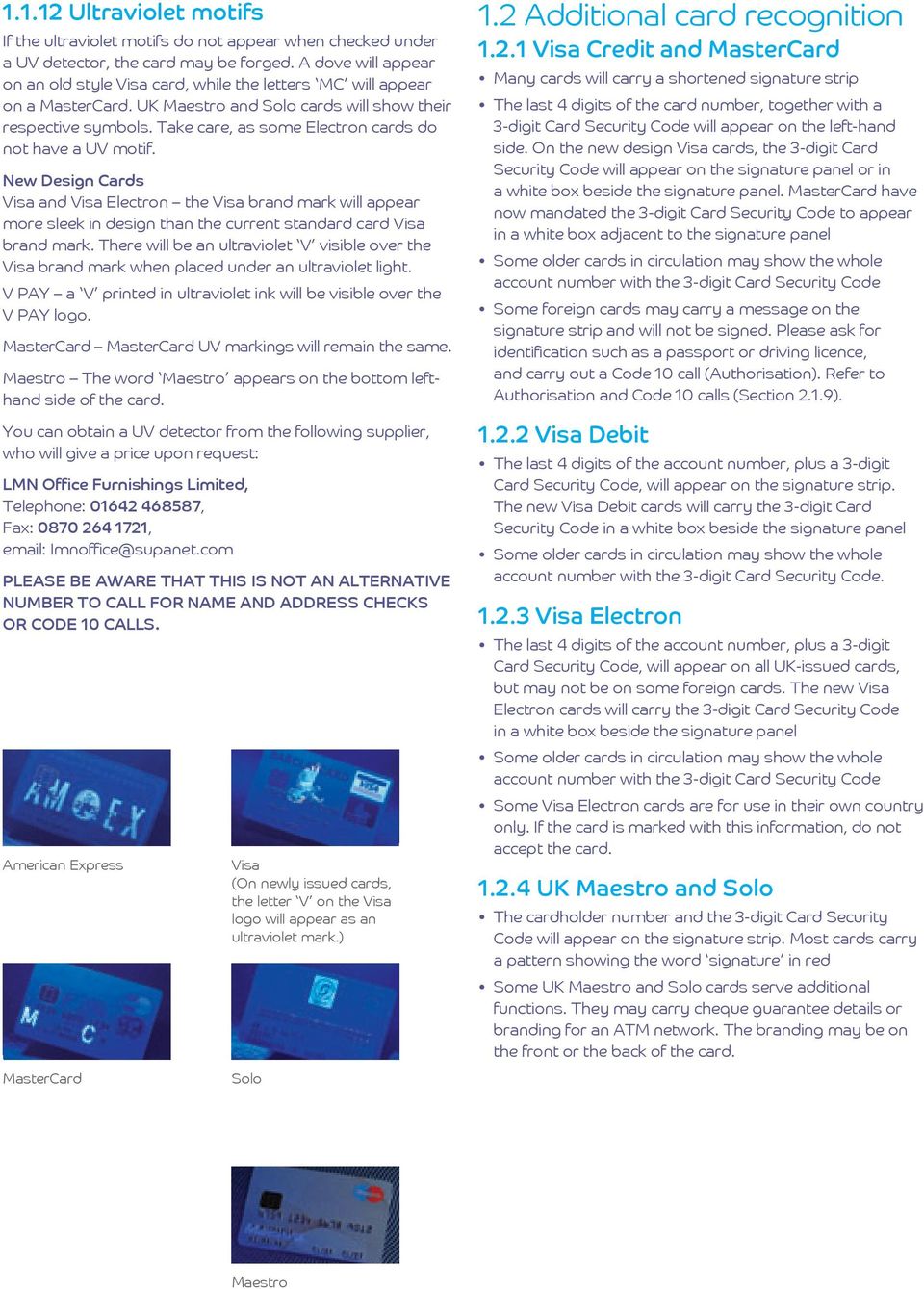
12 Ultraviolet motifs If the ultraviolet motifs do not appear when checked under a UV detector, the card may be forged. A dove will appear on an old style Visa card, while the letters MC will appear on a MasterCard. UK Maestro and Solo cards will show their respective symbols. Take care, as some Electron cards do not have a UV motif. New Design Cards Visa and Visa Electron the Visa brand mark will appear more sleek in design than the current standard card Visa brand mark. There will be an ultraviolet V visible over the Visa brand mark when placed under an ultraviolet light. V PAY a V printed in ultraviolet ink will be visible over the V PAY logo. MasterCard MasterCard UV markings will remain the same. Maestro The word Maestro appears on the bottom lefthand side of the card. You can obtain a UV detector from the following supplier, who will give a price upon request: LMN Office Furnishings Limited, Telephone: , Fax: , [email protected] PLEASE BE AWARE THAT THIS IS NOT AN ALTERNATIVE NUMBER TO CALL FOR NAME AND ADDRESS CHECKS OR CODE 10 CALLS. American Express MasterCard Visa (On newly issued cards, the letter V on the Visa logo will appear as an ultraviolet mark.) Solo 1.2 Additional card recognition Visa Credit and MasterCard Many cards will carry a shortened signature strip The last 4 digits of the card number, together with a 3-digit Card Security Code will appear on the left-hand side. On the new design Visa cards, the 3-digit Card Security Code will appear on the signature panel or in a white box beside the signature panel. MasterCard have now mandated the 3-digit Card Security Code to appear in a white box adjacent to the signature panel Some older cards in circulation may show the whole account number with the 3-digit Card Security Code Some foreign cards may carry a message on the signature strip and will not be signed. Please ask for identification such as a passport or driving licence, and carry out a Code 10 call (Authorisation). Refer to Authorisation and Code 10 calls (Section 2.1.9) Visa Debit The last 4 digits of the account number, plus a 3-digit Card Security Code, will appear on the signature strip. The new Visa Debit cards will carry the 3-digit Card Security Code in a white box beside the signature panel Some older cards in circulation may show the whole account number with the 3-digit Card Security Code Visa Electron The last 4 digits of the account number, plus a 3-digit Card Security Code, will appear on all UK-issued cards, but may not be on some foreign cards. The new Visa Electron cards will carry the 3-digit Card Security Code in a white box beside the signature panel Some older cards in circulation may show the whole account number with the 3-digit Card Security Code Some Visa Electron cards are for use in their own country only. If the card is marked with this information, do not accept the card UK Maestro and Solo The cardholder number and the 3-digit Card Security Code will appear on the signature strip. Most cards carry a pattern showing the word signature in red Some UK Maestro and Solo cards serve additional functions. They may carry cheque guarantee details or branding for an ATM network. The branding may be on the front or the back of the card. Maestro
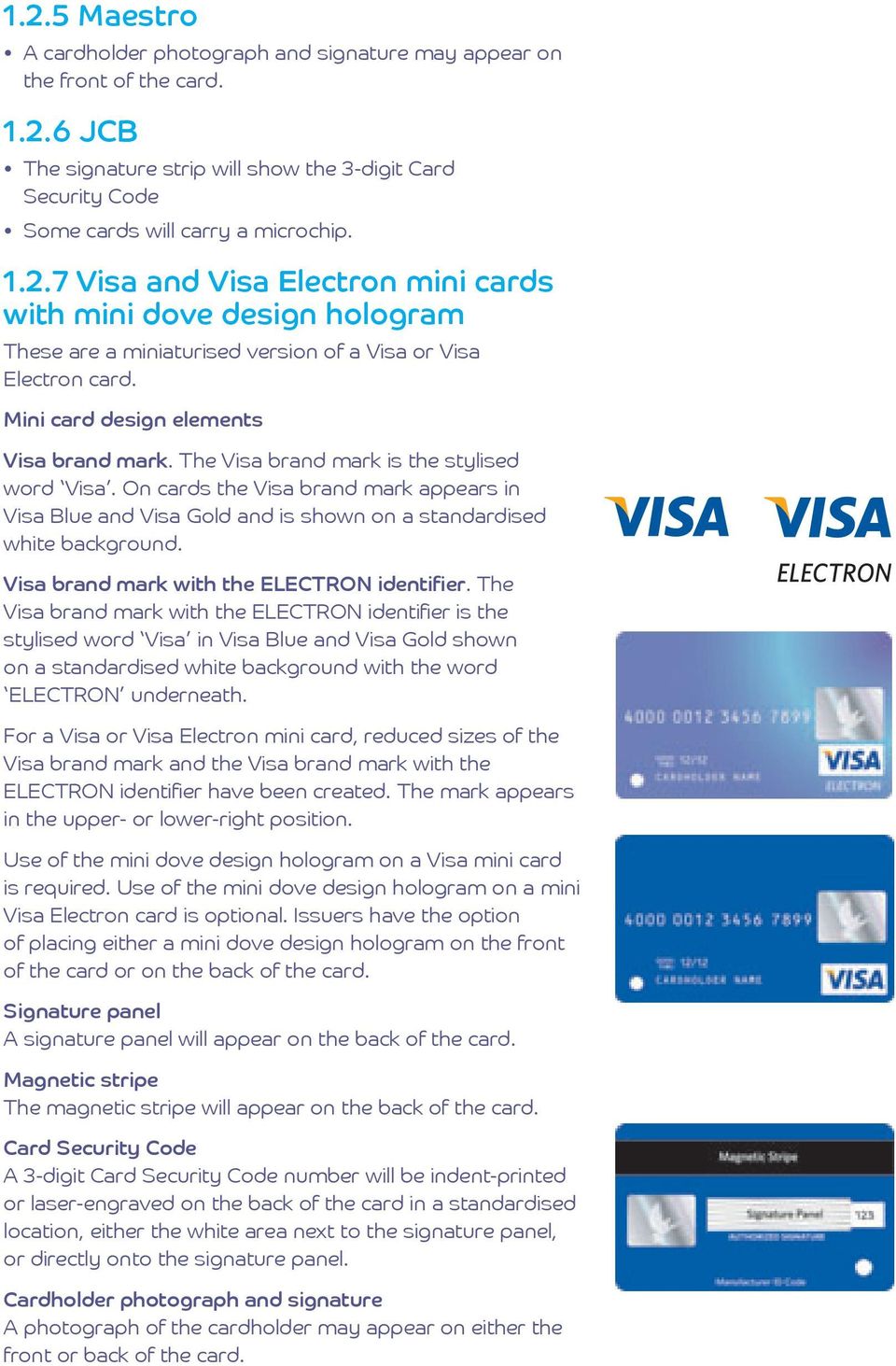
13 1.2.5 Maestro A cardholder photograph and signature may appear on the front of the card JCB The signature strip will show the 3-digit Card Security Code Some cards will carry a microchip Visa and Visa Electron mini cards with mini dove design hologram These are a miniaturised version of a Visa or Visa Electron card. Mini card design elements Visa brand mark. The Visa brand mark is the stylised word Visa. On cards the Visa brand mark appears in Visa Blue and Visa Gold and is shown on a standardised white background. Visa brand mark with the ELECTRON identifier. The Visa brand mark with the ELECTRON identifier is the stylised word Visa in Visa Blue and Visa Gold shown on a standardised white background with the word ELECTRON underneath. For a Visa or Visa Electron mini card, reduced sizes of the Visa brand mark and the Visa brand mark with the ELECTRON identifier have been created. The mark appears in the upper- or lower-right position. Use of the mini dove design hologram on a Visa mini card is required. Use of the mini dove design hologram on a mini Visa Electron card is optional. Issuers have the option of placing either a mini dove design hologram on the front of the card or on the back of the card. Signature panel A signature panel will appear on the back of the card. Magnetic stripe The magnetic stripe will appear on the back of the card. Card Security Code A 3-digit Card Security Code number will be indent-printed or laser-engraved on the back of the card in a standardised location, either the white area next to the signature panel, or directly onto the signature panel. Cardholder photograph and signature A photograph of the cardholder may appear on either the front or back of the card.
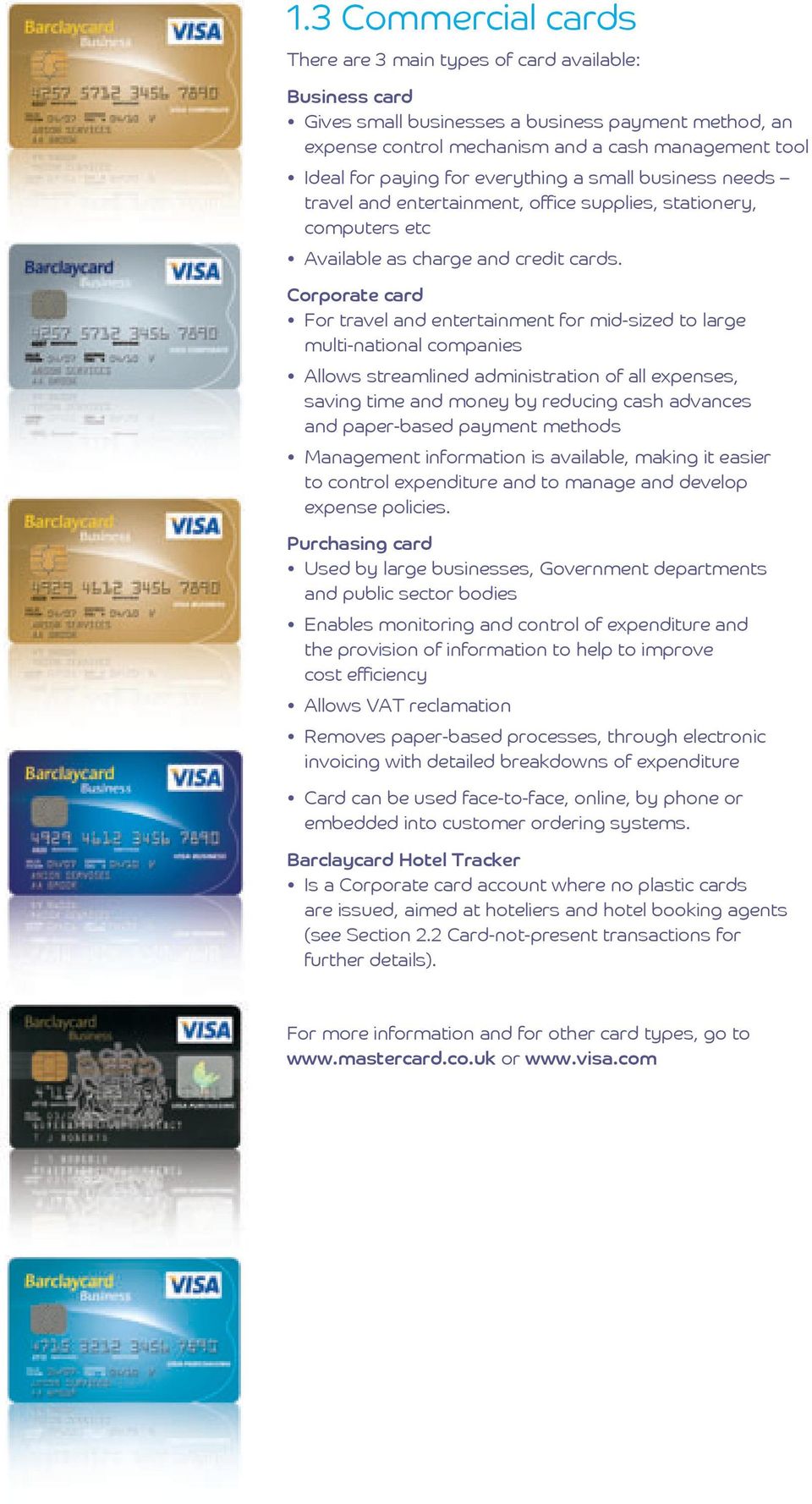
14 1.3 Commercial cards There are 3 main types of card available: Business card Gives small businesses a business payment method, an expense control mechanism and a cash management tool Ideal for paying for everything a small business needs travel and entertainment, office supplies, stationery, computers etc Available as charge and credit cards. Corporate card For travel and entertainment for mid-sized to large multi-national companies Allows streamlined administration of all expenses, saving time and money by reducing cash advances and paper-based payment methods Management information is available, making it easier to control expenditure and to manage and develop expense policies. Purchasing card Used by large businesses, Government departments and public sector bodies Enables monitoring and control of expenditure and the provision of information to help to improve cost efficiency Allows VAT reclamation Removes paper-based processes, through electronic invoicing with detailed breakdowns of expenditure Card can be used face-to-face, online, by phone or embedded into customer ordering systems. Barclaycard Hotel Tracker Is a Corporate card account where no plastic cards are issued, aimed at hoteliers and hotel booking agents (see Section 2.2 Card-not-present transactions for further details). For more information and for other card types, go to or
15 Benefits you can help to deliver to your customers Monitor and control spending Card Issuers are able to provide your customers with management information relating to their purchasing spend which can include summary level reports or detailed breakdowns of expenditure which is then analysed or used with accounting packages. Claiming back VAT If you accept purchasing cards and you are equipped to support electronic VAT invoices, then your customers will be able to reclaim the VAT on expenditure using the Evidence for VAT Deductions report which is accredited by HM Revenue and Customs. Contact Barclaycard Customer Services Department on * for help with accepting these cards and providing your customers with the appropriate information to help them to run their businesses. For information or help with taxation we suggest you contact Her Majesty s Revenue and Customs or seek specialist tax advice. 1.4 Fighting fraud We have focussed on areas of fraud prevention that our customers seek advice on. We have also included information on how we can work together to minimise the risks. Authorisation only confirms that the issuer of the card agrees there are enough funds to pay for the goods and to confirm the card has not been reported lost or stolen. Authorisation does not guarantee payment Preventing and detecting fraudulent card-present transactions To prevent fraudulent transactions being charged back at a later date, any chip and PIN-enabled cards should be used with a chip and PIN-enabled POS terminal. Likewise, you must ensure you obtain Authorisation on any transaction where the card details are not captured using the chip (eg when presented with a magnetic stripe card transaction) to avoid the risk of loss to card fraud. If your terminal is chip and PIN-enabled you could be presented with a number of different scenarios, all of which you can accept: magnetic stripe and signature verification (eg from an overseas customer where the country has yet to upgrade to chip and PIN technology) chip and signature verification (eg from a disabled customer who is unable to use PIN technology) chip and PIN verification. If your terminal has contactless reader, you will also be able to accept contactless transactions with no verification (Section 2.1.6). In addition, you may wish to undertake occasional mail or telephone order transactions. We strongly recommend you read Card-not-present transactions (Section 2.2) and Chargebacks and retrieval requests (Section 4). If the majority of the transactions you are accepting are mail, telephone or internet transactions, it is essential that you advise us that you are doing so, as we have a range of products and services that may help you to reduce the risk of transactions being charged back at a later date. If your customer does not remember their PIN, the transaction must be authorised by the issuer. If you rent a PDQ terminal from Barclaycard, the terminal will automatically do this for you. Please ensure you carefully follow the terminal prompts and refer to your Terminal Operating guide if necessary. Please be aware that it may be declined and therefore you may need to ask your customer for payment by other means. If you use your own or a third party supplier s terminal, it is your own responsibility to ensure your terminal seeks Authorisation when required to do so. In these instances, provided your terminal is chip and PINcapable, you will be protected against potential counterfeit, lost and stolen, and intercepted card fraud.

16 Card fraud statistics show there is increased fraud with non-pin cards. Be aware of the security checks you should make to minimise card deception: Keep hold of the card at all times Keep the goods out of reach of the customer Check the card against any warning notices you have received from us Check the valid from date. If the card is newly issued, be extra vigilant Watch out for hesitancy when the customer signs and make sure that the signature they give matches the signature on the card Be careful not to be distracted during a transaction. Fraudsters may try to hurry you, or draw your attention away from making card checks Check the name on the card and compare against the presenter Be sure not to process transactions on behalf of anyone else. This is a breach of your Merchant Agreement and could lead to transactions being charged back to you Counterfeit cards Due to the increase in quality of fraudulent cards being produced recently, changes in design for both Visa and MasterCard have been introduced. This is the first significant change in nearly 30 years. The new designs along with the current design will both be in circulation over the next four years. The current designs will be phased out by When checking the card, current card designs have several features that may not be present on a Visa or MasterCard: On current design Visa cards it is now only optional to carry an embossed V tilted to the right, next to the expiry date (see New Visa card design in Section 1.1.2) On current design MasterCard it is now only optional to carry the embossed letters MC tilted to the right to form an unusual M next to the expiry date (see MasterCard in Section 1.1.3) The first 4 digits of the embossed card number should be printed below the card number. Check that the numbers match.
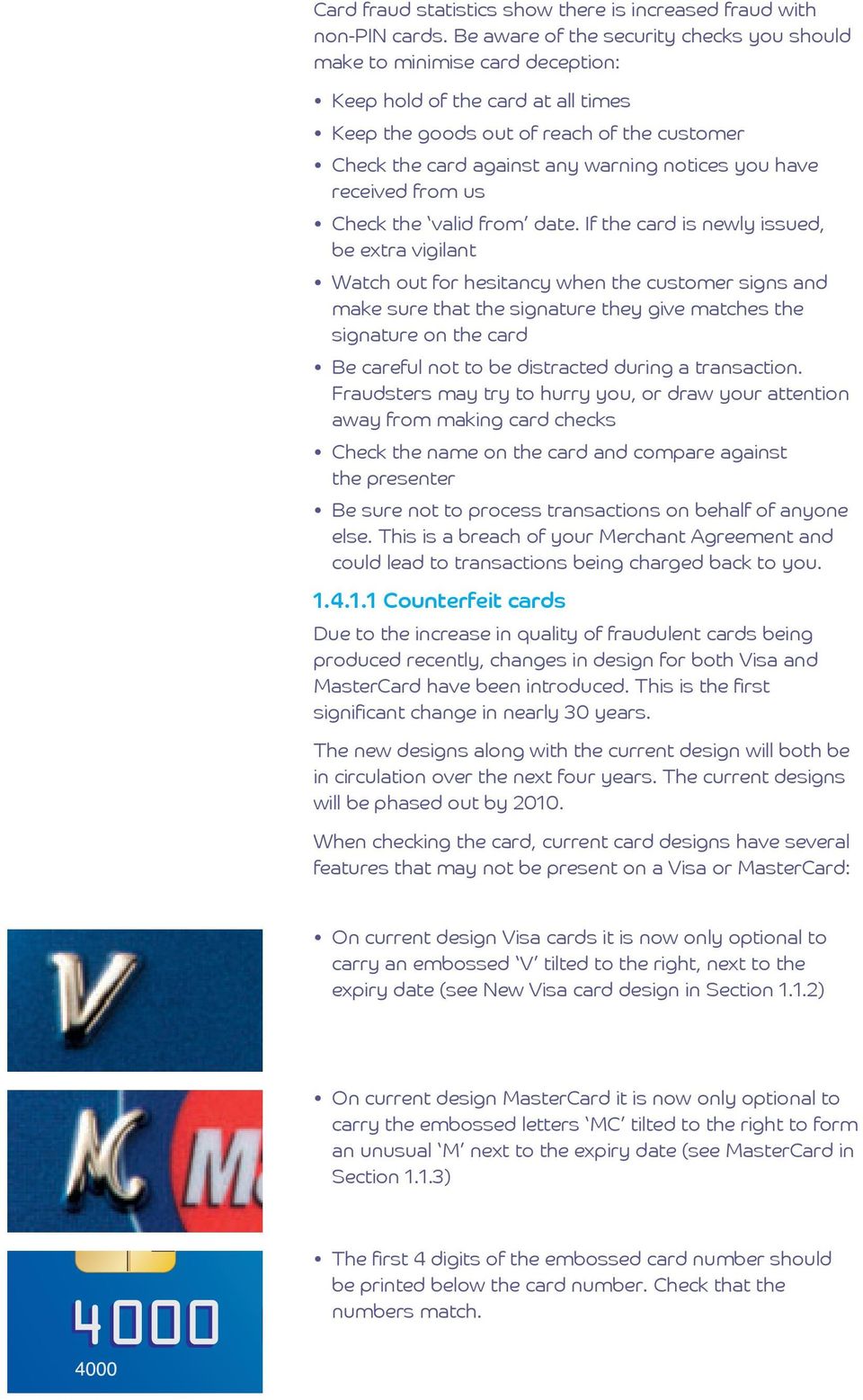
17 New card designs for Visa and MasterCard The repeat of the first 4 embossed digits printed below the card number will remain on the new designs. However, you need to be aware that on the new designed cards for both Visa and MasterCard the unique embossed symbols V or MC will be removed. Since many fraudsters have mastered the art of copying this feature it is considered less secure than when first introduced. If you are suspicious about a card, a card presenter or the circumstances surrounding a card transaction, please call Authorisation on * Holograms Current card design Check that the hologram moves as you tilt the card back and forth. Many counterfeit cards use poor reproductions and even with a quick glance you can spot a fake. Holograms will contain the following designs: Visa a flying dove MasterCard a globe which will change colour JCB a globe and rising sun UK Maestro Globe or APACS cheque guarantee symbol Visa Electron flying dove is optional. Also see Section for more details. New card design With the new design cards both Visa and MasterCard will allow the hologram to appear on the front or the back of the card. Visa the dove hologram will appear on the front of the card. Or a mini dove hologram may be on the back of the card. MasterCard the redesigned MasterCard globe hologram is integrated with the magnetic stripe as a hologram stripe or will show the standard hologram symbol, on the front or back of the card Ultraviolet motifs Current card design If the ultraviolet motifs do not appear when checked under a UV detector, the card may be forged. A dove will appear on a Visa card, while the letters MC will appear on a MasterCard. Maestro and Solo cards will show their respective symbols. Take care, as some Electron cards do not have a UV motif. Also see Section for more details. New design cards Visa and Electron the Visa brand mark will appear more sleek in design than the current standard card Visa brand mark. There will be an ultraviolet V visible over the Visa brand mark when placed under an ultraviolet light. V PAY a V printed in ultraviolet ink will be visible over the V PAY logo. MasterCard MasterCard UV markings will remain the same. Maestro The word Maestro appears on the bottom left-hand side of the card. You can obtain a UV detector from the following supplier, who will give a price upon request: LMN Office Furnishings Limited, Telephone: , Fax: , [email protected] PLEASE BE AWARE THAT THIS IS NOT AN ALTERNATIVE NUMBER TO CALL FOR NAME AND ADDRESS CHECKS OR CODE 10 CALLS Card chip-read/swipe failure The following information will help you and your company reduce losses through counterfeit fraud. The vast majority of your card transactions are chip-read or swiped through your electronic Point of Sale (POS) terminal with no problems. However, on occasions when your terminal is unable to read the chip or magnetic stripe on the card, your staff need to manually enter the card number embossed on the front of the card using the terminal keys. If you have a chip-enabled terminal you should find chip cards will not usually fail to dip. You may find, if you key enter or revert to the magnetic stripe swipe on a chip card, that the issuer may decline the card. This is for increased security. If this is the case, follow the terminal prompts, which may include you having to speak to our Authorisation Department. Please ensure you follow their instructions. Only give the card back to the customer if you are not asked to retain the card. When a card transaction is processed in this way a number of very important security checks, usually undertaken by the electronic terminal, are bypassed. It is evident that some fraudsters are aware of this situation and are exploiting the opportunities. Under Visa and MasterCard Card Scheme Regulations, a Card Issuer has the right to request sight of an imprinted verification voucher signed by the cardholder. Failure to provide this gives the Card Issuer the right to charge the transaction back to you. To protect your business from losses and reduce the risk of chargebacks when a card fails to be read by your electronic processing equipment, you should: enter the card number embossed on the front of the card using the terminal keys and seek Authorisation in addition to manually entering the card number into the terminal, imprint a sales voucher and fully complete the verification voucher. This must be signed by the customer. The words For verification only this voucher is not for banking should be written on the voucher. Pass the customer copy to the customer along with the terminal receipt. If you need a supply of preprinted verification vouchers please call * please do not bank the verification (or sales) voucher, as your terminal will still process the transaction in the usual way banking the verification or sales voucher will cause the cardholder s account to be debited twice. The voucher is simply your proof that the card was present at the point of sale. It can be used to prove the validity of the transaction if the customer subsequently disputes it

18 the merchant copy of the terminal receipt and the verification (or sales) voucher should be kept together in case of any future query. Failure to provide copies in the event of a query from a Card Issuer could result in a chargeback and losses to your business. Your verification vouchers should be fully completed including full details of the goods/services purchased. Do not write just Goods. Ensure you write the Authorisation code provided by the Authorisation Department UK Maestro and Solo cards If a UK Maestro or Solo card fails to swipe through your terminal you should carry out all of the actions as detailed above as well as contacting Authorisation for a Code 10. In order to defend this type of chargeback we MUST have a record of a Code 10 being approved by the Card Issuer Maestro cards (issued outside the UK) Maestro transactions must be captured by swiping the magnetic stripe or reading the chip. There is no manual key entry permitted. If a card fails to chip-read or swipe through, you should ask your customer for another form of payment as there is no chargeback defence in the event of a card swipe failure Visa Electron cards The majority of Visa Electron cards and all V PAY cards are not embossed and therefore Visa Electron transactions MUST be processed electronically. If a card fails to chipread or swipe through your terminal you should ask your customer for another form of payment as there is no chargeback defence in the event of card-swipe failure Returning wanted or recovered cards If our Authorisation operator asks you to destroy a card and return it to us, please follow the procedure described below. You should politely inform your customer of the decision, without putting any other customers or yourself at risk. 1. To preserve fingerprints and other forensic evidence, handle the card as little as possible and only by the edges. 2. With the card facing you, cut off only the bottom left-hand corner. 3. Make sure the signature strip, magnetic stripe, chip and hologram are intact. 4.You will find your first recovered card form in your welcome pack. Further recovered card forms may be obtained by calling our Customer Services Department on * The form must be completed in full and the cut-off slip of the completed form should be retained in your files The top section of the form and both pieces of the card should be sent to: Recovered Card Services, Barclaycard, Department RC, Northampton NN4 7SG Reward scheme A 50 reward may be paid to your business for the return of a wanted card and it is at the discretion of the business owner whether reward payments are passed on to the person recovering the card. In the event of the police needing to retain a wanted card or sales voucher for investigation (for example, if a stolen card is presented) you will need to keep certain details in the event of a query. Please ensure you have a copy of the sales voucher (a good photocopy will be acceptable) as well as the following information: the card number the expiry date the name embossed on the card UK Maestro/Solo card issue number (if applicable) date card recovered the crime reference number details of the officer and police station dealing with the case. A reward can still be claimed if the police take the card for evidence Cheque guarantee For 24-hour-a-day validation of a Barclays Bank cheque, guaranteed by a Barclays Connect card, Barclaycard Visa card or a Barclays Premier card, call * Please remember: Company cheques cannot be guaranteed by any card. If you are suspicious of the cheque, the cheque guarantee card or the presenter, you need to inform the Authorisation operator on * (and follow their instructions). Start your conversation by saying, This is a Code 10 call Fraud prevention advice Transaction laundering If you are approached with a proposal to buy card transactions or process other business transactions through your number, please contact us on * This is called laundering and is contrary to the terms of your Agreement. Bogus/phishing s If you receive an from somebody claiming to be a bank or an official business asking for transaction details of all cards recently accepted for payment, you should be wary. This is a fraud tactic to obtain card details. A bank or any other official business would never make contact in this way to request card information. If you are returning a Visa Electron card, please also enclose a copy of the terminal declined receipt.
19 Be aware some fraudsters may make attempts to mirror your website to gain genuine information from cardholders. To report any of these instances contact Preventing and detecting fraudulent card-not-present transactions Card-not-present (CNP) fraud takes place because neither the cardholder nor the card are present at the point of sale when a transaction is made. Examples of CNP transactions are orders made over the internet or by phone, mail order or fax. Such transactions mean that: you are unable to physically check that the card being used for payment is genuine it is not possible to verify whether the identity given by the individual is correct a PIN is unable to be entered or checked to ensure the card is authentic. Card-not-present (CNP) fraud is a growing problem in the UK and elsewhere as criminals turn their attention to CNP fraud. Extra care needs to be taken when taking transactions online, over the phone, or by mail order and fax. You need to consider the risks before accepting payment: A CNP transaction means that a cardholder and a card are not present. Unlike a normal face-to-face situation a retailer is unable to check that the card is genuine and that the customer is not just using a stolen card number. In these situations, the genuine cardholder may not be aware that their card number has been compromised eg a fraudster has taken the card details from a customer s discarded receipt Only online transactions can be authenticated by the cardholder to prove they are a genuine customer, when you use Verified by Visa and MasterCard SecureCode this is comparative to PIN at point of sale. If a retailer is unable to prove that the cardholder is genuine they are unable to guarantee that the card information provided relates to the genuine cardholder Authorisation only confirms the issuer of the card agrees there are enough funds to pay for the goods and to confirm the card has not been reported lost or stolen. Authorisation does not guarantee payment Never release goods to a third party. Always ensure that goods are sent to the named person on the card If a cardholder comes to collect the goods in person, cancel the CNP payment and process as a card-present transaction. Questions you need to ask yourself before accepting the transactions: Why has this customer come to me? Is the sale too easy, is the customer uninterested in the price or details of the goods and are they a new customer? Are the goods high value or easily resaleable? Is the transaction out of character compared to your usual orders or is the customer ordering many different items and do they seem unlike your usual customer? Is the customer reluctant to give a landline phone number or only prepared to give a mobile number? Does the address provided seem suspicious or has the delivery address been used before with different customer details? Is the customer being prompted by a third party whilst on the phone? Is the customer attempting to use more than one card in order to split the value of the sale? Does the customer seem to lack knowledge of their account? Are they providing details of someone else s card (eg that of a client or family member)? Does the customer seem to have a problem remembering their home address or phone number or do they sound as if they are referring to their notes? Use fraud monitoring tools recommended by the card schemes. The most common examples of these tools are: Card Security Code and Address Verification Service (CSC/AVS) fraud screening Velocity checking and fraud screening Use of Rule Based and Neural Networks as additional tools can be beneficial and help to check the validity of transactions. A system which enables you to crosscheck the name, address, telephone numbers, card details, address, IP address with past and daily records could help you to reduce risk to your business. Crosschecking this type of information continually will identify any duplication of information which may indicate other attempts to use similar details by a possible fraudster. For example they may quote different card numbers but use the same name or address or may quote entirely different details but still be seen to come from the same IP address. Any such instance of duplication should be rejected and checked further before accepting the order or request. There are a series of third party solutions providers available to provide this additional tool and assist with checking the authenticity of customer information:
20 Further advice for internet transactions To add to existing velocity checks: check for sequential card numbers review orders made using non-uk issued cards review orders where IP address does not match delivery address (country) review orders going to/coming from same customer name/address/card number review/decline all/new orders going to a different delivery address review/decline duplicate purchases review/decline if postal code does not match decline if CSC does not match decline new orders with an invalid expiry date. Use the chargeback data you receive to: highlight potential problem names/addresses/ IP addresses always ensure that you respond promptly to request for information letters ; you may be able to prevent the chargeback also use Internet Authentication (3D Secure) and CSC/AVS for added security. Check and for additional information. Fraud Literature for staff awareness and training is also available Card Security Code and Address Verification Service (CSC/AVS) Barclaycard and the UK card industry have worked together to develop a service to reduce card-not-present fraud, simply by requesting a small amount of additional information from the cardholder. This information is comprised of: the Card Security Code (the last 3 numbers on the signature strip on the card or the 3 digits in a white box adjacent to the signature panel) the numbers in the cardholder s postcode up to the first 5 numbers of the cardholder s full statement address. The Card Security Code must not be stored after the transaction has been authorised. This service is available for customers processing transactions via our PDQ and epdq products. Please contact us on * for further information. If you are processing transactions through your own electronic point of sale equipment, you can take action now by contacting your electronic point of sale equipment supplier for information about development requirements and the timescales needed to implement the service Authentication or 3D Secure Authentication is an industry-wide initiative to help combat fraud and protect businesses trading over the internet. Visa, Maestro and MasterCard cardholders buying online can verify their identity with a password that automatically authenticates the cardholder, so you can safely accept their order. Benefits for you Increased sales and profits customers prefer to buy from websites that offer the reassurance of Authentication Greater security increased protection against fraud Cost savings thanks to the reduced risk of transactions being charged back Convenience Authentication is quick and easy for your staff to use Time savings spend less time on dealing with transactions that have been charged back. Benefits for your customers Peace of mind because if their card is stolen it s more difficult for the fraudster to use it on websites that include Authentication Convenience it s quick and easy for your customers to enter their password, and their payment will be authorised in seconds Reassurance customers will know you have invested in these safeguards, so they can safely trust you with their card details. How Internet Authentication makes online transactions safer 1. A customer browsing on the internet decides to buy from you with a Visa, MasterCard or Maestro*. 2. Your payment pages eg epdq Hosted Payment Page (HPP), communicate with the Visa/MasterCard Directory, which then contacts the Card Issuer. 3.The Card Issuer confirms whether the customer has registered for Internet Authentication. 4.If the Card Issuer supports Internet Authentication, a pop-up or in-line web window appears on the customer s screen. If not, the transaction proceeds to Authorisation detailed in point 7 below. 5.The Card Issuer asks for the customer s Internet Authentication password and accepts or rejects it. 6.If the password is correct, the payment process continues (if incorrect, the transaction may be stopped). 7. Your payment software eg epdq, authorises the payment details and passes them to the acquirers eg Barclaycard, for settlement. *Provided your internet site supports Verified by Visa and MasterCard SecureCode.
21 Which cards are covered? All standard issued Visa, Maestro and MasterCard cards are included for Authentication except internationally issued commercial cards which are only covered if the transaction is fully authenticated ie the cardholder successfully inputs the correct password. Visa cash cards are excluded. Visa and MasterCard regularly review and amend the types of card and regions of the world that are covered by Internet Authentication. Please refer to the current version of the Internet Authentication Procedure guide for full details. How Authentication works with various systems and providers Authentication is available with our epdq service or stand-alone with other software. If you have a subscription that includes the HPP Authentication works best with our cost-effective epdq HPP. It s straightforward to use, and whenever new software or security measures become available we ll upgrade you automatically saving you time, technical resources and money. The epdq HPP includes a co-branded payment page, to reassure your customers that they re dealing with a trusted brand. If you have a subscription that includes the API You can also benefit from Authentication, as it will work with your own website and can be integrated using our software development kit. You should allow several days for installation time you could save by upgrading to our HPP. If you use a payment service provider other than epdq They may not offer Authentication. However, they could install it with our software development kit, but they may charge you for this service. If you have your own software for internet transactions You can install Authentication with our software development kit. If Barclaycard processes your transactions and you are using Authentication from another provider It must be approved by us and registered by Barclaycard with Visa and MasterCard. If you are using Authentication from another provider It must be approved by us and registered by Barclaycard with Visa and MasterCard. For more information about Authentication, please visit or call * 1.5 Card scheme requirements As a member of the card schemes we require you to comply with the Payment Card Industry Data Security Standard (PCI DSS) and a Maestro Mandate which dictates how you accept Maestro cards. This section sets out the obligations you must comply with to achieve these standards Payment Card Industry Data Security Standard (PCI DSS) What is PCI DSS? It is an auditable set of standards designed to ensure that certain card data is stored securely by your company and any third party which stores, transmits or processes such card data on your behalf. What information must be securely stored? Any information that is necessary to process card transactions correctly including any information which is recorded electromechanically or otherwise on any payment card and includes, although is not limited to, the following: any information that is used to authenticate a card payment including but not limited to the card number, expiry date, issue number, passwords, pass phrases and any other unique data supplied as part of the card payment any information that could identify individual cardholders and their purchases. This includes name, address, purchase description, amount and other details of the card payment. This shall be referred to as Cardholder Data in the rest of this section. What information must not be stored at any time? You must not store any of the following information at any time: the contents of the magnetic stripe also known as Track 2 Data the Card Verification Value or CVV contained in the magnetic stripe the Card Verification Value contained in the magnetic stripe image in a chip known as the icvv the Card Security Code also known as CVV2 printed on the back of the card in or next to the signature panel the PIN Verification Value or PVV which is contained in the magnetic stripe.
22 What must you do to comply with PCI DSS? PCI DSS sets out a number of requirements which you must comply with to ensure that Cardholder Data is securely stored. You must: 1 install and maintain a firewall configuration to protect data 2 not use vendor-supplied defaults for password or other security parameters 3 protect stored Cardholder Data 4 encrypt the transmissions of Cardholder Data and sensitive information across public networks 5 use and regularly update anti-virus software 6 develop and maintain secure systems and applications 7 restrict access to Cardholder Data by business need-to-know 8 assign a unique ID to each person with computer access 9 restrict physical access to network resources and Cardholder Data 10 track and monitor all access to network resources and Cardholder Data 11 regularly test security systems and processes 12 maintain a policy that addresses information security. In complying with the requirements as set out above you must meet the standards as specified by the PCI Standard Security Council (PCI SSC) and mandated by the Card Schemes. The current standards that you must adhere to in meeting the above requirements are as set out in The Payment Card Industry (PCI) Data Security Standards, version 1.2, October This is available for download from the PCI Security Standards Council website and can be currently downloaded from the following website address: For more information and useful tools to help you on your journey towards compliance, please access the Barclaycard PCI DSS website at: If you are unable to access the standards for any reason whatsoever you must contact us and we will advise you how you can obtain a copy of these documents. Demonstrating compliance with PCI DSS We need you to demonstrate that you are complying with PCI DSS and the method by which we require you to do this will differ depending upon the type and volume of card transactions that we process on your behalf. To decide which obligations you must comply with you must first determine what type of Merchant you are (Merchant Level).
23 For the purposes of PCI DSS, Merchants are classified as follows: Merchant Level Level One Merchant Level Two Merchant Level Three Merchant Level Four Merchant Definition A Merchant which processes more than 6 million card transactions per year for any Card Scheme (for example more than 6 million Visa card transactions per year or more than 6 million MasterCard transactions per year); or a Merchant that has suffered a compromise. (see details below regarding data compromises). A Merchant which processes between 1 million and 6 million card transactions per year for any Card Scheme (for example 2 million Visa card transactions per year). A Merchant which processes between 20,000 and 1 million e-commerce card transactions per year for any Card Scheme (for example 35,000 e-commerce MasterCard card transactions per year). Any merchant processing less than 20,000 Visa or MasterCard e-commerce transactions per year, and all other merchants processing up to 1 million Visa or MasterCard transactions per year. We may from time to time audit your type and volume of card transactions. We may as a result of such audit, or if we are instructed to do so by a Card Scheme, notify you which type of Merchant you are for the purposes of PCI DSS and you agree that you will comply with the obligations of that level of Merchant as detailed below. What you must do to demonstrate compliance with PCI DSS When you have determined which type of Merchant you are for the purposes of PCI DSS, you will need to comply with the following obligations depending upon your Merchant Level: Merchant Level Level One Merchant Level Two Merchant What you must do If you are a Level One Merchant you must: engage a Card Scheme Approved Qualified Security Assessor (see below for details) to complete an annual on-site audit; provide us with a copy of the Qualified Security Assessor (QSA) Report On Compliance (executive summary only). This must be less than 12 months old; if you have any card payment systems connected to the Internet, either directly or indirectly, contract the services of a Card Scheme Approved Scan Vendor (see below for details) to conduct quarterly network vulnerability scans; AND provide us with a copy of the latest scan report (summary only). This must be less than 3 months old. If you are a Level Two Merchant you must: engage a Card Scheme Approved Qualified Security Assessor (see below for details) to complete an annual on-site audit; provide us with a copy of the Qualified Security Assessor (QSA) Report On Compliance (executive summary only). This must be less than 12 months old; if you have any card payment systems connected to the Internet, either directly or indirectly, contract the services of a Card Scheme Approved Scan Vendor (see below for details) to conduct quarterly network vulnerability scans; AND provide us with a copy of the latest scan report (summary only). This must be less than 3 months old.
24 Merchant Level Level Three Merchant Level Four Merchant What you must do If you are a Level Three Merchant you must: complete and provide us with an annual Card Scheme Approved Self-assessment Questionnaire and signed Attestation of Compliance, which demonstrates that you comply with PCI DSS. This must be less than 12 months old; you may want to contract the services of a Card Scheme Approved Qualified Security Assessor (see below for details) to validate this exercise; AND if you have any card payment systems connected to the Internet, either directly or indirectly, contract the services of a Card Scheme Approved Scan Vendor (see below for details) to conduct quarterly network vulnerability scans and provide us with a copy of the latest scan report (summary only). This must be less than 3 months old. If you are a Level Four Merchant you must: complete and provide us with an annual Card Scheme Approved Self-assessment Questionnaire and signed Attestation of Compliance, which demonstrates that you comply with PCI DSS. This must be less than 12 months old; you may want to contract the services of a Card Scheme Approved Qualified Security Assessor (see below for details) to validate this exercise; AND if you have any card payment systems connected to the Internet, either directly or indirectly, contract the services of a Card Scheme Approved Scan Vendor (see below for details) to conduct quarterly network vulnerability scans and provide us with a copy of the latest scan report (summary only). This must be less than 3 months old. Copies of all reports required to be provided as specified in the table above should be sent to: The PCI DSS Compliance Manager Barclaycard Payment Acceptance 1234 Pavilion Drive Northampton NN4 7SG Card Scheme Approved Qualified Security Assessor The specialist organisations which are qualified to conduct on-site annual audits of a Merchant compliance with PCI DSS are those advised by the card schemes from time to time. Details of the current card scheme approved specialist organisations can be found at: If you are unable to access the list for any reason whatsoever, you must contact us and we will advise you how you can obtain a copy. Card Scheme Approved Scan Vendors The specialist organisations which are qualified to conduct network vulnerability scans are those advised by the card schemes from time to time. Details of the current card scheme approved specialist organisations can be found at: Self-assessment Questionnaire The PCI Standard Security Council has published a set of Self Assessment Questionnaires (A, B, C or D) depending on your type of business. You can find Instructions for completing a Self Assessment Questionnaire (version 1.2) on the PCI Standard Security Council website at If you are unable to access any of these documents for any reason whatsoever, you must contact us and we will advise you how you can obtain a copy. Further action you may need to take We may, as a consequence of considering any report that you must submit to demonstrate compliance with PCI DSS (as set out above): notify you that you are a different Merchant Level (for example a Level One Merchant rather than a Level Two Merchant) and you agree that you will comply with the obligations of that Merchant Level going forwards, or require that you take additional security measures to ensure compliance with PCI DSS within an agreed period of time. Barclaycard are not unique in requiring their merchants to become PCI DSS compliant; all card acquirers have the same responsibility to the Card Schemes (eg Visa and MasterCard). If you are unable to access the list for any reason whatsoever, you must contact us and we will advise you how you can obtain a copy.
25 Data compromises If any unauthorised person obtains access to any Cardholder Data, or Cardholder Data is lost, or you suspect that either has happened, you must immediately notify us of this data compromise. Consequences of a data compromise If we are notified that you have suffered any data compromise or suspected data comprise (whether you notify us or any Card Scheme) you will be required to instruct a Qualified Forensics Investigator (QFI) to undertake a forensic investigation at your company in relation to the data compromise. The QFI will review the whole end-to-end process of handling Cardholder Data and will deliver a report on their findings, and set out recommendations for a remedial action. Should you suffer a data compromise you will be required to pay the costs of the QFI engaged as a result of any data compromise. If you suffer a data compromise we may notify you that you are to be reclassified as a Level One Merchant and that you will comply with the obligations of such Merchant Level. You can find a list of QFIs at resourcesanddownloads.jsp If customer data, which you or your third parties have handled, is proven to have been compromised, stolen, used fraudulently etc. and your business is non compliant with PCI DSS, you may incur potentially substantial associated costs (eg forensic investigations, Card Scheme compromise fines, issuer losses, reputational damage). The Card Schemes may decide to levy further fines for noncompliance and storage of sensitive authentication data. Third Parties that store, transmit or process your Cardholder Data The PCI DSS standard applies to all merchants and their third parties that store, process or transmit cardholder data. The standard applies equally to manual processing and storage of cardholder information (eg PDQ terminals and imprinters) as well as to electronic methods of storage (eg EPOS, PC). PCI DSS compliance applies to a merchant s overall environment, including any third parties used by the merchant that would store, process or transmit cardholder data. A merchant can only reach compliance if its affected third parties are also compliant and PCI DSS compliance must be re-validated annually. Third Parties include, but are not limited to: Resellers Till vendors EPOS vendors Software Application Providers Payment Service Providers Payment Processing Bureaux Data Storage Providers Web Hosting Providers Shopping Cart Providers Software Vendors Barclaycard requires merchants to notify them of the third parties they use that store, process or transmit cardholder data Maestro mandate compulsory changes to the way you accept Maestro card payment What is the Maestro mandate? An industry-wide Maestro mandate came into force from 1st July 2007, requiring compulsory changes to the way Maestro cards are accepted. All of your businesses which accept Maestro as a form of payment are impacted by this mandatory change. It is important for you to ensure that all businesses under your control are aware of the requirements. If you do not comply with these mandatory changes, you may be liable to Card Scheme fines. The compulsory changes Unless otherwise informed in writing by your Acquirer, from 1st July 2007 if you want to continue accepting Maestro as payment you must: Remove all Switch branding from all points of sale and replace with Maestro logos. The What must you do to comply with the Maestro mandate section tells you where you can get the new logos from Recognise and accept all Maestro cards UK and international Implement SecureCode for all Maestro e-commerce transactions. This will help your business to defend against rising online fraud and to avoid potential card scheme fines of up to $25,000 US per month. Whether or not you are already using Authentication for Visa or MasterCard, to avoid potential scheme noncompliance fines, it is important that you make the Maestro developments listed in the What must you do to comply with the Maestro mandate section.
26 Why is it important to be compliant? To allow your business to maximise income by accepting a wider range of cards To make all your online transactions even more secure, reducing fraud losses and providing additional confidence to your customers To help you avoid heavy scheme fines of up to $25,000 per month being issued. What must you do to comply with the Maestro mandate? The Maestro mandate sets out a number of requirements which you must comply with when accepting Maestro card payments. It is important that you comply with each of the following requirements: 1. If a third party is used to facilitate e-commerce payments, such as a Payment Service Provider, if you have not done so already, you must contact them immediately and instruct them to: Extend the use of or implement SecureCode to cover Maestro e-commerce transactions Remove any Switch logos from your point of sale and web payment pages and replace them with the Maestro logo. The Maestro logo can be downloaded from the Information Zone at 2. If your business hosts their own internet service or front pages for accepting card payments, you will need to make the above technical and branding changes listed in point 1 yourself. As normal, once you have completed the changes, your solution will need an updated accreditation from Barclaycard If you fail to comply with PCI DSS or the Maestro mandate If you fail to comply with PCI DSS or the Maestro mandate, or any of the obligations as set out in section 1 of the Operating Instructions and Procedures guide, you will be in breach of your Agreement with us and: we have the right to recover any penalties, fees or fines imposed by any Card Scheme in accordance with our Agreement with you (of which this Operating Instructions and Procedures guide forms part); and/or this will be considered a material breach of your Agreement and we may exercise all rights at our disposal in accordance with our Agreement with you; we may suspend your Acquiring facilities until such time as you can prove compliance with PCI DSS or the Maestro mandate to our reasonable satisfaction. 1.6 Protecting cardholder information In addition to complying with PCI DSS in accordance with Section above, you must comply with the following requirements to safeguard cardholder information Thermal paper If you are using thermal paper to process transactions, extra care is needed when storing transaction copies to ensure they do not fade. Do not store in direct sunlight. Wrap transaction copies in paper or store in brown envelopes Do not store close to heaters Store in a cool, dark and dry environment Maintain an even temperature and humidity. Ideally these are a temperature of degrees and a relative humidity of per cent. Do not store in PVC wallets. For a supply of our pre-paid envelopes, call our Customer Services Department on * Storing your records Original retailer copies of transactions must be retained in an accessible place for a minimum period of 6 months. We also advise you to keep copies of transactions for a further 12 months from that date, although this can be on microfilm or similar media. In the event that a cardholder disputes a transaction, or another query arises, you may be required to provide the necessary documentation. This can happen up to 6 years after the date of the transaction. If we need to send a retrieval request we will give you the cardholder s name wherever possible. However, the Card Issuer does not have to give us this information so we may be unable to tell you. Transactions should therefore be stored by card number or transaction date and not by cardholder name. It is important that all copy vouchers and till rolls are kept in a secure place, to prevent any fraudulent use of the information.
27 2. Accepting card payments 2.1 Card-present transactions Installation Most PDQ terminals are easily installed by our customers, who then follow simple instructions to activate the system. However, our Customer Services Department will be able to help you in the unlikely event of any queries. Please call * Insurance The value of each Barclaycard PDQ terminal is approximately 400 and it is your responsibility to meet the costs of any necessary repair work unless the fault is of a technical nature which has not been caused by you or your employees. It is your responsibility to insure the PDQ terminal(s) under your business policy, with cover for accidental damage, fire and loss Care of your bank-owned PDQ terminal(s) The information in the Operating guide supplied with your PDQ terminal should be followed by all members of your staff. It is important to look after your PDQ terminal(s). Please ensure that liquids, including cleaning agents and water, are not spilt on the PDQ terminal. This could cause damage and, as a result, you would not be able to use your PDQ terminal until it has been repaired. This may also have an adverse impact on your business Using your own or third party-supplied terminal Whilst you may use your own terminal or one supplied by a third party, you are responsible for maintaining the terminal and ensuring all transaction receipts produced are clear and legible. Please remember to change your till rolls when they are running low as we may sometimes need you to supply a clear and legible copy of the transaction receipt. If you are unable to do so, this may result in a transaction being charged back to you. Please refer to Storing your records (Section 1.6.2) for further information. When photocopies of the vouchers are taken that have the red reminder strip present, they are often illegible Using your point of sale terminal This section is relevant if you are using a PDQ terminal, your own terminal, or one supplied by a third party supplier. 1. Follow the procedure set out in your PDQ terminal Operating guide. 2. If the card carries a chip and you are using a chip-enabled terminal you will be able to process the transaction via the chip card reader. If the terminal rejects a chip card, please take extra care when dealing with the transaction (refer to Section ). If the terminal is unable to read the chip, you may process the transaction by swiping the magnetic stripe through your terminal and ensuring Authorisation is obtained. If Authorisation is declined, do not proceed with the transaction, ask for an alternative method of payment. Do not key-enter the card details. 3.If the card does not carry a chip or your terminal is not a chip-enabled terminal, you will need to swipe the card through the terminal magnetic stripe reader. As an additional security check, the terminal may prompt you to key in the last 4 digits of the embossed card number. Please note that if you are not using a chip-enabled terminal and the card has a chip, you will be liable for any subsequent chargeback should the transaction later turn out to be fraudulent (refer to Section 4 of this guide). 4.Ensure that the card is valid and in date by referring to the recognition guide in Section 1.1 of this guide. Remember to rub your thumb over the signature strip (it should be smooth and flush with the surface of the card) and also check that no part of the card has been damaged or tampered with. 5.If you have an online terminal, your terminal will automatically go online and obtain an Authorisation code. If you have an offline terminal, your terminal will automatically check the Hot Card Warning Notice. For retailer-owned terminals, you may need to check the Hot Card Warning Notice manually. Please refer to your terminal user instructions. 6.If the cardholder is instructed to sign the transaction receipt, check that the cardholder s signature matches that shown on the back of the card. If the cardholder is requested to enter a PIN, ensure that they enter a PIN without hesitation. 7. Check that the cardholder number printed on the receipt matches the number embossed on the front of the card. If it does not, you must ring Authorisation and say, I have a card number mismatch. If you are unable to speak freely, just say, I have a Code 10 call. 8.Check that the spelling of the signature (if legible) corresponds with that of the name embossed on the card and that the title of the cardholder matches the presenter (if it appears on the card). If a title is shown on the card, ensure that the presenter of the card matches the title eg if Mr is printed, ensure the presenter is male.
28 9. When you have completed the transaction, hand the goods to the customer together with the cardholder s copy of the receipt and the card. 10.You must retain original copies of all transactions for a minimum of 6 months. Please refer to Section for further advice and guidance. 11. All unembossed Visa Electron and Maestro (issued outside the UK) transactions must be processed electronically and must be authorised. In the event of terminal failure, or if the card reader does not read the required details, return the card to the customer and ask for an alternative method of payment. 12. Remember that an Electron card number must never be key-entered for a sale transaction Contactless transactions What is a contactless transaction? A contactless transaction is a transaction that is processed utilising wireless technology, where the payment instructions are securely exchanged between a chip card and a specially adapted card point of sale terminal. The value of any single transaction is limited to a certain amount (currently 10 as at April 2009). Any change in this amount would be communicated separately Accepting contactless card payments Sales a single contactless transaction is permitted only for an amount under a predefined limit (as at April 2009, set to 10). Any change in this amount will be communicated to you. Refunds these are prohibited. All refunds should be undertaken as chip and PIN transactions. Fallback transactions any transaction unable to be processed as a contactless transaction should be processed as a normal contact transaction (ie chip and PIN). Fall up transactions as part of security measures, on a periodic basis a contactless transaction may be requested to be processed as a chip and PIN transaction. This is to ensure that the correct user is in possession of the correct card. Receipts cardholder copies of receipts are optional. Barclaycard contactless terminals have been configured not to print a copy of the receipt. For further information please refer to your Terminal Operating guide Manual entry for card-present transactions (card swipe failure) Please remember: You cannot carry out manual key entry for Visa Electron and Maestro (issued outside the UK) transactions. Please follow the Operating guide for your terminal for full instructions on how to process a transaction if a chip card fails to read or a magnetic stripe card fails to swipe. In addition, please ensure: If the card presented for payment has a chip and the chip does not read: You may swipe the magnetic stripe through your terminal. Your terminal will automatically prompt you to confirm that the chip cannot be read and then to go online to seek Authorisation. We strongly recommend that you do not progress with the transaction if Authorisation is not obtained, as we will not be able to defend you if the transaction is charged back at a later date; If the card presented for payment has a magnetic stripe and fails to swipe through your terminal, please ensure you follow the procedure as detailed in Card chip-read/swipe failure in Section of this guide. Your copies of the terminal receipt and the voucher should then be stored together in case of future query. The voucher should not be banked, as your bank account will be credited via your terminal. Please remember: A Code 10 Authorisation call must be obtained for Solo and UK Maestro card transactions in all circumstances where the card fails to be accepted by your electronic terminal. Manual key entry should also be used when a card fails to chip-read or swipe during a refund transaction. For all failed electronic transactions, you must take an imprint of the card on a verification voucher to prove that the card was present at the time of the transaction. Failure to provide an imprinted voucher at a later date could result in the transaction being charged back to your business. An imprinted voucher, however, does not protect you from a chargeback for UK Maestro and Solo transactions. If a transaction fails to swipe, you should make a Code 10 call as an anti-fraud measure. A record of an approved Code 10 Authorisation will protect you from chargebacks.
29 2.1.8 Fallback paper voucher processing Processing transactions using an imprinter If your terminal is not functioning correctly, or if you have a power or telephone network failure, you may have to use your imprinter as a backup and complete the transaction using a sales voucher. If you rent a PDQ terminal from us, you must report all faults to our Customer Services Department on * Please remember: An unembossed Visa Electron and Maestro (issued outside the UK) card transaction can only be processed electronically and must not be taken on paper vouchers. UK Maestro and Solo transactions can only be processed using an imprinter if the terminal is not functioning correctly. Vouchers should be stored for at least 6 months. Please see Section for further information Making a transaction when the customer is present 1. Carry out all normal checks of the card. Please refer to the card recognition section of this guide. 2. Place the card face up on the imprinter. 3.Place the sales voucher, face up, over the card and operate the imprinter. 4.Remove the sales voucher and card from the imprinter. 5.Using a ballpoint pen and writing clearly, please note the following necessary details: the date the amount of each item the transaction total details of what was purchased. Please do not just write Goods as this is not acceptable. If the customer is using a purchasing card, they may require a customer reference number to be recorded in the relevant boxes on the sales voucher. If you are selling fuel, use the For Merchant Use Only boxes on the sales voucher to record the vehicle registration number. Please remember: Altered vouchers are not acceptable. If you make a mistake when entering the details of a transaction, you must destroy the incorrect voucher and start again. It is essential that vouchers are not pinned, stapled, folded or damaged as this may cause processing problems. 6.Ask the cardholder to sign the sales voucher in the box indicated. Hold the card and watch while the voucher is being signed. Rub your thumb lightly over the signature strip on the card it should be smooth and flush with the surface of the card. 7. Check that the signature on the sales voucher matches the signature on the reverse of the card. 8.Check that the spelling of the signature (if legible) corresponds with that of the name embossed on the card and check that the card is in date. If a title is shown on the card, ensure that the presenter of the card matches the title eg if Mr is printed, ensure the presenter is male. 9.Check the signature strip to ensure that no attempt has been made to disguise the original signature. Please remember: If you are suspicious of the card, the presenter or the circumstances of the transaction, you must follow the Code 10 procedure. 10. You must seek voice Authorisation by calling Authorisations on * You must not split a sale. Split sales are at your own risk and could be charged back if disputed. Please refer to Section for further information on split sales. 11. You will be prompted for the following information when calling for Authorisation: your outlet number transaction type you should say Standard Authorisation the card number embossed on the customer s card the expiry date of the card the issue number if applicable (UK Maestro and Solo cards only) the amount of the transaction (whole pounds only). 12. If the transaction is authorised, you will be given an Authorisation code by a voice response service, which may include numbers and letters. Write the code in the appropriate box on the sales voucher. Detach the cardholder copy of the sales voucher and hand it to the customer with their card and goods. 13. If the request is refused, no reason will be given and you should return the card to the customer unless instructed otherwise by the operator and ask for payment by other means. 14. If the transaction is referred to an operator, you should follow their instructions. Be prepared the operator may in fact wish to speak to the cardholder. 15. Once the procedure has been completed to your satisfaction and all the required checks have been carried out, you must ensure that the necessary details of the transaction have been clearly recorded on all copies of the sales voucher. You should then detach the cardholder copy of the voucher and hand it to the customer with his or her card and their goods. 16. Key in the transaction when your terminal is working again. Take care when keying the card details to ensure that they are correct. If at a later date, the transaction is charged back due to invalid details being input, your company may be debited with a chargeback. 17. If the transaction is accepted, file the sales voucher in case of a subsequent dispute. Do not bank the voucher as your bank account will be credited via your terminal.
30 18. If, when key-entering the transaction, you receive a Declined Authorisation message, bank the sales voucher for processing. Refer to Sales and refund vouchers, Section Transactions may be honoured as long as you have obtained Authorisation where required (ie at the time the transaction was undertaken with the cardholder present, followed all the procedures correctly and reported the fault to us, so that it shows on our log reports). 19. Pay the vouchers into your bank account within 2 days (refer to Sales and refund vouchers, Section 3.1.2) Authorisation and Code 10 calls Definition of Authorisation When you seek Authorisation for a card payment, we check with the Card Issuer whether they will approve payment. Authorisation from the Card Issuer is not a guarantee of payment nor does it confirm that the person who presents the card is the genuine cardholder. The Card Issuer can charge the card payment back to you even if it has been authorised particularly where the correct procedures have not been followed. If you are undertaking a transaction where the cardholder is not present, our Authorisation Department is unable to check whether the presenter of the card is the genuine cardholder or not Referrals On occasions, when processing transactions, the card issuing company may generate a referral and you will be prompted by your terminal to call for Authorisation. A referral occurs when the Card Issuer requests Barclaycard to contact them before releasing a decision. Examples of why referrals are generated are an unusual pattern of spending, or a large transaction value which has triggered the fraud detection methods which are in operation. Our aim is to process the referral in a quick and efficient manner to minimise the time spent processing the transaction. On most occasions we will ask you to put the cardholder on the phone. Simply follow our customer service advisor s instructions, and once we have spoken to the presenter of the card and the Card Issuer, we will give you a decision Automated Authorisation System Our Authorisation department operates an automated Authorisation facility, which is designed to speed up your transaction processing by answering your call within one ring, avoiding unnecessary delays at your point of sale. The system is easy to use and offers you straightforward menu options to ensure your calls are processed correctly. The system incorporates voice recognition and touch tone technology, to allow you to input the information in the way that suits you best.to allow you to speed up your transaction processing, the system incorporates a barge-in facility. For example, you can wait for the system to ask for the transaction type and respond with mail order. You do not have to wait for the system to list the available options if you know what your input will be. If the system has not understood your input, you will be asked to repeat your information. If you continue to experience difficulties, your call will be routed to a customer service advisor who will handle your enquiry. When the system has captured all the transaction data, you will be advised of the decision. If the transaction is a referral, your call, along with the transaction data, will be transferred to a customer service advisor. Please ensure you have the following information to hand before calling: your outlet number card number expiry date amount issue number (if applicable) Code 10 calls for card-present transactions If you or your staff are in any way suspicious of a card, its presenter or the circumstances surrounding a transaction, you must call Authorisation on * You will be prompted for your Merchant number and then for the transaction type. If you are suspicious and unable to speak freely, you will be given the option to say, This is a Code 10 call or press 9 to avoid possible confrontation You will be asked for the card number, followed by the expiry date and the issue number (if applicable) and will be given options to choose from depending on the type of call you are making After this, you will be connected to an operator who will ask a series of questions which require a yes or no answer Remember to keep the card and the goods out of reach of the customer Activate any surveillance equipment you may have If the operator asks you to keep the card, inform the customer politely, again without putting others or yourself at risk. Please note: Code 10 is only available for card-present transactions where we may ask to speak to the cardholder. It is not available for transactions where the cardholder is not present such as mail, telephone and internet transactions. In such circumstances we are unable to guarantee that the person undertaking the transaction is the genuine cardholder.
31 2.2 Card-not-present transactions Definition of card-not-present A card-not-present transaction is when the card is not at the point of sale. Mail order, telephone order, internet and recurring transactions are examples of card-not-present transactions. You must advise Barclaycard if the majority of your transactions are card-not-present. Please note: International Maestro cards cannot be accepted for mail or telephone orders. Please note: Card-not-present transactions are prone to fraud and therefore may be charged back to your business if at a later date the genuine cardholder denies participating in the transaction. You are not obliged to accept card-not-present transactions, but in doing so you must accept the risks involved. Barclaycard will be unable to defend you from disputed card-not-present transactions, refer to Preventing and detecting fraudulent card-not-present orders (Section 1.4.2) Advertising If you advertise the availability of mail, telephone or internet ordering services, your advertising should comply with the requirements of the British Codes of Advertising and Sales Promotion. Contact the Committee of Advertising Practice Copy Advisory Team by calling or by fax on for further information, or visit Processing card-not-present orders For a card-not-present transaction to be processed you must obtain the following details: the card number the card expiry date Card Security Code the cardholder s full name and address, as held by the Card Issuer, including the postcode and telephone number the gross amount (including postage and packaging) of the transaction for UK Maestro or Solo cards, issue number or start date* for mail orders, the signature for telephone orders, an immediate written record of all the above including date/time of conversation for mail and telephone orders, the delivery address and name of the recipient if different from that of the cardholder the customer reference number (if quoted) for a Visa purchasing card transaction. Authorisation does not guarantee payment. It merely confirms that there are sufficient funds available on the account and that the card has not been reported lost or stolen. We are unable to guarantee that the person presenting the card details is the genuine cardholder There are increased risks of chargebacks for card-notpresent transactions, because the customer and card are not present You must not release goods to a third party or anyone claiming to have been sent by the cardholder (eg a taxi driver) to collect the goods Where a cardholder places a mail or telephone order and collects the goods later, you should cancel the card-not-present transaction and perform a new card-present transaction. Ensure you also carry out the full card-present procedures. Refer to Using your own or third party-supplied terminal (Section 2.1.4) Beware of unusual one-off high-value transactions, especially if you do not normally operate in this manner. Then follow the procedures set out in your operating guide. *Please remember: Some UK Maestro and Solo cards do not carry an issue number. If they do not, take details of the start date when making a transaction Pre-authorisation Visa and MasterCard permit Pre-authorisation for hotel, car rental, internet and mail order/telephone order retailers only. Please refer to Section 5 for details of how and when you can perform Pre-authorisation for car rental and hotel accommodation bookings Visa authorisation rules for MOTO and internet For goods to be shipped, a mail/telephone order or an Electronic Commerce Merchant may obtain Authorisation on any day up to 7 calendar days prior to the transaction date. The transaction date is the date the merchandise is shipped. This Authorisation is valid if the transaction amount is within 15% of the authorised amount, provided that the additional amount represents shipping costs MasterCard authorisation rules for MOTO and internet For goods to be shipped, a mail order or Electronic Commerce Merchant should obtain Authorisation on the day the cardholder contacts them to place the order. When the goods/services are ready to be delivered, they should process the transaction. This should not be for more than the original Authorisation amount. The date the merchant ships the goods or renders the service is considered the transaction date. Solo and Maestro do not allow Pre-authorisation for MOTO, internet, hotels or car rental transactions. If shipping goods more than 7 days after the original authorisation request, we recommend you obtain a second authorisation. When presenting the transaction for processing please quote the original authorisation code, but keep the second one for dispute resolution purposes.
32 2.2.7 Recurring transactions A recurring transaction is one for which a cardholder grants permission, through writing or electronically, to a merchant to periodically bill their account for recurring goods or services delivered over a period of time (not to exceed one year between transactions). Examples of this are vehicle recovery services, insurance, memberships and subscriptions. If you wish to accept this type of transaction, please contact our Sales Centre on * quoting your existing outlet or chain number. We may allocate you an additional outlet number and will advise you of the procedures you will need to follow. However, please remember that this type of transaction must not be undertaken with UK Maestro, Maestro or Solo cards What about chargebacks? In the event of a dispute involving a card-not-present transaction we will do all we can to prevent the transaction being debited back to you (known as a chargeback ). A chargeback usually occurs when a cardholder disputes a transaction shown on their statement or you process a transaction outside the terms of your Merchant Agreement. The cardholder may claim that the goods were never received or were defective, or that the card number had been used fraudulently. It is your responsibility to investigate the matter and recover the goods or the payment by some other means. Please refer to Chargebacks and retrieval requests (Section 4). Barclaycard has a dedicated Chargeback Education Team that can provide you with bespoke advice on the steps you can take to reduce the risk of transactions being charged back. If you wish to receive free advice, please contact our dedicated team on * Telephone orders Please keep a record of the cardholder s name and address in case of any future query It is your responsibility to check the card upon collection or delivery. You should make sure that the card number and the expiry date quoted agree with the card presented It is also your responsibility to obtain a signature and ensure the signature on the card matches that obtained from your customer If an order is to be collected, you must cancel the original transaction and start a new one as a card-present transaction. Refer to the card-not-present procedures and how to minimise chargebacks in Section Please remember: A customer must still be supplied with a transaction receipt. We recommend that the cardholder copy must display only the last four digits of the card number. For MasterCard transactions the expiry date must not be quoted Barclaycard Hotel Tracker Barclaycard Hotel Tracker is a Visa corporate charge card account where no plastic cards are issued. As such the booking agent will not be able to provide photocopies of the front and back of the card. It has been developed as a simple payment method for companies who are booking and paying for hotel accommodation on behalf of their employees, particularly where companies do not provide individuals with their own company card. It removes the need for hotels to operate manual invoicing/bill back procedures and provides swift payment to the hotel on guest departure. The Visa card number quoted in the reservation should be charged by carrying out a card-not-present transaction. The booking agent stores the Barclaycard Hotel Tracker account details in an audited approved computer system which means that the card details are totally secure and are only revealed to the hotel/property that has been instructed to charge them. On check-out the Visa account is charged and the management information and transactional charges are combined and sent to the customer to create a detailed monthly statement. 2.3 Internet transactions E-commerce Our epdq service provides quick and secure transaction processing. Your customers simply browse your website, select their order(s) and enter their card details as directed Options The epdq Hosted Payment Page (HPP) is our end-to-end solution for accepting card payments online. A world-class, secure service for card payment Authorisation and settlement that lets you trade online, fast, easily and safely. It s flexible, reliable and straightforward to integrate. If you prefer to control the whole card capture process and host your own payment pages, opt for our epdq Application Programme Interface (API). You can integrate the API, which enables you to take full responsibility for collecting cardholder details and allows your website to communicate with our epdq payment engine directly e-pdq epdq is a secure online service from Barclaycard for card payment Authorisation and settlement. It enables you to accept and process card transactions from your website 24 hours a day, 365 days a year. Please contact our Sales Centre on * or visit for further information. When you use the epdq HPP you can rely on us to meet and maintain all security and transaction processing software standards, including full compliance with the Payment Card Industry Data Security Standard (PCI DSS). If you choose not to use a Barclays-owned submission product, you must correctly flag every transaction by using the correct level of APACS software. You must maintain the level of software in accordance with APACS standards. If you fail to adhere to this condition, you will be liable for any Card Scheme fines or penalties, which may result from non-compliance.
33 2.3.4 Requirements for merchants not using the epdq Hosted Payment Page (HPP) Security and custody of card data You must adopt minimum security measures before processing card transactions from an internet site. These requirements apply regardless of whether the site is: maintained solely by our merchant customer maintained solely by a third party provider, which is receiving and processing card payment transactions on behalf of our merchant customer a combination of the two above. Minimum security measures 1. All transactions containing card information should be transmitted over the internet in an encrypted form using either: the Secure Socket Layer (SSL) protocol, currently with a minimum effective symmetric key length of 128 bits or a protocol employing similar encryption algorithms and key lengths which provide similar or greater strength to SSL. Measures should be adopted not only when the transaction details are being passed from the cardholder to the webserver, but also from the web-server to the merchant if this takes place directly over the internet. 2. Any servers involved in processing transactions containing card information and originating from the internet should not be exposed directly to the internet. These servers should be placed in a secure domain by means of internal network partitioning with connectivity to the internet protected by firewall technology. 3.Additional internal network partitioning should be provided: between the server(s) involved in processing transactions containing card information and connectivity to the Barclaycard host, where automated settlement and/or Authorisation transactions are to be generated. You are responsible for protecting card data and may be liable for card scheme fines or penalties which result from breach of your security Internet Payment Service Providers (PSPs) We can accept your internet card payments from a recognised third party Payment Service Provider (PSP). However, you must ensure that the PSP meets the minimum security measures detailed in this procedure guide and that they can offer the necessary communication links to Barclaycard. It is important to stress that you have the responsibility for complying with the Internet Merchant Procedures within this procedure guide for internet card payment transaction acceptance as Barclaycard will not enter into any contract with the PSP on your behalf Modulus 10 Check The payment page should be designed to incorporate a Modulus 10 Check Digit Algorithm for verifying the card number. To obtain copies of the Modulus 10 Check Digit Algorithm, card scheme or Barclaycard logos, via the business online section of our website at Website information Your website must contain the following details: your company name, address, telephone number, fax number and address your company registration number and VAT number (where applicable) a complete description and price of all goods and services, clearly stated, including all additional costs such as taxes, delivery costs and export restrictions clear information on your company s delivery, refund and cancellation policies a statement to describe the type of transaction security that is supported a privacy statement transaction currency disclosure of the merchant outlet country at the time of presenting payment options to the cardholder the scheme logos of the cards you accept your delivery policy export restrictions. The Barclaycard name and logo may not be displayed on your internet site without prior registration and agreement from us Transaction receipts Your customers must be supplied with a transaction receipt as part of an order confirmation notice at the time of the purchase. The receipt must include: an instruction to print or keep the receipt for any future query your company name, address and telephone number to enable customer contact your website address the total cost of the purchase and the currency transaction date and type (sale or refund) a unique transaction order reference number the name of the purchaser the Authorisation code a complete description of all goods and services purchased clear information on Terms and Conditions, cancellation, return and refund policy (if restricted) exact date any free trial period ends, if offered. Please remember: The receipt must only include the last four digits and not the full card number. For MasterCard transactions the expiry date must not be quoted.
34 3. General procedures and banking 3.1 Everyday procedures Banking procedures Please ensure that you follow the end-of-day banking procedure (as detailed in your Terminal Operating guide) to ensure you receive payment for all transactions. It is essential that all transactions are submitted for payment within 2 working days of being accepted. Please note that if a transaction is submitted after 2 working days, the card issuer may reject the transaction resulting in it being charged back. Barclaycard will be unable to defend you from such chargebacks. If your terminal is not working, please ensure that you follow the procedure in Section in order to receive payment. To bank any voucher that cannot be processed by your terminal, please follow the procedures below: Complete the three-part Merchant Voucher Summary (MVS) before handing the bank copy of your sales and refund vouchers into any branch of Barclays Bank Each batch of vouchers must be accompanied by part three (the white copy) of the completed MVS. No more than 20 vouchers should accompany each MVS Sales and refund vouchers In the event of your terminal not working, please ensure you follow the procedure in Section These vouchers provide 3 copies of the sale or refund details, one for your own use, one for the bank to process and one for the cardholder Completing your Merchant Voucher Summary (MVS) Write your Merchant name and number (this is normally shown on the top line of your imprinter plate) clearly on the MVS, with the paying-in date List the value of each sales voucher and refund voucher on the reverse of the MVS in the boxes indicated Write the total of each column in the boxes at the bottom Write the total number and value of both sales vouchers and refund vouchers on the front of the MVS If possible, vouchers should be deposited on the day of the transaction and no more than 2 banking days afterwards Any queries about the credit to your bank account should be made by calling our Customer Services Department on * Posting vouchers If you are located in a remote area and are unable to get to a branch of Barclays Bank, you may post your vouchers to us for processing. The MVS bank processing copies of your sales and refund vouchers should be sent to: Barclaycard Financial Exceptions, Dept FX, Barclaycard House, 1234 Pavilion Drive, Brackmills, Northampton NN4 7SG. For a supply of our pre-paid envelopes, call our Customer Services Department on * Merchant copy The top copy of the completed sales or refund voucher is your record of the transaction Bank processing copy The middle copy of the sales or refund voucher should be handed in to your local branch of Barclays Bank. Vouchers should be handed in on the day of the transaction and no more than 2 banking days afterwards Cardholder copy The bottom copy must be given to the cardholder for his or her records or, in the case of a mail or telephone order, it must be posted to the cardholder.
35 3.1.5 Monthly statements Understanding your monthly statement Your Merchant invoice/statement explains the status of your account, including transactions, other charges where applicable, and the total amount due. Registered in London, England, Reg No Reg. Office 54 Lombard Street, London, EC3P 3AH MERCHANT INVOICE/STATEMENT Barclaycard Payment services (Dept CSD) Northampton NN4 7SG If you have any queries please call Customer Services Department Period Sample Name PLC Sample Street Sample Town Sampleshire ZZ9 1AA Outlet No. Invoice No. Account VAT Reg. No. Tax Point INVOICE THIS PERIOD Charge VAT Total MasterCard 2.77% MasterCard Credit 1.85% 0.19 plus per item UK Visa 0.36 per item UK 0.40 per item Visa Business 2.91% Visa 2.59% 0.25 Summary of your credit/debit card transaction details listed for all outlets Sub Total Other Charges (Standard Rate VAT 17.5%) 1 epdq Management fee pdq Classic contactless Sub Total INVOICE TOTAL STATEMENT OF ACCOUNT Balance brought forward from last period Payment Thank You cr Invoice Total (from above) Summary of your account TOTAL AMOUNT DUE This amount will be debited to: Bank Account on or after 01 January 2008 Pre Pay Details cr 4 Pre Pay 3.45% 2.76 cr cr 4 Pre Pay 3.45% 2.07 cr cr 4 Pre Pay 3.45% 1.72 cr cr 4 Pre Pay 3.45% 1.03 cr cr 4 Pre Pay Virgin 3.45% 1.03 cr Summary of your E-Top Up commission earned Total cr Your E-Top Up commission inclusive of VAT
36 Registered in London, England, Reg No Reg. Office 54 Lombard Street, London, EC3P 3AH SERVICE CHARGE DETAIL ADVICE This is not a VAT Invoice Barclaycard (Dept CSD) Northampton NN4 7SG If you have any queries call Customer Services Department Mon/Sat or Sun. Please quote your Chain No. Sample Name PLC Sample Street Sample Town Sampleshire ZZ9 1AA Page 2 of 2 Your Ref VAT Reg No. Tax Point LONDON Charge VAT Total Ref: Transaction Charges (Vat Exempt) % MasterCard 2.75% Visa 2.75% Sub Total Commission (Commission Rates Shown net of VAT 17.5%) cr 2 Pre Pay 5% 2.50 cr cr 2 Pre Pay 5% 0.50 cr cr 2 Pre Pay 5% 1.50 cr cr 2 Pre Pay 5% 1.00 cr cr 2 Virgin 5% 1.00 cr This figure is the credit/ debit card transaction charges less the E-Top Up commission earned Sub Total 6.50 cr 1.13 cr 7.63 cr OUTLET TOTAL cr 0.44 MILTON KEYNES Ref: Transaction Charges (VAT Exempt) % MasterCard 2.75% Visa 2.75 % Sub Total Total VAT payable on E-Top Up commission listed by outlet Commission (Commission Rates Shown net of VAT 17.5%) cr 2 Pre Pay 5% 1.50 cr cr 2 Pre Pay 5% 2.50 cr cr 2 Pre Pay 5% 1.00 cr cr 2 Pre Pay 5% 0.50 cr cr 2 Virgin 5% 0.50 cr Sub Total 6.00 cr 1.05 cr 7.05 OUTLET TOTAL
37 What you will receive If you have requested statements to be sent to your head office, your outlets will usually receive nothing. Your head office will receive: Merchant invoice/statement Transaction payment advice Service charge detail advice. If you are a single outlet, or you have requested that we send separate statements to each outlet, you will receive: Merchant invoice/statement Transaction payment advice Queries If you have a query about a Merchant invoice/statement you have received, please contact our Customer Services Department on ,* quoting your Outlet or Chain Head Office number. Remember to check that all transactions have been processed and show on both your Merchant and bank statements. You are required to reconcile your monthly Service charge statement against your bank statement on a regular basis. If you do not do this, you may be liable for subsequent chargebacks for late presentation of transactions. Any queries should be directed to our Customer Services Department on * Merchant invoice/statement This is both a VAT invoice and a statement. Each page number and the total number of pages are shown in the top right-hand corner. There are 3 main headings: Transactions and other charges where applicable Statement of account (including any adjustments) Total amount due Transaction payment advice Provides itemised details of payments made to you with the dates the transactions were processed by us and the payment reference Periodic settlement If you have chosen to be paid periodically (for example weekly, or twice weekly) please remember that the figure, Total payments this period, may not agree with the transaction charges on page 1 of your statement, as they cover different accounting periods. Payment for any dates not showing will appear on your next statement Service charge detail advice This shows a breakdown of the invoice for each outlet and includes customer reference. PDQ terminal rental charges are shown, detailing the number of PDQ terminals per outlet and the total charge. This page will only be sent to chain head offices. 3.2 Exceptional procedures Can I pass charges to my customer? Under the terms of the Credit Cards (Price Discrimination) Order of 1990, you are entitled to add a surcharge to any transaction made by credit card. However, if you decide to do so, you run the risk of being uncompetitive and upsetting your customers who will then be paying higher prices than those who pay with a debit card or by cheque or cash. If you impose a surcharge, there are several procedures you must follow and a number of restrictions by which you must abide: 1. Under the terms of the Price Indications (Method of Payment) Regulations 1991, you must display at the entrance of your premises, and at the point of sale, how much extra you charge for payment by credit card. If you sell motor spirit, the regulations are contained in the Price Marking (Petrol) (Amendment) Order If you operate a mail, telephone or internet order service, you must make certain that your customers are told of surcharges before they place the order. You must also ensure that your catalogues, advertisements and the order form itself carry exact details of your intention to surcharge those customers who wish to pay by credit card. Please remember: Under Visa regulations, surcharges may not be made on Visa Debit or Visa Electron cards but UK law permits surcharges on other Visa cards. Scheme rules allow surcharging on MasterCard, Maestro and Solo cards, but the retailer is required to display a sign to warn customers of this practice. 3.The amount of the surcharge, which you may add to your normal cash price, must not exceed the amount of the Merchant service charge that you will pay to Barclaycard. It is your responsibility to ensure that surcharges are only applied where permitted by legislation scheme rules, even when the cardholder is not present. Copies of the Credit Cards (Price Discrimination) Order 1990, the Price Indications (Method of Payment) Regulations 1991 and the Price Marking (Petrol) (Amendment) Order 1991 are not available from Barclaycard. Please contact your local Trading Standards Office if you need further information Minimum charging You may not set any minimum limit on credit and debit card transactions purchases by card must be treated in exactly the same way as cash purchases.
38 3.2.3 Split sales Sometimes, a cardholder will ask to split the payment of a purchase between several cards, or between a card and cash or a cheque. It is important that you follow the instructions below to ensure you understand when you can and when you cannot split a transaction as instructions vary by each possible scenario. 1. If several cardholders request you split a transaction amount into smaller amounts in order that they all pay a proportion of a bill, this is permitted. For example, in a group booking in a restaurant, each person requests to pay either their own bill or a proportion of the total bill: you are permitted to split the total bill between each cardholder. To prevent future disputes, always ensure each cardholder agrees the amount they will pay by ensuring that you process separate transactions for each card. Each transaction must be verified by the cardholder s PIN/signature as prompted by your terminal. Please ensure each cardholder receives a copy of the transaction receipt applicable to the agreed amount which may or may not include a gratuity as agreed by the cardholder. 2. If one cardholder asks you to split a transaction amount between several cards (possibly issued by different Card Issuers) you may proceed as follows: Only proceed if you are not suspicious of the transaction/presenter of the card Ensure each card is issued in the same cardholder name (if the name appears on each card) Follow normal card acceptance procedures as detailed in Section 2 of this guide. This may typically occur when accepting large value transactions where the cardholder may not have sufficient credit available on one card. The cardholder may request to pay part of the total amount by cash and/or cheque. Ensure any cheque payment is also issued in the cardholder s name. We recommend you only permit a cardholder to split a transaction over more than one card when: the cardholder and card are present. We strongly recommend you do not split a sale on several cards for any telephone, mail order or internet transaction you ensure that each card presented is either issued by a different bank or is a different card type from the same bank. It is unlikely that a cardholder will have more than one card issued by the same bank and be the same card type (eg it is unlikely that a cardholder will have two Visa credit cards issued by Barclaycard but may have a Visa credit card and a Visa debit card issued by Barclays Bank) each transaction is processed as either chip-read or magnetic stripe (as per the terminal prompts). Refer to Section 2 on how to accept card payments each transaction is verified by PIN or signature (as requested by the terminal) each transaction is authorised (regardless of any floor limit you may operate) the cardholder clearly agrees to what amount is charged to each card and is given a copy of each transaction receipt that clearly shows what has been charged to each card. 3.Do not split transaction amounts for the same cardholder into smaller amounts eg if Authorisation is declined on a transaction do not split the transaction into smaller amounts in an attempt to get Authorisation. The purchase of more than one item in any one day must be totalled as one amount and Authorisation sought for the total only. If you attempt to split a sale, any transaction may be charged back. Barclaycard will be unable to defend you from such chargebacks Double charges Please take extra care when a bill is split between your customers Ensure that the correct amounts are charged to the appropriate cards to avoid queries at a later date Alteration of amounts Please do not adjust a transaction amount without the cardholder s consent If you have the gratuity facility on your terminal, ensure that the cardholder has signed for any gratuity added to the bill Exchanges No additional procedure is required if a cardholder exchanges a purchase for goods of the same value When the value of the new purchase is less than that of the original, complete a refund transaction for the difference of the cost. Refunds should be processed on the same card as the original sale. If the original card has been lost/stolen the refund can be applied to the new account. For any other type of card closure you must still refund to the card number used in the original transaction. When the value of the new purchase exceeds that of the original, complete a sale for the difference in cost, seeking Authorisation even if the amount is below your floor limit. Please remember: Refunds cannot be made by cash or cheque.
39 4. Chargebacks and retrieval requests 4.1 Retrieval requests A retrieval request or Request for Information (RFI) is when a cardholder asks for a copy of the transaction details. This is usually because they don t recognise a transaction on their statement or need more details for their records (eg an expenses claim or tax return). One of the main reasons cardholders ask for a copy of the transaction receipt is because the description shown on their statement does not match the name of your company. So, if you seem to be getting a lot of retrievals, check what is being shown on the cardholder statements. You can change the description by contacting our Customer Services Department on * It is a requirement of Visa and MasterCard that, if you are predominantly undertaking mail or telephone order transactions, a contact number rather than location should be included within the description: for instance, The E Shop, London, should be shown as The E Shop, This encourages people simply to call you to identify their transaction, rather than disputing this with their Card Issuer. Likewise, if you are undertaking internet transactions, you are required to display your internet website address and/or address on cardholders statements so that customers can contact you. As you are simply providing information, there is no loss to your business. However, if you don t supply a clear and legible copy of the transaction within the time requested (usually 14 days), the Card Issuer may charge the transaction back to us. We will then pass the cost on to you in the form of a chargeback. If a transaction is charged back this will result in you being debited and therefore becomes a loss to your business. Chargebacks can cause you hassle and cost your business time and money. Following the correct procedures in this guide will help you avoid chargebacks, so you can gain the full sales benefits of accepting payments by card. 4.2 Why chargebacks occur Chargebacks result when a transaction is deemed invalid for example, where a cardholder queries a transaction shown on their statement and the Card Issuer, after investigation, agrees to refund the amount. Chargebacks also occur for technical issues such as duplications and no Authorisation. The most common reasons for chargebacks are: a fraudulent mail, telephone or internet transaction. Please refer to Section for further information and guidance on how to avoid these types of chargebacks you did not respond in time to a request for a copy of a transaction (retrieval request) the card was not valid when the transaction was made ie the transaction was made before the valid from date or after the expiry date you accepted a card payment where the card is subject to a Hot Card Warning Notice/Card Recovery Bulletin and your terminal either did not seek Authorisation or the terminal did not check the card against the Hot Card Warning Notice/Card Recovery Bulletin the amount of the sale exceeds your floor limit and Authorisation was not sought, for whatever reason the signature on the terminal receipt or sales voucher does not match the signature shown on the card itself a transaction was taken on a card that should only be used in an Automated Teller Machine (ATM) you accepted a card that should have been verified by the PIN after being initiated by the chip; however, you do not have a terminal capable of undertaking these checks if two or more card transactions have been completed for one sale over the floor limit (split sale) and Authorisation was not obtained the goods or services provided were defective, not as described, or not received a transaction was processed on behalf of a third party who could not process the transaction themselves. This is called laundering and is a breach of your Merchant Agreement. Since the 1st January 2005, if you take a card-present transaction and your point of sale terminal is not chip and PIN-enabled, you will be liable for any fraudulent transactions and these will be charged back to you. Please note that all Barclaycard contactless terminals are chip and PIN-enabled. Please remember: You may also receive a chargeback if any of the terms of the Agreement between you and Barclaycard, including any of the instructions in this Procedure guide, have not been followed. 4.3 Responding to retrieval requests and chargeback letters Please ensure we receive a reply by the date quoted, either by fax or by post, as not responding within these timescales will usually result in a chargeback Please remember to send all relevant documentation that supports the transaction ie Terms and Conditions and details of Authorisation codes, dates and times, where appropriate Remember, transaction copies and all details provided need to be clear, as chargebacks can also occur when transaction copies are illegible Please ask for details of our Faxlink service, which provides a quick and simple way of dealing with retrieval and chargeback letters via a fax machine (see Section 4.4) If you are already registered and using the Faxlink service, templates are available for you to use. To request a copy of the template relevant to your business, please contact *
40 4.4 Faxlink service This service lets you send and receive all chargeback and retrieval information by fax, avoiding postal delays and speeding up the process. There are no extra charges for utilising this service. Should you have any queries about chargebacks, retrievals or Faxlink, please call our dedicated team on * 4.5 To help reduce the risk of chargebacks Use a chip and PIN-enabled terminal to help protect your business against fraud. Using chip and PIN helps establish that a card is genuine and that the person using it is the true owner. The chip makes it difficult to counterfeit or copy the card while the PIN makes it harder for a criminal to use a lost or stolen card. And because, instead of signing, the customer authorises the transaction by keying in a 4-digit PIN known only to them, the risk from forgery is reduced. For contactless transactions, provided you process transactions in accordance to card scheme regulations and follow the procedures laid out in this guide, we will offer you the same level of protection. Ensure that all transactions are correctly processed according to card type Ensure you only accept cards which you have an Agreement to process, as some cards perform several functions Do not accept mail, telephone or internet transactions unless you are aware of the possible risks surrounding this type of transaction. If you see an increase in this type of transaction, please notify us to ensure you have the correct Agreement in place Follow your instincts if something about a card, card presenter or the transaction itself does not seem genuine, make a Code 10 call to our Authorisation Department. Please remember that Authorisation is not a guarantee of payment and Code 10 calls are only for card-present transactions Retain copies of all transaction records. In order to settle any dispute, you may be asked to provide evidence of a transaction. Failure to do so may result in a chargeback to your business. You must keep all receipts for a minimum of 6 months Remember to display a limited returns policy on your receipts and at the point of sale, to avoid disputes which could lead to a chargeback. 4.6 Timescales to chargebacks A disputed transaction is normally charged back because either: the cardholder does not recognise the transaction (eg they claim their card details have been used fraudulently) or the transaction has been processed outside of your Merchant Agreement (eg Authorisation was not obtained when required). The vast majority of disputes are raised because the genuine cardholder disputes the transaction on their statement. As cardholders are only sent card statements once a month, it can be up to one month before a cardholder will receive their statement and therefore dispute the transaction with their Card Issuer (eg MBNA, Capital One, NatWest, Barclaycard etc.). In cases where the cardholder claims neither to have participated in nor authorised a transaction, the Card Issuer will ask the cardholder to complete and sign a disclaimer. This is a legal document whereby the cardholder declares they did not undertake the transaction. Typically the cardholder will be given 14 days to complete and return this documentation. The Card Issuer does not notify Barclaycard of the dispute until it has received all necessary documentation from the cardholder. Visa and MasterCard have strict time limits in which Card Issuers must notify us of any dispute along with rules for what documentation must be provided. Barclaycard will automatically protect you from a dispute if the correct documentation is supplied or if the correct time limits are adhered to. As soon as Barclaycard receives notification of the disputed transaction, we will notify you. Analysis has shown that the typical disputed transaction is notified to us approximately 50 days after the date the transaction was undertaken. Sometimes it may be less but often it can be more, especially in cases where the cardholder is based outside of the UK. Actual time limits vary depending on the reason for dispute and what part of the world the card was issued in (cards issued overseas have longer time limits to allow for postal delays). The maximum time allowed is 120 days from the date of the transaction.for transactions relating to delayed travel (eg holidays), the time limit is calculated from the date of travel and not the date of the transaction. Notification of the chargebacks will either be by letter or, if you have signed up to our Faxlink service, by fax. For disputes where it is likely that you will have additional information that may enable us to defend the dispute, you will have 14 days after receipt of this notification to supply the information. For disputes where it is unlikely you will be able to defend the dispute eg if Authorisation was not obtained, then you may be debited at this time. If you disagree with the dispute it is important that you notify us with your reasons in writing within 14 days. If you fail to respond within the 14 days, or your reply is unclear or illegible, then we may not be able to defend you from the chargeback. Our Chargeback Education Team can provide bespoke advice as to when you should be replying and with what. They can also provide general advice on all matters relating to chargebacks. For tailored advice for your own business, please call us on * (available 9.00am 5.00pm Monday to Friday. Closed Bank Holidays). Or us at [email protected] and we will get back to you within 48 hours. Please provide your contact details and Barclaycard Merchant number (found on your statement).
41 5. Vehicle rental reservation service 5.1 Vehicle rental companies Best Practice for minimising chargebacks At Barclaycard we understand that chargebacks are an ongoing concern. We know that certain types of chargebacks occur more frequently amongst vehicle rental providers. To support you we have created this Best Practice guide to detail the correct procedures to deal with chargebacks and provide advice on how to reduce the cost to your business. Although it is in your best interests to authorise every transaction, please remember that AUTHORISATION DOES NOT GUARANTEE PAYMENT it only confirms that: 1. the card has not been reported lost or stolen at the time of the transaction 2. there are sufficient funds available at the time of the transaction. Except for contactless transactions, you will still be liable for any transactions if the genuine cardholder later states that they did not participate in or authorise a transaction. Card-not-present transactions are particularly prone to chargebacks at a later date. Please remember: Any transactions processed without the card being present may result in a chargeback should they be disputed at a later date. It is in your own interests, where possible, to process transactions with the card present and ensure the cardholder is verified by their PIN or a signature is obtained (if the card is not PIN-enabled) Tips on taking telephone reservations As telephone reservations are card-not-present transactions, we recommend you take the precaution of asking for as many details as possible in order to verify the authenticity of the unseen cardholder: the name of the caller their direct dial telephone number (NOT a mobile telephone number) the name of the person(s) requiring the vehicle (if not the caller) their expected collection date and time the number of days they are expected to hire the vehicle the card number of the card to be used for the charges the card valid from date the card expiry date the cardholder s name the cardholder s billing address the Card Security Code (the last 3 digits on the signature strip on the back of the card or the 3 digits in the box adjacent to the signature panel). If your vehicle reservation system allows you to check the Card Security Code given at the time of the reservation then it should be entered. However, if you are using a POS terminal that is unable to check the Card Security Code then it should still be asked for as this may deter potential fraudsters. However, you must not keep or store the CSC code. Additionally, you should discuss and agree the hire rate and obtain the caller s consent to your cancellation policy. The cancellation policy must be clearly explained to the customer. Once you have confirmed acceptance of their order, please ensure you send a copy of your Terms and Conditions together with the cancellation policy to the cardholder Taking reservations by fax or mail Like the tips on telephone reservations, we recommend requesting as many details as possible from the unseen cardholder as listed above. And when taking orders from company cardholders, we advise you to check that the fax or letter looks genuine eg that it s on genuine company headed paper. Obvious questions to ask are: Does it contain a company logo? Does it contain the correct corporate colours? Does it show a switchboard telephone number? Check by calling the sender; the switchboard operator would normally announce the company Does it contain a registered address for Ltd and PLC companies? Is it signed by someone in authority? Faxes and mail bookings should contain the same details required for telephone reservations except for the Card Security Code. It should also confirm acceptance of your cancellation policy. And we recommend calling the sender for confirmation of the reservation, the card details and the Card Security Code. Ideally you would also reply with your acceptance of the reservation in writing (fax or mail), together with a copy of your Terms and Conditions, including your cancellation policy Taking reservations over the internet Transactions via the internet are effectively card-notpresent transactions and are prone to being disputed and charged back. It is in your own interests to process transactions with the card present wherever possible. When taking bookings over the internet we advise that you take the same procedures and precautions as those taken by telephone. This includes ensuring that cardholders can confirm acceptance of your Terms and Conditions eg in a tick box.
42 We strongly recommend that your website uses Internet Authentication. (Refer to Authentication Section for further details.) Available from Barclaycard, this service allows you to confirm that reservations are being made by genuine cardholders. We can provide this service as part of your existing website or you can use our own epdq product as your Payment Service Provider (PSP). For more details on epdq, simply click onto our website at Extra tips for verifying genuine customers Set up your reservation system (or a stand-alone PC solution) to check the billing and company address by comparing it to the Royal Mail address. See or call Royal Mail Postcode Products on Alternatively, you can invest in PC software that uses a postcode address to verify addresses. Find out more at these websites: Check the electoral roll. Companies like Equifax do this, and will charge for the service ( or Alternatively, you can buy and install electoral roll software Check the Yellow Pages or BT Telephone Directory for the customer s listing. Then call and ask for the person who sent the fax Barclaycard provides an epdq product, with inbuilt velocity checking, with parameters that you can determine. The fraud screening options are controlled and set by you Your cancellation policy Please note that whilst you may have a cancellation policy within your Terms and Conditions (which must be clearly communicated to your customer), you may not charge any cancellation fee to the card used for reservation. If you do make a charge to the card, Barclaycard will be unable to defend you from any subsequent chargeback No show If a cardholder doesn t turn up, having failed to cancel their hire vehicle, your Terms and Conditions may entitle you to charge the customer. However, you must not charge the No show amount to the card used for reservation. If you do charge the card, then Barclaycard will be unable to defend you from any subsequent chargeback Vehicle collection Ask to see the customer s card and ask them to read your Terms and Conditions and sign the Rental Agreement. Then carry out the usual visual checks to ensure the card is genuine eg the hologram, and that the signature strip has not been tampered with. You must not ask the cardholder to sign a blank transaction receipt in case there are any additional or delayed charges. The cardholder must give their expressed consent to be charged additional or delayed charges. If possible obtain payment by processing a card-present transaction (refer to Section 2.1). If payment has already been obtained, ensure an imprint of the card is obtained on the Car Rental Agreement as proof that the cardholder consented to pay by card. If a specialised vehicle was requested (ie a vehicle that forms less than 10% of your fleet or one that you have obtained specifically for the customer to hire) and it then becomes unavailable, you must provide the following services at no extra charge: a comparable vehicle at another car rental establishment for the reservation period transportation to the alternative outlet Estimated Authorisation Estimated Authorisation lets you estimate the final transaction amount, get Authorisation and reserve the payment while the vehicle is still on hire. Base your estimate on: the cardholder s intended rental period the rental rate and applicable tax mileage rates. You cannot use Estimated Authorisation with UK Maestro, Maestro or Solo cards, and it does not apply to potential vehicle damage or other insurance-deductible amounts. Estimated Authorisations are valid for the length of the rental. However, for extended hire we recommend you close the customer s account after 14 days and bill them fortnightly. The Operating guide for your terminal includes instructions for Estimated Authorisations, including chip and PIN card transactions, when the hirer will need to enter their PIN number to confirm they are the genuine cardholder. You can update estimates as often as you need, up to and including the date the vehicle is returned. When you issue a new estimate, make sure it does not include amounts which have already been authorised.
43 5.1.9 Estimated Authorisation useful tips Make sure your transaction receipt always includes the details of the Authorisation code, the dates and the amount(s) Always tell the hirer how much you have estimated, as it will reduce the funds available on their card. Explain that they have not yet been charged, and that their final bill is unlikely to be exactly the same as the estimate If your customer unexpectedly decides to reduce the hire period, simply provide the appropriate refund. Refunds must always be applied to the same card used for the original payment Estimated Authorisation end of hire If the final bill is within 15% of the estimated amount, you can use the code provided during Estimated Authorisation. However, you will need a final Authorisation code if: the final transaction amount is above your floor limit and you have not obtained a previous Authorisation there is more than 15% difference between the final bill and the Pre-authorisation amount the hirer is paying by Visa Electron and the final bill is more than the sum of all the Estimated Authorisations you ve already obtained for their hire period Handling Pre-authorisation Pre-authorisation allows you to estimate the final transaction amount and receive Authorisation before the vehicle is returned allowing you to reserve the funds on the card while the vehicle is still on hire. However, this is not supported on UK Maestro, Maestro or Solo cards. Instead we recommend you obtain full payment upon vehicle collection, for the expected hire value. If the customer unexpectedly decides to reduce the length of hire, you can then simply provide the appropriate refund. The value should be based on the cardholder s intended rental period, the rental rate with applicable tax and the mileage rates. You can update the estimates as often as you need, up to and including the date the vehicle is returned. Each additional Pre-authorisation request must not include previously authorised amounts. And you may not attempt to gain Pre-authorisation for potential vehicle damages or the insurance deductible amount. The Authorisation remains valid for the length of the rental. However, we recommend that you close the customer s account after two weeks and bill the customer every two weeks. The Operating guide for your terminal contains instructions for performing Pre-authorisation. This can include undertaking a Pre-authorisation using a chip and PIN-compliant card. The cardholder will be required to input their PIN number at the time of the Preauthorisation to confirm they are the genuine cardholder Estimate the final amount and obtain Authorisation Do advise the hirer how much you have pre-authorised, as this will reduce the funds they have available on the card. Explain to the hirer that no charge has actually been made at this point, and that it is unlikely that the final bill will be exactly the same as the pre-authorised amount Pre-authorisation end of hire If the final bill is within 15% of the pre-authorised amount, you can process the transaction by using the code provided during Pre-authorisation. If there is a difference of more than 15% between the final bill and the pre-authorised amount, please call * and ask for another Authorisation code for the difference. Tip Make sure you keep accurate records of the hirer s charges, including dates and amounts Accident or collision In the event of an accident/collision, you may charge Visa cardholders for the damage to the vehicle. An estimate of the cost must also be obtained from an organisation which can legally provide such services. Alternatively, an itemised repair bill may be produced. Either of these should always be forwarded to the cardholder where a charge for damage is made. The following conditions also apply: The cardholder must have consented in writing to pay such charges by Visa card (this consent should make up part of your Rental Agreement). It is critical that your Car Rental Agreement clearly states that any additional or collision charges will be charged to the Visa card used for payment to hire the car. The cardholder must sign to agree that they accept this Term and Condition. The cardholder s signature must be on the same page of the Car Rental Agreement as the condition. If the cardholder s signature is on a separate page we may be unable to defend you from a subsequent chargeback should the cardholder claim that they never agreed to their Visa card being charged for any additional charges The charge must be submitted within 90 calendar days of the date of the transaction There is a bigger risk of chargeback if the cardholder is not notified. Note about MasterCard: To apply additional charges to a MasterCard, a separate cardholder signed authority must be obtained by processing a card-present transaction (refer to Section 2.1). If the charge is disputed later, this will be required as proof that the cardholder authorised the additional charge.
44 Procedure for transacting delayed charges In order for you to process a delayed charge (such as damage, fuel, insurance fee, parking tickets, excessive mileage, additional rental etc.) the cardholder must have consented by signing the Rental Agreement and agreeing to the Terms and Conditions. These state their liability for late charges to be debited to the card number used in the original transaction. The cardholder s signature must be on the same page of the Car Rental Agreement as the Term and Condition that allows you to charge for delayed charges. If the cardholder s signature is on a separate page, we may be unable to defend you from a subsequent chargeback should the cardholder claim that they never agreed to their card being charged for any delayed charges. Any such charges must be processed within 90 days of the original transaction date and you must obtain further Authorisation. The charge must be submitted as a separate transaction, with the words Signature on file clearly visible. You are required to notify the cardholder in writing of any delayed charges sent to the address on the Rental Agreement. Also, you must supply them with any additional documentation to support the charge eg if the customer was responsible for a traffic violation, send them: a copy of the rental agreement documentation of the violation the licence number of the rental vehicle the statute/law violated and (if applicable) a copy of the Civil Authority s accident report notice of the amount to be charged Accepting split sales Occasionally, customers ask to split payments between cards, cash or cheques, sometimes in order to share costs between partners. Although these transactions are acceptable, a high number of chargebacks result from them. So Authorisation must always be obtained regardless of your floor limit and always inform the Authorisation Operator at the start of the call that the transaction is part of a split sale. Process only one transaction per card Your refund policy If you operate a No Refund policy this must be made clear to the cardholder at reservation. If you do agree to refunds, beware of any opportunities for fraudsters. All refunds must be credited to the same card used to make the booking. Where a charge is made to a card in error, the reversal must be applied to the card within 30 calendar days. Under no circumstances refund by cash, cheque or other payment means as this is likely to result in chargebacks. Contactless refunds are prohibited. All refunds for contactless transactions should be undertaken as chip and PIN transactions on the same card Extended hire We strongly recommend that you do not allow your customer to hire the vehicle for more than two weeks without settling their bill. Ask hirers wishing to extend the lease for more than two weeks to pay the current total due ideally by the cardholder in person. Failing that, by using the card details provided at the original booking (although there is a risk that this amount could be disputed at a later date if no signature or PIN is obtained). If the current bill is more than 15% over the pre-authorised amount obtained at the original transaction, you need to get a further Preauthorisation code for the remainder of the rental period Disputed transactions If a transaction is later disputed, it is vital to show that the card was present and authorised (where required). Except for contactless transactions, if no signature or PIN was obtained or if Authorisation was not given then we will be unable to defend you from a chargeback. Where possible and except for contactless transactions, it is in your interest to process transactions with the card present and obtain a signature or PIN. The most common reasons why disputed transactions are charged back for vehicle rental are: 1. Hire reservations made using a card obtained by a fraudster who never arrives. Often this is because the fraudster is only using your reservation system to check that the card is valid and funds are available. They will then use the card to obtain goods from other establishments fraudulently. The first time the genuine cardholder will be aware that their card has been used fraudulently is when they receive their card statement and they see they have been charged your No show charge. Tip To try to prevent taking reservations from fraudsters we strongly recommend the best practices detailed in this Procedure guide. 2. Not replying to requests for information. Under card scheme rules, the Card Issuer is entitled to request details of any transaction. In most instances, they only need a copy of the final transaction receipt, showing the card was present at the transaction and, except for contactless transactions, was authenticated by the cardholder either by a signature or PIN. Sometimes, however, the Card Issuer may require a full breakdown of the charge. The Request for Information from Barclaycard will give details of what is required. Please ensure you reply within 14 days failure may result in the Card Issuer making a chargeback. For more information on preventing chargebacks, please go to our website at zone/chargebacks Or alternatively call our dedicated Chargeback Telephone Team on * and ask to speak to our Chargeback Education Team.
45 Sample retrieval letter internet transactions This is an example of a letter you might receive from us asking for details of a queried online transaction. You simply need to check the transaction details are correct, find the sales voucher and send it back to us with the letter. payment acceptance Retrieval Barclaycard, Dept FX 1234 Pavilion Drive Northampton NN4 7SG 1234 Pavilion Drive, Northampton, NN4 7SG Date: Dear Sir/Madam, rental agreement details request internet booking The Card Issuing Company has requested details of the transaction below. Since this item relates to an INTERNET transaction, we are able to supply the following details of the transaction: CASE ID: CARD NUMBER: EXPIRY DATE: CARDHOLDER NAME: CARDHOLDER ADDRESS: RENTAL AGREEMENT NUMBER: RENTAL AND RETURN LOCATION: RENTAL AND RETURN DATES: VEHICLE TYPE: AUTHORISATION CODE (if any): A COPY OF THE TERMS AND CONDITIONS: TOTAL TRANSACTION AMOUNT: This amount must be the same as the case ID. Please show breakdown of what the total amount is made up of eg damage waiver, excess mileage, refuelling etc. DATE AND AMOUNT OF REFUND (if applicable) Yours faithfully, Contact Name Contact Telephone/Fax Number Barclays Bank PLC. Barclays Bank PLC is authorised and regulated by the Financial Services Authority. Registered in England. Registered No: Registered Office: 1 Churchill Place, London E14 5HP Sample retrieval letter telephone and mail order transactions This is an example of a letter you might receive from us asking for details of a queried telephone or mail order transaction. You simply need to check the transaction details are correct, find the sales voucher and send it back to us with the letter. payment acceptance Retrieval Barclaycard, Dept FX 1234 Pavilion Drive Northampton NN4 7SG 1234 Pavilion Drive, Northampton, NN4 7SG Date: Dear Sir/Madam, rental agreement details request car rental The Card Issuing Company has requested details of the transaction below. Since this item relates to a Car Rental transaction, we are able to supply the following details of the transaction, together with a copy of the Agreement/Terms and Conditions. CASE ID: CARD NUMBER: EXPIRY DATE: AMOUNT: CARDHOLDER NAME: CARDHOLDER ADDRESS: RENTAL AGREEMENT NUMBER: RENTAL AND RETURN LOCATION: RENTAL AND RETURN DATES: VEHICLE TYPE: AUTHORISATION CODE (if any): A COPY OF THE TERMS AND CONDITIONS: TOTAL TRANSACTION AMOUNT: This amount must be the same as the case ID. Please show breakdown of what the total amount is made up of eg damage waiver, excess mileage, refuelling etc. DATE AND AMOUNT OF REFUND (if applicable) Yours faithfully, Barclays Bank PLC. Contact Name Contact Telephone/Fax Number r Barclays Bank PLC is authorised and regulated by the Financial Services Authority. Registered in England. Registered No: Registered Office: 1 Churchill Place, London E14 5HP.
46 5.2 Additional rules for the Visa Vehicle Rental Reservation Service Visa Vehicle Rental A Vehicle Rental Company or its third-party booking agent that accepts European issued Visa Cards or Visa Electron Cards must offer a guaranteed car rental reservation and adhere to the following requirements. In return you may optionally charge a No show fee where a Visa Europe cardholder has not cancelled a reservation in accordance with your terms and conditions. 1 You or your third-party booking agent must obtain the cardholder name, account number and expiration date as displayed on the Visa Card or Visa Electron Card 2 You or your third-party booking must communicate your cancellation policy and procedures to the cardholder when making the reservation. 3 You or your third-party booking agent must inform the cardholder, in writing, of all the following: Reserved car rental rate Currency of the transaction Exact name and physical address of the location from where the car is to be collected. 4.You or your third-party booking agent must provide written confirmation of the reservation to the cardholder by mail, fax or . 5.You or your third-party booking agent must inform the cardholder that a No-show Transaction up to the value of one day s rental at the reserved car rental rate will be billed if the cardholder has neither: Collected the vehicle within the 24 hours of the collection time nor Properly cancelled the reservation in accordance with your communicated cancellation policy. 6.If you wish to bill a No-show Transaction, you or your third-party booking agent must confirm, in writing, as part of the reservation confirmation, the value and currency of the fee that will be billed to the cardholder. 7. You or your third-party booking agent must also provide written confirmation containing the following information: Cardholder name, account number (truncated to only display four digits) and card expiration date as displayed on the Visa Card or Visa Electron Card. Confirmation code which the cardholder must retain in the event of a dispute. Exact physical address of the location from where the car is to be collected. Hours of operation of the collection and return outlet. Cancellation policy procedures. 8.You or your third-party booking agent must not require cancellation notification of more than 72 hours prior to the schedule collection time of the booking without penalty. 9.If the cardholder makes a reservation within 72 hours of the scheduled pick up date, the cancellation deadline must be no earlier than 18:00 at the physical location of the vehicle rental company on the scheduled pick up date. 10.You or your third-party booking agent must provide to the cardholder with cancellation code (if the reservation is properly cancelled in accordance with the communicated cancellation policy that relates to the Vehicle Rental Reservation Services) and advise the cardholder to retain it in case of dispute. 11. You or your third-party booking agent must send written confirmation of the cancellation to the cardholder within 5 business*days of the cancellation date. 12. If a cardholder has not claimed or cancelled the car rental by the specified time, you or your third-party booking agent must keep the car available according to the reservation for 24 hours from the collection time. If the car remains unclaimed by the cardholder, you may process a No-show Transaction. 13. If the Vehicle Reservation Service guaranteed vehicle is unavailable, you must provide the cardholder with an equivalent or higher group car at no extra charge. 14. You must ensure that the cardholder is advised at the time of making the reservation that a confirmation receipt is available during the hours of operation of the outlet on return of the rented vehicle. This confirmation receipt confirms the mutually agreed condition of the rented car upon return. 15. You must provide the cardholder with written confirmation of the cardholder decision of whether or not to request a confirmation receipt as part of the reservation confirmation. 16. You must provide the cardholder with written confirmation of all of the following: The visible damage status of the rented car upon return. If there is no visible damage, this must be clearly stated on the written confirmation and you must not process a delayed or amended charge transaction for any visible damage to the rented car. The fuel status of the rented car upon return. If there is no extra fuel charge, this must be clearly stated on the written confirmation and you must not process a delayed or amended charge transaction for extra fuel. The date and time of the return. If there are no extra rental charges as a result of extended time frames, this must be clearly stated on the written confirmation and you must delayed or amended charge transaction for the extra day s rental.
47 17. If the cardholder returns the car using an express dropoff facility, the written confirmation receipt must be sent to the cardholder within 5 business days of the return date of the rented car. You should advise the cardholder to retain the confirmation receipt in case of a dispute. 18.You may only process a delayed or amended charge transaction if the cardholder has given their prior consent to incur such delayed or amended charge transaction. 19. For delayed or amended charge transactions related to damages, you must provide a written confirmation containing the details of the damage, the cost of the damage and the currency in which the cost of the damage will be charged to the cardholder within 10 business days of the return date of the rented car. 20.For delayed or amended charge transactions relating to damages where you have written to the cardholder, the cardholder may, at no cost to you, provide written confirmation of an alternative estimate of cost of the damage within 10 business days of receipt of original written confirmation detailing the cost of the damage from your company. 21. You and the cardholder may come to an agreement on the cost of the damage before processing the delayed or amended charge transaction. If agreement is not reached between you and the cardholder for the cost of the damage, and if you process the delayed or amended charge transaction, the cardholder retains the right to dispute the charge. 22.You must wait 20 business days from the date of the confirmation receipt provided to the cardholder before processing a charge for damages. *A business day is understood to be Monday through Friday 09h00-17h00 excluding Saturday and Sunday and public holidays. 6. Lodging and accommodation Best Practice for minimising chargebacks At Barclaycard we understand that chargebacks are an ongoing concern. We know that certain types of chargebacks occur more frequently amongst hotel, lodging and accommodation providers. To support you, we have created this Best Practice guide to help you understand the correct procedures for dealing with chargebacks and provide advice on how to reduce the cost to your business. Though it is in your best interests to authorise every transaction, please remember that AUTHORISATION DOES NOT GUARANTEE PAYMENT it confirms only that: 1. the card has not been reported lost or stolen at the time of the transaction 2. there are sufficient funds available at the time of the transaction. As the rules stand, except for contactless transactions, you will still be liable for any transactions should the genuine cardholder later state that they did not participate in or authorise a transaction. Card-not-present transactions are particularly prone to chargebacks at a later date. Please remember: If there is no signature on the final bill, we may be unable to defend you in the event of any chargeback. There is still an element of risk if the guest is allowed to check out using the Priority Checkout Service. 6.1 Taking advance reservations Wherever possible, the person requiring accommodation/lodging should be asked to make the reservation themselves. Of course, for practical reasons you may need to accept reservations from third parties, such as secretaries acting on behalf of their bosses.
48 6.2 Tips on taking telephone reservations As telephone reservations are card-not-present transactions, we recommend you take the precaution of asking for as many details as possible in order to verify the authenticity of the unseen cardholder: the name of the caller their direct dial telephone number (NOT a mobile telephone number) the name of the person(s) requiring the accommodation/lodging (if not the caller) their expected arrival date and time the number of nights they are expected to stay the card number of the card to be used for the charges the card expiry date the cardholder s name the cardholder s billing address (may not be the company address) the Card Security Code (the last three digits on the signature strip on the back of the card or the 3 digits in the box adjacent to the signature panel).* In addition, if the booking is for corporate purposes: the caller s name and position in the company/organisation the name of the company/organisation the company/organisation switchboard telephone number. *If your reservation system allows you to check the Card Security Code given at the time of the reservation then do enter it. Even if you use a POS terminal that is unable to check the Card Security Code, still ask for it as this may deter fraudsters. Also, you should take care to discuss and agree the room rate and the hotel cancellation policy. You must seek the caller s consent in accepting the cancellation policy. Once the caller has accepted you can then issue a reservation code. If the reservation is made through a third party, a Travel Agent for example, ensure they advise the customer of your Terms and Conditions. You should then ask the caller to confirm the reservation in writing (either by fax or mail see below). Tip When taking the reservation listen for suspicious activity, such as long pauses to any questions where the answer would be obvious to a genuine caller. 6.3 Taking reservations by fax or mail Double check that the fax or letter looks genuine eg that it s on genuine company headed paper. Obvious questions to ask are: Does it contain a company logo and show correct corporate colours? Does it show a switchboard telephone number? Check by calling the sender; the switchboard operator would normally announce the company Does it contain a registered address for Ltd and PLC companies? Is it signed by someone in authority? Faxes and mail bookings should contain the same details required for telephone reservations except for the Card Security Code. They should also confirm acceptance of your cancellation policy. And we recommend calling the sender for confirmation of the reservation, the card details and the Card Security Code. Ideally you would also reply with your acceptance of the reservation in writing (fax or mail), together with a copy of your Terms and Conditions, including your cancellation policy. 6.4 Taking reservations over the internet Transactions via the internet are effectively card-notpresent transactions, so are more likely to result in a chargeback. It is in your own interests to process transactions with the card present, whenever possible. When taking bookings over the internet we advise that you take the same procedures and precautions as those taken by telephone. This includes ensuring that cardholders can confirm acceptance of your Terms and Conditions eg in a tick box. We strongly recommend that your website allows Internet Authentication. Available from Barclaycard, this service allows you to confirm that reservations are being made by genuine cardholders. We can provide this service as part of your existing website or you can use our own epdq product as your Payment Service Provider (PSP). For more details on epdq, visit Extra tips for verifying genuine customers Set up your reservation system (or a stand-alone PC solution) to check the billing and company address by comparing it to the Royal Mail address. See or call Royal Mail Postcode Products on Alternatively you can invest in PC software that uses a postcode address to verify addresses. Find out more at these websites:
49 Check the electoral roll. Companies like Equifax do this, and will charge for the service ( or Alternatively you can buy and install electoral roll software Check the Yellow Pages or BT Telephone Directory for the customer s listing. Then call and ask for the person who sent the fax Barclaycard provides an epdq product, with inbuilt velocity checking, with parameters that you can determine. The fraud screening options are controlled and set by you. 6.6 Taking advanced lodging deposits If you take advanced lodging deposits under the Visa and MasterCard rules, this is the only amount you are allowed to debit the customer. You will also forfeit your right to charge one night s No Show payment. If you operate a No Refund policy you must make it perfectly clear to the cardholder at the time of the reservation. And any refunds you agree to must be made to the card used for the original booking. Under no circumstances should you refund by cash, cheque or other means. Maestro cards are acceptable only when the cardholder is present, as the card must be processed electronically using the magnetic stripe or embedded chip. 6.7 Your cancellation policy Any cancellation policy your establishment has must be clearly understood at the time of the reservation ie the customer must be asked whether they accept the policy and to confirm this is so. And the cancellation deadline should be no earlier than 72 hours before the guest is expected. If a reservation has been made within 72 hours of the expected arrival time, the cancellation deadline will be 6.00pm on the arrival date. If you require cancellation before 6.00pm, you must mail your cancellation policy to the cardholder. Should the cardholder cancel the reservation within the time frame detailed in your cancellation policy, issue them with a cancellation code for their records and yours. Note: i) If your cancellation policy differs from the above, you do risk receiving chargebacks. ii) You can only enforce the cancellation policy when the customer pays by Visa, MasterCard or JCB card. (Maestro and Solo cards do not allow charges to be made for hotel cancellation charges.) Tips Check that the signature on the registration form matches that on the reverse of the card. Also check the hologram, and make sure the signature strip has not been tampered with. You can now go through the Pre-authorisation procedures below. 6.8 Guest arrivals/check-in When your guests arrive, ask to see the card on which the booking was made, and ask them to complete a registration form. If you allow additional items (newspapers, restaurant bills etc.) to be charged to guests rooms, your registration form should clearly show this. 6.9 No show If a cardholder doesn t turn up, having failed to cancel their reservation, you are then entitled to charge one night s stay at the normal check-out time the following day. You can simply charge the card given at reservation. Send a copy of the transaction receipt and a copy of your Terms and Conditions to the cardholder at their billing address. No Show must be clearly written in the space where the cardholder would normally sign the transaction receipt. The transaction receipt should also clearly show the card number, expiry date and cardholder s name. However, if the genuine cardholder later claims that they never made the original reservation then the transaction may still be charged back. We would be unable to defend a chargeback in this case. Note about Maestro/Solo cards: You may offer to reserve accommodation for UK Maestro, Maestro or Solo card customers but be aware that you cannot debit the card for one night s lodging if the customer does not arrive Pre-authorisation Pre-authorisation allows you to estimate the final bill and reserve those funds on the card account while the guest is staying with you. But this is not supported on UK Maestro, Maestro or Solo cards. Instead we recommend you obtain full payment upon check-in for the expected number of nights stay. If the customer decides to check out early, simply provide a refund. The Operating guide for your terminal contains instructions on performing Pre-authorisation. This can include undertaking a Pre-authorisation using a chip and PIN-compliant card. The cardholder will be required to input their PIN number at the time of the Pre-authorisation to confirm they are the genuine cardholder. Estimate the final amount and obtain Authorisation Do advise your guest how much you have preauthorised, as this will reduce the funds they have available on the card. Explain to the guest that no charge has actually been made at this point, and that it is unlikely that the final bill will be exactly the same as the pre-authorised amount.
50 6.11 Departures/check-out If the final bill is within 15% of the pre-authorised amount, you can process the transaction by using the code given at Pre-authorisation. But if the final bill is more than 15% above the pre-authorised amount, you will need to obtain another Authorisation code for the difference. Tip Make sure you keep accurate records of guests Authorisation codes, including dates and amounts Express/priority check-out service If you operate an express check-out service, please be warned that we may be unable to defend you from a chargeback should cardholders later deny any transactions Extended stays We strongly recommend that you do not allow stays of more than two weeks without asking guests to settle their bill. Those requiring longer stays should be asked to pay the current total due. Ideally, ask for their card, or you can use the card details provided at check-in (although there is a risk that this amount could be disputed at a later date if no signature or PIN is obtained). If the bill is more than 15% above the pre-authorised amount at check-in, you are required to obtain a further Pre-authorisation code for the remainder of the stay. Please remember: If the transaction was undertaken on UK Maestro, Solo or MasterCard and additional charges have been incurred, a separate signed and swiped voucher or imprinted document must be raised as proof that the cardholder authorised these charges to debit their account Disputed transactions If a transaction is later disputed, it is vital to show that the card was present and authorised (where required). Except for contactless transactions, if no signature or PIN was obtained or if Authorisation was not given then we will be unable to defend you from a chargeback. Where possible and except for contactless transactions, it is in your interest to process transactions with the card present and obtain a signature or PIN. The most common reasons why disputed transactions are charged back for lodging or accommodation are: 1. Reservations made using a card obtained by a fraudster who never arrives at the hotel. Often this is because the fraudster is using your reservation system only to check that the card is valid and funds are available. They will then use the card to obtain goods from other retailers fraudulently. The first time the genuine cardholder will be aware that their card has been used fraudulently is when they receive their card statement and they see they have been charged your No Show charge. Tip To try to prevent taking reservations from fraudsters we strongly recommend the best practices detailed in this document. 2. Not replying to requests for information. Under card scheme rules, the Card Issuer is entitled to request details of any transaction. In most instances, they require only a copy of the final transaction receipt, showing the card was present at the transaction and was authenticated by the cardholder either by a signature or PIN. Sometimes, however, the Card Issuer may require a full breakdown of the charge. The Request for Information from Barclaycard will give details of what is required. Please ensure you reply within 14 days failure may result in the Card Issuer making a chargeback Replying to requests for information and notification of chargebacks If Barclaycard advises that a cardholder is disputing a charge, always ensure you supply the correct information to help us defend the dispute No show charges For No show charges please send us a copy of the transaction receipt/invoice clearly showing the card details and No Show written on the signature box of any receipt. We also need proof that the cardholder was informed of and accepted your Terms and Conditions Express/priority check-out charges If the dispute was over an express/priority check-out where no signature was obtained, please send: a copy of the transaction receipt captured at check-in proving the card was present and a Pre-authorisation carried out a copy of the hotel registration showing the cardholder s signature and acceptance of the charge for the agreed length of stay etc Additional charges If the dispute was over charges levied since the cardholder checked out (eg minibar charges, breakfast on the last day etc.) please send a copy of the transaction receipt with the words Signature on file in the cardholder signature box. Also, please send a copy of the hotel registration card showing the cardholder s signature and that they accepted that additional charges may be made to their account. For more information on preventing chargebacks, please click onto our website at
51 7. Contact numbers Customer Services Department Please call us on * when you: require additional PDQ terminals have a query about your statement need to order more procedural literature or point of sale materials require information on products and services wish to advise us of a change in your details eg change of address or change of bank or if you significantly change the type of goods or services that your original Merchant Agreement applies to need assistance with any other query or problem. PDQ Helpdesk Please call us on * when you: need to report a fault with a PDQ terminal, supplied by us have any query relating to transactions processed through your PDQ terminal have any other PDQ-related query. Opening hours Customer Services Department and PDQ Helpdesk. Monday to Sunday: 8.00am to midnight. Bank Holidays: 9.00am to 6.00pm. Christmas Day: Closed. Authorisation Please call us on * when you: require Authorisation for a transaction over your floor limit (in the event of a PDQ terminal or power failure) are suspicious about a card, a card presenter or the circumstances surrounding a card transaction are concerned about the validity of a card are prompted to do so by your PDQ terminal. Multiple mail and telephone order transactions Please call us on * for: Authorisation of more than one mail or telephone order transaction at a time. Cheque validation/guarantee Please call us on * for: 24-hour-a-day validation of Barclays Bank cheques guaranteed by a Barclays Connect card, Barclaycard Visa card or a Barclays Premier card. Sales Centre Please call us on * if you are planning to extend your existing business by opening additional branches or offices in other locations, or by trading over the internet, or you intend to move into a completely new business. Our Sales Centre will assist you to ensure that the necessary approval, documentation and systems are in place. You should also tell us if your business is going through a change of ownership or legal entity. Opening hours Monday to Friday: 8.30am to 6.00pm. Saturdays, Sundays and Bank Holidays: Closed. Chargeback Department Please call us on * whenever you have a question about chargebacks or retrievals. Please quote your case-id when calling. This is always quoted at the top of our letters. It is made up of several digits followed by a dash and then a shortened form of a month, along with two more digits eg JAN05. This is the unique reference that is assigned to each retrieval or chargeback. Alternatively, you can your query to us at [email protected]. Our chargeback department can also provide bespoke advice on the steps you can take to prevent transactions being charged back to you, as well as help you understand why disputes occur. For advice tailored to your business, please call us on the above number or us at [email protected] Opening hours Authorisation Department, multiple mail and telephone order transactions and cheque validation/guarantee. Open 24 hours a day, 7 days a week (including Christmas Day).
52 ecommerce Team Please call us on * if: you need information or assistance about trading over the internet. Opening hours Chargeback Department and ecommerce Team. Monday to Sunday: 8.00am to midnight. Bank Holidays: Closed. Christmas Day: Closed. Complaints handling We want to hear from you if you feel unhappy about the service you have received from us. Letting us know your concerns gives us the opportunity to put matters right for you and improve our service to all our customers. You can complain in person by visiting our Barclaycard Head Office in Northampton, in writing, by or by telephone. Details of our complaint handling procedures are available from our Customer Services Department by contacting them by telephone on * or at
53 8. Glossary Some of the terms used in the card processing business are unique to the industry. These brief explanations will help you understand the way in which we work. Card acquirer Like Barclaycard, a bank or financial institution which is a member of card schemes such as Visa or MasterCard. Acquirers enter into Agreements with Merchants to process card transactions on their behalf and arrange settlement. Card-not-present This refers to card transactions undertaken when the card is not present at the point of sale eg mail order. Card Issuer A Card Issuer is a bank, building society or financial institution that issues payment cards. Card Security Code and Address Verification Service A service which helps to reduce mail, telephone and internet fraud. Card schemes A card scheme is a payment card body, for example Visa. Visa is a card scheme with member banks issuing Visa payment products. For example Visa Credit, Visa Debit and Visa Electron cards. Other card schemes include MasterCard, whose members issue MasterCard and Maestro (debit) cards. Each of the card schemes has their own infrastructures and product offerings and member banks choose which scheme and which product they wish to provide their banking customers with. Card types There are different types of card: Credit card cardholders can spend up to limits agreed with their card issuer Debit card which is debited to the cardholder s bank account Charge card cardholder spend has to be repaid monthly Business card issued mainly to employees of small and medium-sized companies for miscellaneous business expenditure blue-chip companies and Government Departments, for travel and entertainment, as well as some other types of business purchase Purchasing card often used by large companies and Government Departments for business supplies, such as company stationery and agency staff Fleet card used by large companies to cover motoring expenses incurred by their employees. Card processing options You can accept these cards for both electronic and paper transactions: Visa Credit MasterCard Visa Debit Commercial cards JCB. These cards are for electronic transactions only: Visa Electron Maestro Any unembossed cards Non-UK cards. Chargebacks Chargebacks can be initiated by the cardholder or Card Issuer. Occasionally, a cardholder will dispute a transaction shown on his or her statement with the Card Issuer. If the cardholder s complaint is valid, the amount of the transaction may be charged back to the retailer. Chip cards These are the normal bank payment cards but with a computer microchip built into them. The microchip provides a means of securely storing cardholder information. Chip and PIN The cardholder enters a unique 4-digit PIN instead of signing a receipt. This new technology has been rolled out across the UK and will eventually be worldwide. The main objective is to reduce fraudulent transactions which cost businesses and the banking industry millions of pounds each year. Corporate card usually issued to employees of large,
54 Code 10 calls When a card or a card presenter arouses your suspicions, you must ring our Authorisation Department immediately on * If you cannot speak freely because the customer is nearby, tell the operator that you are making a Code 10 call. You will then be asked various questions and instructed as to what steps are necessary. Compromised card numbers (card number mismatch) Compromised card numbers are those illegally copied from genuinely held cards. Fraudsters are currently encoding these numbers into the black magnetic stripe on the back of stolen cards, to produce what appears to be a valid card. Invariably, the embossed number will differ from the magnetic stripe details and this will show on the terminal receipt. T hese details must be compared when a transaction is undertaken. Contactless A contactless transaction is a transaction that is processed utilising wireless technology, where the payment instructions are securely exchanged between a chip card and a specially adapted point of sale terminal. The value of any single transaction is limited to a certain amount (currently 10 as at April 2009). Any change in this amount would be communicated separately. epdq Our secure online service for card payment authorisation and settlement. epdq e-terminal Our payment processing system for mail, phone and fax orders, as well as non-automated internet shopping. epdq Hosted Payment Page (HPP) Our secure, PCI compliant Barclaycard Hosted Payment Page for real time authorisations. epdq Application Programme Interface (API) Our secure web service facilitating close direct integration fo r seamless real time authorisation. Encryption The process of converting a message so that it is unreadable. Fall up As a routine security check, contactless transactions are periodically required to be undertaken as chip and PIN transactions. This checks that the person using the card is the genuine cardholder and is known as a Fall up transaction. Your terminal will advise you when this is the case. File Transfer Protocol (FTP) A common method of transferring files across the internet. Firewall Computer hardware, software and physical measures which protect confidential information whilst it is on a web-server. Floor limit Floor limits are set by us and the card schemes. When a transaction is above your floor limit you must obtain Authorisation. Home page The opening page of your website. Hot Card Warning Notice Hot cards are those which, due to fraudulent use or cardholder overspending, the Card Issuer has decided to prohibit from further transactions. When records show a hot card has been used in a certain outlet, a Warning Notice is issued to the retailer in question. A reward of 50 is generally paid to anyone recovering and returning a card that is subject to a Hot Card Warning Notice. Internet transaction Any payment transaction made by a cardholder, via an electronic network, when the Merchant is not present. Issue number A feature of some UK Maestro and Solo cards. Merchant Voucher Summary (MVS) The summary voucher which must accompany any sales and refund vouchers when they are paid into a Barclays branch or posted to FDI for processing. Payment Service Providers (PSPs) PSPs are companies who offer transaction routing facilities to businesses wishing to trade over the internet. PDQ PDQ is the brand name of the electronic processing system developed by us. PIN Personal Identification Number. A unique 4-digit number a cardholder will use to verify that they are the true cardholder.
55 Polling During the night, and provided you have completed the end-of-day procedure correctly, details of card payments will be collected from the equipment through a phone line. This process is known as polling, and relates to off-line PDQ terminals only. Pre-authorisation Pre-authorisation allows you to estimate the final bill and reserve those funds on the card number while the customer is with you. Us/We This refers to Barclaycard. You This means you as an individual Merchant, or you as a representative of your company. Various useful telephone numbers are listed throughout this guide. Calls to some of the numbers are charged at national rate and may be monitored or recorded in order to maintain high levels of security and quality of service. Recurring transactions Regular card payments for goods or services such as insurance premiums. These cannot be made with Solo or Maestro cards. Retrieval This is a request from a Card Issuer for a copy of a transaction. In the case of a mail or telephone order this will be details of the cardholder s authority to debit their account, together with a copy of the sales voucher or terminal receipt. SecureCode A MasterCard approved authentication product designed to allow Maestro and MasterCard to authenticate individual Maestro and MasterCard electronic commerce payments. Secure Sockets Layer (SSL) An accepted protocol, which enables secure card payment transactions to be made over the internet. Server A central computer that makes services and data available. Split sale A transaction which is split between more than one card, or a combination of card, cash or cheque. Supervisor card A plastic card which will be supplied with your PDQ terminal and may be required to process a refund electronically or during the end-of-day banking procedure. Transaction laundering This is the unacceptable practice of processing someone else s card transactions via your Merchant number.
56 This information is also available in large print, Braille and audio format by calling * *Calls may be monitored or recorded in order to maintain high levels of security and quality of service. Calls to 0800 numbers are free if made from a UK landline. Calls to numbers will cost no more than 4p per minute, minimum call charge 5.5p (current at May 2012) for BT customers. Calls to /822 numbers will cost no more than 5.5p per minute, minimum call charge 6p (current at May 2012). Calls to 0870 numbers will cost no more than 8p per minute, minimum call charge 5.9p (current at May 2012) for BT customers. The price on non-bt lines may be different. Barclaycard is a trading name of Barclays Bank PLC. Barclays Bank PLC is authorised and regulated by the Financial Services Authority. Registered in England. Registered No Registered Office: 1 Churchill Place, London E14 5HP. BCD100962BROB5. Created 05/ BD.
Procedure guide. For a smoother operation
 Procedure guide For a smoother operation Welcome to Barclaycard Global Payment Acceptance About this document This procedure guide along with the Terms and Conditions and Additional Service Conditions
Procedure guide. For a smoother operation
 Procedure guide For a smoother operation Welcome to Barclaycard Global Payment Acceptance About this document This procedure guide along with the Terms and Conditions and Additional Service Conditions
CARDNET. Card payments made easy for you and your customers
 CARDNET Card payments made easy for you and your customers Contents Welcome 1 1. Key points 3 2. Acceptable cards 5 Visa 7 Visa Credit 9 Visa Debit 9 V PAY 11 Visa Electron 13 Visa Prepay 15 Visa and Visa
PROTECT YOUR BUSINESS FROM LOSSES WHILE ACCEPTING CREDIT CARDS
 PROTECT YOUR BUSINESS FROM LOSSES WHILE ACCEPTING CREDIT CARDS TABLE OF CONTENTS Introduction...1 Preventing Fraud in a Card-Present Environment...2 How to Reduce Chargebacks in a Card-Present Environment...4
BWA Merchant Services. Credit Card Fraud Protection User Guide
 1 BWA Merchant Services Credit Card Fraud Protection User Guide 2 Contents: 1. How to reduce the risk of card present fraud... 3 2. How to reduce the risk of card not present fraud... 5 3. Delivering the
Fraud Minimisation Guide ANZ Merchant Business Solutions
 Fraud Minimisation Guide ANZ Merchant Business Solutions INTRODUCTION Fraud can occur in and is a risk for any business that accepts credit cards and it can have a significant financial impact on your
Credit/Debit Card Processing Requirements and Best Practices. Adele Honeyman Oregon State Treasury Training Specialist
 Credit/Debit Card Processing Requirements and Best Practices Adele Honeyman Oregon State Treasury Training Specialist 1 What? What do I need to know about excepting credit cards? Who s involved, how it
Contents. HSBC Merchant Services
 Contents Section Page Welcome 1 HSBC Merchant Services 1 About This Document 1 An Introduction To Card Processing 3 Risk Awareness 4 Card Present Transactions 8 Checking Cards 8 Accepting Cards Using An
CREDIT CARD FRAUD PROTECTION. how to protect your business and your customers
 CREDIT CARD FRAUD PROTECTION how to protect your business and your customers INTRODUCTION It is an unfortunate fact that many businesses will encounter a customer who presents a credit card or a credit
Merchant Best Practices & Guidelines
 National Bank of Abu Dhabi Merchant Best Practices & Guidelines Merchant Advice Version 1.0 January 24, 2016 Table of Content 1. Guidelines to reduce Merchant Risks... 3 1.1 Card Present Transactions...
Section Page Welcome An Introduction To Card Processing Card Present Transactions Card Not Present (CNP) Transactions Special Transaction Types
 Contents Section Page Welcome 1 Global Payments 1 About This Document 1 An Introduction To Card Processing 3 Risk Awareness 4 Card Present Transactions 8 Checking Cards 8 Accepting Cards Using An Electronic
Integrated EFTPOS User Guide
 business Integrated EFTPOS User Guide www.bendigobank.com.au Table of contents Keypad layout....3 Debit card purchase...4 Credit and charge card purchase...5 Processing a tip (restaurants only)...6 Pre-authorisation
Visa services for the car rental industry Front desk procedures guide for car rental merchants. November 2008
 Visa services for the car rental industry Front desk procedures guide for car rental merchants November 2008 Table of contents Chapter 1: About this guide 3 Chapter 2: Accepting all Visa cards 4 Chapter
increase your resistance How card not present gaming companies can minimise the risk of losing money through chargebacks
 increase your resistance How card not present gaming companies can minimise the risk of losing money through chargebacks payment acceptance protect yourself We know that receiving a chargeback can cause
Visa Tips for Restaurant Staff
 Visa Tips for Restaurant Staff Helpful Information and Best Practices for Handling Visa Transactions For U.S. Only When it comes to restaurants, most customers are looking for the same basic things...
Your Guide. to doing business with American Express
 Your Guide to doing business with American Express Contact Information Internet General Information Point-of-Purchase Materials Online Merchant Services Marketing Opportunities americanexpress.co.uk/ondisplay
Merchant Services. How to help protect your business
 Please immediately report any suspicious activity involving credit card or debit card use to TD Merchant Services at 1-800-6-116 For more information, visit www.tdmerchantservices.com Merchant Services
Clover Operating Guide
 Clover Operating Guide 2 This Operating Guide forms part of your Merchant Agreement, so please read it carefully and keep it in a safe place for future reference. If you have any questions about our service
Your Guide. to doing business with American Express
 Your Guide to doing business with American Express Contact Information Internet General Information Point-of-Purchase Materials Online Merchant Services Marketing Opportunities americanexpress.co.uk/signage
ANZ EFTPOS card and ANZ Visa Debit card
 ANZ EFTPOS card and ANZ Visa Debit card Conditions of Use Where to find things in this document What you need to know about these Conditions of Use...1 How to contact us...1 A glossary of the terms we
FREQUENTLY ASKED QUESTIONS - CHARGEBACKS
 FREQUENTLY ASKED QUESTIONS - CHARGEBACKS # Questions Answer 1 What is a Chargeback? A Chargeback is the term used by Banks for debiting a merchant s bank account due to successful return of a transaction
Fraud Minimisation, Data Security and Chargeback Guide SECURING YOUR BUSINESS
 Fraud Minimisation, Data Security and Chargeback Guide SECURING YOUR BUSINESS Fraud Minimisation and Chargeback Guide Fraud is a problem for many merchants and can have a substantial financial impact
AIB Merchant Services AIB Merchant Services Quick Reference Guide Ingenico
 AIB Merchant Services AIB Merchant Services Quick Reference Guide Ingenico AIB Merchant Services AIBMS Quick Reference Guide This quick reference guide has been designed to answer the most common queries
Visa Acceptance Guide for the Lodging Industry
 Visa Acceptance Guide for the Lodging Industry A Reference Guide to Visa Operational Procedures and Special Services for Lodging Industry Professionals Visa Acceptance Guide for the Lodging Industry A
Payment Card Security Elements and Card Acceptance. Instruction
 Payment Card Security Elements and Card Acceptance Instruction Content Internetbank. General requirements.... Use of Card in payment terminal.... Transaction cancellation.... Personal identification....
Merchant Operating Guide
 PB 1 Merchant Operating Guide ANZ FastPay MOBILE PAYMENT SOLUTION Contents 1. Welcome 4 1.1 Merchant Agreement 4 1.2 Contact Details 4 1.3 How to get started 4 1.4 Authorisation 4 1.4.1 Authorisation Declined
EFTPOS Merchant Facilities Quick Reference Guide
 EFTPOS Merchant Facilities Quick Reference Guide How to Use this Guide This handy Quick Reference Guide has been designed to give you step-by-step, easy-to-follow instructions on how to correctly use your
Cash & Banking Procedures
 Financial Policies and Procedures Cash & Banking Procedures 1 P a g e Contents 1. Banking Procedures 1.1 Receipt of cash and cheques within a department 1.2 Storage/security of cash and cheques within
Yes, your card will expire at a given date, which is printed on the front of your card.
 What is the Debenhams Prepaid Card? Debenhams Prepaid Card works in a similar way to a pay as you go mobile phone. You top up what you need, when you need it. You top the card up with money which can be
BANK OF BARODA (NEW ZEALAND) LIMITED (BOBNZ) VISA CLASSIC DEBIT CARD. User Guide
 BANK OF BARODA (NEW ZEALAND) LIMITED (BOBNZ) VISA CLASSIC DEBIT CARD User Guide Table of Contents Page No Welcome 2 Know your Visa Classic Debit Card 3 Important Information 4 Keeping your Visa Card safe
AIB Merchant Services. Merchant Procedure Guide. Call us today on 0845 301 5407 www.aibms.co.uk
 AIB Merchant Services AIB Merchant Services Merchant Procedure Guide Call us today on 0845 301 5407 www.aibms.co.uk Table of Contents Welcome 5 1 How to contact us 6 2 Getting Started 7 3 Acceptable Cards
Merchant Operating Guide
 Merchant Trading Name: Merchant Identification Number: Terminal Identification Number: PB 1 Merchant Operating Guide ANZ POS PLUS INTEGRATED EFTPOS SOLUTIONS Contents 1. Welcome 4 1.1 Merchant Agreement
Merchant Business Solutions. Protecting business against credit card fraud.
 Merchant Business Solutions. Protecting business against credit card fraud. Version 4.0 May 2011 Contents Protect your business 3 Authorisation 4 Chargebacks 5 Verification of Purchaser 6 Types of goods
Clark Brands Payment Methods Manual. First Data Locations
 Clark Brands Payment Methods Manual First Data Locations Table of Contents Introduction... 3 Valid Card Types... 3 Authorization Numbers, Merchant ID Numbers and Request for Copy Fax Numbers... 4 Other
Guide to credit card security
 Contents Click on a title below to jump straight to that section. What is credit card fraud? Types of credit card fraud Current scams Keeping your card and card details safe Banking and shopping securely
Sending money abroad. Plain text guide
 Sending money abroad Plain text guide Contents Introduction 2 Ways to make international payments 3 Commonly asked questions 5 What is the cost to me of sending money abroad? 5 What is the cost to the
Credit cards explained
 Credit cards explained What is a credit card? As its name suggests, a credit card lets you buy things on credit meaning that you don t need to have the money upfront to pay for your purchases. If large,
Merchant Payment Card Processing Guidelines
 Merchant Payment Card Processing Guidelines The following is intended to provide guidance that departments or units can use to help develop specific procedures for their department or unit. If you have
Internet Authentication Procedure Guide
 Internet Authentication Procedure Guide Authenticating cardholders successfully V10.0 Released May 2012 Software Version: Internet Authentication Protocol COPYRIGHT NOTICE No part of this publication may
ANZ Merchant Business Solutions MERCHANT OPERATING GUIDE
 ANZ Merchant Business Solutions MERCHANT OPERATING GUIDE Contents Getting Started Welcome to ANZ 2 How to Contact Us 2 Your Key Responsibilities 3 Which Cards Should you Accept? 4 Security Checks to Validate
Avoiding Fraud. Learn to recognize the warning signs for fraud and follow these card acceptance guidelines to reduce your risk.
 Avoiding Fraud Learn to recognize the warning signs for fraud and follow these card acceptance guidelines to reduce your risk. Intoduction Fraud comes in many forms and hurts merchants of all sizes. Whether
How To Spot & Prevent Fraudulent Credit Card Activity
 Datalink Bankcard Services How To Spot & Prevent Fraudulent Credit Card Activity White Paper 2013 According to statistics from the U.S. Department of Justice and the Consumer Sentinel Network, credit card
Credit Card Conditions of Use. Credit Guide.
 Credit Card Conditions of Use. Credit Guide. Effective Date: 20 May 2016 This document does not contain all the terms of this agreement or all of the information we are required by law to give you before
Credit Card Conditions of Use. Credit Guide.
 Credit Card Conditions of Use Credit Guide. Effective Date: September 2015 This document contains the terms and conditions that apply to St.George Bank Business Visa Debit Card cardholders and to all transactions
Acceptance to Minimize Fraud
 Best Practices for Credit Card Acceptance to Minimize Fraud By implementing best practices in credit card processing, you decrease the likelihood of fraudulent transactions and chargebacks. In general,
ATM/Debit Terms and conditions
 ATM/Debit Terms and conditions www.bankofireland.com Bank of Ireland is regulated by the Central Bank of Ireland. 37-1108R (11/11) Terms and Conditions ATM Card and Visa Debit Card 1.0 Definitions of Terms
Your guide to getting the most from your card
 Your guide to getting the most from your card Ulster Bank debitcard Welcome to your Ulster Bank debitcard Your Ulster Bank Debitcard is accepted in 30 million retail outlets around the world, wherever
Visa Merchant Best Practice Guide for Cardholder Not Present Transactions
 Visa Merchant Best Practice Guide for Cardholder Not Present Transactions Table of Contents Section 1 About This Guide 03 Section 2 Merchant Procedures 05 Section 3 Authorisation 07 Authorisation Procedures
Contents Section 1: Quick Reference Guide 5
 Merchant Agreement Contents Section 1: Quick Reference Guide 5 1. Introduction 6 2. Processing transactions 6 What is an authorisation? 7 Authorisation is not a guarantee of payment 7 Cardholder identification
Merchant Operating Guide.
 Merchant Operating Guide. Card acceptance by business MERCHANT BUSINESS SOLUTIONS Postal Address Merchant Business Solutions GPO Box 18 Sydney NSW 2001 Westpac Merchant Business Solutions Help Desk: Sales
ELAVON OG UK/IRE January 2013. Operating Guide
 Operating Guide Table of Contents Section 1 Introduction... 3 Section 2 Authorisation... 3 Section 3 Electronic Processing... 7 Section 4 Statements... 8 Section 5 Fraudulent Transactions... 11 Section
Rules for Visa Merchants. Card Acceptance and Chargeback Management Guidelines
 Rules for Visa Merchants Card Acceptance and Chargeback Management Guidelines Rules for Visa Merchants Card Acceptance and Chargeback Management Guidelines Table of Contents Introduction..............................................................
Getting Started. Quick Reference Guide for Payment Processing
 Getting Started Quick Reference Guide for Payment Processing In today s competitive landscape, you have many choices when it comes to selecting your payments provider, and we appreciate your business.
Corporate Charge Card
 Corporate Charge Card User Guide PLEASE RETAIN THIS FOR YOUR REFERENCE. GUIDANCE ON USING THIS LEAFLET Your Velos Corporate Charge Card can help you simplify the management of business expenses while staying
Ti ps. Merchant. for Credit Card Transactions. Processing Tips CARD ONE INTERNATIONAL INC
 Merchant Processing Tips Ti ps for Credit Card Transactions CARD ONE INTERNATIONAL INC Card One International Inc - Merchant Processing Tips for Card Transactions Page 1 of 11 Merchant Processing Tips
How To Process Credit Card Receipts
 Marketplace Agreement Through Student Organization Finance Center Merchant Account To be submitted with the Credit Card Security Agreement This request is valid for one (1) year. The Recognized Student
0845 964 5055 Lines open 8am 9pm, Monday to Saturday. Merchant Support Centre:
 Operating Guide First Data Merchant Solutions is a trading name of First Data Europe Limited, a private limited company incorporated in England (company number 02012925) with a registered address at Janus
Card Acceptance Best Practices Playing it Safe at the Point of Sale
 White Paper Card Acceptance Best Practices Playing it Safe at the Point of Sale Fraudulent activity costs U.S. businesses billions. And that is just lost revenue. When you consider the associated damage
UK Authorisations (UK): Tel. +44 (0) 845 850 0197
 MERCHANT OPERATING GUIDE Elavon Merchant Services 2nd Floor, Matrix House 2 North Fourth Street Milton Keynes Buckinghamshire MK9 1NJ UK Authorisations (UK): Tel. +44 (0) 845 850 0197 Merchant Services
Card and Account Security. Important information about your card and account.
 Card and Account Security. Important information about your card and account. 2 Card and Account Security 1. Peace of mind As a Bendigo Bank customer you can bank with confidence knowing that, if you take
EFTPOS Merchant Facilities Quick Reference Guide (VX520/VX680)
 EFTPOS Merchant Facilities Quick Reference Guide (VX520/VX680) How to Use this Guide This handy Quick Reference Guide has been designed to give you step-by-step, easy-to-follow instructions on how to correctly
YOUR GUIDE TO SAFER, SMARTER CREDIT CARD PAYMENTS. What you need to know about chargebacks and fraud on mail, telephone, IVR and Internet orders
 YOUR GUIDE TO SAFER, SMARTER CREDIT CARD PAYMENTS What you need to know about chargebacks and fraud on mail, telephone, IVR and Internet orders Contents HELPING YOU PROTECT YOUR BUSINESS AND YOUR PROFITS
EFTPOS Merchant Facilities Quick Reference Guide (T4220/M4230)
 EFTPOS Merchant Facilities Quick Reference Guide (T4220/M4230) How to Use this Guide This handy Quick Reference Guide has been designed to give you step-by-step, easy-to-follow instructions on how to correctly
Retrieval & Chargeback Best Practices
 Retrieval & Chargeback Best Practices A Merchant User s Guide to Help Manage Disputes Version Three November, 2010 www.firstdata.com THIS PAGE INTENTIONALLY LEFT BLANK. Developed by: First Data Payment
> Every Card. Every Time.
 > Every Card. Every Time. Fraud Prevention Program Reference Guide Moneris SOLUTIONS Moneris Solutions Fraud Prevention Reference Guide > Every Card. Every Time. Table of Contents Suspicious customer behaviour
Visa Acceptance Guide for the Car Rental Industry
 Visa Acceptance Guide for the Car Rental Industry Visa Acceptance Guide for the Car Rental Industry Table of Contents About This Guide........................................................ ii Visa Card
Card Sales & Refunds Quick Guide VeriFone Vx520
 Card s & Refunds Quick Guide VeriFone Vx520 1. Chip & PIN s 2. Contactless (Where active) 3. Card Not Present (CNP) s 4. Refund Process 5. Receipts For full details, also refer to your main Vx520 User
New Account Reference Guide
 New Account Reference Guide Welcome to BBVA Compass Merchant Services Thank you for choosing BBVA Compass as your Merchant Services provider. BBVA Compass is dedicated to providing your business with the
Consumer FAQs. 1. Who is behind the BuySafe initiative? 2. Why should I use a PIN? 3. Do all transactions need a PIN?
 Consumer FAQs 1. Who is behind the BuySafe initiative? The Industry Security Initiative (ISI)/BuySafe initiative comprises representatives of ten Australian financial institutions including all of the
AUSTRALIAN PAYMENTS FRAUD DETAILS AND DATA
 Australian Payments Clearing Association AUSTRALIAN PAYMENTS FRAUD DETAILS AND DATA 214 Australian Payments Clearing Association Limited ABN 12 55 136 519 CONTENTS OVERVIEW 1 SECTION 1 Fraud rates 4 SECTION
T s And C s. On 28 May 2015, Kiwibank will be changing its Credit Card Terms and Conditions. View the new Credit Card Terms and Conditions here
 On 28 May 2015, Kiwibank will be changing its Credit Card Terms and Conditions. View the new Credit Card Terms and Conditions here T s And C s. Credit card terms Effective April and 2012 conditions Effective
HSBC Premier Debit Card User Guide. 13 N Bangkok, Thailand
 HSBC Premier Debit Card User Guide 13 N Bangkok, Thailand Congratulations on receiving the HSBC Premier Debit Card for access to your HSBC account. Enjoy the convenience of shopping online, over the phone
2 Scroll button 8 Power button
 PAX User Guide. 1 Table of contents. Keypad layout 3 Debit card purchase 4 Credit and charge card purchase 5 Processing a purchase when tipping is enabled 6 Processing a purchase with cash out when tipping
Merchant Guide to the Visa Address Verification Service
 Merchant Guide to the Visa Address Verification Service Merchant Guide to the Visa Address Verification Service TABLE OF CONTENTS Table of Contents Merchant Guide to the Visa Address Verification Service
Version 15.3 (October 2009)
 Copyright 2008-2010 Software Technology, Inc. 1621 Cushman Drive Lincoln, NE 68512 (402) 423-1440 www.tabs3.com Portions copyright Microsoft Corporation Tabs3, PracticeMaster, and the pinwheel symbol (
Be*PINWISE Cardholder FAQs
 Be*PINWISE Cardholder FAQs 1. Who is behind the BuySafe initiative? The Industry Security Initiative (ISI)/BuySafe initiative comprises representatives of ten Australian financial institutions including
Contents Section 1: Quick Reference Guide 5. Section 2: Merchant Agreement General Terms and Conditions 23
 Merchant Agreement Contents Section 1: Quick Reference Guide 5 1. Introduction 6 2. Processing transactions 6 What is an authorisation? 7 Authorisation is not a guarantee of payment 7 Cardholder identification
Suncorp Bank EFTPOS. Terms and Conditions for a Suncorp Merchant Facility
 Suncorp Bank EFTPOS Terms and Conditions for a Suncorp Merchant Facility Contents 1 Introduction...3 9 Recurring Transactions...12 1.1 Welcome...3 10 Hotel/Motel Merchants - Transaction Processing Requirements...12
Your guide to getting the most from your card
 Your guide to getting the most from your card Ulster Bank debitcard Welcome to your Ulster Bank debitcard Your Ulster Bank debitcard is accepted in 30 million outlets around the world wherever you see
Maksekaartide vastuvõtmise nõuded. Requirements for accepting bankcards
 Maksekaartide vastuvõtmise nõuded Requirements for accepting bankcards Contents General Requirements Using Cards in Payment Terminals Returning Purchases Identification of Persons Terminal Response Codes
ANZ Bank New Zealand Limited ANZ17881
 ANZ Credit Card Conditions of Use Effective 9 December 2015 This document sets out your ANZ Credit Card s terms and conditions In this document we ve explained the terms and conditions applying to your
Chargeback Reason Code List - U.S.
 AL Airline Transaction Dispute AP Automatic Payment AW Altered Amount CA Cash Advance Dispute CD Credit Posted as Card Sale CR Cancelled Reservation This chargeback occurs because of a dispute on an Airline
Recurring Transactions Enquiry Service. Merchant Implementation Guide
 Recurring Transactions Enquiry Service Merchant Implementation Guide April 2013 Contents Section Page Introduction 1 Benefits Of Using The Recurring Transactions Enquiry Service 1 Requirements Of Using
Sage Pay Fraud Prevention Guide
 Sage Pay Fraud Prevention Guide April 2014 Table of Contents 1.0 Introduction to fraud prevention 3 1.1 What are the fraud prevention tools 3 2.0 AVS/CV2 4 2.1 What is AVS/CV2 4 2.2 How it works 5 2.3
Credit Card Processing Glossary
 Address Verification: A service provided through which the merchant verifies the Cardholder s address. Primarily used by Mail/Telephone order merchants. Not a guarantee that a transaction is valid. Agreement:
General Industry terms
 General Industry terms Address Verification: A service provided through which the merchant verifies the Cardholder s address. Primarily used by Mail/Telephone order merchants. Not a guarantee that a transaction
Card Acceptance and Chargeback Management Guidelines for Visa Merchants
 Card Acceptance and Chargeback Management Guidelines for Visa Merchants Card Acceptance and Chargeback Management Guidelines for Visa Merchants Table of Contents Introduction... 1 Purpose and Audience...2
BUSINESS CHARGE CARD. User Guide
 BUSINESS CHARGE CARD User Guide Keeping control of business expenses This leaflet explains how to make the most of your Business Charge Card whether you will be using the card yourself, or managing the
NAB EFTPOS User Guide. for Countertop & Mobile Terminals
 NAB EFTPOS User Guide for Countertop & Mobile Terminals About your NAB EFTPOS Terminal NAB EFTPOS Mobile NAB EFTPOS Countertoptop Table of Contents Getting to know your NAB EFTPOS VeriFone terminal...5
Processing credit card payments over the internet. The business of getting paid.
 Processing credit card payments over the internet. The business of getting paid. X Tap into the vast potential of the Internet today with WIPS Plus. The internet is a huge opportunity for businesses large
BNZ Advantage Credit Card Terms and Conditions.
 BNZ Advantage Credit Card Terms and Conditions. 1 May 2015 This document contains the terms and conditions that apply to BNZ Advantage credit card accounts operated by you, including the terms and conditions
Helping you to protect yourself against fraud and financial crime
 Helping you to protect yourself against fraud and financial crime first direct takes fraud & other financial crimes very seriously. Even though we have market-leading fraud detection systems, we want you
Guideline on Debit or Credit Cards Usage
 CMSGu2012-04 Mauritian Computer Emergency Response Team CERT-MU SECURITY GUIDELINE 2011-02 Enhancing Cyber Security in Mauritius Guideline on Debit or Credit Cards Usage National Computer Board Mauritius
Card Acceptance Guidelines for Visa Merchants
 Card Acceptance Guidelines for Visa Merchants Table of Contents Introduction.............................................................. 1 Section 1: Getting Down to Basics..........................................