
I ILUMNO INTERNATIONAL VIRTUAL SEMINAR REVIEW 2014
|
|
|
- Jonathan Watson
- 10 years ago
- Views:
Transcription
1 I ILUMNO INTERNATIONAL VIRTUAL SEMINAR REVIEW 2014

2 I Ilumno International Virtual Seminar Organizing Committee Diana Magaldi (UVA Arlindo Vianna (UVA) Luis Gutman (UVA) Oscar Aguer (Rede Ilumno) Davino Pontual (UVA) Fernando Rodriguez (Rede Ilumno) Nuno Fernandes (Rede Ilumno) Marcia Quaresma (UVA) Scientific Committee Maria Beatriz Balena Duarte (UVA) Celso Queiroz (UVA) Sabine Mendes (UVA) Text Editing and English Versions Sabine Mendes (UVA) Publication Graphic Design Cecilia Leal/ Conexão Gravatá Ltda.
3 Andrés Benko Dean - Universidade Americana - Paraguay Arlindo Cardarett Vianna Dean - Universidade Veiga de Almeida - Brazil Fernando Dávila/ Jurgen Chiari Escobar Dean - Institución Universitaria Politécnico Grancolombiano - Colombia Fernando Laverde Dean - Fundación Universitaria del Área Andina - Colombia Guilherme Marback Dean - Centro Universitário Jorge Amado - Brazil Jose Leonardo Valencia Dean - Universidade del Istmo - Panama Juan Carlos Aguirre Dean - Instituto Profesional Providencia - Chile Juan Carlos Rabat/ Maria Belén Mendé Dean - Universidad Empresarial Siglo 21 - Argentina Piedad Cristina Martínez Dean - Corporación Universitaria del Caribe - Colombia Raul Barroso Dean - Universidade en Ciencias Administrativas San Marcos - Cuesta Rica
4 4 I ILUMNO INTERNATIONAL VIRTUAL SEMINAR REVIEW

5 I ILUMNO INTERNATIONAL VIRTUAL SEMINAR REVIEW 2014 SUMMARY A Word on Integration... 7 A Word on Knowledge Interchange... 9 A Word on Applied Research The enhanced school, usage and appropriation of emerging Information and Communication Collaborative Management of Content Production for Distance Education Modality Courses University students communicative competences in Distributed Learning Systems (SAM) following the Blended Learning Modality Virtual Learning Environment (VLE) Design, with a Problem-Based Learning (PBL) methodology: A model for content approach and knowledge construction in VLE Teaching for Comprehension as a Device for Uniform Linear Motion Learning The impact of Wastewater management in the living conditions of people from Puerto Armuelles Borough Mussels : evaluating and fomenting social participation Environment Ergonomics built as a tool for improving the quality of life of workers: a case study in the Control Center of Approach of the Terminal Area in Rio de Janeiro (APP/RJ) I ILUMNO INTERNATIONAL VIRTUAL SEMINAR REVIEW

6 Implementation of socially responsible practices facing severe communication vulnerability: The challenge of management interfaces Corporate Social Responsibility facing the guarantee of free of mobbing working environments Economic viability and sustainability: antagonist or complementary relations? I ILUMNO INTERNATIONAL VIRTUAL SEMINAR REVIEW

7 A Word on Integration I Ilumno International VIRTUAL Seminar The I Ilumno International Virtual Seminar has been an opportunity to develop three extremely important research lines to which our Internationalization Center has been dedicated over the year of Issues on technology, education and social responsibility have been addressed with the assistance of scholars from different latitudes and cultural backgrounds who believe in applied knowledge and ethical investigation. We appreciate the effort of those professionals and of the many technicians involved in (re)constructing the virtual space as a free country for knowledge exchange. Our two main goals when proposing the seminar learning from our experiences and activating the production of international papers have been achieved as we can see with the publication of this comprehensive review. The year of 2014 begins with a new challenge. Based on our learning process with the Internationalization Center, we will work from a new Collegiate Excellency Center, which will encourage and support our professor s mobility within Ilumno Net, while proposing new seminars. We feel confident that, with the help of our dedicated team and our commitment to research and quality, we will be able to face this and many more challenges yet to come. Oscar Aguer Chief Academic Officer Red Ilumno 7 I ILUMNO INTERNATIONAL VIRTUAL SEMINAR REVIEW
8 8 I ILUMNO INTERNATIONAL VIRTUAL SEMINAR REVIEW

9 A Word on Knowledge Interchange I Ilumno International VIRTUAL Seminar Working for the development of a new model of seminar is not an easy task. It involves hundreds of people who need to be connected, not only in terms of physical communication devices and internet access, but also, and mainly, in terms of ideals and values, in order to achieve synchronicity regarding means and meanings. However, it is also a rewarding task to see that, thinking about ways of constructing knowledge and spreading innovative ideas, we have managed to create a totally virtual academic environment and to encourage interchange, which went beyond office hours and geographical frontiers. Considering all these, we have a new tool in hands which will make it easier to organize interdisciplinary events whenever similar initiatives arise. We are also making History, since this creative use of technology, especially when involving so many people, has not led to a loss in content quality and scientific contribution. On the contrary, it made available a series of projects that our researchers had already been developing throughout their careers within the network and highlighted initiatives that may well be adapted in different countries. Since multimodality is our focus, we have put special attention onto new interchange formats, and we hope this modest contribution can, in time, become an inspiration for combined research and new international partnerships, exploring technology ethically and critically to include a larger number of the academic community, in the applied science field. Arlindo Cardarett Vianna Dean - Universidade Veiga de Almeida 9 I ILUMNO INTERNATIONAL VIRTUAL SEMINAR REVIEW
10 10 I ILUMNO INTERNATIONAL VIRTUAL SEMINAR REVIEW

11 A Word on Applied Research I Ilumno International VIRTUAL Seminar The issue of Ethics in research has become one of the main concerns of the academic community in the XXI century. Understanding the contribution of our investigations when it comes to quality of life and knowledge construction is, undoubtedly, the basis for coherent action in terms of applied research. Therefore, when establishing the concentration areas of the I Ilumno International Virtual Seminar, we have considered themes which addressed the most relevant aspects of our current social scenario. Throughout the seminar, we have visited investigations involving collaborative management, communicative competences as pedagogical tools, virtual learning objects and environments, sustainability, inclusion, legal aspects of working relationships and the economic viability of social responsibility actions. All of these topics have been discussed and reviewed extensively, leading to the compilation of a body of knowledge that fully expresses our desire of sharing what we learn and learning from what we share. It has been a pleasure and an honor to be a part of this enterprise. Our concern with the promotion of socially relevant topics and with the democratization of our findings aims at renewing the spirit of applied research and fostering interdisciplinary perspectives which may help us build a better world. Maria Beatriz Balena Vice-Dean of Graduate Programs, Research and Extension Universidade Veiga de Almeida Sabine Mendes Lima Moura Editor-in-chief Universidade Veiga de Almeida 11 I ILUMNO INTERNATIONAL VIRTUAL SEMINAR REVIEW
12 12 I ILUMNO INTERNATIONAL VIRTUAL SEMINAR REVIEW

13 I Ilumno International VIRTUAL Seminar The enhanced school, usage and appropriation of emerging Information and Communication Luis Alfonso Caro 1 OPIM Research Group 2 Chimenti 1 1 Director of OPIM research group, Master in Educational Investigation, Specialist in Biology Teaching. lcaro@areandina. edu.co 2 Pedagogic Observatory of Multimedia Integration OPIM B Category Colciencias. ABSTRACT This paper presents advances in the usage of emerging technologies performed by OPIM research group, with an emphasis on virtual reality, metaverses and digital animation, among other technologies and their corresponding educational impact. Several factors have allowed education mediated by ICTs (Information and Communication Technologies) to be taken into consideration by broad sectors of the population. Besides that, it is established that the evolution from face-to-face classes to digital classes generates the transformation of didactic models and learning tools, expands the educational possibilities when breaking geographical barriers and establishes new communication channels. Technology provides for or facilitates different kinds of school relationships. We have implemented technological models and applications based on emerging technologies in the field of computing and telecommunications, identifying potential educational uses which enlarge school frontiers configuring the concept we call enhanced reality or enhanced school. Keywords: Education, Pedagogy, Didactics, enhanced school, virtuality, emerging technologies INTRODUCTION In educational processes, Pedagogy as a science under construction generates and constructs models which provide the fundamental framework for teaching practices and, therefore, the criteria which encompass them, circumscribed by the pedagogical, methodological, didactic and evaluative principles which are characteristic from the school scenario. In order to do that, it demands the formation of theoretical bodies of work 13 The enhanced school, usage and appropriation of emerging Information and Communication
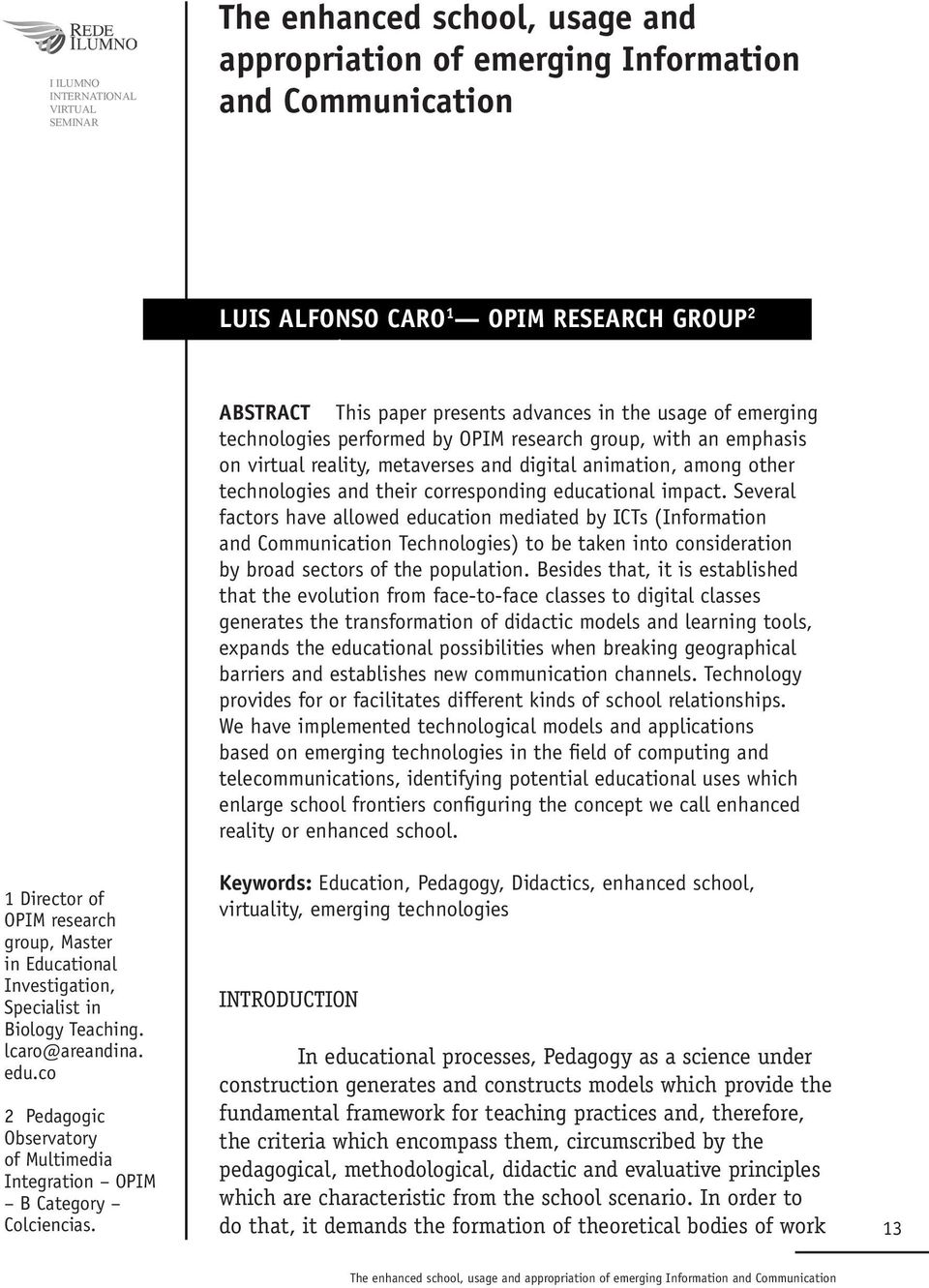
14 14 around issues such as curriculum, evaluation and didactic, among others, which compose school s activities in all of its contexts and modalities. Technologies such as enhanced reality, metaverses, virtual reality or digital animation and simulation, among others, have generated new interactional spaces, different models of information representation, content management and, in general, the communication among different kinds of knowledge, culture and society, close to a scientific revolution, a new proposal for the thinking process, a variable surrounding the formation of human beings in the digital era. With the integration of educational principles to the usage and appropriation of these technologies, bridges which allow the expansion of school frontiers are established. The enhanced school is the result of the incorporation of ICTs (Information and Communication Technologies) in a virtual scenario which responds in 4 dimensions (Organizational, Pedagogic, Technological and Communicative). The intervention in terms of technology can be expressed in multiple forms and possibilities. Technologically, virtual environments can be represented, for example, by info graphics and virtual learning objects (VLO), elements which facilitate concept presentations; by the collaboration through the movement called Web 2.0, with an infinite array of tools which allow teachers to be content producers; by the metaverses and the metanarratives as linguistic and scriptural constructions, tridimensional representations of possible worlds where the individuals interact and develop roles, with traits that easily go from real to virtual and vice versa; by virtual reality, which corresponds to a creation or recreation of digitally simulated environments, where human interaction is allowed or by enhanced reality as an extra tool of school scenarios which transcends the concept of ubiquity itself, corresponding to the enlargement of what is real through the usage of digital representations a technology that has overcome expectations and presented a format that has thousands of applications, including educational ones. Mediation enhancement through a portal of radiological images, the simulation of a patient with different oculomotor dysfunctions, the tridimensional representation of neuroanatomy concepts, the usage of markers with enhanced reality for instrumental purposes, the recognition of movement, form and color from a webcam, the construction of an immersive art gallery are some of the possibilities which OPIM explores as a product of these technologies and of the pedagogical Picture I Flight controllers console at APP RJ. I ILUMNO INTERNATIONAL VIRTUAL SEMINAR REVIEW
15 intervention as curriculum projects from academic programs at Fundación Universitaria del Área Andina. Frame of Reference Some of the projects performed by the research group converge in the application of the enhanced school concept. In those projects, the idea of trespassing geographical frontiers and opening possibilities of interaction in virtual spaces is made tangible, considering their adequate usage. Since 2003, the OPIM has been developing objects that complement education, mainly directed to the construction of didactic models in Health Sciences, as declared in one of its research lines. Some of these finished or ongoing projects, allow us to clarify the concept and prefigure the advances as noted in the following descriptions: 3 VELANDIA, Camilo. La simulación, realidad o virtualidad. Revista Visión Andina. ISSN: pg Vol 4. Bogotá, Colombia. 4 VELANDIA, Camilo. Simuladores en la formación Académica, Revista de la Fundación Universitaria del Área Andina. ISSN: , pg 78 81, Vol. 3, Bogotá, Colombia. Ocular deviations it has converted into mandatory reference material in the field of optometry formation. The main problem which led to its construction came from real clinical practice 3, since it would be practically impossible to face all possible clinical cases during the formative terms. In this case, and with rudimentary tools, we have managed to give concreteness to a virtual patient who simulates any motor alteration and the techniques used to measure and find the correction of the visual problem. Ocular deviations has been the first simulator developed by the group, solving a concrete problem in the area s didactics. Besides that, it has been validated in the clinical contexts with high levels of acceptance and validity of its model The enhanced Environment school, usage Ergonomics and appropriation built as a tool of for emerging improving Information the quality and of Communication life of workers

16 Virtual Neuroanatomy - Enhanced reality is a technology which complements the perception and interaction with the real world and allows the user to be in an enhanced real environment with additional information generated by the computer 5. The experience of enhanced reality usage enables, for instance, the conjunction of traditional reading and the interaction with multimedia elements for content representation. An example of that is in the use of this technology in the neuroanatomy charter built together with Dr. Bernardo Ortiz and the work group. In it, Nursery students have access to the whole theoretical framework represented in 3D with complete animations that can be manipulated in space and that, in the future, will be mobile objects with the inclusion of developments for this kind of device. 5 X. BASOGAIN et al, Realidad Aumentada en la Educación: una tecnología emergente, Escuela Superior de Ingeniería de Bilbao, EHU, Bilbao, España, es/joomla/ acessed in June 1st, The Neuroanatomy charter broadens school frontiers considering that it can be accessed from any point in the planet in which mobile Internet connection is granted. The student will be able to visualize tridimensional contents and, in the future, interactive, needing only the connection allowed by a mobile device. Nowadays, the charter is in its development phase, taking into account the project ABP and Instructional Design as methodological strategy in a virtual course where a series of animations has been drawn thinking about a face-toface strategy in which the teacher took as a reference these representations in order to facilitate teaching. Representations have been and input from the enhanced reality models that have served as its base technology. During the project s first phase, we have evaluated the impact of a Neuroanatomy class totally based in a virtual environment as support for a face-to-face model in which the efficacy of methodological models, programmed instruction design and problem-based learning has been compared. Results oriented towards the consolidation of the programmed instruction model. However, in posterior exhibits and with I ILUMNO INTERNATIONAL VIRTUAL SEMINAR REVIEW

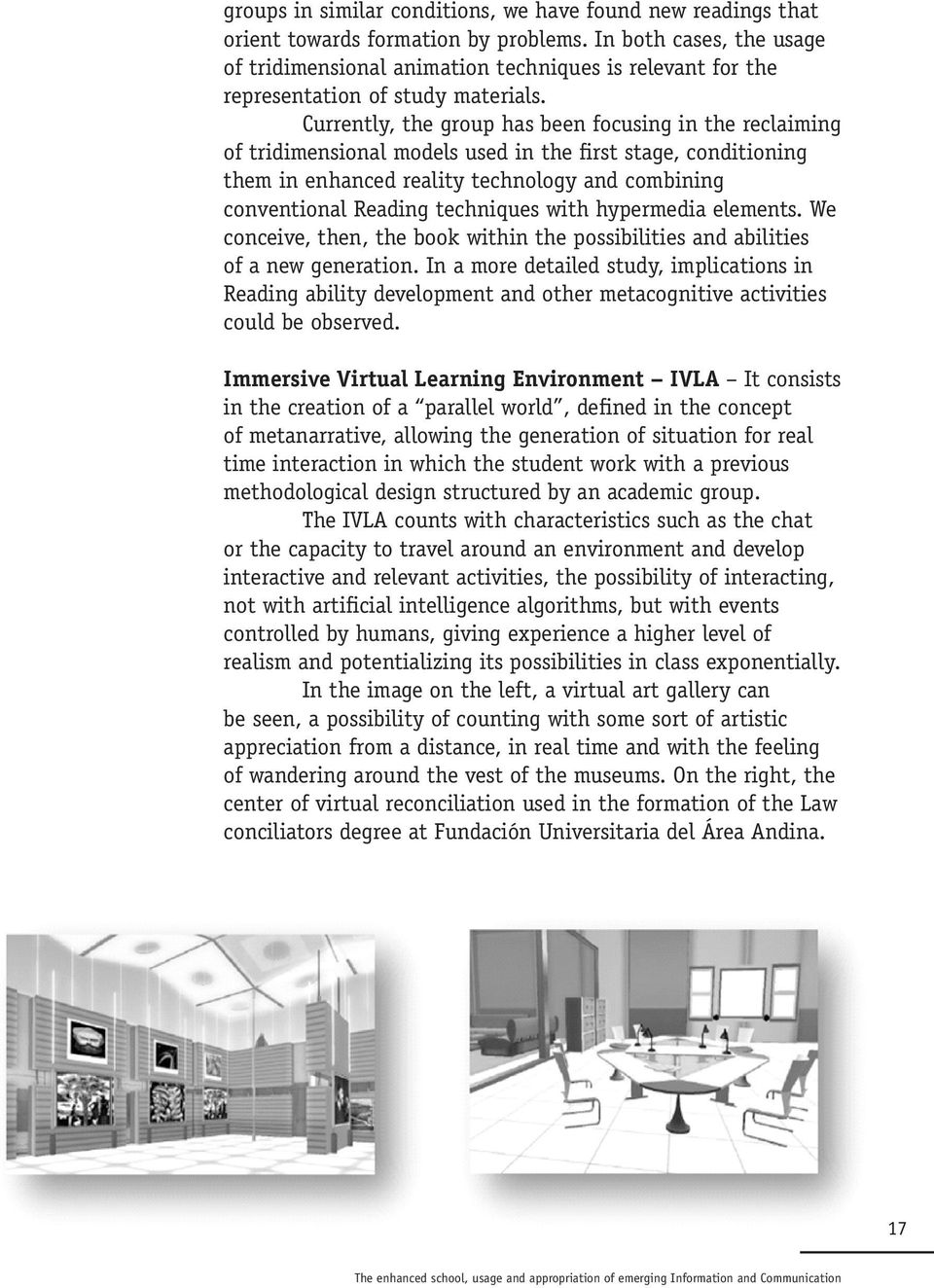
17 groups in similar conditions, we have found new readings that orient towards formation by problems. In both cases, the usage of tridimensional animation techniques is relevant for the representation of study materials. Currently, the group has been focusing in the reclaiming of tridimensional models used in the first stage, conditioning them in enhanced reality technology and combining conventional Reading techniques with hypermedia elements. We conceive, then, the book within the possibilities and abilities of a new generation. In a more detailed study, implications in Reading ability development and other metacognitive activities could be observed. Immersive Virtual Learning Environment IVLA It consists in the creation of a parallel world, defined in the concept of metanarrative, allowing the generation of situation for real time interaction in which the student work with a previous methodological design structured by an academic group. The IVLA counts with characteristics such as the chat or the capacity to travel around an environment and develop interactive and relevant activities, the possibility of interacting, not with artificial intelligence algorithms, but with events controlled by humans, giving experience a higher level of realism and potentializing its possibilities in class exponentially. In the image on the left, a virtual art gallery can be seen, a possibility of counting with some sort of artistic appreciation from a distance, in real time and with the feeling of wandering around the vest of the museums. On the right, the center of virtual reconciliation used in the formation of the Law conciliators degree at Fundación Universitaria del Área Andina. 17 The enhanced school, usage and appropriation of emerging Information and Communication
18 E-bidia It is another example of school enlargement, corresponding to a base of radiological images that are a result of radiography compilations performed by a group of students and faculty members. Based on physical information, we have digitalized more than 200 images that have been organized and documented in a data base which allows the management of its information. Nowadays, this tool is open in the web and its development is oriented towards the integration of animation and enhanced reality elements in order to potentialize its uses in the field of formation for Radiology technicians, doctors, Radiology specialists and similar occupations. In the image on the left, we can see the current version of this application and, on the right, its expected future. E-bidia aims at converting in mandatory reference for doctors and specialists, both in in-service formation processes and in everyday duty, because its formation capabilities are an important alternative for the world of Radiology and Imageology. This project is based in document and field investigations, from which information is obtained from real patients, X-ray plaques or images are digitalized and processed granting their visualization through the web, where they are documented and classified. In a nearby future, we expect to provide each clinical case with its tridimensional representation, supporting the construction of contents and the exhibition of the situation in order to facilitate radiographic plate readings. 18 General Objectives - Developing educational models that favor the relationship between Pedagogy and technologies in the field of virtuality through the concept of enhanced school. I ILUMNO INTERNATIONAL VIRTUAL SEMINAR REVIEW

19 Specific Objectives - Implementing solutions based on the adequate use of the Information and Communication Technologies in learning processes. - Reviewing current academic models which permit an intervention from the field of information technologies and their pedagogic use. - Designing didactic models and curriculum interventions in academic programs with different methodological strategies (face-to-face, distance learning and virtual) Final Considerations Each project undertaken by the Pedagogic Observatory of Multimedia Integration chases the consolidation of educational models that that advantage of information technologies to favor the improvement of educational conditions for students in different areas, emphasizing Health Sciences programs, since they have composed the group s first research line. Nowadays, technology confluence with higher affordability and more possibilities of exploration keep a direct proportion relationship with their impact and appropriation in educational community. Technologies such as 3D digital animation, immersive environments and enhanced reality are scenarios which propitiate new ways of thinking, recreating concepts and learning. The OPIM research group concentrates its investigative efforts in project that generate virtual objects resulting from didactic models in different areas of knowledge, with the intention of improving educational environments with the usage of Information and Communication Technologies. The OPIM group strongly believes in technology s potential in its different manifestations. However, its research lines are complementary. The first one directs its attention to the production of objects mediated by the ICTs and the second one emphasizes curriculum, methodological and didactic implications, guaranteeing a perfect conjunction that adds value to technology through a disciplined study of Pedagogy. The objects and technological devices do not have a determined end if not based on the analysis of Pedagogy in its different manifestations. 19 The enhanced school, usage and appropriation of emerging Information and Communication
20 Bibliographical References Berger,L, Peter, Luckman Thomas. La construcción social de la realidad. Amorrortu Editores. Buenos Aires Castells, Manuel, La era de la Información, Tecnologías e información. Alianza Editorial, Madrid, Foucault, Michel. Las palabras y las cosas. Sexta edición. Siglo XXI editores. México, Heidegger, Martin, La pregunta por la técnica, en Conferencias y artículos. Edit. Serbal, Barcelona, Lévy, Pierre, Qué es lo virtual?, Edit. Paidós, Barcelona, Martín-Barbero, J. y Rey, G. Los ejercicios del ver. Hegemonía audiovisual y ficción televisiva. Gedisa España Morin, Edgar, El paradigma perdido, Edit. Kairós, Barcelona, Scagnoli, Norma El aula virtual: usos y elementos que la componen USA, Virilio Paul. El Arte del Motor, aceleración y realidad virtual. Editorial Manantial. Buenos Aires I ILUMNO INTERNATIONAL VIRTUAL SEMINAR REVIEW

21 I Ilumno International VIRTUAL Seminar Collaborative Management of Content Production for Distance Education Modality Courses Andrade PMF 1 Chimenti 1 ABSTRACT Modern Distance Education demands much more than the presentation of texts in a computer monitor. It is necessary to produce captivating multimedia content which offers a rich and pleasant experience. This production requires the commitment of professionals with different profiles and specialties, who must, collaboratively, act in the production of integrated content. This article presents and discusses the usage of on-line management tools for processes and documents, capable of offering a high degree of collaboration for multidisciplinary teams, while offering managers a precise and real time view of the production collaborative process. Keyword: Distance Education; Electronic Document Management;Project Management; E-Learning INTRODUCTION 1 Universidade Veiga de Almeida, Av. Gal. Felicissimo Cardoso 500, Rio de Janeiro, , Brasil The production and distribution of content for courses in the Distance Education Modality (EaD) requires the commitment of professionals with different specialties and abilities. These abilities and specialties (professional profile) are strongly related to the characteristics of the content which needs to be produced. On the other hand, the enrichment of such content depends on the propagation platform to be used (its specific resources and restrictions), on the adopted teaching methodology and on the structural organization of the content itself. In spite of the different profiles, content production for EaD demands strong interaction among these professionals so that the final content offer achieves its expected quality, 21 Collaborative Management of Content Production for Distance Education Modality Courses
22 avoiding redoing and idleness during production process. Given the diversity of profiles, interactions are particularly complex, since the professionals involved in the task may belong to different departments, act in different physical locations and even be temporary workers, which demands even more control so that the final produced content offers a rich educational experience. Such control must not act as a bureaucratic component in the process, but as a component of an agile and efficient production process. This article proposes a collaborative management model for content production teams strongly based on digital environments and tools, which aims at controlling content production, also enabling real time monitoring of each subject or course component production, production tasks parallelism, efficient coordination of teams, production risk management and quality control for the desired educational experience. 2. EaD Content Production The content production process for modern EaD environments can be generically defined as a four-stage process, as presented in picture 1. Pic. 1. EaD content production stages 22 In the Content Production stage, the Content-Making Teacher, with the support of the course s Coordinator, the Reviewer and the Instructional Designer, produces the base content. This content is normally presented in text format. However, the Content-Making Teacher can provide other elements such as photos, drawings, audio and video files, as an indication of auxiliary or essential material for the learning process. During the Content Enrichment stage, Designers evaluate the material produced in the earlier stage, aiming at adapting non-textual material to the standards defined and build the Learning Objects which mean to enhance student s experience. On this stage, audio and video professionals may act in the production of content presentation videos and narrated texts in order to broaden content offer means offered by the online learning management system being used. I ILUMNO INTERNATIONAL VIRTUAL SEMINAR REVIEW
23 In the Publication stage, Web designers and Developers adapt the content considering its means of offer (web environments, computer applications, among others) and Visual Designers may adapt content for the preparation of digital and printed books. The last stage, Testing and Approval, consists in verifying the experience and usability of the produced content within the platforms. This stage involves quality control professionals, besides the Content-Maker Teacher, the Course s Coordinator and the Instructional Designer. In spite of the simplistic sequential presentation of the process in Picture 1, it involves different stages of interaction among producing agents and content evaluators. These interaction stages may happen in parallel, since the complete learning content may be divided into smaller and relatively independent components. Dividing content into smaller components and producing them in parallel enhances productivity, anticipates obstacles and helps the identification of content and learning experience enrichment opportunities, during the production process itself. The Multifunctional Flowchart in Picture 2 is an example of the production cycle of a learning object in the form of a digital game. In Picture 2, tasks which may occur in parallel are represented by symbols with no background color. Approval and evaluation tasks can also be parallelized, since approval depends on more than one department/professional. 3. Collaborative Production Management The collaborative characteristic of Business Processes Management for EaD content production demands special care in interpersonal and interdepartmental interactions. Considering its collaborative characteristic, frictions related to missed deadlines, incomplete or vague information and unexpected alterations in documents must be minimized as much as possible. The best way of minimizing problems is guaranteeing transparency all through the process, for all members involved, facilitating communication between teams and offering a wide view of the deadlines in each production step. Currently, different productivity tools can help teams in the cited objectives. These tools have been grouped under functional categories and presented in the following diagram. They have in common the need for on-line access, being multiplatform, allowing task parallelism and offering safety and control resources. 23 Collaborative Management of Content Production for Distance Education Modality Courses
24 3.1. Project Management A project management tool supporting collaborative content production in EaD must include all of the professionals involved in the process and have the characteristics discussed in the following sections. Pic. 2. Multifunctional Diagram of the Development and Approval of Digital Game as a Learning Object Collaboration Collaboration is a constant in the production process. This collaboration may happen in synchronous or asynchronous exchange of messages, discussion forums, shared calendars and virtual meeting tools. It should not happen through an external system, such as a corporative system, since this collaboration is intrinsically related to a specific production, such as a subject, for example. It is more productive to have communication within production-related environments, where all information is available for consultation. Forums or Wikis are also particularly useful when registering doubts that can appear again during development Work Flow and Task Management Despite the fact that each course has different characteristics, work flow and the group of tasks yet to be performed hardly changes if the learning model does not change. With a well defined work flow, it is possible to define I ILUMNO INTERNATIONAL VIRTUAL SEMINAR REVIEW
25 sequential and parallel tasks, which can be attributed to groups or individuals, with defined deadlines and goals. Once a task is performed, the system allows the process to continue, without direct intervention of managers, which enhances team productivity. Work flow tools also offer processes macro visualization mechanisms, shaped as Gantt graphics, for example, which may help managers to identify production bottlenecks, allowing the relocation of members and even the prediction of temporary workers hiring needs Monitoring and Statistics Repetitive tasks affect creative professionals production negatively. This impact is not easy to perceive, since it happens gradually. Monitoring and statistics tools are capable of offering managers a view on each individual s, group s and project s productivity, enabling corrective actions Document Management During the content production stage defined in Pic.1, text format documents need to be constantly exchanged between the Content-Maker Teacher, the Course s Coordinator, Instructional Designers and Reviewers. Preliminary versions can also be sent to Designers related to other media, so that they can start their work and even contribute to the process of textual content production. As an example, we can consider the work of a Visual Designer, who can produce an animated infographic in order to present an idea that is difficult to explain textually or identify in image and video data bases material which can, potentially, enrich the text of the Content- Maker Teacher. For EaD content production, the Document Management system must have the following characteristics: Version Control During text production, it is possible that different versions of the same document are generated. For example, a Reviewer may be working in one part of the document, while the Content-Maker Teacher concludes a new part and the Course s Coordinator includes some relevant information. These different versions need to be easily manageable and different versions must be stored for consultation. 25 Collaborative Management of Content Production for Distance Education Modality Courses
26 Indexation As documents are produced, difficulties normally arise when team members try to locate in which document a given topic has been dealt with. Document s global indexation offers a fast search and consultation system Notes Non-destructive notes within a document allow, for example, a Reviewer to indicate a paragraph for its lack of clarity and it can be revised later in the process. This kind of doubt, if registered during the review process, permits a faster response from the Content-Maker Teacher or the Course s Coordinator Document Check-in/Check-out Documents may enter in stages of reviewing and evaluation in which alterations may negatively impact the process. A Check-in/Check-out system allows the definition of these documents as temporally unavailable, guaranteeing that they are not accidentally used while undergoing revision or adjustments. 4. Conclusions Efficiency in multidisciplinary team collaboration is a characteristic of high performance teams, but this efficiency is not easily achieved without the usage of adequate communication and collaboration management tools. These tools present countless benefits when implemented correctly and efficiently used. References [1] Rosemberg MJ. E-Learning. São Paulo: Makron Books; [2] Project Management Institute. A Guide to the Project Management Body of Knowledge : PMBOK Guide. 5th ed. New York: Project Management Institute; [3] Jeston J, Nelis J. Business Process Management: Practical Guidelines to Successful Implementations. Butterworth-Heinemann; I ILUMNO INTERNATIONAL VIRTUAL SEMINAR REVIEW
27 I Ilumno International VIRTUAL Seminar University students communicative competences in Distributed Learning Systems (SAM) following the Blended Learning Modality Sandra María Gómez 1 1 Gómez Sandra María. Tel.: address: sgomezvinuales@ gmail.com Universidad Siglo 21. Pucará Córdoba,5105. Argentina Chimenti 1 ABSTRACT This paper presents the results of an investigation undertaken in 2012, in the context of TEC s Masters in Educational Technology in Monterrey, Mexico. During the course of this research, we have questioned the communicative competences as means of action linked to educational processes encompassing Blended Learning teaching. This questioning arose due to the fact that, nowadays, there are new communicative scenarios in educational institutions which have incorporated the distance learning modality to their educational offer. In this sense, the theme of our research has turned to the issue of the mentioned communicative competences in students of an Argentinean university, in which they were coursing an Education Licensing Degree using multimedia systems and combining face-toface and virtual learning (b- learning). The investigation has been performed from a mixed framework perspective, combining quantitative and qualitative methodologies. The studied population was composed by 30 students. Data collection instruments included surveys with closed and open questions, interviews and the monitoring of exchanges in the virtual platform. The work, in general lines, has allowed us to know what happened with the communicative competences in Blended Learning proposals, in which teaching practices presuppose learning processes related to the conceptual, the technological and the communicative aspects, as performances envisioned in new ways of teaching. The results approach previous communicative competences as well as the competences brought into consideration by the students, regarding information and communication technologies, virtual communication among students and their tutor, favoring and hindering aspects of the multimedia system when referring to the communicative competences, the construction of knowledge and the interactive modalities present in face-to-face and virtual environments. Keywords: communicative competences; education; b-learning; university. 27 University students communicative competences in Distributed Learning Systems (SAM)
28 INTRODUCTION 28 Questioning the relationship between the new ways of teaching and the constructive possibilities of students is related to special interest in getting to know the impact that new information and communication technologies are having in educational environments due to the fact that these new resources can potentialize or not the learning processes of university students. Getting to know these aspects could positively lead to the improvement of the teaching practices that have been configuring since these new formats arose, be them distance learning formats or combined modalities (known as Blended Learning). Methodological changes in higher education teaching practices that have been imposed due to the necessary technological innovation could potentialize the usage of technological resources if it is optimized. We understand as usage the indispensable actions that must be taken in order to approach and understand the didactic proposals which facilitate the appropriation of knowledge. In order to do so, it is required that we ask about themes related to the necessary dispositions that the students must have and/or construct to learn through virtual devices. We consider communicative competences to be key dispositions in this process. The higher learning educational institution that is the object of this study is in Argentina and is considered to be in the forefront of the technology incorporation in education. Throughout its institutional history, the university has gained experience in face-to-face education, distance learning and in the distributed modality (combining virtual and face-to-face modalities). The opening of distance modality majors happened in 2006 and distributed modality in the beginning of During the course of this trajectory, changes in its Virtual Platform and in the models which orient those practices have been made. In this sense, we believe that a more rigorous and profound investigation is necessary regarding what is happening with the learning processes of students since the incorporation of new technologies. In the university portrayed in this study, the modality called distributed education arises on two pillars: devices based on advanced technology and face-to-face work instances with subject professors and colleagues. It contemplates three moments: Introduction/Virtual Class (Virtual Campus and Multimedia Learning System), Classes (Video class and On-line I ILUMNO INTERNATIONAL VIRTUAL SEMINAR REVIEW
29 Interchange with the Professor) and Closing (Group work and evaluation). A model of combined education provides for more distributed learning. In the case studied, courses are organized in four modules with access to readings, self-evaluation, theoretical video classes, videos, practical work and resources available in the virtual platform. Students must attend meeting in the University Learning Centers (CAU) where practical video classes are offered. At the same time, they receive a theoretical review (recorded class) and the proposal of practical work. An assistant tutor ( Virtual Learning Tutor, TAP) coordinates group work. In this same instance, students are evaluated with a multiple-choice exam. We observe, in this model, a Blended Learning proposal, since the groups keep communication with virtual and face-to-face tutors, offering the possibility of counterpointing distance learning education in presential meetings. Interchanges are made through the e-campus tolos and there is also the possibility of discussing what has been learned in face-to-face meetings. These spaces require communicative competences both in their virtual campus performance and in their classroom meetings. In the university studied, combined learning proposals use: Classrooms with pre-recorded video classes and practical activities in face-to-face interaction (presential instance). Virtual classes in the virtual campus platform. Readings, videos, practical exercises and evaluations in the virtual campus platform. Follow-up virtual tutoring. Presential and on-line evaluations. It is important to highlight the role of the virtual and face-to-face tutors as facilitators of the learning processes, acting as necessary guides in the development of different activities and in monitoring content comprehension. The role of professors and/or tutors in the new combined modalities, where the predominantly oral style is replaced by written resources, is also a conditioning aspect. Virtual tutors occupy the position of facilitator mediators in the students constructive process. This situation requires, for both students and teachers, the activation of certain communicative competences regarding the understanding of knowledge objects and the necessary communication in order to enable such cognitive construction. The investigation of this theme in the chosen university can 29 University students communicative competences in Distributed Learning Systems (SAM)
30 favor transformations and new pedagogical interventions leading to improvement. This possibility of contribution has been one of the investigation s motivations. The main question proposed in the context of this research was: What are the communicative competences mobilized by students who participate in teaching and learning processes within virtual and presential combined environments (b-learning)? The general objective was to analyze the communicative competences as constructed (or yet to be constructed) dispositions in order to acquire learning from b-learning multimedia systems. Theoretical Framework 30 In higher learning education, the forms of making (as constructed dispositions) lead us to competences linked to the know how ; the forms of thinking lead us to knowledges as theoretical and technical constructions necessary in the professional formation; the forms of appreciating connect to values and attitudes knowing how to be and knowing how to live together both in subjective and social sources that represent the integration of the agent in society. Área (2010) mentions that, in the last decade, virtual learning and teaching spaces have gained more protagonism with educational modalities known as e-learning or b-learning. The incorporation of ICTs in higher learning education requires that both students and professors master and develop the competences necessary for the usage of digital tolos, demanding from us an understading of what happens with communicative competences in this new virtual environments that combine with presential environments. The concept of communicative competence has its origin in Hymes (1971) and in Chomsky (1965), to whom we owe the first elaborations about it. The theoretical proposal of Patrick Charaudeau (2001) on competence and language deepens aspects related to the topic by treating communicative competence regarding the situational, the discursive and the semiolinguistic factors. Pilleux (2001) defines communicative competence as a sum of competences in which linguistic, sociolinguistic, pragmatic and psycholinguistic competences are included. Each one of them will allude to different aspects of communication as, for example, naming a few, syntax and semantics, social interactions, intentions, personality, among others. I ILUMNO INTERNATIONAL VIRTUAL SEMINAR REVIEW
31 In first instance, we observe that, considering constructivism, competences are understood as actions linked to the resolution of problems in a situated context. If the competence is knowledge, at first, we will state that it is not innate and that the categories are not a priori. In this same direction, when we talk about abilities to make/perform, we state that they are not hereditary as talents, but built in a life trajectory. These conceptions are linked to Piaget s developments (1981), when explaining the development of intelligence and to Bourdieu (2007), when accounting for the social structures connected to objective and subjective structures. On the other hand, any action obeys motivations originated in individual desire. Such desire is sustained in an intersubjective relation with the social web. Following this theoretical line, it is important to highlight that the possibilities of action from subjects are not inherited biologically, but are the product of a construction. If competences are knowledge, abilities and capacities, then these authors will say that they are constituted as disposals to act due to the dialectic subject-reality relationship. Considering these authors, we will redefine competences as disposals to think, act and appreciate which are built from schemes generated by the relationship of the agent subject and knowable reality subjective, objective and social. The competences will refer to intellectual schemes, to the subject s ways of doing, thinking, valuing and feeling in a situated context. These dispositions which are structured and, at the same time, structuring are the ones which will be engaged at the moment in which the subject acts in reality. Based on what has been presented, it is clear that the manner of conceiving such competences places us in a psycho-social perspective that recognizes, as previously stated, subjective aspects (motivational), social aspects (interactive, communicative) and cognitive aspects (the particular way of building knowledge and operating in reality). Charaudeau (2001) articulates language and action to develop the concept of communicative competence, understanding that, in order to have meaningful communication action, the act of speaking is linked to a series of conditions within which the subject enounces. There are production and interpretation conditions in the communication process involving at least two subjects; there are cognitive processes at stake which may lead to misunderstandings. In order to make it possible, i.e. to guarantee intercomprehension in 31 University students communicative competences in Distributed Learning Systems (SAM)
32 the interchange situation, there are three competences that the subject needs to possess: situational, discursive and semiolinguistic. In the current investigation, we have asked about communicative competences that university students already have and those which they are required to develop in combined study modality (b-learning). Considering this theme, we have defined as the the following strategies towards communicative competences as our field of research: 1 - Linguistic, linked to the order of oral or written discourse. Grammar, syntax and lexicon will be taken into account. 2 Sociolinguistic, as situational competences that orient communicative actions. 3 Pragmatic, related to interaction, leading to intersubjective relationships and norms that regulate interchanges. We shall consider that these competences, in virtual environments, take a particular format that will be contemplated during the questioning process. This format is, precisely, what, being a part of the original questionings, gives meaning to the present investigation. Methodology 32 In this investigation, we have chose to use a mixed approach due to our consideration that it allows us to overcome radical postures, proposing a complementary and integrative perspective between quantitative and qualitative methods. Combining instruments from different postures leads to methodological triangulation, which is, according to Kemmis (1970), a crossed-out control performed from different data sources by which we can combine instruments, documents and people. Mixing perspectives also presents other advantages, when enabling deeper and more diversified information. Results can acquire further validity and theory can be reinforced due to data comparability (García, Giacobbe, 2009). Methodological pluralism enriches the production of knowledge in Social Sciences and it is this position that the present research (complementing methods) has subscribed, for data analysis, in the interpretative paradigm, which means to I ILUMNO INTERNATIONAL VIRTUAL SEMINAR REVIEW
33 say that the investigation problem has been approached from this line of thought. From this humanist tradition, the objective is not to explain but to generate analytical interpretations which can make the understanding of communicative competences viable, contemplating subjective, social and cultural aspects at stake in combined learning modalities. The work has been done with 30 students from one of the courses. A survey with closed and open questions has been applied to the whole population (census). We have also interviewed 6 students and the virtual learning tutor, observed two presential meetings and monitored virtual interchanges at the e-campus. Hereafter, we have described field work phases: a- A previous piloting phase of the surveys has been contemplated with the objective of valuing its adequacy towards addressees and determining of the open and closed questions were offering relevant information on the research problem. b- Survey application. The survey has been applied at the end of the second presential meeting, when students had participated in the first two presential classes. After gathering these data, we have proceeded to statistically quantify the survey, in accordance to certain categories, which has allowed us to orient the interviewing process. c- Observations have been performed in the second and fourth meetings. In this instance, we have witnessed what was happening and registered the facts. d- Interviews have been performed after the third meeting. They have been applied to students and presential support tutors who have voluntarily agreed to take part in the process. e- During the whole process of course development, we have monitored virtual platform interchanges. The University has offered access possibility so that we could study the questions and answers generated in this virtual tutoring resource. In this instance, we have valued the structure of messages according to a grid which enabled us to identify linguistic communicative competences related to orthography and syntax and, at the same time, messages could be interpreted qualitatively regarding sociolinguistic competences. The monitoring instrument has been linked to the analysis of written discourse. It is important to highlight that field work has been initiated with the necessary and mandatory presentation of the researcher, as a part of the investigation s deontology (Giroux, Tremblay, 2004). 33 University students communicative competences in Distributed Learning Systems (SAM)
34 Main findings We present, in this section, the main conclusions achieved. The main proposed question was to know what the necessary communicative competences were in order to perform as a student in teaching and learning processes of a university major in b-learning modality. The main conclusions have been grouped in virtue of the planned research objectives: a. Regarding the previous communicative competences of students related to information and communication technologies, our data allows some inferences. 34 At first, we can say that the students have had experiences using the computer since adolescence (11 to 20 years old) in 60% of the population. 33 % has had access since their twenties. It means that there has been no presence of these technologies during childhood in 93 % of the total population. In primary school, with the exception of one case in thirty, they do not recognize the usage of computers. It seems to imply that, in this school socialization process, these technologies have not been present in teaching proposals. As conceived by Bourdieu (2007), the habitus is defined as a social system constituted of structured and structuring dispositions, acquired by practice and always oriented towards practical functions. We can observe in these students that technology usage competences in the academic formation context, understood as internalized action schemes, have had scarce opportunities of development. In secondary school, 43% of the population recognizes the usage of computers in educational institutions. The uses are concentrated on software procedural learning and/ or on information search. There have been no experiences of asynchronous virtual work proposals like the ones through which these students must traffic during the present course of their major. Their current use of computers is concentrated in study processes linked to the major they are coursing. In a scale of 1 in 6, an average of 1.7 has been obtained; positioning on the sixth place games or entertainment (5.4). These findings are in accordance to the private life situations from this students, who work and study, having little time for their activities. Organista (2012) also concludes that higher dedication to studies generates a decrease in the recreational use of the resource. 77% of the students did not have any previous experience in I ILUMNO INTERNATIONAL VIRTUAL SEMINAR REVIEW
35 this study modality, implying that, for the wide majority, it is a novel experience. It is important to consider these aspects since there are generic competences in educational processes such as reading and writing which are present since the origins of teaching, but that, nowadays, are added to other technical competences associated to the use of technologies (Corominas Rovira, 2001). The use of technologies is a fundamental variable for performance in both b-learning and e-learning study modalities. b- When asking about communicative competences as dispositions constructed in order to guarantee the learning process with the use of b-learning multimedia systems, we have built the following conclusions. B-learning study modality is fundamentally chosen because of its schedule flexibility and of the possibility of managing study time, making it compatible with other labor and family obligations. For an important part of the population (77%), it is the first experience accessing a Virtual Platform. This first experience has been lived as a radical change in their way of studying linked to a new virtual environment to which they were not used. In the interviews, they recognize this first impact, a change to which they have adapted, progressively. Activities autonomy and time self-management are determining variables when it comes to this modality. Some students recognize that a less scheduled organization may occasion some difficulties in the process. The interventions and regulations which are a natural part of presential classes are missing and it obligates students to channel their doubts into new paths such as their pears and/or the TAP. Only rarely do they recur to the Virtual Platform. c- Regarding virtual communication between students and the virtual teaching tutor, 67% of the students reveal in their surveys that they do not use this mean of consultation. When monitoring performed consultations in the Platform, only four out of thirty students have asked questions to the virtual tutor in a period of two months. Virtual interchange is a sociolinguistic communication manner in which students have difficulties since the asynchronous instance is experienced 35 University students communicative competences in Distributed Learning Systems (SAM)
36 as a communicative obstacle. It allows us to infer that a communicative mode internalized in previous schooling prevails, in which privileged interchanges are those occurred in faceto-face interaction. These incorporated dispositions make subjects feel comfortable in this communicative situations and the process of initiating and maintaining virtual interaction becomes costly. Virtual interchanges with tutors and in forums waned from one year to the next. This process is in accordance to what Romo (2010) finds in his investigation regarding the decrease of participations as the course studied advanced. Doubts and consultations are channeled by other routes such as pear consultation during presential meetings. That would compensate the absence of consultation to content experts, who can only be accessed virtually. The students understand that the communicative competences required for the virtual environment are linked to demands of the current era in terms of educational processes, of knowledge and of the necessary abilities which they recognize they need to start constructing. In this sense, they identify a certain distance between traditional communicative formats in the classes and the different conditions in virtual educational communication. In sociolinguistic communications, there is recognition of authority keeping written interchange that respects formalities and the differences between occupied places in the social scenario. Halaban (2010) had already found out that more introverted students participated more assiduously in virtual consultation spaces. In the present research, students had scarce participation, so it was not possible to observe this personality trait and its incidence. In written interchange, linguistic competences related to writing account for constructed competence, corresponding to previous formation and to the teaching exercise of these students. d- It has been important to detect the favoring and hindering aspects of the multimedia system regarding communicative competences and knowledge construction. 36 In this sense, linguistic competences linked to reading have been valued in a degree of reading difficulty, in which 30% of the students explicit a medium to low degree of difficulty I ILUMNO INTERNATIONAL VIRTUAL SEMINAR REVIEW
37 in comprehension. In another extreme, 16% of the students enounce that this difficulty is high or medium to high. More than half of them recognize medium difficulty (54%) On the other hand, technical aspects and site design are elements that may generate obstacles in the beginning of the major, demanding competences that are gradually incorporated and overcoming whatever is experienced as an obstacle. The reading of a homepage requires certain experience that demands a certain familiarization time. The availability of the whole material in the Platform has been valued positively. Readings have been recognized as valuable for providing themes and central concepts from each subject. From all of the resources displayed in the Platform, they are central to the process of learning. Self-evaluations of readings were also recognized as important, since they allowed students to anticipate their understanding process when facing partial evaluations. It is remarkable that the non-mandatory instances have been scarcely used instances such as forums, virtual consultations and other didactic resources like videos. Time usage distribution leaves these resources postponed or abandoned in their teaching and learning potential. e- Last, we present results related to the interactive modalities which happen in presential and virtual spaces. Interactive virtual spaces, consultations with the virtual tutor and forums, are the least used amongst all of the resources offered by the educational Platform. The absence of the presential teacher is suffered as a deficiency. They cannot supply for this absence with the interchange space created by the university. The positively valued form of interaction is the one which is produced synchronously and in face-to-face relationships. Pragmatic and sociolinguistic competences musy happen in a presential communication context in order to achieve intercomprehension. Students like interlocutionary communicative instances more than the monolocutionary ones which are proper in virtual consultations, even when the latter is answered by a content expert. For the students, true feedback happens only in face-to-face instances. On the other hand, students choose synchronous communicative situations because they are not used to 37 University students communicative competences in Distributed Learning Systems (SAM)
38 differ their doubts or questions. Because of that, presential meetings are moments of communicative interchange directed fundamentally to psychosocial shoring (creation of bonds) and, as a runner-up, to work related to content treatment (discussing contents and interchanging information). The video classes are recognized as a didactic resource which organizes the central concepts and exemplify. However, a claim remains for the need of having at least one presential meeting with the professor in question. Regarding the presential learning tutor (TAP), we could recognize that he/she is the representative and mediator of the university. They are references who answer multiples demands, considering that they are seen once a week. The role of the TAP exceeds instituted functions giving way to an interlocutor who favors psychosocial containment, at least for an important part of the group. Communications diversify through channels that include not only the institutionalized ones, up to the point in which they generate social gathering instances with the objective of strengthening bonds for which the organizer is the TAP him/herself. The TAP s teaching formation leads to an overlapping of functions that is not legitimized by everyone in the communicative situation. Fundamentally regarding the rol he/she undertakes in content treatment when regulating interchanges in presential meetings. Partial evaluations which are applied in two from the four meetings are seen as obstacles for the communicative interchanges in the moment of task resolutions for practical exercises. 38 We have presented the central conclusions to which we have arrived in the studied population. We believe that they can be an important source for the revision of certain aspects of the educational proposal, including technical aspects of Access and work on the Platform and didactic pedagogical issues that favor the construction of communicative competences which enable the sustainability of cognitive constructions from purely virtual interchange, considering that, if a given resource is well-used, it favors and facilitates access to knowledge. Communicative competences allow subjects to participate in a linguistic community and manage to understand each other, achieving intercomprehension. In educational contexts, understanding is strictly connected to communication, I ILUMNO INTERNATIONAL VIRTUAL SEMINAR REVIEW
39 i.e., to the possibility that subjects in interaction may reach an agreement through dialogue (Habermas, 1997). In communicative situations, we find at least two subjects and purposes are exchanged. Their meaning will depend on the conditions in which the interchanges take place. The circumstances in which interchange is produced are the material framework which sustains the interaction (Charaudeau, 2006). We could conclude that, in the virtual environments, considering the studied population, communication is currently limited, not because subjects do not recognize the norms which regulate interaction, but because, in their socialization, educational interchanges have been, and will preferably keep on being, presential. Recognizing new material frameworks of educational communication is part of a new communicative competences learning process which allows students to enter the virtual scenario. New research questions From this investigation, aspects of the problem proposed have arisen which would require the proposition of new questions or problems. The following questionings have remained and we believe they will help deepening the process by bring focus to certain issues: What is the level of influence of platform design in the way students can use it, fundamentally linked to the development of communicative competences which favor virtual dialogue? What is the impact of the kind of answer offered by virtual tutors as invitations to future consultation and prolonged interchange sustainability? In which ways does the treatment given to pedagogical issues and the virtual tutor figure interfere as references of psychosocial contention in modalities of study in which students may feel alone? Can the generational differences be identified in the development of communicative competences linked to the use of technologies as educational resources? Since investigative processes are open, conclusions always open new interrogations. Because of that, knowledge is a permanent constructive process in which the different results feed new researches that allow us to deepen, review, generate diverse points of view, surrounding the themes we believe to 39 University students communicative competences in Distributed Learning Systems (SAM)
40 be important regarding sociocultural contexts. Educational investigation, in particular, gains relevance if the contributions it generates can be recovered in the scenarios where the work has been done, in order to favor necessary change for the improvement of educational quality and, consequently, the constructive processes of subjects directly implicated in the processes of academic formation. References Area, M. (2010). Por qué formar en competencias informacionales y digitales en la educación superior? Revista Competencias informacionales y digitales en educación superior [monográfico en línea], 7 (2), 2-5. Universidad y Sociedad del Conocimiento (RUSC). Recuperado de rusc.uoc.edu/ojs/index.php/rusc/article/view/v7n2-area/v7n2-area Bourdieu, P (2007). El sentido práctico. Buenos Aires, Argentina: Siglo XXI Editores Charaudeau, P. (2001). De la competencia social de comunicación a las competencias discursivas. Revista latinoamericana de estudios del discurso. 40 I ILUMNO INTERNATIONAL VIRTUAL SEMINAR REVIEW
41 I Ilumno International VIRTUAL Seminar Virtual Learning Environment (VLE) Design, with a Problem-Based Learning (PBL) methodology: A model for content approach and knowledge construction in VLE Roa K 1, Romero MA 2 Chimenti 1 1 Katherine Roa Banquez, +57 (1) , ext.: 151, kroa@areandina. edu.co- Fundaciòn Universitaria del Àrea Andina, Bogotà (11011), Colombia 2 Mario Alexander Romero Gómez, +57 (1) , ext.: 151, maromerog@ areandina.edu. cokroa@areandina. edu.co- Fundaciòn Universitaria del Àrea Andina, Bogotà (11011), Colombia ABSTRACT The present paper corresponds to the advanced investigation project inside the Educational Computing Division (D.I.E.), presenting a proposal which lead to reflection on the new structures in knowledge construction in the under graduation levels of the fourth semester of Nursing at Fundación Universitaria del Área Andina, with the support of Virtual Learning Environments (VLE). It has been developed in two years of research, working with the support of a group of faculty members, conformed by professionals from different areas (Health, Didactics and Pedagogy and Technology) and the support of Virtual Learning Environments (VLE). Fue desarrollado durante dos años de investigación, trabajando con el apoyo de un grupo docente, conformado por profesionales de diferentes áreas (salud, didáctica y pedagogía y tecnología). Its main objective is to establish the effect in knowledge construction within two groups enrolled in the General Computing subject. Two pedagogic strategies are designed, represented in virtual learning environments. The first one, mediated by the pedagogic strategy of Problem- Based Learning (PBL experimental group) and the second, with traditional methodology, without PBL (control group). Parting from this objective, we discuss a conceptual framework which revolves around three axes: Problem-Based Learning (PBL), Virtual Learning Environments (VLE) and Constructivism, with which the virtual strategy is design, enabling us to establish their effect on knowledge construction in both groups. Keywords: Learning, Didactics, Constructivism, Virtual Education, Information and Communication Technologies. 41 Virtual Learning Environment (VLE) Design, with a Problem-Based Learning (PBL) methodology
42 INTRODUCTION Intelligence consists not only in knowledge, but also in the skill to apply knowledge in practice Aristotle 42 Teaching and learning, as mobilizing forces of our complex mental universe, allow us to recreate any scenario, no matter how complicated it is. In order to do so, teachers and students as protagonists of the educational act allow themselves to undertake conceptual trips which are increasingly closer to reality, supported by science and technology. Thanks to that, knowledge has been converted into the most precious richness of any society and it is at this point that our educational centers emerge with a proposal in which theory and practice are fused into one to build a pertinent posture in the search for new schemes, new educational postures, which, in time, have converted into new theories, new educational paradigms. Knowledge building, the generation of proposals with allow radical changes within educational spaces regarding the way teaching and learning is done, represents to the professor leading this process one of the biggest challenges when facing proposals such as the one described in the next sections. This investigation is based on the use of constructivist pedagogic strategies, in which we depart from a problem and, during the course of its solution, knowledge and tools from the Virtual Learning Environment are applied and the protagonist of the educational act is the student, accompanied and advised by the tutor, who is defined as the person who feeds the findings in terms of knowledge and focus the results on the solution of problems and the posing of the hypothesis. The usage of Virtual Learning Environments gives us the possibility of potentializing and enhancing this proposal, in scenarios in which it is possible to teach and learn with the support of the Internet and the enormous numbers of resources it contains (virtual communities, learning portals, among others), broadening theoretical sources in an important way and making it possible to have different views on any concept and building from these new postures and educational offers. The proposal generated from Problem-Based Learning (PBL) and Virtual Learning Environments (VLE) gives us the possibility to create a virtual course in General Computing for the fourth semester in Nursing, where, through a quasiexperimental methodology, we aim at establishing the its I ILUMNO INTERNATIONAL VIRTUAL SEMINAR REVIEW
43 effect in the construction of knowledge when comparing two groups enrolled in the same subject, with both methodologies traditional and PBL. In the following section, we present the three axes of study which are considered in this investigation as elements that allow us to establish the effect in knowledge construction in the general computing subject, with a course designed in the problema-based learning (PBL) modality, in a virtual learning environment (VLE). Problem-Based Learning (PBL) Araujo (2008) defines Problem-Based Learning (PBL) as a new perspective in university teaching. It is a strategy that profiles as one of the most innovative approaches to current professional and academic formation, conquering more and more space in universities worldwide. Initially, PBL has been known as Problem Teaching, which is a pedagogic strategy. The researcher Majmutov (1983) defines it as a didactic system based on the regularities of the knowledge creating assimilation and the format of activity which integrates teaching and learning methods characterized by having the basic traits of scientific search. In it, students, tutors and experts revolve around the solution of a problem. The strategies employed when presenting different concepts are used with the purpose of approaching, guiding, advising towards its solution. This kind of teaching prioritizes students, as axes of the process, constructing their own knowledge based on interactions with the group and their pre-concepts, from their practice as students and professionals in formation. PBL in the context of Fundación Universitaria del Área Andina These reflections regarding teaching and learning manners cannot be set apart from the institution in question, Fundación Universitaria del Área Andina, and, specifically from the research groups in different colleges which have been gradually directing their investigations towards this purpose s consecution. The Pedagogic Observatory of Multimedia Integration (OPIM), a research group adjoined to Colciencias, currently in category B, open spaces within its reflections and investigations 43 Virtual Learning Environment (VLE) Design, with a Problem-Based Learning (PBL) methodology
44 aiming at analyzing teaching and learning processes in different levels related to pedagogical strategies. In the publication Contemporary Educational Conceptions and Virtual Learning Scenarios, printed in 2004 by Fundación Universitaria del Área Andina, the OPIM presents the result of research related to General Concepts and Reflections on Pedagogy and Contemporary Emerging Pedagogies in Educability Processes within Knowledge Nets inside the Fundación. OPIM s previous contributions have been valuable to the way teaching and learning processes have developed inside the institution. Based on these concepts, we undertake an analysis of what we consider to be the beginning of any pedagogical process. A glance at these concepts allows us to coherently initiate a formation process. Virtual Learning Environments Unigarro (2004), defines a Virtual Learning Environment as a place where an educational process is generated, a communicative action with formation intentions, different from the classroom: in cyberspace, temporality may be synchronous or asynchronous and there is no need for teachers and students to be present. This definition is very complex and must be seen, as does the author, from different perspectives, better saying, approaching each of its terms separately. A space is considered to be a Virtual Learning Environment when some minimum conditions are met: they are interaction spaces where there is direct communication among pears and among teachers and students; these interaction spaces have synchronous and asynchronous characteristics, their function is dimensioned by their capacity to facilitate communication processes between the students and their group and between the students and their teacher or tutor. Virtual Learning Environments (VLE) in Fundación Universitaria de Área Andina. 44 Fundación Universitaria del Área Andina, in 2005, has started one of its most important and contextualized projects generated inside the institution so far, transcending and edifying beyond the class the incorporation of new teaching and learning models. The Academic Network for Online Learning (REAL) has been conceived by Fundación Universitaria del Área Andina as I ILUMNO INTERNATIONAL VIRTUAL SEMINAR REVIEW
45 a learning and teaching environment in which it is possible to enhance physical spaces through the use of constant Web links, with their posterior return towards the activities that will account for what has been learned. Technologically supported by Moodle (Module Object- Oriented Dynamic Learning Environment), it currently counts with two working modalities. For the first case, working modality is totally online (e-learning), in which the student from Fundación communicates with his/her tutor teacher through the activities or spaces created in each course (Forums, chats, wikis), in undergraduation and graduate distance learning programs, establishing a teaching and learning method that is one hundred per cent mediated by the use of virtual scenarios. For the second case, there is the modality called b-learning, (combined modality, blended learning, semipresential learning) in which presential programs are strengthened, with the use of spaces that significantly recreate elements which, within presential classes, are hard to reach for the moment (simulations, guided visits to interesting centers). In the present study, this is the modality we have chosen to work with. Knowledge Construction Nowadays, we are facing new challenges that demand a revision of learning paradigms that have prevailed so far. It is necessary to attend to a new complexity and to take advantage from new forms of communication. The perspective of knowledge construction seems to be a common need and an adequate approach when facing current complexity. This approach requires a new learning paradigm. Paradigms that prevail today do not seem to be focused on this purpose and can become obsolete (Sánchez, 2009). Sánchez (2009) deals with a knowledge construction conception which has been taken as a reference for the evaluation and valuing of each determined research category. The author classifies learning into three categories: Acquisition, Participation and Creation/Construction of Knowledge. Each of these categories is related to three epistemological, psychoeducational and sociocognitive notions. In the first category Acquisition regarding epistemology, fundaments are found in the mental structures and knowledge schemes theories. Knowledge is considered to be 45 Virtual Learning Environment (VLE) Design, with a Problem-Based Learning (PBL) methodology
46 a possession of individual minds. In terms of psycho-educational notions, the mind is conceived as a warehouse and subscribes a kind of constructivism in which learning processes modify mind structures. We learn individually. We learn and store. In terms of sociocognitives fundaments, learning is a process that fills the container up and it is conceived as a matter of construction, acquisition and results performed in the transference process to apply knowledge in new situations. Collaboration is conceived as a facilitator of individual apprenticeship and technologies as structuring artifacts, as tools (Sánchez, 2009). The second category Participation is referenced by the epistemological notion where situated cognition is proposed, emphasizing that cognitive activities are also inserted into social and cultural contexts and cannot be understood singly. From a psycho-cognitive notion, instead of studying the content of individual minds, the focus is on the interaction, on discourse and on the participation processes that emerge among and around members of a community or communities in particular physical and social contexts. Sociocognitive notions are determined by the different ways of participation such as pre-established activity systems. The last paradigm exposed by Sánchez (2009) - Creation/Construction of Knowledge, from the perspective of epistemological notions, understands knowledge as collective work the advance and elaboration of conceptual artifacts such as theories, ideas and models, while learning is oriented towards changes in the mental structures of individuals which are considered, under this perspective, a by-product of the knowledge construction process Methodology 46 Quasi-experimental Research Design For the present study, we have considered two fourth semester groups of Nursery from Fundación Universitaria del Área Andina, which have been previously constituted by the Nursery College. The quasi-experimentation, according to the publication Experimental and Quasi-Experimental Design in Social Investigation, by Donald y Stanley (1995), which adjusts to the present study is named as: Non-equivalent control group design, comprehending an experimental group and another group serving as control, which I ILUMNO INTERNATIONAL VIRTUAL SEMINAR REVIEW
47 have both received a Pretest and a Postest. These groups are constituted naturally, but not randomly. Treatment is applied to the experimental group, but not to the other, in order to observe the results that, in this study, will be the PBL VLE course. Research Process Description For this research process (Cuasiexperimental), we have build, initially, the instruments called Pretest and Postest for application in the control and experimental group. They have been designed taking as a reference the conceptual framework approached (Problem-Based Learning, Virtual Learning Environments and Knowledge Construction) and based on the categories provided by Sánchez (2009) which will be described further on. In order to validate them, we have applied a pilot test to fourth semester Nursery students constituted by the college, through the Statistical Package for the Social Sciences (SPSS) software, licensed in the name of Fundación Universitaria del Área Andina, establishing through a reliability analysis with the Mann-Whirney scale the final questions which will make the application of the Pretest and Postest possible. After that, we have designed virtual scenarios with different methodologies, one with PBL and the other with a traditional approach, with which the subject of General Computing is given as a basic subject in the Health Program s curriculum at Fundación Universitaria del Área Andina. In order to establish their effect in knowledge construction, an exam is performed in the beginning of the course, named Pretest, and another at the end of the course, named Postest. After that, we establish the comparison between both exams (Pretest and Postest) in both groups in order to observe its effect. Five phases have been determined for project execution, as follows: Phase 1- Instrument design and validation Instrument Design The conceptual framework approached in the present study lead to the analysis and construction of three categories which are considered significant to establish the effect in knowledge construction within a group named PBL-VLE (Experimental) facing another group named VLE without PBL (control), both enrolled in the General Computing subject and considering the concepts approached by Sánchez (2009) 47 Virtual Learning Environment (VLE) Design, with a Problem-Based Learning (PBL) methodology
48 in his Doctoral thesis, Conditions for the development of knowledge construction communities with the support of Knowledge Forums in Higher Education environments, in which acquisition, participation and creation/construction categories are signaled as elements for the occurrence of knowledge construction. The following categories of analysis are designed: Acquisition, participation and creation/construction of knowledge in Virtual Learning Environments In this category, a series of questions have been designed which allow to evidence in the students their initial states of knowledge in VLE. Questionings are made based on the experiences approached in other subjects that manipulate the REAL platform, considering the dynamics within these subjects, in order to approach, develop and potentialize each of the themes seen there. Questions are asked about the experience lived in the General Computing subject in order to establish the acquisition factor during the 16 weeks of the course, followed by the levels of participation in each of the proposed activities (Forums, diaries, wikis, chats) and the knowledge construction achieved through socialization and debates within the group. Acquisition, participation and creation/construction of knowledge in Problem-Based Learning 48 In this category, a series of questions has been designed which allow to evidence in the students their initial state of knowledge in PBL, (the fourth semester Nursery groups have worked in PBL in other subjects of their major, specifically in the areas of Morphophysiology and Care). Questions are asked based on the approached experience in these subjects considering the way PBL has been implemented, specifically regarding concept and dynamics which happen for the development of the different contents. Questions are asked about the experience lived in the General Computing course in order to establish the acquisition factor during the 16 weeks of course, followed by the levels of participation in each of the activities proposed (forums, diaries, wikis, chats) mobilized by this pedagogic strategy and, finally, the knowledge construction achieved from the solution of problems which involve their role as professionals, taking concepts from different subjects in the search for the most adequate solution. I ILUMNO INTERNATIONAL VIRTUAL SEMINAR REVIEW
49 Acquisition, participation and creation/construction of knowledge in computing tools In this category, a series of questions have been designed which allow to evidence in students their initial knowledge state in basic computing tools (Office, 2.0 Net tools, Representation tools). Initially, questions are asked on the experience about their manipulation and application in their occupation. Questions are asked about the experience lived in the General Computing course in order to establish the acquisition factor during the 16 weeks of course, followed by the levels of participation in each of the activities proposed for the learning of these tools and, finally, the knowledge construction achieved with the use and application of computing tools approached in the solution of the proposed problem. This category is even more evidenced in the exposition the students have to do for the experts, in which they internalize the concepts approached during this subject in order to answer to computing requirements necessary for the problem s solution presentation. Phase 2 Virtual Scenario Design This phase comprehends the elaboration of the virtual course for each of the selected groups. In order to do that, some coincident elements are defined which enable a homogeneous process, without differences that may alter the investigation s results. The creation of Virtual Learning Environments (VLE) and of the activities in the REAL platform at Fundación Universitaria del Área Andina, technologically supported by Moodle, requires the following activities: - Communicative Model Design - Material Design - Instruction Guides and Material Design Phase 3 - Experimenting Experimentation is performed by applying in the beginning of the course the entrance exam (Pretest) to both groups (control and experimental). At the end of the course, the final exam (Postest) is applied in both groups. After the application of the entrance exam, each student has access to the corresponding virtual course, information which has been 49 Virtual Learning Environment (VLE) Design, with a Problem-Based Learning (PBL) methodology
50 previously received, as well as a capacitation on the usage of Moodle platform (where the virtual course is hosted). For the development of the subject, we count with sixteen weeks. Phase 4 Information Collection For this phase, we have employed the encuestafacil. com site in which the entrance exam (Pretest) and the final exam (Postest) have been designed. Access to these exams was granted for both courses (PBL and Traditional) by a link placed in the beginning of their units. Each student enter their respective course with a username and a password defined by the systems department of the university, accessed the instruments and, after each student answered, the instrument was disabled in order to avoid that anyone reentered it and affected the study. Phase 5 Information Analysis In order to determine the effect on knowledge construction when usinf the Problem-Based Learning and the Traditional Methodologies, the following analysis have been undertaken: Analysis of each of the categories determined by the researcher. Analysis of Pretest and Postest results for each of the learning methodologies. Analysis of final results obtained in each of the methodologies Results and Discussion Araujo and Sastre (2008) propose four moments for the approach of a proposal which contemplates the design of a PBL methodology course. In the next section, we present the results obtained, based on the moments signaled by this author and contextualized for the investigative proposal of this study. Moment 1 Important Issues 50 Reflects the initial commitment, showing the dimension that proposal application may have. Students and teachers start a conceptual journey towards what is considered to be important to address before the course starts. I ILUMNO INTERNATIONAL VIRTUAL SEMINAR REVIEW
51 In the first part, with the help of blogs, content is referred to in which it is possible to find basic theory on PBL. Students and tutors will find each of the moments which accompany the course and their importance within the process. Blogs as communication tools approximate students from a more immediate dialogue while employing objects that are familiar to them considering what they normally manipulate in the field of Internet communication. In this first moment, the group gets to know the work model, a model based on the publication by Araujo and Sastre (2008), in which design is meant for the proposed approach. Here, the so-called model of study will be found one of the many elements of study in future investigations, with which the dynamics of teaching and learning will be even more deepened. There are certain Game rules that the group must know, called Before Starting. It is important to recognize that the process requires changes in the way we teach and learn and we understand that every change generates some kind of conflict, some kind of shock. Virtual Learning Environments try to show an amicable fronting when facing educational processes, but depart from traditional models and forms that are commonly employed in order to exercise what has been learned. The second part in this moment is called And communication, when the importance of always being in touch is signaled. There are various spaces for this purpose and the platform is flexible in this kind of strategy, enabling the possibilities of enhancing communication occurrences. Moment 2 Problem posing and awareness raising This second moment, also recreated with the help of blogs, approaches the problem towards which the group will focus its efforts in order to find a solution. Problem posing has considered basic aspects for its election. The group of teachers has had an active participation when facing problem selection. The fourth semester Nursery group brings previous knowledge and practical experience, be it in their work in opposite days or through practices programmed by Universidad del Área Andina, leading to their reflection on a problem that fully challenges their knowledge and allows them to apply it in practice. With the exception of a few subjects, more notably Medicine and Economic Sciences, the good PBL problems do not appear in texts. Consequently, the group of tutors needs to find those problems, to modify the ones portrayed in textbooks 51 Virtual Learning Environment (VLE) Design, with a Problem-Based Learning (PBL) methodology
52 or elaborate new ones which lead towards the theoretical aims of the course and its learning objectives (White, 2004). The problem must allow the student to associate to realistic situations in the form of studies or case situations. Because of that, reflection spaces have been created where it was possible to discuss and, with the help of experts, a problem has been devised which unites the most important aspects in the knowledge quest and which allows reflection on a situation that will most certainly be found in their professional practice. In this second moment, problem posing cannot be considered the main objective. It has been called Problem Posing and Awareness Raising because the process requires a constant monitoring from the group of tutors. The concept of awareness raising must be understood as the process with allows the group of students to access a countless number of resources which will facilitate questioning when facing the proposed problem. The appearance of The Experts is considered relevant in this space. They are a group of collaborators, professionals in the area of Medicine, who will guide the construction of the hypothesis for the proposed problem. This group of experts conformed by three doctors, one of them a member of Fundación del Área Andina and the other two external, recreate this moment with multimedia interventions in which the group of students will be able to see and hear, once and again, in a general way, the way the approach each of the concepts which are a part of the problem and allow the group to initiate the path towards its solution. Moment 3 Hypothesis Presentation 52 The concepts recalled in Moment 2 have allowed the group of students to mature their answer, having more founded approximations to the problem, built based on the resources present in the course. Moment 3 has been built in two spaces. The first is called Solve your doubts with the experts and recreates the PBL Methodology, establishing dialogues with the Experts available, who support the learning dynamics and the solution of the posed problem. The second space will be referred to further on. Spaces such as the expert s forum are considered relevant in a methodology like PBL. The expert performs a transcendental role throughout the course. Asynchronous strategies in which the experts and students may enter at any time and ask for the I ILUMNO INTERNATIONAL VIRTUAL SEMINAR REVIEW
53 knowledge are significant in the final result. This communicative strategy is supported by the use of videoconferences with the experts which mean, for the student and the expert, a visual, audio and written confrontation on the difficulties, questions or recommendations that could be done for the presentation of the hypothesis. Moodle allows us to generate links with free of charge tools which make the videoconference possible. Seeing on the other side of the screen the person who has supported the reflection process when facing the proposed problem is an experience that, in virtual learning environments, has gained more and more importance. The use of videos in moment 2, in which each expert exposed each of the terms referencing the problem, generates expectations towards the visual space that the videoconference offers. Confronting ideas and observing the debate or clarification is, for the group, one of the several arguments to keep on working in order to make current educational spaces appropriate and pertinent. The second space for moment 3 navigates in computing resources, which will be of great help in order to technologically prepare hypothesis defense. Here, the area expert orients the group of students in the pertinent use of some computing elements which will enable them to show their advances in the proposed problem. In this part, web page design is approached, with the purpose of elaborating one which can reflect the findings produced by the visit to the suggested multimedia resources and the support of experts. In this section, the commitment of the General Computing subject is reflected, in the construction, with the support of PBL methodology, of a topic in which the program contents for the fourth semester of Nursery are framed within what can be pertinent in terms of computing knowledge for their profession. We journey through the tools offered by Internet 2.0, which bases its concept in granting that web navigators are able to use resources based in two fundamental elements, free of charge environments and community. The generation of sites that represent those concepts has catapulted the web towards another concept that, maybe, has never been imagined before. Virtual communities which are, currently, a part of our everyday life, propose these possibilities, breaking with communicational paradigms and elevating the use of these webs to the highest category, as a fundamental part of life to which any child, youngster or adult can have access. 53 Virtual Learning Environment (VLE) Design, with a Problem-Based Learning (PBL) methodology
54 Fomenting significant learning is inherent of the PBL methodology. Tools such as CMapTools allow the group of students to develop conceptual maps, representing coherently some of the concepts which will make possible to sustain their hypothesis. Conceptual maps as a concept integrate what the investigation proposal intends to access. In them, it is possible to organize and represent knowledge, having each student use their experience in the course in order to draw them, while building concepts, proposals and connections which will be designed in accordance to their hypothesis. The integration of the web site and the conceptual maps is fundamental in the presentation of the hypothesis. The journey provided by these elements allows the students to feed, in a consistent manner, their presentation. Here, the expert evaluates knowledge constructions which are employed in order to draw representations in CMapTools. Moment 4 Hypothesis Defense 54 In this moment, the group of students and the experts meet in order to show and evaluate findings. In this moment, two previous meetings are prepared with aditional experts who will advise the group of students regarding hypothesis defense. The spaces called Knowledge Representation and Defense Techniques enhance the degree of competences which we desire to foment in the professionals of the fourth semester Nursery major. The first, Knowledge Representation Techniques, mediated by a professional in Linguistics and Literature, helps the group in some representations that will facilitate the expression of concepts. Study maps, hexagrams, concentric circles and spider graphics are a part of this dynamics which is oriented through a forum directed by an expert and allows the group to ask and reflect on these possibilities for their presentation. The second, Defense Techniques, mediated by a social communicator, incorporates to the course an element that is considered fundamental when facing the public: those techniques which strengthen scene positioning are relevant when it comes to the security and credibility needed in order to defend the hypothesis. This professional presents a blog in which, through the platform, the student has access to the whole material. I ILUMNO INTERNATIONAL VIRTUAL SEMINAR REVIEW
55 Analysis of the results in pretest and postest exams in each of the categories defined by the researcher and for each of the methodologies (PBL and traditional). Category acquisition, participation and creation/ construction of knowledge in Virtual Learning Environments According to the standard deviation obtained in pretest and postest exams in the Experimental PBL group, we observe that, at the end of the course, they have acquired, participated and created knowledge in a more efficient way in the Virtual Learning Environments, than when it happened at the beginning of the subject, while the control group without PBL, according to standard deviation and range obtained in the same exams, present a decrease in this category. Category acquisition, participation and creation/ construction of knowledge in Problem-Based Learning We have observed in the standard deviation obtained in the pretest and postest exams from the PBL experimental group that the students, at the end of the course, present a nonsignificant advance in this category, contrasting with a decrease in the control group without PBL for this category. Category acquisition, participation and creation/ construction of knowledge in computing tools The results for this category present similarities in both groups. In the PBL experimental group, we observe that, according to the standard deviation obtained in pretest and postest exams, the students, at the end of the course, present a non-significant advance for this category and, in the experimental group without PBL, there is a decrease in acquisition, participation and creation/construction of knowledge in computing tools, when comparing to their state in the beginning of the subject. 55 Virtual Learning Environment (VLE) Design, with a Problem-Based Learning (PBL) methodology
56 The impact of design from the virtual courses following the PBL VLE model in subjects of General and Applied Computing to the areas of Food Technology, Surgical Instrumentation, Optometry, International Business, Cooking, Therapy, Radiology at Fundación Universitaria del Area Andina. The effect caused in the present study has allowed us to generate constant reflection about the way we approach contents in different programs in which General Computing and Applied Computing subjects are developed. Even though it is not the general or specific objective of this investigation, it is worth highlighting that due to the work developed, this subjects have redirected their proposal, in the previously mentioned moments, serving as a work guide so that other teachers could approach the construction of pertinent virtual scenarios to each of the programs, while problematizing towards the group of students and focusing the development of contents on the solution of an specific problem in their area Discussion 56 According to data analysis, we have found important differences when applying the Pretest and the Postest in the two groups selected for this study. Initially, in the category of acquisition, participation and knowledge construction in Virtual Learning Environments, the PBL experimental group had students who have show, at the end of the course, significant advances in the appropriation of this tool, represented in a standard deviation in the Pretest, facing standard deviation in the Postest. This could be attributed to the dynamics proposed in the virtual class regarding their pertinence with their professional role and to the strategy employed (PBL) for content approach in the General Computing subject. Since one of aspects that motivate and affect in a certain way the performance is the work with experts in the PBL experimental group, this VLE has the advantage of the company of several Medicine professionals who straighten the development of the proposed problem. They accompany the process from its beginning up to the moment of hypothesis defense, an element which somehow affects acquisition, participation and creation of knowledge in a VLE. For the control group without PBL, results have not been meaningful in the present study. Regarding this category, I ILUMNO INTERNATIONAL VIRTUAL SEMINAR REVIEW
57 we observe that the degree of acquisition, participation anc creation/construction of knowledge has decreased when related to the initial application of the Pretest and, after that, of the Postest, represented in the standard deviation in the Pretest, when facing the same measure in the Postest. The VLE designed for this group counts with resources and activities that a virtual environment generally possesses (forums, chats, wikis, diaries), but, differently from the previously environment designed with PBL, it has no relation to its subject. The final results in the PBL experimental group allow us to see that there is a significative dispersion in the acquisition, participation and creation/construction of knowledge in the study categories approached. That leads us to analyze the role that independent variables plays in the present study. The PBL mediated by VLE allows the students who take part in this group to question the knowledge acquired throughout their major in an important way. Virtual environment design, as previously signaled, presents not only activities which are proper from the Moodle platform, but also resources that have been designed specifically for this experience. For this group, and specifically for some of them as the study shows, the degree of advance is significant, represented by final values. For others, the lack of acquisition and participation has not allowed them to build knowledge meaningfully with reference to their professional role. However, this can be understood based on the fact that evaluation came from different perspectives: it considered tutor valuing, student s self-assessment and the evaluation of the expert who oriented problem solution Conclusions and Recommendations When using BL-VLE in the experimental group and VLE without PBL in the control group and observing the effect of knowledge construction according to the categories of acquisition, participation and creation/construction as elements for the occurrence of knowledge construction given by Sánchez (2009), we conclude that there are significant statistic differences between the experimental and the control groups. When applying the Pretest and after the Postest in the experimental group (PBL-VLE), we conclude that there is a significative effect in the Category of Acquisition, Participation and Creation/Construction of Knowledge in Virtual Learning Environments, which does not happen when applying the exams 57 Virtual Learning Environment (VLE) Design, with a Problem-Based Learning (PBL) methodology
58 58 with the two following categories: Acquisition, Participation and Creation/Construction of Knowledge in Problem-Based Learning and Acquisition, Participation and Creation/Construction of Knowledge in computing tools. Its effect has not been as significant as in the first category. After applying the Pretest and after the Postest in the control group (VLE without PBL), we conclude that the effect was not significant in the three contemplated categories for the study. There is a decrease in knowledge construction, when applying the initial exam and then the final exam. When comparing the results of the experimental group (PBL-VLE) and the control group (VLE without PBL), we have concluded that the experimental group has presented significative levels in knowledge construction in the three categories contemplated in the present study considering the control group. The latter has presented decrease in the three categories, while the experimental group has increased its levels in all of them. Problem-Based Learning as a pedagogic strategy mediated by a Virtual Learning Environment (VLE) has enabled the experimental group to acquire and participate in knowledge in a more significant way than in the control group. The PBL strategy has enable us to detect strenghts and weaknesses in the experimental group, regarding the acquisition, participation and construction of knowledge, in order to answer to subject problems (Nursing) proposed in this study, allowing students to make important connections to their other subjects in order to solve the case, to question their learning in the search of potentializing those concepts which have been considered weak for exposition and defense when facing the course s experts. We suggest for Problem-Based Learning mediated by Virtual Learning Environments, dynamics which lead the student to articulate and represent the concepts approached in all of his/her curriculum. Final evaluations show that some students can do it easily, but there still are elements that must be studied so that there are complete knowledge connections and integrations. The Computing Tools approached in the General Computing subject have been articulated and represented in the most significant way in the experimental group. This can be explained by the kind of orientation given by the tutor in each of the sessions, an orientation based on the employed pedagogic strategy (PBL). That allows us to conclude that the concepts I ILUMNO INTERNATIONAL VIRTUAL SEMINAR REVIEW
59 approached in this subject allow the group of students to connect, in a more efficient way, concepts of the technological area with their other subjects, than the ones who only exercise and apply the concepts in the same subject, as in the case of the control group. The present study suggests that for the acquisition, participation and knowledge construction in computing tools, PBL designs lead students to reflect upon the role technology has within their major and allow them to connect, when facing problematic situations, the different concepts approached in their major Reference List Alatorre Rojo, E. P., & Camacho Real, C. (2007). El trabajo cooperativo en entornos virtuales de aprendizaje. IX Congreso Mexicano de Investigación Educativa COMIE. Merida, Yucatán. Araujo, U., & Sastre Villarrasa, G. (2008). El Problem-Based Learning, una nueva perspectiva de la enseñanza en la universidad. (E. Gedisa, Ed.) Barcelona, España: Gedisa. Bienestar Universitario. (2008). Caracterización de la población estudiantil en programas presenciales de la Fundación Universitaria del Área Andina. Bogotá: Fundación Universitaria del. 133 Branda, L. (2001). Problem-Based Learning, centrado en el estudiante, orientado a la comunidad. En U. d. OPS/OMS, Aportes para un cambiocurricular en Argentina 2001 (pág. 175). Buenos Aires: Universidad de Buenos Aires. Branda, L. (2008). El Problem-Based Learning. El resplandor tan brillante de otros tiempos. En U. Araujo, & G. Sastre Villarrasa, El Problem-Based Learning, Una nueva perspectiva de la enseñanza en la universidad (pág. 205). Barcelona: Gedisa. Briones, G (2009). Epistemología y teorías de las ciencias sociales y de la educación. Edit.Trillas, México. Caro, L. A., Rivas, O., Velandia, C. A., & Angel, A. L. (2006). Diseño, Construcción e Implementación de cursos virtuales. Bgotá: Fundación Universitaria del Área Andina. Caro, L. A., Velandia, C. A., Ruiz, W. B., & Alvarez, C. A. (2004). Concepciones educativas contemporáneas y escenarios virtuales de aprendizaje. Bogotá, Colombia: Kapra. Dari, N. L. (2004). Reseña de Aprender en la virtualidad de José M Duart y Albert Sangrá. Ciencia, Docencia y Tecnología, Donald, E., & Tjeerd, P. (1996). Classic writing on instructional technology (Vol. 2). NewYork: Libraries Unlimited. 59 Virtual Learning Environment (VLE) Design, with a Problem-Based Learning (PBL) methodology
60 60 Dueñas, V. H. (2001). El Problem-Based Learning como enfoque pedagógico en la educación en salud. Colombia Médica, 32 (4), Duch, Barbara, Groh, Susan, Allen, Deborak. El Poder del Problem-Based Learning. Edit Fondo Editorial de la Pontificia Universidad Católica del Perú, Lima 2004 Eisner, E. W. (2000). Benjamin Bloom ( ). Perspectivas, XXX (3), Enemark, Stig; Kjærsdam, Finn (2008). En U. Araujo, & G. Sastre Villarrasa, El Problem-Based Learning, Una nueva perspectiva de la enseñanza en la universidad (pág. 205). Barcelona: Gedisa. Fasce H, E., Calderón, M., Braga, L., De Orúe, M., Mayer, H., Wagemann, H., y otros. (2001). Utilización del Problem-Based Learning en la enseñanza de física en estudiantes de medicina. Comparación con enseñanza tradicional. Revista médica de Chile, 129. Fernández Díaz, M. A., Rodríguez García, M., Aparicio Goñi, I., & Tovar Reinoso, A. (2007). Enseñar o aprender. PBL Vs Aprendizaje tradicional. XI Encuentro de Investigación en Enfermería, (págs ). Madrid. Font, A. (2004). Líneas maestras del aprendizaje por problemas. Revista Interuniversitaria de formación del profesorado, Fuentes Betancourt, J., & Pérez Perdomo, A. (2008). El uso de la plataforma moodle con recursos infotecnológicos interactivos en la docencia de la física: Una experiencia en el curso de física moderna II. Latin-American Journal of Physics Education, 2 (3), Guitert, M., & Giménez, F. (2009). El trabajo cooperativo en entornos virtuales de aprendizaje. Multiedia y comunicación UOC, 1-6. Gutiérrez, F. (2004). Teorías del desarrollo cognitivo. edit. McGRAW- INTERAMERICANA DE ESPAÑA, España. Instituto Tecnológico de Estudios Superiores de Monterrey. (2009). Modelo educativo. Accessed on July 16, 2009, de edu/wps/portal?wcm_global_context=/wps/wcm/connect/itesmv2/ Tecnol%C3%B3gico+de+Monterrey/Con%C3%B3cenos/Modelo+educativo/ Isaza Restrepo, A. (2005). Clases magistrales versus actividades participativas en el pregrado de medicina, de la teoría a la evidencia. Revista de Estudios Sociales (20), Jiménez Buíles, J. A., Pavony Meneses, M. A., & Álvarez Serna, A. F. (22 de Diciembre de 2008). Entorno de integración de PBL y CSCL para la enseñanza de algoritmos y programación en ingeniería. VLEnces en sistemas e informática, Lafuente, J. V., Escanero, J., Manso, J., Mora, S., Miranda, T., Castillo, M., y otros. (2007). El diseño curricular por competencias en educación médica: impacto en la formación profesional. Educación Médica, 10 (2), Ledesma, R. (2003). El proceso de comunicación en los ambientes virtuales de aprendizaje, los puntos sobre las íes: interacción e interactividad. Ledesma, R. (2003). El proceso de comunicación en los Ambientes virtuales de aprendizaje, los puntos sobre las íes: interacción e interactividad. I ILUMNO INTERNATIONAL VIRTUAL SEMINAR REVIEW
61 Lévy, P. (1999). Qué es lo virtual? Barcelon: Paidós Iberoamérica. Luis, J. T. (2005). Reflexiones acerca del Problem-Based Learning (PBL). Una alternativa en la educación médica. Revista colombiana de Obstetricia y Ginecología, 56 (2), Majmutov, M. I. (1983). La enseñanza problémica. La Habana. Ed. Pueblo y Educación. Major, C., & Palmer, B. (2001). Assessing the Effectiveness of Problem- Based Learning in Higher Education: Lessons from the Literature. Academic Exchange Quarterly, 5 (1). Marín, Y. (2003). Implicaciones para la práctica educativa en las escuelas que adoptan el Problem-Based Learning. Revista de la educación superior, XXXII (127). 137 Molina, J. A., García González, A., Pedraz Marcos, A., & Antón Nardiz, M. V. (2003). Problem-Based Learning: Una alternativa al método tradicional. Revista de la red estatal de Docencia Universitaria, Morales Bueno, P., & Landa Fitzgerald, V. (2004). Problem-Based Learning - Problem Based Learning. Theoria, 13, Morales Bueno, P., & Landa Fitzgerald, V. (s.f.). PROBLEM-BASED LEARNING. PROBLEM BASED LEARNING. Theoría. Namakforoosh, Mohammad. (2005). Metodología de la investigación. Ed. Limusa, México. Ovalle, D., & Jiménes, J. (2006). Planificación instruccional usando CBR en Ambientes inteligentes Distribuidos de Aprendizaje. VIII congreso iberoaqmericano de informática educativa. San José, Costa Rica: Red Iberoamericana de InformáticaEducativa - RIBIE. Reiser, R. A. (2001). A history of instructional design and technology: Part I: A history of instructional media. (S. Boston, Ed.) Educational technology Research and Development, 49 (1), Riverón, O., Martín, J., Gómez, A., & Gómez, C. (2004). Fundamentación Psicológica de la Enseñanza Problémica. Morón, Cuba: Universidad de Ciego de Avila. Sadker, M., & Sadker, D. (2000). Técnicas para la elaboración de preguntas. En M. Sadker, & D. Sadker, Estrategias de enseñanza, guía para una mejor instrucción (págs ). México: Limusa. Sánchez Godoy, A., & Riveros Rivera, A. (2004). Herramientas informáticas al servicio de la educación y de la formación integral del médico: El nuevo reto para el docente. MED, Sánchez Díaz de Rivera, Javier. Condiciones para el desarrollo de comunidades de construcción de knowledge con el soporte del Knowledge Forum en entornos de Educación Superior. España: Universidad de Barcelona, Susarla, S., Bergman, A., Howell, H., & Karimbus, N. (2004). Problem-Based Learning and Research at the Harvard School of Dental Medicine: A Ten- 61 Virtual Learning Environment (VLE) Design, with a Problem-Based Learning (PBL) methodology
62 Year Follow-Up. Journal of dental Education, 68 (1), Tobón, M. I. (2007). Diseño instruccional en un entorno de aprendizaje abierto. (U. T. Pereira, Ed.) Pereira, Risaralda, Colombia: Universidad Tecnológica de Pereira. Unigarro, M. A. (2004). Educación Virtual, encuentro formativo en el ciberespacio. Bucaramanga, Colombia: Editorial UNAB. Valero García, M., & NVLErro, J. (2002). Niveles de competencia de los objetivos formativos en las ingenierías. Barcelona: Universitat Politècnica de Catalunya. Velandia, C. (2007). Definiciones de la Red Académica de Aprendizaje en Línea. Bogotá: Fundación Universitaria del Área Andina - Serie Documentos institucionales. 62 I ILUMNO INTERNATIONAL VIRTUAL SEMINAR REVIEW
63 I Ilumno International VIRTUAL Seminar Teaching for Comprehension as a Device for Uniform Linear Motion Learning Rodríguez AR 1 Chimenti 1 ABSTRACT In this article we present the results of an internal investigation at Instituto Profesional Providencia IPP, with reference to Learning for Comprehension in the Formation of the Students in the subject Physics I, taking into account the Academic Model, which is oriented by three different kinds of knowledge: 1) Knowing how to Learn; 2) Knowing how to Do and 3) Know how to Be-Engage. We discuss the analysis of a follow-up workshop with students during four classes, each one of which lasting 90 minutes. We characterize and describe the dimensions and the comprehension insights achieved by students in the learning process of the Didactic Unit corresponding to Uniform Linear Motion. At the same time, we emphasize procedural aspects which contribute for the transition from a Cognitive Centered Tendency to an Intuitive View on Learning, from a Constructive Tendency, which is the kind of representation of learning which is necessary in order to successfully face the demands of Higher Education. Keywords: Teaching for Comprehension; Instruction; Physics Didactics. INTRODUCTION 1 Instituto Profesional Providencia, Vicuña Mackenna 380, Santiago C.P , Chile In general, we talk about Physical Science and Mathematical Science when: a) the student has to take an exam; b) the student needs to connect the learning from these subjects to other disciplinary fields and does not know how to do it; c) when in search of a real application based on his/her professional profile and cannot see a connection between labor world and real world. Because of that, the path towards the construction of knowledge for students is thorny, with conflicts at the moment of trying to link previous knowledge to new one. There are countless problems presented by students when 63 Teaching for Comprehension as a Device for Uniform Linear Motion Learning
64 it comes to science learning [1], which result in a poor and negative thinking regarding the attitude they have for the study and the comprehension of the subject [12]. However, there are ways and methodologies to approach these difficulties [7] [13] [11] [14]. Several authors have discovered that students learning processes happen in a mechanical and systematized way, which explains why they do not manage to reach the objectives proposed in the programs. Likewise, there is scarce integration of students previous knowledge with new knowledge and, therefore, students are unable to connect them to the real world [1] [2]. On the other hand [18], it is mentioned that, when facing these challenges, the pedagogy of comprehension must be formed from the open interaction proposed by a culture of thinking. Comprehending is very different from knowing. For example, when students know something, they are able to manifest it whenever required to do so, while comprehension goes beyond knowledge, i.e., students have the capacity of making, with a given topic, different things that stimulate thinking, such as explaining, demonstrating, generalizing, establishing analogies and presenting the topic in a different way [3]. Regarding what have been previously exposed and Graphic 1, there is a conceptual framework of teaching for comprehension, in which students build their own meanings based on learning experiences that are very rich in generative connections, i. e., can be linked to other areas of knowledge. It also promotes critical thinking among students, who are capable of proposing and solving problems in complexity, as well as manipulating their knowledge with autonomy [3]. Students comprehension levels are measured by comprehension performances which are organized through goals designed by the teachers [15]. 64 The distorted way by which students learn Sciences, when approached in the first year of university, is related to many factors, but one of the main issues is related to bad teaching practices [6]. One of the authors mentioned in the references states that, in order to validate theories and laws, science professors based themselves only on concepts and formulas [12]. There is no integration between conceptual, procedural and attitudinal concepts [17] and, in order to foster such integration, the professor must master the subject, pedagogical knowledge and manners of teaching [8]. When I ILUMNO INTERNATIONAL VIRTUAL SEMINAR REVIEW
65 Graphic 1 Teaching for Comprehension Conceptual Framework teachers manage to have good pedagogical skills, mastering the subject and its teaching, it will not be complex for them to approach the following questions, which are the main issues for the Teaching for Comprehension: What is the meaning of comprehending something? In which ways does students comprehension develop? How to characterize up to what point a given topic is comprehended? How to coherently support the development of comprehension? Finally, it will be common that they reflect upon their own answers to the questions: What do I want my students to comprehend? In what ways does the IPP educational model supports my practice in the development of such comprehensions? What else could I test? How to check if my students really comprehend what I teach? 65 Teaching for Comprehension as a Device for Uniform Linear Motion Learning
66 2. Methodology In the following section, we describe the way we have approached the intervention on previous ideas and thinking of each student. This study is descriptive qualitative. Different instruments have been used, such as: a) video recordings, b) semi-structured interviews of the Teaching for Comprehension Model, divided into three dimensions: 1) Knowledge (approaching quality and the level of sophistication in information recognition and usage); 2) Methodology (describes the way knowledge is constructed, validated and used regarding standards and disciplinary procedure) and 3) Purposes (mirrors the need of developing reflective and personal connections with learned knowledge). The purpose of Teaching for Comprehension demonstrates how integrated knowledge is in students mental structures. We have designed a workshop based on the generative theme Uniform Linear Motion (ULM) with the help of planning for instruction, which enables us to explore previous knowledge and erroneous belief systems, followed by evaluation in order to prove partial and total comprehension during and after the Teaching-Learning process. All of the previously mentioned is meant to help the students so that they can achieve meaningful learning and 1) meanings constructed from the History of Movement (video), study texts (Reading on ULM), Learning Object and a practical activity related to the unit of study and 2) shared meanings in group debate. 3. Results 66 We have declared the categories and subcategories of study in the qualitative analysis software MAXQDA. The entrance and exit interviews and the videos have been transcribed in a Word.rtf format, in order to assign categories from which we undertake our first analysis. 3.1 Before the workshop Regarding the dimension which approaches quality and level of sophistication on how students recognize and use information, an enormous difficult is evidenced when it comes to ordering and classifying learned information into classes. Likewise, conceptual errors related to Uniform Linear Motion, such as an inability of inferring the difference between the concepts of speed and velocity, leads to a non observation of I ILUMNO INTERNATIONAL VIRTUAL SEMINAR REVIEW
67 meaningful learning related to this content, which allows them to reflect upon it and relate it to everyday life. On the other hand, in Methodology, they do not know how knowledge is constructed, validated and used regarding standards and disciplinary procedure. Because of that, students are unable to interpret information presented to them, which excluded them from all probabilities of taking decisions that allow them to navigate in the study topic. It leaves the fragmented knowledge they bring from classes static, since it has been acquired in a mechanical way, resulting from the simple memorization of information without reflection during action. 3.2 During and after the workshop Regarding the Knowledge dimension, we have found that most students keep in linking the study topic to previous knowledge or intuitive views. In general, students manage to correctly infer when asked to reflect upon the differences between speed and velocity, while, on the other hand, we keep on finding conceptual errors as, for instance, the concept that velocity lacks a unit of measure. Most of them is aware of the fact that, in order to understand Uniform Linear Motion it is necessary to known the concepts of speed, time and position, but only one of them focuses on what is vital, which is the election of an inertial referential system in order to observe said motion, as well as on knowing how to integrate the geometrical and physical parts. Therefore, it is demonstrated that students cannot integrate knowledge from other subjects to a specific context and, besides that, there are no cognitive processes which allow the generative connection in the study unit. In the Methodology dimension, most students feel the need to justify their statements through different sources, signaling that they generate reflection on the study topic when the professor accompanies them in action. Otherwise, students do not find ways or methodologies in order to approach content, which leads all of their results to reduce to simple defragmented and memorized conceptualization. Finally, in the Purpose dimension, students feel motivated to search for more information, since they became aware of the defragmentation of the knowledge they have acquired through information memorization. They definetly do not find their interests and objectives towards learning, are not capable of integrating relevant information on the study content and cannot position themselves personally on the generative topic. 67 Teaching for Comprehension as a Device for Uniform Linear Motion Learning
68 68 4. Conclusions Students get to their first year of university with disturbed beliefs and knowledge regarding the science s image and learning. They bring very negative attitudes and serious difficulties to achieve new knowledge [9] [12], positioning them in a poor point, isolated from all cognitive visibility, from which self-reflection cannot be reached on the matter of previous ideas and pre-conceived beliefs, which are firm and, frequently, resistant to change [14]. On the other hand, we have found out, during the workshop, that most of the students have recognized that they left their cognitive isolation position [7] [13] [15] [14]. Even so, students kept on developing intuitive views regarding the study content [6]. During the work performed with the students, we have observed that both the teacher and the students have reached a stable point regarding emotional and attitudinal aspects when facing the proposed comprehension goals. We have observed full trust from the students towards the teacher in order to perform the necessary reflective intervention towards the construction of knowledge that each one of them pursued around the topic of study [18], in a way that the comprehensions of students slowly evolved originating a new intermediate position between the Naïve and Beginner levels. Even so, students kept on demonstrating a superficial and slanted manipulation of the study topic. A minority of students has managed, during their process of learning, to coherently link the topic, their previous ideas and real world [3], while the majority is not able to do this integration fluidly [1] [2]. Because of that, when facing complex situations, they are not able to predict, approaching to the topic intuitively. Regarding permanent investigation, we have observed that, the better teaching planning is the more effective it becomes, originating an immediate evaluation of the comprehension goals proposed to the students of the topic. In concluding, the focus on Teaching for Comprehension as a device for learning presents itself as effective in students cognitive inequalities. Therefore, the Educational Model of Instituto Profesional Providencia IPP is compatible in all of its Learning Process Dimensions with the Model for Comprehension, which allows the integration of Theory and Practice through Comprehension Performances around the unit of study, planned with the method by instruction. Even if this method does not always conduct us to better results, which would depend on the I ILUMNO INTERNATIONAL VIRTUAL SEMINAR REVIEW
69 orchestration of methods and teaching strategies for which the educational model of the IPP is very generous and flexible. Finally, Teaching for Comprehension is validated as a base for the application of a methodology by instruction, which has made us faithfully closer to the purposes that the IPP educational model assigns regarding student learning. Acknowledgements This research project would have never been possible without the support of the Engineering Director of Instituto Profesional Providencia, Evelyn Guzmán, and her coordinator, Gonzalo Silva. Likewise, I would like to thank to all of the students who, independently, have agreed to participate in the Teaching for Comprehension workshop. References [1] Acevedo, A. (2009). Conocimiento Didáctico del Contenido para la Enseñanza de la Naturaleza de la Ciencia (II): Una Perspectiva. Rev. Eureka Enseñ. Divul. Cien., 6(2), pp [2] Acevedo, A. (2009). Conocimiento Didáctico del Contenido para la Enseñanza de la Naturaleza de la Ciencia (I): El Marco Teórico. Rev. Eureka Enseñ. Divul. Cien., 6(1), pp [3] Blythe, T. (2012). La enseñanza para la comprensión guía para el docente. Editorial Paidós, Buenos Aires. [4] Cañas, A., y Novak, D. (2004). Concepts Maps: Theory, Methodology, Technology. Proc. Of the First Int. Conference on [5] Concept Mapping. F.M. González, Eds. Pamplona, Spain. [6] Duit, Reinders., y Treagust, D. (2012). Conceptual Change: Still a Powerful Framework for Improving the Practice of Science Instruction. Issues and Challenges in Science Education Reasearch: Moving Forward, DOI / _4, Springer Science+Business Media B.V. [7] Ertmer, P., y Newby T. (1993). Conductismo, Cognitivismo y Constructivismo: Una comparación de los aspectos críticos desde la perspectiva del diseño de instrucción. Performance Improvement Quartely., 6 (4), [8] Etkina E., Karelina A., Ruibal-Villaseñor M., Rosengrant D., Jordan R., y Hmelo-Silver C. (2010). Abilities: Learning in introductory Physics Laboratories. Journal of the Learning Sciences. Vol 19., Issue 1. [9] Gil, F. y Rico, L. (2003). Secondary teachers conceptions and beliefs on mathematics, Teaching and Learning. Enseñanza de las Ciencias, 21(1), Teaching for Comprehension as a Device for Uniform Linear Motion Learning
70 [10] Aznar M., Del Pozo, M., Vega R., Varela N., Fernández L., y Guerrero S. (2001). Qué Pensamiento Profesional y Curricular Tienen los Futuros Profesores de Ciencias de Secundaria? Enseñanza de las Ciencias, 19(1), [11] Stone M. (2006). LA enseñanza para la comprensión: vinculación entre la investigación y la práctica, Editorial Paidós, Buenos Aires. [12] Rodríguez R. (2013). Creencias que tienen los profesores que enseñan ciencias en el nivel de enseñanza media de colegios de la Región Metropolitana de Santiago de Chile. Tesis para obtener el Diploma de Estudios Avanzados DEA, Universidad de Sevilla, España. [13] Ramírez de M. M. (2004).El mapa conceptual como elemento fundamental en el proceso de enseñanza-aprendizaje de la Física a nivel universitario. Universidad Nacional del Táchira [14] Sánchez, I., Moreira, M., y Caballero, C. (2011). Implementación de una Renovación Metodológica para un Aprendizaje Significativo en Física I. Lat. Am. J. Phys. Educ., 5, (2). [15] Stone M., Rennebohm., Kristi., Breit., y Lisa. (2006). Enseñar para la comprensión con nuevas tecnologías, Editorial Paidós, Buenos Aires. [16] Soto. I., Moreira M., y Caballero C. (2011). Implementación de una renovación metodológica para un aprendizaje significativo de la Física I. Latin American Journal Of Physics Education, Vol. 5, Núm. 2. [17] Sánchez, B., De Pro-Bueno, A., y Valcárcel, P. (1997). La utilización de un Modelo de Planificación de Unidades Didácticas: El estudio de las Disoluciones en la Educación Secundaria. Enseñanza de las Ciencias, 15 (1), 35-5 [18] Perkins, D. (2003, December). Making thinking visible. New Horizons for Learning Web site: perkins.htm 70 I ILUMNO INTERNATIONAL VIRTUAL SEMINAR REVIEW
71 I Ilumno International VIRTUAL Seminar The impact of Wastewater management in the living conditions of people from Puerto Armuelles Borough VICENTE HERRERA MONTENEGRO 1 MARIA JACQUELINE MONCADA 2 ABSTRACT The present research entitled The impact of Waste water management in the living conditions of people from Puerto Armuelles Borough is a descriptive and explanatory investigation, in which we have determined the impact of wastewater manipulation in the life conditions of the given city dwellers. We have applied a survey to 297 inhabitants of Puerto Armuelles borough.the results of the present research and statistic analysis have led us to accept the investigation hypothesis which states Wastewater management has a negative impact on the life conditions of Puerto Armuelles dwellers. This investigation is a contribution of Universidad del Istmo, when proposing the design of a course for technicians from the studied region and a graduate seminar for future professionals. That will enable us to evaluate the problems and diseases which derive from the bad management of wastewaters in this community. We expect that the government take the necessary measures in order to solve the problem of wastewaters disposition in Puerto Armuelles borough. Keywords: Wastewaters, life conditions, impact, contamination, Puerto Armuelles 1 Doctor in Business Sciences - Investigation Director-UDI - [email protected] 2 Master in Education with an emphasis on Investigation 71 The impact of Wastewater management in the living conditions of people from Puerto Armuelles Borough
72 INTRODUCTION The problem of water contamination is known since Ancient times, considering that reports can already be seen in the Holy Scriptures. This problem is local, regional and international. From the total amount of water existing in the planet, only 3% is fresh. However, from this percentage, the majority (79%) is in ice form (therefore, not available for usage) and the rest can be found as liquid water: underground water (20%) and only the remaining 1% as superficial water. These resources are not inexhaustible. We need to consider that the capacity of exploitation of the available water percentage is notably diminished due to the unending changes in our civilization which conduce to its deterioration and shortage 3. The contamination of waters is one of the most important factors disrupting the harmony between mankind and its environment, not only immediately, but also in medium and long terms. Therefore, prevention and the fight against such contamination constitute, nowadays, priority needs. This research has, as a general problem, the following question: Which impact does wastewaters management have in the life conditions of the people from Puerto Armuelles borough? On the other hand, its general objective is: describing the impact that wastewaters management has in the life conditions of people from Puerto Armuelles. 3 paginadigital.com.ar/ articulos/2008/2008prim/ tecnologia08/ frers asp The specific objectives of this investigation can be stated as follows: a. Explaining how is the disposal of wastewaters in the community of Puerto Armuelles. b. Signaling how dwellers evaluated the system of wastewaters in Puerto Armuelles. c. Describing the system used for the disposal of black waters in Puerto Armuelles. d. Describing the opinions of dwellers on the system of solid waste recollection. e. Signaling the diseases which present themselves as byproducts of wastewaters and solid waste management in Puerto Armuelles. 72 This investigation aims at diagnosing the quality of wastewaters management in Puerto Armuelles borough, being able to pinpoint actions which tend to the adequate I ILUMNO INTERNATIONAL VIRTUAL SEMINAR REVIEW
73 management of wastewaters in Puerto Armuelles, aiming at eliminating possible diseases and odors in the community. Materials and Methods This investigation is descriptive and follows a nonexperimental transversal design. It aims at evaluating the opinions of dwellers on wastewaters management and on the disposal of black waters and the recollection of solid waste in Puerto Armuelles borough. Wastewaters treatment is a practice that, even if performed since ancient times, still results today as something fundamental in our quality of life maintenance. There are several treatment techniques with a long tradition and, evidently, a lot has been improved in their knowledge and design over the years. However, that does not mean that they have lost its relevance in wastewaters management. The population is composed by adult dwellers, who are family chiefs and live in the Central area of Puerto Armuelles borough in Panamá province. The population which is the object of this study is of approximately 850 personas, according to data from Panama s Electoral Court. Sample size will be chosen probabilistically. In this study, information collection has been undertaken through the consideration of primary sources composed by the opinions of Puerto Armuelles inhabitants. An 18-questions survey has been applied in order to do so. The main variables in this research can be defined as follows: Wastewaters: a group of waters containing alien elements, be it for natural causes or provoked directly or indirectly by human activity, being composed by a combination of: housing, shops, office buildings and institutions drained liquids; industrial, agricultural and livestock facilities effluent liquids; groundwater, surface water and rain water flowing through streets, open spaces, roofs and roof tops that can be supported and conducted by sewers. Black waters: are contaminated liquids that require channeling and treatment systems, fulfilling in force regulations. Solid waste: all types of scrap or waste generated by humans during the course of their daily lives and that are in solid state or format unlike liquid or gaseous wastes. Solid wastes represent a higher percentage of the total waste 73 The impact of Wastewater management in the living conditions of people from Puerto Armuelles Borough
74 generated humans, because much of what is consumed or is used in everyday life produces them. In addition, solid wastes are also occupying more space due to their non assimilation to the rest of nature and many of them remain for years, or even centuries, in the field. Infectious disease: is the clinical manifestation in consequence of an infection caused by a microorganisms such as bacteria, fungi, viruses and, sometimes, protozoa, etc., or prions. In case of macroscopic size pathogenic biological agents, we call the phenomenon infestation. Quality of life: Quality of life is a concept used to assess the overall social welfare of individuals and societies, i.e., informally, quality of life is the degree to which individuals or companies have high values in social welfare indices. 74 I ILUMNO INTERNATIONAL VIRTUAL SEMINAR REVIEW
75 Results In the following section, we present some tables of obtained results. USED SANITARY SYSTEM In table 1, we show that 51.9% of the people use the sewer system as a sanitary system, 19.9% used the sanitary service, 14.1% use septic tanks in their houses, 9.8% use latrines and 3.4% use community septic tanks. Table 1 Used sanitary system Source: Survey applied to the people of Puerto Armuelles, The impact of Wastewater management in the living conditions of people from Puerto Armuelles Borough
76 WASTEWATERS DISPOSAL Table 2 shows that 51.9% of the people deposit wastewaters in sewer pipes, 18.5% in septic tanks at home, 11.8% directly to a ditch, 5.7% deposit in collective septic tanks, 2.7% throw them directly into a stream, 0.7% dispose of wastewaters in Carcache Creek and 0.7% throw them directly into Rabo de Puerco river. Table 2 Wastewaters disposal Source: Survey applied to the people of Puerto Armuelles, I ILUMNO INTERNATIONAL VIRTUAL SEMINAR REVIEW
77 BLACK WATERS DISPOSAL Table 3 shows that 55.6% of the people deposit sewage in sewage pipes, 23.6% in septic tank at home, 14.1% in latrines, 5.7% in collective septic tanks and 1.0% do not know or did not answer. Table 3 Blackwaters disposal Source: Survey applied to the people of Puerto Armuelles, The impact of Wastewater management in the living conditions of people from Puerto Armuelles Borough
78 BLACK WATERS SYSTEM Table 4 shows that 84.2% categorized the wastewater system as regular, 13.1% evaluated it as good, and 2.7% say it is wrong, showing the need an improved sewage discharge system. Table 4 Black waters system Source: Survey applied to the people of Puerto Armuelles, LEAK ODORS Table 5 shows that 80.5% of the people say there are no bad odors due to sewer leak, 18.2% say that there are bad smells and 1.3% do not know or did not respond. Table 5 Leak odors 78 Source: Survey applied to the people of Puerto Armuelles, I ILUMNO INTERNATIONAL VIRTUAL SEMINAR REVIEW
79 WASTEWATERS SANITARY SYSTEM EVALUATION Table 6 shows that 63.6% of the people have evaluated the wastewaters system as bad, 15.8% say it is good, 14.8% say it is average and 4.0% did not know or did not answer. This shows that we must improve the system of wastewaters provision. Table 6 Wastewaters sanitary system evaluation Source: Survey applied to the people of Puerto Armuelles, Discussion Table In Puerto Armuelles, there are unemployment, water supply and wastewater management problems. The sewage system has exceeded its capacity and waters will, now, go to San José River. John Smith, a spokesman for Baru community, said the sewer dates back to 1940, and population growth - currently 65 thousand inhabitants, representing 50% more people than 67 years ago made it too small for the demand. It was found that 13.8% (41 people) are men working 79 The impact of Wastewater management in the living conditions of people from Puerto Armuelles Borough
80 independently and 38% (113 women) are housewives. Independent jobs are more common among men and the majority of public employees can be found amongst women. Unemployment is also higher among women. 51.9% of the respondents use the sewer system as a sanitary system, 19.9% use sanitary services, 14.1% use septic tanks at home, 9.8% use latrines and 3.4% use community septic tanks. It was shown that 84.2% categorized the wastewater system as regular, 13.1% have evaluated it as good and 2.7% say it is wrong, showing the need for better sewage discharge systems. Research results have allowed us to accept the research hypothesis that says: Wastewaters management has a negative impact on the living conditions of the inhabitants of Puerto Armuelles borough. Considering that, it is necessary to improve wastewaters management in the Puerto Armuelles borough. Acknowledgements To Puerto Armuelles borough inhabitants in Chiriquí Province, República de Panamá, for the observations made available about the wastewaters system in their communities. We wish to express our sincere thanks to the Universidad del Istmo in Panama and to Fundación Universitaria del Área Andina in Colombia for the support they gave us to conduct this research. To all the people who have supported us to reach completion of this research developed in Puerto Armuelles borough. Bibliography ABRAHAM HERNÁNDEZ H./ Y ABRAHAM HERNÁNDEZ V. ET AL. Formulación y Evaluación de Proyectos de Inversión, 5a. edición, Editora Cengage, México, ESTERKIN, JOSË. La Administración de Proyectos en un ambiente competitivo, 11a. edición, Editor Cengage, México, HERNÁNDEZ SAMPIERI, ROBERTO; CARLOS FERNÁNDEZ Y PILAR BAPTISTA. Metodología de Investigación, Cuarta Edición, Editora McGraw-Hill, México, MÉNDEZ, CARLOS E. Metodología: Diseño y desarrollo del proceso de Investigación, tercera edición,editora McGraw-Hill, México, PERÉZ, CESAR., Técnicas Estadísticas con SPSS. España, Editora Prentice- Hall, I ILUMNO INTERNATIONAL VIRTUAL SEMINAR REVIEW
81 I Ilumno International VIRTUAL Seminar Mussels : evaluating and fomenting social participation Daniel Shimada Brotto 1 Marcia Esteves Capello 2 Lucilia Ramos Tristão 3 1 Professor/ advisor in the Environmental Sciences Master Program 2 Student in the Environmental Sciences Master Program 3 Student in the Environmental Sciences Master Program ABSTRACT Fostering critical thinking among members of the fishing community for their effective social participation can be understood as a goal in accordance with the precepts of Environmental Education for Sustainable Societies. Jurujuba neighborhood is known by its artisanal fishing and tourism, but, since the 80s, a wave of problems befell the region. The picturesque fishermen village, today, gives way to a neighborhood where seafood restaurants, bankrupt fish canners, mussel farming, yacht clubs and an extremely diverse mixed, mainly composed by low-income citizens. Notwithstanding the questionable condition of bay waters, mussel farming has emerged as an important economic activity in the region in the late 80s and early 90s. The neighborhood is located at the tip of Jurujuba in a strategic position, consisting of a peninsula bordered by ocean waters and the Guanabara Bay. This project aims at assessing the socio- environmental perception of social actors in the region, the means of production that rely on the region s coastal ecosystems, the existence and effectiveness of implemented social and environmental policies in the region, as well as the adequacy proposition of production systems, exploitation forms for wasted shells and at fostering a critical perception of this region in its socio-environmental situation, seeking community integration and social empowerment of citizens and food security as a basis in health promotion practices that respect cultural diversity and that are environmentally, culturally, economically and socially sustainable. The technical/instructional activities consist of actions, mainly intended for those involved with mussels and originally aimed at identifying the profile, hotspots and potential of this target audience, for the design and development of actions for the transmission of specific contents regarding the adequacy of production systems and the usage of wasted shells integrated with fishing activities and the tourism sector. For these workshops, lectures and guided tours will be held under the theme food security and family production in traditional communities. These activities will be evaluated for their efficiency through preliminary and post-implementation questionnaires. Keywords: mussel farming, Jurujuba bay, fishermen community. 81 Mussels : evaluating and fomenting social participation
82 INTRODUCTION In Niterói-RJ, the Jurujuba neighborhood had significant historical importance, dating from the Portuguese investees for the colonization of Brazil and Rio de Janeiro (RITTER,2007). Its vocation for artisanal fishing date from the presence of its indigenous inhabitants and has been initially held in rowing boats, up to the appearance of motor trawlers in 1950, which allowed fishing, especially the siege of sardines, to be undertaken at more distant locations. However, as a the result of the policy adopted in 1967, by decree 221, fishing practice took a corporate-capitalist aspect, which brought the weakening of artisanal fisheries, the deployment of regional industries and, consequently, the weakening the community s social structure. In the 80s, all of the fish canning companies closed due to the implementation of environmental laws to control pollution and fish scarcity, bringing a new wave of problems for the region. The fishing village today gives rise to a neighborhood where seafood restaurants, bankrupt fish canners, mussel farming, yacht clubs and a diverse community mix, predominantly composed of low-income citizens. Notwithstanding the questionable conditions of bay waters, mussel farming has emerged as a regional economic activity in the late 80s and early 90s. The neighborhood is located at the tip of Jurujuba, at the east end of Guanabara Bay entrance (Picture 1). The main access road to the site is Avenida Carlos Ermelindo Marins which runs through the neighborhood, starting from where the road leads Eurico Gaspar Dutra to the Fortress of Santa Cruz. Its location is strategic, on a peninsula limited by ocean and Guanabara Bay waters. It is relatively isolated having one access route by land. It has a growing population distributed in hills and lowlands. 82 Picture 1: Location of Jurujuba s tip I ILUMNO INTERNATIONAL VIRTUAL SEMINAR REVIEW
83 OBJECTIVES Assessing the socio-environmental perception of mussel farmers, fishermen, tourism sector entrepreneurs and other community members. Evaluating the means of production employed in mussel farming, in the fishing fleet and in tourism industry that depend on regional coastal ecosystems. Assess the existence and effectiveness of implemented social and environmental policies in the region. Proposing adequate production systems to be employed by mussel farmers integrating them with the fishing fleet and the tourism sector in the region towards sustainable standards. Proposing ways of harnessing wasted mussel shells with the creation accessories, decoration, landscaping and the design of various objects. Fostering critical perception of this region in socioenvironmental situation in order to achieve community integration and the social emancipation of its citizens. Fostering food security based on promoting health practices that respect cultural diversity and that are environmentally, culturally, economically and socially sustainable. METHODOLOGY PHYSICAL STRUCTURE In addition to laboratories, classrooms, auditoriums, etc. available in the physical space of the proponent institution (Universidade Veiga de Almeida), there are already established partnerships with Universidade Federal Fluminense (UFF) and Colégio Estadual Fernando Magalhães (CEFEM), located in the district. This school serves young people in the region classes from primary to pre-university education and has once housed technical fishing courses fishing along the Foundation for Marine Studies (FEMAR). Currently, it can be said that this institution has a strong potential and vocation to host social context projects, stimulating and developing critical, inquisitive and participative spirit in community members. TARGET AUDIENCE We intend to focus project activities on mussel farmers, fishermen and tourism sector entrepreneurs in the region, recognizing the continuity and interconnections of these social 83 Mussels : evaluating and fomenting social participation
84 groups within other social groups present in the neighborhood, such as CEFEM students and teachers, besides several social representations involved in everyday community life, such as merchants, sporting clubs, governmental organizations, community associations, the Z8 colony and mussel farmers. BIBLIOGRAPHICAL RESEARCH This step, performed continuously since the first month until the tenth month of the project is a survey of bibliographic materials related to the themes present in the contents worked with for project execution. In order to do that, members of the team will do research in the libraries of various institutions, search engines and scientific journals portals in the computer network. The collected material will be summarized and reported upon by team members in seminars, during meetings, throughout the development schedule, enabling the elaboration of a thematic meta analysis and relevant content application. TEAM MEETINGS Project schedule foresees weekly work meetings from the second month on, to propose, debate, decide, plan and evaluate actions taken during project development, aside from seminars presentations by team members and guests. EXECUTION The project s field activities will be executed from the second month of the schedule on, continuing for 12 months and consisting in the development of a Social-environmental Diagnosis and technical/instructional activities developed by the community members. Social-Environmental Diagnosis 84 The socio-environmental diagnosis includes literature searches in documents referring to the community neighborhood and specific studies of natural communities biotic integrity on the rocky shores of Jurujuba tip through protocols rapid assessment protocols. Also, a participatory diagnosis of neighborhood problems will be developed by means of questionnaires I ILUMNO INTERNATIONAL VIRTUAL SEMINAR REVIEW
85 completed by community members, who attributed values to previously stipulated social-environmental parameters. These questionnaires will also be raising data regarding environmental conceptions, opinions and expectations of community members as well as individual data (Annex 2). Data from informal interviews and comments will also be considered. Technical/instructional activities The technical/instructional activities consist of actions, mainly aimed at those involved in mussel farming, initially to identify the profile, the critical points and potential of this audience, targeting the implementation and development of actions for the transmission of specific contents regarding the adequacy of production systems and the usage of wasted shells integrated with fishing and tourism sector activities. For this workshop, lectures and visits will be taught thematically oriented towards food security and family farming in traditional communities. These activities will be evaluated for their efficiency through preliminary and post-implementation questionnaires. Production system adequacy Production system adequacy aims at making from mussel farming a sustainable activity in the region, improving quality and product perception, the environment and the quality of life in the Jurujuba neighborhood, with the integration of mussel farmers and other community members, involving undergraduate and graduate students at Universidade Veiga de Almeida. Production will be quantified regarding the weight of processed mussel and its sale price through interviews in periodic visits and production sheets filled by the shellfishers, obtaining, thereby, their monthly production in order to assess the importance of this activity to the average monthly income of the families involved. From the above survey, the number of families involved with mussel farming in the region will be quantified, as well as the economic values involved, in order to assess the activity s socioeconomic importance. From interviews and observations at the time of periodic site visits to mussel producers, critical points in the production system will be identified, so that, based on the literature review 85 Mussels : evaluating and fomenting social participation
86 and technical documents, adjustments in the production system can be proposed. Hygiene and sanitary quality standards of processed mussels in the region will be inferred from the macro-indicators evaluated in site visits. Critical points that compromise product quality will be identified for posterior processing adaptation to current regulations. A questionnaire will be applied in order to scoop up data related to socio-economic profile, opinions and views on the future of the activity in the region. From these data, we will be able to identify problems and strengths of the activity according to the view of the shellfishers. Based on these studies and observations, a comprehensive report will be prepared describing the mussel farming activity and its importance in the region, including its critical points. Based on each critical point and on demands of mussel farmers and other residents, a plan will be developed for the optimization of the activity in the neighborhood.events such as workshops and lectures will be developed with the community to foster idea of making mussel farming in the region in a sustainable activity. Shell Harnessing 86 The study of the use of mussel shells grown in Jurujuba has the objective of broadening community s view towards the real economic potential of a new activity segment, addressing issues such as sustainable production, university/community knowledge integration and environmental awareness in the production of Design objects. The activities specified below will count with the collaboration of the study group in Fashion, Interior and Graphic Design from UVA in a pedagogical proposal which aims at the assimilation and exchange of knowledge and new perspectives between students who are majoring in Design at UVA and shellfishers at Jurujuba. We will perform a diagnostic research in the amount daily discarded shells, produced by mussel farmers in the region, in order to estimate its potential use as raw material for the production of the design objects, as well as quantifying and idealizing its optimal use as raw material, in order to diversify object production. Data from both groups will be gathered throughout the research process (using questionnaires, interviews and informal observations), before and after group dynamics in which they I ILUMNO INTERNATIONAL VIRTUAL SEMINAR REVIEW
87 interact for the union and exchanging of knowledge and mutual awareness regarding other experiences, bringing about the expansion of their view on different realities. Quality evaluation of shells different growth situations (natural bank and culture) aims at establishing its ideal quality standards as raw material to be applied in different uses, envisioning its application in future initiatives. At first, strength, homogeneity and pearl extension parameters will be considered. This stage of the project will cover the union of knowledge and exchange of university/community experiences, technical expertise and empirical knowledge. A group of students from Universidade Veiga de Almeida, from the Fashion Design Major and in different terms and lines of interest, will research pieces for the Fashion, Costumes and Interior Design market which use pearls, together with the professor of Textile Design (Lucilia Tristan). Events will be devised and developed events for the two strands: students and shellfishers such as: Lectures on the use of shells in History and their potential in building durable design objects, detailed product catalog of products as a means of exhibiting and recording work, documentary videos about the study for publication and storage. REPORT ELABORATION In the last two months of each semester, we will prioritized activities developed by team members executing the project related to the preparation of reports: partial, in the first semester and final, in the second semester. PRELIMINARY CALENDAR 87 Mussels : evaluating and fomenting social participation
88 RESULTS AND EXPECTED PRODUCTS Fostering critical thinking among members of the fishing community for their effective social participation can be understood as a goal in accordance with the precepts of Environmental Education for Sustainable Societies (PEDRINI & BRITO, 2006) prioritizing the empowerment of individuals by the continuous stimulation of their active and conscious participation in the solution of socio-environmental issues in their community. Thereby, strengthening the sustainability of production forms, community and social structures, makes them protagonists and multipliers in a sustainable reality. The products generated by this extension project will consist of promotional printed materials (brochures, booklets, etc...), reports, course completion papers, materials in print and electronic media, scientific articles, extension lectures and participation in academic events. BIBLIOGRAPHICAL REFERENCES PEDRINI, A. DE G. & BRITO, M.I.M.S. Educação Ambiental para o Desenvolvimento ou Sociedade Sustentável: Uma breve reflexão para a América Latina. Ambiente & Educação, v. 17, p. 1-12, RITTER, P.D. Da Roça ao Mar: Estudo de uma comunidade de marisqueiros em Jurujuba, Niterói-RJ. Tese (Doutorado em Estudos Interdisciplinares de Comunidades e Ecologia Social EICOS) - Universidade Federal do Rio de Janeiro, Instituto de Psicologia, I ILUMNO INTERNATIONAL VIRTUAL SEMINAR REVIEW
89 I ILUMNO INTERNATIONAL VIRTUAL SEMINAR Environment Ergonomics built as a tool for improving the quality of life of workers: a case study in the Control Center of Approach of the Terminal Area in Rio de Janeiro (APP/RJ) Beatriz Chimenti 1 ABSTRACT This research shows an Ergonomics Intervention performed at APP/RJ (Control center of Approach of the Terminal Area in Rio de Janeiro) located at Galeão, Rio de Janeiro. In this research, we have adopted the methodology of MORAES & MONT ALVÃO (2003) that counts with the following stages: Appreciation, Diagnosis, Project and Ergonomic Validation. During the course of this research, several ergonomic questions that interfere with the good performance of the investigated task - air traffic control have been identified. Among the most relevant issues, this study emphasizes postural problems and an elevated stress level. In order to deal with these problems, solutions have been elaborated, such as the project of a new work desk and programs for an improved quality of life. This research can be the base for new studies related to this theme. Keywords: Ergonomics; Quality of Life; Air Traffic Controlling 1 Architect and urbanist by FAU-UFRJ, PhD candidate in Urbanism at PROURB-UFRJ, Master in Architecture by PROARQ-UFRJ and Specialista in Ergonomics and Life Quality by PUC-RJ. Currently, coordinates the Fashion Design undergraduation course at Universidade Veiga de Almeida (UVA). Consultant in the Ergonomic and quality of life in companies. 1. INTRODUCTION This paper presents an ergonomic intervention and it is based on the case study of the Approach Control Center of the Terminal Area in Rio de Janeiro (RJ APP). The methodology for the evaluation of the Approach Control Center (APP RJ) was based on the Task Ergonomic Analysis model by MORAES and MONT ALVÃO (2003). We have followed its steps for environmental assessment and task analysis considering Appreciation, Diagnosis, Project and Ergonomic Validation. During the first stage - appreciation and ergonomic diagnosis studies have been performed related to the task and 89 Environment Ergonomics built as a tool for improving the quality of life of workers
90 the system itself. The proposed solutions cover the design of a new console, training and quality of life programs, in addition to gymnastics. The study was conducted by an interdisciplinary group of students, which was one of the main factors in the success of the desired results. 2. APPRECIATION AND ERGONOMIC DIAGNOSIS 90 Equipment: 1. Radar Screen - Displays radar image on the console (landforms, meteorological phenomena and air traffic movement). 2. Loud Speaker Receipt speaker for pilot-controller communications. 3. PO S.I.T.T.I. and Telephone Operator Post for (pilotcontroller, operating and administrative telephony) telecommunications selection. 4. Headset - headset for the receipt of selected presentations at POS.I.T.T.I 5. Keyboard operation keyboard for operator interface with the operating software. Picture I Flight controllers console at APP RJ. I ILUMNO INTERNATIONAL VIRTUAL SEMINAR REVIEW
91 6. Mouse track - interface which allows the controller to obtain information from radar data. 7. SGTC - Software that manages the transmission of electronic strips between operating positions of an ATC unit. 8. Operating panel information - jurisdictional information on frequencies used by APP and TWR and on operational takeoff/ landing runways. 9. Strip printer - from where the strips come out in paper form, having the same goal of electronic ones: to pass flights coordinates. 10. Weather Monitor - monitors the submission of information captured by meteorological sensors. Chart I Characterization and Position of APP/RJ s system. During the ergonomic appreciation, characterization and system serial position have been assessed, which helped in the verification of the target system and aimed at unveiling full knowledge of the relevant factors for its operation. This study favors the knowledge of task completion stages, helping to identify subsystems that permeate it. The following chart presents the characterization and positioning of the system. 91 Environment Ergonomics built as a tool for improving the quality of life of workers
92 Through observations and photographic records, thirty problems have been identified. Based on that, data compilation was performed using the GUT technique (Urgency X Severity X Trend), which helped prioritizing the problems encountered. Below, we listed some of the items with a higher degree in severity, urgency and trend, which are also the most relevant to our research: Knee injuries by hitting the leg on the console structure Interfacial problems Contact with the edge of the table that can bother since it is metal and it can get very cold. Strips are released too far from the employee s action area, forcing him to make a forced lateral bending in order to reach it. Interfacial problems Incorrect use of the mouse track can cause injury by repetitive trauma. Lack of support for both arms on the table 92 COGNITIVE problems Frequent crashes VHF increase mental workload. Conflict during pilot/controller communication causes tension and increases mental workload. Enhanced cognitive effort in the event of radar system degradation, incremented by the lack of visual aid equipment I ILUMNO INTERNATIONAL VIRTUAL SEMINAR REVIEW
93 INSTITUCIONAL problem Difficulty in communicating in English when the situation requires dialogue beyond the standard phraseology. INTERACTIONAL/COMPUTATIONAL problem The software adopted for air traffic control has legibility problems and lack of contrast on the screen which hinders navigation and quick access to the information required by the operator. illustrative Picture II Some problems verified in flight controllers work space at APP/RJ. From the GUT table results, the first thirteen issues have been prioritized for further evaluation in the subsequent phase, the ergonomic diagnosis. 93 Environment Ergonomics built as a tool for improving the quality of life of workers
94 94 From the information gathered during the Appreciation and Ergonomic Diagnosis, we have concluded that there are several interfacial issues related to lack of knowledge on how to properly use the furniture, especially with regard to seats and console layout. A design for a new console can play a positive role in promoting the comfort of the controllers in their workstation. However, the project is worth nothing without proper training to use the furniture. There is still a need of investigating aspects related to mental workload and cognitive issues in information processing in controller-software interface. The high rate of controller s satisfaction drivers regarding their work environment should be linked to the recent move from the old underground APP - worn and old - to their current location on the 4th floor of the Control Tower. There was certainly a considerable improvement in the quality of furniture, equipment and especially the SVTR (Visualization System of Radar Screen) with the new and colorful X We Chart II GUT table performed with professionals from the following fields: architecture, design, physiotherapy and psychology. I ILUMNO INTERNATIONAL VIRTUAL SEMINAR REVIEW
95 believe this may have affected the perception of flaws in this new environment. 3. PROJECT AND ERGONOMIC VALIDATION We have established the design parameters for solution of the encountered problems. 1. The user population for this project is based on Brazilian adult men, ages mostly between 20 and 50 years old. 2. Work scheme functions in 6-hour day shifts and 12-hours nighttime shifts, 15 minutes intervals for every 2 hours of uninterrupted occupation of the operational position. Morning shifts are from 6 to 12 pm; afternoon shifts from 12 to 18 pm and overnight from 6 pm to 6 am of the following day. 3. Air traffic controllers remain seated most of the time while performing their activity, using the radar screen as a guide. 4. Within the addressed population, we have adopted the percentiles of man 97.5% and man 2.5%, thus reaching 95% of the target population. Console use by controllers makes their work more exhausting, as previously seen. Each table comprises an operator and an assistant, who work in a cooperation system. The space they have is 107cm long and 194cm wide. Chart III Illustrative Drawing view from above the console. Charts IV, V and VI - Studies of consoles format and layout. Note the concern in trying to reduce the space between the operator and its monitor 95 Environment Ergonomics built as a tool for improving the quality of life of workers
96 According to the ergonomic problems checked, we have studied alternative changes to table design. From the results presented during the diagnosis and subsequent adequacy of anthropometric measurements of APP controllers, we built a mock-up with a new design for the operator and his assistant, as well as equipment to enhance a study of the layout on the console table. The validation of this mock-up was performed in the restroom of APP and tested with controllers who were available on the day. Some results are presented below: Chart VII Lack of support for both arms on the table After Before Pictures III and IV Comparison of console armrest before and after validation. 96 I ILUMNO INTERNATIONAL VIRTUAL SEMINAR REVIEW
97 Chart VIII Place from which strip is issued is very distant from the controller s area of action. Before After Pictures V and VI Comparison of armrest on console before and after validation. Chart XIX Console view from above. Projected by the team after validation. Aspects improved in the console: 1. Equipment Outreach; 2. Posture of the operator; 3. Posture of the assistant; 4. Use of strips; 5. Comfort. 97 Environment Ergonomics built as a tool for improving the quality of life of workers
98 4. CONCLUSION Ergonomics applied to the Air Traffic Control is still a relatively new practice, but it can be extremely effective when incorporated into the controller s work station. At the end of the research, it became clear how important it is to listen to them, their thoughts, complaints and needs. The activity of ATC is considered one of most complex existing and, above all, has a high stamp of responsibility to society. Each tag on the radar screen corresponds, on average, to 150 passengers, who need to fly safely. From this point of view, it is vital that we effectively investment in air traffic control environment and ergonomics, which, with its scientific methods and techniques, can help form the solid foundation needed so that we can get the best of the interaction Man-Mean-Machine. 5. BIBLIOGRAPHY DUL, J. WEERDMEESTER, B. Ergonomia prática. São Paulo, Edgard Blücher, p. GRANDJEAN, Etienne, Manual de Ergonomia: adaptando o trabalho ao homem. Porto Alegre: Artes Médicas, MORAES, Anamaria de, MONT ALVÃO, Cláudia, Ergonomia Conceitos e Aplicações. Rio de Janeiro: A. de Moraes, QUARESMA, Maria Manuela Rupp. A aplicação de dados antropométricos em projetos de design: como projetar corretamente produtos ergonômicos. Dissertação de mestrado. PUC RJ, I ILUMNO INTERNATIONAL VIRTUAL SEMINAR REVIEW
99 I ILUMNO INTERNATIONAL VIRTUAL SEMINAR Implementation of socially responsible practices facing severe communication vulnerability: The challenge of management interfaces. Solange Iglesias 1 1 Graduated in Audiology by Instituto Brasileiro de Medicina de Reabilitação, PhD candidate in Language Studies at Instituto de Letras - Centro de Estudos Gerais da Universidade Federal Fluminense. Master in Linguistics by Universidade do Estado do Rio de Janeiro. Specialist on Neurophisiology by IBMR. Currently, she is an assistant professor at Universidade Veiga de Almeida in the Psychology and Audiology undergraduation programs and a professor at the Masters in Audiology in the same institution. She is also the technical and administrative director of the Speech Therapy Clinic at Veiga de Almeida Health Center. ABSTRACT This project is inserted in the case study format and in light of the official Social Responsibility and Sustainability guidelines. It aims at discussing the interfaces in the composition of practices and models targeting clinical, academic and research sectors, applied within micro health units inserted in the macro context of Higher Education considering all of its stakeholders. It refers to the application of organizational criteria which guided the operation and development of the Recovery Center Aphasic Patient Speech Therapy Clinic - UVA, especially the application of Social Responsibility practices and its developments for Sustainable Social Development. Survey and qualitative data analysis had been conducted on the Social Responsibility reference model, having the Brazilian Association of Technical Standards ABNT as a reference source, aimed at the application of new accompanying measures beyond those suggested by therapeutic clinical indication. The emphasis on such interfaces is justified for reasons of law and citizenship, in the context of neglected conditions, with the goal of innovation and diffusion of sustainable solutions through the creation of the First Data Technical and Quantitative Catalog on Agrammatical Aphasia, the focus on school reintegration and the establishment of connections with regional and/or national preventive and educational actions. Keywords: Social Responsibility; aphasia; neglected conditions. 1. INTRODUCTION The development of different scopes that converge in the universe of higher education in our country has been, in recent years, a multiple venture in the ranking of actions enacted by different and broad education guiding and foundational systems. 99 Implementation of socially responsible practices facing severe communication vulnerability
100 100 The demands of the contemporary world driven by the effects of economic globalization resulted in a major overhaul of the basic parameters and requirements of higher education. The University is now responsible for indices that go beyond the common place for the conquest of its final product and, therefore, needs to go beyond. It consolidates and expands its practice looking at the diverse and complex social relations and considering their future; yet, it must act within a specific temporal window. Considering this outline, all participating segments, representing multiple theoretical and applied beliefs, need to be defined in line with internal and external projects for the adoption of socially responsible attitudes articulated with the promotion of a sustainable development and social justice. As stated by Grajew (2005 ) [ 1 ], one of the founders of the Ethos Institute [ 2 ], in Brazil, the Social Responsibility movement has spread the culture of change in society. After all, companies are powerful social agents that can contribute decisively to the consolidation of new sustainable development paradigms. This work, developed in the case study format, presents the experience of a Social Responsibility practice model applied in an internal segment of Universidade Veiga de Almeida, namely its Speech Therapy Clinic, considering its purpose in the university and corporate context and, therefore, social. The initial goal of the project was to compose an interface between teaching, research and extension and invest on it. However, considering the internal characteristics of the segment, criteria have been identified that could be expanded and solved by requirements stated in the concepts and standards for Social responsibility and Sustainable Development. The initiative to engage the unit in the context of social responsibility emerged by different motivations and, among them, was the creation of the Centre for Rehabilitation of the Aphasic Patient (CRPA). In general, Aphasia represents moderate/severe symptoms in the oral/written language caused by strokes or head injuries that affect young people and adults. Their consequences for social relations are decisive allowing disruption (sometimes early and needless) of work and educational activities, to the extent in which it generates an extra burden for governmental financial and economic aid system. Implementing the conditions for work adaptation and school context reintegration is one of the goals of the CRPA. I ILUMNO INTERNATIONAL VIRTUAL SEMINAR REVIEW
101 Thus, the clinical therapeutic context exceeds the criteria of rehabilitation involving the other necessary conditions for citizenship identity. A second motivation is related to the nature of the problem and the difficulties encountered in tracking affected conditions. Although research on aphasia is reported in national and international literature, only a few international centers are known as treatment references; in Brazil, they are scarce even within the public health system. Democratizing these conditions was the motivation that led to the investment for the creation of the First National Catalogue of Technical and Quantitative Data on Agrammatical Aphasia; this type of aphasic subject is the one with the highest prevalence rates and the best conditions for recovery. The absence of formal protocols on the occurrences of these conditions in the country delay recovery, social reintegration and information dissemination, constraining these manifestations to the scope of neglected symptoms. Disseminating technical and preventive information within the economic sector and public health organizations health and developing national campaigns for the prevention of accidents and risks are some of the measures to expand the generated actions. Founded in 2006, the Recovery Center for the Aphasic Patient (CRPA) was also designed and directed according to Brazilian standards - ABNT NBR and their Guidelines on Social Liability [3], adapting the core concepts in the document to its scope, aiming at establish interfaces with all of the parties involved in its development. The development of procedures, determinations and directions of the Ethos Institute Corporate Social Responsibility and the National Institute of Metrology, Quality and Technology - INMETRO [4] have collaborated in this enterprise. 2. Agrammatical Aphasia: clinical aspects and social implications The total or partial limitations caused by cerebrovascular accident (hemorrhagic or ischemic) or after head trauma vary in the degree of involvement, the type of interference (sensory, motor, cognitive, linguistic) and the prognostic and therapeutic support model. Aphasia is the terminology given in consequence of the change in the usual pattern of communication and, among all 101 Implementation of socially responsible practices facing severe communication vulnerability
102 102 of the other problems that can concurrently arise; it certainly is the affection which better aggregates conditions for functional and social disability, especially when unaccompanied by other symptoms. Linguistic constraint belongs to the general classification of aphasia, as prescribed in the International Classification of Diseases and Related Health Problems manual (ICD- 10) by the F80.3 code - acquired aphasia with epilepsy (Landau - Kleffer Syndrome) and the R dysphasia and aphasia. Aphasia can occur only when there is a neurogenic justification, preferably involving the left cerebral hemisphere, with or without the involvement of sub cortical areas and it may be vascular or traumatic. When vascular, etiology is related to systemic dysfunction, general or specific, to the central nervous system; when occasioned by traumatic genesis, it is related to unpredictable events caused by car accidents or fire weapons impact, especially at times when public security is threatened regardless of the reasons. A key feature is that this diagnosis is only applicable to subjects who are older than twelve years of age and adults and does not compete with mental or psychological disorders. Described thus, aphasia is necessarily arising from acute brain damage. However, not all of the aphasic neurologic events result in a clinical frame. This condition in youngsters and adults and, therefore, in a time of great school, academic, cultural and social productivity, provides permanent or temporary clearance of social roles and labor relations and can generate disability retirements or even the interruption in the search for new opportunities and life projects. Aphasia occurs abruptly, however, not evolutionary, affecting, aberrantly, the capability of sorting the needed grammatical constituents for the formulation and understanding of sentences, which implies the disintegration in dialogue maintenance, either simple or more complex. Even though strokes or head injuries events have disclosed and applicable statistical conducts, the same does not occur with aphasia arising symptoms, especially those who belong to the category of involvement in oral/written communication. One of complications related to this clinical frame is the widespread ignorance of the population in relation to aphasia. Most often, the family does not know about the condition I ILUMNO INTERNATIONAL VIRTUAL SEMINAR REVIEW
103 before it has affected one of its members and, therefore, does not have access to official means of information dissemination and immediate guidance. The adaptation to the family environment is slow and difficult and, in most cases, involves deep emotional, social and economic changes. Likewise, the lack of knowledge of health and rehabilitation professionals on the specificities, nature, diverse classification, implications and possibilities of evaluation of the aphasic frame delay therapeutic solutions and social reintegration. Similarly, professional activities, independently of the function and specialties in question, are particularly affected, generating individual and/or family economic losses. Confidence in professional performance is compromised by all parties involved in labor relations and, most often, removal is compulsory, regardless of the type of professional activity exercised, the age or employment relationship. Within public health policies, there has been a great development on prevention, attention, behavior protocols and notification of vascular neurological or traumatic events that, for obvious urgency and emergency reasons, are treated as high priority. Even so, abnormal events are conducted in the language as predictive signs of neurological injury or consequence of the aphasia s initial frame. As an example, there is a CVA Scale of the National Institute of Health Stroke Scale (NIH )[5]. In this protocol, only one item on language is investigated and identified as presence or absence of aphasia. Public centers of action in the treatment of symptoms related to neurological events, existing in the country, practice a recovery model based on traditional principles. Since they are not specifically focused on the treatment of linguistic limitations caused by brain/head stroke injury, they objectify locomotor adaptation, where appropriate, in daily living activities, and social reintegration, via specific complementary therapies, based on multidisciplinary approach. The current scenario of therapeutic monitoring for Agrammatical Aphasia is recommended regardless of their design, standardization and approach, deciding factors for the grouping based on scientific method, selectivity and procedure, which interfere directly and permanently in possibility of reintegration of the subjects in the different social spheres. Due to the scarcity of evaluation protocols formulated for natural Brazilian Portuguese speaker subjects, free versions of international protocols used are used as assessment instruments. Such adaptation is unfavorable for the screening 103 Implementation of socially responsible practices facing severe communication vulnerability
104 of grammatical changes, considering the specific individual parameters that each language possesses. In view of these findings, the Recovery Center for the Aphasic Patient - CRPA - has been designed and developed to be, in addition to being an academic, scientific research and clinical therapy environment, a center for the compliance with the guidelines laid down for the Social Responsibility and Sustainability scenario, considering the marginalization of the symptoms and the social and environmental implications and the wide range of social consequences which affect all parties involved. 3. The model of the Recovery Center for Aphasic Patients CRPA under the Social Responsibility scope. 104 Founded in 2006 by the initiative of the technical and administrative coordinator of the Speech Therapy Clinic at Universidade Veiga de Almeida, the CRPA is intended for linguistic research, clinical practice and offers free treatment to the community that needs specific treatment resources, independently of their socioeconomic conditions. Clinical responsibility and activities are conducted exclusively by the CRPA s responsible professional, attributing to this condition the hallmark of the service providing concepts in accordance to the Practical Manual for Social Responsibility. Initially, the CRPA could count with the research partnership of the Experimental Psycholinguistics Lab of the Language Program in Differentiated Conditions - Institute of Arts from Universidade Estadual do Rio de Janeiro, which permitted the publication of its first scientific output, published in CD- ROM [6], based on the results of linguistic research with aphasic subjects conducted between 2006/ CRPA s members are undergraduate students of Audiology at Universidade Veiga de Almeida, who participate on the Scientific Initiation Program, in collaboration with students majoring in Psychology, at the same university, and Master s students in the areas of Linguistics and Languages in other Higher Education Institutions. This partnership has enabled the preparation of three Master s Theses in Linguistics at Universidade Estadual do Rio de Janeiro; has been awarded at the Eighth Scientific Initiation Week at Universidade Veiga de Almeida, as the best work in the Health area, has been published in the 9th edition of Aquila Magazine [7] and is currently the setting for doctoral studies I ILUMNO INTERNATIONAL VIRTUAL SEMINAR REVIEW
105 data collection in the Language area - Universidade Federal Fluminense. The CRPA also has an academic/professional commitment that involves decisions implemented with the objective to evaluating future professional performance. The contact with the routines and practices of a project focused on social and environmental issues encourages students engagement in transdisciplinary activities, which affect both the public and the private sphere. To the lay public, clarification about aphasia has been diffused through publicized statements, starting demand and spontaneous interest in television and printed media, the development of a guiding booklet distributed during the Day of Social Responsibility in Higher Education and, recently, the creation of the LAB-CRPA/UVA site [8] containing technical descriptions and diffusion texts in easy and accessible language for the general public. Such measures include part of the Social Responsibility Program assumed and adapted for the development of inclusion practices in different social spaces. As demonstrated further on, its methodological design is used to structure the model from concepts and guidelines provided in ABNT NBR ISO 26000: Ways of using the International Standard for Social Responsibility in company, health care, education and research interfaces. The technical maturity, expansion and visibility achieved by the CRPA were decisive for the updates in design and conduct of management processes of the Unit, especially regarding the development of perspectives on social engagement. Guided by the third generation of the family of standards for Social Responsibility - ABNTNBR 26000:2010 determining the Guidelines on Corporate Social Responsibility, such perspectives have been adjoined with the guidelines laid down in our College s Mission and Vision, thus forming an efficient and effective set of practices in the conduct for consolidated or expected results. In the following paragraphs, the main sections on the official text of regulations guidelines are presented. They were included in the process of CRPA s management and conduct of administrative attitudes and are followed by comments about on 105 Implementation of socially responsible practices facing severe communication vulnerability
106 their application. The control of process steps is performed by model checking aiming at continuous improvement. I Social Responsibility Guidelines ISO has been prepared by ISO/TMB Working Group on Social Responsibility (ISO/TMBWG SR) through a multi-party process involving experts in more than 90 countries and 40 organizations with broad international or regional operations, involved in different aspects of social responsibility. These experts came from six different stakeholder groups: consumers; government, industry, workers, non-governmental organizations (NGOs), services, support, research, academia and others. The ABNT NBR ISO has been prepared in the Special Study Committee on Social Responsibility (ABNT/ CEE-111), which actively participated in the development of ISO Its technical content was widely discussed and disseminated in Brazil at events and meetings of this committee, also using the multi-party process. All central themes contain several issues is the responsibility of each organization to individually identify which are relevant and significant issues to address, through their own considerations and through dialogue with stakeholders. The beginner organization may find it useful to read and apply this standard as a guide on social responsibility, while the more experienced ones may want to use the document to improve existing practices and integrating social responsibility in the organization even more. Although this standard was designed to be read and used as a whole, readers looking for specific information about social responsibility may find the structure described useful. 106 Comments The previous rules adopted concepts of Corporate Social Responsibility (CSR), requirements and management system for certification, criteria that have not been applied to the CRPA since that is not the focus of its use. ISO presents the basic guidelines of the model and can be applied in its entirety or in parts, and thus it is I ILUMNO INTERNATIONAL VIRTUAL SEMINAR REVIEW
107 flexible according to the nature, extent and practices of the company/organization/unit. The scope does not replace or modify powers of the State to legislate on social responsibility. The Standard does not settle for certification purposes, since it is not this the purpose or justification for its use. II Terms and Definitions 2.1 accountability the condition of being responsible for decisions and activities and reporting on these decisions and activities to the senior governance of an organization, the legal authorities and, more generally, to all of the organization s stakeholders; 2.2 consumer individual member of the general public who buys or uses property, goods or services for personal use; 2.4 due diligence comprehensive and proactive process to identify the social, environmental, actual and potential negative economic decisions and activities of an organization throughout the life cycle of a project or organizational activity, in order to prevent or mitigate these impacts; 2.7 ethical behavior behavior that conforms with accepted principles of moral and correct conduct in the context of a specific situation and is consistent with international behavior standards; 2.10 social responsibility initiative program or activity expressly devoted to achieve a specific objective related to social responsibility; 2.16 service the action of an organization in order to answer to a given demand or need; 2.18 social responsibility the responsibility of an organization for the impacts of its decisions and activities on society and the environment, through transparent and ethical behavior that contribute to sustainable development, including health and well-being of society; takes into account the expectations of stakeholders; comply with applicable law, being consistent with international norms of behavior, integrated throughout the organization, practiced in its relationships; 107 Implementation of socially responsible practices facing severe communication vulnerability
108 2.22 supply chain sequence of activities or parties that provide products or services to the organization; 2.23 sustainable development development that meets the needs of the present without compromising the ability of future generations to meet their own needs; 2.25 value chain complete sequence of activities or parties that provide or receive value in form of products or services; 2.26 vulnerable group a group of individuals who share one or more characteristics that are a basis for discrimination or adverse social, economic, cultural, political or health circumstances, which deprives them of the means to enjoy their rights and equal opportunities. Comments For the purpose of synthesis, only terms that are closely related to CRPA s project have been selected, considering its nature, services and expected results. The Standard terms and definitions do not only constitute a theoretical support for its development, however, the orientation is planned in consensus in order to minimize terminological inconsistencies. When considering the terms and concepts provided, we define the role of each interested party and the processes assigned to them, allowing us to identify, with more clarity and transparency, the expected performance of each part. III Organizations social responsibility: Background 108 The term social responsibility has become more widely used in the early 1970s, although various aspects of social responsibility were the object organizations and governments actions since the late nineteenth century and, in some cases, even before that. The elements of social responsibility reflect the expectations of society at a specific time, and are, therefore, subject to change. As societal concerns change, its expectations towards organizations also change to reflect these concerns. The initial concept of social responsibility was focused on philanthropic activities, such as donations to charities. I ILUMNO INTERNATIONAL VIRTUAL SEMINAR REVIEW
109 Topics such as labor practices and fair operating practices emerged over a century ago. Other topics such as human rights, environment issues, consumer protection and combating fraud and corruption, were added over time, as they started receiving greater attention. philanthropy (in this context understood as donations to charitable causes) can have a positive impact on society. However, it should not be used by an organization as a substitute to integrating social responsibility to its practices. Comments The supply chain of the services offered by CRPA hosts a number of conditions that involve all participants, actions and expected results. Customer focus is the fundamental principle of the process, which interferes and suffers interference from the application models. One such model is the formulation of measures for understanding philanthropy and welfare. These measures are not used in the unit, considering that they do not achieve the proposed objectives, independently of social relationships identified in the process. Gratuity in the care practices is not a philanthropic commitment and is not conditioned to the economic and financial possibilities of customers. Remuneration of professionals responsible for the treatments is guaranteed in accordance with the legitimacy provided for labor relation laws. This relationship is one of the premises which exclude philanthropic attitudes mediated by professional activities. IV Current tendencies of social responsibility Globalization, increased mobility and accessibility, as well as the increasing availability of instant communication, mean that individuals and organizations around the world are having greater ease to know about the decisions and activities of the organizations, both nearby and distant ones. These factors give organizations the opportunity to benefit from learning about new ways of doing things and solving problems. This means that the organizational decisions and activities are increasingly subject to further investigation by a number of groups, and individuals. Policies or practices adopted 109 Implementation of socially responsible practices facing severe communication vulnerability
110 by organizations in different places can be quickly compared. Comments We understand social responsibility as the practice of all planned actions arising from interests that affect and update modes of influence and supplying to all stakeholders without detriment with respect to each other. Solving problems, demands and solutions that arise throughout the process, is a favorable and necessary attitude for the proper commitment to socially responsible practices. The following excerpts represent and support these comments. V Social responsibility characteristics The essential feature of social responsibility is the willingness of the organization to incorporate environmental considerations into their decision making processes, as well as its accountability for the impacts of its decisions and activities in society and in the environment. This behavior implies that transparent and ethical contributions to sustainable development are in accordance with the applicable laws and consistent with international norms of behavior. It also implies that social responsibility is integrated throughout the organization, practiced in its relationships and accounts for the interests of stakeholders. A stakeholder has one or more interests that may be affected by the decisions and activities of the organization. This interest gives the party a stake in the organization, establishing a relationship with the organization. This relationship need not be formalized or even recognized by the interested party or the organization. Interested parties may also be called Stakeholders. When determining which of the stakeholders interest will be recognized, it is appropriate to consider the legality of these interests and their consistency with international behavior standards. VI Society s expectations 110 Social responsibility involves a broader understanding of the society s expectations. A fundamental principle of social responsibility is the respect for the rule of law and the compliance with legal requirements. Social responsibility, however, also implies actions that go beyond legal compliance and recognition of obligations to include others which are not legal requirements. I ILUMNO INTERNATIONAL VIRTUAL SEMINAR REVIEW
111 These obligations stem from ethics and other widely accepted values. VII The role of interested parties in social responsibility The identification and engagement of stakeholders are fundamental to social responsibility. The organization should determine who has an interest in its decisions and activities, in order to understand their impacts and how to handle them. Although stakeholders can help an organization to identify the relevance of specific issues for their decisions and activities, they do not replace society as a whole in determining standards and expectations of behavior. A given matter may be relevant to the organization s social responsibility even when not specifically identified by the querying interested parties. VIII Integration of Social Responsibility Small and medium companies/organizations (SMO) The integration of social responsibility in a SMO can be accomplished through simple, cost-effective, practical actions and does not need to be complex or expensive. Because of its size and potential for flexibility and innovation, the SMO may, in fact, offer especially good opportunities for social responsibility. They are generally more flexible in terms of organizational management, and often have close contact with local communities. Senior management usually has a more immediate influence on the activities of the organization. Comments Although the CRPA does not constitute a micro enterprise, or an independent unit of academic organization, management processes are effective with managerial autonomy, both in terms of cost and budget. This autonomy allows, at the same time, the expansion of activities and relations with correlated internal and external environments. By investing in public or private institutional partnerships, in the health or education areas, we minimize risks of developing projects that are not justified and acclimatized according to internal and external needs. 111 Implementation of socially responsible practices facing severe communication vulnerability
112 IX- Human rights and social responsibility Vulnerable groups The organization can adopt a positive and constructive view of the diversity among the people with whom they interact. It could consider not only the aspects of human rights, but also the gains in its operations in terms of value added by the full development of human resources and relations. People with disabilities are often vulnerable, partly due to misperceptions about their skills and capabilities. The organization should help to ensure that men and women with disabilities are treated with dignity, independence and full participation in society. The principle of nondiscrimination should be respected and the organization should consider providing reasonable access to their premises. Comments The CRPA has been designed for language rehabilitation practices considering the nature of the problem, especially towards the limitations generated in social relations marked by the communication severity. When considering Agrammatical Aphasia (and other classifications) a group of limitations, neglected due to lack of normative criteria for protocol driving, it is estimated that this population requires specific environments to promote health, wellness and social reintegration. It is widely known that the comprehension and production of language is a natural process and, therefore, a biological means of subjectivity creation. Certainly, it is performed on the social and cultural contexts as a high ability in the creation and maintenance of identity bonds and autonomy. When designing the establishment of the First National Catalogue of Technical and Quantitative Data, the CRPA invests in an attitude that favors groups with serious vulnerability by creating technical resources that can guide health professionals in the identification and development of conducts, in the shortest time and with the lowest possible cost, and according to a more detailed profile. 112 I ILUMNO INTERNATIONAL VIRTUAL SEMINAR REVIEW
113 X Fundamental Principles and Labor Rights Work practices and social responsibility Human development includes the process of increasing people s choices by expanding human capabilities and functionalities, allowing women and men to live long and healthy lives, accumulate knowledge and a decent standard of living. Human development also includes access to political, economic and social opportunities in order to be creative and productive, to enjoy selfrespect and a sense of belonging to a community and contributing to society. Organizations can use policies and initiatives in the workplace to achieve greater human development and contemplate important social issues such as the fight against discrimination, the balance of family responsibilities, health and wellness promotion and increased diversity in their workforces. They can also use policies and initiatives to increase the capacity and employability of individuals. Employability refers to the experiences, skills and qualifications that enhance an individual s ability to obtain and retain decent work. Comments One of the CRPA s goals is launching its practices toward the realization of social visions in work-related practices. Because of that, it is defined as a social agent in the quest for empowerment, training and relocation of users in their original work or in adapted activities. From the functional recovery of oral language, it intends to provide tools capable of slowing the early disability retirement process. Together with the Human Resources Sector of the Higher Education Institutions, it promotes means of functional adaptation to work, ensuring the consolidation of the clinical and therapeutic process beyond the field of health promotion. With the maturity of the Health and Work project, it will be possible to replicate the model, offering it in Businesses and Organizations committed to the development of their social responsibility practices. 113 Implementation of socially responsible practices facing severe communication vulnerability
114 XI Community involvement and development: Health Health is an essential element of life in society and is a recognized human right. Threats to public health can have serious impacts on communities and can hamper their development. Thus, it is appropriate for all organizations, large and small, to respect the right to health and contribute, within their means and as appropriate, to health promotion, prevention of health threats and disease and to mitigate any damage to the community. This can include the participation in public health campaigns. It is also pertinent that organizations contribute, whenever possible and appropriate, with improved access to health services, especially through the strengthening and support of public services. Even in countries where it is the role of the State to provide for a public health system, all organizations can consider contributing to health in their communities. A healthy community reduces the burden on the public sector and contributes to a good socioeconomic environment for all organizations. Comments The indices presented in the Catalogue of Technical and Quantitative Data can also guide risks and accidents prevention campaigns to disclose the environmental impacts caused by a serious condition in language. In order to do so, for example, the survey can include data in reference to Law Draw Law prohibition of driving when drunk - or others of equal content. Final guiding criteria: XII - Analysis and improvement of actions and practices of an organization relating to social liability Effective social responsibility performance depends, in part, on commitment, supervision, careful review and analysis of activities, progress made, achievement identified objective achievements, resources used and other aspects of the organization s efforts. 114 I ILUMNO INTERNATIONAL VIRTUAL SEMINAR REVIEW
115 XIII Monitoring of social responsibility activities In order to establish confidence in the effectiveness and efficiency with which social responsibility is being approached by all areas of an organization, it is important that the performance of ongoing activities related to core subjects and relevant issues is monitored. The degree of such effort will obviously vary according to the scope of the core subjects covered, the size and nature of the organization and other factors. When deciding on which activities should be monitored, an organization should focus on significant ones and work for monitoring results to be easy to understand, reliable, timely and responsive to stakeholder concerns. XIV- Analysis of the organization s progress and performance in social responsibility Besides the supervision and daily monitoring of activities related to social responsibility, the organization should perform analyzes at appropriate intervals to determine how its performance is against goals and objectives of social responsibility and to identify changes needs in programs and procedures. XV Performance improvement Based on periodic reviews, or at appropriate intervals, an organization should consider ways of improve its performance on social responsibility. It is recommended that the analysis results are used to collaborate with the continuous improvement of organizational social responsibility. Improvements could involve the modification of goals and objectives to reflect changes in conditions or aspirations to greater achievement. The scope of activities and programs related to social responsibility could be expanded. The provision of additional or different features for activities related to social responsibility could be an issue to consider. The improvements could include programs or activities that take advantage of recently identified opportunities. 115 Implementation of socially responsible practices facing severe communication vulnerability
116 4- Final Discussions This study may reveal important points for the development of educational practices, research and social responsibility. Introducing undergraduation students to an environment that applies all spheres of measures and policies, guided by its principles of cohesion and diffusion, promotes and expands their vision of what is relevant in terms of real professional world issues. Thus, it focuses on their individual movements, ethics and citizenship criteria, hinged and proposed for the common good and well being, building opportunities for change and engagement in work activities. The building of measures that go beyond the recovery of an issue, amendment or limitation, marked by different degrees of involvement and social implications, assume the path proposed by officers, internal or government agencies that are rebuilt in the globalized world. Under this perspective, the creation of the First National Catalogue of Technical and Quantitative Data on Agrammatical Aphasia aims at providing a broad overview of the current situation and its neglected symptoms offering guidance for future changes. By forming partnerships, either internal or external, in order to review the current state of technical and school training of the group in question, it aims at consolidating and expanding the practice of Social Responsibility and Sustainable Development. Perhaps, the higher recovery goal such cases is to enlarge fundamental features of law and citizenship possibilities. The challenge of creating and acting on the health services, education and culture interfaces, is a plausible justification for arguing that, if the world was enrolled compulsorily in the university, it would be more appropriate to entitle her Diversity, there are no longer conditions to be uni if not plural. Acknowledgements To the National Foundation for Higher Education Development FUNADESP To Universidade Estadual do Rio de Janeiro UERJ through the Technical Support Program - PROATEC from 2006 to I ILUMNO INTERNATIONAL VIRTUAL SEMINAR REVIEW
117 References [1] Grajew. A Responsabilidade Social Empresarial e as Metas do Milênio. Revista Meio Ambiente Industrial. São Paulo, n.55, maio/junho, 2005 [2] Instituto Ethos de Responsabilidade Social, acesso: outubro [3] ABNT, Associação Brasileira de Normas Técnicas, Sistema de Normas, acesso: setembro [4] INMETRO, Instituto Nacional de Metrologia, Normalização e Qualidade Industrial. Responsabilidade Social. Responsabilidade Social. Avaliação de Conformidade, acesso: setembro, 2013 [5] National Institute of Health Stroke Scale, Manual de Rotinas para Atenção ao CVA, Ministério da Saúde, Brasil, 2013 [6] Lima & Lima, Pesquisas e Material com Base Linguística para o Tratamento Fonoaudiológicos das Afasias, CD-ROM, editado pela Universidade Veiga de Almeida, Rio de Janeiro, [7] Áquila: revista interdisciplinar da Universidade Veiga de Almeida, v.5 n.09, Rio de Janeiro, p. 53, 2013 [8] LAB-CRPA/UVA, Laboratório do Centro de Recuperação do Paciente Afásico, Universidade Veiga de Almeida, Implementation of socially responsible practices facing severe communication vulnerability
118 118 I ILUMNO INTERNATIONAL VIRTUAL SEMINAR REVIEW
119 I ILUMNO INTERNATIONAL VIRTUAL SEMINAR Corporate Social Responsibility facing the guarantee of free of mobbing working environments 1 Billy Escobar Pérez 2 Mónica L. Fernández M. (Ph.D.) 3 1 This article is the result of an investigation conducted by the Economy, Rights and Globalization Research Group at the Social Sciences College at Politécnico Grancolombiano Institución Universitaria (IUPG). 2 Lawyer at Universidad Externado de Colombia. Master in Social Security Systems Direction by Universidad de Alcalá de Henares (España). Master in University Direction by the Universidad de los Andes (Colombia). Specialist in Labor Law by Universidad de Salamanca (España) and in Labor Law and Industrial Relations by Universidad Externado de Colombia. Dean of the Social Sciences College at Politécnico Grancolombiano IUPG (Bogotá). 3 Lawyer at Universidad del Cauca. Doctor in en Individual and Legal Guardianship by Universidad Sant Anna di Pisa (Italia). Specialist in Responsibility and Compensable Injury by Universidad Externado de Colombia. Specialist in Higher Education Teaching by Universidad Militar (Colombia). Researching professor of the Law Program in the Social Sciences College at Politécnico Grancolombiano IUPG (Bogotá). ABSTRACT One of the most important commitments that generate corporate social responsibility (CSR) is related not only to physical but also to the psychological safety that the business organization must ensure to all of its employees. In this paper, we present the first phase results of a long-term research related to the impact generated by the mobbing phenomenon at the level of corporate liability, in response to the distortion in the normal operation of the company and the serious consequences this work phenomenon generates on victims. INTRODUCTION The main motivation behind this research is rooted in the statement, made by a Colombian legislature, when, in 2006, and in line with global developments, it recognized the figure of workplace harassment, trying to prevent, correct and punish bullying and other kinds of harassment in the context of labor relations. Similarly, this research is motivated by the small number of studies on the subject in Colombia, seven years after its regulation. The term mobbing is not fully identified with that of workplace harassment: while the latter is incomplete and creates confusion with other possible situations of harassment, such as sexual harassment, mobbing a.k.a. bullying is a phenomenon whose growth worldwide in recent years is alarming, besides being destructive and devastating to the victim s psychological health and regarding decline competitive capacity it produces. The mobbing phenomenon has been analyzed mainly 119 Corporate Social Responsibility facing the guarantee of free of mobbing working environment
120 120 from the Work Psychology area. However, the focus of this research is purely legal, since it analyzes the consequences that can be generated from the perspective of Civil Liability Law. It should not be ignored that, thanks to the advanced studies on mobbing in Psychology, Law has been able to start interesting in many behaviors that, before the recognition of this phenomenon, could not be considered from a legal point of view (Oliva, 2001), such as the lack of communication, lack of logistical support for the execution of tasks, among others. Following these ideas, this first phase of the study aimed at, from its conceptual identification, describing the mobbing or bullying phenomenon in organizations and verifying the impact that it can generate at corporate liability level. It is noteworthy that the second phase of this research, which is ready to start, will be reviewing the prevention of bullying in the university workplace, for which we will try to know what steps have been adopted within those universities accredited by the Ministry of Education and that are based in the city of Bogota, in order to verify the implemented instruments for diagnosis, identification, assessment and management of bullying or harassment situations within these organizations. Finally, it is worth noting that the results of this first phase of the research presented today were published by the authors in the scientific article Mobbing: moral or psychological harassment at work 4, in a book chapter entitled Injury liability generated by mobbing 5 and in several papers on the subject. Methodology Consistently with the proposed investigation, this study is framed within what is called basic research, taking into account that it refers to the study of legal norms, doctrine and jurisprudence, but pointing out it is conducted under the scope of Compared Law, focusing specifically on the comparison between the Colombian, Spanish and Italian systems. From this methodological strategy perspective, in order to respond to the proposed research problem and achieve its specific objectives and considering research design, we have applied the analysis, synthesis, induction, deduction and general scientific research methods, combined with other methods such as comparison, abstraction, case studies as particular methods, under a combined qualitative and quantitative approach, along with an exploratory and descriptive scope. 4 Published in Revista Verba Iuris. Universidad Libre, n. 28 (julio-diciembre de 2012). Bogotá ISSN In the collective book El Derecho de la Responsabilidad: Tendencias Contemporáneas. Bogotá:Editorial Politécnico Grancolombiano (in press). I ILUMNO INTERNATIONAL VIRTUAL SEMINAR REVIEW
121 Results Mobbing is a phenomenon which affects the person in the organizational work field and is regarded as pathological within productive structures (Gentile, 2009). Its concept has an ethical substrate referring to the lack of consideration of worker s dignity as a relevant and substantial element in the employment relationship (Mediavilla, 2003), as well as, when considering it from the legal point of view, the focus of the phenomenon is constituted by aggression against human dignity and the protection of worker psychological integrity (Oliva, 2001). In this sense, the phenomenon has gradually acquired legal treatment as it became an important issue from the point of view of Law at the moment when and to the extent in which it damages interests protected by the same system. Studies show that the German psychologist and psychiatrist Heinz Leymann was the first to systematize and widely publicize the phenomenon and its consequences, resuming the studies of etiologist Konrad Lorenz, for their application to human relations, since the Nobel Prize winner for Medicine was the one who used, for the first time, in 1973, the term mobbing to describe the aggressive behavior of one herd animal against another group member, in order to isolate it from the group or territory from which it is a part (Di Lembo, 2007; Gentile, 2009; Iñaki, 2008; Galuppi, 2008). Conceptually Leymann, in the 80s, defined mobbing as that psychological terror in the workplace, consisting of a hostile and unethical communication addressed in a systematic way by one or more individuals against another who ends up being in a defenseless position. After the studies developed by Leymann, many others were conducted in Europe on bullying issue, within the realm of Psychology and Sociology, affecting legal regulations in some of these countries (Sconamiglio, 2004). Thus, from Leymann s definition, Harald Ege, one of the most prolific and well-known Italian expert author in mobbing, built the following definition of the phenomenon: Mobbing is an conflictive employment situation which happens systematically, persistently and with steady progress, in which one or more people are the object of high persecutory content actions from one or more attackers in upper, lower or equal position, with the aim of causing harm of different types and severity levels to the victim. The victim is unable to adequately respond to such attacks and, eventually, presents psychosomatic, relational and mood disorders that may 121 Corporate Social Responsibility facing the guarantee of free of mobbing working environment
122 122 even lead to permanent psychophysics disability (Oliva, 2007, 10). At the present phenomenon evolution stage, it can be said, then, that the word mobbing indicates a repetitive and continuous form of aggression that develops through various guided behaviors, all directed to the same purpose of removal or sabotage of the victim. Consequently, the definition criteria of mobbing are the frequency and duration of the actions, since the attacks should be carried out with some systematicy and persistency and it is due to the high frequency and long duration that these hostile behaviors can produce psychological, psychosomatic and social disorders in the victims (Carbonell, Gimeno & Mejias, 2008). However, it has been concluded that its importance, from the legal point of view, is not based on harassment length itself, but on the idea of a continuum of violence aimed at a specific purpose, such as the psychological or moral destruction of workers and their voluntary job leave. Moreover, it is noteworthy that prejudicial suitability of actions is also required, i.e., in order to be characterized as mobbing, action needs to achieve a certain degree of negative impact on levels of health, professionalism and on the victim s existence. Mobbing behaviors must be of such entity that are capable of inflicting, on the worker who suffers them, psychic and moral damage (White, 2007). Finally, for structuring of the phenomenon, a precise purpose is required, i.e., the ultimate goal of bullying is to achieve self-elimination or absolute submission of the victim (Tench, 2009), or even to destroy communication networks of the victim or victims, destroy their reputation, disrupt the performance of their duties and ensure that the person or people ultimately end up abandoning the workplace (Gisbert, 2002). Thus, the purpose of bullying is to harm the worker, humiliating and vexing him/her to achieve submission or exclusion from the workplace (White, 2007). Therefore, psychological violence without any objective, i.e., made by hobby and simple neglect of the sensitivity of the other person, is not mobbing. In this vein, we can say then that the frequency and life (as temporary items), the prejudicial suitability (as a harmful element) and purpose or harmful intent (as a subjective element) form the critical core of mobbing, so that this phenomenon should not be confused with other conflicting attitudes in the workplace such as Anglo-saxonic bullying (Escobar & Fernandez, 2012; Gentile, 2009; Galuppi, 2008; I ILUMNO INTERNATIONAL VIRTUAL SEMINAR REVIEW
123 Trujillo, 2008, White, 2007; De Asmundis & Staiano, 2009), sexual harassment (Escobar & Fernandez, 2012, White, 2007), job stress (Escobar & Fernandez, 2012; Gentile, 2009; Strong, 2004), Burn-out syndrome or Burnout (Escobar & Fernandez, 2012, Lopez & Rodriguez, 2005; Gentile, 2009; Strong, 2004), straining (Escobar & Fernandez, 2012; Tramontano, 2010; Gentile, 2009; De Asmundis & Staiano, 2009), or stalking (Escobar & Fernandez, 2012; Gentile, 2009; Tramontano, 2010). On the other hand, subjects involved in a mobbing situation such as the aggressor, i.e., the one who designs and performs the action and the victim have a specific characterization, even pathological in some events, which has been the subject of several studies conducted in the areas of Psychiatry and Psychology and which have helped, for example, in the aggressor characterization process, in order to differentiate bullying from workplace harassment (Gentile, 2009, Lopez & Rodriguez, 2005; Mantilla, 2007). Similarly, between these two actors, aggressor and victim, different types of relationships can be distinguished, leading to a discussion on the various categories of mobbing (Escobar & Fernandez, 2012), as follows: (1) Mobbing top-down or vertical mobbing, which in turn is classified in descending and ascending. The first, which is usually called bossing, comes from the chief or superior (boss) of the employee, and is the predominant form of mobbing (White, 2007; Rubio Medina, 2002). Initially, this kind of bullying was seen as derived from the organizational hierarchy structure of the company, which could facilitate the emergence of the vertical mobbing; however, studies have found that simplifying the hierarchical organization of the company brings no advantage in vertical mobbing, since this type of phenomenon can occur even in companies where there is no hierarchical organization (Gentile, 2009). Meanwhile, vertical upward mobbing, also called mobbing down-top, which is rare, is also analyzed in the sense of recognizing it as a real mobbing phenomenon, even though the victim may have, in principle, all the tools to defend and react (Rausei, 2011, White, 2007). (2) Horizontal Mobbing occurs when there is no hierarchically superior position of the perpetrator in relation to the victim, i.e., mobbing behaviors are carried out by colleagues of the same level of the victim. In this regard, it has been observed that rivalries between colleagues in the same grade 123 Corporate Social Responsibility facing the guarantee of free of mobbing working environment
124 outweigh the burden of aggression that can occur between superiors and subordinates (Rausei, 2011; De Asmundis & Staiano, 2009). (3) Collective Mobbing bases its definition on the numeric entity of subject agents, since, apart from individual mobbing, it has been established that business mobbing can derive from behavior exercised by a plurality of people and, in this case, it assumes the designation of collective mobbing (Gentile, 2009). (4) Mixed or combined mobbing, on the other hand, is when the horizontal mobbing feeds the vertical, i.e., when colleagues, providing demeaning information on the victim or, at least, negative information to their superior, seek to damage him/her from more fronts (Gentile, 26; Rubio Medina, 2002). (5) Finally, the most commonly understood field configures the so-called strategic mobbing, which can be framed as a business strategy, such exemplary punishment or competitive action (Greco, 2009). That is, in mobbing as a business strategy, the company decides to get rid of a number of workers, pointed out by certain characteristics (e.g. old age, geographic origin, etc.) and, to achieve this end, it adopts a bullying strategy, which is carried out by material executor. 124 Moreover, regarding the phenomenon s causes, we find that the European Parliament issued Resolution 20, in September 2001, called Mobbing in the workplace, in which it individualized the causes of the phenomenon s increased frequency, based on two characteristics of modern labor organization, namely: job insecurity and low efficiency of productive organizations, further characterized by extreme competitiveness, particularly at management level, in modern organizations where a horizontal distribution of power has been made. This resolution draws attention to the fact that both the labor shortage or insecurity and extreme competitiveness, promote the practice of mobbing (Gentile, 2009). Studies in this regard have also shown that there are additional phenomena, which also contribute to or facilitate the development of mobbing, namely (Mantilla, 2007, 83): inadequate management and organization of work, rules disrespect, poor management in conflict solving, inadequate communication, the obsessive pursuit of productivity and I ILUMNO INTERNATIONAL VIRTUAL SEMINAR REVIEW
125 income, instability, conflict of roles, personalist moods, styles of command, increased work pace, strategic alliances between societies, among others. Thus, among the causes of mobbing, we have been able to find corporate or organizational reasons, independent of the worker as a person, and motivations of a personal nature (Gentile, 2009). Among business reasons, then, we find mobbing strategies executed by the company itself, aiming at, for example, the elimination of older workers for business rejuvenation or the elimination of unnecessary positions within the organization, and with these objectives, the company runs mobbing strategies in order to induce these workers to resign. There are also reasons related to the worker s personality and fulfillment needs (e.g. feeling accepted by the social group), which influence the development of psychological violence. From this point of view, all assaults or attacks on the possibility of communication between the worker and the work environment affect the conscious sphere of the victim s personality (Gentile, 2009). Among the forms of aggression based communication is, for example, the exclusion of the worker-victim from the company s internal information flow, which produces a priori exclusion of all dynamics carried out in the workplace; also, assaults directed through threats, insults, accusations, which ultimately lead to the exclusion of the victim. Therefore, this widely structured mobbing phenomenon produces important impacts on corporate liability. Indeed, from the moment when it is generating harm to the victim, it is possible to inquire about company liability, which, once all legal requirements are demonstrated, will be called to compensate the victim for damage. How is this accountability structured towards the victim? This was the question answered by the studies publicized herein. However, it should be clear that the phenomenon can also directly impact the company, i.e., damage the company and even the society itself. In this sense, the damage generated by mobbing will be extended to the company, taking into account the material costs involved in work absences, sickness, disputes and compensation which may become payable; equally, losses due to low productivity impact, the loss of a good working climate, which affects, ultimately, on the social community, in terms of cultural, experience, expertise and creativity loss and in economic terms, due to costs in social security involved in meeting the needs of a worker who has 125 Corporate Social Responsibility facing the guarantee of free of mobbing working environment
126 126 been a victim of mobbing (Gentile, 2009). However, reiterating, we have not yet fully analyzed this aspect, since this research has only addressed damage to the company due to the payment of civil liability allowances for mobbing victims. Turning back to our main objective, we consider that, regarding liability generated by mobbing, the foundation of the obligation to repair the damage caused to the victim is in the so-called safety requirement, which finds its support framework in the company s duty to respect the physical and psychological integrity of the worker, either in compliance with the constitutional provision relating to the protection of the health rights, or considering the principles of good faith and contractual diligence (Amato, 2007: 127; Di Lembo, 2007:1551). Thus, the failure to provide safety is what generates the duty to repair the damage that has been caused as a direct result of its non-performance, giving rise to contractual liability. It is a fair consequence, considering that, if an employer receives the work of a man as provision, the least it should do is to ensure this worker s safety, taking all the necessary measures to prevent the employee or collaborator from suffering damage to his/her psychophysical integrity and dignity as a result of the employment relationship. Regarding the nature of this obligation and, consequently, its impact on evidentiary matters, Modern Law is establishing that seems desirable to qualify it as an outcome obligation, not only because safety obligations would not be of any use to the victim, since they are related to work means (Mazeaud, Mazeaud & Chabas, 1998: 400), but also because of the special protection a worker deserves, given the tutelary nature that has been recognized by Labor Law, from which a series of fundamental principles governing this area of law, which claim the existence of effective ways for safekeeping, have been structured. This conclusion also combines with the latest developments in the French jurisprudence, oriented, today, towards the recognition of an overall safety requirement by the employer, which allows the recognition of employer s responsibility without the need to prove a breach of any special rules imposed by the law on worker safety, i.e., confirming the existence of a outcome safety duty (Viney, 2006: 460). It makes sense, because, when the employer is committed to safeguarding psychophysical safety of workers, he/she is not being forced only to use all possible means to protect worker s integrity, but, on the contrary, the object of the obligation is determined I ILUMNO INTERNATIONAL VIRTUAL SEMINAR REVIEW
127 based on the fact that the employer (company) needs to be committed to an accurate result, i.e., to prevent the worker from suffering any injury to his/her physical and psychological integrity (Escobar & Fernandez, 2013, in press). Thus, the mere fact that result (the protection of the lives and safety of the worker) is not obtained, is seen as nonperformance of the obligation. In other words, employer blame is established, that is, it is assumed (Malaurie, Aynes & Stoffel- Minck, 2007: 505). Considering that, with regard to the legal complaint mechanism the victim of bullying counts with, we can say that, if the effects of the phenomenon are an occupational disease, current developments in Law allow that, when facing this event, if the worker is not satisfied with rigidly tariffed prescriptions of law, paid by the General System of Occupational Risks, he/ she can start the respective ordinary process of civil liability against the employer (company) and once it is established that the latter concurred in the development of the disease, he/she can obtain a full and regular payment of damages, which is not tariffed in the law, but equal to what the victim tries to prove in the process (Cass. Lab.12 November 1993). It is, therefore, the finding that disease occurred through fault or negligence of the employer, as proposed here, which characterizes a breach of the safety duty assigned to the company. Accepting the above thesis on the nature of safety requirements as a result obligation, we would have, for the benefit of the mobbing victim, considering that this phenomenon involves violation of fundamental constitutional rights and given the tutelary nature of the employment relationship, a system of civil liability for alleged guilt, i.e., proved fault required by the Colombian rule (art. 216 CST), that would have to be demonstrated from a presumption, which, however, could be, in sound logic, invalidated by the employer (employer). However, one must not forget that the victim of mobbing has a third way of protection of their labor rights, not with compensatory or indemnifying nature, but with a punitive character. This mechanism is embodied in Colombia through Law 1010 of January 23, 2006, in which our legislature has established, through a special process, (Lab Cass. August 2, 2011) the possibility that workers who are victims of workplace harassment, in general, obtain punitive measures from this event. Similarly, in the Colombian context, the victim has the mechanism of tutelary action, which, in the specific case 127 Corporate Social Responsibility facing the guarantee of free of mobbing working environment
128 of mobbing, allows immediate protection of fundamental labor rights (e.g. right to work in dignity and in fair conditions), whenever imminent irreparable injury and the existence of a helplessness situation including the worker is deemed. However, in this regard, it is important to remember that the mentioned Constitutional Court (T-882/06) has imposed a limitation, which states that, for specific cases of workplace harassment, legal guardianship applies only when the harassment takes place in the public sector, but not in the private sector. Finally, as to the damage that this intimidating, aggressive and destructive activity can bring to the victim, we can say that, from the mobbing phenomenon, the following categories of non-pecuniary damage (Escobar & Fernandez, 2013 in press) could arise: health damage (physiological or biological damage), moral damages, and, according to recent case law, any damage possessing legitimate interest which does not fall within the concept of harm to health (Council of State, September 14, 2011). Similarly, it is clear that compensating the bullying victim for non-pecuniary damages is not enough: he/she must also be compensated for property damage, since this particular form of felony affects workers, not only in their personality and professionalism, but also in the production of patrimonial damages, affecting property or interests of an economic nature, i.e., which are measurable in money (Escobar & Fernandez, 2013 in press; Henao, 1998: 495). Conclusion 128 We have observed that bullying is a major global phenomenon that needs to be taken into account in order to give rise to protective measures and prevention, since it creates negative consequences not only for the direct victim who suffers from it, but also to the organization where the phenomenon occurs and, ultimately, to society at large in terms that translates into health and social security. Reported figures on the occurrence of this phenomenon are not at all encouraging. Even international agencies reported a general trend toward increasing psychological violence at work in all countries. Thus, in order to tackle the problem effectively, the first required step is to understand its concept and raising awareness on its reality. Thus, it should not be forgotten that the employment relationship imposes the employer the compliance with specific I ILUMNO INTERNATIONAL VIRTUAL SEMINAR REVIEW
129 contractual obligations, including security obligation, which involves the duty to protect the mental and physical integrity of workers, attending to legal provisions, in compliance with the principle of contractual good faith or in compliance with the constitutional principle that guarantees the right to health. In such a way that, in case mobbing (bullying) occurs, the victim can claim his/her rights by way of contractual liability and get compensation for all economic and extra damage to property, as a result of the safety failures that have been generated by mobbing in the workplace. In this vein of reasoning, we must start from the fundamental assumption that social responsibility of business entails, among other things, respect for the workers, who, when forming one of the groups that have significant interest and participation in the organization, may be affected by the company itself. Organizations should be aware that the interest of workers may be even greater than that of shareholders, since they dedicate their lives to the company and, as such, deserve to be taken into account. In order to do that, the company must, first, recognize that it is socially responsible. 129 Corporate Social Responsibility facing the guarantee of free of mobbing working environment
130 130 I ILUMNO INTERNATIONAL VIRTUAL SEMINAR REVIEW
131 I ILUMNO INTERNATIONAL VIRTUAL SEMINAR Economic viability and sustainability: antagonist or complementary relations? Antonio Oliveira de Carvalho 1 Élvia Mirian Cavalcanti Fadul 2 1 This article is the result of an investigation conducted by the Economy, Rights and Globalization Research Group at the Social Sciences College at Politécnico Grancolombiano Institución Universitaria (IUPG). 2 Lawyer at Universidad Externado de Colombia. Master in Social Security Systems Direction by Universidad de Alcalá de Henares (España). Master in University Direction by the Universidad de los Andes (Colombia). Specialist in Labor Law by Universidad de Salamanca (España) and in Labor Law and Industrial Relations by Universidad Externado de Colombia. Dean of the Social Sciences College at Politécnico Grancolombiano IUPG (Bogotá). 3 Lawyer at Universidad del Cauca. Doctor in en Individual and Legal Guardianship by Universidad Sant Anna di Pisa (Italia). Specialist in Responsibility and Compensable Injury by Universidad Externado de Colombia. Specialist in Higher Education Teaching by Universidad Militar (Colombia). Researching professor of the Law Program in the Social Sciences College at Politécnico Grancolombiano IUPG (Bogotá). ABSTRACT This article aims at discussing economic viability as a controversial aspect in the conceptualization and perception of economic and social development scopes. Economic viability, which has been polarized for centuries, is seen as the central argument of capitalism that led the world a situation of multiple crises: social, environmental and economic, generating large social liabilities and a major challenge for governments, businesses and society in general for the achievement of a sustainable and less predatory economic development. However, most managers question the adoption of sustainability practices as a risk due to the possibility of deviation from its core business, increased costs and loss of profitability. Based on literature review focused on two areas: the analysis of business economic viability in modern corporate finance theory and theoretical discussion on ethics and social responsibility with sustainable business case analysis, we have concluded that there is the possibility of establishing enterprises which are, simultaneously, economically viable and sustainable and that these two aspects are not mutually exclusive, but complementary, and may represent new possibilities of competitive advantage, profitability gain and regional development. Keywords: Corporative Finances, Investment Evaluation, Economic Evaluation, Social Development. INTRODUCTION In current times, the discussion on sustainability, i.e., on the creation of new businesses or the conversion of current ones into a model based on the four pillars of sustainability: economically viable, ecologically sound, socially just and culturally acceptable, has gained strength and is present in all areas of global society. The challenge of generating business 131 Economic viability and sustainability
132 able to meet current needs without adverse effects towards the current generation and without compromising future generations has become an imperative for all organizations, professionals and all people in the world. Society is emerging [...] three economic requirements closely related [...] 1) the need to supply consumer goods and required services, 2) the need to ensure that production and consumption does not exert adverse effect on the current welfare of the general public, and 3) the need to ensure that they do not adversely affect the lives and well-being of future generations. (KARKOTLI & ARAGON 2010 p. 34) The use of new and innovative technologies, a review of concepts and methods of resources usage, the economy in the use of non-renewable resources and the collective effort to overcome poverty and environmental impacts have become universal goals, but governments and organizations seem not to envision, in the short term, a viable and consensual strategy. For many companies and government representatives from industrialized countries, the adoption of green, ethical and socially correct policies when facing the need of investment to rebound in global environmental liabilities, is the possibility of a loss in revenue, loss of business or the deviation from their core business or from the regional development policy. Economic growth is justified and defended by governments and companies as the central pillar of human development. It is by the generation of economy that enables the investments for the promotion of the social welfare state and, because of that, the economic viability of the business cannot be overlooked. However, the global crisis that threatens even the business, sustainability measures cannot be postponed. Faced with this deadlock, this work aims at examining which possible strategies can be developed when facing the challenge of being economically viable and, at the same, time meeting the other pillars of sustainability can be developed. THEORETICAL FRAMEWORK Economic Viability 132 Every day, a large number of companies are formed from other companies capital reserves, individual economies and investments captured in banks or financial institutions and development agencies. However, they all hold a common aspect, I ILUMNO INTERNATIONAL VIRTUAL SEMINAR REVIEW
133 the goal to generate return for its founders and investors, through profits generation, i.e., surplus funds in its routine operations, which means that the company s objective should be directed to meet the required return for its owners (ASSAF NETO, 2003), thus returning the invested capital and generating wealth for its founders and investors, as well as generating jobs and taxes, which constitute the economic viability of the organization and develops an effective national social and economic policy contribution. In the business development process, the company and its financial managers have the daily challenge of meeting the following fundamental questions: a) capital budgeting decisions: projections of revenue and operating expenses; b) decisions of long-term investments: which permanent assets (buildings, furniture, machinery and equipment) capable of generating business must be acquired, b) financing decisions: the form and sources of funds needed to finance the investments required by the company, and c) short-term decisions: which short-term investments the company should do and how should they be financed (ROSS, WASTERFIELD & Jaffe, 2009). Financial management is focused on creating value for the company from the capital budget, funding and liquidity, based on the following activities, the company must: buy assets that generate more money than their cost; invest in new projects (new products, expansion or modernization) with potential for wealth aggregation, and sell products, obligations and actions that generate higher returns than their cost. Among decisions that directors, managers and drivers have to take, many relate to the daily life of the company or its immediate future; other decisions are related to investments, i.e., the choice among options of money application with the expectation to make the company more profitable in the future. Many investment decisions are called strategic decisions, considering that what sustains them does not follow day-today logic, but long-term logic, and are intended to make the company more successful. They are decisions involving time and money investment on a project or undertaking for which the outcome is yet unknown because it will only occur in the future, i.e., in a risk and/or uncertainty environment (BRUNI, 2008). When analyzing a project, the aim is to measure the ability of this investment in generating financial returns, for which the best-known technique is ROI (Return On Investment) metric application as an indicator of performance (BRUNI, 133 Economic viability and sustainability
134 2008). Considering what Marion (2005) shows as the definition of ROI or Company profitability, which reflects on the ability of an invested capital in generating net income (return) on a certain time horizon from the generation of positive cash flows, it is necessary to measure this return rationally. In order to measure levels of financial return on a given initial invested capital, companies use the Rate of Return on Investment - TRI (MARION 2005 p.140), finding the actual result obtained with the evaluation of net income over assets (the income generated by the assets acquired with the resources invested) as figure 1. Figure 1 ROI Return On Investments Source: Extracted from Marion (2005; p. 141) Considering that, within financing decisions, there are embedded opportunity costs (BRUNI 2008 p.157), i.e., considering that the decision of investing in one option or another, something that needs to be taken into account is the Weighed Average Cost of Capital (WACC), the result of weighing the cost of Equity (CPC) and cost of Debt (CCT), being the first the capital of the partners or shareholders and the second captured on the market at a given cost when there is a need or an investment decision. Debt capital is acquired by the company at a cost that the market provides for remuneration of capital, so the Free Cash Flow (FCF) of an investment resulting from income generated in operations, less the cost of capital incidents, should generate a positive Net Present Value (NPV), i.e., all cash flows brought to present value, discounted at a given interest rate, should be able to afford the investment costs (initial capital) and still generate surpluses to offset the investor for the risk taken, as shown in Figure 2. Figure 2: Expression of Net Present Value (NPV) Extracted from: Assaf Neto (2003, p.313) 134 Whereas the financing of a project can be done in part or in whole with equity, the cost of capital should be considered, and, within this cost, we should considered the charges on I ILUMNO INTERNATIONAL VIRTUAL SEMINAR REVIEW
135 inherent risks, present at any investment and at the cost of opportunity, customarily called economic cost (Martins, 2009; p. 234), which represents the sacrifice in applying its resources in an alternative and not another. To measure the CCP, the classical form of analysis is the CAPM - Capital Asset Pricing Model (pricing of financial assets model) (Ross, WASTERFIELD & Jaffe, 2009), as shown in Figure 3. Figure 3: CAPM expression In which: Rf (Risk Free) = risk free rate, which in Brazil is established by the national financial system through Selic - Special System of Clearance and Custody. (Beta) = risk rate that the investment offers 3 ; Rm (Average return)= average return expected from the market. 3 Beta is defined by the degree of risk posed by industry or business segment based on indicators and macro and micro environmental variables. Extracted from: Ross, Westerfield & Jeffe (2009) To analyze the overall return of the project from the structuring of its cash flow, financial managers use the NPV analysis method defined by Ross, Westerfield and Jaffe (2009, p 68.) As information that tells how much money an investor would now need to have as a substitute for investment, i.e, how much the future cash flows generated by the project or undertaking are really worth at a given time, this set of procedures put corporate finance highlighted in relation to business management. Corporate finance consists of a framework of concepts that help organize the thinking of the directors and/or financial managers to maximize wealth value for the owners of the company (SALAZAR 2010 p. 181). When analyzing the financial viability of an enterprise beyond financial data, it is necessary to consider many other administrative procedures are directly that related to its ability of generating results such as: selection of professionals and personal development plan, products research and development, communication of products and services, logistics and supplies, sales strategy, customer acquisition, relationship with suppliers, competition analysis and service to all statutory and legal framework to which the company is subordinated. Given the plethora of actions and decisions that challenge managers on a daily basis just to meet their routine s requisites, thinking about sustainability and social responsibility thinking beyond business routine and, because of that, many managers consider adopting sustainability practices as a deviation, to some extent, from their core business. 135 Economic viability and sustainability
136 Ethics and Social Responsibility and Sustainability Assumptions 136 In order to understand how the world got to the social and environmental crises and to the ethical dilemmas in business contemporarily, it is necessary to analyze the evolution of the economy and human consumption through time. In the historical period before the industrial revolution, the level of household consumption was limited by the supply of goods and services; low technological capability and product development made them scarce, leading to the prevalence of manufacturing craft on a small scale, with low supply availability and demand for highly specialized craftsman - constructing knowledge that was transferred from generation to generation. Thus, only the more affluent holders of economic power, based on the ownership of land and precious metals, had the privilege of consuming certain nonessential products, due to their high prices, restricting proletariat consumption to basic products (defined by Abraham Maslow as goods primarily intended to meet the health and safety needs): foraging, covering the body and housing the family. Most of these goods were acquired through self-production or barter. This level of consumption generated low environmental impact regarding the extraction of natural resources and low production of waste. After the advent of the industrial revolution, there was a gradual evolution of human consumption due to the increased supply of products from the industrialization process in which manufacturing gained a wider scale because of the ability to produce identical products and the wide availability workforce. Large scale production promotes the reduction of products price, which have become more moderate, thus enabling them to reach an increasing number of consumers, as in the example of Henri Ford, who proposed that the goal of his company, the Ford Motor Company, that its main product- the T Model car - could be acquired by the workers during their own manufacturing process. Industrial economy had its process of evolution guided by theoretical assumptions in the postulates of classical economy theorists - Adam Smith, Robert Malthus and Jean Baptiste Say - who preached that Economics was, essentially, the science that would be in charge of managing economic relations based on unlimited demand x scarce resources and full employment as a condition to achieve economic development, i.e., economic balance would only be achieved with the I ILUMNO INTERNATIONAL VIRTUAL SEMINAR REVIEW
137 development of technologies (means) of production able to meet all existing demand and available income (power purchase/ consumption) for all families. This theory imposes humanity, initially, a big challenge to develop production technology, since this would supply both the production of consumer goods and employment generation. In order to meet the challenge posed, a great movement was initiated in the countries of Europe and North America which had as its greatest representatives Americans engineers Frederick W. Taylor and Henry Ford, with the mission of boosting production and making operations (manufacturing) more efficient in order to achieve even higher scales. This movement, based on the elimination human effort waste, training, setting standards, relentless pursuit of uniformity, quality control processes and sorted through assembly lines for mass production was called Scientific Management, considered a landmark move in the development of production techniques and labor management and of industrial production in the early twentieth century. Although renowned for its proposal to raise production levels, the scientific theories of Taylor and Ford were the targets of much criticism and a reason for confrontation with trade union organizations due to the proposed maximum use of human physical ability, which raises the exploitation, and its repetitive mechanical character. These aspects give rise, in the 1920s, to the so-called human relations movement, which had as its main proponents Australian sociologist Elton Mayo, North American philosophers Mary Parker Follett and John Dewey and German psychologist Kurt Lewin. These theorists argued and proposed the need to humanize and democratize administration, freeing it from mechanical principles of classical theories. Among the studies developed by theorists of human relations, which had as their exponent the Howthorn experience developed by Elton Mayo in 1927 in the suburb of Chicago (USA), psychological aspects related to individuals in organizations were discovered such as: the fact that production is the result of social interactions and not just individual physical strength; the existence of employees social behavior; valuing people by social rewards and not just materials ones; the existence of informal groups; the importance of job position content as a generator of status and individual s satisfaction with his work - aspects that highlight the human being not only as a productive resource (input), but as a dynamic and decisive being for a differentiated and humanized production process. 137 Economic viability and sustainability
138 138 The 1920s are marked by two economic facts, the expansion of industry (mainly automobile) and the 1929 economic crisis generated by economic speculation that resulted in the crash of the New York Stock Exchange. This crisis brings out the theories of economist John Maynard Keynes, who postulated the need for the state to act as a regulatory and interventionist entity in economy. The propositions of Keynes contribute to the fact that, after the 1929 crisis, economically developed nation states create their domestic financial systems (central banks and national financial agencies) regulating the economy, and ushered in the next decades (1930, 1940 and 1950) for a promising new economic period with the expansion of the economy for peripheral countries based on industrialization, especially in the so called basic industries: mining, energy, steel, agribusiness and chemical industry. The 1960s and 1970s (the second post-war period) were marked by tremendous growth in the world economy, as this finds fertile ground for its development and achieves great growth in this period, requiring the reconstruction of Europe (the countries affected by war). At the same time investments happen in Europe, the most developed countries, in order to promote growth, create, in their financial systems, the possibility of financing the consumption of households for the purchase of durable goods. This strategy aims at increasing consumption levels and, therefore, maintaining industry production levels, since it faced bottlenecks in production flow because of the low consumption rates generated by families low capital availability. The 1970s are marked by a number of economically important events, such as the feminist and labor movements and the oil crisis that inaugurates a new global economic crisis, generating inflationary processes and, above all, a major issue with regard to the evolution of product offering. Technological development and the massive investments of previous decades, with the great contribution of advances in communication technologies since the invention of the Personal Computer by Steve Jobs and Bill Gates, production capacity and, consequently, product availability reach the higher levels than those needed by the economically active population. In this period, global industry reaches overproduction and generates the continuing need for companies to relentlessly pursue new consumers. Aiming at meeting the challenge of competitiveness, opposite the supply greater than demand phenomenon, the I ILUMNO INTERNATIONAL VIRTUAL SEMINAR REVIEW
139 movement of strategic management arises, started in the 1970s, having as its main thinkers: Igor Ansoff, Michael Porter and Henry Mintzberg, among others. It sought to develop theories and management techniques for the new scenario, because, once operational and structural issues have been overcome, new thinking was needed to reach a modus faciendi in order to achieve advantage in highly competitive environments with many bidders. Meeting this challenge, companies imprinted increasingly high production rhythms, in order to overcome competition and searched for many assumptions, forgotten at some point in history, such as: quality processes, production efficiency and recognition of human beings as a differential, as a means of conquering clients/consumers. Aspects such as strategic planning and observation of key aspects such as offering products that meet consumers needs or desires, communication based on honesty and integrity, availability and accessibility of products and fair prices practices become the central discussions. Theories, matrices and techniques are developed and refined to maintain the pace of economic development for enterprises and nations. However, although occasionally discussed, environmental and social issues are cast away from thinking and procedures of the main actors, which has generated unmanageable and unsustainable liabilities, with the maintenance of unacceptable poverty levels and the threat of human existence due to environmental damage. It occurs that this unquestioned economic power has been obtained at an unacceptable social cost. There are multiple negative externalities associated with business activity in the form of degradation of nature, improper working conditions and products which are inadequate to human needs (Vergara & White, 2001) The crisis caused by the uncontrolled use of environmental resources and the accumulation of poverty and social inequality in the late twentieth century, was generated by successive irresponsible environmental aggressions, such as: a) Aggressions towards the environment through the devastation of forests by disordered use and irresponsible logging, air pollution from greenhouse gas emissions, excessive garbage disposal in soil, water contamination and extinction of animal and plant species, compromising the planet s ecological balance; 139 Economic viability and sustainability
140 b) Aggression towards society with the production of harmful products that endanger the health, safety and the lives of consumers, such as obesity, food poisoning caused by accidents involving unsafe products, the discomfort in means of transportation, human exposure to unhealthy and unsafe conditions. c) Lack of public security policies and social control. Issues such as poverty, social inequality, lack of health care and urban violence occupy the everyday life of families, minimized with welfare policies. d) Exploitation of human beings in actions such as: disrespect for workers in their material and psychological working conditions, over-exploitation of labor, use of child labor and slavery. e) Disrespect of racial, gender and social class issues in business and media. Deterioration of social values through the trivialization of communication at the expense of the audience, exposing poverty and violence by giving them a character of normality and sensationalism. Considering that, in the design of products and services, all, without exception, bring with them the promise of generating comfort, security and pleasure, it is noticeable that this promise has not been fulfilled historically. To BURSZTYN (2001 p.10), there is a great frustration of the global society facing an embarrassing agenda of social and environmental disputes that will need to be addressed by the current and future generations. Therefore, we observe that all economic growth generated during the previous decades was not consistent with the promotion of economic development, i.e., the creation of social and economic conditions for the generation of well-being in its completeness, because, besides not meeting everyone s needs, leaving much of the world s population excluded from the consumption of goods and services, having to live below the poverty line, it generates harm to health and threatens the lives of the current and future generations. 140 [...] If only the economism that surrounds everything - this subordination of almost all spheres of human life to the accounting logic - alleviated poverty and social inequalities, it could be considered [...] a lesser evil, a price to pay [...]. (RICHARD LANGLOIS, AKTOUF Apud, 2004). I ILUMNO INTERNATIONAL VIRTUAL SEMINAR REVIEW
141 Irresponsibility, the removal of companies from compliance with basic promises, leads us to the discussion of ethics. Ethics (from Greek, ethos) means way of being, character, behavior; it is the part of philosophy that considers conceptions of background, about life, the universe, the human being and his destiny and laying principles and values that guide people and societies in their relations in Rousseau s social contract principles. Common sense is related to morality, but ethics differs from morality, because, while the Moral (mores) is based on obedience to rules, taboos, customs or cultural, religious and hierarchical commandments, Ethics seeks support of a good way of life through human thought. Ethics is a practical science, with philosophical character, which guides the actions of man in society and relates to moral conduct in the personal, commercial and in other areas of action (FRAZÃO & COSTA, 2007). Patrus-Pena & Castro (2010) present two definitions of ethics: a) the deontological theory that, according to the authors, argues that conduct should be guided by duty, regardless of its consequences, focusing on actions and their justification, dealing with individual rights preservation and individual behavior intentions. This theory guides, for example, codes of conduct of certain companies in the face of errors, problems with products or harmful procedures; employees feel the duty to ensure the preservation of the company s name and to act with the discretion regarding organizational information, even if in detriment of society and its consumers. b) the theological or consequential theory, which transfers the ethical criterion of duty to the action results. It states that actions are morally right or acceptable if they produce the desired results. The act is good if it produces a higher level of good than its level of evil, or an amount of good superior to any other alternative of conduct. This is, according to the authors, the guiding principle of what they define as an ethical company, the one society is urging to see, a responsible company, generating solutions and no damage. The ethical company, according to Patrus-Pena & Castro (2010), is one that adopts the assumptions of sustainability, which is economically viable, environmentally friendly, socially equitable, culturally acceptable, i.e., a company that develops its activities with respect, honesty and a look towards fulfilling its social role, beyond the economic. The structural elements of the enterprise its social structure, its participants, their technology, their goals and all of its surroundings - seek change and significant results for society. In building an ethical 141 Economic viability and sustainability
142 framework, organizations need to treat Ethics inseparably from social and individual behaviors in order to mark out all actions in all contexts. Ethics should be rooted in the procedures, practices and decisions as a culture, able to withstand the weather and the changing scenarios and corporate environment as a conviction, as a virtue, and, above all, as responsibility, as shown in Figure 4. Figure 4: Construction of an ethical framework Extracted from: Patrus-Pena & Castros (2010, p.33) Given the above mentioned, one sees that all the production technology and management generated and accumulated by companies were not sufficient to generate wellbeing and economic development, since even in the present time, when companies have achieved undisputed technological level to produce feasible solutions, the negative externalities produced generate questions about the efficiency and the effective contribution of the knowledge generated, about how it has been used and about the interests and assumptions that have guided organizational and human behavior over time, requiring a socially responsible posture from companies. Society is emerging [...] three economic requirements closely related [...] 1) the need to supply consumer goods and required services, 2) the need to ensure that production and consumption does not exert adverse effect on the current welfare of the general public, and 3) the need to ensure that they do not adversely affect the lives and well-being of future generations. (KARKOTLI & ARAGON 2010 p. 34) 142 Social responsibility, however, requires building a culture based on systematic responsible actions in all sectors, I ILUMNO INTERNATIONAL VIRTUAL SEMINAR REVIEW
143 i.e., the adoption of policies aimed at transforming the social framework, which must transcend philanthropy or social marketing. It means returning to society the wealth generated by them, and, in order to do that, organizations will need to learn how to equate the need to make profits, in obedience to the laws and ethical behavior. (ASHLEY et. Al. 2005). METHODOLOGY For the preparation of this article, aiming at quantifying the theme, we have followed the hypothetical-deductive method starting from the hypothesis of complementarity between economic viability and sustainability, which has been investigated through a literature review in search of theoretical discussions and foundations to corroborate or refute the hypothesis. Literature search was performed in two levels: a) Theoretical Rationale: we sought works that theoretically contributed to fundament the notion of sustainability as a contemporary imperative and the economic viability of organizations as an essential aspect of economic development. b) Corroboration or refutation: we sought articles and publications which present news, data and information indicating the possibility of proof or refutation and contradiction of the hypothesis established in order to conduct the work to conclusions. RESULTS Evidence of Reconciling Sustainability and Economic Viability After the theoretical literature review analysis, we found out is that, since the beginning of discussions on social responsibility and corporate sustainability, intensified in the 1990s, academics, managers and companies have been engaged in seeking a balance between economic viability and the adoption of sustainable practices and the recurring questioning is how to reconcile profitability, generating wealth with the practice of socially responsible actions?. Companies mostly fail to see the adoption of sustainable practices effectively, without giving up on at least a part of their core business, without departing from its central objective and without compromising their profitability, their continuity and their wealth and foreign exchange generation. Even the actors discussing Ethics and social 143 Economic viability and sustainability
144 144 responsibility, as in the example of Patrus-Pena & Castro (2010) emphasize that the ethical company, just like the normal company, should be profitable, since its maintenance, payment of taxes, wages and ability to meet general commitments are paid with the sales of products and services, without which the company becomes unviable. However, the ethical company should not only aim to generate savings: it should also state environmental and social purposes and those purposes will impact on its structure and on the dynamics of its operation. Thus, it is understood that, even considering the imperative need to develop social and environmental concerns, companies, even the most ethical, cannot overlook the central purpose of their business with their profitability, its economic viability and its contribution for the development of their region. The answer to that question, however, is emerging from the gradual ascension of sustainability movement itself, because, in the present scenario, sustainable companies are proving to be more profitable, as highlighted by journalist John S. Grandson, in an article published in O Globo newspaper, stating that the Corporate Sustainability Index (ISE) of Bovespa (index which includes the 200 stocks of companies analyzed in the categories: economic efficiency, environmental balance, social justice and corporate governance) shows that being sustainable can mean being more profitable. According to the publication, that presents data from the BM & F Bovespa until March 2012, the ISE has valued 5.15%, while Bovespa index (Stock Market index page) shows decline of 5.94%. ISE accumulates, up to this moment, up 13.82% against 13.67% of the Bovespa index. The article highlights that companies understand the importance of sustainability and that Brazil is fore fronting emerging countries in this issue. Nowadays, 131 companies use environmental reports in the GRI model (Global Reporting Initiative 4 ). Having a sustainability report is not mandatory in order to negotiate stocks at Bovespa; however, since 2012, the BM&F Bovespa recommends companied to indicate in their Reference Form (document of company identification) if they publish a sustainability report or any other similar document. According to the publication, in Johannesburg Stock Market (South Africa), sustainability information are a criterion for the company to be listed on the Exchange since 2010, the same in France and Denmark. In Sweden, companied are also obligated to present the report. From January on, Bovespa 4 Practice of measuring and publicizing by report the socialenvironment impacts caused by daily activities of a given organization. I ILUMNO INTERNATIONAL VIRTUAL SEMINAR REVIEW
145 organizes workshops with companied in order to organize sustainability information, through which more than 200 professionals have already been trained, with representatives from companies such as Itaú Unibanco, Santander, Brookfield, Cesp, BR Foods, Braskem, Fertlizantes Heringer, Celulose Irani, EBX, OSX, Hypermarcas and Cyrella. Around the world, companies that adopt sustainable practices and can ally them to economic viability, have achieved great recognition with the consuming public, increased sales, profitability and economic growth. As examples, we have Brazilian Natura cosmetics company that, adopting at all stages of their production process and marketing admittedly responsible practices, increased its profitability, strengthened its brand/image and achieved great recognition of the public and the American Starbucks that, when informing that the coffee it sells is ethically grown and proposing their customers unique experiences guided by the recovery of relationships, take advantage of being pioneers and cultivate in its brands a new relationship with its stakeholders: a relationship that results in recognition, prestige and increasing profits. Natura customers satisfaction is noticeable, when they realize that the products they consume contribute to biodiversity conservation; Starbucks customers are also happy when told that the coffee consumed by them is responsibly grown and ethically traded. The examples above, as exponents, show that there is not necessarily a tradeoff between sustainability and profitability, and that reconciling profitability/sustainability is both possible and can become a great asset, a large differential in the current scenario of global competitiveness; it generates recognition, admiration, loyalty and profitability in addition to making the economy a factor of development of the region in which they are installed, not compromising sustainable future. CONCLUSIONS Upon completion of this work and analyzes of the information contained herein, we conclude that economic viability and sustainability/business social responsibility are not mutually exclusive aspects, because they can not only be reconciled, coexist harmoniously, but also be complementary and mutually enhancing business, i.e., if it is larger and more viable for the company, the impact its sustainable actions will have in society is greater, and if the effort to adopt sustainable actions is greater, company awareness increases, by 145 Economic viability and sustainability
146 its stakeholders, and, consequently, its potential to generate returns for their founders and investors and also its contribution to the sustainable development of their region become enhanced as well. Thus, given the examples presented, it is possible to believe that doing business from extractive exploratory ideas no longer finds arguments that sustain themselves as the only way to achieve economic growth and their non-adoption does not represent a risk, because adopting social responsibility is not only a new conception of business that respects nature and people in an ethical manner, but also an innovative way of generating wealth and values to society, to the country. Thus, we believe that, either for social conscience or purely economic interest, or some intermediate point between these two, companies can and should imprint efforts, develop technologies, innovate in their productive open cases and managed to generate sustainable business; therefore, economic viability and sustainability are not antagonistic relationships, but can be complementary. REFERENCES 146 AKTOUF, Omar. Pós-globolização, administração e racionalidade econômica: a síndrome do avestruz. São Paulo: Atlas, ASSAF NETO, Alexandre. Finanças corporativas e valor. São Paulo: Atlas, ASSAF NETO, Alexandre; SILVA, Cesar A. T. Administração do capital de giro. São Paulo: Atlas, ASHLEY, Patrícia A. (Coord.). Ética e responsabilidade social nos negócios. 2. ed. São Paulo: Saraiva, BRUNI, Adriano L. Avaliação de investimentos. São Paulo: Atlas, BURSZTYN, M. Ciência, ética e sustentabilidade: desafios ao novo século. In BURSZTYN, M. (org) Ciência, ética e sustentabilidade: desafios ao novo século. 2a ed. São Paulo: Cortez; Brasília, DF: UNESCO, CARNEIRO, Murilo; MATIAS, Alberto B. Orçamento empresarial: teoría, prática e novas técnicas. São Paulo: Atlas, FRAZÃO, Maria de Fátima A.; COSTA, Silvana S.; NEVES, Fernanda N. O. A dimensão ética da responsabilidade social nas organizações. Maiêut. dig. R. Fil. Ci. afins, Salvador, v. 1, n. 2/3, p , set. 2006/abr GITMAN, lawrence J. Princípios de administração financeira - essencial. 2. Ed. Porto Alegre: Bookman, KARKOTLI, Gilson; ARAGÃO, Sueli D. Responsabilidade social: uma contribuição a gestão transformadora das organizações. 4 ed. Petrópolis: I ILUMNO INTERNATIONAL VIRTUAL SEMINAR REVIEW
147 Vozes, LUZIO, Eduardo. Finanças corporativas: teoria e prática, estudos de casos sobre geração e distribuição de valor em empresas. São Paulo: Cengage Learning, MARION, José Carlos. Análise das demonstrações contábeis: contabilidade empresarial. 3. ed. São Paulo: Atlas, MARTINS, Eliseu. Contabilidade de custos. 9. ed. São Paulo: Atlas, PADOVEZE, Cloves L.; TARANTO, Fernando C. Orçamento empresarial: novos conceitos e técnicas. São Paulo: Pearson, PATRUS-PENA, Roberto; CASTRO, Paula P. Ética nos negócios: condições desafios e riscos. São Paulo: Atlas, ROSS, Stephen A; WESTERFIELD, Randolph W. & JAFFE, Jefrey F. Administração financeira. 2. ed. São Paulo: Atlas SALAZAR, German T. Fundamentos de finanças corporativas: teoria e aplicações práticas. São Paulo: Atlas, Complementary Bibliography SILVA, José Pereira da. Análise financeira das empresas. 8.ed. São Paulo: Atlas, TENÓRIO, Fernando G.; NASCIMENTO, Fabiano Christian P. et al. Responsabilidade social empresarial: teoria e prática. 2 ed. rev. e ampl. Rio de Janeiro: Editora FGV, NETO, João S. Empresas sustentáveis são mais lucrativas: dados sobre companhias verdes serão divulgados na Rio+20. O Globo Rio Economia. Accessed on June 26th 2012 in empresas-sustentaveis-sao-mais-lucrativas-dados-sobre-companhias-verdesserao-divulgados-na-rio Economic viability and sustainability
148
A self-directed Virtual Learning Environment: Mi propio jefe (My own boss)
 A self-directed Virtual Learning Environment: Mi propio jefe (My own boss) Diego Ernesto Leal Fonseca, Gerardo Tibaná Herrera ([email protected], [email protected]) LIDIE Research and Development
REGULATIONS FOR THE DEGREE OF MASTER OF EDUCATION (MEd)
 215 REGULATIONS FOR THE DEGREE OF MASTER OF EDUCATION (MEd) (See also General Regulations) Any publication based on work approved for a higher degree should contain a reference to the effect that the work
UNIVERSIDAD NACIONAL ABIERTA Y A DISTANCIA ESCUELA CIENCIAS DE LA EDUCACIÓN
 UNIVERSIDAD NACIONAL ABIERTA Y A DISTANCIA ESCUELA CIENCIAS DE LA EDUCACIÓN 551018 FIRST AND SECOND LANGUAGE ACQUITION AND LEARNING Julio Tulande Henry Carvajal Evaluador UNAD Enero de 2014 1 551018 First
TEACHING AND LEARNING JURIDICAL SCIENCES BY MEANS OF CONCEPTUAL MAPS. A TRIAL WITH CMAPTOOLS
 TEACHING AND LEARNING JURIDICAL SCIENCES BY MEANS OF CONCEPTUAL MAPS. A TRIAL WITH CMAPTOOLS María de la Sierra Flores Doña y Marta Blanco Carrasco Facultad de Derecho, Universidad Complutense Madrid,
Active methodology in the Audiovisual communication degree
 Available online at www.sciencedirect.com Procedia Social and Behavioral Sciences 2 (2010) 4487 4491 WCES-2010 Active methodology in the Audiovisual communication degree J.L Gimenez-Lopez a *, T. Magal
E-Learning at school level: Challenges and Benefits
 E-Learning at school level: Challenges and Benefits Joumana Dargham 1, Dana Saeed 1, and Hamid Mcheik 2 1. University of Balamand, Computer science department [email protected], [email protected]
ADVANCED MANAGEMENT PROGRAM. Hugo Cetrángolo, Fernando Vilella, Héctor Ordoñez
 1 DISTANCE EXECUTIVE EDUCATION FOOD AND AGRIBUSINESS ADVANCED MANAGEMENT PROGRAM Hugo Cetrángolo, Fernando Vilella, Héctor Ordoñez Food Agribusiness Program School of Agriculture UNIVERSITY OF BUENOS AIRES
Training in Cartography: e-learning Courses in Thematic Cartography
 Training in Cartography: e-learning Courses in Thematic Cartography Concepción Romera and Judith Sánchez National Atlas and Thematic Cartography Department ([email protected], [email protected]) National
TECHNOLOGY AND SEMIOTIC REPRESENTATIONS IN LEARNING MATHEMATICS. Jose Luis Lupiáñez Gómez University of Cantabria, Spain. Abstract
 1 TECHNOLOGY AND SEMIOTIC REPRESENTATIONS IN LEARNING MATHEMATICS Jose Luis Lupiáñez Gómez University of Cantabria, Spain Abstract New technologies modify the socioculturals environments. The educational
Undergraduate Degree in Graphic Design
 Biada 11, 08012 Barcelona in Graphic Design IED Barcelona is offering a 4 year official s in Design (240 ECTS). Its objective is to transform passion, talent and creativity into knowledge and abilities
Integration of WebLab Systems in Engineering Studies
 Integration of WebLab Systems in Engineering Studies Authors: Juan Ignacio Larrauri, Department of Control and Industrial Electronics, Faculty of Engineering, University of Deusto, Avda. Universidades,24.
Standards for Certification in Early Childhood Education [26.110-26.270]
![Standards for Certification in Early Childhood Education [26.110-26.270]](/thumbs/24/3436110.jpg "Standards for Certification in Early Childhood Education [26.110-26.270]") I.B. SPECIFIC TEACHING FIELDS Standards for Certification in Early Childhood Education [26.110-26.270] STANDARD 1 Curriculum The competent early childhood teacher understands and demonstrates the central
I.B. SPECIFIC TEACHING FIELDS Standards for Certification in Early Childhood Education [26.110-26.270] STANDARD 1 Curriculum The competent early childhood teacher understands and demonstrates the central
ANALYSIS OF NEGOTIATION AND ARGUMENTATIVE SKILLS IN ONLINE COLLABORATIVE LEARNING FROM SOCIAL, COGNITIVE, AND CONSTRUCTIVIST PERSPECTIVES
 ANALYSIS OF NEGOTIATION AND ARGUMENTATIVE SKILLS IN ONLINE COLLABORATIVE LEARNING FROM SOCIAL, COGNITIVE, AND CONSTRUCTIVIST PERSPECTIVES Maria José de Miranda Nazaré Loureiro, Universidade de Aveiro,
GEOGRAPHICAL EDUCATION AND TEACHER TRAINING. CHALLENGES AND PROSPECTS IN THE NEW EUROPEAN HIGHER EDUCATION AREA (EHEA)
 Geographical Boletín de la Asociación education and de teacher Geógrafos training. Españoles Challenges N.º 57 and - 2011, prospects págs. in 459-464 the new European Higher Education Area (EHEA) I.S.S.N.:
CALIFORNIA S TEACHING PERFORMANCE EXPECTATIONS (TPE)
 CALIFORNIA S TEACHING PERFORMANCE EXPECTATIONS (TPE) The Teaching Performance Expectations describe the set of knowledge, skills, and abilities that California expects of each candidate for a Multiple
p e d a g o g y s t r a t e g y MCEETYA A u s t r a l i a N e w Z e a l a n d
 p e d a g o g y s t r a t e g y MCEETYA A u s t r a l i a N e w Z e a l a n d Pedagogies that integrate information and communication technologies can engage students in ways not previously possible, enhance
New pedagogies and delivery models for developing open online courses for international students
 Authors Li Yuan [email protected] Stephen Powell [email protected] CETIS (Centre for Educational Technology & Interoperability Standards), University of Bolton UK Hongliang Ma [email protected]
Educational Media, Online Learning, Didactical Design, Master Program, Internet
 "Educational Media": An internet based master-program for teachers and educational managers Michael Kerres University of Duisburg-Essen, Germany Chair of Educational Media and Knowledge Management Director
Memorias del XI Encuentro Nacional de Estudios en Lenguas (2010) ISBN: 978-607-7698-32-6 JCLIC A PLATFORM TO DEVELOP MULTIMEDIA MATERIAL
 JCLIC A PLATFORM TO DEVELOP MULTIMEDIA MATERIAL Abstract Bianca Socorro García Mendoza Eduardo Almeida del Castillo Tecnológico de Estudios Superiores de Ecatepec Facultad de Estudios Superiores Acatlàn,
Evaluation of an exercise for measuring impact in e-learning: Case study of learning a second language
 Evaluation of an exercise for measuring impact in e-learning: Case study of learning a second language J.M. Sánchez-Torres Universidad Nacional de Colombia Bogotá D.C., Colombia [email protected]
MASTER IN TECHNOLOGY MANAGEMENT
 MASTER IN TECHNOLOGY MANAGEMENT FACULTY OF ACCOUNTING AND MANAGEMENT UNIVERSIDAD AUTONOMA DE QUERETARO AND ENGEENERING CENTER AND INDUSTRIAL DEVELOPMENT QUERETARO, QRO. MEXICO 2 The Master in Technology
HAMPTON UNIVERSITY ONLINE College of Education and Continuing Studies PhD in Educational Management
 Program Overview The accelerated program provides candidates with an opportunity to develop the critical leadership skills and knowledge that are required in today s increasingly complex, diverse, and
MATHEMATICS KNOWLEDGE FOR TEACHING WITHIN A FUNCTIONAL PERSPECTIVE OF PRESERVICE TEACHER TRAINING
 MATHEMATICS KNOWLEDGE FOR TEACHING WITHIN A FUNCTIONAL PERSPECTIVE OF PRESERVICE TEACHER TRAINING Pedro Gómez Universidad de Granada C/. Alisios 17, Albolote 18820, Spain Phone/Fax: (34)958537304 [email protected]
Cleveland College of Art & Design BA (Hons) Fashion Enterprise Programme Handbook 2013-2014 1
 Cleveland College of Art & Design BA (Hons) Fashion Enterprise Programme Handbook 2013-2014 1 BA (Hons) Fashion Enterprise Programme Handbook 2013-2014 Your Programme Handbook provides you with a range
ARDEN UNIVERSITY QUALITY ASSURANCE DOCUMENT QA3 - PROGRAMME SPECIFICATION. Awaiting APM Accreditation
 ARDEN UNIVERSITY QUALITY ASSURANCE DOCUMENT QA3 - PROGRAMME SPECIFICATION 1. Target Award MSc Project Management 2. Programme Title MSc Project Management 3. Exit Awards PG Diploma in Project Management
Course Guide Masters of Education Program (UOIT)
 Course Guide Masters of Education Program (UOIT) Note: 1 course = 3 credits Students need 12 credits (4 courses) to obtain Graduate Diploma Students need 30 credits (10 courses) to obtain M.Ed. Or M.A
Program Personnel Standards Approval Form. Disciplrne: Nursing. ','J1* )lplll. RTP Committeehair Date i
 Program Personnel Standards Approval Form Disciplrne: Nursing ','J1* )lplll RTP Committeehair Date i Introduction Relationship of Discipline Standards to CSU Channel Islands Program Standards To understand
PARIS AGENDA OR 12 RECOMMENDATIONS FOR MEDIA EDUCATION
 PARIS AGENDA OR 12 RECOMMENDATIONS FOR MEDIA EDUCATION 25 years after the adoption of the Grünwald Declaration that paved the way for media education at the international level, experts, education policy-makers,
Analyzing lifelong learning student behavior in a progressive degree
 Analyzing lifelong learning student behavior in a progressive degree Ana-Elena Guerrero-Roldán, Enric Mor, Julià Minguillón Universitat Oberta de Catalunya Barcelona, Spain {aguerreror, emor, jminguillona}@uoc.edu
FREEDOM IN ADULT EDUCATION
 FREEDOM IN ADULT EDUCATION Abstract The paper deals with the term freedom in the education environment. The author s attention is focused on the adult education. He attempts to specify his point of view
School of Advanced Studies Doctor Of Management In Organizational Leadership. DM 004 Requirements
 School of Advanced Studies Doctor Of Management In Organizational Leadership The mission of the Doctor of Management in Organizational Leadership degree program is to develop the critical and creative
General Guidelines of Grade 1-9 Curriculum of Elementary and Junior High School Education.
 General Guidelines of Grade 1-9 Curriculum of Elementary and Junior High School. 1 Grade 1-9 Curriculum Guidelines 1 Preface In keeping with the 21st century and the global trends of educational reform,
ICT in pre-service teacher education in Portugal: trends and needs emerging from a survey
 Interactive Educational Multimedia, Number 11 (October 2005), pp. 153-167 http://www.ub.es/multimedia/iem ICT in pre-service teacher education in Portugal: trends and needs emerging from a survey João
Telecommunication (120 ЕCTS)
 Study program Faculty Cycle Software Engineering and Telecommunication (120 ЕCTS) Contemporary Sciences and Technologies Postgraduate ECTS 120 Offered in Tetovo Description of the program This master study
English. Stage 6 Syllabus. English (Standard) English (Advanced) English as a Second Language (ESL) English (Extension) Fundamentals of English
 English Stage 6 Syllabus English (Standard) English (Advanced) English as a Second Language (ESL) English (Extension) Fundamentals of English Original published version updated: Nov/Dec 1999 Board Bulletin/Official
Broad and Integrative Knowledge. Applied and Collaborative Learning. Civic and Global Learning
 1 2 3 4 5 Specialized Knowledge Broad and Integrative Knowledge Intellectual Skills Applied and Collaborative Learning Civic and Global Learning The Degree Qualifications Profile (DQP) provides a baseline
MODIFIED TRAINING PROGRAMME FOR TRAINERS AND TEACHERS OF OCCUPATIONAL THERAPY IN TAJIKISTAN
 MODIFIED TRAINING PROGRAMME FOR TRAINERS AND TEACHERS OF OCCUPATIONAL THERAPY IN TAJIKISTAN These materials have been prepared within the framework of the project Technical Assistance to the Sector Policy
Universidad del Turabo Graduate Psychology Program Course Descriptions
 Universidad del Turabo Graduate Psychology Program Course Descriptions The following course descriptions are of all graduate (Masters in Counseling Psychology, Masters in School Psychology and Doctorate
Process Management and Control
 ANTIOQUIA SCHOOL OF ENGINEERING Process Management and Control ACADEMIC DOMAIN CURRICULUM FIELD PREREQUISITE(S) COREQUISITE(S) Administration/Management (UNDERGRADUATE AND MASTERS) General Management and
Course Guide Masters of Education Program
 Course Guide Masters of Education Program Note: 1 course = (3) credits Students need 12 credits (4 courses) to obtain Graduate Diploma Students need 30 credits (10 courses) to obtain M.Ed. or M.A Graduate
Ph. D. Program in Education Specialization: Educational Leadership School of Education College of Human Sciences Iowa State University
 Ph. D. Program in Education Specialization: Educational Leadership School of Education College of Human Sciences Iowa State University The purpose of the doctoral program in Educational Leadership is to
Bachelor of Games and Virtual Worlds (Programming) Subject and Course Summaries
 First Semester Development 1A On completion of this subject students will be able to apply basic programming and problem solving skills in a 3 rd generation object-oriented programming language (such as
Instructional Technology Capstone Project Standards and Guidelines
 Instructional Technology Capstone Project Standards and Guidelines The Committee recognizes the fact that each EdD program is likely to articulate some requirements that are unique. What follows are a
UNIVERSAL DESIGN OF DISTANCE LEARNING
 UNIVERSAL DESIGN OF DISTANCE LEARNING Sheryl Burgstahler, Ph.D. University of Washington Distance learning has been around for a long time. For hundreds of years instructors have taught students across
INSTRUCTIONAL TECHNOLOGY
 INSTRUCTIONAL TECHNOLOGY Department of Computer Science and Information Technology Program Contact Information Yefim Kats, Ph.D., Department Chair and Graduate Program Coordinator Program Offerings Master
Master. in English Language Teaching for Self-Directed Learning. Online Program DEPARTMENT OF FOREIGN LANGUAGES AND CULTURES
 Master in English Teaching for Self-Directed Learning Online Program DEPARTMENT OF FOREIGN LANGUAGES AND CULTURES Master in English Teaching for Self- Directed Learning Online Program Awarded by the Universidad
REGULATIONS FOR THE DEGREE OF MASTER OF EDUCATION (MEd)
 247 REGULATIONS FOR THE DEGREE OF MASTER OF EDUCATION (MEd) (See also General Regulations) Any publication based on work approved for a higher degree should contain a reference to the effect that the work
La educación virtual como herramienta en la orientación educativa
 La educación virtual como herramienta en la orientación educativa Virtual education as a tool in educational guidance Ma. Guadalupe Medina Zúñiga Colegio de Bachilleres del Estado de Querétaro. [email protected]
REGULATIONS FOR THE DEGREE OF MASTER OF SCIENCE IN INFORMATION TECHNOLOGY IN EDUCATION (MSc[ITE])
![REGULATIONS FOR THE DEGREE OF MASTER OF SCIENCE IN INFORMATION TECHNOLOGY IN EDUCATION (MSc[ITE])](/thumbs/25/4601106.jpg "REGULATIONS FOR THE DEGREE OF MASTER OF SCIENCE IN INFORMATION TECHNOLOGY IN EDUCATION (MSc[ITE])") 229 REGULATIONS FOR THE DEGREE OF MASTER OF SCIENCE IN INFORMATION TECHNOLOGY IN EDUCATION (MSc[ITE]) (See also General Regulations) Any publication based on work approved for a higher degree should contain
229 REGULATIONS FOR THE DEGREE OF MASTER OF SCIENCE IN INFORMATION TECHNOLOGY IN EDUCATION (MSc[ITE]) (See also General Regulations) Any publication based on work approved for a higher degree should contain
Critical Inquiry in Educational Research and Professional Practice
 DOCTOR IN EDUCATION COURSE DESCRIPTIONS A. CORE COURSES NEDD 800 Professionalism, Ethics, and the Self This introductory core course will explore and interrogate ideas surrounding professionalism and professionalization.
Master in Scientific, Medical and Environmental Communication
 SISSA International School for Advanced Studies ISSN 1824 2049 Journal of Science Communication http://jcom.sissa.it/ Comment MASTER IN SCIENCE COMMUNICATION: AN OVERVIEW Master in Scientific, Medical
REGULATIONS AND CURRICULUM FOR THE MASTER S PROGRAMME IN INFORMATION ARCHITECTURE FACULTY OF HUMANITIES AALBORG UNIVERSITY
 REGULATIONS AND CURRICULUM FOR THE MASTER S PROGRAMME IN INFORMATION ARCHITECTURE FACULTY OF HUMANITIES AALBORG UNIVERSITY SEPTEMBER 2015 Indhold PART 1... 4 PRELIMINARY REGULATIONS... 4 Section 1 Legal
THE STUDENT S PERSPECTIVE: TEACHING USAGES OF MOODLE AT UNIVERSITY
 THE STUDENT S PERSPECTIVE: TEACHING USAGES OF MOODLE AT UNIVERSITY José Sánchez-Santamaría, Francisco Javier Ramos, Pablo Sánchez-Antolín University of Castilla-La Mancha (SPAIN) [email protected],
COURSE GUIDE 3D Modelling and Animation Master's Degree in Digital Media Catholic University of Valencia
 COURSE GUIDE 3D Modelling and Animation Master's Degree in Digital Media Catholic University of Valencia Course 203 / 4 2 TEACHING GUIDE OF THE SUBJECT ECTS SUBJECT: 3D Modelling and Animation 6 Subject-Matter:
Development of e-learning Modules for the K-12 Programs of Brazilian Public Schools
 Development of e-learning Modules for the K-12 Programs of Brazilian Public Schools Ricardo L. Külzer 1, Luciana Meneghel Cordeiro 2, Leonardo de S. Mendes 3 1 DECOM/FEEC/UNICAMP, [email protected]
Programme Specification
 Programme Specification Where appropriate outcome statements have be referenced to the appropriate Benchmarking Statement (BS) 1 Awarding Institution Queen Margaret University 2 Teaching Institution Queen
REGULATIONS FOR THE DEGREE OF MASTER OF SCIENCE IN INFORMATION TECHNOLOGY IN EDUCATION (MSc[ITE])
![REGULATIONS FOR THE DEGREE OF MASTER OF SCIENCE IN INFORMATION TECHNOLOGY IN EDUCATION (MSc[ITE])](/thumbs/27/10722922.jpg "REGULATIONS FOR THE DEGREE OF MASTER OF SCIENCE IN INFORMATION TECHNOLOGY IN EDUCATION (MSc[ITE])") [For reference only] MSc(ITE) Regulations and Syllabuses 2015/16 1 REGULATIONS FOR THE DEGREE OF MASTER OF SCIENCE IN INFORMATION TECHNOLOGY IN EDUCATION (MSc[ITE]) (See also General Regulations) Any publication
[For reference only] MSc(ITE) Regulations and Syllabuses 2015/16 1 REGULATIONS FOR THE DEGREE OF MASTER OF SCIENCE IN INFORMATION TECHNOLOGY IN EDUCATION (MSc[ITE]) (See also General Regulations) Any publication
The Bennington College Plan Process
 The Bennington College Plan Process April 23, 2012 INTRODUCTION OF THE PLAN PROCESS Central to Bennington s founding vision was the belief that a dynamic, relevant education could best be achieved when
D R A F T. Faculty Senate Ad Hoc Committee on Quality in Online Learning.
 Faculty Senate Ad Hoc Committee on Quality in Online Learning. The Faculty Senate Ad Hoc Committee on the Future Direction of Quality Education is charged with: Defining quality in online/distance education
New publications of the Centre for Sociological Research, 15.30 to 16.00 (Centro de Investigaciones Sociológicas, CIS)
 MESA HISPANA The Development of Social Network Analysis in Latin America 1st European Social Networks Conference (EUSN) http://jornades.uab.cat/eusn/ Universitat Autònoma de Barcelona, 1 de julio de 2014
To act as a professional inheritor, critic and interpreter of knowledge or culture when teaching students.
 FOUNDATIONS (1, 2) To act as a professional inheritor, critic and interpreter of knowledge or culture when teaching students. Situates the discipline's basic benchmarks and points of understanding (concepts,
Hong Kong University elearning
 Hong Kong University elearning Dr. Iain Doherty Associate Professor Director elearning Pedagogical Support Unit Centre for the Enhancement of Teaching and Learning 22 nd February 2012 Overview elearning
PROBLEM-BASED LEARNING AND THE USE OF NEW LEARNING- TEACHING METHODOLOGY
 PROBLEM-BASED LEARNING AND THE USE OF NEW LEARNING- TEACHING METHODOLOGY A. Avalos, L. Martín, E. Pérez-Urria, B. Pintos Facultad de Biología. Universidad Complutense Madrid / Spain [email protected],
FACULTAD DE BELLAS ARTES DE ALTEA
 FACULTAD DE BELLAS ARTES DE ALTEA Fine Arts School, Altea UNIVERSIDAD MIGUEL HERNÁNDEZ DE ELCHE Miguel Hernández University of Elche (UMH) Avda. Benidorm. Partida del Llano del Castillo 03590 ALTEA (Alicante)
c o n t e m p o r a r y
 c o n t e m p o r a r y MCEETYA A u s t r a l i a - N e w Z e a l a n d 21 st century education integrates technologies, engaging students in ways not previously possible, creating new learning and teaching
Technology-Enhanced Communication for Cultural Heritage (TEC-CH)
 82 Technology-Enhanced Communication for Cultural Heritage (TEC-CH) TEC-CH is a Master of Science in Communication designed to train the next generation of communication professionals using state-of-the-art
NEW COMPETENCE OF BIOLOGY TEACHER IN THE FACE OF SOCIAL AND CULTURAL CHANGES
 ISSN 1308 8971 Special Issue: Selected papers presented at WCNTSE NEW COMPETENCE OF BIOLOGY TEACHER IN THE FACE OF SOCIAL AND CULTURAL CHANGES Katarzyna POTYRALA, Alicja WALOSIK & Andrzej RZEPKA Institute
Standard 1: Learn and develop skills and meet technical demands unique to dance, music, theatre/drama and visual arts.
 ART CONTENT STANDARDS FOR VISUAL ARTS Grades K-5 Note: Each standard requires the application of the elements of art and principles of design. Strand: Visual Arts Standard 1: Learn and develop skills and
Degree in Art and Design
 Subjects Summary Degree in Art and Design Fourth Year Semester ECTS Subject 1 12 Workshop on Applied Arts This practical subject focuses on mastering techniques, materials and the professions of artistic
DoQuP project. WP.1 - Definition and implementation of an on-line documentation system for quality assurance of study programmes in partner countries
 DoQuP project WP.1 - Definition and implementation of an on-line documentation system for quality assurance of study programmes in partner countries Deliverable 1.3 - Methodologies and procedures of definition,
Best practices in university e-learning centre
 Available online at www.sciencedirect.com Procedia Social and Behavioral Sciences 9 (2010) 21 25 WCLTA 2010 Best practices in university e-learning centre Anna Bittarelli a *, Pier Giuseppe Rossi b a Macerata
Characteristics for secondary Montessori education in the Netherlands. 1. Head, heart and hands
 Characteristics for secondary Montessori education in the Netherlands 1. Head, heart and hands In The Montessori education of the 21st century, working with head, heart and hands is translated into a wide
The know-how of the Fundación Claves de Arte
 ACADEMIC PROGRAMS The know-how of the Fundación Claves de Arte Since its inception, the Fundación Claves de Arte has pursued its mission to become a leading educator for studies in the art market, and
UNIVERSITY OF BELGRADE FACULTY OF PHILOSOPHY. Part two: INFORMATION ON DEGREE PROGRAMS
 Part two: INFORMATION ON DEGREE PROGRAMS Part two: Information on Degree Programs Philosophy Bachelor s Degree Philosophy Master s Degree Philosophy Doctoral Degree Sociology Bachelor s Degree Sociology
QUALITY ASSURANCE DOCUMENT QA3 - PROGRAMME SPECIFICATION
 QUALITY ASSURANCE DOCUMENT QA3 - PROGRAMME SPECIFICATION 1. Target Award MSc Data Analytics and Marketing 2. Programme Title MSc Data Analytics and Marketing 3. Exit Awards PG Diploma Data Analytics and
4 th INTERNATIONAL FORUM OF DESIGN AS A PROCESS
 DIVERSITY: DESIGN / HUMANITIES 4 th INTERNATIONAL FORUM OF DESIGN AS A PROCESS DIVERSITY: DESIGN/HUMANITIES Scientific thematic meeting of the Latin Network for the development of design processes 19 th
VANGUARD UNIVERSITY - DEPARTMENT OF PSYCHOLOGY Syllabus Introduction to Industrial / Organizational Psychology
 VANGUARD UNIVERSITY - DEPARTMENT OF PSYCHOLOGY Syllabus Introduction to Industrial / Organizational Psychology PSY 370-01 Spring 2014 Lecture: Tuesdays, 7:00 9:45 p.m., NURS 101 Professor: Sibylle Georgianna,
 UPC International Relations Plan 2003-2006 Servei de Comunicació Institucional de la UPC, 2003 (7077) Contents Introduction Teaching Subsection 1: The European Higher Education Area Subsection 2: The internationalisation
B.S. in Environmental Studies Degree Concept Paper. Submitted by the Department of Science, Technology & Society/Public Policy College of Liberal Arts
 Introduction B.S. in Environmental Studies Degree Concept Paper Submitted by the Department of Science, Technology & Society/Public Policy College of Liberal Arts The Department of STS/Public Policy in
Analysis of Experience of Designing the Professional Master Study Programme Career Counselling in Latvia Ilze MIKELSONE *
 Analysis of Experience of Designing the Professional Master Study Programme Career Counselling in Latvia Ilze MIKELSONE * Abstract A person s creativity is a natural, enduring process having a structure
A. The master of arts, educational studies program will allow students to do the following.
 PROGRAM OBJECTIVES DEPARTMENT OF EDUCATION DEGREES OFFERED MASTER OF ARTS, EDUCATIONAL STUDIES (M.A.); MASTER OF ARTS, SCIENCE EDUCATION (M.S.); MASTER OF ARTS IN GERMAN WITH TEACHING LICENSURE (M.A.);
Arkansas Teaching Standards
 Arkansas Teaching Standards The Arkansas Department of Education has adopted the 2011 Model Core Teaching Standards developed by Interstate Teacher Assessment and Support Consortium (InTASC) to replace
Undergraduate education part of the development plan of KTH CSC June 2008
 Undergraduate education part of the development plan of KTH CSC June 2008 Programmes The aim of the Master of Science in Engineering program in Computer Science and Engineering is to give graduate engineers
Criteria for the Accreditation of. MBM Programmes
 Criteria for the Accreditation of MBM Programmes 1 2 1 INTRODUCTION Framework & Eligibility 1.1 This document sets out the criteria for MBM (Masters in Business & Management) programme accreditation. While
Film Literacy Now And In The Future
 Film Literacy Now And In The Future Showing films and other audiovisual content in European schools obstacles and best practices Like literature, film must be included in the school curricula, and students
PGCert/PGDip/MA Education PGDip/Masters in Teaching and Learning (MTL) Programme Specifications
 PGCert/PGDip/MA Education PGDip/Masters in Teaching and Learning (MTL) Programme Specifications Faculty of Education, Law and Social Sciences School of Education December 2011 Programme Specification PG
Curricular Vision. I. Introduction:
 Curricular Vision The Olin College Curricular Vision, which served as a guide for curricular development at Olin College, was written in the fall of 2001by David V. Kerns, who was provost of the college
Research into competency models in arts education
 Research into competency models in arts education Paper presented at the BMBF Workshop International Perspectives of Research in Arts Education, Nov. 4 th and 5 th, 2013. Folkert Haanstra, Amsterdam School
Procedures for Submitting Requests for New Degree Major Programs for Inclusion on the San Diego State Academic Master Plan
 Procedures for Submitting Requests for New Degree Major Programs for Inclusion on the San Diego State Academic Master Plan Requests for new degree programs should be submitted through the college curricular