
TEACHING AND LEARNING JURIDICAL SCIENCES BY MEANS OF CONCEPTUAL MAPS. A TRIAL WITH CMAPTOOLS
|
|
|
- Gilbert Bertram Cain
- 10 years ago
- Views:
Transcription
1 TEACHING AND LEARNING JURIDICAL SCIENCES BY MEANS OF CONCEPTUAL MAPS. A TRIAL WITH CMAPTOOLS María de la Sierra Flores Doña y Marta Blanco Carrasco Facultad de Derecho, Universidad Complutense Madrid, 28040, Spain [email protected] [email protected] Abstract In the European Higher Education Area (EHEA), teachers can organize the resources and material of their courses depending on their own teaching methodology. This is also possible thanks to the neutral character of UCM virtual campus. Related to this, UCM virtual campus responsibles have explored and investigated new tools and means of learning that could be applied to law teaching, especially commercial and civil law. By using them, pupils would be allowed to transform the new information in internal knowledge in a more efficient and easy way. One of these tools is cmaptool, by means of which conceptual maps, can be created. These conceptual maps are a valuable graphic representation for both law teaching and learning, while they allow pupils to share and organize this new knowledge. Specifically, two different conceptual maps models have been designed: Model 1. Organization of the subject of Commercial law in the Degree of Law. Author: Mª de la Sierra Flores Doña. Model 2. Organization for the learning of the conciliation and mediation. Author: Marta Blanco Carrasco. Keywords - teaching in law (docencia en Derecho), innovation (innovación), cmaptools (mapa conceptual), learning (aprendizaje) 1 TEACHING ORIENTED TOWARDS A MEANINGFUL LEARNING IN LEGAL SCIENCE, USING AN INTEGRATED VIRTUAL CAMPUS Within he policy framework designed for college in the European Higher Education Area (EHEA), the spanish lawmaker is committed to a "quality education" that provides "scientific knowledge" and is "appropriate to occupation." This is stated in Art of Organic Law University [LOU, 6 / 2001 of 21 December, LOU amended by 4/ 2007 of 12 April) and is implemented in its implementing measures (including Royal Decree 1125/2003 of 5 September, which establishes the European credit and grading system in the official university degrees,valid throughout the whole national territory. Focusing on the legal science studies, the primary objectives of the harmonized university regulation are the following: (i) to enable students to identify pieces of reality within the different subjects, thus understanding the interests involved and the principles underlying the legal system of disciplines included in the Grade title, (ii) provide students with tools and strategies needed for the meaningful learning of the issues related to the multiple legal institutions that make up the graduate degree in law. Página 1 de 8

2 1.1 Knowledge competence and student training for developing specific skills and abilities needed in practice as assumptions ex lege The scientific-technological model chosen for the EHEA, which cognitive-constructive basis is inspired in the theory of education [1], aims at achieving the policy objectives. This university education model is oriented towards a meaningful learning, as, by using the same, the learner "relates what he knows" [2], ie, students internalize the new information the professor provides and/or that they discover and, at the same time, they can relate this information to existing knowledge and ideas they already have. The effectiveness of this meaningful learning requires the following assumptions or conditions: (i) relevant prior knowledge, ie information acquired and (ii) significant material; thit is, new knowledge (iii) conscious and deliberate decision by the student to establish a relationship between prior and new knowledge. With all these requirements, the result would be the "integration of new knowledge into the prior knowledge, according to an organized structure [3]. On this basis," the European model focuses on skills, defined as a combination of attributes related to knowledge as well as its applications, aptitudes, skills and responsibilities, which describe the level or degree of proficiency with which a person is able to perform work "[4]. The reflective reading of this legal framework adapted to the field of law, and specifically the subject of Business Law and Civil Law, is determined by the following assumptions and subsequent achievement of competencies: (i) the theoretical teaching approach aimed at achieving that the student knows and understands, that is, that the student identifies and learns how to relate the legal institutions involved in the subject of commercial law (company, employer, Trade Register, Accounting, Unfair Competition, Industrial Property, Alternative Systems of Conflict Resolution ) and Civil Law (Obligations, Contract Theory and its classes, Family Law), (ii) the practical teaching approach, which consists of the use of legal skills learned at some real-life situations: in our case, case simulation, for example, steps needed for starting a business, review of forms for a will, contract, create a company or a foundation, evaluative analysis of administrative or judicial decisions, etc. In this way students acquire the skills related to the know how to act" and "know how to be", by transmitting values as an integral part of how to perceive others and live in a social context [4]. 1.2 Platforms used in order to design the subject within the Virtual Campus of the Universidad Complutense de Madrid This model of teaching has been implemented in the private law area, specifically in the design of Commercial Law and Civil Law subjects, which are developed in the Virtual Campus of the UCM (CV- UCM) and taught by the authors of this paper. The Virtual Campus of the UCM follows a professor-centered model as it serves the needs required by the professors in order to develop their teaching and research activities[5]. This reference model centred in the professor implies: (i) Neutrality, as the professor can decide on which platform or platforms to use in order to develop the courses, seminars and web pages, (ii) Flexibility of the model to accommodate the different designs and internal structures of the material and resources organized by each professor to develop or manage their teaching and research activity. Among other possibilities, the professor can create closed or open spaces on the campus, so that the course has a restricted visibility to registered profiles or remain open in the Internet. Furthermore, by means of different profiles or roles such as professor, assistant, visitor or student, professors can choose several course management levels, either in an individual or group way (sharing the course administration with several professors and an assistant) [5]. With this model, the UCM professor is the main actor within the virtual campus, since he assumes the responsibility for designing and managing his courses and spaces [6]. Página 2 de 8
![This university education model is oriented towards a meaningful learning, as, by using the same, the learner "relates what he knows" [2], ie, students internalize the new information the professor](/docs-images/58/4706366/images/page_2.jpg "provides and/or that they discover and, at the same time, they can relate this information to existing knowledge and ideas they already have.")
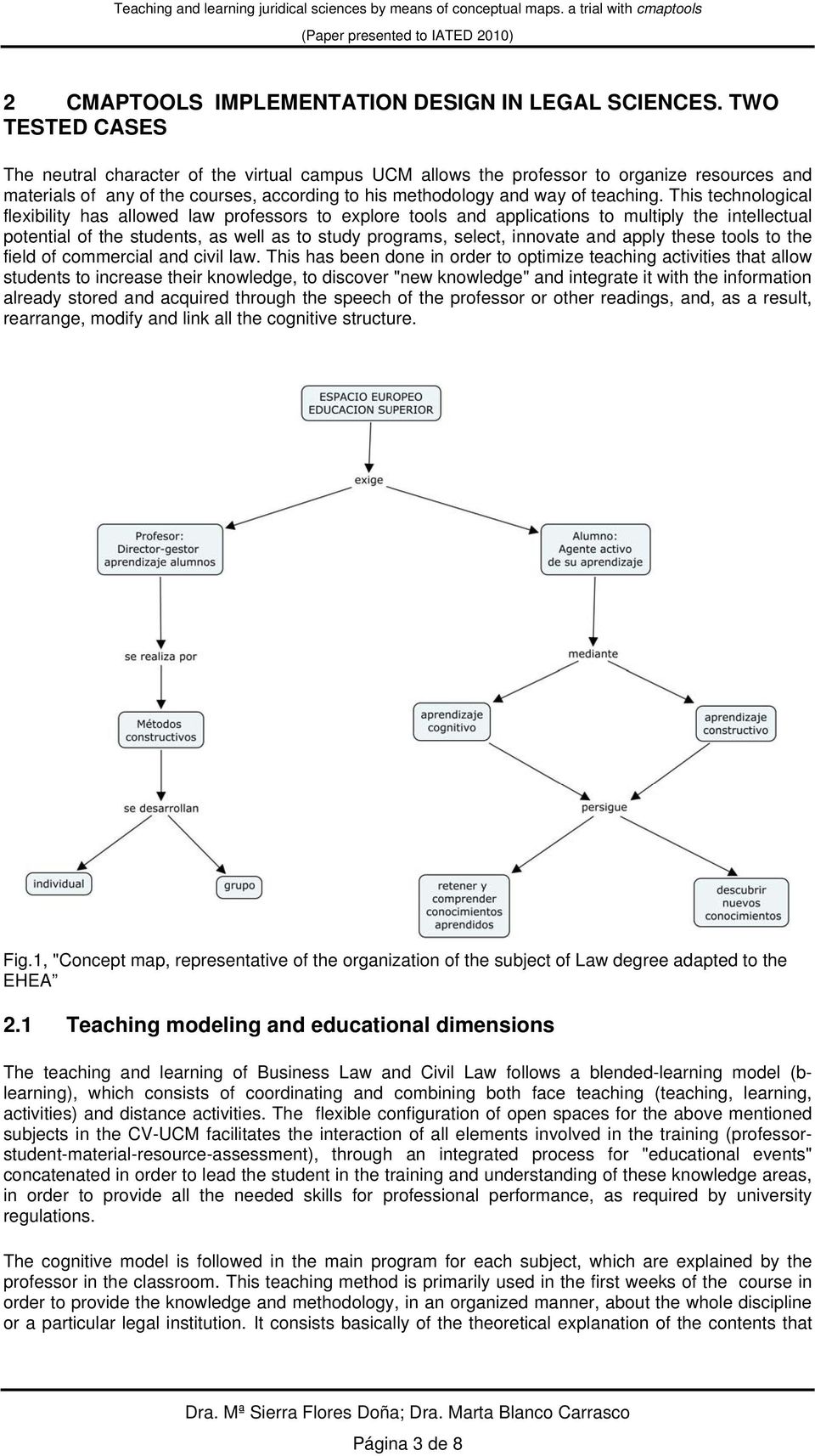
3 2 CMAPTOOLS IMPLEMENTATION DESIGN IN LEGAL SCIENCES. TWO TESTED CASES The neutral character of the virtual campus UCM allows the professor to organize resources and materials of any of the courses, according to his methodology and way of teaching. This technological flexibility has allowed law professors to explore tools and applications to multiply the intellectual potential of the students, as well as to study programs, select, innovate and apply these tools to the field of commercial and civil law. This has been done in order to optimize teaching activities that allow students to increase their knowledge, to discover "new knowledge" and integrate it with the information already stored and acquired through the speech of the professor or other readings, and, as a result, rearrange, modify and link all the cognitive structure. Fig.1, "Concept map, representative of the organization of the subject of Law degree adapted to the EHEA 2.1 Teaching modeling and educational dimensions The teaching and learning of Business Law and Civil Law follows a blended-learning model (blearning), which consists of coordinating and combining both face teaching (teaching, learning, activities) and distance activities. The flexible configuration of open spaces for the above mentioned subjects in the CV-UCM facilitates the interaction of all elements involved in the training (professorstudent-material-resource-assessment), through an integrated process for "educational events" concatenated in order to lead the student in the training and understanding of these knowledge areas, in order to provide all the needed skills for professional performance, as required by university regulations. The cognitive model is followed in the main program for each subject, which are explained by the professor in the classroom. This teaching method is primarily used in the first weeks of the course in order to provide the knowledge and methodology, in an organized manner, about the whole discipline or a particular legal institution. It consists basically of the theoretical explanation of the contents that Página 3 de 8
4 make up the different lessons of the program: contextual framework for analysis (Entrepreneur, Business Register, competition in regard to the Trade Law), development of the legal system, referring to practical applications and paying special attention to the case studies in which groups of students work. Both learning this issues and the use of open space for the subjects in the CV-UCM are used at the same time. The rest of teaching activities follow a model that emphasizes the interactive construction of knowledge through open spaces for the aforementioned subjects, so that students apply the acquired knowledge, discuss among them about issues they discover, solve problems they find and participate and succeed in pilot activities. For this reason, there are many tools availavle for students at E-Trade that enable them to access and share bibliographic information they require (through institutional and corporate links) as well as to interact among themselves by means of continuous communication, synchronous or asynchronous (skype, forum, etc); these tools also allow students to structure the tasks and organize the final information results to be submitted (forms for summary judgments and other commercial documentation, conceptual paintings, glossary using database). 2.2 Organization model for the course on Law in the Bachelor of Law. Case "Our company Fig. 2,.Organization model of the course on company Law in the Bachelor of Law. Author: M ª de la Sierra Flores Doña Página 4 de 8

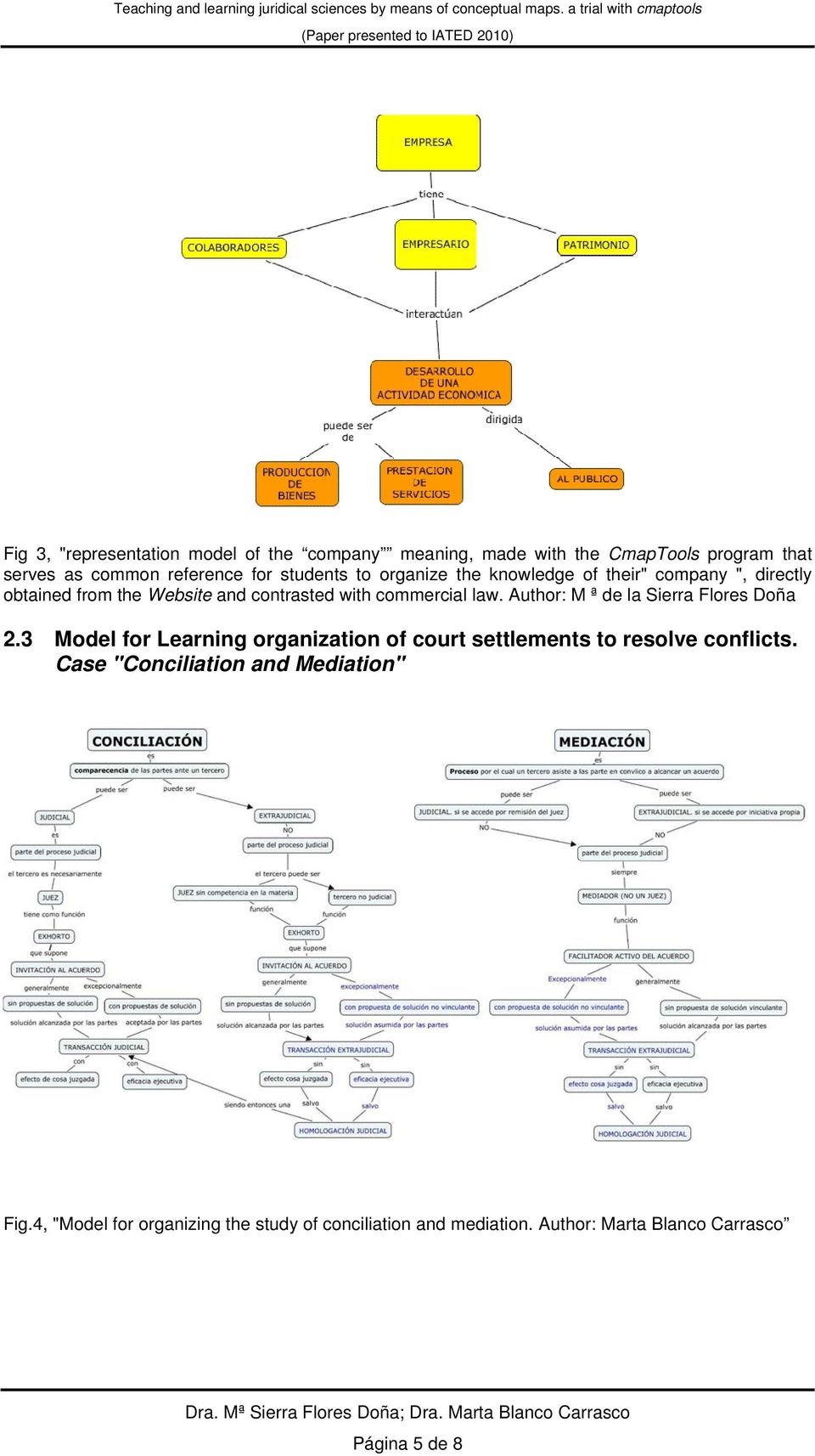
5 Fig 3, "representation model of the company meaning, made with the CmapTools program that serves as common reference for students to organize the knowledge of their" company ", directly obtained from the Website and contrasted with commercial law. Author: M ª de la Sierra Flores Doña 2.3 Model for Learning organization of court settlements to resolve conflicts. Case "Conciliation and Mediation" Fig.4, "Model for organizing the study of conciliation and mediation. Author: Marta Blanco Carrasco Página 5 de 8
6 3 PLANNING AND IMPLEMENTATION OF DIDACTIC ACTIVITIES MODELING: SCENARIOS, RESOURCES 3.1 Logical Development using CmapTools Student involvement is central to a teaching model which, like the EHEA, emphasizes the constructive learning model. The exploration of instruments and tools with successive groups of students enrolled in Business Law and Civil Law has led us to integrate conceptual maps as a mean of graphic representation of knowledge. With this method, learning of a legal matter is discovered by the student from the conjunction of the different concepts and propositions that make up each of the terms, which are the propositions and links that make up the respective conceptual maps. The free and open access tool "CmapTools" has been chosen for students to develop, individually or collaboratively different "terms, concepts and relationships" involved in the subjects studied The subsequent realization of "concept maps" facilitates the construction of knowledge models. This method of "constructive partner" contributes to meaningful learning simplifying thus the "assimilation and understanding process of the issues involved in the subjects of Commercial Law and Civil Law. Fig.5, "Home website of the Institute for Human and Machine Cognition (IHMC), from which CmapTools program can be downloaded Educational activities: scenarios and resources Under this approach the professor must plan instructional activities, together with their respective sites and resources. In summary, taking as example the entrepreneur, its construction is done through: (i) a theoretical foundation of knowledge provided by the professor and (ii) an applied basis, through the knowledge extracted from the website of the company assigned to each group of students (among those studied such as Bimbo, Mango, Ing Direct, Iberia), the work system would develop in the following phases with their respective activities and teaching resources. First Phase: the discourse of the professor as a lesson that would be about: the concept and modalities of the employer, the legal consequences of employer status, relationship between the employer and its employees. During this phase, the professor assumes the main role and students can participate by asking questions or expressing an opinion. This information would provide the students with essential theoretical knowledge. Página 6 de 8

7 Phase Two: Application of the acquired knowledge to the case study assigned to each group and construction of specific knowledge. The professor will instruct students about the information data that each group must extract about the entrepreneur who appears on the website of your company. During this phase, the student has a leading role and there is no need to attend classes. The student will have different multimedia material, such as audiovisual presentation of the lesson, links to legal databases and specific articles on the subject. Phase Three: Communication and interaction among students, through the Forum. The communication of the information requested is published in the Forum. With the completion of this activity, the student extracts the information from the web and transform it into legal language, hence it somehow "build their own knowledge". As the owner of the company could be, for example "a limited liability company, whose characteristics and legal status are different to the "knowledge" general concept of employer transmitted by the professor, it then adds and integrates the knowledge received. Teaching and other activities are optimized with the use of communicative spaces such as forum, chat or electronic whiteboard. By using these tools, interactivity between students and professor take place, so that students can discover "new knowledge", "change the grandfathering", "strengthen" in short, reorganize, consolidate and link all the cognitive structure around the entrepreneur. Phase Four: Presentation and oral defense of the results. The oral presentation is made by a "Powerpoint presentation, the content must conform to the model pre-designed by the professor.. Each group member orally defends the part that is responsible for, thereby facilitating the formulation of questions by other students and the individual assessment of each student. The "company study" involves learning as well as interactive personal and social development. The other school activities follow a similar teaching and learning process. They have in common to combine legal learning, with personal and social development of students. The study of Business Law by starting a business is a method that encourages students to: (i) apply the knowledge acquired, (ii) make it easier to discover other knowledge through the information in the Website of the company itself ( for example, business model, a multinational, family-owned, codes of conduct and court procedures). This "relevant information" gives the student knowledge that is essential and necessary to go on with the study of the company and to solve problems that could arise in the real life. And all this through a combination of four ideas: "learning"-the company-"how to learn to cooperate and work," "where to learn"-class CV-UCM and website of the company "and" what to learn" in order to use the knowledge in a proper way [4]. 4. REFERENCES [1] [AUSUBEL, D.P., NOVAK, D., HANESIAN, H.(1978), Educational Psycology: A Cognitive View, Holt, Rinehart and Winston: New York]. [2] [NOVAK, J. (1998), Learning, Creating and using Knowledge. Concept Maps as Facilitative Tools in Schools and Corporations, Lawrence Erlbaum Associates, Inc. (Trad. Esp., conocimiento y aprendizaje. Los mapas conceptuales como herramientas facilitadoras para escuelas y empresas), Madrid, Alianza Editorial, Conocimiento y aprendizaje, p. 96]. [3] [GONZALEZ GARCIA, F. Mª. (2008), El Mapa Conceptual y el Diagrama V. Recursos para la Enseñanza Superior en el siglo XXI, Narcea, Madrid, p. 39]. [4] [GARCIA GARCIA, A. (2009), Aprendizaje y construcción del conocimiento, en Las plataformas de aprendizaje. Del mito a la realidad, LOPEZ ALONSO, C. y MATESANZ DEL BARRIO (eds.), Biblioteca Nueva, Madrid, p. 32, p. 49]. [5] [FERNANDEZ-VALMAYOR y cols. (2008), IV Jornada Campus Virtual UCM: Innovación en el Campus Virtual metodologías y herramientas, Madrid, Ed. Complutense. Versión electrónica ]. [6] [FLORES DOÑA, Mª.S. (2009), Tecnologías de la Información y de la Comunicación en docencia y aprendizaje: Campus Virtual (Conferencia) I Jornadas, El Espacio Europeo de Educación Superior en la Facultad de Derecho-UCM, marzo]. También puede verse en: Pedagogical innovation applied to Commercial law. Versión electrónica del trabajo presentado en Página 7 de 8
8 EDULEARN09 the International Conference on Education and New Learning Technologies, 6, 7 y 8 de julio de 2009, Barcelona. Página 8 de 8

PROBLEM-BASED LEARNING AND THE USE OF NEW LEARNING- TEACHING METHODOLOGY
 PROBLEM-BASED LEARNING AND THE USE OF NEW LEARNING- TEACHING METHODOLOGY A. Avalos, L. Martín, E. Pérez-Urria, B. Pintos Facultad de Biología. Universidad Complutense Madrid / Spain [email protected],
Active methodology in the Audiovisual communication degree
 Available online at www.sciencedirect.com Procedia Social and Behavioral Sciences 2 (2010) 4487 4491 WCES-2010 Active methodology in the Audiovisual communication degree J.L Gimenez-Lopez a *, T. Magal
A CALCULUS COURSE WITH INTERACTIVE SUPPORT ON MOODLE
 A CALCULUS COURSE WITH INTERACTIVE SUPPORT ON MOODLE M. Estela Carbonell, J. Saà-Seoane Universitat Politècnica de Catalunya (UPC) Barcelona/Spain [email protected] [email protected] Abstract We are
DEVELOPMENT AND ASSESSMENT OF COMPETENCES THROUGH PARTICIPATIVE LEARNING METHODOLOGIES FOR CORPORATE ACCOUNTING (OPERACIONES SOCIETARIAS)
 DEVELOPMENT AND ASSESSMENT OF COMPETENCES THROUGH PARTICIPATIVE LEARNING METHODOLOGIES FOR CORPORATE ACCOUNTING (OPERACIONES SOCIETARIAS) Carretié Arangüena, Héctor Business Management Department Faculty
Memorias del XI Encuentro Nacional de Estudios en Lenguas (2010) ISBN: 978-607-7698-32-6 JCLIC A PLATFORM TO DEVELOP MULTIMEDIA MATERIAL
 JCLIC A PLATFORM TO DEVELOP MULTIMEDIA MATERIAL Abstract Bianca Socorro García Mendoza Eduardo Almeida del Castillo Tecnológico de Estudios Superiores de Ecatepec Facultad de Estudios Superiores Acatlàn,
THE STUDENT S PERSPECTIVE: TEACHING USAGES OF MOODLE AT UNIVERSITY
 THE STUDENT S PERSPECTIVE: TEACHING USAGES OF MOODLE AT UNIVERSITY José Sánchez-Santamaría, Francisco Javier Ramos, Pablo Sánchez-Antolín University of Castilla-La Mancha (SPAIN) [email protected],
La educación virtual como herramienta en la orientación educativa
 La educación virtual como herramienta en la orientación educativa Virtual education as a tool in educational guidance Ma. Guadalupe Medina Zúñiga Colegio de Bachilleres del Estado de Querétaro. [email protected]
Learning to research in a Virtual Learning Environment: a case study on the effectiveness of a socio-constructivist learning design
 Learning to research in a Virtual Learning Environment: a case study on the effectiveness of a socio-constructivist learning design López-Alonso, C; Fernández-Pampillón, A; de-miguel, E.; Pita, G. [email protected],
A self-directed Virtual Learning Environment: Mi propio jefe (My own boss)
 A self-directed Virtual Learning Environment: Mi propio jefe (My own boss) Diego Ernesto Leal Fonseca, Gerardo Tibaná Herrera ([email protected], [email protected]) LIDIE Research and Development
Causes of desertion in the English teaching and translation bachelors degree programs and prevention mechanisms 2002-1-2005-2
 Causes of desertion in the English teaching and translation bachelors degree programs and prevention mechanisms 2002-1-2005-2 Martha E. Guzmán O. - Responsible for the Coordination of Educative and Psychological
UNIVERSIDAD NACIONAL ABIERTA Y A DISTANCIA ESCUELA CIENCIAS DE LA EDUCACIÓN
 UNIVERSIDAD NACIONAL ABIERTA Y A DISTANCIA ESCUELA CIENCIAS DE LA EDUCACIÓN 551018 FIRST AND SECOND LANGUAGE ACQUITION AND LEARNING Julio Tulande Henry Carvajal Evaluador UNAD Enero de 2014 1 551018 First
E-ASSESSMENT IN A MASTER ONLINE COURSE. A CASE STUDY
 E-ASSESSMENT IN A MASTER ONLINE COURSE. A CASE STUDY Inés Gil-Jaurena, Teresa Aguado, Beatriz Malik, Pilar Cucalón Universidad Nacional de Educación a Distancia (UNED) (SPAIN) Abstract E-assessment is
Higher Education in Business Administration in Spain: Adapting to the European Area of Higher Education *
 Higher Education in Business Administration in Spain: Adapting to the European Area of Higher Education * Leandro Cañibano Professor of Financial Economics and Accounting Autonomous University of Madrid
Student s Video Production as Formative Assessment
 Student s Video Production as Formative Assessment Eduardo Gama 1, Marta F. Barroso 2 1 Colégio Pedro II, Rio de Janeiro, Brazil 2 Universidade Federal do Rio de Janeiro, Physics Institute, Rio de Janeiro,
MASTER S DEGREE IN COMMUNICATION AND SPORT JOURNALISM***
 COMMUNICATION AND SPORT JOURNALISM*** Type of Master's Degree: Official Duration: 60 ECTS Credits / 12 months Study Option: Semi-campus-based Language: English Location: Villaviciosa de Odón Campus, Santiago
Effect of Participatory Methodologies in Academic Performance
 2014 4th International Conference on Education, Research and Innovation IPEDR vol.81 (2014) (2014) IACSIT Press, Singapore DOI: 10.7763/IPEDR.2014.V81.12 Effect of Participatory Methodologies in Academic
MATHEMATICS KNOWLEDGE FOR TEACHING WITHIN A FUNCTIONAL PERSPECTIVE OF PRESERVICE TEACHER TRAINING
 MATHEMATICS KNOWLEDGE FOR TEACHING WITHIN A FUNCTIONAL PERSPECTIVE OF PRESERVICE TEACHER TRAINING Pedro Gómez Universidad de Granada C/. Alisios 17, Albolote 18820, Spain Phone/Fax: (34)958537304 [email protected]
Mª de los Llanos Tobarra (UNED) and Salvador Ros (UNED): Analyzing the Students Behavior and Relevant Topics in Virtual Learning Communities
 Página 1 emadrid Seminar on Big Data in Education Education Faculty National Distance Learning University (UNED) Friday, January 17, 2014 Organizes: emadrid Network Next Friday, January 17, 2014, a seminar
Sthephanny Moncada Linares (Universidad La Gran Colombia) Andrea Carolina Díaz Romero 1/17
 A Model for Evaluating Spanish Language Learning Websites Coherent with the Communicative Language Approach: Towards the Strengthen of the Teachers' Knowing-Howto-Do Knowledge in Digital Competence Sthephanny
Master of Arts in Higher Education (both concentrations)
 Higher Education Dickinson Hall, Room 419 (501) 569-3267 Master of Arts and Doctor of Education The Master of Arts in Higher Education is designed for those individuals who are interested in entering or
GEOGRAPHICAL EDUCATION AND TEACHER TRAINING. CHALLENGES AND PROSPECTS IN THE NEW EUROPEAN HIGHER EDUCATION AREA (EHEA)
 Geographical Boletín de la Asociación education and de teacher Geógrafos training. Españoles Challenges N.º 57 and - 2011, prospects págs. in 459-464 the new European Higher Education Area (EHEA) I.S.S.N.:
Game - based learning in education
 4 th International Conference "Education Facing Contemporary World Issues", Piteşti, Romania, 2010, October, 8 th 9 th Procedia Edu -World 2010 Game - based learning in education Michaela Logofatu a, Anisoara
Global Economy and International Environment in Business Administration
 ESCUELA DE INGENIEROS DE CAMINOS, CANALES Y PUERTOS. Curso académico 2015-16 Pág. 1 de 8 Global Economy and International Environment in Business Adistration 1. General overview UPM Code Credits Type Specialization
THE LEARNING PORTFOLIO AS AN ASSESSMENT STRATEGY IN TEACHER EDUCATION
 THE LEARNING PORTFOLIO AS AN ASSESSMENT STRATEGY IN TEACHER EDUCATION Pilar Azcárate, Anna Serradó and José Mª Cardeñoso University of Cádiz; Secondary Education Teacher; University of Granada Abstract
Blogs, Webinars and Significant Learning: A Case Report on a Teacher Training Program for College Teachers 1
 Blogs, Webinars and Significant Learning: A Case Report on a Teacher Training 1 Rodrigo Polanco-Bueno Universidad del Valle de México, México ([email protected]) Abstract This paper reports on
the task- Based Approach: a way to improve the didactic competence of pre-service teachers in Colombia using technology
 ABSTRACT the task- Based Approach: a way to improve the didactic competence of pre-service teachers in Colombia using technology This article focuses its attention on an innovative application of the Task-Based
THE BENEFITS OF THE USE OF INDUCTION VIRTUAL COMMUNITIES IN SUPPORTING NEW STUDENTS IN DISTANCE EDUCATION UNIVERSITIES
 THE BENEFITS OF THE USE OF INDUCTION VIRTUAL COMMUNITIES IN SUPPORTING NEW STUDENTS IN DISTANCE EDUCATION UNIVERSITIES Angeles Sánchez-Elvira Paniagua,UNED, Spain Co-authors: Marcela Paz González Brignardello,
Learning about the influence of certain strategies and communication structures in the organizational effectiveness
 Learning about the influence of certain strategies and communication structures in the organizational effectiveness Ricardo Barros 1, Catalina Ramírez 2, Katherine Stradaioli 3 1 Universidad de los Andes,
Teaching guide ECONOMETRICS
 Teaching guide ECONOMETRICS INDEX CARD Subject Data Código Titulación Nombre Carácter Ciclo 1313.- Grado en Administración y Dirección de Empresas, Mención Creación y Dirección de Empresas, Itinerario
COMPLEMENTOS PARA LA FORMACIÓN DISCIPLINAR EN INGLÉS. Máster en Formación del Profesorado. Universidad de Alcalá
 COMPLEMENTOS PARA LA FORMACIÓN DISCIPLINAR EN INGLÉS Máster en Formación del Profesorado Universidad de Alcalá Curso Académico 2015/2016 GUÍA DOCENTE Nombre de la asignatura: Complementos para la formación
71. Art Libraries. Key words: content-management, web 2.0, social web, content syndication.
 Date submitted: 14/05/2010 Development of an open-source content-management system for documentary art heritage Elena Roseras Carcedo Library and Documentation Department Manager ARTIUM, Basque Centre-Museum
Graphic design in bachelor's degree in industrial design engineering and product development
 Available online at www.sciencedirect.com Procedia - Social and Behavioral Sciences 51 ( 2012 ) 4 9 ARTSEDU 2012 Graphic design in bachelor's degree in industrial design engineering and product development
New educational approach based on the use of wiki platforms in university environments
 New educational approach based on the use of wiki platforms in university environments Juan Ortega Valiente Departamento de Ingenierías TIC Alfonso X el Sabio Madrid, Spain [email protected] Antonio J.
DOCUSCHEMAS: EXPERIENCING WITH A MULTIMEDIA TOOL FOR SUPPORTING HIGHER EDUCATION
 DOCUSCHEMAS: EXPERIENCING WITH A MULTIMEDIA TOOL FOR SUPPORTING HIGHER EDUCATION Carolina Franco Espinosa, Jose Jesus García Rueda, Rebeca Román Julián Departamento de Ingeniería Telemática, Universidad
COURSES IN ENGLISH AND OTHER LANGUAGES AT THE UNIVERSITY OF HUELVA 2014-15 (update: 3rd October 2014)
 900060057 Geography of Spain English B1 6 - S2 Humanities / Geography department (30 places aprox) 900060055 Project management English B1 6 - S2 Engineering or Business estudies (70 places aprox) ETSI
This section looks at useful on-line resources for foreign language
 Entre Lenguas. Vol. 13 Enero - Diciembre 2008 111 Pozzobon, Claudia * La Prof. Pozzobon es Profesora - Investigadora de la Escuela de Idiomas Modernos, Facultad de Humanidades y Educación, Universidad
INTEGRATED APPROACH TO FOREIGN LANGUAGE IN THE BUILDING ENGINEERING DEGREE AT THE UNIVERSIDAD POLITECNICA MADRID
 INTEGRATED APPROACH TO FOREIGN LANGUAGE IN THE BUILDING ENGINEERING DEGREE AT THE UNIVERSIDAD POLITECNICA MADRID Ana Casaravilla, Tomás Gil, Mercedes del Río, Mercedes Valiente Universidad Politecnica
3 Conceptual Framework
 Concept Mapping: Connecting Educators Proc. of the Third Int. Conference on Concept Mapping Tallinn, Estonia & Helsinki, Finland 2008 INDIVIDUAL CONSTRUCTION OF KNOWLEDGE IN AN ONLINE COMMUNITY THROUGH
Quality Assurance in University of Alicante
 Quality Assurance in University of Alicante Sergio Luján Mora Department of Software and Computing Systems University of Alicante Content Europe Background Spanish Model ANECA University of Alicante: Quality
Universidad Pública de Navarra Public University of Navarre International student guide www.unavarra.es
 Universidad Pública de Navarra Public University of Navarre International student guide www.unavarra.es Think UPna & Live UPna The city: Pamplona / Iruña UPNA: Teaching quality Undergraduate Studies Undergaduate
THE MASTER'S DEGREE IN ENGLISH
 Academic regulations for THE MASTER'S DEGREE IN ENGLISH THE FACULTY OF HUMANITIES THE UNIVERSITY OF AARHUS 2007 1 Framework conditions Title Prepared by Effective date Prescribed points Master s degree
Titulación 1313.- Grado en Administración y Dirección de Empresas, Mención Creación y Dirección de Empresas, Itinerario Emprendedores.
 Guía Docente Foundations of Market Research FICHA IDENTIFICATIVA Datos de la Asignatura Código 36267 Titulación 1313.- Grado en Administración y Dirección de Empresas, Mención Creación y Dirección de Empresas,
TRANSITIONAL DISTANCE THEORY AND COMMUNIMCATION IN ONLINE COURSES A CASE STUDY
 TRANSITIONAL DISTANCE THEORY AND COMMUNIMCATION IN ONLINE COURSES A CASE STUDY Scott Mensch, Indiana University of Pennsylvania [email protected] Azad Ali, Indiana University of Pennsylvania [email protected]
How To Hold A Conference On Foreign Language Teaching
 II International Conference in Applied Linguistics to Foreign Language Teachin: Towards Multilingualism Nebrija University is pleased to invite you to the II International Conference of Applied Linguistics
DoQuP project. WP.1 - Definition and implementation of an on-line documentation system for quality assurance of study programmes in partner countries
 DoQuP project WP.1 - Definition and implementation of an on-line documentation system for quality assurance of study programmes in partner countries Deliverable 1.3 - Methodologies and procedures of definition,
Engineering Education through elearning technology in Spain
 Engineering Education through elearning technology in Spain Juan Carlos Fernández Rodríguez 1, José Javier Rainer Granados 1, Fernando Miralles Muñoz 2 1 Bureau Veritas Centro Universitario, Madrid, Spain.
Conference "Competencies and Capabilities in Education" Oradea 2009 EDUCAŢIA ANTREPRENORIALĂ - EDUCAŢIE PENTRU VIITOR
 EDUCAŢIA ANTREPRENORIALĂ - EDUCAŢIE PENTRU VIITOR ENTREPRENEURIAL EDUCATION - EDUCATION FOR THE FUTURE Andrada Pandelea 1 Abstract The development of the entrepreneurial spirit among young people is a
REGULATIONS FOR THE DEGREE OF MASTER OF SCIENCE IN INFORMATION TECHNOLOGY IN EDUCATION (MSc[ITE])
![REGULATIONS FOR THE DEGREE OF MASTER OF SCIENCE IN INFORMATION TECHNOLOGY IN EDUCATION (MSc[ITE])](/thumbs/25/4601106.jpg "REGULATIONS FOR THE DEGREE OF MASTER OF SCIENCE IN INFORMATION TECHNOLOGY IN EDUCATION (MSc[ITE])") 229 REGULATIONS FOR THE DEGREE OF MASTER OF SCIENCE IN INFORMATION TECHNOLOGY IN EDUCATION (MSc[ITE]) (See also General Regulations) Any publication based on work approved for a higher degree should contain
229 REGULATIONS FOR THE DEGREE OF MASTER OF SCIENCE IN INFORMATION TECHNOLOGY IN EDUCATION (MSc[ITE]) (See also General Regulations) Any publication based on work approved for a higher degree should contain
SCHOOL OF SOCIAL SCIENCES BACHELOR S DEGREE IN INTERNATIONAL RELATIONS
 SCHOOL OF SOCIAL SCIENCES BACHELOR S DEGREE IN WELCOME TO UNIVERSIDAD EUROPEA DE MADRID Welcome to Universidad Europea de Madrid, a young, dynamic institution, fully prepared to meet the challenges of
Educational Media, Online Learning, Didactical Design, Master Program, Internet
 "Educational Media": An internet based master-program for teachers and educational managers Michael Kerres University of Duisburg-Essen, Germany Chair of Educational Media and Knowledge Management Director
A NEW MODEL TO MEASURE AND MANAGE INTELLECTUAL CAPITAL
 A NEW MODEL TO MEASURE AND MANAGE INTELLECTUAL CAPITAL Gregorio Martín de Castro a José Emilio Navas López b Fernando Enrique García Muiña c Pedro López Sáez d a,b,d Departamento de Organización de Empresas,
Study Plan. Bachelor s in. Faculty of Foreign Languages University of Jordan
 Study Plan Bachelor s in Spanish and English Faculty of Foreign Languages University of Jordan 2009/2010 Department of European Languages Faculty of Foreign Languages University of Jordan Degree: B.A.
L I N G U A X Revista de Lenguas Aplicadas
 L I N G U A X Revista de Lenguas Aplicadas S E P A R A T A Irina Argüelles Álvarez Laura peco González Blended-learning in ESP: An insight in Moodle UNIVERSIDAD ALFONSO X EL SABIO Facultad de Lenguas Aplicadas
A COMPETENCY BASED CURRICULUM FOR PRIMARY EDUCATION OVERVIEW
 A COMPETENCY BASED CURRICULUM FOR PRIMARY EDUCATION OVERVIEW Decree that issues the statutory framework for primary education A DECREE OF SOCIAL COMPROMISE A curriculum for all children. A curriculum that
PROBLEM-BASED LEARNING IN MATERIALS AND MANUFACTURING ENGINEERING EDUCATION ACCORDING TO THE ITESM-2015
 PROBLEM-BASED LEARNING IN MATERIALS AND MANUFACTURING ENGINEERING EDUCATION ACCORDING TO THE ITESM-2015 Eduardo Cárdenas Alemán, César Alberto Núñez López, Juan Oscar Molina Solís Monterrey Institute of
TECHNOLOGY AND SEMIOTIC REPRESENTATIONS IN LEARNING MATHEMATICS. Jose Luis Lupiáñez Gómez University of Cantabria, Spain. Abstract
 1 TECHNOLOGY AND SEMIOTIC REPRESENTATIONS IN LEARNING MATHEMATICS Jose Luis Lupiáñez Gómez University of Cantabria, Spain Abstract New technologies modify the socioculturals environments. The educational
MBA MASTER S DEGREE IN SPORTS MANAGEMENT**
 ** Type of Graduate Degree: Officially accredited Master s Degree Length of Study: 60 ECTS credits Study Option : Campus-based Location: La Moraleja Campus of the Universidad Europea de Madrid, Santiago
Evaluation of an exercise for measuring impact in e-learning: Case study of learning a second language
 Evaluation of an exercise for measuring impact in e-learning: Case study of learning a second language J.M. Sánchez-Torres Universidad Nacional de Colombia Bogotá D.C., Colombia [email protected]
Factors Affecting Critical Thinking in an Online Course. Simone Conceição, PhD Assistant Professor University of Wisconsin-Milwaukee
 1 21st Annual Conference on Distance Teaching and Learning click here -> Factors Affecting Critical Thinking in an Online Course Simone Conceição, PhD Assistant Professor University of Wisconsin-Milwaukee
BUSINESS COMMUNICATION- SPANISH FOR BUSINESS
 BUSINESS COMMUNICATION- SPANISH FOR BUSINESS 6 ECTS credits 65 teaching hours/ 5 contact hours per week The goals, contents and activities of this course are organized in three main blocks and cover all
DEGREE: POLITICAL SCIENCE YEAR: 2º TERM: 2º WEEKLY PLANNING
 SESSION WEEK COURSE: ADMINISTRATIVE LAW DEGREE: POLITICAL SCIENCE YEAR: 2º TERM: 2º WEEKLY PLANNING DESCRIPTION GROUPS (mark ) Special room for session (computer classroom, audio-visual classroom ) WEEKLY
Curriculum Reform in Computing in Spain
 Curriculum Reform in Computing in Spain Sergio Luján Mora Deparment of Software and Computing Systems Content Introduction Computing Disciplines i Computer Engineering Computer Science Information Systems
Student Involvement in Computer-Mediated Communication: Comparing Discussion Posts in Online and Blended Learning Contexts
 The 1 st International Conference on Virtual Learning, ICVL 2006 113 Student Involvement in Computer-Mediated Communication: Comparing Discussion Posts in Online and Blended Learning Contexts Amy M. Bippus
Penn State Online Faculty Competencies for Online Teaching
 Teaching in an online environment can be considerably different in nature than teaching face-to-face. The competencies listed in this document are intended to provide faculty and administrators with a
TEACHERS VIEWS AND USE OF EXPLANATION IN TEACHING MATHEMATICS Jarmila Novotná
 TEACHERS VIEWS AND USE OF EXPLANATION IN TEACHING MATHEMATICS Jarmila Novotná Abstract This study analyses teachers of mathematics views on explications in teaching mathematics. Various types of explanations
Ph.D. in Philosophy (History and Geography), Universidad Autónoma, Madrid, 1994
 Juan Carlos Ocaña Head of the Bilingual Section IES Parque de Lisboa Alcorcón (Spain) E-mail: [email protected] Web site: http://www.historiasiglo20.org ACADEMIC PREPARATION: Ph.D. in Philosophy
UNIVERSITY OF ALCALÁ EDUCATION OFFICE OF THE SPANISH EMBASSY MINISTRY OF EDUCATION, SCIENCE AND SPORTS SPANISH CULTURE AND ITS USE AT THE ELE CLASSES
 UNIVERSITY OF ALCALÁ EDUCATION OFFICE OF THE SPANISH EMBASSY MINISTRY OF EDUCATION, SCIENCE AND SPORTS SPANISH CULTURE AND ITS USE AT THE ELE CLASSES COURSE FOR TEACHERS OF SPANISH OF THE UNITED STATES
BACHELOR S DEGREE IN BUSINESS ADMINISTRATION
 BACHELOR S DEGREE IN BUSINESS ADMINISTRATION Subject Financial Accounting II Code 802275 Module Accounting Area Accounting for external users Character Compulsory Attendance 3 Credits 6 Non attendance