
SLippery SLope: Dealing with false testimony in personal injury actions. Law Society
|
|
|
- Jodie Goodwin
- 10 years ago
- Views:
Transcription
1 Law Society Production values David Puttnam on why justice is not, and never can be, a commodity Kitchen nightmares What you need to know following the Kelleher conveyancing case Arrear ended What lenders must do before seeking repossession orders Gazette 4.00 May 2012 SLippery SLope: Dealing with false testimony in personal injury actions

2 Hackett Legal Support Dedicated service to the legal profession Rapid response to meet crucial deadlines Experienced with sensitive, fragile and oversized documents Hacketts provide a full range of litigation and document management solutions with the flexibility of service needed to cope with any size project to any tight deadline. Services range from large scale litigation support projects through to basic reprographics. Reprographic services: Photocopying b/w & colour Binding and finishing Re-construction of originals Large format b/w & colour 24/7 working Free collection and delivery within designated areas Technology services: Scanning to Tiff and PDF Electronic transaction bibles Litigation support services including coding, software consultancy & electronic disclosure Web Review and Hosting Dublin Colum McNally Dun Laoghaire Colum McNally Cork Brian O Loughlin Limerick Damien Morgan

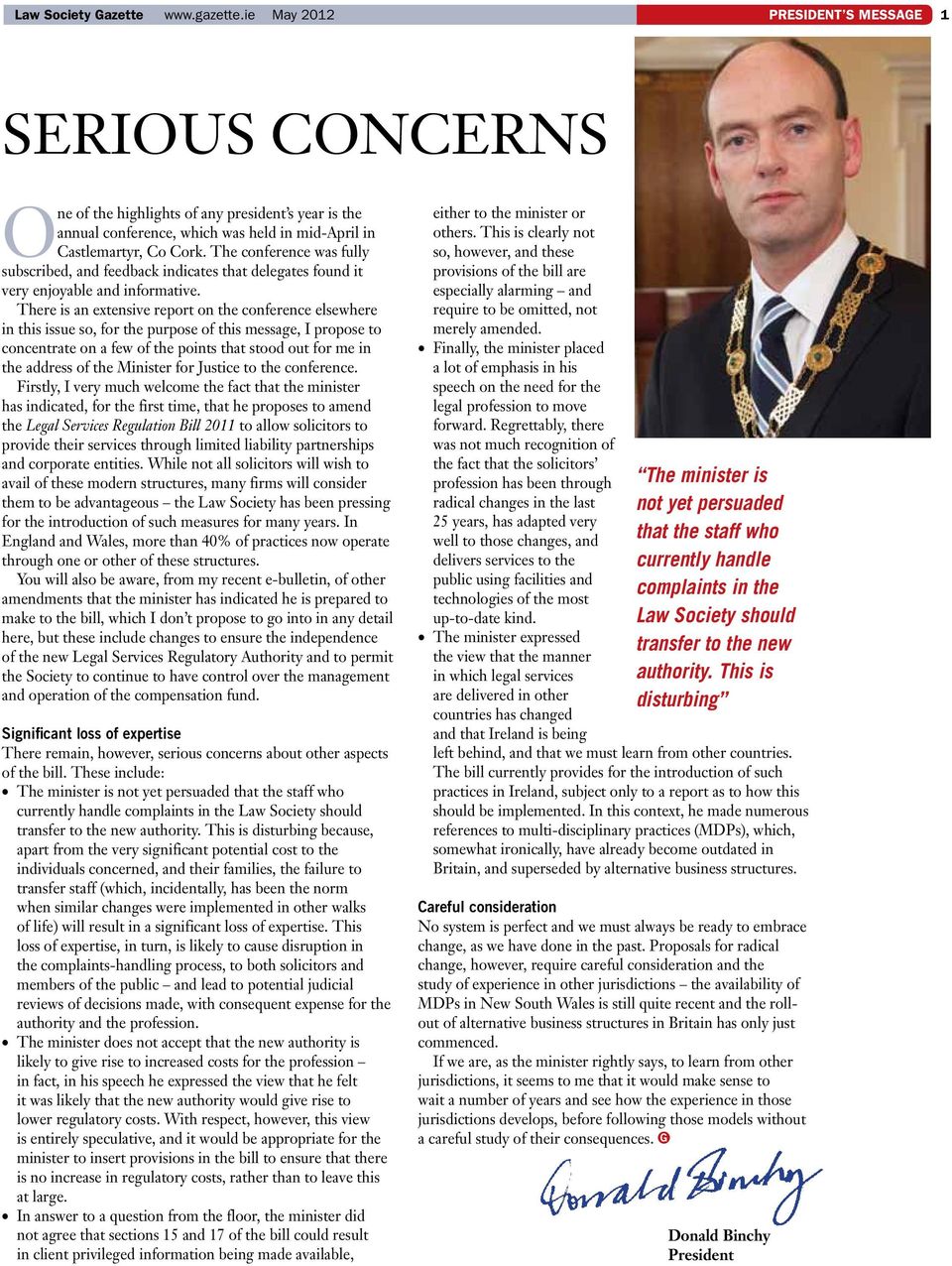
3 Law Society Gazette May 2012 PRESIDENT S MESSAGE 1 SERIOUS CONCERNS One of the highlights of any president s year is the annual conference, which was held in mid-april in Castlemartyr, Co Cork. The conference was fully subscribed, and feedback indicates that delegates found it very enjoyable and informative. There is an extensive report on the conference elsewhere in this issue so, for the purpose of this message, I propose to concentrate on a few of the points that stood out for me in the address of the Minister for Justice to the conference. Firstly, I very much welcome the fact that the minister has indicated, for the first time, that he proposes to amend the Legal Services Regulation Bill 2011 to allow solicitors to provide their services through limited liability partnerships and corporate entities. While not all solicitors will wish to avail of these modern structures, many firms will consider them to be advantageous the Law Society has been pressing for the introduction of such measures for many years. In England and Wales, more than 40% of practices now operate through one or other of these structures. You will also be aware, from my recent e-bulletin, of other amendments that the minister has indicated he is prepared to make to the bill, which I don t propose to go into in any detail here, but these include changes to ensure the independence of the new Legal Services Regulatory Authority and to permit the Society to continue to have control over the management and operation of the compensation fund. Significant loss of expertise There remain, however, serious concerns about other aspects of the bill. These include: The minister is not yet persuaded that the staff who currently handle complaints in the Law Society should transfer to the new authority. This is disturbing because, apart from the very significant potential cost to the individuals concerned, and their families, the failure to transfer staff (which, incidentally, has been the norm when similar changes were implemented in other walks of life) will result in a significant loss of expertise. This loss of expertise, in turn, is likely to cause disruption in the complaints-handling process, to both solicitors and members of the public and lead to potential judicial reviews of decisions made, with consequent expense for the authority and the profession. The minister does not accept that the new authority is likely to give rise to increased costs for the profession in fact, in his speech he expressed the view that he felt it was likely that the new authority would give rise to lower regulatory costs. With respect, however, this view is entirely speculative, and it would be appropriate for the minister to insert provisions in the bill to ensure that there is no increase in regulatory costs, rather than to leave this at large. In answer to a question from the floor, the minister did not agree that sections 15 and 17 of the bill could result in client privileged information being made available, either to the minister or others. This is clearly not so, however, and these provisions of the bill are especially alarming and require to be omitted, not merely amended. Finally, the minister placed a lot of emphasis in his speech on the need for the legal profession to move forward. Regrettably, there was not much recognition of the fact that the solicitors profession has been through radical changes in the last 25 years, has adapted very well to those changes, and delivers services to the public using facilities and technologies of the most up-to-date kind. The minister expressed the view that the manner in which legal services are delivered in other countries has changed and that Ireland is being The minister is not yet persuaded that the staff who currently handle complaints in the Law Society should transfer to the new authority. This is disturbing left behind, and that we must learn from other countries. The bill currently provides for the introduction of such practices in Ireland, subject only to a report as to how this should be implemented. In this context, he made numerous references to multi-disciplinary practices (MDPs), which, somewhat ironically, have already become outdated in Britain, and superseded by alternative business structures. Careful consideration No system is perfect and we must always be ready to embrace change, as we have done in the past. Proposals for radical change, however, require careful consideration and the study of experience in other jurisdictions the availability of MDPs in New South Wales is still quite recent and the rollout of alternative business structures in Britain has only just commenced. If we are, as the minister rightly says, to learn from other jurisdictions, it seems to me that it would make sense to wait a number of years and see how the experience in those jurisdictions develops, before following those models without a careful study of their consequences. G Donald Binchy President
4 2 contents Law Society Gazette May 2012 Law Society Gazette Volume 106, number 4 Subscriptions: 60/ 90 Editor: Mark McDermott FIIC Deputy editor: Dr Garrett O Boyle Art director: Nuala Redmond Editorial secretaries: Catherine Kearney, Valerie Farrell Commercial advertising: Seán Ó hoisín, tel: , [email protected] For professional notice rates (wills, title deeds, employment, miscellaneous), see page 62. Published at Blackhall Place, Dublin 7, tel: , fax: [email protected] Website: Printing: Turner s Printing Company Ltd, Longford Editorial board: Michael Kealey (chairman), Mark McDermott (secretary), Mairéad Cashman, Paul Egan, Richard Hammond, Mary Keane, Aisling Kelly, Tracy Lyne, Patrick J McGonagle, Ken Murphy, Andrew Sheridan The Law Society of Ireland can accept no responsibility for the accuracy of contributed articles or statements appearing in this magazine, and any views or opinions expressed are not necessarily those of the Law Society s Council, save where otherwise indicated. No responsibility for loss or distress occasioned to any person acting or refraining from acting as a result of the material in this publication can be accepted by the authors, contributors, editor or publishers. The editor reserves the right to make publishing decisions on any advertisement or editorial article submitted to this magazine, and to refuse publication or to edit any editorial material as seems appropriate to him. Professional legal advice should always be sought in relation to any specific matter. FSC independently certified wood and paper products used by the Law Society Gazette come from ecologically managed forests. Visit: Law Society Gazette RegularS 4 News 12 Analysis 12 News feature: Report on the Law Society s annual conference 16 News feature: What have been the consequences of the Arab Spring? 18 Human rights watch: Rules rewritten on the issuing of search warrents 20 Comment 20 Viewpoint: Sir David Puttnam on why justice is not, and never can be, a commodity 23 Viewpoint: Ercus Stewart urges colleagues to think about donating blood 25 Letters 46 People and places 52 Books 52 Book reviews: Privacy and Libel Law: the Clash with Press Freedom, Bankruptcy Law and Practice and Criminal Procedure in the District Court 53 Reading room: Updates from the Law Society Library 55 Briefing 55 Council report 30 March Practice notes 56 Regulation 57 Legislation update: 9 March 5 April One to watch: Criminal Justice (Female Genital Mutilation) Act Justis update?? 60 Eurlegal: RTÉ revises TV advertising sales policy after abuse of dominance investigation 62 Professional notices 63 Recruitment advertising 64 Captain s blawg 25 RM ecycle Magazines PEFC certifies that wood and paper products used by the Law Society Gazette are sourced by suppliers from sustainable, managed forests. Visit: The Law Society Gazette is a full participating member of the Press Council of Ireland and supports the Office of the Press Ombudsman. This scheme, in addition to defending the freedom of the press, offers readers a quick, fair and free method of dealing with complaints that they may have in relation to articles that appear on our pages. To contact the Office of the Press Ombudsman go to: or

5 Law Society Gazette May 2012 contents Law Society Gazette Vol 106 No 4 MAY 2012 Law Society of Ireland Law Society Gazette Production values David Puttnam on why justice is not, and never can be, a commodity Kitchen nightmares What you need to know following the Kelleher conveyancing case features Arrear ended What lenders must do before seeking repossession orders 4.00 May 2012 SLippery SLope: Dealing with false testimony in personal injury actions 30 Prior commitments The situation at Priory Hall in Dublin reflects the dire circumstances in which many residential owners now find themselves. Fiona Forde explains the rights of recourse for owners on discovery of defective building works 34 Defame and fortune Two years from now, a review of Irish libel law should be in progress. John Maher looks at the Defamation Act 2009 and draws some tentative conclusions cover story 26 Bearing false witness Section 26 of the Civil Liability and Courts Act 2004 states that, if false testimony is given or a false affidavit of verification sworn, the court shall dismiss the plaintiff s action unless it would result in an injustice being done. Sinead Morgan asks whether it has achieved its objectives 38 The duty of care In the wake of the 2010 Kelleher case, taken against a solicitor, Tadhg Dorgan looks at the procedural elements in the case and assesses the ramifications now facing practitioners in this area of conveyancing 42 Arrear window A recent High Court case underlines the obligations of lenders to comply with the mortgage arrears code of conduct when seeking to repossess property. The cheque s in the post, says David O Neill HOW TO REACH US: Law Society Gazette, Blackhall Place, Dublin 7. Tel: , fax: , [email protected] PROFESSIONAL notices: send small advert details, with payment, to: Gazette Office, Blackhall Place, Dublin 7, tel: , or [email protected]. All cheques should be made payable to: Law Society of Ireland. COMMERCIAL ADVERTISING: contact Seán Ó hoisín, 10 Arran Road, Dublin 9, tel: , fax: , mobile: , [email protected] HAVE YOU MOVED? Members of the profession should send change-of-address details to: IT Section, Blackhall Place, Dublin 7, or to: [email protected] Get more at lawsociety.ie Gazette readers can access back issues of the magazine as far back as Jan/Feb 1997, right up to the current issue at lawsociety.ie. You can also check out: Current news Forthcoming events, including the STEP conference, To Trust or to Litigate? in the Radisson SAS, Stillorgan, on Friday 18 May Employment opportunities The latest CPD courses as well as lots of other useful information

6 4 news Law Society Gazette May 2012 Nationwide Compiled by Kevin O Higgins Kevin O Higgins has been a Council member of the Law Society since 1998 Horse of a different colour TIPPERARY Free legal advice nights GALWAY Galway Citizens Information Centre is made up of volunteers from the business community. One of its roles is to oversee the provision of the weekly legal advice nights at the centre on Augustine Street. Many of our colleagues give their time voluntarily to these services, and the centre would like to hear from anyone who is not now on the panels, but who would like to get involved. The commitment is to be available for two hours on an evening every six weeks or so. This is a great service and is sorely needed, as there is no FLAC available in the West. Anyone willing to contribute their time should Mary Mulkerrin, Galway CIS development manager, at mary. [email protected]. Galway solicitors hope to publicise the service shortly to show the contribution of our colleagues to the community. Let s face it: with all the solicitor-bashing in the media, it is high time we had a good news story. In other news, to the great credit of the Galway Bar Association, they have so far provided 13 hours of free CPD and will be doing similarly in the second half of the year. Not only that, but the association will be holding its usual event in tandem with the Galway Races on Monday 30 July something that colleagues always look forward to at that time of year. The Tipperary Solicitors Bar Association held a seminar on probate recently in The Horse and Jockey, Thurles. Among those attending were (from l to r): Pat McDermott, Billy Gleeson, Susanna Manton, Margaret Campbell (speaker), Tim Bracken (speaker) and Ronan Kennedy Returning officers and other stories KILDARE At the recent Kildare Bar Association AGM, the following officers were returned: Sharon Murphy (president), Eva O Brien (treasurer), David Osborne (secretary), Andrew Cody (CPD officer), Helen Coughlan (PRO), Luke Hanahoe (social secretary), and Conal Boyce (court users rep). There were a number of items on the agenda. The first related to the delays in court. Conal Boyce told the meeting that there are likely to be a further six weeks of criminal sittings in June and July, which should help clear the burgeoning criminal list. Andrew Cody invited suggestions for CPD seminars this year. If colleagues have any thoughts or suggestions, please let Andrew know. Conal Boyce has managed to agree a statutory declaration with the Courts Service and fire service in Kildare for publicans/ special restaurant licencees with regard to the annual certification of the building regulations and, in particular, the fire regulations. This will be a big saving for publican clients. Obviously, if the premises are not in compliance, then your client has a much bigger problem to overcome. However, you may also be aware that the fire service in Kildare is now charging 200 to inspect premises, which has been the practice in other counties for some time. Conal Boyce also advised that there are new changes with regard to the lodgements in civil cases in the District Court and Circuit Court. Lodgements will have to be made to the Accountant s Office, 15/24 Phoenix Street North, Smithfield, Dublin 7; DX Dublin. It is not clear how the county registrar is to know how moneys are lodged, and you may have to send a copy of the receipt from the Accountant s Office to the county registrar with the notice of lodgement. It was suggested that, on the first day of the criminal list in the Circuit Court, there is no necessity for barristers to be present at the callover, in order to make more space available in the courtroom. Also, four days notice for any application must be given to the District Court for any application, to include licensing applications. This does not apply to domestic violence applications. If lodging a District Court appeal, and particularly where your client lodges the papers, please notify the Courts Service, so that they know which firm of solicitors is acting. This will make listing easier for all parties. It was suggested that the appeal papers be printed on headed notepaper. It has been indicated by Judge Zaidan that he is amenable to dealing with matters by community service, where applicable, due to the problem of overcrowding in the prisons. Access to the cells in Naas has been restricted due to recent security concerns, and access in future will be through the courtroom. Due to staff shortages, we are informed that the District Court office hours in Naas are 10am to 4pm, with a break between 1pm and 2pm. In Carlow, the hours are 10am to 1pm. G

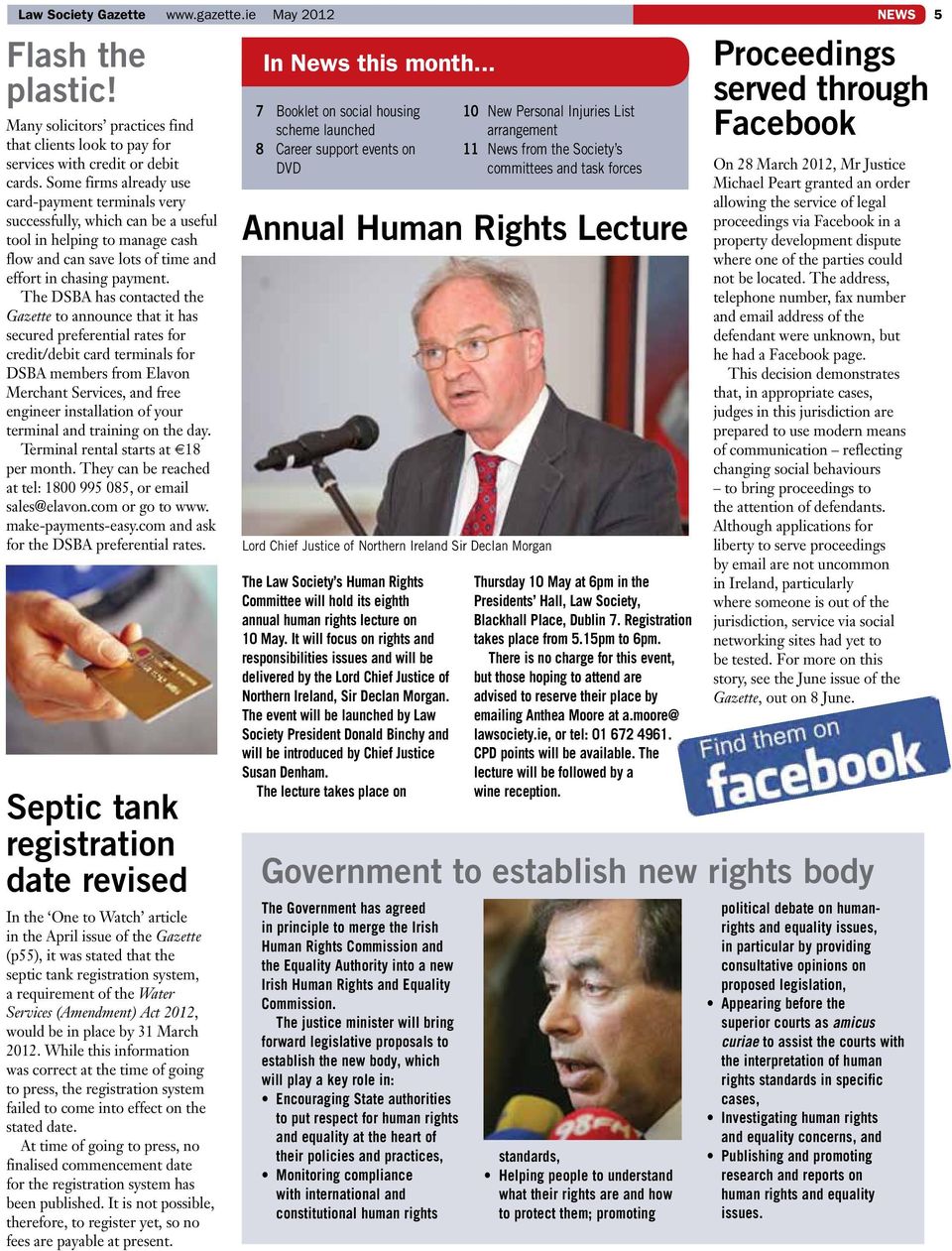
7 Law Society Gazette May 2012 news Flash the plastic! Many solicitors practices find that clients look to pay for services with credit or debit cards. Some firms already use card-payment terminals very successfully, which can be a useful tool in helping to manage cash flow and can save lots of time and effort in chasing payment. The DSBA has contacted the Gazette to announce that it has secured preferential rates for credit/debit card terminals for DSBA members from Elavon Merchant Services, and free engineer installation of your terminal and training on the day. Terminal rental starts at 18 per month. They can be reached at tel: , or [email protected] or go to www. make-payments-easy.com and ask for the DSBA preferential rates. Septic tank registration date revised In the One to Watch article in the April issue of the Gazette (p55), it was stated that the septic tank registration system, a requirement of the Water Services (Amendment) Act 2012, would be in place by 31 March While this information was correct at the time of going to press, the registration system failed to come into effect on the stated date. At time of going to press, no finalised commencement date for the registration system has been published. It is not possible, therefore, to register yet, so no fees are payable at present. In News this month... 7 Booklet on social housing scheme launched 8 Career support events on DVD The Law Society s Human Rights Committee will hold its eighth annual human rights lecture on 10 May. It will focus on rights and responsibilities issues and will be delivered by the Lord Chief Justice of Northern Ireland, Sir Declan Morgan. The event will be launched by Law Society President Donald Binchy and will be introduced by Chief Justice Susan Denham. The lecture takes place on 10 New Personal Injuries List arrangement 11 News from the Society s committees and task forces Annual Human Rights Lecture Lord Chief Justice of Northern Ireland Sir Declan Morgan The Government has agreed in principle to merge the Irish Human Rights Commission and the Equality Authority into a new Irish Human Rights and Equality Commission. The justice minister will bring forward legislative proposals to establish the new body, which will play a key role in: Encouraging State authorities to put respect for human rights and equality at the heart of their policies and practices, Monitoring compliance with international and constitutional human rights Thursday 10 May at 6pm in the Presidents Hall, Law Society, Blackhall Place, Dublin 7. Registration takes place from 5.15pm to 6pm. There is no charge for this event, but those hoping to attend are advised to reserve their place by ing Anthea Moore at a.moore@ lawsociety.ie, or tel: CPD points will be available. The lecture will be followed by a wine reception. standards, Helping people to understand what their rights are and how to protect them; promoting Proceedings served through Facebook On 28 March 2012, Mr Justice Michael Peart granted an order allowing the service of legal proceedings via Facebook in a property development dispute where one of the parties could not be located. The address, telephone number, fax number and address of the defendant were unknown, but he had a Facebook page. This decision demonstrates that, in appropriate cases, judges in this jurisdiction are prepared to use modern means of communication reflecting changing social behaviours to bring proceedings to the attention of defendants. Although applications for liberty to serve proceedings by are not uncommon in Ireland, particularly where someone is out of the jurisdiction, service via social networking sites had yet to be tested. For more on this story, see the June issue of the Gazette, out on 8 June. Government to establish new rights body political debate on humanrights and equality issues, in particular by providing consultative opinions on proposed legislation, Appearing before the superior courts as amicus curiae to assist the courts with the interpretation of human rights standards in specific cases, Investigating human rights and equality concerns, and Publishing and promoting research and reports on human rights and equality issues. 5
8

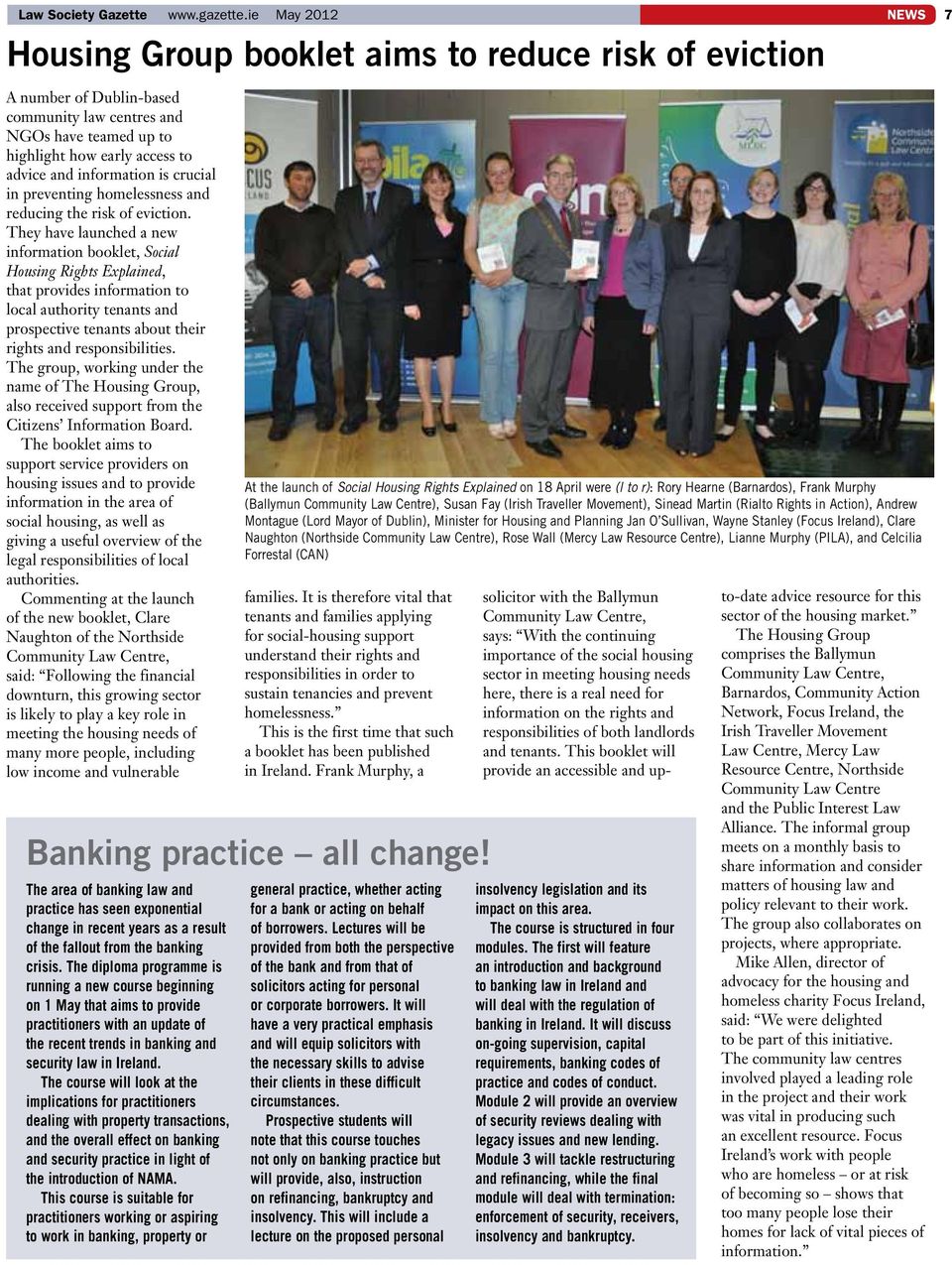
9 Law Society Gazette May 2012 news Housing Group booklet aims to reduce risk of eviction 7 A number of Dublin-based community law centres and NGOs have teamed up to highlight how early access to advice and information is crucial in preventing homelessness and reducing the risk of eviction. They have launched a new information booklet, Social Housing Rights Explained, that provides information to local authority tenants and prospective tenants about their rights and responsibilities. The group, working under the name of The Housing Group, also received support from the Citizens Information Board. The booklet aims to support service providers on housing issues and to provide information in the area of social housing, as well as giving a useful overview of the legal responsibilities of local authorities. Commenting at the launch of the new booklet, Clare Naughton of the Northside Community Law Centre, said: Following the financial downturn, this growing sector is likely to play a key role in meeting the housing needs of many more people, including low income and vulnerable The area of banking law and practice has seen exponential change in recent years as a result of the fallout from the banking crisis. The diploma programme is running a new course beginning on 1 May that aims to provide practitioners with an update of the recent trends in banking and security law in Ireland. The course will look at the implications for practitioners dealing with property transactions, and the overall effect on banking and security practice in light of the introduction of NAMA. This course is suitable for practitioners working or aspiring to work in banking, property or At the launch of Social Housing Rights Explained on 18 April were (l to r): Rory Hearne (Barnardos), Frank Murphy (Ballymun Community Law Centre), Susan Fay (Irish Traveller Movement), Sinead Martin (Rialto Rights in Action), Andrew Montague (Lord Mayor of Dublin), Minister for Housing and Planning Jan O Sullivan, Wayne Stanley (Focus Ireland), Clare Naughton (Northside Community Law Centre), Rose Wall (Mercy Law Resource Centre), Lianne Murphy (PILA), and Celcilia Forrestal (CAN) families. It is therefore vital that tenants and families applying for social-housing support understand their rights and responsibilities in order to sustain tenancies and prevent homelessness. This is the first time that such a booklet has been published in Ireland. Frank Murphy, a Banking practice all change! general practice, whether acting for a bank or acting on behalf of borrowers. Lectures will be provided from both the perspective of the bank and from that of solicitors acting for personal or corporate borrowers. It will have a very practical emphasis and will equip solicitors with the necessary skills to advise their clients in these difficult circumstances. Prospective students will note that this course touches not only on banking practice but will provide, also, instruction on refinancing, bankruptcy and insolvency. This will include a lecture on the proposed personal insolvency legislation and its impact on this area. The course is structured in four modules. The first will feature an introduction and background to banking law in Ireland and will deal with the regulation of banking in Ireland. It will discuss on-going supervision, capital requirements, banking codes of practice and codes of conduct. Module 2 will provide an overview of security reviews dealing with legacy issues and new lending. Module 3 will tackle restructuring and refinancing, while the final module will deal with termination: enforcement of security, receivers, insolvency and bankruptcy. solicitor with the Ballymun Community Law Centre, says: With the continuing importance of the social housing sector in meeting housing needs here, there is a real need for information on the rights and responsibilities of both landlords and tenants. This booklet will provide an accessible and upto-date advice resource for this sector of the housing market. The Housing Group comprises the Ballymun Community Law Centre, Barnardos, Community Action Network, Focus Ireland, the Irish Traveller Movement Law Centre, Mercy Law Resource Centre, Northside Community Law Centre and the Public Interest Law Alliance. The informal group meets on a monthly basis to share information and consider matters of housing law and policy relevant to their work. The group also collaborates on projects, where appropriate. Mike Allen, director of advocacy for the housing and homeless charity Focus Ireland, said: We were delighted to be part of this initiative. The community law centres involved played a leading role in the project and their work was vital in producing such an excellent resource. Focus Ireland s work with people who are homeless or at risk of becoming so shows that too many people lose their homes for lack of vital pieces of information.
10 8 news Law Society Gazette May 2012 outlaws AND INLAWS Lives less ordinary SEÁN FORDE Priest Seán Forde trained as a solicitor in Galway with his late father and, after qualifying, worked with a busy firm in Letterkenny. He enjoyed being a solicitor and admits to still missing the practice of law from time to time. In 1995, Seán joined the Carmelites and started an extensive period of study in religious life. He spent four years studying philosophy and then studied theology. He progressed to do an MA in Christian ethics at King s College, London. He was ordained to the priesthood in After his ordination, he started a PhD in philosophy. In 2008, he was asked to take up an appointment in the Dublin parish of Knocklyon, where he has worked since. Seán believes Ireland is in need of renewal and that the Catholic Church needs to bring the Christian message to bear on deliberations and choices. Information on the Carmelites is at: MIRIAM O CALLAGHAN Broadcaster Miriam O Callaghan qualified as a solicitor before beginning in broadcasting on ITV s This Is Your Life. She then joined the BBC as a producer in 1987 and went on to become a reporter on BBC2 s Newsnight. In the early 1990s, Miriam returned to Ireland to present Prime Time on RTÉ, while continuing to cover the Northern Ireland peace process for Newsnight. In 2000, she cofounded Mint Productions, an independent documentary production company. Miriam is well known for supporting a large number of charitable causes. She was voted Best TV Personality at the Irish Film and Television Awards in 2003 and also won the RTÉ Guide Style Award at the 2007 IFTAs, following a public vote. During the summer, she presents her own chat show, Saturday Night with Miriam, and a radio programme Miriam Meets. Her radio programme won the PPI Radio Award in 2011 for best speech-driven magazine programme. DAVID JOHNSTON Paddy Power After qualifying, David Johnston worked with McCann FitzGerald for over four years before deciding that he wanted to try his hand at an in-house role. He was chief legal counsel and company secretary with telecoms company O2 until 2007 and then became the first ever lawyer to work with Paddy Power plc when he joined as general counsel and company secretary. Paddy Power plc has been a great Irish business success story and the group has grown at a rapid pace. One of their subsidiaries, Sportsbet, is the largest online bookmaker in Australia. David and his legal team have a huge range of matters to stay on top of, including those arising out of Paddy Power s unique approach to marketing and advertising. For instance, one advertisement resulted in the largest number of complaints to the British Advertising Standards Authority during It was exonerated by the authority. Hear it from employers DVD now available Speakers at the event included (from l to r): Gareth Henry, Mary Flynn, Terence O Keeffe, Brian Connolly, Mary Reynolds, Pat Fitzsimons and Sylvia Keane A series of information events, titled Hear it from employers, has proved very popular during April, attracting large attendances. Organised by the Society s Career Support service, employers were invited to address these events. In short presentations, they outlined what they most value in the people they hire, how solicitors typically progress within their organisations, and provided other useful insights into employability and smart career development strategies. The first event focused on firms, with senior partners present from Augustus Cullen Law, A&L Goodbody, Eames Solicitors, Gartlan Furey and McDowell Purcell, as well as Olwyn Downey (HR manager with LK Shields). The second event focused on public sector and commercial organisations. Solicitors and HR managers from a range of employers participated, including the Office of the Chief State Solicitor, the Director of Public Prosecutions, the Legal Aid Board, Dublin City Council, CIE, the Public Appointments Service and Accenture. Speakers spoke about their organisations and about how solicitors are recruited and typically develop their careers within the organisation. Several speakers encouraged those attending to think expansively about career options and to embrace opportunities to work in a non-legal role that provided commercial and management exposure. The third event in the series focused on employers from the financial services sector and took place on 1 May. Speakers included senior lawyers from a cross-section of organisations including IBRC, Northern Trust, PartnerRe and Deloitte. Each of the Hear it from Employers events has been recorded on DVD and a booklet of information on each event will be provided to any member who requests a copy from Career Support (tel: or [email protected]). Another series of information events, entitled Hear it from the experts, will take place in May. At these events, a panel of people who work full-time in career-coaching and training in job-seeking skills will make presentations in Dublin and Galway on matters like networking, effective job searching and interviewing. Information on these events is available at ie/pages/careersemploymentmembers/career-supportmembers/seminars.

11 Law Society Gazette May 2012 news LawCare s confidential service offers a helping hand LawCare operates a free and confidential helpline for lawyers, their families and staff, writes Mary Jackson (LawCare Co-ordinator (Ireland). The calls are wide ranging from a man who had been expelled from a partnership when his filing cabinet and desk were discovered to be full of empty vodka bottles, to a trainee who had been thrown into the deep end on a difficult matter, with no support, and was wondering whether she could cope and whether the law was the career for her after all. In between are the solicitors struggling to juggle family and work, suffering anxiety attacks after meetings with angry clients, succumbing to depression because they have been relentlessly bullied over many months, and suffering stress arising from the economic downturn with the scarcity of conveyancing work. It s not easy being a lawyer in the 21st century. All helpline callers to LawCare s helpline are offered immediate one-to-one personal support. Having dealt with the immediate issue, the caller may be offered a volunteer a fellowlawyer to be available by phone on an ongoing basis for when things get tough. They have the reassurance of knowing that the person they are speaking to has experienced similar problems in the past and survived. Facing each day How can LawCare achieve this level of support? The key is our volunteers, lawyers living across Ireland, who offer care and support to their peers. In one case, a volunteer has helped a caller every day, for over a year, helping her to gain the strength and perspective she needs to face each day. Another volunteer put in time and effort seeking out a specialist counsellor who could help the person he was supporting. Another is attending AA meetings three times weekly with the lawyer he is helping, despite the fact that, with over 20 years sobriety, he no longer felt the need to attend for himself. For some callers, the problems are very deep-rooted, and they need more than just a sympathetic ear. In such cases, the job of the volunteer is to let LawCare know what s needed so that more specialised help can be arranged. Some lawyers find that the crisis that originally led them to call the helpline passes quickly, and so they only need very limited volunteer support. Each case is different For the volunteer, each case is different. They know that they are there to befriend and support and that they can make a significant difference to someone going through a difficult time. They are always asked if it is convenient for them to take on a particular caller, and it is entirely open to them to say no, if their current circumstances are not favourable. LawCare was established in Ireland in January 2008, and we are in need of more Irish volunteers. If you have experienced any of the problems with which LawCare helps (either personally or with family or friends), if you can see yourself as a volunteer, we would love to hear from you. It s not time consuming (most volunteers receive about two referrals per year) and, as stated, you are always free to decline a referral if you prefer. LawCare just couldn t do what it does to help suffering lawyers without the selfless service of our volunteers. If you are interested in learning more about being a volunteer for LawCare, phone our administrator, Anna Buttimore, tel: , or your postal address to [email protected]. You will be sent an information pack and application form, but you are under no pressure to apply if, having read the pack, you decide you would rather not proceed. More information is available on our website, 9 Are you getting your e-zine? The Law Society s e-zine is the legal newsletter of the solicitors profession. The e-zine issues once every two months and brings news and information directly to your computer screen in a brief and easily-digestible manner. If you re not receiving the e-zine, or have opted out previously and would like to start receiving it again, you can sign up by visiting the members section on the Law Society s website at Click on the e-zine and e-bulletins section in the left-hand menu bar and follow the instructions. You will need your solicitor s number, which is on your practising certificate and can also be obtained by ing the records department at: [email protected].

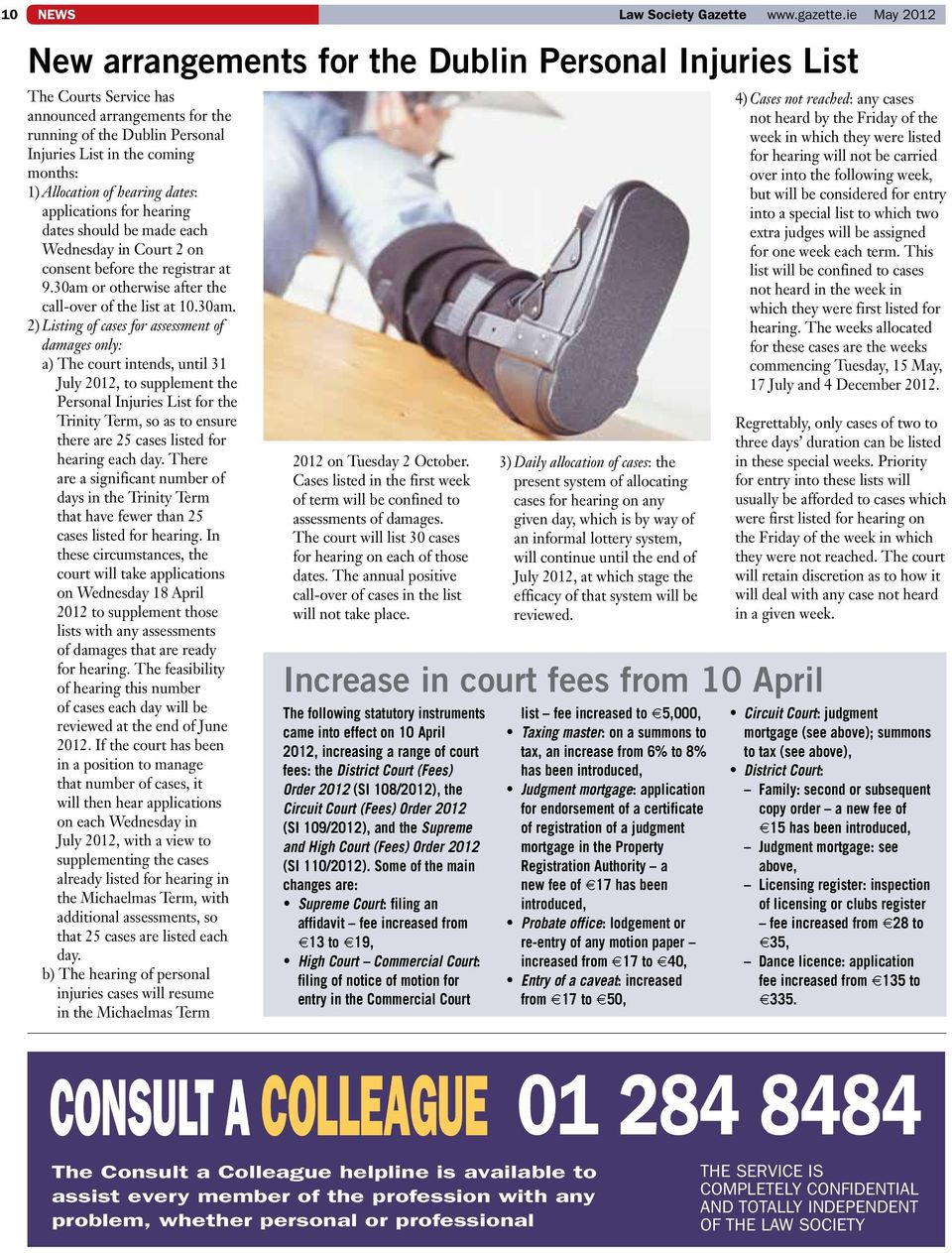
12 10 news Law Society Gazette May 2012 New arrangements for the Dublin Personal Injuries List The Courts Service has announced arrangements for the running of the Dublin Personal Injuries List in the coming months: 1) Allocation of hearing dates: applications for hearing dates should be made each Wednesday in Court 2 on consent before the registrar at 9.30am or otherwise after the call-over of the list at 10.30am. 2) Listing of cases for assessment of damages only: a) The court intends, until 31 July 2012, to supplement the Personal Injuries List for the Trinity Term, so as to ensure there are 25 cases listed for hearing each day. There are a significant number of days in the Trinity Term that have fewer than 25 cases listed for hearing. In these circumstances, the court will take applications on Wednesday 18 April 2012 to supplement those lists with any assessments of damages that are ready for hearing. The feasibility of hearing this number of cases each day will be reviewed at the end of June If the court has been in a position to manage that number of cases, it will then hear applications on each Wednesday in July 2012, with a view to supplementing the cases already listed for hearing in the Michaelmas Term, with additional assessments, so that 25 cases are listed each day. b) The hearing of personal injuries cases will resume in the Michaelmas Term 2012 on Tuesday 2 October. Cases listed in the first week of term will be confined to assessments of damages. The court will list 30 cases for hearing on each of those dates. The annual positive call-over of cases in the list will not take place. The following statutory instruments came into effect on 10 April 2012, increasing a range of court fees: the District Court (Fees) Order 2012 (SI 108/2012), the Circuit Court (Fees) Order 2012 (SI 109/2012), and the Supreme and High Court (Fees) Order 2012 (SI 110/2012). Some of the main changes are: Supreme Court: filing an affidavit fee increased from 13 to 19, High Court Commercial Court: filing of notice of motion for entry in the Commercial Court 3) Daily allocation of cases: the present system of allocating cases for hearing on any given day, which is by way of an informal lottery system, will continue until the end of July 2012, at which stage the efficacy of that system will be reviewed. Increase in court fees from 10 April list fee increased to 5,000, Taxing master: on a summons to tax, an increase from 6% to 8% has been introduced, Judgment mortgage: application for endorsement of a certificate of registration of a judgment mortgage in the Property Registration Authority a new fee of 17 has been introduced, Probate office: lodgement or re-entry of any motion paper increased from 17 to 40, Entry of a caveat: increased from 17 to 50, 4) Cases not reached: any cases not heard by the Friday of the week in which they were listed for hearing will not be carried over into the following week, but will be considered for entry into a special list to which two extra judges will be assigned for one week each term. This list will be confined to cases not heard in the week in which they were first listed for hearing. The weeks allocated for these cases are the weeks commencing Tuesday, 15 May, 17 July and 4 December Regrettably, only cases of two to three days duration can be listed in these special weeks. Priority for entry into these lists will usually be afforded to cases which were first listed for hearing on the Friday of the week in which they were not reached. The court will retain discretion as to how it will deal with any case not heard in a given week. Circuit Court: judgment mortgage (see above); summons to tax (see above), District Court: Family: second or subsequent copy order a new fee of 15 has been introduced, Judgment mortgage: see above, Licensing register: inspection of licensing or clubs register fee increased from 28 to 35, Dance licence: application fee increased from 135 to 335. consult a colleague The Consult a Colleague helpline is available to assist every member of the profession with any problem, whether personal or professional The service is completely confidential and totally independent of the Law Society
13 Law Society Gazette May 2012 news from the law society s committees and task forces Mediation as the preferred ADR process in the administration of trusts and estates representation 11 probate, administration and trusts COMMITTEE Practitioners working in the areas of the administration of trusts and estates, in a similar manner to their colleagues practising in the area of family law, have long recognised that litigation as a method of dispute resolution can be utterly inappropriate. This can be for all sorts of reasons, chiefly because of its destructive effects on family relationships, not to mention the destruction of the family silver. Practitioners are aware of the provisions of the Rules of the Superior Courts (Mediation and Conciliation) 2010 (SI 502 of 2010), which provide that a judge may award a costs sanction against a party who had refused to attempt to mediate a settlement. In these changed circumstances, it makes more sense than ever for practitioners to recommend mediation in such disputes as GUIDANCE AND ETHICS COMMITTEE being in the clients best interests. However, before a practitioner does so, s/he must be confident that s/he knows enough about the mediation process and what happens in mediation to: 1) Recommend it and answer all their clients questions about it, and 2) Attend and work with the mediator, as well as the client. The Probate, Administration and Trusts Committee, therefore, has prepared Frequently Asked Questions on Mediation in Disputes Arising in the Administration of Estates and Trusts, which covers the questions a client might ask a solicitor, as well as the questions a solicitor might themselves have about all aspects of mediation in this area. These FAQs can be found under the Probate, Administration and Trusts LITIGATION COMMITTEE The Society has noted the recent reduction in the opening hours of the Courts Service s Stamping Office. In order to facilitate members, Committee, in the members area of the Society s website. The committee recommends that practitioners give this document to clients to study and consider for themselves at the time when mediation is being considered, and that the provisions of SI 502/2010 are being explained. The committee wishes also to alert practitioners to the recent publication on the website of the Department of Justice of the draft Mediation Bill 2012 (see: The bill includes, among its provisions, a statutory obligation on a solicitor to explain mediation to clients considering litigation and, where court proceedings are launched, to confirm to the court that this information was given and that the parties did consider the use of mediation to resolve the dispute. Meet your Colleagues Day on 24 May The Guidance and Ethics Committee reminds practitioners that now is the time to start thinking about how the solicitors in your locality will mark Meet your Colleagues Day, on Thursday 24 May. This is the opportunity to take time out to get to know colleagues a little better. To locate colleagues, practitioners can quickly identify them by searching on www. lawsociety.ie, as follows: Do the search on the homepage, Select the find a firm tab at the top of page, Use only the second search box, location, on the page that opens, Enter the exact search criteria, for example Dublin 14 or Drogheda, A list will be provided, then, of the firms or other bodies in which solicitors are employed. It will be an easy matter to get the names of the individual solicitors. The committee recommends that practitioners should enquire as to whether an event is already being planned. If not, it should be possible to link up with a number of others to organise an event. For example, a get-together for solicitors could be organised locally on the day, possibly for lunch, or a social drink after work. Decide the venue and let the other solicitors know what s happening. Some groups might decide to nominate a charity of their choice to benefit from the occasion. If this event passed you by in previous years, make sure that this year is different! Have a successful event! You might let us know how you get on, by ing t.clarke@ lawsociety.ie. the Society has decided to install a stamping machine in its Four Courts offices. Arrangements are currently being put in place, and it is Work smarter, not longer! technology COMMITTEE How much do you know about the so-called emerging technologies and their use in the workplace? If you would like to know more, the Technology Committee invites you to the latest in their series of seminars on new uses of technology, Working smarter, not longer!, which takes place at Blackhall Place on Friday 29 June. The fast pace of technology innovation, particularly that of social media applications, impacts on the working environment. Mobile devices can mean that there is no longer any office downtime. This seminar will look at the use of various devices and emerging technologies in particular cloud computing and how they can make for more efficient use of your working time. It will also address security issues in using innovative applications and will provide practical guidance on data protection and other issues. More details will follow in the coming weeks. The Technology Committee organised a very successful workshop on Social media for solicitors, which was facilitated by Martin Molony of Dublin City University at DCU in late March. The committee hopes to follow this up with a workshop on blogging for legal practitioners in late spring or early summer. Court fees stamps new facility in the Law Society s Four Courts offices hoped that the new service will commence in the near future. Precise details of the date of commencement of the service will be notified in due course. G

14 12 ANALYSIS Law Society Gazette May 2012 debating change in CASTLEMARTYR Alan Shatter was the keynote speaker at the Law Society s annual conference, where he issued a robust defence of his Legal Services Regulation Bill. Mark McDermott reports on a lively exchange of views Mark McDermott is editor of the Law Society Gazette Minister Alan Shatter addressing the Law Society conference Alan Shatter was not shy in undertaking a robust defence of his Legal Services Regulation Bill 2011 at the Law Society s annual conference. Taking on his detractors in a spirited fashion, he criticised the legal profession for its failure to grasp the nettle of reform, evidenced by the several false starts to legal sector reform in the past. But there were plenty of practitioners only too willing to take him on during an extended question time, when he faced a barrage of questions on client confidentiality, the cost of the new regulatory system, judicial appointments and perceived cronyism, and most pointedly the minister s opposition to the transfer of Law Society regulatory staff to the new authority. Compliance-based regulation In his address, the minister argued that the bill provides an essential statutory structure to bring the profession into the 21st century, while guaranteeing its independence and prescribing crucial objectives and principles that lay the foundation for a move away from sole reliance on complaint-based regulation to compliance-based regulation. The minister then discussed the impact of the bill on the independence of the legal profession, strongly defending it from the extensive criticism it had received both nationally and internationally. It has been contended by some that the bill could augur an era of improper interference with the independence of the two legal professions, the minister said. There can be no Government interference of any nature in that regard. Speaking about the appropriate balance of the professional and public interest in the delivery of legal services, Minister Shatter said that he was greatly encouraged by last January s Law Society Council decision that it would be in the best interests of the public and the profession if complaints were no longer to be dealt with by the Society, but by the new Legal Services Regulatory Authority, to be established under WHAT THE MINISTER SAID Not appropriate to transfer staff Staff appointments to the new authority and its complaints or disciplinary components would be better made by the authority itself under a public competition carried out, for example, by an entity such as the Public Appointments Service. It would not be appropriate in meeting the desired standards of independence and impartiality for its staff to be appointed directly or indirectly by one of the professional bodies or by a Government minister under the traditional civil service model. We have to meet the requirements of the public interest and achieve public confidence in the independence of the new regulatory authority and its disciplinary framework. Consequently, I do not want to create any unrealistic expectations around these issues. While I acknowledge that the transition to a new and independent complaints architecture under the bill will have an undesirable impact for some staff of the Law Society currently involved in that area, it will be open to such staff who would obviously possess the relevant skills and experience to offer to apply for positions advertised by the new and independent Legal Services Regulatory Authority. Departing from his script, he said: If I, as minister, was to agree to a simple transfer of staff from the Law Society to this body, the public perception of this body as being independent would be seriously undermined. And, indeed, if I was to do that and, in the same breath say the body is independent, as everyone is anxious to ensure it is, there would be a perception it wasn t independent [and] it was controlled by the minister who had appointed the staff to it. This is a circle that cannot be squared, I m afraid.

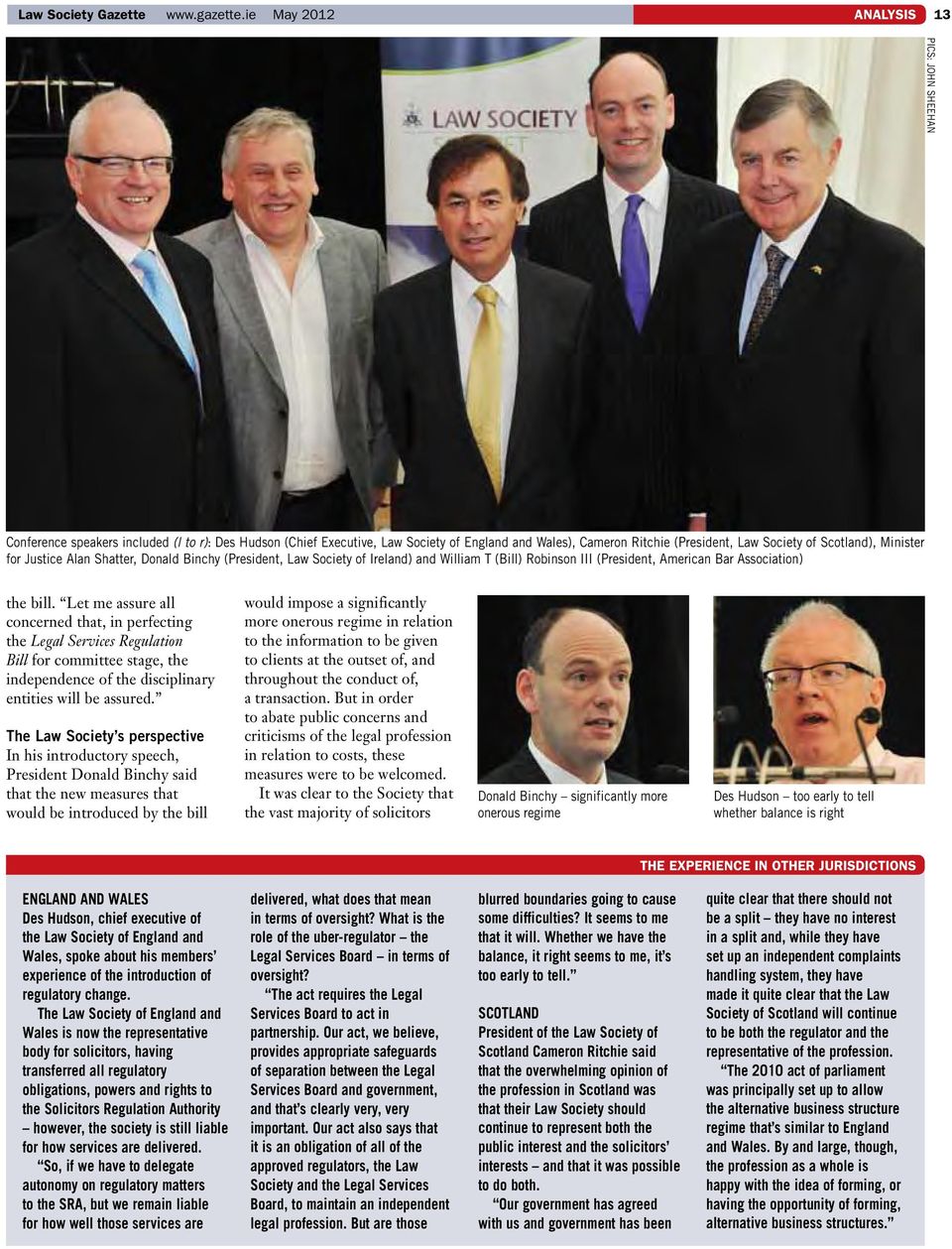
15 Law Society Gazette May 2012 ANALYSIS 13 PICS: John Sheehan Conference speakers included (l to r): Des Hudson (Chief Executive, Law Society of England and Wales), Cameron Ritchie (President, Law Society of Scotland), Minister for Justice Alan Shatter, Donald Binchy (President, Law Society of Ireland) and William T (Bill) Robinson III (President, American Bar Association) the bill. Let me assure all concerned that, in perfecting the Legal Services Regulation Bill for committee stage, the independence of the disciplinary entities will be assured. The Law Society s perspective In his introductory speech, President Donald Binchy said that the new measures that would be introduced by the bill would impose a significantly more onerous regime in relation to the information to be given to clients at the outset of, and throughout the conduct of, a transaction. But in order to abate public concerns and criticisms of the legal profession in relation to costs, these measures were to be welcomed. It was clear to the Society that the vast majority of solicitors Donald Binchy significantly more onerous regime Des Hudson too early to tell whether balance is right THE EXPERIENCE IN OTHER JURISDICTIONS England and Wales Des Hudson, chief executive of the Law Society of England and Wales, spoke about his members experience of the introduction of regulatory change. The Law Society of England and Wales is now the representative body for solicitors, having transferred all regulatory obligations, powers and rights to the Solicitors Regulation Authority however, the society is still liable for how services are delivered. So, if we have to delegate autonomy on regulatory matters to the SRA, but we remain liable for how well those services are delivered, what does that mean in terms of oversight? What is the role of the uber-regulator the Legal Services Board in terms of oversight? The act requires the Legal Services Board to act in partnership. Our act, we believe, provides appropriate safeguards of separation between the Legal Services Board and government, and that s clearly very, very important. Our act also says that it is an obligation of all of the approved regulators, the Law Society and the Legal Services Board, to maintain an independent legal profession. But are those blurred boundaries going to cause some difficulties? It seems to me that it will. Whether we have the balance, it right seems to me, it s too early to tell. Scotland President of the Law Society of Scotland Cameron Ritchie said that the overwhelming opinion of the profession in Scotland was that their Law Society should continue to represent both the public interest and the solicitors interests and that it was possible to do both. Our government has agreed with us and government has been quite clear that there should not be a split they have no interest in a split and, while they have set up an independent complaints handling system, they have made it quite clear that the Law Society of Scotland will continue to be both the regulator and the representative of the profession. The 2010 act of parliament was principally set up to allow the alternative business structure regime that s similar to England and Wales. By and large, though, the profession as a whole is happy with the idea of forming, or having the opportunity of forming, alternative business structures.
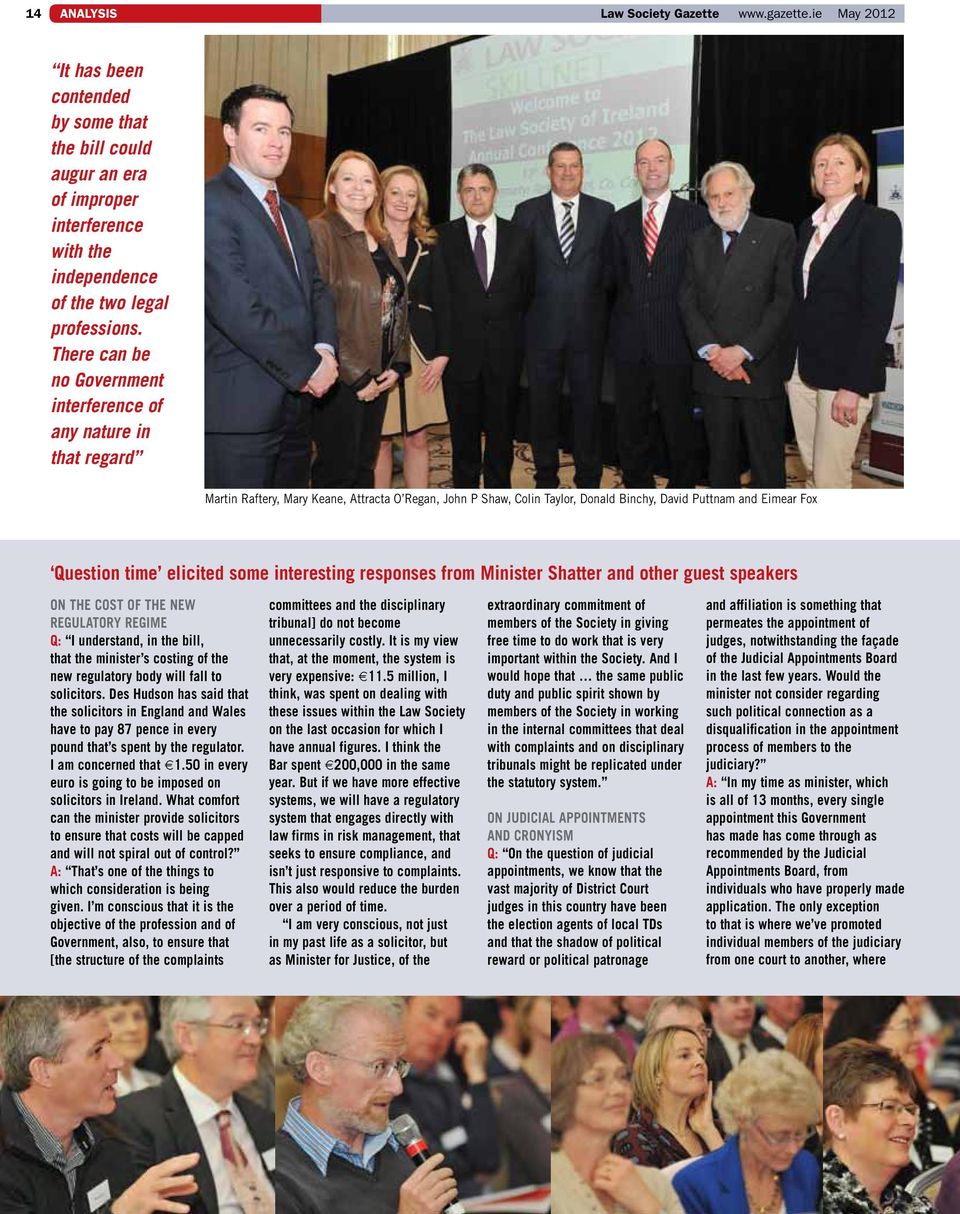
16 14 ANALYSIS Law Society Gazette May 2012 It has been contended by some that the bill could augur an era of improper interference with the independence of the two legal professions. There can be no Government interference of any nature in that regard Martin Raftery, Mary Keane, Attracta O Regan, John P Shaw, Colin Taylor, Donald Binchy, David Puttnam and Eimear Fox Question time elicited some interesting responses from Minister Shatter and other guest speakers On the cost of the new regulatory regime Q: I understand, in the bill, that the minister s costing of the new regulatory body will fall to solicitors. Des Hudson has said that the solicitors in England and Wales have to pay 87 pence in every pound that s spent by the regulator. I am concerned that 1.50 in every euro is going to be imposed on solicitors in Ireland. What comfort can the minister provide solicitors to ensure that costs will be capped and will not spiral out of control? A: That s one of the things to which consideration is being given. I m conscious that it is the objective of the profession and of Government, also, to ensure that [the structure of the complaints committees and the disciplinary tribunal] do not become unnecessarily costly. It is my view that, at the moment, the system is very expensive: 11.5 million, I think, was spent on dealing with these issues within the Law Society on the last occasion for which I have annual figures. I think the Bar spent 200,000 in the same year. But if we have more effective systems, we will have a regulatory system that engages directly with law firms in risk management, that seeks to ensure compliance, and isn t just responsive to complaints. This also would reduce the burden over a period of time. I am very conscious, not just in my past life as a solicitor, but as Minister for Justice, of the extraordinary commitment of members of the Society in giving free time to do work that is very important within the Society. And I would hope that the same public duty and public spirit shown by members of the Society in working in the internal committees that deal with complaints and on disciplinary tribunals might be replicated under the statutory system. On judicial appointments and cronyism Q: On the question of judicial appointments, we know that the vast majority of District Court judges in this country have been the election agents of local TDs and that the shadow of political reward or political patronage and affiliation is something that permeates the appointment of judges, notwithstanding the façade of the Judicial Appointments Board in the last few years. Would the minister not consider regarding such political connection as a disqualification in the appointment process of members to the judiciary? A: In my time as minister, which is all of 13 months, every single appointment this Government has made has come through as recommended by the Judicial Appointments Board, from individuals who have properly made application. The only exception to that is where we ve promoted individual members of the judiciary from one court to another, where
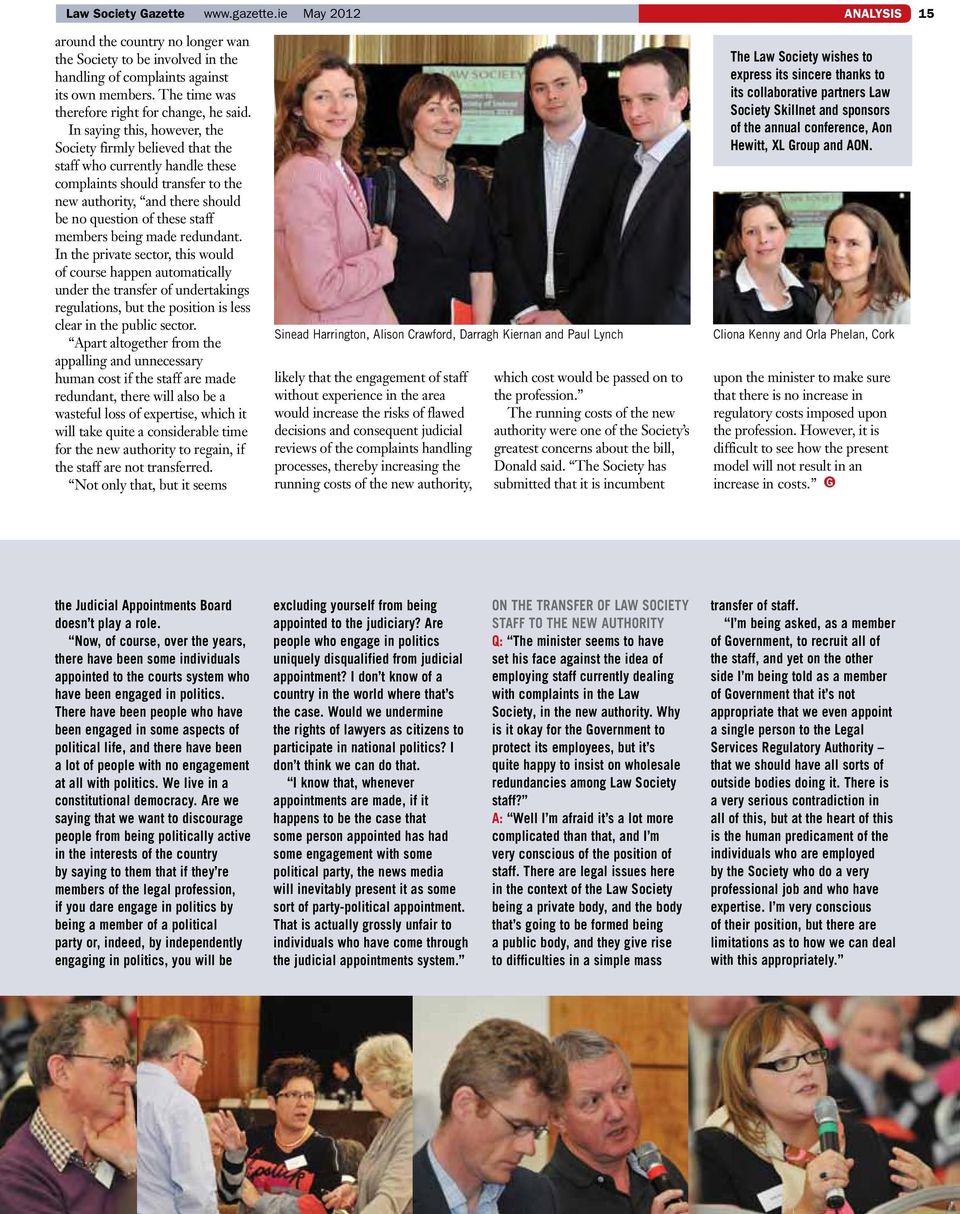
17 Law Society Gazette May 2012 ANALYSIS 15 around the country no longer wan the Society to be involved in the handling of complaints against its own members. The time was therefore right for change, he said. In saying this, however, the Society firmly believed that the staff who currently handle these complaints should transfer to the new authority, and there should be no question of these staff members being made redundant. In the private sector, this would of course happen automatically under the transfer of undertakings regulations, but the position is less clear in the public sector. Apart altogether from the appalling and unnecessary human cost if the staff are made redundant, there will also be a wasteful loss of expertise, which it will take quite a considerable time for the new authority to regain, if the staff are not transferred. Not only that, but it seems Sinead Harrington, Alison Crawford, Darragh Kiernan and Paul Lynch likely that the engagement of staff without experience in the area would increase the risks of flawed decisions and consequent judicial reviews of the complaints handling processes, thereby increasing the running costs of the new authority, which cost would be passed on to the profession. The running costs of the new authority were one of the Society s greatest concerns about the bill, Donald said. The Society has submitted that it is incumbent The Law Society wishes to express its sincere thanks to its collaborative partners Law Society Skillnet and sponsors of the annual conference, Aon Hewitt, XL Group and AON. Cliona Kenny and Orla Phelan, Cork upon the minister to make sure that there is no increase in regulatory costs imposed upon the profession. However, it is difficult to see how the present model will not result in an increase in costs. G the Judicial Appointments Board doesn t play a role. Now, of course, over the years, there have been some individuals appointed to the courts system who have been engaged in politics. There have been people who have been engaged in some aspects of political life, and there have been a lot of people with no engagement at all with politics. We live in a constitutional democracy. Are we saying that we want to discourage people from being politically active in the interests of the country by saying to them that if they re members of the legal profession, if you dare engage in politics by being a member of a political party or, indeed, by independently engaging in politics, you will be excluding yourself from being appointed to the judiciary? Are people who engage in politics uniquely disqualified from judicial appointment? I don t know of a country in the world where that s the case. Would we undermine the rights of lawyers as citizens to participate in national politics? I don t think we can do that. I know that, whenever appointments are made, if it happens to be the case that some person appointed has had some engagement with some political party, the news media will inevitably present it as some sort of party-political appointment. That is actually grossly unfair to individuals who have come through the judicial appointments system. On the transfer of Law Society staff to the new authority Q: The minister seems to have set his face against the idea of employing staff currently dealing with complaints in the Law Society, in the new authority. Why is it okay for the Government to protect its employees, but it s quite happy to insist on wholesale redundancies among Law Society staff? A: Well I m afraid it s a lot more complicated than that, and I m very conscious of the position of staff. There are legal issues here in the context of the Law Society being a private body, and the body that s going to be formed being a public body, and they give rise to difficulties in a simple mass transfer of staff. I m being asked, as a member of Government, to recruit all of the staff, and yet on the other side I m being told as a member of Government that it s not appropriate that we even appoint a single person to the Legal Services Regulatory Authority that we should have all sorts of outside bodies doing it. There is a very serious contradiction in all of this, but at the heart of this is the human predicament of the individuals who are employed by the Society who do a very professional job and who have expertise. I m very conscious of their position, but there are limitations as to how we can deal with this appropriately.
18 16 Analysis Law Society Gazette May 2012 the arab spring, one year on what next? What have been the consequences of the Arab Spring, how have the countries involved reacted, and how can the rule of law be rebuilt in MENA countries? Eva Massa reports on a recent forum that examined these issues Eva Massa is a solicitor and course manager at the Law Society s Education Centre. She is secretary of the Society s EU and International Affairs Committee Between December 2010 and March 2011, a series of revolts spread across the Middle East and North Africa (MENA) turning into full-scale revolutions (known as the Arab Spring ) in countries including Tunisia, Egypt, Libya, Syria, Bahrain and Yemen. A year after the events, the EU and International Affairs Committee of the Law Society organised an international affairs talk entitled The Arab Spring: What Next? Restoring the Rule of Law in MENA Countries. The talk, which took place on 2 April, was co-sponsored by the Irish branch of the International Law Association. It provided a forum to reflect on the consequences of the Arab Spring, the different reactions in each country, and the way forward to rebuild nations. The prestigious panel of speakers included President of the Irish Human Rights Commission Dr Maurice Manning as chairman. In his introduction, he emphasised the importance of peace building and restoring societies in post-conflict areas. Mary Fitzgerald, The Irish Times award-winning foreign affairs correspondent, returned from her last trip to Libya just two days before the talk. Speaking from her own field experience, she provided a very interesting insight into the current situation in Libya. Muddy picture Although the Arab Spring and its impact have been widely covered by the world media, this information does not always provide a clear picture of all the complexities and challenges existing in countries like Libya. For instance, the Libyan Transitional National Council, established on 27 February 2011, has the task of forming a transitional government to pave the way for the holding of free elections. However, the need for agreement between numerous religious, local and tribal groups makes this process more arduous. There is also a constellation of armed groups acting outside state control, which makes it very difficult to restore the rule of law. A process of transitional justice is critical to tackling the challenges of dealing with the past and of building inclusive societies, economies and governance systems. Totalitarian regimes, such as that of Col Muammar Gaddafi in Libya, are renowned for constant human rights abuses, a legal system that does not recognise crimes against humanity or war crimes, and a judicial system that is not independent. All efforts must now focus on establishing a proper criminal justice system that will: Carry out fair investigations and prosecutions, Guarantees the equal implementation of the law, and Reassures that justice will be restored in the new Libya. While the establishment of peace commissions can be helpful in a post-conflict situation, certain crimes require a stronger international response that will set a precedent, deterring future leaders from committing the same crimes, and providing reparation to victims The recruitment and training of independent judges and lawyers is key to this process. Accountability Transitional justice is not possible without individual accountability for crimes committed by the previous regime, and reparation for victims. The issue of accountability was addressed by William A Schabas, professor of international law and chairman of the Irish Centre for Human Rights. He has served as a member of the Sierra Leone Truth and Reconciliation Commission and has participated in international human rights missions on behalf of nongovernmental organisations. Prof Schabas explained the duty of states to intervene to put an end to atrocities committed within the territory of another state intervention that must be authorised by the UN Security Council. While the establishment of peace commissions can be helpful in a post-conflict situation, certain crimes require a stronger international response that will set a precedent, deterring future leaders from committing the
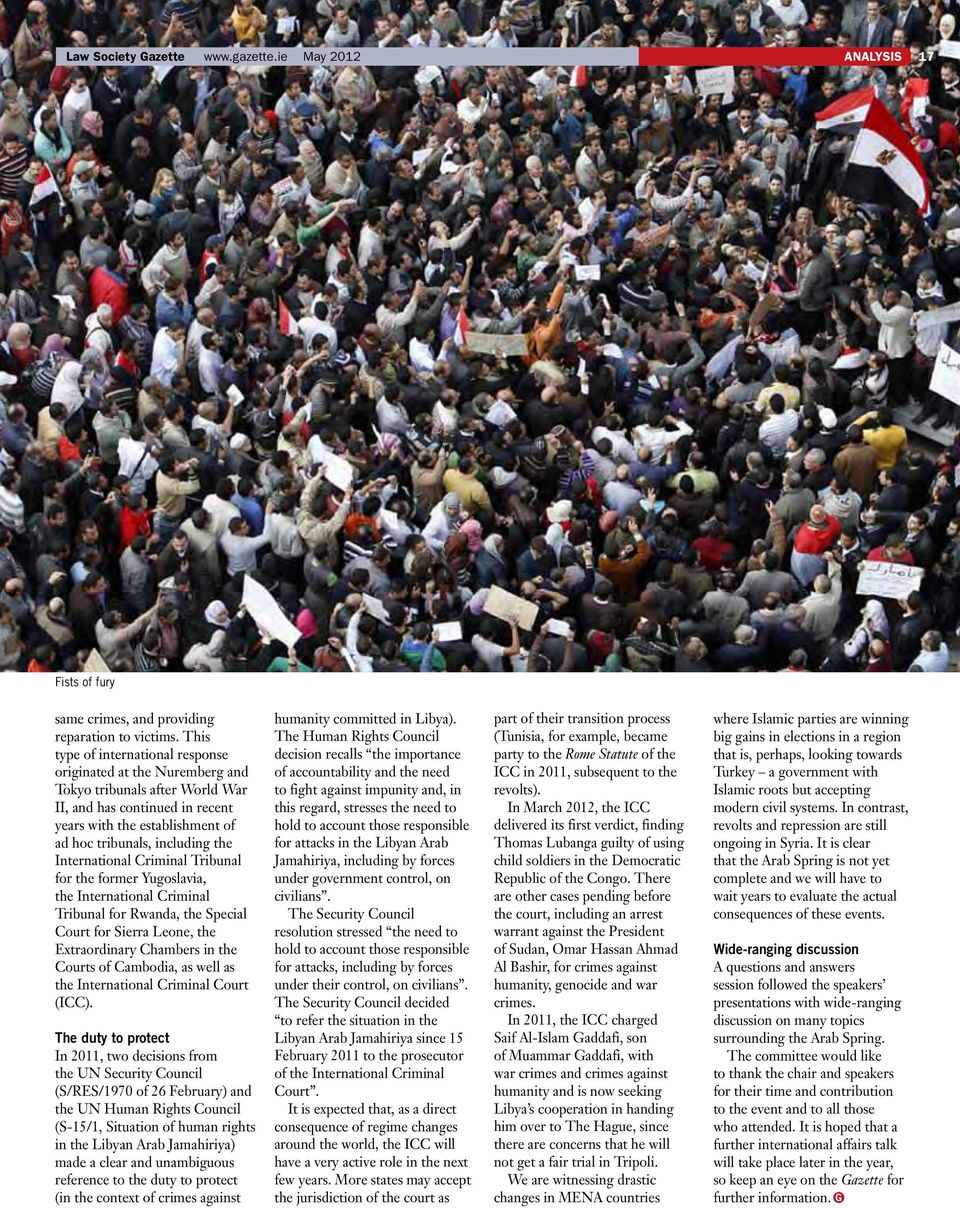
19 Law Society Gazette May 2012 analysis 17 Fists of fury same crimes, and providing reparation to victims. This type of international response originated at the Nuremberg and Tokyo tribunals after World War II, and has continued in recent years with the establishment of ad hoc tribunals, including the International Criminal Tribunal for the former Yugoslavia, the International Criminal Tribunal for Rwanda, the Special Court for Sierra Leone, the Extraordinary Chambers in the Courts of Cambodia, as well as the International Criminal Court (ICC). The duty to protect In 2011, two decisions from the UN Security Council (S/RES/1970 of 26 February) and the UN Human Rights Council (S-15/1, Situation of human rights in the Libyan Arab Jamahiriya) made a clear and unambiguous reference to the duty to protect (in the context of crimes against humanity committed in Libya). The Human Rights Council decision recalls the importance of accountability and the need to fight against impunity and, in this regard, stresses the need to hold to account those responsible for attacks in the Libyan Arab Jamahiriya, including by forces under government control, on civilians. The Security Council resolution stressed the need to hold to account those responsible for attacks, including by forces under their control, on civilians. The Security Council decided to refer the situation in the Libyan Arab Jamahiriya since 15 February 2011 to the prosecutor of the International Criminal Court. It is expected that, as a direct consequence of regime changes around the world, the ICC will have a very active role in the next few years. More states may accept the jurisdiction of the court as part of their transition process (Tunisia, for example, became party to the Rome Statute of the ICC in 2011, subsequent to the revolts). In March 2012, the ICC delivered its first verdict, finding Thomas Lubanga guilty of using child soldiers in the Democratic Republic of the Congo. There are other cases pending before the court, including an arrest warrant against the President of Sudan, Omar Hassan Ahmad Al Bashir, for crimes against humanity, genocide and war crimes. In 2011, the ICC charged Saif Al-Islam Gaddafi, son of Muammar Gaddafi, with war crimes and crimes against humanity and is now seeking Libya s cooperation in handing him over to The Hague, since there are concerns that he will not get a fair trial in Tripoli. We are witnessing drastic changes in MENA countries where Islamic parties are winning big gains in elections in a region that is, perhaps, looking towards Turkey a government with Islamic roots but accepting modern civil systems. In contrast, revolts and repression are still ongoing in Syria. It is clear that the Arab Spring is not yet complete and we will have to wait years to evaluate the actual consequences of these events. Wide-ranging discussion A questions and answers session followed the speakers presentations with wide-ranging discussion on many topics surrounding the Arab Spring. The committee would like to thank the chair and speakers for their time and contribution to the event and to all those who attended. It is hoped that a further international affairs talk will take place later in the year, so keep an eye on the Gazette for further information. G
20 18 human rights watch Law Society Gazette May 2012 rules rewritten on the issuing of search warrants The issuing of a search warrant by a garda superintendent has been found to be unconstitutional by the Supreme Court. Sarah McDonald breaks down the door Sarah McDonald is the Law Society s human rights executive The Supreme Court has ruled that section 29(1) of the Offences Against the State Act 1939, as amended, permitting a search warrant to be issued by a garda superintendent, is unconstitutional. Damache v DPP ([2012] IESC 11) centred on the constitutionality of section 29(1) as amended by section 5 of the Criminal Law Act The appellant, Ali Charaf Damache, was arrested following an investigation into the alleged conspiracy to murder Lars Vilks, a Swedish cartoonist who depicted the Islamic prophet Mohammed with the body of a dog. The cartoon prompted major protest in some Muslim countries. On 8 March 2010, the superintendent heading the investigation, Detective Superintendent Dominic Hayes, granted a search warrant for the appellant s house, executed the following day. The appellant, his wife and child, were present at the time of the search. The appellant was arrested for the offence of conspiracy to murder, contrary to section 71 of the Criminal Justice Act Items, including a mobile phone, were removed from the property. The appellant was subsequently charged with an offence contrary to section 13 of the Post Office Act 1951, as amended, for sending a threatening message by telephone to an individual in the United States. The appellant s solicitor sought judicial review proceedings in the High Court on a number of grounds, including that the search warrant was made by a member of It is best practice to keep a record of the basis upon which a search warrant is granted the Garda Síochána who directed the investigation; the garda asserted that he had grounds for suspecting the possession of firearms, though it was not clear to what this related; the appellant was entitled to have the decision on the search warrant issued by judicial personage; and that section 29(1) of the Offences Against the State Act 1939, as amended, was unconstitutional because it permitted a member of the Garda Síochána, who was actively engaged in an investigation, to decide on the issuing of a warrant. Independent and impartial The appellant argued that the person making the decision about the warrant should be unconnected with the matter being investigated. He further argued that the warrant issuer should be independent and impartial, and have no material interest in the decision to be made. He also argued that the impugned section of the act was invalid under the Constitution because it failed to provide for the balance between the requirements of the common good and the protection of individual rights. The Director of Public Prosecutions, however, argued that section 29(1) of the Offences Against the State Act, as amended, was a legitimate part of the State s armoury to protect itself, and any diminution of the individual s rights was proportionate and lawful. Mr Justice Kearns held that a search warrant was merely a step in the investigative process, which did not have to be issued by an independent authority and that, in any event, the section would be justified on the basis that: The security demands of countering international terrorism are of quite different order to those which apply in what might be described as routine criminal offences. Serious injury and harm can be unleashed at any point in the globe by terrorists who can avail of modern technology to devastating effect. That fact was amply borne out by the attack on the World Trade Centre on 11 September 2001, and many other terrorist acts before and since. The international terrorism of the modern age is a sophisticated, computerised and fast-moving process, where crucial evidence may be lost in minutes or seconds in the absence of speedy and effective action by police authorities. Mr Damache appealed the decision. Supreme Court decision Mr Damache brought an application by way of judicial review seeking, among other things: a) A declaration that section 29(1) of the Offences Against the State Act 1939 (as amended by section 5 of the Criminal Law Act 1976) is repugnant to the Constitution, b) A stay on any further steps being taken in the prosecution before Waterford Circuit Criminal Court entitled DPP v Damache, pending the determination of the judicial review proceedings. Chief Justice Denham, held that, in most cases, impartial supervision of the issuing of search warrants is exercised by a District Court judge, although under a limited number of statutes, authority has been given
21 Law Society Gazette May 2012 human rights watch 19 to members of the gardaí usually in cases of urgency and for a very limited time. The Chief Justice pointed out that the Constitution stated that the dwelling of every citizen is inviolable. The Chief Justice further stated that the procedure for obtaining a search warrant should adhere to fundamental principles, which include the appointment of an independent decision maker in a process that may be reviewed. However, she pointed out that there could be exceptions, for example, where there was an urgent matter. Outlining the principles to be followed, Chief Justice Denham said: For the process in obtaining a search warrant to be meaningful, it is necessary for the person authorising the search to be able to assess the conflicting interests of the State and the individual in an impartial manner. Thus, the person should be independent of the issue and act judicially. Also, there should be reasonable grounds established The procedure for obtaining a search warrant should adhere to fundamental principles however, the Chief Justice pointed out that there could be exceptions, for example, where there was an urgent matter that an offence has been committed and that there may be evidence to be found at the place of search. In this case, the warrant was issued by the superintendent investigating the matter, who, therefore, was not independent on matters relating to the investigation. The circumstances included the fact that the place searched was the appellant s dwelling, which the Constitution provides is inviolable, save in accordance with law. Furthermore, no issue of urgency arose in this case the warrant was not executed until a day after it had been issued. Chief Justice Denham pointed out that it is best practice to keep a record of the basis upon which a search warrant is granted. The Supreme Court therefore granted a declaration that section 29(1) of the Offences Against the State Act is unconstitutional because it permitted a search of Cuthbert himself would admit that he went to excessive lengths after his Porsche was repossessed the appellant s home contrary to the Constitution, on foot of the issuing of a search warrant which was not issued by an independent person. New legislation Following the striking down of section 29(1) of the Offences Against the State Act 1939 by the Supreme Court, Minister for Justice Alan Shatter has said that the Government will draft a new bill to recognise the judgment. Under new legislation, it is envisaged that the impugned section will be replaced with a provision that will increase the availability of judges empowered to issue search warrants under the 1939 act. It is also hoped that a senior-ranked officer of the Garda Síochána, who is independent of the investigation concerned, will be permitted to issue a warrant in urgent circumstances/emergencies where an application to a District Court judge is impracticable. The minister acknowledged that it is essential that the Supreme Court decision be addressed as a priority, but he also said that the Garda Síochána must be in a position to take action to safeguard the public if circumstances of urgency arise. This would be of particular importance, he said, for offences relating to firearms and explosives. The Supreme Court decision indicates a preference that search warrants be issued by the judiciary in the future, rather than requiring that a garda not involved in the investigation issue a warrant. The judgment requires that any power to issue search warrants in respect of the home should only be exercised by an outside authority (presumably a District Court judge) except in cases of urgency. The decision has thus forced a revaluation of Garda Síochána practice in this area. It remains to be seen whether this decision will require further reconsideration of the procedures in related areas, such as Garda Síochána access to telephone and internet records where, in some situations, authorisation is granted internally within the force. G
22 20 viewpoint Law Society Gazette May 2012 Justice must serve the citizen s interests In his speech to Law Society members at the annual conference on 13 April, titled Solas generating a bright future how to maintain motivation and perspective, Lord David Puttnam argued that the public interest has primacy over consumer interest in matters of justice SLICE OF LIFE Lord David Puttnam, the celebrated film producer, is an active supporter of educational and children s causes. Following an early career in advertising, he turned to film production in the late 1960s. His successes as a producer include Bugsy Malone, Midnight Express, The Duellists, Chariots of Fire (which won the Academy Award for Best Picture), Local Hero, Memphis Belle, The Killing Fields and The Mission. He was chairman and chief executive I d like to begin, if I may, with some lines from a writer who, although not born here, definitely had more than a dash of Irish blood in his family: You are old, said the youth, and your jaws are too weak For anything tougher than suet; Yet you finished the goose, with the bones and the beak Pray, how did you manage to do it? In my youth, said his father, I took to the law, And argued each case with my wife; And the muscular strength, which it gave to my jaw, Has lasted the rest of my life. Well, I m ready to accept that that s one benefit of the law, and that Lewis Carroll certainly knew a thing or two about human strengths and weaknesses. Sadly, I have to admit that, in my own youth, I flirted either side of the law but the part I m prepared to admit to was a year spent at night school, studying the complexities of copyright law; as things turned out, my officer of Columbia Pictures from 1986 to He was awarded a CBE in 1983, was knighted in 1995 and was made a life peer in He is currently a trustee of the Institute for Public Policy Research and has served on the foundation board of the World Economic Forum. For ten years, he served as chairman of the National Film and Television School and founded Skillset, which trains young people to become members of the film and subsequent career as a film producer proved that to be time very well spent. But just 15 years ago, I made a huge personal decision to leave the world of cinema to engage with a very different world that of a legislator in the House of Lords. Unsurprisingly, this involved a steep learning curve and any amount of personal and domestic compromise. But the result has been a late-life experience that s brought additional meaning and even, from time to time, cause for a deep sense of personal satisfaction. What s certain is that I ve absolutely no regrets and, all in all, I ve been left feeling pretty good about both my career change and its outcome. television industries. In 2002, he was elected president of UNICEF UK. Lord Puttnam was the first chancellor of the University of Sunderland from 1997 until 2007, when he became chancellor of the Open University. In 1998, he founded the National Teaching Awards and became its first chairman retiring in He was appointed a non-executive director of the global education company, Promethean World plc, in September In addition to my work in the Lords, as a functioning member of society, I also have a passionate interest in that canon of ethics that applies to the broader community with which, to a greater or lesser degree, we all participate. As citizens living and working within functioning democracies, there is and always has been great power invested in a working knowledge of the law, and in the fundamental probity of its high priests those counsellors in whom, of necessity, we laymen living within organised judicial systems place enormous trust. From the Greeks to the Romans, from the Magna Carta to the US Constitution, the law has remained the basis of all attempts to create civilised societies. The specialties and complexities of its multiple and daily changes can confound, I suspect, even at times yourselves. One does not usually think of the law as an entertaining matter: profound, yes; complex, certainly; a many-headed philosophical beast of wisdom to be sure; but amusing let alone fun or one s choice companion on a desert island? Probably not! But, paradoxically, many of the very greatest legal minds have proven themselves magnificent showmen, as well as being personalities of enormous influence. In the United States, Clarence Darrow, William Jennings Bryan, Justices Douglas, Brandeis, Warren Only in the 20th century did it become possible to portray on film, and thus preserve for reevaluation, the great trials both in their agony of decision, and in our ability to viscerally confirm or question the justice of their verdicts
23 Law Society Gazette May 2012 viewpoint 21 and Frankfurter all have made contributions to the law and society that have left an indelible mark on the manner in which US citizens, and many others, live their lives. More than most, they have helped establish our shared notion of what s best described as the civilised ideal. Underlying responsibility Yet even your profession can be imperfect, at times possibly capable of forgetting, in the hurlyburly of daily life especially in a digital era in which information, (often conflicting information), threatens to overwhelm us the underlying responsibility inherent in what is, in essence, a very special calling. Some would appear to find it easier to practise the law s letter at the cost of its spirit, ignoring the advice of Abraham Lincoln when he famously cautioned us to: Discourage litigation. Persuade your neighbours to compromise whenever you can. Point out to them how the nominal winner is often a real loser in fees, in expenses, and in the sheer waste of time. As a peacemaker, the lawyer has a superior opportunity of being a good man. There will always be business enough. Most lawyers of my acquaintance are men and women of high purpose and of good intent who, like our best filmmakers, dedicate themselves to the improvement of their craft. The best of you never forget that many, if not most, of the important experiences of life are marked and given meaning through your actions. Your documents, your decisions, the precision of your judgements affect every one of us in our daily lives. Even in death you are required to influence us, in the orderly degree to which we tidy up our lives! Lawyers mitigate the problems between the criminal and the police, between the employee and the corporation, between the individual and the state, and have historically played a crucial role in reconciling, or attempting to reconcile, the near impossible conflicts inherent in politics and religion. Yours is an art that is always under discussion, and forever undergoing refinement for, as individuals and nations, in times of peace, we find ourselves placing our entire trust in wellargued, judicious, and impartial considerations of legal opinion. Frequently finding himself alone in making a fine judgement, the lawyer is necessarily involved in decisions that intimately affect the future, and the future not only of individuals but even, from time to time, that of nations. Film and the law Within the past decade we ve seen decisions about the rights and wrongs of going to war weighing heavily on the minds of some of the most eminent lawyers of our age. It is independent thinking in its highest form, and the fascination of the law for artists of all kinds has been evident throughout the ages. However, only in the 20 th century did it become possible to One does not usually think of the law as an entertaining matter: profound, yes; complex, certainly; a many-headed philosophical beast of wisdom to be sure; but amusing let alone fun or one s choice companion on a desert island? Probably not! portray on film, and thus preserve for re-evaluation, the great trials both in their agony of decision, and in our ability to viscerally confirm or question the justice of their verdicts. Consider, in particular, a film that examined the awesome task of a simple American, Judge Haywood. Sent to Germany to preside over one of the great trials of history, that of those German judges who served during the period of what we now term the Third Reich. Judge Haywood, as portrayed by Spencer Tracy in the film Judgment at Nuremberg, was a District Court judge, defeated in a bid for re-election because he was unwilling to adjust to the prevailing political weather. It was this courageous man who, against the advice of many who found his opinions untimely and unpolitical, nonetheless pronounced those judges guilty guilty of the charge of conscious
24 22 viewpoint Law Society Gazette May 2012 Judgment at Nuremberg participation in an organised system of cruelty and injustice, in violation of every legal and moral principle that accompanies any acceptable notion of a civilised nation. At the conclusion of the film, Haywood states the reasoning behind his decision in words that I believe are well worth repeating today: The real complaining party at the bar in this courtroom is civilisation. In all our countries, it is still a struggling and imperfect thing. This tribunal does not believe that the United States, or any other country has been blameless for the conditions which made the German people vulnerable... But this tribunal does say that the men in the dock are responsible for their acts If the defendants were all degraded perverts if all the leaders of the Third Reich were sadistic monsters and maniacs these events would have no more moral significance than an earthquake, or any other natural catastrophe. But this trial has shown that under the stress of a national crisis, ordinary men even able and extraordinary men can delude themselves into the commission of crimes and atrocities so vast and heinous that they beggar the imagination. He goes on to say: How easily it can happen. There are those in our country today, too, who speak of the protection of the state of survival! A decision must be made... in the life of every nation... at the very time when the grasp of the enemy is at its throat, when it seems the only way to survive is to use the means of the enemy, to rest survival upon what is expedient, to look the other way. The answer to that is: Survival as what? A country isn t a rock, and it isn t an extension of one s self. It s what it stands for, when standing for something is the most difficult. He concludes: Before the people of the world, let it now be noted in our decision here that this is what we stand for: justice, truth, and the value of a single human being. In the final analysis, it all comes down to that the value of each single human being. It was just such a very human being who handed down this decision, a decision to be nourished and reconsidered in the conduct of our present daily lives. Citizen versus consumer But the truly valuable individual, particularly if he or she aspires to creative activity, be it in jurisprudence or any other sphere of human activity, cannot possibly exist in a vacuum. I believe they need an atmosphere, the right environment if you will, one in which their role as a citizen is both encouraged and supported. And here I want to dwell for a second on why I believe that the role of the citizen is fundamentally distinct from that of the consumer. This issue was thrown into sharp relief at the time I was chairing the Joint Parliamentary Scrutiny Committee, looking at the Communications Bill in Our committee set out a number of amendments to the bill that sought to ensure recognition on the statute book that diversity in the media is not reducible to a set of arguable facts regarding the relativity of market share, and that the issue was too important to be expressed simply in the language of competition policy. Because what s at stake in relation to media plurality, as with so much else in the public and private realm, is far more than a simple issue of consumer interests within an equitably functioning marketplace. Yet when we argued for a media plurality, or the application of a public-interest test, and when we argued that the duty of the regulator should be required to further the interests, not simply of When we argued that the duty of the regulator should be required to further the interests, not simply of consumers, but also of citizens, we were attacked by some at the highest levels of Government for, in effect, questioning the primacy of the marketplace consumers, but also of citizens, we were attacked by some at the highest levels of government for, in effect, questioning the primacy of the marketplace. This point was well made by my colleague in the House of Lords, the distinguished lawyer Helena Kennedy, in a piece she wrote for The Guardian a few years ago. Governments, she wrote, have increasingly come to see citizens as consumers, to be approached, listened to and manipulated through the marketing device of focus groups. This government-as-product-supplier pursues market share, redesigns the brand, and purveys policy on a what works basis, rather than anything founded on principle or shared values. She went on to say: But there are some areas of our lives including the justice system where a reliance on economic drivers, or populist desires, creates distortions, injustice, and outcomes that take no account of the common good. Justice is not, and never can be, a commodity. G (Part 2 of Lord Puttnam s speech will be published in the June issue of the Gazette.)
25 Law Society Gazette May 2012 viewpoint 23 getting blood out of a lawyer The Irish Blood Transfusion Service needs approximately 3,000 pints of blood every week. Ercus Stewart urges colleagues to think about donating and to become one of the many who help meet that need every week Ercus Stewart is a senior counsel can t get blood out of a stone, the adage goes, You but getting blood out of a lawyer should be easier though if all the lawyer jokes were true, one would wonder what runs in our veins! More seriously, I write here about donating blood. The Irish Blood Transfusion Service needs approximately 3,000 units of blood every week, a unit being equivalent to one pint of blood. We typically think of blood donations as being whole blood or red blood, which is the most common type of donation. Some whole blood types are always in short supply (for instance, B and B- or AB). One can actually donate platelets only, white blood cells, or plasma. Platelets and plasma are vital for preventing massive blood loss in surgical patients, and are in particular demand for cancer and leukaemia patients, as well as those receiving chemotherapy or bone-marrow transplants. Collecting platelets or plasma is essentially the same as for whole blood, but may differ in length of time. The process for drawing whole blood may take 10 to 20 minutes, although the entire procedure from arrival at the blood bank to leaving may take up to an hour. There is a brief health check involving taking blood pressure and answering a few simple questions, and a brief rest with juice and biscuits before leaving. Platelet and plasma apheresis (or donations) take a bit longer. It can take five times more blood (and multiple donors) to make up a unit of platelets or plasma. The need is great for each type of donation. Who can donate? Anyone from 18 to 65 may donate whole blood if they are in good health, weigh between 44.5 and 76 kilos (7 to 12 stones) or more, and are not anaemic. To donate platelets and plasma, donors must be between 18 and 60 (plus) and must weigh over 60.3 kilos (9 stone, 7 lbs). You cannot donate blood if you have low (or high) blood pressure, low iron levels, have travelled to certain at-risk countries or have certain medical conditions or take certain medications, or if pregnant. All of this will be explained at the initial screening. For platelet and plasma donations, you cannot donate if you have had aspirin within the past two days, or if you are regularly medicated with aspirin or anti-inflammatory medications, or if you have ever received a blood transfusion yourself, or if you have ever been pregnant. Where to attend There is a blood clinic at LaFayette House (O Connell Street) at 1-5 D Olier Street on the second floor. This is just a few LUAS stops up from Blackhall Place or the Four Courts stop, and just a short walk over O Connell Bridge. You can make an appointment or drop in. Tel: Platelet collection is located at the National Blood Centre in St James s Hospital on James Street. Tel: This is also just a few LUAS stops from Blackhall or the Four Courts stop, getting out at the James s Hospital stop, followed by a two-minute walk. You must have an appointment for the first donation. G
26 Celebrate your Special Day at The Law Society from from from For further details contact: Annita McGettigan, Events Co-Ordinator, Blackhall Place. telephone or . [email protected]
27 Law Society Gazette May 2012 LETTERS Anonymous letter criticises lack of transparency From: Concerned Sovereign With reference to your article dated April 2012 written by Keith Rooney regarding the Freeman Movement, I have never come across someone so arrogant and delusional. This article proves the point that members of the Law Society do not have a clue regarding the Freeman Movement and do not have any idea regarding the real law. The arrogance of solicitors is only overshadowed by their ignorance. If the Law Society really think they have all the answers and that the Freeman Movement is wrong, we would like to suggest that you do an interview on TNS Radio to debate this subject matter. If you put up a good argument, than maybe people will not apply the Freeman process. One of the broadcasters from TNS Radio has already pulled apart Keith Rooney s argument ( This is a very big concern to people who require the services of solicitors and the Law Society. If they do not know the real law, Stumbling blocks are no excuse for failing to ratify UN convention From: Gary Lee, solicitor, Centre for Independent Living, Dublin 7 Lorcan Roche s article (Gazette, April 2012) quotes Minister Shatter s assertion that stumbling blocks need to be removed before the State can ratify the UN Convention on the Rights of People with Disabilities (CRPD); specifically, he asserts that there is a requirement to have new capacity legislation in place before we can ratify. That our system still relies upon the Lunacy Act 1871 is shameful; however, this should not be held out as a legitimate reason for not ratifying the CRPD. The State had several years to get its affairs in order prior to signing the CRPD. A further five years have since passed, yet the Government, as did its predecessors before it, continues then how do people ever have a chance of winning? The Law Society has a responsibility to the public to be transparent and to follow the law. What we have seen is a blatant disregard for the law. Once solicitors are making money and milking the system, who cares about the people, right? to use this excuse. However, there is no legal basis for this argument. The CRPD itself does not make it a prerequisite that the ducks be in a row prior to ratification, nor is this a domestic requirement; one only has to think of the halfcentury gap between our ratifying the European Convention on Human Rights (ECHR) in 1953 and the commencement in 2006 of part 2 of the Mental Health Act 2001, which finally brought us in line with article 5 of the ECHR. Had we not ratified the ECHR, Mr Croke could not have brought Ireland before the European Court of Human Rights to force the Government to finally legislate for the independent review of those detained involuntarily in mental hospitals (Croke v Ireland [33267/96 (2000) ECHR 680]). As the saying goes put your money where your mouth is. If you believe that you are right, then you have nothing to lose going on TNS Radio. If, however, you decide not to do this, it will confirm to everyone that the Law Society is not only lacking transparency, but colluding with a corrupt judicial system to milk the system and the tax payer. (Editor s note: It should be pointed out that Keith Rooney is not a member of the Law Society but rather a member of the Law Library. Normally, the Gazette does not publish letters of an anonymous nature, but has made an exception in this case!) Together strong From: Cian Mac Mahon, O Gorman Solicitors, Limerick I had occasion to represent a client at recent family law sittings of the Circuit Court in Trim. The case was originally in Limerick and found itself ultimately transferred to the Meath Circuit. It is a part of the country that I was not altogether familiar with. It was, in fact, my first time in Trim and I was very impressed with the court building and its facilities. What was most impressive, however, was the extremely warm welcome extended to my counsel and me by the local practitioners. They could not have been more friendly or helpful. I understand that the county s motto is Tré neart le chéile or Together strong : perhaps a motto worth subscribing to in these difficult times! Go raibh míle maith agaibh, Meath solicitors! Compared with Britain and many other jurisdictions, we are in the dark ages when it comes to legislative protection for our citizens with disabilities. It s a sad reflection that most human/social rights legislation in this State has made its way into our law as a result of our international obligations. This heightens the importance of our ratifying the CRPD. To continue to block ratification on the basis of a flawed assertion is doing an immense disservice to people with disabilities. Yes, if we ratify the CRPD now, we will be in immediate breach of article 12 and other provisions of the CRPD, but at least, for the first time, we will have given legal recognition to basic rights, such as the article 19 right to independent living. G 25
28 26 cover story Law Society Gazette May 2012 bearing false witness Section 26 of the Civil Liability and Courts Act 2004 states that, if false testimony is given or a false affidavit of verification sworn, the court shall dismiss the plaintiff s action unless it would result in an injustice being done. Sinead Morgan asks whether it has achieved its objectives Sinead Morgan is an experienced solicitor who has specialised in commercial litigation and employment law Personal injury litigation underwent significant changes with the enactment of the Civil Liability and Courts Act 2004, in particular sections 14, 25, 26 and 29. The purpose of those sections was to establish deterrents to exaggerated claims coming before the courts, as ultimately the increased costs incurred by insurance companies in defending those claims was being passed onto insurance customers who entered their contracts of insurance in good faith. The legislation also intended to shift the burden of proof from plaintiffs solicitors back to their clients. Section 14 created an obligation to furnish an affidavit of verification in respect of any pleading containing assertions, allegations or further information provided to the defendant. The affidavit must be signed and sworn by the plaintiff and lodged in court within 21 days of service. Section 25(1) deals with the provision of false evidence and states that if a person gives or dishonestly causes to be given or adduces evidence in a personal injury action that is false or misleading in any material respect, and he or she knows it to be false or misleading, he or she shall be guilty of a offence. Subsection 3 indicates that an act is done dishonestly if it is done with the intention of misleading the court. Section 26 states that if false testimony is given or a false affidavit of verification sworn, that the court shall dismiss the plaintiff s action unless it would result in an injustice being done. Normally, costs would also follow the event and would be awarded against the unsuccessful party. In addition, any breach of the act amounts to an offence that carries penalties including fines up to 100,000 and/or imprisonment for a term not exceeding ten years (section 29). This applies to all It would appear that the approach of the High Court and Supreme Court is that a high onus of proof is placed on the defendant to prove section 26
29 Law Society Gazette May 2012 cover story 27 >> years but, since 2007, there has been a Fast facts > The false testimony provisions of the Civil Liability and Courts Act 2004 have been in place for over seven years > Cases were relatively rare in the early series of them > The courts seem to be changing their initial approach to the act and are punishing fraudulent plaintiffs once the section 26 test is met
30 28 cover story Law Society Gazette May 2012 cases brought on or after the commencement of the act or pending when the act was brought into force (section 25(4)). One should note the mandatory nature of the sanctions imposed, as either the giving of fraudulent testimony or the swearing of a fraudulent affidavit requires the judge to dismiss the case. However, certain hurdles must first be passed the statement must be false or misleading. That falsehood must be material in its nature, a subjective test at best. Most importantly, the legislation requires that intent be proven. Even then, the judge still retains discretion to refuse to dismiss the case if it would result in injustice. Again, injustice is subjective in nature and is not defined in the act. Although these sections were introduced to stamp out criminal practices, it must be remembered that, where there is a clear imbalance between the plaintiff and the defendant, public interest often dictates that discretion will be applied. Case in point The legislation has now been in place for over seven years, so the question is, has it achieved its objectives? Cases were on second thoughts... While the High Court has recently developed a penchant for dismissing claims under section 26, writes Stuart Gilhooly, the Supreme Court has had cause to determine two recent matters in which the High Court refused to do so. In both cases, which arose out of entirely separate accidents, the same defendant Bus Éireann appealed these refusals. In the first matter to come on for hearing, involving the elderly plaintiff Rose Ahern, it was alleged that the plaintiff s claims that she required nursing care (a claim not proceeded with at trial but verified on affidavit) and that she couldn t travel on buses alone (a fact disputed by video evidence) constituted false and misleading evidence. The trial judge reached the conclusion that she did not deliberately or intend to mislead, and therefore section 26 did not apply. The Supreme Court restated the well-known principles in Hay v O Grady, namely, that findings of fact by a High Court judge could not be disturbed by the Supreme Court. Therefore, having made these findings of fact, the Supreme Court (by way of judgment delivered by Denham CJ) agreed that the word knowingly as used in section 26 is a subjective test; the trial judge was correct in his approach. The appeal was dismissed unanimously by a five-judge court. The second case involved a then 48-yearold woman, who suffered relatively serious relatively rare in the early years. However, since 2007, there has been a series of cases, beginning with Carmello v Casey. In that case, the plaintiff failed to disclose a subsequent accident in pleadings (to include the affidavit of verification) and went as far as to deny remembering it in evidence. On that basis, Peart J was satisfied that, on the balance of probability, the plaintiff was not being truthful. He dismissed the claim in its entirety as substantially fraudulent and awarded costs against the plaintiff. More recently, in 2010, section 26 was pleaded in Glantine Inns Limited. That case involved an alleged assault in a nightclub. Irvine J found that the plaintiff had sought to mislead the court by grossly exaggerating his claim in respect of his injuries and special damages. He was found out in a lie under oath regarding a parachute jump he had completed after the accident. The judge indicated that the numerous alleged visits to his GP were phantom visits. This was further supported by Facebook entries regarding his social activities. Although the judge dismissed the case for failure to establish negligence, he stated that, if he neck, back and shoulder injuries. Teresa Goodwin was awarded a substantial sum in the High Court following a controversial case in which two doctors called by the defendant, and a private investigator, alleged that the injuries claimed were not as serious as claimed and that the plaintiff was exaggerating. On this occasion, the trial judge made clear findings of fact that the actual evidence given by the plaintiff to the court was truthful and that she was not concerned with what the plaintiff said to medical experts. Once more, the Supreme Court, this time in the persona of Fennelly J, found: This court cannot substitute itself for the trial judge in the assessment of the credibility of witnesses. The court again dismissed the appeal 5-0. It would appear that the approach of the High Court and Supreme Court is that a high onus of proof is placed on the defendant to prove section 26. The level of deceit and the plaintiff s general demeanour will play a large role in determining as to whether any untruth told was deliberate or knowing. Cases involving false loss of earnings claims are doomed to failure, but exaggeration of injuries allegations are more likely to turn on the identity of the trial judge and general evidence of the plaintiff. There is no doubt, though, that section 26 will play an increasing role in all personal injuries claims for the foreseeable future. had not been dismissing the case under that heading, then he would have been obliged to dismiss it under section 26. Section 26 once again came under the spotlight in Higgins v Caldark, where the defendant argued that the plaintiff had sought to mislead the court regarding his past loss of earnings. That claim was pleaded in the statement of claim, underpinned by an actuarial report and verified by an affidavit of verification. During the hearing, the plaintiff admitted that his employer (his brother) had agreed to continue paying him while he was unable to work. No reference was made to these payments prior to the hearing. The plaintiff had returned to work, but had not revealed this to his medical advisors. Just prior to hearing, the plaintiff dropped a substantial part of his loss of earnings claim. The plaintiff confirmed in evidence that section 14 had been explained to him by his solicitor. The plaintiff s counsel then contended that his client should be allowed to split his claim. Quirke J refused that application and dismissed the claim, on the basis that the purpose of section 26 was to discourage dishonest claims and for that reason was penal in nature. Once again in 2010, a serial claimant s case against Dublin Bus was dismissed when Quirke J found that the plaintiff gave misleading evidence as to her injuries and capacity to work. The plaintiff abandoned her claim for loss of earnings for a six-figure sum on the first day of the hearing, amended it, and restated it on the second day in court. The judge relied upon video footage of the plaintiff s activities, the fact she had not divulged further accidents, her admission in evidence that she had been working since the accident, her expensive lifestyle (for a person whose only source of income was allegedly social welfare payments), and the inconsistencies in her complaints before coming to that conclusion. He looked behind her intent in abandoning her earnings claim, and her failure to explain those actions, and determined that it inferred a lack of bona fides. He also rejected the argument that she was an uninformed person who merely failed to disclose information that she felt was unimportant. Quirke J relied on the fact that the plaintiff had legal representatives who had advised her of her obligations under the act. He also rejected the argument that the plaintiff had no intent to mislead because she subjectively felt that the accident had caused her ongoing symptoms. He based this decision on her probable state of mind during the course of the proceedings. The further cases of Folan, Forde and Boland were also dismissed in 2011 as a result of serious inconsistencies in evidence, similar to those already discussed. This increasing
31 Law Society Gazette May 2012 cover story 29 Playing Quake at the office proved to be an irresistible impulse for Horace number of dismissals shows a willingness on the part of the judiciary to apply section 26 in a manner that gives it teeth. Strongest warning Although this is positive news from a defence perspective, I am not aware of any cases to date where criminal sanctions have been applied, although these sanctions are already available within the existing legislation. In that regard, the McKenna v Dormer Services case last year is the most significant to date. That case involved an alleged personal injury where the plaintiff was claiming nine-anda-half years loss of earnings. He had in fact been employed for the duration. The judge refused to let him abandon his entire claim, despite the fact that he had offered to pay both sides costs. Instead, Quirke J carried out further investigations as to the allegedly fraudulent testimony, dismissed the claim under section 26, awarded costs against the plaintiff, and then referred the matter to the DPP for his information. It is unclear whether the DPP will take this further; however, this has been the strongest warning to date of the penalties that may be incurred by bringing bogus claims before the courts. In summary, the courts seem to be changing their initial approach to the act and are punishing fraudulent plaintiffs once the section 26 test is met. This is despite arguments that such action breaches plaintiffs common law entitlement to compensation for personal injuries when negligence has been proven. Irvine J was very clear in the Higgins case, where he stated that section 26 is intended to be penal in its nature and that it statutorily qualifies the plaintiff s common law rights. If plaintiffs choose to swear an affidavit of verification and endeavour to stand over that fraudulent affidavit at hearing, there is little doubt that their case will fail. Substantial investigations must be undertaken by the defendant s solicitors to prove both fraud and intent. In these cases, the courts have accepted evidence including surveillance footage, Facebook searches, lack of vouching documentation, use of crutches to attend medicals only, and independent medical evidence that is inconsistent with both the plaintiff s complaints, special damages and their own medical evidence. Quirke J also stated that, when a plaintiff abandons a substantial loss of earnings claim without any explanation, it should give rise to suspicions that the claim is not bona fide. Although this bodes well for insurance companies, in order to launch a successful section 26 defence, the defendant must incur substantial expenses. They must crosscheck the plaintiff s complaints against medicals, surveillance and other evidence to identify inconsistencies. If there is any dispute regarding claimed expenses, they must demand an affidavit of verification from the plaintiff vouching every item of special damages. In short, substantial work must be completed by the defence team to ensure all their evidence ties together for hearing. Unfortunately, these expenses are rarely recovered by the defendant. G Look it up Cases: Boland v Dublin City Council & Ors [2011] IEHC 176 Carmello v Casey [2007] IEHC 362 Danaher v Glantine Inns Limited [2010] IEHC 214 Farrell v Dublin Bus [2010] IEHC 327 Folan v O Corrain & Ors [2011] IEHC 487 Forde v Central Parking System Ireland Ltd trading as Control Plus [2011] IEHC 407 Gammell v Doyle trading as Lees Public House & Anor [2009] IEHC 416 Hay v O Grady [1992] IR 210 Higgins v Caldark [2010] IEHC 527 Kenny v Crowley (unreported, Supreme Court, 2005) Mulkern, Flesk & Flaherty [2005] IEHC 48 Rose Ahern v Bus Eireann [2011] IESC 44 Teresa Goodwin v Bus Éireann [2012] IESC 9 Legislation: Civil Liability and Courts Act 2004, sections 14, 25, 26 Literature: False evidence transcripts should go to DPP, says judge, Irish Times, 3 March 2011
32 30 CONSTRUCTION LAW Law Society Gazette May 2012 Prior commitments The situation at Priory Hall in Dublin reflects the dire circumstances in which many residential owners now find themselves. Fiona Forde explains the rights of recourse for owners on discovery of defective building works Fiona Forde is a practising barrister specialising in building and construction law. A mechanical engineer, she is experienced in both contentious and non-contentious construction work The sheer scale of residential construction undertaken in the past decade in Ireland by an under-regulated industry has meant that the discovery of defective and belowstandard building works and services is now commonplace. This regrettable repercussion of the property boom, combined with the insolvencies of so many of its major players, has left residential owners in an extremely vulnerable situation and uncertain as to what course of action to take in order to render their properties habitable. The unfortunate reality is that, due to the complex contractual structures that are common in construction, combined with the peculiarities of the law of tort specific to financial losses emanating from building claims, it can be extremely difficult for an owner to even formulate a viable claim against the parties they deem responsible for the defects to their property. Remedies in contract The difficulty for most residential owners is that they simply don t have a direct and viable contractual right of action against the parties they deem responsible for the defects. If they are the original owners of the property, they may have a contract with the builder. However, the If the Irish courts follow English jurisprudence, a residential owner will be in difficulties recouping from the builder the very costs that they most want to recover possibility of the builder being a viable mark for a claim for even the most basic remedial works is, in the present climate, extremely slim. It is also highly unlikely that the residential owner will have a direct contract with the other members of the construction team. There is also the issue of the Statute of Limitations to contend with. Latent defects are often only discovered many years after completion yet, in contract, the occupier only has six years from the date of the breach upon which the cause of action accrues to bring their claim. Remedies in tort The ruling of the House of Lords in Anns v Merton in 1978 opened the door to a floodgate of tortious claims in Britain involving defective building work. A low threshold was set, with Wilberforce LJ stating: The damages recoverable include all those which foreseeably arise from the breach of the duty of care these damages may include damages for personal injury and damage to property. In my opinion, they include damage to the dwelling house itself. The decision provided extremely fertile ground for building claims in Britain throughout the 1980s, particularly against local authorities. Perhaps a little too fertile as, in 1991, under a Conservative government, the House of
33 Law Society Gazette May 2012 CONSTRUCTION LAW 31 Lords made the rare decision in Murphy v Brentwood District Council to overrule its earlier decision in Anns and to classify damages directly sustained as a result of defective building work as economic loss, which in only extremely limited circumstances could be recoverable. The consequence of Murphy was that, in the absence of a special relationship giving rise to an assumption of responsibility between the parties, recovery was now normally restricted to damages arising from actual physical injury to persons or to property other than the property that was the subject of the alleged negligence. Oliver LJ stated: I have found it impossible to reconcile the liability of the builder propounded in Anns with the previously accepted principles of the tort of negligence, and I am able to see no circumstances from which there can be deduced a relationship of proximity such as to render the builder liable in tort for pure pecuniary damage sustained by a derivative owner with whom he has no contractual or other relationship. Economic loss claims in tort The governing principles regarding the establishment of the required relationship of proximity referred to by Lord Oliver were set out in Hedley Byrne v Heller, to be considered in the context of the more recent House of Lords decision of Henderson v Merrett Syndicates. Goff LJ in Henderson stated: If a person assumes responsibility to another in respect of certain services, there is no reason why he should not be liable in damages [to] that other in respect of economic loss which flows from the negligent performance of those services. It follows that, once the case is identified as falling within the Hedley Byrne principle, there should be no need to embark on any further enquiry where it is fair and reasonable to impose liability for economic loss. Surely it could be argued, based on Lord Goff s findings, that a builder assumes responsibility to a residential owner in respect of certain services, and therefore there should be no reason why he should not be liable in damages in respect of economic loss that flows from the negligent performance of those services. This was the background in which the modern restatement of Murphy was made in the recent case of Robinson v PE Jones (Contractors) Ltd. The decision in Robinson v PE Jones caused quite a stir in the context of building claims in Britain when it was delivered in Judge Davies held that a builder entering >> Fast facts > Remedies in contract and in tort > Economic loss claims in tort: establishing the relationship of proximity > Present position in Britain Robinson v RE Jones > The consequences of Murphy v Brentwood > Proximity and the recovery of economic loss into a contract with a first-time buyer, which incorporated a requirement to employ all reasonable skill and care, was enough to ground a finding that the requisite special relationship or tortious relationship of proximity existed between the parties. This appeared to offer a first-time buyer who was statute-barred in contract an opportunity to rely on the existence of the contract to ground the basis of the tortious duty of care and, in particular, support a claim for economic loss. Excitement short lived The excitement brought about by the decision was short lived, as the Court of Appeal overturned Judge Davies, with Jackson LJ stating: The law does not automatically impose upon every contractor or subcontractor tortious duties of care co-extensive with the contractual terms and carrying liability for economic loss. Such an approach would involve wholesale subordination of the law of tort to the law of contract.
34 protect your Data from Deletion, theft, Server CraSheS, viruses, Power SurgeS, electrical failures, fires, Data CorruPtion, hackers, natural DiSaSterS... KeepItSafe s fully managed and fully monitored online backup solution ensures VIP treatment for your critical data. never lose a file again. Online Backup for Business Ireland s Leading Provider of Professional Translation and Interpreting Service Telephone [email protected] ISo27001:2005 keepitsafe is ireland s only certified iso backup company Calcutta Run 2/Gazette:Layout 1 29/02/ :57 Page 1 CALCUTTA RUN 2012 raising vital funds for homeless young people in Dublin and Calcutta SIGN UP at Saturday 26th May 2012 at 12 noon Join us on our annual 10km run/walk through the Phoenix Park in aid of GOAL and the Peter McVerry Trust. Come for the exercise and stay for the BBQ! DONATE at
35 Law Society Gazette May 2012 CONSTRUCTION LAW 33 It is evident from Robinson v PE Jones that, even today, the principles of Murphy are as significant in Britain as they were at the time the decision was made. They were further reiterated in the recent decision of Broster v Galliard Docklands Limited, where the owners of a terrace of six houses issued proceedings against a builder and developer in relation to damage emanating from defects in the terraced roof. The court, echoing Murphy, found that the claim was for damage to the thing itself, and so the claimants were not entitled to economic loss. In the circumstances, it is not surprising that attempts to circumvent Murphy are prevalent, such as the use of the complex structure theory, which contemplates the separateness of the component parts of a building or structure such that a defect in one part causing damage to another can support a claim in tort (see panel, below). Economic loss in Ireland Outside of actions for negligent misstatement and professional negligence, it remains to be seen whether the Irish courts will allow recovery for economic loss. In the Supreme Court s decision in Glencar Exploration Plc v Mayo County Council, the court expressly reserved its position as to whether economic loss in general is recoverable. Keane CJ stated: In Siney [v Corporation of Dublin], economic loss was held to be recoverable in a case where the damages represented the cost of remedying the defects in a building let by the local authority under their statutory powers. Such damages were... held to be recoverable following the approach adopted by the House of Lords in Anns. While the same tribunal subsequently overruled its earlier decision to that effect in Murphy v Brentwood District Council... I would expressly reserve for another occasion COMPLEX STRUCTURE THEORY The theory was described as no longer tenable by Humphrey Lloyd LJ in Payne v John Setchell Ltd, followed by Akenhead J in Broster v Galliard Docklands Limited. However, he appeared to give the theory credence in certain circumstances in an earlier decision of Linklaters Business Services (formerly Hackwood Services Co) v Sir Robert McAlpine Ltd & Southern Insulation Medway Ltd v How Engineering Services Ltd. The difficulty for most residential owners is that they simply don t have a direct and viable contractual right of action against the parties they deem responsible for the defects Oi do, oi do! O Reilly s dodgy work causes trouble at Fawlty Towers the question as to whether economic loss is recoverable in actions other than for negligent misstatement and those falling within the categories defined in Siney and Ward v McMaster and whether the decision of the House of Lords in Junior Books Ltd v Veitchi Co Ltd should be followed in this jurisdiction. The policy adopted by the English courts in the context of building claims was referenced by Akenhead J in Broster as follows: Whilst one can of course have sympathy for owners of premises such as those who find themselves in the type of predicament these claimants experienced, there are or were some types of protection available. It is clear from the particulars of claim that some or all of them had the ten-year protection of NHBC warranties. They could arguably have had, subject to limitation, some protection under the Defective Premises Act Given the policy of the law in this area, it is not obviously unjust or unreasonable that the Cases: Anns v Merton LBC [1978] AC 728; [1977] 2 WLR 1024; [1977] 2 All ER Broster v Galliard Docklands Limited [2011] EWHC a1722 (TCC); [2011] BLR 569; 137 ConLR 26 Glencar Exploration Plc v Mayo County Council [2001] IESC 64; [2002] 1 IR 84 Hedley Byrne v Heller [1964] AC 465 Henderson v Merrett Syndicates [1995] 2 AC 145 (HL) Junior Books Ltd v Veitchi Co Ltd [1983] 1 AC 520 Linklaters Business Services (formerly Hackwood Services Co) v Sir Robert scope of any duty of care is limited. It will be interesting to see whether the Irish courts will take the same view, in circumstances where there is no Irish equivalent of the Defective Premises Act, and it is wholly questionable as to whether an Irish residential owner could look to a Homebond warranty for protection in the manner described by Akenhead J should they find themselves in a Priory Hall type situation. Proximity On discovery of construction defects in their property, most residential owners do not want to go to court rather, they simply want their properties rendered habitable. If the Irish courts follow English jurisprudence, a residential owner will be in difficulties recouping from the builder the very costs that they most want to recover namely, the costs of repairing the defects to their property and any other financial harm that would be classed as economic loss. The owner will rarely have a direct contractual link with the construction professional, such as the architect or engineer, and will have to meet the principles laid down in Hedley Byrne and Henderson v Merrett, in particular, regarding proximity in order to recover economic loss. It is evident then that care needs to be taken when structuring a claim against each of the players in a building project. The unfortunate reality is that, in most instances, this is not possible and a scatter-gun approach to building litigation is common, as the residential owner or the management company acting on its behalf endeavours to bring its case with little or no direct access to the building documentation and very few funds to strenuously pursue the efficient investigation of the claim. G Look it up McAlpine Ltd & Southern Insulation Medway Ltd v How Engineering Services Ltd [2010] Civ 999 Murphy v Brentwood District Council [1991] 1 AC 398 (HL) Payne v John Setchell Ltd [2002] BLR 489 Robinson v PE Jones (Contractors) Ltd [2010] EWHC 102 (TCC) Siney v Corporation of Dublin [1980] IR 400 Legislation: Defective Premises Act 1972 (Britain) Statute of Limitations Act 1957, section 11(1)
36 34 DEFAMATION Law Society Gazette May 2012 DEFAME AND FORTUNE Two years from now, a review of Irish libel law should be in progress. John Maher looks at the Defamation Act 2009 and draws some tentative conclusions about the issues any review may consider John Maher is a practising barrister and the author of The Law of Defamation (Round Hall, 2011) The Defamation Act 2009 (at section 5) requires that a review of the operation of the legislation must begin within five years of enactment. The explanatory memorandum suggests a wider reappraisal was envisaged to oversee the development of the law in this area. If the review is a broad one that aims to take into account all the views currently being aired on defamation and, in particular, defamation on the internet and in social media then it probably will take the full year that the provision allows for its completion. Anti-censorship campaigners, internet service providers, privacy invaders, illegal downloaders, website operators, citizen journalists, Twitter addicts, legal practitioners and the mainstream media all want to have their say. In the High Court, Mr Justice Peart has called for the most patently untrue online libels to be criminalised, while Mr Alan Crosbie, chairman of the company that owns the Irish Examiner and Sunday Business Post newspapers, has declared the level of abuse and libel on the internet to be a threat to humanity. Meanwhile, RTÉ is undergoing several reviews of procedures following the libel of Fr Kevin Reynolds on Prime Time Investigates and embarrassment over a fake tweet that was broadcast to dramatic effect during the Frontline presidential television debate an event that exposed the difficulties faced by traditional media outlets as they seek to harness the timely but often unreliable information swirling around social media and on Twitter. Against this backdrop, it may be easy to lose sight of the quiet effectiveness of much of the 2009 act. Many of its provisions are procedurally and tactically important; in particular, the ability of a publisher to It was suspected at the time of enactment that summary relief might be granted in relatively few instances, and this appears likely to be the case apologise and to make a lodgement without admitting liability, and to utilise an offer of amends scheme, have increased the options open to defendants. From the plaintiff s perspective, the act introduced new ways to seek vindication, including a declaratory order and a correction order, although most still seek damages. A standard limitation period of one year means that the threat of a libel action cannot be kept hanging over the head of a publisher over several years, as occurred in the past. The Supreme Court has been given an explicit power to set its own figure for damages in an appeal, an initiative aimed at curbing excessive awards. Given that the act came into force on 1 January 2010 and applies only to alleged libels published after that date, there has been limited opportunity so far for judicial interpretation of the legislation. However, some tentative conclusions may be drawn about the issues any review may consider. Life in the fast lane The 2009 legislation includes provisions aimed at offering a fast-track alternative to full hearings in certain cases. Section 34 provides for summary disposal of proceedings by a judge sitting without a jury. Under this provision, the court can grant the plaintiff a correction order and/ or a prohibitory order preventing further publication of the offending statement, where it is satisfied that the statement is defamatory and that the defendant has no defence that is reasonably likely to succeed. The court may also dismiss the action, on the application of the defendant, if satisfied that the statement is not reasonably capable of being found to have a defamatory meaning (a further power to dismiss a claim on the basis of meaning is available under section 14). In addition,
37 Law Society Gazette May 2012 DEFAMATION 35 under section 28, the Circuit Court can make a declaratory order in favour of the plaintiff when satisfied that the defendant has no defence, although the plaintiff seeking this order cannot also seek damages. It was suspected at the time of enactment that summary relief might be granted in relatively few instances, and this appears likely to be the case. In his appeal judgment in Lowry v Smyth last March, the President of the High Court emphasised that summary relief was a nuclear power and that there was always an understandable reluctance on the part of the courts to strike out proceedings and thereby deprive either a plaintiff or defendant of access to the courts. In that case, the defendant journalist, >> > Any group reviewing the legislation Fast facts > The Defamation Act 2009 requires that a review of the operation of the legislation must begin within five years of enactment may feel bound to consider whether the supposed fast-track mechanisms of the act have fulfilled the legislature s ambitions for them > Whether the 2009 act is well suited to the modern era remains an open question, which is to some extent illustrated by two recent High Court applications
38 2012 Outstanding Achievement Award - Irish Institute of Training & Development (IITD) Awards Most Innovative Use of Technology Category 2012 Outstanding Achievement Award - Irish Institute of Training & Development (IITD) Awards Work Placement Graduate and Non- Graduate Category To view our full programme visit DATE EVENT DISCOUNTED FEE* FULL FEE CPD HOURS 9 June Setting up in Practice A Practical Guide Management & Professional Development Skills plus 1 Regulatory Matters (by Group Study) 13 Sept Introduction to Social Welfare Law General (by Group Study) 21 Sept Employment Law Conference General (by Group Study) 27 Sept Law Society Professional Training in collaboration with The Society of Trust and Estate Practitioners (STEP) General (by Group Study) 04 Oct Litigation Update General (by Group Study) plus 1 Regulatory Matters (by Group Study) 23 Nov In-house and Public Sector Annual Conference Management & Professional Development Skills, 1 General (by Group Study) plus 1 Regulatory Matters (by Group Study) elearning Law Society Skillnet in partnership with CIMA present an online Certificate in Business Accounting Full Management & Professional Development Skills requirement for 2012 (by elearning) elearning Suite of elearning courses Regulatory Matters eregulation Course 45 (Fulfils Regulatory Matters Requirement for 2012) Management & Professional Development Skills How to create an enewsletter 90 (reduced from 150) Touch typing 40 PowerPoint all levels 80 Microsoft Word all levels 80 Excel for beginners 80 (Fulfils Management & Professional Development Skills requirement for 2012) To register or for further information [email protected] Please note three hours on-line learning is the maximum that can be claimed in any CPD Cycle For full details on all of these events visit webpage or contact a member of the Law Society Professional Training team on: P: E: [email protected] F: *Applicable to Law Society Skillnet members/public sector subscribers
39 Law Society Gazette May 2012 defamation 37 Sam Smyth, had remarked on television that the plaintiff politician, Michael Lowry, had been caught with hand in till. Mr Lowry claimed he had been called a thief, dishonest and untrustworthy, while the defence said the phrase was a reference to Mr Lowry s tax affairs, which had been investigated by tribunals of inquiry. The judge agreed with the plaintiff that tribunal reports and findings could not be evidence in other proceedings, but providers (ISPs) after a Dublin taxi driver posted online a video showing a young man apparently skipping from the cab without paying the fare. A number of people posted comments beneath the video, wrongly suggesting that it showed the plaintiff. In court, Eoin McKeogh was able to establish that it could not have been him, as he was in Japan at the time. While the video had some initial popularity online, its the creation of an appropriate offence under criminal law, with a penalty upon conviction, to act as a real deterrent to the perpetrator. Whether such an initiative could be effective must be open to question. It may be noted, however, that criminal libel existed in Ireland until relatively recently: its abolition was one of the significant reforms of the 2009 act. As the internet facilitates anonymity, often the only targets the plaintiff can identify are he said they could provide a worldwide reach increased ISPs the companies whose systems carry roadmap indicating how The applicant exponentially once the the defamatory material. These are generally a defendant could marshal fell victim to what case began, and there was well protected both by the 2003 e-commerce his defence. Finding that also extensive coverage in regulations and by judgments that accept the Circuit Court was internet buffs traditional media. that ISPs are merely communications correct not to grant the enjoy calling the The applicant fell victim facilitators, not publishers for the purposes plaintiff summary relief, to what internet buffs of defamation law. In Bunt v Tilly in 2007, the judge emphasised the Streisand effect, enjoy calling the Streisand the English High Court held that an ISP high threshold of the test: the phenomenon that effect, the phenomenon became potentially liable for a defamatory It seems to this court that, that involves attracting statement on its systems only when notified where either party seeks involves attracting attention by trying to of it; otherwise, it was merely a service relief under section 34, a attention by trying to avoid it, named after an provider offering a platform for others to high threshold requires to unsuccessful attempt by use. In this jurisdiction, Clarke J in Mulvaney avoid it first be met. In the instant Barbra Streisand in 2003 to v Sporting Exchange Ltd agreed with the case, it can only mean that the plaintiff must satisfy the court that the defendant has no arguable case to suggest that his defence might be reasonably likely to succeed. While section 28 provides for relief where there is no defence and section 34 provides for relief where the defendant has no defence which is likely to succeed, I think in practical terms the test under both sections is a high one, though that under section 28 must necessarily be at the very highest, being that of no defence at all. It seems reasonable to suggest that only a limited number of cases are likely to satisfy such a test, and any group reviewing the legislation may feel bound to consider whether the supposed fast-track mechanisms of the act have fulfilled the legislature s ambitions for them. New kid in town At the time of its enactment, critics prevent publication of aerial photographs of her Malibu home. In the High Court, Mr Justice Peart acknowledged Mr McKeogh s difficulties in this regard but refused him a further injunction preventing newspapers from naming him in their court reports. Only in exceptional cases could justice be administered other than in public, the judge said, and this was not such a case. He added that, in terms of publicity, the genie is out of the bottle. The case highlights a difficulty for plaintiffs that has grown in the era of the internet namely, the danger of increased publicity once legal redress in sought. It is not clear how or even if this problem should be addressed by legislators. The principle of the public administration of justice is enshrined in article 34 of the Constitution, and the perils of secrecy have been demonstrated by controversial celebrity broad interpretation of ISP found in Bunt v Tilly. In practical terms, some ISPs remove defamatory content once alerted to it, but others require a court order. Legally, the position remains somewhat uncertain and awaits further superior court consideration. Meanwhile, in England, the ground recently shifted again, with Mr Justice Eady in Tamiz v Google last March indicating that, even where informed of a potentially libellous posting, an ISP that chose not to remove it might avoid liability for publication. For plaintiffs, meanwhile, the heart of the problem is that laws designed to allow electronic commerce and communication to flourish have worked to protect the anonymous defamer, while any attempt to seek legal redress attracts huge publicity, a phenomenon that any review of defamation law will find hard to ignore. G suggested that the 2009 act focused on super injunctions in Britain, where internet traditional media concerns, without postings and even parliamentary privilege Look it up sufficiently addressing the challenges of have been used to circumvent court orders. the internet and social media. If true, this was perhaps not surprising, given that the previous legislation dated from 1961, so that the new statute had to encompass almost half a century of superior court judgments, technical developments, and social change. Whether the 2009 act is well suited to the modern era remains an open question, however, and this is to some extent illustrated by two recent High Court applications. In McKeogh v Facebook, Google and others, a student sought and obtained an injunction against a number of internet service Is it true? A second concern regarding internet defamation is that many people post libels apparently without fear of sanction. In proceedings over the Rate Your Solicitor website last January, Mr Justice Peart remarked that some people use the internet to vent grievances and make allegations that may be patently untrue, unreasonable and unjustified. Making orders in Tansey v Gill that in effect closed the website, he said that online defamation was so serious that the Oireachtas should be asked to consider Cases: Bunt v Tilly [2007] 1 WLR 1243 Lowry v Smyth [2012] IEHC 22 Mulvaney v Sporting Exchange Ltd (trading as Betfair) [2009] IEHC 133 Tamiz v Google Inc Google UK Ltd [2012] EWHC 449 (QB) Legislation: Defamation Act 2009 European Communities (Directive 2000/31/EC) Regulations 2003 [SI 68/2003]
40 38 conveyancing Law Society Gazette May 2012 care the duty of In the wake of the 2010 Kelleher case, taken against a solicitor, Tadhg Dorgan looks at the procedural elements in the case and assesses the ramifications now facing practitioners in this area of conveyancing Tadhg Dorgan is a practising barrister, and lecturer in civil law There is a rising tide in litigation against solicitors by their clients. In the wake of the decision by Clarke J in Edmund Kelleher and Joan Kelleher v Don O Connor ([2010] IEHC 313), what now is the outlook for practitioners in this area? With regard to pre-contract enquires in conveyances, the general rule of caveat emptor places an onus on the purchaser to satisfy himself as to the physical condition of the land under sale. In practice, it is prudent to raise pre-contract enquires in relation to some matters. Where pre-contract enquires are raised, it allows a purchaser to reduce the unknowns relating to the property being purchased. It cannot prevent some vital information slipping through the cracks. The response will be driven by the question put to the vendor. Looking behind the question was central in the Kelleher judgment. Solicitors must take cognisance that, in most instances, their clients are unaware of title questions that arise in property transactions. Therefore, they rely on their solicitor s advice. From the client s perspective, those seeking legal advice want to ensure that they get what they believe they are entitled to. Therefore, if a solicitor for a purchaser decides not to do pre-contract enquires, he must make sure that he has discharged his/her duty to advise the client of the situation. With regard to the status of pre-contract enquires and replies, requisitions on title are put by the purchaser to the Where a vendor refuses to reply, one s interpretation is that a purchaser s solicitor would be negligent to allow their client to proceed without appropriate advice in this situation vendor of real property. If the vendor fails or refuses to reply to requisitions, the purchaser will be justified in rescinding the contract. Where a vendor refuses to reply, one interpretation could be that a purchaser s solicitor would be negligent to allow their client to proceed without appropriate advice in this situation. After replies are received, the solicitor must evaluate the replies given and ascertain if they necessitate further enquires. This was the second of four issues raised in the Kelleher judgement. The Kelleher judgment The spirit of the Kellehers claim was that the defendant, Mr O Connor, was negligent in the way in which he handled the conveyance to purchase a restaurant, in particular in dealing with questions relating to the Food Hygiene Regulations on their behalf, and they brought proceedings for damages arising out of that alleged negligence. The defendant denied this claim. In 2001, the plaintiffs saw a restaurant for sale known as Pat s Chat in Mallow, Co Cork. They approached the auctioneer, Mr Michael O Donovan, who had carriage of the sale on behalf of the owner. At that time, the vendor ran a restaurant that provided a simple lunch menu. The plaintiffs entered into negotiations with Mr O Donovan and agreed a purchase price of IR 120,000. The plaintiffs then instructed the defendant to act as their solicitor. A contract dated 7 July 2001 was ultimately signed and provided for a closing date of 3 August Two weeks
41 Law Society Gazette May 2012 conveyancing 39 >> > If a solicitor decides not to do pre-contract Fast facts > Property buyers rely on their solicitors for their expertise in conveyancing, and solicitors need to be mindful of their obligations as professionals in this regard enquires, they must make sure that they have discharged their duty to advise the client of the situation > If a reply to a pre-contract enquiry is of no assistance, that reply itself may give rise to further questions if a solicitor is to discharge his duty of care to the client Too many cooks? Or did the Flash go to Cathal Brugha Street? or so before the anticipated closing date, the plaintiffs went to the premises. They found that it had already been closed, from a date apparently around 13 July Thereafter, the sale closed in the ordinary way. Prior to that closing, a potential tenant who wished to rent the premises for use as a restaurant had been identified. A tenancy agreement was entered into, providing for a term of four years and 11 months. However, at or around the time when the restaurant was due to open, problems with the health authority emerged, which meant that the restaurant did not, in fact, open. Not surprisingly, the tenant concerned ultimately left. The plaintiffs had discussions with officials from the health authority, which resulted in alterations being carried out to the premises, which in turn resulted in the premises being registered with limitations for the purposes of the Food Hygiene Regulations. These limitations included a reduced seating capacity. In addition, significant limitations were imposed as to the type of food that could be served. Some months prior to the sale, two concerns had been expressed to the previous owner by health authority officials. A detailed letter setting out the concerns of the health authority had been written. This letter or its contents was not disclosed to the plaintiffs prior to closing. At the time of the contract for sale, the restaurant was properly registered for the purposes of the Food Hygiene Regulations and did not have any limitation on its ability to trade. The plaintiffs claimed that the defendant was negligent in four respects: 1) They said that he was negligent in failing to raise the food hygiene issues as a pre-contract set of requisitions, 2) They said that, in the light of the replies, Mr O Connor should have engaged in further inquiries, 3) They said that, because of the specific request made by Mr Kelleher to Mr O Connor concerning the Food Hygiene Regulations regime, at the time when Mr O Connor was initially instructed, there was an added obligation on Mr O Connor to conduct inquiries (or, perhaps, to advise Mr Kelleher to conduct inquiries) into the food hygiene situation, and 4) They said that Mr O Connor was negligent in allowing the premises to shut up for business prior to the closing of the transaction. Food hygiene issues On the first issue, the plaintiffs gave evidence that, when they initially instructed the defendant, they asked him to ensure that all matters in relation to food hygiene were in order. The defendant did not conduct any pre-contract requisitions relating to the food hygiene matters. In this regard, the court accepted expert evidence that it was standard proper conveyancing practice for a solicitor to raise food hygiene matters as a pre-contract requisition. The court recognised that compliance with the Food Hygiene Regulations is a matter of considerable importance to those purchasing restaurant businesses. On the second issue, the court accepted that nothing turned on the time when the requisition was raised. The question was whether the defendant s response to those replies was appropriate. The questions and replies included: Q: Is the use of the property one that requires to be registered with the local health authority pursuant to the Food Hygiene Regulations 1950 as amended? If so, furnish now evidence of such registration. A: Yes. The purchaser must register with the local health authority. Q: Has any notice been served by the health authority or has the vendor or his agents any information of an intention to serve any such notice? A: None available. The court held that, in this instance, the defendant was negligent, in that the plaintiffs had specifically asked the defendant to make sure that all was in order in relation to the Food Hygiene Regulations. Clarke J reasoned that it was within the defendant s knowledge that the plaintiffs were not restaurateurs and had no experience in the restaurant business. The
42 Law Society of Ireland Diploma Programme Legal Education for the Real World ipad, iphone or inperson the choice is yours with a Law Society Diploma Law Society diplomas and certificate courses are webcast and available to all students for the duration of the course, accessible when you can t attend in person, via your PC at work or home, your laptop or even your iphone. Courses Start date Fee Diploma in Compliance Management Monday 16 April ,150 Diploma in Employment Law Wednesday 25 April ,150 Diploma in Insolvency & Corporate Restructuring (ipad) Saturday 28 April ,490 * Price includes ipad2 Wi-Fi + 16GB Certificate in Human Rights Saturday 28 April ,160 Certificate in Banking Law & Practice Tuesday 01 May ,160 For further information: W: E: [email protected] P: Late applications accepted catch up via webcast facility
43 Law Society Gazette May 2012 conveyancing purpose of the purchase was for investment, and it was intended to let out the premises to a tenant. The defendant s failure to procure a correct reply, given that the restaurant was registered, was not a cause of the plaintiffs difficulties; rather, it was his failure in not directing the client to make the relevant enquires with the appropriate health board in order to ascertain whether or not the restaurant was in compliance with the Food Hygiene Regulations in circumstance where requisitions were raised. He further said that he was satisfied that the defendant was negligent in failing to either take steps himself or to advise the plaintiffs to take them. He therefore concluded that there was a casual connection between that item of negligence with the adverse consequences for the plaintiffs. Inquiries obligation Clark J stated that there was a failure to either enquire of the health authority, or to advise the plaintiffs themselves to enquire of the health authority, concerning the food hygiene status of the premises. He further held that it was evident that, on the balance of probabilities, had the plaintiffs been put on notice of the food hygiene difficulties, they would not have continued with the purchase. Some months prior to the sale, a detailed letter was sent to the vendor. The content set out the health authorities serious concerns in relation to the running of the restaurant for example, whether the building was up to being used at the level at which the vendor was employing it. However, many of the difficulties outlined by the health authority were not capable of resolution: the site on which the premises were built was too small, there was no room for extension, and the kitchen (a principal problem) was not large enough for the type of business being operated. This letter and its contents were not disclosed to the purchasers. Evidence by an authorised officer in the restaurant s district noted that, where the existing business continues largely unaltered, a simple transfer of proprietorship can occur. But this was not the case in this instance, as what the plaintiffs intended was to let the premises to a tenant who planned to make a significant alteration in the nature of the business. In fact, the vendor had closed the business. Thus, the officer noted that it would have been necessary for any new proprietor (whether the plaintiffs or a tenant operating from them) to give 28 days notice to enable a new registration to take place. The question followed, could the plaintiffs have avoided the problems if they Kelleher now puts beyond doubt, that even if a reply is of no assistance, the reply itself may give rise to further questions if a solicitor is to discharge his duty of care to the client Gordon Scissorhands don t mess with the chef had known? The difficulty here was that the problems were insoluble. Further, having regard to confidentiality, the health authority would not have disclosed the letter. The question was whether, in those circumstances and in the light of all the other circumstances of the case, it was negligent of the defendant not to advise the plaintiffs to make contact with the health authority officials themselves. The court endorsed the common practice by health authority officials of discussing with proprietors, in advance, the requirements that they are likely to impose so that the relevant proprietor can adjust any proposals in a way that meets any concerns of the health authority. In summary, the defendant was found negligent in failing to either take the steps himself or to advise the plaintiffs to take them. Damages Clarke J assessed the diminution in value of the property at the time of purchase, given the food hygiene difficulties. The court said that it was cognisant that a sum in excess of IR 26,000 was spent on altering the premises in order to satisfy the requirements of the health authority officials. Clarke J held that, had the plaintiffs simply sold the property, then they would have been IR 20,000 worse off at the time. The court acknowledged that there was no evidential basis put forward for there being any justifiable reason for persevering with the impaired asset rather than simply selling it. Accordingly, the plaintiff merely obtained an award for the diminution of value at the time of the purchase and the anticipated costs of an immediate resale at the time. The court stated that there was no good reason not to sell the property once the defects became apparent. Judgment was made in favour of the plaintiffs in the sum of 43,678 for damages for negligence and for breach of contract. Reinforcement and common sense Kelleher not only reinforces certain practices, but requires practitioners, when acting as the solicitor for a purchaser, to take a common sense approach to a number of circumstances: The solicitor s obligation to his client in advising on the purchase is at its height where it is within the knowledge of the solicitor that the client had no knowledge of the business and that the client is relying on proper legal advice that would determine the pros and cons of the purchase of the property. If a solicitor decides not to do pre-contract enquires, they must make sure that they have discharged their duty to advise the client of the situation. If queries relating to certain matters are recommended to be raised, pre-contract enquires should be conducted, and the searches may appear fruitless. But Kelleher now puts beyond doubt that, even if a reply is of no assistance, the reply itself may give rise to further questions if a solicitor is to discharge his duty of care to the client. Purchasers of property rely on their solicitors for their expertise in the area of conveyancing, and solicitors need to be mindful of their obligations as professionals in this regard and the potential for negligence claims to arise. The Kelleher case reiterates the responsibilities of solicitors acting for the purchaser in advising their client and carrying out pre-contact enquiries. G 41
44 42 REPOSSESSION PROCEEDINGS Law Society Gazette May 2012 A recent High Court case underlines the obligations of lenders to comply with the mortgage arrears code of conduct when seeking to repossess property. The cheque s in the post, says David O Neill David O Neill is a barrister with extensive experience of acting in the High Court chancery summons list On 30 March 2012, Laffoy J in Stepstone Mortgage Funding Ltd v Fitzell decided notwithstanding certain dicta of Birmingham J in Zurich Bank v McConnon that, in proceedings to recover possession of a borrower s primary residence, the lender must, to obtain an order, satisfy the court that the Code of Conduct on Mortgage Arrears 2010 (CCMA) has been complied with. The CCMA applies where the mortgage/charge is secured on the borrower s primary residence (either premises the borrower occupies as his residence or the only residential property he owns in the State, whether he occupies it or not). The CCMA expressly applies to all arrears cases extant as of 1 January The borrowers could not be assumed to be not cooperating where it appeared that they lacked the means rather than the will to make adequate payments Resolution process Paragraph 46 prohibits the lender from instituting proceedings for possession until every reasonable effort has been made to agree an alternative arrangement with the borrower. Paragraph 47 requires the lender to hold off proceedings for possession for 12 months from when the mortgage enters the mortgage arrears resolution process (MARP), not including (among other periods) any interval when the borrower is complying with a revised payment arrangement, or while an appeal can be brought, or is pending. There are exceptions under paragraph 48, especially where the borrower is not cooperating. Paragraph 49 requires the lender to notify the borrower immediately before it commences proceedings for possession. The general scheme of the MARP is that it should be conducted before proceedings commence. If arrears have arisen and have continued for 31 days, the lender must, among other things, tell the borrower and any guarantor in writing that the MARP is being applied to the mortgage, that non-cooperation will relieve the lender of its MARP obligations, and what consequences continued non-payment may have (paragraph 22). Where a third repayment is missed and outstanding, and no alternative payment has been agreed, the lender must notify the borrower of the potential for legal proceedings, the advisability of contacting, for example, MABS, and the continued personal liability of the borrower for any shortfall after repossession and sale (paragraph 25). The lender is expected to get a borrower in arrears to complete a standard financial statement (SFS). This and any required supporting information are assessed by the lender s arrears support unit (ASU) (paragraphs 27 through 32). Paragraph 33 requires the lender to explore all alternative repayment options. The lender must monitor any revised payment arrangement, must review it at least every six months (paragraph 38), and must review it immediately if the arrangement breaks down (paragraph 41). the possession process A lender seeking an order for possession of a borrower s primary residence must be able to demonstrate to the court that it has complied with the Code of Conduct on Mortgage Arrears 2010 (Stepstone v Fitzell). Where proceedings for possession have commenced, but a revised payment arrangement has been put in place and the proceedings have been adjourned on that basis, then, on failure of the arrangement, the code normally requires the lender, before proceeding further, to: Review the failure, Seek a (further) completed standard financial statement from the borrower, Assess the statement, Allow not less than 20 business days for an appeal to be brought, and Hear any such appeal. The decision affects both registered and unregistered land. Possibly a fresh affidavit of compliance must be filed for the lender to proceed where an arrangement breaks down, proceedings already having started. In certain instances at least, compliance with the Consumer Protection Code 2012 may, by inference from Fitzell, have to be shown before summary judgment may be obtained on foot of a debt. Zurich Bank v McConnon is no longer definitive authority to the contrary.
45 Law Society Gazette May 2012 REPOSSESSION PROCEEDINGS 43 ARREAR window >> the lender to hold off proceedings for Fast facts > The code of conduct only applies where the mortgage/charge is secured on the borrower s primary residence > Paragraph 47 of the code requires possession for 12 months from when the mortgage enters the mortgage arrears resolution process > If arrears have arisen and have continued for 31 days, the lender must tell the borrower and any guarantor in writing that the resolution process is being applied to the mortgage
46 44 REPOSSESSION PROCEEDINGS Law Society Gazette May 2012 The lender must have an internal appeals process against the decision of the ASU, its treatment of the MARP, or its compliance with the CCMA. At least 20 business days from a decision of the ASU must be allowed for an appeal (paragraphs 42 through 45). Even where proceedings have commenced, the lender must keep in touch with the borrower and must put the proceedings on hold if a revised payment arrangement is agreed before an order for possession is granted and is being complied with (paragraph 50). The Fitzell judgment In Fitzell, proceedings were issued on 16 December No point arose about the repeal of section 62(7) of the Registration of Title Act After commencement, the borrowers and lender reached revised payment arrangements, all of which failed. The lender decided that the borrowers did not have the means to make adequate repayments, and, having written to inform them that they were not entitled to appeal that decision because proceedings were already in being, it warned that it intended to proceed for an order for possession. The Master adjourned the matter over the objection of the lender on the ground that the borrowers had had a right of appeal under the code. The lender appealed the adjournment. Laffoy J held that the lender had misinterpreted the code and, if a revised payment arrangement broke down while proceedings were pending, the lender still had to conduct a review under paragraph 41, seek and assess a new SFS, and permit an appeal. The borrowers could not be assumed to be not cooperating where it appeared that they lacked the means rather than the will to make adequate payments. The judge noted Birmingham J s observation in Zurich Bank v McConnon that the defendant KNOW YOUR LETTERS ASU arrears support unit CCMA Code of Conduct on Mortgage Arrears 2010 CPC12 Consumer Protection Code 2012 MABS Money Advice and Budgeting Service MARP mortgage arrears resolution process SFS standard financial statement Given the low threshold for establishing an arguable defence, I would expect summary judgment on loans outside the scope of the CCMA to become significantly more difficult to obtain until the implications of Fitzell are fully resolved It ain t what you do, it s the way that you do it in those summary proceedings was not entitled to rely on the older version of the Consumer Protection Code as a defence, but further noted that this observation was obiter and was made against the background of specific findings that the code was not in force when the loan in that case had been made and that that defendant was emphatically not a consumer. The courts current assumption was that the terms of the CCMA (and the Consumer Protection Code 2012) were not incorporated by reference into credit agreements, although the assumption was open to argument. Laffoy J stated: I find it impossible to agree with the proposition that, in proceedings for possession of a primary residence by way of a mortgage or charge to which the current code applies, which comes before the court for hearing after the current code came into force, the plaintiff does not have to demonstrate to the court compliance with the current code. In particular, the judge noted that, otherwise, the moratorium envisaged by paragraph 47 of the CCMA would be unenforceable. She also held that the Master should probably not have adjourned the special summons, and should have transferred it to the Judge s List but, since the plaintiff had not complied with the code, it was still not entitled to an order for possession. The judge noted that she reached her conclusions with caution, given the nonappearance of the borrowers and the current economic climate. The court in Fitzell probably regards the appropriate remedy for non-compliance by the plaintiff as an adjournment to allow compliance to take place. But, having regard to Laffoy J s observation about the moratorium, some types of non-compliance may be a full defence to a special summons rather than merely an occasion for adjournment. Summary judgment proceedings A lender, in accordance with chapter 8 of the Consumer Protection Code 2012 (CPC12), must put in place an arrears procedure in respect of personal consumers (a consumer who is acting outside his business, trade or profession). The lender must seek to agree an approach with the personal consumer for resolution of the arrears (chapter 8.3), although it is not specified that the attempt must be made before recovery proceedings are commenced. Chapter 8.6 and 8.9 are similar to paragraphs 22 and 25 of the CCMA. Their terms seem to envisage compliance before proceedings are commenced, but it is not clear whether these duties apply to arrears extant before 1 January Since 1 July 2007, lenders have had to explain to personal consumers, before giving credit, the effect of missing a payment. Now, affordability and stress tests apply to personal consumers. Since 1 July 2007, a lender to
47 Law Society Gazette May 2012 REPOSSESSION PROCEEDINGS a straightforward consumer (defined to include most persons, groups, or companies with an annual turnover of 3 million or less) has come under duties to assess the suitability of a loan for the consumer and to provide him with transparent information, and every customer, even a large commercial borrower, has been entitled not to be negligently or recklessly misled and not to be subject to undue pressure. Fitzell raises the question of whether the plaintiff in summary judgment proceedings must show compliance with CPC12, where applicable, as a precondition of issuing proceedings and/or getting an order. Zurich was directly on point, but not only were Birmingham J s observations obiter but, it is respectfully submitted, the definition of consumer in the then Consumer Protection Code was broader than the judge thought and does encompass small businesses (although it Health Support Stepstone Mortgage Funding Ltd v Tyrrell holds that: and Advice The register s being conclusive, The 1964 act s definition of for land, The chargee s having a mortgagee s rights by section 62(6) of that Lawyers act, The 1881 Conveyancing Act s including appurtenant rights in any mortgage precluded the Property Registration Authority from, while possession proceedings were pending, cancelling the appurtenant rights, though the borrower now owned the dominant and servient tenements, especially since the lender had lodged a caution and was an interested person within section 32 of the 1964 act. In Allison v Donald, the court held that a may not have encompassed the defendant in the Zurich case, and in any event now imports less onerous duties on a lender than those owed to a personal consumer ). Laffoy J did emphasise in Fitzell that the proceedings concerned a primary residence, but the statutory basis for both codes is more or less the same, and lenders often expect to enforce summary judgments against the borrower s home. That said, the judgment is not directly against the home, and would not normally involve an order for possession as opposed to sale. Personal consumers Sections 38 and 54 of the Consumer Credit Act 1995 apply to persons who would be described as personal consumers in the CPC12, but (by sections 31 and 51) not to housing loans, which include loans granted for the acquisition of a residence or secured on premises intended of Fitzell are fully resolved. G 2009 equitable charge on registered land created a valid equitable right under section 68 of the 1964 act, though not satisfying section 62 of that act to create a legal LAFFOY J S THREE OTHER JUDGMENTS OF 30 MARCH 2012 charge, and that, by section 117 of the Land and Conveyancing Law Reform Act 2009, the equitable charge took priority over a 2010 judgment mortgage. In ACC Bank plc v Whelan (ex tempore), an undertaking to register a charge was given in 2005 and, on default of repayment, a demand for same was made in The charge was not registered until The court held that the right of action had been acquired before the repeal of section 62(7) of the 1964 act and was preserved by section 27(1)(c) of the Interpretation Act Look it up Cases: Stepstone Mortgage Funding Ltd v Fitzell, High Court, 30 March 2012 Zurich Bank v McConnon [2011] IEHC 75 Legislation: Code of Conduct on Mortgage Arrears 2010 Consumer Credit Act 1995, sections 38 and 54 Consumer Protection Code 2012 Registration of Title Act 1964, section 62(7) 45 to remain the borrower s or his dependants residence. Both sections 38 and 54 give rise to instances where a court must or may refuse to enforce credit agreements. It might be thought strange that the CPC12 should, where those sections do not apply, have a similar effect. Even if Fitzell does give some borrowers a defence under the CPC12, that defence might not arise in many instances for example, because the borrower would have to be a personal consumer to avail of the defence, or because the provision did not apply to the loan when it was taken out. Also, it might be easier to establish a defence on foot of some aspects of CPC12, such as the duty to try to resolve an arrears issue before commencing proceedings, than on foot of others, by arguing that a lender must show that it had not exercised undue pressure on a commercial borrower. However, given the low threshold for establishing an arguable defence, I would expect summary judgment on loans outside the scope of the CCMA to become significantly more difficult to obtain until the implications
48 46 PEOPLE AND PLACES Law Society Gazette May 2012 Gala Dinner at Law Society Annual Conference in Cork Lord David Puttnam, Justice Minister Alan Shatter, Law Society President Donald Binchy and his wife Claire John and Siobhan Kelly David Gallagher, country manager (Ireland) of XL Insurance Group, together with his wife Amelia Considine and Cilian O Brolchain (AON Risk Solutions) enjoy the Gala Dinner at the Society s conference. XL Insurance Group and Aon Risk Solutions were kind sponsors of the conference Avril Mullins and Edel O Brien Marie and John Garahy with Teresa and Joe Kelly Martin Lawlor, Minister Shatter and Kevin O Higgins Aishling Walsh, Jamie Sherry, Shirley Lanigan and Michael Lanigan
49 Law Society Gazette May 2012 PEOPLE AND PLACES 47 DSBA President Geraldine Kelly and Niall King Richard Hammond, Joyce Good Hammond, President Donald Binchy, Claire Binchy and James Cahill Ken Murphy, Lord David Puttnam and Yvonne Chapman The Law Society of England and Wales was represented by its president, John Wotton (centre) and his wife Linde, together with the chief executive, Des Hudson Noreen and Brian O Brien John Lynch, Aisling Kilroy, Ann Binchy and Brendan Binchy
50 48 PEOPLE AND PLACES Law Society Gazette May 2012 Pic: Lensmen Photographic Agency At a Law Society dinner on 21 March to mark the historic appointment of Claire Loftus as the first solicitor to be the Director of Public Prosecutions were (front, l to r): Mary Keane (deputy director general), Claire Loftus (DPP), Donald Binchy (president, Law Society), Eileen Creedon (newly appointed Chief State Solicitor) and Liz Howlin; (back, l to r): Simon Murphy (junior vice-president), John Costello (past-president), Barry Donoghue (deputy DPP), James MacGuill (past-president), Dara Robinson, Ken Murphy (director general), Bryan Lynch and Conal Boyce At the landmark draft Companies Bill seminar presented by Law Society Professional Training (LSPT) were (l to r): Michelle Nolan (LSPT), Rod Ensor (Matheson Ormsby Prentice), Paul Egan (Mason Hayes & Curran), Dr Tom Courtney (Arthur Cox), Mark Pery-Knox-Gore (Beauchamps), Nora Rice (Companies Registration Office), Ralph MacDarby (CLRG) and Attracta O Regan (head of LSPT)
51 Law Society Gazette May 2012 people and places West Cork Bar Association 49 Pic: Paddy Feen A meeting of the West Cork Bar Association was held on 13 March 2012 in the Emmet Hotel, Clonakilty, Co Cork. Special guests included Law Society President Donald Binchy and director general Ken Murphy. Among those attending were (seated): Maria O Donovan (secretary, WCBA), Donald Binchy (president, Law Society), Ken Murphy (director general) and Diarmuid O Shea (president, WCBA). (Front, standing, l to r): Richard Barrett, Roni Collins, Karen Walsh, Laetitia Baker, Michelle Corcoran, Veronica Neville, Helen Collins and Myra Dinneen. (Second row, l to r): Lisa Crowley, Dan Murphy, Anthony Coomey, Eamonn Fleming, PJ O Driscoll and Sean Cahill. (Third row, l to r): Susan Lee, Lorna Brooks, John McCarthy and Ted Hallissey. (Back, l to r): Kevin O Donovan, Maeve O Driscoll, Cliodhna Mulcahy, Colette McCarthy and Jim Brooks Leitrim Bar Association The Leitrim Bar Association welcomed Law Society President Donald Binchy and director general Ken Murphy to Carrick-on-Shannon on 4 April The meeting, held at the Landmark Hotel Carrick on Shannon, included a discussion on the Legal Services Regulation Bill, as well as professional indemnity insurance. It was followed by lunch in the hotel. At the meeting were (front, l to r): James Faughnan, Ken Murphy (director general), Donald Binchy (president, Law Society) Noel Quinn (president, Leitrim Bar Association), Aoife McDermott (secretary, Leitrim Bar Association) and Aoife Kelly. (Middle, l to r): John McGuinness, Gabriel Toolan, Eleanor Davis, Orla Ellis, Elaine O Toole, Carol Ní Chormaic, John Paul Feeley and Emma Brennan. (Back, l to r); Padraig Gleeson, Hugh McGarry, Peter Collins, Matthew Brown, and Donal Scanlon
52 Law Society Gazette Vol 106 No 4 MAY 2012 Law Society of Ireland Gazette Law Society Production values David Puttnam on why justice is not, and never can be, a commodity Kitchen nightmares What you need to know following the Kelleher conveyancing case Arrear ended What lenders must do before seeking repossession orders SLippery SLope: Dealing with false testimony in personal injury actions 4.00 May 2012 Whose copy of the Gazette are you reading? Why not subscribe... I would like to subscribe to the Law Society Gazette I enclose my cheque for 60 (Subscribers in the Republic of Ireland) I enclose my cheque for 90 (Overseas subscribers) 60 for 10 issues Please charge my Access Visa Mastercard Eurocard Credit card number: Expiry date: month/year Name: Address: Telephone: Signature: Please return to Law Society Gazette, Blackhall Place, Dublin 7.
53 Law Society Gazette May 2012 people and places Waterford IT seeks funding for international family law research centre Heaslip lines out for Calcutta Run 51 Under starter s orders! Rugby star Jamie Heaslip launches this year s Calcutta Run, with (l to r): Philip Keegan, Susheela Math, Elaine Punch and Chris Connolly (all A&L Goodbody) The Waterford Institute of Technology hosted an international family law workshop on 30 March. It was chaired by principal investigator Róisín O Shea. Those taking part included (back, l to r): Róisín O Shea (principal investigator, WIT), Oliver Connolly (Friarylaw), Shane Dempsey (senior software engineer, TSSG), Judge David Hodson (London), Dr Tamar Morag (Israel), Alan Power (trainee solicitor, Carlow); (middle, l to r): Dr Sinead Conneely (WIT), Morag Driscoll (director of the Scottish Child Law Centre), Ann Thomas (solicitor, London), Marianne Gabrielsson (Sweden), Judge Deborah McNabb (Michigan), Jane Long SC (Ministry of the Attorney General, Toronto), Owen Connolly (psychologist, Dublin); (front, l to r): Inge Clissmann SC (Dublin), Mary Ryan (county registrar, Dublin), Josepha Madigan (chairperson, Family Lawyer Mediation Committee), Mary O Malley (county registrar, Meath) and Judge James O Donohoe (Circuit Court) Irish rugby international and GOAL ambassador Jamie Heaslip has set the ball rolling by launching this year s Calcutta Run. At the launch, held at A&L Goodbody s headquarters in Dublin on 11 April, Jamie spoke about his trip to Calcutta and what it was like getting involved in the charity s humanitarian projects. Also present were Fr Peter McVerry (founder of the trust that bears his name and which supports homeless young people) and Lisa O Shea of GOAL. Fr McVerry said that the trust had come a long way since its establishment in 1983, but given the recessionary times, more donations and funding were crucial to help it cope with the homelessness problem in the greater Dublin area. Anyone wishing to donate or to sign up for the run, which takes place on Saturday 26 May, may do so at All proceeds will go to GOAL and the Peter McVerry Trust. And who knows: you just might get the chance to rub shoulders with Jamie! Donegal Bar Association The Donegal Bar Association held a CPD seminar and dinner at the Castlegrove Country House Hotel, Letterkenny, on 3 April The theme was the Legal Services Regulation Bill 2011, which was addressed by guest speakers Law Society President Donald Binchy and director general Ken Murphy. Among the large turnout were (front, l to r): Bernadette Smith, Nora Foley, Margaret Mulrine, Donald Binchy (president), Ken Murphy (director general), Niall McWalters and Fiona Browne. (Middle, l to r): Alison Parke, Jane Lanigan, Michael Gillespie, Brian McMullin, Catriona Breslin, Michael Cunningham, Caroline O Boyle, Lisa Finnegan and Philip White. (Back, l to r): Thomas Simmons, Ray Lannon, Dariona Conlon, Mura Browne, Kate O Mahony, Laurence McMorrow, Emma Jane Kelly, Declan McHugh, Sean Bonner, Kieran Dillon and Donough Cleary
54 52 book reviews Law Society Gazette May 2012 Privacy and Libel Law: the Clash with Press Freedom Paul Tweed. Bloomsbury Professional (2012), ISBN: Price: Stg (paperback). I have never before had to review a book that had been recommended by people such as Liam Neeson, Louis Walsh, Sharon Corr and Uri Geller. This reflects Paul Tweed s standing in international reputation management; he has also acted for Jennifer Lopez, Britney Spears and Harrison Ford. This book is nothing if not topical. Published in February, it tracks the phone-hacking scandal, the demise of the News of the World and the Leveson inquiry. While exhibiting considerable legal knowledge, it is less a textbook than a review of the differing attempts, particularly in the US and Britain, to strike a balance between the rights of free expression, privacy and reputation. The author s stated intention is to put all the facts on the table and leave the verdict to the reader. Nonetheless, he seems unable to prevent himself editorialising. Thus, the 2010 US Securing the Protection of our Enduring and Established Constitutional Heritage (SPEECH) Act, preventing the enforcement of foreign defamation judgments there, is described as a new form of legislative imperialism (see also Mr Tweed s article in the Gazette, March 2009, p16-17). But the book does not suffer for its sometimes polemical tone. It cannot but stir debate. Paul Tweed knows his subject. How news (in the widest sense) is generated, reported and accessed is important. So, too, are the rights of those affected by the media s mistakes and worse. One only needs to look at the recent furore over the Primetime Investigates programme Mission to Prey to see just how important these issues are. If you want to know more, read this book. Michael Kealey is in-house counsel with Associated Newspapers. Bankruptcy Law and Practice Mark Sanfey and Bill Holohan. Thomson Reuters (2nd ed, 2010), ISBN: Price: 375 (hardback). It is often the case that subsequent editions of a book merely tinker along the fringes of the subject. Such is not the case with the second edition of Bankruptcy Law and Practice, given the significant developments in the 20 years since the first edition. In fact, if never a source of in-depth knowledge, this book is worth the purchase price for the appendices alone. Set across 20 chapters, the authors have undertaken a great service to practitioners in drawing together the disparate strings of this topical area. The initial chapters provide a detailed explanation of bankruptcy, the procedure for adjudication and the consequences of adjudication. Subsequent chapters then explain the roles of various entities in bankruptcy, including the official assignee and the manner in which the bankruptcy process is conducted following adjudication. Quite usefully, in the context of modern Ireland, the book contains an immensely detailed and helpful chapter in relation to the application of the 2000 EU Insolvency Regulation to bankruptcy, answering a number of critical questions regarding multi-jurisdictional complications. The book also includes ten appendices including a schematic illustration of the stages of the bankruptcy process, precedents for practice, and statistics. The final appendix is an absolute gem, setting out an analysis of the personal insolvency system in Ireland, compared and contrasted with the personal insolvency system in England and Wales. Given the modern prominence of bankruptcy law and practice in the daily workload of many solicitors, whether advising a debtor, a creditor or an affected third party, this book is utterly indispensable. Richard Hammond is principal of Hammond Good Solicitors, Mallow, Co Cork. Criminal Procedure in the District Court Genevieve Coonan and Kate O Toole. Thomson Reuters (2011), ISBN: Price: 225 (hardback) (incl VAT). I was first alerted to the publication of Coonan and O Toole s Criminal Procedure in the District Court when, in the space of a couple of days, I saw it tucked under the arms of a number of different solicitors from the Office of the Chief Prosecution Solicitor as they made their ways into court, which must amount to as concrete a recommendation as its authors might hope for. The standard reference in the field until now has been Woods, which is now in its third edition (2010). Both follow a broadly similar course, outlining the jurisdiction of the District Court, though to the investigation, prosecution, hearing, and appeal of criminal offences tried summarily. Coonan and O Toole eschew much of the quoting of statute and rules found in Woods and, in its place, they offer more discussion of the relevant law, resulting in a work offering information in a manner more pleasing to the eye of the reader. The authors offer separate, concise chapters on disclosure, the duty to seek out and preserve evidence, and delay, with analyses of the case law current to October 2011 that will prove welcome to any practitioner, given the frequency with which complaints in these areas arise in the course of proceedings. G Andrew Sheridan is principal of Sheridan Solicitors, Dublin 2.
55 Law Society Gazette May 2012 New judgments alerting service The library is now providing a weekly alerting service that lists reserved written judgments received from the superior courts during the previous week, writes Mary Gaynor Mary Gaynor is head of library and information services at the Law Society of Ireland Reserved written judgments from the superior courts are circulated by the Courts Service to a number of designated law libraries. The number of reserved written judgments received by the Law Society Library during the five-year period exceeded 3,500, giving an average yearly receipt of approx 700 written judgments from the Supreme Court, High Court and Court of Criminal Appeal. Selected judgments are reported in the Irish Reports, Irish Law Reports Monthly, and Employment Law Reports. Library catalogue records are created for all judgments received, and these include abstracts commissioned from the Incorporated Council of Law Reporting. Bailii links are added to the catalogue records where available. The new online catalogue software allows users to search by author/title/subject, with pre-defined options that can be ticked to narrow a search down to a particular year or a particular type of document for example, judgment, and so on. You can also set up an RSS feed on specific search parameters in areas of special interest to you. In addition to these standard-type catalogue searches initiated by the user, the library is now providing a weekly alerting service that lists reserved written judgments received from the Supreme Court, High Court and Court of Criminal Appeal during the previous week. The content can only include brief details of names of parties, date, court, record number, neutral citation and subject. It will not include Bailii links or abstracts, as these are added to the records at a later stage when they become available. The alerter is designed to give members timely information on very recent judgments. It is scheduled for delivery by to subscribers every Wednesday. This is a free service, and if you wish to subscribe, please your details to library@ lawsociety.ie. How to find 2012 reserved written judgments on the online catalogue on the topic criminal procedure : 1) Search everything = criminal procedure 2) Select material type = judgment 3) Select publication year = ) View five results, as listed. G LPI AD [60X252]-ARTWORK_Layout 1 25/04/ reading room 53 THE LAW OF PERSONAL INJURIES COLIN JENNINGS, BARRY SCANNELL AND DERMOT FRANCIS SHEEHAN Key Benefits Straightforward, practical text Written in a direct and accessible manner allowing even the inexperienced personal injuries lawyer to confidently take a case to court Saves the busy practitioner valuable time as you no longer need to consult a number of different sources Comprehensive coverage of the law, including practice and procedure, right from the first solicitor s letter to the judgment Examines all areas of personal injuries law legislatively, procedurally and jurisprudentially Presents thorough and up-to-date analysis of the law and the civil process Covers all types of cases, including fatal injuries, occupational injuries, road traffic accidents, and medical negligence, so you can take on unfamiliar and complex cases with confidence New books available to borrow Adams, David, Banking and Capital Markets 2012 (London: College of Law, 2012) Arthur Cox Employment Law Yearbook 2011 (Haywards Heath: Bloomsbury Professional, 2012) Butler, Maura (ed), Criminal Litigation (3rd ed) (Oxford: OUP, 2012) Craig, Paul and Grainne de Burca, EU Law, Text, Cases and Materials (5th ed) (Oxford: OUP, 2011) Dennis, Vernon, Bankruptcy (London: Law Society of England and Wales, 2011) Leach, Philip, Taking a Case to the European Just published Court of Human Rights (3rd ed) (Oxford: OUP, 2011) Loose, Peter, Loose on Liquidators (7th ed) (Bristol: Jordan s, 2012) Millner, Iain, Alternative Business Structures: a Compliance Guide (London: Law Society of England and Wales, 2012) Ward, Craig, Lasting Powers of Attorney: a Practical Guide (2nd ed) (London: Law Society of England and Wales, 2011) Wheatley, Burt, Leadership for Law Firms after the Legal Services Act (London: Law Society of England and Wales, 2010) Published December 2011 Price 265 PLACE YOUR ORDER TODAY VISIT [email protected] CALL (IRE) or +44 (0) (INT)
56
57 Law Society Gazette May 2012 Law Society Council meeting 30 March 2012 COUNCIL REPORT briefing 55 Motion: proposed Residential Property Transactions Regulations 2012 That this Council approves the Solicitors (Professional Practice, Conduct and Discipline Residential Property Transactions) Regulations Proposed: John D Shaw Seconded: Kevin O Higgins John D Shaw outlined the contents of the proposed Residential Property Transactions Regulations He noted that, following on from the successful introduction of the regulations prohibiting undertakings in commercial property transactions in 2010, the task force had been requested to consider what changes might be made to the residential property system, particularly in the light of persistent difficulties in getting the lending institutions to comply with their obligations under the current system. The major problems in this regard were the failure of certain financial institutions to provide accurate redemp- tion figures and the delay in providing deeds of discharge. He noted that the draft regulations envisaged the introduction of an annual participating lenders agreement, which would require each participating lender to sign an agreement with the Law Society committing to its terms. The terms of the agreement would, effectively, codify the existing system and would operate from 1 December Subject to the Council s approval, the draft regulations would be issued to the bar associations for comment and the Society would engage also in a short consultation process with the lending institutions. Legal Services Regulation Bill 2011 The president briefed the Council on the Society s presentation to the Oireachtas Committee on Justice on 21 March. He noted that the Society continued to press the minister for a further meeting in relation to the bill, and the Society was working on further submissions to the department in respect of detailed aspects of the bill. Task Force on Conveyancing Conflicts The director general noted that the Task Force on Conveyancing Conflicts would make a presentation to the Council at its May meeting. Prior to the Council s consideration of the matter, the ICMSA had issued a press release criticising the Society for its forthcoming proposal that would prohibit a solicitor from acting for both sides in the transfer of a family farm. He noted that there was a huge weight of evidence of abuse, particularly evidence of elder abuse, where family farms were being transferred. In any event, the matter would be considered in detail by the Council in due course. Intellectual Property Law Committee Following a presentation by the president, the Council approved the establishment of an Intellec- tual Property Law Committee, which would be officially launched within a number of months. The Council noted that intellectual property was one of the few areas of law that had not been hit significantly by the recession. It was an area where there was likely to be work opportunities for solicitors in the future, and it was also an area of increasing national importance, with ambitious plans at EU level for an overhaul of the IP legal framework over the next three to five years, as the creative industries were seen as the key to future economic growth. International Bar Association The Society s representative on the IBA, Geraldine Clarke, made a presentation in relation to the forthcoming IBA annual meeting in Dublin in October 2012, which would be a prestigious international event attracting 4,000-5,000 delegates. She urged that the local legal profession should actively engage with, and participate in, this event. G job-seekers register For Law Society members seeking a solicitor position, full-time, part-time or as a locum Log in to the members register of the Law Society website, to upload your CV to the self-maintained job seekers register within the employment section or contact career support by on [email protected] or tel: legal vacancies For Law Society members to advertise for all their legal staff requirements, not just qualified solicitors Visit the employment section on the Law Society website, to place an ad or contact employer support by on [email protected] or tel: You can also log in to the members area to view the job seekers register.
58 56 regulation and PRACTICE NOTES Law Society Gazette May 2012 briefing Practice notes Residential certificate of title system official copy folio and map not necessary following registration CONVEYANCING COMMITTEE The attention of the Conveyancing Committee has been drawn to the practice of some lending institutions, following lodgement by solicitors of title deeds and certificates of title on foot of undertakings given under the certificate of title system, of requesting borrowers solicitors to furnish an official Land Registry certified copy folio with map before the lenders will release them from their undertakings. The current cost of an official folio and map is 25. From consultation it had with the IBF before the 2009 certificate of title system was concluded, the committee can confirm that the agreement with the lenders was that a plain copy/printout only of a folio would be sufficient for the lenders purposes. This was agreed as an additional assurance to lenders that their mortgage was registered, the main evidence of registration being the counterpart charge document with the details of registration stamped thereon by the PRA. The committee also noted that lenders have online access to the folio and can check the position themselves as to registration in any event. Therefore, the committee confirms its view that, in residential certificate of title cases, provision of a plain copy or printout of a folio is sufficient for the purpose of complying with the solicitor s undertaking under the agreed system. Vesting certificates and first registration CONVEYANCING COMMITTEE The Conveyancing Committee has received queries in relation to what title a purchaser s solicitor should look for when purchasing a property with unregistered title in respect of which a vesting certificate has issued and where compulsory first registration of E-CONVEYANCING TASK FORCE AND CONVEYANCING COMMITTEE Practitioners are reminded to continue to use the edischarge system and the QeD form as described in the practice note published in the March 2009 issue of the Gazette (p52). The list of lenders participating Notice: the high court High Court 2012 no 22SA In the matter of Katherine MA Ryan, solicitor, of 42 Woodley Park, Kilmacud, Dublin 14, and in the matter of the Solicitors Acts Take notice that, by orders of the High Court made on Monday 26 in the edischarge system continues to expand and can be accessed on The QeD form and the QeD User Guide for Solicitors (which contains a list of lenders participating in the QeD) can both be March 2012, it was ordered that the name of Katherine MA Ryan, solicitor, of 42 Woodley Park, Kilmacud, Dublin 14, be struck off the Roll of Solicitors. John Elliot, Registrar of Solicitors 29 March 2012 G the title will be triggered by the purchase. Solicitors are referred to the PRA website for the authority s practice direction on vesting certificates (published 07 December 2009), which sets out all its requirements in this regard. Use edischarge System and QeD Form accessed at Any queries in relation to the edischarge system or the QeD form should be directed to Gabriel Brennan, Law Society econveyancing project manager, at [email protected]. G Publication of advertisements in this section is on a fee basis and does not represent an endorsement by the Law Society of Ireland Regulated by the Solicitors Regulation Authority of England and Wales
59 Law Society Gazette May 2012 Legislation update 9 March 5 April 2012 legislation update briefing 57 Details of all bills, acts and statutory instruments since 1997 are on the library catalogue (members and students area) with updated information on the current stage a bill has reached and the commencement date(s) of each act. All recent bills and acts (full text in pdf) are on and recent statutory instruments are on a link to electronic statutory instruments from Motor Vehicle (Duties and Licences) Act 2012 Number: 10/2012 Sets out the legislative basis to the increases in motor tax rates and trade plate licences contained in the financial resolution passed by Dáil Éireann on 6/12/2011. Amends and extends the Finance (Excise Duties) (Vehicles) Act 1952 and the Finance (No 2) Act 1992, and provides for related matters. Commencement: 2/4/2012 the information society applies. Article 8(3) requires that rightholders are in a position to apply for an injunction against intermediaries whose services are used by a third party to infringe a copyright or related right. Commencement: 13/2/2012 acts passed Clotting Factor Concentrates and Other Biological Products Act 2012 Number: 8/2012 Transfers responsibility for the procurement of the national stock of clotting factor concentrates and other biological medicinal products, used in the treatment of haemophilia and other coagulation, congenital or acquired disorders, from the Irish Blood Transfusion Service to St James s Hospital. Commencement: Commencement order(s) to be made as per s4(2) of the act Criminal Justice (Female Genital Mutilation) Act 2012 Number: 11/2012 Provides for the creation of an offence of female genital mutilation and other offences relating to female genital mutilation, for the better protection of girls and women; provides for amendments to other enactments; and provides for related matters. Commencement: Commencement order(s) to be made as per s16(2) of the act Euro Area Loan Facility (Amendment) Act 2012 Number: 6/2012 Further facilitates, in the public interest, the financial stability of the European Union and the safeguarding of the financial stability of the Euro area as a whole and for those purposes (a) enables effect to be given, insofar as it relates to the State, to the amendment to the 80,000,000,000 loan facility agreement done in Brussels on 27 February 2012 and in Athens on 24 February 2012, (b) amends the Euro Area Loan Facility Act 2010 and the European Financial Stability Facility and Euro Area Loan Facility (Amendment) Act 2011, and (c) provides for related matters. Commencement: 9/3/2012 Finance Act 2012 Number: 9/2012 Provides for the imposition, repeal, remission, alteration and regulation of taxation, of stamp duties, and of duties relating to excise and otherwise to make further provision in connection with finance including the regulation of customs. Commencement: various dates, see act Jurisdiction of Courts and Enforcement of Judgments (Amendment) Act 2012 Number: 7/2012 Gives effect to the Convention on Jurisdiction and the Recognition and Enforcement of Judgments in Civil and Commercial Matters signed at Lugano on 30/10/2007 and concluded on behalf of the European Community pursuant to Council Decision 2009/430/ EC1 and, for that purpose, amends the Jurisdiction of Courts and Enforcement of Judgment Act 1998 and the Maintenance Act 1994 and provides for related matters. Commencement: 10/3/2012 selected statutory instruments European Union (Copyright and Related Rights) Regulations 2012 Number: SI 59/2012 Clarifies that an injunction may be sought against an intermediary to whom article 8(3) of Directive 2001/29/EC on the harmonisation of certain aspects of copyright and related rights in Health (Provision of General Practitioners Services) Act 2012 (Commencement) Order 2012 Number: SI 69/2012 Appoints 12/3/2012 as the commencement date for all sections of the act. Commencement: 12/3/2012 G Prepared by the Law Society Library One to watch One to watch: new legislation Criminal Justice (Female Genital Mutilation) Act 2012 The Criminal Justice (Female Genital Mutilation) Act 2012 was enacted on 2 April It outlaws the practice of female genital mutilation (FGM) in Ireland and also provides for the prosecution of any resident in the country who has committed this offence abroad. Prior to the introduction of this legislation, the offence of FGM was included in the Non- Fatal Offences Against the Person Act This legislation was considered to be insufficient in protecting some 11,500 women and girls who are residing in Ireland and come from communities where FGM is widely practised. It s estimated that over 3,000 women living in Ireland have undergone the procedure. The new act adds important elements to the pre-existing legislation, including: Defining FGM, Making it a crime to remove a girl from the State for the purposes of undergoing FGM, Allowing for the prosecution of anyone who performs the act in another jurisdiction in which FGM is illegal on a woman/girl usually resident in Ireland, Removing the argument of consent or culture as a defence, Acknowledging FGM as a human rights violation and a form of gender-based violence, and Protecting medical professionals by providing clarity on what does and what does not constitute FGM. The act also provides for the protection of victims during legal proceedings. Anecdotal reports suggest that parents who are originally from FGM-practising communities are experiencing pressure to have their daughters undergo FGM during visits to their countries of origin. This is important, because the new legislation now provides a strong rationale for those parents in explaining the threat of prosecution in Ireland. G
60 58 JUSTIS UPDATE Law Society Gazette May 2012 briefing Justis update News of Irish case law information and legislation is available from FirstLaw s current awareness service on Compiled by Bart Daly ADMINISTRATIVE Social welfare European Union law appeal jobseeker s allowance habitual residence discrimination Social Welfare Consolidation Act The appellant appealed against a refusal of social welfare relief made against the appellant pursuant to section 327 of the Social Welfare Consolidation Act The appellant came to Ireland from England in 2011, having lived in Britain all of her life. She was unemployed since The appellant claimed that she had been discriminated against and that she was permanently settled now in Ireland. The question arose as to habitual residence and the criteria, among other things, for the receipt of a jobseeker s allowance. The appeals officer had found that she was not habitually resident in the State, and the appellant alleged that this finding was in breach of European Union law. Charleton J held that there was no serious or significant error entitling the court to interfere with the decisions made, taking into account the wide criteria, the background of the appellant living all her 49 years in Britain, and given her intentions and main centre of interest and patterns of employments and residence. The appeal would be dismissed. Douglas (appellant) v Minister for Social Protection (respondent), High Court, 6/2/2012 CONSITITUTIONAL Equality before the law Criminal law gender discrimination sexual offences whether sections 3 and 5 of the Criminal Law (Sexual Offences) Act 2006 were in breach of article 40.1 of the Constitution whether the discrimination between males and females contained within section 5 was permissible. The appellant appealed from a decision of the High Court (Dunne J) that upheld the constitutionality of sections 3(1) and 5 of the Criminal Law (Sexual Offences) Act The appellant was charged with having sexual intercourse and committing an act of buggery with a female person under the age of 17 years, contrary to section 3(1) of the act. At the time of the alleged offences, the appellant was 15 and the complainant, who was not charged with any offence, was 14. By virtue of section 5 of the 2006 act, a female under the age of 17 years does not commit an offence contrary to section 3(1) by reason only of engaging in an act of sexual intercourse. The appellant sought a declaration that sections 3(1) and 5 of the act were repugnant to the Constitution, in that they discriminated against the appellant on the basis of gender, contrary to article The appellant also submitted that section 5 breached his right to trial in due course of law provided by article 38.1 of the Constitution, as no penalty would be imposed on a female under the age of 17 years. It was further submitted that section 3(1) breached articles 6, 8 and 14 of the European Convention on Human Rights. Dunne J in the High Court determined that, on the face of it, there was no apparent constitutional or convention frailty in the provisions of section 3. However, Dunne J determined that section 5 was discriminatory, but having regard to the fact that the section only provided immunity in respect of the one area of sexual activity that can result in pregnancy, she decided that the discrimination was legitimated by being founded on differences in capacity, physical or moral, or differences of social function of men and women in a manner not invidious, arbitrary or capricious. Dunne J also held that the European Convention on Human Rights did not bring the matter any further than article 40.1 of the Constitution and, consequently, she rejected the appellant s submission that the provisions breached the convention. The appellant submitted that the judge erred in law in the findings she made. The Supreme Court (Denham CJ; Murray, Hardiman, Fennelly, Macken JJ) dismissed the appeal, holding that the decision of the High Court judge regarding the constitutionality of section 3 of the 2006 act was correct. By virtue of section 3, a person of either sex and of any age may be guilty of an offence if he or she engages in a sexual act with a child under the age of 17, or attempts to do so, and does not have a reasonable and honest belief that the child has attained the age of 17 years. However, section 5 provides an exemption for a female child under the age of 17 years who engages in sexual intercourse. Article 40.1 of the Constitution recognises that perfectly equal treatment is not always achievable, and it permits the State in its enactments to have due regard to differences of capacity, physical and moral, and of social function. The State justified section 5 by a social policy of protecting young girls from pregnancy, by creating a law governing underage sexual intercourse. The danger of pregnancy for the teenage girl was an objective that the Oireachtas was entitled to regard as relating to differences of capacity, physical and moral, and of social function, as provided for in article 40.1 of the Constitution, and consequently section 5 was not repugnant to the Constitution. Furthermore, the appellant did not formulate any claim based on the European Convention on Human Rights provisions capable of being entertained by the court. MD (Minor) v Ireland, the Attorney General and the DPP, Supreme Court, 23/2/2012 CRIMINAL Burden of proof Case stated offence of begging whether the prosecution was obliged to adduce some evidence to show that the accused person did not have a licence, permit or authorisation to beg section 52 of the Courts (Supplemental Provisions) Act 1961 section 2 of the Criminal Justice (Public Order) Act The two defendants were both charged separately with the offence of begging, pursuant to section 2 of the Criminal Justice (Public Order) Act At the close of the prosecution case in respect of both accused, the defence sought a direction to acquit on the ground that the prosecution failed to prove that the accused did not have a licence, permit or authorisation to beg. District Judge William Early stated a case pursuant to section 52 of the Courts (Supplemental Provisions) Act 1961 for the determination of a question of law. The questions essentially asked were whether, in the prosecution of an offence under section 2 of the 2011 act, the prosecution must adduce evidence to prove that the accused person did not act pursuant to a licence, permit or authorisation granted by or under statute, or is this something that the defence bears the burden of proving? White J answered the questions posed in the affirmative, holding that section 2 of the Criminal Justice (Public Order) Act 2011 could not be construed without reference to section 1(2) and, consequently, the act of begging in a public place carried out in an aggressive manner was begging other than in accordance with a licence, permit or authorisation granted by or under an enactment. This issue of a licence, permit of authorisation was not a matter of legal defence. Consequently, in a prosecution for an offence pursuant to section 2 of the act, the prosecution was obliged to
61 Law Society Gazette May 2012 JUSTIS UPDATE briefing 59 lead some evidence to establish a prima facie case that the begging took place without legal authorisation. Once that was established, the burden of proof transferred to the accused to establish a reasonable doubt as to the legality of the begging. DPP (at the suit of Garda Joe Lowney) v Florin Rostas & DPP v Maughan, High Court, 31/1/2012 PROBATE Statutory interpretation Whether the Chief State Solicitor was a State authority whether the appropriate limitation period in respect of this case was 12 years or 30 years Intestates Estates Act 1884 Ministers and Secretaries Act 1924 Administration of Estates Act 1925 (Britain) Limitation Act 1939 (Britain) Courts of Justice Act 1947 Statute of Limitations Act 1957 Succession Act This case came before the court by way of a case stated from the Circuit Court, pursuant to section 16 of the Courts of Justice Act 1947, and the questions raised concerned the appropriate limitation period within which an action must be brought by a personal representative to recover lands forming part of the estate of a deceased in respect of whom the State was the ultimate intestate successor. Mrs Alice Dolan died intestate and with no known nextof-kin on 22 October Mrs Dolan had become entitled to the leasehold interest in a certain premises for a term of 245 years. On 26 September 1997, the Attorney General consented to letters of administration in the estate of the aforementioned deceased being granted to the Chief State Solicitor as nominee and on behalf of the State. On 21 July 2000, letters of administration intestate were granted to the plaintiff s predecessor. These proceedings were issued on 14 May 2002 by the plaintiff in his capacity as Chief State Solicitor and as successor to the personal representative of the deceased s estate. The plaintiff sought an injunction directing the defendant, who had broken into the deceased s premises in February 1982, to vacate the premises and to forthwith deliver up possession of the same to the plaintiff. However, three questions of law arose for determination, namely: (a) is the plaintiff a State authority for the purposes of the Statute of Limitations Act 1957?; (b) having regard to sections 23 and 24 of the Statute of Limitations Act 1957, is the relevant limitation period in this case prescribed by section 13(1) of the Statute of Limitations or by section 13(2) thereof?; (c) is the answer to (b) affected by section 65 of the Succession Act 1965? The Supreme Court (Finnegan J; Fennelly, Macken JJ) held that the definition of State authority in section 2 of the Statute of Limitations Act 1957 was clear and there was nothing within that section or within the act as a whole to suggest that the Attorney General for the purposes of the act included the Chief State Solicitor. The vesting in the Attorney General of the administration and control of the Chief State Solicitor s Department by section 6(1) of the Ministers and Secretaries Act 1924 did not have the effect, as submitted by the plaintiff, of expanding the definition of State authority contained in section 2 of the 1957 act to include the Chief State Solicitor. The grant of letters of administration in this case was made to the Chief State Solicitor as nominee for and on behalf of the State. The Chief State Solicitor can be called on at any time to execute an assent in favour of a State authority and consequently it does not appear to be necessary to construe Attorney General widely to enable the State s interest to be protected. Secondly, the relevant limitation period for the proceedings was 12 years, as provided for by section 13(2)(a) of the Statute of Limitations Act The third question was moot. However, having regard to the legislative history, it appeared that, when enacting section 65 of the Succession Act 1965, the legislature intended to repeal and re-enact in an amended form sections 2 and 3 of the Intestates Estates Act 1884 by no longer applying a limitation period. The effect of this was that the limitation periods provided for in sections 13(1) and 13(2) of the Statute of Limitations Act 1957 were unaffected by section 65 of the 1965 act. O Hagan (personal representative of Alice Dolan, deceased) (plaintiff) v Grogan (defendant), Supreme Court, 16/2/2012 TORT Personal injuries Health and safety negligence litigation contributory negligence safe system of work whether plaintiff guilty of contributory negligence. The plaintiff had been employed by the defendant/appellant as a shop manager. The plaintiff claimed damages from the appellant over an incident in which she tripped and fell over a box in the appellant s premises. The plaintiff contended that the injuries suffered were due to the negligence and breach of duty of the appellant in failing to provide her with a safe place of work. The High Court held that the appellant was negligent in failing to provide a safe and appropriate system of work and awarded 54,900 in damages. The appellant brought an appeal, on the basis that the trial judge erred in failing to find any contributory negligence on the part of the plaintiff. The Supreme Court (Denham CJ delivering judgment) allowed the appeal, holding that the plaintiff had a responsibility to keep her desk and the area around it tidy and knew of the potential danger. In the circumstances, the court was satisfied that a degree of contributory negligence was established and the plaintiff was 25% contributory negligent. The award of damages for the respondent would be reduced to 41,175. Noeleen Coffey (plaintiff/respondent) v John Joseph Kavanagh (defendant/appellant), Supreme Court, 7/3/2012 G
62 60 EURLEGAL Law Society Gazette May 2012 briefing Eurlegal Edited by TP Kennedy, Director of Education RTÉ revises TV advertising sales policy after abuse of dominance investigation Last October, RTÉ agreed to change its approach to the sale of television advertising in order to address concerns identified by the Competition Authority. The authority s investigation was triggered by a complaint from TV3 regarding RTÉ s scheme for the sale of TV advertising, commonly referred to as the share deal. TV3 argued that the share deal contained conditional rebates with loyalty-inducing effects, thus resulting in an abuse of RTÉ s dominant position, contrary to article 102 of the Treaty on the Functioning of the European Union (previously article 82 of the EC Treaty) and/ or section 5 of the Competition Act 2002, as amended. The authority s initial legal and economic thinking regarding the competition aspects of the share deal are contained in its enforcement decision, published in January Miriam O Callaghan works here. She s a solicitor, don t you know? Enforcement decisions The 2002 act allows the authority to keep the public informed regarding relevant competition issues. Since the entry into force of this legislation, the authority has published 14 enforcement decisions. The purpose of this is to increase transparency and predictability regarding the authority s interpretation of competition rules. Accordingly, the authority tends to publish enforcement decisions regarding completed investigations that raise complex or novel issues. Since the 2002 act does not allow the authority to find that an infringement of EU/Irish competition law has occurred, enforcement decisions are published where the authority has found that there is no such breach or where the companies under investigation have offered remedies under Irish competition law in order to settle the case. (The authority is not able to accept a commitment under EU competition rules, since that function is reserved to the courts in the State.) Abuse of a dominant position Section 5 outlaws the abuse of dominant position in the State, whereas article 102 prohibits the abuse of a dominant position in the EU that may affect trade between EU member states. In order to prove that an undertaking has infringed section 5/article 102, one must first establish that this company has a dominant position. A dominant position is defined as a position of economic strength that enables a company to restrict effective competition by allowing it to behave, to an appreciable extent, independently of its competitors, customers and, ultimately, consumers. In itself, dominance is not unlawful. However, dominant undertakings are under a special responsibility not to restrict effective competition. Both section 5 and article 102 contain a nonexhaustive list of various types of abusive behaviour. These include the imposition of unfair prices or other trading conditions. Loyalty discounts Suppliers commonly compete by offering discounts (also referred to as rebates) to customers or prospective customers. However, the European courts in various judgments, and the European Commission in its 2009 guidance on the commission s enforcement priorities in applying article 82 of EC Treaty to abusive exclusionary conduct by dominant undertakings, both state that loyalty discounts may constitute an abuse of a dominant position in certain circumstances. More particularly, conditional rebates with loyaltyinducing effects granted by a dominant undertaking may constitute an abuse of a dominant position unless objectively justified. Target rebates are probably the most common type of conditional discount. These are dependent on the customer reaching or exceeding a purchasing target during a particular reference period. Such discounts are anti-competitive because they may require or persuade a customer on a particular market to purchase the entirety (or the vast bulk) of its relevant supplies from the dominant undertaking. In other words, if the dominant player is an unavoidable trading partner for all or most customers, conditional rebates may result in foreclosure. However, if competitors can compete on equal terms for a customer s entire supply requirements, conditional rebates are unlikely to give rise to such concerns. The EU General Court s 2010 decision in Tomra v
63 Law Society Gazette May 2012 EURLEGAL briefing 61 Commission confirmed that it is sufficient to show that the relevant conduct is capable of foreclosure effects for it to be seen as abusive. In other words, it is not necessary to show that the abuse under consideration had an actual anti-competitive impact. RTÉ and TV3 funding models RTÉ currently operates two freeto-air television channels and is financed by both TV licence fees and commercial revenue, whereas TV3 is funded by advertising, sponsorship and other business revenue. This company offers two channels, TV3 and 3e. In 2009, TV3 complained that rebates granted under the share deal infringed section 5/article 102. The following year, the authority opened a formal investigation of RTÉ s conduct. In 2011, the authority set out its preliminary concerns to RTÉ. Sale of TV advertising TV advertising is sold on the basis of commercial impacts. An impact is defined as an individual watching a particular advertisement once. Since the viewers of a particular TV programme may be drawn from a mix of different demographics, impacts are sold against these groups. The price of an impact is expressed as cost per thousand (or CPT) for each demographic. RTÉ sets initial CPTs for a total of 18 different audience groups. These prices are used as the starting point for RTÉ s annual discussions with advertising agencies, since the vast bulk of TV ads are sold through these agencies. The share of its total advertising budget a customer would commit to RTÉ was a crucial factor in the relevant negotiations. Generally, the share deal provides that the higher the share of its TV advertising budget an advertiser committed to RTÉ, the higher the discount it received. Indeed, if a company decided to commit a small share of its TV advertising budget to RTÉ, it may not have received any discount and may even have been obliged to pay a premium. Relying on the approach of enforcement bodies such as the European Commission, the authority reached the preliminary view that the appropriate market definition was the sale of TV advertising in the State. The authority suggested that the sale of advertising on British TV stations available in Ireland, such as ITV and Channel 4, did not materially impact the geographic market definition. Although the authority did not reach a final view on market definition, RTÉ s counter-argument that the relevant product market definition should be broadened to include new forms of advertising such as social media is noteworthy. (Given ongoing technological developments, this issue is likely to recur regularly over the coming years.) In assessing whether RTÉ is dominant in the sale of TV advertising, the authority examined a number of different factors. Firstly, it noted that RTÉ s market share was stable and substantial that is, it remained at 55-65% over the last decade. Moreover, the authority argued that the share deal restricted the ability of other TV stations to increase their market shares. The authority did not accept that advertising agencies were a sufficient competitive constraint on RTÉ because they were not in a position to switch quickly to competitors such as TV3 or Sky. In addition, the authority considered that RTÉ s status as the national broadcaster increased its prestige, thus making it more appealing to advertisers. This underlines its status as an unavoidable trading partner. All told, the authority formed the initial view that RTÉ was dominant in the market for the sale of TV advertising airtime in the State. Anti-competitive aspects The authority examined a number of factors in considering whether the share deal could have loyaltyinducing effects. These include whether this target rebate is retroactive or all-units, the progressive nature of the rebate/actual discount levels, the market shares of competing undertakings and, finally, an economic analysis of the potential foreclosure effect. Since the share deal incentivises an advertiser to spend a particular percentage of its annual TV advertising budget with RTÉ in order to benefit from discounts on its total spend over the relevant period, the authority argued that it is an all-units rebate. The loyalty-inducing effect of this rebate is strong, since advertisers would be keen to reach their respective targets in order to benefit from the discount on their overall individual TV advertising budgets. In addition, other TV companies would be obliged to compensate advertisers for their possible loss of the RTÉ discounts in order to win some of the state broadcaster s business. The necessary cuts in advertising rates may not be economically viable. The authority found that the level of a company s TV advertising budget committed to RTÉ is an important factor in determining the available discount. Under the share deal, the achievement of significant budget commitments would result in the granting of major discounts. For example, an advertiser that spent 60-70% of its TV advertising budget with RTÉ in 2008 or 2009 received a 20-30% discount overall. The authority viewed the share deal as progressive, since the rate of discount increases in accordance with the placing of additional TV advertising with RTÉ. In addition, this scheme had loyalty-inducting effects, since rates were prohibitively expensive unless a business spent a substantial percentage of its TV advertising budget with RTÉ. The Court of Justice s 2007 judgment in British Airways plc v Commission states that the competitive pressure exerted by a dominant company is bolstered if this undertaking has a much larger relevant market share than that of its rivals. The authority noted that RTÉ s share of the Irish TV advertising market was much greater than either of its two main rivals, TV3 and Sky. Accordingly, customers are likely to use these stations for limited slices of their relevant TV advertising spend only. Moreover, these stations would have to offer significantly higher discounts in order to attract customers. In analysing the economic aspects of the share deal, the authority noted that the European Commission s as efficient competitor test should be used to determine this scheme s potential exclusionary effects. The purpose of this test is to ensure that a dominant undertaking cannot foreclose a competitor that is as efficient but, because of its inferior financial resources, is incapable of withstanding the competition waged against it. Although the authority did not carry out a full economic analysis, it reached the preliminary view that it would be difficult for RTÉ s rivals to offer sufficiently low TV advertising rates in order to compete effectively. All things considered, the authority reached the initial view that the share deal was a conditional rebate scheme with a loyalty-inducing effect. In order to address the authority s abuse of dominance concerns, RTÉ committed to revise its TV advertising sales policy by excluding the share of TV advertising budget element. Resolving the case in this manner allowed the authority to avoid the perils of expensive, time-consuming, lengthy and unpredictable litigation. However, the settlement means the authority did not reach a final view regarding whether RTÉ has abused its dominant position. Indeed, under Irish law, only the courts have the power to decide that an infringement of the 2002 act has taken place. Nevertheless, this enforcement decision contains useful guidance regarding the authority s likely approach to the discount strategies of dominant companies. Moreover, the authority s approach shows that, unsurprisingly, it will closely follow the guidance of the European courts and the European Commission on abuse of dominance issues. G Cormac Little is a partner in the competition and regulation unit of William Fry.
64 62 Professional notices Law Society Gazette May 2012 wills Averdung, Dankmar (Dan) (deceased), late of Shalimar, Mullinabro, Ferrybank, Waterford, who died on 12 February Would any person having knowledge of the whereabouts of any will made by the above-named deceased please contact HD Keane & Co, Solicitors, 22 O Connell Street, Waterford; tel: , [email protected] Cafferkey, George (deceased), late of 57 Clonliffe Road, Drumcondra, Dublin 9, who died on 26 December Would any person having knowledge of the whereabouts of any will made by the above-named deceased please contact Thomas Barry of Thomas Barry & Company, Solicitors, 11 St Stephen s Green, Dublin 2; tel: , tom@ thomasbarry.ie Carty, Frank (deceased), late of Crow Street, Gort, in the county of Galway. Would any person having knowledge of the whereabouts of a will executed by the above-named deceased on 24 October 1997, who subsequently died on 23 July 2001, please contact David Scott & Co, Solicitors, 56 O Connell Street, Limerick; tel: , fax: , info@ scottsolicitors.ie Connolly, Michael (deceased), late of 15 Ardpatrick Road, Navan Road, Dublin 7, who died LAND REGISTRY MAPPING SERVICE from VAT up to 31st May Contact Matt Barnes e: [email protected] m: Is your client interested in selling or buying a 7-day liquor licence? If so, contact Liquor Licence Transfers Contact Rates Professional notice rates rates in the Professional notices section are as follows: Wills 147 (incl VAT at 23%) Title deeds 294 per deed (incl VAT at 23%) Employment/miscellaneous 147 (incl VAT at 23%) Highlight your notice by putting a box around it 33 extra All notices must be paid for prior to publication. Cheques should be made payable to Law Society of Ireland. Deadline for June Gazette: 23 May For further information, contact the Gazette office on tel: (fax: ) on 12 March Would any person having knowledge of the whereabouts of any will made by the above-named deceased, please contact Maurice E Veale & Co, Solicitors, 6 Lower Baggot Street, Dublin 2 (reference CK); tel: , info@ vealesolicitors.com Duggan, Douglas Edward (deceased), late of 320 Orwell Park Glen, Templeogue, Dublin 6W. Would any person having knowledge of the whereabouts of any will made by the above-named deceased, who died on 27 January 2012, please reply to box no 04/12/01 Dwyer, John (deceased), late of Drombane Upper, Thurles, Co Tipperary. Would any person having knowledge of a will A Caring Legacy: bequests to The Carers Association (CHY10962) help to support home-based family care in Ireland. For information: Emma at [email protected] or made by the above-named deceased, who died on 28 February 2012, please contact Patrick J O Meara & Company, Solicitors, Liberty Square, Thurles, Co Tipperary; tel: , fax: , AMOsborne@ pjom.ie Foley, Colin (also known as Colin O Foghludha) (deceased), late of 113 Boulevard North, Bayside, Sutton, Dublin 13, who died on 7 March Would any person having knowledge of the whereabouts of a will executed by the above-named deceased please contact Phil Brady, solicitor, Brady and Company, Solicitors, High Street, Trim, Co Meath; tel: , info@ bradyandcosolicitors.com Griffin, Charles (Charlie) (deceased), late of 38 Leitrim Street, Cork, who died on 25 January Would any person having knowledge of the whereabouts of any will made by the above-named deceased, please contact Tracie M Nolan, solicitor, of Anne L Horgan & Co, Solicitors, 2&3 Convent Road, Blackrock, Cork; tel: , [email protected] Groves, Alfred (deceased), late of 61 Killala Road, Cabra West, Dublin 7, who died on 17 April Would any person having knowledge of the whereabouts of any will made by the above-named deceased, who died at Our Lady s Hospice, Dublin 6, please contact Hennessy & Perrozzi, Solicitors, Burgundy House, Forster Way, Swords, Co Dublin; tel: , [email protected] King, George (deceased), late of Coiscairn, Tivoli Road, Dun Laoghaire, and Earlsbrook Nursing Home, Bray, Co Wicklow, and formerly of 33 Upper Beechwood Avenue, Ranelagh, Dublin 6, who died on 21 January Would any person having knowledge of the whereabouts of any will made by the above-named deceased please contact Catherine M Balfe, solicitor, Woodend, Blessington, Co Wicklow; tel: , catherinebalfe@ eircom.net Long, Jane (deceased), late of 17 Stannix House, Kickham Street, Thurles, and the Hospital of the Assumption, Thurles, Co Tipperary, who died on 16 March Would any person having knowledge of the whereabouts of any will made by the above-named deceased please contact Neil J Butler & Co, solicitors, Friar Street, Thurles, Co Tipperary; tel: ; [email protected] Mackey, John (deceased), late of Ballyluskey, Mullinavat, Co Kilkenny. Would any person having knowledge of the whereabouts of any will made by the above-named deceased, who died on 25 August 2011, please contact Bowen & Co Solicitors, Pound Street, Sixmilebridge, Co Clare; tel: , fax: , [email protected] O Mahony, Rose Mary (deceased), late of Gledswood Avenue, Clonskeagh, Dublin 14, who died on 10 December Would any person having knowledge of the whereabouts of the original of
65 Law Society Gazette May 2012 Professional notices 63 the will, dated 22 December 1997, executed by the above-named deceased, please contact Patrick Donaghy & Co, Solicitors, 13/16 Dame Street, Dublin 2; tel: , O Rourke, John (deceased), late of 161 Georgian Village, Old Cork Road, Limerick, Ireland, and also late of 11/118 Adelaide Terrace, East Perth, WA 6004, Australia. Would any person having knowledge of the whereabouts of any will executed by John O Rourke, deceased, who died on 3 January 2011 at Milford Care Centre, Milford, Limerick, please contact Clohessy Solicitors, 52 O Connell St, Limerick; tel: , fax: , info@ clohessysolicitors.ie MISCELLANEOUS Wanted for purchase seven-day liquor licence. Contact Gilmartin & Murphy, Solicitors; tel: LONDON SOLICITORS will be pleased to advise on UK matters and undertake agency work. We handle probate, litigation, matrimonial and property. Cubism Law (ref Angela Robbins), Chancery Lane, London WC2A 1PP. DX 477 London/Chancery Lane. Tel: Fax: angela.robbins@ cubismlaw.com. TITLE DEEDS In the matter of the Landlord and Tenant Acts and in the matter of the Landlord and Tenant (Ground Rents) (No 2) Act 1978 and in the matter of an application by Garnish Investment Holdings Limited and in the matter of the property known as 19A Leinster Square, Rathmines, Dublin 6 Take notice that any person having an interest in the freehold estate or any intermediate interests of the property known as 19A Leinster Square, Rathmines, Dublin 6, in the city of Dublin, and held under indenture of lease made 4 September 1928 between Godfrey Robert Wills Sandford, Howard Rundell Guinness ( the lessors ) and Amy Henrietta Wills, Sandford Wills, Charles Joseph Priest, Frederick James Priest, Edward Percy Maybury Butler and Herbert Wood ( the lessees ), and therein described as all that and those that piece or parcel of ground, part of the lands of Harolds Cross East, situate in the urban district of Rathmines and Rathgar, the barony of Uppercross and county of Dublin, on part of which the dwellinghouses and premises known as numbers 8, 9, 10, 11, 12 and 13 Leinster Square now stand (the remaining part of which comprises a stable lane, a strip of waste land with trees thereon adjoining Leinster Road, and a portion of the roadway of Leinster Square aforesaid and immediately in front and east of the said dwellinghouses), which said plot contains on the east side down the middle of the said roadway 155 feet, six inches; in the rear on the west side, 159 feet, nine inches; from front to rear on the north side, 200 feet; and from front to rear on the south side, 200 feet, nine inches be the said several admeasurements or any of them, more or less; bounded on the north side by Leinster Road aforesaid; on the south, as to the greater portion by the house and premises number 14 Leinster Square; on the east by the remaining portion of the roadway of Leinster Square aforesaid; and on the west by the house and premises now known as 153 Leinster Road, all of which hereinbefore contained are particularly delineated and described on the map annexed thereto and thereon edged red and held for a term of 153 years from 25 March 1928 at the annual rent of 59 pounds sterling and subject to the covenants and conditions therein contained. Take notice that Garnish Investment Holdings Limited intends to submit an application to the county registrar for the county of Dublin, sitting at the Four Courts, Dublin 7, for the acquisition of the freehold interest and all intermediate interests in the aforesaid property, and any party asserting that they hold the fee simple or any intermediate interest in the aforesaid property are called upon to furnish evidence of title to the said property to the below-named solicitors within 21 days from the date of this notice. In default of any such notice being received, Garnish Investment Holdings Limited intends to proceed with the application before the county registrar at the end of 21 days from the date of this notice and will apply to the county registrar for the county of Dublin for directions as may be appropriate on the basis that the person or persons or beneficially entitled to the intermediate interests, including the fee simple in the aforesaid property, are unknown or unascertained. Date: 4 May 2012 Signed: McGuinn Solicitors (solicitors for the applicant), Olympia House, Dame Street, Dublin 2 Solicitor s Practice for Sale/Merger Well-established and profitable solicitor s practice for sale or amalgamation in West Dublin. This busy firm, which has annual fee income of approx 500,000, has an excellent client base and covers a wide range of legal activity. The firm s principal wishes to retire, but would be happy to continue on a part-time basis for a limited period to maintain continuity. This practice would suit two energetic and enthusiastic solicitors with the drive and flair to expand the practice further. Replies in strictest confidence to: Charlie Russell, Russell & Company, Management & Software Consultants to the Legal Profession 6 Hyde Park, Dalkey, Co. Dublin. [email protected] Get more at gazette.ie Gazette readers can access back issues of the magazine as far back as Jan/Feb 1997 right up to the current issue at gazette.ie. You can also check out current news, forthcoming events, employment opportunities and the latest CPD courses, as well as lots of other useful information at lawsociety.ie. recruitment NOTICE TO THOSE PLACING RECRUITMENT ADVERTISEMENTS IN THE LAW SOCIETY GAZETTE Please note that, as and from the August/September 2006 issue of the Law Society Gazette, NO recruitment advertisements will be published that include references to years of post-qualification experience (PQE). The Gazette Editorial Board has taken this decision based on legal advice, which indicates that such references may be in breach of the Employment Equality Acts 1998 and 2004.
66 64 captain s blawg Law Society Gazette May 2012 wild, weird and wacky stories from legal blawgs and media around the world It all started with a big bang... A Southern California professor has used physics to beat a $400 traffic ticket. Dmitri Krioukov, who teaches physics at the University of California at San Diego, wrote a four-page paper to the judge explaining how the ticket he had been given defied the laws of physics, NBC San Diego reports. Krioukov had been ticketed for failing to completely stop at a stop sign. Using his knowledge of linear and angular motion, he explained how what the officer who ticketed him saw could be easily confused by the angle of speed of this hypothetical object that failed to stop at the stop sign. And therefore, what he saw did not properly reflect reality, he said. Krioukov warns others who would try the same defence that it took a perfect combination of events for his argument to legitimately hold up in court. Dumb and dumber They say the best way to hide is in plain sight. This may have been Jasmin Klair s line of thinking. After all, no actual drug runner would ride in a car with a personalised number plate that read SMUGLER, would she? And even if she did, she wouldn t actually conduct her business at a place called Smuggler s Inn, right? Wrong. Authorities received an anonymous tip that possible smuggling activity would be taking place in the vicinity of Smuggler s Inn Bed and Breakfast in Blaine, Washington. Resisting the temptation to ignore it as a joke, agents set up surveillance. At around 8pm, they saw a big black jeep pull up to the inn, which is located on the US/Canadian border. The car s number plate read SMUGLER. The car was driven by the inn s owner and was carrying two passengers. Agents pulled the vehicle over and found just under 24 pounds of cocaine. Passenger Jasmine Klair (20) admitted that the drugs were hers. Fake barrister called to the (prison) bars A criminal who pretended to be a barrister in order to represent a friend he met in prison has been jailed for 18 months. According to The Lawyer, David Sydney Evans was rumbled by Judge Stephen Wildblood at Plymouth Crown Court in August 2010 when he put on a gown and wig and tried to represent cannabis producer Terry Moss in a proceeds of crime hearing. Wildblood picked up on a series of hopelessly wrong legal submissions and contacted the Law Society and the Bar Council, who had no record of Evans. Evans had previous convictions for 16 offences, including fraud, for when he pretended to be a psychologist. Nude, not lewd the power of being naked A man who took off his clothes at airport security in Portland, Oregon, faces an indecent exposure charge. However, John E Brennan (49) argued that his act of protest he said he disrobed only after walking through a metal detector and undergoing a pat down failed to satisfy security qualified as protected speech under the First A law school graduate claims in a lawsuit that a Michigan photography studio used his picture without permission to advertise its ability to airbrush blemishes. In the suit, Aminur Khan says that he suffered from complexion problems for most of his adolescence and adult life, and the ad using his photo caused Amendment to the US Constitution. He says he was protesting the loss of Americans civil rights. I knew that I could use the power of being naked to bring visibility to that issue, said Brennan. He may have some case law on his side: citing state appeals court precedent, a Multnomah County judge has said that unclothed cyclists in an annual Naked Careful with that Photoshop, Eugene humiliation and embarrassment, Courthouse News Service reports. According to the complaint, Khan was photographed at the law school by the studio in February 2011, when he was still a student. In November 2011, the studio sent an to law students, including Khan s entire graduating class, touting its ability to retouch photos. This side-by-side ( before and Bike Ride should not be arrested simply because they are nude. At issue, based on the facts of each individual case, is whether the nudity is for the purpose of sexual gratification or is a form of symbolic protest. Charged at the Multnomah County Jail after he refused repeated requests to put his clothes back on, Brennan missed his flight. after ) comparison accentuated the extensive blemishes on the plaintiff s face and quickly became the subject of conversation throughout Cooley Law School and the plaintiff s colleagues, the complaint says. The suit claims violation of privacy rights, negligence, and intentional infliction of emotional distress. G
67
68 New Openings Remaining the number one Irish legal recruitment consultancy takes a dogged determination, thinking creatively, spotting new opportunities and keeping an open mind New Openings Private Practice Banking - Associate to Senior Associate: First rate law fi rm seeking a strong Banking lawyer with exposure to SPVs. You will be involved in a range of transactions acting on behalf of both domestic and international clients. Private Practice Commercial Litigation Associate: Central Dublin practice is looking for a strong practitioner with an excellent litigation background. Banking - Associate to Senior Associate: First rate law fi rm seeking a strong Banking lawyer with Commercial Litigation - Associate to Senior Associate: Strong practice with a client base ranging exposure We have to received SPVs. You significant will be involved new instructions a range from of transactions our clients acting Private on behalf Practice of both who domestic are actively and from SMEs to international companies requires litigators with commercial litigation expertise. international clients. Commercial Commercial searching for Litigation - high Senior calibre Associate: candidates. A signifi We set cant out Dublin below practice a selection is searching of current for excellent positions. candidates Full details with of Associate: Central Dublin practice is looking for a strong practitioner with an commercial excellent these and nous litigation other coupled background. new opportunities with the enthusiasm can be and found drive at our to develop website a fi rst rate client base. Commercial Corporate Finance Litigation Assistant - Associate to Senior to Senior Associate: Leading Dublin practice requires a high calibre Associate: Strong practice with a client base ranging lawyer to deal with corporate advisory work including mergers and acquisitions, joint ventures, management from SMEs to international companies requires litigators with commercial litigation expertise. buy outs, reverse takeovers and debt and equity fi nancings as well as advising on fl otations and fundraisings. Commercial - Senior Associate: A signifi cant Dublin practice is searching for excellent candidates with EU/Competition - Assistant: Our client is a fi rst class legal practice whose client base includes prestigious commercial nous coupled with the enthusiasm and drive to develop a fi rst rate client base. public Commercial service property: and private Partner sector organizations operating both Employment: in the domestic Associate market and internationally. You Corporate will be a Solicitor Finance or Barrister Assistant with excellent to Senior exposure Associate: to EU and Leading Competition Dublin practice Law, gained requires either a high in calibre private lawyer practice Corporate: to or deal in-house. Partner Funds: Assistant to Senior Associate with corporate advisory work including mergers and acquisitions, joint ventures, management buy outs, reverse takeovers and debt and equity fi nancings as well as advising fl otations and fundraisings. Funds EU/Competition: - Assistant/Associate: Partner Top ranking law fi rm requires Financial excellent Regulation-Insurance Funds specialists Advisory: at all Assistant levels. You EU/Competition will advise investment - Assistant: managers, custodians, Our client is administrators a fi rst class legal and practice other service whose providers client base of investment includes prestigious funds on public establishing Litigation-Professional service operations and private in Negiligence: Ireland. Partner Financial Regulation-Banking Advisory: Assistant sector organizations operating both in the domestic market and internationally. You will be a Solicitor or Barrister with excellent exposure to EU and Competition Law, gained either in private Funds Litigation-Financial - Assistant Services: to Senior Partner Associate : International Healthcare: law fi rm recently Assistant established to Associate in Dublin is searching practice or in-house. for ambitious commercially-minded practitioners with strong exposure to investment funds. IP/IT: Senior Associate Funds - Assistant/Associate: Top ranking law fi rm requires excellent Funds specialists at all levels. You In House will Banking: advise investment Associate to managers, Senior Associate custodians, administrators IP/IT: and Associate other service providers of investment funds on establishing operations in Ireland. Corporate: Senior Associate Insolvency: Associate to Senior Associate Funds Senior - Legal Assistant Advisor: to Senior Our Associate client is searching : International for a senior law fi rm solicitor recently or established barrister with in Dublin expertise searching equity for capital Corporate: ambitious markets, Associate commercially-minded corporate fi nance, mergers practitioners and acquisitions with strong Litigation-White exposure or general to corporate investment Collar Crime: practice funds. Associate advising Irish or UK listed companies. Corporate Insurance: Associate Senior Associate Tax: Assistant In Telecoms House - Junior Solicitor Barrister: Our client is searching for a junior solicitor or barrister to work Company with a Secretary-Funds: growing team. You Associate will be dealing with a variety Tax: of Associate Telecoms related matters. This is a new role Senior which requires Legal strong Advisor: people Our skills client and is business searching acumen. for a senior Fluency solicitor in Spanish or barrister an with essential expertise pre-requisite. in equity capital EU/Competition: markets, corporate Associatefi nance, mergers and acquisitions Tax: or Senior general Associate corporate practice advising Irish or UK listed Partnership companies. Employment: Senior Associate Pensions: Associate Telecoms Our clients include - Junior the leading Solicitor Irish or law Barrister: firms. Significant Our client opportunities is searching exist in for the a junior following solicitor practice or areas barrister and to a work client with following a growing is not essential. team. You will be dealing with a variety of Telecoms related matters. This is a new role which Employment requires ; Funds strong ; Insolvency people skills ; Litigation and business ; Regulatory/Compliance acumen. Fluency in ; Environmental Spanish is an & essential Planning pre-requisite. Partnership Our clients include the leading Irish law firms. Significant opportunities exist in the following practice areas and a For client more following information is not on these essential. or other vacancies, please visit Employment our website or ; Funds contact ; Insolvency Michael Benson ; Litigation bcl solr. ; Regulatory/Compliance in strict ; Environmental & Planning confidence at: Benson & Associates, Suite 113, The Capel Building, St. Mary s Abbey, Dublin 7. T +353 (0) E [email protected] For more information on these or other vacancies, please
7. MY RIGHTS IN DEALING WITH CRIMINAL LAW AND THE GARDAÍ
 7. MY RIGHTS IN DEALING WITH CRIMINAL LAW AND THE GARDAÍ 7.1 Victim of a crime What are my rights if I have been the victim of a crime? As a victim of crime, you have the right to report that crime to
The Academy of Experts. Expert Witness Training. Course Programme. Hong Kong www.academy-experts.org THE ACADEMY OF EXPERTS
 THE ACADEMY OF EXPERTS The Academy of Experts Expert Witness Training Course Programme Hong Kong Academy Member Rates for HKAM Members Autumn 2012 Course Programme To book on any of the courses shown here
How to become a solicitor
 How to become a solicitor Table of contents 1 The Law Society of Ireland is the educational, representative and regulatory body of the solicitors profession in Ireland. It exercises statutory functions
Devolution of Policing & Criminal Justice to Northern Ireland. An Aid for Dialogue. European Union
 European Union European Regional Development Fund Investing in your future Devolution of Policing & Criminal Justice to Northern Ireland An Aid for Dialogue Devolution of Policing & Criminal Justice to
Health Committee information
 Health Committee information This leaflet is for nurses and midwives who have been referred to our Health Committee because an allegation has been made against them and, after initial investigation, we
Information for registrants. Continuing professional development and your registration
 Information for registrants Continuing professional development and your registration Contents Introduction 2 About this document 2 CPD and HCPC registration: A summary of CPD and the audit process 2 CPD
Information for registrants. Continuing professional development and your registration
 Information for registrants Continuing professional development and your registration Contents Introduction 2 About this document 2 CPD and HCPC registration: A summary of CPD and the audit process 2 CPD
This document contains important details about the compensation scheme. Explanatory Statement
 This document contains important details about the compensation scheme Explanatory Statement This document contains further details about the compensation scheme mentioned in the letter enclosed with this
Attending Court as a Witness
 Attending Court as a Witness 2006 Attending Court as a Witness This booklet is also available in the following languages: - Arabic - French - Irish - Latvian - Lithuanian - Mandarin - Polish - Russian
Guidance on health and character
 Guidance on health and character Who is this document for?... 2 About the structure of this document... 2 Section 1: Introduction... 4 About us (the HPC)... 4 How we are run... 5 About registration...
Advice Note. An overview of civil proceedings in England. Introduction
 Advice Note An overview of civil proceedings in England Introduction There is no civil code in England; English civil law comprises of essentially legislation by Parliament and decisions by the courts.
THIRD SCHEDULE within referred to. Law Society of Ireland Practising Certificate Application for the practice year ending 31 December 2015
 THIRD SCHEDULE within referred to Law Society of Ireland Practising Certificate Application for the practice year ending 31 December 2015 GUIDANCE NOTES GENERAL Why you need a practising certificate It
Going to Court as a Witness
 Going to Court as a Witness - July 2010 Going to Court as a Witness 1 Introduction Going to court can be stressful for many victims and witnesses. If you need to give evidence in a criminal trial, we hope
Finding and choosing a mediator
 Finding and choosing a mediator Thinking about mediation? This leaflet is for you if you ve heard about mediation and you re interested in trying it to resolve a dispute you are involved in. Or perhaps
The independent scheme for Asda colleagues and families offering legal assistance, representation and advice.
 The independent scheme for Asda colleagues and families offering legal assistance, representation and advice. Contents Welcome to Lawclub 3 How can I use Lawclub? 3 What do I get as a member of Lawclub?
1. Outline the qualifications and training required to become a barrister and solicitor, and describe the work each profession carries out.
 AQA LAW - AS EXAMINATIONS Unit 1 - LAW01 - Law Making and the Legal System THE LEGAL PROFESSIONS BARRISTERS and SOLICITORS 1. Outline the qualifications and training required to become a barrister and
IMF (Australia) Ltd. Combined Financial Services Guide and Product Disclosure Statement
 IMF (Australia) Ltd Combined Financial Services Guide and Product Disclosure Statement Dated the 18th day of January 2010 FINANCIAL SERVICES GUIDE & PRODUCT DISCLOSURE STATEMENT PAGE 2 1. Introduction
How To Settle A Car Accident In The Uk
 PERSONAL INJURY COMPENSATION CLAIM GUIDE PERSONAL INJURY COMPENSATION CLAIM GUIDE This booklet has been produced by D.J. Synnott Solicitors to give our clients an understanding of the personal injury compensation
PCS legal and personal case services Defending members access to justice
 Dealing with problems at work Employment Tribunal fees Settlement agreements PCS Personal Injury Compensation scheme Criminal legal expenses insurance Will writing service, conveyancing Medical negligence
GADSBY WICKS SOLICITORS EXPLANATION OF LEGAL TERMS
 EXPLANATION OF LEGAL TERMS Affidavit: After the event litigation insurance: Application notice: Bar Council: Barrister: Basic Charges: Before the Event Legal Expenses Insurance: Bill of costs: Bolam test:
EX306. The small claims track in the civil courts. About this leaflet. If your dispute has gone to court. Important information about this leaflet
 EX306 The small claims track in the civil courts If your dispute has gone to court About this leaflet This leaflet is for people involved in a dispute that has gone to court and the claim has been allocated
Information for registrants. What happens if a concern is raised about me?
 Information for registrants What happens if a concern is raised about me? Contents About this brochure 1 What is fitness to practise? 1 What can I expect from you? 3 How are fitness to practise concerns
THE RIGHT HON. THE LORD THOMAS OF CWMGIEDD LORD CHIEF JUSTICE OF ENGLAND AND WALES
 THE RIGHT HON. THE LORD THOMAS OF CWMGIEDD LORD CHIEF JUSTICE OF ENGLAND AND WALES SPEECH TO THE TEMPLE WOMEN S FORUM AND THE ASSOCIATION OF WOMEN BARRISTERS 29 APRIL 2015 INTRODUCTION 1. Thank you very
GUIDANCE FOR EMPLOYED BARRISTERS. Part 1. General
 GUIDANCE FOR EMPLOYED BARRISTERS Part 1. General 1.1 This guidance has been issued by the Professional Standards Committee, the Professional Conduct and Complaints Committee and the Employed Barristers
Unfair Dismissal Overview Definitions What is a dismissal? Constructive Dismissal not What is unfair dismissal? unfairly dismissed
 Unfair Dismissal Overview This module contains information on the new unfair dismissal laws and covers off the following matters: Definitions surrounding unfair dismissal The Small Business Fair Dismissal
For more information. This leaflet is available on request in other formats such as large print and languages other than English.
 For more information This Code of practice is approved by Ofwat and forms part of a suite of code of practice leaflets available to customers. This leaflet is available on request in other formats such
Common traps people fall into when renting commercial property ( and how to avoid them)
 Common traps people fall into when renting commercial property ( and how to avoid them) For most businesses, the renting of a commercial property represents a major financial decision. Whether you are
Powers of Attorney in New South Wales. This fact sheet also contains the forms to make a general power of attorney or an enduring power of attorney.
 FACT SHEET www.lpi.nsw.gov.au March 2014 Powers of Attorney in New South Wales This fact sheet also contains the forms to make a general power of attorney or an enduring power of attorney. What is a power
Certificate in Banking Law, Practice and Bankruptcy
 Session 01 Friday 15.05.15 MODULE 1 Introduction and Background of Banking Law in Ireland The introductory session will consider the current economic market, recent trends and what the market holds for
AD1 Notes 2015-2016 AD1 v17 18/12/2015 1
 AD1 v17 18/12/2015 1 AD1 Notes 2015-2016 AD1 v17 18/12/2015 2 Section numbers below correspond to sections in the application form: Page Introduction 4 About form AD1 4 How to use the form 4 How to contact
Raising and Defending Ordinary Actions in the Court of Session. A Guide for Party Litigants
 Raising and Defending Ordinary Actions in the Court of Session A Guide for Party Litigants Updated August 2012 Contents Background... 3 (i) Using this guide... 3 (ii) Introduction... 3 (iii) The Offices
Debt Solution Overview 2
 Contents Debt Solution Overview 2 Debt Management What is a Debt Management Plan? 3 What are the benefits of a Debt Management Plan? 3 How does it work? 3 What debts can be included in a plan? 4 What debts
Paper in response to the issues raised in the Panel on Administration of Justice and Legal Services meeting on 26 April 2004
 LC Paper No. CB(2)2582/03-04(01) Paper in response to the issues raised in the Panel on Administration of Justice and Legal Services meeting on 26 April 2004 Review of Professional Indemnity Scheme of
How we consider information that applicants or registrants declare. Guidance on health and character
 How we consider information that applicants or registrants declare Guidance on health and character Contents Who is this document for? 2 About the structure of this document 2 Section 1 Introduction 3
Claims Management Regulation. Who Needs to be Authorised Guidance Note
 Claims Management Regulation Who Needs to be Authorised Guidance te Revised September 2013 Contents Introduction 1 Summary 1 1. Sectors 2 2. Services 3 3. Location of business 3 4. Corporate structure
The Mortgage Code Second Edition: April 1998; Reprinted April 2001
 Second Edition: April 1998; Reprinted April 2001 THE MORTGAGE CODE Council of Lenders 3 Savile Row London W1S 3PB Recorded Consumer Information Line Telephone: 020 7440 2255 Fax: 020 7434 3791 Website:
USING LAWYERS IN HONG KONG
 USING LAWYERS IN HONG KONG This Guide deals in general terms with using lawyers in Hong Kong. It aims to help a seafarer understand the legal profession in Hong Kong, and how to select, engage and if need
Business leases guide
 Business leases guide BUSINESS LEASES GUIDE Contents What is a business "tenancy"? Creation of a tenancy Common terms in lease Repairing liability FRI terms Landlord's covenants Insurance Tenant's continuing
THE NATURE OF THE ROLE OF A MASTER
 THE NATURE OF THE ROLE OF A MASTER The primary jurisdiction of Masters in the Court of Judicature in Northern Ireland is derived from Order 32, rule 11 of the Rules of the Court of Judicature and the Judicature
The Court of Protection Transparency Pilot
 The Court of Protection Transparency Pilot Introduction 1. On January 2016 the Court of Protection will begin a pilot scheme aimed at addressing one of the most controversial of its characteristics- its
Thank you for applying to join or renew membership with the UK Association of Letting Agents.
 UKALA: letting agents thrive UKALA Membership Team Skyline House-2nd Floor 200 Union Street, London SE1 0LX s Thank you for applying to join or renew membership with the UK Association of Letting Agents.
FOREIGN LAWYERS AND THE PRACTISE OF FOREIGN LAW IN AUSTRALIA
 FOREIGN LAWYERS AND THE PRACTISE OF FOREIGN LAW IN AUSTRALIA AN INFORMATION PAPER LAW COUNCIL OF AUSTRALIA Disclaimer This information paper has been prepared by the Law Council of Australia with the aim
Hon Nikki Kaye Minister for ACC December 2015
 Currently accident compensation appeals before the District Court have an average age of 669 days. This is far too long for people waiting for their accident compensation claim to be resolved. As part
Regulated Mortgages. March 2012
 Regulated Mortgages March 2012 1 Introduction Since 31 October 2004, Regulated Mortgage Contracts have been subject to statutory control, supervised by the Financial Services Authority ("FSA"). Under Section
Victims of Crime. information leaflet. Working together for a safer Scotland
 Working together for a safer Scotland If you have been a victim of crime this leaflet is to help let you know about how to find support and help and to tell you about the criminal justice system. Support
Rights of and Procedures of Admission in South Pacific Countries
 Rights of and Procedures of Admission in South Pacific Countries By Pauline Mogish, presented by David Lambu, PNG Legal Training Institute Introduction The rights of persons to be admitted as lawyers (barristers
My Legal Expenses Cover...
 My Legal Expenses Cover... Motor Legal Expenses Welcome Thank you for insuring with 1 ST CENTRAL. We are delighted to welcome you as a valued client. Please take time to read your policy and contact us
Northern Ireland The independent scheme for Asda colleagues and families offering legal assistance, representation and advice.
 The independent scheme for Asda colleagues and families offering legal assistance, representation and advice. For all Colleagues and their families 028 903 29545 Lines operate Monday to Friday 9.00am to
For people who want to take a dispute to court
 How do I make a court claim? For people who want to take a dispute to court EX302 About this leaflet This leaflet is for people who want to take a claim to court. It explains: how to prepare your court
Personal Safety Intervention Orders
 Personal Safety Intervention Orders A guide to resolving disputes and protecting your safety. This booklet is about personal safety intervention orders, which can help protect you from threats and violence
LEGAL PROFESSION BILL REFERENCE GROUP FIRST MEETING 8 OCTOBER 2008 DEFINITION OF REGULATED LEGAL SERVICES
 LEGAL PROFESSION BILL REFERENCE GROUP FIRST MEETING 8 OCTOBER 2008 DEFINITION OF REGULATED LEGAL SERVICES Aim The Group is asked to consider options for defining regulated legal services provided by alternative
Redmond Johnson LEGAL DEBT RECOVERY REPUBLIC OF IRELAND. Currency
 Redmond Johnson LEGAL DEBT RECOVERY REPUBLIC OF IRELAND Currency Introduction The Republic of Ireland legal system is based on the British System hence many sayings and procedures are similar. However
HOW TO FIND A LAWYER IN FLORIDA Office of the Staff Judge Advocate, MacDill Air Force Base, Florida (813) 828-4422
 HOW TO FIND A LAWYER IN FLORIDA Office of the Staff Judge Advocate, MacDill Air Force Base, Florida (813) 828-4422 WHEN SHOULD I SEE A LAWYER? You've been hurt in a car accident. It's time to draw up a
2015 No. 0000 FINANCIAL SERVICES AND MARKETS. The Small and Medium Sized Business (Finance Platforms) Regulations 2015
 Draft Regulations to illustrate the Treasury s current intention as to the exercise of powers under clause 5 of the Small Business, Enterprise and Employment Bill. D R A F T S T A T U T O R Y I N S T R
Guidelines Legal Services Advertising, Marketing and Promotion The purpose of these Guidelines is to provide practitioners with a starting point for
 Guidelines Legal Services Advertising, Marketing and Promotion The purpose of these Guidelines is to provide practitioners with a starting point for seeking general information about their professional
Litigation Funding It s all about perspective
 Litigation Funding It s all about perspective The current litigation landscape from a judicial, barrister, practitioner and funders view. We are delighted to invite you to a full day conference, accredited
NHS Constitution The NHS belongs to the people. This Constitution principles values rights pledges responsibilities
 for England 21 January 2009 2 NHS Constitution The NHS belongs to the people. It is there to improve our health and well-being, supporting us to keep mentally and physically well, to get better when we
Consumer Code. for Home Builders. This document contains the Rules that govern the behaviour of Home Builders and Home Warranty Bodies
 Consumer Code for Home Builders This document contains the Rules that govern the behaviour of Home Builders and Home Warranty Bodies First Edition January 2010 Contents Meaning of words... 3 Introduction...
YOUR BANKING RELATIONSHIP WITH US. Personal Banking terms and conditions
 YOUR BANKING RELATIONSHIP WITH US Personal Banking terms and conditions July 2015 Changes to your Bank Account or Savings Account Conditions We are making some changes to the conditions that apply to our
Proposed New Laws for Personal Insolvency
 Proposed New Laws for briefing Draft legislation proposes to alter the law and procedures of personal insolvency in radical ways. The proposals include the establishment of an independent Insolvency Service
Council accounts: a guide to your rights. Update July 2013
 Council accounts: a guide to your rights Update July 2013 As a local resident you have legal rights, which let you inspect your council s accounts and related documents. Contents Introduction...5 What
PUBLIC. CIVIL JUSTICE COMMITTEE Minutes of the meeting on 12 November 2014 at 10.30 in the Holborn/Lincoln Room, 113 Chancery Lane, London
 Posted on Corporate Business on 10 December 2014 as approved by the Chair Present: Apologies CIVIL JUSTICE COMMITTEE Minutes of the meeting on 12 November 2014 at 10.30 in the Holborn/Lincoln Room, 113
PROFESSIONAL INDEMNITY FORUM CONFERENCE TRIALISTS, TROUBADOURS AND TRICKSTERS 7-9 JULY 2015 KEBLE COLLEGE, OXFORD
 PROFESSIONAL INDEMNITY FORUM CONFERENCE TRIALISTS, TROUBADOURS AND TRICKSTERS 7-9 JULY 2015 KEBLE COLLEGE, OXFORD THE CONFERENCE This is the nineteenth Conference organised on behalf of the Professional
A Practical Guide to. Hiring a LAWYER
 A Practical Guide to Hiring a LAWYER A PRACTIAL GUIDE TO HIRING A LAWYER I. Introduction 3 II. When do you Need a Lawyer? 3 III. How to Find a Lawyer 4 A. Referrals 4 B. Lawyer Referral Service 5 C. Unauthorized
FAMILY COURT PRACTICE NOTE LAWYER FOR THE CHILD: SELECTION, APPOINTMENT AND OTHER MATTERS
 PRINCIPAL FAMILY COURT JUDGE S CHAMBERS FAMILY COURT PRACTICE NOTE LAWYER FOR THE CHILD: SELECTION, APPOINTMENT AND OTHER MATTERS 1 BACKGROUND 1.1 The terms of this Practice Note have been settled in consultation
ORAL STATEMENT ON ACCESS TO JUSTICE REVIEW FINAL REPORT: 13 SEPTEMBER 2011
 ORAL STATEMENT ON ACCESS TO JUSTICE REVIEW FINAL REPORT: 13 SEPTEMBER 2011 Members will have heard me speak previously, in this chamber and elsewhere, of the opportunities that the devolution of justice
FAMILY LAW AMENDMENT (ARBITRATION AND OTHER MEASURES) RULES 2015 EXPLANATORY STATEMENT. Explanatory Statement to F2015L02119
 FAMILY LAW AMENDMENT (ARBITRATION AND OTHER MEASURES) RULES 2015 EXPLANATORY STATEMENT 1 Table of Contents 1. GENERAL OUTLINE 4 Schedule 1 Amendments relating to arbitration 4 Schedule 2 Amendments relating
EDUCATION AT KING S INNS
 EDUCATION AT KING S INNS 1 2 King's Inns was formally established in 1542. It derives its name from King Henry VIII who was instrumental in ensuring that a lease of the lands at Inns Quay (where the Four
Number 31 of 2004 ARRANGEMENT OF SECTIONS. Preliminary and General
 Number 31 of 2004 CIVIL LIABILITY AND COURTS ACT 2004 ARRANGEMENT OF SECTIONS PART 1 Preliminary and General Section 1. Short title and commencement. 2. Interpretation. 3. Orders and regulations. 4. Service
Third Parties (Rights against Insurers) Act 2010
 Third Parties (Rights against Insurers) Act 2010 CHAPTER 10 CONTENTS Transfer of rights to third parties 1 Rights against insurer of insolvent person etc 2 Establishing liability in England and Wales and
Client Information. Terms & Conditions. www.nockolds.co.uk
 Client Information Terms & Conditions? www.nockolds.co.uk 1. Introduction As from 1 June 2012 all work we do for you is governed by these terms of business. Attached to these terms is a letter that contains
Buying or Selling your Home a guide for legal consumers
 Buying or Selling your Home a guide for legal consumers Buying or selling a house can be one of the most stressful, not to mention expensive, experiences we will ever have. While the vast majority of these
Motoring Legal Solutions Policy Document
 Motoring Legal Solutions Policy Document Please read this document carefully to familiarise yourself with our terms and conditions and how you can contact us if you are involved in an accident which is
4.2 The Scope Order is made under the power in s 4(2)(e) of the Act.
 EXPLANATORY MEMORANDUM TO THE COMPENSATION (REGULATED CLAIMS MANAGEMENT SERVICES) ORDER 2006 THE COMPENSATION (SPECIFICATION OF BENEFITS) ORDER 2006 THE COMPENSATION (CLAIMS MANAGEMENT SERVICES) REGULATIONS
INTRODUCTION TO SMALL CLAIMS COURT TABLE OF CONTENTS
 INTRODUCTION TO SMALL CLAIMS COURT TABLE OF CONTENTS INTRODUCTION TO SUE OR NOT TO SUE? HOW TO FILE A SMALL CLAIMS CASE WHERE TO FILE FILING FEE NOTICE TO THE DEFENDANT COUNTERCLAIMS PREPARING FOR TRIAL
Case4:12-cv-03288-KAW Document2-1 Filed06/25/12 Page1 of 7 UNITED STATES DISTRICT COURT NORTHERN DISTRICT OF CALIFORNIA, OAKLAND DIVISION
 Case4:12-cv-03288-KAW Document2-1 Filed06/25/12 Page1 of 7 UNITED STATES DISTRICT COURT NORTHERN DISTRICT OF CALIFORNIA, OAKLAND DIVISION STANDING ORDER FOR MAGISTRATE JUDGE KANDIS A. WESTMORE (Revised
Our Code of Practice for Domestic Customer Debt
 Our Code of Practice for Domestic Customer Debt 2104/2/2011 1 Introduction This is our Code of Practice for dealing with domestic customer debt. It gives details on paying your bills, and states what we
Real Estate Council of Alberta. An introduction 1
 Real Estate Council of Alberta An introduction 1 2 Real Estate Council of Alberta - An introduction Welcome At the heart of Alberta s real estate industry is an organization where people work cooperatively
Private Residential Tenancies Board
 Private Residential Tenancies Board Liston & Company Copyright Liston & Company 2009. All Rights Reserved. Web: http://www.liston.ie/ Phone: (01) 668 5557 Prepared By: Liston & Company Address: Argyle
Independent Trustee (Corporate)
 Independent Trustee (Corporate) Your guide to applying for a market service licence In this guide 2 Introduction 5 Getting started 7 Fit and proper 9 Capability 11 Financial resources 12 Governance 13
BRACKNELL FOREST COUNCIL ADULT SOCIAL CARE & HEALTH DEBT RECOVERY POLICY & PROCEDURES
 BRACKNELL FOREST COUNCIL ADULT SOCIAL CARE & HEALTH DEBT RECOVERY POLICY & PROCEDURES POLICY DOCUMENT Table of Contents 1. Definitions and Abbreviations... 3 2. Legal Status... 4 3. Principles for Debt
Debt Management Plan. Terms of Business
 Debt Management Plan Terms of Business Important Note These terms of business (the Terms ) explain the rights and obligations of You and Us regarding the provision of your Debt Management Plan. You should
Death claims. A guide to claiming under a life assurance plan
 Death claims A guide to claiming under a life assurance plan Contents 1 INTRODUCTION 4 2 3 Sending us a claim 5 THE documents we may need 7 4 Who can claim 11 5 How we process a claim 14 6 Paying a claim
PARALEGAL PRACTITIONERS RULES 2015
 PARALEGAL PRACTITIONERS RULES 2015 Rule 1. Citation, Commencement and Interpretation 1.1 These Rules may be cited as the Paralegal Practitioners Rules 2015 and come into force on 20th April 2015. These
Keeping your home: home owners
 Keeping your home: home owners What help can I get to pay my mortgage? What should I do if I can t pay my mortgage? Can a lender repossess my home? provided by the Citizens Information Board provided by
Hong Kong Medical Law Brief
 9 July 2013 Hong Kong Medical Law Brief Welcome to the July edition of Kennedys' Hong Kong Medical Law Brief. Our team of dedicated lawyers had launched a series of informative seminars for medical practitioners
Making a complaint in the independent healthcare sector. A guide for patients
 Contents 1. Introduction pages 3 5 2. Local Resolution Stage One pages 6 8 3. Complaints Review Stage Two page 9 4. Independent External Adjudication Stage Three pages 10 11 2 The Patients Association
Macmillan Cancer Support Volunteering Policy
 Macmillan Cancer Support Volunteering Policy Introduction Thousands of volunteers dedicate time and energy to improve the lives of people affected by cancer. Macmillan was started by a volunteer and volunteers
Personal Injury Accident Claims 2011 You still need a Solicitor.
 Personal Injury Accident Claims 2011 You still need a Solicitor. Subsequent to the passing of the Personal Injuries Assessment Board Act 2003 and the Civil Liability & Courts Act 2004 Brian Morgan wrote
FROM CHARGE TO TRIAL: A GUIDE TO CRIMINAL PROCEEDINGS
 FROM CHARGE TO TRIAL: A GUIDE TO CRIMINAL PROCEEDINGS If you are experiencing, or have experienced, domestic violence and/or sexual violence there are a number of ways the law can protect you. This includes
Rule 60A - Child and Adult Protection
 Rule 60A - Child and Adult Protection Scope of Rule 60A 60A.01(1) This Rule is divided into four parts and it provides procedure for each of the following: (c) (d) protection of a child, and other purposes,
What to do if called to give evidence
 What to do if called to give evidence An information guide for witnesses Contents Being a witness 2 Inquiry centre 2 Support and assistance 2 Before attending the inquiry How the case is prepared 3 What
Insolvency practitioner regulation regulatory objectives and oversight powers
 Insolvency practitioner regulation regulatory objectives and oversight powers Legislative changes introduced on 1 October 2015 December 2015 1 Contents Introduction Part 1: Overview of regulatory objectives
How To Get Out Of Debt
 Are you worried about your mortgage? Get advice now If you are struggling to pay your mortgage, act now to stop your situation becoming worse Funded by the Northern Ireland Executive, delivered through