
Finding and choosing a mediator
|
|
|
- Stewart Young
- 9 years ago
- Views:
Transcription
1 Finding and choosing a mediator Thinking about mediation? This leaflet is for you if you ve heard about mediation and you re interested in trying it to resolve a dispute you are involved in. Or perhaps you are being asked to mediate by someone you have a dispute with. This leaflet will help you to understand: What mediation is and how it works How to find a mediator How to choose the right mediator for you For more detailed information on the pros and cons of mediation see our other leaflet Why use ADR? Pros and cons. We try to explain any technical or unusual language as we go along. But you may also find it useful to check out the jargon buster at the back of this leaflet, where we explain some of the terms you may come across when looking into mediation. ASA Guide
2 Contents What is mediation?...3 Is it for me?...5 So you want to try mediation. Where to start?...6 Do I choose a mediator myself?...8 Places to look for a mediator...9 What should I look for? How do I know they are any good?...11 Costs and paying for mediation...13 Jargon buster...16 Note: Fees information in these leaflets applies to England and Wales only. 2 Finding and choosing a mediator - ASA guide
3 What is mediation? In mediation, an independent third party (the mediator) helps you and the other person with the dispute to try to reach an agreement. The people with the dispute, not the mediator, decide whether they can resolve things and what the outcome should be. There are many types of mediation. All of them have the following in common: It is voluntary it is your choice whether to mediate or not. It is private and confidential - what you talk about in mediation can t normally be used in court (if it comes to that) later unless you both agree. You and the other party make the final decision on how to resolve your dispute. The mediator is impartial - he or she does not take sides or say who is right and who is wrong. The mediator is independent and is not working on behalf of either party (you or the other side). What happens at mediation Mediation usually takes place at a face-to-face meeting between you and the person you have the dispute with. But in some cases the parties stay in separate rooms and the mediator moves from room to room with ideas and responses (this is sometimes called shuttle mediation ). Some mediations are done by telephone, either in separate calls between the mediator and the parties or by a telephone conference call, in which everyone can speak together. The small claims mediations in court are usually done by telephone rather than in face-to-face meetings, and they last about an hour. Finding and choosing a mediator - ASA guide 3
4 Most mediation meetings are concluded within one day and take from two to ten hours, but it is possible for mediation to take place in several meetings over a few months or weeks, particularly family mediation. Where it happens Ideally, mediations take place in a neutral venue - a place that is not associated with one side or the other. This might be a hotel or a community centre. Sometimes, however, they are held in the offices of one side in the dispute such as a local authority s offices, a workplace or a school. This only happens if both sides agree to it. Many mediation providers have their own offices where mediations can take place. They can also arrange for mediations to take place in convenient locations near you and the other side. Mediators make sure the locations are accessible to people who have special needs including mobility impairments. When mediation takes place over the telephone, you can be at your home or work. How it works Mediation is more than just an informal chat around a table. Mediation meetings have a structure. There are a number of stages, which usually include: Working out what the issues are - the mediator will start by finding out from you what you think are the important issues that need to be sorted out. Sometimes this happens before the mediation. Asking questions and discussing different perspectives mediation can be an opportunity to tell the other side what you think happened, to hear their view of it, and to ask each other questions. Working out what your options are - there is always more than one solution to a problem. Mediation gives you the freedom to think about a wide variety of options and possible solutions. The mediator will help you to explore all the choices open to you, and to think about what the advantages and disadvantages of each might be, but won t tell you what to do. 4 Finding and choosing a mediator - ASA guide
5 Working out an agreement - the mediator will make sure that you and the other party are both clear about what you have agreed, and may put together a document setting it out in writing. If you both agree to it, you can make it legally binding. The mediator s role The mediator is there to help the discussions run smoothly and to manage this process. The mediator doesn t decide the outcome and doesn t make a legal ruling. The outcome is decided by you and the other side. Styles of mediation Different mediators have different approaches to their role. The main difference is how much the mediator controls what happens. The most common models in the UK are: facilitative mediation, in which the mediator does not steer the parties towards any particular settlement. Some facilitative mediators feel it is appropriate to offer suggestions; others do not. Another way to describe this style of mediation is that the mediator is in charge of the process, while the parties are in charge of the content. evaluative mediation, in which the mediator makes suggestions as to the likely outcome of the dispute. If you are looking for a mediator to suggest a resolution, you would probably be more satisfied with an evaluative approach than a facilitative one. rights-based mediation, in which the mediator ensures that any mediated agreement reflects statutory rights and legal entitlements. However, the decision to reach an agreement is still yours. It is worth thinking about which style you would find most helpful, and perhaps discussing this with the mediator in advance. Finding and choosing a mediator - ASA guide 5

6 Is it for me? Mediation might not be right for you or for your dispute. Some things that might suggest mediation isn t right for you include: If you want or need a legal ruling for instance, do you need a decision about whether a law was broken or a contract was broken? If you need an injunction (an order from a court) to make someone do something or to stop someone from doing something immediately for instance, are you at risk of losing your home? If you want or need an investigation of the facts. If the other party is unlikely to take part in mediation in good faith. If you are afraid of the other party. In these cases, you might need to consider going to court. For more information on going to court see Advicenow s guides: Other options Other options for resolving disputes include: using an ombudsman using arbitration making a claim to a tribunal You can also decide not to do anything for example, not to take a complaint any further. Only do this if you are sure it won t make the problem worse. If someone is taking action against you (because they say you owe them money, for example), it s best to get advice before deciding not to do anything. Not all of these are available for every type of dispute, however. You can find out more about these different options in our leaflet Why use ADR? Pros and Cons. 6 Finding and choosing a mediator - ASA guide
7 Get advice It is helpful to get independent advice about which option is best for you and your circumstances. You will need to consider: Are there time limits for making a claim to court or tribunal or making a complaint to an ombudsman? You don t want to try mediation, find that the case does not reach a settlement and then discover that you have missed a legal deadline. How much does each option cost for example, in court fees, mediator fees or other charges? How much will it cost you to go to a hearing or mediation meeting for example, in travel expenses, child care, lost earnings? Will the other side do what they say they will, or do they need to be forced to? If you are seeking payment of money, does the other side have money to pay you, if you win? You can view a list of organisations that give advice here: More information about deciding whether mediation is right for you see our other leaflet Why use ADR? Pros and cons. Finding and choosing a mediator - ASA guide 7
8 So you want to try mediation. Where to start? You have decided that mediation is for you and that you want to try it to solve your dispute. The first thing you need to think about is what type of dispute or problem you have. Family disputes If you are going through a separation or divorce and are considering mediation for help, you would look for a family mediator. Family mediation is a specialist form of mediation, and you need someone who is trained and experienced in separation and divorce. It is not about getting back together and it is not the same as marriage counselling. You can find out more about family mediation from the Family Mediation Council: Disputes with a neighbour If you want to try mediation to help with a problem with your neighbour, you would look for a community mediator. Community mediation is usually offered in your local area. You can search a directory which includes community mediators at Disputes with a business If you have a problem with a company, or maybe someone owes you money, or you owe them money, you would look for what is known as a civil or commercial mediator, or use a court-based mediation service. You can find out more about civil mediation here: Disputes at work If you think mediation might help with a problem at work, you would need a workplace mediator. You can get advice and help through ACAS, which offers a free telephone service that tries to help employees and their employers reach agreements. ACAS can also provide workplace mediators, although there is a charge for this. If you make a claim to an employment tribunal you might be offered mediation. 8 Finding and choosing a mediator - ASA guide

9 You can find out more about workplace mediation from ACAS here: and you can search for a workplace mediator on the website of the Civil Mediation Council: Other problems There are other specialist mediation services for many types of problem problems with schools and special educational needs; with your local council; with a housing issue such as homelessness; with discrimination. Top Tip There might be a specialist mediation provider that has experience with your type of problem. Many mediators deal with a range of different types of disputes and some say they can handle any type of dispute. No doubt some can, but don t be afraid to ask mediation providers for examples of cases they have handled so you can get a feel for how well they understand your type of case. Finding and choosing a mediator - ASA guide 9

10 Do I choose a mediator myself? First, it helps to understand how mediators work. There are many different ways. Some work on their own, and you can contact them directly to find out more. Others work for a mediation-providing organisation, and you can look on the provider s website or contact them to find out more. They either tell you who will mediate your case, or they give you a list to choose from. For example, if you have a problem with a company, or you are a business and you are having trouble getting an invoice paid, you might want to take out a small claim (if the claim is under 5,000). If the other side defends the claim, and it can t be resolved directly between you, you will be offered free mediation by the court. You won t have a choice of mediator. Top tip When you aren t paying for the mediator yourself, you often don t get to choose the mediator but you usually get a chance to say whether the mediator you ve been given is acceptable to you. This is true whether the service is free of charge or the other side is paying for it. But especially if the other side is paying for the mediation, you have to feel reassured that this won t mean the mediator will take their side. So it s important to speak to the mediator yourself to be sure you feel the mediator is impartial. When you don t get to choose a mediator Sometimes you have a choice of mediator, and sometimes not. If you use the small claims mediation service in court, for example, you don t choose your mediator. Instead, the court provides a mediator for your case. Or, if you have a family dispute, your ex might have contacted a mediator, who then contacts you to see if you are willing to use mediation. If you have a problem with a neighbour and decide to use your local community mediation service, the service will assign a mediator (or sometimes two mediators) to your case. They will want to check that you don t know the person they have given your case to knowing one of the parties might make it hard for that person to be impartial, which is important for a mediator. 10 Finding and choosing a mediator - ASA guide
11 When you are paying for a mediator If you are paying for mediation, you usually get a choice of mediator. There are various places to go to look for a mediator we describe these in the following section. Most of these places are online, but you can also telephone. Sometimes you get to choose from a list of mediators, and you get some information about them to help you decide. For more on what to look for in a mediator, see page 13 Places to look for a mediator Deciding which mediator to contact can be difficult unless you have heard of a particular mediator or mediation provider, it might seem hard to choose one. It depends on where they are and whether you feel they have the right kind of experience, as well as how much they cost. There is more information about how much mediation costs below, including questions to ask. But cost shouldn t be the only issue you consider. Civil Mediation Directory For disputes about a business or a contract, you can use the government s online Civil Mediation Directory to find a list of organisations that provide mediation. Civil Mediation Directory: You put in your postcode and you will be given a list of mediation providers that cover your area. Some will be local to you, but others will be national providers. You would then need to contact the providers yourself to make arrangements for mediation. If you contact a mediator through this Directory then they have to offer you mediation at a fixed price. Family Mediation Directory For family disputes, you can use the government s online Family Mediation Directory to find a list of mediators that specialise in this type of mediation. Family Mediation Database: Finding and choosing a mediator - ASA guide 11

12 Top tip Word of mouth is always worth a try. Ask your friends, family and workmates if they have ever tried mediation and if so, would they recommend anyone. If you have a solicitor, you can ask them to help you find a mediator or suggest a mediator they know about. The final decision is yours, and you will still want to check out any possible mediator for yourself, but it gives you a head start. Websites If you are finding a mediator for yourself, you can also use the lists of mediators on various websites: The Law Society (for lawyers trained in mediation) Mediation.aspx The Bar Council (for barrister-mediators) mediation-directory/ Family Mediation Directory (for trained family mediators) Family Mediation Council (for trained family mediators) The College of Mediators (for trained family and community mediators) Civil Mediation Directory (for mediators in civil and commercial cases) The Civil Mediation Council Registered (for trained workplace mediators and other mediation-providing organisations) 12 Finding and choosing a mediator - ASA guide
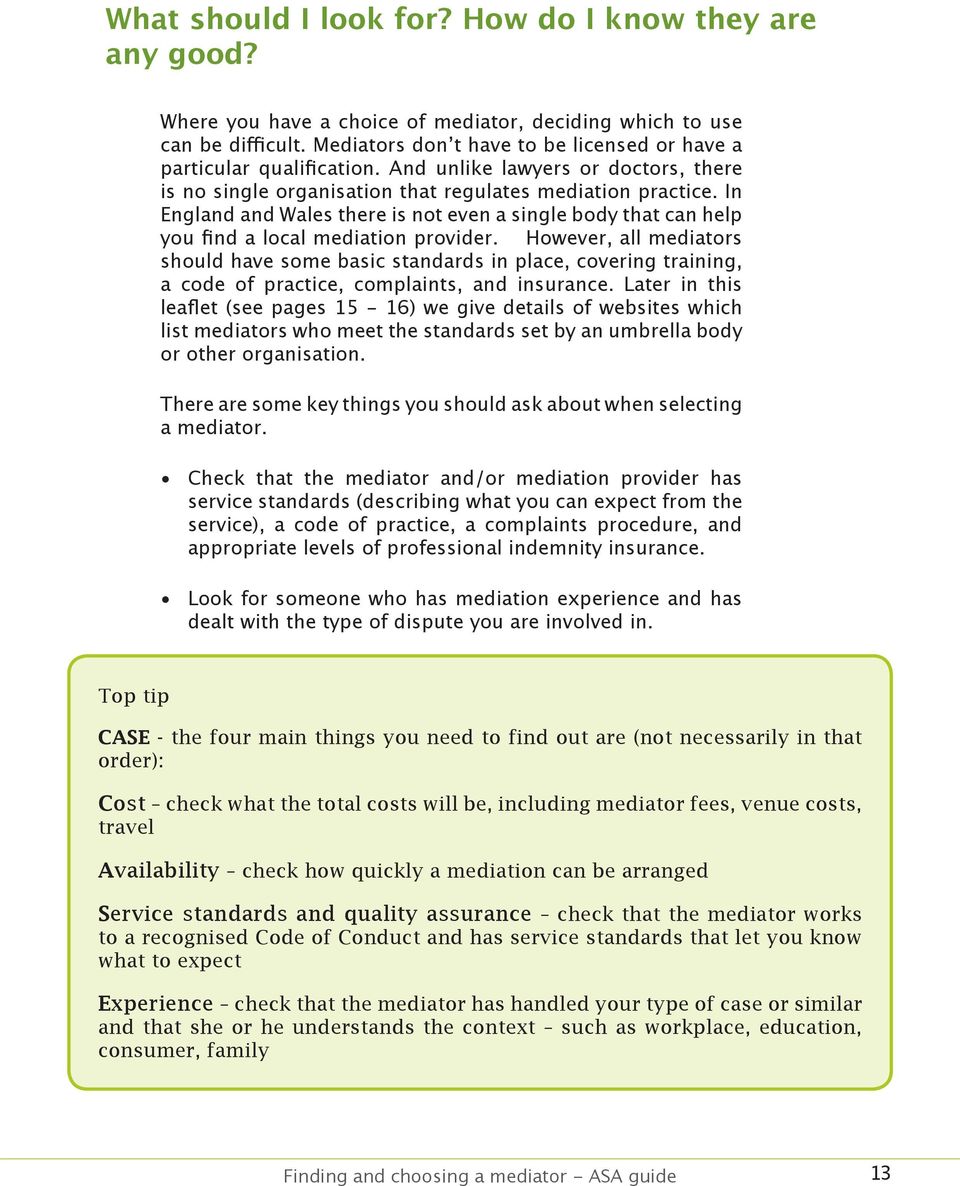
13 What should I look for? How do I know they are any good? Where you have a choice of mediator, deciding which to use can be difficult. Mediators don t have to be licensed or have a particular qualification. And unlike lawyers or doctors, there is no single organisation that regulates mediation practice. In England and Wales there is not even a single body that can help you find a local mediation provider. However, all mediators should have some basic standards in place, covering training, a code of practice, complaints, and insurance. Later in this leaflet (see pages 15-16) we give details of websites which list mediators who meet the standards set by an umbrella body or other organisation. There are some key things you should ask about when selecting a mediator. Check that the mediator and/or mediation provider has service standards (describing what you can expect from the service), a code of practice, a complaints procedure, and appropriate levels of professional indemnity insurance. Look for someone who has mediation experience and has dealt with the type of dispute you are involved in. Top tip CASE - the four main things you need to find out are (not necessarily in that order): Cost check what the total costs will be, including mediator fees, venue costs, travel Availability check how quickly a mediation can be arranged Service standards and quality assurance check that the mediator works to a recognised Code of Conduct and has service standards that let you know what to expect Experience check that the mediator has handled your type of case or similar and that she or he understands the context such as workplace, education, consumer, family Finding and choosing a mediator - ASA guide 13
14 Make sure that the mediator can arrange a mediation when you need it so check how available they are. If you have a legal deadline for issuing a claim and you are trying to mediate before issuing, you will need to know the mediation can be completed in time so you protect your rights if it doesn t sort things out at mediation. Find out how much it will cost you can find out more about what to ask about mediation charges on pages Mediators don t have to be lawyers, but some good mediators are also lawyers. Remember that a mediator who is a lawyer won t give legal advice to either party; they are there as an impartial person. So don t rule someone out just because they are also a lawyer, or because they aren t! More important is whether the mediator has experience of the type of dispute or problem you have. Ask how many cases they ve dealt with and how many of those were about the type of problem you want to mediate. Has the mediator completed a mediation training course provided by a recognised mediation trainer? How much practical mediation experience should the mediator have? There are a large number of qualified or accredited mediators who have completed a training course, but have little or no experience of actually conducting mediations. What other kinds of cases has the mediator handled, and were the parties satisfied? You can ask for references from people who have used the mediator before. Is the mediator impartial in other words, are you confident that there is no conflict of interest and that the mediator has no interest in a particular outcome? What approach does the mediator use? Do you want a mediator who will manage your negotiations but not make recommendations, or one who will offer suggestions for settlement? 14 Finding and choosing a mediator - ASA guide

15 Places to go for particular types of mediators include various umbrella bodies for different areas of mediation practice: Family mediation The Family Mediation Council approves family mediation providers which meet its requirements. Family mediators who are trained and accredited by providers approved by the Council are listed on the government s Family Mediation Database: Community mediation There is no umbrella body for community mediation. To find a local community mediation service for neighbour disputes: search for your nearest community mediation service using an internet search engine get information from your local council; many community mediation services are funded by their local authority get information from your local telephone directory, library or CAB look at the Directory of UK Mediation which provides a searchable database of some community mediation services in the UK: Note that none of these options provides any quality assurance standards. The College of Mediators is an independent professional body for mediators, which sets standards for training, supervision and practice, and keeps a register of mediators that meet these standards. Some (but not all) community mediators are accredited by the College and listed on their register: Finding and choosing a mediator - ASA guide 15
16 Civil and commercial mediation The Civil Mediation Council is a national organisation which represents and promotes civil and commercial mediation. It operates an accreditation scheme for civil and commercial mediation providers but not for individual mediators. The accreditation scheme relies on self-certification by civil and commercial mediation services, and includes criteria for adequate training, insurance and complaints procedures: Fixed-rate mediation is available from providers listed on the government s Civil Mediation Directory, an online tool that helps you to locate a mediation provider for a money-based (commercial) dispute. All providers listed are accredited by the Civil Mediation Council. Workplace mediation You can get advice and help with trying to resolve employment disputes through Acas conciliation which offers free telephone conciliation. Acas can also provide experienced workplace mediators, though there is a charge for this: You can also locate workplace mediators through the Civil Mediation Council Workplace Mediation Register. This lists individual mediators and mediation providers: 16 Finding and choosing a mediator - ASA guide
17 Costs and paying for mediation You will need to find out in advance how much the mediation will cost. Mediation can be very expensive, and may depend on the amount of money in dispute or the length of time the mediation takes. But it can also be free, and some mediations are paid for by one party, such as the employer or the local authority you are in dispute with. If you use a mediator you contacted through the government s Civil Mediation Directory, the mediation is provided at a fixed, subsidised rate, which starts from 50 + VAT per party for a one-hour session for small claims (of less than 5,000), increasing to VAT per party for a four-hour session (for claims up to 50,000). Some questions to ask mediators about charges are: Find out how the mediation fee is calculated. Is it worked out on an hourly or daily basis, or is it a flat fee? Do you pay more for a high-value dispute? You should also check if the fee quoted is per party, or per mediation, and what the charges include. Will you have to pay extra for the cost of the venue? Will there be VAT on top? Will you have to provide or pay for refreshments? The mediation may last a whole day! In commercial mediation the parties are often accompanied by a legal adviser but this is not always necessary. Do you want a legal adviser to attend? If so, how much will this cost you? Can you get help from an advice agency in your area? You should be aiming for a good balance it probably won t be a good idea if one side has legal representation and the other does not. After a court hearing, it is usual for the losing side to pay the winning side s legal costs. In mediation, it is usual for each side to pay their own costs. But of course you can always agree something different between you at the mediation. Make sure you discuss this with your legal adviser and with the mediator. Finding and choosing a mediator - ASA guide 17
18 If you have a solicitor and are eligible for legal aid, mediation costs can be paid for as part of your legal aid certificate. Ask your solicitor about this. Some mediation providers, such as LawWorks, provide free or lowercost mediations to parties who can t afford to pay and aren t eligible for legal aid. LawWorks: Some mediation is free of charge to one or both of the parties. For example: In England and Wales, mediation is offered free of charge by the courts to both parties in small claims that have been issued in county court. Community mediation is usually offered free of charge in neighbour disputes; the service is often funded by the local authority and local housing associations. Mediation in cases involving special educational needs is usually paid for by the local authority or school involved and there is no charge to the parents. For workplace disputes, mediation is often paid for by the employer. Top tip When contacting a civil mediation provider, it is important to mention that you located them through the government s Civil Mediation Directory, in order to get the fixed-fee rate. It is also important to check with the provider whether any additional charges will apply such as the costs of room hire, travel for the mediator or administration charges. 18 Finding and choosing a mediator - ASA guide
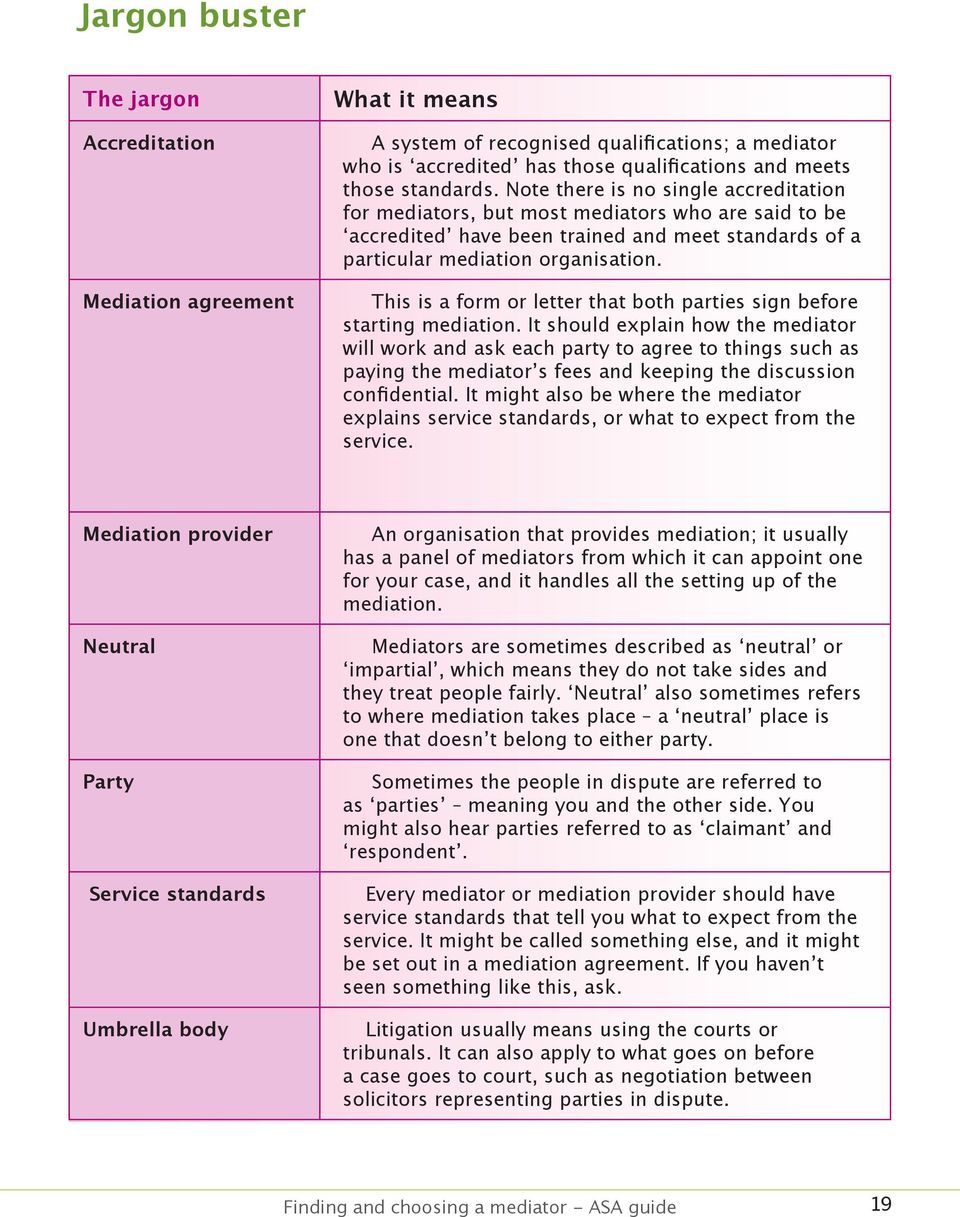
19 Jargon buster The jargon What it means Accreditation A system of recognised qualifications; a mediator who is accredited has those qualifications and meets those standards. Note there is no single accreditation for mediators, but most mediators who are said to be accredited have been trained and meet standards of a particular mediation organisation. Mediation agreement This is a form or letter that both parties sign before starting mediation. It should explain how the mediator will work and ask each party to agree to things such as paying the mediator s fees and keeping the discussion confidential. It might also be where the mediator explains service standards, or what to expect from the service. Mediation provider An organisation that provides mediation; it usually has a panel of mediators from which it can appoint one for your case, and it handles all the setting up of the mediation. Neutral Mediators are sometimes described as neutral or impartial, which means they do not take sides and they treat people fairly. Neutral also sometimes refers to where mediation takes place a neutral place is one that doesn t belong to either party. Party Sometimes the people in dispute are referred to as parties meaning you and the other side. You might also hear parties referred to as claimant and respondent. Service standards Umbrella body Every mediator or mediation provider should have service standards that tell you what to expect from the service. It might be called something else, and it might be set out in a mediation agreement. If you haven t seen something like this, ask. Litigation usually means using the courts or tribunals. It can also apply to what goes on before a case goes to court, such as negotiation between solicitors representing parties in dispute. Finding and choosing a mediator - ASA guide 19
20 Written by Margaret Doyle June 2012 This leaflet is published by Advice Services Alliance: The Foundry (Room 303), 156 Blackfriars Road, London SE1 8EN The Advice Services Alliance is a company limited by guarantee, registered in England & Wales no Our registered address (not for correspondence): New Bridge Street House, New Bridge Street, London EC4V 6BJ. Charity no Finding and choosing a mediator - ASA guide
Why use ADR? Pros & cons
 Why use ADR? Pros & cons Thinking about ADR? This leaflet is for you if you ve heard about alternative dispute resolution (ADR) and are wondering whether to use it to try and resolve a dispute. It will
Making a complaint Information Guide
 Making a complaint Information Guide This guidance is to assist disabled people and / or their family members who feel they may have received a less favourable service (discrimination) due to their disability.
Protection from discrimination, harassment and victimisation when you re self-employed
 Protection from discrimination, harassment and victimisation when you re self-employed This information is an extract from the booklet Self-employment and cancer. You may find the full booklet helpful.
ways you can settle a dispute without going to court; what happens if the dispute does go to court; and what happens next.
 EX301 I m in a dispute - what can I do? For people who are in a dispute About this leaflet This leaflet is for people involved in a disagreement or dispute with another person, a company or organisation.
EX306. The small claims track in the civil courts. About this leaflet. If your dispute has gone to court. Important information about this leaflet
 EX306 The small claims track in the civil courts If your dispute has gone to court About this leaflet This leaflet is for people involved in a dispute that has gone to court and the claim has been allocated
A guide to debt recovery through a county court for small businesses. It could help you decide whether court action is right for you.
 EX350 A guide to debt recovery through a county court for small businesses 1. Introduction This leaflet covers the sort of things to bear in mind when considering going to court. You can issue a claim
Know. Your. Rights. Understanding. grievances. www.worksmart.org.uk. and disciplinaries
 Understanding Know Your Rights www.worksmart.org.uk grievances and disciplinaries Introduction Whatever job you do, you can run into problems at work. Sometimes these can be sorted out quickly by informal
Only. (inc VAT) SMALL CLAIMS. Helping you resolve disputes worth 100s to 10,000. QualitySolicitors Truemans
 Only 99 (inc VAT) SMALL CLAIMS Helping you resolve disputes worth 100s to 10,000. QualitySolicitors Truemans 2 Small claims legal advice, when you need it From a dispute with a builder to a holiday which
Complaint about your pension? Here s how we can help
 Complaint about your pension? Here s how we can help When I retired I should have received my pension straightaway but it took months to organise. I m ill and unable to work. My pension scheme allows for
Using a lawyer as you get older: Ten top tips
 Using a lawyer as you get older: Ten top tips www.legalombudsman.org.uk The information in this leaflet is useful for anyone who is considering using a lawyer but it may be particularly useful for people
Describe the Different Methods of Alternative Dispute Resolution Available to do with Civil Courts.
 1 Describe the Different Methods of Alternative Dispute Resolution Available to do with Civil Courts. In Lord Woolf s Report Access to Justice (1996) one of the key recommendations was to encourage the
A guide to helping you move on. QualitySolicitors Mirza
 A guide to helping you move on. QualitySolicitors Mirza 2 A guide to help you We understand just how stressful and upsetting ending a relationship can be. We re here to make things as simple and stress-free
1. Outline the qualifications and training required to become a barrister and solicitor, and describe the work each profession carries out.
 AQA LAW - AS EXAMINATIONS Unit 1 - LAW01 - Law Making and the Legal System THE LEGAL PROFESSIONS BARRISTERS and SOLICITORS 1. Outline the qualifications and training required to become a barrister and
Ten questions to ask your lawyer about costs
 Legal Ombudsman January 2014 Consumer Guide: Costs Ten questions to ask your lawyer about costs 1 The information in this leaflet is useful for anyone who is using, or thinking of using, a legal service.
Mediation Services, Throughout the UK Guide to Mediation
 mediation Mediation Services, Throughout the UK Guide to Mediation let sstarthere Why Mediate? Pg 3 The Mediation Day Pg 4 Preparing for the Mediation Pg 5 Quality Assured Pg 6 Flexible Fee Policy Pg 7
Ten questions to ask your lawyer about costs
 Ten questions to ask your lawyer about costs www.legalombudsman.org.uk The information in this leaflet is useful for anyone who is using, or thinking of using, a legal service. This could be for a whole
Chapter 1 - Disciplinary and grievance procedures
 Chapter 1 - Disciplinary and grievance procedures 1.1. What s happened to the statutory procedures?... 3 1.1.1. Why were they abolished?... 3 1.1.2. What has taken their place?... 4 1.1.3. What are the
NHS Complaints Advocacy. A step by step guide to making a complaint about the NHS. www.pohwer.net
 NHS Complaints Advocacy A step by step guide to making a complaint about the NHS NHS Complaints Advocacy Important Information Please read this section before the rest of this guide to ensure you take
Problems paying your mortgage
 Problems paying your mortgage What you need to do now and how to get back on track Steps to take now What your options are Get free impartial advice The Money Advice Service is independent and set up by
[5] Civil legal aid what you may have to pay
![[5] Civil legal aid what you may have to pay](/thumbs/26/8700300.jpg "[5] Civil legal aid what you may have to pay") [5] Civil legal aid what you may have to pay It s important that you understand, before your solicitor starts working for you, what you might have to pay. This leaflet explains: what you might have to
[5] Civil legal aid what you may have to pay It s important that you understand, before your solicitor starts working for you, what you might have to pay. This leaflet explains: what you might have to
Your child s lawyer. Court-appointed lawyer for the child in cases deciding on care of children
 Your child s lawyer Court-appointed lawyer for the child in cases deciding on care of children When disputes about the care of your children are at the Family Court, the court often appoints an independent
A Practical Guide to. Hiring a LAWYER
 A Practical Guide to Hiring a LAWYER A PRACTIAL GUIDE TO HIRING A LAWYER I. Introduction 3 II. When do you Need a Lawyer? 3 III. How to Find a Lawyer 4 A. Referrals 4 B. Lawyer Referral Service 5 C. Unauthorized
Dealing with disputes at work
 Factsheet 70 November 2013 About this factsheet This factsheet is aimed at older people who are in work and covers information on dealing with a dispute with an employer, including taking legal action.
Get advice now. Are you worried about your mortgage? New edition
 New edition July 2009 Are you worried about your mortgage? Get advice now If you are struggling to pay your mortgage, act now to stop your situation becoming worse. Working with Citizens Advice Bureaux
Dealing with Debt. How to petition for your own bankruptcy
 Dealing with Debt How to petition for your own bankruptcy Contents Where can I get advice about bankruptcy? What are the alternatives to bankruptcy? How do I petition for my bankruptcy? How much will it
Get advice now. Are you worried about your mortgage? New edition
 New edition July 2010 Are you worried about your mortgage? Get advice now If you are struggling to pay your mortgage, act now to stop your situation becoming worse. Working with Citizens Advice Bureaux
Welcome to NEST. All the key information you need about being a member of NEST
 Welcome to NEST All the key information you need about being a member of NEST 2 Please write your NEST ID here: You ll find this number on the letter that came with this booklet. Welcome to NEST Building
Your guide to Using a solicitor
 www.lawsociety.org.uk 1 Most of us need expert legal help at some time in our lives. Some of the most common issues are to do with buying a house, getting a divorce or making a will. But you might also
Family law a guide for legal consumers
 Family law a guide for legal consumers Image Credit - Jim Harper A relationship breakdown is a difficult time for anyone. It is one of the most stressful experiences in life. Where you have to involve
How Acas can help. Early Conciliation explained
 How Acas can help Early Conciliation explained What does Acas do? Acas stands for Advisory, Conciliation and Arbitration Service. We are a publicly funded independent organisation that promotes good employment
CB7. Guide for separated parents: children and the family courts. Help with deciding what should happen with your children
 CB7 Guide for separated parents: children and the family courts Deciding what should happen to your children when you and your partner have split up can be difficult. You might not be able to agree who
For people who want to take a dispute to court
 EX302 How do I make a court claim? For people who want to take a dispute to court About this leaflet This leaflet is for people who want to take a claim to court. It explains: how to prepare your court
Taking Action. Dispute resolution, legal action and claims for negligence
 Taking Action Dispute resolution, legal action and claims for negligence Taking Action Part 3: Dispute Resolution, taking legal action and claims for negligence Introduction If you believe an architect
Adviceguide Advice that makes a difference
 Going to court Before you go to court If you have been negotiating with a trader to try and resolve a consumer complaint but have not been successful, you may want to consider going to court. You should
For people who want to take a dispute to court
 How do I make a court claim? For people who want to take a dispute to court EX302 About this leaflet This leaflet is for people who want to take a claim to court. It explains: how to prepare your court
FIXED FEE DIVORCE AND FAMILY LAW SERVICES
 01226 210000 www.mkbsolicitors.co.uk [email protected] Please feel free to telephone the office and request to speak to a member of the family team Page 1 of 12 If your relationship has broken down
How to make. a civil claim in the District Court
 How to make a civil claim in the District Court What is civil justice? Civil justice relates to disputes between individuals or organisations. Generally, civil cases are not about breaking a criminal law.
A step-by-step guide to making a complaint about health and social care
 A step-by-step guide to making a complaint about health and social care www.healthwatchhampshire.co.uk Step by step Page 3 Are you concerned about something that is happening now? Do you need to make a
20 Essential Legal Tips to Know Before You Hire a Lawyer
 20 Essential Legal Tips to Know Before You Hire a Lawyer Ken LaMance, Attorney at Law Copyright 2000-2010 All Rights Reserved Contents Do I need a Lawyer? 1. Define your problem carefully before considering
Joint and Several Liability. Partnership responsibilities.
 Joint and Several Liability. Partnership responsibilities. If you re going into business with partners, you need to know about Joint and Several Liability. This brochure highlights the main issues. Contents.
What is the purpose of the Grant of Representation?
 PA2 How to obtain probate - A guide for people acting without a solicitor What is the Probate Service? The Probate Service is part of HM Courts & Tribunals Service. It administers the system of probate,
1 Don t ignore the problem
 Sometimes when your circumstances change, for example you work fewer hours, become sick, separate/ divorce, receive a cut in your pay, lose your job or have high bills to pay, life seems impossible. Don
NHS Complaints Advocacy
 NHS Complaints Advocacy Raising Concerns or Complaints About the NHS Advocacy in Surrey is provided by Surrey Disabled People s Partnership (SDPP) In partnership with SDPP is a registered Charity: 1156963
Information for registrants. What happens if a concern is raised about me?
 Information for registrants What happens if a concern is raised about me? Contents About this brochure 1 What is fitness to practise? 1 What can I expect from you? 3 How are fitness to practise concerns
Your guide to. Dispute Resolution
 Your guide to Dispute Resolution Your guide to Dispute Resolution ISBN 978-1-922032-16-4 Commonwealth of Australia 2012 All material presented in this publication is provided under a Creative Commons
Divorce and separation. Choosing the right process for you
 Divorce and separation Choosing the right process for you Divorce or separation is often a time of conflict and heartache. Having the right professional advice and support can make all the difference.
Crashed your car? Information on claims for damage to your car, in and out of court
 Crashed your car? Information on claims for damage to your car, in and out of court 1 After a car accident This brochure will take you through the important steps you need to take if your car is damaged
EQUAL PAY FOR LIKE WORK TAKING A CLAIM
 Department of Economic Development Rheynn Lhiasaghey Tarmaynagh EQUAL PAY FOR LIKE WORK TAKING A CLAIM The leaflet is a guide and has no status in law. It does not cover all the rules for every situation,
Dealing with Debt How to petition for your own bankruptcy
 Dealing with Debt How to petition for your own bankruptcy Contents Where can I get advice about bankruptcy?... 3 What are the alternatives to bankruptcy?... 3 How do I petition for my bankruptcy?... 4
A GUIDE TO FAMILY LAW LEGAL AID
 A GUIDE TO FAMILY LAW LEGAL AID Important new rules in relation to legal aid were introduced on 1 April 2013 by the Legal Aid, Sentencing and Punishment of Offenders Act 2012 (LASPO). This legal guide
Using a conveyancing lawyer: Ten helpful tips
 Using a conveyancing lawyer: Ten helpful tips www.legalombudsman.org.uk Buying a new home is a significant step in anyone s life. You might be moving with a new job, getting a bigger place for a new or
AVOIDING AND RESOLVING DISCIPLINE AND GRIEVANCE ISSUES AT WORK. Simpler laws, better services
 AVOIDING AND RESOLVING DISCIPLINE AND GRIEVANCE ISSUES AT WORK Simpler laws, better services 2 Introduction This leaflet has been jointly produced by the Department for Business, Enterprise and Regulatory
WE RE HERE FOR YOU Expert local personal injury advice.
 1 WE RE HERE FOR YOU Expert local personal injury advice. 2 A guide to help you We know that an injury can cause a wide range of problems, more than just coping with your pain and discomfort. We re here
Do I have a settlement or a conditional settlement?
 EX329 I have an Advisory, Conciliation and Arbitration Service (Acas) settlement or conditional settlement (Form COT3) but the respondent has not paid How do I enforce it? This leaflet will explain how
DISPUTE RESOLUTION TERMS
 National Alternative Dispute Resolution Advisory Council DISPUTE RESOLUTION TERMS The use of terms in (alternative) dispute resolution Sept. 03 Contents INTRODUCTION... 1 Why is consistency of terms needed?...
A WorkLife4You Guide
 A WorkLife4You Guide Finding a Lawyer That Is Right for You You may be seeking a lawyer also called an attorney for a variety of reasons. Not only can lawyers provide legal counsel in criminal or civil
ORAL STATEMENT ON ACCESS TO JUSTICE REVIEW FINAL REPORT: 13 SEPTEMBER 2011
 ORAL STATEMENT ON ACCESS TO JUSTICE REVIEW FINAL REPORT: 13 SEPTEMBER 2011 Members will have heard me speak previously, in this chamber and elsewhere, of the opportunities that the devolution of justice
Business Insurance RICS - compliant professional indemnity section only Summary of cover
 Business Insurance RICS - compliant professional indemnity section only Summary of cover About this document This document is a summary of the insurance provided and does not contain the full terms and
GUIDE TO RETIREMENT PLANNING FINANCIAL GUIDE. Making the most of the new pension rules to enjoy freedom and choice in your retirement
 GUIDE TO RETIREMENT PLANNING Making the most of the new pension rules to enjoy freedom and choice in your retirement FINANCIAL GUIDE WELCOME Making the most of the new pension rules to enjoy freedom and
DISCIPLINARY, DISMISSAL AND GRIEVANCE PROCEDURES. Guidance for employers
 DISCIPLINARY, DISMISSAL AND GRIEVANCE PROCEDURES Guidance for employers Contents Foreword...1 Chapter 1: Disciplinary and dismissal procedures...2 Communicating your disciplinary and grievance procedures...2
Clinical Negligence. Investigating Your Claim
 www.lees.co.uk Clinical Negligence Investigating Your Claim Lees Solicitors LLP 44/45 Hamilton Square Birkenhead Wirral CH41 5AR Tel: 0151 647 9381 Fax: 0151 649 0124 e-mail: [email protected] 1 The
A Practical Guide to Community Legal Service Funding by the Legal Services Commission
 A Practical Guide to Community Legal Service Funding by the Legal Services Commission April 2006 Contents Section 1 2-5 Introduction 1.1 About this booklet 1.2 The different types of Legal Aid 1.3 A low-cost
Financial help for people with mesothelioma
 Financial help for people with mesothelioma This information is an extract from the booklet Understanding mesothelioma. You may find the full booklet helpful. We can send you a free copy see page 7. Contents
Raising Concerns or Complaints about NHS services
 Raising Concerns or Complaints about NHS services Raising concerns and complaints A step by step guide Raising concerns and complaints Questions to ask yourself: 1. What am I concerned or dissatisfied
Managing bills and bank accounts
 Managing bills and bank accounts This information is an extract from the booklet Managing your money day to day, which is part of our Financial guidance series. You may find the full booklet helpful. We
Dealing with debt. A guide for customers
 Dealing with debt A guide for customers How you can get help Banks are here to help you run your finances smoothly in a complicated world. You can get help in good and bad times. Banks understand that
How to Make a Claim. Guide. The Equality Act 2010
 working with Guide The Equality Act 2010 The TAEN Guides to the age related provisions of the Equality Act 2010 are primarily for employees, jobseekers and learners and aim to give a simple, clear explanation.
briefing Guide to litigation funding
 briefing Guide to litigation funding The potential cost of litigation can be a major deterrent to bringing or defending legal proceedings even where there is a good chance of succeeding. Cost can be the
Guide to Divorce and Separation
 Family Law Web Guide A guide by Guillaumes Solicitors Introduction The breakdown of a relationship can be a difficult and challenging time. The pressure and anxiety of splitting up, applying for divorce,
Keeping up with mortgage repayments
 Keeping up with mortgage repayments This information is an extract from the booklet Housing costs, which is part of our Financial guidance series. You may find the full booklet helpful. We can send you
So you ve had a threatening letter. What can you do?
 Taking down my blog was a tortuous decision The experience was intimidating So you ve had a threatening letter. What can you do? I felt that I had little choice but to delete what I had written A lawyer
Dispute Resolution Bringing A Small Claim
 Dispute Resolution Bringing A Small Claim Kirwans is one of the North West s most forward thinking law firms. As an allservicing firm, our success has been built upon delivering expert knowledge and expertise
AVOIDING AND RESOLVING DISCIPLINE AND GRIEVANCE ISSUES AT WORK. Simpler laws, better services
 AVOIDING AND RESOLVING DISCIPLINE AND GRIEVANCE ISSUES AT WORK Simpler laws, better services 2 Introduction This leaflet has been jointly produced by the Department for Business, Innovation and Skills
Motoring Legal Solutions
 Motoring Legal Solutions Page 1 Why you need Motoring Legal Solutions Being involved in any kind of car accident can be very distressing. If you are unfortunate enough to be involved in an accident that
How To Get Out Of Debt
 Are you worried about your mortgage? Get advice now If you are struggling to pay your mortgage, act now to stop your situation becoming worse Funded by the Northern Ireland Executive, delivered through
TIPS AND ADVICE TO ENSURE THE BEST OUTCOME FOR YOUR PERSONAL INJURY CASE.
 A CONSUMER S GUIDE TO A SUCCESSFUL PERSONAL INJURY CLAIM TIPS AND ADVICE TO ENSURE THE BEST OUTCOME FOR YOUR PERSONAL INJURY CASE. MATERIAL PROVIDED BY: DICAUDO & YODER, LLC A CONSUMER S GUIDE TO A SUCCESSFUL
Information in relation to Legal Charges
 Information in relation to Legal Charges This leaflet is for solicitors to give to their clients. By law, your solicitor must give you information about your legal charges the money you must pay them for
A court claim has been made against me what should I do?
 EX303 A court claim has been made against me what should I do? For people whose dispute has been taken to court About this leaflet This leaflet is for people who have received a claim against them. It
Your retirement income. Exploring your options
 Your retirement income Exploring your options Contents 02 What do you want to do with your pension fund? 07 A regular retirement income for the rest of your life 10 A flexible income from a Self Invested