
Worldwide investments in CLUSTER MUNITIONS
|
|
|
- Philippa Newton
- 10 years ago
- Views:
Transcription
1 June 2012 update Worldwide investments in CLUSTER MUNITIONS a shared responsibility June 2012
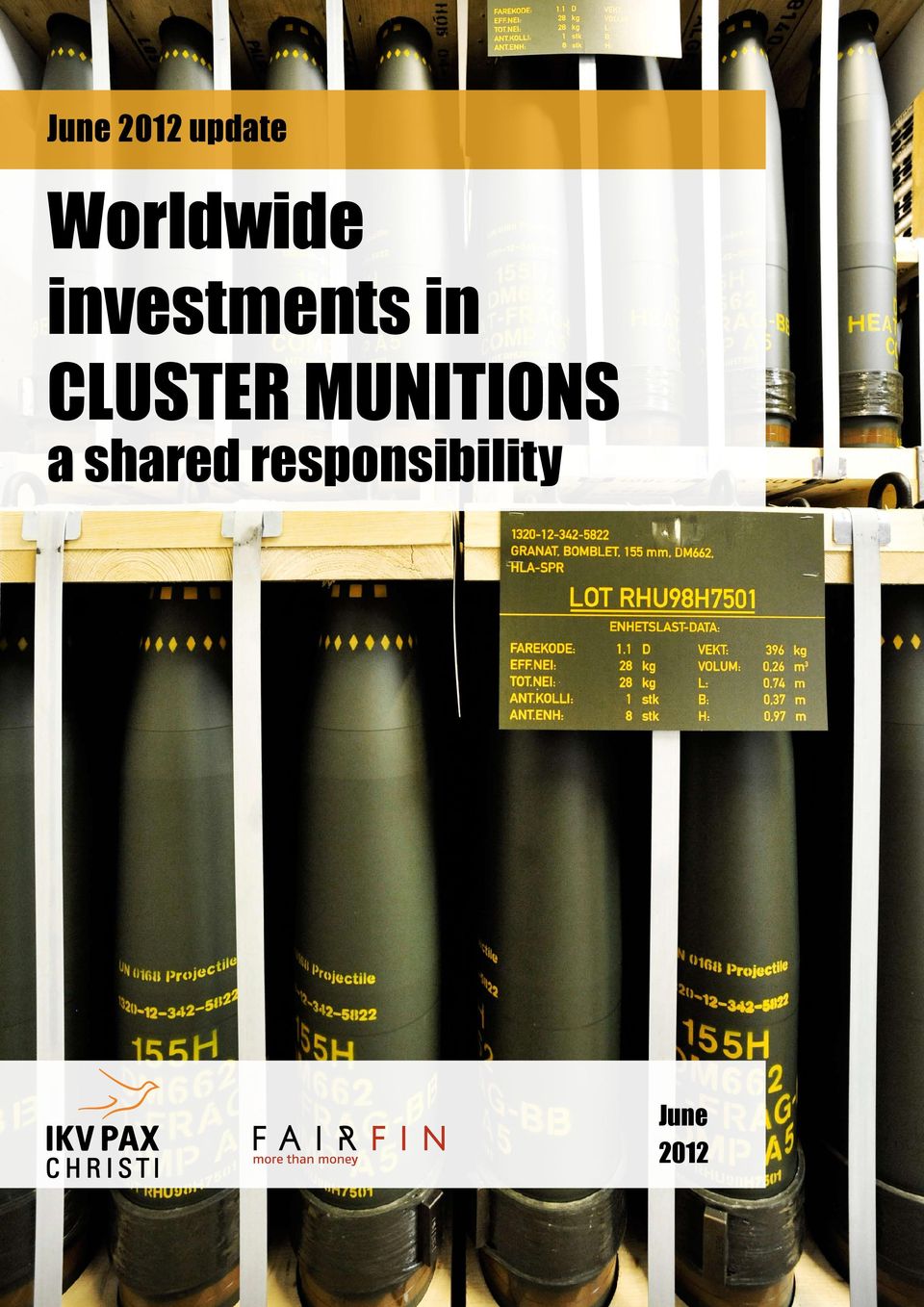
2 Utrecht, June 2012 IKV Pax Christi and FairFin have strived to achieve the highest level of accuracy in our reporting. However, at this point, there is still a marked lack of official information available in the public domain about the use, production, transfer, and stockpiling of cluster munitions, as well as about investments in companies that produce cluster munitions. The information in this report therefore reflects official information available in the public domain known to IKV Pax Christi and FairFin. We welcome comments, clarifications, and corrections from governments, companies, financial institutions and others, in the spirit of dialogue, and in the common search for accurate and reliable information on an important subject. If you believe you have found an inaccuracy in our report or if you can provide additional information, please contact us. Authors Roos Boer (IKV Pax Christi, the Netherlands) Suzanne Oosterwijk (IKV Pax Christi, the Netherlands) Stijn Suijs (FairFin, Belgium) Esther Vandenbroucke (FairFin, Belgium) Research by Roos Boer (IKV Pax Christi, the Netherlands) Jan Willem Van Gelder (Profundo, the Netherlands) Suzanne Oosterwijk (IKV Pax Christi, the Netherlands) Stijn Suijs (FairFin, Belgium) Esther Vandenbroucke (FairFin, Belgium) With thanks to Adessium Foundation, Werner Anderson, Ban Advocates, Andrea Baranes, Jérôme Bobin, Kimberly Brown, Laura Cheeseman, Paul Hannon, Barbara Happe, Katherine Harrison, Mark Hiznay, Thomas Küchenmeister, Marion Libertucci, Christophe Scheire, Giuseppe Schiavello, Frank Slijper, Miriam Struyk, Junko Utsumi, Paul Vermeulen, Mary Wareham, Luc Weyn, Tim Wright, Khaled Yahmout, Rasha Zayoun, and all financial institutions representatives who provided answers to our questions about their policy. Editor Ms. C. Romanik A publication by IKV Pax Christi, the Netherlands and FairFin, Belgium Responsible Publisher Kristien Vermeersch, FairFin vzw, Vooruitgangstraat 333 b9, 1030 Brussels, Belgium Lay out Hilje Oosterbaan Martinius Cover photograph Norway, 4 September Stockpiles of artillery delivered 155mm DM662 cluster munitions in Norway. Werner Anderson For additional information please contact [email protected].
3 IKV Pax Christi (the Netherlands) and FairFin (formerly Netwerk Vlaanderen, Belgium) published the first report on Worldwide Investments in Cluster Munitions: a Shared Responsibility in October It was a state-of-the-art report on financial institutions investment in companies that develop or produce cluster munitions, on financial institutions disinvesting from producers of cluster munitions and on states banning investments in cluster munitions. Updates of the report appeared in April 2010 and May This edition, dated June 2012, updates the earlier reports. 1

4 STATE-OF-THE-ART REPORT Contents Executive Summary, Recommendations and Methodology...8 Summary Tables...18 Introduction...28 Investing in Cluster Munitions: What s at Stake?...28 Cluster Munitions and the Oslo Process...28 Financial Institutions Power and Responsibility...29 Our Research...30 Chapter 1 Hall of Shame: Financial Involvement and Investments Red Flag List of Cluster Munitions Producers Introduction and Methodology Alliant Techsystems (United States) Hanwha (South Korea) Lockheed Martin (United States) Norinco (China) Poongsan (South Korea) Singapore Technologies Engineering (Singapore) Splav State Research and Production Enterprise (Russia) Textron (United States) The Investments Introduction and Methodology Aberdeen Asset Management (United Kingdom) Agricultural Bank of China (China) AIG (United States) Allianz (Germany) Allstate (United States) American Family Insurance (United States) Ameriprise Financial (United States) ANZ Bank (Australia) APS Asset Management (Singapore) Aronson + Jonson + Ortiz (United States) AXA (France) Bank of America (United States) Bank of Beijing (China) Bank of China (China) Bank of Communications (China) Bank of New York Mellon (United States) Bank of Shanghai (China) Barclays (United Kingdom) BB&T (United States) BlackRock (United States) BNP Paribas (France) BPCE (France) Breeden Capital Management (United States)
5 Capital Group (United States) Castle Creek Arbitrage (United States) Chang Hwa Commercial Bank (Taiwan) China Construction Bank (China) China Development Bank (China) China Everbright Bank (China) China Merchants Bank (China) China Minsheng Bank (China) Citadel (United States) CITIC Securities (China) Citigroup (United States) Consus Asset Management (South Korea) Continental Insurance (United States) Crédit Agricole (France) Credit Suisse (Switzerland) Daewoo Securities (South Korea) Davis Selected Advisers (United States) DBS Bank (Singapore) Deutsche Bank (Germany) Dimensional Fund Advisors (United States) Dongbu Securities (South Korea) Dreman Value Management (United States) Eugene Investment & Securities (South Korea) Export Import Bank of Korea (South Korea) Fidelity (United States) Fiduciary Management (United States) First Eagle Investment Management (United States) First Financial (Taiwan) Franklin Templeton (United States) General Electric (United States) Genworth Financial (United States) Goldman Sachs (United States) Grantham, Mayo, Van Otterloo & Co. (GMO) (United States) Guotai Junan Securities (China) Hana Financial (South Korea) Hanyang Securities (South Korea) Hanwha Securities (South Korea) Hartford Financial Services Group (United States) Hotchkis and Wiley Capital Management (United States) Hua Nan Financial (Taiwan) Hyundai Heavy Industries (South Korea) Industrial Bank (China) Industrial & Commercial Bank of China (ICBC) (China) Intesa Sanpaolo (Italy) Invesco (United Kingdom) Jackson National Life Insurance (United States) JP Morgan Chase (United States) KB Financial (South Korea) Keybank (United States) Korea Development Bank (South Korea) Korea Investment (South Korea) Liberty Mutual (United States) Liechtensteinische Landesbank (Liechtenstein)

6 Lincoln Financial (United States) Lloyds Banking (United Kingdom) Manulife Financial (Canada) Massachusetts Mutual Life Insurance (United States) Matthews International Capital Management (United States) Mellon Capital Management (United States) Metropolitan Life Insurance (United States) Mirae Asset Financial (South Korea) Mitsubishi UFJ Financial (Japan) Mizuho Bank (Japan) Morgan Stanley (United States) National Pension Service (South Korea) New York Life Insurance (United States) Northeast Investors Trust (United States) Northern Trust (United States) Northwestern Mutual (United States) Nuveen Investments (United States) Och-Ziff Capital Management (United States) Oaktree Capital Management (United States) Old Mutual (United Kingdom) People s Insurance Company (Group) of China (PICC) (China) People s United Financial (United States) PNC Financial (United States) Principal Financial (United States) Prudential (United Kingdom) Prudential Financial (United States) Riyad Bank (Saudi Arabia) Royal Bank of Canada (Canada) Royal Bank of Scotland (United Kingdom) Samsung (South Korea) Sberbank (Russia) Schroder Investment Management (United Kingdom) Shanghai Pudong Development Bank (China) Shinhan Bank (South Korea) Shinyoung Securities (South Korea) SK Securities (South Korea) Société Générale (France) State Farm (United States) State Street (United States) Sumitomo Mitsui (Japan) Sun Life Financial (Canada) SunTrust Bank (United States) Symetra Life Insurance (United States) T. Rowe Price (United States) Teachers Insurance & Annuity Association (United States) Temasek (Singapore) TongYang Securities (South Korea) Truston Asset Management (South Korea) UBS (Switzerland) United Overseas Bank (Singapore) Unum (United States) US Bancorp (United States) Vanguard (United States)
7 Veritas Asset Management (United Kingdom) Wellington Management Company (United States) Wells Fargo Bank (United States) Western & Southern Mutual (United States) Williams Capital (United States) Woori Financial (South Korea) Yurie Asset Management (South Korea) Zazove Associates (United States)...87 Chapter 2 Disinvesting from Cluster Munitions Producers Hall of Fame: Financial institutions pioneering in disinvestment Introduction and Methodology...88 ETHICAL BANKS ASN Bank (the Netherlands) Banca Etica (Italy) Triodos Bank (the Netherlands)...90 GOVERNMENT-MANAGED PENSION FUNDS Fonds de Compensation (Luxembourg) The Future Fund (Australia) National Pensions Reserve Fund (Ireland) New Zealand Superannuation Fund (New Zealand) Norwegian Government Pension Fund Global (Norway) Swedish Pension Funds AP 1-4 (Sweden) Swedish Pension Fund AP7 (Sweden)...94 MAINSTREAM FINANCIAL INSTITUTIONS (private) ABP (the Netherlands) ATP (Denmark) BPF Bouw (the Netherlands) DNB (Norway) Ethias (Belgium) Folksam (Sweden) KLP (Norway) KPA (Sweden) Pensioenfonds Vervoer (the Netherlands) PGGM (the Netherlands) Philips Pension Fund (the Netherlands) PME (the Netherlands) PNO Media (the Netherlands) SNS REAAL (the Netherlands) Spoorwegpensioenfonds (the Netherlands) Storebrand Group (Norway) West LB (Germany) Runners-up Financial Institutions Introduction and Methodology ABN Amro (the Netherlands) AEGON (the Netherlands) Aviva (United Kingdom) AXA (France) BBVA (Spain) Belfius Bank and Insurances (Belgium) BNP Paribas (France)
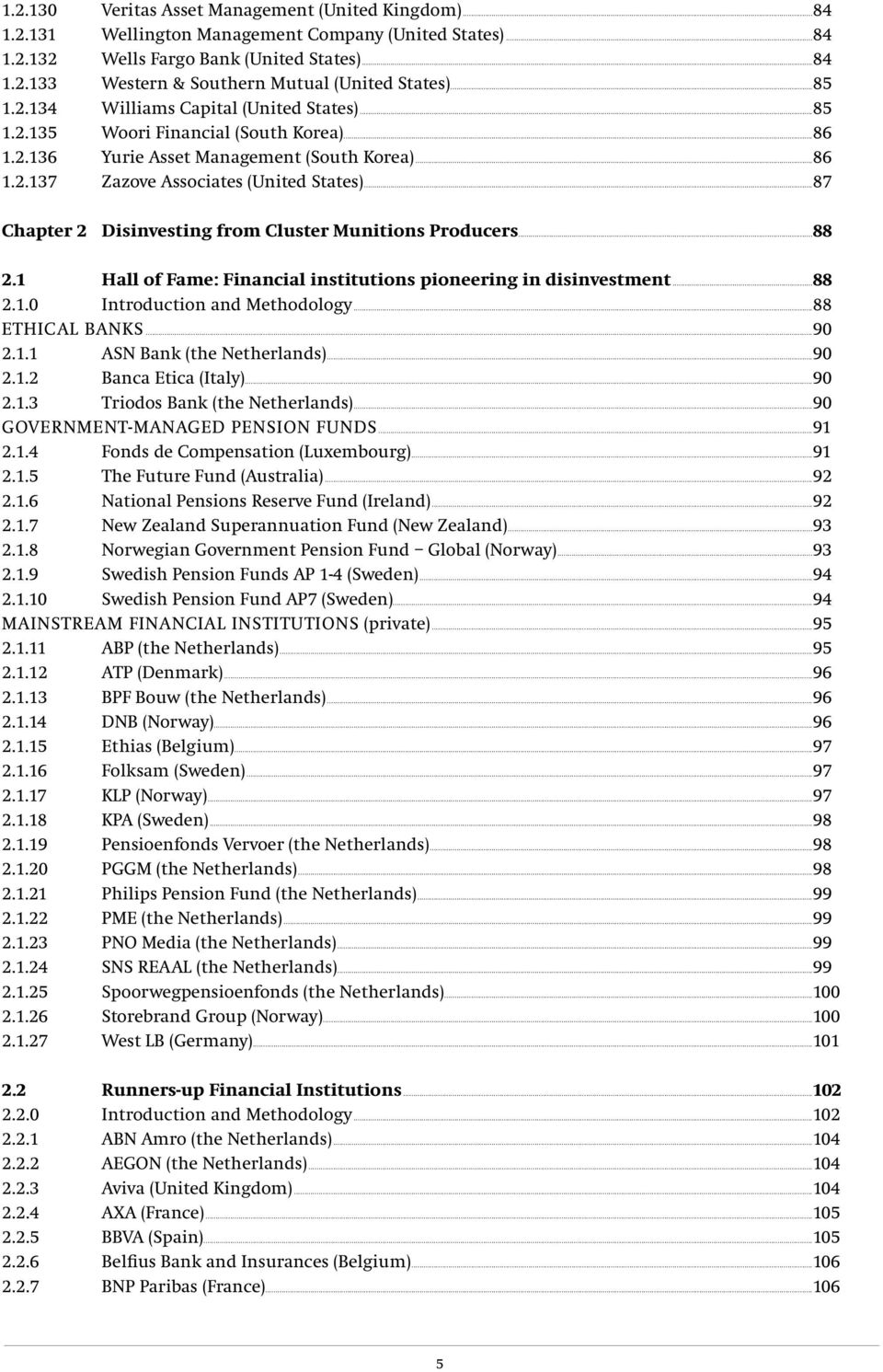
8 2.2.8 Commerzbank (Germany) Co-operative Financial Services (United Kingdom) Crédit Agricole (France) Credit Suisse (Switzerland) Danske Bank (Denmark) HSBC (United Kingdom) ING (the Netherlands) Intesa Sanpaolo (Italy) KBC (Belgium) Laegernes Pensionskasse (Denmark) Lloyds Banking Group (United Kingdom) Nordea (Sweden) Nycredit (Denmark) Pensioenfonds Horeca & Catering (the Netherlands) Rabobank (the Netherlands) Royal Bank of Canada (Canada) Royal Bank of Scotland (United Kingdom) SEB (Sweden) Société Générale (France) Stichting Pensioenfonds APF (the Netherlands) Syntrus Achmea (the Netherlands) UniCredit Group (Italy) Countries Best Practices Introduction and Methodology DISINVESTMENT LEGISLATION Belgium Ireland Italy Luxembourg New Zealand DISINVESTMENT MINISTERIAL AND INTERPRETIVE STATEMENTS Australia Bosnia and Herzegovina Cameroon Colombia Croatia The Czech Republic France Guatemala The Holy See Hungary Lao PDR Lebanon Madagascar Malawi Malta Mexico Rwanda Senegal Slovenia The United Kingdom Zambia

9 DISINVESTMENT PARLIAMENTARY INITIATIVES / DRAFT LEGISLATION The Netherlands Norway Switzerland Conclusion and recommendations Appendix 1 Glossary Appendix 2 References

10 Executive Summary, Recommendations and Methodology Executive Summary IKV Pax Christi (the Netherlands) and FairFin I (formerly Netwerk Vlaanderen, Belgium) published the first report on Worldwide Investments in Cluster Munitions: a Shared Responsibility in October It was a state-of-the-art report (SOAR) on financial institutions investment in companies that develop or produce cluster munitions, on financial institutions disinvesting from producers of cluster munitions and on states banning investments in cluster munitions. Updates of the report appeared in April 2010 and May This edition, dated June 2012, updates the earlier reports. The Convention on Cluster Munitions (CCM) categorically bans the use, production, stockpiling and transfer of cluster munitions. 94 countries signed the convention at the Oslo Signing Conference held 3-4 December The convention entered into force on 1 August Article 1(1)c of the CCM states, Each State Party undertakes never under any circumstances to assist, encourage or induce anyone to engage in any activity prohibited to a State Party under this Convention. It seems obvious that financing the production of cluster munitions constitutes assistance or encouragement, as the Cluster Munition Coalition (CMC) also points out in its policy paper. 3 However, States Parties implementation of this convention might not automatically result in a ban on investments in cluster munitions. The process to ban cluster munitions is well underway. Many countries that have signed the convention are now drafting national implementation legislation, and/or have started to implement the convention. Even before the CCM opened for signature, there was an international consensus on problems stemming from the indiscriminate nature of cluster munitions. This means that from a moral perspective financial institutions should not have needed the CCM to terminate their investment in companies producing cluster munitions. Some financial institutions took this step and banned all investment in cluster munitions even before the convention was negotiated in May 2008; others persisted in supporting the production of these indiscriminate weapons. Each State Party undertakes never under any circumstances to assist, encourage or induce anyone to engage in any activity prohibited to a State Party under this Convention. We emphasise that, at this point, there is still a lack of official information in the public domain about the production of cluster munitions and investment in cluster munitions producers. That is why the information in this report is by no means exhaustive. We explain our methodology in the methodology part of this executive summary and at the beginning of each chapter. We hope that this information will stimulate states, financial institutions and civil society to further the convention s goal to halt the unacceptable humanitarian harm to which cluster munitions give rise. There have been positive developments since the first edition came out in October Civil society in many countries has engaged with financial institutions and government representatives to talk about ways to disinvest. Parliamentary initiatives emerged; in some cases financial institutions disinvested or states took action by adopting legislation on investment in cluster munitions producers. 4 Unfortunately, a lot still needs to be done. In 2006, Handicap International reported that civilians make up 98% of all cluster munitions victims. 5 Ending the human suffering directly attributable to cluster munitions requires national legislation that reflects the spirit of the CCM. Governments must present clear guidelines by introducing and enforcing legislation that prohibits investment in cluster munitions producers. When no such legislation is in place, financial institutions have a moral obligation to act on their own and disinvest from cluster munitions. When they finance companies that produce cluster munitions, financial I In March 2012 Netwerk Vlaanderen changed its name into FairFin: 8
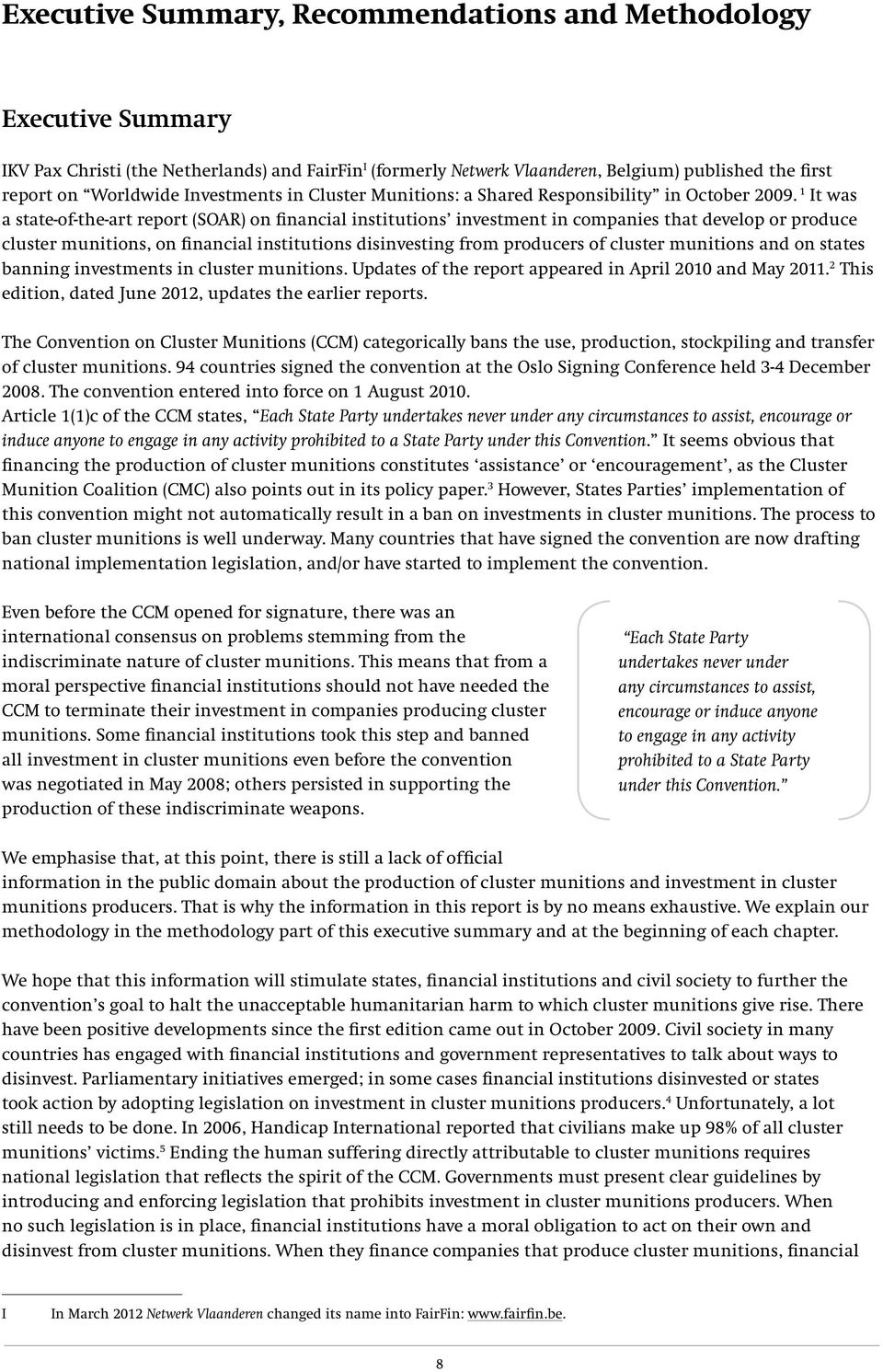
11 institutions assist these companies to produce an indiscriminate weapon that has been the object of opprobrium of states and civil society worldwide. We have identified many of the financial institutions that still invest in cluster munitions producers over four years after the text of the Convention on Cluster Munitions was negotiated in Dublin. You will find the names of these financial institutions in the first part of the report, the Hall of Shame. When they finance companies that produce cluster munitions, financial institutions assist these companies to produce. Hall of Shame The Hall of Shame contains a list of financial institutions that still invest in cluster munitions producers. The first step in our research was to identify which companies are involved in the production of cluster munitions. To identify these companies, Dutch research company Profundo used a variety of sources including reports by NGOs, exclusion lists maintained by financial institutions banning investment in cluster munitions, information published by the producing companies, contracts with the US government and correspondence between the companies and investors. From this list we have selected a short list to include in our research. We call it our red flag list. It is important to note that our red flag list of cluster munitions producers is by no means exhaustive. We only included companies that had discernible financial links and that met the other criteria listed in chapter 1. In October 2009, we listed 8 cluster munitions producers. 6 Since then, two of these companies announced that they had ceased producing (components of) cluster munitions. 7 The 2011 edition of the report included two new companies. The current report lists the same companies as last year. We define investor as someone financially involved in a cluster munitions manufacturer. We consider any financial link to be an investment regardless of: - the investor s importance for the cluster munitions producer; - the investment s importance for the investor s portfolio; - the contribution of cluster munitions production to the company s total turnover; or - the cluster munitions producer s other activities. It is impossible for a financial institution to be sure that the financial services provided to a company will not be used for the production of cluster munitions. We choose this definition because it is impossible for a financial institution to be sure that the financial services provided to a company will not be used for the production of cluster munitions. It is common for weapon producers to finance their cluster munitions facilities from their general corporate capital. So far, we have never come across a project intended specifically to finance cluster munitions facilities. There is no way to prevent a company from legally reallocating capital within a group. Including clauses in a general corporate loan contract that prohibit companies from using borrowed or invested funds to manufacture cluster munitions, or that restrict a company s use of the financing to civilian projects will not prevent the money from being used to manufacture cluster munitions. The 137 financial institutions that we identified as having financial links to the companies on our red flag list are listed in a table in the Summary Tables section. The table also contains the various types of involvement that these companies engage in. Research institute Profundo (the Netherlands) provided a list of financial institutions derived from stock exchange filings and other publications by financial institutions and cluster munitions producers, as well as from databases with information supplied by financial institutions. II II Stock exchange filings for US companies are mostly derived from 10K-Wizard, a commercial variant of the free Edgar database. This database contains information that the companies provided to the US Securities and Exchange Commission (SEC). We also used the Thomson ONE database and archives from EuroWeek and other trade journals. 9
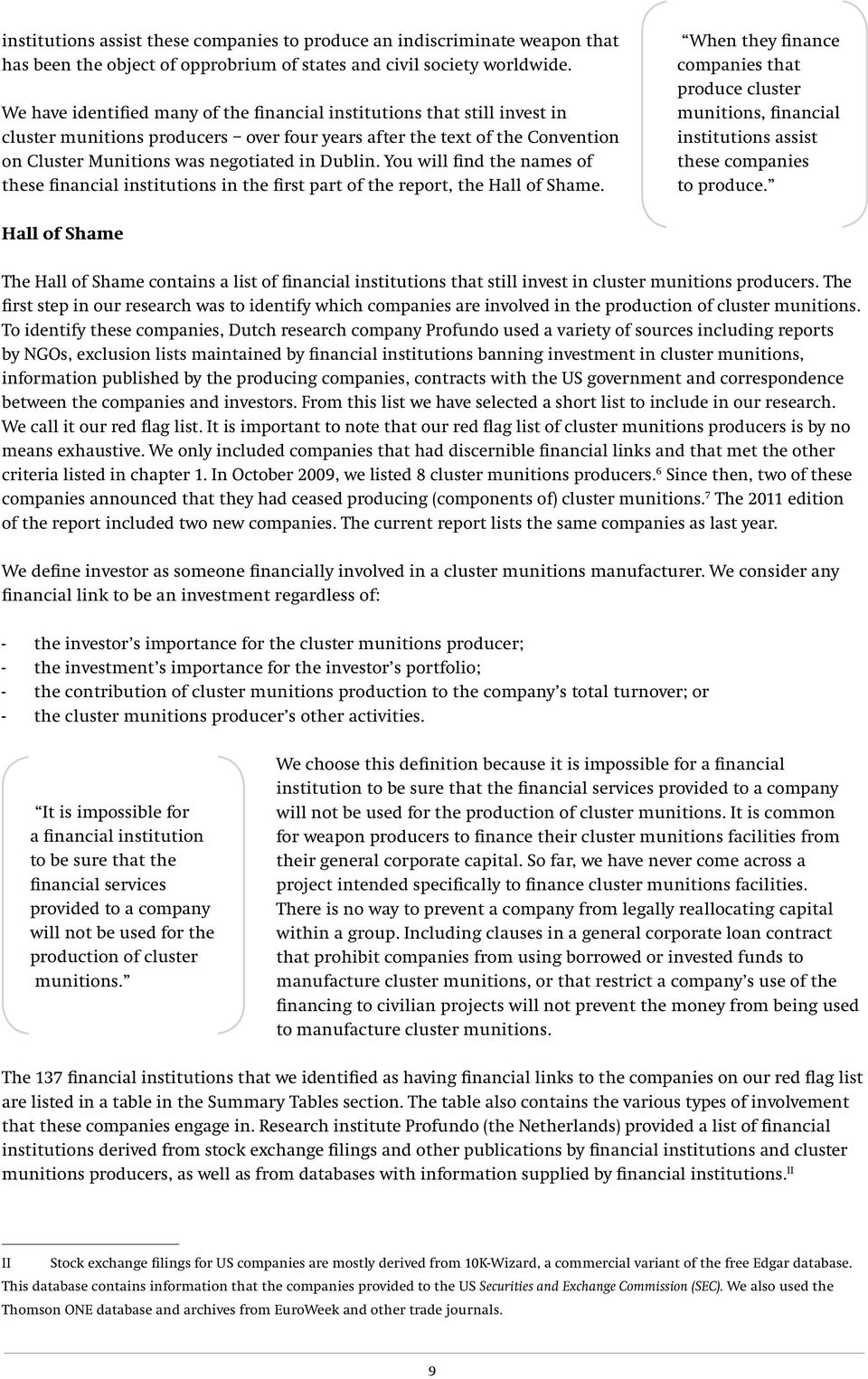
12 The 2011 Hall of Shame contained 164 financial institutions. Of these, 116 financial institutions are still in the 2012 Hall of Shame and 48 have been removed. Of the 116 financial institutions still on the list, 8 have taken on the name of their respective parent companies. For two financial institutions this means they have become part of a company already in the list. III That leaves 114 financial institutions still in the Hall of Shame, because they have a financial relationship with at least one company included on our red flag list. The 48 financial institutions no longer in the Hall of Shame can be grouped into two categories: - 37 financial institutions had been a shareholder or bondholder of at least one company included on our red flag list in 2011, but in 2012 their investments dropped below the 1% threshold for US companies or 0.1% for Asian companies. In most cases these financial institutions simply sold some of their shares or bonds in a company on our list while retaining just enough to fall below the thresholds financial institutions left the Hall of Shame in 2012 because financing (in the form of loans or investment banking) for companies on our red flag list dated from before May Since that date, these institutions have provided no new financing for companies on our red flag list. The 2012 Hall of Shame contains 137 financial institutions. So next to the 114 financial institutions held over from 2011, 23 new ones have joined the Hall of Shame. The 23 newcomers are in the 2012 Hall of Shame because they provided financing to at least one of the companies on the red flag list via: - A loan or investment banking service provided after the publication of last year s report - Acquisition of a new shareholding- or bondholding last year, or - A shareholding or bondholding that the financial institution had owned last year but that grew above the 1% threshold for US companies or 0.1% for Asian companies. In the research period, these 137 financial institutions invested almost US$43 billion in the eight cluster munitions producers included in the report. They: 1. Provided loans for at least US$4.1 billion; 2. Provided investment banking services worth at least US$8.1 billion; and 3. Owned or managed shares and bonds for at least US$30.4 billion. Hall of Fame and runners-up The second part of our research, the Hall of Fame, focuses on financial institutions that have disinvested from cluster munitions producers. Many financial institutions adjusted their policy after the CCM opened for signature. To identify financial institutions with a policy on cluster munitions, FairFin (formerly Netwerk Vlaanderen, Belgium) researched a variety of sources: NGO reports, screening agency information, financial institutions reports and websites, information from campaigners worldwide and other public sources. Since the investment policy is usually stipulated by the banking group and since this group directly or indirectly supervises its subsidiaries, we researched the group s policy. The list of financial institutions provided in this report is by no means exhaustive; we welcome additions from all interested parties. III Acadian became part of Old Mutual, China Securities of CITIC Securities, Natixis of Groupe BPCE, HI Investment & Securities of Hyundai Heavy Industries, Kookmin Bank of KB Financial Group, Massachusetts Fine Group and Massachusetts Mutual of Massachusetts Mutual Financial Group, MFS Investment Management of Sun Life Financial Services. 10

13 Our research identified 56 financial institutions with a policy on cluster munitions available in the public domain in English and/or Dutch. In some cases we have received translations of disinvestment policies that were not available in Dutch or English in the public domain. 27 of the 56 financial institutions made it into our Hall of Fame. These financial institutions have barred all investment in cluster munitions producers. An overview of all institutions in our Hall of Fame members can be found in the Summary Tables section. 29 of the 56 financial institutions included in our research have a policy on cluster munitions, but show certain shortcomings. Creating a runners-up category allowed us to highlight financial institutions that took steps to ban investment in cluster munitions producers, but whose course of action on cluster munitions has certain flaws. We commend these financial institutions for their efforts while pointing out the remaining steps to acquire a place in our Hall of Fame. The most common shortcomings are: We commend these financial institutions for their efforts. - Taking only the financial institutions own involvement into account, not that of third parties - Exempting project financing for civil purpose - Exempting funds following an index The consensus among investors seems to be evolving. Where only a few financial institutions excluded companies producing cluster munitions when the Oslo process started, a wider group of investors seems to have become aware that producers of cluster munitions are not feasible business partners. A Novethic study shows that nearly 80% of the researched sample IV now identifies investment in controversial weapons as a reputational risk. 8 Another Novethic study reached a similar conclusion: it shows that many investors have reached a consensus on excluding controversial weapons (anti-personnel mines and cluster munitions). 9 This evolution is reflected in the Hall of Fame and runners-up sections of our report. Three years of research and worldwide campaigning has culminated in more financial institutions deciding to exclude cluster munitions producers. Our research shows that ethical banks, small pension funds or government managed funds are not alone in disinvesting from these companies; global financial actors like BNP Paribas, HSBC and Royal Bank of Scotland are moving in this direction as well. These financial institutions show that although it takes time and effort to bring about change, it can be done. Some financial institutions apply their policy only to project financing for the production of cluster munitions. This means that these policies do not affect money supplied for general corporate purposes. Since financial institutions cannot guarantee that the funds it lends to, or invests in, a cluster munitions producer will not be used to produce cluster munitions; this is a major flaw in the policy. There is no way to prevent a company from legally reallocating capital within a group. Therefore, financial institutions that only exclude project finance are not listed as runners-up. However, we do assess these financial institutions policies. We welcome the fact that they have taken a first step, and encourage them to go all the way toward excluding producers of cluster munitions from their investments. When we compare the new Hall of Fame to the one in our May 2011 report, we see that four new financial institutions have entered it. Two of them are government-managed pension funds. The Australian Future Fund and the Luxembourg Compensation Fund (See section and below) have both decided to bar all investments in producers of cluster munitions. One financial institution, WestLB, appeared in the runners-up category in the earlier editions of this report. Its new policy merits a place IV A representative sample of asset owners across 11 European countries was surveyed on how they perceive the integration of environmental, social and governance (ESG) criteria in the way they manage their investments. The 259 respondents break down relatively evenly among private insurers, mutual insurance companies and pension funds, both public or private, corporate or non corporate. Their assets totalise nearly 4,540 billion. 11

14 in the Hall of Fame. We welcome WestLB s steps. They show that a financial institution can decide to adjust its policy and ban every kind of investment in producers of cluster munitions. The fourth newcomer in our Hall of Fame is SNS REAAL, a Dutch banker-insurer. One financial institution in our Hall of Fame has changed a bit. Ethias used to be a bank and insurance company. In 2011 the bank was sold, leaving only the insurance part of Ethias now listed in the Hall of Fame. Optima Bank purchased Ethias banking operations. Optima Bank has expressed its intention to adopt a deontological code similar to Ethias Bank s, which included not investing in producers of cluster munitions. We hope to be able to assess this code in our next update. Six financial institutions have joined the runners-up category since our May 2011 report. Our 2011 report said that Intesa Sanpaolo (Italy) only excluded project financing for the production of cluster munitions. However, later in 2011, Intesa Sanpaolo decided to exclude companies producing cluster munitions from its lending and investment banking activities. This is a big step forward; we commend Intesa Sanpaolo for taking this step by giving it a place in our runners-up category. The other five did either not publish any or an appropriate disinvestment policy before, or we did not have access to adequate information before. Three of those are UK financial institutions: Royal Bank of Scotland, Lloyds Banking Group and Aviva. The other two are Société Générale (France) and AEGON (the Netherlands). Two financial institutions in the runners-up category changed their name: Akzo Nobel Pensioenfonds became Stichting Pensioenfonds APF, and Dexia changed to Belfius. Worth mentioning here are four financial institutions that had already been listed as runners-up in Although they made significant improvements to their policies, they are still among the runners-up. ABN Amro (the Netherlands), BBVA (Spain), the Co-operative Financial Services (United Kingdom) and HSBC (United Kingdom) have all adjusted their policies and made substantive and positive changes to them. Yet these still have loopholes that they will need to fix before they fully meet the criteria for our Hall of Fame. We hope to see these changes soon, so that we can welcome those four institutions to the Hall of Fame in our next year s report. - Increased awareness and transparency Since our first report in October 2009 we have observed increased awareness among campaigners, states and financial institutions alike. In October 2009, the Cluster Munition Coalition launched the Stop Explosive Investments campaign which promotes disinvestment from cluster bomb producers, encourages financial institutions to articulate clearer guidelines on ethical investment with respect to cluster munitions, and urges governments to adopt legislation banning investments in cluster munitions. Since the campaign launch, campaigners in more than 18 countries have taken action on disinvestment. V These campaigning efforts have helped to increase transparency and to augment explanations of, or additions to, financial institutions disinvestment policies. Moreover, disinvestment campaigns have stimulated financial institutions that did not have disinvestment policies to adopt them. Worldwide campaigns, conversations, studies and media work have done much to expand substantially the information available for our report, including more transparency from weapon-producing companies. Financial institutions greater awareness has multiplied the frequency of their responses to our questions. This, too, nourishes into our research. V For more information on the international campaign to stop explosive investments, see: 12

15 - Vigorous campaign efforts A quick look at the new financial institutions appearing in the 2012 report shows that a strong disinvestment campaign targeted the United Kingdom. Royal Bank of Scotland, Aviva and Lloyds Banking Group have all adopted or updated policies in 2011, which gained them entrance to the runner-up list. Moreover, Co-operative Financial Services strengthened its policy. In Germany, campaigners have put additional pressure on Deutsche Bank. Although Deutsche Bank has stated publicly that it bans investments in producers of cluster munitions, it refuses to publish its policy. This denies its customers the opportunity to learn about its investment choices. Moreover, further research by Facing Finance 10 and the results in the Hall of Shame of this report both show that Deutsche Bank is still heavily involved in producers of cluster munitions. DWS, a full Deutsche Bank subsidiary has, however, adopted a policy to exclude producers of cluster munitions from its investments and is in the process of making it public. We hope that its parent company will follow its example. BayernInvest, the asset management division of BayernLB, and LBBW Asset Management, the asset management division of Landesbank Baden-Württemberg, have published policies that exclude producers of cluster munitions. Since we only study the group s policies, we hope that BayernLB and Landesbank Baden- Württemberg will follow the examples of their subsidiaries and adopt a policy that excludes producers of cluster munitions. Deka bank has adopted a policy to ban producers of cluster munitions from some of the funds it offers, but it refused to publish its policy. We hope it will change that decision so that we can assess their policy in our report. Finally, WestLB has updated its policy, which has gained it entrance to the Hall of Fame. Campaign efforts in Spain have ensued in a policy shift at BBVA. As mentioned above, the bank has significantly strengthened its stance against cluster munitions production. In Luxembourg, campaigners have been drawing the attention of the public and its political leaders to the issue of cluster munitions for many years. Thanks to these efforts, when the Convention on Cluster Munitions came into force in August 2010, some MPs discovered that the Compensation Fund had investments in producers of cluster munitions. As a result, the issue was much discussed in Luxembourg. That compelled the Compensation Fund to remove these investments from its portfolios. Thanks to the campaign in Japan, two more Japanese banks, Mizuho Bank and Tokyo Mitsubishi UFJ, published a summary of their policy. We welcome this decision, but since their policies do not meet the criteria for being listed as a runner-up, these policies have not been assessed in this report. We hope these banks will strengthen their policies by the time of our next update. Countries Best Practices The Cluster Munition Coalition believes that the prohibition on assistance in the CCM includes a prohibition on investments in cluster munitions. VI An ever growing group of states shares the view that the convention bans investment in cluster munitions. Since our 2011 report, one new state adopted legislation that prohibits financial assistance to the production of cluster munitions: Italy. Seven new states issued interpretive statements since our 2011 report: Bosnia and Herzegovina, Cameroon, the Czech Republic, Hungary, Lao PDR, Senegal and Slovenia all consider investments in cluster munitions as prohibited by the convention. Experience with the legislation in Belgium, Ireland, Italy, Luxembourg and New Zealand can serve as model for ways signatory states, States Parties to the CCM and states that are not party to the CCM can prohibit investment in cluster munitions producers by national law. VI Cluster Munition Coalition, CMC Policy Papers on the Convention on Cluster Munitions, May 2010, available at last viewed 12 May

16 At the time of this writing, five states in total have adopted legislation that prohibits (various forms of) investments in cluster munitions: Belgium, Ireland, Italy, Luxembourg and New Zealand. In total, 21 states have not yet passed legislation against investment in cluster munitions production but they did express the view that investments in the production of cluster munitions are prohibited by the CCM. Australia, Bosnia and Herzegovina, Cameroon, Colombia, Croatia, the Czech Republic, France, Guatemala, the Holy See, Hungary, Lao PDR, Lebanon, Madagascar, Malawi, Malta, Mexico, Rwanda, Senegal, Slovenia, the United Kingdom and Zambia all interpret (direct) investment as a prohibited form of assistance under the CCM. Parliamentary initiatives to legislate against investment in cluster munitions are ongoing in Norway, the Netherlands and Switzerland. It is vital that more states confirm that article 1(1)c includes a ban on investment in cluster munitions. Experience with the legislation in Belgium, Ireland, Italy, Luxembourg and New Zealand can serve as model for ways signatory states, States Parties to the CCM and states that are not party to the CCM can prohibit investment in cluster munitions producers by national law. Recommendations States that have joined the CCM should make clear that in prohibiting assistance, article 1(1)c of the convention prohibits investment in cluster munitions producers. States should provide clear guidelines for financial institutions. When states draft national legislation prohibiting investment in producers of cluster munitions, they act in the spirit of the CCM. Financial institutions should develop policies that exclude all financial links with companies involved in cluster munitions production. Because all investment facilitates this production, no exceptions should be made for third-party financial services, for funds that follow an index or for civilian project financing for a company also involved in cluster munitions. Policies should not be narrowed to refusing project financing for cluster munitions. Financial institutions should inform producers of their decision to end investment because of the producers involvement with cluster munitions. Financial institutions can set clear deadlines with a limited time frame within which a company must cease production of cluster munitions if it wishes the disinvestment decision to be reversed. When a company persists in producing cluster munitions after the deadline, the financial institution will disinvest until such time as the company terminates production of cluster munitions. New applications for investment will be declined until the company has halted all activities related to the production of cluster munitions. Financial institutions should apply their disinvestment policy to all activities: commercial banking, investment banking and asset management. All such activities aid and abet a company s production of cluster munitions. When this new course of action requires a change in investment fund management, investors should be notified of this and given a deadline for withdrawing from these funds. After this deadline, management strategy will change and shares and obligations in companies involved in cluster munitions will be sold. 14

17 Methodology: Questions and Answers Does this study include all companies that produce cluster munitions? No. There is still a marked lack of official information available in the public domain about the production of cluster munitions. We have chosen to include only those companies that meet the following criteria: There is sufficient evidence that the company has produced (key components for) cluster munitions or explosive submunitions after 30 May 2008 (the day the convention text was adopted in Dublin) and the company has not stated publicly that it will end its involvement in the coming 12 months; There is sufficient evidence that over the past year the company has become involved in planned production or development of (key components for) cluster munitions or explosive submunitions and the company has not stated publicly that it will end its involvement in the coming 12 months; When we found no financial links for companies, we did not include them on our red flag list. There may also well be companies that currently produce (key components for) cluster munitions or explosive submunitions but that have been excluded from the red flag list simply because we could not find sufficient evidence of their production activities. Sources Of Information On Companies Producing Cluster Munitions Company publications, contracts with the US government, correspondence between the companies and investors, and correspondence between the companies and research consultancy service Profundo. We contacted most of the producing companies on the red flag list before publishing our report to verify our data; when they provided additional information, we included this in our report. Research by Profundo (the Netherlands). Are all financial institutions with investments in cluster munitions producers listed in the Hall of Shame? No. The Hall of Shame is not an exhaustive list of financial institutions with investments in cluster munitions producers. We apply different thresholds to different companies for investment in shares and bonds. Due to the different shareholding structure in the various companies, VII we chose a 0.1% floor limit for Hanwha, Poongsan, and Singapore Technologies Engineering and a 1% limit for Alliant Techsystems (ATK), Lockheed Martin and Textron. This threshold is a pragmatic tool designed for this research. Without these thresholds, the list of financial institutions would be too long to handle in this report. Even when a financial institution has invested in a cluster munitions producer, as long as its shares are below 0.1% in Hanwha, Poongsan, and Singapore Technologies Engineering or 1% in ATK, Lockheed Martin and Textron, you will not find it on our list. Moreover, because the red flag list of producing companies is not exhaustive, a financial institution that has invested in a producing company might still not be included in our research. There is still a marked lack of transparency in the public domain about financial institutions investments furthermore. There is little or no transparency on what credits were given to whom. That makes it complicated to find out whether a financial institution has granted a loan to a controversial company. VII Asian companies seem to have a few large (local) shareholders and a group of foreign shareholders with less than 1%. We therefore lowered the threshold for Hanwha, Poongsan and Singapore Technologies Engineering. 15
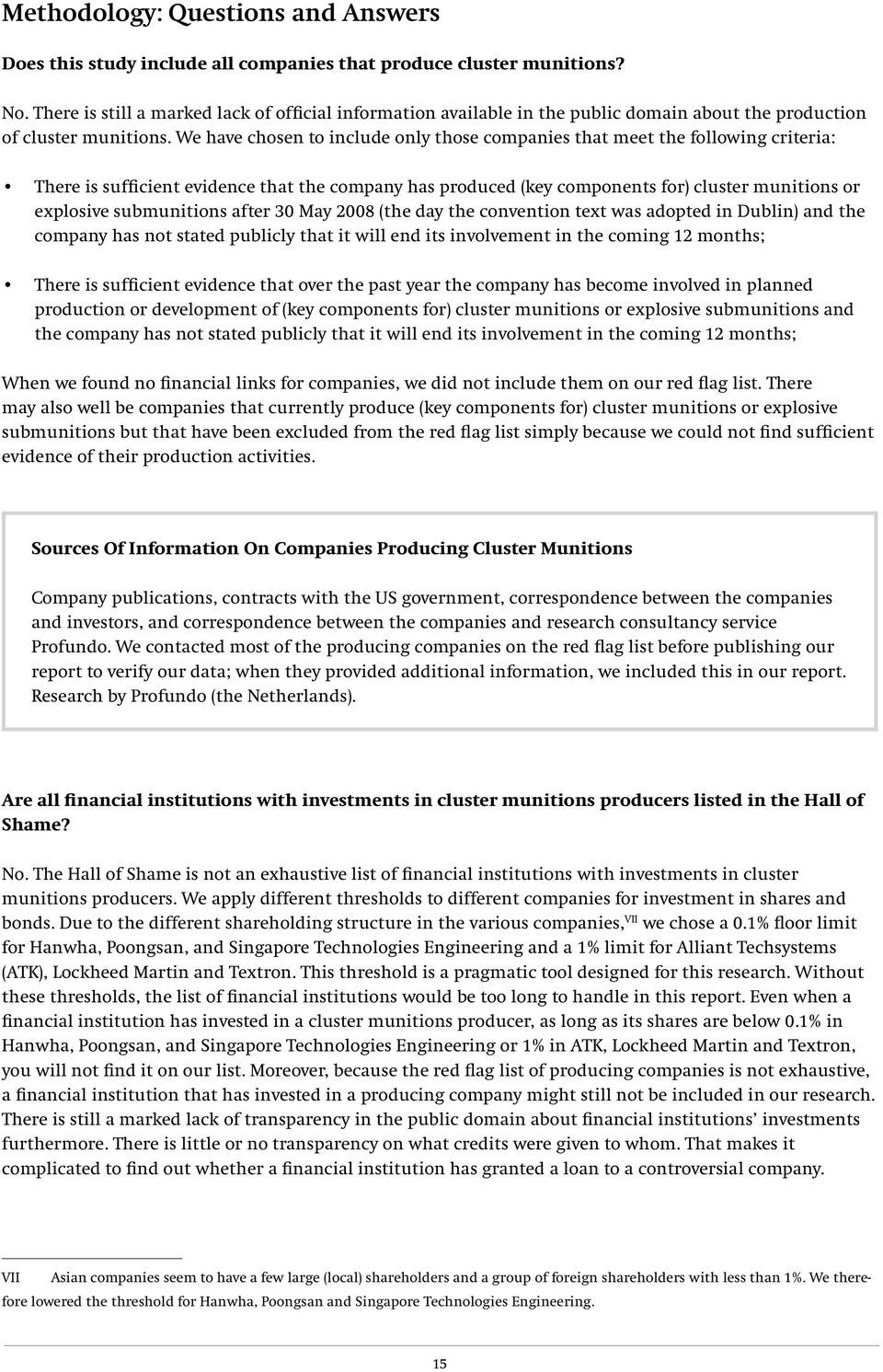
18 Sources Of Information For The Hall Of Shame We used a variety of sources including reports by NGOs and exclusion lists maintained by financial institutions that ban investment in cluster munitions. We also drew upon stock exchange filings and the financial institutions and the cluster munitions producers own publications, as well as commercial databases with information supplied by financial institutions. Research by Profundo (the Netherlands). Were all the financial institutions in the Hall of Shame contacted to verify information before publishing this report? No. Since the sources of information for the Hall of Shame stock exchange filings, financial institutions own publications and commercial databases come directly from the financial institutions, we trust that it is correct and have not contacted every one of the financial institutions in the Hall of Shame before publishing this report. We welcome comments, clarifications, and corrections from governments, companies, financial institutions and others, in the spirit of dialogue, and in the common interest of accurate and reliable information on an important subject. If you believe you have found an error in our report or if you can provide additional information please contact us. Are all financial institutions with a policy requiring them to disinvest from cluster munitions producers listed in the Hall of Fame and runners-up category? No. The Hall of Fame and the runners-up category are far from comprehensive. We believe that the financial institutions listed are only the tip of the iceberg. It is impossible to research the policies of every financial institution worldwide. The Hall of Fame can be seen as an invitation to financial institutions with a comprehensive policy banning investment in cluster munitions to provide us with their policy and to publish it on their websites. We have chosen to limit our research to policies available in the public domain, since we believe that financial institutions should be accountable for their policies. We worked within the limits imposed by language (English and Dutch) and accessibility. In some cases, we now have translations of disinvestment policies unavailable in Dutch or English in the public domain, but in most cases we were limited to documents available in Dutch or English. There are probably many more financial institutions that deserve a place in our Hall of Fame or runners-up category. Our list of financial institutions disinvesting from cluster munitions producers is an initial survey. We welcome additional information. We have checked all shareholdings of financial institutions listed in the Hall of Fame, including those under the 1% and 0.1% threshold, just to be sure that these financial institutions indeed have no link to cluster munitions producers and fully implement their policies. VIII Sources Of Information For The Hall Of Fame And Runners-Up We used a variety of sources: NGO reports, screening agency information, financial institutions reports and websites, information from campaigners worldwide and other public sources. Since the banking group usually sets the investment policy and since this group directly or indirectly supervises its subsidiaries, we researched the group s policy. Our list of financial institutions is not exhaustive. We contacted all financial institutions in these lists before publication to check our research findings and clarify their policies. This study takes into account only publicly available policy documents and written comments. A policy document is public when a financial institution has published it or a summary of it on its website or in its publications (e.g. annual report, sustainable development report, etc.). Research by FairFin (Belgium). VIII VIII Note that the researchers cannot be held responsible when a published policy document is no longer up-to-date and/or when the financial institution gave little or no response to our questions about it. 16

19 How can a financial institution be listed in the Hall of Shame and as a runner-up at the same time? The runners-up category lists financial institutions that took steps to ban investment in cluster munitions producers, but whose policies have loopholes. A financial institution can be applauded in the runners-up category for its policy, while at the same time be listed in the Hall of Shame for its investment. Checking whether this involvement runs counter to their policies, or whether it results from a loophole, was beyond the scope of this report. An accurate report on implementation of policies published by runners-up would require more detailed information on the investments we found. Examples of the kind of information we would still need are whether a financial link constitutes own or third-party investments, which investment fund is involved, or whether the financial link is through a fund following an index; all issues beyond the scope of our research. Moreover, a financial institution may be listed for investments made before their policy came into effect, since we research investments since May Do all financial institutions in the runners-up category have the same loopholes in their policies? No. This category lists financial institutions that took steps to ban investment in cluster munitions producers, but whose courses of action on cluster munitions have flaws of various types. The runners-up category is a very diverse category, where the scope of the policies differs greatly. Financial institutions are listed there for many different reasons. It is important to note that, as with the Hall of Fame, we welcome any financial institution that has a publicly available policy, and is not listed yet, to provide us with this information. We also invite financial institutions already listed to provide copies of revised or updated policy documents that could demonstrate their right to a place in our Hall of Fame. Why does this research not make an exception for funds following an index? During our research and the conversations we had with financial institutions about this issue, many of these institutions pointed out that it is simply impossible to exclude cluster munitions producers from funds following an index. Still, some financial institutions do have a policy that includes funds following an index. These examples have convinced us that it is possible to exclude producing companies from funds following an index. Although it might well be difficult, and cost more in time and/or money, we think that if it is possible it should be done. We invite financial institutions that see no possibility of meeting this criterion to demonstrate why they are unable to do so. Until then, we have chosen to list financial institutions that make an exception for funds following an index in the runners-up category, and not in the Hall of Fame. Researched Time Frame - We listed a company as a cluster munitions producer when we found evidence that it was involved in producing (key components of) cluster munitions in the time span extending from 30 May 2008 to 15 March We listed a financial institution as an investor when we found evidence of investment in the time span extending from 1 May 2009 to 31 March Since the banking group usually sets the investment policy and since this group directly or indirectly supervises its subsidiaries, we researched the group s investments. - We updated the policies of financial institutions listed in the Hall of Fame and runners-up category as far as 27 April Since the banking group usually sets the investment policy and since this group directly or indirectly supervises its subsidiaries, we researched the group s policy. 17

20 Summary Tables Hall of Shame The following overview presents the types of financial relationships that financial institutions have with cluster munitions producers on our red flag list. Key: B = ownership or management of (convertible) bonds, L = provision of loan facility, S = ownership or management of shares, X = underwriting of share issues, Y = underwriting of bonds issues. IX Financial Institution in the Hall of Shame Country of origin Alliant Techsystems (US) Hanwha (South Korea) Lockheed Martin (US) Norinco (China) Poongsan (South Korea) Singapore Technologies Engineering (Singapore) Splav (Russia) Textron (US) Aberdeen Asset Management United Kingdom S Agricultural Bank of China China Y AIG United States B Allianz Germany B,S S Allstate United States B B American Family Insurance United States B Ameriprise Financial United States B S ANZ Bank Australia L,Y APS Asset Management Singapore S Aronson + Jonson + Ortiz United States S AXA France B S B Bank of America United States L,Y L,Y L,Y Bank of Beijing China Y Bank of China China Y IX Bank of Communications China Y Bank of New York Mellon United States L L,Y,S Bank of Shanghai China Y Barclays United Kingdom L X,Y BB&T United States L BlackRock United States S S S S BNP Paribas France L Y S Y BPCE France B Breeden Capital Management United States S Capital Group United States S S S Castle Creek Arbitrage United States B IX Apart from underwriting bonds issues for Norinco, Bank of China has also signed a strategic agreement with the company. 18

21 Financial Institution in the Hall of Shame Country of origin Alliant Techsystems (US) Hanwha (South Korea) Lockheed Martin (US) Norinco (China) Poongsan (South Korea) Singapore Technologies Engineering (Singapore) Splav (Russia) Textron (US) Chang Hwa Commercial Bank Taiwan L China Construction Bank China Y China Development Bank China Y China Everbright Bank China Y China Merchants Bank China Y China Minsheng Bank China Y Citadel United States B CITIC Securities China Y Citigroup United States L,Y L,Y Consus Asset Management South Korea S Continental Insurance United States B Crédit Agricole France L,Y Y Credit Suisse Switzerland B Daewoo Securities South Korea Y Davis Selected Advisers United States S DBS Bank Singapore L Deutsche Bank Germany S Y L Dimensional Fund Advisors United States S S Dongbu Securities South Korea Y Dreman Value Management United States S Eugene Investment & Securities South Korea Y Export Import Bank of Korea South Korea L Fidelity United States S,B S S B S Fiduciary Management United States S First Eagle Investment Management United States S S First Financial Taiwan L Franklin Templeton United States S S General Electric United States L Genworth Financial United States B Goldman Sachs United States L,Y L,S, Y Grantham Mayo Van Otterloo & Co United States S S Guotai Junan Securities China Y Hana Financial South Korea L,Y Hanyang Securities South Korea Y Hanwha Securities South Korea S,Y 19
22 Financial Institution in the Hall of Shame Country of origin Alliant Techsystems (US) Hanwha (South Korea) Lockheed Martin (US) Norinco (China) Poongsan (South Korea) Singapore Technologies Engineering (Singapore) Splav (Russia) Textron (US) Hartford Financial Services Group Hotchkis & Wiley Capital Management United States B B United States S S Hua Nan Financial Taiwan L Hyundai Heavy Industries South Korea Y S Industrial Bank China Y Industrial & Commercial Bank of China (ICBC) China Intesa Sanpaolo Italy Y Invesco United Kingdom X S S S Jackson National Life Insurance United States B JP Morgan Chase United States B,L,S L,Y L,X,Y KB Financial South Korea L,S,Y Keybank United States L Korea Development Bank South Korea Y L,Y Korea Investment South Korea Y S Liberty Mutual United States B Liechtensteinische Landesbank (LLB) Liechtenstein Lincoln Financial United States B Lloyds Banking United Kingdom L,Y Manulife Financial Canada B Massachusetts Mutual Life Insurance Matthews International Capital Management United States B B B United States S S Mellon Capital Management United States S Metropolitan Life Insurance United States B B Mirae Asset Financial South Korea S S Mitsubishi UFJ Financial Japan L,Y L,Y L,Y Mizuho Bank Japan L L,Y Morgan Stanley United States L,Y Y L,Y National Pension Service South Korea S S New York Life Insurance United States B B Northeast Investors Trust United States B Northern Trust United States L,S L,S Northwestern Mutual United States B Y B X Invesco has headquarters in Bermuda, an overseas territory of the United Kingdom. 20
23 Financial Institution in the Hall of Shame Country of origin Alliant Techsystems (US) Hanwha (South Korea) Lockheed Martin (US) Norinco (China) Poongsan (South Korea) Singapore Technologies Engineering (Singapore) Splav (Russia) Textron (US) Nuveen Investments United States S Och-Ziff Capital Management United States B Oaktree Capital Management United States B Old Mutual United Kingdom S People s Insurance Company (Group) of China (PICC) China People s United Financial United States L PNC Financial United States L Principal Financial United States B Prudential United Kingdom S Prudential Financial United States B B B Riyad Bank Saudi Arabia L Royal Bank of Canada Canada L,Y L,Y Royal Bank of Scotland United Kingdom L,B,Y L,Y Samsung South Korea S,Y S Sberbank Russia L Schroder Investment Management Shanghai Pudong Development Bank United Kingdom China Shinhan Bank South Korea Y Y Shinyoung Securities South Korea S SK Securities South Korea Y Y Société Générale France S,Y State Farm United States B State Street United States S S L,S S S Sumitomo Mitsui Japan L,Y Y Sun Life Financial Canada S B SunTrust Bank United States L,Y Symetra Life Insurance United States B T. Rowe Price United States S S Teachers Insurance & Annuity Association (TIAA-CREF) United States B S B S S Temasek Singapore S TongYang Securities South Korea B,Y S,B Truston Asset Management South Korea S UBS Switzerland B L,Y B S United Overseas Bank Singapore L Unum United States B Y Y S 21
24 Financial Institution in the Hall of Shame Country of origin Alliant Techsystems (US) Hanwha (South Korea) Lockheed Martin (US) Norinco (China) Poongsan (South Korea) Singapore Technologies Engineering (Singapore) Splav (Russia) Textron (US) US Bancorp United States L,Y L,Y Vanguard United States S S B,S S S S Veritas Asset Management United Kingdom S Wellington Management Company X United States Wells Fargo Bank United States B,L,Y L,Y S Y Western & Southern Mutual United States S Williams Capital United States Y Woori Financial South Korea S,Y L,Y Yurie Asset Management South Korea S Zazove Associates United States B B S X 22
25 Financial Institutions (FIs) in the Hall of Shame by country of origin 27 FIs from CCM signatory state FIs from non CCM signatory state 110 Country of origin of financial institutions in the Hall of Shame Australia 1 Canada 3 China 16 France 5 Germany 2 Italy 1 Japan 3 Liechtenstein 1 Russia 1 Saudi Arabia 1 Singapore 4 South Korea 22 Switzerland 2 Taiwan 3 The United Kingdom 9 The United States 63 Total 137 Number of financial institutions per country 23
26 Hall of Fame The following digest presents all financial institutions listed in our Hall of Fame, according to our research criteria. Financial institution in the Hall of Fame Country of origin* Has the institution published its policy? Does it exclude cluster munitions producers? Does it exclude all cluster munitions producers, (no exceptions for certain types?) Does the policy apply to all the financial institution s products? Are all a company s activities excluded? ABP The Netherlands X X X X X ASN Bank The Netherlands X X X X X ATP Denmark X X X X X Banca Etica Italy X X X X X BPF Bouw The Netherlands X X X X X DNB Norway X X X X X Ethias Belgium X X X X X Folksam Sweden X X X X X Fonds de Compensation Luxembourg X X X X X The Future Fund Australia X X X X X KLP Norway X X X X X KPA Sweden X X X X X National Pensions Reserve Fund New Zealand Superannuation Fund Norwegian Government Pension Fund - Global Ireland X X X X X New Zealand X X X X X Norway X X X X X Pensioenfonds Vervoer The Netherlands X X X X X PGGM The Netherlands X X X X X Philips Pension Fund The Netherlands X X X X X PME The Netherlands X X X X X PNO Media The Netherlands X X X X X SNS REAAL The Netherlands X X X X X Spoorwegpensioenfonds The Netherlands X X X X X Storebrand Group Norway X X X X X Swedish Pension Funds AP1 4 Sweden X X X X X Swedish Pension Fund AP7 Sweden X X X X X Triodos Bank The Netherlands X X X X X West LB Germany X X X X X * The countries of origin of all financial institutions listed in our Hall of Fame and runners-up category have signed the Convention on Cluster Munitions 24
27 Country of origin of financial institutions in the Hall of Fame Australia 1 Belgium 1 Denmark 1 Germany 1 Ireland 1 Italy 1 Luxembourg 1 New Zealand 1 Norway 4 Sweden 4 The Netherlands 11 Total 27 Number of financial institutions per country 25
28 Runners-up The following digest presents all financial institutions listed in our runners-up category, according to our research criteria. Financial institution in the Runners-up Country of origin* Has the institution published its policy? Does it exclude cluster munitions producers? Does it exclude all cluster munitions producers, (no exceptions for certain types?) Does the policy apply to all the financial institution s products? Are all a company s activities excluded? ABN Amro The Netherlands X X X X AEGON The Netherlands X X X X Aviva The United Kingdom X X X X AXA France X X X X BBVA Spain X X X X Belfius Bank and Insurances Belgium X X X BNP Paribas France X X X X Commerzbank Germany X X X X Co-operative Financial Services The United Kingdom X X X X Crédit Agricole France X X X X Credit Suisse Switzerland X X X X Danske Bank Denmark X X X X HSBC The United Kingdom X X X X ING The Netherlands X X X X Intesa Sanpaolo Italy X X X X KBC Belgium X X X X Laegernes Pensionskasse Denmark X X X X Lloyds Banking Group The United Kingdom X X X Nordea Sweden X X X X Nycredit Denmark X X X X Pensioenfonds Horeca & Catering The Netherlands X X X X Rabobank The Netherlands X X X X Royal Bank of Canada Canada X X X X Royal Bank of Scotland The United Kingdom X X X X SEB Sweden X X X X Société Générale France X X X X Stichting Pensioenfonds APF The Netherlands X X X X Syntrus Achmea The Netherlands X X X X UniCredit Group Italy X X X X * The countries of origin of all financial institutions listed in our Hall of Fame and runners-up category have signed the Convention on Cluster Munitions 26
29 Country of origin of financial institutions in Runners-up Belgium 2 Canada 1 Denmark 3 France 4 Germany 1 Italy 2 Spain 1 Sweden 2 Switzerland 1 The Netherlands 7 The United Kingdom 5 Total 29 Number of financial institutions per country Countries Best Practices The following digest presents all states mentioned in the Countries Best Practice section. Legislation Interpretive statement Parliamentary action/draft legislation Belgium Australia The Netherlands Ireland Bosnia and Herzegovina Norway Italy Cameroon Switzerland Luxembourg Colombia New Zealand Croatia The Czech Republic France Guatemala The Holy See Hungary Lao PDR Lebanon Madagascar Malawi Malta Mexico Rwanda Senegal Slovenia The United Kingdom Zambia 27
30 Introduction Investing in Cluster Munitions: What s at Stake? Cluster Munitions and the Oslo Process The third of December 2008 marked an important day for international humanitarian law. Reports of the suffering that cluster munitions caused among civilian populations had alarmed people and drawn international attention to the issue for decades. On December 3 and 4, 94 states signed the Convention on Cluster Munitions (CCM), which categorically prohibits the use, production, transfer and stockpiling of cluster munitions. Cluster munitions pose a serious threat to civilian populations during and after an attack. Cluster munitions are designed to blanket a large area containing one or more targets. They can be fired by artillery and rocket systems or dropped by aircraft; they spread dozens, or even hundreds, of submunitions or bomblets over an area that can be the size of several football fields. Distributing submunitions over such a broad area results in a large chance of civilian casualties during and after the attack. Many bomblets or submunitions fail to explode on impact. They remain on the ground like landmines that kill and injure civilians long after the conflict has ended. XI During the war we ran away from our village. We came back once the war was over. When we got back I was with three other girls from my family in front of the house when the thing exploded. I found the thing, and I started playing with it. I didn t know exactly what it was. I dropped it and it exploded. [...] When I was injured I could feel from the beginning that I didn t have the leg anymore. I knew that. Rasha Zayoun, cluster munitions survivor and Ban Advocate, Maaraka Sour, South Lebanon XII The Oslo process started in February At the invitation of the Norwegian Government, 49 countries met after government talks in the traditional forum for weapons issues failed. The resulting Oslo Declaration called for creating by 2008 a legally binding instrument that would prohibit the use, production, transfer and stockpiling of cluster munitions that cause unacceptable harm to civilians. 11 At the ensuing international conferences, the number of supporting countries grew at a steady pace. The CCM opened for signature in December The Oslo process was marked by resolute cooperation among a broad range of actors whose common goal was to stop the humanitarian harm that cluster munitions cause. The achievements of the Mine Ban Treaty, the International Criminal Court and the Convention on the Rights of Persons with Disabilities were all milestones. The CCM is yet another strong example of how a broad partnership between governments, key international organisations and civil society actors, here united in the Cluster Munition Coalition (CMC) XII, can produce a convention that can make a difference for civilians during and after a conflict. XI Rasha Zayoun is a cluster munitions survivor and Ban Advocate from South Lebanon. For more information about her story and about the Ban Advocates, see: XII The Cluster Munition Coalition (CMC) is an international coalition working to protect civilians from the effects of cluster munitions by promoting universal adherence to, and full implementation of, the Convention on Cluster Munitions. CMC membership numbers around 350 civil society organisations from 90 countries. See: 28
31 The CCM entered into force on 1 August At the time of writing, 111 countries have signed and 71 XIII have ratified the convention. The universal adoption and implementation of the Convention on Cluster Munitions are critical steps toward enhancing human security during and after armed conflict and toward providing assistance to survivors. Article 1(1)c of the Convention on Cluster Munitions states, Each State Party undertakes never under any circumstances to assist, encourage or induce anyone to engage in any activity prohibited to a State Party under this Convention. 12 Financing is clearly an act of support: financing a cluster munitions producer facilitates production. Several states and civil society organisations have confirmed that the CCM prohibits investment in companies that produce cluster munitions. 13 Financing and investing are active choices, based on a clear assessment of a company and its plans. Investing in a cluster munitions producer therefore is a choice to support the production of these weapons that cause unacceptable harm. A CMC policy paper on disinvestment explains, States should explicitly acknowledge that the treaty prohibits investments in producers of cluster munitions and should adopt legislation that prohibits investments in companies that develop and/or produce cluster munitions or key components thereof. 14 As we will see in Chapter 2, several states have passed legislation prohibiting investment in companies that produce cluster munitions. Since our first publication in this series in October 2009, we see that more and more states have taken action to prevent investments in cluster munitions as a means to cease the production of these weapons elsewhere. We encourage other states to do the same and provide clear guidelines for financial institutions (FIs) operating within their territory. In the end, however, financial institutions will have to be the ones to ensure that investments in companies that produce cluster munitions cease. This publication presents an inexhaustive state-of-the-art report on financial institutions investments in companies that develop or produce cluster munitions and on legislative measures to prevent investments in cluster munitions. In presenting this information we want to encourage financial institutions, state actors and civil society to engage in a constructive discussion and work towards a world free of cluster munitions. Financial Institutions Power and Responsibility A wide range of financial institutions operate in our globalised world. These include privately owned companies and state-owned institutions. Banks, insurance companies, investment funds, investment banks, pension funds, export credit agencies, multilateral financial institutions, government funds and many others play a crucial role in allocating financial resources. Since a large majority of companies and governments rely on the financial markets and financial institutions to find the operating capital, these financial institutions play a key role in every segment of human activity. In choosing which companies and projects they will finance and invest in, these institutions foster certain (business) evolutions. Although we see that a growing number of financial institutions have made a serious effort to disinvest from cluster munitions, many find it difficult to implement their policy or have, as yet, no policy on investment in companies that produce cluster munitions. The Hall of Shame in Chapter 1 lists a whole range of examples of financial institutions that still invest in or offer financial services to cluster munitions XIII By 24 April 2012 the following countries had ratified the CCM: Afghanistan, Albania, Antigua and Barbuda, Austria, Belgium, Bosnia and Herzegovina, Botswana, Bulgaria, Burkina Faso, Burundi, Cape Verde, Chile, Comoros, Cook Islands, Costa Rica, Côte d Ivoire, Croatia, Czech Republic, Denmark, Dominican Republic, Ecuador, El Salvador, Fiji, France, Germany, Ghana, Grenada, Guatemala, Guinea-Bissau, Holy See, Honduras, Ireland, Italy, Japan, Lao PDR, Lebanon, Lesotho, Lithuania, Luxembourg, Macedonia FYR, Malawi, Mali, Malta, Mauritania, Mexico, Moldova, Monaco, Montenegro, Mozambique, Netherlands, New Zealand, Nicaragua, Niger, Norway, Panama, Portugal, St. Vincent and the Grenadines, Samoa, San Marino, Senegal, Seychelles, Sierra Leone, Slovenia, Spain, Swaziland, Sweden, Trinidad and Tobago, Tunisia, United Kingdom, Uruguay and Zambia. 29
32 producers. These investments raise serious ethical concerns for these financial institutions. These concerns arise from two arguments: the controversial character of cluster munitions and the complicity of the investor. Cluster munitions are widely acknowledged to be unacceptable weapons. In signing the CCM, more than 110 countries have agreed to ban these weapons. Financial institutions should, therefore, avoid any involvement in the manufacture of these weapons. Financial institutions sometimes regard financing or providing financial services to companies as a neutral activity. But investing in a company clearly supports that company s objectives by raising the capital it needs to pursue them. In delivering a financial service to a company, a financial institution signifies its approval of this company s objectives. Financing a company involved in cluster munitions facilitates production of these weapons. Moreover, this support is indispensable. All financial institutions should follow the example of those that have already insisted that companies in their portfolio end their involvement in the production and/or development of cluster munitions, and that they disinvest from companies that ignore this demand. Fortunately, parallel to the Oslo process and since the CCM came about, a growing number of financial institutions have recognised their responsibility to withdraw support from companies manufacturing cluster munitions. These financial institutions have banned cluster munitions producers from their investment portfolios. Chapter 2 describes financial institutions policies on investment in cluster munitions. Many financial institutions have stated publicly that they will disinvest from cluster munitions producers; an increasing number of them has already done so. We applaud these efforts and feel they can serve as an example for other financial institutions. This report highlights those financial institutions whose investment guidelines take into account the civilian suffering that cluster munitions cause. Our Hall of Fame shows great examples of financial institutions that have shouldered their responsibility and implemented a comprehensive policy to disinvest from cluster munitions. The runners-up category in the same chapter lists financial institutions that have made a serious effort to adopt and implement a policy to disinvest from cluster munitions, but have some shortcomings in either the policy or its implementation. Our Research The goal of our research is to deliver an up to date state-of-the-art report on the involvement of financial institutions worldwide in companies that produce and/or develop cluster munitions. This goal is rooted in the following two research questions: 1. Which financial institutions invest in companies that produce cluster munitions? Chapter 1 contains a list of companies and investors. 2. Who is disinvesting from companies that produce cluster munitions? Chapter 2 contains a list of financial institutions that have done so and a list of states that condemn this type of investment. Profundo did the research on producing companies and financial links, FairFin did the research on the financial institutions policies. We hope that the information provided here will encourage states, financial institutions and civil society to advance the convention s goal to halt the unacceptable humanitarian harm to which cluster munitions give rise. 30
33 Chapter 1 Hall of Shame: Financial Involvement and Investments This first chapter answers our first research question: Which financial institutions are financially involved in companies that produce cluster munitions? The chapter is divided in two parts: The first part describes the companies selected for this study. The second part gives a list of financial institutions investing in cluster munitions manufacturers. 1.1 Red Flag List of Cluster Munitions Producers Introduction and Methodology The goal of our research is to deliver an up-to-date state-of-the-art report on the involvement of financial institutions worldwide in companies that produce and/or develop cluster munitions. Before we identify these financial institutions, it is important to have a clear understanding of what we mean by cluster munitions and how we define a cluster munitions producer. Definitions Our research project adopted the definition of cluster munitions and explosive submunitions in the Convention on Cluster Munitions: Cluster munitions means a conventional munition that is designed to disperse or release explosive submunitions each weighing less than 20 kilograms, and includes those explosive submunitions. It does not mean the following: 1. A munition or submunition designed to dispense flares, smoke, pyrotechnics or chaff; or a munition designed exclusively for an air defence role; 2. A munition or submunition designed to produce electrical or electronic effects; 3. A munition that, in order to avoid indiscriminate area effects and the risks posed by unexploded submunitions, has all of the following characteristics: i. Each munition contains fewer than ten explosive submunitions; ii. Each explosive submunition weighs more than four kilograms; iii. Each explosive submunition is designed to detect and engage a single target object; iv. Each explosive submunition is equipped with an electronic self-destruction mechanism; v. Each explosive submunition is equipped with an electronic self-deactivating feature; Explosive submunition means a conventional munition that in order to perform its task is dispersed or released by a cluster munitions and is designed to function by detonating an explosive charge prior to, on or after impact; 15 31
34 We define a cluster munitions producer as follows: Any company or group of companies that, in its own name or through a subsidiary, develops or produces cluster munitions and/or explosive submunitions according to the definitions in the Convention on Cluster Munitions. Any company or group of companies that, in its own name or through a subsidiary, develops or produces key components of cluster munitions or explosive submunitions. Key components are components which form an integral and indispensable part of the cluster munitions or explosive submunition. We consider a company or group of companies to be a cluster munitions producer when any part, however small, of its total turnover is derived from producing (key components for) cluster munitions or explosive submunitions, regardless of the nature of the company s other activities. We do so, because most cluster munitions are produced by companies that also produce other defence and/ or civil products. Companies and groups can easily reallocate capital internally; profit from one production line can be invested in other production lines; money for general corporate purposes can be used for any of the company s activities, etc. Focussing solely on financing for cluster munitions is impossible and undesirable given the companies financial structures. Moreover, even if a company only gets 1% of its turnover from cluster munitions, this 1% can represent a considerable amount of money and can mean the production of large amounts of cluster munitions. Selection and research Criteria for inclusion on the long list For this research project we have compiled a long list of cluster munitions producers that meet at least one of the following two criteria: There is sufficient evidence that the company produced (key components for) cluster munitions or explosive submunitions since 30 May 2008 (the day the convention text was adopted in Dublin) and the company has not stated publicly that it will end its involvement in the coming 12 months; There is sufficient evidence that over the past year the company has become involved in planned production or development of (key components for) cluster munitions or explosive submunitions and the company has not stated publicly that it will end its involvement in the coming 12 months; A clear description of a delivery of the product in a company publication or trade journal is considered as sufficient evidence that a company is involved in present or planned production. This is also the case when a budget line for the product is included in a recent government budget. If over the past year the company has advertised (key components for) cluster munitions or explosive submunitions at exhibitions, in brochures, or on its website, this is seen as evidence of development or production. However, if other evidence is found that contradicts this or if the advertising refers to (key components for) cluster munitions or explosive submunitions that, to our knowledge, have not been produced since 30 May 2008, we do not place the company on the long list. As a consequence, some companies which mention (key components for) cluster munitions or explosive submunitions on their websites are not included on the long list. A brochure may date from before May 2008, or other evidence may suggest that these products are no longer being produced. Furthermore, some companies that produce (key components for) cluster munitions or explosive submunitions at present are not included on the long list because we could not find sufficient evidence of their production activities. 32
35 From long list to short list (our red flag list ) For all cluster munitions producers on the long list we researched if financial links with one or more financial institutions could be confirmed with reliable information in the public domain. Chapter 1 section 2 contains short information of the links we found. When we could find no links to financial institutions, we decided not to include the cluster munitions producer in this report. This was mostly the case with state-owned and privately-owned companies. Because these companies are not taken into account, the short list of companies in this report can by no means be considered an exhaustive list of the companies, worldwide, involved in the production of (key components for) cluster munitions or explosive submunitions at present. The short list of companies in this report can by no means be considered an exhaustive list Alliant Techsystems (United States) Alliant Techsystems (ATK) is the world s largest manufacturer of ammunition and a leading supplier of precision systems and electronic warfare. The company is also active in space and propulsion systems. 16 In 1992, ATK won a contract to produce the CBU-87/B Combined Effects Munition for the US Air Force. 17 The CBU-87/B contains 202 BLU-97/B submunitions. Aerojet manufactured the bomb, while ATK manufactured the submunitions and packed them into the bomb. The CBU-87/B was widely used in the first Gulf War and in Kosovo. Since 2000, they were equipped with the Wind Corrected Munitions Dispenser guidance tail kit produced by Lockheed Martin (see paragraph 1.1.3). Since then, the CBU-87/B was designated as CBU The last time the CBU-103 was mentioned in the US Defense Department budget was in This means that production was terminated in that year. American Ordnance, a joint venture of Alliant Techsystems and Day & Zimmermann, has a contract with the US Army to operate and maintain the Iowa Army Ammunition Plant in Burlington (Iowa) and the Milan Army Ammunition Plant in Milan (Tennessee). 20 A brochure dating from September 2008, which was still available on the American Ordnance website in February 2011, states that the Milan Army Ammunition Plant produces the M74 APAM Grenade for the US Military and other State Department approved customers. This is the submunition used in the warhead of the ATACMS M39 missile which was produced by Lockheed Martin (see paragraph 1.1.3). By March 2012 the brochure had been removed from the website. The last time the ATACMS was mentioned in the budget of the US Department of the Army was in fiscal year The last delivery was scheduled for July American Ordnance also is capable of producing the 155mm M864 projectile produced since the 1980s, which is loaded with 24 M46 and 48 M42 DPICM submunitions. 22 In 2003 the US Army launched its M864 Recapitalization Program. The programme strategy is to remove the M42 and M46 grenades from unserviceable M864 projectiles, remove the existing M223 grenade fuzes from the grenades and replace them with a self-destruct fuze to achieve a significant reduction in the dud rate. The grenades were then Loaded, Assembled and Packed (LAP) to the projectiles again. 23 Alliant Techsystems also is the designer and producer of the rocket motor for the Sensor Fuzed Weapon (SFW) 24, produced by Textron Defense Systems (see paragraph 1.1.8). We consider the SFW to be a cluster munition under the definition of the Convention on Cluster Munitions. ATK produces a key component for this type of cluster munitions. The following information on ATK s contribution to the SFW was available on the ATK website in February 2010: 33
36 The BLU-108 submunitions released from the Sensor Fuzed Weapon (SFW) are propelled by an ATK Missions Systems designed and produced rocket motor. The SFW was designed specifically to provide upward axial thrust and rotational torque to the BLU-108 submunition, releasing the skeet warheads at the end of motor burn. The upward thrust and rotational torque is achieved by utilizing dual tangential nozzles in the ATK rocket motor. The SFW is the first smart air-to-surface munition to enter production for the U.S. Air Force. The SFW, a 1,000-pound class weapon, contains ten BLU-108 submunitions, each with four smart Skeet warheads, for 40 warheads. Designed for stand-off deployment from a wide variety of aircraft, SFW s versatility and superior lethality make it a weapon of choice for anti-armor, destruction of enemy air defense, and many other combat missions. 25 This information was no longer available on ATK s website in However, as a supplier for an important component of the SFW, ATK has been involved in several SFW contracts concluded by Textron Defense Systems with the US Air Force. In March 2006, Textron Systems announced that it had been awarded a US$108 million contract by the US Air Force for its Fiscal Year 2006 procurement of the SFW. The three-year contract was part of an on-going long-term pricing agreement (LTPA). Overall, Textron Systems would deliver approximately 6,500 SFWs to the US Air Force by the end of The most recent US Air Force contract with Textron we found on SFW deliveries is a $92,938,707 firmfixed-price contract modification dated 31 January 2007 which provides for 291 Sensor Fuzed Weapons (SFW) Full Rate Production, Lot 12 option exercise. 27 This same contract was modified in February 2009 for an additional $9,527,490 of SFWs. According to the US Department of Defense This action will provide 30 additional Sensor Fuzed Weapons, Full Rate Production Lot 12. At this time, the entire amount has been obligated. Eglin Air Force Base is the contracting activity. 28 In its annual report for the fiscal year ended March 2011, Alliant Techsystems confirms that it was recently involved in these SFW supplies to the US Air Force: ATK s sole-source contracts accounted for 58% of U.S. Government sales in fiscal 2011 and include the following programs: ( ) Sensor Fuzed Weapon propulsion systems, ( ). 29 Since July 2004, Textron Defense Systems also sells SFWs to other countries, mostly under US Air Force Foreign Ministry Sales (FMS) contracts. As an important component supplier, ATK very probably was involved in these contracts. For more details, see paragraph In February 2012, Alliant Techsystems announced that the US Army had selected it to develop an alternative warhead for the Guided Multiple Launch Rocket System (GMLRS). It would act as subcontractor to GMLRS s prime contractor Lockheed Martin (see paragraph 1.1.3). The alternative warhead is meant to eliminate the use of submunitions It would be a drop-in replacement for the currently fielded Dual-Purpose Improved Conventional Munition (DPICM) warhead. 30 Alliant Techsystems is included in the red flag list because, despite removing information about its rocket motor for the SFW from its website, there is evidence that the company has been manufacturing this key component for the SFW cluster munition after May The company confirmed this when its latest annual report referred to the SFW propulsion system as one of its sole-sourced contracts with the US government. Alliant Techsystems has not publicly stated that it will end its involvement within the coming 12 months Hanwha (South Korea) Hanwha Corporation, the former Korea Explosives Corporation, is a world business leader in industrial explosives production, and in construction, trade, machinery, and pharmaceuticals. 31 The South Korean company was officially designated a defence contractor in Since then, it has specialised in munitions, whose productions process is under strict government control and for which the South Korean Government is the sole customer
37 Hanwha produces 130 mm Multiple Launch Rocket System (MLRS) and 2.75 Multi-purpose submunitions (MPSM). The company confirmed its manufacture of these types of cluster munitions in a written answer to Norway s Government Pension Fund in In February 2010, Hanwha Corporation still advertised the 130 mm MLRS and the 2.75 MPSM on its website. It described the 130 mm MLRS as a rocket launcher that could launch multiple rockets into concentrated enemy encampments across a wide area. 34 The company s website identified the 2.75-inch MPSM as the HE MPSM K224 Warhead [that] contains 9 each multipurpose submunitions for use against personnel, material and light armour. 35 In January 2011, the 2.75 MPSM was still on the company s website, but the 130 mm MLRS had been removed. The company described the 2.75 MPSM as a weapons system for air-to-surface operations by combat helicopters and jet fighters. 36 By March 2012, however, both the 2.75 MPSM and the 130 mm MLRS had been removed from the company s website. Research by Handicap International and Facing Finance in 2011, however, showed that Hanwha still offered 2.75 submunitions and 120mm mortar bombs with cluster ammunition at the 2011 IDEX (International Defence Exhibition). 37 The mechanical fuze M577A1 and the electronic proximity fuze M732, both used for cluster ammunitions, were listed on the company website in March In February 2010 Hanwha also mentioned on its website a so-called Scattering Bomb for Aircraft that is mounted on an aircraft and designed to destroy massed enemy positions and ground troops. 39 The Ethical Council of the Norwegian Pension Fund states that although it has been unable to find further information on this weapon, it seems that this is a category of cluster munition that has previously led to exclusion of companies from the Fund. 40 In January 2011, no information could be found on this type of cluster munition on the company s website. Hanwha is on the red flag list because the company has marketed the MPSM submunitions on its website since May 2008, and marketed the 2.75 submunitions and 120mm mortar bombs with cluster ammunition in There is no evidence that it had ceased production of this type of submunition since May Lockheed Martin (United States) Lockheed Martin is a global security company that is principally engaged in the research, design, development, manufacture, integration and sustainment of advanced technology systems, products and services. 41 Lockheed Martin has been involved in the production of several components of cluster munitions in the past, such as the Wind Corrected Munitions Dispenser (WCMD) 42 of which development started in 1995 and which was used for the first time in Iraq in The WCMD is an affordable guidance kit, which was adapted among others to the CBU-87/B Combined Effects Munition (CEM) and CBU-97 Sensor Fuzed Weapon (SFW) cluster bombs. 44 The CBU-87/B was produced with Alliant Techsystems (see paragraph1.1.1). Due to the inaccuracy of CBU- 87/B when dropped from higher altitudes, the USAF has developed the Wind Corrected Munitions Dispenser (WCMD) as an add-on package. Produced by Lockheed Martin, the WCMD kit contains an inertial navigation system and control fins. When modified as a WCMD, a CBU-87/B becomes a CBU Similarly, the CBU-97 with WCMD is designated CBU-105. Textron still produces the CBU-105 (see paragraph 1.1.8). 35
38 In 2005, Lockheed Martin was awarded a US$52.9 million contract to produce 1,655 WCMD tail kits and 100 WCMD-Extended Range (ER) wing kits for the US Air Force. This brought the number of WCMDs for the US Air Force to approximately 28,000. The ER wing kits add a wing kit to the GPS version of the WCMD tail kit to obtain a better range and accuracy. 46 Although Lockheed Martin no longer promotes the WCMD on its website, elsewhere on its website the company devoted a chapter to the WCMD in the Lockheed Martin Missile and Fire Control Products 2008 brochure, which was still available in January The last time the CBU-103 (which is a CBU-87/B equipped with a WCMD) was mentioned in the budget of the US Department of the Army was in This means that production was terminated in that year. Lockheed Martin also produced the Army Tactical Missile System (ATACMS) for the US Army and allied armies. In the product listing on the company s website in March 2012, Lockheed Martin states that each ATACMS missile is packaged in a Multiple Launch Rocket System look-alike launch pod and is fired from the MLRS family of launchers. 49 The ATACMS is produced in several variants, including the ATACMS M39 missile, which has a warhead loaded with M74 APAM Grenade submunitions. A brochure from American Ordnance (a joint venture of Alliant Techsystems and Day & Zimmermann) dated September 2008 (see paragraph 1.1.1) reported that the M74 APAM Grena was produced at the Milan Army Ammunition Plant. The last time the ATACMS M39 was mentioned in the budget of the US Department of the Army was in fiscal year The last delivery was scheduled for July A 500-pound unitary warhead have replaced the M74 submunitions in the ATACMS Block1A Unitary missile, for which Lockheed Martin was awarded a US$47 million US Army contract in 2006 for delivery in the second quarter of Lockheed Martin s most recent cluster munition product is the Guided Multiple Launch Rocket System (GMLRS) missile which it has produced since It developed and produced two variants of the GMLRS: the M31 with a unitary warhead and the M30 with a warhead consisting of 404 M101 DPICM submunitions. In 1994 Lockheed Martin was assigned prime contractor for the GMLRS contract with the US Army, which makes the company responsible for the entire program. 52 In February 2010, Lockheed Martin described the M30 GMLRS on its website as follows: The M30 GMLRS incorporates a GPS-aided inertial guidance package integrated on a product-improved rocket body. Small canards on the guided rocket nose provide basic manoeuvrability and enhance the accuracy of the system. It will carry a warhead payload of 404 Dual Purpose Improved Conventional Munition (DPICM) submunitions. 53 Although the M30 GMLRS has recently been removed from the product list on the website, a 2006 brochure containing it was still available on the website in February L-3 Communications Fuzing and Ordnance Systems division produced the self-destruct fuze for the M101 DPICM submunition. 55 In early 2009, the US Government decided that the US Army would cease procurement of DPICMs and only buy unitary rockets after the deliveries of previously contracted DPICM rockets are complete, presumably in the summer of The export of cluster munitions that leave behind more than 1 per cent of their submunitions as duds was also prohibited. 56 The M30 rocket will be placed in the war reserve inventory and will require the approval of a combat commander before they are used. After 2018, they can no longer be used. In future production, the warhead containing DPICM will be replaced by an alternative non-cluster munitions warhead. 57 As of 2011, the U.S. Army stated that it still fielded both GMLRS variants, but that the unitary warhead is the only one currently in production. 58 In February 2012, Alliant Techsystems (see paragraph 1.1.1) announced that the US Army had selected it to develop an alternative warhead for the Guided Multiple Launch Rocket System (GMLRS). It would act as a subcontractor to GMLRS s prime contractor Lockheed Martin. The alternative warhead is meant to eliminate the use of submunitions. It would be a drop-in replacement for the currently fielded Dual-Purpose Improved Conventional Munition (DPICM) warhead
39 Despite the new US legislation prohibiting the export of cluster munitions, Lockheed Martin was allowed to proceed with the export of 130 M30 Guided MLRS DPICM rocket pods to the United Arab Emirates in March 2009, under a contract that was published in September This is the last published export contract for this version of the M30 rocket. Lockheed Martin has never publicly stated or confirmed that it has stopped or will stop the production of the GMLRS or other cluster munitions. In April 2010, Lockheed Martin confirmed to Reuters that it would cease supplying delivery vehicles for submunitions before the Convention on Cluster Munitions transitional period is concluded. 61 However, the transitional period the company referred to probably concerns the destruction (within eight years after the entry into force of the Convention on Cluster Munitions) and not the production of cluster munitions, for which the Convention on Cluster Munitions contains no transition period. In April 2010, Lockheed Martin stated in an to the Synod of Victoria and Tasmania, Uniting Church in Australia, member of the Cluster Munition Coalition, that it does have two pre-existing contractual relationships for systems that function as the delivery vehicle for U.S. Government-furnished submunitions that possess anti-materiel and anti-personnel capabilities. Lockheed Martin states that these pre-existing obligations were entered into prior to initial adoption of the Convention on Cluster Munitions. One is scheduled to be fulfilled no later than 2011, and the other no later than Lockheed Martin will not build either of these systems after their contract completion, which for both is well before the Convention on Cluster Munitions transitional period concludes. In reply to an information request by Aviva insurance company in 2011, Lockheed Martin confirmed its ongoing involvement in cluster munition production under a contract due to terminate in In March 2012, the company stated on its website that Lockheed Martin systems also include smart submunitions to give the warfighter maximum flexibility [ ]. 63 Lockheed Martin is included on the red flag list because the company produced the GMLRS M30 in It is not evident from its public statement that it will stop producing cluster munitions within the coming 12 months Norinco (China) China North Industries Corporation (Norinco) produces a full range of air-dropped and surface-launched cluster munitions. The company manufactures the type 83 projectile, type 59 projectile, type 62 projectile, type 66 projectile and type 2 bomb. 64 The 130 mm type 59 cannon cargo projectile is a separate loading ammunition, with the variable propelling charge system contained in a brass cartridge case. The steel projectile is made up of three main assemblies: the nosecone, body and base. The hollow body contains 35 Type 81 dual-purpose High-Explosive Anti-Tank (HEAT) bomblets. 65 Norinco has also developed a 250 kg version of its 360 kg anti-tank cluster bomb. The Type 2 is a simple cluster bomb designed to be air launched and to open at a pre-set altitude over the target to distribute its load of bomblets over a large area. The Type 2 cluster bomb has three basic loading options; Anti-Personnel and Anti-Materiel/vehicle (APAM) fragmentation bomblets; Anti-Personnel (AP) bomblets; or Anti-Tank (AT) bomblets. 66 In September 2008, Norinco presented its AR2 300mm long-range MLRS during the Africa Aerospace and Defense Exhibition. 67 In 2010, Norinco launched its AR3 Multi-Launch Rocket System (MLRS), which is marketed in two versions using different rockets. The BRC3 is an unguided rocket carrying submunitions with a maximum range of 70km, and the BRC4 is of a similar type but range is extended to 130km. BRE2 is fitted with a conventional 37
40 high-explosive warhead and has a maximum range of 130km and the BRE3 has a similar range but features GPS/INS guidance for increased accuracy. 68 In 2011, research at IDEX (International Defence Exhibition) by Handicap International and Facing Finance found evidence that Norinco marketed Type 90B 122mm and W mm cluster munition projectiles for MLRS. 69 Most of the information above is derived from Jane s Ammunition Handbook. The product page of Norinco s website is not working properly, so it is unknown if the products mentioned are currently being advertised by the company on its website. Norinco is included on the red flag list because there is evidence that the company has produced cluster munitions after May The company has not publicly stated that it will end its involvement within the coming 12 months Poongsan (South Korea) Poongsan, a leading defence company in South Korea, develops military and sporting ammunition. 70 Poongsan has been involved in the production of two types 155 mm artillery cluster munitions: DP-ICM TP/ K308 and DP-ICM K310. The K308 version was still advertised on Poongsan s website in January 2011 while the K310 version no longer appeared on the product lists. 71 In January 2011, Poongsan s website still mentioned the Dual Purpose Improved Conventional Munitions (DPICM) TP/K It is a 155 mm artillery shell, said to contain 88 bomblets, e.g. small, explosive submunitions that characterise cluster munitions. 73 DPICM K308 and K310 are listed only in the Korean version of the catalogue as of March Research at IDEX (International Defence Exhibition) by Handicap International and Facing Finance found evidence that Poongsan is still selling the K Poongsan also produced the DPICM K310 - a projectile with 49 submunitions with self-destruct fuze-, 76 which it co-produced with Pakistan Ordnance Factories. 77 It was first produced in April In April 2009, Poongsan exported a new consignment of inert components for 155 mm K310 artillery shells to Pakistan Ordnance Factories Sanjwal plant. The munition parts were described in detail on shipping documents including 155MM K310 Dummy Kit and KM577 Dummy Metallic Fuze. Revenue authority documents reveal another consignment of inert components for K310 artillery shells from Poongsan Corporation in February 2010 again described in detail on shipping documents as 4 pallets of of 155MM K310 TP Projectile (Dummy). 79 The 155mm K221 bomblets used in the K310 are listed in the English version of the ammunition catalogue that was available on the company website in March Poongsan s subsidiary Poongsan FNS produces various kinds of fuzes. In March 2012 the company website also states that Poongsan FNS produced MLRS (multiple launch rocket system). 81 Poongsan is included on the red flag list because there is evidence that the company produced DPICM K310 and TP/K308 cluster munitions after May No evidence was found that these types of cluster munitions were no longer produced since then. The company has not publicly stated that it will end its involvement within the coming 12 months Singapore Technologies Engineering (Singapore) Singapore Technologies Engineering Ltd (ST Engineering) is an integrated engineering group specialising in innovative solutions and services in the aerospace, electronics, land systems and marine sectors
41 Advanced Material Engineering Pte Ltd., a subsidiary of Singapore Technologies Kinetics which is the land systems arm of Singapore Technologies Engineering 83, produces cluster munitions. It has produced at least two versions of the 155 mm High-Explosive (HE) Dual Purpose-Improved Conventional Munition (DPICM), cluster munitions with 64 submunitions with a mechanical self-destruct fuze. Singapore Technologies Engineering claimed that the dud rate had been reduced to 3%. 84 Although the 155 mm HE DP-ICM no longer appears in the official product list on Singapore Technologies Engineering s website, a January 2007 brochure containing it is still available via the website in March On 26 November 2008, Singapore announced that it would impose an indefinite moratorium on the export of cluster munitions with effective immediately. 86 In November 2008, AFP press agency quoted a company spokeswoman as saying that, We do not produce cluster munitions for export, nor are we a subcontractor to anyone that does. [ ] To date, we have never exported any cluster munitions. 87 In May 2010, Singapore Technologies Engineering, when asked by Landmine and Cluster Munition Monitor whether it was currently producing cluster munitions, stated, ST Engineering does not produce cluster munitions for export, nor are we a sub-contractor to anyone who does. We are committed to work with the Singapore government and abide by the moratorium imposed by the Singapore government on the export of cluster munitions. ST Engineering is committed to working with the government, defense contractors and international organisations to bring about a truly international and enduring solution to the humanitarian concerns over cluster munitions. 88 Singapore Technologies Engineering is on the red flag list because it has been marketing 155 mm HE DPICM cluster munition on its website. There is no evidence that production of this type of cluster munition has ceased since May Splav State Research and Production Enterprise (Russia) Splav claims to be the world s leading manufacturer of multiple rocket launcher systems (MLRS). 89 The company advertises various 122mm, 220mm, and 300mm rocket projectiles with cluster warheads on its website. 90 Among the projectiles are the 300 mm 9M55K Rocket Projectile which contains 96 submunitions, the 300 mm 9M55K4 Rocket Projectile which contains 25 submunitions, and the 300 mm 9M55K5 which contains 646 submunitions all used in the company s Smerch multiple rocket launcher system (MRLS), used by land forces. 91 The 122 mm Grad and Grad-1 MLRS are advertised for use with various rocket projectiles, including the 9M217 Unguided Rocket Projectile with Sensor-fuzed Submunitions Scattering Cluster Warhead containing 2 submunitions, and the 9M218 Unguided Rocket Projectile with Shaped-Charge Fragmentation Submunitions Scattering Warhead containing 45 submunitions. 92 The 220 mm Uragan MLRS is advertised on the site for use with 9M27K 220 mm Rocket Projectile with Fragmentation Submunitions Scattering Cluster Warhead containing 30 fragmentation submunitions. 93 We put Splav State Research and Production Enterprise on the red flag list because the company has advertising for cluster munitions on its website. There is no evidence that production of these types of cluster munitions had ceased since May
42 1.1.8 Textron (United States) Textron is a multi-industry company, consisting of numerous subsidiaries and operating units. One subsidiary is Textron Systems Corporation, whose operating unit Textron Defense Systems manufactures air launched weapons, smart submunitions, intelligent battlefield munitions and sensor systems, and ground and airborne surveillance systems. 94 On its website, Textron had separate sections on its products available in January While these are no longer available, a brochure dated 2010 provides the following information: Known as CBU-97 and CBU-105, Textron Defense Systems SFW is the first and only combat-proven clean battlefield weapon of its kind in the U.S. Air Force inventory. [ ] The SFW, a 1,000-pound class weapon, contains 10 Textron Defense Systems BLU-108 submunitions each with four smart Skeet warheads, for 40 warheads. One SFW can detect and engage many fixed and moving land and littoral combat targets simultaneously within 121,400 square meters (30 acres). This wide-area capability enables the SFW to halt an invading force and attack air defense sites while significantly reducing the number of aircraft sorties. Designed for standoff deployment from a wide selection of aircraft, the SFW s versatility and superior lethality make it the weapon of choice for anti-armor, destruction of enemy air defense and many other combat missions. It can be deployed from U.S. or NATO tactical aircraft in all weather conditions, day or night, and is certified on most Air Force fighter and bomber aircraft. Each smart Skeet warhead can defeat a variety of moving and stationary targets including parked aircraft, mobile radars and jammers, air defense vehicles and support vehicles. 95 The first version of the SFW was designated CBU-97. Later the Wind Corrected Munitions Dispenser (WCMD) produced by Lockheed Martin (see paragraph 1.1.3) was added to the weapon. A SFW with WCMD is designated CBU-105. In the military press, Textron claims that its SFW leaves a clean battlefield. 96 Textron argues that the weapon contains self-destruct and self-neutralisation features and that the SFW feature nearly eliminates risk of unexploded submunitions. The company also believes that the SFW is not a cluster munition as defined in the Convention on Cluster Munitions. 97 However, Textron s claims of strike accuracy and the reliability of the self-destruct mechanisms with less than 1% UXO have been contested. 98 States Parties to the CCM have never concurred with Textron s view that the SFW would not fall under the prohibition of the Convention on Cluster Munitions. The Legal Commentary to the Convention on Cluster Munitions published by Oxford University Press also explicitly contests this. Textron Defense Systems Selectively Targeted Skeet (STS) submunition, which is comparable to the BLU- 108 sensor-fuzed smart submunition is no longer advertised on the company website in March One of the suppliers contributing to the SFW is Alliant Techsystems (see paragraph 1.1.1), which produces the SFW s rocket motor. The SFW has been sold primarily to the US Air Force, under various contracts. In March 2006, Textron Defense Systems announced that it has been awarded a US$108 million contract by the US Air Force for its Fiscal Year 2006 procurement of the SFW. The three-year contract was part of an on-going long-term pricing agreement (LTPA). Overall, Textron Defense Systems would deliver approximately 6,500 SFWs to the US Air Force by the end of The most recent US Air Force contract with Textron Defense Systems for SFW deliveries that we could find is a $92,938,707 firm-fixed-price contract modification dated 31 January 2007 which provides for 291 Sensor Fuzed Weapons (SFW) Full Rate Production, Lot 12 option exercise. 101 This same contract was modified in February 2009 for an additional US$9,527,490 of SFWs. According to the US Department of Defense This action will provide 30 additional Sensor Fuzed Weapons, Full Rate Production Lot 12. At this time, the entire amount has been obligated. 683rd ARSS/SYKA, Eglin Air Force Base is the contracting activity
43 Since July 2004, Textron Defense Systems also sold SFWs to other countries, mostly under US Air Force Foreign Ministry Sales (FMS) contracts. The US ban on export licenses for cluster bombs that was signed into law in March 2009 excludes cluster bombs with an UXO rate of less than 1%. As Textron claims an UXO rate of less than 1% for the CB-105, Textron is still allowed to export this product. Contracts via FMS include e.g.: Turkey: Textron Systems announced in November 2006 that it had received a contract from the United States Air Force for a FMS to sell the SFW to the Turkish Air Force (TuAF). 103 Oman: Textron Defense Systems is also reported to have delivered SFWs to Oman between 2006 and United Arab Emirates (UAE): The UAE signed a contract with Textron in November As a result of this contract, Textron Defense Systems delivered an unknown number of CBU-105 SFWs, valued at US$57 million, to the UAE in June South Korea: In April 2010, it was announced that South Korea had selected Textron Defense Systems' SFW for integration with Korea Aerospace Industries' developmental F/A-50 light attack aircraft. Through a FMS led by the Eglin Air Force Base Air Armament Center and the Defense Acquisition Program Administration of South Korea, Textron Defense Systems expected to begin providing inert integration rounds starting in The FMS contract has not been signed yet. In December 2011, the sale of 305 CBU-105 SFW to South Korea was announced in the press. Delivery of the cluster bombs will start in 2014 and be completed in India: In December 2010 the following FMS contract was closed with Textron Defense Systems: $257,737,338 contract which will provide for 512 sensor-fuzed weapons CBU-105 production units and 44 training units. This contract supports foreign military sales to India. At this time, $126,291,295 has been obligated. Eglin Air Force Base is the contracting activity. 108 In February 2011 Textron officially announced that it had received this contract to produce SFWs for the government of India. The company received the US$126 million initial funding. 109 Saudi Arabia: In June 2011, the Defense Security Cooperation Agency notified the U.S. Congress of a possible sale of 404 CBU-105 SFW to the Government of Saudi Arabia. 110 Textron is included on the red flag list because there is sufficient evidence that the company has produced the TSFW after May The company has not stated publicly that it will end its involvement in the coming 12 months. 41
44 1.2 The Investments Introduction and Methodology This section contains the results of our research on financial institutions investing in the eight companies on the red flag list. It answers the question on which financial institutions are financially involved in companies that produce cluster munitions. Before turning to this question, we will describe the various financial services that financial institutions offer and define the terms used in our research. How financial institutions get involved with cluster munitions producers Banks and other financial institutions provide various types of financial services to cluster munitions producers. The most important are commercial banking, investment banking and asset management. Commercial Banking (Loans) Commercial banking includes offering or participating in loans to cluster munitions producers via either general corporate financing or project financing. Investment banking Investment banking services include helping cluster munitions producers to sell shares and bonds to investors (asset managers, insurance companies, etc.), regardless of how the proceeds are used (most of the time for general corporate services), and offering financial advisory services. Asset Management Asset management means holding or managing shares or bonds that cluster munitions producers issued either on the investors behalf or on behalf of third parties (which includes the development and/or sale of investment funds containing stocks or debt securities from cluster munitions producers). Asset management can result in a financial institution s involvement with cluster munitions producers in various ways. The financial institution can act on behalf of a third party when buying shares in or bonds issued by a company. Most of the time this means the third party, a person or an institution, is buying one or more shares in an investment fund that the financial institution markets. The financial institution s asset manager manages this fund using an investment strategy. The financial institution can also buy shares in and bonds issued by a company on its own behalf. This makes the financial institution a shareholder or bondholder in this company. This distinction is often referred to as a financial institution s direct and indirect involvement. However, since there is no universal definition of the terms direct or indirect financing, and since these terms are used for different contents, we choose not to use these terms here. XIV XIV More information on the difference between direct and indirect financing is given in a background paper by FairFin (formerly Netwerk Vlaanderen): Netwerk Vlaanderen, The scope of Banks Sustainable Investment Policies: The Issue of Direct and Indirect Financing. Background paper by Netwerk Vlaanderen, May 2010, available at and indirect investments.pdf, last viewed 26 April
45 Definitions Financial Institutions (FIs) include major banks, insurance companies, pension funds, sovereign wealth funds and asset managers from every country in the world. Investments are loans and other forms of credits, underwriting of share and bond issues, investments in shares and bonds and other financial services. Financial institutions can invest on their own behalf or for third parties. Research We consider any kind of financial or investment link with a cluster munitions producer to be financial involvement with this producer. We apply different thresholds to different companies for investment in shares and bonds. Due to the different shareholding structure in the various companies, XV we chose a 0.1% floor limit for Hanwha Corporation, Poongsan, and Singapore Technologies Engineering and a 1% limit for ATK, Lockheed Martin and Textron. Since there are so many shareholders in ATK, Lockheed Martin and Textron that hold less than 1% of the shares, listing all of them is beyond the scope of this report. We made a pragmatic choice to apply the abovementioned thresholds. Research institute Profundo (the Netherlands) provided a list of financial institutions derived from stock exchange filings and other publications by financial institutions and cluster munitions producers, as well as from commercial databases with information supplied by financial institutions. We included all credits and underwriting activities dated after 1 May 2009 for which we found information and also included data on shareholdings and bond holdings available in April 2012, the date Profundo concluded its research on financial links to cluster munitions producers. We define investor as someone financially involved in a cluster munitions producer. The following factors are irrelevant to our definition: - The investor s importance for the cluster munitions producer; - The investment s importance for the investor s portfolio; - The contribution of cluster munitions production to the company s total turnover; or - Cluster munitions producer s other activities. We consider them irrelevant, because a financial institution cannot possibly be certain that the financial services it provides for a company will not be used to produce cluster munitions. It is common for weapon producers to finance cluster munitions facilities from general corporate capital. So far, we have never come across a project intended specifically to finance cluster munitions facilities. As we already noted, the list in the Hall of Shame is not an exhaustive list of financial institutions with investments in cluster munitions producers. We apply different thresholds to different companies for investment in shares and bonds. Since the red flag list is not exhaustive, a financial institution could have invested in a producing company not included in our research. There is little or no transparency on what credits were given to whom. This makes it very hard to find out whether a financial institution has granted a loan to a controversial company. XV Asian companies seem to have a few large (local) shareholders and a group of foreign shareholders with less than 1%. That is why we lowered the threshold for Hanwha, Poongsan and Singapore Technologies Engineering. 43
46 Results The following contains the results of our research on which financial institutions finance the cluster munitions producers in our red flag list. Each paragraph contains the following information: - The institution s name and country of origin for each financial relationship. - The types of financial relations with the various companies forv each financial institution. We group these relations by type: loans, investment banking and asset management. We list financial activities chronologically for each subgroup. - The name of the recipient company, the amount, date and (if known) the purpose for each financial relation. We provide the maturity date and interest rate for loans Aberdeen Asset Management (United Kingdom) ASSET MANAGEMENT On 24 February 2012, Aberdeen Asset Management owned or managed 10.70% of the shares of Singapore Technologies Engineering valued at US$834.7 million Agricultural Bank of China (China) INVESTMENT BANKING In May 2009, Norinco issued five-year bonds for CNY2 billion (US$293.6 million). The proceeds were used for general corporate purposes. Agricultural Bank of China participated in the nine-bank syndicate, underwriting an estimated US$25.2 million. 112 In March 2010, Norinco issued one-year bonds for CNY1.5 billion (US$219.8 million). Agricultural Bank of China acted as joint bookrunner in the syndicate, underwriting an estimated US$44 million. 113 In November 2010, Norinco issued five-year bonds for CNY4 billion (US$603.9 million). Agricultural Bank of China participated in the 10-bank syndicate, underwriting an estimated US$45.3 million. 114 In November 2010, Norinco issued one-year bonds for CNY2 billion (US$301 million). The proceeds were used to replenish working capital. Agricultural Bank of China acted as joint bookrunner in the nine-bank syndicate, underwriting an estimated US$60.2 million. 115 In May 2011, Norinco issued one-year bonds for CNY1.5 billion (US$230.9 million). The proceeds were used as general working capital. Agricultural Bank of China acted as joint bookrunner in the ten-bank syndicate, underwriting an estimated US$86.2 million. 116 In September 2011, Norinco issued five-year bonds for CNY1.5 billion (US$235.1 million). The proceeds were used for project financing and loan payment. Agricultural Bank of China participated in the ten-bank syndicate, underwriting an estimated US$7.3 million
47 1.2.3 AIG (United States) ASSET MANAGEMENT On 31 December 2011, American General Life, which is part of AIG, owned or managed 1.31% of the outstanding bonds issued by Lockheed Martin valued at US$90.6 million Allianz (Germany) ASSET MANAGEMENT XVI On filing dates between 31 December 2011 and 31 March 2012, Pimco, which is part of Allianz, owned or managed 1.47% of the outstanding bonds issued by Alliant Techsystems valued at US$13.9 million. 119 On 31 December 2011, NFJ Investment Group, which is part of Allianz, owned or managed 4.34% of the shares of Alliant Techsystems valued at US$81.8 million. 120 On 31 December 2011, Allianz subsidiaries Allianz Global Investors Capital and NFJ Investment Group owned or managed 1.15% of the shares of Lockheed Martin valued at US$299.7 million Allstate (United States) ASSET MANAGEMENT On 31 December 2011, Allstate owned or managed 2.83% of the outstanding bonds of Alliant Techsystems valued at US$26.9 million. 122 On 31 December 2011, Allstate owned or managed 2.41% of the outstanding bonds issued by Lockheed Martin valued at US$167.6 million American Family Insurance (United States) ASSET MANAGEMENT On 31 December 2011, American Family Insurance owned or managed 1.00% of the bonds issued by Singapore Technologies Engineering valued at US$5.0 million. 124 XVI Allianz Global Investors Europe has announced in a press release in January 2011 that the mutual funds of Allianz Global Investors Europe do not invest in companies that manufacture cluster bombs or anti-personnel mines. Since the filings published in this report are the most recent filings available, we cannot verify if Allianz effectively sold these positions. Allianz policy is not public (yet); therefore, we cannot comment on it or include it in our Hall of Fame or runners-up category. (Allianz Global Investors Europe, Allianz Global Investors Europe does not invest in manufacturers of cluster munitions and anti-personnel mines, Press Release, 24 January 2011, available at last viewed 24 March
48 1.2.7 Ameriprise Financial (United States) ASSET MANAGEMENT On 31 December 2011, Ameriprise Financial owned or managed 1.80% of the outstanding bonds issued by Alliant Techsystems valued at US$17.1 million. 125 On 31 December 2011, Ameriprise Financial s subsidiary Columbia Management Investment Advisors owned or managed 1.36% of the shares of Lockheed Martin valued at US$358.3 million ANZ Bank (Australia) LOANS In August 2011, Lockheed Martin secured a US$1.5 billion five-year credit facility from a 21-bank syndicate. The proceeds were used for general corporate purposes. ANZ Bank was one of the participants in the syndicate and provided US$55 million. 127 INVESTMENT BANKING In May 2010, Lockheed Martin issued bonds due in 2040 for US$728.2 million. These notes were issued in exchange for a portion of the company s outstanding bonds that would mature between 2016 and ANZ Bank was one of the six dealer managers involved in the bonds issuance. 128 In September 2011, Lockheed Martin issued bonds for US$2.0 billion in three tranches: US$600 million in 30-year bonds, US$900 million in 10-year bonds and US$500 million in 5-year bonds. The proceeds were used for general corporate purposes. ANZ Securities participated in 15-bank issuing syndicate, underwriting US$10 million APS Asset Management (Singapore) ASSET MANAGEMENT On 30 November 2011, APS Asset Management owned or managed 0.66% of the shares of Poongsan Holding valued at US$1.1 million Aronson + Jonson + Ortiz (United States) ASSET MANAGEMENT On 31 December 2011, investment manager Aronson + Jonson + Ortiz owned or managed 1.04% of the shares of Alliant Techsystems valued at US$19.6 million AXA (France) ASSET MANAGEMENT On filing dates between 31 December 2011 and 29 February 2012, AXA owned or managed 1.48% of the outstanding bonds issued by Alliant Techsystems valued at US$14.5 million
49 On 31 December 2011, AXA-owned AllianceBernstein owned or managed 0.32% of the outstanding bonds issued by Singapore Technologies Engineering valued at US$1.6 million. 133 On 4 January 2012, AXA-owned AllianceBernstein owned or managed 4.78% of the shares of Poongsan Corporation valued at US$37.5 million Bank of America (United States) LOANS In October 2010, Alliant Techsystems secured a US$1 billion five-year credit facility, comprising a US$600 million revolver and a US$400 million term loan. The proceeds were used for refinancing, to increase working capital and to finance capital expenditures and acquisitions. Bank of America was part of the 20- bank syndicate and provided US$100 million. 135 In March 2011, Textron secured a US$1.0 billion five-year credit facility from a 9-bank syndicate. The proceeds were used for general corporate purposes. Bank of America was one of the five bookrunners and provided US$135 million. 136 In August 2011, Lockheed Martin secured a US$1.5 billion five-year credit facility from a 21-bank syndicate. The proceeds were used for general corporate purposes. Bank of America was one of the five bookrunners and provided US$120 million. 137 INVESTMENT BANKING In September 2009, Textron issued bonds for US$600 million in two tranches. The first tranche was for US$350 million in five-year bonds and the second tranche was for US$250 million in ten-year bonds. The proceeds were used for general corporate purposes. Bank of America was one of the five bookrunners in the 11-bank issuing syndicate, underwriting US$105.6 million. 138 In November 2009, Lockheed Martin issued bonds for US$1.5 billion in two tranches. The first tranche was for US$900 million in ten-year bonds and the second tranche was for US$600 million in thirty-year bonds. The proceeds were used for general corporate purposes. Bank of America was one of the four bookrunners in the 12-bank issuing syndicate, underwriting US$150 million. 139 In September 2010, Alliant Techsystems issued ten-year bonds for US$350 million. The proceeds were used for general corporate purposes and to reduce indebtedness. Bank of America, part of the 7-bank syndicate, underwrote US$129 million. 140 In September 2011, Lockheed Martin issued bonds for US$2.0 billion in three tranches: US$600 million in 30-year bonds, US$900 million in 10-year bonds and US$500 million in 5-year bonds. The proceeds were used for general corporate purposes. Merrill Lynch was one of the five bookrunners in the 15-bank issuing syndicate. Merrill Lynch underwrote US$220 million. 141 In September 2011, Textron issued bonds for US$500 million in two tranches: US$250 million in 5-year bonds and US$250 million in 10-year bonds. The proceeds were used for general corporate purposes. Bank of America Merrill Lynch was one of the five bookrunners in the 9-bank issuing syndicate. Bank of America Merrill Lynch underwrote US$100 million
50 Bank of Beijing (China) INVESTMENT BANKING In May 2009, Norinco issued five-year bonds for CNY2 billion (US$293.6 million). The proceeds were used for general corporate purposes. Bank of Beijing participated in the nine-bank syndicate, underwriting an estimated US$25.2 million. 143 In September 2009, Norinco issued five-year bonds for CNY800 million (US$117.2 million). Bank of Beijing participated in the nine-bank syndicate, underwriting an estimated US$7.8 million. 144 In March 2010, Norinco issued one-year bonds for CNY1.5 billion (US$219.8 million). Bank of Beijing participated in the nine-bank syndicate, underwriting an estimated US$18.9 million. 145 In November 2010, Norinco issued five-year bonds for CNY4 billion (US$603.9 million). Bank of Beijing participated in the 10-bank syndicate, underwriting an estimated US$45.3 million. 146 In November 2010, Norinco issued one-year bonds for CNY2 billion (US$301 million). The proceeds were used to replenish working capital. Bank of Beijing participated in the nine-bank syndicate, underwriting an estimated US$25.9 million. 147 In May 2011, Norinco issued one-year bonds for CNY1.5 billion (US$230.9 million). The proceeds were used as general working capital. Bank of Beijing participated in the ten-bank syndicate, underwriting an estimated US$7.2 million. 148 In September 2011, Norinco issued five-year bonds for of CNY1.5 billion (US$235.1 million). The proceeds were used for project financing and loan payment. Bank of Beijing participated in the ten-bank syndicate, underwriting an estimated US$7.3 million Bank of China (China) INVESTMENT BANKING In May 2009, Norinco issued five-year bonds for CNY2 billion (US$293.6 million). The proceeds were used for general corporate purposes. Bank of China participated in the nine-bank syndicate, underwriting an estimated US$25.2 million. 150 In September 2009, Norinco issued five-year bonds for CNY800 million (US$117.2 million). BOC International, which is part of Bank of China, participated in the nine-bank syndicate, underwriting an estimated US$7.8 million. 151 In March 2010, Norinco issued one-year bonds for CNY1.5 billion (US$219.8 million). Bank of China participated in the nine-bank syndicate, underwriting an estimated US$18.9 million. 152 In November 2010, Norinco issued five-year bonds for CNY4 billion (US$603.9 million). Bank of China participated in the 10-bank syndicate, underwriting an estimated US$45.3 million. 153 In November 2010, Norinco issued one-year bonds for CNY2 billion (US$301 million). The proceeds were used to replenish working capital. Bank of China participated in the nine-bank syndicate, underwriting an estimated US$25.9 million
51 In May 2011, Norinco issued one-year bonds for CNY1.5 billion (US$230.9 million). The proceeds were used as general working capital. Bank of China participated in the ten-bank syndicate, underwriting an estimated US$7.2 million. 155 In September 2011, Norinco issued five-year bonds for CNY1.5 billion (US$235.1 million). The proceeds were used for project financing and loan payment. Bank of China participated in the ten-bank syndicate, underwriting an estimated US$7.3 million. 156 OTHER FINANCE In January 2010, Norinco signed a US$7.3 billion strategic agreement with Bank of China. The partners will cooperate in several financing sectors, such as credit provision, cash management, international clearance, investment and insurance Bank of Communications (China) INVESTMENT BANKING In May 2009, Norinco issued five-year bonds for CNY2 billion (US$293.6 million). The proceeds were used for general corporate purposes. Bank of Communications participated in the nine-bank syndicate, underwriting an estimated US$25.2 million. 158 In March 2010, Norinco issued one-year bonds for CNY1.5 billion (US$219.8 million). Bank of Communications participated in the nine-bank syndicate, underwriting an estimated US$18.9 million. 159 In November 2010, Norinco issued five-year bonds for CNY4 billion (US$603.9 million). Bank of Communications participated in the 10-bank syndicate, underwriting an estimated US$45.3 million. 160 In November 2010, Norinco issued one-year bonds for CNY2 billion (US$301 million). The proceeds were used to replenish working capital. Bank of Communications participated in the nine-bank syndicate, underwriting an estimated US$25.9 million. 161 In May 2011, Norinco issued one-year bonds for CNY1.5 billion (US$230.9 million). The proceeds were used as general working capital. Bank of Communications participated in the ten-bank syndicate, underwriting an estimated US$7.2 million Bank of New York Mellon (United States) LOANS In October 2010, Alliant Techsystems secured a US$1 billion five-year credit facility, comprising a US$600 million revolver and a US$400 million term loan. The proceeds were used for refinancing, to increase working capital and to finance capital expenditures and acquisitions. Bank of New York Mellon was part of the 20-bank syndicate and provided US$35 million. 163 In March 2011, Textron secured a US$1.0 billion five-year credit facility from a 9-bank syndicate. The proceeds were used for general corporate purposes. Bank of New York Mellon was one of the participants in the syndicate and provided US$75 million
52 INVESTMENT BANKING In September 2009, Textron issued bonds for US$600 million in two tranches. The first tranche was for US$350 million in five-year bonds and the second tranche was for US$250 million in ten-year bonds. The proceeds were used for general corporate purposes. Bank of New York Mellon participated in the 11-bank issuing syndicate, underwriting US$9.6 million. 165 In September 2011, Textron issued bonds for US$500 million in two tranches: US$250 million in 5-year bonds and US$250 million in 10-year bonds. The proceeds were used for general corporate purposes. BNY Mellon Capital Markets participated in the 9-bank issuing syndicate and underwrote US$6.5 million. 166 ASSET MANAGEMENT On filing dates between 31 December 2011 and 29 February 2012, Bank of New York Mellon and its subsidiaries Pershing, Insight Investment Management and The Boston Company Asset Management owned or managed 1.41% of the shares of Textron valued at US$72.8 million Bank of Shanghai (China) INVESTMENT BANKING In September 2009, Norinco issued five-year bonds for CNY800 million (US$117.2 million). Bank of Shanghai participated in the nine-bank syndicate, underwriting an estimated US$7.8 million Barclays (United Kingdom) LOANS In August 2011, Lockheed Martin secured a US$1.5 billion five-year credit facility from a 21-bank syndicate. The proceeds were used for general corporate purposes. Barclays Bank was one of the participants in the syndicate and provided US$55 million. 169 INVESTMENT BANKING In April 2009, Textron issued shares for US$217.4 million. The proceeds can be used for general corporate purposes. Barclays, part of the 10-bank syndicate, underwrote US$7.7 million. 170 In April 2009, Textron issued US$540 million in four-year bonds. The proceeds can be used for general corporate purposes. Barclays, part of the 10-bank syndicate, underwrote US$14.6 million. 171 In September 2009, Textron issued bonds for US$600 million in two tranches. The first tranche was for US$350 million in five-year bonds and the second tranche was for US$250 million in ten-year bonds. The proceeds were used for general corporate purposes. Barclays was one of the five bookrunners in the 11-bank issuing syndicate, underwriting US$105.6 million
53 BB&T (United States) LOANS In October 2010, Alliant Techsystems secured a US$1 billion five-year credit facility, comprising a US$600 million revolver and a US$400 million term loan. The proceeds were used for refinancing, to increase working capital and to finance capital expenditures and acquisitions. BB&T was part of the 20-bank syndicate and provided US$35 million BlackRock (United States) ASSET MANAGEMENT On 29 February 2012, BlackRock owned or managed 1.04% of the shares of Hanwha Corporation valued at US$24.7 million. 174 On 31 December 2011, BlackRock owned or managed 8.13% of the shares of Alliant Techsystems valued at US$153.3 million. 175 On dates between 31 December 2011 and 31 January 2012, BlackRock owned or managed 5.36% of the shares of Lockheed Martin valued at US$1,405.7 million. 176 On 31 December 2011, BlackRock owned or managed 6.05% of the shares of Textron valued at US$312.0 million BNP Paribas (France) LOANS In October 2010, Alliant Techsystems secured a US$1 billion five-year credit facility, comprising a US$600 million revolver and a US$400 million term loan. The proceeds were used for refinancing, to increase working capital and to finance capital expenditures and acquisitions. Bank of the West, a subsidiary of BNP Paribas, was part of the 20-bank syndicate and provided US$30 million. 178 INVESTMENT BANKING In September 2009, Textron issued bonds for US$600 million in two tranches. The first tranche was for US$350 million in five-year bonds and the second tranche was for US$250 million in ten-year bonds. The proceeds were used for general corporate purposes. BNP Paribas participated in the 11-bank issuing syndicate, underwriting US$14.4 million. 179 In November 2009, Lockheed Martin issued bonds for US$1.5 billion in two tranches. The first tranche was for US$900 million in ten-year bonds and the second tranche was for US$600 million in thirty-year bonds. The proceeds were used for general corporate purposes. BNP Paribas participated in the 12-bank issuing syndicate, underwriting US$30.0 million. 180 ASSET MANAGEMENT On 31 July 2011, BNP Paribas owned or managed 0.10% of the shares of Poongsan Corporation valued at US$1.13 million. Shinhan Paribas Asset Management, of which BNP Paribas owns 50%, owned or managed another 0.04% of the shares of Poongsan Corporation valued at US$0.3 million on 31 December
54 BPCE (France) ASSET MANAGEMENT On 29 February 2012, BPCE (via its subsidiaries Natixis and Loomis Sayles) owned or managed 8.61% of the outstanding bonds issued by Textron valued at US$286.4 million Breeden Capital Management (United States) ASSET MANAGEMENT On 31 December 2011, Breeden Capital Management owned or managed 1.20% of the shares of Alliant Techsystems valued at US$22.7 million Capital Group (United States) ASSET MANAGEMENT On 24 February 2012, Capital Group owned or managed 5.48% of the shares of Singapore Technologies Engineering valued at US$427.8 million. 184 On 31 December 2011, Capital Group owned or managed 17.74% of the shares of Lockheed Martin valued at US$4,658.7 million. 185 On 31 December 2011, Capital Group owned or managed 2.51% of the shares of Textron valued at US$29.9 million Castle Creek Arbitrage (United States) ASSET MANAGEMENT On 31 December 2011, Castle Creek Arbitrage owned or managed 1.44% of the outstanding bonds issued by Alliant Techsystems valued at US$13.7 million Chang Hwa Commercial Bank (Taiwan) LOANS In October 2010, Alliant Techsystems secured a US$1 billion five-year credit facility, comprising a US$600 million revolver and a US$400 million term loan. The proceeds were used for refinancing, to increase working capital and to finance capital expenditures and acquisitions. Chang Hwa Commercial Bank was part of the 20- bank syndicate and provided US$10 million China Construction Bank (China) INVESTMENT BANKING In May 2009, Norinco issued five-year bonds for CNY2 billion (US$293.6 million). The proceeds were used for general corporate purposes. China Construction Bank acted as joint bookrunner, underwriting an estimated US$58.7 million
55 In March 2010, Norinco issued one-year bonds for CNY1.5 billion (US$219.8 million). China Construction Bank participated in the nine-bank syndicate, underwriting an estimated US$18.9 million. 190 In November 2010, Norinco issued five-year bonds for CNY4 billion (US$603.9 million). China Construction Bank acted as joint bookrunner in the 10-bank syndicate, underwriting an estimated US$120.8 million. 191 In November 2010, Norinco issued one-year bonds for CNY2 billion (US$301 million). The proceeds were used to replenish working capital. China Construction Bank participated in the nine-bank syndicate, underwriting an estimated US$25.9 million. 192 In May 2011, Norinco issued one-year bonds for CNY1.5 billion (US$230.9 million). The proceeds were used as general working capital. China Construction Bank participated in the ten-bank syndicate, underwriting an estimated US$7.2 million. 193 In September 2011, Norinco issued five-year bonds for CNY1.5 billion (US$235.1 million). The proceeds were used for project financing and loan payment. China Construction Bank acted as a joint bookrunner in the ten-bank syndicate, underwriting an estimated US$88.2 million China Development Bank (China) INVESTMENT BANKING In May 2009, Norinco issued five-year bonds for CNY2 billion (US$293.6 million). The proceeds were used for general corporate purposes. China Development Bank participated in the nine-bank syndicate, underwriting an estimated US$25.2 million. 195 In March 2010, Norinco issued one-year bonds for CNY1.5 billion (US$219.8 million). China Development Bank participated in the nine-bank syndicate, underwriting an estimated US$18.9 million. 196 In November 2010, Norinco issued five-year bonds for CNY4 billion (US$603.9 million). China Development Bank participated in the 10-bank syndicate, underwriting an estimated US$45.3 million. 197 In November 2010, Norinco issued one-year bonds for CNY2 billion (US$301 million). The proceeds were used to replenish working capital. China Development Bank participated in the nine-bank syndicate, underwriting an estimated US$25.9 million. 198 In September 2011, Norinco issued five-year bonds for CNY1.5 billion (US$235.1 million). The proceeds were used for project financing and loan payment. China Development Bank participated in the ten-bank syndicate, underwriting an estimated US$7.3 million China Everbright Bank (China) INVESTMENT BANKING In May 2009, Norinco issued five-year bonds for CNY2 billion (US$293.6 million). The proceeds were used for general corporate purposes. China Everbright Bank participated in the nine-bank syndicate, underwriting an estimated US$25.2 million. 200 In September 2009, Norinco issued five-year bonds for CNY800 million (US$117.2 million). China Everbright Bank acted as the bookrunner for the issue, underwriting an estimated US$46.8 million
56 In March 2010, Norinco issued one-year bonds for CNY1.5 billion (US$219.8 million). China Everbright Bank acted as joint bookrunner in the syndicate, underwriting an estimated US$44 million. 202 In November 2010, Norinco issued five-year bonds for CNY4 billion (US$603.9 million). China Everbright Bank participated in the 10-bank syndicate, underwriting an estimated US$45.3 million. 203 In November 2010, Norinco issued one-year bonds for CNY2 billion (US$301 million). The proceeds were used to replenish working capital. China Everbright Bank acted as joint bookrunner in the nine-bank syndicate, underwriting an estimated US$60.2 million. 204 In May 2011, Norinco issued one-year bonds for CNY1.5 billion (US$230.9 million). The proceeds were used as general working capital. China Everbright Bank acted as joint bookrunner in the ten-bank syndicate, underwriting an estimated US$86.2 million. 205 In September 2011, Norinco issued five-year bonds for CNY1.5 billion (US$235.1 million). The proceeds were used for project financing and loan payment. China Everybright Bank participated in the ten-bank syndicate, underwriting an estimated US$7.3 million China Merchants Bank (China) INVESTMENT BANKING In May 2009, Norinco issued five-year bonds for CNY2 billion (US$293.6 million). The proceeds were used for general corporate purposes. China Merchants Bank acted as joint bookrunner, underwriting an estimated US$58.7 million. 207 In September 2009, Norinco issued five-year bonds for CNY800 million (US$117.2 million). China Merchants Bank and China Merchants Securities both participated in the nine-bank syndicate, together underwriting an estimated US$15.6 million. 208 In March 2010, Norinco issued one-year bonds for CNY1.5 billion (US$219.8 million). China Merchants Bank participated in the nine-bank syndicate, underwriting an estimated US$18.9 million. 209 In November 2010, Norinco issued five-year bonds for CNY4 billion (US$603.9 million). China Merchants Bank acted as joint bookrunner in the 10-bank syndicate, underwriting an estimated US$120.8 million. 210 In November 2010, Norinco issued one-year bonds for CNY2 billion (US$301 million). The proceeds were used to replenish working capital. China Merchants Bank participated in the nine-bank syndicate, underwriting an estimated US$25.9 million. 211 In May 2011, Norinco issued one-year bonds for CNY1.5 billion (US$230.9 million). The proceeds were used as general working capital. China Merchants Bank participated in the ten-bank syndicate, underwriting an estimated US$7.2 million. 212 In September 2011, Norinco issued five-year bonds for CNY1.5 billion (US$235.1 million). The proceeds were used for project financing and loan payment. China Merchants Bank acted as a joint bookrunner in the tenbank syndicate, underwriting an estimated US$88.2 million
57 China Minsheng Bank (China) INVESTMENT BANKING In May 2009, Norinco issued five-year bonds for CNY2 billion (US$293.6 million). The proceeds were used for general corporate purposes. China Minsheng Bank participated in the nine-bank syndicate, underwriting an estimated US$25.2 million. 214 In September 2009, Norinco issued five-year bonds for CNY800 million (US$117.2 million). China Minsheng Bank participated in the nine-bank syndicate, underwriting an estimated US$7.8 million. 215 In March 2010, Norinco issued one-year bonds for CNY1.5 billion (US$219.8 million). China Minsheng Banking Corporation participated in the nine-bank syndicate, underwriting an estimated US$18.9 million. 216 In November 2010, Norinco issued five-year bonds for CNY4 billion (US$603.9 million). China Minsheng Bank participated in the 10-bank syndicate, underwriting an estimated US$45.3 million. 217 In November 2010, Norinco issued one-year bonds for CNY2 billion (US$301 million). The proceeds were used to replenish working capital. China Minsheng Bank participated in the nine-bank syndicate, underwriting an estimated US$25.9 million. 218 In May 2011, Norinco issued one-year bonds for CNY1.5 billion (US$230.9 million). The proceeds were used as general working capital. China Minsheng Bank participated in the ten-bank syndicate, underwriting an estimated US$7.2 million. 219 In September 2011, Norinco issued five-year bonds for CNY1.5 billion (US$235.1 million). The proceeds were used for project financing and loan payment. China Minsheng Bank participated in the ten-bank syndicate, underwriting an estimated US$7.3 million Citadel (United States) ASSET MANAGEMENT On 31 December 2011, Citadel owned or managed 4.19% of the outstanding bonds issued by Alliant Techsystems valued at US$39.7 million CITIC Securities (China) INVESTMENT BANKING In May 2011, Norinco issued one-year bonds for CNY1.5 billion (US$230.9 million). The proceeds were used as general working capital. CITIC Securities participated in the ten-bank syndicate, underwriting an estimated US$7.2 million
58 Citigroup (United States) LOANS In March 2011, Textron secured a US$1.0 billion five-year credit facility from a 9-bank syndicate. The proceeds were used for general corporate purposes. Citibank was one of the five bookrunners and provided US$135 million. 223 In August 2011, Lockheed Martin secured a US$1.5 billion five-year credit facility from a 21-bank syndicate. The proceeds were used for general corporate purposes. Citibank was one of the five bookrunners and provided US$120 million. 224 INVESTMENT BANKING In September 2009, Textron issued bonds for US$600 million in two tranches. The first tranche was for US$350 million in five-year bonds and the second tranche was for US$250 million in ten-year bonds. The proceeds were used for general corporate purposes. Citigroup was one of the five bookrunners in the 11- bank issuing syndicate, underwriting US$105.6 million. 225 In November 2009, Lockheed Martin issued bonds for US$1.5 billion in two tranches. The first tranche was for US$900 million in ten-year bonds and the second tranche was for US$600 million in thirty-year bonds. The proceeds were used for general corporate purposes. Citigroup was one of the four bookrunners in the 12-bank issuing syndicate, underwriting US$450 million. 226 In September 2011, Lockheed Martin issued bonds for US$2.0 billion in three tranches: US$600 million in 30-year bonds, US$900 million in 10-year bonds and US$500 million in 5-year bonds. The proceeds were used for general corporate purposes. Citi was one of the five bookrunners in the 15-bank issuing syndicate. Citi underwrote US$410 million. 227 In September 2011, Textron issued bonds for US$500 million in two tranches: US$250 million in 5-year bonds and US$250 million in 10-year bonds. The proceeds were used for general corporate purposes. Citigroup Global Markets was one of the five bookrunners in the 9-bank issuing syndicate. Citigroup Global Markets underwrote US$100 million Consus Asset Management (South Korea) ASSET MANAGEMENT On 31 December 2011, Consus Asset Management owned or managed 0.14% of the shares of Poongsan Corporation, valued at US$0.9 million Continental Insurance (United States) ASSET MANAGEMENT On 31 December 2011, Continental Insurance owned or managed 1.17% of the total outstanding bonds issued by Textron valued at US$39.0 million
59 Crédit Agricole (France) LOANS In August 2011, Lockheed Martin secured a US$1.5 billion five-year credit facility from a 21-bank syndicate. The proceeds were used for general corporate purposes. Crédit Agricole was one of the participants in the syndicate and provided US$55 million. 231 INVESTMENT BANKING In September 2009, Textron issued bonds for US$600 million in two tranches. The first tranche was for US$350 million in five-year bonds and the second tranche was for US$250 million in ten-year bonds. The proceeds were used for general corporate purposes. Calyon, which is part of Crédit Agricole, participated in the 11-bank issuing syndicate, underwriting US$9.6 million. 232 In May 2010, Lockheed Martin issued bonds due in 2040 for US$728.2 million. These notes were issued in exchange for a portion of the company s outstanding bonds that would mature between 2016 and Crédit Agricole was one of the six dealer managers involved in the bonds issuance. 233 In September 2011, Lockheed Martin issued bonds for US$2.0 billion in three tranches: US$600 million in 30-year bonds, US$900 million in 10-year bonds and US$500 million in 5-year bonds. The proceeds were used for general corporate purposes. Crédit Agricole participated in the 15-bank issuing syndicate, underwriting US$80 million Credit Suisse (Switzerland) ASSET MANAGEMENT On 31 January 2012, Credit Suisse owned or managed 0.16% of the outstanding bonds issued by Singapore Technologies Engineering valued at US$0.8 million Daewoo Securities (South Korea) INVESTMENT BANKING In June 2011, Hanwha Corporation issued three-year bonds worth KRW200 billion (US$186.0 million). The proceeds were used for general corporate purposes. Daewoo Securities, part of the issuing syndicate, underwrote an estimated KRW50 billion (US$46.5 million). 236 In November 2011, Hanwha Corporation issued three-year bonds worth KRW180 billion (US$160.9 million). The proceeds were used for short-term debt payment and general corporate purposes. Daewoo Securities, part of the issuing syndicate, underwrote KRW10 billion (US$8.9 million) Davis Selected Advisers (United States) ASSET MANAGEMENT On 31 December 2011, Davis Selected Advisers owned or managed 1.58% of the shares of Lockheed Martin valued at US$414.3 million
60 DBS Bank (Singapore) LOANS In August 2011, Lockheed Martin secured a US$1.5 billion five-year credit facility from a 21-bank syndicate. The proceeds were used for general corporate purposes. DBS Bank was one of the participants in the syndicate and provided US$37.5 million Deutsche Bank (Germany) LOANS In March 2011, Textron secured a US$1.0 billion five-year credit facility from a 9-bank syndicate. The proceeds were used for general corporate purposes. Deutsche Bank was one of the five bookrunners and provided US$135 million. 240 INVESTMENT BANKING In July 2009, Singapore Technologies Engineering issued 10-year bonds with an interest rate of 4.80% for US$500 million on the international capital markets. The issue was the first under the US$1.2 billion medium-term note programme that the company set up in early July Singaporean investors took just under 45% of the issue, with Hong Kong buyers taking about 37% and most of the remainder was allocated to UK accounts. Deutsche Bank is one of the two banks arranging the medium-term note programme and managing the first issue. 241 ASSET MANAGEMENT On 31 December 2011, Deutsche Bank owned or managed 1.46% of the shares of Alliant Techsystems valued at US$27.4 million Dimensional Fund Advisors (United States) ASSET MANAGEMENT On 29 February 2012, Dimensional Fund Advisors owned or managed 1.12% of the shares of Poongsan Holdings valued at US$2.1 million. 243 On 29 February 2012, Dimensional Fund Advisors owned or managed 1.23% of the shares of Poongsan Corporation valued at US$10.44 million. 244 On 29 February 2012, Dimensional Fund Advisors owned or managed 1.16% of the shares of Hanwha Corporation valued at US$27.5 million Dongbu Securities (South Korea) INVESTMENT BANKING In September 2011, Hanwha Corporation issued three-year bonds worth KRW200 billion (US$187.0 million). The proceeds were used for general corporate purposes. Woori Investment & Securities was part of the issuing syndicate, underwriting KRW10 billion (US$9.3 million)
61 In November 2011, Hanwha Corporation issued three-year bonds worth KRW180 billion (US$160.9 million). The proceeds were used for short-term debt payment and general corporate purposes. Dongbu Securities, part of the issuing syndicate, underwrote KRW10 billion (US$8.9 million) Dreman Value Management (United States) ASSET MANAGEMENT On 31 December 2011, Dreman Value Management owned or managed 1.76% of the shares of Alliant Techsystems valued at US$33.1 million Eugene Investment & Securities (South Korea) INVESTMENT BANKING In February 2011, Hanwha Corporation issued three-year bonds worth KRW110 billion (US$98.3 million). The proceeds were used for general corporate purposes. Eugene Investment & Securities, part of the issuing syndicate, underwrote KRW10 billion (US$8.9 million). 249 In September 2011, Hanwha Corporation issued three-year bonds worth KRW200 billion (US$187.0 million). The proceeds were used for general corporate purposes. Eugene Investment & Securities was part of the issuing syndicate, underwriting KRW10 billion (US$9.3 million). 250 In November 2011, Hanwha Corporation issued three-year bonds worth KRW180 billion (US$160.9 million). The proceeds were used for short-term debt payment and general corporate purposes. Eugene Investment & Securities, part of the issuing syndicate, underwrote KRW10 billion (US$8.9 million) Export Import Bank of Korea (South Korea) LOANS In March 2010, Poongsan Corporation secured a KRW50 billion (US$42.5 million) one-year credit facility. The proceeds were used for general corporate purposes. Export Import Bank of Korea provided the whole amount of the facility Fidelity (United States) ASSET MANAGEMENT On filing dates between 31 December 2011 and 31 January 2012, Fidelity owned or managed 1.41% of the outstanding bonds issued by Alliant Techsystems valued at US$13.3 million. 253 On 31 October 2011, Fidelity owned or managed 0.26% of the outstanding bonds of Singapore Technologies Engineering valued at US$1.3 million. 254 On 31 December 2011, Fidelity owned or managed 1.12% of the shares of Lockheed Martin valued at US$293.9 million. 255 On 29 February 2012, Fidelity owned or managed 0.18% of the shares of Poongsan Corporation valued at US$1.5 million
62 On 31 December 2011, Fidelity owned or managed 9.65% of the shares of Textron valued at US$499.3 million. 257 On 31 December 2011, Fidelity owned or managed 6.27% of the shares of Alliant Techsystems valued at US$118.2 million Fiduciary Management (United States) ASSET MANAGEMENT On 31 December 2011, Fiduciary Management owned or managed 2.40% of the shares of Alliant Techsystems valued at US$45.3 million First Eagle Investment Management (United States) ASSET MANAGEMENT On 31 December 2011, First Eagle Investment Management owned or managed 13.03% of the shares of Alliant Techsystems valued at US$245.9 million. 260 On 31 December 2011, First Eagle Investment Management owned or managed 1.18% of the shares of Lockheed Martin valued at US$310.9 million First Financial (Taiwan) LOANS In October 2010, Alliant Techsystems secured a US$1 billion five-year credit facility, comprising a US$600 million revolver and a US$400 million term loan. The proceeds were used for refinancing, to increase working capital and to finance capital expenditures and acquisitions. First Commercial Bank was part of the 20-bank syndicate and provided US$10 million Franklin Templeton (United States) ASSET MANAGEMENT On 31 December 2011, Franklin Templeton owned or managed 0.81% of the shares of Poongsan Corporation valued at US$5.1 million. 263 On 31 December 2011, Franklin Templeton owned or managed 1.01% of the shares of Textron valued at US$52.4 million General Electric (United States) LOANS In October 2010, Alliant Techsystems secured a US$1 billion five-year credit facility, comprising a US$600 million revolver and a US$400 million term loan. The proceeds were used for refinancing, to increase 60
63 working capital and to finance capital expenditures and acquisitions. GE Capital was part of the 20-bank syndicate and provided US$70 million Genworth Financial (United States) ASSET MANAGEMENT On 31 December 2011, Genworth Financial owned or managed 1.66% of the outstanding bonds issued by Lockheed Martin valued at US$114.6 million Goldman Sachs (United States) LOANS In March 2011, Textron secured a US$1.0 billion five-year credit facility from a 9-bank syndicate. The proceeds were used for general corporate purposes. Goldman Sachs was one of the participants in the syndicate and provided US$107.5 million. 267 In August 2011, Lockheed Martin secured a US$1.5 billion five-year credit facility from a 21-bank syndicate. The proceeds were used for general corporate purposes. Goldman Sachs was one of the participants in the syndicate and provided US$55 million. 268 INVESTMENT BANKING In September 2009, Textron issued bonds for US$600 million in two tranches. The first tranche was for US$350 million in five-year bonds and the second tranche was for US$250 million in ten-year bonds. The proceeds were used for general corporate purposes. Goldman Sachs was one of the five bookrunners in the 11-bank issuing syndicate, underwriting US$105.6 million. 269 In November 2009, Lockheed Martin issued bonds for US$1.5 billion in two tranches. The first tranche was for US$900 million in ten-year bonds and the second tranche was for US$600 million in thirty-year bonds. The proceeds were used for general corporate purposes. Goldman Sachs participated in the 12-bank issuing syndicate, underwriting US$60.0 million. 270 In May 2010, Lockheed Martin issued bonds due in 2040 for US$728.2 million. These notes were issued in exchange for a portion of the company s outstanding bonds that would mature between 2016 and Goldman Sachs was one of the six dealer managers involved in the bonds issuance. 271 In September 2011, Lockheed Martin issued bonds for US$2.0 billion in three tranches: US$600 million in 30-year bonds, US$900 million in 10-year bonds and US$500 million in 5-year bonds. The proceeds were used for general corporate purposes. Goldman Sachs participated in the 15-bank issuing syndicate, underwriting US$80 million. 272 In September 2011, Textron issued bonds for US$500 million in two tranches: US$250 million in 5-year bonds and US$250 million in 10-year bonds. The proceeds were used for general corporate purposes. Goldman Sachs was one of the five bookrunners in the 9-bank issuing syndicate. Goldman Sachs underwrote US$80.25 million
64 ASSET MANAGEMENT On filing dates between 30 September 2011 and 31 December 2011, Goldman Sachs owned or managed 3.29% of the shares of Textron valued at US$170.4 million Grantham, Mayo, Van Otterloo & Co. (GMO) (United States) ASSET MANAGEMENT On 31 January 2011, GMO owned or managed 0.15% of the shares of Singapore Technologies Engineering valued at US$10.6 million. 275 On 30 November 2011, GMO owned or managed 0.95% of the shares of Hanwha Corporation valued at US$22.1 million Guotai Junan Securities (China) INVESTMENT BANKING In September 2009, Norinco issued five-year bonds for CNY800 million (US$117.2 million). Guotai Junan Securities participated in the nine-bank syndicate, underwriting an estimated US$7.8 million. 277 In November 2010, Norinco issued five-year bonds for CNY4 billion (US$603.9 million). Guotai Junan Securities participated in the 10-bank syndicate, underwriting an estimated US$45.3 million. 278 In September 2011, Norinco issued five-year bonds for CNY1.5 billion (US$235.1 million). The proceeds were used for project financing and loan payment. Guotai Junan Securities participated in the ten-bank syndicate, underwriting an estimated US$7.3 million Hana Financial (South Korea) LOANS In June 2011, Hanwha Corporation secured a KRW50 billion (US$45.4 million) credit facility, maturing in December 2012, from Hana Bank. The proceeds were used for general corporate purposes. 280 INVESTMENT BANKING In September 2011, Hanwha Corporation issued three-year bonds worth KRW200 billion (US$170.4 million). The proceeds were used for general corporate purposes. Hana Daetoo Securities was one of the joint bookrunners, underwriting KRW30 billion (US$28.1 million). 281 In November 2011, Hanwha Corporation issued three-year bonds worth KRW180 billion (US$160.9 million). The proceeds were used for short-term debt payment and general corporate purposes. Hana Daetoo Securities was one of the joint bookrunners, underwriting KRW20 billion (US$17.9 million)
65 Hanyang Securities (South Korea) INVESTMENT BANKING In February 2011, Hanwha Corporation issued three-year bonds worth KRW110 billion (US$98.3 million). The proceeds were used for general corporate purposes. Hanyang Securities, part of the issuing syndicate, underwrote KRW20 billion (US$17.9 million) Hanwha Securities (South Korea) INVESTMENT BANKING In May 2010, Hanwha Corporation issued three-year bonds worth KRW150 billion (US$129.9 million). The proceeds were used for general corporate purposes. Hanwha Securities, part of the issuing syndicate, underwrote KRW60 billion (US$52 million). 284 In August 2010, Hanwha Corporation issued three-year bonds worth KRW100 billion (US$86.1 million). The proceeds were used for general corporate purposes. Hanwha Securities, part of the issuing syndicate, underwrote KRW20 billion (US$17.2 million). 285 In February 2011, Hanwha Corporation issued three-year bonds worth KRW110 billion (US$98.3 million). The proceeds were used for general corporate purposes. Hanwha Securities, part of the issuing syndicate, underwrote KRW10 billion (US$8.9 million). 286 In September 2011, Hanwha Corporation issued three-year bonds worth KRW200 billion (US$187.0 million). The proceeds were used for general corporate purposes. Hanwha Securities was part of the issuing syndicate, underwriting KRW30 billion (US$28.1 million). 287 In November 2011, Hanwha Corporation issued three-year bonds worth KRW180 billion (US$160.9 million). The proceeds were used for short-term debt payment and general corporate purposes. Hanwha Securities, part of the issuing syndicate, underwrote KRW30 billion (US$26.8 million). 288 ASSET MANAGEMENT On filing dates between 31 December 2011 and 6 March 2012, Hanwha Securities owned or managed 0.31% of the shares of Hanwha Corporation valued at US$7.0 million Hartford Financial Services Group (United States) ASSET MANAGEMENT On 31 December 2011, Hartford Financial Services Group owned or managed 1.44% of the outstanding bonds issued by Lockheed Martin valued at US$100.4 million. 290 On 31 December 2011, Hartford Financial Services Group owned or managed 1.83% of the outstanding bonds issued by Textron valued at US$61.2 million
66 Hotchkis and Wiley Capital Management (United States) ASSET MANAGEMENT On31 December 2011, Hotchkis and Wiley Capital Management owned or managed 1.50% of the shares of Lockheed Martin valued at US$393.3 million. 292 On 31 December 2011, Hotchkis and Wiley Capital Management owned or managed 2.68% of the shares of Alliant Techsystems valued at US$50.6 million Hua Nan Financial (Taiwan) LOANS In October 2010, Alliant Techsystems secured a US$1 billion five-year credit facility, comprising a US$600 million revolver and a US$400 million term loan. The proceeds were used for refinancing, to increase working capital and to finance capital expenditures and acquisitions. Hua Nan Commercial Bank was part of the 20-bank syndicate and provided US$15 million Hyundai Heavy Industries (South Korea) INVESTMENT BANKING In August 2010, Hanwha Corporation issued three-year bonds worth KRW100 billion (US$86.1 million). The proceeds were used for general corporate purposes. HI Investment & Securities, part of the issuing syndicate, underwrote KRW10 billion (US$8.7 million). 295 In February 2011, Hanwha Corporation issued three-year bonds worth KRW110 billion (US$98.3 million). The proceeds were used for general corporate purposes. HI Investment & Securities, part of the issuing syndicate, underwrote KRW10 billion (US$8.9 million). 296 In September 2011, Hanwha Corporation issued three-year bonds worth KRW200 billion (US$187.0 million). The proceeds were used for general corporate purposes. HI Investment & Securities was part of the issuing syndicate, underwriting KRW10 billion (US$9.3 million). 297 In November 2011, Hanwha Corporation issued three-year bonds worth KRW180 billion (US$160.9 million). The proceeds were used for short-term debt payment and general corporate purposes. HI Investment & Securities, part of the issuing syndicate, underwrote KRW10 billion (US$8.9 million). 298 ASSET MANAGEMENT On 31 December 2011, Hyundai Heavy Industries, via its subsidiary HI Asset Management, owned or managed 0.45% of the shares of Poongsan Corporation valued at US$2.8 million Industrial Bank (China) INVESTMENT BANKING In September 2009, Norinco issued five-year bonds for CNY800 million (US$117.2 million). Industrial Bank participated in the nine-bank syndicate, underwriting an estimated US$7.8 million
67 Industrial & Commercial Bank of China (ICBC) (China) INVESTMENT BANKING In September 2011, Norinco issued five-year bonds for CNY1.5 billion (US$235.1 million). The proceeds were used for project financing and loan payment. ICBC participated in the ten-bank syndicate, underwriting an estimated US$7.3 million Intesa Sanpaolo (Italy) INVESTMENT BANKING In May 2010, Lockheed Martin issued bonds due in 2040 for US$728.2 million. These notes were issued in exchange for a portion of the company s outstanding bonds that would mature between 2016 and Banca IMI, part of Intesa Sanpaolo, was one of the six dealer managers involved in the bonds issuance Invesco (United Kingdom) ASSET MANAGEMENT On filing dates between 10 November 2011 and 29 February 2012, Invesco owned or managed 0.14% of the shares of Singapore Technologies Engineering valued at US$8.2 million. 303 On 31 December 2011, Invesco owned or managed 2.42% of the shares of Alliant Techsystems valued at US$45.6 million. 304 On 31 December 2011, Invesco owned or managed 2.80% of the shares of Textron valued at US$144.8 million Jackson National Life Insurance (United States) ASSET MANAGEMENT On 31 December 2011, Jackson National Life Insurance owned or managed 1.04% of the outstanding bonds issued by Lockheed Martin valued at US$72.6 million JP Morgan Chase (United States) LOANS In October 2010, Alliant Techsystems secured a US$1 billion five-year credit facility, comprising a US$600 million revolver and a US$400 million term loan. The proceeds were used for refinancing, to increase working capital and to finance capital expenditures and acquisitions. JP Morgan Chase was part of the 20- bank syndicate and provided US$35 million. 307 In March 2011, Textron secured a US$1.0 billion five-year credit facility from a 9-bank syndicate. The proceeds were used for general corporate purposes. JP Morgan Chase was one of the five bookrunners and provided US$135 million
68 In August 2011, Lockheed Martin secured a US$1.5 billion five-year credit facility from a 21-bank syndicate. The proceeds were used for general corporate purposes. JP Morgan Chase was one of the five bookrunners and provided US$120 million. 309 INVESTMENT BANKING In September 2009, Textron issued bonds for US$600 million in two tranches. The first tranche was for US$350 million in five-year bonds and the second tranche was for US$250 million in ten-year bonds. The proceeds were used for general corporate purposes. JP Morgan was one of the five bookrunners in the 11- bank issuing syndicate, underwriting US$105.6 million. 310 In November 2009, Lockheed Martin issued bonds for US$1.5 billion in two tranches. The first tranche was for US$900 million in ten-year bonds and the second tranche was for US$600 million in thirty-year bonds. The proceeds were used for general corporate purposes. JP Morgan Chase was one of the four bookrunners in the 12-bank issuing syndicate, underwriting US$450 million. 311 In September 2011, Lockheed Martin issued bonds for US$2.0 billion in three tranches: US$600 million in 30-year bonds, US$900 million in 10-year bonds and US$500 million in 5-year bonds. The proceeds were used for general corporate purposes. JP Morgan Chase was one of the five bookrunners in the 15-bank issuing syndicate. JP Morgan Chase underwrote US$410 million. 312 In September 2011, Textron issued bonds for US$500 million in two tranches: US$250 million in 5-year bonds and US$250 million in 10-year bonds. The proceeds were used for general corporate purposes. JP Morgan Securities was one of the five bookrunners in the 9-bank issuing syndicate. JP Morgan Securities underwrote US$100 million. 313 ASSET MANAGEMENT On filing dates between 31 October 2011 and 29 February 2012, JP Morgan Chase owned or managed 2.48% of the outstanding bonds issued by Alliant Techsystems valued at US$23.6 million. 314 On filing dates between 31 December 2011 and 29 February 2012, JP Morgan Chase owned or managed 4.40% of the shares of Alliant Techsystems valued at US$83.1 million KB Financial (South Korea) LOANS In December 2010, Hanwha Corporation secured a KRW80.0 billion (US$74.8 million) two-year credit facility from Kookmin Bank. The proceeds were used as working capital. 316 INVESTMENT BANKING In May 2010, Hanwha Corporation issued three-year bonds worth KRW150 billion (US$129.9 million). The proceeds were used for general corporate purposes. KB Kookmin Bank, part of the issuing syndicate, underwrote KRW10 billion (US$8.7 million). 317 In August 2010, Hanwha Corporation issued three-year bonds worth KRW100 billion (US$86.1 million). The proceeds were used for general corporate purposes. KB Kookmin Bank, part of the issuing syndicate, underwrote KRW10 billion (US$8.6 million)
69 In February 2011, Hanwha Corporation issued three-year bonds worth KRW110 billion (US$98.3 million). The proceeds were used for general corporate purposes. KB Kookmin Bank, part of the issuing syndicate, underwrote KRW20 billion (US$17.9 million). 319 In June 2011, Hanwha Corporation issued three-year bonds worth KRW200 billion (US$186.0 million). The proceeds were used for general corporate purposes. KB Investment & Securities was the bookrunner and underwrote an estimated KRW50 billion (US$46.5 million). 320 In September 2011, Hanwha Corporation issued three-year bonds worth KRW200 billion (US$196.4 million). The proceeds were used for general corporate purposes. KB Investment & Securities as one of the bookrunners underwrote KRW30 billion (US$28.1 million). 321 In November 2011, Hanwha Corporation issued three-year bonds worth KRW180 billion (US$160.9 million). The proceeds were used for short-term debt payment and general corporate purposes. KB Investment & Securities was one of the joint bookrunners, underwriting KRW40 billion (US$35.8 million). 322 ASSET MANAGEMENT On 29 February 2012, KB Asset Management owned or managed 1.53% of the shares of Hanwha Corporation valued at US$36.4 million Keybank (United States) LOANS In October 2010, Alliant Techsystems secured a US$1 billion five-year credit facility, comprising a US$600 million revolver and a US$400 million term loan. The proceeds were used for refinancing, to increase working capital and to finance capital expenditures and acquisitions. Keybank was part of the 20-bank syndicate and provided US$50 million Korea Development Bank (South Korea) LOANS In June 2009, Poongsan Corporation secured a KRW2.5 billion (US$2 million) five-year credit facility. The proceeds were used for general corporate purposes. Korea Development Bank provided the whole amount of the facility. 325 In September 2009, Poongsan Corporation secured a KRW10 billion (US$8 million) five-year credit facility. The proceeds were used for capital expenditures. Korea Development Bank provided the whole amount of the facility. 326 In October 2009, Poongsan Corporation secured a KRW13.2 billion (US$11.2 million) five-year credit facility. The proceeds were used for capital expenditures. Korea Development Bank provided the whole amount of the facility. 327 In March 2010, Poongsan Corporation secured a KRW92.5 billion (US$81.2 million) two-year credit facility. The proceeds were used for capital expenditure. Korea Development Bank provided the whole amount of the facility
70 INVESTMENT BANKING In October 2009, Poongsan Holdings issued three-year bonds worth KRW50 billion (US$42.2 million). The proceeds were used for general corporate purposes. Korea Development Bank was one of the three banks in the issue syndicate underwriting an estimated US$8.6 million. 329 In April 2010, Poongsan Holdings issued three-year bonds worth KWR70 billion (US$62.7 million). The proceeds were used for general corporate purposes. Korea Development Bank was one of the four banks in the issue syndicate, underwriting KRW10 million (US$9 million). 330 In May 2011, Poongsan Holdings Corporation issued three-year bonds worth KRW100 billion (US$91.8 million). The proceeds were used for general corporate purposes. Korea Development Bank, part of the 4-bank issuing syndicate, underwrote KRW30 billion (US$27.5 million). 331 In June 2011, Hanwha Corporation issued three-year bonds worth KRW200 billion (US$186.0 million). The proceeds were used for general corporate purposes. Korea Development Bank, part of the issuing syndicate, underwrote an estimated KRW50 billion (US$46.5 million). 332 In September 2011, Hanwha Corporation issued three-year bonds worth KRW200 billion (US$170.4 million). The proceeds were used for general corporate purposes. Korea Development Bank, part of the issuing syndicate, underwrote KRW50 billion (US$46.7 million). 333 In November 2011, Hanwha Corporation issued three-year bonds worth KRW180 billion (US$160.9 million). The proceeds were used for short-term debt payment and general corporate purposes. Korea Development Bank, part of the issuing syndicate, underwrote KRW20 billion (US$17.9 million) Korea Investment (South Korea) INVESTMENT BANKING In August 2010, Hanwha Corporation issued three-year bonds worth KRW100 billion (US$86.1 million). The proceeds were used for general corporate purposes. Korea Investment & Securities, part of the issuing syndicate, underwrote KRW10 billion (US$8.6 million). 335 In February 2011, Hanwha Corporation issued three-year bonds worth KRW110 billion (US$98.3 million). The proceeds were used for general corporate purposes. Korea Investment & Securities, part of the issuing syndicate, underwrote KRW10 billion (US$8.9 million). 336 In September 2011, Hanwha Corporation issued three-year bonds worth KRW200 billion (US$187.0 million). The proceeds were used for general corporate purposes. Korea Investment & Securities was part of the issuing syndicate, underwriting KRW10 billion (US$9.3 million). 337 In November 2011, Hanwha Corporation issued three-year bonds worth KRW180 billion (US$160.9 million). The proceeds were used for short-term debt payment and general corporate purposes. Korea Investment & Securities, part of the issuing syndicate, underwrote KRW10 billion (US$8.9 million). 338 ASSET MANAGEMENT On 29 February 2012, Korea Investment Management, which is part of Korea Investment, owned or managed 7.59% of the shares of Poongsan Corporation valued at US$64.4 million. 339 On 31 December 2011, Korean Investment Management also held 0.39% of the shares of Poongsan Holding valued at US$0.6 million
71 Liberty Mutual (United States) ASSET MANAGEMENT On 31 December 2011, Liberty Mutual owned or managed 1.01% of the outstanding bonds issued by Lockheed Martin valued at US$70.1 million Liechtensteinische Landesbank (Liechtenstein) ASSET MANAGEMENT On 31 December 2011, LLB owned or managed 0.3% of the outstanding bonds issued by Singapore Technologies Engineering valued at US$1.5 million Lincoln Financial (United States) ASSET MANAGEMENT On 31 December 2011, Lincoln Financial owned or managed 1.39% of the outstanding bonds issued by Lockheed Martin valued at US$97.3 million Lloyds Banking (United Kingdom) LOANS In August 2011, Lockheed Martin secured a US$1.5 billion five-year credit facility from a 21-bank syndicate. The proceeds were used for general corporate purposes. Lloyds TSB was one of the participants in the syndicate and provided US$55 million. 344 INVESTMENT BANKING In November 2009, Lockheed Martin issued bonds for US$1.5 billion in two tranches. The first tranche was for US$900 million in ten-year bonds and the second tranche was for US$600 million in thirty-year bonds. The proceeds were used for general corporate purposes. Lloyds TSB Bank participated in the 12-bank issuing syndicate, underwriting US$30.0 million. 345 In September 2011, Lockheed Martin issued bonds for US$2.0 billion in three tranches: US$600 million in 30-year bonds, US$900 million in 10-year bonds and US$500 million in 5-year bonds. The proceeds were used for general corporate purposes. Lloyds Securities participated in the 15-bank issuing syndicate, underwriting US$10 million Manulife Financial (Canada) ASSET MANAGEMENT On 31 December 2011, Manulife s subsidiary John Hancock owned or managed 1.07% of the outstanding bonds issued by Lockheed Martin valued at US$74.2 million
72 Massachusetts Mutual Life Insurance (United States) ASSET MANAGEMENT On filing dates between 31 December 2011 and 29 February 2012, Massachusetts Mutual owned or managed 2.13% of the outstanding bonds issued by Textron valued at US$71.0 million. 348 On 31 December 2011, Massachusetts Mutual owned or managed 1.14% of the outstanding bonds of Alliant Techsystems valued at US$10.8 million. 349 On filing dates between 30 November 2011 and 29 February 2012, Massachusetts Mutual owned or managed 1.42% of the outstanding bonds issued by Lockheed Martin valued at US$98.7 million Matthews International Capital Management (United States) ASSET MANAGEMENT On 29 February 2012, Matthews International Capital Management owned or managed 2.85% of the shares of Singapore Technologies Engineering valued at US$222.0 million. 351 On 31 December 2011, Matthews International Capital Management owned or managed 0.17% of the shares of Poongsan Corporation valued at US$1.1 million Mellon Capital Management (United States) ASSET MANAGEMENT On 29 February 2012, Mellon Capital Management owned or managed 0.12% of the shares of Poongsan Corporation valued at US$1.0 million Metropolitan Life Insurance (United States) ASSET MANAGEMENT On 31 December 2011, Metropolitan Life Insurance owned or managed 4.27% of the outstanding bonds issued by Alliant Techsystems valued at US$40.6 million. 354 On 31 December 2011, Metropolitan Life Insurance owned or managed 2.60% of the outstanding bonds issued by Lockheed Martin valued at US$179.9 million Mirae Asset Financial (South Korea) ASSET MANAGEMENT On filing dates between 31 December 2011 and 29 February 2012, Mirae Asset Financial owned or managed 0.51% of the shares of Poongsan Corporation valued at US$3.59 million. 356 On filing dates between 31 December 2011 and 29 February 2012, Mirae Asset Financial Group owned or managed 0.13% of the shares of Hanwha Corporation valued at US$3.0 million
73 Mitsubishi UFJ Financial (Japan) LOANS In October 2010, Alliant Techsystems secured a US$1 billion five-year credit facility, comprising a US$600 million revolver and a US$400 million term loan. The proceeds were used for refinancing, to increase working capital and to finance capital expenditures and acquisitions. Bank of Tokyo-Mitsubishi UFJ was part of the 20-bank syndicate and provided US$75 million. 358 In March 2011, Textron secured a US$1.0 billion five-year credit facility from a 9-bank syndicate. The proceeds were used for general corporate purposes. Bank of Tokyo-Mitsubishi UFJ was one of the five bookrunners and provided US$135 million. 359 In August 2011, Lockheed Martin secured a US$1.5 billion five-year credit facility from a 21-bank syndicate. The proceeds were used for general corporate purposes. Bank of Tokyo-Mitsubishi UFJ was one of the participants in the syndicate and provided US$85 million. 360 INVESTMENT BANKING In September 2009, Textron issued bonds for US$600 million in two tranches. The first tranche was for US$350 million in five-year bonds and the second tranche was for US$250 million in ten-year bonds. The proceeds were used for general corporate purposes. Bank of Tokyo-Mitsubishi UFJ participated in the 11-bank issuing syndicate, underwriting US$14.4 million. 361 In November 2009, Lockheed Martin issued bonds for US$1.5 billion in two tranches. The first tranche was for US$900 million in ten-year bonds and the second tranche was for US$600 million in thirty-year bonds. The proceeds were used for general corporate purposes. Bank of Tokyo-Mitsubishi UFJ participated in the 12- bank issuing syndicate, underwriting US$30.0 million. 362 In September 2010, Alliant Techsystems issued ten-year bonds for US$350 million. The proceeds were used for general corporate purposes and to reduce indebtedness. Mitsubishi UFJ Securities, part of the 7-bank syndicate, underwrote US$18.4 million. 363 In September 2011, Lockheed Martin issued bonds for US$2.0 billion in three tranches: US$600 million in 30-year bonds, US$900 million in 10-year bonds and US$500 million in 5-year bonds. The proceeds were used for general corporate purposes. Mitsubishi UFJ Securities participated in the 15-bank issuing syndicate, underwriting US$80 million. 364 In September 2011, Textron issued bonds for US$500 million in two tranches: US$250 million in 5-year bonds and US$250 million in 10-year bonds. The proceeds were used for general corporate purposes. Mitsubishi UFJ Securities participated in the 9-bank issuing syndicate and underwrote US$20 million Mizuho Bank (Japan) LOANS In October 2010, Alliant Techsystems secured a US$1 billion five-year credit facility, comprising a US$600 million revolver and a US$400 million term loan. The proceeds were used for refinancing, to increase working capital and to finance capital expenditures and acquisitions. Mizuho Bank was part of the 20-bank syndicate and provided US$70 million
74 In August 2011, Lockheed Martin secured a US$1.5 billion five-year credit facility from a 21-bank syndicate. The proceeds were used for general corporate purposes. Mizuho Bank was one of the participants in the syndicate and provided US$85 million. 367 INVESTMENT BANKING In November 2009, Lockheed Martin issued bonds for US$1.5 billion in two tranches. The first tranche was for US$900 million in ten-year bonds and the second tranche was for US$600 million in thirty-year bonds. The proceeds were used for general corporate purposes. Mizuho Bank participated in the 12-bank issuing syndicate, underwriting US$30.0 million. 368 In September 2011, Lockheed Martin issued bonds for US$2.0 billion in three tranches: US$600 million in 30-year bonds, US$900 million in 10-year bonds and US$500 million in 5-year bonds. The proceeds were used for general corporate purposes. Mizuho Securities participated in the 15-bank issuing syndicate, underwriting US$80 million Morgan Stanley (United States) LOANS In March 2011, Textron secured a US$1.0 billion five-year credit facility from a 9-bank syndicate. The proceeds were used for general corporate purposes. Morgan Stanley was one of the participants in the syndicate and provided US$107.5 million. 370 In August 2011, Lockheed Martin secured a US$1.5 billion five-year credit facility from a 21-bank syndicate. The proceeds were used for general corporate purposes. Morgan Stanley was one of the participants in the syndicate and provided US$55 million. 371 INVESTMENT BANKING In July 2009, Singapore Technologies Engineering issued 10-year bonds with an interest rate of 4.80% for US$500 million on the international capital markets. The issue was the first under the US$1.2 billion medium-term note programme that the company set up in early July Singaporean investors took just under 45% of the issue, with Hong Kong buyers taking about 37% and most of the remainder allocated to UK accounts. Morgan Stanley is one of two banks arranging the medium-term note programme and managing the first issue. 372 In November 2009, Lockheed Martin issued bonds for US$1.5 billion in two tranches. The first tranche was for US$900 million in ten-year bonds and the second tranche was for US$600 million in thirty-year bonds. The proceeds were used for general corporate purposes. Morgan Stanley was one of the four bookrunners in the 12-bank issuing syndicate, underwriting US$150 million. 373 In September 2011, Lockheed Martin issued bonds for US$2.0 billion in three tranches: US$600 million in 30-year bonds, US$900 million in 10-year bonds and US$500 million in 5-year bonds. The proceeds were used for general corporate purposes. Morgan Stanley was one of the five bookrunners in the 15-bank issuing syndicate. Morgan Stanley underwrote US$220 million. 374 In September 2011, Textron issued bonds for US$500 million in two tranches: US$250 million in 5-year bonds and US$250 million in 10-year bonds. The proceeds were used for general corporate purposes. Morgan Stanley was one of the five bookrunners in the 9-bank issuing syndicate. Morgan Stanley underwrote US$80.25 million
75 National Pension Service (South Korea) ASSET MANAGEMENT On 27 October 2011, National Pension Service owned or managed 7.17% of the shares of Hanwha Corporation worth US$191.3 million. 376 On 5 October 2011, National Pension Service owned or managed 8.20% of the shares of Poongsan Corporation valued at US$71.3 million New York Life Insurance (United States) ASSET MANAGEMENT On31 December 2011, New York Life owned or managed 3.19% of the outstanding bonds issued by Lockheed Martin valued at US$220.5 million. 378 On filing dates between 31 December 2011 and 29 February 2012, New York Life owned or managed 4.29% of the outstanding bonds issued by Alliant Techsystems valued at US$40.7 million Northeast Investors Trust (United States) ASSET MANAGEMENT On 31 September 2011, Northeast Investors Trust owned or managed 1.05% of the outstanding bonds issued by Alliant Techsystems valued at US$10.0 million Northern Trust (United States) LOANS In March 2011, Textron secured a US$1.0 billion five-year credit facility from a 9-bank syndicate. The proceeds were used for general corporate purposes. Northern Trust was one of the participants in the syndicate and provided US$35 million. 381 In August 2011, Lockheed Martin secured a US$1.5 billion five-year credit facility from a 21-bank syndicate. The proceeds were used for general corporate purposes. Northern Trust was one of the participants in the syndicate and provided US$37.5 million. 382 ASSET MANAGEMENT On 31 December 2010, Northern Trust owned or managed 1.02% of the shares of Lockheed Martin valued at US$265.9 million. 383 On 31 December 2011, Northern Trust owned or managed 1.09% of the shares of Textron valued at US$56.6 million
76 Northwestern Mutual (United States) ASSET MANAGEMENT On 31 December 2011, Northwestern Mutual owned or managed 3.15% of the outstanding bonds issued by Lockheed Martin valued at US$218.2 million Nuveen Investments (United States) ASSET MANAGEMENT On filing dates between 31 December 2011 and 29 February 2012, Nuveen Investments (through Tradewinds Global Investors and Nuveen Asset Management) owned or managed 12.67% of the shares of Alliant Techsystems valued at US$250.7 million Och-Ziff Capital Management (United States) ASSET MANAGEMENT On 31 December 2011, Och-Ziff Capital Management owned or managed 1.1% of the outstanding bonds issued by Textron valued at US$36.5 million Oaktree Capital Management (United States) ASSET MANAGEMENT On 31 December 2011, Oaktree Capital Management owned or managed 3.88% of the outstanding bonds issued by Alliant Techsystems valued at US$36.9 million Old Mutual (United Kingdom) ASSET MANAGEMENT On 31 January 2012, Old Mutual subsidiary Acadian Asset Management owned or managed 0.33% of the shares of Hanwha Corporation valued at US$8.0 million People s Insurance Company (Group) of China (PICC) (China) INVESTMENT BANKING In May 2011, Norinco issued one-year bonds for CNY1.5 billion (US$230.9 million). The proceeds were used as general working capital. PICC Asset Management participated in the ten-bank syndicate, underwriting an estimated US$7.2 million
77 People s United Financial (United States) LOANS In October 2010, Alliant Techsystems secured a US$1 billion five-year credit facility, comprising a US$600 million revolver and a US$400 million term loan. The proceeds were used for refinancing, to increase working capital and to finance capital expenditures and acquisitions. People s United Bank was part of the 20-bank syndicate and provided US$20 million PNC Financial (United States) LOANS In October 2010, Alliant Techsystems secured a US$1 billion five-year credit facility, comprising a US$600 million revolver and a US$400 million term loan. The proceeds were used for refinancing, to increase working capital and to finance capital expenditures and acquisitions. PNC Bank was part of the 20-bank syndicate and provided US$25 million Principal Financial (United States) ASSET MANAGEMENT On filing dates between 31 December 2011 and 29 February 2012, Principal Financial owned or managed 1.05% of the outstanding bonds issued by Lockheed Martin valued at US$72.3 million Prudential (United Kingdom) ASSET MANAGEMENT On 31 December 2011, Prudential owned or managed 1.40% of the shares of Textron valued at US$72.3 million Prudential Financial (United States) ASSET MANAGEMENT On 31 December 2011, Prudential Financial owned or managed 2.64% of the outstanding bonds issued by Lockheed Martin valued at US$182.3 million. 395 On filing dates between 31 December 2011 and 29 February 2012, Prudential Financial owned or managed 2.67% of the outstanding bonds issued by Textron valued at US$89.1 million. 396 On filing dates between 31 December 2011 and 29 February 2012, Prudential Financial owned or managed 2.8% of the outstanding bonds issued by Alliant Techsystems valued at US$26.5 million
78 Riyad Bank (Saudi Arabia) LOANS In August 2011, Lockheed Martin secured a US$1.5 billion five-year credit facility from a 21-bank syndicate. The proceeds were used for general corporate purposes. Riyad Bank was one of the participants in the syndicate and provided US$37.5 million Royal Bank of Canada (Canada) LOANS In October 2010, Alliant Techsystems secured a US$1 billion five-year credit facility, comprising a US$600 million revolver and a US$400 million term loan. The proceeds were used for refinancing, to increase working capital and to finance capital expenditures and acquisitions. Royal Bank of Canada was part of the 20-bank syndicate and provided US$70 million. 399 In August 2011, Lockheed Martin secured a US$1.5 billion five-year credit facility from a 21-bank syndicate. The proceeds were used for general corporate purposes. Royal Bank of Canada was one of the participants in the syndicate and provided US$55 million. 400 INVESTMENT BANKING In September 2010, Alliant Techsystems issued ten-year bonds for US$350 million. The proceeds were used for general corporate purposes and to reduce indebtedness. RBC Capital Markets, part of the 7-bank syndicate, underwrote US$18.4 million. 401 In September 2011, Lockheed Martin issued bonds for US$2.0 billion in three tranches: US$600 million in 30-year bonds, US$900 million in 10-year bonds and US$500 million in 5-year bonds. The proceeds were used for general corporate purposes. RBC Capital Markets participated in the 15-bank issuing syndicate, underwriting US$10 million Royal Bank of Scotland (United Kingdom) LOANS In October 2010, Alliant Techsystems secured a US$1 billion five-year credit facility, comprising a US$600 million revolver and a US$400 million term loan. The proceeds were used for refinancing, to increase working capital and to finance capital expenditures and acquisitions. Royal Bank of Scotland was part of the 20-bank syndicate and provided US$80 million. 403 In August 2011, Lockheed Martin secured a US$1.5 billion five-year credit facility from a 21-bank syndicate. The proceeds were used for general corporate purposes. Royal Bank of Scotland was one of the five bookrunners and provided US$120 million. 404 INVESTMENT BANKING In November 2009, Lockheed Martin issued bonds for US$1.5 billion in two tranches. The first tranche was for US$900 million in ten-year bonds and the second tranche was for US$600 million in thirty-year bonds. The proceeds were used for general corporate purposes. Royal Bank of Scotland participated in the 12-bank issuing syndicate, underwriting US$60.0 million
79 In May 2010, Lockheed Martin issued bonds due in 2040 for US$728.2 million. These notes were issued in exchange for a portion of the company s outstanding bonds that would mature between 2016 and Royal Bank of Scotland acted as co-manager manager in the six-bank syndicate, underwriting an estimated US$36.4 million. 406 In September 2010, Alliant Techsystems issued ten-year bonds for US$350 million. The proceeds were used for general corporate purposes and to reduce indebtedness. Royal Bank of Scotland, part of the 7-bank syndicate, underwrote US$73.7 million. 407 ASSET MANAGEMENT On 31 December 2011, Royal Bank of Scotland owned or managed 2.11% of the outstanding bonds issued by Alliant Techsystems valued at US$20.0 million Samsung (South Korea) INVESTMENT BANKING In August 2010, Hanwha Corporation issued three-year bonds worth KRW100 billion (US$86.1 million). The proceeds were used for general corporate purposes. Samsung Securities, the bookrunner of the issuing syndicate, underwrote KRW40 billion (US$34.4 million). 409 In February 2011, Hanwha Corporation issued three-year bonds worth KRW110 billion (US$98.3 million). The proceeds were used for general corporate purposes. Samsung Securities, part of the issuing syndicate, underwrote KRW10 billion (US$8.9 million). 410 ASSET MANAGEMENT On February 2012, Samsung Asset Management owned or managed 0.32% of the shares of Hanwha Corporation valued at US$7.7 million. 411 On 29 February 2012, Samsung Asset Management owned or managed 1.40% of the shares of Poongsan Corporation valued at US$11.9 million Sberbank (Russia) LOANS In December 2009, Splav SRPE obtained a credit line of US$320 million from Srednerussky Bank, part of Sberbank Schroder Investment Management (United Kingdom) ASSET MANAGEMENT On 31 July 2011, Schroder Investment Management owned or managed 0.17% of the shares of Singapore Technologies Engineering valued at US$13.4 million
80 Shanghai Pudong Development Bank (China) INVESTMENT BANKING In September 2009, Norinco issued five-year bonds for CNY800 million (US$117.2 million). Shanghai Pudong Development Bank participated in the nine-bank syndicate, underwriting an estimated US$7.8 million Shinhan Bank (South Korea) INVESTMENT BANKING In April 2010, Poongsan Holdings issued three-year bonds worth KWR70 billion (US$62.7 million). The proceeds were used for general corporate purposes. Shinhan Bank was one of the four banks in the issue syndicate, underwriting KRW10 million (US$9 million). 416 In February 2011, Hanwha Corporation issued three-year bonds worth KRW110 billion (US$98.3 million). The proceeds were used for general corporate purposes. Shinhan Bank, part of the issuing syndicate, underwrote KRW10 billion (US$8.9 million). 417 In May 2011, Poongsan Holdings Corporation issued three-year bonds worth KRW100 billion (US$91.8 million). The proceeds were used for general corporate purposes. Shinhan Investment, part of the 4-bank issuing syndicate, underwrote KRW20 billion (US$18.4 million). 418 In September 2011, Hanwha Corporation issued three-year bonds worth KRW200 billion (US$187.0 million). The proceeds were used for general corporate purposes. Shinhan Investment was part of the issuing syndicate, underwriting KRW10 billion (US$9.3 million). 419 In November 2011, Hanwha Corporation issued three-year bonds worth KRW180 billion (US$160.9 million). The proceeds were used for short-term debt payment and general corporate purposes. Shinhan Investment, part of the issuing syndicate, underwrote KRW10 billion (US$8.9 million) Shinyoung Securities (South Korea) ASSET MANAGEMENT On 31 December 2011, Shinyoung Securities owned or managed 1.04% of the shares of Poongsan Corporation valued at US$6.6 million. 421 On 31 December 2011, Shinyoung Securities owned or managed 3.85% of the shares of Poongsan Holdings valued at US$6.25 million SK Securities (South Korea) INVESTMENT BANKING In October 2009, Poongsan Holdings issued three-year bonds worth KRW50 billion (US$42.2 million). The proceeds were used for general corporate purposes. SK Securities led the issuing syndicate, underwriting an estimated US$25 million
81 In April 2010, Poongsan Holdings issued three-year bonds worth KWR70 billion (US$62.7 million). The proceeds were used for general corporate purposes. SK Securities was one of the four banks in the issue syndicate, underwriting KRW30 million (US$26.9 million). 424 In May 2010, Hanwha Corporation issued three-year bonds worth KRW150 billion (US$129.9 million). The proceeds were used for general corporate purposes. SK Securities, the bookrunner of the issuing syndicate, underwrote KRW70 billion (US$60.6 million). 425 In May 2011, Poongsan Holdings Corporation issued three-year bonds worth KRW100 billion (US$91.8 million). The proceeds were used for general corporate purposes. SK Securities, part of the 4-bank issuing syndicate, underwrote KRW30 billion (US$27.5 million) Société Générale (France) INVESTMENT BANKING In September 2009, Textron issued bonds for US$600 million in two tranches. The first tranche was for US$350 million in five-year bonds and the second tranche was for US$250 million in ten-year bonds. The proceeds were used for general corporate purposes. SG Securities, part of Société Générale, participated in the 11-bank issuing syndicate, underwriting US$9.6 million. 427 ASSET MANAGEMENT On 31 December 2011, TCW Group, a subsidiary of Société Générale, owned or managed 1.71% of the shares of Textron valued at US$88.6 million State Farm (United States) ASSET MANAGEMENT On 31 December 2011, State Farm owned or managed 1.20% of the outstanding bonds issued by Lockheed Martin valued at US$83.0 million State Street (United States) LOANS In August 2011, Lockheed Martin secured a US$1.5 billion five-year credit facility from a 21-bank syndicate. The proceeds were used for general corporate purposes. State Street Bank and Trust was one of the participants in the syndicate and provided US$55 million. 430 ASSET MANAGEMENT On filing dates between 30 November 2011 and 29 February 2012, State Street owned or managed 3.51% of the shares of Textron valued at US$182.8 million. 431 On filing dates between 30 September 2011 and 29 February 2012, State Street owned or managed 0.16% of the shares of Hanwha Corporation valued at US$3.78 million. 432 On filing dates between 30 November 2011 and 29 February 2012, State Street owned or managed 19.78% of the shares of Lockheed Martin valued at US$5,193.3 million
82 On 29 February 2012, State Street owned or managed 0.21% of the shares of Poongsan Corporation valued at US$1.8 million. 434 On 31 December 2011, State Street owned or managed 2.22% of the shares of Alliant Techsystems valued at US$41.8 million Sumitomo Mitsui (Japan) LOANS In August 2011, Lockheed Martin secured a US$1.5 billion five-year credit facility from a 21-bank syndicate. The proceeds were used for general corporate purposes. Sumitomo Mitsui Banking was one of the participants in the syndicate and provided US$37.5 million. 436 INVESTMENT BANKING In September 2011, Lockheed Martin issued bonds for US$2.0 billion in three tranches: US$600 million in 30-year bonds, US$900 million in 10-year bonds and US$500 million in 5-year bonds. The proceeds were used for general corporate purposes. SMBC Nikko Capital Markets participated in the 15-bank issuing syndicate, underwriting US$10 million. 437 In September 2011, Textron issued bonds for US$500 million in two tranches: US$250 million in 5-year bonds and US$250 million in 10-year bonds. The proceeds were used for general corporate purposes. SMBC Nikko Capital Markets participated in the 9-bank issuing syndicate and underwrote US$6.5 million Sun Life Financial (Canada) ASSET MANAGEMENT On 31 December 2011, Sun Life Financial owned or managed 2.57% of the outstanding bonds issued by Textron valued at US$85.7 million. 439 On 31 December 2011, Sun Life Financial subsidiary MFS Investment Management owned or managed 5.66% of the shares of Lockheed Martin valued at US$1,487.0 million SunTrust Bank (United States) LOANS In October 2010, Alliant Techsystems secured a US$1 billion five-year credit facility, comprising a US$600 million revolver and a US$400 million term loan. The proceeds were used for refinancing, to increase working capital and to finance capital expenditures and acquisitions. SunTrust Bank was part of the 20- bank syndicate and provided US$80 million. 441 INVESTMENT BANKING In September 2010, Alliant Techsystems issued ten-year bonds for US$350 million. The proceeds were used for general corporate purposes and to reduce indebtedness. SunTrust Bank, part of the 7-bank syndicate, underwrote US$36.8 million
83 Symetra Life Insurance (United States) ASSET MANAGEMENT On 31 December 2011, Symetra Life Insurance owned or managed 1.51% of the outstanding bonds issued by Lockheed Martin valued at US$104.9 million T. Rowe Price (United States) ASSET MANAGEMENT On 31 December 2011, T. Rowe Price owned or managed 1.36% of the shares of Lockheed Martin valued at US$357.2 million. 444 On 31 December 2011, T. Rowe Price owned or managed 9.21% of the shares of Textron valued at US$476.4 million Teachers Insurance & Annuity Association (United States) ASSET MANAGEMENT On 31 December 2011, Teachers Insurance & Annuity Association (TIAA-CREF) owned or managed 2.18% of the shares of Textron valued at US$112.6 million. 446 On 31 January 2012, TIAA-CREF owned or managed 0.32% of the shares of Poongsan Holding valued at US$0.6 million. 447 On 31 January 2012, TIAA-CREF owned or managed 0.11% of the shares of Hanwha Corporation valued at US$2.6 million. 448 On31 December 2011, TIAA-CREF owned or managed 3.19% of the outstanding bonds issued by Lockheed Martin valued at US$220.7 million. 449 On 31 December 2011, TIAA-CREF owned or managed 3.58% of the outstanding bonds issued by Alliant Techsystems valued at US$34.0 million Temasek (Singapore) ASSET MANAGEMENT On 24 February 2012, Temasek owned or managed 50.89% of the shares of Singapore Technologies Engineering valued at US$3,970.6 million TongYang Securities (South Korea) INVESTMENT BANKING In February 2010, Hanwha Corporation issued three-year bonds worth KRW100 billion (US$86.1 million). The proceeds were used for general corporate purposes. TongYang Securities was the sole bookrunner and underwrote the issue for US$86.1 million
84 In May 2010, Hanwha Corporation issued three-year bonds worth KRW150 billion (US$129.9 million). The proceeds were used for general corporate purposes. TongYang Securities, part of the issuing syndicate, underwrote KRW10 billion (US$8.7 million). 453 In August 2010, Hanwha Corporation issued three-year bonds worth KRW100 billion (US$86.1 million). The proceeds were used for general corporate purposes. TongYang Securities, part of the issuing syndicate, underwrote KRW10 billion (US$8.6 million). 454 ASSET MANAGEMENT On filing dates between 30 September 2011 and 31 December 2011, TongYang Investment owned or managed 0.94% of the outstanding bonds issued by Hanwha Corporation valued at US$16.7 million. 455 On 31 December 2011, TongYang Investment owned or managed 0.79% of the outstanding bonds issued by Poongsan Corporation valued at US$2.6 million. 456 On 31 December 2011, Tong-Yang Investment owned or managed 0.27% of the shares of Poongsan Corporation valued at US$1.7 million Truston Asset Management (South Korea) ASSET MANAGEMENT On 9 January 2012, Truston Asset Management owned or managed 0.20% of the shares of Poongsan Corporation valued at US$1.6 million UBS (Switzerland) LOANS In August 2011, Lockheed Martin secured a US$1.5 billion five-year credit facility from a 21-bank syndicate. The proceeds were used for general corporate purposes. UBS was one of the participants in the syndicate and provided US$55 million. 459 INVESTMENT BANKING In November 2009, Lockheed Martin issued bonds for US$1.5 billion in two tranches. The first tranche was for US$900 million in ten-year bonds and the second tranche was for US$600 million in thirty-year bonds. The proceeds were used for general corporate purposes. UBS participated in the 12-bank issuing syndicate, underwriting US$30.0 million. 460 In May 2010, Lockheed Martin issued bonds due in 2040 for US$728.2 million. These notes were issued in exchange for a portion of the company s outstanding bonds that would mature between 2016 and UBS was one of the six dealer managers involved in the bonds issuance. 461 In September 2011, Lockheed Martin issued bonds for US$2.0 billion in three tranches: US$600 million in 30-year bonds, US$900 million in 10-year bonds and US$500 million in 5-year bonds. The proceeds were used for general corporate purposes. UBS Securities participated in the 15-bank issuing syndicate, underwriting US$80 million
85 ASSET MANAGEMENT On 31 December 2011, UBS Hana Asset Management owned or managed 0.73% of the bonds issued by Hanwha Corporation valued at US$13.1 million. 463 On 31 December 2011, UBS Hana Asset Management owned or managed 2.63% of the bonds issued by Poongsan Corporation valued at US$8.7 million. 464 On filing dates between 31 December 2011 and 29 February 2012, UBS owned or managed 3.09% of the shares of Textron valued at US$160.3 million United Overseas Bank (Singapore) LOANS In October 2010, Alliant Techsystems secured a US$1 billion five-year credit facility, comprising a US$600 million revolver and a US$400 million term loan. The proceeds were used for refinancing, to increase working capital and to finance capital expenditures and acquisitions. United Overseas Bank was part of the 20-bank syndicate and provided US$30 million Unum (United States) ASSET MANAGEMENT On 31 December 2011, Unum owned or managed 1.64% of the outstanding bonds issued by Alliant Techsystems valued at US$15.6 million US Bancorp (United States) LOANS In October 2010, Alliant Techsystems secured a US$1 billion five-year credit facility, comprising a US$600 million revolver and a US$400 million term loan. The proceeds were used for refinancing, to increase working capital and to finance capital expenditures and acquisitions. US Bank was part of the 20-bank syndicate and provided US$80 million. 468 In August 2011, Lockheed Martin secured a US$1.5 billion five-year credit facility from a 21-bank syndicate. The proceeds were used for general corporate purposes. U.S. National Bank Association was one of the participants in the syndicate and provided US$85 million. 469 INVESTMENT BANKING In September 2010, Alliant Techsystems issued ten-year bonds for US$350 million. The proceeds were used for general corporate purposes and to reduce indebtedness. US Bank, part of the 7-bank syndicate, underwrote US$36.8 million. 470 In September 2011, Lockheed Martin issued bonds for US$2.0 billion in three tranches: US$600 million in 30-year bonds, US$900 million in 10-year bonds and US$500 million in 5-year bonds. The proceeds were used for general corporate purposes. U.S. Bancorp Securities participated in the 15-bank issuing syndicate, underwriting US$80 million
86 Vanguard (United States) ASSET MANAGEMENT On 31 December 2011, Vanguard owned or managed 1.40% of the shares of Hanwha Corporation valued at US$30.0 million. 472 On 31 December 2011, Vanguard owned or managed 5.95% of the shares of Textron valued at US$307.6 million. 473 On 31 December 2011, Vanguard owned or managed 0.34% of the shares of Singapore Technologies Engineering valued at US$21.4 million. 474 On 31 December 2011, Vanguard owned or managed 0.24% of the shares of Poongsan Corporation valued at US$1.53 million. 475 On 31 December 2011, Vanguard owned or managed 0.38% of the shares of Poongsan Holdings valued at US$0.6 million. 476 On 31 December 2011, Vanguard owned or managed 4.76% of the shares of Alliant Techsystems valued at US$89.4 million. 477 On 31 December 2011, Vanguard owned or managed 3.49% of the shares of Lockheed Martin valued at US$916.8 million. 478 On 31 December 2011, Vanguard owned or managed 2.30% of the outstanding bonds issued by Lockheed Martin valued at US$159.9 million Veritas Asset Management (United Kingdom) ASSET MANAGEMENT On 31 July 2011, Veritas Asset Management owned or managed 0.63% of the shares of Singapore Technologies Engineering valued at US$48.6 million Wellington Management Company (United States) ASSET MANAGEMENT On 31 December 2011, Wellington Management owned or managed 1.13% of the shares of Lockheed Martin valued at US$295.7 million Wells Fargo Bank (United States) LOANS In October 2010, Alliant Techsystems secured a US$1 billion five-year credit facility, comprising a US$600 million revolver and a US$400 million term loan. The proceeds were used for refinancing, to increase working capital and to finance capital expenditures and acquisitions. Wells Fargo Bank was part of the 20- bank syndicate and provided US$80 million
87 In August 2011, Lockheed Martin secured a US$1.5 billion five-year credit facility from a 21-bank syndicate. The proceeds were used for general corporate purposes. Wells Fargo was one of the five bookrunners and provided US$120 million. 483 INVESTMENT BANKING In September 2009, Textron issued bonds for US$600 million in two tranches. The first tranche was for US$350 million in five-year bonds and the second tranche was for US$250 million in ten-year bonds. The proceeds were used for general corporate purposes. Wells Fargo participated in the 11-bank issuing syndicate, underwriting US$14.4 million. 484 In November 2009, Lockheed Martin issued bonds for US$1.5 billion in two tranches. The first tranche was for US$900 million in ten-year bonds and the second tranche was for US$600 million in thirty-year bonds. The proceeds were used for general corporate purposes. Wells Fargo participated in the 12-bank issuing syndicate, underwriting US$30.0 million. 485 In September 2010, Alliant Techsystems issued ten-year bonds for US$350 million. The proceeds were used for general corporate purposes and to reduce indebtedness. Wells Fargo, part of the 7-bank syndicate, underwrote US$36.8 million. 486 In September 2011, Lockheed Martin issued bonds for US$2.0 billion in three tranches: US$600 million in 30-year bonds, US$900 million in 10-year bonds and US$500 million in 5-year bonds. The proceeds were used for general corporate purposes. Wells Fargo was one of the five bookrunners in the 15-bank issuing syndicate. Wells Fargo underwrote US$220 million. 487 ASSET MANAGEMENT On 29 February 2012, Wells Fargo owned or managed 2.99% of the outstanding bonds issued by Alliant Techsystems valued at US$17.7 million. 488 On 31 January 2012, Wells Capital owned or managed 0.13% of the shares of Poongsan Corporation valued at US$1.0 million Western & Southern Mutual (United States) ASSET MANAGEMENT On 31 December 2011, Western & Southern Mutual via its subsidiary Fort Washington Investment Advisors managed or owned 1.55% of the shares of Alliant Techsystems valued at US$29.2 million Williams Capital (United States) INVESTMENT BANKING In September 2011, Textron issued bonds for US$500 million in two tranches: US$250 million in 5-year bonds and US$250 million in 10-year bonds. The proceeds were used for general corporate purposes. Williams Capital participated in the 9-bank issuing syndicate and underwrote US$6.5 million
88 Woori Financial (South Korea) LOANS In March 2010, Poongsan Corporation secured a KRW10 billion (US$8.5 million) one-year credit facility. The proceeds were used for general corporate purposes. Woori Bank provided the whole amount of the facility. 492 INVESTMENT BANKING In October 2009, Poongsan Holdings issued three-year bonds worth KRW50 billion (US$42.2 million). The proceeds were used for general corporate purposes. Woori Investment & Securities was one of the three banks in the issue syndicate underwriting an estimated US$8.6 million. 493 In April 2010, Poongsan Holdings issued three-year bonds worth KWR70 billion (US$62.7 million). The proceeds were used for general corporate purposes. Woori Investment & Securities was one of the four banks in the issue syndicate, underwriting KRW20 million (US$17.9 million). 494 In February 2011, Hanwha Corporation issued three-year bonds worth KRW110 billion (US$98.3 million). The proceeds were used for general corporate purposes. Woori Investment & Securities, part of the issuing syndicate, underwrote KRW10 billion (US$8.9 million). 495 In May 2011, Poongsan Holdings Corporation issued three-year bonds worth KRW100 billion (US$91.8 million). The proceeds were used for general corporate purposes. Woori Investment & Securities, part of the 4-bank issuing syndicate, underwrote KRW20 billion (US$18.4 million). 496 In June 2011, Hanwha Corporation issued three-year bonds worth KRW200 billion (US$186.0 million). The proceeds were used for general corporate purposes. Woori Investment & Securities, part of the issuing syndicate, underwrote an estimated KRW50 billion (US$46.5 million). 497 In September 2011, Hanwha Corporation issued three-year bonds worth KRW200 billion (US$187.0 million). The proceeds were used for general corporate purposes. Woori Investment & Securities was part of the issuing syndicate, underwriting KRW10 billion (US$9.3 million). 498 In November 2011, Hanwha Corporation issued three-year bonds worth KRW180 billion (US$160.9 million). The proceeds were used for short-term debt payment and general corporate purposes. Woori Investment & Securities, part of the issuing syndicate, underwrote KRW10 billion (US$8.9 million). 499 ASSET MANAGEMENT On 29 February 2012, Woori Asset Management owned or managed 0.10% of the shares of Hanwha Corporation valued at US$2.3 million Yurie Asset Management (South Korea) ASSET MANAGEMENT On 31 December 2011, Yurie Asset Management owned or managed 0.38% of the shares of Poongsan Corporation valued at US$2.4 million. 501 On 31 December 2011, Yurie Asset Management owned or managed 1.00% of the shares of Poongsan Holding valued at US$1.6 million
89 Zazove Associates (United States) ASSET MANAGEMENT On 31 December 2011, Zazove Associates owned or managed 2.19% of the outstanding bonds issued by Alliant Techsystems valued at US$20.8 million. 503 On 31 December 2011, Zazove Associates owned or managed 1.02% of the outstanding bonds issued by Textron valued at US$34.1 million
90 Chapter 2 Disinvesting from Cluster Munitions Producers This second chapter answers our second research question: Who is disinvesting from companies that produce cluster munitions? The chapter is divided in three parts: The first part, the Hall of Fame, describes those financial institutions with a clear and comprehensive policy on cluster munitions. The second part, the list of runners-up, lists financial institutions with a policy that displays certain shortcomings. Finally, the third part lists states taking initiative to ban investment in cluster munitions. 2.1 Hall of Fame: Financial institutions pioneering in disinvestment Introduction and Methodology As the previous chapter showed, many financial institutions display little responsibility when it comes to cluster munitions. They invest in cluster munitions producers, despite international consensus that cluster munitions are controversial and indiscriminate weapons. Some financial institutions either regard investment as a neutral activity or consider ethical decisions to be the government s responsibility. Others shift responsibility to their clients by referring to ethical savings and/or investment products. This ignores the fact that clients do not always realise which companies are included in investment funds or what activities these companies are involved in. Moreover, this does not diminish the financial institutions responsibility. Cluster munitions are incapable of distinguishing civilians from military targets. This makes cluster munitions indiscriminate weapons, conflicting with international humanitarian law. The Convention on Cluster Munitions provides a strong legal basis for banning cluster munitions. In its wake, a growing group of financial institutions has come to accept responsibility for implementing a clear and far-reaching policy on dealing with cluster munitions producers. These financial institutions do not consider cluster munitions producers appropriate business partners. They do not condone business relations with cluster munitions producers, regardless the nature of the business relation and regardless the activity of the cluster munitions producer they want to invest in. Producing cluster munitions, regardless of their importance in a company s total turnover, makes a company a no-go business partner for these investors. We welcome these initiatives and see them as examples for other financial institutions. We have listed these financial institutions in our Hall of Fame. 88
91 Selection and research To identify financial institutions with a policy on cluster munitions, we researched a variety of sources: NGO reports, screening-agency information, financial institutions reports and websites, information from campaigners worldwide and other public sources. We worked within the limits imposed by language (English and Dutch) and accessibility. In some cases we have received translations of disinvestment policies that were not available in Dutch or English in the public domain, but in most cases we were limited to policies availability in Dutch or English. The Hall of Fame is far from comprehensive. We believe that the financial institutions listed are only the tip of the iceberg. It is impossible to research the policies of every financial institution worldwide. Financial institutions that did not respond to our questions on their published policies were not included in this chapter. Our Hall of Fame is an invitation to financial institutions with a comprehensive policy banning investment in cluster munitions to provide us with their policies and to publish it on their websites in order for us to include them in either the runners-up category or the Hall of Fame. Since the banking group usually sets the investment policy and since this group directly or indirectly supervises its subsidiaries, we researched the group s policy. We contacted all financial institutions in this list prior to publication to verify our research findings and to be sure we interpreted their policies correctly. We only include policies publicly available at the time of writing. Financial institutions must meet the following criteria to be included in our Hall of Fame: - An investor must be transparent and accountable on its cluster munitions policy. This means that the investor has published its policy and/or a summary of it. - Its policy must exclude investment in cluster munitions producers (recalling past investment and avoiding further investment). - The policy must have an all-in comprehensive scope: - no exceptions for any types of cluster munitions producers - no exceptions for any types of activities by cluster munitions producers - no exceptions for any type of financing or investment by the investor We researched investment in red flag companies for each financial institution in our Hall of Fame. This included shareholdings under the thresholds we use for the Hall of Shame. We chose to do so because any involvement at all in a cluster munitions producer, after publication of a policy excluding this, is evidence of poor implementation. When we found evidence that financial institutions listed in our Hall of Fame had financial links with cluster munitions producers, we contacted the institution to confront it with our findings. When there were no legal constraints preventing a financial institution's immediate disinvestment, we removed it from our Hall of Fame. Results This chapter provides the results of our search on financial institutions with a clear and farreaching policy to exclude producers of cluster munitions. Every section contains the name of each financial institution, its country of origin, a brief profile and a summary of its policy. We have listed the financial institutions alphabetically within three main categories: ethical banks, government managed financial institutions and mainstream private financial institutions. 89
92 ETHICAL BANKS Ethical banks are usually smaller banks, founded to serve as a source of capital for sustainable projects and companies. Sustainable energy, organic food, social projects and cultural activities are examples of fields in which these banks invest. By their nature these banks do not get involved in arms production. They usually have detailed procedures to avoid investing in unethical industries like arms production. The ethical banks in this chapter are representative of the many ethical banks whose sharp focus on sustainable or valuedriven investments merits a place here ASN Bank (the Netherlands) ASN Bank is the largest ethical bank in the Netherlands. It aims to promote a sustainable society by supporting socially responsible businesses. 505 ASN Bank s Issue Paper on Human Rights sets absolute criteria excluding all investment in the arms and security sector. This means it excludes companies that engage in or benefit from war or armed conflict, or that manufacture or trade in arms. ASN Bank states that as a result of this policy it will refrain from providing any type of funding for or investment in companies that develop, manufacture, distribute or trade in arms. The term arms refers to all types of conventional weapons, ammunition, weapon parts, supporting technologies and associated expertise. For a precise definition of arms, ASN Bank uses the Common Military List of the European Union. This list contains an extensive summary of arms, parts and chemicals as well as ICT products and services. Furthermore, ASN Bank excludes companies that manufacture products used primarily in armaments in addition to having a civil application. 506 Moreover, ASN Bank will not invest in a financial institution unless the institution leaves no doubt about the where its investments end up and unless the ultimate recipient meets ASN Bank s special investment criteria Banca Etica (Italy) Banca Etica is an Italian cooperative bank that operates exclusively in the field of sustainable, alternative finance. Banca Etica has developed partnerships with institutes and organisations throughout Europe to develop civil economy, ethical finance and fair trade. 508 Article 5 of its founding charter states that, any and all financial relations with the economic activities that, even in an indirect manner, inhibit the human development and contribute to fundamental human rights violations are excluded. 509 According to Banca Etica, this article prohibits all involvement with the arms industry Triodos Bank (the Netherlands) Triodos Bank is an ethical bank active operating in the Netherlands, Belgium, the United Kingdom, Spain, and Germany. 511 Its 2011 balance sheet total was 4.3 million. 512 Triodos Bank s Position on Arms states that the bank will not invest in, or cooperate with private companies using, producing or selling arms. This also applies to companies providing tailor-made components and services for the arms industry or that are essential to the functioning of arms. It also stresses that in any event we will not accept involvement either directly or indirectly through a secondary financial relationship in the production, sale, or transfer of anti-personnel mines and cluster bombs
93 Triodos Bank has a strict policy on banks. They are expected to apply zero tolerance to shareholdings in, bonds of and loans for companies involved in producing cluster bombs (the one exception is passively managed funds directly related to indexes). 514 Financial institutions often use bank secrecy to excuse a lack of transparency. The ethical banks listed above prove transparency does not hinder banking. Transparency One salient characteristic shared by all three of these ethical banks is transparency about their investments: - ASN Bank s annual report states its investment criteria and lists the names of the companies in which it has invested over the past year. Its website shows the investment universe for each of its investment funds; this includes a brief description of each company in the portfolio. - Banca Etica is completely transparent about its financing operations. Its website displays a list of all loans approved since its creation. - Triodos Bank is transparent about companies receiving credit, providing a list of these on its website. Triodos Bank displays its funds investment universes and portfolios as well. When they select financing and investment recipients, financial institutions determine which businesses they will support. Since most other financial institutions do not disclose their choices, it is impossible for clients to know the purposes for which their money is being used. Everyone, not just customers, has the right to know about these important choices, their impact and their risks. A bank that publishes the names of the companies with which it has done or has refused to do business helps observers ascertain the type of businesses with which it is involved and verify whether it really does what it says it does. It allows each customer, political leader and shareholder to gather information to determine whether it is acting in an ethically responsible manner and whether it keeps its promises. Finally, a published list of shareholdings is a public appreciation of the selected companies. Similarly, the publication of exclusion lists - lists of companies intentionally not selected is a way of stating that these companies do not meet the criteria used. GOVERNMENT-MANAGED PENSION FUNDS A pension fund is a pool of assets forming an independent legal entity. Pension plan contributions buy rights to pension plan benefits. 515 National governments manage some of these pension funds. That makes national governments responsible for these funds investment strategies and for managing their portfolios Fonds de Compensation (Luxembourg) The Fonds de Compensation de la Sécurité Sociale, SICAV-FIS, was created in 2007 as a specialised investment fund to invest part of Luxembourg s excess pension reserves. 516 In September 2010, the Compensation Fund s administrative council put 10 companies on an exclusion list because it suspected them of producing cluster bombs or antipersonnel mines. 517 At the end of 2011, 91
94 the fund has formalised its environmental, social and governance (ESG) criteria by establishing rules excluding companies that do not respect the Convention on Cluster Munitions or any other international conventions ratified by the Grand Duchy of Luxembourg. The administrative council of the Fund commissioned GES Investment Services to analyse its investment universe to identify companies that do not respect these international conventions. The first exclusion list was drawn up in November The list will be revised every semester. All fund managers have been ordered to apply the list, effective immediately, and to sell all assets held in any of the companies on the exclusion list. 518 The list includes the following companies in the Aerospace and Defence sector: BAE Systems, Boeing, EADS, Elbit Systems, Finmeccanica, General Dynamics, Honeywell, L-3 Communications, Lockheed Martin, Northrop Grumman, Raytheon, Safran, Singapore Technologies Engineering and Textron The Future Fund (Australia) The Future Fund was established by the Future Fund Act 2006 to assist future Australian governments meet the cost of public sector superannuation liabilities by delivering investment returns on contributions to the Fund. Per 31 December 2011, the Future Fund assets amounted to $73.07 billion ( billion 520 ). 521 Australia has ratified a number of international conventions and treaties that limit certain activities. Where the Fund s board becomes aware that the activities of an entity or a funding activity may contravene such a convention or treaty, it will consider excluding or removing the investment from the Fund s portfolio. 522 Australia has signed the Convention on Cluster Munitions. A draft bill amending the criminal code (Cluster Munitions Prohibition Bill 2010) has passed in the House of Representatives and is currently before the Australian senate. 523 The Future Fund s management agency s answers to questions in the Australian senate s Finance and Public Administration Legislation Committee leave no doubt that the Fund excludes companies producing cluster munitions from its investment portfolio. To ensure compliance it uses an exclusion list based on a combination of expert and desktop research National Pensions Reserve Fund (Ireland) The Irish National Pension Reserve Fund (NPRF) was established to meet as much as possible of the cost of social welfare and public service pensions from 2025 onwards, when this cost is expected to rise as the population ages. The National Pension Reserve Fund Commission manages the fund. The Minister of Finance appoints the commission s members. 525 On 3 March 2008, Ireland s NPRF announced it would withdraw 27 million from investments in six international companies linked to cluster munitions production. This announcement was made following a specific request from the government to withdraw from companies involved in the manufacture of cluster munitions. At the time, the Irish government worked on establishing the Convention on Cluster Munitions, a legally binding convention to prohibit cluster munitions. The fund withdrew from all (Raytheon, General Dynamics, Lockheed Martin, Alliant Techsystems and L-3 Communications) but one (Thales) of the companies, since the NPRF did not consider the latter a cluster munitions producer. 526 On 2 December 2008, Ireland passed the 2008 Cluster Munitions and Anti-Personnel Mines Act. The NPRF policy is based on this. After the act was passed, the Irish NPRF disinvested from seven companies and excluded from consideration four others in which it had not yet invested. The NPRF s reasons for excluding these companies were their involvement in manufacturing cluster munitions or anti-personnel mines or the companies failure to dissociate themselves from the manufacture of these weapons. The companies on the exclusion list in the 2010 annual report were Aerostar, Alliant Techsystems, General Dynamics, Hanwha, L-3 Communications, Lockheed Martin, Northrop Grumman, Poongsan, Raytheon, and Singapore Technologies Engineering and Textron
95 2.1.7 New Zealand Superannuation Fund (New Zealand) The New Zealand Superannuation Fund accumulates and invests state contributions. It was created in 2001 to provide partial coverage for the future cost of funding New Zealand superannuation payments. Like many countries around the world, New Zealand has an ageing population, with the number of retired persons expected to double by Accordingly, the cost of paying for New Zealand s superannuation bill is also expected to double in this period. Guardians appointed by the Governor General on the recommendation of the Minister of Finance manage the fund. 528 The guardians established a responsible investment framework with guidelines based on international conventions, New Zealand law and Crown actions. The guardians website reveals a strong preference to engage with companies as a means of improving their behaviour. Nevertheless, the guardians decided in December 2008 to disinvest from companies involved in cluster bomb production. The CCM and the New Zealand government s example, combined with the fact that it was unlikely the companies could be persuaded to stop manufacturing, convinced the guardians that it was best to exclude them. On 30 June 2007, prior to the decision to disinvest, the fund held investments totalling more than 10 million in companies that an external screening agency has since identified as being potentially linked to cluster munitions production. In March 2008, the guardians decided to develop an engagement, disinvestment and exclusion plan for dealing with companies involved in the manufacture of cluster munitions. 529 The guardians decided to exclude these companies after New Zealand signed the Convention on Cluster Munitions on 3 December The fund s website lists companies excluded for their involvement in cluster munitions, nuclear explosive devices and anti-personnel mines. It reviews and updates this list regularly with information from external screening agencies. The list includes Alliant Techsystems, Goodrich Corporation, General Dynamics, Hanwha, Honeywell International, Kratos Defence & Security Solutions Inc., L-3 Communications, Lockheed Martin, Northrop Grumman, Poongsan, Raytheon, Singapore Technologies Engineering and Textron Systems Norwegian Government Pension Fund Global (Norway) The Norwegian Government Pension Fund Global was set up to manage the state s oil revenues. Large petroleum revenues resulted in substantial financial assets in the government pension fund. The fund s purpose is to facilitate government savings needed to meet the rapid rise in public pension expenditures expected in the coming years, and to support a long-term management of petroleum revenues. 532 In 2004, the Norwegian government adopted ethical guidelines for the government pension fund. A new, updated version of these guidelines appeared on 1 March Section 2 describes the exclusion of companies from the Fund s investment universe. It is stated that the assets in the Fund shall not be invested in companies which themselves or through entities they control: a) Produce weapons that violate fundamental humanitarian principles through their normal use; b) Produce tobacco; c) Sell weapons or military materiel to states mentioned in section 3.2 of the guidelines for the management of the Fund. 533 Relying on recommendations of the Council on Ethics for the Government Pension Fund Global, the Ministry of Finance has excluded several cluster munitions producers since the ethical guidelines came into force. The Council s recommendation dated 16 June 2005 explains its interpretation of the guidelines on cluster weapons. It defines cluster weapons as weapons that 93
96 violate the fundamental humanitarian principle by not making a distinction between military and civilian goals. 534 The Council on Ethics based its exclusion recommendations on the 2008 International Convention to Ban Cluster Munitions technical definition of what constitutes cluster munitions. 535 The Norwegian Pension Fund - Global excluded the following companies from its portfolio since 2005 because they manufactured what were thought to be key components for cluster bombs: Alliant Techsystems, General Dynamics, Hanwha, L-3 Communications, Lockheed Martin, Poongsan, Raytheon, Thales and Textron. 536 In September 2009, it reversed Thales exclusion because the latter ceased producing cluster munitions. 537 In March 2011, it decided to readmit L-3 Communications to its investment universe, because the latter ceased producing cluster munitions. 538 Its current list is: Alliant Techsystems, General Dynamics, Hanwha, Lockheed Martin, Poongsan, Raytheon and Textron. 539 The Norwegian Pension Fund - Global gains extra credit for its full transparency. It published the Ethical Council s recommendations and issued press releases with government decisions Swedish Pension Funds AP 1-4 (Sweden) AP 1 4 are four of the seven state-owned pension funds in Sweden. Sweden s pension system has two tiers: five buffer funds and a premium pension system. The five buffer funds (AP 1 4 and AP 6) work on a pay-as-you-go system in which current pension contributions pay current income pension benefits. These buffer funds should provide spare capital for when state pension funds payments exceed tax revenues as ageing baby-boomers increase demands on the pension system. 540 On 1 January 2007, a joint ethical committee, called the Ethical Council, was established for the National Swedish Pension Funds. This committee monitors and analyses the portfolio holdings of the first to fourth AP Funds to ensure that portfolio companies are not a party to crimes against international conventions to which Sweden is a signatory. 541 In response to the Oslo treaty, the Ethical Council ordered a screening in 2008 of companies suspected of having links to cluster munitions. It identified nine companies that produce or market cluster munitions or their components. The Council recommended that these companies be excluded from the four funds investment universe. All four funds later shed these holdings. Aside from the nine excluded companies, the Council has seven others under observation. 542 Excluded are Alliant Techsystems, GenCorp, General Dynamics, Hanwha, L-3 Communications, Lockheed Martin, Poongsan, Raytheon, Singapore Technologies Engineering and Textron Swedish Pension Fund AP7 (Sweden) AP7 is one of six state-owned pension funds in Sweden. As stated above, Sweden s pension system has two tiers: a pay-as-you-go component and a premium pension system in which pension disbursements are based on individual savings invested in funds managed by the Swedish Pension Agency (PM). The employees may choose the PM fund they want to manage their pension capital and the way it is to be done. The Seventh AP Fund manages the pension capital of those with no preference
97 In June 2008, AP7 announced that it would disinvest from companies involved in cluster munitions and nuclear weapons. 545 There will be no direct investments in companies thought to develop or produce cluster munitions. AP7 listed the excluded companies in its annual report. It excluded the following companies because of their involvement in cluster munitions in 2011: Doosan, General Dynamics, Hanwha, L-3 Communications, Lockeed Martin, Singapore Technologies Engineering and Textron. 546 Government-managed financial institutions The government-managed pension funds listed above are examples of governmental best practices. These countries take their firm disapproval of cluster munitions seriously and act accordingly by not investing government-managed pension money in cluster munitions producers. The financial crisis and the subsequent government bank bailout have changed the financial landscape. Many banks now have government shareholders. This creates a new situation with opportunities for governments to make financial institutions abide by international conventions that the governments have signed. Governments can use their position as shareholders to change a bank s policy on cluster munitions to ensure none of the bank s money is invested in cluster munitions producers. MAINSTREAM FINANCIAL INSTITUTIONS (private) ABP (the Netherlands) ABP is the pension fund for employers and employees working for the Dutch government and in education. It provides income security in cases of disability, death and retirement and is based on the principles of solidarity and non-profit. With 261 billion assets under management as per 31 March 2012, ABP is one of the largest pension funds in the world. The fund is under APG s management. 547 In March 2007, after a documentary entitled The Cluster Bomb Feeling 548 drew attention to the fact that several major Dutch pension funds had invested in companies linked to the production of anti-personnel landmines and cluster bombs, ABP decided to exclude such companies from its portfolio. It sold all shares and bonds in them within a month of this decision. Its 2007 responsible investment policy review explained this commitment, ABP does not invest in companies that are directly involved in the production of anti-personnel landmines, cluster bombs, and chemical or biological weapons. Direct involvement covers companies which produce a complete weapon or the greater part of it or produce munitions-related key components of the weapon, such as sub-munitions, fuzes and warheads. 549 This is still ABP s official policy on this issue, a summary is found in its 2010 Responsible Investment Report. 550 ABP has drawn up a public list of companies to be excluded from investments. ABP s board revised this list when it evaluated its exclusion policy in As of the 1st of January 2012, it excludes the following companies producing cluster munitions: Aerostar, Aeroteh, Alliant Techsystems, Aryt Industries, Ashot Ashkelon, Hanwha, Kaman, Larsen & Toubro, Lockheed Martin, Norinco, Poongsan, Singapore Technologies Engineering, Tata Power and Textron
98 ATP (Denmark) ATP is a Danish pension fund, administering a number of pension schemes, including some for the Danish state. ATP manages pension contributions from approximately 4.5 million customers. 552 ATP s policy of Social Responsibility in Investments - Weapons incorporated the Convention on Cluster Munitions when it adopted the governing principle that companies must respect international conventions and agreements that Denmark had endorsed. Denmark signed the Convention on Cluster Munitions in December 2008 and ratified it on 12 February Consistent with the Danish government s support of the Oslo process to ban cluster munitions, ATP, in 2006, disinvested from companies engaged in cluster munitions production. 553 ATP maintains an exclusion list. Its website has a list of the companies excluded per year in From 2010 onwards, the exclusion list will be updated on the website each time an exclusion is implemented and ATP s board has been informed. Since ATP only maintains information on companies in which it has equities, there is no complete list of companies excluded for violating ATP s socially responsible investment policy. The factors that led to exclusion may, therefore, have changed without ATP s knowledge. Since 2005, the following companies were excluded due to their involvement in cluster munitions: Aerostar, Alliant Techsystems, BAE Systems, General Dynamics, GenCorp, Goodrich, Ishikawajima-Harima Heavy Industries, L-3 Communications, Lockheed Martin, Magellan Aerospace, Poongsan, Raytheon, Rheinmetall, Saab, and Thales BPF Bouw (the Netherlands) BPF Bouw is the industry-wide pension fund for the Dutch construction industry. It administers pensions for about 14,000 companies and manages 29.3 billion in assets. 555 On 1 January 2010, BPF Bouw transferred management of its assets from Cordares to APG. APG maintains one cluster munitions policy and exclusion list for all its clients. BPF Bouw does not invest in companies directly involved in cluster munitions. It considers the following situations direct involvement: a) Production of all or most of a complete weapons system b) Production of important munitions-related weapon components like submunitions, fuzes and warheads. 556 On 1 January 2012, BPF Bouw s investment universe excluded 16 companies. This list is the same as ABP s and contains the following companies producing cluster munitions: Aerostar, Aeroteh, Alliant Techsystems, Aryt Industries, Ashot Ashkelon, Hanwha, Kaman, Larsen & Toubro, Lockheed Martin, Norinco, Poongsan, Singapore Technologies Engineering, Tata Power and Textron DNB (Norway) DNB is Norway s largest financial services group, with total assets of NOK 2,126 billion ( 281 billion 558 ). It offers a wide variety of financial services: loans, savings, advisory services, insurance and pension products. 559 Before November 11 th 2011, DNB was known as DNB NOR. 560 DNB s Ethical Investment Guidelines state that DNB NOR will not finance or invest in companies involved in anti-personnel mines and cluster weapons, or in companies which develop and produce central components for use in weapons of mass destruction as a key part of their operations
99 The group s policy applies to all funds managed by or sold through its asset management and/or life insurance and pensions activities. For its credit activities, it defines cluster munitions producers as high-risk customers that it will not finance. 562 The guidelines also apply to suppliers of mutual funds in which DNB invests or which it offers to its customers. 563 DNB maintains an internal blacklist of companies. As of 31 December 2011, 9 companies were excluded for involvement in cluster munitions Ethias (Belgium) Ethias used to be a Belgian insurance and banking company. After Ethias Bank was sold to Optima Bank in 2011, only the insurance part remains under the name Ethias. 565 It is the fourth largest insurance company in Belgium, with a market share of 10.4%. 566 Ethias subjects all financial reserves under its management to its investment code. This code excludes cluster munitions producers. 567 Ethias maintains a blacklist and currently bans 8 companies for their association with cluster munitions: Alliant Techsystems, GenCorp, General Dynamics, Hanwha, Lockheed Martin, Poongsan, Raytheon and Textron Folksam (Sweden) Folksam is a Swedish insurance company that offers a wide variety of insurance, savings and loan products. It is one of the largest Swedish investment managers, managing SEK 280 billion ( 31.8 billion 569 ) in assets. 570 In 2008, Folksam responded to the CCM by selling its interest in companies that produce or sell cluster munitions. Folksam s policy applies to all in-house products KLP (Norway) KLP Kommunal Landspensjonskasse is Norway s largest life insurance company with total assets of NOK billion ( billion 572 ). It provides pension, financing and insurance services to local government and state health enterprises as well as to public and private companies. 573 KLP has developed product-based exclusion criteria. As such, KLP does not invest in companies producing cluster munitions and other weapons violating humanitarian principles. 574 Each year, it publishes its exclusion list in its socially responsible investment (SRI) report. In 2011, it excluded seven companies for their involvement in cluster munitions: Alliant Techsystems, GenCorp, General Dynamics, Hanwha, Poongsan, Raytheon and Textron. Singapore Technologies Engineering was excluded due to the company s involvement in anti-personnel mines. 575 KLP seems to be very careful about getting involved in cluster munitions. This is apparent from the reasons it gives for excluding General Dynamics, In late 2010, the company states that no marketing, manufacture or stockpiling of these weapons is carried out by the company currently. However, the company has no policy related to cluster munitions and cannot guarantee that it would not produce the products again. 576 KLP s SRI report is strict on transparency. All engagement and exclusion decisions and processes are elaborated thoroughly, explained and published in the report. 97
100 KPA (Sweden) KPA Pension is a Swedish pension fund offering customised pension and insurance solutions for the public sector. KPA Pension combines secure pension plans with social responsibility. Folksam owns 60% of KPA and the Swedish Association of Local Authorities and Regions owns 40%. In 2009, KPA held SEK billion ( 6.6 billion 577 ) in invested assets. 578 KPA Pension does not invest in companies or groups that produce weapons. KPA uses a clear and comprehensive definition of weapons. This definition includes cluster munitions as well as platforms for weapons (e.g. aircraft or vehicles used to launch weapons) and strategic products (e.g. electronics for ammunition, which are essential to ensure that weapon systems work) Pensioenfonds Vervoer (the Netherlands) Pensioenfonds Vervoer (The Transport Industry Pension Fund), founded in 1964, is by and for employers and employees in goods transport, private bus transport, taxi transport, mobile crane hire and inland ferry services. Invested assets amount to nearly 11 billion. 580 Pensioenfonds Vervoer uses an exclusion list of companies in which it does not want to invest. The list encompasses companies producing cluster munitions. As of 24 February 2012, the list contains the following cluster munitions producers: Aeroteh, Ashot Ashkelon, Alliant Techsystems, Goodrich, Hanwha, Kaman, Lockheed Martin, Norinco, Poongsan, Singapore Technologies Engineering and Textron. 581 The fund s responsible investment policy covers only 53.5% of its investments. Its policy does not apply to investments in state obligations and Dutch mortgages. 582 There is no risk that either of these investment categories will invest in cluster munitions producers PGGM (the Netherlands) PGGM is a cooperative set up to provide income protection for everyone in the healthcare and social work services. PGGM manages the more than 100 billion assets belonging to 6 pension funds. 583 PGGM applies a responsible investment policy that excludes controversial weapons. PGGM s exclusion policy states that it will not invest on behalf of its clients in companies that have a substantial involvement in the production of or trade in cluster munitions or other controversial weaponry. Substantial involvement means that a company produces or trades in end products or components essential for the weapons operation. PGGM adopted the Convention on Cluster Munitions definition of cluster bombs when the convention took effect. Before that, it relied on the Red Cross guidelines. 584 It published a list of excluded companies on its website. Excluded for involvement in cluster munitions are Aerostar, Aryt Industries, GenCorp, General Dynamics, Goodrich Corporation, Hanwha, Kaman, L-3 Communications, Lockheed Martin, Poongsan, Raytheon, Singapore Technologies Engineering, Textron and Zodiac. 585 PGGM s 2011 annual report states that PGGM could guarantee that 99% of its portfolio was consistent with its exclusions policy. It wrote, that does not mean that the remaining 1% breaches the policy; it simply means that we cannot state with certainty that it complies with the policy. 586 Our research has shown that PGGM does not invest in the producers of cluster munitions on our red flag list. 98
101 Philips Pension Fund (the Netherlands) Philips Pension Fund s 13.5 billion in assets make it one of the largest corporate retirement plans in the Netherlands. 587 It offers pension services to employees of Philips Electronics. 588 In 2008, Philips fund started to integrate environmental, social and governance (ESG) criteria across all its investments. This implied excluding companies linked to cluster weapons production. The fund maintains an unpublished list of cluster munitions producers for this purpose PME (the Netherlands) PME is the pension fund for the Dutch metal industry. It administers pensions for more than 1,200 companies and more than 150,000 customers. PME has 23.0 billion in assets under management. 590 In 2007, PME strengthened its own guidelines for responsible investments and set up its investment guidelines. It established 10 PME Principles for Responsible Investing. One of them states that PME will not invest in companies or other investment products involved in products that breach international agreements that the Dutch government has signed. 591 After establishing this guideline, PME disinvested from anti-personnel mine and cluster munitions producers. 592 PME has published its investment exclusion list on its website. The list contains mainly companies in the arms industry. With the exception of Splav, all cluster munitions producers covered in this report are on PME s blacklist PNO Media (the Netherlands) PNO Media, a Dutch media industry pension fund, manages pensions for some 375 media companies and organisations. PNO Media has 3.2 billion in assets under management. 594 PNO Media s sustainable investment code states that it does not wish to be involved in the production of weapons or weapon systems (including essential components) that are prohibited under international law or are in breach of fundamental humanitarian principles. PNO Media lists the principles of proportionality and distinction. Its investment policy excludes investment in cluster munitions. 595 PNO Media published its blacklist of excluded companies on its website. As of 14 October 2011, the following companies were excluded because of their involvement in cluster munitions and antipersonnel mines: Aerostar, Aeroteh, Doosan, Hanwha, L-3 Communications, Northrop Grumman, Poongsan, Singapore Technologies Engineering and Textron. 596 PNO Media is transparent about all of its investments. It publishes an overview on its website which is updated quarterly SNS REAAL (the Netherlands) SNS REAAL is a Dutch banker-insurer, primarily focused on the retail market in the Netherlands, including small and medium-sized businesses. It offers three core product groups: savings and investments, mortgages and other property finance, insurance and pensions. 598 With a balance sheet total of 132 billion (end 2011), SNS REAAL is one of the major financial bank assurance companies in the Netherlands
102 SNS Asset Management (SNS AM) is SNS REAAL s asset manager. SNS AM uses responsible investing criteria for all asset classes. It does not invest in businesses linked to cluster bombs and munitions. Its fundamental investment principles state that involvement in the production and development of (essential, nondual use components of) weapon systems, and the provision of services for the development, use and maintenance of weapon systems, which are in violation with the (articles of) conventions stipulated in the Introduction [including the Convention on Cluster Munitions] lead to exclusion. 600 SNS Asset Management policy s criteria apply to all assets under SNS REAAL s management, including the discretionary mandates. It does not apply to the 4% of assets managed externally. When looking for new external investment managers, SNS AM includes responsible investment requirements in its other criteria. Consequently, SNS AM s current external investment managers have adopted and implemented a responsible investment strategy that is in line with that of SNS AM. Moreover, SNS Asset Management has translated its investment philosophy into a product, which it offers as an alternative to traditional products following an index: the SNS Responsible Index Fund Equity Europe, Equity US and Equity Asia only invests in companies that trade in compliance with SNS AM s fundamental principles. SNS Bank is SNS REAAL s credit provider. Its human rights policy states that it does not invest in activities (production and trade) of companies in the controversial weapons industry, like cluster munitions Spoorwegpensioenfonds (the Netherlands) The railway pension fund, Spoorwegpensioenfonds, offers a pension plan for companies and past and present employees in the railway transport industry. It manages 10.6 billion in assets for 30,000 active participants and 25,000 pensioners from more than 70 affiliated companies. 602 Under its responsible investments policy, the Spoorwegpensioenfonds board decided in 2007 not to invest in certain businesses, among which were producers of controversial weapons. The fund defines controversial weapons as cluster, nuclear, biological and chemical weapons, weapons with depleted uranium and anti-personnel landmines. 603 The Spoorwegpensioenfonds also excludes companies that have a significant shareholding in a company producing cluster munitions. 604 The Spoorwegpensioenfonds uses an exclusion list to apply its responsible investments policy. The Spoorwegpensioenfonds blacklisted 32 companies in It did not publish its complete blacklist, but only the list of companies from which it disinvested. There are six companies on the public list: General Dynamics, L-3 Communications, Lockheed Martin, Northrop Grumman, Raytheon and Textron Storebrand Group (Norway) Storebrand Group is a leading player on the Nordic market for pensions, life and health insurance, banking and asset management. 606 Storebrand Group barred cluster munitions producers from its investment portfolios. It updated this policy in May 2009 to reflect the Convention on Cluster Munitions. This policy covers all funds under Storebrand s management. It continually monitors the nearly 4000 companies in its investment universe to rule out unacceptable business practices. In addition to in-house analysts, Storebrand calls in external expertise to analyse weapon systems. In the second quarter of 2009, Storebrand excluded six companies linked to cluster munitions from its investment universe. The situation remained unchanged in the 1st quarter of Storebrand has not made its list of excluded companies public
103 West LB (Germany) WestLB AG is a European commercial bank with assets of billion. As of 30 June 2010, it was one of Germany s leading financial service providers. The European Commission approved a restructuring plan for WestLB in December This plan is currently being implemented. The business with savings banks and public-sector clients, will be split off from WestLB by 30 June 2012 and will be transferred to Helaba. WestLB will continue as a service and portfolio management bank. 608 WestLB updated its Policy for Environmental and Social Issues in This policy contains a section on arms and military equipment that states that under no circumstances will it finance production and trading in land mines and stray ammunition. Transactions within the meaning of this policy include all the bank s business activities, e.g. financings, capital market products, equity participations, assumption of advisory functions, etc., irrespective of whether the Bank plays a leading role or simply participates in a transaction. 609 The policy does not reverse past investments. It did not end an on-going contract with Lockheed Martin that started before the policy was adopted. 610 WestLB does not use an exclusion list. Instead, each transaction is checked using all available information (in-house sector expertise and research, media, NGO research etc.) to shape its investment decision. 611 Blacklists Several financial institutions have put the companies they exclude on a blacklist. Not all lists are identical, since not all financial institutions rely on the same premises when drafting a list. Some start from their own investment universes and exclude cluster munitions producers from that (e.g. Norwegian Pension Fund). Others start from companies listed in an index (DACS, MCSI, Dow Jones, BEL 20, etc.), or with headquarters in a given geographical area (America or Europe). Having a blacklist makes it easier for a financial institution to implement its policy. Its publication is an indictment against companies producing indiscriminate weapons and an inducement for them to stop producing these. 101
104 2.2 Runners-up Financial Institutions Introduction and Methodology The second part of this chapter contains a list of runners-up financial institutions. They, too, have made significant efforts to ban cluster munitions from their investment portfolios. Still, their policies are not sufficiently comprehensive for our Hall of Fame. They have policies, but loopholes in these still permit them to finance cluster munitions producers. The runners-up category, we should note, is much diversified and the policies scope differs widely. In some cases, a policy does not apply to all a company s activities, or does not cover all a financial institution s services. Other financial institutions may have a more extensive policy, yet be weak on implementation. These financial institutions still have links with cluster munitions producers, even though this runs contrary to their stated principles. The runners-up category is far from comprehensive. We believe that the financial institutions listed are only the tip of the iceberg. It is impossible to research the policy of every financial institution worldwide. The runners-up category can be seen as an invitation to financial institutions that have comprehensive policies prohibiting investment in cluster munitions to provide us with their policy and to publish it on their websites. We are eager to include them as runners-up or members of our Hall of Fame. We commend the financial institutions in the runners-up category for their policies, but take the liberty of pointing out a few shortcomings. Research Financial institutions have to meet the following criteria to be considered a runner-up: - An investor must be transparent and accountable on its cluster munitions policy. This means that the investor has published its policy and/or a summary of it. - Its policy must exclude investment in cluster munitions producers (recalling past investment and resolving to avoid further investment). The runners-up category lists financial institutions which meet the two foregoing criteria. They differ from those in our Hall of Fame in that they do not yet meet the following criteria: - The policy must have an all-in comprehensive scope: - no exceptions for any types of cluster munitions producers - no exceptions for any types of activities by cluster munitions producers - no exceptions for any type of financing or investment - no breaches of this all-in comprehensive policy after the publication or announced implementation date of the policy. Results To identify financial institutions with a policy on cluster munitions, we researched a variety of sources such as NGO reports, screening agency information, financial institutions reports and websites, information from campaigners worldwide and other public sources. We worked within the limits imposed by language (English and Dutch) and accessibility. In some cases we have received translations of disinvestment policies that are not publicly available in Dutch or English, but in most cases we were limited to policies availability in Dutch or English. This following list is therefore by no means exhaustive. We welcome additions from those able to provide them. 102
105 Since the banking group usually sets the investment policy and since this group directly or indirectly supervises its subsidiaries, we researched the group s policy. In what follows you find the results of our search for financial institutions with a policy to exclude cluster munitions producers. However, either this policy is insufficiently comprehensive or else it is not fully implemented. For this reason, we have not yet enshrined these institutions in our Hall of Fame. We contacted all the financial institutions in this list prior to publication to verify our research findings and to be sure we understood their policy correctly. The list contains the name and the country of origin of each financial institution, as well as a brief profile and a summary of its policy. Next, we explain what still needs to be done for the financial institution to be included in the Hall of Fame. In other words, we point out the shortcomings of the institution s policy in a positive way, indicating how it can adjust its policy to make this policy more effective and far-reaching. The financial institutions are listed in alphabetical order. The following financial institutions all have policies with certain shortcomings. They have policies, but their scope is too limited. The most common flaws are: Taking only its own involvement into account, not that of third parties Several banks have policies that look only at their own involvement, meaning how they invest their own funds. Their policies do not extend to the funds they invest for their clients. This is a major flaw because most of the money that a financial institution invests belongs to third parties. Banks argue that they do not want to impose ethical choices on their clients. This is a weak argument, considering that few banks are transparent about their investments. When a bank does not detail its investments, its current and potential customers cannot make informed choices. Moreover, it is inconsistent for a financial institution to profit from selling investments in cluster munitions producers to others, while not wanting to invest its own funds in them. Exempting project financing for civil purpose There is no way to prevent a company from legally reallocating capital within a group. Adding stipulations to a general corporate loan prohibiting the company from using borrowed funds to produce cluster munitions, or restricting the financing to a company s civilian projects do not prevent this money from freeing other funds for cluster munitions production. Exempting funds following an index During our research and the conversations we had with financial institutions about this issue, many of these institutions pointed out that it is simply impossible to exclude cluster munitions producers from funds following an index. Still, some of them have a policy that includes funds following an index. Danske Bank, for example, makes sure to exclude companies producing cluster munitions from the index it tracks. Storebrand does the same, as does KBC. However, KBC makes an exception for the funds following an index for institutional investors. They convinced us that it is possible to exclude producing companies from funds following an index. Although it might well be difficult, and cost more in time and/or money, we think that if it is possible, it should be done. We invite financial institutions that see no possibility of meeting this criterion to demonstrate why they are unable to do so. Until then, we have chosen to list financial institutions that make an exception for funds following an index in the runners-up category, and not in the Hall of Fame. 103
106 2.2.1 ABN Amro (the Netherlands) ABN Amro, a Dutch private bank, was rescheduled in the last three years. At the end of March 2010, ABN Amro moved from being part of ABN Amro Holding to being an independent bank under the supervision of the Dutch central bank. On 1 July 2010, the legal merger between ABN Amro Bank and Fortis Bank Nederland (formerly part of the Dutch-Belgian Fortis group) was completed, creating a combined entity called ABN Amro Bank N.V. 612 Its assets as of 31 December 2011 came to billion. 613 ABN Amro and Fortis Bank Nederland each had its own policy on cluster munitions before the merger. 614 The new entity decided that it would apply what had been ABN Amro s policy. The updated policy was published mid-may ABN Amro was one of the first mainstream European banks to tackle the cluster munitions issue. In 2004, it released a policy guideline on cluster munitions that said, We do not invest in or finance controversial weapons like anti-personnel mines, cluster munitions, nuclear weapons or components for these weapons. 616 ABN Amro has now expanded its policy on investments in cluster munitions. It has extended restrictions which have been in place since 2004 for Discretionary Portfolio Management and Asset Management to all the service concepts that the bank offers to retail and private banking clients (including investment advisory services and execution only). Clients with current positions will be requested to close their positions. These adjustments are expected to be completed by mid How to gain a place in the Hall of Fame? The update of ABN Amro s policy looks promising. We await publication of its updated policy to see whether the adjustments will give ABN Amro a place in the Hall of Fame in our next update AEGON (the Netherlands) AEGON is an international provider of life insurance, pensions and asset management. AEGON has nearly 47 million customers in more than 20 countries around the world. 618 Since November 2011, AEGON has had a Responsible Investment Policy paper with a part on cluster munitions. It states that AEGON excludes companies directly involved in the manufacture, development, trading and maintenance of cluster munitions from being considered an investment candidate for its general account. This general account consists of funds held for the insurance company s own account, and shareholders funds available for investment. It does not yet apply to hedge funds and funds following an index for its own account or for third party investments. 619 AEGON uses a public exclusion list to implement its policy. It lists 19 companies as of April These include all companies on our red flag list, except for SPLAV. 620 How to gain a place in the Hall of Fame? AEGON should expand its policy to all funds. Now it does not cover third party investments. Moreover, for its own funds, the policy does not apply to hedge funds and funds following an index. These loopholes should be closed Aviva (United Kingdom) Aviva is the world s sixth largest insurance company providing customers with insurance, savings and investment products. It is the UK s largest insurer and one of Europe s leading providers of life and general insurance. Mid-2011, it had 352 billion ( 431 billion 621 ) in funds under management
107 In 2008, Aviva decided that the manufacture of cluster munitions and anti-personnel mines undermined fundamental human rights and as such that Aviva Group should not hold securities linked to companies involved in the manufacture of cluster munitions on its own account, specifically in shareholder funds. The Aviva Board has decided in 2012 that this exclusion should be applied to Aviva policyholder funds as well. Aviva is currently working to implement this decision. We welcome this expansion of the scope of the policy and look forward to see the results. Aviva works with Ethix SRI Advisors to identify companies involved in the manufacture of cluster munitions. In 2010, they identified 11 such companies and wrote to all asking them either to reassure that they were no longer involved in cluster munitions or anti-personnel mine manufacture or to face being placed on their stop list that prohibits capital held on Aviva s own account from being invested in securities associated with that company. Ethix SRI Advisors helps Aviva perform an annual review of companies involved in cluster munitions and anti-personnel mines. At the time of writing, 12 companies were on Aviva s stop list due to their involvement in cluster munitions or anti-personnel mines. These are: Alliant Techsystems, Aryt Industries, Doosan, GenCorp, General Dynamics, L-3 Communications, Lockheed Martin, Poongsan, Singapore Technologies Engineering and Textron. 623 Where new companies are identified as involved, Aviva will seek to disinvest these holdings within six months. 624 How to gain a place in the Hall of Fame? To be listed in the Hall of Fame, Aviva should extend its policy to all assets managed for third parties. It now covers only assets managed for its own account AXA (France) AXA, based in France, provides banking, insurance and investment services to 95 million customers worldwide. AXA focuses mainly on insurance and asset management. 625 AXA Bank Europe coordinates AXA s banking activities. These cater to the retail market. 626 In July 2007, AXA decided to begin withdrawing its own investment funds from companies that produce cluster munitions. This included investment by the group s general account insurance assets. AXA Investment Managers (AXA s wholly owned asset management subsidiary) decided to disinvest from holdings in companies that produce or sell cluster munitions from the retail mutual funds (non-index-based) it manages. AXA maintains an unpublished list of cluster munitions producers to implement its disinvestment policy. 627 Because AXA does not provide corporate credits or loans, we need take only its insurance and investment activities into account. How to gain a place in the Hall of Fame? To be listed in the Hall of Fame, AXA would have to extend its policy to all its products, meaning the assets that other AXA group asset managers manage on behalf of third parties, funds following an index, and the funds that AXA group investment managers manage for institutional investors. Right now, it covers only the investment of AXA Group s general account insurance assets and retail (non-index-based) mutual funds that AXA Investment managers manage BBVA (Spain) BBVA is an international financing group, offering retail banking, business banking, and investment banking operations. The bank operates in Spain, Latin America and Mexico; it is one of the 15 largest US commercial banks and one of the few large international groups operating in China and Turkey
108 Since 2005, BBVA Group has had a rule governing defence industry financing. A 2008 revision of its Principles, Criteria and Rules of Procedure for Defence Industry Lending Proposals banned the group s involvement in transactions linked to cluster munitions. A second revision took place in It covered BBVA s lending and investment banking operations. In 2012, BBVA organised a new revision. Its Rules of Conduct in Defence now state that BBVA will not invest in nor provide financial services to companies that are involved in arms that are considered controversial, like cluster munitions. The policy now applies to all units and subsidiaries of the BBVA Group worldwide and to all financial services. 629 BBVA s policy applies to passively managed assets as well. 630 To implement its policy, BBVA uses a non-public exclusion list. How to gain a place in the Hall of Fame? The 2012 revision of BBVA s policy has made its stance against cluster munitions much stronger. To join our Hall of Fame, however, BBVA should extend its rule against financing cluster bombs to its external asset managers and to discretionary mandates Belfius Bank and Insurances (Belgium) In 2011 the former Dexia Group went through a major restructuring. The state of Belgium became the owner of Dexia Bank Belgium, in March It was renamed Belfius Bank and Insurance. 631 Belfius is now completely separate from the Dexia SA Group. 632 Belfius offers a wide range of retail, public, commercial and private banking services as well as insurance products to more than 4 million customers. 633 Since the Belgian Act of 20 March 2007 forbidding investment in cluster munitions producers, Dexia has based its policy on the conditions stipulated in the act. Belfius follows the same policy. 634 It bars companies with certain and known involvement in the sale, manufacture, use or possession of cluster munitions from all its banking and insurance activities. XVII How to gain a place in the Hall of Fame? Because Belfius policy is based on the Belgian law of 20 March 2007, we find in it the same two exceptions contained in the law. Eliminating those exemptions would merit Belfius a place in our Hall of Fame. Belfius policy therefore should apply to all investments, including funds following an index. Moreover, its policy should apply to all a company s activities, including project finance for civil purposes BNP Paribas (France) BNP Paribas, with headquarters in France, has operations in over 80 countries. 635 As of 31 December 2011, its assets reached 1,965 billion. 636 In December 2010, BNP Paribas issued a new policy on the defence sector, which states that BNP Paribas does not want to provide financial products and services to, or invest in, companies that produce, trade or store cluster munitions or are dedicated for key components. A company is involved as well when it provides assistance, technology or services dedicated to cluster munitions. The policy applies to all of BNP Paribas s activities (lending, debt and equity capital markets, guarantees and advisory work, etc.) and to all BNP Paribas entities managing proprietary assets. Financing agreements that predate the policy will be reviewed accordingly upon their renewal or as they are due for review. BNP Paribas entities managing third-party assets reflect this policy and develop standards adapted to their businesses that will exclude any stock or issues that do not comply with these standards. 637 These entities XVII The current policies are not yet available on Belfius website due to the brand change from Dexia to Belfius. The policies are expected to be available online before the summer of
109 follow the same exclusion list as BNP Paribas and exclude producers of cluster munitions from all funds they actively manage. 638 No exception is made for entities under fiduciary obligation or for discretionary mandates. 639 External asset managers are actively monitored and strongly encouraged to implement similar standards. To carry out this policy, BNP Paribas uses an exclusion list, which is not made public. An external expert helped BNP Paribas to draft and implement its list. 640 How to gain a place in the Hall of Fame? The BNP Paribas s updated policy is much stricter than the old version. To be listed in the Hall of Fame, however, BNP Paribas would have to extend its policy to index-linked products. This last loophole should be closed. Fiduciary duty Some financial institutions asserted that disinvestment is inconsistent with their fiduciary duty to maximize profits. This assumes that an unconstrained portfolio is more likely to have a higher rate of return. However, there are strong financial reasons to disinvest from cluster munitions producers (in addition to the legal and ethical considerations). Investing in companies producing cluster munitions can damage an institution s reputation, which might negatively affect its profits. 641 It is interesting to note that one of the largest financial institutions in the world, BNP Paribas, makes no exception for entities under fiduciary obligation and thereby counters the notion that fiduciary duty would prevent a financial institution from disinvesting in cluster munitions producers Commerzbank (Germany) Commerzbank is one of the leading banks for private and corporate customers in Germany. Commerzbank has around 15 million private customers as well as 1 million business and corporate customers worldwide. 642 Commerzbank s weapons policy is described in its Guidelines Governing Armaments Transactions, which states that Commerzbank does not accompany financial transactions related to weapons thought controversial, such as cluster munitions. 643 The guideline applies to the entire company and includes corporate finance, trade finance, and investment-banking activities. Commerzbank does not offer own products that invest in producers of controversial weapons. The same applies to funds from other investment companies that it recommends to its private clients. Commerzbank s reputational risk department clears selected funds for links to controversial weapons before putting them on sale. The policy does not apply to passively managed funds like funds following an index. 644 To implement its policy, Commerzbank receives external research on controversial weapons from an independent analyst quarterly. Additionally, the bank systematically scans NGO publications. 645 How to gain a place in the Hall of Fame? Commerzbank should apply its policy to all its products, including funds following an index. Moreover, requests from clients that explicitly ask for or choose funds which contain a controversial company should be refused. 107
110 2.2.9 Co-operative Financial Services (United Kingdom) Co-operative Financial Services is part of the Co-operative Group, the UK s largest consumer cooperative. Cooperative Financial Services is a group of businesses that includes Co-operative Insurance, Co-operative Bank and Co-operative Investments. Co-operative Bank offers a range of financial products, from current accounts over savings accounts to credit cards and loans. Co-operative Insurance offers a variety of insurance products and Co-operative Investments products include unit trusts, investment bonds and pensions. 646 Co-operative Bank has an ethical policy which it updates regularly to reflect its customers views. This policy consists of a statement on cluster munitions that said, We will not finance the manufacture or transfer of indiscriminate weapons, e.g. cluster bombs and depleted uranium munitions. 647 This means that the group will not finance any company that manufactures, sells or directly exports cluster munitions or that exports strategic parts or services for cluster munitions. 648 To put this into practice, all business customers are required to complete an ethical policy questionnaire. The bank s ethical policy unit reviews business applications against its policy statements to decide whether the bank can offer the applicant business banking facilities. 649 In late 2011, the Co-operative Asset Management decided to stop investing in companies that manufacture or supply specialist equipment for cluster munitions. All active portfolios are no longer invested in such holdings and no further investments have or will be made through these funds. Revenues from the Co-op Insurance available for investments are covered by the Co-op Asset Management policy. The policy applies to external asset managers as well. By the end of April 2012, the Co-operative Asset Management will also have divested all of their funds that follow an index passively. 650 How to gain a place in the Hall of Fame? The new Co-operative Asset Management policy is a major step forward. To be listed in the Hall of Fame, however, the Co-operative Financial Services would have to extend its policy to discretionary mandates Crédit Agricole (France) Crédit Agricole group provides retail banking services, specialised financial services, asset management, insurance, private banking and corporate and investment banking to 54 million customers worldwide. 651 In November 2010, Crédit Agricole published a framework text for dealing with and excluding counterparties with ties to the arms industry. Its view on controversial weapons is that investments on the bank s own account or on behalf of third parties (apart from indexed investing), financing of any sort, and services (insurance, mergers & acquisitions, advisory, etc.) are forbidden for companies linked to the production, storage or sale of cluster bombs. The policy does not apply to indexed investments. 652 It does apply to discretionary mandates as long as the host country of a specific Crédit Agricole branch or subsidiary has signed the Ottawa and Oslo treaties and therefore prohibits the production, use, storage, sale and transfer of anti-personnel landmines and cluster bombs. 653 Crédit Agricole uses an exclusion list to implement this policy, but has not published it. External consultants drew up the list. 654 Crédit Agricole has devised a procedure for current investments in companies producing cluster munitions. Its objective is to end this investment within a reasonable period. 655 How to gain a place in the Hall of Fame? To be listed in the Hall of Fame, Crédit Agricole would have to extend its policy to cover index-linked products. Moreover, its policy only applies to discretionary mandates when the host country of a specific Crédit Agricole branch or subsidiary has signed the Convention on Cluster Munitions. The policy should apply to all discretionary mandates. 108
111 Credit Suisse (Switzerland) Credit Suisse was founded in It provides private banking, investment banking and asset management to companies, institutional clients and high-net-worth private clients worldwide, as well as retail clients in Switzerland. 656 Credit Suisse Position on Anti-Personnel Mines and Cluster Munitions, published in November 2010, states that Credit Suisse will not enter into business relationships with producers of anti-personnel mines and cluster munitions and the bank is terminating all business activities with such companies. It also states that, Credit Suisse will cease to hold securities of anti-personnel mines or cluster munitions producers in its proprietary trading book or to include them in its activelymanaged retail and institutional funds and in discretionary mandates. In addition, Credit Suisse will refrain from issuing research recommendations on such companies. 657 Credit Suisse uses an exclusion list to implement the policy, which is based in part on information provided by its advisor, Ethix SRI Advisors. The bank does not make this list public. 658 How to gain a place in the Hall of Fame? We welcome the Credit Suisse policy, which encompasses most of the bank s products and services. To be listed in the Hall of Fame, however, the policy should apply to funds following an index. Credit Suisse should also eliminate the exception for individual clients that explicitly ask to invest in a company known to be a cluster munitions producer. Such requests should be refused Danske Bank (Denmark) Measured by total assets, Danske Bank Group is the largest financial enterprise in Denmark and one of the largest in the Nordic region. The group offers banking, insurance, mortgage finance and asset management services to Danish and international customers. 659 Danske Bank adopted a SRI (socially responsible investment) policy for investing customer funds and the group s own strategic portfolio. The SRI policy is based on several internationally recognised norms, one of them being the Convention on Cluster Munitions. There are three steps in the investment procedure. First, the investment portfolio is screened against internationally recognised norms and principles. Swedish company Ethix SRI Advisors screens the portfolios regularly. Second, if a company violates the norm, Danske Bank engages in a dialogue with the company to determine whether the company intends to change its behaviour. Depending on the result, the third step is to sell or retain the investment. 660 In 2011, Danske Bank decided on a policy level that companies excluded from their investment universe would also be excluded from its other banking activities. Since mid-2011, Danske Bank has cross-checked its credit exposure against its exclusion list. 661 The implementation procedures of this policy are not completely in place yet however. 662 Currently, the bank excludes 27 companies, 10 of which because of involvement in cluster munitions. Among them are Alliant Techsystems, Aryt Industries, GenCorp, General Dynamics, Hanwha, L-3 Communications, Lockheed Martin, Poongsan, Singapore Technologies Engineering and Textron. 663 How to gain a place in the Hall of Fame? We welcome Danske Bank s decision to extend its policy to credits. To be listed in our Hall of Fame, Danske Bank would need to extend it to all its banking activities. Moreover, there are several exceptions within asset management: the policy does not cover funds-of-funds, structured products, individual securities or derivatives. This makes the policy much lighter than it could be. 109
112 HSBC (United Kingdom) HSBC, headquartered in London (United Kingdom), is one of the largest private financial institutions in the world. It operates in 87 countries. HSBC provides personal financial services, commercial banking, global banking and markets and private banking services to around 100 million customers worldwide. 664 In February 2010, HSBC published a new Defence Equipment Sector Policy. The passage addressing cluster munitions states, HSBC does not provide financial services to customers including holding companies which manufacture or sell anti-personnel mines or cluster bombs. We do not provide financial services for transactions involving such weapons. 665 Where HSBC has agreed long-term loans that pre-date the policy or has inherited such loans through an acquisition, it claims to be contractually obliged to respect that loan up to the agreed maturity date. 666 HSBC confirmed in 2012 that it has terminated all ties with customers known to contravene the prohibition against cluster bombs and anti-personnel mines. 667 Additionally, HSBC Global Asset Management has installed a policy which excludes companies producing cluster munitions across its full actively managed investment range, effective from late This applies to some external managers as well (those that manage their Luxembourg-based funds) but not all. The policy does not apply to passively managed funds. HSBC does actively engage with index providers to encourage the exclusion of any company producing cluster munitions from funds in their passive investment range that follow an index. 669 It relied on research organisation Ethix SRI Advisors to compile a list of excluded companies. 670 How to gain a place in the Hall of Fame? To be listed in the Hall of Fame, HSBC should apply its policy to all its external asset managers and to all funds where HSBC has a passive mandate ING (the Netherlands) ING Group is a global financial service company of Dutch origin, operating in the fields of banking, insurance and asset management. Per 31 December 2010, its total assets were worth 1.2 billion. 671 On 9 September 2009, ING adopted a new, more comprehensive, policy on controversial weapons. ING s policy on cluster munitions states that it will in no way engage in companies directly involved in cluster munitions. This means that, as of 9 September 2009, it will sever ties with any company involved in these kinds of weapons. The policy applies to all ING business activities, among which its commercial banking services, proprietary assets and funds as well as investment products and services. 672 In line with policy requirements, all ING managed funds worldwide should be clean of cluster munitions producers. 673 Currently, it has excluded 30 companies for links to controversial weapons, among which are companies involved in cluster munitions. 674 How to gain a place in the Hall of Fame? To be listed in the Hall of Fame, the ING policy should include all ING products. This means the policy should also apply to funds following an index. ING should also eliminate the exception for individual clients that explicitly ask to invest in a cluster munitions producer. Such requests should be refused. 110
113 Intesa Sanpaolo (Italy) Intesa Sanpaolo is the banking group that resulted from the merger of two Italian banks, Banca Intesa and Sanpaolo IMI. It leads the Italian market and has a strong international presence in Central-Eastern Europe and the Mediterranean basin. The group offers its services to about 11.3 million customers. 675 Intesa Sanpaolo s 2007 weapons policy states that the group bans new financial transactions linked to trade in and manufacture of weapons, weapons components and related products. 676 The group updated its policy in 2011 to state that it bans all banking activity linked to research in, production of or trade in controversial weapons or weapons banned by international treaties, like cluster bombs. 677 The policy covers credits and investment banking. To implement its policy, Intesa Sanpaolo uses a short exclusion list, adopted by analysing several international reports. 678 How to gain a place in the Hall of Fame? We welcome Intesa Sanpaolo s decision to expand its policy from only covering project finance for cluster munitions to general corporate financing. To be listed in the Hall of Fame, however, Intesa Sanpaolo would have to exclude cluster munitions producers from its asset management activities. Its rule is currently restricted to loans and investment banking. Moreover, the policy does not explicitly forbid financing a holding company s civilian operations even when one of its subsidiaries is involved in producing cluster munitions. Intesa Sanpaolo has said that it keeps careful watch to avoid indirectly financing such subsidiaries through the parent company. However, this is insufficient since a company can easily reallocate money within the group. Intesa Sanpaolo should therefore exclude holding companies when one of its subsidiaries is involved in the production of cluster munitions KBC (Belgium) KBC is a Belgian integrated banking and insurance group. It is a major financial player in Central and Eastern Europe. 679 KBC s policy on investment in the weapons industry dates from KBC refuses to invest in any company involved in developing, manufacturing or trading in controversial weapons systems or their essential components. Weapons are considered controversial when there is broad public support for banning them. This refers specifically to biological weapons, anti-personnel mines, cluster bombs and munitions and weapons containing depleted uranium. 680 The policy covers all KBC s activities including commercial banking, asset management and investment banking. KBC has drafted a straightforward, practical policy and put it into practice strictly and thoroughly. KBC published a blacklist with 58 weapon producers. The list is based on in-house and external research from Ethix SRI Advisors. All companies in this report are blacklisted. 681 KBC s list is remarkable in that it bans all companies that ever produced cluster munitions, except for those that have publicly announced that they have ceased producing them and that they will abstain from doing so in the future. KBC relies on Ethix SRI Advisors services to ascertain this. 682 How to gain a place in the Hall of Fame? To be listed in the Hall of Fame, KBC needs just one more element: its policy should cover all investments. KBC now exempts some index-linked investment funds for institutional investors. Apart from that, KBC has a clear, far-reaching and transparent policy on weapon systems. 111
114 Laegernes Pensionskasse (Denmark) The Medical Doctors Pension Fund (Laegernes Pensionskasse) offers member services, investments, banking operations and administration to its members, approximately 35,000 persons. 683 The Medical Doctors Pension Fund Policy for Socially Responsible Investments states that the pension fund does not invest in companies that manufacture cluster munitions. 684 The policy covers the majority of actively and passively managed listed equity portfolios. 685 To implement the policy, the Medical Doctors Pension Fund uses a restricted list. The Fund works with an SRI consultant that helps the fund decide which companies to exclude and that regularly screens the fund s equity portfolio to see whether the investments are in line with its SRI policy. 686 How to gain a place in the Hall of Fame? The policy does not apply to some mutual funds where the fund does not have a majority. This loophole should be closed Lloyds Banking Group (United Kingdom) Lloyds Banking Group is the largest retail bank in the UK. The group has more than 25 million customers. Halifax, Bank of Scotland and Scottish Widows are some of its famous subsidiaries. 687 The Lloyds Banking Group s human rights policy states that in addition to obeying the laws, rules and regulations of every country in which we operate, the Group will respect and support the United Nations, Universal Declaration of Human Rights, together with the International Labour Organisation (ILO) Fundamental Conventions, covering freedom of association, the abolition of forced labour, equality and the elimination of child labour. 688 When asked about cluster munitions specifically, it said that this human rights policy implies that Lloyds Banking Group does not knowingly provide bank financing to support the manufacture of cluster munitions. In a few months, Lloyds will publish online the full human rights policy, including the part on cluster munitions. It implies that it refuses to invest in any company involved in cluster munitions. 689 Additionally, in 2011, SWIP and the other of Lloyds Banking Group s investment businesses decided to identify and disinvest from overseas companies for which it had strong evidence of involvement in activities prohibited by the convention. This applies to all funds where SWIP and other Lloyds Banking Group companies control the fund s investment policy. The group relies on an Ethix SRI Advisors black list. How to gain a place in the Hall of Fame? Neither Lloyds Banking Group nor SWIP have yet published their position on cluster munitions on their website or in reports. They did, however, refer to it in the media. 690 We were informed that Lloyds and SWIP will publish a policy document in We are looking forward to this publication. Failure to publish this information will mean removing Lloyds Banking Group from the runners-up category. Moreover, SWIPs policy does not cover discretionary mandates, external fund managers or passively managed funds. These loopholes should be closed Nordea (Sweden) Nordea offers capital market products, savings products, asset management and life and pension products to approximately 11 million customers in the Nordic region and some new European markets. It is one of the largest financial services groups in the Nordic and Baltic Sea regions
115 In June 2009, following upon Sweden s signing the Convention on Cluster Munitions the previous December, Nordea decided to exclude from its investment universe companies involved in producing cluster munitions. Nordea worked with Swedish company Ethix SRI Advisors to identify companies involved in cluster munitions and other illegal weapons, which comprise biological weapons, chemical weapons, non-detectable fragments, blinding laser weapons and anti-personnel mines. 692 Nordea s exclusion list contains: Aeroteh, Alliant Techsystems, Aryt Industries, Doosan, GenCorp, General Dynamics, Hanwha, L-3 Communications, Lockheed Martin, Poongsan, Singapore Technologies Engineering and Textron. 693 How to gain a place in the Hall of Fame? Nordea should extend its exclusion policy to all of its products, e.g. its financing activities. It currently covers all assets managed by Nordea Investment Management, but exempts capital market and savings products Nycredit (Denmark) Nycredit is a Danish commercial bank and asset manager, with assets under management for a sum of DKK 101 billion ( billion 694 ) in Nycredit implemented a sustainable investments policy in This states that investment in a company should only be excluded when the company is in clear breach of the agreed standards, e.g. when it produces weapons that contravene a UN convention. Cluster bombs are mentioned explicitly as an example. Nycredit s policy includes the Group s own portfolio as well as investment products applied in their investments concepts. The policy also applies to investments that Nycredit has outsourced to external managers. It screens investment portfolios twice a year and disposes of securities of non-compliant companies. 696 To implement the policy, Nycredit uses a public list of excluded companies, for which it cooperates with GES investment managers. This list contains the following companies: Alliant Techsystems, GenCorp, General Dynamics, Hanwha, L-3 Communications, Lockheed Martin, Poongsan, Raytheon, Singapore Technologies Engineering and Textron. All of these companies are excluded from investments, but not all for the reason of cluster munitions involvement. 697 How to gain a place in the Hall of Fame? Nycredit s policy does not yet cover all products: mortgage loans or corporate finance are covered by Nycredit s credit policy which has no specific focus on cluster munitions. Moreover, Nycredit says that when it comes to asset management, it has not yet found a way to apply the policy on index-linked products which means that the policy does not cover them. These loopholes should be closed Pensioenfonds Horeca & Catering (the Netherlands) Pension Fund Horeca & Catering (PH&C) is the occupational pension fund for the Dutch hospitality and catering industries. It is an industry-wide fund with around 900,000 participants on the current or former payrolls of some 36,000 employers. That makes PH&C one of the 10 largest pension funds in the Netherlands on both counts. The assets under management count up to 3.6 billion. 698 Since 1 January 2008, PH&C has carried out an exclusion policy conform the Norwegian Government s Pension Fund policy. XVIII As such, PH&C does not invest in companies that manufacture cluster bombs. 699 XVIII The Norwegian Government Pension Fund Policy is explained under of the Hall of Fame section of this report. 113
116 According to the Benchmark Responsible Investments for Pension Funds in the Netherlands 2010, the exclusion policy applies to 96% of the public equity investments and to all corporate bonds. There is an exception for the US small cap funds, to which the SRI criteria do not apply. 700 The list of excluded companies shows PH&C s fund managers which companies to avoid. This list relies on the Norwegian Government Pension Fund s list. Currently, the list contains the following companies implicated in production of cluster munitions: Alliant Techsystems, General Dynamics, Hanwha, Lockheed Martin, Poongsan, Raytheon and Textron. 701 How to gain a place in the Hall of Fame? PH&C should apply its exclusion policy to investment funds like the US small cap funds as well Rabobank (the Netherlands) Rabobank Group offers a full range of financial services founded on cooperative principles. The bank serves some 10 million clients around the world and operates in 44 countries. 702 The bank does not want to use its own funds to finance or invest in any activity related to cluster bombs or other controversial weapons. It may not provide financing for controversial companies and/or for controversial purposes. 703 For third party assets, the implementation differs. Rabobank does not provide clients with investment advice about companies active in the domain of controversial weapons, nor does it allow investors to directly buy into such companies. 704 Moreover, in October 2009, Robeco, Rabobank s largest Asset Manager, decided to bar companies producing cluster munitions and other controversial weapons from the funds it actively manages. 705 Rabobank s policy does however not apply for other asset managers it works with, or for passive managed funds. Rabobank is in dialogue with fund managers who do not yet exclude controversial weapons. 706 Rabobank maintains an unpublished list of cluster munitions producers to implement its disinvestment policy. How to gain a place in the Hall of Fame? The bank should extend its more stringent policy to all its products, including the externally managed funds and the funds following an index Royal Bank of Canada (Canada) The Royal Bank of Canada (RBC) offers personal and commercial banking, insurance, corporate, investment banking and other financial services around the globe. The bank operates in 58 countries, serving over 15 million clients. 707 At the end of 2009, RBC revised its policy on cluster munitions and other issues. Previously, its policy stated that RBC would not be involved in directly financing companies producing material for cluster bombs. The revised version includes avoiding providing implicit or indirect financing support for transactions involving the financing of companies producing or trading in equipment or material for cluster munitions. 708 This prohibition included commercial banking but it does not extend to asset management and investment banking. How to gain a place in the Hall of Fame? To be listed in the Hall of Fame, RBC should extend its policy to all its financial activities, including investment banking and asset management. 114
117 Royal Bank of Scotland (United Kingdom) The Royal Bank of Scotland Group is a large international banking and financial services company. It serves over 30 million customers worldwide. In 2011, its total funded assets came to 977 billion ( 1,172 billion 709 ). 710 The updated RBS Group Defence Sector Position Statement came into effect in October 2011 and states that RBS will not support any application for funding or financial services from companies involved in cluster munitions. 711 The policy covers RBS lending and investment banking operations. RBS screens its customers for compliance with the policy so it can terminate all services for which it has no binding contractual agreements. Where there are contractual agreements, it will honour the contract s provisions but will provide no additional services. RBS has identified clients who are in breach of their policy, but does not make this information publicly available. RBS does not have an asset management division, but it does have some involvement because of the investment services it provides to clients via indexes, tracker funds etc. Its policy does not apply to such products. 712 How to gain a place in the Hall of Fame? To be listed in our Hall of Fame, RBS should extend its policy to all its products, including investment services for clients via indexes, tracker funds etc. RBS informed us that the bank is currently considering its next steps SEB (Sweden) SEB is a Swedish commercial bank and asset manager. It offers financial advice and a broad range of financial services in Sweden and the Baltic countries. In Denmark, Finland, Norway and Germany, SEB focuses on corporate and investment banking. In 2009, SEB had roughly SEK1.261 billion ( billion 713 ) in assets under management. 714 The SEB s 2009 CSR Report presented its policy on cluster munitions. It stated that, following a decision taken in 2009, companies involved in the manufacturing of or promoting cluster weapons were to be excluded from SEB s investment universe. The policy currently embraces actively managed fixed-income and equity funds, as well as most funds following an index. 715 All funds following an index are screened for cluster munitions except the OMX Stockholm Benchmark Index funds as there are no producers of cluster munitions in this index. XIX716 Since 2009, SEB has worked with GES Investment Services to screen the companies it invests in and to provide company analyses. Twice a year, it screens companies for violations. 717 SEB excludes the following companies because of their involvement with cluster munitions: Alliant Techsystems, GenCorp, General Dynamics, Hanwha, L-3 Communications, Lockheed Martin, Poongsan and Textron. 718 How to gain a place in the Hall of Fame? SEB should apply the exclusion policy to all its products. Currently, the policy does not cover funds of funds, hedge funds and external funds. Moreover, the policy only applies to SEB s investment banking arm. It should extend its policy to cover its credit and investment banking activities. SEB informed us that their updated policy document is underway but not yet public. We hope to be able to assess the updated policy for our next update. XIX Since Swedish index funds follow the OMX Stockholm Benchmark Index, and since no American or Asian companies appear on that list, Swedish index funds have no holdings in companies on the list of those excluded for reasons of involvement in cluster munitions. 115
118 Société Générale (France) Société Générale offers a wide range of finance and investment services to 33 million customers in 77 countries. 719 Société Générale s Defence Sector Policy states that Société Générale will not knowingly XX provide financial services to companies, parent company or subsidiaries of the companies that produce, manufacture, stockpile or service landmines and cluster bombs. The policy applies to all banking and financial services and active asset management for its own account or for third parties. The only exceptions are products following an index. 720 Société Générale uses a black list compiled by an external consultant to implement its policy. The list is not public. 721 How to gain a place in the Hall of Fame? Société Générale should apply its policy to all its products, including the management of funds following an index, the discretionary mandates and the externally managed funds Stichting Pensioenfonds APF (the Netherlands) APF Pension Fund, the new name of Akzo Nobel Pension Fund since December , provides retirement benefits for Akzo Nobel employees. It has 4.0 billion in assets under management. 723 APF s exclusion policy states that APF chooses not to invest in companies producing controversial weapons or that own a significant stake in a company producing cluster munitions or other controversial weapons. The exclusion only applies to its direct investments in European and North-American assets (MSCI Europe and MSCI USA), and to fixed-income securities (corporate bond portfolios). To implement the policy, an external consultant drafted an exclusion list based on criteria-driven screening. This unpublished list records companies producing controversial weapons. 724 How to gain a place in the Hall of Fame? APF would have to instruct all asset managers to apply its exclusion policy and so close this last loophole. Currently, APF claims that it is impossible to apply an exclusion policy to an investment fund. The company states that the exclusion policy encompasses all relevant asset and bond portfolios, except for a small part held by investment funds. This covers approximately 6% of its portfolio, part of which is covered by the exclusion policy that one of the three asset managers set up Syntrus Achmea (the Netherlands) Syntrus Achmea is a Dutch pension company offering pension services, real estate, fiduciary management and asset management. Syntrus Achmea has over 57 billion in assets under management. 726 XX The term knowingly means that if financial services would be provided to companies producing cluster munitions, it would breach Société Générale s compliance processes. 116
119 Since January 2008, Syntrus Achmea Asset Management has applied an exclusion policy to companies dealing in controversial weapons. Companies involved in the development, production and or maintenance of cluster munitions or companies with a significant stake in those companies are excluded from all Syntrus Achmea funds and one externally managed fund. 727 Since July 2010, this policy applies to the pool of fixed-interest securities and to pension fund mandates, but only if they want this. 728 Moreover, in 2010 all investments through external managers were placed in segregated accounts. In this way, Syntrus Achmea can also apply its exclusion policy to funds under third-party management. 729 Syntrus Achmea works with an external screening agency to maintain an unpublished list of cluster munitions producers. 730 How to gain a place in the Hall of Fame? Syntrus Achmea should apply its policy to exclude cluster munitions producers to all its products, e.g. the index-linked funds and all pension fund mandates UniCredit Group (Italy) UniCredit is a major European banking group, active in 22 European countries. It provides retail, corporate, investment banking and private banking services. It holds billion in assets. 731 UniCredit Group s position statement on the defense/weapons industry states that UniCredit, abstains from financing transactions involving manufacturing, maintaining or trading in controversial/ unconventional products such as cluster bombs. 732 UniCredit Group s 2007 sustainability report shows that this excludes companies involved in the activities described. 733 UniCredit told us that in 2011, Pioneer Investments, UniCredits asset management arm, decided to exclude investments in companies involved in the production of cluster munitions. This policy applies to all Pioneer Investments actively managed funds sold across European markets, except for quant and funds following an index. The policy is now in the implementation phase. 734 How to gain a place in the Hall of Fame? UniCredit should apply its policy to bar investment in cluster munitions producers to all its products. The announcement of Pioneer Investments policy is a step in the good direction. Thus far, UniCredit had not applied it to its asset management product range. We look forward to assessing the published version of its policy for our next update. Moreover, UniCredit should explain whether and how it applies its policy to holdings and company groups. Does it apply to an entire company when one of its subsidiaries is implicated in cluster munitions? 117
120 The policy only covers project financing for cluster munitions The following five financial institutions apply their policy only to project finance for the production of cluster munitions. This means their policies do not affect money supplied for general corporate purposes. This is a major flaw, because no financial institution can guarantee that the funds it lends to, or invests in, a cluster munitions producer will not be used to produce cluster munitions. It is common for weapon producers to finance their cluster munitions facilities from their general corporate capital. So far, we have never come across a project intended specifically to finance cluster munitions facilities. That means these banks really do no more than exclude cluster munitions producers from receiving financial support they never request. This policy allows them to finance cluster munitions producers as they had in the past. There is no way to prevent a company from legally reallocating capital within a group. Adding stipulations to a general corporate loan prohibiting the company from using borrowed funds for producing cluster munitions, or restricting the financing to a company s civilian projects do not prevent this money from freeing other funds for cluster munitions production. These financial institutions are not listed as runners-up because they only prohibit project-level investment and do not proscribe dealing with the producers. Hence, they fail to meet the second requirement for obtaining a place in the runners-up category. We put them in this special section of the report, to draw attention to what they would have to do to become eligible for the runnersup list or even our Hall of Fame. ANZ (Australia / New Zealand) The Australian / New Zealand ANZ Banking Group operates in more than 32 countries including Australia, Dubai, New Zealand, the USA and other countries in the Pacific, Europe, and Asia. It has assets of AU$ billion ( billion 735 ) per 30 September ANZ published a defence policy document in December It reviewed this policy in late 2010 in response to a protest card campaign by the Synod of Victoria and Tasmania, Uniting Church in Australia and others. Its new military equipment policy states that ANZ will not be involved with direct financing or contract bonding related to the sale or manufacturing of controversial weapons (specifically cluster munitions and anti-personnel landmines), which repeats its December 2007 policy. However, the second part of the policy is new. It says that ANZ does not wish to be involved more broadly with customers that are involved in the production of components designed for specific use in these weapons. The new policy describes two practical processes to drive implementation: 1. we engage actively with existing defence industry clients that have been identified as allegedly producing components for cluster munitions to inform them of our policy. 2. we seek assurances that these companies are either not engaged in the production of these weapons or their component parts, or are in the process of winding down these production lines within a reasonable timeframe (e.g. such as subsequent to fulfilment of existing contractual obligations, if relevant). 737 To identify companies producing components of cluster munitions, ANZ refers to information that FairFin (formerly Netwerk Vlaanderen) and IKV Pax Christi have provided in earlier versions of this report, and to assertions made against defence sector clients elsewhere in the public domain or brought to ANZ s attention directly by external stakeholders. If ANZ is assured that the assertions about a current client are accurate, that the production of cluster munitions components has not 118
121 ceased or that the client does not intend to cease production of cluster munitions components at the end of an existing contract, then senior executive managers will reconsider the on-going relationship. Here, relationship means any type of project financing or corporate banking services, like payroll funding, credit facilities, bond facilities, etc. ANZ defines a reasonable timeframe as the shortest possible time in which a company could reasonably be expected to extricate itself from involvement with cluster munitions and antipersonnel landmines given the customer s present circumstances. According to ANZ, only two of its current clients were linked to the production of cluster munitions or components thereof; one company s contracts relating to cluster munitions will end in Because ANZ considers this a reasonable timeframe, it will not terminate its relationship with this company. ANZ has requested information from another company to learn whether they are still producing cluster munitions. 738 How to gain a place in the Hall of Fame? To gain a place in the Hall of Fame, ANZ would have to exclude producers of cluster munitions from all its financing. Now, ANZ is only strict about excluding direct financing or contract bonding related to the production of controversial weapons, which is another way of saying project financing. ANZ has an engagement policy that governs its transactions with a company producing cluster munitions, but it does not unequivocally say that it will stop dealing with a company that does not abandon this production. Its engagement is too restrictive, because attempts to influence a company without threatening to withdraw investment lack muscle. Sumitomo Mitsui Financial Group (Japan) Sumitomo Mitsui Financial Group (SMFG) was established through a share transfer from Sumitomo Mitsui Banking Corporation in December The companies in SMFG offer a diverse range of financial services, centred on banking operations, and including credit card services, leasing, information services and securities. As of 30 September 2011, it has a capital stock of 2,337.8 billion yen ( 21.7 billion 739 ). 740 On 30 June 2010, two days before the Convention on Cluster Munitions came into force, three Japanese banks, among which Sumitomo Mitsui Financial Group, said they would refrain from financing the manufacture of cluster bombs. 741 SMFG s policy is reflected in its 2010 CSR Report, which notes that, we have clearly stated that credit for production of cluster munitions is an example of funding purposes that are prohibited. 742 How to gain a place in the Hall of Fame? Sumitomo Mitsui would have to extend its policy to all its products, e.g. investment banking and asset management. The bank would have to exclude all a company s activities, not just those related to the production of cluster munitions. Standard Chartered (United Kingdom) Standard Chartered is a London-based group, operating in more than 70 countries and territories around the globe
122 The group s policy on defence equipment and armaments states that Standard Chartered will not, under any circumstances, support the manufacture or distribution of any weapons or munitions. This specific policy applies to lending money to fund defence equipment contracts. 744 Standard Chartered announced, in the wake of the 2011 report, that it would update its policy, which would extend the scope of its defence equipment policy. 745 However, we received no further details on the new policy. The old policy is still online. How to gain a place in the Hall of Fame? Standard Chartered would have to extend its policy to all its products, e.g. investment banking and asset management. The bank would have to exclude all a company s activities, not just those related to the production or distribution of cluster munitions. We hope these issues will be addressed in the upcoming policy. Toronto Dominion Bank (Canada) TD Bank is a large Canadian banking group offering a full range of banking services to about 21.5 million customers. As of 31 January 2012, TD Bank had CDN$774 billion ( billion 746 ) in assets. 747 In 2009, TD Bank developed a policy specifically related to cluster munitions. The bank s 2009 corporate social responsibility report noted that We do not lend money for transactions that are directly related to the trade in or manufacturing of material for nuclear, chemical or biological weapons, or for landmines or cluster bombs. 748 How to gain a place in the Hall of Fame? TD Bank would have to extend its policy to all its products, e.g. investment banking and asset management. The bank would have to exclude all a company s activities, not just those related to the production or distribution of cluster munitions. 120
123 2.3 Countries Best Practices Introduction and Methodology Based on the results of research in this report, and the research and experience that other NGOs report, we can conclude that self-regulation in the financial industry does not necessarily lead to strong results. Even though a growing group of financial institutions has decided to disinvest from cluster munitions producers, the effects of their decisions are far from even. Furthermore, many financial institutions do not appear to feel a great need to shoulder moral responsibility at all. While investment in arms and cluster munitions may have become an important topic in international banks social responsibility divisions, many financial institutions still seem to seek for guidance from their governments on this issue. Stringent international regulation and legislation will be needed to stem the flow of capital to cluster munitions production. Unfortunately, there seems to be no tradition of legislated restrictions on investment. While banks often argue that governments, not banks, should decide whether investments in certain sectors should be forbidden, governments argue that banks will have to set their own standards for socially responsible investment. Governments can, of course, lead the way by providing good examples. The ethical guidelines that Norway gave its pension fund and the resulting investment decisions are one such. Governments cannot afford to maintain double standards by opposing the use of cluster munitions, while continuing to invest in cluster munitions production. Any governmental effort to oppose the misery that cluster munitions cause should include efforts to dry up the supply capital that funds cluster munitions production. Recent years have witnessed legislative proposals to ban investment in cluster munitions. Some countries took action outside the Convention on Cluster Munitions implementation; others addressed the investment issue as part of the Convention on Cluster Munitions. Research To be considered as a country banning investments in cluster munitions, a country must either have stated officially that it considers investment to be prohibited by Convention on Cluster Munitions, or have proposed or passed legislation banning investments. Legislative proposals need not be comprehensive, but they should meet the following criteria: - The proposed law should be discussed in Parliament or another body with power to issue legislation. - The proposed law should contain an explicit ban on investment in cluster munitions. The research findings are divided into four categories. Firstly, we look at states that have adopted national legislation that bans types of investment in cluster munitions. After that we look at states that have not incorporated disinvestment in national legislation (yet) but that made interpretive statements that reflect the interpretation that (forms of) investments are prohibited under the CCM. Thirdly, we look at states in which parliamentary action is ongoing, or where legislative proposals have been tabled, but no legislation is in place just yet. In what follows we first describe the five states that have adopted national legislation that prohibits different forms of investment in cluster munitions. 121
124 DISINVESTMENT LEGISLATION In December 2008, 94 countries signed the Convention on Cluster Munitions in Oslo. The convention entered into force on 1 August 2010, as of which time it became binding international law. Article 1(1)c of the CCM states, Each State Party undertakes never under any circumstances to assist, encourage or induce anyone to engage in any activity prohibited to a State Party under this Convention. As the Cluster Munition Coalition (CMC) explains in one of its policy papers, it regards prohibiting assistance as including prohibiting investment in cluster munitions. 749 Some states have adopted national legislation to ban investments in cluster munitions as part of their ratification of the CCM. Others have covered the issue in separate laws. In what follows, we describe all existing legislation with regard to investments in cluster munitions Belgium BACKGROUND Acknowledging that cluster munitions are inhumane weapons and acknowledging the role of financial institutions, Belgium adopted legislation banning investment even before the Convention on Cluster Munitions. At the end of 2006, the Belgian senate passed a bill forbidding Belgian financial institutions to invest in cluster munitions producers. The bill also instructed the Belgian government to produce a list of cluster munitions producers. In March 2007, the Belgian chamber of representatives unanimously passed the law, making Belgium the first country to ban investment in cluster munitions producers. The Belgian Act Prohibiting the Financing of the Production, Use and Possession of Anti-personnel Mines and Submunitions supplements article 8 of the Act of 8 June 2006 governing economic and individual activities involving arms. The text is as follows: 750 Also prohibited is the financing of a company under Belgian law or under the law of another country, which is involved in the manufacture, use, repair, marketing, sale, distribution, import, export, stockpiling or transportation of anti-personnel mines and or sub-munitions within the sense of this act, and with a view to distribution thereof. To this end The King shall, no later than the first day of the thirteenth month following the publication of this act, prepare a public list i) of companies that have been shown to carry out an activity as under the previous paragraph; ii) of companies holding more than half the shares of a company as under i) and; iii) of collective investment institutions holding financial instruments of companies as designated in i) and ii). He shall also determine the further regulations for the publication of this list. Financing of a company on the list includes all forms of financial support, namely credits, bank guarantees and the acquisition for own account of financial instruments issued by the company. In the event that a company which has already been granted financing is included on the list, this financing should, insofar as contractually possible, be fully terminated. This prohibition does not apply to investment institutions where the investment policy under the articles of association or management regulations is to follow the composition of a specific share or bond index. Similarly, the prohibition on financing does not apply to the well-defined projects of a company on the list, insofar as the financing does not envisage activities as stated in this article. The company is required to confirm this in a written statement. Art. 3. Paragraph 6 of article 67 of the act of 20 July 2004 governing certain forms of collective investment portfolio management is withdrawn. 122
125 Art. 4. The fourth indent of Article 3, 2, 1, of the act for the prevention of money laundering and the financing of terrorism, dated 11 January 1993 as amended by the act of 12 January 2004, is supplemented as follows: including anti-personnel mines and/or sub-munitions. Art. 5. This act comes into force on the day it is published in the Belgian Monitor. XXI COMMENTARY - The law states the exact meaning of financing, which it defines as any kind of financial support, more concrete credits, bank guarantees or the acquisition for own account of the financial instruments these companies have issued. This definition is comprehensive and avoids the need for discussions about what financing is. - However, the law explicitly mentions two exceptions: - This prohibition does not apply to investment institutions where the investment policy under the articles of association or management regulations is to follow the composition of a specific share or bond index. This means that funds following an index may still contain shares in or obligations issued by companies that produce or sell anti-personnel mines, depleted uranium weapons and cluster munitions. This exception weakens the law. - The ban does not apply to financing specific projects by these companies when it can be demonstrated that the financing cannot be used for operations linked to anti-personnel mines or cluster munitions. To ensure exemption, financiers need a written declaration confirming the nature of the project and the fact that financing will not be used for operations linked to anti-personnel mines or cluster munitions. This still permits investors and lenders to finance projects for companies identified as anti-personnel mines or cluster munitions producers, but only when the project has nothing to do with the forbidden activities. This may sound like a reasonable exception, but it frees companies to transfer to projects that are connected with anti-personnel mines or cluster munitions funds that would otherwise have been needed for other purposes. This can legitimise financing for companies committed to very controversial activities contravening international humanitarian law. When passing legislation, other countries should close this loophole. XXI Original text: Est également interdit le financement d une entreprise de droit belge ou de droit étranger dont l activité consiste en la fabrication, l utilisation, la réparation, l exposition en vente, la vente, la distribution, l importation ou l exportation, l entreposage ou le transport de mines antipersonnel et/ou de sous-munitions au sens de la présente loi en vue de leur propagation. A cette fin, le Roi publiera, au plus tard le premier jour du treizième mois suivant le mois de la publication de la loi, une liste publique i) des entreprises dont il a été démontré qu elles exercent l une des activités visées à l alinéa précédent; ii) des entreprises actionnaires à plus de 50% d une entreprise au point i). iii) des organismes de placement collectif détenteurs d instruments financiers d une entreprise aux points i) et ii). Il fixera également les modalités de publication de cette liste. Par financement d une entreprise figurant dans cette liste, on entend toutes les formes de soutien financier, à savoir les crédits et les garanties bancaires, ainsi que l acquisition pour compte propre d instruments financiers émis par cette entreprise. Lorsqu un financement a déjà été accordé à une entreprise figurant dans la liste, ce financement doit être complètement interrompu pour autant que cela soit contractuellement possible. Cette interdiction ne s applique pas aux organismes de placement dont la politique d investissement, conformément à leurs statuts ou à leurs règlements de gestion, a pour objet de suivre la composition d un indice d actions ou d obligations déterminé. L interdiction de financement ne s applique pas non plus aux projets bien déterminés d une entreprise figurant dans cette liste, pour autant que le financement ne vise aucune des activités mentionnées dans cet article. L entreprise est tenue de confirmer ceci dans une déclaration écrite. Art. 3. Le paragraphe 6 de l article 67 de la loi du 20 juillet 2004 relative à certaines formes de gestion collective de portefeuilles est abrogé. Art. 4. Le quatrième tiret de l article 3, 2, 1, de la loi du 11 janvier 1993 relative à la prévention de l utilisation du système financier aux fins du blanchiment de capitaux et du financement du terrorisme, modifié par la loi du 12 janvier 2004, est complété par la disposition suivante: «en ce qui compris les mines anti-personnel et/ou les sous-munitions». Art. 5. La présente loi entre en vigueur le jour de sa publication au Moniteur belge. (Loi interdisant le financement de la fabrication, de l utilisation ou de la détention de mines antipersonnel et de sous-munitions, available at last viewed 12 May Translated by certified translator P. van Weeghel; text in IKV Pax Christi s archives. 123
126 - The law contains no penalties, nor does it assign responsibility for enforcement. - The law provides in a public exclusion list. However, at the time of writing, five years after the legislation was passed, the responsible minister has still not published the exclusion list Ireland BACKGROUND Ireland was a driving force behind the Oslo process. It deserves much of the credit for the successful outcome of the negotiations and the convention s strength. It signed and ratified the Convention on Cluster Munitions on 3 December Even before Ireland signed the convention on 3 March 2008, its National Pensions Reserve Fund announced that it would withdraw 27 million in investments from six international companies involved in producing cluster munitions. This announcement was made in response to a government request to withdraw from companies involved in the manufacture of cluster munitions. 752 On 22 October 2008, Ireland presented the 2008 Cluster Munitions and Anti-personnel Mines Bill to its Lower House. Presenting this act, number 20, was Ireland s way of signing and ratifying the convention. It made Ireland one of the four countries signing and ratifying the convention all at once on 3 December The 2008 Cluster Munitions and Anti-Personnel Mines Act explicitly prohibits investment of public money in cluster munitions producers. It made Ireland the second country to legislate against investment in cluster munitions. The prohibition is set out in Part 4 of the act. 754 PART 4: Investment of Public Moneys 11. In this Part components means components specifically designed for use in prohibited munitions; investor means a person or body responsible for the investment of public moneys owned by a Minister of the Government; munitions company means a company involved in the manufacture of prohibited munitions or components; prohibited munition means a cluster munitions, explosive bomblet or anti-personnel mine; public moneys means moneys provided by the Oireachtas out of the Central Fund, or the growing produce thereof. 12. (1) Nothing in any enactment that authorises the investment of public moneys shall be taken to authorise any investment, direct or indirect, in a munitions company. (2) Notwithstanding any other enactment, an investor, in the performance of any function conferred on it by or under any enactment, shall endeavour to avoid the investment of public moneys in a munitions company. (3) In pursuing the objective set out in subsection (2) an investor shall have regard to the matters set out in this Part. 13. (1) An investor shall endeavour to avoid the direct investment of public moneys in equity or debt securities issued by a munitions company. (2) Where public moneys are directly invested in a company which is or becomes a munitions company, the investor shall (a) establish to its satisfaction that the company intends to cease its involvement in the manufacture of prohibited munitions or components, or (b) divest itself of its investment in that company in an orderly manner. 124
127 14. (1) An investor shall avoid investing public moneys in collective investment undertakings or investment products unless, having exercised due diligence, the investor is satisfied that there is not a significant probability that the public moneys will be invested in a munitions company. (2) Where public moneys are invested in a collective investment undertaking or investment product which invests these moneys in a company which is or becomes a munitions company, the investor shall (a) establish to its satisfaction that (i) the company intends to cease its involvement in the manufacture of prohibited munitions or components, or (ii) the collective investment undertaking or investment product intends to divest itself of its investment in the company, and that there is not a significant probability that the collective investment undertaking or investment product will again invest public moneys in a munitions company, or (b) so far as possible, taking into account any contractual obligation it has assumed, divest itself of its investment in that collective investment undertaking or investment product in an orderly manner. 15. Nothing in this Part shall prevent an investor from contracting derivative financial instruments based on a financial index. COMMENTARY - Ireland was the first country to specify an investment ban in the text ratifying the CCM. This is an important example for other countries. - The law leaves no doubt about what is excluded from investments. It prohibits investment in cluster munitions producers (whether for munitions-linked or other activities). These producers include producers of specifically designed components of cluster munitions. - The law prohibits many investment products: equity and debt securities issued by a munitions company, collective investment undertakings or investment products that invest in the involved companies (unless the company and/or the financial product severs its link to cluster munitions). - The law stipulates that the investor has a role to play. He/She shall endeavour to avoid the investment of public money in a munitions company and he/she must exercise due diligence when investing in collective products. - The Irish law makes an exception for financial instruments based on a financial index: these investments are allowed even when they contain shares in or obligations issued by cluster munitions producers. This exception weakens the law. - The law covers only public money provided by the Oireachtas out of the Central Fund, or the growing produce thereof. This means that the act does not cover money from sources other than the Central Fund, e.g. it does not extend to money from counties and municipalities or money from private sources. Moreover, the law says nothing about withdrawing bank guarantees; the Irish government can still grant a guarantee to a bank that invests in cluster munitions producers. - It is not clear how the law will be enforced: the law does not stipulate that the investment of public money should be made public to ensure that none is invested in companies that produce cluster munitions. There are no provisions setting criteria for determining which companies are involved in the manufacture of prohibited munitions or their components. 125
128 2.3.3 Italy BACKGROUND On 16 March 2011, the Italian senate unanimously adopted legislation to ratify and implement the Convention on Cluster Munitions. The Chamber of Deputies followed suit on 18 May On 4 July 2011, the Law on the Ratification and Implementation of the Oslo Convention on the ban on cluster munitions (Law no. 95) was published. 755 Art. 7 (1) of this law declares financial assistance to acts prohibited by the law a crime: Whoever uses, subject to the provisions of Article 3, paragraph 3, develops, produces, acquires in any way, stores, retains, or transfers, directly and indirectly, cluster munitions or parts thereof, or financially assists, encourages or induces others to engage in such activity, is punished with imprisonment from three to twelve 756 XXII years and a fine of Euro to Euro. The Italian Campaign to Ban Landmines has advocated a separate, more detailed law. On 26 April 2010, draft legislation was introduced in the Senate. It would prohibit all Italian financial institutions from providing any form of support to Italian or foreign companies performing a range of activities including the production, use, sale, import, export, stockpiling, or transport of antipersonnel mines as well as cluster munitions and explosive submunitions. 757 The draft legislation was referred to the Senate financial and treasury commission on 26 May 210. As of the time of writing the commission had not yet examined it. 758 COMMENTARY - The text of Law no. 95 does not define financial assistance. In that respect the draft proposal of 26 April 2010 defines the scope of financial assistance more precisely. The latter prohibits the provision of any form of financial support, including granting any type of credit, issuing financial guarantees, equity participation, acquisition or subscription of securities issued by companies producing antipersonnel mines or cluster munitions. It forbids Italian and foreign companies in Italy from financing companies performing a range of activities relating to antipersonnel mines, cluster munitions and submunitions. - The reference to the prohibition of financial assistance in the law is due to an approved amendment to the original text. As a consequence, financial assistance to the production, development, storage, etc. of cluster munitions or parts thereof is a national crime. However, the current text seems to leave the possibility open that it only applies to the Italian level. The Italian Campaign to Ban Landmines warns that the law still makes it possible to offer financial assistance on an international level. - The text of law 95 prohibits financing the development and production of cluster munitions and parts thereof. However, this leaves open the question whether this only forbids financial support for cluster munitions producers production of cluster munitions. It seems to leave open the option to finance cluster munitions producers general purposes. - The Italian law defines penalties, but does not provide for monitoring tools or auditing methods, which will complicate the implementation of the law. The implementation order will have to regulate all of these issues and will be decisive for the law s scope. The 26 April 2010 draft proposal is more detailed. It wants the Bank of Italy to appoint a third party to monitor compliance and to publish a list of companies involved in the production, use, repair, promotion, sale, distribution, import, export, storage, possession or transportation of cluster munitions. XXII Original text: Chiunque impiega, fatte salve le disposizioni di cui all articolo 3, comma 3, sviluppa, produce, acquisisce in qualsiasi modo, stocca, conserva o trasferisce, direttamente o indirettamente, munizioni a grappolo o parti di esse, ovvero assiste anche finanziariamente, incoraggia o induce altri ad impegnarsi in tali attivita, e punito con la reclusione da tre a dodici anni e con la multa da euro a euro Translated by Suzanne Oosterwijk, IKV Pax Christi. 126
129 2.3.4 Luxembourg BACKGROUND Even before the Oslo Convention was signed, Luxembourg developed draft legislation on cluster munitions that included a ban on investment. Luxembourg decided to freeze this procedure to wait for the final text of the CCM in December After signing the Oslo Convention, it published a draft ratification law. This included a prohibition for all persons or businesses from knowingly financing cluster munitions or explosive submunitions. 759 Luxembourg passed the law on 7 May Article 3 contains the investment ban: Art 3. All persons, businesses and corporate entities are prohibited from knowingly financing cluster munitions or explosive submunitions. XXIII Article 4 states that those who knowingly breach Articles 2 or 3 can be penalised with 5 to 10 years detention and a fine ranging from 25,000 to 1 million. 760 At the first Meeting of States Parties to the Convention on Cluster Munitions in Lao PDR, Luxembourg s Vice-Prime Minister, Jean Asselborn, encouraged all the states that have signed the convention to prohibit the financing of cluster bombs. 761 COMMENTARY - The term knowingly did not appear in the first draft of the legislation. In June 2008, the Luxembourg Bankers Association (ABBL) and the Luxembourg Fund Association (ALFI) published a commentary on this draft legislation. These associations suggested adding the term knowingly to the text. They argued that a bank could never be 100% sure that their client or any given transfer of money had no link to cluster munitions. They suggested replacing the words direct or indirect financing with knowingly financing. 762 The term knowingly could be a loophole in this legislation. It shrugs off responsibility for identifying transactions related to cluster munitions. It could release banks from their duty of due diligence and operate with scrutiny. Luxembourg s implementation order will have to provide a clear and airtight definition of knowingly. Luxembourg could consider doing the same as Belgium, where the state is obliged to draw up a list of cluster munitions producers. - The text does not define financing. This word s scope should be pinned down precisely, because it is open to multiple interpretations. - The law forbids financing cluster munitions. It does not explain whether this means that cluster munitions producers are excluded from financing, or whether the exclusion covers only the act of producing cluster munitions. The latter would permit general purpose financing for cluster munitions producers. - The law does not provide for monitoring tools, producer or financier lists, auditing methods, etc. The implementation order will have to specify all of these and is of major importance for the implementation and scope of the law. At the first Meeting of States Parties to the Convention on Cluster Munitions in Lao PDR, Luxembourg announced that it would set up an ethics commission. Minister Asselborn launched the idea to create an ethical council in the Grand Duchy of Luxembourg. This council would be composed of Luxembourg financial (Alfi, Gafi, ABBL, CSSF) and public institutions (Ministry of Finance, Ministry of Justice, Ministry of Foreign Affairs, Compensation Fund). It would be XXIII Original text: Il est interdit à toute personne physique ou morale de financer, en connaissance de cause, des armes à sousmunitions ou des sous-munitions explosives. Translated by Katherine Harrison, Action on Armed Violence. 127
130 responsible for monitoring and verifying present and future investments by the State of Luxembourg to prevent improper investments in companies involved in the production of cluster munitions. XXIV This commission would be of great assistance in monitoring investments and enforcing the law New Zealand BACKGROUND On 10 December 2009, the New Zealand parliament unanimously passed its legislation to implement the Convention on Cluster Munitions. This Cluster Munitions (Prohibition) Bill contains a prohibition on investments in companies that manufacture cluster munitions. Late amendments after strong campaigning by the Aotearoa New Zealand Cluster Munition Coalition added this investment ban to the law. The law states that A person commits an offence who provides or invests funds with the intention that the funds be used, or knowing that they are to be used, in the development or production of cluster munitions. 764 The law defines clearly what it means by funds: funds means assets of every kind, whether tangible or intangible, moveable or immoveable, however acquired; and includes legal documents or instruments (for example bank credits, travellers cheques, bank cheques, money orders, shares, securities, bonds, drafts, and letters of credit) in any form (for example, in electronic or digital form) evidencing title to, or an interest in, assets of any kind. The law contains strong and clear wording on penalties for those who breach the law. The legislation was unanimously adopted and the governor-general signed it into law on 17 December 2009 paving the way for the deposit of New Zealand s ratification instrument on 23 December COMMENTARY - The addition of the words knowingly and intention could pose a problem. This term shrugs off responsibility for identifying transactions related to cluster munitions. It could release banks from their duty of due diligence and operate with scrutiny. It is important to define precisely what knowingly and intention mean. The law contains penalty clauses; nevertheless, complications arise when it comes to proving that money was intentionally used to produce cluster munitions. If the law contains no clear and unambiguous definitions for intention and knowledge, there is a danger that the law will be interpreted as covering only project financing for cluster munitions and that cluster munitions producers would still be able to obtain funding. That would be one enormous loophole, given the ease with which companies can redirect funds internally. - Were the New Zealand government to publish a list of cluster munitions producers, this would provide a strong tool for determining whether there is an intention or knowledge that the funds will be used to finance the production of cluster munitions. XXIV Original text: Lors d une prise de position devant la presse luxembourgeoise, le Vice-Premier Ministre a réitéré son appel à l interdiction du financement en connaissance de cause d armes à sous-munitions. Au vu des difficultés de prévoir les ramifications de certaines sociétés dans des secteurs industriels qui produisent des armes à sous-munitions, le ministre Asselborn a lancé l idée de créer une enceinte éthique au Grand-Duché de Luxembourg qui serait composé d institutions financières luxembourgeoises (Alfi, Gafi, ABBL, CSSF) ainsi que d institutions publiques (ministère des Finances, ministère de la Justice, ministère des Affaires étrangères, Fonds de Compensation) et qui serait chargé de contrôler et vérifier les investissements actuels et futurs de l État luxembourgeois en vue de prévenir des investissements erronés dans des sociétés impliquées dans la production d armes à sous-munitions. Translated by Esther Vandenbroucke, FairFin (formerly Netwerk Vlaanderen). 128
131 European Parliament Even before the Convention on Cluster Munitions, there was an international consensus that cluster munitions are indiscriminate and inhumane weapons that, for that reason, should be considered illegal under humanitarian law. One example of this view is the European Community s concern about cluster munitions. The European Parliament adopted its Resolution on a Mine-Free World on 7 July This resolution explicitly addresses the role of financial institutions. It calls on the EU and its Member States to prohibit through appropriate legislation financial institutions under their jurisdiction or control from investing directly or indirectly in companies involved in production, stockpiling or transfers of anti-personnel mines and other related controversial weapon systems such as cluster submunitions. 765 In October 2007, this call was repeated in the European Parliament s resolution Towards A Global Treaty to Ban All Cluster Munitions. In this resolution the European Parliament calls for an immediate moratorium on using, investing in, stockpiling, producing, transferring or exporting cluster munitions, including air-dropped cluster munitions and submunitions delivered by missiles, rockets, and artillery projectiles, until a binding international treaty has been negotiated on the banning of the production, stockpiling, export and use of these weapons. 766 DISINVESTMENT MINISTERIAL AND INTERPRETIVE STATEMENTS As stated above, several countries have confirmed the position that article 1(1)c of the CCM on prohibiting assistance includes a prohibition on investing in cluster munitions. Australia, Bosnia and Herzegovina, Cameroon, Colombia, Croatia, the Czech Republic, France, Guatemala, the Holy See, Hungary, Lao PDR, Lebanon, Malta, Madagascar, Malawi, Mexico, Rwanda, Senegal, Slovenia, the United Kingdom and Zambia have defined investment as one the prohibited types of assistance Australia The Australian government is working on the Criminal Code Amendment (Cluster Munitions) Prohibition Bill to ratify the Convention on Cluster Munitions. The Criminal Code Amendment is still debated in Australia. It would allow for indirect financing of cluster munitions development and production through financing of companies involved in such activities, provided the financier does not intend the finance to be used for the purpose of developing or producing cluster munitions. 767 In March 2011 when asked about the issue again in the Australian senate, the Attorney General s Department on the Bill expressed its view that the intentional provision of financial assistance to an entity so that the entity can develop or produce cluster munitions will amount to an offence Bosnia and Herzegovina Bosnia and Herzegovina signed the Convention on Cluster Munitions on 3 December 2008, ratified it on 7 September 2010, and became a State Party to the convention on 7 September In July 2011, the head of the department of conventional weapons of the Ministry of Foreign Affairs expressed the Ministry s view it considers investment in the production of cluster munitions to be prohibited
132 2.3.8 Cameroon The Republic of Cameroon signed the Convention on Cluster Munitions on 15 December At the time of writing Cameroon had yet to deposit its instrument of ratification with the UN in New York, the final step required to complete its ratification of the convention. 771 On 12 May 2011 in a letter to Handicap International France, the Ministry of External Relations declared: Cameroon [ ] approves therefore [ ] the prohibition on investments in cluster munitions Colombia The Republic of Colombia signed the Convention on Cluster Munitions on 3 December The ratification process is underway. 773 Responding to a questionnaire by the Landmine and Cluster Munition Monitor, the Ministry of Foreign Affairs of Colombia stated on 26 March 2010 that it views investment by any government in the production of cluster munitions XXV as prohibited under article 1(1)c of the CCM Croatia The Republic of Croatia signed the Convention on Cluster Munitions in Oslo on 3 December The Croatian parliament approved the Law for the Ratification of the Convention on Cluster Munitions on 5 June Croatia formally deposited its ratification with the UN in New York on 17 August It was the 16th country to ratify, and thus among the first 30 ratifications that triggered entry into force on 1 August Responding to a questionnaire by the Cluster Munition Monitor, the Ministry of Foreign Affairs and European Integration of Croatia stated on 23 March 2011 that it agrees that, investment in the production of cluster munitions is prohibited The Czech Republic On 21 June 2011, president Vaclav Klaus signed Law No. 213 on the Prohibition of the Use, Development, Production, and Transfer of Cluster Munitions and their Destruction, thus completing all the necessary domestic steps to ratify the convention, signed by the Czech Republic on 3 December In July 2011, the Czech Republic informed the Cluster Munition Monitor that it had not yet reached national consensus on its views on a number of important issues related to the interpretation and implementation of the convention, including the prohibition on investment in the production of cluster munitions. 778 However, on 30 April 2012 the Ministry of Foreign Affairs of the Czech Republic confirmed in a letter to Human Rights Watch that the Czech Republic agrees that, investment in the production of cluster munitions is prohibited under the Convention. 779 XXV Original text: En relación con los asuntos anteriores Colombia ha dado estricto cumplimiento al objeto y fin de la Convención de Oslo el cual en su artícula 1 extablece: Cada Estado Parte se compromete a nunco, y bajo ninguna circunstancia: (c ) Ayudar, alentar o inducir a nadie a participar en una actividad prohibida a un Estado Parte según lo establecido en la presente Convención. Así, en estricto cumplimiento de estas obligaciones, el Gobierno de Colombia tiene una clara posición de rechazo y prohibición absoluta de cualquier conducta encaminada. así como la inversión por parte de cualquier gobierno en producción de municiones en racimo. Translated by Esther Vandenbroucke, FairFin. 130
133 France The French government gave an interpretative statement specifying that it understood investments in cluster munitions as being banned under the prohibition on assistance. On 6 July 2010, the Deputy Minister of Defence said in an address to the National Assembly that any knowingly financial assistance, directly or indirectly, in the production or trading of cluster munitions would be considered as assistance, encouragement or inducement falling within the scope of the law under criminal complicity or commission of offences under this bill. If monitoring of the implementation of the law by the National Commission for the Elimination of Anti-personnel Mines (CNEMA) shows a failure on this point, the Government would draw the appropriate conclusions, proposing to the Parliament the XXVI 780 necessary legislative changes Guatemala The Republic of Guatemala signed the Convention on Cluster Munitions in Oslo on 3 December and ratified it on 3 November On 14 May 2010, the Permanent Representative of Guatemala to the United Nations in Geneva wrote in a letter to Human Rights Watch that according to the interpretation of the government of Guatemalathe Convention also includes a prohibition on investments in companies that manufacture cluster munitions The Holy See The Holy See signed and ratified the Convention on Cluster Munitions in Oslo on 3 December It was one of four countries to sign and ratify the convention on the same day. 786 In a statement to the First Meeting of States Parties in Vientiane, Lao PDR in November 2010 the Holy See said that, In a world ever more globalized and interdependent, some countries produce or possess production methods or invest in the military industry, outside their national borders. It is important for the integrity of the Convention and for its application to include these investments in the list of prohibitions Hungary The Republic of Hungary signed the Convention on Cluster Munitions on 3 December In a letter dated 27 April 2011, the Minister of Foreign Affairs János Martonyi informed Human Rights Watch of Hungary s interpretation of the convention. On disinvestment the Minister wrote, [ ] Hungary believes that the convention prohibits investment in the production of cluster munitions. 785 XXVI Original text: Concernant le financement, il est clair, dans notre esprit, que toute aide financière, directe ou indirecte, en connaissance de cause d une activité de fabrication ou de commerce d armes à sous-munitions constituerait une assistance, un encouragement ou une incitation tombant sous le coup de la loi pénale au titre de la complicité ou de la commission des infractions prévues par le présent projet de loi. Si les travaux de suivi de l application de la loi par la Commission nationale pour l élimination des mines antipersonnel, la CNEMA, amenaient à constater une insuffisance de la loi sur ce point, le Gouvernement en tirerait les conclusions qui s imposent, en proposant au Parlement les modifications législatives nécessaires. Translated by Esther Vandenbroucke, FairFin. 131
134 Lao PDR The Lao People s Democratic Republic (Lao PDR) signed the Convention on Cluster Munitions on 3 December Lao PDR ratified the convention on 18 March 2009, the fifth country in the world and the first in Asia to do so, making it among the first 30 that triggered the entry into force of the convention on 1 August As the most heavily affected country in the world, the support of Lao PDR was a crucial element in the success of the Oslo Process that produced the convention. 788 On 1 June 2011, a Ministry of Foreign Affairs official informed Human Rights Watch of Lao PDR s interpretation of the convention, including the issue of disinvestment. For us it is clear that we strongly support the full prohibition of cluster munitions, including those activities during the joint military operations, transiting, foreign stockpiling and investment in the production of cluster munitions Lebanon The Republic of Lebanon signed the Convention on Cluster Munitions in Oslo on 3 December and ratified it on 5 November In a letter to Human Rights Watch, the government of Lebanon wrote, It is the understanding of the government of Lebanon that Article /1/ Paragraph (c) of the Convention prohibits the investment in entities engaged in the production or transfer of cluster munitions or investment in any company that provides financing to such entities. In Lebanon s view, assistance as stipulated in Article /1/ paragraph (c) includes investment in entities engaged in the production or transfer of cluster munitions and is thus prohibited under the Convention Madagascar The Republic of Madagascar signed the Convention on Cluster Munitions in Oslo on 3 December On 2 April 2010, Ambassador Rajemison Rakotomaharo (Permanent Representative to the United Nations in Geneva) wrote in a letter to Human Rights Watch that, the Convention, in the opinion of Madagascar, also precludes investments in companies that produce cluster munitions. 794 This view was reiterated in the statement Madagascar made on the First Meeting of State Parties in Lao PDR. Madagascar stated that, there should be no exceptions when it comes to cluster munitions, which has a negative impact on all human beings, causing unacceptable suffering, therefore any investment in cluster munitions should indeed be prohibited Malawi The Republic of Malawi signed the Convention on Cluster Munitions on 3 December It ratified it on 7 October 2009, becoming the fifth African country and the 22nd in the world to ratify the convention. That placed it among the first 30 ratifications that triggered entry into force of the convention on 1 August On 25 March 2010, Major Dan Kuwali, director of Legal Services of the Malawi Defence Force, stated during the Africa Regional Conference on the Universalisation and Implementation of Convention on Cluster Munitions in Pretoria, South Africa that, Malawi is of the opinion that the Convention constitutes a prohibition on the investment in producers of cluster munitions
135 Malta The Republic of Malta signed the Convention on Cluster Munitions in Oslo on 3 December Malta ratified the convention on 24 September 2009, becoming the 19th country to do so. That placed it among the first 30 that triggered entry into force of the convention on 1 August On 25 April 2010, the Ministry of Foreign Affairs offered its understanding of several provisions in the Convention on Cluster Munitions in an to Handicap International France. It stated that, The policy of the Government of Malta on issues of interpretation of the Convention is guided by the need to ensure the rapid destruction of cluster munitions. With regard to investment in the production of cluster munitions, Malta interprets Article 1 (b) of the Convention on Cluster Munitions as prohibiting this activity. Malta believes that the assistance prohibition under Article 1 (c) of the Convention precludes financing and investment in corporations linked with the production of cluster munitions Mexico The United Mexican States signed the Convention on Cluster Munitions on 3 December 2008 and ratified on 6 May Mexico was the seventh signatory to ratify the convention and the first from the Western Hemisphere to do so. That placed it among the first 30 ratifications that triggered entry into force of the convention on 1 August In a letter to Human Rights Watch dated 4 March 2009, Ambassador Juan Manual Gómez Robledo from the Ministry of Foreign Affairs wrote that, It is Mexico s opinion that investment for the production of cluster munitions is also prohibited by the Convention Rwanda The Republic of Rwanda signed the Convention on Cluster Munitions in Oslo on 3 December 2008 and has started its ratification process. 802 In a letter to Human Rights Watch on 6 April 2009, Minister Rosemary Museminali of the Ministry of Foreign Affairs and Cooperation made it known that, any investment in the production of cluster munitions is prohibited Senegal The Republic of Senegal signed the Convention on Cluster Munitions on 3 December 2008 and ratified it on 3 August On 3 February 2011 Colonel Meïssa Niang, Director, Control Research and Legislation of the Ministry of Armed Forces of Senegal answered in a letter to Human Rights Watch that, Senegal considers the transfer and foreign stockpiling of cluster munitions, and investment in cluster munitions to constitute a violation Slovenia The Republic of Slovenia signed the Convention on Cluster Munitions on 3 December 2008 and ratified it on 19 August Its ratification was thus among the first 30 to trigger the convention s entry into force on 1 August In a letter to Human Rights Watch dated 14 March 2012, the Minister of Foreign Affairs of the Republic of Slovenia confirmed that: Slovenia has no intention to allow for investments in cluster munitions
136 The United Kingdom The UK Cluster Munitions (Prohibition) Bill received Royal Assent on 25 March In both Houses, debates on the Bill questioned whether the financing of cluster munitions production was prohibited under the legislation. The text of the legislation does not explicitly include a prohibition on investment in, or provision of financial services to, companies involved in the production of cluster munitions. However, in response to parliamentary questions the Government issued a Ministerial Statement on 7 December 2009 confirming that, under the current provisions of the Bill, which have been modelled upon the definitions and requirements of the convention, the direct financing of cluster munitions would be prohibited. The provision of funds directly contributing to the manufacture of these weapons would therefore become illegal. 808 The legislation does not prohibit indirect financing of cluster munitions, but the government announced it intended to work with the financial industry, non-governmental organisations and other interested parties to promote a voluntary code of conduct to prevent indirect financing, and if necessary would use their right to initiate legislation Zambia The Republic of Zambia signed the Convention on Cluster Munitions in Oslo on 3 December It formally deposited its instrument of ratification with the UN on 12 August 2009, becoming the 15th country to do so. That placed it among the first 30 ratifications that triggered entry into force of the convention on 1 August During the National Committee on Anti-personnel Landmines (NCAL) on 11 September 2009 in Lusaka, the Director of Zambia Mine Action Centre stated that, it is the understanding of Zambia that the Convention on Cluster Munitions includes a prohibition on investments in companies that manufacture cluster munitions. 810 DISINVESTMENT PARLIAMENTARY INITIATIVES / DRAFT LEGISLATION In some states, parliamentarians have taken steps to ban investments in cluster munitions. These states have no legislation yet, so we cannot offer a commentary. Instead, we offer an update on the current state of these efforts and, where available, provide information on the draft legislation. XXVII The Netherlands For quite some years the Dutch government took the stance that the Convention on Cluster Munitions did not include a ban on investment and that the convention could not be applied to private institutions. In September 2008, the Dutch Ministry of Foreign Affairs said that it did believe that investment in cluster munitions production runs counter to the spirit of, but is not necessarily banned by, the Convention on Cluster Munitions. In the same letter to parliament the Ministry of Foreign Affairs wrote that the convention cannot be applied to private institutions or persons and that an additional law banning investment in cluster munitions was not deemed necessary. 811 XXVII Although proposed legislation is pending in the Italian senate, we choose to discuss Italy under since this proposal is supplemental to legislation already in force. 134
137 In a letter to the Senate dated 13 October 2011, the government expressed for the first time its willingness to support legislation prohibiting direct investment in cluster munitions, probably as a result of ongoing pressure from parliament and civil society. 812 In December 2009, Dutch Socialist and Labour parties called upon the government and parliament to pass a law that would prohibit investments in cluster munitions. 813 The motion was adopted by a majority of votes. On 31 March 2010, the Dutch caretaker Ministers of Finance and of Social Affairs announced that they would not to implement the motion. In May 2010, the Ministry of Foreign Affairs explained this refusal by saying that the convention applied only to States Parties and not to individuals or private institutions. In March 2011, the Dutch senate again posed questions, expressing their support for legislation to ban direct and demonstrable investment by law. The Senate adopted a motion on 29 March 2011 calling for a prohibition on direct and demonstrable investments in the production, sale and distribution of cluster XXVIII 814 munitions. On 21 March 2012, in a letter to the Senate, the government announced that it would introduce draft legislation to revise the Financial Supervision Act to include the prohibition of direct investment in cluster munitions starting 1 January The Minister of Finance wrote that a broad legal discussion had been started about whether adopting a prohibition on investments in cluster munitions fell under the obligations of the Convention on Cluster Munitions. The Minister said, Although there is no international consensus on this (yet), the discussion, just like the convention, is based on the central principle that an end has to be put to the humanitarian harm caused by cluster munitions. This consideration has led the cabinet to the decision to [ ] introduce a legal prohibition on direct investment in cluster munitions by financial institutions. 815 A new provision will be added to the Market Abuse (Financial Supervision) Decree that imposes an obligation that prevents an enterprise directly supporting any national or foreign enterprise which produces, sells or distributes cluster munitions so as to restrict, as much as possible, investments in cluster munitions producers. The Netherlands Authority for Financial Markets will be the primary body responsible for supervising compliance. The amended Market Abuse (Financial Supervision Act) Decree that will regulate the prohibition on direct investments in cluster munitions is expected to enter into force on 1 January The proposed prohibition defines direct investment as: providing loans, acquire or offer a financial instrument that has been issued by a company engaging in the production, selling, or distribution of cluster munitions, and acquire non-marketable holdings in the capital of such a company. 816 The regulation does not apply to transactions based on an index and transactions in investment funds operated by third parties in which companies that produce, sell, or distribute cluster munitions constitute less than 5 percent of the total, and investments in clearly defined projects of a cluster munitions producer insofar as such funding is not utilized for the production, sale and distribution of cluster munitions. A financial institution in violation of Article 21a of the Market Abuse (Financial Supervision Act) Decree can be sanctioned to a fine with a set basic amount of 500,000 and a maximum of 1,000,000. XXIX817 During the Convention on Cluster Munitions Intersessional Meeting in Geneva in April, the Netherlands informed the plenary session about the upcoming regulations on investment in cluster munitions during the session on national implementation measures. 818 XXVIII Original Dutch text: [ ] een verbod op aantoonbare directe investeringen in de productie, verkoop en distributie van clustermunitie. Translated by Roos Boer, IKV Pax Christi. XXIX A fine of category 2 applies to a financial institution in breach with Article 21a of the Market Abuse (Financial Supervision Act) Decree. The set basic amount is 500,000 with a maximum of 1000,000. The Netherlands Authority for the Financial Markets can increase or decrease the basic amount as it sees fit, according to duration and nature of the violation. 135
138 Norway Norway a driving force behind the so-called Oslo process - signed the Convention on Cluster Munitions in Oslo on 3 December It was one of the four countries that signed and ratified the convention on that same day. 819 The Convention on Cluster Munitions was implemented in Norway in a separate law on cluster munitions as set out in Proposition n 7. It has not yet been formalised. 820 Proposition n 7 has been submitted to the Odelsting, the Norwegian lower house. The Norwegian Ministry of Foreign Affairs has agreed that investment in companies that develop or produce cluster munitions may fall within the scope of the convention s prohibition against aiding and abetting cluster munitions producers. When assessing an identically worded prohibition against aiding and abetting found in Article 1 of the Convention on Anti-personnel Landmines in 2002, the Petroleum Fund s Advisory Commission on International Law wrote In the Advisory Commission s view, the point is that any investment of money in a company may be regarded as a form of support to the company even though the sums, relatively speaking, are small. The mere fact that the Petroleum Fund invests in a company at all, could, for example, encourage other States and investors to follow suit. And even if an investment in a company was so modest that it probably would not reach the threshold of the prohibition against States assisting in landmine production, this would probably nevertheless be covered by the alternatives encourage or induce in a way. Owning shares in ( ) as long as the company (or its subsidiary) continues to produce anti-personnel mines, may, in the view of the Advisory Commission, therefore fall within the scope of the provision concerning aiding and abetting set out in Article 1(1)c. Proposition n 7 concludes that, in the Ministry s view, this assessment is also true of the prohibition on aiding and abetting set out in the Convention on Cluster Munitions. Therefore, it cannot be excluded that private investment, for example, in companies that develop or produce cluster munitions, may be incompatible with the convention. 821 The Proposition n 7 has not yet been adopted. Nevertheless, it seems to be used as a tool to explain the CCM in Norway. 822 Although it is not illegal to finance cluster munitions in Norway, the Council on Ethics of the Norwegian Petroleum Fund has taken steps to ensure that the Norwegian Government is not investing in cluster munitions producers Switzerland The Swiss Confederation signed the Convention on Cluster Munitions on 3 December On 16 March 2012 both Chambers of the Swiss parliament had accepted the ratification legislation, which under Switzerland s direct democracy procedures still can be put to a public referendum. 824 In the same session the parliament approved a revision in the Federal Law on War Materiel that would incorporate a prohibition on cluster munitions and anti-personnel mines with the same provisions. 825 Because Switzerland is home to many large financial institutions, many expect the law to have a major impact on how financial markets regard the cluster munitions issue. The prohibition of investment in forbidden war materiel (including cluster munitions) is set out in Art. 8b and 8c, dealing with direct and indirect investment respectively. Art. 8b Prohibition of direct financing 1 It is prohibited to finance directly the development, manufacturing or acquisition of forbidden war materiel. 2 For the purposes of this Act following acts are considered as direct financing: the direct extension of credits, loans and donations or comparable financial benefits to cover the costs of or to promote the development, manufacturing or the acquisition of prohibited war materiel. 136
139 Art. 8c Prohibition of indirect financing 1 It is prohibited to finance indirectly the development, manufacturing or acquisition of forbidden war materiel if the intention is to bypass the prohibition on direct financing. 2 For the purposes of this Act following acts are considered as indirect financing: a. the participation in companies that develop, manufacture or acquire forbidden war materiel. XXX 826 b. the purchase of bonds or other investments products issued by such companies. According to art. 8c, indirect investments are therefore only forbidden if the purpose is to bypass the prohibition on direct financing, which would constitute a major exception to the prohibition. The proposed articles also do not set criteria that identify which companies are involved in the development, manufacturing of acquisition of cluster munitions. Art. 35b of the law stipulates the punishment of offences against the prohibition of financing. Art. 35b Offences against the prohibition of financing 1 Any person who intentionally and without being able to invoke the exceptions ( ) violates the prohibition of financing provided under art. 8b and 8c can be punished by a custodial sentence of maximum five years or by a fine. 2 The custodial sentence can be accompanied by a fine. 3 If the offender only accommodates the possible violation of the prohibition of funding provided under art. 8b and 8c, he will not be punishable under this provision. XXXI Art. 35b addresses the problem of unintended investment: if an investor did not know he was investing in prohibited war materiel, he will not be pursued. However, it is unclear whether this refers to e.g. investments in funds that follow an index or to other forms of investments as well. XXX Original text: Art. 8b Interdiction du financement direct 1 Il est interdit de financer directement le développement, la fabrication ou l acquisition de matériels de guerre prohibés. 2 Est considéré comme financement direct au sens de la présente loi l octroi direct de crédits, de prêts, de donations ou d avantages financiers comparables en vue de couvrir ou d avancer les coûts du développement, de la fabrication ou de l acquisition de matériels de guerre prohibés ou les frais liés à de telles activités. Art. 8c Interdiction du financement indirect 1 Il est interdit de financer indirectement le développement, la fabrication ou l acquisition de matériels de guerre prohibés si le but visé est de contourner l interdiction du financement direct. 2 Est considéré comme financement indirect au sens de la présente loi: a. la participation à des sociétés qui développent, fabriquent ou acquièrent des matériels de guerre prohibés; b. l achat d obligations ou d autres produits de placement émis par de telles sociétés. Translated by Stijn Suijs, FairFin. XXXI Original text: Art. 35b Infractions à l interdiction de financement 1 Est punie d une peine privative de liberté de cinq ans au plus ou d une peine pécuniaire toute personne qui, intentionnellement et sans qu elle puisse invoquer l une des exceptions prévues aux art. 7, al. 2, 8, al. 2, ou 8a, al. 3, enfreint les interdictions de financement prévues aux art. 8b et 8c. 2 La peine privative de liberté peut être assortie d une peine pécuniaire. 3 Si l auteur ne fait que s accommoder de l éventualité d une infraction aux interdictions de financement prévues aux art. 8b et 8c, il n est pas punissable au sens de la présente disposition. Translated by Stijn Suijs, FairFin. 137
140 Conclusion and recommendations As this update shows, many people are hard at work on the issue of cluster munitions. States are ratifying and implementing the Convention on Cluster Munitions and financial institutions are adapting to the norm set in the CCM. However, the report also shows that many financial institutions are still linked, in one way or another, to investments in cluster munitions producers. Disinvestment is a complex issue; it is not always easy for financial institutions to implement a comprehensive disinvestment policy. We are aware of this complexity funds following an index being a case in point. Nevertheless, we believe that it can and should be done. It is encouraging to see that most of the newcomers to the Hall of Fame and runners-up categories come from countries where campaigners raised the issue with their governments or financial institutions. In addition to financial institutions, a growing number of members of parliament and governments have started giving time and attention to disinvestment. Support for prohibitions on the financing of cluster munitions production seemed to have gained momentum over the years. Our report tells of many financial institutions that were able to develop and implement a comprehensive disinvestment policy. We sincerely hope more financial institutions will follow. Because disinvestment can be complex and because it is a shared responsibility, we see the need for governments to issue clear guidelines or laws. We hope that the new edition of this report has provided facts and figures that will inspire all actors states, financial institutions and civil society to work for a world without cluster munitions. To reach this goal we submit the following propositions on investing in cluster munitions producers: States that have joined the CCM should make clear that in prohibiting assistance, article 1(1)c of the convention prohibits investment in cluster munitions producers. States should provide clear guidelines for financial institutions. When states draft national legislation prohibiting investment in producers of cluster munitions, they act in the spirit of the CCM. Financial institutions should develop policies that exclude all financial links with companies involved in cluster munitions production. Because all investment facilitates this production, no exceptions should be made for third-party financial services, for funds that follow an index or for civilian project financing for a company also involved in cluster munitions. Policies should not be narrowed to refusing project financing for cluster munitions. Financial institutions should inform producers of their decision to end investment because of the producers involvement with cluster munitions. Financial institutions can set clear deadlines with a limited time frame within which a company must cease production of cluster munitions if it wishes the disinvestment decision to be reversed. When a company persists in producing cluster munitions after the deadline, the financial institution will disinvest until such time as the company terminates production of cluster munitions. New applications for investment will be declined until the company has halted all activities related to the production of cluster munitions. Financial institutions should apply their disinvestment policy to all activities: commercial banking, investment banking and asset management. All such activities aid and abet a company s production of cluster munitions. When this new course of action requires a change in investment fund management, investors should be notified of this and given a deadline for withdrawing from these funds. After this deadline, management strategy will change and shares and obligations in companies involved in cluster munitions will be sold. 138
141 Appendix 1 Glossary ABBREVIATIONS AM CCM CMC CM ESG FI IM PF SOAR SRI SWF Asset Management Convention on Cluster Munitions Cluster Munition Coalition Cluster Munitions Environmental, social and governance criteria Financial Institution Investment Management Pension Fund State-of-the-art Report Socially Responsible Investment Sovereign Wealth Fund DEFINITIONS Asset Management Asset management means holding or managing stocks (= shares) or debt securities (= bonds) of a company, either on the investor s own behalf, or on behalf of third parties (this includes development or sale of investment funds containing stocks or debt securities from companies). Bank A bank is a financial institution licensed by a government. Its primary activities include borrowing and lending money. Many other types of financial activities have been allowed over time. For example, banks are important players in financial markets; they offer financial products, among which are investment funds. Most banks offer investment banking services, commercial banking services and asset management. Commercial Banking (loans) Commercial banking includes offering or participating in loans to companies via either general corporate financing or project financing. Discretionary Mandate A discretionary mandate gives asset managers the authority to manage the assets on behalf of a client in compliance with a pre-defined set of rules. This mandate is limited and specific to a single investor. Ethical Bank Ethical banks are usually small banks, founded to serve as a source of capital for sustainable projects and companies. Sustainable energy, organic food and cultural activities are examples of specific sectors in which these banks invest. These banks tend not to get involved in arms production. They usually have detailed procedures to avoid investing in unethical industries like arms production, gambling, etc. Funds following an index 827 A fund following an index is a type of mutual fund; its portfolio is designed to track the components of a market index. A market index is an imaginary portfolio of securities representing a particular market or a portion of it. The fund follows a chosen index and invests in the companies on that index. 139
142 Fiduciary Duty 828 The person looking after the assets on the other s behalf is expected to act in the best interests of the person whose assets they are in charge of. This is known as fiduciary duty. Financial Institutions (FIs) include major banks, insurance companies, pension funds, sovereign wealth funds and asset managers from every country in the world. Insurance Company 829 An insurance company provides financial protection; it compensates losses that insured individuals or entities incur. Insurance companies pool client risks to make payments more affordable for the insured. They invest customers premiums to obtain the money for compensation. Investments Investments are loans and other forms of credits, underwriting of share and bond issues, investments in shares and bonds and other financial services. Investment Banking (arranging/issuing shares/bonds) Investment banking services include helping companies to sell shares and bonds to investors (asset managers, insurance companies, etc.), regardless of how the proceeds are used (most of the time for general corporate services), and offering financial advice. Mutual Fund 830 An investment vehicle that is made up of a pool of funds collected from many investors for the purpose of investing in securities such as stocks, bonds, money market instruments and similar assets. Mutual funds are operated by money managers, who invest the fund s capital and attempt to produce capital gains and income for the fund s investors. A mutual fund s portfolio is structured and maintained to match the investment objectives stated in its prospectus. Pension Fund A pension fund is a pool of assets forming an independent legal entity. The sole purpose of pension fund contributions is to finance the retirement plan benefits to which they give a right. Public Pension Fund A public pension fund is regulated under public sector law. A private pension fund is regulated under private sector law. In some countries, the distinction between public or government pension funds and private pension funds may be difficult to assess. Retail Fund 831 Retail fund refers to the fund s market and clients. A retail fund is one in which individuals can invest directly or through a financial adviser. Institutional funds, by contrast, are available to large investors, such as pension funds and not-for-profit organisations, with substantial amounts to invest. Sovereign Wealth Fund 832 A Sovereign Wealth Fund (SWF) is a state-owned investment fund composed of financial assets such as stocks, bonds, real estate, or other financial instruments funded by foreign exchange assets. Sovereign wealth funds can be structured as a fund, pool, or corporation. Some funds also invest indirectly in domestic, state-owned enterprises. In addition, they tend to prefer returns over liquidity, thus they have a higher risk tolerance than traditional foreign exchange reserves. 140
143 Appendix 2 References 1 IKV Pax Christi and Netwerk Vlaanderen, Worldwide Investments in Cluster Munitions: a Shared Responsibility, October 2009, available at munition_home_stop_explosive_investments.htm, last viewed 24 April IKV Pax Christi and Netwerk Vlaanderen, Worldwide Investments in Cluster Munitions: a Shared Responsibility, April 2010 and May 2011 updates, available at disarmament_cluster_munition_home_stop_explosive_investments.htm, last viewed 24 April Cluster Munition Coalition, CMC Policy Papers on the Convention on Cluster Munitions, May 2010, available at last viewed 24 April For more information about the global campaign on disinvestment, see 5 Handicap International, Fatal Footprint: The Global Human Impact of Cluster Munitions, November 2006, p. 42, available at last viewed 24 April IKV Pax Christi and Netwerk Vlaanderen, Worldwide Investments in Cluster Munitions: a Shared Responsibility, October 2009, available at munition_home_stop_explosive_investments.htm, last viewed 24 April Roketsan, 122 mm Artillery Weapon Systems, Roketsan website ( php?id=3), viewed 23 March 2011; L-3 Communications, written response to Profundo dated 17 February Novethic, Caisse des Dépôts group, 2011 Survey. European Asset Owners ESG Perceptions, p. 4, available at last viewed 27 April Novethic, Exclusions Normatives. Investisseurs responsables face aux enterprises controversées, p. 9, available at last viewed 26 April Profundo, Recent Financing of Producers of Cluster Munitions by Deutsche Bank. A Research Paper Prepared for Facing Finance, available at Bank-and-cluster-munitions-FF pdf, last viewed 26 April Oslo Conference on Cluster Munitions, Declaration, February 2007, available at ikvpaxchristi.nl/files/documenten/wap%20cluster%20munitie/oslo%20declaration.pdf, last viewed 24 April Article 1: General Obligations and Scope of Application, in The Convention on Cluster Munitions, available at last viewed 24 April Human Rights Watch, Landmine and Cluster Munition Monitor fact sheet; Interpretative Issues and the 2008 Convention on Cluster Munitions, 15 April 2012, available at view/full/24871, last viewed 26 April Cluster Munition Coalition, CMC Policy Papers on the Convention on Cluster Munitions, May 2010, available at last viewed 24 April Article 2: Definitions. In: The Convention on Cluster Munitions, available at files/2011/01/convention-eng.pdf, last viewed 23 April
144 16 Alliant Techsystems, Business Structure, Alliant Techsystems website, ( corpover_businessstructure.asp), viewed 19 March Defense Daily, Alliant-Aerojet team gets $134 million CEM contract, 20 October 1992, available at www. highbeam.com/doc/1g html, last viewed 19 March IHS Jane s, CBU-87/B Combined Effects Munition (CEM), with BLU-97 (United States), Bombs - Cluster and dispenser munitions, January 2010, available at B-Combined-Effects-Munition-CEM-with-BLU-97-United-States.html, last viewed 19 March 2012; AlliantAction, Target: Cluster Munitions, available at last viewed 19 March 2012; Wikipedia, CBU-87 Combined Effects Munition, 24 January 2011, available at en.wikipedia.org/wiki/cbu-87_ Combined_Effects_Munition, last viewed 19 March 2012; Deagel, WCMD, available at last viewed 21 March U.S. Department of Defense, Search, U.S. Department of Defense website ( viewed 11 February Defenseworld, Day & Zimmermann and ATK Joint Venture Awarded Contracts to Operate Army Ammunition Plants in Iowa and Tennessee, 9 October 2008, available at & Zimmermann and ATK Joint Venture Awarded Contracts to Operate Army Ammunition Plants in Iowa and Tennessee&id=1515, last viewed 21 March US Department of the Army, Committee Staff Procurement Backup Book Fiscal Year (FY) 2005 Budget Estimates - Missile Procurement, Army, February 2004, available at asafm.army.mil/documents/ OfficeDocuments/Budget/BudgetMaterials/fy05/pforms//missiles.pdf, last viewed 21 March American Ordnance, M864, American Ordnance website ( viewed 13 February Jane s Ammunition Handbook, 155 mm M864 DPICM Projectile (United States), Field Artillery, 23 November 2011, available at articles.janes.com/articles/janes-ammunition-handbook/155-mm-m864-dpicm-projectile- United-States.html, last viewed 21 March Alliant Techsystems, Air-to-Surface Missiles, Alliant Techsystems website, ( InternationalProducts/cs_ip_rm_sfw_rm.asp), viewed 23 February Alliant Techsystems, Air-to-Surface Missiles, Alliant Techsystems website, ( InternationalProducts/cs_ip_rm_sfw_rm.asp), viewed 23 February Textron Defense Systems, Textron Systems Awarded $108M Contract for Sensor Fuzed Weapon Production, 8 March 2006, available at last viewed 21 March U.S. Department of Defense, U.S. DoD Contracts, No , 31 January 2007, available at mil/contracts/contract.aspx?contractid=3444, last viewed 21 March U.S. Department of Defense, U.S. DoD Contracts No , 26 February 2009, available at Contracts/Contract.aspx?ContractID=3971, last viewed 21 March Alliant Techsystems, 2011 Annual Report to Stockholders, May 2011, p. 18, available at Downloads/annualreport_ATK_2011.pdf, last viewed 21 March Alliant Techsystems, ATK Selected to Develop Alternative Warhead for Guided Multiple Launch Rocket System, 20 February 2012, available at atk.mediaroom.com/index.php?s=25280&item=121974, last viewed 21 March
145 31 Hanwha Corporation, About Hanwha Corp, Hanwha Corporation website (english.hanwhacorp.co.kr/company/ Overview/About.jsp), viewed 21 March Council on Ethics for the Government Pension Fund - Global, Recommendation on Exclusion of the Companies Rheinmetall AG and Hanwha Corp, 15 May 2007, available at Rheinmetall%20and%20Hanwha,%20Unofficial%20English%20transla.pdf, last viewed 21 March The Norwegian Government Pension Fund - Global has excluded Hanwha in Its Ethical Council justified this decision as follows: The South Korean company Hanwha Corporation produces various forms of military equipment, among these are different types of munitions. The company s website shows a picture and description of what it calls a scattering bomb is given. The term scattering bomb is not a commonly used designation for weapons. From its context it must be assumed that the scattering refers to bomblets which are scattered over the target area, which is characteristic of cluster munitions. In the company s description of the weapon, it is stated that its intended use is to destroy massed enemy positions, which is the most common usage of cluster munitions. A picture of the weapon seems to show a canister which is filled with a large number of submunitions. Although the Council has been unable to find further information on this weapon, it seems obvious that this is a category of cluster munitions that has previously led to exclusion of companies from the Fund. Furthermore, in the Jane s Missiles and Rockets database, there is description and pictures of the weapon from the IDEX Arms Exhibition in Abu Dhabi, UAE, in February It is described that Hanwha Corporation has on exhibit a lightweight 70 mm MLRS-system with associated cluster munitions. At the Council s request, Norges Bank has written to the company in order to inquire whether the company produces cluster munitions, and specifically to verify whether the Scattering Bomb is a cluster weapon. The company responded to the enquiry on May 7th, 2007, and clarified the following: Hanwha Corporation was officially designated as a defence contractor in Since then, it has specialized in munitions, whose production process has been under strict government control and all of which have been supplied only to the Korean government. Hanwha Corporation has manufactured MLRS and 2.75 MPSM5, which can be classified as cluster/cargo munitions and has also produced KCBU-58B in the past. However, we have developed and supplied such items in cooperation with the government s initiative for self-defence, not for any other unethical purpose. By this, the company acknowledges its production of aerial and artillery delivered cluster munitions. Source: Council on Ethics of the Government Pension Fund - Global, Recommendation on Exclusion of the Companies Rheinmetall AG and Hanwha Corp, 15 May 2007, available at Rheinmetall%20and%20Hanwha,%20Unofficial%20English%20transla.pdf, last viewed 21 March Hanwha Corporation, 130 mm Multiple Rocket Launcher System, Hanwha Corporation website (english. hanwhacorp.co.kr/pdtt/exp/def_pdt/ro/index.asp), viewed 23 February Hanwha Corporation, 2.75 Inch Rockets, (HE M151, HEDP M247, MPSM K224), Hanwha Corporation website (english.hanwhacorp.co.kr/pdtt/tr/dep/ro/ _1220.asp), viewed 23 February Hanwha Corporation, Defense business: Precision Ammunition System, Hanwha Corporation website (english. hanwhacorp.co.kr/businessarea/explosives/defense/ammunition/ammunition.jsp), viewed 26 January Handicap International and Facing Finance, Streubomben: Die heimlichen Hersteller, May 2011, available at last viewed 21 March Hanwha Corporation, Percussion Fuse, Hanwha Corporation website (english.hanwhacorp.co.kr/businessarea/ Explosives/Defense/Fuse/Fuse.jsp), viewed 21 March
146 39 Hanwha Corporation, Product Information, Explosives, Defense Products, High Explosives, Hanwha Corporation website (english.hanwhacorp.co.kr/pdtt/exp/def_pdt/he/index.asp), viewed 23 February Council on Ethics of the Government Pension Fund - Global, Recommendation on Exclusion of the Companies Rheinmetall AG and Hanwha Corp, 15 May 2007, available at Rheinmetall%20and%20Hanwha,%20Unofficial%20English%20transla.pdf, last viewed 21 March Lockheed Martin, Who we are, Lockheed Martin website ( viewed 21 March Andreas Parsch, Lockheed Martin WCMD (Wind Corrected Munitions Dispenser), 15 May 2006, available at last viewed 21 March 2011; Lockheed Martin, Lockheed Martin awarded $40 million contract for WCMD-ER development, 16 juni 2003, available at www. lockheedmartin.com/us/news/press-releases/2003/june/lockheedmartinawarded40mi.html, last viewed 21 March Spacewar, Cluster Bombs Too Effective for Military To Do Without: Expert, 3 April 2003, AFP, available at last viewed 21 March Reinhilde Weidacher, Siemon Wezeman and Micha Hollestelle, Cluster Weapons: Necessity or Convenience?, Pax Christi Netherlands, 2005, p. 42, available at uploads/2008/07/cluster-munitions-pxc.pdf, last viewed 21 March Federation of American Scientists, CBU-97/CBU-105 Sensor Fuzed Weapon - BLU-108/B Submunition, 23 januari 1999, available at last veiwed 21 March Dewitte, L., Lockheed Martin Awarded $52.9 M Contract for Wind Corrected Munitions Dispenser Kits, F16. net, 20 May 2005, available at last viewed 21 March Lockheed Martin, Lockheed Martin Missile and Fire Control Products 2008, Lockheed Martin website (www. lockheedmartin.com/data/assets/mfc/mfc_productcatalog2008.pdf), viewed 27 January US Department of Defense, Search, US Department of Defense website ( viewed 11 February Lockheed Martin, Army Tactical Missile System Block IA Unitary, Lockheed Martin website (www. lockheedmartin.com/us/products/atacmsblockiaunitary.html), viewed 21 March US Department of the Army, Committee Staff Procurement Backup Book Fiscal Year (FY) 2005 Budget Estimates - Missile Procurement, Army, February 2004, available at asafm.army.mil/documents/ OfficeDocuments/Budget/BudgetMaterials/fy05/pforms//missiles.pdf, last viewed 21 March Deagel, ATACMS Block IA Unitary, 26 January 2012, available at Block-IA-Unitary_a aspx, last viewed 21 March Lockheed Martin, Guided Multiple Launch Rocket System XM30 Rocket (GMLRS XM30), Lockheed Martin website ( viewed 25 November 2009; US Department of the Army, US Army Weapons Systems 2010, 2010, p , available at dod-101/sys/land/wsh2010/120.pdf, last viewed 21 March Lockheed Martin, Guided Multiple Launch Rocket System XM30 Rocket (GMLRS XM30), Lockheed Martin website ( viewed 25 November 2009; Lockheed Martin, Lockheed product list, Lockheed Martin website ( html), viewed 23 February Lockheed Martin, GMLRS, 29 June 2006, available at last viewed 31 March
147 55 Human Rights Watch, Landmine Action and Mines Action Canada, Banning Cluster Munitions: Government Policy and Practice, May 2009, p. 257, available at lm.icbl.org/index.php/publications/display?url=cm/2009/, last viewed 21 March Inside the Army, Army Will Complete 2007 DPICM Sale Despite New Law From Congress, 23 March 2009, available at dpicm-sale-despite-new-law.html, last viewed 21 March Human Rights Watch, Landmine Action and Mines Action Canada, Banning Cluster Munitions: Government Policy and Practice, May 2009, p. 257, available at lm.icbl.org/index.php/publications/display?url=cm/2009/, last viewed 21 March US Department of the Army, Committee Staff Procurement Backup Book Fiscal Year (FY) 2012 Budget Estimates - Missile Procurement, Army, February 2011, available at asafm.army.mil/documents/officedocuments/budget/ BudgetMaterials/fy12/pforms//missiles.pdf, last viewed 21 March Alliant Techsystems, ATK Selected to Develop Alternative Warhead for Guided Multiple Launch Rocket System, 20 February 2012, available at, atk.mediaroom.com/index.php?s=25280&item=121974, last viewed 21 March Inside the Army, Army Will Complete 2007 DPICM Sale Despite New Law From Congress, 23 March 2009, available at dpicm-sale-despite-new-law.html, last viewed 21 March 2012; US Defense Security Cooperation Agency, United Arab Emirates - High Mobility Artillery Rocket System, 21 September Evans, R., U.S., Euro Banks Criticised over Cluster Bombs, 14 April 2010, Reuters, available at com/article/2010/04/14/iduslde63d13e, last viewed 21 March The Journal, Amnesty International regrets accusing Aviva of investing in cluster-bomb makers, 16 August 2011, available at last viewed 21 March Lockheed Martin, Missiles & Guided Weapons, Lockheed Martin website ( viewed 21 March Karim, U., Cluster munitions Economy of force weapon or Nightmare for humanity, 9 April 2010, Europe s world, available at en-us/default.aspx, last viewed 21 March Jane s Ammunition Handbook, 130 mm NORINCO Type 59 cargo projectile (China), Field artillery, Jane s website ( China.html), viewed 21 March Jane s Air Launched Weapons, NORINCO 250 kg Type 2 Cluster Bomb (China), Bombs - Cluster and dispenser munitions, Jane s website ( Cluster-Bomb-China.html), viewed 21 March Norinco, Norinco participates in AAD 2008, Norinco website ( content_55.html), viewed 21 March Jane s: Eurosatory 2010, Wide range of weapons from NORINCO, 16 June 2010, available at events/exhibitions/eurosatory2010/sections/daily/day4/wide-range-of-weapons-fro.shtml, last viewed 21 March Handicap International and Facing Finance, Streubomben: Die heimlichen Hersteller, May 2011, available at last viewed 21 March
148 70 Poongsan Corporation, General Information, Poongsan Corporation website ( about-poongsan/general-information/), viewed 26 January Poongsan Corporation, Defense product, Military ammunition, Howitzer ammunition, Projectile 155mm DP ICM- TP, K308, Poongsan Corporation website ( viewed 23 February 2010 and 26 January Poongsan Corporation, Defense product, Military ammunition, Howitzer ammunition, Projectile 155mm DP ICM- TP, K308, Poongsan Corporation website ( viewed 26 January Council on Ethics of the Government Pension Fund - Global, Recommendation on Exclusion of the Companies Rheinmetall AG and Hanwha Corp, 15 May 2007, available at Rheinmetall%20and%20Hanwha,%20Unofficial%20English%20transla.pdf, viewed 21 March Poongsan Corporation, Ammunition & Explosives Catalogue, available at ammo-catalogue.pdf, last viewed 21 March Handicap International and Facing Finance, Streubomben: Die heimlichen Hersteller, May 2011, available at last viewed 21 March Poongsan Coorporation, Ammunition & Explosives Catalogue, available at ammo-catalogue.pdf, last viewed 21 March 2012; Reinhilde Weidacher, Siemon Wezeman and Micha Hollestelle, Cluster Weapons: Necessity or Convenience?, Pax Christi Netherlands, 2005, p. 54, available at uploads/2008/07/cluster-munitions-pxc.pdf, last viewed 21 March Jane s Defence Industry, South Korea s Poongsan helps Pakistan manufacture ammunition, 23 November Pakistan Inter Services Public Relations, Press release, 12 April 2008, available at asp?o=t-press_release&id=344, last viewed 21 March Amnesty International, Deadly Movements: Transportation controls in the arms trade treaty, June 2010, available at act en.pdf, last viewed 21 March Poongsan Corporation, Ammunition & Explosives Catalogue, available at ammo-catalogue.pdf, last viewed 21 March Poongsan FNS, Company, Poongsan FNS website ( viewed 21 March Singapore Technologies Engineering, Corporate Overview, Singapore Technologies Engineering website ( viewed 21 March Singapore Technologies Engineering, Press release: ST Engineering s Land Systems Arm Secures 8m 40 mm Ammunition Export Contract, 27 April 2009, available at s-land-systems-arm-secures-8m-40mm-ammunition-export-contract, last viewed 21 March Singapore Technologies Engineering, 155 Cargo Round, 31 January 2007, available at upload/819ie0rqzjp675q4s3p.pdf, last viewed 21 March 2012; Jane s Ammunition Handbook, 155 mm Advanced Material Engineering cargo projectile (Singapore), Field artillery, 17 July 2008, available at www. janes.com/articles/janes-ammunition-handbook/155-mm-advanced-material-engineering-cargo-projectile- Singapore.html, last viewed 21 March Singapore Technologies Engineering, 155 Cargo Round, 31 January 2007, available at upload/819ie0rqzjp675q4s3p.pdf, last viewed 21 March
149 86 Singapore Ministry of Foreign Affairs, Joint Press Statement By Ministry Of Foreign Affairs And Ministry Of Defence: Singapore Imposes A Moratorium On The Export Of Cluster Munitions, 26 November 2008, available at app.mfa.gov.sg/2006/press/view_press.asp?post_id=4543, last viewed 21 March The Brunei Times, S pore says no to cluster bomb pact, 27 November 2008, AFP, available at en/asia_news/2008/11/27/spore_says_no_to_cluster_bomb_pact, last viewed 21 March Landmine & Cluster Munition Monitor, Cluster Munition Ban Policy: Singapore, The Monitor website ( viewed 21 March Splav, Homepage, Splav website (splav.org/en/index.asp), viewed 21 March Splav, Armament, Splav website ( viewed 21 March Splav, Smerch, Splav website ( viewed 21 March Splav, Grad, Splav website (splav.org/en/arms/grad/index.asp), viewed 21 March 2012; Splav, Grad-1, Splav website (splav.org/en/arms/grad1/index.asp), viewed 21 March Splav, Uragan, Splav website (splav.org/en/arms/uragan/index.asp), viewed 21 March Textron, Our Businesses, Textron website ( viewed 21 March 2012; Textron Defense Systems, Company profile, Textron Defense Systems website ( about/company/index.php), viewed 21 March Textron Defense Systems, Sensor Fuzed Weapon (SFW), Textron Defense Systems website ( com/products/smart-weapons-air/sfw/index.php), viewed 21 March 2012; Textron Defense Systems, BLU- 108 Submunition, 2010, available at pdf, last viewed 21 March 2012; Textron Defense Systems, Sensor Fuzed Weapon, 2010, available at www. textrondefense.com/assets/pdfs/datasheets/sfw_datasheet.pdf, last viewed 21 March The Ban Bus, Picture, The Ban Bus website (thebanbus.org/wp-content/uploads/2008/05/image002.gif), viewed 21 March Peter Lichtenbaum and Peter Trooboff, The Relevance and Application of the Convention on Cluster Munition to Textron s Sensor Fuzed Weapon, 2 March 2012, Covington & Burling LLP. 98 Richard Moyes, A Sensor Fuzed Solution?, 16 March 2007, Landmine Action; Rae McGrath, Sensor-fuzed submunitions & clean battlefields, 25 May 2008, Landmine Action, available at thebanbus.org/?s=sfw, last viewed 21 March Textron Defense Systems, Air Launched Products & Services, Textron Defense Sytems website (www. textrondefense.com/products/airlaunched/sts.htm), viewed 27 January 2011; Textron Defense Systems, BLU-108 Submunition, Textron Defense Systems, 2010, available at blu108_datasheet.pdf, last viewed 21 March Textron Defense Systems, Textron Systems Awarded $108M Contract for Sensor Fuzed Weapon Production, 8 March 2006, available at last viewed 21 March U.S. Department of Defense, U.S. DoD Contracts, No , 31 January 2007, available at mil/contracts/contract.aspx?contractid=3444, last viewed 21 March U.S. Department of Defense, U.S. DoD Contracts No , 26 February 2009, available at contracts/contract.aspx?contractid=3971, last viewed 21 March Textron, Textron Systems Completes International Sale of Sensor Fuzed Weapon to Turkey, 1 November 2006, available at investor.textron.com/phoenix.zhtml?c=110047&p=irol-newsarticle&id=963838&highlight, last viewed 21 March
150 104 Hoyle, C., Seoul Picks Sensor Fused Weapon for F/A-50 Fighter, Flight International, 8 April 2010; Textron, Textron Fact Book 2006, Textron, 2007; Textron, Textron Fact Book, Textron, 2008; Textron, Textron Fact Book 2008, Textron, March Textron, Textron Defense Systems and UAE Armed Forces Sign Sensor Fuzed Weapon Contract, 13 November 2007, available at last viewed 21 March 2012; Seeking Alpha, Textron Inc. Q Earnings Call Transcript, 21 July 2010, available at article/ textron-inc-q earnings-call-transcript, last viewed 21 March Defence Talk, South Korea to Integrate Textron Defense Systems Sensor Fuzed Weapon with FA-50 Aircraft, Textron Defense Sytems, 6 April 2010, available at last viewed 23 April 2012; Hoyle, C., Seoul picks Sensor Fused Weapon for F/A-50 fighter, 8 April 2010, Flight International; Investor Point, South Korea to Integrate Textron Defense Systems Sensor Fuzed Weapon with FA-50 Aircraft, 6 April 2010, Investor Point. 107 Tae-Hoonm, L., Seoul to buy 350 advanced cluster bombs, 13 December 2011, The Korea Times, available at last viewed 21 March U.S. Department of Defense, U.S. DoD Contracts, No , 8 December 2010, available at contracts/contract.aspx?contractid=4425, last viewed 21 March 2012; Armed Forces International, India and US Ink CBU-105 Cluster Bomb Deal, 10 December 2010, available at last viewed 23 April Textron, Textron Defense Systems Receives $257M Order to Supply Sensor Fuzed Weapons to Indian Air Force, 9 February 2011, available at last viewed 21 March U.S. Defense Security Cooperation Agency, Saudi Arabia CBU-105 Sensor Fuzed Weapons, 13 June 2011, available at last viewed 21 March Thomson ONE database ( viewed April Thomson ONE database, Tear Sheet , 13 May 2009, Thomson ONE database ( Bloomberg database ( viewed March Bloomberg database ( viewed March Thomson ONE database, Tear Sheet , 11 November 2010, Thomson ONE database ( com). 115 Bloomberg database ( viewed March 2011; China Knowledge Newswires, China North Industries to Raise RMB 2 bln Via Bills Issue, 16 November 2010, available at Newswires/News_Detail.aspx?type=1&cat=IND&NewsID=% , last viewed 31 March Bloomberg database ( viewed April Bloomberg database ( viewed April Bloomberg database ( viewed April Bloomberg database ( viewed April Thomson ONE database ( viewed April Thomson ONE database ( viewed April Bloomberg database ( viewed April Bloomberg database ( viewed April Bloomberg database ( viewed April
151 125 Bloomberg database ( viewed April Thomson ONE database ( viewed April Thomson ONE database, Tear Sheet , 26 August 2011, Thomson ONE database ( com); Lockheed Martin, $1,500,000,000 Five-Year Credit Agreement Dated as of August 26, 2011 among Lockheed Martin Corporation and the Lenders Listed Herein with JPMorgan Chase Bank, N.A. as Syndication Agent, 26 August Bloomberg database, Related Securities, Bloomberg database ( viewed March 2011; Lockheed Martin, Indenture between Lockheed Martin Corporation as Issuer and U.S. Bank National Association as Trustee for 5.72% Notes Due 2040, 25 May Thomson ONE database, Tear Sheets , , , 6 September 2011, Thomson ONE database ( Lockheed Martin Corporation 2.125% Notes Due 2016, 3.350% Notes Due 2021, 4.850% Notes Due 2041 Underwriting Agreement, 6 September Thomson ONE database ( viewed April Thomson ONE database ( viewed April Bloomberg database ( viewed April Bloomberg database ( viewed April Thomson ONE database ( viewed April 2012; Bloomberg database ( viewed April Thomson ONE database, Tear Sheet , 7 October 2010, Thomson ONE database ( com); Alliant Techsystems, United States Securities And Exchange Commission: Form 8-K, 7 October 2010, US Securities and Exchange Commission database ( 136 Thomson ONE database, Tear Sheet , 25 March 2011, Thomson ONE database ( com); Textron, Credit Agreement Dated as of March 23, 2011 among Textron Inc., and the Lenders Listed Herein, with JPMorgan Chase Bank, N.A., as Administrative Agent, 23 March Thomson ONE database, Tear Sheet , 26 August 2011, Thomson ONE database ( com); Lockheed Martin, $1,500,000,000 Five-Year Credit Agreement Dated as of August 26, 2011 among Lockheed Martin Corporation and the Lenders Listed Herein with JPMorgan Chase Bank, N.A. as Syndication Agent, 26 August Thomson ONE database, Tear Sheets: , , 14 September 2009, Thomson ONE database ( Textron, Underwriting Agreement, 14 September Thomson ONE database, Tear Sheets: , , 13 November 2009, Thomson ONE database ( Lockheed Martin, Underwriting Agreement 4.25% Notes Due 2019 and 5.50% Notes Due 2039, 13 November Alliant Techsystems, ATK Announces Closing of $350.0 Million 6 7/8% Senior Subordinated Notes Offering, 13 September 2010, available at last viewed 31 March 2011; Thomson ONE database, Tear Sheet , 8 September 2010, Thomson ONE database (www. thomsonone.com). 141 Thomson ONE database, Tear Sheets , , , 6 September 2011, Thomson ONE database ( Lockheed Martin Corporation 2.125% Notes Due 2016, 3.350% Notes Due 2021, 4.850% Notes Due 2041 Underwriting Agreement, 6 September Thomson ONE database, Tear Sheets , , 14 September 2011, Thomson ONE database ( Textron Prospectus Supplement (To Prospectus Dated July 29, 2011) for $250,000, % Notes Due 2016 and $250,000, % Notes Due 2021, 14 September
152 143 Thomson ONE database, Tear Sheet , 13 May 2009, Thomson ONE database ( Bloomberg database ( viewed March Thomson ONE database, Tear Sheet , 22 September 2009, Thomson ONE database (www. thomsonone.com). 145 Bloomberg database ( viewed March Thomson ONE database, Tear Sheet , 11 November 2010, Thomson ONE database ( com). 147 Bloomberg database ( viewed March 2011; China Knowledge Newswires, China North Industries to Raise RMB 2 bln Via Bills Issue, 16 November 2010, available at Newswires/News_Detail.aspx?type=1&cat=IND&NewsID=% , last viewed 31 March Bloomberg database ( viewed April Bloomberg database ( viewed April Thomson ONE database, Tear Sheet , 13 May 2009, Thomson ONE database ( Bloomberg database ( viewed March Thomson ONE database, Tear Sheet , 22 September 2009, Thomson ONE database (www. thomsonone.com). 152 Bloomberg database ( viewed March Thomson ONE database, Tear Sheet , 11 November 2010, Thomson ONE database ( com). 154 Bloomberg database ( viewed March 2011; China Knowledge Newswires, China North Industries to Raise RMB 2 bln Via Bills Issue, 16 November 2010, available at Newswires/News_Detail.aspx?type=1&cat=IND&NewsID=% , last viewed 31 March Bloomberg database ( viewed April Bloomberg database ( viewed April China Knowledge Newswires, China North Industries Posts 2009 Results, Signs Deal with BOC, 25 January 2010, available at last viewed 31 March Thomson ONE database, Tear Sheet , 13 May 2009, Thomson ONE database ( Bloomberg database ( viewed March Bloomberg database ( viewed March Thomson ONE database, Tear Sheet , 11 November 2010, Thomson ONE database ( com). 161 Bloomberg database ( viewed March 2011; China Knowledge Newswires, China North Industries to Raise RMB 2 bln Via Bills Issue, 16 November 2010, available at Newswires/News_Detail.aspx?type=1&cat=IND&NewsID=% , last viewed 31 March Bloomberg database ( viewed April Thomson ONE database, Tear Sheet , 7 October 2010, Thomson ONE database ( com); Alliant Techsystems, United States Securities And Exchange Commission: Form 8-K, 7 October 2010, US Securities and Exchange Commission database ( 150
153 164 Thomson ONE database, Tear Sheet , 25 March 2011, Thomson ONE database ( com); Textron, Credit Agreement Dated as of March 23, 2011 among Textron Inc., and the Lenders Listed Herein, with JPMorgan Chase Bank, N.A., as Administrative Agent, 23 March Thomson ONE database, Tear Sheets: , , 14 September 2009, Thomson ONE database ( Textron, Underwriting Agreement, 14 September Thomson ONE database, Tear Sheets , , 14 September 2011, Thomson ONE database ( Textron Prospectus Supplement (To Prospectus Dated July 29, 2011) for $250,000, % Notes Due 2016 and $250,000, % Notes Due 2021, 14 September Thomson ONE database ( viewed April Thomson ONE database, Tear Sheet , 22 September 2009, Thomson ONE database (www. thomsonone.com). 169 Thomson ONE database, Tear Sheet , 26 August 2011, Thomson ONE database ( com); Lockheed Martin, $1,500,000,000 Five-Year Credit Agreement Dated as of August 26, 2011 among Lockheed Martin Corporation and the Lenders Listed Herein with JPMorgan Chase Bank, N.A. as Syndication Agent, 26 August Thomson ONE database, Tear Sheet , 29 April 2009, Thomson ONE database ( com); International Financing Review, Fly Away, 2 May 2009, International Financing Review database ( Textron, Textron Completes Offerings of Convertible Senior Notes and Common Stock, 5 May 2009, available at pf&id= &highlight, last viewed 31 March 2011; Textron, 20,700,000 Shares Common Stock, 1 May Thomson ONE database, Tear Sheet , 29 April 2009, Thomson ONE database ( com); International Financing Review, Fly Away, 2 May 2009, International Financing Review database ( Textron, Textron Completes Offerings of Convertible Senior Notes and Common Stock, 5 May 2009, available at pf&id= &highlight, last viewed 31 March 2011; Textron, $540,000, % Convertible Senior Notes Due In 2013, 1 May Thomson ONE database, Tear Sheets: , , 14 September 2009, Thomson ONE database ( Textron, Underwriting Agreement, 14 September Thomson ONE database, Tear Sheet , 7 October 2010, Thomson ONE database ( com); Alliant Techsystems, United States Securities And Exchange Commission: Form 8-K, 7 October 2010, US Securities and Exchange Commission database ( 174 Thomson ONE database ( viewed April 2012; Bloomberg database ( viewed April Thomson ONE database ( viewed April Thomson ONE database ( viewed April Thomson ONE database ( viewed April Thomson ONE database, Tear Sheet , 7 October 2010, Thomson ONE database ( com); Alliant Techsystems, United States Securities And Exchange Commission: Form 8-K, 7 October 2010, US Securities and Exchange Commission database ( 179 Thomson ONE database, Tear Sheets: , , 14 September 2009, Thomson ONE database ( Textron, Underwriting Agreement, 14 September
154 180 Thomson ONE database, Tear Sheets: , , 13 November 2009, Thomson ONE database ( Lockheed Martin, Underwriting Agreement 4.25% Notes Due 2019 and 5.50% Notes Due 2039, 13 November Thomson ONE database ( viewed April Bloomberg database ( viewed April Thomson ONE database ( viewed April Thomson ONE database ( viewed April Thomson ONE database ( viewed April Thomson ONE database ( viewed April Bloomberg database ( viewed April Thomson ONE database, Tear Sheet , 7 October 2010, Thomson ONE database ( com); Alliant Techsystems, United States Securities And Exchange Commission: Form 8-K, 7 October 2010, US Securities and Exchange Commission database ( 189 Thomson ONE database, Tear Sheet , 13 May 2009, Thomson ONE database ( Bloomberg database ( viewed March Bloomberg database ( viewed March Thomson ONE database, Tear Sheet , 11 November 2010, Thomson ONE database ( com). 192 Bloomberg database ( viewed March 2011; China Knowledge Newswires, China North Industries to Raise RMB 2 bln Via Bills Issue, 16 November 2010, available at Newswires/News_Detail.aspx?type=1&cat=IND&NewsID=% , last viewed 31 March Bloomberg database ( viewed April Bloomberg database ( viewed April Thomson ONE database, Tear Sheet , 13 May 2009, Thomson ONE database ( Bloomberg database ( viewed March Bloomberg database ( viewed March Thomson ONE database, Tear Sheet , 11 November 2010, Thomson ONE database ( com). 198 Bloomberg database ( viewed March 2011; China Knowledge Newswires, China North Industries to Raise RMB 2 bln Via Bills Issue, 16 November 2010, available at Newswires/News_Detail.aspx?type=1&cat=IND&NewsID=% , last viewed 31 March Bloomberg database ( viewed April Thomson ONE database, Tear Sheet , 13 May 2009, Thomson ONE database ( Bloomberg database ( viewed March Thomson ONE database, Tear Sheet , 22 September 2009, Thomson ONE database (www. thomsonone.com). 202 Bloomberg database ( viewed March Thomson ONE database, Tear Sheet , 11 November 2010, Thomson ONE database ( com). 152
155 204 Bloomberg database ( viewed March 2011; China Knowledge Newswires, China North Industries to Raise RMB 2 bln Via Bills Issue, 16 November 2010, available at Newswires/News_Detail.aspx?type=1&cat=IND&NewsID=% , last viewed 31 March Bloomberg database ( viewed April Bloomberg database ( viewed April Thomson ONE database, Tear Sheet , 13 May 2009, Thomson ONE database ( Bloomberg database ( viewed March Thomson ONE database, Tear Sheet , 22 September 2009, Thomson ONE database (www. thomsonone.com). 209 Bloomberg database ( viewed March Thomson ONE database, Tear Sheet , 11 November 2010, Thomson ONE database ( com). 211 Bloomberg database ( viewed March 2011; China Knowledge Newswires, China North Industries to Raise RMB 2 bln Via Bills Issue, 16 November 2010, available at Newswires/News_Detail.aspx?type=1&cat=IND&NewsID=% , last viewed 31 March Bloomberg database ( viewed April Bloomberg database ( viewed April Thomson ONE database, Tear Sheet , 13 May 2009, Thomson ONE database ( Bloomberg database ( viewed March Thomson ONE database, Tear Sheet , 22 September 2009, Thomson ONE database (www. thomsonone.com). 216 Bloomberg database ( viewed March Thomson ONE database, Tear Sheet , 11 November 2010, Thomson ONE database ( com). 218 Bloomberg database ( viewed March 2011; China Knowledge Newswires, China North Industries to Raise RMB 2 bln Via Bills Issue, 16 November 2010, available at Newswires/News_Detail.aspx?type=1&cat=IND&NewsID=% , last viewed 31 March Bloomberg database ( viewed April Bloomberg database ( viewed April Bloomberg database ( viewed April Bloomberg database ( viewed April Thomson ONE database, Tear Sheet , 25 March 2011, Thomson ONE database ( com); Textron, Credit Agreement Dated as of March 23, 2011 among Textron Inc., and the Lenders Listed Herein, with JPMorgan Chase Bank, N.A., as Administrative Agent, 23 March Thomson ONE database, Tear Sheet , 26 August 2011, Thomson ONE database ( com); Lockheed Martin, $1,500,000,000 Five-Year Credit Agreement Dated as of August 26, 2011 among Lockheed Martin Corporation and the Lenders Listed Herein with JPMorgan Chase Bank, N.A. as Syndication Agent, 26 August Thomson ONE database, Tear Sheets: , , 14 September 2009, Thomson ONE database ( Textron, Underwriting Agreement, 14 September
156 226 Thomson ONE database, Tear Sheets: , , 13 November 2009, Thomson ONE database ( Lockheed Martin, Underwriting Agreement 4.25% Notes Due 2019 and 5.50% Notes Due 2039, 13 November Thomson ONE database, Tear Sheets , , , 6 September 2011, Thomson ONE database ( Lockheed Martin Corporation 2.125% Notes Due 2016, 3.350% Notes Due 2021, 4.850% Notes Due 2041 Underwriting Agreement, 6 September Thomson ONE database, Tear Sheets , , 14 September 2011, Thomson ONE database ( Textron Prospectus Supplement (To Prospectus Dated July 29, 2011) for $250,000, % Notes Due 2016 and $250,000, % Notes Due 2021, 14 September Thomson ONE database ( viewed April Bloomberg database ( viewed April Thomson ONE database, Tear Sheet , 26 August 2011, Thomson ONE database ( com); Lockheed Martin, $1,500,000,000 Five-Year Credit Agreement Dated as of August 26, 2011 among Lockheed Martin Corporation and the Lenders Listed Herein with JPMorgan Chase Bank, N.A. as Syndication Agent, 26 August Thomson ONE database, Tear Sheets: , , 14 September 2009, Thomson ONE database ( Textron, Underwriting Agreement, 14 September Bloomberg database, Related Securities, Bloomberg database ( viewed March 2011; Lockheed Martin, Indenture between Lockheed Martin Corporation as Issuer and U.S. Bank National Association as Trustee for 5.72% Notes Due 2040, 25 May Thomson ONE database, Tear Sheets , , , 6 September 2011, Thomson ONE database ( Lockheed Martin Corporation 2.125% Notes Due 2016, 3.350% Notes Due 2021, 4.850% Notes Due 2041 Underwriting Agreement, 6 September Bloomberg database ( viewed April Thomson ONE database, Tear Sheet , 21 June 2011, Thomson ONE database ( 237 Bloomberg database ( viewed April Thomson ONE database ( viewed April Thomson ONE database, Tear Sheet , 26 August 2011, Thomson ONE database ( com); Lockheed Martin, $1,500,000,000 Five-Year Credit Agreement Dated as of August 26, 2011 among Lockheed Martin Corporation and the Lenders Listed Herein with JPMorgan Chase Bank, N.A. as Syndication Agent, 26 August Thomson ONE database, Tear Sheet , 25 March 2011, Thomson ONE database ( com); Textron, Credit Agreement Dated as of March 23, 2011 among Textron Inc., and the Lenders Listed Herein, with JPMorgan Chase Bank, N.A., as Administrative Agent, 23 March Singapore Technologies Engineering, ST Engineering Sets Up ST Engineering Financial I Ltd And Announces The Establishment Of A Multicurrency Medium-term Note Programme, 6 July 2009, available at stengg.com/press-centre/press-releases/st-engineering-sets-up-st-engineering-financial-i-ltd-and-announces-theestablishment-of-a-multicurrency-medium-term-note-programme, last viewed 20 April 2012; Euroweek Asia, ST Engineering scoops $500m as issuers warm to dollar debt, 9 July 2009, available at Article/ /4991/ST-Engineering-scoops-500m-as-issuers-warm-to-dollar-debt.html, last viewed 31 March 2011; Singapore Technologies Engineering, ST Engineering Financial I LTD to issue US$500,000, % Notes Due 2019, 10 July 2009, available at last viewed 20 April
157 242 Thomson ONE database ( viewed April Thomson ONE database ( viewed April Thomson ONE database ( viewed April Thomson ONE database ( viewed April Bloomberg database ( viewed April Bloomberg database ( viewed April Thomson ONE database ( viewed April Thomson ONE database, Tear Sheet , 21 February 2011, Thomson ONE database ( com). 250 Bloomberg database ( viewed April Bloomberg database ( viewed April Bloomberg database ( viewed March Bloomberg database ( viewed April Bloomberg database ( viewed April Thomson ONE database ( viewed April Thomson ONE database ( viewed April Thomson ONE database ( viewed April Thomson ONE database ( viewed April Thomson ONE database ( viewed April Thomson ONE database ( viewed April Thomson ONE database ( viewed April Thomson ONE database, Tear Sheet , 7 October 2010, Thomson ONE database ( com); Alliant Techsystems, United States Securities And Exchange Commission: Form 8-K, 7 October 2010, US Securities and Exchange Commission database ( 263 Thomson ONE database ( viewed April Thomson ONE database ( viewed April Thomson ONE database, Tear Sheet , 7 October 2010, Thomson ONE database ( com); Alliant Techsystems, United States Securities And Exchange Commission: Form 8-K, 7 October 2010, US Securities and Exchange Commission database ( 266 Bloomberg database ( viewed April Thomson ONE database, Tear Sheet , 25 March 2011, Thomson ONE database ( com); Textron, Credit Agreement Dated as of March 23, 2011 among Textron Inc., and the Lenders Listed Herein, with JPMorgan Chase Bank, N.A., as Administrative Agent, 23 March Thomson ONE database, Tear Sheet , 26 August 2011, Thomson ONE database ( com); Lockheed Martin, $1,500,000,000 Five-Year Credit Agreement Dated as of August 26, 2011 among Lockheed Martin Corporation and the Lenders Listed Herein with JPMorgan Chase Bank, N.A. as Syndication Agent, 26 August
158 269 Thomson ONE database, Tear Sheets: , , 14 September 2009, Thomson ONE database ( Textron, Underwriting Agreement, 14 September Thomson ONE database, Tear Sheets: , , 13 November 2009, Thomson ONE database ( Lockheed Martin, Underwriting Agreement 4.25% Notes Due 2019 and 5.50% Notes Due 2039, 13 November Bloomberg database, Related Securities, Bloomberg database ( viewed March 2011; Lockheed Martin, Indenture between Lockheed Martin Corporation as Issuer and U.S. Bank National Association as Trustee for 5.72% Notes Due 2040, 25 May Thomson ONE database, Tear Sheets , , , 6 September 2011, Thomson ONE database ( Lockheed Martin Corporation 2.125% Notes Due 2016, 3.350% Notes Due 2021, 4.850% Notes Due 2041 Underwriting Agreement, 6 September Thomson ONE database, Tear Sheets , , 14 September 2011, Thomson ONE database ( Textron Prospectus Supplement (To Prospectus Dated July 29, 2011) for $250,000, % Notes Due 2016 and $250,000, % Notes Due 2021, 14 September Thomson ONE database ( viewed April Thomson ONE database ( viewed April Thomson ONE database ( viewed April Thomson ONE database, Tear Sheet , 22 September 2009, Thomson ONE database (www. thomsonone.com). 278 Thomson ONE database, Tear Sheet , 11 November 2010, Thomson ONE database ( com). 279 Bloomberg database ( viewed April Bloomberg database ( viewed April Thomson ONE database, Tear Sheet , 29 September 2011, Thomson ONE database (www. thomsonone.com); Bloomberg database ( viewed April Bloomberg database ( viewed April Thomson ONE database, Tear Sheet , 21 February 2011, Thomson ONE database ( com). 284 Thomson ONE database, Tear Sheet , 7 May 2010, Thomson ONE database ( 285 Thomson ONE database, Tear Sheet , 6 August 2010, Thomson ONE database ( com). 286 Thomson ONE database, Tear Sheet , 21 February 2011, Thomson ONE database ( com). 287 Bloomberg database ( viewed April Bloomberg database ( viewed April Thomson ONE database ( viewed April Bloomberg database ( viewed April Bloomberg database ( viewed April Thomson ONE database ( viewed April
159 293 Thomson ONE database ( viewed April Thomson ONE database, Tear Sheet , 7 October 2010, Thomson ONE database ( com); Alliant Techsystems, United States Securities And Exchange Commission: Form 8-K, 7 October 2010, US Securities and Exchange Commission database ( 295 Thomson ONE database, Tear Sheet , 6 August 2010, Thomson ONE database ( com). 296 Thomson ONE database, Tear Sheet , 21 February 2011, Thomson ONE database ( com). 297 Bloomberg database ( viewed April Bloomberg database ( viewed April Thomson ONE database ( viewed April Thomson ONE database, Tear Sheet , 22 September 2009, Thomson ONE database (www. thomsonone.com). 301 Bloomberg database ( viewed April Bloomberg database, Related Securities, Bloomberg database ( viewed March 2011; Lockheed Martin, Indenture between Lockheed Martin Corporation as Issuer and U.S. Bank National Association as Trustee for 5.72% Notes Due 2040, 25 May Thomson ONE database ( viewed April Thomson ONE database ( viewed April Thomson ONE database ( viewed April Bloomberg database ( viewed April Thomson ONE database, Tear Sheet , 7 October 2010, Thomson ONE database ( com); Alliant Techsystems, United States Securities And Exchange Commission: Form 8-K, 7 October 2010, US Securities and Exchange Commission database ( 308 Thomson ONE database, Tear Sheet , 25 March 2011, Thomson ONE database ( com); Textron, Credit Agreement Dated as of March 23, 2011 among Textron Inc., and the Lenders Listed Herein, with JPMorgan Chase Bank, N.A., as Administrative Agent, 23 March Thomson ONE database, Tear Sheet , 26 August 2011, Thomson ONE database ( com); Lockheed Martin, $1,500,000,000 Five-Year Credit Agreement Dated as of August 26, 2011 among Lockheed Martin Corporation and the Lenders Listed Herein with JPMorgan Chase Bank, N.A. as Syndication Agent, 26 August Thomson ONE database, Tear Sheets: , , 14 September 2009, Thomson ONE database ( Textron, Underwriting Agreement, 14 September Thomson ONE database, Tear Sheets: , , 13 November 2009, Thomson ONE database ( Lockheed Martin, Underwriting Agreement 4.25% Notes due 2019 and 5.50% Notes due 2039, 13 November Thomson ONE database, Tear Sheets , , , 6 September 2011, Thomson ONE database ( Lockheed Martin Corporation 2.125% Notes Due 2016, 3.350% Notes Due 2021, 4.850% Notes Due 2041 Underwriting Agreement, 6 September
160 313 Thomson ONE database, Tear Sheets , , 14 September 2011, Thomson ONE database ( Textron Prospectus Supplement (To Prospectus Dated July 29, 2011) for $250,000, % Notes Due 2016 and $250,000, % Notes Due 2021, 14 September Bloomberg database ( viewed April Thomson ONE database ( viewed April Bloomberg database ( viewed April Thomson ONE database, Tear Sheet , 7 May 2010, Thomson ONE database ( 318 Thomson ONE database, Tear Sheet , 6 August 2010, Thomson ONE database ( com). 319 Thomson ONE database, Tear Sheet , 21 February 2011, Thomson ONE database ( com). 320 Thomson ONE database, Tear Sheet , 21 June 2011, Thomson ONE database ( 321 Thomson ONE database, Tear Sheet , 29 September 2011, Thomson ONE database (www. thomsonone.com); Bloomberg database ( viewed April Bloomberg database ( viewed April Thomson ONE database ( viewed April Thomson ONE database, Tear Sheet , 7 October 2010, Thomson ONE database ( com); Alliant Techsystems, United States Securities And Exchange Commission: Form 8-K, 7 October 2010, US Securities and Exchange Commission database ( 325 Bloomberg database ( viewed March Bloomberg database ( viewed March Bloomberg database ( viewed March Bloomberg database ( viewed March Thomson ONE database, Tear Sheet , 29 October 2009, Thomson ONE database ( com). 330 Thomson ONE database, Tear Sheet , 9 April 2010, Thomson ONE database ( 331 Thomson ONE database, Tear Sheet , 26 May 2011, Thomson ONE database ( 332 Thomson ONE database, Tear Sheet , 21 June 2011, Thomson ONE database ( 333 Thomson ONE database, Tear Sheet , 29 September 2011, Thomson ONE database (www. thomsonone.com); Bloomberg database ( viewed April Bloomberg database ( viewed April Thomson ONE database, Tear Sheet , 6 August 2010, Thomson ONE database ( com). 336 Thomson ONE database, Tear Sheet , 21 February 2011, Thomson ONE database ( com). 337 Bloomberg database ( viewed April Bloomberg database ( viewed April
161 339 Thomson ONE database ( viewed March Thomson ONE database ( viewed April Bloomberg database ( viewed April Bloomberg database ( viewed April Bloomberg database ( viewed April Thomson ONE database, Tear Sheet , 26 August 2011, Thomson ONE database ( com); Lockheed Martin, $1,500,000,000 Five-Year Credit Agreement Dated as of August 26, 2011 among Lockheed Martin Corporation and the Lenders Listed Herein with JPMorgan Chase Bank, N.A. as Syndication Agent, 26 August Thomson ONE database, Tear Sheets: , , 13 November 2009, Thomson ONE database ( Lockheed Martin, Underwriting Agreement 4.25% Notes Due 2019 and 5.50% Notes Due 2039, 13 November Thomson ONE database, Tear Sheets , , , 6 September 2011, Thomson ONE database ( Lockheed Martin Corporation 2.125% Notes Due 2016, 3.350% Notes Due 2021, 4.850% Notes Due 2041 Underwriting Agreement, 6 September Bloomberg database ( viewed April Bloomberg database ( viewed April Bloomberg database ( viewed April Bloomberg database ( viewed April Thomson ONE database ( viewed April Thomson ONE database ( viewed April Thomson ONE database ( viewed April Bloomberg database ( viewed April Bloomberg database ( viewed April Thomson ONE database ( viewed April Thomson ONE database ( viewed April Thomson One Database, Tear Sheet , 7 October 2010, Thomson ONE database ( com); Alliant Techsystems, United States Securities And Exchange Commission: Form 8-K, 7 October 2010, US Securities and Exchange Commission database ( 359 Thomson ONE database, Tear Sheet , 25 March 2011, Thomson ONE database ( com); Textron, Credit Agreement Dated as of March 23, 2011 among Textron Inc., and the Lenders Listed Herein, with JPMorgan Chase Bank, N.A., as Administrative Agent, 23 March Thomson ONE database, Tear Sheet , 26 August 2011, Thomson ONE database ( com); Lockheed Martin, $1,500,000,000 Five-Year Credit Agreement Dated as of August 26, 2011 among Lockheed Martin Corporation and the Lenders Listed Herein with JPMorgan Chase Bank, N.A. as Syndication Agent, 26 August Thomson ONE database, Tear Sheets: , , 14 September 2009, Thomson ONE database ( Textron, Underwriting Agreement, 14 September
162 362 Thomson ONE database, Tear Sheets: , , 13 November 2009, Thomson ONE database ( 363 Alliant Techsystems, ATK Announces Closing of $350.0 Million 6 7/8% Senior Subordinated Notes Offering, 13 September 2010, available at last viewed 31 March 2011; Thomson One Database, Tear Sheet , 8 September 2010, Thomson ONE database (www. thomsonone.com). 364 Thomson ONE database, Tear Sheets , , , 6 September 2011, Thomson ONE database ( Lockheed Martin Corporation 2.125% Notes Due 2016, 3.350% Notes Due 2021, 4.850% Notes Due 2041 Underwriting Agreement, 6 September Thomson ONE database, Tear Sheets , , 14 September 2011, Thomson ONE database ( Textron Prospectus Supplement (To Prospectus Dated July 29, 2011) for $250,000, % Notes Due 2016 and $250,000, % Notes Due 2021, 14 September Thomson ONE database, Tear Sheet , 7 October 2010, Thomson ONE database ( com); Alliant Techsystems, United States Securities And Exchange Commission: Form 8-K, 7 October 2010, US Securities and Exchange Commission database ( 367 Thomson ONE database, Tear Sheet , 26 August 2011, Thomson ONE database ( com); Lockheed Martin, $1,500,000,000 Five-Year Credit Agreement Dated as of August 26, 2011 among Lockheed Martin Corporation and the Lenders Listed Herein with JPMorgan Chase Bank, N.A. as Syndication Agent, 26 August Thomson ONE database, Tear Sheets: , , 13 November 2009, Thomson ONE database ( Lockheed Martin, Underwriting Agreement 4.25% Notes Due 2019 and 5.50% Notes Due 2039, 13 November Thomson ONE database, Tear Sheets , , , 6 September 2011, Thomson ONE database ( Lockheed Martin Corporation 2.125% Notes Due 2016, 3.350% Notes Due 2021, 4.850% Notes Due 2041 Underwriting Agreement, 6 September Thomson ONE database, Tear Sheet , 25 March 2011, Thomson ONE database ( com); Textron, Credit Agreement Dated as of March 23, 2011 among Textron Inc., and the Lenders Listed Herein, with JPMorgan Chase Bank, N.A., as Administrative Agent, 23 March Thomson ONE database, Tear Sheet , 26 August 2011, Thomson ONE database ( com); Lockheed Martin, $1,500,000,000 Five-Year Credit Agreement Dated as of August 26, 2011 among Lockheed Martin Corporation and the Lenders Listed Herein with JPMorgan Chase Bank, N.A. as Syndication Agent, 26 August Singapore Technologies Engineering, ST Engineering Sets Up ST Engineering Financial I Ltd And Announces The Establishment Of A Multicurrency Medium-term Note Programme, 6 July 2009, available at stengg.com/press-centre/press-releases/st-engineering-sets-up-st-engineering-financial-i-ltd-and-announces-theestablishment-of-a-multicurrency-medium-term-note-programme, last viewed 20 April 2012; Euroweek Asia, ST Engineering Scoops $500m as Issuers Warm to dollar debt, 9 July 2009, available at Article/ /4991/ST-Engineering-scoops-500m-as-issuers-warm-to-dollar-debt.html, last viewed 31 March 2011; Singapore Technologies Engineering, ST Engineering Financial I Ltd To Issue US$500,000, % Notes Due 2019, 10 July 2009, available at last viewed 20 April Thomson ONE database, Tear Sheets: , , 13 November 2009, Thomson ONE database ( Lockheed Martin, Underwriting Agreement 4.25% Notes Due 2019 and 5.50% Notes Due 2039, 13 November
163 374 Thomson ONE database, Tear Sheets , , , 6 September 2011, Thomson ONE database ( Lockheed Martin Corporation 2.125% Notes Due 2016, 3.350% Notes Due 2021, 4.850% Notes Due 2041 Underwriting Agreement, 6 September Thomson ONE database, Tear Sheets , , 14 September 2011, Thomson ONE database ( Textron Prospectus Supplement (To Prospectus Dated July 29, 2011) for $250,000, % Notes Due 2016 and $250,000, % Notes Due 2021, 14 September Thomson ONE database ( viewed April Thomson ONE database ( viewed April Bloomberg database ( viewed April Bloomberg database ( viewed April Bloomberg database ( viewed April Thomson ONE database, Tear Sheet , 25 March 2011, Thomson ONE database ( com); Textron, Credit Agreement Dated as of March 23, 2011 among Textron Inc., and the Lenders Listed Herein, with JPMorgan Chase Bank, N.A., as Administrative Agent, 23 March Thomson ONE database, Tear Sheet , 26 August 2011, Thomson ONE database ( com); Lockheed Martin, $1,500,000,000 Five-Year Credit Agreement Dated as of August 26, 2011 among Lockheed Martin Corporation and the Lenders Listed Herein with JPMorgan Chase Bank, N.A. as Syndication Agent, 26 August Thomson ONE database ( viewed April Thomson ONE database ( viewed April Bloomberg database ( viewed April Thomson ONE database ( viewed April Thomson ONE database ( viewed April Bloomberg database ( viewed April Thomson ONE database ( viewed April Bloomberg database ( viewed April Thomson ONE database, Tear Sheet , 7 October 2010, Thomson ONE database ( com); Alliant Techsystems, United States Securities And Exchange Commission: Form 8-K, 7 October 2010, US Securities and Exchange Commission database ( 392 Thomson ONE database, Tear Sheet , 7 October 2010, Thomson ONE database ( com); Alliant Techsystems, United States Securities And Exchange Commission: Form 8-K, 7 October 2010, US Securities and Exchange Commission database ( 393 Bloomberg database ( viewed April Thomson ONE database ( viewed April Bloomberg database ( viewed April Bloomberg database ( viewed April Bloomberg database ( viewed April
164 398 Thomson ONE database, Tear Sheet , 26 August 2011, Thomson ONE database ( com); Lockheed Martin, $1,500,000,000 Five-Year Credit Agreement Dated as of August 26, 2011 among Lockheed Martin Corporation and the Lenders Listed Herein with JPMorgan Chase Bank, N.A. as Syndication Agent, 26 August Thomson ONE database, Tear Sheet , 7 October 2010, Thomson ONE database ( com); Alliant Techsystems, United States Securities And Exchange Commission: Form 8-K, 7 October 2010, US Securities and Exchange Commission database ( 400 Thomson ONE database, Tear Sheet , 26 August 2011, Thomson ONE database ( com); Lockheed Martin, $1,500,000,000 Five-Year Credit Agreement Dated as of August 26, 2011 among Lockheed Martin Corporation and the Lenders Listed Herein with JPMorgan Chase Bank, N.A. as Syndication Agent, 26 August Alliant Techsystems, ATK Announces Closing of $350.0 Million 6 7/8% Senior Subordinated Notes Offering, 13 September 2010, available at last viewed 31 March 2011; Thomson ONE database, Tear Sheet , 8 September 2010, Thomson ONE database (www. thomsonone.com). 402 Thomson ONE database, Tear Sheets , , , 6 September 2011, Thomson ONE database ( Lockheed Martin Corporation 2.125% Notes Due 2016, 3.350% Notes Due 2021, 4.850% Notes Due 2041 Underwriting Agreement, 6 September Thomson ONE database, Tear Sheet , 7 October 2010, Thomson ONE database ( com); Alliant Techsystems, United States Securities And Exchange Commission: Form 8-K, 7 October 2010, US Securities and Exchange Commission database ( 404 Thomson ONE database, Tear Sheet , 26 August 2011, Thomson ONE database ( com); Lockheed Martin, $1,500,000,000 Five-Year Credit Agreement Dated as of August 26, 2011 among Lockheed Martin Corporation and the Lenders Listed Herein with JPMorgan Chase Bank, N.A. as Syndication Agent, 26 August Thomson ONE database, Tear Sheets: , , 13 November 2009, Thomson ONE database ( Lockheed Martin, Underwriting Agreement 4.25% Notes Due 2019 and 5.50% Notes Due 2039, 13 November Bloomberg database, Related Securities, Bloomberg database ( viewed March 2011; Lockheed Martin, Indenture between Lockheed Martin Corporation as Issuer and U.S. Bank National Association as Trustee for 5.72% Notes Due 2040, 25 May Alliant Techsystems, ATK Announces Closing of $350.0 Million 6 7/8% Senior Subordinated Notes Offering, 13 September 2010, available at last viewed 31 March 2011; Thomson ONE database, Tear Sheet , 8 September 2010, Thomson ONE database (www. thomsonone.com). 408 Bloomberg database ( viewed April Thomson ONE database, Tear Sheet , 6 August 2010, Thomson ONE database ( com). 410 Thomson ONE database, Tear Sheet , 21 February 2011, Thomson ONE database ( com). 411 Thomson ONE database ( viewed April Thomson ONE database ( viewed April Prime-Tass English-language Business Newswire, Sberbank Unit Opens $320 mln Credit Line to Defense Co Splav, 4 December 2009, LexisNexis database ( 162
165 414 Thomson ONE database ( viewed April Thomson ONE database, Tear Sheet , 22 September 2009, Thomson ONE database (www. thomsonone.com). 416 Thomson ONE database, Tear Sheet , 9 April 2010, Thomson ONE database ( 417 Thomson ONE database, Tear Sheet , 21 February 2011, Thomson ONE database ( com). 418 Thomson ONE database, Tear Sheet , 26 May 2011, Thomson ONE database ( 419 Bloomberg database ( viewed April Bloomberg database ( viewed April Thomson ONE database ( viewed April Thomson ONE database ( viewed April Thomson ONE database, Tear Sheet , 29 October 2009, Thomson ONE database ( com). 424 Thomson ONE database, Tear Sheet , 9 April 2010, Thomson ONE database ( 425 Thomson ONE database, Tear Sheet , 7 May 2010, Thomson ONE database ( 426 Thomson ONE database, Tear Sheet , 26 May 2011, Thomson ONE database ( 427 Thomson ONE database, Tear Sheets: , , 14 September 2009, Thomson ONE database ( Textron, Underwriting Agreement, 14 September Thomson ONE database ( viewed April Bloomberg database ( viewed April Thomson ONE database, Tear Sheet , 26 August 2011, Thomson ONE database ( com); Lockheed Martin, $1,500,000,000 Five-Year Credit Agreement Dated as of August 26, 2011 among Lockheed Martin Corporation and the Lenders Listed Herein with JPMorgan Chase Bank, N.A. as Syndication Agent, 26 August Thomson ONE database ( viewed April Thomson ONE database ( viewed April Thomson ONE database ( viewed April Thomson ONE database ( viewed April Thomson ONE database ( viewed April Thomson ONE database, Tear Sheet , 26 August 2011, Thomson ONE database ( com); Lockheed Martin, $1,500,000,000 Five-Year Credit Agreement Dated as of August 26, 2011 among Lockheed Martin Corporation and the Lenders Listed Herein with JPMorgan Chase Bank, N.A. as Syndication Agent, 26 August Thomson ONE database, Tear Sheets , , , 6 September 2011, Thomson ONE database ( Lockheed Martin Corporation 2.125% Notes Due 2016, 3.350% Notes Due 2021, 4.850% Notes Due 2041 Underwriting Agreement, 6 September
166 438 Thomson ONE database, Tear Sheets , , 14 September 2011, Thomson ONE database ( Textron Prospectus Supplement (To Prospectus Dated July 29, 2011) for $250,000, % Notes Due 2016 and $250,000, % Notes Due 2021, 14 September Bloomberg database ( viewed April Thomson ONE database ( viewed April Thomson ONE database, Tear Sheet , 7 October 2010, Thomson ONE database ( com); Alliant Techsystems, United States Securities And Exchange Commission: Form 8-K, 7 October 2010, US Securities and Exchange Commission database ( 442 Alliant Techsystems, ATK Announces Closing of $350.0 Million 6 7/8% Senior Subordinated Notes Offering, 13 September 2010, available at last viewed 31 March 2011; Thomson ONE database, Tear Sheet , 8 September 2010, Thomson ONE database (www. thomsonone.com). 443 Bloomberg database ( viewed April Thomson ONE database ( viewed April Thomson ONE database ( viewed April Thomson ONE database ( viewed April Thomson ONE database ( viewed April Thomson ONE database ( viewed April Bloomberg database ( viewed April Bloomberg database ( viewed April Thomson ONE database ( viewed April 2012; Bloomberg database, viewed March Thomson ONE database, Tear Sheet , 11 February 2010, Thomson ONE database ( com). 453 Thomson ONE database, Tear Sheet , 7 May 2010, Thomson ONE database ( 454 Thomson ONE database, Tear Sheet , 6 August 2010, Thomson ONE database ( com). 455 Bloomberg database ( viewed April Bloomberg database ( viewed April Thomson ONE database ( viewed April Thomson ONE database ( viewed April Thomson ONE database, Tear Sheet , 26 August 2011, Thomson ONE database ( com); Lockheed Martin, $1,500,000,000 Five-Year Credit Agreement Dated as of August 26, 2011 among Lockheed Martin Corporation and the Lenders Listed Herein with JPMorgan Chase Bank, N.A. as Syndication Agent, 26 August Thomson ONE database, Tear Sheets: , , 13 November 2009, Thomson ONE database ( Lockheed Martin, Underwriting Agreement 4.25% Notes Due 2019 and 5.50% Notes Due 2039, 13 November
167 461 Bloomberg database, Related Securities, Bloomberg database ( viewed March 2011; Lockheed Martin, Indenture between Lockheed Martin Corporation as Issuer and U.S. Bank National Association as Trustee for 5.72% Notes Due 2040, 25 May Thomson ONE database, Tear Sheets , , , 6 September 2011, Thomson ONE database ( Lockheed Martin Corporation 2.125% Notes Due 2016, 3.350% Notes Due 2021, 4.850% Notes Due 2041 Underwriting Agreement, 6 September Bloomberg database ( viewed April Bloomberg database ( viewed April Thomson ONE database ( viewed April Thomson ONE database, Tear Sheet , 7 October 2010, Thomson ONE database ( com); Alliant Techsystems, United States Securities And Exchange Commission: Form 8-K, 7 October 2010, US Securities and Exchange Commission database ( 467 Bloomberg database ( viewed April Thomson ONE database, Tear Sheet , 7 October 2010, Thomson ONE database ( com); Alliant Techsystems, United States Securities And Exchange Commission: Form 8-K, 7 October 2010, US Securities and Exchange Commission database ( 469 Thomson ONE database, Tear Sheet , 26 August 2011, Thomson ONE database ( com); Lockheed Martin, $1,500,000,000 Five-Year Credit Agreement Dated as of August 26, 2011 among Lockheed Martin Corporation and the Lenders Listed Herein with JPMorgan Chase Bank, N.A. as Syndication Agent, 26 August Alliant Techsystems, ATK Announces Closing of $350.0 Million 6 7/8% Senior Subordinated Notes Offering, 13 September 2010, available at last viewed 31 March 2011; Thomson ONE database, Tear Sheet , 8 September 2010, Thomson ONE database (www. thomsonone.com). 471 Thomson ONE database, Tear Sheets , , , 6 September 2011, Thomson ONE database ( Lockheed Martin Corporation 2.125% Notes Due 2016, 3.350% Notes Due 2021, 4.850% Notes Due 2041 Underwriting Agreement, 6 September Thomson ONE database ( viewed April Thomson ONE database ( viewed April Thomson ONE database ( viewed April Thomson ONE database ( viewed April Thomson ONE database ( viewed April Thomson ONE database ( viewed April Thomson ONE database ( viewed April Bloomberg database ( viewed April Thomson ONE database ( viewed April Thomson ONE database ( viewed April Thomson ONE database, Tear Sheet , 7 October 2010, Thomson ONE database ( com); Alliant Techsystems, United States Securities And Exchange Commission: Form 8-K, 7 October 2010, US Securities and Exchange Commission database ( 165
168 483 Thomson ONE database, Tear Sheet , 26 August 2011, Thomson ONE database ( com); Lockheed Martin, $1,500,000,000 Five-Year Credit Agreement Dated as of August 26, 2011 among Lockheed Martin Corporation and the Lenders Listed Herein with JPMorgan Chase Bank, N.A. as Syndication Agent, 26 August Thomson ONE database, Tear Sheets: , , 14 September 2009, Thomson ONE database ( Textron, Underwriting Agreement, 14 September Thomson ONE database, Tear Sheets: , , 13 November 2009, Thomson ONE database ( Lockheed Martin, Underwriting Agreement 4.25% Notes Due 2019 and 5.50% Notes Due 2039, 13 November Alliant Techsystems, ATK Announces Closing of $350.0 Million 6 7/8% Senior Subordinated Notes Offering, 13 September 2010, available at last viewed 31 March 2011; Thomson ONE database, Tear Sheet , 8 September 2010, Thomson ONE database (www. thomsonone.com). 487 Thomson ONE database, Tear Sheets , , , 6 September 2011, Thomson ONE database ( Lockheed Martin Corporation 2.125% Notes Due 2016, 3.350% Notes Due 2021, 4.850% Notes Due 2041 Underwriting Agreement, 6 September Bloomberg database ( viewed April Thomson ONE database ( viewed April Thomson ONE database ( viewed April Thomson ONE database, Tear Sheets , , 14 September 2011, Thomson ONE database ( Textron Prospectus Supplement (To Prospectus Dated July 29, 2011) for $250,000, % Notes Due 2016 and $250,000, % Notes Due 2021, 14 September Bloomberg database ( viewed March Thomson ONE database, Tear Sheet , 29 October 2009, Thomson ONE database ( com). 494 Thomson ONE database, Tear Sheet , 9 April 2010, Thomson ONE database ( 495 Thomson ONE database, Tear Sheet , 21 February 2011, Thomson ONE database ( com). 496 Thomson ONE database, Tear Sheet , 26 May 2011, Thomson ONE database ( 497 Thomson ONE database, Tear Sheet , 21 June 2011, Thomson ONE database ( 498 Bloomberg database ( viewed April Bloomberg database ( viewed April Thomson ONE database ( viewed April Thomson ONE database ( viewed April Thomson ONE database ( viewed April Bloomberg database ( viewed April Bloomberg database ( viewed April ASN Bank, Over de ASN Bank ( About ASN Bank ), ASN Bank website ( asp?nid=9442), viewed 4 April
169 506 ASN Bank, ASN Bank Issue Paper mensenrechten ( ASN Bank Issue Paper Human Rights ), available at last viewed 5 April ASN Bank, ASN Bank Issue Paper: Banken en Verzekeraars, June 2009, available at index.asp?nid=10737, last viewed 4 April Banca Etica, Banca Etica Idea and Principles, Banca Etica In Europe, Banca Etica website ( bancaetica.com/lang/content.ep3?lang=en), viewed 10 April Banca Etica, Banca Popolare Etica, Lo Statuto ( Banca Popolare Etica, the Statute ), available at bancaetica.com/content.ep3?cat_id=31844&id=770990, last viewed 10 April Banca Etica, written response to Netwerk Vlaanderen dated 16 July Triodos Bank, About Triodos, Triodos Bank website ( viewed 5 April Triodos Bank, Triodos Bank Annual Figures 2011, 28 February 2012, available at about-triodos-bank/news/press-releases/annual-figures-2011/?osc=tlink-af2011, last viewed 5 April Triodos Bank, Our Position on Arms, April 2010, available at position-paper-arms.pdf, last viewed 5 April Triodos Bank, Triodos Bank Minimum Standards for Direct Lending and Investments, available at triodos.com/downloads/research/minimum-standards.pdf, last viewed 5 April Definition taken from Investopedia ( viewed 19 April Fonds de Compensation, Présentation, Fonds de Compensation website ( viewed 5 April Fonds de Compensation, written answer to FairFin dated 24 April Fonds de Compensation, Investissement socialement responsable ( Socially Responsible Investment ), Fonds de Compensation website ( viewed 5 April Fonds de Compensation, Liste d exclusion du FDC ( FDC s Exclusion List ), available at fileadmin/file/fdc/appel_d_offres/liste_d_exclusion_du_fdc.pdf, last viewed 25 April Exchange rate on 26 April 2012 ( 521 The Future Fund, About Us, The Future Fund website ( viewed 10 April The Future Fund, Statement of Investment Policies, February 2012, p. 25, available at gov.au/investment/investment_policies, last viewed 10 April The Future Fund, written response to FairFin dated 26 April Senate Finance and Public Administration Legislation Committee, Answers to Questions on Notice. Budget Estimates , Finance and Deregulation Portfolio, available at Business/Committees/Senate_Committees?url=fapa_ctte/estimates/bud_1112/finance/f33.pdf, last viewed 26 April NPRF, Home, NPRF website ( viewed 12 April NPRF, written response to Netwerk Vlaanderen dated 30 July National Pensions Reserve Fund Commission, Annual Report and Financial Statements 2010, pp , available at last viewed 12 April
170 528 New Zealand Superannuation Fund, Introduction to Guardians and Fund, p. 5, 8, available at nzsuperfund.co.nz/files/introducing%20guardians%20and%20fund.pdf, last viewed 16 April New Zealand Superannuation Fund, Background Paper on Cluster Munitions, available at nzsuperfund.co.nz/files/guardians%20background%20paper%20on%20cluster%20munitions%20_4%20april% _.pdf, last viewed 16 April New Zealand Superannuation Fund, Exclusion Decisions, New Zealand Superannuation Fund website ( viewed 16 April New Zealand Superannuation Fund, Companies Excluded from New Zealand Superannuation Fund at December 2011, available at last viewed 16 April Ministry of Finance, The Government Pension Fund, Ministry of Finance website ( dep/fin/selected-topics/the-government-pension-fund.html?id=1441), viewed 19 April Norwegian Government, Guidelines for the Observation and Exclusion of Companies from the Government Pension Fund Global s Investment Universe, Norwegian Government website ( styrer-rad-utvalg/ethics_council/ethical-guidelines.html?id=425277), viewed 19 April Council on Ethics, Recommendation on Exclusion of Cluster Weapons from the Government Petroleum Fund, 16 June 2005, available at Fund/Ethical-Guidelines-for-the-Government-Pension-Fund---Global-/Recommendations-and-Letters-from-the- Advisory-Council-on-Ethics/recommendation-on-exclusion-of-cluster-w.html?id=419583, last viewed 19 April Council on Ethics, Recommendation on the Exclusion of the Company Textron Inc., 26 August 2008, available at last viewed 19 April Ministry of Finance, Companies Excluded from the Investment Universe, Ministry of Finance website ( Government-Pension-Fund---Global-/companies-excluded-from-the-investment-u.html?id=447122), viewed 19 April Ministry of Finance, Thales SA and DRD Gold Limited to be Reinstated in the Government Pension Fund Global s Portfolio, 3 September 2009, available at last viewed 19 April Ministry of Finance, Tobacco Company Excluded from the Government Pension Fund Global, 15 March 2011, available at html?id=635913, last viewed 19 April Ministry of Finance, Tobacco Company Excluded from the Government Pension Fund Global, 15 March 2011, available at html?id=635913, last viewed 19 April AP1, The Swedish Pension System, AP1 website ( viewed 12 April Second Swedish National Pension Fund/AP2, Annual Report 2011, p. 29, available at Financial-information/financial-reports/, last viewed 12 April The Ethical Council, Annual Report 2008, p. 18, available at Etikr%C3%A5det%20ENG/Etikradet_Arsrapport_2008_Eng.pdf, last viewed 12 April The Ethical Council, Annual Report 2011, p. 25, available at ENG/EthicalCouncil_2011_web_2.pdf, last viewed 12 April
171 544 AP1, The Swedish Pension System, AP1 website ( viewed 12 April Cubley, M., Swedish Scheme Joins Movement Against Cluster-Bombs, 2 June 2008, Financial News Online, available at last viewed 12 April AP7, Årsredovisningar 2011 ( Annual Report 2011 ), p. 10, available at Arsredovisningar/, last viewed 12 April ABP, About Us, ABP website ( viewed 19 April Jos van Dongen and André Tak produced a documentary for Zembla, a Dutch TV programme. Zembla, VARA and NPS broadcasting, The Cluster Bomb Feeling, March 2007, available at Zembla-English html, last viewed 19 April This is available with English subtitles from a link on last viewed 4 May ABP, Responsible Investment Report 2007, p. 36, available at last viewed 19 April ABP, Responsible Investment Report 2010, p. 27, available at responsible-investment-report-2010.html, last viewed 19 April ABP, Door ABP uitgesloten bedrijven per 1 januari 2012 ( Companies that ABP will Exclude as of 1 January 2012 ), 1 January 2012, available at last viewed 19 April ATP, About the organisation, ATP website ( about_the_organisation/about_the_organisation.htm), viewed 4 April ATP, Weapons, ATP website ( social_responsibility/dilemmas/weapons), viewed 4 April ATP, Exclusions, ATP website ( social_responsibility/about_social_responsibility/exclusions), viewed 4 April BPF Bouw, Organisatie BPF Bouw ( BPF Construction Organisation ), BPF Bouw website ( bouwpensioen.nl/bpfbouw/pages/bpfbouwincijfers.aspx), viewed 19 April BPF Bouw, written response to Netwerk Vlaanderen dated 16 March BPF Bouw, Beleggingsbeleid ( Investment Policy ), BPF Bouw website ( Beleggingsbeleid.aspx), viewed 19 April Exchange rate on 4 April 2012 ( 559 DNB, About the Group, DNB website ( viewed 4 April DNB, DNB NOR becomes DNB, DNB website ( viewed 4 April DNB, Ethical Investment Guidelines for DnB NOR, 1 December 2008, available at about-us/csr/socially-responsible-investment.html, last viewed 4 April DNB NOR, written response to Netwerk Vlaanderen dated 16 and 17 March DNB NOR, written response to Netwerk Vlaanderen dated 8 March DNB, Exclusions, DNB website ( viewed 4 April
172 565 Ethias, written response to FairFin dated 4 April Ethias, Over Ethias ( About Ethias ), Ethias website ( beter_leren_kennen/waar_staan_we_.htm), viewed 4 April Ethias, Ethische Investeringscode van Ethias Verzekering ( Ethias Insurances Ethical Investment Code ), 1 January 2012, available at Investeringscode.htm, last viewed 4 April Ethias, written response to FairFin dated 4 April Exchange rate on 5 April 2012 ( 570 Folksam, About Us, Folksam website ( viewed 5 April Folksam, Sustainability Report 2009, p. 27, available at Sustainability_Report_2009.pdf, last viewed 5 April Exchange rate on 10 April 2012 ( 573 KLP, Facts - About KLP, KLP website ( viewed 10 April KLP, Responsible Investments. SRI Report December 2011, p. 8, available at last viewed 10 April KLP, Responsible Investments. SRI Report December 2011, pp , available at reports, last viewed 10 April KLP, Responsible Investments. SRI Report December 2011, p. 34, available at reports, last viewed 10 April Exchange rate on 10 April 2012 ( 578 KPA, About KPA Pension, KPA website ( aspx), viewed 10 April KPA, Definite Ethical Investment Criteria, KPA website ( aspx), viewed 10 April Pensioenfonds Vervoer, Corporate Info & Press, Pensioenfonds Vervoer website ( home), viewed 10 April Pensioenfonds Vervoer, Verantwoord Beleggen ( Sustainable Investments ), Pensioenfonds Vervoer website ( viewed 10 April VBDO, VBDO profile: Pensioenfonds Vervoer, available at Pensioenfonds%20Vervoer%20FINAL.pdf, last viewed 10 April 2012; Pensioenfonds Vervoer, written response to Netwerk Vlaanderen dated 14 March PGGM, Over PGGM ( About PGGM ), PGGM website ( viewed 4 April PGGM, Annual Responsible Investment Report 2010, pp , available at A4_tcm pdf, last viewed 4 April PGGM, Exclusions lists, PGGM website ( Exclusions_lists/Exclusions_list_Companies.asp#0), viewed 4 March PGGM, Annual Responsible Investment Report 2011, p. 70, available at annualreport_2011_tcm pdf, last viewed 27 April
173 587 Stichting Philips Pensioenfonds, Jaarverslag 2010 ( Annual Report 2010 ), p. 7, available at philipspensioenfonds.nl/philips/assets/file/philips_pensioenfonds_jaarverslag_2010.pdf, last viewed 4 April Philips Pensioenfonds, Organisatiestructuur ( Organisational Structure ), Philips Pension Fund website ( viewed 4 April Philips Pensioenfonds, Maatschappelijk Bewust Beleggen: beleid ( Socially Responsible Investment: Policy ), Philips Pension Fund website ( viewed 4 April PME, Over PME ( About PME ), PME website ( pageid=3015, &_dad=portal&_schema=portal), viewed 19 April PME, De 10 PME Principes voor Verantwoord Beleggen ( The 10 PME Principles for Responsible Investment ), available at VERMOGENSBEHEER/DE%20TIEN%20LEIDENDE%20PME%20BEGINSELEN.PDF, last viewed 27 April PME, Jaarverslag 2009 ( Annual Report 2009 ), p. 44, available at docs/page/pme/shared_content/downloads/jaarverslagen/pme_jaarverslag_2009.pdf, last viewed 19 April PME, Uitsluitingen internationaal ( International Exclusions ), available at nl/portal/page?_pageid=3015, &_dad=portal&_schema=portal, viewed 19 April PNO Media, Over PNO Media ( About PNO Media ), PNO Media website ( PNO_Media/Over_PNO_Media/Pensioenfonds_PNO_Media/Profiel.aspx), viewed 19 April PNO Media, SRI Code, PNO Media website ( viewed 19 April PNO Media, Exclusion list, PNO Media website, ( viewed 19 April PNO Media, Holdings, PNO Media website, ( viewed 19 April SNS REAAL, Press Release. Annual Report SNS Bank and REAAL Available on the Website, available at last viewed 4 April SNS REAAL, Who are we?, SNS REAAL website ( viewed 4 April SNS REAAL, Fundamental Investments Principles, p. 10, available at asp?nid=7612, viewed 4 April SNS Bank, MVO Mensenrechten ( SRI Human Rights ), SNS Bank website ( particulier/over-sns-bank/sns-bank-en-verantwoord-ondernemen/beleid-mensenrechten.html), viewed 9 May Spoorwegpensioenfonds, Profile of Spoorwegpensioenfonds ( Railway Pension Fund Profile ), Spoorwegpensioenfonds website ( viewed 4 April Spoorwegpensioenfonds, Profile of Spoorwegpensioenfonds ( Railway Pension Fund Profile ), Spoorwegpensioenfonds website ( viewed 4 April
174 604 Spoorwegpensioenfonds, written response to Netwerk Vlaanderen, 25 March Spoorwegpensioenfonds, Profile of Spoorwegpensioenfonds ( Railway Pension Fund Profile ), Spoorwegpensioenfonds website ( viewed 4 April Storebrand, About Storebrand, Storebrand website ( hovedsideaboutus.html), viewed 4 April Storebrand, Responsible Investments Methodology, Storebrand website ( Pages/methodology.html), viewed 4 April WestLB, WestLB Transformation Process, WestLB website ( de/en/wlb/ueber_uns/trafo.standard.gid-n2fkndzmmzu4owfmytiymwm3n2q2n2q0ymu1nmi0ogu_.html) viewed 25 April WestLB, Policy for Environmental and Social issues, 8 April 2011, p. 8, 10, available at cms/sitecontent/westlb/westlb_de/en/wlb/csr/sustainability/management.standard.gid-n2fkndzmmzu4owfmy TIyMWM3N2Q2N2Q0YmU1NmI0OGU_.html, last viewed 18 April WestLB, written response to Netwerk Vlaanderen dated 28 October WestLB, written response to Netwerk Vlaanderen dated 11 March ABN Amro, Our Company, ABN Amro website ( index.html), viewed 27 April ABN Amro, Annual Report 2011, p. 151, available at last viewed 27 April IKV Pax Christi and Netwerk Vlaanderen, Worldwide Investments in Cluster Munitions: a Shared Responsibility, April 2010 update, pp. 89, 93, available at campagnes/bankenenwapens/full%20report.pdf, last viewed 27 April ABN Amro, written response to Netwerk Vlaanderen dated 22 February 2011; ABN Amro, Defence Policy, available at html, last viewed 16 May IKV Pax Christi and Netwerk Vlaanderen, Worldwide Investments in Cluster Munitions: a Shared Responsibility, May 2011 update, pp , available at munitie/cmc%20rapport%2025%20mei%202011/worldwide%20investments%20in%20cluster%20munitions. pdf;%20a%20shared%20responsibility%20-% pdf, last viewed 27 April ABN Amro, written response to FairFin dated 27 April AEGON, At a Glance, AEGON website ( viewed 23 April AEGON, AEGON N.V. Responsible Investment Policy, November 2011, available at Home/Sustainability/Investing-Responsibly/Responsible-Investment-Policy-/, last viewed 23 April AEGON, AEGON N.V. Responsible Investment Policy. Exclusion list, April 2012, available at com/en/home/sustainability/investing-responsibly/responsible-investment-policy-/, last viewed 23 April Exchange rate on 25 April 2012 ( 622 Aviva, Corporate Profile February 2012, available at last viewed 25 April Aviva, Our Position on Cluster Munitions an Update, 5 April 2012, available at corporate-responsibility/programme-updates/16875/, last viewed 25 April
175 624 Aviva, written response to FairFin dated 19 April AXA, The AXA Group, AXA website ( viewed 19 April AXA, Home, AXA Bank Europe website ( viewed 19 April AXA, AXA Announces Decision to Pull out of Investments in Companies that Produce Cluster Bombs, 17 July 2007, available at VA.pdf, last viewed 19 April 2012; AXA, AXA s Divestment of Companies that Produce or Sell Cluster Bombs has been Completed, 3 December 2008, available at CommunicationDD_ _VA.pdf, last viewed 19 April BBVA Group, About Us, BBVA website ( viewed 23 April BBVA, Rules of Conduct in Defence, 24 February 2012, available at documentacion/principios-y-politicas/norma-de-financiacion-del-sector-defensa/, last viewed 23 April BBVA, written response to FairFin dated 20 April Dexia Bank België, Dexia Bank België wordt Belfius Bank en Verzekeringen ( Dexia Bank Belgium Changes Name to Belfius Bank and Insurance ), 1 March 2012, available at page=%2finfo%2fnl%2foverdexia%2fpersberichten%2fpressrelease aspx, last viewed 4 April Belfius, Dexia Bank wordt Belfius Bank ( Dexia Bank Changes Name to Belfius Bank ), Belfius website ( viewed 4 April Belfius, U en wij ( You and Us ), Belfius website ( FNL%2FOverDexia%2Findex.aspx), viewed 4 April Belfius, written response to FairFin dated 2 April BNP Paribas, About Us, BNP Paribas website ( viewed 4 April BNP Paribas, Consolidated Financial Statements, p. 8, available at results.html, last viewed 4 April BNP Paribas Corporate Social Responsibility, Sector Policy Defence, p. 3, 4, 6, available at bnpparibas.com/sites/default/files/ckeditor-upload/files/pdf/nous%20connaitre/développement%20durable/ CSR%20-%20Sector%20Policy%20-%20Defense%20-%20public%20policy_2012.pdf, last viewed 4 April BNP Paribas, written response to Netwerk Vlaanderen dated 1 April BNP Paribas, written response to FairFin, dated 13 April BNP Paribas Corporate Social Responsibility, Sector Policy Defence, p. 3, 4, 6, available at bnpparibas.com/sites/default/files/ckeditor-upload/files/pdf/nous%20connaitre/développement%20durable/ CSR%20-%20Sector%20Policy%20-%20Defense%20-%20public%20policy_2012.pdf, last viewed 4 April ICan, Don t Bank on the Bomb. A Global Report on the Financing of Nuclear Weapons, p. 114, available at last viewed 26 April Commerzbank, About Commerzbank, Commerzbank website ( hauptnavigation/konzern/konzerninfo/commerzbank_im berblick/commerzbank_ueberblick.html), viewed 4 April Commerzbank, Richtlinien und Positionen: Rüstungsgeschäfte ( Policies and Positions: arms trade ), Commerzbank website ( internerichtlinien/rstungsgeschfte/rstungsgeschfte.html), viewed 27 April
176 644 Commerzbank, written response to Netwerk Vlaanderen dated 31 March Commerzbank, written response to Netwerk Vlaanderen dated 18 February The Co-operative Financial Services, The Co-operative Financial Services, The Co-operative Financial Services website ( viewed 27 April The Co-operative Bank, Ethical Banking, Co-operative Bank website, ( viewed 27 April COOP Bank, written response to Netwerk Vlaanderen dated 20 July 2009 and confirmed 24 February The Co-operative Bank, Ethical Banking, Co-operative Bank website ( viewed 27 April The Co-operative Asset Management, written response to FairFin dated 12 April Crédit Agricole, Crédit Agricole, a leader in Europe, Crédit Agricole website ( The-Group/About-Us/Credit-Agricole-a-leader-in-Europe), viewed 19 April Crédit Agricole S.A., Internal Memo Procedures NP No , 30 November 2010, available at credit-agricole.com/en/sustainable-development/area-for-analysts/group-s-sector-policies, last viewed 19 April Crédit Agricole, written response to Netwerk Vlaanderen dated 19 January Crédit Agricole, written response to Netwerk Vlaanderen dated 11 February Crédit Agricole S.A., Internal Memo Procedures NP No , 30 November 2010, available at credit-agricole.com/en/sustainable-development/area-for-analysts/group-s-sector-policies, viewed 19 April Credit Suisse, Credit Suisse at a Glance, Credit Suisse website ( at_a_glance_facts.jsp), viewed 4 April Credit Suisse, Credit Suisse Position on Anti-Personnel Mines and Cluster Munitions, available at credit-suisse.com/citizenship/doc/cs_position_en.pdf, last viewed 4 April Credit Suisse, written response to Netwerk Vlaanderen dated 15 February Danske Bank, About Us, Danske Bank website ( aspx), viewed 18 April Danske Bank, Group SRI Policy, Danske Bank website ( Pages/SRI-policy.aspx), viewed 18 April Danske Bank, Corporate Responsibility 2011, available at last viewed 24 April Danske Bank, written response to FairFin dated 16 April Danske Bank, Exclusion List, Danske Bank website ( exclusionlist.aspx), viewed 18 April HSBC, About HSBC, HSBC website ( viewed 9 March HSBC, Defence Equipment Sector Policy, February 2010, available at sustainable-finance/sector-policies, last viewed 12 April HSBC, written response to Netwerk Vlaanderen dated 15 March HSBC, written response to FairFin dated 5 April
177 668 HSBC Global Asset Management, Responsible Investment, HSBC Global Asset Management website ( assetmanagement.hsbc.com/gam/about-us/governance-and-management/responsible_invest.html), viewed 12 April HSBC, written response to FairFin dated 25 April HSBC Global Asset Management, Responsible Investment, HSBC Global Asset Management website ( assetmanagement.hsbc.com/gam/about-us/governance-and-management/responsible_invest.html), viewed 12 April ING, Profile and Fast Facts, ING website ( viewed 16 April ING, ING Finance and Investment Policies, p. 15, available at business/, last viewed 27 April ING, written response to Netwerk Vlaanderen dated 10 September ING, written response to Netwerk Vlaanderen dated 11 March Intesa Sanpaolo, About Us, Intesa Sanpaolo website ( eng_index.jsp#/chi_siamo/eng_wp_chi_siamo.jsp), viewed 10 March Intesa Sanpaolo, Financing of Import, Export and Transit Transactions in the Arms Sector, 10 July 2007, available at eng_policy.jsp, last viewed 25 April Intesa Sanpaolo, Rules on the Granting of Credit in the Armament Sector, December 2011, available at last viewed 25 April Intesa Sanpaolo, written response to FairFin dated 25 April KBC, Group Profile, KBC website ( BZJ07U3), viewed 16 April KBC has the Most Far-Reaching Policy on Controversial Weapons in the World, version , available at wapenbeleid_e_0900dfde8014d839.pdf, last viewed 16 April KBC Asset Management, Policy on Controversial Weapons, KBC Asset Management website ( be/ipa/d9e01/~e/~kbcam/~bzkxctt/-bzl3t9b/bzl1w9x/bzl1wkj/bzl4qb5/~-bzl7p9x#weapons), viewed 16 April KBC, written response to Netwerk Vlaanderen dated 30 July 2009; KBC, written response to FairFin dated 16 April Laegernes Pensionskasse, In English, Laegernes Pensionskasse website ( viewed 23 April Laegerness Pensionskasse, The Medical Doctors Pension Fund Policy for Socially Responsible Investment, 2 November 2010, available at pdf, last viewed 23 April Laegernes Pensionskasse, written response to Netwerk Vlaanderen dated 25 February Laegerness Pensionskasse, The Medical Doctors Pension Fund Policy for Socially Responsible Investment, 2 November 2010, available at pdf, last viewed 23 April
178 687 Lloyds Banking Group, About Us, Lloyds Banking Group website ( us.asp), viewed 12 April Lloyds Banking Group, Group Human Rights Policy, available at community/policies.asp, last viewed 25 April Lloyds Banking Group, written answer to FairFin dated 24 April Carrel, S., UK banks and insurers blacklist cluster bomb manufacturers, 9 April 2012, available at guardian.co.uk/business/2012/apr/09/uk-banks-blacklist-cluster-bomb-manufacturers/print, last view 25 April Nordea, About Nordea, Nordea website ( viewed 16 April Nordea, written response to Netwerk Vlaanderen dated 11 March Nordea, written response to FairFin dated 23 April Exchange rate on 23 April 2012 ( 695 Nycredit, Our Company, Nycredit website ( xml), viewed 23 April Nycredit, Nycredit s Sustainable Investments Policy, Nycredit website ( informationsside.do?iwid=/aboutnykredit/informationsside/sustainability/sustainable_investments_policy. xml), viewed 23 April Nycredit Invest, Ekskluderede selskaber ( Excluded Companies ), Nycredit website ( dk/nykreditinvestdk/info/sri/eksklusionsliste.xml), viewed 23 April Pensioenfonds Horeca & Catering, Wie zijn wij ( About Us ), PH&C website ( PHenC/Over_ons/Wie_zijn_wij/Wie_zijn_wij), viewed 12 April Pensioenfonds Horeca & Catering, written response to Netwerk Vlaanderen dated 17 February VBDO, VBDO Profile: Pension Fund Horeca & Catering, available at Profile%20Horeca%20&%20Catering%20FINAL.pdf, last viewed 12 April Pensioenfonds Horeca & Catering, List of Excluded Companies Pensioenfonds Horeca & Catering, 6 December 2011, available at investment, last viewed 12 April Rabobank, About Us, Rabobank website ( viewed 23 April Rabobank Group, Armaments Industry Policy, last update January 2011, available at com/content/images/rabobank_group_armaments_industry_policy_tcm pdf, last viewed 23 April Rabobank Group, written response to FairFin dated 23 April Eerlijke Bankwijzer, Banken scherpen wapenbeleid aan ( Banks Tighten Weapons Policy ), 1 October 2009, available at last viewed 23 April Rabobank Group, written response to FairFin dated 23 April RBC, Corporate Profile, RBC website ( viewed 18 April RBC, 2011 Corporate Responsibility Report and Public Accountability Statement, p. 54, available at last viewed 5 May
179 709 Exchange rate on 2 April 2012 ( 710 RBS Group, Key Facts about RBS, RBS Group website ( html), viewed 2 April RBS Group, RBS Group Defence Sector Position Statement, available at Documents/Sustainability/group-defence-sector-position.pdf, last viewed 2 April RBS, written answer to FairFin dated 24 April Exchange rate on 26 April 2012 ( 714 SEB, SEB, available at last viewed 26 April SEB, Corporate Social Responsibility Report 09, pp , available at sebgroup/seb_cs_report_2009_en.pdf, last viewed 26 April SEB, written response to Netwerk Vlaanderen dated 13 April SEB, Corporate Social Responsibility Report 09, pp , available at sebgroup/seb_cs_report_2009_en.pdf, last viewed 26 March SEB, written response to Netwerk Vlaanderen dated 26 April Société Générale, 2011 Annual Results, available at documents/gb_ap_com%20financiere_210x297_1.pdf, last viewed 26 April Société Générale, Defence Sector Policy, available at last viewed 26 April Société Générale, written response to FairFin dated 24 April Stichting Pensioenfonds APF, Nieuwe naam pensioenfonds ( New Name for Pension Fund ), 16 December 2011, available at Wijzigingnaampensioenfonds.aspx, last viewed 26 April VBDO, VBDO Profile Akzo Nobel, available at pensioenfondsen, last viewed 26 April Stichting Pensioenfonds APF, Stichting Pensioenfonds APF Uitsluitingsbeleid ( APF Pension Fund Exclusion Policy ), available at aspx, last viewed 26 April Akzo Nobel, written response to Netwerk Vlaanderen dated 21 February Syntrus Achmea, Kerncijfers ( Key Figures ), Syntrus Achmea website ( Kerncijfers/Default.aspx), viewed 5 April Syntrus Achmea Vermogensbeheer, Syntrus Achmea Uitsluitingsbeleid controversiële wapens ( Syntrus Achmea s Policy Excluding Controversial Weapons ), January 2011, available at Images/ %20SA%20leaflet_Uitsluitingsbeleid.pdf, last viewed 5 April Syntrus Achmea, Verantwoord beleggen ontwikkelt zich snel ( Responsible Investment Evolves Rapidly ), Syntrus Achmea website ( zich_snel.aspx), viewed 5 April Syntrus Achmea, written response to Netwerk Vlaanderen dated 15 March
180 730 Syntrus Achmea Vermogensbeheer, Syntrus Achmea Uitsluitingsbeleid controversiële wapens ( Syntrus Achmea s Policy Exclusing Controversial Weapons ), January 2011, available at Images/ %20SA%20leaflet_Uitsluitingsbeleid.pdf, last viewed 5 April UniCredit, At a Glance, UniCredit website ( viewed 23 April UniCredit, UniCredit Position Statement on Defense/Weapons Industry, available at unicreditgroup.eu/content/dam/unicreditgroup/documents/en/sustainability/our-vision-of-a-sustainable-bank/ UniCredit_Position_Statement_On_Defence_English_new.pdf, last viewed 23 April UniCredit Group, 2007 Sustainability Report, p. 65, available at dam/unicreditgroup/documents/en/sustainability/reporting-and-metrics/environmental_report_2007.pdf, last viewed 23 April UniCredit, written response to FairFin dated 30 March Exchange Rate on 23 April 2012 ( 736 ANZ, Our Company, ANZ website ( viewed 23 April ANZ, Information on ANZ s Military Equipment Policy, March 2011, available at resources/8/c/8cb037804d2fa3eaa08eb4766a918285/information+on+anz%27s+military+equipment+policy.pdf? CACHEID=2fac04804d2bd b69785e67b9, last viewed 23 April ANZ, written response to Netwerk Vlaanderen dated 28 March Exchange rate on 23 April 2012 ( 740 Sumitomo Mitsui Financial Group, Company Overview, Sumitomo Mitsui website ( english/aboutus/profile/smfg.html), viewed 23 April AFP, Japanese Banks Ban Financing Cluster Arms, 30 July 2010, The Sydney Morning Herald, available at last viewed 23 April Sumito Mitsui Financial Group, CSR Report 2010, p. 7, available at responsibility/report/pdf/2010/all.pdf, last viewed 23 April Standard Chartered, About Us, Standard Chartered website ( index.html), viewed 26 April Standard Chartered, Defence Equipment and Armaments, available at documents/defence-equipment-and-armament/sc_defenceequipment.pdf, last viewed 26 April Standard Chartered, written response to Netwerk Vlaanderen dated 15 March Exchange rate on 25 April 2012 ( 747 TD Bank, About TDBFG, TD Bank Financial Group website ( viewed 25 April TD Bank, 2009 CSR Report, p. 14, available at last viewed 25 April Cluster Munition Coalition, CMC Policy Papers on the Convention on Cluster Munitions, May 2010, available at last viewed 29 March
181 750 Federal Government Service Finance, Wet inzake het verbod op de financiering van de productie, gebruik en bezit van anti-persoonsmijnen en submunitie ( Law Banning Financing for the Production, Use and Possession of Anti-Personnel Mines and Submunitions ), available at wetten/2007/04/26/wet html, last viewed 12 March Human Rights Watch and Landmine Action, Mines Action Canada, Banning Cluster Munitions: Government Policy and Practice, May 2009, p. 92, Landmine Monitor website ( 752 NPRF, written response to Netwerk Vlaanderen dated 30 July Human Rights Watch and Landmine Action, Mines Action Canada, Banning Cluster Munitions: Government Policy and Practice, May 2009, p. 92, Landmine Monitor website ( 754 Houses of the Oireachtas, Cluster Munitions and Anti-Personnel Mines Act 2008, available at oireachtas.ie/viewdoc.asp?fn=/documents/bills28/acts/2008/a2008.pdf, last viewed 12 March Landmine & Cluster Munition Monitor, Italy, last updated 1 September 2011, available at last viewed 26 April Official Gazzette of the Republic of Italy, Ratifica Convenzione di Oslo su messa al bando delle munizioni a grappolo. Legge n 95, G.U ( Ratification of the Oslo Convention Banning Cluster Munitions. Law , n 95, G.U ), available at last viewed 25 April Misure per contrastare il finanziamento delle imprese produttrici di mine antipersona, di munizioni e submunizioni a grappolo ( Measures to Counter the Financing of Companies that Produce Anti-Personnel Mines, Cluster Munitions and Submunitions thereof ), Atto Senato n XVI Legislatura, available at last viewed 28 April Misure per contrastare il finanziamento delle imprese produttrici di mine antipersona, di munizioni e submunizioni a grappolo ( Measures to Counter the Financing of Companies that Produce Anti-Personnel Mines, Cluster Munitions and Submunitions thereof ), Atto Senato n XVI Legislatura, available at last viewed 28 April Human Rights Watch and Landmine Action, Mines Action Canada, Banning Cluster Munitions: Government Policy and Practice, May 2009, p. 113, Landmine Monitor website ( 760 Article 3. In: Projet de Loi portant approbation de la Convention sur les armes à sous-munitions, ouverte à la signature à Oslo, le 3 décembre 2008 ( Bill approving the Convention on Cluster Munitions, Opened for Signature in Oslo, 3 December 2008 ), Chambres des Députe No. 5981, 2009, available at sousmunitions.lu/la-position-luxembourgeoise/nouveau-projet-de-loi-du-19-decembre-2009/, last viewed 12 March Ministry of Foreign Affairs Luxembourg, Communiqué: Jean Asselborn à la première réunion des États-parties à la Convention sur les armes à sous-munitions à Vientiane (Laos) ( Press Release: Jean Asselborn on the First Meeting of States Parties to the Convention on Cluster Munitions ), 10 November 2010, available at: gouvernement.lu/salle_presse/communiques/2010/11-novembre/09-asselborn/index.html, last viewed 15 March ABBL, Avis de l ABBL et de l ALFI sur le projet de loi n 5821 visant l interdiction de la fabrication, de la vente, de l acquisition, du stockage, du transport, de l utilisation et du financement des armes à sous-munitions (BASM) ( ABBL s and ALFI s Opinion on Bill n 5821 Prohibiting the Manufacture, Sale, Acquisition, Storage, Transport, Use and Financing of Cluster Weapons ), available at last viewed 12 March
182 763 Ministry of Foreign Affairs Luxembourg, Communiqué: Jean Asselborn à la première réunion des États-parties à la Convention sur les armes à sous-munitions à Vientiane (Laos) ( Press Release: Jean Asselborn on the First Meeting of States Parties to the Convention on Cluster Munitions ), 10 November 2010, available at: gouvernement.lu/salle_presse/communiques/2010/11-novembre/09-asselborn/index.html, last viewed 15 March New Zealand Legislation, Cluster Munitions Prohibition Act, available at public/2009/0068/latest/dlm html, last viewed 12 March European Parliament, European Parliament Resolution on a Mine-Free World, 7 July 2005, available at last viewed 12 March European Parliament, European Parliament Resolution of 25 October 2007: Towards a Global Treaty to Ban All Cluster Munitions, available at DOC+XML+V0//EN, last viewed 24 March The Synod of Victoria and Tasmania, Uniting Church in Australia, written response to IKV Pax Christi dated 13 April The Senate, Foreign Affairs, Defence and Trade Legislation Committee. Criminal Code Amendment (Cluster Munitions Prohibition) Bill 2010 [Provisions], March 2011, p. 59, available at committee/fadt_ctte/ccab_cmp_2010/report/report.pdf, last viewed 14 April 2011, available from the IKV Pax Christi archives. 769 Landmine & Cluster Munition Monitor, Bosnia and Herzegovina, last updated 27 August 2011, available at last viewed 26 April Ministry of Foreign Affairs, Head of Convention Weapons Department, to Human Rights Watch, 14 July Landmine & Cluster Munition Monitor, Cameroon, last updated 20 March 2012, available at last viewed 26 April Ministry of External Relations of Cameroon, letter to Handicap International France, 12 May Landmine & Cluster Munition Monitor, Colombia, last updated 22 October 2010, available at last viewed 13 March Ministry of Foreign Affairs of Colombia, Respuesta al cuestionario Publicación anual del Landmine Monitor ( Response to the Landmine Monitor s Annual Questionnaire ), letter to Human Rights Watch, 26 March Landmine & Cluster Munition Monitor, Croatia, last updated 19 October 2010, available at last viewed 28 March Ministry of Foreign Affairs and European Integration Croatia, Cluster Munition Monitor Report Update on the Republic of Croatia, letter to Human Rights Watch, 23 March Landmine & Cluster Munition Monitor, Czech Republic, last updated 1 September 2011, available at last viewed 3 May from Stefan Nizný, Defense Policy and Strategy Division, Ministry of Defense, 19 July 2011, referred to in Landmine & Cluster Munition Monitor, Czech Republic, last updated 1 September 2011, available at last viewed 3 May Miroslav Klima, Ministry of Foreign Affairs of the Czech Republic, letter to Human Rights Watch, 30 April
183 780 Compte rendu intégral, première séance du mardi 6 juillet 2010 ( Complete Report of the First Session held Tuesday 6 July 2010 ), National Assembly, XIIIe legislation, extraordinary session , available at last viewed 24 March Landmine & Cluster Munition Monitor, Guatemala, last updated 18 October 2010, available at last viewed 13 March Cluster Munition Coalition, 108 Countries on Board the Convention On Cluster Munitions, Cluster Munition Coalition website ( viewed 12 March Permanent Mission of Guatemala to United Nations and other International Organisations in Geneva, letter to Human Rights Watch, 14 May Landmine & Cluster Munition Monitor, Hungary, last updated 18 August 2011, available at last viewed 26 April Ministry of Foreign Affairs of Hungary, letter to Human Rights Watch, 27 April Landmine & Cluster Munition Monitor, Holy See, last updated 28 October 2010, available at last viewed 13 March Intervention of S.E. l Evêque Mgr. Jean Khamsé Vithavong, O.M.I, Vicaire Apostolique de Vientiane, Chef of the delegation of the Holy See to the first Meeting of State Parties to the Convention on Cluster Munitions, 9 12 November For the official English version see Address By H.E. Msgr. Khamse Vithavong, O.M.I, Vicar Apostolic Of Vientiane Head Of The Holy See Delegation First Meeting Of States Parties To The Convention On Cluster Munitions, 9-12 November 2010, available at documents/rc_seg-st_ _vithavonge-mine_en.html, last viewed 9 April Landmine & Cluster Munition Monitor, Lao PDR, last updated 24 August 2011, available at last viewed 26 April Ministry of Foreign Affairs of Lao PDR, letter to Human Rights Watch, 1 June Landmine & Cluster Munition Monitor, Lebanon, last updated 22 October 2010, available at last viewed 13 March Cluster Munition Coalition, 108 Countries on Board the Convention on Cluster Munitions, Cluster Munition Coalition website ( viewed 12 March Permanent Mission of Lebanon to the UN in Geneva, letter to Human Rights Watch, 10 February Landmine & Cluster Munition Monitor, Madagascar, last updated 18 February 2011, available at the-monitor.org/index.php/cp/display/region_profiles/theme/737, last viewed 13 March Permanent Mission of Madagascar to United Nations and other International Organisations in Geneva, letter to Human Rights Watch, 2 April Notes by Katherine Harrison, Action on Armed Violence, First Meeting of States Parties to the Convention on Cluster Munitions, Vientiane, 10 November Landmine & Cluster Munition Monitor, Malawi, last updated 27 October 2010, available at last viewed 13 March Major Dan Kuwali, Director of Legal Services of the Malawi Defence Force, Statement during the Africa Regional Conference on the Universalisation and Implementation of Convention on Cluster Munitions Delivered in Pretoria, South Africa, 25 March 2010, available at last viewed 23 March Landmine & Cluster Munition Monitor, Malta, last updated 19 October 2010, available at last viewed 13 March
184 799 Mariella Grech, Ministry of Foreign Affairs France, to Handicap International France, 25 April Landmine & Cluster Munition Monitor, Mexico, last updated 23 November 2010, available at last viewed 13 March Amb. Juan Manual Gómez Robledo, Ministry of Foreign Affairs, letter to Human Rights Watch, 4 March Translation by the Embassy of Mexico, Washington DC. 802 Landmine & Cluster Munition Monitor, Rwanda, last updated 22 October 2010, available at last viewed 13 March Minister Rosemary Museminali, Minister of Foreign Affairs and Cooperation of the Republic of Rwanda, letter to Human Rights Watch, 6 April Landmine & Cluster Munition Monitor, Senegal, last updated 18 August 2011, available at last viewed 26 April Colonel Meïssa Niang, Director, Control Research and Legislation of the Ministry of Armed Forces of Senegal, letter to Human Rights Watch, 3 February Landmine & Cluster Munition Monitor, Slovenia, last updated 19 August 2011, available at last viewed 26 April Karl Erjavec, Minister of Foreign Affairs of the Republic of Slovenia, letter to Human Rights Watch, 14 March UK Parliamentary Under-Secretary of State for Foreign and Commonwealth Affairs The Financing of Cluster Munitions Production, written Ministerial Statement, 7 December 2009, available at: parliament.uk/pa/cm200910/cmhansrd/cm091207/wmstext/91207m0001.htm# , last viewed 31 March Landmine & Cluster Munition Monitor, Zambia, last updated 21 October 2010, available at last viewed 13 March Sheila Mweemba, Director Zambia Mine Action Centre, Statement during the National Committee on Antipersonnel Landmines (NCAL) Meeting, Lusaka, 11 September 2009, Notes from the Zambia Campaign to Ban Landmines. 811 Ministry of Foreign Affairs, Lijst van vragen en antwoorden ( List of Questions and Answers ), 8 September 2008, reference: , no Minister of Finance, Reactie op motie over een verbod op directe investeringen in clustermunitie ( Response to Motion to Prohibit Direct Investment in Cluster Munitions ), 13 October 2011, available at rijksoverheid.nl/documenten-en-publicaties/kamerstukken/2011/10/13/reactie-op-motie-inzake-een-verbod-opdirecte-investeringen-in-clustermunitie.html, last viewed 27 April Van Velzen, S, Van Dam, M., Gewijzigde motie van de leden Van Velzen en Van Dam ter vervanging van die gebruikt onder nr. 150 ( Amended Motion by MPs Van Velzen and Van Dam replacing Motion nr. 150 ), 8 December 2009, reference: , no Haubrich-Gooskens C.S., Motie inzake een verbod op investeringen in ondernemingen van clustermunitie ( Motion to Prohibit Investments in Cluster Munition Companies, 22 March 2011, reference: , (R1902). 815 Minister of Finance, Kamerbrief over uitwerking van het verbod op directe investeringen in clustermunitie ( Letter to the Parliament on Implementation of Prohibition against Direct Investment in Cluster Munitions ), 21 March 2012, available at kamerbrief-over-uitwerking-van-het-verbod-op-directe-investeringen-in-clustermunitie.html, last viewed 27 April
185 816 Ministry of Finance, Wijzigingsbesluit Financële Markten 2013 ( Draft Amendment Decree on Financial Markets 2013 ), 14 April 2012, available at last viewed 29 April Ministry of Finance, Wijzigingsbesluit Financële Markten 2013 ( Draft Amendment Decree on Financial Markets 2013 ), 14 April 2012, available at last viewed 29 April Statement by Dutch representative at the Convention on Cluster Munitions Intersessional Meeting, session on National Implementation Measures, on 19 April Landmine & Cluster Munition Monitor, Norway, last updated 2 October 2010, available at last viewed 13 March Norwegian People s Aid, written response to Netwerk Vlaanderen dated 7 October Proposition n 7 ( ) to the Odelsting. In: Norwegian Legislation and Commentary, p. 12, available at last viewed 12 March Norwegian People s Aid, written response to IKV Pax Christi dated 20 August Landmine & Cluster Munition Monitor, Switzerland, last updated 7 September 2011, available at the-monitor.org/index.php/cp/display/region_profiles/theme/2223, last viewed 26 April Curia Vista, Arrêté fédéral portant approbation de la Convention sur les armes à sous-munitions ( Federal Decree approving the Convention on Cluster Munitions ), 16 March 2012, available at ch/f/ff/2012/3271.pdf, last viewed 26 April Curia Vista, Loi fédérale sur le matériel de guerre (LFMG). Modification du 16 mars 2012 ( Federal Law on War Materiel (LFMG). Amendment of March ), 16 March 2012, available at ff/2012/3213.pdf, last viewed 16 April Curia Vista, Loi fédérale sur le matériel de guerre (LFMG). Modification du 16 mars 2012 ( Federal Law on War Materiel (LFMG). Amendment of March ), 16 March 2012, available at ff/2012/3213.pdf, last viewed 16 April Definition taken from Investopedia ( viewed 25 March Definition taken from Investopedia ( viewed 12 April Definition taken from Investopedia ( viewed 25 March Definition taken from Investopedia ( viewed 25 March Definition taken from Investopedia ( viewed 25 March For the definition see the Sovereign Wealth Funds Institute ( viewed 25 March
186 184
187 FairFin promotes an environmentally and socially responsible approach to money, and strives for a just society. FairFin aims to improve the level of ethics in investment policies and to bring harmful and speculative investments to the public attention. FairFin exemplifies the positive role that money can have in society, by introducing ethical alternatives, supporting community currencies and assigning interest free loans based on crowdfunding. FairFin operates on an international level as part of BankTrack. FairFin is also a member of the International Association of Social Finance Organisations (INAISE) and the Cluster Munition Coalition (CMC). IKV Pax Christi works for peace, reconciliation and justice in the world. We join with people in conflict areas to build a peaceful and democratic society. We enlist the aid of people in the Netherlands who, like IKV Pax Christi, want to work for political solutions to crises and armed conflicts. IKV Pax Christi combines knowledge, energy and people to attain one single objective: there must be peace! IKV Pax Christi is the largest peace organization in The Netherlands and works in over 25 countries. IKV Pax Christi is a founding member of the Cluster Munition Coalition (CMC). 185
188 PO BOX DH Utrecht The Netherlands +31 (0) www. ikvpaxchristi.nl Vooruitgangstraat 333/ Brussels Belgium +32 (0)
KEY FINDINGS. Contents
 Key Findings Key Findings from the June 2012 update of Worldwide Investments in Cluster Munitions; a shared responsibility by FairFin and IKV Pax Christi. Contents This document contains the Key Findings,
WHEN YOUR INVESTMENT BOMBS
 WHEN YOUR INVESTMENT BOMBS A Summary of Canadian Financial Institutions Investments in Cluster Munitions Researched and compiled by Kristin Pristupa GLOSSARY CCM CMC CSR ESG FI MAC SRI Convention on Cluster
Explosive Investments. Financial Institutions and Cluster Munitions
 Explosive Investments Financial Institutions and Cluster Munitions Briefing Paper by Netwerk Vlaanderen February 2007 Executive summary 2 1. Investing in cluster munition producers: an ethical problem
How To Sell Yellow Corn Grade Human Harvest
 DECEMBER th 2014. (This document loses its validity on DECEMBER, 2014). COMMODITY YELLOW CORN GRADE # 2 SPECIFICATIONS: YELLOW CORN GRADE 2 HUMAN FEED TEST: weight min 70 kgs per hl FOREIGN MATTER: 3,00%
Its context and value in volatile markets. Lynn Mathews CLS Services
 CLS: Its context and value in volatile markets Lynn Mathews CLS Services www.cls-group.com CLS and the CLS Logo are registered trademarks of CLS UK Intermediate Holdings Ltd 2008 CLS UK Intermediate Holdings
DECEMBER th 2014 (This document loses its validity on DECEMBER, 2014). COMMODITY GMO SOYA BEANS GRADE # 2
 DECEMBER th 2014 (This document loses its validity on DECEMBER, 2014). COMMODITY GMO SOYA BEANS GRADE # 2 SPECIFICATIONS: GMO SOYA BEANS GRADE # 2 SOYA BEAN GRADE 2 GMO: suitable for human consumption
The financing of Wilmar International. A research paper prepared for Friends of the Earth Europe
 The financing of Wilmar International A research paper prepared for Friends of the Earth Europe The financing of Wilmar International A research paper prepared for Friends of the Earth Europe Jan Willem
Asset Management Competitor Tracker, Q3 2009
 Brochure More information from http://www.researchandmarkets.com/reports/1124705/ Asset Management Competitor Tracker, Q3 2009 Description: This monthly tracker covers product innovation, customer targeting,
The financing of Bumitama Agri. A research paper prepared for Friends of the Earth Europe
 The financing of Bumitama Agri A research paper prepared for Friends of the Earth Europe The financing of Bumitama Agri A research paper prepared for Friends of the Earth Europe Jan Willem van Gelder Joeri
Index trackers and cluster munitions
 Index trackers and cluster munitions A briefing note prepared by Profundo i for IKV Pax Christi and FairFin, 15 October 2012. Introduction Financial institutions that exclude investments in producers of
The list of licensed financial institutions
 City Banks and Trust Banks Total 35 banks Business category The name of a financial City Banks Mizuho Bank,Ltd. Sumitomo Mitsui Banking Total 4 banks Corporation The Bank of Tokyo- Mitsubishi UFJ,Ltd.
Global Effective Tax Rates
 www.pwc.com/us/nes Global s Global s April 14, 2011 This document has been prepared pursuant to an engagement between PwC and its Client. As to all other parties, it is for general information purposes
ENDOWMENT & FOUNDATION GOVERNANCE: FIDUCIARY OVERSIGHT AND IMPLEMENTATION MAY 2013
 ENDOWMENT & FOUNDATION GOVERNANCE: FIDUCIARY OVERSIGHT AND IMPLEMENTATION MAY 2013 WHAT IS FIDUCIARY GOVERNANCE AND WHY IS IT IMPORTANT? Fulfillment of fiduciary responsibilities requires more than understanding
DECEMBER TH 2014 (This document loses its validity on DECEMBER, 2014). SUGAR IC 45 BRAZIL
 DECEMBER TH 2014 (This document loses its validity on DECEMBER, 2014). SUGAR IC 45 BRAZIL SPECIFICATION: WHITE REFINED SUGAR Icumsa 45 for human consumption shall conform to international specifications
Analyzing Risk in an Investment Portfolio
 Introduction Analyzing Risk in an Investment Portfolio October 16, 2012 PUBLIC TRUST ADVISORS Neil Waud, CFA Director Portfolio Management [email protected] (303) 244-0468 Matthew Tight
The Role of Banks in Global Mergers and Acquisitions by James R. Barth, Triphon Phumiwasana, and Keven Yost *
 The Role of Banks in Global Mergers and Acquisitions by James R. Barth, Triphon Phumiwasana, and Keven Yost * There has been substantial consolidation among firms in many industries in countries around
Reporting practices for domestic and total debt securities
 Last updated: 4 September 2015 Reporting practices for domestic and total debt securities While the BIS debt securities statistics are in principle harmonised with the recommendations in the Handbook on
Frequently Asked Questions about Euribor
 10 rue Montoyer B- 1000 Brussels T. +32 (0)2508 37 11 F. +32 (0)2 511 23 28 [email protected] -www.euribor-ebf.eu Frequently Asked Questions about Euribor What is Euribor? Euribor (Euro Interbank Offered
The Asset Management Working Group
 Finance Initiative Innovative financing for sustainability The Asset Management Working Group What, why, who? Environmental and social issues count. Goldman Sachs Global Investment Research, February 2004.
Summary case study extractives and human rights. A case study for the Dutch Fair Bank Guide and the Dutch Fair Insurance Guide
 Summary case study extractives and human rights A case study for the Dutch Fair Bank Guide and the Dutch Fair Insurance Guide Summary case study extractives and human rights A case study for the Dutch
Our journey to a single global brand. Dr. Manfred Stuettgen, Global Head of Branding Lugano, March 11, 2011
 Our journey to a single global brand Dr. Manfred Stuettgen, Global Head of Branding Lugano, March 11, 2011 Management Summary Credit Suisse provides financial solutions to private and corporate clients
Benchmarking credit policies of international banks Executive Summary
 Benchmarking credit policies of international banks Executive Summary Track Mind the Gap- Executive Summary p. 1 Introduction Financial institutions play a key role in every segment of human activity.
Foreign Taxes Paid and Foreign Source Income INTECH Global Income Managed Volatility Fund
 Income INTECH Global Income Managed Volatility Fund Australia 0.0066 0.0375 Austria 0.0045 0.0014 Belgium 0.0461 0.0138 Bermuda 0.0000 0.0059 Canada 0.0919 0.0275 Cayman Islands 0.0000 0.0044 China 0.0000
The 2014 Global Market - Institutional Investors and Austrian Stocks
 Institutional Investors and Austrian Stocks in 2014 Institutional Investors and Austrian Stocks in 2014 International institutional investors remain the largest stakeholders in the ATX prime, having increased
The Intesa Sanpaolo Group s International Business. Vienna, 14 January 2008
 The Intesa Sanpaolo Group s International Business Vienna, 4 January 2008 The history of Intesa Sanpaolo 998 2000 200 2002 2007 2 The Group at a glance Total Assets euro 576 bn Loans to Customers euro
Life Bancassurance in the Asia-Pacific Region: Investment-Related Life Insurance and Retirement Savings
 Life Bancassurance in the Asia-Pacific Region: Investment-Related Life Insurance and Retirement Savings Report Prospectus March 2013 Finaccord, 2013 Web: www.finaccord.com. E-mail: [email protected] 1
Perrigo Company Acquisition of Elan Corporation plc Exchange of Perrigo common shares Frequently Asked Questions & Answers
 Perrigo Company Acquisition of Elan Corporation plc Exchange of Perrigo common shares Frequently Asked Questions & Answers On November 18, 2013, Perrigo Company ( Perrigo ) announced that its shareholders
THE ADVANTAGES OF A UK INTERNATIONAL HOLDING COMPANY
 THE ADVANTAGES OF A UK INTERNATIONAL HOLDING COMPANY Ideal Characteristics for the Location of an International Holding Company Laurence Binge +44 (0)1372 471117 [email protected] www.woolford.co.uk
To be The Most Convenient and Trustworthy Bank in Japan
 24,185 OUTLETS The number of JApAN post BANk outlets in Japan special Feature To be The Most Convenient and Trustworthy Bank in Japan JApAN post BANk has continued to make consistent efforts to fulfill
Dirty Profits II. A research paper prepared for Facing Finance
 Dirty Profits II A research paper prepared for Facing Finance Dirty Profits II A research paper prepared for Facing Finance Barbara Kuepper Marcela Umaña Hassel Kroes Jan Willem van Gelder 27 September
Morningstar is shareholders in
 Media Contact: Andy Seunghye Jung, +82 2 3771 0730 or [email protected] FOR IMMEDIATE RELEASE Morningstar A Grade Announces Findings from Fourth Global Fund Investor Experience Report; Korea Scores
Platform Brochure Online Support for Your Platform Account. www.capitalplatforms.com
 Platform Brochure Online Support for Your Platform Account www.capitalplatforms.com Introduction The Fund Platform provides a solution offering access to an unrivalled choice of offshore mutual funds,
Life Bancassurance in the Asia-Pacific Region: Protection-Related Life Insurance
 Life Bancassurance in the Asia-Pacific Region: Protection-Related Life Insurance Report Prospectus March 2013 Finaccord, 2013 Web: www.finaccord.com. E-mail: [email protected] 1 Prospectus contents Page
41 T Korea, Rep. 52.3. 42 T Netherlands 51.4. 43 T Japan 51.1. 44 E Bulgaria 51.1. 45 T Argentina 50.8. 46 T Czech Republic 50.4. 47 T Greece 50.
 Overall Results Climate Change Performance Index 2012 Table 1 Rank Country Score** Partial Score Tendency Trend Level Policy 1* Rank Country Score** Partial Score Tendency Trend Level Policy 21 - Egypt***
Market Shares by Stock Exchange Turnover
 Market Shares by Stock Exchange Turnover in structured Securities Change at the top Deutsche Bank pushes down Commerzbank from its leading position with capital protection (100 %) Capital Protection Products
BANKING JOB LOSS SURVEY JOB LOSSES AND RESTRUCTURING PROCESS IN THE FINANCIAL SECTOR
 BANKING JOB LOSS SURVEY JOB LOSSES AND RESTRUCTURING PROCESS IN THE FINANCIAL SECTOR UNI Finance Global Union Job Losses and Restructuring Process in the Financial Sector 1 Summary of key trends and results
Doing Business in Australia and Hong Kong SAR, China
 Doing Business in Australia and Hong Kong SAR, China Mikiko Imai Ollison Private Sector Development Specialist Nan Jiang Private Sector Development Specialist Washington, DC October 29, 2013 What does
CLUB SURVEY 2015 BANKING ARGENTINA
 CLUB SURVEY 2015 BANKING ARGENTINA BANKING CLUB SURVEY 2015 THE KEY TO DEVELOPING COMPETITIVE BANKING INDUSTRY-SPECIFIC COMPENSATION & BENEFITS PACKAGES With the objective of satisfying the needs of HR
Consumer Credit Worldwide at year end 2012
 Consumer Credit Worldwide at year end 2012 Introduction For the fifth consecutive year, Crédit Agricole Consumer Finance has published the Consumer Credit Overview, its yearly report on the international
Project Management Salary Survey Seventh Edition Project Management Institute Newtown Square, Pennsylvania, USA
 Project Management Salary Survey Seventh Edition Project Management Institute Newtown Square, Pennsylvania, USA 2011 Project Management Institute, Inc. (PMI). All rights reserved. No part of this work
The Importance of Brand in the Asset Management Industry. Presentation prepared for Financial Services Forum. London, 25 th June 2015.
 The Importance of in the Asset Management Industry Presentation prepared for Financial Services Forum. London, 25 th June 2015. 1. How s drive business value The importance of Customer Experience in driving
THE FOREIGN EXCHANGE JOINT STANDING COMMITTEE Threadneedle Street London EC2R 8AH
 THE FOREIGN EXCHANGE JOINT STANDING COMMITTEE Threadneedle Street London EC2R 8AH In October 2011, 30 financial institutions active in the UK foreign exchange market participated in the fifteenth published
Access the world. with Schwab Global Investing Services
 Access the world with Schwab Global Investing Services 78% of developed country equity market growth between 2000 and 2012 came from outside the U.S. 1 60% of developed country stock market capitalization
TREATY MAKING - EXPRESSION OF CONSENT BY STATES TO BE BOUND BY A TREATY
 A 355043 COUNCIL OF EUROPE CONSEIL DE L'EUROPE TREATY MAKING - EXPRESSION OF CONSENT BY STATES TO BE BOUND BY A TREATY CONCLUSION DES TRAITÉS - EXPRESSION PAR LES ÉTATS DU CONSENTEMENT À ÊTRE LIÉS PAR
How the Foreign Financial Institutions Play a Role in China s Insurance QDII Business
 Llinks Asset Management Bulletin October 2012 How the Foreign Financial Institutions Play a Role in China s Insurance QDII Business By Sandra Lu and Lily Luo China Insurance Regulatory Commission ( CIRC
Operational risk capital: Nowhere to hide
 Regulatory November 2014 brief A publication of PwC s financial services regulatory practice Operational risk capital: Nowhere to hide Overview The Basel Committee on Banking Supervision (BCBS) last month
Investing in Renewable Energies A guide to investment treaty protections available to investors in the Arab Republic of Egypt
 Investing in Renewable Energies A guide to investment treaty protections available to investors in the Arab Republic of Egypt Investing in Renewable Energies in the Arab Republic of Egypt The Arab Republic
Top 100 Rated Banks: S&P Capital Ratios And Rating Implications
 Top 100 Rated Banks: S&P Capital Ratios And Rating Implications Primary Credit Analysts: Stefan Best, Frankfurt (49) 69-33-999-154; [email protected] Hans Wright, London (44) 20-7176-7015;
OCTOBER 2010. Russell-Parametric Cross-Sectional Volatility (CrossVol ) Indexes Construction and Methodology
 OCTOBER 2010 Russell-Parametric Cross-Sectional Volatility (CrossVol ) Indexes Construction and Methodology SEPTEMBER 2010 Russell-Parametric Cross-Sectional Volatility (CrossVol) Indexes Construction
Size and Development of the Shadow Economy of 31 European and 5 other OECD Countries from 2003 to 2015: Different Developments
 January 20, 2015 ShadEcEurope31_January2015.doc Size and Development of the Shadow Economy of 31 European and 5 other OECD Countries from 2003 to 2015: Different Developments by Friedrich Schneider *)
Debt Issuance Programs
 Debt Issuance Programs Debt Issuance Programs are covering several issues on a roll over basis. The contractual program amount of such a program may not necessarily be identical with the current utilization.
Brochure More information from http://www.researchandmarkets.com/reports/1339929/
 Brochure More information from http://www.researchandmarkets.com/reports/1339929/ The 2011 World Forecasts of Machine Tools That Remove Material by Laser or Light, Photon, Ultrasonic, Electro-Discharge,
BROWN BROTHERS HARRIMAN (LUXEMBOURG) S.C.A. Wells Fargo (Lux) Worldwide Fund
 Argen na CITIBANK, N.A. BUENOS AIRES BRANCH Australia Austria HSBC BANK AUSTRALIA LIMITED FOR THE HONGKONG AND SHANGHAI DEUTSCHE BANK AG, VIENNA BRANCH Belgium DEUTSCHE BANK AG, AMSTERDAM BRANCH Brazil
UK General Insurance Competitor Tracker - Q2 2007 (Competitor Focus)
 A Datamonitor Brief timely UK General Insurance Competitor Tracker - Q2 2007 (Competitor Focus) Reacting to the latest news breaking in your industry focused Publication Date: Jul-07 Product Code: primary
360 o View of. Global Immigration
 360 o View of Global Immigration In a fast moving global economy, remaining compliant with immigration laws, being informed and in control is more challenging than ever before. We are a globally linked
Competition in the financial sector and its impact on financial intermediation. Dr Mamiko Yokoi-Arai
 International Conference on Asian Market Integration and Financial Innovation February 10, 2012 Competition in the financial sector and its impact on financial intermediation Dr Mamiko Yokoi-Arai Evolution
REUTERS / Carlo Allegri GLOBAL SYNDICATED LOANS REVIEW MANAGING UNDERWRITERS
 REUTERS / Carlo Allegri GLOBAL SYNDICATED LOANS REVIEW MANAGING UNDERWRITERS Full Year 1 Full Year 1 MANAGING UNDERWRITERS SYNDICATED LOANS REVIEW Global Syndicated Loans Global Deals Intelligence Leading
U.S. Trade Overview, 2013
 U.S. Trade Overview, 213 Stephanie Han & Natalie Soroka Trade and Economic Analysis Industry and Analysis Department of Commerce International Trade Administration October 214 Trade: A Vital Part of the
EMEA BENEFITS BENCHMARKING OFFERING
 EMEA BENEFITS BENCHMARKING OFFERING COVERED COUNTRIES SWEDEN FINLAND NORWAY ESTONIA R U S S I A DENMARK LITHUANIA LATVIA IRELAND PORTUGAL U. K. NETHERLANDS POLAND BELARUS GERMANY BELGIUM CZECH REP. UKRAINE
International Call Services
 International Call Services Affordable rates for business calls. Wherever you are in the world. We ve got plenty to say when it comes to staying in touch when you re overseas. We have agreements with 443
European Union trading fees are still +113% higher than similar fees within the US
 European Union trading fees are still +113% higher than similar fees within the US Despite large decreases in brokerage commission rates across Europe, all-in trading costs remain high within European
Report on Government Information Requests
 Report on Government Information July 1 - December 31, 2014 apple Apple takes our commitment to protecting your data very seriously and we work incredibly hard to deliver the most secure hardware, software
Global payments trends: Challenges amid rebounding revenues
 34 McKinsey on Payments September 2013 Global payments trends: Challenges amid rebounding revenues Global payments revenue rebounded to $1.34 trillion in 2011, a steep increase from 2009 s $1.1 trillion.
Definition of Public Interest Entities (PIEs) in Europe
 Definition of Public Interest Entities (PIEs) in Europe FEE Survey October 2014 This document has been prepared by FEE to the best of its knowledge and ability to ensure that it is accurate and complete.
The investment fund statistics
 The investment fund statistics Narodowy Bank Polski (NBP) publishes data reported by investment funds which have been defined in Art. 3 section 1 of the Act of 27 May 2004 on investment funds (Journal
Global AML Resource Map Over 2000 AML professionals
 www.pwc.co.uk Global AML Resource Map Over 2000 AML professionals January 2016 Global AML Resources: Europe France Italy Jersey / Guernsey 8 Ireland 1 Portugal 7 Luxembourg 5 United Kingdom 1 50 11 Spain
Eliminating Double Taxation through Corporate Integration
 FISCAL FACT Feb. 2015 No. 453 Eliminating Double Taxation through Corporate Integration By Kyle Pomerleau Economist Key Findings The United States tax code places a double-tax on corporate income with
Euler Hermes the world leader in credit insurance RISK ASSESSMENT CREDIT INSURANCE DEBT COLLECTION
 Euler Hermes the world leader in credit insurance RISK ASSESSMENT CREDIT INSURANCE DEBT COLLECTION Agenda 1 The Euler Hermes group 2 Our business 3 Our products and solutions 4 Our added value 2 The Euler
PORTABILITY OF SOCIAL SECURITY AND HEALTH CARE BENEFITS IN THE UNITED KINGDOM
 PORTABILITY OF SOCIAL SECURITY AND HEALTH CARE BENEFITS IN THE UNITED KINGDOM Johanna Avato Human Development Network Social Protection and Labor The World Bank Background study March 2008 The UK Social
Review of R&D Tax Credit. Invitation for Submissions
 Review of R&D Credit invitation for submissions Review of R&D Credit Invitation for Submissions February 2013 Economic and Fiscal Divisions Department of Finance Government Buildings, Upper Merrion Street,
Brochure More information from http://www.researchandmarkets.com/reports/3278449/
 Brochure More information from http://www.researchandmarkets.com/reports/3278449/ The 2016 World Forecasts of Hand-Operated Date, Sealing, or Numbering Stamps; Devices for Printing or Embossing Labels;
How does a venture capitalist appraise investment opportunities?
 1 How does a venture capitalist appraise investment opportunities? Michael Queen - Finance Director, 3i Group plc A presentation to: 23 Pensions Convention 2 June 23 A How presentation does a venture to:
MANDATORY PROVIDENT FUND SCHEMES AUTHORITY
 Guidelines III.4 MANDATORY PROVIDENT FUND SCHEMES AUTHORITY III.4 Guidelines on Approved Exchanges INTRODUCTION Section 2 of the Mandatory Provident Fund Schemes (General) Regulation ( the Regulation )
Global Client Group The Gateway to AWM
 Global Client Group The Gateway to AWM January 2013 For professional investors only Content 1 2 3 Deutsche Bank and Asset Global Client Group Our product and service offering 1 Deutsche Bank A global partner
Delegation in human resource management
 From: Government at a Glance 2009 Access the complete publication at: http://dx.doi.org/10.1787/9789264075061-en Delegation in human resource management Please cite this chapter as: OECD (2009), Delegation
Editorial for Summer Edition
 Editorial for Summer Edition of the SOCIETAS ET IURISPRUDENTIA 2015 Dear readers and friends, let me introduce the second issue of the third volume of SOCIETAS ET IURISPRUDENTIA, an international scientific
FP7 Space Research Proposal evaluation and role of the REA European Commission REA S2 Space Research
 FP7 Space Research Proposal evaluation and role of the REA Christine Bernot Head of Unit European Commission REA S2 Space Research Rome, 20/09/2012 Overview 1. REA mission REA activities & Space Research
Going to Combat for Your International Client: Avoiding Landmines and Other Hot Topics in 2012/2013
 Going to Combat for Your International Client: Avoiding Landmines and Other Hot Topics in 2012/2013 Presented to the Washington DC Estate Planning Council November 27, 2012 The City Club of Washington
SunGard Best Practice Guide
 SunGard Best Practice Guide What Number Should I Use? www.intercalleurope.com Information Hotline 0871 7000 170 +44 (0)1452 546742 [email protected] Reservations 0870 043 4167 +44 (0)1452
PORTABILITY OF SOCIAL SECURITY AND HEALTH CARE BENEFITS IN ITALY
 PORTABILITY OF SOCIAL SECURITY AND HEALTH CARE BENEFITS IN ITALY Johanna Avato Human Development Network Social Protection and Labor The World Bank Background study March 2008 The Italian Social Security
Know the Facts. Aon Hewitt Country Profiles can help: Support a decision to establish or not establish operations in a specific country.
 Aon Hewitt Country Profiles Your eguide to employment requirements and practices Profiles for nearly 90 countries worldwide Risk. Reinsurance. Human Resources. Know the Facts Whether you are a newcomer
Global Alliance for Banking on Values. Real Banking for the Real Economy: Comparing Sustainable Bank Performance with the Largest Banks in the World
 Global Alliance for Banking on Values Real Banking for the Real Economy: Comparing Sustainable Bank Performance with the Largest Banks in the World October 2013 Introduction Five years after the financial
Global Marine Insurance Report 2008
 Global Marine Insurance Report 28 Astrid Seltmann Facts & Figures Committee Analyst/Actuary, CEFOR, Norway Report on marine insurance premiums 26 and 27 By end of August 28, 49 of 54 members (ex 45 of
FY 2015-16. 25-Feb-2016 Fidelity Management & Research Ltd, USA 25-Feb-2016 EastSprings 29-Feb-2016 Artisan Partners
 Date Scheduled for next week Type 12-Feb-2016 Change Global Investment 12-Feb-2016 UBS Investor group - US 15-Feb-2016 - Palestra Capital - Kevin Feng 16-Feb-2016 Edelweiss AGF Asset Management Asia Ltd
MALTA TRADING COMPANIES IN MALTA
 MALTA TRADING COMPANIES IN MALTA Trading companies in Malta 1. An effective jurisdiction for international trading operations 410.000 MALTA GMT +1 Located in the heart of the Mediterranean, Malta has always
The VAT & Invoicing Requirements Update March 2012
 The VAT & Invoicing Requirements Update March 2012 Indirect taxes are a massive potential expense. For buyers and sellers of goods and services, how invoices are prepared and processed can affect a company's
Introducing Clinical Trials Insurance Services Ltd
 Introducing Clinical Trials Insurance Services Ltd Important Staff Richard Kelly Managing Director Richard joined CTIS in 2006 having previously managed the Pharmaceutical wholesale division at Heath Lambert
Myanmar, Shan State. Opium farmers who sell raw opium paste in rural markets are paid in obsolete Indian rupee coins. Farmers use these coins to buy
 Key financial data Myanmar, Shan State. Opium farmers who sell raw opium paste in rural markets are paid in obsolete Indian rupee coins. Farmers use these coins to buy food within the same market Photo:
METLIFE EMPLOYEE BENEFITS PROVIDING CERTAINTY FOR EMPLOYEES
 METLIFE EMPLOYEE BENEFITS PROVIDING CERTAINTY FOR EMPLOYEES 3 IN AN UNCERTAIN ECONOMIC ENVIRONMENT, PROVIDING CERTAINTY FOR EMPLOYEES IS ESSENTIAL Employees are an organisation s most valuable asset.
THOMSON REUTERS LIPPER
 THOMSON REUTERS LIPPER EUROPEAN FUND FLOWS REPORT: SEPTEMBER 2015 Please attribute the content to Detlef Glow, Lipper s head of EMEA research and the author of this report. Date of issue: October 19, 2015
Building Partnerships that Last. Marketing and Distribution Services. for. Insurance, Investment and Software Providers
 Building Partnerships that Last Marketing and Distribution Services for Insurance, Investment and Software Providers Daelman Consulting: building partnerships that last...4-5 What Daelman Consulting brings
Australia s position in global and bilateral foreign direct investment
 Australia s position in global and bilateral foreign direct investment At the end of 213, Australia was the destination for US$592 billion of global inwards foreign direct investment (FDI), representing
How many students study abroad and where do they go?
 From: Education at a Glance 2012 Highlights Access the complete publication at: http://dx.doi.org/10.1787/eag_highlights-2012-en How many students study abroad and where do they go? Please cite this chapter